KR102685501B1 - Treatment of cancer using humanized anti-egfrviii chimeric antigen receptor - Google Patents
Treatment of cancer using humanized anti-egfrviii chimeric antigen receptor Download PDFInfo
- Publication number
- KR102685501B1 KR102685501B1 KR1020237008246A KR20237008246A KR102685501B1 KR 102685501 B1 KR102685501 B1 KR 102685501B1 KR 1020237008246 A KR1020237008246 A KR 1020237008246A KR 20237008246 A KR20237008246 A KR 20237008246A KR 102685501 B1 KR102685501 B1 KR 102685501B1
- Authority
- KR
- South Korea
- Prior art keywords
- seq
- sequence
- amino acid
- domain
- acid sequence
- Prior art date
- Legal status (The legal status is an assumption and is not a legal conclusion. Google has not performed a legal analysis and makes no representation as to the accuracy of the status listed.)
- Active
Links
Images


Classifications
-
- C—CHEMISTRY; METALLURGY
- C07—ORGANIC CHEMISTRY
- C07K—PEPTIDES
- C07K16/00—Immunoglobulins [IGs], e.g. monoclonal or polyclonal antibodies
- C07K16/18—Immunoglobulins [IGs], e.g. monoclonal or polyclonal antibodies against material from animals or humans
- C07K16/28—Immunoglobulins [IGs], e.g. monoclonal or polyclonal antibodies against material from animals or humans against receptors, cell surface antigens or cell surface determinants
- C07K16/2863—Immunoglobulins [IGs], e.g. monoclonal or polyclonal antibodies against material from animals or humans against receptors, cell surface antigens or cell surface determinants against receptors for growth factors, growth regulators
-
- A—HUMAN NECESSITIES
- A61—MEDICAL OR VETERINARY SCIENCE; HYGIENE
- A61K—PREPARATIONS FOR MEDICAL, DENTAL OR TOILETRY PURPOSES
- A61K35/00—Medicinal preparations containing materials or reaction products thereof with undetermined constitution
- A61K35/12—Materials from mammals; Compositions comprising non-specified tissues or cells; Compositions comprising non-embryonic stem cells; Genetically modified cells
- A61K35/14—Blood; Artificial blood
- A61K35/17—Lymphocytes; B-cells; T-cells; Natural killer cells; Interferon-activated or cytokine-activated lymphocytes
-
- A—HUMAN NECESSITIES
- A61—MEDICAL OR VETERINARY SCIENCE; HYGIENE
- A61K—PREPARATIONS FOR MEDICAL, DENTAL OR TOILETRY PURPOSES
- A61K38/00—Medicinal preparations containing peptides
-
- A—HUMAN NECESSITIES
- A61—MEDICAL OR VETERINARY SCIENCE; HYGIENE
- A61K—PREPARATIONS FOR MEDICAL, DENTAL OR TOILETRY PURPOSES
- A61K39/00—Medicinal preparations containing antigens or antibodies
- A61K39/0005—Vertebrate antigens
- A61K39/0011—Cancer antigens
- A61K39/001102—Receptors, cell surface antigens or cell surface determinants
- A61K39/001103—Receptors for growth factors
- A61K39/001104—Epidermal growth factor receptors [EGFR]
-
- A—HUMAN NECESSITIES
- A61—MEDICAL OR VETERINARY SCIENCE; HYGIENE
- A61K—PREPARATIONS FOR MEDICAL, DENTAL OR TOILETRY PURPOSES
- A61K40/00—Cellular immunotherapy
- A61K40/10—Cellular immunotherapy characterised by the cell type used
- A61K40/11—T-cells, e.g. tumour infiltrating lymphocytes [TIL] or regulatory T [Treg] cells; Lymphokine-activated killer [LAK] cells
-
- A—HUMAN NECESSITIES
- A61—MEDICAL OR VETERINARY SCIENCE; HYGIENE
- A61K—PREPARATIONS FOR MEDICAL, DENTAL OR TOILETRY PURPOSES
- A61K40/00—Cellular immunotherapy
- A61K40/30—Cellular immunotherapy characterised by the recombinant expression of specific molecules in the cells of the immune system
- A61K40/31—Chimeric antigen receptors [CAR]
-
- A—HUMAN NECESSITIES
- A61—MEDICAL OR VETERINARY SCIENCE; HYGIENE
- A61K—PREPARATIONS FOR MEDICAL, DENTAL OR TOILETRY PURPOSES
- A61K40/00—Cellular immunotherapy
- A61K40/40—Cellular immunotherapy characterised by antigens that are targeted or presented by cells of the immune system
- A61K40/41—Vertebrate antigens
- A61K40/42—Cancer antigens
- A61K40/4202—Receptors, cell surface antigens or cell surface determinants
- A61K40/4203—Receptors for growth factors
- A61K40/4204—Epidermal growth factor receptors [EGFR]
-
- A—HUMAN NECESSITIES
- A61—MEDICAL OR VETERINARY SCIENCE; HYGIENE
- A61K—PREPARATIONS FOR MEDICAL, DENTAL OR TOILETRY PURPOSES
- A61K40/00—Cellular immunotherapy
- A61K40/40—Cellular immunotherapy characterised by antigens that are targeted or presented by cells of the immune system
- A61K40/41—Vertebrate antigens
- A61K40/42—Cancer antigens
- A61K40/4254—Adhesion molecules, e.g. NRCAM, EpCAM or cadherins
- A61K40/4255—Mesothelin [MSLN]
-
- A—HUMAN NECESSITIES
- A61—MEDICAL OR VETERINARY SCIENCE; HYGIENE
- A61P—SPECIFIC THERAPEUTIC ACTIVITY OF CHEMICAL COMPOUNDS OR MEDICINAL PREPARATIONS
- A61P25/00—Drugs for disorders of the nervous system
-
- A—HUMAN NECESSITIES
- A61—MEDICAL OR VETERINARY SCIENCE; HYGIENE
- A61P—SPECIFIC THERAPEUTIC ACTIVITY OF CHEMICAL COMPOUNDS OR MEDICINAL PREPARATIONS
- A61P35/00—Antineoplastic agents
-
- A—HUMAN NECESSITIES
- A61—MEDICAL OR VETERINARY SCIENCE; HYGIENE
- A61P—SPECIFIC THERAPEUTIC ACTIVITY OF CHEMICAL COMPOUNDS OR MEDICINAL PREPARATIONS
- A61P35/00—Antineoplastic agents
- A61P35/04—Antineoplastic agents specific for metastasis
-
- A—HUMAN NECESSITIES
- A61—MEDICAL OR VETERINARY SCIENCE; HYGIENE
- A61P—SPECIFIC THERAPEUTIC ACTIVITY OF CHEMICAL COMPOUNDS OR MEDICINAL PREPARATIONS
- A61P43/00—Drugs for specific purposes, not provided for in groups A61P1/00-A61P41/00
-
- A—HUMAN NECESSITIES
- A61—MEDICAL OR VETERINARY SCIENCE; HYGIENE
- A61P—SPECIFIC THERAPEUTIC ACTIVITY OF CHEMICAL COMPOUNDS OR MEDICINAL PREPARATIONS
- A61P5/00—Drugs for disorders of the endocrine system
-
- C—CHEMISTRY; METALLURGY
- C07—ORGANIC CHEMISTRY
- C07K—PEPTIDES
- C07K14/00—Peptides having more than 20 amino acids; Gastrins; Somatostatins; Melanotropins; Derivatives thereof
- C07K14/435—Peptides having more than 20 amino acids; Gastrins; Somatostatins; Melanotropins; Derivatives thereof from animals; from humans
- C07K14/705—Receptors; Cell surface antigens; Cell surface determinants
- C07K14/70503—Immunoglobulin superfamily
- C07K14/7051—T-cell receptor (TcR)-CD3 complex
-
- C—CHEMISTRY; METALLURGY
- C07—ORGANIC CHEMISTRY
- C07K—PEPTIDES
- C07K14/00—Peptides having more than 20 amino acids; Gastrins; Somatostatins; Melanotropins; Derivatives thereof
- C07K14/435—Peptides having more than 20 amino acids; Gastrins; Somatostatins; Melanotropins; Derivatives thereof from animals; from humans
- C07K14/705—Receptors; Cell surface antigens; Cell surface determinants
- C07K14/70578—NGF-receptor/TNF-receptor superfamily, e.g. CD27, CD30, CD40, CD95
-
- C—CHEMISTRY; METALLURGY
- C07—ORGANIC CHEMISTRY
- C07K—PEPTIDES
- C07K16/00—Immunoglobulins [IGs], e.g. monoclonal or polyclonal antibodies
- C07K16/18—Immunoglobulins [IGs], e.g. monoclonal or polyclonal antibodies against material from animals or humans
- C07K16/28—Immunoglobulins [IGs], e.g. monoclonal or polyclonal antibodies against material from animals or humans against receptors, cell surface antigens or cell surface determinants
- C07K16/30—Immunoglobulins [IGs], e.g. monoclonal or polyclonal antibodies against material from animals or humans against receptors, cell surface antigens or cell surface determinants from tumour cells
- C07K16/3053—Skin, nerves, brain
-
- A—HUMAN NECESSITIES
- A61—MEDICAL OR VETERINARY SCIENCE; HYGIENE
- A61K—PREPARATIONS FOR MEDICAL, DENTAL OR TOILETRY PURPOSES
- A61K39/00—Medicinal preparations containing antigens or antibodies
- A61K2039/505—Medicinal preparations containing antigens or antibodies comprising antibodies
-
- A—HUMAN NECESSITIES
- A61—MEDICAL OR VETERINARY SCIENCE; HYGIENE
- A61K—PREPARATIONS FOR MEDICAL, DENTAL OR TOILETRY PURPOSES
- A61K2239/00—Indexing codes associated with cellular immunotherapy of group A61K40/00
- A61K2239/31—Indexing codes associated with cellular immunotherapy of group A61K40/00 characterized by the route of administration
-
- A—HUMAN NECESSITIES
- A61—MEDICAL OR VETERINARY SCIENCE; HYGIENE
- A61K—PREPARATIONS FOR MEDICAL, DENTAL OR TOILETRY PURPOSES
- A61K2239/00—Indexing codes associated with cellular immunotherapy of group A61K40/00
- A61K2239/38—Indexing codes associated with cellular immunotherapy of group A61K40/00 characterised by the dose, timing or administration schedule
-
- A—HUMAN NECESSITIES
- A61—MEDICAL OR VETERINARY SCIENCE; HYGIENE
- A61K—PREPARATIONS FOR MEDICAL, DENTAL OR TOILETRY PURPOSES
- A61K2239/00—Indexing codes associated with cellular immunotherapy of group A61K40/00
- A61K2239/46—Indexing codes associated with cellular immunotherapy of group A61K40/00 characterised by the cancer treated
- A61K2239/47—Brain; Nervous system
-
- C—CHEMISTRY; METALLURGY
- C07—ORGANIC CHEMISTRY
- C07K—PEPTIDES
- C07K2317/00—Immunoglobulins specific features
- C07K2317/20—Immunoglobulins specific features characterized by taxonomic origin
- C07K2317/21—Immunoglobulins specific features characterized by taxonomic origin from primates, e.g. man
-
- C—CHEMISTRY; METALLURGY
- C07—ORGANIC CHEMISTRY
- C07K—PEPTIDES
- C07K2317/00—Immunoglobulins specific features
- C07K2317/20—Immunoglobulins specific features characterized by taxonomic origin
- C07K2317/24—Immunoglobulins specific features characterized by taxonomic origin containing regions, domains or residues from different species, e.g. chimeric, humanized or veneered
-
- C—CHEMISTRY; METALLURGY
- C07—ORGANIC CHEMISTRY
- C07K—PEPTIDES
- C07K2317/00—Immunoglobulins specific features
- C07K2317/30—Immunoglobulins specific features characterized by aspects of specificity or valency
- C07K2317/34—Identification of a linear epitope shorter than 20 amino acid residues or of a conformational epitope defined by amino acid residues
-
- C—CHEMISTRY; METALLURGY
- C07—ORGANIC CHEMISTRY
- C07K—PEPTIDES
- C07K2317/00—Immunoglobulins specific features
- C07K2317/50—Immunoglobulins specific features characterized by immunoglobulin fragments
- C07K2317/55—Fab or Fab'
-
- C—CHEMISTRY; METALLURGY
- C07—ORGANIC CHEMISTRY
- C07K—PEPTIDES
- C07K2317/00—Immunoglobulins specific features
- C07K2317/50—Immunoglobulins specific features characterized by immunoglobulin fragments
- C07K2317/56—Immunoglobulins specific features characterized by immunoglobulin fragments variable (Fv) region, i.e. VH and/or VL
- C07K2317/565—Complementarity determining region [CDR]
-
- C—CHEMISTRY; METALLURGY
- C07—ORGANIC CHEMISTRY
- C07K—PEPTIDES
- C07K2317/00—Immunoglobulins specific features
- C07K2317/60—Immunoglobulins specific features characterized by non-natural combinations of immunoglobulin fragments
- C07K2317/62—Immunoglobulins specific features characterized by non-natural combinations of immunoglobulin fragments comprising only variable region components
- C07K2317/622—Single chain antibody (scFv)
-
- C—CHEMISTRY; METALLURGY
- C07—ORGANIC CHEMISTRY
- C07K—PEPTIDES
- C07K2317/00—Immunoglobulins specific features
- C07K2317/70—Immunoglobulins specific features characterized by effect upon binding to a cell or to an antigen
- C07K2317/73—Inducing cell death, e.g. apoptosis, necrosis or inhibition of cell proliferation
-
- C—CHEMISTRY; METALLURGY
- C07—ORGANIC CHEMISTRY
- C07K—PEPTIDES
- C07K2317/00—Immunoglobulins specific features
- C07K2317/90—Immunoglobulins specific features characterized by (pharmaco)kinetic aspects or by stability of the immunoglobulin
- C07K2317/92—Affinity (KD), association rate (Ka), dissociation rate (Kd) or EC50 value
-
- C—CHEMISTRY; METALLURGY
- C07—ORGANIC CHEMISTRY
- C07K—PEPTIDES
- C07K2319/00—Fusion polypeptide
-
- C—CHEMISTRY; METALLURGY
- C07—ORGANIC CHEMISTRY
- C07K—PEPTIDES
- C07K2319/00—Fusion polypeptide
- C07K2319/01—Fusion polypeptide containing a localisation/targetting motif
- C07K2319/02—Fusion polypeptide containing a localisation/targetting motif containing a signal sequence
-
- C—CHEMISTRY; METALLURGY
- C07—ORGANIC CHEMISTRY
- C07K—PEPTIDES
- C07K2319/00—Fusion polypeptide
- C07K2319/01—Fusion polypeptide containing a localisation/targetting motif
- C07K2319/03—Fusion polypeptide containing a localisation/targetting motif containing a transmembrane segment
-
- C—CHEMISTRY; METALLURGY
- C07—ORGANIC CHEMISTRY
- C07K—PEPTIDES
- C07K2319/00—Fusion polypeptide
- C07K2319/33—Fusion polypeptide fusions for targeting to specific cell types, e.g. tissue specific targeting, targeting of a bacterial subspecies
Landscapes
- Health & Medical Sciences (AREA)
- Life Sciences & Earth Sciences (AREA)
- Chemical & Material Sciences (AREA)
- General Health & Medical Sciences (AREA)
- Organic Chemistry (AREA)
- Immunology (AREA)
- Veterinary Medicine (AREA)
- Public Health (AREA)
- Animal Behavior & Ethology (AREA)
- Medicinal Chemistry (AREA)
- Epidemiology (AREA)
- Proteomics, Peptides & Aminoacids (AREA)
- Engineering & Computer Science (AREA)
- Pharmacology & Pharmacy (AREA)
- Biochemistry (AREA)
- Molecular Biology (AREA)
- Genetics & Genomics (AREA)
- Biophysics (AREA)
- Cell Biology (AREA)
- General Chemical & Material Sciences (AREA)
- Chemical Kinetics & Catalysis (AREA)
- Nuclear Medicine, Radiotherapy & Molecular Imaging (AREA)
- Biomedical Technology (AREA)
- Bioinformatics & Cheminformatics (AREA)
- Neurology (AREA)
- Zoology (AREA)
- Gastroenterology & Hepatology (AREA)
- Toxicology (AREA)
- Hematology (AREA)
- Biotechnology (AREA)
- Developmental Biology & Embryology (AREA)
- Virology (AREA)
- Oncology (AREA)
- Diabetes (AREA)
- Neurosurgery (AREA)
- Endocrinology (AREA)
- Peptides Or Proteins (AREA)
- Micro-Organisms Or Cultivation Processes Thereof (AREA)
- Medicines Containing Material From Animals Or Micro-Organisms (AREA)
- Mycology (AREA)
Abstract
본 발명은 EGFRvIII의 발현과 연관된 질환을 치료하기 위한 조성물 및 방법을 제공한다. 본 발명은 또한, EGFRvIII에 특이적인 키메라 항원 수용체 (CAR), 이를 코딩하는 벡터, 및 항-EGFRvIII CAR을 포함하는 재조합 T 세포에 관한 것이다. 본 발명은 또한, 항-EGFRvIII 결합 도메인을 포함하는 CAR을 발현하는 유전자 변형된 T 세포를 투여하는 방법을 포함한다.The present invention provides compositions and methods for treating diseases associated with the expression of EGFRvIII. The present invention also relates to a chimeric antigen receptor (CAR) specific for EGFRvIII, a vector encoding the same, and a recombinant T cell comprising an anti-EGFRvIII CAR. The invention also includes methods of administering genetically modified T cells expressing a CAR comprising an anti-EGFRvIII binding domain.

Description
본 출원은 2013년 10월 8일에 출원된 미국 출원 번호 61/888,255 및 2013년 2월 20일에 출원된 미국 출원 번호 61/767,071을 우선권 주장하며, 이들 출원 각각의 전체 내용이 본원에 참조로 포함된다.This application claims priority to U.S. Application No. 61/888,255, filed October 8, 2013, and U.S. Application No. 61/767,071, filed February 20, 2013, the entire contents of each of which are incorporated herein by reference. Included.
정부 지원 연구 또는 개발에 관한 설명Description of Government-Sponsored Research or Development
본 발명은 국립 보건 연구소 (NIH)가 수주한 2R01 NS055140 및 1P01 CA1322714 하의 정부 지원으로 만들어졌다. 정부가 본 발명에 대한 특정 권리를 갖고 있다.This invention was made with government support under awards 2R01 NS055140 and 1P01 CA1322714 from the National Institutes of Health (NIH). The government has certain rights in this invention.
서열 목록sequence list
본 출원은 ASCII 포맷으로 전자적으로 제출되었던 서열 목록을 함유하고 그 전문이 본원에 참조로 포함된다. 2014년 2월 20일에 만든 상기 ASCII 카피는 N2067-7000WO_SL.txt로 명명되고 그 크기는 228,605 바이트이다.This application contains a sequence listing that has been submitted electronically in ASCII format and is incorporated herein by reference in its entirety. The ASCII copy, created on February 20, 2014, is named N2067-7000WO_SL.txt and is 228,605 bytes in size.
본 발명의 분야Field of the invention
본 발명은 일반적으로, 표피 성장 인자 수용체 III의 발현과 연관된 질환을 치료하기 위하여 키메라 항원 수용체 (CAR)를 발현하도록 조작된 T 세포의 용도에 관한 것이다.The present invention generally relates to the use of T cells engineered to express chimeric antigen receptors (CARs) to treat diseases associated with expression of epidermal growth factor receptor III.
중추 신경계 (CNS)가 종종 면역학적으로 특권을 지닌 것으로 간주되기는 하지만 (문헌 [Okada et al., 2009, Crit Rev Immunol 29:1-42]), 악성 신경교종 환자에 대한 최근의 백신 연구는 긍정적인 결과를 명확히 보여주었다 (Aguilar et al., 2012, Curr Treat Options Oncol 13:437-450; Ruzevick, et al., 2012, Neurosurg Clin N Am 23:459-470;15; and Okada et al., 2011, J Clin Oncol 29:330-336). 그러나, 온전한 숙주-면역 활성에 의존하는 백신 효능은 면역억제성 시토카인의 종양 발현과 화학요법 및 방사선 요법에 기인한 전신 면역 억제를 겪을 수 있다. 다른 한편으로는, 자가 T-세포, 특히 키메라 항원 수용체 (CAR)로 형질도입된 T-세포를 이용한 양자 세포 전이 (ACT) 요법이 시험적인 혈액암 시도에서 장래성이 있는 것으로 밝혀졌다 (Kalos et al., 2011, Sci Transl Med 3(95):95ra73; and Porter et al., 2011, New England Journal of Medicine 365:725-733). Although the central nervous system (CNS) is often considered immunologically privileged (Okada et al., 2009, Crit Rev Immunol 29:1-42), recent vaccine studies in patients with malignant glioma have shown positive results. (Aguilar et al., 2012, Curr Treatment Options Oncol 13:437-450; Ruzevick, et al., 2012, Neurosurg Clin N Am 23:459-470;15; and Okada et al., 2011, J Clin Oncol 29:330-336). However, vaccine efficacy, which depends on intact host-immune activity, may be subject to tumor expression of immunosuppressive cytokines and systemic immune suppression due to chemotherapy and radiotherapy. On the other hand, adoptive cell transfer (ACT) therapy using autologous T-cells, especially T-cells transduced with chimeric antigen receptor (CAR), has shown promise in experimental hematological cancer trials (Kalos et al ., 2011, Sci Transl Med 3(95):95ra73; and Porter et al., 2011, New England Journal of Medicine 365:725-733).
표피 성장 인자 수용체 (EGFR)의 발현 증강이 유방암, 폐암, 두경부암뿐만 아니라 교모세포종을 포함한 각종 암종에서 자주 검출되고 있다. EGF 수용체 유전자 내에서의 자발적인 재배열이 원발성 인간 교모세포종 종양에서 처음으로 확인되었고, 거의 모든 증례에서 이러한 변경이 EGFR 증폭을 수반한 종양에서 보고되었다. 이들 재배열로부터 3가지 상이한 유형의 돌연변이체가 발생된다. 이들 중 가장 흔한 것이 유형 III EGF 결실-돌연변이체 수용체 (EGFRvIII)이며, 이는 EGFR mRNA 내의 엑손 2-7이 결실되는 것을 특징으로 한다. 이들 결실은 아마도 대체 스플라이싱 또는 재배열을 통하여, 아미노산 6-276을 코딩하는 cDNA 뉴클레오티드 275-1075에 상응한다. EGFR 유전자의 세포외 도메인 내의 801 bp를 결실시키면, 정상 EGFR 단백질의 프레임내 절단이 유발되어, 145-kDa 수용체가 생성됨으로써, 종양 특이적이고 면역원성인 에피토프가 창출된다 (문헌 [Hatanpaa et al., 2010, Neoplasia 12:675-684]; [Mukasa et al., 2010, Proc Natl Acad Sci USA 107:2616-2621]에서 고찰됨). EGFRvIII 발현은 다형성 교모세포종 (GBM)을 포함한 많은 종양 유형에서 관찰되었지만, 정상 조직에서는 거의 관찰되지 않는다. EGFRvIII은 GBM 증례의 24% 내지 67%에서 발현되고, ≥1년 생존하는 환자에서는 EGFRvIII의 발현이 독립적인 음성 예후 지표이다 (Heimberger et al., 2005, Clin. Cancer Res. 11:1462-1466; Heimberger et al., 2005, J Transl. Med 3:38).Enhanced expression of epidermal growth factor receptor (EGFR) has been frequently detected in various carcinomas, including breast cancer, lung cancer, and head and neck cancer, as well as glioblastoma. Spontaneous rearrangements within the EGF receptor gene were first identified in primary human glioblastoma tumors, and in almost all cases, these alterations were reported in tumors with EGFR amplification. From these rearrangements, three different types of mutants arise. The most common of these is type III EGF deletion-mutant receptor (EGFRvIII), which is characterized by deletion of exons 2-7 within the EGFR mRNA. These deletions correspond to cDNA nucleotides 275-1075, encoding amino acids 6-276, possibly through alternative splicing or rearrangement. Deletion of 801 bp in the extracellular domain of the EGFR gene causes in-frame cleavage of the normal EGFR protein, generating a 145-kDa receptor, thereby creating a tumor-specific and immunogenic epitope (Hatanpaa et al., 2010 , Neoplasia 12:675-684]; [reviewed in Mukasa et al., 2010, Proc Natl Acad Sci USA 107:2616-2621]. EGFRvIII expression has been observed in many tumor types, including glioblastoma multiforme (GBM), but is rarely observed in normal tissues. EGFRvIII is expressed in 24% to 67% of GBM cases, and in patients surviving ≥1 year, EGFRvIII expression is an independent negative prognostic indicator (Heimberger et al., 2005, Clin. Cancer Res. 11:1462-1466; Heimberger et al., 2005, J Transl. 3:38).
본 발명은 특히, 키메라 항원 수용체 (CAR) 구축물 내로 통합된 표피 성장 인자 수용체 III (EGFRvIII)과 결합하는 최적화 및/또는 인간화 항체 또는 항체 단편 (예를 들어, scFv)을 제공함으로써 환자에서 면역 반응을 제어하기 위한 조성물 및 방법을 제공한다. 일부 실시양태에서, 본 발명은 EGFRvIII의 발현과 연관된 암을 치료하기 위하여 CAR 내로 통합된, EGFRvIII과 결합하는 항체 또는 항체 단편, 예를 들어 EGFRvIII과 결합하는 인간화 항체 또는 항체 단편을 발현하도록 조작된 T 세포의 용도에 관한 것이다. 일부 측면에서, 본 발명은 생체 외에서 제조된 세포의 특이성, 수 및 기능적 표현형이, 생체내 면역에 의해 유도된 천연 T-세포 보다 훨씬 더 우수하게 조작되고 제어될 수 있기 때문에, 신경교종 환자에 대해 특히 적합할 수 있는 양자 세포 전이에 관한 것이다. The present invention specifically provides optimized and/or humanized antibodies or antibody fragments (e.g., scFv) that bind to epidermal growth factor receptor III (EGFRvIII) integrated into a chimeric antigen receptor (CAR) construct to stimulate an immune response in a patient. Compositions and methods for controlling are provided. In some embodiments, the invention provides a T engineered to express an antibody or antibody fragment that binds EGFRvIII, e.g., a humanized antibody or antibody fragment that binds EGFRvIII, incorporated into a CAR to treat a cancer associated with expression of EGFRvIII. It's about the uses of cells. In some aspects, the present invention is directed to glioma patients because the specificity, number, and functional phenotype of cells prepared in vitro can be manipulated and controlled far better than natural T-cells induced by immunization in vivo. It is with regard to adoptive cell transfer that it may be particularly relevant.
따라서, 한 측면에서, 본 발명은 키메라 항원 수용체 (CAR)를 코딩하는 단리된 핵산 분자에 관한 것이며, 여기서 상기 CAR은 항-EGFRvIII 결합 도메인을 포함하는 항체 또는 항체 단편 (예를 들어, EGFRvIII과 특이적으로 결합하는 인간화 항체 또는 항체 단편), 막횡단 도메인, 및 세포내 신호전달 도메인 (예를 들어, 공동자극 도메인 및/또는 일차 신호전달 도메인을 포함하는 세포내 신호전달 도메인)을 포함한다. 한 실시양태에서, CAR은 본원에 기재된 항-EGFRvIII 결합 도메인을 포함하는 항체 또는 항체 단편 (예를 들어, 본원에 기재된 바와 같은 EGFRvIII과 특이적으로 결합하는 인간화 항체 또는 항체 단편), 본원에 기재된 막횡단 도메인, 및 본원에 기재된 세포내 신호전달 도메인 (예를 들어, 공동자극 도메인 및/또는 일차 신호전달 도메인을 포함하는 세포내 신호전달 도메인)을 포함한다.Accordingly, in one aspect, the invention relates to an isolated nucleic acid molecule encoding a chimeric antigen receptor (CAR), wherein the CAR is an antibody or antibody fragment comprising an anti-EGFRvIII binding domain (e.g., specific for EGFRvIII). an intracellular signaling domain (e.g., an intracellular signaling domain comprising a costimulatory domain and/or a primary signaling domain), a transmembrane domain, and an intracellular signaling domain (e.g., an intracellular signaling domain comprising a costimulatory domain and/or primary signaling domain). In one embodiment, the CAR is an antibody or antibody fragment comprising an anti-EGFRvIII binding domain described herein (e.g., a humanized antibody or antibody fragment that specifically binds EGFRvIII as described herein), a membrane described herein a transmembrane domain, and an intracellular signaling domain described herein (e.g., an intracellular signaling domain comprising a costimulatory domain and/or a primary signaling domain).
한 실시양태에서, 코딩된 항-EGFRvIII 결합 도메인은 본원에 기재된 항-EGFRvIII 결합 도메인의 경쇄 상보성 결정 영역 1 (LC CDR1), 경쇄 상보성 결정 영역 2 (LC CDR2) 및 경쇄 상보성 결정 영역 3 (LC CDR3) 중 하나 이상 (예를 들어, 3개 모두), 및 본원에 기재된 항-EGFRvIII 결합 도메인의 중쇄 상보성 결정 영역 1 (HC CDR1), 중쇄 상보성 결정 영역 2 (HC CDR2) 및 중쇄 상보성 결정 영역 3 (HC CDR3) 중 하나 이상 (예를 들어, 3개 모두)을 포함하며, 예를 들어 1개 이상, 예를 들어 3개 모두의 LC CDR과 1개 이상, 예를 들어 3개 모두의 HC CDR을 포함하는 인간화 항-EGFRvIII 결합 도메인일 수 있다. 한 실시양태에서, 코딩된 항-EGFRvIII 결합 도메인은 본원 (예를 들어, 표 2 또는 서열 11)에 기재된 경쇄 가변 영역 및/또는 본원 (예를 들어, 표 2 또는 서열 11)에 기재된 중쇄 가변 영역을 포함한다. 한 실시양태에서, 코딩된 항-EGFRvIII 결합 도메인은 표 2 또는 서열 11의 아미노산 서열의 경쇄와 중쇄를 포함하는 scFv이다. 특정 실시양태에서, 항-EGFRvIII 결합 도메인 (예를 들어, scFv)은 표 2 또는 서열 11에 제공된 경쇄 가변 영역의 아미노산 서열의 1개, 2개 또는 3개 이상의 변형 (예를 들어, 치환) 내지 30개, 20개 또는 10개 이하의 변형 (예를 들어, 치환)을 갖는 아미노산 서열, 또는 표 2 또는 서열 11의 아미노산 서열에 대해 95-99% 동일성을 갖는 서열을 포함하는 경쇄 가변 영역; 및/또는 표 2 또는 서열 11에 제공된 중쇄 가변 영역의 아미노산 서열의 1개, 2개 또는 3개 이상의 변형 (예를 들어, 치환) 내지 30개, 20개 또는 10개 이하의 변형 (예를 들어, 치환)을 갖는 아미노산 서열, 또는 표 2 또는 서열 11의 아미노산 서열에 대해 95-99% 동일성을 갖는 서열을 포함하는 중쇄 가변 영역을 포함한다. 한 실시양태에서, 항-EGFRvIII 결합 도메인은 서열 38, 서열 44, 서열 50, 서열 56, 서열 62, 서열 68, 서열 74, 서열 80 및 서열 86으로 이루어진 군으로부터 선택된 서열, 또는 그의 95-99% 동일성을 갖는 서열을 포함한다. 한 실시양태에서, 항-EGFRvIII 결합 도메인을 코딩하는 핵산 서열은 서열 68의 서열을 포함한다. 한 실시양태에서, 항-EGFRvIII 결합 도메인을 코딩하는 핵산 서열은 서열 39, 서열 45, 서열 51, 서열 57, 서열 63, 서열 69, 서열 75, 서열 81, 및 서열 98로 이루어진 군으로부터 선택된 서열, 또는 그의 95-99% 동일성을 갖는 서열을 포함한다. 한 실시양태에서, 상기 코딩된 항-EGFRvIII 결합 도메인은 scFv이고, 본원, 예를 들어 표 2 또는 서열 11에 기재된 아미노산 서열을 포함하는 경쇄 가변 영역은 링커, 예를 들어 본원에 기재된 링커를 통하여 본원, 예를 들어 표 2 또는 서열 11에 기재된 아미노산 서열을 포함하는 중쇄 가변 영역에 부착된다. 한 실시양태에서, 상기 코딩된 항-EGFRvIII 결합 도메인은 (Gly4-Ser)n 링커 (여기서, n은 1, 2, 3, 4, 5, 또는 6, 바람직하게 4 (서열 110)이다)를 포함한다. scFv의 경쇄 가변 영역 및 중쇄 가변 영역은, 예를 들어 다음 배향 중 어느 것으로도 존재할 수 있다: 경쇄 가변 영역-링커-중쇄 가변 영역 또는 중쇄 가변 영역-링커-경쇄 가변 영역.In one embodiment, the encoded anti-EGFRvIII binding domain comprises light chain complementarity determining region 1 (LC CDR1), light chain complementarity determining region 2 (LC CDR2), and light chain complementarity determining region 3 (LC CDR3) of the anti-EGFRvIII binding domains described herein. ), and heavy chain complementarity determining region 1 (HC CDR1), heavy chain complementarity determining region 2 (HC CDR2), and heavy chain complementarity determining region 3 (e.g., all three) of the anti-EGFRvIII binding domains described herein. HC CDRs3), e.g. one or more, e.g. all three LC CDRs and one or more, e.g. all three HC CDRs. It may be a humanized anti-EGFRvIII binding domain comprising. In one embodiment, the encoded anti-EGFRvIII binding domain comprises a light chain variable region described herein (e.g., Table 2 or SEQ ID NO: 11) and/or a heavy chain variable region described herein (e.g., Table 2 or SEQ ID NO: 11). Includes. In one embodiment, the encoded anti-EGFRvIII binding domain is an scFv comprising light and heavy chains of the amino acid sequence of Table 2 or SEQ ID NO:11. In certain embodiments, the anti-EGFRvIII binding domain (e.g., scFv) comprises one, two, or three or more modifications (e.g., substitutions) of the amino acid sequence of the light chain variable region provided in Table 2 or SEQ ID NO:11. A light chain variable region comprising an amino acid sequence with no more than 30, 20, or 10 modifications (e.g., substitutions), or a sequence with 95-99% identity to the amino acid sequence of Table 2 or SEQ ID NO:11; and/or 1, 2, or 3 or more modifications (e.g., substitutions) to 30, 20, or 10 or fewer modifications (e.g., substitutions) of the amino acid sequence of the heavy chain variable region provided in Table 2 or SEQ ID NO: , substitution), or a heavy chain variable region comprising a sequence with 95-99% identity to the amino acid sequence of Table 2 or SEQ ID NO: 11. In one embodiment, the anti-EGFRvIII binding domain is a sequence selected from the group consisting of SEQ ID NO:38, SEQ ID NO:44, SEQ ID NO:50, SEQ ID NO:56, SEQ ID NO:62, SEQ ID NO:68, SEQ ID NO:74, SEQ ID NO:80 and SEQ ID NO:86, or 95-99% thereof. Contains sequences with identity. In one embodiment, the nucleic acid sequence encoding the anti-EGFRvIII binding domain comprises the sequence of SEQ ID NO:68. In one embodiment, the nucleic acid sequence encoding the anti-EGFRvIII binding domain is a sequence selected from the group consisting of SEQ ID NO: 39, SEQ ID NO: 45, SEQ ID NO: 51, SEQ ID NO: 57, SEQ ID NO: 63, SEQ ID NO: 69, SEQ ID NO: 75, SEQ ID NO: 81, and SEQ ID NO: 98, or a sequence having 95-99% identity thereof. In one embodiment, the encoded anti-EGFRvIII binding domain is an scFv, and the light chain variable region comprising the amino acid sequence set forth herein, e.g., in Table 2 or SEQ ID NO: 11, is linked herein via a linker, e.g., a linker described herein. , for example, is attached to a heavy chain variable region comprising the amino acid sequence set forth in Table 2 or SEQ ID NO:11. In one embodiment, the encoded anti-EGFRvIII binding domain comprises a (Gly 4 -Ser)n linker, where n is 1, 2, 3, 4, 5, or 6, preferably 4 (SEQ ID NO:110). Includes. The light and heavy chain variable regions of an scFv can be in any of the following orientations, for example: light chain variable region-linker-heavy chain variable region or heavy chain variable region-linker-light chain variable region.
한 실시양태에서, 코딩된 CAR은 T-세포 수용체의 알파, 베타 또는 제타 쇄, CD28, CD3 엡실론, CD45, CD4, CD5, CD8, CD9, CD16, CD22, CD33, CD37, CD64, CD80, CD86, CD134, CD137 및 CD154로 이루어진 군으로부터 선택된 단백질의 막횡단 도메인을 포함하는 막횡단 도메인을 포함한다. 한 실시양태에서, 코딩된 막횡단 도메인은 서열 15의 서열을 포함한다. 한 실시양태에서, 코딩된 막횡단 도메인은 서열 15의 아미노산 서열의 1개, 2개 또는 3개 이상의 변형 (예를 들어, 치환) 내지 20개, 10개 또는 5개 이하의 변형 (예를 들어, 치환)을 갖는 아미노산 서열, 또는 서열 15의 아미노산 서열에 대해 95-99% 동일성을 갖는 서열을 포함한다. 한 실시양태에서, 막횡단 도메인을 코딩하는 핵산 서열은 서열 8의 서열, 또는 그의 95-99% 동일성을 갖는 서열을 포함한다.In one embodiment, the encoded CAR binds the alpha, beta or zeta chain of the T-cell receptor, CD28, CD3 epsilon, CD45, CD4, CD5, CD8, CD9, CD16, CD22, CD33, CD37, CD64, CD80, CD86, A transmembrane domain comprising a transmembrane domain of a protein selected from the group consisting of CD134, CD137 and CD154. In one embodiment, the encoded transmembrane domain comprises the sequence of SEQ ID NO:15. In one embodiment, the encoded transmembrane domain comprises from 1, 2, or 3 or more modifications (e.g., substitutions) to 20, 10, or 5 or fewer modifications (e.g., substitutions) of the amino acid sequence of SEQ ID NO:15. , substitution), or a sequence with 95-99% identity to the amino acid sequence of SEQ ID NO: 15. In one embodiment, the nucleic acid sequence encoding the transmembrane domain comprises the sequence of SEQ ID NO:8, or a sequence with 95-99% identity thereof.
한 실시양태에서, 코딩된 항-EGFRvIII 결합 도메인은 힌지(hinge) 영역, 예를 들어 본원에 기재된 힌지 영역에 의해 막횡단 도메인과 연결된다. 한 실시양태에서, 코딩된 힌지 영역은 서열 14 또는 서열 104 또는 서열 106 또는 서열 108, 또는 그의 95-99% 동일성을 갖는 서열을 포함한다. 한 실시양태에서, 힌지 영역을 코딩하는 핵산 서열은 서열 7 또는 서열 105 또는 서열 107 또는 서열 109의 서열, 또는 그의 95-99% 동일성을 갖는 서열을 포함한다.In one embodiment, the encoded anti-EGFRvIII binding domain is connected to the transmembrane domain by a hinge region, such as a hinge region described herein. In one embodiment, the encoded hinge region comprises SEQ ID NO:14 or SEQ ID NO:104 or SEQ ID NO:106 or SEQ ID NO:108, or a sequence with 95-99% identity thereof. In one embodiment, the nucleic acid sequence encoding the hinge region comprises the sequence of SEQ ID NO:7 or SEQ ID NO:105 or SEQ ID NO:107 or SEQ ID NO:109, or a sequence with 95-99% identity thereof.
한 실시양태에서, 단리된 핵산 분자는 추가로, 공동자극 도메인, 예를 들어 본원에 기재된 공동자극 도메인을 코딩하는 서열을 포함한다. 한 실시양태에서, 코딩된 공동자극 도메인은 OX40, CD2, CD27, CD28, CDS, ICAM-1, LFA-1 (CD11a/CD18), ICOS (CD278) 및 4-1BB (CD137)로 이루어진 군으로부터 선택된 단백질의 기능적 신호전달 도메인을 포함한다. 한 실시양태에서, 코딩된 공동자극 도메인은 서열 16의 서열을 포함한다. 한 실시양태에서, 코딩된 공동자극 도메인은 서열 102의 서열을 포함한다. 한 실시양태에서, 코딩된 공동자극 도메인은 서열 16 또는 서열 102의 아미노산 서열의 1개, 2개 또는 3개 이상의 변형 (예를 들어, 치환) 내지 20개, 10개 또는 5개 이하의 변형 (예를 들어, 치환)을 갖는 아미노산 서열, 또는 서열 16 또는 서열 102의 아미노산 서열에 대해 95-99% 동일성을 갖는 서열을 포함한다. 한 실시양태에서, 공동자극 도메인을 코딩하는 핵산 서열은 서열 9의 서열, 또는 그의 95-99% 동일성을 갖는 서열을 포함한다.In one embodiment, the isolated nucleic acid molecule further comprises a sequence encoding a costimulatory domain, e.g., a costimulatory domain described herein. In one embodiment, the encoded costimulatory domain is selected from the group consisting of OX40, CD2, CD27, CD28, CDS, ICAM-1, LFA-1 (CD11a/CD18), ICOS (CD278), and 4-1BB (CD137) Contains the functional signaling domain of the protein. In one embodiment, the encoded costimulatory domain comprises the sequence of SEQ ID NO:16. In one embodiment, the encoded costimulatory domain comprises the sequence of SEQ ID NO:102. In one embodiment, the encoded costimulatory domain comprises from 1, 2, or 3 or more modifications (e.g., substitutions) to 20, 10, or 5 or fewer modifications (e.g., substitutions) of the amino acid sequence of SEQ ID NO:16 or SEQ ID NO:102 ( For example, a substitution), or a sequence with 95-99% identity to the amino acid sequence of SEQ ID NO:16 or SEQ ID NO:102. In one embodiment, the nucleic acid sequence encoding the costimulatory domain comprises the sequence of SEQ ID NO:9, or a sequence with 95-99% identity thereof.
한 실시양태에서, 단리된 핵산 분자는 추가로, 세포내 신호전달 도메인, 예를 들어 본원에 기재된 세포내 신호전달 도메인을 코딩하는 서열을 포함한다. 한 실시양태에서, 코딩된 세포내 신호전달 도메인은 4-1BB의 기능적 신호전달 도메인 및/또는 CD3 제타의 기능적 신호전달 도메인을 포함한다. 한 실시양태에서, 코딩된 세포내 신호전달 도메인은 CD27의 기능적 신호전달 도메인 및/또는 CD3 제타의 기능적 신호전달 도메인을 포함한다. 한 실시양태에서, 코딩된 세포내 신호전달 도메인은 서열 16 또는 서열 102의 서열 및/또는 서열 17 또는 서열 99의 서열을 포함한다. 한 실시양태에서, 세포내 신호전달 도메인은 서열 16의 아미노산 서열 및/또는 서열 17 또는 서열 99의 아미노산 서열의 1개, 2개 또는 3개 이상의 변형 (예를 들어, 치환) 내지 20개, 10개 또는 5개 이하의 변형 (예를 들어, 치환)을 갖는 아미노산 서열, 또는 서열 16 또는 서열 102의 아미노산 서열 및/또는 서열 17 또는 서열 99의 아미노산 서열에 대해 95-99% 동일성을 갖는 서열을 포함한다. 한 실시양태에서, 코딩된 세포내 신호전달 도메인은 서열 16 또는 서열 102의 서열 및 서열 17 또는 서열 99의 서열을 포함하며, 이러한 세포내 신호전달 도메인을 포함하는 서열은 동일한 프레임 내에서 단일 폴리펩티드 쇄로서 발현된다. 한 실시양태에서, 세포내 신호전달 도메인을 코딩하는 핵산 서열은 서열 9 또는 서열 103의 서열, 또는 그의 95-99% 동일성을 갖는 서열, 및/또는 서열 10 또는 서열 100의 서열, 또는 그의 95-99% 동일성을 갖는 서열을 포함한다.In one embodiment, the isolated nucleic acid molecule further comprises a sequence encoding an intracellular signaling domain, e.g., an intracellular signaling domain described herein. In one embodiment, the encoded intracellular signaling domain comprises a functional signaling domain of 4-1BB and/or a functional signaling domain of CD3 zeta. In one embodiment, the encoded intracellular signaling domain comprises a functional signaling domain of CD27 and/or a functional signaling domain of CD3 zeta. In one embodiment, the encoded intracellular signaling domain comprises the sequence of SEQ ID NO:16 or SEQ ID NO:102 and/or the sequence of SEQ ID NO:17 or SEQ ID NO:99. In one embodiment, the intracellular signaling domain comprises 1, 2, or 3 or more modifications (e.g., substitutions) to 20, 10 of the amino acid sequence of SEQ ID NO: 16 and/or the amino acid sequence of SEQ ID NO: 17 or SEQ ID NO: 99. an amino acid sequence with one or five or fewer modifications (e.g., substitutions), or a sequence with 95-99% identity to the amino acid sequence of SEQ ID NO:16 or SEQ ID NO:102 and/or the amino acid sequence of SEQ ID NO:17 or SEQ ID NO:99 Includes. In one embodiment, the encoded intracellular signaling domain comprises the sequence of SEQ ID NO:16 or SEQ ID NO:102 and the sequence of SEQ ID NO:17 or SEQ ID NO:99, wherein the sequence comprising the intracellular signaling domain is a single polypeptide chain in the same frame. It is expressed as In one embodiment, the nucleic acid sequence encoding the intracellular signaling domain is the sequence of SEQ ID NO:9 or SEQ ID NO:103, or a sequence with 95-99% identity thereof, and/or the sequence of SEQ ID NO:10 or SEQ ID NO:100, or 95-95% of the sequence. Contains sequences with 99% identity.
또 다른 측면에서, 본 발명은 리더 서열, 예를 들어 본원에 기재된 리더 서열, 예를 들어 서열 13의 리더 서열; 본원에 기재된 항-EGFRvIII 결합 도메인, 예를 들어 본원에 기재된 LC CDR1, LC CDR2, LC CDR3, HC CDR1, HC CDR2 및 HC CDR3을 포함하는 항-EGFRvIII 결합 도메인, 예를 들어 표 2 또는 서열 11에 기재된 항-EGFRvIII 결합 도메인, 또는 그의 95-99% 동일성을 갖는 서열; 본원에 기재된 힌지 영역, 예를 들어 서열 14 또는 서열 104 또는 서열 106 또는 서열 108의 힌지 영역; 본원에 기재된 막횡단 도메인, 예를 들어 서열 15의 서열을 갖는 막횡단 도메인; 및 세포내 신호전달 도메인, 예를 들어 본원에 기재된 세포내 신호전달 도메인을 포함하는 CAR 구축물을 코딩하는 단리된 핵산 분자에 관한 것이다. 한 실시양태에서, 코딩된 세포내 신호전달 도메인은 공동자극 도메인, 예를 들어 본원에 기재된 공동자극 도메인, 예를 들어 서열 16의 서열을 갖는 4-1BB 공동자극 도메인, 및/또는 일차 신호전달 도메인, 예를 들어 본원에 기재된 일차 신호전달 도메인, 예를 들어 서열 17 또는 서열 99의 서열을 갖는 CD3 제타 자극 도메인을 포함한다. 한 실시양태에서, 코딩된 세포내 신호전달 도메인은 공동자극 도메인, 예를 들어 본원에 기재된 공동자극 도메인, 예를 들어 서열 102의 서열을 갖는 CD27 공동자극 도메인, 및/또는 일차 신호전달 도메인, 예를 들어 본원에 기재된 일차 신호전달 도메인, 예를 들어 서열 17 또는 서열 99의 서열을 갖는 CD3 제타 자극 도메인을 포함한다. 한 실시양태에서, 코딩된 세포내 신호전달 도메인은 공동자극 도메인, 예를 들어 본원에 기재된 공동자극 도메인, 예를 들어 서열 16의 서열을 갖는 4-1BB 공동자극 도메인, 및 일차 신호전달 도메인, 예를 들어 본원에 기재된 일차 신호전달 도메인, 예를 들어 서열 17 또는 서열 99의 서열을 갖는 CD3 제타 자극 도메인을 포함한다. 한 실시양태에서, 코딩된 세포내 신호전달 도메인은 공동자극 도메인, 예를 들어 본원에 기재된 공동자극 도메인, 예를 들어 서열 102의 서열을 갖는 CD27 공동자극 도메인, 및 일차 신호전달 도메인, 예를 들어 본원에 기재된 일차 신호전달 도메인, 예를 들어 서열 17 또는 서열 99의 서열을 갖는 CD3 제타 자극 도메인을 포함한다. 한 실시양태에서, CAR 구축물을 코딩하는 단리된 핵산 분자는 서열 6의 핵산 서열, 또는 그와 95-99% 동일성을 갖는 서열에 의해 코딩된 리더 서열을 포함한다. 한 실시양태에서, CAR 구축물을 코딩하는 단리된 핵산 분자는 서열 39, 서열 45, 서열 51, 서열 57, 서열 63, 서열 69, 서열 75, 서열 81, 또는 서열 98의 핵산 서열, 또는 그와 95-99% 동일성을 갖는 서열에 의해 코딩된 항-EGFR 결합 도메인 서열을 포함한다. 한 실시양태에서, CAR 구축물을 코딩하는 단리된 핵산 분자는 서열 69의 핵산 서열, 또는 그와 95-99% 동일성을 갖는 서열에 의해 코딩된 항-EGFR 결합 도메인 서열을 포함한다. 한 실시양태에서, CAR 구축물을 코딩하는 단리된 핵산 분자는 서열 4의 핵산 서열, 또는 그와 95-99% 동일성을 갖는 서열에 의해 코딩된 항-EGFR 결합 도메인 서열을 포함한다. 한 실시양태에서, CAR 구축물을 코딩하는 단리된 핵산 분자는 서열 8의 핵산 서열, 또는 그와 95-99% 동일성을 갖는 서열에 의해 코딩된 막횡단 서열을 포함한다. 한 실시양태에서, CAR 구축물을 코딩하는 단리된 핵산 분자는 서열 9의 핵산 서열, 또는 그와 95-99% 동일성을 갖는 서열 및/또는 서열 10의 핵산 서열, 또는 그와 95-99% 동일성을 갖는 서열에 의해 코딩된 세포내 신호전달 도메인 서열을 포함한다.In another aspect, the invention provides a leader sequence, e.g., a leader sequence described herein, e.g., the leader sequence of SEQ ID NO:13; An anti-EGFRvIII binding domain described herein, e.g., an anti-EGFRvIII binding domain comprising LC CDR1, LC CDR2, LC CDR3, HC CDR1, HC CDR2 and HC CDR3 described herein, e.g. in Table 2 or SEQ ID NO:11 The anti-EGFRvIII binding domain described, or a sequence with 95-99% identity thereof; A hinge region described herein, e.g., the hinge region of SEQ ID NO:14 or SEQ ID NO:104 or SEQ ID NO:106 or SEQ ID NO:108; A transmembrane domain described herein, e.g., a transmembrane domain having the sequence of SEQ ID NO:15; and an isolated nucleic acid molecule encoding a CAR construct comprising an intracellular signaling domain, such as an intracellular signaling domain described herein. In one embodiment, the encoded intracellular signaling domain comprises a costimulatory domain, e.g., a costimulatory domain described herein, e.g., a 4-1BB costimulatory domain having the sequence of SEQ ID NO:16, and/or a primary signaling domain. , e.g., a primary signaling domain described herein, e.g., a CD3 zeta stimulatory domain with the sequence of SEQ ID NO:17 or SEQ ID NO:99. In one embodiment, the encoded intracellular signaling domain comprises a costimulatory domain, e.g., a costimulatory domain described herein, e.g., a CD27 costimulatory domain having the sequence of SEQ ID NO:102, and/or a primary signaling domain, e.g. For example, a primary signaling domain described herein, e.g., a CD3 zeta stimulatory domain with the sequence of SEQ ID NO: 17 or SEQ ID NO: 99. In one embodiment, the encoded intracellular signaling domain comprises a costimulatory domain, e.g., a costimulatory domain described herein, e.g., a 4-1BB co-stimulatory domain having the sequence of SEQ ID NO:16, and a primary signaling domain, e.g. For example, a primary signaling domain described herein, e.g., a CD3 zeta stimulatory domain with the sequence of SEQ ID NO: 17 or SEQ ID NO: 99. In one embodiment, the encoded intracellular signaling domain comprises a costimulatory domain, e.g., a costimulatory domain described herein, e.g., a CD27 costimulatory domain having the sequence of SEQ ID NO:102, and a primary signaling domain, e.g. A primary signaling domain described herein, e.g., a CD3 zeta stimulatory domain with the sequence of SEQ ID NO: 17 or SEQ ID NO: 99. In one embodiment, the isolated nucleic acid molecule encoding the CAR construct comprises a leader sequence encoded by the nucleic acid sequence of SEQ ID NO:6, or a sequence with 95-99% identity thereto. In one embodiment, the isolated nucleic acid molecule encoding the CAR construct is the nucleic acid sequence of SEQ ID NO:39, SEQ ID NO:45, SEQ ID NO:51, SEQ ID NO:57, SEQ ID NO:63, SEQ ID NO:69, SEQ ID NO:75, SEQ ID NO:81, or SEQ ID NO:98, or 95 thereof. and an anti-EGFR binding domain sequence encoded by a sequence with -99% identity. In one embodiment, the isolated nucleic acid molecule encoding the CAR construct comprises an anti-EGFR binding domain sequence encoded by the nucleic acid sequence of SEQ ID NO:69, or a sequence with 95-99% identity thereto. In one embodiment, the isolated nucleic acid molecule encoding the CAR construct comprises an anti-EGFR binding domain sequence encoded by the nucleic acid sequence of SEQ ID NO:4, or a sequence with 95-99% identity thereto. In one embodiment, the isolated nucleic acid molecule encoding the CAR construct comprises a transmembrane sequence encoded by the nucleic acid sequence of SEQ ID NO:8, or a sequence with 95-99% identity thereto. In one embodiment, the isolated nucleic acid molecule encoding the CAR construct comprises the nucleic acid sequence of SEQ ID NO:9, or a sequence with 95-99% identity thereto, and/or the nucleic acid sequence of SEQ ID NO:10, or a sequence with 95-99% identity thereto. It includes an intracellular signaling domain sequence encoded by a sequence having.
한 실시양태에서, 단리된 핵산 분자는 서열 43, 서열 49, 서열 55, 서열 61, 서열 67, 서열 73, 서열 79, 서열 85 또는 서열 90의 CAR 아미노산 서열, 또는 서열 43, 서열 49, 서열 55, 서열 61, 서열 67, 서열 73, 서열 79, 서열 85 또는 서열 90의 아미노산 서열 중 1개, 2개, 3개, 4개, 5개, 10개, 15개, 20개 또는 30개 이상의 변형 (예를 들어, 치환) 내지 60개, 50개 또는 40개 미만의 변형 (예를 들어, 치환)을 갖는 아미노산 서열, 또는 서열 43, 서열 49, 서열 55, 서열 61, 서열 67, 서열 73, 서열 79, 서열 85 또는 서열 90의 아미노산 서열과 85%, 90%, 95%, 96%, 97%, 98% 또는 99% 동일성을 갖는 아미노산 서열을 코딩하는 핵산을 포함한다 (예를 들어, 이루어진다). 한 실시양태에서, 단리된 핵산 분자는 서열 1 또는 서열 2의 CAR 아미노산 서열, 또는 서열 1 또는 서열 2의 아미노산 서열 중 1개, 2개, 3개, 4개, 5개, 10개, 15개, 20개 또는 30개 이상의 변형 (예를 들어, 치환) 내지 60개, 50개 또는 40개 미만의 변형 (예를 들어, 치환)을 갖는 아미노산 서열, 또는 서열 1 또는 서열 2의 아미노산 서열과 85%, 90%, 95%, 96%, 97%, 98% 또는 99% 동일성을 갖는 아미노산 서열을 코딩하는 핵산을 포함한다 (예를 들어, 이루어진다).In one embodiment, the isolated nucleic acid molecule has the CAR amino acid sequence of SEQ ID NO:43, SEQ ID NO:49, SEQ ID NO:55, SEQ ID NO:61, SEQ ID NO:67, SEQ ID NO:73, SEQ ID NO:79, SEQ ID NO:85 or SEQ ID NO:90, or SEQ ID NO:43, SEQ ID NO:49, SEQ ID NO:55 , 1, 2, 3, 4, 5, 10, 15, 20, or 30 or more variations in the amino acid sequence of SEQ ID NO: 61, SEQ ID NO: 67, SEQ ID NO: 73, SEQ ID NO: 79, SEQ ID NO: 85, or SEQ ID NO: 90 An amino acid sequence having from (e.g., substitutions) to 60, 50, or less than 40 modifications (e.g., substitutions), or SEQ ID NO:43, SEQ ID NO:49, SEQ ID NO:55, SEQ ID NO:61, SEQ ID NO:67, SEQ ID NO:73, A nucleic acid encoding an amino acid sequence having 85%, 90%, 95%, 96%, 97%, 98% or 99% identity with the amino acid sequence of SEQ ID NO: 79, SEQ ID NO: 85 or SEQ ID NO: 90 (e.g., consists of ). In one embodiment, the isolated nucleic acid molecule has the CAR amino acid sequence of SEQ ID NO: 1 or SEQ ID NO: 2, or 1, 2, 3, 4, 5, 10, or 15 of the amino acid sequences of SEQ ID NO: 1 or SEQ ID NO: 2. , an amino acid sequence having 20 or 30 or more modifications (e.g., substitutions) to less than 60, 50, or 40 modifications (e.g., substitutions), or an amino acid sequence of SEQ ID NO: 1 or SEQ ID NO: 2 and 85 %, 90%, 95%, 96%, 97%, 98% or 99% identity.
한 실시양태에서, 단리된 핵산 분자는 서열 42, 서열 48, 서열 54, 서열 60, 서열 66, 서열 72, 서열 78, 서열 84 또는 서열 89의 핵산 서열, 또는 서열 42, 서열 48, 서열 54, 서열 60, 서열 66, 서열 72, 서열 78, 서열 84 또는 서열 89의 핵산 서열과 85%, 90%, 95%, 96%, 97%, 98% 또는 99% 동일성을 갖는 핵산 서열을 포함한다 (예를 들어, 이루어진다). 한 실시양태에서, 단리된 핵산 분자는 서열 18 또는 서열 19의 핵산 서열, 또는 서열 18 또는 서열 19의 핵산 서열과 85%, 90%, 95%, 96%, 97%, 98% 또는 99% 동일성을 갖는 핵산 서열을 포함한다 (예를 들어, 이루어진다).In one embodiment, the isolated nucleic acid molecule is the nucleic acid sequence of SEQ ID NO:42, SEQ ID NO:48, SEQ ID NO:54, SEQ ID NO:60, SEQ ID NO:66, SEQ ID NO:72, SEQ ID NO:78, SEQ ID NO:84 or SEQ ID NO:89, or SEQ ID NO:42, SEQ ID NO:48, SEQ ID NO:54, Comprising a nucleic acid sequence having 85%, 90%, 95%, 96%, 97%, 98% or 99% identity to the nucleic acid sequence of SEQ ID NO: 60, SEQ ID NO: 66, SEQ ID NO: 72, SEQ ID NO: 78, SEQ ID NO: 84 or SEQ ID NO: 89 ( For example, it is done). In one embodiment, the isolated nucleic acid molecule is 85%, 90%, 95%, 96%, 97%, 98% or 99% identical to the nucleic acid sequence of SEQ ID NO: 18 or SEQ ID NO: 19, or the nucleic acid sequence of SEQ ID NO: 18 or SEQ ID NO: It includes (e.g., consists of) a nucleic acid sequence having a.
한 측면에서, 본 발명은 항-EGFRvIII 결합 도메인을 코딩하는 단리된 핵산 분자에 관한 것이며, 이러한 항-EGFRvIII 결합 도메인은 본원에 기재된 항-EGFRvIII 결합 도메인의 경쇄 상보성 결정 영역 1 (LC CDR1), 경쇄 상보성 결정 영역 2 (LC CDR2) 및 경쇄 상보성 결정 영역 3 (LC CDR3) 중 하나 이상 (예를 들어, 3개 모두), 및 본원에 기재된 항-EGFRvIII 결합 도메인의 중쇄 상보성 결정 영역 1 (HC CDR1), 중쇄 상보성 결정 영역 2 (HC CDR2) 및 중쇄 상보성 결정 영역 3 (HC CDR3) 중 하나 이상 (예를 들어, 3개 모두)을 포함하며, 예를 들어 1개 이상, 예를 들어 3개 모두의 LC CDR과 1개 이상, 예를 들어 3개 모두의 HC CDR을 포함하는 인간화 항-EGFRvIII 결합 도메인일 수 있다. 한 실시양태에서, 코딩된 항-EGFRvIII 결합 도메인은 본원 (예를 들어, 서열 38, 44, 50, 56, 62, 68, 74 또는 80)에 기재된 경쇄 가변 영역 및/또는 본원 (예를 들어, 서열 38, 44, 50, 56, 62, 68, 74 또는 80)에 기재된 중쇄 가변 영역을 포함한다. 한 실시양태에서, 코딩된 항-EGFRvIII 결합 도메인은 서열 38, 44, 50, 56, 62, 68, 74 또는 80의 아미노산 서열의 경쇄와 중쇄를 포함하는 scFv이다. 특정 실시양태에서, 항-EGFRvIII 결합 도메인 (예를 들어, scFv)은 서열 38, 44, 50, 56, 62, 68, 74 또는 80에 제공된 경쇄 가변 영역의 아미노산 서열의 1개, 2개 또는 3개 이상의 변형 (예를 들어, 치환) 내지 30개, 20개 또는 10개 이하의 변형 (예를 들어, 치환)을 갖는 아미노산 서열, 또는 서열 38, 44, 50, 56, 62, 68, 74 또는 80의 아미노산 서열에 대해 95-99% 동일성을 갖는 서열을 포함하는 경쇄 가변 영역; 및/또는 서열 38, 44, 50, 56, 62, 68, 74 또는 80에 제공된 중쇄 가변 영역의 아미노산 서열의 1개, 2개 또는 3개 이상의 변형 (예를 들어, 치환) 내지 30개, 20개 또는 10개 이하의 변형 (예를 들어, 치환)을 갖는 아미노산 서열, 또는 서열 38, 44, 50, 56, 62, 68, 74 또는 80의 아미노산 서열에 대해 95-99% 동일성을 갖는 서열을 포함하는 중쇄 가변 영역을 포함한다. 한 실시양태에서, 항-EGFRvIII 결합 도메인은 서열 38, 서열 44, 서열 50, 서열 56, 서열 62, 서열 68, 서열 74, 서열 80 및 서열 86으로 이루어진 군으로부터 선택된 서열, 또는 그의 95-99% 동일성을 갖는 서열을 포함한다. 한 실시양태에서, 항-EGFRvIII 결합 도메인을 코딩하는 핵산 서열은 서열 39, 서열 45, 서열 51, 서열 57, 서열 63, 서열 69, 서열 75, 서열 81 및 서열 98로 이루어진 군으로부터 선택된 서열, 또는 그의 95-99% 동일성을 갖는 서열을 포함한다. 한 실시양태에서, 상기 코딩된 항-EGFRvIII 결합 도메인은 scFv이고, 본원, 예를 들어 표 2에 기재된 아미노산 서열을 포함하는 경쇄 가변 영역은 링커, 예를 들어 본원에 기재된 링커를 통하여 본원, 예를 들어 표 2에 기재된 아미노산 서열을 포함하는 중쇄 가변 영역에 부착된다. 한 실시양태에서, 상기 코딩된 항-EGFRvIII 결합 도메인은 (Gly4-Ser)n 링커 (여기서, n은 1, 2, 3, 4, 5, 또는 6, 바람직하게 4 (서열 110)이다)를 포함한다. scFv의 경쇄 가변 영역 및 중쇄 가변 영역은, 예를 들어 다음 배향 중 어느 것으로도 존재할 수 있다: 경쇄 가변 영역-링커-중쇄 가변 영역 또는 중쇄 가변 영역-링커-경쇄 가변 영역.In one aspect, the invention relates to an isolated nucleic acid molecule encoding an anti-EGFRvIII binding domain, wherein the anti-EGFRvIII binding domain comprises a light chain complementarity determining region 1 (LC CDR1), light chain of an anti-EGFRvIII binding domain described herein. One or more (e.g., all three) of complementarity determining region 2 (LC CDR2) and light chain complementarity determining region 3 (LC CDR3), and heavy chain complementarity determining region 1 (HC CDR1) of the anti-EGFRvIII binding domain described herein. , one or more (e.g., all three) of heavy chain complementarity-determining region 2 (HC CDR2) and heavy chain complementarity-determining region 3 (HC CDR3), e.g. one or more, e.g. all three. It may be a humanized anti-EGFRvIII binding domain comprising an LC CDR and one or more, for example all three HC CDRs. In one embodiment, the encoded anti-EGFRvIII binding domain comprises a light chain variable region described herein (e.g., SEQ ID NO:38, 44, 50, 56, 62, 68, 74, or 80) and/or a light chain variable region described herein (e.g., SEQ ID NO:38, 44, 50, 56, 62, 68, 74 or 80). In one embodiment, the encoded anti-EGFRvIII binding domain is an scFv comprising light and heavy chains of the amino acid sequence of SEQ ID NO:38, 44, 50, 56, 62, 68, 74, or 80. In certain embodiments, the anti-EGFRvIII binding domain (e.g., scFv) comprises 1, 2, or 3 amino acid sequences of the light chain variable region provided in SEQ ID NO:38, 44, 50, 56, 62, 68, 74, or 80. An amino acid sequence having at least 30, 20, or 10 modifications (e.g., substitutions), or SEQ ID NO: 38, 44, 50, 56, 62, 68, 74, or A light chain variable region comprising a sequence with 95-99% identity to the amino acid sequence of 80; and/or 1, 2, or 3 or more modifications (e.g., substitutions) to 30, 20 of the amino acid sequence of the heavy chain variable region provided in SEQ ID NO:38, 44, 50, 56, 62, 68, 74, or 80. an amino acid sequence with one or ten or fewer modifications (e.g., substitutions), or a sequence with 95-99% identity to the amino acid sequence of SEQ ID NO:38, 44, 50, 56, 62, 68, 74, or 80. It includes a heavy chain variable region comprising: In one embodiment, the anti-EGFRvIII binding domain is a sequence selected from the group consisting of SEQ ID NO:38, SEQ ID NO:44, SEQ ID NO:50, SEQ ID NO:56, SEQ ID NO:62, SEQ ID NO:68, SEQ ID NO:74, SEQ ID NO:80 and SEQ ID NO:86, or 95-99% thereof. Contains sequences with identity. In one embodiment, the nucleic acid sequence encoding the anti-EGFRvIII binding domain is a sequence selected from the group consisting of SEQ ID NO: 39, SEQ ID NO: 45, SEQ ID NO: 51, SEQ ID NO: 57, SEQ ID NO: 63, SEQ ID NO: 69, SEQ ID NO: 75, SEQ ID NO: 81, and SEQ ID NO: 98, or Contains sequences with 95-99% identity thereof. In one embodiment, the encoded anti-EGFRvIII binding domain is an scFv and the light chain variable region comprising the amino acid sequence described herein, e.g., in Table 2, is linked to the amino acid sequence described herein, e.g. For example, it is attached to a heavy chain variable region containing the amino acid sequence listed in Table 2. In one embodiment, the encoded anti-EGFRvIII binding domain comprises a (Gly 4 -Ser)n linker, where n is 1, 2, 3, 4, 5, or 6, preferably 4 (SEQ ID NO:110). Includes. The light and heavy chain variable regions of an scFv can be in, for example, any of the following orientations: light chain variable region-linker-heavy chain variable region or heavy chain variable region-linker-light chain variable region.
또 다른 측면에서, 본 발명은 핵산 분자에 의해 코딩된 단리된 폴리펩티드 분자에 관한 것이다. 한 실시양태에서, 단리된 폴리펩티드 분자는 서열 43, 서열 49, 서열 55, 서열 61, 서열 67, 서열 73, 서열 79, 서열 85 및 서열 90으로 이루어진 군으로부터 선택된 서열, 또는 그의 95-99% 동일성을 갖는 서열을 포함한다. 한 실시양태에서, 단리된 폴리펩티드는 서열 73의 서열, 또는 그의 95-99% 동일성을 갖는 서열을 포함한다. 한 실시양태에서, 단리된 폴리펩티드는 서열 79의 서열, 또는 그의 95-99% 동일성을 갖는 서열을 포함한다.In another aspect, the invention relates to an isolated polypeptide molecule encoded by a nucleic acid molecule. In one embodiment, the isolated polypeptide molecule comprises a sequence selected from the group consisting of SEQ ID NO:43, SEQ ID NO:49, SEQ ID NO:55, SEQ ID NO:61, SEQ ID NO:67, SEQ ID NO:73, SEQ ID NO:79, SEQ ID NO:85 and SEQ ID NO:90, or 95-99% identity thereof. Includes a sequence having . In one embodiment, the isolated polypeptide comprises the sequence of SEQ ID NO:73, or a sequence with 95-99% identity thereof. In one embodiment, the isolated polypeptide comprises the sequence of SEQ ID NO:79, or a sequence with 95-99% identity thereof.
또 다른 측면에서, 본 발명은 항-EGFRvIII 결합 도메인(예를 들어, EGFRvIII과 특이적으로 결합하는 인간화 항체 또는 항체 단편), 막횡단 도메인, 및 세포내 신호전달 도메인 (예를 들어, 공동자극 도메인 및/또는 일차 신호전달 도메인을 포함하는 세포내 신호전달 도메인)을 포함하는 단리된 키메라 항원 수용체 (CAR) 분자에 관한 것이다. 한 실시양태에서, 이러한 CAR은 본원에 기재된 항-EGFRvIII 결합 도메인을 포함하는 항체 또는 항체 단편 (예를 들어, 본원에 기재된 바와 같은 EGFRvIII과 특이적으로 결합하는 인간화 항체 또는 항체 단편); 본원에 기재된 막횡단 도메인; 및 본원에 기재된 세포내 신호전달 도메인 (예를 들어, 본원에 기재된 공동자극 도메인 및/또는 일차 신호전달 도메인을 포함하는 세포내 신호전달)을 포함한다.In another aspect, the invention provides an anti-EGFRvIII binding domain (e.g., a humanized antibody or antibody fragment that specifically binds EGFRvIII), a transmembrane domain, and an intracellular signaling domain (e.g., a costimulatory domain). and/or an intracellular signaling domain comprising a primary signaling domain). In one embodiment, such CAR is an antibody or antibody fragment comprising an anti-EGFRvIII binding domain described herein (e.g., a humanized antibody or antibody fragment that specifically binds EGFRvIII as described herein); A transmembrane domain described herein; and intracellular signaling domains described herein (e.g., intracellular signaling comprising a costimulatory domain and/or primary signaling domain described herein).
한 실시양태에서, 항-EGFRvIII 결합 도메인은 본원에 기재된 항-EGFRvIII 결합 도메인의 경쇄 상보성 결정 영역 1 (LC CDR1), 경쇄 상보성 결정 영역 2 (LC CDR2) 및 경쇄 상보성 결정 영역 3 (LC CDR3) 중 하나 이상 (예를 들어, 3개 모두), 및 본원에 기재된 항-EGFRvIII 결합 도메인의 중쇄 상보성 결정 영역 1 (HC CDR1), 중쇄 상보성 결정 영역 2 (HC CDR2) 및 중쇄 상보성 결정 영역 3 (HC CDR3) 중 하나 이상 (예를 들어, 3개 모두)을 포함하며, 예를 들어 1개 이상, 예를 들어 3개 모두의 LC CDR과 1개 이상, 예를 들어 3개 모두의 HC CDR을 포함하는 인간화 항-EGFRvIII 결합 도메인일 수 있다. 한 실시양태에서, 항-EGFRvIII 결합 도메인은 본원 (예를 들어, 표 2 또는 서열 11)에 기재된 경쇄 가변 영역 및/또는 본원 (예를 들어, 표 2 또는 서열 11)에 기재된 중쇄 가변 영역을 포함한다. 한 실시양태에서, 항-EGFRvIII 결합 도메인은 표 2 또는 서열 11에 열거된 아미노산 서열의 경쇄와 중쇄를 포함하는 scFv이다. 특정 실시양태에서, 항-EGFRvIII 결합 도메인 (예를 들어, scFv)은 표 2 또는 서열 11에 제공된 경쇄 가변 영역의 아미노산 서열의 1개, 2개 또는 3개 이상의 변형 (예를 들어, 치환) 내지 30개, 20개 또는 10개 이하의 변형 (예를 들어, 치환)을 갖는 아미노산 서열, 또는 표 2 또는 서열 11에 제공된 아미노산 서열에 대해 95-99% 동일성을 갖는 서열을 포함하는 경쇄 가변 영역; 및/또는 표 2 또는 서열 11에 제공된 중쇄 가변 영역의 아미노산 서열의 1개, 2개 또는 3개 이상의 변형 (예를 들어, 치환) 내지 30개, 20개 또는 10개 이하의 변형 (예를 들어, 치환)을 갖는 아미노산 서열, 또는 표 2 또는 서열 11에 제공된 아미노산 서열에 대해 95-99% 동일성을 갖는 서열을 포함하는 중쇄 가변 영역을 포함한다. 한 실시양태에서, 항-EGFRvIII 결합 도메인은 서열 38, 서열 44, 서열 50, 서열 56, 서열 62, 서열 68, 서열 74, 서열 80 및 서열 86으로 이루어진 군으로부터 선택된 서열, 또는 그의 95-99% 동일성을 갖는 서열을 포함한다. 한 실시양태에서, 항-EGFRvIII 결합 도메인은 scFv이고, 본원, 예를 들어 표 2 또는 서열 11에 기재된 아미노산 서열을 포함하는 경쇄 가변 영역은 링커, 예를 들어 본원에 기재된 링커를 통하여 본원, 예를 들어 표 2 또는 서열 11에 기재된 아미노산 서열을 포함하는 중쇄 가변 영역에 부착된다. 한 실시양태에서, 항-EGFRvIII 결합 도메인은 (Gly4-Ser)n 링커 (여기서, n은 1, 2, 3, 4, 5, 또는 6, 바람직하게 4 (서열 110)이다)를 포함한다. scFv의 경쇄 가변 영역 및 중쇄 가변 영역은, 예를 들어 다음 배향 중 어느 것으로도 존재할 수 있다: 경쇄 가변 영역-링커-중쇄 가변 영역 또는 중쇄 가변 영역-링커-경쇄 가변 영역.In one embodiment, the anti-EGFRvIII binding domain is one of the light chain complementarity determining region 1 (LC CDR1), light chain complementarity determining region 2 (LC CDR2), and light chain complementarity determining region 3 (LC CDR3) of the anti-EGFRvIII binding domains described herein. one or more (e.g., all three), and heavy chain complementarity determining region 1 (HC CDR1), heavy chain complementarity determining region 2 (HC CDR2), and heavy chain complementarity determining region 3 (HC CDR3) of the anti-EGFRvIII binding domains described herein. ), including at least one, e.g. all three, LC CDRs and at least one, e.g. all three HC CDRs. It may be a humanized anti-EGFRvIII binding domain. In one embodiment, the anti-EGFRvIII binding domain comprises a light chain variable region described herein (e.g., Table 2 or SEQ ID NO: 11) and/or a heavy chain variable region described herein (e.g., Table 2 or SEQ ID NO: 11). do. In one embodiment, the anti-EGFRvIII binding domain is an scFv comprising light and heavy chains of the amino acid sequences listed in Table 2 or SEQ ID NO:11. In certain embodiments, the anti-EGFRvIII binding domain (e.g., scFv) comprises one, two, or three or more modifications (e.g., substitutions) of the amino acid sequence of the light chain variable region provided in Table 2 or SEQ ID NO:11. A light chain variable region comprising an amino acid sequence with no more than 30, 20, or 10 modifications (e.g., substitutions), or a sequence with 95-99% identity to the amino acid sequence provided in Table 2 or SEQ ID NO:11; and/or 1, 2, or 3 or more modifications (e.g., substitutions) to 30, 20, or 10 or fewer modifications (e.g., substitutions) of the amino acid sequence of the heavy chain variable region provided in Table 2 or SEQ ID NO: , substitution), or a heavy chain variable region comprising a sequence with 95-99% identity to the amino acid sequence provided in Table 2 or SEQ ID NO: 11. In one embodiment, the anti-EGFRvIII binding domain is a sequence selected from the group consisting of SEQ ID NO:38, SEQ ID NO:44, SEQ ID NO:50, SEQ ID NO:56, SEQ ID NO:62, SEQ ID NO:68, SEQ ID NO:74, SEQ ID NO:80 and SEQ ID NO:86, or 95-99% thereof. Contains sequences with identity. In one embodiment, the anti-EGFRvIII binding domain is an scFv, and the light chain variable region comprising the amino acid sequence set forth herein, e.g. in Table 2 or SEQ ID NO: 11, is linked to the amino acid sequence described herein, e.g. For example, it is attached to a heavy chain variable region comprising the amino acid sequence shown in Table 2 or SEQ ID NO: 11. In one embodiment, the anti-EGFRvIII binding domain comprises a (Gly 4 -Ser)n linker, where n is 1, 2, 3, 4, 5, or 6, preferably 4 (SEQ ID NO:110). The light and heavy chain variable regions of an scFv can be in any of the following orientations, for example: light chain variable region-linker-heavy chain variable region or heavy chain variable region-linker-light chain variable region.
한 실시양태에서, 단리된 CAR 분자는 T-세포 수용체의 알파, 베타 또는 제타 쇄, CD28, CD3 엡실론, CD45, CD4, CD5, CD8, CD9, CD16, CD22, CD33, CD37, CD64, CD80, CD86, CD134, CD137 및 CD154로 이루어진 군으로부터 선택된 단백질의 막횡단 도메인을 포함한다. 한 실시양태에서, 막횡단 도메인은 서열 15의 서열을 포함한다. 한 실시양태에서, 막횡단 도메인은 서열 15의 아미노산 서열의 1개, 2개 또는 3개 이상의 변형 (예를 들어, 치환) 내지 20개, 10개 또는 5개 이하의 변형 (예를 들어, 치환)을 갖는 아미노산 서열, 또는 서열 15의 아미노산 서열에 대해 95-99% 동일성을 갖는 서열을 포함한다.In one embodiment, the isolated CAR molecule binds to the alpha, beta or zeta chain of the T-cell receptor, CD28, CD3 epsilon, CD45, CD4, CD5, CD8, CD9, CD16, CD22, CD33, CD37, CD64, CD80, CD86. , a transmembrane domain of a protein selected from the group consisting of CD134, CD137 and CD154. In one embodiment, the transmembrane domain comprises the sequence of SEQ ID NO:15. In one embodiment, the transmembrane domain has 1, 2, or 3 or more modifications (e.g., substitutions) to 20, 10, or 5 or fewer modifications (e.g., substitutions) of the amino acid sequence of SEQ ID NO:15. ), or a sequence with 95-99% identity to the amino acid sequence of SEQ ID NO: 15.
한 실시양태에서, 항-EGFRvIII 결합 도메인은 힌지 영역, 예를 들어 본원에 기재된 힌지 영역에 의해 막횡단 도메인과 연결된다. 한 실시양태에서, 코딩된 힌지 영역은 서열 14 또는 서열 104 또는 서열 106 또는 서열 108, 또는 그의 95-99% 동일성을 갖는 서열을 포함한다.In one embodiment, the anti-EGFRvIII binding domain is connected to the transmembrane domain by a hinge region, such as a hinge region described herein. In one embodiment, the encoded hinge region comprises SEQ ID NO:14 or SEQ ID NO:104 or SEQ ID NO:106 or SEQ ID NO:108, or a sequence with 95-99% identity thereof.
한 실시양태에서, 단리된 CAR 분자는 추가로, 공동자극 도메인, 예를 들어 본원에 기재된 공동자극 도메인을 코딩하는 서열을 포함한다. 한 실시양태에서, 공동자극 도메인은 OX40, CD2, CD27, CD28, CDS, ICAM-1, LFA-1 (CD11a/CD18) 및 4-1BB (CD137)로 이루어진 군으로부터 선택된 단백질의 기능적 신호전달 도메인을 포함한다. 한 실시양태에서, 공동자극 도메인은 서열 16 또는 서열 102의 서열을 포함한다. 한 실시양태에서, 공동자극 도메인은 서열 16 또는 서열 102의 아미노산 서열의 1개, 2개 또는 3개 이상의 변형 (예를 들어, 치환) 내지 20개, 10개 또는 5개 이하의 변형 (예를 들어, 치환)을 갖는 아미노산 서열, 또는 서열 16 또는 서열 102의 아미노산 서열에 대해 95-99% 동일성을 갖는 서열을 포함한다. 한 실시양태에서, 단리된 CAR 분자는 추가로, 세포내 신호전달 도메인, 예를 들어 본원에 기재된 세포내 신호전달 도메인을 코딩하는 서열을 포함한다. 한 실시양태에서, 세포내 신호전달 도메인은 4-1BB 또는 CD27의 기능적 신호전달 도메인 및/또는 CD3 제타의 기능적 신호전달 도메인을 포함한다. 한 실시양태에서, 세포내 신호전달 도메인은 서열 16 또는 서열 102의 서열 및/또는 서열 17의 서열을 포함한다. 한 실시양태에서, 세포내 신호전달 도메인은 서열 16 또는 서열 102의 서열 및/또는 서열 99의 서열을 포함한다. 한 실시양태에서, 세포내 신호전달 도메인은 서열 16 또는 서열 102의 아미노산 서열 및/또는 서열 17 또는 서열 99의 아미노산 서열의 1개, 2개 또는 3개 이상의 변형 (예를 들어, 치환) 내지 20개, 10개 또는 5개 이하의 변형 (예를 들어, 치환)을 갖는 아미노산 서열, 또는 서열 16 또는 서열 102의 아미노산 서열 및/또는 서열 17 또는 서열 99의 아미노산 서열에 대해 95-99% 동일성을 갖는 서열을 포함한다. 한 실시양태에서, 세포내 신호전달 도메인은 서열 16 또는 서열 102의 서열 및 서열 17 또는 서열 99의 서열을 포함하며, 이러한 세포내 신호전달 도메인을 포함하는 서열은 동일한 프레임 내에서 단일 폴리펩티드 쇄로서 발현된다. In one embodiment, the isolated CAR molecule further comprises a sequence encoding a costimulatory domain, e.g., a costimulatory domain described herein. In one embodiment, the costimulatory domain comprises a functional signaling domain of a protein selected from the group consisting of OX40, CD2, CD27, CD28, CDS, ICAM-1, LFA-1 (CD11a/CD18), and 4-1BB (CD137). Includes. In one embodiment, the costimulatory domain comprises the sequence of SEQ ID NO:16 or SEQ ID NO:102. In one embodiment, the co-stimulatory domain has 1, 2, or 3 or more modifications (e.g., substitutions) to 20, 10, or 5 or fewer modifications (e.g., substitutions) of the amino acid sequence of SEQ ID NO:16 or SEQ ID NO:102. For example, an amino acid sequence with a substitution), or a sequence with 95-99% identity to the amino acid sequence of SEQ ID NO:16 or SEQ ID NO:102. In one embodiment, the isolated CAR molecule further comprises a sequence encoding an intracellular signaling domain, e.g., an intracellular signaling domain described herein. In one embodiment, the intracellular signaling domain comprises a functional signaling domain of 4-1BB or CD27 and/or a functional signaling domain of CD3 zeta. In one embodiment, the intracellular signaling domain comprises the sequence of SEQ ID NO:16 or SEQ ID NO:102 and/or the sequence of SEQ ID NO:17. In one embodiment, the intracellular signaling domain comprises the sequence of SEQ ID NO:16 or SEQ ID NO:102 and/or the sequence of SEQ ID NO:99. In one embodiment, the intracellular signaling domain comprises 1, 2, or 3 or more modifications (e.g., substitutions) to 20 of the amino acid sequence of SEQ ID NO: 16 or SEQ ID NO: 102 and/or the amino acid sequence of SEQ ID NO: 17 or SEQ ID NO: 99 an amino acid sequence with no more than 10 or 5 modifications (e.g., substitutions), or 95-99% identity to the amino acid sequence of SEQ ID NO: 16 or SEQ ID NO: 102 and/or the amino acid sequence of SEQ ID NO: 17 or SEQ ID NO: 99 Contains a sequence with In one embodiment, the intracellular signaling domain comprises the sequence of SEQ ID NO:16 or SEQ ID NO:102 and the sequence of SEQ ID NO:17 or SEQ ID NO:99, wherein the sequences comprising the intracellular signaling domain are expressed as a single polypeptide chain in the same frame. do.
한 실시양태에서, 단리된 CAR 분자는 추가로, 리더 서열, 예를 들어 본원에 기재된 리더 서열을 포함한다. 한 실시양태에서, 리더 서열은 서열 13의 아미노산 서열, 또는 서열 13의 아미노산 서열에 대해 95-99% 동일성을 갖는 서열을 포함한다.In one embodiment, the isolated CAR molecule further comprises a leader sequence, e.g., a leader sequence described herein. In one embodiment, the leader sequence comprises the amino acid sequence of SEQ ID NO:13, or a sequence with 95-99% identity to the amino acid sequence of SEQ ID NO:13.
또 다른 측면에서, 본 발명은 리더 서열, 예를 들어 본원에 기재된 리더 서열, 예를 들어 서열 13, 또는 그의 95-99% 동일성을 갖는 서열의 리더 서열; 본원에 기재된 항-EGFRvIII 결합 도메인, 예를 들어 본원에 기재된 LC CDR1, LC CDR2, LC CDR3, HC CDR1, HC CDR2 및 HC CDR3을 포함하는 항-EGFRvIII 결합 도메인, 예를 들어 표 2 또는 서열 11에 기재된 항-EGFRvIII 결합 도메인, 또는 그의 95-99% 동일성을 갖는 서열; 힌지 영역, 예를 들어 본원에 기재된 힌지 영역, 예를 들어 서열 14 또는 서열 104 또는 서열 106 또는 서열 108, 또는 그의 95-99% 동일성을 갖는 서열의 힌지 영역; 막횡단 도메인, 예를 들어 본원에 기재된 막횡단 도메인, 예를 들어 서열 15의 서열, 또는 그의 95-99% 동일성을 갖는 서열을 갖는 막횡단 도메인; 세포내 신호전달 도메인, 예를 들어 본원에 기재된 세포내 신호전달 도메인 (예를 들어, 공동자극 도메인 및/또는 일차 신호전달 도메인을 포함하는 세포내 신호전달 도메인)을 포함하는 단리된 CAR 분자에 관한 것이다. 한 실시양태에서, 세포내 신호전달 도메인은 공동자극 도메인, 예를 들어 본원에 기재된 공동자극 도메인, 예를 들어 서열 16의 서열을 갖는 4-1BB 공동자극 도메인, 또는 서열 102, 또는 그의 95-99% 동일성을 갖는 서열을 갖는 CD27 공동자극 도메인, 및/또는 일차 신호전달 도메인, 예를 들어 본원에 기재된 일차 신호전달 도메인, 예를 들어 서열 17 또는 서열 99의 서열, 또는 그의 95-99% 동일성을 갖는 서열을 갖는 CD3 제타 자극 도메인을 포함한다. 한 실시양태에서, 세포내 신호전달 도메인은 공동자극 도메인, 예를 들어 본원에 기재된 공동자극 도메인, 예를 들어 서열 16의 서열을 갖는 4-1BB 공동자극 도메인 또는 서열 102의 서열을 갖는 CD27 공동자극 도메인, 및/또는 일차 신호전달 도메인, 예를 들어 본원에 기재된 일차 신호전달 도메인, 예를 들어 서열 17 또는 서열 99의 서열을 갖는 CD3 제타 자극 도메인을 포함한다.In another aspect, the invention provides a leader sequence, e.g., a leader sequence described herein, e.g., SEQ ID NO:13, or a sequence having 95-99% identity thereof; An anti-EGFRvIII binding domain described herein, e.g., an anti-EGFRvIII binding domain comprising LC CDR1, LC CDR2, LC CDR3, HC CDR1, HC CDR2 and HC CDR3 described herein, e.g. in Table 2 or SEQ ID NO:11 The anti-EGFRvIII binding domain described, or a sequence with 95-99% identity thereof; A hinge region, e.g., a hinge region described herein, e.g., a hinge region of SEQ ID NO:14 or SEQ ID NO:104 or SEQ ID NO:106 or SEQ ID NO:108, or a sequence with 95-99% identity thereof; A transmembrane domain, e.g., a transmembrane domain described herein, e.g., a transmembrane domain having the sequence of SEQ ID NO:15, or a sequence with 95-99% identity thereof; Regarding an isolated CAR molecule comprising an intracellular signaling domain, e.g., an intracellular signaling domain described herein (e.g., an intracellular signaling domain comprising a costimulatory domain and/or a primary signaling domain) will be. In one embodiment, the intracellular signaling domain is a costimulatory domain, e.g., a costimulatory domain described herein, e.g., a 4-1BB costimulatory domain with the sequence of SEQ ID NO:16, or SEQ ID NO:102, or 95-99 thereof. A CD27 costimulatory domain having a sequence with % identity, and/or a primary signaling domain, e.g., a primary signaling domain described herein, e.g., the sequence of SEQ ID NO:17 or SEQ ID NO:99, or 95-99% identity thereof. It contains a CD3 zeta stimulatory domain having a sequence. In one embodiment, the intracellular signaling domain is a costimulatory domain, e.g., a costimulatory domain described herein, e.g., a 4-1BB costimulatory domain having the sequence of SEQ ID NO:16 or a CD27 costimulatory domain having the sequence of SEQ ID NO:102. domain, and/or a primary signaling domain, e.g., a primary signaling domain described herein, e.g., a CD3 zeta stimulatory domain having the sequence of SEQ ID NO:17 or SEQ ID NO:99.
한 실시양태에서, 단리된 CAR 분자는 서열 43, 서열 49, 서열 55, 서열 61, 서열 67, 서열 73, 서열 79, 서열 85 또는 서열 90의 아미노산 서열, 또는 서열 43, 서열 49, 서열 55, 서열 61, 서열 67, 서열 73, 서열 79, 서열 85 또는 서열 90의 아미노산 서열 중 1개, 2개, 3개, 4개, 5개, 10개, 15개, 20개 또는 30개 이상의 변형 (예를 들어, 치환) 내지 60개, 50개 또는 40개 미만의 변형 (예를 들어, 치환)을 갖는 아미노산 서열, 또는 서열 43, 서열 49, 서열 55, 서열 61, 서열 67, 서열 73, 서열 79, 서열 85 또는 서열 90의 아미노산 서열과 85%, 90%, 95%, 96%, 97%, 98% 또는 99% 동일성을 갖는 아미노산 서열을 포함한다 (예를 들어, 이루어진다). 한 실시양태에서, 단리된 CAR 분자는 서열 1 또는 서열 2의 아미노산 서열, 또는 서열 1 또는 서열 2의 아미노산 서열 중 1개, 2개, 3개, 4개, 5개, 10개, 15개, 20개 또는 30개 이상의 변형 (예를 들어, 치환) 내지 60개, 50개 또는 40개 미만의 변형 (예를 들어, 치환)을 갖는 아미노산 서열, 또는 서열 1 또는 서열 2의 아미노산 서열과 85%, 90%, 95%, 96%, 97%, 98% 또는 99% 동일성을 갖는 아미노산 서열을 포함한다 (예를 들어, 이루어진다). 한 실시양태에서, 단리된 CAR 분자는 서열 73의 아미노산 서열, 또는 서열 73의 아미노산 서열 중 1개, 2개, 3개, 4개, 5개, 10개, 15개, 20개 또는 30개 이상의 변형 (예를 들어, 치환) 내지 60개, 50개 또는 40개 미만의 변형 (예를 들어, 치환)을 갖는 아미노산 서열, 또는 서열 73의 아미노산 서열과 85%, 90%, 95%, 96%, 97%, 98% 또는 99% 동일성을 갖는 아미노산 서열을 포함한다 (예를 들어, 이루어진다). 한 실시양태에서, 단리된 CAR 분자는 서열 79의 아미노산 서열, 또는 서열 79의 아미노산 서열 중 1개, 2개, 3개, 4개, 5개, 10개, 15개, 20개 또는 30개 이상의 변형 (예를 들어, 치환) 내지 60개, 50개 또는 40개 미만의 변형 (예를 들어, 치환)을 갖는 아미노산 서열, 또는 서열 79의 아미노산 서열과 85%, 90%, 95%, 96%, 97%, 98% 또는 99% 동일성을 갖는 아미노산 서열을 포함한다 (예를 들어, 이루어진다).In one embodiment, the isolated CAR molecule has the amino acid sequence of SEQ ID NO: 43, SEQ ID NO: 49, SEQ ID NO: 55, SEQ ID NO: 61, SEQ ID NO: 67, SEQ ID NO: 73, SEQ ID NO: 79, SEQ ID NO: 85, or SEQ ID NO: 90, or SEQ ID NO: 1, 2, 3, 4, 5, 10, 15, 20, or 30 or more variants in the amino acid sequence of SEQ ID NO:61, SEQ ID NO:67, SEQ ID NO:73, SEQ ID NO:79, SEQ ID NO:85, or SEQ ID NO:90 ( an amino acid sequence having from (e.g., substitutions) to less than 60, 50, or 40 modifications (e.g., substitutions), or SEQ ID NO:43, SEQ ID NO:49, SEQ ID NO:55, SEQ ID NO:61, SEQ ID NO:67, SEQ ID NO:73, sequence 79, comprises (e.g., consists of) an amino acid sequence having 85%, 90%, 95%, 96%, 97%, 98% or 99% identity with the amino acid sequence of SEQ ID NO: 85 or SEQ ID NO: 90. In one embodiment, the isolated CAR molecule has the amino acid sequence of SEQ ID NO: 1 or SEQ ID NO: 2, or 1, 2, 3, 4, 5, 10, 15 of the amino acid sequence of SEQ ID NO: 1 or SEQ ID NO: 2. An amino acid sequence with at least 20 or 30 modifications (e.g., substitutions) and less than 60, 50, or 40 modifications (e.g., substitutions), or 85% of the amino acid sequence of SEQ ID NO: 1 or SEQ ID NO: 2. , comprises (e.g., consists of) an amino acid sequence having 90%, 95%, 96%, 97%, 98% or 99% identity. In one embodiment, the isolated CAR molecule has the amino acid sequence of SEQ ID NO:73, or 1, 2, 3, 4, 5, 10, 15, 20, or 30 or more of the amino acid sequence of SEQ ID NO:73. An amino acid sequence with between 60, 50, or 40 modifications (e.g., substitutions), or 85%, 90%, 95%, 96% of the amino acid sequence of SEQ ID NO:73. , comprises (e.g., consists of) an amino acid sequence having 97%, 98%, or 99% identity. In one embodiment, the isolated CAR molecule has the amino acid sequence of SEQ ID NO:79, or 1, 2, 3, 4, 5, 10, 15, 20, or 30 or more of the amino acid sequence of SEQ ID NO:79. An amino acid sequence with between 60, 50, or 40 modifications (e.g., substitutions), or 85%, 90%, 95%, 96% of the amino acid sequence of SEQ ID NO:79. , comprises (e.g., consists of) an amino acid sequence having 97%, 98%, or 99% identity.
한 측면에서, 본 발명은 본원에 기재된 항-EGFRvIII 결합 도메인의 경쇄 상보성 결정 영역 1 (LC CDR1), 경쇄 상보성 결정 영역 2 (LC CDR2) 및 경쇄 상보성 결정 영역 3 (LC CDR3) 중 하나 이상 (예를 들어, 3개 모두), 및 본원에 기재된 항-EGFRvIII 결합 도메인의 중쇄 상보성 결정 영역 1 (HC CDR1), 중쇄 상보성 결정 영역 2 (HC CDR2) 및 중쇄 상보성 결정 영역 3 (HC CDR3) 중 하나 이상 (예를 들어, 3개 모두)을 포함하는 항-EGFRvIII 결합 도메인, 예를 들어 1개 이상, 예를 들어 3개 모두의 LC CDR과 1개 이상, 예를 들어 3개 모두의 HC CDR을 포함하는 인간화 항-EGFRvIII 결합 도메인에 관한 것이다. 한 실시양태에서, 항-EGFRvIII 결합 도메인은 본원 (예를 들어, 서열 38, 44, 50, 56, 62, 68, 74 또는 80)에 기재된 경쇄 가변 영역 및/또는 본원 (예를 들어, 서열 38, 44, 50, 56, 62, 68, 74 또는 80)에 기재된 중쇄 가변 영역을 포함한다. 한 실시양태에서, 항-EGFRvIII 결합 도메인은 서열 38, 44, 50, 56, 62, 68, 74 또는 80의 아미노산 서열의 경쇄와 중쇄를 포함하는 scFv이다. 특정 실시양태에서, 항-EGFRvIII 결합 도메인 (예를 들어, scFv)은 서열 38, 44, 50, 56, 62, 68, 74 또는 80에 제공된 경쇄 가변 영역의 아미노산 서열의 1개, 2개 또는 3개 이상의 변형 (예를 들어, 치환) 내지 30개, 20개 또는 10개 이하의 변형 (예를 들어, 치환)을 갖는 아미노산 서열, 또는 서열 38, 44, 50, 56, 62, 68, 74 또는 80의 아미노산 서열에 대해 95-99% 동일성을 갖는 서열을 포함하는 경쇄 가변 영역; 및/또는 서열 38, 44, 50, 56, 62, 68, 74 또는 80에 제공된 중쇄 가변 영역의 아미노산 서열의 1개, 2개 또는 3개 이상의 변형 (예를 들어, 치환) 내지 30개, 20개 또는 10개 이하의 변형 (예를 들어, 치환)을 갖는 아미노산 서열, 또는 서열 38, 44, 50, 56, 62, 68, 74 또는 80의 아미노산 서열에 대해 95-99% 동일성을 갖는 서열을 포함하는 중쇄 가변 영역을 포함한다. 한 실시양태에서, 항-EGFRvIII 결합 도메인은 서열 38, 서열 44, 서열 50, 서열 56, 서열 62, 서열 68, 서열 74, 서열 80 및 서열 86으로 이루어진 군으로부터 선택된 서열, 또는 그의 95-99% 동일성을 갖는 서열을 포함한다. 한 실시양태에서, 항-EGFRvIII 결합 도메인은 scFv이고, 본원, 예를 들어 표 2에 기재된 아미노산 서열을 포함하는 경쇄 가변 영역은 링커, 예를 들어 본원에 기재된 링커를 통하여 본원, 예를 들어 표 2에 기재된 아미노산 서열을 포함하는 중쇄 가변 영역에 부착된다. 한 실시양태에서, 항-EGFRvIII 결합 도메인은 (Gly4-Ser)n 링커 (여기서, n은 1, 2, 3, 4, 5, 또는 6, 바람직하게 4 (서열 110)이다)를 포함한다. scFv의 경쇄 가변 영역 및 중쇄 가변 영역은, 예를 들어 다음 배향 중 어느 것으로도 존재할 수 있다: 경쇄 가변 영역-링커-중쇄 가변 영역 또는 중쇄 가변 영역-링커-경쇄 가변 영역.In one aspect, the invention provides one or more of light chain complementarity determining region 1 (LC CDR1), light chain complementarity determining region 2 (LC CDR2), and light chain complementarity determining region 3 (LC CDR3) of an anti-EGFRvIII binding domain described herein (e.g. For example, all three), and one or more of heavy chain complementarity determining region 1 (HC CDR1), heavy chain complementarity determining region 2 (HC CDR2), and heavy chain complementarity determining region 3 (HC CDR3) of the anti-EGFRvIII binding domain described herein. (e.g., all three) an anti-EGFRvIII binding domain, e.g., comprising one or more, e.g., all three LC CDRs and one or more, e.g., all three HC CDRs. It relates to a humanized anti-EGFRvIII binding domain. In one embodiment, the anti-EGFRvIII binding domain comprises a light chain variable region described herein (e.g., SEQ ID NO:38, 44, 50, 56, 62, 68, 74, or 80) and/or a light chain variable region described herein (e.g., SEQ ID NO:38 , 44, 50, 56, 62, 68, 74 or 80). In one embodiment, the anti-EGFRvIII binding domain is an scFv comprising light and heavy chains of the amino acid sequence SEQ ID NO:38, 44, 50, 56, 62, 68, 74, or 80. In certain embodiments, the anti-EGFRvIII binding domain (e.g., scFv) comprises 1, 2, or 3 amino acid sequences of the light chain variable region provided in SEQ ID NO:38, 44, 50, 56, 62, 68, 74, or 80. An amino acid sequence having at least 30, 20, or 10 modifications (e.g., substitutions), or SEQ ID NO: 38, 44, 50, 56, 62, 68, 74, or A light chain variable region comprising a sequence with 95-99% identity to the amino acid sequence of 80; and/or 1, 2, or 3 or more modifications (e.g., substitutions) to 30, 20 of the amino acid sequence of the heavy chain variable region provided in SEQ ID NO:38, 44, 50, 56, 62, 68, 74, or 80. an amino acid sequence with one or ten or fewer modifications (e.g., substitutions), or a sequence with 95-99% identity to the amino acid sequence of SEQ ID NO:38, 44, 50, 56, 62, 68, 74, or 80. It includes a heavy chain variable region comprising: In one embodiment, the anti-EGFRvIII binding domain is a sequence selected from the group consisting of SEQ ID NO:38, SEQ ID NO:44, SEQ ID NO:50, SEQ ID NO:56, SEQ ID NO:62, SEQ ID NO:68, SEQ ID NO:74, SEQ ID NO:80 and SEQ ID NO:86, or 95-99% thereof. Contains sequences with identity. In one embodiment, the anti-EGFRvIII binding domain is an scFv and the light chain variable region comprising an amino acid sequence described herein, e.g., in Table 2, is linked via a linker, e.g., a linker described herein, e.g., in Table 2. It is attached to a heavy chain variable region comprising the amino acid sequence described in. In one embodiment, the anti-EGFRvIII binding domain comprises a (Gly 4 -Ser)n linker, where n is 1, 2, 3, 4, 5, or 6, preferably 4 (SEQ ID NO:110). The light and heavy chain variable regions of an scFv can be in any of the following orientations, for example: light chain variable region-linker-heavy chain variable region or heavy chain variable region-linker-light chain variable region.
또 다른 측면에서, 본 발명은 본원에 기재된 핵산 분자, 예를 들어 본원에 기재된 CAR을 코딩하는 핵산 분자를 포함하는 벡터에 관한 것이다. 한 실시양태에서, 상기 벡터는 DNA, RNA, 플라스미드, 렌티바이러스 벡터, 아데노바이러스 벡터 또는 레트로바이러스 벡터로 이루어진 군으로부터 선택된다.In another aspect, the invention relates to a vector comprising a nucleic acid molecule described herein, e.g., a nucleic acid molecule encoding a CAR described herein. In one embodiment, the vector is selected from the group consisting of DNA, RNA, plasmid, lentiviral vector, adenoviral vector, or retroviral vector.
한 실시양태에서, 벡터는 렌티바이러스 벡터이다. 한 실시양태에서, 벡터는 추가로, 프로모터를 포함한다. 한 실시양태에서, 프로모터는 EF-1 프로모터이다. 한 실시양태에서, EF-1 프로모터는 서열 97의 서열을 포함한다. In one embodiment, the vector is a lentiviral vector. In one embodiment, the vector further comprises a promoter. In one embodiment, the promoter is the EF-1 promoter. In one embodiment, the EF-1 promoter comprises the sequence of SEQ ID NO:97.
한 실시양태에서, 벡터는 시험관내 전사된 벡터, 예를 들어 본원에 기재된 핵산 분자의 RNA를 전사하는 벡터이다. 한 실시양태에서, 벡터 내의 핵산 서열은 추가로, 폴리(A) 꼬리(tail), 예를 들어 본원에 기재된 폴리 A 꼬리, 예를 들어 약 150개의 아데노신 염기를 포함하는 (서열 111) 폴리 A 꼬리를 포함한다. 한 실시양태에서, 벡터 내의 핵산 서열은 추가로, 3' UTR, 예를 들어 본원에 기재된 3' UTR, 예를 들어 인간 베타-글로불린으로부터 유래된 3' UTR의 하나 이상의 반복 서열을 포함하는 것을 포함한다.In one embodiment, the vector is an in vitro transcribed vector, e.g., a vector that transcribes the RNA of a nucleic acid molecule described herein. In one embodiment, the nucleic acid sequence within the vector further comprises a poly(A) tail, e.g., a poly A tail described herein, e.g., a poly A tail comprising about 150 adenosine bases (SEQ ID NO:111). Includes. In one embodiment, the nucleic acid sequence within the vector further comprises one or more repeat sequences of a 3' UTR, e.g., a 3' UTR described herein, e.g., a 3' UTR derived from human beta-globulin. do.
또 다른 측면에서, 본 발명은 본원에 기재된 벡터를 포함하는 세포에 관한 것이다. 한 실시양태에서, 세포는 본원에 기재된 세포, 예를 들어 인간 T 세포, 예를 들어 본원에 기재된 인간 T 세포이다. 한 실시양태에서, 인간 T 세포는 CD8+ T 세포이다.In another aspect, the invention relates to cells comprising the vectors described herein. In one embodiment, the cell is a cell described herein, such as a human T cell, such as a human T cell described herein. In one embodiment, the human T cells are CD8+ T cells.
또 다른 측면에서, 본 발명은 본원에 기재된 세포, 예를 들어 본원에 기재된 T 세포를, CAR, 예를 들어 본원에 기재된 CAR을 코딩하는 핵산을 포함하는 벡터로 형질도입하는 것을 포함하는, 세포를 제조하는 방법에 관한 것이다.In another aspect, the invention provides a cell comprising transducing a cell described herein, e.g. a T cell described herein, with a vector comprising a nucleic acid encoding a CAR, e.g. a CAR described herein. It is about manufacturing method.
본 발명은 또한, 외인성 RNA를 일시적으로 발현하는 RNA-조작된 세포, 예를 들어 본원에 기재된 세포, 예를 들어 T 세포의 집단을 생성시키는 방법을 제공한다. 이러한 방법은 시험관내 전사된 RNA 또는 합성 RNA를 세포 내로 도입하는 것을 포함하며, 상기 RNA는 본원에 기재된 CAR 분자를 코딩하는 핵산을 포함한다.The invention also provides methods for generating populations of RNA-engineered cells, e.g., cells described herein, e.g., T cells, that transiently express exogenous RNA. These methods include introducing into a cell an in vitro transcribed RNA or synthetic RNA, the RNA comprising a nucleic acid encoding a CAR molecule described herein.
또 다른 측면에서, 본 발명은 특정 포유동물에게, CAR 분자를 발현하는 세포, 예를 들어 본원에 기재된 CAR 분자를 발현하는 세포의 유효량을 투여하는 것을 포함하는, 상기 포유동물에 항-종양 면역을 제공하는 방법에 관한 것이다. 한 실시양태에서, 세포는 자가 T 세포이다. 한 실시양태에서, 세포는 동종 T 세포이다. 한 실시양태에서, 포유동물은 인간이다.In another aspect, the invention provides anti-tumor immunity to a mammal, comprising administering to the mammal an effective amount of a cell expressing a CAR molecule, e.g., a cell expressing a CAR molecule described herein. It's about how to provide it. In one embodiment, the cells are autologous T cells. In one embodiment, the cells are allogeneic T cells. In one embodiment, the mammal is a human.
또 다른 측면에서, 본 발명은 EGFRvIII의 발현과 연관된 질환이 있는 포유동물에게, CAR 분자, 예를 들어 본원에 기재된 CAR 분자를 발현하는 세포의 유효량을 투여하는 것을 포함하는, EGFRvIII의 발현과 연관된 질환 (예를 들어, EGFRvIII의 발현과 연관된, 증식성 질환, 전암성 병태 및 비-암 관련 징후)이 있는 포유동물을 치료하는 방법에 관한 것이다.In another aspect, the invention provides a disease associated with the expression of EGFRvIII, comprising administering to a mammal an effective amount of a cell expressing a CAR molecule, e.g., a CAR molecule described herein, to a mammal having a disease associated with the expression of EGFRvIII. (e.g., proliferative diseases, precancerous conditions, and non-cancer related indications associated with expression of EGFRvIII).
한 실시양태에서, 상기 질환은 본원에 기재된 질환이다. 한 실시양태에서, EGFRvIII과 연관된 질환은 교모세포종이다. 한 실시양태에서, EGFRvIII과 연관된 질환은 암, 예를 들어 다형성 교모세포종 (GBM), 역형성 성상세포종, 거대 세포 교모세포종, 신경교육종, 역형성 핍지교종, 역형성 상의세포종, 맥락총 암종, 역형성 신경절교종, 송과체모세포종, 수질상피종, 상의모세포종, 수모세포종, 천막상 원시 신경외배엽 종양, 비정형 기형양/횡문근양 종양, 폐암 (예를 들어, 비소세포 폐 암종), 유방 암종, 전립선 암종, 난소 암종, 결장직장 암종 및 방광 암종, 및 이들의 임의의 조합으로 이루어진 군으로부터 선택된 암, 및 상기 암 중 어느 것의 전이이다.In one embodiment, the disease is a disease described herein. In one embodiment, the disease associated with EGFRvIII is glioblastoma. In one embodiment, the disease associated with EGFRvIII is cancer, e.g., glioblastoma multiforme (GBM), anaplastic astrocytoma, giant cell glioblastoma, neuroglioma, anaplastic oligodendroglioma, anaplastic ependymoma, choroid plexus carcinoma, anaplasia. Ganglioglioma, pineoblastoma, medulloepithelioma, ependymoma, medulloblastoma, supratentorial primitive neuroectodermal tumor, atypical teratoid/rhabdoid tumor, lung cancer (e.g., non-small cell lung carcinoma), breast carcinoma, prostate carcinoma, ovarian A cancer selected from the group consisting of carcinoma, colorectal carcinoma and bladder carcinoma, and any combination thereof, and a metastasis of any of the foregoing cancers.
한 실시양태에서, CAR 분자, 예를 들어 본원에 기재된 CAR 분자를 발현하는 세포는, CAR 분자를 발현하는 세포의 효능을 증가시키는 작용제, 예를 들어 본원에 기재된 작용제와 조합하여 투여한다.In one embodiment, cells expressing a CAR molecule, e.g., a CAR molecule described herein, are administered in combination with an agent that increases the efficacy of a cell expressing a CAR molecule, e.g., an agent described herein.
한 실시양태에서, CAR 분자, 예를 들어 본원에 기재된 CAR 분자를 발현하는 세포는, CAR 분자를 발현하는 세포의 투여와 연관된 하나 이상의 부작용을 완화시키는 작용제, 예를 들어 본원에 기재된 작용제와 조합하여 투여한다.In one embodiment, a cell expressing a CAR molecule, e.g., a CAR molecule described herein, is administered in combination with an agent that alleviates one or more side effects associated with administration of a cell expressing a CAR molecule, e.g., an agent described herein. Administer.
한 실시양태에서, CAR 분자, 예를 들어 본원에 기재된 CAR 분자를 발현하는 세포는, EGFRvIII과 연관된 질환을 치료하는 작용제, 예를 들어 본원에 기재된 작용제와 조합하여 투여한다.In one embodiment, cells expressing a CAR molecule, e.g., a CAR molecule described herein, are administered in combination with an agent that treats a disease associated with EGFRvIII, e.g., an agent described herein.
한 실시양태에서, CAR 분자, 예를 들어 본원에 기재된 CAR 분자를 발현하는 세포는 본원에 기재된 용량 및/또는 투여 스케줄로 투여한다.In one embodiment, a CAR molecule, e.g., a cell expressing a CAR molecule described herein, is administered at a dose and/or dosing schedule described herein.
한 실시양태에서, CAR 분자, 예를 들어 본원에 기재된 CAR 분자를 발현하는 세포는 상기 질환, 예를 들어 암, 예를 들어 본원에 기재된 암에 대한 1차 치료로서 투여한다. 또 다른 실시양태에서, CAR 분자, 예를 들어 본원에 기재된 CAR 분자를 발현하는 세포는 상기 질환, 예를 들어 암, 예를 들어 본원에 기재된 암에 대한 2차, 3차, 4차 치료로서 투여한다.In one embodiment, cells expressing a CAR molecule, e.g., a CAR molecule described herein, are administered as a first-line treatment for the disease, e.g., cancer, e.g., a cancer described herein. In another embodiment, a CAR molecule, e.g., a cell expressing a CAR molecule described herein, is administered as a second, third, or fourth line treatment for the disease, e.g., cancer, e.g., a cancer described herein. do.
또 다른 측면에서, 본 발명은 본 발명의 CAR을 코딩하는 단리된 핵산 분자, 본 발명의 CAR의 단리된 폴리펩티드 분자, 본 발명의 CAR을 포함하는 벡터, 및 의약, 예를 들어 본원에 기재된 바와 같은 의약으로서 사용하기 위한 본 발명의 CAR을 포함하는 세포에 관한 것이다.In another aspect, the invention provides an isolated nucleic acid molecule encoding a CAR of the invention, an isolated polypeptide molecule of a CAR of the invention, a vector comprising a CAR of the invention, and a medicament, e.g., as described herein. It relates to cells containing the CAR of the invention for use as a medicine.
또 다른 측면에서, 본 발명은 본 발명의 CAR을 코딩하는 단리된 핵산 분자, 본 발명의 CAR의 단리된 폴리펩티드 분자, 본 발명의 CAR을 포함하는 벡터, 및 EGFRvIII을 발현하는 질환, 예를 들어 본원에 기재된 바와 같은 EGFRvIII을 발현하는 질환의 치료에 사용하기 위한 본 발명의 CAR을 포함하는 세포에 관한 것이다.In another aspect, the invention provides an isolated nucleic acid molecule encoding a CAR of the invention, an isolated polypeptide molecule of a CAR of the invention, a vector comprising a CAR of the invention, and a disease expressing EGFRvIII, e.g. It relates to cells comprising a CAR of the invention for use in the treatment of a disease expressing EGFRvIII as described in
도 1a 및 1b는 3C10-CAR 및 miR-17-92에 대한 렌티바이러스 벡터의 일련의 개략적 다이어그램이다. 도 1a는 3C10-CAR 발현성 벡터 pELNS-3C10-CAR을 도시한 것이고, 도 1b는 miR-17-92-발현성 렌티바이러스 벡터를 도시한 것이다.
도 2a 내지 2c는 인간 T 세포에서 렌티바이러스적으로 형질도입된 3C10-CAR 및 miR-17-92의 기능적 발현을 나타내는 일련의 영상이다. CD3+ T 세포는 pELNS-3C10-CAR 단독으로, 또는 pELNS-3C10-CAR과 FG12-EF1a-miR-17/92 둘 다로 형질도입하였다.
도 3a 내지 3d는 CAR-T-세포에서의 miR17-92의 공동-발현이 TGF-β 및 TMZ의 억제 효과에 대한 저항성을 부여한다는 것을 입증하는 일련의 영상이다. CAR-T-세포 (흰색 막대), 및 miR-17-92로 공동-형질도입된 세포 (흑색 막대)를, TGF-β 및 TMZ의 표시된 농도의 존재 하에 EGFRvIII을 발현하는 APC와 함께 공동-배양하였다.
도 4a 및 4b는 U87-EGFRvIII 종양을 보유하고 있는 마우스에서 CAR-T-세포의 강건한 치료 효과를 도시하는 영상이다.
도 5a 내지 5c는 CAR-T 세포에서 공동-형질도입된 miR-17-92가 재-시험감염된 신경교종 세포에 대항하여 개선된 보호를 부여한다는 것을 입증하는 일련의 영상이다.
도 6은 대표적인 EGFRvIII CAR (외관 순서상 각각 서열 1, 121 및 2)의 비교를 보여주는 영상이다.
도 7은 EGFRvIII CAR로 형질도입된 인간 T-세포가 EGFRvIII-발현성 U87 인간 GBM 세포 (U87-EGFRvIII)의 특이적이고도 강력한 용해를 나타냈다는 것을 보여주는 영상이다.
도 8은 모든 항-EGFRvIII CART가 종양 세포를 제거하지만, 구축물 3C10.BBz CART는 종양을 7일째에 가장 신속하게 제거한다는 것을 보여주는 그래프이다.
도 9는 인간화 EGFRvIII의 VH 및 VL 서열 (외관 순서상 각각 서열 122-127)을 보여주는 표이다.
도 10은 EGFRvIII + 세포주와 결합하는 가용성 인간화 scFv 구축물의 시험관내 결합을 보여주는 그래프이다.
도 11은 EGFR 야생형 세포주와 결합하는 가용성 인간화 scFv 구축물의 시험관내 결합을 보여주는 그래프이며, 클론 73 (CAR6으로서 지칭되기도 함) 및 클론 74 (CAR7로서 지칭되기도 함)가 더 안전한 프로파일을 보여준다.
도 12는 Jurkat 세포의 일시적 형질감염 및 Fc 융합 단백질로의 검출에 있어서 EGFRvIII 및 야생형 EGFR에 대한 뮤린 CAR9 및 인간 CAR10의 특이성을 비교한 그래프이다.
도 13은 포화량의 EGFRvIII로 염색된, 인간화 EGFRvIII CAR 구축물 mCAR19 (대조군), CAR10, CAR9, 및 CAR6을 이용한 공여자 T 세포의 일차 T 세포 형질도입을 보여주는 그래프이다.
도 14는 BHK-EGFRvIII에 의한 인간화 EGFRvIII CAR 구축물의 루시페라제 활성을 보여주는 그래프이다 (야생형 세포에 의해서는 그렇지 못하다).
도 15는 인간화 EGFRvIII CAR 구축물이 U87vIII 시험감염에 반응하여 증식되지만, 야생형 EGFR에 대한 배경 증식이 없다는 것을 보여주는 그래프이다.
도 16은 인간화 EGFRvIII CAR 구축물이 U87vIII 시험감염의 존재 하에 시험관내에서 증식된다는 것을 보여주는 그래프이다.
도 17은 인간화 EGFRvIII CAR 구축물, 2173 (CAR6) 및 CAR9가 EGFRvIII 발현성 세포를 특이적으로 사멸시키지만, 야생형 EGFR 세포는 그렇지 않은, 4시간 51-크롬 방출 종양 사멸 검정을 보여주는 그래프이다.
도 18은 인간화 EGFRvIII CAR 구축물 (CAR6)로 형질도입된 CAR+ T 세포로 처리된 마우스에서 생체내에서 종양 크기의 진행 (㎤, 상단 좌측 패널), 및 종양 방사휘도(radiance) 평균 (p/s/㎠/sr, 상단 우측 패널) 및 카플란-마이어(Kaplan-meier) 생존 곡선 (하단)의 진행을 보여주는 그래프이다.Figures 1A and 1B are a series of schematic diagrams of lentiviral vectors for 3C10-CAR and miR-17-92. Figure 1A shows the 3C10-CAR expressing vector pELNS-3C10-CAR, and Figure 1B shows the miR-17-92-expressing lentiviral vector.
Figures 2A-2C are a series of images showing functional expression of lentivirally transduced 3C10-CAR and miR-17-92 in human T cells. CD3+ T cells were transduced with pELNS-3C10-CAR alone, or both pELNS-3C10-CAR and FG12-EF1a-miR-17/92.
Figures 3A-3D are a series of images demonstrating that co-expression of miR17-92 in CAR-T-cells confers resistance to the inhibitory effects of TGF-β and TMZ. CAR-T-cells (white bars), and cells co-transduced with miR-17-92 (black bars) were co-cultured with APCs expressing EGFRvIII in the presence of indicated concentrations of TGF-β and TMZ. did.
Figures 4A and 4B are images showing the robust therapeutic effect of CAR-T-cells in mice bearing U87-EGFRvIII tumors.
Figures 5A-5C are a series of images demonstrating that co-transduced miR-17-92 in CAR-T cells confers improved protection against re-challenged glioma cells.
Figure 6 is an image showing comparison of representative EGFRvIII CARs (
Figure 7 is an image showing that human T-cells transduced with EGFRvIII CAR exhibited specific and robust lysis of EGFRvIII-expressing U87 human GBM cells (U87-EGFRvIII).
Figure 8 is a graph showing that all anti-EGFRvIII CARTs eliminate tumor cells, but construct 3C10.BBz CART eliminates tumors most rapidly at
Figure 9 is a table showing the VH and VL sequences of humanized EGFRvIII (SEQ ID NOS: 122-127, respectively, in apparent order).
Figure 10 is a graph showing in vitro binding of soluble humanized scFv constructs to EGFRvIII + cell lines.
Figure 11 is a graph showing in vitro binding of soluble humanized scFv constructs to EGFR wild-type cell lines, with clone 73 (also referred to as CAR6) and clone 74 (also referred to as CAR7) showing a safer profile.
Figure 12 is a graph comparing the specificity of murine CAR9 and human CAR10 for EGFRvIII and wild-type EGFR in transient transfection of Jurkat cells and detection with Fc fusion proteins.
Figure 13 is a graph showing primary T cell transduction of donor T cells using humanized EGFRvIII CAR constructs mCAR19 (control), CAR10, CAR9, and CAR6, stained with a saturating amount of EGFRvIII.
Figure 14 is a graph showing luciferase activity of humanized EGFRvIII CAR constructs by BHK-EGFRvIII (but not by wild type cells).
Figure 15 is a graph showing that humanized EGFRvIII CAR constructs proliferate in response to U87vIII challenge, but there is no background proliferation relative to wild-type EGFR.
Figure 16 is a graph showing that humanized EGFRvIII CAR constructs grow in vitro in the presence of U87vIII challenge.
Figure 17 is a graph showing a 4 hour 51-chromium release tumor killing assay in which humanized EGFRvIII CAR constructs, 2173 (CAR6) and CAR9, specifically kill EGFRvIII expressing cells, but not wild type EGFR cells.
Figure 18 shows in vivo tumor size progression (cm3, top left panel) and mean tumor radiance (p/s/) in mice treated with CAR+ T cells transduced with a humanized EGFRvIII CAR construct (CAR6). This is a graph showing the progression of cm2/sr, upper right panel) and Kaplan-Meier survival curve (bottom).
정의Justice
달리 정의되지 않는 한, 본원에 사용된 모든 기술적 및 과학적 용어는 본 발명이 속하는 분야에서의 통상의 기술자에게 흔히 이해되는 바와 동일한 의미를 갖는다.Unless otherwise defined, all technical and scientific terms used herein have the same meaning as commonly understood by a person of ordinary skill in the field to which this invention pertains.
단수 형태의 용어는 1개 또는 1개 초과 (즉, 1개 이상)을 지칭한다. 한 예로서, "요소"는 1개의 요소 또는 1개 초과의 요소를 의미한다.Terms in the singular form refer to one or more than one (i.e., one or more). By way of example, “element” means one element or more than one element.
측정 가능한 값, 예컨대 양, 지속 시간 등을 언급하는 경우의 용어 "약"은 명시된 값으로부터의 ±20%, 또는 일부 경우에 ±10%, 또는 일부 경우에 ±5%, 또는 일부 경우에 ±1%, 또는 일부 경우에 ±0.1%의 변동을 포괄하는 것을 의미하는데, 이는 이러한 변동이 본원에 개시된 방법을 수행하는 데 적당하기 때문이다.The term "about" when referring to a measurable value, such as an amount, duration, etc., means ±20%, or in some cases ±10%, or in some cases ±5%, or in some cases ±1% of the stated value. %, or in some cases ±0.1%, as such variation is acceptable for carrying out the methods disclosed herein.
용어 "키메라 항원 수용체" 또는 또 다른 한편으론 "CAR"은 적어도 세포외 항원 결합 도메인; 막횡단 도메인; 및 다음에 정의되는 바와 같은 자극성 분자로부터 유래된 기능적 신호전달 도메인을 포함하는 세포질 신호전달 도메인 (본원에서 "세포내 신호전달 도메인"으로서 지칭되기도 함)을 포함하는 재조합 폴리펩티드 구축물을 지칭한다. 한 측면에서, 자극성 분자는 T 세포 수용체 복합체와 연합된 제타 쇄이다. 한 측면에서, 세포질 신호전달 도메인은 다음에 정의되는 바와 같은 하나 이상의 공동자극성 분자로부터 유래된 하나 이상의 기능적 신호전달 도메인을 추가로 포함한다. 한 측면에서, 공동자극성 분자는 4-1BB (즉, CD137) 및/또는 CD28로부터 선택된다. 한 측면에서, CAR은 세포외 항원 인식 도메인; 막횡단 도메인; 및 자극성 분자로부터 유래된 기능적 신호전달 도메인을 포함하는 세포내 신호전달 도메인을 포함하는 키메라 융합 단백질을 포함한다. 한 측면에서, CAR은 세포외 항원 인식 도메인; 막횡단 도메인; 및 공동자극성 분자로부터 유래된 기능적 신호전달 도메인 및 자극성 분자로부터 유래된 기능적 신호전달 도메인을 포함하는 세포내 신호전달 도메인을 포함하는 키메라 융합 단백질을 포함한다. 한 측면에서, CAR은 세포외 항원 인식 도메인; 막횡단 도메인; 및 하나 이상의 공동자극성 분자(들)로부터 유래된 2개의 기능적 신호전달 도메인 및 자극성 분자로부터 유래된 기능적 신호전달 도메인을 포함하는 세포내 신호전달 도메인을 포함하는 키메라 융합 단백질을 포함한다. 한 측면에서, CAR은 세포외 항원 인식 도메인; 막횡단 도메인; 및 하나 이상의 공동자극성 분자(들)로부터 유래된 2개 이상의 기능적 신호전달 도메인 및 자극성 분자로부터 유래된 기능적 신호전달 도메인을 포함하는 세포내 신호전달 도메인을 포함하는 키메라 융합 단백질을 포함한다. 한 측면에서, CAR은 CAR 융합 단백질의 아미노-말단 (N-말단)에서 임의의 리더 서열을 포함한다. 한 측면에서, CAR은 세포외 항원 인식 도메인의 N-말단에서 리더 서열을 추가로 포함하며, 이러한 리더 서열은 세포성 막에 대한 CAR의 세포성 프로세싱 및 국재화 동안 항원 인식 도메인 (예를 들어, scFv)으로부터 임의로 절단된다.The term “chimeric antigen receptor” or alternatively “CAR” refers to at least an extracellular antigen binding domain; transmembrane domain; and a cytoplasmic signaling domain (also referred to herein as an “intracellular signaling domain”) comprising a functional signaling domain derived from a stimulatory molecule as defined below. In one aspect, the stimulatory molecule is the zeta chain associated with the T cell receptor complex. In one aspect, the cytoplasmic signaling domain further comprises one or more functional signaling domains derived from one or more costimulatory molecules as defined below. In one aspect, the costimulatory molecule is selected from 4-1BB (i.e., CD137) and/or CD28. In one aspect, the CAR comprises an extracellular antigen recognition domain; transmembrane domain; and chimeric fusion proteins comprising an intracellular signaling domain comprising a functional signaling domain derived from a stimulatory molecule. In one aspect, the CAR comprises an extracellular antigen recognition domain; transmembrane domain; and chimeric fusion proteins comprising a functional signaling domain derived from a costimulatory molecule and an intracellular signaling domain comprising a functional signaling domain derived from a stimulatory molecule. In one aspect, the CAR comprises an extracellular antigen recognition domain; transmembrane domain; and chimeric fusion proteins comprising two functional signaling domains derived from one or more costimulatory molecule(s) and an intracellular signaling domain comprising a functional signaling domain derived from a stimulatory molecule. In one aspect, the CAR comprises an extracellular antigen recognition domain; transmembrane domain; and chimeric fusion proteins comprising two or more functional signaling domains derived from one or more costimulatory molecule(s) and an intracellular signaling domain comprising a functional signaling domain derived from a stimulatory molecule. In one aspect, the CAR comprises an optional leader sequence at the amino-terminus (N-terminus) of the CAR fusion protein. In one aspect, the CAR further comprises a leader sequence at the N-terminus of the extracellular antigen recognition domain, which leader sequence controls the antigen recognition domain (e.g., scFv).
용어 "신호전달 도메인"은 세포 내의 정보를 전달함으로써 작용하여, 제2의 메신저를 생성시키거나 또는 이러한 메신저에 대해 반응하여 이펙터로서 기능함으로써 규정된 신호전달 경로를 통하여 세포성 활성을 조절하는, 단백질의 기능적 부분을 지칭한다.The term “signaling domain” refers to a protein that acts by conveying information within the cell, generating second messengers or acting as an effector in response to such messengers to regulate cellular activity through defined signaling pathways. Refers to the functional part of .
용어 "EGFR"은 인간 및 비-인간 형태를 포함한, 모든 포유동물의 성숙한 전장 표피 성장 인자 수용체를 지칭한다. 1186개 아미노산 인간 EGFR이 문헌 [Ullrich et al., Nature 309:418-425 (1984)] 및 유전자은행 수탁 번호 AF125253 및 스위스프로트(SwissProt) 수탁 번호 P00533-2에 기재되어 있다.The term “EGFR” refers to the mature full-length epidermal growth factor receptor in all mammals, including human and non-human forms. The 1186 amino acid human EGFR is described in Ullrich et al., Nature 309:418-425 (1984) and in Genebank accession number AF125253 and SwissProt accession number P00533-2.
용어 "EGFRvIII"은 표피 성장 인자 수용체 변이체 III을 지칭한다. EGFRvIII은 인간 종양에서 관찰되는 EGFR의 가장 흔한 변이체이지만, 정상 조직에서는 거의 관찰되지 않는다. 이러한 단백질은 엑손 2-7의 프레임내 결실로부터 비롯되고, EGFR의 세포외 도메인 내의 엑손 1과 8의 연접부에 신규 글리신 잔기가 생성됨으로써, 종양 특이적 에피토프가 창출된다. EGFRvIII은 GBM의 24% 내지 67%에서 발현되지만, 정상 조직에서는 그렇지 않다. EGFRvIII은 유형 III 돌연변이체, 델타-EGFR, EGFRde2-7, 및 ΔEGFR로서 공지되기도 하고, 이는 미국 특허 번호 6,455,498, 6,127,126, 5,981,725, 5,814,317, 5,710,010, 5,401,828, 및 5,212,290에 기재되어 있다. EGFRvIII의 발현은 염색체 결실로부터 비롯될 수 있고, 이는 또한, 이상한 대체 스플라이싱으로부터 비롯될 수 있다 (문헌 [Sugawa et al., 1990, Proc. Natl. Acad. Sci. 87:8602-8606] 참조).The term “EGFRvIII” refers to epidermal growth factor receptor variant III. EGFRvIII is the most common variant of EGFR observed in human tumors, but is rarely observed in normal tissues. This protein results from an in-frame deletion of exons 2-7, creating a new glycine residue at the junction of
본원에 사용된 바와 같은, 용어 "항체"는 항원과 특이적으로 결합하는 이뮤노글로불린 분자로부터 유래된 단백질, 또는 폴리펩티드 서열을 지칭한다. 항체는 폴리클로날 또는 모노클로날, 다중 또는 단일 쇄, 또는 온전한 이뮤노글로불린일 수 있고, 천연 공급원 또는 재조합 공급원으로부터 유래될 수 있다. 항체는 이뮤노글로불린 분자의 사량체일 수 있다.As used herein, the term “antibody” refers to a protein, or polypeptide sequence derived from an immunoglobulin molecule that specifically binds to an antigen. Antibodies may be polyclonal or monoclonal, multiple or single chain, or intact immunoglobulins, and may be derived from natural or recombinant sources. Antibodies may be tetramers of immunoglobulin molecules.
용어 "항체 단편"은 온전한 항체, 또는 그의 재조합 변이체의 적어도 한 부분을 지칭하고, 항원 결합 도메인, 예를 들어 특정 표적, 예컨대 항원에 대한 항체 단편의 인식과 특이적 결합을 부여하기에 충분한, 온전한 항체의 항원성 결정 가변 영역을 지칭한다. 항체 단편의 예는 Fab, Fab', F(ab')2, 및 Fv 단편, scFv 항체 단편, 선형 항체, 단일 도메인 항체, 예컨대 sdAb (VL 또는 VH), 카멜리드(camelid) VHH 도메인, 및 항체 단편으로부터 형성된 다중-특이적 항체를 포함하지만, 이에 제한되지 않는다. 용어 "scFv"는 경쇄의 가변 영역을 포함하는 하나 이상의 항체 단편 및 중쇄의 가변 영역을 포함하는 하나 이상의 항체 단편을 포함하는 융합 단백질을 지칭하는데, 상기 경쇄 및 중쇄 가변 영역은 짧은 가요성 폴리펩티드 링커를 통하여 연속적으로 연결되고, 단일 쇄 폴리펩티드로서 발현될 수 있으며, 상기 scFv는 그것이 유래되는 온전한 항체의 특이성을 보유하고 있다. 달리 명시되지 않는 한, 본원에 사용된 바와 같은 scFv는 VL 및 VH 가변 영역을 어느 한 순서로, 예를 들어 폴리펩티드의 N-말단 및 C-말단 끝을 기준으로 하여 어느 한 순서로 가질 수 있고, scFv는 VL-링커-VH를 포함할 수 있거나 또는 VH-링커-VL을 포함할 수 있다.The term “antibody fragment” refers to at least one portion of an intact antibody, or a recombinant variant thereof, containing an antigen binding domain, e.g., sufficient to confer recognition and specific binding of the antibody fragment to a particular target, such as an antigen. Refers to the antigenic determining variable region of an antibody. Examples of antibody fragments include Fab, Fab', F(ab') 2 , and Fv fragments, scFv antibody fragments, linear antibodies, single domain antibodies such as sdAb (VL or VH), camelid VHH domain, and antibodies. Including, but not limited to, multi-specific antibodies formed from fragments. The term “scFv” refers to a fusion protein comprising one or more antibody fragments comprising the variable region of a light chain and one or more antibody fragments comprising the variable region of a heavy chain, wherein the light and heavy chain variable regions are linked by a short flexible polypeptide linker. The scFv can be serially linked and expressed as a single chain polypeptide, retaining the specificity of the intact antibody from which it is derived. Unless otherwise specified, an scFv as used herein may have the VL and VH variable regions in either order, for example relative to the N-terminal and C-terminal ends of the polypeptide, The scFv may comprise VL-linker-VH or may comprise VH-linker-VL.
항체 또는 그의 항체 단편을 포함하는 본 발명의 CAR 조성물의 일부는 각종 형태로 존재할 수 있는데, 항원 결합 도메인은, 예를 들어 단일 도메인 항체 단편 (sdAb), 단일 쇄 항체 (scFv) 및 인간화 항체를 포함한, 연속되는 폴리펩티드 쇄의 일부로서 발현된다 (Harlow et al., 1999, In: Using Antibodies: A Laboratory Manual, Cold Spring Harbor Laboratory Press, NY; Harlow et al., 1989, In: Antibodies: A Laboratory Manual, Cold Spring Harbor, New York; Houston et al., 1988, Proc. Natl. Acad. Sci. USA 85:5879-5883; Bird et al., 1988, Science 242:423-426). 한 측면에서, 본 발명의 CAR 조성물의 항원 결합 도메인은 항체 단편을 포함한다. 추가 측면에서, CAR은 scFv를 포함하는 항체 단편을 포함한다.Portions of the CAR compositions of the invention, including antibodies or antibody fragments thereof, may exist in a variety of forms, with the antigen binding domain including, for example, single domain antibody fragments (sdAb), single chain antibodies (scFv), and humanized antibodies. , expressed as part of a continuous polypeptide chain (Harlow et al., 1999, In: Using Antibodies: A Laboratory Manual, Cold Spring Harbor Laboratory Press, NY; Harlow et al., 1989, In: Antibodies: A Laboratory Manual, Cold Spring Harbor, New York; Proc. Acad. USA 85:5879-5883; Science 242:423. In one aspect, the antigen binding domain of the CAR composition of the invention comprises an antibody fragment. In a further aspect, the CAR comprises an antibody fragment comprising an scFv.
용어 "항체 중쇄"는 그의 자연 발생적 입체 형태에서 항체 분자에 존재하는 2가지 유형의 폴리펩티드 쇄 중 더 큰 것을 지칭하고, 이는 정상적으로, 항체가 속하는 부류를 결정한다.The term “antibody heavy chain” refers to the larger of the two types of polypeptide chains present in the antibody molecule in its naturally occurring conformation, which normally determines the class to which the antibody belongs.
용어 "항체 경쇄"는 그의 자연 발생적 입체 형태에서 항체 분자에 존재하는 2가지 유형의 폴리펩티드 쇄 중 더 작은 것을 지칭한다. 카파 (κ) 및 람다 (λ) 경쇄는 2개의 주요 항체 경쇄 이소형을 지칭한다.The term “antibody light chain” refers to the smaller of the two types of polypeptide chains present in an antibody molecule in its naturally occurring conformation. Kappa (κ) and lambda (λ) light chains refer to the two major antibody light chain isotypes.
용어 "재조합 항체"는 재조합 DNA 기술을 이용하여 생성되는 항체, 예컨대 예를 들어 박테리오파지 또는 효모 발현 시스템에 의해 발현된 항체를 지칭한다. 상기 용어는 또한, 항체를 코딩하는 DNA 분자의 합성에 의해 생성되었던 항체를 의미하는 것으로 이해되어야 하고, DNA 분자는 이러한 항체를 구체화하는 아미노산 서열 또는 항체 단백질을 발현하며, 이러한 DNA 또는 아미노산 서열은 당해 분야에서 이용 가능하고 널리 공지되어 있는 재조합 DNA 또는 아미노산 서열 기술을 이용하여 수득하였다.The term “recombinant antibody” refers to an antibody produced using recombinant DNA technology, such as, for example, an antibody expressed by bacteriophage or yeast expression systems. The term should also be understood to mean an antibody that has been produced by the synthesis of a DNA molecule encoding the antibody, the DNA molecule expressing an antibody protein or an amino acid sequence embodying such antibody, and such DNA or amino acid sequence Obtained using recombinant DNA or amino acid sequence techniques available in the field and well known.
본원에 사용된 바와 같은 용어 "항원" 또는 "Ag"는 면역 반응을 일으키는 분자로서 정의된다. 이러한 면역 반응은 항체 생성 또는 특이적 면역학적-적격 세포의 활성화 중 어느 하나, 또는 둘 다를 포함할 수 있다. 통상의 기술자는 사실상 모든 단백질 또는 펩티드를 포함한, 어떠한 거대분자도 항원으로서 제공될 수 있다는 것을 이해할 것이다. 더욱이, 항원은 재조합 또는 게놈 DNA로부터 유래될 수 있다. 통상의 기술자는 면역 반응을 유발시키는 단백질을 코딩하는 뉴클레오티드 서열 또는 부분 뉴클레오티드 서열을 포함하는 어떠한 DNA도, 본원에 사용되는 바와 같은 그 용어로서의 "항원"을 코딩한다는 것을 이해할 것이다. 더욱이, 통상의 기술자는 항원이 특정 유전자의 전장 뉴클레오티드 서열에 의해서만 코딩될 필요가 없다는 것을 이해할 것이다. 본 발명이 2개 이상의 유전자의 부분 뉴클레오티드 서열의 사용을 포함하지만, 이에 제한되지 않고, 이들 뉴클레오티드 서열이, 목적하는 면역 반응을 유발시키는 폴리펩티드를 코딩하기 위하여 각종 조합으로 배열된다는 것은 용이하게 명백하다. 더욱이, 통상의 기술자는 항원이 "유전자"에 의해 코딩될 필요가 전혀 없다는 것을 이해할 것이다. 항원이 합성적으로 생성될 수 있거나 또는 생물학적 샘플로부터 유래될 수 있거나, 또는 이것이 폴리펩티드 이외의 거대분자일 수 있다는 것은 용이하게 명백하다. 이러한 생물학적 샘플은 기타 생물학적 성분을 지닌 조직 샘플, 종양 샘플, 세포 또는 유체를 포함할 수 있지만, 이에 제한되지 않는다.As used herein, the term “antigen” or “Ag” is defined as a molecule that causes an immune response. This immune response may involve either antibody production or activation of specific immunologically-competent cells, or both. Those skilled in the art will understand that any macromolecule can serve as an antigen, including virtually any protein or peptide. Moreover, the antigen may be derived from recombinant or genomic DNA. Those skilled in the art will understand that any DNA comprising a nucleotide sequence or partial nucleotide sequence encoding a protein that elicits an immune response encodes an “antigen” as that term is used herein. Moreover, those skilled in the art will understand that an antigen need not be encoded solely by the full-length nucleotide sequence of a particular gene. It is readily apparent that the present invention includes, but is not limited to, the use of partial nucleotide sequences of two or more genes, wherein these nucleotide sequences are arranged in various combinations to encode polypeptides that elicit the desired immune response. Moreover, one of ordinary skill in the art will understand that there is no need for the antigen to be encoded by a “gene”. It is readily apparent that the antigen may be produced synthetically or may be derived from a biological sample, or it may be a macromolecule other than a polypeptide. Such biological samples may include, but are not limited to, tissue samples, tumor samples, cells, or fluids with other biological components.
용어 "항-종양 효과"는 각종 수단에 의해 분명히 나타날 수 있는 생물학적 효과를 지칭하는데, 이는 예를 들어, 종양 용적의 감소, 종양 세포 수의 감소, 전이 수의 감소, 수명 증가, 종양 세포 증식의 감소, 종양 세포 생존 저하, 또는 암성 병태와 연관된 각종 생리학적 증상의 완화를 포함하지만, 그에 제한되지 않는다. "항-종양 효과"는 또한 우선, 종양의 발생을 방지하는 데 있어서의 본 발명의 펩티드, 폴리뉴클레오티드, 세포 및 항체의 능력에 의해 분명히 나타낼 수 있다.The term “anti-tumor effect” refers to a biological effect that can be manifested by various means, such as, for example, reduction of tumor volume, reduction of tumor cell number, reduction of number of metastases, increase in lifespan, inhibition of tumor cell proliferation. This includes, but is not limited to, reducing, impairing tumor cell survival, or alleviating various physiological symptoms associated with a cancerous condition. The “anti-tumor effect” can also be manifested primarily by the ability of the peptides, polynucleotides, cells and antibodies of the invention to prevent the development of tumors.
용어 "자가"는 동일한 개체로부터 유래되어, 이것이 나중에 그 개체 내로 재도입되는 모든 물질을 지칭한다.The term “autologous” refers to any substance that originates from the same entity and is later reintroduced into that entity.
용어 "동종"은 물질이 도입되는 개체와 동일한 종의 상이한 동물로부터 유래된 모든 물질을 지칭한다. 하나 이상의 유전자 자리에서의 유전자가 동일하지 않은 경우, 둘 이상의 개체는 서로 동종인 것으로 간주된다. 일부 측면에서, 동일한 종의 개체로부터의 동종 물질은 항원과 관련하여 상호 작용하기에 충분히 유전적으로 다를 수 있다.The term “homogeneous” refers to any substance derived from a different animal of the same species as the individual into which the substance is introduced. If the genes at one or more loci are not identical, two or more individuals are considered homologous to each other. In some aspects, isogenic material from individuals of the same species may be genetically different enough to interact antigenically.
용어 "이종"은 상이한 종의 동물로부터 유래된 이식편을 지칭한다.The term “xenogeneic” refers to a graft derived from a different species of animal.
용어 "암"은 이상한 세포의 신속하고도 제어되지 않는 성장을 특징으로 하는 질환을 지칭한다. 암 세포는 국소적으로 확산되거나 또는 혈류와 림프계를 통하여 신체의 다른 부분으로 확산될 수 있다. 각종 암의 예는 본원에 기재되어 있고, 교모세포종, 유방암, 전립선암, 난소암, 자궁경부암, 피부암, 췌장암, 결장직장암, 신장암, 간암, 뇌암, 림프종, 백혈병, 폐암 등을 포함하지만, 이에 제한되지 않는다.The term “cancer” refers to a disease characterized by rapid and uncontrolled growth of abnormal cells. Cancer cells can spread locally or through the bloodstream and lymphatic system to other parts of the body. Examples of various cancers are described herein and include, but are not limited to, glioblastoma, breast cancer, prostate cancer, ovarian cancer, cervical cancer, skin cancer, pancreatic cancer, colorectal cancer, kidney cancer, liver cancer, brain cancer, lymphoma, leukemia, lung cancer, etc. Not limited.
본원에 사용된 바와 같은 용어 "EGFRvIII의 발현과 연관된 질환"은 각종 암, 예컨대 예를 들어, 교모세포종 (교모세포종 줄기 세포 포함); 유방, 난소 및 비소세포 폐 암종; 두경부 편평 세포 암종; 수모세포종, 결장직장암, 전립선암, 및 방광 암종의 종양 세포를 포함한, EGFRvIII을 발현하는 세포와 연관된 병태 또는 EGFRvIII의 발현과 연관된 질환을 포함하지만, 이에 제한되지 않는다. 특별한 이론이나 기전에 얽매이는 것은 아니지만, EGFRvIII에 대항한 항원-특이적 반응을 유발시킴으로써, 본원에 개시된 CAR은 다음 중 한 가지 이상을 제공하는 것으로 여겨진다: EGFRvIlI-발현성 종양 세포를 표적화하여 파괴시키고; 종양을 감소시키거나 없애며; 면역 세포를 종양 부위에 침윤시키는 것을 촉진시키고; 항-종양 반응을 증강/확장시킨다. EGFRvIII은 정상 (즉, 비-암성) 조직에서는 검출 가능한 수준으로 발현되지 않기 때문에, 본 발명의 CAR은 유리하게도, 정상 조직 및 세포를 표적화/파괴시키는 것을 실질적으로 피하는 것으로 고려된다.As used herein, the term “disease associated with expression of EGFRvIII” refers to a variety of cancers, such as, for example, glioblastoma (including glioblastoma stem cells); Breast, ovarian and non-small cell lung carcinoma; Head and neck squamous cell carcinoma; Conditions associated with cells expressing EGFRvIII or diseases associated with the expression of EGFRvIII, including tumor cells of medulloblastoma, colorectal cancer, prostate cancer, and bladder carcinoma. Without being bound by any particular theory or mechanism, it is believed that by eliciting an antigen-specific response against EGFRvIII, the CARs disclosed herein provide one or more of the following: targeting and destroying EGFRvIlI-expressing tumor cells; Reduces or eliminates tumors; promotes the infiltration of immune cells into the tumor site; Enhances/expands anti-tumor response. Because EGFRvIII is not expressed at detectable levels in normal (i.e., non-cancerous) tissues, the CARs of the invention are contemplated to advantageously substantially avoid targeting/destructing normal tissues and cells.
용어 "보존적 서열 변형"은 아미노산 서열을 함유하는 항체 또는 항체 단편의 결합 특징에 상당한 영향을 미치지 않거나 또는 이를 변경시키지 않는 아미노산 변형을 지칭하는 것으로 의도된다. 이러한 보존적 변형은 아미노산 치환, 부가 및 결실을 포함한다. 변형은 당해 분야에 공지된 표준 기술, 예컨대 부위-지시된 돌연변이 유발 및 PCR-매개된 돌연변이 유발에 의해 본 발명의 항체 또는 항체 단편 내로 도입할 수 있다. 보존적 아미노산 치환은 아미노산 잔기를 유사한 측쇄를 갖는 아미노산 잔기로 대체시키는 것이다. 유사한 측쇄를 갖는 아미노산 잔기 계열은 당해 분야에 정의되었다. 이들 계열은 염기성 측쇄를 갖는 아미노산 (예를 들어, 리신, 아르기닌, 히스티딘), 산성 측쇄를 갖는 아미노산 (예를 들어, 아스파르트산, 글루탐산), 전하를 띠지 않는 극성 측쇄를 갖는 아미노산 (예를 들어, 글리신, 아스파라긴, 글루타민, 세린, 트레오닌, 티로신, 시스테인, 트립토판), 비극성 측쇄를 갖는 아미노산 (예를 들어, 알라닌, 발린, 루이신, 이소루이신, 프롤린, 페닐알라닌, 메티오닌), 베타-분지된 측쇄를 갖는 아미노산 (예를 들어, 트레오닌, 발린, 이소루이신) 및 방향족 측쇄를 갖는 아미노산 (예를 들어, 티로신, 페닐알라닌, 트립토판, 히스티딘)을 포함한다. 따라서, 본 발명의 CAR 내의 하나 이상의 아미노산 잔기는 동일한 측쇄 계열로부터의 다른 아미노산 잔기로 대체시킬 수 있고, 이와 같이 변경된 CAR은 본원에 기재된 기능적 검정을 이용하여 시험할 수 있다.The term “conservative sequence modification” is intended to refer to amino acid modifications that do not significantly affect or alter the binding characteristics of the antibody or antibody fragment containing the amino acid sequence. These conservative modifications include amino acid substitutions, additions, and deletions. Modifications can be introduced into an antibody or antibody fragment of the invention by standard techniques known in the art, such as site-directed mutagenesis and PCR-mediated mutagenesis. A conservative amino acid substitution is the replacement of an amino acid residue with an amino acid residue that has a similar side chain. Families of amino acid residues with similar side chains have been defined in the art. These families include amino acids with basic side chains (e.g., lysine, arginine, histidine), amino acids with acidic side chains (e.g., aspartic acid, glutamic acid), and amino acids with uncharged polar side chains (e.g., glycine, asparagine, glutamine, serine, threonine, tyrosine, cysteine, tryptophan), amino acids with nonpolar side chains (e.g., alanine, valine, leucine, isoleucine, proline, phenylalanine, methionine), beta-branched side chains amino acids with aromatic side chains (e.g., threonine, valine, isoleucine) and amino acids with aromatic side chains (e.g., tyrosine, phenylalanine, tryptophan, histidine). Accordingly, one or more amino acid residues in a CAR of the invention can be replaced with another amino acid residue from the same side chain family, and the CAR so altered can be tested using the functional assays described herein.
용어 "자극"은 자극성 분자 (예를 들어, TCR/CD3 복합체)를 그의 동족 리간드와 결합시킴으로써 신호 변환 현상, 예컨대 TCR/CD3 복합체를 통한 신호 변환 (이에 제한되지 않는다)을 매개함으로써 유도된 일차 반응을 지칭한다. 자극은 특정 분자의 변경된 발현, 예컨대 TGF-β의 하향 조절 및/또는 세포골격 구조의 재편성 등을 매개할 수 있다.The term “stimulation” refers to a primary response induced by binding a stimulatory molecule (e.g., a TCR/CD3 complex) with its cognate ligand, thereby mediating a signal transduction event, such as, but not limited to, signal transduction through the TCR/CD3 complex. refers to Stimulation may mediate altered expression of specific molecules, such as downregulation of TGF-β and/or reorganization of cytoskeletal structure.
용어 "자극성 분자"는 T 세포 신호전달 경로의 적어도 일부 측면을 위해 자극성 방식으로 TCR 복합체의 일차 활성화를 조절하는 일차 세포질 신호전달 서열(들)을 제공하는 T 세포에 의해 발현된 분자를 지칭한다. 한 측면에서, 일차 신호는, 예를 들어 펩티드가 부하된 MHC 분자를 수반한 TCR/CD3 복합체의 결합에 의해 개시되고, 증식, 활성화, 분화 등을 포함하지만, 이에 제한되지 않는 T 세포 반응의 매개를 초래한다. 자극성 방식으로 작용하는 일차 세포질 신호전달 서열 ("일차 신호전달 도메인"으로서 지칭되기도 함)은 면역수용체 티로신-기반 활성화 모티프 또는 ITAM으로서 공지되는 신호전달 모티프를 함유할 수 있다. 본 발명에 특히 사용되는 ITAM 함유 일차 세포질 신호전달 서열의 예는 TCR 제타, FcR 감마, FcR 베타, CD3 감마, CD3 델타, CD3 엡실론, CD5, CD22, CD79a, CD79b, CD278 ("ICOS"로서 공지되기도 함) 및 CD66d로부터 유래된 것을 포함하지만, 이에 제한되지 않는다. 본 발명의 특이적 CAR에서, 본 발명의 어느 하나 이상의 CAR 내의 세포내 신호전달 도메인은 세포내 신호전달 서열, 예를 들어 CD3-제타의 일차 신호전달 서열을 포함한다. 본 발명의 특이적 CAR에서, CD3-제타의 일차 신호전달 서열은 서열 17로서 제공된 서열, 또는 비-인간 종, 예를 들어 마우스, 설치류, 원숭이, 유인원 등으로부터의 등가의 잔기이다. 본 발명의 특이적 CAR에서, CD3-제타의 일차 신호전달 서열은 서열 99로서 제공된 서열, 또는 비-인간 종, 예를 들어 마우스, 설치류, 원숭이, 유인원 등으로부터의 등가의 잔기이다.The term “stimulatory molecule” refers to a molecule expressed by a T cell that provides primary cytoplasmic signaling sequence(s) that regulates primary activation of the TCR complex in a stimulatory manner for at least some aspect of the T cell signaling pathway. In one aspect, the primary signal is initiated, for example, by binding of a TCR/CD3 complex involving a peptide-loaded MHC molecule and mediates a T cell response, including but not limited to proliferation, activation, differentiation, etc. causes Primary cytoplasmic signaling sequences (also referred to as “primary signaling domains”) that act in a stimulatory manner may contain signaling motifs known as immunoreceptor tyrosine-based activation motifs, or ITAMs. Examples of ITAM-containing primary cytoplasmic signaling sequences of particular use in the present invention include TCR zeta, FcR gamma, FcR beta, CD3 gamma, CD3 delta, CD3 epsilon, CD5, CD22, CD79a, CD79b, CD278 (also known as "ICOS") including, but not limited to, those derived from CD66d. In specific CARs of the invention, the intracellular signaling domain within any one or more CARs of the invention comprises an intracellular signaling sequence, such as the primary signaling sequence of CD3-zeta. In the specific CAR of the invention, the primary signaling sequence of CD3-zeta is the sequence provided as SEQ ID NO: 17, or equivalent residues from non-human species, such as mice, rodents, monkeys, apes, etc. In the specific CAR of the invention, the primary signaling sequence of CD3-zeta is the sequence provided as SEQ ID NO:99, or equivalent residues from non-human species, such as mice, rodents, monkeys, apes, etc.
용어 "항원 제시 세포" 또는 "APC"는 그의 표면 상에 주요 조직적합성 복합체 (MHC)와 복합체를 형성한 외래 항원을 디스플레이하는 보조 세포 (예를 들어, B-세포, 수지상 세포 등)와 같은 면역계 세포를 지칭한다. T-세포는 그들의 T-세포 수용체 (TCR)를 이용하여 이들 복합체를 인식할 수 있다. APC는 항원을 프로세싱하고 이들을 T-세포에 제시한다.The term “antigen presenting cell” or “APC” refers to an immune system cell, such as an accessory cell (e.g., B-cell, dendritic cell, etc.), that displays foreign antigen complexed with a major histocompatibility complex (MHC) on its surface. refers to cells. T-cells can recognize these complexes using their T-cell receptor (TCR). APCs process antigens and present them to T-cells.
본원에 사용된 용어로서의 "세포내 신호전달 도메인"은 분자의 세포내 부분을 지칭한다. 이러한 세포내 신호전달 도메인은 CAR 함유 세포, 예를 들어 CART 세포의 면역 이펙터 기능을 증진시키는 신호를 발생한다. 예를 들어, CART 세포에서 면역 이펙터 기능의 예는 세포용해 활성 및 헬퍼 활성 (시토카인의 분비 포함)을 포함한다.As used herein, “intracellular signaling domain” refers to the intracellular portion of a molecule. These intracellular signaling domains generate signals that enhance the immune effector functions of CAR-containing cells, such as CART cells. For example, examples of immune effector functions in CART cells include cytolytic activity and helper activity (including secretion of cytokines).
특정 실시양태에서, 세포내 신호전달 도메인은 일차 세포내 신호전달 도메인을 포함할 수 있다. 예시되는 일차 세포내 신호전달 도메인은 일차 자극 또는 항원 의존성 자극에 대해 책임이 있는 분자로부터 유래된 것을 포함한다. 특정 실시양태에서, 세포내 신호전달 도메인은 공동자극성 세포내 도메인을 포함할 수 있다. 예시되는 공동자극성 세포내 신호전달 도메인은 공동자극성 신호 또는 항원 비의존성 자극에 대해 책임이 있는 분자로부터 유래된 것을 포함한다. 예를 들어, CART의 경우, 일차 세포내 신호전달 도메인은 T 세포 수용체의 세포질 서열을 포함할 수 있고, 공동자극성 세포내 신호전달 도메인은 공-수용체 또는 공동자극성 분자로부터의 세포질 서열을 포함할 수 있다.In certain embodiments, an intracellular signaling domain may comprise a primary intracellular signaling domain. Exemplary primary intracellular signaling domains include those derived from molecules responsible for primary stimulation or antigen-dependent stimulation. In certain embodiments, the intracellular signaling domain may comprise a costimulatory intracellular domain. Exemplary costimulatory intracellular signaling domains include those derived from molecules responsible for costimulatory signals or antigen-independent stimulation. For example, in the case of CART, the primary intracellular signaling domain may comprise cytoplasmic sequences from a T cell receptor and the costimulatory intracellular signaling domain may comprise cytoplasmic sequences from a co-receptor or costimulatory molecule. there is.
일차 세포내 신호전달 도메인은 면역수용체 티로신-기반 활성화 모티프 또는 ITAM으로서 공지되는 신호전달 모티프를 포함할 수 있다. ITAM 함유 일차 세포질 신호전달 서열의 예는 CD3 제타, FcR 감마, FcR 베타, CD3 감마, CD3 델타, CD3 엡실론, CD5, CD22, CD79a, CD79b, 및 CD66d DAP10 및 DAP12로부터 유래된 것을 포함하지만, 이에 제한되지 않는다.The primary intracellular signaling domain may include a signaling motif known as an immunoreceptor tyrosine-based activation motif or ITAM. Examples of ITAM-containing primary cytoplasmic signaling sequences include, but are not limited to, CD3 zeta, FcR gamma, FcR beta, CD3 gamma, CD3 delta, CD3 epsilon, CD5, CD22, CD79a, CD79b, and CD66d, and those derived from DAP10 and DAP12. It doesn't work.
용어 "제타" 또는 또 다른 한편으론 "제타 쇄", "CD3-제타" 또는 "TCR-제타"는 유전자은행 수탁 번호 BAG36664.1로서 제공된 단백질, 또는 비-인간 종, 예를 들어 마우스, 설치류, 원숭이, 유인원 등으로부터의 등가의 잔기로서 정의되고, "제타 자극 도메인" 또는 또 다른 한편으론 "CD3-제타 자극 도메인" 또는 "TCR-제타 자극 도메인"은 T 세포 활성화에 필요한 초기 신호를 기능적으로 전송하기에 충분한 제타 쇄의 세포질 도메인으로부터의 아미노산 잔기로서 정의된다. 한 측면에서, 제타의 세포질 도메인은 유전자은행 수탁 번호 BAG36664.1의 잔기 52 내지 164, 또는 그의 기능적 오르소로그(ortholog)인, 비-인간 종, 예를 들어 마우스, 설치류, 원숭이, 유인원 등으로부터의 등가의 잔기를 포함한다. 한 측면에서, "제타 자극 도메인" 또는 "CD3-제타 자극 도메인"은 서열 17로서 제공된 서열이다. 한 측면에서, "제타 자극 도메인" 또는 "CD3-제타 자극 도메인"은 서열 99로서 제공된 서열이다.The term “zeta” or alternatively “zeta chain”, “CD3-zeta” or “TCR-zeta” refers to the protein provided as Genebank accession number BAG36664.1, or to a non-human species, such as mouse, rodent, Defined as equivalent residues from monkeys, apes, etc., the "zeta stimulatory domain" or, on the other hand, the "CD3-zeta stimulatory domain" or "TCR-zeta stimulatory domain" functionally transmits the initial signal required for T cell activation. It is defined as the amino acid residues from the cytoplasmic domain of the zeta chain sufficient to: In one aspect, the cytoplasmic domain of zeta is residues 52 to 164 of Gene Bank accession number BAG36664.1, or a functional ortholog thereof, from a non-human species, e.g., mouse, rodent, monkey, ape, etc. Contains equivalent residues of In one aspect, the “zeta stimulation domain” or “CD3-zeta stimulation domain” is the sequence provided as SEQ ID NO:17. In one aspect, the “zeta stimulation domain” or “CD3-zeta stimulation domain” is the sequence provided as SEQ ID NO:99.
용어 "공동자극성 분자"는 공동자극성 리간드와 특이적으로 결합함으로써, T 세포에 의한 공동자극성 반응 (예를 들어, 증식이지만, 이에 제한되지 않는다)을 매개하는 T 세포 상의 동족 결합 파트너를 지칭한다. 공동자극성 분자는 유효한 면역 반응에 요구되는 항원 수용체 또는 그들의 리간드 이외의 세포 표면 분자이다. 공동자극성 분자는 MHC 부류 I 분자, BTLA 및 톨(Toll) 리간드 수용체뿐만 아니라 OX40, CD2, CD27, CD28, CDS, ICAM-1, LFA-1 (CD11a/CD18) 및 4-1BB (CD137)을 포함하지만, 이에 제한되지 않는다.The term “costimulatory molecule” refers to a cognate binding partner on a T cell that mediates a costimulatory response (e.g., but not limited to proliferation) by the T cell by specifically binding a costimulatory ligand. Costimulatory molecules are cell surface molecules other than antigen receptors or their ligands that are required for an effective immune response. Costimulatory molecules include MHC class I molecules, BTLA and Toll ligand receptors, as well as OX40, CD2, CD27, CD28, CDS, ICAM-1, LFA-1 (CD11a/CD18) and 4-1BB (CD137). However, it is not limited to this.
공동자극성 세포내 신호전달 도메인은 공동자극성 분자의 세포내 부분으로부터 유래될 수 있다. 공동자극성 분자는 다음 단백질 계열로 나타낼 수 있다: TNF 수용체 단백질, 이뮤노글로불린-유사 단백질, 시토카인 수용체, 인테그린(integrin), 신호전달 림프구성 활성화 분자 (SLAM 단백질), 및 활성화 NK 세포 수용체. 이러한 분자의 예는 CD27, CD28, 4-1BB (CD137), OX40, GITR, CD30, CD40, ICOS, BAFFR, HVEM, 림프구 기능-관련 항원-1 (LFA-1), CD2, CD7, LIGHT, NKG2C, SLAMF7, NKp80, CD160, B7-H3, 및 CD83과 특이적으로 결합하는 리간드 등을 포함한다.Costimulatory intracellular signaling domains can be derived from the intracellular portion of a costimulatory molecule. Costimulatory molecules can be represented by the following protein families: TNF receptor proteins, immunoglobulin-like proteins, cytokine receptors, integrins, signaling lymphocyte activation molecules (SLAM proteins), and activating NK cell receptors. Examples of these molecules include CD27, CD28, 4-1BB (CD137), OX40, GITR, CD30, CD40, ICOS, BAFFR, HVEM, Lymphocyte Function-Associated Antigen-1 (LFA-1), CD2, CD7, LIGHT, NKG2C , SLAMF7, NKp80, CD160, B7-H3, and ligands that specifically bind to CD83.
세포내 신호전달 도메인은 이것이 유래되는 분자의 전체 세포내 부분 또는 전체 천연 세포내 신호전달 도메인, 또는 그의 기능적 단편을 포함할 수 있다.The intracellular signaling domain may comprise the entire intracellular portion of the molecule from which it is derived, or the entire native intracellular signaling domain, or a functional fragment thereof.
용어 "4-1BB"는 유전자은행 수탁 번호 AAA62478.2로서 제공된 아미노산 서열, 또는 비-인간 종, 예를 들어 마우스, 설치류, 원숭이, 유인원 등으로부터의 등가의 잔기를 수반한 TNFR 초분자군의 구성원을 지칭하고; "4-1BB 공동자극 도메인"은 유전자은행 수탁 번호 AAA62478.2의 아미노산 잔기 214-255, 또는 비-인간 종, 예를 들어 마우스, 설치류, 원숭이, 유인원 등으로부터의 등가의 잔기로서 정의된다. 한 측면에서, "4-1BB 공동자극 도메인"은 서열 16으로서 제공된 서열, 또는 비-인간 종, 예를 들어 마우스, 설치류, 원숭이, 유인원 등으로부터의 등가의 잔기이다.The term "4-1BB" refers to a member of the TNFR supramolecular family carrying the amino acid sequence provided as Genebank accession number AAA62478.2, or equivalent residues from non-human species, such as mice, rodents, monkeys, apes, etc. refer to; “4-1BB costimulatory domain” is defined as amino acid residues 214-255 of Genebank accession number AAA62478.2, or equivalent residues from non-human species, such as mice, rodents, monkeys, apes, etc. In one aspect, the “4-1BB costimulatory domain” is the sequence provided as SEQ ID NO: 16, or equivalent residues from a non-human species, such as a mouse, rodent, monkey, ape, etc.
용어 "코딩"은 뉴클레오티드의 규정된 서열 (예를 들어, rRNA, tRNA 및 mRNA) 또는 아미노산의 규정된 서열을 갖는 생물학적 과정 중의 기타 중합체 및 거대분자의 합성을 위한 주형으로서 제공되는 폴리뉴클레오티드, 예컨대 유전자, cDNA, 또는 mRNA 내의 뉴클레오티드의 특이적 서열의 고유 특성, 및 이들로부터 비롯된 생물학적 특성을 지칭한다. 따라서, 유전자, cDNA, 또는 RNA는, 그 유전자에 상응하는 mRNA의 전사 및 번역으로 인해 세포 또는 기타 생물학적 시스템에서 단백질이 생성된다면, 이러한 단백질을 코딩한다. 코딩 가닥 (그의 뉴클레오티드 서열은 mRNA 서열과 동일하고 통상적으로 서열 목록에 제공된다)과, 유전자 또는 cDNA의 전사를 위한 주형으로서 사용된 비-코딩 가닥 둘 다가, 그 유전자 또는 cDNA의 단백질 또는 기타 생성물을 코딩하는 것으로서 지칭될 수 있다.The term “coding” refers to polynucleotides, such as genes, that serve as templates for the synthesis of other polymers and macromolecules during biological processes that have a defined sequence of nucleotides (e.g., rRNA, tRNA, and mRNA) or amino acids. , refers to the intrinsic properties of specific sequences of nucleotides in cDNA, or mRNA, and the biological properties resulting from them. Thus, a gene, cDNA, or RNA encodes a protein if the protein is produced in a cell or other biological system as a result of transcription and translation of the mRNA corresponding to the gene. Both the coding strand (whose nucleotide sequence is identical to the mRNA sequence and is usually provided in the sequence listing) and the non-coding strand used as a template for transcription of the gene or cDNA produce the protein or other product of that gene or cDNA. It can be referred to as coding.
달리 명시되지 않는 한, "아미노산 서열을 코딩하는 뉴클레오티드 서열"은 서로의 변성 버전이고 동일한 아미노산 서열을 코딩하는 모든 뉴클레오티드 서열을 포함한다. 단백질 또는 RNA를 코딩하는 뉴클레오티드 서열이란 또한, 이러한 단백질을 코딩하는 뉴클레오티드 서열이 일부 버전에서 인트론(들)을 함유할 수 있는 정도로 인트론을 포함할 수 있다.Unless otherwise specified, “nucleotide sequence encoding an amino acid sequence” includes all nucleotide sequences that encode the same amino acid sequence that are modified versions of each other. A nucleotide sequence encoding a protein or RNA may also contain introns, to the extent that the nucleotide sequence encoding such protein may, in some versions, contain intron(s).
용어 "유효량" 또는 "치료상 유효량"은 본원에서 상호 교환적으로 사용되고, 특별한 생물학적 결과를 달성하는 데 유효한, 본원에 기재된 바와 같은 화합물, 제제, 물질 또는 조성물의 양을 지칭한다.The terms “effective amount” or “therapeutically effective amount” are used interchangeably herein and refer to an amount of a compound, agent, material or composition as described herein that is effective to achieve a particular biological result.
용어 "내인성"은 유기체, 세포, 조직 또는 시스템 내부로부터의 모든 물질 또는 이들 내부에서 생성된 모든 물질을 지칭한다.The term “endogenous” refers to any substance from within or produced within an organism, cell, tissue or system.
용어 "외인성"은 유기체, 세포, 조직 또는 시스템 외부로부터 도입된 모든 물질 또는 이들 외부에서 생성된 모든 물질을 지칭한다.The term “exogenous” refers to any substance introduced from or produced outside of an organism, cell, tissue or system.
용어 "발현"은 프로모터에 의해 구동된 특별한 뉴클레오티드 서열의 전사 및/또는 번역을 지칭한다.The term “expression” refers to the transcription and/or translation of a particular nucleotide sequence driven by a promoter.
용어 "전이 벡터"는 단리된 핵산을 포함하고, 이러한 단리된 핵산을 세포 내부로 전달하는데 사용될 수 있는 물질의 조성을 지칭한다. 선형 폴리뉴클레오티드, 이온성 또는 양친매성 화합물과 연합된 폴리뉴클레오티드, 플라스미드 및 바이러스를 포함하지만, 이에 제한되지 않는 수많은 벡터가 당해 분야에 공지되어 있다. 따라서, 용어 "전이 벡터"는 자가 복제성 플라스미드 또는 바이러스를 포함한다. 상기 용어는 세포 내로의 핵산의 전이를 촉진시키는 비-플라스미드 및 비-바이러스성 화합물, 예컨대 예를 들어, 폴리리신 화합물, 리포솜 등을 추가로 포함하는 것으로 해석되어야 한다. 바이러스성 전이 벡터의 예는 아데노바이러스성 벡터, 아데노 관련 바이러스 벡터, 레트로바이러스성 벡터, 렌티바이러스성 벡터 등을 포함하지만, 이에 제한되지 않는다.The term “transfer vector” refers to a composition of material that contains an isolated nucleic acid and that can be used to deliver such isolated nucleic acid into a cell. Numerous vectors are known in the art, including, but not limited to, linear polynucleotides, polynucleotides associated with ionic or amphipathic compounds, plasmids, and viruses. Accordingly, the term “transfer vector” includes self-replicating plasmids or viruses. The term should be interpreted to further include non-plasmids and non-viral compounds that promote the transfer of nucleic acids into cells, such as, for example, polylysine compounds, liposomes, etc. Examples of viral transfer vectors include, but are not limited to, adenoviral vectors, adeno-associated viral vectors, retroviral vectors, lentiviral vectors, etc.
용어 "발현 벡터"는 발현될 뉴클레오티드 서열과 작동적으로 연결된 발현 제어 서열을 포함하는 재조합 폴리뉴클레오티드를 포함하는 벡터를 지칭한다. 발현 벡터는 발현에 충분한 시스-작용성 요소를 포함하고; 발현을 위한 기타 요소가 숙주 세포에 의해 또는 시험관내 발현 시스템에서 공급될 수 있다. 발현 벡터는 당해 분야에 공지된 모든 것을 포함하고, 이는 재조합 폴리뉴클레오티드를 혼입한 코스미드, 플라스미드 (예를 들어, 있는 그대로의 플라스미드 또는 리포솜에 함유된 플라스미드) 및 바이러스 (예를 들어, 렌티바이러스, 레트로바이러스, 아데노바이러스, 및 아데노 관련 바이러스)를 포함한다.The term “expression vector” refers to a vector containing a recombinant polynucleotide comprising an expression control sequence operably linked to the nucleotide sequence to be expressed. The expression vector contains cis-acting elements sufficient for expression; Other elements for expression may be supplied by the host cell or in an in vitro expression system. Expression vectors include all known in the art, including cosmids incorporating recombinant polynucleotides, plasmids (e.g., plasmids as is or contained in liposomes) and viruses (e.g., lentiviruses, retroviruses, adenoviruses, and adeno-related viruses).
용어 "렌티바이러스"는 레트로비리다에(Retroviridae)과의 한 속이다. 렌티바이러스는 비-분열 세포를 감염시킬 수 있다는 점에서 레트로바이러스들 중에서 독특하고; 이들은 상당량의 유전 정보를 숙주 세포의 DNA 내로 전달할 수 있으므로, 유전자 전달 벡터의 가장 유효한 방법 중 하나이다. HIV, SIV, 및 FIV가 모두, 렌티바이러스의 예이다.The term “lentivirus” is a genus of the Retroviridae family. Lentiviruses are unique among retroviruses in that they can infect non-dividing cells; They are one of the most effective methods of gene transfer vectors because they can transfer a significant amount of genetic information into the DNA of a host cell. HIV, SIV, and FIV are all examples of lentiviruses.
용어 "렌티바이러스성 벡터"는 렌티바이러스 게놈의 적어도 일부로부터 유래된 벡터를 지칭하고, 이는 특히, 문헌 [Milone et al., Mol. Ther. 17(8): 1453-1464 (2009)]에 제공된 바와 같은 자기-불활성화 렌티바이러스성 벡터를 포함한다. 임상에서 사용될 수 있는 렌티바이러스 벡터의 기타 예는, 예를 들어 옥스포드 바이오메디카(Oxford BioMedica)로부터의 LENTIVECTOR® 유전자 전달 기술, 렌티젠(Lentigen)으로부터의 LENTIMAX™ 벡터 시스템 등을 포함하지만, 이에 제한되지 않는다. 렌티바이러스성 벡터의 비-임상 유형이 또한 이용 가능하고, 통상의 기술자에게 공지될 것이다.The term “lentiviral vector” refers to a vector derived from at least a portion of a lentiviral genome, and is described in particular in Milone et al., Mol. Ther. 17(8): 1453-1464 (2009). Other examples of lentiviral vectors that can be used in clinical practice include, but are not limited to, the LENTIVECTOR® gene transfer technology from Oxford BioMedica, the LENTIMAX™ vector system from Lentigen, etc. No. Non-clinical types of lentiviral vectors are also available and will be known to those skilled in the art.
본원에 사용된 바와 같은 용어 "상동성" 또는 "동일성"은 두 중합체성 분자, 예를 들어 두 핵산 분자, 예컨대 두 DNA 분자 또는 두 RNA 분자, 또는 두 폴리펩티드 분자 간의 소단위 서열 동일성을 지칭한다. 이러한 두 분자 모두에서의 소단위위치가 동일한 단량체성 소단위에 의해 점유된 경우; 예를 들어, 두 DNA 분자 각각에서의 위치가 아데닌에 의해 점유된 경우, 이들 분자는 그 위치에서 상동성이거나 동일하다. 두 서열 간의 상동성은 매칭되거나 상동성인 위치의 수에 비례하는 함수인데; 예를 들어, 두 서열 내의 위치의 절반 (예를 들어, 길이가 10개 소단위인 중합체 내의 5개 위치)이 상동성인 경우, 이들 두 서열은 50% 상동성이고; 위치의 90% (예를 들어, 10개 중 9개)가 매치되거나 상동성인 경우, 이들 두 서열은 90% 상동성이다.As used herein, the term “homology” or “identity” refers to subunit sequence identity between two polymeric molecules, such as two nucleic acid molecules, such as two DNA molecules or two RNA molecules, or two polypeptide molecules. If the subunit positions in both of these molecules are occupied by the same monomeric subunit; For example, if a position in each of two DNA molecules is occupied by adenine, then these molecules are homologous or identical at that position. Homology between two sequences is a function proportional to the number of matching or homologous positions; For example, if half of the positions in two sequences (e.g., five positions in a
"인간화" 형태의 비-인간 (예를 들어, 뮤린) 항체는 비-인간 이뮤노글로불린으로부터 유래된 최소 서열을 함유하는, 키메라 이뮤노글로불린, 그의 이뮤노글로불린 쇄 또는 단편 (예컨대, Fv, Fab, Fab', F(ab')2, 또는 항체의 기타 항원-결합성 아서열)이다. 대부분의 경우, 인간화 항체 및 그의 항체 단편은, 수용자의 상보성 결정 영역 (CDR)으로부터의 잔기를 목적하는 특이성, 친화성 및 능력을 보유하고 있는 비-인간 종 (공여자 항체), 예컨대 마우스, 래트 또는 토끼의 CDR로부터의 잔기로 대체시킨 인간 이뮤노글로불린 (수용자 항체 또는 항체 단편)이다. 일부 경우에는, 인간 이뮤노글로불린의 Fv 프레임워크 영역 (FR) 잔기를 상응하는 비-인간 잔기로 대체시킨다. 더욱이, 인간화 항체/항체 단편은 수용자 항체에서 발견되지 않거나, 또는 유입된 CDR 또는 프레임워크 서열에서 발견되지 않는 잔기를 포함할 수 있다. 이들 변형은 항체 또는 항체 단편 성능을 추가로 정련시키고 최적화할 수 있다. 일반적으로, 인간화 항체 또는 그의 항체 단편은 1개 이상, 및 전형적으로 2개의 가변 도메인을 실질적으로 모두 포함할 것이며, 여기서 모든 또는 실질적으로 모든 CDR 영역은 비-인간 이뮤노글로불린의 CDR 영역에 상응하고, FR 영역의 모두 또는 상당 부분은 인간 이뮤노글로불린 서열의 것이다. 인간화 항체 또는 항체 단편은 또한, 이뮤노글로불린 불변 영역 (Fc), 전형적으로는 인간 이뮤노글로불린의 불변 영역의 적어도 일부를 포함할 수 있다. 추가의 상세 내역에 대해서는, 문헌 ([Jones et al., Nature, 321: 522-525, 1986]; [Reichmann et al., Nature, 332: 323-329, 1988]; [Presta, Curr. Op. Struct. Biol., 2: 593-596, 1992])을 참조할 수 있다.A “humanized” form of a non-human (e.g., murine) antibody is a chimeric immunoglobulin, an immunoglobulin chain or fragment thereof (e.g., Fv, Fab) that contains minimal sequence derived from a non-human immunoglobulin. , Fab', F(ab')2, or other antigen-binding subsequences of antibodies). In most cases, humanized antibodies and antibody fragments thereof are derived from a non-human species (donor antibody) such as mouse, rat or It is a human immunoglobulin (recipient antibody or antibody fragment) replaced with residues from rabbit CDRs. In some cases, Fv framework region (FR) residues of a human immunoglobulin are replaced with corresponding non-human residues. Moreover, humanized antibodies/antibody fragments may contain residues not found in the recipient antibody or in the imported CDR or framework sequence. These modifications can further refine and optimize antibody or antibody fragment performance. Generally, a humanized antibody or antibody fragment thereof will comprise substantially all of one or more, and typically two, variable domains, wherein all or substantially all of the CDR regions correspond to CDR regions of a non-human immunoglobulin , all or a significant portion of the FR region is from a human immunoglobulin sequence. The humanized antibody or antibody fragment may also comprise at least a portion of an immunoglobulin constant region (Fc), typically that of a human immunoglobulin. For further details, see Jones et al., Nature, 321: 522-525, 1986; Reichmann et al., Nature, 332: 323-329, 1988; Presta, Curr. Op. Struct. Biol., 2: 593-596, 1992].
용어 "인간" 항체는 완전 인간 항체를 지칭할 뿐만 아니라 유효한 인간 항체를 지칭한다. "완전 인간"은 완전 분자가 인간 기원의 것이거나 또는 항체 또는 이뮤노글로불린의 인간 형태와 동일한 아미노산 서열로 이루어지는 이뮤노글로불린, 예컨대 항체 또는 항체 단편을 지칭한다. "유효한 인간" 항체는 이러한 항체가 정상 인간에서 면역원성 반응을 유발시키지 않도록 하기에 충분한 수의 인간 아미노산 위치를 포함하는 항체이다.The term “human” antibody refers to fully human antibodies as well as efficacious human antibodies. “Fully human” refers to an immunoglobulin, such as an antibody or antibody fragment, where the complete molecule is of human origin or consists of the same amino acid sequence as the human form of the antibody or immunoglobulin. An “effectively human” antibody is an antibody that contains a sufficient number of human amino acid positions such that such antibody does not elicit an immunogenic response in normal humans.
용어 "단리된"은 자연 상태로부터의 변경되거나 제거된 것을 의미한다. 예를 들어, 살아있는 동물에서 자연적으로 존재하는 핵산 또는 펩티드는 "단리된" 것이 아니지만, 그의 자연 상태의 공존 물질로부터 부분적으로 또는 완전히 분리된, 상기 동일한 핵산 또는 펩티드는 "단리된" 것이다. 단리된 핵산 또는 단백질은 실질적으로 정제된 형태로 존재할 수 있거나, 또는 비-천연 환경, 예컨대 예를 들어, 숙주 세포에 존재할 수 있다.The term “isolated” means altered or removed from its natural state. For example, a nucleic acid or peptide that naturally occurs in a living animal is not “isolated,” but the same nucleic acid or peptide that has been partially or completely separated from its natural co-occurring material is “isolated.” Isolated nucleic acids or proteins may exist in substantially purified form, or may exist in a non-natural environment such as, for example, a host cell.
본 발명의 맥락에서, 흔히 발생하는 핵산 염기에 대한 다음 약어가 사용된다. "A"는 아데노신을 지칭하고, "C"는 시토신을 지칭하며, "G"는 구아노신을 지칭하고, "T"는 티미딘을 지칭하며, "U"는 우리딘을 지칭한다.In the context of the present invention, the following abbreviations for commonly occurring nucleic acid bases are used. “A” refers to adenosine, “C” refers to cytosine, “G” refers to guanosine, “T” refers to thymidine, and “U” refers to uridine.
용어 "작동적으로 연결된" 또는 "전사 제어"는 조절성 서열과 이종 핵산 서열 간의 기능적 연쇄를 지칭하는데, 이로써 이종 핵산 서열이 발현된다. 예를 들어, 제1 핵산 서열이 제2 핵산 서열과 기능적 관계로 배치되는 경우, 이러한 제1 핵산 서열은 제2 핵산 서열과 작동적으로 연결된다. 예를 들어, 프로모터가 코딩 서열의 전사 또는 발현에 영향을 미치는 경우, 이러한 프로모터는 상기 코딩 서열과 작동적으로 연결된다. 작동적으로 연결된 DNA 서열은 서로 연속될 수 있고, 예를 들어 연결시킬 필요가 있는 경우, 두 단백질 코딩 영역은 동일한 판독 프레임 내에 있다.The term “operably linked” or “transcriptional control” refers to a functional linkage between a regulatory sequence and a heterologous nucleic acid sequence, thereby causing expression of the heterologous nucleic acid sequence. For example, when a first nucleic acid sequence is placed in a functional relationship with a second nucleic acid sequence, such first nucleic acid sequence is operably linked to the second nucleic acid sequence. For example, if a promoter affects transcription or expression of a coding sequence, such promoter is operably linked with the coding sequence. Operanly linked DNA sequences can be contiguous with each other, for example, if it is necessary to link, the two protein coding regions are within the same reading frame.
용어 면역원성 조성물의 "비경구" 투여는, 예를 들어 피하 (s.c.), 정맥내 (i.v.), 근육내 (i.m.), 또는 흉골내 주사, 종양내 또는 주입 기술을 포함한다.The term “parenteral” administration of an immunogenic composition includes, for example, subcutaneous (s.c.), intravenous (i.v.), intramuscular (i.m.), or intrasternal injection, intratumoral or infusion techniques.
용어 "핵산" 또는 "폴리뉴클레오티드"는 단일 가닥 형태 또는 이중 가닥 형태의, 데옥시리보핵산 (DNA) 또는 리보핵산 (RNA) 및 그의 중합체를 지칭한다. 구체적으로 제한되지 않는 한, 상기 용어는 참조 핵산과 유사한 결합 특성을 지니고 자연 발생적 뉴클레오티드와 유사한 방식으로 대사되는 자연 뉴클레오티드의 공지된 유사체를 함유하는 핵산을 포괄한다. 달리 표시되지 않는 한, 특별한 핵산 서열은 또한, 그의 보존적으로 변형된 변이체 (예를 들어, 변성 코돈 치환물), 대립 유전자, 오르소로그, SNP 및 상보적 서열뿐만 아니라 명쾌하게 표시된 서열을 암시적으로 포괄한다. 구체적으로 언급하면, 변성 코돈 치환은 선택된 1개 이상 (또는 모든) 코돈의 세 번째 위치를 혼합된-염기 및/또는 데옥시이노신 잔기로 치환시킨 서열을 생성시킴으로써 달성될 수 있다 [Batzer et al., Nucleic Acid Res. 19:5081 (1991); Ohtsuka et al., J. Biol. Chem. 260:2605-2608 (1985); and Rossolini et al., Mol. Cell. Probes 8:91-98 (1994)]. The term “nucleic acid” or “polynucleotide” refers to deoxyribonucleic acid (DNA) or ribonucleic acid (RNA) and polymers thereof, in single-stranded or double-stranded form. Unless specifically limited, the term encompasses nucleic acids containing known analogs of natural nucleotides that have similar binding properties as the reference nucleic acid and are metabolized in a manner similar to naturally occurring nucleotides. Unless otherwise indicated, a particular nucleic acid sequence also refers to the explicitly indicated sequence as well as its conservatively modified variants (e.g., degenerate codon substitutions), alleles, orthologs, SNPs, and complementary sequences. inclusively. Specifically, modified codon substitutions can be achieved by generating sequences in which the third position of one or more (or all) selected codons is replaced with mixed-base and/or deoxyinosine residues [Batzer et al. , Nucleic Acid Res. 19:5081 (1991); Ohtsuka et al., J. Biol. Chem. 260:2605-2608 (1985); and Rossolini et al., Mol. Cell. Probes 8:91-98 (1994)].
용어 "펩티드", "폴리펩티드" 및 "단백질"은 상호 교환적으로 사용되고, 펩티드 결합에 의해 공유적으로 연결된 아미노산 잔기로 구성된 화합물을 지칭한다. 단백질 또는 펩티드는 2개 이상의 아미노산을 함유해야만 하고, 단백질의 서열 또는 펩티드의 서열을 포함할 수 있는 아미노산의 최대 수에 대한 제한은 없다. 폴리펩티드는 펩티드 결합에 의해 서로 연결된 2개 이상의 아미노산을 포함하는 어떠한 펩티드 또는 단백질도 포함한다. 본원에 사용된 바와 같은 상기 용어는 단쇄 (이는 또한 당해 분야에서, 예를 들어 펩티드, 올리고펩티드 및 올리고머로서 흔히 지칭된다)와 보다 장쇄 (이는 일반적으로, 당해 분야에서 많은 유형의 단백질로서 지칭된다) 둘 다를 지칭한다. "폴리펩티드"는 예를 들어, 특히 생물학상 활성 단편, 실질적으로 상동성인 폴리펩티드, 올리고펩티드, 동종-이량체, 이종-이량체, 폴리펩티드의 변이체, 변형된 폴리펩티드, 유도체, 유사체, 융합 단백질을 포함한다. 폴리펩티드는 자연 펩티드, 재조합 펩티드, 또는 그의 조합물을 포함한다.The terms “peptide,” “polypeptide,” and “protein” are used interchangeably and refer to a compound composed of amino acid residues covalently linked by peptide bonds. A protein or peptide must contain at least two amino acids, and there is no limit to the maximum number of amino acids that the sequence of a protein or the sequence of a peptide can contain. A polypeptide includes any peptide or protein containing two or more amino acids linked together by peptide bonds. As used herein, the term refers to short chains (which are also commonly referred to in the art as e.g. peptides, oligopeptides and oligomers) and longer chains (which are also commonly referred to in the art as many types of proteins). It refers to both. “Polypeptide” includes, for example, biologically active fragments, substantially homologous polypeptides, oligopeptides, homo-dimers, hetero-dimers, variants of polypeptides, modified polypeptides, derivatives, analogs, fusion proteins. . Polypeptides include natural peptides, recombinant peptides, or combinations thereof.
용어 "프로모터"는 폴리뉴클레오티드 서열의 특이적 전사를 개시하는 데 요구되는, 세포의 합성 조직 또는 도입된 합성 조직에 의해 인식된 DNA 서열을 지칭한다.The term “promoter” refers to a DNA sequence recognized by the synthetic tissue of the cell or introduced synthetic tissue that is required to initiate specific transcription of a polynucleotide sequence.
용어 "프로모터/조절성 서열"은 이러한 프로모터/조절성 서열과 작동적으로 연결된 유전자 생성물의 발현을 위해 요구되는 핵산 서열을 지칭한다. 일부 경우에, 상기 서열은 코어 프로모터 서열일 수 있고, 기타 경우에 상기 서열은 증강인자 서열, 및 유전자 생성물의 발현을 위해 요구되는 기타 조절성 요소를 포함할 수 있다. 프로모터/조절성 서열은, 예를 들어 유전자 생성물을 조직 특이적 방식으로 발현하는 것일 수 있다.The term “promoter/regulatory sequence” refers to a nucleic acid sequence required for expression of a gene product operably linked to such promoter/regulatory sequence. In some cases, the sequence may be the core promoter sequence, and in other cases the sequence may include enhancer sequences and other regulatory elements required for expression of the gene product. Promoter/regulatory sequences may be, for example, those that express the gene product in a tissue-specific manner.
용어 "구성적 프로모터"는 특정 유전자 생성물을 코딩하거나 구체화하는 폴리뉴클레오티드와 작동적으로 연결된 경우에, 상기 유전자 생성물을, 세포의 대부분 또는 모든 생리학적 조건 하에 이러한 세포에서 생성시키는 뉴클레오티드 서열을 지칭한다.The term “constitutive promoter” refers to a nucleotide sequence that, when operably linked with a polynucleotide that encodes or specifies a particular gene product, causes that gene product to be produced in a cell under most or all physiological conditions of that cell.
용어 "유도성 프로모터"는 특정 유전자 생성물을 코딩하거나 구체화하는 폴리뉴클레오티드와 작동적으로 연결된 경우에, 상기 유전자 생성물을, 프로모터에 상응하는 유도제가 세포 내에 존재하는 경우에만 실질적으로 이러한 세포에서 생성시키는 뉴클레오티드 서열을 지칭한다.The term “inducible promoter” refers to a nucleotide that, when operably linked to a polynucleotide encoding or specifying a particular gene product, substantially produces the gene product in the cell only if an inducer corresponding to the promoter is present in the cell. It refers to the sequence.
용어 "조직-특이적 프로모터"는 특정 유전자 생성물을 코딩하거나 구체화하는 폴리뉴클레오티드와 작동적으로 연결된 경우에, 상기 유전자 생성물을, 세포가 프로모터에 상응하는 조직 유형의 세포인 경우에만 실질적으로 이러한 세포에서 생성시키는 뉴클레오티드 서열을 지칭한다.The term “tissue-specific promoter” means that when operably linked to a polynucleotide that encodes or embodies a particular gene product, it is capable of directing said gene product substantially only in cells if those cells are of the tissue type corresponding to the promoter. refers to the nucleotide sequence that produces
scFv의 맥락에서 사용된 바와 같은 용어 "가요성 폴리펩티드 링커" 또는 "링커"는 가변 중쇄 영역과 가변 경쇄 영역을 함께 연결하기 위하여, 단독으로 또는 조합하여 사용된 글리신 및/또는 세린 잔기와 같은 아미노산으로 이루어진 펩티드 링커를 지칭한다. 한 실시양태에서, 가요성 폴리펩티드 링커는 Gly/Ser 링커이고, 아미노산 서열 (Gly-Gly-Gly-Ser)n (서열 112) (여기서, n은 1 이상의 양성 정수이다)을 포함한다. 예를 들어, n=1, n=2, n=3. n=4, n=5 및 n=6, n=7, n=8, n=9 및 n=10. 한 실시양태에서, 가요성 폴리펩티드 링커는 (Gly4 Ser)4 (서열 113) 또는 (Gly4 Ser)3 (서열 114)를 포함하지만, 이에 제한되지 않는다. 또 다른 실시양태에서, 상기 링커는 (Gly2Ser), (GlySer) 또는 (Gly3Ser) (서열 112)의 다수 반복 서열을 포함한다. 또한, WO2012/138475 (본원에 참조로 포함된다)에 기재된 링커가 본 발명의 범위 내에 포함된다.The term "flexible polypeptide linker" or "linker" as used in the context of scFv refers to an amino acid, such as glycine and/or serine residues, used alone or in combination, to link the variable heavy chain region and the variable light chain region together. Refers to a peptide linker made up of In one embodiment, the flexible polypeptide linker is a Gly/Ser linker and comprises the amino acid sequence (Gly-Gly-Gly-Ser)n (SEQ ID NO:112), where n is a positive integer greater than or equal to 1. For example, n=1, n=2, n=3. n=4, n=5 and n=6, n=7, n=8, n=9 and n=10. In one embodiment, the flexible polypeptide linker includes, but is not limited to, (Gly4 Ser)4 (SEQ ID NO:113) or (Gly4 Ser)3 (SEQ ID NO:114). In another embodiment, the linker comprises multiple repeat sequences of (Gly2Ser), (GlySer), or (Gly3Ser) (SEQ ID NO: 112). Also included within the scope of the present invention are linkers described in WO2012/138475 (incorporated herein by reference).
본원에 사용된 바와 같은, 5' 캡 (또한, RNA 캡, RNA 7-메틸구아노신 캡 또는 RNA m7G 캡으로 명명됨)은 전사의 개시 직후 진핵성 메신저 RNA의 "전방" 또는 5' 말단에 부가되었던, 변형된 구아닌 뉴클레오티드이다. 이러한 5' 캡은 첫 번째로 전사된 뉴클레오티드에 연결되는 말단 기로 이루어진다. 그의 존재는 리보솜에 의한 인식과 RNase로부터의 보호에 있어 결정적이다. 캡 부가는 전사와 커플링되고, 공동-전사적으로 일어나므로, 각각은 다른 것에 영향을 미친다. 전사의 개시 직후, 합성되는 mRNA의 5' 말단은 RNA 중합효소와 연합된 캡-합성화 복합체에 의해 결합된다. 이러한 효소적 복합체는 mRNA 캡핑에 요구되는 화학적 반응을 촉매한다. 합성은 다-단계 생화학적 반응으로서 진행된다. 캡핑 부분을 변형시켜 mRNA의 기능성, 예컨대 그의 안정성 또는 번역 효율을 조정할 수 있다.As used herein, the 5' cap (also termed RNA cap, RNA 7-methylguanosine cap, or RNA m 7 G cap) is a cap placed at the "front" or 5' end of eukaryotic messenger RNA immediately after initiation of transcription. It is a modified guanine nucleotide that was added to. This 5' cap consists of a terminal group linked to the first transcribed nucleotide. Its presence is crucial for recognition by ribosomes and protection from RNase. Cap addition is coupled to transcription and occurs co-transcriptionally, so each affects the other. Immediately after initiation of transcription, the 5' end of the synthesized mRNA is joined by a cap-synthesis complex associated with RNA polymerase. This enzymatic complex catalyzes the chemical reactions required for mRNA capping. The synthesis proceeds as a multi-step biochemical reaction. The capping portion can be modified to adjust the functionality of the mRNA, such as its stability or translation efficiency.
본원에 사용된 바와 같은, "시험관내 전사된 RNA"는 시험관내에서 합성된 RNA, 바람직하게 mRNA를 지칭한다. 일반적으로, 이와 같이 시험관내에서 전사된 RNA는 시험관내 전사 벡터로부터 생성된다. 이러한 시험관내 전사 벡터는 시험관내 전사된 RNA를 생성하기 위해 사용되는 주형을 포함한다.As used herein, “in vitro transcribed RNA” refers to RNA, preferably mRNA, synthesized in vitro. Typically, such in vitro transcribed RNA is produced from an in vitro transcription vector. These in vitro transcription vectors contain a template used to produce in vitro transcribed RNA.
본원에 사용된 바와 같은, "폴리(A)"는 폴리아데닐화에 의해 mRNA에 부착된 일련의 아데노신이다. 일시적 발현을 위한 구축물의 바람직한 실시양태에서, 폴리A는 50 내지 5000 (서열 115), 바람직하게 64 초과, 보다 바람직하게 100 초과, 가장 바람직하게 300 또는 400 초과이다. 폴리(A) 서열은 화학적 또는 효소적으로 변형시켜 mRNA 기능성, 예컨대 국재화, 안정성 또는 번역 효율을 조정할 수 있다.As used herein, “poly(A)” is a series of adenosines attached to an mRNA by polyadenylation. In a preferred embodiment of the construct for transient expression, the polyA is between 50 and 5000 (SEQ ID NO:115), preferably greater than 64, more preferably greater than 100, and most preferably greater than 300 or 400. The poly(A) sequence can be chemically or enzymatically modified to modulate mRNA functionality, such as localization, stability, or translation efficiency.
본원에 사용된 바와 같은, "폴리아데닐화"는 메신저 RNA 분자에 대한 폴리아데닐릴 부분 또는 그의 변형된 변이체의 공유적 연쇄를 지칭한다. 진핵 유기체에서, 대부분의 메신저 RNA (mRNA) 분자는 3' 말단에서 폴리아데닐화된다. 3' 폴리(A) 꼬리는 효소, 즉 폴리아데닐레이트 중합효소의 작용을 통하여 전-mRNA에 부가된 아데닌 뉴클레오티드의 긴 서열 (종종 수백)이다. 보다 고등 진핵생물에서는, 폴리(A) 꼬리를, 폴리아데닐화 신호인 특이적 서열을 함유하는 전사체 상으로 부가한다. 폴리(A) 꼬리 및 이와 결합된 단백질은 엑소뉴클레아제에 의한 분해로부터 mRNA를 보호하는 데 도움을 준다. 폴리아데닐화는 또한, 전사 종결, 핵으로부터의 mRNA의 수송, 및 번역에 중요하다. 폴리아데닐화는 DNA가 RNA로 전사된 직후에 핵에서 발생하지만, 부가적으로 세포질에서 나중에 발생할 수도 있다. 전사가 종결된 후, mRNA 쇄는 RNA 중합효소와 연합된 엔도뉴클레아제 복합체의 작용을 통하여 절단된다. 절단 부위는 통상적으로, 절단 부위 근처에 염기 서열 AAUAAA가 존재하는 것을 특징으로 한다. mRNA를 절단한 후, 아데노신 잔기를 절단 부위의 자유 3' 말단에 부가한다.As used herein, “polyadenylation” refers to the covalent linking of a polyadenylyl moiety or modified variant thereof to a messenger RNA molecule. In eukaryotic organisms, most messenger RNA (mRNA) molecules are polyadenylated at the 3' end. The 3' poly(A) tail is a long sequence (often hundreds) of adenine nucleotides added to pre-mRNA through the action of the enzyme polyadenylate polymerase. In higher eukaryotes, poly(A) tails are added onto transcripts containing specific sequences that are polyadenylation signals. The poly(A) tail and the protein associated with it help protect the mRNA from degradation by exonucleases. Polyadenylation is also important for transcription termination, transport of mRNA from the nucleus, and translation. Polyadenylation occurs in the nucleus immediately after DNA is transcribed into RNA, but may additionally occur later in the cytoplasm. After transcription is terminated, the mRNA chain is cleaved through the action of an endonuclease complex associated with RNA polymerase. The cleavage site is typically characterized by the presence of the base sequence AAUAAA near the cleavage site. After cleaving the mRNA, an adenosine residue is added to the free 3' end of the cleavage site.
본원에 사용된 바와 같은, "일시적"은 일정 시간, 일 또는 주 동안 비-통합된 트랜스진의 발현을 지칭하는데, 이러한 발현 기간은 숙주 세포 내의 안정한 플라스미드 레플리콘(replicon) 내에 함유되거나 또는 게놈 내로 통합되는 경우에는, 유전자의 발현 기간 보다 짧다.As used herein, “transient” refers to the expression of a non-integrated transgene for a period of time, days, or weeks, either contained within a stable plasmid replicon within the host cell or incorporated into the genome. In the case of integration, it is shorter than the expression period of the gene.
용어 "신호 변환 경로"는 신호를 세포의 한 부분으로부터 세포의 또 다른 부분으로 전달하는 데 있어서 일정 역할을 하는 각종 신호 변환 분자들 간의 생화학적 관계를 지칭한다. "세포 표면 수용체"는 신호를 수용하고 신호를 세포의 막 전반에 걸쳐 전달할 수 있는 분자 및 분자 복합체를 포함한다.The term “signal transduction pathway” refers to the biochemical relationship between various signal transduction molecules that play a role in transmitting signals from one part of the cell to another part of the cell. “Cell surface receptors” include molecules and molecular complexes that can receive signals and transmit signals across the membrane of a cell.
용어 "대상체"는 면역 반응이 유발될 수 있는 살아 있는 유기체 (예를 들어, 포유동물, 인간)를 포함한다.The term “subject” includes living organisms (e.g., mammals, humans) against which an immune response can be elicited.
용어 "실질적으로 정제된" 세포는 기타 세포 유형이 본질적으로 없는 세포를 지칭한다. 실질적으로 정제된 세포는 또한, 그의 자연 발생적 상태에서는 정상적으로 연합되는 기타 세포 유형으로부터 분리시킨 세포를 지칭한다. 일부 경우에, 실질적으로 정제된 세포 집단은 균질한 세포 집단을 지칭한다. 다른 경우에, 상기 용어는 간단히, 그의 자연 상태에서는 자연적으로 연합되는 세포로부터 분리된 세포를 지칭한다. 일부 측면에서, 세포는 시험관내에서 배양한다. 다른 측면에서, 세포는 시험관내에서 배양하지 않는다.The term “substantially purified” cells refers to cells that are essentially free of other cell types. Substantially purified cells also refer to cells that have been separated from other cell types with which they are normally associated in their naturally occurring state. In some cases, a substantially purified cell population refers to a homogeneous cell population. In other cases, the term simply refers to cells separated from cells with which they are naturally associated in their natural state. In some aspects, the cells are cultured in vitro. In another aspect, the cells are not cultured in vitro.
본원에 사용된 바와 같은 용어 "치료적"은 치료를 의미한다. 치료적 효과는 특정 질환 상태의 감소, 억제, 차도 또는 박멸에 의해 획득된다.As used herein, the term “therapeutic” means treatment. The therapeutic effect is achieved by reduction, inhibition, remission or eradication of the specific disease state.
본원에 사용된 바와 같은 용어 "예방"은 특정 질환 또는 질환 상태의 방지 또는 이에 대한 보호적 치료를 의미한다.As used herein, the term “prophylaxis” refers to the prevention of or protective treatment against a particular disease or disease state.
본 발명의 맥락에서, "종양 항원" 또는 "과증식성 장애 항원" 또는 "과증식성 장애와 연관된 항원"은 특이적 과증식성 장애에 통상적인 항원을 지칭한다. 특정 측면에서, 본 발명의 과증식성 장애 항원은 원발성 또는 전이성 흑색종, 흉선종, 림프종, 육종, 폐암, 간암, 비-호지킨 림프종(non-Hodgkin's lymphoma), 비-호지킨 림프종, 백혈병, 자궁암, 자궁경부암, 방광암, 신장암 및 선암종, 예컨대 유방암, 전립선암, 난소암, 췌장암 등을 포함하지만, 이에 제한되지 않는 암으로부터 유래된다.In the context of the present invention, “tumor antigen” or “hyperproliferative disorder antigen” or “antigen associated with a hyperproliferative disorder” refers to an antigen that is common in a specific hyperproliferative disorder. In certain aspects, the hyperproliferative disorder antigen of the invention may be used to treat primary or metastatic melanoma, thymoma, lymphoma, sarcoma, lung cancer, liver cancer, non-Hodgkin's lymphoma, non-Hodgkin's lymphoma, leukemia, uterine cancer, derived from cancers including, but not limited to, cervical cancer, bladder cancer, kidney cancer, and adenocarcinoma, such as breast cancer, prostate cancer, ovarian cancer, pancreatic cancer, etc.
용어 "형질감염된" 또는 "형질전환된" 또는 "형질도입된"은 외인성 핵산을 숙주 세포 내로 전이시키거나 도입하는 과정을 지칭한다. "형질감염된" 또는 "형질전환된" 또는 "형질도입된" 세포는 외인성 핵산으로 형질감염되거나, 형질전환되거나 또는 형질도입된 세포이다. 이 세포는 일차 대상체 세포 및 그의 자손을 포함한다.The term “transfected” or “transformed” or “transduced” refers to the process of transferring or introducing an exogenous nucleic acid into a host cell. A “transfected” or “transformed” or “transduced” cell is a cell that has been transfected, transformed or transduced with an exogenous nucleic acid. These cells include the primary subject cell and its progeny.
용어 "특이적으로 결합하는"은 특정 샘플에 존재하는 동족 결합 파트너 (예를 들어, T 세포 상에 존재하는 자극성 및/또는 공동자극성 분자) 단백질을 인식하고 이와 결합하는 항체 또는 리간드를 지칭하지만, 이러한 항체 또는 리간드는 상기 샘플 중의 다른 분자는 실질적으로 인식하지 않거나 결합하지 않는다.The term “specifically binds” refers to an antibody or ligand that recognizes and binds to a cognate binding partner (e.g., a stimulatory and/or costimulatory molecule present on a T cell) protein present in a particular sample; Such antibodies or ligands do not substantially recognize or bind to other molecules in the sample.
범위: 본 개시내용 전반에 걸쳐, 본 발명의 각종 측면은 범위 포맷으로 제시될 수 있다. 범위 포맷의 설명은 단지 편리함과 간결함을 위한 것이고, 본 발명의 범위에 대한 융통성 없는 제한으로서 해석되지 않아야 하는 것으로 이해해야 한다. 따라서, 특정 범위의 설명은 구체적으로 개시된 가능한 모든 아범위뿐만 아니라 그러한 범위 내의 개별적 수치를 갖는 것으로 간주되어야 한다. 예를 들어, 특정 범위, 예를 들어 1 내지 6의 범위의 설명은 구체적으로 개시된 아범위, 예컨대 1 내지 3, 1 내지 4, 1 내지 5, 2 내지 4, 2 내지 6, 3 내지 6 등뿐만 아니라 그러한 범위 내의 개별적 수치, 예를 들어 1, 2, 2.7, 3, 4, 5, 5.3, 및 6을 갖는 것으로 간주되어야 한다. 또 다른 예로서, 95-99% 동일성과 같은 범위는 95%, 96%, 97%, 98% 또는 99% 동일성을 갖는 것을 포함하고, 96 내지 99%, 96 내지 98%, 96 내지 97%, 97 내지 99%, 97 내지 98% 및 98 내지 99% 동일성과 같은 아범위를 포함한다. 이는 상기 범위의 폭에 상관없이 적용된다.Range: Throughout this disclosure, various aspects of the invention may be presented in range format. It is to be understood that the description of the range format is for convenience and brevity only and should not be construed as an inflexible limitation on the scope of the invention. Accordingly, the statement of a particular range should be construed as having all possible subranges specifically disclosed as well as individual numerical values within that range. For example, description of a particular range, such as a range of 1 to 6, includes specifically disclosed subranges, such as 1 to 3, 1 to 4, 1 to 5, 2 to 4, 2 to 6, 3 to 6, etc. rather, it should be considered to have individual numbers within that range, such as 1, 2, 2.7, 3, 4, 5, 5.3, and 6. As another example, ranges such as 95-99% identity include having 95%, 96%, 97%, 98% or 99% identity, 96 to 99%, 96 to 98%, 96 to 97%, Includes subranges such as 97 to 99%, 97 to 98%, and 98 to 99% identity. This applies regardless of the width of the range.
설명explanation
항-EGFRvIII 키메라 항원 수용체 (CAR)를 이용하는, 암과 같은 질환의 치료를 위한 사용 방법 및 성분의 조성물이 본원에 제공된다.Provided herein are methods of use and compositions of ingredients for the treatment of diseases, such as cancer, utilizing anti-EGFRvIII chimeric antigen receptor (CAR).
한 측면에서, 본 발명은 EGFRvIII 단백질과 특이적으로 결합하도록 조작된 항체 또는 항체 단편을 포함하는 수많은 키메라 항원 수용체를 제공한다. 한 측면에서, 본 발명은 CAR을 발현하도록 조작된 세포 (예를 들어, T 세포)를 제공하는데, CAR T 세포 ("CART")는 항종양 특성을 나타낸다. 한 측면에서 세포는 CAR로 형질전환시키고, 이러한 CAR은 세포 표면 상에 발현된다. 일부 실시양태에서, 세포 (예를 들어, T 세포)는 CAR을 코딩하는 바이러스성 벡터로 형질도입한다. 일부 실시양태에서, 바이러스성 벡터는 레트로바이러스성 벡터이다. 일부 실시양태에서, 바이러스성 벡터는 렌티바이러스성 벡터이다. 이러한 일부 실시양태에서, 세포는 CAR을 안정적으로 발현할 수 있다. 또 다른 실시양태에서, 세포 (예를 들어, T 세포)는 CAR을 코딩하는 핵산, 예를 들어 mRNA, cDNA, DNA로 형질감염시킨다. 이러한 일부 실시양태에서, 세포는 CAR을 일시적으로 발현할 수 있다.In one aspect, the invention provides a number of chimeric antigen receptors comprising antibodies or antibody fragments engineered to specifically bind EGFRvIII protein. In one aspect, the invention provides cells (e.g., T cells) engineered to express CARs, wherein CAR T cells (“CART”) exhibit anti-tumor properties. In one aspect, cells are transfected with a CAR, and the CAR is expressed on the cell surface. In some embodiments, cells (e.g., T cells) are transduced with a viral vector encoding a CAR. In some embodiments, the viral vector is a retroviral vector. In some embodiments, the viral vector is a lentiviral vector. In some such embodiments, the cell is capable of stably expressing CAR. In another embodiment, cells (e.g., T cells) are transfected with a nucleic acid encoding a CAR, e.g., mRNA, cDNA, DNA. In some such embodiments, the cells can transiently express CAR.
한 측면에서, CAR의 EGFRvIII 단백질 결합성 부분은 scFv 항체 단편이다. 한 측면에서, 상기 항체 단편은 이들이 등가의 결합 친화성을 보유하고 있다는 점에서, 예를 들어 항원이 유래되는 IgG 항체와, 거의 동등한 수준의 효능을 지닌 동일한 항원과 결합한다는 점에서 기능적이다. 한 측면에서, 상기 항체 단편은 통상의 기술자에 의해 이해되는 바와 같이, 면역 반응의 활성화, 그의 표적 항원으로부터의 신호-변환 유래의 억제, 키나제 활성의 억제 등을 포함하지만, 이에 제한되지 않을 수 있는 생물학적 반응을 제공한다는 점에서 기능적이다.In one aspect, the EGFRvIII protein binding portion of the CAR is an scFv antibody fragment. In one aspect, the antibody fragments are functional in that they possess equivalent binding affinities, e.g., bind the same antigen with approximately the same level of efficacy as the IgG antibody from which the antigen is derived. In one aspect, the antibody fragment may be capable of activating an immune response, inhibiting signal-transduction from its target antigen, inhibiting kinase activity, etc., as understood by those skilled in the art. It is functional in that it provides a biological response.
한 측면에서, CAR의 EGFRvIII 항원 결합 도메인은 뮤린 scFv 항체 단편이다. 또 다른 측면에서, CAR의 EGFRvIII 항원 결합 도메인은, 그것이 유래되는 scFv의 뮤린 서열과 비교해서 인간화되는 scFv 항체 단편이다. EGFRvIII에 대항하여 예시되는 모 뮤린 모노클로날 항체 (3C10)의 생성은 문헌 [Okamoto et al., British J. Cancer 1996, 73:1366-1372]에 개시되어 있다. EGFRvIII에 대항하여 예시되는 완전 인간 항체 (139)는 본원에 참조로 포함된 문헌 [Morgan et al. (2012) Human Gene Therapy, 23:1043-1953]에 개시되어 있다. 한 측면에서, 뮤린 서열에 대한 scFv는 서열 11을 포함한다. 이러한 마우스 scFv의 인간화는 임상 환경을 위해 요망될 수 있는데, 마우스-특이적 잔기는 EGFRvIII 치료, 예를 들어 EGFRvIII 구축물로 형질도입된 T 세포로의 치료를 받고 있는 환자에서 인간-항-마우스 항원 (HAMA) 반응을 유도시킬 수 있다.In one aspect, the EGFRvIII antigen binding domain of the CAR is a murine scFv antibody fragment. In another aspect, the EGFRvIII antigen binding domain of the CAR is an scFv antibody fragment that is humanized compared to the murine sequence of the scFv from which it is derived. The generation of the parental murine monoclonal antibody (3C10) exemplified against EGFRvIII is described in Okamoto et al., British J. Cancer 1996, 73:1366-1372. The fully human antibody exemplified against EGFRvIII (139) is described in Morgan et al., incorporated herein by reference. (2012) Human Gene Therapy, 23:1043-1953]. In one aspect, the scFv for the murine sequence includes SEQ ID NO:11. Humanization of such mouse scFvs may be desirable for clinical settings, where mouse-specific moieties may be used to treat EGFRvIII therapy, e.g., as a human-anti-mouse antigen ( HAMA) reaction can be induced.
한 측면에서, CAR의 항-EGFRvIII 결합 도메인 부분은, 그의 서열을 포유동물 세포에서의 발현을 위해 코돈 최적화시킨 트랜스진에 의해 코딩된다. 한 측면에서, 본 발명의 전체 CAR 구축물은, 그의 전체 서열을 포유동물 세포에서의 발현을 위해 코돈 최적화시킨 트랜스진에 의해 코딩된다. 코돈 최적화는 코딩 DNA에서의 동의 코돈 (즉, 동일한 아미노산을 코딩하는 코돈)의 발생 빈도가 상이한 종에서 편재된다는 발견을 지칭한다. 이러한 코돈 축중(degeneracy)으로 인해 동일한 폴리펩티드가 각종 뉴클레오티드 서열에 의해 코딩될 수 있다. 각종 코돈 최적화 방법은 당해 분야에 공지되어 있고, 예를 들어 적어도 미국 특허 번호 5,786,464 및 6,114,148에 개시된 방법을 포함한다.In one aspect, the anti-EGFRvIII binding domain portion of the CAR is encoded by a transgene whose sequence has been codon optimized for expression in mammalian cells. In one aspect, the entire CAR construct of the invention is encoded by a transgene whose entire sequence has been codon optimized for expression in mammalian cells. Codon optimization refers to the discovery that the frequency of occurrence of synonymous codons (i.e., codons that code for the same amino acid) in coding DNA is ubiquitous in different species. Due to this codon degeneracy, the same polypeptide can be encoded by various nucleotide sequences. Various codon optimization methods are known in the art and include, for example, at least those disclosed in U.S. Pat. Nos. 5,786,464 and 6,114,148.
한 측면에서, CAR의 항-EGFRvIII 결합 도메인은 인간화 항-EGFRvIII 결합 도메인이다. 예를 들어, 한 실시양태에서, 항-EGFRvIII 결합 도메인은 서열 38에 제공된 scFv 부분을 포함한다. 한 측면에서, 인간화 항-EGFRvIII 결합 도메인은 서열 44에 제공된 scFv 부분을 포함한다. 한 측면에서, 인간화 항-EGFRvIII 결합 도메인은 서열 50에 제공된 scFv 부분을 포함한다. 한 측면에서, 인간화 항-EGFRvIII 결합 도메인은 서열 56에 제공된 scFv 부분을 포함한다. 한 측면에서, 인간화 항-EGFRvIII 결합 도메인은 서열 62에 제공된 scFv 부분을 포함한다. 한 측면에서, 인간화 항-EGFRvIII 결합 도메인은 서열 68에 제공된 scFv 부분을 포함한다. 한 측면에서, 인간화 항-EGFRvIII 결합 도메인은 서열 74에 제공된 scFv 부분을 포함한다. 한 측면에서, 인간화 항-EGFRvIII 결합 도메인은 서열 80에 제공된 scFv 부분을 포함한다. 한 측면에서, 인간화 항-EGFRvIII 결합 도메인은 서열 86에 제공된 scFv 부분을 포함한다.In one aspect, the anti-EGFRvIII binding domain of the CAR is a humanized anti-EGFRvIII binding domain. For example, in one embodiment, the anti-EGFRvIII binding domain comprises the scFv portion provided in SEQ ID NO:38. In one aspect, the humanized anti-EGFRvIII binding domain comprises the scFv portion provided in SEQ ID NO:44. In one aspect, the humanized anti-EGFRvIII binding domain comprises the scFv portion provided in SEQ ID NO:50. In one aspect, the humanized anti-EGFRvIII binding domain comprises the scFv portion provided in SEQ ID NO:56. In one aspect, the humanized anti-EGFRvIII binding domain comprises the scFv portion provided in SEQ ID NO:62. In one aspect, the humanized anti-EGFRvIII binding domain comprises the scFv portion provided in SEQ ID NO:68. In one aspect, the humanized anti-EGFRvIII binding domain comprises the scFv portion provided in SEQ ID NO:74. In one aspect, the humanized anti-EGFRvIII binding domain comprises the scFv portion provided in SEQ ID NO:80. In one aspect, the humanized anti-EGFRvIII binding domain comprises the scFv portion provided in SEQ ID NO:86.
한 측면에서, 본원에 개시된 CAR은 세포내 신호전달 도메인을 수반한 특이적 항체의 항원 결합 도메인을 포함한다. 예를 들어, 일부 측면에서, 세포내 신호전달 도메인은 CD3-제타 쇄, 4-1BB 및 CD28 신호전달 모듈 및 그의 조합물을 포함하지만, 이에 제한되지 않는다.In one aspect, the CARs disclosed herein comprise the antigen binding domain of a specific antibody accompanied by an intracellular signaling domain. For example, in some aspects, intracellular signaling domains include, but are not limited to, CD3-zeta chain, 4-1BB, and CD28 signaling modules and combinations thereof.
한 측면에서, 항원 결합 도메인은 EGFRvIII과 결합한다. 한 측면에서, CAR은 서열 43에 제공된 서열을 포함한다. 한 측면에서, CAR은 서열 49에 제공된 서열을 포함한다. 한 측면에서, CAR은 서열 55에 제공된 서열을 포함한다. 한 측면에서, CAR은 서열 61에 제공된 서열을 포함한다. 한 측면에서, CAR은 서열 67에 제공된 서열을 포함한다. 한 측면에서, CAR은 서열 73에 제공된 서열을 포함한다. 한 측면에서, CAR은 서열 79에 제공된 서열을 포함한다. 한 측면에서, CAR은 서열 85에 제공된 서열을 포함한다.In one aspect, the antigen binding domain binds EGFRvIII. In one aspect, the CAR comprises the sequence provided in SEQ ID NO:43. In one aspect, the CAR comprises the sequence provided in SEQ ID NO:49. In one aspect, the CAR comprises the sequence provided in SEQ ID NO:55. In one aspect, the CAR comprises the sequence provided in SEQ ID NO:61. In one aspect, the CAR comprises the sequence provided in SEQ ID NO:67. In one aspect, the CAR comprises the sequence provided in SEQ ID NO:73. In one aspect, the CAR comprises the sequence provided in SEQ ID NO:79. In one aspect, the CAR comprises the sequence provided in SEQ ID NO:85.
한 측면에서, CAR은 CD137 (4-1BB) 신호전달 도메인, CD28 신호전달 도메인, CD3제타 신호 도메인, 및 그의 모든 조합물로 이루어진 군으로부터 선택된 하나 이상의 세포내 신호전달 도메인을 포함한다. 한 측면에서, CAR은 CD137 (4-1BB) 또는 CD28, CD3제타 신호 도메인, 및 그의 모든 조합물 이외의 하나 이상의 공동자극성 분자(들)의 하나 이상의 세포내 신호전달 도메인을 포함한다.In one aspect, the CAR comprises one or more intracellular signaling domains selected from the group consisting of a CD137 (4-1BB) signaling domain, a CD28 signaling domain, a CD3zeta signaling domain, and any combinations thereof. In one aspect, the CAR comprises one or more intracellular signaling domains of one or more costimulatory molecule(s) other than CD137 (4-1BB) or CD28, a CD3zeta signaling domain, and any combinations thereof.
더욱이, 본 발명은 CAR 조성물 및 그의 의약에 있어서의 용도, 또는 특히, EGFRvIII을 발현하는 세포 또는 조직을 포함하는 질환, 암 또는 모든 악성 종양 또는 자가면역 질환을 치료하는 방법을 제공한다.Moreover, the present invention provides CAR compositions and their use in medicine or, in particular, methods for treating diseases, cancer or any malignant tumor or autoimmune disease involving cells or tissues expressing EGFRvIII.
본 발명은 또한, 예를 들어 CAR-발현성 세포, 예를 들어, T 세포에서 miR-17-92를 과발현하기 위한 조성물 및 방법을 제공한다. 한 측면에서, miR-17-92의 트랜스진-유래된 과발현은 종양-유도된 면역억제 및 화학요법에 대항하여 개선된 저항성을 지닌 CAR-형질도입된 T-세포를 제공함으로써, 장시간 지속되는 치료 효과를 증진시킨다.The present invention also provides compositions and methods for overexpressing miR-17-92, e.g., in CAR-expressing cells, e.g., T cells. In one aspect, transgene-derived overexpression of miR-17-92 provides CAR-transduced T-cells with improved resistance against tumor-induced immunosuppression and chemotherapy, thereby providing long-lasting treatment. Improves effectiveness.
키메라 항원 수용체 (CAR) Chimeric Antigen Receptor (CAR)
본 발명은 CAR을 코딩하는 서열을 포함하는 재조합 DNA 구축물을 포괄하는데, 이러한 CAR은 EGFRvIII과 특이적으로 결합하는 항체 단편, 예를 들어 EGFRvIII과 특이적으로 결합하는 인간 항체 단편을 포함한다. 한 측면에서, EGFRvIII은 인간 EGFRvIII이고, 항체 단편을 코딩하는 핵산 서열은, 세포내 신호전달 도메인을 코딩하는 핵산 서열과 연속되고, 이러한 핵산 서열과 동일한 판독 프레임 내에 있다. 세포내 신호전달 도메인은 공동자극성 신호전달 도메인 및/또는 일차 신호전달 도메인, 예를 들어 제타 쇄를 포함할 수 있다. 공동자극성 신호전달 도메인은 공동자극성 분자의 세포내 도메인의 적어도 일부를 포함하는 CAR의 부분을 지칭한다.The present invention encompasses recombinant DNA constructs comprising sequences encoding CARs, which CARs include antibody fragments that specifically bind EGFRvIII, for example, human antibody fragments that specifically bind EGFRvIII. In one aspect, the EGFRvIII is human EGFRvIII, and the nucleic acid sequence encoding the antibody fragment is contiguous with and is in the same reading frame as the nucleic acid sequence encoding the intracellular signaling domain. The intracellular signaling domain may include a costimulatory signaling domain and/or a primary signaling domain, such as a zeta chain. A costimulatory signaling domain refers to the portion of a CAR that includes at least a portion of the intracellular domain of a costimulatory molecule.
구체적 측면에서, 본 발명의 CAR 구축물은 서열 38, 서열 44, 서열 50, 서열 56, 서열 62, 서열 68, 서열 74, 서열 80 및 서열 86으로 이루어진 군으로부터 선택된 scFv 도메인을 포함하며, 이러한 scFv는 서열 13에 제공된 바와 같은 임의의 리더 서열이 선행될 수 있고, 그 다음에 서열 14 또는 서열 104 또는 서열 106 또는 서열 108에 제공된 바와 같은 임의의 힌지 서열, 서열 15에 제공된 바와 같은 막횡단 영역, 서열 16 또는 서열 102를 포함하는 세포내 신호전달 도메인, 및 서열 17 또는 서열 99를 포함하는 CD3 제타 서열이 배열될 수 있으며, 상기 도메인들은 단일 융합 단백질을 형성하기 위하여 연속되고 동일한 판독 프레임 내에 있다. 또한, 서열 38, 서열 44, 서열 50, 서열 56, 서열 62, 서열 68, 서열 74, 서열 80 및 서열 86으로 이루어진 군으로부터 선택된 각각의 scFv 단편, 및 서열 13 내지 17의 각각의 도메인의 폴리펩티드를 코딩하는 뉴클레오티드 서열이 본 발명에 포함된다. 또한, 서열 38, 서열 44, 서열 50, 서열 56, 서열 62, 서열 68, 서열 74, 서열 80 및 서열 86으로 이루어진 군으로부터 선택된 각각의 scFv 단편, 및 서열 13 내지 16 및 서열 99의 각각의 도메인의 폴리펩티드를 코딩하는 뉴클레오티드 서열이 본 발명에 포함된다. 한 측면에서, EGFRvIII CAR 구축물은 임의의 리더 서열, EGFRvIII과 특이적으로 결합하는 세포외 항원 결합 도메인, 힌지, 막횡단 도메인, 및 세포내 자극 도메인을 포함한다. 한 측면에서, EGFRvIII CAR 구축물은 임의의 리더 서열, EGFRvIII과 특이적으로 결합하는 세포외 항원 결합 도메인, 힌지, 막횡단 도메인, 및 공동자극 도메인과 일차 자극 도메인을 포함하는 세포내 신호전달 도메인을 포함한다. 인간화 scFv 도메인을 함유하는 특이적 EGFRvIII CAR 구축물은 서열 43, 서열 49, 서열 55, 서열 61, 서열 67, 서열 73, 서열 79, 서열 85, 및 서열 90에 제공된다. 뮤린 scFv 도메인을 함유하는 특이적 EGFRvIII CAR 구축물은 서열 1 및 서열 2에 제공된다.In a specific aspect, the CAR construct of the invention comprises an scFv domain selected from the group consisting of SEQ ID NO:38, SEQ ID NO:44, SEQ ID NO:50, SEQ ID NO:56, SEQ ID NO:62, SEQ ID NO:68, SEQ ID NO:74, SEQ ID NO:80 and SEQ ID NO:86, wherein the scFv It may be preceded by any leader sequence as provided in SEQ ID NO: 13, followed by any hinge sequence as provided in SEQ ID NO: 14 or SEQ ID NO: 104 or SEQ ID NO: 106 or SEQ ID NO: 108, a transmembrane region as provided in SEQ ID NO: 15, a sequence The intracellular signaling domain comprising SEQ ID NO:16 or SEQ ID NO:102, and the CD3 zeta sequence comprising SEQ ID NO:17 or SEQ ID NO:99 can be aligned, with the domains being contiguous and in the same reading frame to form a single fusion protein. In addition, each scFv fragment selected from the group consisting of SEQ ID NO: 38, SEQ ID NO: 44, SEQ ID NO: 50, SEQ ID NO: 56, SEQ ID NO: 62, SEQ ID NO: 68, SEQ ID NO: 74, SEQ ID NO: 80 and SEQ ID NO: 86, and a polypeptide of each domain of SEQ ID NO: 13 to 17 Encoding nucleotide sequences are encompassed by the invention. In addition, each scFv fragment selected from the group consisting of SEQ ID NO: 38, SEQ ID NO: 44, SEQ ID NO: 50, SEQ ID NO: 56, SEQ ID NO: 62, SEQ ID NO: 68, SEQ ID NO: 74, SEQ ID NO: 80 and SEQ ID NO: 86, and each domain of SEQ ID NO: 13 to 16 and SEQ ID NO: 99 Nucleotide sequences encoding polypeptides are included in the present invention. In one aspect, the EGFRvIII CAR construct comprises an optional leader sequence, an extracellular antigen binding domain that specifically binds EGFRvIII, a hinge, a transmembrane domain, and an intracellular stimulatory domain. In one aspect, the EGFRvIII CAR construct comprises an optional leader sequence, an extracellular antigen binding domain that specifically binds EGFRvIII, a hinge, a transmembrane domain, and an intracellular signaling domain comprising a costimulatory domain and a primary stimulatory domain. do. Specific EGFRvIII CAR constructs containing humanized scFv domains are provided in SEQ ID NO:43, SEQ ID NO:49, SEQ ID NO:55, SEQ ID NO:61, SEQ ID NO:67, SEQ ID NO:73, SEQ ID NO:79, SEQ ID NO:85, and SEQ ID NO:90. Specific EGFRvIII CAR constructs containing the murine scFv domain are provided in SEQ ID NO:1 and SEQ ID NO:2.
예시되는 리더 서열은 서열 13으로서 제공된다. 예시되는 힌지/스페이서 서열은 서열 14 또는 서열 104 또는 서열 106 또는 서열 108로서 제공된다. 예시되는 막횡단 도메인 서열은 서열 15로서 제공된다. 4-1BB 단백질의 공동자극 도메인의 예시되는 서열은 서열 16으로서 제공된다. CD27 단백질의 공동자극 도메인의 예시되는 서열은 서열 102로서 제공된다. CD3제타 도메인 서열의 예시되는 일차 신호전달 도메인은 서열 17로서 제공된다. CD3제타 도메인 서열의 또 다른 예시되는 일차 신호전달 도메인은 서열 99로서 제공된다.An exemplary leader sequence is provided as SEQ ID NO:13. Exemplary hinge/spacer sequences are provided as SEQ ID NO:14 or SEQ ID NO:104 or SEQ ID NO:106 or SEQ ID NO:108. An exemplary transmembrane domain sequence is provided as SEQ ID NO:15. An exemplary sequence of the costimulatory domain of the 4-1BB protein is provided as SEQ ID NO:16. An exemplary sequence of the costimulatory domain of the CD27 protein is provided as SEQ ID NO:102. An exemplary primary signaling domain of the CD3zeta domain sequence is provided as SEQ ID NO:17. Another exemplary primary signaling domain of the CD3 zeta domain sequence is provided as SEQ ID NO:99.
한 측면에서, 본 발명은 CAR을 코딩하는 핵산 분자를 포함하는 재조합 핵산 구축물을 포괄하는데, 이러한 핵산 분자는 세포내 신호전달 도메인을 코딩하는 핵산 서열과 연속되고, 이러한 핵산 서열과 동일한 판독 프레임 내에 존재하는, 예를 들어 본원에 기재된 항-EGFRvIII 결합 도메인을 코딩하는 핵산 서열을 포함한다. 한 측면에서, 항-EGFRvIII 결합 도메인은 서열 38, 서열 44, 서열 50, 서열 56, 서열 62, 서열 68, 서열 74, 서열 80 및 서열 86 중 하나 이상으로부터 선택된다. 한 측면에서, 항-EGFRvIII 결합 도메인은 서열 39, 서열 45, 서열 51, 서열 57, 서열 63, 서열 69, 서열 75, 서열 81, 및 서열 98로 이루어진 군으로부터 선택된 서열에 제공된 뉴클레오티드 서열에 의해 코딩된다. 한 측면에서, 항-EGFRvIII 결합 도메인은 서열 39에 의해 코딩된다. 한 측면에서, 항-EGFRvIII 결합 도메인 서열 45에 의해 코딩된다. 한 측면에서, 항-EGFRvIII 결합 도메인은 서열 51에 의해 코딩된다. 한 측면에서, 항-EGFRvIII 결합 도메인은 서열 57에 의해 코딩된다. 한 측면에서, 항-EGFRvIII 결합 도메인은 서열 63에 의해 코딩된다. 한 측면에서, 항-EGFRvIII 결합 도메인은 서열 69에 의해 코딩된다. 한 측면에서, 항-EGFRvIII 결합 도메인은 서열 75에 의해 코딩된다. 한 측면에서, 항-EGFRvIII 결합 도메인은 서열 81에 의해 코딩된다.In one aspect, the invention encompasses a recombinant nucleic acid construct comprising a nucleic acid molecule encoding a CAR, wherein said nucleic acid molecule is contiguous with and is in the same reading frame as a nucleic acid sequence encoding an intracellular signaling domain. Includes, for example, a nucleic acid sequence encoding an anti-EGFRvIII binding domain described herein. In one aspect, the anti-EGFRvIII binding domain is selected from one or more of SEQ ID NO:38, SEQ ID NO:44, SEQ ID NO:50, SEQ ID NO:56, SEQ ID NO:62, SEQ ID NO:68, SEQ ID NO:74, SEQ ID NO:80, and SEQ ID NO:86. In one aspect, the anti-EGFRvIII binding domain is encoded by a nucleotide sequence provided in a sequence selected from the group consisting of SEQ ID NO: 39, SEQ ID NO: 45, SEQ ID NO: 51, SEQ ID NO: 57, SEQ ID NO: 63, SEQ ID NO: 69, SEQ ID NO: 75, SEQ ID NO: 81, and SEQ ID NO: 98 do. In one aspect, the anti-EGFRvIII binding domain is encoded by SEQ ID NO:39. In one aspect, the anti-EGFRvIII binding domain is encoded by SEQ ID NO:45. In one aspect, the anti-EGFRvIII binding domain is encoded by SEQ ID NO:51. In one aspect, the anti-EGFRvIII binding domain is encoded by SEQ ID NO:57. In one aspect, the anti-EGFRvIII binding domain is encoded by SEQ ID NO:63. In one aspect, the anti-EGFRvIII binding domain is encoded by SEQ ID NO:69. In one aspect, the anti-EGFRvIII binding domain is encoded by SEQ ID NO:75. In one aspect, the anti-EGFRvIII binding domain is encoded by SEQ ID NO:81.
한 측면에서, 본 발명은 본 발명은 CAR을 코딩하는 핵산 분자를 포함하는 재조합 핵산 구축물을 포괄하는데, 이러한 핵산 분자는 서열 42, 서열 48, 서열 54, 서열 60, 서열 66, 서열 72, 서열 78, 서열 84, 및 서열 90으로 이루어진 군으로부터 선택된 항-EGFRvIII 결합 도메인을 코딩하는 핵산 서열을 포함하고, 상기 서열은 세포내 신호전달 도메인을 코딩하는 핵산 서열과 연속되고, 이러한 핵산 서열과 동일한 판독 프레임 내에 존재한다. CAR에 사용될 수 있는 예시되는 세포내 신호전달 도메인은, 예를 들어 CD3-제타, CD28, 4-1BB 등의 하나 이상의 세포내 신호전달 도메인을 포함하지만, 이에 제한되지 않는다. 일부 경우에, CAR은 CD3-제타, CD28, 4-1BB 등의 세포내 신호전달 도메인의 모든 조합을 포함할 수 있다. 한 측면에서, 핵산 구축물은 서열 42를 포함한다. 한 측면에서, CAR 구축물의 핵산 서열은 서열 48이다. 한 측면에서, 핵산 구축물은 서열 54를 포함한다. 한 측면에서, 핵산 구축물은 서열 60을 포함한다. 한 측면에서, 핵산 구축물은 서열 66을 포함한다. 한 측면에서, 핵산 구축물은 서열 72를 포함한다. 한 측면에서, 핵산 구축물은 서열 78을 포함한다. 한 측면에서, 핵산 구축물은 서열 84를 포함한다.In one aspect, the invention encompasses a recombinant nucleic acid construct comprising a nucleic acid molecule encoding a CAR, wherein the nucleic acid molecule is any of the following: A nucleic acid sequence encoding an anti-EGFRvIII binding domain selected from the group consisting of SEQ ID NO: 84, and SEQ ID NO: 90, wherein the sequence is contiguous with a nucleic acid sequence encoding an intracellular signaling domain and has the same reading frame as this nucleic acid sequence. exists within. Exemplary intracellular signaling domains that can be used in CARs include, but are not limited to, one or more intracellular signaling domains such as, for example, CD3-zeta, CD28, 4-1BB, etc. In some cases, CARs may include any combination of intracellular signaling domains, such as CD3-zeta, CD28, 4-1BB, etc. In one aspect, the nucleic acid construct comprises SEQ ID NO:42. In one aspect, the nucleic acid sequence of the CAR construct is SEQ ID NO:48. In one aspect, the nucleic acid construct comprises SEQ ID NO:54. In one aspect, the nucleic acid construct comprises SEQ ID NO:60. In one aspect, the nucleic acid construct comprises SEQ ID NO:66. In one aspect, the nucleic acid construct comprises SEQ ID NO:72. In one aspect, the nucleic acid construct comprises SEQ ID NO:78. In one aspect, the nucleic acid construct comprises SEQ ID NO:84.
목적하는 분자를 코딩하는 핵산 서열은 당해 분야에 공지된 재조합 방법을 이용하여, 예컨대 예를 들어, 유전자를 발현하는 세포로부터 라이브러리를 스크리닝하거나, 상기를 포함하는 것으로 공지된 벡터로부터 유전자를 유도시키거나, 또는 표준 기술을 이용하여 상기를 함유하는 세포 및 조직으로부터 직접 단리함으로써 수득할 수 있다. 또 다른 한편으론, 관심 핵산을 클로닝하기 보다는 합성적으로 생성시킬 수 있다.The nucleic acid sequence encoding the molecule of interest can be obtained using recombinant methods known in the art, for example, by screening a library from cells expressing the gene, or by inducing the gene from a vector known to contain the same. , or can be obtained by isolating directly from cells and tissues containing them using standard techniques. On the other hand, the nucleic acid of interest can be produced synthetically rather than cloned.
본 발명은 세포 내로 직접적으로 형질도입시킬 수 있는 CAR을 발현하는 레트로바이러스성 및 렌티바이러스성 벡터 구축물을 포함한다.The present invention includes retroviral and lentiviral vector constructs expressing CARs capable of direct transduction into cells.
본 발명은 또한, 세포 내로 직접적으로 형질감염시킬 수 있는 RNA 구축물을 포함한다. 형질감염에 사용하기 위한 mRNA를 생성시키는 방법은 특이적으로 설계된 프라이머를 이용하여 주형을 시험관내 전사 (IVT)한 다음, 폴리A를 부가하여, 3' 및 5' 비번역 서열 ("UTR"), 5' 캡 및/또는 내부 리보솜 유입 부위 (IRES), 발현시키고자 하는 핵산, 및 폴리A 꼬리 (전형적으로, 길이가 50 내지 2000개 염기이다)를 함유하는 구축물을 생성시키는 것을 포함한다. 이로써 생성된 RNA는 상이한 종류의 세포를 효율적으로 형질감염시킬 수 있다. 한 실시양태에서, 주형은 CAR에 대한 서열을 포함한다. 특정 실시양태에서, RNA CAR 벡터는 전기천공에 의해 T 세포 내로 형질도입한다.The invention also includes RNA constructs that can be directly transfected into cells. A method of producing mRNA for use in transfection involves in vitro transcription (IVT) of a template using specifically designed primers, followed by the addition of polyA to transcribe the 3' and 5' untranslated sequences ("UTR"). , generating a construct containing a 5' cap and/or internal ribosome entry site (IRES), the nucleic acid to be expressed, and a polyA tail (typically 50 to 2000 bases in length). The RNA thus produced can efficiently transfect different types of cells. In one embodiment, the template comprises a sequence for CAR. In certain embodiments, RNA CAR vectors are transduced into T cells by electroporation.
항원 결합 도메인antigen binding domain
한 측면에서, 본 발명의 CAR은 항원 결합 도메인으로서 달리 지칭된 표적-특이적 결합성 요소를 포함한다. 부분의 선택은 표적 세포의 표면을 규정하는 리간드의 유형과 수에 좌우된다. 예를 들어, 항원 결합 도메인은 특별한 질환 상태와 연관된 표적 세포 상의 세포 표면 마커로서 작용하는 리간드를 인식하도록 선택될 수 있다. 따라서, 본 발명의 CAR 내의 항원 결합 도메인에 대한 리간드로서 작용할 수 있는 세포 표면 마커의 예는 바이러스성, 박테리아성 및 기생충 감염, 자가면역 질환 및 암 세포와 연관된 것을 포함한다.In one aspect, the CAR of the invention comprises a target-specific binding element, otherwise referred to as an antigen binding domain. The choice of moiety depends on the type and number of ligands that define the surface of the target cell. For example, an antigen binding domain may be selected to recognize a ligand that acts as a cell surface marker on target cells associated with a particular disease state. Accordingly, examples of cell surface markers that can act as ligands for the antigen binding domains in the CARs of the invention include those associated with viral, bacterial and parasitic infections, autoimmune diseases and cancer cells.
한 측면에서, CAR-매개된 T-세포 반응은 목적 항원과 특이적으로 결합하는 항원 결합 도메인을 조작함으로써 관심 항원을 CAR 내로 지시할 수 있다.In one aspect, CAR-mediated T-cell responses can be directed to an antigen of interest into the CAR by manipulating the antigen binding domain to specifically bind to the antigen of interest.
한 측면에서, 항원 결합 도메인을 포함하는 CAR의 부분은 EGFRvIII을 표적으로 하는 항원 결합 도메인을 포함한다. 한 측면에서, 항원 결합 도메인은 인간 EGFRvIII을 표적으로 한다. 예를 들어, 마우스 모노클로날 항체 (IgG2b) 3C10는 마우스를, EGFRvIII-특이적 융합 연접부를 포함한 14개 아미노산 펩티드 (LEEKKGNYVVTDHC; 서열 101)로 면역시킴으로써 EGFRvIII에 대항하여 생성시켰는데, 야생형 EGFR과의 검출 가능한 결합 없이 EGFRvIII을 고도로 특이적으로 인식하는 것으로 입증되었다 [Okamoto et al., British J. Cancer 1996, 73:1366-1372]. 따라서, 일부 실시양태에서, 항원 결합 도메인은 아미노산 서열, 예를 들어 EGFRvIII 융합 연접부 도메인 내에 글리신 잔기가 부가된 아미노산 서열을 표적으로 한다. 일부 실시양태에서, 항원 결합 도메인은 서열 101의 아미노산 서열 내의 하나 이상의 아미노산 서열을 표적으로 한다.In one aspect, the portion of the CAR comprising an antigen binding domain comprises an antigen binding domain targeting EGFRvIII. In one aspect, the antigen binding domain targets human EGFRvIII. For example, the mouse monoclonal antibody (IgG2b) 3C10 was raised against EGFRvIII by immunizing mice with a 14 amino acid peptide containing an EGFRvIII-specific fusion junction (LEEKKGNYVVTDHC; SEQ ID NO:101), which binds to wild-type EGFR. It has been demonstrated to highly specifically recognize EGFRvIII without detectable binding [Okamoto et al., British J. Cancer 1996, 73:1366-1372]. Accordingly, in some embodiments, the antigen binding domain targets an amino acid sequence, e.g., an amino acid sequence with an added glycine residue within the EGFRvIII fusion junction domain. In some embodiments, the antigen binding domain targets one or more amino acid sequences within the amino acid sequence of SEQ ID NO:101.
항원 결합 도메인은 항원과 결합하는 어떠한 도메인일 수도 있는데, 이는 모노클로날 항체, 폴리클로날 항체, 재조합 항체, 인간 항체, 인간화 항체, 및 그의 기능적 단편을 포함하지만, 이에 제한되지 않고, 기능적 단편은 단일-도메인 항체, 예컨대 중쇄 가변 도메인 (VH), 경쇄 가변 도메인 (VL) 및 카멜리드 유래된 나노바디의 가변 도메인 (VHH), 및 항원 결합 도메인으로서 기능하는 것으로 당해 분야에 공지된 대체 스캐폴드(scaffold), 예컨대 재조합 피브로넥틴 도메인 등을 포함하지만, 이에 제한되지 않는다. 일부 경우에, 항원 결합 도메인은, CAR이 궁극적으로 사용될 것인 동일한 종으로부터 유래되는 것이 유익하다. 예를 들어, 인간에게 사용하는 경우, CAR의 항원 결합 도메인이 항체 또는 항체 단편의 항원 결합 도메인에 대한 인간 또는 인간화 잔기를 포함하는 것이 유익할 수 있다.An antigen binding domain may be any domain that binds an antigen, including, but not limited to, monoclonal antibodies, polyclonal antibodies, recombinant antibodies, human antibodies, humanized antibodies, and functional fragments thereof. Single-domain antibodies, such as the heavy chain variable domain (VH), light chain variable domain (VL) and variable domain (VHH) of camelid-derived nanobodies, and alternative scaffolds known in the art to function as antigen binding domains ( scaffold), such as recombinant fibronectin domains, etc., but are not limited thereto. In some cases, it is advantageous for the antigen binding domain to be derived from the same species in which the CAR will ultimately be used. For example, for use in humans, it may be advantageous for the antigen binding domain of the CAR to include human or humanized residues relative to the antigen binding domain of the antibody or antibody fragment.
따라서, 한 측면에서, 항원 결합 도메인은 인간 항체 또는 항체 단편을 포함한다. 또 다른 측면에서, 항원 결합 도메인은 인간화 항체 또는 항체 단편을 포함한다. 한 실시양태에서, 항-EGFRvIII 결합 도메인은 본원에 기재된 항-EGFRvIII 결합 도메인의 경쇄 상보성 결정 영역 1 (LC CDR1), 경쇄 상보성 결정 영역 2 (LC CDR2) 및 경쇄 상보성 결정 영역 3 (LC CDR3) 중 하나 이상 (예를 들어, 1개, 2개, 또는 3개 모두); 및 본원에 기재된 항-EGFRvIII 결합 도메인의 중쇄 상보성 결정 영역 1 (HC CDR1), 중쇄 상보성 결정 영역 2 (HC CDR2) 및 중쇄 상보성 결정 영역 3 (HC CDR3) 중 하나 이상 (예를 들어, 1개, 2개, 또는 3개 모두)을 포함한다. 한 실시양태에서, 항-EGFRvIII 결합 도메인은 본원에 기재된 경쇄 가변 영역 및/또는 본원에 기재된 중쇄 가변 영역을 포함한다. 한 실시양태에서, 항-EGFRvIII 결합 도메인은 아미노산 서열의 경쇄 가변 영역 및 중쇄 가변 영역, 예를 들어 본원에 기재된 경쇄 가변 영역 및 중쇄 가변 영역을 포함하는 scFv이다. 특정 실시양태에서, 항-EGFRvIII 결합 도메인 (예를 들어, scFv)은 본원에 제공된 경쇄 가변 영역의 아미노산 서열의 1개, 2개 또는 3개 이상의 변형 (예를 들어, 치환) 내지 30개, 20개 또는 10개 이하의 변형 (예를 들어, 치환)을 갖는 아미노산 서열, 또는 본원에 제공된 아미노산 서열과 85 내지 99% (예를 들어, 90 내지 99%, 또는 95-99%) 동일성을 갖는 서열을 포함하는 경쇄 가변 영역; 및/또는 본원에 제공된 중쇄 가변 영역의 아미노산 서열의 1개, 2개 또는 3개 이상의 변형 (예를 들어, 치환) 내지 30개, 20개 또는 10개 이하의 변형 (예를 들어, 치환)을 갖는 아미노산 서열, 또는 본원에 제공된 아미노산 서열과 85 내지 99% (예를 들어, 90 내지 99%, 또는 95-99%) 동일성을 갖는 서열을 포함하는 중쇄 가변 영역을 포함한다. 한 측면에서, 항원 결합 도메인은 서열 38, 서열 44, 서열 50, 서열 56, 서열 62, 서열 68, 서열 74, 서열 80 및 서열 86으로 이루어진 군으로부터 선택된 하나 이상의 서열을 포함한다. 한 측면에서, 인간화 CAR은 서열 43, 서열 49, 서열 55, 서열 61, 서열 67, 서열 73, 서열 79, 서열 85, 및 서열 90으로 이루어진 군으로부터 선택된 하나 이상의 서열로부터 선택된다.Accordingly, in one aspect, the antigen binding domain comprises a human antibody or antibody fragment. In another aspect, the antigen binding domain comprises a humanized antibody or antibody fragment. In one embodiment, the anti-EGFRvIII binding domain is one of the light chain complementarity determining region 1 (LC CDR1), light chain complementarity determining region 2 (LC CDR2), and light chain complementarity determining region 3 (LC CDR3) of the anti-EGFRvIII binding domains described herein. One or more (e.g., 1, 2, or all 3); and one or more of heavy chain complementarity determining region 1 (HC CDR1), heavy chain complementarity determining region 2 (HC CDR2), and heavy chain complementarity determining region 3 (HC CDR3) of the anti-EGFRvIII binding domain described herein (e.g., one, 2 or all 3). In one embodiment, the anti-EGFRvIII binding domain comprises a light chain variable region described herein and/or a heavy chain variable region described herein. In one embodiment, the anti-EGFRvIII binding domain is an scFv comprising a light chain variable region and a heavy chain variable region of amino acid sequence, e.g., a light chain variable region and a heavy chain variable region described herein. In certain embodiments, an anti-EGFRvIII binding domain (e.g., scFv) comprises from 1, 2, or 3 or more modifications (e.g., substitutions) to 30, 20, 20, 20, 30, 30, 30, 30, 30, 30, 30, or 30 modifications (e.g., substitutions) of the amino acid sequence of the light chain variable region provided herein. An amino acid sequence with 1 or 10 or fewer modifications (e.g., substitutions), or a sequence with 85 to 99% (e.g., 90 to 99%, or 95-99%) identity to an amino acid sequence provided herein. A light chain variable region comprising; and/or 1, 2, or 3 or more modifications (e.g., substitutions) to 30, 20, or 10 or fewer modifications (e.g., substitutions) of the amino acid sequence of the heavy chain variable region provided herein. A heavy chain variable region comprising an amino acid sequence having, or a sequence having 85 to 99% (e.g., 90 to 99%, or 95-99%) identity to an amino acid sequence provided herein. In one aspect, the antigen binding domain comprises one or more sequences selected from the group consisting of SEQ ID NO:38, SEQ ID NO:44, SEQ ID NO:50, SEQ ID NO:56, SEQ ID NO:62, SEQ ID NO:68, SEQ ID NO:74, SEQ ID NO:80, and SEQ ID NO:86. In one aspect, the humanized CAR is selected from one or more sequences selected from the group consisting of SEQ ID NO:43, SEQ ID NO:49, SEQ ID NO:55, SEQ ID NO:61, SEQ ID NO:67, SEQ ID NO:73, SEQ ID NO:79, SEQ ID NO:85, and SEQ ID NO:90.
일부 측면에서, 비-인간 항체는 인간화되는데, 항체의 특이적 서열 또는 영역은 인간에서 자연적으로 생성된 항체 또는 그의 단편과의 유사성을 증가시키도록 변형된다. 한 측면에서, 항원 결합 도메인은 인간화된다.In some aspects, a non-human antibody is humanized, in which specific sequences or regions of the antibody are modified to increase similarity to the antibody or fragment thereof naturally occurring in humans. In one aspect, the antigen binding domain is humanized.
인간화 항체는 CDR-이식화 (예를 들어, 유럽 특허 번호 EP 239,400; 국제 공개 번호 WO 91/09967; 및 미국 특허 번호 5,225,539, 5,530,101, 및 5,585,089 참조; 이들 각각은 그 전문이 본원에 참조로 포함된다), 화장판 만들기 또는 재포장하기 (예를 들어, 유럽 특허 번호 EP 592,106 및 EP 519,596; 문헌 [Padlan, 1991, Molecular Immunology, 28(4/5):489-498]; [Studnicka et al., 1994, Protein Engineering, 7(6):805-814]; 및 [Roguska et al., 1994, PNAS, 91:969-973] 참조; 이들 각각은 그 전문이 본원에 참조로 포함된다), 연쇄 셔플링(shuffling) (예를 들어, 미국 특허 번호 5,565,332 참조; 그 전문이 본원에 참조로 포함된다), 및 예를 들어, 미국 특허 출원 공개 번호 US2005/0042664, 미국 특허 출원 공개 번호 US2005/0048617, 미국 특허 번호 6,407,213, 미국 특허 번호 5,766,886, 국제 공개 번호 WO 9317105; 문헌 [Tan et al., 2002, J. Immunol., 169:1119-25]; [Caldas et al., 2000, Protein Eng., 13(5):353-60]; [Morea et al., 2000, Methods, 20:267-79]; [Baca et al., 1997, J. Biol. Chem., 272:10678-84]; [Roguska et al., 1996, Protein Eng., 9(10):895-904]; [Couto et al., 1995, Cancer Res., 55:5973s-5977]; [Couto et al., 1995, Cancer Res., 55(8):1717-22]; [Sandhu 1994 Gene, 150(2):409-10]; 및 [Pedersen et al., 1994, J. Mol. Biol., 235(3):959-73]; 이들 각각은 그 전문이 본원에 참조로 포함된다)에 개시된 기술을 포함하지만, 이에 제한되지 않는, 당해 분야에 공지된 각종 기술을 이용하여 생성될 수 있다. 종종, 프레임워크 영역 내의 프레임워크 잔기는 항원 결합성을 변경시키기 위하여, 예를 들어 개선시키기 위하여, CDR 공여자 항체로부터의 상응하는 잔기로 치환될 것이다. 이들 프레임워크 치환은 당해 분야에 널리 공지된 방법에 의해 확인되는데, 예를 들어 항원 결합에 중요한 프레임워크 잔기를 확인하기 위한 CDR과 프레임워크 잔기의 상호 작용의 모델링, 및 특별한 위치에서의 색다른 프레임워크 잔기를 확인하기 위한 서열 비교에 의해 확인된다 (예를 들어, Queen et al., 미국 특허 번호 5,585,089; 및 문헌 [Riechmann et al., 1988, Nature, 332:323] 참조; 이들은 그 전문이 본원에 참조로 포함된다).Humanized antibodies can be CDR-grafted (see, e.g., European Patent No. EP 239,400; International Publication No. WO 91/09967; and U.S. Patent Nos. 5,225,539, 5,530,101, and 5,585,089, each of which is incorporated herein by reference in its entirety) ), making or repackaging vanity plates (e.g., European Patent Nos. EP 592,106 and EP 519,596; Padlan, 1991, Molecular Immunology, 28(4/5):489-498; Studnicka et al., 1994, Protein Engineering, 7(6):805-814; and Roguska et al., 1994, PNAS, 91:969-973, each of which is incorporated by reference in its entirety; shuffling (see, e.g., U.S. Pat. No. 5,565,332; incorporated herein by reference in its entirety), and, e.g., U.S. Patent Application Publication No. US2005/0042664, U.S. Patent Application Publication No. US2005/0048617, U.S. Patent No. 6,407,213, U.S. Patent No. 5,766,886, International Publication No. WO 9317105; Tan et al., 2002, J. Immunol., 169:1119-25; [Caldas et al., 2000, Protein Eng., 13(5):353-60]; [Morea et al., 2000, Methods, 20:267-79]; [Baca et al., 1997, J. Biol. Chem., 272:10678-84]; [Roguska et al., 1996, Protein Eng., 9(10):895-904]; [Couto et al., 1995, Cancer Res., 55:5973s-5977]; [Couto et al., 1995, Cancer Res., 55(8):1717-22]; [Sandhu 1994 Gene, 150(2):409-10]; and [Pedersen et al., 1994, J. Mol. Biol., 235(3):959-73]; Each of these can be produced using a variety of techniques known in the art, including, but not limited to, techniques disclosed herein, which are incorporated herein by reference in their entirety. Often, framework residues within the framework region will be substituted with corresponding residues from the CDR donor antibody to alter, eg, improve, antigen binding. These framework substitutions are identified by methods well known in the art, such as modeling the interaction of CDRs with framework residues to identify framework residues important for antigen binding, and unconventional framework substitution at particular positions. Identification is made by sequence comparison to identify residues (see, e.g., Queen et al., US Pat. No. 5,585,089; and Riechmann et al., 1988, Nature, 332:323; which are incorporated herein in their entirety). incorporated by reference).
인간화 항체 또는 항체 단편은 비인간인 공급원으로부터 그 안에 남아있는 하나 이상의 아미노산 잔기를 갖는다. 이들 비인간 아미노산 잔기는 종종, "유입" 잔기로서 지칭되는데, 이는 전형적으로, "유입" 가변 도메인으로부터 취한다. 본원에 제공된 바와 같이, 인간화 항체 또는 항체 단편은 비인간 이뮤노글로불린 분자로부터의 하나 이상의 CDR, 및 프레임워크 영역을 포함하며, 이러한 프레임워크를 차지하는 아미노산 잔기는 완전히 또는 대개 인간 생식세포계로부터 유래된다. 항체 또는 항체 단편을 인간화하는 다수의 기술이 당해 분야에 널리 공지되어 있고, 이는 본질적으로, 인간 항체의 CDR 서열을 설치류 CDR 또는 CDR 서열로 치환시킴으로써, 즉 CDR-이식화 (EP 239,400; PCT 공개 번호 WO 91/09967; 및 미국 특허 번호 4,816,567; 6,331,415; 5,225,539; 5,530,101; 5,585,089; 6,548,640; 이들 내용은 그 전문이 본원에 참조로 포함된다)함으로써, 윈터(Winter)와 그 동료의 방법 (문헌 [Jones et al., Nature, 321:522-525 (1986)]; [Riechmann et al., Nature, 332:323-327 (1988)]; [Verhoeyen et al., Science, 239:1534-1536 (1988)])에 따라서 수행할 수 있다. 이러한 인간화 항체 및 항체 단편에서는, 실질적으로 온전한 인간 가변 도메인이 아닌 것을 비인간 종으로부터의 상응하는 서열에 의해 치환시켰다. 인간화 항체는 종종, 일부 CDR 잔기 및 가능하게는 일부 프레임워크 (FR) 잔기를 설치류 항체 내의 유사한 부위로부터의 잔기에 의해 치환시킨 인간 항체이다. 항체 및 항체 단편의 인간화는 또한, 화장판 만들기 또는 재포장하기 (EP 592,106 및 EP 519,596; 문헌 [Padlan, 1991, Molecular Immunology, 28(4/5):489-498]; [Studnicka et al., Protein Engineering, 7(6):805-814 (1994)]; 및 [Roguska et al., PNAS, 91:969-973 (1994)]), 또는 연쇄 셔플링 (미국 특허 번호 5,565,332) (이들 내용은 그 전문이 본원에 참조로 포함된다)에 의해 달성할 수 있다.A humanized antibody or antibody fragment has one or more amino acid residues remaining therein from a non-human source. These non-human amino acid residues are often referred to as “import” residues, which are typically taken from the “import” variable domain. As provided herein, a humanized antibody or antibody fragment comprises one or more CDRs from a non-human immunoglobulin molecule, and a framework region in which the amino acid residues occupying the framework are derived entirely or predominantly from the human germline. A number of techniques for humanizing antibodies or antibody fragments are well known in the art, essentially by replacing the CDR sequences of a human antibody with rodent CDRs or CDR sequences, i.e. CDR-grafting (EP 239,400; PCT Publication No. WO 91/09967; US Pat. al., Nature, 321:522-525 (1986)]; [Riechmann et al., Nature, 332:323-327 (1988)]; [Verhoeyen et al., Science, 239:1534-1536 (1988)]. ) can be performed according to. In these humanized antibodies and antibody fragments, non-substantially intact human variable domains are replaced by corresponding sequences from non-human species. Humanized antibodies are often human antibodies in which some CDR residues and possibly some framework (FR) residues have been replaced by residues from similar regions in rodent antibodies. Humanization of antibodies and antibody fragments can also be performed in vanity plates or repackaging (EP 592,106 and EP 519,596; Padlan, 1991, Molecular Immunology, 28(4/5):489-498; Studnicka et al., Protein Engineering, 7(6):805-814 (1994) and Roguska et al., PNAS, 91:969-973 (1994); or chain shuffling (U.S. Patent No. 5,565,332) This can be achieved by (incorporated herein by reference in its entirety).
인간화 항체를 제조하는데 사용될, 경쇄와 중쇄 둘 다의 인간 가변 도메인의 선택은 항원성을 저하시키기 위한 것이다. 소위 "최량 적합 (best-fit)" 방법에 따르면, 설치류 항체의 가변 도메인 서열을 공지된 인간 가변 도메인 서열의 전체 라이브러리에 대항하여 스크리닝한다. 이어서, 설치류 항체의 서열에 가장 근접한 인간 서열을 인간화 항체에 대한 인간 프레임워크 (FR)로서 허용한다 (Sims et al., J. Immunol., 151:2296 (1993); Chothia et al., J. Mol. Biol., 196:901 (1987); 이들 내용은 그 전문이 본원에 참조로 포함된다). 또 다른 방법은 경쇄 또는 중쇄의 특별한 아군의 모든 인간 항체의 컨센서스 서열로부터 유래된 특별한 프레임워크를 이용한다. 동일한 프레임워크를 여러 개의 상이한 인간화 항체에 사용할 수 있다 (예를 들어, 문헌 [Carter et al., Proc. Natl. Acad. Sci. USA, 89:4285 (1992)]; [Presta et al., J. Immunol., 151:2623 (1993)] 참조; 이들 내용은 그 전문이 본원에 참조로 포함된다).The selection of human variable domains, both light and heavy chains, to be used in making humanized antibodies is to reduce antigenicity. According to the so-called “best-fit” method, the variable domain sequence of a rodent antibody is screened against the entire library of known human variable domain sequences. The human sequence closest to that of the rodent antibody is then accepted as the human framework (FR) for the humanized antibody (Sims et al., J. Immunol., 151:2296 (1993); Chothia et al., J. Mol. Biol., 196:901 (1987); the contents of which are incorporated herein by reference in their entirety. Another method uses a special framework derived from the consensus sequence of all human antibodies of special subgroups of light or heavy chains. The same framework can be used for several different humanized antibodies (e.g., Carter et al., Proc. Natl. Acad. Sci. USA, 89:4285 (1992); Presta et al., J Immunol., 151:2623 (1993), which are hereby incorporated by reference in their entirety.
일부 측면에서, 항체 단편을 포함하는 본 발명의 CAR 조성물의 일부는 표적 항원에 대한 고 친화성을 보존하고 다른 유리한 생물학적 특성을 지니면서 인간화된다. 본 발명의 한 측면에 따라서, 인간화 항체 및 항체 단편은 모 서열 및 인간화 서열의 3차원 모델을 이용하는 모 서열 및 각종 개념적 인간화 생성물의 분석 공정에 의해 제조된다. 3차원 이뮤노글로불린 모델은 통상적으로 입수 가능하고, 통상의 기술자에게 친숙하다. 선택된 후보 이뮤노글로불린 서열의 예상되는 3차원 입체 형태적 구조를 예시하고 디스플레이하는 컴퓨터 프로그램이 입수 가능하다. 이들 디스플레이를 검사하여, 후보 이뮤노글로불린 서열의 기능에 있어서의 잔기의 예상 역할을 분석할 수 있는데, 예를 들어 표적 항원과 결합할 수 있는 후보 이뮤노글로불린의 능력에 영향을 미치는 잔기를 분석할 수 있다. 이러한 방식으로, FR 잔기를 수용자 및 유입 서열로부터 선별하고 합하여, 목적하는 항체 또는 항체 단편 특징, 예컨대 표적 항원에 대한 친화성 증가를 달성할 수 있다. 일반적으로, CDR 잔기는 항원 결합성에 영향을 미치는 데 직접적이고도 가장 실질적으로 관여한다.In some aspects, portions of the CAR compositions of the invention comprising antibody fragments are humanized while preserving high affinity for the target antigen and possessing other advantageous biological properties. According to one aspect of the invention, humanized antibodies and antibody fragments are prepared by an analysis process of the parent sequence and various conceptual humanization products using three-dimensional models of the parent sequence and the humanized sequence. Three-dimensional immunoglobulin models are commercially available and familiar to those skilled in the art. Computer programs are available that illustrate and display the expected three-dimensional conformational structure of selected candidate immunoglobulin sequences. By examining these displays, the expected role of residues in the function of the candidate immunoglobulin sequence can be analyzed, for example, residues that affect the ability of the candidate immunoglobulin to bind a target antigen. You can. In this way, FR residues can be selected and combined from the recipient and import sequences to achieve the desired antibody or antibody fragment characteristic, such as increased affinity for the target antigen. In general, CDR residues are directly and most substantially involved in affecting antigen binding.
한 측면에서, 항-EGFRvIII 결합 도메인은, 예를 들어 Fv, Fab, 또는 (Fab')2, 또는 이-관능성 (예를 들어, 이중-특이적) 혼성체 항체이다 (예를 들어, 문헌 [Lanzavecchia et al., Eur. J. Immunol. 17, 105 (1987)]). 한 측면에서, 본원에 제공된 항체 단편은 scFv이다. 한 측면에서, scFv는 EGFRvIII 단백질과 결합하지만, 야생형 EGFR과는 그렇지 못하다. 일부 경우에, 인간 scFv는 효모 디스플레이 라이브러리로부터 유래될 수도 있다.In one aspect, the anti-EGFRvIII binding domain is, e.g., Fv, Fab, or (Fab')2, or a bi-functional (e.g., bi-specific) hybrid antibody (e.g., see [Lanzavecchia et al., Eur. J. Immunol. 17, 105 (1987)]. In one aspect, the antibody fragment provided herein is an scFv. In one aspect, the scFv binds EGFRvIII protein, but not wild-type EGFR. In some cases, human scFvs may be derived from yeast display libraries.
일부 경우에, scFv는 당해 분야에 공지된 방법에 따라서 제조할 수 있다 (예를 들어, 문헌 [Bird et al., (1988) Science 242:423-426] 및 [Huston et al., (1988) Proc. Natl. Acad. Sci. USA 85:5879-5883] 참조). ScFv 분자는 가요성 폴리펩티드 링커를 이용하여 VH 영역과 VL 영역을 함께 연결함으로써 생성시킬 수 있다. scFv 분자는 최적화된 길이 및/또는 아미노산 조성을 갖는 링커 (예를 들어, Ser-Gly 링커)를 포함한다. 링커 길이는 scFv의 가변 영역이 폴딩하고 상호 작용하는 방식에 상당한 영향을 미칠 수 있다. 사실상, 짧은 폴리펩티드 링커가 이용된 경우 (예를 들어, 5 내지 10개 아미노산), 쇄내 폴딩이 방지된다. 기능적 에피토프 결합 부위를 형성하기 위하여 상기 두 가변 영역을 합치기 위해서는 쇄간 폴딩이 또한 요구된다. 링커 배향과 크기의 예에 관해서는, 예를 들어 다음 문헌을 참조할 수 있다 [Hollinger et al. 1993 Proc Natl Acad. Sci. U.S.A. 90:6444-6448, 미국 특허 출원 공개 번호 2005/0100543, 2005/0175606, 2007/0014794, 및 PCT 공개 번호 WO2006/020258 및 WO2007/024715; 본원에 참조로 포함된다].In some cases, scFvs can be prepared according to methods known in the art (e.g., Bird et al., (1988) Science 242:423-426 and Huston et al., (1988) Proc. Acad. USA 85:5879-5883). ScFv molecules can be generated by linking the VH and VL regions together using a flexible polypeptide linker. The scFv molecule includes a linker with optimized length and/or amino acid composition (e.g., Ser-Gly linker). Linker length can have a significant impact on how the variable regions of an scFv fold and interact. In fact, if short polypeptide linkers are used (eg, 5 to 10 amino acids), intrachain folding is prevented. Interchain folding is also required to bring the two variable regions together to form a functional epitope binding site. For examples of linker orientation and size, reference may be made to, for example, the following literature [Hollinger et al. 1993 Proc Natl Acad. Sci. U.S.A. 90:6444-6448, US Patent Application Publication Nos. 2005/0100543, 2005/0175606, 2007/0014794, and PCT Publication Nos. WO2006/020258 and WO2007/024715; incorporated herein by reference].
scFv는 그의 VL 영역과 VH 영역 사이에 적어도 1, 2, 3, 4, 5, 6, 7, 8, 9, 10, 11, 12, 13, 14, 15, 16, 17, 18, 19, 20, 25, 30, 35, 40, 45, 50개 또는 그 초과의 아미노산 잔기의 링커를 포함할 수 있다. 이러한 링커 서열은 어떠한 자연 발생적 아미노산도 포함할 수 있다. 일부 실시양태에서, 링커 서열은 아미노산 글리신 및 세린을 포함한다. 또 다른 실시양태에서, 링커 서열은 글리신 및 세린 반복 서열의 세트, 예컨대 (Gly4Ser)n (서열 37) (여기서, n은 1 이상의 양성 정수이다)를 포함한다. 한 실시양태에서, 링커는 (Gly4Ser)4(서열 113) 또는 (Gly4Ser)3 (서열 114)일 수 있다. 링커 길이 상의 변동은 활성을 보유하거나 증강시켜, 활성 연구에서 탁월한 효능을 초래할 수 있다.The scFv has at least 1, 2, 3, 4, 5, 6, 7, 8, 9, 10, 11, 12, 13, 14, 15, 16, 17, 18, 19, 20 between its VL and VH regions. , may comprise a linker of 25, 30, 35, 40, 45, 50 or more amino acid residues. This linker sequence may include any naturally occurring amino acid. In some embodiments, the linker sequence includes the amino acids glycine and serine. In another embodiment, the linker sequence comprises a set of glycine and serine repeat sequences, such as (Gly 4 Ser)n (SEQ ID NO:37), where n is a positive integer of 1 or more. In one embodiment, the linker can be (Gly 4 Ser) 4 (SEQ ID NO: 113) or (Gly 4 Ser) 3 (SEQ ID NO: 114). Variations in linker length can retain or enhance activity, resulting in superior efficacy in activity studies.
안정성 및 돌연변이Stability and Mutation
항-EGFRvIII 결합 도메인, 예를 들어 scFv 분자 (예를 들어, 가용성 scFv)의 안정성은 통상적인 대조군 scFv 분자 또는 전장 항체의 생물물리학적 특성 (예를 들어, 열 안정성)을 참조로 하여 평가할 수 있다. 한 실시양태에서, 인간화 scFv는 본원에 언급된 검정에서 대조군 결합성 분자 (예를 들어, 통상적인 scFv 분자) 보다 약 0.1℃, 약 0.25℃, 약 0.5℃, 약 0.75℃, 약 1℃, 약 1.25℃, 약 1.5℃, 약 1.75℃, 약 2℃, 약 2.5℃, 약 3℃, 약 3.5℃, 약 4℃, 약 4.5℃, 약 5℃, 약 5.5℃, 약 6℃, 약 6.5℃, 약 7℃, 약 7.5℃, 약 8℃, 약 8.5℃, 약 9℃, 약 9.5℃, 약 10℃, 약 11℃, 약 12℃, 약 13℃, 약 14℃, 또는 약 15℃ 초과하는 열 안정성을 갖는다.The stability of an anti-EGFRvIII binding domain, e.g., an scFv molecule (e.g., a soluble scFv), can be assessed with reference to the biophysical properties (e.g., thermal stability) of a conventional control scFv molecule or a full-length antibody. . In one embodiment, the humanized scFv is about 0.1°C, about 0.25°C, about 0.5°C, about 0.75°C, about 1°C, about 0.1°C, about 0.75°C, about 1°C, about 0.1°C, about 0.75°C, about 1°C, about 0.1°C, about 0.75°C, about 1°C, about 0.1°C, about 0.5°C, about 0.75°C, about 1°C, about 0.1°C, about 0.75°C, about 1°C, about 1°C, about 0.5°C, about 0.75°C, about 1°C. 1.25℃, about 1.5℃, about 1.75℃, about 2℃, about 2.5℃, about 3℃, about 3.5℃, about 4℃, about 4.5℃, about 5℃, about 5.5℃, about 6℃, about 6.5℃ , about 7°C, about 7.5°C, about 8°C, about 8.5°C, about 9°C, about 9.5°C, about 10°C, about 11°C, about 12°C, about 13°C, about 14°C, or greater than about 15°C. It has thermal stability.
항-EGFRvIII 결합 도메인, 예를 들어 scFv의 개선된 열 안정성을 연속해서, 전체 EGFRvIII CAR 구축물에 부여하면, EGFRvIII CAR 구축물의 치료 특성이 개선된다. 항-EGFRvIII 결합 도메인, 예를 들어 scFv의 열 안정성은 통상적인 항체와 비교해서 약 2℃ 또는 3℃ 이상 개선될 수 있다. 한 실시양태에서, 항-EGFRvIII 결합 도메인, 예를 들어 scFv는 통상적인 항체와 비교해서 1℃ 개선된 열 안정성을 갖는다. 또 다른 실시양태에서, 항-EGFRvIII 결합 도메인, 예를 들어 scFv는 통상적인 항체와 비교해서 2℃ 개선된 열 안정성을 갖는다. 또 다른 실시양태에서, 항-EGFRvIII 결합 도메인, 예를 들어 scFv는 통상적인 항체와 비교해서 4, 5, 6, 7, 8, 9, 10, 11, 12, 13, 14, 15℃ 개선된 열 안정성을 갖는다. 예를 들어, 본원에 개시된 scFv 분자와, scFv VH 및 VL이 유래되는 항체의 scFv 분자 또는 Fab 단편 간을 비교할 수 있다. 열 안정성은 당해 분야에 공지된 방법을 이용하여 측정할 수 있다. 예를 들어, 한 실시양태에서, Tm을 측정할 수 있다. Tm을 측정하는 방법, 및 단백질 안정성을 결정하는 기타 방법이 다음에 보다 상세히 기재되어 있다.Continuing to impart improved thermal stability of the anti-EGFRvIII binding domain, e.g., scFv, to the entire EGFRvIII CAR construct improves the therapeutic properties of the EGFRvIII CAR construct. The thermal stability of an anti-EGFRvIII binding domain, such as an scFv, can be improved by at least about 2°C or 3°C compared to a conventional antibody. In one embodiment, the anti-EGFRvIII binding domain, e.g., scFv, has a 1°C improved thermal stability compared to a conventional antibody. In another embodiment, the anti-EGFRvIII binding domain, e.g., scFv, has 2°C improved thermal stability compared to a conventional antibody. In another embodiment, the anti-EGFRvIII binding domain, e.g., scFv, has an improved heat resistance of 4, 5, 6, 7, 8, 9, 10, 11, 12, 13, 14, 15°C compared to a conventional antibody. Has stability. For example, a comparison can be made between the scFv molecules disclosed herein and the scFv molecules or Fab fragments of the antibodies from which the scFv VH and VL are derived. Thermal stability can be measured using methods known in the art. For example, in one embodiment, Tm can be measured. Methods for measuring Tm, and other methods for determining protein stability, are described in more detail below.
scFv 상의 돌연변이 (가용성 scFv의 인간화 또는 직접 돌연변이 유발을 통하여 유발됨)는 scFv의 안정성을 변경시키고, scFv 및 EGFRvIII CAR 구축물의 전반적인 안정성을 개선시킨다. 인간화 scFv의 안정성을, Tm, 온도 변성 및 온도 응집과 같은 측정치를 이용하여 뮤린 scFv에 대항하여 비교한다. 돌연변이체 scFv의 결합 능력은 본 실시예에 기재된 검정을 이용하여 결정할 수 있다.Mutations on the scFv (induced through humanization or direct mutagenesis of the soluble scFv) alter the stability of the scFv and improve the overall stability of the scFv and EGFRvIII CAR constructs. The stability of humanized scFv is compared against murine scFv using measurements such as Tm, temperature denaturation and temperature aggregation. The binding capacity of mutant scFvs can be determined using the assay described in this example.
한 실시양태에서, 항-EGFRvIII 결합 도메인, 예를 들어 scFv는 인간화 과정으로부터 발생하는 한 가지 이상의 돌연변이를 포함하므로, 이와 같이 돌연변이된 scFv는 EGFRvIII 구축물에 개선된 안정성을 부여해 준다. 또 다른 실시양태에서, 항-EGFRvIII 결합 도메인, 예를 들어 scFv는 인간화 과정으로부터 발생하는 1, 2, 3, 4, 5, 6, 7, 8, 9, 10가지 이상의 돌연변이를 포함하므로, 이와 같이 돌연변이된 scFv는 EGFRvIII 구축물에 개선된 안정성을 부여해 준다.In one embodiment, the anti-EGFRvIII binding domain, e.g., scFv, contains one or more mutations resulting from the humanization process such that the mutated scFv confers improved stability to the EGFRvIII construct. In another embodiment, the anti-EGFRvIII binding domain, e.g., scFv, comprises 1, 2, 3, 4, 5, 6, 7, 8, 9, 10 or more mutations resulting from the humanization process, such that Mutated scFv confers improved stability to the EGFRvIII construct.
단백질 안정성을 평가하는 방법How to Assess Protein Stability
항원 결합 도메인의 안정성은, 예를 들어 다음에 기재된 방법을 이용하여 평가할 수 있다. 이러한 방법으로, 다수의 열 전개(unfolding) 전이를 결정할 수 있는데, 안정성이 가장 낮은 도메인이 처음으로 전개되거나 또는 협력해서 전개되는 다도메인 단위 (예를 들어, 단일 전개 전이를 나타내는 다도메인 단백질)의 전반적인 안정성 역치를 제한한다. 안정성이 가장 낮은 도메인은 수많은 부가 방식으로 확인할 수 있다. 돌연변이 유발을 수행하여, 전반적인 안정성을 제한하는 도메인을 프로빙할 수 있다. 부가적으로, 다도메인 단백질의 프로테아제 저항성은, 안정성이 가장 낮은 도메인이 DSC 또는 기타 분광법을 통하여 본질적으로 전개되는 것으로 공지된 조건 하에 수행할 수 있다 [Fontana, et al., (1997) Fold. Des., 2: R17-26; Dimasi et al. (2009) J. Mol. Biol. 393: 672-692]. 일단 안정성이 가장 낮은 도메인이 확인되면, 이러한 도메인 (또는 그의 일부)을 코딩하는 서열을 본 방법에서 시험 서열로서 이용할 수 있다.The stability of the antigen binding domain can be evaluated, for example, using the method described below. In this way, multiple unfolding transitions can be determined, with the least stable domain unfolding first or the sequence of multidomain units unfolding in concert (e.g., multidomain proteins exhibiting a single unfolding transition). Limits the overall stability threshold. The least stable domains can be identified in a number of additional ways. Mutagenesis can be performed to probe for domains that limit overall stability. Additionally, protease resistance of multidomain proteins can be performed under conditions in which the least stable domain is known to undergo intrinsic unfolding via DSC or other spectroscopic methods [Fontana, et al., (1997) Fold. Des., 2: R17-26; Dimasi et al. (2009) J. Mol. Biol. 393: 672-692]. Once the least stable domain is identified, the sequence encoding this domain (or part thereof) can be used as a test sequence in the present method.
a) 열 안정성a) Thermal stability
조성물의 열 안정성은 당해 분야에 공지된 수많은 비-제한적 생물물리학적 또는 생화학적 기술을 이용하여 분석할 수 있다. 특정의 실시양태에서, 열 안정성은 분석적 분광법에 의해 평가한다.The thermal stability of a composition can be analyzed using a number of non-limiting biophysical or biochemical techniques known in the art. In certain embodiments, thermal stability is assessed by analytical spectroscopy.
예시되는 분석적 분광 방법은 시차 주사 열량측정법 (DSC)이다. DSC는 대부분의 단백질 또는 단백질 도메인의 전개를 동반하는 열 흡수에 대해 민감한 열량계를 이용한다 (예를 들어, 문헌 [Sanchez-Ruiz, et al., Biochemistry, 27:1648-52, 1988] 참조). 단백질의 열 안정성을 결정하기 위하여, 이러한 단백질의 샘플을 열량계 내로 삽입하고, Fab 또는 scFv가 전개될 때까지 온도를 상승시킨다. 단백질이 전개되는 온도가 전반적인 단백질 안정성을 표시한다.An exemplary analytical spectroscopic method is differential scanning calorimetry (DSC). DSC utilizes a calorimeter that is sensitive to the heat absorption that accompanies the unfolding of most proteins or protein domains (see, e.g., Sanchez-Ruiz, et al., Biochemistry, 27:1648-52, 1988). To determine the thermal stability of a protein, a sample of this protein is inserted into a calorimeter and the temperature is raised until the Fab or scFv develops. The temperature at which a protein unfolds is indicative of its overall protein stability.
또 다른 예시되는 분석적 분광 방법은 원편광 이색성 (CD) 분광법이다. CD 분광측정법은 증가 온도의 함수로서의 조성물의 광학 활성을 측정한다. 원편광 이색성 (CD) 분광법은 구조적 비대칭으로 인해 야기되는 좌편광 대 우편광의 흡수 차이를 측정한다. 무질서하거나 전개된 구조로 인해, 정돈되거나 폴딩된 구조의 것과 매우 상이한 CD 스펙트럼이 생긴다. 이러한 CD 스펙트럼은 증가 온도의 변성 효과에 대한 단백질의 민감도를 반영하므로, 단백질의 열 안정성을 표시한다 (문헌 [van Mierlo and Steemsma, J. Biotechnol., 79(3):281-98, 2000] 참조).Another exemplary analytical spectroscopic method is circular dichroism (CD) spectroscopy. CD spectroscopy measures the optical activity of a composition as a function of increasing temperature. Circular dichroism (CD) spectroscopy measures the difference in absorption of left-handed versus right-handed light caused by structural asymmetry. Disordered or unfolded structures result in CD spectra that are very different from those of ordered or folded structures. These CD spectra reflect the protein's sensitivity to the denaturing effects of increased temperature and are therefore indicative of its thermal stability (van Mierlo and Steemsma, J. Biotechnol., 79(3):281-98, 2000). ).
열 안정성을 측정하기 위한 또 다른 예시되는 분석적 분광 방법은 형광 방출 분광법이다 (상기 문헌 [van Mierlo and Steemsm] 참조). 열 안정성을 측정하기 위한 또 다른 예시되는 분석적 분광 방법은 핵 자기 공명 (NMR) 분광법이다 (예를 들어, 상기 문헌 [van Mierlo and Steemsm] 참조). Another exemplary analytical spectroscopic method for measuring thermal stability is fluorescence emission spectroscopy (see van Mierlo and Steemsm, supra). Another exemplary analytical spectroscopic method for measuring thermal stability is nuclear magnetic resonance (NMR) spectroscopy (see, eg, van Mierlo and Steemsm, supra).
특정 조성물의 열 안정성은 생화학적으로 측정할 수 있다. 열 안정성을 평가하는 것으로 예시되는 생화학적 방법은 열 챌린지 검정이다. "열 챌린지 검정"에서는, 조성물을 특정 범위의 상승 온도에 일정 시간 동안 둔다. 예를 들어, 한 실시양태에서, 시험 scFv 분자, 또는 scFv 분자를 포함하는 분자를 특정 범위의 증가 온도에, 예를 들어 1 내지 1.5시간 동안 둔다. 이어서, 단백질의 활성을 관련 생화학적 검정에 의해 검정한다. 예를 들어, 이러한 단백질이 결합성 단백질 (예를 들어, scFv 또는 scFv-함유 폴리펩티드)인 경우, 그 결합성 단백질의 결합 활성은 기능적 또는 정량적 ELISA에 의해 결정할 수 있다.The thermal stability of a particular composition can be measured biochemically. An exemplified biochemical method for assessing thermal stability is the thermal challenge assay. In a “thermal challenge assay,” the composition is subjected to a specified range of elevated temperatures for a period of time. For example, in one embodiment, the test scFv molecule, or a molecule comprising an scFv molecule, is subjected to a specified range of elevated temperatures, for example, for 1 to 1.5 hours. The activity of the protein is then assayed by relevant biochemical assays. For example, if such protein is a binding protein (e.g., an scFv or scFv-containing polypeptide), the binding activity of the binding protein can be determined by functional or quantitative ELISA.
상기 검정은 이. 콜라이 (E. coli) 및 고 처리량 스크리닝을 이용하여 고 처리량 포맷 및 본 실시예에 개시된 포맷으로 수행할 수 있다. 항-EGFRvIII 결합 도메인, 예를 들어 scFv, 변이체의 라이브러리는 당해 분야에 공지된 방법을 이용하여 창출시킬 수 있다. 항-EGFRvIII 결합 도메인, 예를 들어 scFv, 발현을 유도시킬 수 있고, 항-EGFRvIII 결합 도메인, 예를 들어 scFv를 열 챌린지시킬 수 있다. 이와 같이 챌린지된 시험 샘플을 대상으로 하여, 결합에 관하여 검정할 수 있고, 안정한 항-EGFRvIII 결합 도메인, 예를 들어 scFv를 확대하여, 추가로 명확히 규명할 수 있다.The test is this. E. coli and high-throughput screening can be performed in the high-throughput format and format disclosed in this example. Libraries of anti-EGFRvIII binding domains, e.g. scFv, variants can be generated using methods known in the art. Expression of an anti-EGFRvIII binding domain, e.g., scFv, can be induced, and the anti-EGFRvIII binding domain, e.g., scFv, can be heat challenged. These challenged test samples can be assayed for binding and stable anti-EGFRvIII binding domains, such as scFvs, can be expanded and further characterized.
열 안정성은 상기 기술 중 어느 것 (예를 들어, 분석적 분광 기술)을 이용하여 조성물의 융점 (Tm)을 측정함으로써 평가한다. 융점은 조성물의 분자의 50%가 폴딩된 상태에 있는 열 전이 곡선의 중간점에 있는 온도이다 (예를 들어, 문헌 [Dimasi et al. (2009) J. Mol Biol. 393: 672-692] 참조). 한 실시양태에서, 항-EGFRvIII 결합 도메인, 예를 들어 scFv에 대한 Tm 값은 약 40℃, 41℃, 42℃, 43℃, 44℃, 45℃, 46℃, 47℃, 48℃, 49℃, 50℃, 51℃, 52℃, 53℃, 54℃, 55℃, 56℃, 57℃, 58℃, 59℃, 60℃, 61℃, 62℃, 63℃, 64℃, 65℃, 66℃, 67℃, 68℃, 69℃, 70℃, 71℃, 72℃, 73℃, 74℃, 75℃, 76℃, 77℃, 78℃, 79℃, 80℃, 81℃, 82℃, 83℃, 84℃, 85℃, 86℃, 87℃, 88℃, 89℃, 90℃, 91℃, 92℃, 93℃, 94℃, 95℃, 96℃, 97℃, 98℃, 99℃, 100℃이다. 한 실시양태에서, IgG에 대한 Tm 값은 약 40℃, 41℃, 42℃, 43℃, 44℃, 45℃, 46℃, 47℃, 48℃, 49℃, 50℃, 51℃, 52℃, 53℃, 54℃, 55℃, 56℃, 57℃, 58℃, 59℃, 60℃, 61℃, 62℃, 63℃, 64℃, 65℃, 66℃, 67℃, 68℃, 69℃, 70℃, 71℃, 72℃, 73℃, 74℃, 75℃, 76℃, 77℃, 78℃, 79℃, 80℃, 81℃, 82℃, 83℃, 84℃, 85℃, 86℃, 87℃, 88℃, 89℃, 90℃, 91℃, 92℃, 93℃, 94℃, 95℃, 96℃, 97℃, 98℃, 99℃, 100℃이다. 한 실시양태에서, 다가 항체에 대한 Tm 값은 약 40℃, 41℃, 42℃, 43℃, 44℃, 45℃, 46℃, 47℃, 48℃, 49℃, 50℃, 51℃, 52℃, 53℃, 54℃, 55℃, 56℃, 57℃, 58℃, 59℃, 60℃, 61℃, 62℃, 63℃, 64℃, 65℃, 66℃, 67℃, 68℃, 69℃, 70℃, 71℃, 72℃, 73℃, 74℃, 75℃, 76℃, 77℃, 78℃, 79℃, 80℃, 81℃, 82℃, 83℃, 84℃, 85℃, 86℃, 87℃, 88℃, 89℃, 90℃, 91℃, 92℃, 93℃, 94℃, 95℃, 96℃, 97℃, 98℃, 99℃, 100℃이다. Thermal stability is assessed by measuring the melting point (Tm) of the composition using any of the above techniques (e.g., analytical spectroscopy techniques). The melting point is the temperature at the midpoint of the thermal transition curve at which 50% of the molecules of the composition are in a folded state (see, e.g., Dimasi et al. (2009) J. Mol Biol. 393: 672-692) ). In one embodiment, the Tm value for an anti-EGFRvIII binding domain, e.g., scFv, is about 40°C, 41°C, 42°C, 43°C, 44°C, 45°C, 46°C, 47°C, 48°C, 49°C. , 50℃, 51℃, 52℃, 53℃, 54℃, 55℃, 56℃, 57℃, 58℃, 59℃, 60℃, 61℃, 62℃, 63℃, 64℃, 65℃, 66 ℃, 67℃, 68℃, 69℃, 70℃, 71℃, 72℃, 73℃, 74℃, 75℃, 76℃, 77℃, 78℃, 79℃, 80℃, 81℃, 82℃, 83℃, 84℃, 85℃, 86℃, 87℃, 88℃, 89℃, 90℃, 91℃, 92℃, 93℃, 94℃, 95℃, 96℃, 97℃, 98℃, 99℃ , is 100℃. In one embodiment, the Tm value for IgG is about 40°C, 41°C, 42°C, 43°C, 44°C, 45°C, 46°C, 47°C, 48°C, 49°C, 50°C, 51°C, 52°C. , 53℃, 54℃, 55℃, 56℃, 57℃, 58℃, 59℃, 60℃, 61℃, 62℃, 63℃, 64℃, 65℃, 66℃, 67℃, 68℃, 69 ℃, 70℃, 71℃, 72℃, 73℃, 74℃, 75℃, 76℃, 77℃, 78℃, 79℃, 80℃, 81℃, 82℃, 83℃, 84℃, 85℃, 86℃, 87℃, 88℃, 89℃, 90℃, 91℃, 92℃, 93℃, 94℃, 95℃, 96℃, 97℃, 98℃, 99℃, 100℃. In one embodiment, the Tm value for the multivalent antibody is about 40°C, 41°C, 42°C, 43°C, 44°C, 45°C, 46°C, 47°C, 48°C, 49°C, 50°C, 51°C, 52°C. ℃, 53℃, 54℃, 55℃, 56℃, 57℃, 58℃, 59℃, 60℃, 61℃, 62℃, 63℃, 64℃, 65℃, 66℃, 67℃, 68℃, 69℃, 70℃, 71℃, 72℃, 73℃, 74℃, 75℃, 76℃, 77℃, 78℃, 79℃, 80℃, 81℃, 82℃, 83℃, 84℃, 85℃ , 86℃, 87℃, 88℃, 89℃, 90℃, 91℃, 92℃, 93℃, 94℃, 95℃, 96℃, 97℃, 98℃, 99℃, 100℃.
열 안정성은 또한, 분석적 열량측정 기술 (예를 들어, DSC)을 이용하여 조성물의 비열 또는 열 용량 (Cp)을 측정함으로써 평가한다. 조성물의 비열은 1몰의 물의 온도를 1℃씩 상승시키는 데 요구되는 에너지 (예를 들어, kcal/mol)이다. 큰 Cp가 변성되거나 불활성인 단백질 조성물의 특징이기 때문이다. 조성물의 열 용량 상의 변화 (ΔCp)는 그의 열 전이 전 및 후의 조성물의 비열을 결정함으로써 측정한다. 열 안정성은 또한, 전개의 깁스(Gibbs) 자유 에너지 (ΔG), 전개의 엔탈피 (ΔH), 또는 전개의 엔트로피 (ΔS)를 포함한 열역학적 안정성의 기타 파라미터를 측정 또는 결정함으로써 평가할 수 있다. 상기 생화학적 검정 중 한 가지 이상 (예를 들어, 열 챌린지 검정)을 이용하여, 조성물의 50%가 그의 활성 (예를 들어, 결합 활성)을 보유하고 있는 온도 (즉, Tc 값)를 결정한다.Thermal stability is also assessed by measuring the specific heat or heat capacity (Cp) of the composition using analytical calorimetry techniques (e.g., DSC). The specific heat of a composition is the energy (e.g., kcal/mol) required to raise the temperature of 1 mole of water by 1°C. This is because a large Cp is a characteristic of denatured or inactive protein compositions. The change in heat capacity of a composition (ΔCp) is measured by determining the specific heat of the composition before and after its thermal transfer. Thermal stability can also be assessed by measuring or determining other parameters of thermodynamic stability, including the Gibbs free energy of unfolding (ΔG), enthalpy of unfolding (ΔH), or entropy of unfolding (ΔS). One or more of the above biochemical assays (e.g., a heat challenge assay) are used to determine the temperature (i.e., Tc value) at which 50% of the composition retains its activity (e.g., binding activity). .
또한, 항-EGFRvIII 결합 도메인, 예를 들어 scFv에 대한 돌연변이는 돌연변이되지 않은 항-EGFRvIII 결합 도메인, 예를 들어 scFv와 비교해서 항-EGFRvIII 결합 도메인, 예를 들어 scFv의 열 안정성을 변경시킨다. 인간화 항-EGFRvIII 결합 도메인, 예를 들어 scFv를 항-EGFRvIII CAR 구축물 내로 혼입하는 경우, 항-EGFRvIII 결합 도메인, 예를 들어 인간화 scFv는 전반적인 항-EGFRvIII CAR 구축물에 열 안정성을 부여한다. 한 실시양태에서, 항-EGFRvIII 결합 도메인, 예를 들어 scFv는 항-EGFRvIII 결합 도메인, 예를 들어 scFv에 열 안정성을 부여해 주는 단일 돌연변이를 포함한다. 또 다른 실시양태에서, 항-EGFRvIII 결합 도메인, 예를 들어 scFv는 항-EGFRvIII 결합 도메인, 예를 들어 scFv에 열 안정성을 부여해 주는 다수의 돌연변이를 포함한다. 한 실시양태에서, 항-EGFRvIII 결합 도메인, 예를 들어 scFv에서의 다수의 돌연변이는 항-EGFRvIII 결합 도메인, 예를 들어 scFv의 열 안정성에 대한 부가 효과를 지니고 있다.Additionally, mutations to the anti-EGFRvIII binding domain, e.g., scFv, alter the thermal stability of the anti-EGFRvIII binding domain, e.g., scFv, compared to an unmutated anti-EGFRvIII binding domain, e.g., scFv. When incorporating a humanized anti-EGFRvIII binding domain, e.g., scFv, into an anti-EGFRvIII CAR construct, the anti-EGFRvIII binding domain, e.g., humanized scFv, confers thermal stability to the overall anti-EGFRvIII CAR construct. In one embodiment, the anti-EGFRvIII binding domain, e.g., scFv, comprises a single mutation that confers thermal stability to the anti-EGFRvIII binding domain, e.g., scFv. In another embodiment, the anti-EGFRvIII binding domain, e.g., scFv, comprises a number of mutations that confer thermal stability to the anti-EGFRvIII binding domain, e.g., scFv. In one embodiment, multiple mutations in the anti-EGFRvIII binding domain, e.g., scFv, have an additive effect on the thermal stability of the anti-EGFRvIII binding domain, e.g., scFv.
b) % 응집b) % flocculation
조성물의 안정성은 응집하려고 하는 그의 경향을 측정함으로써 결정될 수 있다. 응집은 수많은 비-제한적 생화학적 또는 생물물리학적 기술에 의해 측정할 수 있다. 예를 들어, 조성물의 응집은 크로마토그래피, 예를 들어 크기-배제 크로마토그래피 (SEC)를 이용하여 평가할 수 있다. SEC는 크기를 기준으로 하여 분자를 분리시킨다. 칼럼에 중합체성 겔의 반고체 비드를 채우는데, 이는 이온과 소분자는 그의 내부 내로 허용하지만 대분자는 그렇지 못하다. 단백질 조성물을 칼럼 상부에 적용하는 경우, 조밀하고 폴딩된 단백질 (즉, 응집되지 않은 단백질)은 큰 단백질 응집체에 이용 가능하기보다는 더 큰 용적의 용매를 통하여 분배된다. 결과적으로, 큰 응집체는 칼럼을 통하여 보다 신속하게 이동되고, 이러한 방식으로 혼합물은 그의 성분으로 분리되거나 분획화될 수 있다. 각 분획이 겔로부터 용출됨에 따라, 이러한 분획을 별개로 정량화할 수 있다 (예를 들어, 광 산란에 의해 수행된다). 따라서, 조성물의 % 응집은 특정 분획의 농도를, 겔에 적용된 단백질의 총 농도와 비교함으로써 결정할 수 있다. 안정한 조성물은 본질적으로 단일 분획으로서 상기 칼럼으로부터 용출되고, 용출 프로파일 또는 크로마토그램에서 거의 단일 피크로서 나타난다.The stability of a composition can be determined by measuring its tendency to aggregate. Aggregation can be measured by a number of non-limiting biochemical or biophysical techniques. For example, aggregation of a composition can be assessed using chromatography, such as size-exclusion chromatography (SEC). SEC separates molecules based on size. The column is filled with semi-solid beads of polymeric gel, which allows ions and small molecules into its interior but not large molecules. When a protein composition is applied to the top of a column, dense, folded proteins (i.e., unaggregated proteins) are distributed through a larger volume of solvent than is available for large protein aggregates. As a result, large aggregates move more rapidly through the column and in this way the mixture can be separated or fractionated into its components. As each fraction elutes from the gel, quantification of these fractions can be performed separately (e.g., performed by light scattering). Accordingly, the % aggregation of a composition can be determined by comparing the concentration of a particular fraction to the total concentration of protein applied to the gel. The stable composition elutes from the column essentially as a single fraction and appears as approximately a single peak in the elution profile or chromatogram.
c) 결합 친화도c) binding affinity
조성물의 안정성은 그의 표적 결합 친화도를 결정함으로써 평가할 수 있다. 결합 친화도를 결정하는 광범위한 방법은 당해 분야에 공지되어 있다. 결합 친화도를 결정하는 것으로 예시되는 방법은 표면 플라스몬 공명을 이용한다. 표면 플라스몬 공명은, 예를 들어 비아코어(BIAcore) 시스템 [파마시아 바이오센서 AB (Pharmacia Biosensor AB; 스웨덴 웁살라 및 미국 뉴저지주 피스카타웨이)]을 이용하여 바이오센서 매트릭스 내의 단백질 농도 상의 변경을 검출함으로써 실시간 생체특이적 상호 작용을 분석할 수 있게 해주는 광학 현상이다. 추가 설명에 관해서는, 다음 문헌을 참조할 수 있다 (문헌 [Jonsson, U., et al. (1993) Ann. Biol. Clin. 51:19-26]; [Jonsson, U., i (1991) Biotechniques 11:620-627]; [Johnsson, B., et al. (1995) J. Mol. Recognit. 8:125-131]; 및 [Johnnson, B., et al. (1991) Anal. Biochem. 198:268-277]). The stability of a composition can be assessed by determining its target binding affinity. A wide range of methods for determining binding affinity are known in the art. An exemplary method for determining binding affinity utilizes surface plasmon resonance. Surface plasmon resonance can be performed by detecting changes in protein concentration within the biosensor matrix using, for example, the BIAcore system (Pharmacia Biosensor AB; Uppsala, Sweden and Piscataway, NJ, USA). It is an optical phenomenon that allows the analysis of biospecific interactions in real time. For further explanation, reference may be made to the following references (Jonsson, U., et al. (1993) Ann. Biol. Clin. 51:19-26; Jonsson, U., i (1991) Biotechniques 11:620-627; [Johnsson, B., et al. 8:125-131] and [Johnson, B., et al. 198:268-277]).
한 측면에서, CAR의 항원 결합 도메인은 본원에 기재된 항원 결합 도메인 아미노산 서열과 상동성인 아미노산 서열을 포함하고, 이러한 항원 결합 도메인은 본원에 기재된 항-EGFRvIII 항체 단편의 목적하는 기능적 특성을 보유하고 있다. 한 특이적 측면에서, 본 발명의 CAR 조성물은 항체 단편을 포함한다. 추가 측면에서, 그러한 항체 단편은 scFv를 포함한다.In one aspect, the antigen binding domain of the CAR comprises an amino acid sequence homologous to an antigen binding domain amino acid sequence described herein, and such antigen binding domain retains the desired functional properties of an anti-EGFRvIII antibody fragment described herein. In one specific aspect, the CAR compositions of the invention comprise antibody fragments. In a further aspect, such antibody fragments include scFvs.
각종 측면에서, CAR의 항원 결합 도메인은 하나 또는 양 가변 영역 (예를 들어, VH 및/또는 VL) 내의, 예를 들어 하나 이상의 CDR 영역 내의 및/또는 하나 이상의 프레임워크 영역 내의 1개 이상의 아미노산을 변형시킴으로써 조작한다. 한 구체적 측면에서, 본 발명의 CAR 조성물은 항체 단편을 포함한다. 추가 측면에서, 그러한 항체 단편은 scFv를 포함한다.In various aspects, the antigen binding domain of a CAR comprises one or more amino acids within one or both variable regions (e.g., VH and/or VL), e.g., within one or more CDR regions and/or within one or more framework regions. Manipulate by transforming. In one specific aspect, the CAR composition of the invention comprises an antibody fragment. In a further aspect, such antibody fragments include scFvs.
본 발명의 항체 또는 항체 단편을 추가로 변형시켜, 이들이 아미노산 서열 (예를 들어, 야생형으로부터의 아미노산 서열) 면에서는 다양해지지만 목적하는 활성 면에서는 그렇지 않다는 것을 통상의 기술자는 이해할 것이다. 예를 들어, "비-필수" 아미노산 잔기에서의 아미노산 치환을 초래하는 부가의 뉴클레오티드 치환이 단백질에 대해 이루어질 수 있다. 예를 들어, 분자 내의 비필수 아미노산 잔기는 동일한 측쇄 계열로부터의 또 다른 아미노산 잔기로 대체시킬 수 있다. 또 다른 실시양태에서, 일련의 아미노산을, 측쇄 계열 구성원의 순서 및/또는 조성 면에서 상이한 구조상 유사한 일련의 아미노산으로 대체시킬 수 있는데, 예를 들어 특정 아미노산 잔기를 유사한 측쇄를 갖는 아미노산 잔기로 대체시키는 보존적 치환을 수행할 수 있다.It will be understood by those skilled in the art that the antibodies or antibody fragments of the invention can be further modified so that they diverge in amino acid sequence (e.g., from the wild type) but not in terms of the desired activity. For example, additional nucleotide substitutions may be made to a protein resulting in amino acid substitutions at “non-essential” amino acid residues. For example, a non-essential amino acid residue within a molecule can be replaced with another amino acid residue from the same side chain family. In another embodiment, a series of amino acids may be replaced with a series of structurally similar amino acids that differ in the order and/or composition of the side chain family members, e.g., by replacing a particular amino acid residue with an amino acid residue having a similar side chain. Conservative substitutions can be performed.
유사한 측쇄를 갖는 아미노산 잔기 계열은 당해 분야에 정의되었는데, 이는 염기성 측쇄를 갖는 아미노산 (예를 들어, 리신, 아르기닌, 히스티딘), 산성 측쇄를 갖는 아미노산 (예를 들어, 아스파르트산, 글루탐산), 전하를 띠지 않는 극성 측쇄를 갖는 아미노산 (예를 들어, 글리신, 아스파라긴, 글루타민, 세린, 트레오닌, 티로신, 시스테인), 비극성 측쇄를 갖는 아미노산 (예를 들어, 알라닌, 발린, 루이신, 이소루이신, 프롤린, 페닐알라닌, 메티오닌, 트립토판), 베타-분지된 측쇄를 갖는 아미노산 (예를 들어, 트레오닌, 발린, 이소루이신) 및 방향족 측쇄를 갖는 아미노산 (예를 들어, 티로신, 페닐알라닌, 트립토판, 히스티딘)을 포함한다.Families of amino acid residues with similar side chains have been defined in the art: amino acids with basic side chains (e.g., lysine, arginine, histidine), amino acids with acidic side chains (e.g., aspartic acid, glutamic acid), Amino acids with nonpolar side chains (e.g., glycine, asparagine, glutamine, serine, threonine, tyrosine, cysteine), amino acids with nonpolar side chains (e.g., alanine, valine, leucine, isoleucine, proline, phenylalanine, methionine, tryptophan), amino acids with beta-branched side chains (e.g., threonine, valine, isoleucine) and amino acids with aromatic side chains (e.g., tyrosine, phenylalanine, tryptophan, histidine). .
2개 이상의 핵산 또는 폴리펩티드 서열의 맥락에서 % 동일성은 동일한 2개 이상의 서열을 지칭한다. 비교 윈도우 전반에 걸쳐, 또는 다음 서열 비교 알고리즘 중 하나를 이용하여 측정된 바와 같은 지명된 영역 전반에 걸쳐, 또는 수동 정렬과 가시적 검사에 의해 최대 상응도를 위해 비교 및 정렬되는 경우, 두 서열이 동일한 아미노산 잔기 또는 뉴클레오티드의 명시된 비율(%) (예를 들어, 명시된 영역 전반에 걸쳐, 또는 명시되지 않은 경우에는, 전체 서열에 걸쳐 60% 동일성, 임의로 70%, 71%, 72%, 73%, 74%, 75%, 76%, 77%, 78%, 79%, 80%, 81%, 82%, 83%, 84%, 85%, 86%, 87%, 88%, 89%, 90%, 91%, 92%, 93%, 94%, 95%, 96%, 97%, 98%, 99% 동일성)을 갖는 다면, 이러한 두 서열은 "실질적으로 동일하다". 임의로, 동일성은 길이가 적어도 약 50개 뉴클레오티드 (또는 10개 아미노산)인 영역 전반에 걸쳐, 또는 보다 바람직하게 길이가 100 내지 500개 또는 1000개 또는 그 초과의 뉴클레오티드 (또는 20, 50, 200개 또는 그 초과의 아미노산)인 영역 전반에 걸쳐 존재한다.Percent identity in the context of two or more nucleic acid or polypeptide sequences refers to two or more sequences that are identical. Two sequences are identical when compared and aligned for maximum correspondence across a comparison window, or across a named region as determined using one of the following sequence comparison algorithms, or by manual alignment and visual inspection. Specified percentage of amino acid residues or nucleotides (e.g., 60% identity across a specified region or, if not specified, across the entire sequence, optionally 70%, 71%, 72%, 73%, 74 %, 75%, 76%, 77%, 78%, 79%, 80%, 81%, 82%, 83%, 84%, 85%, 86%, 87%, 88%, 89%, 90%, Two sequences are “substantially identical” if they have 91%, 92%, 93%, 94%, 95%, 96%, 97%, 98%, 99% identity). Optionally, the identity is across a region that is at least about 50 nucleotides (or 10 amino acids) in length, or more preferably 100 to 500 or 1000 or more nucleotides (or 20, 50, 200 or more) in length. excess amino acids) are present throughout the region.
서열 비교를 위해, 전형적으로 1개 서열이 참조 서열로서 작용하는데, 이를 시험 서열과 비교한다. 서열 비교 알고리즘을 이용하는 경우에는, 시험 서열과 참조 서열을 컴퓨터 내로 입력하고, 필요한 경우 아서열 좌표를 설계하며, 서열 알고리즘 프로그램 파라미터를 설계한다. 디폴트 프로그램 파라미터를 사용할 수 있거나, 또는 대체 파라미터를 설계할 수 있다. 이때, 서열 비교 알고리즘은 프로그램 파라미터를 근거로 하여, 참조 서열과 비교해서 시험 서열에 대한 % 서열 동일성을 계산한다. 비교를 위해 서열을 정렬하는 방법은 당해 분야에 널리 공지되어 있다. 비교를 위해 서열을 최적으로 정렬하는 것은, 예를 들어 문헌 [Smith and Waterman, (1970) Adv. Appl. Math. 2:482c]의 국소 상동성 알고리즘에 의해, 문헌 [Needleman and Wunsch, (1970) J. Mol. Biol. 48:443]의 상동성 정렬 알고리즘에 의해, 문헌 [Pearson and Lipman, (1988) Proc. Nat'l. Acad. Sci. USA 85:2444]의 유사성 방법에 관한 조사에 의해, 이들 알고리즘 [GAP, BESTFIT, FASTA, 및 TFASTA; 위스콘신 제네틱스 소프트웨어 패키지, 제네틱스 컴퓨터 그룹 (Wisconsin Genetics Software Package, Genetics Computer Group; 미국 위스콘신주 매디슨 사이언스 닥터 575)]의 컴퓨터 이행에 의해, 또는 수동 정렬과 가시적 검사에 의해 (예를 들어, 문헌 [Brent et al., (2003) Current Protocols in Molecular Biology] 참조) 수행할 수 있다.For sequence comparison, typically one sequence serves as a reference sequence, which is compared to the test sequence. When using a sequence comparison algorithm, the test sequence and reference sequence are input into the computer, subsequence coordinates are designed if necessary, and sequence algorithm program parameters are designed. Default program parameters can be used, or alternative parameters can be designed. At this time, the sequence comparison algorithm calculates the % sequence identity for the test sequence compared to the reference sequence based on the program parameters. Methods for aligning sequences for comparison are well known in the art. Optimal alignment of sequences for comparison is described, for example, in Smith and Waterman, (1970) Adv. Appl. Math. 2:482c], by the local homology algorithm of Needleman and Wunsch, (1970) J. Mol. Biol. 48:443], by the homology alignment algorithm of Pearson and Lipman, (1988) Proc. Nat'l. Acad. Sci. USA 85:2444], a survey of similarity methods revealed that these algorithms [GAP, BESTFIT, FASTA, and TFASTA; by computer implementation of the Wisconsin Genetics Software Package, Genetics Computer Group (575 Science Doctor, Madison, WI, USA), or by manual alignment and visual inspection (see, e.g., Brent et al. al., (2003) Current Protocols in Molecular Biology]) can be performed.
% 서열 동일성 및 서열 유사성을 결정하는 데 적합한 알고리즘의 2가지 예는 BLAST 및 BLAST 2.0 알고리즘이며, 이는 문헌 ([Altschul et al., (1977) Nuc. Acids Res. 25:3389-3402]; 및 [Altschul et al., (1990) J. Mol. Biol. 215:403-410])에 각각 기재되어 있다. BLAST 분석을 수행하기 위한 소프트웨어는 국립 생명공학 정보 센터를 통하여 공개적으로 입수 가능하다. Two examples of algorithms suitable for determining percent sequence identity and sequence similarity are the BLAST and BLAST 2.0 algorithms, which are described in Altschul et al., (1977) Nuc. Acids Res. 25:3389-3402; and Altschul et al., (1990) J. Biol. 215:403-410. Software for performing BLAST analyzes is publicly available through the National Center for Biotechnology Information.
두 아미노산 서열 간의 % 동일성은 또한, PAM120 중량 잔기 표, 12의 갭 길이 페널티 및 4의 갭 페널티을 이용하여, ALIGN 프로그램 (버전 2.0) 내로 혼입시킨 문헌 [E. Meyers and W. Miller, (1988) Comput. Appl. Biosci. 4:11-17]의 알고리즘을 사용하여 결정할 수 있다. 또한, 두 아미노산 서열 간의 % 동일성은 블로솜(Blossom) 62 매트릭스 또는 PAM250 매트릭스, 및 16, 14, 12, 10, 8, 6 또는 4의 갭 중량 및 1, 2, 3, 4, 5 또는 6의 길이 중량을 이용하여, GCG 소프트웨어 패키지 (www.gcg.com에서 입수 가능함) 내의 GAP 프로그램 내로 혼입시킨 문헌 [Needleman and Wunsch (1970) J. Mol. Biol. 48:444-453] 알고리즘을 사용하여 결정할 수 있다.The % identity between two amino acid sequences was also calculated using the PAM120 weight residue table, a gap length penalty of 12 and a gap penalty of 4, incorporated into the ALIGN program (version 2.0) as described in E. Meyers and W. Miller, (1988) Comput. Appl. Biosci. It can be determined using the algorithm in [4:11-17]. Additionally, the % identity between two amino acid sequences is determined by using a Blossom 62 matrix or a PAM250 matrix, and a gap weight of 16, 14, 12, 10, 8, 6, or 4, and a gap weight of 1, 2, 3, 4, 5, or 6. Using the length weight, Needleman and Wunsch (1970) J. Mol. incorporated into the GAP program in the GCG software package (available at www.gcg.com). Biol. 48:444-453] can be determined using an algorithm.
한 측면에서, 본 발명은 기능상 등가의 분자를 생성시키는 출발 항체 또는 단편 (예를 들어, scFv) 아미노산 서열의 변형을 고려한다. 예를 들어, CAR에 포함된 항-EGFRvIII 결합 도메인, 예를 들어 scFv의 VH 또는 VL은 항-EGFRvIII 결합 도메인, 예를 들어 scFv의 출발 VH 또는 VL 프레임워크 영역의 적어도 약 70%, 71%, 72%, 73%, 74%, 75%, 76%, 77%, 78%, 79%, 80%, 81%, 82%, 83%, 84%, 85%, 86%, 87%, 88%, 89%, 90%, 91%, 92%, 93%, 94%, 95%, 96%, 97%, 98%, 99% 동일성을 보유하도록 변형될 수 있다. 본 발명은 기능상 등가의 분자를 생성하기 위하여, 전체 CAR 구축물의 변형, 예를 들어 CAR 구축물의 각종 도메인의 하나 이상의 아미노산 서열 내에서의 변형을 고려한다. 이러한 CAR 구축물은 출발 CAR 구축물의 적어도 약 70%, 71%, 72%, 73%, 74%, 75%, 76%, 77%, 78%, 79%, 80%, 81%, 82%, 83%, 84%, 85%, 86%, 87%, 88%, 89%, 90%, 91%, 92%, 93%, 94%, 95%, 96%, 97%, 98%, 99% 동일성을 보유하도록 변형될 수 있다.In one aspect, the invention contemplates modification of the starting antibody or fragment (e.g., scFv) amino acid sequence to generate a functionally equivalent molecule. For example, the anti-EGFRvIII binding domain comprised in the CAR, e.g., the VH or VL of an scFv, comprises at least about 70%, 71%, or more of the starting VH or VL framework region of the anti-EGFRvIII binding domain, e.g., scFv, 72%, 73%, 74%, 75%, 76%, 77%, 78%, 79%, 80%, 81%, 82%, 83%, 84%, 85%, 86%, 87%, 88% , can be transformed to have 89%, 90%, 91%, 92%, 93%, 94%, 95%, 96%, 97%, 98%, 99% identity. The present invention contemplates modifications of the entire CAR construct, e.g., modifications within one or more amino acid sequences of the various domains of the CAR construct, to generate functionally equivalent molecules. These CAR constructs are at least about 70%, 71%, 72%, 73%, 74%, 75%, 76%, 77%, 78%, 79%, 80%, 81%, 82%, 83 of the starting CAR construct. %, 84%, 85%, 86%, 87%, 88%, 89%, 90%, 91%, 92%, 93%, 94%, 95%, 96%, 97%, 98%, 99% identity It can be modified to hold .
막횡단 도메인 transmembrane domain
막횡단 도메인과 관련하여, 각종 실시양태에서, CAR은 이러한 CAR의 세포외 도메인에 부착되는 막횡단 도메인을 포함하도록 설계될 수 있다. 막횡단 도메인은 막횡단 영역에 인접한 하나 이상의 부가 아미노산, 예를 들어 그로부터 막횡단 도메인이 유래되는 단백질의 세포외 영역과 연관된 하나 이상의 아미노산 (예를 들어, 상기 세포외 영역의 1, 2, 3, 4, 5, 6, 7, 8, 9, 10, 15개 이하의 아미노산) 및/또는 그로부터 막횡단 도메인이 유래되는 단백질의 세포내 영역과 연관된 하나 이상의 부가 아미노산 (예를 들어, 상기 세포내 영역의 1, 2, 3, 4, 5, 6, 7, 8, 9, 10, 15개 이하의 아미노산)을 포함할 수 있다. 한 측면에서, 막횡단 도메인은 사용되는 CAR의 다른 도메인 중 하나와 연관되는 것이다. 일부 경우에, 막횡단 도메인은 동일하거나 상이한 표면 막 단백질의 막횡단 도메인에 대한 상기 도메인의 결합을 피하기 위한, 예를 들어 수용체 복합체의 기타 구성원과의 상호 작용을 최소화하기 위한 아미노산 치환에 의해 선별되거나 변형될 수 있다. 한 측면에서, 막횡단 도메인은 CART 세포 표면 상의 또 다른 CAR과 동종-이량체를 형성할 수 있다. 상이한 측면에서, 막횡단 도메인의 아미노산 서열은 동일한 CART에 존재하는 천연 결합 파트너의 결합 도메인과의 상호 작용을 최소화하도록 변형되거나 치환될 수 있다.With respect to transmembrane domains, in various embodiments, CARs may be designed to include a transmembrane domain that attaches to the extracellular domain of such CAR. The transmembrane domain may contain one or more additional amino acids adjacent to the transmembrane region, e.g. one or more amino acids associated with the extracellular region of the protein from which the transmembrane domain is derived (e.g. 1, 2, 3, up to 4, 5, 6, 7, 8, 9, 10, 15 amino acids) and/or one or more additional amino acids associated with the intracellular region of the protein from which the transmembrane domain is derived (e.g., said intracellular region) 1, 2, 3, 4, 5, 6, 7, 8, 9, 10, 15 or less amino acids). In one aspect, the transmembrane domain is associated with one of the other domains of the CAR being used. In some cases, the transmembrane domain is selected by amino acid substitutions to avoid binding of the domain to the transmembrane domain of the same or a different surface membrane protein, for example, to minimize interaction with other members of the receptor complex. It can be transformed. In one aspect, the transmembrane domain can form a homo-dimer with another CAR on the CART cell surface. In a different aspect, the amino acid sequence of the transmembrane domain can be modified or substituted to minimize interaction with the binding domain of a natural binding partner present in the same CART.
막횡단 도메인은 자연 또는 재조합 공급원으로부터 유래될 수 있다. 공급원이 자연인 경우, 상기 도메인은 어떠한 막-결합된 단백질이나 막횡단 단백질로부터 유래될 수 있다. 한 측면에서, 막횡단 도메인은 CAR이 표적과 결합될 때마다 세포내 도메인(들)으로 신호전달할 수 있다. 본 발명에서 특별히 사용하기 위한 막횡단 도메인은, 예를 들어 T-세포 수용체의 알파, 베타 또는 제타 쇄, CD28, CD3 엡실론, CD45, CD4, CD5, CD8, CD9, CD16, CD22, CD33, CD37, CD64, CD80, CD86, CD134, CD137, CD154의 적어도 막횡단 영역(들)을 포함할 수 있다.The transmembrane domain may be derived from natural or recombinant sources. If the source is natural, the domain may be derived from any membrane-bound or transmembrane protein. In one aspect, the transmembrane domain may signal to the intracellular domain(s) whenever the CAR binds to the target. Transmembrane domains for particular use in the present invention include, for example, the alpha, beta or zeta chain of the T-cell receptor, CD28, CD3 epsilon, CD45, CD4, CD5, CD8, CD9, CD16, CD22, CD33, CD37, It may comprise at least transmembrane region(s) of CD64, CD80, CD86, CD134, CD137, and CD154.
일부 경우에, 막횡단 도메인은 힌지, 예를 들어 인간 단백질로부터의 힌지를 통하여, CAR의 세포외 영역, 예를 들어 CAR의 항원 결합 도메인에 부착시킬 수 있다. 예를 들어, 한 실시양태에서, 힌지는 인간 Ig (이뮤노글로불린) 힌지, 예를 들어 IgG4 힌지, 또는 CD8a 힌지일 수 있다. 한 실시양태에서, 힌지 또는 스페이서는 서열 14의 아미노산 서열을 포함한다 (예를 들어, 이러한 서열로 이루어진다). 한 측면에서, 막횡단 도메인은 서열 15의 막횡단 도메인을 포함한다 (예를 들어, 이러한 서열로 이루어진다).In some cases, the transmembrane domain can be attached to the extracellular region of the CAR, such as the antigen binding domain of the CAR, via a hinge, such as a hinge from a human protein. For example, in one embodiment, the hinge may be a human Ig (immunoglobulin) hinge, such as an IgG4 hinge, or a CD8a hinge. In one embodiment, the hinge or spacer comprises (e.g., consists of) the amino acid sequence of SEQ ID NO:14. In one aspect, the transmembrane domain comprises (eg, consists of) the transmembrane domain of SEQ ID NO:15.
한 측면에서, 힌지 또는 스페이서는 IgG4 힌지를 포함한다. 예를 들어, 한 실시양태에서, 힌지 또는 스페이서는 다음 아미노산 서열의 힌지를 포함한다:In one aspect, the hinge or spacer comprises an IgG4 hinge. For example, in one embodiment, the hinge or spacer comprises a hinge of the following amino acid sequence:

일부 실시양태에서, 힌지 또는 스페이서는 다음 뉴클레오티드 서열에 의해 코딩된 힌지를 포함한다:In some embodiments, the hinge or spacer comprises a hinge encoded by the following nucleotide sequence:

한 측면에서, 힌지 또는 스페이서는 IgD 힌지를 포함한다. 예를 들어, 한 실시양태에서, 힌지 또는 스페이서는 다음 아미노산 서열의 힌지를 포함한다:In one aspect, the hinge or spacer comprises an IgD hinge. For example, in one embodiment, the hinge or spacer comprises a hinge of the following amino acid sequence:

일부 실시양태에서, 힌지 또는 스페이서는 다음 뉴클레오티드 서열에 의해 코딩된 힌지를 포함한다:In some embodiments, the hinge or spacer comprises a hinge encoded by the following nucleotide sequence:

한 측면에서, 막횡단 도메인은 재조합일 수 있는데, 이러한 경우 이는 주로 소수성 잔기, 예컨대 루이신 및 발린을 포함할 것이다. 한 측면에서, 페닐알라닌, 트립토판 및 발린의 삼중선이 재조합 막횡단 도메인의 각 말단에서 발견될 수 있다.In one aspect, the transmembrane domain may be recombinant, in which case it will primarily contain hydrophobic residues such as leucine and valine. In one aspect, a triplet of phenylalanine, tryptophan and valine can be found at each end of the recombinant transmembrane domain.
임의로, 예를 들어 길이가 2 내지 10개 아미노산인 짧은 올리고펩티드 또는 폴리펩티드 링커는 CAR의 막횡단 도메인과 세포질 영역 간에 연쇄를 형성할 수 있다. 글리신-세린 이중선이 적합한 링커의 한 예이다. 예를 들어, 한 측면에서, 링커는 GGGGSGGGGS (서열 108)의 아미노산 서열을 포함한다. 일부 실시양태에서, 링커는 GGTGGCGGAGGTTCTGGAGGTGGAGGTTCC (서열 109)의 뉴클레오티드 서열에 의해 코딩된다.Optionally, a short oligopeptide or polypeptide linker, for example 2 to 10 amino acids in length, may form a link between the transmembrane domain and the cytoplasmic region of the CAR. A glycine-serine doublet is an example of a suitable linker. For example, in one aspect, the linker comprises the amino acid sequence GGGGSGGGGS (SEQ ID NO: 108). In some embodiments, the linker is encoded by the nucleotide sequence of GGTGGCGGAGGTTCTGGAGGTGGAGGTTCC (SEQ ID NO: 109).
세포질 도메인cytoplasmic domain
CAR의 세포질 도메인 또는 영역은 세포내 신호전달 도메인을 포함한다. 세포내 신호전달 도메인은 일반적으로, CAR이 도입된 면역 세포의 정상 이펙터 기능 중 한 가지 이상의 활성화에 대해 책임이 있다. 용어 "이펙터 기능"은 세포의 특수 기능을 지칭한다. 예를 들어, T 세포의 이펙터 기능은 시토카인의 분비를 포함한 세포용해 활성 또는 헬퍼 활성일 수 있다. 따라서, 용어 "세포내 신호전달 도메인"은 이펙터 기능 신호를 변환시키고 세포가 특수 기능을 수행하도록 지사하는 단백질의 일부를 지칭한다. 통상적으로 전체 세포내 신호전달 도메인이 이용될 수 있긴 하지만, 많은 경우에 있어서 전체 쇄를 사용하는 것이 필요하지 않다. 세포내 신호전달 도메인의 절단된 부분이 사용되는 정도로, 이러한 절단된 부분은 온전한 쇄 대신 사용될 수 있는데, 단 이는 이펙터 기능 신호를 변환시켜야 한다. 따라서, 용어 세포내 신호전달 도메인은 이펙터 기능 신호를 변환시키기에 충분한 세포내 신호전달 도메인의 어떠한 절단된 부분도 포함하는 것을 의미한다.The cytoplasmic domain or region of the CAR contains the intracellular signaling domain. The intracellular signaling domain is generally responsible for the activation of one or more of the normal effector functions of the immune cell into which the CAR has been introduced. The term “effector function” refers to a specialized function of a cell. For example, the effector function of a T cell may be cytolytic activity or helper activity, including secretion of cytokines. Accordingly, the term “intracellular signaling domain” refers to a portion of a protein that transduces effector function signals and directs the cell to perform a specialized function. Although typically the entire intracellular signaling domain can be used, in many cases it is not necessary to use the entire chain. To the extent that truncated portions of the intracellular signaling domain are used, these truncated portions can be used in place of the intact chain, provided they transduce the effector function signal. Accordingly, the term intracellular signaling domain is meant to include any truncated portion of an intracellular signaling domain sufficient to transduce an effector function signal.
본 발명의 CAR에 사용하기 위한 세포내 신호전달 도메인의 예는 항원 수용체 진입기전 후에 신호 변환을 일제히 개시하는 작용을 하는 공-수용체 및 T 세포 수용체 (TCR)의 세포질 서열뿐만 아니라 이들 서열의 모든 유도체 또는 변이체 및 동일한 기능적 능력을 지닌 모든 재조합 서열을 포함한다.Examples of intracellular signaling domains for use in the CARs of the invention include the cytoplasmic sequences of the co-receptors and T cell receptors (TCRs), which act to initiate signal transduction after antigen receptor entry, as well as any derivatives of these sequences. or variants and all recombinant sequences with the same functional ability.
TCR 단독을 통하여 발생된 신호는 T 세포의 완전한 활성화를 위해 불충분하고, 이차 및/또는 공동자극성 신호가 또한 요구되는 것으로 공지되어 있다. 따라서, T 세포 활성화는 2가지 별개 부류의 세포질 신호전달 서열, 즉 TCR을 통한 항원-의존성 일차 활성화를 개시하는 것 (일차 세포내 신호전달 도메인)과, 이차 또는 공동자극성 신호를 제공하기 위해 항원-비의존성 방식으로 작용하는 것 (이차 세포질 신호전달 도메인, 예를 들어 공동자극 도메인)에 의해 매개되는 것으로 여겨질 수 있다.It is known that signals generated through the TCR alone are insufficient for full activation of T cells, and secondary and/or costimulatory signals are also required. Therefore, T cell activation involves two distinct classes of cytoplasmic signaling sequences: those that initiate antigen-dependent primary activation via the TCR (primary intracellular signaling domains) and those that initiate antigen-dependent primary activation through the TCR (primary intracellular signaling domains) and those that initiate antigen-dependent primary activation via the TCR (primary intracellular signaling domains). It may be thought to be mediated by something that acts in an independent manner (secondary cytoplasmic signaling domains, such as costimulatory domains).
일차 신호전달 도메인은 TCR 복합체의 일차 활성화를 자극성 방식으로 또는 억제성 방식으로 조절한다. 자극성 방식으로 작용하는 일차 세포내 신호전달 도메인은 면역수용체 티로신-기반 활성화 모티프 또는 ITAM으로서 공지되는 신호전달 모티프를 함유할 수 있다.Primary signaling domains regulate primary activation of the TCR complex in a stimulatory or inhibitory manner. Primary intracellular signaling domains that act in a stimulatory manner may contain signaling motifs known as immunoreceptor tyrosine-based activation motifs or ITAMs.
본 발명에서 특별히 사용되는 ITAM 함유 일차 세포내 신호전달 도메인의 예는 TCR 제타, FcR 감마, FcR 베타, CD3 감마, CD3 델타, CD3 엡실론, CD5, CD22, CD79a, CD79b, 및 CD66d의 것을 포함한다. 한 실시양태에서, 본 발명의 CAR, 예를 들어 서열 43, 서열 49, 서열 55, 서열 61, 서열 67, 서열 73, 서열 79, 및 서열 85로 이루어진 군으로부터 선택된 CAR은 CD3-제타의 세포내 신호전달 도메인, 예를 들어 일차 신호전달 도메인을 포함한다. 한 실시양태에서, 일차 신호전달 도메인은 변형된 ITAM 도메인, 예를 들어 천연 ITAM 도메인과 비교해서 변경된 (예를 들어, 증가되거나 감소된) 활성을 갖는 돌연변이된 ITAM 도메인을 포함한다. 한 실시양태에서, 일차 신호전달 도메인은 변형된 ITAM-함유 일차 세포내 신호전달 도메인, 예를 들어 최적화된 및/또는 절단된 ITAM-함유 일차 세포내 신호전달 도메인을 포함한다. 특정 실시양태에서, 일차 신호전달 도메인은 1개, 2개, 3개, 4개 또는 그 초과의 ITAM 모티프를 포함한다.Examples of ITAM-containing primary intracellular signaling domains specifically used in the present invention include those of TCR zeta, FcR gamma, FcR beta, CD3 gamma, CD3 delta, CD3 epsilon, CD5, CD22, CD79a, CD79b, and CD66d. In one embodiment, the CAR of the invention, e.g., a CAR selected from the group consisting of SEQ ID NO: 43, SEQ ID NO: 49, SEQ ID NO: 55, SEQ ID NO: 61, SEQ ID NO: 67, SEQ ID NO: 73, SEQ ID NO: 79, and SEQ ID NO: 85, is a CAR selected from the group consisting of SEQ ID NO: 43, SEQ ID NO: 49, SEQ ID NO: It includes a signaling domain, such as a primary signaling domain. In one embodiment, the primary signaling domain comprises a modified ITAM domain, e.g., a mutated ITAM domain with altered (e.g., increased or decreased) activity compared to the native ITAM domain. In one embodiment, the primary signaling domain comprises a modified ITAM-containing primary intracellular signaling domain, e.g., an optimized and/or truncated ITAM-containing primary intracellular signaling domain. In certain embodiments, the primary signaling domain comprises 1, 2, 3, 4, or more ITAM motifs.
CAR의 세포내 신호전달 도메인은 CD3-제타 신호전달 도메인 그 자체를 포함할 수 있거나 또는 본 발명의 CAR의 맥락에서 유용한 기타 목적하는 세포내 신호전달 도메인(들)과 조합할 수 있다. 예를 들어, CAR의 세포내 신호전달 도메인은 CD3 제타 쇄 부분 및 공동자극성 신호전달 도메인을 포함할 수 있다. 공동자극성 신호전달 도메인은 공동자극성 분자의 세포내 도메인을 포함하는 CAR의 부분을 지칭한다. 공동자극성 분자는 항원에 대한 림프구의 효율적인 반응을 위해 요구되는 항원 수용체 또는 그의 리간드 이외의 세포 표면 분자이다. 이러한 분자의 예는 CD27, CD28, 4-1BB (CD137), OX40, CD30, CD40, PD-1, ICOS, 림프구 기능 관련 항원-1 (LFA-1), CD2, CD7, LIGHT, NKG2C, B7-H3, 및 CD83과 특이적으로 결합하는 리간드 등을 포함한다. 예를 들어, CD27 공동자극은 시험관내에서 인간 CART 세포의 팽창, 이펙터 기능 및 생존을 증강시키고, 생체내에서 인간 T 세포 영속성과 항종양 활성을 증대시키는 것으로 입증되었다 [Song et al. Blood. 2012; 119(3):696-706].The intracellular signaling domain of the CAR may comprise the CD3-zeta signaling domain itself or may be combined with other desired intracellular signaling domain(s) useful in the context of the CAR of the invention. For example, the intracellular signaling domain of a CAR may include a CD3 zeta chain portion and a costimulatory signaling domain. Costimulatory signaling domain refers to the portion of the CAR that contains the intracellular domain of the costimulatory molecule. Costimulatory molecules are cell surface molecules other than antigen receptors or their ligands that are required for efficient response of lymphocytes to antigens. Examples of these molecules include CD27, CD28, 4-1BB (CD137), OX40, CD30, CD40, PD-1, ICOS, lymphocyte function-related antigen-1 (LFA-1), CD2, CD7, LIGHT, NKG2C, B7- H3, and a ligand that specifically binds to CD83. For example, CD27 costimulation has been demonstrated to enhance the expansion, effector function, and survival of human CART cells in vitro and to enhance human T cell persistence and antitumor activity in vivo [Song et al. Blood. 2012; 119(3):696-706].
본 발명의 CAR의 세포질 부분 내의 세포내 신호전달 서열은 서로 무작위 순서 또는 명시된 순서로 연결될 수 있다. 임의로, 예를 들어 길이가 2 내지 10개 아미노산 (예를 들어, 2, 3, 4, 5, 6, 7, 8, 9, 또는 10개 아미노산)인 짧은 올리고펩티드 또는 폴리펩티드 링커는 세포내 신호전달 서열 간에 연쇄를 형성할 수 있다. 한 실시양태에서, 글리신-세린 이중선이 적합한 링커로서 사용될 수 있다. 한 실시양태에서, 단일 아미노산, 예를 들어 알라닌, 글리신이 적합한 링커로서 사용될 수 있다.The intracellular signaling sequences within the cytoplasmic portion of the CAR of the invention may be linked to each other in a random or specified order. Optionally, a short oligopeptide or polypeptide linker, e.g., 2 to 10 amino acids in length (e.g., 2, 3, 4, 5, 6, 7, 8, 9, or 10 amino acids), may be used for intracellular signaling. Chains can be formed between sequences. In one embodiment, a glycine-serine doublet can be used as a suitable linker. In one embodiment, a single amino acid, such as alanine, glycine, can be used as a suitable linker.
한 측면에서, 세포내 신호전달 도메인은 2개 이상, 예를 들어 2, 3, 4, 5 또는 그 초과의 공동자극성 신호전달 도메인을 포함하도록 설계된다. 특정 실시양태에서, 2개 이상, 예를 들어 2, 3, 4, 5 또는 그 초과의 공동자극성 신호전달 도메인은 링커 분자, 예를 들어 본원에 기재된 링커 분자에 의해 분리된다. 한 실시양태에서, 세포내 신호전달 도메인은 2개의 공동자극성 신호전달 도메인을 포함한다. 일부 실시양태에서, 링커 분자는 글리신 잔기이다. 일부 실시양태에서, 링커는 알라닌 잔기이다.In one aspect, the intracellular signaling domain is designed to include two or more, e.g., 2, 3, 4, 5 or more costimulatory signaling domains. In certain embodiments, two or more, e.g., 2, 3, 4, 5 or more co-stimulatory signaling domains are separated by a linker molecule, e.g., a linker molecule described herein. In one embodiment, the intracellular signaling domain comprises two costimulatory signaling domains. In some embodiments, the linker molecule is a glycine residue. In some embodiments, the linker is an alanine residue.
한 측면에서, 세포내 신호전달 도메인은 CD3-제타의 신호전달 도메인과 CD28의 신호전달 도메인을 포함하도록 설계된다. 한 측면에서, 세포내 신호전달 도메인은 CD3-제타의 신호전달 도메인과 4-1BB의 신호전달 도메인을 포함하도록 설계된다. 한 측면에서, 4-1BB의 신호전달 도메인은 서열 16의 신호전달 도메인이다. 한 측면에서, CD3-제타의 신호전달 도메인은 서열 17의 신호전달 도메인이다.In one aspect, the intracellular signaling domain is designed to include the signaling domain of CD3-zeta and the signaling domain of CD28. In one aspect, the intracellular signaling domain is designed to include the signaling domain of CD3-zeta and the signaling domain of 4-1BB. In one aspect, the signaling domain of 4-1BB is the signaling domain of SEQ ID NO:16. In one aspect, the signaling domain of CD3-zeta is the signaling domain of SEQ ID NO:17.
한 측면에서, 세포내 신호전달 도메인은 CD3-제타의 신호전달 도메인과 CD27의 신호전달 도메인을 포함하도록 설계된다. 한 측면에서, CD27의 신호전달 도메인은 QRRKYRSNKGESPVEPAEPCRYSCPREEEGSTIPIQEDYRKPEPACSP (서열 102)의 아미노산 서열을 포함한다. 한 측면에서, CD27의 신호전달 도메인은 다음 핵산 서열에 의해 코딩된다:In one aspect, the intracellular signaling domain is designed to include the signaling domain of CD3-zeta and the signaling domain of CD27. In one aspect, the signaling domain of CD27 comprises the amino acid sequence QRRKYRSNKGESPVEPAEPRYSCPREEEGSTIPIQEDYRKPEPACSP (SEQ ID NO:102). In one aspect, the signaling domain of CD27 is encoded by the following nucleic acid sequence:

한 측면에서, 본원에 기재된 CAR-발현성 세포는 제2의 CAR, 예를 들어 동일한 표적 (EGFRvIII) 또는 상이한 표적에 대한 상이한 항원 결합 도메인을 포함하는 제2의 CAR을 추가로 포함할 수 있다.In one aspect, the CAR-expressing cells described herein may further comprise a second CAR, e.g., a second CAR comprising a different antigen binding domain against the same target (EGFRvIII) or a different target.
또 다른 측면에서, 본 발명은 CAR-발현성 세포, 예를 들어 CART 세포의 집단을 제공한다. 일부 실시양태에서, CAR-발현성 세포의 집단은 상이한 CAR을 발현하는 세포의 혼합물을 포함한다. 예를 들어, 한 실시양태에서, CART 세포의 집단은 본원에 기재된 항-EGFRvIII 결합 도메인을 갖는 CAR을 발현하는 제1 세포; 및 상이한 항-EGFRvIII 결합 도메인, 예를 들어 제1 세포에 의해 발현된 CAR 내의 항-EGFRvIII 결합 도메인과 상이한 본원에 기재된 항-EGFRvIII 결합 도메인을 갖는 CAR을 발현하는 제2 세포를 포함할 수 있다. 또 다른 예로서, CAR-발현성 세포의 집단은, 예를 들어 본원에 기재된 바와 같은 항-EGFRvIII 결합 도메인을 포함하는 CAR을 발현하는 제1 세포; 및 EGFRvIII 이외의 표적에 대한 항원 결합 도메인을 포함하는 CAR을 발현하는 제2 세포를 포함할 수 있다. 한 실시양태에서, CAR-발현성 세포의 집단은, 예를 들어 일차 세포내 신호전달 도메인을 포함하는 CAR을 발현하는 제1 세포; 및 이차 신호전달 도메인을 포함하는 CAR을 발현하는 제2 세포를 포함한다.In another aspect, the invention provides a population of CAR-expressing cells, such as CART cells. In some embodiments, the population of CAR-expressing cells includes a mixture of cells expressing different CARs. For example, in one embodiment, the population of CART cells comprises: a first cell expressing a CAR with an anti-EGFRvIII binding domain described herein; and a second cell expressing a CAR with a different anti-EGFRvIII binding domain, e.g., an anti-EGFRvIII binding domain described herein that is different from the anti-EGFRvIII binding domain in the CAR expressed by the first cell. As another example, the population of CAR-expressing cells may include, for example, a first cell expressing a CAR comprising an anti-EGFRvIII binding domain as described herein; and a second cell expressing a CAR comprising an antigen binding domain for a target other than EGFRvIII. In one embodiment, the population of CAR-expressing cells comprises, for example, a first cell expressing a CAR comprising a primary intracellular signaling domain; and a second cell expressing the CAR comprising a secondary signaling domain.
또 다른 측면에서, 본 발명은 집단 내의 하나 이상의 세포가 본원에 기재된 항-EGFRvIII 도메인을 갖는 CAR을 발현하고, 제2 세포가 또 다른 작용제, 예를 들어 CAR-발현성 세포의 활성을 증강시키는 작용제를 발현하는, 세포 집단을 제공한다. 예를 들어, 한 실시양태에서, 상기 작용제는 억제성 분자를 억제하는 작용제일 수 있다. 억제성 분자, 예를 들어 PD1은 일부 실시양태에서, 면역 이펙터 반응을 증가시킬 수 있는 CAR-발현성 세포의 능력을 감소시킬 수 있다. 억제성 분자의 예는 PD1, PD-L1, CTLA4, TIM3, LAG3, VISTA, BTLA, TIGIT, LAIR1, CD160, 2B4 및 TGFR 베타를 포함한다.In another aspect, the invention provides that one or more cells in the population express a CAR having an anti-EGFRvIII domain described herein, and the second cell is administered another agent, e.g., an agent that enhances the activity of the CAR-expressing cells. Provide a population of cells expressing. For example, in one embodiment, the agent may be an agent that inhibits an inhibitory molecule. Inhibitory molecules, such as PD1, may, in some embodiments, reduce the ability of CAR-expressing cells to increase an immune effector response. Examples of inhibitory molecules include PD1, PD-L1, CTLA4, TIM3, LAG3, VISTA, BTLA, TIGIT, LAIR1, CD160, 2B4 and TGFR beta.
RNA 형질감염RNA transfection
시험관내 전사된 RNA CAR을 생성시키는 방법이 본원에 개시되어 있다. 본 발명은 또한, 세포 내로 직접적으로 형질감염될 수 있는 CAR 코딩 RNA 구축물을 포함한다. 형질감염에 사용하기 위한 mRNA를 생성시키는 방법은 특이적으로 설계된 프라이머를 이용하여 주형을 시험관내 전사 (IVT)한 다음, 폴리A를 부가하여, 3' 및 5' 비번역 서열 ("UTR"), 5' 캡 및/또는 내부 리보솜 유입 부위 (IRES), 발현시키고자 하는 핵산, 및 폴리A 꼬리 (전형적으로, 길이가 50 내지 2000개 염기이다) (서열 116)를 함유하는 구축물을 생성시키는 것을 포함할 수 있다. 이로써 생성된 RNA는 상이한 종류의 세포를 효율적으로 형질감염시킬 수 있다. 한 측면에서, 주형은 CAR에 대한 서열을 포함한다.Disclosed herein are methods for generating in vitro transcribed RNA CARs. The invention also includes CAR coding RNA constructs that can be transfected directly into cells. A method of producing mRNA for use in transfection involves in vitro transcription (IVT) of a template using specifically designed primers, followed by the addition of polyA to transcribe the 3' and 5' untranslated sequences ("UTR"). , 5' cap and/or internal ribosome entry site (IRES), the nucleic acid to be expressed, and a polyA tail (typically 50 to 2000 bases in length) (SEQ ID NO: 116). It can be included. The RNA thus produced can efficiently transfect different types of cells. In one aspect, the template includes a sequence for CAR.
한 측면에서, EGFRvIII CAR은 메신저 RNA (mRNA)에 의해 코딩된다. 한 측면에서, EGFRvIII CAR을 코딩하는 mRNA는 CART 세포의 생성을 위해 T 세포 내로 도입된다.In one aspect, the EGFRvIII CAR is encoded by messenger RNA (mRNA). In one aspect, mRNA encoding the EGFRvIII CAR is introduced into T cells for generation of CART cells.
한 실시양태에서, 시험관내 전사된 RNA CAR은 일시적 형질감염의 형태로서 세포 내로 도입될 수 있다. 상기 RNA는 중합효소 연쇄 반응 (PCR)-발생된 주형을 이용하여 시험관내 전사에 의해 생성된다. 모든 공급원으로부터의 관심 DNA를 PCR에 의해, 적당한 프라이머 및 RNA 중합효소를 이용하여 시험관내 mRNA 합성을 위한 주형으로 직접 전환시킬 수 있다. DNA의 공급원은, 예를 들어 게놈 DNA, 플라스미드 DNA, 파지 DNA, cDNA, 합성 DNA 서열, 또는 DNA의 다른 적당한 공급원일 수 있다. 시험관내 전사를 위한 목적하는 주형은 본 발명의 CAR이다. 예를 들어, 상기 RNA CAR에 대한 주형은 항-종양 항체의 단일 쇄 가변 도메인을 포함하는 세포외 영역; 힌지 영역, 막횡단 도메인 (예를 들어, CD8a의 막횡단 도메인); 및 예를 들어, CD3-제타의 신호전달 도메인과 4-1BB의 신호전달 도메인을 포함하는 세포내 신호전달 도메인을 포함하는 세포질 영역을 포함한다.In one embodiment, in vitro transcribed RNA CAR can be introduced into cells as a form of transient transfection. The RNA is produced by in vitro transcription using a polymerase chain reaction (PCR)-generated template. DNA of interest from any source can be converted directly by PCR into a template for in vitro mRNA synthesis using appropriate primers and RNA polymerase. The source of DNA may be, for example, genomic DNA, plasmid DNA, phage DNA, cDNA, synthetic DNA sequence, or other suitable source of DNA. The desired template for in vitro transcription is the CAR of the invention. For example, a template for the RNA CAR may include an extracellular region comprising a single chain variable domain of an anti-tumor antibody; hinge region, transmembrane domain (e.g., the transmembrane domain of CD8a); and a cytoplasmic region comprising an intracellular signaling domain, including, for example, the signaling domain of CD3-zeta and the signaling domain of 4-1BB.
한 실시양태에서, PCR을 위해 사용될 DNA는 개방 판독 프레임을 함유한다. 이러한 DNA는 유기체의 게놈으로부터의 자연 발생적 DNA 서열로부터 유래될 수 있다. 한 실시양태에서, 핵산은 5' 및/또는 3' 비번역 영역 (UTR)의 일부 또는 전부를 포함할 수 있다. 핵산은 엑손 및 인트론을 포함할 수 있다. 한 실시양태에서, PCR을 위해 사용될 DNA는 인간 핵산 서열이다. 또 다른 실시양태에서, PCR을 위해 사용될 DNA는 5' 및 3' UTR을 포함한 인간 핵산 서열이다. 상기 DNA는 또 다른 한편으론, 자연 발생적 유기체에서는 정상적으로 발현되지 않는 인공 DNA 서열일 수 있다. 예시되는 인공 DNA 서열은 융합 단백질을 코딩하는 개방 판독 프레임을 형성하기 위해 함께 결찰되는 유전자의 일부를 함유하는 것이다. 함께 결찰되는 DNA의 일부는 단일 유기체로부터 또는 둘 이상의 유기체로부터 유래될 수 있다.In one embodiment, the DNA to be used for PCR contains an open reading frame. Such DNA may be derived from naturally occurring DNA sequences from the genome of an organism. In one embodiment, the nucleic acid may comprise part or all of the 5' and/or 3' untranslated region (UTR). Nucleic acids may include exons and introns. In one embodiment, the DNA to be used for PCR is a human nucleic acid sequence. In another embodiment, the DNA to be used for PCR is a human nucleic acid sequence including the 5' and 3' UTR. On the other hand, the DNA may be an artificial DNA sequence that is not normally expressed in naturally occurring organisms. An exemplary artificial DNA sequence is one containing portions of a gene that are ligated together to form an open reading frame that encodes a fusion protein. The portions of DNA that are ligated together may be from a single organism or from two or more organisms.
PCR을 이용하여, 형질감염을 위해 사용되는 mRNA의 시험관내 전사를 위한 주형을 생성시킨다. PCR을 수행하는 방법은 당해 분야에 널리 공지되어 있다. PCR에 사용하기 위한 프라이머는, PCR을 위한 주형으로서 사용될 DNA의 영역에 실질적으로 상보적인 영역을 갖도록 설계된다. 본원에 사용된 바와 같은, "실질적으로 상보적"은 프라이머 서열 내의 염기의 대다수 또는 전부가 상보적이거나, 또는 1개 이상의 염기가 비-상보적이거나 미스매치되는 뉴클레오티드의 서열을 지칭한다. 실질적으로 상보적인 서열은 PCR을 위해 사용된 어닐링 조건 하에 의도된 DNA 표적과 어닐링되거나 혼성화될 수 있다. 상기 프라이머는 DNA 주형의 어느 부분과도 실질적으로 상보적이 되도록 설계할 수 있다. 예를 들어, 프라이머는 5' 및 3' UTR을 포함한, 세포에서 정상적으로 전사되는 핵산의 일부 (개방 판독 프레임)를 증폭시키도록 설계할 수 있다. 프라이머는 또한, 특별한 관심 도메인을 코딩하는 핵산의 일부를 증폭시키도록 설계할 수 있다. 한 실시양태에서, 프라이머는 5' 및 3' UTR의 전부 또는 일부를 포함한, 인간 cDNA의 코딩 영역을 증폭시키도록 설계한다. PCR에 유용한 프라이머는 당해 분야에 널리 공지되어 있는 합성 방법에 의해 생성시킬 수 있다. "정배향 프라이머"는 증폭시켜야 하는 DNA 서열의 상류에 있는 DNA 주형 상의 뉴클레오티드와 실질적으로 상보적인 뉴클레오티드의 영역을 함유하는 프라이머이다. "상류"는 코딩 가닥을 기준으로 하여 증폭시키고자 하는 DNA 서열에 대한 위치 5'를 지칭하기 위해 본원에 사용된다. "역배향 프라이머"는 증폭시켜야 하는 DNA 서열의 하류에 있는 이중 가닥 DNA 주형과 실질적으로 상보적인 뉴클레오티드의 영역을 함유하는 프라이머이다. "하류"는 코딩 가닥을 기준으로 하여 증폭시키고자 하는 DNA 서열에 대한 위치 3'를 지칭하기 위해 본원에 사용된다.PCR is used to generate a template for in vitro transcription of the mRNA used for transfection. Methods for performing PCR are well known in the art. Primers for use in PCR are designed to have regions that are substantially complementary to regions of DNA to be used as a template for PCR. As used herein, “substantially complementary” refers to a sequence of nucleotides in which the majority or all of the bases in a primer sequence are complementary, or in which one or more bases are non-complementary or mismatched. Substantially complementary sequences can anneal or hybridize to the intended DNA target under the annealing conditions used for PCR. The primer can be designed to be substantially complementary to any part of the DNA template. For example, primers can be designed to amplify portions of nucleic acids that are normally transcribed in cells (open reading frames), including the 5' and 3' UTRs. Primers can also be designed to amplify portions of the nucleic acid encoding a particular domain of interest. In one embodiment, primers are designed to amplify the coding region of human cDNA, including all or part of the 5' and 3' UTR. Primers useful for PCR can be produced by synthetic methods well known in the art. A “forward primer” is a primer that contains a region of nucleotides that are substantially complementary to nucleotides on a DNA template upstream of the DNA sequence to be amplified. “Upstream” is used herein to refer to the position 5' relative to the coding strand to the DNA sequence to be amplified. A “reverse primer” is a primer that contains a region of nucleotides that is substantially complementary to a double-stranded DNA template downstream of the DNA sequence to be amplified. “Downstream” is used herein to refer to the
PCR에 유용한 어떠한 DNA 중합효소도 본원에 개시된 방법에 사용될 수 있다. 시약 및 중합효소는 수많은 공급원으로부터 시판되고 있다.Any DNA polymerase useful for PCR can be used in the methods disclosed herein. Reagents and polymerases are commercially available from numerous sources.
안정성 및/또는 번역 효율을 증진시킬 수 있는 능력을 지닌 화학적 구조가 사용될 수도 있다. RNA는 바람직하게, 5' 및 3' UTR을 갖는다. 한 실시양태에서, 이러한 5' UTR은 길이가 1개 내지 3000개 뉴클레오티드이다. 코딩 영역에 부가될 5' 및 3' UTR 서열의 길이는 UTR의 상이한 영역과 어닐링되는 PCR용 프라이머를 설계하는 방법을 포함하지만, 이에 제한되지 않는 상이한 방법에 의해 변경시킬 수 있다. 이러한 접근 방식을 이용하여, 통상의 기술자는 전사된 RNA의 형질감염 후 최적의 번역 효율을 달성하는 데 요구되는 5' 및 3' UTR 길이를 변형시킬 수 있다.Chemical structures with the ability to enhance stability and/or translation efficiency may also be used. The RNA preferably has 5' and 3' UTRs. In one embodiment, this 5' UTR is 1 to 3000 nucleotides in length. The length of the 5' and 3' UTR sequences to be added to the coding region can be varied by different methods, including, but not limited to, designing primers for PCR that anneal to different regions of the UTR. Using this approach, one skilled in the art can modify the 5' and 3' UTR lengths required to achieve optimal translation efficiency after transfection of the transcribed RNA.
5' 및 3' UTR은 관심 핵산에 대한 자연 발생적, 내인성 5' 및 3' UTR일 수 있다. 또 다른 한편으론, 관심 핵산에 대해 내인성이 아닌 UTR 서열은 이러한 UTR 서열을 정배향 및 역배향 프라이머 내로 혼입시킴으로써 또는 주형의 기타 모든 변형에 의해 가할 수 있다. 관심 핵산에 대해 내인성이 아닌 UTR 서열을 사용하는 것이 RNA의 안정성 및/또는 번역 효율을 변형시키는 데 유용할 수 있다. 예를 들어, 3' UTR 서열 내의 AU-풍부 요소가 mRNA의 안정성을 저하시킬 수 있는 것으로 공지되어 있다. 따라서, 3' UTR은 당해 분야에 널리 공지되어 있는 UTR의 특성에 근거하여 전사된 RNA의 안정성을 증가시키도록 선택하거나 설계할 수 있다.The 5' and 3' UTRs may be the naturally occurring, endogenous 5' and 3' UTRs for the nucleic acid of interest. Alternatively, UTR sequences that are not endogenous to the nucleic acid of interest can be added by incorporating such UTR sequences into the forward and reverse primers or by any other modification of the template. Using UTR sequences that are not endogenous to the nucleic acid of interest may be useful to modify the stability and/or translation efficiency of the RNA. For example, it is known that AU-rich elements within the 3' UTR sequence can reduce the stability of mRNA. Accordingly, 3' UTRs can be selected or designed to increase the stability of transcribed RNA based on properties of UTRs well known in the art.
한 실시양태에서, 5' UTR은 내인성 핵산의 코작(Kozak) 서열을 함유할 수 있다. 또 다른 한편으론, 관심 핵산에 대해 내인성이 아닌 5' UTR을 상기 언급된 바와 같은 PCR에 의해 가하는 경우, 컨센서스 코작 서열은 상기 5' UTR 서열을 가함으로써 재설계할 수 있다. 코작 서열은 일부 RNA 전사체의 번역 효율을 증가시킬 수 있지만, 효율적인 번역을 가능하게 하기 위해 모든 RNA에 요구되는 것으로 여겨지지 않는다. 많은 mRNA에 대한 코작 서열에 관한 요구 사항은 당해 분야에 공지되어 있다. 다른 실시양태에서, 5' UTR은 그의 RNA 게놈이 세포에서 안정적인 RNA 바이러스의 5' UTR일 수 있다. 다른 실시양태에서, mRNA의 엑소뉴클레아제 분해를 지연시키기 위하여 3' 또는 5' UTR 내에 각종 뉴클레오티드 유사체를 사용할 수 있다.In one embodiment, the 5' UTR may contain the Kozak sequence of an endogenous nucleic acid. On the other hand, if a 5' UTR that is not endogenous to the nucleic acid of interest is added by PCR as mentioned above, the consensus Kozak sequence can be redesigned by adding the 5' UTR sequence. Kozak sequences can increase the translation efficiency of some RNA transcripts, but are not believed to be required for all RNAs to enable efficient translation. The requirements for Kozak sequences for many mRNAs are known in the art. In other embodiments, the 5' UTR may be that of an RNA virus whose RNA genome is stable in cells. In other embodiments, various nucleotide analogs can be used within the 3' or 5' UTR to delay exonuclease degradation of mRNA.
유전자 클로닝에 대한 필요성 없이도 DNA 주형으로부터 RNA의 합성을 가능하게 하기 위해서는, 전사 프로모터를 전사하고자 하는 서열의 상류에 있는 DNA 주형에 부착시켜야 한다. RNA 중합효소에 대한 프로모터로서 기능하는 서열을 정배향 프라이머의 5' 말단에 가하는 경우, 이러한 RNA 중합효소 프로모터는 전사시켜야 하는 개방 판독 프레임의 상류에 있는 PCR 생성물 내로 혼입되어 진다. 하나의 바람직한 실시양태에서, 프로모터는 본원의 다른 곳에 기재된 바와 같은 T7 중합효소 프로모터이다. 기타 유용한 프로모터는 T3 및 SP6 RNA 중합효소 프로모터를 포함하지만, 이에 제한되지 않는다. T7, T3 및 SP6 프로모터에 대한 컨센서스 뉴클레오티드 서열은 당해 분야에 공지되어 있다.To enable the synthesis of RNA from a DNA template without the need for gene cloning, a transcriptional promoter must be attached to the DNA template upstream of the sequence to be transcribed. When a sequence that functions as a promoter for RNA polymerase is added to the 5' end of the forward primer, this RNA polymerase promoter is incorporated into the PCR product upstream of the open reading frame to be transcribed. In one preferred embodiment, the promoter is the T7 polymerase promoter as described elsewhere herein. Other useful promoters include, but are not limited to, the T3 and SP6 RNA polymerase promoters. Consensus nucleotide sequences for the T7, T3, and SP6 promoters are known in the art.
바람직한 실시양태에서, mRNA는 세포 내에서의 mRNA의 리보솜 결합, 번역 개시 및 안정성을 결정하는 5' 말단 및 3' 폴리(A) 꼬리 상에 양 캡을 갖는다. 환상 DNA 주형, 예를 들어 플라스미드 DNA 상에서, RNA 중합효소는 진핵 세포에서의 발현에 적합하지 않은 장(long) 콘카타머성(concatameric) 생성물을 생성시킨다. 3' UTR의 말단에서 선형화된 플라스미드 DNA의 전사로 인해, 이것이 전사 후에 폴리아데닐화되는 경우에도 진핵성 형질감염에 유효하지 않는 정상 크기의 mRNA가 생성된다.In a preferred embodiment, the mRNA has both caps on the 5' end and the 3' poly(A) tail, which determine ribosome binding, translation initiation and stability of the mRNA within the cell. On circular DNA templates, such as plasmid DNA, RNA polymerase generates long concatameric products that are not suitable for expression in eukaryotic cells. Transcription of plasmid DNA linearized at the ends of the 3' UTR results in normal-sized mRNA that is not effective for eukaryotic transfection, even if it is polyadenylated after transcription.
선형 DNA 주형 상에서는, 파지 T7 RNA 중합효소가 주형의 마지막 염기를 벗어나서 전사체의 3' 말단을 연장시킬 수 있다 [Schenborn and Mierendorf, Nuc Acids Res., 13:6223-36 (1985); Nacheva and Berzal-Herranz, Eur. J. Biochem., 270:1485-65 (2003)].On a linear DNA template, phage T7 RNA polymerase can extend the 3' end of the transcript beyond the last base of the template [Schenborn and Mierendorf, Nuc Acids Res., 13:6223-36 (1985); Nacheva and Berzal-Herranz, Eur. J. Biochem., 270:1485-65 (2003)].
폴리A/T 연장물을 DNA 주형 내로 통합시키는 통상적인 방법은 분자 클로닝이다. 그러나, 플라스미드 DNA 내로 통합된 폴리A/T 서열은 플라스미드 불안정성을 유발시킬 수 있는데, 이는 박테리아성 세포로부터 수득된 플라스미드 DNA 주형이 종종 결실 및 다른 일탈로 고도로 오염되는 이유이다. 이로써, 클로닝 과정은 힘들고 시간 소모적일 뿐만 아니라 종종 신뢰할 수 없다. 이는 클로닝을 이용하지 않고 폴리A/T 3' 연장물을 이용하여 DNA 주형을 구축할 수 있는 방법이 고도로 바람직한 이유이다.A common method for incorporating polyA/T extensions into DNA templates is molecular cloning. However, polyA/T sequences incorporated into plasmid DNA can cause plasmid instability, which is why plasmid DNA templates obtained from bacterial cells are often highly contaminated with deletions and other deviations. This makes the cloning process not only laborious and time-consuming but also often unreliable. This is why a method that can construct a DNA template using polyA/T 3' extension without using cloning is highly desirable.
전사 DNA 주형의 폴리A/T 절편은 PCR 동안 폴리T 꼬리, 예컨대 100T 꼬리 (서열 117) (크기는 50 내지 5000 T (서열 118)일 수 있다)를 함유하는 역배향 프라이머를 이용함으로써 생성될 수 있거나, 또는 PCR 후에 다른 어떠한 방법 (DNA 결찰 또는 시험관내 재조합을 포함하지만, 이에 제한되지 않는다)에 의해서도 생성될 수 있다. 폴리(A) 꼬리는 또한, RNA에 대한 안정성을 제공하고 그의 분해를 저하시킨다. 일반적으로, 폴리(A) 꼬리의 길이는 전사된 RNA의 안정성과 긍정적으로 상관이 있다. 한 실시양태에서, 폴리(A) 꼬리는 100개 내지 5000개의 아데노신 (서열 119)이다.The polyA/T fragment of the transcribed DNA template can be generated during PCR by using a reverse primer containing a polyT tail, such as a 100T tail (SEQ ID NO: 117) (the size can be 50 to 5000 T (SEQ ID NO: 118)) or may be produced by any other method (including, but not limited to, DNA ligation or in vitro recombination) after PCR. The poly(A) tail also provides stability to RNA and reduces its degradation. In general, the length of the poly(A) tail positively correlates with the stability of the transcribed RNA. In one embodiment, the poly(A) tail is 100 to 5000 adenosines (SEQ ID NO:119).
RNA의 폴리(A) 꼬리는 폴리(A) 중합효소, 예컨대 이. 콜라이 폴리A 중합효소 (E-PAP)를 이용하여 시험관내 전사 후에 추가로 연장될 수 있다. 한 실시양태에서, 폴리(A) 꼬리의 길이를 100개 뉴클레오티드에서 300개 내지 400개 뉴클레오티드 (서열 120)로 증가시키면, RNA의 번역 효율이 약 2배 정도 증가된다. 부가적으로, 상이한 화학적 기를 3' 말단에 부착시키면, mRNA 안정성이 증가될 수 있다. 이러한 부착은 변형된/인공 뉴클레오티드, 앱타머(aptamer) 및 기타 화합물을 함유할 수 있다. 예를 들어, 폴리(A) 중합효소를 이용하여 ATP 유사체를 폴리(A) 꼬리 내로 혼입할 수 있다. ATP 유사체가 RNA의 안정성을 추가로 증가시킬 수 있다.The poly(A) tail of RNA is synthesized by poly(A) polymerase, such as E. It can be further extended after in vitro transcription using E. coli polyA polymerase (E-PAP). In one embodiment, increasing the length of the poly(A) tail from 100 nucleotides to 300 to 400 nucleotides (SEQ ID NO:120) increases the translation efficiency of RNA by approximately two-fold. Additionally, attaching different chemical groups to the 3' end can increase mRNA stability. These attachments may contain modified/artificial nucleotides, aptamers and other compounds. For example, poly(A) polymerase can be used to incorporate ATP analogs into the poly(A) tail. ATP analogs can further increase the stability of RNA.
5' 캡이 또한, RNA 분자에 대한 안정성을 제공한다. 바람직한 실시양태에서, 본원에 개시된 방법에 의해 생성된 RNA는 5' 캡을 포함한다. 이러한 5' 캡은 당해 분야에 공지되고 본원에 기재된 기술을 이용하여 제공된다 [Cougot, et al., Trends in Biochem. Sci., 29:436-444 (2001); Stepinski, et al., RNA, 7:1468-95 (2001); Elango, et al., Biochim. Biophys. Res. Commun., 330:958-966 (2005)].The 5' cap also provides stability to the RNA molecule. In a preferred embodiment, the RNA produced by the methods disclosed herein comprises a 5' cap. Such 5' caps are provided using techniques known in the art and described herein [Cougot, et al., Trends in Biochem. Sci., 29:436-444 (2001); Stepinski, et al., RNA, 7:1468-95 (2001); Elango, et al., Biochim. Biophys. Res. Commun., 330:958-966 (2005)].
본원에 개시된 방법에 의해 생성된 RNA는 또한, 내부 리보솜 유입 부위 (IRES) 서열을 함유할 수 있다. 이러한 IRES 서열은 mRNA에 대한 캡-비의존성 리보솜 결합을 개시하고 번역 개시를 촉진시켜 주는 모든 바이러스성, 염색체성 또는 인공적으로 설계된 서열일 수 있다. 세포 투과성과 생육성을 촉진시켜 주는 인자, 예컨대 당, 펩티드, 지질, 단백질, 항산화제 및 계면활성제를 함유할 수 있는, 세포 전기천공에 적합한 모든 용질이 포함될 수 있다. RNA produced by the methods disclosed herein may also contain internal ribosome entry site (IRES) sequences. These IRES sequences can be any viral, chromosomal, or artificially designed sequence that initiates cap-independent ribosome binding to mRNA and promotes translation initiation. Any solute suitable for cell electroporation may be included, which may contain factors that promote cell permeability and viability, such as sugars, peptides, lipids, proteins, antioxidants, and surfactants.
RNA는 수많은 상이한 방법, 예를 들어 전기천공 [아막사 뉴클레오펙터(Amaxa Nucleofector)-II (아막사 바이오시스템즈 (Amaxa Biosystems; 독일 쾰른))], [ECM 830 (BTX) (하바드 인스트루먼츠 (Harvard Instruments; 미국 매사추세츠주 보스톤))] 또는 유전자 펄서 (Gene Pulser) II [바이오래드 (BioRad; 미국 콜로라도주 덴버)], 다천공기 (Multiporator) [에펜도르트 (Eppendort; 독일 함부르크)], 리포펙션을 이용한 양이온성 리포솜 매개된 형질감염, 중합체 피막화, 펩티드 매개된 형질감염, 또는 바이오리스틱(biolistic) 입자 전달 시스템, 예컨대 "유전자 총"을 포함하지만, 이에 제한되지 않는 시판중인 방법 중 어느 것을 이용하여 표적 세포 내로 도입할 수 있다 (예를 들어, 문헌 [Nishikawa, et al. Hum Gene Ther., 12(8):861-70 (2001)] 참조).RNA can be prepared by a number of different methods, such as electroporation (Amaxa Nucleofector-II (Amaxa Biosystems, Cologne, Germany)), ECM 830 (BTX) (Harvard Instruments). ; Boston, Massachusetts, USA)] or Gene Pulser II [BioRad (Denver, Colorado, USA)], Multiporator [Eppendort (Hamburg, Germany)], using lipofection. Targeting using any of the commercially available methods including, but not limited to, cationic liposome-mediated transfection, polymer encapsulation, peptide-mediated transfection, or biolistic particle delivery systems such as “gene guns”. Can be introduced into cells (see, e.g., Nishikawa, et al. Hum Gene Ther., 12(8):861-70 (2001)).
CAR을 코딩하는 핵산 구축물Nucleic acid construct encoding CAR
본 발명은 본원에 기재된 하나 이상의 CAR 구축물을 코딩하는 핵산 분자를 제공한다. 한 측면에서, 이러한 핵산 분자는 메신저 RNA 전사체로서 제공된다. 한 측면에서, 핵산 분자는 DNA 구축물로서 제공된다.The invention provides nucleic acid molecules encoding one or more CAR constructs described herein. In one aspect, these nucleic acid molecules serve as messenger RNA transcripts. In one aspect, the nucleic acid molecule is provided as a DNA construct.
따라서, 한 측면에서, 본 발명은 키메라 항원 수용체 (CAR)를 코딩하는 단리된 핵산 분자에 관한 것이며, 상기 CAR은 항-EGFRvIII 결합 도메인 (예를 들어, 인간화 항-EGFRvIII 결합 도메인); 막횡단 도메인; 및 자극 도메인, 예를 들어 공동자극성 신호전달 도메인 및/또는 일차 신호전달 도메인, 예를 들어 제타 쇄를 포함하는 세포내 신호전달 도메인을 포함한다. 한 실시양태에서, 항-EGFRvIII 결합 도메인은 본원에 기재된 항-EGFRvIII 결합 도메인, 예를 들어 서열 38, 서열 44, 서열 50, 서열 56, 서열 62, 서열 68, 서열 74, 및 서열 80으로 이루어진 군으로부터 선택된 서열, 또는 그의 95-99% 동일성을 갖는 서열을 포함하는 항-EGFRvIII 결합 도메인이다. 한 실시양태에서, 단리된 핵산 분자는 공동자극 도메인을 코딩하는 서열을 추가로 포함한다. 한 실시양태에서, 공동자극 도메인은 OX40, CD27, CD28, CDS, ICAM-1, LFA-1 (CD11a/CD18), ICOS (CD278) 및 4-1BB (CD137)로 이루어진 군으로부터 선택된 단백질의 기능적 신호전달 도메인이다. 한 실시양태에서, 공동자극 도메인은 서열 16의 서열, 또는 그의 95-99% 동일성을 갖는 서열을 포함한다. 한 실시양태에서, 막횡단 도메인은 T-세포 수용체의 알파, 베타 또는 제타 쇄, CD28, CD3 엡실론, CD45, CD4, CD5, CD8, CD9, CD16, CD22, CD33, CD37, CD64, CD80, CD86, CD134, CD137 및 CD154로 이루어진 군으로부터 선택된 단백질의 막횡단 도메인이다. 한 실시양태에서, 막횡단 도메인은 서열 15의 서열, 또는 그의 95-99% 동일성을 갖는 서열을 포함한다. 한 실시양태에서, 세포내 신호전달 도메인은 4-1BB의 기능적 신호전달 도메인과 CD3 제타의 기능적 신호전달 도메인을 포함한다. 한 실시양태에서, 세포내 신호전달 도메인은 서열 16 또는 서열 102의 서열, 또는 그의 95-99% 동일성을 갖는 서열, 및 서열 17 또는 서열 99의 서열, 또는 그의 95-99% 동일성을 갖는 서열을 포함하며, 이러한 세포내 신호전달 도메인을 포함하는 서열은 동일한 프레임 내에서 단일 폴리펩티드 쇄로서 발현된다. 한 실시양태에서, 항-EGFRvIII 결합 도메인은 힌지 영역, 예를 들어 본원에 기재된 힌지에 의해 막횡단 도메인에 연결된다. 한 실시양태에서, 힌지 영역은 서열 14 또는 서열 104 또는 서열 106 또는 서열 108, 또는 그의 95-99% 동일성을 갖는 서열을 포함한다.Accordingly, in one aspect, the invention relates to an isolated nucleic acid molecule encoding a chimeric antigen receptor (CAR), wherein the CAR comprises an anti-EGFRvIII binding domain (e.g., a humanized anti-EGFRvIII binding domain); transmembrane domain; and an intracellular signaling domain comprising a stimulatory domain, such as a costimulatory signaling domain and/or a primary signaling domain, such as a zeta chain. In one embodiment, the anti-EGFRvIII binding domain is an anti-EGFRvIII binding domain described herein, e.g., the group consisting of SEQ ID NO:38, SEQ ID NO:44, SEQ ID NO:50, SEQ ID NO:56, SEQ ID NO:62, SEQ ID NO:68, SEQ ID NO:74, and SEQ ID NO:80 An anti-EGFRvIII binding domain comprising a sequence selected from, or a sequence having 95-99% identity thereof. In one embodiment, the isolated nucleic acid molecule further comprises a sequence encoding a costimulatory domain. In one embodiment, the costimulatory domain is a functional signal of a protein selected from the group consisting of OX40, CD27, CD28, CDS, ICAM-1, LFA-1 (CD11a/CD18), ICOS (CD278), and 4-1BB (CD137) This is the forwarding domain. In one embodiment, the costimulatory domain comprises the sequence of SEQ ID NO:16, or a sequence with 95-99% identity thereof. In one embodiment, the transmembrane domain is the alpha, beta or zeta chain of the T-cell receptor, CD28, CD3 epsilon, CD45, CD4, CD5, CD8, CD9, CD16, CD22, CD33, CD37, CD64, CD80, CD86, The transmembrane domain of a protein selected from the group consisting of CD134, CD137, and CD154. In one embodiment, the transmembrane domain comprises the sequence of SEQ ID NO:15, or a sequence with 95-99% identity thereof. In one embodiment, the intracellular signaling domain comprises a functional signaling domain of 4-1BB and a functional signaling domain of CD3 zeta. In one embodiment, the intracellular signaling domain comprises the sequence of SEQ ID NO:16 or SEQ ID NO:102, or a sequence with 95-99% identity thereof, and the sequence of SEQ ID NO:17 or SEQ ID NO:99, or a sequence with 95-99% identity thereof. and the sequence comprising this intracellular signaling domain is expressed as a single polypeptide chain in the same frame. In one embodiment, the anti-EGFRvIII binding domain is connected to the transmembrane domain by a hinge region, such as a hinge described herein. In one embodiment, the hinge region comprises SEQ ID NO:14 or SEQ ID NO:104 or SEQ ID NO:106 or SEQ ID NO:108, or a sequence with 95-99% identity thereof.
또 다른 측면에서, 본 발명은 서열 13의 리더 서열; 서열 38, 서열 44, 서열 50, 서열 56, 서열 62, 서열 68, 서열 74, 서열 80 및 서열 86으로 이루어진 군으로부터 선택된 서열 (또는 그의 95-99% 동일성을 갖는 서열)을 갖는 scFv 도메인; 서열 14 또는 서열 104 또는 서열 106 또는 서열 108 (또는 그의 95-99% 동일성을 갖는 서열)의 힌지 영역; 서열 15의 서열 (또는 그의 95-99% 동일성을 갖는 서열)을 갖는 막횡단 도메인; 서열 16의 서열을 갖는 4-1BB 공동자극 도메인 또는 서열 102의 서열 (또는 그의 95-99% 동일성을 갖는 서열)을 갖는 CD27 공동자극 도메인; 및 서열 17 또는 서열 99의 서열 (또는 그의 95-99% 동일성을 갖는 서열)을 갖는 CD3 제타 자극 도메인을 포함하는 CAR 구축물을 코딩하는 단리된 핵산 분자에 관한 것이다.In another aspect, the invention provides a leader sequence of SEQ ID NO:13; an scFv domain having a sequence selected from the group consisting of SEQ ID NO:38, SEQ ID NO:44, SEQ ID NO:50, SEQ ID NO:56, SEQ ID NO:62, SEQ ID NO:68, SEQ ID NO:74, SEQ ID NO:80 and SEQ ID NO:86 (or a sequence with 95-99% identity thereof); The hinge region of SEQ ID NO:14 or SEQ ID NO:104 or SEQ ID NO:106 or SEQ ID NO:108 (or a sequence with 95-99% identity thereof); A transmembrane domain having the sequence of SEQ ID NO:15 (or a sequence with 95-99% identity thereof); a 4-1BB costimulatory domain with sequence SEQ ID NO:16 or a CD27 costimulatory domain with sequence SEQ ID NO:102 (or a sequence with 95-99% identity thereof); and a CD3 zeta stimulatory domain having the sequence of SEQ ID NO: 17 or SEQ ID NO: 99 (or a sequence with 95-99% identity thereof).
또 다른 측면에서, 본 발명은 상기 핵산 분자에 의해 코딩된 단리된 폴리펩티드 분자에 관한 것이다. 한 실시양태에서, 이러한 단리된 폴리펩티드 분자는 서열 43, 서열 49, 서열 55, 서열 61, 서열 67, 서열 73, 서열 79, 서열 85, 및 서열 90으로 이루어진 군으로부터 선택된 서열, 또는 그의 95-99% 동일성을 갖는 서열을 포함한다. 한 실시양태에서, 단리된 폴리펩티드는 서열 73의 서열, 또는 그의 95-99% 동일성을 갖는 서열을 포함한다. 한 실시양태에서, 단리된 폴리펩티드는 서열 79의 서열, 또는 그의 95-99% 동일성을 갖는 서열을 포함한다.In another aspect, the invention relates to an isolated polypeptide molecule encoded by the nucleic acid molecule. In one embodiment, such isolated polypeptide molecule has a sequence selected from the group consisting of SEQ ID NO:43, SEQ ID NO:49, SEQ ID NO:55, SEQ ID NO:61, SEQ ID NO:67, SEQ ID NO:73, SEQ ID NO:79, SEQ ID NO:85, and SEQ ID NO:90, or 95-99 thereof. Contains sequences with % identity. In one embodiment, the isolated polypeptide comprises the sequence of SEQ ID NO:73, or a sequence with 95-99% identity thereof. In one embodiment, the isolated polypeptide comprises the sequence of SEQ ID NO:79, or a sequence with 95-99% identity thereof.
또 다른 측면에서, 본 발명은 항-EGFRvIII 결합 도메인; 막횡단 도메인; 및 자극 도메인을 포함하는 세포내 신호전달 도메인을 포함하는 키메라 항원 수용체 (CAR) 분자를 코딩하는 핵산 분자에 관한 것이며, 상기 항-EGFRvIII 결합 도메인은 서열 38, 서열 44, 서열 50, 서열 56, 서열 62, 서열 68, 서열 74, 서열 80 및 서열 86으로 이루어진 군으로부터 선택된 서열, 또는 그의 95-99% 동일성을 갖는 서열을 포함한다.In another aspect, the invention provides an anti-EGFRvIII binding domain; transmembrane domain; And a nucleic acid molecule encoding a chimeric antigen receptor (CAR) molecule comprising an intracellular signaling domain comprising a stimulatory domain, wherein the anti-EGFRvIII binding domain is SEQ ID NO: 38, SEQ ID NO: 44, SEQ ID NO: 50, SEQ ID NO: 56, SEQ ID NO: 62, SEQ ID NO: 68, SEQ ID NO: 74, SEQ ID NO: 80, and SEQ ID NO: 86, or a sequence having 95-99% identity thereof.
한 실시양태에서, 상기 코딩된 CAR 분자는 공동자극 도메인을 코딩하는 서열을 추가로 포함한다. 한 실시양태에서, 이러한 공동자극 도메인은 OX40, CD27, CD28, CDS, ICAM-1, LFA-1 (CD11a/CD18) 및 4-1BB (CD137)로 이루어진 군으로부터 선택된 단백질의 기능적 신호전달 도메인이다. 한 실시양태에서, 공동자극 도메인은 서열 16의 서열을 포함한다. 한 실시양태에서, 막횡단 도메인은 T-세포 수용체의 알파, 베타 또는 제타 쇄, CD28, CD3 엡실론, CD45, CD4, CD5, CD8, CD9, CD16, CD22, CD33, CD37, CD64, CD80, CD86, CD134, CD137 및 CD154로 이루어진 군으로부터 선택된 단백질의 막횡단 도메인이다. 한 실시양태에서, 막횡단 도메인은 서열 15의 서열을 포함한다. 한 실시양태에서, 세포내 신호전달 도메인은 4-1BB의 기능적 신호전달 도메인과 CD3 제타의 기능적 신호전달 도메인을 포함한다. 한 실시양태에서, 세포내 신호전달 도메인은 서열 16의 서열 및 서열 17의 서열을 포함하며, 이러한 세포내 신호전달 도메인을 포함하는 서열은 동일한 프레임 내에서 단일 폴리펩티드 쇄로서 발현된다. 한 실시양태에서, 항-EGFRvIII 결합 도메인은 힌지 영역에 의해 막횡단 도메인에 연결된다. 한 실시양태에서, 힌지 영역은 서열 14를 포함한다. 한 실시양태에서, 힌지 영역은 서열 104 또는 서열 106 또는 서열 108을 포함한다.In one embodiment, the encoded CAR molecule further comprises a sequence encoding a costimulatory domain. In one embodiment, this costimulatory domain is a functional signaling domain of a protein selected from the group consisting of OX40, CD27, CD28, CDS, ICAM-1, LFA-1 (CD11a/CD18), and 4-1BB (CD137). In one embodiment, the costimulatory domain comprises the sequence of SEQ ID NO:16. In one embodiment, the transmembrane domain is the alpha, beta or zeta chain of the T-cell receptor, CD28, CD3 epsilon, CD45, CD4, CD5, CD8, CD9, CD16, CD22, CD33, CD37, CD64, CD80, CD86, The transmembrane domain of a protein selected from the group consisting of CD134, CD137, and CD154. In one embodiment, the transmembrane domain comprises the sequence of SEQ ID NO:15. In one embodiment, the intracellular signaling domain comprises a functional signaling domain of 4-1BB and a functional signaling domain of CD3 zeta. In one embodiment, the intracellular signaling domain comprises the sequence of SEQ ID NO:16 and the sequence of SEQ ID NO:17, wherein the sequences comprising the intracellular signaling domain are expressed as a single polypeptide chain in the same frame. In one embodiment, the anti-EGFRvIII binding domain is connected to the transmembrane domain by a hinge region. In one embodiment, the hinge region comprises SEQ ID NO:14. In one embodiment, the hinge region comprises SEQ ID NO:104 or SEQ ID NO:106 or SEQ ID NO:108.
또 다른 측면에서, 본 발명은 서열 13의 리더 서열; 서열 38, 서열 44, 서열 50, 서열 56, 서열 62, 서열 68, 서열 74, 서열 80 및 서열 86으로 이루어진 군으로부터 선택된 서열, 또는 그의 95-99% 동일성을 갖는 서열을 갖는 scFv 도메인; 서열 14 또는 서열 104 또는 서열 106 또는 서열 108의 힌지 영역; 서열 15의 서열을 갖는 막횡단 도메인; 서열 16의 서열을 갖는 4-1BB 공동자극 도메인 또는 서열 102의 서열을 갖는 CD27 공동자극 도메인; 및 서열 17 또는 서열 99의 서열을 갖는 CD3 제타 자극 도메인을 포함하는 코딩된 CAR 분자에 관한 것이다. 한 실시양태에서, 코딩된 CAR 분자는 서열 43, 서열 49, 서열 55, 서열 61, 서열 67, 서열 73, 서열 79, 서열 85, 및 서열 90으로 이루어진 군으로부터 선택된 서열, 또는 그의 95-99% 동일성을 갖는 서열을 포함한다. 한 실시양태에서, 코딩된 CAR 분자는 서열 73의 서열, 또는 그의 95-99% 동일성을 갖는 서열을 포함한다. 한 실시양태에서, 코딩된 CAR 분자는 서열 79의 서열, 또는 그의 95-99% 동일성을 갖는 서열을 포함한다.In another aspect, the invention provides a leader sequence of SEQ ID NO:13; an scFv domain having a sequence selected from the group consisting of SEQ ID NO:38, SEQ ID NO:44, SEQ ID NO:50, SEQ ID NO:56, SEQ ID NO:62, SEQ ID NO:68, SEQ ID NO:74, SEQ ID NO:80 and SEQ ID NO:86, or a sequence with 95-99% identity thereof; The hinge region of SEQ ID NO:14 or SEQ ID NO:104 or SEQ ID NO:106 or SEQ ID NO:108; A transmembrane domain having the sequence of SEQ ID NO:15; a 4-1BB costimulatory domain having the sequence SEQ ID NO:16 or a CD27 costimulatory domain having the sequence SEQ ID NO:102; and a CD3 zeta stimulatory domain having the sequence of SEQ ID NO: 17 or SEQ ID NO: 99. In one embodiment, the encoded CAR molecule is a sequence selected from the group consisting of SEQ ID NO:43, SEQ ID NO:49, SEQ ID NO:55, SEQ ID NO:61, SEQ ID NO:67, SEQ ID NO:73, SEQ ID NO:79, SEQ ID NO:85, and SEQ ID NO:90, or 95-99% thereof. Contains sequences with identity. In one embodiment, the encoded CAR molecule comprises the sequence of SEQ ID NO:73, or a sequence with 95-99% identity thereof. In one embodiment, the encoded CAR molecule comprises the sequence of SEQ ID NO:79, or a sequence with 95-99% identity thereof.
목적하는 분자를 코딩하는 핵산 서열은 당해 분야에 공지된 재조합 방법을 이용하여, 예컨대 예를 들어 유전자를 발현하는 세포로부터 라이브러리를 스크리닝하거나, 상기를 포함하는 것으로 공지된 벡터로부터 유전자를 유도시키거나, 또는 표준 기술을 이용하여 상기를 함유하는 세포 및 조직으로부터 직접 단리함으로써 수득할 수 있다. 또 다른 한편으론, 관심 유전자를 클로닝하기 보다는 합성적으로 생성시킬 수 있다.The nucleic acid sequence encoding the molecule of interest can be obtained using recombinant methods known in the art, such as by screening a library from cells expressing the gene, deriving the gene from a vector known to contain the same, or by isolation directly from cells and tissues containing them using standard techniques. On the other hand, the gene of interest can be generated synthetically rather than cloned.
본 발명은 또한, 본 발명의 DNA를 삽입한 벡터를 제공한다. 레트로바이러스, 예컨대 렌티바이러스로부터 유래된 벡터가 장기간 유전자 전이를 달성하는 데 적합한 도구이며, 이는 이들이 트랜스진의 장기간 안정한 통합과 딸 세포에서의 그의 증식을 허용하기 때문이다. 렌티바이러스성 벡터는 비-증식성 세포, 예컨대 간세포를 형질도입시킬 수 있다는 점에서 종양-레트로바이러스, 예컨대 뮤린 백혈병 바이러스로부터 유래된 벡터에 비해 부가의 이점을 지니고 있다. 이들 바이러스는 또한, 면역원성이 낮다는 부가의 이점을 지니고 있다.The present invention also provides a vector into which the DNA of the present invention is inserted. Vectors derived from retroviruses, such as lentiviruses, are suitable tools for achieving long-term gene transfer, as they allow long-term stable integration of the transgene and its propagation in daughter cells. Lentiviral vectors have the added advantage over vectors derived from onco-retroviruses, such as murine leukemia virus, in that they can transduce non-proliferating cells, such as hepatocytes. These viruses also have the added advantage of being less immunogenic.
간략하게 요약하면, CAR을 코딩하는 자연 또는 합성 핵산의 발현은 전형적으로, CAR 폴리펩티드 또는 그의 일부를 코딩하는 핵산을 프로모터에 작동적으로 연결시키고, 그 구축물을 발현 벡터 내로 혼입시킴으로써 달성된다. 벡터는 진핵생물의 복제 및 통합에 적합할 수 있다. 전형적인 클로닝 벡터는 전사 및 번역 종결인자, 개시 서열, 및 목적하는 핵산 서열의 발현을 조절하는 데 유용한 프로모터를 함유한다.Briefly, expression of a natural or synthetic nucleic acid encoding a CAR is typically achieved by operably linking the nucleic acid encoding the CAR polypeptide or portion thereof to a promoter and incorporating the construct into an expression vector. Vectors may be suitable for eukaryotic cloning and integration. A typical cloning vector contains transcription and translation terminators, an initiation sequence, and a promoter useful for controlling expression of the nucleic acid sequence of interest.
본 발명의 발현 구축물은 또한, 표준 유전자 전달 프로토콜을 이용하여, 핵산 면역과 유전자 요법에 사용될 수 있다. 유전자 전달을 위한 방법은 당해 분야에 공지되어 있다 (예를 들어, 미국 특허 번호 5,399,346, 5,580,859, 5,589,466 참조; 그들의 전문이 본원에 참조로 포함된다). 또 다른 실시양태에서, 본 발명은 유전자 요법 벡터를 제공한다.Expression constructs of the invention can also be used in nucleic acid immunization and gene therapy, using standard gene transfer protocols. Methods for gene transfer are known in the art (see, e.g., U.S. Pat. Nos. 5,399,346, 5,580,859, 5,589,466; incorporated herein by reference in their entirety). In another embodiment, the invention provides a gene therapy vector.
핵산은 수많은 유형의 벡터 내로 클로닝할 수 있다. 예를 들어, 핵산은 플라스미드, 파지미드, 파지 유도체, 동물 바이러스, 및 코스미드를 포함하지만, 이에 제한되지 않는 벡터 내로 클로닝할 수 있다. 특히 관심있는 벡터는 발현 벡터, 복제 벡터, 프로브 발생 벡터, 및 서열 분석용 벡터를 포함한다.Nucleic acids can be cloned into numerous types of vectors. For example, nucleic acids can be cloned into vectors including, but not limited to, plasmids, phagemids, phage derivatives, animal viruses, and cosmids. Vectors of particular interest include expression vectors, replication vectors, probe generation vectors, and sequencing vectors.
추가로, 발현 벡터는 바이러스성 벡터의 형태로 세포에 제공될 수 있다. 바이러스성 벡터 기술은 당해 분야에 널리 공지되어 있고, 예를 들어 문헌 [Sambrook et al. (2001, Molecular Cloning: A Laboratory Manual, Cold Spring Harbor Laboratory, New York)], 및 기타 바이러스학 및 분자 생물학 매뉴얼에 기재되어 있다. 벡터로서 유용한 바이러스는 레트로바이러스, 아데노바이러스, 아데노 관련 바이러스, 헤르페스 바이러스, 및 렌티바이러스를 포함하지만, 이에 제한되지 않는다. 일반적으로, 적합한 벡터는 하나 이상의 유기체에서 기능적인 복제 기점, 프로모터 서열, 편리한 제한 엔도뉴클레아제 부위, 및 하나 이상의 선별성 마커를 함유한다 (예를 들어, WO 01/96584; WO 01/29058; 및 미국 특허 번호 6,326,193).Additionally, expression vectors can be provided to cells in the form of viral vectors. Viral vector technology is well known in the art and is described, for example, in Sambrook et al. (2001, Molecular Cloning: A Laboratory Manual, Cold Spring Harbor Laboratory, New York)], and other virology and molecular biology manuals. Viruses useful as vectors include, but are not limited to, retroviruses, adenoviruses, adeno-associated viruses, herpes viruses, and lentiviruses. Generally, a suitable vector contains a functional origin of replication in one or more organisms, a promoter sequence, a convenient restriction endonuclease site, and one or more selectable markers (e.g., WO 01/96584; WO 01/29058; and US Patent No. 6,326,193).
포유동물 세포 내로 유전자 전이시키기 위한 수많은 바이러스 기반 시스템이 개발되었다. 예를 들어, 레트로바이러스는 유전자 전달 시스템을 위한 편리한 플랫폼을 제공한다. 선별된 유전자를 벡터 내로 삽입하고, 당해 분야에 공지된 기술을 이용하여 레트로바이러스성 입자에 패키징한다. 이어서, 재조합 바이러스를 단리하고, 이를 생체내 또는 생체외에서 대상체의 세포에 전달할 수 있다. 수많은 레트로바이러스성 시스템이 당해 분야에 공지되어 있다. 일부 실시양태에서, 아데노바이러스 벡터가 사용된다. 수많은 아데노바이러스 벡터는 당해 분야에 공지되어 있다. 한 실시양태에서, 렌티바이러스 벡터가 사용된다.Numerous virus-based systems have been developed for gene transfer into mammalian cells. For example, retroviruses provide a convenient platform for gene delivery systems. Selected genes are inserted into vectors and packaged into retroviral particles using techniques known in the art. The recombinant virus can then be isolated and delivered to the subject's cells in vivo or ex vivo. Numerous retroviral systems are known in the art. In some embodiments, adenoviral vectors are used. Numerous adenoviral vectors are known in the art. In one embodiment, lentiviral vectors are used.
부가의 프로모터 요소, 예를 들어 증강인자는 전사 개시의 빈도를 조절한다. 전형적으로, 이들은 출발 부위의 30 내지 110 bp 상류에 있는 영역에 위치하지만, 수많은 프로모터가 또한 출발 부위의 하류에 있는 기능적 요소를 함유하는 것으로 최근에 밝혀졌다. 프로모터 요소들 간의 간격은 종종 가요성이므로, 요소들이 서로 역위되거나 이동하는 경우에도 프로모터 기능은 보존된다. 티미딘 키나제 (tk) 프로모터에서는, 활성이 감소되기 시작하기 전에 50 bp 떨어지도록 프로모터 요소들 간의 간격을 증가시킬 수 있다. 프로모터에 따라서, 개개의 요소들은 전사를 활성화시키기 위하여 협력하거나 또는 독립적으로 기능할 수 있는 것으로 여겨진다.Additional promoter elements, such as enhancers, regulate the frequency of transcription initiation. Typically, these are located in a
적합한 프로모터의 한 가지 예는 즉발형 시토메갈로바이러스 (CMV) 프로모터 서열이다. 이러한 프로모터 서열은 그와 작동적으로 연결된 모든 폴리뉴클레오티드 서열의 고 수준의 발현을 구동할 수 있는 강력한 구성적 프로모터 서열이다. 적합한 프로모터의 또 다른 예는 신장 성장 인자-1α (EF-1α)이다. 그러나, 원숭이 바이러스 40 (SV40) 조기 프로모터, 마우스 유방 종양 바이러스 (MMTV), 인간 면역결핍증 바이러스 (HIV) 장 말단 반복 서열 (LTR) 프로모터, MoMuLV 프로모터, 조류 백혈병 바이러스 프로모터, 엡슈타인-바르(Epstein-Barr) 바이러스 즉발형 프로모터, 라우스(Rous) 육종 바이러스 프로모터를 포함하지만, 이에 제한되지 않는 기타 구성적 프로모터 서열뿐만 아니라 인간 유전자 프로모터, 예컨대 액틴 프로모터, 미오신 프로모터, 헤모글로빈 프로모터, 및 크레아틴 키나제 프로모터 (이에 제한되지 않는다)가 사용될 수도 있다. 추가로, 본 발명은 구성적 프로모터의 사용으로 제한되지 않아야 한다. 유도성 프로모터가 또한, 본 발명의 일부로서 고려된다. 유도성 프로모터를 사용하면, 발현이 요망되는 경우에는 작동적으로 연결되는 폴리뉴클레오티드 서열의 발현을 켤 수 있거나, 또는 발현이 요망되지 않는 경우에는 상기 발현을 끌 수 있는 분자 스위치가 제공된다. 유도성 프로모터의 예는 메탈로티오닌 프로모터, 글루코코르티코이드 프로모터, 프로게스테론 프로모터, 및 테트라사이클린 프로모터를 포함하지만, 이에 제한되지 않는다.One example of a suitable promoter is the spontaneous cytomegalovirus (CMV) promoter sequence. This promoter sequence is a powerful constitutive promoter sequence capable of driving high level expression of any polynucleotide sequence operably linked to it. Another example of a suitable promoter is kidney growth factor-1α (EF-1α). However, the simian virus 40 (SV40) early promoter, mouse mammary tumor virus (MMTV), human immunodeficiency virus (HIV) long terminal repeat (LTR) promoter, MoMuLV promoter, avian leukemia virus promoter, Epstein-Barr Barr) viral immediate promoter, Rous sarcoma virus promoter, as well as other constitutive promoter sequences, such as the actin promoter, myosin promoter, hemoglobin promoter, and creatine kinase promoter (including but not limited to) does not work) can also be used. Additionally, the invention should not be limited to the use of constitutive promoters. Inducible promoters are also contemplated as part of the present invention. The use of an inducible promoter provides a molecular switch that can turn on expression of an operably linked polynucleotide sequence when expression is desired, or turn off expression when expression is not desired. Examples of inducible promoters include, but are not limited to, metallothione promoter, glucocorticoid promoter, progesterone promoter, and tetracycline promoter.
CAR 폴리펩티드 또는 그의 일부의 발현을 평가하기 위하여, 세포 내로 도입될 발현 벡터는 또한, 바이러스성 벡터를 통하여 형질감염 또는 감염시키고자 하는 세포 집단으로부터 발현성 세포의 확인 및 선별을 촉진시키기 위한 선별성 마커 유전자 또는 리포터 유전자를 함유하거나 둘 다를 함유할 수 있다. 다른 측면에서, 선별성 마커는 별도의 DNA 조각 상에 수반될 수 있고, 공동-형질감염 과정에 사용될 수 있다. 선별성 마커와 리포터 유전자 둘 다는 적당한 조절성 서열과 플랭킹하여 숙주 세포에서의 발현을 가능하게 할 수 있다. 유용한 선별성 마커는, 예를 들어 항생제 내성 유전자, 예컨대 neo 등을 포함한다.To evaluate the expression of the CAR polypeptide or a portion thereof, the expression vector to be introduced into the cell also contains a selectable marker gene to facilitate the identification and selection of expressive cells from the cell population to be transfected or infected via the viral vector. or may contain a reporter gene, or both. In another aspect, the selectable marker can be carried on a separate piece of DNA and used in a co-transfection process. Both selectable markers and reporter genes can be flanked with appropriate regulatory sequences to allow expression in host cells. Useful selectable markers include, for example, antibiotic resistance genes, such as neo, etc.
잠재적으로 형질감염된 세포를 확인하고 조절성 서열의 기능성을 평가하기 위한 리포터 유전자를 사용한다. 일반적으로, 리포터 유전자는 수용자 유기체 또는 조직에는 존재하지 않거나 또는 이러한 유기체 또는 조직에 의해서는 발현되지 않고, 그의 발현이 일부 용이하게 검출 가능한 특성, 예를 들어 효소적 활성에 의해 분명히 나타나는 폴리펩티드를 코딩하는 유전자이다. 리포터 유전자의 발현은 DNA를 수용자 세포 내로 도입한 후 적합한 시간에 검정한다. 적합한 리포터 유전자는 루시페라제, 베타-갈락토시다제, 클로람페니콜 아세틸 트랜스퍼라제, 분비된 알칼리성 포스파타제를 코딩하는 유전자, 또는 그린 형광성 단백질 유전자를 포함할 수 있다 (예를 들어, 문헌 [Ui-Tei et al., 2000 FEBS Letters 479: 79-82] 참조). 적합한 발현 시스템은 널리 공지되어 있고 공지된 기술을 이용하여 제조하거나 또는 상업적으로 수득할 수 있다. 일반적으로, 리포터 유전자의 가장 높은 수준의 발현을 나타내는 최소 5' 플랭킹 영역을 수반한 구축물이 프로모터로서 확인된다. 이러한 프로모터 영역은 리포터 유전자에 연결될 수 있고, 이를 사용하여 프로모터-구동된 전사를 조정할 수 있는 능력에 관하여 작용제를 평가할 수 있다.Reporter genes are used to identify potentially transfected cells and assess the functionality of regulatory sequences. Typically, a reporter gene encodes a polypeptide that is not present in or expressed by the recipient organism or tissue and whose expression is evident by some easily detectable characteristic, such as enzymatic activity. It's a gene. Expression of the reporter gene is assayed at an appropriate time after introducing the DNA into the recipient cell. Suitable reporter genes may include genes encoding luciferase, beta-galactosidase, chloramphenicol acetyltransferase, secreted alkaline phosphatase, or green fluorescent protein genes (see, e.g., Ui-Tei et al. al., 2000 FEBS Letters 479: 79-82]. Suitable expression systems are well known and can be prepared using known techniques or obtained commercially. Generally, the construct carrying the minimal 5' flanking region that shows the highest level of expression of the reporter gene is identified as the promoter. These promoter regions can be linked to reporter genes and used to evaluate agents for their ability to modulate promoter-driven transcription.
유전자를 세포 내로 도입하고 발현하는 방법은 당해 분야에 공지되어 있다. 발현 벡터의 맥락에서, 이러한 벡터는 당해 분야의 어떠한 방법에 의해서도 숙주 세포, 예를 들어 포유동물, 박테리아, 효모 또는 곤충 세포 내로 용이하게 도입될 수 있다. 예를 들어, 발현 벡터는 물리적, 화학적 또는 생물학적 수단에 의해 숙주 세포 내로 전이될 수 있다.Methods for introducing and expressing genes into cells are known in the art. In the context of expression vectors, such vectors can be easily introduced into host cells, such as mammalian, bacterial, yeast or insect cells, by any method in the art. For example, expression vectors can be transferred into host cells by physical, chemical, or biological means.
폴리뉴클레오티드를 숙주 세포 내로 도입하기 위한 물리적 방법은 인산칼슘 침전, 리포펙션, 입자 충격, 미소주사, 전기천공 등을 포함한다. 벡터 및/또는 외인성 핵산을 포함하는 세포를 생성시키는 방법은 당해 분야에 널리 공지되어 있다 (예를 들어, 문헌 [Sambrook et al., 2001, Molecular Cloning: A Laboratory Manual, Cold Spring Harbor Laboratory, New York] 참조). 폴리뉴클레오티드를 숙주 세포 내로 도입하기 위한 바람직한 방법은 인산칼슘 형질감염이다.Physical methods for introducing polynucleotides into host cells include calcium phosphate precipitation, lipofection, particle bombardment, microinjection, electroporation, etc. Methods for generating cells containing vectors and/or exogenous nucleic acids are well known in the art (see, e.g., Sambrook et al., 2001, Molecular Cloning: A Laboratory Manual, Cold Spring Harbor Laboratory, New York ] reference). A preferred method for introducing polynucleotides into host cells is calcium phosphate transfection.
관심 폴리뉴클레오티드를 숙주 세포 내로 도입하기 위한 생물학적 방법은 DNA 및 RNA 벡터의 사용을 포함한다. 바이러스성 벡터, 및 특히 레트로바이러스성 벡터는 유전자를 포유동물, 예를 들어 인간 세포 내로 삽입하기 위하여 가장 광범위하게 사용되어 왔던 방법이다. 기타 바이러스성 벡터는 렌티바이러스, 폭스바이러스, 단순 포진 바이러스 I, 아데노바이러스 및 아데노 관련 바이러스 등으로부터 유래될 수 있다 (예를 들어, 미국 특허 번호 5,350,674 및 5,585,362 참조).Biological methods for introducing polynucleotides of interest into host cells include the use of DNA and RNA vectors. Viral vectors, and especially retroviral vectors, are the most widely used method for inserting genes into mammalian, eg human cells. Other viral vectors may be derived from lentiviruses, poxviruses, herpes simplex virus I, adenoviruses and adeno-related viruses, etc. (see, e.g., U.S. Pat. Nos. 5,350,674 and 5,585,362).
폴리뉴클레오티드를 숙주 세포 내로 도입하기 위한 화학적 수단은 콜리이드성 분산 시스템, 예컨대 거대분자 복합체, 나노캡슐, 미소구, 비드, 및 지질-기반 시스템 (수중유 에멀션, 미셀, 혼합 미셀 및 리포솜 포함)을 포함한다. 시험관내 및 생체내에서 전달 비히클로서 사용하기 위해 예시되는 콜로이드성 시스템은 리포솜 (예를 들어, 인공 막 소포)이다.Chemical means for introducing polynucleotides into host cells include colloidal dispersion systems such as macromolecular complexes, nanocapsules, microspheres, beads, and lipid-based systems (including oil-in-water emulsions, micelles, mixed micelles, and liposomes). Includes. Exemplary colloidal systems for use as delivery vehicles in vitro and in vivo are liposomes (eg, artificial membrane vesicles).
비-바이러스성 전달 시스템이 활용되는 경우에는, 예시되는 전달 비히클이 나노입자, 예를 들어 리포솜 또는 기타 적합한 서브-마이크론 크기의 전달 시스템이다. 핵산을 숙주 세포 내로 도입하기 위하여 지질 제제를 사용하는 것이 고려된다 (시험관내, 생체외 또는 생체내). 또 다른 측면에서, 핵산은 지질과 연합될 수 있다. 지질과 연합된 핵산은 리포솜의 수성 내부에 피막화될 수 있거나, 리포솜의 지질 이층 내에 산재되거나, 리포솜과 올리고뉴클레오티드 둘 다와 연합되는 연결성 분자를 통하여 리포솜에 부착되거나, 리포솜에 봉입되거나, 리포솜과 복합체를 형성하거나, 지질을 함유하는 용액에 분산되거나, 지질과 혼합되거나, 지질과 조합되거나, 지질 중의 현탁제로서 함유되거나, 미셀에 함유되거나 이와 복합체를 형성하거나, 또는 그 밖에 지질과 연합될 수 있다. 지질, 지질/DNA 또는 지질/발현 벡터 연합된 조성물은 용액 중의 어떠한 특별한 구조로도 제한되지 않는다. 예를 들어, 이들은 이층 구조로 존재하거나, 미셀로서 존재하거나, 또는 "붕괴된" 구조와 함께 존재할 수 있다. 이들은 또한, 간단히 용액 중에 산재되어, 가능하게는 크기 또는 외형 면에서 균일하지 않는 응집체를 형성할 수 있다. 지질은 자연 발생적 또는 합성 지질일 수 있는 지방 물질이다. 예를 들어, 지질은 세포질에 자연적으로 발생되는 지방 비말뿐만 아니라 장쇄 지방족 탄화수소 및 그의 유도체, 예컨대 지방산, 알콜, 아민, 아미노 알콜 및 알데히드를 함유하는 화합물 부류를 포함한다.When non-viral delivery systems are utilized, exemplary delivery vehicles are nanoparticles, such as liposomes or other suitable sub-micron sized delivery systems. It is contemplated to use lipid agents to introduce nucleic acids into host cells (in vitro, ex vivo or in vivo). In another aspect, nucleic acids can be associated with lipids. Nucleic acids associated with lipids can be encapsulated within the aqueous interior of liposomes, interspersed within the lipid bilayer of liposomes, attached to liposomes through linking molecules that associate with both liposomes and oligonucleotides, encapsulated in liposomes, or attached to liposomes. may form a complex, be dispersed in a solution containing a lipid, mixed with a lipid, combined with a lipid, contained as a suspension in a lipid, contained in or complexed with a micelle, or otherwise associated with a lipid. there is. Lipid, lipid/DNA or lipid/expression vector combined compositions are not limited to any particular structure in solution. For example, they may exist in a bilayer structure, as micelles, or with a “collapsed” structure. They may also simply disperse in solution, forming aggregates that are possibly non-uniform in size or appearance. Lipids are fatty substances that can be naturally occurring or synthetic lipids. For example, lipids include a class of compounds containing long-chain aliphatic hydrocarbons and their derivatives, such as fatty acids, alcohols, amines, amino alcohols, and aldehydes, as well as fatty droplets that occur naturally in the cytoplasm.
사용하기에 적합한 지질은 상업적 공급원으로부터 수득할 수 있다. 예를 들어, 디미리스틸 포스파티딜콜린 ("DMPC")은 시그마 (Sigma; 미국 미주리주 세인트 루이스)로부터 수득할 수 있고; 디세틸 포스페이트 ("DCP")는 케이앤케이 라보라토리즈 (K & K Laboratories; 미국 뉴욕주 플레인뷰)로부터 수득할 수 있으며; 콜레스테롤 ("Choi")은 칼바이오켐-베링거(Calbiochem-Behring)로부터 수득할 수 있고; 디미리스틸 포스파티딜글리세롤 ("DMPG") 및 기타 지질은 애반티 폴라 리피드, 인크. (Avanti Polar Lipids, Inc.; 미국 앨라배마주 버밍햄)로부터 수득할 수 있다. 클로로포름 또는 클로로포름/메탄올 중의 지질의 스톡 용액을 약 -20℃ 하에 저장할 수 있다. 클로로포름이 유일한 용매로서 사용되는데, 이는 이것이 메탄올 보다 더 용이하게 증발되기 때문이다. "리포솜"은 봉입된 지질 이층 또는 응집체의 발생에 의해 형성된 각종 단일 및 다중막 지질 비히클을 포괄하는 일반적 용어이다. 리포솜은 인지질 이층 막과 내부 수성 매질을 수반한 소포 구조를 갖는 것을 특징으로 할 수 있다. 다중막 리포솜은 수성 매질에 의해 분리된 다중 지질 층을 갖고 있다. 이들은 인지질이 과량의 수성 용액에 현탁되는 경우에 자발적으로 형성된다. 지질 성분은 밀폐된 구조가 형성되기 전에 자가-재배열을 진행하고, 물과 용해된 용질을 지질 이층 사이에 봉입시킨다 (Ghosh et al., 1991 Glycobiology 5: 505-10). 그러나, 정상적인 소포 구조 보다는 용액 중에 상이한 구조를 갖는 조성물이 또한 포괄된다. 예를 들어, 지질은 미셀 구조로 추정되거나 또는 단지 지질 분자의 비균일한 응집체로서 존재할 수 있다. 또한, 리포펙타민-핵산 복합체가 고려된다.Lipids suitable for use can be obtained from commercial sources. For example, dimyristyl phosphatidylcholine (“DMPC”) can be obtained from Sigma (St. Louis, MO); Dicetyl phosphate (“DCP”) can be obtained from K & K Laboratories (Plainview, NY); Cholesterol (“Choi”) can be obtained from Calbiochem-Behring; Dimyristyl phosphatidylglycerol (“DMPG”) and other lipids are commercially available from Avanti Polar Lipid, Inc. (Avanti Polar Lipids, Inc.; Birmingham, AL). Stock solutions of lipids in chloroform or chloroform/methanol can be stored at about -20°C. Chloroform is used as the only solvent because it evaporates more easily than methanol. “Liposome” is a general term encompassing a variety of single and multimembrane lipid vehicles formed by the generation of encapsulated lipid bilayers or aggregates. Liposomes can be characterized as having a vesicular structure with a phospholipid bilayer membrane and an internal aqueous medium. Multimembrane liposomes have multiple lipid layers separated by an aqueous medium. They form spontaneously when phospholipids are suspended in excess of an aqueous solution. The lipid component undergoes self-rearrangement before forming a closed structure, trapping water and dissolved solutes between the lipid bilayers (Ghosh et al., 1991 Glycobiology 5: 505-10). However, compositions that have a different structure in solution than the normal vesicle structure are also encompassed. For example, lipids may be assumed to be micellar structures or may exist only as heterogeneous aggregates of lipid molecules. Also contemplated are lipofectamine-nucleic acid complexes.
외인성 핵산을 숙주 세포 내로 도입하거나 또는 그 밖에 세포를 본 발명의 억제제에 노출시키기 위해 사용된 방법에 상관없이, 숙주 세포 내에서의 재조합 DNA 서열의 존재를 확인하기 위하여, 각종 검정을 수행할 수 있다. 이러한 검정은, 예를 들어 통상의 기술자에게 널리 공지된 "분자 생물학적" 검정, 예컨대 서던(Southern) 및 노던(Northern) 블롯팅, RT-PCR 및 PCR; "생화학적" 검정, 예컨대 예를 들어, 면역학적 수단 (ELISA 및 웨스턴 블롯)에 의해 또는 본 발명의 범위 내에 속하는 작용제를 확인하기 위한 본원에 기재된 검정에 의해, 특별한 펩티드의 존재 또는 부재를 검출하는 검정을 포함한다.Regardless of the method used to introduce exogenous nucleic acids into the host cell or otherwise expose the cells to the inhibitors of the invention, a variety of assays can be performed to confirm the presence of the recombinant DNA sequence within the host cell. . These assays include, for example, “molecular biological” assays well known to those skilled in the art, such as Southern and Northern blotting, RT-PCR and PCR; "Biochemical" assays, such as, for example, detecting the presence or absence of a particular peptide, by immunological means (ELISA and Western blot) or by assays described herein to identify agents within the scope of the invention. Includes black.
본 발명은 추가로, CAR 코딩 핵산 분자를 포함하는 벡터를 제공한다. 한 측면에서, CAR 벡터는 세포, 예를 들어 T 세포 내로 직접적으로 형질도입시킬 수 있다. 한 측면에서, 벡터는 클로닝 또는 발현 벡터이며, 예를 들어 하나 이상의 플라스미드 (예를 들어, 발현 플라스미드, 클로닝 벡터, 미니서클, 미니벡터, 미소쌍 염색체), 레트로바이러스성 및 렌티바이러스성 벡터 구축물을 포함하지만, 이에 제한되지 않는 벡터이다. 한 측면에서, 벡터는 CAR 구축물을 포유동물 T 세포에서 발현할 수 있다. 한 측면에서, 포유동물 T 세포는 인간 T 세포이다.The invention further provides vectors comprising CAR encoding nucleic acid molecules. In one aspect, CAR vectors can be directly transduced into cells, such as T cells. In one aspect, the vector is a cloning or expression vector, e.g., one or more plasmids (e.g., expression plasmids, cloning vectors, minicircles, minivectors, micropair chromosomes), retroviral and lentiviral vector constructs. Vectors include, but are not limited to. In one aspect, the vector is capable of expressing the CAR construct in mammalian T cells. In one aspect, the mammalian T cells are human T cells.
T 세포의 공급원Source of T cells
확장 및 유전적 변형 이전에, T 세포의 공급원을 대상체로부터 수득한다. 용어 "대상체"는 면역 반응이 유발될 수 있는 살아있는 유기체 (예를 들어, 포유동물)를 포함하는 것으로 의도된다. 대상체의 예는 인간, 개, 고양이, 마우스, 래트, 및 그의 트랜스제닉 종을 포함한다. T 세포는 말초혈 단핵 세포, 골수, 림프절 조직, 제대혈, 흉선 조직, 감염 부위로부터의 조직, 복수, 흉막 삼출액, 비장 조직 및 종양을 포함한 수많은 공급원으로부터 수득할 수 있다. 본 발명의 특정 측면에서, 당해 분야에서 입수 가능한 수많은 T 세포주를 사용할 수 있다. 본 발명의 특정 측면에서, T 세포는 통상의 기술자에게 공지된 수많은 기술, 예컨대 피콜(Ficoll)™ 분리를 이용하여 대상체로부터 수집된 혈액 유닛(unit)으로부터 수득할 수 있다. 하나의 바람직한 측면에서, 특정 개체의 순환성 혈액으로부터의 세포는 성분채집술 (apheresis)에 의해 수득한다. 이러한 성분채집술 생성물은 전형적으로, 림프구 (T 세포 포함), 단구, 과립구, B 세포, 기타 유핵 백혈구, 적혈구 및 혈소판을 함유한다. 한 측면에서, 성분채집술에 의해 수집된 세포를 세척하여 혈장 분획을 제거하고, 후속 처리 단계를 위해 세포를 적당한 완충액 또는 매질에 놓아둘 수 있다. 본 발명의 한 측면에서, 세포를 인산염 완충 식염수 (PBS)로 세척한다. 대체 측면에서, 세척 용액에는 칼슘이 결여되고, 마그네슘이 결여될 수 있거나 또는 2가 양이온 전부는 아니지만, 많은 것이 결여될 수 있다. 칼슘의 부재 하에서의 초기 활성화 단계로 인해, 확대된 활성화가 초래될 수 있다. 통상의 기술자에게 용이하게 인지되는 바와 같이, 세척 단계는 통상의 기술자에게 공지된 방법, 예컨대 제조업자의 지시에 따라서 반-자동화 "관류" 원심분리기 [예를 들어, 코브(Cobe) 2991 세포 처리기, 박스터 시토메이트(Baxter CytoMate), 또는 해모네틱스 셀 세이버(Haemonetics Cell Saver) 5]를 사용함으로써 달성할 수 있다. 세척 후, 세포를 각종 생체적합성 완충제, 예컨대 예를 들어, Ca-무함유, Mg-무함유 PBS, 플라스마라이트(PlasmaLyte) A, 또는 완충제를 수반하거나 수반하지 않는 기타 식염수 용액에 재현탁시킬 수 있다. 또 다른 한편으론, 성분채집술 샘플의 바람직하지 못한 성분을 제거할 수 있고, 세포를 배양 배지에 직접 재현탁시킬 수 있다.Prior to expansion and genetic modification, a source of T cells is obtained from the subject. The term “subject” is intended to include living organisms (e.g., mammals) against which an immune response can be elicited. Examples of subjects include humans, dogs, cats, mice, rats, and transgenic species thereof. T cells can be obtained from numerous sources, including peripheral blood mononuclear cells, bone marrow, lymph node tissue, umbilical cord blood, thymic tissue, tissue from the site of infection, ascites, pleural effusion, spleen tissue, and tumor. In certain aspects of the invention, numerous T cell lines available in the art can be used. In certain aspects of the invention, T cells can be obtained from blood units collected from a subject using a number of techniques known to those skilled in the art, such as Ficoll™ separation. In one preferred aspect, cells from the circulating blood of a particular individual are obtained by apheresis. These apheresis products typically contain lymphocytes (including T cells), monocytes, granulocytes, B cells, other nucleated white blood cells, red blood cells, and platelets. In one aspect, cells collected by apheresis can be washed to remove the plasma fraction and the cells placed in an appropriate buffer or medium for subsequent processing steps. In one aspect of the invention, cells are washed with phosphate buffered saline (PBS). In an alternative aspect, the washing solution may lack calcium, may lack magnesium, or may lack many, but not all, of the divalent cations. An initial activation step in the absence of calcium may result in extended activation. As will be readily appreciated by those skilled in the art, the washing step may be performed by methods known to those skilled in the art, such as using a semi-automated "perfusion" centrifuge according to the manufacturer's instructions (e.g., Cobe 2991 Cell Processor, Baxter). This can be achieved by using CytoMate (Baxter CytoMate) or Haemonetics Cell Saver (5). After washing, the cells can be resuspended in various biocompatible buffers, such as, for example, Ca-free, Mg-free PBS, PlasmaLyte A, or other saline solutions with or without buffering. . On the other hand, undesirable components of apheresis samples can be removed and cells can be directly resuspended in culture medium.
한 측면에서, T 세포는, 예를 들어 PERCOLLTM 구배를 통한 원심분리에 의해 또는 역류 원심 세정에 의해, 적혈구를 용해시키고 단구를 고갈시킴으로써 말초혈 림프구로부터 단리한다. T 세포의 특이적 아집단, 예컨대 CD3+, CD28+, CD4+, CD8+, CD45RA+, 및 CD45RO+ T 세포는 양성 또는 음성 선별 기술에 의해 추가로 단리할 수 있다. 예를 들어, 한 측면에서, T 세포는 목적하는 T 세포의 양성 선별에 충분한 시간 동안, 항-CD3/항-CD28 (예를 들어, 3x28)-접합된 비드, 예컨대 DYNABEADS® M-450 CD3/CD28 T와 함께 인큐베이션함으로써 단리한다. 한 측면에서, 시간은 약 30분이다. 추가 측면에서, 시간은 30분 내지 36시간의 범위이거나 이 보다 더 길고, 그들 사이의 모든 정수 값이다. 추가 측면에서, 시간은 적어도 1, 2, 3, 4, 5, 또는 6시간이다. 또한 또 다른 바람직한 측면에서, 시간은 10 내지 24시간이다. 한 측면에서, 인큐베이션 시간은 24시간이다. 보다 긴 인큐베이션 시간을 이용하여, 종양 조직으로부터 또는 면역기능저하 개체로부터 종양 침윤성 림프구 (TIL)을 단리하는 데 있어서, 기타 세포 유형과 비교해서 T 세포가 거의 없는 어떠한 상황 하에서도 T 세포를 단리할 수 있다. 추가로, 보다 긴 인큐베이션 시간을 이용하면, CD8+ T 세포의 포획 효율이 증가될 수 있다. 따라서, 상기 시간을 단순히 단축시키거나 연장시킴으로써, T 세포를 CD3/CD28 비드와 결합시킬 수 있고/있거나 T 세포에 대한 비드의 비를 증가 또는 감소시킴으로써 (본원에 추가로 기재되는 바와 같음), T 세포의 아집단을 배양 초기에 또는 공정 동안의 다른 시점에서 그에 대해 우선적으로 선별하거나 그에 대항하여 선별할 수 있다. 부가적으로, 상기 비드 또는 기타 표면 상에서의 항-CD3 및/또는 항-CD28 항체의 비를 증가 또는 감소시킴으로써, T 세포의 아집단을 배양 초기에 또는 다른 목적하는 시점에서 그에 대해 우선적으로 선별하거나 그에 대항하여 선별할 수 있다. 통상의 기술자는 본 발명의 맥락에서 선별 수 회전을 사용할 수도 있다는 것을 인식할 것이다. 특정 측면에서, 이러한 선별 과정을 수행하고, "선별되지 않은" 세포를 활성화 및 확장 공정에 사용하는 것이 바람직할 수 있다. "선별되지 않은" 세포를 대상으로 하여 또한, 추가의 선별 회전을 수행할 수 있다.In one aspect, T cells are isolated from peripheral blood lymphocytes by lysing red blood cells and depleting monocytes, for example, by centrifugation through a PERCOLLTM gradient or by countercurrent centrifugation wash. Specific subpopulations of T cells, such as CD3+, CD28+, CD4+, CD8+, CD45RA+, and CD45RO+ T cells, can be further isolated by positive or negative selection techniques. For example, in one aspect, T cells are incubated with anti-CD3/anti-CD28 (e.g., 3x28)-conjugated beads, such as DYNABEADS® M-450 CD3/, for a time sufficient to positively select the T cells of interest. Isolated by incubation with CD28 T. In one aspect, the time is about 30 minutes. In a further aspect, the time ranges from 30 minutes to 36 hours or longer, and any integer value there between. In a further aspect, the time is at least 1, 2, 3, 4, 5, or 6 hours. In yet another preferred aspect, the time is between 10 and 24 hours. In one aspect, the incubation time is 24 hours. Longer incubation times can be used to isolate tumor-infiltrating lymphocytes (TILs) from tumor tissue or from immunocompromised individuals, even in situations where T cells are scarce compared to other cell types. there is. Additionally, using longer incubation times, the capture efficiency of CD8+ T cells can be increased. Accordingly, by simply shortening or extending this time, T cells can be associated with CD3/CD28 beads and/or by increasing or decreasing the ratio of beads to T cells (as further described herein), T Subpopulations of cells can be preferentially selected for or against them at the beginning of the culture or at other points during the process. Additionally, by increasing or decreasing the ratio of anti-CD3 and/or anti-CD28 antibodies on the beads or other surfaces, subpopulations of T cells can be preferentially selected for or against at the beginning of the culture or at other desired time points. You can screen against it. Those skilled in the art will recognize that selection number rotations may also be used in the context of the present invention. In certain aspects, it may be desirable to perform this selection process and use “unselected” cells for the activation and expansion process. Additional selection rounds can also be performed targeting “unselected” cells.
음성 선별에 의해 T 세포 집단을 강화시키는 것은 음성적으로 선별된 세포에 독특한 표면 마커에 대해 유도된 항체의 조합물을 이용하여 달성될 수 있다. 한 가지 방법은 음성적으로 선별된 세포 상에 존재하는 세포 표면 마커에 대해 유도된 모노클로날 항체의 칵테일을 이용하는 유동 세포법 또는 음성 자기 면역흡착을 통한 선별 및/또는 세포 분류이다. 예를 들어, 음성 선별에 의해 CD4+ 세포를 강화시키기 위해, 모노클로날 항체 칵테일은 전형적으로, CD14, CD20, CD11b, CD16, HLA-DR, 및 CD8에 대한 항체를 포함한다. 특정 측면에서, 전형적으로 CD4+, CD25+, CD62Lhi, GITR+, 및 FoxP3+을 발현하는 조절성 T 세포를 강화시키거나 또는 이러한 세포에 대해 양성적으로 선별하는 것이 바람직할 수 있다. 또 다른 한편으론, 특정 측면에서, T 조절성 세포는 항-C25 접합된 비드 또는 기타 유사한 선별 방법에 의해 고갈된다.Enrichment of T cell populations by negative selection can be achieved using combinations of antibodies directed against surface markers unique to the negatively selected cells. One method is selection and/or cell sorting by flow cytometry or negative magnetic immunosorbent using a cocktail of monoclonal antibodies directed against cell surface markers present on negatively selected cells. For example, to enrich CD4+ cells by negative selection, monoclonal antibody cocktails typically include antibodies against CD14, CD20, CD11b, CD16, HLA-DR, and CD8. In certain aspects, it may be desirable to enrich for or positively select for regulatory T cells that typically express CD4+, CD25+, CD62Lhi, GITR+, and FoxP3+. Alternatively, in certain aspects, T regulatory cells are depleted by anti-C25 conjugated beads or other similar selection methods.
한 실시양태에서, IFN-γ, TNFα, IL-17A, IL-2, IL-3, IL-4, GM-CSF, IL-10, IL-13, 그랜자임(granzyme) B, 및 페르포린(perforin), 또는 기타 적당한 분자, 예를 들어 기타 시토카인 중 하나 이상을 발현하는 T 세포 집단을 선별할 수 있다. 세포 발현에 관하여 스크리닝하는 방법은, 예를 들어 PCT 공개 번호 WO 2013/126712에 기재된 방법에 의해 결정할 수 있다.In one embodiment, IFN-γ, TNFα, IL-17A, IL-2, IL-3, IL-4, GM-CSF, IL-10, IL-13, granzyme B, and perforin ( T cell populations that express one or more of perforin), or other suitable molecules, such as other cytokines, can be selected. Methods for screening for cell expression can be determined, for example, by the methods described in PCT Publication No. WO 2013/126712.
양성 또는 음성 선별에 의해 목적하는 세포 집단을 단리하기 위하여, 세포 및 표면 (예를 들어, 비드와 같은 입자)의 농도를 다양하게 할 수 있다. 특정 측면에서, 세포와 비드가 반드시 최대로 접촉되도록, 비드와 세포가 함께 혼합되는 용적을 상당히 감소시키는 것이 (예를 들어, 세포의 농도를 증가시키는 것이) 바람직할 수 있다. 예를 들어, 한 측면에서, 20억 개 세포/ml의 농도를 사용한다. 한 측면에서, 10억 개 세포/ml의 농도를 사용한다. 추가 측면에서, 1억 개 초과 세포/ml의 농도를 사용한다. 추가 측면에서, 1천만 개, 1천5백만 개, 2천만 개, 2천5백만 개, 3천만 개, 3천5백만 개, 4천만 개, 4천5백만 개 또는 5천만 개 세포/ml의 농도를 사용한다. 또한 한 측면에서, 7천5백만 개, 8천만 개, 8천5백만 개, 9천만 개, 9천5백만 개 또는 1억 개 세포/ml의 농도를 사용한다. 추가 측면에서, 1억2천5백만 개 또는 1억5천만 개 세포/ml의 농도를 사용할 수 있다. 고 농도를 사용하면, 세포 수율, 세포 활성화 및 세포 확장이 증가될 수 있다. 추가로, 고 농도의 세포를 사용하면, 많은 종양 세포가 존재하는 샘플 (예를 들어, 백혈병 혈액, 종양 조직 등)으로부터, 관심 표적 항원을 약하게 발현할 수 있는 세포, 예컨대 CD28-음성 T 세포를 보다 효율적으로 포획할 수 있다. 이러한 세포 집단은 치료적 가치를 지닐 수 있으므로 수득하는 것이 바람직할 것이다. 예를 들어, 고 농도의 세포를 이용하면, 정상적으로는 보다 약한 CD28 발현을 나타내는 CD8+ T 세포를 보다 효율적으로 선별할 수 있다.To isolate the desired cell population by positive or negative selection, the concentration of cells and surfaces (e.g., particles such as beads) can be varied. In certain aspects, it may be desirable to significantly reduce the volume at which beads and cells are mixed together (e.g., increase the concentration of cells) to ensure maximum contact between cells and beads. For example, in one aspect, a concentration of 2 billion cells/ml is used. In one aspect, a concentration of 1 billion cells/ml is used. In a further aspect, a concentration of greater than 100 million cells/ml is used. In further aspects, 10 million, 15 million, 20 million, 25 million, 30 million, 35 million, 40 million, 45 million or 50 million cells/ml. Use a concentration of Also in one aspect, a concentration of 75 million, 80 million, 85 million, 90 million, 95 million or 100 million cells/ml is used. In a further aspect, a concentration of 125 million or 150 million cells/ml may be used. Using high concentrations, cell yield, cell activation and cell expansion can be increased. Additionally, the use of high cell concentrations allows cells that may weakly express the target antigen of interest, such as CD28-negative T cells, to be extracted from samples where many tumor cells are present (e.g., leukemia blood, tumor tissue, etc.). It can be captured more efficiently. It would be desirable to obtain such cell populations as they may have therapeutic value. For example, using a high concentration of cells allows for more efficient selection of CD8+ T cells, which normally display weaker CD28 expression.
관련 측면에서, 보다 저 농도의 세포를 사용하는 것이 바람직할 수 있다. T 세포와 표면 (예를 들어, 비드와 같은 입자)의 혼합물을 상당히 희석시킴으로써, 입자와 세포 간의 상호 작용을 최소화한다. 이로써, 입자와 결합될 목적 항원을 다량으로 발현하는 세포가 선별된다. 예를 들어, CD4+ T 세포는 보다 고 수준의 CD28을 발현하고, 희석 농도에서는 CD8+ T 세포 보다 더 효율적으로 포획된다. 한 측면에서, 사용된 세포의 농도는 5 X 10⁶개/ml이다. 다른 측면에서, 사용된 농도는 약 1 X 10⁵개/ml 내지 1 X 10⁶개/ml, 및 그 사이의 모든 정수 값일 수 있다.In a related aspect, it may be desirable to use lower concentrations of cells. By significantly diluting the mixture of T cells and surfaces (e.g., beads-like particles), interaction between particles and cells is minimized. As a result, cells that express a large amount of the target antigen to be bound to the particle are selected. For example, CD4+ T cells express higher levels of CD28 and, at dilute concentrations, are captured more efficiently than CD8+ T cells. In one aspect, the concentration of cells used is 5×10 6 cells/ml. In other aspects, the concentration used may be from about 1
다른 측면에서, 세포는 2 내지 10℃ 또는 실온에서 다양한 속도 하에 다양한 시간 동안 로테이터(rotator) 상에서 인큐베이션할 수 있다.In another aspect, cells can be incubated on a rotator for various times at various speeds at 2 to 10° C. or at room temperature.
자극하기 위한 T 세포는 또한, 세척 단계 후에 동결시킬 수 있다. 특정 이론에 얽매이는 것은 아니지만, 동결 및 후속 해동 단계는 세포 집단 중의 과립구를 제거하고 어느 정도는 단구를 제거함으로써 보다 균일한 생성물을 제공한다. 혈장과 혈소판을 제거하는 세척 단계 후, 세포를 동결 용액에 현탁시킬 수 있다. 많은 동결 용액 및 파라미터가 당해 분야에 공지되어 있고 본 맥락에서 유용할 것이지만, 한 가지 방법은 20% DMSO 및 8% 인간 혈청 알부민을 함유하는 PBS; 또는 10% 덱스트란 40 및 5% 덱스트로스, 20% 인간 혈청 알부민 및 7.5% DMSO, 또는 31.25% 플라스마라이트-A, 31.25% 덱스트로스 5%, 0.45% NaCl, 10% 덱스트란 40 및 5% 덱스트로스, 20% 인간 혈청 알부민, 및 7.5% DMSO를 함유하는 배양 배지; 또는 예를 들어, 헤스판(Hespan) 및 플라스마라이트 A를 함유하는 기타 적합한 세포 동결 배지를 사용한 다음, 세포를 분당 1℃의 속도로 -80℃로 동결시키고 액체 질소 저장 탱크의 증기 상 하에 저장하는 것을 포함한다. 기타 제어식 동결 방법을 사용할 수 있을 뿐만 아니라 -20℃ 하에 또는 액체 질소에서 즉시 비제어식 동결을 사용할 수 있다.T cells for stimulation can also be frozen after the washing step. Without wishing to be bound by theory, the freezing and subsequent thawing steps provide a more homogeneous product by removing granulocytes and, to some extent, monocytes in the cell population. After a washing step to remove plasma and platelets, the cells can be suspended in freezing solution. Although many freezing solutions and parameters are known in the art and will be useful in this context, one method is PBS containing 20% DMSO and 8% human serum albumin; or 10
특정 측면에서, 냉동보존된 세포를 해동하고, 본원에 기재된 바와 같이 세척하며, 본 발명의 방법을 이용하여 활성화하기 이전에 실온에서 1시간 동안 정지시켜 두었다.In certain aspects, cryopreserved cells are thawed, washed as described herein, and allowed to rest at room temperature for 1 hour prior to activation using the methods of the invention.
또한, 본 발명의 맥락에서, 본원에 기재된 바와 같이 확장된 세포가 필요해지기 이전의 특정 시간에 대상체로부터의 혈액 샘플 또는 성분채집술 생성물의 컬렉션이 고려된다. 따라서, 확장시키고자 하는 세포의 공급원을 필요한 어느 시점에 수집할 수 있고, 목적하는 세포, 예컨대 T 세포를, T 세포 요법으로부터 이득을 얻을 것인 수많은 질환 또는 병태, 예컨대 본원에 기재된 바와 같은 질환 또는 병태에 대하여 나중에 T 세포 요법에 사용하기 위하여 단리 및 동결시킬 수 있다. 한 측면에서, 혈액 샘플 또는 성분채집술은 일반적으로, 건강한 대상체로부터 취한다. 특정 측면에서, 혈액 샘플 또는 성분채집술은 일반적으로, 질환 발생 위험이 있지만, 아직까지는 질환이 발생하지 않은 건강한 대상체로부터 취하고, 나중에 사용하기 위하여 관심 세포를 단리 및 동결시킨다. 특정 측면에서, T 세포를 확장시키고, 동결시키며, 나중에 사용할 수 있다. 특정 측면에서, 샘플은 본원에 기재된 바와 같은 특별한 질환의 진단 직후, 어떠한 치료도 받기 이전에 환자로부터 수집한다. 추가 측면에서, 작용제, 예컨대 나탈리주맙(natalizumab), 에팔리주맙(efalizumab), 항바이러스제, 화학요법, 방사선, 면역억제제, 예컨대 시클로스포린, 아자티오프린, 메토트렉세이트, 미코페놀레이트 및 FK506, 항체 또는 기타 면역제거제, 예컨대 CAMPATH, 항-CD3 항체, 시톡산, 플루다라빈, 시클로스포린, FK506, 라파마이신, 미코페놀산, 스테로이드, FR901228, 및 방사선 요법으로의 치료를 포함하지만, 이에 제한되지 않는 수많은 관련 치료 양식 이전에, 세포를 대상체로부터의 성분채집술 또는 혈액 샘플로부터 단리한다.Also contemplated in the context of the present invention is the collection of a blood sample or apheresis product from a subject at a specific time before the cells expanded as described herein are needed. Accordingly, a source of cells to be expanded can be collected at any point in time and the cells of interest, such as T cells, can be treated for a number of diseases or conditions that would benefit from T cell therapy, such as those described herein or They can be isolated and frozen for later use in T cell therapy for the condition. In one aspect, the blood sample or apheresis is generally taken from a healthy subject. In certain aspects, a blood sample or apheresis is generally taken from a healthy subject who is at risk of developing a disease but has not yet developed the disease, and the cells of interest are isolated and frozen for later use. In certain aspects, T cells can be expanded, frozen, and used at a later time. In certain aspects, the sample is collected from the patient immediately after diagnosis of a particular condition as described herein and prior to receiving any treatment. In a further aspect, agents such as natalizumab, efalizumab, antivirals, chemotherapy, radiation, immunosuppressants such as cyclosporine, azathioprine, methotrexate, mycophenolate and FK506, antibodies or other Numerous associated treatments including, but not limited to, treatment with immunosuppressive agents such as CAMPATH, anti-CD3 antibodies, cytoxan, fludarabine, cyclosporine, FK506, rapamycin, mycophenolic acid, steroids, FR901228, and radiation therapy. Prior to the treatment modality, cells are isolated from an apheresis or blood sample from the subject.
본 발명의 추가 측면에서, T 세포는 대상체에게 기능적 T 세포를 남겨두는 치료 후에 직접적으로 환자로부터 수득한다. 이와 관련하여, 특정 암 치료, 특히 면역계를 손상시키는 약물로의 치료 후, 치료 직후 환자가 이러한 치료로부터 정상적으로 회복될 것 같은 기간 동안, 수득된 T 세포의 질은 최적일 수 있거나 또는 생체외에서 확장할 수 있는 그의 능력을 개선시킬 수 있는 것으로 관찰되었다. 마찬가지로, 본원에 기재된 방법을 이용하는 생체외 조작 후, 이들 세포는 증강된 생착(engraftment)과 생체내 확장을 위해 바람직한 상태일 수 있다. 따라서, 본 발명의 맥락 내에서, 이러한 회복기 동안, T 세포, 수지상 세포, 또는 조혈 계통의 기타 세포를 포함한 혈액 세포를 수집하는 것이 고려된다. 추가로, 특정 측면에서, 가동화 (예를 들어, GM-CSF를 이용한 가동화) 및 컨디셔닝 요법을 이용하여, 특히 요법 후 규정된 시간대 동안, 특별한 세포 유형의 재증식, 재순환, 재생 및/또는 확장이 선호되는 대상체에서 특정 상태를 창출시킬 수 있다. 예시되는 세포 유형은 T 세포, B 세포, 수지상 세포, 및 기타 면역계 세포를 포함한다.In a further aspect of the invention, the T cells are obtained from the patient directly after treatment leaving the subject with functional T cells. In this regard, following certain cancer treatments, especially treatments with drugs that impair the immune system, immediately after treatment and during the period when the patient is likely to recover normally from such treatment, the quality of the T cells obtained may be optimal or may be expanded ex vivo. It has been observed that this can improve his ability to Likewise, following in vitro manipulation using the methods described herein, these cells may be in a favorable state for enhanced engraftment and in vivo expansion. Accordingly, within the context of the present invention, it is contemplated to collect blood cells, including T cells, dendritic cells, or other cells of the hematopoietic lineage, during this recovery period. Additionally, in certain aspects, mobilization (e.g., mobilization with GM-CSF) and conditioning therapies can be used to repopulate, recirculate, regenerate and/or expand particular cell types, particularly during a defined period of time following therapy. A specific state can be created in a preferred object. Exemplary cell types include T cells, B cells, dendritic cells, and other immune system cells.
T 세포의 활성화 및 확장Activation and expansion of T cells
T 세포는 일반적으로, 예를 들어 미국 특허 번호 6,352,694; 6,534,055; 6,905,680; 6,692,964; 5,858,358; 6,887,466; 6,905,681; 7,144,575; 7,067,318; 7,172,869; 7,232,566; 7,175,843; 5,883,223; 6,905,874; 6,797,514; 6,867,041; 및 미국 특허 출원 공개 번호 20060121005에 기재된 바와 같은 방법을 이용하여 활성화 및 확장시킬 수 있다.T cells are generally described in, for example, U.S. Pat. No. 6,352,694; 6,534,055; 6,905,680; 6,692,964; 5,858,358; 6,887,466; 6,905,681; 7,144,575; 7,067,318; 7,172,869; 7,232,566; 7,175,843; 5,883,223; 6,905,874; 6,797,514; 6,867,041; and U.S. Patent Application Publication No. 20060121005.
일반적으로, 본 발명의 T 세포는 CD3/TCR 복합체 관련 신호를 자극하는 작용제 및 T 세포의 표면 상에 공동자극성 분자를 자극하는 리간드가 부착된 표면과의 접촉에 의해 확장될 수 있다. 특히, T 세포 집단은 본원에 기재된 바와 같이, 예컨대 항-CD3 항체, 또는 그의 항원-결합성 단편, 또는 표면 상에 고정화된 항-CD2 항체와의 접촉에 의해, 또는 칼슘 이온 투과 담체 (ionophore)와 연계해서 단백질 키나제 C 활성화제 (예를 들어, 브리오스타틴)과의 접촉에 의해 자극될 수 있다. T 세포의 표면 상의 보조 분자를 공동자극하기 위하여, 이러한 보조 분자와 결합하는 리간드를 사용한다. 예를 들어, T 세포 집단을, T 세포의 증식을 자극하기에 적당한 조건 하에 항-CD3 항체 및 항-CD28 항체와 접촉시킬 수 있다. CD4+ T 세포 또는 CD8+ T 세포의 증식을 자극하기 위하여, 항-CD3 항체 및 항-CD28 항체 (항-CD28 항체의 예는 9.3, B-T3, XR-CD28 [디아클론 (Diaclone; 프랑스 브장송)]을 포함함)를 당해 분야에 흔히 공지된 기타 방법으로 사용할 수 있다 [Berg et al., Transplant Proc. 30(8):3975-3977, 1998; Haanen et al., J. Exp. Med. 190(9):1319-1328, 1999; Garland et al., J. Immunol Meth. 227(1-2):53-63, 1999].Generally, T cells of the invention can be expanded by contact with a surface to which an agent that stimulates CD3/TCR complex-related signaling and a ligand that stimulates costimulatory molecules on the surface of the T cell are attached. In particular, T cell populations can be activated by contact with, for example, an anti-CD3 antibody, or antigen-binding fragment thereof, or an anti-CD2 antibody immobilized on a surface, or with a calcium ion permeable carrier (ionophore), as described herein. It can be stimulated by contact with a protein kinase C activator (e.g., bryostatin). To costimulate accessory molecules on the surface of T cells, ligands that bind to these accessory molecules are used. For example, a population of T cells can be contacted with an anti-CD3 antibody and an anti-CD28 antibody under conditions suitable to stimulate proliferation of T cells. To stimulate proliferation of CD4+ T cells or CD8+ T cells, anti-CD3 antibodies and anti-CD28 antibodies (examples of anti-CD28 antibodies are 9.3, B-T3, XR-CD28 [Diaclone; Besançon, France) ]) can be used by other methods commonly known in the art [Berg et al., Transplant Proc. 30(8):3975-3977, 1998; Haanen et al., J. Exp. Med. 190(9):1319-1328, 1999; Garland et al., J. Immunol Meth. 227(1-2):53-63, 1999].
특정 측면에서, T 세포에 대한 일차 자극성 신호와 공동자극성 신호는 상이한 프로토콜에 의해 제공될 수 있다. 예를 들어, 각 신호를 제공하는 작용제는 용액 중에 있거나 표면과 커플링될 수 있다. 표면과 커플링되는 경우, 상기 작용제는 동일한 표면과 커플링되거나 (즉, "시스" 형태) 별도의 표면과 커플링될 수 있다 (즉, "트랜스" 형태). 또 다른 한편으론, 하나의 작용제는 표면과 커플링될 수 있고 다른 작용제는 용액 중에 있을 수 있다. 한 측면에서, 공동자극성 신호를 제공하는 작용제는 세포 표면과 결합되고, 일차 활성화 신호를 제공하는 작용제는 용액 중에 있거나 표면과 커플링된다. 특정 측면에서, 양 작용제가 용액 중에 있을 수 있다. 한 측면에서, 작용제는 수용성 형태로 존재한 다음, 표면, 예컨데 Fc 수용체를 발현하는 세포, 또는 상기 작용제와 결합하게 될 항체 또는 기타 결합성 작용제와 가교 결합될 수 있다. 이와 관련하여, 본 발명에서 T 세포를 활성화하고 확장하는데 사용하도록 고려되는 인공 항원 제시 세포 (aAPC)에 관해서는, 예를 들어 미국 특허 출원 공개 번호 20040101519 및 20060034810을 참조할 수 있다.In certain aspects, the primary stimulatory and co-stimulatory signals for T cells may be provided by different protocols. For example, the agent providing each signal can be in solution or coupled to a surface. When coupled to a surface, the agent may be coupled to the same surface (i.e., the “cis” form) or to a separate surface (i.e., the “trans” form). Alternatively, one agent may be coupled to the surface and the other agent may be in solution. In one aspect, the agent that provides the costimulatory signal is associated with the cell surface, and the agent that provides the primary activation signal is in solution or coupled to the surface. In certain aspects, both agents may be in solution. In one aspect, the agent may be in a water-soluble form and then cross-linked to a surface, such as a cell expressing an Fc receptor, or an antibody or other binding agent that will bind the agent. In this regard, regarding artificial antigen presenting cells (aAPCs) contemplated for use in activating and expanding T cells in the present invention, reference may be made to, for example, US Patent Application Publication Nos. 20040101519 and 20060034810.
한 측면에서, 상기 2개의 작용제를 동일한 비드 상에 (즉, "시스") 또는 별개의 비드 상에 (즉, "트랜스") 고정화시킨다. 한 예로서, 일차 활성화 신호를 제공하는 작용제는 항-CD3 항체 또는 그의 항원-결합성 단편이고, 공동자극성 신호를 제공하는 작용제는 항-CD28 항체 그의 항원-결합성 단편이며; 양 작용제는 등가의 분자량으로 동일한 비드에 공동-고정화시킨다. 한 측면에서, CD4+ T 세포 확장과 T 세포 성장을 위해서는, 비드에 결합된 각 항체의 1:1 비가 사용된다. 본 발명의 특정 측면에서, 1:1의 비를 이용하여 관찰된 확장과 비교해서 T 세포 확장 상의 증가가 관찰되도록, 비드와 결합된 항 CD3:CD28 항체의 비를 사용한다. 한 특별한 측면에서, 1:1의 비를 이용하여 관찰된 확장과 비교해서 약 1배 내지 약 3배의 증가가 관찰된다. 한 측면에서, 비드와 결합된 CD3:CD28 항체의 비는 100:1 내지 1:100의 범위 및 그 사이의 모든 정수 값이다. 본 발명의 한 측면에서, 항-CD3 항체 보다 더 많은 양의 항-CD28 항체가 입자와 결합되는데, 즉 CD3:CD28의 비는 1 미만이다. 본 발명의 특정 측면에서, 비드와 결합된 항 CD28 항체 대 항 CD3 항체의 비는 2:1 초과이다. 한 특별한 측면에서, 비드와 결합된 항체의 1:100 CD3:CD28 비가 사용된다. 한 측면에서, 비드와 결합된 항체의 1:75 CD3:CD28 비가 사용된다. 추가 측면에서, 비드와 결합된 항체의 1:50 CD3:CD28 비가 사용된다. 한 측면에서, 비드와 결합된 항체의 1:30 CD3:CD28 비가 사용된다. 한 바람직한 측면에서, 비드와 결합된 항체의 1:10 CD3:CD28 비가 사용된다. 한 측면에서, 비드와 결합된 항체의 1:3 CD3:CD28 비가 사용된다. 또한 한 측면에서, 비드와 결합된 항체의 3:1 CD3:CD28 비가 사용된다.In one aspect, the two agents are immobilized on the same bead (i.e., “cis”) or on separate beads (i.e., “trans”). As an example, the agent that provides the primary activation signal is an anti-CD3 antibody or antigen-binding fragment thereof, and the agent that provides the costimulatory signal is an anti-CD28 antibody or antigen-binding fragment thereof; Both agents are co-immobilized on the same bead with equivalent molecular weight. In one aspect, for CD4+ T cell expansion and T cell growth, a 1:1 ratio of each antibody bound to beads is used. In certain aspects of the invention, a ratio of anti-CD3:CD28 antibodies coupled to beads is used such that an increase in T cell expansion is observed compared to the expansion observed using a 1:1 ratio. In one particular aspect, an increase of about 1-fold to about 3-fold is observed compared to the expansion observed using a 1:1 ratio. In one aspect, the ratio of CD3:CD28 antibodies bound to the beads ranges from 100:1 to 1:100 and all integer values in between. In one aspect of the invention, a greater amount of anti-CD28 antibody is bound to the particle than anti-CD3 antibody, i.e., the ratio of CD3:CD28 is less than 1. In certain aspects of the invention, the ratio of anti-CD28 antibody to anti-CD3 antibody bound to the beads is greater than 2:1. In one particular aspect, a 1:100 CD3:CD28 ratio of antibody coupled to the beads is used. In one aspect, a 1:75 CD3:CD28 ratio of antibody coupled to the beads is used. In a further aspect, a 1:50 CD3:CD28 ratio of antibody coupled to the beads is used. In one aspect, a 1:30 CD3:CD28 ratio of antibody coupled to the beads is used. In one preferred aspect, a 1:10 CD3:CD28 ratio of antibody coupled to the beads is used. In one aspect, a 1:3 CD3:CD28 ratio of antibodies coupled to beads is used. Also in one aspect, a 3:1 CD3:CD28 ratio of antibodies coupled to beads is used.
1:500 내지 500:1 및 그 사이의 모든 정수 값의 입자 대 세포의 비를 사용하여 T 세포 또는 기타 표적 세포를 자극할 수 있다. 통상의 기술자가 용이하게 인지할 수 있는 바와 같이, 입자 대 세포의 비는 표적 세포를 기준으로 한 입자 크기에 좌우될 수 있다. 예를 들어, 작은 크기의 비드는 소수의 세포와만 결합할 수 있는 반면, 보다 큰 비드는 더 많은 세포와 결합할 수 있었다. 특정 측면에서, 세포 대 입자의 비는 1:100 내지 100:1의 범위 및 그 사이의 모든 정수 값이고, 추가 측면에서 상기 비는 1:9 내지 9:1 및 그 사이의 모든 정수 값을 포함하고, 이를 사용하여 T 세포를 자극할 수도 있다. T 세포 자극을 초래하는, 항-CD3-커플된 입자 및 항-CD28-커플된 입자 대 T 세포의 비는 상기 언급된 바와 같이 다양할 수 있지만, 특정의 바람직한 값은 1:100, 1:50, 1:40, 1:30, 1:20, 1:10, 1:9, 1:8, 1:7, 1:6, 1:5, 1:4, 1:3, 1:2, 1:1, 2:1, 3:1, 4:1, 5:1, 6:1, 7:1, 8:1, 9:1, 10:1, 및 15:1을 포함하고, 하나의 바람직한 비는 T 세포당 적어도 1:1 입자이다. 한 측면에서, 1:1 또는 그 미만의 입자 대 세포의 비를 사용한다. 한 특별한 측면에서, 바람직한 입자:세포 비는 1:5이다. 추가 측면에서, 입자 대 세포의 비는 자극 일수에 따라서 다양할 수 있다. 예를 들어, 한 측면에서, 입자 대 세포의 비는 1일째에 1:1 내지 10:1이고, 부가의 입자를 매일 또는 격일로 세포에 가하고, 그 후 10일까지는 1:1 내지 1:10의 최종 비로 가한다 (부가하는 날의 세포 치를 기준으로 함). 한 특별한 측면에서, 입자 대 세포의 비는 자극 1일째에 1:1이고, 자극 3일째와 5일째에는 1:5로 조정한다. 한 측면에서, 자극 1일째에는 1:1의 최종 비를 기준으로 하고, 자극 3일째와 5일째에는 1:5의 최종 비를 기준으로 하여 입자를 매일 또는 격일로 가한다. 한 측면에서, 입자 대 세포의 비는 자극 1일째에는 2:1이고, 자극 3일째와 5일째에는 1:10으로 조정한다. 한 측면에서, 자극 1일째에는 1:1의 최종 비를 기준으로 하고, 자극 3일째와 5일째에는 1:10의 최종 비를 기준으로 하여 입자를 매일 또는 격일로 가한다. 통상의 기술자는 각종의 다른 비도 본 발명에 사용하는 데 적합할 수 있다는 것을 인지할 것이다. 특히, 비는 입자 크기 및 세포 크기와 유형에 따라서 다양할 것이다. 한 측면에서, 사용하는 데 가장 전형적인 비는 1일째에 대략 1:1, 2:1 및 3:1이다.Particle to cell ratios from 1:500 to 500:1 and all integer values in between can be used to stimulate T cells or other target cells. As those skilled in the art will readily appreciate, the ratio of particles to cells may depend on particle size relative to the target cell. For example, smaller beads could bind only a few cells, whereas larger beads could bind more cells. In certain aspects, the ratio of cells to particles ranges from 1:100 to 100:1 and all integer values therebetween, and in further aspects the ratio includes 1:9 to 9:1 and all integer values in between. And it can also be used to stimulate T cells. The ratio of anti-CD3-coupled particles and anti-CD28-coupled particles to T cells, resulting in T cell stimulation, can vary as mentioned above, but certain preferred values are 1:100, 1:50. , 1:40, 1:30, 1:20, 1:10, 1:9, 1:8, 1:7, 1:6, 1:5, 1:4, 1:3, 1:2, 1 :1, 2:1, 3:1, 4:1, 5:1, 6:1, 7:1, 8:1, 9:1, 10:1, and 15:1, and one preferred The ratio is at least 1:1 particles per T cell. In one aspect, a particle to cell ratio of 1:1 or less is used. In one particular aspect, the preferred particle:cell ratio is 1:5. In a further aspect, the ratio of particles to cells may vary depending on the number of days of stimulation. For example, in one aspect, the ratio of particles to cells is 1:1 to 10:1 on
본 발명의 추가 측면에서, 세포, 예컨대 T 세포를 작용제-코팅된 비드와 합하고, 이러한 비드와 세포를 연속해서 분리시킨 다음, 세포를 배양한다. 또 다른 측면에서, 배양하기 이전에, 상기 작용제-코팅된 비드와 세포를 분리시키지 않고 함께 배양한다. 추가 측면에서, 비드와 세포를 먼저, 자기력과 같은 힘을 적용함으로써 농축시켜, 세포 표면 마커의 결찰을 증가시킴으로써 세포 자극을 유도시킨다.In a further aspect of the invention, cells, such as T cells, are combined with agent-coated beads, the beads and cells are subsequently separated, and the cells are then cultured. In another aspect, prior to culturing, the agent-coated beads and cells are cultured together without separation. In a further aspect, the beads and cells are first concentrated by applying a force, such as a magnetic force, to induce cell stimulation by increasing ligation of cell surface markers.
한 예로서, 항-CD3 및 항-CD28이 부착되는 상자성 비드 (3x28 비드)를 T 세포와 접촉되게 함으로써 세포 표면 단백질을 결찰시킬 수 있다. 한 측면에서, 상기 세포 (예를 들어, 104 내지 109개 T 세포)와 비드 (예를 들어, 1:1 비의 DYNABEADS® M-450 CD3/CD28 T 상자성 비드)를 완충제, 예를 들어 PBS (2가 양이온, 예컨대 칼슘 및 마그네슘을 수반하지 않음)에서 합한다. 다시 언급하면, 통상의 기술자는 어떠한 세포 농도도 사용될 수 있다는 것을 용이하게 인지할 수 있다. 예를 들어, 표적 세포는 샘플 중에 매우 드물 수 있고 샘플의 0.01%만을 차지할 수 있거나 또는 전체 샘플 (즉, 100%)이 관심 표적 세포를 포함할 수 있다. 따라서, 어떠한 세포 수도 본 발명의 맥락 내에 있다. 특정 측면에서, 세포와 입자의 최대 접촉을 보장하기 위해서는, 입자와 세포가 함께 혼합되는 용적을 상당히 감소시키는 것이 (즉, 세포의 농도를 증가시키는 것이) 바람직할 수 있다. 예를 들어, 한 측면에서, 약 20억 개 세포/ml의 농도를 사용한다. 한 측면에서, 1억 개 초과 세포/ml의 농도를 사용한다. 추가 측면에서, 1천만 개, 1천5백만 개, 2천만 개, 2천5백만 개, 3천만 개, 3천5백만 개, 4천만 개, 4천5백만 개 또는 5천만 개 세포/ml의 농도를 사용한다. 또한 한 측면에서, 7천5백만 개, 8천만 개, 8천5백만 개, 9천만 개, 9천5백만 개 또는 1억 개 세포/ml의 농도를 사용한다. 추가 측면에서, 1억2천5백만 개 또는 1억5천만 개 세포/ml의 농도를 사용할 수 있다. 고 농도를 사용하면, 세포 수율, 세포 활성화 및 세포 확장이 증가될 수 있다. 추가로, 고 농도의 세포를 사용하면, 관심 표적 항원을 약하게 발현할 수 있는 세포, 예컨대 CD28-음성 T 세포를 보다 효율적으로 포획할 수 있다. 이러한 세포 집단은 치료적 가치를 지닐 수 있으므로 특정 측면에서 수득하는 것이 바람직할 것이다. 예를 들어, 고 농도의 세포를 이용하면, 정상적으로는 보다 약한 CD28 발현을 나타내는 CD8+ T 세포를 보다 효율적으로 선별할 수 있다.As an example, cell surface proteins can be ligated by bringing paramagnetic beads (3x28 beads) to which anti-CD3 and anti-CD28 are attached into contact with the T cells. In one aspect, the cells (e.g., 10 4 to 10 9 T cells) and beads (e.g., DYNABEADS® M-450 CD3/CD28 T paramagnetic beads in a 1:1 ratio) are incubated with a buffer, e.g. Combine in PBS (does not contain divalent cations such as calcium and magnesium). Again, one of ordinary skill in the art will readily recognize that any cell concentration can be used. For example, the target cells may be very rare in the sample and may only account for 0.01% of the sample, or the entire sample (i.e., 100%) may contain the target cells of interest. Accordingly, any cell number is within the context of the present invention. In certain aspects, it may be desirable to significantly reduce the volume at which particles and cells are mixed together (i.e., increase the concentration of cells) to ensure maximum contact of cells and particles. For example, in one aspect, a concentration of about 2 billion cells/ml is used. In one aspect, a concentration of greater than 100 million cells/ml is used. In further aspects, 10 million, 15 million, 20 million, 25 million, 30 million, 35 million, 40 million, 45 million or 50 million cells/ml. Use a concentration of Also in one aspect, a concentration of 75 million, 80 million, 85 million, 90 million, 95 million or 100 million cells/ml is used. In a further aspect, a concentration of 125 million or 150 million cells/ml may be used. Using high concentrations, cell yield, cell activation and cell expansion can be increased. Additionally, using high concentrations of cells allows for more efficient capture of cells that may weakly express the target antigen of interest, such as CD28-negative T cells. These cell populations may have therapeutic value and therefore would be desirable to obtain in certain respects. For example, using a high concentration of cells allows for more efficient selection of CD8+ T cells, which normally display weaker CD28 expression.
본 발명의 한 측면에서, 상기 혼합물은 수 시간 (약 3시간) 내지 약 14일 동안 또는 그 사이의 모든 시간 정수 값 동안 배양할 수 있다. 한 측면에서, 혼합물은 21일 동안 배양할 수 있다. 본 발명의 한 측면에서, 비드와 T 세포는 약 8일 동안 함께 배양한다. 한 측면에서, 비드와 T 세포는 2 내지 3일 동안 함께 배양한다. T 세포의 배양 시간이 60일 이상일 수 있도록, 자극 수회 주기가 요망될 수도 있다. T 세포 배양에 적당한 조건은 혈청 (예를 들어, 태아 소 또는 인간 혈청), 인터루킨-2 (IL-2), 인슐린, IFN-γ, IL-4, IL-7, GM-CSF, IL-10, IL-12, IL-15, TGFβ, 및 TNF-α를 포함한, 증식 및 생육성에 필요한 인자, 또는 통상의 기술자에게 공지된 세포의 성장을 위한 기타 어떠한 부가제도 함유할 수 있는 적당한 배지 [예를 들어, 최소 필수 배지 또는 RPMI 배지 1640, 또는 X-비보(vivo) 15, (론자(Lonza))]를 포함한다. 세포의 성장을 위한 기타 부가제는 계면활성제, 플라스마네이트, 및 환원제, 예컨대 N-아세틸-시스테인 및 2-머캅토에탄올을 포함하지만, 이에 제한되지 않는다. 배지는 RPMI 1640, AIM-V, DMEM, MEM, α-MEM, F-12, X-비보 15, 및 X-비보 20; 아미노산, 소듐 피루베이트 및 비타민이 부가되거나, 혈청 무함유이거나 또는 적당한 양의 혈청 (또는 혈장) 또는 규정된 호르몬 세트로 보충시킨 최적화제; 및/또는 T 세포의 성장과 확장을 위해 충분한 양의 시토카인(들)을 포함할 수 있다. 항생제, 예를 들어 페니실린 및 스트렙토마이신은 실험용 배양물에만 포함되고, 대상체 내로 주입될 세포의 배양물에는 포함되지 않는다. 표적 세포는 성장을 지지하는 데 필요한 조건, 예를 들어 적당한 온도 (예를 들어, 37℃) 및 대기 (예를 들어, 5% CO2가 부가된 공기) 하에 유지시킨다.In one aspect of the invention, the mixture can be cultured for from several hours (about 3 hours) to about 14 days or any integer value of time in between. In one aspect, the mixture can be cultured for 21 days. In one aspect of the invention, beads and T cells are cultured together for about 8 days. In one aspect, beads and T cells are cultured together for 2 to 3 days. Several cycles of stimulation may be desired, so that the culture time of the T cells can be longer than 60 days. Suitable conditions for T cell culture include serum (e.g., fetal bovine or human serum), interleukin-2 (IL-2), insulin, IFN-γ, IL-4, IL-7, GM-CSF, and IL-10. , factors necessary for proliferation and viability, including IL-12, IL-15, TGFβ, and TNF-α, or any other additives for the growth of cells known to those skilled in the art [e.g. For example, Minimum Essential Medium or RPMI Medium 1640, or X-vivo 15, (Lonza). Other additives for the growth of cells include, but are not limited to, surfactants, plasmanates, and reducing agents such as N-acetyl-cysteine and 2-mercaptoethanol. Media include RPMI 1640, AIM-V, DMEM, MEM, α-MEM, F-12, X-vivo 15, and X-vivo 20; Optimizers with added amino acids, sodium pyruvate and vitamins, serum-free or supplemented with an appropriate amount of serum (or plasma) or a defined set of hormones; and/or a sufficient amount of cytokine(s) for growth and expansion of T cells. Antibiotics, such as penicillin and streptomycin, are included only in cultures for laboratory use and not in cultures of cells to be injected into subjects. Target cells are maintained under conditions necessary to support growth, such as moderate temperature (eg, 37° C.) and atmosphere (eg, air supplemented with 5% CO 2 ).
다양한 자극 시간에 노출되었던 T 세포는 상이한 특징을 나타낼 수 있다. 예를 들어, 전형적인 혈액 또는 성분채집된 말초혈 단핵 세포 생성물은 세포독성 또는 억제인자 T 세포 집단 (TC, CD8+) 보다 더 큰 헬퍼 T 세포 집단 (TH, CD4+)을 갖는다. CD3 수용체와 CD28 수용체를 자극함으로써 T 세포를 생체외에서 확장시키면, 약 8일 내지 9일 이전에는 주로 TH 세포로 이루어지는 T 세포 집단이 생성되지만, 약 8일 내지 9일 후, T 세포 집단은 점점 더 증가하는 TC 세포 집단을 포함한다. 따라서, 치료 목적에 따라서, 주로 TH 세포를 포함하는 T 세포 집단을 대상체에게 주입하는 것이 유리할 수 있다. 유사하게, TC 세포의 항원-특이적 서브세트를 단리한 경우에는, 이러한 서브세트를 더 많은 정도로 확장시키는 것이 유익할 수 있다.T cells exposed to different stimulation times may exhibit different characteristics. For example, a typical blood or apheresis peripheral blood mononuclear cell product has a larger helper T cell population (TH, CD4+) than a cytotoxic or suppressor T cell population (TC, CD8+). Expanding T cells in vitro by stimulating CD3 and CD28 receptors generates a T cell population consisting primarily of TH cells before about 8 to 9 days, but after about 8 to 9 days, the T cell population becomes increasingly more TH cells. Contains an increasing population of TC cells. Therefore, depending on the therapeutic goal, it may be advantageous to infuse the subject with a T cell population comprising primarily TH cells. Similarly, if an antigen-specific subset of TC cells has been isolated, it may be beneficial to expand this subset to a greater extent.
추가로, CD4 및 CD8 마커 이외에도, 기타 표현형별 마커가 상당히 다양하지만, 대부분의 경우에는 세포 확장 공정의 과정 동안에 재현 가능한 수준으로 다양하다. 따라서, 이러한 재현 가능성으로 인해, 활성화된 T 세포 생성물을 특이적 목적에 맞게 할 수 있다.Additionally, in addition to the CD4 and CD8 markers, other phenotypic markers vary considerably, but in most cases, at reproducible levels over the course of the cell expansion process. Therefore, this reproducibility allows activated T cell products to be tailored for specific purposes.
일단 EGFRvIII CAR이 구축되면, 각종 검정을 이용하여 분자의 활성, 예컨대 항원 자극 후 T 세포를 확장시킬 수 있는 능력, 재자극의 부재 하에 T 세포 확장을 지속시킬 수 있는 능력, 및 시험관내 및 동물 모델에서 적당한 항암 활성 (이에 제한되지 않는다)을 평가할 수 있다. EGFRvIII CAR의 효과를 평가하는 검정은 다음에 추가로 상세히 기재되어 있다.Once the EGFRvIII CAR is constructed, various assays can be used to determine the activity of the molecule, such as the ability to expand T cells after antigen stimulation, the ability to sustain T cell expansion in the absence of restimulation, and in vitro and animal models. Appropriate anticancer activity (but not limited to this) can be evaluated. Assays assessing the effectiveness of EGFRvIII CAR are described in further detail below.
일차 T 세포에서의 CAR 발현의 웨스턴 블롯 분석을 이용하여, 단량체 및 이량체의 존재를 검출할 수 있다 (예를 들어, 문헌 [Milone et al., Molecular Therapy 17(8): 1453-1464 (2009)] 참조). 매우 간략하게 언급하면, CAR을 발현하는 T 세포 (CD4+ T 세포와 CD8+ T 세포의 1:1 혼합물)를 시험관내에서 10일 초과하여 확장시킨 다음, 용해시키고 환원성 조건 하에 SDS-PAGE한다. 전장 TCR-ζ 세포질 도메인 및 내인성 TCR-ζ 쇄를 함유하는 CAR은 TCR-ζ 쇄에 대한 항체를 이용하여 웨스턴 블롯팅함으로써 검출한다. 동일한 T 세포 서브세트를 비-환원성 조건 하에 SDS-PAGE 분석을 위해 사용하여 공유 이량체 형성을 평가할 수 있다.Western blot analysis of CAR expression in primary T cells can be used to detect the presence of monomers and dimers (see, e.g., Milone et al., Molecular Therapy 17(8): 1453-1464 (2009 )] reference). Very briefly, T cells expressing CAR (1:1 mixture of CD4 + T cells and CD8 + T cells) are expanded in vitro for >10 days and then lysed and subjected to SDS-PAGE under reducing conditions. CARs containing the full-length TCR-ζ cytoplasmic domain and endogenous TCR-ζ chain are detected by Western blotting using antibodies against the TCR-ζ chain. The same T cell subset can be used for SDS-PAGE analysis under non-reducing conditions to assess covalent dimer formation.
항원 자극 후 CAR+ T 세포의 시험관내 확장은 유동 세포법에 의해 측정할 수 있다. 예를 들어, CD4+ T 세포와 CD8+ T 세포의 혼합물을 αCD3/αCD28 aAPC로 자극한 다음, 분석하고자 하는 프로모터의 제어 하에 GFP를 발현하는 렌티바이러스성 벡터로 형질도입시킨다. 예시되는 프로모터는 CMV IE 유전자, EF-1α, 유비퀴틴 C, 또는 포스포글리세로키나제 (PGK) 프로모터를 포함한다. 배양 6일째에 유동 세포법에 의해 CD4+ 및/또는 CD8+ T 세포 서브세트에서 GFP 형광을 평가한다 (예를 들어, 문헌 [Milone et al., Molecular Therapy 17(8): 1453-1464 (2009)] 참조). 또 다른 한편으론, CD4+ T 세포와 CD8+ T 세포의 혼합물을 0일째에 αCD3/αCD28 코팅된 자기 비드로 자극하고, 1일째에 2A 리보솜 스키핑(skipping) 서열을 이용하여 eGFP와 함께 CAR을 발현하는 비시스트로닉(bicistronic) 렌티바이러스성 벡터를 사용하여 CAR로 형질도입시킨다. 배양물을, 세척 후 항-CD3 및 항-CD28 항체의 존재 하에 hCD32 및 4-1BBL을 발현하는 K562 세포 (K562-BBL-3/28), 또는 EGFRvIII+ U-87 세포 (U-87-EGFRvIII) 또는 야생형 U-87 세포 (U-87 야생형)로 재자극한다. 외인성 IL-2를 100 IU/ml로 상기 배양물에 격일로 가한다. 비드-기반 를 이용하여 유동 세포법에 의해 GFP+ T 세포를 계산한다 (예를 들어, 문헌 [Milone et al., Molecular Therapy 17(8): 1453-1464 (2009)] 참조).In vitro expansion of CAR + T cells after antigen stimulation can be measured by flow cytometry. For example, a mixture of CD4 + T cells and CD8 + T cells is stimulated with αCD3/αCD28 aAPC and then transduced with a lentiviral vector expressing GFP under the control of the promoter to be analyzed. Exemplary promoters include the CMV IE gene, EF-1α, ubiquitin C, or phosphoglycerokinase (PGK) promoter. GFP fluorescence is assessed in CD4 + and/or CD8 + T cell subsets by flow cytometry on day 6 of culture (see, e.g., Milone et al., Molecular Therapy 17(8): 1453-1464 (2009 )] reference). On the other hand, a mixture of CD4 + T cells and CD8 + T cells was stimulated with αCD3/αCD28 coated magnetic beads on
재자극의 부재 하에 지속된 CAR+ T 세포 확장을 또한 평가할 수 있다 (예를 들어, 문헌 [Milone et al., Molecular Therapy 17(8):1453-1464 (2009)] 참조). 간략하게 언급하면, 0일째에 αCD3/αCD28 코팅된 자기 비드로 자극하고, 1일째에 표시된 CAR로 형질도입한 후, 코울터 멀티사이저(Coulter Multisizer) III 입자 기를 이용하여 배양 8일째에 평균 T 세포 용적 (fl)을 측정한다.Sustained CAR + T cell expansion in the absence of restimulation can also be assessed (see, e.g., Milone et al., Molecular Therapy 17(8):1453-1464 (2009)). Briefly, stimulation with αCD3/αCD28 coated magnetic beads on
세포 증식과 시토카인 생성을 평가하는 것은 기존에, 예를 들어 문헌 [Milone et al., Molecular Therapy 17(8): 1453-1464 (2009)]에 기재되었다. 간략하게 언급하면, CAR-매개된 증식을 평가하는 것은, 최종 T 세포:표적 세포 비 1:1을 위하여, 세척된 T 세포를 표적 세포, 예컨대 EGFRvIII 또는 EGFR 야생형 (wt)을 발현하는 U87MG, BHK 또는 CHO 세포, 또는 CD32 및 CD137을 발현하는 세포 (KT32-BBL)와 혼합함으로써 미세역가 판에서 수행한다. 항-CD3 (클론 OKT3) 및 항-CD28 (클론 9.3) 모노클로날 항체를, T-세포 증식을 자극하기 위한 양성 대조군으로서 제공하기 위하여 KT32-BBL 세포와 함께 배양물에 가하는데, 이는 이들 신호가 생체외에서 장기간 CD8+ T 세포 확장을 지지하기 때문이다. 제조업자에 의해 기재된 바와 같은 유동 세포법 및 카운트브라이트(CountBright)™ 형광성 비드 [인비트로젠 (Invitrogen; 미국 캘리포니아주 칼즈배드)]를 이용하여 T 세포를 배양물에서 계산한다. eGFP-2A 연결된 CAR-발현성 렌티바이러스성 벡터를 이용하여 조작되는 T 세포를 사용하여 GFP 발현에 의해 CAR+ T 세포를 확인한다. GFP를 발현하지 않는 CAR+ T 세포에 대해서는, 바이오티닐화 재조합 EGFRvIII 단백질 및 이차 아비딘-PE 접합체를 이용하여 CAR+ T 세포를 검출한다. T 세포 상에서의 CD4+ 및 CD8+ 발현을 또한, 특이적 모노클로날 항체 [BD 바이오사이언스(Biosciences)]로 동시에 검출한다. 제조업자의 지시에 따라서 인간 TH1/TH2 시토카인 세포 비드 어레이 키트 (BD 바이오사이언스; 미국 캘리포니아주 샌디에이고)를 이용하여 재자극한 후 24시간째에 수집된 상등액 상에서 시토카인 측정을 수행한다. FACS칼리버(FACScalibur) 유동 세포기를 이용하여 형광을 평가하고, 제조업자의 지시에 따라서 데이터를 분석한다.Assessing cell proliferation and cytokine production has previously been described, for example, in Milone et al., Molecular Therapy 17(8): 1453-1464 (2009). Briefly, assessing CAR-mediated proliferation involves plating washed T cells with target cells such as U87MG, BHK expressing EGFRvIII or EGFR wild type (wt), for a final T cell:target cell ratio of 1:1. or in microtiter plates by mixing with CHO cells, or cells expressing CD32 and CD137 (KT32-BBL). Anti-CD3 (clone OKT3) and anti-CD28 (clone 9.3) monoclonal antibodies were added to cultures with KT32-BBL cells to serve as positive controls to stimulate T-cell proliferation, which This is because it supports long-term CD8+ T cell expansion in vitro. T cells are counted in culture using flow cytometry and CountBright™ fluorescent beads (Invitrogen, Carlsbad, CA) as described by the manufacturer. CAR+ T cells are identified by GFP expression using T cells engineered using eGFP-2A linked CAR-expressing lentiviral vectors. For CAR+ T cells that do not express GFP, biotinylated recombinant EGFRvIII protein and secondary avidin-PE conjugate are used to detect CAR+ T cells. CD4+ and CD8+ expression on T cells is also simultaneously detected with specific monoclonal antibodies (BD Biosciences). Cytokine measurements are performed on supernatants collected 24 hours after restimulation using the Human TH1/TH2 Cytokine Cell Bead Array Kit (BD Biosciences; San Diego, CA, USA) according to the manufacturer's instructions. Fluorescence was assessed using a FACScalibur flow cytometer, and data were analyzed according to the manufacturer's instructions.
세포독성은 표준 51Cr-방출 검정에 의해 평가할 수 있다 (예를 들어, 문헌 [Milone et al., Molecular Therapy 17(8):1453-1464 (2009)] 참조). 간략하게 언급하면, 표적 세포 (EGFRvIII 또는 EGFR 야생형 (wt)을 발현하는 U87MG, BHK 또는 CHO 세포)에, 자주 진탕시키면서 2시간 동안 37℃ 하에 51Cr [NaCrO4로서; 뉴 잉글랜드 뉴클레어 (New England Nuclear; 미국 매사추세츠주 보스톤)]을 부하하고, 완전 RPMI에서 2회 세척하며, 미세역가 판 내로 도말한다. 이펙터 T 세포를 완전 RPMI 중의 웰에서 표적 세포와 혼합하는데, 이펙터 세포:표적 세포 (E:T)의 비를 다양하게 한다. 배지만을 함유하거나 (자발적 방출, SR) 또는 트리톤-X 100 세정제의 1% 용액을 함유하는 (총 방출, TR) 부가 웰을 또한 제조한다. 37℃에서 인큐베이션한지 4시간 후, 각 웰로부터의 상등액을 수거한다. 이어서, 감마 입자 기 [파카드 인스트루먼트 캄파니 (Packard Instrument Co.; 미국 매사추세츠주 월섬)]를 이용하여 방출된 51Cr을 측정한다. 각 조건을 적어도 세 번 되풀이하여 수행하고, 다음 식을 이용하여 용해 비율 (%)을 계산한다: % 용해 = (ER-SR)/(TR-SR) (여기서, ER은 각 실험 조건에 대해 방출된 평균 51Cr을 나타낸다). 또 다른 세포독성 검정, 예컨대 실시예 8에 기재된 바와 같은 유동-기반 세포독성 검정을 또한 사용할 수 있다.Cytotoxicity can be assessed by standard 51Cr-release assays (see, e.g., Milone et al., Molecular Therapy 17(8):1453-1464 (2009)). Briefly, target cells (U87MG, BHK or CHO cells expressing EGFRvIII or EGFR wild type (wt)) were incubated with 51Cr [NaCrO4; New England Nuclear (Boston, MA)], washed twice in complete RPMI, and plated into microtiter plates. Effector T cells are mixed with target cells in wells in complete RPMI, varying the ratio of effector cells:target cells (E:T). Additional wells containing either medium alone (spontaneous release, SR) or a 1% solution of Triton-
방아벌레 (Click beetle) 레드 및 방아벌레 그린 루시페라제를 이용하여, 종양 진행과 T 세포 수송을 동시에 추적할 수 있는데, 이는 각각이 동일한 루시페린 기질을 이용하지만, 가시광선 스펙트럼의 반대편 말단에서 빛을 방출하기 때문이다.Tumor progression and T cell trafficking can be tracked simultaneously using Click beetle red and Click beetle green luciferase, which each utilize the same luciferin substrate but emit light at opposite ends of the visible spectrum. Because it emits
본원의 실시예 섹션에 기재된 검정뿐만 아니라 당해 분야에 공지되어 있는 검정을 포함한 기타 검정을 또한 이용하여, 본 발명의 EGFRvIII CAR 구축물을 평가할 수 있다.Other assays, including those described in the Examples section herein as well as those known in the art, can also be used to evaluate the EGFRvIII CAR constructs of the invention.
EGFRvIII 발현성 질환 및 장애에 대한 치료적 적용Therapeutic application to EGFRvIII-expressing diseases and disorders
EGFRvIII은 표피 성장 인자 수용체의 종양-특이적, 리간드-비의존성, 구성적으로 활성인 변이체이다. 본 발명은 EGFRvIII과 연관된 질환 및 장애를 치료하기 위한 조성물 및 방법을 제공한다. EGFRvIII과 연관된 질환 또는 장애의 한 예는 신경교종이다.EGFRvIII is a tumor-specific, ligand-independent, constitutively active variant of the epidermal growth factor receptor. The present invention provides compositions and methods for treating diseases and disorders associated with EGFRvIII. One example of a disease or disorder associated with EGFRvIII is glioma.
신경교종은 신경교 세포 (예를 들어, 신경 세포를 둘러싸고 있고 이를 지지해주며, 희소돌기아교세포, 성상세포, 미세신경교 세포 및 뇌실막 세포를 포함하는 세포)에서 시작하는 중추 신경계의 암을 지칭한다. 신경교종은 발생률과 악성도 둘 다 측면에서 특히 심각하고, 그들의 상세한 병리학적 조직 유형에 따라서 7가지 이상의 유형, 예컨대 교모세포종 및 역형성 성상세포종으로 분류된다. 원발성 뇌종양의 악성도를 결정하는 경우에는, 질환 병기 (종양 크기, 원위부 전이의 존재)와 조직학적 악성도를 사용한다. 조직학적 악성도는 뇌종양 치료에 관한 지침 [(2002) Kanehara & Co., Ltd.]에 따라서 4가지 수준, 즉 G1 내지 G4로 분류되고, 이들은 각각 WHO1 내지 WHO4에 상응한다. 그 수가 클수록 악성도는 더 높아진다. 예를 들어 교모세포종의 악성도는 G4 (WHO4)인 반면, 역형성 성상세포종의 악성도는 G3 (WHO3)이며, G3과 G4 둘 다는 악성으로서 분류된다. 따라서, 일부 실시양태에 따라서, 본 발명의 방법은 악성 신경교종을 표적으로 한다. 다른 측면에서, 본 발명은 다형성 교모세포종 (GBM)을 표적으로 한다. 추가 실시양태에서, 본 발명의 조성물 및 방법은 역형성 성상세포종, 거대 세포 교모세포종, 신경교육종, 역형성 핍지교종, 역형성 상의세포종, 맥락총 암종, 역형성 신경절교종, 송과체모세포종, 수질상피종, 상의모세포종, 수모세포종, 천막상 원시 신경외배엽 종양, 및 비정형 기형양/횡문근양 종양을 포함하지만, 이에 제한되지 않는 기타 신경교종의 치료에 사용될 수 있다.Glioma refers to a cancer of the central nervous system that begins in glial cells (e.g., cells that surround and support nerve cells and include oligodendrocytes, astrocytes, microglial cells, and ependymal cells). Gliomas are particularly serious in terms of both incidence and malignancy, and are classified into more than seven types, such as glioblastoma and anaplastic astrocytoma, depending on their detailed pathological tissue type. When determining the malignancy of a primary brain tumor, disease stage (tumor size, presence of distant metastases) and histological malignancy are used. Histological malignancy is classified into four levels, namely G1 to G4, according to the guidelines for the treatment of brain tumors [(2002) Kanehara & Co., Ltd.], which correspond to WHO1 to WHO4, respectively. The larger the number, the higher the malignancy. For example, the malignancy grade of glioblastoma is G4 (WHO4), while the malignancy grade of anaplastic astrocytoma is G3 (WHO3), and both G3 and G4 are classified as malignant. Accordingly, according to some embodiments, the methods of the invention target malignant glioma. In another aspect, the invention targets glioblastoma multiforme (GBM). In further embodiments, the compositions and methods of the invention are useful in treating anaplastic astrocytoma, giant cell glioblastoma, neuroglioma, anaplastic oligodendroglioma, anaplastic ependymoma, choroid plexus carcinoma, anaplastic ganglioglioma, pineoblastoma, medulloepithelioma, It can be used in the treatment of other gliomas, including but not limited to ependymoma, medulloblastoma, supratentorial primitive neuroectodermal tumor, and atypical teratoid/rhabdoid tumor.
교모세포종은 성인에서 가장 흔한 원발성 뇌종양이다. 미국에서 매년 악성 원발성 뇌종양으로 진단된 18,000명의 환자 중 절반 이상이 다형성 교모세포종 환자이다. 다형성 교모세포종은 높은 증식 지수, 미세혈관성 증식 및 병소 괴사를 수반하는 고도로 세포성인 역형성 종양이다. 징후와 증상들은 여러 요인 (뇌 내에서의 종양의 크기, 성장율 및 국재화)에 좌우되고, 이는 주로 두통, 발작, 신경학적 결손, 정신 상태의 변화로써 나타난다. 다형성 교모세포종 예후는 여전히 암울하다. 대다수 환자에 대한 생존 시간은 2년 미만이다. 카르노브스키(Karnofsky) 수행 상태 (KPS)는 가장 중요한 예후 인자 중 하나이다: KPS>70인 환자는 증례의 대략 18%에서 18개월째 살아있는데, 이는 더 낮은 KPS 스코어를 나타내는 환자의 13%와 비교된다. 원발성 다형성 교모세포종은 신경교 세포로부터 새롭게 발생되고, 전형적으로 임상 병력이 6개월 미만이며, 나이 든 환자에서 더 흔하며 소세포 조직학을 제시한다. 이차 다형성 교모세포종은 기존의 저 악성도 성상세포종으로부터 수개월 또는 수년에 걸쳐 발생되고, 주로 더 어린 사람에게 영향을 미치며 거대 세포 조직학을 제시한다.Glioblastoma is the most common primary brain tumor in adults. Of the 18,000 patients diagnosed with malignant primary brain tumors each year in the United States, more than half are patients with glioblastoma multiforme. Glioblastoma multiforme is a highly cellular anaplastic tumor with a high proliferative index, microvascular proliferation, and focal necrosis. Signs and symptoms depend on several factors (size, growth rate, and localization of the tumor within the brain) and manifest primarily as headaches, seizures, neurological deficits, and changes in mental status. The prognosis for glioblastoma multiforme remains grim. Survival time for the majority of patients is less than 2 years. Karnofsky performance status (KPS) is one of the most important prognostic factors: patients with KPS >70 are alive at 18 months in approximately 18% of cases, compared to 13% of patients with lower KPS scores. . Primary glioblastoma multiforme arises de novo from glial cells, typically has a clinical history of less than 6 months, is more common in older patients, and presents with a small cell histology. Secondary glioblastoma multiforme develops over months or years from a preexisting low-grade astrocytoma, primarily affects younger individuals, and presents with a giant cell histology.
악성 신경교종은 또한, 고 악성도 신경교종으로서 공지되어 있다. 이는 뇌와 척수에 영향을 미칠 수 있다. 일부 측면에서, 본 발명의 조성물 및 방법을 사용하여, 뇌 악성 신경교종, 예를 들어 역형성 성상세포종 (AA), 다형성 교모세포종 (GBM), 역형성 핍지교종 (AO) 및 역형성 희소돌기성상세포종 (AOA) 중에서 선택되는 것을 보유하고 있는 대상체를 치료할 수 있다. 일부 측면에서, 본 발명의 조성물 및 방법을 사용하여 다형성 교모세포종 (GBM)을 보유하고 있는 대상체를 치료할 수 있다.Malignant gliomas are also known as high-grade gliomas. This can affect the brain and spinal cord. In some aspects, the compositions and methods of the invention can be used to treat brain malignant gliomas, such as anaplastic astrocytoma (AA), glioblastoma multiforme (GBM), anaplastic oligodendroglioma (AO), and anaplastic oligodendroglioma. (AOA) can be treated. In some aspects, the compositions and methods of the invention can be used to treat subjects harboring glioblastoma multiforme (GBM).
다형성 교모세포종은 성상세포종의 가장 악성 병기이고, 대부분의 환자에 대한 생존 시간은 2년 미만이다. 조직학적으로, 이들 종양은 높은 증식 지수, 내피 증식 및 병소 괴사를 특징으로 한다. 이들 병변의 고도로 증식성인 성질은 다수의 분열촉진 효과로부터 비롯되는 것으로 예상된다. GBM의 특징 중 하나는 내피 증식이다. 다수의 혈관형성성 성장 인자와 그들의 수용체가 GBM에서 발견된다.Glioblastoma multiforme is the most malignant stage of astrocytoma, and survival time for most patients is less than 2 years. Histologically, these tumors are characterized by high proliferative index, endothelial hyperplasia, and focal necrosis. The highly proliferative nature of these lesions is expected to result from multiple mitogenic effects. One of the hallmarks of GBM is endothelial hyperplasia. A number of angiogenic growth factors and their receptors are found in GBM.
성상세포종의 생물학적 서브세트가 있는데, 이는 이들 종양에서 관찰된 임상적 이질성을 반영할 수 있다. 이들 서브세트는 소아 확산성 형태인 뇌간 신경교종, 종종 악성 과정을 따르는 섬유성 성상세포종을 포함한다. 뇌간 GBM은 더 젊은 환자에게 영향을 미치는 성인 GBM과 유전적 특색을 공유한다. 다형성 황색성상세포종 (PXA)는 주로 젊은 성인에게 영향을 미치는 표재성 저 악성도 성상세포 종양이다. 이들 종양이 기괴한 조직학적 외관을 지니고 있긴 하지만, 이들은 전형적으로 느리게 자라는 종양이므로, 외과적 치료를 받을 수 있다. 그러나, 일부 PXA는 GBM으로서 재발될 수 있다. 털모양세포의 성상세포종은 어린이의 가장 흔한 성상세포 종양이고, 성인에게 영향을 미치는 확산성, 섬유성 성상세포종과는 임상적 및 조직병리학적으로 상이하다. 털모양세포의 성상세포종은 확산성, 섬유성 성상세포종과 동일한 게놈 변경을 갖고 있지 않다. 뇌실막하 거대 세포 성상세포종 (SEGA)은 통상적으로 결절성 경화증 (TS)과 연관되는 뇌실 주위의 저 악성도 성상세포 종양이고, TS 환자의 뇌실 안을 막처럼 싸고 있는 소위 "캔들-구테링(candle-gutterings)"과 조직학적으로 동일하다. TS 내의 다른 종양성 병변과 유사하게, 이들은 느리게 자라고 있고, 진짜 신생물보다는 과오종에 더 가까울 수 있다. 유아기의 결합 조직 형성 대뇌 성상세포종 (DCAI) 및 결합 조직 형성 유아 신경절교종 (DIGG)은 1세 또는 2세 시기의 어린이에게 영향을 미치는 크고, 표재성이며, 통상적으로 낭포성의 양성 성상세포종이다.There are biological subsets of astrocytomas, which may reflect the clinical heterogeneity observed in these tumors. These subsets include the pediatric diffuse form of brainstem glioma, and fibrous astrocytoma, which often follows a malignant course. Brainstem GBM shares genetic traits with adult GBM, which affects younger patients. Pleomorphic xanthostrocytoma (PXA) is a superficial, low-grade astrocytic tumor that primarily affects young adults. Although these tumors have a bizarre histological appearance, they are typically slow-growing tumors and can be treated surgically. However, some PXAs can recur as GBM. Pilocytic astrocytoma is the most common astrocytic tumor in children and is clinically and histopathologically different from the diffuse, fibrous astrocytoma that affects adults. Pilocytic astrocytomas do not have the same genomic alterations as diffuse, fibrous astrocytomas. Subependymal giant cell astrocytoma (SEGA) is a periventricular low-grade astrocytic tumor commonly associated with tuberous sclerosis (TS) and the so-called “candle-gutterings” that line the ventricle of TS patients. )" and is histologically identical. Similar to other neoplastic lesions in TS, they are slow-growing and may resemble hamartomas rather than true neoplasms. Demoplastic cerebral astrocytomas of infancy (DCAI) and desmoplastic infantile gangliogliomas (DIGG) are large, superficial, typically cystic, benign astrocytomas that affect children around the age of 1 or 2 years.
핍지교종과 희소돌기성상세포종 (혼합 신경교종)은 임상적 및 생물학적으로 확산성의 섬유성 성상세포종과 가장 밀접하게 관련이 있는 확산성의 주로 CNS 신경교 종양이다. 그러나, 이 종양은 성상세포종보다 훨씬 덜 흔하고, 일반적으로 확산성 성상세포종 보다 더 우수한 예후를 지닌다. 핍지교종과 희소돌기성상세포종은 WHO 등급 III 역형성 핍지교종 또는 역형성 희소돌기성상세포종으로 진행될 수 있거나, 또는 WHO 등급 IV GBM으로 진행될 수 있다. 따라서, 희소돌기아교세포 종양을 초래하는 유전적 변화가 아직까지도 GBM에 대한 또 다른 경로를 구성한다.Oligodendroglioma and oligodendroglioma (mixed glioma) are diffuse, predominantly CNS glial tumors that are clinically and biologically most closely related to diffuse fibrous astrocytomas. However, this tumor is much less common than astrocytoma and generally has a better prognosis than diffuse astrocytoma. Oligodendroglioma and oligodendroglioma may progress to WHO grade III anaplastic oligodendroglioma or anaplastic oligodendroglioma, or may progress to WHO grade IV GBM. Therefore, genetic changes that lead to oligodendrocyte neoplasms still constitute another pathway to GBM.
상의세포종은 어린이의 침습성 뇌실내 종양에서부터 성인의 양성 척수 종양까지 다양한, 임상적으로 다양한 신경교종 군이다. 상의세포종이 GBM으로 전이되는 것은 드물다. 맥락총 종양은 또한, 어린이의 침습성 천막상 뇌실내 종양에서부터 성인의 양성 소뇌교각부 종양까지, 심실 시스템에서 우선적으로 발생하는 다양한 종양 군이다. 맥락총 종양은 리-프라우메니(Li-Fraumeni) 증후군과 폰 히펠-린다우(von Hippel-Lindau) (VHL) 질환이 있는 환자에서 가끔 보고되었다.Ependymomas are a clinically diverse group of gliomas that range from invasive intraventricular tumors in children to benign spinal tumors in adults. It is rare for ependymomas to metastasize to GBM. Choroid plexus tumors are also a diverse group of tumors that preferentially arise in the ventricular system, ranging from invasive supratentorial intraventricular tumors in children to benign cerebellopontine limb tumors in adults. Choroid plexus tumors have occasionally been reported in patients with Li-Fraumeni syndrome and von Hippel-Lindau (VHL) disease.
수모세포종은 주로 어린이의 후두와(posterior fossa)에서 발생하는 악성의 원시 종양이다. 이들 종양은 젊은 성인에서도 발생한다. 수모세포종은 종종, 외과적으로 절제한 후, 화학요법 및/또는 방사선으로 치료한다. 이들은 국소적으로 재발되거나 또는 가끔 후두와에서 척추로 드롭(drop) 전이로서 재발될 수 있다. 수막종은 수막에 발생하고 하층 뇌를 압박하는 흔한 두개내 종양이다. 전형적으로는 양성인 것으로 간주되고 솔직히 드문 경우에만 악성이긴 하지만, 이들 종양을 관리하는 것은 종종, 임상적 문제를 제기한다. 수막종의 조직학적 등급은 대다수 양성인 WHO 등급 I/IV (82%); 덜 일반적으로 비정형인 WHO II/IV (15%); 및 드물게, 역형성 또는 악성으로서 발생될 수 있는 WHO 등급 III/IV (3%)로 다양하다.Medulloblastoma is a malignant primary tumor that occurs primarily in the posterior fossa of children. These tumors also occur in young adults. Medulloblastoma is often treated by surgical resection followed by chemotherapy and/or radiation. They may recur locally or occasionally as drop metastases from the posterior fossa to the spine. Meningiomas are common intracranial tumors that arise in the meninges and compress the lower brain. Although typically considered benign and, frankly, only in rare cases malignant, management of these tumors often poses clinical challenges. The histological grade of meningiomas was WHO grade I/IV (82%), with the majority being benign; less commonly atypical WHO II/IV (15%); and rarely, WHO grade III/IV (3%), which may occur as anaplastic or malignant.
신경초종은 말초 신경에서 발생되는 양성 종양이다. 신경초종은 두개 신경, 특히 8번째 두개 신경의 전정 부분에서 발생하는데 (전정 신경초종, 청신경종), 여기서 이들은 소뇌교각부 덩어리로서 존재한다. 혈관모세포종은 내피 세포, 혈관 주위 세포 및 소위 간질 세포로 구성되는 불확실한 기원의 종양이다. 이러한 양성 종양은 젊은 성인의 소뇌와 척수에서 가장 자주 발생한다. 다발성 혈관모세포종은 폰 히펠-린다우병 (VHL)의 특징이다. 혈관주위세포종 (HPC)는 국소적으로 침습성이 강한 행위를 표시할 수 있고 전이될 수 있는 경막 종양이다. 경막-기반 혈관주위세포종 (HPC)의 조직형성은 장기간 논란이 되어 왔는데, 일부 저자는 이를 별개의 실체로서 분류하고 있고, 다른 저자는 이를 수막종의 하위 유형으로서 분류하고 있다.Schwannoma is a benign tumor that arises from peripheral nerves. Schwannomas occur in the vestibular portion of cranial nerves, especially the 8th cranial nerve (vestibular schwannomas, acoustic neuromas), where they exist as masses in the cerebellopontine limbs. Hemangioblastoma is a tumor of uncertain origin composed of endothelial cells, pericytes and so-called stromal cells. These benign tumors most often occur in the cerebellum and spinal cord of young adults. Multiple hemangioblastomas are a hallmark of von Hippel-Lindau disease (VHL). Hemangiopericytoma (HPC) is a dural tumor that can display highly invasive behavior locally and can metastasize. The histogenesis of dura-based hemangiopericytoma (HPC) has long been controversial, with some authors classifying it as a separate entity and others classifying it as a subtype of meningioma.
원발성 뇌종양과 전이성 뇌종양 둘 다의 증상은 종종, 뇌에서의 위치와 종양의 크기에 좌우된다. 뇌의 각종 영역이 특이적 기능에 대해 책임이 있기 때문에, 임상적 증상은 상당히 다양할 것이다. 뇌의 전두엽 내의 종양은 쇠약과 마비, 기분 장애, 사고 곤란, 혼란과 방향 감각 상실, 및 넓은 감정적인 기분 변동을 유발시킬 수 있다. 두정엽 종양은 발작, 저림 또는 마비, 필기 곤란, 간단한 수학 문제를 수행할 수 없음, 특정의 움직임 곤란, 및 터치 감각의 상실을 유발시킬 수 있다. 후두엽 종양은 각 시야의 절반에서의 시력 상실, 시각적 환각, 및 발작을 유발시킬 수 있다. 측두엽 종양은 발작, 지각 및 공간 장애, 및 수용 실어증을 유발시킬 수 있다. 종양이 소뇌에서 발생하는 경우, 그 사람은 운동 실조, 조정 능력의 상실, 두통 및 구토를 수반할 수 있다. 시상 하부의 종양은 감정 변화, 및 더위와 추위에 대한 인식의 변화를 유발시킬 수 있다. 또한, 시상 하부 종양은 어린이의 성장과 영양에 영향을 미칠 수 있다. 소뇌를 제외하고, 뇌의 한쪽에 있는 종양은 신체의 반대편 쪽에 증상과 장애를 야기시킨다.Symptoms of both primary and metastatic brain tumors often depend on the size of the tumor and its location in the brain. Because different areas of the brain are responsible for specific functions, clinical symptoms may vary considerably. Tumors within the frontal lobe of the brain can cause weakness and paralysis, mood disorders, difficulty thinking, confusion and disorientation, and wide emotional mood swings. Parietal lobe tumors can cause seizures, tingling or numbness, difficulty writing, inability to perform simple math problems, difficulty making certain movements, and loss of the sense of touch. Occipital lobe tumors can cause loss of vision in one half of each visual field, visual hallucinations, and seizures. Temporal lobe tumors can cause seizures, perceptual and spatial disturbances, and receptive aphasia. If the tumor occurs in the cerebellum, the person may present with ataxia, loss of coordination, headaches, and vomiting. Tumors in the hypothalamus can cause mood swings and changes in perception of heat and cold. Additionally, hypothalamic tumors can affect a child's growth and nutrition. Except for the cerebellum, tumors on one side of the brain cause symptoms and disabilities on the opposite side of the body.
본 발명의 조성물 및 방법을 사용하여, EGFRvIII을 발현하는 세포 또는 조직을 갖고 있는 것으로서 명확히 규명되었거나 또는 EGFRvIII을 발현하는 세포 또는 조직을 갖고 있는 것으로 추정되는 대상체를 치료할 수 있다. 예를 들어, 본 발명에 따르는 치료로부터 이득을 얻는 대상체는 신경교종에 걸린 대상체, 또는 신경교종을 갖고 있는 것으로 추정되는 대상체를 포함하며, 이는 예를 들어, 두통, 오심 및 구토, 발작, 시력 상실, 통증, 쇠약, 사지의 마비, 및/또는 증가된 두개내 압력에 따른 결과로서의 두개 신경 장애 중 한 가지 이상이 존재함으로써 입증된다. 특별한 실시양태에서, 치료하고자 하는 신경교종은 다형성 교모세포종이다. 이러한 실시양태에 따라서, 다형성 교모세포종은 뇌 또는 척수 내에 존재할 수 있다.The compositions and methods of the present invention can be used to treat subjects that have been clearly identified as having cells or tissues expressing EGFRvIII or are suspected of having cells or tissues expressing EGFRvIII. For example, subjects benefiting from treatment according to the invention include subjects suffering from glioma, or subjects suspected of having glioma, which may include, for example, headaches, nausea and vomiting, seizures, loss of vision. , evidenced by the presence of one or more of the following: pain, weakness, paralysis of the extremities, and/or cranial nerve disorders as a result of increased intracranial pressure. In a particular embodiment, the glioma to be treated is glioblastoma multiforme. According to this embodiment, glioblastoma multiforme may be present within the brain or spinal cord.
본 발명은 EGFRvIII-발현성 세포를 포함하는 세포 집단을, EGFRvIII-발현성 세포와 결합하는 본원에 기재된 CAR-발현성 세포, 예를 들어 T 세포와 접촉시키는 것을 포함하는, 증식을 억제하거나 또는 EGFRvIII-발현성 세포 집단을 감소시키는 방법을 제공한다. 특이적 실시양태에서, 본 발명은 EGFRvIII-발현성 암 세포 집단을, EGFRvIII-발현성 세포와 결합하는 본원에 기재된 본 발명의 CAR-발현성 세포, 예를 들어 T 세포와 접촉시키는 것을 포함하는, 증식을 억제하거나 또는 EGFRvIII을 발현하는 암 세포 집단을 감소시키는 방법을 제공한다. 또 다른 실시양태에서, 본 발명은 EGFRvIII-발현성 암 세포 집단을, EGFRvIII-발현성 세포와 결합하는 본 발명의 EGFRvIII CART 세포와 접촉시키는 것을 포함하는, 증식을 억제하거나 또는 EGFRvIII을 발현하는 암 세포 집단을 감소시키는 방법을 제공한다. 특정 실시양태에서, 본 발명의 EGFRvIII CART 세포는 음성 대조군과 비교해서 EGFRvIII-발현성 세포와 연관된 신경교종 또는 또 다른 암에 대한 동물 모델 또는 이를 보유한 대상체에서 세포 및/또는 암 세포의 양, 수, 양 또는 비율(%)을 25% 이상, 30% 이상, 40% 이상, 50% 이상, 65% 이상, 75% 이상, 85% 이상, 95% 이상, 또는 99% 이상 감소시킨다. 한 측면에서, 대상체는 인간이다.The present invention relates to contacting a cell population comprising EGFRvIII-expressing cells with a CAR-expressing cell described herein, e.g., a T cell, that binds to the EGFRvIII-expressing cells, inhibits proliferation, or inhibits EGFRvIII. -Provide a method of reducing the expressive cell population. In specific embodiments, the invention comprises contacting a population of EGFRvIII-expressing cancer cells with a CAR-expressing cell of the invention described herein, e.g., a T cell, that binds to the EGFRvIII-expressing cells. Methods of inhibiting proliferation or reducing the population of cancer cells expressing EGFRvIII are provided. In another embodiment, the invention provides a population of EGFRvIII-expressing cancer cells that inhibit proliferation or express EGFRvIII, comprising contacting a population of EGFRvIII-expressing cancer cells with an EGFRvIII CART cell of the invention that binds to the EGFRvIII-expressing cells. Provides a method of reducing the group. In certain embodiments, the EGFRvIII CART cells of the invention may be used in an animal model for glioma or another cancer associated with EGFRvIII-expressing cells or in a subject having the same, compared to a negative control, the amount, number of cells and/or cancer cells, Reduce the amount or percentage (%) by more than 25%, more than 30%, more than 40%, more than 50%, more than 65%, more than 75%, more than 85%, more than 95%, or more than 99%. In one aspect, the subject is a human.
본 발명은 또한, EGFRvIII-발현성 세포와 연관된 장애를 예방, 치료 및/또는 관리할 필요가 있는 대상체에게, EGFRvIII-발현성 세포와 결합하는 본원에 기재된 EGFRvIII CART 세포를 투여하는 것을 포함하는, 상기 EGFRvIII-발현성 세포와 연관된 장애 (예를 들어, 교모세포종)를 예방, 치료 및/또는 관리하는 방법을 제공한다. 한 측면에서, 대상체는 인간이다.The invention also provides a method for preventing, treating and/or managing a disorder associated with EGFRvIII-expressing cells, comprising administering to a subject in need an EGFRvIII CART cell described herein that binds to an EGFRvIII-expressing cell. Methods of preventing, treating and/or managing disorders associated with EGFRvIII-expressing cells (e.g., glioblastoma) are provided. In one aspect, the subject is a human.
본 발명은 EGFRvIII-발현성 세포와 연관된 암의 재발을 방지할 필요가 있는 대상체에게, EGFRvIII-발현성 세포와 결합하는 본원에 기재된 EGFRvIII CART 세포를 투여하는 것을 포함하는, 상기 EGFRvIII-발현성 세포와 연관된 암의 재발을 방지하는 방법을 제공한다. 또 다른 실시양태에서, 상기 방법은 EGFRvIII-발현성 세포와 연관된 암의 재발을 방지할 필요가 있는 대상체에게, EGFRvIII-발현성 세포와 결합하는 본원에 기재된 EGFRvIII CART 세포의 유효량을, 또 다른 요법의 유효량과 조합하여 투여하는 것을 포함한다.The present invention provides an EGFRvIII-expressing cell comprising administering to a subject in need of preventing recurrence of a cancer associated with the EGFRvIII-expressing cell an EGFRvIII CART cell described herein that binds to the EGFRvIII-expressing cell. Provides a method of preventing recurrence of associated cancer. In another embodiment, the method comprises administering to a subject in need of preventing recurrence of a cancer associated with EGFRvIII-expressing cells an effective amount of an EGFRvIII CART cell described herein that binds EGFRvIII-expressing cells as part of another therapy. Including administration in combination with effective amounts.
한 측면에서, 본 발명은 포유동물 T 세포에서 발현하기 위하여 프로모터와 작동적으로 연결된 EGFRvIII CAR을 포함하는 벡터에 관한 것이다. 한 측면에서, 본 발명은 EGFRvIII-발현성 종양을 치료하는데 사용하기 위한 EGFRvIII CAR을 발현하는 재조합 T 세포를 제공한다. 항-EGFRvIII CAR을 발현하는 재조합 T 세포는 EGFRvIII CART로 명명된다. 한 측면에서, 본 발명의 EGFRvIII CART는 종양 세포를, 그의 표면 상에 발현된 본 발명의 하나 이상의 EGFRvIII CAR과 접촉시킬 수 있으므로, EGFRvIII CART가 항원에 대해 반응하여 활성화되고 이러한 CART는 종양 세포를 표적으로 하며 종양의 성장이 억제된다.In one aspect, the invention relates to a vector comprising an EGFRvIII CAR operably linked to a promoter for expression in mammalian T cells. In one aspect, the invention provides recombinant T cells expressing an EGFRvIII CAR for use in treating an EGFRvIII-expressing tumor. Recombinant T cells expressing anti-EGFRvIII CAR are named EGFRvIII CART. In one aspect, the EGFRvIII CART of the invention is capable of contacting a tumor cell with one or more EGFRvIII CARs of the invention expressed on its surface, such that the EGFRvIII CART is activated in response to an antigen and such CART targets the tumor cell. This inhibits tumor growth.
한 측면에서, 본 발명은 EGFRvIII-발현성 종양 세포를 본원에 기재된 EGFRvIII CAR T 세포와 접촉시켜, 이러한 CART가 항원에 반응하여 활성화되고 암 세포를 표적으로 하는 것을 포함하는 (여기서, 종양의 성장이 억제된다), 상기 EGFRvIII-발현성 종양 세포의 성장을 억제하는 방법에 관한 것이다. 한 측면에서, 상기 활성화된 CART는 암 세포를 표적으로 하고 이를 사멸시킨다.In one aspect, the invention provides a method for contacting EGFRvIII-expressing tumor cells with EGFRvIII CAR T cells described herein, wherein such CARTs are activated in response to an antigen and target cancer cells, wherein growth of the tumor occurs. is inhibited), and relates to a method of inhibiting the growth of the EGFRvIII-expressing tumor cells. In one aspect, the activated CART targets and kills cancer cells.
한 측면에서, 본 발명은 대상체에서 암을 치료하는 방법에 관한 것이다. 이 방법은 대상체에게 본원에 기재된 EGFRvIII CAR T 세포를 투여하여, 이러한 대상체 내의 암을 치료하는 것을 포함한다. 본 발명의 EGFRvIII CAR T 세포에 의해 치료될 수 있는 암의 한 예는 EGFRvIII의 발현과 연관된 암이다. 한 측면에서, EGFRvIII의 발현과 연관된 암은 교모세포종이다.In one aspect, the invention relates to a method of treating cancer in a subject. The method includes administering to the subject an EGFRvIII CAR T cell described herein, thereby treating the cancer in the subject. One example of a cancer that can be treated by the EGFRvIII CAR T cells of the invention is a cancer associated with the expression of EGFRvIII. In one aspect, the cancer associated with expression of EGFRvIII is glioblastoma.
한 측면에서, EGFRvIII과 연관된 암은 다형성 교모세포종 (GBM), 역형성 성상세포종, 거대 세포 교모세포종, 신경교육종, 역형성 핍지교종, 역형성 상의세포종, 맥락총 암종, 역형성 신경절교종, 송과체모세포종, 수질상피종, 상의모세포종, 수모세포종, 천막상 원시 신경외배엽 종양, 및 비정형 기형양/횡문근양 종양, 비소세포 폐 암종, 폐 암종, 유방 암종, 전립선 암종, 난소 암종, 결장직장 암종 및 방광 암종, 및 이들의 임의의 조합으로 이루어진 군으로부터 선택된다.In one aspect, the cancer associated with EGFRvIII is glioblastoma multiforme (GBM), anaplastic astrocytoma, giant cell glioblastoma, neuroglioma, anaplastic oligodendroglioma, anaplastic ependymoma, choroid plexus carcinoma, anaplastic ganglioglioma, pineoblastoma, medulloepithelioma, ependymoma, medulloblastoma, supratentorial primitive neuroectodermal tumor, and atypical teratoid/rhabdoid tumor, non-small cell lung carcinoma, lung carcinoma, breast carcinoma, prostate carcinoma, ovarian carcinoma, colorectal carcinoma, and bladder carcinoma, and any combination thereof.
본 발명은 T 세포가 키메라 항원 수용체 (CAR)를 발현하도록 이를 유전자 변형시키고, 이러한 CAR T 세포를, 세포성 요법을 필요로 하는 수용자에게 주입하는, 특정 유형의 세포성 요법을 포함한다. 주입된 세포는 상기 수용자 내의 종양 세포를 사멸시킬 수 있다. 일부 실시양태에서, CAR-변형된 T 세포는 생체내에서 복제하여, 지속된 종양 제어를 유발시킬 수 있는 장기간 영속성을 초래할 수 있다. 각종 측면에서, 환자 또는 그의 자손에게 투여된 T 세포는, T 세포를 환자에게 투여한지 적어도 4개월, 5개월, 6개월, 7개월, 8개월, 9개월, 10개월, 11개월, 12개월, 13개월, 14개월, 15개월, 16개월, 17개월, 18개월, 19개월, 20개월, 21개월, 22개월, 23개월, 2년, 3년, 4년, 또는 5년 후 동안 상기 환자에게 영속된다.The present invention encompasses a specific type of cellular therapy in which T cells are genetically modified to express chimeric antigen receptors (CARs) and these CAR T cells are infused into recipients in need of cellular therapy. The injected cells can kill tumor cells within the recipient. In some embodiments, CAR-modified T cells can replicate in vivo, resulting in long-term persistence that can result in sustained tumor control. In various aspects, the T cells administered to the patient or his/her progeny are administered at least 4 months, 5 months, 6 months, 7 months, 8 months, 9 months, 10 months, 11 months, 12 months, to the patient after 13 months, 14 months, 15 months, 16 months, 17 months, 18 months, 19 months, 20 months, 21 months, 22 months, 23 months, 2 years, 3 years, 4 years, or 5 years. It lasts forever.
한 측면에서, 본원에 기재된 CAR-변형된 T 세포는 포유동물에서 생체외 면역 및/또는 생체내 요법을 위한 특정 유형의 백신일 수 있다. 한 측면에서, 포유동물은 인간이다.In one aspect, the CAR-modified T cells described herein may be a specific type of vaccine for in vitro immunization and/or in vivo therapy in a mammal. In one aspect, the mammal is a human.
생체외 면역과 관련하여, 상기 세포를 포유동물에게 투여하기 이전에 다음 중 한 가지 이상이 시험관내에서 발생한다: i) 세포가 확장하거나, ii) CAR을 코딩하는 핵산을 세포 내로 도입하거나 또는 iii) 세포를 냉동 보존한다.With regard to ex vivo immunity, prior to administering the cells to a mammal, one or more of the following occurs in vitro: i) the cells expand, ii) nucleic acids encoding the CAR are introduced into the cells, or iii) ) Cryopreserve the cells.
생체외 과정은 당해 분야에 널리 공지되어 있고, 다음에 보다 상세히 논의된다. 간략하게 언급하면, 세포를 포유동물 (예를 들어, 인간)로부터 단리하고, 본원에 개시된 CAR을 발현하는 벡터로 유전자 변형시킨다 (예를 들어, 시험관내에서 형질도입시키거나 형질감염시킨다). 이러한 CAR-변형된 세포를 포유동물 수용자에게 투여하여 치료적 이득을 제공할 수 있다. 포유동물 수용자는 인간일 수 있고, CAR-변형된 세포는 상기 수용자와 관련하여 자가일 수 있다. 또 다른 한편으론, 세포가 수용자와 관련하여 동종, 동계 또는 이종일 수 있다.In vitro procedures are well known in the art and are discussed in more detail next. Briefly, cells are isolated from a mammal (e.g., human) and genetically modified (e.g., transduced or transfected in vitro) with a vector expressing a CAR disclosed herein. These CAR-modified cells can be administered to mammalian recipients to provide therapeutic benefit. The mammalian recipient can be human and the CAR-modified cells can be autologous with respect to the recipient. On the other hand, the cells may be allogeneic, syngeneic or xenogeneic with respect to the recipient.
조혈 줄기 및 전구 세포의 생체외 확장 과정은 미국 특허 번호 5,199,942 (이는 본원에 참조로 포함된다)에 기재되어 있고, 본 발명의 세포에 적용할 수 있다. 기타 적합한 방법이 당해 분야에 공지되어 있으므로, 본 발명은 세포를 생체외 확장하기 위한 어떠한 특별한 방법으로도 제한되지 않는다. 간략하게 언급하면, T 세포의 생체외 배양 및 확장은 (1) 말초혈 채취물 또는 골수 외식편으로부터, 특정 포유동물로부터의 CD34+ 조혈 줄기 및 전구 세포를 수집하는 단계; 및 (2) 이러한 세포를 생체외에서 확장시키는 단계를 포함한다. 미국 특허 번호 5,199,942에 기재된 세포성 성장 인자 이외에도, 기타 인자, 예컨대 flt3-L, IL-1, IL-3 및 c-kit 리간드를 세포의 배양 및 확장에 사용할 수 있다.The procedure for ex vivo expansion of hematopoietic stem and progenitor cells is described in U.S. Pat. No. 5,199,942, which is incorporated herein by reference, and is applicable to the cells of the invention. The invention is not limited to any particular method for expanding cells in vitro, as other suitable methods are known in the art. Briefly, ex vivo culture and expansion of T cells involves (1) collecting CD34+ hematopoietic stem and progenitor cells from certain mammals, either from peripheral blood collections or bone marrow explants; and (2) expanding these cells ex vivo. In addition to the cellular growth factors described in U.S. Pat. No. 5,199,942, other factors such as flt3-L, IL-1, IL-3, and c-kit ligands can be used in the culture and expansion of cells.
생체외 면역 관점에서 세포-기반 백신을 이용하는 것 이외에도, 본 발명은 또한, 환자에서 항원에 대항하여 유도된 면역 반응을 유발시키기 위한 생체내 면역을 위한 조성물 및 방법을 제공한다.In addition to using cell-based vaccines in an in vitro immunization context, the present invention also provides compositions and methods for in vivo immunization to elicit an immune response directed against an antigen in a patient.
일반적으로, 본원에 기재된 바와 같이 활성화되고 확장된 세포를, 면역기능 저하된 개체에서 발생하는 질환의 치료 및 예방에 활용할 수 있다. 특히, 본 발명의 CAR-변형된 T 세포는 EGFRvIII의 발현과 연관된 질환, 장애 및 병태의 치료에 사용된다. 특정 측면에서, 본 발명의 세포는 EGFRvIII의 발현과 연관된 질환, 장애 및 병태를 발생시킬 위험이 있는 환자의 치료에 사용된다. 따라서, 본 발명은 EGFRvIII의 발현과 연관된 질환, 장애 및 병태를 치료하거나 예방시킬 필요가 있는 대상체에게, 치료상 유효량의 본 발명의 CAR-변형된 T 세포를 투여하는 것을 포함하는, 상기 EGFRvIII의 발현과 연관된 질환, 장애 및 병태를 치료 또는 예방하는 방법을 제공한다.In general, cells activated and expanded as described herein can be utilized for the treatment and prevention of diseases occurring in immunocompromised individuals. In particular, the CAR-modified T cells of the invention are used for the treatment of diseases, disorders and conditions associated with the expression of EGFRvIII. In certain aspects, the cells of the invention are used in the treatment of patients at risk of developing diseases, disorders and conditions associated with the expression of EGFRvIII. Accordingly, the present invention provides a method for treating or preventing diseases, disorders and conditions associated with expression of EGFRvIII, comprising administering to a subject in need a therapeutically effective amount of a CAR-modified T cell of the invention. Provides methods of treating or preventing diseases, disorders and conditions associated with.
본 발명의 CAR-변형된 T 세포은 단독으로 투여하거나, 또는 희석제 및/또는 기타 성분, 예컨대 IL-2 또는 기타 시토카인 또는 세포 집단 또는 기타 약물 치료, 예를 들어 본원에 기재된 약물 치료와 조합하여 제약 조성물로서 투여할 수 있다.CAR-modified T cells of the invention can be administered alone or in combination with diluents and/or other components such as IL-2 or other cytokines or cell populations or other drug treatments, such as those described herein, in pharmaceutical compositions. It can be administered as.
본 발명은 또한, EGFRvIII-발현성 세포를 포함하는 세포 집단을, EGFRvIII-발현성 세포와 결합하는 본원에 기재된 EGFRvIII CART 세포와 접촉시키는 것을 포함하는, 증식을 억제하거나 또는 EGFRvIII-발현성 세포 집단을 감소시키는 방법을 제공한다. 구체적 측면에서, 본 발명은 EGFRvIII-발현성 암 세포 집단을, EGFRvIII-발현성 세포와 결합하는 본원에 기재된 EGFRvIII CART 세포와 접촉시키는 것을 포함하는, 증식을 억제하거나 또는 EGFRvIII을 발현하는 암 세포 집단을 감소시키는 방법을 제공한다. 한 측면에서, 본 발명은 EGFRvIII-발현성 암 세포 집단을, EGFRvIII-발현성 세포와 결합하는 본원에 기재된 EGFRvIII CART 세포와 접촉시키는 것을 포함하는, 증식을 억제하거나 또는 EGFRvIII을 발현하는 암 세포 집단을 감소시키는 방법을 제공한다. 특정 측면에서, 본 발명의 EGFRvIII CART 세포는 음성 대조군과 비교해서 EGFRvIII-발현성 세포와 연관된 신경교종 또는 또 다른 암에 대한 동물 모델 또는 이를 보유한 대상체에서 세포 및/또는 암 세포의 양, 수, 양 또는 비율(%)을 25% 이상, 30% 이상, 40% 이상, 50% 이상, 65% 이상, 75% 이상, 85% 이상, 95% 이상, 또는 99% 이상 감소시킨다. 한 측면에서, 대상체는 인간이다.The invention also provides for inhibiting proliferation or inhibiting the population of EGFRvIII-expressing cells, comprising contacting a cell population comprising EGFRvIII-expressing cells with an EGFRvIII CART cell described herein that binds to the EGFRvIII-expressing cells. Provides a method to reduce it. In specific aspects, the invention provides a method for inhibiting proliferation or inhibiting proliferation or expressing a population of cancer cells that express EGFRvIII, comprising contacting the population of EGFRvIII-expressing cancer cells with an EGFRvIII CART cell described herein that binds the EGFRvIII-expressing cell. Provides a method to reduce it. In one aspect, the invention provides a population of cancer cells that inhibits proliferation or expresses EGFRvIII, comprising contacting the population of EGFRvIII-expressing cancer cells with an EGFRvIII CART cell described herein that binds the EGFRvIII-expressing cell. Provides a method to reduce it. In certain aspects, the EGFRvIII CART cells of the invention may be used in an animal model for glioma or another cancer associated with EGFRvIII-expressing cells, or in a subject having the same, compared to a negative control, the quantity, number, and amount of cells and/or cancer cells. Or reduce the ratio (%) by more than 25%, more than 30%, more than 40%, more than 50%, more than 65%, more than 75%, more than 85%, more than 95%, or more than 99%. In one aspect, the subject is a human.
본 발명은 또한, EGFRvIII-발현성 세포와 연관된 질환을 예방, 치료 및/또는 관리할 필요가 있는 대상체에게, EGFRvIII-발현성 세포와 결합하는 본원에 기재된 EGFRvIII CART 세포를 투여하는 것을 포함하는, 상기 EGFRvIII-발현성 세포와 연관된 질환 (예를 들어, 교모세포종)을 예방, 치료 및/또는 관리하는 방법을 제공한다. 한 측면에서, 대상체는 인간이다.The invention also provides a method for preventing, treating and/or managing a disease associated with EGFRvIII-expressing cells, comprising administering to a subject an EGFRvIII CART cell described herein that binds to an EGFRvIII-expressing cell. Methods for preventing, treating and/or managing diseases associated with EGFRvIII-expressing cells (e.g., glioblastoma) are provided. In one aspect, the subject is a human.
본 발명은 EGFRvIII-발현성 세포와 연관된 암의 재발을 방지할 필요가 있는 대상체에게, EGFRvIII-발현성 세포와 결합하는 본원에 기재된 EGFRvIII CART 세포를 투여하는 것을 포함하는, 상기 EGFRvIII-발현성 세포와 연관된 암의 재발을 방지하는 방법을 제공한다. 한 측면에서, 상기 방법은 EGFRvIII-발현성 세포와 연관된 암의 재발을 방지할 필요가 있는 대상체에게, EGFRvIII-발현성 세포와 결합하는 본원에 기재된 EGFRvIII CART 세포의 유효량을, 또 다른 요법의 유효량과 조합하여 투여하는 것을 포함한다.The present invention provides an EGFRvIII-expressing cell comprising administering to a subject in need of preventing recurrence of a cancer associated with the EGFRvIII-expressing cell an EGFRvIII CART cell described herein that binds to the EGFRvIII-expressing cell. Provides a method of preventing recurrence of associated cancer. In one aspect, the method provides, to a subject in need of preventing recurrence of a cancer associated with EGFRvIII-expressing cells, an effective amount of an EGFRvIII CART cell described herein that binds to an EGFRvIII-expressing cell, combined with an effective amount of another therapy. Including administration in combination.
조합 요법combination therapy
본원에 기재된 CAR-발현성 세포는 기타 공지된 작용제 및 요법과 조합하여 사용할 수 있다. 본원에 사용된 바와 같은, "조합하여" 투여하는 것은 장애로 인해 대상체가 고통받고 있는 동안 이러한 대상체에게 2가지 (또는 그 초과의) 상이한 치료를 전달하는 것을 의미하는데, 예를 들어 이러한 2가지 이상의 치료는 대상체가 장애로 진단받은 후 및 장애를 치료하거나 없애기 전 또는 기타 이유로 인해 치료를 중단하기 전에 전달된다. 일부 실시양태에서, 한 가지 치료의 전달은 두 번째 치료의 전달이 시작될 때에도 여전히 이루어지므로, 투여 측면에서 중복이 있다. 이는 종종 본원에서 "동시" 또는 "동시 전달"로서 지칭된다. 다른 실시양태에서, 한 가지 치료의 전달은 다른 치료의 전달이 시작되기 전에 종결된다. 어느 한 경우의 일부 실시양태에서, 치료는 조합 투여로 인해 보다 유효하다. 예를 들어, 두 번째 치료가 더 유효한데, 예를 들어 적은 양의 두 번째 치료를 이용해서 등가의 효과가 관찰되거나, 또는 두 번째 치료가 첫 번째 치료의 부재 하에서 투여된 경우에 관찰되는 것 보다 더 큰 정도로, 두 번째 치료가 증상을 저하시키거나, 또는 첫 번째 치료를 이용한 경우와 유사한 상황이 관찰된다. 일부 실시양태에서, 특정 증상, 또는 장애와 관련된 기타 파라미터 상의 저하가, 다른 치료의 부재 하에서 전달된 한 가지 치료를 이용한 경우에 관찰되는 것 보다 더 크도록 전달된다. 두 치료의 효과는 부분적으로 부가적이거나, 완전히 부가적이거나, 또는 부가적인 것 보다 더 클 수 있다. 전달된 첫 번째 치료의 효과가 두 번째 치료를 전달할 때에도 여전히 검출 가능하도록 전달이 이루어질 수 있다.CAR-expressing cells described herein can be used in combination with other known agents and therapies. As used herein, administering “in combination” means delivering two (or more) different treatments to a subject while the subject is suffering from a disorder, e.g., two or more of these treatments. Treatment is delivered after the subject has been diagnosed with the disorder and before treating or eliminating the disorder or discontinuing treatment for any other reason. In some embodiments, delivery of one treatment still occurs when delivery of the second treatment begins, so that there is overlap in terms of administration. This is often referred to herein as “simultaneous” or “simultaneous delivery.” In other embodiments, delivery of one treatment is terminated before delivery of the other treatment begins. In some embodiments of either case, treatment is more effective due to combined administration. For example, a second treatment may be more effective, e.g., if an equivalent effect were observed using a lower dose of the second treatment, or than would be observed if the second treatment were administered in the absence of the first treatment. To a greater extent, the second treatment reduces symptoms, or a situation similar to that observed with the first treatment is observed. In some embodiments, a reduction in a particular symptom, or other parameter associated with the disorder, is delivered such that it is greater than that observed with one treatment delivered in the absence of the other treatment. The effects of the two treatments may be partially additive, completely additive, or greater than additive. Delivery can be made such that the effect of the first treatment delivered is still detectable when delivering the second treatment.
본원에 기재된 CAR-발현성 세포와 한 가지 이상의 부가 치료제를 동일한 조성물 또는 별개의 조성물 중에서 동시에 투여하거나 또는 순차적으로 투여할 수 있다. 순차적으로 투여하는 경우, 본원에 기재된 CAR-발현성 세포를 먼저 투여하고, 부가의 작용제를 두 번째로 투여할 수 있거나, 또는 투여 순서를 바꿀 수 있다.The CAR-expressing cells described herein and one or more additional therapeutic agents can be administered simultaneously or sequentially in the same composition or in separate compositions. When administered sequentially, the CAR-expressing cells described herein may be administered first and additional agents may be administered second, or the order of administration may be reversed.
추가 측면에서, 본원에 기재된 CAR-발현성 세포는 수술, 화학요법, 방사선 요법, 면역억제제, 예컨대 시클로스포린, 아자티오프린, 메토트렉세이트, 미코페놀레이트 및 FK506; 항체 또는 기타 면역제거제, 예컨대 CAMPATH, 항-CD3 항체 또는 기타 항체 요법, 시톡신, 플루다라빈, 시클로스포린, FK506, 라파마이신(rapamycin), 미코페놀산, 스테로이드, FR901228, 시토카인 및 방사선 요법과 조합하여 치료 요법에 사용할 수 있다. 악성 신경교종에 대한 예시되는 면역요법 접근 방식은 문헌 [Johnson et al. 2010 Curr Neurol Neurosci Rep 10:259-266]에 개시되어 있다. 일부 실시양태에서, 본원에 기재된 CAR-발현성 세포는 세포외 매트릭스 단백질을 표적으로 하는 작용제, 예컨대 텐신(tenscin), 예를 들어 항-테나신 항체, 예를 들어 211At-표지된 항-테나신 항체와 조합하여 치료 요법에 사용할 수 있다. 일부 실시양태에서, 본원에 기재된 CAR-발현성 세포는 면역조정제, 예컨대 인터페론 알파, 인터페론 베타, TGF-β2 펩티드 억제제, 또는 폴리-ICLC와 조합하여 치료 요법에 사용할 수 있다. 일부 실시양태에서, 본원에 기재된 CAR-발현성 세포는 WT1 전사 인자 펩티드 백신, 예컨대 문헌 [Izumoto et al. 2008 J Neurosurg 108:963-971]에 기재된 백신과 조합하여 치료 요법에 사용할 수 있다.In a further aspect, CAR-expressing cells described herein can be used to treat the following conditions: surgery, chemotherapy, radiation therapy, immunosuppressive agents such as cyclosporine, azathioprine, methotrexate, mycophenolate, and FK506; Combination with antibodies or other immunosuppressive agents, such as CAMPATH, anti-CD3 antibodies or other antibody therapies, cytoxin, fludarabine, cyclosporine, FK506, rapamycin, mycophenolic acid, steroids, FR901228, cytokines and radiotherapy Therefore, it can be used in treatment therapy. Illustrative immunotherapy approaches for malignant gliomas are described in Johnson et al. 2010 Curr Neurol Neurosci Rep 10:259-266]. In some embodiments, the CAR-expressing cells described herein are administered an agent targeting an extracellular matrix protein, such as tenscin, e.g., an anti-tenascin antibody, e.g., a 211 At-labeled anti-tenasin antibody. It can be used in treatment therapy in combination with new antibodies. In some embodiments, the CAR-expressing cells described herein can be used in treatment regimens in combination with an immunomodulator, such as interferon alpha, interferon beta, TGF-β2 peptide inhibitor, or poly-ICLC. In some embodiments, the CAR-expressing cells described herein are administered a WT1 transcription factor peptide vaccine, such as those described in Izumoto et al. 2008 J Neurosurg 108:963-971.
한 실시양태에서, 본원에 기재된 CAR-발현성 세포는 화학요법제와 조합하여 사용할 수 있다. 예시되는 화학요법제는 알킬화제, 백금-기반 작용제, 혈관형성 억제제 (예를 들어, VEGF 경로 억제제), 티로신 키나제 억제제 (예를 들어, EGF 경로 억제제), mTOR 억제제를 포함한다.In one embodiment, the CAR-expressing cells described herein can be used in combination with a chemotherapy agent. Exemplary chemotherapy agents include alkylating agents, platinum-based agents, angiogenesis inhibitors (e.g., VEGF pathway inhibitors), tyrosine kinase inhibitors (e.g., EGF pathway inhibitors), mTOR inhibitors.
조합 요법에 사용하기 위해 고려된 일반적인 화학요법제는 아나스트로졸 [아리미덱스(Arimidex)®], 비칼루타미드 [카소덱스(Casodex)®], 블레오마이신 술페이트 [블레녹산(Blenoxane)®], 부술판 [밀레란(Myleran)®], 부술판 주사제 [부술펙스(Busulfex)®], 카페시타빈 [젤로다(Xeloda)®], N4-펜톡시카르보닐-5-데옥시-5-플루오로시티딘, 카르보플라틴 [파라플라틴(Paraplatin)®], 카르무스틴 (BiCNU)®, 클로람부실 [류케란(Leukeran)®], 시스플라틴 [플라티놀(Platinol)®], 클라드리빈 [류스타틴(Leustatin)®], 시클로포스파미드 [시톡산(Cytoxan)® 또는 네오사르(Neosar)®], 시타라빈, 시토신 아라비노시드 [시토사르-U(Cytosar-U)®], 시타라빈 리포솜 주사제 [데포시트(DepoCyt)®], 다카르바진 [DTIC-돔(DTIC-Dome)®], 닥티노마이신 [액티노마이신 D; 코스메간(Cosmegan)], 다우노루비신 히드로클로라이드 [세루비딘(Cerubidine)®], 다우노루비신 시트레이트 리포솜 주사제 [다우노좀(DaunoXome)®], 엑사메타손, 도세탁셀 [탁소테레(Taxotere)®], 독소루비신 히드로클로라이드 [아드리아마이신(Adriamycin)®, 루벡스(Rubex)®], 에토포시드 [베페시드(Vepesid)®], 플루다라빈 포스페이트 [플루다라(Fludara)®], 5-플루오로우라실 [아드루실(Adrucil)®, 에푸덱스(Efudex)®], 플루타미드 [에울렉신(Eulexin)®], 테자시티빈, 젬시타빈 (디플루오로데옥시시티딘), 히드록시우레아 [히드레아(Hydrea)®], 아다루비신 [이다마이신(Idamycin)®], 이포스파미드 (IFEX)®, 이리노테칸 [캄프토사르(Camptosar)®], L-아스파라기나제 (ELSPAR)®, 류코보린 칼슘, 멜팔란 [알케란(Alkeran)®], 6-머캅토푸린 [푸리네톨(Purinethol)®], 메토트렉세이트 [폴렉스(Folex)®], 미톡산트론 [노반트론(Novantrone)®], 밀로타르그, 파클리탁셀 [탁솔(Taxol)®], 푀닉스 (이트륨90/MX-DTPA), 펜토스타틴, 카르무스틴 이식체를 수반한 폴리페프로산 20 [글리아델(Gliadel)®], 타목시펜 시트레이트 [놀바덱스(Nolvadex)®], 테니포시드 [부몬(Vumon)®], 6-티오구아닌, 티오테파, 티라파자민 [티라존(Tirazone)®], 주사용 토포테칸 히드로클로라이드 [히캄프틴(Hycamptin)®], 빈블라스틴 [벨반(Velban)®], 빈크리스틴 [온코빈(Oncovin)®], 및 비노렐빈 [나벨빈(Navelbine)®]을 포함한다.Common chemotherapy agents considered for use in combination therapy include anastrozole [Arimidex®], bicalutamide [Casodex®], bleomycin sulfate [Blenoxane®], Sulfan [Myleran®], Busulfan Injection [Busulfex®], Capecitabine [Xeloda®], N4-pentoxycarbonyl-5-deoxy-5-fluoro Cytidine, Carboplatin [Paraplatin®], Carmustine (BiCNU)®, Chlorambucil [Leukeran®], Cisplatin [Platinol®], Cladribine [ Leustatin®], cyclophosphamide [Cytoxan® or Neosar®], cytarabine, cytosine arabinoside [Cytosar-U®], cytarabine Liposomal injection [DepoCyt®], dacarbazine [DTIC-Dome®], dactinomycin [Actinomycin D; Cosmegan], daunorubicin hydrochloride [Cerubidine®], daunorubicin citrate liposome injection [DaunoXome®], examethasone, docetaxel [Taxotere] ®], doxorubicin hydrochloride [Adriamycin®, Rubex®], etoposide [Vepesid®], fludarabine phosphate [Fludara®], 5-fluoro Lauracil [Adrucil®, Efudex®], Flutamide [Eulexin®], Texacitibine, Gemcitabine (difluorodeoxycytidine), Hydroxyurea [ Hydrea®], adarubicin [Idamycin®], ifosfamide (IFEX)®, irinotecan [Camptosar®], L-asparaginase (ELSPAR)®, Leuco Borin calcium, melphalan [Alkeran®], 6-mercaptopurine [Purinethol®], methotrexate [Folex®], mitoxantrone [Novantrone®], Mylotarg, paclitaxel [Taxol®], Fenix (yttrium 90/MX-DTPA), pentostatin, polypeproic acid 20 with carmustine implant [Gliadel®], tamoxifen Citrate [Nolvadex®], teniposide [Vumon®], 6-thioguanine, thiotepa, tirapazamine [Tirazone®], injectable topotecan hydrochloride [Hicam] Hycamptin®], vinblastine [Velban®], vincristine [Oncovin®], and vinorelbine [Navelbine®].
예시되는 알킬화제는 질소 머스터드, 에틸렌이민 유도체, 알킬 술포네이트, 니트로소우레아 및 트리아젠; 우라실 머스터드 [아미노우라실 머스터드((Aminouracil Mustard)®, 클로르에타민아실(Chlorethaminacil)®, 데메틸도판( Demethyldopan)®, 데스메틸도판(Desmethyldopan)®, 하에만타민(Haemanthamine)®, 노르도판(Nordopan)®, 우라실 질소 머스터드(Uracil nitrogen mustard)®, 우라실로스트(Uracillost)®, 우라실모스타자(Uracilmostaza)®, 우라무스틴(Uramustin)®, 우라무스틴®], 클로르메틴 [무스타르겐(Mustargen)®], 시클로포스파미드 [시톡산®, 네오사르®, 클라펜(Clafen)®, 엔독산(Endoxan)®, 프로시톡스(Procytox)®, 레빔무네(Revimmune)™], 이포스파미드 [미톡사나(Mitoxana)®], 멜팔란 (알케란)®, 클로람부실 (류케란)®, 피포브로만 [아메델(Amedel)®, 베르시트(Vercyte)®], 트리에틸렌멜라민 [헤멜(Hemel)®, 헥살렌(Hexalen)®, 헥사스타트(Hexastat)®], 트리에틸렌티오포스포르아민, 테모졸로미드 [테모다르(Temodar)®], 티오테파 [티오플렉스(Thioplex)®], 부술판 [부실벡스(Busilvex)®, 밀레란®], 카르무스틴 (BiCNU)®, 로무스틴 (CeeNU)®, 스트렙토조신 [자노사르(Zanosar)®], 및 다카르바진 (DTIC-돔)®를 포함하지만, 이에 제한되지 않는다. 부가의 예시되는 알킬화제는 옥살리플라틴 [엘록사틴(Eloxatin)®]; 테모졸로미드 [테모다르(Temodar)® 및 테모달(Temodal)®]; 닥티노마이신 [액티노마이신-D로서 공지되기도 함, 코스메겐(Cosmegen)®]; 멜팔란 [L-PAM, L-사르코리신 및 페닐알라닌 머스터드로서 공지되기도 함, 알케란®]; 알트레타민 [헥사메틸멜라민 (HMM)으로서 공지되기도 함, 헥살렌(Hexalen)®]; 카르무스틴 (BiCNU)®; 벤다무스틴 [트레안다(Treanda)®]; 부술판 (부술펙스® 및 밀레란)®; 카르보플라틴 (파라플라틴)®; 로무스틴 [CCNU로서 공지되기도 함, CeeNU®]; 시스플라틴 (CDDP로서 공지되기도 함, 플라티놀® 및 플라티놀®-AQ); 클로람부실 (류케란)®; 시클로포스파미드 (시톡산® 및 네오사르)®; 다카르바진 (DTIC, DIC 및 이미다졸 카르복사미드로서 공지되기도 함, DTIC-돔)®; 알트레타민 [헥사메틸멜라민 (HMM)으로서 공지되기도 함, 헥살렌®]; 이포스파미드 [이펙스(Ifex)®]; 프레드누무스틴; 프로카르바진 [마툴란(Matulane)®]; 메클로르에타민 (질소 머스터드, 무스틴 및 메클로로에타민 히드로클로라이드로서 공지되기도 함, 무스타르겐)®; 스트렙토조신 [자노사르(Zanosar)®]; 티오테파 [티오포스포아미드, TESPA 및 TSPA로서 공지되기도 함, 티오플렉스®]; 시클로포스파미드 [엔독산®, 시톡산®, 네오사르®, 프로시톡스®, 레빔무네®]; 및 벤다무스틴 HCl (트레안다)®를 포함하지만, 이에 제한되지 않는다.Exemplary alkylating agents include nitrogen mustard, ethyleneimine derivatives, alkyl sulfonates, nitrosoureas and triazenes; Uracil mustard [Aminouracil Mustard®, Chlorethaminacil®, Demethyldopan®, Desmethyldopan®, Haemanthamine®, Nordopan )®, Uracil nitrogen mustard®, Uracillost®, Uracilmostaza®, Uramustin®, Uramustine®], chlormethine [Mustargen )®], cyclophosphamide [Cytoxan®, Neosar®, Clafen®, Endoxan®, Procytox®, Revimmune™], ifosfamide [Mitoxana®], Melphalan (Alkeran)®, Chlorambucil (Leukeran)®, Pipobroman [Amedel®, Vercyte®], Triethylenemelamine [Hemel (Hemel)®, Hexalen®, Hexastat®], triethylenethiophosphoramine, temozolomide [Temodar®], thiotepa [Thioplex®], Busulfan [Busilvex®, Myleran®], Carmustine (BiCNU)®, Lomustine (CeeNU)®, Streptozocin [Zanosar®], and Dacarbazine (DTIC-Dome)® Additional exemplary alkylating agents include, but are not limited to, oxaliplatin (Eloxatin®); temozolomide (Temodar® and Temodal®); melphalan [also known as mycin-D, Cosmegen®]; alkeran® [also known as L-PAM, L-sarcolysine and phenylalanine mustard]; altretamine [hexamethylmelamine (HMM)]; Also known as Hexalen®]; carmustine (BiCNU)®; busulfan (Busulfex® and Myleran); Carboplatin (Paraplatin)®; lomustine [also known as CCNU, CeeNU®]; Cisplatin (also known as CDDP, Platinol® and Platinol®-AQ); Chlorambucil (Leukeran)®; Cyclophosphamide (Cytoxan® and Neosar)®; Dacarbazine (also known as DTIC, DIC and imidazole carboxamide, DTIC-Dome)®; Altretamine [also known as hexamethylmelamine (HMM), Hexalen®]; Ifosfamide [Ifex®]; Prednumustine; Procarbazine [Matulane®]; Mechlorethamine (also known as nitrogen mustard, mustine and mechloroethamine hydrochloride, Mustargen®); Streptozocin [Zanosar®]; Thiotepa [also known as thiophosphoramide, TESPA and TSPA, Thioplex®]; Cyclophosphamide [Endoxan®, Cytoxan®, Neosar®, Prosytox®, Levimune®]; and bendamustine HCl (Treanda)®.
예시되는 백금 기반 작용제는 카르보플라틴, 시스플라틴 및 옥살리플라틴을 포함하지만, 이에 제한되지 않는다.Exemplary platinum-based agents include, but are not limited to, carboplatin, cisplatin, and oxaliplatin.
예시되는 혈관형성 억제제는 A6 [앙스트롬 파마슈티칼즈(Angstrom Pharmacueticals)], ABT-510 [애보트 라보라토리즈(Abbott Laboratories)], ABT-627 [아트라센탄(Atrasentan)] [애보트 라보라토리즈/신레이(Xinlay)], ABT-869 (애보트 라보라토리즈), 액티미드(Actimid) [CC4047, 포말리도미드(Pomalidomide] [셀젠 코포레이션(Celgene Corporation)], AdGVPEDF.11D [젠벡(GenVec)], ADH-1 [엑스헤린(Exherin)] [아드헤렉스 테크놀로지(Adherex Technologies)], AEE788 [노바르티스(Novartis)], AG-013736 [액시티닙(Axitinib)] [화이자(Pfizer)], AG3340 [프리노마스타트(Prinomastat)] [아고우론 파마슈티칼즈(Agouron Pharmaceuticals)], AGX1053 [안지오제넥스(AngioGenex)], AGX51 (안지오제넥스), ALN-VSP (ALN-VSP O2) [알니람 파마슈티칼즈(Alnylam Pharmaceuticals)], AMG 386 [암젠(Amgen)], AMG706 (암젠), 아파티닙(Apatinib) (YN968D1) [지앙수 헹루이 메디슨(Jiangsu Hengrui Medicine)], AP23573 [리다포롤리무스(Ridaforolimus)/MK8669] [아리아드 파마슈티칼즈(Ariad Pharmaceuticals)], AQ4N [노바베아(Novavea)], ARQ 197 [아르쿨레(ArQule)], ASA404 [노바르티스/안티소마(Antisoma)], 아티프리모드(Atiprimod) [칼리스토 파마슈티칼즈(Callisto Pharmaceuticals)], ATN-161 [아테누온(Attenuon)], AV-412 [아베오 파마슈티칼즈(Aveo Pharmaceuticals)], AV-951 (아베오 파마슈티칼즈), 아바스틴(Avastin) [베바시주맙(Bevacizumab)] [제넨텍(Genentech)], AZD2171 [세디라닙(Cediranib)/레센틴(Recentin)] [아스트라제네카(AstraZeneca)], BAY 57-9352 [텔라티닙(Telatinib)] [바이엘(Bayer)], BEZ235 (노바르티스), BIBF1120 [베링거 인겔하임 파마슈티칼즈(Boehringer Ingelheim Pharmaceuticals)], BIBW 2992 (베링거 인겔하임 파마슈티칼즈), BMS-275291 [브리스톨-마이어스 스큅(Bristol-Myers Squibb)], BMS-582664 [브리바닙(Brivanib)] (브리스톨-마이어스 스큅), BMS-690514 (브리스톨-마이어스 스큅), 칼시트리올(Calcitriol), CCI-779 [토리셀(Torisel)] [와이어스(Wyeth)], CDP-791 [임클론 시스템즈(ImClone Systems)], 세플라토닌(Ceflatonin) [호모하링토닌(Homoharringtonine)/HHT] [켐제넥스 더라퓨틱스(ChemGenex Therapeutics)], 셀레브렉스(Celebrex) [셀레콕십(Celecoxib)] (화이자), CEP-7055 [세팔론(Cephalon)/사노피(Sanofi)], CHIR-265 [키론 코포레이션(Chiron Corporation)], NGR-TNF, COL-3 [메타스타트(Metastat)] [콜라게넥스 파마슈티칼즈(Collagenex Pharaceuticals)], 콤브레타스타틴(Combretastatin) [옥시겐(Oxigene)], CP-751,871 [피기투무맙(Figitumumab)] (화이자), CP-547,632 (화이자), CS-7017 [다이이치 산교 파마(Daiichi Sankyo Pharma)], CT-322 [안지오셉트(Angiocept)] [아드넥서스(Adnexus)], 쿠르쿠민(Curcumin), 달테파린(Dalteparin) [프라그민(Fragmin)] (화이자), 디술피람(Disulfiram) [안타부세(Antabuse)], E7820 [에이사이 리미티드(Eisai Limited)], E7080 (에이사이 리미티드), EMD 121974 [실렌기티드(Cilengitide)] (EMD 파마슈티칼즈), ENMD-1198 [엔트레메드(EntreMed)], ENMD-2076 (엔트레메드), 엔도스타르(Endostar) [심세레(Simcere)], 에르비툭스(Erbitux) [임클론(ImClone)/브리스톨-마이어스 스큅], EZN-2208 [엔존 파마슈티칼즈(Enzon Pharmaceuticals)], EZN-2968 (엔존 파마슈티칼즈), GC1008 [젠자임(Genzyme)], 제니스테인(Genistein), GSK1363089 [포레티닙(Foretinib)] [글락소스미스클라인(GlaxoSmithKline)], GW786034 [파조파닙(Pazopanib)] (글락소스미스클라인), GT-111 [바스쿨라 바이오제닉스 리미티드(Vascular Biogenics Ltd.)], IMC--1121B [라무시루맙(Ramucirumab)] (임클론 시스템즈), IMC-18F1 (임클론 시스템즈), IMC-3G3 (임클론 LLC), INCB007839 [인사이트 코포레이션(Incyte Corporation)], INGN 241 [인트로젠 더라퓨틱스(Introgen Therapeutics)], 이레사(Iressa) [ZD1839/제피티닙(Gefitinib)], LBH589 [파리닥((Faridak)/파노비노스트스트(Panobinostst)] (노바르티스), 루센티스(Lucentis) [라니비주맙(Ranibizumab)] (제넨텍/노바르티스), LY317615 [엔자스타우린(Enzastaurin)] [일라이 릴리 앤드 캄파니(Eli Lilly and Company)], 매쿠젠(Macugen) [페갑타닙(Pegaptanib)] (화이자), MEDI522 [아베그린(Abegrin)] [메드임뮨(MedImmune)], MLN518 [탄두티닙(Tandutinib)] [밀레늄(Millennium)], 네오바스타트(Neovastat) [AE941/베네핀(Benefin)] [아에테르나 젠타리스(Aeterna Zentaris)], 넥사바르(Nexavar) [바이엘/오닉스(Onyx)], NM-3 (젠자임 코포레이션), 노스카핀(Noscapine) [코우가르 바이오테크놀로지(Cougar Biotechnology)], NPI-2358 [네레우스 파마슈티칼즈(Nereus Pharmaceuticals)], OSI-930 (OSI), 팔로미드(Palomid) 529 [팔로마 파마슈티칼즈, 인크.(Paloma Pharmaceuticals, Inc.)], 판젬 캡슐(Panzem Capsules) (2ME2) (엔트레메드), 판젬 NCD (2ME2) (엔트레메드), PF-02341066 (화이자), PF-04554878 (화이자), PI-88 [프로젠 인더스트리즈(Progen Industries)/메디젠 바이오테크놀로지(Medigen Biotechnology)], PKC412 (노바르티스), 폴리페논 E (녹차 추출물) [폴리페노 E 인터내셔날, 인크(Polypheno E International, Inc)], PPI-2458 [프라에시스 파마슈티칼즈(Praecis Pharmaceuticals)], PTC299 [PTC 더라퓨틱스(PTC Therapeutics)], PTK787 [바탈라닙(Vatalanib)] (노바르티스), PXD101 [벨리노스타트(Belinostat)] [쿠라젠 코포레이션(CuraGen Corporation)], RAD001 [에베롤리무스(Everolimus)] (노바르티스), RAF265 (노바르티스), 레고라페닙(Regorafenib) (BAY73-4506) (바이엘), 레블리미드(Revlimid) [셀젠(Celgene)], 레타아네(Retaane) [알콘 리서치(Alcon Research)], SN38 [리포소말(Liposomal)] [네오팜(Neopharm)], SNS-032 (BMS-387032) [수네시스(Sunesis)], SOM230 [파시레오티드(Pasireotide)] (노바르티스), 스쿠알라민(Squalamine) [제나에라(Genaera)], 수라민(Suramin), 수텐트(Sutent) (화이자), 타르세바(Tarceva) (제넨텍), TB-403 [트롬보제닉스(Thrombogenics)], 템포스타틴(Tempostatin) [콜라드 바이오파마슈티칼즈(Collard BioPharmaceuticals)], 테트라티오몰리브데이트(Tetrathiomolybdate) [시그마-알드리히(Sigma-Aldrich)], TG100801 타르게젠(TargeGen), 탈리도미드(Thalidomide) (셀젠 코포레이션), 틴자파린 소듐(Tinzaparin Sodium), TKI258 (노바르티스), TRC093 [트라콘 파마슈티칼즈 인크.(Tracon Pharmaceuticals Inc.)], VEGF 트랩(Trap) [아플리베르셉트(Aflibercept)] [레제네론 파마슈티칼즈(Regeneron Pharmaceuticals)], VEGF 트랩-아이(Trap-Eye) (레제네론 파마슈티칼즈), 베글린(Veglin) [바스젠 더라퓨틱스(VasGene Therapeutics)], 보르테조밉(Bortezomib) (밀레늄), XL184 [엑셀릭시스(Exelixis)], XL647 (엑셀릭시스), XL784 (엑셀릭시스), XL820 (엑셀릭시스), XL999 (엑셀릭시스), ZD6474 (아스트라제네카), 보리노스타트(Vorinostat) [머크(Merck)], 및 ZSTK474를 포함하지만, 이에 제한되지 않는다.Exemplary angiogenesis inhibitors include A6 (Angstrom Pharmaceuticals), ABT-510 (Abbott Laboratories), ABT-627 (Atrasentan) (Abbott Laboratories) /Xinlay], ABT-869 (Abbott Laboratories), Actimid [CC4047, Pomalidomide] [Celgene Corporation], AdGVPEDF.11D [GenVec] , ADH-1 [Exherin] [Adherex Technologies], AEE788 [Novartis], AG-013736 [Axitinib] [Pfizer], AG3340 [Prinomastat] [Agouron Pharmaceuticals], AGX1053 [AngioGenex], AGX51 (AngioGenex), ALN-VSP (ALN-VSP O2) [ALN-VSP O2] Alnylam Pharmaceuticals], AMG 386 [Amgen], AMG706 (Amgen), Apatinib (YN968D1) [Jiangsu Hengrui Medicine], AP23573 [Lida] Ridaforolimus/MK8669] [Ariad Pharmaceuticals], AQ4N [Novavea], ARQ 197 [ArQule], ASA404 [Novartis/Antisoma ( Antisoma], Atiprimod [Callisto Pharmaceuticals], ATN-161 [Attenuon], AV-412 [Aveo Pharmaceuticals], AV- 951 (Aveo Pharmaceuticals), Avastin [Bevacizumab] [Genentech], AZD2171 [Cediranib/Recentin] [AstraZeneca], BAY 57-9352 [Telatinib] [Bayer], BEZ235 (Novartis), BIBF1120 [Boehringer Ingelheim Pharmaceuticals], BIBW 2992 (Boehringer Ingelheim Pharmaceuticals) Tikalz), BMS-275291 [Bristol-Myers Squibb], BMS-582664 [Brivanib] (Bristol-Myers Squibb), BMS-690514 (Bristol-Myers Squibb), Calcitriol ), CCI-779 [Torisel] [Wyeth], CDP-791 [ImClone Systems], Ceflatonin [Homoharringtonine/HHT] [Chemgenex ChemGenex Therapeutics], Celebrex [Celecoxib] (Pfizer), CEP-7055 [Cephalon/Sanofi], CHIR-265 [Chiron Corporation] ], NGR-TNF, COL-3 [Metastat] [Collagenex Pharaceuticals], Combretastatin [Oxigene], CP-751,871 [Piggy Figitumumab] (Pfizer), CP-547,632 (Pfizer), CS-7017 [Daiichi Sankyo Pharma], CT-322 [Angiocept] [Adnexus] , Curcumin, Dalteparin (Fragmin) (Pfizer), Disulfiram (Antabuse), E7820 (Eisai Limited), E7080 (Eisai Limited) Limited), EMD 121974 [Cilengitide] (EMD Pharmaceuticals), ENMD-1198 [EntreMed], ENMD-2076 (Entremed), Endostar [Sim Simcere], Erbitux (ImClone/Bristol-Myers Squibb), EZN-2208 (Enzon Pharmaceuticals), EZN-2968 (Enzon Pharmaceuticals), GC1008 [Genzyme], Genistein, GSK1363089 [Foretinib] [GlaxoSmithKline], GW786034 [Pazopanib] (GlaxoSmithKline), GT-111 [ Vascular Biogenics Ltd.], IMC--1121B [Ramucirumab] (Imclone Systems), IMC-18F1 (Imclone Systems), IMC-3G3 (Imclone LLC), INCB007839 [InSight Corporation (Incyte Corporation)], INGN 241 [Introgen Therapeutics], Iressa [ZD1839/Gefitinib], LBH589 [Faridak/Panobinostst )] (Novartis), Lucentis [Ranibizumab] (Genentech/Novartis), LY317615 [Enzastaurin] [Eli Lilly and Company ], Macugen [Pegaptanib] (Pfizer), MEDI522 [Abegrin] [MedImmune], MLN518 [Tandutinib] [Millennium], Neovastat [AE941/Benefin] [Aeterna Zentaris], Nexavar [Bayer/Onyx], NM-3 (Genzyme Corporation), North Noscapine (Cougar Biotechnology), NPI-2358 (Nereus Pharmaceuticals), OSI-930 (OSI), Palomid 529 (Paloma Pharmaceuticals) , Inc. (Paloma Pharmaceuticals, Inc.)], Panzem Capsules (2ME2) (Entremed), Panzem NCD (2ME2) (Entremed), PF-02341066 (Pfizer), PF-04554878 (Pfizer) ), PI-88 [Progen Industries/Medigen Biotechnology], PKC412 (Novartis), Polyphenone E (green tea extract) [Polypheno E International, Inc. Inc)], PPI-2458 [Praecis Pharmaceuticals], PTC299 [PTC Therapeutics], PTK787 [Vatalanib] (Novartis), PXD101 [ Belinostat] [CuraGen Corporation], RAD001 [Everolimus] (Novartis), RAF265 (Novartis), Regorafenib (BAY73-4506) (Bayer), Revlimid [Celgene], Retaane [Alcon Research], SN38 [Liposomal] [Neopharm], SNS-032 ( BMS-387032) [Sunesis], SOM230 [Pasireotide] (Novartis), Squalamine [Genaera], Suramin, Sutent ( Sutent (Pfizer), Tarceva (Genentech), TB-403 [Thrombogenics], Tempostatin (Collard BioPharmaceuticals), tetrathiomolyb Tetrathiomolybdate (Sigma-Aldrich), TG100801 TargeGen, Thalidomide (Selgene Corporation), Tinzaparin Sodium, TKI258 (Novartis) , TRC093 [Tracon Pharmaceuticals Inc.], VEGF Trap [Aflibercept] [Regeneron Pharmaceuticals], VEGF Trap-Eye (Trap-Eye) (Regeneron Pharmaceuticals), Veglin (VasGene Therapeutics), Bortezomib (Millenium), XL184 (Exelixis) ], XL647 (Exelixis), XL784 (Exelixis), XL820 (Exelixis), XL999 (Exelixis), ZD6474 (AstraZeneca), Vorinostat (Merck), and Including, but not limited to, ZSTK474.
예시되는 혈관 내피 성장 인자 (VEGF) 수용체 억제제는 베바시주맙(Bevacizumab) [아바스틴(Avastin)®], 악시티닙(axitinib) [인리타(Inlyta)®]; 브리바닙 알라니네이트(Brivanib alaninate) [BMS-582664, (S)-((R)-1-(4-(4-플루오로-2-메틸-1H-인돌-5-일옥시)-5-메틸피롤로[2,1-f][1,2,4]트리아진-6-일옥시)프로판-2-일)-2-아미노프로파노에이트]; 소라페닙(Sorafenib) [넥사바르(Nexavar)®]; 파조파닙(Pazopanib) [보트리엔트(Votrient)®]; 수니티닙 말레이트(Sunitinib malate) [수텐트(Sutent)®]; 세디라닙(Cediranib) (AZD2171, CAS 288383-20-1); 바르가테프(Vargatef) (BIBF1120, CAS 928326-83-4); 포레티닙(Foretinib) (GSK1363089); 텔라티닙(Telatinib) (BAY57-9352, CAS 332012-40-5); 아파티닙(Apatinib) (YN968D1, CAS 811803-05-1); 이마티닙(Imatinib) [글리벡(Gleevec)®]; 포나티닙(Ponatinib) (AP24534, CAS 943319-70-8); 티보자닙(Tivozanib) (AV951, CAS 475108-18-0); 레고라페닙(Regorafenib) (BAY73-4506, CAS 755037-03-7); 바탈라닙(Vatalanib) 디히드로클로라이드 (PTK787, CAS 212141-51-0); 브리바닙(Brivanib) (BMS-540215, CAS 649735-46-6); 반데타닙(Vandetanib) [카프렐사(Caprelsa)® 또는 AZD6474]; 모테사닙(Motesanib) 디포스페이트 [AMG706, CAS 857876-30-3, N-(2,3-디히드로-3,3-디메틸-1H-인돌-6-일)-2-[(4-피리디닐메틸)아미노]-3-피리딘카르복사미드 (PCT 공개 번호 WO 02/066470에 기재됨)]; 도비티닙(Dovitinib) 디락트산 (TKI258, CAS 852433-84-2); 린파닙(Linfanib) (ABT869, CAS 796967-16-3); 카보잔티닙(Cabozantinib) (XL184, CAS 849217-68-1); 레스타우르티닙(Lestaurtinib) (CAS 111358-88-4); N-[5-[[[5-(1,1-디메틸에틸)-2-옥사졸릴]메틸]티오]-2-티아졸릴]-4-피페리딘카르복사미드 (BMS38703, CAS 345627-80-7); (3R,4R)-4-아미노-1-((4-((3-메톡시페닐)아미노)피롤로[2,1-f][1,2,4]트리아진-5-일)메틸)피페리딘-3-올 (BMS690514); N-(3,4-디클로로-2-플루오로페닐)-6-메톡시-7-[[(3aα,5β,6aα)-옥타히드로-2-메틸시클로펜타[c]피롤-5-일]메톡시]-4-퀴나졸린아민 (XL647, CAS 781613-23-8); 4-메틸-3-[[1-메틸-6-(3-피리디닐)-1H-피라졸로[3,4-d]피리미딘-4-일]아미노]-N-[3-(트리플루오로메틸)페닐]-벤즈아미드 (BHG712, CAS 940310-85-0); 및 아플리베르셉트(Aflibercept) [에일레아(Eylea)®]를 포함하지만, 이에 제한되지 않는다.Exemplary vascular endothelial growth factor (VEGF) receptor inhibitors include bevacizumab (Avastin®), axitinib (Inlyta®); Brivanib alaninate [BMS-582664, (S)-((R)-1-(4-(4-fluoro-2-methyl-1H-indol-5-yloxy)-5- methylpyrrolo[2,1-f][1,2,4]triazin-6-yloxy)propan-2-yl)-2-aminopropanoate]; Sorafenib (Nexavar®); Pazopanib (Votrient®); Sunitinib malate (Sutent®); Cediranib (AZD2171, CAS 288383-20-1); Vargatef (BIBF1120, CAS 928326-83-4); Foretinib (GSK1363089); Telatinib (BAY57-9352, CAS 332012-40-5); Apatinib (YN968D1, CAS 811803-05-1); Imatinib [Gleevec®]; Ponatinib (AP24534, CAS 943319-70-8); Tivozanib (AV951, CAS 475108-18-0); Regorafenib (BAY73-4506, CAS 755037-03-7); Vatalanib dihydrochloride (PTK787, CAS 212141-51-0); Brivanib (BMS-540215, CAS 649735-46-6); Vandetanib (Caprelsa® or AZD6474); Motesanib diphosphate [AMG706, CAS 857876-30-3, N-(2,3-dihydro-3,3-dimethyl-1H-indol-6-yl)-2-[(4-pyridinyl methyl)amino]-3-pyridinecarboxamide (described in PCT Publication No. WO 02/066470)]; Dovitinib dilactic acid (TKI258, CAS 852433-84-2); Linfanib (ABT869, CAS 796967-16-3); Cabozantinib (XL184, CAS 849217-68-1); Lestaurtinib (CAS 111358-88-4); N-[5-[[[5-(1,1-dimethylethyl)-2-oxazolyl]methyl]thio]-2-thiazolyl]-4-piperidinecarboxamide (BMS38703, CAS 345627-80 -7); (3R,4R)-4-amino-1-((4-((3-methoxyphenyl)amino)pyrrolo[2,1-f][1,2,4]triazin-5-yl)methyl ) piperidin-3-ol (BMS690514); N-(3,4-dichloro-2-fluorophenyl)-6-methoxy-7-[[(3aα,5β,6aα)-octahydro-2-methylcyclopenta[c]pyrrol-5-yl] methoxy]-4-quinazolinamine (XL647, CAS 781613-23-8); 4-methyl-3-[[1-methyl-6-(3-pyridinyl)-1H-pyrazolo[3,4-d]pyrimidin-4-yl]amino]-N-[3-(trifluoro Romethyl)phenyl]-benzamide (BHG712, CAS 940310-85-0); and Aflibercept (Eylea®).
예시되는 EGF 경로 억제제는 티르포스틴(tyrphostin) 46, EKB-569, 에를로티닙(erlotinib) [타르세바(Tarceva)®], 제피티닙(gefitinib) [이레사(Iressa)®], 에르비툭스(erbitux), 니모투주맙(nimotuzumab), 라파티닙(lapatinib) [티케르브(Tykerb)®], 세툭시맙(cetuximab) (항-EGFR mAb), 188Re-표지된 니모투주맙(nimotuzumab) (항-EGFR mAb), 및 WO 97/02266, EP 0 564 409, WO 99/03854, EP 0 520 722, EP 0 566 226, EP 0 787 722, EP 0 837 063, US 5,747,498, WO 98/10767, WO 97/30034, WO 97/49688, WO 97/38983 및 WO 96/33980에 일반적이고도 구체적으로 개시되어 있는 화합물을 포함하지만, 이에 제한되지 않는다. 예시되는 EGFR 항체는 세툭시맙(Cetuximab) [에르비툭스(Erbitux)®]; 파니투무맙(Panitumumab) [벡티빅스(Vectibix)®]; 마투주맙(Matuzumab) (EMD-72000); 트라스투주맙(Trastuzumab) [헤르셉틴(Herceptin)®]; 니모투주맙(Nimotuzumab) (hR3); 잘루투무맙(Zalutumumab); 테라(Thera)CIM h-R3; MDX0447 (CAS 339151-96-1); 및 ch806 (mAb-806, CAS 946414-09-1)을 포함하지만, 이에 제한되지 않는다. 예시되는 표피 성장 인자 수용체 (EGFR) 억제제는 에를로티닙 히드로클로라이드 (타르세바)®, 제피트닙(Gefitnib) (이레사)®; N-[4-[(3-클로로-4-플루오로페닐)아미노]-7-[[(3''S'')-테트라히드로-3-푸라닐]옥시]-6-퀴나졸리닐]-4-(디메틸아미노)-2-부텐아미드, [토복(Tovok)®]; 반데타닙(Vandetanib) [카프렐사(Caprelsa)®]; 라파티닙(Lapatinib) [티케르브(Tykerb)®]; (3R,4R)-4-아미노-1-((4-((3-메톡시페닐)아미노)피롤로[2,1-f][1,2,4]트리아진-5-일)메틸)피페리딘-3-올 (BMS690514); 카네르티닙(Canertinib) 디히드로클로라이드 (CI-1033); 6-[4-[(4-에틸-1-피페라지닐)메틸]페닐]-N-[(1R)-1-페닐에틸]-7H-피롤로[2,3-d]피리미딘-4-아민 (AEE788, CAS 497839-62-0); 무브리티닙(Mubritinib) (TAK165); 펠리티닙(Pelitinib) (EKB569); 아파티닙(Afatinib) (BIBW2992); 네라티닙(Neratinib) (HKI-272); N-[4-[[1-[(3-플루오로페닐)메틸]-1H-인다졸-5-일]아미노]-5-메틸피롤로[2,1-f][1,2,4]트리아진-6-일]-카르밤산, (3S)-3-모르폴리닐메틸 에스테르 (BMS599626); N-(3,4-디클로로-2-플루오로페닐)-6-메톡시-7-[[(3aα,5β,6aα)-옥타히드로-2-메틸시클로펜타[c]피롤-5-일]메톡시]-4-퀴나졸린아민 (XL647, CAS 781613-23-8); 및 4-[4-[[(1R)-1-페닐에틸]아미노]-7H-피롤로[2,3-d]피리미딘-6-일]-페놀 (PKI166, CAS 187724-61-4)을 포함하지만, 이에 제한되지 않는다.Exemplary EGF pathway inhibitors include tyrphostin 46, EKB-569, erlotinib (Tarceva®), gefitinib (Iressa®), and Erbitux. (erbitux), nimotuzumab, lapatinib (Tykerb®], cetuximab (anti-EGFR mAb), 188 Re-labeled nimotuzumab ( anti-EGFR mAb), and WO 97/02266,
예시되는 mTor 억제제는 라파마이신 [라파무네(Rapamune)®], 및 그의 유사체 및 유도체; SDZ-RAD; 템시롤리무스(Temsirolimus) [토리셀(Torisel)®; CCI-779로서 공지되기도 함]; 리다포롤리무스(Ridaforolimus) [이전에 데페롤리무스 (deferolimus)로서 공지됨, (1R,2R,4S)-4-[(2R)-2 [(1R,9S,12S,15R,16E,18R,19R,21R,23S,24E,26E,28Z,30S,32S,35R)-1,18-디히드록시-19,30-디메톡시-15,17,21,23,29,35-헥사메틸-2,3,10,14,20-펜타옥소-11,36-디옥사-4-아자트리시클로[30.3.1.04,9] 헥사트리아콘타-16,24,26,28-테트라엔-12-일]프로필]-2-메톡시시클로헥실 디메틸포스피네이트; 또한 AP23573 및 MK8669로서 공지되고, PCT 공개 번호 WO 03/064383에 기재됨]; 에베롤리무스(Everolimus) [아피니토르(Afinitor)® 또는 RAD001]; 라파마이신 [AY22989, 시롤리무스(Sirolimus)®]; 시마피모드(Simapimod) (CAS 164301-51-3); (5-{2,4-비스[(3S)-3-메틸모르폴린-4-일]피리도[2,3-d]피리미딘-7-일}-2-메톡시페닐)메탄올 (AZD8055); 2-아미노-8-[트랜스-4-(2-히드록시에톡시)시클로헥실]-6-(6-메톡시-3-피리디닐)-4-메틸-피리도[2,3-d]피리미딘-7(8H)-온 (PF04691502, CAS 1013101-36-4); 및 N2-[1,4-디옥소-4-[[4-(4-옥소-8-페닐-4H-1-벤조피란-2-일)모르폴리늄-4-일]메톡시]부틸]-L-아르기닐글리실-L-α-아스파르틸-L-세린-, 내부 염 (SF1126, CAS 936487-67-1)을 포함하지만, 이에 제한되지 않는다.Exemplary mTor inhibitors include rapamycin [Rapamune®], and analogs and derivatives thereof; SDZ-RAD; Temsirolimus (Torisel®; Also known as CCI-779]; Ridaforolimus [formerly known as deferolimus, (1R,2R,4S)-4-[(2R)-2 [(1R,9S,12S,15R,16E,18R, 19R,21R,23S,24E,26E,28Z,30S,32S,35R)-1,18-dihydroxy-19,30-dimethoxy-15,17,21,23,29,35-hexamethyl-2 ,3,10,14,20-pentaoxo-11,36-dioxa-4-azatricyclo[30.3.1.0 4,9 ] hexatriaconta-16,24,26,28-tetraene-12- yl]propyl]-2-methoxycyclohexyl dimethylphosphinate; Also known as AP23573 and MK8669 and described in PCT Publication No. WO 03/064383; Everolimus (Afinitor® or RAD001); Rapamycin [AY22989, Sirolimus®]; Simapimod (CAS 164301-51-3); (5-{2,4-bis[(3S)-3-methylmorpholin-4-yl]pyrido[2,3-d]pyrimidin-7-yl}-2-methoxyphenyl)methanol (AZD8055 ); 2-Amino-8-[trans-4-(2-hydroxyethoxy)cyclohexyl]-6-(6-methoxy-3-pyridinyl)-4-methyl-pyrido[2,3-d] Pyrimidin-7(8H)-one (PF04691502, CAS 1013101-36-4); and N 2 -[1,4-dioxo-4-[[4-(4-oxo-8-phenyl-4H-1-benzopyran-2-yl)morpholinium-4-yl]methoxy]butyl ]-L-arginylglycyl-L-α-aspartyl-L-serine-, internal salt (SF1126, CAS 936487-67-1).
예시되는 포스포이노시티드 3-키나제 (PI3K) 억제제는 4-[2-(1H-인다졸-4-일)-6-[[4-(메틸술포닐)피페라진-1-일]메틸]티에노[3,2-d]피리미딘-4-일]모르폴린 (GDC 0941로서 공지되기도 하고 PCT 공개 번호 WO 09/036082 및 WO 09/055730에 기재됨); 2-메틸-2-[4-[3-메틸-2-옥소-8-(퀴놀린-3-일)-2,3-디히드로이미다조[4,5-c]퀴놀린-1-일]페닐]프로피오니트릴 (BEZ 235 또는 NVP-BEZ 235로서 공지되기도 하고 PCT 공개 번호 WO 06/122806에 기재됨); 4-(트리플루오로메틸)-5-(2,6-디모르폴리노피리미딘-4-일)피리딘-2-아민 (BKM120 또는 NVP-BKM120으로서 공지되기도 하고 PCT 공개 번호 WO2007/084786에 기재됨); 토자세르팁(Tozasertib) (VX680 또는 MK-0457, CAS 639089-54-6); (5Z)-5-[[4-(4-피리디닐)-6-퀴놀리닐]메틸렌]-2,4-티아졸리딘디온 (GSK1059615, CAS 958852-01-2); (1E,4S,4aR,5R,6aS,9aR)-5-(아세틸옥시)-1-[(디-2-프로페닐아미노)메틸렌]-4,4a,5,6,6a,8,9,9a-옥타히드로-11-히드록시-4-(메톡시메틸)-4a,6a-디메틸-시클로펜타[5,6]나프토[1,2-c]피란-2,7,10(1H)-트리온 (PX866, CAS 502632-66-8); 및 8-페닐-2-(모르폴린-4-일)-크로멘-4-온 (LY294002, CAS 154447-36-6)을 포함하지만, 이에 제한되지 않는다. 예시되는 단백질 키나제 B (PKB) 또는 AKT 억제제는 8-[4-(1-아미노시클로부틸)페닐]-9-페닐-1,2,4-트리아졸로[3,4-f][1,6]나프티리딘-3(2H)-온 (MK-2206, CAS 1032349-93-1); 페리포신(Perifosine) (KRX0401); 4-도데실-N-1,3,4-티아디아졸-2-일-벤젠술폰아미드 (PHT-427, CAS 1191951-57-1); 4-[2-(4-아미노-1,2,5-옥사디아졸-3-일)-1-에틸-7-[(3S)-3-피페리디닐메톡시]-1H-이미다조[4,5-c]피리딘-4-일]-2-메틸-3-부틴-2-올 (GSK690693, CAS 937174-76-0); 8-(1-히드록시에틸)-2-메톡시-3-[(4-메톡시페닐)메톡시]-6H-디벤조[b,d]피란-6-온 [팔로미드(palomid) 529, P529, 또는 SG-00529]; 트리시르빈(Tricirbine) (6-아미노-4-메틸-8-(β-D-리보푸라노실)-4H,8H-피롤로[4,3,2-de]피리미도[4,5-c]피리다진); (αS)-α-[[[5-(3-메틸-1H-인다졸-5-일)-3-피리디닐]옥시]메틸]-벤젠에탄아민 (A674563, CAS 552325-73-2); 4-[(4-클로로페닐)메틸]-1-(7H-피롤로[2,3-d]피리미딘-4-일)-4-피페리딘아민 (CCT128930, CAS 885499-61-6); 4-(4-클로로페닐)-4-[4-(1H-피라졸-4-일)페닐]-피페리딘 (AT7867, CAS 857531-00-1); 및 아르켁신(Archexin) (RX-0201, CAS 663232-27-7)을 포함하지만, 이에 제한되지 않는다.Exemplary phosphoinositide 3-kinase (PI3K) inhibitors include 4-[2-(1H-indazol-4-yl)-6-[[4-(methylsulfonyl)piperazin-1-yl]methyl] thieno[3,2-d]pyrimidin-4-yl]morpholine (also known as GDC 0941 and described in PCT Publication Nos. WO 09/036082 and WO 09/055730); 2-methyl-2-[4-[3-methyl-2-oxo-8-(quinolin-3-yl)-2,3-dihydroimidazo[4,5-c]quinolin-1-yl]phenyl ]Propionitrile (also known as BEZ 235 or NVP-BEZ 235 and described in PCT Publication No. WO 06/122806); 4-(trifluoromethyl)-5-(2,6-dimorpholinopyrimidin-4-yl)pyridin-2-amine (also known as BKM120 or NVP-BKM120 and described in PCT Publication No. WO2007/084786 being); Tozasertib (VX680 or MK-0457, CAS 639089-54-6); (5Z)-5-[[4-(4-pyridinyl)-6-quinolinyl]methylene]-2,4-thiazolidinedione (GSK1059615, CAS 958852-01-2); (1E,4S,4aR,5R,6aS,9aR)-5-(acetyloxy)-1-[(di-2-propenylamino)methylene]-4,4a,5,6,6a,8,9, 9a-octahydro-11-hydroxy-4-(methoxymethyl)-4a,6a-dimethyl-cyclopenta[5,6]naphtho[1,2-c]pyran-2,7,10(1H) -Trion (PX866, CAS 502632-66-8); and 8-phenyl-2-(morpholin-4-yl)-chromen-4-one (LY294002, CAS 154447-36-6). Exemplary protein kinase B (PKB) or AKT inhibitors include 8-[4-(1-aminocyclobutyl)phenyl]-9-phenyl-1,2,4-triazolo[3,4-f][1,6 ]naphthyridin-3(2H)-one (MK-2206, CAS 1032349-93-1); Perifosine (KRX0401); 4-Dodecyl-N-1,3,4-thiadiazol-2-yl-benzenesulfonamide (PHT-427, CAS 1191951-57-1); 4-[2-(4-amino-1,2,5-oxadiazol-3-yl)-1-ethyl-7-[(3S)-3-piperidinylmethoxy]-1H-imidazo[4 ,5-c]pyridin-4-yl]-2-methyl-3-butyn-2-ol (GSK690693, CAS 937174-76-0); 8-(1-hydroxyethyl)-2-methoxy-3-[(4-methoxyphenyl)methoxy]-6H-dibenzo[b,d]pyran-6-one [palomid 529 , P529, or SG-00529]; Tricirbine (6-amino-4-methyl-8-(β-D-ribofuranosyl)-4H,8H-pyrrolo[4,3,2-de]pyrimido[4,5-c ]pyridazine); (αS)-α-[[[5-(3-methyl-1H-indazol-5-yl)-3-pyridinyl]oxy]methyl]-benzenethanamine (A674563, CAS 552325-73-2); 4-[(4-chlorophenyl)methyl]-1-(7H-pyrrolo[2,3-d]pyrimidin-4-yl)-4-piperidinamine (CCT128930, CAS 885499-61-6) ; 4-(4-chlorophenyl)-4-[4-(1H-pyrazol-4-yl)phenyl]-piperidine (AT7867, CAS 857531-00-1); and Archexin (RX-0201, CAS 663232-27-7).
칼슘 의존성 포스파타제 칼시네우린을 억제하는 약물 (시클로스포린 및 FK506) 또는 성장 인자 유도된 신호전달에 중요한 p70S6 키나제를 억제하는 약물 (라파마이신) (문헌 [Liu et al., Cell 66:807-815, 1991]; [Henderson et al., Immun. 73:316-321, 1991]; [Bierer et al., Curr. Opin. Immun. 5:763-773, 1993])을 사용할 수도 있다. 추가 측면에서, 본 발명의 세포 조성물은 골수 이식, 화학요법제 (예컨대, 플루다라빈)을 이용하는 T 세포 제거 요법, 외부-빔 방사선 요법 (XRT), 시클로포스파미드, 및/또는 항체, 예컨대 OKT3 또는 CAMPATH와 연계해서 (예를 들어, 전에, 동시에 또는 후에) 환자에게 투여할 수 있다. 한 측면에서, 본 발명의 세포 조성물은 B-세포 제거 요법, 예컨대 CD20과 반응하는 작용제, 예를 들어 리툭산 투여 후에 투여한다. 예를 들어, 한 실시양태에서, 대상체에게 고 용량의 화학요법을 이용한 표준 치료에 이어 말초혈 줄기 세포 이식을 받게 할 수 있다. 특정의 실시양태에서, 이식 후, 대상체에게 본 발명의 확장된 면역 세포를 주입한다. 부가의 실시양태에서, 확장된 세포는 수술 전 또는 후에 투여한다.Drugs that inhibit the calcium-dependent phosphatase calcineurin (cyclosporine and FK506) or drugs that inhibit p70S6 kinase, which is important for growth factor-induced signaling (rapamycin) (Liu et al., Cell 66:807-815, 1991]; [Henderson et al., Immun. 73:316-321, 1991]; [Bierer et al., Immun. 5:763-773, 1993]. In a further aspect, the cell compositions of the invention may be useful in bone marrow transplantation, T cell depletion therapy using a chemotherapeutic agent (e.g., fludarabine), external-beam radiation therapy (XRT), cyclophosphamide, and/or antibodies such as It may be administered to the patient in conjunction with (e.g., before, simultaneously with, or after) OKT3 or CAMPATH. In one aspect, the cellular compositions of the invention are administered following B-cell depletion therapy, such as administration of an agent that reacts with CD20, such as Rituxan. For example, in one embodiment, a subject may undergo standard treatment with high doses of chemotherapy followed by a peripheral blood stem cell transplant. In certain embodiments, following transplantation, the subject is infused with expanded immune cells of the invention. In additional embodiments, the expanded cells are administered before or after surgery.
한 실시양태에서, 대상체에게 CAR-발현성 세포의 투여와 연관된 부작용을 저하 또는 완화시켜 주는 작용제를 투여할 수 있다. CAR-발현성 세포의 투여와 연관된 부작용은 CRS, 및 혈구탐식성 림프조직구증식증 (HLH) [또한, 대식세포 활성화 증후군 (MAS)으로 명명됨]을 포함하지만, 이에 제한되지 않는다. CRS의 증상은 고열, 오심, 일시적 저혈압, 저산소증 등을 포함한다. 따라서, 본원에 기재된 방법은 본원에 기재된 CAR-발현성 세포를 대상체에게 투여하고, CAR-발현성 세포를 이용한 치료로부터 비롯되는 가용성 인자의 상승 수준을 관리하는 작용제를 추가로 투여하는 것을 포함할 수 있다. 한 실시양태에서, 대상체에서 상승된 가용성 인자는 IFN-γ, TNFα, IL-2 및 IL-6 중 하나 이상이다. 따라서, 상기 부작용을 치료하기 위해 투여된 작용제는 이들 가용성 인자 중 하나 이상을 중화시키는 작용제일 수 있다. 이러한 작용제는 스테로이드, TNFα의 억제제, 및 IL-6의 억제제를 포함하지만, 이에 제한되지 않는다. TNFα 억제제의 한 예는 엔타네르셉트(entanercept)이다. IL-6 억제제의 한 예는 토실리주맙(Tocilizumab) (toc)이다.In one embodiment, the subject may be administered an agent that reduces or alleviates the side effects associated with administration of CAR-expressing cells. Adverse events associated with administration of CAR-expressing cells include, but are not limited to, CRS, and hemophagocytic lymphohistiocytosis (HLH) (also called macrophage activation syndrome (MAS)). Symptoms of CRS include high fever, nausea, transient low blood pressure, and hypoxia. Accordingly, the methods described herein may include administering to a subject a CAR-expressing cell described herein and further administering an agent to manage elevated levels of soluble factors resulting from treatment with the CAR-expressing cell. there is. In one embodiment, the soluble factor that is elevated in the subject is one or more of IFN-γ, TNFα, IL-2, and IL-6. Accordingly, the agent administered to treat the above side effects may be an agent that neutralizes one or more of these soluble factors. Such agents include, but are not limited to, steroids, inhibitors of TNFα, and inhibitors of IL-6. One example of a TNFα inhibitor is entanercept. One example of an IL-6 inhibitor is Tocilizumab (toc).
한 실시양태에서, 대상체에게 CAR-발현성 세포의 활성을 증강시키는 작용제를 투여할 수 있다. 예를 들어, 한 실시양태에서, 이러한 작용제는 억제성 분자를 억제하는 작용제일 수 있다. 일부 실시양태에서, 억제성 분자, 예를 들어 프로그램된 사멸 1 (PD1)은 면역 이펙터 반응을 서서히 증가시킬 수 있는 CAR-발현성 세포의 능력을 저하시킬 수 있다. 억제성 분자의 예는 PD1, PD-L1, CTLA4, TIM3, LAG3, VISTA, BTLA, TIGIT, LAIR1, CD160, 2B4 및 TGFR 베타를 포함한다. 예를 들어, DNA, RNA 또는 단백질 수준을 억제함으로써 억제성 분자를 억제하는 것은 CAR-발현성 세포 성능을 최적화시킬 수 있다. 특정 실시양태에서, 억제성 핵산, 예를 들어 억제성 핵산, 예를 들어 dsRNA, 예를 들어 siRNA 또는 shRNA를 사용하여, CAR-발현성 세포 중의 억제성 분자의 발현을 억제할 수 있다. 특정 실시양태에서, 이러한 억제제는 shRNA이다. 특정 실시양태에서, 억제성 분자는 CAR-발현성 세포 내에서 억제된다. 이들 실시양태에서, 억제성 분자의 발현을 억제하는 dsRNA 분자는 CAR의 특정 성분, 예를 들어 모든 성분을 코딩하는 핵산과 연결된다. 한 실시양태에서, 억제성 신호의 억제제는, 예를 들어 억제성 분자와 결합하는 항체 또는 항체 단편일 수 있다. 예를 들어, 상기 작용제는 PD1, PD-L1, PD-L2 또는 CTLA4와 결합하는 항체 또는 항체 단편 [예를 들어, 이필리무맙(ipilimumab) (MDX-010 및 MDX-101로서 지칭되기도 하고, 에르보이(Yervoy)®로서 시판됨; 브리스톨-마이어스 스큅; 트레멜리무맙(Tremelimumab) (화이자로부터 입수 가능한 IgG2 모노클로날 항체; 이전에는 티실리무맙(ticilimumab), CP-675,206으로서 공지됨)]일 수 있다.In one embodiment, the subject may be administered an agent that enhances the activity of CAR-expressing cells. For example, in one embodiment, such agent may be an agent that inhibits an inhibitory molecule. In some embodiments, inhibitory molecules, such as programmed death 1 (PD1), can reduce the ability of CAR-expressing cells to slowly increase immune effector responses. Examples of inhibitory molecules include PD1, PD-L1, CTLA4, TIM3, LAG3, VISTA, BTLA, TIGIT, LAIR1, CD160, 2B4 and TGFR beta. Inhibiting inhibitory molecules, for example by inhibiting DNA, RNA or protein levels, can optimize CAR-expressing cell performance. In certain embodiments, inhibitory nucleic acids, e.g., dsRNA, e.g., siRNA or shRNA, can be used to inhibit expression of the inhibitory molecule in CAR-expressing cells. In certain embodiments, such inhibitor is shRNA. In certain embodiments, the inhibitory molecule is inhibited within CAR-expressing cells. In these embodiments, the dsRNA molecule that inhibits expression of the inhibitory molecule is linked to a nucleic acid encoding a specific component of the CAR, e.g., all components. In one embodiment, the inhibitor of an inhibitory signal may be, for example, an antibody or antibody fragment that binds an inhibitory molecule. For example, the agent may be an antibody or antibody fragment that binds to PD1, PD-L1, PD-L2, or CTLA4 [e.g., ipilimumab (also referred to as MDX-010 and MDX-101, ER Marketed as Yervoy®, Bristol-Myers Squibb; Tremelimumab (IgG2 monoclonal antibody available from Pfizer; formerly known as ticilimumab, CP-675,206); there is.
PD1은 CD28, CTLA-4, ICOS, 및 BTLA를 또한 포함하는 CD28 계열의 수용체의 억제성 구성원이다. PD-1은 활성화된 B 세포, T 세포 및 골수성 세포 상에서 발현된다 (Agata et al. 1996 Int. Immunol 8:765-75). PD1에 대한 2개의 리간드, 즉 PD-L1과 PD-L2는 PD1과의 결합시 T 세포 활성화를 하향 조절하는 것으로 밝혀졌다 (Freeman et al. 2000 J Exp Med 192:1027-34; Latchman et al. 2001 Nat Immunol 2:261-8; Carter et al. 2002 Eur J Immunol 32:634-43). PD-L1은 인간의 암에 풍부하다 (Dong et al. 2003 J Mol Med 81:281-7; Blank et al. 2005 Cancer Immunol. Immunother 54:307-314; Konishi et al. 2004 Clin Cancer Res 10:5094). 면역 억제는 PD1과 PD-L1 간의 국소 상호 작용을 억제함으로써 역전시킬 수 있다. PD1, PD-L1 및 PD-L2의 항체, 항체 단편 및 기타 억제제는 당해 분야에서 입수 가능하고, 본원에 기재된 CD123 CAR과 조합하여 사용할 수 있다. 예를 들어, 니볼루맙(nivolumab) (BMS-936558 또는 MDX1106으로서 지칭되기도 함; 브리스톨-마이어스 스큅)은 PD-1을 특이적으로 차단하는 완전 인간 IgG4 모노클로날 항체이다. 니볼루맙 (클론 5C4) 및 PD-1과 특이적으로 결합하는 기타 인간 모노클로날 항체는 US 8,008,449 및 WO2006/121168에 개시되어 있다. 피딜리주맙(Pidilizumab) [CT-011; 큐어 텍(Cure Tech)]은 PD-1과 결합하는 인간화 IgG1k 모노클로날 항체이다. 피딜리주맙 및 기타 인간화 항-PD1 모노클로날 항체는 WO2009/101611에 개시되어 있다. 람브롤리주맙(Lambrolizumab) (MK03475로서 공지되기도 함; 머크)은 PD1과 결합하는 인간화 IgG4 모노클로날 항체이다. 람브롤리주맙 및 기타 인간화 항-PD1 항체는 US 8,354,509 및 WO2009/114335에 개시되어 있다. MDPL3280A (제넨텍/로슈)는 PD-L1과 결합하는 인간 Fc 최적화 IgG1 모노클로날 항체이다. MDPL3280A 및 PD-L1에 대한 기타 인간 모노클로날 항체는 미국 특허 번호 7,943,743 및 미국 공개 번호 20120039906에 개시되어 있다. 기타 항-PD-L1 결합성 작용제는 YW243.55.S70 (중쇄 및 경쇄 가변 영역은 WO2010/077634 내의 서열 20 및 21에 제시된다) 및 MDX-1 105 (BMS-936559로서 지칭되기도 함, 및 예를 들어, WO2007/005874에 개시된 항-PD-L1 결합성 작용제)를 포함한다. AMP-224 [B7-DCIg; 앰플리뮨(Amplimmune); 예를 들어, WO2010/027827 및 WO2011/066342에 개시됨]는 PD1과 B7-H1 간의 상호 작용을 차단시키는 PD-L2 Fc 융합 가용성 수용체이다. 기타 항-PD1 항체는 특히 AMP 514 (앰플리뮨), 예를 들어 US 8,609,089, US 2010028330, 및/또는 US 20120114649에 개시된 항-PD1 항체를 포함한다. CAR-발현성 세포의 활성을 증강시키는 작용제는, 예를 들어 제1 도메인과 제2 도메인을 포함하는 융합 단백질일 수 있는데, 이러한 제1 도메인은 억제성 분자 또는 그의 단편이고, 제2 도메인은 양성 신호와 연관되는 폴리펩티드, 예를 들어 CD28, ICOS, 및 그의 단편, 예를 들어 CD28 및/또는 ICOS의 세포내 신호전달 도메인인 양성 신호와 연관되는 폴리펩티드이다. 한 실시양태에서, 융합 단백질은 CAR을 발현하는 동일한 세포에 의해 발현된다. 또 다른 실시양태에서, 융합 단백질은 세포, 예를 들어 항-EGFRvIII CAR을 발현하지 않는 T 세포에 의해 발현된다.PD1 is an inhibitory member of the CD28 family of receptors, which also includes CD28, CTLA-4, ICOS, and BTLA. PD-1 is expressed on activated B cells, T cells and myeloid cells (Agata et al. 1996 Int. Immunol 8:765-75). Two ligands for PD1, PD-L1 and PD-L2, have been shown to downregulate T cell activation upon binding to PD1 (Freeman et al. 2000 J Exp Med 192:1027-34; Latchman et al. 2001 Nat Immunol 2:261-8; Carter et al. 2002 Eur J Immunol 32:634-43). PD-L1 is abundant in human cancers (Dong et al. 2003 J Mol Med 81:281-7; Blank et al. 2005 Cancer Immunol. Immunother 54:307-314; Konishi et al. 2004 Clin Cancer Res 10: 5094). Immunosuppression can be reversed by inhibiting local interactions between PD1 and PD-L1. Antibodies, antibody fragments and other inhibitors of PD1, PD-L1 and PD-L2 are available in the art and can be used in combination with the CD123 CAR described herein. For example, nivolumab (also referred to as BMS-936558 or MDX1106; Bristol-Myers Squibb) is a fully human IgG4 monoclonal antibody that specifically blocks PD-1. Nivolumab (clone 5C4) and other human monoclonal antibodies that specifically bind PD-1 are disclosed in US 8,008,449 and WO2006/121168. Pidilizumab [CT-011; Cure Tech] is a humanized IgG1k monoclonal antibody that binds PD-1. Pidilizumab and other humanized anti-PD1 monoclonal antibodies are disclosed in WO2009/101611. Lambrolizumab (also known as MK03475; Merck) is a humanized IgG4 monoclonal antibody that binds PD1. Lambrolizumab and other humanized anti-PD1 antibodies are disclosed in US 8,354,509 and WO2009/114335. MDPL3280A (Genentech/Roche) is a human Fc optimized IgG1 monoclonal antibody that binds PD-L1. MDPL3280A and other human monoclonal antibodies to PD-L1 are disclosed in US Patent No. 7,943,743 and US Publication No. 20120039906. Other anti-PD-L1 binding agents include YW243.55.S70 (heavy and light chain variable regions are shown in SEQ ID NOs: 20 and 21 in WO2010/077634) and MDX-1 105 (also referred to as BMS-936559, and e.g. For example, anti-PD-L1 binding agents disclosed in WO2007/005874). AMP-224 [B7-DCIg; Amplimmune; eg disclosed in WO2010/027827 and WO2011/066342] is a PD-L2 Fc fusion soluble receptor that blocks the interaction between PD1 and B7-H1. Other anti-PD1 antibodies include, among others, AMP 514 (Amplimune), for example the anti-PD1 antibodies disclosed in US 8,609,089, US 2010028330, and/or US 20120114649. An agent that enhances the activity of CAR-expressing cells may, for example, be a fusion protein comprising a first domain and a second domain, wherein the first domain is an inhibitory molecule or fragment thereof and the second domain is a positive Polypeptides that are associated with signals, such as CD28, ICOS, and fragments thereof, such as polypeptides that are associated with positive signals that are the intracellular signaling domains of CD28 and/or ICOS. In one embodiment, the fusion protein is expressed by the same cell that expresses the CAR. In another embodiment, the fusion protein is expressed by a cell, such as a T cell that does not express an anti-EGFRvIII CAR.
한 실시양태에서, 본원에 기재된 CAR-발현성 세포의 활성을 증강시키는 작용제는 miR-17-92이다.In one embodiment, the agent that enhances the activity of CAR-expressing cells described herein is miR-17-92.
제약 조성물 및 치료Pharmaceutical compositions and treatments
본 발명의 제약 조성물은 본원에 기재된 바와 같은 CAR-발현성 세포, 예를 들어 복수 개의 CAR-발현성 세포를, 하나 이상의 제약상 또는 생리학상 허용되는 담체, 희석제 또는 부형제와 조합하여 포함할 수 있다. 이러한 조성물은 완충제, 예컨대 중성 완충 식염수, 인산염 완충 식염수 등; 탄수화물, 예컨대 글루코스, 만노스, 슈크로스 또는 덱스트란, 만니톨; 단백질; 폴리펩티드 또는 아미노산, 예컨대 글리신; 항산화제; 킬레이트제, 예컨대 EDTA 또는 글루타치온; 아주반트 (예를 들어, 수산화알루미늄); 및 보존제를 포함할 수 있다. 본 발명의 조성물은 한 측면에서, 정맥내 투여용으로 제제화된다.Pharmaceutical compositions of the invention may comprise CAR-expressing cells as described herein, e.g., a plurality of CAR-expressing cells, in combination with one or more pharmaceutically or physiologically acceptable carriers, diluents or excipients. . These compositions may include buffering agents such as neutral buffered saline, phosphate buffered saline, etc.; Carbohydrates such as glucose, mannose, sucrose or dextran, mannitol; protein; polypeptides or amino acids such as glycine; antioxidant; Chelating agents such as EDTA or glutathione; adjuvants (eg, aluminum hydroxide); and preservatives. In one aspect, the compositions of the invention are formulated for intravenous administration.
본 발명의 제약 조성물은 치료하고자 (또는 예방하고자) 하는 질환에 적당한 방식으로 투여할 수 있다. 투여 양 및 투여 횟수는 환자의 상태, 및 환자 질환의 유형 및 중증도와 같은 요인에 의해 결정될 것이지만, 적당한 투여량은 임상 시험에 의해 결정될 수 있다.The pharmaceutical composition of the present invention can be administered in a manner suitable for the disease to be treated (or prevented). The dosage amount and frequency of administration will be determined by factors such as the patient's condition and the type and severity of the patient's disease, but the appropriate dosage can be determined by clinical trials.
한 실시양태에서, 제약 조성물은, 예를 들어 내독소, 미코플라스마(mycoplasma), 복제 적격한 렌티바이러스 (RCL), p24, VSV-G 핵산, HIV gag, 잔류 항-CD3/항-CD28 코팅된 비드, 마우스 항체, 풀링된 인간 혈청, 소 혈청 알부민, 소 혈청, 배양 배지 성분, 벡터 패키징 세포 또는 플라스미드 성분, 박테리아 및 진균으로 이루어진 군으로부터 선택된 오염물질이 실질적으로 없는, 예를 들어 이러한 오염물질이 검출 가능한 수준이 아니다. 한 실시양태에서, 상기 박테리아는 알칼리게네스 파에칼리스 (Alcaligenes faecalis), 캔디다 알비칸스 (Candida albicans), 에스케리챠 콜라이 (Escherichia coli), 하에모필루스 인플루엔자 (Haemophilus influenza), 네이세리아 메닌기티데스 (Neisseria meningitides), 슈도모나스 아에루기노사 (Pseudomonas aeruginosa), 스타필로코쿠스 아우레우스 (Staphylococcus aureus), 스트렙토코쿠스 뉴모니아 (Streptococcus pneumonia), 및 스트렙토코쿠스 피오게네스 (Streptococcus pyogenes) 군 A로 이루어진 군으로부터 선택된 하나 이상이다.In one embodiment, the pharmaceutical composition comprises, for example, endotoxin, mycoplasma, replication competent lentivirus (RCL), p24, VSV-G nucleic acid, HIV gag, residual anti-CD3/anti-CD28 coated substantially free of contaminants selected from the group consisting of beads, mouse antibodies, pooled human serum, bovine serum albumin, bovine serum, culture medium components, vector packaging cells or plasmid components, bacteria and fungi, e.g. It is not at a detectable level. In one embodiment, the bacteria are Alcaligenes faecalis, Candida albicans, Escherichia coli, Haemophilus influenza , Neisseria meningitides ( Neisseria meningitides ), Pseudomonas aeruginosa , Staphylococcus aureus, Streptococcus pneumonia , and Streptococcus pyogenes Group A It is one or more selected from the group consisting of.
"면역학상 유효량", "항종양 유효량", "종양 억제성 유효량" 또는 "치료량"이 표시되는 경우, 투여될 본 발명의 조성물의 정확한 양은 환자 (대상체)의 연령, 체중, 종양 크기, 감염 또는 전이 정도, 및 상태에 있어서의 개별적인 차이를 고려하여 의사가 결정할 수 있다. 일반적으로, 본원에 기재된 T 세포를 포함하는 제약 조성물은 104 내지 109개 세포/체중 kg의 투여량으로 투여할 수 있고, 일부 경우에는 105 내지 106개 세포/체중 kg의 투여량 (이들 범위 내의 모든 정수 값을 포함한다)으로 투여할 수 있는 것으로 언급될 수 있다. T 세포 조성물은 또한, 이들 투여량을 수회 투여할 수 있다. 상기 세포는 면역요법에 흔히 공지되어 있는 주입 기술을 이용함으로써 투여할 수 있다 (예를 들어, 문헌 [Rosenberg et al., New Eng. J. of Med. 319:1676, 1988] 참조). When “immunologically effective amount”, “antitumor effective amount”, “tumor inhibitory effective amount” or “therapeutic amount” is indicated, the exact amount of the composition of the present invention to be administered is determined by the age, weight, tumor size, infection or The doctor can decide based on the degree of metastasis and individual differences in condition. Generally, pharmaceutical compositions comprising T cells described herein can be administered at a dosage of 10 4 to 10 9 cells/kg of body weight, and in some cases at a dosage of 10 5 to 10 6 cells/kg of body weight ( All integer values within these ranges are included). The T cell composition can also be administered in multiple doses. The cells can be administered using injection techniques commonly known in immunotherapy (see, e.g., Rosenberg et al., New Eng. J. of Med. 319:1676, 1988).
특정 측면에서, 활성화된 T 세포를 대상체에게 투여한 다음, 혈액을 다시 채취하고 (또는 성분채집술을 수행하고), 본 발명에 따라서 그로부터 T 세포를 활성화시키며, 환자에게 이들 활성화되고 확장된 T 세포를 다시 주입하는 것이 바람직할 수 있다. 이러한 과정은 몇 주마다 여러 번 수행할 수 있다. 특정 측면에서, T 세포는 10cc 내지 400cc의 혈액 채취액으로부터 활성화시킬 수 있다. 특정 측면에서, T 세포는 20cc, 30cc, 40cc, 50cc, 60cc, 70cc, 80cc, 90cc, 또는 100cc의 혈액 채취액으로부터 활성화시킨다.In certain aspects, activated T cells are administered to a subject, blood is then drawn again (or apheresis is performed), T cells are activated therefrom according to the invention, and the patient is administered these activated and expanded T cells. It may be desirable to re-inject. This process can be performed several times every few weeks. In certain aspects, T cells can be activated from a 10 cc to 400 cc blood draw. In certain aspects, T cells are activated from a 20 cc, 30 cc, 40 cc, 50 cc, 60 cc, 70 cc, 80 cc, 90 cc, or 100 cc blood draw.
대상 조성물을 투여하는 것은 에어로졸 흡입, 주사, 섭취, 수혈, 주입 또는 이식을 포함한 편리한 모든 방식으로 수행할 수 있다. 본원에 기재된 조성물은 환자에게 경동맥, 피하, 피내, 종양내, 결절내, 수질내, 근육내, 정맥내 (i.v.) 주사 또는 복강내 투여할 수 있다. 한 측면에서, 본 발명의 T 세포 조성물은 환자에게 피내 또는 피하 주사에 의해 투여한다. 한 측면에서, 본 발명의 T 세포 조성물은 정맥내 주사에 의해 투여한다. 이러한 T 세포의 조성물은 종양, 림프절 또는 감염 부위 내로 직접 주사할 수 있다.Administering the subject composition can be accomplished in any convenient manner, including aerosol inhalation, injection, ingestion, transfusion, infusion, or implantation. The compositions described herein can be administered to patients by carotid, subcutaneous, intradermal, intratumoral, intranodal, intramedullary, intramuscular, intravenous (i.v.) injection, or intraperitoneally. In one aspect, the T cell composition of the invention is administered to the patient by intradermal or subcutaneous injection. In one aspect, the T cell compositions of the invention are administered by intravenous injection. Compositions of such T cells can be injected directly into tumors, lymph nodes, or sites of infection.
특별히 예시적 측면에서, 대상체에게 백혈구성분 채집술을 수행할 수 있는데, 여기서는 백혈구를 생체외에서 수집하거나, 강화시키거나 또는 고갈시켜 관심 세포, 예를 들어 T 세포를 선별 및/또는 단리한다. 이들 T 세포 단리물은 당해 분야에 공지된 방법에 의해 확장시킬 수 있고, 본 발명의 하나 이상의 CAR 구축물이 도입됨으로써 본 발명의 CAR T 세포를 창출할 수 있도록 처리할 수 있다. 이를 필요로 하는 대상체에게 연속해서, 고 용량의 화학요법을 이용한 표준 치료에 이어 말초혈 줄기 세포 이식을 받게 할 수 있다. 특정 측면에서, 상기 이식 후 또는 이식과 동시에, 대상체에게 본 발명의 확장된 CAR T 세포를 주입한다. 부가 측면에서, 확장된 세포는 수술 전 또는 후에 투여한다.In a particularly illustrative aspect, a subject may be subjected to leukapheresis, wherein white blood cells are collected ex vivo, enriched, or depleted to select and/or isolate cells of interest, such as T cells. These T cell isolates can be expanded by methods known in the art and processed to generate CAR T cells of the invention by introducing one or more CAR constructs of the invention. Subjects in need can subsequently undergo standard treatment with high doses of chemotherapy followed by peripheral blood stem cell transplantation. In certain aspects, after or concurrently with said transplantation, the subject is infused with expanded CAR T cells of the invention. In an additional aspect, the expanded cells are administered before or after surgery.
환자에게 투여될 상기 치료의 투여량은 치료하고자 하는 병태의 정확한 성질과 치료 수용자에 따라서 다양할 것이다. 인간에게 투여하기 위한 투여량의 스케일링은 당해 기술분야에서 허용된 실시에 따라서 수행할 수 있다.The dosage of the treatment to be administered to a patient will vary depending on the exact nature of the condition being treated and the recipient of the treatment. Scaling of dosages for administration to humans can be performed according to accepted practice in the art.
실시예Example
본 발명은 다음 실험 실시예를 참조로 하여 추가로 상세히 기재된다. 이들 실시예는 단지 예시 목적으로 제공되고, 달리 명시되지 않는 한은 제한하는 것으로 의도되지 않는다. 따라서, 본 발명은 어떠한 방식으로든지 다음 실시예로 제한되는 것으로 해석되지 않아야 하고, 오히려 본원에 제공된 교시의 결과로서 명백한 모든 변동을 포괄하는 것으로 해석되어야 한다.The invention is described in further detail with reference to the following experimental examples. These examples are provided for illustrative purposes only and are not intended to be limiting unless otherwise specified. Accordingly, the present invention should not be construed as being limited in any way to the following examples, but rather should be construed to encompass all variations apparent as a result of the teachings provided herein.
추가의 기재 없이도, 통상의 기술자는 전술된 설명과 다음의 예시되는 실시예를 이용하여, 본 발명의 화합물을 제조 및 활용할 수 있고 청구된 방법을 실시할 수 있는 것으로 여겨진다. 다음 작동 실시예는 본 발명의 각종 측면을 구체적으로 지적하고, 어떠한 방식으로든지 본 개시내용의 나머지 부분을 제한하는 것으로서 해석되지 않아야 한다.Without further elaboration, it is believed that a person skilled in the art, using the foregoing description and the following illustrative examples, will be able to prepare and utilize the compounds of the present invention and practice the claimed methods. The following operating examples specifically point out various aspects of the invention and should not be construed as limiting the remainder of the disclosure in any way.
실시예 1: EGFRvIII+ 교모세포종으로 진단된 환자에서 EGFRvIII-표적화 키메라 항원 수용체를 발현하도록 조작된 재유도된 자가 T 세포Example 1: Reinduced autologous T cells engineered to express EGFRvIII-targeted chimeric antigen receptor in patients diagnosed with EGFRvIII+ glioblastoma
다음 실험은 항체-기반 키메라 항원 수용체 (CAR)를 이용하여 표면 단백질 EGFRvIII에 대해 재유도된 인간 T 세포가 NSG 마우스에서 다형성 교모세포종의 EGFRvIII+ 모델을 제거하는 데 있어서 유효할 것인지에 역점을 두기 위해 설계되었다. 또한, 이들 세포의 생착과 영속성을 평가하도록 실험을 설계하였다. 3가지 상이한 형태의 CAR을 시험하는데, 이는 2가지 상이한 단일 쇄 가변 단편 (EGFRvIII 항원과 결합하는 CAR의 부분)과 세포내 신호전달 도메인 (CD28을 수반하는 및 수반하지 않는 CD3 제타 및 4-1BB)을 포괄한다.The following experiments were designed to highlight whether human T cells redirected against the surface protein EGFRvIII using an antibody-based chimeric antigen receptor (CAR) would be effective in eliminating the EGFRvIII+ model of glioblastoma multiforme in NSG mice. . Additionally, experiments were designed to evaluate the engraftment and persistence of these cells. Three different types of CAR are tested, comprising two different single chain variable fragments (the part of the CAR that binds the EGFRvIII antigen) and intracellular signaling domains (CD3 zeta and 4-1BB with and without CD28). encompasses.
면역결핍성 NOD/scid/γcnull (NSG) 마우스는 인간 종양 세포주 (EGFR+이고, EGFRvIII+가 되도록 조작된 버전을 갖는 뇌종양 주 U87)와 인간 T 세포를 이식하기 위한 우수한 이종 이식 모델이다. 생착한 후, 인간 T 세포를 NSG 마우스에서 대략 2개월 동안 유지시키거나 또는 치명적인 이종 GVHD (xGVHD)가 발생할 때까지 유지시킬 수 있는데, 이는 주입된 인간 T 세포의 용량과 공여자에 좌우된다.Immunodeficient NOD/ scid /γcnull (NSG) mice are an excellent xenograft model for transplantation of human tumor cell lines (brain tumor line U87, which is EGFR+ and has an engineered version to be EGFRvIII+) and human T cells. After engraftment, human T cells can be maintained in NSG mice for approximately 2 months or until fatal xenograft GVHD (xGVHD) occurs, depending on the dose of human T cells injected and the donor.
간략하게 언급하면, 렌티바이러스성 플랫폼을 이용하여, 항-EGFRvIII 모노클로날 항체 3C10로부터 유래된 scFv가 혼입된 신규 CAR (3C10 CAR)을 창출시켰다. 이러한 CAR을 시험관내 및 이종 마우스 모델에서 시험하였다. NOD/scid/γc(-/-) (NSG) 마우스 모델은, 주입된 인간 T 세포의 장기 영속성을 평가하는 것을 포함한, CAR 요법의 전임상 평가에 광범위하게 사용되어 왔다. 뇌에 7일 U87-EGFRvIII 종양을 보유하고 있는 NSG 마우스에게 7일 내지 11일째에 매일 테모졸로미드 (1 mg/1회 용량)를 복강내 주사하고; 7일 및 17일째에 3C10 CAR로 생체외 형질도입되거나 또는 증강된 그린 형광 단백질 (EGFP)-벡터로 모의 형질도입된 2 x 10⁶개의 인간 T-세포를 정맥내 주입하였다. 21일째, CAR-형질도입된 T-세포가 투여된 모든 마우스에서는 BLI 신호가 검출될 수 없었던 반면, 모의-형질도입된 T-세포로 처리된 마우스는 테모졸로미드에 의한 일시적인 항종양 효과 후에 5마리 마우스 중 4마리에서 종양의 재증식이 나타났다. 별개의 실험에서는, CAR-T-세포로 처리된 마우스를 21일째에 희생시켰고, 비오틴-접합된 항-F(ab')2 mAb (3C10CAR에 대해 특이적임) 및 스트렙타비딘-피코에리트린 (PE)을 이용한 면역조직화학에 의해, CAR-형질도입된 T-세포의 침윤을 평가하였다. 정맥내 주입된 CAR-T-세포는 강렬한 PE 신호에 근거하여 종양을 심하게 침윤시키는 것으로 보이는 반면, 스트렙타비딘-PE로 염색되었지만 항-F(ab')2 mAb로는 염색되지 않은 대조군 조직은 배경 신호만을 나타내었다.Briefly, a lentiviral platform was used to generate a novel CAR incorporating an scFv derived from the anti-EGFRvIII monoclonal antibody 3C10 (3C10 CAR). These CARs were tested in vitro and in xenogeneic mouse models. The NOD/scid/γc(-/-) (NSG) mouse model has been used extensively for preclinical evaluation of CAR therapies, including assessing the long-term persistence of infused human T cells. NSG mice bearing 7-day U87-EGFRvIII tumors in the brain were injected intraperitoneally with temozolomide (1 mg/dose) daily from
이들 실험에 이용된 재료 및 방법은 다음과 같다.The materials and methods used in these experiments are as follows.
재료 및 방법Materials and Methods
NSG 마우스 모델NSG mouse model
면역결핍성 NOD/scid/γcnull (NSG) 마우스의 집락은 최근에 확립되었다. NSG 마우스에게는 T 및 B 세포와 천연 킬러 세포가 결여되고, 이는 또한 손상된 수지상 세포 기능을 갖고 있다. 활성화된 T 세포의 생착은 기존의 NOD/scid/β2Mnull 마우스 모델 보다는 NSG 마우스에서 탁월한 것으로 확인되었다. 따라서, NSG 모델이 인간 이종 이식 실험에 사용되었다.A colony of immunodeficient NOD/ scid /γcnull (NSG) mice was recently established. NSG mice lack T and B cells and natural killer cells, and they also have impaired dendritic cell function. Engraftment of activated T cells was confirmed to be superior in NSG mice than in the existing NOD/ scid /β2Mnull mouse model. Therefore, the NSG model was used for human xenograft experiments.
생물학적 시스템의 구조 및 특징Structure and characteristics of biological systems
EGFRvIII에 대항하여 유도된 많은 모노클로날 및 폴리클로날 Ab가 야생형 EGFR 또는 기타 비-특이적 단백질에 대한 교차 반응성을 지니고 있긴 하지만, EGFRvIII-특이적 융합 연접부를 포함한 14개의 아미노산 펩티드로 마우스를 면역시킴으로써 최초로 발생되었던 모노클로날 항체 (mAb) 3C10이, 야생형 EGFR에 대해서는 무시할만한 수준으로 검출 가능한 결합을 나타내면서 EGFRvIII를 고도로 특이적으로 인식하는 것으로 입증되었다 (Okamoto et al., 1996 Br J Cancer 73:1366-1372). 연구 등급의 렌티바이러스성 벡터가 T 세포의 형질도입에 사용되었다.Although many monoclonal and polyclonal Abs directed against EGFRvIII have cross-reactivity to wild-type EGFR or other non-specific proteins, immunizing mice with a 14 amino acid peptide containing an EGFRvIII-specific fusion junction The monoclonal antibody ( mAb ) 3C10, first generated by 1366-1372). Research grade lentiviral vectors were used for transduction of T cells.
마우스 주입을 위한 세포 제조Cell preparation for mouse injection
마우스 내로 주입하기 위한 세포는 인간 T 세포이다. 펜실베니아 인간 면역학 코어 (Pennsylvania Human Immunology Core) 대학에 의해 건강한 자발적 공여자를 대상으로 하여 백혈구성분 채집술함으로써, 인간 단핵 세포 강화된 성분채집술 생성물을 수득한다. 대학 윤리 심의위원회가 승인한 프로토콜 하에 모든 시편을 수집하고, 각 공여자로부터 고지에 입각한 서면 동의서를 받는다. 로제타셉(RosetteSep) 인간 T 세포 강화 칵테일 [스템셀 테크놀로지 (Stemcell Technologies; 캐나다 벤쿠버)]을 이용하여 T 세포를 음성적으로 선별한다. T 세포를 TRP 실험실로 옮기는데, 여기서는 상기 세포를 연구 등급 CD3/28 비드로 활성화시키고, 글루타민, 10% FBS, 20 mM 헤페스(Hepes), 100 U/ml 페니실린 및 100 ㎍/ml 스트렙토마이신을 수반하는 RPMI에서 확장시킨다. 벡터 형질도입이 24시간 후에 발생하는데, 패키지된 렌티벡터가 활성화 배양물에 직접 부가된다. 5일째에 세포를 탈비드화하고, 농도를 0.7E6 내지 2E6개 세포/ml로 유지하면서, 크기 상의 변화 (fl)와 총 세포 계수를 위해 코울터 멀티사이저(Coulter Multisizer) 3 [벡크만 코울터 (Beckman Coulter; 미국 캘리포니아주 풀러턴)]을 이용하여 확장을 모니터링한다. CAR-형질도입된 T 세포에 대한 형질도입 효율은 염소 항-마우스 항체 (GAM; 3C10-기반 CAR의 경우) 또는 염소-항-인간 항체 (GAH; 139-기반 CAR의 경우)로 염색함으로써 유동 세포측정법에 의해 시험한다. 연구 0일째에 마우스 1마리당 1백만개의 CAR+ T 세포를 마우스의 꼬리 정맥에 주사한다.The cells for injection into mice are human T cells. Human monocyte-enriched apheresis products are obtained by apheresis of healthy voluntary donors by the University of Pennsylvania Human Immunology Core. All specimens are collected under a protocol approved by the university ethical review committee, and written informed consent is obtained from each donor. T cells are negatively selected using RosetteSep Human T Cell Enrichment Cocktail (Stemcell Technologies, Vancouver, Canada). T cells are transferred to the TRP laboratory, where they are activated with research grade CD3/28 beads and supplemented with glutamine, 10% FBS, 20 mM Hepes, 100 U/ml penicillin, and 100 μg/ml streptomycin. It is expanded from RPMI. Vector transduction occurs 24 hours later, when packaged lentivector is added directly to the activated culture. On
테모졸로미드 (TMZ) 처리Temozolomide (TMZ) treatment
두개내 U87-EGFRvIII 종양을 보유하고 있고 0일째에 CAR+ T 세포를 투여한 마우스에게 연속해서, 0일 내지 4일째에 TMZ를 5일 동안 매일 복강내 주사하였는데, TMZ는 6.67 mg/ml로 DMEM에 용해시킨다. 각 마우스에게 50 ㎕ TMZ 용액 (333 마이크로그램/1회 용량; 대략 17 mg/kg/1회 용량)을 복강내 주사하였다.Mice bearing intracranial U87-EGFRvIII tumors and administered CAR+ T cells on
임상 등급 CARTClinical grade CART
CART-EGFRvIII T 세포를 임상 세포 및 백신 제조 설비 (CVPF)에서 제조하는데, 세포 생성물은 자가 T 림프구이다. CD3+ T-세포는 역류 원심 세정을 통하여 단구를 고갈시킴으로써 백혈구성분 채집술 생성물로부터 강화시킨다. 0일째, 항-CD3/CD28 mAb 코팅된 자기 비드를 이용하여 상기 강화된 T 세포를 활성화시키면서 상기 제조 공정을 개시한다. T 세포 배양물을 EGFRvIII CAR 렌티바이러스 벡터에 노출시키고 확장시킨다. 이러한 T 세포 제조 공정은 정적 조직 배양물에서 개시된 다음 (0일에서 5일까지), 관류 조건 하에 부가의 확장이 필요한 경우에는 웨이브(Wave) 생물반응기에 옮긴다. 배양이 끝날 무렵, 세포를 자기 비드로부터 꺼내고, 세척하며, 농축시킨 다음 냉동 보존한다. 변형된 T 세포 생성물을, 제어 속도 냉동고를 이용하여 세포 수에 의존적인 용적의 냉동 백 내에서 냉동 보존한다 (최대 108/ml의 최종 농도). 냉동 보존된 EGFRvIII CAR T-세포 생성물을 ≤-130℃로 모니터링된 냉동고에 저장한다. 그 실험 결과가 다음에 기재된다.CART-EGFRvIII T cells are manufactured in a Clinical Cell and Vaccine Manufacturing Facility (CVPF), and the cell products are autologous T lymphocytes. CD3+ T-cells are enriched from leukapheresis products by depleting monocytes through countercurrent centrifugation. On
CAR-T-세포에 의한 두개내 EGFRvIII-발현성 교모세포종의 박멸Eradication of intracranial EGFRvIII-expressing glioblastoma by CAR-T-cells
교모세포종 (GBM)은 가장 흔하고 가장 악성인 원발성 뇌종양이며, 미국에서 매년 대략 12,000명의 암 관련 사망에 대해 책임이 있다. GBM 환자는 화학요법 (테모졸로미드)과 방사선 요법 (RT)의 조합 치료 후의 평균 생존 기간이 15개월 보다 짧다. 자가 T-세포, 특히 키메라 항원 수용체 (CAR)로 형질도입된 T-세포를 이용한 양자 세포 전이 (ACT) 요법이 최근 혈액암 시도에서 장래성이 있는 것으로 밝혀졌다. CART 세포를 이용한 ACT가 GBM 환자에게 특히 적합할 수 있는데, 이는 생체외에서 제조된 세포의 특이성, 수 및 기능적 표현형을, 생체내 면역에 의해 유도된 천연 T-세포 보다 더 우수하게 조작하고 제어할 수 있기 때문이다.Glioblastoma (GBM) is the most common and most malignant primary brain tumor and is responsible for approximately 12,000 cancer-related deaths annually in the United States. GBM patients have a median survival of less than 15 months after treatment with a combination of chemotherapy (temozolomide) and radiotherapy (RT). Adoptive cell transfer (ACT) therapy using autologous T-cells, particularly T-cells transduced with chimeric antigen receptor (CAR), has recently shown promise in trials of hematologic malignancies. ACT using CART cells may be particularly suitable for GBM patients, as the specificity, number and functional phenotype of cells prepared in vitro can be manipulated and controlled better than natural T-cells induced by immunization in vivo. Because there is.
표피 성장 인자 수용체 변이체 III (EGFRvIII)은 인간 종양에서 관찰된 EGFR의 가장 흔한 변이체이지만, 정상 조직에서는 거의 관찰되지 않는다. 이러한 단백질은 엑손 2-7의 프레임내 결실로부터 비롯되고, EGFR의 세포외 도메인 내의 엑손 1과 8의 연접부에 신규 글리신 잔기가 생성됨으로써, 종양 특이적 에피토프가 창출된다. EGFRvIII은 GBM의 24% 내지 67%에서 발현되지만, 정상 조직에서는 그렇지 않다.Epidermal growth factor receptor variant III (EGFRvIII) is the most common variant of EGFR observed in human tumors, but is rarely observed in normal tissues. This protein results from an in-frame deletion of exons 2-7, creating a new glycine residue at the junction of
GBM에 대한 효과적인 CAR 요법을 개발하기 위하여, EGFRvIII을 표적으로 하는 3가지 신규 렌티바이러스성 CAR 구축물을 생성하였다. 이들 벡터 각각은 EGFRvIII-특이적 뮤린 모노클로날 항체 (mAb) 3C10 또는 "139"로 명명된 EGFRvIII-특이적 인간화 모노클로날 항체 (mAb)로부터 유래된 단일 쇄 가변 단편 (scFv)을 코딩한다 (도 6). 3C10 scFv는 CD28 막횡단 및 세포내 도메인을 수반하거나 수반하지 않으면서, CD8a 힌지, 4-1BB 및 CD3ζ 도메인과 커플링시킨다 (각각 3C10BBz28-CAR 및 3C10BBz-CAR). 139 scFv는 CD8a 힌지, 4-1BB 및 CD3ζ 도메인과 커플링시킨다 (139BBz-CAR). 이들 CAR 각각으로 형질도입된 인간 T-세포는 EGFRvIII-발현성 U87 인간 GBM 세포 (U87-EGFRvIII)를 특이적이고도 강력하게 용해시키는 것으로 입증되었다 (도 7 참조). 뇌에 7일 U87-EGFRvIII 종양을 보유하고 있는 면역기능저하 NOD/scid/γc(-/-) (NSG) 마우스에게 생체외에서 1) 139BBz-CAR; 2) 3C10BBz-CAR; 3) 3C10BBz28-CAR; 4) 인간 CD19를 표적으로 하는 대조군 CD19BBz-CAR로 형질도입된 1 x 10⁶개의 인간 T-세포를 정맥내 주입하였다. 이들 마우스에게 또한, 7일 내지 11일째에 매일 테모졸로미드 (330 mcg/1회 용량)을 복강내 주사하였다. 생물발광 영상화 (BLI)에 의해 종양 성장을 모니터링하였는데, 이는 U87-EGFRvIII 세포가 또한 루시페라제를 발현하기 때문이다. 식염수로만 처리된 모든 마우스는 신속한 종양 성장으로 인해 21일경에 사망하였고, ACT를 수반하지 않는 테모졸로미드 치료는 U87-EGFRvIII 종양을 억제하였지만, 박멸하지는 못하였다. CD19BBz-CAR-T-세포와 테모졸로미드가 투여된 마우스는 U87-EGFRvIII에 대항하여 일부 동종 반응을 명확하게 보여주었지만, 이들 마우스에서는 종양이 지속적으로 성장하였다. 또 다른 한편, 139BBz-CAR-, 3C10BBz-CAR-, 또는 3C10BBz28-CAR-형질도입된 T-세포가 투여된 모든 마우스에서는, BLI 신호가 21일경에 기준선 수준 아래로 감소하였는데, 이는 총 종양이 박멸되었다는 것을 제안한다 (도 8). 중요하게도, 3C10BBz-CART 세포가 투여된 마우스에서는 3C10BBz28 또는 139BBz CART 세포가 투여된 마우스에서보다 더 신속하게 종양이 제거되었는데, 이는 3C10을 BBz와 조합하면, 환자에게 더 우수한 반응이 제공될 수 있다는 것을 제안한다. 종양 성장과 말초 면역 반응을 모니터링하여, 상기 3가지 EGFRvIII-CAR 벡터 중 어느 것이 장기간 항종양 효과에 대해 다른 것보다 탁월한지를 결정하였다.To develop effective CAR therapies for GBM, three novel lentiviral CAR constructs targeting EGFRvIII were generated. Each of these vectors encodes a single chain variable fragment (scFv) derived from the EGFRvIII-specific murine monoclonal antibody (mAb) 3C10 or an EGFRvIII-specific humanized monoclonal antibody (mAb) designated “139” ( Figure 6). The 3C10 scFv couples the CD8a hinge, 4-1BB, and CD3ζ domains, with or without the CD28 transmembrane and intracellular domains (3C10BBz28-CAR and 3C10BBz-CAR, respectively). 139 scFv couples to the CD8a hinge, 4-1BB and CD3ζ domains (139BBz-CAR). Human T-cells transduced with each of these CARs were demonstrated to specifically and potently lyse EGFRvIII-expressing U87 human GBM cells (U87-EGFRvIII) (see Figure 7). 1) 139BBz-CAR; 2) 3C10BBz-CAR; 3) 3C10BBz28-CAR; 4) 1 x 10 6 human T-cells transduced with control CD19BBz-CAR targeting human CD19 were injected intravenously. These mice also received daily intraperitoneal injections of temozolomide (330 mcg/dose) on
본원에 제시된 결과는 테모졸로미드를 이용한 표준 치료 화학요법을 동시에 받은 GBM 환자에서 EGFRvIII-표적화 CAR-T-세포를 이용한 ACT의 제I상 임상 시험의 개발을 강력하게 뒷받침해준다. The results presented herein strongly support the development of a phase I clinical trial of ACT using EGFRvIII-targeted CAR-T-cells in GBM patients who concurrently received standard-of-care chemotherapy with temozolomide.
임상 설계clinical design
EGFRvIII+로 새로이 진단된 GBM 환자에서 CART-EGFRvIII T 세포의 안전성, 관용성 및 생착 잠재성을 결정하기 위한 단일-암 개방-표지 시험적 연구를 설계하였다. 일반적으로, 모든 대상체에게 자가 CART-EGFRvIII T 세포를 투여하였다. 적격한 대상체에게 백혈구 성분 채집술을 수행하여 CART-EGFRvIII 제조를 위한 다수의 말초혈 단핵 세포 (PBMC)를 수득하였다. T 세포를 PBMC로부터 정제하고, 인간화 3C10-CAR 렌티바이러스성 벡터로 형질도입하며, 시험관내에서 확장시키고 적당한 용량 분취액에서 냉동보존한다. 주입될 세포는 0일째 주입하기 직전에 병상에서 해동한다.A single-arm, open-label pilot study was designed to determine the safety, tolerability, and engraftment potential of CART-EGFRvIII T cells in newly diagnosed GBM patients with EGFRvIII+. In general, all subjects were administered autologous CART-EGFRvIII T cells. Eligible subjects were subjected to leukapheresis to obtain a large number of peripheral blood mononuclear cells (PBMC) for CART-EGFRvIII preparation. T cells are purified from PBMC, transduced with humanized 3C10-CAR lentiviral vector, expanded in vitro and cryopreserved in appropriate volume aliquots. Cells to be injected are thawed at the hospital bed immediately before injection on
대상체에서 혈액 시험을 수행하여 CART EGFRvIII 세포의 안전성, 및 생착과 영속성을 4주 (28일)에 걸쳐 규칙적인 간격으로 평가한다. 3C10-CAR 벡터를 함유하는 순환성 T 세포의 서브세트는 주입 후 각종 시간에 평가하고 기준선 샘플과 비교한다. 28일 후, 병력, 신체 검사, 뇌 MRI 및 혈액 시험을 이용하여, 또는 표준 치료에 따라서 대상체를 6개월까지는 매월 평가한다.Blood tests are performed on subjects to assess the safety, engraftment and persistence of CART EGFRvIII cells at regular intervals over 4 weeks (28 days). Subsets of circulating T cells containing the 3C10-CAR vector are assessed at various times after injection and compared to baseline samples. After 28 days, subjects are evaluated monthly for up to 6 months using history, physical examination, brain MRI, and blood tests, or according to standard treatment.
연구 혈액 시험을 이들의 방문과 동시에 수행한다. 6개월 후, 2년 동안 2개월 마다 환자를 추적한다. 2년 시점 후에는, 대상체에게 전화로 매년 추적하기 위한 롤-오버(roll-over) 연구를 들어가고, 유전자 전이 연구에 관한 FDA 규정에 의해 요구되는 바와 같은, 장기간 건강상의 문제점, 예컨대 새로운 악성 종양의 발생의 진단에 관하여 평가하기 위해 13년 더 설문지 조사를 한다.Research blood tests are performed concurrently with these visits. After 6 months, patients are followed up every 2 months for 2 years. After the 2-year time point, subjects enter a roll-over study for annual follow-up by telephone and for long-term health problems, such as new malignancies, as required by FDA regulations for gene transfer research. A questionnaire survey will be conducted for another 13 years to assess the diagnosis of the outbreak.
어떠한 특별한 이론에 얽매이는 것은 아니지만, EGFRvIII 단백질의 고도로 제한된 발현 때문에, T 세포의 종양을 벗어나 적중하는 어떠한 종류의 활성화도 전혀 예상되지 않는 것으로 여겨진다. 바람직하게, CART-EGFRvIII의 1회 주입제 만을 투여하므로, 알레르기-유형 반응 역시 예상되지 않는다. 그러나, 직면할 수 있는 하나의 독성은 종양 부위에서 T 세포 활성화로부터의 방관자 염증이다. 뇌부종의 증상과 징후가 근접하게 모니터링되고 관리될 것이다. 일부 실시양태에서, T 세포 활성화로부터의 방관자 염증은 소염제, 예컨대 스테로이드제를 투여함으로써 치료할 수 있다.Without wishing to be bound by any particular theory, it is believed that due to the highly restricted expression of the EGFRvIII protein, any type of activation of T cells that escape the tumor and target it is not expected. Preferably, only a single injection of CART-EGFRvIII is administered, so allergic-type reactions are also not expected. However, one toxicity that may be encountered is bystander inflammation from T cell activation at the tumor site. Symptoms and signs of cerebral edema will be closely monitored and managed. In some embodiments, bystander inflammation from T cell activation can be treated by administering anti-inflammatory agents, such as steroids.
실시예 2: miR-17-92의 공동-형질도입은 인간 교모세포종 이종이식편을 보유하고 있는 마우스에서 항-EGFRvIII 키메라 항원 수용체로 형질도입된 T-세포의 항-종양 활성을 증강시킨다Example 2: Co-transduction of miR-17-92 enhances anti-tumor activity of T-cells transduced with anti-EGFRvIII chimeric antigen receptor in mice bearing human glioblastoma xenografts
miR-17-92 발현은 T-세포의 유형-1 표현형과 증강된 생존을 부여해준다. 그러한 miR-17-92는 교모세포종 (GBM) 환자로부터 유래된 T-세포에서 하향 조절되는 것으로 보고되었다. 키메라 항원 수용체로 형질도입된 T-세포 (CAR-T-세포)를 이용하여 GBM에 대항한 양자 전이 요법의 효능을 개선하기 위하여, T-세포 수용체 CD3ζ 쇄 신호전달 모듈 및 CD137 (4-1BB)과 CD28의 공동자극성 모티프와 직렬로 커플링된 표피 성장 인자 수용체 변이체 III (EGFRvIII)-특이적 단일-쇄 가변 단편 (scFv)으로 이루어진 CAR 및 miR-17-92에 대한 신규 렌티바이러스성 벡터 (pELNS-3C10-CAR)를 구축하였다. EGFRvIII을 안정적으로 발현하는 U87 GBM 세포 (U87-EGFRvIII)에 대항한 항원-특이적이고 강력한 세포독성 활성 이외에도, miR-17-92로 공동-형질도입된 CAR-T-세포는 miR-17-92 공동-형질도입을 수반하지 않은 CAR-T-세포와 비교해서 전환 성장 인자 (TGF)-β와 테모졸로미드의 T-세포 억제 효과에 대한 개선된 저항성을 나타내었다. 두개내 U87-EGFRvIII 이종이식편을 보유하고 있는 마우스에서는, 트랜스진-유래된 miR-17-92 발현을 수반하거나 수반하지 않는 CAR-T-세포가, 제어되지 않는 어떠한 CAR-T-세포의 성장도 명확히 보여주지 않으면서 유사한 수준의 강력한 치료 효과를 입증하였다. 그러나, 이들 마우스의 뇌를 U87-EGFRvIII 세포로 다시 시험감염시키면, 공동-형질도입된 CAR-T-세포가 투여된 마우스는 miR-17-92 공동-형질도입을 수반하지 않은 CAR-T-세포로 처리된 마우스와 비교해서 개선된 보호를 나타내었다. 이들 데이터는 miR-17-92가 CAR 내에 통합되어 GBM 환자 내에서의 효능을 개선시킬 수 있다는 것을 뒷받침해준다.Expression of miR-17-92 confers a type-1 phenotype and enhanced survival of T-cells. Such miR-17-92 has been reported to be downregulated in T-cells derived from glioblastoma (GBM) patients. To improve the efficacy of adoptive transfer therapy against GBM using T-cells transduced with chimeric antigen receptors (CAR-T-cells), the T-cell receptor CD3ζ chain signaling module and CD137 (4-1BB) A novel lentiviral vector (pELNS) for CAR and miR-17-92 consisting of an epidermal growth factor receptor variant III (EGFRvIII)-specific single-chain variable fragment (scFv) coupled in series with the costimulatory motif of CD28. -3C10-CAR) was constructed. In addition to antigen-specific and potent cytotoxic activity against U87 GBM cells stably expressing EGFRvIII (U87-EGFRvIII), CAR-T-cells co-transduced with miR-17-92 -Exhibited improved resistance to T-cell inhibitory effects of transforming growth factor (TGF)-β and temozolomide compared to CAR-T cells without transduction. In mice bearing intracranial U87-EGFRvIII xenografts, CAR-T cells with or without transgene-derived miR-17-92 expression did not allow uncontrolled growth of any CAR-T cells. It demonstrated a similar level of strong treatment effect without clearly showing it. However, when the brains of these mice were re-challenged with U87-EGFRvIII cells, mice receiving the co-transduced CAR-T cells were found to have CAR-T-cells that did not carry the miR-17-92 co-transduction. showed improved protection compared to mice treated with . These data support that miR-17-92 can be incorporated within CAR to improve efficacy in GBM patients.
그 실험 결과가 다음에 기재된다.The experimental results are described next.
EGFRvIII-특이적 CAR 및 miR-17-92에 대한 렌티바이러스성 벡터의 구축Construction of lentiviral vectors for EGFRvIII-specific CAR and miR-17-92
인간 EGFRvIII-특이적 모노클로날 항체 (mAb) 3C10으로부터 유래된 단일-쇄 가변 단편 (scFv)을 통하여 EGFRvIII을 인식하는 CAR에 대한 렌티바이러스성 벡터 (pELNS-3C10-CAR)를 생성시켰다 (도 1a 참조). 이러한 구축물에서, EF-1α 프로모터는 3C10-유래된 scFv, CD28 막횡단 (TM) 뿐만 아니라 4-1BB 및 세포내 도메인 (ICD) 및 CD3ζ 도메인을 통합하는 CAR 융합 단백질을 구동시킨다. FG12-기반 자기-불활성화 (SIN) 벡터를 이용하여 렌티바이러스성 miR-17-92 구축물 (FG12-EF1a-miR-17/92)를 또한 창출시켰다 (도 1b 참조). 이러한 벡터에서는, EF-1α 프로모터가 miR-17-92를 구동시키고, 인간 UbiC 프로모터는 형질도입된 세포의 추적을 위해 증강된 그린 형광 단백질 (EGFP) 마커 유전자를 구동시킨다. 도식에 사용된 약어는 다음과 같다: RSV/HIV-1 5' LTR; 혼성체 RSV 프로모터-R/U5 장 말단 반복 서열, EF-1α; 인간 신장 인자 1α-소단위 프로모터, VH; 3C10 이뮤노글로불린의 중쇄 내의 가변 영역, VL; 3C10 이뮤노글로불린의 경쇄 내의 가변 영역, HIV-1 Δ-3' LTR; U3 영역에 결실을 수반한 자기-불활성화 3' 장 말단 반복 서열, CMV/HIV-1 5' LTR; 혼성체 CMV 프로모터-R/U5 장 말단 반복 서열, UbiC; 유비퀴틴 C 프로모터.A lentiviral vector (pELNS-3C10-CAR) for CAR recognizing EGFRvIII was generated through a single-chain variable fragment (scFv) derived from human EGFRvIII-specific monoclonal antibody (mAb) 3C10 (Figure 1A) reference). In this construct, the EF-1α promoter drives a 3C10-derived scFv, a CD28 transmembrane (TM) as well as a CAR fusion protein incorporating the 4-1BB and intracellular domains (ICD) and CD3ζ domains. A lentiviral miR-17-92 construct (FG12-EF1a-miR-17/92) was also generated using the FG12-based self-inactivation (SIN) vector (see Figure 1B). In this vector, the EF-1α promoter drives miR-17-92 and the human UbiC promoter drives the enhanced green fluorescent protein (EGFP) marker gene for tracking of transduced cells. Abbreviations used in the schematic are as follows: RSV/HIV-1 5' LTR; Hybrid RSV promoter-R/U5 long terminal repeat sequence, EF-1α; human elongation factor 1α-subunit promoter, VH; Variable region in the heavy chain of 3C10 immunoglobulin, VL; Variable region in the light chain of 3C10 immunoglobulin, HIV-1 Δ-3' LTR; Self-inactivating 3' long terminal repeat sequence with a deletion in the U3 region, CMV/HIV-1 5' LTR; Hybrid CMV promoter-R/U5 long terminal repeat sequence, UbiC; Ubiquitin C promoter.
CAR 및 miR-17-92로 형질도입된 인간 T-세포의 시험관내 특성화In vitro characterization of human T-cells transduced with CAR and miR-17-92
건강한 공여자-유래된 CD3+ T-세포를 pELNS-3C10-CAR로 형질도입시키고, 이 세포를 대상으로 하여, 항-마우스 (Fab')2 항체 및 EGFP 각각에 의해 3C10-CAR 및 miR-17-92의 발현을 알아보기 위하여 유동 세포측정법에 의해 트랜스진의 발현 수준을 평가하였다 (도 2a, 좌측). 인간 T-세포 상에서 3C10-유래된 scFv에 대해 특이적인 항-마우스 F(ab')2 Ab를 이용하여, 그들의 표면 상에서 3C10-유래된 scFv를 발현하는 T-세포의 거의 절반 (48.9%)을 검출하였다.Healthy donor-derived CD3 + T-cells were transduced with pELNS-3C10-CAR, and these cells were targeted for expression of 3C10-CAR and miR-17-CAR by anti-mouse (Fab') 2 antibody and EGFP, respectively. To determine the expression of 92, the expression level of the transgene was evaluated by flow cytometry (Figure 2a, left). Using an anti-mouse F(ab') 2 Ab specific for 3C10-derived scFv on human T-cells, almost half (48.9%) of T-cells expressing 3C10-derived scFv on their surface were identified. Detected.
CAR과 트랜스진-유래된 miR-17-92 둘 다를 발현하는 인간 T-세포를 수득하기 위하여, 다음 2개의 렌티바이러스성 벡터를 순차적으로 감염시킴으로써 CD3+ T-세포를 pELNS-3C10-CAR 및 FG12-EF1a-miR-17/92로 공동-형질도입하였다. pELNS-3C10-CAR로 초기 형질도입한지 24시간 후, 상기 T-세포를 FG12-EF1a-miR-17-92로 형질도입하였다. 총 T-세포의 대략 1/4 정도 (23.6%)가 CAR과 EGFP 둘 다를 발현한 것으로 관찰되었다 (도 2a, 우측). 후속 시험관내 연구를 위하여, 바이오티닐화 항-마우스 F(ab')2 Ab 및 항-비오틴 MACS를 이용하여, CAR-형질도입된 T-세포 (CAR-T-세포)를 강화시켰다. 공동-형질도입의 효율에 근거하여 (도 2a, 우측), CAR-T-세포의 적어도 50%가 또한 EGFR을 발현하였다 (이에 따라, 트랜스진-유래된 miR-17-92도 발현하였다). 실시간 PCR에 의해, CAR 단독으로 형질도입된 T-세포와 비교해서 F(ab')2 Ab-강화되고, miR-17-92-공동-형질도입된 CAR-T-세포에서 3 내지 4배 더 높은 수준의 miR-17-92 발현이 검출되었다 (도 2b). 도 2b는 qRT-PCR에 의해 측정된 형질도입된 T 세포에서의 miR-17-92 군락 구성원, miR-17-3p, miR-17-5p 및 miR-92a-1의 발현 수준을 명확하게 보여준다. 유사한 결과를 나타내는 3가지 실험 중 하나로부터의 세 번 되풀이한 측정치의 평균 ± SD 값이 도시되어 있다. *는 스튜던트(student) t 시험을 이용한 두 군 간의 p < 0.05를 표시한다. 도 2c는 51Cr-표지된 U87-EGFRvIII 또는 대조군 U87 세포에 대항한 각종 E:T 비에서 12-h 51Cr-방출 검정에 의해 평가된 형질도입된 T 세포의 EGFRvIII 특이적 세포독성 활성을 도시한 것이다. 대조군 세포는 모의 (EGFP)-형질도입된 T-세포이다. 값은 세 번 되풀이한 웰에서의 평균 ± SD를 표시한다.To obtain human T-cells expressing both CAR and transgene-derived miR-17-92, CD3 + T-cells were infected sequentially with the following two lentiviral vectors: pELNS-3C10-CAR and FG12. -EF1a-miR-17/92 was co-transduced. 24 hours after initial transduction with pELNS-3C10-CAR, the T-cells were transduced with FG12-EF1a-miR-17-92. Approximately one quarter (23.6%) of total T-cells were observed to express both CAR and EGFP (Figure 2A, right). For subsequent in vitro studies, CAR-transduced T-cells (CAR-T-cells) were enriched using biotinylated anti-mouse F(ab') 2 Ab and anti-biotin MACS. Based on the efficiency of co-transduction (Figure 2A, right), at least 50% of CAR-T-cells also expressed EGFR (and thus also expressed transgene-derived miR-17-92). By real-time PCR, 3 to 4 times more T-cells were activated in F(ab') 2 Ab-enhanced, miR-17-92-co-transduced CAR-T-cells compared to T-cells transduced with CAR alone. High levels of miR-17-92 expression were detected (Figure 2b). Figure 2B clearly shows the expression levels of miR-17-92 cluster members, miR-17-3p, miR-17-5p and miR-92a-1 in transduced T cells measured by qRT-PCR. Shown are the mean ± SD values of triplicate measurements from one of three experiments showing similar results. * indicates p < 0.05 between two groups using Student's t test. Figure 2C depicts EGFRvIII specific cytotoxic activity of transduced T cells assessed by 12-h 51Cr-release assay at various E:T ratios against 51Cr-labeled U87-EGFRvIII or control U87 cells. . Control cells are mock (EGFP)-transduced T-cells. Values represent mean ± SD from triplicate wells.
모의-형질도입된 T-세포가 모 U87 (EGFRvIII-음성) 세포와 U87-EGFRvIII 세포 둘 다에 대항하여 배경 수준의 용해만을 나타내긴 하였지만, CAR로 형질도입된 T-세포는, 모 U87 세포에 대항해서는 배경 수준의 세포독성 효과만을 나타내면서도 EGFRvIII 발현성 U87 인간 GBM 세포 (U87-EGFRvIII)를 강력하고도 특이적으로 용해시킨 것으로 입증되었다 (도 2c). 이들 12h 51Cr-방출 검정에서는, CAR-T-세포를 miR-17-92로 공동-형질도입하면, U87-EGFRvIII 표적 세포에 대항한 그들의 특이적 세포독성 활성이 상당히 증강되지 않았다.Although mock-transduced T-cells displayed only background levels of lysis against both parental U87 (EGFRvIII-negative) cells and U87-EGFRvIII cells, CAR-transduced T-cells In contrast, it was proven to strongly and specifically lyse EGFRvIII-expressing U87 human GBM cells (U87-EGFRvIII) while exhibiting only a background level of cytotoxic effect (Figure 2c). In these 12h 51 Cr-release assays, co-transduction of CAR-T-cells with miR-17-92 did not significantly enhance their specific cytotoxic activity against U87-EGFRvIII target cells.
miR-17-92 공동-형질도입은 TGF-β와 테모졸로미드 (TMZ - 표준 치료 요법)에 의한 억제 효과에 대해 증강된 IFN-γ 방출 및 저항성을 부여해준다MiR-17-92 co-transduction confers enhanced IFN-γ release and resistance to the inhibitory effects of TGF-β and temozolomide (TMZ - standard treatment regimen)
기존의 연구에서는 (문헌 [Sasaki et al., 2010, J. Transl Med 8:17]), miR-17-92 트랜스제닉 마우스로부터 유래된 CD4+ T 세포가, 야생형 마우스로부터 유래된 대응물과 비교한 경우에 증가된 IFN-γ 생성을 명확하게 보여주었고; 인간 Jurkat T 세포를 miR-17-92로 형질감염시키면, 활성화-유도된 세포 사멸 (AICD)에 대해 증강된 저항성이 초래된다.In a previous study (Sasaki et al., 2010, J. Transl Med 8:17), CD4 + T cells derived from miR-17-92 transgenic mice were compared with their counterparts derived from wild-type mice. One case clearly showed increased IFN-γ production; Transfection of human Jurkat T cells with miR-17-92 results in enhanced resistance to activation-induced cell death (AICD).
CAR-T-세포를 miR-17-92로 공동-형질도입하는 것이, 이들을 화학요법제 TMZ 또는 면역억제성 시토카인 TGF-β에 노출시킨 경우에 개선된 IFN-γ 생성, 세포 증식 및 덜한 정도의 아폽토시스성 사멸을 부여하는 지를 평가하기 위한 실험을 수행하였다.Co-transduction of CAR-T cells with miR-17-92 resulted in improved IFN-γ production, cell proliferation and, to a lesser extent, when they were exposed to the chemotherapy agent TMZ or the immunosuppressive cytokine TGF-β. An experiment was performed to evaluate whether it confers apoptotic death.
CAR-T-세포를 TGF-β 또는 TMZ 없이 EGFRvIII-형질도입된 인공 항원 제시 세포 (aAPC)로 자극하는 경우, 상기 세포는 공동-형질도입을 수반하거나 수반하지 않으면서 유사한 수준의 IFN-γ를 발현하였다. 그러나, 상기 세포를 단계적 상승 용량의 TGF-β 또는 TMZ에 노출시킨 경우에는, miR-17-92 공동-형질도입을 수반하지 않은 CAR-T-세포가 상당히 감소된 수준의 IFN-γ를 생성시킨 반면, 공동-형질도입된 CAR-T-세포는 IFN-γ의 고 수준 생성을 유지하였다 (도 3a). 흰색 막대 및 흑색 막대는 각각 CAR-T-세포 (miR-17-72를 수반하지 않음) 및 miR-17-92 공동-형질도입된 CAR-T 세포로부터의 결과를 나타낸다. 도 3a는 96h 공동-배양의 마지막 24h 동안 형질도입된 T 세포에 의해 생성된 IFN-γ를 나타낸다. 도 3b는 3일 공동-배양 과정 후 WST1 검정에 의해 평가한 군 간의 상대적 증식 수준을 나타낸다. 도 3c 및 3d는 아넥신(Annexin)-V 및 PI에 의해 평가된 CAR-T-세포의 아폽토시스성 사멸을 나타낸다. 도 3c는 TMZ에 노출된 CAR-T-세포 상에서의 아넥신-V에 대한 평균 형광성 세기를 나타낸다. 값은 세 번 되풀이한 웰에서의 평균 ± SD를 표시한다 (*은 P<0.05를 표시한다). 도 3d는 유사한 결과를 수반하는 3가지 실험 중 한 가지에서 아넥신-V+ 및/또는 PI+에 대한 유동 세포계수 히스토그램을 나타낸다.When CAR-T cells are stimulated with EGFRvIII-transduced artificial antigen presenting cells (aAPC) without TGF-β or TMZ, the cells produce similar levels of IFN-γ with or without co-transduction. It appeared. However, when the cells were exposed to escalating doses of TGF-β or TMZ, CAR-T-cells without miR-17-92 co-transduction produced significantly reduced levels of IFN-γ. In contrast, co-transduced CAR-T-cells maintained high level production of IFN-γ (Figure 3A). White and black bars represent results from CAR-T-cells (without miR-17-72) and miR-17-92 co-transduced CAR-T cells, respectively. Figure 3A shows IFN-γ produced by transduced T cells during the last 24h of 96h co-culture. Figure 3B shows the relative proliferation levels between groups assessed by WST1 assay after a 3-day co-culture process. Figures 3C and 3D show apoptotic death of CAR-T-cells assessed by Annexin-V and PI. Figure 3C shows the average fluorescence intensity for Annexin-V on CAR-T-cells exposed to TMZ. Values represent mean ± SD from wells in triplicate (* indicates P < 0.05). Figure 3D shows flow cytometry histograms for Annexin-V+ and/or PI+ from one of three experiments with similar results.
배양물 중의 TMZ의 존재 하에 CAR-T-세포의 증식에 대한 miR-17-92 공동-형질도입의 효과를 평가하기 위한 실험을 수행하였다. EGFRvIII-발현성 aAPC를 이용하여 CAR-T-세포의 증식을 유도시키는 실험을 설계하였고, 그 증식은 WST-1 검정에 의해 평가하였다 (도 3b). TMZ를 이용하지 않고서도, miR-17-92-공동-형질도입된 CAR-T-세포는 대조군 CAR-T-세포와 비교해서 더 신속한 증식 속도 경향을 명확히 보여주었지만, 그 차이는 유의적이지 않았다. CAR-T-세포 증식에 대한 TMZ의 강한 영향력을 구체적으로 평가하기 위하여, 도 3b에서는, TMZ를 수반하지 않는 동일한 세포의 증식을 기준으로 하여 각 군에서의 세포의 증식 속도를 도시하였다. 증가 농도의 TMZ를 배양물에 부가하는 경우, 성장 억제 정도는 대조군 CAR-T-세포와 비교해서 miR-17-92 공동-형질도입된 CAR-T-세포에서 상당히 덜하였다.An experiment was performed to evaluate the effect of miR-17-92 co-transduction on proliferation of CAR-T-cells in the presence of TMZ in culture. An experiment was designed to induce proliferation of CAR-T cells using EGFRvIII-expressing aAPC, and the proliferation was evaluated by WST-1 assay (Figure 3b). Even without the use of TMZ, the miR-17-92-co-transduced CAR-T cells clearly showed a trend toward a faster proliferation rate compared to the control CAR-T cells, but the difference was not significant. didn't In order to specifically evaluate the strong influence of TMZ on CAR-T-cell proliferation, Figure 3b shows the proliferation rate of cells in each group based on the proliferation of the same cells without TMZ. When increasing concentrations of TMZ were added to the culture, the degree of growth inhibition was significantly less in the miR-17-92 co-transduced CAR-T-cells compared to the control CAR-T-cells.
miR-17-92-공동-형질도입으로 인해 CAR-T-세포가 TMZ-유도된 아폽토시스에 대해 보다 저항성으로 될 수 있었는지를 평가하기 위한 실험을 수행하였다. 이를 위하여, 아넥신 V+ 및 프로피듐 아이오다이드 (PI)+ CAR-T-세포의 유동-세포계수 평가를 증가 농도의 TMZ에서 수행하였다 (도 3c 및 3d). 초기 아폽토시스성 (아넥신 V+PI-), 아폽토시스성/괴사성 (아넥신 V+PI+) 및 괴사성 (아넥신 V-PI+) 세포와 miR-17-92-공동-형질도입된 CAR-T-세포 둘 다를 용량-의존적으로 증가시키면, 대조군 CAR-T-세포와 비교해서 덜한 정도의 아폽토시스성 변화가 입증된 것으로 관찰되었다.An experiment was performed to evaluate whether miR-17-92-co-transduction could make CAR-T-cells more resistant to TMZ-induced apoptosis. For this purpose, flow-cytometry assessment of Annexin V + and propidium iodide (PI) + CAR-T-cells was performed in increasing concentrations of TMZ (Figures 3c and 3d). Early apoptotic (Annexin V + PI - ), apoptotic/necrotic (Annexin V + PI + ), and necrotic (Annexin V - PI + ) cells with miR-17-92-co-transduced CAR -It was observed that a dose-dependent increase in both T-cells demonstrated a lesser degree of apoptotic changes compared to control CAR-T-cells.
CAR-T-세포를 TMZ와 조합하여 정맥내 주사하면, NSG 마우스에서 확립된 U87-EGFRvIII 종양의 완전한 차도가 초래된다Intravenous injection of CAR-T-cells in combination with TMZ results in complete remission of established U87-EGFRvIII tumors in NSG mice
확립된 (7일) 두개내 U87-EGFRvIII 종양을 보유하고 있는 면역기능저하 NOD/scid/γc(-/-) (NSG) 마우스에서 CAR-T-세포의 효능을 평가하기 위한 실험을 수행하였다. miR-17-92 공동-형질도입된 CAR-T-세포, miR-17-92의 공동-형질도입을 수반하지 않은 CAR-T-세포, 또는 모의-형질도입된 T-세포의 단일 정맥내 주입제 (마우스 1마리당 2 x 10⁶개)를 마우스의 꼬리 정맥 내로 투여하였다. 새로이 진단된 GBM 환자에게는 통상적으로 TMZ 요법을 투여하기 때문에, T-세포 주입 당일에 시작하여 5일 동안 TMZ를 매일 복강내 주사 투여하도록 실험을 설계하였다 (도 4a). 도 4b는 카플란-마이어 분석을 나타낸다. CAR-T 세포 (miR-17-92의 공동-형질도입을 수반하거나 수반하지 않음)로 처리된 마우스의 평균 생존율은 모의 형질도입된 T 세포로 처리된 마우스와 비교해서 상당히 더 높았다 (p < 0.05). TMZ 처리 자체는 효과가 없었는데, 이는 TMZ 및 모의-형질도입된 T-세포를 투여한 모든 대조군 마우스가 상기 T-세포 주입 후 3주 (21일) 이내에 사망하였기 때문이다 (도 4b). CAR-T-세포로 처리된 5마리 마우스 중 1마리와, miR-17-92 공동-형질도입된 CAR-T-세포로 처리된 5마리 마우스 중 2마리가 22일경에 종양 진행으로 인해 사망하긴 하였지만, 이들 군 내의 다른 마우스 모두는 40일을 초과하여 생존하였다. 이 결과는 유사한 결과를 나타내는 2가지 독립적인 실험 중 한 가지로부터의 것이다. miR-17-92-공동-형질도입된 CAR-T-세포가 투여된 마우스의 생존율과 miR-17-92 공동-형질도입을 수반하지 않은 CAR-T-세포가 투여된 마우스의 생존율 간에는 통계상 유의적 차이가 없었다 (log-순위 시험: p=0.5485).Experiments were performed to evaluate the efficacy of CAR-T-cells in immunocompromised NOD/scid/γc(-/-) (NSG) mice bearing established (7 days old) intracranial U87-EGFRvIII tumors. Single intravenous infusion of CAR-T-cells co-transduced with miR-17-92, CAR-T-cells without co-transduction of miR-17-92, or mock-transduced T-cells The agent (2 x 10 6 per mouse) was administered into the tail vein of the mouse. Since TMZ therapy is commonly administered to newly diagnosed GBM patients, the experiment was designed to administer daily intraperitoneal injections of TMZ for 5 days starting on the day of T-cell injection (Figure 4a). Figure 4b shows Kaplan-Meier analysis. The mean survival rate of mice treated with CAR-T cells (with or without co-transduction of miR-17-92) was significantly higher compared to mice treated with mock-transduced T cells (p < 0.05 ). TMZ treatment itself was ineffective, because all control mice administered TMZ and mock-transduced T-cells died within 3 weeks (21 days) after the T-cell injection (Figure 4b). One of five mice treated with CAR-T-cells and two of five mice treated with miR-17-92 co-transduced CAR-T-cells died due to tumor progression by
miR-17-92 공동-형질도입된 CAR-T-세포는 마우스 내의 U87-EGFRvIII 종양에 대항한 영속적인 보호를 부여해준다miR-17-92 co-transduced CAR-T-cells confer durable protection against U87-EGFRvIII tumors in mice
도 4에 제시된 실험에서 마우스에 주입된 CAR-T-세포가 U87-EGFRvIII 종양에 대항하여 숙주의 장기간 보호를 제공할 수 있는지를 결정하기 위하여, 49일째에 뇌의 반대측 반구 내에 U87-EGFRvIII 세포를 접종하여 생존자를 재-시험감염시켰다 (도 5). 이와 같이 재-시험감염된 종양 세포가 CAR-T-세포로 처리된 3마리 마우스 모두에서 성장하였지만, miR-17-92 공동-형질도입된 CAR-T-세포로 처리된 마우스 중 어느 것도 배경 수준을 벗어난 BLI 신호를 명확히 보여주지 않았다. 이들 결과는 miR-17-92 군락의 공동-형질도입이 CAR-T-세포의 장기간 영속성을 부여해줌으로써, 종양 성장에 대항하여 숙주를 장기간 보호해준다는 사실을 강력하게 제안하고 있다. 마우스 2개 군으로부터의 종양-유래된 평균 양자 유속 ± SD의 지속적인 측정. 처리군에서 종양-보유 마우스와 병행해서 영상화된 비-종양-보유 마우스에서 관찰된 수준을 근거로 하여, 배경 발광 수준 (103 p/s 이하)을 규정하였다.To determine whether CAR-T-cells injected into mice in the experiment presented in Figure 4 can provide long-term protection of the host against U87-EGFRvIII tumors, U87-EGFRvIII cells were grown in the contralateral hemisphere of the brain at
miR-17-92는 CAR 내에 통합되어 효능을 개선시킬 수 있다miR-17-92 can be integrated within CAR to improve efficacy
본원에 제시된 결과는 3C10 scFv를 CD3ζ 쇄, CD 137 (4-1BB) 및 CD28과 통합하는 신규 항-EGFRvIII-CAR (3C10-CAR)로 형질도입된 T-세포에서의 miR-17-92 공동-발현의 효과를 입증해준다. 이러한 결과는 miR-17-92의 공동-발현이 TGF-β 및 테모졸로미드의 T-세포 성장-억제성 효과에 대한 개선된 저항성을 부여한다는 것을 나타낸다. 생체내에서, 3C10-CAR과 miR-17-92 둘 다로 공동-형질도입된 T-세포는 3C10-CAR 단독으로 형질도입된 T- 세포와 비교해서 더 영속적인 치료 효과를 입증하였다.The results presented herein show that miR-17-92 co-activation in T-cells transduced with a novel anti-EGFRvIII-CAR (3C10-CAR) that integrates 3C10 scFv with CD3ζ chain, CD 137 (4-1BB) and CD28. It proves the effectiveness of manifestation. These results indicate that co-expression of miR-17-92 confers improved resistance to the T-cell growth-inhibitory effects of TGF-β and temozolomide. In vivo, T-cells co-transduced with both 3C10-CAR and miR-17-92 demonstrated a more durable therapeutic effect compared to T-cells transduced with 3C10-CAR alone.
본 연구에서 miR-17-92의 렌티바이러스성 형질도입은, 형질도입된 T-세포에서 miR-군락의 이소성 과발현을 부여해준다. 그러나, 생리학적 조건 하에서, T-세포에서의 내인성 miR-17-92의 발현 수준은 엄격하게 조절되는 것으로 여겨진다. 인간 CD8+ T 세포에서, miR-17-92 발현은 타고난 본래의 세포에서는 고 수준으로 검출되지만, 세포가 분화됨에 따라 감소된다 (Salaun et al., 2011, J Transl Med 9:44). 림프구성 맥락수막염 바이러스 감염의 마우스 모델에서는, miR-17-92가 T-세포 활성화 후에 강력하게 상향 조절되지만, 클로날 확장 후에는 하향 조절되고, 기억 발생 동안에는 추가로 침묵하였다 (Wu et al., 2012, Proc Natl Acad Sci USA 109:9965-9970). 이와 같이 참조된 연구에서는, 신속한 T-세포 확장과 그들의 IFN-γ 발현을 위해 miR-17-92가 필요하다. 그러나, miR-17-92의 과발현으로 인해, 단명 말단 이펙터 세포로의 분화가 왜곡된다. miR-17-92를 하향 조절하지 못하면, 기억 세포가 점차적으로 상실되고 결함있는 중추 기억 세포가 발생한다 (Wu et al., 2012, Proc Natl Acad Sci USA 109:9965-9970). 이들 관찰 결과는 본원에 제시된 결과와 반드시 일치하지는 않는데, 이는 miR-17-92-공동-형질도입된 CAR-T-세포의 영속성과 재-시험감염된 U87-EGFRvIII 세포로부터 숙주를 보호해줄 수 있는 그들의 효율적인 능력이 관찰되었기 때문이다. 어떠한 특별한 이론에 얽매이는 것은 아니지만, 상기 관찰 결과는 CAR 및 miR-17-92에 제공된 동시-자극성 분자의 조합 효과에 기인하는 것으로 여겨진다.In this study, lentiviral transduction of miR-17-92 resulted in ectopic overexpression of the miR-cluster in transduced T-cells. However, under physiological conditions, the expression level of endogenous miR-17-92 in T-cells is believed to be tightly regulated. In human CD8 + T cells, miR-17-92 expression is detected at high levels in naive cells, but decreases as cells differentiate (Salaun et al., 2011, J Transl Med 9:44). In a mouse model of lymphocytic choriomeningitis virus infection, miR-17-92 was strongly upregulated after T-cell activation, but downregulated after clonal expansion and further silenced during memory development (Wu et al., 2012, Proc Natl Acad Sci USA 109:9965-9970). In this referenced study, miR-17-92 is required for rapid T-cell expansion and their expression of IFN-γ. However, due to overexpression of miR-17-92, differentiation into short-lived terminal effector cells is distorted. Failure to downregulate miR-17-92 leads to a gradual loss of memory cells and the development of defective central memory cells (Wu et al., 2012, Proc Natl Acad Sci USA 109:9965-9970). These observations are not necessarily consistent with the results presented herein, which demonstrate the persistence of miR-17-92-co-transduced CAR-T-cells and their ability to protect the host from re-challenged U87-EGFRvIII cells. This is because efficient capabilities were observed. Without wishing to be bound by any particular theory, it is believed that the above observations are due to the combined effect of co-stimulatory molecules provided by CAR and miR-17-92.
miR-17-92가 발암성 miR로서 보고되긴 하였지만 (문헌 [van Haaften and Agami, 2010, Genes & Development 24:1-4]), miR-17-92 과발현 자체는 림프구에서 발암성이 아닌 것으로 공지되어 있다 (Xiao et al., 2008, Nat Immunol 9:405-414). 실제로, 본 연구에서는 miR-17-92-형질도입된 T-세포의 제어되지 않는 증식이 관찰되지 않았다. 그럼에도 불구하고, 더 우수한 안전성을 보장하기 위한 대체 접근 방식으로서, 렌티바이러스성 안정한 전이 대신, T-세포를 miR-17-92 자체로 일시적으로 형질도입하고, 이들 T-세포를 수회 주사하는 것이, 바이러스 벡터를 통합하는 것과 관련된 안전성 문제없이 합리적인 접근 방식을 나타낼 수 있다 (Zhao et al., 2010, Cancer Research 70:9053-9061).Although miR-17-92 has been reported as an oncogenic miR (van Haaften and Agami, 2010, Genes & Development 24:1-4), overexpression of miR-17-92 itself is not known to be oncogenic in lymphocytes. (Xiao et al., 2008, Nat Immunol 9:405-414). In fact, uncontrolled proliferation of miR-17-92-transduced T-cells was not observed in this study. Nevertheless, as an alternative approach to ensure better safety, instead of lentiviral stable transfer, it is possible to transiently transduce T-cells with miR-17-92 itself and inject these T-cells multiple times. It may represent a reasonable approach without the safety concerns associated with incorporating viral vectors (Zhao et al., 2010, Cancer Research 70:9053-9061).
GBM 요법을 위한 EGFRvIII-표적화 CAR와 관련하여, 최근 문헌 ([Morgan et al., 2012, Hum Gene Ther 23: 1043-1053])에서는, γ-레트로바이러스성 CAR 중의 7개의 상이한 항-EGFRvIII mAb (3C10 및 인간 139 포함)로부터 유래된 scFv 서열을 평가하였다. 이들 CAR을 시험관내에서 특성화한 결과, EGFRvIII-발현성 표적 세포에 반응해서는 특이적인 IFN-γ 생성을 산출하였지만, 야생형 EGFR 유전자를 발현하는 세포에 반응해서는 그렇지 않은 3개 클론 중 2개로서 3C10 및 139가 밝혀졌다.Regarding EGFRvIII-targeting CARs for GBM therapy, recent literature (Morgan et al., 2012, Hum Gene Ther 23: 1043-1053) lists seven different anti-EGFRvIII mAbs among γ-retroviral CARs ( scFv sequences derived from (including 3C10 and human 139) were evaluated. In vitro characterization of these CARs showed that two of the three clones, 3C10 and 139 was revealed.
EGFRvIII이 GBM 환자 집단에서만 발현되고, 심지어 "EGFRvIII-양성" 증례에서도 GBM 세포 분획에서만 발현된다는 것을 인식하는 것이 또한 중요하다 (Heimberger et al., 2005, Clin. Cancer Res. 11:1462-1466). 단일 표적으로서 EGFRvIII을 표적으로 하는 면역요법은 이러한 면역요법-표적화된 항원을 하향 조절시킨 GBM 세포의 증식을 초래하는 것으로 예상될 것이다 (Sampson et al., 2010, J Clin Oncol 28:4722-4729). 수많은 기존의 연구는 GBM-관련 항원, 예컨대 IL-13Rα2 (문헌 [Kong et al., 2012, Clin Cancer Res 18:5949-5960]; [Kahlon et al., 2004, Cancer Res. 64:9160-9166]), HER-2 (문헌 [Ahmed et al., 2010, Clinical Cancer Research 16:474-485]) 및 EphA2 (문헌 [Chow, K.K. et al. T Cells Redirected to EphA2 for the Immunotherapy of Glioblastoma. Mol Ther (2012)])에 대항한 CAR을 개발하였다. 어떠한 특별한 이론에 얽매이는 것은 아니지만, 유효한 CAR 요법은 궁극적으로, GBM-유도된 억제 기전에 저항할 수 있고 다수의 항원을 표적으로 할 수 있는 T-세포를 이용해야 하므로, 주입된 T-세포는 이종 항원-발현 프로파일을 나타내면서 GBM에 대항하여 유효하고 지속적인 치료 효과를 나타낼 것으로 여겨진다.It is also important to recognize that EGFRvIII is expressed only in the GBM patient population and only in the GBM cell fraction, even in “EGFRvIII-positive” cases (Heimberger et al., 2005, Clin. Cancer Res. 11:1462-1466). Immunotherapy targeting EGFRvIII as a single target would be expected to result in proliferation of GBM cells that have downregulated this immunotherapy-targeted antigen (Sampson et al., 2010, J Clin Oncol 28:4722-4729) . Numerous previous studies have examined GBM-related antigens, such as IL-13Rα2 (Kong et al., 2012, Clin Cancer Res 18:5949-5960; Kahlon et al., 2004, Cancer Res. 64:9160-9166 ]), HER-2 (Ahmed et al., 2010, Clinical Cancer Research 16:474-485) and EphA2 (Chow, K.K. et al. T Cells Redirected to EphA2 for the Immunotherapy of Glioblastoma. Mol Ther (2012)] developed a CAR against). Without wishing to be bound by any particular theory, effective CAR therapy will ultimately require the use of T-cells that are capable of resisting GBM-induced suppressive mechanisms and targeting multiple antigens, and therefore the infused T-cells will be xenogeneic. It is believed that it exhibits an effective and durable therapeutic effect against GBM while exhibiting an antigen-expression profile.
본원에 제시된 결과는 pELNS-3C10-CAR 및 FG12-EF1a-miR-17/92로 공동-형질도입된 T-세포를 이용하는 경우의 이득을 입증해준다. CAR과 miR-17-92 트랜스진의 공동-발현을 달성하기 위한 대체 접근 방식으로서, 단일 전사체로서 3C10-CAR 유전자와 miR-17-92 유전자 둘 다를 발현하는 pELNS-기반 렌티바이러스성 벡터를 구축하였다. 이러한 단일 "직렬식" 벡터를 사용하는 것이 2개의 벡터-기반 접근 방식과 비교해서 비교적 간단한 형질도입 과정 및 쉬운 조절 과정 관점에서 이점을 가질 수 있다. 더욱이, CAR을 발현하는 모든 T-세포는 또한, miR-17-92를 발현해야 한다. 그러나, "직렬식" 벡터의 형질도입 효율은 2개의 벡터 접근 방식에 의한 것 보다 더 낮은 것으로 예상되는데, 이는 삽입물의 크기가 증가함에 따라 렌티바이러스의 역가는 감소하기 때문인 것으로 밝혀졌다. 본원의 다른 곳에서 논의된 바와 같이, 3C10-CAR 유전자의 렌티바이러스성 형질도입과 miR-17-92의 전기천공을 조합하는 것이 실행 가능한 전략일 수 있다.The results presented herein demonstrate the benefit of using T-cells co-transduced with pELNS-3C10-CAR and FG12-EF1a-miR-17/92. As an alternative approach to achieve co-expression of CAR and miR-17-92 transgenes, pELNS-based lentiviral vectors were constructed expressing both the 3C10-CAR gene and the miR-17-92 gene as single transcripts. . Using such a single “tandem” vector may have advantages in terms of a relatively simple transduction process and easy control process compared to a two vector-based approach. Moreover, all T-cells expressing CAR must also express miR-17-92. However, the transduction efficiency of “tandem” vectors is expected to be lower than that of the two vector approach, as it has been shown that lentivirus titer decreases as the size of the insert increases. As discussed elsewhere herein, combining lentiviral transduction of the 3C10-CAR gene with electroporation of miR-17-92 may be a viable strategy.
본 연구에서는, 40% 내지 60%의 CD3+ CAR-T-세포가 CD4+였고, CD4+ CAR-T-세포는 U87-EGFRvIII 세포를 EGFRvIII-특이적 방식으로 효과적으로 용해시킨 것으로 또한 밝혀졌다. 페르포린+ CD4+ T-세포가 페르포린/그랜자임 B 경로를 통하여 세포독성 활성을 매개하지만, Fas/FasL 경로를 통해서는 그렇지 않다고 보고되었다 (Porakishvili et al., 2004, Haematologica 89:435-443). 따라서, 본 연구에서는 CD4+ CAR-T-세포가 페르포린과 그랜자임 B를 발현하여, U87-EGFRvIII 세포에 대항하여 관찰된 용해 활성을 매개하는 것으로 여겨진다.In this study, 40% to 60% of CD3 + CAR-T-cells were CD4 + and CD4 + CAR-T-cells were also found to effectively lyse U87-EGFRvIII cells in an EGFRvIII-specific manner. It has been reported that Perforin + CD4 + T-cells mediate cytotoxic activity through the Perforin/granzyme B pathway, but not through the Fas/FasL pathway (Porakishvili et al., 2004, Haematologica 89:435-443 ). Therefore, in this study, CD4 + CAR-T-cells express perforin and granzyme B, which are believed to mediate the observed lytic activity against U87-EGFRvIII cells.
요약하면, 본 연구는 miR-17-92를 통합하는 CAR 요법을 평가하기 위한 강력한 토대를 제공한다.In summary, this study provides a strong foundation for evaluating CAR therapies incorporating miR-17-92.
실시예 3: CAR 서열Example 3: CAR sequence
뮤린 모노클로날 항체 (mAb) 3C10은 EGFRvIII-특이적 융합 연접부를 포함한 14개의 아미노산 펩티드 (PEP3)로 마우스를 면역시킴으로써 최초로 발생되었는데, 이는 야생형 EGFR에 대한 검출 가능한 어떠한 결합도 나타내지 않으면서 EGFRvIII을 고도로 특이적으로 인식하는 것으로 입증되었다 (Okamoto et al., British J. Cancer 1996, 73:1366-1372). 연속해서, mAb 3C10의 단일 쇄 가변 단편 (scFv)을 생성시켰고, 3C10 scFv에 대한 cDNA를 수득하였다. 본래의 mAb의 결합 활성도 및/또는 항원-특이성이 종종, scFv 형태에서는 상실될 수 있긴 하지만, 3C10 scFv는 EGFRvIII-특이적 에피토프와의 그의 선택적 반응성을 보유하였다 (Nakayashiki et al., Jpn. J. Cancer Res. 2000, 91:1035-1043).Murine monoclonal antibody (mAb) 3C10 was initially generated by immunizing mice with a 14 amino acid peptide containing an EGFRvIII-specific fusion junction (PEP3), which highly binds EGFRvIII without showing any detectable binding to wild-type EGFR. It has been proven to specifically recognize (Okamoto et al., British J. Cancer 1996, 73:1366-1372). Subsequently, a single chain variable fragment (scFv) of mAb 3C10 was generated, and cDNA for 3C10 scFv was obtained. Although the binding activity and/or antigen-specificity of the native mAb can often be lost in the scFv form, the 3C10 scFv retained its selective reactivity with the EGFRvIII-specific epitope (Nakayashiki et al., Jpn. J. Cancer Res. 2000, 91:1035-1043).
EGFRvIII CAR은 CD28, 4-1BB, 및 CD3 제타를 수반한 3C10scFv (마우스)를 pELNS 렌티바이러스성 백본 플라스미드 (EF1 프로모터) 내로 클로닝함으로써 구축하였다. 또 다른 EGFRvIII CAR은 상기 3C10scFv를 CD8a 힌지/CD8TM/4-1BB/CD3 제타 pELNS 렌티바이러스성 백본 (이는 EF1a 프로모터에 의해 발현된다) 내로 클로닝함으로써 생성시켰다. The EGFRvIII CAR was constructed by cloning 3C10scFv (mouse) carrying CD28, 4-1BB, and CD3 zeta into the pELNS lentiviral backbone plasmid (EF1 promoter). Another EGFRvIII CAR was generated by cloning the 3C10scFv into the CD8a hinge/CD8TM/4-1BB/CD3 zeta pELNS lentiviral backbone (which is expressed by the EF1a promoter).
3C10scFv-CD28BB제타 CAR (아미노산) (서열 1)3C10scFv-CD28BBzeta CAR (amino acid) (SEQ ID NO: 1)

3C10scFv-BBz CAR (아미노산) (서열 2)3C10scFv-BBz CAR (amino acid) (SEQ ID NO: 2)

3C10scFv-CD28BB제타 CAR (핵산) (서열 18)3C10scFv-CD28BBzeta CAR (nucleic acid) (SEQ ID NO: 18)

3C10scFv-BBz CAR (핵산) (서열 19)3C10scFv-BBz CAR (nucleic acid) (SEQ ID NO: 19)

"139"로 명명된 scFv 단편은 EGFRvIII에 대한 인간 항체이다 (Morgan et al., 2012 Hum Gene Ther 23(10):1043-53). 이러한 139 scFv를 포함하는 EGFRvIII CAR은 상기 139 scFv를 초기에 합성함으로써 생성시켰다. 139 scFv에 대한 서열을 리더 서열, CD8 힌지, 막횡단 (TM) 도메인, 및 목적하는 신호전달 도메인과 함께 클로닝하였다. 예를 들어, 139 scFv에 대한 서열을 4-1BB 및 CD3 제타에 대한 신호전달 도메인과 함께 클로닝하였다. 렌티바이러스 생성을 위하여 pELNS 벡터로부터 CAR 구축물 (139scFv-BBZ)이 발현된다.The scFv fragment designated “139” is a human antibody against EGFRvIII (Morgan et al., 2012 Hum Gene Ther 23(10):1043-53). The EGFRvIII CAR containing this 139 scFv was generated by initially synthesizing the 139 scFv. The sequence for 139 scFv was cloned along with the leader sequence, CD8 hinge, transmembrane (TM) domain, and desired signaling domain. For example, the sequence for 139 scFv was cloned along with the signaling domains for 4-1BB and CD3 zeta. For lentivirus production, the CAR construct (139scFv-BBZ) is expressed from the pELNS vector.
139scFv-BBz CAR (아미노산) (서열 3)139scFv-BBz CAR (amino acid) (SEQ ID NO: 3)

139scFv-BBz CAR (핵산) (서열 20)139scFv-BBz CAR (nucleic acid) (SEQ ID NO: 20)
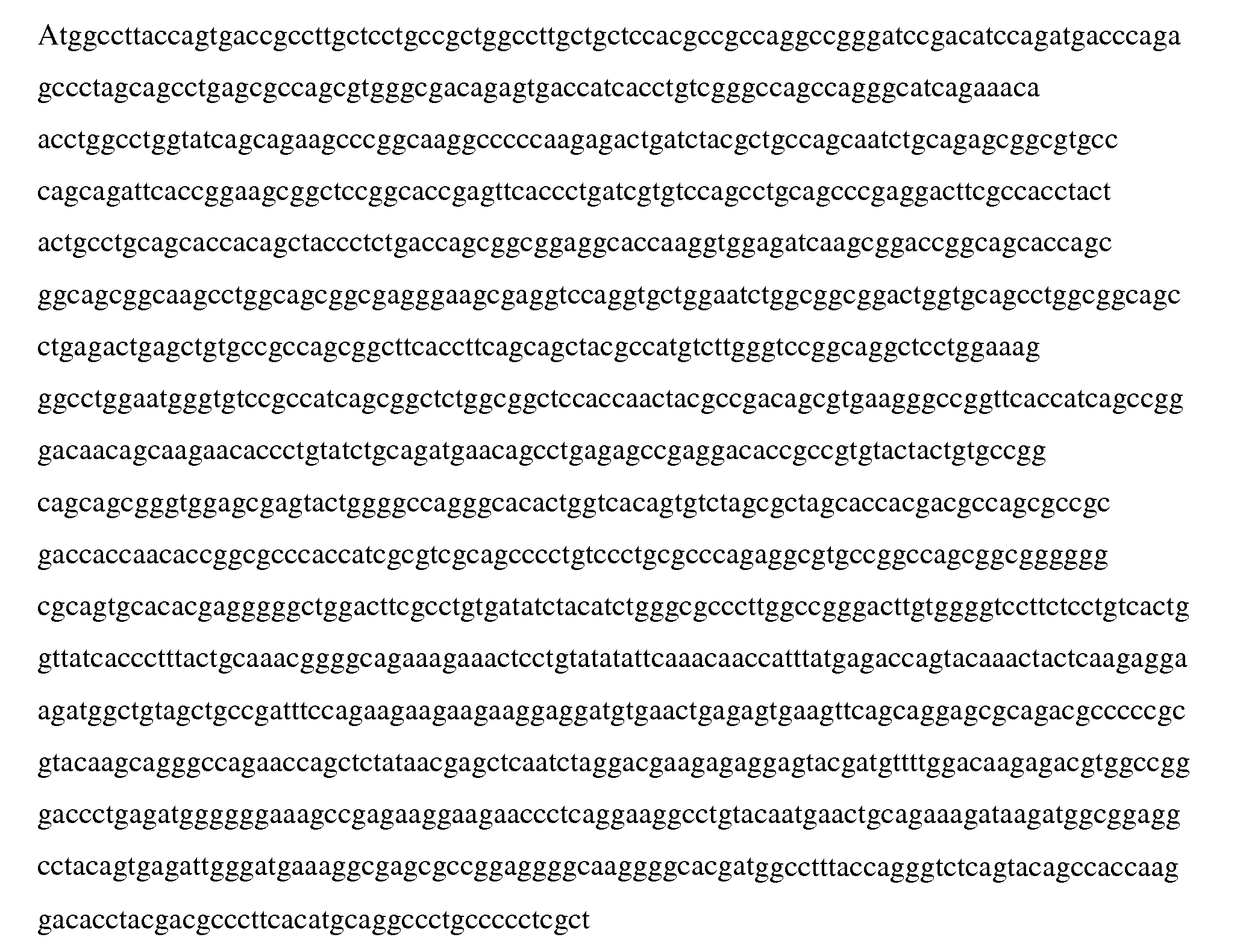
CAR 성분CAR ingredients
핵산 서열:Nucleic acid sequence:
● 3C10 scFv 뉴클레오티드 서열 (마우스); (서열 4)● 3C10 scFv nucleotide sequence (mouse); (SEQ ID NO: 4)

● 139 scFv 뉴클레오티드 서열 (인간화); (서열 5)● 139 scFv nucleotide sequence (humanized); (SEQ ID NO: 5)

● 리더 (핵산 서열); (서열 6)● leader (nucleic acid sequence); (SEQ ID NO: 6)

● 힌지 (핵산 서열); (서열 7)● Hinge (nucleic acid sequence); (SEQ ID NO: 7)

● 막횡단 (핵산 서열); (서열 8)● Transmembrane (nucleic acid sequence); (SEQ ID NO: 8)

● 4-1BB 세포내 도메인 (핵산 서열); (서열 9)● 4-1BB intracellular domain (nucleic acid sequence); (SEQ ID NO: 9)

● CD3 제타 (핵산 서열); (서열 10)● CD3 zeta (nucleic acid sequence); (SEQ ID NO: 10)

● CD3 제타 (핵산 서열; NCBI 참조 서열 NM_000734.3); (서열 100)● CD3 zeta (nucleic acid sequence; NCBI reference sequence NM_000734.3); (SEQ ID NO: 100)

아미노산 서열:Amino acid sequence:
● 3C10 scFv 아미노산 서열 (마우스); (서열 11)● 3C10 scFv amino acid sequence (mouse); (SEQ ID NO: 11)

● 139 scFv 아미노산 서열 (인간); (서열 12)● 139 scFv amino acid sequence (human); (SEQ ID NO: 12)

● 리더 (아미노산 서열) (서열 13)● Leader (amino acid sequence) (SEQ ID NO: 13)

● 힌지 (아미노산 서열) (서열 14)● Hinge (amino acid sequence) (SEQ ID NO: 14)

● 막횡단 (아미노산 서열) (서열 15)● Transmembrane (amino acid sequence) (SEQ ID NO: 15)

● 4-1BB 세포내 도메인 (아미노산 서열) (서열 16)● 4-1BB intracellular domain (amino acid sequence) (SEQ ID NO: 16)

● CD3 제타 도메인 (아미노산 서열) (서열 17)● CD3 zeta domain (amino acid sequence) (SEQ ID NO: 17)

● CD3 제타 도메인 (아미노산 서열; NCBI 참조 서열 NM_000734.3) (서열 99)● CD3 zeta domain (amino acid sequence; NCBI reference sequence NM_000734.3) (SEQ ID NO: 99)

서열 11의 폴리펩티드를 코딩하는 뉴클레오티드는 서열 4로서 제공된다. 서열 12의 폴리펩티드를 코딩하는 뉴클레오티드는 서열 5로서 제공된다. 서열 13의 폴리펩티드를 코딩하는 뉴클레오티드는 서열 6으로서 제공된다. 서열 14의 폴리펩티드를 코딩하는 뉴클레오티드는 서열 7로서 제공된다. 서열 15의 폴리펩티드를 코딩하는 뉴클레오티드는 서열 8로서 제공된다. 서열 16의 폴리펩티드를 코딩하는 뉴클레오티드는 서열 9로서 제공된다. 서열 17의 폴리펩티드를 코딩하는 뉴클레오티드는 서열 10으로서 제공된다. 서열 1의 폴리펩티드를 코딩하는 뉴클레오티드는 서열 18로서 제공된다. 서열 2의 폴리펩티드를 코딩하는 뉴클레오티드는 서열 19로서 제공된다. 서열 3의 폴리펩티드를 코딩하는 뉴클레오티드는 서열 20으로서 제공된다. 서열 99의 폴리펩티드를 코딩하는 뉴클레오티드는 서열 100으로서 제공된다.The nucleotides encoding the polypeptide of SEQ ID NO:11 are provided as SEQ ID NO:4. The nucleotides encoding the polypeptide of SEQ ID NO:12 are provided as SEQ ID NO:5. The nucleotides encoding the polypeptide of SEQ ID NO:13 are provided as SEQ ID NO:6. The nucleotides encoding the polypeptide of SEQ ID NO:14 are provided as SEQ ID NO:7. The nucleotides encoding the polypeptide of SEQ ID NO:15 are provided as SEQ ID NO:8. The nucleotides encoding the polypeptide of SEQ ID NO:16 are provided as SEQ ID NO:9. The nucleotides encoding the polypeptide of SEQ ID NO:17 are provided as SEQ ID NO:10. The nucleotides encoding the polypeptide of SEQ ID NO:1 are provided as SEQ ID NO:18. The nucleotides encoding the polypeptide of SEQ ID NO:2 are provided as SEQ ID NO:19. The nucleotides encoding the polypeptide of SEQ ID NO:3 are provided as SEQ ID NO:20. The nucleotides encoding the polypeptide of SEQ ID NO:99 are provided as SEQ ID NO:100.
실시예 4: EGFRvIII CAR에 대한 예측된 CDR 명칭Example 4: Predicted CDR Names for EGFRvIII CAR
카바트(Kabat) 하에 EGFRvIII CAR에 대한 예측된 CDR 명칭은 다음과 같다:The predicted CDR names for EGFRvIII CAR under Kabat are:
● VH:● VH:

[여기서, CDR1은 DYYIH (서열 22)이고, CDR2는 RIDPENDETKYGPIFQG (서열 23)이며, CDR3은 RGGVY (서열 24)이다].[Where CDR1 is DYYIH (SEQ ID NO:22), CDR2 is RIDPENDETKYGPIFQG (SEQ ID NO:23), and CDR3 is RGGVY (SEQ ID NO:24)].
● VL:● VL:

[여기서, CDR1은 KSSQSLLDSDGKTYLN (서열 26)이고, CDR2는 LVSKLDS (서열 27)이며, CDR3은 WQGTHFPGT (서열 28)이다].[Here, CDR1 is KSSQSLLDSDGKTYLN (SEQ ID NO:26), CDR2 is LVSKLDS (SEQ ID NO:27), and CDR3 is WQGTHFPGT (SEQ ID NO:28)].
코티아(Chothia) 하에 EGFRvIII CAR에 대한 예측된 CDR 명칭은 다음과 같다:The predicted CDR names for the EGFRvIII CAR under Chothia are:
● VH:● VH:

[여기서, CDR1은 GFNIEDY (서열 30)이고, CDR2는 DPENDE (서열 31)이며, CDR3은 RGGVY (서열 32)이다].[Where CDR1 is GFNIEDY (SEQ ID NO:30), CDR2 is DPENDE (SEQ ID NO:31), and CDR3 is RGGVY (SEQ ID NO:32)].
● VL:● VL:

[여기서, CDR1은 SQSLLDSDGKTY (서열 34)이고, CDR2는 LVS (서열 35)이며, CDR3은 GTHFPG (서열 36)이다].[Where CDR1 is SQSLLDSDGKTY (SEQ ID NO:34), CDR2 is LVS (SEQ ID NO:35), and CDR3 is GTHFPG (SEQ ID NO:36)].
실시예 5: 뮤린 항-EGFRvIII 항체의 인간화Example 5: Humanization of Murine Anti-EGFRvIII Antibody
뮤린 EGFRvIII 항체를 인간화하는 것이 임상적 환경에 요망되는데, 여기서 마우스-특이적 잔기는 뮤린 CAR 구축물로 형질도입된 T 세포로의 치료를 받은 환자에서 인간-항-마우스 항원 (HAMA) 반응을 유도시킬 수 있다. 하이브리도마 유래된 뮤린 EGFRvIII 항체의 VH 서열과 VL 서열은 공개된 문헌으로부터 추출하였다 (Morgan et al. (2012) Human Gene Therapy, 23:1043-1953, 상기 참조). 인간화는 뮤린 EGFRvIII 항체로부터의 CDR 영역을 인간 생식세포계 수용자 프레임워크 VH1_1-f 또는 VH5_5a 뿐만 아니라 VK2_A17 또는 VK4_B3 (vBASE 데이터베이스) 상으로 이식함으로써 달성하였다. 이러한 CDR 영역 이외에도, CDR 영역의 구조적 완전성을 뒷받침하는 것으로 여겨지는 여러 프레임워크 잔기, 즉 VK2 #36, #49, VK4 #2, #36, #46, #49, VH1 #2, #24, #76, #94 및 VH5 #2, #24, #73, #76, #94를 상기 뮤린 서열로부터 보존하였다. 추가로, 인간 J 요소 JH6 및 JK4를 중쇄와 경쇄에 각각 사용하였다. 이로써 생성된 인간화 항체의 아미노산 서열은 도 9에 도시된 경쇄의 경우에는 VK2_A17/Hz1 및 VK4_B3/Hz1로 명명되었고, 중쇄의 경우에는 VH1_1-f/Hz1, VH5_5-a/Hz1로 명명되었다. 잔기 넘버링은 카바트 (상기 문헌 [Kabat E.A. et al., 1991] 참조)에 따른다. CDR 정의에 관해서는, 카바트뿐만 아니라 코티아 (상기 문헌 [Chothia et al., 1987] 참조) 둘 다를 사용하였다. 마우스 EGFRvIII으로부터 보유된 프레임워크 잔기는 박스 안의 볼드체/이탤릭체로 제시되고, CDR 잔기에는 밑줄이 그어져 있다.Humanizing murine EGFRvIII antibodies is desirable in the clinical setting, where mouse-specific moieties will induce human-anti-mouse antigen (HAMA) responses in patients treated with T cells transduced with the murine CAR construct. You can. The VH and VL sequences of the hybridoma-derived murine EGFRvIII antibody were extracted from published literature (Morgan et al. (2012) Human Gene Therapy, 23:1043-1953, see above). Humanization was achieved by grafting the CDR regions from the murine EGFRvIII antibody onto the human germline acceptor frameworks VH1_1-f or VH5_5a as well as VK2_A17 or VK4_B3 (vBASE database). In addition to these CDR regions, several framework residues are believed to support the structural integrity of the CDR regions, namely VK2 #36, #49,
도 9에 제시된 바와 같은 인간화 경쇄와 중쇄 서열을 근거로 하여, 총 8개의 프레임워크 조합물을 사용하여, 추가 검증을 위한 가용성 scFv를 생성시켰다. VL 도메인과 VH 도메인이 scFv 내에서 보여지는 순서는 다양하였고 (즉, VL-VH, 또는 VH-VL 배향), "G4S" 소단위 (서열 37)의 4개 카피 [여기서, 각 소단위는 서열 GGGGS (서열 37)를 포함한다]를 사용하여 상기 프레임워크를 연결시켰다. 도 9는 카바트 등 및 코티아 등 (상기 참조)에 의해 계산된 VH 서열과 VL 서열 내의 CDR을 개시한다.Based on the humanized light and heavy chain sequences as shown in Figure 9, a total of eight framework combinations were used to generate soluble scFvs for further validation. The order in which the VL and VH domains appear within the scFv varied (i.e., VL-VH, or VH-VL orientation), with four copies of the “G 4 S” subunit (SEQ ID 37) [wherein each subunit has the sequence GGGGS (SEQ ID NO:37)] was used to link the framework. Figure 9 discloses CDRs in the VH and VL sequences calculated by Kabat et al. and Kotia et al. (supra).
클로닝:Cloning:
마우스 및 인간화 VL 도메인과 VH 도메인을 코딩하는 DNA 서열을 수득하였고, 상기 구축물에 대한 코돈을, 호모 사피엔스 (Homo sapiens)로부터의 세포에서 발현하기 위해 최적화하였다.DNA sequences encoding the mouse and humanized VL and VH domains were obtained, and the codons for the constructs were optimized for expression in cells from Homo sapiens.
VL 및 VH 도메인을 코딩하는 서열을, 포유동물 세포에서의 분비에 적합한 발현 벡터 내로 서브클로닝하였다. 이러한 발현 벡터의 요소는 프로모터 [시토메갈로바이러스 (CMV) 증강인자-프로모터], 분비를 촉진시키기 위한 신호 서열, 폴리아데닐화 신호 및 전사 종결인자 [소의 성장 호르몬 (BGH) 유전자], 에피솜 복제와 원핵생물에서의 복제를 허용하는 요소 (예를 들어, SV40 기점 및 ColE1, 또는 당해 분야에 공지된 기타), 및 분비를 허용하는 요소 (앰피실린 내성 유전자 및 제오신 마커)를 포함한다.Sequences encoding the VL and VH domains were subcloned into expression vectors suitable for secretion in mammalian cells. The elements of these expression vectors include a promoter [cytomegalovirus (CMV) enhancer-promoter], a signal sequence to promote secretion, a polyadenylation signal and a transcription terminator [bovine growth hormone (BGH) gene], episomal replication and Elements that allow replication in prokaryotes (e.g., SV40 origin and ColE1, or others known in the art), and elements that allow secretion (ampicillin resistance gene and zeocin marker).
실시예 6: 인간화 항-EGFRvIII 가용성 scFv 단편의 특성화Example 6: Characterization of humanized anti-EGFRvIII soluble scFv fragment
가용성 scFv 단편은 표준 분자 생물학 기술을 이용하여 상기 언급된 바와 같이 생성하였다. 이들 가용성 scFv를 특성화 연구에 사용하여, scFv의 안정성, 세포 표면 발현 및 결합 특성을 조사하였다.Soluble scFv fragments were generated as mentioned above using standard molecular biology techniques. These soluble scFvs were used in characterization studies to investigate the stability, cell surface expression, and binding properties of the scFvs.
scFv 발현 및 정제scFv expression and purification
각 scFv 구축물의 형질감염을 위해, 대략 3e8개의 293F 세포를, 형질감염 시약으로서 PEI를 3:1 (PEI:DNA)의 비로 사용하여 100 ㎍의 플라스미드로 형질감염시켰다. 세포를 37℃, 125 rpm, 8% CO2 하에 진탕 플라스크 내에서 100 ml EXPi293 발현 배지 (인비트로젠)에서 성장시켰다. 6일 후에 배양물을 수거하고, 이를 단백질 정제에 사용하였다.For transfection of each scFv construct, approximately 3e8 293F cells were transfected with 100 μg of plasmid using PEI as the transfection reagent at a ratio of 3:1 (PEI:DNA). Cells were grown in 100 ml EXPi293 expression medium (Invitrogen) in shake flasks at 37°C, 125 rpm, 8% CO 2 . The culture was harvested after 6 days and used for protein purification.
3500 g 하에 20분 동안 침강시킴으로써 293F 세포를 수거하였다. 상등액을 수집하고, 이를 배큐캡(VacuCap)90 PF 필터 유닛 (w/0.8/0.2 ㎛ 슈퍼 막, PALL) 내로 여과시켰다. 대략 400 ㎕의 Ni-NTA 아가로즈 비드 [퀴아젠(Qiagen)]를 상등액에 가하였다. 혼합물을 회전시키고 4℃에서 4시간 동안 인큐베이션하였다. 이를 정제 칼럼 상으로 부하하고, 20 mM 히스티딘을 수반한 세척 완충액으로 세척하였다. 단백질을 300 mM 히스티딘을 수반한 500 ㎕ 용출 완충액으로 용출시켰다. 샘플을 4℃ 하에 밤새 PBS 완충액에 대항하여 투석하였다. 나노드롭(nanodrop) 2000c를 이용하여 단백질 샘플을 정량화하였다.293F cells were harvested by sedimentation at 3500 g for 20 minutes. The supernatant was collected and filtered through a VacuCap90 PF filter unit (w/0.8/0.2 μm Super Membrane, PALL). Approximately 400 μl of Ni-NTA agarose beads (Qiagen) were added to the supernatant. The mixture was rotated and incubated at 4°C for 4 hours. This was loaded onto a purification column and washed with wash buffer containing 20 mM histidine. Proteins were eluted with 500 μl elution buffer with 300 mM histidine. Samples were dialyzed against PBS buffer overnight at 4°C. Protein samples were quantified using nanodrop 2000c.
인간 EGFR 야생형 또는 EGFRvIII을 발현하는 세포에 대한 정제된 scFv의 FACS 결합에 의한 ECEC by FACS binding of purified scFv to cells expressing human EGFR wild type or EGFRvIII 5050
다음 실험을 수행하여, 모든 인간화 EGFRvIII scFv 변이체가 EGFRvIII에 대해서는 거의 동등한 수준의 결합성을 지니고 있지만, 야생형 EGFR과는 결합하지 않는다는 것을 입증하였다. The following experiment was performed to demonstrate that all humanized EGFRvIII scFv variants have almost equal levels of binding to EGFRvIII, but do not bind to wild-type EGFR.
HEK293F 현탁 세포를 야생형 hEGFR 또는 hEGFRvIII으로 일시적으로 형질감염시키고, 형질감염시킨지 2일 후에 수거하였다. 웰당 대략 5e5개 세포를 BD 팔콘(Falcon) 96 웰 판으로 옮겼다. 세포를 900 rpm 하에 [소르발 레전드(Sorval Legend) XT 원심분리기] 3분 동안 침강시켰다. 상등액을 제거하였다. 항-EGFRvIII scFv 단백질 샘플을 5% FBS를 수반한 DPBS에 희석시켰다. 샘플을 상기 웰 내로 가하고, 혼합하며 1시간 동안 인큐베이션하였다. 세포를 5% FBS를 수반한 DPBS에서 2회 세척하였다. 세포를 항-폴리 His PE (R&D)와 함께 1시간 동안 인큐베이션하고, 2회 세척한 후 FACS 분석하였다 (BD 바이오사이언스로부터의 LSRII).HEK293F suspension cells were transiently transfected with wild-type hEGFR or hEGFRvIII and harvested 2 days after transfection. Approximately 5e5 cells per well were transferred to BD Falcon 96 well plates. Cells were sedimented for 3 minutes at 900 rpm (Sorval Legend XT centrifuge). The supernatant was removed. Anti-EGFRvIII scFv protein samples were diluted in DPBS with 5% FBS. Samples were added into the wells, mixed and incubated for 1 hour. Cells were washed twice in DPBS with 5% FBS. Cells were incubated with anti-poly His PE (R&D) for 1 hour, washed twice and then analyzed by FACS (LSRII from BD Biosciences).
hEGFRvIII에 대한 마우스 scFv (m3C10)의 EC50은 도 10에 도시된 바와 같이 약 5 nM인 것으로 결정되었다. 모든 인간화 EGFRvIII scFv 변이체는 한 자릿수의 EC50 값 내지 낮은 두 자릿수 nM EC50 범위 (5 내지 50 nM)를 나타내었다. 더욱이, 야생형 EGFR 발현성 세포주에 대한 구축물 2173 및 2174의 인지할 만한 결합이 전혀 검출되지 않았는데, 이는 도 11에 도시된 바와 같이, 뮤린 3C10과 비교해서 개선된 안전성 프로파일을 표시한다. 이들 연구에 근거하여, 클론 2173이 실시예 8에 나타낸 바와 같이, 추가의 임상 특성화를 위해 선별되었다.The EC 50 of mouse scFv (m3C10) against hEGFRvIII was determined to be approximately 5 nM as shown in Figure 10. All humanized EGFRvIII scFv variants exhibited EC 50 values in the single digit to low double digit nM EC 50 range (5 to 50 nM). Moreover, no appreciable binding of constructs 2173 and 2174 to wild-type EGFR expressing cell lines was detected, indicating an improved safety profile compared to murine 3C10, as shown in Figure 11. Based on these studies, clone 2173 was selected for further clinical characterization, as shown in Example 8.
실시예 7: 인간화 EGFRvIII CAR 구축물Example 7: Humanized EGFRvIII CAR construct
최종 CAR 구축물에 사용될 scFv는 실시예 1에 기재된 인간화 프레임워크 서열로부터 유래되었다. VL 도메인과 VH 도메인이 scFv 내에서 보여지는 순서는 다양하였다 (즉, VL-VH, 또는 VH-VL 배향). (G4S)4 (서열 113) 링커를 사용하여 가변 도메인을 연결시켜 표 1에 제시된 scFv를 창출하였다.The scFv to be used in the final CAR construct was derived from the humanized framework sequence described in Example 1. The order in which the VL and VH domains appear within the scFv varied (i.e., VL-VH, or VH-VL orientation). (G4S) 4 (SEQ ID NO: 113) linker was used to join the variable domains to create the scFvs shown in Table 1.
<표 1><Table 1>
VH 및 VL 배향과 링커 길이를 나타내는 인간화 EGFRvIII scFv 구축물 (표는 서열 37로서 "G4S"를 개시한다)Humanized EGFRvIII scFv constructs showing VH and VL orientation and linker length (table discloses “G4S” as SEQ ID 37)

인간화 scFv 단편의 서열은 다음 표 2에 제공된다 (서열 38, 서열 44, 서열 50, 서열 56, 서열 62, 서열 68, 서열 74, 및 서열 80). 이들 scFv 단편을 부가 서열인 서열 13 내지 17과 함께 사용하여, 서열 43, 서열 49, 서열 55, 서열 61, 서열 67, 서열 73, 서열 79, 및 서열 85를 수반하는 완전한 CAR 구축물을 생성하였다.The sequences of the humanized scFv fragments are provided in Table 2 below (SEQ ID NO:38, SEQ ID NO:44, SEQ ID NO:50, SEQ ID NO:56, SEQ ID NO:62, SEQ ID NO:68, SEQ ID NO:74, and SEQ ID NO:80). These scFv fragments were used with the additional sequences SEQ ID NO: 13-17 to generate complete CAR constructs involving SEQ ID NO: 43, SEQ ID NO: 49, SEQ ID NO: 55, SEQ ID NO: 61, SEQ ID NO: 67, SEQ ID NO: 73, SEQ ID NO: 79, and SEQ ID NO: 85.
이들 클론은 모두, CD3제타 쇄로부터 유래된 공동자극 도메인의 신호 도메인 상의 Q/K 잔기 변화를 함유하였다.All of these clones contained Q/K residue changes on the signaling domain of the costimulatory domain derived from the CD3 zeta chain.
<표 2><Table 2>
인간화 EGFRvIII CAR 구축물Humanized EGFRvIII CAR construct


이어서, CAR scFv 단편을 렌티바이러스성 벡터 내로 클로닝하여 단일 코딩 프레임 내에서 및 발현용 EF1 알파 프로모터 (서열 97)를 이용하여 전장 CAR 구축물을 창출하였다.The CAR scFv fragment was then cloned into a lentiviral vector to create a full-length CAR construct within a single coding frame and using the EF1 alpha promoter (SEQ ID NO:97) for expression.
EF1 알파 프로모터EF1 alpha promoter

CAR9, CAR10 및 선별 인간화 EGFRvIII CAR 구축물의 표면 발현 및 FACS에 의한 염색Surface expression of CAR9, CAR10 and selected humanized EGFRvIII CAR constructs and staining by FACS
다음 실험은 Jurkat 세포와 일차 T 세포 둘 다에서 EGFRvIII 기반 시험관내 결합 연구에 대하여 친화성 차이가 있는 것으로 보인다는 것을 나타내었다. The following experiments indicated that there appeared to be affinity differences for EGFRvIII based in vitro binding studies in both Jurkat cells and primary T cells.
Jurkat E6 세포를, 아막사 셀라인 뉴클레오펙터 키트 V (론자; 독일 쾰른 AG) 및 프로그램 X-001을 이용하여 CAR9 벡터 또는 CAR10 벡터로 전기천공시켰다. 형질감염시킨 그 다음 날, 0.5x10⁶개 세포를 0.2 ml FACS 완충액 (5% FBS를 함유하는 DPBS 완충액)에서 V자형 96 웰 판 [그라이너 바이오-온 (Greiner Bio-One; 독일)]의 각 웰 내로 도말하고, 실온 하에 10분 동안 인큐베이션하였다. 이어서, 세포를 침강시키고, 상이한 농도의 EGFRvIII-Fc 또는 EGFRwt-Fc를 수반하는 0.2 ml의 FACS 완충액에 재현탁시키며, 4℃ 하에 30분 동안 인큐베이션하였다. 이어서, 세포를 FACS 완충액으로 3회 세척하고, 2 ㎕의 PE 항-인간 IgG Fc [잭슨 임뮤노리서치 라보라토리즈 (Jackson ImmunoResearch Laboratories; 미국 펜실베니아주 웨스트 그로브)]를 수반하는 0.2 ml의 FACS 완충액과 함께 4℃ 암실에서 30분 동안 인큐베이션하였다. 0.2 ml의 FACS 완충액으로 3회 세척한 후, FACSDiva 소프트웨어 (BD 바이오사이언스; 미국 캘리포니아주 산호세)를 이용하여 LSRII (BD 바이오사이언스; 미국 캘리포니아주 산호세) 기계 상에서 세포를 분석하였다. 면역형광 염색을 살아있는 세포의 상대적 log 형광으로서 분석하였고, PE 양성 세포의 비율(%)을 측정하였다.Jurkat E6 cells were electroporated with CAR9 vectors or CAR10 vectors using the Amaxa Cell Line Nucleofector Kit V (Lonza; Cologne AG, Germany) and program X-001. The day after transfection, 0.5x10⁶ cells were seeded in each V-shaped 96-well plate (Greiner Bio-One; Germany) in 0.2 ml FACS buffer (DPBS buffer containing 5% FBS). Plated into wells and incubated for 10 minutes at room temperature. The cells were then sedimented and resuspended in 0.2 ml of FACS buffer with different concentrations of EGFRvIII-Fc or EGFRwt-Fc and incubated for 30 minutes at 4°C. The cells were then washed three times with FACS buffer and incubated with 0.2 ml of FACS buffer followed by 2 μl of PE anti-human IgG Fc (Jackson ImmunoResearch Laboratories, West Grove, PA). and incubated for 30 minutes in a dark room at 4°C. After washing three times with 0.2 ml of FACS buffer, cells were analyzed on an LSRII (BD Bioscience; San Jose, CA, USA) machine using FACSDiva software (BD Bioscience; San Jose, CA, USA). Immunofluorescence staining was analyzed as the relative log fluorescence of live cells, and the percentage of PE-positive cells was determined.
도 12에 도시된 바와 같이, Jurkat 세포에서 발현된 CAR9의 EGFRvIII-Fc 융합 단백질에 대한 결합성은 야생형 EGFR-Fc에 대한 것 보다 대략 1,000배 정도 더 강력하다. 더욱이, CAR10을 발현하는 CART 구축물은 CAR9와 비교해서 EGFRvIII에 대한 결합성이 상당히 더 낮은 것으로 (대략 40배) 나타난다. 이는 뮤린 CAR9가 EGFRvIII과 결합하긴 하지만, 야생형 EGFR과도 여전히 일부 결합성을 보유하고 있다는 것을 제안한다. 더욱이, 이는 CAR9가 CAR10 구축물 보다 EGFRvIII에 대한 결합 친화성이 더 높다는 것을 강력하게 표시한다.As shown in Figure 12, the binding affinity of CAR9 expressed in Jurkat cells to the EGFRvIII-Fc fusion protein is approximately 1,000 times stronger than that to the wild type EGFR-Fc. Moreover, the CART construct expressing CAR10 appears to have significantly lower binding (approximately 40-fold) to EGFRvIII compared to CAR9. This suggests that although murine CAR9 binds to EGFRvIII, it still retains some binding to wild-type EGFR. Moreover, this strongly indicates that CAR9 has a higher binding affinity for EGFRvIII than the CAR10 construct.
일차 T 세포에서의 추가 실험 결과, 유사한 결과가 산출되었다. 간략하게 언급하면, 일차 인간 CD3+ T 세포를 항-CD3/CD28 비드로 24시간 동안 자극한 다음, 3:1의 MOI로 CAR9, CAR10, CAR6 또는 대조군 CAR을 코딩하는 렌티바이러스성 벡터로 형질도입하였다. 본 실험에는 또한, 모의 형질도입된 T 세포 집단이 포함되었다. 이들 세포가 휴지기에 들어갈 때까지 배양물 중에서 약 8 내지 9일 동안 확장시켰다. 이 시점에서, 0.5x10⁶개 세포를 V자형 96 웰 판의 각 웰 내로 도말하였다. 세포를 PBS로 1회 세척하고, 생/사 시약 (PBS 중의 1:1000)으로 얼음 상에서 30분 동안 염색하였다. 이어서, 세포를 FACS 완충액으로 2회 세척하고, 1 ㎍/ml 바이오티닐화 EGFRvIII 또는 EGFR wt 단백질과 함께 얼음 상에서 30분 동안 인큐베이션하였다. 그 다음, 세포를 2회 세척하고, 1:1000 희석도의 스트렙타비딘-PE를 수반한 0.2 ml의 FACS 완충액과 함께 얼음 상에서 15분 동안 인큐베이션하였다. FACS 완충액으로 2회 세척한 후, 세포를 LSRII 상에서 분석하였다. 면역형광 염색을 살아있는 세포의 상대적 log 형광으로서 분석하였고, PE 양성 세포의 비율(%)을, 양성 집단의 기하 평균과 연계해서 측정하였다.Additional experiments in primary T cells yielded similar results. Briefly, primary human CD3+ T cells were stimulated with anti-CD3/CD28 beads for 24 hours and then transduced with lentiviral vectors encoding CAR9, CAR10, CAR6, or control CAR at an MOI of 3:1. . This experiment also included a mock transduced T cell population. These cells were expanded in culture for approximately 8 to 9 days until they entered quiescence. At this point, 0.5x10 6 cells were plated into each well of a V-shaped 96 well plate. Cells were washed once with PBS and stained with Live/Dead reagent (1:1000 in PBS) for 30 minutes on ice. Cells were then washed twice with FACS buffer and incubated with 1 μg/ml biotinylated EGFRvIII or EGFR wt protein for 30 minutes on ice. Cells were then washed twice and incubated for 15 minutes on ice with 0.2 ml of FACS buffer with 1:1000 dilution of streptavidin-PE. After washing twice with FACS buffer, cells were analyzed on LSRII. Immunofluorescence staining was analyzed as the relative log fluorescence of live cells, and the percentage of PE-positive cells was determined relative to the geometric mean of the positive population.
도 13에 도시된 바와 같이, CAR9 및 CAR6 CAR는, 심지어 모든 구축물이 동등하게 형질도입되긴 하지만 (모두에 대한 형질도입 효율 약 50%), 포화량의 EGFRvIII 단백질이 검출을 위해 사용되는 경우에는, EGFRvIII 결합성에 대한 기하 평균이 CAR10 (단지 2K) 보다 10배 더 높은 것으로 나타났다 (CAR9의 경우에는 21K이고, CAR6의 경우에는 27K이다). 유사하게, EGFR wt 단백질에 대한 특이성은 약 10배 더 낮은데, 이는 EGFR wt 단백질로의 염색에 대한 아래쪽으로의 로그 이동으로써 도시된 바와 같다. 이는 CAR9 및 CAR6이 일차 T 세포에서 발현되는 경우에 CAR10과 비교해서 EGFRvIII 단백질에 대한 더 강력한 친화성을 지니고 있다는 것을 표시하고 이들이 임상에서 더 효과적이라는 것을 제안하는 상기 Jurkat 세포에서의 발견 내용을 부가로 뒷받침해준다.As shown in Figure 13, the CAR9 and CAR6 CARs transduced equally even if all constructs were transduced equally (transduction efficiency for all approximately 50%) when saturating amounts of EGFRvIII protein were used for detection. The geometric mean for EGFRvIII binding was found to be 10-fold higher (21K for CAR9 and 27K for CAR6) than CAR10 (only 2K). Similarly, specificity for EGFR wt protein is approximately 10-fold lower, as shown by the downward log shift relative to staining with EGFR wt protein. This is in addition to the findings in Jurkat cells above, which indicate that CAR9 and CAR6 have a stronger affinity for the EGFRvIII protein compared to CAR10 when expressed on primary T cells and suggest that they may be more effective in clinical practice. It supports
인간화 CAR 구축물의 패널의 기능적 분석을 실시예 8에 기재되는 바와 같이 수행하였다.Functional analysis of a panel of humanized CAR constructs was performed as described in Example 8.
실시예 8: T 세포에서 인간화 EGFRvIII-특이적 CAR 구축물의 분석Example 8: Analysis of humanized EGFRvIII-specific CAR constructs in T cells
CAR 기술을 통하여 표적화 EGFRvIII의 실행 가능성을 평가하기 위하여, 인간화 EGFRvIII scFv 단편을 2가지 상이한 입체 배치로 CD3제타 쇄와 4-1BB 공동자극성 분자를 수반하는 렌티바이러스성 CAR 발현 벡터 내로 클로닝하였다. EGFRvIII+ 및 EGFR wt 표적에 반응하여 EGFRvIII CAR 형질도입된 T 세포의 이펙터 T 세포 반응의 양과 질에 근거하여 최적의 구축물을 선별한다. 이펙터 T 세포 반응은 세포성 확장, 증식, 증가, 시토카인 생성 및 표적 세포 사멸 또는 세포용해 활성 (탈과립화)을 포함하지만, 이에 제한되지 않는다.To assess the feasibility of targeting EGFRvIII via CAR technology, humanized EGFRvIII scFv fragments were cloned into lentiviral CAR expression vectors carrying the CD3zeta chain and 4-1BB costimulatory molecules in two different configurations. The optimal construct is selected based on the quantity and quality of effector T cell responses of EGFRvIII CAR transduced T cells in response to EGFRvIII+ and EGFR wt targets. Effector T cell responses include, but are not limited to, cellular expansion, proliferation, augmentation, cytokine production, and target cell killing or cytolytic activity (degranulation).
재료 및 방법Materials and Methods
CAR 기능의 초기 특성화를 위한 Jurkat 리포터 세포주의 생성Generation of Jurkat reporter cell lines for initial characterization of CAR function
일차 T 세포 형질도입 및 활성화에 대한 대안으로서, Jurkat-NFAT 리포터 세포주를 사용하여 CAR 구축물의 기능적 활성을 평가할 수 있다. Jurkat T 세포주 (E6-1)를 NFAT-루시페라제 리포터 구축물로 형질감염시키고, PMA 및 이오노마이신 자극 후 NFAT 리포터의 강력한 유도에 근거하여 추가 특성화하기 위한 안정한 클로날 세포주 (JNL)를 선별하였다. 이러한 JNL 세포를 5:1의 MOI로 렌티바이러스성 벡터로 형질도입한 다음, 5 내지 7일 동안 확장시켰다. 검정에 사용하기 전, 형질도입된 세포의 비율(%) (세포 표면 상에 EGFRvIII CAR을 발현함) 및 이러한 세포의 발현의 상대적 형광 세기를, LSRII 상에서의 유동 세포계수 분석에 의해 결정한다. 히스토그램 플롯으로부터, 형질도입된 비율을 그들의 상대적 형광 세기와 비교함으로써, CAR의 상대적 발현 수준을 조사할 수 있다.As an alternative to primary T cell transduction and activation, the Jurkat-NFAT reporter cell line can be used to assess the functional activity of CAR constructs. The Jurkat T cell line (E6-1) was transfected with the NFAT-luciferase reporter construct, and a stable clonal cell line (JNL) was selected for further characterization based on strong induction of the NFAT reporter after PMA and ionomycin stimulation. . These JNL cells were transduced with lentiviral vectors at an MOI of 5:1 and then expanded for 5 to 7 days. Before use in the assay, the percentage of transduced cells (expressing the EGFRvIII CAR on the cell surface) and the relative fluorescence intensity of expression of these cells are determined by flow cytometric analysis on LSRII. From the histogram plot, the relative expression levels of CARs can be examined by comparing the transduced proportions with their relative fluorescence intensities.
인간화 EGFRvIII-특이적 CAR JNL 세포의 T 세포 활성화를 평가한다Assess T cell activation of humanized EGFRvIII-specific CAR JNL cells
JNL 리포터 세포주에서 T 세포 활성화를 평가하기 위하여, JNL 또는 CAR-형질도입된 JNL 세포를 청정한 바닥이 있는 96 웰 블랙 판 내에 웰당 50,000개 세포로 도말한다. 표적 세포 (BHK 모 세포, 또는 EGFRvIIII 또는 EGFR wt를 발현하도록 조작된 BHK 세포)를 상기 웰에 가하여, 1:2, 1:1, 1:0.3, 1:0.1, 1:0.03, 1:0.01 및 1:0.003의 이펙터 대 표적 (E:T) 비를 창출한다. PMA 및 이오노마이신이 활성화를 위한 양성 대조군으로서 사용된다. 세포를 37℃ 하에 16 내지 24시간 동안 인큐베이션한다. 인큐베이션이 끝날 무렵, 등 용적의 브라이트-글로(Bright-Glo) 루시페라제 검정 시약을 각 웰에 가한다. 상기 판을 실온 하에 10분 동안 인큐베이션한 다음, 발광계를 이용하여 발광을 측정한다.To assess T cell activation in the JNL reporter cell line, JNL or CAR-transduced JNL cells are plated at 50,000 cells per well in 96 well black plates with clear bottom. Target cells (BHK parental cells, or BHK cells engineered to express EGFRvIIII or EGFR wt) were added to the wells at 1:2, 1:1, 1:0.3, 1:0.1, 1:0.03, 1:0.01, and Creates an effector-to-target (E:T) ratio of 1:0.003. PMA and ionomycin are used as positive controls for activation. Cells are incubated at 37°C for 16 to 24 hours. At the end of the incubation, an equal volume of Bright-Glo luciferase assay reagent is added to each well. The plate is incubated at room temperature for 10 minutes and then luminescence is measured using a luminometer.
재유도된 인간화 EGFRvIII-특이적 CAR T 세포의 생성Generation of reinduced humanized EGFRvIII-specific CAR T cells
인간화 EGFRvIII-특이적 CAR 렌티바이러스성 전이 벡터를 사용하여, VSVg 가짜형 렌티바이러스성 입자 내로 패키지된 게놈 물질을 생성한다. 렌티바이러스성 전이 벡터 DNA를, VSVg의 3가지 패키징 성분인 gag/pol 및 rev와 혼합하여 (리포펙타민 시약과 조합된다), 이들을 함께 293T 세포 내로 형질감염시킨다. 24시간 및 48시간 후, 배지를 수집하고, 여과한 다음, 초원심분리 또는 크로마토그래피함으로써 농축시킨다. 이로써 생성되는 바이러스성 제제를 -80℃ 하에 저장한다. 형질도입되는 단위의 수는 SupT1 세포 상에서 적정함으로써 결정한다.A humanized EGFRvIII-specific CAR lentiviral transfer vector is used to generate genomic material packaged into VSVg pseudotyped lentiviral particles. Lentiviral transfer vector DNA is mixed with the three packaging components of VSVg, gag/pol and rev (combined with lipofectamine reagent), and transfected together into 293T cells. After 24 and 48 hours, the medium is collected, filtered, and concentrated by ultracentrifugation or chromatography. The resulting viral preparation is stored at -80°C. The number of units transduced is determined by titration on SupT1 cells.
재유도된 EGFRvIII-특이적 CART 세포는, CD3x28 비드와 24시간 동안 맞물리게 함으로써 신선한 T 세포를 활성화시킨 다음, 적당한 수의 형질도입성 단위를 가하여 목적하는 비율의 형질도입된 T 세포를 수득함으로써 생성한다. 이들 변형된 T 세포가 휴지기에 들어가고 크기가 줄어들 때까지 (약 300 fl) (이때, 이들은 나중의 분석을 위해 냉동 보존된다) 상기 T 세포를 확장시킬 수 있다. 코울터 멀티사이저 III을 이용하여 세포 수와 크기를 측정한다. 냉동 보전하기 전에, 형질도입된 세포의 비율(%) (세포 표면 상에 EGFRvIII CAR을 발현함) 및 이러한 세포의 발현의 상대적 형광 세기를, LSRII 상에서의 유동 세포계수 분석에 의해 결정한다. 히스토그램 플롯으로부터, 형질도입된 비율을 그들의 상대적 형광 세기와 비교함으로써, CAR의 상대적 발현 수준을 조사할 수 있다.Reinduced EGFRvIII-specific CART cells are generated by activating fresh T cells by engaging them with CD3x28 beads for 24 hours and then adding the appropriate number of transduction units to obtain the desired ratio of transduced T cells. . These modified T cells can be expanded until they enter resting phase and shrink in size (approximately 300 fl), at which point they are cryopreserved for later analysis. Measure cell number and size using Coulter Multisizer III. Before cryopreservation, the percentage of transduced cells (expressing EGFRvIII CAR on the cell surface) and the relative fluorescence intensity of expression of these cells are determined by flow cytometric analysis on LSRII. From the histogram plot, the relative expression levels of CARs can be examined by comparing the transduced proportions with their relative fluorescence intensities.
인간화 EGFRvIII 재유도된 CAR T 세포의 세포용해 활성, 증식 능력 및 시토카인 분비를 평가한다Assess cytolytic activity, proliferative capacity, and cytokine secretion of humanized EGFRvIII reinduced CAR T cells.
시토카인을 사멸, 증식 및 분비시킬 수 있는 인간화 EGFRvIII-특이적 CAR T 세포의 기능적 능력을 평가하기 위하여, 세포를 해동시키고 밤새 회복시켜 두었다. 상기 인간화 구축물 이외에도, 뮤린 CAR9를 비교 목적으로 사용한 반면, SS1-BBz는 배경 CAR/T 세포 효과에 대한 비-표적화 발현된 CAR로서 사용하였다. 이러한 유동 기반 세포독성 검정을 위해, 표적 세포를 CSFE로 염색하여 그들의 존재를 정량화한다. 표적 세포를 또한, EGFRvIII 발현을 알아보기 위하여 염색하여 유사한 표적 항원 수준을 확인하였다. EGFRvIII CAR T 세포의 세포용해 활성은 10:1, 3:1, 1:1, 0.3:1 및 0:1의 이펙터:표적 세포 비의 적정 하에 측정하는데, 여기서 이펙터는 항-EGFRvIII CAR을 발현하는 T 세포로서 정의되었다. 적당한 수의 T 세포를 일정한 수의 표적 세포와 혼합함으로써 검정을 개시하였다. 4 또는 16시간 후, 각 혼합물의 총 용적을 제거하고, 각 웰을 세척하였다. CD3을 알아보기 위하여 T 세포를 염색하고, 모든 세포는 생/사 마커 7AAD로 염색하였다. 최종 세척 후, 펠릿화 세포를, 미리 결정된 수의 계수성 비드를 수반한 특이적 용적으로 재현탁시켰다. 세포 염색 데이터를 LSRII 유동 세포측정법에 의해 수집하고, 결과를 정량화해주는 비드를 이용하여 플로우조(FlowJo) 소프트웨어로 분석하였다.To assess the functional ability of humanized EGFRvIII-specific CAR T cells to kill, proliferate and secrete cytokines, cells were thawed and allowed to recover overnight. In addition to the above humanized constructs, murine CAR9 was used for comparison purposes, while SS1-BBz was used as a non-targeting expressed CAR for background CAR/T cell effects. For this flow-based cytotoxicity assay, target cells are stained with CSFE to quantify their presence. Target cells were also stained for EGFRvIII expression to confirm similar target antigen levels. Cytolytic activity of EGFRvIII CAR T cells is measured under titration of effector:target cell ratios of 10:1, 3:1, 1:1, 0.3:1 and 0:1, where the effector is a cell expressing an anti-EGFRvIII CAR. Defined as T cells. The assay was initiated by mixing an appropriate number of T cells with a constant number of target cells. After 4 or 16 hours, the total volume of each mixture was removed and each well was washed. T cells were stained for CD3, and all cells were stained with the live/dead marker 7AAD. After the final wash, the pelleted cells were resuspended in a specific volume with a predetermined number of counting beads. Cell staining data was collected by LSRII flow cytometry and analyzed with FlowJo software using beads to quantify the results.
인간화 CAR-EGFRvIII T 세포의 세포 증식과 시토카인 생성을 측정하기 위하여, 세포를 해동시키고 밤새 회복시켜 두었다. 상기 인간화 CAR-EGFRvIII 이외에도, 뮤린 CAR9를 비교 목적으로 사용한 반면, SS1-BBz는 배경 CAR/T 세포 효과에 대한 비-표적화 발현된 CAR로서 사용하였다. T 세포는 EGFRvIII을 발현하거나 발현하지 않는 성상세포종-유래된 교모세포종 세포주인 U87에 대하여 유도된다. 또한, CD3x28 비드를 사용하여, 제2 라운드의 내인성 면역학적 신호에 반응하는 T 세포의 잠재력을 평가하였다. 증식을 분석하기 위하여, T 세포를 CSFE로 염색하였다. 증식으로 인해, CSFE 염색이 희석되었는데, 이는 부모의 표지가 지금 2개의 딸 세포로 분리되는 것을 반영한다. 검정은 1:1 및 1:0의 이펙터:표적 비 만을 시험하였는데, 이펙터는 통상의 비율로 항-EGFRvIII 키메라 수용체를 발현하도록 정규화된 총 T 세포 (CD4 및 8)로서 정의되었다. 검정은 세포를 혼합한지 24시간 후에 두 번 되풀이하여 수행하였다. 시토카인 생성을 위하여 상등액을 제거하였다. 5일 후, T 세포를 생/사 바이올렛 (인비트로젠)으로 생/사를 알아보기 위하여 염색한 다음, CAR 발현을 알아보기 위하여 염색하고 CD4 또는 CD8 세포로서 표현형 검사되었다. 최종 세척 후, 펠릿화 세포를, 미리 결정된 수의 BD 계수성 비드를 수반한 특이적 용적으로 재현탁시켰다. 세포 염색 데이터를 LSRII 유동 세포측정법에 의해 수집하고, 결과를 정량화해주는 비드를 이용하여 플로우조 소프트웨어로 분석하였다. 특이적 수의 비드를 기준을 하여 계수된 세포의 수에, 아직 계수되어야 할 비드의 분율을 곱함으로써 총 세포 계수치를 결정하였다.To measure cell proliferation and cytokine production of humanized CAR-EGFRvIII T cells, cells were thawed and allowed to recover overnight. In addition to the humanized CAR-EGFRvIII, murine CAR9 was used for comparison purposes, while SS1-BBz was used as a non-targeting expressed CAR for background CAR/T cell effects. T cells are directed against U87, an astrocytoma-derived glioblastoma cell line that either expresses or does not express EGFRvIII. Additionally, CD3x28 beads were used to evaluate the potential of T cells to respond to a second round of endogenous immunological signals. To analyze proliferation, T cells were stained with CSFE. Due to proliferation, the CSFE staining has become diluted, reflecting the parental labeling now separating into two daughter cells. The assay tested effector:target ratios of 1:1 and 1:0, with effectors defined as total T cells (CD4 and 8) normalized to express the anti-EGFRvIII chimeric receptor at the usual ratio. The assay was performed twice 24 hours after mixing the cells. The supernatant was removed for cytokine production. After 5 days, T cells were stained with Live/Dead Violet (Invitrogen) to determine whether they were alive or dead, then stained to determine CAR expression, and phenotypically examined as CD4 or CD8 cells. After the final wash, the pelleted cells were resuspended in a specific volume with a predetermined number of BD counting beads. Cell staining data was collected by LSRII flow cytometry and analyzed with FlowJo software using beads to quantify the results. The total cell count was determined by multiplying the number of cells counted based on the specific number of beads by the fraction of beads still to be counted.
결과result
EGFRvIII 표적 세포를 인식할 수 있는 인간화 CART-EGFRvIII 세포의 능력을 시험하기 위한 Jurkat 리포터 검정Jurkat reporter assay to test the ability of humanized CART-EGFRvIII cells to recognize EGFRvIII target cells
표적 맞물림 후 활성화를 유도시킬 수 있는 CART 구축물의 능력은 JNL 리포터 세포주를 이용하여 측정하였다. 이러한 JNL 세포주는 CAR의 표적 맞물림 후에 유도되는 NFAT-루시페라제 리포터 구축물로 조작한다. JNL 세포를 각종 CAR-EGFRvIII 구축물 (CAR9, CAR3, CAR6, CAR8 및 CAR10)로 형질도입하였다. 형질도입 효율은 유동 세포측정법에 의해 평가하였는데, 상기 구축물 모두에 대해 약 45 내지 52%인 것으로 밝혀졌다. 이어서, JNL-CAR-EGFRvIII 세포를 3가지 상이한 표적 세포 (BHK 모, BHK-EGFRvIII 또는 BHK-EGFR wt)를 이용하여 7개의 상이한 E:T 비로 자극하였다. JNL 모 세포, 및 대조군 CAR을 발현하는 JNL 세포가 부가 대조군으로서 포함되었다. 도 14에서의 결과는 상당한 표적 유도된 활성화가, 시험된 모든 구축물에 대하여 1:0.01 정도로 낮은 비에서 발생될 수 있다는 것을 보여주며, CAR6 및 CAR10은 보다 높은 E:T 비에서 가장 많은 활성화를 유도한다. EGFR wt 발현성 세포를 이용하거나 또는 대조군 CAR 발현성 JNL 세포에 의해서는 상당한 활성화가 전혀 관찰되지 않았다. 이들 데이터는 EGFRvIII 표적에 대한 상기 CAR 구축물의 특이성과 EGFR wt 표적에 대한 교차-반응성의 결여를 명확하게 보여준다.The ability of the CART construct to induce activation after target engagement was measured using the JNL reporter cell line. This JNL cell line is engineered with an NFAT-luciferase reporter construct that is induced after target engagement of the CAR. JNL cells were transduced with various CAR-EGFRvIII constructs (CAR9, CAR3, CAR6, CAR8, and CAR10). Transduction efficiency was assessed by flow cytometry and found to be approximately 45-52% for both constructs. JNL-CAR-EGFRvIII cells were then stimulated with 3 different target cells (BHK parental, BHK-EGFRvIII or BHK-EGFR wt) at 7 different E:T ratios. JNL parental cells, and JNL cells expressing control CAR were included as additional controls. The results in Figure 14 show that significant target-directed activation can occur at ratios as low as 1:0.01 for all constructs tested, with CAR6 and CAR10 inducing the most activation at higher E:T ratios. do. No significant activation was observed using EGFR wt expressing cells or control CAR expressing JNL cells. These data clearly show the specificity of this CAR construct for EGFRvIII targets and the lack of cross-reactivity for EGFR wt targets.
인간화 EGFRvIII CAR 구축물을 이용한 일차 인간 T 세포의 형질도입 및 확장Transduction and expansion of primary human T cells using humanized EGFRvIII CAR constructs
건강한 공여자로부터의 전혈 또는 성분채집술 생성물로부터 CD3+ T 세포를 수득하였다. 상기 언급된 바와 같이, T 세포를 CD3xCD28 비드로 24시간 동안 자극한 다음, 3의 MOI 하에 진한 렌티바이러스성 상등액으로 형질도입시킨다. 세포를 배양물 중에서 8 내지 10일 동안 확장시켰다.CD3+ T cells were obtained from whole blood or apheresis products from healthy donors. As mentioned above, T cells are stimulated with CD3xCD28 beads for 24 hours and then transduced with concentrated lentiviral supernatant at an MOI of 3. Cells were expanded in culture for 8-10 days.
인간화 EGFRvIII CAR들의 세포 표면 발현은 거의 동등한 수준이고, 그들의 발현 수준은 뮤린 CAR9와 매우 유사하다. 각 인간화 EGFRvIII-특이적 CAR 형질도입된 T 세포의 세포 표면 발현 염색 패턴을 플롯하는 히스토그램의 오버레이(overlay) 및 이들 프로파일로부터 계산된 평균 형광 세기 (MFI)는, 형질도입된 세포의 비율(%)과 매우 상관이 있다.The cell surface expression of humanized EGFRvIII CARs is almost equivalent, and their expression levels are very similar to murine CAR9. Overlay of histograms plotting the cell surface expression staining patterns of each humanized EGFRvIII-specific CAR transduced T cell and the mean fluorescence intensity (MFI) calculated from these profiles as a percentage of transduced cells. It is very related to
인간화 EGFRvIII CART 세포를 자극할 수 있는 EGFRvIII 표적 세포의 능력을 시험하기 위한 증식 검정Proliferation assay to test the ability of EGFRvIII target cells to stimulate humanized EGFRvIII CART cells
표적 맞물림에 반응하여 증식할 수 있는 EGFRvIII 특이적 CAR T 세포의 능력을 증식 검정에서 평가하였다. 유동 세포측정법에 의해 아집단을 계산하였다. 공여자 T 세포를 인간화 CAR, 뮤린 CAR9 또는 SS1 (메소텔린 표적화)로 형질도입하였다. CAR을 표적 세포와 1:1 또는 1:0으로 혼합하고, 5일 동안 공동-배양하였다. 도 15는 항원 특이적 방식으로 증식할 수 있는 ND407 EGFRvIII CAR T 세포의 능력을 도시한 것이다. 점선 막대는 시딩된 T 세포의 수를 표시하고, 비교적으로 말하자면, U87을 표적으로 하는 T 세포 수의 증가는 전혀 검출되지 않은 반면, U87-EGFRvIII과의 맞물림으로 인해, EGFRvIII CAR T 세포 집단에 대해 특이적인 증식이 유도되었다. ND407에 대하 상대적 반응은, CAR6 및 CAR8이 CAR9 또는 CAR3 보다 더 강력하다는 것을 표시하였다. CD3x28 비드의 결과는 그들의 자극이 활성화 제2 라운드 상에서 증식을 구동시키기에 충분하지 않았다는 것을 표시하는데, 이는 전혀 자극이 없는 것과 유사하다.The ability of EGFRvIII-specific CAR T cells to proliferate in response to target engagement was assessed in a proliferation assay. Subpopulations were calculated by flow cytometry. Donor T cells were transduced with humanized CAR, murine CAR9, or SS1 (targeting mesothelin). CARs were mixed 1:1 or 1:0 with target cells and co-cultured for 5 days. Figure 15 depicts the ability of ND407 EGFRvIII CAR T cells to proliferate in an antigen-specific manner. The dotted bar indicates the number of seeded T cells and, comparatively speaking, no increase in the number of T cells targeting U87 was detected, whereas due to engagement with U87-EGFRvIII, for the EGFRvIII CAR T cell population. Specific proliferation was induced. The relative response to ND407 indicated that CAR6 and CAR8 were more potent than CAR9 or CAR3. Results for CD3x28 beads indicate that their stimulation was not sufficient to drive proliferation on the second round of activation, which was similar to no stimulation at all.
ND407 T 세포를 사용하여, CAR+ T 세포를 우선적으로 확장할 수 있는 그들의 능력을 알아보기 위하여 상이한 huEGFRvIII CAR들을 스크리닝하였다. 도 16은 CAR5 및 CAR6이 각 공여자에서 가장 강력한 CAR+ 확장을 일관되게 나타낸다는 것을 도시한 것이다. CAR+ 증가는 표적과의 성공적인 맞물림, 항원 인식의 활성화 유도된 세포 사멸의 증식 및 생존에 따른 결과이다.Using ND407 T cells, different huEGFRvIII CARs were screened for their ability to preferentially expand CAR+ T cells. Figure 16 shows that CAR5 and CAR6 consistently show the strongest CAR+ expansion in each donor. CAR+ increase is the result of successful engagement with the target, proliferation and survival of cell death induced by activation of antigen recognition.
EGFRvIII 표적 세포를 사멸시킬 수 있는 인간화 EGFRvIII CART 세포의 능력을 시험하기 위한 사멸 검정Killing assay to test the ability of humanized EGFRvIII CART cells to kill EGFRvIII target cells
표적을 사멸시킬 수 있는 EGFRvIII 특이적 CAR T 세포의 능력을 크롬 방출 검정에서 시험하였다. 인간 교모세포종 세포주인 U-87MG를 조작하여 EGFR 야생형 수용체 또는 EGFRvIII 돌연변이체를 발현시켰다. 이들 조작된 세포주는 사멸 검정을 위한 표적으로서 제공되었다. 다음 3개의 이펙터 CAR T 세포를 사용하여 표적 세포 사멸 특이성을 결정하였다: 1) 뮤린 3C10을 발현하도록 형질도입된 인간 T 세포 (CAR9), 2) 뮤린 3C10의 인간화 버전을 발현하도록 형질도입된 인간 T 세포 (CAR6으로서 지칭됨) 및 3) 메소텔린, SS1에 대해 특이적인 CAR로 형질도입된 인간 T 세포. 모든 이펙터 세포가 30% CAR+ 형질도입을 발현하도록 정규화시켰다. 표적 세포를 크롬-51로 표지시키고, 공동-배양 직전에 세척하였다. 이펙터와 표적을 표시된 비 (E:T) 하에 함께 혼합하고, 4시간 동안 인큐베이션하였다.The ability of EGFRvIII specific CAR T cells to kill targets was tested in a chromium release assay. The human glioblastoma cell line U-87MG was engineered to express EGFR wild-type receptor or EGFRvIII mutant. These engineered cell lines served as targets for killing assays. Target cell killing specificity was determined using three effector CAR T cells: 1) human T cells transduced to express murine 3C10 (CAR9), 2) human T cells transduced to express a humanized version of murine 3C10. cells (referred to as CAR6) and 3) human T cells transduced with CAR specific for mesothelin, SS1. All effector cells were normalized to express 30% CAR+ transduction. Target cells were labeled with chromium-51 and washed immediately prior to co-culture. Effector and target were mixed together at the indicated ratio (E:T) and incubated for 4 hours.
도 17(a)의 결과는 야생형 EGFR 수용체를 발현하는 U-87 세포와 혼합된 CAR T 세포가 50:1의 E:T 까지는 배경 이상의 세포 사멸을 전혀 나타내지 않았다는 것을 보여준다. 그러나, 도 17(b)의 결과는 이와는 달리, EGFRvIII을 발현하는 U-87 세포와 혼합된 EGFRvIII 특이적 CAR T 세포, CAR9 또는 CAR6이 6.25:1 내지 50:1 이하의 E:T 비에서 특이적 사멸을 나타냈다는 것을 보여준다. 메소텔린 특이적 CAR T 세포를 이펙터로서 사용한 경우에는 상당한 사멸이 전혀 관찰되지 않았다. 이들 데이터는 CAR9 및 CAR6 T 세포에 의한, EGFRvIII을 발현하는 표적 세포의 표적 사멸에 대한 특이성을 명확하게 보여주지만, 야생형 EGFR을 발현하는 세포의 사멸에 대해서는 그렇지 않거나 또는 비-특이적 CAR T 세포, SS1에 의해서도 그렇지 않다.The results in Figure 17(a) show that CAR T cells mixed with U-87 cells expressing the wild-type EGFR receptor showed no cell death above background up to an E:T of 50:1. However, the results in Figure 17(b) are different from this, EGFRvIII-specific CAR T cells, CAR9 or CAR6 mixed with U-87 cells expressing EGFRvIII are specific at E:T ratios of 6.25:1 to 50:1 or less. It shows that enemy death has occurred. No significant killing was observed when mesothelin-specific CAR T cells were used as effectors. These data clearly demonstrate specificity for targeted killing of target cells expressing EGFRvIII, but not for killing of cells expressing wild-type EGFR, by CAR9 and CAR6 T cells or non-specific CAR T cells; Not even by SS1.
항-종양 반응을 증진시키고 특이성을 명확하게 보여줄 수 있는 인간화 EGFRvIII CART 세포의 능력을 시험하기 위한 시토카인 검정Cytokine assay to test the ability of humanized EGFRvIII CART cells to enhance anti-tumor responses and clearly demonstrate specificity
표적 맞물림에 반응하여 시토카인을 유도시킬 수 있는 EGFRvIII 특이적 CAR T 세포의 능력을 공동-배양 검정에서 평가하였다. CAR T 세포를 각종 표적:이펙터 비 (0.3:1, 1:1, 3:1 및 10:1) 하에 18 내지 24시간 동안 표적 발현성 세포와 함께 공동-배양하였다. 표적 세포는 EGFR wt 내인성 단백질을 발현하는 U87 세포 (U87 wt), EGFRvIII을 과발현하는 U87 세포 (U87-vIII), BHK (어린 햄스터 신장 세포) 모 세포, 인간 EGFR wt 단백질을 과발현하는 BHK 세포 (BHK wt), 또는 인간 EGFRvIII 단백질을 과발현하는 BHK 세포 (BHK-vIII)를 포함하였다. 18 내지 24시간 후, 배양물로부터 상등액을 제거하고, 세포계수 비드 검정 (CBA)을 이용하여 시토카인을 분석하였다. 그 결과는 1) CAR6 및 CAR9 T 세포가 EGFRvIII-발현성 세포에 반응하여 유사한 수준의 IFNg를 유도시켰고, 2) 어떠한 CAR T 세포 집단도 EGFR wt 발현성 세포에 반응해서는 IFNg를 유도시키지 못하였다는 것을 명백하게 입증해준다. 중요하게도, 이들 데이터는 상기 사멸 및 증식 데이터와 함께, CAR6 및 CAR9가 EGFRvIII에 대한 기능적 특이성을 나타내고 항-종양 면역 반응을 증진시킬 수 있는 능력을 지니고 있다는 것을 표시한다.The ability of EGFRvIII specific CAR T cells to induce cytokines in response to target engagement was assessed in a co-culture assay. CAR T cells were co-cultured with target expressing cells for 18 to 24 hours at various target:effector ratios (0.3:1, 1:1, 3:1 and 10:1). Target cells include U87 cells expressing the EGFR wt endogenous protein (U87 wt), U87 cells overexpressing EGFRvIII (U87-vIII), BHK (young hamster kidney cell) blast cells, and BHK cells overexpressing the human EGFR wt protein (BHK). wt), or BHK cells overexpressing human EGFRvIII protein (BHK-vIII). After 18 to 24 hours, the supernatant was removed from the culture and analyzed for cytokines using cytometric bead assay (CBA). The results showed that 1) CAR6 and CAR9 T cells induced similar levels of IFNg in response to EGFRvIII-expressing cells, and 2) no CAR T cell population induced IFNg in response to EGFR wt-expressing cells. clearly proves this. Importantly, these data, together with the killing and proliferation data above, indicate that CAR6 and CAR9 display functional specificity for EGFRvIII and have the ability to enhance anti-tumor immune responses.
실시예 9: 인간화 항-EGFRvIII CART 세포는 마우스에서의 종양 조직량을 감소시킨다Example 9: Humanized anti-EGFRvIII CART cells reduce tumor tissue mass in mice
인간화 항-EGFRvIII CAR T 세포는 마우스 내의 생체내에서 종양 조직량을 감소시키는 것으로 밝혀졌다. 예를 들어, #2173 (CAR6) 인간화 항-EGFRvIII 키메라 항원 수용체 (CAR) 렌티바이러스적으로 형질도입된 인간 T 림프구를, 생체내에서 확립된 U87vIII 신경교종 종양으로 처리된 이종 면역기능저하 NOD/SCID/공통-감마 쇄-/- 마우스에 정맥내 전달하였다. 공여자-매칭된 비-CAR 형질도입된 T 세포의 종양이 투여된, 5일 확립된 U87vIII 피하 옆구리 종양이 있는 대조군 마우스는, 캘리퍼를 이용하는 직접적인 피하 종양 측정에 의해서 (최대 길이 x 최대 폭) 그리고 스펙트럼 생체내 영상화 시스템 (IVIS)에 의해 측정된 광자 방출에 의해서 신속하게 성장하였다. 심지어 적은 수 (0.5 내지 1 x 10⁶개)의 CAR6 형질도입된 세포가 투여 처리된 마우스에서도, 종양 성장이 용량 의존적 방식으로 마우스에서 현저하게 저하되었다.Humanized anti-EGFRvIII CAR T cells have been shown to reduce tumor tissue mass in vivo in mice. For example, #2173 (CAR6) humanized anti-EGFRvIII chimeric antigen receptor (CAR) lentivirally transduced human T lymphocytes were treated with in vivo established U87vIII glioma tumors as xenogeneic immunocompromised NOD/SCID. /common-gamma chain-/- delivered intravenously to mice. Control mice with 5-day established U87vIII subcutaneous flank tumors administered tumors of donor-matched non-CAR transduced T cells were evaluated by direct subcutaneous tumor measurements using calipers (maximum length x maximum width) and spectral It grew rapidly as measured by photon emission by an in vivo imaging system (IVIS). Even in mice treated with low numbers (0.5 to 1 x 10 6 ) of CAR6 transduced cells, tumor growth was significantly reduced in the mice in a dose-dependent manner.
본 실시예에서는, EGFRvIII, GFP+Luc+를 발현하는 1 x 10⁶개 U87vIII 인간 신경교종을 세척하고, 이를 100 ㎕ 식염수 중에서 30마리의 NSG 면역기능저하 마우스 (N = 군당 10마리)의 옆구리에 피하 주사하였다. 인간 T 세포를 항-CD3/28 코팅된 비드로 자극하고, 인간화 EGFRvIII CAR scFv #2173 (CAR6)으로 렌티바이러스적으로 형질도입하였다. 형질도입, 생체외 확장 및 비드 제거 후, CAR 형질도입된 T 세포 (유동 세포측정법에 의한 약 50% CAR+)를 세척하고, 종양 이식한지 5일 후에 꼬리 정맥을 통하여 100 ㎕ 식염수 중에서 주사하였다. 종양 성장을 캘리퍼 측정 (상단 좌측) 및 루시페린-유도된 광자 방출 (상단 우측)에 의해 평가하였다. T 세포 전이한지 7일 후 및 종양 주사한지 12일 후에 측정을 시작하였다. SEM이 도 18에 제시되어 있다 (N = 군당 10마리 마우스). 각 군의 생존율을 도 18에서 카플란 마이어 곡선으로써 플롯한다 (하단). 대조군 T 세포가 투여된 모든 마우스는 26일경에 사망하였고, 0.5 x 10⁶개 및 1.0 x 10⁶개 CAR6 T-세포가 투여된 군은 실험 30일자로, 각각 30% 및 90%가 생존하였다.In this example, 1 Injected. Human T cells were stimulated with anti-CD3/28 coated beads and lentivirally transduced with humanized EGFRvIII CAR scFv #2173 (CAR6). After transduction, ex vivo expansion, and bead removal, CAR transduced T cells (approximately 50% CAR+ by flow cytometry) were washed and injected in 100 μl saline via the
등가equivalence
본원에 인용된 각각의 및 모든 특허, 특허 출원 및 공개문헌의 개시내용은 그들의 전문이 본원에 참조로 포함된다. 본 발명이 구체적 측면을 참조로 하여 개시되긴 하였지만, 본 발명의 다른 측면 및 변동이 본 발명의 진정한 요지 및 범위를 벗어나지 않고서도 통상의 기술자에게 권장될 수 있다는 것은 명백하다. 첨부된 청구범위는 상기 측면과 등가 변동 모두를 포함하는 것으로 해석되어야 한다.The disclosures of each and every patent, patent application, and publication cited herein are hereby incorporated by reference in their entirety. Although the invention has been disclosed with reference to specific aspects, it will be apparent that other aspects and variations of the invention may be suggested to those skilled in the art without departing from the true spirit and scope of the invention. The appended claims should be construed to include all such aspects and equivalent variations.
SEQUENCE LISTING
<110> NOVARTIS AG
TRUSTEES OF THE UNIVERSITY OF PENNSYLVANIA
UNIVERSITY OF PITTSBURGH - OF THE COMMONWEALTH SYSTEM
OF HIGHER EDUCATION
<120> TREATMENT OF CANCER USING HUMANIZED ANTI-EGFRVIII
CHIMERIC ANTIGEN RECEPTOR
<130> N2067-7000WO
<140>
<141>
<150> 61/888,255
<151> 2013-10-08
<150> 61/767,071
<151> 2013-02-20
<160> 127
<170> PatentIn version 3.5
<210> 1
<211> 535
<212> PRT
<213> Artificial Sequence
<220>
<221> source
<223> /note="Description of Artificial Sequence: Synthetic
polypeptide"
<400> 1
Met Ala Leu Pro Val Thr Ala Leu Leu Leu Pro Leu Ala Leu Leu Leu
1 5 10 15
His Ala Ala Arg Pro Gly Ser Glu Ile Gln Leu Gln Gln Ser Gly Ala
20 25 30
Glu Leu Val Lys Pro Gly Ala Ser Val Lys Leu Ser Cys Thr Gly Ser
35 40 45
Gly Phe Asn Ile Glu Asp Tyr Tyr Ile His Trp Val Lys Gln Arg Thr
50 55 60
Glu Gln Gly Leu Glu Trp Ile Gly Arg Ile Asp Pro Glu Asn Asp Glu
65 70 75 80
Thr Lys Tyr Gly Pro Ile Phe Gln Gly Arg Ala Thr Ile Thr Ala Asp
85 90 95
Thr Ser Ser Asn Thr Val Tyr Leu Gln Leu Ser Ser Leu Thr Ser Glu
100 105 110
Asp Thr Ala Val Tyr Tyr Cys Ala Phe Arg Gly Gly Val Tyr Trp Gly
115 120 125
Pro Gly Thr Thr Leu Thr Val Ser Ser Gly Gly Gly Gly Ser Gly Gly
130 135 140
Gly Gly Ser Gly Gly Gly Gly Ser His Met Asp Val Val Met Thr Gln
145 150 155 160
Ser Pro Leu Thr Leu Ser Val Ala Ile Gly Gln Ser Ala Ser Ile Ser
165 170 175
Cys Lys Ser Ser Gln Ser Leu Leu Asp Ser Asp Gly Lys Thr Tyr Leu
180 185 190
Asn Trp Leu Leu Gln Arg Pro Gly Gln Ser Pro Lys Arg Leu Ile Ser
195 200 205
Leu Val Ser Lys Leu Asp Ser Gly Val Pro Asp Arg Phe Thr Gly Ser
210 215 220
Gly Ser Gly Thr Asp Phe Thr Leu Arg Ile Ser Arg Val Glu Ala Glu
225 230 235 240
Asp Leu Gly Ile Tyr Tyr Cys Trp Gln Gly Thr His Phe Pro Gly Thr
245 250 255
Phe Gly Gly Gly Thr Lys Leu Glu Ile Lys Ala Ser Thr Thr Thr Pro
260 265 270
Ala Pro Arg Pro Pro Thr Pro Ala Pro Thr Ile Ala Ser Gln Pro Leu
275 280 285
Ser Leu Arg Pro Glu Ala Cys Arg Pro Ala Ala Gly Gly Ala Val His
290 295 300
Thr Arg Gly Leu Asp Phe Ala Cys Asp Phe Trp Val Leu Val Val Val
305 310 315 320
Gly Gly Val Leu Ala Cys Tyr Ser Leu Leu Val Thr Val Ala Phe Ile
325 330 335
Ile Phe Trp Val Arg Ser Lys Arg Ser Arg Leu Leu His Ser Asp Tyr
340 345 350
Met Asn Met Thr Pro Arg Arg Pro Gly Pro Thr Arg Lys His Tyr Gln
355 360 365
Pro Tyr Ala Pro Pro Arg Asp Phe Ala Ala Tyr Arg Ser Lys Arg Gly
370 375 380
Arg Lys Lys Leu Leu Tyr Ile Phe Lys Gln Pro Phe Met Arg Pro Val
385 390 395 400
Gln Thr Thr Gln Glu Glu Asp Gly Cys Ser Cys Arg Phe Pro Glu Glu
405 410 415
Glu Glu Gly Gly Cys Glu Leu Arg Val Lys Phe Ser Arg Ser Ala Asp
420 425 430
Ala Pro Ala Tyr Lys Gln Gly Gln Asn Gln Leu Tyr Asn Glu Leu Asn
435 440 445
Leu Gly Arg Arg Glu Glu Tyr Asp Val Leu Asp Lys Arg Arg Gly Arg
450 455 460
Asp Pro Glu Met Gly Gly Lys Pro Arg Arg Lys Asn Pro Gln Glu Gly
465 470 475 480
Leu Tyr Asn Glu Leu Gln Lys Asp Lys Met Ala Glu Ala Tyr Ser Glu
485 490 495
Ile Gly Met Lys Gly Glu Arg Arg Arg Gly Lys Gly His Asp Gly Leu
500 505 510
Tyr Gln Gly Leu Ser Thr Ala Thr Lys Asp Thr Tyr Asp Ala Leu His
515 520 525
Met Gln Ala Leu Pro Pro Arg
530 535
<210> 2
<211> 491
<212> PRT
<213> Artificial Sequence
<220>
<221> source
<223> /note="Description of Artificial Sequence: Synthetic
polypeptide"
<400> 2
Met Ala Leu Pro Val Thr Ala Leu Leu Leu Pro Leu Ala Leu Leu Leu
1 5 10 15
His Ala Ala Arg Pro Gly Ser Glu Ile Gln Leu Gln Gln Ser Gly Ala
20 25 30
Glu Leu Val Lys Pro Gly Ala Ser Val Lys Leu Ser Cys Thr Gly Ser
35 40 45
Gly Phe Asn Ile Glu Asp Tyr Tyr Ile His Trp Val Lys Gln Arg Thr
50 55 60
Glu Gln Gly Leu Glu Trp Ile Gly Arg Ile Asp Pro Glu Asn Asp Glu
65 70 75 80
Thr Lys Tyr Gly Pro Ile Phe Gln Gly Arg Ala Thr Ile Thr Ala Asp
85 90 95
Thr Ser Ser Asn Thr Val Tyr Leu Gln Leu Ser Ser Leu Thr Ser Glu
100 105 110
Asp Thr Ala Val Tyr Tyr Cys Ala Phe Arg Gly Gly Val Tyr Trp Gly
115 120 125
Pro Gly Thr Thr Leu Thr Val Ser Ser Gly Gly Gly Gly Ser Gly Gly
130 135 140
Gly Gly Ser Gly Gly Gly Gly Ser His Met Asp Val Val Met Thr Gln
145 150 155 160
Ser Pro Leu Thr Leu Ser Val Ala Ile Gly Gln Ser Ala Ser Ile Ser
165 170 175
Cys Lys Ser Ser Gln Ser Leu Leu Asp Ser Asp Gly Lys Thr Tyr Leu
180 185 190
Asn Trp Leu Leu Gln Arg Pro Gly Gln Ser Pro Lys Arg Leu Ile Ser
195 200 205
Leu Val Ser Lys Leu Asp Ser Gly Val Pro Asp Arg Phe Thr Gly Ser
210 215 220
Gly Ser Gly Thr Asp Phe Thr Leu Arg Ile Ser Arg Val Glu Ala Glu
225 230 235 240
Asp Leu Gly Ile Tyr Tyr Cys Trp Gln Gly Thr His Phe Pro Gly Thr
245 250 255
Phe Gly Gly Gly Thr Lys Leu Glu Ile Lys Ala Ser Thr Thr Thr Pro
260 265 270
Ala Pro Arg Pro Pro Thr Pro Ala Pro Thr Ile Ala Ser Gln Pro Leu
275 280 285
Ser Leu Arg Pro Glu Ala Cys Arg Pro Ala Ala Gly Gly Ala Val His
290 295 300
Thr Arg Gly Leu Asp Phe Ala Cys Asp Ile Tyr Ile Trp Ala Pro Leu
305 310 315 320
Ala Gly Thr Cys Gly Val Leu Leu Leu Ser Leu Val Ile Thr Leu Tyr
325 330 335
Cys Lys Arg Gly Arg Lys Lys Leu Leu Tyr Ile Phe Lys Gln Pro Phe
340 345 350
Met Arg Pro Val Gln Thr Thr Gln Glu Glu Asp Gly Cys Ser Cys Arg
355 360 365
Phe Pro Glu Glu Glu Glu Gly Gly Cys Glu Leu Arg Val Lys Phe Ser
370 375 380
Arg Ser Ala Asp Ala Pro Ala Tyr Lys Gln Gly Gln Asn Gln Leu Tyr
385 390 395 400
Asn Glu Leu Asn Leu Gly Arg Arg Glu Glu Tyr Asp Val Leu Asp Lys
405 410 415
Arg Arg Gly Arg Asp Pro Glu Met Gly Gly Lys Pro Arg Arg Lys Asn
420 425 430
Pro Gln Glu Gly Leu Tyr Asn Glu Leu Gln Lys Asp Lys Met Ala Glu
435 440 445
Ala Tyr Ser Glu Ile Gly Met Lys Gly Glu Arg Arg Arg Gly Lys Gly
450 455 460
His Asp Gly Leu Tyr Gln Gly Leu Ser Thr Ala Thr Lys Asp Thr Tyr
465 470 475 480
Asp Ala Leu His Met Gln Ala Leu Pro Pro Arg
485 490
<210> 3
<211> 488
<212> PRT
<213> Artificial Sequence
<220>
<221> source
<223> /note="Description of Artificial Sequence: Synthetic
polypeptide"
<400> 3
Met Ala Leu Pro Val Thr Ala Leu Leu Leu Pro Leu Ala Leu Leu Leu
1 5 10 15
His Ala Ala Arg Pro Gly Ser Asp Ile Gln Met Thr Gln Ser Pro Ser
20 25 30
Ser Leu Ser Ala Ser Val Gly Asp Arg Val Thr Ile Thr Cys Arg Ala
35 40 45
Ser Gln Gly Ile Arg Asn Asn Leu Ala Trp Tyr Gln Gln Lys Pro Gly
50 55 60
Lys Ala Pro Lys Arg Leu Ile Tyr Ala Ala Ser Asn Leu Gln Ser Gly
65 70 75 80
Val Pro Ser Arg Phe Thr Gly Ser Gly Ser Gly Thr Glu Phe Thr Leu
85 90 95
Ile Val Ser Ser Leu Gln Pro Glu Asp Phe Ala Thr Tyr Tyr Cys Leu
100 105 110
Gln His His Ser Tyr Pro Leu Thr Ser Gly Gly Gly Thr Lys Val Glu
115 120 125
Ile Lys Arg Thr Gly Ser Thr Ser Gly Ser Gly Lys Pro Gly Ser Gly
130 135 140
Glu Gly Ser Glu Val Gln Val Leu Glu Ser Gly Gly Gly Leu Val Gln
145 150 155 160
Pro Gly Gly Ser Leu Arg Leu Ser Cys Ala Ala Ser Gly Phe Thr Phe
165 170 175
Ser Ser Tyr Ala Met Ser Trp Val Arg Gln Ala Pro Gly Lys Gly Leu
180 185 190
Glu Trp Val Ser Ala Ile Ser Gly Ser Gly Gly Ser Thr Asn Tyr Ala
195 200 205
Asp Ser Val Lys Gly Arg Phe Thr Ile Ser Arg Asp Asn Ser Lys Asn
210 215 220
Thr Leu Tyr Leu Gln Met Asn Ser Leu Arg Ala Glu Asp Thr Ala Val
225 230 235 240
Tyr Tyr Cys Ala Gly Ser Ser Gly Trp Ser Glu Tyr Trp Gly Gln Gly
245 250 255
Thr Leu Val Thr Val Ser Ser Ala Ser Thr Thr Thr Pro Ala Pro Arg
260 265 270
Pro Pro Thr Pro Ala Pro Thr Ile Ala Ser Gln Pro Leu Ser Leu Arg
275 280 285
Pro Glu Ala Cys Arg Pro Ala Ala Gly Gly Ala Val His Thr Arg Gly
290 295 300
Leu Asp Phe Ala Cys Asp Ile Tyr Ile Trp Ala Pro Leu Ala Gly Thr
305 310 315 320
Cys Gly Val Leu Leu Leu Ser Leu Val Ile Thr Leu Tyr Cys Lys Arg
325 330 335
Gly Arg Lys Lys Leu Leu Tyr Ile Phe Lys Gln Pro Phe Met Arg Pro
340 345 350
Val Gln Thr Thr Gln Glu Glu Asp Gly Cys Ser Cys Arg Phe Pro Glu
355 360 365
Glu Glu Glu Gly Gly Cys Glu Leu Arg Val Lys Phe Ser Arg Ser Ala
370 375 380
Asp Ala Pro Ala Tyr Lys Gln Gly Gln Asn Gln Leu Tyr Asn Glu Leu
385 390 395 400
Asn Leu Gly Arg Arg Glu Glu Tyr Asp Val Leu Asp Lys Arg Arg Gly
405 410 415
Arg Asp Pro Glu Met Gly Gly Lys Pro Arg Arg Lys Asn Pro Gln Glu
420 425 430
Gly Leu Tyr Asn Glu Leu Gln Lys Asp Lys Met Ala Glu Ala Tyr Ser
435 440 445
Glu Ile Gly Met Lys Gly Glu Arg Arg Arg Gly Lys Gly His Asp Gly
450 455 460
Leu Tyr Gln Gly Leu Ser Thr Ala Thr Lys Asp Thr Tyr Asp Ala Leu
465 470 475 480
His Met Gln Ala Leu Pro Pro Arg
485
<210> 4
<211> 729
<212> DNA
<213> Mus sp.
<400> 4
gagattcagc tgcagcaatc tggggcagaa cttgtgaagc caggggcctc agtcaagctg 60
tcctgcacag gttctggctt caacattgaa gactactata ttcactgggt gaagcagagg 120
actgaacagg gcctggaatg gattggaagg attgatcctg agaatgatga aactaaatat 180
ggcccaatat tccagggcag ggccactata acagcagaca catcctccaa cacagtctac 240
ctgcaactca gcagcctgac atctgaggac actgccgtct attactgtgc ctttcgcggt 300
ggagtctact gggggccagg aaccactctc acagtctcct caggaggtgg tggttccggt 360
ggtggtggtt ccggaggtgg tggttcacat atggatgttg tgatgaccca gtctccactc 420
actctatcgg ttgccattgg acaatcagcc tccatctctt gcaagtcaag tcagagcctc 480
ttagatagtg atggaaagac atatttgaat tggttgttac agaggccagg ccagtctcca 540
aagcgcctaa tctctctggt gtctaaactg gactctggag tccctgacag gttcactggc 600
agtggatcag ggacagattt cacactgaga atcagcagag tggaggctga ggatttggga 660
atttattatt gctggcaagg tacacatttt cctgggacgt tcggtggagg gaccaagctg 720
gagataaaa 729
<210> 5
<211> 720
<212> DNA
<213> Artificial Sequence
<220>
<221> source
<223> /note="Description of Artificial Sequence: Synthetic
polynucleotide"
<400> 5
gacatccaga tgacccagag ccctagcagc ctgagcgcca gcgtgggcga cagagtgacc 60
atcacctgtc gggccagcca gggcatcaga aacaacctgg cctggtatca gcagaagccc 120
ggcaaggccc ccaagagact gatctacgct gccagcaatc tgcagagcgg cgtgcccagc 180
agattcaccg gaagcggctc cggcaccgag ttcaccctga tcgtgtccag cctgcagccc 240
gaggacttcg ccacctacta ctgcctgcag caccacagct accctctgac cagcggcgga 300
ggcaccaagg tggagatcaa gcggaccggc agcaccagcg gcagcggcaa gcctggcagc 360
ggcgagggaa gcgaggtcca ggtgctggaa tctggcggcg gactggtgca gcctggcggc 420
agcctgagac tgagctgtgc cgccagcggc ttcaccttca gcagctacgc catgtcttgg 480
gtccggcagg ctcctggaaa gggcctggaa tgggtgtccg ccatcagcgg ctctggcggc 540
tccaccaact acgccgacag cgtgaagggc cggttcacca tcagccggga caacagcaag 600
aacaccctgt atctgcagat gaacagcctg agagccgagg acaccgccgt gtactactgt 660
gccggcagca gcgggtggag cgagtactgg ggccagggca cactggtcac agtgtctagc 720
<210> 6
<211> 63
<212> DNA
<213> Artificial Sequence
<220>
<221> source
<223> /note="Description of Artificial Sequence: Synthetic
oligonucleotide"
<400> 6
atggccttac cagtgaccgc cttgctcctg ccgctggcct tgctgctcca cgccgccagg 60
ccg 63
<210> 7
<211> 135
<212> DNA
<213> Artificial Sequence
<220>
<221> source
<223> /note="Description of Artificial Sequence: Synthetic
polynucleotide"
<400> 7
accacgacgc cagcgccgcg accaccaaca ccggcgccca ccatcgcgtc gcagcccctg 60
tccctgcgcc cagaggcgtg ccggccagcg gcggggggcg cagtgcacac gagggggctg 120
gacttcgcct gtgat 135
<210> 8
<211> 72
<212> DNA
<213> Artificial Sequence
<220>
<221> source
<223> /note="Description of Artificial Sequence: Synthetic
oligonucleotide"
<400> 8
atctacatct gggcgccctt ggccgggact tgtggggtcc ttctcctgtc actggttatc 60
accctttact gc 72
<210> 9
<211> 126
<212> DNA
<213> Artificial Sequence
<220>
<221> source
<223> /note="Description of Artificial Sequence: Synthetic
polynucleotide"
<400> 9
aaacggggca gaaagaaact cctgtatata ttcaaacaac catttatgag accagtacaa 60
actactcaag aggaagatgg ctgtagctgc cgatttccag aagaagaaga aggaggatgt 120
gaactg 126
<210> 10
<211> 336
<212> DNA
<213> Artificial Sequence
<220>
<221> source
<223> /note="Description of Artificial Sequence: Synthetic
polynucleotide"
<400> 10
agagtgaagt tcagcaggag cgcagacgcc cccgcgtaca agcagggcca gaaccagctc 60
tataacgagc tcaatctagg acgaagagag gagtacgatg ttttggacaa gagacgtggc 120
cgggaccctg agatgggggg aaagccgaga aggaagaacc ctcaggaagg cctgtacaat 180
gaactgcaga aagataagat ggcggaggcc tacagtgaga ttgggatgaa aggcgagcgc 240
cggaggggca aggggcacga tggcctttac cagggtctca gtacagccac caaggacacc 300
tacgacgccc ttcacatgca ggccctgccc cctcgc 336
<210> 11
<211> 243
<212> PRT
<213> Mus sp.
<400> 11
Glu Ile Gln Leu Gln Gln Ser Gly Ala Glu Leu Val Lys Pro Gly Ala
1 5 10 15
Ser Val Lys Leu Ser Cys Thr Gly Ser Gly Phe Asn Ile Glu Asp Tyr
20 25 30
Tyr Ile His Trp Val Lys Gln Arg Thr Glu Gln Gly Leu Glu Trp Ile
35 40 45
Gly Arg Ile Asp Pro Glu Asn Asp Glu Thr Lys Tyr Gly Pro Ile Phe
50 55 60
Gln Gly Arg Ala Thr Ile Thr Ala Asp Thr Ser Ser Asn Thr Val Tyr
65 70 75 80
Leu Gln Leu Ser Ser Leu Thr Ser Glu Asp Thr Ala Val Tyr Tyr Cys
85 90 95
Ala Phe Arg Gly Gly Val Tyr Trp Gly Pro Gly Thr Thr Leu Thr Val
100 105 110
Ser Ser Gly Gly Gly Gly Ser Gly Gly Gly Gly Ser Gly Gly Gly Gly
115 120 125
Ser His Met Asp Val Val Met Thr Gln Ser Pro Leu Thr Leu Ser Val
130 135 140
Ala Ile Gly Gln Ser Ala Ser Ile Ser Cys Lys Ser Ser Gln Ser Leu
145 150 155 160
Leu Asp Ser Asp Gly Lys Thr Tyr Leu Asn Trp Leu Leu Gln Arg Pro
165 170 175
Gly Gln Ser Pro Lys Arg Leu Ile Ser Leu Val Ser Lys Leu Asp Ser
180 185 190
Gly Val Pro Asp Arg Phe Thr Gly Ser Gly Ser Gly Thr Asp Phe Thr
195 200 205
Leu Arg Ile Ser Arg Val Glu Ala Glu Asp Leu Gly Ile Tyr Tyr Cys
210 215 220
Trp Gln Gly Thr His Phe Pro Gly Thr Phe Gly Gly Gly Thr Lys Leu
225 230 235 240
Glu Ile Lys
<210> 12
<211> 240
<212> PRT
<213> Homo sapiens
<400> 12
Asp Ile Gln Met Thr Gln Ser Pro Ser Ser Leu Ser Ala Ser Val Gly
1 5 10 15
Asp Arg Val Thr Ile Thr Cys Arg Ala Ser Gln Gly Ile Arg Asn Asn
20 25 30
Leu Ala Trp Tyr Gln Gln Lys Pro Gly Lys Ala Pro Lys Arg Leu Ile
35 40 45
Tyr Ala Ala Ser Asn Leu Gln Ser Gly Val Pro Ser Arg Phe Thr Gly
50 55 60
Ser Gly Ser Gly Thr Glu Phe Thr Leu Ile Val Ser Ser Leu Gln Pro
65 70 75 80
Glu Asp Phe Ala Thr Tyr Tyr Cys Leu Gln His His Ser Tyr Pro Leu
85 90 95
Thr Ser Gly Gly Gly Thr Lys Val Glu Ile Lys Arg Thr Gly Ser Thr
100 105 110
Ser Gly Ser Gly Lys Pro Gly Ser Gly Glu Gly Ser Glu Val Gln Val
115 120 125
Leu Glu Ser Gly Gly Gly Leu Val Gln Pro Gly Gly Ser Leu Arg Leu
130 135 140
Ser Cys Ala Ala Ser Gly Phe Thr Phe Ser Ser Tyr Ala Met Ser Trp
145 150 155 160
Val Arg Gln Ala Pro Gly Lys Gly Leu Glu Trp Val Ser Ala Ile Ser
165 170 175
Gly Ser Gly Gly Ser Thr Asn Tyr Ala Asp Ser Val Lys Gly Arg Phe
180 185 190
Thr Ile Ser Arg Asp Asn Ser Lys Asn Thr Leu Tyr Leu Gln Met Asn
195 200 205
Ser Leu Arg Ala Glu Asp Thr Ala Val Tyr Tyr Cys Ala Gly Ser Ser
210 215 220
Gly Trp Ser Glu Tyr Trp Gly Gln Gly Thr Leu Val Thr Val Ser Ser
225 230 235 240
<210> 13
<211> 21
<212> PRT
<213> Artificial Sequence
<220>
<221> source
<223> /note="Description of Artificial Sequence: Synthetic
peptide"
<400> 13
Met Ala Leu Pro Val Thr Ala Leu Leu Leu Pro Leu Ala Leu Leu Leu
1 5 10 15
His Ala Ala Arg Pro
20
<210> 14
<211> 45
<212> PRT
<213> Artificial Sequence
<220>
<221> source
<223> /note="Description of Artificial Sequence: Synthetic
polypeptide"
<400> 14
Thr Thr Thr Pro Ala Pro Arg Pro Pro Thr Pro Ala Pro Thr Ile Ala
1 5 10 15
Ser Gln Pro Leu Ser Leu Arg Pro Glu Ala Cys Arg Pro Ala Ala Gly
20 25 30
Gly Ala Val His Thr Arg Gly Leu Asp Phe Ala Cys Asp
35 40 45
<210> 15
<211> 24
<212> PRT
<213> Artificial Sequence
<220>
<221> source
<223> /note="Description of Artificial Sequence: Synthetic
peptide"
<400> 15
Ile Tyr Ile Trp Ala Pro Leu Ala Gly Thr Cys Gly Val Leu Leu Leu
1 5 10 15
Ser Leu Val Ile Thr Leu Tyr Cys
20
<210> 16
<211> 42
<212> PRT
<213> Artificial Sequence
<220>
<221> source
<223> /note="Description of Artificial Sequence: Synthetic
polypeptide"
<400> 16
Lys Arg Gly Arg Lys Lys Leu Leu Tyr Ile Phe Lys Gln Pro Phe Met
1 5 10 15
Arg Pro Val Gln Thr Thr Gln Glu Glu Asp Gly Cys Ser Cys Arg Phe
20 25 30
Pro Glu Glu Glu Glu Gly Gly Cys Glu Leu
35 40
<210> 17
<211> 112
<212> PRT
<213> Artificial Sequence
<220>
<221> source
<223> /note="Description of Artificial Sequence: Synthetic
polypeptide"
<400> 17
Arg Val Lys Phe Ser Arg Ser Ala Asp Ala Pro Ala Tyr Lys Gln Gly
1 5 10 15
Gln Asn Gln Leu Tyr Asn Glu Leu Asn Leu Gly Arg Arg Glu Glu Tyr
20 25 30
Asp Val Leu Asp Lys Arg Arg Gly Arg Asp Pro Glu Met Gly Gly Lys
35 40 45
Pro Arg Arg Lys Asn Pro Gln Glu Gly Leu Tyr Asn Glu Leu Gln Lys
50 55 60
Asp Lys Met Ala Glu Ala Tyr Ser Glu Ile Gly Met Lys Gly Glu Arg
65 70 75 80
Arg Arg Gly Lys Gly His Asp Gly Leu Tyr Gln Gly Leu Ser Thr Ala
85 90 95
Thr Lys Asp Thr Tyr Asp Ala Leu His Met Gln Ala Leu Pro Pro Arg
100 105 110
<210> 18
<211> 1605
<212> DNA
<213> Artificial Sequence
<220>
<221> source
<223> /note="Description of Artificial Sequence: Synthetic
polynucleotide"
<400> 18
atggccttac cagtgaccgc cttgctcctg ccgctggcct tgctgctcca cgccgccagg 60
ccgggatccg agattcagct gcagcaatct ggggcagaac ttgtgaagcc aggggcctca 120
gtcaagctgt cctgcacagg ttctggcttc aacattgaag actactatat tcactgggtg 180
aagcagagga ctgaacaggg cctggaatgg attggaagga ttgatcctga gaatgatgaa 240
actaaatatg gcccaatatt ccagggcagg gccactataa cagcagacac atcctccaac 300
acagtctacc tgcaactcag cagcctgaca tctgaggaca ctgccgtcta ttactgtgcc 360
tttcgcggtg gagtctactg ggggccagga accactctca cagtctcctc aggaggtggt 420
ggttccggtg gtggtggttc cggaggtggt ggttcacata tggatgttgt gatgacccag 480
tctccactca ctctatcggt tgccattgga caatcagcct ccatctcttg caagtcaagt 540
cagagcctct tagatagtga tggaaagaca tatttgaatt ggttgttaca gaggccaggc 600
cagtctccaa agcgcctaat ctctctggtg tctaaactgg actctggagt ccctgacagg 660
ttcactggca gtggatcagg gacagatttc acactgagaa tcagcagagt ggaggctgag 720
gatttgggaa tttattattg ctggcaaggt acacattttc ctgggacgtt cggtggaggg 780
accaagctgg agataaaagc tagcaccacg acgccagcgc cgcgaccacc aacaccggcg 840
cccaccatcg cgtcgcagcc cctgtccctg cgcccagagg cgtgccggcc agcggcgggg 900
ggcgcagtgc acacgagggg gctggacttc gcctgtgatt tttgggtgct ggtggtggtt 960
ggtggagtcc tggcttgcta tagcttgcta gtaacagtgg cctttattat tttctgggtg 1020
aggagtaaga ggagcaggct cctgcacagt gactacatga acatgactcc ccgccgcccc 1080
gggcccaccc gcaagcatta ccagccctat gccccaccac gcgacttcgc agcctatcgc 1140
tccaaacggg gcagaaagaa actcctgtat atattcaaac aaccatttat gagaccagta 1200
caaactactc aagaggaaga tggctgtagc tgccgatttc cagaagaaga agaaggagga 1260
tgtgaactga gagtgaagtt cagcaggagc gcagacgccc ccgcgtacaa gcagggccag 1320
aaccagctct ataacgagct caatctagga cgaagagagg agtacgatgt tttggacaag 1380
agacgtggcc gggaccctga gatgggggga aagccgagaa ggaagaaccc tcaggaaggc 1440
ctgtacaatg aactgcagaa agataagatg gcggaggcct acagtgagat tgggatgaaa 1500
ggcgagcgcc ggaggggcaa ggggcacgat ggcctttacc agggtctcag tacagccacc 1560
aaggacacct acgacgccct tcacatgcag gccctgcccc ctcgc 1605
<210> 19
<211> 1473
<212> DNA
<213> Artificial Sequence
<220>
<221> source
<223> /note="Description of Artificial Sequence: Synthetic
polynucleotide"
<400> 19
atggccttac cagtgaccgc cttgctcctg ccgctggcct tgctgctcca cgccgccagg 60
ccgggatccg agattcagct gcagcaatct ggggcagaac ttgtgaagcc aggggcctca 120
gtcaagctgt cctgcacagg ttctggcttc aacattgaag actactatat tcactgggtg 180
aagcagagga ctgaacaggg cctggaatgg attggaagga ttgatcctga gaatgatgaa 240
actaaatatg gcccaatatt ccagggcagg gccactataa cagcagacac atcctccaac 300
acagtctacc tgcaactcag cagcctgaca tctgaggaca ctgccgtcta ttactgtgcc 360
tttcgcggtg gagtctactg ggggccagga accactctca cagtctcctc aggaggtggt 420
ggttccggtg gtggtggttc cggaggtggt ggttcacata tggatgttgt gatgacccag 480
tctccactca ctctatcggt tgccattgga caatcagcct ccatctcttg caagtcaagt 540
cagagcctct tagatagtga tggaaagaca tatttgaatt ggttgttaca gaggccaggc 600
cagtctccaa agcgcctaat ctctctggtg tctaaactgg actctggagt ccctgacagg 660
ttcactggca gtggatcagg gacagatttc acactgagaa tcagcagagt ggaggctgag 720
gatttgggaa tttattattg ctggcaaggt acacattttc ctgggacgtt cggtggaggg 780
accaagctgg agataaaagc tagcaccacg acgccagcgc cgcgaccacc aacaccggcg 840
cccaccatcg cgtcgcagcc cctgtccctg cgcccagagg cgtgccggcc agcggcgggg 900
ggcgcagtgc acacgagggg gctggacttc gcctgtgata tctacatctg ggcgcccttg 960
gccgggactt gtggggtcct tctcctgtca ctggttatca ccctttactg caaacggggc 1020
agaaagaaac tcctgtatat attcaaacaa ccatttatga gaccagtaca aactactcaa 1080
gaggaagatg gctgtagctg ccgatttcca gaagaagaag aaggaggatg tgaactgaga 1140
gtgaagttca gcaggagcgc agacgccccc gcgtacaagc agggccagaa ccagctctat 1200
aacgagctca atctaggacg aagagaggag tacgatgttt tggacaagag acgtggccgg 1260
gaccctgaga tggggggaaa gccgagaagg aagaaccctc aggaaggcct gtacaatgaa 1320
ctgcagaaag ataagatggc ggaggcctac agtgagattg ggatgaaagg cgagcgccgg 1380
aggggcaagg ggcacgatgg cctttaccag ggtctcagta cagccaccaa ggacacctac 1440
gacgcccttc acatgcaggc cctgccccct cgc 1473
<210> 20
<211> 1465
<212> DNA
<213> Artificial Sequence
<220>
<221> source
<223> /note="Description of Artificial Sequence: Synthetic
polynucleotide"
<400> 20
atggccttac cagtgaccgc cttgctcctg ccgctggcct tgctgctcca cgccgccagg 60
ccgggatccg acatccagat gacccagagc cctagcagcc tgagcgccag cgtgggcgac 120
agagtgacca tcacctgtcg ggccagccag ggcatcagaa acaacctggc ctggtatcag 180
cagaagcccg gcaaggcccc caagagactg atctacgctg ccagcaatct gcagagcggc 240
gtgcccagca gattcaccgg aagcggctcc ggcaccgagt tcaccctgat cgtgtccagc 300
ctgcagcccg aggacttcgc cacctactac tgcctgcagc accacagcta ccctctgacc 360
agcggcggag gcaccaaggt ggagatcaag cggaccggca gcaccagcgg cagcggcaag 420
cctggcagcg gcgagggaag cgaggtccag gtgctggaat ctggcggcgg actggtgcag 480
cctggcggca gcctgagact gagctgtgcc gccagcggct tcaccttcag cagctacgcc 540
atgtcttggg tccggcaggc tcctggaaag ggcctggaat gggtgtccgc catcagcggc 600
tctggcggct ccaccaacta cgccgacagc gtgaagggcc ggttcaccat cagccgggac 660
aacagcaaga acaccctgta tctgcagatg aacagcctga gagccgagga caccgccgtg 720
tactactgtg ccggcagcag cgggtggagc gagtactggg gccagggcac actggtcaca 780
gtgtctagcg ctagcaccac gacgccagcg ccgcgaccac caacaccggc gcccaccatc 840
gcgtcgcagc ccctgtccct gcgcccagag gcgtgccggc cagcggcggg gggcgcagtg 900
cacacgaggg ggctggactt cgcctgtgat atctacatct gggcgccctt ggccgggact 960
tgtggggtcc ttctcctgtc actggttatc accctttact gcaaacgggg cagaaagaaa 1020
ctcctgtata tattcaaaca accatttatg agaccagtac aaactactca agaggaagat 1080
ggctgtagct gccgatttcc agaagaagaa gaaggaggat gtgaactgag agtgaagttc 1140
agcaggagcg cagacgcccc cgcgtacaag cagggccaga accagctcta taacgagctc 1200
aatctaggac gaagagagga gtacgatgtt ttggacaaga gacgtggccg ggaccctgag 1260
atggggggaa agccgagaag gaagaaccct caggaaggcc tgtacaatga actgcagaaa 1320
gataagatgg cggaggccta cagtgagatt gggatgaaag gcgagcgccg gaggggcaag 1380
gggcacgatg gcctttacca gggtctcagt acagccacca aggacaccta cgacgccctt 1440
cacatgcagg ccctgccccc tcgct 1465
<210> 21
<211> 114
<212> PRT
<213> Artificial Sequence
<220>
<221> source
<223> /note="Description of Artificial Sequence: Synthetic
polypeptide"
<400> 21
Glu Ile Gln Leu Gln Gln Ser Gly Ala Glu Leu Val Lys Pro Gly Ala
1 5 10 15
Ser Val Lys Leu Ser Cys Thr Gly Ser Gly Phe Asn Ile Glu Asp Tyr
20 25 30
Tyr Ile His Trp Val Lys Gln Arg Thr Glu Gln Gly Leu Glu Trp Ile
35 40 45
Gly Arg Ile Asp Pro Glu Asn Asp Glu Thr Lys Tyr Gly Pro Ile Phe
50 55 60
Gln Gly Arg Ala Thr Ile Thr Ala Asp Thr Ser Ser Asn Thr Val Tyr
65 70 75 80
Leu Gln Leu Ser Ser Leu Thr Ser Glu Asp Thr Ala Val Tyr Tyr Cys
85 90 95
Ala Phe Arg Gly Gly Val Tyr Trp Gly Pro Gly Thr Thr Leu Thr Val
100 105 110
Ser Ser
<210> 22
<211> 5
<212> PRT
<213> Artificial Sequence
<220>
<221> source
<223> /note="Description of Artificial Sequence: Synthetic
peptide"
<400> 22
Asp Tyr Tyr Ile His
1 5
<210> 23
<211> 17
<212> PRT
<213> Artificial Sequence
<220>
<221> source
<223> /note="Description of Artificial Sequence: Synthetic
peptide"
<400> 23
Arg Ile Asp Pro Glu Asn Asp Glu Thr Lys Tyr Gly Pro Ile Phe Gln
1 5 10 15
Gly
<210> 24
<211> 5
<212> PRT
<213> Artificial Sequence
<220>
<221> source
<223> /note="Description of Artificial Sequence: Synthetic
peptide"
<400> 24
Arg Gly Gly Val Tyr
1 5
<210> 25
<211> 112
<212> PRT
<213> Artificial Sequence
<220>
<221> source
<223> /note="Description of Artificial Sequence: Synthetic
polypeptide"
<400> 25
Asp Val Val Met Thr Gln Ser Pro Leu Thr Leu Ser Val Ala Ile Gly
1 5 10 15
Gln Ser Ala Ser Ile Ser Cys Lys Ser Ser Gln Ser Leu Leu Asp Ser
20 25 30
Asp Gly Lys Thr Tyr Leu Asn Trp Leu Leu Gln Arg Pro Gly Gln Ser
35 40 45
Pro Lys Arg Leu Ile Ser Leu Val Ser Lys Leu Asp Ser Gly Val Pro
50 55 60
Asp Arg Phe Thr Gly Ser Gly Ser Gly Thr Asp Phe Thr Leu Arg Ile
65 70 75 80
Ser Arg Val Glu Ala Glu Asp Leu Gly Ile Tyr Tyr Cys Trp Gln Gly
85 90 95
Thr His Phe Pro Gly Thr Phe Gly Gly Gly Thr Lys Leu Glu Ile Lys
100 105 110
<210> 26
<211> 16
<212> PRT
<213> Artificial Sequence
<220>
<221> source
<223> /note="Description of Artificial Sequence: Synthetic
peptide"
<400> 26
Lys Ser Ser Gln Ser Leu Leu Asp Ser Asp Gly Lys Thr Tyr Leu Asn
1 5 10 15
<210> 27
<211> 7
<212> PRT
<213> Artificial Sequence
<220>
<221> source
<223> /note="Description of Artificial Sequence: Synthetic
peptide"
<400> 27
Leu Val Ser Lys Leu Asp Ser
1 5
<210> 28
<211> 9
<212> PRT
<213> Artificial Sequence
<220>
<221> source
<223> /note="Description of Artificial Sequence: Synthetic
peptide"
<400> 28
Trp Gln Gly Thr His Phe Pro Gly Thr
1 5
<210> 29
<211> 114
<212> PRT
<213> Artificial Sequence
<220>
<221> source
<223> /note="Description of Artificial Sequence: Synthetic
polypeptide"
<400> 29
Glu Ile Gln Leu Gln Gln Ser Gly Ala Glu Leu Val Lys Pro Gly Ala
1 5 10 15
Ser Val Lys Leu Ser Cys Thr Gly Ser Gly Phe Asn Ile Glu Asp Tyr
20 25 30
Tyr Ile His Trp Val Lys Gln Arg Thr Glu Gln Gly Leu Glu Trp Ile
35 40 45
Gly Arg Ile Asp Pro Glu Asn Asp Glu Thr Lys Tyr Gly Pro Ile Phe
50 55 60
Gln Gly Arg Ala Thr Ile Thr Ala Asp Thr Ser Ser Asn Thr Val Tyr
65 70 75 80
Leu Gln Leu Ser Ser Leu Thr Ser Glu Asp Thr Ala Val Tyr Tyr Cys
85 90 95
Ala Phe Arg Gly Gly Val Tyr Trp Gly Pro Gly Thr Thr Leu Thr Val
100 105 110
Ser Ser
<210> 30
<211> 7
<212> PRT
<213> Artificial Sequence
<220>
<221> source
<223> /note="Description of Artificial Sequence: Synthetic
peptide"
<400> 30
Gly Phe Asn Ile Glu Asp Tyr
1 5
<210> 31
<211> 6
<212> PRT
<213> Artificial Sequence
<220>
<221> source
<223> /note="Description of Artificial Sequence: Synthetic
peptide"
<400> 31
Asp Pro Glu Asn Asp Glu
1 5
<210> 32
<211> 5
<212> PRT
<213> Artificial Sequence
<220>
<221> source
<223> /note="Description of Artificial Sequence: Synthetic
peptide"
<400> 32
Arg Gly Gly Val Tyr
1 5
<210> 33
<211> 112
<212> PRT
<213> Artificial Sequence
<220>
<221> source
<223> /note="Description of Artificial Sequence: Synthetic
polypeptide"
<400> 33
Asp Val Val Met Thr Gln Ser Pro Leu Thr Leu Ser Val Ala Ile Gly
1 5 10 15
Gln Ser Ala Ser Ile Ser Cys Lys Ser Ser Gln Ser Leu Leu Asp Ser
20 25 30
Asp Gly Lys Thr Tyr Leu Asn Trp Leu Leu Gln Arg Pro Gly Gln Ser
35 40 45
Pro Lys Arg Leu Ile Ser Leu Val Ser Lys Leu Asp Ser Gly Val Pro
50 55 60
Asp Arg Phe Thr Gly Ser Gly Ser Gly Thr Asp Phe Thr Leu Arg Ile
65 70 75 80
Ser Arg Val Glu Ala Glu Asp Leu Gly Ile Tyr Tyr Cys Trp Gln Gly
85 90 95
Thr His Phe Pro Gly Thr Phe Gly Gly Gly Thr Lys Leu Glu Ile Lys
100 105 110
<210> 34
<211> 12
<212> PRT
<213> Artificial Sequence
<220>
<221> source
<223> /note="Description of Artificial Sequence: Synthetic
peptide"
<400> 34
Ser Gln Ser Leu Leu Asp Ser Asp Gly Lys Thr Tyr
1 5 10
<210> 35
<211> 3
<212> PRT
<213> Artificial Sequence
<220>
<221> source
<223> /note="Description of Artificial Sequence: Synthetic
peptide"
<400> 35
Leu Val Ser
1
<210> 36
<211> 6
<212> PRT
<213> Artificial Sequence
<220>
<221> source
<223> /note="Description of Artificial Sequence: Synthetic
peptide"
<400> 36
Gly Thr His Phe Pro Gly
1 5
<210> 37
<211> 5
<212> PRT
<213> Artificial Sequence
<220>
<221> source
<223> /note="Description of Artificial Sequence: Synthetic
peptide"
<400> 37
Gly Gly Gly Gly Ser
1 5
<210> 38
<211> 246
<212> PRT
<213> Artificial Sequence
<220>
<221> source
<223> /note="Description of Artificial Sequence: Synthetic
polypeptide"
<400> 38
Glu Ile Gln Leu Val Gln Ser Gly Ala Glu Val Lys Lys Pro Gly Ala
1 5 10 15
Thr Val Lys Ile Ser Cys Lys Gly Ser Gly Phe Asn Ile Glu Asp Tyr
20 25 30
Tyr Ile His Trp Val Gln Gln Ala Pro Gly Lys Gly Leu Glu Trp Met
35 40 45
Gly Arg Ile Asp Pro Glu Asn Asp Glu Thr Lys Tyr Gly Pro Ile Phe
50 55 60
Gln Gly Arg Val Thr Ile Thr Ala Asp Thr Ser Thr Asn Thr Val Tyr
65 70 75 80
Met Glu Leu Ser Ser Leu Arg Ser Glu Asp Thr Ala Val Tyr Tyr Cys
85 90 95
Ala Phe Arg Gly Gly Val Tyr Trp Gly Gln Gly Thr Thr Val Thr Val
100 105 110
Ser Ser Gly Gly Gly Gly Ser Gly Gly Gly Gly Ser Gly Gly Gly Gly
115 120 125
Ser Gly Gly Gly Gly Ser Asp Val Val Met Thr Gln Ser Pro Asp Ser
130 135 140
Leu Ala Val Ser Leu Gly Glu Arg Ala Thr Ile Asn Cys Lys Ser Ser
145 150 155 160
Gln Ser Leu Leu Asp Ser Asp Gly Lys Thr Tyr Leu Asn Trp Leu Gln
165 170 175
Gln Lys Pro Gly Gln Pro Pro Lys Arg Leu Ile Ser Leu Val Ser Lys
180 185 190
Leu Asp Ser Gly Val Pro Asp Arg Phe Ser Gly Ser Gly Ser Gly Thr
195 200 205
Asp Phe Thr Leu Thr Ile Ser Ser Leu Gln Ala Glu Asp Val Ala Val
210 215 220
Tyr Tyr Cys Trp Gln Gly Thr His Phe Pro Gly Thr Phe Gly Gly Gly
225 230 235 240
Thr Lys Val Glu Ile Lys
245
<210> 39
<211> 738
<212> DNA
<213> Artificial Sequence
<220>
<221> source
<223> /note="Description of Artificial Sequence: Synthetic
polynucleotide"
<400> 39
gaaatccagc tggtccaatc gggagctgag gtcaagaagc cgggagccac cgtcaagatc 60
tcatgcaagg ggtcgggatt caacatcgag gactactaca ttcactgggt gcagcaagct 120
ccgggaaaag gcctggaatg gatgggcaga atcgacccag aaaacgacga aactaagtac 180
ggaccgattt tccaaggaag agtgactatc accgccgata cttcaaccaa taccgtctac 240
atggaactga gctcgctccg gtccgaagat actgcagtgt attactgtgc ctttcgcgga 300
ggggtgtact ggggccaagg aactactgtc actgtctcgt caggaggcgg agggtcggga 360
ggaggcggga gcggaggcgg tggctcgggt ggcggaggaa gcgacgtggt gatgacccag 420
tccccggact ccctcgccgt gagcctcgga gagagggcga ctatcaattg caagtcgtcc 480
cagtcacttc tggattccga tggtaaaacg tacctcaact ggctgcagca aaagccaggg 540
cagccaccca aacggttgat ctcccttgtg tccaaactgg atagcggagt gcctgaccgc 600
ttctcgggtt ccggtagcgg gaccgacttc accctgacga tcagctcact gcaggcggag 660
gacgtggcag tgtactactg ctggcaggga acccacttcc ctggcacctt tggaggtggc 720
accaaggtgg agatcaag 738
<210> 40
<211> 831
<212> DNA
<213> Artificial Sequence
<220>
<221> source
<223> /note="Description of Artificial Sequence: Synthetic
polynucleotide"
<400> 40
atggccctcc ctgtcaccgc cctgctgctt ccgctggctc ttctgctcca cgccgctcgg 60
cccgaaatcc agctggtcca atcgggagct gaggtcaaga agccgggagc caccgtcaag 120
atctcatgca aggggtcggg attcaacatc gaggactact acattcactg ggtgcagcaa 180
gctccgggaa aaggcctgga atggatgggc agaatcgacc cagaaaacga cgaaactaag 240
tacggaccga ttttccaagg aagagtgact atcaccgccg atacttcaac caataccgtc 300
tacatggaac tgagctcgct ccggtccgaa gatactgcag tgtattactg tgcctttcgc 360
ggaggggtgt actggggcca aggaactact gtcactgtct cgtcaggagg cggagggtcg 420
ggaggaggcg ggagcggagg cggtggctcg ggtggcggag gaagcgacgt ggtgatgacc 480
cagtccccgg actccctcgc cgtgagcctc ggagagaggg cgactatcaa ttgcaagtcg 540
tcccagtcac ttctggattc cgatggtaaa acgtacctca actggctgca gcaaaagcca 600
gggcagccac ccaaacggtt gatctccctt gtgtccaaac tggatagcgg agtgcctgac 660
cgcttctcgg gttccggtag cgggaccgac ttcaccctga cgatcagctc actgcaggcg 720
gaggacgtgg cagtgtacta ctgctggcag ggaacccact tccctggcac ctttggaggt 780
ggcaccaagg tggagatcaa gggatcgcac caccatcacc atcatcatca c 831
<210> 41
<211> 277
<212> PRT
<213> Artificial Sequence
<220>
<221> source
<223> /note="Description of Artificial Sequence: Synthetic
polypeptide"
<400> 41
Met Ala Leu Pro Val Thr Ala Leu Leu Leu Pro Leu Ala Leu Leu Leu
1 5 10 15
His Ala Ala Arg Pro Glu Ile Gln Leu Val Gln Ser Gly Ala Glu Val
20 25 30
Lys Lys Pro Gly Ala Thr Val Lys Ile Ser Cys Lys Gly Ser Gly Phe
35 40 45
Asn Ile Glu Asp Tyr Tyr Ile His Trp Val Gln Gln Ala Pro Gly Lys
50 55 60
Gly Leu Glu Trp Met Gly Arg Ile Asp Pro Glu Asn Asp Glu Thr Lys
65 70 75 80
Tyr Gly Pro Ile Phe Gln Gly Arg Val Thr Ile Thr Ala Asp Thr Ser
85 90 95
Thr Asn Thr Val Tyr Met Glu Leu Ser Ser Leu Arg Ser Glu Asp Thr
100 105 110
Ala Val Tyr Tyr Cys Ala Phe Arg Gly Gly Val Tyr Trp Gly Gln Gly
115 120 125
Thr Thr Val Thr Val Ser Ser Gly Gly Gly Gly Ser Gly Gly Gly Gly
130 135 140
Ser Gly Gly Gly Gly Ser Gly Gly Gly Gly Ser Asp Val Val Met Thr
145 150 155 160
Gln Ser Pro Asp Ser Leu Ala Val Ser Leu Gly Glu Arg Ala Thr Ile
165 170 175
Asn Cys Lys Ser Ser Gln Ser Leu Leu Asp Ser Asp Gly Lys Thr Tyr
180 185 190
Leu Asn Trp Leu Gln Gln Lys Pro Gly Gln Pro Pro Lys Arg Leu Ile
195 200 205
Ser Leu Val Ser Lys Leu Asp Ser Gly Val Pro Asp Arg Phe Ser Gly
210 215 220
Ser Gly Ser Gly Thr Asp Phe Thr Leu Thr Ile Ser Ser Leu Gln Ala
225 230 235 240
Glu Asp Val Ala Val Tyr Tyr Cys Trp Gln Gly Thr His Phe Pro Gly
245 250 255
Thr Phe Gly Gly Gly Thr Lys Val Glu Ile Lys Gly Ser His His His
260 265 270
His His His His His
275
<210> 42
<211> 1470
<212> DNA
<213> Artificial Sequence
<220>
<221> source
<223> /note="Description of Artificial Sequence: Synthetic
polynucleotide"
<400> 42
atggccctcc ctgtcaccgc cctgctgctt ccgctggctc ttctgctcca cgccgctcgg 60
cccgagatcc agctggtgca gtcgggagct gaagtcaaaa agcctggcgc aaccgtcaag 120
atctcgtgca aaggatcagg gttcaacatc gaggactact acatccattg ggtgcaacag 180
gcacccggaa aaggcctgga gtggatgggg aggattgacc cagaaaatga cgaaaccaag 240
tacggaccga tcttccaagg acgggtgacc atcacggctg acacttccac taacaccgtc 300
tacatggaac tctcgagcct tcgctcggaa gataccgcgg tgtactactg cgcctttaga 360
ggtggagtct actggggaca agggactacc gtcaccgtgt cgtcaggtgg cggaggatca 420
ggcggaggcg gctccggtgg aggaggaagc ggaggaggtg gctccgacgt ggtgatgacg 480
cagtcaccgg actccttggc ggtgagcctg ggtgaacgcg ccactatcaa ctgcaagagc 540
tcccagagct tgctggactc cgatggaaag acttatctca attggctgca acagaagcct 600
ggccagccgc caaagagact catctcactg gtgagcaagc tggatagcgg agtgccagat 660
cggttttcgg gatcgggctc aggcaccgac ttcaccctga ctatttcctc cctccaagcc 720
gaggatgtgg ccgtctacta ctgttggcag gggactcact tcccggggac cttcggtgga 780
ggcactaagg tggagatcaa aaccactacc ccagcaccga ggccacccac cccggctcct 840
accatcgcct cccagcctct gtccctgcgt ccggaggcat gtagacccgc agctggtggg 900
gccgtgcata cccggggtct tgacttcgcc tgcgatatct acatttgggc ccctctggct 960
ggtacttgcg gggtcctgct gctttcactc gtgatcactc tttactgtaa gcgcggtcgg 1020
aagaagctgc tgtacatctt taagcaaccc ttcatgaggc ctgtgcagac tactcaagag 1080
gaggacggct gttcatgccg gttcccagag gaggaggaag gcggctgcga actgcgcgtg 1140
aaattcagcc gcagcgcaga tgctccagcc tacaagcagg ggcagaacca gctctacaac 1200
gaactcaatc ttggtcggag agaggagtac gacgtgctgg acaagcggag aggacgggac 1260
ccagaaatgg gcgggaagcc gcgcagaaag aatccccaag agggcctgta caacgagctc 1320
caaaaggata agatggcaga agcctatagc gagattggta tgaaagggga acgcagaaga 1380
ggcaaaggcc acgacggact gtaccaggga ctcagcaccg ccaccaagga cacctatgac 1440
gctcttcaca tgcaggccct gccgcctcgg 1470
<210> 43
<211> 490
<212> PRT
<213> Artificial Sequence
<220>
<221> source
<223> /note="Description of Artificial Sequence: Synthetic
polypeptide"
<400> 43
Met Ala Leu Pro Val Thr Ala Leu Leu Leu Pro Leu Ala Leu Leu Leu
1 5 10 15
His Ala Ala Arg Pro Glu Ile Gln Leu Val Gln Ser Gly Ala Glu Val
20 25 30
Lys Lys Pro Gly Ala Thr Val Lys Ile Ser Cys Lys Gly Ser Gly Phe
35 40 45
Asn Ile Glu Asp Tyr Tyr Ile His Trp Val Gln Gln Ala Pro Gly Lys
50 55 60
Gly Leu Glu Trp Met Gly Arg Ile Asp Pro Glu Asn Asp Glu Thr Lys
65 70 75 80
Tyr Gly Pro Ile Phe Gln Gly Arg Val Thr Ile Thr Ala Asp Thr Ser
85 90 95
Thr Asn Thr Val Tyr Met Glu Leu Ser Ser Leu Arg Ser Glu Asp Thr
100 105 110
Ala Val Tyr Tyr Cys Ala Phe Arg Gly Gly Val Tyr Trp Gly Gln Gly
115 120 125
Thr Thr Val Thr Val Ser Ser Gly Gly Gly Gly Ser Gly Gly Gly Gly
130 135 140
Ser Gly Gly Gly Gly Ser Gly Gly Gly Gly Ser Asp Val Val Met Thr
145 150 155 160
Gln Ser Pro Asp Ser Leu Ala Val Ser Leu Gly Glu Arg Ala Thr Ile
165 170 175
Asn Cys Lys Ser Ser Gln Ser Leu Leu Asp Ser Asp Gly Lys Thr Tyr
180 185 190
Leu Asn Trp Leu Gln Gln Lys Pro Gly Gln Pro Pro Lys Arg Leu Ile
195 200 205
Ser Leu Val Ser Lys Leu Asp Ser Gly Val Pro Asp Arg Phe Ser Gly
210 215 220
Ser Gly Ser Gly Thr Asp Phe Thr Leu Thr Ile Ser Ser Leu Gln Ala
225 230 235 240
Glu Asp Val Ala Val Tyr Tyr Cys Trp Gln Gly Thr His Phe Pro Gly
245 250 255
Thr Phe Gly Gly Gly Thr Lys Val Glu Ile Lys Thr Thr Thr Pro Ala
260 265 270
Pro Arg Pro Pro Thr Pro Ala Pro Thr Ile Ala Ser Gln Pro Leu Ser
275 280 285
Leu Arg Pro Glu Ala Cys Arg Pro Ala Ala Gly Gly Ala Val His Thr
290 295 300
Arg Gly Leu Asp Phe Ala Cys Asp Ile Tyr Ile Trp Ala Pro Leu Ala
305 310 315 320
Gly Thr Cys Gly Val Leu Leu Leu Ser Leu Val Ile Thr Leu Tyr Cys
325 330 335
Lys Arg Gly Arg Lys Lys Leu Leu Tyr Ile Phe Lys Gln Pro Phe Met
340 345 350
Arg Pro Val Gln Thr Thr Gln Glu Glu Asp Gly Cys Ser Cys Arg Phe
355 360 365
Pro Glu Glu Glu Glu Gly Gly Cys Glu Leu Arg Val Lys Phe Ser Arg
370 375 380
Ser Ala Asp Ala Pro Ala Tyr Lys Gln Gly Gln Asn Gln Leu Tyr Asn
385 390 395 400
Glu Leu Asn Leu Gly Arg Arg Glu Glu Tyr Asp Val Leu Asp Lys Arg
405 410 415
Arg Gly Arg Asp Pro Glu Met Gly Gly Lys Pro Arg Arg Lys Asn Pro
420 425 430
Gln Glu Gly Leu Tyr Asn Glu Leu Gln Lys Asp Lys Met Ala Glu Ala
435 440 445
Tyr Ser Glu Ile Gly Met Lys Gly Glu Arg Arg Arg Gly Lys Gly His
450 455 460
Asp Gly Leu Tyr Gln Gly Leu Ser Thr Ala Thr Lys Asp Thr Tyr Asp
465 470 475 480
Ala Leu His Met Gln Ala Leu Pro Pro Arg
485 490
<210> 44
<211> 246
<212> PRT
<213> Artificial Sequence
<220>
<221> source
<223> /note="Description of Artificial Sequence: Synthetic
polypeptide"
<400> 44
Asp Val Val Met Thr Gln Ser Pro Asp Ser Leu Ala Val Ser Leu Gly
1 5 10 15
Glu Arg Ala Thr Ile Asn Cys Lys Ser Ser Gln Ser Leu Leu Asp Ser
20 25 30
Asp Gly Lys Thr Tyr Leu Asn Trp Leu Gln Gln Lys Pro Gly Gln Pro
35 40 45
Pro Lys Arg Leu Ile Ser Leu Val Ser Lys Leu Asp Ser Gly Val Pro
50 55 60
Asp Arg Phe Ser Gly Ser Gly Ser Gly Thr Asp Phe Thr Leu Thr Ile
65 70 75 80
Ser Ser Leu Gln Ala Glu Asp Val Ala Val Tyr Tyr Cys Trp Gln Gly
85 90 95
Thr His Phe Pro Gly Thr Phe Gly Gly Gly Thr Lys Val Glu Ile Lys
100 105 110
Gly Gly Gly Gly Ser Gly Gly Gly Gly Ser Gly Gly Gly Gly Ser Gly
115 120 125
Gly Gly Gly Ser Glu Ile Gln Leu Val Gln Ser Gly Ala Glu Val Lys
130 135 140
Lys Pro Gly Ala Thr Val Lys Ile Ser Cys Lys Gly Ser Gly Phe Asn
145 150 155 160
Ile Glu Asp Tyr Tyr Ile His Trp Val Gln Gln Ala Pro Gly Lys Gly
165 170 175
Leu Glu Trp Met Gly Arg Ile Asp Pro Glu Asn Asp Glu Thr Lys Tyr
180 185 190
Gly Pro Ile Phe Gln Gly Arg Val Thr Ile Thr Ala Asp Thr Ser Thr
195 200 205
Asn Thr Val Tyr Met Glu Leu Ser Ser Leu Arg Ser Glu Asp Thr Ala
210 215 220
Val Tyr Tyr Cys Ala Phe Arg Gly Gly Val Tyr Trp Gly Gln Gly Thr
225 230 235 240
Thr Val Thr Val Ser Ser
245
<210> 45
<211> 738
<212> DNA
<213> Artificial Sequence
<220>
<221> source
<223> /note="Description of Artificial Sequence: Synthetic
polynucleotide"
<400> 45
gatgtcgtga tgacccagtc cccagactcc ctcgcagtgt ccttgggaga acgggccacc 60
atcaactgca aatcgagcca gtcactgctg gactcagacg gaaagaccta cctcaactgg 120
ctgcagcaga agcctggcca gccaccgaag cgcctgatct ccctggtgtc caagctggac 180
tcgggcgtcc cggacaggtt tagcggtagc ggctcgggaa ccgacttcac tctgaccatt 240
agctcgctcc aagctgaaga tgtggcggtc tactactgct ggcaggggac ccacttcccc 300
gggacctttg gcggaggaac taaagtcgaa atcaaaggag gaggcggatc aggtggagga 360
ggcagcggag gaggagggag cggcggtggc ggctccgaaa ttcaacttgt gcaatccggt 420
gccgaggtga agaaacctgg tgccactgtc aagatctcgt gtaagggatc gggattcaat 480
atcgaggact actacatcca ctgggtgcaa caggcgccag gaaagggatt ggagtggatg 540
ggtcgcatcg acccggaaaa cgatgagact aagtacggac cgatcttcca aggccgggtc 600
acgatcactg cggatacctc cactaatacc gtgtatatgg agctctcgtc actgagaagc 660
gaagatacgg ccgtgtacta ctgcgcattc agaggaggtg tgtactgggg ccagggaact 720
actgtgaccg tgtcgtcg 738
<210> 46
<211> 831
<212> DNA
<213> Artificial Sequence
<220>
<221> source
<223> /note="Description of Artificial Sequence: Synthetic
polynucleotide"
<400> 46
atggccctcc ctgtcaccgc cctgctgctt ccgctggctc ttctgctcca cgccgctcgg 60
cccgatgtcg tgatgaccca gtccccagac tccctcgcag tgtccttggg agaacgggcc 120
accatcaact gcaaatcgag ccagtcactg ctggactcag acggaaagac ctacctcaac 180
tggctgcagc agaagcctgg ccagccaccg aagcgcctga tctccctggt gtccaagctg 240
gactcgggcg tcccggacag gtttagcggt agcggctcgg gaaccgactt cactctgacc 300
attagctcgc tccaagctga agatgtggcg gtctactact gctggcaggg gacccacttc 360
cccgggacct ttggcggagg aactaaagtc gaaatcaaag gaggaggcgg atcaggtgga 420
ggaggcagcg gaggaggagg gagcggcggt ggcggctccg aaattcaact tgtgcaatcc 480
ggtgccgagg tgaagaaacc tggtgccact gtcaagatct cgtgtaaggg atcgggattc 540
aatatcgagg actactacat ccactgggtg caacaggcgc caggaaaggg attggagtgg 600
atgggtcgca tcgacccgga aaacgatgag actaagtacg gaccgatctt ccaaggccgg 660
gtcacgatca ctgcggatac ctccactaat accgtgtata tggagctctc gtcactgaga 720
agcgaagata cggccgtgta ctactgcgca ttcagaggag gtgtgtactg gggccaggga 780
actactgtga ccgtgtcgtc ggggtcacat caccaccatc atcatcacca c 831
<210> 47
<211> 277
<212> PRT
<213> Artificial Sequence
<220>
<221> source
<223> /note="Description of Artificial Sequence: Synthetic
polypeptide"
<400> 47
Met Ala Leu Pro Val Thr Ala Leu Leu Leu Pro Leu Ala Leu Leu Leu
1 5 10 15
His Ala Ala Arg Pro Asp Val Val Met Thr Gln Ser Pro Asp Ser Leu
20 25 30
Ala Val Ser Leu Gly Glu Arg Ala Thr Ile Asn Cys Lys Ser Ser Gln
35 40 45
Ser Leu Leu Asp Ser Asp Gly Lys Thr Tyr Leu Asn Trp Leu Gln Gln
50 55 60
Lys Pro Gly Gln Pro Pro Lys Arg Leu Ile Ser Leu Val Ser Lys Leu
65 70 75 80
Asp Ser Gly Val Pro Asp Arg Phe Ser Gly Ser Gly Ser Gly Thr Asp
85 90 95
Phe Thr Leu Thr Ile Ser Ser Leu Gln Ala Glu Asp Val Ala Val Tyr
100 105 110
Tyr Cys Trp Gln Gly Thr His Phe Pro Gly Thr Phe Gly Gly Gly Thr
115 120 125
Lys Val Glu Ile Lys Gly Gly Gly Gly Ser Gly Gly Gly Gly Ser Gly
130 135 140
Gly Gly Gly Ser Gly Gly Gly Gly Ser Glu Ile Gln Leu Val Gln Ser
145 150 155 160
Gly Ala Glu Val Lys Lys Pro Gly Ala Thr Val Lys Ile Ser Cys Lys
165 170 175
Gly Ser Gly Phe Asn Ile Glu Asp Tyr Tyr Ile His Trp Val Gln Gln
180 185 190
Ala Pro Gly Lys Gly Leu Glu Trp Met Gly Arg Ile Asp Pro Glu Asn
195 200 205
Asp Glu Thr Lys Tyr Gly Pro Ile Phe Gln Gly Arg Val Thr Ile Thr
210 215 220
Ala Asp Thr Ser Thr Asn Thr Val Tyr Met Glu Leu Ser Ser Leu Arg
225 230 235 240
Ser Glu Asp Thr Ala Val Tyr Tyr Cys Ala Phe Arg Gly Gly Val Tyr
245 250 255
Trp Gly Gln Gly Thr Thr Val Thr Val Ser Ser Gly Ser His His His
260 265 270
His His His His His
275
<210> 48
<211> 1470
<212> DNA
<213> Artificial Sequence
<220>
<221> source
<223> /note="Description of Artificial Sequence: Synthetic
polynucleotide"
<400> 48
atggccctcc ctgtcaccgc cctgctgctt ccgctggctc ttctgctcca cgccgctcgg 60
cccgacgtgg tcatgactca aagcccagat tccttggctg tctcccttgg agaaagagca 120
acgatcaatt gcaaaagctc gcagtccctg ttggactccg atggaaaaac ctacctcaac 180
tggctgcagc agaagccggg acaaccacca aagcggctga tttccctcgt gtccaagctg 240
gacagcggcg tgccggatcg cttctcgggc agcggctcgg gaaccgattt tactctcact 300
atttcgtcac tgcaagcgga ggacgtggcg gtgtattact gctggcaggg cactcacttc 360
ccgggtactt ttggtggagg taccaaagtc gaaatcaagg gtggaggcgg gagcggagga 420
ggcgggtcgg gaggaggagg atcgggtggc ggaggctcag aaatccagct ggtgcagtca 480
ggtgccgaag tgaagaagcc tggggccacg gtgaagatct cgtgcaaggg gagcggattc 540
aacatcgagg attactacat ccattgggtg caacaggccc ctggcaaagg gctggaatgg 600
atgggaagga tcgaccccga gaatgacgag actaagtacg gcccgatctt ccaaggacgg 660
gtgaccatca ctgcagacac ttcaaccaac accgtctaca tggaactctc ctcgctgcgc 720
tccgaggaca ccgccgtgta ctactgtgct ttcagaggag gagtctactg gggacaggga 780
acgaccgtga ccgtcagctc aaccactacc ccagcaccga ggccacccac cccggctcct 840
accatcgcct cccagcctct gtccctgcgt ccggaggcat gtagacccgc agctggtggg 900
gccgtgcata cccggggtct tgacttcgcc tgcgatatct acatttgggc ccctctggct 960
ggtacttgcg gggtcctgct gctttcactc gtgatcactc tttactgtaa gcgcggtcgg 1020
aagaagctgc tgtacatctt taagcaaccc ttcatgaggc ctgtgcagac tactcaagag 1080
gaggacggct gttcatgccg gttcccagag gaggaggaag gcggctgcga actgcgcgtg 1140
aaattcagcc gcagcgcaga tgctccagcc tacaagcagg ggcagaacca gctctacaac 1200
gaactcaatc ttggtcggag agaggagtac gacgtgctgg acaagcggag aggacgggac 1260
ccagaaatgg gcgggaagcc gcgcagaaag aatccccaag agggcctgta caacgagctc 1320
caaaaggata agatggcaga agcctatagc gagattggta tgaaagggga acgcagaaga 1380
ggcaaaggcc acgacggact gtaccaggga ctcagcaccg ccaccaagga cacctatgac 1440
gctcttcaca tgcaggccct gccgcctcgg 1470
<210> 49
<211> 490
<212> PRT
<213> Artificial Sequence
<220>
<221> source
<223> /note="Description of Artificial Sequence: Synthetic
polypeptide"
<400> 49
Met Ala Leu Pro Val Thr Ala Leu Leu Leu Pro Leu Ala Leu Leu Leu
1 5 10 15
His Ala Ala Arg Pro Asp Val Val Met Thr Gln Ser Pro Asp Ser Leu
20 25 30
Ala Val Ser Leu Gly Glu Arg Ala Thr Ile Asn Cys Lys Ser Ser Gln
35 40 45
Ser Leu Leu Asp Ser Asp Gly Lys Thr Tyr Leu Asn Trp Leu Gln Gln
50 55 60
Lys Pro Gly Gln Pro Pro Lys Arg Leu Ile Ser Leu Val Ser Lys Leu
65 70 75 80
Asp Ser Gly Val Pro Asp Arg Phe Ser Gly Ser Gly Ser Gly Thr Asp
85 90 95
Phe Thr Leu Thr Ile Ser Ser Leu Gln Ala Glu Asp Val Ala Val Tyr
100 105 110
Tyr Cys Trp Gln Gly Thr His Phe Pro Gly Thr Phe Gly Gly Gly Thr
115 120 125
Lys Val Glu Ile Lys Gly Gly Gly Gly Ser Gly Gly Gly Gly Ser Gly
130 135 140
Gly Gly Gly Ser Gly Gly Gly Gly Ser Glu Ile Gln Leu Val Gln Ser
145 150 155 160
Gly Ala Glu Val Lys Lys Pro Gly Ala Thr Val Lys Ile Ser Cys Lys
165 170 175
Gly Ser Gly Phe Asn Ile Glu Asp Tyr Tyr Ile His Trp Val Gln Gln
180 185 190
Ala Pro Gly Lys Gly Leu Glu Trp Met Gly Arg Ile Asp Pro Glu Asn
195 200 205
Asp Glu Thr Lys Tyr Gly Pro Ile Phe Gln Gly Arg Val Thr Ile Thr
210 215 220
Ala Asp Thr Ser Thr Asn Thr Val Tyr Met Glu Leu Ser Ser Leu Arg
225 230 235 240
Ser Glu Asp Thr Ala Val Tyr Tyr Cys Ala Phe Arg Gly Gly Val Tyr
245 250 255
Trp Gly Gln Gly Thr Thr Val Thr Val Ser Ser Thr Thr Thr Pro Ala
260 265 270
Pro Arg Pro Pro Thr Pro Ala Pro Thr Ile Ala Ser Gln Pro Leu Ser
275 280 285
Leu Arg Pro Glu Ala Cys Arg Pro Ala Ala Gly Gly Ala Val His Thr
290 295 300
Arg Gly Leu Asp Phe Ala Cys Asp Ile Tyr Ile Trp Ala Pro Leu Ala
305 310 315 320
Gly Thr Cys Gly Val Leu Leu Leu Ser Leu Val Ile Thr Leu Tyr Cys
325 330 335
Lys Arg Gly Arg Lys Lys Leu Leu Tyr Ile Phe Lys Gln Pro Phe Met
340 345 350
Arg Pro Val Gln Thr Thr Gln Glu Glu Asp Gly Cys Ser Cys Arg Phe
355 360 365
Pro Glu Glu Glu Glu Gly Gly Cys Glu Leu Arg Val Lys Phe Ser Arg
370 375 380
Ser Ala Asp Ala Pro Ala Tyr Lys Gln Gly Gln Asn Gln Leu Tyr Asn
385 390 395 400
Glu Leu Asn Leu Gly Arg Arg Glu Glu Tyr Asp Val Leu Asp Lys Arg
405 410 415
Arg Gly Arg Asp Pro Glu Met Gly Gly Lys Pro Arg Arg Lys Asn Pro
420 425 430
Gln Glu Gly Leu Tyr Asn Glu Leu Gln Lys Asp Lys Met Ala Glu Ala
435 440 445
Tyr Ser Glu Ile Gly Met Lys Gly Glu Arg Arg Arg Gly Lys Gly His
450 455 460
Asp Gly Leu Tyr Gln Gly Leu Ser Thr Ala Thr Lys Asp Thr Tyr Asp
465 470 475 480
Ala Leu His Met Gln Ala Leu Pro Pro Arg
485 490
<210> 50
<211> 246
<212> PRT
<213> Artificial Sequence
<220>
<221> source
<223> /note="Description of Artificial Sequence: Synthetic
polypeptide"
<400> 50
Glu Ile Gln Leu Val Gln Ser Gly Ala Glu Val Lys Lys Pro Gly Glu
1 5 10 15
Ser Leu Arg Ile Ser Cys Lys Gly Ser Gly Phe Asn Ile Glu Asp Tyr
20 25 30
Tyr Ile His Trp Val Arg Gln Met Pro Gly Lys Gly Leu Glu Trp Met
35 40 45
Gly Arg Ile Asp Pro Glu Asn Asp Glu Thr Lys Tyr Gly Pro Ile Phe
50 55 60
Gln Gly His Val Thr Ile Ser Ala Asp Thr Ser Ile Asn Thr Val Tyr
65 70 75 80
Leu Gln Trp Ser Ser Leu Lys Ala Ser Asp Thr Ala Met Tyr Tyr Cys
85 90 95
Ala Phe Arg Gly Gly Val Tyr Trp Gly Gln Gly Thr Thr Val Thr Val
100 105 110
Ser Ser Gly Gly Gly Gly Ser Gly Gly Gly Gly Ser Gly Gly Gly Gly
115 120 125
Ser Gly Gly Gly Gly Ser Asp Val Val Met Thr Gln Ser Pro Leu Ser
130 135 140
Leu Pro Val Thr Leu Gly Gln Pro Ala Ser Ile Ser Cys Lys Ser Ser
145 150 155 160
Gln Ser Leu Leu Asp Ser Asp Gly Lys Thr Tyr Leu Asn Trp Leu Gln
165 170 175
Gln Arg Pro Gly Gln Ser Pro Arg Arg Leu Ile Ser Leu Val Ser Lys
180 185 190
Leu Asp Ser Gly Val Pro Asp Arg Phe Ser Gly Ser Gly Ser Gly Thr
195 200 205
Asp Phe Thr Leu Lys Ile Ser Arg Val Glu Ala Glu Asp Val Gly Val
210 215 220
Tyr Tyr Cys Trp Gln Gly Thr His Phe Pro Gly Thr Phe Gly Gly Gly
225 230 235 240
Thr Lys Val Glu Ile Lys
245
<210> 51
<211> 738
<212> DNA
<213> Artificial Sequence
<220>
<221> source
<223> /note="Description of Artificial Sequence: Synthetic
polynucleotide"
<400> 51
gagattcagc tggtccaaag cggcgcagaa gtgaaaaagc caggggaatc gttgcgcatc 60
agctgtaaag gttccggctt caacatcgag gactattaca tccattgggt gcggcagatg 120
ccaggaaagg ggctggaatg gatgggacgg attgacccgg agaacgacga aaccaagtac 180
ggaccgatct ttcaaggaca cgtgactatc tccgccgaca ccagcatcaa tacggtgtac 240
ctccaatggt cctcactcaa ggcctcggat accgcgatgt actactgcgc gttcagagga 300
ggcgtctact ggggacaagg gactactgtg actgtctcat caggaggtgg aggaagcgga 360
ggaggtggct cgggcggagg tggatcggga ggaggagggt ccgatgtggt gatgacccag 420
tccccactgt cgctcccggt gaccctcgga cagcctgcta gcatctcgtg caaatcctcg 480
caatccctgc tggactcgga cggaaaaacg tacctcaatt ggctgcagca gcgccctggc 540
cagagcccga gaaggcttat ctcgctggtg tcaaagctgg atagcggtgt gcccgaccgg 600
ttcagcggct cagggtcagg aaccgatttc accttgaaga tctcccgcgt ggaagccgaa 660
gatgtcggag tctactactg ctggcagggt actcacttcc cggggacctt tggtggcggc 720
actaaggtcg agattaag 738
<210> 52
<211> 831
<212> DNA
<213> Artificial Sequence
<220>
<221> source
<223> /note="Description of Artificial Sequence: Synthetic
polynucleotide"
<400> 52
atggccctcc ctgtcaccgc cctgctgctt ccgctggctc ttctgctcca cgccgctcgg 60
cccgagattc agctggtcca aagcggcgca gaagtgaaaa agccagggga atcgttgcgc 120
atcagctgta aaggttccgg cttcaacatc gaggactatt acatccattg ggtgcggcag 180
atgccaggaa aggggctgga atggatggga cggattgacc cggagaacga cgaaaccaag 240
tacggaccga tctttcaagg acacgtgact atctccgccg acaccagcat caatacggtg 300
tacctccaat ggtcctcact caaggcctcg gataccgcga tgtactactg cgcgttcaga 360
ggaggcgtct actggggaca agggactact gtgactgtct catcaggagg tggaggaagc 420
ggaggaggtg gctcgggcgg aggtggatcg ggaggaggag ggtccgatgt ggtgatgacc 480
cagtccccac tgtcgctccc ggtgaccctc ggacagcctg ctagcatctc gtgcaaatcc 540
tcgcaatccc tgctggactc ggacggaaaa acgtacctca attggctgca gcagcgccct 600
ggccagagcc cgagaaggct tatctcgctg gtgtcaaagc tggatagcgg tgtgcccgac 660
cggttcagcg gctcagggtc aggaaccgat ttcaccttga agatctcccg cgtggaagcc 720
gaagatgtcg gagtctacta ctgctggcag ggtactcact tcccggggac ctttggtggc 780
ggcactaagg tcgagattaa gggctcacac catcatcacc atcaccacca c 831
<210> 53
<211> 277
<212> PRT
<213> Artificial Sequence
<220>
<221> source
<223> /note="Description of Artificial Sequence: Synthetic
polypeptide"
<400> 53
Met Ala Leu Pro Val Thr Ala Leu Leu Leu Pro Leu Ala Leu Leu Leu
1 5 10 15
His Ala Ala Arg Pro Glu Ile Gln Leu Val Gln Ser Gly Ala Glu Val
20 25 30
Lys Lys Pro Gly Glu Ser Leu Arg Ile Ser Cys Lys Gly Ser Gly Phe
35 40 45
Asn Ile Glu Asp Tyr Tyr Ile His Trp Val Arg Gln Met Pro Gly Lys
50 55 60
Gly Leu Glu Trp Met Gly Arg Ile Asp Pro Glu Asn Asp Glu Thr Lys
65 70 75 80
Tyr Gly Pro Ile Phe Gln Gly His Val Thr Ile Ser Ala Asp Thr Ser
85 90 95
Ile Asn Thr Val Tyr Leu Gln Trp Ser Ser Leu Lys Ala Ser Asp Thr
100 105 110
Ala Met Tyr Tyr Cys Ala Phe Arg Gly Gly Val Tyr Trp Gly Gln Gly
115 120 125
Thr Thr Val Thr Val Ser Ser Gly Gly Gly Gly Ser Gly Gly Gly Gly
130 135 140
Ser Gly Gly Gly Gly Ser Gly Gly Gly Gly Ser Asp Val Val Met Thr
145 150 155 160
Gln Ser Pro Leu Ser Leu Pro Val Thr Leu Gly Gln Pro Ala Ser Ile
165 170 175
Ser Cys Lys Ser Ser Gln Ser Leu Leu Asp Ser Asp Gly Lys Thr Tyr
180 185 190
Leu Asn Trp Leu Gln Gln Arg Pro Gly Gln Ser Pro Arg Arg Leu Ile
195 200 205
Ser Leu Val Ser Lys Leu Asp Ser Gly Val Pro Asp Arg Phe Ser Gly
210 215 220
Ser Gly Ser Gly Thr Asp Phe Thr Leu Lys Ile Ser Arg Val Glu Ala
225 230 235 240
Glu Asp Val Gly Val Tyr Tyr Cys Trp Gln Gly Thr His Phe Pro Gly
245 250 255
Thr Phe Gly Gly Gly Thr Lys Val Glu Ile Lys Gly Ser His His His
260 265 270
His His His His His
275
<210> 54
<211> 1470
<212> DNA
<213> Artificial Sequence
<220>
<221> source
<223> /note="Description of Artificial Sequence: Synthetic
polynucleotide"
<400> 54
atggccctcc ctgtcaccgc cctgctgctt ccgctggctc ttctgctcca cgccgctcgg 60
cccgaaatcc agctggtgca aagcggagcc gaggtgaaga agcccggaga atccctgcgc 120
atctcgtgta agggttccgg ctttaacatc gaggattact acatccactg ggtgagacag 180
atgccgggca aaggtctgga atggatgggc cgcatcgacc cggagaacga cgaaaccaaa 240
tacggaccaa tcttccaagg acatgtgact atttccgcgg atacctccat caacactgtc 300
tacttgcagt ggagctcgct caaggcgtcg gataccgcca tgtactactg cgcattcaga 360
ggaggtgtgt actggggcca gggcactacg gtcaccgtgt cctcgggagg tggagggtca 420
ggaggcggag gctcgggcgg tggaggatca ggcggaggag gaagcgatgt ggtcatgact 480
caatccccac tgtcactgcc tgtcactctg gggcaaccgg cttccatctc atgcaagtca 540
agccaatcgc tgctcgactc cgacggaaaa acctacctca attggcttca gcagcgccca 600
ggccagtcgc ctcggaggct gatctcactc gtgtcgaagc ttgactccgg ggtgccggat 660
cggtttagcg gaagcggatc ggggaccgac ttcacgttga agattagccg ggtggaagcc 720
gaggacgtgg gagtctatta ctgctggcag gggacccact tcccggggac tttcggagga 780
ggcaccaaag tcgagattaa gaccactacc ccagcaccga ggccacccac cccggctcct 840
accatcgcct cccagcctct gtccctgcgt ccggaggcat gtagacccgc agctggtggg 900
gccgtgcata cccggggtct tgacttcgcc tgcgatatct acatttgggc ccctctggct 960
ggtacttgcg gggtcctgct gctttcactc gtgatcactc tttactgtaa gcgcggtcgg 1020
aagaagctgc tgtacatctt taagcaaccc ttcatgaggc ctgtgcagac tactcaagag 1080
gaggacggct gttcatgccg gttcccagag gaggaggaag gcggctgcga actgcgcgtg 1140
aaattcagcc gcagcgcaga tgctccagcc tacaagcagg ggcagaacca gctctacaac 1200
gaactcaatc ttggtcggag agaggagtac gacgtgctgg acaagcggag aggacgggac 1260
ccagaaatgg gcgggaagcc gcgcagaaag aatccccaag agggcctgta caacgagctc 1320
caaaaggata agatggcaga agcctatagc gagattggta tgaaagggga acgcagaaga 1380
ggcaaaggcc acgacggact gtaccaggga ctcagcaccg ccaccaagga cacctatgac 1440
gctcttcaca tgcaggccct gccgcctcgg 1470
<210> 55
<211> 490
<212> PRT
<213> Artificial Sequence
<220>
<221> source
<223> /note="Description of Artificial Sequence: Synthetic
polypeptide"
<400> 55
Met Ala Leu Pro Val Thr Ala Leu Leu Leu Pro Leu Ala Leu Leu Leu
1 5 10 15
His Ala Ala Arg Pro Glu Ile Gln Leu Val Gln Ser Gly Ala Glu Val
20 25 30
Lys Lys Pro Gly Glu Ser Leu Arg Ile Ser Cys Lys Gly Ser Gly Phe
35 40 45
Asn Ile Glu Asp Tyr Tyr Ile His Trp Val Arg Gln Met Pro Gly Lys
50 55 60
Gly Leu Glu Trp Met Gly Arg Ile Asp Pro Glu Asn Asp Glu Thr Lys
65 70 75 80
Tyr Gly Pro Ile Phe Gln Gly His Val Thr Ile Ser Ala Asp Thr Ser
85 90 95
Ile Asn Thr Val Tyr Leu Gln Trp Ser Ser Leu Lys Ala Ser Asp Thr
100 105 110
Ala Met Tyr Tyr Cys Ala Phe Arg Gly Gly Val Tyr Trp Gly Gln Gly
115 120 125
Thr Thr Val Thr Val Ser Ser Gly Gly Gly Gly Ser Gly Gly Gly Gly
130 135 140
Ser Gly Gly Gly Gly Ser Gly Gly Gly Gly Ser Asp Val Val Met Thr
145 150 155 160
Gln Ser Pro Leu Ser Leu Pro Val Thr Leu Gly Gln Pro Ala Ser Ile
165 170 175
Ser Cys Lys Ser Ser Gln Ser Leu Leu Asp Ser Asp Gly Lys Thr Tyr
180 185 190
Leu Asn Trp Leu Gln Gln Arg Pro Gly Gln Ser Pro Arg Arg Leu Ile
195 200 205
Ser Leu Val Ser Lys Leu Asp Ser Gly Val Pro Asp Arg Phe Ser Gly
210 215 220
Ser Gly Ser Gly Thr Asp Phe Thr Leu Lys Ile Ser Arg Val Glu Ala
225 230 235 240
Glu Asp Val Gly Val Tyr Tyr Cys Trp Gln Gly Thr His Phe Pro Gly
245 250 255
Thr Phe Gly Gly Gly Thr Lys Val Glu Ile Lys Thr Thr Thr Pro Ala
260 265 270
Pro Arg Pro Pro Thr Pro Ala Pro Thr Ile Ala Ser Gln Pro Leu Ser
275 280 285
Leu Arg Pro Glu Ala Cys Arg Pro Ala Ala Gly Gly Ala Val His Thr
290 295 300
Arg Gly Leu Asp Phe Ala Cys Asp Ile Tyr Ile Trp Ala Pro Leu Ala
305 310 315 320
Gly Thr Cys Gly Val Leu Leu Leu Ser Leu Val Ile Thr Leu Tyr Cys
325 330 335
Lys Arg Gly Arg Lys Lys Leu Leu Tyr Ile Phe Lys Gln Pro Phe Met
340 345 350
Arg Pro Val Gln Thr Thr Gln Glu Glu Asp Gly Cys Ser Cys Arg Phe
355 360 365
Pro Glu Glu Glu Glu Gly Gly Cys Glu Leu Arg Val Lys Phe Ser Arg
370 375 380
Ser Ala Asp Ala Pro Ala Tyr Lys Gln Gly Gln Asn Gln Leu Tyr Asn
385 390 395 400
Glu Leu Asn Leu Gly Arg Arg Glu Glu Tyr Asp Val Leu Asp Lys Arg
405 410 415
Arg Gly Arg Asp Pro Glu Met Gly Gly Lys Pro Arg Arg Lys Asn Pro
420 425 430
Gln Glu Gly Leu Tyr Asn Glu Leu Gln Lys Asp Lys Met Ala Glu Ala
435 440 445
Tyr Ser Glu Ile Gly Met Lys Gly Glu Arg Arg Arg Gly Lys Gly His
450 455 460
Asp Gly Leu Tyr Gln Gly Leu Ser Thr Ala Thr Lys Asp Thr Tyr Asp
465 470 475 480
Ala Leu His Met Gln Ala Leu Pro Pro Arg
485 490
<210> 56
<211> 246
<212> PRT
<213> Artificial Sequence
<220>
<221> source
<223> /note="Description of Artificial Sequence: Synthetic
polypeptide"
<400> 56
Asp Val Val Met Thr Gln Ser Pro Leu Ser Leu Pro Val Thr Leu Gly
1 5 10 15
Gln Pro Ala Ser Ile Ser Cys Lys Ser Ser Gln Ser Leu Leu Asp Ser
20 25 30
Asp Gly Lys Thr Tyr Leu Asn Trp Leu Gln Gln Arg Pro Gly Gln Ser
35 40 45
Pro Arg Arg Leu Ile Ser Leu Val Ser Lys Leu Asp Ser Gly Val Pro
50 55 60
Asp Arg Phe Ser Gly Ser Gly Ser Gly Thr Asp Phe Thr Leu Lys Ile
65 70 75 80
Ser Arg Val Glu Ala Glu Asp Val Gly Val Tyr Tyr Cys Trp Gln Gly
85 90 95
Thr His Phe Pro Gly Thr Phe Gly Gly Gly Thr Lys Val Glu Ile Lys
100 105 110
Gly Gly Gly Gly Ser Gly Gly Gly Gly Ser Gly Gly Gly Gly Ser Gly
115 120 125
Gly Gly Gly Ser Glu Ile Gln Leu Val Gln Ser Gly Ala Glu Val Lys
130 135 140
Lys Pro Gly Glu Ser Leu Arg Ile Ser Cys Lys Gly Ser Gly Phe Asn
145 150 155 160
Ile Glu Asp Tyr Tyr Ile His Trp Val Arg Gln Met Pro Gly Lys Gly
165 170 175
Leu Glu Trp Met Gly Arg Ile Asp Pro Glu Asn Asp Glu Thr Lys Tyr
180 185 190
Gly Pro Ile Phe Gln Gly His Val Thr Ile Ser Ala Asp Thr Ser Ile
195 200 205
Asn Thr Val Tyr Leu Gln Trp Ser Ser Leu Lys Ala Ser Asp Thr Ala
210 215 220
Met Tyr Tyr Cys Ala Phe Arg Gly Gly Val Tyr Trp Gly Gln Gly Thr
225 230 235 240
Thr Val Thr Val Ser Ser
245
<210> 57
<211> 738
<212> DNA
<213> Artificial Sequence
<220>
<221> source
<223> /note="Description of Artificial Sequence: Synthetic
polynucleotide"
<400> 57
gacgtcgtca tgacccagag cccgctgtca ctgcctgtga ccctgggcca gccggcgtcc 60
attagctgca aatcctcgca atccctgctc gactcagacg gaaaaacgta cttgaactgg 120
ctccaacagc gccctgggca atccccaagg cggcttatct cactcgtcag caagctcgat 180
agcggtgtcc cagacagatt ttcgggctcg ggatcgggca ctgatttcac tctgaagatc 240
tcgcgggtgg aagccgagga tgtgggagtg tactattgct ggcagggcac tcacttcccc 300
gggacgtttg gcggaggaac taaggtcgag atcaaaggag gaggtggatc aggcggaggt 360
gggagcggag gaggaggaag cggtggtgga ggttccgaaa tccagctggt gcaatcagga 420
gccgaggtga agaagccggg agaatccctg cgcatctcgt gcaagggctc gggcttcaac 480
atcgaggatt actacatcca ctgggtgcgg cagatgccgg gaaaggggtt ggaatggatg 540
ggacgcattg acccggaaaa tgatgaaacc aaatacgggc caatcttcca aggccacgtg 600
accattagcg ctgacacttc catcaacacc gtgtaccttc agtggtcctc actgaaggcg 660
tcggacactg ccatgtacta ctgtgcattc agaggagggg tctactgggg acagggcacc 720
accgtgaccg tgagctcc 738
<210> 58
<211> 831
<212> DNA
<213> Artificial Sequence
<220>
<221> source
<223> /note="Description of Artificial Sequence: Synthetic
polynucleotide"
<400> 58
atggccctcc ctgtcaccgc cctgctgctt ccgctggctc ttctgctcca cgccgctcgg 60
cccgacgtcg tcatgaccca gagcccgctg tcactgcctg tgaccctggg ccagccggcg 120
tccattagct gcaaatcctc gcaatccctg ctcgactcag acggaaaaac gtacttgaac 180
tggctccaac agcgccctgg gcaatcccca aggcggctta tctcactcgt cagcaagctc 240
gatagcggtg tcccagacag attttcgggc tcgggatcgg gcactgattt cactctgaag 300
atctcgcggg tggaagccga ggatgtggga gtgtactatt gctggcaggg cactcacttc 360
cccgggacgt ttggcggagg aactaaggtc gagatcaaag gaggaggtgg atcaggcgga 420
ggtgggagcg gaggaggagg aagcggtggt ggaggttccg aaatccagct ggtgcaatca 480
ggagccgagg tgaagaagcc gggagaatcc ctgcgcatct cgtgcaaggg ctcgggcttc 540
aacatcgagg attactacat ccactgggtg cggcagatgc cgggaaaggg gttggaatgg 600
atgggacgca ttgacccgga aaatgatgaa accaaatacg ggccaatctt ccaaggccac 660
gtgaccatta gcgctgacac ttccatcaac accgtgtacc ttcagtggtc ctcactgaag 720
gcgtcggaca ctgccatgta ctactgtgca ttcagaggag gggtctactg gggacagggc 780
accaccgtga ccgtgagctc cggctcgcat caccatcatc accaccatca c 831
<210> 59
<211> 277
<212> PRT
<213> Artificial Sequence
<220>
<221> source
<223> /note="Description of Artificial Sequence: Synthetic
polypeptide"
<400> 59
Met Ala Leu Pro Val Thr Ala Leu Leu Leu Pro Leu Ala Leu Leu Leu
1 5 10 15
His Ala Ala Arg Pro Asp Val Val Met Thr Gln Ser Pro Leu Ser Leu
20 25 30
Pro Val Thr Leu Gly Gln Pro Ala Ser Ile Ser Cys Lys Ser Ser Gln
35 40 45
Ser Leu Leu Asp Ser Asp Gly Lys Thr Tyr Leu Asn Trp Leu Gln Gln
50 55 60
Arg Pro Gly Gln Ser Pro Arg Arg Leu Ile Ser Leu Val Ser Lys Leu
65 70 75 80
Asp Ser Gly Val Pro Asp Arg Phe Ser Gly Ser Gly Ser Gly Thr Asp
85 90 95
Phe Thr Leu Lys Ile Ser Arg Val Glu Ala Glu Asp Val Gly Val Tyr
100 105 110
Tyr Cys Trp Gln Gly Thr His Phe Pro Gly Thr Phe Gly Gly Gly Thr
115 120 125
Lys Val Glu Ile Lys Gly Gly Gly Gly Ser Gly Gly Gly Gly Ser Gly
130 135 140
Gly Gly Gly Ser Gly Gly Gly Gly Ser Glu Ile Gln Leu Val Gln Ser
145 150 155 160
Gly Ala Glu Val Lys Lys Pro Gly Glu Ser Leu Arg Ile Ser Cys Lys
165 170 175
Gly Ser Gly Phe Asn Ile Glu Asp Tyr Tyr Ile His Trp Val Arg Gln
180 185 190
Met Pro Gly Lys Gly Leu Glu Trp Met Gly Arg Ile Asp Pro Glu Asn
195 200 205
Asp Glu Thr Lys Tyr Gly Pro Ile Phe Gln Gly His Val Thr Ile Ser
210 215 220
Ala Asp Thr Ser Ile Asn Thr Val Tyr Leu Gln Trp Ser Ser Leu Lys
225 230 235 240
Ala Ser Asp Thr Ala Met Tyr Tyr Cys Ala Phe Arg Gly Gly Val Tyr
245 250 255
Trp Gly Gln Gly Thr Thr Val Thr Val Ser Ser Gly Ser His His His
260 265 270
His His His His His
275
<210> 60
<211> 1470
<212> DNA
<213> Artificial Sequence
<220>
<221> source
<223> /note="Description of Artificial Sequence: Synthetic
polynucleotide"
<400> 60
atggccctcc ctgtcaccgc cctgctgctt ccgctggctc ttctgctcca cgccgctcgg 60
cccgacgtcg tcatgaccca atcccctctc tccctgccgg tcaccctggg tcagccggcg 120
tcgatctcat gcaaaagctc acagtccctg ctggattcgg acggaaaaac ctacttgaac 180
tggctccaac agaggccggg tcagtcccct cgcagactga tctcgctggt gagcaagctc 240
gactcgggtg tgccggatcg gttctccggg tcaggatcgg gcaccgactt tacgctcaag 300
atttcgagag tggaggccga ggatgtggga gtgtactatt gctggcaggg cacgcatttc 360
cccgggacct ttggaggcgg gactaaggtg gaaatcaagg gaggtggcgg atcaggcgga 420
ggaggcagcg gcggaggtgg atcaggaggc ggagggtcag agatccagct ggtccaaagc 480
ggagcagagg tgaagaagcc aggcgagtcc cttcgcattt cgtgcaaagg gagcggcttc 540
aacattgaag attactacat ccactgggtg cggcaaatgc caggaaaggg tctggaatgg 600
atgggacgga tcgacccaga aaatgatgaa actaagtacg gaccgatctt ccaaggacac 660
gtcactatct ccgcggacac ttcgatcaac accgtgtacc tccagtggag cagcttgaaa 720
gcctccgaca ccgctatgta ctactgtgcc ttccgcggag gagtctactg gggacagggg 780
actactgtga ccgtgtcgtc caccactacc ccagcaccga ggccacccac cccggctcct 840
accatcgcct cccagcctct gtccctgcgt ccggaggcat gtagacccgc agctggtggg 900
gccgtgcata cccggggtct tgacttcgcc tgcgatatct acatttgggc ccctctggct 960
ggtacttgcg gggtcctgct gctttcactc gtgatcactc tttactgtaa gcgcggtcgg 1020
aagaagctgc tgtacatctt taagcaaccc ttcatgaggc ctgtgcagac tactcaagag 1080
gaggacggct gttcatgccg gttcccagag gaggaggaag gcggctgcga actgcgcgtg 1140
aaattcagcc gcagcgcaga tgctccagcc tacaagcagg ggcagaacca gctctacaac 1200
gaactcaatc ttggtcggag agaggagtac gacgtgctgg acaagcggag aggacgggac 1260
ccagaaatgg gcgggaagcc gcgcagaaag aatccccaag agggcctgta caacgagctc 1320
caaaaggata agatggcaga agcctatagc gagattggta tgaaagggga acgcagaaga 1380
ggcaaaggcc acgacggact gtaccaggga ctcagcaccg ccaccaagga cacctatgac 1440
gctcttcaca tgcaggccct gccgcctcgg 1470
<210> 61
<211> 490
<212> PRT
<213> Artificial Sequence
<220>
<221> source
<223> /note="Description of Artificial Sequence: Synthetic
polypeptide"
<400> 61
Met Ala Leu Pro Val Thr Ala Leu Leu Leu Pro Leu Ala Leu Leu Leu
1 5 10 15
His Ala Ala Arg Pro Asp Val Val Met Thr Gln Ser Pro Leu Ser Leu
20 25 30
Pro Val Thr Leu Gly Gln Pro Ala Ser Ile Ser Cys Lys Ser Ser Gln
35 40 45
Ser Leu Leu Asp Ser Asp Gly Lys Thr Tyr Leu Asn Trp Leu Gln Gln
50 55 60
Arg Pro Gly Gln Ser Pro Arg Arg Leu Ile Ser Leu Val Ser Lys Leu
65 70 75 80
Asp Ser Gly Val Pro Asp Arg Phe Ser Gly Ser Gly Ser Gly Thr Asp
85 90 95
Phe Thr Leu Lys Ile Ser Arg Val Glu Ala Glu Asp Val Gly Val Tyr
100 105 110
Tyr Cys Trp Gln Gly Thr His Phe Pro Gly Thr Phe Gly Gly Gly Thr
115 120 125
Lys Val Glu Ile Lys Gly Gly Gly Gly Ser Gly Gly Gly Gly Ser Gly
130 135 140
Gly Gly Gly Ser Gly Gly Gly Gly Ser Glu Ile Gln Leu Val Gln Ser
145 150 155 160
Gly Ala Glu Val Lys Lys Pro Gly Glu Ser Leu Arg Ile Ser Cys Lys
165 170 175
Gly Ser Gly Phe Asn Ile Glu Asp Tyr Tyr Ile His Trp Val Arg Gln
180 185 190
Met Pro Gly Lys Gly Leu Glu Trp Met Gly Arg Ile Asp Pro Glu Asn
195 200 205
Asp Glu Thr Lys Tyr Gly Pro Ile Phe Gln Gly His Val Thr Ile Ser
210 215 220
Ala Asp Thr Ser Ile Asn Thr Val Tyr Leu Gln Trp Ser Ser Leu Lys
225 230 235 240
Ala Ser Asp Thr Ala Met Tyr Tyr Cys Ala Phe Arg Gly Gly Val Tyr
245 250 255
Trp Gly Gln Gly Thr Thr Val Thr Val Ser Ser Thr Thr Thr Pro Ala
260 265 270
Pro Arg Pro Pro Thr Pro Ala Pro Thr Ile Ala Ser Gln Pro Leu Ser
275 280 285
Leu Arg Pro Glu Ala Cys Arg Pro Ala Ala Gly Gly Ala Val His Thr
290 295 300
Arg Gly Leu Asp Phe Ala Cys Asp Ile Tyr Ile Trp Ala Pro Leu Ala
305 310 315 320
Gly Thr Cys Gly Val Leu Leu Leu Ser Leu Val Ile Thr Leu Tyr Cys
325 330 335
Lys Arg Gly Arg Lys Lys Leu Leu Tyr Ile Phe Lys Gln Pro Phe Met
340 345 350
Arg Pro Val Gln Thr Thr Gln Glu Glu Asp Gly Cys Ser Cys Arg Phe
355 360 365
Pro Glu Glu Glu Glu Gly Gly Cys Glu Leu Arg Val Lys Phe Ser Arg
370 375 380
Ser Ala Asp Ala Pro Ala Tyr Lys Gln Gly Gln Asn Gln Leu Tyr Asn
385 390 395 400
Glu Leu Asn Leu Gly Arg Arg Glu Glu Tyr Asp Val Leu Asp Lys Arg
405 410 415
Arg Gly Arg Asp Pro Glu Met Gly Gly Lys Pro Arg Arg Lys Asn Pro
420 425 430
Gln Glu Gly Leu Tyr Asn Glu Leu Gln Lys Asp Lys Met Ala Glu Ala
435 440 445
Tyr Ser Glu Ile Gly Met Lys Gly Glu Arg Arg Arg Gly Lys Gly His
450 455 460
Asp Gly Leu Tyr Gln Gly Leu Ser Thr Ala Thr Lys Asp Thr Tyr Asp
465 470 475 480
Ala Leu His Met Gln Ala Leu Pro Pro Arg
485 490
<210> 62
<211> 246
<212> PRT
<213> Artificial Sequence
<220>
<221> source
<223> /note="Description of Artificial Sequence: Synthetic
polypeptide"
<400> 62
Glu Ile Gln Leu Val Gln Ser Gly Ala Glu Val Lys Lys Pro Gly Ala
1 5 10 15
Thr Val Lys Ile Ser Cys Lys Gly Ser Gly Phe Asn Ile Glu Asp Tyr
20 25 30
Tyr Ile His Trp Val Gln Gln Ala Pro Gly Lys Gly Leu Glu Trp Met
35 40 45
Gly Arg Ile Asp Pro Glu Asn Asp Glu Thr Lys Tyr Gly Pro Ile Phe
50 55 60
Gln Gly Arg Val Thr Ile Thr Ala Asp Thr Ser Thr Asn Thr Val Tyr
65 70 75 80
Met Glu Leu Ser Ser Leu Arg Ser Glu Asp Thr Ala Val Tyr Tyr Cys
85 90 95
Ala Phe Arg Gly Gly Val Tyr Trp Gly Gln Gly Thr Thr Val Thr Val
100 105 110
Ser Ser Gly Gly Gly Gly Ser Gly Gly Gly Gly Ser Gly Gly Gly Gly
115 120 125
Ser Gly Gly Gly Gly Ser Asp Val Val Met Thr Gln Ser Pro Leu Ser
130 135 140
Leu Pro Val Thr Leu Gly Gln Pro Ala Ser Ile Ser Cys Lys Ser Ser
145 150 155 160
Gln Ser Leu Leu Asp Ser Asp Gly Lys Thr Tyr Leu Asn Trp Leu Gln
165 170 175
Gln Arg Pro Gly Gln Ser Pro Arg Arg Leu Ile Ser Leu Val Ser Lys
180 185 190
Leu Asp Ser Gly Val Pro Asp Arg Phe Ser Gly Ser Gly Ser Gly Thr
195 200 205
Asp Phe Thr Leu Lys Ile Ser Arg Val Glu Ala Glu Asp Val Gly Val
210 215 220
Tyr Tyr Cys Trp Gln Gly Thr His Phe Pro Gly Thr Phe Gly Gly Gly
225 230 235 240
Thr Lys Val Glu Ile Lys
245
<210> 63
<211> 738
<212> DNA
<213> Artificial Sequence
<220>
<221> source
<223> /note="Description of Artificial Sequence: Synthetic
polynucleotide"
<400> 63
gaaatccagc tcgtgcagag cggagccgag gtcaagaaac cgggtgctac cgtgaagatt 60
tcatgcaagg gatcgggctt caacatcgag gattactaca tccactgggt gcagcaggca 120
ccaggaaaag gacttgaatg gatgggccgg atcgacccgg aaaatgacga gactaagtac 180
ggccctatct tccaaggacg ggtgacgatc accgcagaca ctagcaccaa caccgtctat 240
atggaactct cgtccctgag gtccgaagat actgccgtgt actactgtgc gtttcgcgga 300
ggtgtgtact ggggacaggg taccaccgtc accgtgtcat cgggcggtgg aggctccggt 360
ggaggagggt caggaggcgg tggaagcgga ggaggcggca gcgacgtggt catgactcaa 420
tcgccgctgt cgctgcccgt cactctggga caacccgcgt ccatcagctg caaatcctcg 480
cagtcactgc ttgactccga tggaaagacc tacctcaact ggctgcagca acgcccaggc 540
caatccccaa gacgcctgat ctcgttggtg tcaaagctgg actcaggggt gccggaccgg 600
ttctccggga gcgggtcggg cacggatttc actctcaaga tctccagagt ggaagccgag 660
gatgtgggag tctactactg ctggcaggga acccatttcc ctggaacttt tggcggagga 720
actaaggtcg agattaaa 738
<210> 64
<211> 831
<212> DNA
<213> Artificial Sequence
<220>
<221> source
<223> /note="Description of Artificial Sequence: Synthetic
polynucleotide"
<400> 64
atggccctcc ctgtcaccgc cctgctgctt ccgctggctc ttctgctcca cgccgctcgg 60
cccgaaatcc agctcgtgca gagcggagcc gaggtcaaga aaccgggtgc taccgtgaag 120
atttcatgca agggatcggg cttcaacatc gaggattact acatccactg ggtgcagcag 180
gcaccaggaa aaggacttga atggatgggc cggatcgacc cggaaaatga cgagactaag 240
tacggcccta tcttccaagg acgggtgacg atcaccgcag acactagcac caacaccgtc 300
tatatggaac tctcgtccct gaggtccgaa gatactgccg tgtactactg tgcgtttcgc 360
ggaggtgtgt actggggaca gggtaccacc gtcaccgtgt catcgggcgg tggaggctcc 420
ggtggaggag ggtcaggagg cggtggaagc ggaggaggcg gcagcgacgt ggtcatgact 480
caatcgccgc tgtcgctgcc cgtcactctg ggacaacccg cgtccatcag ctgcaaatcc 540
tcgcagtcac tgcttgactc cgatggaaag acctacctca actggctgca gcaacgccca 600
ggccaatccc caagacgcct gatctcgttg gtgtcaaagc tggactcagg ggtgccggac 660
cggttctccg ggagcgggtc gggcacggat ttcactctca agatctccag agtggaagcc 720
gaggatgtgg gagtctacta ctgctggcag ggaacccatt tccctggaac ttttggcgga 780
ggaactaagg tcgagattaa agggagccac catcatcatc accaccacca c 831
<210> 65
<211> 277
<212> PRT
<213> Artificial Sequence
<220>
<221> source
<223> /note="Description of Artificial Sequence: Synthetic
polypeptide"
<400> 65
Met Ala Leu Pro Val Thr Ala Leu Leu Leu Pro Leu Ala Leu Leu Leu
1 5 10 15
His Ala Ala Arg Pro Glu Ile Gln Leu Val Gln Ser Gly Ala Glu Val
20 25 30
Lys Lys Pro Gly Ala Thr Val Lys Ile Ser Cys Lys Gly Ser Gly Phe
35 40 45
Asn Ile Glu Asp Tyr Tyr Ile His Trp Val Gln Gln Ala Pro Gly Lys
50 55 60
Gly Leu Glu Trp Met Gly Arg Ile Asp Pro Glu Asn Asp Glu Thr Lys
65 70 75 80
Tyr Gly Pro Ile Phe Gln Gly Arg Val Thr Ile Thr Ala Asp Thr Ser
85 90 95
Thr Asn Thr Val Tyr Met Glu Leu Ser Ser Leu Arg Ser Glu Asp Thr
100 105 110
Ala Val Tyr Tyr Cys Ala Phe Arg Gly Gly Val Tyr Trp Gly Gln Gly
115 120 125
Thr Thr Val Thr Val Ser Ser Gly Gly Gly Gly Ser Gly Gly Gly Gly
130 135 140
Ser Gly Gly Gly Gly Ser Gly Gly Gly Gly Ser Asp Val Val Met Thr
145 150 155 160
Gln Ser Pro Leu Ser Leu Pro Val Thr Leu Gly Gln Pro Ala Ser Ile
165 170 175
Ser Cys Lys Ser Ser Gln Ser Leu Leu Asp Ser Asp Gly Lys Thr Tyr
180 185 190
Leu Asn Trp Leu Gln Gln Arg Pro Gly Gln Ser Pro Arg Arg Leu Ile
195 200 205
Ser Leu Val Ser Lys Leu Asp Ser Gly Val Pro Asp Arg Phe Ser Gly
210 215 220
Ser Gly Ser Gly Thr Asp Phe Thr Leu Lys Ile Ser Arg Val Glu Ala
225 230 235 240
Glu Asp Val Gly Val Tyr Tyr Cys Trp Gln Gly Thr His Phe Pro Gly
245 250 255
Thr Phe Gly Gly Gly Thr Lys Val Glu Ile Lys Gly Ser His His His
260 265 270
His His His His His
275
<210> 66
<211> 1470
<212> DNA
<213> Artificial Sequence
<220>
<221> source
<223> /note="Description of Artificial Sequence: Synthetic
polynucleotide"
<400> 66
atggccctcc ctgtcaccgc cctgctgctt ccgctggctc ttctgctcca cgccgctcgg 60
cccgaaatcc agctcgtgca gagcggagcc gaggtcaaga aaccgggtgc taccgtgaag 120
atttcatgca agggatcggg cttcaacatc gaggattact acatccactg ggtgcagcag 180
gcaccaggaa aaggacttga atggatgggc cggatcgacc cggaaaatga cgagactaag 240
tacggcccta tcttccaagg acgggtgacg atcaccgcag acactagcac caacaccgtc 300
tatatggaac tctcgtccct gaggtccgaa gatactgccg tgtactactg tgcgtttcgc 360
ggaggtgtgt actggggaca gggtaccacc gtcaccgtgt catcgggcgg tggaggctcc 420
ggtggaggag ggtcaggagg cggtggaagc ggaggaggcg gcagcgacgt ggtcatgact 480
caatcgccgc tgtcgctgcc cgtcactctg ggacaacccg cgtccatcag ctgcaaatcc 540
tcgcagtcac tgcttgactc cgatggaaag acctacctca actggctgca gcaacgccca 600
ggccaatccc caagacgcct gatctcgttg gtgtcaaagc tggactcagg ggtgccggac 660
cggttctccg ggagcgggtc gggcacggat ttcactctca agatctccag agtggaagcc 720
gaggatgtgg gagtctacta ctgctggcag ggaacccatt tccctggaac ttttggcgga 780
ggaactaagg tcgagattaa aaccactacc ccagcaccga ggccacccac cccggctcct 840
accatcgcct cccagcctct gtccctgcgt ccggaggcat gtagacccgc agctggtggg 900
gccgtgcata cccggggtct tgacttcgcc tgcgatatct acatttgggc ccctctggct 960
ggtacttgcg gggtcctgct gctttcactc gtgatcactc tttactgtaa gcgcggtcgg 1020
aagaagctgc tgtacatctt taagcaaccc ttcatgaggc ctgtgcagac tactcaagag 1080
gaggacggct gttcatgccg gttcccagag gaggaggaag gcggctgcga actgcgcgtg 1140
aaattcagcc gcagcgcaga tgctccagcc tacaagcagg ggcagaacca gctctacaac 1200
gaactcaatc ttggtcggag agaggagtac gacgtgctgg acaagcggag aggacgggac 1260
ccagaaatgg gcgggaagcc gcgcagaaag aatccccaag agggcctgta caacgagctc 1320
caaaaggata agatggcaga agcctatagc gagattggta tgaaagggga acgcagaaga 1380
ggcaaaggcc acgacggact gtaccaggga ctcagcaccg ccaccaagga cacctatgac 1440
gctcttcaca tgcaggccct gccgcctcgg 1470
<210> 67
<211> 490
<212> PRT
<213> Artificial Sequence
<220>
<221> source
<223> /note="Description of Artificial Sequence: Synthetic
polypeptide"
<400> 67
Met Ala Leu Pro Val Thr Ala Leu Leu Leu Pro Leu Ala Leu Leu Leu
1 5 10 15
His Ala Ala Arg Pro Glu Ile Gln Leu Val Gln Ser Gly Ala Glu Val
20 25 30
Lys Lys Pro Gly Ala Thr Val Lys Ile Ser Cys Lys Gly Ser Gly Phe
35 40 45
Asn Ile Glu Asp Tyr Tyr Ile His Trp Val Gln Gln Ala Pro Gly Lys
50 55 60
Gly Leu Glu Trp Met Gly Arg Ile Asp Pro Glu Asn Asp Glu Thr Lys
65 70 75 80
Tyr Gly Pro Ile Phe Gln Gly Arg Val Thr Ile Thr Ala Asp Thr Ser
85 90 95
Thr Asn Thr Val Tyr Met Glu Leu Ser Ser Leu Arg Ser Glu Asp Thr
100 105 110
Ala Val Tyr Tyr Cys Ala Phe Arg Gly Gly Val Tyr Trp Gly Gln Gly
115 120 125
Thr Thr Val Thr Val Ser Ser Gly Gly Gly Gly Ser Gly Gly Gly Gly
130 135 140
Ser Gly Gly Gly Gly Ser Gly Gly Gly Gly Ser Asp Val Val Met Thr
145 150 155 160
Gln Ser Pro Leu Ser Leu Pro Val Thr Leu Gly Gln Pro Ala Ser Ile
165 170 175
Ser Cys Lys Ser Ser Gln Ser Leu Leu Asp Ser Asp Gly Lys Thr Tyr
180 185 190
Leu Asn Trp Leu Gln Gln Arg Pro Gly Gln Ser Pro Arg Arg Leu Ile
195 200 205
Ser Leu Val Ser Lys Leu Asp Ser Gly Val Pro Asp Arg Phe Ser Gly
210 215 220
Ser Gly Ser Gly Thr Asp Phe Thr Leu Lys Ile Ser Arg Val Glu Ala
225 230 235 240
Glu Asp Val Gly Val Tyr Tyr Cys Trp Gln Gly Thr His Phe Pro Gly
245 250 255
Thr Phe Gly Gly Gly Thr Lys Val Glu Ile Lys Thr Thr Thr Pro Ala
260 265 270
Pro Arg Pro Pro Thr Pro Ala Pro Thr Ile Ala Ser Gln Pro Leu Ser
275 280 285
Leu Arg Pro Glu Ala Cys Arg Pro Ala Ala Gly Gly Ala Val His Thr
290 295 300
Arg Gly Leu Asp Phe Ala Cys Asp Ile Tyr Ile Trp Ala Pro Leu Ala
305 310 315 320
Gly Thr Cys Gly Val Leu Leu Leu Ser Leu Val Ile Thr Leu Tyr Cys
325 330 335
Lys Arg Gly Arg Lys Lys Leu Leu Tyr Ile Phe Lys Gln Pro Phe Met
340 345 350
Arg Pro Val Gln Thr Thr Gln Glu Glu Asp Gly Cys Ser Cys Arg Phe
355 360 365
Pro Glu Glu Glu Glu Gly Gly Cys Glu Leu Arg Val Lys Phe Ser Arg
370 375 380
Ser Ala Asp Ala Pro Ala Tyr Lys Gln Gly Gln Asn Gln Leu Tyr Asn
385 390 395 400
Glu Leu Asn Leu Gly Arg Arg Glu Glu Tyr Asp Val Leu Asp Lys Arg
405 410 415
Arg Gly Arg Asp Pro Glu Met Gly Gly Lys Pro Arg Arg Lys Asn Pro
420 425 430
Gln Glu Gly Leu Tyr Asn Glu Leu Gln Lys Asp Lys Met Ala Glu Ala
435 440 445
Tyr Ser Glu Ile Gly Met Lys Gly Glu Arg Arg Arg Gly Lys Gly His
450 455 460
Asp Gly Leu Tyr Gln Gly Leu Ser Thr Ala Thr Lys Asp Thr Tyr Asp
465 470 475 480
Ala Leu His Met Gln Ala Leu Pro Pro Arg
485 490
<210> 68
<211> 246
<212> PRT
<213> Artificial Sequence
<220>
<221> source
<223> /note="Description of Artificial Sequence: Synthetic
polypeptide"
<400> 68
Glu Ile Gln Leu Val Gln Ser Gly Ala Glu Val Lys Lys Pro Gly Glu
1 5 10 15
Ser Leu Arg Ile Ser Cys Lys Gly Ser Gly Phe Asn Ile Glu Asp Tyr
20 25 30
Tyr Ile His Trp Val Arg Gln Met Pro Gly Lys Gly Leu Glu Trp Met
35 40 45
Gly Arg Ile Asp Pro Glu Asn Asp Glu Thr Lys Tyr Gly Pro Ile Phe
50 55 60
Gln Gly His Val Thr Ile Ser Ala Asp Thr Ser Ile Asn Thr Val Tyr
65 70 75 80
Leu Gln Trp Ser Ser Leu Lys Ala Ser Asp Thr Ala Met Tyr Tyr Cys
85 90 95
Ala Phe Arg Gly Gly Val Tyr Trp Gly Gln Gly Thr Thr Val Thr Val
100 105 110
Ser Ser Gly Gly Gly Gly Ser Gly Gly Gly Gly Ser Gly Gly Gly Gly
115 120 125
Ser Gly Gly Gly Gly Ser Asp Val Val Met Thr Gln Ser Pro Asp Ser
130 135 140
Leu Ala Val Ser Leu Gly Glu Arg Ala Thr Ile Asn Cys Lys Ser Ser
145 150 155 160
Gln Ser Leu Leu Asp Ser Asp Gly Lys Thr Tyr Leu Asn Trp Leu Gln
165 170 175
Gln Lys Pro Gly Gln Pro Pro Lys Arg Leu Ile Ser Leu Val Ser Lys
180 185 190
Leu Asp Ser Gly Val Pro Asp Arg Phe Ser Gly Ser Gly Ser Gly Thr
195 200 205
Asp Phe Thr Leu Thr Ile Ser Ser Leu Gln Ala Glu Asp Val Ala Val
210 215 220
Tyr Tyr Cys Trp Gln Gly Thr His Phe Pro Gly Thr Phe Gly Gly Gly
225 230 235 240
Thr Lys Val Glu Ile Lys
245
<210> 69
<211> 738
<212> DNA
<213> Artificial Sequence
<220>
<221> source
<223> /note="Description of Artificial Sequence: Synthetic
polynucleotide"
<400> 69
gaaatccagc tggtgcagtc aggcgccgag gtcaagaagc cgggagagtc gctgagaatc 60
tcgtgcaagg gctcggggtt caacatcgag gactactaca ttcactgggt caggcagatg 120
ccgggaaagg gactggaatg gatgggccgg atcgacccag aaaatgacga aaccaaatac 180
gggccgattt ttcaaggcca cgtgactatc agcgcagaca cgagcatcaa cactgtctac 240
ctccagtggt cctcgcttaa ggccagcgat accgctatgt actactgcgc attcagaggc 300
ggggtgtact ggggacaagg aaccactgtg accgtgagca gcggaggtgg cggctcggga 360
ggaggtggga gcggaggagg aggttccggc ggtggaggat cagatgtcgt gatgacccag 420
tccccggact ccctcgctgt ctcactgggc gagcgcgcga ccatcaactg caaatcgagc 480
cagtcgctgt tggactccga tggaaagact tatctgaatt ggctgcaaca gaaaccagga 540
caacctccca agcggctcat ctcgcttgtg tcaaaactcg attcgggagt gccagaccgc 600
ttctcggggt ccgggagcgg aactgacttt actttgacca tttcctcact gcaagcggag 660
gatgtggccg tgtattactg ttggcagggc acgcatttcc ctggaacctt cggtggcgga 720
actaaggtgg aaatcaag 738
<210> 70
<211> 834
<212> DNA
<213> Artificial Sequence
<220>
<221> source
<223> /note="Description of Artificial Sequence: Synthetic
polynucleotide"
<400> 70
atggccctcc ctgtcaccgc cctgctgctt ccgctggctc ttctgctcca cgccgctcgg 60
cccgaaatcc agctggtgca gtcaggcgcc gaggtcaaga agccgggaga gtcgctgaga 120
atctcgtgca agggctcggg gttcaacatc gaggactact acattcactg ggtcaggcag 180
atgccgggaa agggactgga atggatgggc cggatcgacc cagaaaatga cgaaaccaaa 240
tacgggccga tttttcaagg ccacgtgact atcagcgcag acacgagcat caacactgtc 300
tacctccagt ggtcctcgct taaggccagc gataccgcta tgtactactg cgcattcaga 360
ggcggggtgt actggggaca aggaaccact gtgaccgtga gcagcggagg tggcggctcg 420
ggaggaggtg ggagcggagg aggaggttcc ggcggtggag gatcagatgt cgtgatgacc 480
cagtccccgg actccctcgc tgtctcactg ggcgagcgcg cgaccatcaa ctgcaaatcg 540
agccagtcgc tgttggactc cgatggaaag acttatctga attggctgca acagaaacca 600
ggacaacctc ccaagcggct catctcgctt gtgtcaaaac tcgattcggg agtgccagac 660
cgcttctcgg ggtccgggag cggaactgac tttactttga ccatttcctc actgcaagcg 720
gaggatgtgg ccgtgtatta ctgttggcag ggcacgcatt tccctggaac cttcggtggc 780
ggaactaagg tggaaatcaa gggatcacac caccatcatc accatcacca ccat 834
<210> 71
<211> 278
<212> PRT
<213> Artificial Sequence
<220>
<221> source
<223> /note="Description of Artificial Sequence: Synthetic
polypeptide"
<400> 71
Met Ala Leu Pro Val Thr Ala Leu Leu Leu Pro Leu Ala Leu Leu Leu
1 5 10 15
His Ala Ala Arg Pro Glu Ile Gln Leu Val Gln Ser Gly Ala Glu Val
20 25 30
Lys Lys Pro Gly Glu Ser Leu Arg Ile Ser Cys Lys Gly Ser Gly Phe
35 40 45
Asn Ile Glu Asp Tyr Tyr Ile His Trp Val Arg Gln Met Pro Gly Lys
50 55 60
Gly Leu Glu Trp Met Gly Arg Ile Asp Pro Glu Asn Asp Glu Thr Lys
65 70 75 80
Tyr Gly Pro Ile Phe Gln Gly His Val Thr Ile Ser Ala Asp Thr Ser
85 90 95
Ile Asn Thr Val Tyr Leu Gln Trp Ser Ser Leu Lys Ala Ser Asp Thr
100 105 110
Ala Met Tyr Tyr Cys Ala Phe Arg Gly Gly Val Tyr Trp Gly Gln Gly
115 120 125
Thr Thr Val Thr Val Ser Ser Gly Gly Gly Gly Ser Gly Gly Gly Gly
130 135 140
Ser Gly Gly Gly Gly Ser Gly Gly Gly Gly Ser Asp Val Val Met Thr
145 150 155 160
Gln Ser Pro Asp Ser Leu Ala Val Ser Leu Gly Glu Arg Ala Thr Ile
165 170 175
Asn Cys Lys Ser Ser Gln Ser Leu Leu Asp Ser Asp Gly Lys Thr Tyr
180 185 190
Leu Asn Trp Leu Gln Gln Lys Pro Gly Gln Pro Pro Lys Arg Leu Ile
195 200 205
Ser Leu Val Ser Lys Leu Asp Ser Gly Val Pro Asp Arg Phe Ser Gly
210 215 220
Ser Gly Ser Gly Thr Asp Phe Thr Leu Thr Ile Ser Ser Leu Gln Ala
225 230 235 240
Glu Asp Val Ala Val Tyr Tyr Cys Trp Gln Gly Thr His Phe Pro Gly
245 250 255
Thr Phe Gly Gly Gly Thr Lys Val Glu Ile Lys Gly Ser His His His
260 265 270
His His His His His His
275
<210> 72
<211> 1470
<212> DNA
<213> Artificial Sequence
<220>
<221> source
<223> /note="Description of Artificial Sequence: Synthetic
polynucleotide"
<400> 72
atggccctcc ctgtcaccgc cctgctgctt ccgctggctc ttctgctcca cgccgctcgg 60
cccgagattc agctcgtgca atcgggagcg gaagtcaaga agccaggaga gtccttgcgg 120
atctcatgca agggtagcgg ctttaacatc gaggattact acatccactg ggtgaggcag 180
atgccgggga agggactcga atggatggga cggatcgacc cagaaaacga cgaaactaag 240
tacggtccga tcttccaagg ccatgtgact attagcgccg atacttcaat caataccgtg 300
tatctgcaat ggtcctcatt gaaagcctca gataccgcga tgtactactg tgctttcaga 360
ggaggggtct actggggaca gggaactacc gtgactgtct cgtccggcgg aggcgggtca 420
ggaggtggcg gcagcggagg aggagggtcc ggcggaggtg ggtccgacgt cgtgatgacc 480
cagagccctg acagcctggc agtgagcctg ggcgaaagag ctaccattaa ctgcaaatcg 540
tcgcagagcc tgctggactc ggacggaaaa acgtacctca attggctgca gcaaaagcct 600
ggccagccac cgaagcgcct tatctcactg gtgtcgaagc tggattcggg agtgcccgat 660
cgcttctccg gctcgggatc gggtactgac ttcaccctca ctatctcctc gcttcaagca 720
gaggacgtgg ccgtctacta ctgctggcag ggaacccact ttccgggaac cttcggcgga 780
gggacgaaag tggagatcaa gaccactacc ccagcaccga ggccacccac cccggctcct 840
accatcgcct cccagcctct gtccctgcgt ccggaggcat gtagacccgc agctggtggg 900
gccgtgcata cccggggtct tgacttcgcc tgcgatatct acatttgggc ccctctggct 960
ggtacttgcg gggtcctgct gctttcactc gtgatcactc tttactgtaa gcgcggtcgg 1020
aagaagctgc tgtacatctt taagcaaccc ttcatgaggc ctgtgcagac tactcaagag 1080
gaggacggct gttcatgccg gttcccagag gaggaggaag gcggctgcga actgcgcgtg 1140
aaattcagcc gcagcgcaga tgctccagcc tacaagcagg ggcagaacca gctctacaac 1200
gaactcaatc ttggtcggag agaggagtac gacgtgctgg acaagcggag aggacgggac 1260
ccagaaatgg gcgggaagcc gcgcagaaag aatccccaag agggcctgta caacgagctc 1320
caaaaggata agatggcaga agcctatagc gagattggta tgaaagggga acgcagaaga 1380
ggcaaaggcc acgacggact gtaccaggga ctcagcaccg ccaccaagga cacctatgac 1440
gctcttcaca tgcaggccct gccgcctcgg 1470
<210> 73
<211> 490
<212> PRT
<213> Artificial Sequence
<220>
<221> source
<223> /note="Description of Artificial Sequence: Synthetic
polypeptide"
<400> 73
Met Ala Leu Pro Val Thr Ala Leu Leu Leu Pro Leu Ala Leu Leu Leu
1 5 10 15
His Ala Ala Arg Pro Glu Ile Gln Leu Val Gln Ser Gly Ala Glu Val
20 25 30
Lys Lys Pro Gly Glu Ser Leu Arg Ile Ser Cys Lys Gly Ser Gly Phe
35 40 45
Asn Ile Glu Asp Tyr Tyr Ile His Trp Val Arg Gln Met Pro Gly Lys
50 55 60
Gly Leu Glu Trp Met Gly Arg Ile Asp Pro Glu Asn Asp Glu Thr Lys
65 70 75 80
Tyr Gly Pro Ile Phe Gln Gly His Val Thr Ile Ser Ala Asp Thr Ser
85 90 95
Ile Asn Thr Val Tyr Leu Gln Trp Ser Ser Leu Lys Ala Ser Asp Thr
100 105 110
Ala Met Tyr Tyr Cys Ala Phe Arg Gly Gly Val Tyr Trp Gly Gln Gly
115 120 125
Thr Thr Val Thr Val Ser Ser Gly Gly Gly Gly Ser Gly Gly Gly Gly
130 135 140
Ser Gly Gly Gly Gly Ser Gly Gly Gly Gly Ser Asp Val Val Met Thr
145 150 155 160
Gln Ser Pro Asp Ser Leu Ala Val Ser Leu Gly Glu Arg Ala Thr Ile
165 170 175
Asn Cys Lys Ser Ser Gln Ser Leu Leu Asp Ser Asp Gly Lys Thr Tyr
180 185 190
Leu Asn Trp Leu Gln Gln Lys Pro Gly Gln Pro Pro Lys Arg Leu Ile
195 200 205
Ser Leu Val Ser Lys Leu Asp Ser Gly Val Pro Asp Arg Phe Ser Gly
210 215 220
Ser Gly Ser Gly Thr Asp Phe Thr Leu Thr Ile Ser Ser Leu Gln Ala
225 230 235 240
Glu Asp Val Ala Val Tyr Tyr Cys Trp Gln Gly Thr His Phe Pro Gly
245 250 255
Thr Phe Gly Gly Gly Thr Lys Val Glu Ile Lys Thr Thr Thr Pro Ala
260 265 270
Pro Arg Pro Pro Thr Pro Ala Pro Thr Ile Ala Ser Gln Pro Leu Ser
275 280 285
Leu Arg Pro Glu Ala Cys Arg Pro Ala Ala Gly Gly Ala Val His Thr
290 295 300
Arg Gly Leu Asp Phe Ala Cys Asp Ile Tyr Ile Trp Ala Pro Leu Ala
305 310 315 320
Gly Thr Cys Gly Val Leu Leu Leu Ser Leu Val Ile Thr Leu Tyr Cys
325 330 335
Lys Arg Gly Arg Lys Lys Leu Leu Tyr Ile Phe Lys Gln Pro Phe Met
340 345 350
Arg Pro Val Gln Thr Thr Gln Glu Glu Asp Gly Cys Ser Cys Arg Phe
355 360 365
Pro Glu Glu Glu Glu Gly Gly Cys Glu Leu Arg Val Lys Phe Ser Arg
370 375 380
Ser Ala Asp Ala Pro Ala Tyr Lys Gln Gly Gln Asn Gln Leu Tyr Asn
385 390 395 400
Glu Leu Asn Leu Gly Arg Arg Glu Glu Tyr Asp Val Leu Asp Lys Arg
405 410 415
Arg Gly Arg Asp Pro Glu Met Gly Gly Lys Pro Arg Arg Lys Asn Pro
420 425 430
Gln Glu Gly Leu Tyr Asn Glu Leu Gln Lys Asp Lys Met Ala Glu Ala
435 440 445
Tyr Ser Glu Ile Gly Met Lys Gly Glu Arg Arg Arg Gly Lys Gly His
450 455 460
Asp Gly Leu Tyr Gln Gly Leu Ser Thr Ala Thr Lys Asp Thr Tyr Asp
465 470 475 480
Ala Leu His Met Gln Ala Leu Pro Pro Arg
485 490
<210> 74
<211> 246
<212> PRT
<213> Artificial Sequence
<220>
<221> source
<223> /note="Description of Artificial Sequence: Synthetic
polypeptide"
<400> 74
Asp Val Val Met Thr Gln Ser Pro Asp Ser Leu Ala Val Ser Leu Gly
1 5 10 15
Glu Arg Ala Thr Ile Asn Cys Lys Ser Ser Gln Ser Leu Leu Asp Ser
20 25 30
Asp Gly Lys Thr Tyr Leu Asn Trp Leu Gln Gln Lys Pro Gly Gln Pro
35 40 45
Pro Lys Arg Leu Ile Ser Leu Val Ser Lys Leu Asp Ser Gly Val Pro
50 55 60
Asp Arg Phe Ser Gly Ser Gly Ser Gly Thr Asp Phe Thr Leu Thr Ile
65 70 75 80
Ser Ser Leu Gln Ala Glu Asp Val Ala Val Tyr Tyr Cys Trp Gln Gly
85 90 95
Thr His Phe Pro Gly Thr Phe Gly Gly Gly Thr Lys Val Glu Ile Lys
100 105 110
Gly Gly Gly Gly Ser Gly Gly Gly Gly Ser Gly Gly Gly Gly Ser Gly
115 120 125
Gly Gly Gly Ser Glu Ile Gln Leu Val Gln Ser Gly Ala Glu Val Lys
130 135 140
Lys Pro Gly Glu Ser Leu Arg Ile Ser Cys Lys Gly Ser Gly Phe Asn
145 150 155 160
Ile Glu Asp Tyr Tyr Ile His Trp Val Arg Gln Met Pro Gly Lys Gly
165 170 175
Leu Glu Trp Met Gly Arg Ile Asp Pro Glu Asn Asp Glu Thr Lys Tyr
180 185 190
Gly Pro Ile Phe Gln Gly His Val Thr Ile Ser Ala Asp Thr Ser Ile
195 200 205
Asn Thr Val Tyr Leu Gln Trp Ser Ser Leu Lys Ala Ser Asp Thr Ala
210 215 220
Met Tyr Tyr Cys Ala Phe Arg Gly Gly Val Tyr Trp Gly Gln Gly Thr
225 230 235 240
Thr Val Thr Val Ser Ser
245
<210> 75
<211> 738
<212> DNA
<213> Artificial Sequence
<220>
<221> source
<223> /note="Description of Artificial Sequence: Synthetic
polynucleotide"
<400> 75
gacgtggtga tgacccaatc gccagattcc ctggcagtgt ccctgggcga acgcgccact 60
attaactgca aatcgtcaca gtccttgctt gattccgacg gaaagaccta cctcaattgg 120
ctccagcaga agccaggaca accgccaaag agactgatct ccctggtgtc aaagctggac 180
tcgggagtgc ctgatcggtt ctcgggtagc gggagcggca ccgacttcac tctgaccatc 240
tcgtcactcc aggctgagga cgtggccgtg tattactgtt ggcagggtac tcactttccg 300
ggcactttcg gaggcggcac caaggtggag attaaaggag gaggcggaag cggaggtgga 360
ggatcgggag gtggtgggag cggcggagga gggagcgaga tccagctcgt ccaatcggga 420
gcggaagtga agaagcccgg agagtcactt agaatctcat gcaaggggtc gggcttcaac 480
atcgaggatt actacatcca ttgggtccgc cagatgcctg gtaaaggact ggaatggatg 540
gggaggattg acccggaaaa cgacgaaact aagtacggac cgatctttca agggcacgtg 600
actatctccg ctgatacctc aatcaatact gtctacctcc agtggtcctc gctgaaagca 660
agcgacaccg cgatgtacta ctgcgccttc cggggaggag tgtactgggg ccaaggcacc 720
acggtcacgg tcagctcc 738
<210> 76
<211> 834
<212> DNA
<213> Artificial Sequence
<220>
<221> source
<223> /note="Description of Artificial Sequence: Synthetic
polynucleotide"
<400> 76
atggccctcc ctgtcaccgc cctgctgctt ccgctggctc ttctgctcca cgccgctcgg 60
cccgacgtgg tgatgaccca atcgccagat tccctggcag tgtccctggg cgaacgcgcc 120
actattaact gcaaatcgtc acagtccttg cttgattccg acggaaagac ctacctcaat 180
tggctccagc agaagccagg acaaccgcca aagagactga tctccctggt gtcaaagctg 240
gactcgggag tgcctgatcg gttctcgggt agcgggagcg gcaccgactt cactctgacc 300
atctcgtcac tccaggctga ggacgtggcc gtgtattact gttggcaggg tactcacttt 360
ccgggcactt tcggaggcgg caccaaggtg gagattaaag gaggaggcgg aagcggaggt 420
ggaggatcgg gaggtggtgg gagcggcgga ggagggagcg agatccagct cgtccaatcg 480
ggagcggaag tgaagaagcc cggagagtca cttagaatct catgcaaggg gtcgggcttc 540
aacatcgagg attactacat ccattgggtc cgccagatgc ctggtaaagg actggaatgg 600
atggggagga ttgacccgga aaacgacgaa actaagtacg gaccgatctt tcaagggcac 660
gtgactatct ccgctgatac ctcaatcaat actgtctacc tccagtggtc ctcgctgaaa 720
gcaagcgaca ccgcgatgta ctactgcgcc ttccggggag gagtgtactg gggccaaggc 780
accacggtca cggtcagctc cggctcccat caccaccacc atcaccatca tcac 834
<210> 77
<211> 278
<212> PRT
<213> Artificial Sequence
<220>
<221> source
<223> /note="Description of Artificial Sequence: Synthetic
polypeptide"
<400> 77
Met Ala Leu Pro Val Thr Ala Leu Leu Leu Pro Leu Ala Leu Leu Leu
1 5 10 15
His Ala Ala Arg Pro Asp Val Val Met Thr Gln Ser Pro Asp Ser Leu
20 25 30
Ala Val Ser Leu Gly Glu Arg Ala Thr Ile Asn Cys Lys Ser Ser Gln
35 40 45
Ser Leu Leu Asp Ser Asp Gly Lys Thr Tyr Leu Asn Trp Leu Gln Gln
50 55 60
Lys Pro Gly Gln Pro Pro Lys Arg Leu Ile Ser Leu Val Ser Lys Leu
65 70 75 80
Asp Ser Gly Val Pro Asp Arg Phe Ser Gly Ser Gly Ser Gly Thr Asp
85 90 95
Phe Thr Leu Thr Ile Ser Ser Leu Gln Ala Glu Asp Val Ala Val Tyr
100 105 110
Tyr Cys Trp Gln Gly Thr His Phe Pro Gly Thr Phe Gly Gly Gly Thr
115 120 125
Lys Val Glu Ile Lys Gly Gly Gly Gly Ser Gly Gly Gly Gly Ser Gly
130 135 140
Gly Gly Gly Ser Gly Gly Gly Gly Ser Glu Ile Gln Leu Val Gln Ser
145 150 155 160
Gly Ala Glu Val Lys Lys Pro Gly Glu Ser Leu Arg Ile Ser Cys Lys
165 170 175
Gly Ser Gly Phe Asn Ile Glu Asp Tyr Tyr Ile His Trp Val Arg Gln
180 185 190
Met Pro Gly Lys Gly Leu Glu Trp Met Gly Arg Ile Asp Pro Glu Asn
195 200 205
Asp Glu Thr Lys Tyr Gly Pro Ile Phe Gln Gly His Val Thr Ile Ser
210 215 220
Ala Asp Thr Ser Ile Asn Thr Val Tyr Leu Gln Trp Ser Ser Leu Lys
225 230 235 240
Ala Ser Asp Thr Ala Met Tyr Tyr Cys Ala Phe Arg Gly Gly Val Tyr
245 250 255
Trp Gly Gln Gly Thr Thr Val Thr Val Ser Ser Gly Ser His His His
260 265 270
His His His His His His
275
<210> 78
<211> 1470
<212> DNA
<213> Artificial Sequence
<220>
<221> source
<223> /note="Description of Artificial Sequence: Synthetic
polynucleotide"
<400> 78
atggccctcc ctgtcaccgc cctgctgctt ccgctggctc ttctgctcca cgccgctcgg 60
cccgacgtgg tgatgactca gtcgcctgac tcgctggctg tgtcccttgg agagcgggcc 120
actatcaatt gcaagtcatc ccagtcgctg ctggattccg acgggaaaac ctacctcaat 180
tggctgcagc aaaaaccggg acagcctcca aagcggctca tcagcctggt gtccaagttg 240
gacagcggcg tgccagaccg cttctccggt tcgggaagcg gtactgattt cacgctgacc 300
atctcatccc tccaagcgga ggatgtggca gtctactact gttggcaggg cacgcatttt 360
ccgggcactt ttggaggagg gaccaaggtc gaaatcaagg gaggaggtgg ctcgggcgga 420
ggaggctcgg gaggaggagg atcaggaggc ggtggaagcg agattcaact ggtccagagc 480
ggcgcagaag tcaagaagcc gggtgaatcg ctcagaatct cgtgcaaagg atcgggattc 540
aacatcgagg actactacat tcactgggtc agacaaatgc cgggcaaagg gctggaatgg 600
atggggagga tcgaccccga aaacgatgaa accaagtacg gaccaatctt ccaagggcac 660
gtgaccattt cggcggacac ctcaatcaac actgtgtacc tccagtggag ctcacttaag 720
gccagcgata ccgccatgta ctattgcgct ttccgcggag gggtgtactg gggacagggc 780
actactgtga ccgtgtcatc caccactacc ccagcaccga ggccacccac cccggctcct 840
accatcgcct cccagcctct gtccctgcgt ccggaggcat gtagacccgc agctggtggg 900
gccgtgcata cccggggtct tgacttcgcc tgcgatatct acatttgggc ccctctggct 960
ggtacttgcg gggtcctgct gctttcactc gtgatcactc tttactgtaa gcgcggtcgg 1020
aagaagctgc tgtacatctt taagcaaccc ttcatgaggc ctgtgcagac tactcaagag 1080
gaggacggct gttcatgccg gttcccagag gaggaggaag gcggctgcga actgcgcgtg 1140
aaattcagcc gcagcgcaga tgctccagcc tacaagcagg ggcagaacca gctctacaac 1200
gaactcaatc ttggtcggag agaggagtac gacgtgctgg acaagcggag aggacgggac 1260
ccagaaatgg gcgggaagcc gcgcagaaag aatccccaag agggcctgta caacgagctc 1320
caaaaggata agatggcaga agcctatagc gagattggta tgaaagggga acgcagaaga 1380
ggcaaaggcc acgacggact gtaccaggga ctcagcaccg ccaccaagga cacctatgac 1440
gctcttcaca tgcaggccct gccgcctcgg 1470
<210> 79
<211> 490
<212> PRT
<213> Artificial Sequence
<220>
<221> source
<223> /note="Description of Artificial Sequence: Synthetic
polypeptide"
<400> 79
Met Ala Leu Pro Val Thr Ala Leu Leu Leu Pro Leu Ala Leu Leu Leu
1 5 10 15
His Ala Ala Arg Pro Asp Val Val Met Thr Gln Ser Pro Asp Ser Leu
20 25 30
Ala Val Ser Leu Gly Glu Arg Ala Thr Ile Asn Cys Lys Ser Ser Gln
35 40 45
Ser Leu Leu Asp Ser Asp Gly Lys Thr Tyr Leu Asn Trp Leu Gln Gln
50 55 60
Lys Pro Gly Gln Pro Pro Lys Arg Leu Ile Ser Leu Val Ser Lys Leu
65 70 75 80
Asp Ser Gly Val Pro Asp Arg Phe Ser Gly Ser Gly Ser Gly Thr Asp
85 90 95
Phe Thr Leu Thr Ile Ser Ser Leu Gln Ala Glu Asp Val Ala Val Tyr
100 105 110
Tyr Cys Trp Gln Gly Thr His Phe Pro Gly Thr Phe Gly Gly Gly Thr
115 120 125
Lys Val Glu Ile Lys Gly Gly Gly Gly Ser Gly Gly Gly Gly Ser Gly
130 135 140
Gly Gly Gly Ser Gly Gly Gly Gly Ser Glu Ile Gln Leu Val Gln Ser
145 150 155 160
Gly Ala Glu Val Lys Lys Pro Gly Glu Ser Leu Arg Ile Ser Cys Lys
165 170 175
Gly Ser Gly Phe Asn Ile Glu Asp Tyr Tyr Ile His Trp Val Arg Gln
180 185 190
Met Pro Gly Lys Gly Leu Glu Trp Met Gly Arg Ile Asp Pro Glu Asn
195 200 205
Asp Glu Thr Lys Tyr Gly Pro Ile Phe Gln Gly His Val Thr Ile Ser
210 215 220
Ala Asp Thr Ser Ile Asn Thr Val Tyr Leu Gln Trp Ser Ser Leu Lys
225 230 235 240
Ala Ser Asp Thr Ala Met Tyr Tyr Cys Ala Phe Arg Gly Gly Val Tyr
245 250 255
Trp Gly Gln Gly Thr Thr Val Thr Val Ser Ser Thr Thr Thr Pro Ala
260 265 270
Pro Arg Pro Pro Thr Pro Ala Pro Thr Ile Ala Ser Gln Pro Leu Ser
275 280 285
Leu Arg Pro Glu Ala Cys Arg Pro Ala Ala Gly Gly Ala Val His Thr
290 295 300
Arg Gly Leu Asp Phe Ala Cys Asp Ile Tyr Ile Trp Ala Pro Leu Ala
305 310 315 320
Gly Thr Cys Gly Val Leu Leu Leu Ser Leu Val Ile Thr Leu Tyr Cys
325 330 335
Lys Arg Gly Arg Lys Lys Leu Leu Tyr Ile Phe Lys Gln Pro Phe Met
340 345 350
Arg Pro Val Gln Thr Thr Gln Glu Glu Asp Gly Cys Ser Cys Arg Phe
355 360 365
Pro Glu Glu Glu Glu Gly Gly Cys Glu Leu Arg Val Lys Phe Ser Arg
370 375 380
Ser Ala Asp Ala Pro Ala Tyr Lys Gln Gly Gln Asn Gln Leu Tyr Asn
385 390 395 400
Glu Leu Asn Leu Gly Arg Arg Glu Glu Tyr Asp Val Leu Asp Lys Arg
405 410 415
Arg Gly Arg Asp Pro Glu Met Gly Gly Lys Pro Arg Arg Lys Asn Pro
420 425 430
Gln Glu Gly Leu Tyr Asn Glu Leu Gln Lys Asp Lys Met Ala Glu Ala
435 440 445
Tyr Ser Glu Ile Gly Met Lys Gly Glu Arg Arg Arg Gly Lys Gly His
450 455 460
Asp Gly Leu Tyr Gln Gly Leu Ser Thr Ala Thr Lys Asp Thr Tyr Asp
465 470 475 480
Ala Leu His Met Gln Ala Leu Pro Pro Arg
485 490
<210> 80
<211> 246
<212> PRT
<213> Artificial Sequence
<220>
<221> source
<223> /note="Description of Artificial Sequence: Synthetic
polypeptide"
<400> 80
Asp Val Val Met Thr Gln Ser Pro Leu Ser Leu Pro Val Thr Leu Gly
1 5 10 15
Gln Pro Ala Ser Ile Ser Cys Lys Ser Ser Gln Ser Leu Leu Asp Ser
20 25 30
Asp Gly Lys Thr Tyr Leu Asn Trp Leu Gln Gln Arg Pro Gly Gln Ser
35 40 45
Pro Arg Arg Leu Ile Ser Leu Val Ser Lys Leu Asp Ser Gly Val Pro
50 55 60
Asp Arg Phe Ser Gly Ser Gly Ser Gly Thr Asp Phe Thr Leu Lys Ile
65 70 75 80
Ser Arg Val Glu Ala Glu Asp Val Gly Val Tyr Tyr Cys Trp Gln Gly
85 90 95
Thr His Phe Pro Gly Thr Phe Gly Gly Gly Thr Lys Val Glu Ile Lys
100 105 110
Gly Gly Gly Gly Ser Gly Gly Gly Gly Ser Gly Gly Gly Gly Ser Gly
115 120 125
Gly Gly Gly Ser Glu Ile Gln Leu Val Gln Ser Gly Ala Glu Val Lys
130 135 140
Lys Pro Gly Ala Thr Val Lys Ile Ser Cys Lys Gly Ser Gly Phe Asn
145 150 155 160
Ile Glu Asp Tyr Tyr Ile His Trp Val Gln Gln Ala Pro Gly Lys Gly
165 170 175
Leu Glu Trp Met Gly Arg Ile Asp Pro Glu Asn Asp Glu Thr Lys Tyr
180 185 190
Gly Pro Ile Phe Gln Gly Arg Val Thr Ile Thr Ala Asp Thr Ser Thr
195 200 205
Asn Thr Val Tyr Met Glu Leu Ser Ser Leu Arg Ser Glu Asp Thr Ala
210 215 220
Val Tyr Tyr Cys Ala Phe Arg Gly Gly Val Tyr Trp Gly Gln Gly Thr
225 230 235 240
Thr Val Thr Val Ser Ser
245
<210> 81
<211> 738
<212> DNA
<213> Artificial Sequence
<220>
<221> source
<223> /note="Description of Artificial Sequence: Synthetic
polynucleotide"
<400> 81
gatgtggtca tgacgcagtc accactgtcc ctccccgtga cccttggaca gccagcgtcg 60
attagctgca agtcatccca atccctgctc gattcggatg gaaagaccta tctcaactgg 120
ctgcagcaaa gacccggtca gagccctagg agactcatct cgttggtgtc aaagctggac 180
agcggagtgc cggaccggtt ttccggttcg ggatcgggga cggacttcac tctgaagatt 240
tcacgggtgg aagctgagga tgtgggagtg tactactgct ggcagggaac ccatttccct 300
ggcacttttg gcggaggaac taaggtcgaa atcaagggag gaggtggctc gggaggaggc 360
ggatcgggcg gaggcgggag cggcggagga gggtccgaaa tccaacttgt ccagtcagga 420
gccgaagtga agaaaccggg agccaccgtc aaaatcagct gtaagggatc gggattcaat 480
atcgaggact actacatcca ctgggtgcag caagctccgg gcaaaggact ggagtggatg 540
gggcgcatcg acccagagaa cgacgaaacc aaatacggcc cgatcttcca agggcgggtg 600
accatcaccg cggacacctc aactaacact gtgtacatgg agctgagctc cctgcgctcc 660
gaagatactg cagtctacta ctgcgccttc cgcggtggtg tgtactgggg acagggcacc 720
actgtgactg tcagctcg 738
<210> 82
<211> 831
<212> DNA
<213> Artificial Sequence
<220>
<221> source
<223> /note="Description of Artificial Sequence: Synthetic
polynucleotide"
<400> 82
atggccctcc ctgtcaccgc cctgctgctt ccgctggctc ttctgctcca cgccgctcgg 60
cccgatgtgg tcatgacgca gtcaccactg tccctccccg tgacccttgg acagccagcg 120
tcgattagct gcaagtcatc ccaatccctg ctcgattcgg atggaaagac ctatctcaac 180
tggctgcagc aaagacccgg tcagagccct aggagactca tctcgttggt gtcaaagctg 240
gacagcggag tgccggaccg gttttccggt tcgggatcgg ggacggactt cactctgaag 300
atttcacggg tggaagctga ggatgtggga gtgtactact gctggcaggg aacccatttc 360
cctggcactt ttggcggagg aactaaggtc gaaatcaagg gaggaggtgg ctcgggagga 420
ggcggatcgg gcggaggcgg gagcggcgga ggagggtccg aaatccaact tgtccagtca 480
ggagccgaag tgaagaaacc gggagccacc gtcaaaatca gctgtaaggg atcgggattc 540
aatatcgagg actactacat ccactgggtg cagcaagctc cgggcaaagg actggagtgg 600
atggggcgca tcgacccaga gaacgacgaa accaaatacg gcccgatctt ccaagggcgg 660
gtgaccatca ccgcggacac ctcaactaac actgtgtaca tggagctgag ctccctgcgc 720
tccgaagata ctgcagtcta ctactgcgcc ttccgcggtg gtgtgtactg gggacagggc 780
accactgtga ctgtcagctc ggggtcccac catcatcacc accaccatca c 831
<210> 83
<211> 277
<212> PRT
<213> Artificial Sequence
<220>
<221> source
<223> /note="Description of Artificial Sequence: Synthetic
polypeptide"
<400> 83
Met Ala Leu Pro Val Thr Ala Leu Leu Leu Pro Leu Ala Leu Leu Leu
1 5 10 15
His Ala Ala Arg Pro Asp Val Val Met Thr Gln Ser Pro Leu Ser Leu
20 25 30
Pro Val Thr Leu Gly Gln Pro Ala Ser Ile Ser Cys Lys Ser Ser Gln
35 40 45
Ser Leu Leu Asp Ser Asp Gly Lys Thr Tyr Leu Asn Trp Leu Gln Gln
50 55 60
Arg Pro Gly Gln Ser Pro Arg Arg Leu Ile Ser Leu Val Ser Lys Leu
65 70 75 80
Asp Ser Gly Val Pro Asp Arg Phe Ser Gly Ser Gly Ser Gly Thr Asp
85 90 95
Phe Thr Leu Lys Ile Ser Arg Val Glu Ala Glu Asp Val Gly Val Tyr
100 105 110
Tyr Cys Trp Gln Gly Thr His Phe Pro Gly Thr Phe Gly Gly Gly Thr
115 120 125
Lys Val Glu Ile Lys Gly Gly Gly Gly Ser Gly Gly Gly Gly Ser Gly
130 135 140
Gly Gly Gly Ser Gly Gly Gly Gly Ser Glu Ile Gln Leu Val Gln Ser
145 150 155 160
Gly Ala Glu Val Lys Lys Pro Gly Ala Thr Val Lys Ile Ser Cys Lys
165 170 175
Gly Ser Gly Phe Asn Ile Glu Asp Tyr Tyr Ile His Trp Val Gln Gln
180 185 190
Ala Pro Gly Lys Gly Leu Glu Trp Met Gly Arg Ile Asp Pro Glu Asn
195 200 205
Asp Glu Thr Lys Tyr Gly Pro Ile Phe Gln Gly Arg Val Thr Ile Thr
210 215 220
Ala Asp Thr Ser Thr Asn Thr Val Tyr Met Glu Leu Ser Ser Leu Arg
225 230 235 240
Ser Glu Asp Thr Ala Val Tyr Tyr Cys Ala Phe Arg Gly Gly Val Tyr
245 250 255
Trp Gly Gln Gly Thr Thr Val Thr Val Ser Ser Gly Ser His His His
260 265 270
His His His His His
275
<210> 84
<211> 1470
<212> DNA
<213> Artificial Sequence
<220>
<221> source
<223> /note="Description of Artificial Sequence: Synthetic
polynucleotide"
<400> 84
atggccctcc ctgtcaccgc cctgctgctt ccgctggctc ttctgctcca cgccgctcgg 60
cccgatgtgg tcatgacgca gtcaccactg tccctccccg tgacccttgg acagccagcg 120
tcgattagct gcaagtcatc ccaatccctg ctcgattcgg atggaaagac ctatctcaac 180
tggctgcagc aaagacccgg tcagagccct aggagactca tctcgttggt gtcaaagctg 240
gacagcggag tgccggaccg gttttccggt tcgggatcgg ggacggactt cactctgaag 300
atttcacggg tggaagctga ggatgtggga gtgtactact gctggcaggg aacccatttc 360
cctggcactt ttggcggagg aactaaggtc gaaatcaagg gaggaggtgg ctcgggagga 420
ggcggatcgg gcggaggcgg gagcggcgga ggagggtccg aaatccaact tgtccagtca 480
ggagccgaag tgaagaaacc gggagccacc gtcaaaatca gctgtaaggg atcgggattc 540
aatatcgagg actactacat ccactgggtg cagcaagctc cgggcaaagg actggagtgg 600
atggggcgca tcgacccaga gaacgacgaa accaaatacg gcccgatctt ccaagggcgg 660
gtgaccatca ccgcggacac ctcaactaac actgtgtaca tggagctgag ctccctgcgc 720
tccgaagata ctgcagtcta ctactgcgcc ttccgcggtg gtgtgtactg gggacagggc 780
accactgtga ctgtcagctc gaccactacc ccagcaccga ggccacccac cccggctcct 840
accatcgcct cccagcctct gtccctgcgt ccggaggcat gtagacccgc agctggtggg 900
gccgtgcata cccggggtct tgacttcgcc tgcgatatct acatttgggc ccctctggct 960
ggtacttgcg gggtcctgct gctttcactc gtgatcactc tttactgtaa gcgcggtcgg 1020
aagaagctgc tgtacatctt taagcaaccc ttcatgaggc ctgtgcagac tactcaagag 1080
gaggacggct gttcatgccg gttcccagag gaggaggaag gcggctgcga actgcgcgtg 1140
aaattcagcc gcagcgcaga tgctccagcc tacaagcagg ggcagaacca gctctacaac 1200
gaactcaatc ttggtcggag agaggagtac gacgtgctgg acaagcggag aggacgggac 1260
ccagaaatgg gcgggaagcc gcgcagaaag aatccccaag agggcctgta caacgagctc 1320
caaaaggata agatggcaga agcctatagc gagattggta tgaaagggga acgcagaaga 1380
ggcaaaggcc acgacggact gtaccaggga ctcagcaccg ccaccaagga cacctatgac 1440
gctcttcaca tgcaggccct gccgcctcgg 1470
<210> 85
<211> 490
<212> PRT
<213> Artificial Sequence
<220>
<221> source
<223> /note="Description of Artificial Sequence: Synthetic
polypeptide"
<400> 85
Met Ala Leu Pro Val Thr Ala Leu Leu Leu Pro Leu Ala Leu Leu Leu
1 5 10 15
His Ala Ala Arg Pro Asp Val Val Met Thr Gln Ser Pro Leu Ser Leu
20 25 30
Pro Val Thr Leu Gly Gln Pro Ala Ser Ile Ser Cys Lys Ser Ser Gln
35 40 45
Ser Leu Leu Asp Ser Asp Gly Lys Thr Tyr Leu Asn Trp Leu Gln Gln
50 55 60
Arg Pro Gly Gln Ser Pro Arg Arg Leu Ile Ser Leu Val Ser Lys Leu
65 70 75 80
Asp Ser Gly Val Pro Asp Arg Phe Ser Gly Ser Gly Ser Gly Thr Asp
85 90 95
Phe Thr Leu Lys Ile Ser Arg Val Glu Ala Glu Asp Val Gly Val Tyr
100 105 110
Tyr Cys Trp Gln Gly Thr His Phe Pro Gly Thr Phe Gly Gly Gly Thr
115 120 125
Lys Val Glu Ile Lys Gly Gly Gly Gly Ser Gly Gly Gly Gly Ser Gly
130 135 140
Gly Gly Gly Ser Gly Gly Gly Gly Ser Glu Ile Gln Leu Val Gln Ser
145 150 155 160
Gly Ala Glu Val Lys Lys Pro Gly Ala Thr Val Lys Ile Ser Cys Lys
165 170 175
Gly Ser Gly Phe Asn Ile Glu Asp Tyr Tyr Ile His Trp Val Gln Gln
180 185 190
Ala Pro Gly Lys Gly Leu Glu Trp Met Gly Arg Ile Asp Pro Glu Asn
195 200 205
Asp Glu Thr Lys Tyr Gly Pro Ile Phe Gln Gly Arg Val Thr Ile Thr
210 215 220
Ala Asp Thr Ser Thr Asn Thr Val Tyr Met Glu Leu Ser Ser Leu Arg
225 230 235 240
Ser Glu Asp Thr Ala Val Tyr Tyr Cys Ala Phe Arg Gly Gly Val Tyr
245 250 255
Trp Gly Gln Gly Thr Thr Val Thr Val Ser Ser Thr Thr Thr Pro Ala
260 265 270
Pro Arg Pro Pro Thr Pro Ala Pro Thr Ile Ala Ser Gln Pro Leu Ser
275 280 285
Leu Arg Pro Glu Ala Cys Arg Pro Ala Ala Gly Gly Ala Val His Thr
290 295 300
Arg Gly Leu Asp Phe Ala Cys Asp Ile Tyr Ile Trp Ala Pro Leu Ala
305 310 315 320
Gly Thr Cys Gly Val Leu Leu Leu Ser Leu Val Ile Thr Leu Tyr Cys
325 330 335
Lys Arg Gly Arg Lys Lys Leu Leu Tyr Ile Phe Lys Gln Pro Phe Met
340 345 350
Arg Pro Val Gln Thr Thr Gln Glu Glu Asp Gly Cys Ser Cys Arg Phe
355 360 365
Pro Glu Glu Glu Glu Gly Gly Cys Glu Leu Arg Val Lys Phe Ser Arg
370 375 380
Ser Ala Asp Ala Pro Ala Tyr Lys Gln Gly Gln Asn Gln Leu Tyr Asn
385 390 395 400
Glu Leu Asn Leu Gly Arg Arg Glu Glu Tyr Asp Val Leu Asp Lys Arg
405 410 415
Arg Gly Arg Asp Pro Glu Met Gly Gly Lys Pro Arg Arg Lys Asn Pro
420 425 430
Gln Glu Gly Leu Tyr Asn Glu Leu Gln Lys Asp Lys Met Ala Glu Ala
435 440 445
Tyr Ser Glu Ile Gly Met Lys Gly Glu Arg Arg Arg Gly Lys Gly His
450 455 460
Asp Gly Leu Tyr Gln Gly Leu Ser Thr Ala Thr Lys Asp Thr Tyr Asp
465 470 475 480
Ala Leu His Met Gln Ala Leu Pro Pro Arg
485 490
<210> 86
<211> 243
<212> PRT
<213> Artificial Sequence
<220>
<221> source
<223> /note="Description of Artificial Sequence: Synthetic
polypeptide"
<400> 86
Glu Ile Gln Leu Gln Gln Ser Gly Ala Glu Leu Val Lys Pro Gly Ala
1 5 10 15
Ser Val Lys Leu Ser Cys Thr Gly Ser Gly Phe Asn Ile Glu Asp Tyr
20 25 30
Tyr Ile His Trp Val Lys Gln Arg Thr Glu Gln Gly Leu Glu Trp Ile
35 40 45
Gly Arg Ile Asp Pro Glu Asn Asp Glu Thr Lys Tyr Gly Pro Ile Phe
50 55 60
Gln Gly Arg Ala Thr Ile Thr Ala Asp Thr Ser Ser Asn Thr Val Tyr
65 70 75 80
Leu Gln Leu Ser Ser Leu Thr Ser Glu Asp Thr Ala Val Tyr Tyr Cys
85 90 95
Ala Phe Arg Gly Gly Val Tyr Trp Gly Pro Gly Thr Thr Leu Thr Val
100 105 110
Ser Ser Gly Gly Gly Gly Ser Gly Gly Gly Gly Ser Gly Gly Gly Gly
115 120 125
Ser His Met Asp Val Val Met Thr Gln Ser Pro Leu Thr Leu Ser Val
130 135 140
Ala Ile Gly Gln Ser Ala Ser Ile Ser Cys Lys Ser Ser Gln Ser Leu
145 150 155 160
Leu Asp Ser Asp Gly Lys Thr Tyr Leu Asn Trp Leu Leu Gln Arg Pro
165 170 175
Gly Gln Ser Pro Lys Arg Leu Ile Ser Leu Val Ser Lys Leu Asp Ser
180 185 190
Gly Val Pro Asp Arg Phe Thr Gly Ser Gly Ser Gly Thr Asp Phe Thr
195 200 205
Leu Arg Ile Ser Arg Val Glu Ala Glu Asp Leu Gly Ile Tyr Tyr Cys
210 215 220
Trp Gln Gly Thr His Phe Pro Gly Thr Phe Gly Gly Gly Thr Lys Leu
225 230 235 240
Glu Ile Lys
<210> 87
<211> 822
<212> DNA
<213> Artificial Sequence
<220>
<221> source
<223> /note="Description of Artificial Sequence: Synthetic
polynucleotide"
<400> 87
atggccctcc ctgtcaccgc cctgctgctt ccgctggctc ttctgctcca cgccgctcgg 60
cccgagatcc agctccaaca gagcggagcc gaactggtca aaccgggagc gtcggtgaag 120
ttgtcatgca ctggatcggg cttcaacatc gaggattact acatccactg ggtcaagcaa 180
cgcaccgagc aggggctgga atggatcgga cggatcgacc ccgaaaacga tgaaaccaag 240
tacgggccta tcttccaagg acgggccacc attacggctg acacgtcaag caataccgtc 300
tacctccagc tttccagcct gacctccgag gacactgccg tgtactactg cgccttcaga 360
ggaggcgtgt actggggacc aggaaccact ttgaccgtgt ccagcggagg cggtggatca 420
ggaggaggag gctcaggcgg tggcggctcg cacatggacg tggtcatgac tcagtccccg 480
ctgaccctgt cggtggcaat tggacagagc gcatccatct cgtgcaagag ctcacagtcg 540
ctgctggatt ccgacggaaa gacttatctg aactggctgc tccaaagacc agggcaatca 600
ccgaaacgcc ttatctccct ggtgtcgaaa ctcgactcgg gtgtgccgga tcggtttacc 660
ggtagcgggt ccggcacgga cttcactctc cgcatttcga gggtggaagc ggaggatctc 720
gggatctact actgttggca gggaacccac ttccctggga cttttggagg cggaactaag 780
ctggaaatca agggtagcca tcaccatcac caccaccatc at 822
<210> 88
<211> 274
<212> PRT
<213> Artificial Sequence
<220>
<221> source
<223> /note="Description of Artificial Sequence: Synthetic
polypeptide"
<400> 88
Met Ala Leu Pro Val Thr Ala Leu Leu Leu Pro Leu Ala Leu Leu Leu
1 5 10 15
His Ala Ala Arg Pro Glu Ile Gln Leu Gln Gln Ser Gly Ala Glu Leu
20 25 30
Val Lys Pro Gly Ala Ser Val Lys Leu Ser Cys Thr Gly Ser Gly Phe
35 40 45
Asn Ile Glu Asp Tyr Tyr Ile His Trp Val Lys Gln Arg Thr Glu Gln
50 55 60
Gly Leu Glu Trp Ile Gly Arg Ile Asp Pro Glu Asn Asp Glu Thr Lys
65 70 75 80
Tyr Gly Pro Ile Phe Gln Gly Arg Ala Thr Ile Thr Ala Asp Thr Ser
85 90 95
Ser Asn Thr Val Tyr Leu Gln Leu Ser Ser Leu Thr Ser Glu Asp Thr
100 105 110
Ala Val Tyr Tyr Cys Ala Phe Arg Gly Gly Val Tyr Trp Gly Pro Gly
115 120 125
Thr Thr Leu Thr Val Ser Ser Gly Gly Gly Gly Ser Gly Gly Gly Gly
130 135 140
Ser Gly Gly Gly Gly Ser His Met Asp Val Val Met Thr Gln Ser Pro
145 150 155 160
Leu Thr Leu Ser Val Ala Ile Gly Gln Ser Ala Ser Ile Ser Cys Lys
165 170 175
Ser Ser Gln Ser Leu Leu Asp Ser Asp Gly Lys Thr Tyr Leu Asn Trp
180 185 190
Leu Leu Gln Arg Pro Gly Gln Ser Pro Lys Arg Leu Ile Ser Leu Val
195 200 205
Ser Lys Leu Asp Ser Gly Val Pro Asp Arg Phe Thr Gly Ser Gly Ser
210 215 220
Gly Thr Asp Phe Thr Leu Arg Ile Ser Arg Val Glu Ala Glu Asp Leu
225 230 235 240
Gly Ile Tyr Tyr Cys Trp Gln Gly Thr His Phe Pro Gly Thr Phe Gly
245 250 255
Gly Gly Thr Lys Leu Glu Ile Lys Gly Ser His His His His His His
260 265 270
His His
<210> 89
<211> 1461
<212> DNA
<213> Artificial Sequence
<220>
<221> source
<223> /note="Description of Artificial Sequence: Synthetic
polynucleotide"
<400> 89
atggccctcc ctgtcaccgc cctgctgctt ccgctggctc ttctgctcca cgccgctcgg 60
cccgagatcc agctccaaca gagcggagcc gaactggtca aaccgggagc gtcggtgaag 120
ttgtcatgca ctggatcggg cttcaacatc gaggattact acatccactg ggtcaagcaa 180
cgcaccgagc aggggctgga atggatcgga cggatcgacc ccgaaaacga tgaaaccaag 240
tacgggccta tcttccaagg acgggccacc attacggctg acacgtcaag caataccgtc 300
tacctccagc tttccagcct gacctccgag gacactgccg tgtactactg cgccttcaga 360
ggaggcgtgt actggggacc aggaaccact ttgaccgtgt ccagcggagg cggtggatca 420
ggaggaggag gctcaggcgg tggcggctcg cacatggacg tggtcatgac tcagtccccg 480
ctgaccctgt cggtggcaat tggacagagc gcatccatct cgtgcaagag ctcacagtcg 540
ctgctggatt ccgacggaaa gacttatctg aactggctgc tccaaagacc agggcaatca 600
ccgaaacgcc ttatctccct ggtgtcgaaa ctcgactcgg gtgtgccgga tcggtttacc 660
ggtagcgggt ccggcacgga cttcactctc cgcatttcga gggtggaagc ggaggatctc 720
gggatctact actgttggca gggaacccac ttccctggga cttttggagg cggaactaag 780
ctggaaatca agaccactac cccagcaccg aggccaccca ccccggctcc taccatcgcc 840
tcccagcctc tgtccctgcg tccggaggca tgtagacccg cagctggtgg ggccgtgcat 900
acccggggtc ttgacttcgc ctgcgatatc tacatttggg cccctctggc tggtacttgc 960
ggggtcctgc tgctttcact cgtgatcact ctttactgta agcgcggtcg gaagaagctg 1020
ctgtacatct ttaagcaacc cttcatgagg cctgtgcaga ctactcaaga ggaggacggc 1080
tgttcatgcc ggttcccaga ggaggaggaa ggcggctgcg aactgcgcgt gaaattcagc 1140
cgcagcgcag atgctccagc ctacaagcag gggcagaacc agctctacaa cgaactcaat 1200
cttggtcgga gagaggagta cgacgtgctg gacaagcgga gaggacggga cccagaaatg 1260
ggcgggaagc cgcgcagaaa gaatccccaa gagggcctgt acaacgagct ccaaaaggat 1320
aagatggcag aagcctatag cgagattggt atgaaagggg aacgcagaag aggcaaaggc 1380
cacgacggac tgtaccaggg actcagcacc gccaccaagg acacctatga cgctcttcac 1440
atgcaggccc tgccgcctcg g 1461
<210> 90
<211> 487
<212> PRT
<213> Artificial Sequence
<220>
<221> source
<223> /note="Description of Artificial Sequence: Synthetic
polypeptide"
<400> 90
Met Ala Leu Pro Val Thr Ala Leu Leu Leu Pro Leu Ala Leu Leu Leu
1 5 10 15
His Ala Ala Arg Pro Glu Ile Gln Leu Gln Gln Ser Gly Ala Glu Leu
20 25 30
Val Lys Pro Gly Ala Ser Val Lys Leu Ser Cys Thr Gly Ser Gly Phe
35 40 45
Asn Ile Glu Asp Tyr Tyr Ile His Trp Val Lys Gln Arg Thr Glu Gln
50 55 60
Gly Leu Glu Trp Ile Gly Arg Ile Asp Pro Glu Asn Asp Glu Thr Lys
65 70 75 80
Tyr Gly Pro Ile Phe Gln Gly Arg Ala Thr Ile Thr Ala Asp Thr Ser
85 90 95
Ser Asn Thr Val Tyr Leu Gln Leu Ser Ser Leu Thr Ser Glu Asp Thr
100 105 110
Ala Val Tyr Tyr Cys Ala Phe Arg Gly Gly Val Tyr Trp Gly Pro Gly
115 120 125
Thr Thr Leu Thr Val Ser Ser Gly Gly Gly Gly Ser Gly Gly Gly Gly
130 135 140
Ser Gly Gly Gly Gly Ser His Met Asp Val Val Met Thr Gln Ser Pro
145 150 155 160
Leu Thr Leu Ser Val Ala Ile Gly Gln Ser Ala Ser Ile Ser Cys Lys
165 170 175
Ser Ser Gln Ser Leu Leu Asp Ser Asp Gly Lys Thr Tyr Leu Asn Trp
180 185 190
Leu Leu Gln Arg Pro Gly Gln Ser Pro Lys Arg Leu Ile Ser Leu Val
195 200 205
Ser Lys Leu Asp Ser Gly Val Pro Asp Arg Phe Thr Gly Ser Gly Ser
210 215 220
Gly Thr Asp Phe Thr Leu Arg Ile Ser Arg Val Glu Ala Glu Asp Leu
225 230 235 240
Gly Ile Tyr Tyr Cys Trp Gln Gly Thr His Phe Pro Gly Thr Phe Gly
245 250 255
Gly Gly Thr Lys Leu Glu Ile Lys Thr Thr Thr Pro Ala Pro Arg Pro
260 265 270
Pro Thr Pro Ala Pro Thr Ile Ala Ser Gln Pro Leu Ser Leu Arg Pro
275 280 285
Glu Ala Cys Arg Pro Ala Ala Gly Gly Ala Val His Thr Arg Gly Leu
290 295 300
Asp Phe Ala Cys Asp Ile Tyr Ile Trp Ala Pro Leu Ala Gly Thr Cys
305 310 315 320
Gly Val Leu Leu Leu Ser Leu Val Ile Thr Leu Tyr Cys Lys Arg Gly
325 330 335
Arg Lys Lys Leu Leu Tyr Ile Phe Lys Gln Pro Phe Met Arg Pro Val
340 345 350
Gln Thr Thr Gln Glu Glu Asp Gly Cys Ser Cys Arg Phe Pro Glu Glu
355 360 365
Glu Glu Gly Gly Cys Glu Leu Arg Val Lys Phe Ser Arg Ser Ala Asp
370 375 380
Ala Pro Ala Tyr Lys Gln Gly Gln Asn Gln Leu Tyr Asn Glu Leu Asn
385 390 395 400
Leu Gly Arg Arg Glu Glu Tyr Asp Val Leu Asp Lys Arg Arg Gly Arg
405 410 415
Asp Pro Glu Met Gly Gly Lys Pro Arg Arg Lys Asn Pro Gln Glu Gly
420 425 430
Leu Tyr Asn Glu Leu Gln Lys Asp Lys Met Ala Glu Ala Tyr Ser Glu
435 440 445
Ile Gly Met Lys Gly Glu Arg Arg Arg Gly Lys Gly His Asp Gly Leu
450 455 460
Tyr Gln Gly Leu Ser Thr Ala Thr Lys Asp Thr Tyr Asp Ala Leu His
465 470 475 480
Met Gln Ala Leu Pro Pro Arg
485
<210> 91
<211> 240
<212> PRT
<213> Artificial Sequence
<220>
<221> source
<223> /note="Description of Artificial Sequence: Synthetic
polypeptide"
<400> 91
Asp Ile Gln Met Thr Gln Ser Pro Ser Ser Leu Ser Ala Ser Val Gly
1 5 10 15
Asp Arg Val Thr Ile Thr Cys Arg Ala Ser Gln Gly Ile Arg Asn Asn
20 25 30
Leu Ala Trp Tyr Gln Gln Lys Pro Gly Lys Ala Pro Lys Arg Leu Ile
35 40 45
Tyr Ala Ala Ser Asn Leu Gln Ser Gly Val Pro Ser Arg Phe Thr Gly
50 55 60
Ser Gly Ser Gly Thr Glu Phe Thr Leu Ile Val Ser Ser Leu Gln Pro
65 70 75 80
Glu Asp Phe Ala Thr Tyr Tyr Cys Leu Gln His His Ser Tyr Pro Leu
85 90 95
Thr Ser Gly Gly Gly Thr Lys Val Glu Ile Lys Arg Thr Gly Ser Thr
100 105 110
Ser Gly Ser Gly Lys Pro Gly Ser Gly Glu Gly Ser Glu Val Gln Val
115 120 125
Leu Glu Ser Gly Gly Gly Leu Val Gln Pro Gly Gly Ser Leu Arg Leu
130 135 140
Ser Cys Ala Ala Ser Gly Phe Thr Phe Ser Ser Tyr Ala Met Ser Trp
145 150 155 160
Val Arg Gln Ala Pro Gly Lys Gly Leu Glu Trp Val Ser Ala Ile Ser
165 170 175
Gly Ser Gly Gly Ser Thr Asn Tyr Ala Asp Ser Val Lys Gly Arg Phe
180 185 190
Thr Ile Ser Arg Asp Asn Ser Lys Asn Thr Leu Tyr Leu Gln Met Asn
195 200 205
Ser Leu Arg Ala Glu Asp Thr Ala Val Tyr Tyr Cys Ala Gly Ser Ser
210 215 220
Gly Trp Ser Glu Tyr Trp Gly Gln Gly Thr Leu Val Thr Val Ser Ser
225 230 235 240
<210> 92
<211> 720
<212> DNA
<213> Artificial Sequence
<220>
<221> source
<223> /note="Description of Artificial Sequence: Synthetic
polynucleotide"
<400> 92
gatatccaaa tgactcagag cccttcatcc ctgagcgcca gcgtcggaga cagggtgacc 60
atcacgtgcc gggcatccca aggcattaga aataacttgg cgtggtatca gcaaaaacca 120
ggaaaggccc cgaagcgcct gatctacgcg gcctccaacc ttcagtcagg agtgccctcg 180
cgcttcaccg ggagcggtag cggaactgag tttaccctta tcgtgtcgtc cctgcagcca 240
gaggacttcg cgacctacta ctgcctccag catcactcgt acccgttgac ttcgggaggc 300
ggaaccaagg tcgaaatcaa acgcactggc tcgacgtcag ggtccggtaa accgggatcg 360
ggagaaggat cggaagtcca agtgctggag agcggaggcg gactcgtgca acctggcggg 420
tcgctgcggc tcagctgtgc cgcgtcgggt tttactttca gctcgtacgc tatgtcatgg 480
gtgcggcagg ctccgggaaa ggggctggaa tgggtgtccg ctatttccgg ctcgggtgga 540
agcaccaatt acgccgactc cgtgaaggga cgcttcacca tctcacggga taactccaag 600
aatactctgt acctccagat gaactcgctg agagccgagg acaccgcagt gtactactgc 660
gcagggtcaa gcggctggtc cgaatactgg ggacagggca ccctcgtcac tgtcagctcc 720
<210> 93
<211> 807
<212> DNA
<213> Artificial Sequence
<220>
<221> source
<223> /note="Description of Artificial Sequence: Synthetic
polynucleotide"
<400> 93
atggccctcc ctgtcaccgc cctgctgctt ccgctggctc ttctgctcca cgccgctcgg 60
cccgatatcc aaatgactca gagcccttca tccctgagcg ccagcgtcgg agacagggtg 120
accatcacgt gccgggcatc ccaaggcatt agaaataact tggcgtggta tcagcaaaaa 180
ccaggaaagg ccccgaagcg cctgatctac gcggcctcca accttcagtc aggagtgccc 240
tcgcgcttca ccgggagcgg tagcggaact gagtttaccc ttatcgtgtc gtccctgcag 300
ccagaggact tcgcgaccta ctactgcctc cagcatcact cgtacccgtt gacttcggga 360
ggcggaacca aggtcgaaat caaacgcact ggctcgacgt cagggtccgg taaaccggga 420
tcgggagaag gatcggaagt ccaagtgctg gagagcggag gcggactcgt gcaacctggc 480
gggtcgctgc ggctcagctg tgccgcgtcg ggttttactt tcagctcgta cgctatgtca 540
tgggtgcggc aggctccggg aaaggggctg gaatgggtgt ccgctatttc cggctcgggt 600
ggaagcacca attacgccga ctccgtgaag ggacgcttca ccatctcacg ggataactcc 660
aagaatactc tgtacctcca gatgaactcg ctgagagccg aggacaccgc agtgtactac 720
tgcgcagggt caagcggctg gtccgaatac tggggacagg gcaccctcgt cactgtcagc 780
tcccatcacc atcaccacca ccatcac 807
<210> 94
<211> 269
<212> PRT
<213> Artificial Sequence
<220>
<221> source
<223> /note="Description of Artificial Sequence: Synthetic
polypeptide"
<400> 94
Met Ala Leu Pro Val Thr Ala Leu Leu Leu Pro Leu Ala Leu Leu Leu
1 5 10 15
His Ala Ala Arg Pro Asp Ile Gln Met Thr Gln Ser Pro Ser Ser Leu
20 25 30
Ser Ala Ser Val Gly Asp Arg Val Thr Ile Thr Cys Arg Ala Ser Gln
35 40 45
Gly Ile Arg Asn Asn Leu Ala Trp Tyr Gln Gln Lys Pro Gly Lys Ala
50 55 60
Pro Lys Arg Leu Ile Tyr Ala Ala Ser Asn Leu Gln Ser Gly Val Pro
65 70 75 80
Ser Arg Phe Thr Gly Ser Gly Ser Gly Thr Glu Phe Thr Leu Ile Val
85 90 95
Ser Ser Leu Gln Pro Glu Asp Phe Ala Thr Tyr Tyr Cys Leu Gln His
100 105 110
His Ser Tyr Pro Leu Thr Ser Gly Gly Gly Thr Lys Val Glu Ile Lys
115 120 125
Arg Thr Gly Ser Thr Ser Gly Ser Gly Lys Pro Gly Ser Gly Glu Gly
130 135 140
Ser Glu Val Gln Val Leu Glu Ser Gly Gly Gly Leu Val Gln Pro Gly
145 150 155 160
Gly Ser Leu Arg Leu Ser Cys Ala Ala Ser Gly Phe Thr Phe Ser Ser
165 170 175
Tyr Ala Met Ser Trp Val Arg Gln Ala Pro Gly Lys Gly Leu Glu Trp
180 185 190
Val Ser Ala Ile Ser Gly Ser Gly Gly Ser Thr Asn Tyr Ala Asp Ser
195 200 205
Val Lys Gly Arg Phe Thr Ile Ser Arg Asp Asn Ser Lys Asn Thr Leu
210 215 220
Tyr Leu Gln Met Asn Ser Leu Arg Ala Glu Asp Thr Ala Val Tyr Tyr
225 230 235 240
Cys Ala Gly Ser Ser Gly Trp Ser Glu Tyr Trp Gly Gln Gly Thr Leu
245 250 255
Val Thr Val Ser Ser His His His His His His His His
260 265
<210> 95
<211> 1452
<212> DNA
<213> Artificial Sequence
<220>
<221> source
<223> /note="Description of Artificial Sequence: Synthetic
polynucleotide"
<400> 95
atggccctcc ctgtcaccgc cctgctgctt ccgctggctc ttctgctcca cgccgctcgg 60
cccgatatcc aaatgactca gagcccttca tccctgagcg ccagcgtcgg agacagggtg 120
accatcacgt gccgggcatc ccaaggcatt agaaataact tggcgtggta tcagcaaaaa 180
ccaggaaagg ccccgaagcg cctgatctac gcggcctcca accttcagtc aggagtgccc 240
tcgcgcttca ccgggagcgg tagcggaact gagtttaccc ttatcgtgtc gtccctgcag 300
ccagaggact tcgcgaccta ctactgcctc cagcatcact cgtacccgtt gacttcggga 360
ggcggaacca aggtcgaaat caaacgcact ggctcgacgt cagggtccgg taaaccggga 420
tcgggagaag gatcggaagt ccaagtgctg gagagcggag gcggactcgt gcaacctggc 480
gggtcgctgc ggctcagctg tgccgcgtcg ggttttactt tcagctcgta cgctatgtca 540
tgggtgcggc aggctccggg aaaggggctg gaatgggtgt ccgctatttc cggctcgggt 600
ggaagcacca attacgccga ctccgtgaag ggacgcttca ccatctcacg ggataactcc 660
aagaatactc tgtacctcca gatgaactcg ctgagagccg aggacaccgc agtgtactac 720
tgcgcagggt caagcggctg gtccgaatac tggggacagg gcaccctcgt cactgtcagc 780
tccaccacta ccccagcacc gaggccaccc accccggctc ctaccatcgc ctcccagcct 840
ctgtccctgc gtccggaggc atgtagaccc gcagctggtg gggccgtgca tacccggggt 900
cttgacttcg cctgcgatat ctacatttgg gcccctctgg ctggtacttg cggggtcctg 960
ctgctttcac tcgtgatcac tctttactgt aagcgcggtc ggaagaagct gctgtacatc 1020
tttaagcaac ccttcatgag gcctgtgcag actactcaag aggaggacgg ctgttcatgc 1080
cggttcccag aggaggagga aggcggctgc gaactgcgcg tgaaattcag ccgcagcgca 1140
gatgctccag cctacaagca ggggcagaac cagctctaca acgaactcaa tcttggtcgg 1200
agagaggagt acgacgtgct ggacaagcgg agaggacggg acccagaaat gggcgggaag 1260
ccgcgcagaa agaatcccca agagggcctg tacaacgagc tccaaaagga taagatggca 1320
gaagcctata gcgagattgg tatgaaaggg gaacgcagaa gaggcaaagg ccacgacgga 1380
ctgtaccagg gactcagcac cgccaccaag gacacctatg acgctcttca catgcaggcc 1440
ctgccgcctc gg 1452
<210> 96
<211> 484
<212> PRT
<213> Artificial Sequence
<220>
<221> source
<223> /note="Description of Artificial Sequence: Synthetic
polypeptide"
<400> 96
Met Ala Leu Pro Val Thr Ala Leu Leu Leu Pro Leu Ala Leu Leu Leu
1 5 10 15
His Ala Ala Arg Pro Asp Ile Gln Met Thr Gln Ser Pro Ser Ser Leu
20 25 30
Ser Ala Ser Val Gly Asp Arg Val Thr Ile Thr Cys Arg Ala Ser Gln
35 40 45
Gly Ile Arg Asn Asn Leu Ala Trp Tyr Gln Gln Lys Pro Gly Lys Ala
50 55 60
Pro Lys Arg Leu Ile Tyr Ala Ala Ser Asn Leu Gln Ser Gly Val Pro
65 70 75 80
Ser Arg Phe Thr Gly Ser Gly Ser Gly Thr Glu Phe Thr Leu Ile Val
85 90 95
Ser Ser Leu Gln Pro Glu Asp Phe Ala Thr Tyr Tyr Cys Leu Gln His
100 105 110
His Ser Tyr Pro Leu Thr Ser Gly Gly Gly Thr Lys Val Glu Ile Lys
115 120 125
Arg Thr Gly Ser Thr Ser Gly Ser Gly Lys Pro Gly Ser Gly Glu Gly
130 135 140
Ser Glu Val Gln Val Leu Glu Ser Gly Gly Gly Leu Val Gln Pro Gly
145 150 155 160
Gly Ser Leu Arg Leu Ser Cys Ala Ala Ser Gly Phe Thr Phe Ser Ser
165 170 175
Tyr Ala Met Ser Trp Val Arg Gln Ala Pro Gly Lys Gly Leu Glu Trp
180 185 190
Val Ser Ala Ile Ser Gly Ser Gly Gly Ser Thr Asn Tyr Ala Asp Ser
195 200 205
Val Lys Gly Arg Phe Thr Ile Ser Arg Asp Asn Ser Lys Asn Thr Leu
210 215 220
Tyr Leu Gln Met Asn Ser Leu Arg Ala Glu Asp Thr Ala Val Tyr Tyr
225 230 235 240
Cys Ala Gly Ser Ser Gly Trp Ser Glu Tyr Trp Gly Gln Gly Thr Leu
245 250 255
Val Thr Val Ser Ser Thr Thr Thr Pro Ala Pro Arg Pro Pro Thr Pro
260 265 270
Ala Pro Thr Ile Ala Ser Gln Pro Leu Ser Leu Arg Pro Glu Ala Cys
275 280 285
Arg Pro Ala Ala Gly Gly Ala Val His Thr Arg Gly Leu Asp Phe Ala
290 295 300
Cys Asp Ile Tyr Ile Trp Ala Pro Leu Ala Gly Thr Cys Gly Val Leu
305 310 315 320
Leu Leu Ser Leu Val Ile Thr Leu Tyr Cys Lys Arg Gly Arg Lys Lys
325 330 335
Leu Leu Tyr Ile Phe Lys Gln Pro Phe Met Arg Pro Val Gln Thr Thr
340 345 350
Gln Glu Glu Asp Gly Cys Ser Cys Arg Phe Pro Glu Glu Glu Glu Gly
355 360 365
Gly Cys Glu Leu Arg Val Lys Phe Ser Arg Ser Ala Asp Ala Pro Ala
370 375 380
Tyr Lys Gln Gly Gln Asn Gln Leu Tyr Asn Glu Leu Asn Leu Gly Arg
385 390 395 400
Arg Glu Glu Tyr Asp Val Leu Asp Lys Arg Arg Gly Arg Asp Pro Glu
405 410 415
Met Gly Gly Lys Pro Arg Arg Lys Asn Pro Gln Glu Gly Leu Tyr Asn
420 425 430
Glu Leu Gln Lys Asp Lys Met Ala Glu Ala Tyr Ser Glu Ile Gly Met
435 440 445
Lys Gly Glu Arg Arg Arg Gly Lys Gly His Asp Gly Leu Tyr Gln Gly
450 455 460
Leu Ser Thr Ala Thr Lys Asp Thr Tyr Asp Ala Leu His Met Gln Ala
465 470 475 480
Leu Pro Pro Arg
<210> 97
<211> 1183
<212> DNA
<213> Artificial Sequence
<220>
<221> source
<223> /note="Description of Artificial Sequence: Synthetic
polynucleotide"
<400> 97
gtgaggctcc ggtgcccgtc agtgggcaga gcgcacatcg cccacagtcc ccgagaagtt 60
ggggggaggg gtcggcaatt gaaccggtgc ctagagaagg tggcgcgggg taaactggga 120
aagtgatgtc gtgtactggc tccgcctttt tcccgagggt gggggagaac cgtatataag 180
tgcagtagtc gccgtgaacg ttctttttcg caacgggttt gccgccagaa cacaggtaag 240
tgccgtgtgt ggttcccgcg ggcctggcct ctttacgggt tatggccctt gcgtgccttg 300
aattacttcc acctggctgc agtacgtgat tcttgatccc gagcttcggg ttggaagtgg 360
gtgggagagt tcgaggcctt gcgcttaagg agccccttcg cctcgtgctt gagttgaggc 420
ctggcctggg cgctggggcc gccgcgtgcg aatctggtgg caccttcgcg cctgtctcgc 480
tgctttcgat aagtctctag ccatttaaaa tttttgatga cctgctgcga cgcttttttt 540
ctggcaagat agtcttgtaa atgcgggcca agatctgcac actggtattt cggtttttgg 600
ggccgcgggc ggcgacgggg cccgtgcgtc ccagcgcaca tgttcggcga ggcggggcct 660
gcgagcgcgg ccaccgagaa tcggacgggg gtagtctcaa gctggccggc ctgctctggt 720
gcctggcctc gcgccgccgt gtatcgcccc gccctgggcg gcaaggctgg cccggtcggc 780
accagttgcg tgagcggaaa gatggccgct tcccggccct gctgcaggga gctcaaaatg 840
gaggacgcgg cgctcgggag agcgggcggg tgagtcaccc acacaaagga aaagggcctt 900
tccgtcctca gccgtcgctt catgtgactc cacggagtac cgggcgccgt ccaggcacct 960
cgattagttc tcgagctttt ggagtacgtc gtctttaggt tggggggagg ggttttatgc 1020
gatggagttt ccccacactg agtgggtgga gactgaagtt aggccagctt ggcacttgat 1080
gtaattctcc ttggaatttg ccctttttga gtttggatct tggttcattc tcaagcctca 1140
gacagtggtt caaagttttt ttcttccatt tcaggtgtcg tga 1183
<210> 98
<211> 729
<212> DNA
<213> Artificial Sequence
<220>
<221> source
<223> /note="Description of Artificial Sequence: Synthetic
polynucleotide"
<400> 98
gagatccagc tccaacagag cggagccgaa ctggtcaaac cgggagcgtc ggtgaagttg 60
tcatgcactg gatcgggctt caacatcgag gattactaca tccactgggt caagcaacgc 120
accgagcagg ggctggaatg gatcggacgg atcgaccccg aaaacgatga aaccaagtac 180
gggcctatct tccaaggacg ggccaccatt acggctgaca cgtcaagcaa taccgtctac 240
ctccagcttt ccagcctgac ctccgaggac actgccgtgt actactgcgc cttcagagga 300
ggcgtgtact ggggaccagg aaccactttg accgtgtcca gcggaggcgg tggatcagga 360
ggaggaggct caggcggtgg cggctcgcac atggacgtgg tcatgactca gtccccgctg 420
accctgtcgg tggcaattgg acagagcgca tccatctcgt gcaagagctc acagtcgctg 480
ctggattccg acggaaagac ttatctgaac tggctgctcc aaagaccagg gcaatcaccg 540
aaacgcctta tctccctggt gtcgaaactc gactcgggtg tgccggatcg gtttaccggt 600
agcgggtccg gcacggactt cactctccgc atttcgaggg tggaagcgga ggatctcggg 660
atctactact gttggcaggg aacccacttc cctgggactt ttggaggcgg aactaagctg 720
gaaatcaag 729
<210> 99
<211> 112
<212> PRT
<213> Homo sapiens
<400> 99
Arg Val Lys Phe Ser Arg Ser Ala Asp Ala Pro Ala Tyr Gln Gln Gly
1 5 10 15
Gln Asn Gln Leu Tyr Asn Glu Leu Asn Leu Gly Arg Arg Glu Glu Tyr
20 25 30
Asp Val Leu Asp Lys Arg Arg Gly Arg Asp Pro Glu Met Gly Gly Lys
35 40 45
Pro Arg Arg Lys Asn Pro Gln Glu Gly Leu Tyr Asn Glu Leu Gln Lys
50 55 60
Asp Lys Met Ala Glu Ala Tyr Ser Glu Ile Gly Met Lys Gly Glu Arg
65 70 75 80
Arg Arg Gly Lys Gly His Asp Gly Leu Tyr Gln Gly Leu Ser Thr Ala
85 90 95
Thr Lys Asp Thr Tyr Asp Ala Leu His Met Gln Ala Leu Pro Pro Arg
100 105 110
<210> 100
<211> 336
<212> DNA
<213> Homo sapiens
<400> 100
agagtgaagt tcagcaggag cgcagacgcc cccgcgtacc agcagggcca gaaccagctc 60
tataacgagc tcaatctagg acgaagagag gagtacgatg ttttggacaa gagacgtggc 120
cgggaccctg agatgggggg aaagccgaga aggaagaacc ctcaggaagg cctgtacaat 180
gaactgcaga aagataagat ggcggaggcc tacagtgaga ttgggatgaa aggcgagcgc 240
cggaggggca aggggcacga tggcctttac cagggtctca gtacagccac caaggacacc 300
tacgacgccc ttcacatgca ggccctgccc cctcgc 336
<210> 101
<211> 14
<212> PRT
<213> Artificial Sequence
<220>
<221> source
<223> /note="Description of Artificial Sequence: Synthetic
peptide"
<400> 101
Leu Glu Glu Lys Lys Gly Asn Tyr Val Val Thr Asp His Cys
1 5 10
<210> 102
<211> 48
<212> PRT
<213> Artificial Sequence
<220>
<221> source
<223> /note="Description of Artificial Sequence: Synthetic
polypeptide"
<400> 102
Gln Arg Arg Lys Tyr Arg Ser Asn Lys Gly Glu Ser Pro Val Glu Pro
1 5 10 15
Ala Glu Pro Cys Arg Tyr Ser Cys Pro Arg Glu Glu Glu Gly Ser Thr
20 25 30
Ile Pro Ile Gln Glu Asp Tyr Arg Lys Pro Glu Pro Ala Cys Ser Pro
35 40 45
<210> 103
<211> 123
<212> DNA
<213> Artificial Sequence
<220>
<221> source
<223> /note="Description of Artificial Sequence: Synthetic
polynucleotide"
<400> 103
aggagtaaga ggagcaggct cctgcacagt gactacatga acatgactcc ccgccgcccc 60
gggcccaccc gcaagcatta ccagccctat gccccaccac gcgacttcgc agcctatcgc 120
tcc 123
<210> 104
<211> 230
<212> PRT
<213> Artificial Sequence
<220>
<221> source
<223> /note="Description of Artificial Sequence: Synthetic
polypeptide"
<400> 104
Glu Ser Lys Tyr Gly Pro Pro Cys Pro Pro Cys Pro Ala Pro Glu Phe
1 5 10 15
Leu Gly Gly Pro Ser Val Phe Leu Phe Pro Pro Lys Pro Lys Asp Thr
20 25 30
Leu Met Ile Ser Arg Thr Pro Glu Val Thr Cys Val Val Val Asp Val
35 40 45
Ser Gln Glu Asp Pro Glu Val Gln Phe Asn Trp Tyr Val Asp Gly Val
50 55 60
Glu Val His Asn Ala Lys Thr Lys Pro Arg Glu Glu Gln Phe Asn Ser
65 70 75 80
Thr Tyr Arg Val Val Ser Val Leu Thr Val Leu His Gln Asp Trp Leu
85 90 95
Asn Gly Lys Glu Tyr Lys Cys Lys Val Ser Asn Lys Gly Leu Pro Ser
100 105 110
Ser Ile Glu Lys Thr Ile Ser Lys Ala Lys Gly Gln Pro Arg Glu Pro
115 120 125
Gln Val Tyr Thr Leu Pro Pro Ser Gln Glu Glu Met Thr Lys Asn Gln
130 135 140
Val Ser Leu Thr Cys Leu Val Lys Gly Phe Tyr Pro Ser Asp Ile Ala
145 150 155 160
Val Glu Trp Glu Ser Asn Gly Gln Pro Glu Asn Asn Tyr Lys Thr Thr
165 170 175
Pro Pro Val Leu Asp Ser Asp Gly Ser Phe Phe Leu Tyr Ser Arg Leu
180 185 190
Thr Val Asp Lys Ser Arg Trp Gln Glu Gly Asn Val Phe Ser Cys Ser
195 200 205
Val Met His Glu Ala Leu His Asn His Tyr Thr Gln Lys Ser Leu Ser
210 215 220
Leu Ser Leu Gly Lys Met
225 230
<210> 105
<211> 690
<212> DNA
<213> Artificial Sequence
<220>
<221> source
<223> /note="Description of Artificial Sequence: Synthetic
polynucleotide"
<400> 105
gagagcaagt acggccctcc ctgcccccct tgccctgccc ccgagttcct gggcggaccc 60
agcgtgttcc tgttcccccc caagcccaag gacaccctga tgatcagccg gacccccgag 120
gtgacctgtg tggtggtgga cgtgtcccag gaggaccccg aggtccagtt caactggtac 180
gtggacggcg tggaggtgca caacgccaag accaagcccc gggaggagca gttcaatagc 240
acctaccggg tggtgtccgt gctgaccgtg ctgcaccagg actggctgaa cggcaaggaa 300
tacaagtgta aggtgtccaa caagggcctg cccagcagca tcgagaaaac catcagcaag 360
gccaagggcc agcctcggga gccccaggtg tacaccctgc cccctagcca agaggagatg 420
accaagaacc aggtgtccct gacctgcctg gtgaagggct tctaccccag cgacatcgcc 480
gtggagtggg agagcaacgg ccagcccgag aacaactaca agaccacccc ccctgtgctg 540
gacagcgacg gcagcttctt cctgtacagc cggctgaccg tggacaagag ccggtggcag 600
gagggcaacg tctttagctg ctccgtgatg cacgaggccc tgcacaacca ctacacccag 660
aagagcctga gcctgtccct gggcaagatg 690
<210> 106
<211> 282
<212> PRT
<213> Artificial Sequence
<220>
<221> source
<223> /note="Description of Artificial Sequence: Synthetic
polypeptide"
<400> 106
Arg Trp Pro Glu Ser Pro Lys Ala Gln Ala Ser Ser Val Pro Thr Ala
1 5 10 15
Gln Pro Gln Ala Glu Gly Ser Leu Ala Lys Ala Thr Thr Ala Pro Ala
20 25 30
Thr Thr Arg Asn Thr Gly Arg Gly Gly Glu Glu Lys Lys Lys Glu Lys
35 40 45
Glu Lys Glu Glu Gln Glu Glu Arg Glu Thr Lys Thr Pro Glu Cys Pro
50 55 60
Ser His Thr Gln Pro Leu Gly Val Tyr Leu Leu Thr Pro Ala Val Gln
65 70 75 80
Asp Leu Trp Leu Arg Asp Lys Ala Thr Phe Thr Cys Phe Val Val Gly
85 90 95
Ser Asp Leu Lys Asp Ala His Leu Thr Trp Glu Val Ala Gly Lys Val
100 105 110
Pro Thr Gly Gly Val Glu Glu Gly Leu Leu Glu Arg His Ser Asn Gly
115 120 125
Ser Gln Ser Gln His Ser Arg Leu Thr Leu Pro Arg Ser Leu Trp Asn
130 135 140
Ala Gly Thr Ser Val Thr Cys Thr Leu Asn His Pro Ser Leu Pro Pro
145 150 155 160
Gln Arg Leu Met Ala Leu Arg Glu Pro Ala Ala Gln Ala Pro Val Lys
165 170 175
Leu Ser Leu Asn Leu Leu Ala Ser Ser Asp Pro Pro Glu Ala Ala Ser
180 185 190
Trp Leu Leu Cys Glu Val Ser Gly Phe Ser Pro Pro Asn Ile Leu Leu
195 200 205
Met Trp Leu Glu Asp Gln Arg Glu Val Asn Thr Ser Gly Phe Ala Pro
210 215 220
Ala Arg Pro Pro Pro Gln Pro Gly Ser Thr Thr Phe Trp Ala Trp Ser
225 230 235 240
Val Leu Arg Val Pro Ala Pro Pro Ser Pro Gln Pro Ala Thr Tyr Thr
245 250 255
Cys Val Val Ser His Glu Asp Ser Arg Thr Leu Leu Asn Ala Ser Arg
260 265 270
Ser Leu Glu Val Ser Tyr Val Thr Asp His
275 280
<210> 107
<211> 847
<212> DNA
<213> Artificial Sequence
<220>
<221> source
<223> /note="Description of Artificial Sequence: Synthetic
polynucleotide"
<400> 107
aggtggcccg aaagtcccaa ggcccaggca tctagtgttc ctactgcaca gccccaggca 60
gaaggcagcc tagccaaagc tactactgca cctgccacta cgcgcaatac tggccgtggc 120
ggggaggaga agaaaaagga gaaagagaaa gaagaacagg aagagaggga gaccaagacc 180
cctgaatgtc catcccatac ccagccgctg ggcgtctatc tcttgactcc cgcagtacag 240
gacttgtggc ttagagataa ggccaccttt acatgtttcg tcgtgggctc tgacctgaag 300
gatgcccatt tgacttggga ggttgccgga aaggtaccca cagggggggt tgaggaaggg 360
ttgctggagc gccattccaa tggctctcag agccagcact caagactcac ccttccgaga 420
tccctgtgga acgccgggac ctctgtcaca tgtactctaa atcatcctag cctgccccca 480
cagcgtctga tggcccttag agagccagcc gcccaggcac cagttaagct tagcctgaat 540
ctgctcgcca gtagtgatcc cccagaggcc gccagctggc tcttatgcga agtgtccggc 600
tttagcccgc ccaacatctt gctcatgtgg ctggaggacc agcgagaagt gaacaccagc 660
ggcttcgctc cagcccggcc cccaccccag ccgggttcta ccacattctg ggcctggagt 720
gtcttaaggg tcccagcacc acctagcccc cagccagcca catacacctg tgttgtgtcc 780
catgaagata gcaggaccct gctaaatgct tctaggagtc tggaggtttc ctacgtgact 840
gaccatt 847
<210> 108
<211> 10
<212> PRT
<213> Artificial Sequence
<220>
<221> source
<223> /note="Description of Artificial Sequence: Synthetic
peptide"
<400> 108
Gly Gly Gly Gly Ser Gly Gly Gly Gly Ser
1 5 10
<210> 109
<211> 30
<212> DNA
<213> Artificial Sequence
<220>
<221> source
<223> /note="Description of Artificial Sequence: Synthetic
oligonucleotide"
<400> 109
ggtggcggag gttctggagg tggaggttcc 30
<210> 110
<211> 30
<212> PRT
<213> Artificial Sequence
<220>
<221> source
<223> /note="Description of Artificial Sequence: Synthetic
polypeptide"
<220>
<221> misc_feature
<222> (1)..(30)
<223> /note="This sequence may encompass 1, 2, 3, 4, 5, or 6
'Gly Gly Gly Gly Ser' repeating units"
<220>
<221> VARIANT
<222> (6)..(30)
<223> /replace=" "
<220>
<221> misc_feature
<222> (1)..(30)
<223> /note="Variant residues given in the sequence have no
preference with respect to those in the annotations
for variant positions"
<220>
<221> misc_feature
<222> (1)..(30)
<223> /note="See specification as filed for detailed description of
substitutions and preferred embodiments"
<400> 110
Gly Gly Gly Gly Ser Gly Gly Gly Gly Ser Gly Gly Gly Gly Ser Gly
1 5 10 15
Gly Gly Gly Ser Gly Gly Gly Gly Ser Gly Gly Gly Gly Ser
20 25 30
<210> 111
<211> 150
<212> DNA
<213> Artificial Sequence
<220>
<221> source
<223> /note="Description of Artificial Sequence: Synthetic
polynucleotide"
<400> 111
aaaaaaaaaa aaaaaaaaaa aaaaaaaaaa aaaaaaaaaa aaaaaaaaaa aaaaaaaaaa 60
aaaaaaaaaa aaaaaaaaaa aaaaaaaaaa aaaaaaaaaa aaaaaaaaaa aaaaaaaaaa 120
aaaaaaaaaa aaaaaaaaaa aaaaaaaaaa 150
<210> 112
<211> 4
<212> PRT
<213> Artificial Sequence
<220>
<221> source
<223> /note="Description of Artificial Sequence: Synthetic
peptide"
<400> 112
Gly Gly Gly Ser
1
<210> 113
<211> 20
<212> PRT
<213> Artificial Sequence
<220>
<221> source
<223> /note="Description of Artificial Sequence: Synthetic
peptide"
<400> 113
Gly Gly Gly Gly Ser Gly Gly Gly Gly Ser Gly Gly Gly Gly Ser Gly
1 5 10 15
Gly Gly Gly Ser
20
<210> 114
<211> 15
<212> PRT
<213> Artificial Sequence
<220>
<221> source
<223> /note="Description of Artificial Sequence: Synthetic
peptide"
<400> 114
Gly Gly Gly Gly Ser Gly Gly Gly Gly Ser Gly Gly Gly Gly Ser
1 5 10 15
<210> 115
<211> 5000
<212> DNA
<213> Artificial Sequence
<220>
<221> source
<223> /note="Description of Artificial Sequence: Synthetic
polynucleotide"
<220>
<221> misc_feature
<222> (1)..(5000)
<223> /note="This sequence may encompass between 50 and 5,000
nucleotides"
<220>
<221> variation
<222> (51)..(5000)
<223> /replace=" "
<220>
<221> misc_feature
<222> (1)..(5000)
<223> /note="Variant bases given in the sequence have no
preference with respect to those in the annotations
for variant positions"
<220>
<221> misc_feature
<222> (1)..(5000)
<223> /note="See specification as filed for detailed description of
substitutions and preferred embodiments"
<400> 115
aaaaaaaaaa aaaaaaaaaa aaaaaaaaaa aaaaaaaaaa aaaaaaaaaa aaaaaaaaaa 60
aaaaaaaaaa aaaaaaaaaa aaaaaaaaaa aaaaaaaaaa aaaaaaaaaa aaaaaaaaaa 120
aaaaaaaaaa aaaaaaaaaa aaaaaaaaaa aaaaaaaaaa aaaaaaaaaa aaaaaaaaaa 180
aaaaaaaaaa aaaaaaaaaa aaaaaaaaaa aaaaaaaaaa aaaaaaaaaa aaaaaaaaaa 240
aaaaaaaaaa aaaaaaaaaa aaaaaaaaaa aaaaaaaaaa aaaaaaaaaa aaaaaaaaaa 300
aaaaaaaaaa aaaaaaaaaa aaaaaaaaaa aaaaaaaaaa aaaaaaaaaa aaaaaaaaaa 360
aaaaaaaaaa aaaaaaaaaa aaaaaaaaaa aaaaaaaaaa aaaaaaaaaa aaaaaaaaaa 420
aaaaaaaaaa aaaaaaaaaa aaaaaaaaaa aaaaaaaaaa aaaaaaaaaa aaaaaaaaaa 480
aaaaaaaaaa aaaaaaaaaa aaaaaaaaaa aaaaaaaaaa aaaaaaaaaa aaaaaaaaaa 540
aaaaaaaaaa aaaaaaaaaa aaaaaaaaaa aaaaaaaaaa aaaaaaaaaa aaaaaaaaaa 600
aaaaaaaaaa aaaaaaaaaa aaaaaaaaaa aaaaaaaaaa aaaaaaaaaa aaaaaaaaaa 660
aaaaaaaaaa aaaaaaaaaa aaaaaaaaaa aaaaaaaaaa aaaaaaaaaa aaaaaaaaaa 720
aaaaaaaaaa aaaaaaaaaa aaaaaaaaaa aaaaaaaaaa aaaaaaaaaa aaaaaaaaaa 780
aaaaaaaaaa aaaaaaaaaa aaaaaaaaaa aaaaaaaaaa aaaaaaaaaa aaaaaaaaaa 840
aaaaaaaaaa aaaaaaaaaa aaaaaaaaaa aaaaaaaaaa aaaaaaaaaa aaaaaaaaaa 900
aaaaaaaaaa aaaaaaaaaa aaaaaaaaaa aaaaaaaaaa aaaaaaaaaa aaaaaaaaaa 960
aaaaaaaaaa aaaaaaaaaa aaaaaaaaaa aaaaaaaaaa aaaaaaaaaa aaaaaaaaaa 1020
aaaaaaaaaa aaaaaaaaaa aaaaaaaaaa aaaaaaaaaa aaaaaaaaaa aaaaaaaaaa 1080
aaaaaaaaaa aaaaaaaaaa aaaaaaaaaa aaaaaaaaaa aaaaaaaaaa aaaaaaaaaa 1140
aaaaaaaaaa aaaaaaaaaa aaaaaaaaaa aaaaaaaaaa aaaaaaaaaa aaaaaaaaaa 1200
aaaaaaaaaa aaaaaaaaaa aaaaaaaaaa aaaaaaaaaa aaaaaaaaaa aaaaaaaaaa 1260
aaaaaaaaaa aaaaaaaaaa aaaaaaaaaa aaaaaaaaaa aaaaaaaaaa aaaaaaaaaa 1320
aaaaaaaaaa aaaaaaaaaa aaaaaaaaaa aaaaaaaaaa aaaaaaaaaa aaaaaaaaaa 1380
aaaaaaaaaa aaaaaaaaaa aaaaaaaaaa aaaaaaaaaa aaaaaaaaaa aaaaaaaaaa 1440
aaaaaaaaaa aaaaaaaaaa aaaaaaaaaa aaaaaaaaaa aaaaaaaaaa aaaaaaaaaa 1500
aaaaaaaaaa aaaaaaaaaa aaaaaaaaaa aaaaaaaaaa aaaaaaaaaa aaaaaaaaaa 1560
aaaaaaaaaa aaaaaaaaaa aaaaaaaaaa aaaaaaaaaa aaaaaaaaaa aaaaaaaaaa 1620
aaaaaaaaaa aaaaaaaaaa aaaaaaaaaa aaaaaaaaaa aaaaaaaaaa aaaaaaaaaa 1680
aaaaaaaaaa aaaaaaaaaa aaaaaaaaaa aaaaaaaaaa aaaaaaaaaa aaaaaaaaaa 1740
aaaaaaaaaa aaaaaaaaaa aaaaaaaaaa aaaaaaaaaa aaaaaaaaaa aaaaaaaaaa 1800
aaaaaaaaaa aaaaaaaaaa aaaaaaaaaa aaaaaaaaaa aaaaaaaaaa aaaaaaaaaa 1860
aaaaaaaaaa aaaaaaaaaa aaaaaaaaaa aaaaaaaaaa aaaaaaaaaa aaaaaaaaaa 1920
aaaaaaaaaa aaaaaaaaaa aaaaaaaaaa aaaaaaaaaa aaaaaaaaaa aaaaaaaaaa 1980
aaaaaaaaaa aaaaaaaaaa aaaaaaaaaa aaaaaaaaaa aaaaaaaaaa aaaaaaaaaa 2040
aaaaaaaaaa aaaaaaaaaa aaaaaaaaaa aaaaaaaaaa aaaaaaaaaa aaaaaaaaaa 2100
aaaaaaaaaa aaaaaaaaaa aaaaaaaaaa aaaaaaaaaa aaaaaaaaaa aaaaaaaaaa 2160
aaaaaaaaaa aaaaaaaaaa aaaaaaaaaa aaaaaaaaaa aaaaaaaaaa aaaaaaaaaa 2220
aaaaaaaaaa aaaaaaaaaa aaaaaaaaaa aaaaaaaaaa aaaaaaaaaa aaaaaaaaaa 2280
aaaaaaaaaa aaaaaaaaaa aaaaaaaaaa aaaaaaaaaa aaaaaaaaaa aaaaaaaaaa 2340
aaaaaaaaaa aaaaaaaaaa aaaaaaaaaa aaaaaaaaaa aaaaaaaaaa aaaaaaaaaa 2400
aaaaaaaaaa aaaaaaaaaa aaaaaaaaaa aaaaaaaaaa aaaaaaaaaa aaaaaaaaaa 2460
aaaaaaaaaa aaaaaaaaaa aaaaaaaaaa aaaaaaaaaa aaaaaaaaaa aaaaaaaaaa 2520
aaaaaaaaaa aaaaaaaaaa aaaaaaaaaa aaaaaaaaaa aaaaaaaaaa aaaaaaaaaa 2580
aaaaaaaaaa aaaaaaaaaa aaaaaaaaaa aaaaaaaaaa aaaaaaaaaa aaaaaaaaaa 2640
aaaaaaaaaa aaaaaaaaaa aaaaaaaaaa aaaaaaaaaa aaaaaaaaaa aaaaaaaaaa 2700
aaaaaaaaaa aaaaaaaaaa aaaaaaaaaa aaaaaaaaaa aaaaaaaaaa aaaaaaaaaa 2760
aaaaaaaaaa aaaaaaaaaa aaaaaaaaaa aaaaaaaaaa aaaaaaaaaa aaaaaaaaaa 2820
aaaaaaaaaa aaaaaaaaaa aaaaaaaaaa aaaaaaaaaa aaaaaaaaaa aaaaaaaaaa 2880
aaaaaaaaaa aaaaaaaaaa aaaaaaaaaa aaaaaaaaaa aaaaaaaaaa aaaaaaaaaa 2940
aaaaaaaaaa aaaaaaaaaa aaaaaaaaaa aaaaaaaaaa aaaaaaaaaa aaaaaaaaaa 3000
aaaaaaaaaa aaaaaaaaaa aaaaaaaaaa aaaaaaaaaa aaaaaaaaaa aaaaaaaaaa 3060
aaaaaaaaaa aaaaaaaaaa aaaaaaaaaa aaaaaaaaaa aaaaaaaaaa aaaaaaaaaa 3120
aaaaaaaaaa aaaaaaaaaa aaaaaaaaaa aaaaaaaaaa aaaaaaaaaa aaaaaaaaaa 3180
aaaaaaaaaa aaaaaaaaaa aaaaaaaaaa aaaaaaaaaa aaaaaaaaaa aaaaaaaaaa 3240
aaaaaaaaaa aaaaaaaaaa aaaaaaaaaa aaaaaaaaaa aaaaaaaaaa aaaaaaaaaa 3300
aaaaaaaaaa aaaaaaaaaa aaaaaaaaaa aaaaaaaaaa aaaaaaaaaa aaaaaaaaaa 3360
aaaaaaaaaa aaaaaaaaaa aaaaaaaaaa aaaaaaaaaa aaaaaaaaaa aaaaaaaaaa 3420
aaaaaaaaaa aaaaaaaaaa aaaaaaaaaa aaaaaaaaaa aaaaaaaaaa aaaaaaaaaa 3480
aaaaaaaaaa aaaaaaaaaa aaaaaaaaaa aaaaaaaaaa aaaaaaaaaa aaaaaaaaaa 3540
aaaaaaaaaa aaaaaaaaaa aaaaaaaaaa aaaaaaaaaa aaaaaaaaaa aaaaaaaaaa 3600
aaaaaaaaaa aaaaaaaaaa aaaaaaaaaa aaaaaaaaaa aaaaaaaaaa aaaaaaaaaa 3660
aaaaaaaaaa aaaaaaaaaa aaaaaaaaaa aaaaaaaaaa aaaaaaaaaa aaaaaaaaaa 3720
aaaaaaaaaa aaaaaaaaaa aaaaaaaaaa aaaaaaaaaa aaaaaaaaaa aaaaaaaaaa 3780
aaaaaaaaaa aaaaaaaaaa aaaaaaaaaa aaaaaaaaaa aaaaaaaaaa aaaaaaaaaa 3840
aaaaaaaaaa aaaaaaaaaa aaaaaaaaaa aaaaaaaaaa aaaaaaaaaa aaaaaaaaaa 3900
aaaaaaaaaa aaaaaaaaaa aaaaaaaaaa aaaaaaaaaa aaaaaaaaaa aaaaaaaaaa 3960
aaaaaaaaaa aaaaaaaaaa aaaaaaaaaa aaaaaaaaaa aaaaaaaaaa aaaaaaaaaa 4020
aaaaaaaaaa aaaaaaaaaa aaaaaaaaaa aaaaaaaaaa aaaaaaaaaa aaaaaaaaaa 4080
aaaaaaaaaa aaaaaaaaaa aaaaaaaaaa aaaaaaaaaa aaaaaaaaaa aaaaaaaaaa 4140
aaaaaaaaaa aaaaaaaaaa aaaaaaaaaa aaaaaaaaaa aaaaaaaaaa aaaaaaaaaa 4200
aaaaaaaaaa aaaaaaaaaa aaaaaaaaaa aaaaaaaaaa aaaaaaaaaa aaaaaaaaaa 4260
aaaaaaaaaa aaaaaaaaaa aaaaaaaaaa aaaaaaaaaa aaaaaaaaaa aaaaaaaaaa 4320
aaaaaaaaaa aaaaaaaaaa aaaaaaaaaa aaaaaaaaaa aaaaaaaaaa aaaaaaaaaa 4380
aaaaaaaaaa aaaaaaaaaa aaaaaaaaaa aaaaaaaaaa aaaaaaaaaa aaaaaaaaaa 4440
aaaaaaaaaa aaaaaaaaaa aaaaaaaaaa aaaaaaaaaa aaaaaaaaaa aaaaaaaaaa 4500
aaaaaaaaaa aaaaaaaaaa aaaaaaaaaa aaaaaaaaaa aaaaaaaaaa aaaaaaaaaa 4560
aaaaaaaaaa aaaaaaaaaa aaaaaaaaaa aaaaaaaaaa aaaaaaaaaa aaaaaaaaaa 4620
aaaaaaaaaa aaaaaaaaaa aaaaaaaaaa aaaaaaaaaa aaaaaaaaaa aaaaaaaaaa 4680
aaaaaaaaaa aaaaaaaaaa aaaaaaaaaa aaaaaaaaaa aaaaaaaaaa aaaaaaaaaa 4740
aaaaaaaaaa aaaaaaaaaa aaaaaaaaaa aaaaaaaaaa aaaaaaaaaa aaaaaaaaaa 4800
aaaaaaaaaa aaaaaaaaaa aaaaaaaaaa aaaaaaaaaa aaaaaaaaaa aaaaaaaaaa 4860
aaaaaaaaaa aaaaaaaaaa aaaaaaaaaa aaaaaaaaaa aaaaaaaaaa aaaaaaaaaa 4920
aaaaaaaaaa aaaaaaaaaa aaaaaaaaaa aaaaaaaaaa aaaaaaaaaa aaaaaaaaaa 4980
aaaaaaaaaa aaaaaaaaaa 5000
<210> 116
<211> 2000
<212> DNA
<213> Artificial Sequence
<220>
<221> source
<223> /note="Description of Artificial Sequence: Synthetic
polynucleotide"
<220>
<221> misc_feature
<222> (1)..(2000)
<223> /note="This sequence may encompass between 50 and 2,000
nucleotides"
<220>
<221> variation
<222> (51)..(2000)
<223> /replace=" "
<220>
<221> misc_feature
<222> (1)..(2000)
<223> /note="Variant bases given in the sequence have no
preference with respect to those in the annotations
for variant positions"
<400> 116
aaaaaaaaaa aaaaaaaaaa aaaaaaaaaa aaaaaaaaaa aaaaaaaaaa aaaaaaaaaa 60
aaaaaaaaaa aaaaaaaaaa aaaaaaaaaa aaaaaaaaaa aaaaaaaaaa aaaaaaaaaa 120
aaaaaaaaaa aaaaaaaaaa aaaaaaaaaa aaaaaaaaaa aaaaaaaaaa aaaaaaaaaa 180
aaaaaaaaaa aaaaaaaaaa aaaaaaaaaa aaaaaaaaaa aaaaaaaaaa aaaaaaaaaa 240
aaaaaaaaaa aaaaaaaaaa aaaaaaaaaa aaaaaaaaaa aaaaaaaaaa aaaaaaaaaa 300
aaaaaaaaaa aaaaaaaaaa aaaaaaaaaa aaaaaaaaaa aaaaaaaaaa aaaaaaaaaa 360
aaaaaaaaaa aaaaaaaaaa aaaaaaaaaa aaaaaaaaaa aaaaaaaaaa aaaaaaaaaa 420
aaaaaaaaaa aaaaaaaaaa aaaaaaaaaa aaaaaaaaaa aaaaaaaaaa aaaaaaaaaa 480
aaaaaaaaaa aaaaaaaaaa aaaaaaaaaa aaaaaaaaaa aaaaaaaaaa aaaaaaaaaa 540
aaaaaaaaaa aaaaaaaaaa aaaaaaaaaa aaaaaaaaaa aaaaaaaaaa aaaaaaaaaa 600
aaaaaaaaaa aaaaaaaaaa aaaaaaaaaa aaaaaaaaaa aaaaaaaaaa aaaaaaaaaa 660
aaaaaaaaaa aaaaaaaaaa aaaaaaaaaa aaaaaaaaaa aaaaaaaaaa aaaaaaaaaa 720
aaaaaaaaaa aaaaaaaaaa aaaaaaaaaa aaaaaaaaaa aaaaaaaaaa aaaaaaaaaa 780
aaaaaaaaaa aaaaaaaaaa aaaaaaaaaa aaaaaaaaaa aaaaaaaaaa aaaaaaaaaa 840
aaaaaaaaaa aaaaaaaaaa aaaaaaaaaa aaaaaaaaaa aaaaaaaaaa aaaaaaaaaa 900
aaaaaaaaaa aaaaaaaaaa aaaaaaaaaa aaaaaaaaaa aaaaaaaaaa aaaaaaaaaa 960
aaaaaaaaaa aaaaaaaaaa aaaaaaaaaa aaaaaaaaaa aaaaaaaaaa aaaaaaaaaa 1020
aaaaaaaaaa aaaaaaaaaa aaaaaaaaaa aaaaaaaaaa aaaaaaaaaa aaaaaaaaaa 1080
aaaaaaaaaa aaaaaaaaaa aaaaaaaaaa aaaaaaaaaa aaaaaaaaaa aaaaaaaaaa 1140
aaaaaaaaaa aaaaaaaaaa aaaaaaaaaa aaaaaaaaaa aaaaaaaaaa aaaaaaaaaa 1200
aaaaaaaaaa aaaaaaaaaa aaaaaaaaaa aaaaaaaaaa aaaaaaaaaa aaaaaaaaaa 1260
aaaaaaaaaa aaaaaaaaaa aaaaaaaaaa aaaaaaaaaa aaaaaaaaaa aaaaaaaaaa 1320
aaaaaaaaaa aaaaaaaaaa aaaaaaaaaa aaaaaaaaaa aaaaaaaaaa aaaaaaaaaa 1380
aaaaaaaaaa aaaaaaaaaa aaaaaaaaaa aaaaaaaaaa aaaaaaaaaa aaaaaaaaaa 1440
aaaaaaaaaa aaaaaaaaaa aaaaaaaaaa aaaaaaaaaa aaaaaaaaaa aaaaaaaaaa 1500
aaaaaaaaaa aaaaaaaaaa aaaaaaaaaa aaaaaaaaaa aaaaaaaaaa aaaaaaaaaa 1560
aaaaaaaaaa aaaaaaaaaa aaaaaaaaaa aaaaaaaaaa aaaaaaaaaa aaaaaaaaaa 1620
aaaaaaaaaa aaaaaaaaaa aaaaaaaaaa aaaaaaaaaa aaaaaaaaaa aaaaaaaaaa 1680
aaaaaaaaaa aaaaaaaaaa aaaaaaaaaa aaaaaaaaaa aaaaaaaaaa aaaaaaaaaa 1740
aaaaaaaaaa aaaaaaaaaa aaaaaaaaaa aaaaaaaaaa aaaaaaaaaa aaaaaaaaaa 1800
aaaaaaaaaa aaaaaaaaaa aaaaaaaaaa aaaaaaaaaa aaaaaaaaaa aaaaaaaaaa 1860
aaaaaaaaaa aaaaaaaaaa aaaaaaaaaa aaaaaaaaaa aaaaaaaaaa aaaaaaaaaa 1920
aaaaaaaaaa aaaaaaaaaa aaaaaaaaaa aaaaaaaaaa aaaaaaaaaa aaaaaaaaaa 1980
aaaaaaaaaa aaaaaaaaaa 2000
<210> 117
<211> 100
<212> DNA
<213> Artificial Sequence
<220>
<221> source
<223> /note="Description of Artificial Sequence: Synthetic
polynucleotide"
<400> 117
tttttttttt tttttttttt tttttttttt tttttttttt tttttttttt tttttttttt 60
tttttttttt tttttttttt tttttttttt tttttttttt 100
<210> 118
<211> 5000
<212> DNA
<213> Artificial Sequence
<220>
<221> source
<223> /note="Description of Artificial Sequence: Synthetic
polynucleotide"
<220>
<221> misc_feature
<222> (1)..(5000)
<223> /note="This sequence may encompass between 50 and 5,000
nucleotides"
<220>
<221> variation
<222> (51)..(5000)
<223> /replace=" "
<220>
<221> misc_feature
<222> (1)..(5000)
<223> /note="Variant bases given in the sequence have no
preference with respect to those in the annotations
for variant positions"
<400> 118
tttttttttt tttttttttt tttttttttt tttttttttt tttttttttt tttttttttt 60
tttttttttt tttttttttt tttttttttt tttttttttt tttttttttt tttttttttt 120
tttttttttt tttttttttt tttttttttt tttttttttt tttttttttt tttttttttt 180
tttttttttt tttttttttt tttttttttt tttttttttt tttttttttt tttttttttt 240
tttttttttt tttttttttt tttttttttt tttttttttt tttttttttt tttttttttt 300
tttttttttt tttttttttt tttttttttt tttttttttt tttttttttt tttttttttt 360
tttttttttt tttttttttt tttttttttt tttttttttt tttttttttt tttttttttt 420
tttttttttt tttttttttt tttttttttt tttttttttt tttttttttt tttttttttt 480
tttttttttt tttttttttt tttttttttt tttttttttt tttttttttt tttttttttt 540
tttttttttt tttttttttt tttttttttt tttttttttt tttttttttt tttttttttt 600
tttttttttt tttttttttt tttttttttt tttttttttt tttttttttt tttttttttt 660
tttttttttt tttttttttt tttttttttt tttttttttt tttttttttt tttttttttt 720
tttttttttt tttttttttt tttttttttt tttttttttt tttttttttt tttttttttt 780
tttttttttt tttttttttt tttttttttt tttttttttt tttttttttt tttttttttt 840
tttttttttt tttttttttt tttttttttt tttttttttt tttttttttt tttttttttt 900
tttttttttt tttttttttt tttttttttt tttttttttt tttttttttt tttttttttt 960
tttttttttt tttttttttt tttttttttt tttttttttt tttttttttt tttttttttt 1020
tttttttttt tttttttttt tttttttttt tttttttttt tttttttttt tttttttttt 1080
tttttttttt tttttttttt tttttttttt tttttttttt tttttttttt tttttttttt 1140
tttttttttt tttttttttt tttttttttt tttttttttt tttttttttt tttttttttt 1200
tttttttttt tttttttttt tttttttttt tttttttttt tttttttttt tttttttttt 1260
tttttttttt tttttttttt tttttttttt tttttttttt tttttttttt tttttttttt 1320
tttttttttt tttttttttt tttttttttt tttttttttt tttttttttt tttttttttt 1380
tttttttttt tttttttttt tttttttttt tttttttttt tttttttttt tttttttttt 1440
tttttttttt tttttttttt tttttttttt tttttttttt tttttttttt tttttttttt 1500
tttttttttt tttttttttt tttttttttt tttttttttt tttttttttt tttttttttt 1560
tttttttttt tttttttttt tttttttttt tttttttttt tttttttttt tttttttttt 1620
tttttttttt tttttttttt tttttttttt tttttttttt tttttttttt tttttttttt 1680
tttttttttt tttttttttt tttttttttt tttttttttt tttttttttt tttttttttt 1740
tttttttttt tttttttttt tttttttttt tttttttttt tttttttttt tttttttttt 1800
tttttttttt tttttttttt tttttttttt tttttttttt tttttttttt tttttttttt 1860
tttttttttt tttttttttt tttttttttt tttttttttt tttttttttt tttttttttt 1920
tttttttttt tttttttttt tttttttttt tttttttttt tttttttttt tttttttttt 1980
tttttttttt tttttttttt tttttttttt tttttttttt tttttttttt tttttttttt 2040
tttttttttt tttttttttt tttttttttt tttttttttt tttttttttt tttttttttt 2100
tttttttttt tttttttttt tttttttttt tttttttttt tttttttttt tttttttttt 2160
tttttttttt tttttttttt tttttttttt tttttttttt tttttttttt tttttttttt 2220
tttttttttt tttttttttt tttttttttt tttttttttt tttttttttt tttttttttt 2280
tttttttttt tttttttttt tttttttttt tttttttttt tttttttttt tttttttttt 2340
tttttttttt tttttttttt tttttttttt tttttttttt tttttttttt tttttttttt 2400
tttttttttt tttttttttt tttttttttt tttttttttt tttttttttt tttttttttt 2460
tttttttttt tttttttttt tttttttttt tttttttttt tttttttttt tttttttttt 2520
tttttttttt tttttttttt tttttttttt tttttttttt tttttttttt tttttttttt 2580
tttttttttt tttttttttt tttttttttt tttttttttt tttttttttt tttttttttt 2640
tttttttttt tttttttttt tttttttttt tttttttttt tttttttttt tttttttttt 2700
tttttttttt tttttttttt tttttttttt tttttttttt tttttttttt tttttttttt 2760
tttttttttt tttttttttt tttttttttt tttttttttt tttttttttt tttttttttt 2820
tttttttttt tttttttttt tttttttttt tttttttttt tttttttttt tttttttttt 2880
tttttttttt tttttttttt tttttttttt tttttttttt tttttttttt tttttttttt 2940
tttttttttt tttttttttt tttttttttt tttttttttt tttttttttt tttttttttt 3000
tttttttttt tttttttttt tttttttttt tttttttttt tttttttttt tttttttttt 3060
tttttttttt tttttttttt tttttttttt tttttttttt tttttttttt tttttttttt 3120
tttttttttt tttttttttt tttttttttt tttttttttt tttttttttt tttttttttt 3180
tttttttttt tttttttttt tttttttttt tttttttttt tttttttttt tttttttttt 3240
tttttttttt tttttttttt tttttttttt tttttttttt tttttttttt tttttttttt 3300
tttttttttt tttttttttt tttttttttt tttttttttt tttttttttt tttttttttt 3360
tttttttttt tttttttttt tttttttttt tttttttttt tttttttttt tttttttttt 3420
tttttttttt tttttttttt tttttttttt tttttttttt tttttttttt tttttttttt 3480
tttttttttt tttttttttt tttttttttt tttttttttt tttttttttt tttttttttt 3540
tttttttttt tttttttttt tttttttttt tttttttttt tttttttttt tttttttttt 3600
tttttttttt tttttttttt tttttttttt tttttttttt tttttttttt tttttttttt 3660
tttttttttt tttttttttt tttttttttt tttttttttt tttttttttt tttttttttt 3720
tttttttttt tttttttttt tttttttttt tttttttttt tttttttttt tttttttttt 3780
tttttttttt tttttttttt tttttttttt tttttttttt tttttttttt tttttttttt 3840
tttttttttt tttttttttt tttttttttt tttttttttt tttttttttt tttttttttt 3900
tttttttttt tttttttttt tttttttttt tttttttttt tttttttttt tttttttttt 3960
tttttttttt tttttttttt tttttttttt tttttttttt tttttttttt tttttttttt 4020
tttttttttt tttttttttt tttttttttt tttttttttt tttttttttt tttttttttt 4080
tttttttttt tttttttttt tttttttttt tttttttttt tttttttttt tttttttttt 4140
tttttttttt tttttttttt tttttttttt tttttttttt tttttttttt tttttttttt 4200
tttttttttt tttttttttt tttttttttt tttttttttt tttttttttt tttttttttt 4260
tttttttttt tttttttttt tttttttttt tttttttttt tttttttttt tttttttttt 4320
tttttttttt tttttttttt tttttttttt tttttttttt tttttttttt tttttttttt 4380
tttttttttt tttttttttt tttttttttt tttttttttt tttttttttt tttttttttt 4440
tttttttttt tttttttttt tttttttttt tttttttttt tttttttttt tttttttttt 4500
tttttttttt tttttttttt tttttttttt tttttttttt tttttttttt tttttttttt 4560
tttttttttt tttttttttt tttttttttt tttttttttt tttttttttt tttttttttt 4620
tttttttttt tttttttttt tttttttttt tttttttttt tttttttttt tttttttttt 4680
tttttttttt tttttttttt tttttttttt tttttttttt tttttttttt tttttttttt 4740
tttttttttt tttttttttt tttttttttt tttttttttt tttttttttt tttttttttt 4800
tttttttttt tttttttttt tttttttttt tttttttttt tttttttttt tttttttttt 4860
tttttttttt tttttttttt tttttttttt tttttttttt tttttttttt tttttttttt 4920
tttttttttt tttttttttt tttttttttt tttttttttt tttttttttt tttttttttt 4980
tttttttttt tttttttttt 5000
<210> 119
<211> 5000
<212> DNA
<213> Artificial Sequence
<220>
<221> source
<223> /note="Description of Artificial Sequence: Synthetic
polynucleotide"
<220>
<221> misc_feature
<222> (1)..(5000)
<223> /note="This sequence may encompass between 100 and 5,000
nucleotides"
<220>
<221> variation
<222> (101)..(5000)
<223> /replace=" "
<220>
<221> misc_feature
<222> (1)..(5000)
<223> /note="Variant bases given in the sequence have no
preference with respect to those in the annotations
for variant positions"
<400> 119
aaaaaaaaaa aaaaaaaaaa aaaaaaaaaa aaaaaaaaaa aaaaaaaaaa aaaaaaaaaa 60
aaaaaaaaaa aaaaaaaaaa aaaaaaaaaa aaaaaaaaaa aaaaaaaaaa aaaaaaaaaa 120
aaaaaaaaaa aaaaaaaaaa aaaaaaaaaa aaaaaaaaaa aaaaaaaaaa aaaaaaaaaa 180
aaaaaaaaaa aaaaaaaaaa aaaaaaaaaa aaaaaaaaaa aaaaaaaaaa aaaaaaaaaa 240
aaaaaaaaaa aaaaaaaaaa aaaaaaaaaa aaaaaaaaaa aaaaaaaaaa aaaaaaaaaa 300
aaaaaaaaaa aaaaaaaaaa aaaaaaaaaa aaaaaaaaaa aaaaaaaaaa aaaaaaaaaa 360
aaaaaaaaaa aaaaaaaaaa aaaaaaaaaa aaaaaaaaaa aaaaaaaaaa aaaaaaaaaa 420
aaaaaaaaaa aaaaaaaaaa aaaaaaaaaa aaaaaaaaaa aaaaaaaaaa aaaaaaaaaa 480
aaaaaaaaaa aaaaaaaaaa aaaaaaaaaa aaaaaaaaaa aaaaaaaaaa aaaaaaaaaa 540
aaaaaaaaaa aaaaaaaaaa aaaaaaaaaa aaaaaaaaaa aaaaaaaaaa aaaaaaaaaa 600
aaaaaaaaaa aaaaaaaaaa aaaaaaaaaa aaaaaaaaaa aaaaaaaaaa aaaaaaaaaa 660
aaaaaaaaaa aaaaaaaaaa aaaaaaaaaa aaaaaaaaaa aaaaaaaaaa aaaaaaaaaa 720
aaaaaaaaaa aaaaaaaaaa aaaaaaaaaa aaaaaaaaaa aaaaaaaaaa aaaaaaaaaa 780
aaaaaaaaaa aaaaaaaaaa aaaaaaaaaa aaaaaaaaaa aaaaaaaaaa aaaaaaaaaa 840
aaaaaaaaaa aaaaaaaaaa aaaaaaaaaa aaaaaaaaaa aaaaaaaaaa aaaaaaaaaa 900
aaaaaaaaaa aaaaaaaaaa aaaaaaaaaa aaaaaaaaaa aaaaaaaaaa aaaaaaaaaa 960
aaaaaaaaaa aaaaaaaaaa aaaaaaaaaa aaaaaaaaaa aaaaaaaaaa aaaaaaaaaa 1020
aaaaaaaaaa aaaaaaaaaa aaaaaaaaaa aaaaaaaaaa aaaaaaaaaa aaaaaaaaaa 1080
aaaaaaaaaa aaaaaaaaaa aaaaaaaaaa aaaaaaaaaa aaaaaaaaaa aaaaaaaaaa 1140
aaaaaaaaaa aaaaaaaaaa aaaaaaaaaa aaaaaaaaaa aaaaaaaaaa aaaaaaaaaa 1200
aaaaaaaaaa aaaaaaaaaa aaaaaaaaaa aaaaaaaaaa aaaaaaaaaa aaaaaaaaaa 1260
aaaaaaaaaa aaaaaaaaaa aaaaaaaaaa aaaaaaaaaa aaaaaaaaaa aaaaaaaaaa 1320
aaaaaaaaaa aaaaaaaaaa aaaaaaaaaa aaaaaaaaaa aaaaaaaaaa aaaaaaaaaa 1380
aaaaaaaaaa aaaaaaaaaa aaaaaaaaaa aaaaaaaaaa aaaaaaaaaa aaaaaaaaaa 1440
aaaaaaaaaa aaaaaaaaaa aaaaaaaaaa aaaaaaaaaa aaaaaaaaaa aaaaaaaaaa 1500
aaaaaaaaaa aaaaaaaaaa aaaaaaaaaa aaaaaaaaaa aaaaaaaaaa aaaaaaaaaa 1560
aaaaaaaaaa aaaaaaaaaa aaaaaaaaaa aaaaaaaaaa aaaaaaaaaa aaaaaaaaaa 1620
aaaaaaaaaa aaaaaaaaaa aaaaaaaaaa aaaaaaaaaa aaaaaaaaaa aaaaaaaaaa 1680
aaaaaaaaaa aaaaaaaaaa aaaaaaaaaa aaaaaaaaaa aaaaaaaaaa aaaaaaaaaa 1740
aaaaaaaaaa aaaaaaaaaa aaaaaaaaaa aaaaaaaaaa aaaaaaaaaa aaaaaaaaaa 1800
aaaaaaaaaa aaaaaaaaaa aaaaaaaaaa aaaaaaaaaa aaaaaaaaaa aaaaaaaaaa 1860
aaaaaaaaaa aaaaaaaaaa aaaaaaaaaa aaaaaaaaaa aaaaaaaaaa aaaaaaaaaa 1920
aaaaaaaaaa aaaaaaaaaa aaaaaaaaaa aaaaaaaaaa aaaaaaaaaa aaaaaaaaaa 1980
aaaaaaaaaa aaaaaaaaaa aaaaaaaaaa aaaaaaaaaa aaaaaaaaaa aaaaaaaaaa 2040
aaaaaaaaaa aaaaaaaaaa aaaaaaaaaa aaaaaaaaaa aaaaaaaaaa aaaaaaaaaa 2100
aaaaaaaaaa aaaaaaaaaa aaaaaaaaaa aaaaaaaaaa aaaaaaaaaa aaaaaaaaaa 2160
aaaaaaaaaa aaaaaaaaaa aaaaaaaaaa aaaaaaaaaa aaaaaaaaaa aaaaaaaaaa 2220
aaaaaaaaaa aaaaaaaaaa aaaaaaaaaa aaaaaaaaaa aaaaaaaaaa aaaaaaaaaa 2280
aaaaaaaaaa aaaaaaaaaa aaaaaaaaaa aaaaaaaaaa aaaaaaaaaa aaaaaaaaaa 2340
aaaaaaaaaa aaaaaaaaaa aaaaaaaaaa aaaaaaaaaa aaaaaaaaaa aaaaaaaaaa 2400
aaaaaaaaaa aaaaaaaaaa aaaaaaaaaa aaaaaaaaaa aaaaaaaaaa aaaaaaaaaa 2460
aaaaaaaaaa aaaaaaaaaa aaaaaaaaaa aaaaaaaaaa aaaaaaaaaa aaaaaaaaaa 2520
aaaaaaaaaa aaaaaaaaaa aaaaaaaaaa aaaaaaaaaa aaaaaaaaaa aaaaaaaaaa 2580
aaaaaaaaaa aaaaaaaaaa aaaaaaaaaa aaaaaaaaaa aaaaaaaaaa aaaaaaaaaa 2640
aaaaaaaaaa aaaaaaaaaa aaaaaaaaaa aaaaaaaaaa aaaaaaaaaa aaaaaaaaaa 2700
aaaaaaaaaa aaaaaaaaaa aaaaaaaaaa aaaaaaaaaa aaaaaaaaaa aaaaaaaaaa 2760
aaaaaaaaaa aaaaaaaaaa aaaaaaaaaa aaaaaaaaaa aaaaaaaaaa aaaaaaaaaa 2820
aaaaaaaaaa aaaaaaaaaa aaaaaaaaaa aaaaaaaaaa aaaaaaaaaa aaaaaaaaaa 2880
aaaaaaaaaa aaaaaaaaaa aaaaaaaaaa aaaaaaaaaa aaaaaaaaaa aaaaaaaaaa 2940
aaaaaaaaaa aaaaaaaaaa aaaaaaaaaa aaaaaaaaaa aaaaaaaaaa aaaaaaaaaa 3000
aaaaaaaaaa aaaaaaaaaa aaaaaaaaaa aaaaaaaaaa aaaaaaaaaa aaaaaaaaaa 3060
aaaaaaaaaa aaaaaaaaaa aaaaaaaaaa aaaaaaaaaa aaaaaaaaaa aaaaaaaaaa 3120
aaaaaaaaaa aaaaaaaaaa aaaaaaaaaa aaaaaaaaaa aaaaaaaaaa aaaaaaaaaa 3180
aaaaaaaaaa aaaaaaaaaa aaaaaaaaaa aaaaaaaaaa aaaaaaaaaa aaaaaaaaaa 3240
aaaaaaaaaa aaaaaaaaaa aaaaaaaaaa aaaaaaaaaa aaaaaaaaaa aaaaaaaaaa 3300
aaaaaaaaaa aaaaaaaaaa aaaaaaaaaa aaaaaaaaaa aaaaaaaaaa aaaaaaaaaa 3360
aaaaaaaaaa aaaaaaaaaa aaaaaaaaaa aaaaaaaaaa aaaaaaaaaa aaaaaaaaaa 3420
aaaaaaaaaa aaaaaaaaaa aaaaaaaaaa aaaaaaaaaa aaaaaaaaaa aaaaaaaaaa 3480
aaaaaaaaaa aaaaaaaaaa aaaaaaaaaa aaaaaaaaaa aaaaaaaaaa aaaaaaaaaa 3540
aaaaaaaaaa aaaaaaaaaa aaaaaaaaaa aaaaaaaaaa aaaaaaaaaa aaaaaaaaaa 3600
aaaaaaaaaa aaaaaaaaaa aaaaaaaaaa aaaaaaaaaa aaaaaaaaaa aaaaaaaaaa 3660
aaaaaaaaaa aaaaaaaaaa aaaaaaaaaa aaaaaaaaaa aaaaaaaaaa aaaaaaaaaa 3720
aaaaaaaaaa aaaaaaaaaa aaaaaaaaaa aaaaaaaaaa aaaaaaaaaa aaaaaaaaaa 3780
aaaaaaaaaa aaaaaaaaaa aaaaaaaaaa aaaaaaaaaa aaaaaaaaaa aaaaaaaaaa 3840
aaaaaaaaaa aaaaaaaaaa aaaaaaaaaa aaaaaaaaaa aaaaaaaaaa aaaaaaaaaa 3900
aaaaaaaaaa aaaaaaaaaa aaaaaaaaaa aaaaaaaaaa aaaaaaaaaa aaaaaaaaaa 3960
aaaaaaaaaa aaaaaaaaaa aaaaaaaaaa aaaaaaaaaa aaaaaaaaaa aaaaaaaaaa 4020
aaaaaaaaaa aaaaaaaaaa aaaaaaaaaa aaaaaaaaaa aaaaaaaaaa aaaaaaaaaa 4080
aaaaaaaaaa aaaaaaaaaa aaaaaaaaaa aaaaaaaaaa aaaaaaaaaa aaaaaaaaaa 4140
aaaaaaaaaa aaaaaaaaaa aaaaaaaaaa aaaaaaaaaa aaaaaaaaaa aaaaaaaaaa 4200
aaaaaaaaaa aaaaaaaaaa aaaaaaaaaa aaaaaaaaaa aaaaaaaaaa aaaaaaaaaa 4260
aaaaaaaaaa aaaaaaaaaa aaaaaaaaaa aaaaaaaaaa aaaaaaaaaa aaaaaaaaaa 4320
aaaaaaaaaa aaaaaaaaaa aaaaaaaaaa aaaaaaaaaa aaaaaaaaaa aaaaaaaaaa 4380
aaaaaaaaaa aaaaaaaaaa aaaaaaaaaa aaaaaaaaaa aaaaaaaaaa aaaaaaaaaa 4440
aaaaaaaaaa aaaaaaaaaa aaaaaaaaaa aaaaaaaaaa aaaaaaaaaa aaaaaaaaaa 4500
aaaaaaaaaa aaaaaaaaaa aaaaaaaaaa aaaaaaaaaa aaaaaaaaaa aaaaaaaaaa 4560
aaaaaaaaaa aaaaaaaaaa aaaaaaaaaa aaaaaaaaaa aaaaaaaaaa aaaaaaaaaa 4620
aaaaaaaaaa aaaaaaaaaa aaaaaaaaaa aaaaaaaaaa aaaaaaaaaa aaaaaaaaaa 4680
aaaaaaaaaa aaaaaaaaaa aaaaaaaaaa aaaaaaaaaa aaaaaaaaaa aaaaaaaaaa 4740
aaaaaaaaaa aaaaaaaaaa aaaaaaaaaa aaaaaaaaaa aaaaaaaaaa aaaaaaaaaa 4800
aaaaaaaaaa aaaaaaaaaa aaaaaaaaaa aaaaaaaaaa aaaaaaaaaa aaaaaaaaaa 4860
aaaaaaaaaa aaaaaaaaaa aaaaaaaaaa aaaaaaaaaa aaaaaaaaaa aaaaaaaaaa 4920
aaaaaaaaaa aaaaaaaaaa aaaaaaaaaa aaaaaaaaaa aaaaaaaaaa aaaaaaaaaa 4980
aaaaaaaaaa aaaaaaaaaa 5000
<210> 120
<211> 400
<212> DNA
<213> Artificial Sequence
<220>
<221> source
<223> /note="Description of Artificial Sequence: Synthetic
polynucleotide"
<220>
<221> misc_feature
<222> (1)..(400)
<223> /note="This sequence may encompass between 100 and 400
nucleotides"
<220>
<221> variation
<222> (101)..(400)
<223> /replace=" "
<220>
<221> misc_feature
<222> (1)..(400)
<223> /note="Variant bases given in the sequence have no
preference with respect to those in the annotations
for variant positions"
<220>
<221> misc_feature
<222> (1)..(400)
<223> /note="See specification as filed for detailed description of
substitutions and preferred embodiments"
<400> 120
aaaaaaaaaa aaaaaaaaaa aaaaaaaaaa aaaaaaaaaa aaaaaaaaaa aaaaaaaaaa 60
aaaaaaaaaa aaaaaaaaaa aaaaaaaaaa aaaaaaaaaa aaaaaaaaaa aaaaaaaaaa 120
aaaaaaaaaa aaaaaaaaaa aaaaaaaaaa aaaaaaaaaa aaaaaaaaaa aaaaaaaaaa 180
aaaaaaaaaa aaaaaaaaaa aaaaaaaaaa aaaaaaaaaa aaaaaaaaaa aaaaaaaaaa 240
aaaaaaaaaa aaaaaaaaaa aaaaaaaaaa aaaaaaaaaa aaaaaaaaaa aaaaaaaaaa 300
aaaaaaaaaa aaaaaaaaaa aaaaaaaaaa aaaaaaaaaa aaaaaaaaaa aaaaaaaaaa 360
aaaaaaaaaa aaaaaaaaaa aaaaaaaaaa aaaaaaaaaa 400
<210> 121
<211> 487
<212> PRT
<213> Artificial Sequence
<220>
<221> source
<223> /note="Description of Artificial Sequence: Synthetic
polypeptide"
<400> 121
Met Val Leu Leu Val Thr Ser Leu Leu Leu Cys Glu Leu Pro His Pro
1 5 10 15
Ala Phe Leu Ile Ile Pro Asp Ile Gln Met Thr Gln Ser Pro Ser Ser
20 25 30
Leu Ser Ala Ser Val Gly Asp Arg Val Ile Ile Ile Cys Arg Ala Ser
35 40 45
Gln Gly Ile Arg Asn Asn Leu Ala Trp Tyr Gln Gln Lys Pro Gly Lys
50 55 60
Ala Pro Lys Arg Leu Ile Tyr Ala Ala Ser Asn Leu Gln Ser Gly Val
65 70 75 80
Pro Ser Arg Phe Thr Gly Ser Gly Ser Gly Thr Glu Phe Thr Leu Ile
85 90 95
Val Ser Ser Leu Gln Pro Glu Asp Phe Ala Thr Tyr Tyr Cys Leu Gln
100 105 110
His His Ser Tyr Pro Leu Thr Ser Gly Gly Gly Thr Lys Val Glu Ile
115 120 125
Lys Phe Thr Gly Ser Thr Ser Gly Ser Gly Lys Pro Gly Ser Gly Glu
130 135 140
Gly Ser Glu Val Gln Val Leu Glu Ser Gly Gly Gly Leu Val Gln Pro
145 150 155 160
Gly Gly Ser Leu Arg Leu Ser Cys Ala Ala Ser Gly Phe Thr Phe Ser
165 170 175
Ser Tyr Ala Met Ser Trp Val Arg Gln Ala Pro Gly Lys Gly Leu Glu
180 185 190
Trp Val Ser Ala Ile Ser Gly Ser Gly Gly Ser Thr Asn Tyr Ala Asp
195 200 205
Ser Val Lys Gly Arg Phe Thr Ile Ser Arg Asp Asn Ser Lys Asn Thr
210 215 220
Leu Tyr Leu Gln Met Asn Ser Leu Arg Ala Glu Asp Thr Ala Val Tyr
225 230 235 240
Tyr Cys Ala Gly Ser Ser Gly Trp Ser Glu Tyr Trp Gly Gln Gly Thr
245 250 255
Leu Val Thr Val Ser Ser Ala Ser Thr Thr Thr Pro Ala Pro Arg Pro
260 265 270
Pro Thr Pro Ala Pro Thr Ile Ala Ser Gln Pro Leu Ser Leu Arg Pro
275 280 285
Glu Ala Cys Arg Pro Ala Ala Gly Gly Ala Val His Thr Arg Gly Leu
290 295 300
Asp Phe Ala Cys Asp Ile Tyr Ile Trp Ala Pro Leu Ala Gly Thr Cys
305 310 315 320
Gly Val Leu Leu Leu Ser Leu Val Ile Thr Leu Tyr Cys Lys Arg Gly
325 330 335
Arg Lys Lys Leu Leu Tyr Ile Phe Lys Gln Pro Phe Met Arg Pro Val
340 345 350
Gln Thr Thr Gln Glu Glu Asp Gly Cys Ser Cys Arg Phe Pro Glu Glu
355 360 365
Glu Glu Gly Gly Cys Glu Leu Arg Val Lys Phe Ser Arg Ser Ala Asp
370 375 380
Ala Pro Ala Tyr Lys Gln Gly Gln Asn Gln Leu Tyr Asn Glu Leu Asn
385 390 395 400
Leu Gly Arg Arg Glu Glu Tyr Asp Val Leu Asp Lys Arg Arg Gly Arg
405 410 415
Asp Pro Glu Met Gly Gly Lys Pro Arg Arg Lys Asn Pro Gln Glu Gly
420 425 430
Leu Tyr Asn Glu Leu Gln Lys Asp Lys Met Ala Glu Ala Tyr Ser Glu
435 440 445
Ile Gly Met Lys Gly Glu Arg Arg Arg Gly Lys Gly His Asp Gly Leu
450 455 460
Tyr Gln Gly Leu Ser Thr Ala Thr Lys Asp Thr Tyr Asp Ala Leu His
465 470 475 480
Met Gln Ala Leu Pro Pro Arg
485
<210> 122
<211> 114
<212> PRT
<213> Mus musculus
<400> 122
Glu Ile Gln Leu Gln Gln Ser Gly Ala Glu Leu Val Lys Pro Gly Ala
1 5 10 15
Ser Val Lys Leu Ser Cys Thr Gly Ser Gly Phe Asn Ile Glu Asp Tyr
20 25 30
Tyr Ile His Trp Val Lys Gln Arg Thr Glu Gln Gly Leu Glu Trp Ile
35 40 45
Gly Arg Ile Asp Pro Glu Asn Asp Glu Thr Lys Tyr Gly Pro Ile Phe
50 55 60
Gln Gly Arg Ala Thr Ile Thr Ala Asp Thr Ser Ser Asn Thr Val Tyr
65 70 75 80
Leu Gln Leu Ser Ser Leu Thr Ser Glu Asp Thr Ala Val Tyr Tyr Cys
85 90 95
Ala Phe Arg Gly Gly Val Tyr Trp Gly Pro Gly Thr Thr Leu Thr Val
100 105 110
Ser Ser
<210> 123
<211> 114
<212> PRT
<213> Artificial Sequence
<220>
<221> source
<223> /note="Description of Artificial Sequence: Synthetic
polypeptide"
<400> 123
Glu Ile Gln Leu Val Gln Ser Gly Ala Glu Val Lys Lys Pro Gly Ala
1 5 10 15
Thr Val Lys Ile Ser Cys Lys Gly Ser Gly Phe Asn Ile Glu Asp Tyr
20 25 30
Tyr Ile His Trp Val Gln Gln Ala Pro Gly Lys Gly Leu Glu Trp Met
35 40 45
Gly Arg Ile Asp Pro Glu Asn Asp Glu Thr Lys Tyr Gly Pro Ile Phe
50 55 60
Gln Gly Arg Val Thr Ile Thr Ala Asp Thr Ser Thr Asn Thr Val Tyr
65 70 75 80
Met Glu Leu Ser Ser Leu Arg Ser Glu Asp Thr Ala Val Tyr Tyr Cys
85 90 95
Ala Phe Arg Gly Gly Val Tyr Trp Gly Gln Gly Thr Thr Val Thr Val
100 105 110
Ser Ser
<210> 124
<211> 114
<212> PRT
<213> Artificial Sequence
<220>
<221> source
<223> /note="Description of Artificial Sequence: Synthetic
polypeptide"
<400> 124
Glu Ile Gln Leu Val Gln Ser Gly Ala Glu Val Lys Lys Pro Gly Glu
1 5 10 15
Ser Leu Arg Ile Ser Cys Lys Gly Ser Gly Phe Asn Ile Glu Asp Tyr
20 25 30
Tyr Ile His Trp Val Arg Gln Met Pro Gly Lys Gly Leu Glu Trp Met
35 40 45
Gly Arg Ile Asp Pro Glu Asn Asp Glu Thr Lys Tyr Gly Pro Ile Phe
50 55 60
Gln Gly His Val Thr Ile Ser Ala Asp Thr Ser Ile Asn Thr Val Tyr
65 70 75 80
Leu Gln Trp Ser Ser Leu Lys Ala Ser Asp Thr Ala Met Tyr Tyr Cys
85 90 95
Ala Phe Arg Gly Gly Val Tyr Trp Gly Gln Gly Thr Thr Val Thr Val
100 105 110
Ser Ser
<210> 125
<211> 112
<212> PRT
<213> Mus musculus
<400> 125
Asp Val Val Met Thr Gln Ser Pro Leu Thr Leu Ser Val Ala Ile Gly
1 5 10 15
Gln Ser Ala Ser Ile Ser Cys Lys Ser Ser Gln Ser Leu Leu Asp Ser
20 25 30
Asp Gly Lys Thr Tyr Leu Asn Trp Leu Leu Gln Arg Pro Gly Gln Ser
35 40 45
Pro Lys Arg Leu Ile Ser Leu Val Ser Lys Leu Asp Ser Gly Val Pro
50 55 60
Asp Arg Phe Thr Gly Ser Gly Ser Gly Thr Asp Phe Thr Leu Arg Ile
65 70 75 80
Ser Arg Val Glu Ala Glu Asp Leu Gly Ile Tyr Tyr Cys Trp Gln Gly
85 90 95
Thr His Phe Pro Gly Thr Phe Gly Gly Gly Thr Lys Leu Glu Ile Lys
100 105 110
<210> 126
<211> 112
<212> PRT
<213> Artificial Sequence
<220>
<221> source
<223> /note="Description of Artificial Sequence: Synthetic
polypeptide"
<400> 126
Asp Val Val Met Thr Gln Ser Pro Leu Ser Leu Pro Val Thr Leu Gly
1 5 10 15
Gln Pro Ala Ser Ile Ser Cys Lys Ser Ser Gln Ser Leu Leu Asp Ser
20 25 30
Asp Gly Lys Thr Tyr Leu Asn Trp Leu Gln Gln Arg Pro Gly Gln Ser
35 40 45
Pro Arg Arg Leu Ile Ser Leu Val Ser Lys Leu Asp Ser Gly Val Pro
50 55 60
Asp Arg Phe Ser Gly Ser Gly Ser Gly Thr Asp Phe Thr Leu Lys Ile
65 70 75 80
Ser Arg Val Glu Ala Glu Asp Val Gly Val Tyr Tyr Cys Trp Gln Gly
85 90 95
Thr His Phe Pro Gly Thr Phe Gly Gly Gly Thr Lys Val Glu Ile Lys
100 105 110
<210> 127
<211> 112
<212> PRT
<213> Artificial Sequence
<220>
<221> source
<223> /note="Description of Artificial Sequence: Synthetic
polypeptide"
<400> 127
Asp Val Val Met Thr Gln Ser Pro Asp Ser Leu Ala Val Ser Leu Gly
1 5 10 15
Glu Arg Ala Thr Ile Asn Cys Lys Ser Ser Gln Ser Leu Leu Asp Ser
20 25 30
Asp Gly Lys Thr Tyr Leu Asn Trp Leu Gln Gln Lys Pro Gly Gln Pro
35 40 45
Pro Lys Arg Leu Ile Ser Leu Val Ser Lys Leu Asp Ser Gly Val Pro
50 55 60
Asp Arg Phe Ser Gly Ser Gly Ser Gly Thr Asp Phe Thr Leu Thr Ile
65 70 75 80
Ser Ser Leu Gln Ala Glu Asp Val Ala Val Tyr Tyr Cys Trp Gln Gly
85 90 95
Thr His Phe Pro Gly Thr Phe Gly Gly Gly Thr Lys Val Glu Ile Lys
100 105 110
SEQUENCE LISTING
<110>NOVARTIS AG
TRUSTEES OF THE UNIVERSITY OF PENNSYLVANIA
UNIVERSITY OF PITTSBURGH - OF THE COMMONWEALTH SYSTEM
OF HIGHER EDUCATION
<120> TREATMENT OF CANCER USING HUMANIZED ANTI-EGFRVIII
CHIMERIC ANTIGEN RECEPTOR
<130> N2067-7000WO
<140>
<141>
<150> 61/888,255
<151> 2013-10-08
<150> 61/767,071
<151> 2013-02-20
<160> 127
<170> PatentIn version 3.5
<210> 1
<211> 535
<212> PRT
<213> Artificial Sequence
<220>
<221> source
<223> /note="Description of Artificial Sequence: Synthetic
polypeptide"
<400> 1
Met Ala Leu Pro Val Thr Ala Leu Leu Leu Pro Leu Ala Leu Leu Leu
1 5 10 15
His Ala Ala Arg Pro Gly Ser Glu Ile Gln Leu Gln Gln Ser Gly Ala
20 25 30
Glu Leu Val Lys Pro Gly Ala Ser Val Lys Leu Ser Cys Thr Gly Ser
35 40 45
Gly Phe Asn Ile Glu Asp Tyr Tyr Ile His Trp Val Lys Gln Arg Thr
50 55 60
Glu Gln Gly Leu Glu Trp Ile Gly Arg Ile Asp Pro Glu Asn Asp Glu
65 70 75 80
Thr Lys Tyr Gly Pro Ile Phe Gln Gly Arg Ala Thr Ile Thr Ala Asp
85 90 95
Thr Ser Ser Asn Thr Val Tyr Leu Gln Leu Ser Ser Leu Thr Ser Glu
100 105 110
Asp Thr Ala Val Tyr Tyr Cys Ala Phe Arg Gly Gly Val Tyr Trp Gly
115 120 125
Pro Gly Thr Thr Leu Thr Val Ser Ser Gly Gly Gly Gly Ser Gly Gly
130 135 140
Gly Gly Ser Gly Gly Gly Gly Ser His Met Asp Val Val Met Thr Gln
145 150 155 160
Ser Pro Leu Thr Leu Ser Val Ala Ile Gly Gln Ser Ala Ser Ile Ser
165 170 175
Cys Lys Ser Ser Gln Ser Leu Leu Asp Ser Asp Gly Lys Thr Tyr Leu
180 185 190
Asn Trp Leu Leu Gln Arg Pro Gly Gln Ser Pro Lys Arg Leu Ile Ser
195 200 205
Leu Val Ser Lys Leu Asp Ser Gly Val Pro Asp Arg Phe Thr Gly Ser
210 215 220
Gly Ser Gly Thr Asp Phe Thr Leu Arg Ile Ser Arg Val Glu Ala Glu
225 230 235 240
Asp Leu Gly Ile Tyr Tyr Cys Trp Gln Gly Thr His Phe Pro Gly Thr
245 250 255
Phe Gly Gly Gly Thr Lys Leu Glu Ile Lys Ala Ser Thr Thr Thr Pro
260 265 270
Ala Pro Arg Pro Pro Thr Pro Ala Pro Thr Ile Ala Ser Gln Pro Leu
275 280 285
Ser Leu Arg Pro Glu Ala Cys Arg Pro Ala Ala Gly Gly Ala Val His
290 295 300
Thr Arg Gly Leu Asp Phe Ala Cys Asp Phe Trp Val Leu Val Val Val
305 310 315 320
Gly Gly Val Leu Ala Cys Tyr Ser Leu Leu Val Thr Val Ala Phe Ile
325 330 335
Ile Phe Trp Val Arg Ser Lys Arg Ser Arg Leu Leu His Ser Asp Tyr
340 345 350
Met Asn Met Thr Pro Arg Arg Pro Gly Pro Thr Arg Lys His Tyr Gln
355 360 365
Pro Tyr Ala Pro Pro Arg Asp Phe Ala Ala Tyr Arg Ser Lys Arg Gly
370 375 380
Arg Lys Lys Leu Leu Tyr Ile Phe Lys Gln Pro Phe Met Arg Pro Val
385 390 395 400
Gln Thr Thr Gln Glu Glu Asp Gly Cys Ser Cys Arg Phe Pro Glu Glu
405 410 415
Glu Glu Gly Gly Cys Glu Leu Arg Val Lys Phe Ser Arg Ser Ala Asp
420 425 430
Ala Pro Ala Tyr Lys Gln Gly Gln Asn Gln Leu Tyr Asn Glu Leu Asn
435 440 445
Leu Gly Arg Arg Glu Glu Tyr Asp Val Leu Asp Lys Arg Arg Gly Arg
450 455 460
Asp Pro Glu Met Gly Gly Lys Pro Arg Arg Lys Asn Pro Gln Glu Gly
465 470 475 480
Leu Tyr Asn Glu Leu Gln Lys Asp Lys Met Ala Glu Ala Tyr Ser Glu
485 490 495
Ile Gly Met Lys Gly Glu Arg Arg Arg Gly Lys Gly His Asp Gly Leu
500 505 510
Tyr Gln Gly Leu Ser Thr Ala Thr Lys Asp Thr Tyr Asp Ala Leu His
515 520 525
Met Gln Ala Leu Pro Pro Arg
530 535
<210> 2
<211> 491
<212> PRT
<213> Artificial Sequence
<220>
<221> source
<223> /note="Description of Artificial Sequence: Synthetic
polypeptide"
<400> 2
Met Ala Leu Pro Val Thr Ala Leu Leu Leu Pro Leu Ala Leu Leu Leu
1 5 10 15
His Ala Ala Arg Pro Gly Ser Glu Ile Gln Leu Gln Gln Ser Gly Ala
20 25 30
Glu Leu Val Lys Pro Gly Ala Ser Val Lys Leu Ser Cys Thr Gly Ser
35 40 45
Gly Phe Asn Ile Glu Asp Tyr Tyr Ile His Trp Val Lys Gln Arg Thr
50 55 60
Glu Gln Gly Leu Glu Trp Ile Gly Arg Ile Asp Pro Glu Asn Asp Glu
65 70 75 80
Thr Lys Tyr Gly Pro Ile Phe Gln Gly Arg Ala Thr Ile Thr Ala Asp
85 90 95
Thr Ser Ser Asn Thr Val Tyr Leu Gln Leu Ser Ser Leu Thr Ser Glu
100 105 110
Asp Thr Ala Val Tyr Tyr Cys Ala Phe Arg Gly Gly Val Tyr Trp Gly
115 120 125
Pro Gly Thr Thr Leu Thr Val Ser Ser Gly Gly Gly Gly Ser Gly Gly
130 135 140
Gly Gly Ser Gly Gly Gly Gly Ser His Met Asp Val Val Met Thr Gln
145 150 155 160
Ser Pro Leu Thr Leu Ser Val Ala Ile Gly Gln Ser Ala Ser Ile Ser
165 170 175
Cys Lys Ser Ser Gln Ser Leu Leu Asp Ser Asp Gly Lys Thr Tyr Leu
180 185 190
Asn Trp Leu Leu Gln Arg Pro Gly Gln Ser Pro Lys Arg Leu Ile Ser
195 200 205
Leu Val Ser Lys Leu Asp Ser Gly Val Pro Asp Arg Phe Thr Gly Ser
210 215 220
Gly Ser Gly Thr Asp Phe Thr Leu Arg Ile Ser Arg Val Glu Ala Glu
225 230 235 240
Asp Leu Gly Ile Tyr Tyr Cys Trp Gln Gly Thr His Phe Pro Gly Thr
245 250 255
Phe Gly Gly Gly Thr Lys Leu Glu Ile Lys Ala Ser Thr Thr Thr Pro
260 265 270
Ala Pro Arg Pro Pro Thr Pro Ala Pro Thr Ile Ala Ser Gln Pro Leu
275 280 285
Ser Leu Arg Pro Glu Ala Cys Arg Pro Ala Ala Gly Gly Ala Val His
290 295 300
Thr Arg Gly Leu Asp Phe Ala Cys Asp Ile Tyr Ile Trp Ala Pro Leu
305 310 315 320
Ala Gly Thr Cys Gly Val Leu Leu Leu Ser Leu Val Ile Thr Leu Tyr
325 330 335
Cys Lys Arg Gly Arg Lys Lys Leu Leu Tyr Ile Phe Lys Gln Pro Phe
340 345 350
Met Arg Pro Val Gln Thr Thr Gln Glu Glu Asp Gly Cys Ser Cys Arg
355 360 365
Phe Pro Glu Glu Glu Glu Gly Gly Cys Glu Leu Arg Val Lys Phe Ser
370 375 380
Arg Ser Ala Asp Ala Pro Ala Tyr Lys Gln Gly Gln Asn Gln Leu Tyr
385 390 395 400
Asn Glu Leu Asn Leu Gly Arg Arg Glu Glu Tyr Asp Val Leu Asp Lys
405 410 415
Arg Arg Gly Arg Asp Pro Glu Met Gly Gly Lys Pro Arg Arg Lys Asn
420 425 430
Pro Gln Glu Gly Leu Tyr Asn Glu Leu Gln Lys Asp Lys Met Ala Glu
435 440 445
Ala Tyr Ser Glu Ile Gly Met Lys Gly Glu Arg Arg Arg Gly Lys Gly
450 455 460
His Asp Gly Leu Tyr Gln Gly Leu Ser Thr Ala Thr Lys Asp Thr Tyr
465 470 475 480
Asp Ala Leu His Met Gln Ala Leu Pro Pro Arg
485 490
<210> 3
<211> 488
<212> PRT
<213> Artificial Sequence
<220>
<221> source
<223> /note="Description of Artificial Sequence: Synthetic
polypeptide"
<400> 3
Met Ala Leu Pro Val Thr Ala Leu Leu Leu Pro Leu Ala Leu Leu Leu
1 5 10 15
His Ala Ala Arg Pro Gly Ser Asp Ile Gln Met Thr Gln Ser Pro Ser
20 25 30
Ser Leu Ser Ala Ser Val Gly Asp Arg Val Thr Ile Thr Cys Arg Ala
35 40 45
Ser Gln Gly Ile Arg Asn Asn Leu Ala Trp Tyr Gln Gln Lys Pro Gly
50 55 60
Lys Ala Pro Lys Arg Leu Ile Tyr Ala Ala Ser Asn Leu Gln Ser Gly
65 70 75 80
Val Pro Ser Arg Phe Thr Gly Ser Gly Ser Gly Thr Glu Phe Thr Leu
85 90 95
Ile Val Ser Ser Leu Gln Pro Glu Asp Phe Ala Thr Tyr Tyr Cys Leu
100 105 110
Gln His His Ser Tyr Pro Leu Thr Ser Gly Gly Gly Thr Lys Val Glu
115 120 125
Ile Lys Arg Thr Gly Ser Thr Ser Gly Ser Gly Lys Pro Gly Ser Gly
130 135 140
Glu Gly Ser Glu Val Gln Val Leu Glu Ser Gly Gly Gly Leu Val Gln
145 150 155 160
Pro Gly Gly Ser Leu Arg Leu Ser Cys Ala Ala Ser Gly Phe Thr Phe
165 170 175
Ser Ser Tyr Ala Met Ser Trp Val Arg Gln Ala Pro Gly Lys Gly Leu
180 185 190
Glu Trp Val Ser Ala Ile Ser Gly Ser Gly Gly Ser Thr Asn Tyr Ala
195 200 205
Asp Ser Val Lys Gly Arg Phe Thr Ile Ser Arg Asp Asn Ser Lys Asn
210 215 220
Thr Leu Tyr Leu Gln Met Asn Ser Leu Arg Ala Glu Asp Thr Ala Val
225 230 235 240
Tyr Tyr Cys Ala Gly Ser Ser Gly Trp Ser Glu Tyr Trp Gly Gln Gly
245 250 255
Thr Leu Val Thr Val Ser Ser Ala Ser Thr Thr Thr Pro Ala Pro Arg
260 265 270
Pro Pro Thr Pro Ala Pro Thr Ile Ala Ser Gln Pro Leu Ser Leu Arg
275 280 285
Pro Glu Ala Cys Arg Pro Ala Ala Gly Gly Ala Val His Thr Arg Gly
290 295 300
Leu Asp Phe Ala Cys Asp Ile Tyr Ile Trp Ala Pro Leu Ala Gly Thr
305 310 315 320
Cys Gly Val Leu Leu Leu Ser Leu Val Ile Thr Leu Tyr Cys Lys Arg
325 330 335
Gly Arg Lys Lys Leu Leu Tyr Ile Phe Lys Gln Pro Phe Met Arg Pro
340 345 350
Val Gln Thr Thr Gln Glu Glu Asp Gly Cys Ser Cys Arg Phe Pro Glu
355 360 365
Glu Glu Glu Gly Gly Cys Glu Leu Arg Val Lys Phe Ser Arg Ser Ala
370 375 380
Asp Ala Pro Ala Tyr Lys Gln Gly Gln Asn Gln Leu Tyr Asn Glu Leu
385 390 395 400
Asn Leu Gly Arg Arg Glu Glu Tyr Asp Val Leu Asp Lys Arg Arg Gly
405 410 415
Arg Asp Pro Glu Met Gly Gly Lys Pro Arg Arg Lys Asn Pro Gln Glu
420 425 430
Gly Leu Tyr Asn Glu Leu Gln Lys Asp Lys Met Ala Glu Ala Tyr Ser
435 440 445
Glu Ile Gly Met Lys Gly Glu Arg Arg Arg Gly Lys Gly His Asp Gly
450 455 460
Leu Tyr Gln Gly Leu Ser Thr Ala Thr Lys Asp Thr Tyr Asp Ala Leu
465 470 475 480
His Met Gln Ala Leu Pro Pro Arg
485
<210> 4
<211> 729
<212> DNA
<213> Mus sp.
<400> 4
gagattcagc tgcagcaatc tggggcagaa cttgtgaagc caggggcctc agtcaagctg 60
tcctgcacag gttctggctt caacattgaa gactactata ttcactgggt gaagcagagg 120
actgaacagg gcctggaatg gattggaagg attgatcctg agaatgatga aactaaatat 180
ggcccaatat tccagggcag ggccactata acagcagaca catcctccaa cacagtctac 240
ctgcaactca gcagcctgac atctgaggac actgccgtct attactgtgc ctttcgcggt 300
ggagtctact gggggccagg aaccactctc acagtctcct caggaggtgg tggttccggt 360
ggtggtggtt ccggaggtgg tggttcacat atggatgttg tgatgaccca gtctccactc 420
actctatcgg ttgccattgg acaatcagcc tccatctctt gcaagtcaag tcagagcctc 480
ttagatagtg atggaaagac atatttgaat tggttgttac agaggccagg ccagtctcca 540
aagcgcctaa tctctctggt gtctaaactg gactctggag tccctgacag gttcactggc 600
agtggatcag ggacagattt cacactgaga atcagcagag tggaggctga ggatttggga 660
atttattatt gctggcaagg tacacatttt cctgggacgt tcggtggagg gaccaagctg 720
gagataaaa 729
<210> 5
<211> 720
<212> DNA
<213> Artificial Sequence
<220>
<221> source
<223> /note="Description of Artificial Sequence: Synthetic
polynucleotide"
<400> 5
gacatccaga tgacccagag ccctagcagc ctgagcgcca gcgtgggcga cagagtgacc 60
atcacctgtc gggccagcca gggcatcaga aacaacctgg cctggtatca gcagaagccc 120
ggcaaggccc ccaagagact gatctacgct gccagcaatc tgcagagcgg cgtgcccagc 180
agattcaccg gaagcggctc cggcaccgag ttcaccctga tcgtgtccag cctgcagccc 240
gaggacttcg ccacctacta ctgcctgcag caccacagct accctctgac cagcggcgga 300
ggcaccaagg tggagatcaa gcggaccggc agcaccagcg gcagcggcaa gcctggcagc 360
ggcgagggaa gcgaggtcca ggtgctggaa tctggcggcg gactggtgca gcctggcggc 420
agcctgagac tgagctgtgc cgccagcggc ttcaccttca gcagctacgc catgtcttgg 480
gtccggcagg ctcctggaaa gggcctggaa tgggtgtccg ccatcagcgg ctctggcggc 540
tccaccaact acgccgacag cgtgaagggc cggttcacca tcagccggga caacagcaag 600
aacaccctgt atctgcagat gaacagcctg agagccgagg acaccgccgt gtactactgt 660
gccggcagca gcgggtggag cgagtactgg ggccagggca cactggtcac agtgtctagc 720
<210> 6
<211> 63
<212> DNA
<213> Artificial Sequence
<220>
<221> source
<223> /note="Description of Artificial Sequence: Synthetic
oligonucleotide"
<400> 6
atggccttac cagtgaccgc cttgctcctg ccgctggcct tgctgctcca cgccgccagg 60
ccg 63
<210> 7
<211> 135
<212> DNA
<213> Artificial Sequence
<220>
<221> source
<223> /note="Description of Artificial Sequence: Synthetic
polynucleotide"
<400> 7
accacgacgc cagcgccgcg accaccaaca ccggcgccca ccatcgcgtc gcagcccctg 60
tccctgcgcc cagaggcgtg ccggccagcg gcggggggcg cagtgcacac gagggggctg 120
gacttcgcct gtgat 135
<210> 8
<211> 72
<212> DNA
<213> Artificial Sequence
<220>
<221> source
<223> /note="Description of Artificial Sequence: Synthetic
oligonucleotide"
<400> 8
atctacatct gggcgccctt ggccgggact tgtggggtcc ttctcctgtc actggttatc 60
acccttact gc 72
<210> 9
<211> 126
<212> DNA
<213> Artificial Sequence
<220>
<221> source
<223> /note="Description of Artificial Sequence: Synthetic
polynucleotide"
<400> 9
aaacggggca gaaagaaact cctgtatata ttcaaacaac catttatgag accagtacaa 60
actactcaag aggaagatgg ctgtagctgc cgatttccag aagaagaaga aggaggatgt 120
gaactg 126
<210> 10
<211> 336
<212> DNA
<213> Artificial Sequence
<220>
<221> source
<223> /note="Description of Artificial Sequence: Synthetic
polynucleotide"
<400> 10
agagtgaagt tcagcaggag cgcagacgcc cccgcgtaca agcagggcca gaaccagctc 60
tataacgagc tcaatctagg acgaagagag gagtacgatg ttttggacaa gagacgtggc 120
cgggaccctg agatgggggg aaagccgaga aggaagaacc ctcaggaagg cctgtacaat 180
gaactgcaga aagataagat ggcggaggcc tacagtgaga ttgggatgaa aggcgagcgc 240
cgggaggggca aggggcacga tggcctttac cagggtctca gtacagccac caaggacacc 300
tacgacgccc ttcacatgca ggccctgccc cctcgc 336
<210> 11
<211> 243
<212> PRT
<213> Mus sp.
<400> 11
Glu Ile Gln Leu Gln Gln Ser Gly Ala Glu Leu Val Lys Pro Gly Ala
1 5 10 15
Ser Val Lys Leu Ser Cys Thr Gly Ser Gly Phe Asn Ile Glu Asp Tyr
20 25 30
Tyr Ile His Trp Val Lys Gln Arg Thr Glu Gln Gly Leu Glu Trp Ile
35 40 45
Gly Arg Ile Asp Pro Glu Asn Asp Glu Thr Lys Tyr Gly Pro Ile Phe
50 55 60
Gln Gly Arg Ala Thr Ile Thr Ala Asp Thr Ser Ser Asn Thr Val Tyr
65 70 75 80
Leu Gln Leu Ser Ser Leu Thr Ser Glu Asp Thr Ala Val Tyr Tyr Cys
85 90 95
Ala Phe Arg Gly Gly Val Tyr Trp Gly Pro Gly Thr Thr Leu Thr Val
100 105 110
Ser Ser Gly Gly Gly Gly Ser Gly Gly Gly Gly Ser Gly Gly Gly Gly
115 120 125
Ser His Met Asp Val Val Met Thr Gln Ser Pro Leu Thr Leu Ser Val
130 135 140
Ala Ile Gly Gln Ser Ala Ser Ile Ser Cys Lys Ser Ser Gln Ser Leu
145 150 155 160
Leu Asp Ser Asp Gly Lys Thr Tyr Leu Asn Trp Leu Leu Gln Arg Pro
165 170 175
Gly Gln Ser Pro Lys Arg Leu Ile Ser Leu Val Ser Lys Leu Asp Ser
180 185 190
Gly Val Pro Asp Arg Phe Thr Gly Ser Gly Ser Gly Thr Asp Phe Thr
195 200 205
Leu Arg Ile Ser Arg Val Glu Ala Glu Asp Leu Gly Ile Tyr Tyr Cys
210 215 220
Trp Gln Gly Thr His Phe Pro Gly Thr Phe Gly Gly Gly Thr Lys Leu
225 230 235 240
Glu Ile Lys
<210> 12
<211> 240
<212> PRT
<213> Homo sapiens
<400> 12
Asp Ile Gln Met Thr Gln Ser Pro Ser Ser Leu Ser Ala Ser Val Gly
1 5 10 15
Asp Arg Val Thr Ile Thr Cys Arg Ala Ser Gln Gly Ile Arg Asn Asn
20 25 30
Leu Ala Trp Tyr Gln Gln Lys Pro Gly Lys Ala Pro Lys Arg Leu Ile
35 40 45
Tyr Ala Ala Ser Asn Leu Gln Ser Gly Val Pro Ser Arg Phe Thr Gly
50 55 60
Ser Gly Ser Gly Thr Glu Phe Thr Leu Ile Val Ser Ser Leu Gln Pro
65 70 75 80
Glu Asp Phe Ala Thr Tyr Tyr Cys Leu Gln His His Ser Tyr Pro Leu
85 90 95
Thr Ser Gly Gly Gly Thr Lys Val Glu Ile Lys Arg Thr Gly Ser Thr
100 105 110
Ser Gly Ser Gly Lys Pro Gly Ser Gly Glu Gly Ser Glu Val Gln Val
115 120 125
Leu Glu Ser Gly Gly Gly Leu Val Gln Pro Gly Gly Ser Leu Arg Leu
130 135 140
Ser Cys Ala Ala Ser Gly Phe Thr Phe Ser Ser Tyr Ala Met Ser Trp
145 150 155 160
Val Arg Gln Ala Pro Gly Lys Gly Leu Glu Trp Val Ser Ala Ile Ser
165 170 175
Gly Ser Gly Gly Ser Thr Asn Tyr Ala Asp Ser Val Lys Gly Arg Phe
180 185 190
Thr Ile Ser Arg Asp Asn Ser Lys Asn Thr Leu Tyr Leu Gln Met Asn
195 200 205
Ser Leu Arg Ala Glu Asp Thr Ala Val Tyr Tyr Cys Ala Gly Ser Ser
210 215 220
Gly Trp Ser Glu Tyr Trp Gly Gln Gly Thr Leu Val Thr Val Ser Ser
225 230 235 240
<210> 13
<211> 21
<212> PRT
<213> Artificial Sequence
<220>
<221> source
<223> /note="Description of Artificial Sequence: Synthetic
peptide"
<400> 13
Met Ala Leu Pro Val Thr Ala Leu Leu Leu Pro Leu Ala Leu Leu Leu
1 5 10 15
His Ala Ala Arg Pro
20
<210> 14
<211> 45
<212> PRT
<213> Artificial Sequence
<220>
<221> source
<223> /note="Description of Artificial Sequence: Synthetic
polypeptide"
<400> 14
Thr Thr Thr Pro Ala Pro Arg Pro Pro Thr Pro Ala Pro Thr Ile Ala
1 5 10 15
Ser Gln Pro Leu Ser Leu Arg Pro Glu Ala Cys Arg Pro Ala Ala Gly
20 25 30
Gly Ala Val His Thr Arg Gly Leu Asp Phe Ala Cys Asp
35 40 45
<210> 15
<211> 24
<212> PRT
<213> Artificial Sequence
<220>
<221> source
<223> /note="Description of Artificial Sequence: Synthetic
peptide"
<400> 15
Ile Tyr Ile Trp Ala Pro Leu Ala Gly Thr Cys Gly Val Leu Leu Leu
1 5 10 15
Ser Leu Val Ile Thr Leu Tyr Cys
20
<210> 16
<211> 42
<212> PRT
<213> Artificial Sequence
<220>
<221> source
<223> /note="Description of Artificial Sequence: Synthetic
polypeptide"
<400> 16
Lys Arg Gly Arg Lys Lys Leu Leu Tyr Ile Phe Lys Gln Pro Phe Met
1 5 10 15
Arg Pro Val Gln Thr Thr Gln Glu Glu Asp Gly Cys Ser Cys Arg Phe
20 25 30
Pro Glu Glu Glu Glu Gly Gly Cys Glu Leu
35 40
<210> 17
<211> 112
<212> PRT
<213> Artificial Sequence
<220>
<221> source
<223> /note="Description of Artificial Sequence: Synthetic
polypeptide"
<400> 17
Arg Val Lys Phe Ser Arg Ser Ala Asp Ala Pro Ala Tyr Lys Gln Gly
1 5 10 15
Gln Asn Gln Leu Tyr Asn Glu Leu Asn Leu Gly Arg Arg Glu Glu Tyr
20 25 30
Asp Val Leu Asp Lys Arg Arg Gly Arg Asp Pro Glu Met Gly Gly Lys
35 40 45
Pro Arg Arg Lys Asn Pro Gln Glu Gly Leu Tyr Asn Glu Leu Gln Lys
50 55 60
Asp Lys Met Ala Glu Ala Tyr Ser Glu Ile Gly Met Lys Gly Glu Arg
65 70 75 80
Arg Arg Gly Lys Gly His Asp Gly Leu Tyr Gln Gly Leu Ser Thr Ala
85 90 95
Thr Lys Asp Thr Tyr Asp Ala Leu His Met Gln Ala Leu Pro Pro Arg
100 105 110
<210> 18
<211> 1605
<212> DNA
<213> Artificial Sequence
<220>
<221> source
<223> /note="Description of Artificial Sequence: Synthetic
polynucleotide"
<400> 18
atggccttac cagtgaccgc cttgctcctg ccgctggcct tgctgctcca cgccgccagg 60
ccgggatccg agattcagct gcagcaatct ggggcagaac ttgtgaagcc aggggcctca 120
gtcaagctgt cctgcacagg ttctggcttc aacattgaag actactatat tcactgggtg 180
aagcagagga ctgaacaggg cctggaatgg attggaagga ttgatcctga gaatgatgaa 240
actaaatatg gcccaatatt ccagggcagg gccactataa cagcagacac atcctccaac 300
acagtctacc tgcaactcag cagcctgaca tctgaggaca ctgccgtcta ttactgtgcc 360
tttcgcggtg gagtctactg ggggccagga accactctca cagtctcctc aggaggtggt 420
ggttccggtg gtggtggttc cggaggtggt ggttcacata tggatgttgt gatgacccag 480
tctccactca ctctatcggt tgccattgga caatcagcct ccatctcttg caagtcaagt 540
cagagcctct tagatagtga tggaaagaca tatttgaatt ggttgttaca gaggccaggc 600
cagtctccaa agcgcctaat ctctctggtg tctaaactgg actctggagt ccctgacagg 660
ttcactggca gtggatcagg gacagatttc acactgagaa tcagcagagt ggaggctgag 720
gatttgggaa tttatattg ctggcaaggt acacattttc ctgggacgtt cggtggaggg 780
accaagctgg agataaaagc tagcaccacg acgccagcgc cgcgaccacc aacaccggcg 840
cccaccatcg cgtcgcagcc cctgtccctg cgcccagagg cgtgccggcc agcggcgggg 900
ggcgcagtgc acacgagggg gctggacttc gcctgtgatt tttgggtgct ggtggtggtt 960
ggtggagtcc tggcttgcta tagcttgcta gtaacagtgg cctttattat tttctgggtg 1020
aggagtaaga ggagcaggct cctgcacagt gactacatga acatgactcc ccgccgcccc 1080
gggccccacc gcaagcatta ccagccctat gccccaccac gcgacttcgc agcctatcgc 1140
tccaaacggg gcagaaagaa actcctgtat atattcaaac aaccatttat gagaccagta 1200
caaactactc aagaggaaga tggctgtagc tgccgatttc cagaagaaga agaaggagga 1260
tgtgaactga gagtgaagtt cagcaggagc gcagacgccc ccgcgtacaa gcagggccag 1320
aaccagctct ataacgagct caatctagga cgaagagagg agtacgatgt tttggacaag 1380
agacgtggcc gggaccctga gatgggggga aagccgagaa ggaagaaccc tcaggaaggc 1440
ctgtacaatg aactgcagaa agataagatg gcggaggcct acagtgagat tgggatgaaa 1500
ggcgagcgcc ggaggggcaa ggggcacgat ggcctttacc agggtctcag tacagccacc 1560
aaggacacct acgacgccct tcacatgcag gccctgcccc ctcgc 1605
<210> 19
<211> 1473
<212> DNA
<213> Artificial Sequence
<220>
<221> source
<223> /note="Description of Artificial Sequence: Synthetic
polynucleotide"
<400> 19
atggccttac cagtgaccgc cttgctcctg ccgctggcct tgctgctcca cgccgccagg 60
ccgggatccg agattcagct gcagcaatct ggggcagaac ttgtgaagcc aggggcctca 120
gtcaagctgt cctgcacagg ttctggcttc aacattgaag actactatat tcactgggtg 180
aagcagagga ctgaacaggg cctggaatgg attggaagga ttgatcctga gaatgatgaa 240
actaaatatg gcccaatatt ccagggcagg gccactataa cagcagacac atcctccaac 300
acagtctacc tgcaactcag cagcctgaca tctgaggaca ctgccgtcta ttactgtgcc 360
tttcgcggtg gagtctactg ggggccagga accactctca cagtctcctc aggaggtggt 420
ggttccggtg gtggtggttc cggaggtggt ggttcacata tggatgttgt gatgacccag 480
tctccactca ctctatcggt tgccattgga caatcagcct ccatctcttg caagtcaagt 540
cagagcctct tagatagtga tggaaagaca tatttgaatt ggttgttaca gaggccaggc 600
cagtctccaa agcgcctaat ctctctggtg tctaaactgg actctggagt ccctgacagg 660
ttcactggca gtggatcagg gacagatttc acactgagaa tcagcagagt ggaggctgag 720
gatttgggaa tttatattg ctggcaaggt acacattttc ctgggacgtt cggtggaggg 780
accaagctgg agataaaagc tagcaccacg acgccagcgc cgcgaccacc aacaccggcg 840
cccaccatcg cgtcgcagcc cctgtccctg cgcccagagg cgtgccggcc agcggcgggg 900
ggcgcagtgc acacgagggg gctggacttc gcctgtgata tctacatctg ggcgcccttg 960
gccgggactt gtggggtcct tctcctgtca ctggttatca ccctttactg caaacggggc 1020
agaaagaaac tcctgtatat attcaaaacaa ccatttatga gaccagtaca aactactcaa 1080
gaggaagatg gctgtagctg ccgatttcca gaagaagaag aaggaggatg tgaactgaga 1140
gtgaagttca gcaggagcgc agacgccccc gcgtacaagc agggccagaa ccagctctat 1200
aacgagctca atctaggacg aagagaggag tacgatgttt tggacaagag acgtggccgg 1260
gaccctgaga tggggggaaa gccgagaagg aagaaccctc aggaaggcct gtacaatgaa 1320
ctgcagaaag ataagatggc ggaggcctac agtgagattg ggatgaaagg cgagcgccgg 1380
aggggcaagg ggcacgatgg cctttaccag ggtctcagta cagccaccaa ggacacctac 1440
gacgcccttc acatgcaggc cctgccccct cgc 1473
<210> 20
<211> 1465
<212> DNA
<213> Artificial Sequence
<220>
<221> source
<223> /note="Description of Artificial Sequence: Synthetic
polynucleotide"
<400> 20
atggccttac cagtgaccgc cttgctcctg ccgctggcct tgctgctcca cgccgccagg 60
ccgggatccg acatccagat gacccagagc cctagcagcc tgagcgccag cgtgggcgac 120
agagtgacca tcacctgtcg ggccagccag ggcatcagaa acaacctggc ctggtatcag 180
cagaagcccg gcaaggcccc caagagactg atctacgctg ccagcaatct gcagagcggc 240
gtgcccagca gattcaccgg aagcggctcc ggcaccgagt tcaccctgat cgtgtccagc 300
ctgcagcccg aggacttcgc cacctactac tgcctgcagc accacagcta ccctctgacc 360
agcggcggag gcaccaaggt ggagatcaag cggaccggca gcaccagcgg cagcggcaag 420
cctggcagcg gcgagggaag cgaggtccag gtgctggaat ctggcggcgg actggtgcag 480
cctggcggca gcctgagact gagctgtgcc gccagcggct tcaccttcag cagctacgcc 540
atgtcttggg tccggcaggc tcctggaaag ggcctggaat gggtgtccgc catcagcggc 600
tctggcggct ccaccaacta cgccgacagc gtgaagggcc ggttcaccat cagccgggac 660
aacagcaaga acaccctgta tctgcagatg aacagcctga gagccgagga caccgccgtg 720
tactactgtg ccggcagcag cgggtggagc gagtactggg gccagggcac actggtcaca 780
gtgtctagcg ctagcaccac gacgccagcg ccgcgaccac caacaccggc gcccaccatc 840
gcgtcgcagc ccctgtccct gcgcccagag gcgtgccggc cagcggcggg gggcgcagtg 900
cacacgaggg ggctggactt cgcctgtgat atctacatct gggcgccctt ggccgggact 960
tgtggggtcc ttctcctgtc actggttatc accctttact gcaaacgggg cagaaagaaa 1020
ctcctgtata tattcaaaca accatttatg agaccagtac aaactactca agaggaagat 1080
ggctgtagct gccgatttcc agaagaagaa gaaggaggat gtgaactgag agtgaagttc 1140
agcaggagcg cagacgcccc cgcgtacaag cagggccaga accagctcta taacgagctc 1200
aatctaggac gaagagagga gtacgatgtt ttggacaaga gacgtggccg ggaccctgag 1260
atggggggaa agccgagaag gaagaaccct caggaaggcc tgtacaatga actgcagaaa 1320
gataagatgg cggaggccta cagtgagatt gggatgaaag gcgagcgccg gaggggcaag 1380
gggcacgatg gcctttacca gggtctcagt acagccacca aggacaccta cgacgccctt 1440
cacatgcagg ccctgccccc tcgct 1465
<210> 21
<211> 114
<212> PRT
<213> Artificial Sequence
<220>
<221> source
<223> /note="Description of Artificial Sequence: Synthetic
polypeptide"
<400> 21
Glu Ile Gln Leu Gln Gln Ser Gly Ala Glu Leu Val Lys Pro Gly Ala
1 5 10 15
Ser Val Lys Leu Ser Cys Thr Gly Ser Gly Phe Asn Ile Glu Asp Tyr
20 25 30
Tyr Ile His Trp Val Lys Gln Arg Thr Glu Gln Gly Leu Glu Trp Ile
35 40 45
Gly Arg Ile Asp Pro Glu Asn Asp Glu Thr Lys Tyr Gly Pro Ile Phe
50 55 60
Gln Gly Arg Ala Thr Ile Thr Ala Asp Thr Ser Ser Asn Thr Val Tyr
65 70 75 80
Leu Gln Leu Ser Ser Leu Thr Ser Glu Asp Thr Ala Val Tyr Tyr Cys
85 90 95
Ala Phe Arg Gly Gly Val Tyr Trp Gly Pro Gly Thr Thr Leu Thr Val
100 105 110
Ser Ser
<210> 22
<211> 5
<212> PRT
<213> Artificial Sequence
<220>
<221> source
<223> /note="Description of Artificial Sequence: Synthetic
peptide"
<400> 22
Asp Tyr Tyr Ile His
1 5
<210> 23
<211> 17
<212> PRT
<213> Artificial Sequence
<220>
<221> source
<223> /note="Description of Artificial Sequence: Synthetic
peptide"
<400> 23
Arg Ile Asp Pro Glu Asn Asp Glu Thr Lys Tyr Gly Pro Ile Phe Gln
1 5 10 15
Gly
<210> 24
<211> 5
<212> PRT
<213> Artificial Sequence
<220>
<221> source
<223> /note="Description of Artificial Sequence: Synthetic
peptide"
<400> 24
Arg Gly Gly Val Tyr
1 5
<210> 25
<211> 112
<212> PRT
<213> Artificial Sequence
<220>
<221> source
<223> /note="Description of Artificial Sequence: Synthetic
polypeptide"
<400> 25
Asp Val Val Met Thr Gln Ser Pro Leu Thr Leu Ser Val Ala Ile Gly
1 5 10 15
Gln Ser Ala Ser Ile Ser Cys Lys Ser Ser Gln Ser Leu Leu Asp Ser
20 25 30
Asp Gly Lys Thr Tyr Leu Asn Trp Leu Leu Gln Arg Pro Gly Gln Ser
35 40 45
Pro Lys Arg Leu Ile Ser Leu Val Ser Lys Leu Asp Ser Gly Val Pro
50 55 60
Asp Arg Phe Thr Gly Ser Gly Ser Gly Thr Asp Phe Thr Leu Arg Ile
65 70 75 80
Ser Arg Val Glu Ala Glu Asp Leu Gly Ile Tyr Tyr Cys Trp Gln Gly
85 90 95
Thr His Phe Pro Gly Thr Phe Gly Gly Gly Thr Lys Leu Glu Ile Lys
100 105 110
<210> 26
<211> 16
<212> PRT
<213> Artificial Sequence
<220>
<221> source
<223> /note="Description of Artificial Sequence: Synthetic
peptide"
<400> 26
Lys Ser Ser Gln Ser Leu Leu Asp Ser Asp Gly Lys Thr Tyr Leu Asn
1 5 10 15
<210> 27
<211> 7
<212> PRT
<213> Artificial Sequence
<220>
<221> source
<223> /note="Description of Artificial Sequence: Synthetic
peptide"
<400> 27
Leu Val Ser Lys Leu Asp Ser
1 5
<210> 28
<211> 9
<212> PRT
<213> Artificial Sequence
<220>
<221> source
<223> /note="Description of Artificial Sequence: Synthetic
peptide"
<400> 28
Trp Gln Gly Thr His Phe Pro Gly Thr
1 5
<210> 29
<211> 114
<212> PRT
<213> Artificial Sequence
<220>
<221> source
<223> /note="Description of Artificial Sequence: Synthetic
polypeptide"
<400> 29
Glu Ile Gln Leu Gln Gln Ser Gly Ala Glu Leu Val Lys Pro Gly Ala
1 5 10 15
Ser Val Lys Leu Ser Cys Thr Gly Ser Gly Phe Asn Ile Glu Asp Tyr
20 25 30
Tyr Ile His Trp Val Lys Gln Arg Thr Glu Gln Gly Leu Glu Trp Ile
35 40 45
Gly Arg Ile Asp Pro Glu Asn Asp Glu Thr Lys Tyr Gly Pro Ile Phe
50 55 60
Gln Gly Arg Ala Thr Ile Thr Ala Asp Thr Ser Ser Asn Thr Val Tyr
65 70 75 80
Leu Gln Leu Ser Ser Leu Thr Ser Glu Asp Thr Ala Val Tyr Tyr Cys
85 90 95
Ala Phe Arg Gly Gly Val Tyr Trp Gly Pro Gly Thr Thr Leu Thr Val
100 105 110
Ser Ser
<210> 30
<211> 7
<212> PRT
<213> Artificial Sequence
<220>
<221> source
<223> /note="Description of Artificial Sequence: Synthetic
peptide"
<400>30
Gly Phe Asn Ile Glu Asp Tyr
1 5
<210> 31
<211> 6
<212> PRT
<213> Artificial Sequence
<220>
<221> source
<223> /note="Description of Artificial Sequence: Synthetic
peptide"
<400> 31
Asp Pro Glu Asn Asp Glu
1 5
<210> 32
<211> 5
<212> PRT
<213> Artificial Sequence
<220>
<221> source
<223> /note="Description of Artificial Sequence: Synthetic
peptide"
<400> 32
Arg Gly Gly Val Tyr
1 5
<210> 33
<211> 112
<212> PRT
<213> Artificial Sequence
<220>
<221> source
<223> /note="Description of Artificial Sequence: Synthetic
polypeptide"
<400> 33
Asp Val Val Met Thr Gln Ser Pro Leu Thr Leu Ser Val Ala Ile Gly
1 5 10 15
Gln Ser Ala Ser Ile Ser Cys Lys Ser Ser Gln Ser Leu Leu Asp Ser
20 25 30
Asp Gly Lys Thr Tyr Leu Asn Trp Leu Leu Gln Arg Pro Gly Gln Ser
35 40 45
Pro Lys Arg Leu Ile Ser Leu Val Ser Lys Leu Asp Ser Gly Val Pro
50 55 60
Asp Arg Phe Thr Gly Ser Gly Ser Gly Thr Asp Phe Thr Leu Arg Ile
65 70 75 80
Ser Arg Val Glu Ala Glu Asp Leu Gly Ile Tyr Tyr Cys Trp Gln Gly
85 90 95
Thr His Phe Pro Gly Thr Phe Gly Gly Gly Thr Lys Leu Glu Ile Lys
100 105 110
<210> 34
<211> 12
<212> PRT
<213> Artificial Sequence
<220>
<221> source
<223> /note="Description of Artificial Sequence: Synthetic
peptide"
<400> 34
Ser Gln Ser Leu Leu Asp Ser Asp Gly Lys Thr Tyr
1 5 10
<210> 35
<211> 3
<212> PRT
<213> Artificial Sequence
<220>
<221> source
<223> /note="Description of Artificial Sequence: Synthetic
peptide"
<400> 35
Leu Val Ser
One
<210> 36
<211> 6
<212> PRT
<213> Artificial Sequence
<220>
<221> source
<223> /note="Description of Artificial Sequence: Synthetic
peptide"
<400> 36
Gly Thr His Phe Pro Gly
1 5
<210> 37
<211> 5
<212> PRT
<213> Artificial Sequence
<220>
<221> source
<223> /note="Description of Artificial Sequence: Synthetic
peptide"
<400> 37
Gly Gly Gly Gly Ser
1 5
<210> 38
<211> 246
<212> PRT
<213> Artificial Sequence
<220>
<221> source
<223> /note="Description of Artificial Sequence: Synthetic
polypeptide"
<400> 38
Glu Ile Gln Leu Val Gln Ser Gly Ala Glu Val Lys Lys Pro Gly Ala
1 5 10 15
Thr Val Lys Ile Ser Cys Lys Gly Ser Gly Phe Asn Ile Glu Asp Tyr
20 25 30
Tyr Ile His Trp Val Gln Gln Ala Pro Gly Lys Gly Leu Glu Trp Met
35 40 45
Gly Arg Ile Asp Pro Glu Asn Asp Glu Thr Lys Tyr Gly Pro Ile Phe
50 55 60
Gln Gly Arg Val Thr Ile Thr Ala Asp Thr Ser Thr Asn Thr Val Tyr
65 70 75 80
Met Glu Leu Ser Ser Leu Arg Ser Glu Asp Thr Ala Val Tyr Tyr Cys
85 90 95
Ala Phe Arg Gly Gly Val Tyr Trp Gly Gln Gly Thr Thr Val Thr Val
100 105 110
Ser Ser Gly Gly Gly Gly Ser Gly Gly Gly Gly Ser Gly Gly Gly Gly
115 120 125
Ser Gly Gly Gly Gly Ser Asp Val Val Met Thr Gln Ser Pro Asp Ser
130 135 140
Leu Ala Val Ser Leu Gly Glu Arg Ala Thr Ile Asn Cys Lys Ser Ser
145 150 155 160
Gln Ser Leu Leu Asp Ser Asp Gly Lys Thr Tyr Leu Asn Trp Leu Gln
165 170 175
Gln Lys Pro Gly Gln Pro Pro Lys Arg Leu Ile Ser Leu Val Ser Lys
180 185 190
Leu Asp Ser Gly Val Pro Asp Arg Phe Ser Gly Ser Gly Ser Gly Thr
195 200 205
Asp Phe Thr Leu Thr Ile Ser Ser Leu Gln Ala Glu Asp Val Ala Val
210 215 220
Tyr Tyr Cys Trp Gln Gly Thr His Phe Pro Gly Thr Phe Gly Gly Gly
225 230 235 240
Thr Lys Val Glu Ile Lys
245
<210> 39
<211> 738
<212> DNA
<213> Artificial Sequence
<220>
<221> source
<223> /note="Description of Artificial Sequence: Synthetic
polynucleotide"
<400> 39
gaaatccagc tggtccaatc gggagctgag gtcaagaagc cgggagccac cgtcaagatc 60
tcatgcaagg ggtcgggatt caacatcgag gactactaca ttcactgggt gcagcaagct 120
ccgggaaaag gcctggaatg gatgggcaga atcgacccag aaaacgacga aactaagtac 180
ggaccgattt tccaagggaag agtgactatc accgccgata cttcaaccaa taccgtctac 240
atggaactga gctcgctccg gtccgaagat actgcagtgt attactgtgc ctttcgcgga 300
ggggtgtact ggggccaagg aactactgtc actgtctcgt caggaggcgg agggtcggga 360
ggaggcggga gcggaggcgg tggctcgggt ggcggaggaa gcgacgtggt gatgacccag 420
tccccggact ccctcgccgt gagcctcgga gagagggcga ctatcaattg caagtcgtcc 480
cagtcacttc tggattccga tggtaaaacg tacctcaact ggctgcagca aaagccaggg 540
cagccaccca aacggttgat ctcccttgtg tccaaactgg atagcggagt gcctgaccgc 600
ttctcgggtt ccggtagcgg gaccgacttc accctgacga tcagctcact gcaggcggag 660
gacgtggcag tgtactactg ctggcaggga acccacttcc ctggcacctt tggaggtggc 720
accaaggtgg agatcaag 738
<210> 40
<211> 831
<212> DNA
<213> Artificial Sequence
<220>
<221> source
<223> /note="Description of Artificial Sequence: Synthetic
polynucleotide"
<400> 40
atggccctcc ctgtcaccgc cctgctgctt ccgctggctc ttctgctcca cgccgctcgg 60
cccgaaatcc agctggtcca atcgggagct gaggtcaaga agccgggagc caccgtcaag 120
atctcatgca aggggtcggg attcaacatc gaggactact acattcactg ggtgcagcaa 180
gctccgggaa aaggcctgga atggatgggc agaatcgacc cagaaaacga cgaaactaag 240
tacggaccga ttttccaagg aagagtgact atcaccgccg atacttcaac caataccgtc 300
tacatggaac tgagctcgct ccggtccgaa gatactgcag tgtattactg tgcctttcgc 360
ggaggggtgt actggggcca aggaactact gtcactgtct cgtcaggagg cggagggtcg 420
ggaggaggcg ggagcggagg cggtggctcg ggtggcggag gaagcgacgt ggtgatgacc 480
cagtccccgg actccctcgc cgtgagcctc ggagagaggg cgactatcaa ttgcaagtcg 540
tcccagtcac ttctggattc cgatggtaaa acgtacctca actggctgca gcaaaagcca 600
gggcagccac ccaaacggtt gatctccctt gtgtccaaac tggatagcgg agtgcctgac 660
cgcttctcgg gttccggtag cgggaccgac ttcaccctga cgatcagctc actgcaggcg 720
gaggacgtgg cagtgtacta ctgctggcag ggaacccact tccctggcac ctttggaggt 780
ggcaccaagg tggagatcaa gggatcgcac caccatcacc atcatcatca c 831
<210> 41
<211> 277
<212> PRT
<213> Artificial Sequence
<220>
<221> source
<223> /note="Description of Artificial Sequence: Synthetic
polypeptide"
<400> 41
Met Ala Leu Pro Val Thr Ala Leu Leu Leu Pro Leu Ala Leu Leu Leu
1 5 10 15
His Ala Ala Arg Pro Glu Ile Gln Leu Val Gln Ser Gly Ala Glu Val
20 25 30
Lys Lys Pro Gly Ala Thr Val Lys Ile Ser Cys Lys Gly Ser Gly Phe
35 40 45
Asn Ile Glu Asp Tyr Tyr Ile His Trp Val Gln Gln Ala Pro Gly Lys
50 55 60
Gly Leu Glu Trp Met Gly Arg Ile Asp Pro Glu Asn Asp Glu Thr Lys
65 70 75 80
Tyr Gly Pro Ile Phe Gln Gly Arg Val Thr Ile Thr Ala Asp Thr Ser
85 90 95
Thr Asn Thr Val Tyr Met Glu Leu Ser Ser Leu Arg Ser Glu Asp Thr
100 105 110
Ala Val Tyr Tyr Cys Ala Phe Arg Gly Gly Val Tyr Trp Gly Gln Gly
115 120 125
Thr Thr Val Thr Val Ser Ser Gly Gly Gly Gly Ser Gly Gly Gly Gly
130 135 140
Ser Gly Gly Gly Gly Ser Gly Gly Gly Gly Ser Asp Val Val Met Thr
145 150 155 160
Gln Ser Pro Asp Ser Leu Ala Val Ser Leu Gly Glu Arg Ala Thr Ile
165 170 175
Asn Cys Lys Ser Ser Gln Ser Leu Leu Asp Ser Asp Gly Lys Thr Tyr
180 185 190
Leu Asn Trp Leu Gln Gln Lys Pro Gly Gln Pro Pro Lys Arg Leu Ile
195 200 205
Ser Leu Val Ser Lys Leu Asp Ser Gly Val Pro Asp Arg Phe Ser Gly
210 215 220
Ser Gly Ser Gly Thr Asp Phe Thr Leu Thr Ile Ser Ser Leu Gln Ala
225 230 235 240
Glu Asp Val Ala Val Tyr Tyr Cys Trp Gln Gly Thr His Phe Pro Gly
245 250 255
Thr Phe Gly Gly Gly Thr Lys Val Glu Ile Lys Gly Ser His His His
260 265 270
His His His His His
275
<210> 42
<211> 1470
<212> DNA
<213> Artificial Sequence
<220>
<221> source
<223> /note="Description of Artificial Sequence: Synthetic
polynucleotide"
<400> 42
atggccctcc ctgtcaccgc cctgctgctt ccgctggctc ttctgctcca cgccgctcgg 60
cccgagatcc agctggtgca gtcgggagct gaagtcaaaa agcctggcgc aaccgtcaag 120
atctcgtgca aaggatcagg gttcaacatc gaggactact acatccattg ggtgcaacag 180
gcacccggaa aaggcctgga gtggatgggg aggattgacc cagaaaatga cgaaaccaag 240
tacggaccga tcttccaagg acgggtgacc atcacggctg acacttccac taacaccgtc 300
tacatggaac tctcgagcct tcgctcggaa gataccgcgg tgtactactg cgcctttaga 360
ggtggagtct actggggaca agggactacc gtcaccgtgt cgtcaggtgg cgggaggatca 420
ggcggaggcg gctccggtgg aggaggaagc ggaggaggtg gctccgacgt ggtgatgacg 480
cagtcaccgg actccttggc ggtgagcctg ggtgaacgcg ccactatcaa ctgcaagagc 540
tcccagagct tgctggactc cgatggaaag acttatctca attggctgca acagaagcct 600
ggccagccgc caaagagact catctcactg gtgagcaagc tggatagcgg agtgccagat 660
cggttttcgg gatcgggctc aggcaccgac ttcaccctga ctatttcctc cctccaagcc 720
gaggatgtgg ccgtctacta ctgttggcag gggactcact tcccggggac cttcggtgga 780
ggcactaagg tggagatcaa aaccactacc ccagcaccga ggccacccac cccggctcct 840
accatcgcct cccagcctct gtccctgcgt ccggaggcat gtagacccgc agctggtggg 900
gccgtgcata cccggggtct tgacttcgcc tgcgatatct acatttgggc ccctctggct 960
ggtacttgcg gggtcctgct gctttcactc gtgatcactc tttactgtaa gcgcggtcgg 1020
aagaagctgc tgtacatctt taagcaaccc ttcatgaggc ctgtgcagac tactcaagag 1080
gaggacggct gttcatgccg gttcccagag gaggaggaag gcggctgcga actgcgcgtg 1140
aaattcagcc gcagcgcaga tgctccagcc tacaagcagg ggcagaacca gctctacaac 1200
gaactcaatc ttggtcggag agaggagtac gacgtgctgg acaagcggag aggacgggac 1260
ccagaaatgg gcgggaagcc gcgcagaaag aatccccaag agggcctgta caacgagctc 1320
caaaaggata agatggcaga agcctatagc gagattggta tgaaagggga acgcagaaga 1380
ggcaaaggcc acgacggact gtaccaggga ctcagcaccg ccaccaagga cacctatgac 1440
gctcttcaca tgcaggccct gccgcctcgg 1470
<210> 43
<211> 490
<212> PRT
<213> Artificial Sequence
<220>
<221> source
<223> /note="Description of Artificial Sequence: Synthetic
polypeptide"
<400> 43
Met Ala Leu Pro Val Thr Ala Leu Leu Leu Pro Leu Ala Leu Leu Leu
1 5 10 15
His Ala Ala Arg Pro Glu Ile Gln Leu Val Gln Ser Gly Ala Glu Val
20 25 30
Lys Lys Pro Gly Ala Thr Val Lys Ile Ser Cys Lys Gly Ser Gly Phe
35 40 45
Asn Ile Glu Asp Tyr Tyr Ile His Trp Val Gln Gln Ala Pro Gly Lys
50 55 60
Gly Leu Glu Trp Met Gly Arg Ile Asp Pro Glu Asn Asp Glu Thr Lys
65 70 75 80
Tyr Gly Pro Ile Phe Gln Gly Arg Val Thr Ile Thr Ala Asp Thr Ser
85 90 95
Thr Asn Thr Val Tyr Met Glu Leu Ser Ser Leu Arg Ser Glu Asp Thr
100 105 110
Ala Val Tyr Tyr Cys Ala Phe Arg Gly Gly Val Tyr Trp Gly Gln Gly
115 120 125
Thr Thr Val Thr Val Ser Ser Gly Gly Gly Gly Ser Gly Gly Gly Gly
130 135 140
Ser Gly Gly Gly Gly Ser Gly Gly Gly Gly Ser Asp Val Val Met Thr
145 150 155 160
Gln Ser Pro Asp Ser Leu Ala Val Ser Leu Gly Glu Arg Ala Thr Ile
165 170 175
Asn Cys Lys Ser Ser Gln Ser Leu Leu Asp Ser Asp Gly Lys Thr Tyr
180 185 190
Leu Asn Trp Leu Gln Gln Lys Pro Gly Gln Pro Pro Lys Arg Leu Ile
195 200 205
Ser Leu Val Ser Lys Leu Asp Ser Gly Val Pro Asp Arg Phe Ser Gly
210 215 220
Ser Gly Ser Gly Thr Asp Phe Thr Leu Thr Ile Ser Ser Leu Gln Ala
225 230 235 240
Glu Asp Val Ala Val Tyr Tyr Cys Trp Gln Gly Thr His Phe Pro Gly
245 250 255
Thr Phe Gly Gly Gly Thr Lys Val Glu Ile Lys Thr Thr Pro Ala
260 265 270
Pro Arg Pro Pro Thr Pro Ala Pro Thr Ile Ala Ser Gln Pro Leu Ser
275 280 285
Leu Arg Pro Glu Ala Cys Arg Pro Ala Ala Gly Gly Ala Val His Thr
290 295 300
Arg Gly Leu Asp Phe Ala Cys Asp Ile Tyr Ile Trp Ala Pro Leu Ala
305 310 315 320
Gly Thr Cys Gly Val Leu Leu Leu Ser Leu Val Ile Thr Leu Tyr Cys
325 330 335
Lys Arg Gly Arg Lys Lys Leu Leu Tyr Ile Phe Lys Gln Pro Phe Met
340 345 350
Arg Pro Val Gln Thr Thr Gln Glu Glu Asp Gly Cys Ser Cys Arg Phe
355 360 365
Pro Glu Glu Glu Glu Gly Gly Cys Glu Leu Arg Val Lys Phe Ser Arg
370 375 380
Ser Ala Asp Ala Pro Ala Tyr Lys Gln Gly Gln Asn Gln Leu Tyr Asn
385 390 395 400
Glu Leu Asn Leu Gly Arg Arg Glu Glu Tyr Asp Val Leu Asp Lys Arg
405 410 415
Arg Gly Arg Asp Pro Glu Met Gly Gly Lys Pro Arg Arg Lys Asn Pro
420 425 430
Gln Glu Gly Leu Tyr Asn Glu Leu Gln Lys Asp Lys Met Ala Glu Ala
435 440 445
Tyr Ser Glu Ile Gly Met Lys Gly Glu Arg Arg Arg Gly Lys Gly His
450 455 460
Asp Gly Leu Tyr Gln Gly Leu Ser Thr Ala Thr Lys Asp Thr Tyr Asp
465 470 475 480
Ala Leu His Met Gln Ala Leu Pro Pro Arg
485 490
<210> 44
<211> 246
<212> PRT
<213> Artificial Sequence
<220>
<221> source
<223> /note="Description of Artificial Sequence: Synthetic
polypeptide"
<400> 44
Asp Val Val Met Thr Gln Ser Pro Asp Ser Leu Ala Val Ser Leu Gly
1 5 10 15
Glu Arg Ala Thr Ile Asn Cys Lys Ser Ser Gln Ser Leu Leu Asp Ser
20 25 30
Asp Gly Lys Thr Tyr Leu Asn Trp Leu Gln Gln Lys Pro Gly Gln Pro
35 40 45
Pro Lys Arg Leu Ile Ser Leu Val Ser Lys Leu Asp Ser Gly Val Pro
50 55 60
Asp Arg Phe Ser Gly Ser Gly Ser Gly Thr Asp Phe Thr Leu Thr Ile
65 70 75 80
Ser Ser Leu Gln Ala Glu Asp Val Ala Val Tyr Tyr Cys Trp Gln Gly
85 90 95
Thr His Phe Pro Gly Thr Phe Gly Gly Gly Thr Lys Val Glu Ile Lys
100 105 110
Gly Gly Gly Gly Ser Gly Gly Gly Gly Ser Gly Gly Gly Gly Ser Gly
115 120 125
Gly Gly Gly Ser Glu Ile Gln Leu Val Gln Ser Gly Ala Glu Val Lys
130 135 140
Lys Pro Gly Ala Thr Val Lys Ile Ser Cys Lys Gly Ser Gly Phe Asn
145 150 155 160
Ile Glu Asp Tyr Tyr Ile His Trp Val Gln Gln Ala Pro Gly Lys Gly
165 170 175
Leu Glu Trp Met Gly Arg Ile Asp Pro Glu Asn Asp Glu Thr Lys Tyr
180 185 190
Gly Pro Ile Phe Gln Gly Arg Val Thr Ile Thr Ala Asp Thr Ser Thr
195 200 205
Asn Thr Val Tyr Met Glu Leu Ser Ser Leu Arg Ser Glu Asp Thr Ala
210 215 220
Val Tyr Tyr Cys Ala Phe Arg Gly Gly Val Tyr Trp Gly Gln Gly Thr
225 230 235 240
Thr Val Thr Val Ser Ser
245
<210> 45
<211> 738
<212> DNA
<213> Artificial Sequence
<220>
<221> source
<223> /note="Description of Artificial Sequence: Synthetic
polynucleotide"
<400> 45
gatgtcgtga tgacccagtc cccagactcc ctcgcagtgt ccttggggaga acgggccacc 60
atcaactgca aatcgagcca gtcactgctg gactcagacg gaaagaccta cctcaactgg 120
ctgcagcaga agcctggcca gccaccgaag cgcctgatct ccctggtgtc caagctggac 180
tcgggcgtcc cggacaggtt tagcggtagc ggctcgggaa ccgacttcac tctgaccatt 240
agctcgctcc aagctgaaga tgtggcggtc tactactgct ggcaggggac ccacttcccc 300
gggacctttg gcggaggaac taaagtcgaa atcaaaggag gaggcggatc aggtggagga 360
ggcagcggag gaggagggag cggcggtggc ggctccgaaa ttcaacttgt gcaatccggt 420
gccgaggtga agaaacctgg tgccactgtc aagatctcgt gtaagggatc gggattcaat 480
atcgaggact actacatcca ctgggtgcaa caggcgccag gaaagggatt ggagtggatg 540
ggtcgcatcg acccggaaaa cgatgagact aagtacggac cgatcttcca aggccgggtc 600
acgatcactg cggatacctc cactaatacc gtgtatatgg agctctcgtc actgagaagc 660
gaagatacgg ccgtgtacta ctgcgcattc agaggaggtg tgtactgggg ccagggaact 720
actgtgaccg tgtcgtcg 738
<210> 46
<211> 831
<212> DNA
<213> Artificial Sequence
<220>
<221> source
<223> /note="Description of Artificial Sequence: Synthetic
polynucleotide"
<400> 46
atggccctcc ctgtcaccgc cctgctgctt ccgctggctc ttctgctcca cgccgctcgg 60
cccgatgtcg tgatgaccca gtccccagac tccctcgcag tgtccttggg agaacgggcc 120
accatcaact gcaaatcgag ccagtcactg ctggactcag acggaaagac ctacctcaac 180
tggctgcagc agaagcctgg ccagccaccg aagcgcctga tctccctggt gtccaagctg 240
gactcgggcg tcccggacag gtttagcggt agcggctcgg gaaccgactt cactctgacc 300
attagctcgc tccaagctga agatgtggcg gtctactact gctggcaggg gacccacttc 360
cccgggacct ttggcggagg aactaaagtc gaaatcaaag gaggaggcgg atcaggtgga 420
ggaggcagcg gaggaggagg gagcggcggt ggcggctccg aaattcaact tgtgcaatcc 480
ggtgccgagg tgaagaaacc tggtgccact gtcaagatct cgtgtaaggg atcgggattc 540
aatatcgagg actactacat ccactgggtg caacaggcgc caggaaaggg attggagtgg 600
atgggtcgca tcgacccgga aaacgatgag actaagtacg gaccgatctt ccaaggccgg 660
gtcacgatca ctgcggatac ctccactaat accgtgtata tggagctctc gtcactgaga 720
agcgaagata cggccgtgta ctactgcgca ttcagaggag gtgtgtactg gggccaggga 780
actactgtga ccgtgtcgtc ggggtcacat caccaaccatc atcatcacca c 831
<210> 47
<211> 277
<212> PRT
<213> Artificial Sequence
<220>
<221> source
<223> /note="Description of Artificial Sequence: Synthetic
polypeptide"
<400> 47
Met Ala Leu Pro Val Thr Ala Leu Leu Leu Pro Leu Ala Leu Leu Leu
1 5 10 15
His Ala Ala Arg Pro Asp Val Val Met Thr Gln Ser Pro Asp Ser Leu
20 25 30
Ala Val Ser Leu Gly Glu Arg Ala Thr Ile Asn Cys Lys Ser Ser Gln
35 40 45
Ser Leu Leu Asp Ser Asp Gly Lys Thr Tyr Leu Asn Trp Leu Gln Gln
50 55 60
Lys Pro Gly Gln Pro Pro Lys Arg Leu Ile Ser Leu Val Ser Lys Leu
65 70 75 80
Asp Ser Gly Val Pro Asp Arg Phe Ser Gly Ser Gly Ser Gly Thr Asp
85 90 95
Phe Thr Leu Thr Ile Ser Ser Leu Gln Ala Glu Asp Val Ala Val Tyr
100 105 110
Tyr Cys Trp Gln Gly Thr His Phe Pro Gly Thr Phe Gly Gly Gly Thr
115 120 125
Lys Val Glu Ile Lys Gly Gly Gly Gly Ser Gly Gly Gly Gly Ser Gly
130 135 140
Gly Gly Gly Ser Gly Gly Gly Gly Ser Glu Ile Gln Leu Val Gln Ser
145 150 155 160
Gly Ala Glu Val Lys Lys Pro Gly Ala Thr Val Lys Ile Ser Cys Lys
165 170 175
Gly Ser Gly Phe Asn Ile Glu Asp Tyr Tyr Ile His Trp Val Gln Gln
180 185 190
Ala Pro Gly Lys Gly Leu Glu Trp Met Gly Arg Ile Asp Pro Glu Asn
195 200 205
Asp Glu Thr Lys Tyr Gly Pro Ile Phe Gln Gly Arg Val Thr Ile Thr
210 215 220
Ala Asp Thr Ser Thr Asn Thr Val Tyr Met Glu Leu Ser Ser Leu Arg
225 230 235 240
Ser Glu Asp Thr Ala Val Tyr Tyr Cys Ala Phe Arg Gly Gly Val Tyr
245 250 255
Trp Gly Gln Gly Thr Thr Val Thr Val Ser Ser Gly Ser His His His
260 265 270
His His His His His
275
<210> 48
<211> 1470
<212> DNA
<213> Artificial Sequence
<220>
<221> source
<223> /note="Description of Artificial Sequence: Synthetic
polynucleotide"
<400> 48
atggccctcc ctgtcaccgc cctgctgctt ccgctggctc ttctgctcca cgccgctcgg 60
cccgacgtgg tcatgactca aagcccagat tccttggctg tctcccttgg agaaagagca 120
acgatcaatt gcaaaagctc gcagtccctg ttggactccg atggaaaaac ctacctcaac 180
tggctgcagc agaagccggg acaaccacca aagcggctga tttccctcgt gtccaagctg 240
gacagcggcg tgccggatcg cttctcgggc agcggctcgg gaaccgattt tactctcact 300
atttcgtcac tgcaagcgga ggacgtggcg gtgtattact gctggcaggg cactcacttc 360
ccgggtactt ttggtggagg taccaaagtc gaaatcaagg gtggaggcgg gagcggagga 420
ggcgggtcgg gaggaggagg atcgggtggc ggaggctcag aaatccagct ggtgcagtca 480
ggtgccgaag tgaagaagcc tggggccacg gtgaagatct cgtgcaaggg gagcggattc 540
aacatcgagg attactacat ccattgggtg caacaggccc ctggcaaagg gctggaatgg 600
atgggaagga tcgaccccga gaatgacgag actaagtacg gcccgatctt ccaaggacgg 660
gtgaccatca ctgcagacac ttcaaccaac accgtctaca tggaactctc ctcgctgcgc 720
tccgaggaca ccgccgtgta ctactgtgct ttcagaggag gagtctactg gggacaggga 780
acgaccgtga ccgtcagctc aaccactacc ccagcaccga ggccacccac cccggctcct 840
accatcgcct cccagcctct gtccctgcgt ccggaggcat gtagacccgc agctggtggg 900
gccgtgcata cccggggtct tgacttcgcc tgcgatatct acatttgggc ccctctggct 960
ggtacttgcg gggtcctgct gctttcactc gtgatcactc tttactgtaa gcgcggtcgg 1020
aagaagctgc tgtacatctt taagcaaccc ttcatgaggc ctgtgcagac tactcaagag 1080
gaggacggct gttcatgccg gttcccagag gaggaggaag gcggctgcga actgcgcgtg 1140
aaattcagcc gcagcgcaga tgctccagcc tacaagcagg ggcagaacca gctctacaac 1200
gaactcaatc ttggtcggag agaggagtac gacgtgctgg acaagcggag aggacgggac 1260
ccagaaatgg gcgggaagcc gcgcagaaag aatccccaag agggcctgta caacgagctc 1320
caaaaggata agatggcaga agcctatagc gagattggta tgaaagggga acgcagaaga 1380
ggcaaaggcc acgacggact gtaccaggga ctcagcaccg ccaccaagga cacctatgac 1440
gctcttcaca tgcaggccct gccgcctcgg 1470
<210> 49
<211> 490
<212> PRT
<213> Artificial Sequence
<220>
<221> source
<223> /note="Description of Artificial Sequence: Synthetic
polypeptide"
<400> 49
Met Ala Leu Pro Val Thr Ala Leu Leu Leu Pro Leu Ala Leu Leu Leu
1 5 10 15
His Ala Ala Arg Pro Asp Val Val Met Thr Gln Ser Pro Asp Ser Leu
20 25 30
Ala Val Ser Leu Gly Glu Arg Ala Thr Ile Asn Cys Lys Ser Ser Gln
35 40 45
Ser Leu Leu Asp Ser Asp Gly Lys Thr Tyr Leu Asn Trp Leu Gln Gln
50 55 60
Lys Pro Gly Gln Pro Pro Lys Arg Leu Ile Ser Leu Val Ser Lys Leu
65 70 75 80
Asp Ser Gly Val Pro Asp Arg Phe Ser Gly Ser Gly Ser Gly Thr Asp
85 90 95
Phe Thr Leu Thr Ile Ser Ser Leu Gln Ala Glu Asp Val Ala Val Tyr
100 105 110
Tyr Cys Trp Gln Gly Thr His Phe Pro Gly Thr Phe Gly Gly Gly Thr
115 120 125
Lys Val Glu Ile Lys Gly Gly Gly Gly Ser Gly Gly Gly Gly Ser Gly
130 135 140
Gly Gly Gly Ser Gly Gly Gly Gly Ser Glu Ile Gln Leu Val Gln Ser
145 150 155 160
Gly Ala Glu Val Lys Lys Pro Gly Ala Thr Val Lys Ile Ser Cys Lys
165 170 175
Gly Ser Gly Phe Asn Ile Glu Asp Tyr Tyr Ile His Trp Val Gln Gln
180 185 190
Ala Pro Gly Lys Gly Leu Glu Trp Met Gly Arg Ile Asp Pro Glu Asn
195 200 205
Asp Glu Thr Lys Tyr Gly Pro Ile Phe Gln Gly Arg Val Thr Ile Thr
210 215 220
Ala Asp Thr Ser Thr Asn Thr Val Tyr Met Glu Leu Ser Ser Leu Arg
225 230 235 240
Ser Glu Asp Thr Ala Val Tyr Tyr Cys Ala Phe Arg Gly Gly Val Tyr
245 250 255
Trp Gly Gln Gly Thr Thr Val Thr Val Ser Ser Thr Thr Thr Pro Ala
260 265 270
Pro Arg Pro Pro Thr Pro Ala Pro Thr Ile Ala Ser Gln Pro Leu Ser
275 280 285
Leu Arg Pro Glu Ala Cys Arg Pro Ala Ala Gly Gly Ala Val His Thr
290 295 300
Arg Gly Leu Asp Phe Ala Cys Asp Ile Tyr Ile Trp Ala Pro Leu Ala
305 310 315 320
Gly Thr Cys Gly Val Leu Leu Leu Ser Leu Val Ile Thr Leu Tyr Cys
325 330 335
Lys Arg Gly Arg Lys Lys Leu Leu Tyr Ile Phe Lys Gln Pro Phe Met
340 345 350
Arg Pro Val Gln Thr Thr Gln Glu Glu Asp Gly Cys Ser Cys Arg Phe
355 360 365
Pro Glu Glu Glu Glu Gly Gly Cys Glu Leu Arg Val Lys Phe Ser Arg
370 375 380
Ser Ala Asp Ala Pro Ala Tyr Lys Gln Gly Gln Asn Gln Leu Tyr Asn
385 390 395 400
Glu Leu Asn Leu Gly Arg Arg Glu Glu Tyr Asp Val Leu Asp Lys Arg
405 410 415
Arg Gly Arg Asp Pro Glu Met Gly Gly Lys Pro Arg Arg Lys Asn Pro
420 425 430
Gln Glu Gly Leu Tyr Asn Glu Leu Gln Lys Asp Lys Met Ala Glu Ala
435 440 445
Tyr Ser Glu Ile Gly Met Lys Gly Glu Arg Arg Arg Gly Lys Gly His
450 455 460
Asp Gly Leu Tyr Gln Gly Leu Ser Thr Ala Thr Lys Asp Thr Tyr Asp
465 470 475 480
Ala Leu His Met Gln Ala Leu Pro Pro Arg
485 490
<210> 50
<211> 246
<212> PRT
<213> Artificial Sequence
<220>
<221> source
<223> /note="Description of Artificial Sequence: Synthetic
polypeptide"
<400> 50
Glu Ile Gln Leu Val Gln Ser Gly Ala Glu Val Lys Lys Pro Gly Glu
1 5 10 15
Ser Leu Arg Ile Ser Cys Lys Gly Ser Gly Phe Asn Ile Glu Asp Tyr
20 25 30
Tyr Ile His Trp Val Arg Gln Met Pro Gly Lys Gly Leu Glu Trp Met
35 40 45
Gly Arg Ile Asp Pro Glu Asn Asp Glu Thr Lys Tyr Gly Pro Ile Phe
50 55 60
Gln Gly His Val Thr Ile Ser Ala Asp Thr Ser Ile Asn Thr Val Tyr
65 70 75 80
Leu Gln Trp Ser Ser Leu Lys Ala Ser Asp Thr Ala Met Tyr Tyr Cys
85 90 95
Ala Phe Arg Gly Gly Val Tyr Trp Gly Gln Gly Thr Thr Val Thr Val
100 105 110
Ser Ser Gly Gly Gly Gly Ser Gly Gly Gly Gly Ser Gly Gly Gly Gly
115 120 125
Ser Gly Gly Gly Gly Ser Asp Val Val Met Thr Gln Ser Pro Leu Ser
130 135 140
Leu Pro Val Thr Leu Gly Gln Pro Ala Ser Ile Ser Cys Lys Ser Ser
145 150 155 160
Gln Ser Leu Leu Asp Ser Asp Gly Lys Thr Tyr Leu Asn Trp Leu Gln
165 170 175
Gln Arg Pro Gly Gln Ser Pro Arg Arg Leu Ile Ser Leu Val Ser Lys
180 185 190
Leu Asp Ser Gly Val Pro Asp Arg Phe Ser Gly Ser Gly Ser Gly Thr
195 200 205
Asp Phe Thr Leu Lys Ile Ser Arg Val Glu Ala Glu Asp Val Gly Val
210 215 220
Tyr Tyr Cys Trp Gln Gly Thr His Phe Pro Gly Thr Phe Gly Gly Gly
225 230 235 240
Thr Lys Val Glu Ile Lys
245
<210> 51
<211> 738
<212> DNA
<213> Artificial Sequence
<220>
<221> source
<223> /note="Description of Artificial Sequence: Synthetic
polynucleotide"
<400> 51
gagattcagc tggtccaaag cggcgcagaa gtgaaaaagc caggggaatc gttgcgcatc 60
agctgtaaag gttccggctt caacatcgag gactattaca tccattgggt gcggcagatg 120
ccaggaagg ggctggaatg gatgggacgg attgacccgg agaacgacga aaccaagtac 180
ggaccgatct ttcaaggaca cgtgactatc tccgccgaca ccagcatcaa tacggtgtac 240
ctccaatggt cctcactcaa ggcctcggat accgcgatgt actactgcgc gttcagagga 300
ggcgtctact ggggacaagg gactactgtg actgtctcat caggaggtgg aggaagcgga 360
ggaggtggct cgggcggagg tggatcggga ggaggagggt ccgatgtggt gatgacccag 420
tccccactgt cgctcccggt gaccctcgga cagcctgcta gcatctcgtg caaatcctcg 480
caatccctgc tggactcgga cggaaaaacg tacctcaatt ggctgcagca gcgccctggc 540
cagagcccga gaaggcttat ctcgctggtg tcaaagctgg atagcggtgt gcccgaccgg 600
ttcagcggct cagggtcagg aaccgatttc accttgaaga tctcccgcgt ggaagccgaa 660
gatgtcggag tctactactg ctggcagggt actcacttcc cggggacctt tggtggcggc 720
actaaggtcg agattaag 738
<210> 52
<211> 831
<212> DNA
<213> Artificial Sequence
<220>
<221> source
<223> /note="Description of Artificial Sequence: Synthetic
polynucleotide"
<400> 52
atggccctcc ctgtcaccgc cctgctgctt ccgctggctc ttctgctcca cgccgctcgg 60
cccgagattc agctggtcca aagcggcgca gaagtgaaaa agccagggga atcgttgcgc 120
atcagctgta aaggttccgg cttcaacatc gaggactatt acatccattg ggtgcggcag 180
atgccaggaa aggggctgga atggatggga cggattgacc cggagaacga cgaaaccaag 240
tacggaccga tctttcaagg acacgtgact atctccgccg acaccagcat caatacggtg 300
tacctccaat ggtcctcact caaggcctcg gataccgcga tgtactactg cgcgttcaga 360
ggaggcgtct actggggaca agggactact gtgactgtct catcaggagg tggaggaagc 420
ggaggaggtg gctcgggcgg aggtggatcg ggaggaggag ggtccgatgt ggtgatgacc 480
cagtccccac tgtcgctccc ggtgaccctc ggacagcctg ctagcatctc gtgcaaatcc 540
tcgcaatccc tgctggactc ggacggaaaa acgtacctca attggctgca gcagcgccct 600
ggccagagcc cgagaaggct tatctcgctg gtgtcaaagc tggatagcgg tgtgcccgac 660
cggttcagcg gctcagggtc aggaaccgat ttcaccttga agatctcccg cgtggaagcc 720
gaagatgtcg gagtctacta ctgctggcag ggtactcact tcccggggac ctttggtggc 780
ggcactaagg tcgagattaa gggctcacac catcatcacc atcaccacca c 831
<210> 53
<211> 277
<212> PRT
<213> Artificial Sequence
<220>
<221> source
<223> /note="Description of Artificial Sequence: Synthetic
polypeptide"
<400> 53
Met Ala Leu Pro Val Thr Ala Leu Leu Leu Pro Leu Ala Leu Leu Leu
1 5 10 15
His Ala Ala Arg Pro Glu Ile Gln Leu Val Gln Ser Gly Ala Glu Val
20 25 30
Lys Lys Pro Gly Glu Ser Leu Arg Ile Ser Cys Lys Gly Ser Gly Phe
35 40 45
Asn Ile Glu Asp Tyr Tyr Ile His Trp Val Arg Gln Met Pro Gly Lys
50 55 60
Gly Leu Glu Trp Met Gly Arg Ile Asp Pro Glu Asn Asp Glu Thr Lys
65 70 75 80
Tyr Gly Pro Ile Phe Gln Gly His Val Thr Ile Ser Ala Asp Thr Ser
85 90 95
Ile Asn Thr Val Tyr Leu Gln Trp Ser Ser Leu Lys Ala Ser Asp Thr
100 105 110
Ala Met Tyr Tyr Cys Ala Phe Arg Gly Gly Val Tyr Trp Gly Gln Gly
115 120 125
Thr Thr Val Thr Val Ser Ser Gly Gly Gly Gly Ser Gly Gly Gly Gly
130 135 140
Ser Gly Gly Gly Gly Ser Gly Gly Gly Gly Ser Asp Val Val Met Thr
145 150 155 160
Gln Ser Pro Leu Ser Leu Pro Val Thr Leu Gly Gln Pro Ala Ser Ile
165 170 175
Ser Cys Lys Ser Ser Gln Ser Leu Leu Asp Ser Asp Gly Lys Thr Tyr
180 185 190
Leu Asn Trp Leu Gln Gln Arg Pro Gly Gln Ser Pro Arg Arg Leu Ile
195 200 205
Ser Leu Val Ser Lys Leu Asp Ser Gly Val Pro Asp Arg Phe Ser Gly
210 215 220
Ser Gly Ser Gly Thr Asp Phe Thr Leu Lys Ile Ser Arg Val Glu Ala
225 230 235 240
Glu Asp Val Gly Val Tyr Tyr Cys Trp Gln Gly Thr His Phe Pro Gly
245 250 255
Thr Phe Gly Gly Gly Thr Lys Val Glu Ile Lys Gly Ser His His His
260 265 270
His His His His His
275
<210> 54
<211> 1470
<212> DNA
<213> Artificial Sequence
<220>
<221> source
<223> /note="Description of Artificial Sequence: Synthetic
polynucleotide"
<400> 54
atggccctcc ctgtcaccgc cctgctgctt ccgctggctc ttctgctcca cgccgctcgg 60
cccgaaatcc agctggtgca aagcggagcc gaggtgaaga agcccggaga atccctgcgc 120
atctcgtgta agggttccgg ctttaacatc gaggattact acatccactg ggtgagacag 180
atgccgggca aaggtctgga atggatgggc cgcatcgacc cggagaacga cgaaaccaaa 240
tacggaccaa tcttccaagg acatgtgact atttccgcgg atacctccat caacactgtc 300
tacttgcagt ggagctcgct caaggcgtcg gataccgcca tgtactactg cgcattcaga 360
ggaggtgtgt actggggcca gggcactacg gtcaccgtgt cctcgggagg tggagggtca 420
ggaggcggag gctcgggcgg tggaggatca ggcggaggag gaagcgatgt ggtcatgact 480
caatccccac tgtcactgcc tgtcactctg gggcaaccgg cttccatctc atgcaagtca 540
agccaatcgc tgctcgactc cgacggaaaa acctacctca attggcttca gcagcgccca 600
ggccagtcgc ctcggaggct gatctcactc gtgtcgaagc ttgactccgg ggtgccggat 660
cggtttagcg gaagcggatc ggggacgac ttcacgttga agattagccg ggtggaagcc 720
gaggacgtgg gagtctatta ctgctggcag gggacccact tcccggggac tttcggagga 780
ggcaccaaag tcgagattaa gaccactacc ccagcaccga ggccacccac cccggctcct 840
accatcgcct cccagcctct gtccctgcgt ccggaggcat gtagacccgc agctggtggg 900
gccgtgcata cccggggtct tgacttcgcc tgcgatatct acatttgggc ccctctggct 960
ggtacttgcg gggtcctgct gctttcactc gtgatcactc tttactgtaa gcgcggtcgg 1020
aagaagctgc tgtacatctt taagcaaccc ttcatgaggc ctgtgcagac tactcaagag 1080
gaggacggct gttcatgccg gttcccagag gaggaggaag gcggctgcga actgcgcgtg 1140
aaattcagcc gcagcgcaga tgctccagcc tacaagcagg ggcagaacca gctctacaac 1200
gaactcaatc ttggtcggag agaggagtac gacgtgctgg acaagcggag aggacgggac 1260
ccagaaatgg gcgggaagcc gcgcagaaag aatccccaag agggcctgta caacgagctc 1320
caaaaggata agatggcaga agcctatagc gagattggta tgaaagggga acgcagaaga 1380
ggcaaaggcc acgacggact gtaccaggga ctcagcaccg ccaccaagga cacctatgac 1440
gctcttcaca tgcaggccct gccgcctcgg 1470
<210> 55
<211> 490
<212> PRT
<213> Artificial Sequence
<220>
<221> source
<223> /note="Description of Artificial Sequence: Synthetic
polypeptide"
<400> 55
Met Ala Leu Pro Val Thr Ala Leu Leu Leu Pro Leu Ala Leu Leu Leu
1 5 10 15
His Ala Ala Arg Pro Glu Ile Gln Leu Val Gln Ser Gly Ala Glu Val
20 25 30
Lys Lys Pro Gly Glu Ser Leu Arg Ile Ser Cys Lys Gly Ser Gly Phe
35 40 45
Asn Ile Glu Asp Tyr Tyr Ile His Trp Val Arg Gln Met Pro Gly Lys
50 55 60
Gly Leu Glu Trp Met Gly Arg Ile Asp Pro Glu Asn Asp Glu Thr Lys
65 70 75 80
Tyr Gly Pro Ile Phe Gln Gly His Val Thr Ile Ser Ala Asp Thr Ser
85 90 95
Ile Asn Thr Val Tyr Leu Gln Trp Ser Ser Leu Lys Ala Ser Asp Thr
100 105 110
Ala Met Tyr Tyr Cys Ala Phe Arg Gly Gly Val Tyr Trp Gly Gln Gly
115 120 125
Thr Thr Val Thr Val Ser Ser Gly Gly Gly Gly Ser Gly Gly Gly Gly
130 135 140
Ser Gly Gly Gly Gly Ser Gly Gly Gly Gly Ser Asp Val Val Met Thr
145 150 155 160
Gln Ser Pro Leu Ser Leu Pro Val Thr Leu Gly Gln Pro Ala Ser Ile
165 170 175
Ser Cys Lys Ser Ser Gln Ser Leu Leu Asp Ser Asp Gly Lys Thr Tyr
180 185 190
Leu Asn Trp Leu Gln Gln Arg Pro Gly Gln Ser Pro Arg Arg Leu Ile
195 200 205
Ser Leu Val Ser Lys Leu Asp Ser Gly Val Pro Asp Arg Phe Ser Gly
210 215 220
Ser Gly Ser Gly Thr Asp Phe Thr Leu Lys Ile Ser Arg Val Glu Ala
225 230 235 240
Glu Asp Val Gly Val Tyr Tyr Cys Trp Gln Gly Thr His Phe Pro Gly
245 250 255
Thr Phe Gly Gly Gly Thr Lys Val Glu Ile Lys Thr Thr Pro Ala
260 265 270
Pro Arg Pro Pro Thr Pro Ala Pro Thr Ile Ala Ser Gln Pro Leu Ser
275 280 285
Leu Arg Pro Glu Ala Cys Arg Pro Ala Ala Gly Gly Ala Val His Thr
290 295 300
Arg Gly Leu Asp Phe Ala Cys Asp Ile Tyr Ile Trp Ala Pro Leu Ala
305 310 315 320
Gly Thr Cys Gly Val Leu Leu Leu Ser Leu Val Ile Thr Leu Tyr Cys
325 330 335
Lys Arg Gly Arg Lys Lys Leu Leu Tyr Ile Phe Lys Gln Pro Phe Met
340 345 350
Arg Pro Val Gln Thr Thr Gln Glu Glu Asp Gly Cys Ser Cys Arg Phe
355 360 365
Pro Glu Glu Glu Glu Gly Gly Cys Glu Leu Arg Val Lys Phe Ser Arg
370 375 380
Ser Ala Asp Ala Pro Ala Tyr Lys Gln Gly Gln Asn Gln Leu Tyr Asn
385 390 395 400
Glu Leu Asn Leu Gly Arg Arg Glu Glu Tyr Asp Val Leu Asp Lys Arg
405 410 415
Arg Gly Arg Asp Pro Glu Met Gly Gly Lys Pro Arg Arg Lys Asn Pro
420 425 430
Gln Glu Gly Leu Tyr Asn Glu Leu Gln Lys Asp Lys Met Ala Glu Ala
435 440 445
Tyr Ser Glu Ile Gly Met Lys Gly Glu Arg Arg Arg Gly Lys Gly His
450 455 460
Asp Gly Leu Tyr Gln Gly Leu Ser Thr Ala Thr Lys Asp Thr Tyr Asp
465 470 475 480
Ala Leu His Met Gln Ala Leu Pro Pro Arg
485 490
<210> 56
<211> 246
<212> PRT
<213> Artificial Sequence
<220>
<221> source
<223> /note="Description of Artificial Sequence: Synthetic
polypeptide"
<400> 56
Asp Val Val Met Thr Gln Ser Pro Leu Ser Leu Pro Val Thr Leu Gly
1 5 10 15
Gln Pro Ala Ser Ile Ser Cys Lys Ser Ser Gln Ser Leu Leu Asp Ser
20 25 30
Asp Gly Lys Thr Tyr Leu Asn Trp Leu Gln Gln Arg Pro Gly Gln Ser
35 40 45
Pro Arg Arg Leu Ile Ser Leu Val Ser Lys Leu Asp Ser Gly Val Pro
50 55 60
Asp Arg Phe Ser Gly Ser Gly Ser Gly Thr Asp Phe Thr Leu Lys Ile
65 70 75 80
Ser Arg Val Glu Ala Glu Asp Val Gly Val Tyr Tyr Cys Trp Gln Gly
85 90 95
Thr His Phe Pro Gly Thr Phe Gly Gly Gly Thr Lys Val Glu Ile Lys
100 105 110
Gly Gly Gly Gly Ser Gly Gly Gly Gly Ser Gly Gly Gly Gly Ser Gly
115 120 125
Gly Gly Gly Ser Glu Ile Gln Leu Val Gln Ser Gly Ala Glu Val Lys
130 135 140
Lys Pro Gly Glu Ser Leu Arg Ile Ser Cys Lys Gly Ser Gly Phe Asn
145 150 155 160
Ile Glu Asp Tyr Tyr Ile His Trp Val Arg Gln Met Pro Gly Lys Gly
165 170 175
Leu Glu Trp Met Gly Arg Ile Asp Pro Glu Asn Asp Glu Thr Lys Tyr
180 185 190
Gly Pro Ile Phe Gln Gly His Val Thr Ile Ser Ala Asp Thr Ser Ile
195 200 205
Asn Thr Val Tyr Leu Gln Trp Ser Ser Leu Lys Ala Ser Asp Thr Ala
210 215 220
Met Tyr Tyr Cys Ala Phe Arg Gly Gly Val Tyr Trp Gly Gln Gly Thr
225 230 235 240
Thr Val Thr Val Ser Ser
245
<210> 57
<211> 738
<212> DNA
<213> Artificial Sequence
<220>
<221> source
<223> /note="Description of Artificial Sequence: Synthetic
polynucleotide"
<400> 57
gacgtcgtca tgacccagag cccgctgtca ctgcctgtga ccctgggcca gccggcgtcc 60
attagctgca aatcctcgca atccctgctc gactcagacg gaaaaaacgta cttgaactgg 120
ctccaacagc gccctgggca atccccaagg cggcttatct cactcgtcag caagctcgat 180
agcggtgtcc cagacagatt ttcgggctcg ggatcgggca ctgatttcac tctgaagatc 240
tcgcgggtgg aagccgagga tgtgggagtg tactattgct ggcagggcac tcacttcccc 300
gggacgtttg gcggaggaac taaggtcgag atcaaaggag gaggtggatc aggcggaggt 360
gggagcggag gaggaggaag cggtggtgga ggttccgaaa tccagctggt gcaatcagga 420
gccgaggtga agaagccggg agaatccctg cgcatctcgt gcaagggctc gggcttcaac 480
atcgaggatt actacatcca ctgggtgcgg cagatgccgg gaaaggggtt ggaatggatg 540
ggacgcattg acccggaaaa tgatgaaacc aaatacgggc caatcttcca aggccacgtg 600
accattagcg ctgacacttc catcaacacc gtgtaccttc agtggtcctc actgaaggcg 660
tcggacactg ccatgtacta ctgtgcattc agaggagggg tctactgggg acagggcacc 720
accgtgaccg tgagctcc 738
<210> 58
<211> 831
<212> DNA
<213> Artificial Sequence
<220>
<221> source
<223> /note="Description of Artificial Sequence: Synthetic
polynucleotide"
<400> 58
atggccctcc ctgtcaccgc cctgctgctt ccgctggctc ttctgctcca cgccgctcgg 60
cccgacgtcg tcatgaccca gagcccgctg tcactgcctg tgaccctggg ccagccggcg 120
tccattagct gcaaatcctc gcaatccctg ctcgactcag acggaaaaac gtacttgaac 180
tggctccaac agcgccctgg gcaatcccca aggcggctta tctcactcgt cagcaagctc 240
gatagcggtg tcccagacag attttcgggc tcgggatcgg gcactgattt cactctgaag 300
atctcgcggg tggaagccga ggatgtggga gtgtactatt gctggcaggg cactcacttc 360
cccgggacgt ttggcggagg aactaaggtc gagatcaaag gaggaggtgg atcaggcgga 420
ggtgggagcg gaggaggagg aagcggtggt ggaggttccg aaatccagct ggtgcaatca 480
ggagccgagg tgaagaagcc gggagaatcc ctgcgcatct cgtgcaaggg ctcgggcttc 540
aacatcgagg attactacat ccactgggtg cggcagatgc cgggaaaggg gttggaatgg 600
atgggacgca ttgacccgga aaatgatgaa accaaatacg ggccaatctt ccaaggccac 660
gtgaccatta gcgctgacac ttccatcaac accgtgtacc ttcagtggtc ctcactgaag 720
gcgtcggaca ctgccatgta ctactgtgca ttcagaggag gggtctactg gggacagggc 780
accaccgtga ccgtgagctc cggctcgcat caccatcatc accaccatca c 831
<210> 59
<211> 277
<212> PRT
<213> Artificial Sequence
<220>
<221> source
<223> /note="Description of Artificial Sequence: Synthetic
polypeptide"
<400> 59
Met Ala Leu Pro Val Thr Ala Leu Leu Leu Pro Leu Ala Leu Leu Leu
1 5 10 15
His Ala Ala Arg Pro Asp Val Val Met Thr Gln Ser Pro Leu Ser Leu
20 25 30
Pro Val Thr Leu Gly Gln Pro Ala Ser Ile Ser Cys Lys Ser Ser Gln
35 40 45
Ser Leu Leu Asp Ser Asp Gly Lys Thr Tyr Leu Asn Trp Leu Gln Gln
50 55 60
Arg Pro Gly Gln Ser Pro Arg Arg Leu Ile Ser Leu Val Ser Lys Leu
65 70 75 80
Asp Ser Gly Val Pro Asp Arg Phe Ser Gly Ser Gly Ser Gly Thr Asp
85 90 95
Phe Thr Leu Lys Ile Ser Arg Val Glu Ala Glu Asp Val Gly Val Tyr
100 105 110
Tyr Cys Trp Gln Gly Thr His Phe Pro Gly Thr Phe Gly Gly Gly Thr
115 120 125
Lys Val Glu Ile Lys Gly Gly Gly Gly Ser Gly Gly Gly Gly Ser Gly
130 135 140
Gly Gly Gly Ser Gly Gly Gly Gly Ser Glu Ile Gln Leu Val Gln Ser
145 150 155 160
Gly Ala Glu Val Lys Lys Pro Gly Glu Ser Leu Arg Ile Ser Cys Lys
165 170 175
Gly Ser Gly Phe Asn Ile Glu Asp Tyr Tyr Ile His Trp Val Arg Gln
180 185 190
Met Pro Gly Lys Gly Leu Glu Trp Met Gly Arg Ile Asp Pro Glu Asn
195 200 205
Asp Glu Thr Lys Tyr Gly Pro Ile Phe Gln Gly His Val Thr Ile Ser
210 215 220
Ala Asp Thr Ser Ile Asn Thr Val Tyr Leu Gln Trp Ser Ser Leu Lys
225 230 235 240
Ala Ser Asp Thr Ala Met Tyr Tyr Cys Ala Phe Arg Gly Gly Val Tyr
245 250 255
Trp Gly Gln Gly Thr Thr Val Thr Val Ser Ser Gly Ser His His His
260 265 270
His His His His His
275
<210>60
<211> 1470
<212> DNA
<213> Artificial Sequence
<220>
<221> source
<223> /note="Description of Artificial Sequence: Synthetic
polynucleotide"
<400>60
atggccctcc ctgtcaccgc cctgctgctt ccgctggctc ttctgctcca cgccgctcgg 60
cccgacgtcg tcatgaccca atcccctctc tccctgccgg tcaccctggg tcagccggcg 120
tcgatctcat gcaaaagctc acagtccctg ctggattcgg acggaaaaac ctacttgaac 180
tggctccaac agaggccggg tcagtcccct cgcagactga tctcgctggt gagcaagctc 240
gactcgggtg tgccggatcg gttctccggg tcaggatcgg gcaccgactt tacgctcaag 300
atttcgagag tggaggccga ggatgtggga gtgtactatt gctggcaggg cacgcatttc 360
cccgggacct ttggaggcgg gactaaggtg gaaatcaagg gaggtggcgg atcaggcgga 420
ggaggcagcg gcggaggtgg atcaggaggc ggagggtcag agatccagct ggtccaaagc 480
ggagcagagg tgaagaagcc aggcgagtcc cttcgcattt cgtgcaaagg gagcggcttc 540
aacattgaag attactacat ccactgggtg cggcaaatgc caggaaaggg tctggaatgg 600
atgggacgga tcgacccaga aaatgatgaa actaagtacg gaccgatctt ccaaggacac 660
gtcactatct ccgcggacac ttcgatcaac accgtgtacc tccagtggag cagcttgaaa 720
gcctccgaca ccgctatgta ctactgtgcc ttccgcggag gagtctactg gggacagggg 780
actactgtga ccgtgtcgtc caccactacc ccagcaccga ggccacccac cccggctcct 840
accatcgcct cccagcctct gtccctgcgt ccggaggcat gtagacccgc agctggtggg 900
gccgtgcata cccggggtct tgacttcgcc tgcgatatct acatttgggc ccctctggct 960
ggtacttgcg gggtcctgct gctttcactc gtgatcactc tttactgtaa gcgcggtcgg 1020
aagaagctgc tgtacatctt taagcaaccc ttcatgaggc ctgtgcagac tactcaagag 1080
gaggacggct gttcatgccg gttcccagag gaggaggaag gcggctgcga actgcgcgtg 1140
aaattcagcc gcagcgcaga tgctccagcc tacaagcagg ggcagaacca gctctacaac 1200
gaactcaatc ttggtcggag agaggagtac gacgtgctgg acaagcggag aggacgggac 1260
ccagaaatgg gcgggaagcc gcgcagaaag aatccccaag agggcctgta caacgagctc 1320
caaaaggata agatggcaga agcctatagc gagattggta tgaaagggga acgcagaaga 1380
ggcaaaggcc acgacggact gtaccaggga ctcagcaccg ccaccaagga cacctatgac 1440
gctcttcaca tgcaggccct gccgcctcgg 1470
<210> 61
<211> 490
<212> PRT
<213> Artificial Sequence
<220>
<221> source
<223> /note="Description of Artificial Sequence: Synthetic
polypeptide"
<400> 61
Met Ala Leu Pro Val Thr Ala Leu Leu Leu Pro Leu Ala Leu Leu Leu
1 5 10 15
His Ala Ala Arg Pro Asp Val Val Met Thr Gln Ser Pro Leu Ser Leu
20 25 30
Pro Val Thr Leu Gly Gln Pro Ala Ser Ile Ser Cys Lys Ser Ser Gln
35 40 45
Ser Leu Leu Asp Ser Asp Gly Lys Thr Tyr Leu Asn Trp Leu Gln Gln
50 55 60
Arg Pro Gly Gln Ser Pro Arg Arg Leu Ile Ser Leu Val Ser Lys Leu
65 70 75 80
Asp Ser Gly Val Pro Asp Arg Phe Ser Gly Ser Gly Ser Gly Thr Asp
85 90 95
Phe Thr Leu Lys Ile Ser Arg Val Glu Ala Glu Asp Val Gly Val Tyr
100 105 110
Tyr Cys Trp Gln Gly Thr His Phe Pro Gly Thr Phe Gly Gly Gly Thr
115 120 125
Lys Val Glu Ile Lys Gly Gly Gly Gly Ser Gly Gly Gly Gly Ser Gly
130 135 140
Gly Gly Gly Ser Gly Gly Gly Gly Ser Glu Ile Gln Leu Val Gln Ser
145 150 155 160
Gly Ala Glu Val Lys Lys Pro Gly Glu Ser Leu Arg Ile Ser Cys Lys
165 170 175
Gly Ser Gly Phe Asn Ile Glu Asp Tyr Tyr Ile His Trp Val Arg Gln
180 185 190
Met Pro Gly Lys Gly Leu Glu Trp Met Gly Arg Ile Asp Pro Glu Asn
195 200 205
Asp Glu Thr Lys Tyr Gly Pro Ile Phe Gln Gly His Val Thr Ile Ser
210 215 220
Ala Asp Thr Ser Ile Asn Thr Val Tyr Leu Gln Trp Ser Ser Leu Lys
225 230 235 240
Ala Ser Asp Thr Ala Met Tyr Tyr Cys Ala Phe Arg Gly Gly Val Tyr
245 250 255
Trp Gly Gln Gly Thr Thr Val Thr Val Ser Ser Thr Thr Thr Pro Ala
260 265 270
Pro Arg Pro Pro Thr Pro Ala Pro Thr Ile Ala Ser Gln Pro Leu Ser
275 280 285
Leu Arg Pro Glu Ala Cys Arg Pro Ala Ala Gly Gly Ala Val His Thr
290 295 300
Arg Gly Leu Asp Phe Ala Cys Asp Ile Tyr Ile Trp Ala Pro Leu Ala
305 310 315 320
Gly Thr Cys Gly Val Leu Leu Leu Ser Leu Val Ile Thr Leu Tyr Cys
325 330 335
Lys Arg Gly Arg Lys Lys Leu Leu Tyr Ile Phe Lys Gln Pro Phe Met
340 345 350
Arg Pro Val Gln Thr Thr Gln Glu Glu Asp Gly Cys Ser Cys Arg Phe
355 360 365
Pro Glu Glu Glu Glu Gly Gly Cys Glu Leu Arg Val Lys Phe Ser Arg
370 375 380
Ser Ala Asp Ala Pro Ala Tyr Lys Gln Gly Gln Asn Gln Leu Tyr Asn
385 390 395 400
Glu Leu Asn Leu Gly Arg Arg Glu Glu Tyr Asp Val Leu Asp Lys Arg
405 410 415
Arg Gly Arg Asp Pro Glu Met Gly Gly Lys Pro Arg Arg Lys Asn Pro
420 425 430
Gln Glu Gly Leu Tyr Asn Glu Leu Gln Lys Asp Lys Met Ala Glu Ala
435 440 445
Tyr Ser Glu Ile Gly Met Lys Gly Glu Arg Arg Arg Gly Lys Gly His
450 455 460
Asp Gly Leu Tyr Gln Gly Leu Ser Thr Ala Thr Lys Asp Thr Tyr Asp
465 470 475 480
Ala Leu His Met Gln Ala Leu Pro Pro Arg
485 490
<210> 62
<211> 246
<212> PRT
<213> Artificial Sequence
<220>
<221> source
<223> /note="Description of Artificial Sequence: Synthetic
polypeptide"
<400>62
Glu Ile Gln Leu Val Gln Ser Gly Ala Glu Val Lys Lys Pro Gly Ala
1 5 10 15
Thr Val Lys Ile Ser Cys Lys Gly Ser Gly Phe Asn Ile Glu Asp Tyr
20 25 30
Tyr Ile His Trp Val Gln Gln Ala Pro Gly Lys Gly Leu Glu Trp Met
35 40 45
Gly Arg Ile Asp Pro Glu Asn Asp Glu Thr Lys Tyr Gly Pro Ile Phe
50 55 60
Gln Gly Arg Val Thr Ile Thr Ala Asp Thr Ser Thr Asn Thr Val Tyr
65 70 75 80
Met Glu Leu Ser Ser Leu Arg Ser Glu Asp Thr Ala Val Tyr Tyr Cys
85 90 95
Ala Phe Arg Gly Gly Val Tyr Trp Gly Gln Gly Thr Thr Val Thr Val
100 105 110
Ser Ser Gly Gly Gly Gly Ser Gly Gly Gly Gly Ser Gly Gly Gly Gly
115 120 125
Ser Gly Gly Gly Gly Ser Asp Val Val Met Thr Gln Ser Pro Leu Ser
130 135 140
Leu Pro Val Thr Leu Gly Gln Pro Ala Ser Ile Ser Cys Lys Ser Ser
145 150 155 160
Gln Ser Leu Leu Asp Ser Asp Gly Lys Thr Tyr Leu Asn Trp Leu Gln
165 170 175
Gln Arg Pro Gly Gln Ser Pro Arg Arg Leu Ile Ser Leu Val Ser Lys
180 185 190
Leu Asp Ser Gly Val Pro Asp Arg Phe Ser Gly Ser Gly Ser Gly Thr
195 200 205
Asp Phe Thr Leu Lys Ile Ser Arg Val Glu Ala Glu Asp Val Gly Val
210 215 220
Tyr Tyr Cys Trp Gln Gly Thr His Phe Pro Gly Thr Phe Gly Gly Gly
225 230 235 240
Thr Lys Val Glu Ile Lys
245
<210> 63
<211> 738
<212> DNA
<213> Artificial Sequence
<220>
<221> source
<223> /note="Description of Artificial Sequence: Synthetic
polynucleotide"
<400> 63
gaaatccagc tcgtgcagag cggagccgag gtcaagaaac cgggtgctac cgtgaagatt 60
tcatgcaagg gatcgggctt caacatcgag gattactaca tccactgggt gcagcaggca 120
ccaggaaag gacttgaatg gatgggccgg atcgacccgg aaaatgacga gactaagtac 180
ggccctatct tccaaggacg ggtgacgatc accgcagaca ctagcaccaa caccgtctat 240
atggaactct cgtccctgag gtccgaagat actgccgtgt actactgtgc gtttcgcgga 300
ggtgtgtact ggggacaggg taccaccgtc accgtgtcat cgggcggtgg aggctccggt 360
ggaggagggt caggaggcgg tggaagcgga ggaggcggca gcgacgtggt catgactcaa 420
tcgccgctgt cgctgcccgt cactctggga caacccgcgt ccatcagctg caaatcctcg 480
cagtcactgc ttgactccga tggaaagacc tacctcaact ggctgcagca acgcccaggc 540
caatccccaa gacgcctgat ctcgttggtg tcaaagctgg actcaggggt gccggaccgg 600
ttctccggga gcgggtcggg cacggatttc actctcaaga tctccagagt ggaagccgag 660
gatgtgggag tctactactg ctggcaggga acccatttcc ctggaacttt tggcggagga 720
actaaggtcg agattaaa 738
<210> 64
<211> 831
<212> DNA
<213> Artificial Sequence
<220>
<221> source
<223> /note="Description of Artificial Sequence: Synthetic
polynucleotide"
<400>64
atggccctcc ctgtcaccgc cctgctgctt ccgctggctc ttctgctcca cgccgctcgg 60
cccgaaatcc agctcgtgca gagcggagcc gaggtcaaga aaccgggtgc taccgtgaag 120
atttcatgca agggatcggg cttcaacatc gaggattact acatccactg ggtgcagcag 180
gcaccaggaa aaggacttga atggatgggc cggatcgacc cggaaaaatga cgagactaag 240
tacggcccta tcttccaagg acgggtgacg atcaccgcag acactagcac caacaccgtc 300
tatatggaac tctcgtccct gaggtccgaa gatactgccg tgtactactg tgcgtttcgc 360
ggaggtgtgt actggggaca gggtaccacc gtcaccgtgt catcgggcgg tggaggctcc 420
ggtggagaggag ggtcaggagg cggtggaagc ggaggaggcg gcagcgacgt ggtcatgact 480
caatcgccgc tgtcgctgcc cgtcactctg ggacaacccg cgtccatcag ctgcaaatcc 540
tcgcagtcac tgcttgactc cgatggaaag acctacctca actggctgca gcaacgccca 600
ggccaatccc caagacgcct gatctcgttg gtgtcaaagc tggactcagg ggtgccggac 660
cggttctccg ggagcgggtc gggcacggat ttcactctca agatctccag agtggaagcc 720
gaggatgtgg gagtctacta ctgctggcag ggaacccatt tccctggaac ttttggcgga 780
ggaactaagg tcgagattaa agggagccac catcatcatc accaccacca c 831
<210> 65
<211> 277
<212> PRT
<213> Artificial Sequence
<220>
<221> source
<223> /note="Description of Artificial Sequence: Synthetic
polypeptide"
<400>65
Met Ala Leu Pro Val Thr Ala Leu Leu Leu Pro Leu Ala Leu Leu Leu
1 5 10 15
His Ala Ala Arg Pro Glu Ile Gln Leu Val Gln Ser Gly Ala Glu Val
20 25 30
Lys Lys Pro Gly Ala Thr Val Lys Ile Ser Cys Lys Gly Ser Gly Phe
35 40 45
Asn Ile Glu Asp Tyr Tyr Ile His Trp Val Gln Gln Ala Pro Gly Lys
50 55 60
Gly Leu Glu Trp Met Gly Arg Ile Asp Pro Glu Asn Asp Glu Thr Lys
65 70 75 80
Tyr Gly Pro Ile Phe Gln Gly Arg Val Thr Ile Thr Ala Asp Thr Ser
85 90 95
Thr Asn Thr Val Tyr Met Glu Leu Ser Ser Leu Arg Ser Glu Asp Thr
100 105 110
Ala Val Tyr Tyr Cys Ala Phe Arg Gly Gly Val Tyr Trp Gly Gln Gly
115 120 125
Thr Thr Val Thr Val Ser Ser Gly Gly Gly Gly Ser Gly Gly Gly Gly
130 135 140
Ser Gly Gly Gly Gly Ser Gly Gly Gly Gly Ser Asp Val Val Met Thr
145 150 155 160
Gln Ser Pro Leu Ser Leu Pro Val Thr Leu Gly Gln Pro Ala Ser Ile
165 170 175
Ser Cys Lys Ser Ser Gln Ser Leu Leu Asp Ser Asp Gly Lys Thr Tyr
180 185 190
Leu Asn Trp Leu Gln Gln Arg Pro Gly Gln Ser Pro Arg Arg Leu Ile
195 200 205
Ser Leu Val Ser Lys Leu Asp Ser Gly Val Pro Asp Arg Phe Ser Gly
210 215 220
Ser Gly Ser Gly Thr Asp Phe Thr Leu Lys Ile Ser Arg Val Glu Ala
225 230 235 240
Glu Asp Val Gly Val Tyr Tyr Cys Trp Gln Gly Thr His Phe Pro Gly
245 250 255
Thr Phe Gly Gly Gly Thr Lys Val Glu Ile Lys Gly Ser His His His
260 265 270
His His His His His
275
<210> 66
<211> 1470
<212> DNA
<213> Artificial Sequence
<220>
<221> source
<223> /note="Description of Artificial Sequence: Synthetic
polynucleotide"
<400> 66
atggccctcc ctgtcaccgc cctgctgctt ccgctggctc ttctgctcca cgccgctcgg 60
cccgaaatcc agctcgtgca gagcggagcc gaggtcaaga aaccgggtgc taccgtgaag 120
atttcatgca agggatcggg cttcaacatc gaggattact acatccactg ggtgcagcag 180
gcaccaggaa aaggacttga atggatgggc cggatcgacc cggaaaaatga cgagactaag 240
tacggcccta tcttccaagg acgggtgacg atcaccgcag acactagcac caacaccgtc 300
tatatggaac tctcgtccct gaggtccgaa gatactgccg tgtactactg tgcgtttcgc 360
ggaggtgtgt actggggaca gggtaccacc gtcaccgtgt catcgggcgg tggaggctcc 420
ggtggagaggag ggtcaggagg cggtggaagc ggaggaggcg gcagcgacgt ggtcatgact 480
caatcgccgc tgtcgctgcc cgtcactctg ggacaacccg cgtccatcag ctgcaaatcc 540
tcgcagtcac tgcttgactc cgatggaaag acctacctca actggctgca gcaacgccca 600
ggccaatccc caagacgcct gatctcgttg gtgtcaaagc tggactcagg ggtgccggac 660
cggttctccg ggagcgggtc gggcacggat ttcactctca agatctccag agtggaagcc 720
gaggatgtgg gagtctacta ctgctggcag ggaacccatt tccctggaac ttttggcgga 780
ggaactaagg tcgagattaa aaccactacc ccagcaccga ggccacccac cccggctcct 840
accatcgcct cccagcctct gtccctgcgt ccggaggcat gtagacccgc agctggtggg 900
gccgtgcata cccggggtct tgacttcgcc tgcgatatct acatttgggc ccctctggct 960
ggtacttgcg gggtcctgct gctttcactc gtgatcactc tttactgtaa gcgcggtcgg 1020
aagaagctgc tgtacatctt taagcaaccc ttcatgaggc ctgtgcagac tactcaagag 1080
gaggacggct gttcatgccg gttcccagag gaggaggaag gcggctgcga actgcgcgtg 1140
aaattcagcc gcagcgcaga tgctccagcc tacaagcagg ggcagaacca gctctacaac 1200
gaactcaatc ttggtcggag agaggagtac gacgtgctgg acaagcggag aggacgggac 1260
ccagaaatgg gcgggaagcc gcgcagaaag aatccccaag agggcctgta caacgagctc 1320
caaaaggata agatggcaga agcctatagc gagattggta tgaaagggga acgcagaaga 1380
ggcaaaggcc acgacggact gtaccaggga ctcagcaccg ccaccaagga cacctatgac 1440
gctcttcaca tgcaggccct gccgcctcgg 1470
<210> 67
<211> 490
<212> PRT
<213> Artificial Sequence
<220>
<221> source
<223> /note="Description of Artificial Sequence: Synthetic
polypeptide"
<400> 67
Met Ala Leu Pro Val Thr Ala Leu Leu Leu Pro Leu Ala Leu Leu Leu
1 5 10 15
His Ala Ala Arg Pro Glu Ile Gln Leu Val Gln Ser Gly Ala Glu Val
20 25 30
Lys Lys Pro Gly Ala Thr Val Lys Ile Ser Cys Lys Gly Ser Gly Phe
35 40 45
Asn Ile Glu Asp Tyr Tyr Ile His Trp Val Gln Gln Ala Pro Gly Lys
50 55 60
Gly Leu Glu Trp Met Gly Arg Ile Asp Pro Glu Asn Asp Glu Thr Lys
65 70 75 80
Tyr Gly Pro Ile Phe Gln Gly Arg Val Thr Ile Thr Ala Asp Thr Ser
85 90 95
Thr Asn Thr Val Tyr Met Glu Leu Ser Ser Leu Arg Ser Glu Asp Thr
100 105 110
Ala Val Tyr Tyr Cys Ala Phe Arg Gly Gly Val Tyr Trp Gly Gln Gly
115 120 125
Thr Thr Val Thr Val Ser Ser Gly Gly Gly Gly Ser Gly Gly Gly Gly
130 135 140
Ser Gly Gly Gly Gly Ser Gly Gly Gly Gly Ser Asp Val Val Met Thr
145 150 155 160
Gln Ser Pro Leu Ser Leu Pro Val Thr Leu Gly Gln Pro Ala Ser Ile
165 170 175
Ser Cys Lys Ser Ser Gln Ser Leu Leu Asp Ser Asp Gly Lys Thr Tyr
180 185 190
Leu Asn Trp Leu Gln Gln Arg Pro Gly Gln Ser Pro Arg Arg Leu Ile
195 200 205
Ser Leu Val Ser Lys Leu Asp Ser Gly Val Pro Asp Arg Phe Ser Gly
210 215 220
Ser Gly Ser Gly Thr Asp Phe Thr Leu Lys Ile Ser Arg Val Glu Ala
225 230 235 240
Glu Asp Val Gly Val Tyr Tyr Cys Trp Gln Gly Thr His Phe Pro Gly
245 250 255
Thr Phe Gly Gly Gly Thr Lys Val Glu Ile Lys Thr Thr Pro Ala
260 265 270
Pro Arg Pro Pro Thr Pro Ala Pro Thr Ile Ala Ser Gln Pro Leu Ser
275 280 285
Leu Arg Pro Glu Ala Cys Arg Pro Ala Ala Gly Gly Ala Val His Thr
290 295 300
Arg Gly Leu Asp Phe Ala Cys Asp Ile Tyr Ile Trp Ala Pro Leu Ala
305 310 315 320
Gly Thr Cys Gly Val Leu Leu Leu Ser Leu Val Ile Thr Leu Tyr Cys
325 330 335
Lys Arg Gly Arg Lys Lys Leu Leu Tyr Ile Phe Lys Gln Pro Phe Met
340 345 350
Arg Pro Val Gln Thr Thr Gln Glu Glu Asp Gly Cys Ser Cys Arg Phe
355 360 365
Pro Glu Glu Glu Glu Gly Gly Cys Glu Leu Arg Val Lys Phe Ser Arg
370 375 380
Ser Ala Asp Ala Pro Ala Tyr Lys Gln Gly Gln Asn Gln Leu Tyr Asn
385 390 395 400
Glu Leu Asn Leu Gly Arg Arg Glu Glu Tyr Asp Val Leu Asp Lys Arg
405 410 415
Arg Gly Arg Asp Pro Glu Met Gly Gly Lys Pro Arg Arg Lys Asn Pro
420 425 430
Gln Glu Gly Leu Tyr Asn Glu Leu Gln Lys Asp Lys Met Ala Glu Ala
435 440 445
Tyr Ser Glu Ile Gly Met Lys Gly Glu Arg Arg Arg Gly Lys Gly His
450 455 460
Asp Gly Leu Tyr Gln Gly Leu Ser Thr Ala Thr Lys Asp Thr Tyr Asp
465 470 475 480
Ala Leu His Met Gln Ala Leu Pro Pro Arg
485 490
<210> 68
<211> 246
<212> PRT
<213> Artificial Sequence
<220>
<221> source
<223> /note="Description of Artificial Sequence: Synthetic
polypeptide"
<400> 68
Glu Ile Gln Leu Val Gln Ser Gly Ala Glu Val Lys Lys Pro Gly Glu
1 5 10 15
Ser Leu Arg Ile Ser Cys Lys Gly Ser Gly Phe Asn Ile Glu Asp Tyr
20 25 30
Tyr Ile His Trp Val Arg Gln Met Pro Gly Lys Gly Leu Glu Trp Met
35 40 45
Gly Arg Ile Asp Pro Glu Asn Asp Glu Thr Lys Tyr Gly Pro Ile Phe
50 55 60
Gln Gly His Val Thr Ile Ser Ala Asp Thr Ser Ile Asn Thr Val Tyr
65 70 75 80
Leu Gln Trp Ser Ser Leu Lys Ala Ser Asp Thr Ala Met Tyr Tyr Cys
85 90 95
Ala Phe Arg Gly Gly Val Tyr Trp Gly Gln Gly Thr Thr Val Thr Val
100 105 110
Ser Ser Gly Gly Gly Gly Ser Gly Gly Gly Gly Ser Gly Gly Gly Gly
115 120 125
Ser Gly Gly Gly Gly Ser Asp Val Val Met Thr Gln Ser Pro Asp Ser
130 135 140
Leu Ala Val Ser Leu Gly Glu Arg Ala Thr Ile Asn Cys Lys Ser Ser
145 150 155 160
Gln Ser Leu Leu Asp Ser Asp Gly Lys Thr Tyr Leu Asn Trp Leu Gln
165 170 175
Gln Lys Pro Gly Gln Pro Pro Lys Arg Leu Ile Ser Leu Val Ser Lys
180 185 190
Leu Asp Ser Gly Val Pro Asp Arg Phe Ser Gly Ser Gly Ser Gly Thr
195 200 205
Asp Phe Thr Leu Thr Ile Ser Ser Leu Gln Ala Glu Asp Val Ala Val
210 215 220
Tyr Tyr Cys Trp Gln Gly Thr His Phe Pro Gly Thr Phe Gly Gly Gly
225 230 235 240
Thr Lys Val Glu Ile Lys
245
<210> 69
<211> 738
<212> DNA
<213> Artificial Sequence
<220>
<221> source
<223> /note="Description of Artificial Sequence: Synthetic
polynucleotide"
<400> 69
gaaatccagc tggtgcagtc aggcgccgag gtcaagaagc cgggagagtc gctgagaatc 60
tcgtgcaagg gctcggggtt caacatcgag gactactaca ttcactgggt caggcagatg 120
ccgggaaagg gactggaatg gatgggccgg atcgacccag aaaatgacga aaccaaatac 180
gggccgattt ttcaaggcca cgtgactatc agcgcagaca cgagcatcaa cactgtctac 240
ctccagtggt cctcgcttaa ggccagcgat accgctatgt actactgcgc attcagaggc 300
ggggtgtact ggggacaagg aaccactgtg accgtgagca gcggaggtgg cggctcggga 360
ggaggtggga gcggaggagg aggttccggc ggtggaggat cagatgtcgt gatgacccag 420
tccccggact ccctcgctgt ctcactgggc gagcgcgcga ccatcaactg caaatcgagc 480
cagtcgctgt tggactccga tggaaagact tatctgaatt ggctgcaaca gaaaccagga 540
caacctccca agcggctcat ctcgcttgtg tcaaaactcg attcgggagt gccagaccgc 600
ttctcggggt ccgggagcgg aactgacttt actttgacca tttcctcact gcaagcggag 660
gatgtggccg tgtattactg ttggcagggc acgcatttcc ctggaaacctt cggtggcgga 720
actaaggtgg aaatcaag 738
<210>70
<211> 834
<212> DNA
<213> Artificial Sequence
<220>
<221> source
<223> /note="Description of Artificial Sequence: Synthetic
polynucleotide"
<400>70
atggccctcc ctgtcaccgc cctgctgctt ccgctggctc ttctgctcca cgccgctcgg 60
cccgaaatcc agctggtgca gtcaggcgcc gaggtcaaga agccgggaga gtcgctgaga 120
atctcgtgca agggctcggg gttcaacatc gaggactact acattcactg ggtcaggcag 180
atgccgggaa agggactgga atggatgggc cggatcgacc cagaaaatga cgaaaccaaa 240
tacgggccga tttttcaagg ccacgtgact atcagcgcag acacgagcat caacactgtc 300
tacctccagt ggtcctcgct taaggccagc gataccgcta tgtactactg cgcattcaga 360
ggcggggtgt actggggaca aggaaccact gtgaccgtga gcagcggagg tggcggctcg 420
ggaggaggtg ggagcggagg aggaggttcc ggcggtggag gatcagatgt cgtgatgacc 480
cagtccccgg actccctcgc tgtctcactg ggcgagcgcg cgaccatcaa ctgcaaatcg 540
agccagtcgc tgttggactc cgatggaaag acttatctga attggctgca acagaaacca 600
ggacaacctc ccaagcggct catctcgctt gtgtcaaaac tcgattcggg agtgccagac 660
cgcttctcgg ggtccgggag cggaactgac tttactttga ccatttcctc actgcaagcg 720
gaggatgtgg ccgtgtatta ctgttggcag ggcacgcatt tccctggaac cttcggtggc 780
ggaactaagg tggaaatcaa gggatcacac caccatcatc accatcacca ccat 834
<210> 71
<211> 278
<212> PRT
<213> Artificial Sequence
<220>
<221> source
<223> /note="Description of Artificial Sequence: Synthetic
polypeptide"
<400> 71
Met Ala Leu Pro Val Thr Ala Leu Leu Leu Pro Leu Ala Leu Leu Leu
1 5 10 15
His Ala Ala Arg Pro Glu Ile Gln Leu Val Gln Ser Gly Ala Glu Val
20 25 30
Lys Lys Pro Gly Glu Ser Leu Arg Ile Ser Cys Lys Gly Ser Gly Phe
35 40 45
Asn Ile Glu Asp Tyr Tyr Ile His Trp Val Arg Gln Met Pro Gly Lys
50 55 60
Gly Leu Glu Trp Met Gly Arg Ile Asp Pro Glu Asn Asp Glu Thr Lys
65 70 75 80
Tyr Gly Pro Ile Phe Gln Gly His Val Thr Ile Ser Ala Asp Thr Ser
85 90 95
Ile Asn Thr Val Tyr Leu Gln Trp Ser Ser Leu Lys Ala Ser Asp Thr
100 105 110
Ala Met Tyr Tyr Cys Ala Phe Arg Gly Gly Val Tyr Trp Gly Gln Gly
115 120 125
Thr Thr Val Thr Val Ser Ser Gly Gly Gly Gly Ser Gly Gly Gly Gly
130 135 140
Ser Gly Gly Gly Gly Ser Gly Gly Gly Gly Ser Asp Val Val Met Thr
145 150 155 160
Gln Ser Pro Asp Ser Leu Ala Val Ser Leu Gly Glu Arg Ala Thr Ile
165 170 175
Asn Cys Lys Ser Ser Gln Ser Leu Leu Asp Ser Asp Gly Lys Thr Tyr
180 185 190
Leu Asn Trp Leu Gln Gln Lys Pro Gly Gln Pro Pro Lys Arg Leu Ile
195 200 205
Ser Leu Val Ser Lys Leu Asp Ser Gly Val Pro Asp Arg Phe Ser Gly
210 215 220
Ser Gly Ser Gly Thr Asp Phe Thr Leu Thr Ile Ser Ser Leu Gln Ala
225 230 235 240
Glu Asp Val Ala Val Tyr Tyr Cys Trp Gln Gly Thr His Phe Pro Gly
245 250 255
Thr Phe Gly Gly Gly Thr Lys Val Glu Ile Lys Gly Ser His His His
260 265 270
His His His His His His
275
<210> 72
<211> 1470
<212> DNA
<213> Artificial Sequence
<220>
<221> source
<223> /note="Description of Artificial Sequence: Synthetic
polynucleotide"
<400> 72
atggccctcc ctgtcaccgc cctgctgctt ccgctggctc ttctgctcca cgccgctcgg 60
cccgagattc agctcgtgca atcgggagcg gaagtcaaga agccaggaga gtccttgcgg 120
atctcatgca agggtagcgg ctttaacatc gaggattact acatccactg ggtgaggcag 180
atgccgggga agggactcga atggatggga cggatcgacc cagaaaacga cgaaactaag 240
tacggtccga tcttccaagg ccatgtgact attagcgccg atacttcaat caataccgtg 300
tatctgcaat ggtcctcatt gaaagcctca gataccgcga tgtactactg tgctttcaga 360
ggaggggtct actggggaca gggaactacc gtgactgtct cgtccggcgg aggcgggtca 420
ggaggtggcg gcagcggagg aggagggtcc ggcggaggtg ggtccgacgt cgtgatgacc 480
cagagccctg acagcctggc agtgagcctg ggcgaaagag ctaccattaa ctgcaaatcg 540
tcgcagagcc tgctggactc ggacggaaaa acgtacctca attggctgca gcaaaagcct 600
ggccagccac cgaagcgcct tatctcactg gtgtcgaagc tggattcggg agtgcccgat 660
cgcttctccg gctcgggatc gggtactgac ttcaccctca ctatctcctc gcttcaagca 720
gaggacgtgg ccgtctacta ctgctggcag ggaacccact ttccgggaac cttcggcgga 780
gggacgaaag tggagatcaa gaccactacc ccagcaccga ggccacccac cccggctcct 840
accatcgcct cccagcctct gtccctgcgt ccggaggcat gtagacccgc agctggtggg 900
gccgtgcata cccggggtct tgacttcgcc tgcgatatct acatttgggc ccctctggct 960
ggtacttgcg gggtcctgct gctttcactc gtgatcactc tttactgtaa gcgcggtcgg 1020
aagaagctgc tgtacatctt taagcaaccc ttcatgaggc ctgtgcagac tactcaagag 1080
gaggacggct gttcatgccg gttcccagag gaggaggaag gcggctgcga actgcgcgtg 1140
aaattcagcc gcagcgcaga tgctccagcc tacaagcagg ggcagaacca gctctacaac 1200
gaactcaatc ttggtcggag agaggagtac gacgtgctgg acaagcggag aggacgggac 1260
ccagaaatgg gcgggaagcc gcgcagaaag aatccccaag agggcctgta caacgagctc 1320
caaaaggata agatggcaga agcctatagc gagattggta tgaaagggga acgcagaaga 1380
ggcaaaggcc acgacggact gtaccaggga ctcagcaccg ccaccaagga cacctatgac 1440
gctcttcaca tgcaggccct gccgcctcgg 1470
<210> 73
<211> 490
<212> PRT
<213> Artificial Sequence
<220>
<221> source
<223> /note="Description of Artificial Sequence: Synthetic
polypeptide"
<400> 73
Met Ala Leu Pro Val Thr Ala Leu Leu Leu Pro Leu Ala Leu Leu Leu
1 5 10 15
His Ala Ala Arg Pro Glu Ile Gln Leu Val Gln Ser Gly Ala Glu Val
20 25 30
Lys Lys Pro Gly Glu Ser Leu Arg Ile Ser Cys Lys Gly Ser Gly Phe
35 40 45
Asn Ile Glu Asp Tyr Tyr Ile His Trp Val Arg Gln Met Pro Gly Lys
50 55 60
Gly Leu Glu Trp Met Gly Arg Ile Asp Pro Glu Asn Asp Glu Thr Lys
65 70 75 80
Tyr Gly Pro Ile Phe Gln Gly His Val Thr Ile Ser Ala Asp Thr Ser
85 90 95
Ile Asn Thr Val Tyr Leu Gln Trp Ser Ser Leu Lys Ala Ser Asp Thr
100 105 110
Ala Met Tyr Tyr Cys Ala Phe Arg Gly Gly Val Tyr Trp Gly Gln Gly
115 120 125
Thr Thr Val Thr Val Ser Ser Gly Gly Gly Gly Ser Gly Gly Gly Gly
130 135 140
Ser Gly Gly Gly Gly Ser Gly Gly Gly Gly Ser Asp Val Val Met Thr
145 150 155 160
Gln Ser Pro Asp Ser Leu Ala Val Ser Leu Gly Glu Arg Ala Thr Ile
165 170 175
Asn Cys Lys Ser Ser Gln Ser Leu Leu Asp Ser Asp Gly Lys Thr Tyr
180 185 190
Leu Asn Trp Leu Gln Gln Lys Pro Gly Gln Pro Pro Lys Arg Leu Ile
195 200 205
Ser Leu Val Ser Lys Leu Asp Ser Gly Val Pro Asp Arg Phe Ser Gly
210 215 220
Ser Gly Ser Gly Thr Asp Phe Thr Leu Thr Ile Ser Ser Leu Gln Ala
225 230 235 240
Glu Asp Val Ala Val Tyr Tyr Cys Trp Gln Gly Thr His Phe Pro Gly
245 250 255
Thr Phe Gly Gly Gly Thr Lys Val Glu Ile Lys Thr Thr Pro Ala
260 265 270
Pro Arg Pro Pro Thr Pro Ala Pro Thr Ile Ala Ser Gln Pro Leu Ser
275 280 285
Leu Arg Pro Glu Ala Cys Arg Pro Ala Ala Gly Gly Ala Val His Thr
290 295 300
Arg Gly Leu Asp Phe Ala Cys Asp Ile Tyr Ile Trp Ala Pro Leu Ala
305 310 315 320
Gly Thr Cys Gly Val Leu Leu Leu Ser Leu Val Ile Thr Leu Tyr Cys
325 330 335
Lys Arg Gly Arg Lys Lys Leu Leu Tyr Ile Phe Lys Gln Pro Phe Met
340 345 350
Arg Pro Val Gln Thr Thr Gln Glu Glu Asp Gly Cys Ser Cys Arg Phe
355 360 365
Pro Glu Glu Glu Glu Gly Gly Cys Glu Leu Arg Val Lys Phe Ser Arg
370 375 380
Ser Ala Asp Ala Pro Ala Tyr Lys Gln Gly Gln Asn Gln Leu Tyr Asn
385 390 395 400
Glu Leu Asn Leu Gly Arg Arg Glu Glu Tyr Asp Val Leu Asp Lys Arg
405 410 415
Arg Gly Arg Asp Pro Glu Met Gly Gly Lys Pro Arg Arg Lys Asn Pro
420 425 430
Gln Glu Gly Leu Tyr Asn Glu Leu Gln Lys Asp Lys Met Ala Glu Ala
435 440 445
Tyr Ser Glu Ile Gly Met Lys Gly Glu Arg Arg Arg Gly Lys Gly His
450 455 460
Asp Gly Leu Tyr Gln Gly Leu Ser Thr Ala Thr Lys Asp Thr Tyr Asp
465 470 475 480
Ala Leu His Met Gln Ala Leu Pro Pro Arg
485 490
<210> 74
<211> 246
<212> PRT
<213> Artificial Sequence
<220>
<221> source
<223> /note="Description of Artificial Sequence: Synthetic
polypeptide"
<400> 74
Asp Val Val Met Thr Gln Ser Pro Asp Ser Leu Ala Val Ser Leu Gly
1 5 10 15
Glu Arg Ala Thr Ile Asn Cys Lys Ser Ser Gln Ser Leu Leu Asp Ser
20 25 30
Asp Gly Lys Thr Tyr Leu Asn Trp Leu Gln Gln Lys Pro Gly Gln Pro
35 40 45
Pro Lys Arg Leu Ile Ser Leu Val Ser Lys Leu Asp Ser Gly Val Pro
50 55 60
Asp Arg Phe Ser Gly Ser Gly Ser Gly Thr Asp Phe Thr Leu Thr Ile
65 70 75 80
Ser Ser Leu Gln Ala Glu Asp Val Ala Val Tyr Tyr Cys Trp Gln Gly
85 90 95
Thr His Phe Pro Gly Thr Phe Gly Gly Gly Thr Lys Val Glu Ile Lys
100 105 110
Gly Gly Gly Gly Ser Gly Gly Gly Gly Ser Gly Gly Gly Gly Ser Gly
115 120 125
Gly Gly Gly Ser Glu Ile Gln Leu Val Gln Ser Gly Ala Glu Val Lys
130 135 140
Lys Pro Gly Glu Ser Leu Arg Ile Ser Cys Lys Gly Ser Gly Phe Asn
145 150 155 160
Ile Glu Asp Tyr Tyr Ile His Trp Val Arg Gln Met Pro Gly Lys Gly
165 170 175
Leu Glu Trp Met Gly Arg Ile Asp Pro Glu Asn Asp Glu Thr Lys Tyr
180 185 190
Gly Pro Ile Phe Gln Gly His Val Thr Ile Ser Ala Asp Thr Ser Ile
195 200 205
Asn Thr Val Tyr Leu Gln Trp Ser Ser Leu Lys Ala Ser Asp Thr Ala
210 215 220
Met Tyr Tyr Cys Ala Phe Arg Gly Gly Val Tyr Trp Gly Gln Gly Thr
225 230 235 240
Thr Val Thr Val Ser Ser
245
<210> 75
<211> 738
<212> DNA
<213> Artificial Sequence
<220>
<221> source
<223> /note="Description of Artificial Sequence: Synthetic
polynucleotide"
<400> 75
gacgtggtga tgacccaatc gccagattcc ctggcagtgt ccctgggcga acgcgccact 60
attaactgca aatcgtcaca gtccttgctt gattccgacg gaaagaccta cctcaattgg 120
ctccagcaga agccaggaca accgccaaag agactgatct ccctggtgtc aaagctggac 180
tcgggagtgc ctgatcggtt ctcgggtagc gggagcggca ccgacttcac tctgaccatc 240
tcgtcactcc aggctgagga cgtggccgtg tattactgtt ggcagggtac tcactttccg 300
ggcactttcg gaggcggcac caaggtggag attaaaggag gaggcggaag cggaggtgga 360
ggatcgggag gtggtgggag cggcggagga gggagcgaga tccagctcgt ccaatcggga 420
gcggaagtga agaagcccgg agagtcactt agaatctcat gcaaggggtc gggcttcaac 480
atcgaggatt actacatcca ttgggtccgc cagatgcctg gtaaaggact ggaatggatg 540
gggaggattg acccggaaaa cgacgaaact aagtacggac cgatctttca agggcacgtg 600
actatctccg ctgatacctc aatcaatact gtctacctcc agtggtcctc gctgaaagca 660
agcgacaccg cgatgtacta ctgcgccttc cggggagaggag tgtactgggg ccaaggcacc 720
acggtcacgg tcagctcc 738
<210> 76
<211> 834
<212> DNA
<213> Artificial Sequence
<220>
<221> source
<223> /note="Description of Artificial Sequence: Synthetic
polynucleotide"
<400> 76
atggccctcc ctgtcaccgc cctgctgctt ccgctggctc ttctgctcca cgccgctcgg 60
cccgacgtgg tgatgaccca atcgccagat tccctggcag tgtccctggg cgaacgcgcc 120
actattaact gcaaatcgtc acagtccttg cttgattccg acggaaagac ctacctcaat 180
tggctccagc agaagccagg acaaccgcca aagagactga tctccctggt gtcaaagctg 240
gactcgggag tgcctgatcg gttctcgggt agcgggagcg gcaccgactt cactctgacc 300
atctcgtcac tccaggctga ggacgtggcc gtgtattact gttggcaggg tactcacttt 360
ccgggcactt tcggaggcgg caccaaggtg gagattaaag gaggaggcgg aagcggaggt 420
ggaggatcgg gaggtggtgg gagcggcgga ggagggagcg agatccagct cgtccaatcg 480
ggagcggaag tgaagaagcc cggagagtca cttagaatct catgcaaggg gtcgggcttc 540
aacatcgagg attactacat ccattgggtc cgccagatgc ctggtaaagg actggaatgg 600
atggggagga ttgacccgga aaacgacgaa actaagtacg gaccgatctt tcaagggcac 660
gtgactatct ccgctgatac ctcaatcaat actgtctacc tccagtggtc ctcgctgaaa 720
gcaagcgaca ccgcgatgta ctactgcgcc ttccggggag gagtgtactg gggccaaggc 780
accacggtca cggtcagctc cggctcccat caccaccac atcaccatca tcac 834
<210> 77
<211> 278
<212> PRT
<213> Artificial Sequence
<220>
<221> source
<223> /note="Description of Artificial Sequence: Synthetic
polypeptide"
<400> 77
Met Ala Leu Pro Val Thr Ala Leu Leu Leu Pro Leu Ala Leu Leu Leu
1 5 10 15
His Ala Ala Arg Pro Asp Val Val Met Thr Gln Ser Pro Asp Ser Leu
20 25 30
Ala Val Ser Leu Gly Glu Arg Ala Thr Ile Asn Cys Lys Ser Ser Gln
35 40 45
Ser Leu Leu Asp Ser Asp Gly Lys Thr Tyr Leu Asn Trp Leu Gln Gln
50 55 60
Lys Pro Gly Gln Pro Pro Lys Arg Leu Ile Ser Leu Val Ser Lys Leu
65 70 75 80
Asp Ser Gly Val Pro Asp Arg Phe Ser Gly Ser Gly Ser Gly Thr Asp
85 90 95
Phe Thr Leu Thr Ile Ser Ser Leu Gln Ala Glu Asp Val Ala Val Tyr
100 105 110
Tyr Cys Trp Gln Gly Thr His Phe Pro Gly Thr Phe Gly Gly Gly Thr
115 120 125
Lys Val Glu Ile Lys Gly Gly Gly Gly Ser Gly Gly Gly Gly Ser Gly
130 135 140
Gly Gly Gly Ser Gly Gly Gly Gly Ser Glu Ile Gln Leu Val Gln Ser
145 150 155 160
Gly Ala Glu Val Lys Lys Pro Gly Glu Ser Leu Arg Ile Ser Cys Lys
165 170 175
Gly Ser Gly Phe Asn Ile Glu Asp Tyr Tyr Ile His Trp Val Arg Gln
180 185 190
Met Pro Gly Lys Gly Leu Glu Trp Met Gly Arg Ile Asp Pro Glu Asn
195 200 205
Asp Glu Thr Lys Tyr Gly Pro Ile Phe Gln Gly His Val Thr Ile Ser
210 215 220
Ala Asp Thr Ser Ile Asn Thr Val Tyr Leu Gln Trp Ser Ser Leu Lys
225 230 235 240
Ala Ser Asp Thr Ala Met Tyr Tyr Cys Ala Phe Arg Gly Gly Val Tyr
245 250 255
Trp Gly Gln Gly Thr Thr Val Thr Val Ser Ser Gly Ser His His His
260 265 270
His His His His His His
275
<210> 78
<211> 1470
<212> DNA
<213> Artificial Sequence
<220>
<221> source
<223> /note="Description of Artificial Sequence: Synthetic
polynucleotide"
<400> 78
atggccctcc ctgtcaccgc cctgctgctt ccgctggctc ttctgctcca cgccgctcgg 60
cccgacgtgg tgatgactca gtcgcctgac tcgctggctg tgtcccttgg agagcgggcc 120
actatcaatt gcaagtcatc ccagtcgctg ctggattccg acgggaaaac ctacctcaat 180
tggctgcagc aaaaaccggg acagcctcca aagcggctca tcagcctggt gtccaagttg 240
gacagcggcg tgccagaccg cttctccggt tcgggaagcg gtactgattt cacgctgacc 300
atctcatccc tccaagcgga ggatgtggca gtctactact gttggcaggg cacgcatttt 360
ccgggcactt ttggaggagg gaccaaggtc gaaatcaagg gaggaggtgg ctcgggcgga 420
ggaggctcgg gaggaggagg atcaggaggc ggtggaagcg agattcaact ggtccagagc 480
ggcgcagaag tcaagaagcc gggtgaatcg ctcagaatct cgtgcaaagg atcgggattc 540
aacatcgagg actactacat tcactgggtc agacaaatgc cgggcaaagg gctggaatgg 600
atggggagga tcgaccccga aaacgatgaa accaagtacg gaccaatctt ccaagggcac 660
gtgaccattt cggcggacac ctcaatcaac actgtgtacc tccagtggag ctcacttaag 720
gccagcgata ccgccatgta ctattgcgct ttccgcggag gggtgtactg gggacagggc 780
actactgtga ccgtgtcatc caccactacc ccagcaccga ggccacccac cccggctcct 840
accatcgcct cccagcctct gtccctgcgt ccggaggcat gtagacccgc agctggtggg 900
gccgtgcata cccggggtct tgacttcgcc tgcgatatct acatttgggc ccctctggct 960
ggtacttgcg gggtcctgct gctttcactc gtgatcactc tttactgtaa gcgcggtcgg 1020
aagaagctgc tgtacatctt taagcaaccc ttcatgaggc ctgtgcagac tactcaagag 1080
gaggacggct gttcatgccg gttcccagag gaggaggaag gcggctgcga actgcgcgtg 1140
aaattcagcc gcagcgcaga tgctccagcc tacaagcagg ggcagaacca gctctacaac 1200
gaactcaatc ttggtcggag agaggagtac gacgtgctgg acaagcggag aggacgggac 1260
ccagaaatgg gcgggaagcc gcgcagaaag aatccccaag agggcctgta caacgagctc 1320
caaaaggata agatggcaga agcctatagc gagattggta tgaaagggga acgcagaaga 1380
ggcaaaggcc acgacggact gtaccaggga ctcagcaccg ccaccaagga cacctatgac 1440
gctcttcaca tgcaggccct gccgcctcgg 1470
<210> 79
<211> 490
<212> PRT
<213> Artificial Sequence
<220>
<221> source
<223> /note="Description of Artificial Sequence: Synthetic
polypeptide"
<400> 79
Met Ala Leu Pro Val Thr Ala Leu Leu Leu Pro Leu Ala Leu Leu Leu
1 5 10 15
His Ala Ala Arg Pro Asp Val Val Met Thr Gln Ser Pro Asp Ser Leu
20 25 30
Ala Val Ser Leu Gly Glu Arg Ala Thr Ile Asn Cys Lys Ser Ser Gln
35 40 45
Ser Leu Leu Asp Ser Asp Gly Lys Thr Tyr Leu Asn Trp Leu Gln Gln
50 55 60
Lys Pro Gly Gln Pro Pro Lys Arg Leu Ile Ser Leu Val Ser Lys Leu
65 70 75 80
Asp Ser Gly Val Pro Asp Arg Phe Ser Gly Ser Gly Ser Gly Thr Asp
85 90 95
Phe Thr Leu Thr Ile Ser Ser Leu Gln Ala Glu Asp Val Ala Val Tyr
100 105 110
Tyr Cys Trp Gln Gly Thr His Phe Pro Gly Thr Phe Gly Gly Gly Thr
115 120 125
Lys Val Glu Ile Lys Gly Gly Gly Gly Ser Gly Gly Gly Gly Ser Gly
130 135 140
Gly Gly Gly Ser Gly Gly Gly Gly Ser Glu Ile Gln Leu Val Gln Ser
145 150 155 160
Gly Ala Glu Val Lys Lys Pro Gly Glu Ser Leu Arg Ile Ser Cys Lys
165 170 175
Gly Ser Gly Phe Asn Ile Glu Asp Tyr Tyr Ile His Trp Val Arg Gln
180 185 190
Met Pro Gly Lys Gly Leu Glu Trp Met Gly Arg Ile Asp Pro Glu Asn
195 200 205
Asp Glu Thr Lys Tyr Gly Pro Ile Phe Gln Gly His Val Thr Ile Ser
210 215 220
Ala Asp Thr Ser Ile Asn Thr Val Tyr Leu Gln Trp Ser Ser Leu Lys
225 230 235 240
Ala Ser Asp Thr Ala Met Tyr Tyr Cys Ala Phe Arg Gly Gly Val Tyr
245 250 255
Trp Gly Gln Gly Thr Thr Val Thr Val Ser Ser Thr Thr Thr Pro Ala
260 265 270
Pro Arg Pro Pro Thr Pro Ala Pro Thr Ile Ala Ser Gln Pro Leu Ser
275 280 285
Leu Arg Pro Glu Ala Cys Arg Pro Ala Ala Gly Gly Ala Val His Thr
290 295 300
Arg Gly Leu Asp Phe Ala Cys Asp Ile Tyr Ile Trp Ala Pro Leu Ala
305 310 315 320
Gly Thr Cys Gly Val Leu Leu Leu Ser Leu Val Ile Thr Leu Tyr Cys
325 330 335
Lys Arg Gly Arg Lys Lys Leu Leu Tyr Ile Phe Lys Gln Pro Phe Met
340 345 350
Arg Pro Val Gln Thr Thr Gln Glu Glu Asp Gly Cys Ser Cys Arg Phe
355 360 365
Pro Glu Glu Glu Glu Gly Gly Cys Glu Leu Arg Val Lys Phe Ser Arg
370 375 380
Ser Ala Asp Ala Pro Ala Tyr Lys Gln Gly Gln Asn Gln Leu Tyr Asn
385 390 395 400
Glu Leu Asn Leu Gly Arg Arg Glu Glu Tyr Asp Val Leu Asp Lys Arg
405 410 415
Arg Gly Arg Asp Pro Glu Met Gly Gly Lys Pro Arg Arg Lys Asn Pro
420 425 430
Gln Glu Gly Leu Tyr Asn Glu Leu Gln Lys Asp Lys Met Ala Glu Ala
435 440 445
Tyr Ser Glu Ile Gly Met Lys Gly Glu Arg Arg Arg Gly Lys Gly His
450 455 460
Asp Gly Leu Tyr Gln Gly Leu Ser Thr Ala Thr Lys Asp Thr Tyr Asp
465 470 475 480
Ala Leu His Met Gln Ala Leu Pro Pro Arg
485 490
<210>80
<211> 246
<212> PRT
<213> Artificial Sequence
<220>
<221> source
<223> /note="Description of Artificial Sequence: Synthetic
polypeptide"
<400>80
Asp Val Val Met Thr Gln Ser Pro Leu Ser Leu Pro Val Thr Leu Gly
1 5 10 15
Gln Pro Ala Ser Ile Ser Cys Lys Ser Ser Gln Ser Leu Leu Asp Ser
20 25 30
Asp Gly Lys Thr Tyr Leu Asn Trp Leu Gln Gln Arg Pro Gly Gln Ser
35 40 45
Pro Arg Arg Leu Ile Ser Leu Val Ser Lys Leu Asp Ser Gly Val Pro
50 55 60
Asp Arg Phe Ser Gly Ser Gly Ser Gly Thr Asp Phe Thr Leu Lys Ile
65 70 75 80
Ser Arg Val Glu Ala Glu Asp Val Gly Val Tyr Tyr Cys Trp Gln Gly
85 90 95
Thr His Phe Pro Gly Thr Phe Gly Gly Gly Thr Lys Val Glu Ile Lys
100 105 110
Gly Gly Gly Gly Ser Gly Gly Gly Gly Ser Gly Gly Gly Gly Ser Gly
115 120 125
Gly Gly Gly Ser Glu Ile Gln Leu Val Gln Ser Gly Ala Glu Val Lys
130 135 140
Lys Pro Gly Ala Thr Val Lys Ile Ser Cys Lys Gly Ser Gly Phe Asn
145 150 155 160
Ile Glu Asp Tyr Tyr Ile His Trp Val Gln Gln Ala Pro Gly Lys Gly
165 170 175
Leu Glu Trp Met Gly Arg Ile Asp Pro Glu Asn Asp Glu Thr Lys Tyr
180 185 190
Gly Pro Ile Phe Gln Gly Arg Val Thr Ile Thr Ala Asp Thr Ser Thr
195 200 205
Asn Thr Val Tyr Met Glu Leu Ser Ser Leu Arg Ser Glu Asp Thr Ala
210 215 220
Val Tyr Tyr Cys Ala Phe Arg Gly Gly Val Tyr Trp Gly Gln Gly Thr
225 230 235 240
Thr Val Thr Val Ser Ser
245
<210> 81
<211> 738
<212> DNA
<213> Artificial Sequence
<220>
<221> source
<223> /note="Description of Artificial Sequence: Synthetic
polynucleotide"
<400> 81
gatgtggtca tgacgcagtc accactgtcc ctccccgtga cccttggaca gccagcgtcg 60
attagctgca agtcatccca atccctgctc gattcggatg gaaagaccta tctcaactgg 120
ctgcagcaaa gacccggtca gagccctagg agactcatct cgttggtgtc aaagctggac 180
agcggagtgc cggaccggtt ttccggttcg ggatcgggga cggacttcac tctgaagatt 240
tcacgggtgg aagctgagga tgtgggagtg tactactgct ggcagggaac ccatttccct 300
ggcacttttg gcggaggaac taaggtcgaa atcaagggag gaggtggctc gggaggaggc 360
ggatcgggcg gaggcgggag cggcggagga gggtccgaaa tccaacttgt ccagtcagga 420
gccgaagtga agaaaccggg agccaccgtc aaaatcagct gtaagggatc gggattcaat 480
atcgaggact actacatcca ctgggtgcag caagctccgg gcaaaggact ggagtggatg 540
gggcgcatcg acccagagaa cgacgaaacc aaatacggcc cgatcttcca agggcgggtg 600
acatcaccg cggacacctc aactaacact gtgtacatgg agctgagctc cctgcgctcc 660
gaagatactg cagtctacta ctgcgccttc cgcggtggtg tgtactgggg acagggcacc 720
actgtgactg tcagctcg 738
<210> 82
<211> 831
<212> DNA
<213> Artificial Sequence
<220>
<221> source
<223> /note="Description of Artificial Sequence: Synthetic
polynucleotide"
<400> 82
atggccctcc ctgtcaccgc cctgctgctt ccgctggctc ttctgctcca cgccgctcgg 60
cccgatgtgg tcatgacgca gtcaccactg tccctccccg tgacccttgg acagccagcg 120
tcgattagct gcaagtcatc ccaatccctg ctcgattcgg atggaaagac ctatctcaac 180
tggctgcagc aaagacccgg tcagagccct aggagactca tctcgttggt gtcaaagctg 240
gacagcggag tgccggaccg gttttccggt tcgggatcgg ggacggactt cactctgaag 300
atttcacggg tggaagctga ggatgtggga gtgtactact gctggcaggg aacccatttc 360
cctggcactt ttggcggagg aactaaggtc gaaatcaagg gaggaggtgg ctcgggagga 420
ggcggatcgg gcggaggcgg gagcggcgga ggagggtccg aaatccaact
Claims (31)
(a) 중쇄 가변 영역이
(i) 서열 DYYIH (서열 22)의 CDR1;
(ii) 서열 RIDPENDETKYGPIFQG (서열 23)의 CDR2; 및
(iii) 서열 RGGVY (서열 24)의 CDR3을 포함하고,
(b) 경쇄 가변 영역이
(i) 서열 KSSQSLLDSDGKTYLN (서열 26)의 CDR1;
(ii) 서열 LVSKLDS (서열 27)의 CDR2; 및
(iii) 서열 WQGTHFPGT (서열 28)의 CDR3을 포함하는 것인,
제약 조성물.A pharmaceutical composition comprising an isolated nucleic acid molecule for use in a method of treating a mammal having a cancer associated with expression of EGFRvIII, wherein the isolated nucleic acid molecule encodes a chimeric antigen receptor (CAR), wherein the CAR is an antigen receptor (CAR). -comprising an EGFRvIII binding domain, a transmembrane domain, and an intracellular signaling domain, wherein the anti-EGFRvIII binding domain comprises an amino acid sequence with at least 99% sequence identity to SEQ ID NO:68,
(a) Heavy chain variable region
(i) CDR1 of sequence DYYIH (SEQ ID NO:22);
(ii) CDR2 of sequence RIDPENDETKYGPIFQG (SEQ ID NO:23); and
(iii) comprises CDR3 of sequence RGGVY (SEQ ID NO:24),
(b) light chain variable region
(i) CDR1 of sequence KSSQSLLDSDGKTYLN (SEQ ID NO: 26);
(ii) CDR2 of sequence LVSKLDS (SEQ ID NO: 27); and
(iii) comprising the CDR3 of sequence WQGTHFPGT (SEQ ID NO: 28),
Pharmaceutical composition.
(i) 항-EGFRvIII 결합 도메인을 코딩하는 핵산 분자가 서열 69의 뉴클레오티드 서열과 적어도 99% 서열 동일성을 갖는 뉴클레오티드 서열을 포함하거나;
(ii) 항-EGFRvIII 결합 도메인을 코딩하는 핵산 분자가 서열 69의 뉴클레오티드 서열을 포함하거나;
(iii) 코딩된 CAR이 서열 73의 아미노산 서열, 또는 그의 적어도 99% 동일성을 갖는 아미노산 서열을 포함하거나; 또는
(iv) CAR을 코딩하는 핵산 분자가 서열 72의 뉴클레오티드 서열, 또는 그의 적어도 99% 동일성을 갖는 뉴클레오티드 서열을 포함하는 것인,
제약 조성물.According to paragraph 1,
(i) the nucleic acid molecule encoding the anti-EGFRvIII binding domain comprises a nucleotide sequence with at least 99% sequence identity to the nucleotide sequence of SEQ ID NO:69;
(ii) the nucleic acid molecule encoding the anti-EGFRvIII binding domain comprises the nucleotide sequence of SEQ ID NO:69;
(iii) the encoded CAR comprises the amino acid sequence of SEQ ID NO:73, or an amino acid sequence with at least 99% identity thereof; or
(iv) the nucleic acid molecule encoding the CAR comprises the nucleotide sequence of SEQ ID NO:72, or a nucleotide sequence with at least 99% identity thereof,
Pharmaceutical composition.
(i) 코딩된 CAR은 T-세포 수용체의 알파, 베타 또는 제타 쇄, CD28, CD3 엡실론, CD45, CD4, CD5, CD8, CD9, CD16, CD22, CD33, CD37, CD64, CD80, CD86, CD134, CD137 및 CD154로 이루어진 군으로부터 선택된 단백질의 막횡단 도메인을 포함하는 막횡단 도메인을 포함하거나;
(ii) 막횡단 도메인이 서열 15의 아미노산 서열의 적어도 1, 2 또는 3개의 변형을 포함하지만 20, 10 또는 5개 이하의 변형을 포함하는 아미노산 서열, 또는 서열 15의 아미노산 서열에 대해 적어도 95% 동일성을 갖는 아미노산 서열; 또는 서열 15의 아미노산 서열을 포함하거나;
(iii) 막횡단 도메인을 코딩하는 핵산 서열이 서열 8의 서열, 또는 그와 적어도 95% 동일성을 갖는 서열을 포함하거나;
(iv) 항-EGFRvIII 결합 도메인이 힌지 영역에 의해 막횡단 도메인에 연결되거나; 또는
(v) (i)-(iv) 중 1, 2, 3개 또는 모두인 것인,
제약 조성물.According to paragraph 1,
(i) The encoded CAR encodes the alpha, beta or zeta chain of the T-cell receptor, CD28, CD3 epsilon, CD45, CD4, CD5, CD8, CD9, CD16, CD22, CD33, CD37, CD64, CD80, CD86, CD134, comprises a transmembrane domain comprising a transmembrane domain of a protein selected from the group consisting of CD137 and CD154;
(ii) an amino acid sequence in which the transmembrane domain comprises at least 1, 2, or 3 modifications of the amino acid sequence of SEQ ID NO:15, but no more than 20, 10, or 5 modifications, or at least 95% of the amino acid sequence of SEQ ID NO:15. Amino acid sequence with identity; or comprises the amino acid sequence of SEQ ID NO:15;
(iii) the nucleic acid sequence encoding the transmembrane domain comprises the sequence of SEQ ID NO:8, or a sequence with at least 95% identity thereto;
(iv) the anti-EGFRvIII binding domain is connected to the transmembrane domain by a hinge region; or
(v) 1, 2, 3 or all of (i)-(iv),
Pharmaceutical composition.
(a) 코딩된 힌지 영역이 서열 14의 아미노산 서열, 또는 그의 적어도 95% 동일성을 갖는 서열을 포함하거나; 또는
(b) 힌지 영역을 코딩하는 핵산 분자가 서열 7의 뉴클레오티드 서열, 또는 그와 적어도 95% 서열 동일성을 갖는 뉴클레오티드 서열을 포함하는 것인,
제약 조성물.According to clause 6,
(a) the encoded hinge region comprises the amino acid sequence of SEQ ID NO:14, or a sequence with at least 95% identity thereof; or
(b) the nucleic acid molecule encoding the hinge region comprises the nucleotide sequence of SEQ ID NO:7, or a nucleotide sequence having at least 95% sequence identity thereto,
Pharmaceutical composition.
(i) 코딩된 공동자극 도메인이 서열 16의 아미노산 서열의 적어도 1, 2 또는 3개의 변형을 포함하지만 20, 10 또는 5개 이하의 변형을 포함하는 아미노산 서열; 서열 16의 아미노산 서열에 대해 95-99% 동일성을 갖는 아미노산 서열; 또는 서열 16의 아미노산 서열을 포함하거나; 또는
(ii) 공동자극 도메인을 코딩하는 핵산 서열이 서열 9의 서열, 또는 그와 적어도 95% 동일성을 갖는 서열을 포함하는 것인,
제약 조성물.According to clause 8,
(i) an amino acid sequence in which the encoded costimulatory domain comprises at least 1, 2, or 3 modifications of the amino acid sequence of SEQ ID NO:16, but no more than 20, 10, or 5 modifications; an amino acid sequence with 95-99% identity to the amino acid sequence of SEQ ID NO:16; or comprises the amino acid sequence of SEQ ID NO:16; or
(ii) the nucleic acid sequence encoding the costimulatory domain comprises the sequence of SEQ ID NO:9, or a sequence having at least 95% identity thereto,
Pharmaceutical composition.
(i) 코딩된 세포내 신호전달 도메인이 1차 신호전달 도메인을 포함하거나;
(ii) 코딩된 세포내 신호전달 도메인이 공동자극 도메인을 포함하거나;
(iii) 코딩된 세포내 신호전달 도메인이 4-1BB의 기능적 신호전달 도메인 및 CD3 제타의 기능적 신호전달 도메인을 포함하거나;
(iv) 코딩된 세포내 신호전달 도메인은 공동자극 도메인 및 1차 신호전달 도메인을 포함하거나(여기서
(a) 공동자극 도메인은 서열 16의 아미노산 서열; 서열 16의 아미노산 서열의 적어도 1개의 변형을 갖지만 20개 이하의 변형을 갖는 아미노산 서열; 또는 서열 16의 아미노산 서열과 적어도 95% 동일성을 갖는 아미노산 서열을 포함하고,
(b) 1차 신호전달 도메인은 서열 17 또는 서열 99의 아미노산 서열; 서열 17 또는 서열 99의 아미노산 서열의 적어도 1개의 변형을 갖지만 20개 이하의 변형을 갖는 아미노산 서열; 또는 서열 17 또는 서열 99의 아미노산 서열과 적어도 95% 동일성을 갖는 아미노산 서열을 포함한다);
(v) 세포내 신호전달 도메인이 서열 16의 아미노산 서열 및 서열 17 또는 서열 99의 아미노산 서열을 포함하며, 여기서 세포내 신호전달 도메인을 포함하는 아미노산 서열은 동일한 프레임에서 단일 폴리펩티드 쇄로서 발현되거나; 또는
(vi) 세포내 신호전달 도메인을 코딩하는 핵산 서열이 서열 9의 서열, 또는 그와 적어도 95% 동일성을 갖는 서열; 서열 10 또는 서열 100의 서열, 또는 그와 적어도 95% 동일성을 갖는 서열; 또는 서열 9의 서열, 또는 그와 적어도 95% 동일성을 갖는 서열 및 서열 10 또는 서열 100의 서열, 또는 그와 적어도 95% 동일성을 갖는 서열 둘 다를 포함하는 것인,
제약 조성물.According to paragraph 1,
(i) the encoded intracellular signaling domain comprises a primary signaling domain;
(ii) the encoded intracellular signaling domain includes a costimulatory domain;
(iii) the encoded intracellular signaling domain comprises the functional signaling domain of 4-1BB and the functional signaling domain of CD3 zeta;
(iv) the encoded intracellular signaling domain comprises a costimulatory domain and a primary signaling domain, where
(a) The costimulatory domain has the amino acid sequence of SEQ ID NO:16; an amino acid sequence having at least 1 variant, but no more than 20 variants, of the amino acid sequence of SEQ ID NO:16; or an amino acid sequence having at least 95% identity to the amino acid sequence of SEQ ID NO: 16,
(b) the primary signaling domain has the amino acid sequence of SEQ ID NO: 17 or SEQ ID NO: 99; an amino acid sequence having at least 1 variant, but no more than 20 variants, of the amino acid sequence of SEQ ID NO: 17 or SEQ ID NO: 99; or an amino acid sequence having at least 95% identity to the amino acid sequence of SEQ ID NO: 17 or SEQ ID NO: 99);
(v) the intracellular signaling domain comprises the amino acid sequence of SEQ ID NO:16 and the amino acid sequence of SEQ ID NO:17 or SEQ ID NO:99, wherein the amino acid sequence comprising the intracellular signaling domain is expressed as a single polypeptide chain in the same frame; or
(vi) the nucleic acid sequence encoding the intracellular signaling domain is the sequence of SEQ ID NO:9, or a sequence having at least 95% identity thereto; The sequence of SEQ ID NO:10 or SEQ ID NO:100, or a sequence having at least 95% identity thereto; or the sequence of SEQ ID NO:9, or a sequence with at least 95% identity thereto, and the sequence of SEQ ID NO:10 or SEQ ID NO:100, or a sequence with at least 95% identity thereto,
Pharmaceutical composition.
여기서 CAR은 막횡단 도메인, 및 1차 신호전달 도메인, 공동자극 도메인, 또는 1차 신호전달 도메인 및 공동자극 도메인 둘 다를 포함하는 세포내 신호전달 도메인을 추가로 포함하는 것인,
제약 조성물.A pharmaceutical composition comprising an isolated nucleic acid molecule for use in a method of treating a mammal having a cancer associated with expression of EGFRvIII, wherein the isolated nucleic acid molecule encodes a chimeric antigen receptor (CAR), wherein the CAR is an antigen receptor (CAR). -EGFRvIII binding domain, wherein the anti-EGFRvIII binding domain comprises the light chain variable region of SEQ ID NO:68 and the heavy chain variable region of SEQ ID NO:68,
wherein the CAR further comprises a transmembrane domain and an intracellular signaling domain comprising a primary signaling domain, a costimulatory domain, or both a primary signaling domain and a costimulatory domain.
Pharmaceutical composition.
(i) 서열 15의 아미노산 서열을 포함하는 막횡단 도메인; 및
(ii) 서열 16의 아미노산 서열을 갖는 4-1BB의 기능적 신호전달 도메인, 서열 17 또는 서열 99의 아미노산 서열을 갖는 CD3 제타의 기능적 신호전달 도메인, 또는 둘 다를 포함하는 세포내 신호전달 도메인인 것인,
제약 조성물.The method of claim 12, wherein the coded CAR
(i) a transmembrane domain comprising the amino acid sequence of SEQ ID NO:15; and
(ii) an intracellular signaling domain comprising the functional signaling domain of 4-1BB having the amino acid sequence of SEQ ID NO:16, the functional signaling domain of CD3 zeta having the amino acid sequence of SEQ ID NO:17 or SEQ ID NO:99, or both. ,
Pharmaceutical composition.
(a) 중쇄 가변 영역이
(i) 서열 DYYIH (서열 22)의 CDR1;
(ii) 서열 RIDPENDETKYGPIFQG (서열 23)의 CDR2; 및
(iii) 서열 RGGVY (서열 24)의 CDR3을 포함하고,
(b) 경쇄 가변 영역이
(i) 서열 KSSQSLLDSDGKTYLN (서열 26)의 CDR1;
(ii) 서열 LVSKLDS (서열 27)의 CDR2; 및
(iii) 서열 WQGTHFPGT (서열 28)의 CDR3을 포함하는 것인,
제약 조성물.A pharmaceutical composition comprising a chimeric antigen receptor (CAR) molecule for use in a method of treating a mammal having a cancer associated with expression of EGFRvIII, wherein the CAR molecule comprises an anti-EGFRvIII binding domain, a transmembrane domain, and an intracellular Comprising a signaling domain, wherein the anti-EGFRvIII binding domain comprises an amino acid sequence with at least 99% sequence identity to SEQ ID NO:68,
(a) Heavy chain variable region
(i) CDR1 of sequence DYYIH (SEQ ID NO:22);
(ii) CDR2 of sequence RIDPENDETKYGPIFQG (SEQ ID NO: 23); and
(iii) comprises CDR3 of sequence RGGVY (SEQ ID NO:24),
(b) light chain variable region
(i) CDR1 of sequence KSSQSLLDSDGKTYLN (SEQ ID NO: 26);
(ii) CDR2 of sequence LVSKLDS (SEQ ID NO: 27); and
(iii) comprising the CDR3 of sequence WQGTHFPGT (SEQ ID NO: 28),
Pharmaceutical composition.
(i) 막횡단 도메인이 T-세포 수용체의 알파, 베타 또는 제타 쇄, CD28, CD3 엡실론, CD45, CD4, CD5, CD8, CD9, CD16, CD22, CD33, CD37, CD64, CD80, CD86, CD134, CD137 및 CD154로 이루어진 군으로부터 선택된 단백질을 포함하거나;
(ii) 막횡단 도메인이 서열 15의 아미노산 서열의 적어도 1, 2 또는 3개의 변형을 포함하지만 20, 10 또는 5개 이하의 변형을 포함하는 아미노산 서열을 포함하거나;
(iii) 막횡단 도메인이 서열 15의 아미노산 서열에 대해 95-99% 동일성을 갖는 아미노산 서열을 포함하거나;
(iv) 막횡단 도메인이 서열 15의 아미노산 서열을 포함하거나; 또는
(v) 항-EGFRvIII 결합 도메인이 힌지 영역에 의해 막횡단 도메인에 연결되는 것인,
제약 조성물.16. The method of claim 15, wherein the CAR molecule comprises a transmembrane domain, wherein
(i) the transmembrane domain is the alpha, beta or zeta chain of the T-cell receptor, CD28, CD3 epsilon, CD45, CD4, CD5, CD8, CD9, CD16, CD22, CD33, CD37, CD64, CD80, CD86, CD134, comprises a protein selected from the group consisting of CD137 and CD154;
(ii) the transmembrane domain comprises an amino acid sequence comprising at least 1, 2, or 3 modifications of the amino acid sequence of SEQ ID NO:15, but no more than 20, 10, or 5 modifications;
(iii) the transmembrane domain comprises an amino acid sequence with 95-99% identity to the amino acid sequence of SEQ ID NO:15;
(iv) the transmembrane domain comprises the amino acid sequence of SEQ ID NO:15; or
(v) the anti-EGFRvIII binding domain is connected to the transmembrane domain by a hinge region,
Pharmaceutical composition.
(i) OX40, CD27, CD28, ICAM-1, LFA-1 (CD11a/CD18), ICOS (CD278) 및 4-1BB (CD137)로 이루어진 군으로부터 선택된 단백질의 기능적 신호전달 도메인;
(ii) 서열 16의 아미노산 서열의 적어도 1, 2 또는 3개의 변형을 포함하지만 20, 10 또는 5개 이하의 변형을 포함하는 아미노산 서열;
(iii) 서열 16의 아미노산 서열에 대해 95-99% 동일성을 갖는 아미노산 서열; 또는
(iv) 서열 16의 아미노산 서열을 포함하는 것인,
제약 조성물.16. The method of claim 15, wherein the CAR molecule comprises a costimulatory domain, wherein the costimulatory domain
(i) a functional signaling domain of a protein selected from the group consisting of OX40, CD27, CD28, ICAM-1, LFA-1 (CD11a/CD18), ICOS (CD278) and 4-1BB (CD137);
(ii) an amino acid sequence comprising at least 1, 2, or 3 modifications of the amino acid sequence of SEQ ID NO:16, but no more than 20, 10, or 5 modifications;
(iii) an amino acid sequence with 95-99% identity to the amino acid sequence of SEQ ID NO:16; or
(iv) comprising the amino acid sequence of SEQ ID NO: 16,
Pharmaceutical composition.
(i) 세포내 신호전달 도메인이 4-1BB의 기능적 신호전달 도메인 및 CD3 제타의 기능적 신호전달 도메인을 포함하거나;
(ii) 공동자극 도메인이 서열 16의 아미노산; 서열 16의 아미노산 서열의 적어도 1개의 변형을 갖지만 20개 이하의 변형을 갖는 아미노산 서열; 또는 서열 16의 아미노산 서열에 대해 적어도 95% 동일성을 갖는 아미노산 서열을 포함하거나;
(iii) 1차 신호전달 도메인이 서열 17 또는 서열 99의 아미노산 서열; 서열 17 또는 서열 99의 아미노산 서열의 1개 이상의 변형을 갖지만 20개 이하의 변형을 갖는 아미노산 서열; 또는 서열 17 또는 서열 99의 아미노산 서열에 대해 적어도 95% 동일성을 갖는 아미노산 서열을 포함하거나; 또는
(iv) 세포내 신호전달 도메인이 서열 16의 서열 및 서열 17 또는 서열 99의 서열을 포함하며, 여기서 세포내 신호전달 도메인을 포함하는 서열은 동일한 프레임에서 단일 폴리펩티드 쇄로서 발현되는 것인,
제약 조성물.16. The method of claim 15, wherein the CAR molecule comprises an intracellular signaling domain comprising a primary signaling domain and a costimulatory domain, wherein
(i) the intracellular signaling domain comprises the functional signaling domain of 4-1BB and the functional signaling domain of CD3 zeta;
(ii) the costimulatory domain is the amino acid of SEQ ID NO:16; an amino acid sequence having at least 1 variant, but no more than 20 variants, of the amino acid sequence of SEQ ID NO:16; or comprises an amino acid sequence having at least 95% identity to the amino acid sequence of SEQ ID NO:16;
(iii) the primary signaling domain has the amino acid sequence of SEQ ID NO: 17 or SEQ ID NO: 99; an amino acid sequence having one or more but no more than 20 modifications of the amino acid sequence of SEQ ID NO:17 or SEQ ID NO:99; or comprises an amino acid sequence with at least 95% identity to the amino acid sequence of SEQ ID NO: 17 or SEQ ID NO: 99; or
(iv) the intracellular signaling domain comprises the sequence of SEQ ID NO:16 and the sequence of SEQ ID NO:17 or SEQ ID NO:99, wherein the sequence comprising the intracellular signaling domain is expressed as a single polypeptide chain in the same frame,
Pharmaceutical composition.
여기서 CAR이 막횡단 도메인, 및 1차 신호전달 도메인, 공동자극 도메인, 또는 1차 신호전달 도메인 및 공동자극 도메인 둘 다를 포함하는 세포내 신호전달 도메인을 추가로 포함하는 것인,
제약 조성물.A pharmaceutical composition comprising a chimeric antigen receptor (CAR) molecule for use in a method of treating a mammal having a cancer associated with expression of EGFRvIII, wherein the CAR comprises an anti-EGFRvIII binding domain, and wherein the anti-EGFRvIII binding domain. The domain comprises a light chain variable region of SEQ ID NO:68 and a heavy chain variable region of SEQ ID NO:68,
wherein the CAR further comprises a transmembrane domain and an intracellular signaling domain comprising a primary signaling domain, a costimulatory domain, or both a primary signaling domain and a costimulatory domain.
Pharmaceutical composition.
(i) 서열 15의 아미노산 서열을 포함하는 막횡단 도메인; 및
(ii) 서열 16의 아미노산 서열을 갖는 4-1BB의 기능적 신호전달 도메인, 서열 17 또는 서열 99의 아미노산 서열을 갖는 CD3 제타의 기능적 신호전달 도메인, 또는 둘 다를 포함하는 세포내 신호전달 도메인을 포함하는 것인,
제약 조성물.The method of claim 20, wherein CAR
(i) a transmembrane domain comprising the amino acid sequence of SEQ ID NO:15; and
(ii) an intracellular signaling domain comprising a functional signaling domain of 4-1BB having the amino acid sequence of SEQ ID NO: 16, a functional signaling domain of CD3 zeta having the amino acid sequence of SEQ ID NO: 17 or SEQ ID NO: 99, or both. thing,
Pharmaceutical composition.
(a) 중쇄 가변 영역이
(i) 서열 DYYIH (서열 22)의 CDR1;
(ii) 서열 RIDPENDETKYGPIFQG (서열 23)의 CDR2; 및
(iii) 서열 RGGVY (서열 24)의 CDR3을 포함하거나; 및
(b) 경쇄 가변 영역이
(i) 서열 KSSQSLLDSDGKTYLN (서열 26)의 CDR1;
(ii) 서열 LVSKLDS (서열 27)의 CDR2; 및
(iii) 서열 WQGTHFPGT (서열 28)의 CDR3을 포함하는 것인,
제약 조성물.An anti-EGFRvIII binding domain for use in a method of treating a mammal having a cancer associated with expression of EGFRvIII, wherein the anti-EGFRvIII binding domain has at least 99% sequence identity to SEQ ID NO:68,
(a) Heavy chain variable region
(i) CDR1 of sequence DYYIH (SEQ ID NO:22);
(ii) CDR2 of sequence RIDPENDETKYGPIFQG (SEQ ID NO:23); and
(iii) comprises the CDR3 of sequence RGGVY (SEQ ID NO:24); and
(b) light chain variable region
(i) CDR1 of sequence KSSQSLLDSDGKTYLN (SEQ ID NO: 26);
(ii) CDR2 of sequence LVSKLDS (SEQ ID NO: 27); and
(iii) comprising the CDR3 of sequence WQGTHFPGT (SEQ ID NO: 28),
Pharmaceutical composition.
(i) 벡터가 DNA, RNA, 플라스미드, 렌티바이러스 벡터, 아데노바이러스 벡터, 및 레트로바이러스 벡터로 이루어진 군으로부터 선택되거나;
(ii) 벡터가 프로모터, 또는 서열 97의 뉴클레오티드 서열을 포함하는 EF-1 프로모터를 추가로 포함하거나;
(iii) 벡터가 시험관내 전사된 벡터이거나;
(iv) 벡터가 폴리(A) 테일을 포함하는 뉴클레오티드 서열을 추가로 포함하거나; 또는
(v) 벡터가 3'UTR을 포함하는 뉴클레오티드 서열을 추가로 포함하는 것인, 제약 조성물.According to clause 24,
(i) the vector is selected from the group consisting of DNA, RNA, plasmid, lentiviral vector, adenoviral vector, and retroviral vector;
(ii) the vector further comprises a promoter, or an EF-1 promoter comprising the nucleotide sequence of SEQ ID NO:97;
(iii) the vector is an in vitro transcribed vector;
(iv) the vector further comprises a nucleotide sequence comprising a poly(A) tail; or
(v) the vector further comprises a nucleotide sequence comprising a 3'UTR.
(i) 제1항 내지 제13항 중 어느 한 항의 핵산 분자,
(ii) 제14항의 단리된 폴리펩티드 분자,
(iii) 제15항 내지 제21항 중 어느 한 항의 CAR 분자,
(iv) 제22항의 항-EGFRvIII 결합 도메인, 또는
(v) 제1항 내지 제13항 중 어느 한 항의 상기 핵산 분자, 제15항 내지 제21항 중 어느 한 항의 CAR 분자를 코딩하는 핵산, 또는 제22항의 항-EGFRvIII 결합 도메인을 코딩하는 핵산을 포함하는 벡터를 포함하는 것인,
제약 조성물.A pharmaceutical composition comprising isolated cells for use in a method of treating a mammal having a cancer associated with expression of EGFRvIII, wherein the isolated cells
(i) the nucleic acid molecule of any one of claims 1 to 13,
(ii) the isolated polypeptide molecule of claim 14,
(iii) the CAR molecule of any one of claims 15 to 21,
(iv) the anti-EGFRvIII binding domain of claim 22, or
(v) the nucleic acid molecule of any one of claims 1 to 13, the nucleic acid encoding the CAR molecule of claim 15 to 21, or the nucleic acid encoding the anti-EGFRvIII binding domain of claim 22. Containing a vector containing,
Pharmaceutical composition.
(i) 세포는 T 세포 또는 CD8+ T 세포; 또는
(ii) 세포가 인간 세포인 것인,
제약 조성물.According to clause 27,
(i) the cells are T cells or CD8+ T cells; or
(ii) the cells are human cells,
Pharmaceutical composition.
(i) 제1항 내지 제13항 중 어느 한 항의 핵산 분자,
(ii) 제14항의 단리된 폴리펩티드 분자,
(iii) 제15항 내지 제21항 중 어느 한 항의 CAR 분자,
(iv) 제22항의 항-EGFRvIII 결합 도메인, 또는
(v) 제1항 내지 제13항 중 어느 한 항의 상기 핵산 분자, 제15항 내지 제21항 중 어느 한 항의 CAR 분자를 코딩하는 핵산, 또는 제22항의 항-EGFRvIII 결합 도메인을 코딩하는 핵산을 포함하는 벡터를 포함하는 것인,
제약 조성물.A pharmaceutical composition comprising isolated cells for use in a method of providing anti-tumor immunity in a mammal having a cancer associated with expression of EGFRvIII, wherein the isolated cells
(i) the nucleic acid molecule of any one of claims 1 to 13,
(ii) the isolated polypeptide molecule of claim 14,
(iii) the CAR molecule of any one of claims 15 to 21,
(iv) the anti-EGFRvIII binding domain of claim 22, or
(v) the nucleic acid molecule of any one of claims 1 to 13, the nucleic acid encoding the CAR molecule of claim 15 to 21, or the nucleic acid encoding the anti-EGFRvIII binding domain of claim 22. Containing a vector containing,
Pharmaceutical composition.
Applications Claiming Priority (6)
| Application Number | Priority Date | Filing Date | Title |
|---|---|---|---|
| US201361767071P | 2013-02-20 | 2013-02-20 | |
| US61/767,071 | 2013-02-20 | ||
| US201361888255P | 2013-10-08 | 2013-10-08 | |
| US61/888,255 | 2013-10-08 | ||
| PCT/US2014/017364 WO2014130657A1 (en) | 2013-02-20 | 2014-02-20 | Treatment of cancer using humanized anti-egfrviii chimeric antigen receptor |
| KR1020217032762A KR102509562B1 (en) | 2013-02-20 | 2014-02-20 | Treatment of cancer using humanized anti-egfrviii chimeric antigen receptor |
Related Parent Applications (1)
| Application Number | Title | Priority Date | Filing Date |
|---|---|---|---|
| KR1020217032762A Division KR102509562B1 (en) | 2013-02-20 | 2014-02-20 | Treatment of cancer using humanized anti-egfrviii chimeric antigen receptor |
Publications (2)
| Publication Number | Publication Date |
|---|---|
| KR20230040377A KR20230040377A (en) | 2023-03-22 |
| KR102685501B1 true KR102685501B1 (en) | 2024-07-17 |
Family
ID=50389483
Family Applications (3)
| Application Number | Title | Priority Date | Filing Date |
|---|---|---|---|
| KR1020237008246A Active KR102685501B1 (en) | 2013-02-20 | 2014-02-20 | Treatment of cancer using humanized anti-egfrviii chimeric antigen receptor |
| KR1020217032762A Active KR102509562B1 (en) | 2013-02-20 | 2014-02-20 | Treatment of cancer using humanized anti-egfrviii chimeric antigen receptor |
| KR1020157025483A Active KR102313997B1 (en) | 2013-02-20 | 2014-02-20 | Treatment of cancer using humanized anti-egfrviii chimeric antigen receptor |
Family Applications After (2)
| Application Number | Title | Priority Date | Filing Date |
|---|---|---|---|
| KR1020217032762A Active KR102509562B1 (en) | 2013-02-20 | 2014-02-20 | Treatment of cancer using humanized anti-egfrviii chimeric antigen receptor |
| KR1020157025483A Active KR102313997B1 (en) | 2013-02-20 | 2014-02-20 | Treatment of cancer using humanized anti-egfrviii chimeric antigen receptor |
Country Status (20)
| Country | Link |
|---|---|
| US (4) | US9394368B2 (en) |
| EP (2) | EP3626741A1 (en) |
| JP (4) | JP6647868B2 (en) |
| KR (3) | KR102685501B1 (en) |
| CN (2) | CN105358576B (en) |
| AU (2) | AU2014218976B2 (en) |
| BR (1) | BR112015019603A2 (en) |
| CA (1) | CA2901960C (en) |
| DK (1) | DK2958943T3 (en) |
| ES (1) | ES2760023T3 (en) |
| HU (1) | HUE046961T2 (en) |
| IL (1) | IL240335B (en) |
| LT (1) | LT2958943T (en) |
| MX (1) | MX374929B (en) |
| MY (1) | MY190711A (en) |
| PL (1) | PL2958943T3 (en) |
| PT (1) | PT2958943T (en) |
| RU (1) | RU2708032C2 (en) |
| SG (1) | SG11201505896YA (en) |
| WO (1) | WO2014130657A1 (en) |
Families Citing this family (230)
| Publication number | Priority date | Publication date | Assignee | Title |
|---|---|---|---|---|
| BR112014020499A2 (en) | 2012-02-22 | 2019-09-24 | Univ Pennsylvania | isolated nucleic acid sequence, t-cell, vector, and persistent t-cell population |
| WO2014100615A1 (en) | 2012-12-20 | 2014-06-26 | Purdue Research Foundation | Chimeric antigen receptor-expressing t cells as anti-cancer therapeutics |
| EP2958942B1 (en) | 2013-02-20 | 2020-06-03 | Novartis AG | Effective targeting of primary human leukemia using anti-cd123 chimeric antigen receptor engineered t cells |
| KR102685501B1 (en) | 2013-02-20 | 2024-07-17 | 노파르티스 아게 | Treatment of cancer using humanized anti-egfrviii chimeric antigen receptor |
| EP3623380B1 (en) | 2013-03-15 | 2025-10-22 | Novartis AG | Targeting cytotoxic cells with chimeric receptors for adoptive immunotherapy |
| TWI654206B (en) | 2013-03-16 | 2019-03-21 | 諾華公司 | Treatment of cancer with a humanized anti-CD19 chimeric antigen receptor |
| EP3077416B1 (en) * | 2013-12-06 | 2019-06-19 | The United States of America, as represented by The Secretary, Department of Health and Human Services | Thymic stromal lymphopoietin receptor-specific chimeric antigen receptors and methods using same |
| JP6779785B2 (en) | 2013-12-19 | 2020-11-04 | ノバルティス アーゲー | Human mesothelin chimeric antigen receptor and its use |
| WO2015090229A1 (en) | 2013-12-20 | 2015-06-25 | Novartis Ag | Regulatable chimeric antigen receptor |
| EP4303229A3 (en) | 2014-01-21 | 2024-04-17 | Novartis AG | Enhanced antigen presenting ability of car t cells by co-introduction of costimulatory molecules |
| US10189908B2 (en) | 2014-02-05 | 2019-01-29 | The University Of Chicago | Chimeric antigen receptors recognizing cancer-specific TN glycopeptide variants |
| JP6772063B2 (en) * | 2014-02-14 | 2020-10-21 | ベリカム ファーマシューティカルズ, インコーポレイテッド | Methods for activating cells using inducible chimeric polypeptides |
| KR20220025946A (en) | 2014-03-21 | 2022-03-03 | 애브비 인코포레이티드 | Anti-egfr antibodies and antibody drug conjugates |
| SG10202109752XA (en) | 2014-04-07 | 2021-10-28 | Novartis Ag | Treatment of cancer using anti-cd19 chimeric antigen receptor |
| BR112017001242A2 (en) | 2014-07-21 | 2017-12-05 | Novartis Ag | cancer treatment using a cd33 chimeric antigen receptor |
| TWI718992B (en) | 2014-07-21 | 2021-02-21 | 瑞士商諾華公司 | Treatment of cancer using a cll-1 chimeric antigen receptor |
| EP3172237A2 (en) | 2014-07-21 | 2017-05-31 | Novartis AG | Treatment of cancer using humanized anti-bcma chimeric antigen receptor |
| WO2016014553A1 (en) | 2014-07-21 | 2016-01-28 | Novartis Ag | Sortase synthesized chimeric antigen receptors |
| EP3174556A1 (en) * | 2014-07-29 | 2017-06-07 | Pfizer Inc | EGFRvIII SPECIFIC CHIMERIC ANTIGEN RECEPTORS FOR CANCER IMMUNOTHERAPY |
| EP3660042B1 (en) | 2014-07-31 | 2023-01-11 | Novartis AG | Subset-optimized chimeric antigen receptor-containing t-cells |
| TW202140557A (en) | 2014-08-19 | 2021-11-01 | 瑞士商諾華公司 | Treatment of cancer using a cd123 chimeric antigen receptor |
| MX2017002605A (en) | 2014-08-28 | 2017-05-19 | Bioatla Llc | Conditionally active chimeric antigen receptors for modified t-cells. |
| US11111288B2 (en) | 2014-08-28 | 2021-09-07 | Bioatla, Inc. | Conditionally active chimeric antigen receptors for modified t-cells |
| AU2015312117A1 (en) | 2014-09-02 | 2017-03-02 | Bellicum Pharmaceuticals, Inc. | Costimulation of chimeric antigen receptors by Myd88 and CD40 polypeptides |
| CA2959694C (en) | 2014-09-04 | 2023-11-21 | Cellectis | Trophoblast glycoprotein (5t4, tpbg) specific chimeric antigen receptors for cancer immunotherapy |
| MX2017003645A (en) * | 2014-09-17 | 2017-05-30 | Novartis Ag | Targeting cytotoxic cells with chimeric receptors for adoptive immunotherapy. |
| CN106973568B (en) | 2014-10-08 | 2021-07-23 | 诺华股份有限公司 | Biomarkers for predicting therapeutic responsiveness to chimeric antigen receptor therapy and uses thereof |
| IL253149B2 (en) | 2014-12-29 | 2023-11-01 | Novartis Ag | Methods for preparing cells expressing a chimeric receptor antigen |
| WO2016112272A1 (en) * | 2015-01-09 | 2016-07-14 | Metastat, Inc. | Method of use for inhibitors of epidermal growth factor receptor variant iii |
| US11459390B2 (en) | 2015-01-16 | 2022-10-04 | Novartis Ag | Phosphoglycerate kinase 1 (PGK) promoters and methods of use for expressing chimeric antigen receptor |
| JP7264592B2 (en) | 2015-01-26 | 2023-04-25 | ザ ユニバーシティー オブ シカゴ | IL13Rα2 BINDING AGENTS AND THEIR USE IN CANCER THERAPY |
| WO2016123143A1 (en) | 2015-01-26 | 2016-08-04 | The University Of Chicago | CAR T-CELLS RECOGNIZING CANCER-SPECIFIC IL 13Rα2 |
| WO2016126608A1 (en) | 2015-02-02 | 2016-08-11 | Novartis Ag | Car-expressing cells against multiple tumor antigens and uses thereof |
| US20160228547A1 (en) * | 2015-02-06 | 2016-08-11 | Batu Biologics, Inc. | Chimeric antigen receptor targeting of tumor endothelium |
| NZ734256A (en) * | 2015-02-12 | 2019-02-22 | Beyondspring Pharmaceuticals Inc | Use of plinabulin in combination with immune checkpoint inhibitors |
| BR112017018954A2 (en) | 2015-03-06 | 2018-05-15 | Beyondspring Pharmaceuticals, Inc. | Use of Ras Protein Mutant Form and Method to Treat Cancer |
| IL254817B2 (en) | 2015-04-08 | 2023-12-01 | Novartis Ag | CD20 treatments, CD22 treatments and combined treatments with CD19 chimeric antigen receptor expressing cells |
| US20180094058A1 (en) * | 2015-04-17 | 2018-04-05 | Bioxcel Corporation | Compositions and methods for preventing tumor growth and treating cancer by targeting lectin galactoside-binding soluble 3 binding protein |
| JP7114457B2 (en) | 2015-04-17 | 2022-08-08 | ザ トラスティーズ オブ ザ ユニバーシティ オブ ペンシルバニア | Methods for Improving Efficacy and Growth of Chimeric Antigen Receptor-Expressing Cells |
| EP3286211A1 (en) | 2015-04-23 | 2018-02-28 | Novartis AG | Treatment of cancer using chimeric antigen receptor and protein kinase a blocker |
| GB201507368D0 (en) | 2015-04-30 | 2015-06-17 | Ucl Business Plc | Cell |
| US20180117053A1 (en) * | 2015-05-27 | 2018-05-03 | Metastat, Inc. | The Method of Use for Inhibitors of Epidermal Growth Factor Receptor Variants II, III and VI |
| CA2986604A1 (en) * | 2015-06-26 | 2016-12-29 | University Of Southern California | Masking chimeric antigen receptor t cells for tumor-specific activation |
| MA42902A (en) * | 2015-07-08 | 2018-05-16 | Univ Johns Hopkins | MARINAL-INFILTRATING LYMPHOCYTES (MIL) AS A SOURCE OF T-LYMPHOCYTES FOR CHEMERIC ANTIGEN RECEPTOR (CAR) THERAPY |
| ES2910035T3 (en) | 2015-07-13 | 2022-05-11 | Beyondspring Pharmaceuticals Inc | Plinabulin Compositions |
| AU2016297014B2 (en) | 2015-07-21 | 2021-06-17 | Novartis Ag | Methods for improving the efficacy and expansion of immune cells |
| WO2017027392A1 (en) | 2015-08-07 | 2017-02-16 | Novartis Ag | Treatment of cancer using chimeric cd3 receptor proteins |
| US11747346B2 (en) | 2015-09-03 | 2023-09-05 | Novartis Ag | Biomarkers predictive of cytokine release syndrome |
| MA44909A (en) | 2015-09-15 | 2018-07-25 | Acerta Pharma Bv | THERAPEUTIC ASSOCIATION OF A CD19 INHIBITOR AND A BTK INHIBITOR |
| CN105331585A (en) * | 2015-11-13 | 2016-02-17 | 科济生物医药(上海)有限公司 | Chimeric antigen receptor-modified immunologic effector cell with PD-L1 blocking agent |
| MX2018006767A (en) | 2015-12-04 | 2019-03-14 | Novartis Ag | COMPOSITIONS AND METHODS FOR IMMUNOLOGICAL ONCOLOGY. |
| US11413340B2 (en) | 2015-12-22 | 2022-08-16 | Novartis Ag | Mesothelin chimeric antigen receptor (CAR) and antibody against PD-L1 inhibitor for combined use in anticancer therapy |
| SG11201805449PA (en) | 2015-12-28 | 2018-07-30 | Novartis Ag | Methods of making chimeric antigen receptor -expressing cells |
| WO2017114497A1 (en) | 2015-12-30 | 2017-07-06 | Novartis Ag | Immune effector cell therapies with enhanced efficacy |
| CN106967681B (en) * | 2016-01-13 | 2020-06-05 | 北京马力喏生物科技有限公司 | Therapeutic composition for the treatment of brain glioblastoma |
| CN106967685B (en) * | 2016-01-13 | 2020-06-02 | 北京马力喏生物科技有限公司 | Transgenic lymphocytes co-expressing anti-EGFRvIII chimeric antigen receptors and immune checkpoint inhibitory molecules and uses thereof |
| CN106967684A (en) * | 2016-01-13 | 2017-07-21 | 北京马力喏生物科技有限公司 | Transgenosis lymphocyte of the anti-EGFRvIII Chimeric antigen receptors that are co-expressed and nonfunctional EGFR acceptors and application thereof |
| US10259876B2 (en) * | 2016-01-21 | 2019-04-16 | Pfizer Inc. | Chimeric antigen receptors targeting epidermal growth factor receptor variant III |
| CN109219618B (en) | 2016-01-21 | 2022-08-09 | 辉瑞大药厂 | Monospecific and bispecific antibodies against epidermal growth factor receptor variants III and CD3 and uses thereof |
| WO2017132291A1 (en) * | 2016-01-25 | 2017-08-03 | The Broad Institute, Inc. | Genetic, developmental and micro-environmental programs in idh-mutant gliomas, compositions of matter and methods of use thereof |
| CN107034193B (en) * | 2016-02-03 | 2020-06-05 | 北京马力喏生物科技有限公司 | Therapeutic compositions for the treatment of B-cell leukemia and B-cell lymphoma |
| WO2017133175A1 (en) * | 2016-02-04 | 2017-08-10 | Nanjing Legend Biotech Co., Ltd. | Engineered mammalian cells for cancer therapy |
| CN108778267A (en) | 2016-02-08 | 2018-11-09 | 万春药业公司 | Including the composition of Tucaresol or its analog |
| AU2017225733A1 (en) * | 2016-03-04 | 2018-09-27 | Novartis Ag | Cells expressing multiple chimeric antigen receptor (CAR) molecules and uses therefore |
| US11325948B2 (en) | 2016-03-19 | 2022-05-10 | Exuma Biotech Corp. | Methods and compositions for genetically modifying lymphocytes to express polypeptides comprising the intracellular domain of MPL |
| US11111505B2 (en) | 2016-03-19 | 2021-09-07 | Exuma Biotech, Corp. | Methods and compositions for transducing lymphocytes and regulating the activity thereof |
| US11549099B2 (en) | 2016-03-23 | 2023-01-10 | Novartis Ag | Cell secreted minibodies and uses thereof |
| US10654934B2 (en) | 2016-04-01 | 2020-05-19 | Innovative Cellular Therapeutics CO., LTD. | Use of chimeric antigen receptor modified cells to treat cancer |
| WO2017167217A1 (en) * | 2016-04-01 | 2017-10-05 | Innovative Cellular Therapeutics CO., LTD. | Use of chimeric antigen receptor modified cells to treat cancer |
| EP3439675A4 (en) | 2016-04-08 | 2019-12-18 | Purdue Research Foundation | METHODS AND COMPOSITIONS FOR T CAR LYMPHOCYTE THERAPY |
| WO2017176289A1 (en) * | 2016-04-08 | 2017-10-12 | Celgene Corporation | Uses of lenalidomide and car t-cells |
| CA3021027A1 (en) | 2016-04-15 | 2017-10-19 | Novartis Ag | Compositions and methods for selective expression of chimeric antigen receptors |
| PL3455261T3 (en) | 2016-05-13 | 2022-12-12 | Bioatla, Inc. | ANTI-ROR2 ANTIBODY, ANTIBODY FRAGMENTS, THEIR IMMUNOCJUGATES AND THEIR APPLICATIONS |
| MX389200B (en) | 2016-06-06 | 2025-03-20 | Beyondspring Pharmaceuticals Inc | COMPOSITION AND METHOD FOR REDUCING NEUTROPENIA. |
| AU2017277920A1 (en) | 2016-06-08 | 2019-01-03 | Abbvie Inc. | Anti-CD98 antibodies and antibody drug conjugates |
| CN109562169A (en) | 2016-06-08 | 2019-04-02 | 艾伯维公司 | Anti-CD98 Antibody and Antibody Drug Conjugate |
| CN109562168A (en) | 2016-06-08 | 2019-04-02 | 艾伯维公司 | Anti-CD98 Antibody and Antibody Drug Conjugate |
| EP3469000A1 (en) | 2016-06-08 | 2019-04-17 | AbbVie Inc. | Anti-b7-h3 antibodies and antibody drug conjugates |
| EP3835322A3 (en) | 2016-06-08 | 2021-10-06 | AbbVie Inc. | Anti-b7-h3 antibodies and antibody drug conjugates |
| WO2017214322A1 (en) | 2016-06-08 | 2017-12-14 | Abbvie Inc. | Anti-b7-h3 antibodies and antibody drug conjugates |
| MA45491A (en) * | 2016-06-27 | 2019-05-01 | Juno Therapeutics Inc | CMH-E RESTRICTED EPITOPES, BINDING MOLECULES AND RELATED METHODS AND USES |
| CN107556386A (en) * | 2016-06-30 | 2018-01-09 | 中国科学院深圳先进技术研究院 | Anti- EGFRvIII and CD3 specificity double targeting antibodies, the minicircle dna containing double targeting antibodies expression cassettes and applications |
| EP3472318B1 (en) * | 2016-07-08 | 2023-09-06 | Exuma Biotech Corp. | Methods and compositions for transducing lymphocytes and regulating the activity thereof |
| TWI806832B (en) | 2016-07-12 | 2023-07-01 | 美商銳新醫藥公司 | 2,5-disubstituted 3-methyl pyrazines and 2,5,6-trisubstituted 3-methyl pyrazines as allosteric shp2 inhibitors |
| CN110461315B (en) | 2016-07-15 | 2025-05-02 | 诺华股份有限公司 | Treatment and prevention of cytokine release syndrome using chimeric antigen receptors in combination with kinase inhibitors |
| TW201806619A (en) | 2016-07-28 | 2018-03-01 | 瑞士商諾華公司 | Combination therapies of chimeric antigen receptors and PD-1 inhibitors |
| CA3032581A1 (en) * | 2016-08-01 | 2018-02-08 | Novartis Ag | Treatment of cancer using a chimeric antigen receptor in combination with an inhibitor of a pro-m2 macrophage molecule |
| JOP20170154B1 (en) * | 2016-08-01 | 2023-03-28 | Omeros Corp | Compositions and methods of inhibiting masp-3 for the treatment of various diseases and disorders |
| CN109789164B (en) * | 2016-08-30 | 2023-04-28 | 亘喜生物科技(上海)有限公司 | Chimeric antigen receptors with GITR intracellular domain as co-stimulatory domain |
| US20190203230A1 (en) | 2016-09-28 | 2019-07-04 | Novartis Ag | Porous membrane-based macromolecule delivery system |
| MY200337A (en) | 2016-10-07 | 2023-12-20 | Novartis Ag | Nucleic acid molecules encoding chimeric antigen receptors comprising a cd20 binding domain |
| CN108204958A (en) * | 2016-12-19 | 2018-06-26 | 伊缪泰普有限公司 | binding assay |
| CN108203718A (en) * | 2016-12-20 | 2018-06-26 | 上海生博生物医药科技有限公司 | The CAR-T carriers and construction method of targeting EGFR vIII interference PD-1 reduction tumor immune escapes and application |
| US20190336533A1 (en) * | 2016-12-28 | 2019-11-07 | Green Cross Lab Cell Corporation | Chimeric antigen receptor and natural killer cells expressing same |
| WO2018129381A1 (en) | 2017-01-06 | 2018-07-12 | Beyondspring Pharmaceuticals, Inc. | Tubulin binding compounds and therapeutic use thereof |
| WO2018132513A1 (en) | 2017-01-10 | 2018-07-19 | The General Hospital Corporation | T cells experessing a chimeric antigen receptor |
| WO2018132427A1 (en) | 2017-01-10 | 2018-07-19 | The General Hospital Corporation | Targeted t cells with cytotoxicity toward immunosuppressive cells |
| BR112019014527A2 (en) | 2017-01-23 | 2020-02-27 | Revolution Medicines, Inc. | PYRIDINE COMPOUNDS AS ALLOSTIC SHP2 INHIBITORS |
| AU2018210770B2 (en) | 2017-01-23 | 2022-03-24 | Revolution Medicines, Inc. | Bicyclic compounds as allosteric SHP2 inhibitors |
| CN106636003B (en) * | 2017-01-24 | 2019-07-12 | 深圳普瑞金生物药业有限公司 | A kind of full humanization EGFRvIII Chimeric antigen receptor T cell and preparation method thereof |
| EP4043485A1 (en) | 2017-01-26 | 2022-08-17 | Novartis AG | Cd28 compositions and methods for chimeric antigen receptor therapy |
| EP3577134A1 (en) | 2017-01-31 | 2019-12-11 | Novartis AG | Treatment of cancer using chimeric t cell receptor proteins having multiple specificities |
| MX2019009020A (en) | 2017-02-01 | 2019-11-12 | Beyondspring Pharmaceuticals Inc | METHOD TO REDUCE NEUTROPENIA. |
| CN110612119B (en) | 2017-02-07 | 2024-10-29 | 西雅图儿童医院(Dba西雅图儿童研究所) | Phosphatidylether (PLE) CAR T cell tumor targeting (CTCT) agents |
| US11850262B2 (en) | 2017-02-28 | 2023-12-26 | Purdue Research Foundation | Compositions and methods for CAR T cell therapy |
| BR112019018124A2 (en) | 2017-03-22 | 2020-04-07 | Intellia Therapeutics Inc | compositions and methods for immunooncology |
| WO2018183842A1 (en) | 2017-03-31 | 2018-10-04 | The Board Of Trustees Of The Leland Standford Junior University | Methods of treating t cell exhaustion by inhibiting or modulating t cell receptor signaling |
| CA3059444A1 (en) * | 2017-04-14 | 2018-10-18 | The General Hospital Corporation | Chimeric antigen receptor t cells targeting the tumor microenvironment |
| US11344578B2 (en) | 2017-04-19 | 2022-05-31 | Board Of Regents, The University Of Texas System | Immune cells expressing engineered antigen receptors |
| CN111225675B (en) | 2017-06-02 | 2024-05-03 | 朱诺治疗学股份有限公司 | Articles and methods of treatment using adoptive cell therapy |
| EP3658163A4 (en) * | 2017-07-25 | 2021-08-04 | Board Of Regents, The University Of Texas System | IMPROVED ANTIGENIC CHEMICAL RECEPTORS AND THEIR USES |
| CN111164203A (en) * | 2017-08-02 | 2020-05-15 | 奥托路斯有限公司 | Cells expressing chimeric antigen receptors or engineered TCRs and comprising selectively expressed nucleotide sequences |
| EP3665271A4 (en) | 2017-08-08 | 2021-04-28 | Sangamo Therapeutics, Inc. | CELL TARGETING MEDIA BY A CHEMICAL ANTIGEN RECEPTOR |
| ES2959953T3 (en) | 2017-08-09 | 2024-02-29 | Juno Therapeutics Inc | Methods for producing genetically modified cellular compositions and related compositions |
| SG11202001282UA (en) | 2017-09-07 | 2020-03-30 | Revolution Medicines Inc | Shp2 inhibitor compositions and methods for treating cancer |
| AU2018336791B2 (en) | 2017-09-19 | 2025-08-21 | Massachusetts Institute Of Technology | Compositions for chimeric antigen receptor T cell therapy and uses thereof |
| BR112020007058A2 (en) | 2017-10-12 | 2020-10-06 | Revolution Medicines, Inc. | pyridine, pyrazine, and triazine compounds as allosteric shp2 inhibitors |
| WO2019079034A1 (en) * | 2017-10-17 | 2019-04-25 | The General Hospital Corporation | Methods and compositions relating to engineered regulatory t cells |
| JP7585034B2 (en) | 2017-10-18 | 2024-11-18 | ノバルティス アーゲー | Compositions and methods for selective protein degradation |
| CA3078270A1 (en) | 2017-10-25 | 2019-05-02 | Novartis Ag | Methods of making chimeric antigen receptor-expressing cells |
| CN109706120A (en) * | 2017-10-26 | 2019-05-03 | 深圳宾德生物技术有限公司 | A kind of double target specific T lymphocyte and its preparation method and application |
| WO2019094482A1 (en) | 2017-11-10 | 2019-05-16 | The United States Of America, As Represented By The Secretary, Department Of Health And Human Services | Chimeric antigen receptors targeting tumor antigens |
| EP3712178A4 (en) | 2017-11-14 | 2021-08-11 | Green Cross Lab Cell Corporation | ANTI-HER2 ANTIBODIES OR ANTIGEN BINDING FRAGMENT OF THE SAME, AND CHEMERICAL ANTIGENIC RECEPTOR INCLUDING IT |
| US11649294B2 (en) | 2017-11-14 | 2023-05-16 | GC Cell Corporation | Anti-HER2 antibody or antigen-binding fragment thereof, and chimeric antigen receptor comprising same |
| CN111386123A (en) * | 2017-11-22 | 2020-07-07 | 布里格姆及妇女医院股份有限公司 | MSC-expressed immunomodulators combined with CAR-T for cancer therapy |
| CA3083118A1 (en) | 2017-11-22 | 2019-05-31 | Iovance Biotherapeutics, Inc. | Expansion of peripheral blood lymphocytes (pbls) from peripheral blood |
| CN109836493A (en) * | 2017-11-25 | 2019-06-04 | 深圳宾德生物技术有限公司 | It is a kind of to target the single-chain antibody of CD19, Chimeric antigen receptor T cell and its preparation method and application |
| CN109836497A (en) * | 2017-11-25 | 2019-06-04 | 深圳宾德生物技术有限公司 | A kind of single-chain antibody of targeting EGFR, Chimeric antigen receptor T cell and its preparation method and application |
| CN109837292A (en) * | 2017-11-25 | 2019-06-04 | 深圳宾德生物技术有限公司 | A kind of Chimeric antigen receptor T cell of targeting EGFR and its preparation method and application knocking out PD1 |
| WO2019114762A1 (en) * | 2017-12-12 | 2019-06-20 | 科济生物医药(上海)有限公司 | Combined use of immune effector cells and radiation for treating tumours |
| US20210032351A1 (en) * | 2017-12-13 | 2021-02-04 | Xdcexplorer (Shanghai) Co., Ltd. | Egfrviii antibody and conjugate, and preparation method and use thereof |
| WO2019118909A1 (en) | 2017-12-15 | 2019-06-20 | Revolution Medicines, Inc. | Polycyclic compounds as allosteric shp2 inhibitors |
| JP2021508246A (en) * | 2017-12-21 | 2021-03-04 | エフ・ホフマン−ラ・ロシュ・アクチェンゲゼルシャフト | CAR-T cell assay for specificity testing of novel antigen binding moiety |
| RU2707535C2 (en) * | 2017-12-28 | 2019-11-27 | Федеральное государственное бюджетное учреждение науки институт биоорганической химии им. академиков М.М. Шемякина и Ю.А. Овчинникова Российской академии наук (ИБХ РАН) | Genetic construct coding structure of t-cell chimeric receptor based on single-chain vhh antibodies specific to tumour receptor cd47 for the targeted immunotherapy of malignant growths |
| CN108103105A (en) * | 2017-12-29 | 2018-06-01 | 深圳市茵冠生物科技有限公司 | A kind of preparation method of CAR-T cells, CAR-T cells obtained and its application |
| US12491153B2 (en) | 2018-01-03 | 2025-12-09 | Qu Biologics Inc. | Innate targeting of adoptive cellular therapies |
| US12539308B2 (en) | 2018-01-08 | 2026-02-03 | The Trustees Of The University Of Pennsylvania | Immune-enhancing RNAs for combination with chimeric antigen receptor therapy |
| WO2019138354A1 (en) | 2018-01-12 | 2019-07-18 | Curocell Inc. | Enhanced immune cells using dual shrna and composition including the same |
| US11311576B2 (en) | 2018-01-22 | 2022-04-26 | Seattle Children's Hospital | Methods of use for CAR T cells |
| AU2019212118A1 (en) | 2018-01-24 | 2020-09-03 | Beyondspring Pharmaceuticals, Inc. | Composition and method for reducing thrombocytopenia via the administration of plinabulin |
| CN108276495B (en) * | 2018-01-24 | 2022-03-18 | 博生吉医药科技(苏州)有限公司 | NK92MI cell and T cell modified by targeted CSF1R chimeric antigen receptor and preparation method and application thereof |
| US20210038659A1 (en) | 2018-01-31 | 2021-02-11 | Novartis Ag | Combination therapy using a chimeric antigen receptor |
| EP3749695A4 (en) | 2018-02-06 | 2021-12-29 | Seattle Children's Hospital (DBA Seattle Children's Research Institute) | Fluorescein-specific cars exhibiting optimal t cell function against fl-ple labelled tumors |
| CN110144328A (en) * | 2018-02-12 | 2019-08-20 | 深圳宾德生物技术有限公司 | A kind of antitumor T cell of targeting and its preparation method and application |
| EP3752170A4 (en) * | 2018-02-12 | 2022-03-30 | The General Hospital Corporation | CHIMERA ANTIGEN RECEPTOR T-CELLS TARGETED AGAINST THE TUMOR MICRO ENVIRONMENT |
| CN110157674A (en) * | 2018-02-12 | 2019-08-23 | 深圳宾德生物技术有限公司 | A kind of targeting T lymphocyte and its preparation method and application |
| WO2019160956A1 (en) | 2018-02-13 | 2019-08-22 | Novartis Ag | Chimeric antigen receptor therapy in combination with il-15r and il15 |
| JP7273421B2 (en) | 2018-02-21 | 2023-05-15 | ボード オブ リージェンツ,ザ ユニバーシティ オブ テキサス システム | Methods and uses thereof for activation and expansion of natural killer cells |
| AU2019225174B2 (en) | 2018-02-23 | 2025-11-20 | Endocyte, Inc. | Sequencing method for CAR T cell therapy |
| US11306151B2 (en) * | 2018-03-08 | 2022-04-19 | Phanes Therapeutics, Inc. | Anti-TIP-1 antibodies and uses thereof |
| EP3773633A4 (en) | 2018-04-06 | 2022-01-26 | The Regents of The University of California | GLIOBLASTOMA TREATMENT METHODS |
| CA3096202A1 (en) * | 2018-04-06 | 2019-10-10 | The Regents Of The University Of California | Methods of treating egfrviii expressing glioblastomas |
| US20210145881A1 (en) * | 2018-04-09 | 2021-05-20 | Mayo Foundation For Medical Education And Research | Methods and materials for treating graft-versus-host disease |
| US20210047405A1 (en) | 2018-04-27 | 2021-02-18 | Novartis Ag | Car t cell therapies with enhanced efficacy |
| EP3788369A1 (en) | 2018-05-01 | 2021-03-10 | Novartis Ag | Biomarkers for evaluating car-t cells to predict clinical outcome |
| EP3801769A1 (en) | 2018-05-25 | 2021-04-14 | Novartis AG | Combination therapy with chimeric antigen receptor (car) therapies |
| WO2019232257A1 (en) * | 2018-06-01 | 2019-12-05 | Beyondspring Pharmaceuticals, Inc. | Composition and method of treating cancer associated with egfr mutation |
| US20210123075A1 (en) | 2018-06-08 | 2021-04-29 | Novartis Ag | Compositions and methods for immunooncology |
| EP3806962A1 (en) | 2018-06-13 | 2021-04-21 | Novartis AG | Bcma chimeric antigen receptors and uses thereof |
| CN108707198A (en) * | 2018-06-28 | 2018-10-26 | 李永海 | Identify human single chain variable fragments antibody, diagnostic reagent and its CAR-T cell preparations of people's c-Met albumen |
| AR116109A1 (en) | 2018-07-10 | 2021-03-31 | Novartis Ag | DERIVATIVES OF 3- (5-AMINO-1-OXOISOINDOLIN-2-IL) PIPERIDINE-2,6-DIONA AND USES OF THE SAME |
| CN110714018B (en) * | 2018-07-11 | 2023-10-03 | 上海恒润达生生物科技股份有限公司 | Chimeric antigen receptor targeting EGFRVIII and application thereof |
| JP2021532116A (en) | 2018-07-23 | 2021-11-25 | マジェンタ セラピューティクス インコーポレイテッドMagenta Therapeutics, Inc. | Use of anti-CD5 antibody drug conjugate (ADC) in allogeneic cell therapy |
| CN113366017B (en) | 2018-08-10 | 2024-05-28 | 优特力克斯有限公司 | HLA-DR binding chimeric antigen receptor and CAR-T cells |
| EP3844265A2 (en) | 2018-08-31 | 2021-07-07 | Novartis AG | Methods of making chimeric antigen receptor-expressing cells |
| EP3844267B1 (en) | 2018-08-31 | 2025-06-25 | Novartis AG | Methods of making chimeric antigen receptor-expressing cells |
| CN109265563B (en) * | 2018-09-26 | 2020-01-31 | 武汉波睿达生物科技有限公司 | human chimeric antigen receptor for treating blood tumor and its application |
| US20200102370A1 (en) | 2018-09-28 | 2020-04-02 | Massachusetts Institute Of Technology | Collagen-localized immunomodulatory molecules and methods thereof |
| US20220170097A1 (en) | 2018-10-29 | 2022-06-02 | The Broad Institute, Inc. | Car t cell transcriptional atlas |
| CN109485731A (en) * | 2018-11-02 | 2019-03-19 | 广东克瑞斯普生物科技有限公司 | A kind of Chimeric antigen receptor of targeting EGFR vIII |
| JP2022512994A (en) * | 2018-11-14 | 2022-02-07 | メディシックス セラピューティクス ピーティーイー リミテッド | Two gene vectors that generate CAR-T cells and their use |
| CN109536455B (en) * | 2018-12-11 | 2020-02-21 | 武汉波睿达生物科技有限公司 | CAR-NK cell and preparation method and application thereof |
| EP3897637A1 (en) | 2018-12-20 | 2021-10-27 | Novartis AG | Dosing regimen and pharmaceutical combination comprising 3-(1-oxoisoindolin-2-yl)piperidine-2,6-dione derivatives |
| BR112021015159A2 (en) * | 2019-02-01 | 2021-09-28 | Universität Basel | CALCINEURIN INHIBITOR-RESISTANT IMMUNE CELLS FOR USE IN ADOPTIVE CELL TRANSFER THERAPY |
| CN113490528B (en) | 2019-02-15 | 2024-12-03 | 诺华股份有限公司 | 3-(1-oxo-5-(piperidin-4-yl)isoindolin-2-yl)piperidine-2,6-dione derivatives and uses thereof |
| ES2982474T3 (en) | 2019-02-15 | 2024-10-16 | Novartis Ag | Substituted 3-(1-oxoisoindolin-2-yl)piperidine-1,6-dione derivatives and their uses |
| WO2020172553A1 (en) | 2019-02-22 | 2020-08-27 | Novartis Ag | Combination therapies of egfrviii chimeric antigen receptors and pd-1 inhibitors |
| CA3126087A1 (en) | 2019-02-25 | 2020-09-03 | Novartis Ag | Mesoporous silica particles compositions for viral delivery |
| WO2020180733A1 (en) | 2019-03-01 | 2020-09-10 | Iovance Biotherapeutics, Inc. | Expansion of tumor infiltrating lymphocytes from liquid tumors and therapeutic uses thereof |
| EP3942025A1 (en) | 2019-03-21 | 2022-01-26 | Novartis AG | Car-t cell therapies with enhanced efficacy |
| WO2020210678A1 (en) | 2019-04-12 | 2020-10-15 | Novartis Ag | Methods of making chimeric antigen receptor-expressing cells |
| WO2020219742A1 (en) | 2019-04-24 | 2020-10-29 | Novartis Ag | Compositions and methods for selective protein degradation |
| US11642409B2 (en) | 2019-06-26 | 2023-05-09 | Massachusetts Insttute of Technology | Immunomodulatory fusion protein-metal hydroxide complexes and methods thereof |
| CN112430577A (en) * | 2019-08-26 | 2021-03-02 | 深圳宾德生物技术有限公司 | Chimeric antigen receptor T cell targeting EGFRv III and interfering IL-6 expression, preparation method and application thereof |
| WO2021061648A1 (en) | 2019-09-23 | 2021-04-01 | Massachusetts Institute Of Technology | Methods and compositions for stimulation of endogenous t cell responses |
| US20220380447A1 (en) * | 2019-11-01 | 2022-12-01 | The Trustees Of The University Of Pennsylvania | Fibronectin targeting chimeric antigen receptors (cars) |
| AR120430A1 (en) | 2019-11-08 | 2022-02-16 | Humanigen Inc | CAR-T CELLS DIRECTED TO EPHA3 FOR THE TREATMENT OF TUMORS |
| KR20220104217A (en) | 2019-11-26 | 2022-07-26 | 노파르티스 아게 | CD19 and CD22 chimeric antigen receptors and uses thereof |
| CA3163104A1 (en) | 2019-11-26 | 2021-06-03 | Novartis Ag | Chimeric antigen receptors and uses thereof |
| IL293889A (en) | 2019-12-20 | 2022-08-01 | Novartis Ag | Uses of antitgf-beta antibodies and checkpoint inhibitors for the treatment of proliferative diseases |
| MX2022010685A (en) | 2020-02-27 | 2022-09-23 | Novartis Ag | Methods of making chimeric antigen receptor-expressing cells. |
| US20230256017A1 (en) | 2020-02-27 | 2023-08-17 | Jennifer Brogdon | Methods of making chimeric antigen receptor-expressing cells |
| BR112022018105A2 (en) | 2020-03-10 | 2022-11-22 | Massachusetts Inst Technology | METHODS TO GENERATE MODIFIED MEMORY-TYPE NK CELLS AND COMPOSITIONS THEREOF |
| WO2021183207A1 (en) | 2020-03-10 | 2021-09-16 | Massachusetts Institute Of Technology | COMPOSITIONS AND METHODS FOR IMMUNOTHERAPY OF NPM1c-POSITIVE CANCER |
| WO2021221783A1 (en) | 2020-05-01 | 2021-11-04 | Massachusetts Institute Of Technology | Methods for identifying chimeric antigen receptor-targeting ligands and uses thereof |
| US12433954B2 (en) | 2020-05-01 | 2025-10-07 | Massachusetts Institute Of Technology | Methods of activating anti-CD19 chimeric antigen receptor (CAR) T cells using amphiphilic ligand conjugates comprising CAR-targeting protein sequence motifs |
| AU2021288224A1 (en) | 2020-06-11 | 2023-01-05 | Novartis Ag | ZBTB32 inhibitors and uses thereof |
| WO2021260528A1 (en) | 2020-06-23 | 2021-12-30 | Novartis Ag | Dosing regimen comprising 3-(1-oxoisoindolin-2-yl)piperidine-2,6-dione derivatives |
| WO2022010847A1 (en) | 2020-07-07 | 2022-01-13 | Cancure, Llc | Mic antibodies and binding agents and methods of using the same |
| WO2022029573A1 (en) | 2020-08-03 | 2022-02-10 | Novartis Ag | Heteroaryl substituted 3-(1-oxoisoindolin-2-yl)piperidine-2,6-dione derivatives and uses thereof |
| TW202227124A (en) | 2020-08-21 | 2022-07-16 | 瑞士商諾華公司 | Compositions and methods for in vivo generation of car expressing cells |
| CN112661844B (en) * | 2020-11-18 | 2022-05-03 | 贵州医科大学 | A kind of single-chain antibody targeting EGFRvIII and its application |
| EP4247850A1 (en) | 2020-11-20 | 2023-09-27 | Simcere Innovation, Inc. | Armed dual car-t compositions and methods for cancer immunotherapy |
| MX2023006395A (en) | 2020-12-03 | 2023-06-15 | Century Therapeutics Inc | GENETICALLY DESIGNED CELLS AND USES OF THESE. |
| US11661459B2 (en) | 2020-12-03 | 2023-05-30 | Century Therapeutics, Inc. | Artificial cell death polypeptide for chimeric antigen receptor and uses thereof |
| CN112480266B (en) * | 2020-12-04 | 2021-07-06 | 广州熙帝生物科技有限公司 | Chimeric antigen receptor, cord blood nucleated cell of chimeric antigen receptor and application |
| AU2021397206A1 (en) * | 2020-12-08 | 2023-07-27 | Seattle Children's Hospital (dba Seattle Children's Research Institute) | Anti-egfr chimeric antigen receptors |
| WO2022133169A1 (en) | 2020-12-18 | 2022-06-23 | Century Therapeutics, Inc. | Chimeric antigen receptor systems with adaptable receptor specificity |
| AR124681A1 (en) | 2021-01-20 | 2023-04-26 | Abbvie Inc | ANTI-EGFR ANTIBODY-DRUG CONJUGATES |
| TW202304979A (en) | 2021-04-07 | 2023-02-01 | 瑞士商諾華公司 | USES OF ANTI-TGFβ ANTIBODIES AND OTHER THERAPEUTIC AGENTS FOR THE TREATMENT OF PROLIFERATIVE DISEASES |
| US20240197723A1 (en) | 2021-04-09 | 2024-06-20 | Beyondspring Pharmaceuticals, Inc. | Therapeutic compositions and methods for treating tumors |
| EP4330285A4 (en) * | 2021-04-26 | 2025-11-26 | Walter & Eliza Hall Inst Medical Res | EGFRVIII-BINDING PROTEINS |
| EP4330381A1 (en) | 2021-04-27 | 2024-03-06 | Novartis AG | Viral vector production system |
| CN113402616B (en) * | 2021-06-18 | 2022-09-23 | 浙江大学 | Macrophage-specific chimeric antigen receptor, controllable polarized monocyte/macrophage expressing same, and preparation method and application thereof |
| US20250121002A1 (en) * | 2021-07-16 | 2025-04-17 | Noile-Immune Biotech Inc. | ANTI-EGFRviii ANTIBODY, POLYPEPTIDE, CELL CAPABLE OF EXPRESSING SAID POLYPEPTIDE, PHARMACEUTICAL COMPOSITION COMPRISING SAID CELL, METHOD FOR PRODUCING SAID CELL, AND POLYNUCLEOTIDE OR VECTOR COMPRISING NUCLEOTIDE SEQUENCE ENCODING SAID POLYPEPTIDE |
| CA3227549A1 (en) | 2021-07-29 | 2023-02-02 | Cephalon Llc | Compositions and methods for anti-pacap antibodies |
| WO2023019128A1 (en) * | 2021-08-09 | 2023-02-16 | The Trustees Of The University Of Pennyslvania | Optimizing t cell differentiation state with micrornas |
| CN113980138B (en) * | 2021-08-11 | 2023-08-11 | 卡瑞济(北京)生命科技有限公司 | EphA2 chimeric antigen receptor and uses thereof |
| AU2022330406A1 (en) | 2021-08-20 | 2024-03-07 | Novartis Ag | Methods of making chimeric antigen receptor–expressing cells |
| EP4408888A4 (en) * | 2021-09-29 | 2025-07-30 | Nat Res Council Canada | Humanized anti-egfrviii antibodies and antigen-binding fragments thereof |
| WO2023081715A1 (en) | 2021-11-03 | 2023-05-11 | Viracta Therapeutics, Inc. | Combination of car t-cell therapy with btk inhibitors and methods of use thereof |
| CN114106201A (en) * | 2021-11-25 | 2022-03-01 | 广西医科大学 | Preparation method and application of chimeric antigen receptor T cell based on nano antibody targeting EGFRvIII |
| WO2023129929A1 (en) | 2021-12-30 | 2023-07-06 | Tr1X, Inc. | Cd4+ t cells expressing il-10 and chimeric antigen receptors and uses thereof |
| WO2023214325A1 (en) | 2022-05-05 | 2023-11-09 | Novartis Ag | Pyrazolopyrimidine derivatives and uses thereof as tet2 inhibitors |
| KR20250048310A (en) * | 2022-08-05 | 2025-04-08 | 베이징 디씨티와이 바이오테크 컴퍼니 리미티드 | Antibodies targeting EGFRvIII and their applications in cellular immunotherapy |
| WO2024089639A1 (en) | 2022-10-26 | 2024-05-02 | Novartis Ag | Lentiviral formulations |
| WO2024098024A1 (en) | 2022-11-04 | 2024-05-10 | Iovance Biotherapeutics, Inc. | Expansion of tumor infiltrating lymphocytes from liquid tumors and therapeutic uses thereof |
| TW202500126A (en) | 2023-05-24 | 2025-01-01 | 美商金橘生物科技公司 | Heterocyclic compounds and uses thereof |
| WO2025235801A1 (en) | 2024-05-08 | 2025-11-13 | City Of Hope | Antibodies targeted to osteopontin and uses thereof for reducing resistance of solid tumors immune cell therapy |
| WO2026015450A1 (en) | 2024-07-06 | 2026-01-15 | Tr1X, Inc. | Cd4+ t cells expressing il-10 and chimeric antigen receptors and uses thereof |
Family Cites Families (245)
| Publication number | Priority date | Publication date | Assignee | Title |
|---|---|---|---|---|
| US4816567A (en) | 1983-04-08 | 1989-03-28 | Genentech, Inc. | Recombinant immunoglobin preparations |
| US6548640B1 (en) | 1986-03-27 | 2003-04-15 | Btg International Limited | Altered antibodies |
| GB8607679D0 (en) | 1986-03-27 | 1986-04-30 | Winter G P | Recombinant dna product |
| US5225539A (en) | 1986-03-27 | 1993-07-06 | Medical Research Council | Recombinant altered antibodies and methods of making altered antibodies |
| US4861757A (en) | 1986-11-14 | 1989-08-29 | Institute Of Molecular Biology | Wound healing and bone regeneration using PDGF and IGF-I |
| US5906936A (en) | 1988-05-04 | 1999-05-25 | Yeda Research And Development Co. Ltd. | Endowing lymphocytes with antibody specificity |
| US6303121B1 (en) | 1992-07-30 | 2001-10-16 | Advanced Research And Technology | Method of using human receptor protein 4-1BB |
| US6905680B2 (en) | 1988-11-23 | 2005-06-14 | Genetics Institute, Inc. | Methods of treating HIV infected subjects |
| US6352694B1 (en) | 1994-06-03 | 2002-03-05 | Genetics Institute, Inc. | Methods for inducing a population of T cells to proliferate using agents which recognize TCR/CD3 and ligands which stimulate an accessory molecule on the surface of the T cells |
| US6534055B1 (en) | 1988-11-23 | 2003-03-18 | Genetics Institute, Inc. | Methods for selectively stimulating proliferation of T cells |
| US5858358A (en) | 1992-04-07 | 1999-01-12 | The United States Of America As Represented By The Secretary Of The Navy | Methods for selectively stimulating proliferation of T cells |
| US5530101A (en) | 1988-12-28 | 1996-06-25 | Protein Design Labs, Inc. | Humanized immunoglobulins |
| US5703055A (en) | 1989-03-21 | 1997-12-30 | Wisconsin Alumni Research Foundation | Generation of antibodies through lipid mediated DNA delivery |
| US5399346A (en) | 1989-06-14 | 1995-03-21 | The United States Of America As Represented By The Department Of Health And Human Services | Gene therapy |
| US5585362A (en) | 1989-08-22 | 1996-12-17 | The Regents Of The University Of Michigan | Adenovirus vectors for gene therapy |
| WO1991003489A1 (en) | 1989-09-08 | 1991-03-21 | The Johns Hopkins University | Structural alterations of the egf receptor gene in human gliomas |
| US5981725A (en) | 1989-09-08 | 1999-11-09 | The Johns Hopkins Univiersity | Structural alterations of the EGF receptor gene in human tumors |
| GB8928874D0 (en) | 1989-12-21 | 1990-02-28 | Celltech Ltd | Humanised antibodies |
| US6319494B1 (en) | 1990-12-14 | 2001-11-20 | Cell Genesys, Inc. | Chimeric chains for receptor-associated signal transduction pathways |
| KR100246529B1 (en) | 1990-12-14 | 2000-04-01 | 스티븐 에이. 서윈. 엠.디. | Chimeric Chains for Receptor-Related Signal Transduction Pathways |
| IL101147A (en) | 1991-03-07 | 2004-06-20 | Gen Hospital Corp | Redirection of cellular immunity by receptor chimeras |
| US6004811A (en) | 1991-03-07 | 1999-12-21 | The Massachussetts General Hospital | Redirection of cellular immunity by protein tyrosine kinase chimeras |
| US7049136B2 (en) | 1991-03-07 | 2006-05-23 | The General Hospital Corporation | Redirection of cellular immunity by receptor chimeras |
| EP0519596B1 (en) | 1991-05-17 | 2005-02-23 | Merck & Co. Inc. | A method for reducing the immunogenicity of antibody variable domains |
| US5199942A (en) | 1991-06-07 | 1993-04-06 | Immunex Corporation | Method for improving autologous transplantation |
| JP4124480B2 (en) | 1991-06-14 | 2008-07-23 | ジェネンテック・インコーポレーテッド | Immunoglobulin variants |
| NZ243082A (en) | 1991-06-28 | 1995-02-24 | Ici Plc | 4-anilino-quinazoline derivatives; pharmaceutical compositions, preparatory processes, and use thereof |
| ES2136092T3 (en) | 1991-09-23 | 1999-11-16 | Medical Res Council | PROCEDURES FOR THE PRODUCTION OF HUMANIZED ANTIBODIES. |
| CA2507749C (en) | 1991-12-13 | 2010-08-24 | Xoma Corporation | Methods and materials for preparation of modified antibody variable domains and therapeutic uses thereof |
| AU661533B2 (en) | 1992-01-20 | 1995-07-27 | Astrazeneca Ab | Quinazoline derivatives |
| GB9203459D0 (en) | 1992-02-19 | 1992-04-08 | Scotgen Ltd | Antibodies with germ-line variable regions |
| IL104570A0 (en) | 1992-03-18 | 1993-05-13 | Yeda Res & Dev | Chimeric genes and cells transformed therewith |
| US8211422B2 (en) | 1992-03-18 | 2012-07-03 | The United States Of America, As Represented By The Secretary, Department Of Health And Human Services | Chimeric receptor genes and cells transformed therewith |
| TW225528B (en) | 1992-04-03 | 1994-06-21 | Ciba Geigy Ag | |
| US5350674A (en) | 1992-09-04 | 1994-09-27 | Becton, Dickinson And Company | Intrinsic factor - horse peroxidase conjugates and a method for increasing the stability thereof |
| US5639641A (en) | 1992-09-09 | 1997-06-17 | Immunogen Inc. | Resurfacing of rodent antibodies |
| US7211259B1 (en) | 1993-05-07 | 2007-05-01 | Immunex Corporation | 4-1BB polypeptides and DNA encoding 4-1BB polypeptides |
| WO1995030014A1 (en) | 1994-05-02 | 1995-11-09 | Ciba-Geigy Ag | Bifunctional protein, preparation and use |
| US7175843B2 (en) | 1994-06-03 | 2007-02-13 | Genetics Institute, Llc | Methods for selectively stimulating proliferation of T cells |
| US5786464C1 (en) | 1994-09-19 | 2012-04-24 | Gen Hospital Corp | Overexpression of mammalian and viral proteins |
| US5712149A (en) | 1995-02-03 | 1998-01-27 | Cell Genesys, Inc. | Chimeric receptor molecules for delivery of co-stimulatory signals |
| US6103521A (en) | 1995-02-06 | 2000-08-15 | Cell Genesys, Inc. | Multispecific chimeric receptors |
| DK0871495T3 (en) | 1995-02-24 | 2005-10-17 | Gen Hospital Corp | Redirecting cellular immunity with receptor chimeras |
| US5731168A (en) | 1995-03-01 | 1998-03-24 | Genentech, Inc. | Method for making heteromultimeric polypeptides |
| GB9508538D0 (en) | 1995-04-27 | 1995-06-14 | Zeneca Ltd | Quinazoline derivatives |
| US7067318B2 (en) | 1995-06-07 | 2006-06-27 | The Regents Of The University Of Michigan | Methods for transfecting T cells |
| US6692964B1 (en) | 1995-05-04 | 2004-02-17 | The United States Of America As Represented By The Secretary Of The Navy | Methods for transfecting T cells |
| US5747498A (en) | 1996-05-28 | 1998-05-05 | Pfizer Inc. | Alkynyl and azido-substituted 4-anilinoquinazolines |
| TR199800012T1 (en) | 1995-07-06 | 1998-04-21 | Novartis Ag | Pyrolopyrimidines and applications for preparation. |
| GB9526131D0 (en) | 1995-12-21 | 1996-02-21 | Celltech Therapeutics Ltd | Recombinant chimeric receptors |
| US5760041A (en) | 1996-02-05 | 1998-06-02 | American Cyanamid Company | 4-aminoquinazoline EGFR Inhibitors |
| GB9603095D0 (en) | 1996-02-14 | 1996-04-10 | Zeneca Ltd | Quinazoline derivatives |
| US5874240A (en) | 1996-03-15 | 1999-02-23 | Human Genome Sciences, Inc. | Human 4-1BB receptor splicing variant |
| DE69710712T3 (en) | 1996-04-12 | 2010-12-23 | Warner-Lambert Co. Llc | REVERSIBLE INHIBITORS OF TYROSINE KINASEN |
| CA2258548C (en) | 1996-06-24 | 2005-07-26 | Pfizer Inc. | Phenylamino-substituted tricyclic derivatives for treatment of hyperproliferative diseases |
| AU4342997A (en) | 1996-09-13 | 1998-04-02 | Sugen, Inc. | Use of quinazoline derivatives for the manufacture of a medicament in the reatment of hyperproliferative skin disorders |
| US6114148C1 (en) | 1996-09-20 | 2012-05-01 | Gen Hospital Corp | High level expression of proteins |
| EP0837063A1 (en) | 1996-10-17 | 1998-04-22 | Pfizer Inc. | 4-Aminoquinazoline derivatives |
| WO1998018809A1 (en) | 1996-10-25 | 1998-05-07 | Cell Genesys, Inc. | Targeted cytolysis of cancer cells |
| US20030060444A1 (en) | 1997-06-25 | 2003-03-27 | Celltech Therapeutics, Ltd. | Cell activation process and reagents therefor |
| GB9713473D0 (en) | 1997-06-25 | 1997-09-03 | Celltech Therapeutics Ltd | Biological products |
| CO4940418A1 (en) | 1997-07-18 | 2000-07-24 | Novartis Ag | MODIFICATION OF A CRYSTAL OF A DERIVATIVE OF N-PHENYL-2-PIRIMIDINAMINE, PROCESSES FOR ITS MANUFACTURE AND USE |
| GB9809658D0 (en) | 1998-05-06 | 1998-07-01 | Celltech Therapeutics Ltd | Biological products |
| JP2002524081A (en) | 1998-09-04 | 2002-08-06 | スローン − ケッタリング インスティチュート フォー キャンサー リサーチ | Fusion receptor specific for prostate-specific membrane antigen and uses thereof |
| US6410319B1 (en) | 1998-10-20 | 2002-06-25 | City Of Hope | CD20-specific redirected T cells and their use in cellular immunotherapy of CD20+ malignancies |
| AU4418900A (en) | 1999-04-16 | 2000-11-02 | Celltech Therapeutics Limited | Synthetic transmembrane components |
| WO2001029058A1 (en) | 1999-10-15 | 2001-04-26 | University Of Massachusetts | Rna interference pathway genes as tools for targeted genetic interference |
| GB9925848D0 (en) | 1999-11-01 | 1999-12-29 | Celltech Therapeutics Ltd | Biological products |
| US6326193B1 (en) | 1999-11-05 | 2001-12-04 | Cambria Biosciences, Llc | Insect control agent |
| US6867041B2 (en) | 2000-02-24 | 2005-03-15 | Xcyte Therapies, Inc. | Simultaneous stimulation and concentration of cells |
| US7572631B2 (en) | 2000-02-24 | 2009-08-11 | Invitrogen Corporation | Activation and expansion of T cells |
| ES2302726T3 (en) | 2000-02-24 | 2008-08-01 | Invitrogen Corporation | STIMULATION AND SIMULTANEOUS CONCENTRATION OF CELLS. |
| US6797514B2 (en) | 2000-02-24 | 2004-09-28 | Xcyte Therapies, Inc. | Simultaneous stimulation and concentration of cells |
| SK12232002A3 (en) * | 2000-02-25 | 2003-03-04 | The Government Of The United States, As Represented By The | Anti-EGFRvIII scFv with improved cytotoxicity and yield, immunotoxins based thereon, and methods of use thereof |
| IL136511A0 (en) | 2000-06-01 | 2001-06-14 | Gavish Galilee Bio Appl Ltd | Genetically engineered mhc molecules |
| WO2001096584A2 (en) | 2000-06-12 | 2001-12-20 | Akkadix Corporation | Materials and methods for the control of nematodes |
| GB0025307D0 (en) | 2000-10-16 | 2000-11-29 | Celltech Chiroscience Ltd | Biological products |
| CA2425862C (en) | 2000-11-07 | 2013-01-22 | City Of Hope | Cd19-specific redirected immune cells |
| US6995162B2 (en) | 2001-01-12 | 2006-02-07 | Amgen Inc. | Substituted alkylamine derivatives and methods of use |
| US7070995B2 (en) | 2001-04-11 | 2006-07-04 | City Of Hope | CE7-specific redirected immune cells |
| CN1294148C (en) | 2001-04-11 | 2007-01-10 | 中国科学院遗传与发育生物学研究所 | Single-stranded cyctic trispecific antibody |
| AU2002256390B2 (en) | 2001-04-30 | 2007-08-30 | City Of Hope | Chimeric immunoreceptor useful in treating human cancers |
| US20090257994A1 (en) | 2001-04-30 | 2009-10-15 | City Of Hope | Chimeric immunoreceptor useful in treating human cancers |
| US7514537B2 (en) | 2001-04-30 | 2009-04-07 | City Of Hope | Chimeric immunoreceptor useful in treating human gliomas |
| US20030148982A1 (en) | 2001-11-13 | 2003-08-07 | Brenner Malcolm K. | Bi-spcific chimeric T cells |
| US7670781B2 (en) | 2002-01-03 | 2010-03-02 | The Trustees Of The University Of Pennsylvania | Activation and expansion of T-cells using an agent that provides a primary activation signal and another agent that provides a co-stimulatory signal |
| US7745140B2 (en) | 2002-01-03 | 2010-06-29 | The Trustees Of The University Of Pennsylvania | Activation and expansion of T-cells using an engineered multivalent signaling platform as a research tool |
| US7638326B2 (en) | 2002-01-03 | 2009-12-29 | The Trustees Of The University Of Pennsylvania | Activation and expansion of T-cells using an engineered multivalent signaling platform |
| EP2407473A3 (en) | 2002-02-01 | 2012-03-21 | ARIAD Pharmaceuticals, Inc | Method for producing phosphorus-containing compounds |
| CN100457181C (en) * | 2002-03-04 | 2009-02-04 | 伊姆克罗尼系统公司 | Combination therapy for inhibiting tumor growth with vascular endothelial growth factor receptor antagonists |
| US7446190B2 (en) | 2002-05-28 | 2008-11-04 | Sloan-Kettering Institute For Cancer Research | Nucleic acids encoding chimeric T cell receptors |
| JP4511943B2 (en) | 2002-12-23 | 2010-07-28 | ワイス エルエルシー | Antibody against PD-1 and use thereof |
| US20050129671A1 (en) | 2003-03-11 | 2005-06-16 | City Of Hope | Mammalian antigen-presenting T cells and bi-specific T cells |
| BRPI0411803A (en) | 2003-06-27 | 2006-05-23 | Abgenix Inc | antibodies directed to epidermal growth factor receptor deletion mutants and their uses |
| WO2005004809A2 (en) | 2003-07-01 | 2005-01-20 | Immunomedics, Inc. | Multivalent carriers of bi-specific antibodies |
| WO2005042743A2 (en) | 2003-08-18 | 2005-05-12 | Medimmune, Inc. | Humanization of antibodies |
| US8198020B2 (en) | 2003-08-22 | 2012-06-12 | Potentia Pharmaceuticals, Inc. | Compositions and methods for enhancing phagocytosis or phagocyte activity |
| CA2537055A1 (en) | 2003-08-22 | 2005-04-21 | Medimmune, Inc. | Humanization of antibodies |
| US7435596B2 (en) | 2004-11-04 | 2008-10-14 | St. Jude Children's Research Hospital, Inc. | Modified cell line and method for expansion of NK cell |
| US20050113564A1 (en) | 2003-11-05 | 2005-05-26 | St. Jude Children's Research Hospital | Chimeric receptors with 4-1BB stimulatory signaling domain |
| WO2005118788A2 (en) | 2004-05-27 | 2005-12-15 | The Trustees Of The University Of Pennsylvania | Novel artificial antigen presenting cells and uses therefor |
| EP1786918A4 (en) | 2004-07-17 | 2009-02-11 | Imclone Systems Inc | Novel tetravalent bispecific antibody |
| US7994298B2 (en) | 2004-09-24 | 2011-08-09 | Trustees Of Dartmouth College | Chimeric NK receptor and methods for treating cancer |
| ES2766123T3 (en) | 2004-12-10 | 2020-06-11 | Peter Maccallum Cancer Inst | Methods and compositions for adoptive immunotherapy |
| PL2161336T5 (en) | 2005-05-09 | 2017-10-31 | Ono Pharmaceutical Co | Human monoclonal antibodies to programmed death 1(PD-1) and methods for treating cancer using anti-PD-1 antibodies alone or in combination with other immunotherapeutics |
| GB0510390D0 (en) | 2005-05-20 | 2005-06-29 | Novartis Ag | Organic compounds |
| CN104356236B (en) | 2005-07-01 | 2020-07-03 | E.R.施贵宝&圣斯有限责任公司 | Human monoclonal antibody against programmed death ligand 1 (PD-L1) |
| US20070036773A1 (en) | 2005-08-09 | 2007-02-15 | City Of Hope | Generation and application of universal T cells for B-ALL |
| MY169746A (en) | 2005-08-19 | 2019-05-14 | Abbvie Inc | Dual variable domain immunoglobulin and uses thereof |
| JO2660B1 (en) | 2006-01-20 | 2012-06-17 | نوفارتيس ايه جي | PI-3 Kinase inhibitors and methods of their use |
| US20100105136A1 (en) | 2006-10-09 | 2010-04-29 | The General Hospital Corporation | Chimeric t-cell receptors and t-cells targeting egfrviii on tumors |
| US20080131415A1 (en) | 2006-11-30 | 2008-06-05 | Riddell Stanley R | Adoptive transfer of cd8 + t cell clones derived from central memory cells |
| US8389282B2 (en) | 2007-03-30 | 2013-03-05 | Memorial Sloan-Kettering Cancer Center | Constitutive expression of costimulatory ligands on adoptively transferred T lymphocytes |
| CA2691357C (en) | 2007-06-18 | 2014-09-23 | N.V. Organon | Antibodies to human programmed death receptor pd-1 |
| PE20090678A1 (en) | 2007-09-12 | 2009-06-27 | Genentech Inc | COMBINATIONS OF INHIBITING COMPOUNDS OF PHOSPHOINOSITIDE 3-KINASE AND CHEMOTHERAPEUTIC AGENTS AND THE METHODS OF USE |
| JP5348725B2 (en) | 2007-10-25 | 2013-11-20 | ジェネンテック, インコーポレイテッド | Method for producing thienopyrimidine compound |
| WO2009097140A1 (en) | 2008-01-30 | 2009-08-06 | Memorial Sloan-Kettering Cancer Center | Methods for off -the -shelf tumor immunotherapy using allogeneic t-cell precursors |
| HUE034465T2 (en) | 2008-02-11 | 2018-02-28 | Cure Tech Ltd | Monoclonal antibodies for tumor treatment |
| US8379824B2 (en) | 2008-03-06 | 2013-02-19 | At&T Intellectual Property I, Lp | Methods and apparatus to provide a network-based caller identification service in a voice over internet protocol network |
| US8168757B2 (en) | 2008-03-12 | 2012-05-01 | Merck Sharp & Dohme Corp. | PD-1 binding proteins |
| EP2328919A2 (en) | 2008-08-25 | 2011-06-08 | Amplimmune, Inc. | Pd-i antagonists and methods for treating infectious disease |
| PL2350129T3 (en) | 2008-08-25 | 2015-12-31 | Amplimmune Inc | Compositions of pd-1 antagonists and methods of use |
| PL3006459T3 (en) | 2008-08-26 | 2022-01-17 | City Of Hope | Method and compositions for enhanced anti-tumor effector functioning of t cells |
| EP4331604B9 (en) | 2008-12-09 | 2025-07-23 | F. Hoffmann-La Roche AG | Anti-pd-l1 antibodies and their use to enhance t-cell function |
| US9206440B2 (en) | 2009-01-23 | 2015-12-08 | Roger Williams Hospital | Viral vectors encoding multiple highly homologus non-viral polypeptides and the use of same |
| ES2629337T3 (en) | 2009-02-09 | 2017-08-08 | Inserm - Institut National De La Santé Et De La Recherche Médicale | Antibodies against PD-1 and antibodies against PD-L1 and uses thereof |
| CA2776143A1 (en) | 2009-10-01 | 2011-04-07 | The United States Of America, As Represented By The Secretary, Departmen T Of Health And Human Services | Anti-vascular endothelial growth factor receptor-2 chimeric antigen receptors and use of same for the treatment of cancer |
| WO2011059836A2 (en) | 2009-10-29 | 2011-05-19 | Trustees Of Dartmouth College | T cell receptor-deficient t cell compositions |
| US20130017199A1 (en) | 2009-11-24 | 2013-01-17 | AMPLIMMUNE ,Inc. a corporation | Simultaneous inhibition of pd-l1/pd-l2 |
| ES2724451T3 (en) | 2010-02-04 | 2019-09-11 | Univ Pennsylvania | ICOS fundamentally regulates the expansion and function of inflammatory human Th17 lymphocytes |
| SE535129C2 (en) | 2010-07-13 | 2012-04-24 | Bostik Ab | Composition for adhesion of a flooring material |
| NZ723974A (en) | 2010-10-27 | 2017-03-31 | Baylor College Medicine | Chimeric cd27 receptors for redirecting t cells to cd70-positive malignancies |
| PH12013501201A1 (en) | 2010-12-09 | 2013-07-29 | Univ Pennsylvania | Use of chimeric antigen receptor-modified t cells to treat cancer |
| CA2821080C (en) | 2010-12-14 | 2021-02-02 | University Of Maryland, Baltimore | Universal anti-tag chimeric antigen receptor-expressing t cells and methods of treating cancer |
| KR20140004174A (en) | 2011-01-18 | 2014-01-10 | 더 트러스티스 오브 더 유니버시티 오브 펜실바니아 | Compositions and methods for treating cancer |
| WO2012127464A2 (en) | 2011-03-23 | 2012-09-27 | Gavish-Galilee Bio Applications Ltd | Constitutively activated t cells for use in adoptive cell therapy |
| CN106074601A (en) | 2011-03-23 | 2016-11-09 | 弗雷德哈钦森癌症研究中心 | Method and composition for cellular immunotherapy |
| EP2694553B1 (en) | 2011-04-01 | 2017-10-11 | Memorial Sloan-Kettering Cancer Center | T cell receptor-like antibodies specific for a wt1 peptide presented by hla-a2 |
| MX380522B (en) | 2011-04-08 | 2025-03-12 | Baylor College Medicine | REVERSING THE EFFECTS OF THE TUMOR MICRO-ENVIRONMENT USING CHIMERIC CYTOKINE RECEPTORS. |
| ES2872077T3 (en) | 2011-04-08 | 2021-11-02 | Us Health | Chimeric antigen receptor anti-variant III epidermal growth factor receptor and use of the same for the treatment of cancer |
| US20130071414A1 (en) | 2011-04-27 | 2013-03-21 | Gianpietro Dotti | Engineered cd19-specific t lymphocytes that coexpress il-15 and an inducible caspase-9 based suicide gene for the treatment of b-cell malignancies |
| EP4488370A2 (en) | 2011-07-25 | 2025-01-08 | Nationwide Children's Hospital, Inc. | Recombinant virus products and methods for inhibition of expresssion of dux4 |
| ES2888651T3 (en) | 2011-07-29 | 2022-01-05 | Univ Pennsylvania | costimulatory switching receptors |
| WO2013026837A1 (en) | 2011-08-23 | 2013-02-28 | Roche Glycart Ag | Bispecific t cell activating antigen binding molecules |
| RS56879B1 (en) | 2011-08-23 | 2018-04-30 | Roche Glycart Ag | Bispecific t cell activating antigen binding molecules |
| WO2013033626A2 (en) | 2011-08-31 | 2013-03-07 | Trustees Of Dartmouth College | Nkp30 receptor targeted therapeutics |
| EA201490636A1 (en) | 2011-09-16 | 2014-08-29 | Дзе Трастиз Оф Дзе Юниверсити Оф Пенсильвания | T-CELLS DESIGNED WITH THE HELP OF RNA FOR THE TREATMENT OF MALIGNOUS NON-FORMATIONS |
| ES2795023T3 (en) | 2011-09-16 | 2020-11-20 | Baylor College Medicine | Specific recognition of the tumor microenvironment using engineered NKT cells |
| IN2014CN02906A (en) | 2011-10-20 | 2015-07-03 | Us Health | |
| US9688740B2 (en) | 2011-10-26 | 2017-06-27 | National Cancer Center | Mutant CTLA4 gene transfected T cell and composition including same for anticancer immunotherapy |
| WO2013074916A1 (en) | 2011-11-18 | 2013-05-23 | Board Of Regents, The University Of Texas System | Car+ t cells genetically modified to eliminate expression of t- cell receptor and/or hla |
| JP6850528B2 (en) | 2012-02-13 | 2021-03-31 | シアトル チルドレンズ ホスピタル ドゥーイング ビジネス アズ シアトル チルドレンズ リサーチ インスティテュート | Bispecific chimeric antigen receptor and its therapeutic use |
| ES2959443T3 (en) | 2012-02-22 | 2024-02-26 | Univ Pennsylvania | Use of the CD2 signaling domain in second-generation chimeric antigen receptors |
| BR112014020499A2 (en) | 2012-02-22 | 2019-09-24 | Univ Pennsylvania | isolated nucleic acid sequence, t-cell, vector, and persistent t-cell population |
| WO2013126726A1 (en) | 2012-02-22 | 2013-08-29 | The Trustees Of The University Of Pennsylvania | Double transgenic t cells comprising a car and a tcr and their methods of use |
| EP4230647A1 (en) | 2012-02-22 | 2023-08-23 | The Trustees of the University of Pennsylvania | Use of icos-based cars to enhance antitumor activity and car persistence |
| CN103483452B (en) | 2012-06-12 | 2021-08-13 | 上海细胞治疗集团有限公司 | Dual-signal-independent chimeric antigen receptors and their uses |
| EP2872617A4 (en) | 2012-07-13 | 2015-12-09 | Univ Pennsylvania | EXTENSION OF EPITOPES IN RELATION TO T CAR LYMPHOCYTES |
| SG11201408398UA (en) | 2012-07-13 | 2015-02-27 | Univ Pennsylvania | Compositions and methods for regulating car t cells |
| CA2878928C (en) | 2012-07-13 | 2023-03-14 | The Trustees Of The University Of Pennsylvania | Toxicity management for anti-tumor activity of cars |
| EA028988B1 (en) | 2012-07-13 | 2018-01-31 | Дзе Трастиз Оф Дзе Юниверсити Оф Пенсильвания | METHOD FOR VITRO CULTURE ANALYSIS OF GENETICALLY MODIFIED T-CELLS FOR POLLUTION DETECTION |
| WO2014011988A2 (en) | 2012-07-13 | 2014-01-16 | The Trustees Of The University Of Pennsylvania | Enhancing activity of car t cells by co-introducing a bispecific antibody |
| IN2015DN00139A (en) | 2012-07-13 | 2015-06-12 | Univ Pennsylvania | |
| ES2842102T3 (en) | 2012-08-20 | 2021-07-12 | Hutchinson Fred Cancer Res | Method and compositions for cellular immunotherapy |
| US9937205B2 (en) | 2012-09-04 | 2018-04-10 | The Trustees Of The University Of Pennsylvania | Inhibition of diacylglycerol kinase to augment adoptive T cell transfer |
| AR092745A1 (en) | 2012-10-01 | 2015-04-29 | Univ Pennsylvania | COMPOSITIONS THAT INCLUDE AN ANTI-FAP UNION DOMAIN AND METHODS TO MAKE WHITE IN STROMAL CELLS FOR THE TREATMENT OF CANCER |
| US10117896B2 (en) | 2012-10-05 | 2018-11-06 | The Trustees Of The University Of Pennsylvania | Use of a trans-signaling approach in chimeric antigen receptors |
| AU2013204922B2 (en) | 2012-12-20 | 2015-05-14 | Celgene Corporation | Chimeric antigen receptors |
| CA3115383A1 (en) | 2013-02-06 | 2014-08-14 | Celgene Corporation | Modified t lymphocytes having improved specificity |
| KR102685501B1 (en) | 2013-02-20 | 2024-07-17 | 노파르티스 아게 | Treatment of cancer using humanized anti-egfrviii chimeric antigen receptor |
| EP2958942B1 (en) | 2013-02-20 | 2020-06-03 | Novartis AG | Effective targeting of primary human leukemia using anti-cd123 chimeric antigen receptor engineered t cells |
| CN103113470B (en) | 2013-02-27 | 2015-04-22 | 四川大学 | Genetically engineered lymphocyte targeting Human EGFR (Epidermal Growth Factor Receptor), preparation method and application of genetically engineered lymphocyte |
| EP3623380B1 (en) | 2013-03-15 | 2025-10-22 | Novartis AG | Targeting cytotoxic cells with chimeric receptors for adoptive immunotherapy |
| TWI654206B (en) | 2013-03-16 | 2019-03-21 | 諾華公司 | Treatment of cancer with a humanized anti-CD19 chimeric antigen receptor |
| JP6779785B2 (en) | 2013-12-19 | 2020-11-04 | ノバルティス アーゲー | Human mesothelin chimeric antigen receptor and its use |
| WO2015090229A1 (en) * | 2013-12-20 | 2015-06-25 | Novartis Ag | Regulatable chimeric antigen receptor |
| EP4303229A3 (en) | 2014-01-21 | 2024-04-17 | Novartis AG | Enhanced antigen presenting ability of car t cells by co-introduction of costimulatory molecules |
| WO2015142661A1 (en) | 2014-03-15 | 2015-09-24 | Novartis Ag | Regulatable chimeric antigen receptor |
| CN106163547A (en) | 2014-03-15 | 2016-11-23 | 诺华股份有限公司 | Use Chimeric antigen receptor treatment cancer |
| SG10202109752XA (en) | 2014-04-07 | 2021-10-28 | Novartis Ag | Treatment of cancer using anti-cd19 chimeric antigen receptor |
| TWI718992B (en) | 2014-07-21 | 2021-02-21 | 瑞士商諾華公司 | Treatment of cancer using a cll-1 chimeric antigen receptor |
| BR112017001242A2 (en) | 2014-07-21 | 2017-12-05 | Novartis Ag | cancer treatment using a cd33 chimeric antigen receptor |
| US20170226495A1 (en) | 2014-07-21 | 2017-08-10 | Novartis Ag | Sortase molecules and uses thereof |
| US20170274014A1 (en) | 2014-07-21 | 2017-09-28 | Jennifer Brogdon | Combinations of low, immune enhancing, doses of mtor inhibitors and cars |
| WO2016014530A1 (en) | 2014-07-21 | 2016-01-28 | Novartis Ag | Combinations of low, immune enhancing. doses of mtor inhibitors and cars |
| EP3172237A2 (en) | 2014-07-21 | 2017-05-31 | Novartis AG | Treatment of cancer using humanized anti-bcma chimeric antigen receptor |
| WO2016014553A1 (en) | 2014-07-21 | 2016-01-28 | Novartis Ag | Sortase synthesized chimeric antigen receptors |
| EP3660042B1 (en) | 2014-07-31 | 2023-01-11 | Novartis AG | Subset-optimized chimeric antigen receptor-containing t-cells |
| US10851149B2 (en) | 2014-08-14 | 2020-12-01 | The Trustees Of The University Of Pennsylvania | Treatment of cancer using GFR α-4 chimeric antigen receptor |
| TW202140557A (en) | 2014-08-19 | 2021-11-01 | 瑞士商諾華公司 | Treatment of cancer using a cd123 chimeric antigen receptor |
| MX2017003645A (en) | 2014-09-17 | 2017-05-30 | Novartis Ag | Targeting cytotoxic cells with chimeric receptors for adoptive immunotherapy. |
| CN106973568B (en) | 2014-10-08 | 2021-07-23 | 诺华股份有限公司 | Biomarkers for predicting therapeutic responsiveness to chimeric antigen receptor therapy and uses thereof |
| WO2016061368A1 (en) | 2014-10-15 | 2016-04-21 | The Children's Hospital Of Philadelphia | Compositions and methods for treating b-lymphoid malignancies |
| IL253149B2 (en) | 2014-12-29 | 2023-11-01 | Novartis Ag | Methods for preparing cells expressing a chimeric receptor antigen |
| US11459390B2 (en) | 2015-01-16 | 2022-10-04 | Novartis Ag | Phosphoglycerate kinase 1 (PGK) promoters and methods of use for expressing chimeric antigen receptor |
| WO2016126608A1 (en) | 2015-02-02 | 2016-08-11 | Novartis Ag | Car-expressing cells against multiple tumor antigens and uses thereof |
| ES2876974T3 (en) | 2015-04-07 | 2021-11-15 | Novartis Ag | Combination therapy with chimeric antigen receptor and amino pyrimidine derivatives |
| IL254817B2 (en) | 2015-04-08 | 2023-12-01 | Novartis Ag | CD20 treatments, CD22 treatments and combined treatments with CD19 chimeric antigen receptor expressing cells |
| JP7114457B2 (en) | 2015-04-17 | 2022-08-08 | ザ トラスティーズ オブ ザ ユニバーシティ オブ ペンシルバニア | Methods for Improving Efficacy and Growth of Chimeric Antigen Receptor-Expressing Cells |
| EP3286211A1 (en) | 2015-04-23 | 2018-02-28 | Novartis AG | Treatment of cancer using chimeric antigen receptor and protein kinase a blocker |
| AU2016297014B2 (en) | 2015-07-21 | 2021-06-17 | Novartis Ag | Methods for improving the efficacy and expansion of immune cells |
| WO2017027392A1 (en) | 2015-08-07 | 2017-02-16 | Novartis Ag | Treatment of cancer using chimeric cd3 receptor proteins |
| US11747346B2 (en) | 2015-09-03 | 2023-09-05 | Novartis Ag | Biomarkers predictive of cytokine release syndrome |
| MY201101A (en) | 2015-09-17 | 2024-02-05 | Novartis Ag | Car t cell therapies with enhanced efficacy |
| US11413340B2 (en) | 2015-12-22 | 2022-08-16 | Novartis Ag | Mesothelin chimeric antigen receptor (CAR) and antibody against PD-L1 inhibitor for combined use in anticancer therapy |
| WO2017114497A1 (en) | 2015-12-30 | 2017-07-06 | Novartis Ag | Immune effector cell therapies with enhanced efficacy |
| AU2017225733A1 (en) | 2016-03-04 | 2018-09-27 | Novartis Ag | Cells expressing multiple chimeric antigen receptor (CAR) molecules and uses therefore |
| US11549099B2 (en) | 2016-03-23 | 2023-01-10 | Novartis Ag | Cell secreted minibodies and uses thereof |
| CA3021027A1 (en) | 2016-04-15 | 2017-10-19 | Novartis Ag | Compositions and methods for selective expression of chimeric antigen receptors |
| US20210177896A1 (en) | 2016-06-02 | 2021-06-17 | Novartis Ag | Therapeutic regimens for chimeric antigen receptor (car)- expressing cells |
| CN110461315B (en) | 2016-07-15 | 2025-05-02 | 诺华股份有限公司 | Treatment and prevention of cytokine release syndrome using chimeric antigen receptors in combination with kinase inhibitors |
| TW201806619A (en) | 2016-07-28 | 2018-03-01 | 瑞士商諾華公司 | Combination therapies of chimeric antigen receptors and PD-1 inhibitors |
| CA3032581A1 (en) | 2016-08-01 | 2018-02-08 | Novartis Ag | Treatment of cancer using a chimeric antigen receptor in combination with an inhibitor of a pro-m2 macrophage molecule |
| EP3523290A4 (en) | 2016-09-30 | 2020-07-29 | Novartis AG | IMMUNE EFFECTOR CELL THERAPIES WITH IMPROVED EFFECTIVENESS |
| MY200337A (en) | 2016-10-07 | 2023-12-20 | Novartis Ag | Nucleic acid molecules encoding chimeric antigen receptors comprising a cd20 binding domain |
| EP4043485A1 (en) | 2017-01-26 | 2022-08-17 | Novartis AG | Cd28 compositions and methods for chimeric antigen receptor therapy |
| EP3577134A1 (en) | 2017-01-31 | 2019-12-11 | Novartis AG | Treatment of cancer using chimeric t cell receptor proteins having multiple specificities |
| EP3589647A1 (en) | 2017-02-28 | 2020-01-08 | Novartis AG | Shp inhibitor compositions and uses for chimeric antigen receptor therapy |
| JP2020513828A (en) | 2017-03-22 | 2020-05-21 | ノバルティス アーゲー | Biomarkers and CAR T cell therapy with enhanced efficacy |
| EP3615068A1 (en) | 2017-04-28 | 2020-03-04 | Novartis AG | Bcma-targeting agent, and combination therapy with a gamma secretase inhibitor |
| EP3615055A1 (en) | 2017-04-28 | 2020-03-04 | Novartis AG | Cells expressing a bcma-targeting chimeric antigen receptor, and combination therapy with a gamma secretase inhibitor |
| JP7585034B2 (en) | 2017-10-18 | 2024-11-18 | ノバルティス アーゲー | Compositions and methods for selective protein degradation |
| CA3078270A1 (en) | 2017-10-25 | 2019-05-02 | Novartis Ag | Methods of making chimeric antigen receptor-expressing cells |
| JP2021502979A (en) | 2017-11-15 | 2021-02-04 | ノバルティス アーゲー | BCMA targeting chimeric antigen receptor, CD19 targeting chimeric antigen receptor and combination therapy |
| KR20200096253A (en) | 2017-11-30 | 2020-08-11 | 노파르티스 아게 | BCMA-targeting chimeric antigen receptor, and uses thereof |
| US12539308B2 (en) | 2018-01-08 | 2026-02-03 | The Trustees Of The University Of Pennsylvania | Immune-enhancing RNAs for combination with chimeric antigen receptor therapy |
| WO2019160956A1 (en) | 2018-02-13 | 2019-08-22 | Novartis Ag | Chimeric antigen receptor therapy in combination with il-15r and il15 |
| US20200061113A1 (en) | 2018-04-12 | 2020-02-27 | Novartis Ag | Chimeric antigen receptor therapy characterization assays and uses thereof |
| US20210047405A1 (en) | 2018-04-27 | 2021-02-18 | Novartis Ag | Car t cell therapies with enhanced efficacy |
| EP3788369A1 (en) | 2018-05-01 | 2021-03-10 | Novartis Ag | Biomarkers for evaluating car-t cells to predict clinical outcome |
| US20200085869A1 (en) | 2018-05-16 | 2020-03-19 | Novartis Ag | Therapeutic regimens for chimeric antigen receptor therapies |
| EP3801769A1 (en) | 2018-05-25 | 2021-04-14 | Novartis AG | Combination therapy with chimeric antigen receptor (car) therapies |
| WO2019232244A2 (en) | 2018-05-31 | 2019-12-05 | Novartis Ag | Antibody molecules to cd73 and uses thereof |
| EP3806962A1 (en) | 2018-06-13 | 2021-04-21 | Novartis AG | Bcma chimeric antigen receptors and uses thereof |
| EP3844265A2 (en) | 2018-08-31 | 2021-07-07 | Novartis AG | Methods of making chimeric antigen receptor-expressing cells |
| EP3844267B1 (en) | 2018-08-31 | 2025-06-25 | Novartis AG | Methods of making chimeric antigen receptor-expressing cells |
| WO2020069405A1 (en) | 2018-09-28 | 2020-04-02 | Novartis Ag | Cd22 chimeric antigen receptor (car) therapies |
| US20210347851A1 (en) | 2018-09-28 | 2021-11-11 | Novartis Ag | Cd19 chimeric antigen receptor (car) and cd22 car combination therapies |
| CA3126087A1 (en) | 2019-02-25 | 2020-09-03 | Novartis Ag | Mesoporous silica particles compositions for viral delivery |
| EP3942025A1 (en) | 2019-03-21 | 2022-01-26 | Novartis AG | Car-t cell therapies with enhanced efficacy |
| WO2020210678A1 (en) | 2019-04-12 | 2020-10-15 | Novartis Ag | Methods of making chimeric antigen receptor-expressing cells |
| WO2020219742A1 (en) | 2019-04-24 | 2020-10-29 | Novartis Ag | Compositions and methods for selective protein degradation |
| CA3163104A1 (en) | 2019-11-26 | 2021-06-03 | Novartis Ag | Chimeric antigen receptors and uses thereof |
| KR20220104217A (en) | 2019-11-26 | 2022-07-26 | 노파르티스 아게 | CD19 and CD22 chimeric antigen receptors and uses thereof |
| EP4104187A1 (en) | 2020-02-14 | 2022-12-21 | Novartis AG | Method of predicting response to chimeric antigen receptor therapy |
-
2014
- 2014-02-20 KR KR1020237008246A patent/KR102685501B1/en active Active
- 2014-02-20 ES ES14713280T patent/ES2760023T3/en active Active
- 2014-02-20 PL PL14713280T patent/PL2958943T3/en unknown
- 2014-02-20 JP JP2015558946A patent/JP6647868B2/en active Active
- 2014-02-20 HU HUE14713280A patent/HUE046961T2/en unknown
- 2014-02-20 CN CN201480009507.1A patent/CN105358576B/en active Active
- 2014-02-20 SG SG11201505896YA patent/SG11201505896YA/en unknown
- 2014-02-20 EP EP19196212.5A patent/EP3626741A1/en active Pending
- 2014-02-20 CA CA2901960A patent/CA2901960C/en active Active
- 2014-02-20 LT LTEP14713280.7T patent/LT2958943T/en unknown
- 2014-02-20 AU AU2014218976A patent/AU2014218976B2/en active Active
- 2014-02-20 MY MYPI2015702442A patent/MY190711A/en unknown
- 2014-02-20 DK DK14713280T patent/DK2958943T3/en active
- 2014-02-20 MX MX2015010836A patent/MX374929B/en active IP Right Grant
- 2014-02-20 WO PCT/US2014/017364 patent/WO2014130657A1/en not_active Ceased
- 2014-02-20 KR KR1020217032762A patent/KR102509562B1/en active Active
- 2014-02-20 RU RU2015139874A patent/RU2708032C2/en active
- 2014-02-20 CN CN201911338490.5A patent/CN111139256A/en active Pending
- 2014-02-20 PT PT147132807T patent/PT2958943T/en unknown
- 2014-02-20 US US14/184,924 patent/US9394368B2/en active Active
- 2014-02-20 EP EP14713280.7A patent/EP2958943B1/en active Active
- 2014-02-20 KR KR1020157025483A patent/KR102313997B1/en active Active
- 2014-02-20 BR BR112015019603A patent/BR112015019603A2/en not_active Application Discontinuation
-
2015
- 2015-08-03 IL IL24033515A patent/IL240335B/en active IP Right Grant
-
2016
- 2016-06-15 US US15/182,775 patent/US10308717B2/en active Active
-
2019
- 2019-02-15 AU AU2019201075A patent/AU2019201075B2/en active Active
- 2019-04-12 US US16/382,402 patent/US11865167B2/en active Active
- 2019-11-27 JP JP2019214013A patent/JP7189860B2/en active Active
-
2022
- 2022-09-16 JP JP2022148492A patent/JP2022191241A/en active Pending
-
2023
- 2023-11-09 US US18/505,864 patent/US20240238396A1/en active Pending
-
2024
- 2024-06-26 JP JP2024102953A patent/JP2024129069A/en active Pending
Non-Patent Citations (3)
| Title |
|---|
| Cancer Sci., 2010, 제101권, 제12호, 페이지 2518-2524* |
| Human Gene Therapy, 2012, 제23권, 페이지 1043-1053* |
| Jpn. J. Cancer Res., 2000, 제91권, 페이지 1035-1043* |
Also Published As
Similar Documents
| Publication | Publication Date | Title |
|---|---|---|
| US20240238396A1 (en) | TREATMENT OF CANCER USING HUMANIZED ANTI-EGFRvIII CHIMERIC ANTIGEN RECEPTOR | |
| KR20230160242A (en) | Lymphocyte-targeted lentiviral vectors | |
| RU2724999C2 (en) | Chimeric antigenic (car) receptor against cd123 for use in treating malignant tumors | |
| AU2016249005B2 (en) | Methods for improving the efficacy and expansion of chimeric antigen receptor-expressing cells | |
| KR20220104217A (en) | CD19 and CD22 chimeric antigen receptors and uses thereof | |
| AU2020201939A1 (en) | Treatment of cancer using a CLL-1 chimeric antigen receptor | |
| KR20230024967A (en) | ZBTB32 Inhibitors and Uses Thereof | |
| US20220088075A1 (en) | Combination therapies of egfrviii chimeric antigen receptors and pd-1 inhibitors | |
| RU2831418C2 (en) | TREATING CANCER USING CHIMERIC ANTIGEN-SPECIFIC RECEPTOR BASED ON HUMANIZED ANTI-EGFRvIII ANTIBODY | |
| HK40023749A (en) | Treatment of cancer using humanized anti-egfrviii chimeric antigen receptor | |
| HK1217498B (en) | Treatment of cancer using humanized anti-egfrviii chimeric antigen receptor | |
| BR122020024818B1 (en) | ISOLATED NUCLEIC ACID MOLECULE, ISOLATED POLYPEPTIDE MOLECULE, ISOLATED CAR MOLECULE, ANTI-EGFRVIII BINDING DOMAIN, VECTOR, METHOD FOR PRODUCING A CELL AND FOR GENERATING A POPULATION OF RNA-MODIFIED CELLS, AND USING AN EFFECTIVE AMOUNT OF A CELL EXPRESSING A CAR MOLECULE |
Legal Events
| Date | Code | Title | Description |
|---|---|---|---|
| A107 | Divisional application of patent | ||
| PA0104 | Divisional application for international application |
Comment text: Divisional Application for International Patent Patent event code: PA01041R01D Patent event date: 20230308 Application number text: 1020217032762 Filing date: 20211012 |
|
| PG1501 | Laying open of application | ||
| E902 | Notification of reason for refusal | ||
| PE0902 | Notice of grounds for rejection |
Comment text: Notification of reason for refusal Patent event date: 20230512 Patent event code: PE09021S01D |
|
| E701 | Decision to grant or registration of patent right | ||
| PE0701 | Decision of registration |
Patent event code: PE07011S01D Comment text: Decision to Grant Registration Patent event date: 20240418 |
|
| GRNT | Written decision to grant | ||
| PR0701 | Registration of establishment |
Comment text: Registration of Establishment Patent event date: 20240711 Patent event code: PR07011E01D |
|
| PR1002 | Payment of registration fee |
Payment date: 20240711 End annual number: 3 Start annual number: 1 |
|
| PG1601 | Publication of registration |