KR20220104217A - CD19 and CD22 chimeric antigen receptors and uses thereof - Google Patents
CD19 and CD22 chimeric antigen receptors and uses thereof Download PDFInfo
- Publication number
- KR20220104217A KR20220104217A KR1020227021059A KR20227021059A KR20220104217A KR 20220104217 A KR20220104217 A KR 20220104217A KR 1020227021059 A KR1020227021059 A KR 1020227021059A KR 20227021059 A KR20227021059 A KR 20227021059A KR 20220104217 A KR20220104217 A KR 20220104217A
- Authority
- KR
- South Korea
- Prior art keywords
- domain
- car
- amino acid
- nucleic acid
- seq
- Prior art date
- Legal status (The legal status is an assumption and is not a legal conclusion. Google has not performed a legal analysis and makes no representation as to the accuracy of the status listed.)
- Pending
Links
Images




Classifications
-
- C—CHEMISTRY; METALLURGY
- C07—ORGANIC CHEMISTRY
- C07K—PEPTIDES
- C07K14/00—Peptides having more than 20 amino acids; Gastrins; Somatostatins; Melanotropins; Derivatives thereof
- C07K14/435—Peptides having more than 20 amino acids; Gastrins; Somatostatins; Melanotropins; Derivatives thereof from animals; from humans
- C07K14/705—Receptors; Cell surface antigens; Cell surface determinants
- C07K14/70503—Immunoglobulin superfamily
-
- C—CHEMISTRY; METALLURGY
- C07—ORGANIC CHEMISTRY
- C07K—PEPTIDES
- C07K16/00—Immunoglobulins [IGs], e.g. monoclonal or polyclonal antibodies
- C07K16/18—Immunoglobulins [IGs], e.g. monoclonal or polyclonal antibodies against material from animals or humans
- C07K16/28—Immunoglobulins [IGs], e.g. monoclonal or polyclonal antibodies against material from animals or humans against receptors, cell surface antigens or cell surface determinants
- C07K16/2803—Immunoglobulins [IGs], e.g. monoclonal or polyclonal antibodies against material from animals or humans against receptors, cell surface antigens or cell surface determinants against the immunoglobulin superfamily
-
- A—HUMAN NECESSITIES
- A61—MEDICAL OR VETERINARY SCIENCE; HYGIENE
- A61K—PREPARATIONS FOR MEDICAL, DENTAL OR TOILETRY PURPOSES
- A61K39/00—Medicinal preparations containing antigens or antibodies
- A61K39/0005—Vertebrate antigens
- A61K39/0011—Cancer antigens
- A61K39/001102—Receptors, cell surface antigens or cell surface determinants
- A61K39/001111—Immunoglobulin superfamily
- A61K39/001112—CD19 or B4
-
- A—HUMAN NECESSITIES
- A61—MEDICAL OR VETERINARY SCIENCE; HYGIENE
- A61K—PREPARATIONS FOR MEDICAL, DENTAL OR TOILETRY PURPOSES
- A61K39/00—Medicinal preparations containing antigens or antibodies
- A61K39/0005—Vertebrate antigens
- A61K39/0011—Cancer antigens
- A61K39/001102—Receptors, cell surface antigens or cell surface determinants
- A61K39/001111—Immunoglobulin superfamily
- A61K39/001113—CD22, BL-CAM, siglec-2 or sialic acid- binding Ig-related lectin 2
-
- A—HUMAN NECESSITIES
- A61—MEDICAL OR VETERINARY SCIENCE; HYGIENE
- A61K—PREPARATIONS FOR MEDICAL, DENTAL OR TOILETRY PURPOSES
- A61K40/00—Cellular immunotherapy
- A61K40/10—Cellular immunotherapy characterised by the cell type used
- A61K40/11—T-cells, e.g. tumour infiltrating lymphocytes [TIL] or regulatory T [Treg] cells; Lymphokine-activated killer [LAK] cells
-
- A—HUMAN NECESSITIES
- A61—MEDICAL OR VETERINARY SCIENCE; HYGIENE
- A61K—PREPARATIONS FOR MEDICAL, DENTAL OR TOILETRY PURPOSES
- A61K40/00—Cellular immunotherapy
- A61K40/30—Cellular immunotherapy characterised by the recombinant expression of specific molecules in the cells of the immune system
- A61K40/31—Chimeric antigen receptors [CAR]
-
- A—HUMAN NECESSITIES
- A61—MEDICAL OR VETERINARY SCIENCE; HYGIENE
- A61K—PREPARATIONS FOR MEDICAL, DENTAL OR TOILETRY PURPOSES
- A61K40/00—Cellular immunotherapy
- A61K40/40—Cellular immunotherapy characterised by antigens that are targeted or presented by cells of the immune system
- A61K40/41—Vertebrate antigens
- A61K40/42—Cancer antigens
- A61K40/4202—Receptors, cell surface antigens or cell surface determinants
- A61K40/421—Immunoglobulin superfamily
- A61K40/4211—CD19 or B4
-
- A—HUMAN NECESSITIES
- A61—MEDICAL OR VETERINARY SCIENCE; HYGIENE
- A61K—PREPARATIONS FOR MEDICAL, DENTAL OR TOILETRY PURPOSES
- A61K40/00—Cellular immunotherapy
- A61K40/40—Cellular immunotherapy characterised by antigens that are targeted or presented by cells of the immune system
- A61K40/41—Vertebrate antigens
- A61K40/42—Cancer antigens
- A61K40/4202—Receptors, cell surface antigens or cell surface determinants
- A61K40/421—Immunoglobulin superfamily
- A61K40/4212—CD22, BL-CAM, siglec-2 or sialic acid binding Ig-related lectin 2
-
- A—HUMAN NECESSITIES
- A61—MEDICAL OR VETERINARY SCIENCE; HYGIENE
- A61P—SPECIFIC THERAPEUTIC ACTIVITY OF CHEMICAL COMPOUNDS OR MEDICINAL PREPARATIONS
- A61P35/00—Antineoplastic agents
-
- C—CHEMISTRY; METALLURGY
- C07—ORGANIC CHEMISTRY
- C07K—PEPTIDES
- C07K14/00—Peptides having more than 20 amino acids; Gastrins; Somatostatins; Melanotropins; Derivatives thereof
- C07K14/435—Peptides having more than 20 amino acids; Gastrins; Somatostatins; Melanotropins; Derivatives thereof from animals; from humans
- C07K14/705—Receptors; Cell surface antigens; Cell surface determinants
- C07K14/70503—Immunoglobulin superfamily
- C07K14/7051—T-cell receptor (TcR)-CD3 complex
-
- C—CHEMISTRY; METALLURGY
- C07—ORGANIC CHEMISTRY
- C07K—PEPTIDES
- C07K14/00—Peptides having more than 20 amino acids; Gastrins; Somatostatins; Melanotropins; Derivatives thereof
- C07K14/435—Peptides having more than 20 amino acids; Gastrins; Somatostatins; Melanotropins; Derivatives thereof from animals; from humans
- C07K14/705—Receptors; Cell surface antigens; Cell surface determinants
- C07K14/70575—NGF/TNF-superfamily, e.g. CD70, CD95L, CD153, CD154
-
- C—CHEMISTRY; METALLURGY
- C12—BIOCHEMISTRY; BEER; SPIRITS; WINE; VINEGAR; MICROBIOLOGY; ENZYMOLOGY; MUTATION OR GENETIC ENGINEERING
- C12N—MICROORGANISMS OR ENZYMES; COMPOSITIONS THEREOF; PROPAGATING, PRESERVING, OR MAINTAINING MICROORGANISMS; MUTATION OR GENETIC ENGINEERING; CULTURE MEDIA
- C12N5/00—Undifferentiated human, animal or plant cells, e.g. cell lines; Tissues; Cultivation or maintenance thereof; Culture media therefor
- C12N5/06—Animal cells or tissues; Human cells or tissues
- C12N5/0602—Vertebrate cells
- C12N5/0634—Cells from the blood or the immune system
- C12N5/0636—T lymphocytes
-
- A—HUMAN NECESSITIES
- A61—MEDICAL OR VETERINARY SCIENCE; HYGIENE
- A61K—PREPARATIONS FOR MEDICAL, DENTAL OR TOILETRY PURPOSES
- A61K39/00—Medicinal preparations containing antigens or antibodies
- A61K2039/51—Medicinal preparations containing antigens or antibodies comprising whole cells, viruses or DNA/RNA
- A61K2039/515—Animal cells
- A61K2039/5156—Animal cells expressing foreign proteins
-
- A—HUMAN NECESSITIES
- A61—MEDICAL OR VETERINARY SCIENCE; HYGIENE
- A61K—PREPARATIONS FOR MEDICAL, DENTAL OR TOILETRY PURPOSES
- A61K39/00—Medicinal preparations containing antigens or antibodies
- A61K2039/80—Vaccine for a specifically defined cancer
- A61K2039/804—Blood cells [leukemia, lymphoma]
-
- A—HUMAN NECESSITIES
- A61—MEDICAL OR VETERINARY SCIENCE; HYGIENE
- A61K—PREPARATIONS FOR MEDICAL, DENTAL OR TOILETRY PURPOSES
- A61K2121/00—Preparations for use in therapy
-
- A—HUMAN NECESSITIES
- A61—MEDICAL OR VETERINARY SCIENCE; HYGIENE
- A61K—PREPARATIONS FOR MEDICAL, DENTAL OR TOILETRY PURPOSES
- A61K2239/00—Indexing codes associated with cellular immunotherapy of group A61K40/00
- A61K2239/27—Indexing codes associated with cellular immunotherapy of group A61K40/00 characterized by targeting or presenting multiple antigens
- A61K2239/29—Multispecific CARs
-
- A—HUMAN NECESSITIES
- A61—MEDICAL OR VETERINARY SCIENCE; HYGIENE
- A61K—PREPARATIONS FOR MEDICAL, DENTAL OR TOILETRY PURPOSES
- A61K2239/00—Indexing codes associated with cellular immunotherapy of group A61K40/00
- A61K2239/31—Indexing codes associated with cellular immunotherapy of group A61K40/00 characterized by the route of administration
-
- A—HUMAN NECESSITIES
- A61—MEDICAL OR VETERINARY SCIENCE; HYGIENE
- A61K—PREPARATIONS FOR MEDICAL, DENTAL OR TOILETRY PURPOSES
- A61K2239/00—Indexing codes associated with cellular immunotherapy of group A61K40/00
- A61K2239/38—Indexing codes associated with cellular immunotherapy of group A61K40/00 characterised by the dose, timing or administration schedule
-
- A—HUMAN NECESSITIES
- A61—MEDICAL OR VETERINARY SCIENCE; HYGIENE
- A61K—PREPARATIONS FOR MEDICAL, DENTAL OR TOILETRY PURPOSES
- A61K2239/00—Indexing codes associated with cellular immunotherapy of group A61K40/00
- A61K2239/46—Indexing codes associated with cellular immunotherapy of group A61K40/00 characterised by the cancer treated
- A61K2239/48—Blood cells, e.g. leukemia or lymphoma
-
- A—HUMAN NECESSITIES
- A61—MEDICAL OR VETERINARY SCIENCE; HYGIENE
- A61K—PREPARATIONS FOR MEDICAL, DENTAL OR TOILETRY PURPOSES
- A61K2300/00—Mixtures or combinations of active ingredients, wherein at least one active ingredient is fully defined in groups A61K31/00 - A61K41/00
-
- C—CHEMISTRY; METALLURGY
- C07—ORGANIC CHEMISTRY
- C07K—PEPTIDES
- C07K2317/00—Immunoglobulins specific features
- C07K2317/60—Immunoglobulins specific features characterized by non-natural combinations of immunoglobulin fragments
- C07K2317/62—Immunoglobulins specific features characterized by non-natural combinations of immunoglobulin fragments comprising only variable region components
- C07K2317/622—Single chain antibody (scFv)
-
- C—CHEMISTRY; METALLURGY
- C07—ORGANIC CHEMISTRY
- C07K—PEPTIDES
- C07K2319/00—Fusion polypeptide
- C07K2319/01—Fusion polypeptide containing a localisation/targetting motif
- C07K2319/02—Fusion polypeptide containing a localisation/targetting motif containing a signal sequence
-
- C—CHEMISTRY; METALLURGY
- C07—ORGANIC CHEMISTRY
- C07K—PEPTIDES
- C07K2319/00—Fusion polypeptide
- C07K2319/01—Fusion polypeptide containing a localisation/targetting motif
- C07K2319/03—Fusion polypeptide containing a localisation/targetting motif containing a transmembrane segment
Landscapes
- Health & Medical Sciences (AREA)
- Life Sciences & Earth Sciences (AREA)
- Chemical & Material Sciences (AREA)
- General Health & Medical Sciences (AREA)
- Immunology (AREA)
- Organic Chemistry (AREA)
- Veterinary Medicine (AREA)
- Public Health (AREA)
- Animal Behavior & Ethology (AREA)
- Epidemiology (AREA)
- Genetics & Genomics (AREA)
- Engineering & Computer Science (AREA)
- Zoology (AREA)
- Biochemistry (AREA)
- Cell Biology (AREA)
- Biomedical Technology (AREA)
- Medicinal Chemistry (AREA)
- Molecular Biology (AREA)
- Biophysics (AREA)
- Proteomics, Peptides & Aminoacids (AREA)
- Biotechnology (AREA)
- Bioinformatics & Cheminformatics (AREA)
- Wood Science & Technology (AREA)
- Toxicology (AREA)
- Gastroenterology & Hepatology (AREA)
- Microbiology (AREA)
- Hematology (AREA)
- General Engineering & Computer Science (AREA)
- Pharmacology & Pharmacy (AREA)
- General Chemical & Material Sciences (AREA)
- Nuclear Medicine, Radiotherapy & Molecular Imaging (AREA)
- Chemical Kinetics & Catalysis (AREA)
- Micro-Organisms Or Cultivation Processes Thereof (AREA)
- Peptides Or Proteins (AREA)
- Medicines Containing Material From Animals Or Micro-Organisms (AREA)
- Medicines That Contain Protein Lipid Enzymes And Other Medicines (AREA)
- Developmental Biology & Embryology (AREA)
- Virology (AREA)
- Oncology (AREA)
- Mycology (AREA)
Abstract
본 발명은, 예를 들어 본원에 기재된 바와 같은 CD22 CAR 및 CD19 CAR을 포함하는 재조합 T세포 또는 자연살해(NK) 세포를 투여함으로써, CD19 및/또는 CD22의 발현과 관련된 질환을 치료하기 위한 조성물 및 방법을 제공한다. 본 발명은 또한 CD22 및/또는 CD19에 특이적인 CAR 분자, 이를 포함하는 세포의 제조 방법, 및 이를 암호화하는 벡터에 관한 것이다.The present invention provides a composition for treating a disease associated with expression of CD19 and/or CD22, for example by administering a CD22 CAR and a recombinant T cell or natural killer (NK) cell comprising a CD19 CAR as described herein, and provide a way The present invention also relates to a CAR molecule specific for CD22 and/or CD19, a method for producing a cell comprising the same, and a vector encoding the same.

Description
관련 출원에 대한 상호 참조 및 서열 목록의 포함Cross-references to related applications and inclusion of sequence listings
본 출원은 2019년 11월 26일에 출원된 미국 특허 가출원 62/940,600호에 대한 우선권을 주장하며, 그 전체 내용은 본 출원에 참조로 포함된다. 2020년 11월 24일에 생성된 182,837 바이트(운영 체제 MS-윈도우에서 측정)의 파일 "PAT058691-WO-PCT SQL_ST25"에 포함된 서열 목록은 본 명세서와 함께 제출되고 본 명세서에 참조로 포함된다.This application claims priority to U.S. Provisional Patent Application No. 62/940,600, filed on November 26, 2019, the entire contents of which are incorporated herein by reference. The sequence listing contained in the file "PAT058691-WO-PCT SQL_ST25" of 182,837 bytes (measured in operating system MS-Windows) created on November 24, 2020 is submitted with this specification and is incorporated herein by reference.
기술분야technical field
본 발명은 일반적으로, 분화 클러스터 19 단백질(CD19) 결합 도메인 및/또는 분화 클러스터 22 단백질(CD22) 결합 도메인을 포함하는 키메라 항원 수용체(CAR)를 발현하도록 조작된 T세포 또는 자연살해(NK) 세포의 CD19 및/또는 CD22의 발현과 관련된 질환 치료 용도에 관한 것이다.The present invention generally relates to a T cell or natural killer (NK) cell engineered to express a chimeric antigen receptor (CAR) comprising a
B세포 악성종양이 있는 많은 환자는 표준 요법으로는 치유할 수 없다. 또한, 종래의 치료 옵션은 종종 심각한 부작용을 수반한다. 암 면역요법에 대한 시도가 있었지만, 여러 장애물로 인해 목표 임상 효과를 달성하기가 매우 어렵다. 수백 개의 소위 종양 항원이 확인되었지만, 이들은 일반적으로 자가유래되므로 면역원성이 낮다. 또한, 종양은 여러 메커니즘을 사용하여 면역 공격의 개시 및 확산을 어렵게 한다.Many patients with B-cell malignancies cannot be cured with standard therapies. In addition, conventional treatment options are often accompanied by serious side effects. Although attempts have been made on cancer immunotherapy, it is very difficult to achieve the target clinical effect due to several obstacles. Hundreds of so-called tumor antigens have been identified, but they are generally autologous and therefore have low immunogenicity. In addition, tumors use several mechanisms to make the initiation and spread of immune attack difficult.
B세포 악성종양과 같은 암세포 상의 적합한 세포표면 분자에 T세포를 재지정(redirecting)하는 것에 의존하는 키메라 항원 수용체(CAR) 변형 자가 T세포(CART) 요법을 이용한 최근 개발은 면역계의 능력을 활용하여 B세포 악성종양 및 기타 암을 치료함에 있어 유망한 결과를 보여준다(예를 들어, 문헌[Sadelain et al., Cancer Discovery 3:388-398 (2013)] 참조). 뮤린 유래 CART19(즉, "CTL019")의 임상 결과는 CLL을 앓고 있는 환자뿐만 아니라 소아 ALL에서 완전 관해를 확립할 가능성을 보여주었다(예를 들어, 문헌[Kalos et al., Sci Transl Med 3:95ra73 (2011), Porter et al., NEJM 365:725-733 (2011), Grupp et al., NEJM 368:1509-1518 (2013)] 참조). 성공적인 치료적 T세포 요법은, 유전자 변형 T세포 상의 키메라 항원 수용체가 표적 세포를 인식하고 파괴하는 능력 외에도, 백혈병 재발을 조사하기 위해 시간 경과에 따른 증식 및 지속 능력이 있어야 한다. 무감작, 억제, 또는 고갈로 인한 T세포의 가변적인 품질은 CAR-형질전환 T세포의 성능에 영향을 미치며, 이때 이에 대한 숙련자의 제어는 제한된다. CAR-형질전환 환자 T세포가 효과적이기 위해서는 동족 항원에 반응하여 증식하는 능력이 지속되고 유지되어야 한다.Recent developments using chimeric antigen receptor (CAR)-modified autologous T-cell (CART) therapies that rely on redirecting T cells to appropriate cell surface molecules on cancer cells, such as B-cell malignancies, exploit the ability of the immune system to It shows promising results in treating B-cell malignancies and other cancers (see, eg, Sadelain et al., Cancer Discovery 3:388-398 (2013)). Clinical results of murine-derived CART19 (i.e., “CTL019”) have shown the potential to establish complete remission in pediatric ALL as well as patients with CLL (see, e.g., Kalos et al., Sci Transl Med 3: 95ra73 (2011), Porter et al., NEJM 365:725-733 (2011), Grupp et al., NEJM 368:1509-1518 (2013)). Successful therapeutic T cell therapy must have the ability of chimeric antigen receptors on genetically modified T cells to recognize and destroy target cells, as well as the ability to proliferate and persist over time to investigate leukemia recurrence. The variable quality of T cells due to sensitization, inhibition, or depletion affects the performance of CAR-transformed T cells, where the control of the skilled person is limited. For CAR-transgenic patient T cells to be effective, their ability to proliferate in response to cognate antigens must be sustained and maintained.
본 발명은 특히, CD22 CAR을 포함하는 제1 CAR 및 CD19 CAR을 포함하는 제2 CAR을 포함하는 키메라 항원 수용체(CAR) 분자, 예를 들어 본원에 기재된 바와 같은 이중 CAR을 암호화하는 신규 핵산 분자를 특징으로 한다. 일부 구현예에서, CD22 CAR은 CD22 항원결합 도메인 및 제1 막관통 도메인, 제1 공동자극 신호전달 도메인, 및/또는 제1 일차 신호전달 도메인을 포함한다. 일부 구현예에서, CD19 CAR은 CD19 항원결합 도메인 및 제2 막관통 도메인, 제2 공동자극 신호전달 도메인, 및/또는 제2 일차 신호전달 도메인을 포함한다. 본원에 개시된 CAR 분자의 일부 구현예에서, CAR 분자는 예를 들어 폴리펩티드 서열이 서로 다른 뉴클레오티드 서열에 의해 암호화되는, 제1 및 제2 막관통 도메인, 제1 및 제2 공동자극 도메인, 및/또는 제1 및 제2 일차 신호전달 도메인의 2개의 동일한 폴리펩티드 서열을 포함한다. 또한, 상기 CAR 분자를 사용하는 방법이 본원에 개시된다. 또한, CD22 항원결합 도메인 및 CD19 항원결합 도메인을 포함하는 이중특이적 항원결합 도메인을 포함하는 CAR, 예를 들어 본원에 기재된 바와 같은 탠덤 CAR이 본원에 개시된다. 조성물을 암호화하는 핵산, 숙주 세포, 벡터, 뿐만 아니라 제조 및 사용 방법이 또한 개시된다.The present invention relates in particular to a chimeric antigen receptor (CAR) molecule comprising a first CAR comprising a CD22 CAR and a second CAR comprising a CD19 CAR, for example novel nucleic acid molecules encoding a dual CAR as described herein. characterized. In some embodiments, the CD22 CAR comprises a CD22 antigen binding domain and a first transmembrane domain, a first costimulatory signaling domain, and/or a first primary signaling domain. In some embodiments, the CD19 CAR comprises a CD19 antigen binding domain and a second transmembrane domain, a second costimulatory signaling domain, and/or a second primary signaling domain. In some embodiments of the CAR molecules disclosed herein, the CAR molecule comprises first and second transmembrane domains, first and second costimulatory domains, and/or, for example, the polypeptide sequences are encoded by different nucleotide sequences. It comprises two identical polypeptide sequences of the first and second primary signaling domains. Also disclosed herein are methods of using such CAR molecules. Also disclosed herein are CARs comprising a bispecific antigen binding domain comprising a CD22 antigen binding domain and a CD19 antigen binding domain, eg, a tandem CAR as described herein. Nucleic acids encoding the compositions, host cells, vectors, as well as methods of making and using are also disclosed.
이중 CARdouble CAR
일 양태에서, 본 발명은 키메라 항원 수용체(CAR) 분자를 암호화하는 핵산 분자를 제공하며, 상기 CAR 분자는In one aspect, the invention provides a nucleic acid molecule encoding a chimeric antigen receptor (CAR) molecule, said CAR molecule comprising:
(a) 제1 항원결합 도메인(CD22에 결합함), 제1 막관통 도메인, 제1 공동자극 신호전달 도메인, 및/또는 제1 일차 신호전달 도메인을 포함하는 제1 CAR; 및(a) a first CAR comprising a first antigen binding domain (binds to CD22), a first transmembrane domain, a first costimulatory signaling domain, and/or a first primary signaling domain; and
(b) 제2 항원결합 도메인(CD19에 결합함), 제2 막관통 도메인, 제2 공동자극 신호전달 도메인, 및/또는 제2 일차 신호전달 도메인을 포함하는 제2 CAR을 포함하고,(b) a second CAR comprising a second antigen binding domain (binds to CD19), a second transmembrane domain, a second costimulatory signaling domain, and/or a second primary signaling domain,
(i) 제1 막관통 도메인 및 제2 막관통 도메인은 서열번호 65의 아미노산 서열 또는 이에 대해 적어도 90%의 동일성을 갖는 아미노산 서열을 포함하고(임의로, 제1 막관통 도메인을 암호화하고 핵산 분자에 포함되는 뉴클레오티드 서열은 제2 막관통 도메인을 암호화하고 핵산 분자에 포함되는 뉴클레오티드 서열과 상이함),(i) the first transmembrane domain and the second transmembrane domain comprise the amino acid sequence of SEQ ID NO: 65 or an amino acid sequence having at least 90% identity thereto (optionally encoding the first transmembrane domain and in a nucleic acid molecule the comprised nucleotide sequence encodes the second transmembrane domain and is different from the nucleotide sequence comprised in the nucleic acid molecule);
(ii) 제1 공동자극 신호전달 도메인 및 제2 공동자극 신호전달 도메인은 서열번호 70 중 어느 하나의 아미노산 서열 또는 이에 대해 적어도 90%의 동일성을 갖는 아미노산 서열을 포함하고/하거나(임의로, 제1 공동자극 신호전달 도메인을 암호화하고 핵산 분자에 포함되는 뉴클레오티드 서열은 제2 공동자극 신호전달 도메인을 암호화하고 핵산 분자에 포함되는 뉴클레오티드 서열과 상이함),(ii) the first costimulatory signaling domain and the second costimulatory signaling domain comprise the amino acid sequence of any one of SEQ ID NO: 70 or an amino acid sequence having at least 90% identity thereto (optionally, the first the nucleotide sequence encoding the costimulatory signaling domain and comprised in the nucleic acid molecule is different from the nucleotide sequence encoding the second costimulatory signaling domain and comprised in the nucleic acid molecule);
(iii) 제1 일차 신호전달 도메인 및 제2 일차 신호전달 도메인은 서열번호 75의 아미노산 서열 또는 이에 대해 적어도 90%의 동일성을 갖는 아미노산 서열을 포함한다(임의로, 일차 신호전달 도메인을 암호화하고 핵산 분자에 포함되는 뉴클레오티드 서열은 제2 일차 신호전달 도메인을 암호화하고 핵산 분자에 포함되는 뉴클레오티드 서열과 상이함).(iii) the first primary signaling domain and the second primary signaling domain comprise the amino acid sequence of SEQ ID NO: 75 or an amino acid sequence having at least 90% identity thereto (optionally encoding a primary signaling domain and comprising a nucleic acid molecule The nucleotide sequence contained in the nucleic acid molecule encodes the second primary signaling domain and differs from the nucleotide sequence contained in the nucleic acid molecule).
일 구현예에서, 제1 CAR은 제1 항원결합 도메인(CD22에 결합함), 제1 막관통 도메인, 및 제1 공동자극 신호전달 도메인을 포함한다. 일 구현예에서, 제1 CAR은 제1 항원결합 도메인(CD22에 결합함), 제1 막관통 도메인, 및 제1 일차 신호전달 도메인을 포함한다. 일 구현예에서, 제1 CAR은 제1 항원결합 도메인(CD22에 결합함), 제1 막관통 도메인, 제1 공동자극 신호전달 도메인, 및/또는 제1 일차 신호전달 도메인을 포함한다.In one embodiment, the first CAR comprises a first antigen binding domain (binds to CD22), a first transmembrane domain, and a first costimulatory signaling domain. In one embodiment, the first CAR comprises a first antigen binding domain (binds to CD22), a first transmembrane domain, and a first primary signaling domain. In one embodiment, the first CAR comprises a first antigen binding domain (binds to CD22), a first transmembrane domain, a first costimulatory signaling domain, and/or a first primary signaling domain.
일 구현예에서, 제2 CAR은 제2 항원결합 도메인(CD19에 결합함), 제2 막관통 도메인, 및 제2 공동자극 신호전달 도메인을 포함한다. 일 구현예에서, 제2 CAR은 제2 항원결합 도메인(CD19에 결합함), 제2 막관통 도메인, 및 제2 일차 신호전달 도메인을 포함한다. 일 구현예에서, 제2 CAR은 제2 항원결합 도메인(CD19에 결합함), 제2 막관통 도메인, 제2 공동자극 신호전달 도메인, 및 제2 일차 신호전달 도메인을 포함한다.In one embodiment, the second CAR comprises a second antigen binding domain (binding CD19), a second transmembrane domain, and a second costimulatory signaling domain. In one embodiment, the second CAR comprises a second antigen binding domain (binding CD19), a second transmembrane domain, and a second primary signaling domain. In one embodiment, the second CAR comprises a second antigen binding domain (which binds CD19), a second transmembrane domain, a second costimulatory signaling domain, and a second primary signaling domain.
일 구현예에서, CD22 항원결합 도메인은 본원(예를 들어, 표 1A, 2A, 또는 3A)에 기재된 CD22 결합 도메인의 하나 이상(예를 들어, 3개 모두)의 경쇄 상보성 결정 영역 1(LC CDR1), 경쇄 상보성 결정 영역 2(LC CDR2), 및 경쇄 상보성 결정 영역 3(LC CDR3); 및/또는 본원(예를 들어, 표 1A, 2A, 또는 3A)에 기재된 CD22 결합 도메인의 하나 이상(예를 들어, 3개 모두)의 중쇄 상보성 결정 영역 1(HC CDR1), 중쇄 상보성 결정 영역 2(HC CDR2), 및 중쇄 상보성 결정 영역 3(HC CDR3)을 포함한다. 일 구현예에서, CD22 결합 도메인은 (i) 서열번호 20, 21, 22, 28, 29, 및 30 각각; (ii) 서열번호 23, 24, 22, 31, 32, 및 33 각각; 또는 (iii) 서열번호 25, 26, 27, 34, 32, 및 30 각각의 아미노산 서열을 포함하는 HC CDR1, HC CDR2, HC CDR3, LC CDR1, LC CDR2, LC CDR3을 포함한다.In one embodiment, the CD22 antigen binding domain comprises a light chain complementarity determining region 1 (LC CDR1) of one or more (eg, all three) of a CD22 binding domain described herein (eg, Table 1A, 2A, or 3A). ), light chain complementarity determining region 2 (LC CDR2), and light chain complementarity determining region 3 (LC CDR3); and/or heavy chain complementarity determining region 1 (HC CDR1), heavy chain
일 구현예에서, CD22 항원결합 도메인은 표 1A 또는 3A에 제공된 CD22 scFv 서열, 예를 들어 서열번호 50, 53, 또는 55의 1, 2, 또는 3개 이상의 변형(예를 들어, 치환), 30, 20, 또는 10개 이하의 변형(예를 들어, 치환)을 갖는 아미노산 서열을 포함하는 scFv를 포함한다. 일 구현예에서, CD22 항원결합 도메인은 표 1A 또는 3A에 제공된 CD22 scFv 서열, 예를 들어 서열번호 50, 53, 또는 55에 대해 적어도 95%의 동일성을 갖는 아미노산 서열을 포함하는 scFv를 포함한다. 일 구현예에서, CD22 항원결합 도메인은 표 1A 또는 3A에 제공된 CD22 scFv 서열, 예를 들어 서열번호 50, 53, 또는 55의 아미노산 서열을 포함하는 scFv를 포함한다.In one embodiment, the CD22 antigen binding domain comprises one, two, or three or more modifications (e.g., substitutions) of the CD22 scFv sequence provided in Table 1A or 3A, e.g., SEQ ID NO: 50, 53, or 55, 30 , an scFv comprising an amino acid sequence with no more than 20, or 10 modifications (eg, substitutions). In one embodiment, the CD22 antigen binding domain comprises a scFv comprising an amino acid sequence having at least 95% identity to a CD22 scFv sequence provided in Table 1A or 3A, e.g., SEQ ID NO: 50, 53, or 55. In one embodiment, the CD22 antigen binding domain comprises a scFv comprising the CD22 scFv sequence provided in Table 1A or 3A, eg, the amino acid sequence of SEQ ID NO: 50, 53, or 55.
일 구현예에서, CD22 항원결합 도메인은 표 1A 또는 3A에 제공된 CD22 scFv 서열, 예를 들어 서열번호 49, 51, 52, 54, 56, 또는 57에 대해 적어도 95%, 96%, 97%, 98%, 99%, 또는 100%의 동일성을 갖는 뉴클레오티드 서열에 의해 암호화되는 scFv를 포함한다.In one embodiment, the CD22 antigen binding domain is at least 95%, 96%, 97%, 98 relative to the CD22 scFv sequence provided in Table 1A or 3A, e.g., SEQ ID NO: 49, 51, 52, 54, 56, or 57 scFvs encoded by nucleotide sequences having %, 99%, or 100% identity.
일 구현예에서, CD19 항원결합 도메인은 본원(예를 들어, 표 1A, 2A, 3A, 또는 5A)에 기재된 CD19 항원결합 도메인의 하나 이상(예를 들어, 3개 모두)의 경쇄 상보성 결정 영역 1(LC CDR1), 경쇄 상보성 결정 영역 2(LC CDR2), 및 경쇄 상보성 결정 영역 3(LC CDR3); 및/또는 본원(예를 들어, 표 1A, 2A, 3A, 또는 5A)에 기재된 CD19 항원결합 도메인의 하나 이상(예를 들어, 3개 모두)의 중쇄 상보성 결정 영역 1(HC CDR1), 중쇄 상보성 결정 영역 2(HC CDR2), 및 중쇄 상보성 결정 영역 3(HC CDR3)을 포함한다. 일 구현예에서, CD19 결합 도메인은 (i) 서열번호 35, 36, 39, 40, 41, 및 42 각각; (ii) 서열번호 35, 37, 39, 40, 41, 및 42 각각; 또는 (iii) 서열번호 35, 38, 39, 40, 41, 및 42 각각의 아미노산 서열을 포함하는 HC CDR1, HC CDR2, HC CDR3, LC CDR1, LC CDR2, LC CDR3을 포함한다.In one embodiment, the CD19 antigen binding domain comprises a light chain
일 구현예에서, CD19 항원결합 도메인은 표 1A, 3A, 또는 5A에 제공된 CD19 scFv 서열, 예를 들어 서열번호 44 또는 47의 1, 2, 또는 3개 이상의 변형(예를 들어, 치환), 30, 20, 또는 10개 이하의 변형(예를 들어, 치환)을 갖는 아미노산 서열을 포함하는 scFv를 포함한다. 일 구현예에서, CD19 항원결합 도메인은 표 1A, 3A, 또는 5A에 제공된 CD19 scFv 서열, 예를 들어 서열번호 44 또는 47에 대해 적어도 95%의 동일성을 갖는 아미노산 서열을 포함하는 scFv를 포함한다. 일 구현예에서, CD19 항원결합 도메인은 표 1A, 3A, 또는 5A에 제공된 CD19 scFv 서열, 예를 들어 서열번호 44 또는 47의 아미노산 서열을 포함하는 scFv를 포함한다. 일 구현예에서, CD19 항원결합 도메인은 표 1A, 3A, 또는 5A에 제공된 CD19 scFv 서열, 예를 들어 서열번호 43, 45, 46, 또는 48에 대해 적어도 95%, 96%, 97%, 98%, 99%, 또는 100%의 동일성을 갖는 뉴클레오티드 서열에 의해 암호화되는 scFv를 포함한다.In one embodiment, the CD19 antigen binding domain comprises 1, 2, or 3 or more modifications (eg, substitutions) of the CD19 scFv sequence provided in Table 1A, 3A, or 5A, e.g., SEQ ID NO: 44 or 47, 30 , an scFv comprising an amino acid sequence with no more than 20, or 10 modifications (eg, substitutions). In one embodiment, the CD19 antigen binding domain comprises a scFv comprising an amino acid sequence having at least 95% identity to a CD19 scFv sequence provided in Table 1A, 3A, or 5A, e.g., SEQ ID NO: 44 or 47. In one embodiment, the CD19 antigen binding domain comprises a scFv comprising the CD19 scFv sequence provided in Table 1A, 3A, or 5A, eg, the amino acid sequence of SEQ ID NO: 44 or 47. In one embodiment, the CD19 antigen binding domain is at least 95%, 96%, 97%, 98% relative to the CD19 scFv sequence provided in Table 1A, 3A, or 5A, e.g., SEQ ID NO: 43, 45, 46, or 48 , an scFv encoded by a nucleotide sequence having 99%, or 100% identity.
본원에 개시된 CAR 분자를 암호화하는 핵산의 구현예에서, 제1 막관통 도메인을 암호화하는 뉴클레오티드 서열은 제2 막관통 도메인을 암호화하는 뉴클레오티드 서열과 적어도 1%, 5%, 10%, 20%, 30%, 40%, 50%, 60%, 70%, 80%, 85%, 90%, 95%, 또는 100% 상이하다. 일 구현예에서, 제1 막관통 도메인을 암호화하는 뉴클레오티드 서열은 제2 막관통 도메인을 암호화하는 뉴클레오티드 서열과 적어도 1개의 뉴클레오티드, 10개의 뉴클레오티드, 20개의 뉴클레오티드, 30개의 뉴클레오티드, 40개의 뉴클레오티드, 50개의 뉴클레오티드, 60개의 뉴클레오티드, 70개의 뉴클레오티드, 80개의 뉴클레오티드, 90개의 뉴클레오티드, 100개의 뉴클레오티드, 150개의 뉴클레오티드, 200개의 뉴클레오티드, 또는 모든 뉴클레오티드만큼 상이하다.In an embodiment of a nucleic acid encoding a CAR molecule disclosed herein, the nucleotide sequence encoding the first transmembrane domain is at least 1%, 5%, 10%, 20%, 30% from the nucleotide sequence encoding the second transmembrane domain. %, 40%, 50%, 60%, 70%, 80%, 85%, 90%, 95%, or 100% different. In one embodiment, the nucleotide sequence encoding the first transmembrane domain and the nucleotide sequence encoding the second transmembrane domain are at least 1 nucleotide, 10 nucleotides, 20 nucleotides, 30 nucleotides, 40 nucleotides, 50 nucleotides differ by nucleotides, 60 nucleotides, 70 nucleotides, 80 nucleotides, 90 nucleotides, 100 nucleotides, 150 nucleotides, 200 nucleotides, or all nucleotides.
본원에 개시된 CAR 분자를 암호화하는 핵산의 구현예에서, 제1 공동자극 신호전달 도메인을 암호화하는 뉴클레오티드 서열은 제2 공동자극 신호전달 도메인을 암호화하는 뉴클레오티드 서열과 적어도 1%, 5%, 10%, 20%, 30%, 40%, 50%, 60%, 70%, 80%, 85%, 90%, 95%, 또는 100% 상이하다. 일 구현예에서, 제1 공동자극 신호전달 도메인을 암호화하는 뉴클레오티드 서열은 제2 공동자극 신호전달 도메인을 암호화하는 뉴클레오티드 서열과 적어도 1개의 뉴클레오티드, 10개의 뉴클레오티드, 20개의 뉴클레오티드, 30개의 뉴클레오티드, 40개의 뉴클레오티드, 50개의 뉴클레오티드, 60개의 뉴클레오티드, 70개의 뉴클레오티드, 80개의 뉴클레오티드, 90개의 뉴클레오티드, 100개의 뉴클레오티드, 150개의 뉴클레오티드, 200개의 뉴클레오티드, 또는 모든 뉴클레오티드만큼 상이하다.In an embodiment of a nucleic acid encoding a CAR molecule disclosed herein, the nucleotide sequence encoding the first costimulatory signaling domain comprises at least 1%, 5%, 10%, the nucleotide sequence encoding the second costimulatory signaling domain; 20%, 30%, 40%, 50%, 60%, 70%, 80%, 85%, 90%, 95%, or 100% different. In one embodiment, the nucleotide sequence encoding the first costimulatory signaling domain comprises at least 1 nucleotide, 10 nucleotides, 20 nucleotides, 30 nucleotides, 40 differ by nucleotides, 50 nucleotides, 60 nucleotides, 70 nucleotides, 80 nucleotides, 90 nucleotides, 100 nucleotides, 150 nucleotides, 200 nucleotides, or all nucleotides.
본원에 개시된 CAR 분자를 암호화하는 핵산의 구현예에서, 제1 일차 신호전달 도메인을 암호화하는 뉴클레오티드 서열은 제2 일차 신호전달 도메인을 암호화하는 뉴클레오티드 서열과 적어도 1%, 5%, 10%, 20%, 30%, 40%, 50%, 60%, 70%, 80%, 85%, 90%, 95%, 또는 100% 상이하다. 일 구현예에서, 제1 일차 신호전달 도메인을 암호화하는 뉴클레오티드 서열은 제2 일차 신호전달 도메인을 암호화하는 뉴클레오티드 서열과 적어도 1개의 뉴클레오티드, 10개의 뉴클레오티드, 20개의 뉴클레오티드, 30개의 뉴클레오티드, 40개의 뉴클레오티드, 50개의 뉴클레오티드, 60개의 뉴클레오티드, 70개의 뉴클레오티드, 80개의 뉴클레오티드, 90개의 뉴클레오티드, 100개의 뉴클레오티드, 150개의 뉴클레오티드, 200개의 뉴클레오티드, 또는 모든 뉴클레오티드만큼 상이하다.In embodiments of a nucleic acid encoding a CAR molecule disclosed herein, the nucleotide sequence encoding the first primary signaling domain is at least 1%, 5%, 10%, 20% from the nucleotide sequence encoding the second primary signaling domain. , 30%, 40%, 50%, 60%, 70%, 80%, 85%, 90%, 95%, or 100% different. In one embodiment, the nucleotide sequence encoding the first primary signaling domain comprises at least 1 nucleotide, 10 nucleotides, 20 nucleotides, 30 nucleotides, 40 nucleotides, differ by 50 nucleotides, 60 nucleotides, 70 nucleotides, 80 nucleotides, 90 nucleotides, 100 nucleotides, 150 nucleotides, 200 nucleotides, or all nucleotides.
본원에 개시된 CAR 분자를 암호화하는 핵산 서열의 양태에서, CAR 분자는 서열번호 11, 15, 또는 19의 뉴클레오티드 서열 또는 이에 대해 적어도 80%, 85%, 90%, 95%, 96%, 97%, 98%, 또는 99%의 동일성을 갖는 뉴클레오티드 서열에 의해 암호화된다.In embodiments of a nucleic acid sequence encoding a CAR molecule disclosed herein, the CAR molecule comprises at least 80%, 85%, 90%, 95%, 96%, 97%, It is encoded by a nucleotide sequence having 98%, or 99% identity.
일 양태에서, 본원에 개시된 CAR 분자는 서열번호 12 또는 16의 아미노산 서열, 이에 대해 적어도 90%의 동일성을 갖는 아미노산 서열을 포함한다.In one aspect, a CAR molecule disclosed herein comprises the amino acid sequence of SEQ ID NO: 12 or 16, to which the amino acid sequence has at least 90% identity.
일 양태에서, 본 발명은 키메라 항원 수용체(CAR) 분자를 암호화하는 핵산 서열을 포함하는 세포(예를 들어, 면역 이펙터 세포)를 제공하며, 상기 CAR 분자는In one aspect, the invention provides a cell (eg, an immune effector cell) comprising a nucleic acid sequence encoding a chimeric antigen receptor (CAR) molecule, wherein the CAR molecule comprises
(a) 제1 항원결합 도메인(CD22에 결합함) 및 제1 막관통 도메인, 제1 공동자극 신호전달 도메인, 및/또는 제1 일차 신호전달 도메인을 포함하는 제1 CAR; 및(a) a first CAR comprising a first antigen binding domain (binds to CD22) and a first transmembrane domain, a first costimulatory signaling domain, and/or a first primary signaling domain; and
(b) 제2 항원결합 도메인(CD19에 결합함) 및 제2 막관통 도메인, 제2 공동자극 신호전달 도메인, 및/또는 제2 일차 신호전달 도메인을 포함하는 제2 CAR을 포함하고,(b) a second CAR comprising a second antigen binding domain (which binds CD19) and a second transmembrane domain, a second costimulatory signaling domain, and/or a second primary signaling domain,
(i) 제1 막관통 도메인 및 제2 막관통 도메인은 서열번호 65의 아미노산 서열 또는 이에 대해 적어도 90%의 동일성을 갖는 아미노산 서열을 포함하고(임의로, 제1 막관통 도메인을 암호화하고 핵산 분자에 포함되는 뉴클레오티드 서열은 제2 막관통 도메인을 암호화하고 핵산 분자에 포함되는 뉴클레오티드 서열과 상이함),(i) the first transmembrane domain and the second transmembrane domain comprise the amino acid sequence of SEQ ID NO: 65 or an amino acid sequence having at least 90% identity thereto (optionally encoding the first transmembrane domain and in a nucleic acid molecule the comprised nucleotide sequence encodes the second transmembrane domain and is different from the nucleotide sequence comprised in the nucleic acid molecule);
(ii) 제1 공동자극 신호전달 도메인 및 제2 공동자극 신호전달 도메인은 서열번호 70의 아미노산 서열 또는 이에 대해 적어도 90%의 동일성을 갖는 아미노산 서열을 포함하고/하거나(임의로, 제1 공동자극 신호전달 도메인을 암호화하고 핵산 분자에 포함되는 뉴클레오티드 서열은 제2 공동자극 신호전달 도메인을 암호화하고 핵산 분자에 포함되는 뉴클레오티드 서열과 상이함),(ii) the first costimulatory signaling domain and the second costimulatory signaling domain comprise the amino acid sequence of SEQ ID NO: 70 or an amino acid sequence having at least 90% identity thereto (optionally, the first costimulatory signal the nucleotide sequence encoding the transduction domain and comprised in the nucleic acid molecule is different from the nucleotide sequence encoding the second costimulatory signaling domain and comprised in the nucleic acid molecule);
(iii) 제1 일차 신호전달 도메인 및 제2 일차 신호전달 도메인은 서열번호 75의 아미노산 서열 또는 이에 대해 적어도 90%의 동일성을 갖는 아미노산 서열을 포함한다(임의로, 제1 일차 신호전달 도메인을 암호화하고 핵산 분자에 포함되는 뉴클레오티드 서열은 제2 일차 신호전달 도메인을 암호화하고 핵산 분자에 포함되는 뉴클레오티드 서열과 상이함).(iii) the first primary signaling domain and the second primary signaling domain comprise the amino acid sequence of SEQ ID NO: 75 or an amino acid sequence having at least 90% identity thereto (optionally encoding a first primary signaling domain and The nucleotide sequence comprised in the nucleic acid molecule encodes the second primary signaling domain and is different from the nucleotide sequence comprised in the nucleic acid molecule).
일 양태에서, 제1 일차 신호전달 도메인 및 제2 일차 신호전달 도메인은 서열번호 108의 아미노산 서열 또는 이에 대해 적어도 90%의 동일성을 갖는 아미노산 서열을 포함한다(임의로, 제1 일차 신호전달 도메인을 암호화하고 핵산 분자에 포함되는 뉴클레오티드 서열은 제2 일차 신호전달 도메인을 암호화하고 핵산 분자에 포함되는 뉴클레오티드 서열과 상이함).In one aspect, the first primary signaling domain and the second primary signaling domain comprise the amino acid sequence of SEQ ID NO: 108 or an amino acid sequence having at least 90% identity thereto (optionally encoding a first primary signaling domain) and the nucleotide sequence comprised in the nucleic acid molecule encodes the second primary signaling domain and is different from the nucleotide sequence comprised in the nucleic acid molecule).
다른 양태에서, 키메라 항원 수용체(CAR) 분자를 포함하는 세포(예를 들어, 면역 이펙터 세포)가 본원에 제공되며, 상기 CAR 분자는In another aspect, provided herein is a cell (eg, an immune effector cell) comprising a chimeric antigen receptor (CAR) molecule, wherein the CAR molecule comprises
(a) 제1 항원결합 도메인(CD22에 결합함) 및 제1 막관통 도메인, 제1 공동자극 신호전달 도메인, 및/또는 제1 일차 신호전달 도메인을 포함하는 제1 CAR; 및(a) a first CAR comprising a first antigen binding domain (binds to CD22) and a first transmembrane domain, a first costimulatory signaling domain, and/or a first primary signaling domain; and
(b) 제2 항원결합 도메인(CD19에 결합함) 및 제2 막관통 도메인, 제2 공동자극 신호전달 도메인, 및/또는 제2 일차 신호전달 도메인을 포함하는 제2 CAR을 포함하고,(b) a second CAR comprising a second antigen binding domain (which binds CD19) and a second transmembrane domain, a second costimulatory signaling domain, and/or a second primary signaling domain,
(i) 제1 막관통 도메인 및 제2 막관통 도메인은 서열번호 65의 아미노산 서열 또는 이에 대해 적어도 90%의 동일성을 갖는 아미노산 서열을 포함하고(임의로, 제1 막관통 도메인을 암호화하고 핵산 분자에 포함되는 뉴클레오티드 서열은 제2 막관통 도메인을 암호화하고 핵산 분자에 포함되는 뉴클레오티드 서열과 상이함),(i) the first transmembrane domain and the second transmembrane domain comprise the amino acid sequence of SEQ ID NO: 65 or an amino acid sequence having at least 90% identity thereto (optionally encoding the first transmembrane domain and in a nucleic acid molecule the comprised nucleotide sequence encodes the second transmembrane domain and is different from the nucleotide sequence comprised in the nucleic acid molecule);
(ii) 제1 공동자극 신호전달 도메인 및 제2 공동자극 신호전달 도메인은 서열번호 70의 아미노산 서열 또는 이에 대해 적어도 90%의 동일성을 갖는 아미노산 서열을 포함하고/하거나(임의로, 제1 공동자극 신호전달 도메인을 암호화하고 핵산 분자에 포함되는 뉴클레오티드 서열은 제2 공동자극 신호전달 도메인을 암호화하고 핵산 분자에 포함되는 뉴클레오티드 서열과 상이함),(ii) the first costimulatory signaling domain and the second costimulatory signaling domain comprise the amino acid sequence of SEQ ID NO: 70 or an amino acid sequence having at least 90% identity thereto (optionally, the first costimulatory signal the nucleotide sequence encoding the transduction domain and comprised in the nucleic acid molecule is different from the nucleotide sequence encoding the second costimulatory signaling domain and comprised in the nucleic acid molecule);
(iii) 제1 일차 신호전달 도메인 및 제2 일차 신호전달 도메인은 서열번호 75의 아미노산 서열 또는 이에 대해 적어도 90%의 동일성을 갖는 아미노산 서열을 포함한다(임의로, 제1 일차 신호전달 도메인을 암호화하고 핵산 분자에 포함되는 뉴클레오티드 서열은 제2 일차 신호전달 도메인을 암호화하고 핵산 분자에 포함되는 뉴클레오티드 서열과 상이함).(iii) the first primary signaling domain and the second primary signaling domain comprise the amino acid sequence of SEQ ID NO: 75 or an amino acid sequence having at least 90% identity thereto (optionally encoding a first primary signaling domain and The nucleotide sequence comprised in the nucleic acid molecule encodes the second primary signaling domain and is different from the nucleotide sequence comprised in the nucleic acid molecule).
일 구현예에서, 세포는 면역 이펙터 세포, 예를 들어 T세포(예: CD3+, CD4+, 또는 CD8+ T세포), 또는 NK세포이다. 일 구현예에서, 세포는 인간 세포이다.In one embodiment, the cell is an immune effector cell, eg, a T cell (eg, a CD3+, CD4+, or CD8+ T cell), or a NK cell. In one embodiment, the cell is a human cell.
일 양태에서, 항종양 면역을 제공하는 방법으로서, 이를 필요로 하는 대상체에게 본원에 개시된 CAR 분자, 예를 들어 본원에 개시된 이중 CAR 분자를 포함하는, 예를 들어 발현하는 세포, 예를 들어 면역 이펙터 세포 집단의 유효량을 투여하는 단계를 포함하는 방법이 본원에 제공된다.In one aspect, there is provided a method of providing anti-tumor immunity to a subject in need thereof, e.g., a cell comprising, e.g., expressing, a CAR molecule disclosed herein, e.g., a dual CAR molecule disclosed herein, e.g., an immune effector Provided herein are methods comprising administering an effective amount of a population of cells.
다른 양태에서, 본 발명은 항원(예를 들어, CD19 및/또는 CD22)과 관련된 질환이 있는 대상체를 치료하는 방법으로서, 이를 필요로 하는 대상체에게 본원에 개시된 CAR 분자, 예를 들어 본원에 개시된 이중 CAR 분자를 포함하는, 예를 들어 발현하는 세포, 예를 들어 면역 이펙터 세포 집단의 유효량을 투여하는 단계를 포함하는 방법을 제공한다.In another aspect, the present invention provides a method of treating a subject having a disease associated with an antigen (eg, CD19 and/or CD22), to a subject in need thereof, a CAR molecule disclosed herein, eg, a dual disclosed herein. Methods are provided comprising administering an effective amount of a cell comprising, e.g., expressing, a CAR molecule, e.g., a population of immune effector cells.
탠덤 CARTandem CAR
일 양태에서, 본 발명은 CD22에 결합하는 제1 항원결합 도메인 및 CD19에 결합하는 제2 항원결합 도메인을 포함하는 이중특이적 항원결합 도메인을 제공한다.In one aspect, the invention provides a bispecific antigen binding domain comprising a first antigen binding domain that binds CD22 and a second antigen binding domain that binds CD19.
다른 양태에서, 본원에 기재된 이중특이적 항원결합 도메인을 포함하는 키메라 항원 수용체(CAR)가 본원에 제공된다.In another aspect, provided herein is a chimeric antigen receptor (CAR) comprising a bispecific antigen binding domain described herein.
또 다른 양태에서, 본 발명은 본원에 기재된 이중특이적 항원결합 도메인을 포함하는 키메라 항원 수용체(CAR)를 암호화하는 핵산을 제공한다.In another aspect, the invention provides a nucleic acid encoding a chimeric antigen receptor (CAR) comprising a bispecific antigen binding domain described herein.
본원에 기재된 이중특이적 항원결합 도메인의 일부 구현예에서, 예를 들어 이중특이적 항원결합 도메인을 포함하는 CAR, 또는 이중특이적 항원결합 도메인을 포함하는 CAR을 암호화하는 핵산에서, 제1 항원결합 도메인은 제2 항원결합 도메인의 업스트림(예를 들어, N-말단 배향)일 수 있거나, 제1 항원결합 도메인은 제2 항원결합 도메인의 다운스트림(예를 들어, C-말단 배향)일 수 있다.In some embodiments of the bispecific antigen binding domains described herein, for example, in a nucleic acid encoding a CAR comprising a bispecific antigen binding domain, or a CAR comprising a bispecific antigen binding domain, a first antigen binding The domain may be upstream (eg, N-terminal orientation) of the second antigen binding domain, or the first antigen binding domain may be downstream (eg, C-terminal orientation) of the second antigen binding domain .
일부 구현예에서, 제1 항원결합 도메인 및 제2 항원결합 도메인 각각은 scFv, 예를 들어 경쇄 가변(VL) 도메인 및 중쇄 가변(VH) 도메인을 포함한다. 일부 구현예에서, 제1 항원결합 도메인은 제1 VH(VH1) 및 제1 VL(VL1)을 포함하는 scFv를 포함한다. 일부 구현예에서, 제2 항원결합 도메인은 제2 VH(VH2) 및 제2 VL(VL2)을 포함하는 scFv를 포함한다.In some embodiments, each of the first antigen binding domain and the second antigen binding domain comprises an scFv, eg, a light chain variable (VL) domain and a heavy chain variable (VH) domain. In some embodiments, the first antigen binding domain comprises an scFv comprising a first VH (VH1) and a first VL (VL1). In some embodiments, the second antigen binding domain comprises an scFv comprising a second VH (VH2) and a second VL (VL2).
일부 구현예에서, 이중특이적 항원결합 도메인은 N-말단에서 C-말단 방향으로 다음 배열 중 어느 하나를 갖는다: VL1-VH1-VH2-VL2; VH1-VL1-VH2-VL2; VL1-VH1-VL2-VH2; VH1-VL1-VL2-VH2, VH2-VL2-VL1-VH1; VL2-VH2-VL1-VH1; VH2-VL2-VH1-VL1; 또는 VL2-VH2-VH1-VL1.In some embodiments, the bispecific antigen binding domain has any of the following configurations in N-terminal to C-terminal direction: VL1-VH1-VH2-VL2; VH1-VL1-VH2-VL2; VL1-VH1-VL2-VH2; VH1-VL1-VL2-VH2, VH2-VL2-VL1-VH1; VL2-VH2-VL1-VH1; VH2-VL2-VH1-VL1; or VL2-VH2-VH1-VL1.
일 양태에서, 이중특이적 항원결합 도메인을 포함하는 CAR은 서열번호 2의 아미노산 서열을 포함하고 서열번호 1의 핵산 서열에 의해 암호화된다. 다른 양태에서, 이중특이적 항원결합 도메인을 포함하는 CAR은 서열번호 4의 아미노산 서열을 포함하고 서열번호 3의 핵산 서열에 의해 암호화된다.In one aspect, the CAR comprising the bispecific antigen binding domain comprises the amino acid sequence of SEQ ID NO: 2 and is encoded by the nucleic acid sequence of SEQ ID NO: 1. In another embodiment, the CAR comprising the bispecific antigen binding domain comprises the amino acid sequence of SEQ ID NO: 4 and is encoded by the nucleic acid sequence of SEQ ID NO: 3.
다른 양태에서, 이중특이적 항원결합 도메인을 포함하는 CAR은 서열번호 6의 아미노산 서열을 포함하고 서열번호 5의 핵산 서열에 의해 암호화된다.In another embodiment, the CAR comprising the bispecific antigen binding domain comprises the amino acid sequence of SEQ ID NO: 6 and is encoded by the nucleic acid sequence of SEQ ID NO: 5.
다른 양태에서, 이중특이적 항원결합 도메인을 포함하는 CAR은 서열번호 8의 아미노산 서열을 포함하고 서열번호 7의 핵산 서열에 의해 암호화된다.In another embodiment, the CAR comprising the bispecific antigen binding domain comprises the amino acid sequence of SEQ ID NO:8 and is encoded by the nucleic acid sequence of SEQ ID NO:7.
다른 양태에서, 이중특이적 항원결합 도메인을 포함하는 CAR은 서열번호 10의 아미노산 서열을 포함하고 서열번호 9의 핵산 서열에 의해 암호화된다.In another embodiment, the CAR comprising the bispecific antigen binding domain comprises the amino acid sequence of SEQ ID NO: 10 and is encoded by the nucleic acid sequence of SEQ ID NO: 9.
일 양태에서, 본 발명은 본원에 개시된 CAR 분자를 암호화하는 핵산 분자, 본원에 개시된 이중특이적 항원결합 도메인을 암호화하는 핵산, 또는 본원에 개시된 이중특이적 항원결합 도메인을 포함하는 CAR을 암호화하는 핵산을 포함하는 벡터를 제공한다.In one aspect, the invention provides a nucleic acid molecule encoding a CAR molecule disclosed herein, a nucleic acid encoding a bispecific antigen binding domain disclosed herein, or a nucleic acid encoding a CAR comprising a bispecific antigen binding domain disclosed herein provides a vector containing
다른 양태에서, 본원에 개시된 CAR 분자를 암호화하는 핵산을 포함하는 제약 조성물 또는 본원에 개시된 CAR 분자를 포함하는 제약 조성물이 본원에 제공된다. 일부 구현예에서, 제약 조성물은 부형제, 담체, 희석제, 및/또는 안정화제를 포함한다.In another aspect, provided herein is a pharmaceutical composition comprising a nucleic acid encoding a CAR molecule disclosed herein or a pharmaceutical composition comprising a CAR molecule disclosed herein. In some embodiments, pharmaceutical compositions include excipients, carriers, diluents, and/or stabilizers.
또 다른 양태에서, 본 발명은 본원에 개시된 이중특이적 항원결합 도메인, 본원에 개시된 이중특이적 항원결합 도메인을 포함하는 CAR, 또는 본원에 개시된 이중특이적 항원결합 도메인을 암호화하는 CAR 핵산을 포함하는 제약 조성물을 제공한다. 일부 구현예에서, 제약 조성물은 부형제, 담체, 희석제, 및/또는 안정화제를 포함한다.In another aspect, the invention provides a method comprising a bispecific antigen binding domain disclosed herein, a CAR comprising a bispecific antigen binding domain disclosed herein, or a CAR nucleic acid encoding a bispecific antigen binding domain disclosed herein. Pharmaceutical compositions are provided. In some embodiments, pharmaceutical compositions include excipients, carriers, diluents, and/or stabilizers.
일 양태에서, 항종양 면역을 제공하는 방법으로서, 이를 필요로 하는 대상체에게 본원에 개시된 CAR, 예를 들어 본원에 개시된 탠덤 CAR을 포함하는, 예를 들어 발현하는 세포, 예를 들어 면역 이펙터 세포 집단의 유효량을 투여하는 단계를 포함하는 방법이 본원에 제공된다.In one aspect, there is provided a method of providing anti-tumor immunity to a subject in need thereof, e.g., a population of cells comprising, e.g., expressing, a CAR disclosed herein, e.g., a tandem CAR disclosed herein, e.g., an immune effector cell population. Provided herein are methods comprising administering an effective amount of
다른 양태에서, 본 발명은 항원(예를 들어, CD19 및/또는 CD22)과 관련된 질환이 있는 대상체를 치료하는 방법으로서, 이를 필요로 하는 대상체에게 본원에 개시된 CAR, 예를 들어 본원에 개시된 탠덤 CAR을 포함하는, 예를 들어 발현하는 세포, 예를 들어 면역 이펙터 세포 집단의 유효량을 투여하는 단계를 포함하는 방법을 제공한다.In another aspect, the present invention provides a method of treating a subject having a disease associated with an antigen (eg, CD19 and/or CD22) to a subject in need thereof, eg, a CAR disclosed herein, eg, a tandem CAR disclosed herein. Provided is a method comprising administering an effective amount of a cell, e.g., an immune effector cell population, comprising, e.g., expressing.
당업자는 단지 통상적인 실험을 사용하여 본원에 기재된 발명의 특정 구현예에 대한 다수의 균등물을 인식하거나 확인할 수 있을 것이다. 이러한 균등물은 하기 열거된 구현예에 포함되는 것으로 의도된다.Those skilled in the art will recognize, or be able to ascertain using no more than routine experimentation, many equivalents to the specific embodiments of the invention described herein. Such equivalents are intended to be encompassed by the embodiments enumerated below.
열거 구현예Enumeration implementation
1. 키메라 항원 수용체(CAR) 분자를 암호화하는 핵산 분자로서, 상기 CAR 분자는1. A nucleic acid molecule encoding a chimeric antigen receptor (CAR) molecule, said CAR molecule comprising
(a) 제1 항원결합 도메인(CD22에 결합함), 제1 막관통 도메인, 제1 공동자극 신호전달 도메인, 및/또는 제1 일차 신호전달 도메인을 포함하는 제1 CAR; 및(a) a first CAR comprising a first antigen binding domain (binds to CD22), a first transmembrane domain, a first costimulatory signaling domain, and/or a first primary signaling domain; and
(b) 제2 항원결합 도메인(CD19에 결합함), 제2 막관통 도메인, 제2 공동자극 도메인, 및/또는 제2 일차 신호전달 도메인을 포함하는 제2 CAR을 포함하고,(b) a second CAR comprising a second antigen binding domain (binds to CD19), a second transmembrane domain, a second costimulatory domain, and/or a second primary signaling domain,
(i) 제1 막관통 도메인 및 제2 막관통 도메인은 서열번호 65의 아미노산 서열 또는 이에 대해 적어도 90%의 동일성을 갖는 아미노산 서열을 포함하고(임의로, 제1 막관통 도메인을 암호화하고 핵산 분자에 포함되는 뉴클레오티드 서열은 제2 막관통 도메인을 암호화하고 핵산 분자에 포함되는 뉴클레오티드 서열과 상이함),(i) the first transmembrane domain and the second transmembrane domain comprise the amino acid sequence of SEQ ID NO: 65 or an amino acid sequence having at least 90% identity thereto (optionally encoding the first transmembrane domain and in a nucleic acid molecule the comprised nucleotide sequence encodes the second transmembrane domain and is different from the nucleotide sequence comprised in the nucleic acid molecule);
(ii) 제1 공동자극 신호전달 도메인 및 제2 공동자극 신호전달 도메인은 서열번호 70의 아미노산 서열 또는 이에 대해 적어도 90%의 동일성을 갖는 아미노산 서열을 포함하고/하거나(임의로, 제1 공동자극 신호전달 도메인을 암호화하고 핵산 분자에 포함되는 뉴클레오티드 서열은 제2 공동자극 신호전달 도메인을 암호화하고 핵산 분자에 포함되는 뉴클레오티드 서열과 상이함),(ii) the first costimulatory signaling domain and the second costimulatory signaling domain comprise the amino acid sequence of SEQ ID NO: 70 or an amino acid sequence having at least 90% identity thereto (optionally, the first costimulatory signal the nucleotide sequence encoding the transduction domain and comprised in the nucleic acid molecule is different from the nucleotide sequence encoding the second costimulatory signaling domain and comprised in the nucleic acid molecule);
(iii) 제1 일차 신호전달 도메인 및 제2 일차 신호전달 도메인은 서열번호 75의 아미노산 서열 또는 이에 대해 적어도 90%의 동일성을 갖는 아미노산 서열을 포함하는(임의로, 일차 신호전달 도메인을 암호화하고 핵산 분자에 포함되는 뉴클레오티드 서열은 제2 일차 신호전달 도메인을 암호화하고 핵산 분자에 포함되는 뉴클레오티드 서열과 상이함), 핵산 분자.(iii) the first primary signaling domain and the second primary signaling domain comprise the amino acid sequence of SEQ ID NO: 75 or an amino acid sequence having at least 90% identity thereto (optionally encoding a primary signaling domain and comprising a nucleic acid molecule The nucleotide sequence comprised in the nucleic acid molecule encodes a second primary signaling domain and is different from the nucleotide sequence comprised in the nucleic acid molecule).
2. 구현예 1에 있어서, 제1 CAR은2. The first CAR of
제1 항원결합 도메인(CD22에 결합함), 제1 막관통 도메인, 및 제1 공동자극 신호전달 도메인;a first antigen binding domain (binds to CD22), a first transmembrane domain, and a first costimulatory signaling domain;
제1 항원결합 도메인(CD22에 결합함), 제1 막관통 도메인, 및 제1 일차 신호전달 도메인; 또는a first antigen binding domain (binds to CD22), a first transmembrane domain, and a first primary signaling domain; or
제1 항원결합 도메인(CD22에 결합함), 제1 막관통 도메인, 제1 공동자극 신호전달 도메인, 및 제1 일차 신호전달 도메인을 포함하는, 핵산 분자.A nucleic acid molecule comprising a first antigen binding domain (binds to CD22), a first transmembrane domain, a first costimulatory signaling domain, and a first primary signaling domain.
3. 구현예 1 또는 2에 있어서, 제2 CAR은3. The second CAR of
제2 항원결합 도메인(CD19에 결합함), 제2 막관통 도메인, 및 제2 공동자극 신호전달 도메인;a second antigen binding domain (which binds CD19), a second transmembrane domain, and a second costimulatory signaling domain;
제2 항원결합 도메인(CD19에 결합함), 제2 막관통 도메인, 및 제2 일차 신호전달 도메인; 또는a second antigen binding domain (binds to CD19), a second transmembrane domain, and a second primary signaling domain; or
제2 항원결합 도메인(CD19에 결합함), 제2 막관통 도메인, 제2 공동자극 신호전달 도메인, 및 제2 일차 신호전달 도메인을 포함하는, 핵산 분자.A nucleic acid molecule comprising a second antigen binding domain (which binds CD19), a second transmembrane domain, a second costimulatory signaling domain, and a second primary signaling domain.
4. 상기 구현예 중 어느 한 구현예에 있어서, CD22 항원결합 도메인은4. The CD22 antigen binding domain according to any one of the preceding embodiments
본원(예를 들어, 표 1A, 2A, 또는 3A)에 기재된 CD22 결합 도메인의 하나 이상(예를 들어, 3개 모두)의 경쇄 상보성 결정 영역 1(LC CDR1), 경쇄 상보성 결정 영역 2(LC CDR2), 및 경쇄 상보성 결정 영역 3(LC CDR3); 및/또는light chain complementarity determining region 1 (LC CDR1), light chain complementarity determining region 2 (LC CDR2) of one or more (eg, all three) of the CD22 binding domains described herein (eg, Table 1A, 2A, or 3A). ), and light chain complementarity determining region 3 (LC CDR3); and/or
본원(예를 들어, 표 1A, 2A, 또는 3A)에 기재된 CD22 결합 도메인의 하나 이상(예를 들어, 3개 모두)의 중쇄 상보성 결정 영역 1(HC CDR1), 중쇄 상보성 결정 영역 2(HC CDR2), 및 중쇄 상보성 결정 영역 3(HC CDR3)을 포함하는, 핵산 분자.heavy chain complementarity determining region 1 (HC CDR1), heavy chain complementarity determining region 2 (HC CDR2) of one or more (eg, all three) of the CD22 binding domains described herein (eg, Table 1A, 2A, or 3A). ), and a heavy chain complementarity determining region 3 (HC CDR3).
5. 구현예 4에 있어서, CD22 항원결합 도메인은 본원(예를 들어, 표 1A, 2A, 또는 3A)에 기재된 CD22 결합 도메인의 LC CDR1, LC CDR2, 및 LC CDR3; 및/또는 본원(예를 들어, 표 1A, 2A, 또는 3A)에 기재된 CD22 결합 도메인의 HC CDR1, HC CDR2, 및 HC CDR3을 포함하는, 핵산 분자.5. The CD22 antigen binding domain of
6. 구현예 4 또는 5에 있어서, CD22 항원결합 도메인은 서열번호 28, 31, 또는 34의 LC CDR1, 서열번호 29 또는 32의 LC CDR2, 서열번호 30 또는 33의 LC CDR3; 및/또는 서열번호 20, 23, 또는 25의 HC CDR1, 서열번호 21, 24, 또는 26의 HC CDR2, 서열번호 22 또는 27의 HC CDR3을 암호화하는 뉴클레오티드 서열을 포함하는, 핵산 분자.6. The CD22 antigen binding domain according to
7. 구현예 4 내지 6 중 어느 한 구현예에 있어서, CD22 항원결합 도메인(예를 들어, scFv)은 본원(예를 들어, 표 1A 또는 3A)에 기재된 CD22 결합 도메인의 경쇄 가변(VL) 영역; 및/또는 본원(예를 들어, 표 1A 또는 3A)에 기재된 CD22 결합 도메인의 중쇄 가변(VH) 영역을 포함하는, 핵산 분자.7. The light chain variable (VL) region of any of embodiments 4-6, wherein the CD22 antigen binding domain (eg, scFv) is a CD22 binding domain described herein (eg, Table 1A or 3A). ; and/or a heavy chain variable (VH) region of a CD22 binding domain described herein (eg, Table 1A or 3A).
8. 구현예 7에 있어서, CD22 항원결합 도메인은8. The CD22 antigen binding domain according to embodiment 7
표 1A 또는 3A에 제공된 CD22 VL 영역 서열의 1, 2, 또는 3개 이상의 변형(예를 들어, 치환), 30, 20, 또는 10개 이하의 변형(예를 들어, 치환)을 갖는 아미노산 서열을 포함하는 VL 영역;An amino acid sequence having 1, 2, or 3 or more modifications (eg, substitutions), 30, 20, or 10 or less modifications (eg, substitutions) of the CD22 VL region sequence provided in Table 1A or 3A a VL region comprising;
표 1A 또는 3A에 제공된 CD22 VL 영역 서열에 대해 적어도 95%의 동일성을 갖는 아미노산 서열을 포함하는 VL 영역; 또는a VL region comprising an amino acid sequence having at least 95% identity to the CD22 VL region sequence provided in Table 1A or 3A; or
표 1A 또는 3A에 제공된 CD22 VL 영역 서열의 아미노산 서열을 암호화하는 뉴클레오티드 서열에 의해 암호화되는 VL 영역을 포함하는, 핵산 분자.A nucleic acid molecule comprising a VL region encoded by a nucleotide sequence encoding an amino acid sequence of a CD22 VL region sequence provided in Table 1A or 3A.
9. 구현예 7 또는 8에 있어서, CD22 항원결합 도메인은9. The CD22 antigen binding domain according to
표 1A 또는 3A에 제공된 CD22 VH 영역 서열의 1, 2, 또는 3개 이상의 변형(예를 들어, 치환), 30, 20, 또는 10개 이하의 변형(예를 들어, 치환)을 갖는 아미노산 서열을 포함하는 VH 영역;An amino acid sequence having 1, 2, or 3 or more modifications (eg, substitutions), 30, 20, or 10 or less modifications (eg, substitutions) of the CD22 VH region sequence provided in Table 1A or 3A VH region comprising;
표 1A 또는 3A에 제공된 CD22 VH 영역 서열에 대해 적어도 95%의 동일성을 갖는 아미노산 서열을 포함하는 VH 영역; 또는a VH region comprising an amino acid sequence having at least 95% identity to a CD22 VH region sequence provided in Table 1A or 3A; or
표 1A 또는 3A에 제공된 CD22 VH 영역 서열의 아미노산 서열을 암호화하는 뉴클레오티드 서열에 의해 암호화되는 VH 영역을 포함하는, 핵산 분자.A nucleic acid molecule comprising a VH region encoded by a nucleotide sequence encoding an amino acid sequence of a CD22 VH region sequence provided in Table 1A or 3A.
10. 구현예 7 내지 9 중 어느 한 구현예에 있어서, CD22 항원결합 도메인의 VH 및 VL 영역은 링커에 의해, 예를 들어 본원에 기재된 링커, 예를 들어 표 4A에 개시된 링커에 대해 적어도 95%, 96%, 97%, 98%, 99%, 또는 100%의 동일성을 갖는 링커에 의해 연결되는, 핵산 분자.10. The method according to any one of embodiments 7 to 9, wherein the VH and VL regions of the CD22 antigen binding domain are at least 95% by a linker, e.g., relative to a linker described herein, e.g., a linker disclosed in Table 4A. , a nucleic acid molecule linked by a linker having 96%, 97%, 98%, 99%, or 100% identity.
11. 상기 구현예 중 어느 한 구현예에 있어서, CD22 항원결합 도메인은11. The CD22 antigen binding domain according to any one of the preceding embodiments, wherein the
표 1A 또는 3A에 제공된 CD22 scFv 서열, 예를 들어 서열번호 50의 1, 2, 또는 3개 이상의 변형(예를 들어, 치환), 30, 20, 또는 10개 이하의 변형(예를 들어, 치환)을 갖는 아미노산 서열을 포함하는 scFv;A CD22 scFv sequence provided in Table 1A or 3A, e.g., 1, 2, or 3 or more modifications (eg, substitutions) of SEQ ID NO: 50, 30, 20, or 10 or less modifications (eg, substitutions) ) scFv comprising an amino acid sequence with
표 1A 또는 3A에 제공된 CD22 scFv 서열, 예를 들어 서열번호 50에 대해 적어도 95%의 동일성을 갖는 아미노산 서열을 포함하는 scFv;a scFv comprising an amino acid sequence having at least 95% identity to a CD22 scFv sequence provided in Table 1A or 3A, eg, SEQ ID NO:50;
표 1A 또는 3A에 제공된 CD22 scFv 서열, 예를 들어 서열번호 50의 아미노산 서열을 포함하는 scFv;a CD22 scFv sequence provided in Table 1A or 3A, for example a scFv comprising the amino acid sequence of SEQ ID NO:50;
표 1A 또는 3A에 제공된 CD22 scFv 서열, 예를 들어 서열번호 49 또는 51에 대해 적어도 95%, 96%, 97%, 98%, 99%, 또는 100%의 동일성을 갖는 뉴클레오티드 서열에 의해 암호화되는 scFv를 포함하는, 핵산 분자.A scFv encoded by a nucleotide sequence having at least 95%, 96%, 97%, 98%, 99%, or 100% identity to a CD22 scFv sequence provided in Table 1A or 3A, e.g., SEQ ID NO: 49 or 51 A nucleic acid molecule comprising a.
12. 상기 구현예 중 어느 한 구현예에 있어서, CD19 항원결합 도메인은12. The CD19 antigen binding domain according to any one of the preceding embodiments, wherein the
본원(예를 들어, 표 1A, 2A, 3A, 또는 5A)에 기재된 CD19 결합 도메인의 하나 이상(예를 들어, 3개 모두)의 경쇄 상보성 결정 영역 1(LC CDR1), 경쇄 상보성 결정 영역 2(LC CDR2), 및 경쇄 상보성 결정 영역 3(LC CDR3); 및/또는light chain complementarity determining region 1 (LC CDR1), light chain complementarity determining region 2 ( LC CDR2), and light chain complementarity determining region 3 (LC CDR3); and/or
본원(예를 들어, 표 1A, 2A, 3A, 또는 5A)에 기재된 CD19 결합 도메인의 하나 이상(예를 들어, 3개 모두)의 중쇄 상보성 결정 영역 1(HC CDR1), 중쇄 상보성 결정 영역 2(HC CDR2), 및 중쇄 상보성 결정 영역 3(HC CDR3)을 포함하는, 핵산 분자.heavy chain complementarity determining region 1 (HC CDR1), heavy chain complementarity determining region 2 ( HC CDR2), and a heavy chain complementarity determining region 3 (HC CDR3).
13. 구현예 12에 있어서, CD19 항원결합 도메인은 본원(예를 들어, 표 1A 또는 2A)에 기재된 CD19 결합 도메인의 LC CDR1, LC CDR2, 및 LC CDR3; 및/또는 본원(예를 들어, 표 1A, 2A, 또는 3A)에 기재된 CD19 결합 도메인의 HC CDR1, HC CDR2, 및 HC CDR3을 포함하는, 핵산 분자.13. The CD19 antigen binding domain of embodiment 12, wherein the CD19 antigen binding domain comprises LC CDR1, LC CDR2, and LC CDR3 of the CD19 binding domain described herein (eg, Table 1A or 2A); and/or a nucleic acid molecule comprising the HC CDR1, HC CDR2, and HC CDR3 of a CD19 binding domain described herein (eg, Table 1A, 2A, or 3A).
14. 구현예 12 또는 13에 있어서, CD19 항원결합 도메인은 서열번호 40의 LC CDR1, 서열번호 41의 LC CDR2, 및 서열번호 42의 LC CDR3; 및/또는 서열번호 35의 HC CDR1, 서열번호 36~38의 HC CDR2, 및 서열번호 39의 HC CDR3을 포함하는, 핵산 분자.14. The CD19 antigen binding domain according to embodiment 12 or 13, wherein the CD19 antigen binding domain comprises LC CDR1 of SEQ ID NO: 40, LC CDR2 of SEQ ID NO: 41, and LC CDR3 of SEQ ID NO: 42; and/or HC CDR1 of SEQ ID NO:35, HC CDR2 of SEQ ID NO:36-38, and HC CDR3 of SEQ ID NO:39.
15. 구현예 12 내지 14 중 어느 한 구현예에 있어서, CD19 항원결합 도메인(예를 들어, scFv)은 본원(예를 들어, 표 1A, 3A, 또는 5A)에 기재된 CD19 결합 도메인의 경쇄 가변(VL) 영역; 및/또는 본원(예를 들어, 표 1A, 3A, 또는 5A)에 기재된 CD19 결합 도메인의 중쇄 가변(VH) 영역을 포함하는, 핵산 분자.15. The method of any one of embodiments 12-14, wherein the CD19 antigen binding domain (eg, scFv) comprises a light chain variable (eg, a CD19 binding domain) of a CD19 binding domain described herein (eg, Table 1A, 3A, or 5A) VL) region; and/or a heavy chain variable (VH) region of a CD19 binding domain described herein (eg, Table 1A, 3A, or 5A).
16. 구현예 15에 있어서, CD19 항원결합 도메인은16. The CD19 antigen binding domain according to embodiment 15
표 1A, 3A, 또는 5A에 제공된 CD19 VL 영역 서열의 1, 2, 또는 3개 이상의 변형(예를 들어, 치환), 30, 20, 또는 10개 이하의 변형(예를 들어, 치환)을 갖는 아미노산 서열을 포함하는 VL 영역;Having 1, 2, or 3 or more modifications (eg, substitutions), no more than 30, 20, or 10 modifications (eg, substitutions) of the CD19 VL region sequence provided in Table 1A, 3A, or 5A a VL region comprising an amino acid sequence;
표 1A, 3A, 또는 5A에 제공된 CD19 VL 영역 서열에 대해 적어도 95%의 동일성을 갖는 아미노산 서열을 포함하는 VL 영역; 또는a VL region comprising an amino acid sequence having at least 95% identity to a CD19 VL region sequence provided in Table 1A, 3A, or 5A; or
표 1A, 3A, 또는 5A에 제공된 CD19 VL 영역 서열의 아미노산 서열을 포함하는 VL 영역을 포함하는, 핵산 분자.A nucleic acid molecule comprising a VL region comprising the amino acid sequence of a CD19 VL region sequence provided in Table 1A, 3A, or 5A.
17. 구현예 15 또는 16에 있어서, CD19 항원결합 도메인은17. The CD19 antigen binding domain of
표 1A, 3A, 또는 5A에 제공된 CD19 VH 영역 서열의 1, 2, 또는 3개 이상의 변형(예를 들어, 치환), 30, 20, 또는 10개 이하의 변형(예를 들어, 치환)을 갖는 아미노산 서열을 포함하는 VH 영역;Having 1, 2, or 3 or more modifications (eg, substitutions), no more than 30, 20, or 10 modifications (eg, substitutions) of the CD19 VH region sequence provided in Table 1A, 3A, or 5A a VH region comprising an amino acid sequence;
표 1A, 3A, 또는 5A에 제공된 CD19 VH 영역 서열에 대해 적어도 95%의 동일성을 갖는 아미노산 서열을 포함하는 VH 영역; 또는a VH region comprising an amino acid sequence having at least 95% identity to a CD19 VH region sequence provided in Table 1A, 3A, or 5A; or
표 1A, 3A, 또는 5A에 제공된 CD19 VH 영역 서열의 아미노산 서열을 포함하는 VH 영역을 포함하는, 핵산 분자.A nucleic acid molecule comprising a VH region comprising the amino acid sequence of a CD19 VH region sequence provided in Table 1A, 3A, or 5A.
18. 구현예 15 내지 17 중 어느 한 구현예에 있어서, CD19 항원결합 도메인의 VH 및 VL 영역은 링커에 의해, 예를 들어 본원에 기재된 링커, 예를 들어 표 4A에 개시된 링커에 대해 적어도 95%, 96%, 97%, 98%, 99%, 또는 100%의 동일성을 갖는 링커에 의해 연결되는, 핵산 분자.18. The method according to any one of embodiments 15 to 17, wherein the VH and VL regions of the CD19 antigen binding domain are at least 95% by a linker, eg, relative to a linker described herein, eg, a linker disclosed in Table 4A. , a nucleic acid molecule linked by a linker having 96%, 97%, 98%, 99%, or 100% identity.
19. 상기 구현예 중 어느 한 구현예에 있어서, CD19 항원결합 도메인은19. The CD19 antigen binding domain according to any one of the preceding embodiments, wherein the
표 1A, 3A, 또는 5A에 제공된 CD19 scFv 서열, 예를 들어 서열번호 44의 1, 2, 또는 3개 이상의 변형(예를 들어, 치환), 30, 20, 또는 10개 이하의 변형(예를 들어, 치환)을 갖는 아미노산 서열을 포함하는 scFv;A CD19 scFv sequence provided in Table 1A, 3A, or 5A, e.g., 1, 2, or 3 or more modifications (eg, substitutions) of SEQ ID NO: 44, no more than 30, 20, or 10 modifications (e.g., scFv comprising an amino acid sequence with a substitution);
표 1A, 3A, 또는 5A에 제공된 CD19 scFv 서열, 예를 들어 서열번호 44에 대해 적어도 95%의 동일성을 갖는 아미노산 서열을 포함하는 scFv;a scFv comprising an amino acid sequence having at least 95% identity to a CD19 scFv sequence provided in Table 1A, 3A, or 5A, eg, SEQ ID NO:44;
표 1A, 3A, 또는 5A에 제공된 CD19 scFv 서열, 예를 들어 서열번호 44의 아미노산 서열을 포함하는 scFv;a CD19 scFv sequence provided in Table 1A, 3A, or 5A, eg, an scFv comprising the amino acid sequence of SEQ ID NO:44;
표 1A, 3A, 또는 5A에 제공된 CD19 scFv 서열, 예를 들어 서열번호 43 또는 48에 대해 적어도 95%, 96%, 97%, 98%, 99%, 또는 100%의 동일성을 갖는 뉴클레오티드 서열에 의해 암호화되는 scFv를 포함하는, 핵산 분자.by a nucleotide sequence having at least 95%, 96%, 97%, 98%, 99%, or 100% identity to the CD19 scFv sequence provided in Table 1A, 3A, or 5A, e.g., SEQ ID NO: 43 or 48 A nucleic acid molecule comprising an encoded scFv.
20. 상기 구현예 중 어느 한 구현예에 있어서, 제1 막관통 도메인 및 제2 막관통 도메인은 서열번호 65의 아미노산 서열에 대해 적어도 90%, 95%, 96%, 97%, 98%, 또는 99%의 동일성을 갖는 아미노산 서열을 포함하는, 핵산 분자.20. The method of any one of the preceding embodiments, wherein the first transmembrane domain and the second transmembrane domain are at least 90%, 95%, 96%, 97%, 98%, or A nucleic acid molecule comprising an amino acid sequence with 99% identity.
21. 상기 구현예 중 어느 한 구현예에 있어서, 제1 막관통 도메인 및 제2 막관통 도메인은 서열번호 65의 아미노산 서열에 대해 1, 2, 3, 4, 5, 6, 또는 7개의 변형(예를 들어, 치환)을 갖는 아미노산 서열을 포함하는, 핵산 분자.21. The method of any one of the preceding embodiments, wherein the first transmembrane domain and the second transmembrane domain have 1, 2, 3, 4, 5, 6, or 7 modifications to the amino acid sequence of SEQ ID NO: 65 ( eg, a nucleic acid molecule comprising an amino acid sequence with a substitution).
22. 상기 구현예 중 어느 한 구현예에 있어서, 제1 막관통 도메인 및 제2 막관통 도메인은 서열번호 65의 아미노산 서열을 포함하는, 핵산 분자.22. The nucleic acid molecule of any one of the preceding embodiments, wherein the first transmembrane domain and the second transmembrane domain comprise the amino acid sequence of SEQ ID NO:65.
23. 상기 구현예 중 어느 한 구현예에 있어서, 제1 막관통 도메인을 암호화하는 뉴클레오티드 서열은 제2 막관통 도메인을 암호화하는 뉴클레오티드 서열과 적어도 1%, 5%, 10%, 20%, 30%, 40%, 50%, 60%, 70%, 80%, 85%, 90%, 95%, 또는 100% 상이한, 핵산 분자.23. The nucleotide sequence encoding the first transmembrane domain according to any one of the preceding embodiments, wherein the nucleotide sequence encoding the second transmembrane domain is at least 1%, 5%, 10%, 20%, 30% , 40%, 50%, 60%, 70%, 80%, 85%, 90%, 95%, or 100% different nucleic acid molecules.
24. 상기 구현예 중 어느 한 구현예에 있어서, 제1 막관통 도메인을 암호화하는 뉴클레오티드 서열은 제2 막관통 도메인을 암호화하는 뉴클레오티드 서열과 적어도 1개의 뉴클레오티드, 10개의 뉴클레오티드, 20개의 뉴클레오티드, 30개의 뉴클레오티드, 40개의 뉴클레오티드, 50개의 뉴클레오티드, 60개의 뉴클레오티드, 70개의 뉴클레오티드, 80개의 뉴클레오티드, 90개의 뉴클레오티드, 100개의 뉴클레오티드, 150개의 뉴클레오티드, 200개의 뉴클레오티드, 또는 모든 뉴클레오티드만큼 상이한, 핵산 분자.24. The nucleotide sequence encoding the first transmembrane domain according to any one of the preceding embodiments, wherein the nucleotide sequence encoding the second transmembrane domain and at least 1 nucleotide, 10 nucleotides, 20 nucleotides, 30 A nucleic acid molecule that differs by nucleotides, 40 nucleotides, 50 nucleotides, 60 nucleotides, 70 nucleotides, 80 nucleotides, 90 nucleotides, 100 nucleotides, 150 nucleotides, 200 nucleotides, or all nucleotides.
25. 상기 구현예 중 어느 한 구현예에 있어서, 제1 막관통 도메인을 암호화하는 뉴클레오티드 서열은 서열번호 64 또는 66에 대해 적어도 95%, 96%, 97%, 98%, 99%, 또는 100%의 동일성을 갖는 서열로부터 선택되는, 핵산 분자.25. The nucleotide sequence of any one of the preceding embodiments, wherein the nucleotide sequence encoding the first transmembrane domain is at least 95%, 96%, 97%, 98%, 99%, or 100% relative to SEQ ID NO: 64 or 66 A nucleic acid molecule selected from sequences having the identity of
26. 상기 구현예 중 어느 한 구현예에 있어서, 제2 막관통 도메인을 암호화하는 뉴클레오티드 서열은 서열번호 67 또는 68에 대해 적어도 95%, 96%, 97%, 98%, 99%, 또는 100%의 동일성을 갖는 서열로부터 선택되는, 핵산 분자.26. The method of any one of the preceding embodiments, wherein the nucleotide sequence encoding the second transmembrane domain is at least 95%, 96%, 97%, 98%, 99%, or 100% relative to SEQ ID NO: 67 or 68 A nucleic acid molecule selected from sequences having the identity of
27. 상기 구현예 중 어느 한 구현예에 있어서, 제1 공동자극 신호전달 도메인 및 제2 공동자극 신호전달 도메인은 서열번호 70의 아미노산 서열에 대해 적어도 90%, 95%, 96%, 97%, 98%, 또는 99%의 동일성을 갖는 아미노산 서열을 포함하는, 핵산 분자.27. according to any one of the preceding embodiments, wherein the first costimulatory signaling domain and the second costimulatory signaling domain are at least 90%, 95%, 96%, 97%, relative to the amino acid sequence of SEQ ID NO: 70; A nucleic acid molecule comprising an amino acid sequence having 98%, or 99% identity.
28. 상기 구현예 중 어느 한 구현예에 있어서, 제1 공동자극 신호전달 도메인 및 제2 공동자극 신호전달 도메인은 서열번호 70 중 어느 하나의 아미노산 서열에 대해 1, 2, 3, 4, 또는 5개의 변형(예를 들어, 치환)을 갖는 아미노산 서열을 포함하는, 핵산 분자.28. The method of any one of the preceding embodiments, wherein the first costimulatory signaling domain and the second costimulatory signaling domain are 1, 2, 3, 4, or 5 for the amino acid sequence of any one of SEQ ID NO: 70 A nucleic acid molecule comprising an amino acid sequence having two modifications (eg, substitutions).
29. 상기 구현예 중 어느 한 구현예에 있어서, 제1 공동자극 신호전달 도메인 및 제2 공동자극 신호전달 도메인은 서열번호 70 중 어느 하나의 아미노산 서열을 포함하는, 핵산 분자.29. The nucleic acid molecule of any one of the preceding embodiments, wherein the first costimulatory signaling domain and the second costimulatory signaling domain comprise the amino acid sequence of any one of SEQ ID NO:70.
30. 상기 구현예 중 어느 한 구현예에 있어서, 제1 공동자극 신호전달 도메인을 암호화하는 뉴클레오티드 서열은 제2 공동자극 신호전달 도메인을 암호화하는 뉴클레오티드 서열과 적어도 1%, 5%, 10%, 20%, 30%, 40%, 50%, 60%, 70%, 80%, 85%, 90%, 95%, 또는 100% 상이한, 핵산 분자.30. The nucleotide sequence encoding the first costimulatory signaling domain according to any one of the preceding embodiments, wherein the nucleotide sequence encoding the second costimulatory signaling domain is at least 1%, 5%, 10%, 20 %, 30%, 40%, 50%, 60%, 70%, 80%, 85%, 90%, 95%, or 100% different nucleic acid molecules.
31. 상기 구현예 중 어느 한 구현예에 있어서, 제1 공동자극 신호전달 도메인을 암호화하는 뉴클레오티드 서열은 제2 공동자극 신호전달 도메인을 암호화하는 뉴클레오티드 서열과 적어도 1개의 뉴클레오티드, 10개의 뉴클레오티드, 20개의 뉴클레오티드, 30개의 뉴클레오티드, 40개의 뉴클레오티드, 50개의 뉴클레오티드, 60개의 뉴클레오티드, 70개의 뉴클레오티드, 80개의 뉴클레오티드, 90개의 뉴클레오티드, 100개의 뉴클레오티드, 120개의 뉴클레오티드, 또는 모든 뉴클레오티드만큼 상이한, 핵산 분자.31. The nucleotide sequence encoding the first costimulatory signaling domain according to any one of the preceding embodiments, wherein the nucleotide sequence encoding the second costimulatory signaling domain and at least 1 nucleotide, 10 nucleotides, 20 A nucleic acid molecule that differs by nucleotides, 30 nucleotides, 40 nucleotides, 50 nucleotides, 60 nucleotides, 70 nucleotides, 80 nucleotides, 90 nucleotides, 100 nucleotides, 120 nucleotides, or all nucleotides.
32. 상기 구현예 중 어느 한 구현예에 있어서, 제1 공동자극 도메인을 암호화하는 뉴클레오티드 서열은 서열번호 69 또는 72에 대해 적어도 95%, 96%, 97%, 98%, 99%, 또는 100%의 동일성을 갖는 서열로부터 선택되는, 핵산 분자.32. The nucleotide sequence encoding the first costimulatory domain according to any one of the preceding embodiments, wherein the nucleotide sequence is at least 95%, 96%, 97%, 98%, 99%, or 100% relative to SEQ ID NO: 69 or 72 A nucleic acid molecule selected from sequences having the identity of
33. 상기 구현예 중 어느 한 구현예에 있어서, 제2 공동자극 도메인을 암호화하는 뉴클레오티드 서열은 서열번호 71 또는 73에 대해 적어도 95%, 96%, 97%, 98%, 99%, 또는 100%의 동일성을 갖는 서열로부터 선택되는, 핵산 분자.33. The method of any one of the preceding embodiments, wherein the nucleotide sequence encoding the second costimulatory domain is at least 95%, 96%, 97%, 98%, 99%, or 100% relative to SEQ ID NO: 71 or 73 A nucleic acid molecule selected from sequences having the identity of
34. 상기 구현예 중 어느 한 구현예에 있어서, 제1 일차 신호전달 도메인 및 제2 일차 신호전달 도메인은 서열번호 75의 아미노산 서열에 대해 적어도 90%, 95%, 96%, 97%, 98%, 또는 99%의 동일성을 갖는 아미노산 서열을 포함하는, 핵산 분자.34. The method of any one of the preceding embodiments, wherein the first primary signaling domain and the second primary signaling domain are at least 90%, 95%, 96%, 97%, 98% of the amino acid sequence of SEQ ID NO:75. , or an amino acid sequence with 99% identity.
35. 상기 구현예 중 어느 한 구현예에 있어서, 제1 일차 신호전달 도메인 및 제2 일차 신호전달 도메인은 서열번호 75의 아미노산 서열에 대해 1, 2, 3, 4, 5, 6, 7, 8, 9, 10, 11, 또는 12개의 변형(예를 들어, 치환)을 갖는 아미노산 서열을 포함하는, 핵산 분자.35. The method of any one of the preceding embodiments, wherein the first primary signaling domain and the second primary signaling domain are 1, 2, 3, 4, 5, 6, 7, 8 for the amino acid sequence of SEQ ID NO:75. , a nucleic acid molecule comprising an amino acid sequence having 9, 10, 11, or 12 modifications (eg, substitutions).
36. 상기 구현예 중 어느 한 구현예에 있어서, 제1 일차 신호전달 도메인 및 제2 일차 신호전달 도메인은 서열번호 75의 아미노산 서열을 포함하는, 핵산 분자.36. The nucleic acid molecule of any one of the preceding embodiments, wherein the first primary signaling domain and the second primary signaling domain comprise the amino acid sequence of SEQ ID NO:75.
37. 상기 구현예 중 어느 한 구현예에 있어서, 제1 일차 신호전달 도메인을 암호화하는 뉴클레오티드 서열은 제2 일차 신호전달 도메인을 암호화하는 뉴클레오티드 서열과 적어도 1%, 5%, 10%, 20%, 30%, 40%, 50%, 60%, 70%, 80%, 85%, 90%, 95%, 또는 100% 상이한, 핵산 분자.37. The nucleotide sequence encoding the first primary signaling domain according to any one of the preceding embodiments, wherein the nucleotide sequence encoding the second primary signaling domain is at least 1%, 5%, 10%, 20%, 30%, 40%, 50%, 60%, 70%, 80%, 85%, 90%, 95%, or 100% different nucleic acid molecules.
38. 상기 구현예 중 어느 한 구현예에 있어서, 제1 일차 신호전달 도메인을 암호화하는 뉴클레오티드 서열은 제2 일차 신호전달 도메인을 암호화하는 뉴클레오티드 서열과 적어도 1개의 뉴클레오티드, 10개의 뉴클레오티드, 20개의 뉴클레오티드, 30개의 뉴클레오티드, 40개의 뉴클레오티드, 50개의 뉴클레오티드, 60개의 뉴클레오티드, 70개의 뉴클레오티드, 80개의 뉴클레오티드, 90개의 뉴클레오티드, 100개의 뉴클레오티드, 150개의 뉴클레오티드, 200개의 뉴클레오티드, 250개의 뉴클레오티드, 300개의 뉴클레오티드, 또는 모든 뉴클레오티드만큼 상이한, 핵산 분자.38. The nucleotide sequence encoding the first primary signaling domain according to any one of the preceding embodiments, wherein the nucleotide sequence encoding the second primary signaling domain and at least 1 nucleotide, 10 nucleotides, 20 nucleotides, 30 nucleotides, 40 nucleotides, 50 nucleotides, 60 nucleotides, 70 nucleotides, 80 nucleotides, 90 nucleotides, 100 nucleotides, 150 nucleotides, 200 nucleotides, 250 nucleotides, 300 nucleotides, or all Nucleic acid molecules that differ by nucleotides.
39. 상기 구현예 중 어느 한 구현예에 있어서, 제1 일차 신호전달 도메인을 암호화하는 뉴클레오티드 서열은 서열번호 74 또는 77에 대해 적어도 95%, 96%, 97%, 98%, 99%, 또는 100%의 동일성을 갖는 서열로부터 선택되는, 핵산 분자.39. The method of any one of the preceding embodiments, wherein the nucleotide sequence encoding the first primary signaling domain is at least 95%, 96%, 97%, 98%, 99%, or 100 relative to SEQ ID NO: 74 or 77. A nucleic acid molecule selected from sequences having % identity.
40. 상기 구현예 중 어느 한 구현예에 있어서, 제2 일차 신호전달 도메인을 암호화하는 뉴클레오티드 서열은 서열번호 76 또는 78에 대해 적어도 95%, 96%, 97%, 98%, 99%, 또는 100%의 동일성을 갖는 서열로부터 선택되는, 핵산 분자.40. The method of any one of the preceding embodiments, wherein the nucleotide sequence encoding the second primary signaling domain is at least 95%, 96%, 97%, 98%, 99%, or 100 relative to SEQ ID NO: 76 or 78 A nucleic acid molecule selected from sequences having % identity.
41. 상기 구현예 중 어느 한 구현예에 있어서, 제1 CAR 및/또는 제2 CAR은 신호 펩티드, 예를 들어 소수성 아미노산의 스트레치, 예를 들어 5~16개의 잔기를 포함하는 펩티드를 포함하는, 핵산 분자.41. according to any one of the preceding embodiments, wherein the first CAR and/or the second CAR comprises a signal peptide, e.g. a peptide comprising a stretch of hydrophobic amino acids, e.g. 5-16 residues. Nucleic Acid Molecules.
42. 구현예 41에 있어서, 신호 펩티드는 CD8알파 신호 펩티드, 인터류킨 2 신호 펩티드, 인간 알부민 신호 펩티드, 인간 키모트립시노겐 신호 펩티드,인간 트립시노겐-2 신호 펩티드, 또는 문헌[Stern B. et al. "Improving mammalian cell factories : The selection of signal peptide has a major impact on recombinant protein synthesis and secretion in mammalian cells." (2007)]에 개시된 기타 유사한 신호 펩티드로부터 선택되는, 핵산 분자.42. The signal peptide of embodiment 41, wherein the signal peptide is CD8alpha signal peptide,
43. 구현예 41 또는 42에 있어서, 신호 펩티드는43. according to embodiment 41 or 42, the signal peptide is
표 4A에 제공된 신호 펩티드를 포함하거나;comprising the signal peptide provided in Table 4A;
서열번호 59의 아미노산을 포함하거나;comprising the amino acid of SEQ ID NO:59;
서열번호 58, 60, 61, 62, 또는 63 중 어느 하나의 핵산 또는 이에 대해 적어도 95%, 96%, 97%, 98%, 또는 99%의 동일성을 갖는 핵산에 의해 암호화되는, 핵산 분자.A nucleic acid molecule encoded by a nucleic acid of any one of SEQ ID NOs: 58, 60, 61, 62, or 63 or a nucleic acid having at least 95%, 96%, 97%, 98%, or 99% identity thereto.
44. 상기 구현예 중 어느 한 구현예에 있어서, 5'에서 3' 방향으로 제1 CAR에 이어 제2 CAR을 포함하는 핵산 분자.44. A nucleic acid molecule according to any one of the preceding embodiments comprising a first CAR followed by a second CAR in the 5′ to 3′ direction.
45. 구현예 1 내지 43 중 어느 한 구현예에 있어서, 5'에서 3' 방향으로 제2 CAR에 이어 제1 CAR을 포함하는 핵산 분자.45. A nucleic acid molecule according to any one of
46. 상기 구현예 중 어느 한 구현예에 있어서, 프로테아제 절단 부위(예를 들어, T2A, P2A, E2A, 또는 F2A 절단 부위) 또는 내부 리보솜 진입 부위를 추가로 포함하는 핵산 분자.46. The nucleic acid molecule of any of the preceding embodiments, further comprising a protease cleavage site (eg, a T2A, P2A, E2A, or F2A cleavage site) or an internal ribosome entry site.
47. 구현예 46에 있어서, 프로테아제 절단 부위는 P2A 부위인, 핵산 분자.47. The nucleic acid molecule of embodiment 46, wherein the protease cleavage site is a P2A site.
48. 구현예 46 또는 47에 있어서, P2A 부위는 서열번호 86의 아미노산 서열을 암호화하는 뉴클레오티드 서열; 또는 서열번호 85 또는 87의 뉴클레오티드 서열을 포함하는, 핵산 분자.48. The P2A site according to embodiment 46 or 47, wherein the P2A site comprises a nucleotide sequence encoding the amino acid sequence of SEQ ID NO:86; or a nucleic acid molecule comprising the nucleotide sequence of SEQ ID NO: 85 or 87.
49. 구현예 46 내지 48 중 어느 한 구현예에 있어서, 프로테아제 절단 부위 또는 내부 리보솜 진입 부위는 제1 CAR과 제2 CAR 사이에 위치하는, 핵산 분자.49. The nucleic acid molecule of any one of embodiments 46-48, wherein the protease cleavage site or internal ribosome entry site is located between the first CAR and the second CAR.
50. 구현예 46 내지 49 중 어느 한 구현예에 있어서, 프로테아제 절단 부위는 세포가 제1 CAR 및 제2 CAR을 포함하는 융합 단백질을 발현할 수 있도록 위치하고, 임의로 융합 단백질은 단백분해 절단에 의해 2개의 펩티드로 처리되는, 핵산 분자.50. The method of any one of embodiments 46-49, wherein the protease cleavage site is positioned such that the cell is capable of expressing a fusion protein comprising the first CAR and the second CAR, optionally wherein the fusion protein is 2 by proteolytic cleavage. A nucleic acid molecule that is treated with canine peptides.
51. 상기 구현예 중 어느 한 구현예에 있어서, CAR 분자는 서열번호 11의 뉴클레오티드 서열 또는 이에 대해 적어도 80%, 85%, 90%, 95%, 96%, 97%, 98%, 또는 99%의 동일성을 갖는 뉴클레오티드 서열을 포함하는, 핵산 분자.51. The CAR molecule of any one of the preceding embodiments, wherein the CAR molecule is at least 80%, 85%, 90%, 95%, 96%, 97%, 98%, or 99% of the nucleotide sequence of SEQ ID NO: 11 or thereto. A nucleic acid molecule comprising a nucleotide sequence having the identity of
52. 상기 구현예 중 어느 한 구현예에 있어서, CAR 분자는 서열번호 13의 아미노산 서열 또는 이에 대해 적어도 95%, 96%, 97%, 98%, 또는 99%의 동일성을 갖는 아미노산을 포함하는 제1 CAR, 및 서열번호 14의 아미노산 서열 또는 이에 대해 적어도 95%, 96%, 97%, 98%, 또는 99%의 동일성을 갖는 아미노산을 포함하는 제2 CAR을 포함하는, 핵산 분자.52. The agent of any one of the preceding embodiments, wherein the CAR molecule comprises the amino acid sequence of SEQ ID NO: 13 or an amino acid having at least 95%, 96%, 97%, 98%, or 99% identity thereto. A nucleic acid molecule comprising one CAR and a second CAR comprising the amino acid sequence of SEQ ID NO: 14 or an amino acid having at least 95%, 96%, 97%, 98%, or 99% identity thereto.
53. 상기 구현예 중 어느 한 구현예에 있어서, CAR 분자는 서열번호 12의 아미노산 서열 또는 이에 대해 적어도 95%, 96%, 97%, 98%, 또는 99%의 동일성을 갖는 아미노산을 포함하는, 핵산 분자.53. The CAR molecule of any one of the preceding embodiments, wherein the CAR molecule comprises the amino acid sequence of SEQ ID NO: 12 or an amino acid having at least 95%, 96%, 97%, 98%, or 99% identity thereto. Nucleic Acid Molecules.
54. 구현예 1 내지 50 중 어느 한 구현예에 있어서, CAR 분자는 서열번호 15의 뉴클레오티드 서열 또는 이에 대해 적어도 80%, 85%, 90%, 95%, 96%, 97%, 98%, 또는 99%의 동일성을 갖는 뉴클레오티드 서열에 의해 암호화되는, 핵산 분자.54. The CAR molecule of any one of embodiments 1-50, wherein the CAR molecule is at least 80%, 85%, 90%, 95%, 96%, 97%, 98%, or A nucleic acid molecule encoded by a nucleotide sequence having 99% identity.
55. 구현예 1 내지 50 또는 54 중 어느 한 구현예에 있어서, CAR 분자는 서열번호 17의 아미노산 서열 또는 이에 대해 적어도 95%, 96%, 97%, 98%, 또는 99%의 동일성을 갖는 아미노산을 포함하는 제1 CAR, 및 서열번호 18의 아미노산 서열 또는 이에 대해 적어도 95%, 96%, 97%, 98%, 또는 99%의 동일성을 갖는 아미노산을 포함하는 제2 CAR을 포함하는, 핵산 분자.55. The CAR molecule of any one of embodiments 1-50 or 54, wherein the CAR molecule has the amino acid sequence of SEQ ID NO: 17 or an amino acid having at least 95%, 96%, 97%, 98%, or 99% identity thereto. A nucleic acid molecule comprising a first CAR comprising: and a second CAR comprising an amino acid sequence of SEQ ID NO: 18 or an amino acid having at least 95%, 96%, 97%, 98%, or 99% identity thereto .
56. 구현예 1 내지 50 또는 54 또는 55 중 어느 한 구현예에 있어서, CAR 분자는 서열번호 16의 아미노산 서열 또는 이에 대해 적어도 95%, 96%, 97%, 98%, 또는 99%의 동일성을 갖는 아미노산을 암호화하는 핵산에 의해 암호화되는, 핵산 분자.56. The CAR molecule of any one of embodiments 1-50 or 54 or 55, wherein the CAR molecule has at least 95%, 96%, 97%, 98%, or 99% identity to or to the amino acid sequence of SEQ ID NO:16. A nucleic acid molecule encoded by a nucleic acid encoding an amino acid having
57. 구현예 1 내지 50 중 어느 한 구현예에 있어서, CAR 분자는 서열번호 19의 뉴클레오티드 서열 또는 이에 대해 적어도 80%, 85%, 90%, 95%, 96%, 97%, 98%, 또는 99%의 동일성을 갖는 뉴클레오티드 서열에 의해 암호화되는, 핵산 분자.57. The CAR molecule of any one of embodiments 1-50, wherein the CAR molecule is at least 80%, 85%, 90%, 95%, 96%, 97%, 98%, or A nucleic acid molecule encoded by a nucleotide sequence having 99% identity.
58. 구현예 1 내지 50 또는 57 중 어느 한 구현예에 있어서, CAR 분자는 서열번호 13의 아미노산 서열 또는 이에 대해 적어도 95%, 96%, 97%, 98%, 또는 99%의 동일성을 갖는 아미노산을 포함하는 제1 CAR, 및 서열번호 14의 아미노산 서열 또는 이에 대해 적어도 95%, 96%, 97%, 98%, 또는 99%의 동일성을 갖는 아미노산을 포함하는 제2 CAR을 포함하는, 핵산 분자.58. The CAR molecule of any one of embodiments 1-50 or 57, wherein the CAR molecule has the amino acid sequence of SEQ ID NO: 13 or an amino acid having at least 95%, 96%, 97%, 98%, or 99% identity thereto. A nucleic acid molecule comprising a first CAR comprising: and a second CAR comprising an amino acid sequence of SEQ ID NO: 14 or an amino acid having at least 95%, 96%, 97%, 98%, or 99% identity thereto .
59. 구현예 1 내지 50 또는 57 또는 58 중 어느 한 구현예에 있어서, CAR 분자는 서열번호 12의 아미노산 서열 또는 이에 대해 적어도 95%, 96%, 97%, 98%, 또는 99%의 동일성을 갖는 아미노산을 포함하는, 핵산 분자.59. The CAR molecule of any one of embodiments 1-50 or 57 or 58, wherein the CAR molecule has at least 95%, 96%, 97%, 98%, or 99% identity to or to the amino acid sequence of SEQ ID NO: 12. A nucleic acid molecule comprising an amino acid having
60. 키메라 항원 수용체(CAR) 분자를 암호화하는 핵산 분자로서, 상기 CAR 분자는 5'에서 3' 배향으로60. A nucleic acid molecule encoding a chimeric antigen receptor (CAR) molecule, wherein the CAR molecule is in a 5' to 3' orientation.
(a) 제1 신호 펩티드, 제1 항원결합 도메인(CD22에 결합함), 제1 막관통 도메인, 제1 공동자극 신호전달 도메인, 및 제1 일차 신호전달 도메인을 포함하는 제1 CAR;(a) a first CAR comprising a first signal peptide, a first antigen binding domain (binds to CD22), a first transmembrane domain, a first costimulatory signaling domain, and a first primary signaling domain;
(b) P2A 프로테아제 절단 부위;(b) a P2A protease cleavage site;
(c) 제2 신호 펩티드, 제2 항원결합 도메인(CD19에 결합함), 제2 막관통 도메인, 제2 공동자극 도메인, 및 제2 일차 신호전달 도메인을 포함하는 제2 CAR을 포함하고,(c) a second CAR comprising a second signal peptide, a second antigen binding domain (binds to CD19), a second transmembrane domain, a second costimulatory domain, and a second primary signaling domain,
CAR 분자는 서열번호 11의 뉴클레오티드 서열에 의해, 또는 서열번호 12의 아미노산 서열을 암호화하는 핵산에 의해 암호화되는, 핵산 분자.The CAR molecule is encoded by the nucleotide sequence of SEQ ID NO: 11, or by a nucleic acid encoding the amino acid sequence of SEQ ID NO: 12.
61. 키메라 항원 수용체(CAR) 분자를 암호화하는 핵산 분자로서, 상기 CAR 분자는 5'에서 3' 배향으로61. A nucleic acid molecule encoding a chimeric antigen receptor (CAR) molecule, wherein the CAR molecule is configured in a 5' to 3' orientation.
(a) 제2 신호 펩티드, 제2 항원결합 도메인(CD19에 결합함), 제2 막관통 도메인, 제2 공동자극 도메인, 및 제2 일차 신호전달 도메인을 포함하는 제2 CAR;(a) a second CAR comprising a second signal peptide, a second antigen binding domain (binds to CD19), a second transmembrane domain, a second costimulatory domain, and a second primary signaling domain;
(b) P2A 프로테아제 절단 부위;(b) a P2A protease cleavage site;
(c) 제1 신호 펩티드, 제1 항원결합 도메인(CD22에 결합함), 제1 막관통 도메인, 제1 공동자극 신호전달 도메인, 및 제1 일차 신호전달 도메인을 포함하는 제1 CAR을 포함하고,(c) a first CAR comprising a first signal peptide, a first antigen binding domain (binds to CD22), a first transmembrane domain, a first costimulatory signaling domain, and a first primary signaling domain; ,
CAR 분자는 서열번호 15의 뉴클레오티드 서열에 의해, 또는 서열번호 16의 아미노산 서열을 암호화하는 핵산에 의해 암호화되는, 핵산 분자.The CAR molecule is encoded by the nucleotide sequence of SEQ ID NO: 15, or by a nucleic acid encoding the amino acid sequence of SEQ ID NO: 16.
62. 키메라 항원 수용체(CAR) 분자를 암호화하는 핵산 분자로서, 상기 CAR 분자는 5'에서 3' 배향으로62. A nucleic acid molecule encoding a chimeric antigen receptor (CAR) molecule, wherein the CAR molecule is configured in a 5' to 3' orientation.
(a) 제1 신호 펩티드, 제1 항원결합 도메인(CD22에 결합함), 제1 막관통 도메인, 제1 공동자극 신호전달 도메인, 및 제1 일차 신호전달 도메인을 포함하는 제1 CAR;(a) a first CAR comprising a first signal peptide, a first antigen binding domain (binds to CD22), a first transmembrane domain, a first costimulatory signaling domain, and a first primary signaling domain;
(b) P2A 프로테아제 절단 부위;(b) a P2A protease cleavage site;
(c) 제2 신호 펩티드, 제2 항원결합 도메인(CD19에 결합함), 제2 막관통 도메인, 제2 공동자극 도메인, 및 제2 일차 신호전달 도메인을 포함하는 제2 CAR을 포함하고,(c) a second CAR comprising a second signal peptide, a second antigen binding domain (binds to CD19), a second transmembrane domain, a second costimulatory domain, and a second primary signaling domain,
CAR 분자는 서열번호 19의 뉴클레오티드 서열에 의해, 또는 서열번호 12의 아미노산 서열을 암호화하는 핵산에 의해 암호화되는, 핵산 분자.The CAR molecule is encoded by the nucleotide sequence of SEQ ID NO: 19, or by a nucleic acid encoding the amino acid sequence of SEQ ID NO: 12.
63. 상기 구현예 중 어느 한 구현예에 있어서, 프로모터 서열, 예를 들어 EF1 프로모터를 추가로 포함하는 핵산 분자.63. The nucleic acid molecule according to any one of the preceding embodiments, further comprising a promoter sequence, eg, an EF1 promoter.
64. 상기 구현예 중 어느 한 구현예에 있어서, 제1 CAR을 암호화하는 뉴클레오티드 서열 및 제2 CAR을 암호화하는 뉴클레오티드 서열은 단일 핵산 구성체 상에 배치되는, 핵산 분자.64. The nucleic acid molecule of any one of the preceding embodiments, wherein the nucleotide sequence encoding the first CAR and the nucleotide sequence encoding the second CAR are disposed on a single nucleic acid construct.
65. 구현예 64에 있어서, 제1 CAR을 암호화하는 뉴클레오티드 서열 및 제2 CAR을 암호화하는 핵산은 동일한 벡터 상에 배치되는, 핵산 분자.65. The nucleic acid molecule of embodiment 64, wherein the nucleotide sequence encoding the first CAR and the nucleic acid encoding the second CAR are disposed on the same vector.
66. 상기 구현예 중 어느 한 구현예에 있어서, 제1 CAR을 암호화하는 뉴클레오티드 서열 및 제2 CAR을 암호화하는 뉴클레오티드 서열은 서로 다른 핵산 구성체 상에 배치되는(예를 들어, 제1 CAR을 암호화하는 뉴클레오티드 서열은 제1 핵산 구성체 상에 배치되고, 제2 CAR을 암호화하는 뉴클레오티드 서열은 제2 핵산 구성체 상에 배치되는), 핵산 분자.66. The method of any one of the preceding embodiments, wherein the nucleotide sequence encoding the first CAR and the nucleotide sequence encoding the second CAR are disposed on different nucleic acid constructs (eg, encoding the first CAR the nucleotide sequence is disposed on the first nucleic acid construct and the nucleotide sequence encoding the second CAR is disposed on the second nucleic acid construct), a nucleic acid molecule.
67. 구현예 66에 있어서, 제1 CAR을 암호화하는 뉴클레오티드 서열은 제1 벡터 상에 배치되는, 핵산 분자.67. The nucleic acid molecule of embodiment 66, wherein the nucleotide sequence encoding the first CAR is disposed on the first vector.
68. 구현예 66에 있어서, 제2 CAR을 암호화하는 뉴클레오티드 서열은 제2 벡터 상에 배치되는, 핵산 분자.68. The nucleic acid molecule of embodiment 66, wherein the nucleotide sequence encoding the second CAR is disposed on a second vector.
69. 바이러스 요소, 예를 들어 바이러스 패키징 요소를 포함하는 핵산 분자.69. A nucleic acid molecule comprising a viral element, for example a viral packaging element.
70. 구현예 1 내지 69 중 어느 한 구현예의 핵산 분자를 포함하는 벡터.70. A vector comprising the nucleic acid molecule of any one of
71. 구현예 70에 있어서, DNA, RNA, 플라스미드, 렌티바이러스 벡터, 아데노바이러스 벡터, 또는 레트로바이러스 벡터로부터 선택되는 벡터.71. The vector of embodiment 70, which is selected from DNA, RNA, plasmid, lentiviral vector, adenoviral vector, or retroviral vector.
72. 구현예 70 또는 71의 벡터, 또는 구현예 1 내지 69 중 어느 한 구현예의 핵산 분자를 포함하는 세포(예를 들어, 면역 이펙터 세포).72. A cell (eg, an immune effector cell) comprising the vector of embodiment 70 or 71, or a nucleic acid molecule of any one of
73. 키메라 항원 수용체(CAR) 분자를 암호화하는 핵산 분자를 포함하는 세포(예를 들어, 면역 이펙터 세포)로서, 상기 CAR 분자는73. A cell (eg, an immune effector cell) comprising a nucleic acid molecule encoding a chimeric antigen receptor (CAR) molecule, wherein the CAR molecule comprises
(a) 제1 항원결합 도메인(CD22에 결합함) 및 제1 막관통 도메인, 제1 공동자극 신호전달 도메인, 및/또는 제1 일차 신호전달 도메인을 포함하는 제1 CAR; 및(a) a first CAR comprising a first antigen binding domain (binds to CD22) and a first transmembrane domain, a first costimulatory signaling domain, and/or a first primary signaling domain; and
(b) 제2 항원결합 도메인(CD19에 결합함) 및 제2 막관통 도메인, 제2 공동자극 도메인, 및/또는 제2 일차 신호전달 도메인을 포함하는 제2 CAR을 포함하고,(b) a second CAR comprising a second antigen binding domain (which binds CD19) and a second transmembrane domain, a second costimulatory domain, and/or a second primary signaling domain,
(i) 제1 막관통 도메인 및 제2 막관통 도메인은 서열번호 65의 아미노산 서열 또는 이에 대해 적어도 90%의 동일성을 갖는 아미노산 서열을 포함하고(임의로, 제1 막관통 도메인을 암호화하고 핵산 분자에 포함되는 뉴클레오티드 서열은 제2 막관통 도메인을 암호화하고 핵산 분자에 포함되는 뉴클레오티드 서열과 상이함),(i) the first transmembrane domain and the second transmembrane domain comprise the amino acid sequence of SEQ ID NO: 65 or an amino acid sequence having at least 90% identity thereto (optionally encoding the first transmembrane domain and in a nucleic acid molecule the comprised nucleotide sequence encodes the second transmembrane domain and is different from the nucleotide sequence comprised in the nucleic acid molecule);
(ii) 제1 공동자극 신호전달 도메인 및 제2 공동자극 신호전달 도메인은 서열번호 70의 아미노산 서열 또는 이에 대해 적어도 90%의 동일성을 갖는 아미노산 서열을 포함하고/하거나(임의로, 제1 공동자극 신호전달 도메인을 암호화하고 핵산 분자에 포함되는 뉴클레오티드 서열은 제2 공동자극 신호전달 도메인을 암호화하고 핵산 분자에 포함되는 뉴클레오티드 서열과 상이함),(ii) the first costimulatory signaling domain and the second costimulatory signaling domain comprise the amino acid sequence of SEQ ID NO: 70 or an amino acid sequence having at least 90% identity thereto (optionally, the first costimulatory signal the nucleotide sequence encoding the transduction domain and comprised in the nucleic acid molecule is different from the nucleotide sequence encoding the second costimulatory signaling domain and comprised in the nucleic acid molecule);
(iii) 제1 일차 신호전달 도메인 및 제2 일차 신호전달 도메인은 서열번호 75 중 어느 하나의 아미노산 서열 또는 이에 대해 적어도 90%의 동일성을 갖는 아미노산 서열을 포함하는(임의로, 일차 신호전달 도메인을 암호화하고 핵산 분자에 포함되는 뉴클레오티드 서열은 제2 일차 신호전달 도메인을 암호화하고 핵산 분자에 포함되는 뉴클레오티드 서열과 상이함), 세포.(iii) the first primary signaling domain and the second primary signaling domain comprise an amino acid sequence of any one of SEQ ID NO: 75 or an amino acid sequence having at least 90% identity thereto (optionally encoding a primary signaling domain) and the nucleotide sequence comprised in the nucleic acid molecule encodes a second primary signaling domain and is different from the nucleotide sequence comprised in the nucleic acid molecule), a cell.
74. 키메라 항원 수용체(CAR) 분자를 포함하는 세포(예를 들어, 면역 이펙터 세포)로서, 상기 CAR 분자는74. A cell (eg, an immune effector cell) comprising a chimeric antigen receptor (CAR) molecule, wherein the CAR molecule comprises
(a) 제1 항원결합 도메인(CD22에 결합함) 및 제1 막관통 도메인, 제1 공동자극 신호전달 도메인, 및/또는 제1 일차 신호전달 도메인을 포함하는 제1 CAR; 및(a) a first CAR comprising a first antigen binding domain (binds to CD22) and a first transmembrane domain, a first costimulatory signaling domain, and/or a first primary signaling domain; and
(b) 제2 항원결합 도메인(CD19에 결합함) 및 제2 막관통 도메인, 제2 공동자극 도메인, 및/또는 제2 일차 신호전달 도메인을 포함하는 제2 CAR을 포함하고,(b) a second CAR comprising a second antigen binding domain (which binds CD19) and a second transmembrane domain, a second costimulatory domain, and/or a second primary signaling domain,
(i) 제1 막관통 도메인 및 제2 막관통 도메인은 서열번호 65의 아미노산 서열 또는 이에 대해 적어도 90%의 동일성을 갖는 아미노산 서열을 포함하고(임의로, 제1 막관통 도메인을 암호화하고 핵산 분자에 포함되는 뉴클레오티드 서열은 제2 막관통 도메인을 암호화하고 핵산 분자에 포함되는 뉴클레오티드 서열과 상이함),(i) the first transmembrane domain and the second transmembrane domain comprise the amino acid sequence of SEQ ID NO: 65 or an amino acid sequence having at least 90% identity thereto (optionally encoding the first transmembrane domain and in a nucleic acid molecule the comprised nucleotide sequence encodes the second transmembrane domain and is different from the nucleotide sequence comprised in the nucleic acid molecule);
(ii) 제1 공동자극 신호전달 도메인 및 제2 공동자극 신호전달 도메인은 서열번호 70의 아미노산 서열 또는 이에 대해 적어도 90%의 동일성을 갖는 아미노산 서열을 포함하고/하거나(임의로, 제1 공동자극 신호전달 도메인을 암호화하고 핵산 분자에 포함되는 뉴클레오티드 서열은 제2 공동자극 신호전달 도메인을 암호화하고 핵산 분자에 포함되는 뉴클레오티드 서열과 상이함),(ii) the first costimulatory signaling domain and the second costimulatory signaling domain comprise the amino acid sequence of SEQ ID NO: 70 or an amino acid sequence having at least 90% identity thereto (optionally, the first costimulatory signal the nucleotide sequence encoding the transduction domain and comprised in the nucleic acid molecule is different from the nucleotide sequence encoding the second costimulatory signaling domain and comprised in the nucleic acid molecule);
(iii) 제1 일차 신호전달 도메인 및 제2 일차 신호전달 도메인은 서열번호 75의 아미노산 서열 또는 이에 대해 적어도 90%의 동일성을 갖는 아미노산 서열을 포함하는(임의로, 일차 신호전달 도메인을 암호화하고 핵산 분자에 포함되는 뉴클레오티드 서열은 제2 일차 신호전달 도메인을 암호화하고 핵산 분자에 포함되는 뉴클레오티드 서열과 상이함), 세포.(iii) the first primary signaling domain and the second primary signaling domain comprise the amino acid sequence of SEQ ID NO: 75 or an amino acid sequence having at least 90% identity thereto (optionally encoding a primary signaling domain and comprising a nucleic acid molecule the nucleotide sequence encoded in the second primary signaling domain and is different from the nucleotide sequence comprised in the nucleic acid molecule), the cell.
75. 구현예 74에 있어서, CAR 분자를 암호화하는 핵산을 포함하는 세포.75. The cell of embodiment 74 comprising a nucleic acid encoding a CAR molecule.
76. 구현예 73 또는 75에 있어서, 구현예 1 내지 69 중 어느 한 구현예의 핵산 분자, 또는 구현예 70 또는 71의 벡터를 포함하는 세포.76. A cell according to
77. 키메라 항원 수용체(CAR) 분자를 포함하는 세포로서, CAR 분자는77. A cell comprising a chimeric antigen receptor (CAR) molecule, wherein the CAR molecule is
(a) 제1 신호 펩티드, 제1 항원결합 도메인(CD22에 결합함), 제1 막관통 도메인, 제1 공동자극 신호전달 도메인, 및 제1 일차 신호전달 도메인을 포함하는 제1 CAR;(a) a first CAR comprising a first signal peptide, a first antigen binding domain (binds to CD22), a first transmembrane domain, a first costimulatory signaling domain, and a first primary signaling domain;
(b) 제2 신호 펩티드, 제2 항원결합 도메인(CD19에 결합함), 제2 막관통 도메인, 제2 공동자극 도메인, 및 제2 일차 신호전달 도메인을 포함하는 제2 CAR을 포함하고,(b) a second CAR comprising a second signal peptide, a second antigen binding domain (binds to CD19), a second transmembrane domain, a second costimulatory domain, and a second primary signaling domain,
CAR 분자는 서열번호 11의 뉴클레오티드 서열에 의해 암호화되거나, 서열번호 12의 아미노산 서열을 포함하는, 세포.The CAR molecule is encoded by the nucleotide sequence of SEQ ID NO: 11 or comprises the amino acid sequence of SEQ ID NO: 12.
78. 키메라 항원 수용체(CAR) 분자를 포함하는 세포로서, CAR 분자는78. A cell comprising a chimeric antigen receptor (CAR) molecule, wherein the CAR molecule is
(a) 제2 신호 펩티드, 제2 항원결합 도메인(CD19에 결합함), 제2 막관통 도메인, 제2 공동자극 도메인, 및 제2 일차 신호전달 도메인을 포함하는 제2 CAR;(a) a second CAR comprising a second signal peptide, a second antigen binding domain (binds to CD19), a second transmembrane domain, a second costimulatory domain, and a second primary signaling domain;
(b) 제1 신호 펩티드, 제1 항원결합 도메인(CD22에 결합함), 제1 막관통 도메인, 제1 공동자극 신호전달 도메인, 및 제1 일차 신호전달 도메인을 포함하는 제1 CAR을 포함하고,(b) a first CAR comprising a first signal peptide, a first antigen binding domain (binds to CD22), a first transmembrane domain, a first costimulatory signaling domain, and a first primary signaling domain; ,
CAR 분자는 서열번호 15의 뉴클레오티드 서열에 의해 암호화되거나, 서열번호 16의 아미노산 서열을 포함하는, 세포.The CAR molecule is encoded by the nucleotide sequence of SEQ ID NO: 15 or comprises the amino acid sequence of SEQ ID NO: 16.
79. 키메라 항원 수용체(CAR) 분자를 포함하는 세포로서, CAR 분자는79. A cell comprising a chimeric antigen receptor (CAR) molecule, wherein the CAR molecule is
(a) 제1 신호 펩티드, 제1 항원결합 도메인(CD22에 결합함), 제1 막관통 도메인, 제1 공동자극 신호전달 도메인, 및 제1 일차 신호전달 도메인을 포함하는 제1 CAR;(a) a first CAR comprising a first signal peptide, a first antigen binding domain (binds to CD22), a first transmembrane domain, a first costimulatory signaling domain, and a first primary signaling domain;
(b) 제2 신호 펩티드, 제2 항원결합 도메인(CD19에 결합함), 제2 막관통 도메인, 제2 공동자극 도메인, 및 제2 일차 신호전달 도메인을 포함하는 제2 CAR을 포함하고,(b) a second CAR comprising a second signal peptide, a second antigen binding domain (binds to CD19), a second transmembrane domain, a second costimulatory domain, and a second primary signaling domain,
CAR 분자는 서열번호 19의 뉴클레오티드 서열에 의해 암호화되거나, 서열번호 12의 아미노산 서열을 포함하는, 세포.The CAR molecule is encoded by the nucleotide sequence of SEQ ID NO: 19 or comprises the amino acid sequence of SEQ ID NO: 12.
80. 구현예 72 내지 79 중 어느 한 구현예에 있어서, 면역 이펙터 세포, 예를 들어 T세포(예: CD3+, CD4+, 또는 CD8+ T세포), 또는 NK세포인 세포.80. The cell according to any one of embodiments 72 to 79, which is an immune effector cell, eg, a T cell (eg, a CD3+, CD4+, or CD8+ T cell), or a NK cell.
81. 구현예 72 내지 80 중 어느 한 구현예에 있어서, 인간 세포인 세포.81. The cell according to any one of embodiments 72 to 80, which is a human cell.
82. 세포(예를 들어, 면역 이펙터 세포)의 제조 방법으로서, 구현예 70 또는 71의 벡터를 면역 이펙터 세포, 예를 들어 T세포 또는 NK세포에 형질도입하는 단계를 포함하는 방법.82. A method of making a cell (eg, an immune effector cell), comprising transducing the vector of embodiment 70 or 71 into an immune effector cell, eg, a T cell or NK cell.
83. 세포(예를 들어, 면역 이펙터 세포)의 제조 방법으로서, 구현예 1 내지 69 중 어느 한 구현예의 핵산 분자를 면역 이펙터 세포, 예를 들어 T세포 또는 NK세포 내로 도입하는 단계를 포함하는 방법.83. A method of making a cell (eg, an immune effector cell), comprising introducing the nucleic acid molecule of any one of
84. RNA-조작 세포의 집단을 생성하는 방법으로서, 시험관내 전사된 RNA 또는 합성 RNA를 세포 내로 도입하는 단계를 포함하되, RNA는 구현예 1 내지 69 중 어느 한 구현예의 핵산 분자를 포함하는, 방법.84. A method of generating a population of RNA-engineered cells comprising introducing into the cell in vitro transcribed RNA or synthetic RNA, wherein the RNA comprises the nucleic acid molecule of any one of
85. CD22에 결합하는 제1 항원결합 도메인 및 CD19에 결합하는 제2 항원결합 도메인을 포함하는 이중특이적 항원결합 도메인.85. A bispecific antigen binding domain comprising a first antigen binding domain that binds CD22 and a second antigen binding domain that binds CD19.
86. 구현예 85에 있어서, 제1 항원결합 도메인은 제2 항원결합 도메인의 업스트림(예를 들어, N-말단 배향)일 수 있거나, 제1 항원결합 도메인은 제2 항원결합 도메인의 다운스트림(예를 들어, C-말단 배향)일 수 있는, 이중특이적 항원결합 도메인.86. The first antigen binding domain of embodiment 85, wherein the first antigen binding domain can be upstream (eg, in N-terminal orientation) of the second antigen binding domain, or the first antigen binding domain is downstream of the second antigen binding domain ( for example, in a C-terminal orientation).
87. 구현예 85 또는 86에 있어서, 제1 항원결합 도메인 및 제2 항원결합 도메인 각각은 scFv, 예를 들어 경쇄 가변(VL) 도메인 및 중쇄 가변(VH) 도메인을 포함하는, 이중특이적 항원결합 도메인.87. The bispecific antigen binding of embodiment 85 or 86, wherein each of the first antigen binding domain and the second antigen binding domain comprises an scFv, eg, a light chain variable (VL) domain and a heavy chain variable (VH) domain. domain.
88. 구현예 87에 있어서, VH는 VL의 업스트림 또는 다운스트림일 수 있는, 이중특이적 항원결합 도메인.88. The bispecific antigen binding domain of embodiment 87, wherein the VH may be upstream or downstream of the VL.
89. 구현예 87 또는 88에 있어서, 제1 항원결합 도메인은 제1 VH(VH1) 및 제1 VL(VL1)을 포함하는 scFv를 포함하는, 이중특이적 항원결합 도메인.89. The bispecific antigen binding domain of embodiment 87 or 88, wherein the first antigen binding domain comprises a scFv comprising a first VH (VH1) and a first VL (VL1).
90. 구현예 87 내지 89 중 어느 한 구현예에 있어서, 제2 항원결합 도메인은 제2 VH(VH2) 및 제2 VL(VL2)을 포함하는 scFv를 포함하는, 이중특이적 항원결합 도메인.90. The bispecific antigen binding domain of any one of embodiments 87 to 89, wherein the second antigen binding domain comprises a scFv comprising a second VH (VH2) and a second VL (VL2).
91. 구현예 87 내지 90 중 어느 한 구현예에 있어서, 제1 항원결합 도메인은 VH1이 VL1의 업스트림에 있도록 배열되는, 이중특이적 항원결합 도메인.91. The bispecific antigen binding domain of any one of embodiments 87 to 90, wherein the first antigen binding domain is arranged such that VH1 is upstream of VL1.
92. 구현예 87 내지 90 중 어느 한 구현예에 있어서, 제1 항원결합 도메인은 VL1이 VH1의 업스트림에 있도록 배열되는, 이중특이적 항원결합 도메인.92. The bispecific antigen binding domain of any one of embodiments 87 to 90, wherein the first antigen binding domain is arranged such that VL1 is upstream of VH1.
93. 구현예 87 내지 92 중 어느 한 구현예에 있어서, 제2 항원결합 도메인은 VH2가 VL2의 업스트림에 있도록 배열되는, 이중특이적 항원결합 도메인.93. The bispecific antigen binding domain of any one of embodiments 87 to 92, wherein the second antigen binding domain is arranged such that VH2 is upstream of VL2.
94. 구현예 87 내지 92 중 어느 한 구현예에 있어서, 제2 항원결합 도메인은 VL2가 VH2의 업스트림에 있도록 배열되는, 이중특이적 항원결합 도메인.94. The bispecific antigen binding domain according to any one of embodiments 87 to 92, wherein the second antigen binding domain is arranged such that VL2 is upstream of VH2.
95. 구현예 87 내지 90, 92 또는 93 중 어느 한 구현예에 있어서, 항원결합 도메인은 N-말단에서 C-말단 방향으로 VL1-VH1-VH2-VL2의 배열을 갖는, 이중특이적 항원결합 도메인.95. The bispecific antigen binding domain according to any one of embodiments 87 to 90, 92 or 93, wherein the antigen binding domain has an arrangement of VL1-VH1-VH2-VL2 in N-terminal to C-terminal direction. .
96. 구현예 87 내지 90, 91 또는 93 중 어느 한 구현예에 있어서, 항원결합 도메인은 N-말단에서 C-말단 방향으로 VH1-VL1-VH2-VL2의 배열을 갖는, 이중특이적 항원결합 도메인.96. The bispecific antigen binding domain according to any one of embodiments 87 to 90, 91 or 93, wherein the antigen binding domain has an arrangement of VH1-VL1-VH2-VL2 in N-terminal to C-terminal direction. .
97. 구현예 87 내지 90, 92 또는 94 중 어느 한 구현예에 있어서, 항원결합 도메인은 N-말단에서 C-말단 방향으로 VL1-VH1-VL2-VH2의 배열을 갖는, 이중특이적 항원결합 도메인.97. The bispecific antigen binding domain of any one of embodiments 87 to 90, 92 or 94, wherein the antigen binding domain has an arrangement of VL1-VH1-VL2-VH2 in N-terminal to C-terminal direction. .
98. 구현예 87 내지 90, 91 또는 94 중 어느 한 구현예에 있어서, 항원결합 도메인은 N-말단에서 C-말단 방향으로 VH1-VL1-VL2-VH2의 배열을 갖는, 이중특이적 항원결합 도메인.98. The bispecific antigen binding domain according to any one of embodiments 87 to 90, 91 or 94, wherein the antigen binding domain has an arrangement of VH1-VL1-VL2-VH2 in N-terminal to C-terminal direction. .
99. 구현예 85 내지 98 중 어느 한 구현예에 있어서, 제1 항원결합 도메인과 제2 항원결합 도메인의 사이에 링커가 배치되는, 이중특이적 항원결합 도메인.99. The bispecific antigen binding domain according to any one of embodiments 85 to 98, wherein a linker is disposed between the first antigen binding domain and the second antigen binding domain.
100. 구현예 99에 있어서, 링커는 제1 항원결합 도메인의 scFv와 제2 항원결합 도메인의 scFv 사이에 배치되는, 이중특이적 항원결합 도메인.100. The bispecific antigen binding domain of embodiment 99, wherein the linker is disposed between the scFv of the first antigen binding domain and the scFv of the second antigen binding domain.
101. 구현예 100에 있어서, 링커는101. The linker of
구성체가 VL1-VH1-VH2-VL2의 배열을 갖는 경우 VH1과 VH2 사이에,between VH1 and VH2 if the construct has the configuration VL1-VH1-VH2-VL2,
구성체가 VH1-VL1-VH2-VL2의 배열을 갖는 경우 VL1과 VH2 사이에,between VL1 and VH2 if the construct has the configuration VH1-VL1-VH2-VL2,
구성체가 VL1-VH1-VL2-VH2의 배열을 갖는 경우 VH1과 VL2 사이에, 또는between VH1 and VL2 if the construct has the configuration VL1-VH1-VL2-VH2, or
구성체가 VH1-VL1-VL2-VH2의 배열을 갖는 경우 VL1과 VL2 사이에 배치되는, 이중특이적 항원결합 도메인.A bispecific antigen binding domain, disposed between VL1 and VL2 when the construct has the configuration of VH1-VL1-VL2-VH2.
102. 구현예 99 내지 101 중 어느 한 구현예에 있어서, 링커는 2개의 scFv의 도메인 간의 미스페어링을 방지할 수 있을 만큼 충분히 긴, 이중특이적 항원결합 도메인.102. The bispecific antigen binding domain of any one of embodiments 99-101, wherein the linker is long enough to prevent mispairing between the domains of the two scFvs.
103. 구현예 99 내지 102 중 어느 한 구현예에 있어서, 링커는 본원에 기재된 링커, 예를 들어 표 1A 또는 4A에 제공된 링커인, 이중특이적 항원결합 도메인.103. The bispecific antigen binding domain of any one of embodiments 99-102, wherein the linker is a linker described herein, eg, a linker provided in Table 1A or 4A.
104. 구현예 99 내지 103 중 어느 한 구현예에 있어서, 링커는 (Gly4-Ser)n 링커이며, n은 1, 2, 3, 4, 5, 또는 6인, 이중특이적 항원결합 도메인.104. The bispecific antigen binding domain of any one of embodiments 99 to 103, wherein the linker is a (Gly4-Ser)n linker, and n is 1, 2, 3, 4, 5, or 6.
105. 구현예 104에 있어서, n=1인, 예를 들어 링커가 아미노산 서열 Gly4-Ser을 갖는, 이중특이적 항원결합 도메인.105. The bispecific antigen binding domain according to
106. 구현예 104에 있어서, n=3인(예를 들어, 서열번호 82), 이중특이적 항원결합 도메인.106. The bispecific antigen binding domain of
107. 구현예 99 내지 103 중 어느 한 구현예에 있어서, 링커는 아미노산 서열 LAEAAAK(예를 들어, 서열번호 80)를 포함하는, 이중특이적 항원결합 도메인.107. The bispecific antigen binding domain of any one of embodiments 99-103, wherein the linker comprises the amino acid sequence LAEAAAK (eg SEQ ID NO: 80).
108. 구현예 99 내지 107 중 어느 한 구현예에 있어서, 제1 항원결합 도메인의 scFv의 VL과 VH 사이에 링커, 예를 들어 본원에 기재된 링커가 배치되는, 이중특이적 항원결합 도메인.108. The bispecific antigen binding domain according to any one of embodiments 99 to 107, wherein a linker is disposed between the VL and VH of the scFv of the first antigen binding domain, eg a linker as described herein.
109. 구현예 99 내지 108 중 어느 한 구현예에 있어서, 제2 항원결합 도메인의 scFv의 VL과 VH 사이에 링커, 예를 들어 본원에 기재된 링커가 배치되는, 이중특이적 항원결합 도메인.109. The bispecific antigen binding domain according to any one of embodiments 99 to 108, wherein a linker is disposed between the VL and VH of the scFv of the second antigen binding domain, eg a linker as described herein.
110. 구현예 99 내지 109 중 어느 한 구현예에 있어서, 표 1A 또는 4A에 제공된 항원결합 도메인의 아미노산 서열, 예를 들어 서열번호 2, 4, 6, 8, 10, 44, 47, 53, 또는 55 중 어느 하나, 또는 이에 대해 적어도 95%, 96%, 97%, 98%, 또는 99%의 동일성을 갖는 아미노산 서열을 포함하는 이중특이적 항원결합 도메인.110. The amino acid sequence of any one of embodiments 99 to 109, for example, SEQ ID NO: 2, 4, 6, 8, 10, 44, 47, 53, or the antigen binding domain provided in Table 1A or 4A. 55, or an amino acid sequence having at least 95%, 96%, 97%, 98%, or 99% identity thereto.
112. 구현예 99 내지 109 중 어느 한 구현예에 있어서, 표 1A 또는 4A에 제공된 항원결합 도메인의 뉴클레오티드 서열, 예를 들어 서열번호 1, 3, 5, 7, 9, 43, 45, 46, 52, 54, 56, 또는 57 중 어느 하나, 또는 이에 대해 적어도 80%, 85%, 90%, 95%, 96%, 97%, 98%, 또는 99%의 동일성을 갖는 뉴클레오티드 서열에 의해 암호화되는 이중특이적 항원결합 도메인.112. The nucleotide sequence of any one of embodiments 99 to 109, for example, SEQ ID NO: 1, 3, 5, 7, 9, 43, 45, 46, 52 of the antigen binding domain provided in Table 1A or 4A. , 54, 56, or 57, or a duplex encoded by a nucleotide sequence having at least 80%, 85%, 90%, 95%, 96%, 97%, 98%, or 99% identity thereto. A specific antigen binding domain.
113. 구현예 85 내지 112 중 어느 한 구현예의 이중특이적 항원결합 도메인을 포함하는 이중특이적 키메라 항원 수용체(CAR).113. A bispecific chimeric antigen receptor (CAR) comprising the bispecific antigen binding domain of any one of embodiments 85 to 112.
114. 이중특이적 키메라 항원 수용체(CAR)를 암호화하는 핵산 구성체로서, 구현예 85 내지 112 중 어느 한 구현예의 이중특이적 항원결합 도메인을 암호화하는 핵산 구성체.114. A nucleic acid construct encoding a bispecific chimeric antigen receptor (CAR), wherein the nucleic acid construct encodes the bispecific antigen binding domain of any one of embodiments 85 to 112.
115. CD22에 결합하는 제1 항원결합 도메인 및 CD19에 결합하는 제2 항원결합 도메인을 포함하는 이중특이적 항원결합 도메인을 포함하는 키메라 항원 수용체(CAR)로서,115. A chimeric antigen receptor (CAR) comprising a bispecific antigen binding domain comprising a first antigen binding domain that binds CD22 and a second antigen binding domain that binds CD19,
막관통 도메인, 공동자극 도메인, 및/또는 일차 신호전달 도메인을 포함하는 CAR.A CAR comprising a transmembrane domain, a costimulatory domain, and/or a primary signaling domain.
116. 구현예 115에 있어서, 구현예 86 내지 112 중 어느 한 구현예의 이중특이적 항원결합 도메인을 포함하는 CAR.116. A CAR according to embodiment 115 comprising the bispecific antigen binding domain of any one of embodiments 86 to 112.
117. 구현예 115 또는 116에 있어서,117. The method of embodiment 115 or 116,
이중특이적 항원결합 도메인, 막관통 도메인, 및 공동자극 신호전달 도메인;a bispecific antigen binding domain, a transmembrane domain, and a costimulatory signaling domain;
이중특이적 항원결합 도메인, 막관통 도메인, 및 일차 신호전달 도메인; 또는a bispecific antigen binding domain, a transmembrane domain, and a primary signaling domain; or
이중특이적 항원결합 도메인, 막관통 도메인, 공동자극 신호전달 도메인, 및 제1 일차 신호전달 도메인을 포함하는 CAR.A CAR comprising a bispecific antigen binding domain, a transmembrane domain, a costimulatory signaling domain, and a first primary signaling domain.
118. 구현예 115 내지 117 중 어느 한 구현예에 있어서, T세포 수용체의 알파, 베타 또는 제타 사슬, CD28, CD3 엡실론, CD45, CD4, CD5, CD8, CD9, CD16, CD22, CD33, CD37, CD64, CD80, CD86, CD123, CD134, CD137, 또는 CD154로부터 선택되는 막관통 도메인을 포함하는 CAR.118. The alpha, beta or zeta chain of any one of embodiments 115 to 117, CD28, CD3 epsilon, CD45, CD4, CD5, CD8, CD9, CD16, CD22, CD33, CD37, CD64 , a CAR comprising a transmembrane domain selected from CD80, CD86, CD123, CD134, CD137, or CD154.
119. 구현예 118에 있어서, 이중특이적 항원결합 도메인은 힌지 영역, 예를 들어 본원에 기재된 힌지 영역에 의해 막관통 도메인에 연결되는, CAR.119. The CAR of embodiment 118, wherein the bispecific antigen binding domain is linked to the transmembrane domain by a hinge region, eg, a hinge region described herein.
120. 구현예 115 내지 119 중 어느 한 구현예에 있어서, OX40, CD2, CD27, CD28, CDS, ICAM-1, LFA-1(CD11a/CD18), ICOS(CD278), 또는 4-1BB(CD137)의 신호전달 도메인을 포함하는 공동자극 도메인을 포함하는 CAR.120. The composition of any one of embodiments 115 to 119, wherein OX40, CD2, CD27, CD28, CDS, ICAM-1, LFA-1 (CD11a/CD18), ICOS (CD278), or 4-1BB (CD137) A CAR comprising a costimulatory domain comprising a signaling domain of
121. 구현예 115 내지 120 중 어느 한 구현예에 있어서, 공동자극 도메인은 4-1BB 신호전달 도메인을 포함하는, CAR.121. The CAR of any one of embodiments 115-120, wherein the costimulatory domain comprises a 4-1BB signaling domain.
122. 구현예 115 내지 121 중 어느 한 구현예에 있어서, CD3 제타의 신호전달 도메인을 포함하는 일차 신호전달 도메인을 포함하는 CAR.122. The CAR of any one of embodiments 115 to 121, comprising a primary signaling domain comprising a signaling domain of CD3 zeta.
123. 구현예 115 내지 122 중 어느 한 구현예에 있어서, 표 4A에 제공된 아미노산 서열, 예를 들어 서열번호 2, 4, 6, 8, 10 중 어느 하나, 또는 이에 대해 적어도 95%, 96%, 97%, 98%, 또는 99%의 동일성을 갖는 아미노산 서열을 포함하는 CAR.123. The amino acid sequence of any one of embodiments 115 to 122, for example, at least 95%, 96%, A CAR comprising an amino acid sequence having 97%, 98%, or 99% identity.
124. CD22에 결합하는 제1 항원결합 도메인 및 CD19에 결합하는 제2 항원결합 도메인을 포함하는 이중특이적 항원결합 도메인을 포함하는 키메라 항원 수용체(CAR)로서,124. A chimeric antigen receptor (CAR) comprising a bispecific antigen binding domain comprising a first antigen binding domain that binds CD22 and a second antigen binding domain that binds CD19,
(i) 제1 및 제2 항원결합 도메인은 각각 scFv이고;(i) the first and second antigen binding domains are each scFv;
(ii) 제2 항원결합 도메인은 제1 항원결합 도메인의 업스트림으로 배향되고;(ii) the second antigen binding domain is oriented upstream of the first antigen binding domain;
(iii) 제1 항원결합 도메인과 제2 항원결합 도메인 사이에 링커가 배치되고,(iii) a linker is disposed between the first antigen binding domain and the second antigen binding domain;
CAR은 막관통 도메인, 공동자극 도메인, 및 일차 신호전달 도메인을 포함하고,The CAR comprises a transmembrane domain, a costimulatory domain, and a primary signaling domain,
CAR은 서열번호 2의 아미노산 서열 또는 이에 대해 적어도 95%, 96%, 97%, 98%, 또는 99%의 동일성을 갖는 서열을 포함하는, CAR.The CAR comprises the amino acid sequence of SEQ ID NO: 2 or a sequence having at least 95%, 96%, 97%, 98%, or 99% identity thereto.
125. CD22에 결합하는 제1 항원결합 도메인 및 CD19에 결합하는 제2 항원결합 도메인을 포함하는 이중특이적 항원결합 도메인을 포함하는 키메라 항원 수용체(CAR)로서,125. A chimeric antigen receptor (CAR) comprising a bispecific antigen binding domain comprising a first antigen binding domain that binds CD22 and a second antigen binding domain that binds CD19,
(i) 제1 및 제2 항원결합 도메인은 각각 scFv이고;(i) the first and second antigen binding domains are each scFv;
(ii) 제1 항원결합 도메인은 제2 항원결합 도메인의 업스트림으로 배향되고;(ii) the first antigen binding domain is oriented upstream of the second antigen binding domain;
(iii) 제1 항원결합 도메인과 제2 항원결합 도메인 사이에 링커가 배치되고,(iii) a linker is disposed between the first antigen binding domain and the second antigen binding domain;
CAR은 막관통 도메인, 공동자극 도메인, 및 일차 신호전달 도메인을 포함하고,The CAR comprises a transmembrane domain, a costimulatory domain, and a primary signaling domain,
CAR은 서열번호 4의 아미노산 서열 또는 이에 대해 적어도 95%, 96%, 97%, 98%, 또는 99%의 동일성을 갖는 서열을 포함하는, CAR.The CAR comprises the amino acid sequence of SEQ ID NO: 4 or a sequence having at least 95%, 96%, 97%, 98%, or 99% identity thereto.
126. CD22에 결합하는 제1 항원결합 도메인 및 CD19에 결합하는 제2 항원결합 도메인을 포함하는 이중특이적 항원결합 도메인을 포함하는 키메라 항원 수용체(CAR)로서,126. A chimeric antigen receptor (CAR) comprising a bispecific antigen binding domain comprising a first antigen binding domain that binds CD22 and a second antigen binding domain that binds CD19,
(i) 제1 및 제2 항원결합 도메인은 각각 scFv이고;(i) the first and second antigen binding domains are each scFv;
(ii) 제1 항원결합 도메인은 제2 항원결합 도메인의 업스트림으로 배향되고;(ii) the first antigen binding domain is oriented upstream of the second antigen binding domain;
(iii) 제1 항원결합 도메인과 제2 항원결합 도메인 사이에 링커가 배치되고,(iii) a linker is disposed between the first antigen binding domain and the second antigen binding domain;
CAR은 막관통 도메인, 공동자극 도메인, 및 일차 신호전달 도메인을 포함하고,The CAR comprises a transmembrane domain, a costimulatory domain, and a primary signaling domain,
CAR은 서열번호 6의 아미노산 서열 또는 이에 대해 적어도 95%, 96%, 97%, 98%, 또는 99%의 동일성을 갖는 서열을 포함하는, CAR.The CAR comprises the amino acid sequence of SEQ ID NO: 6 or a sequence having at least 95%, 96%, 97%, 98%, or 99% identity thereto.
127. CD22에 결합하는 제1 항원결합 도메인 및 CD19에 결합하는 제2 항원결합 도메인을 포함하는 이중특이적 항원결합 도메인을 포함하는 키메라 항원 수용체(CAR)로서,127. A chimeric antigen receptor (CAR) comprising a bispecific antigen binding domain comprising a first antigen binding domain that binds CD22 and a second antigen binding domain that binds CD19,
(i) 제1 및 제2 항원결합 도메인은 각각 scFv이고;(i) the first and second antigen binding domains are each scFv;
(ii) 제1 항원결합 도메인은 제2 항원결합 도메인의 업스트림으로 배향되고;(ii) the first antigen binding domain is oriented upstream of the second antigen binding domain;
(iii) 제1 항원결합 도메인과 제2 항원결합 도메인 사이에 링커가 배치되고,(iii) a linker is disposed between the first antigen binding domain and the second antigen binding domain;
CAR은 막관통 도메인, 공동자극 도메인, 및 일차 신호전달 도메인을 포함하고,The CAR comprises a transmembrane domain, a costimulatory domain, and a primary signaling domain,
CAR은 서열번호 8의 아미노산 서열 또는 이에 대해 적어도 95%, 96%, 97%, 98%, 또는 99%의 동일성을 갖는 서열을 포함하는, CAR.The CAR comprises the amino acid sequence of SEQ ID NO: 8 or a sequence having at least 95%, 96%, 97%, 98%, or 99% identity thereto.
128. CD22에 결합하는 제1 항원결합 도메인 및 CD19에 결합하는 제2 항원결합 도메인을 포함하는 이중특이적 항원결합 도메인을 포함하는 키메라 항원 수용체(CAR)로서,128. A chimeric antigen receptor (CAR) comprising a bispecific antigen binding domain comprising a first antigen binding domain that binds CD22 and a second antigen binding domain that binds CD19,
(i) 제1 및 제2 항원결합 도메인은 각각 scFv이고;(i) the first and second antigen binding domains are each scFv;
(ii) 제1 항원결합 도메인은 제2 항원결합 도메인의 업스트림으로 배향되고;(ii) the first antigen binding domain is oriented upstream of the second antigen binding domain;
(iii) 제1 항원결합 도메인과 제2 항원결합 도메인 사이에 링커가 배치되고,(iii) a linker is disposed between the first antigen binding domain and the second antigen binding domain;
CAR은 막관통 도메인, 공동자극 도메인, 및 일차 신호전달 도메인을 포함하고,The CAR comprises a transmembrane domain, a costimulatory domain, and a primary signaling domain,
CAR은 서열번호 10의 아미노산 서열 또는 이에 대해 적어도 95%, 96%, 97%, 98%, 또는 99%의 동일성을 갖는 서열을 포함하는, CAR.The CAR comprises the amino acid sequence of SEQ ID NO: 10 or a sequence having at least 95%, 96%, 97%, 98%, or 99% identity thereto.
129. 키메라 항원 수용체를 암호화하는 핵산(CAR 핵산)으로서, CAR은129. A nucleic acid encoding a chimeric antigen receptor (CAR nucleic acid), wherein the CAR comprises:
CD22에 결합하는 제1 항원결합 도메인 및 CD19에 결합하는 제2 항원결합 도메인을 포함하는 이중특이적 항원결합 도메인을 포함하고,a bispecific antigen binding domain comprising a first antigen binding domain that binds CD22 and a second antigen binding domain that binds CD19;
CAR은 막관통 도메인, 공동자극 도메인, 및/또는 일차 신호전달 도메인을 포함하는, 핵산.A CAR is a nucleic acid comprising a transmembrane domain, a costimulatory domain, and/or a primary signaling domain.
130. 구현예 129에 있어서, 구현예 86 내지 112 중 어느 한 구현예의 이중특이적 항원결합 도메인을 암호화하는 핵산을 포함하는 CAR 핵산.130. A CAR nucleic acid according to embodiment 129 comprising a nucleic acid encoding the bispecific antigen binding domain of any one of embodiments 86 to 112.
131. 구현예 129 또는 130에 있어서, CAR은131. The CAR of embodiment 129 or 130, wherein
이중특이적 항원결합 도메인, 막관통 도메인, 및 공동자극 신호전달 도메인;a bispecific antigen binding domain, a transmembrane domain, and a costimulatory signaling domain;
이중특이적 항원결합 도메인, 막관통 도메인, 및 일차 신호전달 도메인; 또는a bispecific antigen binding domain, a transmembrane domain, and a primary signaling domain; or
이중특이적 항원결합 도메인, 막관통 도메인, 공동자극 신호전달 도메인, 및 제1 일차 신호전달 도메인을 포함하는, CAR 핵산.A CAR nucleic acid comprising a bispecific antigen binding domain, a transmembrane domain, a costimulatory signaling domain, and a first primary signaling domain.
132. 구현예 129 내지 131 중 어느 한 구현예에 있어서, CAR은 T세포 수용체의 알파, 베타 또는 제타 사슬, CD28, CD3 엡실론, CD45, CD4, CD5, CD8, CD9, CD16, CD22, CD33, CD37, CD64, CD80, CD86, CD123, CD134, CD137, 또는 CD154로부터 선택되는 막관통 도메인을 포함하는, CAR 핵산.132. The CAR according to any one of embodiments 129 to 131, wherein the CAR is an alpha, beta or zeta chain of a T cell receptor, CD28, CD3 epsilon, CD45, CD4, CD5, CD8, CD9, CD16, CD22, CD33, CD37 , a CAR nucleic acid comprising a transmembrane domain selected from CD64, CD80, CD86, CD123, CD134, CD137, or CD154.
133. 구현예 132에 있어서, 이중특이적 항원결합 도메인은 힌지 영역, 예를 들어 본원에 기재된 힌지 영역에 의해 막관통 도메인에 연결되는, CAR 핵산.133. The CAR nucleic acid of embodiment 132, wherein the bispecific antigen binding domain is linked to the transmembrane domain by a hinge region, eg, a hinge region described herein.
134. 구현예 129 내지 133 중 어느 한 구현예에 있어서, CAR은 OX40, CD2, CD27, CD28, CDS, ICAM-1, LFA-1(CD11a/CD18), ICOS(CD278), 또는 4-1BB(CD137)의 신호전달 도메인을 포함하는 공동자극 도메인을 포함하는, CAR 핵산.134. The CAR of any one of embodiments 129 to 133, wherein the CAR is OX40, CD2, CD27, CD28, CDS, ICAM-1, LFA-1 (CD11a/CD18), ICOS (CD278), or 4-1BB ( A CAR nucleic acid comprising a costimulatory domain comprising the signaling domain of CD137).
135. 구현예 134에 있어서, 공동자극 도메인은 4-1BB 신호전달 도메인을 포함하는, CAR 핵산.135. The CAR nucleic acid of embodiment 134, wherein the costimulatory domain comprises a 4-1BB signaling domain.
136. 구현예 129 내지 135 중 어느 한 구현예에 있어서, CAR은 CD3 제타의 신호전달 도메인을 포함하는 일차 신호전달 도메인을 포함하는, CAR 핵산.136. The CAR nucleic acid of any one of embodiments 129 to 135, wherein the CAR comprises a primary signaling domain comprising a signaling domain of CD3 zeta.
137. 구현예 129 내지 136 중 어느 한 구현예에 있어서, 표 4A에 제공된 뉴클레오티드 서열, 예를 들어 서열번호 1, 3, 5, 7, 또는 9 중 어느 하나, 또는 이에 대해 적어도 80%, 85%, 90%, 95%, 96%, 97%, 98%, 또는 99%의 동일성을 갖는 뉴클레오티드 서열을 포함하는 CAR 핵산.137. The nucleotide sequence of any one of embodiments 129 to 136, for example, at least 80%, 85% for, or any one of SEQ ID NOs: 1, 3, 5, 7, or 9 as provided in Table 4A. , a CAR nucleic acid comprising a nucleotide sequence having 90%, 95%, 96%, 97%, 98%, or 99% identity.
138. 키메라 항원 수용체를 암호화하는 핵산(CAR 핵산)으로서, CAR은 CD22에 결합하는 제1 항원결합 도메인 및 CD19에 결합하는 제2 항원결합 도메인을 포함하는 이중특이적 항원결합 도메인을 포함하고,138. A nucleic acid encoding a chimeric antigen receptor (CAR nucleic acid), wherein the CAR comprises a bispecific antigen binding domain comprising a first antigen binding domain that binds CD22 and a second antigen binding domain that binds CD19;
(i) 제1 및 제2 항원결합 도메인은 각각 scFv이고;(i) the first and second antigen binding domains are each scFv;
(ii) 제2 항원결합 도메인은 제1 항원결합 도메인의 업스트림으로 배향되고;(ii) the second antigen binding domain is oriented upstream of the first antigen binding domain;
(iii) 제1 항원결합 도메인과 제2 항원결합 도메인 사이에 링커가 배치되고,(iii) a linker is disposed between the first antigen binding domain and the second antigen binding domain;
CAR은 막관통 도메인, 공동자극 도메인, 및 일차 신호전달 도메인을 포함하고,The CAR comprises a transmembrane domain, a costimulatory domain, and a primary signaling domain,
CAR은 서열번호 2의 아미노산 서열 또는 이에 대해 적어도 80%, 85%, 90%, 95%, 96%, 97%, 98%, 또는 99%의 동일성을 갖는 서열을 포함하는, CAR 핵산.A CAR nucleic acid comprising the amino acid sequence of SEQ ID NO: 2 or a sequence having at least 80%, 85%, 90%, 95%, 96%, 97%, 98%, or 99% identity thereto.
139. 키메라 항원 수용체를 암호화하는 핵산(CAR 핵산)으로서, CAR은 CD22에 결합하는 제1 항원결합 도메인 및 CD19에 결합하는 제2 항원결합 도메인을 포함하는 이중특이적 항원결합 도메인을 포함하고,139. A nucleic acid encoding a chimeric antigen receptor (CAR nucleic acid), wherein the CAR comprises a bispecific antigen binding domain comprising a first antigen binding domain that binds CD22 and a second antigen binding domain that binds CD19;
(i) 제1 및 제2 항원결합 도메인은 각각 scFv이고;(i) the first and second antigen binding domains are each scFv;
(ii) 제1 항원결합 도메인은 제2 항원결합 도메인의 업스트림으로 배향되고;(ii) the first antigen binding domain is oriented upstream of the second antigen binding domain;
(iii) 제1 항원결합 도메인과 제2 항원결합 도메인 사이에 링커가 배치되고,(iii) a linker is disposed between the first antigen binding domain and the second antigen binding domain;
CAR은 막관통 도메인, 공동자극 도메인, 및 일차 신호전달 도메인을 포함하고,The CAR comprises a transmembrane domain, a costimulatory domain, and a primary signaling domain,
CAR은 서열번호 4의 아미노산 서열 또는 이에 대해 적어도 80%, 85%, 95%, 96%, 97%, 98%, 또는 99%의 동일성을 갖는 서열을 포함하는, CAR 핵산.A CAR nucleic acid comprising the amino acid sequence of SEQ ID NO: 4 or a sequence having at least 80%, 85%, 95%, 96%, 97%, 98%, or 99% identity thereto.
140. 키메라 항원 수용체를 암호화하는 핵산(CAR 핵산)으로서, CAR은 CD22에 결합하는 제1 항원결합 도메인 및 CD19에 결합하는 제2 항원결합 도메인을 포함하는 이중특이적 항원결합 도메인을 포함하고,140. A nucleic acid encoding a chimeric antigen receptor (CAR nucleic acid), wherein the CAR comprises a bispecific antigen binding domain comprising a first antigen binding domain that binds CD22 and a second antigen binding domain that binds CD19;
(i) 제1 및 제2 항원결합 도메인은 각각 scFv이고;(i) the first and second antigen binding domains are each scFv;
(ii) 제1 항원결합 도메인은 제2 항원결합 도메인의 업스트림으로 배향되고;(ii) the first antigen binding domain is oriented upstream of the second antigen binding domain;
(iii) 제1 항원결합 도메인과 제2 항원결합 도메인 사이에 링커가 배치되고,(iii) a linker is disposed between the first antigen binding domain and the second antigen binding domain;
CAR은 막관통 도메인, 공동자극 도메인, 및 일차 신호전달 도메인을 포함하고,The CAR comprises a transmembrane domain, a costimulatory domain, and a primary signaling domain,
CAR은 서열번호 6의 아미노산 서열 또는 이에 대해 적어도 80%, 85%, 90%, 95%, 96%, 97%, 98%, 또는 99%의 동일성을 갖는 서열을 포함하는, CAR 핵산.A CAR nucleic acid comprising the amino acid sequence of SEQ ID NO: 6 or a sequence having at least 80%, 85%, 90%, 95%, 96%, 97%, 98%, or 99% identity thereto.
141. 키메라 항원 수용체를 암호화하는 핵산(CAR 핵산)으로서, CAR은 CD22에 결합하는 제1 항원결합 도메인 및 CD19에 결합하는 제2 항원결합 도메인을 포함하는 이중특이적 항원결합 도메인을 포함하고,141. A nucleic acid encoding a chimeric antigen receptor (CAR nucleic acid), wherein the CAR comprises a bispecific antigen binding domain comprising a first antigen binding domain that binds CD22 and a second antigen binding domain that binds CD19;
(i) 제1 및 제2 항원결합 도메인은 각각 scFv이고;(i) the first and second antigen binding domains are each scFv;
(ii) 제1 항원결합 도메인은 제2 항원결합 도메인의 업스트림으로 배향되고;(ii) the first antigen binding domain is oriented upstream of the second antigen binding domain;
(iii) 제1 항원결합 도메인과 제2 항원결합 도메인 사이에 링커가 배치되고,(iii) a linker is disposed between the first antigen binding domain and the second antigen binding domain;
CAR은 막관통 도메인, 공동자극 도메인, 및 일차 신호전달 도메인을 포함하고,The CAR comprises a transmembrane domain, a costimulatory domain, and a primary signaling domain,
CAR은 서열번호 8의 아미노산 서열 또는 이에 대해 적어도 80%, 90%, 95%, 96%, 97%, 98%, 또는 99%의 동일성을 갖는 서열을 포함하는, CAR 핵산.A CAR nucleic acid comprising the amino acid sequence of SEQ ID NO: 8 or a sequence having at least 80%, 90%, 95%, 96%, 97%, 98%, or 99% identity thereto.
142. 키메라 항원 수용체를 암호화하는 핵산(CAR 핵산)으로서, CAR은 CD22에 결합하는 제1 항원결합 도메인 및 CD19에 결합하는 제2 항원결합 도메인을 포함하는 이중특이적 항원결합 도메인을 포함하고,142. A nucleic acid encoding a chimeric antigen receptor (CAR nucleic acid), wherein the CAR comprises a bispecific antigen binding domain comprising a first antigen binding domain that binds CD22 and a second antigen binding domain that binds CD19;
(i) 제1 및 제2 항원결합 도메인은 각각 scFv이고;(i) the first and second antigen binding domains are each scFv;
(ii) 제1 항원결합 도메인은 제2 항원결합 도메인의 업스트림으로 배향되고;(ii) the first antigen binding domain is oriented upstream of the second antigen binding domain;
(iii) 제1 항원결합 도메인과 제2 항원결합 도메인 사이에 링커가 배치되고,(iii) a linker is disposed between the first antigen binding domain and the second antigen binding domain;
CAR은 막관통 도메인, 공동자극 도메인, 및 일차 신호전달 도메인을 포함하고,The CAR comprises a transmembrane domain, a costimulatory domain, and a primary signaling domain,
CAR은 서열번호 10의 아미노산 서열 또는 이에 대해 적어도 95%, 96%, 97%, 98%, 또는 99%의 동일성을 갖는 서열을 포함하는, CAR 핵산.A CAR nucleic acid comprising the amino acid sequence of SEQ ID NO: 10 or a sequence having at least 95%, 96%, 97%, 98%, or 99% identity thereto.
143. 구현예 85 내지 112 중 어느 한 구현예의 이중특이적 항원결합 도메인, 구현예 113 또는 115 내지 128 중 어느 한 구현예의 CAR, 또는 구현예114 또는 129 내지 142 중 어느 한 구현예의 CAR 핵산을 포함하는 벡터.143. comprising the bispecific antigen binding domain of any one of embodiments 85-112, the CAR of any one of embodiments 113 or 115-128, or the CAR nucleic acid of any one of embodiments 114 or 129-142 vector to do.
144. 구현예 85 내지 112 중 어느 한 구현예의 이중특이적 항원결합 도메인, 구현예 113 또는 115 내지 128 중 어느 한 구현예의 CAR, 구현예114 또는 129 내지 142 중 어느 한 구현예의 CAR 핵산, 또는 구현예 143의 벡터를 포함하는 세포(예를 들어, 면역 이펙터 세포).144. The bispecific antigen binding domain of any one of embodiments 85-112, the CAR of any one of embodiments 113 or 115-128, the CAR nucleic acid of any one of embodiments 114 or 129-142, or an embodiment A cell (eg, an immune effector cell) comprising the vector of Example 143.
145. 키메라 항원 수용체(CAR)를 포함하는 세포로서, CAR은145. A cell comprising a chimeric antigen receptor (CAR), wherein the CAR is
CD22에 결합하는 제1 항원결합 도메인 및 CD19에 결합하는 제2 항원결합 도메인을 포함하는 이중특이적 항원결합 도메인을 포함하고,a bispecific antigen binding domain comprising a first antigen binding domain that binds CD22 and a second antigen binding domain that binds CD19;
CAR은 막관통 도메인, 공동자극 도메인, 및/또는 일차 신호전달 도메인을 포함하는, 세포.The CAR comprises a transmembrane domain, a costimulatory domain, and/or a primary signaling domain.
146. 구현예 145에 있어서, 구현예 116 내지 123 중 어느 한 구현예의 CAR을 포함하는 세포.146. The cell of embodiment 145, comprising the CAR of any one of embodiments 116 to 123.
147. 세포(예를 들어, 면역 이펙터 세포)의 제조 방법으로서,147. A method of making a cell (eg, an immune effector cell), comprising:
구현예 143의 벡터를 면역 이펙터 세포, 예를 들어 T세포 또는 NK세포에 형질도입하는 단계; 또는transducing the vector of embodiment 143 into immune effector cells, such as T cells or NK cells; or
구현예 129 내지 142 중 어느 한 구현예의 CAR 핵산 분자를 면역 이펙터 세포, 예를 들어 T세포 또는 NK세포 내로 도입하는 단계를 포함하는 방법.A method comprising introducing a CAR nucleic acid molecule of any one of embodiments 129 to 142 into an immune effector cell, eg, a T cell or a NK cell.
148. 구현예 1 내지 69 중 어느 한 구현예의 CAR 분자를 암호화하는 핵산, 구현예 85 내지 112 중 어느 한 구현예의 이중특이적 항원결합 도메인, 구현예 113 또는 115 내지 128 중 어느 한 구현예의 CAR, 또는 구현예 114 또는 129 내지 142 중 어느 한 구현예의 CAR 핵산을 포함하고, 임의로 부형제, 담체, 희석제, 및/또는 안정화제를 포함하는 제약 조성물.148. nucleic acid encoding the CAR molecule of any one of
149. 항종양 면역을 제공하는 방법으로서, 이를 필요로 하는 대상체에게 구현예 1 내지 69 중 어느 한 구현예의 CAR 분자를 암호화하는 핵산, 구현예 85 내지 112 중 어느 한 구현예의 이중특이적 항원결합 도메인, 구현예 113 또는 115 내지 128 중 어느 한 구현예의 CAR, 또는 구현예 114 또는 129 내지 142 중 어느 한 구현예의 CAR 핵산을 포함하는, 예를 들어 발현하는 세포, 예를 들어 면역 이펙터 세포 집단의 유효량을 투여하는 단계를 포함하는 방법.149. A method of providing anti-tumor immunity to a subject in need thereof, the nucleic acid encoding the CAR molecule of any one of
150. 대상체에게 항종양 면역을 제공하는 방법에 사용하기 위한, 구현예 1 내지 69 중 어느 한 구현예의 CAR 분자를 암호화하는 핵산, 구현예 85 내지 112 중 어느 한 구현예의 이중특이적 항원결합 도메인, 구현예 113 또는 115 내지 128 중 어느 한 구현예의 CAR, 또는 구현예 114 또는 129 내지 142 중 어느 한 구현예의 CAR 핵산을 포함하는, 예를 들어 발현하는 세포, 예를 들어 면역 이펙터 세포 집단.150. A nucleic acid encoding a CAR molecule of any one of
151. 구현예 149의 방법 또는 구현예 150의 용도에 있어서, 세포는 T세포 또는 NK세포인, 방법 또는 용도.151. The method of embodiment 149 or the use of embodiment 150, wherein the cells are T cells or NK cells.
152. 구현예 149 또는 151의 방법 또는 구현예 150 또는 151의 용도에 있어서, 세포는 자가 세포 또는 동종이계 세포인, 방법 또는 용도.152. The method of embodiment 149 or 151 or the use of embodiment 150 or 151, wherein the cell is an autologous cell or an allogeneic cell.
153. 구현예 149의 방법 또는 구현예 150의 용도에 있어서, 대상체는 인간인, 방법 또는 용도.153. The method of embodiment 149 or the use of embodiment 150, wherein the subject is a human.
154. 항원(예를 들어, CD19 및/또는 CD22)과 관련된 질환이 있는 대상체를 치료하는 방법으로서, 이를 필요로 하는 대상체에게 구현예 1 내지 69 중 어느 한 구현예의 CAR 분자를 암호화하는 핵산, 구현예 85 내지 112 중 어느 한 구현예의 이중특이적 항원결합 도메인, 구현예 113 또는 115 내지 128 중 어느 한 구현예의 CAR, 또는 구현예 114 또는 129 내지 142 중 어느 한 구현예의 CAR 핵산을 포함하는, 예를 들어 발현하는 세포, 예를 들어 면역 이펙터 세포 집단의 유효량을 투여하는 단계를 포함하는 방법.154. A method of treating a subject having a disease associated with an antigen (eg, CD19 and/or CD22), comprising administering to the subject in need thereof a nucleic acid encoding the CAR molecule of any one of
155. 항원(예를 들어, CD19 및/또는 CD22)과 관련된 질환이 있는 대상체를 치료하는 방법에 사용하기 위한, 구현예 1 내지 69 중 어느 한 구현예의 CAR 분자를 암호화하는 핵산, 구현예 85 내지 112 중 어느 한 구현예의 이중특이적 항원결합 도메인, 구현예 113 또는 115 내지 128 중 어느 한 구현예의 CAR, 또는 구현예 114 또는 129 내지 142 중 어느 한 구현예의 CAR 핵산을 포함하는, 예를 들어 발현하는 세포, 예를 들어 면역 이펙터 세포 집단.155. A nucleic acid encoding a CAR molecule of any one of embodiments 1-69, embodiments 85-69, for use in a method of treating a subject having a disease associated with an antigen (eg, CD19 and/or CD22). e.g. expression comprising the bispecific antigen binding domain of any one of embodiments 112, the CAR of any one of embodiments 113 or 115-128, or the CAR nucleic acid of any one of embodiments 114 or 129-142 cells, such as immune effector cell populations.
156. 구현예 154의 방법 또는 구현예 155의 용도에 있어서, 세포는 T세포 또는 NK세포인, 방법 또는 용도.156. The method of embodiment 154 or the use of embodiment 155, wherein the cells are T cells or NK cells.
157. 구현예 154 또는 155의 방법 또는 구현예 154 또는 155의 용도에 있어서, 세포는 자가 세포 또는 동종이계 세포인, 방법 또는 용도.157. The method or use of embodiment 154 or 155, wherein the cell is an autologous cell or an allogeneic cell.
158. 구현예 154의 방법 또는 구현예 155의 용도에 있어서, 대상체는 인간인, 방법 또는 용도.158. The method of embodiment 154 or the use of embodiment 155, wherein the subject is a human.
159. 구현예 154 또는 155 내지 158 중 어느 한 구현예의 방법 또는 구현예 155 내지 158 중 어느 한 구현예의 용도에 있어서, CD19 및/또는 CD22와 관련된 질환은 증식성 질환, 예를 들어 암 또는 악성종양, 전암성 병태, 예를 들어 골수이형성증, 골수이형성 증후군 또는 전백혈병, 또는 CD19 및/또는 CD22의 발현과 관련된 비암성 관련 적응증으로부터 선택되는, 방법 또는 용도.159. The method of any one of embodiments 154 or 155 to 158 or the use of any one of embodiments 155 to 158, wherein the disease associated with CD19 and/or CD22 is a proliferative disease, such as cancer or malignancy. , a precancerous condition, for example myelodysplasia, myelodysplastic syndrome or preleukemia, or a non-cancer related indication associated with expression of CD19 and/or CD22.
160. 구현예 159에 있어서, 질환은 암, 예를 들어 혈액암인, 방법 또는 용도.160. The method or use of embodiment 159, wherein the disease is cancer, eg, hematologic cancer.
161. 구현예 154 또는 155 내지 160 중 어느 한 구현예의 방법 또는 구현예 155 내지 160 중 어느 한 구현예의 용도에 있어서, 질환은 B세포 악성종양인, 방법 또는 용도.161. The method or use of any one of embodiments 154 or 155 to 160 or the use of any one of embodiments 155 to 160, wherein the disease is a B cell malignancy.
162. 구현예 160 또는 161의 방법 또는 용도에 있어서, 혈액암은 급성 골수성 백혈병(AML), B세포 급성 림프모구성 백혈병(BALL), 소림프구성 백혈병(SLL), 급성 림프모구성 백혈병(ALL), 만성 골수성 백혈병(CML), 만성 림프구성 백혈병(CLL), 맨틀세포 림프종(MCL), B세포 전림프구성 백혈병, 모구성 형질세포양 수지상 세포 신생물, 버킷 림프종, 확산성 거대 B세포 림프종(DLBCL), 여포성 림프종, 모발상 세포 백혈병, 소세포-림프종, 대세포-여포성 림프종, 악성 림프증식성 병태, MALT 림프종, 변연부 림프종, 다발성 골수종, 골수이형성증 또는 골수이형성 증후군, 골수증식성 신생물, 비호지킨 림프종, 호지킨 림프종, 형질모세포성 림프종, 형질세포양 수지상 세포 신생물, 발덴스트롬 마크로글로불린혈증, 전백혈병, 또는 이의 조합으로부터 선택되는, 방법 또는 용도.162. The method or use of embodiment 160 or 161, wherein the hematologic cancer is acute myeloid leukemia (AML), B-cell acute lymphoblastic leukemia (BALL), small lymphocytic leukemia (SLL), acute lymphoblastic leukemia (ALL). ), chronic myelogenous leukemia (CML), chronic lymphocytic leukemia (CLL), mantle cell lymphoma (MCL), B-cell prolymphocytic leukemia, blastic plasmacytoid dendritic cell neoplasia, Burkitt's lymphoma, diffuse large B-cell lymphoma (DLBCL), follicular lymphoma, hairy cell leukemia, small cell-lymphoma, large cell-follicular lymphoma, malignant lymphoproliferative condition, MALT lymphoma, marginal zone lymphoma, multiple myeloma, myelodysplasia or myelodysplastic syndrome, myeloproliferative kidney living organism, non-Hodgkin's lymphoma, Hodgkin's lymphoma, plasmablastic lymphoma, plasmacytoid dendritic cell neoplasm, Waldenstrom's macroglobulinemia, proleukemia, or a combination thereof.
163. 구현예 154 또는 155 내지 162 중 어느 한 구현예의 방법 또는 구현예 155 내지 162 중 어느 한 구현예의 용도에 있어서,163. The method of any one of embodiments 154 or 155 to 162 or the use of any one of embodiments 155 to 162,
CAR 분자를 발현하는 세포의 효능을 증가시키는 제제;agents that increase the potency of cells expressing the CAR molecule;
CAR 분자를 발현하는 세포의 투여와 관련된 하나 이상의 부작용을 개선하는 제제; 또는agents that ameliorate one or more side effects associated with administration of cells expressing the CAR molecule; or
CD19 및/또는 CD22와 관련된 질환을 치료하는 제제를 대상체에게 투여하는 단계를 추가로 포함하는 방법 또는 용도.A method or use further comprising administering to the subject an agent for treating a disease associated with CD19 and/or CD22.
도 1a 내지 도 1c는 본원에 개시된 이중 CAR 구성체의 개략도이다. 이중 CAR 구성체는 CD22 CAR 및 CD19 CAR을 포함한다. 도 1a는 N 말단에서 C 말단 방향으로 CD22 CAR에 이어 CD19 CAR을 포함하는 이중 CAR 구성체를 보여준다. 도 1b는 N 말단에서 C 말단 방향으로 CD22 CAR에 이어 CD19 CAR을 포함하는 다른 이중 CAR 구성체를 보여준다. 도 1c는 N 말단에서 C 말단 방향으로 CD19 CAR에 이어 CD22 CAR을 포함하는 이중 CAR 구성체를 보여준다.
도 2는 본 발명의 탠덤 CD19/CD22 CAR 구성체의 개략도이다. 각각의 탠덤 CAR은 CD19 항원결합 도메인 및 CD22 항원결합 도메인을 포함하는 이중특이적 항원결합 도메인을 포함한다.
도 3a 내지 도 3d는 CD19 및 CD22를 표적화하는 탠덤 및 이중 CAR T세포의 시험관내 활성을 보여준다. 도 3a는 CD22-음성 ALL 세포주(CD22KO Nalm6-Luc)에 대한 다양한 구성체의 세포용해 활성(세포 사멸)을 나타내는 그래프이다. 도 3b는 CD19-음성 ALL 세포주(CD19KO Nalm6-Luc)에 대한 다양한 구성체의 세포용해 활성(세포 사멸)을 나타내는 그래프이다. 도 3c 및 도 3d는 CD22 및/또는 CD19-발현 표적 세포에 대한 반응으로서의 다양한 CAR 구성체에 의한 IFNg 사이토카인 생성을 보여주는 그래프이다.
도 4a 및 도 4b는 B세포 급성 림프모구성 백혈병 이종이식 재발 모델에서 CD19 및 CD22를 표적화하는 탠덤 및 이중 CAR T세포의 생체내 활성을 보여준다. 도 4a는 모든 처치군에 대한 총 플럭스(평균 생체발광)를 보여주는 그래프이다. 도 4b는 다양한 CAR-T세포의 증식 동역학을 나타내는 그래프이다.
도 5a 내지 도 5c는 활성화 프로세스에 의해 제조된 CD19 및 CD22를 표적화하는 CAR19+, CAR22+, 및 이중 양성 CAR T세포의 백분율에 대한 유세포 분석을 보여준다. 도 5a 및 도 5b는 각각 채취 72시간 후 및 채취 144시간 후의 소규모 제조 프로세스의 결과를 나타낸다. 도 5c는 대규모 제조 프로세스의 결과를 나타낸다.
도 6a 및 도 6b는 B세포 급성 림프모구성 백혈병 이종이식 모델에서 CD19 및/또는 CD22를 표적화하는 단일 및 이중 CAR T세포의 생체내 활성을 보여준다. 도 6a는 모든 처치군에 대한 총 플럭스(평균 생체발광)를 보여주는 그래프이다. 도 6b는 0.3 x10⁶(0.3e6) 용량군의 직접적인 비교를 보여준다. 도 6c는 혈액 20 μl당 CAR+ 세포의 수로 나타낸 다양한 CAR-T세포의 증식 동역학을 나타내는 그래프이다(CAR-T세포의 수, nCARtot). 1A -1C are schematic diagrams of dual CAR constructs disclosed herein. Dual CAR constructs include CD22 CAR and CD19 CAR. 1A shows a dual CAR construct comprising a CD22 CAR followed by a CD19 CAR in an N-to-C-terminal direction. 1B shows another dual CAR construct comprising a CD22 CAR followed by a CD19 CAR in an N-to-C-terminal direction. 1C shows a dual CAR construct comprising a CD19 CAR followed by a CD22 CAR in an N-to-C-terminal direction.
2 is a schematic diagram of a tandem CD19/CD22 CAR construct of the present invention. Each tandem CAR comprises a bispecific antigen binding domain comprising a CD19 antigen binding domain and a CD22 antigen binding domain.
3A -3D show the in vitro activity of tandem and dual CAR T cells targeting CD19 and CD22. 3A is a graph showing the cytolytic activity (cell death) of various constructs against a CD22-negative ALL cell line (CD22KO Nalm6-Luc). 3B is a graph showing the cytolytic activity (cell death) of various constructs against a CD19-negative ALL cell line (CD19KO Nalm6-Luc). 3C and 3D are graphs showing IFNg cytokine production by various CAR constructs in response to CD22 and/or CD19-expressing target cells.
4A and 4B show the in vivo activity of tandem and dual CAR T cells targeting CD19 and CD22 in a B-cell acute lymphoblastic leukemia xenograft recurrence model. 4A is a graph showing the total flux (mean bioluminescence) for all treatment groups. Figure 4b is a graph showing the proliferation kinetics of various CAR-T cells.
5A -5C show flow cytometry analysis of the percentage of CAR19+, CAR22+, and double positive CAR T cells targeting CD19 and CD22 produced by the activation process. 5A and 5B show the results of the small-scale manufacturing process after 72 hours and 144 hours after sampling, respectively. 5C shows the results of a large-scale manufacturing process.
6A and 6B show the in vivo activity of single and dual CAR T cells targeting CD19 and/or CD22 in a B-cell acute lymphoblastic leukemia xenograft model. 6A is a graph showing the total flux (mean bioluminescence) for all treatment groups. 6B shows a direct comparison of the 0.3×10 6 (0.3e6) dose groups. 6C is a graph showing the proliferation kinetics of various CAR-T cells expressed as the number of CAR+ cells per 20 μl of blood (number of CAR-T cells, nCARtot).
정의Justice
달리 정의되지 않는 한, 본원에 사용된 모든 기술 및 과학 용어는 본 발명이 속하는 분야의 당업자가 통상적으로 이해하는 것과 동일한 의미를 갖는다.Unless defined otherwise, all technical and scientific terms used herein have the same meaning as commonly understood by one of ordinary skill in the art to which this invention belongs.
단수 명사는 하나 이상(예를 들어, 적어도 하나)의 해당 대상물을 나타낸다. 예를 들어, "요소"는 하나 이상의 요소를 의미한다.Singular nouns refer to one or more (eg, at least one) of the corresponding object. For example, "an element" means one or more elements.
측정가능한 값, 예컨대 양, 기간 등을 지칭할 때, 용어 "약"은, 명시된 값으로부터 ±20%, 또는 일부 경우에 ±10%, 또는 일부 경우에 ±5%, 또는 일부 경우에 ±1%, 또는 일부 경우에 ±0.1%의 편차를 포괄하는 의미이며, 이러한 편차는 개시된 방법의 수행에 적절하다.When referring to a measurable value, such as an amount, period, etc., the term “about” means ±20%, or in some cases ±10%, or in some cases ±5%, or in some cases ±1% from the stated value. , or, in some cases, a deviation of ±0.1%, which deviation is suitable for the practice of the disclosed method.
본원에서 사용되는 용어 "제약상 허용되는 염"은 타당한 의학적 판단의 범위 내에서, 과도한 독성, 자극, 알러지 반응 등 없이 대상체의 조직과 접촉시켜 사용하기에 적합하며 합리적 이익/위험 비에 부합하는 염을 지칭한다. 제약상 허용되는 염은 당업계에 잘 알려져 있다. 예를 들어, Berge 등은 문헌[J. Pharmaceutical Sciences (1977) 66:1-19]에 제약상 허용되는 염을 상세히 기재하고 있다.As used herein, the term “pharmaceutically acceptable salt” refers to a salt suitable for use in contact with a subject's tissue without undue toxicity, irritation, allergic reaction, etc. within the scope of sound medical judgment and meeting a reasonable benefit/risk ratio. refers to Pharmaceutically acceptable salts are well known in the art. For example, Berge et al. describe in detail pharmaceutically acceptable salts in J. Pharmaceutical Sciences (1977) 66:1-19.
용어 "키메라 항원 수용체" 또는 "CAR" 또는 "CAR 분자"는 면역 이펙터 세포 내에 존재할 때 표적 세포(일반적으로, 암세포)에 대한 특이성 및 세포내 신호 생성을 세포에 제공하는 폴리펩티드(가장 단순한 구현예에서 일반적으로 2개의 폴리펩티드)의 세트를 지칭한다. 일부 구현예에서, CAR은 적어도 세포외 항원결합 도메인, 막관통 도메인, 및 하기 정의된 바와 같은 자극 분자 및/또는 공동자극 분자로부터 유래된 기능적 신호전달 도메인을 포함하는 세포질 신호전달 도메인(본원에서 "세포내 신호전달 도메인"으로도 지칭됨)을 포함한다. 일부 양태에서, 폴리펩티드의 세트는 서로 인접해 있고, 예를 들어 동일한 폴리펩티드 사슬에 있고, 예를 들어 키메라 융합 단백질을 포함한다. 일부 구현예에서, 폴리펩티드의 세트는 서로 인접하지 않고, 예를 들어 서로 다른 폴리펩티드 사슬에 있다. 일부 구현예에서, 폴리펩티드의 세트는 이량체화 분자의 존재시 폴리펩티드를 서로 커플링시킬 수 있는, 예를 들어 항원결합 도메인을 세포내 신호전달 도메인에 커플링시킬 수 있는 이량체화 스위치를 포함한다. 일 양태에서, 자극 분자는 T세포 수용체 복합체와 관련된 제타 사슬이다. 일 양태에서, 세포질 신호전달 도메인은 하기 정의된 바와 같은 적어도 하나의 공동자극 분자로부터 유래된 하나 이상의 기능적 신호전달 도메인을 추가로 포함한다. 일 양태에서, 공동자극 분자는 본원에 기재된 공동자극 분자, 예를 들어 4-1BB(즉, CD137), CD27, 및/또는 CD28로부터 선택된다. 일 양태에서, CAR은 세포외 항원결합 도메인, 막관통 도메인, 및 자극 분자로부터 유래된 기능적 신호전달 도메인을 포함하는 세포내 신호전달 도메인을 포함하는 키메라 융합 단백질을 포함한다. 일 양태에서, CAR은 세포외 항원결합 도메인, 막관통 도메인, 및 공동자극 분자로부터 유래된 기능적 신호전달 도메인 및 자극 분자로부터 유래된 기능적 신호전달 도메인을 포함하는 세포내 신호전달 도메인을 포함하는 키메라 융합 단백질을 포함한다. 일 양태에서, CAR은 세포외 항원결합 도메인, 막관통 도메인, 및 하나 이상의 공동자극 분자로부터 유래된 2개의 기능적 신호전달 도메인 및 자극 분자로부터 유래된 기능적 신호전달 도메인을 포함하는 세포내 신호전달 도메인을 포함하는 키메라 융합 단백질을 포함한다. 일 양태에서, CAR은 세포외 항원결합 도메인, 막관통 도메인, 및 하나 이상의 공동자극 분자로부터 유래된 적어도 2개의 기능적 신호전달 도메인 및 자극 분자로부터 유래된 기능적 신호전달 도메인을 포함하는 세포내 신호전달 도메인을 포함하는 키메라 융합 단백질을 포함한다. 일 양태에서, CAR은 CAR 융합 단백질의 아미노-말단(N-ter)에 임의적 리더 서열을 포함한다. 일 양태에서, CAR은 세포외 항원결합 도메인의 N-말단에 리더 서열을 추가로 포함하고, 리더 서열은 임의로 세포 프로세싱 및 CAR의 세포막으로의 국재화 중에 항원결합 도메인(예를 들어, scFv)으로부터 절단된다.The term "chimeric antigen receptor" or "CAR" or "CAR molecule" refers to a polypeptide (in its simplest embodiment, in its simplest embodiment) that, when present in an immune effector cell, provides the cell with specificity for a target cell (usually a cancer cell) and the generation of an intracellular signal. generally refers to a set of two polypeptides). In some embodiments, the CAR comprises at least an extracellular antigen binding domain, a transmembrane domain, and a cytoplasmic signaling domain (herein " also referred to as "intracellular signaling domains"). In some embodiments, the set of polypeptides are contiguous with each other, eg, in the same polypeptide chain, and include, eg, a chimeric fusion protein. In some embodiments, the set of polypeptides are not adjacent to each other, eg, in different polypeptide chains. In some embodiments, the set of polypeptides comprises a dimerization switch capable of coupling the polypeptides to each other in the presence of a dimerization molecule, eg, an antigen binding domain to an intracellular signaling domain. In one aspect, the stimulatory molecule is a zeta chain associated with the T cell receptor complex. In one aspect the cytoplasmic signaling domain further comprises one or more functional signaling domains derived from at least one costimulatory molecule as defined below. In one aspect, the costimulatory molecule is selected from a costimulatory molecule described herein, eg, 4-1BB (ie, CD137), CD27, and/or CD28. In one aspect, the CAR comprises a chimeric fusion protein comprising an extracellular antigen binding domain, a transmembrane domain, and an intracellular signaling domain comprising a functional signaling domain derived from a stimulatory molecule. In one aspect, the CAR is a chimeric fusion comprising an extracellular antigen binding domain, a transmembrane domain, and an intracellular signaling domain comprising a functional signaling domain derived from a costimulatory molecule and a functional signaling domain derived from a stimulatory molecule. contains protein. In one aspect, the CAR comprises an extracellular antigen binding domain, a transmembrane domain, and an intracellular signaling domain comprising two functional signaling domains derived from one or more costimulatory molecules and a functional signaling domain derived from a stimulatory molecule. chimeric fusion proteins comprising In one aspect, the CAR is an extracellular antigen binding domain, a transmembrane domain, and an intracellular signaling domain comprising at least two functional signaling domains derived from one or more costimulatory molecules and a functional signaling domain derived from a stimulatory molecule. It includes a chimeric fusion protein comprising a. In one aspect, the CAR comprises an optional leader sequence at the amino-terminus (N-ter) of the CAR fusion protein. In one aspect, the CAR further comprises a leader sequence at the N-terminus of the extracellular antigen binding domain, wherein the leader sequence is optionally removed from the antigen binding domain (eg, scFv) during cell processing and localization of the CAR to the cell membrane. are cut
용어 "신호전달 도메인"은 제2 메신저를 생성하거나 또는 이러한 메신저에 반응하여 이펙터로서 기능함으로써 규정된 신호전달 경로를 통해 세포 활성을 조절하도록 세포 내에서 정보를 전달함으로써 작용하는 단백질의 기능적 부분을 지칭한다.The term “signaling domain” refers to a functional portion of a protein that acts by transmitting information within a cell to regulate cellular activity through defined signaling pathways by generating second messengers or functioning as effectors in response to such messengers. do.
본원에서 사용되는 용어 "CD19"는 백혈병 전구세포에서 검출가능한 항원 결정기인 분화 클러스터 19 단백질을 지칭한다. 인간 및 뮤린 아미노산 및 핵산 서열은 GenBank, UniProt, 및 Swiss-Prot와 같은 공개 데이터베이스에서 찾을 수 있다. 예를 들어, 인간 CD19의 아미노산 서열은 UniProt/Swiss-Prot 수탁번호 P15391로서 찾을 수 있고, 인간 CD19를 암호화하는 핵산 서열은 수탁번호 NM_001178098에서 찾을 수 있다. CD19는 예를 들어 급성 림프모구성 백혈병, 만성 림프구 백혈병, 및 비호지킨 림프종을 비롯한 대부분의 B 계통 암에서 발현된다. CD19를 발현하는 다른 세포가 하기 "CD19의 발현과 관련된 질환"의 정의에 제공된다. 이는 또한 B세포 전구세포의 초기 마커이다. 예를 들어, 문헌[Nicholson et al. Mol. Immun. 34 (16-17): 1157-1165 (1997)] 참조. 일 양태에서, CART의 항원결합 부분은 CD19 단백질의 세포외 도메인 내의 항원을 인식하고 이에 결합한다. 일 양태에서, CD19 단백질은 암세포에서 발현된다. 본원에서 사용되는 "CD19"는 전장 야생형 CD19의 돌연변이, 예를 들어 점 돌연변이, 단편, 삽입, 결실, 및 스플라이스 변이체를 포함하는 단백질을 포함한다.As used herein, the term “CD19” refers to the
본원에서 사용되는 용어 "CD22"는 백혈병 전구세포에서 검출가능한 것으로 알려진 항원 결정기를 지칭한다. 인간 및 뮤린 아미노산 및 핵산 서열은 GenBank, UniProt, 및 Swiss-Prot와 같은 공개 데이터베이스에서 찾을 수 있다. 예를 들어, 아이소폼 1 내지 5 인간 CD22의 아미노산 서열은 각각 수탁번호 NP 001762.2, NP 001172028.1, NP 001172029.1, NP 001172030.1, 및 NP 001265346.1에서 찾을 수 있고, 인간 CD22의 변이체 1 내지 5를 암호화하는 핵산 서열은 각각 수탁번호 NM 001771.3, NM 001185099.1, NM 001185100.1, NM 001185101.1, 및 NM 001278417.1에서 찾을 수 있다. 일 양태에서, CAR의 항원결합 부분은 CD22 단백질의 세포외 도메인 내의 항원을 인식하고 이에 결합한다. 일 양태에서, CD22 단백질은 암세포에서 발현된다. 본원에서 사용되는 "CD22"는 전장 야생형 CD22의 돌연변이, 예를 들어 점 돌연변이, 단편, 삽입, 결실, 및 스플라이스 변이체를 포함하는 단백질을 포함한다.As used herein, the term “CD22” refers to an antigenic determinant known to be detectable in leukemia progenitor cells. Human and murine amino acid and nucleic acid sequences can be found in public databases such as GenBank, UniProt, and Swiss-Prot. For example, the amino acid sequences of isoforms 1-5 human CD22 can be found in accession numbers NP 001762.2, NP 001172028.1, NP 001172029.1, NP 001172030.1, and NP 001265346.1, respectively, and the nucleic acid sequences encoding variants 1-5 of human CD22 can be found in accession numbers NM 001771.3, NM 001185099.1, NM 001185100.1, NM 001185101.1, and NM 001278417.1, respectively. In one aspect, the antigen binding portion of the CAR recognizes and binds to an antigen in the extracellular domain of the CD22 protein. In one aspect, the CD22 protein is expressed in cancer cells. As used herein, “CD22” includes proteins comprising mutations, eg, point mutations, fragments, insertions, deletions, and splice variants of full-length wild-type CD22.
본원에서 사용되는 용어 "결합 도메인"(예를 들어, "CD22 결합 도메인")은 적어도 하나의 면역글로불린 가변 도메인 서열을 포함하는 단백질, 예를 들어 면역글로불린 사슬 또는 이의 단편을 지칭한다. 용어 "결합 도메인"(본원에서 "항체 분자"로도 지칭됨)은 항체 및 항체 단편을 포함한다. 일 구현예에서, 항체 분자는 다중특이적 항체 분자로서, 예를 들어 복수의 면역글로불린 가변 도메인 서열을 포함하며, 복수의 면역글로불린 가변 도메인 서열 중 제1 면역글로불린 가변 도메인 서열은 제1 에피토프에 대한 결합 특이성을 갖고, 복수의 면역글로불린 가변 도메인 서열 중 제2 면역글로불린 가변 도메인 서열은 제2 에피토프에 대한 결합 특이성을 갖는다. 일 구현예에서, 다중특이적 항체 분자는 이중특이적 항체 분자이다. 이중특이적 항체는 2개 이하의 항원에 대해 특이성을 갖는다. 이중특이적 항체 분자는 제1 에피토프에 대한 결합 특이성을 갖는 제1 면역글로불린 가변 도메인 서열, 및 제2 에피토프에 대한 결합 특이성을 갖는 제2 면역글로불린 가변 도메인 서열을 특징으로 한다.As used herein, the term “binding domain” (eg, “CD22 binding domain”) refers to a protein, eg, an immunoglobulin chain, or a fragment thereof comprising at least one immunoglobulin variable domain sequence. The term “binding domain” (also referred to herein as “antibody molecule”) includes antibodies and antibody fragments. In one embodiment, the antibody molecule is a multispecific antibody molecule, e.g., comprising a plurality of immunoglobulin variable domain sequences, wherein a first immunoglobulin variable domain sequence of the plurality of immunoglobulin variable domain sequences is directed to a first epitope. has binding specificity, and a second immunoglobulin variable domain sequence of the plurality of immunoglobulin variable domain sequences has binding specificity for a second epitope. In one embodiment, the multispecific antibody molecule is a bispecific antibody molecule. Bispecific antibodies have specificity for no more than two antigens. The bispecific antibody molecule is characterized by a first immunoglobulin variable domain sequence having binding specificity for a first epitope, and a second immunoglobulin variable domain sequence having binding specificity for a second epitope.
용어 "항체 단편"은 항원의 에피토프와 (예를 들어, 결합, 입체 장애, 안정화/불안정화, 공간 분포에 의해) 특이적으로 상호작용하는 능력을 보유하는 항체의 적어도 일부분을 지칭한다. 항체 단편의 예는 Fab, Fab', F(ab')2, Fv 단편, scFv 항체 단편, 이황화 연결된 Fv(sdFv), VH 및 CH1 도메인으로 이루어진 Fd 단편, 선형 항체, 단일 도메인 항체, 예컨대 sdAb(VL 또는 VH), 낙타류 VHH 도메인, 힌지 영역에서 이황화 가교체에 의해 연결된 2개의 Fab 단편을 포함하는 2가 단편과 같은 항체 단편으로부터 형성된 다중특이적 항체, 및 항체의 단리된 CDR 또는 다른 에피토프 결합 단편을 포함하나 이에 한정되지 않는다. 항원결합 단편은 또한 단일 도메인 항체, 맥시바디, 미니바디, 나노바디, 인트라바디, 디아바디, 트리아바디, 테트라바디, v-NAR, 및 비스-scFv 내에 통합될 수 있다(예를 들어, 문헌[Hollinger and Hudson, Nature Biotechnology 23:1126-1136, 2005] 참조). 항원결합 단편은 또한 피브로넥틴 III형(Fn3)과 같은 폴리펩티드를 기반으로 한 스캐폴드에 그래프팅될 수 있다(피브로넥틴 폴리펩티드 미니바디를 기술한 미국 특허 6,703,199호 참조). 용어 "scFv"는 경쇄의 가변 영역을 포함하는 적어도 하나의 항체 단편 및 중쇄의 가변 영역을 포함하는 적어도 하나의 항체 단편을 포함하는 융합 단백질을 지칭하며, 여기서 경쇄 및 중쇄 가변 영역은 예를 들어 합성 링커, 예를 들어 짧은 유연성 폴리펩티드 링커를 통해 인접하여 연결되고, 단쇄 폴리펩티드로서 발현될 수 있고, scFv는 그것이 유래된 온전한 항체의 특이성을 유지한다. 명시되지 않는 한, 본원에서 사용되는 scFv는 예를 들어 폴리펩티드의 N-말단 및 C-말단과 관련하여, VL 및 VH 가변 영역을 어느 순서로든 가질 수 있고, scFv는 VL-링커-VH 또는 VH-링커-VL을 포함할 수 있다.The term “antibody fragment” refers to at least a portion of an antibody that retains the ability to specifically interact (eg, by binding, steric hindrance, stabilization/destabilization, spatial distribution) with an epitope of an antigen. Examples of antibody fragments include Fab, Fab', F(ab') 2 , Fv fragments, scFv antibody fragments, disulfide linked Fv(sdFv), Fd fragments consisting of VH and CH1 domains, linear antibodies, single domain antibodies such as sdAb ( VL or VH), a camelid VHH domain, a bivalent fragment comprising two Fab fragments linked by a disulfide bridge in the hinge region, and isolated CDRs or other epitope binding of the antibody including but not limited to fragments. Antigen-binding fragments can also be incorporated into single domain antibodies, maxibodies, minibodies, nanobodies, intrabodies, diabodies, triabodies, tetrabodies, v-NARs, and bis-scFvs (see, e.g., Hollinger and Hudson, Nature Biotechnology 23:1126-1136, 2005). Antigen-binding fragments can also be grafted onto scaffolds based on polypeptides such as fibronectin type III (Fn3) (see US Pat. No. 6,703,199, which describes fibronectin polypeptide minibodies). The term “scFv” refers to a fusion protein comprising at least one antibody fragment comprising a variable region of a light chain and at least one antibody fragment comprising a variable region of a heavy chain, wherein the light and heavy chain variable regions are, for example, synthetic Contiguously linked via a linker, eg, a short flexible polypeptide linker, and can be expressed as a single chain polypeptide, the scFv retains the specificity of the intact antibody from which it was derived. Unless otherwise specified, an scFv as used herein may have the VL and VH variable regions in any order, for example with respect to the N-terminus and C-terminus of the polypeptide, and the scFv is a VL-linker-VH or VH- linker-VL.
본원에서 사용되는 용어 "상보성 결정 영역" 또는 "CDR"은 항원 특이성 및 결합 친화성을 부여하는 항체 가변 영역 내의 아미노산의 서열을 지칭한다. 주어진 CDR의 정확한 아미노산 서열 경계는 문헌[Kabat et al. (1991), "Sequences of Proteins of Immunological Interest," 5th Ed. Public Health Service, National Institutes of Health, Bethesda, MD("Kabat" 넘버링 체계), Al-Lazikani et al., (1997) JMB 273, 927-948("Chothia" 넘버링 체계) 및 ImMunoGenTics (IMGT) 넘버링(Lefranc, M.-P., The Immunologist, 7, 132-136 (1999); Lefranc, M.-P. et al., Dev. Comp. Immunol., 27, 55-77 (2003)("IMGT" 넘버링 체계)]에 기재된 것들을 비롯하여, 다수의 잘 알려진 체계 중 임의의 것을 이용해 결정될 수 있다. 예를 들어, 고전적인 형식의 경우, Kabat 하에서, 중쇄 가변 도메인(VH) 내의 CDR 아미노산 잔기는 31~35(HCDR1), 50~65(HCDR2), 및 95~102(HCDR3)로 넘버링되고, 경쇄 가변 도메인(VL) 내의 CDR 아미노산 잔기는 24~34(LCDR1), 50~56(LCDR2), 및 89~97(LCDR3)로 넘버링된다. Chothia 하에서, VH 내의 CDR 아미노산은 26~32(HCDR1), 52~56(HCDR2), 및 95~102(HCDR3)로 넘버링되고, VL 내의 아미노산 잔기는 26~32(LCDR1), 50~52(LCDR2), 및 91~96(LCDR3)으로 넘버링된다. Kabat 및 Chothia 둘 모두의 CDR 정의의 조합에 의하면, CDR은 인간 VH 내의 아미노산 잔기 26~35(HCDR1), 50~65(HCDR2), 및 95~102(HCDR3) 및 인간 VL 내의 아미노산 잔기 24~34(LCDR1), 50~56(LCDR2), 및 89~97(LCDR3)로 이루어진다. IMGT 하에서, VH 내의 CDR 아미노산 잔기는 대략 26~35(CDR1), 51~57(CDR2), 및 93~102(CDR3)로 넘버링되고, VL 내의 CDR 아미노산 잔기는 대략 27~32(CDR1), 50~52(CDR2), 및 89~97(CDR3)("IMGT"에 따른 넘버링)로 넘버링된다. IMGT에 하에서, 항체의 CDR 영역은 IMGT/DomainGap Align 프로그램을 사용하여 결정될 수 있다.As used herein, the term “complementarity determining region” or “CDR” refers to a sequence of amino acids within an antibody variable region that confer antigen specificity and binding affinity. The exact amino acid sequence boundaries of a given CDR are described in Kabat et al. (1991), "Sequences of Proteins of Immunological Interest," 5 th Ed. Public Health Service, National Institutes of Health, Bethesda, MD (“Kabat” numbering scheme), Al-Lazikani et al., (1997) JMB 273, 927-948 (“Chothia” numbering scheme) and ImMunoGenTics (IMGT) numbering ( Lefranc, M.-P., The Immunologist, 7, 132-136 (1999); Lefranc, M.-P. et al., Dev. Comp. Immunol., 27, 55-77 (2003) (“IMGT” numbering system)], and can be determined using any of a number of well-known systems.For example, in the classical format, under Kabat, the CDR amino acid residues in the heavy chain variable domain (VH) are 31-35 (HCDR1), 50-65 (HCDR2), and 95-102 (HCDR3), and the CDR amino acid residues in the light chain variable domain (VL) are 24-34 (LCDR1), 50-56 (LCDR2), and 89- It is numbered 97 (LCDR3).Under Chothia, the CDR amino acids in the VH are numbered 26-32 (HCDR1), 52-56 (HCDR2), and 95-102 (HCDR3), and the amino acid residues in the VL are 26-32 ( LCDR1), 50-52 (LCDR2), and 91-96 (LCDR3) According to the combination of the CDR definitions of both Kabat and Chothia, the CDRs are amino acid residues 26-35 (HCDR1), 50- 65 (HCDR2), and 95-102 (HCDR3) and amino acid residues 24-34 (LCDR1), 50-56 (LCDR2), and 89-97 (LCDR3) in human VL.Under IMGT, CDR amino acid residues in VH are numbered approximately 26-35 (CDR1), 51-57 (CDR2), and 93-102 (CDR3), and the CDR amino acid residues in the VL are approximately 27-32 (CDR1), 50-52 (CDR2), and 89-97 (CDR3) (numbering according to “IMGT”). Under IMGT, the CDR regions of an antibody can be determined using the IMGT/DomainGap Align program.
항체 또는 이의 항체 단편을 포함하는 본 발명의 CAR의 부분은 다양한 형태로 존재할 수 있으며, 항원결합 도메인은 예를 들어 단일 도메인 항체 단편(sdAb), 단쇄 항체(scFv), 인간화 항체, 또는 이중특이적 항체를 포함하는 인접 폴리펩티드 사슬의 부분으로서 발현된다(Harlow et al., 1999, In: Using Antibodies: A Laboratory Manual, Cold Spring Harbor Laboratory Press, NY; Harlow et al., 1989, In: Antibodies: A Laboratory Manual, Cold Spring Harbor, New York; Houston et al., 1988, Proc. Natl. Acad. Sci. USA 85:5879-5883; Bird et al., 1988, Science 242:423-426). 일 양태에서, 본 발명의 CAR 조성물의 항원결합 도메인은 항체 단편을 포함한다. 추가의 양태에서, CAR은 scFv를 포함하는 항체 단편을 포함한다.The portion of the CAR of the present invention comprising an antibody or antibody fragment thereof may exist in a variety of forms, and the antigen binding domain may be, for example, a single domain antibody fragment (sdAb), a single chain antibody (scFv), a humanized antibody, or a bispecific It is expressed as part of a contiguous polypeptide chain comprising an antibody (Harlow et al., 1999, In: Using Antibodies: A Laboratory Manual, Cold Spring Harbor Laboratory Press, NY; Harlow et al., 1989, In: Antibodies: A Laboratory) Manual, Cold Spring Harbor, New York; Houston et al., 1988, Proc. Natl. Acad. Sci. USA 85:5879-5883; Bird et al., 1988, Science 242:423-426). In one embodiment, the antigen binding domain of a CAR composition of the invention comprises an antibody fragment. In a further embodiment, the CAR comprises an antibody fragment comprising an scFv.
용어 "항체 중쇄"는 자연적으로 발생하는 형태로 항체 분자에 존재하는 두 가지 유형의 폴리펩티드 사슬 중 더 큰 것을 지칭하며 일반적으로 항체가 속하는 클래스를 결정한다.The term "antibody heavy chain" refers to the larger of the two types of polypeptide chains present in an antibody molecule in its naturally occurring form and generally determines the class to which the antibody belongs.
용어 "항체 경쇄"는 자연적으로 발생하는 형태로 항체 분자에 존재하는 두 가지 유형의 폴리펩티드 사슬 중 더 작은 것을 지칭한다. 카파(κ) 및 람다(λ) 경쇄는 2가지의 주요 항체 경쇄 동형을 지칭한다.The term "antibody light chain" refers to the smaller of the two types of polypeptide chains present in an antibody molecule in its naturally occurring form. Kappa (κ) and lambda (λ) light chains refer to the two major antibody light chain isotypes.
용어 "재조합 항체"는 재조합 DNA 기술을 사용하여 생성된 항체, 예를 들어 박테리오파지 또는 효모 발현 시스템에 의해 발현된 항체를 지칭한다. 이 용어는 또한 항체를 암호화하는 DNA 분자의 합성에 의해 생성된 항체로서, DNA 분자가 항체 단백질, 또는 항체를 특정하는 아미노산 서열을 발현하며, DNA 또는 아미노산 서열이 당업계에서 이용가능한 잘 알려진 재조합 DNA 또는 아미노산 서열 기술을 사용하여 수득된, 항체를 의미하는 것으로 해석되어야 한다.The term “recombinant antibody” refers to an antibody produced using recombinant DNA technology, eg, an antibody expressed by a bacteriophage or yeast expression system. The term also refers to an antibody produced by the synthesis of a DNA molecule encoding the antibody, wherein the DNA molecule expresses an antibody protein, or an amino acid sequence specifying the antibody, and the DNA or amino acid sequence is a well-known recombinant DNA available in the art. or an antibody, obtained using amino acid sequence technology.
용어 "항원" 또는 "Ag"는 면역 반응을 유발하는 분자를 지칭한다. 이러한 면역 반응은 항체 생성, 또는 특정 면역세포의 활성화, 또는 둘 다를 수반할 수 있다. 당업자는 사실상 모든 단백질 또는 펩티드를 포함하는 임의의 마크로분자가 항원으로서의 역할을 할 수 있음을 이해할 것이다. 또한, 항원은 재조합 또는 게놈 DNA로부터 유래될 수 있다. 따라서, 당업자는 면역 반응을 유도하는 단백질을 암호화하는 핵산 서열 또는 부분 핵산 서열을 포함하는 임의의 DNA가, 본원에서 사용되는 용어 "항원"을 암호화함을 이해할 것이다. 또한, 당업자는 항원이 유전자의 전장 핵산 서열에 의해서만 암호화될 필요는 없음을 이해할 것이다. 본 발명은 1개 초과의 유전자의 부분적인 핵산 서열의 사용을 포함하지만 이에 한정되는 것은 아니고, 이들 핵산 서열은 목적하는 면역 반응을 유도하는 폴리펩티드를 암호화하도록 다양한 조합으로 배열되는 것이 분명하다. 또한, 당업자는 항원이 "유전자"에 의해 암호화될 필요가 전혀 없음을 이해할 것이다. 항원은 생성되거나, 합성되거나, 또는 생물학적 샘플로부터 유래될 수 있거나, 또는 폴리펩티드 이외의 마크로분자일 수 있음이 분명하다. 이러한 생물학적 샘플은 조직 샘플, 종양 샘플, 세포 또는 다른 생물학적 성분을 갖는 유체를 포함할 수 있으나 이에 한정되지 않는다.The term “antigen” or “Ag” refers to a molecule that elicits an immune response. This immune response may involve the production of antibodies, or activation of specific immune cells, or both. One of ordinary skill in the art will appreciate that any macromolecule, including virtually any protein or peptide, can serve as an antigen. Antigens may also be derived from recombinant or genomic DNA. Thus, one of ordinary skill in the art will understand that any DNA comprising a nucleic acid sequence or partial nucleic acid sequence encoding a protein that induces an immune response, as used herein, encodes the term “antigen”. In addition, one of ordinary skill in the art will appreciate that an antigen need not be encoded solely by the full-length nucleic acid sequence of a gene. It is clear that the present invention includes, but is not limited to, the use of partial nucleic acid sequences of more than one gene, wherein these nucleic acid sequences are arranged in various combinations to encode polypeptides that elicit a desired immune response. Also, one of ordinary skill in the art will understand that antigens need not be encoded by "genes" at all. It is clear that an antigen may be generated, synthesized, or derived from a biological sample, or may be a macromolecule other than a polypeptide. Such biological samples may include, but are not limited to, tissue samples, tumor samples, cells or fluids with other biological components.
용어 "항암 효과"는, 예를 들어 종양 부피의 감소, 암세포 수의 감소, 전이 수의 감소, 기대 수명의 증가, 암세포 증식의 감소, 암세포 생존의 감소, 또는 암성 병태와 관련된 다양한 생리학적 증상의 개선을 포함하지만 이에 한정되지는 않는, 다양한 수단에 의해 나타날 수 있는 생물학적 효과를 지칭한다. "항암 효과"는 또한 먼저 암 발생의 예방에서의 본 발명의 펩티드, 폴리뉴클레오티드, 세포 및 항체의 능력에 의해 나타날 수 있다. 용어 "항종양 효과"는, 예를 들어 종양 부피의 감소, 종양세포 수의 감소, 종양세포 증식의 감소, 또는 종양세포 생존의 감소를 포함하지만 이에 한정되지는 않는, 다양한 수단에 의해 나타날 수 있는 생물학적 효과를 지칭한다. 용어 "자가"는 이후에 개체에게 재도입될, 동일한 개체로부터 유래된 임의의 물질을 지칭한다.The term “anticancer effect” refers to, for example, a decrease in tumor volume, a decrease in the number of cancer cells, a decrease in the number of metastases, an increase in life expectancy, a decrease in cancer cell proliferation, a decrease in cancer cell survival, or various physiological symptoms associated with a cancerous condition. It refers to a biological effect that can be exhibited by various means including, but not limited to, improvement. "Anticancer effect" may also be manifested by the ability of the peptides, polynucleotides, cells and antibodies of the present invention in the prevention of cancer development in the first place. The term "anti-tumor effect" may be manifested by a variety of means, including, but not limited to, for example, a decrease in tumor volume, a decrease in the number of tumor cells, a decrease in tumor cell proliferation, or a decrease in tumor cell survival. refers to biological effects. The term “autologous” refers to any substance derived from the same individual that will then be reintroduced into the individual.
용어 "동종이계"는 물질이 도입되는 개체와 동일한 종의 상이한 동물로부터 유래된 임의의 물질을 지칭한다. 하나 이상의 유전자좌에서의 유전자가 동일하지 않은 경우 둘 이상의 개체는 서로 동종이계라 한다. 일부 양태에서, 동일한 종의 개체로부터의 동종이계 물질은 항원과 관련하여 상호작용하기에 유전적으로 충분히 다를 수 있다.The term “allogeneic” refers to any substance derived from a different animal of the same species as the individual into which the substance is introduced. Two or more individuals are said to be allogeneic to each other if the genes at one or more loci are not identical. In some embodiments, allogeneic material from individuals of the same species may be sufficiently different genetically to interact with respect to an antigen.
용어 "이종"은 상이한 종의 동물로부터 유래된 이식편을 지칭한다.The term “xenogeneic” refers to a graft derived from an animal of a different species.
용어 "조합"은 하나의 투약 단위 형태의 고정 조합, 또는 본 발명의 화합물과 조합 파트너(예를 들어, "치료제" 또는 "공동 제제"라고도 하는 아래 설명된 다른 약물)가 독립적으로 동시에 또는 시간 간격, 특히 조합 파트너가 협동 효과, 예를 들어 시너지 효과를 나타낼 수 있는 시간 간격 내에서 개별적으로 투여될 수 있는 병용투여를 지칭한다. 각각의 구성요소는 키트로 또는 개별적으로 패키징될 수 있다. 구성요소(예: 분말 또는 액체) 중 하나 또는 모두는 투여 전에, 목적하는 용량으로 희석되거나 재구성될 수 있다. 본원에서 사용되는 용어 "공동투여" 또는 "병용투여" 등은 선택된 조합 파트너를 이를 필요로 하는 단일 대상체(예를 들어, 환자)에게 투여하는 것을 포함하는 것을 의미하며, 제제가 반드시 동일한 투여 경로로 또는 동시에 투여될 필요는 없는 치료 요법을 포함하는 것으로 의도된다. 본원에서 사용되는 용어 "제약 조합물"은 둘 이상의 치료제의 혼합 또는 조합으로부터 생성된 제품을 의미하며, 치료제의 고정 조합물 및 비고정 조합물을 모두 포함한다. 용어 "고정 조합물"은 치료제, 예를 들어 본 발명의 화합물 및 조합 파트너가 둘 다 단일 개체 또는 투약의 형태로 동시에 환자에게 투여됨을 의미한다. 용어 "비고정 조합물"은 치료제, 예를 들어 본 발명의 화합물 및 조합 파트너가 둘 다 동시에, 병행적으로, 또는 특정 시간 제한 없이 순차적으로 개별 개체로서 환자에게 투여되고, 이러한 투여가 환자의 신체에서 두 화합물의 치료적 유효 수준을 제공함을 의미한다. 후자는 칵테일 요법, 예를 들어 3개 이상의 치료제의 투여에도 적용된다.The term "combination" refers to a fixed combination in the form of one dosage unit, or a compound of the invention and a combination partner (eg, another drug described below, also referred to as a "therapeutic agent" or "co-agent") independently simultaneously or at intervals of time. , particularly refers to co-administration in which the combination partners may be administered separately within a time interval in which they may exhibit a cooperative effect, eg, a synergistic effect. Each component can be packaged individually or as a kit. One or both of the components (eg, powder or liquid) may be diluted or reconstituted to the desired dose prior to administration. As used herein, the terms “co-administration” or “co-administration” and the like are meant to include administration of a selected combination partner to a single subject (eg, a patient) in need thereof, and the formulations must be administered by the same route of administration. or treatment regimens that need not be administered simultaneously. As used herein, the term “pharmaceutical combination” refers to a product resulting from the mixing or combination of two or more therapeutic agents, and includes both fixed and non-fixed combinations of therapeutic agents. The term "fixed combination" means that a therapeutic agent, eg, a compound of the invention and a combination partner, are both administered to a patient simultaneously in the form of a single entity or dosage. The term "non-fixed combination" means that a therapeutic agent, e.g., a compound of the invention and a combination partner, are both administered to a patient simultaneously, concurrently, or sequentially, without specific time limit, as separate individuals, wherein such administration is administered to the patient's body. means to provide a therapeutically effective level of both compounds. The latter also applies to cocktail therapy, eg administration of three or more therapeutic agents.
용어 "암"은 비정상 세포의 급속하고 제어되지 않은 성장을 특징으로 하는 질환을 지칭한다. 암세포는 국소적으로 또는 혈류 및 림프계를 통해 신체의 다른 부분으로 확산될 수 있다. 다양한 암의 예는 본원에 기재되어 있으며, 유방암, 전립선암, 난소암, 자궁경부암, 피부암, 췌장암, 대장암, 신장암, 간암, 뇌암, 림프종, 백혈병, 폐암 등을 포함하나 이에 한정되지 않는다. 용어 "종양" 및 "암"은 본원에서 상호교환적으로 사용되며, 예를 들어 두 용어는 모두 고형 및 액형 종양을 포함한다. 본원에서 사용되는 용어 "암" 또는 "종양"은 악성, 뿐만 아니라 전암성 암 및 종양을 포함한다.The term “cancer” refers to a disease characterized by the rapid and uncontrolled growth of abnormal cells. Cancer cells can spread to other parts of the body either locally or through the bloodstream and lymphatic system. Examples of various cancers are described herein and include, but are not limited to, breast cancer, prostate cancer, ovarian cancer, cervical cancer, skin cancer, pancreatic cancer, colorectal cancer, kidney cancer, liver cancer, brain cancer, lymphoma, leukemia, lung cancer, and the like. The terms “tumor” and “cancer” are used interchangeably herein, eg, both terms include both solid and liquid tumors. As used herein, the term “cancer” or “tumor” includes malignant as well as precancerous cancers and tumors.
본원에서 사용되는 어구 "CD22의 발현과 관련된 질환"은 예를 들어 암 또는 악성종양과 같은 증식성 질환 또는 골수이형성증, 골수이형성 증후군 또는 전백혈병과 같은 전암성 병태, 또는 CD22(예를 들어, 야생형 또는 돌연변이 CD22)를 발현하는 세포와 관련된 비암성 관련 적응증을 비롯하여, CD22(예를 들어, 야생형 또는 돌연변이 CD22)의 발현과 관련된 질환 또는 CD22(예를 들어, 야생형 또는 돌연변이 CD22)를 발현하거나 또는 임의의 시간에 발현했던 세포와 관련된 병태를 포함하나 이에 한정되지 않는다. 의심의 여지를 없애기 위해, CD22의 발현과 관련된 질환은 예를 들어 CD22를 표적화하는 분자(예를 들어, CD22 CAR)를 사용한 치료로 인해 CD22 발현이 하향조절되었기 때문에 현재 CD22를 발현하지 않지만 한때 CD22를 발현했던 세포와 관련된 병태를 포함할 수 있다. 일 양태에서, CD22의 발현과 관련된 암은 혈액암이다. 일 양태에서, 혈액암은 AML, 골수이형성 증후군, ALL, 모발상 세포 백혈병, 전림프구성 백혈병, 만성 골수성 백혈병, 호지킨 림프종, 모구성 형질세포양 수지상 세포 신생물 등을 포함하나 이에 한정되지 않는다. CD22의 발현과 관련된 추가 질환은 예를 들어 CD22의 발현과 관련된 비정형 및/또는 비전형적 암, 악성종양, 전암성 병태 또는 증식성 질환을 포함하나 이에 한정되지 않는다. CD22의 발현과 관련된 비암성 관련 적응증도 포함될 수 있다. 일부 구현예에서, CD22-발현 세포는 CD22 mRNA를 발현하거나 임의의 시점에 발현하였다. 일 구현예에서, CD22-발현 세포는 CD22 단백질(예를 들어, 야생형 또는 돌연변이)을 생성하고, CD22 단백질은 정상 수준 또는 감소된 수준으로 존재할 수 있다. 일 구현예에서, CD22-발현 세포는 한때 검출가능한 수준의 CD22 단백질을 생성하였고, 이후에 실질적으로 검출가능한 CD22 단백질을 생성하지 않았다.As used herein, the phrase “disease associated with the expression of CD22” refers to a proliferative disease, such as, for example, cancer or malignancy, or a precancerous condition, such as myelodysplasia, myelodysplastic syndrome or preleukemia, or CD22 (eg, wild-type or a disease associated with the expression of CD22 (eg, wild-type or mutant CD22), including non-cancer associated indications involving cells expressing mutant CD22) or expressing or any of CD22 (eg, wild-type or mutant CD22). including, but not limited to, conditions associated with cells that have expressed at the time of For the avoidance of doubt, diseases associated with the expression of CD22 currently do not express CD22, but at one time they did not express CD22 because, for example, treatment with a molecule targeting CD22 (e.g., CD22 CAR) caused CD22 expression to be downregulated. conditions associated with cells that have expressed In one aspect, the cancer associated with expression of CD22 is a hematologic cancer. In one aspect, the hematologic cancer includes, but is not limited to, AML, myelodysplastic syndrome, ALL, hairy cell leukemia, prolymphocytic leukemia, chronic myelogenous leukemia, Hodgkin's lymphoma, blastic plasmacytoid dendritic cell neoplasm, and the like. . Additional diseases associated with expression of CD22 include, but are not limited to, for example, atypical and/or atypical cancers, malignancies, precancerous conditions or proliferative diseases associated with expression of CD22. Non-cancer related indications involving expression of CD22 may also be included. In some embodiments, the CD22-expressing cell expresses CD22 mRNA or at any time point. In one embodiment, the CD22-expressing cell produces a CD22 protein (eg, wild-type or mutant), and the CD22 protein may be present at normal or reduced levels. In one embodiment, the CD22-expressing cell once produced detectable levels of CD22 protein and subsequently produced substantially no detectable CD22 protein.
어구 "CD19의 발현과 관련된 질환"은 예를 들어 암 또는 악성종양과 같은 증식성 질환 또는 골수이형성증, 골수이형성 증후군 또는 전백혈병과 같은 전암성 병태, 또는 CD19를 발현하는 세포와 관련된 비암성 관련 적응증을 비롯하여, CD19(예를 들어, 야생형 또는 돌연변이 CD19)의 발현과 관련된 질환 또는 CD19(예를 들어, 야생형 또는 돌연변이 CD19)를 발현하거나 또는 임의의 시간에 발현했던 세포와 관련된 병태를 포함하나 이에 한정되지 않는다. 의심의 여지를 없애기 위해, CD19의 발현과 관련된 질환은 예를 들어 CD19를 표적화하는 분자(예를 들어, CD19 CAR)를 사용한 치료로 인해 CD19 발현이 하향조절되었기 때문에 현재 CD19를 발현하지 않지만 한때 CD19를 발현했던 세포와 관련된 병태를 포함할 수 있다. 일 양태에서, CD19의 발현과 관련된 암은 혈액암이다. 일 양태에서, 혈액암은 백혈병 또는 림프종이다. 일 양태에서, CD19의 발현과 관련된 암은 예를 들어 하나 이상의 급성 백혈병(예를 들어, B세포 급성 림프모구성 백혈병(BALL), T세포 급성 림프성 백혈병(TALL), 급성 림프모구성 백혈병(ALL)을 포함하나 이에 한정되지 않음); 하나 이상의 만성 백혈병(예를 들어, 만성 골수성 백혈병(CML), 만성 림프성 백혈병(CLL)을 포함하나 이에 한정되지 않음)을 포함하는(이에 한정되지 않음) 암 및 악성종양을 포함한다. CD19의 발현과 관련된 추가적인 암 또는 혈액 병태는, 예를 들어 B세포 전림프구성 백혈병, 모구성 형질세포양 수지상 세포 신생물, 버킷 림프종, 확산성 거대 B세포 림프종, 여포성 림프종, 모발상 세포 백혈병, 소세포- 또는 대세포-여포성 림프종, 악성 림프증식성 병태, MALT 림프종, 맨틀세포 림프종(MCL), 변연부 림프종, 다발성 골수종, 골수이형성증 및 골수이형성 증후군, 비호지킨 림프종, 호지킨 림프종, 형질모세포 림프종, 형질세포양 수지상 세포 신생물, 발덴스트롬 마크로글로불린혈증, 및 "전백혈병"(골수 혈액 세포의 비효과적 생성(또는 이형성증)에 의해 통합된 다양한 혈액 병태의 집합임) 등을 포함하나 이에 한정되지 않는다. 또한, CD19의 발현과 관련된 질환은 예를 들어 CD19의 발현과 관련된 비정형 및/또는 비전형적 암, 악성종양, 전암성 병태 또는 증식성 질환을 포함하나 이에 한정되지 않는다. CD19의 발현과 관련된 비암성 관련 적응증은 예를 들어 자가면역 질환(예를 들어, 루푸스), 염증성 장애(알러지 및 천식) 및 이식을 포함하나 이에 한정되지 않는다. 일부 구현예에서, CD19-발현 세포는 CD19 mRNA를 발현하거나 임의의 시점에 발현하였다. 일 구현예에서, CD19-발현 세포는 CD19 단백질(예를 들어, 야생형 또는 돌연변이)을 생성하고, CD19 단백질은 정상 수준 또는 감소된 수준으로 존재할 수 있다. 일 구현예에서, CD19-발현 세포는 한때 검출가능한 수준의 CD19 단백질을 생성하였고, 이후에 실질적으로 검출가능한 CD19 단백질을 생성하지 않았다.The phrase “disease associated with the expression of CD19” refers to, for example, a proliferative disease such as cancer or malignancy or a precancerous condition such as myelodysplasia, myelodysplastic syndrome or proleukemia, or a non-cancer associated indication involving cells expressing CD19. including, but not limited to, diseases associated with expression of CD19 (eg, wild-type or mutant CD19) or conditions associated with cells that express or have expressed CD19 (eg, wild-type or mutant CD19) at any time. doesn't happen For the avoidance of doubt, diseases associated with the expression of CD19 currently do not express CD19, but at one time did not express CD19 because, for example, treatment with a molecule targeting CD19 (e.g., CD19 CAR) caused CD19 expression to be downregulated. conditions associated with cells that have expressed In one aspect, the cancer associated with expression of CD19 is a hematologic cancer. In one aspect, the hematologic cancer is leukemia or lymphoma. In one aspect, the cancer associated with expression of CD19 is, for example, one or more acute leukemias (eg, B-cell acute lymphoblastic leukemia (BALL), T-cell acute lymphoblastic leukemia (TALL), acute lymphoblastic leukemia ( ALL)); cancers and malignancies, including but not limited to, one or more chronic leukemias (eg, including but not limited to chronic myelogenous leukemia (CML), chronic lymphocytic leukemia (CLL)). Additional cancers or blood conditions associated with expression of CD19 include, for example, B-cell prolymphocytic leukemia, blastocytic plasmacytoid dendritic cell neoplasia, Burkitt's lymphoma, diffuse large B-cell lymphoma, follicular lymphoma, hairy cell leukemia. , small- or large-cell-follicular lymphoma, malignant lymphoproliferative condition, MALT lymphoma, mantle cell lymphoma (MCL), marginal zone lymphoma, multiple myeloma, myelodysplasia and myelodysplastic syndrome, non-Hodgkin's lymphoma, Hodgkin's lymphoma, plasmablast lymphoma, plasmacytoid dendritic cell neoplasm, Waldenstrom's macroglobulinemia, and "proleukemia" (which is a collection of various blood conditions united by the ineffective production (or dysplasia) of bone marrow blood cells); doesn't happen In addition, diseases associated with expression of CD19 include, but are not limited to, for example, atypical and/or atypical cancers, malignancies, precancerous conditions or proliferative diseases associated with expression of CD19. Non-cancer related indications associated with expression of CD19 include, but are not limited to, for example, autoimmune diseases (eg, lupus), inflammatory disorders (allergy and asthma), and transplantation. In some embodiments, the CD19-expressing cell expresses CD19 mRNA or at any time point. In one embodiment, the CD19-expressing cell produces a CD19 protein (eg, wild-type or mutant), and the CD19 protein may be present at normal or reduced levels. In one embodiment, the CD19-expressing cell once produced detectable levels of CD19 protein and subsequently produced substantially no detectable CD19 protein.
본원에서 사용되는 바와 같이, 달리 명시되지 않는 한, "예방"이란 용어는 대상체가 병태 또는 병태의 재발로 고통받기 시작하기 전에 일어나는 행위를 지칭한다. 예방은 병태를 완전히 예방할 필요는 없으며, 병태 또는 병태의 증상의 부분적 예방 또는 감소, 또는 병태의 발병 위험의 감소도 이 용어에 포함된다.As used herein, unless otherwise specified, the term "prevention" refers to an action that occurs before a subject begins to suffer from a condition or recurrence of a condition. Prevention need not completely prevent a condition, but also includes partial prevention or reduction of a condition or symptoms of a condition, or a reduction in the risk of developing a condition.
본원에서 사용되는 바와 같이 "조합하여" 투여된다는 것은 대상체가 장애를 앓는 동안 2가지(또는 그 이상)의 상이한 치료가 대상체에게 전달된다는 것, 예를 들어 대상체가 장애로 진단된 후 및 장애가 치유 또는 제거되거나 다른 이유로 치료가 중단되기 전에 2가지 이상의 치료가 전달된다는 것을 의미한다. 일부 구현예에서, 하나의 치료의 전달은 제2 전달이 시작될 때 여전히 일어나고 있는 중이어서, 투여 면에서 중첩이 존재한다. 본원에서 이를 "동시" 또는 "병행 전달"이라고도 한다. 다른 구현예에서, 하나의 치료의 전달은 다른 치료의 전달이 시작되기 전에 종료된다. 어느 경우의 일부 구현예에서, 치료는 병용투여로 인해 더 효과적이다. 예를 들어 제2 치료가 보다 효과적이고, 예를 들어 더 적은 제2 치료에 의해 등가의 효과가 관찰되거나, 또는 제1 치료의 부재하에 제2 치료가 투여된 경우에 관찰되는 것보다 더 큰 정도로 제2 치료가 증상을 감소시키거나, 또는 제1 치료에 의해 유사한 상황이 관찰된다. 일부 구현예에서, 전달은 증상의 감소, 또는 장애와 관련된 다른 파라미터가 다른 치료의 부재하에 전달된 하나의 치료에서 관찰되는 것보다 더 크도록 이루어진다. 상기 2가지 치료의 효과는 부분적으로 상가적이거나, 완전히 상가적이거나, 상가적인 것보다 클 수 있다. 전달은 전달된 제1 치료의 효과가 제2 치료가 전달될 때 여전히 검출가능하도록 이루어질 수 있다. 일 구현예에서, CAR-발현 세포는 본원에 기재된 용량 및/또는 투여 스케쥴로 투여되고, B세포 억제제, 또는 CD19 CAR-발현 세포의 활성을 강화하는 제제는 본원에 기재된 용량 및/또는 투여 스케쥴로 투여된다.As used herein, administered "in combination" means that two (or more) different treatments are delivered to the subject while the subject suffers from a disorder, e.g., after the subject is diagnosed with the disorder and when the disorder is cured or It means that two or more treatments are delivered before they are removed or the treatment is stopped for any other reason. In some embodiments, delivery of one treatment is still occurring when the second delivery begins, so that there is overlap in administration. Also referred to herein as "simultaneous" or "parallel delivery". In other embodiments, the delivery of one treatment is terminated before delivery of the other treatment begins. In some embodiments in any case, the treatment is more effective due to the co-administration. For example, the second treatment is more effective, e.g., an equivalent effect is observed with fewer second treatments, or to a greater extent than would be observed if the second treatment was administered in the absence of the first treatment. A second treatment reduces symptoms, or a similar situation is observed with the first treatment. In some embodiments, the delivery is such that the reduction in symptoms, or other parameter associated with the disorder, is greater than that observed in one treatment delivered in the absence of the other treatment. The effect of the two treatments may be partially additive, completely additive, or greater than additive. Delivery may be such that the effect of the first treatment delivered is still detectable when the second treatment is delivered. In one embodiment, the CAR-expressing cells are administered at the doses and/or dosing schedules described herein, and the B cell inhibitor, or agent that enhances the activity of CD19 CAR-expressing cells, is administered at the doses and/or dosing schedules described herein. is administered
본원에서 사용되는 “~로부터 유래된”이란 용어는 제1 분자와 제2 분자 사이의 관계를 나타낸다. 이것은 일반적으로 제1 분자와 제2 분자 사이의 구조적 유사성을 지칭하며, 제2 분자로부터 유래되는 제1 분자에 대한 공정 또는 공급원 상의 제한은 내포하지 않거나 포함하지 않는다. 예를 들어, CD3제타 분자로부터 유래되는 세포내 신호전달 도메인의 경우, 세포내 신호전달 도메인은 요구되는 기능, 즉, 적절한 조건하에 신호를 생성하는 능력을 갖도록 하기에 충분한 CD3제타 구조를 유지한다. 이것은 세포내 신호전달 도메인의 특정한 생성 방법에 대한 제한을 내포하지 않거나 포함하지 않으며, 예를 들어 이것은 세포내 신호전달 도메인을 제공하기 위해 CD3제타 서열로 시작하여 원하지 않는 서열을 결실시키거나 돌연변이를 일으켜 세포내 신호전달 도메인에 도달해야 함을 의미하는 것이 아니다.As used herein, the term “derived from” refers to a relationship between a first molecule and a second molecule. This generally refers to the structural similarity between a first molecule and a second molecule, and does not imply or include limitations on the process or source for the first molecule derived from the second molecule. For example, in the case of an intracellular signaling domain derived from a CD3zeta molecule, the intracellular signaling domain maintains sufficient CD3zeta structure to have the required function, ie, the ability to generate a signal under appropriate conditions. It does not imply or include limitations on the specific method of generating an intracellular signaling domain, for example it can be deleted or mutated starting with the CD3zeta sequence to provide an intracellular signaling domain. It does not imply that it must reach the intracellular signaling domain.
용어 "보존적 서열 변형"은 아미노산 서열을 포함하는 항체 또는 항체 단편의 결합 특성에 대한 영향이나 변경이 크지 않은 아미노산 변형을 지칭한다. 이러한 보존적 변형은 아미노산 치환, 부가 및 결실을 포함한다. 변형은 당업계에 알려진 표준 기술, 예컨대 부위-지정 돌연변이유발 및 PCR 매개 돌연변이유발에 의해 본 발명의 항체 또는 항체 단편 내에 도입될 수 있다. 보존적 아미노산 치환은 아미노산 잔기가 유사 측쇄를 갖는 아미노산 잔기로 대체되는 것이다. 유사 측쇄를 갖는 아미노산 잔기의 패밀리는 당해 분야에 정의되어 있다. 이들 패밀리는 염기성 측쇄(예를 들어, 라이신, 아르기닌, 히스티딘), 산성 측쇄(예를 들어, 아스파트산, 글루탐산), 하전되지 않은 극성 측쇄(예를 들어, 글리신, 아스파라긴, 글루타민, 세린, 트레오닌, 티로신, 시스테인, 트립토판), 비극성 측쇄(예를 들어, 알라닌, 발린, 류신, 이소류신, 프롤린, 페닐알라닌, 메티오닌), 베타 분지형 측쇄(예를 들어, 트레오닌, 발린, 이소류신), 및 방향족 측쇄(예를 들어, 티로신, 페닐알라닌, 트립토판, 히스티딘)를 갖는 아미노산을 포함한다. 따라서, 본 발명의 CAR 내의 하나 이상의 아미노산 잔기는 동일한 측쇄 패밀리의 다른 아미노산 잔기로 대체될 수 있고, 변경된 CAR은 본원에 기재된 기능적 분석을 사용하여 시험될 수 있다.The term "conservative sequence modification" refers to an amino acid modification that does not significantly affect or alter the binding properties of an antibody or antibody fragment comprising the amino acid sequence. Such conservative modifications include amino acid substitutions, additions and deletions. Modifications can be introduced into the antibodies or antibody fragments of the invention by standard techniques known in the art, such as site-directed mutagenesis and PCR mediated mutagenesis. Conservative amino acid substitutions are those in which an amino acid residue is replaced by an amino acid residue having a similar side chain. Families of amino acid residues having similar side chains have been defined in the art. These families include basic side chains (eg, lysine, arginine, histidine), acidic side chains (eg, aspartic acid, glutamic acid), uncharged polar side chains (eg glycine, asparagine, glutamine, serine, threonine) , tyrosine, cysteine, tryptophan), non-polar side chains (e.g., alanine, valine, leucine, isoleucine, proline, phenylalanine, methionine), beta branched side chains (e.g., threonine, valine, isoleucine), and aromatic side chains ( eg, tyrosine, phenylalanine, tryptophan, histidine). Accordingly, one or more amino acid residues in a CAR of the invention can be replaced with other amino acid residues of the same side chain family, and the altered CAR can be tested using the functional assays described herein.
용어 "자극"은 자극 분자(예를 들어, TCR/CD3 복합체 또는 CAR)와 이의 동족 리간드(또는 CAR의 경우 종양 항원)의 결합에 의해 유도되어, TCR/CD3 복합체를 통한 신호 전달 또는 적절한 NK 수용체 또는 CAR의 신호전달 도메인을 통한 신호 전달과 같은(이에 한정되지 않음) 신호 전달 사건을 매개하는 일차 반응을 지칭한다. 자극은 특정 분자의 변경된 발현을 매개할 수 있다.The term "stimulatory" refers to the binding of a stimulatory molecule (e.g., a TCR/CD3 complex or CAR) to its cognate ligand (or a tumor antigen in the case of a CAR), resulting in signal transduction through the TCR/CD3 complex or the appropriate NK receptor. or a primary response that mediates a signaling event, such as, but not limited to, signaling through the signaling domain of a CAR. Stimulation can mediate altered expression of a particular molecule.
용어 "자극 분자"는 적어도 일부 양태의 면역 세포 신호전달 경로에 대해 자극 방식으로 면역 세포의 활성화를 조절하는 세포질 신호전달 서열(들)을 제공하는, 면역 세포, 예를 들어 T세포, NK세포, 또는 B세포에 의해 발현되는 분자를 지칭한다. 일 양태에서, 신호는 예를 들어 펩티드가 로딩된 MHC 분자와 TCR/CD3 복합체의 결합에 의해 개시되고, 증식, 활성화, 분화 등을 포함하는(이에 한정되지 않음) T세포 반응의 매개를 야기하는 일차 신호이다. 자극 방식으로 작용하는 일차 세포질 신호전달 서열("일차 신호전달 도메인"으로도 지칭됨)은 면역수용체 티로신-기반 활성화 모티프 또는 ITAM으로 알려진 신호전달 모티프를 포함할 수 있다. 본 발명에 특히 유용한 ITAM 함유 세포질 신호전달 서열의 예는 CD3 제타, 공통 FcR 감마(FCER1G), Fc 감마 RIIa, FcR 베타(Fc 엡실론 R1b), CD3 감마, CD3 델타, CD3 엡실론, CD79a, CD79b, DAP10, 및 DAP12로부터 유래된 것을 포함하나 이에 한정되지 않는다. 본 발명의 특정 CAR에서, 본 발명의 임의의 하나 이상의 CAR 내의 세포내 신호전달 도메인은 세포내 신호전달 서열, 예를 들어 CD3-제타의 일차 신호전달 서열을 포함한다. 본 발명의 특정 CAR에서, CD3-제타의 일차 신호전달 서열은 서열번호 96으로서 제공된 서열, 또는 비인간 종, 예를 들어 마우스, 설치류, 원숭이, 유인원 등으로부터의 동등한 잔기이다.The term "stimulatory molecule" refers to an immune cell, e.g., a T cell, a NK cell, which provides a cytoplasmic signaling sequence(s) that modulates the activation of an immune cell in a stimulatory manner for at least some aspects of the immune cell signaling pathway. or a molecule expressed by B cells. In one aspect, the signal is initiated, for example, by the binding of a peptide-loaded MHC molecule to a TCR/CD3 complex, which results in mediation of a T-cell response including, but not limited to, proliferation, activation, differentiation, etc. is the primary signal. A primary cytoplasmic signaling sequence (also referred to as a “primary signaling domain”) that acts in a stimulatory manner may comprise a signaling motif known as an immunoreceptor tyrosine-based activation motif or ITAM. Examples of ITAM containing cytoplasmic signaling sequences particularly useful in the present invention are CD3 zeta, consensus FcR gamma (FCER1G), Fc gamma RIIa, FcR beta (Fc epsilon R1b), CD3 gamma, CD3 delta, CD3 epsilon, CD79a, CD79b, DAP10 , and those derived from DAP12. In certain CARs of the invention, the intracellular signaling domain in any one or more CARs of the invention comprises an intracellular signaling sequence, eg, a primary signaling sequence of CD3-zeta. In certain CARs of the present invention, the primary signaling sequence of CD3-zeta is the sequence provided as SEQ ID NO: 96, or equivalent residues from a non-human species such as mouse, rodent, monkey, apes, and the like.
용어 "항원 제시 세포" 또는 "APC"는 표면에 주요 조직적합성 복합체(MHC)와 복합체화된 외래 항원을 표시하는 면역계 세포, 예컨대 보조 세포(예를 들어, B세포, 수지상 세포 등)를 지칭한다. T세포는 T세포 수용체(TCR)를 사용하여 이러한 복합체를 인식할 수 있다. APC는 항원을 프로세싱하여 T세포에 제시한다.The term "antigen presenting cell" or "APC" refers to cells of the immune system, such as helper cells (e.g., B cells, dendritic cells, etc.), that present on their surface a foreign antigen complexed with a major histocompatibility complex (MHC). . T cells can recognize these complexes using the T cell receptor (TCR). APCs process antigens and present them to T cells.
본원에서 사용되는 용어 "면역 이펙터 세포"는 면역 반응, 예를 들어 면역 이펙터 반응의 촉진에 관여하는 세포를 지칭한다. 면역 이펙터 세포의 예는 T세포, 예를 들어 알파/베타 T세포 및 감마/델타 T세포, B세포, 자연살해(NK) 세포, 자연살해 T(NK-T) 세포, 비만 세포 및 골수-유래 식세포를 포함한다.As used herein, the term “immune effector cell” refers to a cell involved in the promotion of an immune response, eg, an immune effector response. Examples of immune effector cells include T cells, such as alpha/beta T cells and gamma/delta T cells, B cells, natural killer (NK) cells, natural killer T (NK-T) cells, mast cells, and bone marrow-derived cells. contains phagocytes.
본원에서 사용되는 용어 "면역 이펙터 기능 또는 면역 이펙터 반응"은, 예를 들어 표적 세포의 면역 공격을 강화하거나 촉진하는 면역 이펙터 세포의 기능 또는 반응을 지칭한다. 예를 들어, 면역 이펙터 기능 또는 반응은 표적 세포의 사멸, 또는 이의 성장 또는 증식의 억제를 촉진하는 T세포 또는 NK세포의 특성을 지칭한다. T세포의 경우, 일차 자극 및 공동자극은 면역 이펙터 기능 또는 반응의 예이다.As used herein, the term “immune effector function or immune effector response” refers to the function or response of an immune effector cell, eg, to enhance or promote immune attack of a target cell. For example, an immune effector function or response refers to a property of a T cell or NK cell that promotes the death of a target cell, or inhibition of its growth or proliferation. For T cells, primary stimulation and co-stimulation are examples of immune effector functions or responses.
본원에서 사용되는 용어 "세포내 신호전달 도메인"은 분자의 세포내 부분을 지칭한다. 세포내 신호전달 도메인은 CAR 함유 세포, 예를 들어 CART 세포 또는 CAR-발현 NK세포의 면역 이펙터 기능을 촉진하는 신호를 생성한다. 예를 들어 CART 세포 또는 CAR-발현 NK세포에서의 면역 이펙터 기능의 예는 사이토카인의 분비를 포함하는 세포용해 활성 및 헬퍼 활성을 포함한다.As used herein, the term “intracellular signaling domain” refers to the intracellular portion of a molecule. The intracellular signaling domain generates a signal that promotes immune effector function of a CAR containing cell, such as a CART cell or a CAR-expressing NK cell. Examples of immune effector functions, for example in CART cells or CAR-expressing NK cells, include cytolytic activity including secretion of cytokines and helper activity.
일 구현예에서, 세포내 신호전달 도메인은 일차 세포내 신호전달 도메인을 포함할 수 있다. 예시적인 일차 세포내 신호전달 도메인은 일차 자극, 또는 항원 의존적 자극을 담당하는 분자로부터 유래된 것을 포함한다. 일 구현예에서, 세포내 신호전달 도메인은 공동자극 세포내 도메인을 포함할 수 있다. 예시적인 공동자극 세포내 신호전달 도메인은 공동자극 신호, 또는 항원 독립적 자극을 담당하는 분자로부터 유래된 것을 포함한다. 예를 들어 CART의 경우, 일차 세포내 신호전달 도메인은 T세포 수용체의 세포질 서열을 포함할 수 있고, 공동자극 세포내 신호전달 도메인은 공동수용체 또는 공동자극 분자로부터의 세포질 서열을 포함할 수 있다.In one embodiment, the intracellular signaling domain may comprise a primary intracellular signaling domain. Exemplary primary intracellular signaling domains include those derived from molecules responsible for primary stimulation, or antigen-dependent stimulation. In one embodiment, the intracellular signaling domain may comprise a costimulatory intracellular domain. Exemplary costimulatory intracellular signaling domains include those derived from molecules responsible for costimulatory signals, or antigen independent stimulation. For example, in the case of CART, the primary intracellular signaling domain may comprise the cytoplasmic sequence of a T-cell receptor, and the costimulatory intracellular signaling domain may comprise a cytoplasmic sequence from a co-receptor or co-stimulatory molecule.
일차 세포내 신호전달 도메인은 면역수용체 티로신-기반 활성화 모티프 또는 ITAM으로 알려진 신호전달 모티프를 포함할 수 있다. ITAM 함유 일차 세포질 신호전달 서열의 예는 CD3 제타, 공통 FcR 감마(FCER1G), Fc 감마 RIIa, FcR 베타(Fc 엡실론 R1b), CD3 감마, CD3 델타, CD3 엡실론, CD79a, CD79b, DAP10, 및 DAP12로부터 유래된 것을 포함하나 이에 한정되지 않는다.The primary intracellular signaling domain may comprise a signaling motif known as an immunoreceptor tyrosine-based activation motif or ITAM. Examples of ITAM containing primary cytoplasmic signaling sequences are from CD3 zeta, consensus FcR gamma (FCER1G), Fc gamma RIIa, FcR beta (Fc epsilon R1b), CD3 gamma, CD3 delta, CD3 epsilon, CD79a, CD79b, DAP10, and DAP12. derived, but not limited thereto.
용어 "제타" 또는 대안적으로 "제타 사슬", "CD3-제타" 또는 "TCR-제타"는 GenBanK 수탁번호 BAG36664.1로서 제공된 단백질, 또는 비인간 종, 예를 들어 마우스, 설치류, 원숭이, 유인원 등으로부터의 동등한 잔기로서 정의되고, "제타 자극 도메인" 또는 대안적으로 "CD3-제타 자극 도메인" 또는 "TCR-제타 자극 도메인"은 T세포 활성화에 필요한 초기 신호를 기능적으로 전달하기에 충분한 제타 사슬 또는 이의 기능적 유도체의 세포질 도메인으로부터의 아미노산 잔기로서 정의된다. 일 양태에서, 제타의 세포질 도메인은 GenBank 수탁번호 BAG36664.1의 잔기 52 내지 164, 또는 이의 기능적 동원체인, 비인간 종, 예를 들어 마우스, 설치류, 원숭이, 유인원 등으로부터의 동등한 잔기를 포함한다. 일 양태에서, "제타 자극 도메인" 또는 "CD3-제타 자극 도메인"은 서열번호 96으로서 제공된 서열이다.The term "zeta" or alternatively "zeta chain", "CD3-zeta" or "TCR-zeta" refers to a protein provided as GenBanK accession number BAG36664.1, or a non-human species, e.g., mouse, rodent, monkey, apes, etc. defined as equivalent residues from, "zeta stimulatory domain" or alternatively "CD3-zeta stimulatory domain" or "TCR-zeta stimulatory domain" is a zeta chain sufficient to functionally transmit the initial signal required for T cell activation or It is defined as an amino acid residue from the cytoplasmic domain of a functional derivative thereof. In one aspect, the cytoplasmic domain of zeta comprises residues 52 to 164 of GenBank Accession No. BAG36664.1, or equivalent residues from a non-human species that is a functional centromere thereof, e.g., mouse, rodent, monkey, apes, etc. In one aspect, the “zeta stimulatory domain” or “CD3-zeta stimulatory domain” is the sequence provided as SEQ ID NO: 96.
용어 "공동자극 분자"는 공동자극 리간드와 특이적으로 결합하여, T세포에 의한 공동자극 반응, 예컨대 증식(이에 한정되지 않음)을 매개하는 T세포 상의 동족 결합 파트너를 지칭한다. 공동자극 분자는 효율적인 면역 반응에 기여하는 항원 수용체 이외의 세포 표면 분자 또는 이의 리간드이다. 공동자극 분자는 MHC 클래스 I 분자, TNF 수용체 단백질, 면역글로불린-유사 단백질, 사이토카인 수용체, 인테그린, 신호전달 림프구성 활성화 분자(SLAM 단백질), 활성화 NK세포 수용체, BTLA, Toll 리간드 수용체, OX40, CD2, CD7, CD27, CD28, CD30, CD40, CDS, ICAM-1, LFA-1(CD11a/CD18), 4-1BB(CD137), B7-H3, CDS, ICAM-1, ICOS 5(CD278), GITR, BAFFR, LIGHT, HVEM(LIGHTR), KIRDS2, SLAMF7, NKp80(KLRF1), NKp44, NKp30, NKp46, CD19, CD4, CD8알파, CD8베타, IL2R 베타, IL2R 감마, IL7R 알파, ITGA4, VLA1, CD49a, ITGA4, IA4, CD49D, ITGA6, VLA-6, CD49f, ITGAD, CD11d, ITGAE, CD103, ITGAL, CD11a, LFA-1, ITGAM, CD11b, ITGAX, CD11c, ITGB1, CD29, ITGB2, CD18, LFA-1, ITGB7, NKG2D, NKG2C, TNFR2, TRANCE/RANKL, DNAM1(CD226), SLAMF4(CD244, 2B4), CD84, CD96(Tactile), CEACAM1, CRTAM, Ly9(CD229), CD160(BY55), PSGL1, CD100(SEMA4D), CD69, SLAMF6(NTB-A, Ly108), SLAM(SLAMF1, CD150(IPO-3), BLAME(SLAMF8), SELPLG(CD162), LTBR, LAT, GADS, SLP-76, PAG/Cbp, CD19a, 및 CD83과 특이적으로 결합하는 리간드를 포함하나 이에 한정되지 않는다.The term “costimulatory molecule” refers to a cognate binding partner on a T cell that specifically binds to a costimulatory ligand and mediates a costimulatory response, such as but not limited to proliferation, by the T cell. Costimulatory molecules are cell surface molecules other than antigen receptors or ligands thereof that contribute to an efficient immune response. Costimulatory molecules include MHC class I molecules, TNF receptor proteins, immunoglobulin-like proteins, cytokine receptors, integrins, signaling lymphocyte activation molecules (SLAM proteins), activating NK cell receptors, BTLA, Toll ligand receptors, OX40, CD2 , CD7, CD27, CD28, CD30, CD40, CDS, ICAM-1, LFA-1 (CD11a/CD18), 4-1BB (CD137), B7-H3, CDS, ICAM-1, ICOS 5 (CD278), GITR , BAFFR, LIGHT, HVEM (LIGHTR), KIRDS2, SLAMF7, NKp80 (KLRF1), NKp44, NKp30, NKp46, CD19, CD4, CD8alpha, CD8beta, IL2R beta, IL2R gamma, IL7R alpha, ITGA4, VLA1, CD49a, ITGA4, IA4, CD49D, ITGA6, VLA-6, CD49f, ITGAD, CD11d, ITGAE, CD103, ITGAL, CD11a, LFA-1, ITGAM, CD11b, ITGAX, CD11c, ITGB1, CD29, ITGB2, CD18, LFA-1, ITGB7, NKG2D, NKG2C, TNFR2, TRANCE/RANKL, DNAM1 (CD226), SLAMF4 (CD244, 2B4), CD84, CD96 (Tactile), CEACAM1, CRTAM, Ly9 (CD229), CD160 (BY55), PSGL1, CD100 (SEMA4D) ), CD69, SLAMF6 (NTB-A, Ly108), SLAM (SLAMF1, CD150 (IPO-3), BLAME (SLAMF8), SELPLG (CD162), LTBR, LAT, GADS, SLP-76, PAG/Cbp, CD19a, and ligands that specifically bind CD83.
공동자극 세포내 신호전달 도메인은 공동자극 분자의 세포내 부분일 수 있다. 공동자극 분자는 TNF 수용체 단백질, 면역글로불린-유사 단백질, 사이토카인 수용체, 인테그린, 신호전달 림프구성 활성화 분자(SLAM 단백질), 및 활성화 NK세포 수용체와 같은 단백질 패밀리에 해당할 수 있다. 이러한 분자의 예는 CD27, CD28, 4-1BB(CD137), OX40, GITR, CD30, CD40, ICOS, BAFFR, HVEM, ICAM-1, 림프구 기능-관련 항원-1(LFA-1), CD2, CSD, CD7, CD287, LIGHT, NKG2C, NKG2D, SLAMF7, NKp80, NKp30, NKp44, NKp46, CD160, B7-H3, 및 CD83과 특이적으로 결합하는 리간드 등을 포함한다.The costimulatory intracellular signaling domain may be an intracellular portion of a costimulatory molecule. Costimulatory molecules may correspond to protein families such as TNF receptor proteins, immunoglobulin-like proteins, cytokine receptors, integrins, signaling lymphocyte activation molecules (SLAM proteins), and activating NK cell receptors. Examples of such molecules are CD27, CD28, 4-1BB (CD137), OX40, GITR, CD30, CD40, ICOS, BAFFR, HVEM, ICAM-1, lymphocyte function-associated antigen-1 (LFA-1), CD2, CSD , CD7, CD287, LIGHT, NKG2C, NKG2D, SLAMF7, NKp80, NKp30, NKp44, NKp46, CD160, B7-H3, and a ligand that specifically binds to CD83.
세포내 신호전달 도메인은 그것이 유래된 분자의 전체 세포내 부분, 또는 전체 고유 세포내 신호전달 도메인, 또는 이의 기능적 단편 또는 유도체를 포함할 수 있다.An intracellular signaling domain may comprise the entire intracellular portion of the molecule from which it is derived, or the entire native intracellular signaling domain, or a functional fragment or derivative thereof.
용어 "4-1BB"는 GenBank 수탁번호 AAA62478.2로서 제공된 아미노산 서열, 또는 비인간 종, 예를 들어 마우스, 설치류, 원숭이, 유인원 등으로부터의 동등한 잔기를 갖는 TNFR 수퍼패밀리의 구성원을 지칭하며, "4-1BB 공동자극 도메인"은 GenBank 수탁번호 AAA62478.2의 아미노산 잔기 214 내지 255, 또는 비인간 종, 예를 들어 마우스, 설치류, 원숭이, 유인원 등으로부터의 동등한 잔기로서 정의된다. 일 양태에서, "4-1BB 공동자극 도메인"은 서열번호 70으로서 제공된 서열, 또는 비인간 종, 예를 들어 마우스, 설치류, 원숭이, 유인원 등으로부터의 동등한 잔기이다.The term "4-1BB" refers to a member of the TNFR superfamily having an amino acid sequence provided as GenBank Accession No. AAA62478.2, or equivalent residues from a non-human species, e.g., mouse, rodent, monkey, apes, etc., "4 "-1BB costimulatory domain" is defined as amino acid residues 214 to 255 of GenBank Accession No. AAA62478.2, or equivalent residues from a non-human species such as mouse, rodent, monkey, apes, etc. In one aspect, the "4-1BB costimulatory domain" is the sequence provided as SEQ ID NO: 70, or equivalent residues from a non-human species, e.g., mouse, rodent, monkey, apes, and the like.
용어 "암호화"는 뉴클레오티드(예를 들어, rRNA, tRNA, 및 mRNA)의 규정된 서열 또는 아미노산의 규정된 서열을 갖는 생물학적 프로세스에서 다른 중합체 및 마크로분자의 합성을 위한 주형 역할을 하는, 유전자, cDNA, 또는 mRNA와 같은 폴리뉴클레오티드 내의 뉴클레오티드의 특정 서열의 고유 특성 및 이로부터 발생하는 생물학적 특성을 지칭한다. 따라서, 유전자, cDNA, 또는 RNA는 해당 유전자에 상응하는 mRNA의 전사 및 번역이 세포 또는 다른 생물계에서 단백질을 생성하는 경우 단백질을 암호화한다. 핵산 서열이 mRNA 서열과 동일하고 통상적으로 서열 목록에서 제공되는 암호화 가닥, 및 유전자 또는 cDNA의 전사를 위한 주형으로 사용되는 비암호화 가닥 둘 다는 해당 유전자 또는 cDNA의 단백질 또는 다른 생성물을 암호화하는 것으로서 언급될 수 있다.The term "coding" refers to a gene, cDNA, which serves as a template for the synthesis of other polymers and macromolecules in a biological process having a defined sequence of nucleotides (e.g., rRNA, tRNA, and mRNA) or a defined sequence of amino acids. , or refers to the intrinsic properties of a particular sequence of nucleotides in a polynucleotide, such as mRNA, and the biological properties resulting therefrom. Thus, a gene, cDNA, or RNA encodes a protein when the transcription and translation of the mRNA corresponding to that gene produces the protein in a cell or other living system. Both the coding strand, in which the nucleic acid sequence is identical to the mRNA sequence, and usually provided in the sequence listing, and the non-coding strand, used as a template for transcription of a gene or cDNA, will be referred to as encoding a protein or other product of that gene or cDNA. can
달리 명시되지 않는 한, "아미노산 서열을 암호화하는 핵산 서열"은, 서로 축중성 버전이고 동일한 아미노산 서열을 암호화하는 모든 핵산 서열을 포함한다. 단백질 또는 RNA를 암호화하는 핵산 서열이란 어구는 또한 단백질을 암호화하는 핵산 서열이 일부 버전에서 인트론(들)을 함유할 수 있는 정도까지 인트론을 포함할 수 있다.Unless otherwise specified, "a nucleic acid sequence encoding an amino acid sequence" includes all nucleic acid sequences that are degenerate versions of one another and encode the same amino acid sequence. The phrase nucleic acid sequence encoding a protein or RNA may also include introns to the extent that the nucleic acid sequence encoding the protein may contain intron(s) in some versions.
용어 "유효량" 또는 "치료 유효량"은 본원에서 상호교환적으로 사용되며, 특정 생물학적 결과를 달성하는 데 유효한 본원에 기재된 바와 같은 화합물, 제형, 물질, 또는 조성물의 양을 지칭한다.The terms “effective amount” or “therapeutically effective amount” are used interchangeably herein and refer to an amount of a compound, formulation, material, or composition as described herein effective to achieve a particular biological result.
용어 "내인성"은 유기체, 세포, 조직 또는 시스템으로부터의, 또는 그 내부에서 생성된 임의의 물질을 지칭한다.The term “endogenous” refers to any material produced from or within an organism, cell, tissue or system.
용어 "외인성"은 유기체, 세포, 조직 또는 시스템의 외부로부터 도입되거나 외부에서 생성된 임의의 물질을 지칭한다.The term “exogenous” refers to any substance introduced or produced outside of an organism, cell, tissue or system.
용어 "발현"은 프로모터에 의해 유도되는 특정 핵산 서열의 전사 및/또는 번역을 지칭한다.The term “expression” refers to the transcription and/or translation of a particular nucleic acid sequence driven by a promoter.
용어 "전달 벡터"는 단리된 핵산을 포함하고 단리된 핵산을 세포의 내부에 전달하는 데 사용될 수 있는 물질의 조성물을 지칭한다. 선형 폴리뉴클레오티드, 이온성 또는 양친매성 화합물과 관련된 폴리뉴클레오티드, 플라스미드, 및 바이러스를 비롯한(이에 한정되지 않음) 많은 벡터가 당업계에 공지되어 있다. 따라서, 용어 "전달 벡터"는 자가 복제 플라스미드 또는 바이러스를 포함한다. 이 용어는 또한 핵산의 세포 내로의 전달을 용이하게 하는 비플라스미드 및 비바이러스 화합물, 예를 들어 폴리리신 화합물, 리포솜 등을 추가로 포함하는 것으로 해석되어야 한다. 바이러스 전달 벡터의 예는 아데노바이러스 벡터, 아데노-관련 바이러스 벡터, 레트로바이러스 벡터, 렌티바이러스 벡터 등을 포함하나 이에 한정되지 않는다.The term “delivery vector” refers to a composition of matter comprising an isolated nucleic acid and which can be used to deliver the isolated nucleic acid to the interior of a cell. Many vectors are known in the art, including, but not limited to, linear polynucleotides, polynucleotides associated with ionic or amphiphilic compounds, plasmids, and viruses. Accordingly, the term “transfer vector” includes self-replicating plasmids or viruses. This term should also be construed to further include non-plasmid and non-viral compounds that facilitate delivery of nucleic acids into cells, such as polylysine compounds, liposomes, and the like. Examples of viral transfer vectors include, but are not limited to, adenoviral vectors, adeno-associated viral vectors, retroviral vectors, lentiviral vectors, and the like.
용어 "발현 벡터"는 발현될 핵산 서열에 작동가능하게 연결된 발현 제어 서열을 포함하는 재조합 폴리뉴클레오티드를 포함하는 벡터를 지칭한다. 발현 벡터는 발현에 충분한 시스-작용 요소를 포함하며, 발현을 위한 다른 요소는 숙주 세포에 의해 또는 시험관내 발현 시스템에서 공급될 수 있다. 발현 벡터는 재조합 폴리뉴클레오티드를 포함하는 코스미드, 플라스미드(예를 들어, 네이키드이거나 또는 리포솜 내에 포함됨) 및 바이러스(예를 들어, 렌티바이러스, 레트로바이러스, 아데노바이러스, 및 아데노-관련 바이러스)를 비롯하여, 당업계에 알려진 모든 것을 포함한다.The term “expression vector” refers to a vector comprising a recombinant polynucleotide comprising an expression control sequence operably linked to a nucleic acid sequence to be expressed. Expression vectors contain sufficient cis-acting elements for expression, and other elements for expression may be supplied by the host cell or in an in vitro expression system. Expression vectors include cosmids, plasmids (eg, naked or contained within liposomes) and viruses (eg, lentiviruses, retroviruses, adenoviruses, and adeno-associated viruses), including recombinant polynucleotides. , including all known in the art.
용어 "렌티바이러스"는 레트로바이러스과의 속을 지칭한다. 렌티바이러스는 비분열 세포를 감염시킬 수 있다는 점에서 레트로바이러스 중에서 독특한 것이고; 렌티바이러스는 유의한 양의 유전 정보를 숙주 세포의 DNA 내로 전달할 수 있어, 유전자 전달 벡터의 가장 효율적인 방법 중 하나가 된다. HIV, SIV, 및 FIV는 모두 렌티바이러스의 예이다.The term “lentivirus” refers to a genus of Retroviridae. Lentiviruses are unique among retroviruses in that they can infect non-dividing cells; Lentiviruses can transfer a significant amount of genetic information into the DNA of a host cell, making it one of the most efficient methods of gene transfer vectors. HIV, SIV, and FIV are all examples of lentiviruses.
용어 "렌티바이러스 벡터"는 특히, 문헌[Milone et al., Mol. Ther. 17(8): 1453-1464 (2009)]에 제공된 바와 같은 자가-비활성화 렌티바이러스 벡터를 비롯하여, 렌티바이러스 게놈의 적어도 일부로부터 유래된 벡터를 지칭한다. 임상에서 사용될 수 있는 렌티바이러스 벡터의 다른 예는, 예를 들어 Oxford BioMedica의 LENTIVECTOR® 유전자 전달 기술, Lentigen의 LENTIMAX™ 벡터 시스템 등을 포함하나 이에 한정되지 않는다. 비임상 유형의 렌티바이러스 벡터도 이용가능하고, 당업자에게 공지되어 있을 것이다.The term "lentiviral vector" is described, inter alia, in Milone et al., Mol. Ther. 17(8): 1453-1464 (2009), including a self-inactivating lentiviral vector as provided in). Other examples of lentiviral vectors that may be used clinically include, but are not limited to, for example, Oxford BioMedica's LENTIVECTOR® gene delivery technology, Lentigen's LENTIMAX™ vector system, and the like. Nonclinical types of lentiviral vectors are also available and will be known to those skilled in the art.
용어 "상동성" 또는 "동일성"은 2개의 중합체 분자 사이, 예를 들어 2개의 핵산 분자, 예컨대 2개의 DNA 분자 또는 2개의 RNA 분자 사이, 또는 2개의 폴리펩티드 분자 사이의 서브유닛 서열 동일성을 지칭한다. 두 분자 모두에서 서브유닛 위치가 동일한 단량체 서브유닛에 의해 점유될 때, 예를 들어 2개의 DNA 분자 각각에서 하나의 위치가 아데닌에 의해 점유되는 경우, 이들은 그 위치에서 상동성이거나 동일하다. 두 서열 사이의 상동성은 매칭되거나 상동성인 위치의 수의 직접적인 함수이다; 예를 들어, 두 서열에서의 위치의 절반(예를 들어, 길이가 10개 서브유닛인 중합체에서 5개의 위치)이 상동성일 경우, 두 서열은 50% 상동성이고; 위치의 90%(예를 들어, 10개 중 9개)가 매칭되거나 상동성일 경우, 두 서열은 90% 상동성이다.The term "homology" or "identity" refers to subunit sequence identity between two polymer molecules, e.g., between two nucleic acid molecules, such as two DNA molecules or two RNA molecules, or between two polypeptide molecules. . When a subunit position in both molecules is occupied by the same monomeric subunit, for example, when one position in each of two DNA molecules is occupied by an adenine, they are homologous or identical at that position. The homology between two sequences is a direct function of the number of matching or homologous positions; For example, if half of the positions in the two sequences (eg, 5 positions in a polymer of 10 subunits in length) are homologous, then the two sequences are 50% homologous; Two sequences are 90% homologous if 90% of the positions (eg, 9 out of 10) match or are homologous.
비인간(예를 들어, 뮤린) 항체의 "인간화" 형태는 비인간 면역글로불린으로부터 유래된 최소 서열을 함유하는 키메라 면역글로불린, 면역글로불린 사슬 또는 이의 단편(예컨대, Fv, Fab, Fab', F(ab')2, 또는 항체의 다른 항원결합 하위서열)이다. 대개, 인간화 항체 및 이의 항체 단편은 수여체의 상보성 결정 영역(CDR)으로부터의 잔기가 목적하는 특이성, 친화성 및 능력을 갖는 비인간 종(공여체 항체), 예컨대 마우스, 래트 또는 토끼의 CDR로부터의 잔기로 대체된 인간 면역글로불린(수여체 항체 또는 항체 단편)이다. 일부 예에서, 인간 면역글로불린의 Fv 프레임워크 영역(FR) 잔기는 상응하는 비인간 잔기로 대체된다. 또한, 인간화 항체/항체 단편은 수여체 항체에서도, 도입 CDR 또는 프레임워크 서열에서도 발견되지 않는 잔기를 포함할 수 있다. 이들 변형은 항체 또는 항체 단편 성능을 추가로 개량하고 최적화할 수 있다. 일반적으로, 인간화 항체 또는 이의 항체 단편은 적어도 1개, 일반적으로는 2개의 가변 도메인을 실질적으로 모두 포함할 것이며, CDR 영역의 전부 또는 실질적으로 전부는 비인간 면역글로불린의 것에 상응하고, FR 영역의 전부 또는 상당 부분은 인간 면역글로불린 서열의 것이다. 인간화 항체 또는 항체 단편은 또한 면역글로불린 불변 영역(Fc), 일반적으로 인간 면역글로불린의 것의 적어도 일부를 포함할 수 있다. 자세한 내용은 문헌[Jones et al., Nature, 321: 522-525, 1986; Reichmann et al., Nature, 332: 323-329, 1988; Presta, Curr. Op. Struct. Biol., 2: 593-596, 1992] 참조."Humanized" forms of non-human (e.g., murine) antibodies are chimeric immunoglobulins, immunoglobulin chains, or fragments thereof (e.g., Fv, Fab, Fab', F(ab') containing minimal sequence derived from non-human immunoglobulin). )2, or another antigen-binding subsequence of the antibody). Usually, humanized antibodies and antibody fragments thereof contain residues from the CDRs of a non-human species (donor antibody), such as mouse, rat or rabbit, in which residues from the complementarity determining regions (CDRs) of the recipient have the desired specificity, affinity and ability. human immunoglobulin (recipient antibody or antibody fragment) replaced by In some instances, Fv framework region (FR) residues of a human immunoglobulin are replaced with corresponding non-human residues. In addition, humanized antibodies/antibody fragments may comprise residues that are found neither in the recipient antibody nor in the import CDRs or framework sequences. These modifications may further refine and optimize antibody or antibody fragment performance. Generally, a humanized antibody or antibody fragment thereof will comprise substantially all of at least one, generally two, variable domains, all or substantially all of the CDR regions corresponding to those of a non-human immunoglobulin, and all of the FR regions or a substantial portion of that of a human immunoglobulin sequence. A humanized antibody or antibody fragment may also comprise at least a portion of an immunoglobulin constant region (Fc), generally that of a human immunoglobulin. For details, see Jones et al., Nature, 321: 522-525, 1986; Reichmann et al., Nature, 332: 323-329, 1988; Presta, Curr. Op. Struct. Biol., 2: 593-596, 1992].
"완전 인간"은 전체 분자가 인간 기원이거나 항체 또는 면역글로불린의 인간 형태와 동일한 아미노산 서열로 이루어진 면역글로불린, 예컨대 항체 또는 항체 단편을 지칭한다."Fully human" refers to an immunoglobulin, such as an antibody or antibody fragment, in which the entire molecule is of human origin or consists of the same amino acid sequence as the human form of the antibody or immunoglobulin.
"뮤린"은 마우스 또는 래트를 지칭한다. 예를 들어, 뮤린 항체 또는 이의 단편은 뮤린 동물, 예를 들어 마우스 또는 래트로부터 단리된 항체 또는 이의 단편의 서열을 포함한다."Murine" refers to a mouse or rat. For example, a murine antibody or fragment thereof comprises the sequence of an antibody or fragment thereof isolated from a murine animal, such as a mouse or rat.
용어 "단리된"은 천연 상태로부터 변경되거나 제거된 것을 의미한다. 예를 들어, 살아있는 동물에 천연적으로 존재하는 핵산 또는 펩티드는 "단리된" 것이 아니지만, 이의 천연 상태의 공존 물질로부터 부분적으로 또는 완전히 분리된 동일한 핵산 또는 펩티드는 "단리된" 것이다. 단리된 핵산 또는 단백질은 실질적으로 정제된 형태로 존재할 수 있거나, 예를 들어 숙주 세포와 같은 비천연 환경에 존재할 수 있다.The term “isolated” means altered or removed from its natural state. For example, a nucleic acid or peptide naturally present in a living animal is not "isolated", whereas the same nucleic acid or peptide that has been partially or completely separated from its natural coexisting material is "isolated". An isolated nucleic acid or protein may exist in a substantially purified form or may exist in a non-natural environment, such as, for example, a host cell.
본 발명의 맥락에서, 통상적으로 발생하는 핵산 염기에 대해 다음의 약어가 사용된다. "A"는 아데노신을 지칭하고, "C"는 시토신을 지칭하고, "G"는 구아노신을 지칭하고, "T"는 티미딘을 지칭하고, "U"는 우리딘을 지칭한다.In the context of the present invention, the following abbreviations are used for commonly occurring nucleic acid bases. “A” refers to adenosine, “C” refers to cytosine, “G” refers to guanosine, “T” refers to thymidine, and “U” refers to uridine.
용어 "작동가능하게 연결된" 또는 "전사 제어"는 조절 서열과 이종 핵산 서열 사이의 기능적 연결을 지칭하며, 이는 후자의 발현을 초래한다. 예를 들어, 제1 핵산 서열이 제2 핵산 서열과 기능적으로 관련되어 배치되는 경우, 제1 핵산 서열은 제2 핵산 서열에 작동가능하게 연결된 것이다. 예를 들어, 프로모터가 암호화 서열의 전사 또는 발현에 영향을 미치는 경우, 프로모터는 해당 암호화 서열에 작동가능하게 연결된 것이다. 작동가능하게 연결된 DNA 서열은 서로 인접할 수 있고, 예를 들어 2개의 단백질 암호화 영역을 연결하는 것이 필요한 경우, 동일한 리딩 프레임 내에 존재한다.The term “operably linked” or “transcriptional control” refers to a functional linkage between a regulatory sequence and a heterologous nucleic acid sequence, which results in the expression of the latter. For example, a first nucleic acid sequence is operably linked to a second nucleic acid sequence when the first nucleic acid sequence is placed in functional association with a second nucleic acid sequence. For example, a promoter is operably linked to a coding sequence if it affects the transcription or expression of the coding sequence. Operably linked DNA sequences can be contiguous with each other and are in the same reading frame, for example, when it is necessary to link two protein coding regions.
면역원성 조성물의 "비경구" 투여라는 용어는, 예를 들어 피하(s.c.), 정맥내(i.v.), 근육내(i.m.), 또는 흉골내 주사, 종양내, 또는 주입 기술을 포함한다.The term "parenteral" administration of an immunogenic composition includes, for example, subcutaneous (s.c.), intravenous (i.v.), intramuscular (i.m.), or intrasternal injection, intratumoral, or infusion techniques.
용어 "핵산" 또는 "폴리뉴클레오티드"는 단일- 또는 이중-가닥 형태의 데옥시리보핵산(DNA) 또는 리보핵산(RNA) 및 이의 중합체를 지칭한다. 구체적으로 제한되지 않는 한, 이 용어는 기준 핵산과 유사한 결합 특성을 갖고 자연 발생 뉴클레오티드와 유사한 방식으로 대사되는 천연 뉴클레오티드의 알려져 있는 유사체를 함유하는 핵산을 포괄한다. 달리 나타내지 않는 한, 특정 핵산 서열은 또한 명시적으로 나타낸 서열뿐만 아니라 이의 보존적으로 변형된 변이체(예를 들어, 축중성 코돈 치환), 대립유전자, 동원체, SNP, 및 상보성 서열을 함축적으로 포함한다. 구체적으로, 축중성 코돈 치환은 하나 이상의 선택된(또는 모든) 코돈의 제3 위치가 혼합 염기 및/또는 데옥시이노신 잔기로 치환된 서열을 생성함으로써 달성될 수 있다(Batzer et al., Nucleic Acid Res. 19:5081 (1991); Ohtsuka et al., J. Biol. Chem. 260:2605-2608 (1985); 및 Rossolini et al., Mol. Cell. Probes 8:91-98 (1994)).The term “nucleic acid” or “polynucleotide” refers to deoxyribonucleic acid (DNA) or ribonucleic acid (RNA) and polymers thereof in single- or double-stranded form. Unless specifically limited, the term encompasses nucleic acids containing known analogs of natural nucleotides that have binding properties similar to those of a reference nucleic acid and are metabolized in a manner similar to naturally occurring nucleotides. Unless otherwise indicated, a particular nucleic acid sequence also implicitly includes the sequence explicitly shown as well as conservatively modified variants (e.g., degenerate codon substitutions), alleles, centromeres, SNPs, and complementary sequences thereof. . Specifically, degenerate codon substitutions can be achieved by generating a sequence in which the third position of one or more selected (or all) codons is substituted with mixed bases and/or deoxyinosine residues (Batzer et al., Nucleic Acid Res). 19:5081 (1991); Ohtsuka et al., J. Biol. Chem. 260:2605-2608 (1985); and Rossolini et al., Mol. Cell. Probes 8:91-98 (1994)).
용어 "펩티드", "폴리펩티드", 및 "단백질"은 상호교환적 사용되고, 펩티드 결합에 의해 공유 결합된 아미노산 잔기로 구성된 화합물을 지칭한다. 단백질 또는 펩티드는 적어도 2개의 아미노산을 함유하여야 하고, 단백질 또는 펩티드 서열에 포함될 수 있는 아미노산의 최대 수에 대한 제한은 존재하지 않는다. 폴리펩티드는 펩티드 결합에 의해 서로 연결된 2개 이상의 아미노산을 포함하는 임의의 펩티드 또는 단백질을 포함한다. 본원에서 사용되는 바와 같이, 이 용어는 당업계에서 예를 들어 펩티드, 올리고펩티드 및 올리고머로도 통상적으로 지칭되는 짧은 사슬, 및 많은 유형이 존재하는, 일반적으로 당업계에서 단백질로 지칭되는 더 긴 사슬 둘 다를 지칭한다. "폴리펩티드"는 예를 들어, 특히 생물학적 활성 단편, 실질적 상동성 폴리펩티드, 올리고펩티드, 동종이량체, 이종이량체, 폴리펩티드의 변이체, 변형된 폴리펩티드, 유도체, 유사체, 융합 단백질을 포함한다. 폴리펩티드는 천연 펩티드, 재조합 펩티드, 또는 이의 조합을 포함한다.The terms “peptide,” “polypeptide,” and “protein” are used interchangeably and refer to a compound composed of amino acid residues covalently linked by peptide bonds. A protein or peptide must contain at least two amino acids, and there is no limit on the maximum number of amino acids that can be included in a protein or peptide sequence. Polypeptides include any peptide or protein comprising two or more amino acids linked to each other by peptide bonds. As used herein, the term refers to short chains commonly referred to in the art as, for example, peptides, oligopeptides and oligomers, and longer chains commonly referred to in the art as proteins, of which many types exist. refer to both. "Polypeptide" includes, for example, biologically active fragments, substantially homologous polypeptides, oligopeptides, homodimers, heterodimers, variants of polypeptides, modified polypeptides, derivatives, analogs, fusion proteins, among others. Polypeptides include natural peptides, recombinant peptides, or combinations thereof.
용어 "프로모터"는 폴리뉴클레오티드 서열의 특정 전사를 개시하는 데 필요한, 세포의 합성 기구 또는 도입된 합성 기구에 의해 인식되는 DNA 서열을 지칭한다.The term “promoter” refers to a DNA sequence recognized by the synthetic machinery of a cell or introduced synthetic machinery that is necessary to initiate specific transcription of a polynucleotide sequence.
용어 "프로모터/조절 서열"은 프로모터/조절 서열에 작동가능하게 연결된 유전자 산물의 발현에 필요한 핵산 서열을 지칭한다. 일부 예에서, 이 서열은 코어 프로모터 서열일 수 있고, 다른 예에서 이 서열은 또한 인핸서 서열, 및 유전자 산물의 발현에 필요한 다른 조절 요소를 포함할 수 있다. 프로모터/조절 서열은 예를 들어 조직 특이적 방식으로 유전자 산물을 발현하는 것일 수 있다.The term “promoter/regulatory sequence” refers to a nucleic acid sequence required for expression of a gene product operably linked to a promoter/regulatory sequence. In some instances, this sequence may be a core promoter sequence, and in other instances this sequence may also include enhancer sequences and other regulatory elements necessary for expression of the gene product. A promoter/regulatory sequence may be, for example, one that expresses the gene product in a tissue specific manner.
용어 "항시적" 프로모터는, 유전자 산물을 암호화하거나 특정하는 폴리뉴클레오티드와 작동가능하게 연결된 경우 세포의 대부분의 또는 모든 생리학적 조건하에 세포에서 유전자 산물이 생성되도록 하는 핵산 서열을 지칭한다.The term "constitutive" promoter refers to a nucleic acid sequence that, when operably linked with a polynucleotide encoding or specifying a gene product, results in the production of the gene product in a cell under most or all physiological conditions of the cell.
용어 "유도성" 프로모터는, 유전자 산물을 암호화하거나 특정하는 폴리뉴클레오티드와 작동가능하게 연결된 경우 실질적으로 프로모터에 상응하는 유도인자가 세포에 존재할 때에만 세포에서 유전자 산물이 생성되도록 하는 핵산 서열을 지칭한다.The term "inducible" promoter refers to a nucleic acid sequence that, when operably linked with a polynucleotide encoding or specifying a gene product, causes the cell to produce a gene product substantially only when an inducer corresponding to the promoter is present in the cell. .
용어 "조직-특이적" 프로모터는, 유전자 산물을 암호화하거나 특정하는 폴리뉴클레오티드와 작동가능하게 연결된 경우 실질적으로 세포가 프로모터에 상응하는 조직 유형의 세포인 경우에만 세포에서 유전자 산물이 생성되도록 하는 핵산 서열을 지칭한다.The term "tissue-specific" promoter refers to a nucleic acid sequence that, when operably linked with a polynucleotide encoding or specifying a gene product, causes the gene product to be produced in a cell substantially only if the cell is a cell of the tissue type corresponding to the promoter. refers to
scFv와 관련하여 사용되는 용어 "유연성 폴리펩티드 링커" 또는 "링커"는 가변 중쇄 및 가변 경쇄 영역을 함께 연결하기 위해 단독으로 또는 조합하여 사용되는 글리신 및/또는 세린 잔기와 같은 아미노산으로 이루어진 펩티드 링커를 지칭한다. 일 구현예에서, 유연성 폴리펩티드 링커는 Gly/Ser 링커이고, n회 반복되는 아미노산 서열 (Gly-Gly-Gly-Ser)(서열번호 89)을 포함하며, n은 1 이상의 양의 정수이다. 예를 들어, n=1, n=2, n=3, n=4, n=5, n=6, n=7, n=8, n=9, n=10이다. 일 구현예에서, 유연성 폴리펩티드 링커는 (Gly4 Ser)3(서열번호 82)이다. 다른 구현예에서, 링커는 (Gly2Ser) 및 (GlySer)의 다중 반복부를 포함한다. 다른 구현예에서, 폴리펩티드는 링커를 포함하지 않는다(예를 들어, n=0). 본원에 참조로 포함되는 WO2012/138475에 기재된 링커도 본 발명의 범위 내에 포함된다.The term "flexible polypeptide linker" or "linker" as used in reference to an scFv refers to a peptide linker consisting of amino acids, such as glycine and/or serine residues, used alone or in combination to link the variable heavy and variable light chain regions together. do. In one embodiment, the flexible polypeptide linker is a Gly/Ser linker and comprises an amino acid sequence repeated n times (Gly-Gly-Gly-Ser) (SEQ ID NO: 89), where n is a positive integer of 1 or greater. For example, n=1, n=2, n=3, n=4, n=5, n=6, n=7, n=8, n=9, n=10. In one embodiment, the flexible polypeptide linker is (Gly4 Ser)3 (SEQ ID NO:82). In another embodiment, the linker comprises multiple repeats of (GlySer) and (GlySer). In other embodiments, the polypeptide does not comprise a linker (eg, n=0). Linkers described in WO2012/138475, incorporated herein by reference, are also included within the scope of the present invention.
본원에서 사용되는 5' 캡(RNA 캡, RNA 7-메틸구아노신 캡, 또는 RNA m7G 캡으로도 지칭됨)은 전사 개시 직후에 진핵 메신저 RNA의 "앞쪽" 또는 5' 말단에 부가된 변형된 구아닌 뉴클레오티드이다. 5' 캡은 제1 전사 뉴클레오티드에 연결되는 말단 기로 이루어진다. 이의 존재는 리보솜에 의한 인식 및 RNAse로부터의 보호에 중요하다. 캡 부가는 전사와 커플링되고, 전사와 동시에 일어나서, 각각은 서로 영향을 미치게 된다. 전사 개시 직후에, 합성 중인 mRNA의 5' 말단에는 RNA 중합효소와 관련된 캡-합성 복합체가 결합된다. 이러한 효소 복합체는 mRNA 캡핑에 필요한 화학 반응을 촉매한다. 합성은 다단계 생화학 반응으로서 진행된다. 캡핑 모이어티는 mRNA의 기능성, 예컨대 이의 안정성 또는 번역 효율을 조절하기 위해 변형될 수 있다.As used herein, a 5' cap (also referred to as an RNA cap, RNA 7-methylguanosine cap, or RNA m 7 G cap) is a modification added to the "front" or 5' end of a eukaryotic messenger RNA immediately after transcription initiation. guanine nucleotides. The 5' cap consists of a terminal group that is linked to the first transcribed nucleotide. Its presence is important for recognition by the ribosome and protection from RNAse. Cap addition is coupled with transcription and coincides with transcription, so that each affects the other. Immediately after transcription initiation, a cap-synthesis complex associated with RNA polymerase is bound to the 5' end of the mRNA being synthesized. These enzyme complexes catalyze the chemical reactions required for mRNA capping. The synthesis proceeds as a multi-step biochemical reaction. The capping moiety can be modified to modulate the functionality of the mRNA, such as its stability or translation efficiency.
본원에서 사용되는 "시험관내 전사 RNA"는 시험관 내에서 합성된 RNA, 바람직하게는 mRNA를 지칭한다. 일반적으로, 시험관내 전사 RNA는 시험관내 전사 벡터로부터 생성된다. 시험관내 전사 벡터는 시험관내 전사 RNA를 생성하는 데 사용되는 주형을 포함한다.As used herein, “in vitro transcribed RNA” refers to RNA, preferably mRNA, synthesized in vitro. In general, in vitro transcribed RNA is produced from an in vitro transcribed vector. In vitro transcription vectors contain a template used to generate in vitro transcriptional RNA.
본원에서 사용되는 "폴리(A)"는 폴리아데닐화에 의해 mRNA에 부착되는 일련의 아데노신이다. 일시적 발현을 위한 구성체의 바람직한 구현예에서, 폴리A는 50 내지 5000개, 바람직하게는 64개 초과, 더 바람직하게는 100개 초과, 가장 바람직하게는 300 또는 400개 초과이다. 폴리(A) 서열은 mRNA 기능성, 예컨대 국소화, 안정성 또는 번역 효율을 조절하기 위해 화학적으로 또는 효소적으로 변형될 수 있다.As used herein, "poly(A)" is a series of adenosines that are attached to mRNA by polyadenylation. In a preferred embodiment of the construct for transient expression, there are 50 to 5000 polyA, preferably more than 64, more preferably more than 100 and most preferably more than 300 or 400 polyA. The poly(A) sequence can be chemically or enzymatically modified to modulate mRNA functionality, such as localization, stability or translation efficiency.
본원에서 사용되는 "폴리아데닐화"는 폴리아데닐릴 모이어티, 또는 이의 변형된 변이체의 메신저 RNA 분자에 대한 공유 결합을 지칭한다. 진핵 유기체에서, 대부분의 메신저 RNA(mRNA) 분자는 3' 말단에서 폴리아데닐화된다. 3' 폴리(A) 테일은 효소, 폴리아데닐레이트 중합효소의 작용을 통해 pre-mRNA에 부가된 아데닌 뉴클레오티드(대개 수백 개)의 긴 서열이다. 고등 진핵생물에서, 폴리(A) 테일은 특정 서열, 폴리아데닐화 신호를 함유하는 전사체 상에 부가된다. 폴리(A) 테일 및 이에 결합된 단백질은 엑소뉴클레아제에 의한 분해로부터 mRNA를 보호하는 데 도움이 된다. 폴리아데닐화는 또한 전사 종결, 핵으로부터 mRNA의 방출, 및 번역에 중요하다. 폴리아데닐화는 DNA가 RNA로 전사된 직후 핵에서 일어나지만, 추가적으로 이후에 세포질에서도 일어날 수 있다. 전사가 종결된 후, mRNA 사슬은 RNA 중합효소와 관련된 엔도뉴클레아제 복합체의 작용을 통해 절단된다. 절단 부위는 통상적으로 절단 부위 근처의 염기 서열 AAUAAA의 존재를 특징으로 한다. mRNA가 절단된 후, 아데노신 잔기는 절단 부위의 자유 3' 말단에 부가된다.As used herein, “polyadenylation” refers to the covalent attachment of a polyadenylyl moiety, or a modified variant thereof, to a messenger RNA molecule. In eukaryotic organisms, most messenger RNA (mRNA) molecules are polyadenylated at the 3' end. The 3' poly(A) tail is a long sequence of adenine nucleotides (usually hundreds) added to the pre-mRNA through the action of the enzyme, polyadenylate polymerase. In higher eukaryotes, a poly(A) tail is added on a transcript containing a specific sequence, a polyadenylation signal. The poly(A) tail and the protein bound thereto help to protect the mRNA from degradation by exonucleases. Polyadenylation is also important for transcription termination, release of mRNA from the nucleus, and translation. Polyadenylation occurs in the nucleus immediately after DNA is transcribed into RNA, but can additionally also occur later in the cytoplasm. After transcription is terminated, the mRNA chain is cleaved through the action of an endonuclease complex involving RNA polymerase. The cleavage site is usually characterized by the presence of the base sequence AAUAAA near the cleavage site. After the mRNA is cleaved, an adenosine residue is added to the free 3' end of the cleavage site.
본원에서 사용되는 "일시적"은 수 시간, 수일 또는 수주의 기간 동안의 통합되지 않은 이식유전자의 발현을 지칭하고, 여기서 발현 기간은 게놈 내로 통합되거나 숙주 세포에서 안정한 플라스미드 레플리콘 내에 포함되는 경우 유전자의 발현 기간보다 짧다.As used herein, “transient” refers to the expression of an unintegrated transgene over a period of hours, days, or weeks, wherein the expression period is a gene when integrated into the genome or contained within a plasmid replicon that is stable in the host cell. shorter than the duration of
본원에서 사용되는 용어 "치료"는 하나 이상의 요법제(예를 들어, 본 발명의 CAR과 같은 하나 이상의 치료제)의 투여로 인해 발생하는, 증식성 장애의 진행, 중증도 및/또는 지속기간의 감소 또는 개선, 또는 이의 하나 이상의 증상(바람직하게는, 하나 이상의 식별가능한 증상)의 개선을 지칭한다. 특정 구현예에서, 용어 "치료"는 환자에 의해 반드시 식별가능할 필요는 없는, 종양의 성장과 같은, 증식성 장애의 적어도 하나의 측정가능한 물리적 파라미터의 개선을 지칭한다. 일부 구현예에서, 용어 "치료"는, 예를 들어 식별가능한 증상의 안정화에 의해 물리적으로, 예를 들어 물리적 파라미터의 안정화에 의해 생리학적으로, 또는 둘 다에 의해, 증식성 장애의 진행을 억제하는 것을 지칭한다. 일부 구현예에서, 용어 "치료"는 종양 크기 또는 암성 세포 수의 감소 또는 안정화를 지칭한다.As used herein, the term “treatment” refers to a reduction in the progression, severity and/or duration of a proliferative disorder resulting from administration of one or more therapeutic agents (eg, one or more therapeutic agents, such as a CAR of the present invention). amelioration, or amelioration of one or more symptoms thereof (preferably one or more identifiable symptoms). In certain embodiments, the term “treatment” refers to amelioration of at least one measurable physical parameter of a proliferative disorder, such as the growth of a tumor, which is not necessarily discernible by the patient. In some embodiments, the term “treatment” refers to inhibiting progression of a proliferative disorder physically, eg, by stabilization of an identifiable symptom, physiologically, eg, by stabilization of a physical parameter, or both. refers to doing In some embodiments, the term “treatment” refers to reduction or stabilization of tumor size or number of cancerous cells.
용어 "신호 전달 경로"는 세포의 한 부분으로부터 세포의 다른 부분으로 신호를 전달하는 데 역할을 하는 다양한 신호 전달 분자들 사이의 생화학적 관계를 지칭한다. 어구 "세포 표면 수용체"는 신호를 수신하고 세포막을 가로질러 신호를 전달할 수 있는 분자 및 분자의 복합체를 포함한다.The term “signal transduction pathway” refers to the biochemical relationship between various signal transduction molecules that play a role in transmitting a signal from one part of a cell to another part of a cell. The phrase “cell surface receptor” includes molecules and complexes of molecules that can receive signals and transmit signals across cell membranes.
용어 "대상체"는 면역 반응이 유도될 수 있는 살아있는 유기체(예를 들어, 포유동물, 인간)를 포함하는 것으로 의도된다.The term “subject” is intended to include a living organism (eg, mammal, human) in which an immune response can be induced.
"실질적으로 정제된" 세포라는 용어는 다른 세포 유형이 본질적으로 없는 세포를 지칭한다. 실질적으로 정제된 세포는 또한 이의 자연 발생 상태에서 보통 결합되어 있는 다른 세포 유형으로부터 분리된 세포를 지칭한다. 일부 예에서, 실질적으로 정제된 세포의 집단은 균질한 세포 집단을 지칭한다. 다른 예에서, 이 용어는 단순히 천연 상태에서 자연적으로 결합되어 있는 세포로부터 분리된 세포를 지칭한다. 일부 양태에서, 세포는 시험관 내에서 배양된다. 다른 양태에서, 세포는 시험관 내에서 배양되지 않는다.The term "substantially purified" cell refers to a cell that is essentially free of other cell types. A substantially purified cell also refers to a cell that has been separated from other cell types to which it is normally associated in its naturally occurring state. In some instances, a substantially purified population of cells refers to a homogeneous population of cells. In other instances, the term simply refers to a cell that has been separated from a cell to which it is naturally associated in its natural state. In some embodiments, the cells are cultured in vitro. In other embodiments, the cells are not cultured in vitro.
본원에서 사용되는 용어 "치료적"은 치료를 의미한다. 치료적 효과는 질환 상태의 감소, 억제, 관해, 또는 근절에 의해 얻어진다.As used herein, the term “therapeutic” refers to treatment. A therapeutic effect is obtained by reduction, suppression, remission, or eradication of the disease state.
본원에서 사용되는 용어 "예방"은 질환 또는 질환 상태의 방지 또는 보호적 처치를 의미한다.As used herein, the term “prevention” refers to the prevention or protective treatment of a disease or disease state.
본 발명의 맥락에서, "종양 항원" 또는 "과다증식성 장애 항원" 또는 "과다증식성 장애와 관련된 항원"은 특정 과다증식성 장애에 공통적인 항원을 지칭한다. 특정 양태에서, 본 발명의 과다증식성 장애 항원은 원발성 또는 전이성 흑색종, 흉선종, 림프종, 육종, 폐암, 간암, 비호지킨 림프종, 비호지킨 림프종, 백혈병, 자궁암, 자궁경부암, 방광암, 신장암, 및 선암종, 예컨대 유방암, 전립선암, 난소암, 췌장암 등을 포함하는(이에 한정되지 않음) 암으로부터 유래된다.In the context of the present invention, "tumor antigen" or "hyperproliferative disorder antigen" or "antigen associated with a hyperproliferative disorder" refers to an antigen common to a particular hyperproliferative disorder. In certain embodiments, the hyperproliferative disorder antigens of the invention are primary or metastatic melanoma, thymoma, lymphoma, sarcoma, lung cancer, liver cancer, non-Hodgkin's lymphoma, non-Hodgkin's lymphoma, leukemia, uterine cancer, cervical cancer, bladder cancer, renal cancer, and adenocarcinoma. , including but not limited to, breast cancer, prostate cancer, ovarian cancer, pancreatic cancer, and the like.
용어 "형질감염" 또는 "형질전환" 또는 "형질도입"은 외인성 핵산이 숙주 세포 내로 전달되거나 도입되는 프로세스를 지칭한다. "형질감염" 또는 "형질전환" 또는 "형질도입" 세포는 외인성 핵산으로 형질감염, 형질전환, 또는 형질도입된 세포이다. 세포는 일차 대상체 세포 및 그 자손을 포함한다.The term “transfection” or “transformation” or “transduction” refers to a process by which an exogenous nucleic acid is transferred or introduced into a host cell. A “transfected” or “transformed” or “transduced” cell is a cell that has been transfected, transformed, or transduced with an exogenous nucleic acid. Cells include primary subject cells and their progeny.
"특이적 결합"이라는 용어는 샘플에 존재하는 결합 파트너(예를 들어, 종양 항원) 단백질을 인식하고 이와 결합하지만, 샘플 내의 다른 분자에 대한 인식 또는 결합은 실질적으로 없는 항체 또는 리간드를 지칭한다.The term "specific binding" refers to an antibody or ligand that recognizes and binds to a binding partner (eg, tumor antigen) protein present in a sample, but has substantially no recognition or binding to other molecules in the sample.
본원에서 사용되는 "난치성"은 치료에 반응하지 않는 질환, 예를 들어 암을 지칭한다. 구현예에서, 난치성 암은 치료 전 또는 치료 시작시에 치료에 내성을 가질 수 있다. 일부 구현예에서, 난치성 암은 치료 중에 내성을 갖게 될 수 있다. 난치성 암은 내성 암이라고도 한다.As used herein, “refractory” refers to a disease that does not respond to treatment, eg, cancer. In an embodiment, the refractory cancer may be resistant to treatment prior to or at the beginning of treatment. In some embodiments, the refractory cancer may become resistant during treatment. Refractory cancer is also called resistant cancer.
대상체에서 암의 파라미터(예를 들어 혈액암, 예를 들어 암세포 성장, 증식 및/또는 생존)가 임의의 적절한 척도, 예를 들어 질량, 세포 수 또는 부피로 측정시 검출가능한 양만큼, 예를 들어 약 5%, 10%, 20%, 30%, 40%, 50%, 60%, 70%, 80%, 90% 이상 지연 또는 감소되는 경우 대상체는 치료에 "반응한다". 한 예에서, 대상체가 어떠한 치료도 투여하지 않은 경우에 예측되는 기대 수명보다 약 5%, 10%, 20%, 30%, 40%, 50% 이상 연장된 기대 수명을 경험하는 경우 대상체는 치료에 반응한다. 다른 예에서, 대상체가 증가된 무질환 생존, 전체 생존 또는 증가된 진행까지의 시간을 갖는 경우 대상체는 치료에 반응한다. 예를 들어 종양학에서의 NCCN 임상 실시 가이드라인(NCCN Guidelines®)에 의해 제공되는 기준을 포함하는 여러 방법을 사용하여 환자가 치료에 반응하는지를 결정할 수 있다. 예를 들어, B-ALL과 관련하여, 완전 반응 또는 완전 반응자는 다음 중 하나 이상을 수반할 수 있다: 5% 미만의 BM 모세포, 1000개 초과의 호중구/ANC(/μL). 100,000개 초과의 혈소판(/μL)과 함께, 순환 모세포 또는 골수외 질환 부재(림프절병증, 비장비대, 피부/잇몸 침윤/고환 덩이/CNS 병발 부재), 3계열 조혈 및 4주 동안 재발 부재. 부분 반응자는 BM 모세포의 50% 초과의 감소, 1000개 초과의 호중구/ANC(/μL), 100,000개 초과의 혈소판(/μL) 중 하나 이상을 수반할 수 있다. 비반응자는 질환 진행, 예를 들어 25% 초과의 BM 모세포를 나타낼 수 있다. 일 구현예에서, 완전 반응자는 CD8+ 집단에서 7% 이상의 CD27+ CD45RO-세포를 갖는 것으로 정의된다. 일 구현예에서, 사전-채취 수준의 CAR+ 세포의 백분율은 반응자(예를 들어, 완전 반응자 및 부분 반응자)를 비반응자(NR)와 구분 짓는다.A parameter of a cancer in a subject (e.g., a blood cancer, e.g., cancer cell growth, proliferation and/or survival) is a detectable amount as measured by any suitable measure, e.g., mass, number of cells, or volume, e.g. A subject “responds” to treatment if it is delayed or reduced by at least about 5%, 10%, 20%, 30%, 40%, 50%, 60%, 70%, 80%, 90%. In one example, a subject is eligible for treatment if the subject experiences a life expectancy that is at least about 5%, 10%, 20%, 30%, 40%, 50% greater than the life expectancy expected if no treatment was administered. react In another example, a subject responds to treatment if the subject has increased disease-free survival, overall survival, or increased time to progression. Several methods can be used to determine whether a patient responds to treatment, including, for example, the criteria provided by the NCCN Guidelines® in Oncology. For example, with respect to B-ALL, a complete response or complete responder may involve one or more of the following: <5% BM blasts, >1000 neutrophils/ANC (/μL). Absence of circulating blasts or extramedullary disease (lymphadenopathy, splenomegaly, skin/gum infiltration/testicular mass/CNS involvement) with >100,000 platelets (/μL),
본원에서 사용되는 용어 "재발"은 초기 반응성(예를 들어, 완전 반응 또는 부분 반응) 기간 후 암의 재출현을 지칭한다. 초기 반응성 기간은 특정 역치 미만, 예를 들어 20%, 1%, 10%, 5%, 4%, 3%, 2%, 또는 1% 미만으로 떨어진 암세포 수준을 수반할 수 있다. 재출현은 특정 역치 초과, 예를 들어 20%, 1%, 10%, 5%, 4%, 3%, 2%, 또는 1% 초과로 상승한 암세포의 수준을 수반할 수 있다. 예를 들어 B-ALL과 관련하여, 재출현은 완전 반응 후 혈액, 골수(5% 초과), 또는 임의의 골수외 부위에서 예를 들어 모세포의 재출현을 수반할 수 있다. 이와 관련하여, 완전 반응은 5% 미만의 BM 모세포를 수반할 수 있다. 보다 일반적으로, 일 구현예에서, 반응(예를 들어, 완전 반응 또는 부분 반응)은 검출가능한 MRD(최소 잔류 질환)의 부재를 수반할 수 있다. 일 구현예에서, 초기 반응성 기간은 적어도 1, 2, 3, 4, 5, 또는 6일; 적어도 1, 2, 3, 또는 4주; 적어도 1, 2, 3, 4, 6, 8, 10, 또는 12개월; 또는 적어도 1, 2, 3, 4, 또는 5년 지속된다.As used herein, the term “relapse” refers to the reappearance of cancer after a period of initial reactivity (eg, complete response or partial response). The initial reactivity period may involve cancer cell levels falling below a certain threshold, for example, less than 20%, 1%, 10%, 5%, 4%, 3%, 2%, or 1%. Re-emergence may involve elevated levels of cancer cells above a certain threshold, eg, above 20%, 1%, 10%, 5%, 4%, 3%, 2%, or 1%. For example, with respect to B-ALL, re-emergence may entail re-emergence of, for example, blasts in the blood, bone marrow (greater than 5%), or any extramedullary site after a complete response. In this regard, a complete response may involve less than 5% BM blasts. More generally, in one embodiment, a response (eg, complete response or partial response) may involve the absence of detectable MRD (minimal residual disease). In one embodiment, the initial reactive period is at least 1, 2, 3, 4, 5, or 6 days; at least 1, 2, 3, or 4 weeks; at least 1, 2, 3, 4, 6, 8, 10, or 12 months; or at least 1, 2, 3, 4, or 5 years.
본원에서 사용되는 용어 "조절성 키메라 항원 수용체(RCAR)"는 RCARX 세포에 존재하는 경우 표적 세포, 일반적으로 암세포에 대한 특이성 및 조절가능한 세포내 신호 생성 또는 증식을 RCARX 세포에 제공하는(이는 RCARX 세포의 면역 이펙터 특성을 최적화시킬 수 있음), 폴리펩티드(가장 단순한 구현예에서 일반적으로 2개)의 세트를 지칭한다. RCARX 세포는 적어도 부분적으로, 항원결합 도메인에 의존하여, 항원결합 도메인이 결합된 항원을 포함하는 표적 세포에 대한 특이성을 제공한다. 일 구현예에서, RCAR은 이량체화 분자의 존재시 세포내 신호전달 도메인을 항원결합 도메인에 커플링시킬 수 있는 이량체화 스위치를 포함한다.The term "regulatory chimeric antigen receptor (RCAR)," as used herein, refers to a RCARX cell that, when present on an RCARX cell, provides specificity for a target cell, generally a cancer cell, and controllable intracellular signal generation or proliferation to the RCARX cell. to optimize the immune effector properties of), a set of polypeptides (generally two in the simplest embodiment). RCARX cells depend, at least in part, on the antigen binding domain to provide specificity for the target cell comprising the antigen to which the antigen binding domain is bound. In one embodiment, the RCAR comprises a dimerization switch capable of coupling the intracellular signaling domain to the antigen binding domain in the presence of the dimerization molecule.
본원에서 사용되는 용어 "막 앵커" 또는 "막 테더링 도메인"은 세포외 또는 세포내 도메인을 원형질막에 고정시키기에 충분한 폴리펩티드 또는 모이어티, 예를 들어 미리스토일 기를 지칭한다.As used herein, the term “membrane anchor” or “membrane tethering domain” refers to a polypeptide or moiety sufficient to anchor the extracellular or intracellular domain to the plasma membrane, eg, a myristoyl group.
본원에서 사용되는 용어 "스위치 도메인"은, 예를 들어 RCAR을 언급하는 경우, 이량체화 분자의 존재하에 또 다른 스위치 도메인과 결합하는 개체, 일반적으로 폴리펩티드-기반 개체를 지칭한다. 결합은 제1 스위치 도메인에 연결된, 예를 들어 융합된 제1 개체, 및 제2 스위치 도메인에 연결된, 예를 들어 융합된 제2 개체의 기능적 커플링을 생성한다. 제1 및 제2 스위치 도메인은 이량체화 스위치로 총칭된다. 구현예에서, 제1 및 제2 스위치 도메인은 서로 동일하고, 예를 들어 동일한 일차 아미노산 서열을 갖는 폴리펩티드이고, 동종이량체화 스위치로 총칭된다. 구현예에서, 제1 및 제2 스위치 도메인은 서로 상이하고, 예를 들어 서로 다른 일차 아미노산 서열을 갖는 폴리펩티드이고, 이종이량체화 스위치로 총칭된다. 구현예에서, 스위치는 세포 내에 존재한다. 구현예에서, 스위치는 세포 외에 존재한다. 구현예에서, 스위치 도메인은 폴리펩티드-기반의 개체, 예를 들어 FKBP 또는 FRB-기반의 것이고, 이량체화 분자는 소분자, 예를 들어 라파로그(rapalogue)이다. 구현예에서, 스위치 도메인은 폴리펩티드-기반의 개체, 예를 들어 myc 펩티드에 결합하는 scFv이고, 이량체화 분자는 폴리펩티드, 이의 단편, 또는 폴리펩티드의 다량체, 예를 들어 myc 리간드 또는 하나 이상의 myc scFv에 결합하는 myc 리간드의 다량체이다. 구현예에서, 스위치 도메인은 폴리펩티드-기반의 개체, 예를 들어 myc 수용체이고, 이량체화 분자는 항체 또는 이의 단편, 예를 들어 myc 항체이다.The term “switch domain,” as used herein, when referring to, for example, RCAR, refers to an entity, generally a polypeptide-based entity, that binds to another switch domain in the presence of a dimerization molecule. The binding results in a functional coupling of a first entity linked to, eg, fused to, a first switch domain, and a second entity linked, eg, fused, to a second switch domain. The first and second switch domains are collectively referred to as a dimerization switch. In an embodiment, the first and second switch domains are identical to each other, eg, polypeptides having the same primary amino acid sequence and are collectively referred to as a homodimerization switch. In an embodiment, the first and second switch domains are polypeptides that are different from each other, eg, have different primary amino acid sequences, and are collectively referred to as a heterodimerization switch. In an embodiment, the switch is in a cell. In an embodiment, the switch is extracellular. In an embodiment, the switch domain is a polypeptide-based entity, eg, FKBP or FRB-based, and the dimerization molecule is a small molecule, eg, a rapalogue. In an embodiment, the switch domain is an scFv that binds to a polypeptide-based entity, e.g., myc peptide, and the dimerization molecule binds to a polypeptide, fragment thereof, or multimer of a polypeptide, e.g., myc ligand or one or more myc scFvs. It is a multimer of binding myc ligands. In an embodiment, the switch domain is a polypeptide-based entity, eg, a myc receptor, and the dimerization molecule is an antibody or fragment thereof, eg, a myc antibody.
본원에서 사용되는 용어 "이량체화 분자"는, 예를 들어 RCAR을 언급하는 경우, 제1 스위치 도메인과 제2 스위치 도메인의 결합을 촉진하는 분자를 지칭한다. 구현예에서, 이량체화 분자는 대상체에서 자연 발생되지 않거나, 또는 유의미한 이량체화를 초래할 농도로 발생되지 않는다. 구현예에서, 이량체화 분자는 소분자, 예를 들어 라파마이신 또는 라파로그, 예를 들어 RAD001이다.As used herein, the term “dimerization molecule” refers to a molecule that catalyzes the binding of a first switch domain to a second switch domain, for example when referring to RCAR. In an embodiment, the dimerization molecule does not occur naturally in the subject, or does not occur at a concentration that will result in significant dimerization. In an embodiment, the dimerization molecule is a small molecule, eg, rapamycin or a rapalog, eg, RAD001.
용어 "생물학적 등가(bioequivalent)"는 기준 용량 또는 기준량의 기준 화합물(예를 들어, RAD001)에 의해 생성된 효과와 동등한 효과를 생성하는 데 요구되는, 기준 화합물(예를 들어, RAD001) 이외의 제제의 양을 지칭한다. 일 구현예에서, 효과는 예를 들어 P70 S6 키나제 억제에 의해 측정되는, 예를 들어 생체내 또는 시험관내 분석으로 평가되는, 예를 들어 본원에 기재된 분석, 예를 들어 Boulay 분석에 의해, 또는 웨스턴 블롯에 의한 인산화 S6 수준의 측정에 의해 측정되는, mTOR 억제의 수준이다. 일 구현예에서, 효과는 세포 분류에 의해 측정되는, PD-1 양성/PD-1 음성 T세포의 비의 변화이다. 일 구현예에서, mTOR 억제제의 생물학적 등가인 양 또는 용량은 기준 용량 또는 기준량의 기준 화합물과 동일한 수준의 P70 S6 키나제 억제를 달성하는 양 또는 용량이다. 일 구현예에서, mTOR 억제제의 생물학적 등가인 양 또는 용량은 기준 용량 또는 기준량의 기준 화합물과 동일한 수준의 PD-1 양성/PD-1 음성 T세포 비의 변화를 달성하는 양 또는 용량이다.The term "bioequivalent" refers to an agent other than a reference compound (eg, RAD001) that is required to produce an effect equivalent to that produced by a reference dose or reference amount of a reference compound (eg, RAD001). refers to the amount of In one embodiment, the effect is measured, e.g., by P70 S6 kinase inhibition, e.g., assessed by an in vivo or in vitro assay, e.g., by an assay described herein, e.g., by a Boulay assay, or Western is the level of mTOR inhibition, as measured by measurement of phosphorylated S6 levels by blot. In one embodiment, the effect is a change in the ratio of PD-1 positive/PD-1 negative T cells, as measured by cell sorting. In one embodiment, a bioequivalent amount or dose of an mTOR inhibitor is an amount or dose that achieves the same level of P70 S6 kinase inhibition as a reference dose or reference amount of a reference compound. In one embodiment, a bioequivalent amount or dose of an mTOR inhibitor is an amount or dose that achieves the same level of change in the PD-1 positive/PD-1 negative T cell ratio as the reference dose or reference amount of a reference compound.
용어 "낮은, 면역 강화 용량"은, mTOR 억제제, 예를 들어 알로스테릭 mTOR 억제제, 예를 들어 RAD001 또는 라파마이신, 또는 촉매적 mTOR 억제제와 함께 사용된 경우, 예를 들어 P70 S6 키나제 활성의 억제에 의해 측정시, mTOR 활성을 부분적으로 억제하지만 완전히 억제하지는 않는 mTOR 억제제의 용량을 지칭한다. 예를 들어 P70 S6 키나제의 억제에 의해 mTOR 활성을 평가하는 방법이 본원에서 논의된다. 상기 용량은 완전한 면역 억제를 초래하기에는 불충분하지만, 면역 반응을 강화하기에는 충분하다. 일 구현예에서, 낮은, 면역 강화 용량의 mTOR 억제제는 PD-1 양성 T세포의 수의 감소 및/또는 PD-1 음성 T세포의 수의 증가, 또는 PD-1 음성 T세포/PD-1 양성 T세포의 비의 증가를 초래한다. 일 구현예에서, 낮은, 면역 강화 용량의 mTOR 억제제는 나이브 T세포 수의 증가를 초래한다. 일 구현예에서, 낮은, 면역 강화 용량의 mTOR 억제제는The term "low, immune enhancing dose", when used in combination with an mTOR inhibitor, eg an allosteric mTOR inhibitor, eg RAD001 or rapamycin, or a catalytic mTOR inhibitor, eg inhibition of P70 S6 kinase activity refers to the dose of an mTOR inhibitor that partially but not completely inhibits mTOR activity, as measured by Methods for assessing mTOR activity, eg, by inhibition of P70 S6 kinase, are discussed herein. The dose is insufficient to result in complete immune suppression, but sufficient to enhance the immune response. In one embodiment, the low, immune enhancing dose of the mTOR inhibitor decreases the number of PD-1 positive T cells and/or increases the number of PD-1 negative T cells, or PD-1 negative T cells/PD-1 positive It causes an increase in the ratio of T cells. In one embodiment, a low, immune enhancing dose of an mTOR inhibitor results in an increase in the number of naive T cells. In one embodiment, a low, immune enhancing dose of an mTOR inhibitor is
예를 들어 기억 T세포, 예를 들어 기억 T세포 전구체 상의 마커: CD62Lhigh, CD127high, CD27+, 및 BCL2 중 하나 이상의 발현의 증가;increased expression of one or more of, eg, memory T cells, eg, markers on memory T cell progenitors: CD62L high , CD127 high , CD27 + , and BCL2;
예를 들어 기억 T세포, 예를 들어 기억 T세포 전구체 상의 KLRG1의 발현의 감소; 및reduction of expression of KLRG1 on eg memory T cells, eg, memory T cell progenitors; and
기억 T세포 전구체, 예를 들어 CD62Lhigh의 증가, CD127high의 증가, CD27+의 증가, KLRG1의 감소, 및 BCL2의 증가 특성의 임의의 하나 또는 조합을 나타내는 세포 수의 증가An increase in the number of cells exhibiting any one or combination of the properties of memory T cell precursors, eg, an increase in CD62L high , an increase in CD127 high , an increase in CD27 + , a decrease in KLRG1, and an increase in BCL2.
중 하나 이상을 초래하고,resulting in one or more of
상기 임의의 변화는, 예를 들어 비치료 대상체와 비교하여, 예를 들어 적어도 일시적으로 발생한다.Any such change occurs, eg, at least transiently, eg, as compared to an untreated subject.
범위: 본 개시내용 전반에 걸쳐, 본 발명의 다양한 양태는 범위 형식으로 제시될 수 있다. 범위 형식의 기재는 단지 편의와 간결함을 위한 것이며 본 발명의 범위에 대한 융통성 없는 제한으로 해석되어서는 안 된다는 것을 이해해야 한다. 따라서, 범위의 기재는 모든 가능한 하위범위와, 그 범위 내의 개별 수치를 구체적으로 개시한 것으로 간주되어야 한다. 예를 들어, 1 내지 6과 같은 범위의 기재는 1 내지 3, 1 내지 4, 1 내지 5, 2 내지 4, 2 내지 6, 3 내지 6 등과 같은 하위범위와, 그 범위 내의 개별 숫자, 예를 들어 1, 2, 2.7, 3, 4, 5, 5.3, 및 6을 구체적으로 개시한 것으로 간주되어야 한다. 또 다른 예로서, 95~99% 동일성과 같은 범위는 95%, 96%, 97%, 98%, 또는 99% 동일성을 갖는 것을 포함하고, 96~99%, 96~98%, 96~97%, 97~99%, 97~98%, 및 98~99% 동일성과 같은 하위범위를 포함한다. 이는 범위의 폭에 관계없이 적용된다.Scope: Throughout this disclosure, various aspects of the invention may be presented in a range format. It should be understood that the description in range format is for convenience and brevity only and should not be construed as an inflexible limitation on the scope of the invention. Accordingly, the description of a range should be considered as specifically disclosing all possible subranges and individual values within that range. For example, a description of a range such as 1 to 6 includes subranges such as 1 to 3, 1 to 4, 1 to 5, 2 to 4, 2 to 6, 3 to 6, etc., and individual numbers within that range, e.g. For example, 1, 2, 2.7, 3, 4, 5, 5.3, and 6 are to be considered as specifically disclosed. As another example, ranges such as 95-99% identity include those having 95%, 96%, 97%, 98%, or 99% identity, and 96-99%, 96-98%, 96-97% identity. , 97-99%, 97-98%, and 98-99% identity. This applies regardless of the width of the range.
이중 CARdouble CAR
본 발명은 적어도 부분적으로는, CD22 CAR을 포함하는 제1 CAR 및 CD19 CAR을 포함하는 제2 CAR을 포함하는 키메라 항원 수용체(CAR) 분자, 예를 들어 본원에 기재된 바와 같은 이중 CAR을 암호화하는 신규 핵산 분자를 특징으로 한다. 일부 구현예에서, CD22 CAR은 CD22 항원결합 도메인 및 제1 막관통 도메인, 제1 공동자극 신호전달 도메인, 및/또는 제1 일차 신호전달 도메인을 포함한다. 일부 구현예에서, CD19 CAR은 CD19 항원결합 도메인 및 제2 막관통 도메인, 제2 공동자극 신호전달 도메인, 및/또는 제2 일차 신호전달 도메인을 포함한다. 본원에 개시된 CAR 분자의 일부 구현예에서, CAR 분자는 예를 들어 폴리펩티드 서열이 서로 다른 뉴클레오티드 서열에 의해 암호화되는, 제1 및 제2 막관통 도메인, 제1 및 제2 공동자극 도메인, 및/또는 제1 및 제2 일차 신호전달 도메인의 2개의 동일한 폴리펩티드 서열을 포함한다. 또한, 상기 CAR 분자를 사용하는 방법이 본원에 개시된다.The present invention relates, at least in part, to a chimeric antigen receptor (CAR) molecule comprising a first CAR comprising a CD22 CAR and a second CAR comprising a CD19 CAR, e.g., a novel CAR encoding a dual CAR as described herein. Characterized by a nucleic acid molecule. In some embodiments, the CD22 CAR comprises a CD22 antigen binding domain and a first transmembrane domain, a first costimulatory signaling domain, and/or a first primary signaling domain. In some embodiments, the CD19 CAR comprises a CD19 antigen binding domain and a second transmembrane domain, a second costimulatory signaling domain, and/or a second primary signaling domain. In some embodiments of the CAR molecules disclosed herein, the CAR molecule comprises first and second transmembrane domains, first and second costimulatory domains, and/or, for example, the polypeptide sequences are encoded by different nucleotide sequences. It comprises two identical polypeptide sequences of the first and second primary signaling domains. Also disclosed herein are methods of using such CAR molecules.
이론에 구애됨이 없이, 일부 구현예에서, CAR 분자를 암호화하는 핵산 분자, 예를 들어 이중 CAR 분자는 재조합, 예를 들어 상동 재조합을 방지하도록 최적화, 예를 들어 코돈 최적화된다. 일부 구현예에서, CAR 분자, 예를 들어 이중 CAR 분자는 2개의 도메인, 예를 들어 제1 막관통 도메인 및 제2 막관통 도메인을 포함하고, 각각은 유사한 아미노산 서열을 포함하지만 서로 다른 뉴클레오티드 서열에 의해 암호화된다.Without being bound by theory, in some embodiments, a nucleic acid molecule encoding a CAR molecule, eg, a dual CAR molecule, is optimized, eg, codon optimized, to prevent recombination, eg, homologous recombination. In some embodiments, a CAR molecule, e.g., a dual CAR molecule, comprises two domains, e.g., a first transmembrane domain and a second transmembrane domain, each comprising a similar amino acid sequence but at a different nucleotide sequence. encrypted by
일 양태에서, 본원에 개시된 CAR 분자는 제1 항원결합 도메인(CD22에 결합함), 제1 막관통 도메인, 제1 공동자극 신호전달 도메인, 및/또는 제1 일차 신호전달 도메인을 포함하는 제1 CAR을 포함한다.In one aspect, a CAR molecule disclosed herein comprises a first antigen binding domain (binds to CD22), a first transmembrane domain, a first costimulatory signaling domain, and/or a first primary signaling domain. Includes CAR.
일 구현예에서, CD22 항원결합 도메인은 본원(예를 들어, 표 1A, 2A, 또는 3A)에 기재된 CD22 결합 도메인의 하나 이상(예를 들어, 3개 모두)의 경쇄 상보성 결정 영역 1(LC CDR1), 경쇄 상보성 결정 영역 2(LC CDR2), 및 경쇄 상보성 결정 영역 3(LC CDR3); 및/또는 본원(예를 들어, 표 1A, 2A, 또는 3A)에 기재된 CD22 결합 도메인의 하나 이상(예를 들어, 3개 모두)의 중쇄 상보성 결정 영역 1(HC CDR1), 중쇄 상보성 결정 영역 2(HC CDR2), 및 중쇄 상보성 결정 영역 3(HC CDR3)을 포함한다. 일 구현예에서, CD22 항원결합 도메인은 본원(예를 들어, 표 1A, 2A, 또는 3A)에 기재된 CD22 결합 도메인의 LC CDR1, LC CDR2, 및 LC CDR3; 및/또는 본원(예를 들어, 표 1A, 2A, 또는 3A)에 기재된 CD22 결합 도메인의 HC CDR1, HC CDR2, 및 HC CDR3을 포함한다.In one embodiment, the CD22 antigen binding domain comprises a light chain complementarity determining region 1 (LC CDR1) of one or more (eg, all three) of a CD22 binding domain described herein (eg, Table 1A, 2A, or 3A). ), light chain complementarity determining region 2 (LC CDR2), and light chain complementarity determining region 3 (LC CDR3); and/or heavy chain complementarity determining region 1 (HC CDR1), heavy chain
일 구현예에서, CD22 결합 도메인은 서열번호 28의 LC CDR1, 서열번호 29의 LC CDR2, 및 서열번호 30의 LC CDR3을 포함한다. 일 구현예에서, CD22 결합 도메인은 서열번호 31의 LC CDR1, 서열번호 32의 LC CDR2, 및 서열번호 33의 LC CDR3을 포함한다. 일 구현예에서, CD22 결합 도메인은 서열번호 34의 LC CDR1, 서열번호 32의 LC CDR2, 및 서열번호 30의 LC CDR3을 포함한다.In one embodiment, the CD22 binding domain comprises the LC CDR1 of SEQ ID NO: 28, the LC CDR2 of SEQ ID NO: 29, and the LC CDR3 of SEQ ID NO: 30. In one embodiment, the CD22 binding domain comprises the LC CDR1 of SEQ ID NO: 31, the LC CDR2 of SEQ ID NO: 32, and the LC CDR3 of SEQ ID NO: 33. In one embodiment, the CD22 binding domain comprises the LC CDR1 of SEQ ID NO: 34, the LC CDR2 of SEQ ID NO: 32, and the LC CDR3 of SEQ ID NO: 30.
일 구현예에서, CD22 결합 도메인은 서열번호 20의 HC CDR1, 서열번호 21의 HC CDR2, 및 서열번호 22의 HC CDR3을 포함한다. 일 구현예에서, CD22 결합 도메인은 서열번호 23의 HC CDR1, 서열번호 24의 HC CDR2, 및 서열번호 22의 HC CDR3을 포함한다. 일 구현예에서, CD22 결합 도메인은 서열번호 25의 HC CDR1, 서열번호 26의 HC CDR2, 및 서열번호 27의 HC CDR3을 포함한다.In one embodiment, the CD22 binding domain comprises the HC CDR1 of SEQ ID NO: 20, the HC CDR2 of SEQ ID NO: 21, and the HC CDR3 of SEQ ID NO: 22. In one embodiment, the CD22 binding domain comprises the HC CDR1 of SEQ ID NO:23, the HC CDR2 of SEQ ID NO:24, and the HC CDR3 of SEQ ID NO:22. In one embodiment, the CD22 binding domain comprises the HC CDR1 of SEQ ID NO:25, the HC CDR2 of SEQ ID NO:26, and the HC CDR3 of SEQ ID NO:27.
일 구현예에서, CD22 결합 도메인은 서열번호 28의 LC CDR1, 서열번호 29의 LC CDR2, 및 서열번호 30의 LC CDR3; 및 서열번호 20의 HC CDR1, 서열번호 21의 HC CDR2, 및 서열번호 22의 HC CDR3을 포함한다.In one embodiment, the CD22 binding domain comprises the LC CDR1 of SEQ ID NO: 28, the LC CDR2 of SEQ ID NO: 29, and the LC CDR3 of SEQ ID NO: 30; and HC CDR1 of SEQ ID NO: 20, HC CDR2 of SEQ ID NO: 21, and HC CDR3 of SEQ ID NO: 22.
일 구현예에서, CD22 결합 도메인은 서열번호 31의 LC CDR1, 서열번호 32의 LC CDR2, 및 서열번호 33의 LC CDR3; 및 서열번호 23의 HC CDR1, 서열번호 24의 HC CDR2, 및 서열번호 22의 HC CDR3을 포함한다.In one embodiment, the CD22 binding domain comprises the LC CDR1 of SEQ ID NO: 31, the LC CDR2 of SEQ ID NO: 32, and the LC CDR3 of SEQ ID NO: 33; and HC CDR1 of SEQ ID NO:23, HC CDR2 of SEQ ID NO:24, and HC CDR3 of SEQ ID NO:22.
일 구현예에서, CD22 결합 도메인은 서열번호 34의 LC CDR1, 서열번호 32의 LC CDR2, 및 서열번호 30의 LC CDR3; 및 서열번호 25의 HC CDR1, 서열번호 26의 HC CDR2, 및 서열번호 27의 HC CDR3을 포함한다.In one embodiment, the CD22 binding domain comprises the LC CDR1 of SEQ ID NO: 34, the LC CDR2 of SEQ ID NO: 32, and the LC CDR3 of SEQ ID NO: 30; and HC CDR1 of SEQ ID NO:25, HC CDR2 of SEQ ID NO:26, and HC CDR3 of SEQ ID NO:27.
일 구현예에서, CD22 항원결합 도메인(예를 들어, scFv)은 본원(예를 들어, 표 1A 또는 3A)에 기재된 CD22 결합 도메인의 경쇄 가변(VL) 영역; 및/또는 본원(예를 들어, 표 1A 또는 3A)에 기재된 CD22 결합 도메인의 중쇄 가변(VH) 영역을 포함한다. 일 구현예에서, CD22 항원결합 도메인은 표 1A 또는 3A에 제공된 CD22 VL 영역 서열의 1, 2, 또는 3개 이상의 변형(예를 들어, 치환), 30, 20, 또는 10개 이하의 변형(예를 들어, 치환)을 갖는 아미노산 서열을 포함하는 VL 영역을 포함한다. 일 구현예에서, CD22 항원결합 도메인은 표 1A 또는 3A에 제공된 CD22 VL 영역 서열에 대해 적어도 95%의 동일성을 갖는 아미노산 서열을 포함하는 VL 영역을 포함한다. 일 구현예에서, CD22 항원결합 도메인은 표 1A 또는 3A에 제공된 CD22 VL 영역 서열의 아미노산 서열을 포함하는 VL 영역을 포함한다. 일 구현예에서, CD22 항원결합 도메인은 표 1A 또는 3A에 제공된 CD22 VH 영역 서열의 1, 2, 또는 3개 이상의 변형(예를 들어, 치환), 30, 20, 또는 10개 이하의 변형(예를 들어, 치환)을 갖는 아미노산 서열을 포함하는 VH 영역을 포함한다. 일 구현예에서, CD22 항원결합 도메인은 표 1A 또는 3A에 제공된 CD22 VH 영역 서열에 대해 적어도 95%의 동일성을 갖는 아미노산 서열을 포함하는 VH 영역을 포함한다. 일 구현예에서, CD22 항원결합 도메인은 표 1A 또는 3A에 제공된 CD22 VH 영역 서열의 아미노산 서열을 포함하는 VH 영역을 포함한다.In one embodiment, the CD22 antigen binding domain (eg, scFv) comprises a light chain variable (VL) region of a CD22 binding domain described herein (eg, Table 1A or 3A); and/or the heavy chain variable (VH) region of a CD22 binding domain described herein (eg, Table 1A or 3A). In one embodiment, the CD22 antigen binding domain comprises 1, 2, or 3 or more modifications (eg, substitutions), 30, 20, or 10 modifications (eg, no more than 1) of the CD22 VL region sequence provided in Table 1A or 3A. eg, a VL region comprising an amino acid sequence with a substitution). In one embodiment, the CD22 antigen binding domain comprises a VL region comprising an amino acid sequence having at least 95% identity to a CD22 VL region sequence provided in Table 1A or 3A. In one embodiment, the CD22 antigen binding domain comprises a VL region comprising the amino acid sequence of the CD22 VL region sequence provided in Table 1A or 3A. In one embodiment, the CD22 antigen binding domain comprises 1, 2, or 3 or more modifications (eg, substitutions), 30, 20, or 10 modifications (eg, no more than 1) of the CD22 VH region sequence provided in Table 1A or 3A. eg, a VH region comprising an amino acid sequence with a substitution). In one embodiment, the CD22 antigen binding domain comprises a VH region comprising an amino acid sequence having at least 95% identity to a CD22 VH region sequence provided in Table 1A or 3A. In one embodiment, the CD22 antigen binding domain comprises a VH region comprising the amino acid sequence of the CD22 VH region sequence provided in Table 1A or 3A.
일 구현예에서, CD22 항원결합은 표 1A 또는 3A에 제공된 CD22 scFv 서열, 예를 들어 서열번호 50의 1, 2, 또는 3개 이상의 변형(예를 들어, 치환), 30, 20, 또는 10개 이하의 변형(예를 들어, 치환)을 갖는 아미노산 서열을 포함하는 scFv를 포함한다. 일 구현예에서, CD22 항원결합은 표 1A 또는 3A에 제공된 CD22 scFv 서열, 예를 들어 서열번호 50에 대해 적어도 95%의 동일성을 갖는 아미노산 서열을 포함하는 scFv를 포함한다. 일 구현예에서, CD22 항원결합은 표 1A 또는 3A에 제공된 CD22 scFv 서열, 예를 들어 서열번호 50의 아미노산 서열을 포함하는 scFv를 포함한다. 일 구현예에서, CD22 항원결합은 표 1A 또는 3A에 제공된 CD22 scFv 서열, 예를 들어 서열번호 49 또는 51에 대해 적어도 95%, 96%, 97%, 98%, 99%, 또는 100%의 동일성을 갖는 뉴클레오티드 서열에 의해 암호화되는 scFv를 포함한다.In one embodiment, CD22 antigen binding is a CD22 scFv sequence provided in Table 1A or 3A, e.g., 1, 2, or 3 or more modifications (eg, substitutions) of SEQ ID NO: 50, 30, 20, or 10 scFvs comprising an amino acid sequence having the following modifications (eg, substitutions). In one embodiment, CD22 antigen binding comprises a scFv comprising an amino acid sequence having at least 95% identity to a CD22 scFv sequence provided in Table 1A or 3A, eg, SEQ ID NO:50. In one embodiment, the CD22 antigen binding comprises a scFv comprising the CD22 scFv sequence provided in Table 1A or 3A, eg, the amino acid sequence of SEQ ID NO:50. In one embodiment, CD22 antigen binding is at least 95%, 96%, 97%, 98%, 99%, or 100% identity to a CD22 scFv sequence provided in Table 1A or 3A, e.g., SEQ ID NO: 49 or 51 It includes an scFv encoded by a nucleotide sequence having a
일 양태에서, 본원에 개시된 CAR 분자는 제2 항원결합 도메인(CD19에 결합함) 및 제2 막관통 도메인, 제2 공동자극 도메인, 및/또는 제2 일차 신호전달 도메인을 포함하는 제2 CAR을 포함한다.In one aspect, a CAR molecule disclosed herein comprises a second CAR comprising a second antigen binding domain (which binds CD19) and a second transmembrane domain, a second costimulatory domain, and/or a second primary signaling domain. include
일부 구현예에서, CD19 항원결합 도메인은 본원(예를 들어, 표 1A, 2A, 3A, 또는 5A)에 기재된 CD19 결합 도메인의 하나 이상(예를 들어, 3개 모두)의 경쇄 상보성 결정 영역 1(LC CDR1), 경쇄 상보성 결정 영역 2(LC CDR2), 및 경쇄 상보성 결정 영역 3(LC CDR3); 및/또는 본원(예를 들어, 표 1A, 2A, 3A, 또는 5A)에 기재된 CD19 결합 도메인의 하나 이상(예를 들어, 3개 모두)의 중쇄 상보성 결정 영역 1(HC CDR1), 중쇄 상보성 결정 영역 2(HC CDR2), 및 중쇄 상보성 결정 영역 3(HC CDR3)을 포함한다. 일부 구현예에서, CD19 항원결합 도메인은 본원(예를 들어, 표 1A 또는 2A)에 기재된 CD19 결합 도메인의 LC CDR1, LC CDR2, 및 LC CDR3; 및/또는 본원(예를 들어, 표 1A, 2A, 또는 3A)에 기재된 CD19 결합 도메인의 HC CDR1, HC CDR2, 및 HC CDR3을 포함한다. 일부 구현예에서, CD19 항원결합 도메인은 서열번호 40의 LC CDR1, 서열번호 41의 LC CDR2, 및 서열번호 42의 LC CDR3; 및/또는 서열번호 35의 HC CDR1, 서열번호 36~38의 HC CDR2, 및 서열번호 39의 HC CDR3을 포함한다.In some embodiments, the CD19 antigen binding domain comprises a light chain complementarity determining region 1 (eg, all three) of one or more (eg, all three) of a CD19 binding domain described herein (eg, Table 1A, 2A, 3A, or 5A) LC CDR1), light chain complementarity determining region 2 (LC CDR2), and light chain complementarity determining region 3 (LC CDR3); and/or heavy chain complementarity determining region 1 (HC CDR1) of one or more (eg, all three) of the CD19 binding domains described herein (eg, Tables 1A, 2A, 3A, or 5A), determining heavy chain complementarity region 2 (HC CDR2), and heavy chain complementarity determining region 3 (HC CDR3). In some embodiments, the CD19 antigen binding domain comprises the LC CDR1, LC CDR2, and LC CDR3 of a CD19 binding domain described herein (eg, Table 1A or 2A); and/or HC CDR1, HC CDR2, and HC CDR3 of a CD19 binding domain described herein (eg, Table 1A, 2A, or 3A). In some embodiments, the CD19 antigen binding domain comprises the LC CDR1 of SEQ ID NO: 40, the LC CDR2 of SEQ ID NO: 41, and the LC CDR3 of SEQ ID NO: 42; and/or the HC CDR1 of SEQ ID NO: 35, the HC CDR2 of SEQ ID NO: 36-38, and the HC CDR3 of SEQ ID NO: 39.
일부 구현예에서, CD19 항원결합 도메인(예를 들어, scFv)은 본원(예를 들어, 표 1A, 3A, 또는 5A)에 기재된 CD19 결합 도메인의 경쇄 가변(VL) 영역; 및/또는 본원(예를 들어, 표 1A, 3A, 또는 5A)에 기재된 CD19 결합 도메인의 중쇄 가변(VH) 영역을 포함한다. 일부 구현예에서, CD19 항원결합 도메인은 표 1A, 3A, 또는 5A에 제공된 CD19 VL 영역 서열의 1, 2, 또는 3개 이상의 변형(예를 들어, 치환), 30, 20, 또는 10개 이하의 변형(예를 들어, 치환)을 갖는 아미노산 서열을 포함하는 VL 영역을 포함한다. 일부 구현예에서, CD19 항원결합 도메인은 표 1A, 3A, 또는 5A에 제공된 CD19 VL 영역 서열에 대해 적어도 95%의 동일성을 갖는 아미노산 서열을 포함하는 VL 영역을 포함한다. 일부 구현예에서, CD19 항원결합 도메인은 표 1A, 3A, 또는 5A에 제공된 CD19 VL 영역 서열의 아미노산 서열을 포함하는 VL 영역을 포함한다. 일부 구현예에서, CD19 항원결합 도메인은 표 1A, 3A, 또는 5A에 제공된 CD19 VH 영역 서열의 1, 2, 또는 3개 이상의 변형(예를 들어, 치환), 30, 20, 또는 10개 이하의 변형(예를 들어, 치환)을 갖는 아미노산 서열을 포함하는 VH 영역을 포함한다. 일부 구현예에서, CD19 항원결합 도메인은 표 1A, 3A, 또는 5A에 제공된 CD19 VH 영역 서열에 대해 적어도 95%의 동일성을 갖는 아미노산 서열을 포함하는 VH 영역을 포함한다. 일부 구현예에서, CD19 항원결합 도메인은 표 1A, 3A, 또는 5A에 제공된 CD19 VH 영역 서열의 아미노산 서열을 포함하는 VH 영역을 포함한다.In some embodiments, a CD19 antigen binding domain (eg, scFv) comprises a light chain variable (VL) region of a CD19 binding domain described herein (eg, Table 1A, 3A, or 5A); and/or the heavy chain variable (VH) region of a CD19 binding domain described herein (eg, Table 1A, 3A, or 5A). In some embodiments, the CD19 antigen binding domain has 1, 2, or 3 or more modifications (eg, substitutions), 30, 20, or 10 or less of the CD19 VL region sequence provided in Table 1A, 3A, or 5A. a VL region comprising an amino acid sequence having a modification (eg, a substitution). In some embodiments, the CD19 antigen binding domain comprises a VL region comprising an amino acid sequence having at least 95% identity to a CD19 VL region sequence provided in Tables 1A, 3A, or 5A. In some embodiments, the CD19 antigen binding domain comprises a VL region comprising the amino acid sequence of a CD19 VL region sequence provided in Table 1A, 3A, or 5A. In some embodiments, the CD19 antigen binding domain has 1, 2, or 3 or more modifications (eg, substitutions), 30, 20, or 10 or less of the CD19 VH region sequence provided in Table 1A, 3A, or 5A. a VH region comprising an amino acid sequence having a modification (eg, a substitution). In some embodiments, the CD19 antigen binding domain comprises a VH region comprising an amino acid sequence having at least 95% identity to a CD19 VH region sequence provided in Tables 1A, 3A, or 5A. In some embodiments, the CD19 antigen binding domain comprises a VH region comprising the amino acid sequence of a CD19 VH region sequence provided in Table 1A, 3A, or 5A.
다른 구현예에서, CD19 항원결합 도메인은 표 1A, 3A, 또는 5A에 제공된 CD19 scFv 서열, 예를 들어 서열번호 44의 1, 2, 또는 3개 이상의 변형(예를 들어, 치환), 30, 20, 또는 10개 이하의 변형(예를 들어, 치환)을 갖는 아미노산 서열을 포함하는 scFv를 포함한다. 다른 구현예에서, CD19 항원결합 도메인은 표 1A, 3A, 또는 5A에 제공된 CD19 scFv 서열, 예를 들어 서열번호 44에 대해 적어도 95%의 동일성을 갖는 아미노산 서열을 포함하는 scFv를 포함한다. 다른 구현예에서, CD19 항원결합 도메인은 표 1A, 3A, 또는 5A에 제공된 CD19 scFv 서열, 예를 들어 서열번호 44의 아미노산 서열을 포함하는 scFv를 포함한다. 다른 구현예에서, CD19 항원결합 도메인은 표 1A, 3A, 또는 5A에 제공된 CD19 scFv 서열, 예를 들어 서열번호 43 또는 48에 대해 적어도 95%, 96%, 97%, 98%, 99%, 또는 100%의 동일성을 갖는 뉴클레오티드 서열에 의해 암호화되는 scFv를 포함한다.In other embodiments, the CD19 antigen binding domain comprises a CD19 scFv sequence provided in Table 1A, 3A, or 5A, e.g., 1, 2, or 3 or more modifications (e.g., substitutions) of SEQ ID NO: 44, 30, 20 , or an scFv comprising an amino acid sequence with 10 or fewer modifications (eg, substitutions). In other embodiments, the CD19 antigen binding domain comprises a scFv comprising an amino acid sequence having at least 95% identity to a CD19 scFv sequence provided in Table 1A, 3A, or 5A, e.g., SEQ ID NO:44. In other embodiments, the CD19 antigen binding domain comprises a scFv comprising the CD19 scFv sequence provided in Table 1A, 3A, or 5A, eg, the amino acid sequence of SEQ ID NO:44. In other embodiments, the CD19 antigen binding domain is at least 95%, 96%, 97%, 98%, 99%, or scFvs encoded by nucleotide sequences with 100% identity.
일 양태에서, 본원에 개시된 CAR 분자는 제1 막관통 도메인을 포함하는 제1 CAR 및 제2 막관통 도메인을 포함하는 제2 CAR을 포함한다. 일 구현예에서, 제1 막관통 도메인 및 제2 막관통 도메인은, 예를 들어 본원에 개시된 바와 같은, 동일한 아미노산 서열을 포함한다. 일 구현예에서, 제1 막관통 도메인 및 제2 막관통 도메인은 각각 제1 뉴클레오티드 서열 및 제2 뉴클레오티드 서열에 의해 암호화된다. 일부 구현예에서, 제1 뉴클레오티드 서열과 제2 뉴클레오티드 서열은 적어도 하나의 뉴클레오티드만큼 상이하다.In one aspect, a CAR molecule disclosed herein comprises a first CAR comprising a first transmembrane domain and a second CAR comprising a second transmembrane domain. In one embodiment, the first transmembrane domain and the second transmembrane domain comprise the same amino acid sequence, eg, as disclosed herein. In one embodiment, the first transmembrane domain and the second transmembrane domain are encoded by a first nucleotide sequence and a second nucleotide sequence, respectively. In some embodiments, the first nucleotide sequence and the second nucleotide sequence differ by at least one nucleotide.
일부 구현예에서, 제1 막관통 도메인과 제2 막관통 도메인은 예를 들어 T세포 수용체의 알파, 베타 또는 제타 사슬, CD28, CD3 엡실론, CD45, CD4, CD5, CD8, CD9, CD16, CD22, CD33, CD37, CD64, CD80, CD86, CD123, CD134, CD137, 또는 CD154로부터 선택되는 동일한 막관통 도메인이다.In some embodiments, the first transmembrane domain and the second transmembrane domain are, for example, an alpha, beta or zeta chain of a T cell receptor, CD28, CD3 epsilon, CD45, CD4, CD5, CD8, CD9, CD16, CD22, the same transmembrane domain selected from CD33, CD37, CD64, CD80, CD86, CD123, CD134, CD137, or CD154.
일부 구현예에서, 제1 막관통 도메인과 제2 막관통 도메인은 예를 들어 T세포 수용체의 알파, 베타 또는 제타 사슬, CD28, CD3 엡실론, CD45, CD4, CD5, CD8, CD9, CD16, CD22, CD33, CD37, CD64, CD80, CD86, CD123, CD134, CD137, 또는 CD154로부터 선택되는 서로 다른 막관통 도메인이다.In some embodiments, the first transmembrane domain and the second transmembrane domain are, for example, an alpha, beta or zeta chain of a T cell receptor, CD28, CD3 epsilon, CD45, CD4, CD5, CD8, CD9, CD16, CD22, different transmembrane domains selected from CD33, CD37, CD64, CD80, CD86, CD123, CD134, CD137, or CD154.
일 양태에서, 본원에 기재된 CAR 분자를 암호화하는 핵산 분자는 제1 막관통 도메인을 포함하는 제1 CAR 및 제2 막관통 도메인을 포함하는 제2 CAR을 포함한다. 일부 구현예에서, 제1 막관통 도메인 및 제2 막관통 도메인은 CD8 알파 막관통 도메인을 포함한다. 일부 구현예에서, 제1 막관통 도메인 및 제2 막관통 도메인은 서열번호 65의 아미노산 서열 또는 이에 대해 적어도 90%의 동일성을 갖는 아미노산 서열을 포함한다.In one aspect, a nucleic acid molecule encoding a CAR molecule described herein comprises a first CAR comprising a first transmembrane domain and a second CAR comprising a second transmembrane domain. In some embodiments, the first transmembrane domain and the second transmembrane domain comprise a CD8 alpha transmembrane domain. In some embodiments, the first transmembrane domain and the second transmembrane domain comprise the amino acid sequence of SEQ ID NO: 65 or an amino acid sequence having at least 90% identity thereto.
일부 구현예에서, 제1 막관통 도메인을 암호화하고 핵산 분자에 포함되는 뉴클레오티드 서열은 제2 막관통 도메인을 암호화하고 핵산 분자에 포함되는 뉴클레오티드 서열과 상이하다.In some embodiments, the nucleotide sequence encoding the first transmembrane domain and comprised in the nucleic acid molecule is different from the nucleotide sequence encoding the second transmembrane domain and comprised in the nucleic acid molecule.
일 양태에서, 본원에 개시된 CAR 분자는 제1 공동자극 도메인을 포함하는 제1 CAR 및 제2 공동자극 도메인을 포함하는 제2 CAR을 포함한다. 일 구현예에서, 제1 공동자극 도메인 및 제2 공동자극 도메인은, 예를 들어 본원에 개시된 바와 같은, 동일한 아미노산 서열을 포함한다. 일 구현예에서, 제1 공동자극 도메인 및 제2 공동자극 도메인은 각각 제1 뉴클레오티드 서열 및 제2 뉴클레오티드 서열에 의해 암호화된다. 일부 구현예에서, 제1 뉴클레오티드 서열과 제2 뉴클레오티드 서열은 적어도 하나의 뉴클레오티드만큼 상이하다.In one aspect, a CAR molecule disclosed herein comprises a first CAR comprising a first costimulatory domain and a second CAR comprising a second costimulatory domain. In one embodiment, the first costimulatory domain and the second costimulatory domain comprise the same amino acid sequence, eg, as disclosed herein. In one embodiment, the first costimulatory domain and the second costimulatory domain are encoded by a first nucleotide sequence and a second nucleotide sequence, respectively. In some embodiments, the first nucleotide sequence and the second nucleotide sequence differ by at least one nucleotide.
일부 구현예에서, 제1 공동자극 도메인과 제2 공동자극 도메인은 예를 들어 OX40, CD2, CD27, CD28, CDS, ICAM-1, LFA-1(CD11a/CD18), ICOS(CD278), 또는 4-1BB(CD137)의 신호전달 도메인으로부터 선택되는 동일한 공동자극 도메인이다.In some embodiments, the first costimulatory domain and the second costimulatory domain are, for example, OX40, CD2, CD27, CD28, CDS, ICAM-1, LFA-1 (CD11a/CD18), ICOS (CD278), or 4 It is the same costimulatory domain selected from the signaling domain of -1BB (CD137).
일부 구현예에서, 제1 공동자극 도메인과 제2 공동자극 도메인은 예를 들어 OX40, CD2, CD27, CD28, CDS, ICAM-1, LFA-1(CD11a/CD18), ICOS(CD278), 또는 4-1BB(CD137)의 신호전달 도메인으로부터 선택되는 서로 다른 공동자극 도메인이다.In some embodiments, the first costimulatory domain and the second costimulatory domain are, for example, OX40, CD2, CD27, CD28, CDS, ICAM-1, LFA-1 (CD11a/CD18), ICOS (CD278), or 4 Different costimulatory domains selected from the signaling domains of -1BB (CD137).
일 양태에서, 본원에 기재된 CAR 분자를 암호화하는 핵산 분자는 제1 공동자극 도메인을 포함하는 제1 CAR 및 제2 공동자극 도메인을 포함하는 제2 CAR을 포함한다. 일부 구현예에서, 제1 공동자극 도메인 및 제2 공동자극 도메인은 4-1BB 공동자극 도메인을 포함한다. 일부 구현예에서, 제1 공동자극 도메인 및 제2 공동자극 도메인은 서열번호 65의 아미노산 서열 또는 이에 대해 적어도 90%의 동일성을 갖는 아미노산 서열을 포함한다.In one aspect, a nucleic acid molecule encoding a CAR molecule described herein comprises a first CAR comprising a first costimulatory domain and a second CAR comprising a second costimulatory domain. In some embodiments, the first costimulatory domain and the second costimulatory domain comprise a 4-1BB costimulatory domain. In some embodiments, the first costimulatory domain and the second costimulatory domain comprise the amino acid sequence of SEQ ID NO: 65 or an amino acid sequence having at least 90% identity thereto.
일부 구현예에서, 제1 공동자극 도메인을 암호화하고 핵산 분자에 포함되는 뉴클레오티드 서열은 제2 공동자극 도메인을 암호화하고 핵산 분자에 포함되는 뉴클레오티드 서열과 상이하다.In some embodiments, the nucleotide sequence encoding the first costimulatory domain and comprised in the nucleic acid molecule is different from the nucleotide sequence encoding the second costimulatory domain and comprised in the nucleic acid molecule.
일부 양태에서, 본 발명은, 예를 들어 (i) CD22 항원결합 도메인을 포함하는 제1 CAR 및 (ii) CD19 항원결합 도메인을 포함하는 제2 CAR을 포함하는, CAR 분자를 암호화하는 핵산 분자를 제공한다. 구현예에서, 핵산은 RNA 또는 DNA를 포함한다. 구현예에서, (i) 및 (ii)를 암호화하는 핵산 서열은 동일한 배향으로 위치한다(예를 들어, (i) 및 (ii)를 암호화하는 핵산 서열의 전사는 동일한 방향으로 진행된다). 구현예에서, (i) 및 (ii)를 암호화하는 핵산 서열은 서로 다른 배향으로 위치한다. 구현예에서, 단일 프로모터가 (i) 및 (ii)를 암호화하는 핵산 서열의 발현을 조절한다. 구현예에서, 프로테아제 절단 부위(예컨대 T2A, P2A, E2A, 또는 F2A 절단 부위)를 암호화하는 핵산이 (i) 및 (ii)를 암호화하는 핵산 서열 사이에 위치한다. 구현예에서, 프로테아제 절단 부위는 세포가 (i) 및 (ii)를 포함하는 융합 단백질을 발현할 수 있도록 배치되며, 이 단백질은 후속적으로 단백분해 절단에 의해 2개의 펩티드로 처리된다. 일부 구현예에서, (i)을 암호화하는 핵산 서열은 (ii)를 암호화하는 핵산 서열의 업스트림이거나, (ii)를 암호화하는 핵산 서열은 (i)을 암호화하는 핵산 서열의 업스트림이다. 구현예에서, 제1 프로모터가 (i)을 암호화하는 핵산 서열의 발현을 조절하고, 제2 프로모터가 (ii)를 암호화하는 핵산 서열의 발현을 조절한다. 구현예에서, 핵산은 플라스미드이다. 구현예에서, 핵산은 바이러스 패키징 요소를 포함한다. 일부 양태에서, 본 발명은 본원에 기재된 핵산, 예를 들어 상기 기재된 바와 같은 (i) 및 (ii)를 포함하는 핵산을 포함하는 세포, 예를 들어 면역 이펙터 세포를 제공한다. 세포는 T2A, P2A, E2A, 또는 F2A 절단 부위를 절단하는 프로테아제(예를 들어, 내인성 또는 외인성)를 포함할 수 있다.In some embodiments, the present invention provides a nucleic acid molecule encoding a CAR molecule, comprising, e.g., (i) a first CAR comprising a CD22 antigen binding domain and (ii) a second CAR comprising a CD19 antigen binding domain. to provide. In an embodiment, the nucleic acid comprises RNA or DNA. In an embodiment, the nucleic acid sequences encoding (i) and (ii) are located in the same orientation (eg, transcription of the nucleic acid sequences encoding (i) and (ii) proceeds in the same direction). In an embodiment, the nucleic acid sequences encoding (i) and (ii) are located in different orientations. In an embodiment, a single promoter controls expression of the nucleic acid sequences encoding (i) and (ii). In an embodiment, a nucleic acid encoding a protease cleavage site (eg, a T2A, P2A, E2A, or F2A cleavage site) is located between the nucleic acid sequences encoding (i) and (ii). In an embodiment, the protease cleavage site is configured such that the cell can express a fusion protein comprising (i) and (ii), which protein is subsequently processed into two peptides by proteolytic cleavage. In some embodiments, the nucleic acid sequence encoding (i) is upstream of the nucleic acid sequence encoding (ii), or the nucleic acid sequence encoding (ii) is upstream of the nucleic acid sequence encoding (i). In an embodiment, a first promoter regulates expression of a nucleic acid sequence encoding (i) and a second promoter regulates expression of a nucleic acid sequence encoding (ii). In an embodiment, the nucleic acid is a plasmid. In an embodiment, the nucleic acid comprises a viral packaging element. In some aspects, the invention provides a cell, eg, an immune effector cell, comprising a nucleic acid described herein, eg, a nucleic acid comprising (i) and (ii) as described above. The cell may comprise a protease (eg, endogenous or exogenous) that cleaves the T2A, P2A, E2A, or F2A cleavage site.
CAR 분자, 예를 들어 본원에 개시된 이중 CAR 분자의 예시적인 뉴클레오티드 및 아미노산 서열은 표 1A에 제공된다.Exemplary nucleotide and amino acid sequences of CAR molecules, eg, dual CAR molecules disclosed herein, are provided in Table 1A.
[표 1A] 이중 및 탠덤 CD19-CD22 CAR 서열Table 1A Double and Tandem CD19-CD22 CAR Sequences

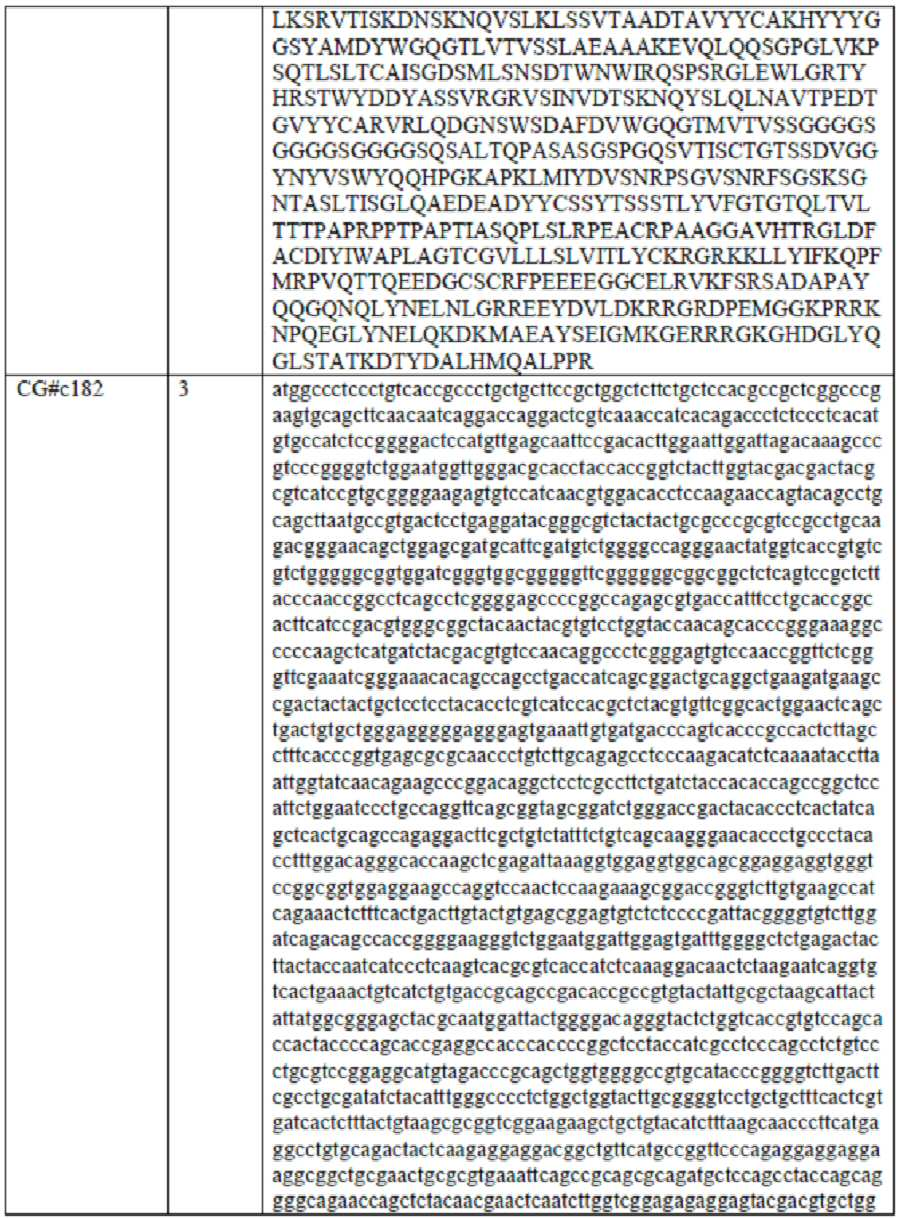


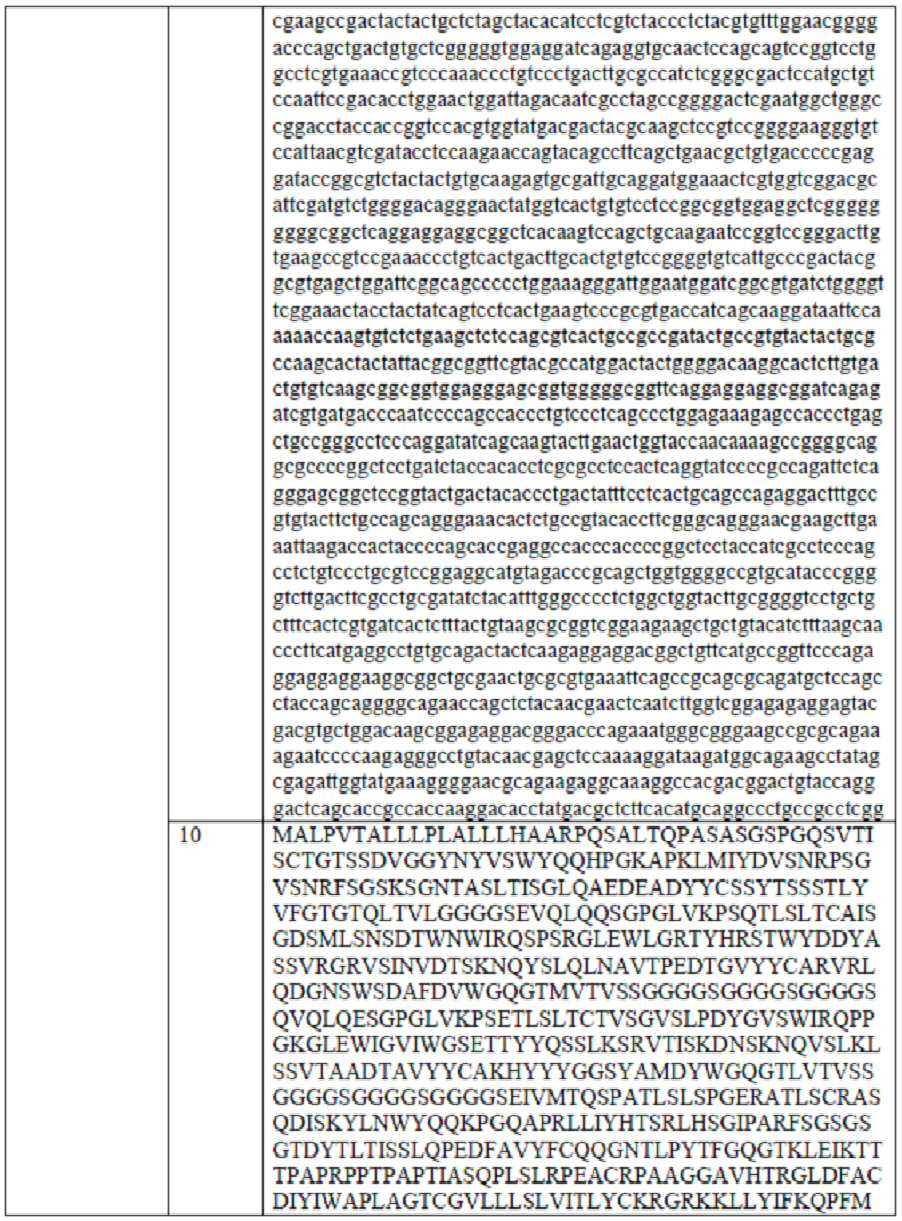
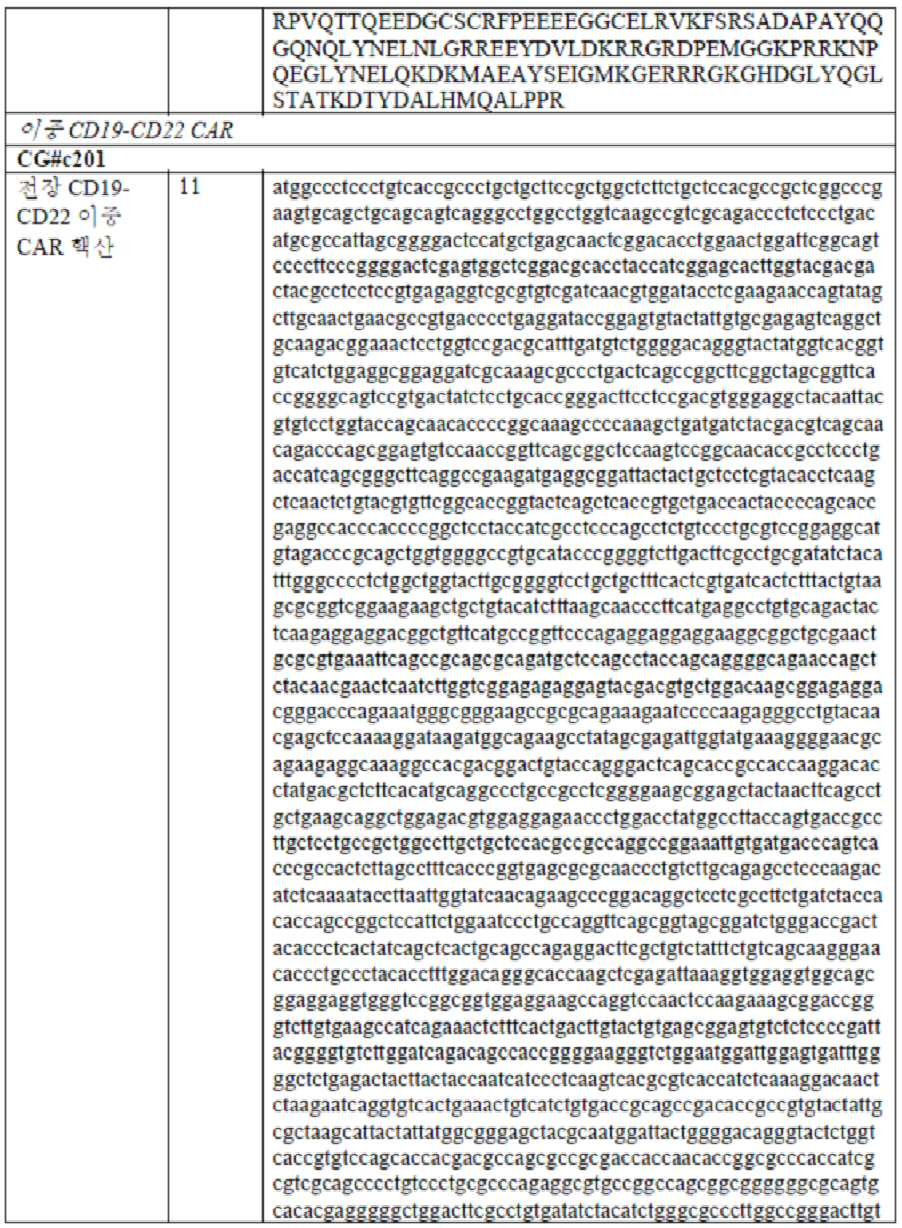


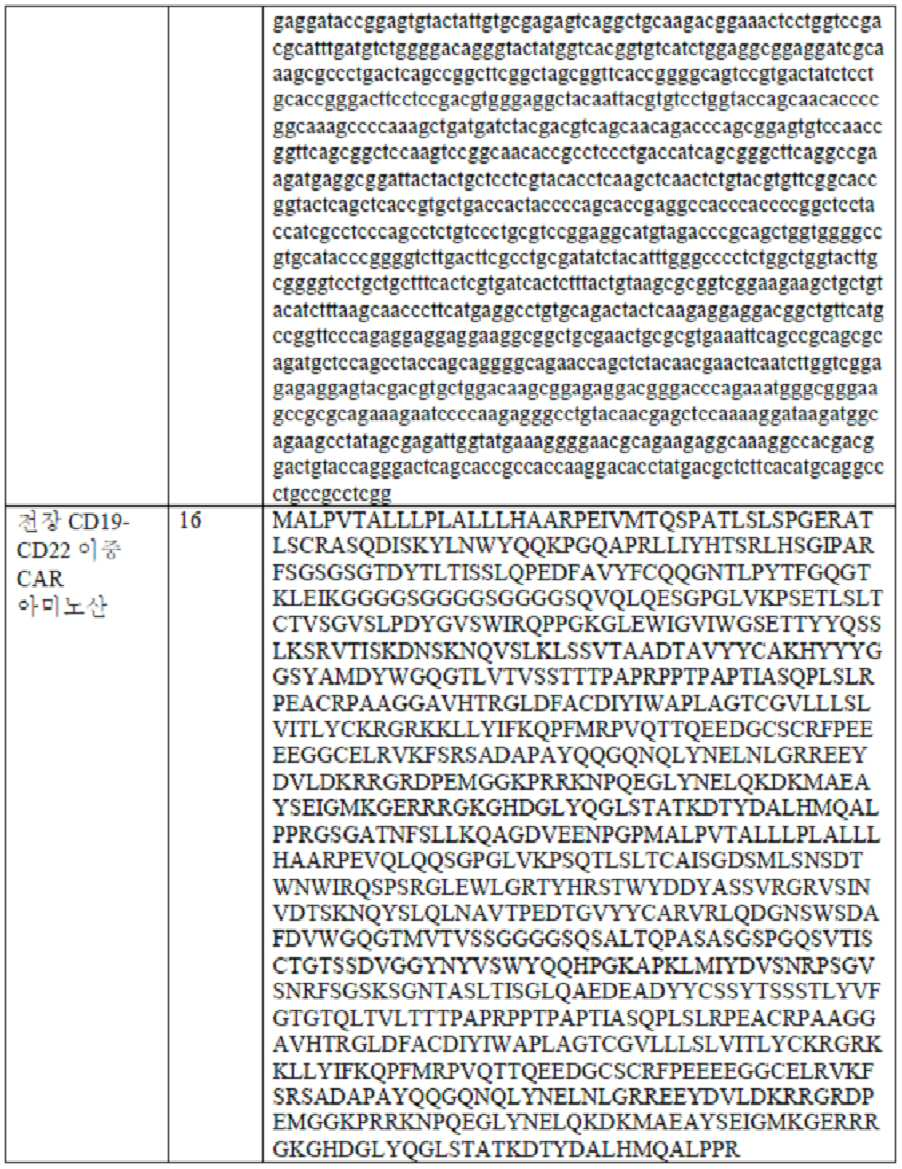

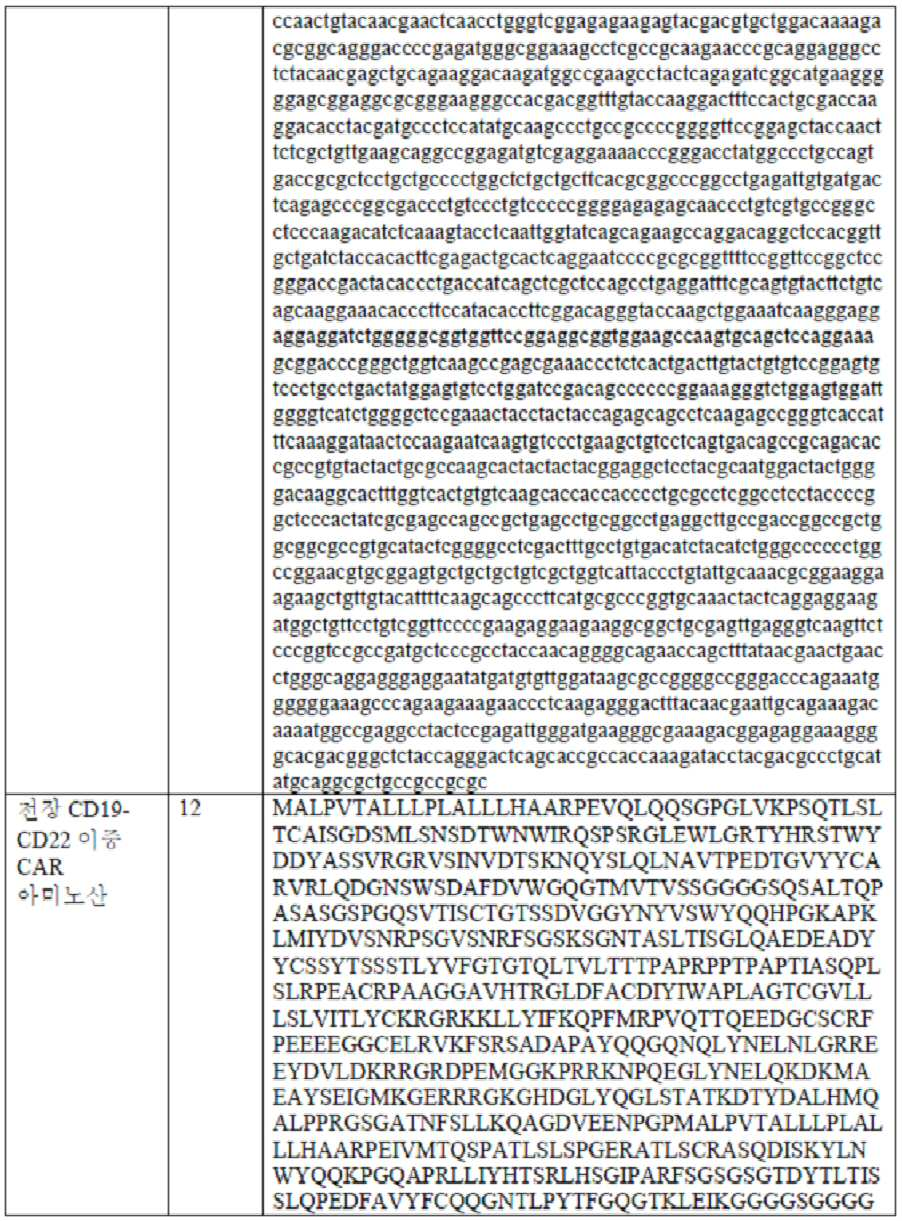

본 발명의 이중 CAR 또는 탠덤 CAR의 CD22 및 CD19 CDR은 표 2A에 제공된다.The CD22 and CD19 CDRs of the dual or tandem CAR of the present invention are provided in Table 2A.
[표 2A] CD22 및 CD19 CDR 서열[Table 2A] CD22 and CD19 CDR sequences
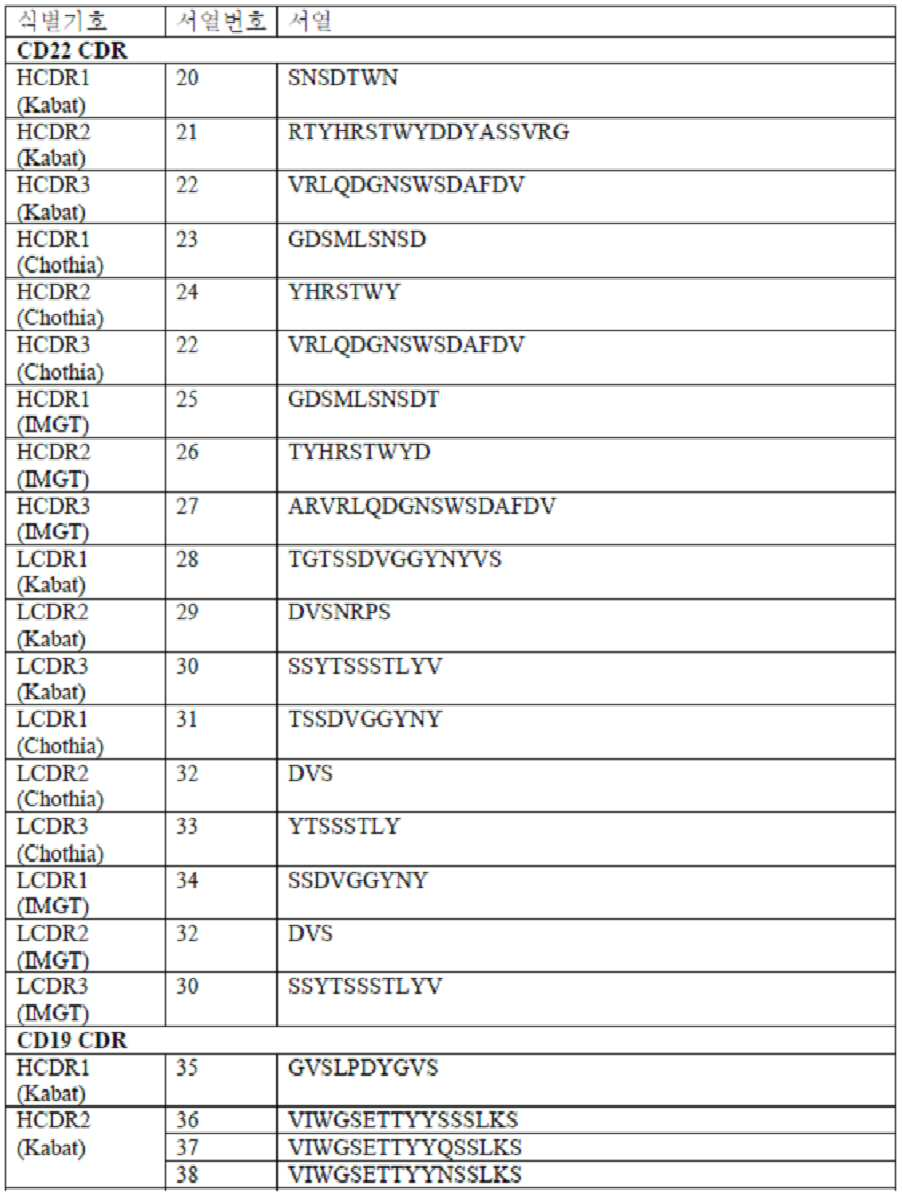

표 3A는 본원에 개시된 이중 CAR 또는 탠덤 CAR의 CD19 및 CD22 결합 도메인에 대한 뉴클레오티드 및 아미노산 서열을 제공한다.Table 3A provides the nucleotide and amino acid sequences for the CD19 and CD22 binding domains of the dual or tandem CARs disclosed herein.
[표 3A] CD19 및 CD22 결합 도메인[Table 3A] CD19 and CD22 binding domains
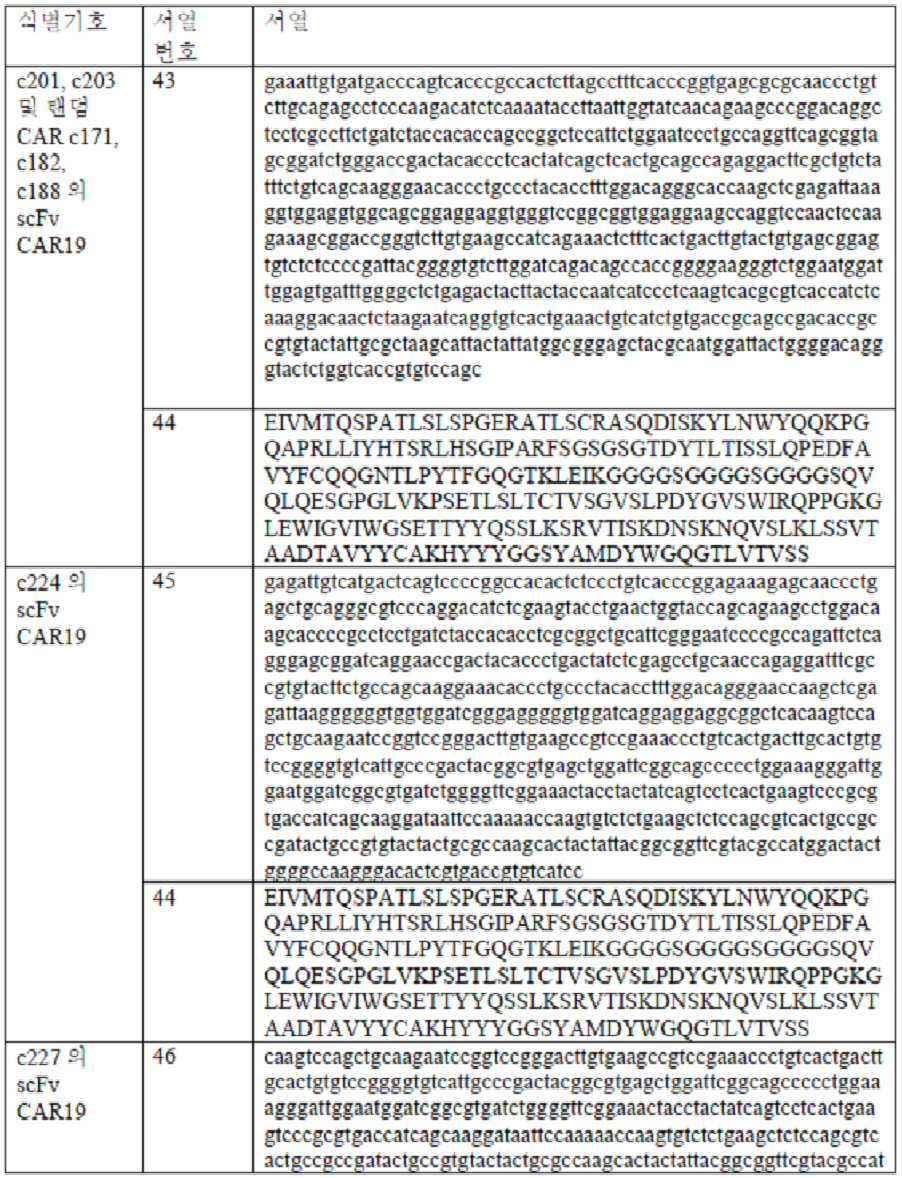


표 4A는 추가 CAR 구성요소, 예를 들어 신호 펩티드, 링커, 및 P2A 부위에 대한 뉴클레오티드 및 아미노산 서열을 제공한다.Table 4A provides the nucleotide and amino acid sequences for additional CAR components, such as signal peptides, linkers, and P2A sites.
[표 4A] 추가 CAR 구성요소[Table 4A] Additional CAR Components


[표 5A] 추가 CD19 결합 도메인 및 기타 서열Table 5A Additional CD19 binding domains and other sequences
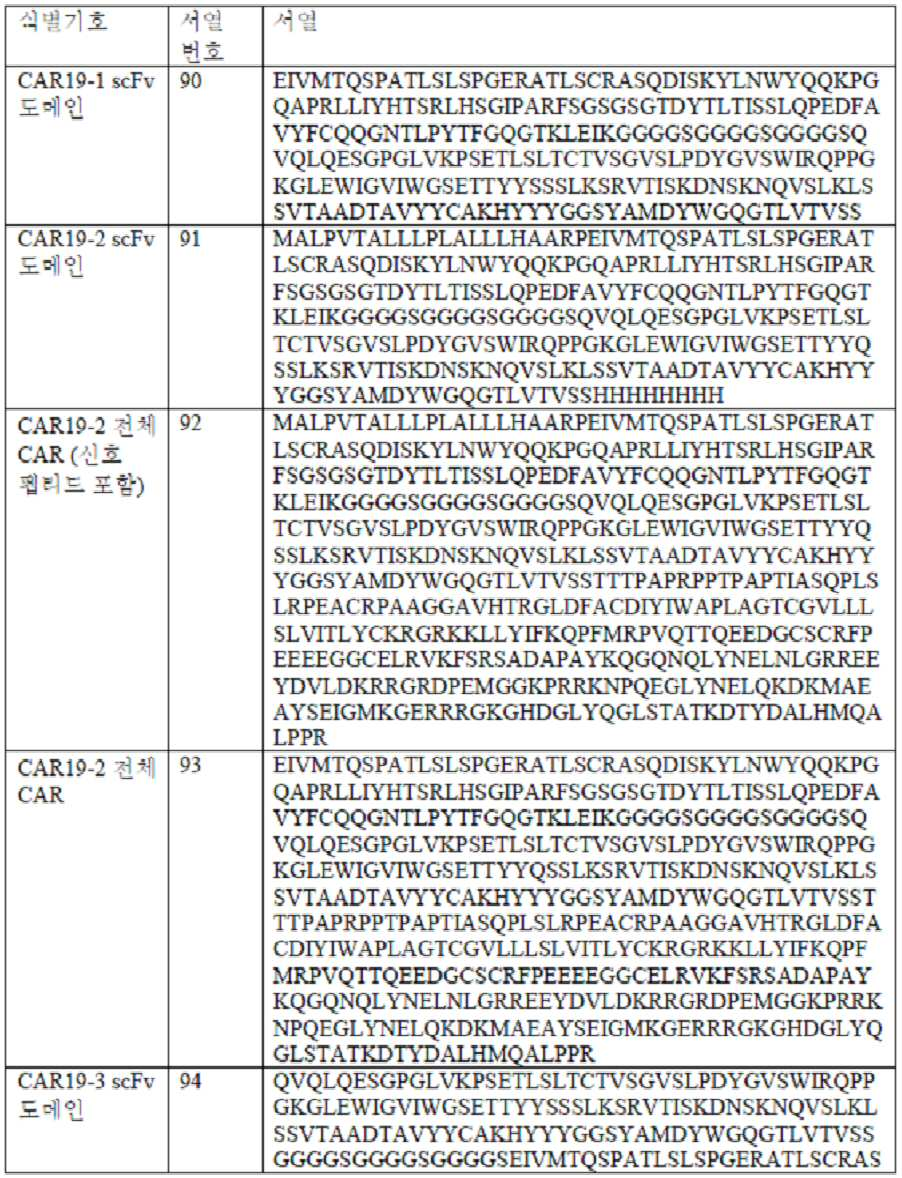

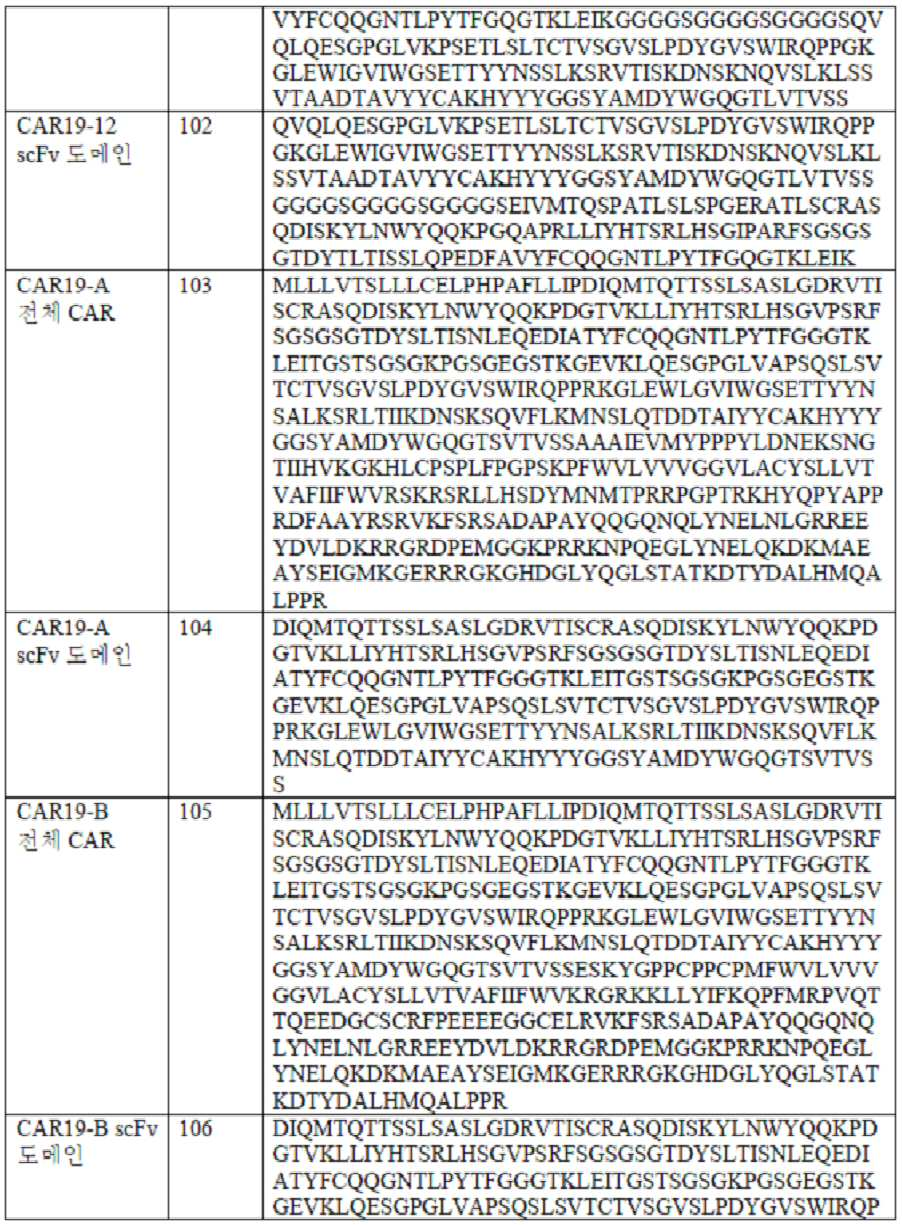
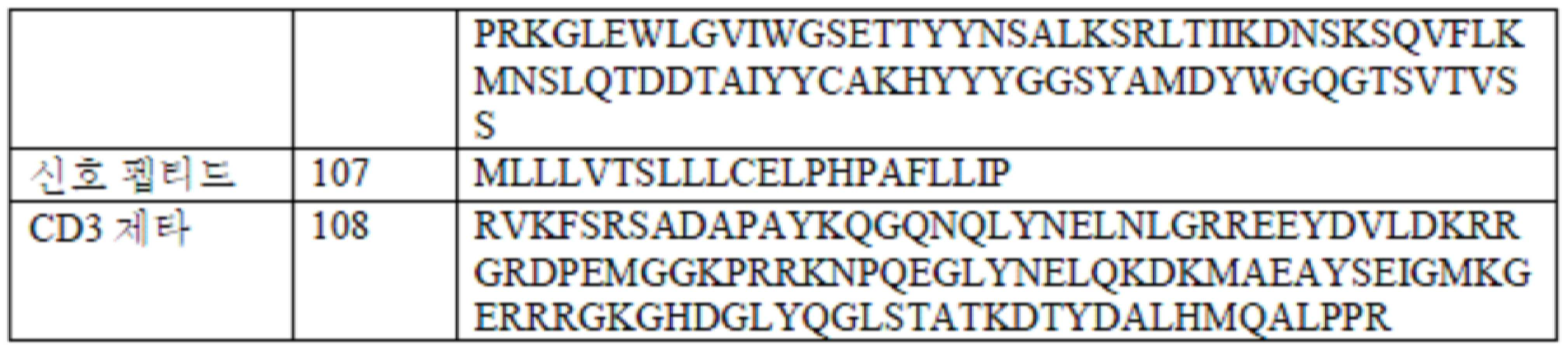
탠덤 CARTandem CAR
일 양태에서, 이중특이적 항원결합 도메인을 포함하는 CAR, 예를 들어 탠덤 CAR이 본원에 개시된다. 일부 구현예에서, 이중특이적 항원결합 도메인은 2개의 항원결합 도메인, 예를 들어 제1 항원결합 도메인 및 제2 항원결합 도메인을 포함한다. 일부 구현예에서, 탠덤 CAR은 CD22 항원결합 도메인 및 CD19 항원결합 도메인을 포함하는 이중특이적 항원결합 도메인을 포함한다.In one aspect, a CAR comprising a bispecific antigen binding domain, eg, a tandem CAR, is disclosed herein. In some embodiments, the bispecific antigen binding domain comprises two antigen binding domains, eg, a first antigen binding domain and a second antigen binding domain. In some embodiments, the tandem CAR comprises a bispecific antigen binding domain comprising a CD22 antigen binding domain and a CD19 antigen binding domain.
이중특이적 항원결합 도메인의 일부 구현예에서, 제1 항원결합 도메인은 항체 분자, 예를 들어 항체결합 도메인(예를 들어, scFv)이다. 이중특이적 항원결합 도메인의 일부 구현예에서, 제2 항원결합 도메인은 항체 분자, 예를 들어 항체결합 도메인(예를 들어, scFv)이다. 이중특이적 항원결합 도메인의 각 항체 분자, 예를 들어 scFv 내에서, VH는 VL의 업스트림 또는 다운스트림일 수 있다.In some embodiments of the bispecific antigen binding domain, the first antigen binding domain is an antibody molecule, eg, an antibody binding domain (eg, scFv). In some embodiments of the bispecific antigen binding domain, the second antigen binding domain is an antibody molecule, eg, an antibody binding domain (eg, scFv). Within each antibody molecule, eg, scFv, of the bispecific antigen binding domain, the VH may be upstream or downstream of the VL.
일부 구현예에서, 업스트림 항체 또는 항체 단편(예를 들어, scFv)은 VH(VH1)가 VL(VL1)의 업스트림에 있도록 배열되고, 다운스트림 항체 또는 항체 단편(예를 들어, scFv)은 VL(VL2)이 VH(VH2)의 업스트림에 있도록 배열되어, 전체 이중특이적 항체 분자는 N-말단에서 C-말단 배향으로 배열 VH1-VL1-VL2-VH2를 갖는다.In some embodiments, the upstream antibody or antibody fragment (e.g., scFv) is arranged such that VH(VH1) is upstream of VL(VL1) and the downstream antibody or antibody fragment (e.g., scFv) is VL ( VL2) is arranged upstream of VH (VH2), so that the entire bispecific antibody molecule has the arrangement VH1-VL1-VL2-VH2 in an N-terminal to C-terminal orientation.
일부 구현예에서, 업스트림 항체 또는 항체 단편(예를 들어, scFv)은 VL(VL1)이 VH(VH1)의 업스트림에 있도록 배열되고, 다운스트림 항체 또는 항체 단편(예를 들어, scFv)은 VH(VH2)가 VL(VL2)의 업스트림에 있도록 배열되어, 전체 이중특이적 항체 분자는 N-말단에서 C-말단 배향으로 배열 VL1-VH1-VH2-VL2를 갖는다.In some embodiments, the upstream antibody or antibody fragment (eg, scFv) is configured such that VL (VL1) is upstream of VH (VH1), and the downstream antibody or antibody fragment (eg, scFv) is VH ( VH2) is arranged upstream of VL (VL2), so that the entire bispecific antibody molecule has the arrangement VL1-VH1-VH2-VL2 in an N-terminal to C-terminal orientation.
일부 구현예에서, 업스트림 항체 또는 항체 단편(예를 들어, scFv)은 VL(VL1)이 VH(VH1)의 업스트림에 있도록 배열되고, 다운스트림 항체 또는 항체 단편(예를 들어, scFv)은 VL(VL2)이 VH(VH2)의 업스트림에 있도록 배열되어, 전체 이중특이적 항체 분자는 N-말단에서 C-말단 배향으로 배열 VL1-VH1-VL2-VH2를 갖는다.In some embodiments, the upstream antibody or antibody fragment (eg, scFv) is configured such that VL (VL1) is upstream of VH (VH1), and the downstream antibody or antibody fragment (eg, scFv) is VL ( VL2) is arranged upstream of VH(VH2), so that the entire bispecific antibody molecule has the arrangement VL1-VH1-VL2-VH2 in an N-terminal to C-terminal orientation.
또 다른 일부 구현예에서, 업스트림 항체 또는 항체 단편(예를 들어, scFv)은 VH(VH1)가 VL(VL1)의 업스트림에 있도록 배열되고, 다운스트림 항체 또는 항체 단편(예를 들어, scFv)은 VH(VH2)가 VL(VL2)의 업스트림에 있도록 배열되어, 전체 이중특이적 항체 분자는 N-말단에서 C-말단 배향으로 배열 VH1-VL1-VH2-VL2를 갖는다.In some other embodiments, the upstream antibody or antibody fragment (eg, scFv) is configured such that VH(VH1) is upstream of VL(VL1), and the downstream antibody or antibody fragment (eg, scFv) is Arranged so that VH(VH2) is upstream of VL(VL2), the entire bispecific antibody molecule has the arrangement VH1-VL1-VH2-VL2 in an N-terminal to C-terminal orientation.
상기 배열 중 임의의 배열에서, 임의로, 2개의 항체 또는 항체 단편(예를 들어, scFv) 사이에, 예를 들어 구성체가 VH1-VL1-VL2-VH2로 배열되는 경우 VL1과 VL2 사이에; 구성체가 VL1-VH1-VH2-VL2로 배열되는 경우 VH1과 VH2 사이에; 구성체가 VL1-VH1-VL2-VH2로 배열되는 경우 VH1과 VL2 사이에; 또는 구성체가 VH1-VL1-VH2-VL2로 배열되는 경우 VL1과 VH2 사이에 링커가 배치된다. 일반적으로, 2개의 scFv 사이의 링커는 2개의 scFv의 도메인 간의 미스페어링을 방지할 수 있을 만큼 충분히 길어야 한다. 링커는 본원에 기재된 바와 같은 링커일 수 있다. 일부 구현예에서, 링커는 (Gly4-Ser)n 링커이며, n은 1, 2, 3, 4, 5, 또는 6이다. 일부 구현예에서, 링커는 (Gly4-Ser)n이며, n=1이다(예를 들어, 링커는 아미노산 서열 Gly4-Ser이다). 일부 구현예에서, 링커는 (Gly4-Ser)n이며, n=4이다(서열번호 82). 일부 구현예에서, 링커는 아미노산 서열 LAEAAAK(예를 들어, 서열번호 80)를 포함한다(예를 들어, 이로 이루어진다).In any of the above arrangements, optionally between two antibodies or antibody fragments (eg, scFvs), eg, between VL1 and VL2 if the construct is arranged as VH1-VL1-VL2-VH2; between VH1 and VH2 when the construct is arranged as VL1-VH1-VH2-VL2; between VH1 and VL2 when the construct is arranged as VL1-VH1-VL2-VH2; or a linker is placed between VL1 and VH2 if the construct is arranged as VH1-VL1-VH2-VL2. In general, the linker between two scFvs should be long enough to prevent mispairing between the domains of the two scFvs. The linker may be a linker as described herein. In some embodiments, the linker is a (Gly4-Ser)n linker, where n is 1, 2, 3, 4, 5, or 6. In some embodiments, the linker is (Gly4-Ser)n, n=1 (eg, the linker is the amino acid sequence Gly4-Ser). In some embodiments, the linker is (Gly4-Ser)n, n=4 (SEQ ID NO:82). In some embodiments, the linker comprises (eg, consists of) the amino acid sequence LAEAAAK (eg, SEQ ID NO: 80).
상기 배열 중 임의의 배열에서, 임의로, 제1 scFv의 VL과 VH 사이에 링커가 배치된다. 임의로, 제2 scFv의 VL과 VH 사이에 링커가 배치된다. 다수의 링커를 갖는 구성체에서, 임의의 2개 이상의 링커는 동일하거나 상이할 수 있다. 따라서, 일부 구현예에서, 이중특이적 CAR은 VL, VH, 및 임의로 하나 이상의 링커를 본원에 기재된 바와 같은 배열로 포함한다.In any of the above arrangements, optionally, a linker is disposed between the VL and VH of the first scFv. Optionally, a linker is disposed between the VL and VH of the second scFv. In constructs with multiple linkers, any two or more linkers may be the same or different. Thus, in some embodiments, the bispecific CAR comprises a VL, a VH, and optionally one or more linkers in an arrangement as described herein.
일부 구현예에서, 각각의 항체 분자, 예를 들어 각각의 항원결합 도메인(예를 들어, 각각의 scFv)은 VH 영역과 VL 영역 사이에 링커를 포함한다. 일부 구현예에서, VH 영역과 VL 영역 사이의 링커는 (Gly4-Ser)n 링커이며, n은 1, 2, 3, 4, 5, 또는 6이다. 일부 구현예에서, 링커는 (Gly4-Ser)n이며, n=1이다(예를 들어, 링커는 아미노산 서열 Gly4-Ser이다). 일부 구현예에서, 링커는 (Gly4-Ser)n이며, n=4이다(서열번호 82). 일부 구현예에서, VH 영역과 VL 영역은 링커 없이 연결된다.In some embodiments, each antibody molecule, eg, each antigen binding domain (eg, each scFv), comprises a linker between the VH region and the VL region. In some embodiments, the linker between the VH region and the VL region is a (Gly4-Ser)n linker, where n is 1, 2, 3, 4, 5, or 6. In some embodiments, the linker is (Gly4-Ser)n, n=1 (eg, the linker is the amino acid sequence Gly4-Ser). In some embodiments, the linker is (Gly4-Ser)n, n=4 (SEQ ID NO:82). In some embodiments, the VH region and the VL region are joined without a linker.
스플릿 CARSplit CAR
일부 구현예에서, CAR-발현 세포는 스플릿 CAR을 사용한다. 스플릿 CAR 접근법은 본원에 참조로 포함되는 PCT 공개 WO2014/055442호 및 WO2014/055657호에 보다 상세하게 설명되어 있다. 간략하게, 스플릿 CAR 시스템은 제1 항원결합 도메인 및 공동자극 도메인(예를 들어, 4-1BB)을 갖는 제1 CAR을 발현하는 세포를 포함하고, 세포는 또한 제2 항원결합 도메인 및 세포내 신호전달 도메인(예를 들어, CD3 제타)을 갖는 제2 CAR을 발현한다. 세포가 제1 항원을 만나면, 공동자극 도메인이 활성화되고 세포는 증식한다. 세포가 제2 항원을 만나면, 세포내 신호전달 도메인이 활성화되고 세포사멸 활성이 시작된다. 따라서, CAR-발현 세포는 두 항원이 모두 존재할 때만 완전히 활성화된다.In some embodiments, the CAR-expressing cell uses a split CAR. The split CAR approach is described in more detail in PCT publications WO2014/055442 and WO2014/055657, which are incorporated herein by reference. Briefly, a split CAR system comprises a cell expressing a first CAR having a first antigen binding domain and a costimulatory domain (eg, 4-1BB), the cell also having a second antigen binding domain and an intracellular signal express a second CAR having a transduction domain (eg, CD3 zeta). When the cell encounters the first antigen, the costimulatory domain is activated and the cell proliferates. When the cell encounters the second antigen, the intracellular signaling domain is activated and apoptotic activity is initiated. Thus, CAR-expressing cells are only fully activated when both antigens are present.
RNA 트랜스펙션RNA transfection
시험관내 전사된 RNA CAR을 생성하는 방법이 본원에 개시된다. 본 발명은 또한 세포에 직접 형질주입될 수 있는 CAR 암호화 RNA 구성체를 포함한다. 트랜스펙션에 사용하기 위한 mRNA를 생성하는 방법은 특수 설계된 프라이머를 사용한 주형의 시험관내 전사(IVT)에 이은 폴리 A 부가를 수반하여, 3' 및 5' 비번역 서열("UTR"), 5' 캡 및/또는 내부 리보솜 진입 부위(IRES), 발현될 핵산, 및 일반적으로 50~2000개 염기 길이인 폴리A 테일을 포함하는 구성체를 생성할 수 있다. 이렇게 생성된 RNA는 다양한 종류의 세포를 효율적으로 형질감염시킬 수 있다. 일 양태에서, 주형은 CAR에 대한 서열을 포함한다.Disclosed herein are methods for generating an in vitro transcribed RNA CAR. The present invention also includes CAR encoding RNA constructs that can be directly transfected into cells. A method for generating mRNA for use in transfection involves in vitro transcription (IVT) of the template using specially designed primers, followed by the addition of poly A, 3' and 5' untranslated sequences ("UTR"), 5 ' A construct can be generated comprising a cap and/or an internal ribosome entry site (IRES), a nucleic acid to be expressed, and a polyA tail that is typically 50-2000 bases in length. The RNA thus generated can efficiently transfect various types of cells. In one aspect, the template comprises a sequence for a CAR.
일 양태에서, CAR, 예를 들어 이중 CAR 또는 탠덤 CAR은 메신저 RNA(mRNA)에 의해 암호화된다. 일 양태에서, CAR, 예를 들어 이중 CAR 또는 탠덤 CAR을 암호화하는 mRNA는 CAR-발현 세포, 예를 들어 CART세포 또는 CAR NK세포의 생성을 위해 면역 이펙터 세포, 예를 들어 T세포 또는 NK세포 내로 도입된다.In one aspect, the CAR, eg, a double CAR or a tandem CAR, is encoded by a messenger RNA (mRNA). In one aspect, mRNA encoding a CAR, e.g., a dual CAR or a tandem CAR, is introduced into an immune effector cell, e.g., a T cell or NK cell, for the production of a CAR-expressing cell, e.g., a CART cell or a CAR NK cell. is introduced
일 구현예에서, CAR의 시험관내 전사된 RNA는 일시적 트랜스펙션의 형태로 세포에 도입될 수 있다. RNA는 중합효소 연쇄반응(PCR)-생성 주형을 사용하여 시험관내 전사에 의해 생성된다. 임의의 공급원으로부터의 관심 DNA는 적절한 프라이머 및 RNA 중합효소를 사용하여 PCR에 의해 시험관내 mRNA 합성을 위한 주형으로 직접 변환될 수 있다. DNA의 공급원은 예를 들어 게놈 DNA, 플라스미드 DNA, 파지 DNA, cDNA, 합성 DNA 서열, 또는 임의의 다른 적절한 DNA 공급원일 수 있다. 목적하는 시험관내 전사용 주형은 본 발명의 CAR이다. 예를 들어, RNA CAR을 위한 주형은 항종양 항체의 단쇄 가변 도메인을 포함하는 세포외 영역, 힌지 영역, 막관통 도메인(예를 들어, CD8a의 막관통 도메인), 및 세포질 영역(예를 들어, CD3-제타의 신호전달 도메인 및 4-1BB의 신호전달 도메인을 포함하는 세포내 신호전달 도메인을 포함함)을 포함한다.In one embodiment, the in vitro transcribed RNA of the CAR can be introduced into the cell in the form of transient transfection. RNA is produced by in vitro transcription using a polymerase chain reaction (PCR)-generating template. DNA of interest from any source can be directly converted into a template for in vitro mRNA synthesis by PCR using appropriate primers and RNA polymerase. The source of DNA can be, for example, genomic DNA, plasmid DNA, phage DNA, cDNA, synthetic DNA sequence, or any other suitable DNA source. The desired template for in vitro transcription is the CAR of the present invention. For example, a template for an RNA CAR may include an extracellular region comprising a single chain variable domain of an anti-tumor antibody, a hinge region, a transmembrane domain (eg, the transmembrane domain of CD8a), and a cytoplasmic region (eg, an intracellular signaling domain comprising the signaling domain of CD3-zeta and the signaling domain of 4-1BB).
일 구현예에서, PCR에 사용되는 DNA는 오픈 리딩 프레임을 포함한다. DNA는 유기체의 게놈으로부터 천연 DNA로부터 유래될 수 있다. 일 구현예에서, 핵산은 5' 및/또는 3' 비번역 영역(UTR)의 일부 또는 전부를 포함할 수 있다. 핵산은 엑손 및 인트론을 포함할 수 있다. 일 구현예에서, PCR에 사용되는 DNA는 인간 핵산 서열이다. 다른 구현예에서, PCR에 사용되는 DNA는 5' 및 3' UTR을 포함하는 인간 핵산 서열이다. 대안적으로 DNA는 천연 유기체에서 정상적으로는 발현되지 않는 인공 DNA 서열일 수 있다. 예시적인 인공 DNA 서열은, 함께 연결되어 융합 단백질을 암호화하는 오픈 리딩 프레임을 형성하는 유전자의 부분을 포함하는 서열이다. 함께 연결되는 DNA의 부분은 단일 유기체로부터 또는 둘 이상의 유기체로부터 유래될 수 있다.In one embodiment, the DNA used for PCR comprises an open reading frame. DNA can be derived from native DNA from the genome of an organism. In one embodiment, the nucleic acid may comprise some or all of the 5' and/or 3' untranslated regions (UTRs). Nucleic acids may include exons and introns. In one embodiment, the DNA used in PCR is a human nucleic acid sequence. In another embodiment, the DNA used for PCR is a human nucleic acid sequence comprising 5' and 3' UTRs. Alternatively, the DNA may be an artificial DNA sequence that is not normally expressed in a natural organism. An exemplary artificial DNA sequence is a sequence comprising portions of a gene joined together to form an open reading frame encoding a fusion protein. The portions of DNA that are linked together may be from a single organism or from two or more organisms.
PCR은 트랜스펙션에 사용되는 mRNA의 시험관내 전사를 위한 주형을 생성하는 데 사용된다. PCR을 수행하는 방법은 당업계에 잘 알려져 있다. PCR에 사용하기 위한 프라이머는 PCR을 위한 주형으로서 사용될 DNA의 영역에 실질적으로 상보적인 영역을 갖도록 설계된다. 본원에서 사용되는 "실질적으로 상보적인"은 프라이머 서열의 대부분의 또는 모든 염기가 상보적이거나 하나 이상의 염기가 비상보적이거나 불일치하는 뉴클레오티드의 서열을 나타낸다. 실질적으로 상보적인 서열은 PCR에 사용되는 어닐링 조건에서, 의도된 DNA 표적과 어닐링 또는 혼성화할 수 있다. 프라이머는 DNA 주형의 임의의 부분에 실질적으로 상보성을 갖도록 설계될 수 있다. 예를 들어 프라이머는 5' 및 3' UTR을 포함하는, 세포에서 정상적으로 전사되는 핵산의 부분(오픈 리딩 프레임)을 증폭하도록 설계될 수 있다. 프라이머는 또한 특정 관심 도메인을 암호화하는 핵산의 부분을 증폭하도록 설계될 수 있다. 일 구현예에서, 프라이머는 5' 및 3' UTR의 전부 또는 일부를 포함하는 인간 cDNA의 암호화 영역을 증폭하도록 설계된다. PCR에 유용한 프라이머는 당업계에 잘 알려진 합성 방법에 의해 생성될 수 있다. "정방향 프라이머"는 증폭될 DNA 서열의 업스트림인 DNA 주형 상의 뉴클레오티드에 실질적으로 상보적인 뉴클레오티드의 영역을 포함하는 프라이머이다. "업스트림"은 암호화 가닥과 관련하여 증폭될 DNA 서열에 대해 5' 위치를 지칭하기 위해 본원에서 사용된다. "역방향 프라이머"는 증폭될 DNA 서열의 다운스트림인 이중가닥 DNA 주형에 실질적으로 상보적인 뉴클레오티드의 영역을 포함하는 프라이머이다. "다운스트림"은 암호화 가닥과 관련하여 증폭될 DNA 서열에 대해 3' 위치를 지칭하기 위해 본원에서 사용된다.PCR is used to generate a template for in vitro transcription of mRNA used for transfection. Methods for performing PCR are well known in the art. Primers for use in PCR are designed to have a region substantially complementary to a region of DNA to be used as a template for PCR. As used herein, "substantially complementary" refers to a sequence of nucleotides in which most or all of the bases of the primer sequence are complementary or one or more bases are non-complementary or mismatched. Substantially complementary sequences can anneal or hybridize with the intended DNA target under the annealing conditions used for PCR. Primers can be designed to have substantially complementarity to any portion of the DNA template. For example, primers can be designed to amplify a portion of a nucleic acid that is normally transcribed in a cell (open reading frame), including 5' and 3' UTRs. Primers can also be designed to amplify a portion of a nucleic acid encoding a particular domain of interest. In one embodiment, the primers are designed to amplify the coding region of human cDNA comprising all or part of the 5' and 3' UTRs. Primers useful for PCR can be generated by synthetic methods well known in the art. A “forward primer” is a primer comprising a region of nucleotides substantially complementary to nucleotides on a DNA template upstream of the DNA sequence to be amplified. “Upstream” is used herein to refer to the position 5′ to the DNA sequence to be amplified with respect to the coding strand. A "reverse primer" is a primer comprising a region of nucleotides substantially complementary to a double-stranded DNA template downstream of the DNA sequence to be amplified. "Downstream" is used herein to refer to a position 3' to the DNA sequence to be amplified with respect to the coding strand.
PCR에 유용한 임의의 DNA 중합효소가 본원에 개시된 방법에 사용될 수 있다. 시약 및 중합효소는 여러 공급처로부터 상업적으로 입수가능하다.Any DNA polymerase useful for PCR can be used in the methods disclosed herein. Reagents and polymerases are commercially available from several sources.
안정성 및/또는 번역 효율을 촉진하는 능력을 갖는 화학 구조도 사용될 수 있다. RNA는 바람직하게 5' 및 3' UTR을 갖는다. 일 구현예에서, 5' UTR은 1 내지 3000개 뉴클레오티드 길이이다. 암호화 영역에 부가될 5' 및 3' UTR 서열의 길이는 UTR의 상이한 영역에 어닐링하는 PCR용 프라이머의 설계를 비롯한(이에 한정되지 않음) 상이한 방법에 의해 변경될 수 있다. 이러한 접근법을 사용하여, 당업자는 전사된 RNA의 트랜스펙션 후 최적 번역 효율을 달성하는 데 필요한 5' 및 3' UTR 길이를 수정할 수 있다.Chemical structures having the ability to promote stability and/or translation efficiency may also be used. The RNA preferably has 5' and 3' UTRs. In one embodiment, the 5' UTR is between 1 and 3000 nucleotides in length. The length of the 5' and 3' UTR sequences to be added to the coding region can be altered by different methods, including but not limited to the design of primers for PCR that anneal to different regions of the UTR. Using this approach, one of skill in the art can modify the 5' and 3' UTR lengths necessary to achieve optimal translation efficiency after transfection of the transcribed RNA.
5' 및 3' UTR은 관심 핵산에 대한 천연, 내인성 5' 및 3' UTR일 수 있다. 대안적으로, 관심 핵산에 내인성이 아닌 UTR 서열이 정방향 및 역방향 프라이머에 해당 UTR 서열을 통합시켜 부가되거나 주형의 임의의 다른 변형에 의해 부가될 수 있다. 관심 핵산에 내인성이 아닌 UTR 서열의 사용은 RNA의 안정성 및/또는 번역 효율을 수정하는 데 유용할 수 있다. 예를 들어, 3' UTR 서열의 AU-풍부 요소는 mRNA의 안정성을 감소시킬 수 있는 것으로 알려져 있다. 따라서, 3' UTR은 당업계에 잘 알려진 UTR의 특성에 기초하여 전사 RNA의 안정성을 증가시키도록 선택되거나 설계될 수 있다.The 5' and 3' UTRs may be native, endogenous 5' and 3' UTRs to the nucleic acid of interest. Alternatively, UTR sequences that are not endogenous to the nucleic acid of interest can be added by integrating the UTR sequences in the forward and reverse primers or by any other modification of the template. The use of UTR sequences that are not endogenous to the nucleic acid of interest may be useful to modify the stability and/or translation efficiency of the RNA. For example, it is known that AU-rich elements of 3' UTR sequences can reduce the stability of mRNA. Thus, the 3' UTR can be selected or designed to increase the stability of the transcribed RNA based on the properties of the UTR well known in the art.
일 구현예에서, 5' UTR은 내인성 핵산의 Kozak 서열을 포함할 수 있다. 대안적으로, 관심 핵산에 내인성이 아닌 5' UTR이 전술한 바와 같이 PCR에 의해 부가되는 경우, 5' UTR 서열을 부가함으로써 공통 Kozak 서열이 재설계될 수 있다. Kozak 서열은 일부 RNA 전사체의 번역 효율을 증가시킬 수 있지만, 모든 RNA에 대해 효율적인 번역을 가능하게 하기 위해 필요한 것으로 보이지는 않는다. 많은 mRNA에 있어서 Kozak 서열에 대한 요건은 당업계에 알려져 있다. 일부 구현예에서, 5' UTR은 RNA 게놈이 세포에서 안정한 RNA 바이러스의 5' UTR일 수 있다. 일부 구현예에서, 다양한 뉴클레오티드 유사체가 3' 또는 5' UTR에 사용되어 mRNA의 엑소뉴클레아제 분해를 지연시킬 수 있다.In one embodiment, the 5' UTR may comprise a Kozak sequence of an endogenous nucleic acid. Alternatively, if a 5' UTR that is not endogenous to the nucleic acid of interest is added by PCR as described above, the consensus Kozak sequence can be redesigned by adding a 5' UTR sequence. Kozak sequences can increase the translation efficiency of some RNA transcripts, but do not appear to be necessary to enable efficient translation for all RNAs. The requirements for Kozak sequences for many mRNAs are known in the art. In some embodiments, the 5' UTR may be the 5' UTR of an RNA virus in which the RNA genome is stable in the cell. In some embodiments, various nucleotide analogs can be used in 3' or 5' UTRs to delay exonuclease degradation of mRNA.
유전자 클로닝 필요 없이 DNA 주형으로부터 RNA 합성을 가능하게 하기 위해, 전사될 서열의 업스트림 DNA 주형에 전사 프로모터가 부착되어야 한다. RNA 중합효소에 대한 프로모터로서 기능하는 서열이 정방향 프라이머의 5' 말단에 부가되는 경우, RNA 중합효소 프로모터는 전사될 오픈 리딩 프레임의 업스트림 PCR 산물에 통합된다. 바람직한 일 구현예에서, 프로모터는 본원의 다른 부분에 기재된 바와 같은 T7 중합효소 프로모터이다. 다른 유용한 프로모터는 T3 및 SP6 RNA 중합효소 프로모터를 포함하나 이에 한정되지 않는다. T7, T3, 및 SP6에 대한 공통 핵산 서열은 당업계에 알려져 있다.To enable RNA synthesis from a DNA template without the need for gene cloning, a transcriptional promoter must be attached to the DNA template upstream of the sequence to be transcribed. When a sequence serving as a promoter for RNA polymerase is added to the 5' end of the forward primer, the RNA polymerase promoter is integrated into the PCR product upstream of the open reading frame to be transcribed. In one preferred embodiment, the promoter is a T7 polymerase promoter as described elsewhere herein. Other useful promoters include, but are not limited to, the T3 and SP6 RNA polymerase promoters. Consensus nucleic acid sequences for T7, T3, and SP6 are known in the art.
바람직한 구현예에서, mRNA는 세포에서 리보솜 결합, 번역의 개시, 및 mRNA의 안정성을 결정하는 5' 말단 상의 캡 및 3' 폴리(A) 테일 둘 다를 갖는다. 원형 DNA 주형, 예를 들어 플라스미드 DNA에서, RNA 중합효소는 진핵 세포에서의 발현에 적합하지 않은 긴 콘카테머 산물을 생성한다. 3' UTR의 말단에서 선형화된 플라스미드 DNA의 전사는 전사 후에 폴리아데닐화되는 경우에도 진핵생물 트랜스펙션에 효과적이지 않은 정상 크기의 mRNA를 초래한다.In a preferred embodiment, the mRNA has both a cap on the 5' end and a 3' poly(A) tail that determine ribosome binding, initiation of translation, and stability of the mRNA in the cell. In circular DNA templates, such as plasmid DNA, RNA polymerase produces long concatemer products that are not suitable for expression in eukaryotic cells. Transcription of linearized plasmid DNA at the end of the 3' UTR results in normal-sized mRNA that is not effective for eukaryotic transfection, even if polyadenylated after transcription.
선형 DNA 주형에서, 파지 T7 RNA 중합효소는 주형의 마지막 염기를 넘어서 전사체의 3' 말단을 연장할 수 있다(Schenborn and Mierendorf, Nuc Acids Res., 13:6223-36 (1985); Nacheva and Berzal-Herranz, Eur. J. Biochem., 270:1485-65 (2003)).In linear DNA templates, phage T7 RNA polymerase can extend the 3' end of the transcript beyond the last base of the template (Schenborn and Mierendorf, Nuc Acids Res., 13:6223-36 (1985); Nacheva and Berzal; -Herranz, Eur. J. Biochem., 270:1485-65 (2003)).
폴리A/T 스트레치를 DNA 주형에 통합하는 통상적인 방법은 분자 클로닝이다. 그러나, 플라스미드 DNA에 통합된 폴리A/T 서열은 플라스미드 불안정성을 유발할 수 있으며, 이는 박테리아 세포에서 얻은 플라스미드 DNA 주형이 종종 결실 및 기타 이상으로 심하게 오염되는 이유이다. 이로 인해 클로닝 절차가 어려워지고 시간이 많이 소요될 뿐만 아니라 신뢰할 수 없는 경우가 많다. 이러한 이유 때문에, 클로닝 없이 폴리A/T 3' 스트레치로 DNA 주형을 구성할 수 있는 방법이 매우 바람직하다.A common method for integrating polyA/T stretches into DNA templates is molecular cloning. However, polyA/T sequences integrated into plasmid DNA can cause plasmid instability, which is why plasmid DNA templates obtained from bacterial cells are often heavily contaminated with deletions and other abnormalities. This makes the cloning procedure difficult, time consuming, and often unreliable. For this reason, a method capable of constructing a DNA template with a polyA/T 3' stretch without cloning is highly desirable.
전사 DNA 주형의 폴리A/T 분절은 100T 테일(크기는 50~5000 T일 수 있음)과 같은 폴리T 테일을 포함하는 역방향 프라이머를 사용하여 PCR 중에 생성되거나, DNA 라이게이션 또는 시험관내 재조합을 비롯한(이에 한정되지 않음) 임의의 다른 방법에 의해 PCR 후에 생성될 수 있다. 폴리(A) 테일은 또한 RNA에 안정성을 제공하고 RNA 분해를 감소시킨다. 일반적으로, 폴리(A) 테일의 길이는 전사된 RNA의 안정성과 양(+)의 상관관계가 있다. 일 구현예에서, 폴리(A) 테일은 100 내지 5000개 아데노신이다.PolyA/T segments of transcribed DNA templates can be generated during PCR using reverse primers containing a polyT tail, such as a 100T tail (which can be 50-5000 T in size), or can be prepared during PCR using DNA ligation or in vitro recombination. It can be generated after PCR by (but not limited to) any other method. The poly(A) tail also provides stability to RNA and reduces RNA degradation. In general, the length of the poly(A) tail has a positive (+) correlation with the stability of the transcribed RNA. In one embodiment, the poly(A) tail is between 100 and 5000 adenosine.
RNA의 폴리(A) 테일은 E. 콜라이 폴리A 중합효소(E-PAP)와 같은 폴리(A) 중합효소를 사용하여 시험관내 전사 후 추가로 연장될 수 있다. 일 구현예에서, 폴리(A) 테일의 길이를 100개 뉴클레오티드에서 300~400개 뉴클레오티드로 증가시키면 RNA의 번역 효율이 약 2배 증가된다. 또한, 3' 말단에 다른 화학기를 부착하면 mRNA 안정성을 증가시킬 수 있다. 이러한 부착은 변형/인공 뉴클레오티드, 압타머, 및 기타 화합물을 포함할 수 있다. 예를 들어, 폴리(A) 중합효소를 사용하여 폴리(A) 테일에 ATP 유사체를 통합할 수 있다. ATP 유사체는 RNA의 안정성을 더욱 증가시킬 수 있다.The poly(A) tail of the RNA can be further extended after in vitro transcription using a poly(A) polymerase such as E. coli polyA polymerase (E-PAP). In one embodiment, increasing the length of the poly(A) tail from 100 nucleotides to 300-400 nucleotides increases the translation efficiency of RNA by about 2-fold. In addition, attaching other chemical groups to the 3' end can increase mRNA stability. Such attachments may include modified/artificial nucleotides, aptamers, and other compounds. For example, poly(A) polymerase can be used to incorporate an ATP analog into the poly(A) tail. ATP analogs can further increase the stability of RNA.
5' 캡이 또한 RNA 분자에 안정성을 제공한다. 바람직한 구현예에서, 본원에 개시된 방법에 의해 생성된 RNA는 5' 캡을 포함한다. 5' 캡은 당업계에 알려지고 본원에 설명된 기술을 이용해 제공된다(Cougot, et al., Trends in Biochem. Sci., 29:436-444 (2001); Stepinski, et al., RNA, 7:1468-95 (2001); Elango, et al., Biochim. Biophys. Res. Commun., 330:958-966 (2005)).The 5' cap also provides stability to the RNA molecule. In a preferred embodiment, the RNA produced by the methods disclosed herein comprises a 5' cap. 5' caps are provided using techniques known in the art and described herein (Cougot, et al., Trends in Biochem. Sci., 29:436-444 (2001); Stepinski, et al., RNA, 7 :1468-95 (2001);Elango, et al., Biochim. Biophys. Res. Commun., 330:958-966 (2005)).
본원에 개시된 방법에 의해 생성된 RNA는 또한 내부 리보솜 진입 부위(IRES) 서열을 포함할 수 있다. IRES 서열은 mRNA에 대한 캡-독립적 리보솜 결합을 개시하고 번역 개시를 촉진하는 임의의 바이러스 서열, 염색체 서열, 또는 인공적 설계 서열일 수 있다. 당, 펩티드, 지질, 단백질, 항산화제, 및 계면활성제와 같이 세포 투과성 및 생존력을 촉진하는 인자를 함유할 수 있는, 세포 전기천공에 적합한 임의의 용질이 포함될 수 있다.RNA produced by the methods disclosed herein may also include an internal ribosome entry site (IRES) sequence. The IRES sequence may be any viral sequence, chromosomal sequence, or artificially designed sequence that initiates cap-independent ribosome binding to mRNA and facilitates translation initiation. Any solutes suitable for cell electroporation may be included, which may contain factors that promote cell permeability and viability, such as sugars, peptides, lipids, proteins, antioxidants, and surfactants.
RNA는 여러 다양한 방법, 예를 들어 전기천공(Amaxa Nucleofector-II(Amaxa Biosystems, Cologne, Germany), ECM 830(BTX)(Harvard Instruments, Boston, Mass.) 또는 Gene Pulser II(BioRad, Denver, Colo.), Multiporator(Eppendort, Hamburg Germany)), 리포펙션을 이용한 양이온성 리포솜 매개 트랜스펙션, 폴리머 캡슐화, 펩티드 매개 트랜스펙션, 또는 "유전자 총"과 같은 생물학적 입자 전달 시스템을 비롯한(이에 한정되지 않음) 상업적으로 이용 가능한 방법 중 임의의 방법을 사용하여 표적 세포 내로 도입될 수 있다(예를 들어, Nishikawa, et al. Hum Gene Ther., 12(8):861-70 (2001) 참조).RNA can be prepared by several different methods, for example, electroporation (Amaxa Nucleofector-II (Amaxa Biosystems, Cologne, Germany), ECM 830 (BTX) (Harvard Instruments, Boston, Mass.) or Gene Pulser II (BioRad, Denver, Colo. ), Multiporator (Eppendorf, Hamburg Germany)), cationic liposome mediated transfection with lipofection, polymer encapsulation, peptide mediated transfection, or biological particle delivery systems such as "gene guns", including but not limited to ) can be introduced into target cells using any of the commercially available methods (see, eg, Nishikawa, et al. Hum Gene Ther., 12(8):861-70 (2001)).
비바이러스성 전달 방법Non-viral delivery methods
일부 양태에서, 본원에 기재된 CAR을 암호화하는 핵산을 세포 또는 조직 또는 대상체 내로 전달하기 위해 비바이러스성 방법이 사용될 수 있다.In some aspects, non-viral methods can be used to deliver a nucleic acid encoding a CAR described herein into a cell or tissue or subject.
일부 구현예에서, 비바이러스성 방법은 트랜스포존(전위 요소라고도 함)의 사용을 포함한다. 일부 구현예에서, 트랜스포존은 게놈 내 위치에 자신을 삽입할 수 있는 DNA 조각, 예를 들어 자기복제가 가능하고 자신의 카피를 게놈에 삽입할 수 있는 DNA 조각, 또는 보다 긴 핵산에서 스플라이싱되어 게놈 내 다른 위치에 삽입될 수 있는 DNA 조각이다. 예를 들어, 트랜스포존은 전위를 위한 유전자를 플랭킹하는 역위 반복부로 이루어진 DNA 서열을 포함한다.In some embodiments, non-viral methods include the use of transposons (also called translocation elements). In some embodiments, a transposon is spliced from a piece of DNA capable of inserting itself at a location in the genome, e.g., a piece of DNA capable of self-replication and inserting its own copy into the genome, or a longer nucleic acid. A piece of DNA that can be inserted at another location in the genome. For example, a transposon comprises a DNA sequence consisting of inverted repeats flanking genes for translocation.
트랜스포존을 이용한 예시적인 핵산 전달 방법은 슬리핑 뷰티 트랜스포존 시스템(SBTS) 및 피기백(PB) 트랜스포존 시스템을 포함한다. 예를 들어, 본원에 참조로 포함되는 문헌[Aronovich et al. Hum. Mol. Genet. 20.R1(2011):R14-20; Singh et al. Cancer Res. 15(2008):2961-2971; Huang et al. Mol. Ther. 16(2008):580-589; Grabundzija et al. Mol. Ther. 18(2010):1200-1209; Kebriaei et al. Blood. 122.21(2013):166; Williams. Molecular Therapy 16.9(2008):1515-16; Bell et al. Nat. Protoc. 2.12(2007):3153-65; 및 Ding et al. Cell. 122.3(2005):473-83] 참조.Exemplary nucleic acid delivery methods using transposons include the Sleeping Beauty Transposon System (SBTS) and the PiggyBac (PB) Transposon System. See, eg, Aronovich et al. Hum. Mol. Genet. 20. R1 (2011): R14-20; Singh et al. Cancer Res. 15(2008):2961-2971; Huang et al. Mol. Ther. 16(2008):580-589; Grabundzija et al. Mol. Ther. 18(2010):1200-1209; Kebriae et al. Blood. 122.21(2013):166; Williams. Molecular Therapy 16.9 (2008): 1515-16; Bell et al. Nat. Protoc. 2.12(2007):3153-65; and Ding et al. Cell. 122.3(2005):473-83].
SBTS는 2개의 구성요소 즉, 1) 이식유전자를 함유하는 트랜스포존 및 2) 트랜스포사제 효소의 공급원을 포함한다. 트랜스포사제는 트랜스포존을 운반체 플라스미드(또는 다른 공여체 DNA)로부터 숙주 세포 염색체/게놈과 같은 표적 DNA로 전위시킬 수 있다. 예를 들어 트랜스포사제는 운반체 플라스미드/공여체 DNA에 결합하고, 플라스미드로부터 트랜스포존(이식유전자(들) 포함)을 절단하고, 이를 숙주 세포의 게놈에 삽입한다. 예를 들어, 문헌[Aronovich et al.] 참조. 예시적인 트랜스포존은 pT2 기반 트랜스포존을 포함한다.SBTS contains two components: 1) a transposon containing the transgene and 2) a source of the transposase enzyme. A transposase can translocate a transposon from a carrier plasmid (or other donor DNA) to a target DNA such as the host cell chromosome/genome. For example, a transposase binds to the carrier plasmid/donor DNA, cleaves the transposon (including the transgene(s)) from the plasmid, and inserts it into the genome of the host cell. See, eg, Aronovich et al. Exemplary transposons include pT2-based transposons.
예를 들어, 본원에 참조로 포함되는 문헌[Grabundzija et al. Nucleic Acids Res. 41.3(2013):1829-47; 및 Singh et al. Cancer Res. 68.8(2008): 2961-2971] 참조. 예시적인 트랜스포사제는 Tc1/마리너형 트랜스포사제, 예를 들어 SB10 트랜스포사제 또는 SB11 트랜스포사제(예를 들어, 사이토메갈로바이러스 프로모터로부터 발현될 수 있는 과활성 트랜스포사제)를 포함한다. 예를 들어, 본원에 참조로 포함되는 문헌[Aronovich et al.; Kebriaei et al.; 및 Grabundzija et al.] 참조.See, eg, Grabundzija et al. Nucleic Acids Res. 41.3(2013):1829-47; and Singh et al. Cancer Res. 68.8 (2008): 2961-2971]. Exemplary transposases include Tc1/Mariner-type transposases, such as SB10 transposase or SB11 transposase (eg, a hyperactive transposase that may be expressed from a cytomegalovirus promoter). See, eg, Aronovich et al.; Kebriae et al.; and Grabundzija et al.].
SBTS를 사용하면 이식유전자, 예를 들어 본원에 기재된 CAR을 암호화하는 핵산의 효율적인 통합 및 발현이 가능하다. 예를 들어 SBTS와 같은 트랜스포존 시스템을 사용하여 본원에 기재된 CAR을 안정적으로 발현하는 세포, 예를 들어 T세포 또는 NK세포를 생성하는 방법이 본원에 제공된다.The use of SBTS allows for efficient integration and expression of transgenes, such as nucleic acids encoding the CARs described herein. Provided herein are methods of generating cells stably expressing the CARs described herein, eg, T cells or NK cells, using a transposon system, eg, SBTS.
본원에 기재된 방법에 따르면, 일부 구현예에서, SBTS 구성요소를 포함하는 하나 이상의 핵산, 예를 들어 플라스미드가 세포(예를 들어, T세포 또는 NK세포)에 전달된다. 예를 들어, 핵산(들)은 핵산(예를 들어, 플라스미드 DNA) 전달의 표준 방법, 예를 들어 본원에 기재된 방법, 예를 들어 전기천공, 트랜스펙션, 또는 리포펙션에 의해 전달된다. 일부 구현예에서, 핵산은 이식유전자, 예를 들어 본원에 기재된 CAR을 암호화하는 핵산을 포함하는 트랜스포존을 포함한다. 일부 구현예에서, 핵산은 이식유전자(예를 들어, 본원에 기재된 CAR을 암호화하는 핵산)뿐만 아니라 트랜스포사제 효소를 암호화하는 핵산 서열도 포함하는 트랜스포존을 포함한다. 일부 구현예에서, 2종의 핵산을 갖는 시스템, 예를 들어 이중 플라스미드 시스템(예를 들어, 제1 플라스미드는 이식유전자를 포함하는 트랜스포존을 포함하고, 제2 플라스미드는 트랜스포사제 효소를 암호화하는 핵산 서열을 포함함)이 제공된다. 예를 들어, 제1 및 제2 핵산은 숙주 세포 내로 공동 전달된다.According to the methods described herein, in some embodiments, one or more nucleic acids, eg, plasmids, comprising SBTS components are delivered to a cell (eg, a T cell or NK cell). For example, the nucleic acid(s) are delivered by standard methods of nucleic acid (eg, plasmid DNA) delivery, eg, the methods described herein, eg, electroporation, transfection, or lipofection. In some embodiments, the nucleic acid comprises a transposon comprising a nucleic acid encoding a transgene, eg, a CAR described herein. In some embodiments, the nucleic acid comprises a transgene (eg, a nucleic acid encoding a CAR described herein) as well as a transposon comprising a nucleic acid sequence encoding a transposase enzyme. In some embodiments, a system with two nucleic acids, e.g., a dual plasmid system (e.g., a first plasmid comprising a transposon comprising a transgene, and a second plasmid comprising a nucleic acid encoding a transposase enzyme sequences) are provided. For example, the first and second nucleic acids are co-delivered into a host cell.
일부 구현예에서, SBTS를 이용한 유전자 삽입과 뉴클레아제(예를 들어, 징크 핑거 뉴클레아제(ZFN), 전사 활성자-유사 이펙터 뉴클레아제(TALEN), CRISPR/Cas 시스템, 또는 조작된 메가뉴클레아제 재조작된 호밍 엔도뉴클레아제)를 이용한 유전자 편집의 조합을 사용하여 본원에 기재된 CAR을 발현하는 세포, 예를 들어 T세포 또는 NK세포가 생성된다.In some embodiments, gene insertion using SBTS and nucleases (eg, zinc finger nucleases (ZFNs), transcription activator-like effector nucleases (TALENs), CRISPR/Cas systems, or engineered mega A combination of gene editing with a nuclease (reengineered homing endonuclease) is used to generate cells expressing the CARs described herein, eg, T cells or NK cells.
일부 구현예에서, 비바이러스성 전달 방법을 사용하면 세포, 예를 들어 T세포 또는 NK세포의 재프로그래밍, 및 대상체 내로의 세포의 직접 주입이 가능하다. 비바이러스 벡터의 장점은 환자 집단을 충족시키는 데 필요한 충분한 양의 생산에 대한 용이성 및 상대적으로 낮은 비용, 보관 중의 안정성, 및 면역원성의 결여를 포함하나 이에 한정되지 않는다.In some embodiments, non-viral delivery methods allow for reprogramming of cells, eg, T cells or NK cells, and direct injection of cells into a subject. Advantages of non-viral vectors include, but are not limited to, ease and relatively low cost, stability during storage, and lack of immunogenicity for production in sufficient quantities to meet patient populations.
CAR을 암호화하는 핵산 구성체Nucleic Acid Construct Encoding CAR
본 발명은 또한 본원에 기재된 하나 이상의 CAR 구성체를 암호화하는 핵산 분자를 제공한다. 일 양태에서, 핵산 분자는 메신저 RNA 전사체로서 제공된다. 일 양태에서, 핵산 분자는 DNA 구성체로서 제공된다.The invention also provides nucleic acid molecules encoding one or more CAR constructs described herein. In one aspect, the nucleic acid molecule is provided as a messenger RNA transcript. In one aspect, the nucleic acid molecule is provided as a DNA construct.
목적하는 분자를 암호화하는 핵산 서열은 당업계에 알려진 재조합 방법을 사용하여, 예를 들어 해당 유전자를 발현하는 세포로부터 라이브러리를 스크리닝하거나, 해당 유전자를 포함하는 것으로 알려진 벡터로부터 해당 유전자를 유도하거나, 표준 기술을 사용하여 해당 유전자를 함유하는 세포 및 조직으로부터 직접 단리함으로써 수득될 수 있다. 대안적으로, 관심 유전자는 클로닝이 아닌 합성으로 생성될 수 있다.The nucleic acid sequence encoding the molecule of interest can be obtained using recombinant methods known in the art, for example, by screening a library from cells expressing the gene, deriving the gene from a vector known to contain the gene, or using standard It can be obtained by direct isolation from cells and tissues containing the gene of interest using technology. Alternatively, the gene of interest may be generated synthetically rather than cloning.
본 발명은 또한 본 발명의 DNA가 삽입된 벡터를 제공한다. 렌티바이러스와 같은 레트로바이러스에서 유래된 벡터는 딸세포에서의 이식유전자의 장기적이고 안정적인 통합 및 그 증식을 가능하게 하므로 장기적인 유전자 전달을 달성하는 데 적합한 도구이다. 렌티바이러스 벡터는 간세포와 같은 비증식성 세포의 형질도입을 가능하게 할 수 있다는 점에서 뮤린 백혈병 바이러스와 같은 종양-레트로바이러스에서 유래된 벡터에 비해 추가적인 장점을 갖는다. 렌티바이러스 벡터는 또한 낮은 면역원성의 추가 장점을 갖는다.The present invention also provides a vector into which the DNA of the present invention is inserted. Vectors derived from retroviruses, such as lentiviruses, are suitable tools to achieve long-term gene transfer, as they enable long-term and stable integration and propagation of transgenes in daughter cells. Lentiviral vectors have additional advantages over vectors derived from tumor-retroviruses such as murine leukemia virus in that they can enable the transduction of non-proliferative cells such as hepatocytes. Lentiviral vectors also have the additional advantage of low immunogenicity.
다른 구현예에서, 본 발명의 목적하는 CAR을 암호화하는 핵산을 포함하는 벡터는 아데노바이러스 벡터(A5/35)이다. 다른 구현예에서, CAR을 암호화하는 핵산의 발현은 슬리핑 뷰티, crisper, CAS9, 및 징크 핑거 뉴클레아제와 같은 트랜스포존을 사용하여 달성될 수 있다. 본원에 참조로 포함되는 문헌[June et al. 2009Nature Reviews Immunology 9.10: 704-716] 참조.In another embodiment, the vector comprising a nucleic acid encoding a CAR of interest of the invention is an adenoviral vector (A5/35). In another embodiment, expression of a nucleic acid encoding a CAR can be achieved using transposons such as Sleeping Beauty, crisper, CAS9, and zinc finger nucleases. See June et al. 2009 Nature Reviews Immunology 9.10: 704-716].
간략히 요약하면, CAR을 암호화하는 천연 또는 합성 핵산의 발현은 일반적으로, CAR 폴리펩티드 또는 그 일부를 암호화하는 핵산을 프로모터에 작동가능하게 연결하고 구성체를 발현 벡터에 통합함으로써 달성된다. 벡터는 진핵생물의 복제 및 통합에 적합할 수 있다. 전형적인 클로닝 벡터는 전사 및 번역 종결인자, 개시 서열, 및 목적하는 핵산 서열의 발현 조절에 유용한 프로모터를 포함한다.Briefly summarized, expression of a natural or synthetic nucleic acid encoding a CAR is generally achieved by operably linking a nucleic acid encoding a CAR polypeptide or portion thereof to a promoter and incorporating the construct into an expression vector. Vectors may be suitable for replication and integration of eukaryotes. A typical cloning vector contains transcriptional and translational terminators, initiation sequences, and promoters useful for regulating expression of the desired nucleic acid sequence.
본 발명의 발현 구성체는 또한 표준 유전자 전달 프로토콜을 사용하여 핵산 면역화 및 유전자 치료에 사용될 수 있다. 유전자 전달 방법은 당업계에 알려져 있다. 예를 들어, 본원에 전문이 참조로 포함되는 미국 특허 5,399,346호, 5,580,859호, 5,589,466호 참조. 다른 구현예에서, 본 발명은 유전자 치료 벡터를 제공한다.The expression constructs of the present invention can also be used for nucleic acid immunization and gene therapy using standard gene transfer protocols. Methods of gene transfer are known in the art. See, for example, US Pat. Nos. 5,399,346, 5,580,859, 5,589,466, incorporated herein by reference in their entirety. In another embodiment, the present invention provides a gene therapy vector.
핵산은 여러 유형의 벡터에 클로닝될 수 있다. 예를 들어, 핵산은 플라스미드, 파지미드, 파지 유도체, 동물 바이러스, 및 코스미드를 비롯한(이에 한정되지 않음) 벡터에 클로닝될 수 있다. 특히 관심 있는 벡터는 발현 벡터, 복제 벡터, 프로브 생성 벡터, 및 시퀀싱 벡터를 포함한다.Nucleic acids can be cloned into several types of vectors. For example, nucleic acids can be cloned into vectors including, but not limited to, plasmids, phagemids, phage derivatives, animal viruses, and cosmids. Vectors of particular interest include expression vectors, replication vectors, probe production vectors, and sequencing vectors.
또한, 발현 벡터는 바이러스 벡터의 형태로 세포에 제공될 수 있다. 바이러스 벡터 기술은 당업계에 잘 알려져 있으며, 예를 들어 문헌[Sambrook et al., 2012, MOLECULAR CLONING: A LABORATORY MANUAL, volumes 1-4, Cold Spring Harbor Press, NY], 및 기타 바이러스학 및 분자생물학 매뉴얼에 기재되어 있다. 벡터로서 유용한 바이러스는 레트로바이러스, 아데노바이러스, 아데노-관련 바이러스, 헤르페스 바이러스, 및 렌티바이러스를 포함하나 이에 한정되지 않는다. 일반적으로, 적합한 바이러스는 적어도 하나의 유기체에서 기능적인 복제 기점, 프로모터 서열, 편리한 제한 엔도뉴클레아제 부위, 및 하나 이상의 선별 마커를 포함한다(예를 들어, WO 01/96584호; WO 01/29058호; 및 미국 특허 6,326,193호).In addition, the expression vector may be provided to the cell in the form of a viral vector. Viral vector technology is well known in the art and is described, for example, in Sambrook et al., 2012, MOLECULAR CLONING: A LABORATORY MANUAL, volumes 1-4, Cold Spring Harbor Press, NY, and other virology and molecular biology manuals. is described in Viruses useful as vectors include, but are not limited to, retroviruses, adenoviruses, adeno-associated viruses, herpes viruses, and lentiviruses. In general, a suitable virus comprises an origin of replication that is functional in at least one organism, a promoter sequence, a convenient restriction endonuclease site, and one or more selectable markers (eg, WO 01/96584; WO 01/29058). and US Pat. No. 6,326,193).
포유동물 세포 내로 유전자를 전달하기 위한 다수의 바이러스 기반 시스템이 개발된 바 있다. 예를 들어 레트로바이러스는 유전자 전달 시스템을 위한 편리한 플랫폼을 제공한다. 선택된 유전자는 당업계에 알려진 기술을 이용해 벡터에 삽입되고 레트로바이러스 입자에 패키징될 수 있다. 이어서, 재조합 바이러스는 단리되고, 생체 내 또는 생체 외에서 대상체의 세포로 전달될 수 있다. 다수의 레트로바이러스 시스템이 당업계에 알려져 있다. 일부 구현예에서, 아데노바이러스 벡터가 사용된다. 다수의 아데노바이러스 벡터가 당업계에 알려져 있다. 일 구현예에서, 렌티바이러스 벡터가 사용된다.A number of virus-based systems have been developed for the delivery of genes into mammalian cells. Retroviruses, for example, provide a convenient platform for gene delivery systems. The selected gene can be inserted into a vector and packaged into retroviral particles using techniques known in the art. The recombinant virus can then be isolated and delivered to the subject's cells either in vivo or ex vivo. A number of retroviral systems are known in the art. In some embodiments, adenoviral vectors are used. A number of adenoviral vectors are known in the art. In one embodiment, a lentiviral vector is used.
추가의 프로모터 요소, 예를 들어 인핸서는 전사 개시의 빈도를 조절한다. 다수의 프로모터가 시작 부위의 다운스트림에도 기능적 요소를 포함하는 것으로 나타났지만, 일반적으로 프로모터 요소는 시작 부위의 30~110 bp 업스트림 영역에 위치한다. 프로모터 요소 사이의 간격은 흔히 탄력적이므로, 요소들이 역전되거나 서로에 대해 이동할 때 프로모터 기능은 보존된다. 티미딘 키나제(tk) 프로모터에서, 활성이 감소하기 시작하기 전에 프로모터 요소 사이의 간격을 50 bp까지 늘릴 수 있다. 프로모터에 따라, 개별 요소들이 협동적으로 또는 독립적으로 기능하여 전사를 활성화할 수 있는 것으로 보인다. 예시적인 프로모터는 CMV IE 유전자, EF-1α, 유비퀴틴 C, 또는 포스포글리세로키나제(PGK) 프로모터를 포함한다.Additional promoter elements, such as enhancers, regulate the frequency of transcription initiation. Although many promoters have been shown to contain functional elements also downstream of the start site, generally promoter elements are located in the region 30-110 bp upstream of the start site. The spacing between promoter elements is often flexible, so that promoter function is preserved when elements are reversed or moved relative to each other. In the thymidine kinase (tk) promoter, the spacing between promoter elements can be increased to 50 bp before activity begins to decrease. Depending on the promoter, it appears that individual elements can function cooperatively or independently to activate transcription. Exemplary promoters include the CMV IE gene, EF-1α, ubiquitin C, or phosphoglycerokinase (PGK) promoters.
포유동물 T세포에서 CAR 이식유전자를 발현할 수 있는 프로모터의 예는 EF-1 알파(EF1a) 프로모터이다. 고유 EF1a 프로모터는 아미노아실 tRNA의 리보솜으로의 효소적 전달을 담당하는 신장 인자-1 복합체의 알파 서브유닛의 발현을 유도한다. EF1a 프로모터는 포유동물 발현 플라스미드에서 광범위하게 사용되었으며, 렌티바이러스 벡터에 클로닝된 이식유전자로부터 CAR 발현을 유도하는 데 효과적인 것으로 나타났다. 예를 들어, 문헌[Milone et al., Mol. Ther. 17(8): 1453-1464 (2009)] 참조. 일 양태에서, EF1a 프로모터는 당업계에 알려진 서열을 포함한다.An example of a promoter capable of expressing a CAR transgene in mammalian T cells is the EF-1 alpha (EF1a) promoter. The native EF1a promoter drives the expression of the alpha subunit of the elongation factor-1 complex responsible for the enzymatic delivery of aminoacyl tRNAs to the ribosome. The EF1a promoter has been used extensively in mammalian expression plasmids and has been shown to be effective in driving CAR expression from transgenes cloned into lentiviral vectors. See, eg, Milone et al., Mol. Ther. 17(8): 1453-1464 (2009)]. In one aspect, the EF1a promoter comprises a sequence known in the art.
프로모터의 또 다른 예는 극초기발현 사이토메갈로바이러스(CMV) 프로모터 서열이다. 이 프로모터 서열은 이 서열에 작동가능하게 연결된 임의의 폴리뉴클레오티드 서열의 높은 수준의 발현을 유도할 수 있는 강력한 항시적 프로모터 서열이다. 그러나, 액틴 프로모터, 미오신 프로모터, 신장 인자-1α 프로모터, 헤모글로빈 프로모터, 및 크레아틴 키나제 프로모터와 같은(이에 한정되지 않음) 인간 유전자 프로모터, 및 시미안 바이러스 40(SV40) 초기발현 프로모터, 마우스 유방 종양 바이러스(MMTV), 인간 면역결핍 바이러스(HIV) 긴 말단 반복부(LTR) 프로모터, MoMuLV 프로모터, 조류 백혈병 바이러스 프로모터, 엡스타인바(Epstein-Barr) 바이러스 극초기발현 프로모터, 라우스 육종 바이러스 프로모터를 비롯한(이에 한정되지 않음) 다른 항시적 프로모터 서열이 또한 사용될 수 있다. 또한, 본 발명은 항시적 프로모터의 사용으로 제한되어서는 안 된다. 유도성 프로모터도 본 발명의 일부로서 고려된다. 유도성 프로모터의 사용은 발현이 요망되는 경우 작동가능하게 연결된 폴리뉴클레오티드 서열의 발현을 활성화할 수 있거나, 또는 발현이 요망되지 않는 경우 발현을 비활성화할 수 있는 분자 스위치를 제공한다. 유도성 프로모터의 예는 메탈로티오닌 프로모터, 글루코코르티코이드 프로모터, 프로게스테론 프로모터, 및 테트라사이클린 프로모터를 포함하나 이에 한정되지 않는다.Another example of a promoter is the very early expressing cytomegalovirus (CMV) promoter sequence. This promoter sequence is a strong constitutive promoter sequence capable of driving high levels of expression of any polynucleotide sequence operably linked to this sequence. However, human gene promoters such as, but not limited to, actin promoter, myosin promoter, elongation factor-1α promoter, hemoglobin promoter, and creatine kinase promoter, and Simian virus 40 (SV40) early expression promoter, mouse mammary tumor virus ( MMTV), human immunodeficiency virus (HIV) long terminal repeat (LTR) promoter, MoMuLV promoter, avian leukemia virus promoter, Epstein-Barr virus very early expression promoter, Rous sarcoma virus promoter no) other constitutive promoter sequences may also be used. Furthermore, the present invention should not be limited to the use of constitutive promoters. Inducible promoters are also contemplated as part of the present invention. The use of an inducible promoter provides a molecular switch capable of activating expression of an operably linked polynucleotide sequence when expression is desired, or inactivating expression when expression is not desired. Examples of inducible promoters include, but are not limited to, metallotionine promoters, glucocorticoid promoters, progesterone promoters, and tetracycline promoters.
CAR 폴리펩티드 또는 그 일부의 발현을 평가하기 위해, 세포 내로 도입될 발현 벡터는 바이러스 벡터를 통해 형질감염 또는 감염시키려는 세포 집단으로부터의 발현 세포의 식별 및 선택을 용이하게 하기 위한 선별 마커 유전자 또는 리포터 유전자 또는 둘 다를 또한 포함할 수 있다. 다른 양태에서, 선별 마커는 별도의 DNA 조각에 운반되어 공동 트랜스펙션 절차에 사용될 수 있다. 선별 마커 및 리포터 유전자는 둘 다 숙주 세포에서 발현을 가능하게 하는 적절한 조절 서열로 플랭킹될 수 있다. 유용한 선별 마커는 예를 들어 neo 등과 같은 항생제 내성 유전자를 포함한다.To assess the expression of a CAR polypeptide or a portion thereof, the expression vector to be introduced into the cell may be a selectable marker gene or reporter gene or Both may also be included. In another embodiment, the selectable marker can be carried on separate DNA fragments and used in a co-transfection procedure. Both the selectable marker and the reporter gene can be flanked with appropriate regulatory sequences to allow expression in the host cell. Useful selectable markers include, for example, antibiotic resistance genes such as neo.
리포터 유전자는 잠재적으로 형질감염된 세포를 식별하고 조절 서열의 기능을 평가하기 위해 사용된다. 일반적으로, 리포터 유전자는 수여 유기체 또는 조직에 존재하지 않거나 이에 의해 발현되지 않는 유전자로서, 일부 용이하게 검출가능한 특성, 예를 들어 효소 활성에 의해 발현이 나타나는 폴리펩티드를 암호화하는 유전자이다. 리포터 유전자의 발현은 DNA가 수여체 세포 내로 도입된 후 적합한 시점에 분석된다. 적합한 리포터 유전자는 루시퍼라제, 베타-갈락토시다제, 클로람페니콜 아세틸 트랜스퍼라제, 분비형 알칼리 포스파타제를 암호화하는 유전자, 또는 녹색 형광 단백질 유전자를 포함할 수 있다(예를 들어, Ui-Tei et al., 2000 FEBS Letters 479: 79-82). 적합한 발현 시스템은 잘 알려져 있으며, 공지기술을 사용하여 제조하거나 상업적으로 수득할 수 있다. 일반적으로, 리포터 유전자의 가장 높은 수준의 발현을 나타내는 최소 5' 플랭킹 영역을 갖는 구성체가 프로모터로서 확인된다. 이러한 프로모터 영역은 리포터 유전자에 연결될 수 있으며, 프로모터에 의한 전사를 조절하는 능력에 대해 제제를 평가하는 데 사용될 수 있다.Reporter genes are used to identify potentially transfected cells and to assess the function of regulatory sequences. In general, a reporter gene is a gene that is not present in or expressed by a recipient organism or tissue, and encodes a polypeptide whose expression is exhibited by some readily detectable property, eg, enzymatic activity. Expression of the reporter gene is assayed at appropriate time points after the DNA has been introduced into the recipient cell. Suitable reporter genes may include genes encoding luciferase, beta-galactosidase, chloramphenicol acetyl transferase, secreted alkaline phosphatase, or a green fluorescent protein gene (eg, Ui-Tei et al., 2000 FEBS Letters 479: 79-82). Suitable expression systems are well known and can be prepared using known techniques or obtained commercially. In general, constructs with at least 5' flanking regions that exhibit the highest level of expression of the reporter gene are identified as promoters. Such promoter regions can be linked to reporter genes and used to evaluate agents for their ability to regulate transcription by the promoter.
유전자를 세포 내로 도입하고 발현시키는 방법은 당업계에 알려져 있다. 발현 벡터와 관련하여, 벡터는 당업계의 임의의 방법에 의해 숙주 세포, 예를 들어 포유동물, 박테리아, 효모, 또는 곤충 세포 내로 용이하게 도입될 수 있다. 예를 들어, 발현 벡터는 물리적, 화학적, 또는 생물학적 수단에 의해 숙주 세포 내로 전달될 수 있다.Methods for introducing and expressing genes into cells are known in the art. With respect to expression vectors, vectors can be readily introduced into host cells, eg, mammalian, bacterial, yeast, or insect cells, by any method in the art. For example, an expression vector can be delivered into a host cell by physical, chemical, or biological means.
폴리뉴클레오티드를 숙주 세포 내로 도입하기 위한 물리적 방법은 인산칼슘 침전법, 리포펙션, 입자충격, 미세주사, 전기천공 등을 포함한다. 벡터 및/또는 외인성 핵산을 포함하는 세포를 생성하는 방법은 당업계에 잘 알려져 있다. 예를 들어, 문헌[Sambrook et al., 2012, MOLECULAR CLONING: A LABORATORY MANUAL, volumes 1 -4, Cold Spring Harbor Press, NY] 참조. 숙주 세포 내로 폴리뉴클레오티드를 도입하기 위한 바람직한 방법은 인산칼슘 트랜스펙션이다.Physical methods for introducing polynucleotides into host cells include calcium phosphate precipitation, lipofection, particle bombardment, microinjection, electroporation, and the like. Methods for generating cells comprising vectors and/or exogenous nucleic acids are well known in the art. See, eg, Sambrook et al., 2012, MOLECULAR CLONING: A LABORATORY MANUAL, volumes 1-4, Cold Spring Harbor Press, NY. A preferred method for introducing a polynucleotide into a host cell is calcium phosphate transfection.
숙주 세포 내로 관심 폴리뉴클레오티드를 도입하기 위한 생물학적 방법은 DNA 및 RNA 벡터의 사용을 포함한다. 바이러스 벡터, 특히 레트로바이러스 벡터는 유전자를 포유동물, 예를 들어 인간 세포 내로 삽입하기 위한 가장 널리 사용되는 방법이 되었다. 다른 바이러스 벡터는 렌티바이러스, 폭스바이러스, 단순 포진 바이러스 I, 아데노바이러스, 및 아데노-관련 바이러스 등으로부터 유래될 수 있다. 예를 들어, 미국 특허 5,350,674호 및 5,585,362호 참조.Biological methods for introducing a polynucleotide of interest into a host cell include the use of DNA and RNA vectors. Viral vectors, particularly retroviral vectors, have become the most widely used method for inserting genes into mammalian, eg, human, cells. Other viral vectors may be derived from lentiviruses, poxviruses, herpes simplex virus I, adenoviruses, and adeno-associated viruses, and the like. See, eg, US Pat. Nos. 5,350,674 and 5,585,362.
숙주 세포 내로 폴리뉴클레오티드를 도입하기 위한 화학적 수단은 콜로이드성 분산 시스템, 예컨대 마크로분자 복합체, 나노캡슐, 미소구체, 비드, 및 수중유 에멀젼, 미셀, 혼합 미셀, 및 리포솜을 비롯한 지질 기반 시스템을 포함한다. 시험관내 및 생체내 전달 비히클로 사용하기 위한 예시적인 콜로이드성 시스템은 리포솜(예를 들어, 인공 막소포)이다. 표적화된 나노입자 또는 기타 적합한 서브마이크론 크기의 전달 시스템을 사용한 폴리뉴클레오티드의 전달과 같은, 핵산의 최신 표적화된 전달의 다른 방법이 이용 가능하다.Chemical means for introducing polynucleotides into host cells include colloidal dispersion systems, such as macromolecular complexes, nanocapsules, microspheres, beads, and lipid-based systems including oil-in-water emulsions, micelles, mixed micelles, and liposomes. . Exemplary colloidal systems for use as in vitro and in vivo delivery vehicles are liposomes (eg, artificial membrane vesicles). Other methods of state-of-the-art targeted delivery of nucleic acids are available, such as delivery of polynucleotides using targeted nanoparticles or other suitable submicron sized delivery systems.
비바이러스성 전달 시스템이 사용되는 경우, 예시적인 전달 비히클은 리포솜이다. 핵산을 숙주 세포 내로 도입(시험관내, 생체외, 또는 생체내 도입)하기 위해 지질 제형의 사용이 고려된다. 다른 양태에서, 핵산은 지질과 관련될 수 있다. 지질과 관련된 핵산은 리포솜의 수성 내부에 캡슐화되거나, 리포솜의 지질 이중층 내에 산재되거나, 리포솜 및 올리고뉴클레오티드 둘 모두와 관련된 연결 분자를 통해 리포솜에 부착되거나, 리포솜에 포획되거나, 리포솜과 복합체화되거나, 지질 함유 용액에 분산되거나, 지질과 혼합되거나, 지질과 결합되거나, 지질 내에 현탁액으로서 함유되거나, 미셀과 함께 함유되거나 복합체화되거나, 달리 지질과 관련될 수 있다. 지질, 지질/DNA, 또는 지질/발현 벡터 관련 조성물은 용액 중의 임의의 특정한 구조로 제한되지 않는다. 예를 들어, 이들은 이중층 구조로 존재하거나, 미셀로 존재하거나, 또는 "붕괴된" 구조로 존재할 수 있다. 이들은 또한 단순히 용액 중에 산재되어서, 가능하게는 크기 또는 형상이 균일하지 않은 응집체를 형성할 수 있다. 지질은 천연 또는 합성 지질일 수 있는 지방 물질이다. 예를 들어, 지질은 세포질에서 자연적으로 발생하는 지방구(fatty droplet) 뿐만 아니라, 지방산, 알코올, 아민, 아미노 알코올, 및 알데히드와 같은 장쇄 지방족 탄화수소 및 그 유도체를 함유하는 화합물 부류를 포함한다.When a non-viral delivery system is used, an exemplary delivery vehicle is a liposome. The use of lipid formulations to introduce nucleic acids into host cells (in vitro, ex vivo, or in vivo) is contemplated. In another aspect, the nucleic acid may be associated with a lipid. Nucleic acids associated with lipids may be encapsulated within the aqueous interior of the liposome, interspersed within the lipid bilayer of the liposome, attached to the liposome through linking molecules associated with both the liposome and oligonucleotide, captured by the liposome, complexed with the liposome, or lipid It may be dispersed in a containing solution, mixed with a lipid, bound to a lipid, contained as a suspension in a lipid, contained or complexed with micelles, or otherwise associated with a lipid. Lipid, lipid/DNA, or lipid/expression vector related compositions are not limited to any particular structure in solution. For example, they may exist as bilayer structures, as micelles, or as "collapsed" structures. They can also simply be interspersed in solution, forming aggregates that are possibly non-uniform in size or shape. Lipids are fatty substances that can be natural or synthetic lipids. For example, lipids include a class of compounds containing fatty acids, alcohols, amines, amino alcohols, and long chain aliphatic hydrocarbons and derivatives thereof, such as fatty acids, alcohols, amines, amino alcohols, and aldehydes, as well as fatty droplets that occur naturally in the cytoplasm.
사용하기에 적합한 지질은 상업적 공급처로부터 입수할 수 있다. 예를 들어, 디미리스틸 포스파티딜콜린("DMPC")은 Sigma(St. Louis, MO)로부터 입수할 수 있고, 디세틸 포스페이트("DCP")는 K & K Laboratories(Plainview, NY)로부터 입수할 수 있고, 콜레스테롤("Choi")은 Calbiochem-Behring로부터 입수할 수 있고, 디미리스틸 포스파티딜글리세롤("DMPG") 및 다른 지질은 Avanti Polar Lipids, Inc.(Birmingham, AL.)로부터 입수할 수 있다. 클로로포름 또는 클로로포름/메탄올 중의 지질 스톡 용액은 약 -20℃에서 보관될 수 있다. 클로로포름은 메탄올보다 더 용이하게 증발되기 때문에 유일한 용매로서 사용된다. "리포솜"은 둘러싸인 지질 이중층 또는 응집체의 생성에 의해 형성된 다양한 단일 및 다중층 지질 비히클을 포괄하는 일반용어이다. 리포솜은 인지질 이중층 막과 내부 수성 매질을 갖는 소포 구조를 갖는 것을 특징으로 할 수 있다. 다중층 리포솜은 수성 매질에 의해 분리된 여러 지질층을 갖는다. 다중층 리포솜은 인지질이 과량의 수용액에 현탁될 때 자발적으로 형성된다. 지질 성분은 폐쇄형 구조를 형성하기 전에 자가 재배열을 거쳐 지질 이중층 사이에 물 및 용해된 용질을 포획한다(Ghosh et al., 1991 Glycobiology 5: 505-10). 그러나, 용액에서 정상 소포 구조와 다른 구조를 갖는 조성물도 포함된다. 예를 들어, 지질은 미셀 구조를 취하거나, 단순히 지질 분자의 불균일 응집체로서 존재할 수 있다. 또한, 리포펙타민-핵산 복합체가 고려된다.Lipids suitable for use are available from commercial sources. For example, dimyristyl phosphatidylcholine (“DMPC”) can be obtained from Sigma (St. Louis, MO) and dicetyl phosphate (“DCP”) can be obtained from K & K Laboratories (Plainview, NY). Cholesterol (“Choi”) is available from Calbiochem-Behring, dimyristyl phosphatidylglycerol (“DMPG”) and other lipids are available from Avanti Polar Lipids, Inc. (Birmingham, AL.). Lipid stock solutions in chloroform or chloroform/methanol can be stored at about -20°C. Chloroform is used as the only solvent because it evaporates more readily than methanol. "Liposome" is a generic term encompassing a variety of single and multilayer lipid vehicles formed by the production of enclosed lipid bilayers or aggregates. Liposomes can be characterized as having a vesicular structure with a phospholipid bilayer membrane and an inner aqueous medium. Multilamellar liposomes have several lipid layers separated by an aqueous medium. Multilamellar liposomes form spontaneously when phospholipids are suspended in an excess of aqueous solution. The lipid component undergoes self-rearrangement before forming a closed structure, trapping water and dissolved solutes between the lipid bilayers (Ghosh et al., 1991 Glycobiology 5: 505-10). However, compositions having a structure different from the normal vesicle structure in solution are also included. For example, lipids may assume a micellar structure or simply exist as heterogeneous aggregates of lipid molecules. Also contemplated are lipofectamine-nucleic acid complexes.
외인성 핵산을 숙주 세포 내로 도입하거나 세포를 본 발명의 억제제에 노출시키는 데 사용되는 방법에 관계없이, 숙주 세포 내 재조합 DNA 서열의 존재를 확인하기 위해 다양한 분석이 수행될 수 있다. 이러한 분석은, 예를 들어 서던 및 노던 블롯팅, RT-PCR 및 PCR과 같이 당업자에게 잘 알려진 "분자 생물학적" 분석; 예를 들어 면역학적 수단(ELISA 및 웨스턴 블롯) 또는 본원에 기재된 분석에 의해 특정 펩티드의 존재 여부를 검출하여 본 발명의 범위 내에 속하는 제제를 확인하는 것과 같은 "생화학적" 분석을 포함한다.Regardless of the method used to introduce the exogenous nucleic acid into a host cell or expose the cell to an inhibitor of the invention, a variety of assays can be performed to confirm the presence of a recombinant DNA sequence in the host cell. Such assays include "molecular biology" assays well known to those skilled in the art, such as, for example, Southern and Northern blotting, RT-PCR and PCR; "biochemical" assays, such as identifying agents within the scope of the present invention, by detecting the presence or absence of a particular peptide by, for example, immunological means (ELISA and Western blot) or the assays described herein.
본 발명은 CAR 암호화 핵산 분자를 포함하는 벡터를 추가로 제공한다. 일 양태에서, CAR 벡터는 세포, 예를 들어 T세포 또는 NK세포 내로 직접 형질도입될 수 있다. 일 양태에서, 벡터는 클로닝 또는 발현 벡터, 예를 들어 하나 이상의 플라스미드(예를 들어, 발현 플라스미드, 클로닝 벡터, 미니서클, 미니벡터, 이중 미세 염색체), 레트로바이러스 및 렌티바이러스 벡터 구성체를 포함하는(이에 한정되지 않음) 벡터이다. 일 양태에서, 벡터는 포유동물 T세포 또는 NK세포에서 CAR 구성체를 발현할 수 있다. 일 양태에서, 포유동물 T세포는 인간 T세포이다.The invention further provides a vector comprising a CAR encoding nucleic acid molecule. In one aspect, the CAR vector can be directly transduced into a cell, eg, a T cell or NK cell. In one aspect, the vector comprises a cloning or expression vector, e.g., one or more plasmids (e.g., expression plasmids, cloning vectors, minicircles, minivectors, double microchromosomes), retroviral and lentiviral vector constructs ( but not limited thereto) is a vector. In one aspect, the vector is capable of expressing the CAR construct in mammalian T cells or NK cells. In one aspect, the mammalian T cell is a human T cell.
제조/생산 방법Manufacturing/production method
본 발명은 또한 본원에 개시된 세포를 제조하는 방법, 예를 들어 본원에 기재된 하나 이상의 CAR 구성체를 암호화하는 핵산 분자를 발현하도록 T세포 또는 NK세포를 조작하는 방법을 제공한다. 일부 구현예에서, 본원에 개시된 제조 방법은 본원에 개시된 2종의 CAR(예를 들어, 본원에 개시된 CD19/CD22 탠덤 및/또는 이중 CAR)을 암호화하는 핵산 분자를 포함하는 세포를 제조하는 데 사용된다. 일부 구현예에서, 본원에 개시된 제조 방법은 본원에 개시된 디아바디 CAR, 예를 들어 본원에 개시된 항-CD22/항-CD19 디아바디 CAR을 암호화하는 핵산 분자를 포함하는 세포를 제조하는 데 사용된다. 일부 구현예에서, 본원에 개시된 제조 방법은 2종의 핵산 분자(각각은 본원에 개시된 CAR을 암호화함(예를 들어, 하나의 핵산 분자는 항-CD22 CAR을 암호화하고 하나의 핵산 분자는 항-CD19 CAR을 암호화함))를 포함하는 세포를 제조하는 데 사용된다. 일부 구현예에서, 본원에 기재된 임의의 제조 프로세스에 의해 제조된 세포(예를 들어, 면역 이펙터 세포, 예를 들어 T세포 또는 NK세포)의 집단이 본원에 제공된다.The invention also provides methods of making the cells disclosed herein, eg, engineering T cells or NK cells to express nucleic acid molecules encoding one or more CAR constructs described herein. In some embodiments, the manufacturing methods disclosed herein are used to prepare cells comprising nucleic acid molecules encoding two CARs disclosed herein (eg, CD19/CD22 tandem and/or dual CARs disclosed herein). do. In some embodiments, the manufacturing methods disclosed herein are used to prepare cells comprising a nucleic acid molecule encoding a diabody CAR disclosed herein, eg, an anti-CD22/anti-CD19 diabody CAR disclosed herein. In some embodiments, the methods of production disclosed herein comprise two nucleic acid molecules, each encoding a CAR disclosed herein (e.g., one nucleic acid molecule encoding an anti-CD22 CAR and one nucleic acid molecule encoding an anti- encoding a CD19 CAR)). In some embodiments, provided herein is a population of cells (eg, immune effector cells, eg, T cells or NK cells) produced by any of the manufacturing processes described herein.
활성화 프로세스Activation process
일부 구현예에서, 본원에 개시된 방법은 24시간 미만 내에 하나 이상의 CAR을 발현하도록 조작된 면역 이펙터 세포를 제조할 수 있다. 이론에 구애됨이 없이, 본원에 제공된 방법은 제조 프로세스 중에 나이브 T세포와 같은 T세포의 미분화 표현형을 보존한다. 미분화 표현형을 가진 이러한 CAR-발현 세포는 주입 후 생체 내에서 더 오래 지속되고/되거나 증식될 수 있다. 일부 구현예에서, 본원에 제공된 제조 방법에 의해 생성된 CART세포는, 예를 들어 당업계에 알려진 마커를 사용하여 단일세포 또는 bilk RNA-seq 또는 유세포 분석을 이용해 측정시, 종래의 제조 프로세스에 의해 생성된 CART세포와 비교하여 더 높은 백분율의 줄기세포 기억 T세포를 포함한다. 일부 구현예에서, 본원에 제공된 제조 방법에 의해 생성된 CART세포는 예를 들어 단일세포 RNA-seq를 이용해 측정시 종래의 제조 프로세스에 의해 생성된 CART세포와 비교하여 더 낮은 백분율의 이펙터 T세포를 포함한다. 일부 구현예에서, 본원에 제공된 제조 방법에 의해 생성된 CART세포는 예를 들어 scRNA-seq를 이용해 측정시 종래의 제조 프로세스에 의해 생성된 CART세포와 비교하여 T세포의 줄기능을 더 잘 보존한다. 일부 구현예에서, 본원에 제공된 제조 방법에 의해 생성된 CART세포는 예를 들어 scRNA-seq를 이용해 측정시 종래의 제조 프로세스에 의해 생성된 CART세포와 비교하여 더 낮은 수준의 저산소증을 나타낸다. 일부 구현예에서, 본원에 제공된 제조 방법에 의해 생성된 CART세포는 예를 들어 scRNA-seq를 이용해 측정시 종래의 제조 프로세스에 의해 생성된 CART세포와 비교하여 더 낮은 수준의 자가포식을 나타낸다. 일부 구현예에서, 면역 이펙터 세포는 본원에 개시된 탠덤 또는 이중 CAR(예를 들어, 본원에 개시된 CD19/CD22 탠덤 또는 이중 CAR)을 암호화하는 핵산 분자를 포함하도록 조작된다. 일부 구현예에서, 면역 이펙터 세포는 본원에 개시된 탠덤 또는 이중 CAR, 예를 들어 본원에 개시된 항-CD22/항-CD19 탠덤 또는 이중 CAR을 암호화하는 핵산 분자를 포함하도록 조작된다. 일부 구현예에서, 면역 이펙터 세포는 2종의 핵산 분자(각각은 본원에 개시된 CAR을 암호화함(예를 들어, 하나의 핵산 분자는 항-CD22 CAR을 암호화하고 하나의 핵산 분자는 항-CD19 CAR을 암호화함))를 포함하도록 조작된다. 다른 구현예에서, 면역 이펙터 세포는 본원에 개시된 1 또는 2종의 CAR을 암호화하는 하나의 핵산 분자(예를 들어, 항-CD22/항-CD19 탠덤 또는 항-CD22/항-CD19 CAR을 암호화하는 하나의 핵산 분자)를 포함하도록 조작된다.In some embodiments, the methods disclosed herein can produce immune effector cells engineered to express one or more CARs in less than 24 hours. Without wishing to be bound by theory, the methods provided herein preserve the undifferentiated phenotype of T cells, such as naive T cells, during the manufacturing process. Such CAR-expressing cells with an undifferentiated phenotype may persist longer and/or proliferate in vivo after injection. In some embodiments, CART cells produced by the methods of manufacture provided herein are produced by conventional manufacturing processes, e.g., as measured using single cell or bilk RNA-seq or flow cytometry using markers known in the art. It contains a higher percentage of stem cell memory T cells compared to the generated CART cells. In some embodiments, CART cells generated by the manufacturing methods provided herein have a lower percentage of effector T cells compared to CART cells generated by a conventional manufacturing process, e.g., as measured using single cell RNA-seq. include In some embodiments, CART cells generated by the manufacturing methods provided herein better preserve the stem function of T cells compared to CART cells generated by conventional manufacturing processes, e.g., as measured using scRNA-seq. . In some embodiments, CART cells generated by the manufacturing methods provided herein exhibit lower levels of hypoxia compared to CART cells generated by conventional manufacturing processes, e.g., as measured using scRNA-seq. In some embodiments, CART cells generated by a manufacturing method provided herein exhibit a lower level of autophagy compared to CART cells generated by a conventional manufacturing process, as measured, for example, using scRNA-seq. In some embodiments, an immune effector cell is engineered to comprise a nucleic acid molecule encoding a tandem or dual CAR disclosed herein (eg, a CD19/CD22 tandem or dual CAR disclosed herein). In some embodiments, an immune effector cell is engineered to comprise a nucleic acid molecule encoding a tandem or dual CAR disclosed herein, eg, an anti-CD22/anti-CD19 tandem or dual CAR disclosed herein. In some embodiments, the immune effector cell comprises two nucleic acid molecules, each encoding a CAR disclosed herein (eg, one nucleic acid molecule encoding an anti-CD22 CAR and one nucleic acid molecule encoding an anti-CD19 CAR) is manipulated to include)). In other embodiments, the immune effector cell comprises one nucleic acid molecule encoding one or two CARs disclosed herein (e.g., an anti-CD22/anti-CD19 tandem or an anti-CD22/anti-CD19 CAR encoding one nucleic acid molecule).
일부 구현예에서, 본원에 개시된 방법은 Dynabeads®(예를 들어, CD3/CD28 Dynabeads®)와 같은 비드를 사용하는 단계를 포함하지 않고, 비드제거(de-beading) 단계를 포함하지 않는다. 일부 구현예에서, 본원에 개시된 방법에 의해 제조된 CART세포는 예를 들어 2일 미만, 1일 미만, 12시간 미만, 8시간 미만, 6시간 미만, 4시간 미만, 3시간 미만, 2시간 미만, 1시간 미만의 최소한의 생체외 증식과 함께 또는 생체외 증식 없이 대상체에게 투여될 수 있다. 따라서, 본원에 기재된 방법은 대상체의 질환 치료에 사용하기 위한 개선된 CAR-발현 세포 산물을 제조하는 신속 제조 프로세스를 제공한다.In some embodiments, the methods disclosed herein do not include using beads, such as Dynabeads ® (eg, CD3/CD28 Dynabeads ® ), and do not include a de-beading step. In some embodiments, the CART cells produced by the methods disclosed herein, e.g., less than 2 days, less than 1 day, less than 12 hours, less than 8 hours, less than 6 hours, less than 4 hours, less than 3 hours, less than 2 hours , with minimal or no ex vivo proliferation of less than 1 hour. Accordingly, the methods described herein provide a rapid manufacturing process for preparing an improved CAR-expressing cell product for use in the treatment of a disease in a subject.
일부 구현예에서, 본 발명은 키메라 항원 수용체(CAR)(예를 들어, 하나 이상의 CAR, 예를 들어 2종의 CAR)를 발현하는 세포(예를 들어, T세포)의 집단을 제조하는 방법으로서, (i) 세포(예를 들어, T세포, 예를 들어 동결된 또는 신선한 백혈구 성분채집 산물로부터 단리된 T세포)의 집단을 CD3/TCR 복합체를 자극하는 제제 및/또는 세포 표면의 공동자극 분자를 자극하는 제제와 접촉시키는 단계; (ii) 세포(예를 들어, T세포)의 집단을 CAR(들)을 암호화하는 핵산 분자(들)(예를 들어, DNA 또는 RNA 분자)와 접촉시켜, 핵산 분자를 포함하는 세포(예를 들어, T세포)의 집단을 제공하는 단계; 및 (iii) 보관(예를 들어, 동결보존 배지에 세포의 집단을 재제형화) 또는 투여하기 위해 세포(예를 들어, T세포)의 집단을 채취하는 단계를 포함하되, (a) 단계 (ii)는 단계 (i)과 함께 또는 단계 (i)의 시작 후 20시간 이내, 예를 들어 단계 (i)의 시작 후 12, 13, 14, 15, 16, 17, 또는 18시간 이내, 예를 들어 단계 (i)의 시작 후 18시간 이내에 수행되고, 단계 (iii)은 단계 (i)의 시작 후 26시간 이내, 예를 들어 단계 (i)의 시작 후 22, 23, 또는 24시간 이내, 예를 들어 단계 (i)의 시작 후 24시간 이내에 수행되고/되거나; (b) 단계 (ii)는 단계 (i)과 함께 또는 단계 (i)의 시작 후 20시간 이내, 예를 들어 단계 (i)의 시작 후 12, 13, 14, 15, 16, 17, 또는 18시간 이내, 예를 들어 단계 (i)의 시작 후 18시간 이내에 수행되고, 단계 (iii)은 단계 (ii)의 시작 후 30시간 이내, 예를 들어 단계 (ii)의 시작 후 22, 23, 24, 25, 26, 27, 28, 29, 또는 30시간 이내에 수행되고/되거나; (c) 단계 (iii)으로부터의 세포의 집단은 단계 (i)의 시작시 세포의 집단과 비교하여, 살아있는 세포의 수로 평가할 때, 증식되지 않거나, 5%, 10%, 15%, 20%, 25%, 30%, 35%, 또는 40% 이하, 예를 들어 10% 이하만큼 증식되거나; (d) 단계 (iii)으로부터의 세포의 집단은 단계 (i)의 시작시 세포의 집단과 비교하여, 예를 들어 살아있는 세포의 수로 평가할 때, 5%, 10%, 15%, 20%, 25%, 30%, 35%, 40%, 45%, 50%, 55%, 60%, 65%, 또는 70%만큼 더 적은, 방법을 제공한다. 일부 구현예에서, 단계 (ii)의 핵산 분자는 DNA 분자이다. 일부 구현예에서, 단계 (ii)의 핵산 분자는 RNA 분자이다. 일부 구현예에서, 단계 (ii)의 핵산 분자는 바이러스 벡터, 예를 들어 렌티바이러스 벡터, 아데노바이러스 벡터, 또는 레트로바이러스 벡터로부터 선택된 바이러스 벡터 상에 있다. 일부 구현예에서, 단계 (ii)의 핵산 분자는 비바이러스 벡터 상에 있다. 일부 구현예에서, 단계 (ii)의 핵산 분자는 플라스미드 상에 있다. 일부 구현예에서, 단계 (ii)의 핵산 분자는 어떠한 벡터 상에도 있지 않다. 일부 구현예에서, 단계 (ii)는 CAR(들)을 암호화하는 핵산 분자를 포함하는 바이러스 벡터(들)를 세포(예를 들어, T세포)의 집단에 형질도입하는 단계를 포함한다.In some embodiments, the invention provides a method of making a population of cells (eg, T cells) expressing a chimeric antigen receptor (CAR) (eg, one or more CARs, eg, two CARs). ; contacting with an agent that stimulates (ii) contacting a population of cells (eg, T cells) with a nucleic acid molecule(s) (eg, a DNA or RNA molecule) encoding the CAR(s); providing a population of T cells); and (iii) harvesting the population of cells (eg, T cells) for storage (eg, re-formulating the population of cells in a cryopreservation medium) or administration, wherein (a) step (ii) ) together with step (i) or within 20 hours after the start of step (i), for example within 12, 13, 14, 15, 16, 17, or 18 hours after the start of step (i), for example carried out within 18 hours after the start of step (i), and step (iii) within 26 hours after the start of step (i), for example within 22, 23, or 24 hours after the start of step (i), e.g. for example within 24 hours of the start of step (i); (b) step (ii) occurs concurrently with step (i) or within 20 hours after the start of step (i), for example 12, 13, 14, 15, 16, 17, or 18 after the start of step (i) within an hour, for example within 18 hours after the start of step (i), and step (iii) within 30 hours after the start of step (ii), for example 22, 23, 24 after the start of step (ii) , within 25, 26, 27, 28, 29, or 30 hours; (c) the population of cells from step (iii) is not proliferated, as compared to the population of cells at the beginning of step (i), as measured by the number of viable cells, or 5%, 10%, 15%, 20%, multiply by no more than 25%, 30%, 35%, or 40%, for example no more than 10%; (d) the population of cells from step (iii) is compared to the population of cells at the beginning of step (i), e.g., 5%, 10%, 15%, 20%, 25 as assessed by the number of living cells. %, 30%, 35%, 40%, 45%, 50%, 55%, 60%, 65%, or 70% less. In some embodiments, the nucleic acid molecule of step (ii) is a DNA molecule. In some embodiments, the nucleic acid molecule of step (ii) is an RNA molecule. In some embodiments, the nucleic acid molecule of step (ii) is on a viral vector, eg, a viral vector selected from a lentiviral vector, an adenoviral vector, or a retroviral vector. In some embodiments, the nucleic acid molecule of step (ii) is on a non-viral vector. In some embodiments, the nucleic acid molecule of step (ii) is on a plasmid. In some embodiments, the nucleic acid molecule of step (ii) is not on any vector. In some embodiments, step (ii) comprises transducing a population of cells (eg, T cells) with a viral vector(s) comprising a nucleic acid molecule encoding the CAR(s).
상기 방법의 일부 구현예에서, 방법은 형질도입 효율을 향상시키기 위해 세포 배양 배지에 아쥬반트 또는 형질도입 강화 시약을 첨가하는 단계를 추가로 포함한다. 일부 구현예에서, 아쥬반트 또는 형질도입 강화 시약은 양이온성 중합체를 포함한다. 일부 구현예에서, 아쥬반트 또는 형질도입 강화 시약은 LentiBOOSTTM(Sirion Biotech), vectofusin-1, F108(Poloxamer 338 또는 Pluronic® F-38), 헥사디메트린 브로마이드(Polybrene), PEA, Pluronic F68, Pluronic F127, 프로타민 설페이트, Synperonic 또는 LentiTrans™로부터 선택된다. 일부 구현예에서, 아쥬반트는 LentiBOOSTTM(Sirion Biotech)이다. 다른 구현예에서, 아쥬반트는 F108(Poloxamer 338 또는 Pluronic® F-38)이다.In some embodiments of the method, the method further comprises adding an adjuvant or transduction enhancing reagent to the cell culture medium to enhance transduction efficiency. In some embodiments, the adjuvant or transduction enhancing reagent comprises a cationic polymer. In some embodiments, the adjuvant or transduction enhancing reagent is LentiBOOST ™ (Sirion Biotech), vectofusin-1, F108 (Poloxamer 338 or Pluronic® F-38), hexadimethrin bromide (Polybrene), PEA, Pluronic F68, Pluronic F127, Protamine Sulfate, Synperonic or LentiTrans™. In some embodiments, the adjuvant is LentiBOOST ™ (Sirion Biotech). In another embodiment, the adjuvant is F108 (Poloxamer 338 or Pluronic® F-38).
일부 구현예에서, 세포(예를 들어, T세포)의 집단은 대상체의 성분채집 샘플(예를 들어, 백혈구 성분채집 샘플)로부터 수집된다.In some embodiments, a population of cells (eg, T cells) is collected from a subject's apheresis sample (eg, a leukocyte apheresis sample).
일부 구현예에서, 성분채집 샘플(예를 들어, 백혈구 성분채집 샘플)은 대상체로부터 수집되어 동결 샘플(예를 들어, 동결보존 샘플)로서 세포 제조 시설로 수송된다. 이후, 동결된 성분채집 샘플은 해동되고, 예를 들어 세포 분류기(예를 들어, CliniMACS® Prodigy® 장치)를 이용해 성분채집 샘플로부터 T세포(예를 들어, CD4+ T세포 및/또는 CD8+ T세포)가 선택된다. 선택된 T세포(예를 들어, CD4+ T세포 및/또는 CD8+ T세포)는 이후, 본원에 기재된 활성화 프로세스를 이용해 CART 제조를 위해 시딩된다. 일부 구현예에서, 선택된 T세포(예를 들어, CD4+ T세포 및/또는 CD8+ T세포)는 CART 제조를 위해 시딩되기 전에 1회 이상의 동결-해동을 거친다.In some embodiments, an apheresis sample (eg, a leukocyte apheresis sample) is collected from a subject and transported as a frozen sample (eg, a cryopreservation sample) to a cell manufacturing facility. The frozen apheresis sample is then thawed and T cells (eg, CD4+ T cells and/or CD8+ T cells) from the apheresis sample using, for example, a cell sorter (eg, CliniMACS ® Prodigy ® device). is selected Selected T cells (eg, CD4+ T cells and/or CD8+ T cells) are then seeded for CART production using the activation process described herein. In some embodiments, selected T cells (eg, CD4+ T cells and/or CD8+ T cells) are subjected to one or more freeze-thaws prior to seeding for CART preparation.
일부 구현예에서, 성분채집 샘플(예를 들어, 백혈구 성분채집 샘플)은 대상체로부터 수집되어 신선한 제품(예를 들어, 동결되지 않은 제품)으로서 세포 제조 시설로 수송된다. 예를 들어 세포 분류기(예를 들어, CliniMACS® Prodigy® 장치)를 이용해 성분채집 샘플로부터 T세포(예를 들어, CD4+ T세포 및/또는 CD8+ T세포)가 선택된다. 선택된 T세포(예를 들어, CD4+ T세포 및/또는 CD8+ T세포)는 이후, 본원에 기재된 활성화 프로세스를 이용해 CART 제조를 위해 시딩된다. 일부 구현예에서, 선택된 T세포(예를 들어, CD4+ T세포 및/또는 CD8+ T세포)는 CART 제조를 위해 시딩되기 전에 1회 이상의 동결-해동을 거친다.In some embodiments, an apheresis sample (eg, a leukocyte apheresis sample) is collected from a subject and shipped to a cell manufacturing facility as a fresh product (eg, non-frozen product). T cells (eg CD4+ T cells and/or CD8+ T cells) are selected from the apheresis sample using, for example, a cell sorter (eg CliniMACS ® Prodigy ® device). Selected T cells (eg, CD4+ T cells and/or CD8+ T cells) are then seeded for CART production using the activation process described herein. In some embodiments, selected T cells (eg, CD4+ T cells and/or CD8+ T cells) are subjected to one or more freeze-thaws prior to seeding for CART preparation.
일부 구현예에서, 성분채집 샘플(예를 들어, 백혈구 성분채집 샘플)은 대상체로부터 수집된다. 예를 들어 세포 분류기(예를 들어, CliniMACS® Prodigy® 장치)를 이용해 성분채집 샘플로부터 T세포(예를 들어, CD4+ T세포 및/또는 CD8+ T세포)가 선택된다. 선택된 T세포(예를 들어, CD4+ T세포 및/또는 CD8+ T세포)는 이후 동결 샘플(예를 들어, 동결보존 샘플)로서 세포 제조 시설로 수송된다. 선택된 T세포(예를 들어, CD4+ T세포 및/또는 CD8+ T세포)는 이후 해동되어, 본원에 기재된 활성화 프로세스를 이용해 CART 제조를 위해 시딩된다.In some embodiments, an apheresis sample (eg, a leukocyte apheresis sample) is collected from a subject. T cells (eg CD4+ T cells and/or CD8+ T cells) are selected from the apheresis sample using, for example, a cell sorter (eg CliniMACS ® Prodigy ® device). The selected T cells (eg, CD4+ T cells and/or CD8+ T cells) are then shipped to a cell manufacturing facility as a frozen sample (eg, a cryopreservation sample). Selected T cells (eg, CD4+ T cells and/or CD8+ T cells) are then thawed and seeded for CART preparation using the activation process described herein.
일부 구현예에서, 세포(예를 들어, T세포)는 항-CD3 및 항-CD28 항체와 접촉되고, 예를 들어 즉시 이어서, CAR(예를 들어, 하나 이상의 CAR)을 암호화하는 벡터(예를 들어, 렌티바이러스 벡터)(예를 들어, 하나 이상의 벡터)를 이용한 형질도입이 이루어진다. 배양 개시 24시간 후, 세포는 세척되고, 보관 또는 투여를 위해 제형화된다.In some embodiments, the cell (eg, T cell) is contacted with anti-CD3 and anti-CD28 antibodies, eg, immediately followed by a vector encoding a CAR (eg, one or more CARs) (eg, For example, transduction is accomplished using a lentiviral vector (eg, one or more vectors). Twenty-four hours after initiation of culture, cells are washed and formulated for storage or administration.
이론에 구애됨이 없이, 짧은 CD3 및 CD28 자극은 자가재생 T세포의 효율적인 형질도입을 촉진할 수 있다. 종래의 CART 제조 접근법과 비교하여, 본원에 제공된 활성화 프로세스는 장기간의 생체외 증식을 포함하지 않는다. 사이토카인 프로세스와 유사하게, 본원에 제공된 활성화 프로세스는 또한 CART 제조 중에 미분화된 T세포를 보존한다.Without wishing to be bound by theory, short CD3 and CD28 stimulation may promote efficient transduction of self-renewing T cells. Compared to conventional CART manufacturing approaches, the activation process provided herein does not involve prolonged ex vivo proliferation. Similar to the cytokine process, the activation process provided herein also preserves undifferentiated T cells during CART preparation.
일부 구현예에서, 세포(예를 들어, T세포)는 항-CD3 및 항-CD28 항체와 예를 들어 12시간 동안 접촉된 후, CAR(예를 들어, 하나 이상의 CAR)을 암호화하는 벡터(예를 들어, 렌티바이러스 벡터)(예를 들어, 하나 이상의 벡터)를 이용한 형질도입이 이루어진다. 배양 개시 24시간 후, 세포는 세척되고, 보관 또는 투여를 위해 제형화된다.In some embodiments, the cell (eg, T cell) is contacted with the anti-CD3 and anti-CD28 antibodies, eg, for 12 hours, followed by a vector encoding the CAR (eg, one or more CARs) (eg, For example, transduction is accomplished using a lentiviral vector (eg, one or more vectors). Twenty-four hours after initiation of culture, cells are washed and formulated for storage or administration.
이론에 구애됨이 없이, 짧은 CD3 및 CD28 자극은 자가재생 T세포의 효율적인 형질도입을 촉진할 수 있다. 종래의 CART 제조 접근법과 비교하여, 본원에 제공된 활성화 프로세스는 장기간의 생체외 증식을 포함하지 않는다. 사이토카인 프로세스와 유사하게, 본원에 제공된 활성화 프로세스는 또한 CART 제조 중에 미분화된 T세포를 보존한다.Without wishing to be bound by theory, short CD3 and CD28 stimulation may promote efficient transduction of self-renewing T cells. Compared to conventional CART manufacturing approaches, the activation process provided herein does not involve prolonged ex vivo proliferation. Similar to the cytokine process, the activation process provided herein also preserves undifferentiated T cells during CART preparation.
일부 구현예에서, 세포의 집단은 CD3/TCR 복합체를 자극하는 제제 및/또는 세포 표면의 공동자극 분자를 자극하는 제제와 접촉된다.In some embodiments, the population of cells is contacted with an agent that stimulates the CD3/TCR complex and/or an agent that stimulates a costimulatory molecule on the cell surface.
일부 구현예에서, T세포는 예를 들어 세포 분류기(예를 들어, CliniMACS® Prodigy®)를 이용해 양성 선택에 의해 항-CD4 및 항-CD8 비드를 사용하여 선택된다.In some embodiments, T cells are selected using anti-CD4 and anti-CD8 beads, eg, by positive selection using a cell sorter (eg, CliniMACS® Prodigy® ).
일부 구현예에서, T세포는 예를 들어 세포 분류기(예를 들어, CliniMACS® Prodigy®)를 이용해 양성 선택에 의해 항-CD45RA 및 항-CCR7 비드를 사용하여 선택된다.In some embodiments, T cells are selected using anti-CD45RA and anti-CCR7 beads, eg, by positive selection using a cell sorter (eg, CliniMACS® Prodigy® ).
일부 구현예에서, T세포는 예를 들어 세포 분류기(예를 들어, CliniMACS® Prodigy®)를 이용해 양성 선택에 의해 항-CD45RA 및 항-CD27 비드를 사용하여 선택된다.In some embodiments, T cells are selected using anti-CD45RA and anti-CD27 beads, eg, by positive selection using a cell sorter (eg, CliniMACS® Prodigy® ).
일부 구현예에서, T세포는 예를 들어 세포 분류기(예를 들어, CliniMACS® Prodigy®)를 이용해 양성 선택에 의해 항-CD3 및 항-CD28 비드를 사용하여 선택된다.In some embodiments, T cells are selected using anti-CD3 and anti-CD28 beads, eg, by positive selection using a cell sorter (eg, CliniMACS ® Prodigy ® ).
일부 구현예에서, T세포는 예를 들어 세포 분류기(예를 들어, CliniMACS® Prodigy®)를 이용해 음성 선택에 의해 항-계열 비드(T세포 제외)를 사용하여 선택된다.In some embodiments, T cells are selected using anti-lineage beads (excluding T cells), eg, by negative selection using a cell sorter (eg, CliniMACS® Prodigy® ).
일부 구현예에서, CD3/TCR 복합체를 자극하는 제제는 CD3을 자극하는 제제이다. 일부 구현예에서, 공동자극 분자를 자극하는 제제는 CD28, ICOS, CD27, HVEM, LIGHT, CD40, 4-1BB, OX40, DR3, GITR, CD30, TIM1, CD2, CD226, 또는 이의 임의의 조합을 자극하는 제제이다. 일부 구현예에서, 공동자극 분자를 자극하는 제제는 CD28을 자극하는 제제이다. 일부 구현예에서, CD3/TCR 복합체를 자극하는 제제는 항체(예를 들어, 단일 도메인 항체(예를 들어, 중쇄 가변 도메인 항체), 펩티바디, Fab 단편, 또는 scFv), 소분자, 또는 리간드(예를 들어, 천연, 재조합, 또는 키메라 리간드)로부터 선택된다. 일부 구현예에서, CD3/TCR 복합체를 자극하는 제제는 항체이다. 일부 구현예에서, CD3/TCR 복합체를 자극하는 제제는 항-CD3 항체이다. 일부 구현예에서, 공동자극 분자를 자극하는 제제는 항체(예를 들어, 단일 도메인 항체(예를 들어, 중쇄 가변 도메인 항체), 펩티바디, Fab 단편, 또는 scFv), 소분자, 또는 리간드(예를 들어, 천연, 재조합, 또는 키메라 리간드)로부터 선택된다. 일부 구현예에서, 공동자극 분자를 자극하는 제제는 항체이다. 일부 구현예에서, 공동자극 분자를 자극하는 제제는 항-CD28 항체이다. 일부 구현예에서, CD3/TCR 복합체를 자극하는 제제 또는 공동자극 분자를 자극하는 제제는 비드를 포함하지 않는다. 일부 구현예에서, CD3/TCR 복합체를 자극하는 제제는 콜로이드 고분자 나노기질에 공유 부착된 항-CD3 항체를 포함한다. 일부 구현예에서, 공동자극 분자를 자극하는 제제는 콜로이드 고분자 나노기질에 공유 부착된 항-CD28 항체를 포함한다. 일부 구현예에서, CD3/TCR 복합체를 자극하는 제제 및 공동자극 분자를 자극하는 제제는 T Cell TransActTM를 포함한다.In some embodiments, the agent that stimulates the CD3/TCR complex is an agent that stimulates CD3. In some embodiments, the agent that stimulates a costimulatory molecule stimulates CD28, ICOS, CD27, HVEM, LIGHT, CD40, 4-1BB, OX40, DR3, GITR, CD30, TIM1, CD2, CD226, or any combination thereof. It is a drug that In some embodiments, the agent that stimulates a costimulatory molecule is an agent that stimulates CD28. In some embodiments, an agent that stimulates the CD3/TCR complex is an antibody (eg, a single domain antibody (eg, a heavy chain variable domain antibody), peptibody, Fab fragment, or scFv), a small molecule, or a ligand (eg, a eg, natural, recombinant, or chimeric ligands). In some embodiments, the agent that stimulates the CD3/TCR complex is an antibody. In some embodiments, the agent that stimulates the CD3/TCR complex is an anti-CD3 antibody. In some embodiments, an agent that stimulates a costimulatory molecule is an antibody (e.g., a single domain antibody (e.g., a heavy chain variable domain antibody), peptibody, Fab fragment, or scFv), a small molecule, or a ligand (e.g., a eg, natural, recombinant, or chimeric ligands). In some embodiments, the agent that stimulates a costimulatory molecule is an antibody. In some embodiments, the agent that stimulates the costimulatory molecule is an anti-CD28 antibody. In some embodiments, the agent that stimulates the CD3/TCR complex or the agent that stimulates a costimulatory molecule does not comprise beads. In some embodiments, the agent that stimulates the CD3/TCR complex comprises an anti-CD3 antibody covalently attached to a colloidal polymeric nanosubstrate. In some embodiments, the agent that stimulates the costimulatory molecule comprises an anti-CD28 antibody covalently attached to a colloidal polymeric nanosubstrate. In some embodiments, the agent that stimulates the CD3/TCR complex and the agent that stimulates a costimulatory molecule comprise T Cell TransAct ™ .
일부 구현예에서, 기질은 고분자, 예를 들어 생분해성 또는 생체적합성 비활성 물질, 예를 들어 세포에 비독성인 물질을 포함하거나 이로 구성된다. 일부 구현예에서, 기질은 친수성 고분자 사슬로 구성되며, 이는 사슬의 수화로 인해 수용액에서 최대의 이동성을 얻는다. 일부 구현예에서, 이동성 기질은 콜라겐, 정제된 단백질, 정제된 펩티드, 다당류, 글리코사미노글리칸, 또는 세포외 기질 조성물로 구성될 수 있다. 다당류는 예를 들어, 셀룰로스 에테르, 전분, 아라빅검, 아가로스, 덱스트란, 키토산, 히알루론산, 펙틴, 잔탄, 구아검, 또는 알긴산염을 포함할 수 있다. 다른 중합체는 폴리에스테르, 폴리에테르, 폴리아크릴레이트, 폴리아크릴아미드, 폴리아민, 폴리에틸렌 이민, 폴리쿼터늄 중합체, 폴리포스파젠, 폴리비닐알코올, 폴리비닐아세테이트, 폴리비닐피롤리돈, 블록 공중합체, 또는 폴리우레탄을 포함할 수 있다. 일부 구현예에서, 이동성 기질은 덱스트란 중합체이다.In some embodiments, the substrate comprises or consists of a polymer, eg, a biodegradable or biocompatible inert material, eg, a substance that is nontoxic to cells. In some embodiments, the substrate is composed of hydrophilic polymer chains, which obtain maximum mobility in aqueous solution due to the hydration of the chains. In some embodiments, the mobile matrix may be composed of collagen, purified protein, purified peptide, polysaccharide, glycosaminoglycan, or an extracellular matrix composition. Polysaccharides may include, for example, cellulose ethers, starch, gum arabic, agarose, dextran, chitosan, hyaluronic acid, pectin, xanthan, guar gum, or alginate. Other polymers include polyester, polyether, polyacrylate, polyacrylamide, polyamine, polyethylene imine, polyquaternium polymer, polyphosphazene, polyvinylalcohol, polyvinylacetate, polyvinylpyrrolidone, block copolymer, or polyurethane. In some embodiments, the mobile substrate is a dextran polymer.
일부 구현예에서, 세포의 집단은 CAR(예를 들어, 하나 이상의 CAR)을 암호화하는 핵산 분자(예를 들어, 하나 이상의 핵산 분자)와 접촉된다. 일부 구현예에서, 세포의 집단은 CAR(예를 들어, 하나 이상의 CAR)을 암호화하는 DNA 분자(예를 들어, 하나 이상의 DNA 분자)로 형질도입된다.In some embodiments, the population of cells is contacted with a nucleic acid molecule (eg, one or more nucleic acid molecules) encoding a CAR (eg, one or more CARs). In some embodiments, the population of cells is transduced with a DNA molecule (eg, one or more DNA molecules) encoding a CAR (eg, one or more CARs).
일부 구현예에서, 세포의 집단을 CAR(들)을 암호화하는 핵산 분자(들)와 접촉시키는 단계는 세포의 집단을 전술한 CD3/TCR 복합체를 자극하는 제제 및/또는 세포 표면의 공동자극 분자를 자극하는 제제와 접촉시키는 단계와 동시에 일어난다. 일부 구현예에서, 세포의 집단을 CAR(들)을 암호화하는 핵산 분자(들)와 접촉시키는 단계는 세포의 집단을 전술한 CD3/TCR 복합체를 자극하는 제제 및/또는 세포 표면의 공동자극 분자를 자극하는 제제와 접촉시키는 단계의 시작 후 30, 29, 28, 27, 26, 25, 24, 23, 22, 21, 20, 19, 18, 17, 16, 15, 14, 13, 12, 11, 10, 9, 8, 7, 6, 5, 4, 3, 2, 1, 또는 0.5시간 이내에 일어난다. 일부 구현예에서, 세포의 집단을 CAR(들)을 암호화하는 핵산 분자(들)와 접촉시키는 단계는 세포의 집단을 전술한 CD3/TCR 복합체를 자극하는 제제 및/또는 세포 표면의 공동자극 분자를 자극하는 제제와 접촉시키는 단계의 시작 후 20시간 이내에 일어난다. 일부 구현예에서, 세포의 집단을 CAR(들)을 암호화하는 핵산 분자(들)와 접촉시키는 단계는 세포의 집단을 전술한 CD3/TCR 복합체를 자극하는 제제 및/또는 세포 표면의 공동자극 분자를 자극하는 제제와 접촉시키는 단계의 시작 후 19시간 이내에 일어난다. 일부 구현예에서, 세포의 집단을 CAR(들)을 암호화하는 핵산 분자(들)와 접촉시키는 단계는 세포의 집단을 전술한 CD3/TCR 복합체를 자극하는 제제 및/또는 세포 표면의 공동자극 분자를 자극하는 제제와 접촉시키는 단계의 시작 후 18시간 이내에 일어난다. 일부 구현예에서, 세포의 집단을 CAR(들)을 암호화하는 핵산 분자(들)와 접촉시키는 단계는 세포의 집단을 전술한 CD3/TCR 복합체를 자극하는 제제 및/또는 세포 표면의 공동자극 분자를 자극하는 제제와 접촉시키는 단계의 시작 후 17시간 이내에 일어난다. 일부 구현예에서, 세포의 집단을 CAR(들)을 암호화하는 핵산 분자(들)와 접촉시키는 단계는 세포의 집단을 전술한 CD3/TCR 복합체를 자극하는 제제 및/또는 세포 표면의 공동자극 분자를 자극하는 제제와 접촉시키는 단계의 시작 후 16시간 이내에 일어난다. 일부 구현예에서, 세포의 집단을 CAR(들)을 암호화하는 핵산 분자(들)와 접촉시키는 단계는 세포의 집단을 전술한 CD3/TCR 복합체를 자극하는 제제 및/또는 세포 표면의 공동자극 분자를 자극하는 제제와 접촉시키는 단계의 시작 후 15시간 이내에 일어난다. 일부 구현예에서, 세포의 집단을 CAR(들)을 암호화하는 핵산 분자(들)와 접촉시키는 단계는 세포의 집단을 전술한 CD3/TCR 복합체를 자극하는 제제 및/또는 세포 표면의 공동자극 분자를 자극하는 제제와 접촉시키는 단계의 시작 후 14시간 이내에 일어난다. 일부 구현예에서, 세포의 집단을 CAR(들)을 암호화하는 핵산 분자(들)와 접촉시키는 단계는 세포의 집단을 전술한 CD3/TCR 복합체를 자극하는 제제 및/또는 세포 표면의 공동자극 분자를 자극하는 제제와 접촉시키는 단계의 시작 후 14시간 이내에 일어난다. 일부 구현예에서, 세포의 집단을 CAR(들)을 암호화하는 핵산 분자(들)와 접촉시키는 단계는 세포의 집단을 전술한 CD3/TCR 복합체를 자극하는 제제 및/또는 세포 표면의 공동자극 분자를 자극하는 제제와 접촉시키는 단계의 시작 후 13시간 이내에 일어난다. 일부 구현예에서, 세포의 집단을 CAR(들)을 암호화하는 핵산 분자(들)와 접촉시키는 단계는 세포의 집단을 전술한 CD3/TCR 복합체를 자극하는 제제 및/또는 세포 표면의 공동자극 분자를 자극하는 제제와 접촉시키는 단계의 시작 후 12시간 이내에 일어난다. 일부 구현예에서, 세포의 집단을 CAR(들)을 암호화하는 핵산 분자(들)와 접촉시키는 단계는 세포의 집단을 전술한 CD3/TCR 복합체를 자극하는 제제 및/또는 세포 표면의 공동자극 분자를 자극하는 제제와 접촉시키는 단계의 시작 후 11시간 이내에 일어난다. 일부 구현예에서, 세포의 집단을 CAR(들)을 암호화하는 핵산 분자(들)와 접촉시키는 단계는 세포의 집단을 전술한 CD3/TCR 복합체를 자극하는 제제 및/또는 세포 표면의 공동자극 분자를 자극하는 제제와 접촉시키는 단계의 시작 후 10시간 이내에 일어난다. 일부 구현예에서, 세포의 집단을 CAR(들)을 암호화하는 핵산 분자(들)와 접촉시키는 단계는 세포의 집단을 전술한 CD3/TCR 복합체를 자극하는 제제 및/또는 세포 표면의 공동자극 분자를 자극하는 제제와 접촉시키는 단계의 시작 후 9시간 이내에 일어난다. 일부 구현예에서, 세포의 집단을 CAR(들)을 암호화하는 핵산 분자(들)와 접촉시키는 단계는 세포의 집단을 전술한 CD3/TCR 복합체를 자극하는 제제 및/또는 세포 표면의 공동자극 분자를 자극하는 제제와 접촉시키는 단계의 시작 후 8시간 이내에 일어난다. 일부 구현예에서, 세포의 집단을 CAR(들)을 암호화하는 핵산 분자(들)와 접촉시키는 단계는 세포의 집단을 전술한 CD3/TCR 복합체를 자극하는 제제 및/또는 세포 표면의 공동자극 분자를 자극하는 제제와 접촉시키는 단계의 시작 후 7시간 이내에 일어난다. 일부 구현예에서, 세포의 집단을 CAR(들)을 암호화하는 핵산 분자(들)와 접촉시키는 단계는 세포의 집단을 전술한 CD3/TCR 복합체를 자극하는 제제 및/또는 세포 표면의 공동자극 분자를 자극하는 제제와 접촉시키는 단계의 시작 후 6시간 이내에 일어난다. 일부 구현예에서, 세포의 집단을 CAR(들)을 암호화하는 핵산 분자(들)와 접촉시키는 단계는 세포의 집단을 전술한 CD3/TCR 복합체를 자극하는 제제 및/또는 세포 표면의 공동자극 분자를 자극하는 제제와 접촉시키는 단계의 시작 후 5시간 이내에 일어난다. 일부 구현예에서, 세포의 집단을 CAR(들)을 암호화하는 핵산 분자(들)와 접촉시키는 단계는 세포의 집단을 전술한 CD3/TCR 복합체를 자극하는 제제 및/또는 세포 표면의 공동자극 분자를 자극하는 제제와 접촉시키는 단계의 시작 후 4시간 이내에 일어난다. 일부 구현예에서, 세포의 집단을 CAR(들)을 암호화하는 핵산 분자(들)와 접촉시키는 단계는 세포의 집단을 전술한 CD3/TCR 복합체를 자극하는 제제 및/또는 세포 표면의 공동자극 분자를 자극하는 제제와 접촉시키는 단계의 시작 후 3시간 이내에 일어난다. 일부 구현예에서, 세포의 집단을 CAR(들)을 암호화하는 핵산 분자와 접촉시키는 단계는 세포의 집단을 전술한 CD3/TCR 복합체를 자극하는 제제 및/또는 세포 표면의 공동자극 분자를 자극하는 제제와 접촉시키는 단계의 시작 후 2시간 이내에 일어난다. 일부 구현예에서, 세포의 집단을 CAR(들)을 암호화하는 핵산 분자(들)와 접촉시키는 단계는 세포의 집단을 전술한 CD3/TCR 복합체를 자극하는 제제 및/또는 세포 표면의 공동자극 분자를 자극하는 제제와 접촉시키는 단계의 시작 후 1시간 이내에 일어난다. 일부 구현예에서, 세포의 집단을 CAR(들)을 암호화하는 핵산 분자(들)와 접촉시키는 단계는 세포의 집단을 전술한 CD3/TCR 복합체를 자극하는 제제 및/또는 세포 표면의 공동자극 분자를 자극하는 제제와 접촉시키는 단계의 시작 후 30분 이내에 일어난다.In some embodiments, contacting the population of cells with the nucleic acid molecule(s) encoding the CAR(s) comprises contacting the population of cells with an agent that stimulates the aforementioned CD3/TCR complex and/or a costimulatory molecule on the cell surface. It occurs simultaneously with the step of contacting the irritating agent. In some embodiments, contacting the population of cells with the nucleic acid molecule(s) encoding the CAR(s) comprises contacting the population of cells with an agent that stimulates the aforementioned CD3/TCR complex and/or a costimulatory molecule on the cell surface. 30, 29, 28, 27, 26, 25, 24, 23, 22, 21, 20, 19, 18, 17, 16, 15, 14, 13, 12, 11, Occurs within 10, 9, 8, 7, 6, 5, 4, 3, 2, 1, or 0.5 hours. In some embodiments, contacting the population of cells with the nucleic acid molecule(s) encoding the CAR(s) comprises contacting the population of cells with an agent that stimulates the aforementioned CD3/TCR complex and/or a costimulatory molecule on the cell surface. Occurs within 20 hours of the start of the step of contacting the irritating agent. In some embodiments, contacting the population of cells with the nucleic acid molecule(s) encoding the CAR(s) comprises contacting the population of cells with an agent that stimulates the aforementioned CD3/TCR complex and/or a costimulatory molecule on the cell surface. Occurs within 19 hours of the start of the step of contacting the irritating agent. In some embodiments, contacting the population of cells with the nucleic acid molecule(s) encoding the CAR(s) comprises contacting the population of cells with an agent that stimulates the aforementioned CD3/TCR complex and/or a costimulatory molecule on the cell surface. occurs within 18 hours of the start of the step of contacting the irritating agent. In some embodiments, contacting the population of cells with the nucleic acid molecule(s) encoding the CAR(s) comprises contacting the population of cells with an agent that stimulates the aforementioned CD3/TCR complex and/or a costimulatory molecule on the cell surface. It occurs within 17 hours of the start of the step of contacting the irritating agent. In some embodiments, contacting the population of cells with the nucleic acid molecule(s) encoding the CAR(s) comprises contacting the population of cells with an agent that stimulates the aforementioned CD3/TCR complex and/or a costimulatory molecule on the cell surface. occurs within 16 hours of the start of the step of contacting the irritating agent. In some embodiments, contacting the population of cells with the nucleic acid molecule(s) encoding the CAR(s) comprises contacting the population of cells with an agent that stimulates the aforementioned CD3/TCR complex and/or a costimulatory molecule on the cell surface. Occurs within 15 hours of the start of the step of contacting the irritating agent. In some embodiments, contacting the population of cells with the nucleic acid molecule(s) encoding the CAR(s) comprises contacting the population of cells with an agent that stimulates the aforementioned CD3/TCR complex and/or a costimulatory molecule on the cell surface. Occurs within 14 hours of the start of the step of contacting the irritating agent. In some embodiments, contacting the population of cells with the nucleic acid molecule(s) encoding the CAR(s) comprises contacting the population of cells with an agent that stimulates the aforementioned CD3/TCR complex and/or a costimulatory molecule on the cell surface. Occurs within 14 hours of the start of the step of contacting the irritating agent. In some embodiments, contacting the population of cells with the nucleic acid molecule(s) encoding the CAR(s) comprises contacting the population of cells with an agent that stimulates the aforementioned CD3/TCR complex and/or a costimulatory molecule on the cell surface. Occurs within 13 hours of the start of the step of contacting the irritating agent. In some embodiments, contacting the population of cells with the nucleic acid molecule(s) encoding the CAR(s) comprises contacting the population of cells with an agent that stimulates the aforementioned CD3/TCR complex and/or a costimulatory molecule on the cell surface. Occurs within 12 hours of the start of the step of contacting the irritating agent. In some embodiments, contacting the population of cells with the nucleic acid molecule(s) encoding the CAR(s) comprises contacting the population of cells with an agent that stimulates the aforementioned CD3/TCR complex and/or a costimulatory molecule on the cell surface. Occurs within 11 hours of the start of the step of contacting the irritating agent. In some embodiments, contacting the population of cells with the nucleic acid molecule(s) encoding the CAR(s) comprises contacting the population of cells with an agent that stimulates the aforementioned CD3/TCR complex and/or a costimulatory molecule on the cell surface. Occurs within 10 hours after the start of the step of contacting with the irritating agent. In some embodiments, contacting the population of cells with the nucleic acid molecule(s) encoding the CAR(s) comprises contacting the population of cells with an agent that stimulates the aforementioned CD3/TCR complex and/or a costimulatory molecule on the cell surface. Occurs within 9 hours of the start of the step of contacting the irritating agent. In some embodiments, contacting the population of cells with the nucleic acid molecule(s) encoding the CAR(s) comprises contacting the population of cells with an agent that stimulates the aforementioned CD3/TCR complex and/or a costimulatory molecule on the cell surface. It occurs within 8 hours of the start of the step of contacting the irritating agent. In some embodiments, contacting the population of cells with the nucleic acid molecule(s) encoding the CAR(s) comprises contacting the population of cells with an agent that stimulates the aforementioned CD3/TCR complex and/or a costimulatory molecule on the cell surface. Occurs within 7 hours of the start of the step of contacting the irritating agent. In some embodiments, contacting the population of cells with the nucleic acid molecule(s) encoding the CAR(s) comprises contacting the population of cells with an agent that stimulates the aforementioned CD3/TCR complex and/or a costimulatory molecule on the cell surface. Occurs within 6 hours of the start of the step of contacting the irritating agent. In some embodiments, contacting the population of cells with the nucleic acid molecule(s) encoding the CAR(s) comprises contacting the population of cells with an agent that stimulates the aforementioned CD3/TCR complex and/or a costimulatory molecule on the cell surface. Occurs within 5 hours of the onset of the step of contacting the irritating agent. In some embodiments, contacting the population of cells with the nucleic acid molecule(s) encoding the CAR(s) comprises contacting the population of cells with an agent that stimulates the aforementioned CD3/TCR complex and/or a costimulatory molecule on the cell surface. Occurs within 4 hours of the start of the step of contacting the irritating agent. In some embodiments, contacting the population of cells with the nucleic acid molecule(s) encoding the CAR(s) comprises contacting the population of cells with an agent that stimulates the aforementioned CD3/TCR complex and/or a costimulatory molecule on the cell surface. Occurs within 3 hours of the start of the step of contacting the irritating agent. In some embodiments, contacting the population of cells with a nucleic acid molecule encoding the CAR(s) comprises contacting the population of cells with an agent that stimulates the aforementioned CD3/TCR complex and/or an agent that stimulates a costimulatory molecule on the cell surface. Occurs within 2 hours of the start of the contacting phase. In some embodiments, contacting the population of cells with the nucleic acid molecule(s) encoding the CAR(s) comprises contacting the population of cells with an agent that stimulates the aforementioned CD3/TCR complex and/or a costimulatory molecule on the cell surface. Occurs within 1 hour after the start of the step of contacting with the irritating agent. In some embodiments, contacting the population of cells with the nucleic acid molecule(s) encoding the CAR(s) comprises contacting the population of cells with an agent that stimulates the aforementioned CD3/TCR complex and/or a costimulatory molecule on the cell surface. It occurs within 30 minutes of the start of the step of contacting the irritating agent.
일부 구현예에서, 세포의 집단은 보관 또는 투여를 위해 채취된다.In some embodiments, the population of cells is harvested for storage or administration.
일부 구현예에서, 세포의 집단은 세포의 집단을 전술한 CD3/TCR 복합체를 자극하는 제제 및/또는 세포 표면의 공동자극 분자를 자극하는 제제와 접촉시키는 단계의 시작 후 72, 60, 48, 36, 32, 31, 30, 29, 28, 27, 26, 25, 24, 23, 22, 21, 20, 19, 또는 18시간 이내에 보관 또는 투여를 위해 채취된다. 일부 구현예에서, 세포의 집단은 세포의 집단을 전술한 CD3/TCR 복합체를 자극하는 제제 및/또는 세포 표면의 공동자극 분자를 자극하는 제제와 접촉시키는 단계의 시작 후 26시간 이내에 보관 또는 투여를 위해 채취된다. 일부 구현예에서, 세포의 집단은 세포의 집단을 전술한 CD3/TCR 복합체를 자극하는 제제 및/또는 세포 표면의 공동자극 분자를 자극하는 제제와 접촉시키는 단계의 시작 후 25시간 이내에 보관 또는 투여를 위해 채취된다. 일부 구현예에서, 세포의 집단은 세포의 집단을 전술한 CD3/TCR 복합체를 자극하는 제제 및/또는 세포 표면의 공동자극 분자를 자극하는 제제와 접촉시키는 단계의 시작 후 24시간 이내에 보관 또는 투여를 위해 채취된다. 일부 구현예에서, 세포의 집단은 세포의 집단을 전술한 CD3/TCR 복합체를 자극하는 제제 및/또는 세포 표면의 공동자극 분자를 자극하는 제제와 접촉시키는 단계의 시작 후 23시간 이내에 보관 또는 투여를 위해 채취된다. 일부 구현예에서, 세포의 집단은 세포의 집단을 전술한 CD3/TCR 복합체를 자극하는 제제 및/또는 세포 표면의 공동자극 분자를 자극하는 제제와 접촉시키는 단계의 시작 후 22시간 이내에 보관 또는 투여를 위해 채취된다.In some embodiments, the population of cells is 72, 60, 48, 36 after the start of the step of contacting the population of cells with an agent that stimulates the aforementioned CD3/TCR complex and/or an agent that stimulates a costimulatory molecule on the cell surface. , 32, 31, 30, 29, 28, 27, 26, 25, 24, 23, 22, 21, 20, 19, or 18 hours for storage or administration. In some embodiments, the population of cells is stored or administered within 26 hours after the start of the step of contacting the population of cells with an agent that stimulates the aforementioned CD3/TCR complex and/or an agent that stimulates a costimulatory molecule on the cell surface. is harvested for In some embodiments, the population of cells is stored or administered within 25 hours of the start of the step of contacting the population of cells with an agent that stimulates the aforementioned CD3/TCR complex and/or an agent that stimulates a costimulatory molecule on a cell surface. is harvested for In some embodiments, the population of cells is stored or administered within 24 hours after the start of the step of contacting the population of cells with an agent that stimulates the aforementioned CD3/TCR complex and/or an agent that stimulates a costimulatory molecule on a cell surface. is harvested for In some embodiments, the population of cells is stored or administered within 23 hours of the start of the step of contacting the population of cells with an agent that stimulates the aforementioned CD3/TCR complex and/or an agent that stimulates a costimulatory molecule on the cell surface. is harvested for In some embodiments, the population of cells is stored or administered within 22 hours of the start of the step of contacting the population of cells with an agent that stimulates the aforementioned CD3/TCR complex and/or an agent that stimulates a costimulatory molecule on a cell surface. is harvested for
일부 구현예에서, 세포의 집단은 생체 외에서 증식되지 않는다.In some embodiments, the population of cells is not propagated ex vivo.
일부 구현예에서, 세포의 집단은 전술한 CD3/TCR 복합체를 자극하는 제제 및/또는 세포 표면의 공동자극 분자를 자극하는 제제와 접촉되기 전의 세포의 집단과 비교하여, 예를 들어 살아있는 세포의 수로 평가할 때, 5, 6, 7, 8, 9, 10, 11, 12, 13, 14, 15, 16, 17, 18, 19, 20, 25, 30, 35, 40, 45, 50, 55, 또는 60% 이하만큼 증식된다. 일부 구현예에서, 세포의 집단은 전술한 CD3/TCR 복합체를 자극하는 제제 및/또는 세포 표면의 공동자극 분자를 자극하는 제제와 접촉되기 전의 세포의 집단과 비교하여, 예를 들어 살아있는 세포의 수로 평가할 때, 5% 이하만큼 증식된다. 일부 구현예에서, 세포의 집단은 전술한 CD3/TCR 복합체를 자극하는 제제 및/또는 세포 표면의 공동자극 분자를 자극하는 제제와 접촉되기 전의 세포의 집단과 비교하여, 예를 들어 살아있는 세포의 수로 평가할 때, 10% 이하만큼 증식된다. 일부 구현예에서, 세포의 집단은 전술한 CD3/TCR 복합체를 자극하는 제제 및/또는 세포 표면의 공동자극 분자를 자극하는 제제와 접촉되기 전의 세포의 집단과 비교하여, 예를 들어 살아있는 세포의 수로 평가할 때, 15% 이하만큼 증식된다. 일부 구현예에서, 세포의 집단은 전술한 CD3/TCR 복합체를 자극하는 제제 및/또는 세포 표면의 공동자극 분자를 자극하는 제제와 접촉되기 전의 세포의 집단과 비교하여, 예를 들어 살아있는 세포의 수로 평가할 때, 20% 이하만큼 증식된다. 일부 구현예에서, 세포의 집단은 전술한 CD3/TCR 복합체를 자극하는 제제 및/또는 세포 표면의 공동자극 분자를 자극하는 제제와 접촉되기 전의 세포의 집단과 비교하여, 예를 들어 살아있는 세포의 수로 평가할 때, 25% 이하만큼 증식된다. 일부 구현예에서, 세포의 집단은 전술한 CD3/TCR 복합체를 자극하는 제제 및/또는 세포 표면의 공동자극 분자를 자극하는 제제와 접촉되기 전의 세포의 집단과 비교하여, 예를 들어 살아있는 세포의 수로 평가할 때, 30% 이하만큼 증식된다. 일부 구현예에서, 세포의 집단은 전술한 CD3/TCR 복합체를 자극하는 제제 및/또는 세포 표면의 공동자극 분자를 자극하는 제제와 접촉되기 전의 세포의 집단과 비교하여, 예를 들어 살아있는 세포의 수로 평가할 때, 35% 이하만큼 증식된다. 일부 구현예에서, 세포의 집단은 전술한 CD3/TCR 복합체를 자극하는 제제 및/또는 세포 표면의 공동자극 분자를 자극하는 제제와 접촉되기 전의 세포의 집단과 비교하여, 예를 들어 살아있는 세포의 수로 평가할 때, 40% 이하만큼 증식된다.In some embodiments, the population of cells is compared to the population of cells prior to being contacted with an agent that stimulates the aforementioned CD3/TCR complex and/or an agent that stimulates a costimulatory molecule on a cell surface, e.g., by number of living cells. 5, 6, 7, 8, 9, 10, 11, 12, 13, 14, 15, 16, 17, 18, 19, 20, 25, 30, 35, 40, 45, 50, 55, or Proliferate by 60% or less. In some embodiments, the population of cells is compared to the population of cells prior to being contacted with an agent that stimulates the aforementioned CD3/TCR complex and/or an agent that stimulates a costimulatory molecule on a cell surface, e.g., by number of living cells. When evaluated, it proliferates by no more than 5%. In some embodiments, the population of cells is compared to the population of cells prior to being contacted with an agent that stimulates the aforementioned CD3/TCR complex and/or an agent that stimulates a costimulatory molecule on a cell surface, e.g., by number of living cells. When evaluated, it proliferates by no more than 10%. In some embodiments, the population of cells is compared to the population of cells prior to being contacted with an agent that stimulates the aforementioned CD3/TCR complex and/or an agent that stimulates a costimulatory molecule on a cell surface, e.g., by number of living cells. When evaluated, it proliferates by no more than 15%. In some embodiments, the population of cells is compared to the population of cells prior to being contacted with an agent that stimulates the aforementioned CD3/TCR complex and/or an agent that stimulates a costimulatory molecule on a cell surface, e.g., by number of living cells. When evaluated, it proliferates by no more than 20%. In some embodiments, the population of cells is compared to the population of cells prior to being contacted with an agent that stimulates the aforementioned CD3/TCR complex and/or an agent that stimulates a costimulatory molecule on a cell surface, e.g., by number of living cells. When evaluated, it proliferates by no more than 25%. In some embodiments, the population of cells is compared to the population of cells prior to being contacted with an agent that stimulates the aforementioned CD3/TCR complex and/or an agent that stimulates a costimulatory molecule on a cell surface, e.g., by number of living cells. When evaluated, it proliferates by no more than 30%. In some embodiments, the population of cells is compared to the population of cells prior to being contacted with an agent that stimulates the aforementioned CD3/TCR complex and/or an agent that stimulates a costimulatory molecule on a cell surface, e.g., by number of living cells. As assessed, it proliferates by no more than 35%. In some embodiments, the population of cells is compared to the population of cells prior to being contacted with an agent that stimulates the aforementioned CD3/TCR complex and/or an agent that stimulates a costimulatory molecule on a cell surface, e.g., by number of living cells. When evaluated, it proliferates by no more than 40%.
일부 구현예에서, 세포의 집단은 전술한 하나 이상의 사이토카인과 접촉되기 전의 세포의 집단과 비교하여, 예를 들어 살아있는 세포의 수로 평가할 때, 1, 1.5, 2, 2.5, 3, 3.5, 4, 4.5, 5, 6, 7, 8, 9, 10, 11, 12, 16, 20, 24, 36, 또는 48시간 이내에 증식된다.In some embodiments, the population of cells is 1, 1.5, 2, 2.5, 3, 3.5, 4, e.g., as measured by the number of living cells, compared to the population of cells prior to being contacted with one or more cytokines described above. Proliferate within 4.5, 5, 6, 7, 8, 9, 10, 11, 12, 16, 20, 24, 36, or 48 hours.
일부 구현예에서, 활성화 프로세스는 무혈청 세포 배지에서 수행된다. 일부 구현예에서, 활성화 프로세스는 IL-2, IL-15(예를 들어, hetIL-15(IL15/sIL-15Ra)), 또는 IL-6(예를 들어, IL-6/sIL-6Ra)로부터 선택된 하나 이상의 사이토카인을 포함하는 세포 배지에서 수행된다. 일부 구현예에서, hetIL-15는 NWVNVISDLKKIEDLIQSMHIDATLYTESDVHPSCKVTAMKCFLLELQVISLESGDASIHDTVENLIILANNSLSSNGNVTESGCKECEELEEKNIKEFLQSFVHIVQMFINTSITCPPPMSVEHADIWVKSYSLYSRERYICNSGFKRKAGTSSLTECVLNKATNVAHWTTPSLKCIRDPALVHQRPAPPSTVTTAGVTPQPESLSPSGKEPAASSPSSNNTAATTAAIVPGSQLMPSKSPSTGTTEISSHESSHGTPSQTTAKNWELTASASHQPPGVYPQG(서열번호 109)의 아미노산 서열을 포함한다. 일부 구현예에서, hetIL-15는 서열번호 109에 대해 적어도 약 70, 75, 80, 85, 90, 95, 또는 99%의 동일성을 갖는 아미노산 서열을 포함한다. 일부 구현예에서, 활성화 프로세스는 LSD1 억제제를 포함하는 세포 배지에서 수행된다. 일부 구현예에서, 활성화 프로세스는 MALT1 억제제를 포함하는 세포 배지에서 수행된다. 일부 구현예에서, 무혈청 세포 배지는 혈청 대체물을 포함한다. 일부 구현예에서, 혈청 대체물은 CTS™ 면역 세포 혈청 대체물(ICSR)이다. 일부 구현예에서, ICSR의 수준은 예를 들어 최대 5%, 예를 들어 약 1%, 2%, 3%, 4%, 또는 5%일 수 있다. 이론에 구애됨이 없이, ICSR, 예를 들어 2% ICSR을 포함하는 세포 배지, 예를 들어 Rapid Media를 사용하면 본원에 기재된 제조 프로세스 중 세포 생존력이 개선될 수 있다.In some embodiments, the activation process is performed in serum-free cell medium. In some embodiments, the activation process is from IL-2, IL-15 (eg, hetIL-15 (IL15/sIL-15Ra)), or IL-6 (eg, IL-6/sIL-6Ra). It is performed in a cell medium comprising one or more selected cytokines. 일부 구현예에서, hetIL-15는 NWVNVISDLKKIEDLIQSMHIDATLYTESDVHPSCKVTAMKCFLLELQVISLESGDASIHDTVENLIILANNSLSSNGNVTESGCKECEELEEKNIKEFLQSFVHIVQMFINTSITCPPPMSVEHADIWVKSYSLYSRERYICNSGFKRKAGTSSLTECVLNKATNVAHWTTPSLKCIRDPALVHQRPAPPSTVTTAGVTPQPESLSPSGKEPAASSPSSNNTAATTAAIVPGSQLMPSKSPSTGTTEISSHESSHGTPSQTTAKNWELTASASHQPPGVYPQG(서열번호 109)의 아미노산 서열을 포함한다. In some embodiments, hetIL-15 comprises an amino acid sequence having at least about 70, 75, 80, 85, 90, 95, or 99% identity to SEQ ID NO:109. In some embodiments, the activation process is performed in a cell medium comprising an LSD1 inhibitor. In some embodiments, the activation process is performed in a cell medium comprising a MALT1 inhibitor. In some embodiments, the serum-free cell medium comprises a serum replacement. In some embodiments, the serum replacement is CTS™ Immune Cell Serum Replacement (ICSR). In some embodiments, the level of ICSR can be, for example, up to 5%, such as about 1%, 2%, 3%, 4%, or 5%. Without wishing to be bound by theory, the use of a cell medium comprising ICSR, eg, 2% ICSR, eg, Rapid Media, may improve cell viability during the manufacturing process described herein.
일부 구현예에서, 본 발명은 키메라 항원 수용체(CAR)를 발현하는 세포(예를 들어, T세포)의 집단을 제조하는 방법으로서, (a) 대상체로부터 수집된 성분채집 샘플(예를 들어, 신선한 또는 동결보존된 백혈구 성분채집 샘플)을 제공하는 단계; (b) (예를 들어, 음성 선택, 양성 선택, 또는 무비드 선택을 사용하여) 성분채집 샘플로부터 T세포를 선택하는 단계; (c) 단리된 T세포를 예를 들어 1 x 10⁶ 내지 1 x 10⁷개 세포/mL로 시딩하는 단계; (d) T세포를 자극하는 제제, 예를 들어 CD3/TCR 복합체를 자극하는 제제 및/또는 세포 표면의 공동자극 분자를 자극하는 제제와 T세포를 접촉시키는 단계(예를 들어, T세포를 항-CD3 및/또는 항-CD28 항체와 접촉시키는 단계, 예를 들어 T세포를 TransAct와 접촉시키는 단계); (e) T세포를, 예를 들어 6~48시간, 예를 들어 20~28시간 동안, CAR(들)을 암호화하는 핵산 분자(들)(예를 들어, DNA 또는 RNA 분자)와 접촉시키는 단계(예를 들어, T세포를 CAR(들)을 암호화하는 핵산 분자(들)를 포함하는 바이러스와 접촉시키는 단계); 및 (f) 보관(예를 들어, 동결보존 배지에 T세포를 재제형화) 또는 투여를 위해 T세포를 세척 및 채취하는 단계를 포함하는 방법을 제공한다. 일부 구현예에서, 단계 (f)는 단계 (d) 또는 (e)의 시작 후 30시간 이내, 예를 들어 단계 (d) 또는 (e)의 시작 후 22, 23, 24, 25, 26, 27, 28, 29, 또는 30시간 이내에 수행된다.In some embodiments, the present invention provides a method of preparing a population of cells (eg, T cells) expressing a chimeric antigen receptor (CAR), comprising (a) an apheresis sample collected from a subject (eg, fresh or providing a cryopreserved leukocyte apheresis sample); (b) selecting T cells from the apheresis sample (eg, using negative selection, positive selection, or unmoved selection); (c) seeding the isolated T cells at, for example, 1×10 6 to 1×10 7 cells/mL; (d) contacting the T cell with an agent that stimulates the T cell, for example an agent that stimulates the CD3/TCR complex and/or an agent that stimulates costimulatory molecules on the cell surface (e.g., - contacting the CD3 and/or anti-CD28 antibody, eg contacting the T cell with TransAct; (e) contacting the T cell with a nucleic acid molecule(s) (eg, a DNA or RNA molecule) encoding the CAR(s) for, for example, 6-48 hours, such as 20-28 hours. (eg, contacting the T cell with a virus comprising a nucleic acid molecule(s) encoding the CAR(s)); and (f) washing and harvesting the T cells for storage (eg, re-formulation of the T cells in a cryopreservation medium) or administration. In some embodiments, step (f) occurs within 30 hours after the start of step (d) or (e), for example 22, 23, 24, 25, 26, 27 after the start of step (d) or (e) , 28, 29, or 30 hours.
일부 구현예에서, 본원에 기재된 임의의 제조 프로세스(예를 들어, 본원에 기재된 활성화 프로세스)에 의해 제조된 세포(예를 들어, 면역 이펙터 세포, 예를 들어 T세포 또는 NK세포)의 집단이 본원에 제공된다.In some embodiments, the population of cells (e.g., immune effector cells, e.g., T cells or NK cells) produced by any of the manufacturing processes described herein (e.g., the activating process described herein) is described herein. is provided on
일부 구현예에서, 제조 프로세스의 종료시(예를 들어, 본원에 기재된 사이토카인 프로세스 또는 활성화 프로세스의 종료시) 세포의 집단 중 나이브 세포, 예를 들어 나이브 T세포, 예를 들어 CD45RA+ CD45RO- CCR7+ T세포의 백분율은 제조 프로세스의 시작시(예를 들어, 본원에 기재된 사이토카인 프로세스 또는 활성화 프로세스의 시작시) 세포의 집단 중 나이브 세포, 예를 들어 나이브 T세포, 예를 들어 CD45RA+ CD45RO- CCR7+ 세포의 백분율과 비교하여, (1) 동일하거나, (2) 예를 들어 4, 5, 6, 7, 8, 9, 10, 11, 12, 13, 14, 또는 15% 이하만큼 상이하거나, (3) 예를 들어 적어도 5, 6, 7, 8, 9, 10, 11, 12, 13, 14, 15, 16, 17, 18, 19, 20, 21, 22, 23, 24, 또는 25%만큼 증가된다. 일부 구현예에서, 제조 프로세스의 종료시(예를 들어, 본원에 기재된 사이토카인 프로세스 또는 활성화 프로세스의 종료시) 세포의 집단은, 예를 들어 26시간을 초과하여 지속(예를 들어, 5, 6, 7, 8, 9, 10, 11, 또는 12일을 초과하여 지속)되는 다른 유사한 방법, 또는 예를 들어 3일을 초과하여 시험관 내에서 세포의 집단을 증식시키는 단계(예를 들어, 3, 4, 5, 6, 7, 8, 9, 10, 11, 12, 13, 14, 또는 15일 동안 시험관 내에서 세포의 집단을 증식시키는 단계)를 포함하는 다른 유사한 방법에 의해 제조된 세포와 비교하여, 나이브 세포, 예를 들어 나이브 T세포, 예를 들어 CD45RA+ CD45RO- CCR7+ T세포의 더 높은(예를 들어, 적어도 5, 6, 7, 8, 9, 10, 11, 12, 13, 14, 15, 16, 17, 18, 19, 20, 25, 30, 35, 40, 45, 또는 50% 더 높은) 백분율을 나타낸다.In some embodiments, at the end of the manufacturing process (e.g., at the end of a cytokine process or activation process described herein) of a naive cell, e.g., a naive T cell, e.g., a CD45RA+ CD45RO- CCR7+ T cell in a population of cells. The percentage is equal to the percentage of naive cells, e.g., naive T cells, e.g., CD45RA+ CD45RO- CCR7+ cells, in the population of cells at the beginning of the manufacturing process (e.g., at the start of the cytokine process or activation process described herein) and In comparison, (1) are the same, (2) differ by, for example, no more than 4, 5, 6, 7, 8, 9, 10, 11, 12, 13, 14, or 15%, or (3) are e.g. for example by at least 5, 6, 7, 8, 9, 10, 11, 12, 13, 14, 15, 16, 17, 18, 19, 20, 21, 22, 23, 24, or 25%. In some embodiments, upon termination of the manufacturing process (eg, upon termination of a cytokine process or activation process described herein), the population of cells persists (eg, 5, 6, 7, eg, for more than 26 hours). , lasting longer than 8, 9, 10, 11, or 12 days), or propagating a population of cells in vitro (e.g., 3, 4, 5, 6, 7, 8, 9, 10, 11, 12, 13, 14, or 15 days in vitro; higher (e.g., at least 5, 6, 7, 8, 9, 10, 11, 12, 13, 14, 15, 16, 17, 18, 19, 20, 25, 30, 35, 40, 45, or 50% higher).
일부 구현예에서, 제조 프로세스의 종료시(예를 들어, 본원에 기재된 사이토카인 프로세스 또는 활성화 프로세스의 종료시) 세포의 집단 중 나이브 세포, 예를 들어 나이브 T세포, 예를 들어 CD45RA+ CD45RO- CCR7+ T세포의 백분율은 20, 25, 30, 35, 40, 45, 50, 55, 또는 60% 이상이다.In some embodiments, at the end of the manufacturing process (e.g., at the end of a cytokine process or activation process described herein) of a naive cell, e.g., a naive T cell, e.g., a CD45RA+ CD45RO- CCR7+ T cell in a population of cells. The percentage is at least 20, 25, 30, 35, 40, 45, 50, 55, or 60%.
일부 구현예에서, 제조 프로세스의 종료시(예를 들어, 본원에 기재된 사이토카인 프로세스 또는 활성화 프로세스의 종료시) 세포의 집단 중 중심 기억 세포, 예를 들어 중심 기억 T세포, 예를 들어 CD95+ 중심 기억 T세포, CD45RO+ 중심 기억 T세포, 및/또는 CCR7+ 중심 기억 T세포의 백분율은 제조 프로세스의 시작시(예를 들어, 본원에 기재된 사이토카인 프로세스 또는 활성화 프로세스의 시작시) 세포의 집단 중 중심 기억 세포, 예를 들어 중심 기억 T세포, 예를 들어 CD95+ 중심 기억 T세포의 백분율과 비교하여, (1) 동일하거나, (2) 예를 들어 4, 5, 6, 7, 8, 9, 10, 11, 12, 13, 14, 또는 15% 이하만큼 상이하거나, (3) 예를 들어 적어도 5, 6, 7, 8, 9, 10, 11, 12, 13, 14, 15, 16, 17, 18, 19, 20, 21, 22, 23, 24, 또는 25%만큼 감소된다. 일부 구현예에서, 제조 프로세스의 종료시(예를 들어, 본원에 기재된 사이토카인 프로세스 또는 활성화 프로세스의 종료시) 세포의 집단은, 예를 들어 26시간을 초과하여 지속(예를 들어, 5, 6, 7, 8, 9, 10, 11, 또는 12일을 초과하여 지속)되는 다른 유사한 방법, 또는 예를 들어 3일을 초과하여 시험관 내에서 세포의 집단을 증식시키는 단계(예를 들어, 3, 4, 5, 6, 7, 8, 9, 10, 11, 12, 13, 14, 또는 15일 동안 시험관 내에서 세포의 집단을 증식시키는 단계)를 포함하는 다른 유사한 방법에 의해 제조된 세포와 비교하여, 중심 기억 세포, 예를 들어 중심 기억 T세포, 예를 들어 CD95+ 중심 기억 T세포의 더 낮은(예를 들어, 적어도 5, 6, 7, 8, 9, 10, 11, 12, 13, 14, 15, 16, 17, 18, 19, 20, 25, 30, 35, 40, 45, 또는 50% 더 낮은) 백분율을 나타낸다.In some embodiments, at the end of the manufacturing process (e.g., at the end of a cytokine process or activation process described herein) a central memory cell, e.g., a central memory T cell, e.g., a CD95+ central memory T cell, of a population of cells , CD45RO+ central memory T cells, and/or the percentage of CCR7+ central memory T cells is a central memory cell, e.g., For example, compared to the percentage of central memory T cells, eg CD95+ central memory T cells, (1) equal, or (2)
일부 구현예에서, 제조 프로세스의 종료시(예를 들어, 본원에 기재된 사이토카인 프로세스 또는 활성화 프로세스의 종료시) 세포의 집단 중 중심 기억 세포, 예를 들어 중심 기억 T세포, 예를 들어 CD95+ 중심 기억 T세포의 백분율은 40, 45, 50, 55, 60, 65, 70, 75, 또는 80% 이하이다.In some embodiments, at the end of the manufacturing process (e.g., at the end of a cytokine process or activation process described herein) a central memory cell, e.g., a central memory T cell, e.g., a CD95+ central memory T cell, of a population of cells of 40, 45, 50, 55, 60, 65, 70, 75, or 80% or less.
일부 구현예에서, 제조 프로세스의 종료시(예를 들어, 본원에 기재된 사이토카인 프로세스 또는 활성화 프로세스의 종료시) 세포의 집단은, 예를 들어 26시간을 초과하여 지속(예를 들어, 5, 6, 7, 8, 9, 10, 11, 또는 12일을 초과하여 지속)되는 다른 유사한 방법, 또는 예를 들어 3일을 초과하여 시험관 내에서 세포의 집단을 증식시키는 단계(예를 들어, 3, 4, 5, 6, 7, 8, 9, 10, 11, 12, 13, 14, 또는 15일 동안 시험관 내에서 세포의 집단을 증식시키는 단계)를 포함하는 다른 유사한 방법에 의해 제조된 세포와 비교하여, 생체내 투여된 후 더 오래 지속하거나 더 높은(예를 들어, 적어도 20, 25, 30, 35, 40, 45, 50, 55, 60, 65, 70, 75, 80, 85, 또는 90% 더 높은) 수준으로 증식된다.In some embodiments, upon termination of the manufacturing process (eg, upon termination of a cytokine process or activation process described herein), the population of cells persists (eg, 5, 6, 7, eg, for more than 26 hours). , lasting longer than 8, 9, 10, 11, or 12 days), or propagating a population of cells in vitro (e.g., 3, 4, 5, 6, 7, 8, 9, 10, 11, 12, 13, 14, or 15 days in vitro; Longer or higher (e.g., at least 20, 25, 30, 35, 40, 45, 50, 55, 60, 65, 70, 75, 80, 85, or 90% higher than ) level is increased.
일부 구현예에서, 세포의 집단은 제조 프로세스의 시작 전에(예를 들어, 본원에 기재된 사이토카인 프로세스 또는 활성화 프로세스의 시작 전)에 IL6R-발현 세포(예를 들어, IL6Rα 및/또는 IL6Rβ에 대해 양성인 세포)에 대해 강화되었다. 일부 구현예에서, 세포의 집단은 제조 프로세스의 시작시(예를 들어, 본원에 기재된 사이토카인 프로세스 또는 활성화 프로세스의 시작시) 예를 들어, 30, 35, 40, 45, 50, 55, 60, 65, 70, 75, 또는 80% 이상의 IL6R-발현 세포(예를 들어, IL6Rα 및/또는 IL6Rβ에 대해 양성인 세포)를 포함한다.In some embodiments, the population of cells is an IL6R-expressing cell (eg, positive for IL6Rα and/or IL6Rβ) prior to initiation of a manufacturing process (eg, prior to initiation of a cytokine process or activation process described herein). cells) were strengthened. In some embodiments, the population of cells is at the beginning of a manufacturing process (eg, at the beginning of a cytokine process or activation process described herein), e.g., 30, 35, 40, 45, 50, 55, 60, 65, 70, 75, or 80% or more IL6R-expressing cells (eg, cells positive for IL6Rα and/or IL6Rβ).
사이토카인 프로세스cytokine process
일부 구현예에서, 본 발명은 키메라 항원 수용체(CAR)(예를 들어, 하나 이상의 CAR, 예를 들어 2종의 CAR)를 발현하는 세포(예를 들어, T세포)의 집단을 제조하는 방법으로서, (1) 세포의 집단을 IL-2, IL-7, IL-15, IL-21, IL-6, 또는 이의 조합으로부터 선택된 사이토카인과 접촉시키는 단계; (2) 세포(예를 들어, T세포)의 집단을 CAR(들)을 암호화하는 핵산 분자(들)(예를 들어, DNA 또는 RNA 분자)와 접촉시켜, 핵산 분자를 포함하는 세포(예를 들어, T세포)의 집단을 제공하는 단계; 및 (3) 보관(예를 들어, 동결보존 배지에 세포의 집단을 재제형화) 또는 투여하기 위해 세포(예를 들어, T세포)의 집단을 채취하는 단계를 포함하되, (a) 단계 (2)는 단계 (1)과 함께 또는 단계 (1)의 시작 후 5시간 이내, 예를 들어 단계 (1)의 시작 후 1, 2, 3, 4, 또는 5시간 이내에 수행되고, 단계 (3)은 단계 (1)의 시작 후 26시간 이내, 예를 들어 단계 (1)의 시작 후 22, 23, 또는 24시간 이내, 예를 들어 단계 (1)의 시작 후 24시간 이내에 수행되거나, (b) 단계 (3)으로부터의 세포의 집단은 단계 (1)의 시작시 세포의 집단과 비교하여, 예를 들어 살아있는 세포의 수로 평가할 때, 증식되지 않거나, 5, 10, 15, 20, 25, 30, 35, 또는 40% 이하, 예를 들어 10% 이하만큼 증식되는, 방법을 제공한다. 일부 구현예에서, 단계 (2)의 핵산 분자는 DNA 분자이다. 일부 구현예에서, 단계 (2)의 핵산 분자는 RNA 분자이다. 일부 구현예에서, 단계 (2)의 핵산 분자는 바이러스 벡터, 예를 들어 렌티바이러스 벡터, 아데노바이러스 벡터, 또는 레트로바이러스 벡터로부터 선택된 바이러스 벡터 상에 있다. 일부 구현예에서, 단계 (2)의 핵산 분자는 비바이러스 벡터 상에 있다. 일부 구현예에서, 단계 (2)의 핵산 분자는 플라스미드 상에 있다. 일부 구현예에서, 단계 (2)의 핵산 분자는 어떠한 벡터 상에도 있지 않다. 일부 구현예에서, 단계 (2)는 CAR(들)을 암호화하는 핵산 분자(들)를 포함하는 바이러스 벡터를 세포(예를 들어, T세포)의 집단에 형질도입하는 단계를 포함한다. 일부 구현예에서, 세포는 본원에 개시된 탠덤 또는 이중 CAR(예를 들어, 본원에 개시된 CD19/CD22 탠덤 또는 이중 CAR)을 암호화하는 핵산 분자를 포함하도록 조작된다. 일부 구현예에서, 세포는 본원에 개시된 디아바디 CAR, 예를 들어 본원에 개시된 항-CD22/항-CD19 디아바디 CAR을 암호화하는 핵산 분자를 포함하도록 조작된다. 일부 구현예에서, 세포는 2종의 핵산 분자(각각은 본원에 개시된 CAR을 암호화함(예를 들어, 하나의 핵산 분자는 항-CD22 CAR을 암호화하고 하나의 핵산 분자는 항-CD19 CAR을 암호화함))를 포함하도록 조작된다.In some embodiments, the invention provides a method of making a population of cells (eg, T cells) expressing a chimeric antigen receptor (CAR) (eg, one or more CARs, eg, two CARs). , (1) contacting the population of cells with a cytokine selected from IL-2, IL-7, IL-15, IL-21, IL-6, or a combination thereof; (2) contacting a population of cells (e.g., T cells) with a nucleic acid molecule(s) (e.g., DNA or RNA molecules) encoding the CAR(s), whereby cells comprising the nucleic acid molecule (e.g., providing a population of T cells); and (3) harvesting the population of cells (eg, T cells) for storage (eg, reformulation of the population of cells in a cryopreservation medium) or administration; ) is carried out together with step (1) or within 5 hours after the start of step (1), for example within 1, 2, 3, 4, or 5 hours after the start of step (1), and step (3) is within 26 hours after the start of step (1), for example within 22, 23, or 24 hours after the start of step (1), for example within 24 hours after the start of step (1), or step (b) The population of cells from (3) does not proliferate, e.g., as measured by the number of live cells, or 5, 10, 15, 20, 25, 30, 35 compared to the population of cells at the beginning of step (1). , or by 40% or less, such as 10% or less. In some embodiments, the nucleic acid molecule of step (2) is a DNA molecule. In some embodiments, the nucleic acid molecule of step (2) is an RNA molecule. In some embodiments, the nucleic acid molecule of step (2) is on a viral vector, eg, a viral vector selected from a lentiviral vector, an adenoviral vector, or a retroviral vector. In some embodiments, the nucleic acid molecule of step (2) is on a non-viral vector. In some embodiments, the nucleic acid molecule of step (2) is on a plasmid. In some embodiments, the nucleic acid molecule of step (2) is not on any vector. In some embodiments, step (2) comprises transducing a population of cells (eg, T cells) with a viral vector comprising nucleic acid molecule(s) encoding the CAR(s). In some embodiments, the cell is engineered to include a nucleic acid molecule encoding a tandem or dual CAR disclosed herein (eg, a CD19/CD22 tandem or dual CAR disclosed herein). In some embodiments, the cell is engineered to comprise a nucleic acid molecule encoding a diabody CAR disclosed herein, eg, an anti-CD22/anti-CD19 diabody CAR disclosed herein. In some embodiments, the cell comprises two nucleic acid molecules, each encoding a CAR disclosed herein (eg, one nucleic acid molecule encoding an anti-CD22 CAR and one nucleic acid molecule encoding an anti-CD19 CAR) )) is manipulated to include
일부 구현예에서, 세포(예를 들어, T세포)의 집단은 대상체의 성분채집 샘플(예를 들어, 백혈구 성분채집 샘플)로부터 수집된다.In some embodiments, a population of cells (eg, T cells) is collected from a subject's apheresis sample (eg, a leukocyte apheresis sample).
일부 구현예에서, 성분채집 샘플(예를 들어, 백혈구 성분채집 샘플)은 대상체로부터 수집되어 동결 샘플(예를 들어, 동결보존 샘플)로서 세포 제조 시설로 수송된다. 동결된 성분채집 샘플은 이후 해동되고, 예를 들어 세포 분류기(예를 들어, CliniMACS® Prodigy® 장치)를 이용해 성분채집 샘플로부터 T세포(예를 들어, CD4+ T세포 및/또는 CD8+ T세포)가 선택된다. 선택된 T세포(예를 들어, CD4+ T세포 및/또는 CD8+ T세포)는 이후, 본원에 기재된 사이토카인 프로세스를 이용해 CART 제조를 위해 시딩된다. 일부 구현예에서, 사이토카인 프로세스의 종료시, CAR T세포는 동결보존되고, 후에 해동되어 대상체에게 투여된다. 일부 구현예에서, 선택된 T세포(예를 들어, CD4+ T세포 및/또는 CD8+ T세포)는 CART 제조를 위해 시딩되기 전에 1회 이상의 동결-해동을 거친다.In some embodiments, an apheresis sample (eg, a leukocyte apheresis sample) is collected from a subject and transported as a frozen sample (eg, a cryopreservation sample) to a cell manufacturing facility. The frozen apheresis sample is then thawed and T cells (e.g., CD4+ T cells and/or CD8+ T cells) from the apheresis sample using, for example, a cell sorter (e.g., CliniMACS ® Prodigy ® device). is chosen Selected T cells (eg, CD4+ T cells and/or CD8+ T cells) are then seeded for CART production using the cytokine process described herein. In some embodiments, upon termination of the cytokine process, the CAR T cells are cryopreserved, then thawed and administered to the subject. In some embodiments, selected T cells (eg, CD4+ T cells and/or CD8+ T cells) are subjected to one or more freeze-thaws prior to seeding for CART preparation.
일부 구현예에서, 성분채집 샘플(예를 들어, 백혈구 성분채집 샘플)은 대상체로부터 수집되어 신선한 제품(예를 들어, 동결되지 않은 제품)으로서 세포 제조 시설로 수송된다. 예를 들어 세포 분류기(예를 들어, CliniMACS® Prodigy® 장치)를 이용해 성분채집 샘플로부터 T세포(예를 들어, CD4+ T세포 및/또는 CD8+ T세포)가 선택된다. 선택된 T세포(예를 들어, CD4+ T세포 및/또는 CD8+ T세포)는 이후, 본원에 기재된 사이토카인 프로세스를 이용해 CART 제조를 위해 시딩된다. 일부 구현예에서, 선택된 T세포(예를 들어, CD4+ T세포 및/또는 CD8+ T세포)는 CART 제조를 위해 시딩되기 전에 1회 이상의 동결-해동을 거친다.In some embodiments, an apheresis sample (eg, a leukocyte apheresis sample) is collected from a subject and shipped to a cell manufacturing facility as a fresh product (eg, non-frozen product). T cells (eg CD4+ T cells and/or CD8+ T cells) are selected from the apheresis sample using, for example, a cell sorter (eg CliniMACS ® Prodigy ® device). Selected T cells (eg, CD4+ T cells and/or CD8+ T cells) are then seeded for CART production using the cytokine process described herein. In some embodiments, selected T cells (eg, CD4+ T cells and/or CD8+ T cells) are subjected to one or more freeze-thaws prior to seeding for CART preparation.
일부 구현예에서, 성분채집 샘플(예를 들어, 백혈구 성분채집 샘플)은 대상체로부터 수집된다. 예를 들어 세포 분류기(예를 들어, CliniMACS® Prodigy® 장치)를 이용해 성분채집 샘플로부터 T세포(예를 들어, CD4+ T세포 및/또는 CD8+ T세포)가 선택된다. 선택된 T세포(예를 들어, CD4+ T세포 및/또는 CD8+ T세포)는 이후 동결 샘플(예를 들어, 동결보존 샘플)로서 세포 제조 시설로 수송된다. 선택된 T세포(예를 들어, CD4+ T세포 및/또는 CD8+ T세포)는 이후 해동되어, 본원에 기재된 사이토카인 프로세스를 이용해 CART 제조를 위해 시딩된다.In some embodiments, an apheresis sample (eg, a leukocyte apheresis sample) is collected from a subject. T cells (eg CD4+ T cells and/or CD8+ T cells) are selected from the apheresis sample using, for example, a cell sorter (eg CliniMACS ® Prodigy ® device). The selected T cells (eg, CD4+ T cells and/or CD8+ T cells) are then shipped to a cell manufacturing facility as a frozen sample (eg, a cryopreservation sample). Selected T cells (eg, CD4+ T cells and/or CD8+ T cells) are then thawed and seeded for CART production using the cytokine process described herein.
일부 구현예에서, 세포(예를 들어, T세포)가 시딩된 후, 하나 이상의 사이토카인(예를 들어, IL-2, IL-7, IL-15(예를 들어, hetIL-15(IL15/sIL-15Ra)), IL-21, 또는 IL-6(예를 들어, IL-6/sIL-6R)로부터 선택된 하나 이상의 사이토카인) 및 CAR(예를 들어, 하나 이상의 CAR)을 암호화하는 벡터(예를 들어, 렌티바이러스 벡터)(예를 들어, 하나 이상의 벡터)가 세포에 첨가된다. 20~24시간 동안의 인큐베이션 후, 세포는 세척되고 보관 또는 투여를 위해 제형화된다.In some embodiments, after the cells (eg, T cells) are seeded, one or more cytokines (eg, IL-2, IL-7, IL-15 (eg, hetIL-15 (IL15/ sIL-15Ra)), IL-21, or IL-6 (e.g., one or more cytokines selected from IL-6/sIL-6R) and a vector encoding a CAR (e.g., one or more CARs) ( For example, a lentiviral vector (eg, one or more vectors) is added to the cell. After incubation for 20-24 hours, cells are washed and formulated for storage or administration.
종래의 CART 제조 접근법과 달리, 본원에 제공된 사이토카인 프로세스는 CD3 및/또는 CD28 자극, 또는 생체외 T세포 증식을 포함하지 않는다. 항-CD3 및 항-CD28 항체와 접촉되고 생체 외에서 광범위하게 증식되는 T세포는 중심 기억 표현형으로의 분화를 보이는 경향이 있다. 이론에 구애됨이 없이, 본원에 제공된 사이토카인 프로세스는 CART 제조 중에 T세포의 미분화된 표현형을 보존하거나 증가시켜 대상체에 주입된 후에 더 오래 지속할 수 있는 CART 산물을 생성한다.Unlike conventional CART manufacturing approaches, the cytokine processes provided herein do not involve CD3 and/or CD28 stimulation, or T cell proliferation ex vivo. T cells that have been contacted with anti-CD3 and anti-CD28 antibodies and proliferated extensively in vitro tend to show differentiation towards a central memory phenotype. Without wishing to be bound by theory, the cytokine processes provided herein preserve or increase the undifferentiated phenotype of T cells during CART manufacture to produce a CART product that may persist longer after injection into a subject.
일부 구현예에서, 세포의 집단은 하나 이상의 사이토카인(예를 들어, IL-2, IL-7, IL-15(예를 들어, hetIL-15(IL15/sIL-15Ra)), IL-21, 또는 IL-6(예를 들어, IL-6/sIL-6Ra)로부터 선택된 하나 이상의 사이토카인)과 접촉된다.In some embodiments, the population of cells comprises one or more cytokines (eg, IL-2, IL-7, IL-15 (eg, hetIL-15(IL15/sIL-15Ra)), IL-21, or one or more cytokines selected from IL-6 (eg, IL-6/sIL-6Ra).
일부 구현예에서, 세포의 집단은 IL-2와 접촉된다. 일부 구현예에서, 세포의 집단은 IL-7과 접촉된다. 일부 구현예에서, 세포의 집단은 IL-15(예를 들어, hetIL-15(IL15/sIL-15Ra))와 접촉된다. 일부 구현예에서, 세포의 집단은 IL-21과 접촉된다. 일부 구현예에서, 세포의 집단은 IL-6(예를 들어, IL-6/sIL-6Ra)와 접촉된다. 일부 구현예에서, 세포의 집단은 IL-2 및 IL-7과 접촉된다. 일부 구현예에서, 세포의 집단은 IL-2 및 IL-15(예를 들어, hetIL-15(IL15/sIL-15Ra))와 접촉된다. 일부 구현예에서, 세포의 집단은 IL-2 및 IL-21과 접촉된다. 일부 구현예에서, 세포의 집단은 IL-2 및 IL-6(예를 들어, IL-6/sIL-6Ra)와 접촉된다. 일부 구현예에서, 세포의 집단은 IL-7 및 IL-15(예를 들어, hetIL-15(IL15/sIL-15Ra))와 접촉된다. 일부 구현예에서, 세포의 집단은 IL-7 및 IL-21과 접촉된다. 일부 구현예에서, 세포의 집단은 IL-7 및 IL-6(예를 들어, IL-6/sIL-6Ra)와 접촉된다. 일부 구현예에서, 세포의 집단은 IL-15(예를 들어, hetIL-15(IL15/sIL-15Ra)) 및 IL-21과 접촉된다. 일부 구현예에서, 세포의 집단은 IL-15(예를 들어, hetIL-15(IL15/sIL-15Ra)) 및 IL-6(예를 들어, IL-6/sIL-6Ra)와 접촉된다. 일부 구현예에서, 세포의 집단은 IL-21 및 IL-6(예를 들어, IL-6/sIL-6Ra)와 접촉된다. 일부 구현예에서, 세포의 집단은 IL-7, IL-15(예를 들어, hetIL-15(IL15/sIL-15Ra)), 및 IL-21과 접촉된다. 일부 구현예에서, 세포의 집단은 LSD1 억제제와 추가로 접촉된다. 일부 구현예에서, 세포의 집단은 MALT1 억제제와 추가로 접촉된다.In some embodiments, the population of cells is contacted with IL-2. In some embodiments, the population of cells is contacted with IL-7. In some embodiments, the population of cells is contacted with IL-15 (eg, hetIL-15 (IL15/sIL-15Ra)). In some embodiments, the population of cells is contacted with IL-21. In some embodiments, the population of cells is contacted with IL-6 (eg, IL-6/sIL-6Ra). In some embodiments, the population of cells is contacted with IL-2 and IL-7. In some embodiments, the population of cells is contacted with IL-2 and IL-15 (eg, hetIL-15 (IL15/sIL-15Ra)). In some embodiments, the population of cells is contacted with IL-2 and IL-21. In some embodiments, the population of cells is contacted with IL-2 and IL-6 (eg, IL-6/sIL-6Ra). In some embodiments, the population of cells is contacted with IL-7 and IL-15 (eg, hetIL-15 (IL15/sIL-15Ra)). In some embodiments, the population of cells is contacted with IL-7 and IL-21. In some embodiments, the population of cells is contacted with IL-7 and IL-6 (eg, IL-6/sIL-6Ra). In some embodiments, the population of cells is contacted with IL-15 (eg, hetIL-15(IL15/sIL-15Ra)) and IL-21. In some embodiments, the population of cells is contacted with IL-15 (eg, hetIL-15 (IL15/sIL-15Ra)) and IL-6 (eg, IL-6/sIL-6Ra). In some embodiments, the population of cells is contacted with IL-21 and IL-6 (eg, IL-6/sIL-6Ra). In some embodiments, the population of cells is contacted with IL-7, IL-15 (eg, hetIL-15(IL15/sIL-15Ra)), and IL-21. In some embodiments, the population of cells is further contacted with an LSD1 inhibitor. In some embodiments, the population of cells is further contacted with a MALT1 inhibitor.
일부 구현예에서, 세포의 집단은 20, 30, 40, 50, 60, 70, 80, 90, 100, 110, 120, 130, 140, 150, 160, 170, 180, 190, 200, 210, 220, 230, 240, 250, 260, 270, 280, 290, 또는 300 U/ml의 IL-2와 접촉된다. 일부 구현예에서, 세포의 집단은 1, 2, 3, 4, 5, 6, 7, 8, 9, 10, 11, 12, 13, 14, 15, 16, 17, 18, 19, 또는 20 ng/ml의 IL-7과 접촉된다. 일부 구현예에서, 세포의 집단은 1, 2, 3, 4, 5, 6, 7, 8, 9, 10, 11, 12, 13, 14, 15, 16, 17, 18, 19, 또는 20 ng/ml의 IL-15와 접촉된다.In some embodiments, the population of cells is 20, 30, 40, 50, 60, 70, 80, 90, 100, 110, 120, 130, 140, 150, 160, 170, 180, 190, 200, 210, 220 , 230, 240, 250, 260, 270, 280, 290, or 300 U/ml of IL-2. In some embodiments, the population of cells is 1, 2, 3, 4, 5, 6, 7, 8, 9, 10, 11, 12, 13, 14, 15, 16, 17, 18, 19, or 20 ng /ml of IL-7. In some embodiments, the population of cells is 1, 2, 3, 4, 5, 6, 7, 8, 9, 10, 11, 12, 13, 14, 15, 16, 17, 18, 19, or 20 ng /ml of IL-15.
일부 구현예에서, 세포의 집단은 CAR(예를 들어, 하나 이상의 CAR)을 암호화하는 핵산 분자(예를 들어, 하나 이상의 핵산 분자)와 접촉된다. 일부 구현예에서, 세포의 집단은 CAR(예를 들어, 하나 이상의 CAR)을 암호화하는 DNA 분자(예를 들어, 하나 이상의 DNA 분자)로 형질도입된다.In some embodiments, the population of cells is contacted with a nucleic acid molecule (eg, one or more nucleic acid molecules) encoding a CAR (eg, one or more CARs). In some embodiments, the population of cells is transduced with a DNA molecule (eg, one or more DNA molecules) encoding a CAR (eg, one or more CARs).
일부 구현예에서, 세포의 집단을 CAR(들)을 암호화하는 핵산 분자와 접촉시키는 단계는 세포의 집단을 전술한 하나 이상의 사이토카인과 접촉시키는 단계와 동시에 일어난다. 일부 구현예에서, 세포의 집단을 CAR(들)을 암호화하는 핵산 분자와 접촉시키는 단계는 세포의 집단을 전술한 하나 이상의 사이토카인과 접촉시키는 단계의 시작 후 1, 1.5, 2, 2.5, 3, 3.5, 4, 4.5, 5, 5.5, 6, 6.5, 7, 7.5, 8, 8.5, 9, 9.5, 또는 10시간 이내에 일어난다. 일부 구현예에서, 세포의 집단을 CAR(들)을 암호화하는 핵산 분자와 접촉시키는 단계는 세포의 집단을 전술한 하나 이상의 사이토카인과 접촉시키는 단계의 시작 후 5시간 이내에 일어난다. 일부 구현예에서, 세포의 집단을 CAR(들)을 암호화하는 핵산 분자와 접촉시키는 단계는 세포의 집단을 전술한 하나 이상의 사이토카인과 접촉시키는 단계의 시작 후 4시간 이내에 일어난다. 일부 구현예에서, 세포의 집단을 CAR(들)을 암호화하는 핵산 분자와 접촉시키는 단계는 세포의 집단을 전술한 하나 이상의 사이토카인과 접촉시키는 단계의 시작 후 3시간 이내에 일어난다. 일부 구현예에서, 세포의 집단을 CAR(들)을 암호화하는 핵산 분자와 접촉시키는 단계는 세포의 집단을 전술한 하나 이상의 사이토카인과 접촉시키는 단계의 시작 후 2시간 이내에 일어난다. 일부 구현예에서, 세포의 집단을 CAR(들)을 암호화하는 핵산 분자와 접촉시키는 단계는 세포의 집단을 전술한 하나 이상의 사이토카인과 접촉시키는 단계의 시작 후 1시간 이내에 일어난다.In some embodiments, contacting the population of cells with a nucleic acid molecule encoding the CAR(s) occurs concurrently with contacting the population of cells with one or more cytokines described above. In some embodiments, contacting the population of cells with a nucleic acid molecule encoding the CAR(s) comprises 1, 1.5, 2, 2.5, 3, occurs within 3.5, 4, 4.5, 5, 5.5, 6, 6.5, 7, 7.5, 8, 8.5, 9, 9.5, or 10 hours. In some embodiments, contacting the population of cells with a nucleic acid molecule encoding the CAR(s) occurs within 5 hours of the start of the step of contacting the population of cells with one or more cytokines described above. In some embodiments, contacting the population of cells with a nucleic acid molecule encoding the CAR(s) occurs within 4 hours of the start of the step of contacting the population of cells with one or more cytokines described above. In some embodiments, contacting the population of cells with a nucleic acid molecule encoding the CAR(s) occurs within 3 hours after the start of the step of contacting the population of cells with one or more cytokines described above. In some embodiments, contacting the population of cells with a nucleic acid molecule encoding the CAR(s) occurs within 2 hours after the start of the step of contacting the population of cells with one or more cytokines described above. In some embodiments, contacting the population of cells with a nucleic acid molecule encoding the CAR(s) occurs within one hour after the start of the step of contacting the population of cells with one or more cytokines described above.
일부 구현예에서, 세포의 집단은 보관 또는 투여를 위해 채취된다.In some embodiments, the population of cells is harvested for storage or administration.
일부 구현예에서, 세포의 집단은 세포의 집단을 전술한 하나 이상의 사이토카인과 접촉시키는 단계의 시작 후 72, 60, 48, 36, 32, 31, 30, 29, 28, 27, 26, 25, 24, 23, 22, 21, 20, 19, 또는 18시간 이내에 보관 또는 투여를 위해 채취된다. 일부 구현예에서, 세포의 집단은 세포의 집단을 전술한 하나 이상의 사이토카인과 접촉시키는 단계의 시작 후 26시간 이내에 보관 또는 투여를 위해 채취된다. 일부 구현예에서, 세포의 집단은 세포의 집단을 전술한 하나 이상의 사이토카인과 접촉시키는 단계의 시작 후 25시간 이내에 보관 또는 투여를 위해 채취된다. 일부 구현예에서, 세포의 집단은 세포의 집단을 전술한 하나 이상의 사이토카인과 접촉시키는 단계의 시작 후 24시간 이내에 보관 또는 투여를 위해 채취된다. 일부 구현예에서, 세포의 집단은 세포의 집단을 전술한 하나 이상의 사이토카인과 접촉시키는 단계의 시작 후 23시간 이내에 보관 또는 투여를 위해 채취된다. 일부 구현예에서, 세포의 집단은 세포의 집단을 전술한 하나 이상의 사이토카인과 접촉시키는 단계의 시작 후 22시간 이내에 보관 또는 투여를 위해 채취된다.In some embodiments, the population of cells is 72, 60, 48, 36, 32, 31, 30, 29, 28, 27, 26, 25, is collected for storage or administration within 24, 23, 22, 21, 20, 19, or 18 hours. In some embodiments, the population of cells is harvested for storage or administration within 26 hours after the start of the step of contacting the population of cells with one or more cytokines described above. In some embodiments, the population of cells is harvested for storage or administration within 25 hours of the start of the step of contacting the population of cells with one or more cytokines described above. In some embodiments, the population of cells is harvested for storage or administration within 24 hours after the start of the step of contacting the population of cells with one or more cytokines described above. In some embodiments, the population of cells is harvested for storage or administration within 23 hours after the start of the step of contacting the population of cells with one or more cytokines described above. In some embodiments, the population of cells is harvested for storage or administration within 22 hours after the start of the step of contacting the population of cells with one or more cytokines described above.
일부 구현예에서, 세포의 집단은 생체 외에서 증식되지 않는다.In some embodiments, the population of cells is not propagated ex vivo.
일부 구현예에서, 세포의 집단은 전술한 하나 이상의 사이토카인과 접촉되기 전의 세포의 집단과 비교하여, 예를 들어 살아있는 세포의 수로 평가할 때, 5, 6, 7, 8, 9, 10, 11, 12, 13, 14, 15, 16, 17, 18, 19, 20, 25, 30, 35, 40, 45, 50, 55, 또는 60% 이하만큼 증식된다. 일부 구현예에서, 세포의 집단은 전술한 하나 이상의 사이토카인과 접촉되기 전의 세포의 집단과 비교하여, 예를 들어 살아있는 세포의 수로 평가할 때, 5% 이하만큼 증식된다. 일부 구현예에서, 세포의 집단은 전술한 하나 이상의 사이토카인과 접촉되기 전의 세포의 집단과 비교하여, 예를 들어 살아있는 세포의 수로 평가할 때, 10% 이하만큼 증식된다. 일부 구현예에서, 세포의 집단은 전술한 하나 이상의 사이토카인과 접촉되기 전의 세포의 집단과 비교하여, 예를 들어 살아있는 세포의 수로 평가할 때, 15% 이하만큼 증식된다. 일부 구현예에서, 세포의 집단은 전술한 하나 이상의 사이토카인과 접촉되기 전의 세포의 집단과 비교하여, 예를 들어 살아있는 세포의 수로 평가할 때, 20% 이하만큼 증식된다. 일부 구현예에서, 세포의 집단은 전술한 하나 이상의 사이토카인과 접촉되기 전의 세포의 집단과 비교하여, 예를 들어 살아있는 세포의 수로 평가할 때, 25% 이하만큼 증식된다. 일부 구현예에서, 세포의 집단은 전술한 하나 이상의 사이토카인과 접촉되기 전의 세포의 집단과 비교하여, 예를 들어 살아있는 세포의 수로 평가할 때, 30% 이하만큼 증식된다. 일부 구현예에서, 세포의 집단은 전술한 하나 이상의 사이토카인과 접촉되기 전의 세포의 집단과 비교하여, 예를 들어 살아있는 세포의 수로 평가할 때, 35% 이하만큼 증식된다. 일부 구현예에서, 세포의 집단은 전술한 하나 이상의 사이토카인과 접촉되기 전의 세포의 집단과 비교하여, 예를 들어 살아있는 세포의 수로 평가할 때, 40% 이하만큼 증식된다.In some embodiments, the population of cells is 5, 6, 7, 8, 9, 10, 11, 5, 6, 7, 8, 9, 10, 11, e.g., as assessed by the number of living cells, compared to the population of cells prior to being contacted with one or more cytokines described above. 12, 13, 14, 15, 16, 17, 18, 19, 20, 25, 30, 35, 40, 45, 50, 55, or 60% or less. In some embodiments, the population of cells proliferates by no more than 5% as compared to the population of cells prior to being contacted with one or more cytokines described above, eg, as measured by the number of living cells. In some embodiments, the population of cells proliferates by no more than 10% as compared to the population of cells prior to being contacted with one or more cytokines described above, e.g., as measured by the number of living cells. In some embodiments, the population of cells proliferates by no more than 15%, e.g., as measured by the number of living cells, as compared to the population of cells prior to being contacted with one or more cytokines described above. In some embodiments, the population of cells proliferates by no more than 20% as compared to the population of cells prior to being contacted with one or more cytokines described above, e.g., as measured by the number of living cells. In some embodiments, the population of cells proliferates by no more than 25% compared to the population of cells prior to being contacted with one or more cytokines described above, e.g., as measured by the number of living cells. In some embodiments, the population of cells proliferates by no more than 30% as compared to the population of cells prior to being contacted with one or more cytokines described above, e.g., as measured by the number of living cells. In some embodiments, the population of cells proliferates by no more than 35% as compared to the population of cells prior to being contacted with one or more cytokines described above, e.g., as measured by the number of living cells. In some embodiments, the population of cells proliferates by no more than 40% compared to the population of cells prior to being contacted with one or more cytokines described above, e.g., as measured by the number of living cells.
일부 구현예에서, 세포의 집단은 전술한 하나 이상의 사이토카인과 접촉되기 전의 세포의 집단과 비교하여, 예를 들어 살아있는 세포의 수로 평가할 때, 1, 1.5, 2, 2.5, 3, 3.5, 4, 4.5, 5, 6, 7, 8, 9, 10, 11, 12, 16, 20, 24, 36, 또는 48시간 이내에 증식된다.In some embodiments, the population of cells is 1, 1.5, 2, 2.5, 3, 3.5, 4, e.g., as measured by the number of living cells, compared to the population of cells prior to being contacted with one or more cytokines described above. Proliferate within 4.5, 5, 6, 7, 8, 9, 10, 11, 12, 16, 20, 24, 36, or 48 hours.
일부 구현예에서, 세포의 집단은 CD3/TCR 복합체(예를 들어, 항-CD3 항체)를 자극하는 제제 및/또는 세포 표면의 공동자극 분자를 자극하는 제제(예를 들어, 항-CD28 항체)와 시험관 내에서 접촉되지 않거나, 또는 접촉되는 경우 접촉 단계는 1, 1.5, 2, 2.5, 3, 3.5, 4, 4.5, 또는 5시간 미만이다.In some embodiments, the population of cells is an agent that stimulates the CD3/TCR complex (eg, an anti-CD3 antibody) and/or an agent that stimulates a costimulatory molecule on the cell surface (eg, an anti-CD28 antibody) and the contact step is less than 1, 1.5, 2, 2.5, 3, 3.5, 4, 4.5, or 5 hours if not in vitro, or if contacted.
일부 구현예에서, 세포의 집단은 CD3/TCR 복합체(예를 들어, 항-CD3 항체)를 자극하는 제제 및/또는 세포 표면의 공동자극 분자를 자극하는 제제(예를 들어, 항-CD28 항체)와 시험관 내에서 20, 21, 22, 23, 24, 25, 26, 27, 또는 28시간 동안 접촉된다.In some embodiments, the population of cells is an agent that stimulates the CD3/TCR complex (eg, an anti-CD3 antibody) and/or an agent that stimulates a costimulatory molecule on the cell surface (eg, an anti-CD28 antibody) and in vitro for 20, 21, 22, 23, 24, 25, 26, 27, or 28 hours.
일부 구현예에서, 본원에 제공된 사이토카인 프로세스를 이용하여 제조된 세포의 집단은, 세포의 집단을 예를 들어, CD3/TCR 복합체에 결합하는 제제(예를 들어, 항-CD3 항체) 및/또는 세포 표면의 공동자극 분자에 결합하는 제제(예를 들어, 항-CD28 항체)와 접촉시키는 단계를 추가로 포함하는 다른 유사한 방법에 의해 제조된 세포와 비교하여, CAR-발현 세포 중 나이브 세포의 더 높은(예를 들어, 적어도 5, 6, 7, 8, 9, 10, 11, 12, 13, 14, 15, 16, 17, 18, 19, 20, 25, 30, 35, 40, 45, 50, 55, 또는 60% 더 높은) 백분율을 나타낸다.In some embodiments, the population of cells prepared using the cytokine processes provided herein comprises an agent (eg, an anti-CD3 antibody) that binds the population of cells, eg, to a CD3/TCR complex and/or Compared to cells prepared by other similar methods further comprising contacting with an agent that binds to a costimulatory molecule on the cell surface (eg, an anti-CD28 antibody), the number of naive cells among CAR-expressing cells is greater. high (e.g., at least 5, 6, 7, 8, 9, 10, 11, 12, 13, 14, 15, 16, 17, 18, 19, 20, 25, 30, 35, 40, 45, 50 , 55, or 60% higher) percentage.
일부 구현예에서, 본원에 제공된 사이토카인 프로세스는 0, 0.5, 1, 1.5, 2, 2.5, 3, 3.5, 4, 4.5, 5, 5.5, 6, 6.5, 7, 7.5, 또는 8% 이하의 혈청을 포함하는 세포 배지에서 수행된다. 일부 구현예에서, 본원에 제공된 사이토카인 프로세스는 LSD1 억제제, MALT1 억제제, 또는 이의 조합을 포함하는 세포 배지에서 수행된다.In some embodiments, a cytokine process provided herein is 0, 0.5, 1, 1.5, 2, 2.5, 3, 3.5, 4, 4.5, 5, 5.5, 6, 6.5, 7, 7.5, or 8% or less serum It is carried out in a cell medium containing In some embodiments, the cytokine processes provided herein are performed in a cell medium comprising an LSD1 inhibitor, a MALT1 inhibitor, or a combination thereof.
추가의 예시적인 제조 방법Additional Exemplary Manufacturing Methods
일부 구현예에서, 세포, 예를 들어 T세포 또는 NK세포는 예를 들어 항-CD3/항-CD28 항체 코팅된 Dynabeads®를 사용하여 활성화되고, CAR(예를 들어, 하나 이상의 CAR)을 암호화하는 하나 이상의 핵산 분자와 접촉된 후, 시험관 내에서 예를 들어 7, 8, 9, 10, 또는 11일 동안 증식된다. 일부 구현예에서, 세포, 예를 들어 T세포 또는 NK세포는 예를 들어 양성 또는 음성 선택을 사용하여 신선한 또는 동결보존된 백혈구 성분채집 샘플로부터 선택된다. 일부 구현예에서, 세포는 CAR(예를 들어, 하나 이상의 CAR)을 암호화하는 핵산 분자(예를 들어, 하나 이상의 핵산 분자)와 접촉된다. 일부 구현예에서, 세포는 본원에 개시된 탠덤 또는 이중 CAR(예를 들어, CD19/CD22 탠덤 또는 이중 CAR)을 암호화하는 핵산 분자와 접촉된다. 일부 구현예에서, 세포는 2종의 핵산 분자와 접촉된다(하나는 제1 CAR(예를 들어, 항-CD22 CAR)을 발현하고, 다른 하나는 제2 CAR(예를 들어, 항-CD19 CAR)을 발현함). 일부 구현예에서, 세포는 디아바디 CAR(예를 들어, 본원에 개시된 항-CD22/항-CD19 디아바디 CAR)을 암호화하는 핵산 분자와 접촉된다.In some embodiments, the cells, e.g., T cells or NK cells, are activated, e.g., using anti-CD3/anti-CD28 antibody coated Dynabeads ® and encode a CAR (e.g., one or more CARs). After being contacted with one or more nucleic acid molecules, they are propagated in vitro for, for example, 7, 8, 9, 10, or 11 days. In some embodiments, the cells, eg, T cells or NK cells, are selected from a fresh or cryopreserved leukocyte apheresis sample using, eg, positive or negative selection. In some embodiments, a cell is contacted with a nucleic acid molecule (eg, one or more nucleic acid molecules) encoding a CAR (eg, one or more CARs). In some embodiments, a cell is contacted with a nucleic acid molecule encoding a tandem or dual CAR disclosed herein (eg, a CD19/CD22 tandem or dual CAR). In some embodiments, the cell is contacted with two nucleic acid molecules, one expressing a first CAR (eg, anti-CD22 CAR) and one expressing a second CAR (eg, anti-CD19 CAR) ) to express). In some embodiments, the cell is contacted with a nucleic acid molecule encoding a diabody CAR (eg, an anti-CD22/anti-CD19 diabody CAR disclosed herein).
세정washing
일부 구현예에서, 본원에 기재된 방법은 원치 않는 세포, 예를 들어 단핵구 및 모세포를 제거하여 CAR 발현에 적합한 목적하는 면역 이펙터 세포의 강화를 개선시키는 세정 방법을 특징으로 한다. 일부 구현예에서, 본원에 기재된 세정 방법은 이전에 동결된 샘플, 예를 들어 해동된 샘플로부터의 CAR 발현에 적합한 목적하는 면역 이펙터 세포의 강화를 위해 최적화되어 있다. 일부 구현예에서, 본원에 기재된 세정 방법은 당업계에 알려진 세정 프로토콜로부터 수집된 세포의 제조와 비교하여 개선된 순도를 갖는 세포의 제조를 제공한다. 일부 구현예에서, 본원에 기재된 세정 방법은 특정 등장액(예를 들어, PBS)으로 희석함으로써 출발 샘플, 예를 들어 세포 샘플, 예를 들어 해동된 세포 샘플의 최적화된 점도를 사용하는 것과 세정 장치에 의해 수집된 각 분획에 대한 유속 및 수집 부피의 최적화된 조합을 사용하는 것을 포함한다. 본 발명에 적용될 수 있는 예시적인 세정 방법은 본원에 전문이 참조로 포함되는 WO 2017/117112호의 48~51 페이지에 기재되어 있다.In some embodiments, the methods described herein feature a cleaning method that removes unwanted cells, such as monocytes and blasts, to improve enrichment of desired immune effector cells suitable for CAR expression. In some embodiments, the cleaning methods described herein are optimized for enrichment of desired immune effector cells suitable for CAR expression from previously frozen samples, eg, thawed samples. In some embodiments, the washing methods described herein provide for the preparation of cells with improved purity compared to the preparation of cells collected from washing protocols known in the art. In some embodiments, the cleaning methods described herein involve the use of an optimized viscosity of a starting sample, e.g., a cell sample, e.g., a thawed cell sample, by dilution with a specific isotonic solution (e.g., PBS) and a washing apparatus. using an optimized combination of flow rate and collection volume for each fraction collected by Exemplary cleaning methods applicable to the present invention are described on pages 48-51 of WO 2017/117112, which is hereby incorporated by reference in its entirety.
밀도 구배 원심분리Density gradient centrifugation
입양 세포 치료제의 제조는 말초혈액 성분채집 출발물질에 존재하는 혈액 세포 및 혈액 요소의 복합적 혼합물로부터 벗어나 목적하는 세포, 예를 들어 면역 이펙터 세포를 처리하는 것을 필요로 한다. 말초혈액 유래 림프구 샘플은 Ficoll 용액을 통한 밀도 구배 원심분리를 사용하여 성공적으로 단리되었다. 그러나 Ficoll은 임상 용도에 적합하지 않기 때문에, Ficoll은 치료 용도로 세포를 단리하는 데 바람직한 시약이 아니다. 또한, Ficoll에는 세포에 독성 가능성이 있는 글리콜이 함유되어 있다. 또한, 동결보존 후 해동된 성분채집 산물의 Ficoll 밀도 구배 원심분리는, 예를 들어 본원의 실시예에 설명된 바와 같이, 최적이 아닌 T세포 산물을 생성한다. 예를 들어, Ficoll 용액을 통한 밀도 구배 원심분리에 의해 단리된 세포 제제에서 비-T세포, 특히 바람직하지 않은 B세포, 모세포, 및 단핵구의 상대적인 증가와 함께 최종 산물에서의 T세포 소실이 관찰되었다.The manufacture of adoptive cell therapeutics requires the treatment of cells of interest, eg immune effector cells, away from the complex mixture of blood cells and blood components present in the peripheral blood apheresis starting material. Peripheral blood-derived lymphocyte samples were successfully isolated using density gradient centrifugation through Ficoll solution. However, since Ficoll is not suitable for clinical use, Ficoll is not a preferred reagent for isolating cells for therapeutic use. In addition, Ficoll contains glycols that have the potential to be toxic to cells. In addition, Ficoll density gradient centrifugation of thawed apheresis products after cryopreservation produces suboptimal T cell products, for example as described in the Examples herein. For example, in cell preparations isolated by density gradient centrifugation through Ficoll solution, loss of T cells in the final product was observed with a relative increase in non-T cells, particularly undesirable B cells, blast cells, and monocytes. .
이론에 구애됨이 없이, 면역 이펙터 세포, 예를 들어 T세포는 동결보존 중에 탈수되어 신선한 세포보다 밀도가 높아지는 것으로 여겨진다. 이론에 구애됨이 없이, 면역 이펙터 세포, 예를 들어 T세포는 다른 혈액 세포보다 더 오래 높은 밀도를 유지하므로, 다른 세포와 비교하여 Ficoll 밀도 구배 분리 중에 더 용이하게 소실되는 것으로 또한 여겨진다. 따라서, 이론에 구애됨이 없이, Ficoll보다 더 큰 밀도를 갖는 배지는 Ficoll 또는 Ficoll과 동일한 밀도(예를 들어, 1.077 g/ml)를 갖는 다른 배지와 비교하여, 목적하는 면역 이펙터 세포의 개선된 단리를 제공하는 것으로 여겨진다.Without wishing to be bound by theory, it is believed that immune effector cells, such as T cells, become dehydrated during cryopreservation and become denser than fresh cells. Without wishing to be bound by theory, it is also believed that immune effector cells, such as T cells, retain their high density longer than other blood cells and thus are more easily lost during Ficoll density gradient separation compared to other cells. Thus, without wishing to be bound by theory, a medium having a greater density than Ficoll may provide improved levels of immune effector cells of interest as compared to Ficoll or other medium having the same density as Ficoll (eg, 1.077 g/ml). It is believed to provide isolation.
일부 구현예에서, 본원에 기재된 밀도 구배 원심분리 방법은 요오딕사놀을 포함하는 밀도 구배 매질의 사용을 포함한다. 일부 구현예에서, 밀도 구배 배지는 물 중 약 60% 요오딕사놀을 포함한다.In some embodiments, the density gradient centrifugation methods described herein comprise the use of a density gradient medium comprising iodixanol. In some embodiments, the density gradient medium comprises about 60% iodixanol in water.
일부 구현예에서, 본원에 기재된 밀도 구배 원심분리 방법은 Ficoll보다 더 큰 밀도를 갖는 밀도 구배 매질의 사용을 포함한다. 일부 구현예에서, 본원에 기재된 밀도 구배 원심분리 방법은 1.077 g/mL 초과, 예를 들어 1.077 g/mL 초과, 1.1 g/mL 초과, 1.15 g/mL 초과, 1.2 g/mL 초과, 1.25 g/mL 초과, 1.3 g/mL 초과, 1.31 g/mL 초과의 밀도를 갖는 밀도 구배 배지의 사용을 포함한다. 일부 구현예에서, 밀도 구배 배지는 약 1.32 g/mL의 밀도를 갖는다.In some embodiments, the density gradient centrifugation methods described herein comprise the use of a density gradient medium having a density greater than that of Ficoll. In some embodiments, the density gradient centrifugation method described herein is greater than 1.077 g/mL, e.g., greater than 1.077 g/mL, greater than 1.1 g/mL, greater than 1.15 g/mL, greater than 1.2 g/mL, greater than 1.25 g/mL. Include the use of a density gradient medium having a density greater than mL, greater than 1.3 g/mL, greater than 1.31 g/mL. In some embodiments, the density gradient medium has a density of about 1.32 g/mL.
밀도 구배 원심분리의 추가 구현예는 본원에 전문이 참조로 포함되는 WO 2017/117112호의 51~53 페이지에 기재되어 있다.Further embodiments of density gradient centrifugation are described on pages 51-53 of WO 2017/117112, which is hereby incorporated by reference in its entirety.
선택에 의한 강화reinforcement by choice
CAR 발현에 적합한 목적하는 면역 이펙터 세포의 강화를 개선하기 위한 특정 세포의 선택 방법이 본원에 제공된다. 일부 구현예에서, 선택은 양성 선택, 예를 들어 목적하는 면역 이펙터 세포에 대한 선택을 포함한다. 일부 구현예에서, 선택은 음성 선택, 예를 들어 원치 않는 세포에 대한 선택, 예를 들어 원치 않는 세포의 제거를 포함한다. 구현예에서, 본원에 기재된 양성 또는 음성 선택 방법은 예를 들어, 관류(flow-through) 장치, 예를 들어 본원에 기재된 관류 장치를 사용하여 유동 조건에서 수행된다. 예시적인 양성 및 음성 선택은 본원에 전문이 참조로 포함되는 WO 2017/117112호의 53~57 페이지에 기재되어 있다. 선택 방법은 CAR 발현에 적합한 목적하는 면역 이펙터 세포, 예를 들어 T세포의 세포 제제를 추가로 강화하기 위해, 예를 들어 세포 처리 시스템이라고도 하는 관류 장치를 사용하여 유동 조건에서 수행될 수 있다. 예시적인 관류 장치는 본원에 전문이 참조로 포함되는 WO 2017/117112호의 57~70 페이지에 기재되어 있다. 예시적인 세포 분리 및 비드제거 방법은 본원에 전문이 참조로 포함되는 WO 2017/117112호의 70~78 페이지에 기재되어 있다.Provided herein are methods of selecting specific cells to improve enrichment of desired immune effector cells suitable for CAR expression. In some embodiments, selection comprises positive selection, eg, selection for a desired immune effector cell. In some embodiments, selecting comprises negative selection, e.g., selection for unwanted cells, e.g., removal of unwanted cells. In an embodiment, the positive or negative selection methods described herein are performed in flow conditions, eg, using a flow-through device, eg, a perfusion device described herein. Exemplary positive and negative selections are described on pages 53-57 of WO 2017/117112, which is incorporated herein by reference in its entirety. The selection method can be performed under flow conditions, for example using a perfusion device, also referred to as a cell processing system, to further enrich a cellular preparation of desired immune effector cells, such as T cells, suitable for CAR expression. Exemplary perfusion devices are described on pages 57-70 of WO 2017/117112, which is incorporated herein by reference in its entirety. Exemplary cell isolation and bead removal methods are described on pages 70-78 of WO 2017/117112, which is incorporated herein by reference in its entirety.
선택 절차는 WO 2017/117112호의 57~70 페이지에 기재된 것에 한정되지 않는다. 컬럼 기술(CliniMACS® Plus 또는 CliniMACS® Prodigy®)과 조합한 CD19, CD14, 및 CD26 Miltenyi 비드를 이용한 원치 않는 세포의 제거를 통한 음성 T세포 선택, 또는 CD4 및 CD8 Miltenyi 비드와 컬럼 기술(CliniMACS® Plus 또는 CliniMACS® Prodigy®)의 조합을 이용한 양성 T세포 선택이 사용될 수 있다. 대안적으로, 방출 가능한 CD3 비드(GE Healthcare)를 이용한 무컬럼(column-free) 기술이 사용될 수 있다.The selection procedure is not limited to that described on pages 57-70 of WO 2017/117112. Negative T cell selection through removal of unwanted cells using CD19, CD14, and CD26 Miltenyi beads in combination with column technology (CliniMACS ® Plus or CliniMACS ® Prodigy ® ), or CD4 and CD8 Miltenyi beads and column technology (CliniMACS ® Plus) Alternatively, positive T cell selection using a combination of CliniMACS ® Prodigy ® ) can be used. Alternatively, a column-free technique using releasable CD3 beads (GE Healthcare) can be used.
또한, ThermoGenesis X 시리즈 장치와 같은 무비드(bead-free) 기술도 활용될 수 있다.In addition, bead-free technologies such as ThermoGenesis X series devices may be utilized.
본원에 개시된 세포 제조 방법은 당업계에 알려진 방법, 예를 들어 CN 108103105, CN 108085342, CN 108018312, CN 107287164, WO 18052947, WO 17123956, WO 17114497, WO 17103596, WO 17068421, WO 17023803, WO 17015427, WO 16196388, WO 16168595, WO 14186469, WO 17165245, WO 18106732, WO 17015490, WO 18075813, WO 18102761, WO 17127755, WO 17214333, WO 18059549, WO 17190100, WO 16180778, WO 18057823, 및/또는 CN 106957822에 기재된 방법을 포함하며, 각각의 전문은 본원에 참조로 포함된다.The methods for preparing cells disclosed herein are methods known in the art, for example, CN 108103105, CN 108085342, CN 108018312, CN 107287164, WO 18052947, WO 17123956, WO 17114497, WO 17103596, WO 17068421, WO 17023803, WO 17015427, WO 16196388, WO 16168595, WO 14186469, WO 17165245, WO 18106732, WO 17015490, WO 18075813, WO 18102761, WO 17127755, WO 17214333, WO 18059549, WO 17190100, WO 16180778, WO 18057823, and/or CN 106957822. included, each of which is incorporated herein by reference in its entirety.
세포의 공급원source of cells
증식 및 유전자 변형 또는 기타 변형 이전에, 세포, 예를 들어 T세포 또는 자연살해(NK) 세포의 공급원을 대상체로부터 얻을 수 있다. 용어 "대상체"는 면역 반응이 유도될 수 있는 살아있는 유기체(예를 들어, 포유동물)를 포함하는 것으로 의도된다. 대상체의 예는 인간, 원숭이, 침팬지, 개, 고양이, 마우스, 래트, 및 이의 유전자이식 종을 포함한다. T세포는 말초혈액 단핵 세포, 골수, 림프절 조직, 제대혈, 흉선 조직, 감염 부위의 조직, 복수, 흉막 삼출액, 비장 조직, 및 종양을 비롯한 여러 공급원으로부터 얻을 수 있다. 본 발명의 특정 양태에서, 면역 이펙터 세포, 예를 들어 T세포는 Ficoll™ 분리와 같은, 당업자에게 알려진 여러 기술을 사용하여 대상체로부터 수집된 혈액 단위로부터 얻을 수 있다. 바람직한 일 양태에서, 개체의 순환 혈액으로부터의 세포는 성분채집에 의해 얻어진다. 성분채집 산물은 일반적으로 T세포, 단핵구, 과립구, B세포를 포함한 림프구, 다른 유핵 백혈구, 적혈구, 및 혈소판을 함유한다. 일 양태에서, 성분채집에 의해 수집된 세포를 세척하여 혈장 분획을 제거하고, 필요에 따라 후속 처리 단계를 위해 세포를 적절한 완충액 또는 배지에 넣을 수 있다. 본 발명의 일 양태에서, 세포는 인산염 완충 식염수(PBS)로 세척된다. 대안적 양태에서, 세척액에는 칼슘이 없고, 마그네슘이 없을 수 있거나, 전부는 아니지만 많은 2가 양이온이 없을 수 있다. 칼슘 부재하의 초기 활성화 단계는 활성화를 확대할 수 있다. 당업자가 용이하게 이해할 수 있는 바와 같이, 세척 단계는 당업자에게 알려진 방법에 의해, 예컨대 반자동 "관류" 원심분리기(예를 들어, Cobe 2991 세포 처리기, Baxter CytoMate, 또는 Haemonetics Cell Saver 5)를 제조업체의 지침에 따라 사용함으로써 달성될 수 있다. 세척 후, 세포는 다양한 생체적합성 완충액, 예를 들어 Ca-무함유, Mg-무함유 PBS, PlasmaLyte A, 또는 완충액이 있거나 없는 기타 식염수에 재현탁될 수 있다. 대안적으로, 성분채집 샘플의 바람직하지 않은 성분을 제거하고, 세포를 배양 배지에 직접 재현탁시킬 수 있다.Prior to proliferation and genetic or other modification, a source of cells, such as T cells or natural killer (NK) cells, can be obtained from the subject. The term “subject” is intended to include a living organism (eg, a mammal) in which an immune response can be induced. Examples of subjects include humans, monkeys, chimpanzees, dogs, cats, mice, rats, and transgenic species thereof. T cells can be obtained from several sources, including peripheral blood mononuclear cells, bone marrow, lymph node tissue, umbilical cord blood, thymus tissue, tissue from an infection site, ascites, pleural effusion, spleen tissue, and tumors. In certain embodiments of the invention, immune effector cells, eg, T cells, can be obtained from blood units collected from a subject using various techniques known to those of skill in the art, such as Ficoll™ isolation. In one preferred embodiment, cells from the circulating blood of an individual are obtained by apheresis. Apheresis products generally contain T cells, monocytes, granulocytes, lymphocytes including B cells, other nucleated leukocytes, red blood cells, and platelets. In one embodiment, cells collected by apheresis are washed to remove the plasma fraction, and the cells can be placed in an appropriate buffer or medium, if necessary, for subsequent processing steps. In one embodiment of the invention, the cells are washed with phosphate buffered saline (PBS). In alternative embodiments, the wash solution may be free of calcium, free of magnesium, or free of many, if not all, divalent cations. The initial activation phase in the absence of calcium can amplify activation. As will be readily understood by one of ordinary skill in the art, the washing step may be performed by methods known to those skilled in the art, such as in a semi-automatic "perfusion" centrifuge (e.g., Cobe 2991 Cell Processor, Baxter CytoMate, or Haemonetics Cell Saver 5) according to the manufacturer's instructions. This can be achieved by using After washing, cells can be resuspended in various biocompatible buffers, such as Ca-free, Mg-free PBS, PlasmaLyte A, or other saline with or without buffer. Alternatively, undesirable components of the apheresis sample can be removed and the cells can be directly resuspended in culture medium.
일 양태에서, 적혈구를 용해하고, 예를 들어 PERCOLLTM 구배를 통한 원심분리에 의해 또는 역류 원심분리 세정에 의해 단핵구를 고갈시켜 말초혈액 림프구로부터 T세포가 단리된다.In one embodiment, T cells are isolated from peripheral blood lymphocytes by lysing red blood cells and depleting monocytes, eg, by centrifugation through a PERCOLL™ gradient or by countercurrent centrifugal washing.
본원에 기재된 방법은 예를 들어 본원에 기재된, 예를 들어 음성 선택 기술을 이용한, 예를 들어 T 조절 세포-고갈 집단, CD25+ 고갈 세포인 면역 이펙터 세포, 예를 들어 T세포의 특정 하위집단의 선택을 포함할 수 있다. 바람직하게는, T 조절 고갈 세포의 집단은 30%, 25%, 20%, 15%, 10%, 5%, 4%, 3%, 2%, 1% 미만의 CD25+ 세포를 함유한다.The methods described herein include, for example, the selection of a specific subpopulation of immune effector cells, e.g., T cells, that are, e.g., T regulatory cell-depleted populations, CD25+ depleted cells, e.g., using, e.g., negative selection techniques, described herein. may include Preferably, the population of T regulatory depleted cells contains less than 30%, 25%, 20%, 15%, 10%, 5%, 4%, 3%, 2%, 1% CD25+ cells.
일 구현예에서, T 조절 세포, 예를 들어 CD25+ T세포는 항-C25 항체 또는 이의 단편, 또는 CD25-결합 리간드, IL-2를 사용하여 집단으로부터 제거된다. 일 구현예에서, 항-CD25 항체, 또는 이의 단편, 또는 CD25-결합 리간드는 기질, 예를 들어 비드에 접합되거나, 기질, 예를 들어 비드에 코팅된다. 일 구현예에서, 항-CD25 항체, 또는 이의 단편은 본원에 기재된 바와 같은 기질에 접합된다.In one embodiment, T regulatory cells, eg, CD25+ T cells, are removed from the population using an anti-C25 antibody or fragment thereof, or a CD25-binding ligand, IL-2. In one embodiment, the anti-CD25 antibody, or fragment thereof, or CD25-binding ligand is conjugated to a substrate, eg, a bead, or coated on a substrate, eg, a bead. In one embodiment, the anti-CD25 antibody, or fragment thereof, is conjugated to a substrate as described herein.
일 구현예에서, T 조절 세포, 예를 들어 CD25+ T세포는 MilitenyiTM의 CD25 고갈 시약을 사용해 집단으로부터 제거된다. 일 구현예에서, 세포 대 CD25 고갈 시약의 비는 1e7개 세포 대 20 uL, 또는 1e7개 세포 대 15 uL, 또는 1e7개 세포 대 10 uL, 또는 1e7개 세포 대 5 uL, 또는 1e7개 세포 대 2.5 uL, 또는 1e7개 세포 대 1.25 uL이다.In one embodiment, T regulatory cells, eg, CD25+ T cells, are removed from the population using a CD25 depletion reagent from Militenyi ™ . In one embodiment, the ratio of cells to CD25 depletion reagent is 1e7 cells to 20 uL, or 1e7 cells to 15 uL, or 1e7 cells to 10 uL, or 1e7 cells to 5 uL, or 1e7 cells to 2.5 uL, or 1e7 cells versus 1.25 uL.
일 구현예에서, 고갈될 면역 이펙터 세포의 집단은 약 6 x 10⁹개의 CD25+ T세포를 포함한다. 다른 양태에서, 고갈될 면역 이펙터 세포의 집단은 약 1 x 10⁹ 내지 1x 10¹⁰개, 및 그 사이의 임의의 정수값의 CD25+ T세포를 포함한다. 일 구현예에서, 생성된 T 조절 고갈 세포 집단은 2 x 10⁹개 이하의 T 조절 세포, 예를 들어 CD25+ 세포(예를 들어, 1 x 10⁹, 5 x 10⁸, 1 x 10⁸, 5 x 10⁷, 1 x 10⁷개 이하의 CD25+ 세포)를 갖는다.In one embodiment, the population of immune effector cells to be depleted comprises about 6×10 9 CD25+ T cells. In another embodiment, the population of immune effector cells to be depleted comprises about 1×10 9 to 1×10 10 CD25+ T cells, and any integer value in between. In one embodiment, the resulting population of T regulatory depleted cells comprises no more than 2 x 10 9 T regulatory cells, e.g., CD25+ cells (e.g., 1 x 10 9 , 5 x 10 8 , 1 x 10 8 , 5 x 10 7 , up to 1 x 10 7 CD25+ cells).
일 구현예에서, T 조절 세포, 예를 들어 CD25+ 세포는 예를 들어 튜빙 162-01과 같은 고갈 튜빙 세트가 구비된 CliniMAC 시스템을 사용하여 집단으로부터 제거된다. 일 구현예에서, CliniMAC 시스템은 예를 들어 DEPLETION2.1과 같은 고갈 세팅에서 실행된다.In one embodiment, T regulatory cells, eg, CD25+ cells, are removed from the population using a CliniMAC system equipped with a depleting tubing set, eg, tubing 162-01. In one implementation, the CliniMAC system is run in a depletion setting such as, for example, DEPLETION2.1.
본원에 기재된 방법은 둘 이상의 선택 단계, 예를 들어 둘 이상의 고갈 단계를 포함할 수 있다. 음성 선택에 의한 T세포 집단의 강화는 예를 들어 음성 선택된 세포에 고유한 표면 마커에 대한 항체의 조합을 이용하여 달성될 수 있다. 한 가지 방법은 음성 선택된 세포에 존재하는 세포 표면 마커에 대한 단클론 항체의 칵테일을 사용하는 음성 자기 면역부착 또는 유세포 분석을 통한 세포 분류 및/또는 선택이다. 예를 들어 음성 선택에 의해 CD4+ 세포를 강화하기 위해, 단클론 항체 칵테일은 CD14, CD20, CD11b, CD16, HLA-DR, 및 CD8에 대한 항체를 포함할 수 있다.The methods described herein may include two or more selection steps, eg, two or more depletion steps. Enrichment of the T cell population by negative selection can be achieved, for example, using a combination of antibodies to surface markers unique to the negatively selected cells. One method is cell sorting and/or selection via negative magnetic immunoadhesion or flow cytometry using a cocktail of monoclonal antibodies to cell surface markers present on negatively selected cells. To enrich for CD4+ cells, for example by negative selection, the monoclonal antibody cocktail may include antibodies to CD14, CD20, CD11b, CD16, HLA-DR, and CD8.
또한, 체크포인트 억제제, 예를 들어 본원에 기재된 체크포인트 억제제를 발현하는 세포, 예를 들어 PD1+ 세포, LAG3+ 세포, 및 TIM3+ 세포 중 하나 이상을 집단으로부터 제거하여, T 조절 고갈, 예를 들어 CD25+ 고갈 세포 및 체크포인트 억제제 고갈 세포, 예를 들어 PD1+, LAG3+, 및/또는 TIM3+ 고갈 세포의 집단을 제공하는 단계를 포함하는 방법이 제공된다. 예시적인 체크 포인트 억제제는 B7-H1, B&-1, CD160, P1H, 2B4, PD1, TIM3, CEACAM(예를 들어, CEACAM-1, CEACAM-3, 및/또는 CEACAM-5), LAG3, TIGIT, CTLA-4, BTLA, 및 LAIR1을 포함한다. 일 구현예에서, 체크포인트 억제제 발현 세포는 T 조절, 예를 들어 CD25+ 세포와 동시에 제거된다. 예를 들어, 항-C25 항체 또는 이의 단편, 및 항-체크포인트 억제제 항체 또는 이의 단편은 세포를 제거하는 데 사용될 수 있는 동일한 비드에 부착될 수 있거나, 항-CD25 항체 또는 이의 단편, 및 항-체크포인트 억제제 항체 또는 이의 단편은 개별 비드에 부착될 수 있고, 이들의 혼합물이 세포를 제거하는 데 사용될 수 있다. 일부 구현예에서, T 조절 세포, 예를 들어 CD25+ 세포의 제거와 체크포인트 억제제 발현 세포의 제거는 순차적이고, 예를 들어 어느 순서로든 발생할 수 있다.In addition, T regulatory depletion, e.g., CD25+ depletion, by removing from the population a checkpoint inhibitor, e.g., a cell expressing a checkpoint inhibitor described herein, e.g., one or more of PD1+ cells, LAG3+ cells, and TIM3+ cells. Methods are provided comprising providing a population of cells and checkpoint inhibitor depleted cells, eg, PD1+, LAG3+, and/or TIM3+ depleted cells. Exemplary checkpoint inhibitors include B7-H1, B&-1, CD160, P1H, 2B4, PD1, TIM3, CEACAM (eg, CEACAM-1, CEACAM-3, and/or CEACAM-5), LAG3, TIGIT, CTLA-4, BTLA, and LAIR1. In one embodiment, the checkpoint inhibitor expressing cells are eliminated concurrently with T regulatory, eg, CD25+ cells. For example, an anti-C25 antibody or fragment thereof, and an anti-checkpoint inhibitor antibody or fragment thereof may be attached to the same bead that may be used to remove cells, or an anti-CD25 antibody or fragment thereof, and an anti- Checkpoint inhibitor antibodies or fragments thereof can be attached to individual beads, and mixtures thereof can be used to remove cells. In some embodiments, clearance of T regulatory cells, eg, CD25+ cells, and clearance of checkpoint inhibitor expressing cells are sequential, eg, can occur in either order.
본원에 기재된 방법은 양성 선택 단계를 포함할 수 있다. 예를 들어, T세포는 목적하는 T세포의 양성 선택에 충분한 기간 동안 항-CD3/항-CD28(예를 들어, 3x28)-접합 비드, 예컨대 DYNABEADS® M-450 CD3/CD28 T와 함께 인큐베이션함으로써 단리될 수 있다. 일 양태에서, 기간은 약 30분이다. 추가의 양태에서, 기간은 30분 내지 36시간 이상 및 그 사이의 모든 정수값의 범위이다. 추가의 양태에서, 기간은 적어도 1, 2, 3, 4, 5, 또는 6시간이다. 또 다른 바람직한 양태에서, 기간은 10 내지 24시간이다. 일 양태에서, 인큐베이션 기간은 24시간이다. 다른 세포 유형에 비해 T세포가 거의 없는 임의의 상황에서, 예컨대 종양 조직 또는 면역손상 개체로부터 종양 침윤 림프구(TIL)를 단리하는 데 있어서, T세포를 분리하기 위해 더 긴 인큐베이션 시간이 사용될 수 있다. 또한, 더 긴 인큐베이션 시간을 사용하면 CD8+ T세포의 포획 효율을 증가시킬 수 있다. 따라서, T세포가 CD3/CD28 비드에 결합할 수 있는 시간을 단순히 단축하거나 연장하고/하거나, (본원에 추가로 기재된 바와 같이) T세포에 대한 비드의 비를 증가 또는 감소시킴으로써, T세포의 하위집단을 우선적으로 배양 개시 시점 또는 프로세스 중 다른 시점에 그에 대해 또는 그에 반해 선택할 수 있다. 추가로, 비드 또는 다른 표면 상의 항-CD3 및/또는 항-CD28 항체의 비를 증가 또는 감소시킴으로써, T세포의 하위집단을 우선적으로 배양 개시 시점 또는 다른 원하는 시점에 그에 대해 또는 그에 반해 선택할 수 있다.The methods described herein may include a positive selection step. For example, T cells can be incubated with anti-CD3/anti-CD28 (eg 3x28)-conjugated beads, such as DYNABEADS® M-450 CD3/CD28 T, for a period sufficient for positive selection of the desired T cells. can be isolated. In one aspect, the duration is about 30 minutes. In a further aspect, the period of time ranges from 30 minutes to at least 36 hours and all integer values therebetween. In a further aspect, the period of time is at least 1, 2, 3, 4, 5, or 6 hours. In another preferred embodiment, the period is from 10 to 24 hours. In one aspect, the incubation period is 24 hours. Longer incubation times can be used to isolate T cells in any situation where there are few T cells compared to other cell types, such as in isolating tumor infiltrating lymphocytes (TILs) from tumor tissue or immunocompromised individuals. In addition, using a longer incubation time can increase the capture efficiency of CD8+ T cells. Thus, by simply shortening or prolonging the time that T cells can bind to CD3/CD28 beads, and/or increasing or decreasing the ratio of beads to T cells (as further described herein), the subpopulation of T cells A population may be preferentially selected for or against the initiation of culture or other time points in the process. Additionally, by increasing or decreasing the ratio of anti-CD3 and/or anti-CD28 antibodies on beads or other surfaces, a subpopulation of T cells can be preferentially selected for or against at the initiation of culture or at other desired time points. .
일 구현예에서, IFN-γ, TNFα, IL-17A, IL-2, IL-3, IL-4, GM-CSF, IL-10, IL-13, 그랜자임 B, 및 퍼포린, 또는 다른 적절한 분자, 예를 들어 다른 사이토카인 중 하나 이상을 발현하는 T세포 집단이 선택될 수 있다. 세포 발현에 대한 스크리닝 방법은 예를 들어 PCT 공개 WO 2013/126712호에 기재된 방법에 의해 결정될 수 있다.In one embodiment, IFN-γ, TNFα, IL-17A, IL-2, IL-3, IL-4, GM-CSF, IL-10, IL-13, granzyme B, and perforin, or other suitable A T cell population that expresses one or more of the molecules, eg, other cytokines, can be selected. The screening method for cell expression can be determined, for example, by the method described in PCT Publication No. WO 2013/126712.
양성 또는 음성 선택에 의한 목적하는 세포 집단의 단리에 있어서, 세포 농도 및 표면(예를 들어, 비드와 같은 입자)은 달라질 수 있다. 특정 양태에서, 세포와 비드의 최대 접촉을 보장하기 위해, 비드와 세포가 함께 혼합되는 부피를 유의하게 감소시키는(예를 들어, 세포의 농도를 증가시키는) 것이 바람직할 수 있다. 예를 들어 일 양태에서, 약 100억개 세포/ml, 90억개/ml, 80억개/ml, 70억개/ml, 60억개/ml, 또는 50억개/ml의 농도가 사용된다. 일 양태에서, 10억개 세포/ml의 농도가 사용된다. 일 양태에서, 7500만, 8000만, 8500만, 9000만, 9500만, 또는 1억개 세포/ml의 세포 농도가 사용된다. 추가의 양태에서, 1억 2500만 또는 1억 5000만개 세포/ml의 농도가 사용될 수 있다.In the isolation of a desired cell population by positive or negative selection, the cell concentration and surface (eg, particles such as beads) may vary. In certain embodiments, to ensure maximum cell-bead contact, it may be desirable to significantly reduce the volume in which beads and cells are mixed together (eg, increase the concentration of cells). For example, in one aspect, a concentration of about 10 billion cells/ml, 9 billion cells/ml, 8 billion cells/ml, 7 billion cells/ml, 6 billion cells/ml, or 5 billion cells/ml is used. In one aspect, a concentration of 1 billion cells/ml is used. In one aspect, a cell concentration of 75 million, 80 million, 85 million, 90 million, 95 million, or 100 million cells/ml is used. In further embodiments, concentrations of 125 million or 150 million cells/ml may be used.
높은 농도를 사용하면 세포 수율, 세포 활성화, 및 세포 증식을 증가시킬 수 있다. 또한, 높은 세포 농도를 사용하면, 많은 종양세포가 존재하는 샘플(예를 들어, 백혈병 혈액, 종양 조직 등)로부터, 또는 CD28-음성 T세포와 같이 관심 표적 항원을 약하게 발현할 수 있는 세포를 보다 효율적으로 포획할 수 있다. 이러한 세포 집단은 치료적 가치를 가질 수 있고, 수득하는 것이 바람직할 것이다. 예를 들어 높은 농도의 세포를 사용하면, 보통은 더 약한 CD28 발현을 갖는 CD8+ T세포를 보다 효율적으로 선택할 수 있다.Using high concentrations can increase cell yield, cell activation, and cell proliferation. In addition, using high cell concentrations, it is more important to find cells capable of weakly expressing the target antigen of interest, such as CD28-negative T cells, or from samples in which many tumor cells are present (e.g., leukemia blood, tumor tissue, etc.). can be captured efficiently. Such cell populations may have therapeutic value and would be desirable to obtain. For example, using a high concentration of cells allows more efficient selection of CD8+ T cells, which normally have weaker CD28 expression.
관련 양태에서, 더 낮은 농도의 세포를 사용하는 것이 바람직할 수 있다. T세포와 표면(예를 들어, 비드와 같은 입자)의 혼합물을 상당히 희석함으로써, 입자와 세포 사이의 상호작용이 최소화된다. 이에 따라, 입자에 결합되는 다량의 목적 항원을 발현하는 세포가 선택된다. 예를 들어, CD4+ T세포는 희석 농도에서 더 높은 수준의 CD28을 발현하고 CD8+ T세포보다 더 효율적으로 포획된다. 일 양태에서, 사용되는 세포의 농도는 5 x 10⁶/ml이다. 다른 양태에서, 사용되는 농도는 약 1 x 10⁵개/ml 내지 1 x 10⁶개/ml, 및 그 사이의 임의의 정수값일 수 있다.In a related aspect, it may be desirable to use lower concentrations of cells. By significantly diluting the mixture of T cells and surfaces (eg, beads-like particles), interactions between particles and cells are minimized. Accordingly, cells expressing a large amount of the target antigen bound to the particle are selected. For example, CD4+ T cells express higher levels of CD28 at dilute concentrations and are more efficiently captured than CD8+ T cells. In one embodiment, the concentration of cells used is 5×10 6 /ml. In other embodiments, the concentration used may be from about 1 x 10 5 /ml to 1 x 10 6 /ml, and any integer value in between.
다른 양태에서, 세포는 2~-10℃ 또는 실온에서 다양한 속도로 다양한 기간 동안 회전장치에서 인큐베이션될 수 있다.In other embodiments, the cells may be incubated on a rotator for various periods of time at various rates at 2-10°C or at room temperature.
자극을 위한 T세포는 세척 단계 후에 동결될 수도 있다. 이론에 구애됨이 없이, 동결 및 후속 해동 단계는 세포 집단에서 과립구 및 어느 정도까지의 단핵구를 제거함으로써 보다 균일한 생성물을 제공한다. 혈장 및 혈소판을 제거하는 세척 단계 후, 세포는 동결 용액에 현탁될 수 있다. 많은 동결 용액 및 파라미터가 당업계에 알려져 있고 이러한 맥막에서 유용할 것이지만, 한 가지 방법은 20%의 DMSO 및 8%의 인간 혈청 알부민을 함유하는 PBS, 또는 10%의 덱스트란 40 및 5%의 덱스트로스, 20%의 인간 혈청 알부민 및 7.5%의 DMSO, 또는 31.25%의 Plasmalyte-A, 31.25%의 덱스트로스 5%, 0.45%의 NaCl, 10%의 덱스트란 40 및 5%의 덱스트로스, 20%의 인간 혈청 알부민, 및 7.5%의 DMSO를 함유하는 배양 배지, 또는 예를 들어 Hespan 및 PlasmaLyte A를 함유하는 기타 적합한 세포 동결 배지를 사용하는 것을 수반하고, 이어서 세포는 분당 1℃의 속도로 -80℃까지 동결되고 액체 질소 저장 탱크의 증기상에 보관된다. -20℃ 또는 액체 질소에서의 즉각적인 제어되지 않은 동결뿐만 아니라 다른 제어된 동결 방법이 사용될 수 있다.T cells for stimulation may be frozen after the washing step. Without wishing to be bound by theory, the freezing and subsequent thawing steps provide a more uniform product by removing granulocytes and to some extent monocytes from the cell population. After a washing step to remove plasma and platelets, the cells can be suspended in a freezing solution. Although many freezing solutions and parameters are known in the art and would be useful in such veins, one method would be PBS containing 20% DMSO and 8% human serum albumin, or 10
특정 양태에서, 동결보존된 세포는 본원에 기재된 바와 같이 해동 및 세척되고, 실온에서 1시간 동안 정치된 후, 본 발명의 방법을 사용하여 활성화된다.In certain embodiments, cryopreserved cells are thawed and washed as described herein, left at room temperature for 1 hour, and then activated using the methods of the invention.
또한, 본 발명과 관련하여 본원에 기재된 바와 같은 증식 세포가 필요한 시기 이전에 대상체로부터 혈액 샘플 또는 성분채집 산물을 수집하는 것이 고려된다. 이와 같이, 증식될 세포의 공급원은 필요한 임의의 시점에 수집될 수 있으며, T세포와 같은 목적하는 세포는 면역 이펙터 세포 요법으로부터 이억을 얻을 수 있는 본원에 기재된 바와 같은 많은 질환 또는 병태에 대한 면역 이펙터 세포 요법에서의 차후 사용을 위해 단리되고 동결된다. 일 양태에서, 혈액 샘플 또는 성분채집은 대체로 건강한 대상체로부터 채취된다. 특정 양태에서, 혈액 샘플 또는 성분채집은 질환 발병 위험이 있지만 아직 질환이 발병하지 않은 대체로 건강한 대상체로부터 채취되며, 관심 세포는 추후 사용을 위해 단리되고 동결된다. 특정 양태에서, 세포는 증식, 동결되어, 추후 사용될 수 있다. 특정 양태에서, 샘플은 본원에 기재된 바와 같은 특정 질환의 진단 직후에, 그러나 임의의 치료 전에 환자로부터 수집된다. 추가의 양태에서, 세포는 많은 관련 치료 방식(나탈리주맙, 에팔리주맙, 항바이러스제와 같은 제제, 화학요법, 방사선, 면역억제제, 예컨대 시클로스포린, 아자티오프린, 메토트렉세이트, 미코페놀레이트, 및 FK506, 항체, 또는 기타 면역제거제, 예컨대 CAMPATH, 항-CD3 항체, 시톡산, 플루다라빈, 시클로스포린, FK506, 라파마이신, 미코페놀산, 스테로이드, FR901228, 및 방사선조사를 이용한 치료를 포함하나 이에 한정되지 않음) 이전에 대상체의 혈액 샘플 또는 성분채집으로부터 단리된다.It is also contemplated in connection with the present invention to collect a blood sample or apheresis product from a subject prior to the time when proliferating cells as described herein are needed. As such, the source of cells to be proliferated can be collected at any time point required, and the cells of interest, such as T cells, are immune effector for many diseases or conditions as described herein that can benefit from immune effector cell therapy. Isolated and frozen for subsequent use in cell therapy. In one aspect, a blood sample or apheresis is taken from a generally healthy subject. In certain embodiments, a blood sample or apheresis is taken from a generally healthy subject at risk of developing a disease but not yet developing the disease, and the cells of interest are isolated and frozen for later use. In certain embodiments, cells can be propagated, frozen, and used later. In certain embodiments, the sample is collected from the patient immediately after diagnosis of a particular disease as described herein, but prior to any treatment. In a further embodiment, the cells are treated with a number of related treatment modalities (natalizumab, efalizumab, agents such as antivirals, chemotherapy, radiation, immunosuppressive agents such as cyclosporine, azathioprine, methotrexate, mycophenolate, and FK506, antibody, or other immunosuppressants such as CAMPATH, anti-CD3 antibody, cytoxane, fludarabine, cyclosporine, FK506, rapamycin, mycophenolic acid, steroids, FR901228, and treatment with radiation. not) previously isolated from the subject's blood sample or apheresis.
본 발명의 추가 양태에서, T세포는 기능적 T세포를 사용한 대상체의 치료 직후에 환자로부터 수득된다. 이와 관련하여, 특정 암치료, 특히 면역계를 손상시키는 약물을 사용한 치료 후, 환자가 치료로부터 정상적으로 회복되는 기간 중의 치료 직후에, 수득된 T세포의 품질이 생체외 증식 능력에 대해 최적이거나 개선될 수 있는 것으로 관찰되었다. 마찬가지로, 본원에 기재된 방법을 사용한 생체외 조작 후에, 이들 세포는 강화된 생착 및 생체내 증식을 위한 바람직한 상태로 존재할 수 있다. 따라서, 이러한 회복기 동안 T세포, 수지상 세포, 또는 조혈 계통의 다른 세포를 포함하는 혈액 세포를 수집하는 것이 본 발명의 맥락 내에서 고려된다. 또한, 특정 양태에서, 특히 요법 후의 규정된 시간 윈도우 중에, 특정 세포 유형의 재증식, 재순환, 재생, 및/또는 증식이 유리한 대상체 상태를 생성하기 위해 동원(예를 들어, GM-CSF를 사용한 동원) 및 컨디셔닝 요법이 사용될 수 있다. 예시적인 세포 유형은 T세포, B세포, 수지상 세포, 및 면역계의 다른 세포를 포함한다.In a further aspect of the invention, the T cells are obtained from a patient immediately following treatment of the subject with functional T cells. In this regard, after treatment with certain cancer treatments, particularly drugs that impair the immune system, immediately after treatment during the period in which the patient normally recovers from treatment, the quality of the obtained T cells may be optimal or improved for their ability to proliferate in vitro. was observed to be Likewise, following ex vivo manipulation using the methods described herein, these cells may be in a desirable state for enhanced engraftment and in vivo proliferation. Accordingly, it is contemplated within the context of the present invention to collect blood cells comprising T cells, dendritic cells, or other cells of the hematopoietic lineage during this recovery phase. Further, in certain embodiments, mobilization (e.g., recruitment with GM-CSF) to create a subject condition in which reproliferation, recycling, regeneration, and/or proliferation of a particular cell type is beneficial, particularly during a defined time window following therapy. ) and conditioning therapy may be used. Exemplary cell types include T cells, B cells, dendritic cells, and other cells of the immune system.
일 구현예에서, CAR 분자, 예를 들어 본원에 기재된 CAR 분자를 발현하는 면역 이펙터 세포는 낮은, 면역 강화 용량의 mTOR 억제제를 투여받은 대상체로부터 수득된다. 일 구현예에서, CAR를 발현하도록 조작될 면역 이펙터 세포, 예를 들어 T세포 또는 NK세포의 집단은, 예컨대 대상체 내의, 또는 대상체로부터 채취된, PD1 음성 면역 이펙터 세포, 예를 들어 T세포 또는 NK세포의 수준, 또는 PD1 음성 면역 이펙터 세포, 예를 들어 T세포/NK세포/ PD1 양성 면역 이펙터 세포, 예를 들어 T세포 또는 NK세포의 비가 적어도 일시적으로 증가된, 충분한 시간 후, 또는 낮은, 면역 강화 용량의 mTOR 억제제의 충분한 투약 후에 채취된다.In one embodiment, an immune effector cell expressing a CAR molecule, eg, a CAR molecule described herein, is obtained from a subject receiving a low, immune enhancing dose of an mTOR inhibitor. In one embodiment, the population of immune effector cells, e.g., T cells or NK cells, to be engineered to express a CAR is PD1 negative immune effector cells, e.g., T cells or NK cells, e.g., in or harvested from a subject. The level of cells, or the ratio of PD1 negative immune effector cells, for example T cells/NK cells/PD1 positive immune effector cells, for example T cells or NK cells, is at least temporarily increased, after sufficient time, or low, immune Collected after sufficient dosing of an enhancing dose of an mTOR inhibitor.
일부 구현예에서, CAR을 발현하도록 조작되었거나 조작될 면역 이펙터 세포, 예를 들어 T세포 또는 NK세포의 집단은, PD1 음성 면역 이펙터 세포, 예를 들어 T세포의 수를 증가시키거나, PD1 음성 면역 이펙터 세포, 예를 들어 T세포/NK세포/ PD1 양성 면역 이펙터 세포, 예를 들어 T세포 또는 NK세포의 비를 증가시키는 양의 mTOR 억제제와 접촉시켜 생체외 처리될 수 있다.In some embodiments, the population of immune effector cells, e.g., T cells or NK cells, engineered or to be engineered to express a CAR increases the number of PD1 negative immune effector cells, e.g., T cells, or PD1 negative immunity The effector cells can be treated ex vivo by contacting them with an amount of an mTOR inhibitor that increases the ratio of T cells/NK cells/PD1 positive immune effector cells, eg T cells or NK cells.
일 구현예에서, T세포 집단은 디아글리세롤 키나제(DGK)가 결핍되어 있다. DGK-결핍 세포는 DGK RNA 또는 단백질을 발현하지 않는 세포, 또는 DGK 활성이 감소되거나 억제된 세포를 포함한다. DGK-결핍 세포는 유전적 접근법에 의해, 예를 들어 RNA 간섭제, 예를 들어 siRNA, shRNA, miRNA를 투여하여 DGK 발현을 감소 또는 예방함으로써 생성될 수 있다. 대안적으로, DGK-결핍 세포는 본원에 기재된 DGK 억제제를 이용한 처치에 의해 생성될 수 있다.In one embodiment, the T cell population is deficient in diglycerol kinase (DGK). DGK-deficient cells include cells that do not express DGK RNA or protein, or cells with reduced or suppressed DGK activity. DGK-deficient cells can be generated by a genetic approach, for example by administering an RNA interfering agent such as siRNA, shRNA, miRNA to reduce or prevent DGK expression. Alternatively, DGK-deficient cells can be generated by treatment with a DGK inhibitor described herein.
일 구현예에서, T세포 집단은 Ikaros가 결핍되어 있다. Ikaros-결핍 세포는 Ikaros RNA 또는 단백질을 발현하지 않는 세포, 또는 Ikaros 활성이 감소되거나 억제된 세포를 포함하며, Ikaros-결핍 세포는 유전적 접근법에 의해, 예를 들어 RNA 간섭제, 예를 들어 siRNA, shRNA, miRNA를 투여하여 Ikaros 발현을 감소 또는 예방함으로써 생성될 수 있다. 대안적으로, Ikaros-결핍 세포는 Ikaros 억제제, 예를 들어 레날리도미드를 이용한 처치에 의해 생성될 수 있다.In one embodiment, the T cell population is deficient in Ikaros. Ikaros-deficient cells include cells that do not express Ikaros RNA or protein, or cells with reduced or suppressed Ikaros activity, and Ikaros-deficient cells can be isolated by a genetic approach, e.g. by an RNA interfering agent, e.g., siRNA , shRNA, miRNA may be generated by reducing or preventing Ikaros expression. Alternatively, Ikaros-deficient cells can be generated by treatment with an Ikaros inhibitor, such as lenalidomide.
구현예에서, T세포 집단은 DGK-결핍 및 Ikaros-결핍 집단이며, 예를 들어 DGK 및 Ikaros를 발현하지 않거나, 감소되거나 억제된 DGK 및 Ikaros 활성을 갖는다. 이러한 DGK 및 Ikaros-결핍 세포는 본원에 기재된 임의의 방법에 의해 생성될 수 있다.In an embodiment, the T cell population is a DGK-deficient and Ikaros-deficient population, eg, does not express DGK and Ikaros, or has reduced or suppressed DGK and Ikaros activity. Such DGK and Ikaros-deficient cells can be produced by any of the methods described herein.
일 구현예에서, NK세포는 대상체로부터 수득된다. 다른 구현예에서, NK세포는 NK세포주, 예를 들어 NK-92 세포주(Conkwest)이다.In one embodiment, the NK cells are obtained from a subject. In another embodiment, the NK cell is an NK cell line, eg, the NK-92 cell line (Conkwest).
동종이계 CARTAllogeneic CART
본원에 기재된 구현예에서, 면역 이펙터 세포는 동종이계 면역 이펙터 세포, 예를 들어 T세포 또는 NK세포일 수 있다. 예를 들어 세포는 동종이계 T세포, 예를 들어 기능적 T세포 수용체(TCR) 및/또는 인간 백혈구 항원(HLA), 예를 들어 HLA 클래스 I 및/또는 HLA 클래스 II의 발현이 결여된 동종이계 T세포일 수 있다.In the embodiments described herein, the immune effector cell may be an allogeneic immune effector cell, eg, a T cell or a NK cell. For example, the cell may be an allogeneic T cell, eg, an allogeneic T lacking the expression of a functional T cell receptor (TCR) and/or human leukocyte antigen (HLA), eg, HLA class I and/or HLA class II. It may be a cell.
기능적 TCR이 결여된 T세포는, 예를 들어 표면에 어떠한 기능적 TCR도 발현하지 않도록 유전자 변형되거나, 기능적 TCR을 포함하는 하나 이상의 서브유닛을 발현하지 않도록 유전자 변형되거나, 표면에 기능적 TCR을 거의 생성하지 않도록 유전자 변형될 수 있다. 대안적으로, T세포는 예를 들어 TCR의 서브유닛 중 하나 이상의 돌연변이되거나 절단된 형태의 발현에 의해 실질적으로 손상된 TCR을 발현할 수 있다. "실질적으로 손상된 TCR"이라는 용어는 이러한 TCR이 숙주에서 유해한 면역 반응을 일으키지 않는다는 것을 의미한다. 이러한 세포는 본원에 기재된 바와 같은 하나 이상의 유전자 편집 시스템의 사용을 통해 생성될 수 있다. 구현예에서, 유전자 편집 시스템은 TCR의 구성요소를 암호화하는 서열, 예를 들어 TCR 알파 불변 사슬 유전자(TRAC) 또는 이의 조절 요소의 서열을 표적화한다. 구현예에서, 유전자 편집 시스템은 TCR의 구성요소를 암호화하는 서열, 예를 들어 TCR 베타 불변 사슬 유전자(TRBC) 또는 이의 조절 요소의 서열을 표적화한다.T cells lacking a functional TCR are, for example, genetically modified to not express any functional TCR on their surface, genetically modified to express one or more subunits comprising a functional TCR, or to produce little functional TCR on their surface It can be genetically modified to avoid Alternatively, the T cell may express a TCR that is substantially impaired, for example, by expression of a mutated or truncated form of one or more of the subunits of the TCR. The term "substantially impaired TCR" means that such TCR does not elicit a deleterious immune response in the host. Such cells may be generated through the use of one or more gene editing systems as described herein. In an embodiment, the gene editing system targets a sequence encoding a component of a TCR, eg, a sequence of a TCR alpha constant chain gene (TRAC) or regulatory element thereof. In an embodiment, the gene editing system targets a sequence encoding a component of a TCR, eg, a sequence of a TCR beta constant chain gene (TRBC) or regulatory element thereof.
본원에 기재된 T세포는 예를 들어 표면에 기능적 HLA를 발현하지 않도록 조작될 수 있다. 예를 들어, 본원에 기재된 T세포는 세포 표면 발현 HLA, 예를 들어 HLA 클래스 1 및/또는 HLA 클래스 II가 하향조절되도록 조작될 수 있다. 이러한 세포는 본원에 기재된 바와 같은 하나 이상의 유전자 편집 시스템의 사용을 통해 생성될 수 있다. 구현예에서, 유전자 편집 시스템은 하나 이상의 HLA 분자의 구성요소를 암호화하는 서열을 표적화한다. 구현예에서, 유전자 편집 시스템은 하나 이상의 HLA 분자의 발현에 영향을 미치는 인자를 암호화하는 서열을 표적화한다. 구현예에서, 유전자 편집 시스템은 MHC 클래스 I 발현의 조절제, 예를 들어 베타-2 마이크로글로불린(B2M)을 암호화하는 서열을 표적화한다. 구현예에서, 유전자 편집 시스템은 MHC 클래스 II 분자 발현의 조절제, 예를 들어 CIITA를 암호화하는 서열을 표적화한다. 구현예에서, 적어도 MHC 클래스 I 분자 및 적어도 하나의 MHC 클래스 II 분자 발현이 하향조절되도록, MHC 클래스 I 발현의 조절제(예를 들어, B2M) 및 MHC 클래스 II 분자 발현의 조절제(예를 들어, CIITA) 둘 모두를 표적화하는 유전자 편집 시스템이 세포 내로 도입된다.The T cells described herein can be engineered to, for example, not express functional HLA on their surface. For example, the T cells described herein can be engineered to down-regulate cell surface expressing HLA, eg,
일부 구현예에서, T세포는 기능적 TCR 및 기능적 HLA, 예를 들어 HLA 클래스 I 및/또는 HLA 클래스 II가 결여될 수 있다.In some embodiments, the T cell may lack a functional TCR and a functional HLA, eg, HLA class I and/or HLA class II.
기능적 TCR 및/또는 HLA의 발현이 결여된 변형된 T세포는 TCR 또는 HLA의 하나 이상의 서브유닛의 녹아웃 또는 녹다운을 포함한 임의의 적합한 수단에 의해 수득될 수 있다. 예를 들어 T세포는 siRNA, shRNA, 클러스터링된 규칙적 간격의 짧은 회문식 반복부(CRISPR), 전사-활성자 유사 이펙터 뉴클레아제(TALEN), 또는 징크 핑거 엔도뉴클레아제(ZFN)를 사용한 TCR 및/또는 HLA의 녹다운을 포함할 수 있다.Modified T cells lacking expression of a functional TCR and/or HLA can be obtained by any suitable means, including knockout or knockdown of one or more subunits of a TCR or HLA. For example, T cells can be TCR using siRNA, shRNA, clustered regularly spaced short palindromic repeats (CRISPR), transcription-activator-like effector nucleases (TALENs), or zinc finger endonucleases (ZFNs). and/or knockdown of HLA.
일부 구현예에서, 동종이계 세포는 예를 들어 본원에 기재된 임의의 방법에 의해 억제성 분자를 발현하지 않거나 낮은 수준으로 발현하는 세포일 수 있다. 예를 들어, 세포는 예를 들어 면역 이펙터 반응을 일으키는 CAR-발현 세포의 능력을 감소시킬 수 있는 억제성 분자를 발현하지 않거나 낮은 수준으로 발현하는 세포일 수 있다. 억제성 분자의 예는 PD1, PD-L1, CTLA4, TIM3, CEACAM(예를 들어, CEACAM-1, CEACAM-3, 및/또는 CEACAM-5), LAG3, VISTA, BTLA, TIGIT, LAIR1, CD160, 2B4, 및 TGF 베타를 포함한다. 예를 들어 DNA, RNA 또는 단백질 수준에서의 억제에 의한 억제성 분자의 억제는 CAR-발현 세포 성능을 최적화할 수 있다. 구현예에서, 억제성 핵산, 예를 들어 본원에 기재된 바와 같은 억제성 핵산, 예를 들어 dsRNA, 예를 들어 siRNA 또는 shRNA, 클러스터링된 규칙적 간격의 짧은 회문식 반복부(CRISPR), 전사-활성자 유사 이펙터 뉴클레아제(TALEN), 또는 징크 핑거 엔도뉴클레아제(ZFN)가 사용될 수 있다.In some embodiments, an allogeneic cell can be a cell that does not express, or expresses at a low level, an inhibitory molecule, eg, by any of the methods described herein. For example, the cell may be a cell that does not express, or expresses at a low level, an inhibitory molecule that may, for example, reduce the ability of the CAR-expressing cell to elicit an immune effector response. Examples of inhibitory molecules include PD1, PD-L1, CTLA4, TIM3, CEACAM (eg, CEACAM-1, CEACAM-3, and/or CEACAM-5), LAG3, VISTA, BTLA, TIGIT, LAIR1, CD160, 2B4, and TGF beta. Inhibition of inhibitory molecules, for example by inhibition at the DNA, RNA or protein level, can optimize CAR-expressing cell performance. In an embodiment, an inhibitory nucleic acid, e.g., an inhibitory nucleic acid as described herein, e.g., a dsRNA, e.g., siRNA or shRNA, clustered regularly spaced short palindromic repeats (CRISPR), transcription-activator Similar effector nucleases (TALENs), or zinc finger endonucleases (ZFNs) can be used.
예를 들어 TCR 또는 HLA를 억제하는 siRNA 및 shRNAFor example, siRNAs and shRNAs that inhibit TCR or HLA
일부 구현예에서, TCR 발현 및/또는 HLA 발현은 T세포에서 TCR 및/또는 HLA를 암호화하는 핵산을 표적화하는 siRNA 또는 shRNA를 사용하여 억제될 수 있다.In some embodiments, TCR expression and/or HLA expression can be inhibited using siRNA or shRNA targeting nucleic acids encoding TCR and/or HLA in T cells.
T세포에서 siRNA 및 shRNA의 발현은 임의의 통상적인 발현 시스템, 예를 들어 렌티바이러스 발현 시스템을 사용하여 달성될 수 있다.Expression of siRNA and shRNA in T cells can be achieved using any conventional expression system, for example a lentiviral expression system.
TCR 구성요소의 발현을 하항조절하는 예시적인 shRNA는 예를 들어 미국 특허 공개 2012/0321667호에 기재되어 있다. HLA 클래스 I 및/또는 HLA 클래스 II 유전자의 발현을 하향조절하는 예시적인 siRNA 및 shRNA는 예를 들어 미국 특허 공개 US 2007/0036773호에 기재되어 있다.Exemplary shRNAs that downregulate the expression of TCR components are described, for example, in US Patent Publication No. 2012/0321667. Exemplary siRNAs and shRNAs that downregulate the expression of HLA class I and/or HLA class II genes are described, for example, in US Patent Publication No. US 2007/0036773.
예를 들어, TCR 또는 HLA를 억제하는 CRISPRFor example, CRISPR that inhibits TCR or HLA
본원에서 사용되는 "CRISPR" 또는 "TCR 및/또는 HLA에 대한 CRISPR" 또는 "TCR 및/또는 HLA를 억제하는 CRISPR"은 클러스터링된 규칙적 간격의 짧은 회문식 반복부의 세트, 또는 이러한 반복부의 세트를 포함하는 시스템을 지칭한다. 본원에서 사용되는 "Cas"는 CRISPR-관련 단백질을 지칭한다. "CRISPR/Cas" 시스템은 TCR 및/또는 HLA 유전자를 침묵시키거나 돌연변이시키기 위해 사용될 수 있는 CRISPR 및 Cas로부터 유래된 시스템을 지칭한다.As used herein, “CRISPR” or “CRISPR to TCR and/or HLA” or “CRISPR to inhibit TCR and/or HLA” includes clustered, regularly spaced, short palindromic repeats, or sets of such repeats. refers to a system that As used herein, “Cas” refers to a CRISPR-related protein. A “CRISPR/Cas” system refers to a system derived from CRISPR and Cas that can be used to silence or mutate TCR and/or HLA genes.
자연발생적 CRISPR/Cas 시스템은 서열결정된 진정세균 게놈의 약 40% 및 서열결정된 고세균의 90%에서 발견된다. Grissa et al. (2007) BMC Bioinformatics 8: 172. 이러한 시스템은 플라스미드 및 파지와 같은 외래 유전 요소에 대한 내성을 부여하고 후천성 면역 형태를 제공하는 원핵 면역 시스템 유형이다. Barrangou et al. (2007) Science 315: 1709-1712; Marragini et al. (2008) Science 322: 1843-1845.The naturally occurring CRISPR/Cas system is found in approximately 40% of sequenced eubacterial genomes and 90% of sequenced archaea. Grissa et al. (2007) BMC Bioinformatics 8: 172. This system is a type of prokaryotic immune system that confers resistance to foreign genetic elements such as plasmids and phage and provides a form of acquired immunity. Barrangou et al. (2007) Science 315: 1709-1712; Marragini et al. (2008) Science 322: 1843-1845.
CRISPR/Cas 시스템은 마우스 또는 영장류와 같은 진핵생물에서의 유전자 편집(특정 유전자의 침묵화, 강화, 또는 변경)에 사용하기 위해 변형된 바 있다. Wiedenheft et al. (2012) Nature 482: 331-8. 이는 특별히 설계된 CRISPR 및 하나 이상의 적절한 Cas를 포함하는 플라스미드를 진핵 세포 내로 도입함으로써 달성된다.The CRISPR/Cas system has been modified for use in gene editing (silencing, enrichment, or alteration of specific genes) in eukaryotes such as mice or primates. Wiedenheft et al. (2012) Nature 482: 331-8. This is achieved by introducing a plasmid containing a specially designed CRISPR and one or more appropriate Cas into a eukaryotic cell.
때때로 CRISPR 유전자좌로 불리는 CRISPR 서열은 교번 반복부 및 스페이서를 포함한다. 자연발생적 CRISPR에서 스페이서는 통상적으로 플라스미드 또는 파지 서열과 같은 박테리아에 이질적인 서열을 포함하고, TCR 및/또는 HLA CRISPR/Cas 시스템에서 스페이서는 TCR 또는 HLA 유전자 서열로부터 유래된다.CRISPR sequences, sometimes called CRISPR loci, contain alternating repeats and spacers. In naturally occurring CRISPR the spacer typically comprises a sequence that is foreign to the bacteria, such as a plasmid or phage sequence, and in the TCR and/or HLA CRISPR/Cas system the spacer is derived from a TCR or HLA gene sequence.
CRISPR 유전자좌로부터의 RNA는 항시적으로 발현되고 Cas 단백질에 의해 작은 RNA로 프로세싱된다. 이들은 반복 서열에 의해 플랭킹된 스페이서를 포함한다. RNA는 RNA 또는 DNA 수준에서 외인성 유전 요소를 침묵시키도록 다른 Cas 단백질을 가이드한다. Horvath et al. (2010) Science 327: 167-170; Makarova et al. (2006) Biology Direct 1: 7. 따라서, 스페이서는 siRNA와 유사하게 RNA 분자의 주형 역할을 한다. Pennisi (2013) Science 341: 833-836.RNA from the CRISPR locus is constitutively expressed and processed into small RNAs by the Cas protein. These include spacers flanked by repeat sequences. RNA guides other Cas proteins to silence exogenous genetic elements at the RNA or DNA level. Horvath et al. (2010) Science 327: 167-170; Makarova et al. (2006) Biology Direct 1: 7. Thus, spacers serve as templates for RNA molecules, similar to siRNAs. Pennisi (2013) Science 341: 833-836.
이들은 여러 다른 유형의 박테리아에서 자연적으로 발생하기 때문에, CRISPR의 정확한 배열 및 Cas 유전자와 그 생성물의 구조, 기능, 및 수는 종에 따라 다소 상이하다. Haft et al. (2005) PLoS Comput. Biol. 1: e60; Kunin et al. (2007) Genome Biol. 8: R61; Mojica et al. (2005) J. Mol. Evol. 60: 174-182; Bolotin et al. (2005) Microbiol. 151: 2551-2561; Pourcel et al. (2005) Microbiol. 151: 653-663; 및 Stern et al. (2010) Trends. Genet. 28: 335-340. 예를 들어 Cse(Cas 하위유형, E. 콜라이) 단백질(예를 들어, CasA)은 기능적 복합체인 Cascade를 형성하며, 이는 CRISPR RNA 전사체를 Cascade가 보유하는 스페이서-반복부 단위로 프로세싱한다. Brouns et al. (2008) Science 321: 960-964. 다른 원핵생물에서, Cas6은 CRISPR 전사체를 프로세싱한다. E. 콜라이에서의 CRISPR 기반 파지 불활성화는 Cascade 및 Cas3을 필요로 하지만, Cas1 또는 Cas2는 필요로 하지 않는다. 피로코쿠스 푸리오수스(Pyrococcus furiosus) 및 다른 원핵생물에서 Cmr(Cas RAMP 모듈) 단백질은 상보성 표적 RNA를 인식하고 절단하는 작은 CRISPR RNA와 기능적 복합체를 형성한다. 보다 단순한 CRISPR 시스템은 이중 나선의 각각의 가닥에 대해 1개씩, 2개의 활성 절단 부위를 갖는 뉴클레아제인 단백질 Cas9에 의존한다. Cas9 및 변형된 CRISPR 유전자좌 RNA의 조합이 유전자 편집을 위한 시스템에서 사용될 수 있다. Pennisi (2013) Science 341: 833-836.Because they occur naturally in many different types of bacteria, the exact arrangement of CRISPR and the structure, function, and number of Cas genes and their products differ somewhat from species to species. Haft et al. (2005) PLoS Comput. Biol. 1: e60; Kunin et al. (2007) Genome Biol. 8: R61; Mojica et al. (2005) J. Mol. Evol. 60: 174-182; Bolotin et al. (2005) Microbiol. 151: 2551-2561; Pourcel et al. (2005) Microbiol. 151: 653-663; and Stern et al. (2010) Trends. Genet . 28: 335-340. For example, Cse (Cas subtype, E. coli) proteins (eg, CasA) form functional complexes, Cascades, which process CRISPR RNA transcripts into spacer-repeat units carried by the Cascade. Brouns et al. (2008) Science 321: 960-964. In other prokaryotes, Cas6 processes the CRISPR transcript. CRISPR-based phage inactivation in E. coli requires Cascade and Cas3, but not Cas1 or Cas2. In Pyrococcus furiosus and other prokaryotes, the Cmr (Cas RAMP module) protein forms a functional complex with a small CRISPR RNA that recognizes and cleaves a complementary target RNA. The simpler CRISPR system relies on the protein Cas9, a nuclease with two active cleavage sites, one for each strand of the double helix. Combinations of Cas9 and modified CRISPR locus RNA can be used in systems for gene editing. Pennisi (2013) Science 341: 833-836.
따라서, CRISPR/Cas 시스템은 TCR 및/또는 HLA 유전자의 편집(하나 이상의 염기쌍의 부가 또는 결실), 또는 표적 유전자 또는 염색체 서열, 예컨대 TCR 및/또는 HLA의 발현을 감소시키는 사전성숙 중단의 도입을 위해 사용될 수 있다. CRISPR/Cas 시스템은 대안적으로 RNA 간섭처럼 사용되어, TCR 및/또는 HLA 유전자를 가역적인 방식으로 턴오프할 수 있다. 포유동물 세포에서, 예를 들어 RNA는 Cas 단백질, 예를 들어 뉴클레아제 활성이 결여된 Cas 단백질(예를 들어, dCas9)을 TCR 및/또는 HLA 프로모터로 가이드하여, RNA 중합효소를 입체적으로 차단할 수 있다.Thus, the CRISPR/Cas system can be used for editing (addition or deletion of one or more base pairs) of a TCR and/or HLA gene, or introduction of a pre-maturation interruption that reduces expression of a target gene or chromosomal sequence, such as TCR and/or HLA. can be used The CRISPR/Cas system can alternatively be used like RNA interference to turn off the TCR and/or HLA genes in a reversible manner. In mammalian cells, e.g., RNA guides a Cas protein, e.g., a Cas protein lacking nuclease activity (e.g., dCas9), to the TCR and/or HLA promoter to sterically block RNA polymerase. can
당업계에 알려진, 예를 들어 미국 공개 20140068797호에 기재된 기술을 사용하여, 예를 들어 TCR 및/또는 HLA를 억제하는 인공 CRISPR/Cas 시스템이 생성될 수 있다. 본원에 기재된 본 발명에 유용할 수 있는 CRISPR 시스템은 예를 들어 본원에 전문이 참조로 포함되는 PCT 출원 공개 WO2017/093969호에 기재된 것들을 포함한다.Using techniques known in the art, eg, described in US Publication No. 20140068797, artificial CRISPR/Cas systems can be created that inhibit, eg, TCR and/or HLA. CRISPR systems that may be useful in the invention described herein include, for example, those described in PCT Application Publication No. WO2017/093969, which is incorporated herein by reference in its entirety.
예를 들어 TCR 및/또는 HLA를 억제하는 TALENFor example, TALENs that inhibit TCR and/or HLA
"TALEN" 또는 "HLA 및/또는 TCR에 대한 TALEN" 또는 "HLA 및/또는 TCR을 억제하는 TALEN"은 HLA 및/또는 TCR 유전자를 편집하기 위해 사용될 수 있는 인공 뉴클레아제인 전사 활성자-유사 이펙터 뉴클레아제를 지칭한다."TALEN" or "TALEN to HLA and/or TCR" or "TALEN that inhibits HLA and/or TCR" is a transcription activator-like effector that is an artificial nuclease that can be used to edit HLA and/or TCR genes. refers to nucleases.
TALEN은 TAL 이펙터 DNA 결합 도메인을 DNA 절단 도메인에 융합함으로써 인공적으로 생성된다. 전사 활성자-유사 이펙터(TALE)는 HLA 또는 TCR 유전자의 부분을 포함하는 임의의 목적하는 DNA 서열에 결합하도록 조작될 수 있다. 조작된 TALE를 DNA 절단 도메인과 조합함으로써, HLA 또는 TCR 서열을 포함하는 임의의 목적하는 DNA 서열에 특이적인 제한 효소가 생성될 수 있다. 이어서, 이들은 세포 내로 도입되어 게놈 편집에 사용될 수 있다. Boch (2011) Nature Biotech. 29: 135-6; 및 Boch et al. (2009) Science 326: 1509-12; Moscou et al. (2009) Science 326: 3501.TALENs are artificially created by fusing a TAL effector DNA binding domain to a DNA cleavage domain. A transcriptional activator-like effector (TALE) can be engineered to bind to any desired DNA sequence comprising a portion of an HLA or TCR gene. By combining the engineered TALE with a DNA cleavage domain, restriction enzymes specific for any desired DNA sequence, including HLA or TCR sequences, can be generated. They can then be introduced into cells and used for genome editing. Boch (2011) Nature Biotech . 29: 135-6; and Boch et al. (2009) Science 326: 1509-12; Moscou et al. (2009) Science 326: 3501.
TALE는 잔토모나스(Xanthomonas) 박테리아에 의해 분비되는 단백질이다. DNA 결합 도메인은 제12 및 제13 아미노산을 제외하고, 반복적인 고도로 보존된 33~34개 아미노산 서열을 포함한다. 이들 2개의 위치는 매우 가변적으로, 특정 뉴클레오티드 인식과의 강한 상관관계를 보여준다. 따라서, 이들은 목적하는 DNA 서열에 결합하도록 조작될 수 있다.TALE is a protein secreted by Xanthomonas bacteria. The DNA binding domain comprises a repetitive and highly conserved 33-34 amino acid sequence, except for the 12th and 13th amino acids. These two positions are highly variable, showing a strong correlation with specific nucleotide recognition. Thus, they can be engineered to bind to a desired DNA sequence.
TALEN을 생성하기 위해, TALE 단백질은 야생형 또는 돌연변이 FokI 엔도뉴클레아제인 뉴클레아제(N)에 융합된다. TALEN에서의 사용을 위해 FokI에 대한 여러 돌연변이가 만들어졌으며, 이들은 예를 들어 절단 특이성 또는 활성을 개선한다. Cermak et al. (2011) Nucl. Acids Res. 39: e82; Miller et al. (2011) Nature Biotech. 29: 143-8; Hockemeyer et al. (2011) Nature Biotech. 29: 731-734; Wood et al. (2011) Science 333: 307; Doyon et al. (2010) Nature Methods 8: 74-79; Szczepek et al. (2007) Nature Biotech. 25: 786-793; 및 Guo et al. (2010) J. Mol. Biol. 200: 96.To generate a TALEN, the TALE protein is fused to a nuclease (N), a wild-type or mutant FokI endonuclease. Several mutations have been made to FokI for use in TALENs, which, for example, improve cleavage specificity or activity. Cermak et al. (2011) Nucl. Acids Res. 39: e82; Miller et al. (2011) Nature Biotech . 29: 143-8; Hockemeyer et al. (2011) Nature Biotech . 29: 731-734; Wood et al. (2011) Science 333: 307; Doyon et al. (2010) Nature Methods 8: 74-79; Szczepek et al. (2007) Nature Biotech. 25: 786-793; and Guo et al. (2010) J. Mol. Biol. 200: 96.
FokI 도메인은 이량체로서 기능하며, 적절한 배향 및 간격으로 표적 게놈 내 부위에 대해 고유한 DNA 결합 도메인을 갖는 2개의 구성체를 필요로 한다. TALE DNA 결합 도메인과 FokI 절단 도메인 사이의 아미노산 잔기의 수와 2개의 개별 TALEN 결합 부위 사이의 염기의 수는 둘 다 높은 수준의 활성을 달성하기 위한 중요한 파라미터인 것으로 보인다. Miller et al. (2011) Nature Biotech. 29: 143-8.The FokI domain functions as a dimer and requires two constructs with unique DNA binding domains for sites in the target genome in appropriate orientation and spacing. The number of amino acid residues between the TALE DNA binding domain and the FokI cleavage domain and the number of bases between two separate TALEN binding sites appear to be both important parameters for achieving high levels of activity. Miller et al. (2011) Nature Biotech. 29: 143-8.
이중가닥 절단(DSB)을 생성하기 위해 세포 내에서 HLA 또는 TCR TALEN이 사용될 수 있다. 복구 메커니즘이 비상동 말단 연결을 통해 절단을 부적절하게 복구하는 경우, 절단 부위에 돌연변이가 도입될 수 있다. 예를 들어, 부적절한 복구는 프레임 이동 돌연변이를 도입할 수 있다. 대안적으로, TALEN과 함께 외래 DNA가 세포 내로 도입될 수 있으며, 외래 DNA의 서열 및 염색체 서열에 따라, 이러한 프로세스는 HLA 또는 TCR 유전자 내의 결함을 교정하는 데 사용되거나, 이러한 결함을 wt HLA 또는 TCR 유전자 내에 도입하여 HLA 또는 TCR의 발현을 감소시키는 데 사용될 수 있다.HLA or TCR TALENs can be used in cells to create double-strand breaks (DSBs). If the repair mechanism improperly repairs the cleavage through non-homologous end joining, mutations can be introduced at the cleavage site. For example, improper repair can introduce frame shift mutations. Alternatively, foreign DNA can be introduced into the cell along with the TALEN and, depending on the sequence and chromosomal sequence of the foreign DNA, this process can be used to correct defects in the HLA or TCR gene, or to convert these defects into wt HLA or TCR It can be introduced into a gene and used to reduce the expression of HLA or TCR.
HLA 또는 TCR 내의 서열에 특이적인 TALEN은 모듈 구성요소를 사용하는 다양한 방식을 비롯하여 당업계에 알려진 임의의 방법을 사용하여 구성될 수 있다. Zhang et al. (2011) Nature Biotech. 29: 149-53; Geibler et al. (2011) PLoS ONE 6: e19509.A TALEN specific for a sequence within an HLA or TCR can be constructed using any method known in the art, including a variety of ways using modular components. Zhang et al. (2011) Nature Biotech. 29: 149-53; Geibler et al. (2011) PLoS ONE 6: e19509.
예를 들어 HLA 및/또는 TCR을 억제하는 징크 핑거 뉴클레아제For example, zinc finger nucleases that inhibit HLA and/or TCR
"ZFN" 또는 "징크 핑거 뉴클레아제" 또는 "HLA 및/또는 TCR에 대한 ZFN" 또는 "HLA 및/또는 TCR을 억제하는 ZFN"은 HLA 및/또는 TCR 유전자를 편집하기 위해 사용될 수 있는 인공 뉴클레아제인 징크 핑거 뉴클레아제를 지칭한다."ZFN" or "zinc finger nuclease" or "ZFN to HLA and/or TCR" or "ZFN to inhibit HLA and/or TCR" is an artificial nuclease that can be used to edit HLA and/or TCR genes. refers to a zinc finger nuclease that is a clease.
TALEN과 마찬가지로, ZFN은 DNA-결합 도메인에 융합된 FokI 뉴클레아제 도메인(또는 이의 유도체)을 포함한다. ZFN의 경우, DNA-결합 도메인은 하나 이상의 징크 핑거를 포함한다. Carroll et al. (2011) Genetics Society of America 188: 773-782; 및 Kim et al. (1996) Proc. Natl. Acad. Sci. USA 93: 1156-1160.Like TALENs, ZFNs contain a FokI nuclease domain (or derivatives thereof) fused to a DNA-binding domain. In the case of ZFNs, the DNA-binding domain comprises one or more zinc fingers. Carroll et al. (2011) Genetics Society of America 188: 773-782; and Kim et al. (1996) Proc. Natl. Acad. Sci. USA 93: 1156-1160.
징크 핑거는 하나 이상의 아연 이온에 의해 안정화된 작은 단백질 구조 모티프이다. 징크 핑거는 예를 들어 Cys2His2를 포함할 수 있고, 약 3-bp 서열을 인식할 수 있다. 특이성이 알려진 다양한 징크 핑거를 조합하여 약 6, 9, 12, 15, 또는 18-bp 서열을 인식하는 다중-핑거 폴리펩티드를 생성할 수 있다. 파지 디스플레이, 효모 1-하이브리드 시스템, 박테리아 1-하이브리드 및 2-하이브리드 시스템, 및 포유동물 세포를 비롯하여, 특정 서열을 인식하는 징크 핑거(및 이의 조합)를 생성하기 위한 다양한 선택 및 모듈 어셈블리 기술이 이용 가능하다.Zinc fingers are small protein structural motifs stabilized by one or more zinc ions. The zinc finger may comprise, for example, Cys2His2, and may recognize about a 3-bp sequence. Various zinc fingers of known specificity can be combined to generate multi-finger polypeptides that recognize about 6, 9, 12, 15, or 18-bp sequences. A variety of selection and modular assembly techniques are used to generate zinc fingers (and combinations thereof) that recognize specific sequences, including phage display, yeast 1-hybrid systems, bacterial 1-hybrid and 2-hybrid systems, and mammalian cells. It is possible.
TALEN과 마찬가지로, ZFN은 DNA를 절단하기 위해 이량체화되어야 한다. 따라서, 한 쌍의 ZFN이 비회문식 DNA 부위를 표적화하는 데 필요하다. 2개의 개별 ZFN은 DNA의 대향하는 가닥에 결합해야 하고, 이때 이들의 뉴클레아제는 적절하게 이격된다. Bitinaite et al. (1998) Proc. Natl. Acad. Sci. USA 95: 10570-5.Like TALENs, ZFNs must dimerize to cleave DNA. Thus, a pair of ZFNs is required to target non-painline DNA sites. Two separate ZFNs must bind to opposite strands of DNA, with their nucleases properly spaced apart. Bitinaite et al. (1998) Proc. Natl. Acad. Sci. USA 95: 10570-5.
또한 TALEN과 마찬가지로, ZFN은 DNA에 이중가닥 절단을 생성할 수 있고, 이는 부적절하게 복구되는 경우 프레임-시프트 돌연변이를 생성하여 세포 내 HLA 및/또는 TCR의 발현 및 양의 감소로 이어질 수 있다. ZFN은 또한 상동 재조합과 함께 사용되어 HLA 또는 TCR 유전자에서 돌연변이를 일으킬 수 있다.Also, like TALENs, ZFNs can create double-strand breaks in DNA, which when improperly repaired can create frame-shift mutations, leading to reduced expression and amount of HLA and/or TCR in cells. ZFNs can also be used in conjunction with homologous recombination to cause mutations in the HLA or TCR genes.
HLA 및/또는 TCR 내의 서열에 특이적인 ZFN은 당업계에 알려진 임의의 방법을 사용하여 구성될 수 있다. Cathomen et al. (2008) Mol. Ther. 16: 1200-7; 및 Guo et al. (2010) J. Mol. Biol. 400: 96.ZFNs specific for sequences in HLA and/or TCR can be constructed using any method known in the art. Cathomen et al. (2008) Mol. Ther. 16: 1200-7; and Guo et al. (2010) J. Mol. Biol. 400: 96.
면역 이펙터 세포(예를 들어, T세포)의 활성화 및 증식Activation and proliferation of immune effector cells (eg, T cells)
T세포와 같은 면역 이펙터 세포는 일반적으로 예를 들어 미국 특허 6,352,694호; 6,534,055호; 6,905,680호; 6,692,964호; 5,858,358호; 6,887,466호; 6,905,681호; 7,144,575호; 7,067,318호; 7,172,869호; 7,232,566호; 7,175,843호; 5,883,223호; 6,905,874호; 6,797,514호; 6,867,041호; 및 미국 특허 출원 공개 20060121005호에 기재된 바와 같은 방법을 사용하여 활성화되고 증식될 수 있다.Immune effector cells, such as T cells, are generally described, for example, in U.S. Patent Nos. 6,352,694; 6,534,055; 6,905,680; 6,692,964; 5,858,358; 6,887,466; 6,905,681; 7,144,575; 7,067,318; 7,172,869; 7,232,566; 7,175,843; 5,883,223; 6,905,874; 6,797,514; 6,867,041; and US Patent Application Publication No. 20060121005.
일반적으로, 본 발명의 면역 이펙터 세포 집단은 CD3/TCR 복합체 관련 신호를 자극하는 제제 및 T세포 표면의 공동자극 분자를 자극하는 리간드가 부착된 표면과의 접촉에 의해 증식될 수 있다. 특히, T세포 집단은 본원에 기재된 바와 같이, 예컨대 표면에 고정된 항-CD3 항체 또는 이의 항원결합 단편, 또는 항-CD2 항체와의 접촉에 의해, 또는 칼슘 이오노포어와 함께 단백질 키나제 C 활성화제(예를 들어, 브리오스타틴)와의 접촉에 의해 자극될 수 있다. T세포 표면의 보조 분자의 공동자극의 경우, 보조 분자에 결합하는 리간드가 사용된다. 예를 들어, T세포 집단은 T세포의 증식을 자극하기에 적절한 조건에서 항-CD3 항체 및 항-CD28 항체와 접촉될 수 있다. CD4+ T세포 또는 CD8+ T세포의 증식을 자극하기 위해, 항-CD3 항체 및 항-CD28 항체. 항-CD28 항체의 예는 9.3, B-T3, XR-CD28(Diaclone, 프랑스 브장송)을 포함하며, 당업계에 일반적으로 알려진 다른 방법과 같이 사용될 수 있다(Berg et al., Transplant Proc. 30(8):3975-3977, 1998; Haanen et al., J. Exp. Med. 190(9):13191328, 1999; Garland et al., J. Immunol Meth. 227(1-2):53-63, 1999).In general, the immune effector cell population of the present invention can be proliferated by contact with an agent that stimulates a CD3/TCR complex-related signal and a surface to which a ligand that stimulates a costimulatory molecule on the surface of a T cell is attached. In particular, the T cell population can be transformed into a protein kinase C activator as described herein, such as by contact with an anti-CD3 antibody or antigen-binding fragment thereof, or an anti-CD2 antibody immobilized on a surface, or in combination with calcium ionophores. (eg, bryostatin). In the case of costimulation of an auxiliary molecule on the surface of T cells, a ligand that binds to the auxiliary molecule is used. For example, a population of T cells can be contacted with an anti-CD3 antibody and an anti-CD28 antibody under conditions appropriate to stimulate proliferation of T cells. To stimulate proliferation of CD4+ T cells or CD8+ T cells, an anti-CD3 antibody and an anti-CD28 antibody. Examples of anti-CD28 antibodies include 9.3, B-T3, XR-CD28 (Diaclone, Besançon, France), and can be used with other methods commonly known in the art (Berg et al., Transplant Proc. 30). (8):3975-3977, 1998; Haanen et al., J. Exp. Med. 190(9):13191328, 1999; Garland et al., J. Immunol Meth. 227(1-2):53-63 , 1999).
특정 양태에서, T세포에 대한 일차 자극 신호 및 공동자극 신호는 상이한 프로토콜에 의해 제공될 수 있다. 예를 들어, 각각의 신호를 제공하는 제제는 용액 중에 존재하거나 표면에 커플링될 수 있다. 표면에 커플링되는 경우, 제제는 동일한 표면에 커플링되거나(즉, "시스" 형성) 개별 표면에 커플링될 수 있다(즉, "트랜스" 형성). 대안적으로, 한 제제는 표면에 커플링되고 다른 제제는 용액 중에 존재할 수 있다. 일 양태에서, 공동자극 신호를 제공하는 제제는 세포 표면에 결합되고, 일차 활성화 신호를 제공하는 제제는 용액 중에 존재하거나 표면에 커플링된다. 특정 양태에서, 두 제제 모두 용액 중에 존재할 수 있다. 일 양태에서, 제제는 가용성 형태로 존재하며, 이어서, Fc 수용체 또는 항체 또는 제제에 결합할 다른 결합제를 발현하는 세포와 같은 표면에 가교될 수 있다. 이와 관련하여, 본 발명에서 T세포를 활성화하고 증식시키는 데 사용하기 위해 고려되는 인공 항원 제시 세포(aAPC)에 대해서는, 예를 들어 미국 특허 출원 공개 20040101519호 및 20060034810호를 참조한다.In certain embodiments, the primary and costimulatory signals for T cells may be provided by different protocols. For example, the agent providing the respective signal may be present in solution or coupled to a surface. When coupled to a surface, the agent may be coupled to the same surface (ie, forming a “cis”) or coupled to a separate surface (ie, forming a “trans”). Alternatively, one agent may be coupled to the surface and the other agent in solution. In one aspect, the agent providing the costimulatory signal is bound to the cell surface and the agent providing the primary activation signal is in solution or coupled to the surface. In certain embodiments, both agents may be in solution. In one embodiment, the agent is in soluble form and can then be cross-linked to a surface such as a cell expressing an Fc receptor or antibody or other binding agent that will bind to the agent. In this regard, for artificial antigen presenting cells (aAPCs) contemplated for use in activating and proliferating T cells in the present invention, see, for example, US Patent Application Publication Nos. 20040101519 and 20060034810.
일 양태에서, 두 제제는 동일한 비드 상에(즉 "시스") 고정되거나 개별 비드에(즉 "트랜스") 고정된다. 예로서, 일차 활성화 신호를 제공하는 제제는 항-CD3 항체 또는 이의 항원결합 단편이고, 공동자극 신호를 제공하는 제제는 항-CD28 항체 또는 이의 항원결합 단편이며, 두 제제 모두 동등한 분자의 양으로 동일한 비드에 공동 고정된다. 일 양태에서, CD4+ T세포 증식 및 T세포 성장을 위해 비드에 결합된 1:1 비의 각각의 항체가 사용된다. 본 발명의 특정 양태에서, 비드에 결합된 항 CD3:CD28 항체의 비는 1:1의 비를 사용하여 관찰된 증식과 비교하여 T세포 증식의 증가가 관찰되도록 사용된다. 하나의 특정 양태에서, 1:1의 비를 사용하여 관찰된 증식과 비교하여 약 1 내지 약 3배의 증가가 관찰된다. 일 양태에서, 비드에 결합된 CD3:CD28 항체의 비는 100:1 내지 1:100 및 그 사이의 모든 정수값의 범위이다. 본 발명의 일 양태에서, 항-CD3 항체보다 더 많은 항-CD28 항체가 입자에 결합한다(즉, CD3:CD28의 비는 1 미만이다). 본 발명의 특정 양태에서, 비드에 결합된 항 CD28 항체 대 항 CD3 항체의 비는 2:1보다 크다. 하나의 특정 양태에서, 비드에 결합된 1:100의 CD3:CD28 비의 항체가 사용된다. 일 양태에서, 비드에 결합된 1:75의 CD3:CD28 비의 항체가 사용된다. 추가의 양태에서, 비드에 결합된 1:50의 CD3:CD28 비의 항체가 사용된다. 일 양태에서, 비드에 결합된 1:30의 CD3:CD28 비의 항체가 사용된다. 바람직한 일 양태에서, 비드에 결합된 1:10의 CD3:CD28 비의 항체가 사용된다. 일 양태에서, 비드에 결합된 1:3의 CD3:CD28 비의 항체가 사용된다. 또 하나의 양태에서, 비드에 결합된 3:1의 CD3:CD28 비의 항체가 사용된다.In one embodiment, both agents are immobilized on the same bead (ie “cis”) or on separate beads (ie “trans”). For example, the agent providing the primary activation signal is an anti-CD3 antibody or antigen-binding fragment thereof, and the agent providing the costimulatory signal is an anti-CD28 antibody or antigen-binding fragment thereof, both agents being identical in equal amounts of molecules. It is co-fixed to the bead. In one embodiment, a 1:1 ratio of each antibody bound to beads is used for CD4+ T cell proliferation and T cell growth. In certain embodiments of the invention, a ratio of anti-CD3:CD28 antibody bound to beads is used such that an increase in T cell proliferation is observed compared to the proliferation observed using a ratio of 1:1. In one particular embodiment, an increase of about 1 to about 3 fold is observed as compared to the proliferation observed using a ratio of 1:1. In one embodiment, the ratio of CD3:CD28 antibody bound to the beads ranges from 100:1 to 1:100 and all integer values in between. In one embodiment of the invention, more anti-CD28 antibody binds the particle (ie the ratio of CD3:CD28 is less than 1) than the anti-CD3 antibody. In certain embodiments of the invention, the ratio of anti-CD28 antibody to anti-CD3 antibody bound to the beads is greater than 2:1. In one specific embodiment, a 1:100 CD3:CD28 ratio of antibody bound to beads is used. In one embodiment, a 1:75 CD3:CD28 ratio of antibody bound to beads is used. In a further embodiment, a 1:50 CD3:CD28 ratio of antibody bound to beads is used. In one embodiment, a 1:30 CD3:CD28 ratio of antibody bound to beads is used. In one preferred embodiment, a 1:10 CD3:CD28 ratio of antibody bound to beads is used. In one embodiment, a 1:3 CD3:CD28 ratio of antibody bound to beads is used. In another embodiment, a 3:1 CD3:CD28 ratio of antibody bound to beads is used.
T세포 또는 다른 표적 세포를 자극하기 위해 1:500 내지 500:1 및 그 사이의 임의의 정수값의 입자 대 세포 비가 사용될 수 있다. 당업자가 용이하게 이해할 수 있는 바와 같이, 입자 대 세포의 비는 표적 세포에 대한 입자 크기에 따라 달라질 수 있다. 예를 들어, 작은 크기의 비드는 적은 수의 세포에만 결합할 수 있지만, 보다 큰 비드는 많은 세포에 결합할 수 있다. 특정 양태에서, 세포 대 입자의 비는 1:100 내지 100:1 및 그 사이의 임의의 정수값의 범위이고, 추가의 양태에서 1:9 내지 9:1 및 그 사이의 임의의 정수 값을 포함하는 비가 또한 T세포를 자극하는 데 사용될 수 있다. T세포 자극을 유발하는 항-CD3 및 항-CD28-커플링된 입자 대 T세포의 비는 상기 언급된 바와 같이 다양할 수 있지만, 바람직한 특정 값은 1:100, 1:50, 1:40, 1:30, 1:20, 1:10, 1:9, 1:8, 1:7, 1:6, 1:5, 1:4, 1:3, 1:2, 1:1, 2:1, 3:1, 4:1, 5:1, 6:1, 7:1, 8:1, 9:1, 10:1, 및 15:1을 포함하고, 하나의 바람직한 비는 적어도 1:1의 입자/T세포이다. 일 양태에서, 1:1 이하의 입자 대 세포의 비가 사용된다. 하나의 특정 양태에서, 바람직한 입자:세포의 비는 1:5이다. 추가의 양태에서, 입자 대 세포의 비는 자극 일에 따라 달라질 수 있다. 예를 들어 일 양태에서, 입자 대 세포의 비는 1일째에 1:1 내지 10:1이고, 이후 최대 10일 동안 매일 또는 격일로 추가의 입자가 1:1 내지 1:10의 최종 비(첨가 일의 세포 수 기준)로 세포에 첨가된다. 하나의 특정 양태에서, 입자 대 세포의 비는 자극 1일째에 1:1이고, 자극 3일째 및 5일째에 1:5로 조정된다. 일 양태에서, 입자는 매일 또는 격일로 자극 1일째에 1:1, 3일째 및 5일째에 1:5의 최종 비로 첨가된다. 일 양태에서, 입자 대 세포의 비는 자극 1일째에 2:1이고, 자극 3일째 및 5일째에 1:10으로 조정된다. 일 양태에서, 입자는 매일 또는 격일로 자극 1일째에 1:1, 3일째 및 10일째에 1:5의 최종 비로 첨가된다. 당업자는 다양한 다른 비가 본 발명에 사용하기에 적합할 수 있음을 이해할 것이다. 특히, 비는 입자의 크기 및 세포의 크기 및 유형에 따라 달라질 것이다. 일 양태에서, 사용하기에 가장 일반적인 비는 1일째에 대략 1:1, 2:1, 및 3:1이다.Particle to cell ratios of 1:500 to 500:1 and any integer value in between can be used to stimulate T cells or other target cells. As will be readily appreciated by one of ordinary skill in the art, the ratio of particles to cells may vary depending on the particle size relative to the target cell. For example, a small sized bead may bind only a small number of cells, whereas a larger bead may bind a large number of cells. In certain embodiments, the ratio of cells to particles ranges from 1:100 to 100:1 and any integer value therebetween, including from 1:9 to 9:1 and any integer value therebetween. Ratio can also be used to stimulate T cells. The ratio of anti-CD3 and anti-CD28-coupled particles to T cells that elicit T cell stimulation can vary as mentioned above, although specific preferred values are 1:100, 1:50, 1:40, 1:30, 1:20, 1:10, 1:9, 1:8, 1:7, 1:6, 1:5, 1:4, 1:3, 1:2, 1:1, 2: 1, 3:1, 4:1, 5:1, 6:1, 7:1, 8:1, 9:1, 10:1, and 15:1, wherein one preferred ratio is at least 1: 1 particle/T cell. In one aspect, a ratio of particles to cells of 1:1 or less is used. In one particular embodiment, the preferred particle:cell ratio is 1:5. In a further aspect, the ratio of particles to cells may vary depending on the day of stimulation. For example, in one embodiment, the ratio of particles to cells is from 1:1 to 10:1 on
본 발명의 추가 양태에서, T세포와 같은 세포는 제제-코팅된 비드와 결합되고, 이후에 비드와 세포가 분리된 후, 세포가 배양된다. 대안적인 양태에서, 배양 전에, 제제-코팅된 비드와 세포는 분리되지 않고 함께 배양된다. 추가의 양태에서, 자기력과 같은 물리력을 적용하여 비드와 세포를 먼저 농축하여 세포 표면 마커의 라이게이션을 증가시켜 세포 자극을 유도한다.In a further aspect of the invention, cells such as T cells are combined with the agent-coated beads, and after the beads and cells are separated, the cells are cultured. In an alternative embodiment, prior to culturing, the agent-coated beads and cells are incubated together without separation. In a further embodiment, a physical force, such as a magnetic force, is applied to first concentrate the beads and cells to increase ligation of cell surface markers to induce cell stimulation.
예를 들어, 세포 표면 단백질은 항-CD3 및 항-CD28이 부착되는 상자성 비드(3x28 비드)가 T세포와 접촉하도록 함으로써 라이게이션될 수 있다. 일 양태에서, 세포(예를 들어, 104 내지 109개 T세포)와 비드(예를 들어, 1:1 비의 DYNABEADS® M-450 CD3/CD28 T 상자성 비드)는 완충액, 예를 들어 PBS(칼슘 및 마그네슘과 같은 2가 양이온 미함유)에서 결합된다. 또한, 당업자는 임의의 세포 농도가 사용될 수 있음을 쉽게 이해할 수 있다. 예를 들어, 표적 세포는 샘플에 매우 드물 수 있고 단지 샘플의 0.01%만을 이루거나, 또는 전체 샘플(즉, 100%)이 관심 표적 세포를 포함할 수 있다. 따라서, 임의의 세포 수가 본 발명의 맥락 내에 있다. 특정 양태에서, 세포와 입자의 최대 접촉을 보장하기 위해, 입자와 세포가 함께 혼합되는 부피를 유의하게 감소시키는(즉, 세포의 농도를 증가시키는) 것이 바람직할 수 있다. 예를 들어 일 양태에서, 약 100억개 세포/ml, 90억개/ml, 80억개/ml, 70억개/ml, 60억개/ml, 또는 50억개/ml의 농도가 사용된다. 일 양태에서, 1억개 세포/ml 초과의 농도가 사용된다. 추가의 양태에서, 1000만, 1500만, 2000만, 2500만, 3000만, 3500만, 4000만, 4500만, 또는 5000만개 세포/ml의 세포 농도가 사용된다. 또 하나의 양태에서, 7500만, 8000만, 8500만, 9000만, 9500만, 또는 1억 개 세포/ml의 세포 농도가 사용된다. 추가의 양태에서, 1억 2500만 또는 1억 5000만개 세포/ml의 농도가 사용될 수 있다. 높은 농도를 사용하면 세포 수율, 세포 활성화, 및 세포 증식을 증가시킬 수 있다. 또한, 높은 세포 농도를 사용하면 관심 표적 항원을 약하게 발현할 수 있는 세포, 예컨대 CD28-음성 T세포를 보다 효율적으로 포획할 수 있다. 이러한 세포 집단은 치료적 가치를 가질 수 있고, 특정 측면에서 수득하는 것이 바람직할 것이다. 예를 들어 높은 농도의 세포를 사용하면, 보통은 더 약한 CD28 발현을 갖는 CD8+ T세포를 보다 효율적으로 선택할 수 있다.For example, cell surface proteins can be ligated by allowing paramagnetic beads (3x28 beads) to which anti-CD3 and anti-CD28 are attached to contact T cells. In one aspect, cells (eg, 10 4 to 10 9 T cells) and beads (eg, DYNABEADS® M-450 CD3/CD28 T paramagnetic beads in a 1:1 ratio) are mixed in a buffer, eg, PBS (does not contain divalent cations such as calcium and magnesium). In addition, one of ordinary skill in the art can readily appreciate that any cell concentration may be used. For example, target cells may be very rare in a sample and constitute only 0.01% of the sample, or the entire sample (ie, 100%) may contain the target cells of interest. Accordingly, any number of cells is within the context of the present invention. In certain embodiments, to ensure maximum cell-particle contact, it may be desirable to significantly reduce the volume in which particles and cells are mixed together (ie, increase the concentration of cells). For example, in one aspect, a concentration of about 10 billion cells/ml, 9 billion cells/ml, 8 billion cells/ml, 7 billion cells/ml, 6 billion cells/ml, or 5 billion cells/ml is used. In one aspect, a concentration greater than 100 million cells/ml is used. In further embodiments, cell concentrations of 10 million, 15 million, 20 million, 25 million, 30 million, 35 million, 40 million, 45 million, or 50 million cells/ml are used. In another embodiment, cell concentrations of 75 million, 80 million, 85 million, 90 million, 95 million, or 100 million cells/ml are used. In further embodiments, concentrations of 125 million or 150 million cells/ml may be used. Using high concentrations can increase cell yield, cell activation, and cell proliferation. In addition, the use of high cell concentrations allows for more efficient capture of cells that may weakly express the target antigen of interest, such as CD28-negative T cells. Such cell populations may have therapeutic value, and in certain aspects it would be desirable to obtain them. For example, using a high concentration of cells allows more efficient selection of CD8+ T cells, which normally have weaker CD28 expression.
일 구현예에서, CAR(예를 들어, 본원에 기재된 CAR)을 암호화하는 핵산이 형질도입된 세포가 예를 들어 본원에 기재된 방법에 의해 증식된다. 일 구현예에서, 세포는 수 시간(예를 들어, 약 2, 3, 4, 5, 6, 7, 8, 9, 10, 15, 18, 21시간) 내지 약 14일(예를 들어, 1, 2, 3, 4, 5, 6, 7, 8, 9, 10, 11, 12, 13, 또는 14일)의 기간 동안 배양 중에 증식된다. 일 구현예에서, 세포는 4 내지 9일의 기간 동안 증식된다. 일 구현예에서, 세포는 8일 이하, 예를 들어 7, 6, 또는 5일의 기간 동안 증식된다. 일 구현예에서, 세포, 예를 들어 본원에 기재된 이중 CAR 또는 탠덤 CAR을 포함하는, 예를 들어 발현하는 세포는 5일 동안 배양 중에 증식되고, 생성된 세포는 동일한 배양 조건에서 9일 동안 배양 중에 증식된 동일한 세포보다 더 강력하다. 효능은 예를 들어 다양한 T세포 기능, 예를 들어 증식, 표적 세포 사멸, 사이토카인 생성, 활성화, 이동, 또는 이의 조합에 의해 규정될 수 있다. 일 구현예에서, 5일 동안 증식된 세포, 예를 들어 본원에 기재된 CD19 CAR 세포는 동일한 배양 조건에서 9일 동안 배양 중에 증식된 동일한 세포와 비교하여 항원 자극시 세포 배가의 적어도 1, 2, 3, 또는 4배 증가를 보인다. 일 구현예에서, 세포, 예를 들어 본원에 기재된 이중 CAR 또는 탠덤 CAR을 포함하는, 예를 들어 발현하는 세포는 5일 동안 배양 중에 증식되고, 생성된 세포는 동일한 배양 조건에서 9일 동안 배양 중에 증식된 동일한 세포와 비교하여 더 높은 염증촉진 사이토카인 생성, 예를 들어 IFN-γ 및/또는 GM-CSF 수준을 나타낸다. 일 구현예에서, 5일 동안 증식된 세포, 예를 들어 본원에 기재된 이중 CAR 또는 탠덤 CAR을 포함하는, 예를 들어 발현하는 세포는 동일한 배양 조건에서 9일 동안 배양 중에 증식된 동일한 세포와 비교하여 염증촉진 사이토카인 생성(pg/ml), 예를 들어 IFN-γ 및/또는 GM-CSF 수준의 적어도 1, 2, 3, 4, 5, 10배 이상의 증가를 보인다.In one embodiment, a cell transduced with a nucleic acid encoding a CAR (eg, a CAR described herein) is propagated, eg, by a method described herein. In one embodiment, the cells last from several hours (e.g., about 2, 3, 4, 5, 6, 7, 8, 9, 10, 15, 18, 21 hours) to about 14 days (e.g., 1 , 2, 3, 4, 5, 6, 7, 8, 9, 10, 11, 12, 13, or 14 days). In one embodiment, the cells are proliferated for a period of 4 to 9 days. In one embodiment, the cells are proliferated for a period of up to 8 days, eg, 7, 6, or 5 days. In one embodiment, a cell, e.g., a cell comprising, e.g. expressing, a dual CAR or a tandem CAR described herein is proliferated in culture for 5 days and the resulting cells are cultured in the same culture condition for 9 days. more potent than the same cells that have been propagated. Efficacy can be defined, for example, by various T cell functions, such as proliferation, target cell death, cytokine production, activation, migration, or combinations thereof. In one embodiment, a cell proliferated for 5 days, e.g., a CD19 CAR cell described herein, exhibits at least 1, 2, 3 cell doubling upon antigen stimulation compared to the same cell proliferated in culture for 9 days in the same culture condition. , or a 4-fold increase. In one embodiment, a cell, e.g., a cell comprising, e.g. expressing, a dual CAR or a tandem CAR described herein is proliferated in culture for 5 days and the resulting cells are cultured in the same culture condition for 9 days. Higher pro-inflammatory cytokine production, eg, IFN-γ and/or GM-CSF levels compared to the same proliferated cells. In one embodiment, a cell proliferated for 5 days, e.g., a cell comprising, e.g. expressing, a dual CAR or a tandem CAR described herein is compared to the same cell proliferated in culture for 9 days in the same culture condition. At least 1, 2, 3, 4, 5, 10-fold or more increase in pro-inflammatory cytokine production (pg/ml), eg, IFN-γ and/or GM-CSF levels.
본 발명의 일 양태에서, 혼합물은 수 시간(약 3시간) 내지 약 14일 또는 그 사이의 임의의 시간상 정수값 동안 배양될 수 있다. 일 양태에서, 혼합물은 21일 동안 배양될 수 있다. 본 발명의 일 양태에서, 비드와 T세포는 약 8일 동안 함께 배양된다. 일 양태에서, 비드와 T세포는 2~3일 동안 함께 배양된다. 또한, T세포의 배양 시간이 60일 이상이 될 수 있도록 여러 사이클의 자극이 요구될 수 있다. T세포 배양에 적절한 조건은 혈청(예를 들어, 우태아 또는 인간 혈청), 인터류킨-2(IL-2), 인슐린, IFN-γ, IL-4, IL-7, GM-CSF, IL-10, IL-12, IL-15, TGFβ, 및 TNF-α 또는 당업자에게 알려진 세포의 성장을 위한 임의의 다른 첨가제를 비롯하여, 증식 및 생존에 필요한 인자를 포함할 수 있는 적절한 배지(예를 들어, Minimal Essential Media 또는 RPMI Media 1640 또는 X-vivo 15, (Lonza))를 포함한다. 세포의 성장을 위한 다른 첨가제는 계면활성제, 플라스마네이트, 및 환원제, 예컨대 N-아세틸-시스테인 및 2-머캅토에탄올을 포함하나 이에 한정되지 않는다. 배지는 아미노산, 피루브산나트륨, 및 비타민이 첨가된, 무혈청이거나 또는 적절한 양의 혈청(또는 혈장) 또는 규정된 세트의 호르몬, 및/또는 T세포의 성장 및 증식에 충분한 양의 사이토카인(들)이 보충된 RPMI 1640, AIM-V, DMEM, MEM, α-MEM, F-12, X-vivo 15, 및 X-vivo 20, Optimizer를 포함할 수 있다. 항생제(예를 들어, 페니실린 및 스트렙토마이신)는 실험 배양에만 포함되고, 대상체에 주입되어야 하는 세포의 배양물에는 포함되지 않는다. 표적 세포는 성장을 지지하는 데 필요한 조건, 예를 들어 적절한 온도(예를 들어, 37℃) 및 분위기(예를 들어, 공기 + 5% CO2) 하에 유지된다.In one aspect of the present invention, the mixture may be incubated for a number of hours (about 3 hours) to about 14 days or any integer value in time therebetween. In one aspect, the mixture can be cultured for 21 days. In one embodiment of the present invention, the beads and T cells are cultured together for about 8 days. In one embodiment, the beads and T cells are cultured together for 2-3 days. In addition, several cycles of stimulation may be required so that the culture time of T cells can be more than 60 days. Conditions suitable for culturing T cells include serum (eg, fetal bovine or human serum), interleukin-2 (IL-2), insulin, IFN-γ, IL-4, IL-7, GM-CSF, IL-10. A suitable medium (e.g., Minimal Essential Media or RPMI Media 1640 or X-vivo 15, (Lonza)). Other additives for cell growth include, but are not limited to, surfactants, plasmanates, and reducing agents such as N-acetyl-cysteine and 2-mercaptoethanol. The medium may be serum-free or supplemented with amino acids, sodium pyruvate, and vitamins, or an appropriate amount of serum (or plasma) or a defined set of hormones, and/or cytokine(s) in an amount sufficient for the growth and proliferation of T cells. This supplement may include RPMI 1640, AIM-V, DMEM, MEM, α-MEM, F-12, X-vivo 15, and X-vivo 20, Optimizer. Antibiotics (eg, penicillin and streptomycin) are included only in the experimental culture and not in the culture of cells to be injected into the subject. Target cells are maintained under conditions necessary to support growth, eg, an appropriate temperature (eg, 37° C.) and atmosphere (eg, air+5% CO 2 ).
일 구현예에서, 세포는, 예를 들어 유세포 분석과 같은 본원에 기재된 방법에 의해 측정시 14일의 증식 기간에 걸쳐 적어도 200배(예를 들어, 200배, 250배, 300배, 350배) 세포를 증가시키는 1종 이상의 인터류킨을 포함하는 적절한 배지(예를 들어, 본원에 기재된 배지)에서 증식된다. 일 구현예에서, 세포는 IL-15 및/또는 IL-7(예를 들어, IL-15 및 IL-7)의 존재하에 증식된다.In one embodiment, the cells are at least 200 fold (e.g., 200 fold, 250 fold, 300 fold, 350 fold) over a period of 14 days of proliferation as measured by a method described herein, e.g., by flow cytometry. The cells are propagated in an appropriate medium (eg, a medium described herein) comprising one or more interleukins to increase cells. In one embodiment, the cell is proliferated in the presence of IL-15 and/or IL-7 (eg, IL-15 and IL-7).
상이한 자극 횟수에 노출된 T세포는 상이한 특징을 나타낼 수 있다. 예를 들어, 전형적인 혈액 또는 성분채집을 거친 말초혈액 단핵 세포 산물은 세포독성 또는 억제인자 T세포 집단(TC, CD8+)보다 더 큰 헬퍼 T세포 집단(TH, CD4+)을 갖는다. CD3 및 CD28 수용체를 자극하는 것에 의한 T세포의 생체외 증식은 약 8~9일째 이전에는 주로 TH 세포로 이루어진 T세포 집단을 생성하는 반면, 약 8~9일째 이후 T세포 집단은 점점 더 큰 TC 세포 집단을 포함한다. 따라서, 치료의 목적에 따라, 대상체에게 주로 TH 세포를 포함하는 T세포 집단을 주입하는 것이 유리할 수 있다. 이와 유사하게, TC 세포의 항원-특이적 하위세트가 단리된 경우, 이 하위세트를 더 큰 정도로 증식시키는 것이 유리할 수 있다.T cells exposed to different stimulation times may exhibit different characteristics. For example, typical blood or apheresis peripheral blood mononuclear cell products have a larger helper T cell population (TH, CD4+) than the cytotoxic or suppressor T cell population (TC, CD8+). Ex vivo proliferation of T cells by stimulating the CD3 and CD28 receptors produces a T cell population consisting mainly of TH cells before about 8-9 days, whereas after about 8-9 days the T-cell population becomes increasingly larger TCs. cell population. Therefore, depending on the purpose of treatment, it may be advantageous to inject the subject with a population of T cells mainly comprising TH cells. Similarly, if an antigen-specific subset of TC cells has been isolated, it may be advantageous to propagate this subset to a greater extent.
또한, CD4 및 CD8 마커 외에도, 다른 표현형 마커는 크게 다르지만, 대부분 세포 증식 과정 중에 재현 가능하다. 따라서, 이러한 재현성은 활성화된 T세포 산물을 특정 목적에 맞게 조정할 수 있는 능력을 가능하게 한다.Moreover, in addition to CD4 and CD8 markers, other phenotypic markers differ significantly, but most are reproducible during the cell proliferation process. Thus, this reproducibility enables the ability to tailor activated T cell products to specific purposes.
CAR(예를 들어, 이중 CD CAR 또는 탠덤 CAR)이 구성되면, 항원 자극 후 T세포를 증식시키는 능력, 재자극 없이 T세포 증식을 지속시키는 능력, 및 적절한 시험관내 및 동물 모델에서의 항암 활성과 같은(이에 한정되지 않음) 분자의 활성을 평가하기 위해 다양한 분석이 사용될 수 있다. CAR, 예를 들어 이중 CAR 또는 탠덤 CAR의 효과를 평가하기 위한 분석은 아래에 더 자세히 설명되어 있다.When a CAR (e.g., dual CD CAR or tandem CAR) is constructed, the ability to proliferate T cells after antigen stimulation, the ability to sustain T cell proliferation without restimulation, and anticancer activity in appropriate in vitro and animal models and Various assays can be used to assess the activity of the same (but not limited to) molecule. Assays to evaluate the effectiveness of CAR, eg double CAR or tandem CAR, are described in more detail below.
일차 T세포에서의 CAR 발현의 웨스턴 블롯 분석을 사용하여 단량체 및 이량체의 존재를 검출할 수 있다. 예를 들어, 문헌[Milone et al., Molecular Therapy 17(8): 1453-1464 (2009)] 참조. 아주 간략하게 요약하면, CAR을 발현하는 T세포(CD4+ 및 CD8+ T세포의 1:1 혼합물)를 10일 넘게 시험관 내에서 증식시킨 후, 환원 조건에서 용해 및 SDS-PAGE를 수행한다. 전장 TCR-ζ 세포질 도메인 및 내인성 TCR-ζ 사슬을 포함하는 CAR은 TCR-ζ 사슬에 대한 항체를 사용하는 웨스턴 블롯팅에 의해 검출된다. 공유 이량체 형성의 평가를 할 수 있는 비환원 조건에서의 SDS-PAGE 분석을 위해 동일한 T세포 하위세트가 사용된다.Western blot analysis of CAR expression in primary T cells can be used to detect the presence of monomers and dimers. See, eg, Milone et al ., Molecular Therapy 17(8): 1453-1464 (2009). In brief, CAR-expressing T cells (a 1:1 mixture of CD4 + and CD8 + T cells) are grown in vitro for over 10 days followed by lysis and SDS-PAGE under reducing conditions. CARs comprising the full-length TCR-ζ cytoplasmic domain and endogenous TCR-ζ chains are detected by Western blotting using an antibody against the TCR-ζ chains. The same subset of T cells is used for SDS-PAGE analysis under non-reducing conditions, which allows assessment of covalent dimer formation.
항원 자극 후 CAR+ T세포의 시험관내 증식은 유세포 분석으로 측정될 수 있다. 예를 들어, CD4+ 및 CD8+ T세포의 혼합물을 αCD3/αCD28 aAPC로 자극한 후, 분석할 프로모터의 제어하에 GFP를 발현하는 렌티바이러스 벡터를 이용하여 형질도입한다. 예시적인 프로모터는 CMV IE 유전자, EF-1α, 유비퀴틴 C, 또는 포스포글리세로키나제(PGK) 프로모터를 포함한다. GFP 형광은 CD4+ 및/또는 CD8+ T세포 하위세트에서 배양 6일째에 유세포 분석에 의해 평가된다. 예를 들어, 문헌[Milone et al., Molecular Therapy 17(8): 1453-1464 (2009)] 참조. 대안적으로, CD4+ 및 CD8+ T세포의 혼합물을 0일째에 αCD3/αCD28 코팅된 자성 비드로 자극하고, 2A 리보솜 스키핑 서열을 사용하여 eGFP와 함께 CAR을 발현하는 바이시스트론 렌티바이러스 벡터를 사용하여 1일째에 CAR을 이용하여 형질도입한다. 배양물을 세척 후 항CD3 및 항-CD28 항체(K562-BBL-3/28)의 존재하에 CD19+ K562 세포(K562-CD19), 야생형 K562 세포(K562 야생형), 또는 hCD32 및 4-1BBL을 발현하는 K562 세포로 재자극한다. 외인성 IL-2를 배양물에 격일로 100 IU/ml로 첨가한다. GFP+ T세포는 비드 기반 계수를 이용하여 유세포 분석에 의해 계수된다. 예를 들어, 문헌[Milone et al., Molecular Therapy 17(8): 1453-1464 (2009)] 참조. 항-CD20 T세포를 사용하거나(예를 들어, 문헌[Gill et al Blood 2014;123:2343] 참조) 또는 항-CD20 CAR T세포에 의해 유사한 분석을 수행할 수 있다.In vitro proliferation of CAR + T cells after antigen stimulation can be measured by flow cytometry. For example, a mixture of CD4 + and CD8 + T cells is stimulated with αCD3/αCD28 aAPC and then transduced using a lentiviral vector expressing GFP under the control of the promoter to be analyzed. Exemplary promoters include the CMV IE gene, EF-1α, ubiquitin C, or phosphoglycerokinase (PGK) promoters. GFP fluorescence is assessed by flow cytometry at day 6 of culture in CD4 + and/or CD8 + T cell subsets. See, eg, Milone et al ., Molecular Therapy 17(8): 1453-1464 (2009). Alternatively, a mixture of CD4 + and CD8 + T cells is stimulated on
재자극 없이 지속되는 CAR+ T세포 증식도 측정될 수 있다. 예를 들어, 문헌[Milone et al., Molecular Therapy 17(8): 1453-1464 (2009)] 참조. 간략하게 요약하면, 0일째의 αCD3/αCD28 코팅된 자기 비드를 사용한 자극 및 1일째의 표시된 CAR을 이용한 형질도입 후, Coulter Multisizer III 입자 계수기, Nexcelom Cellometer Vision, 또는 Millipore Scepter를 사용하여 배양 8일째에 평균 T세포 부피(fl)를 측정한다.Sustained CAR + T cell proliferation without restimulation can also be measured. See, eg, Milone et al ., Molecular Therapy 17(8): 1453-1464 (2009). Briefly, after stimulation with αCD3/αCD28 coated magnetic beads on
동물 모델을 사용하여 CART 활성을 측정할 수도 있다. 예를 들어, 면역결핍 마우스에서 원발성 인간 pre-B ALL을 치료하기 위해 인간 CD19-특이적 CAR+ T세포를 사용하는 이종이식 모델을 사용할 수 있다. 예를 들어, 문헌[Milone et al., Molecular Therapy 17(8): 1453-1464 (2009)] 참조. 아주 간략하게 요약하면, ALL의 확립 후, 처치군에 대해 마우스를 무작위 배정한다. B-ALL를 보유하는 NOD-SCID-γ-/- 마우스 내에 상이한 수의 αCD19-ζ 및 αCD19-BB-ζ 조작된 T세포를 1:1 비로 동시주사한다. 마우스의 비장 DNA에 있는 αCD19-ζ 및 αCD19-BB-ζ 벡터의 카피수를 T세포 주사 후 다양한 시간에 평가한다. 매주 간격으로 동물을 백혈병에 대해 평가한다. αCD19-ζ CAR+ T세포 또는 모의-형질도입된 T세포를 주사한 마우스에서 말초혈액 CD19+ B-ALL 모세포 수를 측정한다. 로그 순위 검정을 사용하여 그룹에 대한 생존 곡선을 비교한다. 또한, NOD-SCID-γ-/- 마우스에서 T세포 주사 4주 후 절대 말초혈액 CD4+ 및 CD8+ T세포 수를 분석할 수도 있다. 마우스에 백혈병 세포를 주사하고 3주 후에, eGFP에 연결된 CAR을 암호화하는 바이시스트론 렌티바이러스 벡터에 의해 CAR을 발현하도록 조작된 T세포를 주사한다. T세포를 주사 전에 모의-형질도입 세포와 혼합하여 45~50% 투입 GFP+ T세포로 정규화하고, 유세포 분석으로 확인한다. 1주 간격으로 동물을 백혈병에 대해 평가한다. 로그 순위 검정을 사용하여 CAR+ T세포 그룹에 대한 생존 곡선을 비교한다. 이중 CART 또는 탠덤 CART로 유사한 실험을 수행할 수 있다.Animal models can also be used to measure CART activity. For example, a xenograft model using human CD19-specific CAR + T cells can be used to treat primary human pre-B ALL in immunodeficient mice. See, eg, Milone et al ., Molecular Therapy 17(8): 1453-1464 (2009). In brief, after establishment of ALL, mice are randomized to treatment groups. Different numbers of αCD19-ζ and αCD19-BB-ζ engineered T cells are co-injected in a 1:1 ratio in NOD-SCID-γ −/- mice bearing B-ALL. The copy numbers of αCD19-ζ and αCD19-BB-ζ vectors in mouse spleen DNA were evaluated at various times after T cell injection. At weekly intervals, animals are evaluated for leukemia. In mice injected with αCD19-ζ CAR + T cells or mock-transduced T cells, the number of CD19 + B-ALL blast cells in peripheral blood is measured. A log-rank test is used to compare survival curves for groups. In addition, absolute peripheral blood CD4 + and CD8 + T cell counts can be analyzed 4 weeks after T cell injection in NOD-SCID-γ −/− mice. Three weeks after injection of leukemia cells into mice, T cells engineered to express CAR with a bicistronic lentiviral vector encoding a CAR linked to eGFP are injected. T cells are mixed with mock-transduced cells prior to injection, normalized to 45-50% input GFP + T cells, and confirmed by flow cytometry. Animals are evaluated for leukemia at weekly intervals. A log-rank test is used to compare survival curves for CAR + T cell groups. Similar experiments can be performed with dual CART or tandem CART.
용량 의존적 CAR 처치 반응을 평가할 수 있다. 예를 들어, 문헌[Milone et al., Molecular Therapy 17(8): 1453-1464 (2009)] 참조. 예를 들어, 21일째에 CAR T세포, 동등한 수의 모의-형질도입된 T세포를 주사하거나 또는 T세포를 주사하지 않은 마우스에서 백혈병 발생 35~70일 후에 말초혈액을 채취한다. 말초혈액 CD19+ ALL 모세포 수를 측정하기 위해 각 그룹의 마우스를 무작위로 채혈한 후, 35일째 및 49일째에 치사시킨다. 나머지 동물을 57일째 및 70일째에 평가한다. 이중 CART 또는 탠덤 CART로 유사한 실험을 수행할 수 있다.A dose-dependent CAR treatment response can be assessed. See, eg, Milone et al ., Molecular Therapy 17(8): 1453-1464 (2009). For example, CAR T cells, an equivalent number of mock-transduced T cells injected on day 21, or peripheral blood collected 35-70 days after leukemia in mice not injected with T cells. To determine the number of peripheral blood CD19 + ALL blast cells, mice from each group are randomly bled, and then sacrificed on days 35 and 49. The remaining animals are evaluated on days 57 and 70. Similar experiments can be performed with dual CART or tandem CART.
세포 증식 및 사이토카인 생성의 평가는 이전에 예를 들어 문헌[Milone et al., Molecular Therapy 17(8): 1453-1464 (2009)]에서 설명된 바 있다.간략하게, CAR-매개 증식의 평가는 세척된 T세포를 CD19(K19) 또는 CD32 및 CD137(KT32-BBL)을 발현하는 K562 세포와 2:1의 최종 T세포:K562 비로 혼합하여 마이크로타이터 플레이트에서 수행된다. K562 세포는 사용 전에 감마선으로 조사된다. 항-CD3(클론 OKT3) 및 항-CD28(클론 9.3) 단클론 항체는 KT32-BBL 세포를 포함하는 배양물에 첨가되어, 이들 신호가 생체 외에서 장기간 CD8+ T세포 증식을 지지한다는 점에서 T세포 증식을 자극하기 위한 양성 대조군으로의 역할을 한다. T세포는 제조업체가 설명하는 바와 같이 CountBright™ 형광 비드(Invitrogen, Carlsbad, CA) 및 유세포 분석을 사용하여 배양물에서 계수된다. CAR+ T세포는eGFP-2A 연결된 CAR-발현 렌티바이러스 벡터로 조작된 T세포를 사용한 GFP 발현에 의해 확인된다. GFP를 발현하지 않는 CAR+ T세포의 경우, CAR+ T세포는 비오틴화 재조합 CD19 단백질 및 2차 아비딘-PE 접합체로 검출된다. T세포 상의 CD4+ 및 CD8+ 발현은 또한 특정 단클론 항체(BD Biosciences)로 동시에 검출된다. 사이토카인 측정은 제조업체의 지침에 따라 인간 TH1/TH2 사이토카인 세포측정 비드 어레이 키트(BD Biosciences, San Diego, CA)를 사용하거나 Luminex 30-플렉스 키트(Invitrogen)를 사용하여 재자극 24시간 후에 수집된 상청액에 대해 수행된다. BD Fortessa 유세포 분석기를 사용하여 형광을 평가하고 제조업체의 지침에 따라 데이터를 분석한다. 이중 CART 또는 탠덤 CART로 유사한 실험을 수행할 수 있다.Assessment of cell proliferation and cytokine production has been previously described, for example, in Milone et al ., Molecular Therapy 17(8): 1453-1464 (2009). Briefly, assessment of CAR-mediated proliferation was performed on a microtiter plate by mixing washed T cells with K562 cells expressing CD19 (K19) or CD32 and CD137 (KT32-BBL) at a final T cell:K562 ratio of 2:1. K562 cells are gamma-irradiated prior to use. Anti-CD3 (clone OKT3) and anti-CD28 (clone 9.3) monoclonal antibodies were added to cultures containing KT32-BBL cells to proliferate T cells in that these signals support long-term CD8 + T cell proliferation in vitro. serves as a positive control to stimulate T cells are counted in culture using CountBright™ fluorescent beads (Invitrogen, Carlsbad, CA) and flow cytometry as described by the manufacturer. CAR + T cells are identified by GFP expression using T cells engineered with eGFP-2A linked CAR-expressing lentiviral vectors. For CAR+ T cells that do not express GFP, CAR+ T cells are detected with biotinylated recombinant CD19 protein and a secondary avidin-PE conjugate. CD4+ and CD8 + expression on T cells is also detected simultaneously with a specific monoclonal antibody (BD Biosciences). Cytokine measurements were collected 24 h after restimulation using the Human TH1/TH2 Cytokine Cytometry Bead Array Kit (BD Biosciences, San Diego, CA) or the Luminex 30-Plex Kit (Invitrogen) according to the manufacturer's instructions. performed on the supernatant. Assess fluorescence using a BD Fortessa flow cytometer and analyze data according to the manufacturer's instructions. Similar experiments can be performed with dual CART or tandem CART.
세포독성은 표준 51Cr-방출 분석에 의해 평가될 수 있다. 예를 들어, 문헌[Milone et al., Molecular Therapy 17(8): 1453-1464 (2009)] 참조. 간략하게 요약하면, 표적 세포(K562 계통 및 원발성 pro-B-ALL 세포)를 37℃에서 2시간 동안 빈번하게 교반하면서 51Cr(NaCrO4, New England Nuclear, Boston, MA)을 로딩하고, 완전 RPMI에서 2회 세척하고, 마이크로타이터 플레이트에 플레이팅한다.이펙터 T세포를 완전 RPMI에서 다양한 이펙터 세포:표적 세포(E:T) 비로 웰 내의 표적 세포와 혼합한다. 배지만 함유하거나(자연 방출, SR) 트리톤-X 100 세제의 1% 용액을 함유하는(총 방출, TR) 추가의 웰을 또한 제조한다. 37℃에서 4시간 인큐베이션한 후, 각각의 웰로부터 상청액을 채취한다. 이어서, 방출된 51Cr을 감마 입자 계수기(Packard Instrument Co., Waltham, MA)를 사용하여 측정한다. 각각의 조건은 적어도 삼중으로 수행되고, 용해 백분율은 다음의 식: 용해(%) = (ER - SR) / (TR - SR)을 사용하여 계산되며, ER은 각 실험 조건에 대해 방출된 평균 51Cr을 나타낸다.Cytotoxicity can be assessed by standard 51Cr-release assays. See, eg, Milone et al ., Molecular Therapy 17(8): 1453-1464 (2009). Briefly, target cells (K562 lineage and primary pro-B-ALL cells) were loaded with 51Cr (NaCrO4, New England Nuclear, Boston, MA) with frequent agitation at 37°C for 2 h, followed by 2 in complete RPMI. Wash twice and plated on microtiter plates. Effector T cells are mixed with target cells in wells at various effector cell:target cell (E:T) ratios in complete RPMI. Also prepare additional wells containing only medium (spontaneous release, SR) or containing a 1% solution of Triton-
종양-보유 동물 모델에서 CAR의 특정 이동(trafficking) 및 증식을 평가하기 위해 이미징 기술이 사용될 수 있다. 이러한 분석은 예를 들어 문헌[Barrett et al., Human Gene Therapy 22:1575-1586 (2011)]에 설명되어 있다. 간략하게 요약하면, NOD/SCID/γc-/-(NSG) 마우스에게 Nalm-6 세포를 정맥내 주사하고, 7일 후 CAR 구성체를 사용한 전기천공 4시간 후에 T세포를 주사한다. 발광 루시퍼라제를 발현하도록 T세포를 렌티바이러스 구성체로 안정적으로 형질감염시키고, 마우스를 생체발광에 대해 이미징한다. 대안적으로, Nalm-6 이종이식 모델에서 CAR+ T세포의 단회 주사의 치료 효능 및 특이성은 다음과 같이 측정될 수 있다. 발광 루시페라제를 안정적으로 발현하도록 형질도입된 Nalm-6을 NSG 마우스에 주사한 다음, 7일 후에 CAR로 전기천공된 T세포를 단회 꼬리-정맥 주사한다. 주사 후 다양한 시점에 동물을 이미징한다. 예를 들어, 5일째(치료 2일 전) 및 8일째(CAR+ PBL 24시간 후)에 대표적인 마우스에서 발광 루시퍼라제 양성 백혈병의 광자-밀도 히트 맵을 생성할 수 있다.Imaging techniques can be used to assess specific trafficking and proliferation of CARs in tumor-bearing animal models. Such assays are described, for example, in Barrett et al ., Human Gene Therapy 22:1575-1586 (2011). Briefly, NOD/SCID/γc −/- (NSG) mice were injected intravenously with Nalm-6 cells, followed by T cells after 7 days and 4 h after electroporation with CAR constructs. T cells are stably transfected with lentiviral constructs to express luminescent luciferase, and mice are imaged for bioluminescence. Alternatively, the therapeutic efficacy and specificity of a single injection of CAR + T cells in the Nalm-6 xenograft model can be measured as follows. NSG mice are injected with Nalm-6 transduced to stably express luminescent luciferase, followed by a single tail-vein injection of T cells electroporated with CAR after 7 days. Animals are imaged at various time points after injection. For example, photon-density heat maps of luminescent luciferase-positive leukemia in representative mice can be generated on day 5 (2 days before treatment) and on day 8 (24 h after CAR + PBL).
본원의 실시예 섹션에서 기재된 것 및 당업계에 알려진 것을 비롯한 다른 분석도 본원에 개시된 이중 CART 또는 탠덤 CART 구성체를 평가하는 데 사용될 수 있다.Other assays, including those described in the Examples section herein and those known in the art, can also be used to evaluate the dual CART or tandem CART constructs disclosed herein.
치료적 응용therapeutic application
본 발명은 특히, CD19 및/또는 CD22의 발현과 관련된 암 또는 질환, 또는 CD19 및/또는 CD22를 발현하는 세포와 관련된 병태를 치료하기 위한 조성물 및 방법을 제공한다. 일부 구현예에서, 암 또는 질환은 예를 들어 암 또는 악성종양과 같은 증식성 질환 또는 골수이형성증, 골수이형성 증후군 또는 전백혈병과 같은 전암성 병태, 또는 CD19 및/또는 CD22를 발현하는 세포와 관련된 비암성 관련 적응증을 포함한다. 일 양태에서, CD22의 발현과 관련된 암 또는 질환은 혈액암이다. 일 양태에서, 혈액암은 B세포 악성종양을 포함하나 이에 한정되지 않는다. 일 양태에서, 혈액암은 백혈병 또는 림프종이다. 일 양태에서, 암, 예를 들어 CD19 및/또는 CD22의 발현과 관련된 암은 예를 들어 B세포 급성 림프모구성 백혈병(BALL), 예를 들어 소아 BALL 및/또는 성인 BALL, T세포 급성 림프성 백혈병(TALL), 소림프구성 백혈병(SLL), 급성 림프모구성 백혈병(ALL)을 포함하는(이에 한정되지 않음) 하나 이상의 급성 백혈병; 만성 골수성 백혈병(CML), 만성 림프구성 백혈병(CLL)을 포함하는(이에 한정되지 않음) 하나 이상의 만성 백혈병; 맨틀세포 림프종(MCL), B세포 전림프구성 백혈병, 모구성 형질세포양 수지상 세포 신생물, 버킷 림프종, 확산성 거대 B세포 림프종, 여포성 림프종, 모발상 세포 백혈병, 소세포- 또는 대세포-여포성 림프종, 악성 림프증식성 병태, MALT 림프종, 변연부 림프종, 다발성 골수종, 골수이형성증 및 골수이형성 증후군, 비호지킨 림프종, 호지킨 림프종, 형질모세포성 림프종, 형질세포양 수지상 세포 신생물, 발덴스트롬 마크로글로불린혈증, 및 "전백혈병"(골수 혈액 세포의 비효과적 생성(또는 이형성증)에 의해 통합된 다양한 혈액 병태의 집합임)을 포함하는(이에 한정되지 않음) 추가의 혈액암 또는 혈액 병태를 포함하는(이에 한정되지 않음) 암 및 악성종양을 포함한다. 일부 구현예에서, CD19 및/또는 CD22 발현과 관련된 질환은 CD19 및/또는 CD22를 발현하는 비정형 및/또는 비전형적 암, 악성종양, 전암성 병태 또는 증식성 질환, 및 이의 임의의 조합을 포함하나 이에 한정되지 않는다.The present invention provides, inter alia, compositions and methods for treating a cancer or disease associated with expression of CD19 and/or CD22, or a condition associated with cells expressing CD19 and/or CD22. In some embodiments, the cancer or disease is a proliferative disease, such as, for example, cancer or malignancy, or a precancerous condition, such as myelodysplasia, myelodysplastic syndrome or preleukemia, or a non-associated cell expressing CD19 and/or CD22. cancer-related indications. In one aspect, the cancer or disease associated with expression of CD22 is a hematologic cancer. In one aspect, the hematologic cancer includes, but is not limited to, B-cell malignancies. In one aspect, the hematologic cancer is leukemia or lymphoma. In one aspect, the cancer, e.g., a cancer associated with expression of CD19 and/or CD22, is e.g. B-cell acute lymphoblastic leukemia (BALL), e.g., pediatric BALL and/or adult BALL, T-cell acute lymphoblastic one or more acute leukemias including, but not limited to, leukemia (TALL), small lymphocytic leukemia (SLL), acute lymphoblastic leukemia (ALL); one or more chronic leukemias including, but not limited to, chronic myelogenous leukemia (CML), chronic lymphocytic leukemia (CLL); Mantle cell lymphoma (MCL), B-cell prolymphocytic leukemia, blastic plasmacytoid dendritic cell neoplasia, Burkitt's lymphoma, diffuse large B-cell lymphoma, follicular lymphoma, hairy cell leukemia, small- or large-cell-follicular Sexual lymphoma, malignant lymphoproliferative condition, MALT lymphoma, marginal zone lymphoma, multiple myeloma, myelodysplasia and myelodysplastic syndrome, non-Hodgkin's lymphoma, Hodgkin's lymphoma, plasmablastic lymphoma, plasmacytoid dendritic cell neoplasia, Waldenstrom's macroglobulin hema, and additional hematologic cancers or hematologic conditions, including, but not limited to, "preleukemia" (which is a collection of various blood conditions united by the ineffective production (or dysplasia) of bone marrow blood cells). but not limited to) cancer and malignancies. In some embodiments, the disease associated with CD19 and/or CD22 expression includes atypical and/or atypical cancers, malignancies, precancerous conditions or proliferative diseases that express CD19 and/or CD22, and any combination thereof. However, the present invention is not limited thereto.
CD22의 발현과 관련된 비암성 관련 적응증도 포함될 수 있다. CD22의 발현과 관련된 비암성 관련 적응증은 예를 들어 자가면역 질환(예를 들어, 루푸스, 류마티스 관절염, 다발성 경화증 자가면역 용혈성 빈혈, 순적혈구 무형성증, 특발성 혈소판감소성 자반증, 에반스 증후군, 혈관염, 수포성 피부 장애, 제1형 당뇨병, 쇼그렌 증후군, 항-NMDA 수용체 뇌염 및 데빅 질환, 그레이브스 안병증, 및 자가면역 췌장염), 염증성 장애(알러지 및 천식) 및 이식을 포함하나 이에 한정되지 않는다.Non-cancer related indications involving expression of CD22 may also be included. Noncancerous related indications associated with expression of CD22 include, for example, autoimmune diseases (e.g., lupus, rheumatoid arthritis, multiple sclerosis, autoimmune hemolytic anemia, pure red blood cell aplasia, idiopathic thrombocytopenic purpura, Evans' syndrome, vasculitis, bullous skin disorders,
일 양태에서, 본 발명은 CD19 및/또는 CD22 발현과 관련된 질환을 치료하는 방법을 제공한다. 일 양태에서, 본 발명은 종양의 일부가 CD19 및/또는 CD22에 대해 음성이고 종양의 일부가 CD19 및/또는 CD22에 대해 양성인 질환을 치료하는 방법을 제공한다. 예를 들어, 본 발명의 CAR은 CD19 및/또는 CD22의 발현과 관련된 치료를 받은 대상체가 CD19 및/또는 CD22의 발현과 관련된 질환을 나타내는, CD19 및/또는 CD22의 발현과 관련된 질환의 치료를 받은 대상체를 치료하는 데 유용하다.In one aspect, the invention provides a method of treating a disease associated with CD19 and/or CD22 expression. In one aspect, the invention provides a method of treating a disease wherein a portion of the tumor is negative for CD19 and/or CD22 and a portion of the tumor is positive for CD19 and/or CD22. For example, a CAR of the invention may be a treatment for a disease associated with expression of CD19 and/or CD22, wherein a subject receiving treatment associated with expression of CD19 and/or CD22 is indicative of a disease associated with expression of CD19 and/or CD22. useful for treating a subject.
일 양태에서, 본 발명은 포유동물 T세포 또는 NK세포에서의 발현을 위한 프로모터에 작동가능하게 연결된 본원에 기재된 바와 같은 CAR을 포함하는 벡터에 관한 것이다. 일 양태에서, 본 발명은 CD19 및/또는 CD22-발현 종양을 치료하는 데 사용하기 위한 CAR을 발현하는 재조합 T세포를 제공하며, CD19 CAR 및 CD22 CAR을 발현하는 재조합 T세포는 이중 CART로 지칭된다. 일 양태에서, 본 발명은 CD19 및/또는 CD22-발현 종양을 치료하는 데 사용하기 위한 CAR을 발현하는 재조합 T세포를 제공하며, CD19 항원결합 도메인 및 CD22 항원결합 도메인을 발현하는 재조합 T세포는 탠덤 CART로 지칭된다. 일 양태에서, 본 발명의 이중 CART 또는 탠덤 CART는 CART가 종양세포를 표적화하고 종양의 성장이 억제되도록 종양세포를 표면 상에 발현된 본 발명의 적어도 하나의 CD19 CAR 또는 CD22 CAR과 접촉시킬 수 있다.In one aspect, the invention relates to a vector comprising a CAR as described herein operably linked to a promoter for expression in mammalian T or NK cells. In one aspect, the invention provides a recombinant T cell expressing a CAR for use in treating a CD19 and/or CD22-expressing tumor, wherein the recombinant T cell expressing a CD19 CAR and a CD22 CAR is referred to as a dual CART . In one aspect, the present invention provides a recombinant T cell expressing a CAR for use in treating a CD19 and/or CD22-expressing tumor, wherein the recombinant T cell expressing the CD19 antigen binding domain and the CD22 antigen binding domain are in tandem It is referred to as CART. In one aspect, a dual CART or tandem CART of the invention may contact tumor cells with at least one CD19 CAR or CD22 CAR of the invention expressed on the surface such that the CART targets the tumor cells and inhibits the growth of the tumor. .
일 양태에서, 본 발명은 CD19 및/또는 CD22-발현 종양세포의 성장을 억제하는 방법으로서, CAR-발현 세포가 항원에 반응하여 활성화되고 암세포를 표적화하여 종양의 성장이 억제되도록 종양세포를 본 발명의 CAR-발현 세포, 예를 들어 이중 CAR 또는 탠덤 CAR-발현 NK세포와 접촉시키는 단계를 포함하는 방법에 관한 것이다.In one aspect, the present invention provides a method for inhibiting the growth of CD19 and/or CD22-expressing tumor cells, wherein the CAR-expressing cells are activated in response to an antigen and target cancer cells to inhibit tumor growth. contacting a CAR-expressing cell of, for example a dual CAR or tandem CAR-expressing NK cell.
일 양태에서, 본 발명은 대상체의 암을 치료하는 방법에 관한 것이다. 이 방법은 암이 대상체에서 치료되도록 본 발명의 CAR-발현 세포, 예를 들어 이중 CAR 또는 탠덤 CAR-발현 세포를 대상체에게 투여하는 단계를 포함한다. 본 발명의 CAR-발현 세포, 예를 들어 이중 CAR 또는 탠덤 CAR-발현 세포에 의해 치료가능한 암의 예는 CD22의 발현과 관련된 암이다. 본 발명의 CAR-발현 세포, 예를 들어 이중 CAR 또는 탠덤 CAR-발현 세포에 의해 치료가능한 암의 예는 본원에 기재된 혈액암을 포함하나 이에 한정되지 않는다. 본 발명은 키메라 항원 수용체(CAR)를 발현하도록 세포를 유전자 변형시키고, CAR-발현 세포를 이를 필요로 하는 수여체에게 주입하는 세포 요법 유형을 포함한다. 주입된 세포는 수여체의 종양세포를 사멸시킬 수 있다. 항체 요법과 달리, CAR-변형 세포는 생체 내에서 복제할 수 있어 장기간 지속되어 지속적인 종양 제어로 이어질 수 있다. 다양한 양태에서, 환자에게 투여된 T세포 또는 이의 자손은 환자에게 세포를 투여한 후 적어도 4개월, 5개월, 6개월, 7개월, 8개월, 9개월, 10개월, 11개월, 12개월, 13개월, 14개월, 15개월, 16개월, 17개월, 18개월, 19개월, 20개월, 21개월, 22개월, 23개월, 2년, 3년, 4년, 또는 5년 동안 환자에서 지속된다.In one aspect, the invention relates to a method of treating cancer in a subject. The method comprises administering to the subject a CAR-expressing cell of the invention, eg, a dual CAR or tandem CAR-expressing cell, such that the cancer is treated in the subject. An example of a cancer treatable by a CAR-expressing cell of the invention, eg a dual CAR or tandem CAR-expressing cell, is a cancer associated with the expression of CD22. Examples of cancers treatable by CAR-expressing cells of the invention, eg, dual CAR or tandem CAR-expressing cells, include, but are not limited to, the hematologic cancers described herein. The present invention encompasses a type of cell therapy in which cells are genetically modified to express a chimeric antigen receptor (CAR) and the CAR-expressing cells are infused into a recipient in need thereof. The injected cells can kill the recipient's tumor cells. Unlike antibody therapy, CAR-modified cells are able to replicate in vivo, which can be long-lasting, leading to sustained tumor control. In various embodiments, the T cells or progeny thereof administered to the patient are at least 4 months, 5 months, 6 months, 7 months, 8 months, 9 months, 10 months, 11 months, 12 months, 13 months after administration of the cells to the patient. months, 14 months, 15 months, 16 months, 17 months, 18 months, 19 months, 20 months, 21 months, 22 months, 23 months, 2 years, 3 years, 4 years, or 5 years in the patient.
본 발명은 또한 키메라 항원 수용체(CAR)를 일시적으로 발현하도록 예를 들어 시험관내 전사된 RNA에 의해 면역 이펙터 세포, 예를 들어 NK세포 또는 T세포를 변형시키고, CAR-발현(예를 들어, CART 또는 CAR-발현 NK) 세포를 이를 필요로 하는 수여체에게 주입하는 세포 요법 유형을 포함한다. 주입된 세포는 수여체의 암세포를 사멸시킬 수 있다. 따라서, 다양한 양태에서, 환자에게 투여된 CAR-발현 세포, 예를 들어 T세포 또는 NK세포는 환자에게 CAR-발현 세포, 예를 들어 T세포 또는 NK세포를 투여한 후 1개월 미만, 예를 들어 3주, 2주, 1주 동안 존재한다.The present invention also provides for modifying immune effector cells, e.g., NK cells or T cells, with, e.g., in vitro transcribed RNA, to transiently express a chimeric antigen receptor (CAR), and CAR-expressing (e.g., CART or a type of cell therapy in which CAR-expressing NK) cells are infused into a recipient in need thereof. The injected cells can kill cancer cells in the recipient. Thus, in various embodiments, the CAR-expressing cells, e.g., T cells or NK cells, administered to the patient are administered to the patient less than 1 month after administration of the CAR-expressing cells, e.g., T cells or NK cells, e.g. They exist for 3 weeks, 2 weeks, and 1 week.
일 양태에서, 본 발명의 CAR-변형 세포, 예를 들어 완전 인간 CAR-발현 세포는 포유동물에서 생체외 면역화 및/또는 생체내 요법을 위한 백신의 유형일 수 있다. 일 양태에서, 포유동물은 인간이다.In one aspect, the CAR-modified cells of the invention, eg, fully human CAR-expressing cells, may be a type of vaccine for ex vivo immunization and/or in vivo therapy in a mammal. In one aspect, the mammal is a human.
생체외 면역화와 관련하여, 세포를 포유동물 내로 투여하기 전에 다음 중 적어도 하나가 시험관 내에서 일어난다: i) 세포의 증식, ii) CAR을 암호화하는 핵산을 세포에 도입, 또는 iii) 세포의 동결보존.With respect to ex vivo immunization, prior to administration of the cell into a mammal, at least one of the following occurs in vitro: i) proliferation of the cell, ii) introduction of a nucleic acid encoding the CAR into the cell, or iii) cryopreservation of the cell .
생체외 절차는 당업계에 잘 알려져 있으며, 이하 더 상세하게 논의된다. 간략하게 요약하면, 포유동물(예를 들어, 인간)로부터 세포가 단리되고, 이 세포는 본원에 개시된 CAR을 발현하는 벡터로 유전자 변형된다(즉, 시험관 내에서 형질도입되거나 형질감염된다). CAR-변형 세포는 포유동물 수여체에 투여되어 치료적 이점을 제공할 수 있다. 포유동물 수여체는 인간일 수 있고, CAR-변형 세포는 수여체와 관련하여 자가유래일 수 있다. 대안적으로, 세포는 수여체와 관련하여 동종이계, 동계 또는 이종일 수 있다.Ex vivo procedures are well known in the art and are discussed in more detail below. Briefly, cells are isolated from a mammal (eg, a human) and the cells are genetically modified (ie, transduced or transfected in vitro) with a vector expressing a CAR disclosed herein. CAR-modified cells can be administered to a mammalian recipient to provide a therapeutic benefit. The mammalian recipient may be human and the CAR-modified cell may be autologous with respect to the recipient. Alternatively, the cells may be allogeneic, syngeneic or heterologous with respect to the recipient.
조혈 줄기세포 및 전구세포의 생체외 증식을 위한 절차는 본원에 참조로 포함된 미국 특허 5,199,942에 기재되어 있으며, 본 발명의 세포에 적용될 수 있다. 다른 적합한 방법이 당업계에 알려져 있으며, 따라서 본 발명은 세포의 생체외 증식의 임의의 특정한 방법에 한정되지 않는다. 간략하게, T세포의 생체외 배양 및 증식은 (1) 말초혈액 채취물 또는 골수 이식편으로부터 포유동물의 CD34+ 조혈 줄기세포 및 전구세포 수집; 및 (2) 이러한 세포의 생체외 증식을 포함한다. 미국 특허 5,199,942호에 기재된 세포 성장 인자 외에도, flt3-L, IL-1, IL-3, 및 c-kit 리간드와 같은 다른 인자가 세포의 배양 및 증식에 사용될 수 있다.Procedures for ex vivo proliferation of hematopoietic stem cells and progenitor cells are described in US Pat. No. 5,199,942, which is incorporated herein by reference, and can be applied to the cells of the present invention. Other suitable methods are known in the art and thus the present invention is not limited to any particular method of ex vivo proliferation of cells. Briefly, ex vivo culture and proliferation of T cells includes (1) collection of mammalian CD34+ hematopoietic stem and progenitor cells from peripheral blood harvests or bone marrow grafts; and (2) ex vivo proliferation of such cells. In addition to the cell growth factors described in US Pat. No. 5,199,942, other factors such as flt3-L, IL-1, IL-3, and c-kit ligands can be used for culturing and propagating cells.
생체외 면역화와 관련하여 세포 기반 백신을 사용하는 것 외에도, 본 발명은 또한 환자에서 항원에 대한 면역 반응을 일으키는 생체내 면역화를 위한 조성물 및 방법을 제공한다.In addition to using cell-based vaccines in conjunction with ex vivo immunization, the present invention also provides compositions and methods for in vivo immunization that elicit an immune response to an antigen in a patient.
일반적으로, 본원에 기재된 바와 같이 활성화되고 증식된 세포는 면역손상된 개체에서 발생하는 질환의 치료 및 예방에 사용될 수 있다. 특히, 본 발명의 CAR-변형 세포는 CD22 및/또는 CD19의 발현과 관련된 질환, 장애 및 병태의 치료에 사용된다. 특정 양태에서, 본 발명의 세포는 CD22 및/또는 CD19의 발현과 관련된 질환, 장애 및 병태의 발병 위험이 있는 환자의 치료에 사용된다. 따라서, 본 발명은 CD22 및/또는 CD19의 발현과 관련된 질환, 장애 및 병태의 치료 또는 예방 방법으로서, 이를 필요로 하는 대상체에게 본 발명의 CAR-변형 세포의 치료 유효량을 투여하는 단계를 포함하는 방법을 제공한다.In general, the cells activated and proliferated as described herein can be used for the treatment and prevention of diseases occurring in immunocompromised individuals. In particular, the CAR-modified cells of the invention are used in the treatment of diseases, disorders and conditions associated with the expression of CD22 and/or CD19. In certain embodiments, the cells of the invention are used in the treatment of patients at risk of developing diseases, disorders and conditions associated with the expression of CD22 and/or CD19. Accordingly, the present invention provides a method of treating or preventing diseases, disorders and conditions associated with the expression of CD22 and/or CD19 comprising administering to a subject in need thereof a therapeutically effective amount of a CAR-modified cell of the present invention. provides
일 양태에서, 본 발명의 CAR-발현 세포는 암 또는 악성종양과 같은 증식성 질환 또는 골수이형성증, 골수이형성 증후군 또는 전백혈병과 같은 전암성 병태를 치료하는 데 사용될 수 있다. 일 양태에서, CD22 및/또는 CD19의 발현과 관련된 암은 세포의 비정상적 성장을 특징으로 하는 혈액암, 전백혈병, 과다증식성 장애, 증식증 또는 이형성증이다.In one aspect, the CAR-expressing cells of the invention can be used to treat a proliferative disease such as cancer or malignancy or a precancerous condition such as myelodysplasia, myelodysplastic syndrome or proleukemia. In one embodiment, the cancer associated with the expression of CD22 and/or CD19 is a hematologic cancer, preleukemia, hyperproliferative disorder, hyperplasia or dysplasia characterized by abnormal growth of cells.
일 양태에서, 본 발명의 CAR-발현 세포는 암을 치료하는 데 사용되며, 암은 혈액암이다. 혈액암 병태는 혈액, 골수 및 림프계에 영향을 미치는 암의 유형, 예컨대 백혈병 및 악성 림프증식성 병태이다.In one aspect, the CAR-expressing cells of the invention are used to treat cancer, wherein the cancer is a hematologic cancer. Hematological cancer conditions are types of cancer that affect the blood, bone marrow and lymphatic system, such as leukemia and malignant lymphoproliferative conditions.
백혈병은 급성 백혈병 및 만성 백혈병으로 분류될 수 있다. 급성 백혈병은 급성 골수성 백혈병(AML) 및 급성 림프모구성 백혈병(ALL)으로 더 분류될 수 있다. 만성 백혈병은 만성 골수성 백혈병(CML) 및 만성 림프성 백혈병(CLL)을 포함한다. 다른 관련 병태는 골수 혈액 세포의 비효과적 생성(또는 이형성증)과 AML로의 변형 위험이 통합된 다양한 혈액 병태의 집합인 골수이형성 증후군(MDS, 이전에는 "전백혈병"으로 알려짐)을 포함한다.Leukemia can be classified into acute leukemia and chronic leukemia. Acute leukemia can be further classified into acute myeloid leukemia (AML) and acute lymphoblastic leukemia (ALL). Chronic leukemia includes chronic myelogenous leukemia (CML) and chronic lymphocytic leukemia (CLL). Other related conditions include myelodysplastic syndrome (MDS, formerly known as "proleukemia"), a collection of various blood conditions that incorporate the ineffective production (or dysplasia) of bone marrow blood cells and the risk of transformation into AML.
림프종은 림프구에서 발생하는 혈액 세포 종양의 그룹이다. 예시적인 림프종은 비호지킨 림프종 및 호지킨 림프종을 포함한다.Lymphomas are a group of blood cell tumors that arise from lymphocytes. Exemplary lymphomas include non-Hodgkin's lymphoma and Hodgkin's lymphoma.
일 양태에서, 본 발명의 조성물 및 CAR-발현 세포는 비호지킨 림프종, 예를 들어 DLBCL, 여포성 림프종, 또는 CLL과 같은 B세포 악성종양을 치료하는 데 특히 유용하다.In one aspect, the compositions and CAR-expressing cells of the present invention are particularly useful for treating a non-Hodgkin's lymphoma, eg, a B-cell malignancy such as DLBCL, follicular lymphoma, or CLL.
비호지킨 림프종(NHL)은 B세포 또는 T세포로부터 형성되는 림프구 암의 그룹이다. NHL은 임의의 연령에서 발생하며, 흔히 정상보다 큰 림프절, 체중 감소, 및 발열을 특징으로 한다. 상이한 유형의 NHL은 공격형(빠른 성장) 및 무통형(느린 성장)으로 분류된다. B세포 비호지킨 림프종은 버킷 림프종, 만성 림프구성 백혈병/소림프구성 림프종(CLL/SLL), 확산성 거대 B세포 림프종(DLBCL), 여포성 림프종, 면역모세포성 대세포 림프종, 전구 B-림프모구성 림프종, 및 맨틀세포 림프종을 포함한다. T세포 비호지킨 림프종의 예는 균상 식육종, 역형성 대세포 림프종, 및 전구 T-림프모구성 림프종을 포함한다. 골수 또는 줄기세포 이식 후에 발생하는 림프종은 일반적으로 B세포 비호지킨 림프종이다. 예를 들어, 문헌[Maloney. NEJM. 366.21(2012):2008-16] 참조.Non-Hodgkin's lymphomas (NHLs) are a group of lymphocyte cancers formed from B or T cells. NHL occurs at any age and is often characterized by larger than normal lymph nodes, weight loss, and fever. Different types of NHL are classified as aggressive (fast-growing) and pain-free (slow-growing). B-cell non-Hodgkin's lymphoma is Burkitt's lymphoma, chronic lymphocytic leukemia/small lymphocytic lymphoma (CLL/SLL), diffuse large B-cell lymphoma (DLBCL), follicular lymphoma, immunoblastic large-cell lymphoma, progenitor B-lymphoblastoma. constitutive lymphoma, and mantle cell lymphoma. Examples of T-cell non-Hodgkin's lymphoma include mycosis fungoides, anaplastic large-cell lymphoma, and progenitor T-lymphoblastic lymphoma. Lymphomas that develop after bone marrow or stem cell transplantation are usually B-cell non-Hodgkin's lymphoma. See, eg, Maloney. NEJM. 366.21(2012):2008-16].
확산성 거대 B세포 림프종(DLBCL)은 B세포에서 발생하는 NHL의 한 형태이다. DLBCL은 림프절 내 또는 림프계 외부, 예를 들어 위장관, 고환, 갑상선, 피부, 유방, 골, 또는 뇌에서 발생할 수 있는 공격성 림프종이다. DLBCL에서 일반적으로 세포 형태의 세 가지 변형(중심모세포성, 면역모세포성 및 역형성)이 관찰된다. 중심모세포성 형태가 가장 일반적이고, 최소한의 세포질을 가진 중대형 림프구의 외양을 가지고 있다. DLBCL의 여러 하위유형이 존재한다. 예를 들어, 원발성 중추신경계 림프종은 뇌에만 영향을 미치는 DLBCL의 유형으로, 뇌의 외부 영역에 영향을 미치는 DLBCL과는 다르게 치료된다. 또 다른 유형의 DLBCL은 원발성 종격 B세포 림프종으로, 대개 젊은 환자에서 발생하고 흉부에서 빠르게 성장한다. DLBCL의 증상은 림프절 비대로 인해 발생하는 목, 겨드랑이 또는 사타구니에서의 무통증의 급속한 부종을 포함한다. 일부 대상체의 경우, 부종은 통증을 수반할 수 있다. DLBCL의 다른 증상은 식은땀, 설명할 수 없는 발열, 및 체중 감소를 포함한다. 대부분의 DLBCL 환자는 성인이지만, 이 질환은 때때로 소아에서 발생한다. DLBCL에 대한 치료는 화학요법(예를 들어, 시클로포스파미드, 독소루비신, 빈크리스틴, 프레드니손, 에토포시드), 항체(예를 들어, 리툭산), 방사선, 또는 줄기세포 이식을 포함한다.Diffuse large B-cell lymphoma (DLBCL) is a form of NHL that occurs in B cells. DLBCL is an aggressive lymphoma that can occur within the lymph nodes or outside the lymphatic system, for example, in the gastrointestinal tract, testes, thyroid, skin, breast, bone, or brain. Three alterations of cell morphology (centroblastic, immunoblastic and anaplastic) are commonly observed in DLBCL. The centroblastic form is the most common and has the appearance of medium to large lymphocytes with minimal cytoplasm. There are several subtypes of DLBCL. For example, primary central nervous system lymphoma is a type of DLBCL that affects only the brain and is treated differently than DLBCL, which affects areas outside the brain. Another type of DLBCL is primary mediastinal B-cell lymphoma, which usually occurs in young patients and grows rapidly in the chest. Symptoms of DLBCL include painless, rapid swelling in the neck, armpit, or groin caused by enlarged lymph nodes. For some subjects, the edema may be accompanied by pain. Other symptoms of DLBCL include night sweats, unexplained fever, and weight loss. Although most DLBCL patients are adults, the disease occasionally occurs in children. Treatment for DLBCL includes chemotherapy (eg, cyclophosphamide, doxorubicin, vincristine, prednisone, etoposide), antibodies (eg, Rituxan), radiation, or stem cell transplantation.
여포성 림프종은 비호지킨 림프종의 유형으로, 적어도 부분적으로 여포성 패턴을 갖는 여포 중심 B세포(중심세포 및 중심모세포)의 림프종이다. 여포성 림프종 세포는 B세포 마커 CD10, CD19, CD20, 및 CD22를 발현한다. 여포성 림프종 세포는 일반적으로 CD5에 대해 음성이다. 형태학적으로 여포성 림프종 종양은 중심세포(분할 여포 중심세포 또는 소세포라고도 함) 및 중심모세포(거대 비분할 여포 중심세포 또는 대세포라고도 함)의 혼합물을 포함하는 여포로 구성된다. 여포는 비악성 세포, 주로 T세포에 의해 둘러싸인다. 여포는 소수의 중심모세포와 함께 주로 중심세포를 포함한다. 세계보건기구(WHO)는 질병을 형태학적으로 다음과 같이 분류한다: 등급 1(hpf(high-power field)당 5개 미만의 중심모세포); 등급 2(6~15개의 중심모세포/hpf); 등급 3(15개 초과의 중심모세포/hpf). 등급 3은 다음의 등급으로 더 세분화된다: 등급 3A(중심세포가 여전히 존재함); 등급 3B(여포는 거의 전적으로 중심모세포로 구성됨). 여포성 림프종의 치료는 화학요법, 예를 들어 알킬화제, 뉴클레오시드 유사체, 안트라사이클린-함유 요법, 예를 들어 CHOP-시클로포스파미드, 독소루비신, 빈크리스틴, 프레드니손/프레드니솔론, 항체(예를 들어, 리툭시맙), 방사선면역요법, 및 조혈 줄기세포 이식을 포함한다.Follicular lymphoma is a type of non-Hodgkin's lymphoma, which is a lymphoma of follicular center B cells (central cells and centroblasts) that has, at least in part, a follicular pattern. Follicular lymphoma cells express the B cell markers CD10, CD19, CD20, and CD22. Follicular lymphoma cells are generally negative for CD5. Morphologically, follicular lymphoma tumors consist of follicles containing a mixture of centrioles (also called dividing follicular centrioles or small cells) and centroblasts (also called giant non-dividing follicular centrioles or large cells). Follicles are surrounded by non-malignant cells, mainly T cells. Follicles contain mainly centrioles with a few centroblasts. The World Health Organization (WHO) morphologically classifies the disease as follows: Grade 1 (less than 5 centrioblasts per high-power field (hpf)); Grade 2 (6-15 centroblasts/hpf); Grade 3 (>15 centroblasts/hpf).
CLL은 골수, 혈액, 림프절, 및 비장에서의 신생물성 세포 증식 및 축적을 특징으로 하는 B세포 악성종양이다. CLL의 진단 시점의 중위 연령은 약 65세이다. 현행 치료는 화학요법, 방사선 요법, 생물학적 요법, 또는 골수 이식을 포함한다. 때때로 증상은 외과적으로(예를 들어, 비대해진 비장의 비장절제술 제거) 또는 방사선 요법(예를 들어, 부은 림프절의 용적축소)에 의해 치료된다. CLL을 치료하기 위한 화학요법제는, 예를 들어 플루다라빈, 2-클로로데옥시아데노신(클라드리빈), 클로람부실, 빈크리스틴, 펜토스타틴, 시클로포스파미드, 알렘투주맙(캄파트-1H), 독소루비신, 및 프레드니손을 포함한다. CLL을 위한 생물학적 요법은 항체, 예를 들어 알렘투주맙, 리툭시맙, 및 오파투무맙, 뿐만 아니라 티로신 키나제 억제제 요법을 포함한다. Rai 또는 Binet 시스템과 같은 여러 기준을 사용하여 CLL 병기를 분류할 수 있다. Rai 시스템은 CLL이 5개의 병기를 갖는 것으로 설명한다: 림프구증가증만이 존재하는 병기 0; 림프절병증이 존재하는 병기 I; 비장비대, 림프절병증, 또는 둘 다 존재하는 병기 II; 빈혈, 기관비대, 또는 둘 다 존재하는 병기 III(진행은 체중 감소, 피로, 발열, 대규모 기관비대, 및 급속하게 증가하는 림프구 수에 의해 정의됨); 및 빈혈, 혈소판감소증, 기관비대, 또는 이의 조합이 존재하는 병기 IV. Binet 병기결정 시스템에는 다음의 세 가지 카테고리가 있다: 림프구증가증이 존재하고, 3개 미만의 림프절이 비대된 병기 A(이 병기는 모든 Rai 병기 0 환자, Rai 병기 I 환자의 1/2, 및 Rai 병기 II 환자의 1/3을 포함함); 3개 이상의 림프절이 수반된 병기 B; 및 빈혈 또는 혈소판감소증, 또는 둘 다 존재하는 병기 C. 이러한 분류 시스템은 면역글로불린 유전자의 돌연변이 측정과 조합되어 질병 상태의 보다 정확한 특성화를 제공할 수 있다. 돌연변이된 면역글로불린 유전자의 존재는 개선된 예후와 상관관계가 있다.CLL is a B-cell malignancy characterized by neoplastic cell proliferation and accumulation in the bone marrow, blood, lymph nodes, and spleen. The median age at diagnosis of CLL is about 65 years. Current treatments include chemotherapy, radiation therapy, biological therapy, or bone marrow transplantation. Sometimes symptoms are treated surgically (eg, splenectomy removal of an enlarged spleen) or radiation therapy (eg, debulking the swollen lymph nodes). Chemotherapeutic agents for treating CLL include, for example, fludarabine, 2-chlorodeoxyadenosine (cladribine), chlorambucil, vincristine, pentostatin, cyclophosphamide, alemtuzumab (Kampat). -1H), doxorubicin, and prednisone. Biological therapies for CLL include antibodies such as alemtuzumab, rituximab, and ofatumumab, as well as tyrosine kinase inhibitor therapy. Several criteria can be used to classify CLL staging, such as the Rai or Binet system. The Rai system describes CLL as having five stages:
다른 구현예에서, 본 발명의 CAR-발현 세포는, 예를 들어 백혈병 줄기세포를 사용하여 암 또는 백혈병을 치료하는 데 사용된다. 예를 들어, 백혈병 줄기세포는 CD34+/CD38- 백혈병 세포이다.In another embodiment, the CAR-expressing cells of the invention are used to treat cancer or leukemia, for example using leukemia stem cells. For example, leukemia stem cells are CD34 + /CD38 − leukemia cells.
본 발명은 특히, 암을 치료하기 위한 조성물 및 방법을 제공한다. 일 양태에서, 암은 B세포 급성 림프모구성 백혈병(BALL), 예를 들어 소아 BALL 및/또는 성인 BALL, T세포 급성 림프성 백혈병(TALL), 소림프구성 백혈병(SLL), 급성 림프모구성 백혈병(ALL)을 포함하는(이에 한정되지 않음) 하나 이상의 급성 백혈병; 만성 골수성 백혈병(CML), 만성 림프구성 백혈병(CLL)을 포함하는(이에 한정되지 않음) 하나 이상의 만성 백혈병; 맨틀세포 림프종(MCL), B세포 전림프구성 백혈병, 모구성 형질세포양 수지상 세포 신생물, 버킷 림프종, 확산성 거대 B세포 림프종, 여포성 림프종, 모발상 세포 백혈병, 소세포- 또는 대세포-여포성 림프종, 악성 림프증식성 병태, MALT 림프종, 변연부 림프종, 다발성 골수종, 골수이형성증 및 골수이형성 증후군, 비호지킨 림프종, 호지킨 림프종, 형질모세포성 림프종, 형질세포양 수지상 세포 신생물, 발덴스트롬 마크로글로불린혈증, 및 "전백혈병"(골수 혈액 세포의 비효과적 생성(또는 이형성증)에 의해 통합된 다양한 혈액 병태의 집합임)을 포함하는(이에 한정되지 않음) 추가의 혈액암 또는 혈액 병태를 포함하는(이에 한정되지 않음) 혈액암이며, CD22 발현과 관련된 질환은 CD22를 발현하는 비정형 및/또는 비전형적 암, 악성종양, 전암성 병태 또는 증식성 질환, 및 이의 임의의 조합을 포함하나 이에 한정되지 않는다.The present invention provides, inter alia, compositions and methods for treating cancer. In one aspect, the cancer is B-cell acute lymphoblastic leukemia (BALL), eg, pediatric BALL and/or adult BALL, T-cell acute lymphoblastic leukemia (TALL), small lymphocytic leukemia (SLL), acute lymphoblastic one or more acute leukemias, including but not limited to leukemia (ALL); one or more chronic leukemias including, but not limited to, chronic myelogenous leukemia (CML), chronic lymphocytic leukemia (CLL); Mantle cell lymphoma (MCL), B-cell prolymphocytic leukemia, blastic plasmacytoid dendritic cell neoplasia, Burkitt's lymphoma, diffuse large B-cell lymphoma, follicular lymphoma, hairy cell leukemia, small- or large-cell-follicular Sexual lymphoma, malignant lymphoproliferative condition, MALT lymphoma, marginal zone lymphoma, multiple myeloma, myelodysplasia and myelodysplastic syndrome, non-Hodgkin's lymphoma, Hodgkin's lymphoma, plasmablastic lymphoma, plasmacytoid dendritic cell neoplasia, Waldenstrom's macroglobulin hema, and additional hematologic cancers or hematologic conditions, including, but not limited to, "preleukemia" (which is a collection of various blood conditions united by the ineffective production (or dysplasia) of bone marrow blood cells). hematologic cancer), and diseases associated with CD22 expression include, but are not limited to, atypical and/or atypical cancers expressing CD22, malignancies, precancerous conditions or proliferative diseases, and any combination thereof. .
본 발명의 CAR-변형 세포는 단독으로 투여되거나, 또는 희석제 및/또는 다른 성분, 예컨대 IL-2 또는 다른 사이토카인 또는 세포 집단과 조합하여 제약 조성물로서 투여될 수 있다.The CAR-modified cells of the invention may be administered alone or as a pharmaceutical composition in combination with a diluent and/or other ingredients such as IL-2 or other cytokines or cell populations.
다른 양태에서, 본 발명의 CAR-발현 세포, 예를 들어 이중 CAR 또는 탠덤 CAR-발현 세포는 이전에 CD19 CAR-발현 세포로 치료받은 대상체의 치료를 위해 사용될 수 있다. 일부 구현예에서, 본 발명의 CAR-발현 세포는 이전에 CD19 CAR-발현 세포로 치료받은 암 또는 다른 병태의 재발 후 투여된다.In another embodiment, a CAR-expressing cell of the invention, eg, a dual CAR or tandem CAR-expressing cell, can be used for the treatment of a subject previously treated with a CD19 CAR-expressing cell. In some embodiments, a CAR-expressing cell of the invention is administered following recurrence of a cancer or other condition that has been previously treated with a CD19 CAR-expressing cell.
일부 구현예에서, 암 또는 다른 병태는 CD19를 발현한다. 일부 구현예에서, 암 또는 다른 병태는 CD22를 발현한다. 일부 구현예에서, 암 또는 다른 병태는 CD19 및 CD22를 발현한다.In some embodiments, the cancer or other condition expresses CD19. In some embodiments, the cancer or other condition expresses CD22. In some embodiments, the cancer or other condition expresses CD19 and CD22.
일부 구현예에서, 암 또는 다른 병태는 이전에 CD19 CAR-발현 세포에 대해 반응성이 없었다. 일부 구현예에서, 대상체 암 또는 다른 병태는 CD19 CAR-발현 세포를 사용한 치료에 대해 반응성이 있다. 일부 구현예에서, 암 또는 다른 병태는 CD19 CAR-발현 세포를 사용한 치료에 대해 현재보다 더 반응성이 있었다. 일부 구현예에서, 암 또는 다른 병태는 CD19 CAR-발현 세포를 사용한 치료에 대해 반응성이 있었다. 일부 구현예에서, 암 또는 다른 병태는 CD19 CAR-발현 세포를 사용한 치료에 대해 반응성이 있었으며, CD19 CAR-발현 세포에 대해 더 이상 반응성이 없다.In some embodiments, the cancer or other condition was previously unresponsive to CD19 CAR-expressing cells. In some embodiments, the subject cancer or other condition is responsive to treatment with CD19 CAR-expressing cells. In some embodiments, the cancer or other condition was more responsive than presently to treatment with a CD19 CAR-expressing cell. In some embodiments, the cancer or other condition was responsive to treatment with CD19 CAR-expressing cells. In some embodiments, the cancer or other condition was responsive to treatment with the CD19 CAR-expressing cells and is no longer responsive to the CD19 CAR-expressing cells.
일부 구현예에서, CAR, 예를 들어 이중 CAR 또는 탠덤 CAR(예를 들어, 본원에 기재된 것)은 CD19 CAR-발현 세포에 대한 반응성의 감소 또는 소실 때문에 투여된다. 일부 구현예에서, CD19 CAR-발현 세포 요법은 중단되었다. 일부 구현예에서, CD19 CAR 요법은 CD19 CAR-발현 세포에 대한 반응성의 감소 또는 소실로 인해 중단되었다.In some embodiments, a CAR, eg, a dual CAR or a tandem CAR (eg, as described herein), is administered because of a decrease or loss of responsiveness to CD19 CAR-expressing cells. In some embodiments, CD19 CAR-expressing cell therapy has been discontinued. In some embodiments, CD19 CAR therapy is discontinued due to a decrease or loss of responsiveness to CD19 CAR-expressing cells.
일부 구현예에서, CAR, 예를 들어 이중 CAR 또는 탠덤 CAR(예를 들어, 본원에 기재된 것)은 CD22 CAR-발현 세포에 대한 반응성의 감소 또는 소실 때문에 투여된다. 일부 구현예에서, CD22 CAR-발현 세포 요법은 중단되었다. 일부 구현예에서, CD22 CAR 요법은 CD22 CAR-발현 세포에 대한 반응성의 감소 또는 소실로 인해 중단되었다.In some embodiments, a CAR, eg, a dual CAR or a tandem CAR (eg, as described herein), is administered because of a decrease or loss of responsiveness to CD22 CAR-expressing cells. In some embodiments, CD22 CAR-expressing cell therapy has been discontinued. In some embodiments, CD22 CAR therapy is discontinued due to a decrease or loss of responsiveness to CD22 CAR-expressing cells.
본 발명은 또한 CD22-발현 세포와 관련된 질환(예를 들어, CD22를 발현하는 혈액암 또는 비정형 암)의 예방, 치료, 및/또는 관리 방법으로서, 이를 필요로 하는 대상체에게 CD22-발현 세포에 결합하는 본 발명의 CD22 CAR-발현 세포를 투여하는 단계를 포함하는 방법을 제공한다. 일 양태에서, 대상체는 인간이다. CD22-발현 세포와 관련된 장애의 비제한적인 예는 자가면역 질환(예를 들어, 루푸스, 류마티스 관절염, 다발성 경화증 자가면역 용혈성 빈혈, 순적혈구 무형성증, 특발성 혈소판감소성 자반증, 에반스 증후군, 혈관염, 수포성 피부 장애, 제1형 당뇨병, 쇼그렌 증후군, 항-NMDA 수용체 뇌염 및 데빅 질환, 그레이브스 안병증, 및 자가면역 췌장염), 염증성 장애(알러지 및 천식), 이식, 및 암(예컨대 CD22를 발현하는 혈액암 또는 비정형 암)을 포함한다.The present invention also provides a method for preventing, treating, and/or managing a disease associated with a CD22-expressing cell (eg, a hematologic cancer or atypical cancer expressing CD22), in a subject in need thereof, by binding to a CD22-expressing cell A method comprising administering a CD22 CAR-expressing cell of the present invention is provided. In one aspect, the subject is a human. Non-limiting examples of disorders involving CD22-expressing cells include autoimmune diseases (e.g., lupus, rheumatoid arthritis, multiple sclerosis autoimmune hemolytic anemia, pure red blood cell aplasia, idiopathic thrombocytopenic purpura, Evans syndrome, vasculitis, bullous Skin disorders,
본 발명은 또한 CD22-발현 세포와 관련된 질환의 예방, 치료, 및/또는 관리 방법으로서, 이를 필요로 하는 대상체에게 CD22-발현 세포에 결합하는 본 발명의 이중 CAR 또는 탠덤 CAR-발현 세포를 투여하는 단계를 포함하는 방법을 제공한다. 일 양태에서, 대상체는 인간이다.The present invention also provides a method for preventing, treating, and/or managing a disease associated with a CD22-expressing cell, comprising administering to a subject in need thereof a dual CAR or tandem CAR-expressing cell of the present invention that binds to a CD22-expressing cell A method comprising the steps is provided. In one aspect, the subject is a human.
일부 구현예에서, 대상체는 CD19 CAR 요법에 대해 무반응자이다. 일부 구현예에서, 대상체는 CD19 CAR 요법에 대해 부분 반응자이다. 일부 구현예에서, 대상체는 CD19 CAR 요법에 대해 완전 반응자이다. 일부 구현예에서, 대상체는 CD19 CAR 요법에 대해 비재발자이다. 일부 구현예에서, 대상체는 CD19 CAR 요법에 대해 재발자이다.In some embodiments, the subject is non-responder to CD19 CAR therapy. In some embodiments, the subject is a partial responder to CD19 CAR therapy. In some embodiments, the subject is a complete responder to CD19 CAR therapy. In some embodiments, the subject is non-relapse to CD19 CAR therapy. In some embodiments, the subject is a relapse to CD19 CAR therapy.
일부 구현예에서, CD19 CAR-발현 세포를 사용한 치료에 대해 이전에 반응성이 있었던 암 또는 다른 병태는 CD19를 발현하지 않는다. 일부 구현예에서, CD19 CAR-발현 세포를 사용한 치료에 대해 이전에 반응성이 있었던 암 또는 다른 병태는 암 또는 다른 병태가 CD19 CAR-발현 세포를 사용한 치료에 대해 반응성이 있었던 때에 비해 10%, 20%, 30%, 40%, 50% 이상 감소된 CD19 발현 수준을 갖는다. 일부 구현예에서, CD19 CAR-발현 세포를 사용한 치료에 대해 이전에 반응성이 있었던 암 또는 다른 병태는 CD22를 발현한다.In some embodiments, the cancer or other condition that was previously responsive to treatment with a CD19 CAR-expressing cell does not express CD19. In some embodiments, the cancer or other condition that was previously responsive to treatment with the CD19 CAR-expressing cells is 10%, 20% compared to when the cancer or other condition was responsive to treatment with the CD19 CAR-expressing cells. , 30%, 40%, 50% or more reduced CD19 expression level. In some embodiments, the cancer or other condition that was previously responsive to treatment with a CD19 CAR-expressing cell expresses CD22.
일부 구현예에서, CAR-발현 세포, 예를 들어 본 발명의 이중 CAR 또는 탠덤 CAR-발현 세포는 이전에 CD19 CAR-발현 세포로 치료받은 암 또는 다른 병태의 재발 후 투여된다.In some embodiments, a CAR-expressing cell, eg, a dual CAR or tandem CAR-expressing cell of the invention, is administered following recurrence of a cancer or other condition that has been previously treated with a CD19 CAR-expressing cell.
골수 절제bone marrow resection
일 양태에서, 본 발명은 골수 절제를 위한 조성물 및 방법을 제공한다. 예를 들어 일 양태에서, 본 발명은 대상체에서 기존 골수의 적어도 일부를 근절하기 위한 조성물 및 방법을 제공한다. 특정 예에서, CAR-발현 세포, 예를 들어 본 발명의 CD22 CAR 및 CD19 CAR을 포함하는 이중 CAR 또는 탠덤 CAR-발현 세포는 CD19 및/또는 CD22 양성 골수 전구세포를 근절한다.In one aspect, the present invention provides compositions and methods for bone marrow resection. For example, in one aspect, the present invention provides compositions and methods for eradicating at least a portion of pre-existing bone marrow in a subject. In certain instances, CAR-expressing cells, eg, dual CARs or tandem CAR-expressing cells comprising a CD22 CAR and a CD19 CAR of the invention, eradicate CD19 and/or CD22 positive bone marrow progenitors.
일 양태에서, 본 발명은 골수 절제를 필요로 하는 대상체에게 본 발명의 CAR-발현 세포, 예를 들어 이중 CAR 또는 탠덤 CAR-발현 세포를 투여하는 단계를 포함하는 골수 절제 방법을 제공한다. 예를 들어, 본 발명의 방법은 골수 이식 또는 골수 재컨디셔닝이 유익한 치료 전략인 질환 또는 장애가 있는 대상체의 기존 골수의 일부 또는 전부를 근절하기 위해 사용될 수 있다. 일 양태에서, 본원의 다른 부분에 기재된 CAR-발현 세포, 예를 들어 이중 CAR 또는 탠덤 CAR-발현 세포를 투여하는 단계를 포함하는 본 발명의 골수 절제 방법은 골수 이식 전에 대상체에서 수행된다. 따라서, 일 양태에서, 본 발명의 방법은 골수 또는 줄기세포 이식 전 세포 컨디셔닝 요법을 제공한다. 일 양태에서, 골수 이식은 줄기세포의 이식을 포함한다. 골수 이식은 자가 또는 동종이계 세포의 이식을 포함할 수 있다.In one aspect, the invention provides a method of bone marrow resection comprising administering to a subject in need thereof a CAR-expressing cell of the invention, eg, a dual CAR or tandem CAR-expressing cell. For example, the methods of the invention can be used to eradicate some or all of the existing bone marrow in a subject with a disease or disorder in which bone marrow transplantation or bone marrow reconditioning is a beneficial therapeutic strategy. In one aspect, a method of bone marrow resection of the invention comprising administering a CAR-expressing cell described elsewhere herein, eg, a dual CAR or a tandem CAR-expressing cell, is performed in a subject prior to bone marrow transplantation. Accordingly, in one aspect, the methods of the present invention provide for cell conditioning therapy prior to bone marrow or stem cell transplantation. In one aspect, bone marrow transplantation comprises transplantation of stem cells. Bone marrow transplantation may include transplantation of autologous or allogeneic cells.
본 발명은 본 발명의 CAR-발현 세포, 예를 들어 이중 CAR 또는 탠덤 CAR-발현 세포를 투여하여 기존 골수의 적어도 일부를 근절하는 단계를 포함하는 질환 또는 장애의 치료 방법을 제공한다. 이 방법은 골수 이식이 유익한 임의의 질환 또는 장애를 치료하기 위한 치료 요법의 적어도 일부로서 사용될 수 있다. 즉, 본 발명의 방법은 골수 이식을 필요로 하는 임의의 대상체에서 사용될 수 있다. 일 양태에서, CAR-발현 세포, 예를 들어 이중 CAR 또는 탠덤 CAR-발현 세포의 투여를 포함하는 골수 절제는 AML의 치료에 유용하다. 특정 양태에서, 본 발명의 방법에 의한 골수 절제는 혈액암, 고형 종양, 혈액 질환, 대사 장애, HIV, HTLV, 리소솜 축적 장애, 및 면역결핍을 치료하는 데 유용하다.The present invention provides a method of treating a disease or disorder comprising administering a CAR-expressing cell of the invention, eg, a dual CAR or a tandem CAR-expressing cell, to eradicate at least a portion of the pre-existing bone marrow. This method can be used as at least part of a treatment regimen to treat any disease or disorder for which bone marrow transplantation is beneficial. That is, the method of the present invention can be used in any subject in need of bone marrow transplantation. In one aspect, bone marrow resection comprising administration of CAR-expressing cells, eg, dual CAR or tandem CAR-expressing cells, is useful for the treatment of AML. In certain embodiments, bone marrow resection by the methods of the present invention is useful for treating hematologic cancers, solid tumors, hematologic disorders, metabolic disorders, HIV, HTLV, lysosomal storage disorders, and immunodeficiency.
본원에 개시된 조성물 및 방법은 기존 골수의 적어도 일부를 근절하여 본원에 기재된 암, 예를 들어 백혈병, 림프종, 골수종, ALL, AML, CLL, CML, 호지킨 림프종, 비호지킨 림프종(예를 들어, DLBCL 또는 여포성 림프종), 및 다발성 골수종을 포함하는(이에 한정되지 않음) 혈액암을 치료하는 데 사용될 수 있다.The compositions and methods disclosed herein can eradicate at least a portion of the pre-existing bone marrow to eradicate at least a portion of an existing bone marrow, such as a cancer described herein, e.g., leukemia, lymphoma, myeloma, ALL, AML, CLL, CML, Hodgkin's lymphoma, non-Hodgkin's lymphoma (e.g., DLBCL or follicular lymphoma), and hematologic cancers including, but not limited to, multiple myeloma.
본원에 개시된 조성물 및 방법은, 특히 골수이형성증, 빈혈, 발작성 야간 혈색소뇨증, 재생불량성 빈혈, 후천성 순적혈구 빈혈, 다이아몬드-블랙판 빈혈, 판코니 빈혈, 혈구감소증, 무거핵구성 혈소판감소증, 골수증식성 장애, 진성다혈구혈증, 본태 혈소판증가증, 골수섬유증, 혈색소병증, 겸상세포질환, 중증성 β 지중해빈혈을 포함하는(이에 한정되지 않음) 혈액 질환을 치료하는 데 사용될 수 있다.The compositions and methods disclosed herein are particularly effective in myelodysplasia, anemia, paroxysmal nocturnal hemoglobinuria, aplastic anemia, acquired pure red blood cell anemia, diamond-black plate anemia, Fanconi's anemia, cytopenia, megakaryocyte thrombocytopenia, myeloproliferative disorders, polycythemia vera, essential thrombocythemia, myelofibrosis, hemoglobinopathy, sickle cell disease, severe β thalassemia.
일 양태에서, 본 발명은 본 발명의 CAR-발현 세포, 예를 들어 이중 CAR 또는 탠덤 CAR-발현 세포에 의해 대상체의 골수의 적어도 일부가 근절되는, 골수 컨디셔닝을 포함하는 암의 치료 방법을 제공한다. 예를 들어 특정 예에서, 대상체의 골수는 CAR-발현 세포, 예를 들어 이중 CAR 또는 탠덤 CAR-발현 세포의 활성에 의해 표적화 및 제거될 수 있는 악성 전구세포를 포함한다. 일 양태에서, 골수 컨디셔닝 요법은 천연 골수의 근절 후 대상체에게 골수 또는 줄기세포 이식편을 투여하는 것을 포함한다. 일 양태에서, 골수 재컨디셔닝 요법은 항종양 CAR 요법, 화학요법, 방사선 등을 포함하는(이에 한정되지 않음) 하나 이상의 다른 항암 요법과 조합된다.In one aspect, the invention provides a method of treating cancer comprising bone marrow conditioning, wherein at least a portion of a subject's bone marrow is eradicated by a CAR-expressing cell of the invention, e.g., a dual CAR or tandem CAR-expressing cell . For example, in certain instances, the bone marrow of a subject comprises malignant progenitor cells that can be targeted and eliminated by activation of CAR-expressing cells, eg, dual CAR or tandem CAR-expressing cells. In one aspect, the bone marrow conditioning therapy comprises administering a bone marrow or stem cell graft to the subject after eradication of the native bone marrow. In one aspect, the bone marrow reconditioning therapy is combined with one or more other anti-cancer therapies including, but not limited to, anti-tumor CAR therapy, chemotherapy, radiation, and the like.
일 양태에서, 투여된 CAR-발현 세포의 근절은 골수 또는 줄기세포 이식편의 주입 전에 필요할 수 있다. CAR-발현 세포의 근절은 자살 유전자의 사용, RNA 암호화된 CAR을 사용한 제한된 CAR 지속성, 또는 항체 또는 화학요법을 포함하는 항-T세포 방식을 비롯한(이에 한정되지 않음) 임의의 적합한 전략 또는 치료를 사용하여 달성될 수 있다.In one aspect, eradication of the administered CAR-expressing cells may be required prior to implantation of the bone marrow or stem cell graft. Eradication of CAR-expressing cells can include any suitable strategy or treatment, including but not limited to the use of suicide genes, limited CAR persistence using RNA encoded CARs, or anti-T cell modalities including, but not limited to, antibodies or chemotherapy. can be achieved using
CD22 관련 질환 및/또는 장애CD22-associated diseases and/or disorders
본 발명은 특히, CD22의 발현과 관련된 질환 또는 예를 들어, 암 또는 악성종양과 같은 증식성 질환 또는 전암성 병태를 포함하는 CD22를 발현하는 세포와 관련된 병태, 또는 CD22를 발현하는 세포와 관련된 비암성 관련 적응증을 치료하기 위한 조성물 및 방법을 제공한다. 일 양태에서, CD22의 발현과 관련된 암은 혈액암이다. 일 양태에서, 혈액암은 B세포 악성종양을 포함하나 이에 한정되지 않는다. 일 양태에서, 혈액암은 백혈병 또는 림프종이다. 일 양태에서, CD22의 발현과 관련된 암은 예를 들어 B세포 급성 림프모구성 백혈병(BALL), 예를 들어 소아 BALL 및/또는 성인 BALL, T세포 급성 림프성 백혈병(TALL), 소림프구성 백혈병(SLL), 급성 림프모구성 백혈병(ALL)을 포함하는(이에 한정되지 않음) 하나 이상의 급성 백혈병; 만성 림프구성 백혈병(CLL)을 포함하는(이에 한정되지 않음) 하나 이상의 만성 백혈병; 맨틀세포 림프종(MCL), B세포 전림프구성 백혈병, 모구성 형질세포양 수지상 세포 신생물, 버킷 림프종, 확산성 거대 B세포 림프종, 여포성 림프종, 모발상 세포 백혈병, 소세포- 또는 대세포-여포성 림프종, 악성 림프증식성 병태, MALT 림프종, 변연부 림프종, 비호지킨 림프종, 호지킨 림프종, 형질모세포성 림프종, 형질세포양 수지상 세포 신생물, 및 발덴스트롬 마크로글로불린혈증을 포함하는(이에 한정되지 않음) 추가의 혈액암 또는 혈액 병태를 포함하는(이에 한정되지 않음) 암 및 악성종양을 포함한다. 다른 구현예에서, CD22 발현과 관련된 질환은 CD22를 발현하는 비정형 및/또는 비전형적 암, 악성종양, 전암성 병태 또는 증식성 질환, 및 이의 임의의 조합을 포함하나 이에 한정되지 않는다.The present invention relates in particular to a condition associated with cells expressing CD22, including a disease associated with the expression of CD22 or a proliferative disease or precancerous condition such as, for example, cancer or malignancy, or a ratio associated with a cell expressing CD22 Compositions and methods are provided for treating cancer-related indications. In one aspect, the cancer associated with expression of CD22 is a hematologic cancer. In one aspect, the hematologic cancer includes, but is not limited to, B-cell malignancies. In one aspect, the hematologic cancer is leukemia or lymphoma. In one aspect, the cancer associated with expression of CD22 is, for example, B-cell acute lymphoblastic leukemia (BALL), such as pediatric BALL and/or adult BALL, T-cell acute lymphoblastic leukemia (TALL), small lymphocytic leukemia. (SLL), one or more acute leukemias including but not limited to acute lymphoblastic leukemia (ALL); one or more chronic leukemias including, but not limited to, chronic lymphocytic leukemia (CLL); Mantle cell lymphoma (MCL), B-cell prolymphocytic leukemia, blastic plasmacytoid dendritic cell neoplasia, Burkitt's lymphoma, diffuse large B-cell lymphoma, follicular lymphoma, hairy cell leukemia, small- or large-cell-follicular including, but not limited to, sexual lymphoma, malignant lymphoproliferative condition, MALT lymphoma, marginal zone lymphoma, non-Hodgkin's lymphoma, Hodgkin's lymphoma, plasmablastic lymphoma, plasmacytoid dendritic cell neoplasm, and Waldenstrom's macroglobulinemia. ) cancers and malignancies including, but not limited to, additional hematologic cancers or hematologic conditions. In other embodiments, diseases associated with CD22 expression include, but are not limited to, atypical and/or atypical cancers, malignancies, precancerous conditions or proliferative diseases that express CD22, and any combination thereof.
CD22의 발현과 관련된 비암성 관련 적응증도 포함될 수 있다. CD22의 발현과 관련된 비암성 관련 적응증은 예를 들어 자가면역 질환(예를 들어, 루푸스, 류마티스 관절염, 다발성 경화증 자가면역 용혈성 빈혈, 순적혈구 무형성증, 특발성 혈소판감소성 자반증, 에반스 증후군, 혈관염, 수포성 피부 장애, 제1형 당뇨병, 쇼그렌 증후군, 항-NMDA 수용체 뇌염 및 데빅 질환, 그레이브스 안병증, 및 자가면역 췌장염), 염증성 장애(알러지 및 천식) 및 고형장기 또는 조혈세포 이식을 포함하나 이에 한정되지 않는다.Non-cancer related indications involving expression of CD22 may also be included. Noncancerous related indications associated with expression of CD22 include, for example, autoimmune diseases (e.g., lupus, rheumatoid arthritis, multiple sclerosis, autoimmune hemolytic anemia, pure red blood cell aplasia, idiopathic thrombocytopenic purpura, Evans' syndrome, vasculitis, bullous skin disorders,
일 양태에서, 본 발명은 CD22 발현과 관련된 질환을 치료하는 방법을 제공한다. 일 양태에서, 본 발명은 종양의 일부가 CD22에 대해 음성이고 종양의 일부가 CD22에 대해 양성인 질환을 치료하는 방법을 제공한다. 예를 들어, 본 발명의 CAR은 CD22의 발현과 관련된 치료를 받은 대상체가 CD22의 발현과 관련된 질환을 나타내는, CD22의 발현과 관련된 질환의 치료를 받은 대상체를 치료하는 데 유용하다.In one aspect, the present invention provides a method of treating a disease associated with CD22 expression. In one aspect, the invention provides a method of treating a disease wherein a portion of the tumor is negative for CD22 and a portion of the tumor is positive for CD22. For example, a CAR of the invention is useful for treating a subject treated for a disease associated with expression of CD22, wherein the subject receiving treatment associated with expression of CD22 exhibits a disease associated with expression of CD22.
일 양태에서, 본 발명은 포유동물 세포(예를 들어, T세포 또는 NK세포)에서의 발현을 위해 프로모터에 작동가능하게 연결된 CAR, 예를 들어 이중 CAR 또는 탠덤 CAR을 포함하는 벡터에 관한 것이다. 일 양태에서, 본 발명은 CD22-발현 종양을 치료하는 데 사용하기 위한 CAR, 예를 들어 이중 CAR 또는 탠덤 CAR을 발현하는 재조합 T세포를 제공한다. 일 양태에서, 본 발명의 CAR-발현 T세포 또는 NK세포는 CAR-발현 T세포 또는 NK세포가 종양세포를 표적화하고 종양의 성장이 억제되도록 종양세포를 표면 상에 발현된 본 발명의 적어도 하나의 CAR과 접촉시킬 수 있다.In one aspect, the invention relates to a vector comprising a CAR, eg, a double CAR or a tandem CAR, operably linked to a promoter for expression in a mammalian cell (eg, a T cell or NK cell). In one aspect, the invention provides a recombinant T cell expressing a CAR, eg, a dual CAR or a tandem CAR, for use in treating a CD22-expressing tumor. In one embodiment, the CAR-expressing T cell or NK cell of the present invention is at least one of the present invention expressed on the surface of the CAR-expressing T cell or NK cell such that the tumor cell is targeted to the tumor cell and tumor growth is inhibited. It can come into contact with the CAR.
일 양태에서, 본 발명은 CD22-발현 종양세포의 성장을 억제하는 방법으로서, CART가 항원에 반응하여 활성화되고 암세포를 표적화하여 종양의 성장이 억제되도록 종양세포를 본 발명의 CAR 세포(예를 들어, T세포 또는 NK세포)와 접촉시키는 단계를 포함하는 방법에 관한 것이다.In one aspect, the present invention provides a method for inhibiting the growth of CD22-expressing tumor cells, wherein the tumor cells are transformed into the CAR cells of the present invention (e.g., , T cells or NK cells).
일 양태에서, 본 발명은 대상체의 암을 치료하는 방법에 관한 것이다. 이 방법은 암이 대상체에서 치료되도록 본 발명의 CAR-발현 세포(예를 들어, T세포 또는 NK세포)를 대상체에게 투여하는 단계를 포함한다. 본 발명의 CAR-발현 세포(예를 들어, T세포 또는 NK세포)에 의해 치료가능한 암의 예는 CD22의 발현과 관련된 암이다. 본 발명의 CAR-발현 세포(예를 들어, T세포 또는 NK세포)에 의해 치료가능한 암의 예는 본원에 기재된 혈액암을 포함하나 이에 한정되지 않는다.In one aspect, the invention relates to a method of treating cancer in a subject. The method comprises administering to the subject a CAR-expressing cell (eg, T cell or NK cell) of the invention such that the cancer is treated in the subject. An example of a cancer treatable by a CAR-expressing cell (eg, T cell or NK cell) of the present invention is a cancer associated with the expression of CD22. Examples of cancers treatable by the CAR-expressing cells (eg, T cells or NK cells) of the invention include, but are not limited to, the hematologic cancers described herein.
본 발명은 키메라 항원 수용체(CAR)를 발현하도록 세포(예를 들어, T세포 또는 NK세포)를 유전자 변형시키고, CAR-발현 세포(예를 들어, T세포 또는 NK세포)를 이를 필요로 하는 수여체에게 주입하는 세포 요법 유형을 포함한다. 주입된 세포는 수여체의 종양세포를 사멸시킬 수 있다. 항체 요법과 달리, CAR-변형 세포(예를 들어, T세포 또는 NK세포)는 생체 내에서 복제할 수 있어 장기간 지속되어 지속적인 종양 제어로 이어질 수 있다. 다양한 양태에서, 환자에게 투여된 세포(예를 들어, T세포 또는 NK세포) 또는 이의 자손은 환자에게 T세포를 투여한 후 적어도 4개월, 5개월, 6개월, 7개월, 8개월, 9개월, 10개월, 11개월, 12개월, 13개월, 14개월, 15개월, 16개월, 17개월, 18개월, 19개월, 20개월, 21개월, 22개월, 23개월, 2년, 3년, 4년, 또는 5년 동안 환자에서 지속된다.The present invention genetically modifies a cell (eg, T cell or NK cell) to express a chimeric antigen receptor (CAR), and converts the CAR-expressing cell (eg, T cell or NK cell) into a number in need thereof. Includes types of cell therapy injected into the female body. The injected cells can kill the recipient's tumor cells. Unlike antibody therapy, CAR-modified cells (eg, T cells or NK cells) are able to replicate in vivo, which can be long-lasting, leading to sustained tumor control. In various embodiments, the cells (eg, T cells or NK cells) or progeny thereof administered to the patient are at least 4 months, 5 months, 6 months, 7 months, 8 months, 9 months after administration of the T cells to the patient. , 10 months, 11 months, 12 months, 13 months, 14 months, 15 months, 16 months, 17 months, 18 months, 19 months, 20 months, 21 months, 22 months, 23 months, 2 years, 3 years, 4 years, or 5 years in the patient.
본 발명은 또한 키메라 항원 수용체(CAR)를 일시적으로 발현하도록 예를 들어 시험관내 전사된 RNA에 의해 면역 이펙터 세포, 예를 들어 NK세포 또는 T세포를 변형시키고, CAR-발현 세포(예를 들어, CART 또는 CAR-발현 NK세포)를 이를 필요로 하는 수여체에게 주입하는 세포 요법 유형을 포함한다. 주입된 세포는 수여체의 암세포를 사멸시킬 수 있다. 따라서, 다양한 양태에서, 환자에게 투여된 CAR-발현 세포, 예를 들어 T세포 또는 NK세포는 환자에게 CAR-발현 세포, 예를 들어 T세포 또는 NK세포를 투여한 후 1개월 미만, 예를 들어 3주, 2주, 1주 동안 존재한다.The present invention also provides for modifying immune effector cells, e.g., NK cells or T cells, by, e.g., in vitro transcribed RNA, to transiently express a chimeric antigen receptor (CAR), and a CAR-expressing cell (e.g., CART or CAR-expressing NK cells) are infused into a recipient in need thereof. The injected cells can kill cancer cells in the recipient. Thus, in various embodiments, the CAR-expressing cells, e.g., T cells or NK cells, administered to the patient are administered to the patient less than 1 month after administration of the CAR-expressing cells, e.g., T cells or NK cells, e.g. They exist for 3 weeks, 2 weeks, and 1 week.
임의의 특정한 이론에 구애됨이 없이, CAR-변형 세포(예를 들어, T세포 또는 NK세포)에 의해 유발된 항종양 면역 반응은 능동 또는 수동 면역 반응일 수 있거나, 대안적으로 직접 대 간접 면역 반응으로 인한 것일 수 있다. 일 양태에서, CAR 형질도입된 세포(예를 들어, T세포 또는 NK세포)는 CD22를 발현하는 인간 암세포에 반응하여 특이적 염증촉진 사이토카인 분비 및 강력한 세포용해 활성을 나타내고, 가용성 CD22 억제에 저항하고, 방관자 사멸을 매개하고, 확립된 인간 종양의 퇴행을 매개한다. 예를 들어, CD22-발현 종양의 이종 영역 내의 항원이 없는 종양세포는 인접한 항원-양성 암세포에 대해 이전에 반응한 CD22-재지정 T세포에 의해 간접적으로 파괴될 수 있다.Without wishing to be bound by any particular theory, the anti-tumor immune response elicited by CAR-modified cells (eg, T cells or NK cells) may be an active or passive immune response, or alternatively direct versus indirect immunity. This may be due to a reaction. In one embodiment, the CAR transduced cells (eg, T cells or NK cells) exhibit specific pro-inflammatory cytokine secretion and potent cytolytic activity in response to human cancer cells expressing CD22, and are resistant to soluble CD22 inhibition. , mediates bystander death, and mediates regression of established human tumors. For example, antigen-free tumor cells within a heterologous region of a CD22-expressing tumor can be indirectly destroyed by CD22-redirected T cells that previously responded to adjacent antigen-positive cancer cells.
일 양태에서, 본 발명의 CAR 세포(예를 들어, T세포 또는 NK세포), 예를 들어 완전 인간 CAR-발현 세포는 포유동물에서 생체외 면역화 및/또는 생체내 요법을 위한 백신의 유형일 수 있다. 일 양태에서, 포유동물은 인간이다.In one aspect, the CAR cells (e.g., T cells or NK cells) of the invention, e.g., fully human CAR-expressing cells, may be a type of vaccine for ex vivo immunization and/or in vivo therapy in a mammal. . In one aspect, the mammal is a human.
생체외 면역화와 관련하여, 세포를 포유동물 내로 투여하기 전에 다음 중 적어도 하나가 시험관 내에서 일어난다: i) 세포의 증식, ii) CAR을 암호화하는 핵산을 세포에 도입, 또는 iii) 세포의 동결보존.With respect to ex vivo immunization, prior to administration of the cell into a mammal, at least one of the following occurs in vitro: i) proliferation of the cell, ii) introduction of a nucleic acid encoding the CAR into the cell, or iii) cryopreservation of the cell .
생체외 절차는 당업계에 잘 알려져 있으며, 이하 보다 상세하게 논의된다. 간략하게 요약하면, 포유동물(예를 들어, 인간)로부터 세포가 단리되고, 이 세포는 본원에 개시된 CAR을 발현하는 벡터로 유전자 변형된다(즉, 시험관 내에서 형질도입되거나 형질감염된다). CAR 세포는 포유동물 수여체에 투여되어 치료적 이점을 제공할 수 있다. 포유동물 수여체는 인간일 수 있고, CAR 세포는 수여체와 관련하여 자가유래일 수 있다. 대안적으로, 세포는 수여체와 관련하여 동종이계, 동계 또는 이종일 수 있다.Ex vivo procedures are well known in the art and are discussed in more detail below. Briefly, cells are isolated from a mammal (eg, a human) and the cells are genetically modified (ie, transduced or transfected in vitro) with a vector expressing a CAR disclosed herein. CAR cells may be administered to a mammalian recipient to provide a therapeutic benefit. The mammalian recipient may be human and the CAR cells may be autologous with respect to the recipient. Alternatively, the cells may be allogeneic, syngeneic or heterologous with respect to the recipient.
조혈 줄기세포 및 전구세포의 생체외 증식을 위한 절차는 본원에 참조로 포함된 미국 특허 5,199,942에 기재되어 있으며, 본 발명의 세포에 적용될 수 있다. 다른 적합한 방법이 당업계에 알려져 있으며, 따라서 본 발명은 세포의 생체외 증식의 임의의 특정한 방법에 한정되지 않는다. 간략하게, T세포의 생체외 배양 및 증식은 (1) 말초혈액 채취물 또는 골수 이식편으로부터 포유동물의 CD34+ 조혈 줄기세포 및 전구세포 수집; 및 (2) 이러한 세포의 생체외 증식을 포함한다. 미국 특허 5,199,942호에 기재된 세포 성장 인자 외에도, flt3-L, IL-1, IL-3, 및 c-kit 리간드와 같은 다른 인자가 세포의 배양 및 증식에 사용될 수 있다.Procedures for ex vivo proliferation of hematopoietic stem cells and progenitor cells are described in US Pat. No. 5,199,942, which is incorporated herein by reference, and can be applied to the cells of the present invention. Other suitable methods are known in the art and thus the present invention is not limited to any particular method of ex vivo proliferation of cells. Briefly, ex vivo culture and proliferation of T cells includes (1) collection of mammalian CD34+ hematopoietic stem and progenitor cells from peripheral blood harvests or bone marrow grafts; and (2) ex vivo proliferation of such cells. In addition to the cell growth factors described in US Pat. No. 5,199,942, other factors such as flt3-L, IL-1, IL-3, and c-kit ligands can be used for culturing and propagating cells.
생체외 면역화와 관련하여 세포 기반 백신을 사용하는 것 외에도, 본 발명은 또한 환자에서 항원에 대한 면역 반응을 일으키는 생체내 면역화를 위한 조성물 및 방법을 제공한다.In addition to using cell-based vaccines in conjunction with ex vivo immunization, the present invention also provides compositions and methods for in vivo immunization that elicit an immune response to an antigen in a patient.
일반적으로, 본원에 기재된 바와 같이 활성화되고 증식된 세포는 면역손상된 개체에서 발생하는 질환의 치료 및 예방에 사용될 수 있다. 특히, 본 발명의 CAR-변형 세포(예를 들어, T세포 또는 NK세포)는 CD22의 발현과 관련된 질환, 장애 및 병태의 치료에 사용된다. 특정 양태에서, 본 발명의 세포는 CD22의 발현과 관련된 질환, 장애 및 병태의 발병 위험이 있는 환자의 치료에 사용된다. 따라서, 본 발명은 CD22의 발현과 관련된 질환, 장애 및 병태의 치료 또는 예방 방법으로서, 이를 필요로 하는 대상체에게 본 발명의 CAR 세포(예를 들어, T세포 또는 NK세포)의 치료 유효량을 투여하는 단계를 포함하는 방법을 제공한다.In general, the cells activated and proliferated as described herein can be used for the treatment and prevention of diseases occurring in immunocompromised individuals. In particular, the CAR-modified cells (eg, T cells or NK cells) of the present invention are used in the treatment of diseases, disorders and conditions associated with the expression of CD22. In certain embodiments, the cells of the invention are used in the treatment of patients at risk of developing diseases, disorders and conditions associated with the expression of CD22. Accordingly, the present invention provides a method for treating or preventing diseases, disorders and conditions associated with the expression of CD22, comprising administering to a subject in need thereof a therapeutically effective amount of a CAR cell (eg, T cell or NK cell) of the present invention. A method comprising the steps is provided.
일 양태에서, 본 발명의 CAR-발현 세포는 암 또는 악성종양과 같은 증식성 질환 또는 전암성 병태를 치료하는 데 사용될 수 있다. 일 양태에서, CD22의 발현과 관련된 암은 세포의 비정상적 성장을 특징으로 하는 혈액암, 전백혈병, 과다증식성 장애, 증식증 또는 이형성증이다.In one aspect, the CAR-expressing cells of the invention can be used to treat a proliferative disease or precancerous condition, such as cancer or malignancy. In one embodiment, the cancer associated with expression of CD22 is a hematologic cancer, preleukemia, hyperproliferative disorder, hyperplasia or dysplasia characterized by abnormal growth of cells.
일 양태에서, 본 발명의 CAR-발현 세포는 암을 치료하는 데 사용되며, 암은 혈액암이다. 혈액암 병태는 혈액, 골수 및 림프계에 영향을 미치는 암의 유형, 예컨대 백혈병 및 악성 림프증식성 병태이다.In one aspect, the CAR-expressing cells of the invention are used to treat cancer, wherein the cancer is a hematologic cancer. Hematological cancer conditions are types of cancer that affect the blood, bone marrow and lymphatic system, such as leukemia and malignant lymphoproliferative conditions.
백혈병은 급성 백혈병 및 만성 백혈병으로 분류될 수 있다. 급성 백혈병은 급성 골수성 백혈병(AML) 및 급성 림프모구성 백혈병(ALL)으로 더 분류될 수 있다. 만성 백혈병은 만성 골수성 백혈병(CML) 및 만성 림프성 백혈병(CLL)을 포함한다. 다른 관련 병태는 골수 혈액 세포의 비효과적 생성(또는 이형성증)과 AML로의 변형 위험이 통합된 다양한 혈액 병태의 집합인 골수이형성 증후군(MDS, 이전에는 "전백혈병"으로 알려짐)을 포함한다.Leukemia can be classified into acute leukemia and chronic leukemia. Acute leukemia can be further classified into acute myeloid leukemia (AML) and acute lymphoblastic leukemia (ALL). Chronic leukemia includes chronic myelogenous leukemia (CML) and chronic lymphocytic leukemia (CLL). Other related conditions include myelodysplastic syndrome (MDS, formerly known as "proleukemia"), a collection of various blood conditions that incorporate the ineffective production (or dysplasia) of bone marrow blood cells and the risk of transformation into AML.
림프종은 림프구에서 발생하는 혈액 세포 종양의 그룹이다. 예시적인 림프종은 비호지킨 림프종 및 호지킨 림프종을 포함한다.Lymphomas are a group of blood cell tumors that arise from lymphocytes. Exemplary lymphomas include non-Hodgkin's lymphoma and Hodgkin's lymphoma.
일 양태에서, 본 발명의 조성물 및 CART세포 또는 CAR-발현 NK세포는 비호지킨 림프종, 예를 들어 DLBCL, 여포성 림프종, 또는 CLL과 같은 B세포 악성종양을 치료하는 데 특히 유용하다.In one embodiment, the compositions of the present invention and CART cells or CAR-expressing NK cells are particularly useful for treating a non-Hodgkin's lymphoma, eg, a B-cell malignancy such as DLBCL, follicular lymphoma, or CLL.
비호지킨 림프종(NHL)은 B세포 또는 T세포로부터 형성되는 림프구 암의 그룹이다. NHL은 임의의 연령에서 발생하며, 흔히 정상보다 큰 림프절, 체중 감소, 및 발열을 특징으로 한다. 상이한 유형의 NHL은 공격형(빠른 성장) 및 무통형(느린 성장)으로 분류된다. B세포 비호지킨 림프종은 버킷 림프종, 만성 림프구성 백혈병/소림프구성 림프종(CLL/SLL), 확산성 거대 B세포 림프종(DLBCL), 여포성 림프종, 면역모세포성 대세포 림프종, 전구 B-림프모구성 림프종, 및 맨틀세포 림프종을 포함한다. T세포 비호지킨 림프종의 예는 균상 식육종, 역형성 대세포 림프종, 및 전구 T-림프모구성 림프종을 포함한다. 골수 또는 줄기세포 이식 후에 발생하는 림프종은 일반적으로 B세포 비호지킨 림프종이다. 예를 들어, 문헌[Maloney. NEJM. 366.21(2012):2008-16] 참조.Non-Hodgkin's lymphomas (NHLs) are a group of lymphocyte cancers formed from B or T cells. NHL occurs at any age and is often characterized by larger than normal lymph nodes, weight loss, and fever. Different types of NHL are classified as aggressive (fast-growing) and pain-free (slow-growing). B-cell non-Hodgkin's lymphoma is Burkitt's lymphoma, chronic lymphocytic leukemia/small lymphocytic lymphoma (CLL/SLL), diffuse large B-cell lymphoma (DLBCL), follicular lymphoma, immunoblastic large-cell lymphoma, progenitor B-lymphoblastoma. constitutive lymphoma, and mantle cell lymphoma. Examples of T-cell non-Hodgkin's lymphoma include mycosis fungoides, anaplastic large-cell lymphoma, and progenitor T-lymphoblastic lymphoma. Lymphomas that develop after bone marrow or stem cell transplantation are usually B-cell non-Hodgkin's lymphoma. See, eg, Maloney. NEJM. 366.21(2012):2008-16].
확산성 거대 B세포 림프종(DLBCL)은 B세포에서 발생하는 NHL의 한 형태이다. DLBCL은 림프절 내 또는 림프계 외부, 예를 들어 위장관, 고환, 갑상선, 피부, 유방, 골, 또는 뇌에서 발생할 수 있는 공격성 림프종이다. DLBCL에서 일반적으로 세포 형태의 세 가지 변형(중심모세포성, 면역모세포성 및 역형성)이 관찰된다. 중심모세포성 형태가 가장 일반적이고, 최소한의 세포질을 가진 중대형 림프구의 외양을 가지고 있다. DLBCL의 여러 하위유형이 존재한다. 예를 들어, 원발성 중추신경계 림프종은 뇌에만 영향을 미치는 DLBCL의 유형으로, 뇌의 외부 영역에 영향을 미치는 DLBCL과는 다르게 치료된다. 또 다른 유형의 DLBCL은 원발성 종격 B세포 림프종으로, 대개 젊은 환자에서 발생하고 흉부에서 빠르게 성장한다. DLBCL의 증상은 림프절 비대로 인해 발생하는 목, 겨드랑이 또는 사타구니에서의 무통증의 급속한 부종을 포함한다. 일부 대상체의 경우, 부종은 통증을 수반할 수 있다. DLBCL의 다른 증상은 식은땀, 설명할 수 없는 발열, 및 체중 감소를 포함한다. 대부분의 DLBCL 환자는 성인이지만, 이 질환은 때때로 소아에서 발생한다. DLBCL에 대한 치료는 화학요법(예를 들어, 시클로포스파미드, 독소루비신, 빈크리스틴, 프레드니손, 에토포시드), 항체(예를 들어, 리툭산), 방사선, 또는 줄기세포 이식을 포함한다.Diffuse large B-cell lymphoma (DLBCL) is a form of NHL that occurs in B cells. DLBCL is an aggressive lymphoma that can occur within the lymph nodes or outside the lymphatic system, for example, in the gastrointestinal tract, testes, thyroid, skin, breast, bone, or brain. Three alterations of cell morphology (centroblastic, immunoblastic and anaplastic) are commonly observed in DLBCL. The centroblastic form is the most common and has the appearance of medium to large lymphocytes with minimal cytoplasm. There are several subtypes of DLBCL. For example, primary central nervous system lymphoma is a type of DLBCL that affects only the brain and is treated differently than DLBCL, which affects areas outside the brain. Another type of DLBCL is primary mediastinal B-cell lymphoma, which usually occurs in young patients and grows rapidly in the chest. Symptoms of DLBCL include painless, rapid swelling in the neck, armpit, or groin caused by enlarged lymph nodes. For some subjects, the edema may be accompanied by pain. Other symptoms of DLBCL include night sweats, unexplained fever, and weight loss. Although most DLBCL patients are adults, the disease occasionally occurs in children. Treatment for DLBCL includes chemotherapy (eg, cyclophosphamide, doxorubicin, vincristine, prednisone, etoposide), antibodies (eg, Rituxan), radiation, or stem cell transplantation.
여포성 림프종은 비호지킨 림프종의 유형으로, 적어도 부분적으로 여포성 패턴을 갖는 여포 중심 B세포(중심세포 및 중심모세포)의 림프종이다. 여포성 림프종 세포는 B세포 마커 CD10, CD19, CD20, 및 CD22를 발현한다. 여포성 림프종 세포는 일반적으로 CD5에 대해 음성이다. 형태학적으로 여포성 림프종 종양은 중심세포(분할 여포 중심세포 또는 소세포라고도 함) 및 중심모세포(거대 비분할 여포 중심세포 또는 대세포라고도 함)의 혼합물을 포함하는 여포로 구성된다. 여포는 비악성 세포, 주로 T세포에 의해 둘러싸인다. 여포는 소수의 중심모세포와 함께 주로 중심세포를 포함한다. 세계보건기구(WHO)는 질병을 형태학적으로 다음과 같이 분류한다: 등급 1(hpf(high-power field)당 5개 미만의 중심모세포); 등급 2(6~15개의 중심모세포/hpf); 등급 3(15개 초과의 중심모세포/hpf). 등급 3은 다음의 등급으로 더 세분화된다: 등급 3A(중심세포가 여전히 존재함); 등급 3B(여포는 거의 전적으로 중심모세포로 구성됨). 여포성 림프종의 치료는 화학요법, 예를 들어 알킬화제, 뉴클레오시드 유사체, 안트라사이클린-함유 요법, 예를 들어 CHOP-시클로포스파미드, 독소루비신, 빈크리스틴, 프레드니손/프레드니솔론, 항체(예를 들어, 리툭시맙), 방사선면역요법, 및 조혈 줄기세포 이식을 포함한다.Follicular lymphoma is a type of non-Hodgkin's lymphoma, which is a lymphoma of follicular center B cells (central cells and centroblasts) that has, at least in part, a follicular pattern. Follicular lymphoma cells express the B cell markers CD10, CD19, CD20, and CD22. Follicular lymphoma cells are generally negative for CD5. Morphologically, follicular lymphoma tumors consist of follicles containing a mixture of centrioles (also called dividing follicular centrioles or small cells) and centroblasts (also called giant non-dividing follicular centrioles or large cells). Follicles are surrounded by non-malignant cells, mainly T cells. Follicles contain mainly centrioles with a few centroblasts. The World Health Organization (WHO) morphologically classifies the disease as follows: Grade 1 (less than 5 centrioblasts per high-power field (hpf)); Grade 2 (6-15 centroblasts/hpf); Grade 3 (>15 centroblasts/hpf).
CLL은 골수, 혈액, 림프절, 및 비장에서의 신생물성 세포 증식 및 축적을 특징으로 하는 B세포 악성종양이다. CLL의 진단 시점의 중위 연령은 약 65세이다. 현행 치료는 화학요법, 방사선 요법, 생물학적 요법, 또는 골수 이식을 포함한다. 때때로 증상은 외과적으로(예를 들어, 비대해진 비장의 비장절제술 제거) 또는 방사선 요법(예를 들어, 부은 림프절의 용적축소)에 의해 치료된다. CLL을 치료하기 위한 화학요법제는, 예를 들어 플루다라빈, 2-클로로데옥시아데노신(클라드리빈), 클로람부실, 빈크리스틴, 펜토스타틴, 시클로포스파미드, 알렘투주맙(캄파트-1H), 독소루비신, 및 프레드니손을 포함한다. CLL을 위한 생물학적 요법은 항체, 예를 들어 알렘투주맙, 리툭시맙, 및 오파투무맙, 뿐만 아니라 티로신 키나제 억제제 요법을 포함한다. Rai 또는 Binet 시스템과 같은 여러 기준을 사용하여 CLL 병기를 분류할 수 있다. Rai 시스템은 CLL이 5개의 병기를 갖는 것으로 설명한다: 림프구증가증만이 존재하는 병기 0; 림프절병증이 존재하는 병기 I; 비장비대, 림프절병증, 또는 둘 다 존재하는 병기 II; 빈혈, 기관비대, 또는 둘 다 존재하는 병기 III(진행은 체중 감소, 피로, 발열, 대규모 기관비대, 및 급속하게 증가하는 림프구 수에 의해 정의됨); 및 빈혈, 혈소판감소증, 기관비대, 또는 이의 조합이 존재하는 병기 IV. Binet 병기결정 시스템에는 다음의 세 가지 카테고리가 있다: 림프구증가증이 존재하고, 3개 미만의 림프절이 비대된 병기 A(이 병기는 모든 Rai 병기 0 환자, Rai 병기 I 환자의 1/2, 및 Rai 병기 II 환자의 1/3을 포함함); 3개 이상의 림프절이 수반된 병기 B; 및 빈혈 또는 혈소판감소증, 또는 둘 다 존재하는 병기 C. 이러한 분류 시스템은 면역글로불린 유전자의 돌연변이 측정과 조합되어 질병 상태의 보다 정확한 특성화를 제공할 수 있다. 돌연변이된 면역글로불린 유전자의 존재는 개선된 예후와 상관관계가 있다.CLL is a B-cell malignancy characterized by neoplastic cell proliferation and accumulation in the bone marrow, blood, lymph nodes, and spleen. The median age at diagnosis of CLL is about 65 years. Current treatments include chemotherapy, radiation therapy, biological therapy, or bone marrow transplantation. Sometimes symptoms are treated surgically (eg, splenectomy removal of an enlarged spleen) or radiation therapy (eg, debulking the swollen lymph nodes). Chemotherapeutic agents for treating CLL include, for example, fludarabine, 2-chlorodeoxyadenosine (cladribine), chlorambucil, vincristine, pentostatin, cyclophosphamide, alemtuzumab (Kampat). -1H), doxorubicin, and prednisone. Biological therapies for CLL include antibodies such as alemtuzumab, rituximab, and ofatumumab, as well as tyrosine kinase inhibitor therapy. Several criteria can be used to classify CLL staging, such as the Rai or Binet system. The Rai system describes CLL as having five stages:
다른 구현예에서, 본 발명의 CAR-발현 세포는, 예를 들어 백혈병 줄기세포를 사용하여 암 또는 백혈병을 치료하는 데 사용된다. 예를 들어, 백혈병 줄기세포는 CD34+/CD38- 백혈병 세포이다.In another embodiment, the CAR-expressing cells of the invention are used to treat cancer or leukemia, for example using leukemia stem cells. For example, leukemia stem cells are CD34 + /CD38 − leukemia cells.
본 발명은 특히, 암을 치료하기 위한 조성물 및 방법을 제공한다. 일 양태에서, 암은 B세포 급성 림프모구성 백혈병(BALL), 예를 들어 소아 BALL 및/또는 성인 BALL, T세포 급성 림프성 백혈병(TALL), 소림프구성 백혈병(SLL), 급성 림프모구성 백혈병(ALL)을 포함하는(이에 한정되지 않음) 하나 이상의 급성 백혈병; 만성 림프구성 백혈병(CLL)을 포함하는(이에 한정되지 않음) 하나 이상의 만성 백혈병; 맨틀세포 림프종(MCL), B세포 전림프구성 백혈병, 모구성 형질세포양 수지상 세포 신생물, 버킷 림프종, 확산성 거대 B세포 림프종, 여포성 림프종, 모발상 세포 백혈병, 소세포- 또는 대세포-여포성 림프종, 악성 림프증식성 병태, MALT 림프종, 변연부 림프종, 비호지킨 림프종, 호지킨 림프종, 형질모세포성 림프종, 형질세포양 수지상 세포 신생물, 및 발덴스트롬 마크로글로불린혈증을 포함하는(이에 한정되지 않음) 추가의 혈액암 또는 혈액 병태를 포함하는(이에 한정되지 않음) 혈액암이며, CD22 발현과 관련된 질환은 CD22를 발현하는 비정형 및/또는 비전형적 암, 악성종양, 전암성 병태 또는 증식성 질환, 및 이의 임의의 조합을 포함하나 이에 한정되지 않는다.The present invention provides, inter alia, compositions and methods for treating cancer. In one aspect, the cancer is B-cell acute lymphoblastic leukemia (BALL), eg, pediatric BALL and/or adult BALL, T-cell acute lymphoblastic leukemia (TALL), small lymphocytic leukemia (SLL), acute lymphoblastic one or more acute leukemias, including but not limited to leukemia (ALL); one or more chronic leukemias including, but not limited to, chronic lymphocytic leukemia (CLL); Mantle cell lymphoma (MCL), B-cell prolymphocytic leukemia, blastic plasmacytoid dendritic cell neoplasia, Burkitt's lymphoma, diffuse large B-cell lymphoma, follicular lymphoma, hairy cell leukemia, small- or large-cell-follicular including, but not limited to, sexual lymphoma, malignant lymphoproliferative condition, MALT lymphoma, marginal zone lymphoma, non-Hodgkin's lymphoma, Hodgkin's lymphoma, plasmablastic lymphoma, plasmacytoid dendritic cell neoplasm, and Waldenstrom's macroglobulinemia. ) additional hematologic cancers or hematologic conditions, including but not limited to hematologic conditions, wherein the disease associated with CD22 expression is atypical and/or atypical cancers expressing CD22, malignancies, precancerous conditions or proliferative diseases; and any combination thereof.
본 발명의 CAR 세포는 단독으로 투여되거나, 또는 희석제 및/또는 다른 성분, 예컨대 IL-2 또는 다른 사이토카인 또는 세포 집단과 조합하여 제약 조성물로서 투여될 수 있다.The CAR cells of the invention may be administered alone or as a pharmaceutical composition in combination with a diluent and/or other ingredients such as IL-2 or other cytokines or cell populations.
본 발명은 또한 CD22-발현 세포 집단을 감소시키거나 증식을 억제하는 방법으로서, CD22-발현 세포를 포함하는 세포의 집단을 CD22-발현 세포에 결합하는 본 발명의 CAR-발현 세포와 접촉시키는 단계를 포함하는 방법을 제공한다. 일 양태에서, 본 발명은 CD22를 발현하는 암세포 집단을 감소시키거나 증식을 억제하는 방법으로서, CD22-발현 암세포 집단을 CD22-발현 세포에 결합하는 본 발명의 CAR-발현 세포와 접촉시키는 단계를 포함하는 방법을 제공한다. 일 양태에서, 본 발명은 CD22를 발현하는 암세포 집단을 감소시키거나 증식을 억제하는 방법으로서, CD22-발현 암세포 집단을 CD22-발현 세포에 결합하는 본 발명의 CART와 접촉시키는 단계를 포함하는 방법을 제공한다. 특정 양태에서, 본 발명의 CAR-발현 세포는 B세포 악성종양 또는 CD22-발현 세포와 관련된 또 다른 암을 갖는 대상체 또는 그에 대한 동물 모델에서 음성 대조군에 비해 세포 및/또는 암세포의 수량, 수, 양 또는 백분율을 적어도 25%, 적어도 30%, 적어도 40%, 적어도 50%, 적어도 65%, 적어도 75%, 적어도 85%, 적어도 95%, 또는 적어도 99% 감소시킨다. 일 양태에서, 대상체는 인간이다.The invention also provides a method of reducing or inhibiting proliferation of a CD22-expressing cell population comprising the steps of contacting a population of cells comprising CD22-expressing cells with a CAR-expressing cell of the invention that binds to the CD22-expressing cell. method to include. In one aspect, the invention provides a method of reducing or inhibiting proliferation of a population of cancer cells expressing CD22, comprising contacting the population of CD22-expressing cancer cells with a CAR-expressing cell of the invention that binds to the CD22-expressing cell provides a way to In one aspect, the invention provides a method of reducing or inhibiting proliferation of a population of cancer cells expressing CD22 comprising contacting the population of CD22-expressing cancer cells with a CART of the invention that binds to CD22-expressing cells to provide. In certain embodiments, the CAR-expressing cells of the invention contain the quantity, number, amount of cells and/or cancer cells compared to a negative control in a subject or animal model thereof having a B-cell malignancy or another cancer associated with a CD22-expressing cell. or reduce the percentage by at least 25%, at least 30%, at least 40%, at least 50%, at least 65%, at least 75%, at least 85%, at least 95%, or at least 99%. In one aspect, the subject is a human.
본 발명은 또한 CD22-발현 세포와 관련된 질환(예를 들어, CD22를 발현하는 혈액암 또는 비정형 암)의 예방, 치료, 및/또는 관리 방법으로서, 이를 필요로 하는 대상체에게 CD22-발현 세포에 결합하는 본 발명의 CAR-발현 세포를 투여하는 단계를 포함하는 방법을 제공한다. 일 양태에서, 대상체는 인간이다. CD22-발현 세포와 관련된 장애의 비제한적인 예는 자가면역 질환(예를 들어, 루푸스, 류마티스 관절염, 다발성 경화증 자가면역 용혈성 빈혈, 순적혈구 무형성증, 특발성 혈소판감소성 자반증, 에반스 증후군, 혈관염, 수포성 피부 장애, 제1형 당뇨병, 쇼그렌 증후군, 항-NMDA 수용체 뇌염 및 데빅 질환, 그레이브스 안병증, 및 자가면역 췌장염), 염증성 장애(알러지 및 천식), 이식, 및 암(예컨대 CD22를 발현하는 혈액암 또는 비정형 암)을 포함한다.The present invention also provides a method for preventing, treating, and/or managing a disease associated with a CD22-expressing cell (eg, a hematologic cancer or atypical cancer expressing CD22), in a subject in need thereof, by binding to a CD22-expressing cell It provides a method comprising administering the CAR-expressing cell of the present invention. In one aspect, the subject is a human. Non-limiting examples of disorders involving CD22-expressing cells include autoimmune diseases (e.g., lupus, rheumatoid arthritis, multiple sclerosis autoimmune hemolytic anemia, pure red blood cell aplasia, idiopathic thrombocytopenic purpura, Evans syndrome, vasculitis, bullous Skin disorders,
본 발명은 또한 CD22-발현 세포와 관련된 질환의 예방, 치료, 및/또는 관리 방법으로서, 이를 필요로 하는 대상체에게 CD22-발현 세포에 결합하는 본 발명의 CAR-발현 세포를 투여하는 단계를 포함하는 방법을 제공한다. 일 양태에서, 대상체는 인간이다.The present invention also provides a method of preventing, treating, and/or managing a disease associated with a CD22-expressing cell comprising administering to a subject in need thereof a CAR-expressing cell of the present invention that binds to a CD22-expressing cell provide a way In one aspect, the subject is a human.
본 발명은 CD22-발현 세포와 관련된 암의 재발을 예방하는 방법으로서, 이를 필요로 하는 대상체에게 CD22-발현 세포에 결합하는 본 발명의 CAR-발현 세포를 투여하는 단계를 포함하는 방법을 제공한다. 일 양태에서, 이 방법은 CD22-발현 세포에 결합하는 본원에 기재된 CAR-발현 세포의 유효량을 다른 요법의 유효량과 조합하여 이를 필요로 하는 대상체에게 투여하는 단계를 포함한다.The present invention provides a method of preventing the recurrence of a cancer associated with a CD22-expressing cell comprising administering to a subject in need thereof a CAR-expressing cell of the present invention that binds to a CD22-expressing cell. In one aspect, the method comprises administering to a subject in need thereof an effective amount of a CAR-expressing cell described herein that binds to a CD22-expressing cell in combination with an effective amount of another therapy.
일부 구현예에서, CD22-발현 세포는 CD19, CD123, FLT-3, ROR-1, CD79b, CD179b, CD79a, CD10, CD34, 및/또는 CD20을 발현한다. 특정 구현예에서, CD22-발현 세포는 CD19를 발현한다. 일부 구현예에서, CD22-발현 세포는 CD19를 발현하지 않는다.In some embodiments, the CD22-expressing cell expresses CD19, CD123, FLT-3, ROR-1, CD79b, CD179b, CD79a, CD10, CD34, and/or CD20. In certain embodiments, the CD22-expressing cell expresses CD19. In some embodiments, the CD22-expressing cell does not express CD19.
일부 구현예에서, 대상체는 CD19 CAR 요법에 대해 무반응자이다. 일부 구현예에서, 대상체는 CD19 CAR 요법에 대해 부분 반응자이다. 일부 구현예에서, 대상체는 CD19 CAR 요법에 대해 완전 반응자이다. 일부 구현예에서, 대상체는 CD19 CAR 요법에 대해 비재발자이다. 일부 구현예에서, 대상체는 CD19 CAR 요법에 대해 부분 재발자이다. 일부 구현예에서, 대상체는 CD19 CAR 요법에 대해 완전 재발자이다.In some embodiments, the subject is non-responder to CD19 CAR therapy. In some embodiments, the subject is a partial responder to CD19 CAR therapy. In some embodiments, the subject is a complete responder to CD19 CAR therapy. In some embodiments, the subject is non-relapse to CD19 CAR therapy. In some embodiments, the subject is a partial relapse to CD19 CAR therapy. In some embodiments, the subject is a complete relapse to CD19 CAR therapy.
일부 구현예에서, CD19 CAR-발현 세포를 사용한 치료에 대해 이전에 반응성이 있었던 암 또는 다른 병태는 CD19를 발현하지 않는다. 일부 구현예에서, CD19 CAR-발현 세포를 사용한 치료에 대해 이전에 반응성이 있었던 암 또는 다른 병태는 암 또는 다른 병태가 CD19 CAR-발현 세포를 사용한 치료에 대해 반응성이 있었던 때에 비해 10%, 20%, 30%, 40%, 50% 이상 감소된 CD19 발현 수준을 갖는다. 일부 구현예에서, CD19 CAR-발현 세포를 사용한 치료에 대해 이전에 반응성이 있었던 암 또는 다른 병태는 CD22를 발현한다.In some embodiments, the cancer or other condition that was previously responsive to treatment with a CD19 CAR-expressing cell does not express CD19. In some embodiments, the cancer or other condition that was previously responsive to treatment with the CD19 CAR-expressing cells is 10%, 20% compared to when the cancer or other condition was responsive to treatment with the CD19 CAR-expressing cells. , 30%, 40%, 50% or more reduced CD19 expression level. In some embodiments, the cancer or other condition that was previously responsive to treatment with a CD19 CAR-expressing cell expresses CD22.
일부 구현예에서, 본 발명의 CAR-발현 세포는 이전에 CD19 CAR-발현 세포로 치료받은 암 또는 다른 병태의 재발 후 투여된다.In some embodiments, a CAR-expressing cell of the invention is administered following recurrence of a cancer or other condition that has been previously treated with a CD19 CAR-expressing cell.
다발성 골수종 치료에 사용하기 위한 CD19 CAR T세포CD19 CAR T cells for use in the treatment of multiple myeloma
현재의 화학치료, 표적치료, 및 자가 줄기세포 이식의 요법에도 불구하고, 골수종은 난치병으로 간주된다.한 연구(개시되지 않음)에서, 키메라 항원 수용체를 갖는 CD19에 대한 자가 T세포(렌티바이러스/CD19:4-1BB:CD3제타; "CART19" 또는 CTL019로도 알려짐)를 사용한 다발성 골수종(MM)의 치료가 설명된다. 이 예는 CD19-지정 CAR 요법이 매우 낮은(대부분의 방법으로 검출할 수 없는) 수준의 CD19를 발현하는 골수종 줄기세포 및/또는 종양세포를 표적화하는 것에 기초하여 깊은, 장기간 지속되는 관해를 확립할 가능성이 있음을 보여준다.Despite current therapies of chemotherapy, targeted therapy, and autologous stem cell transplantation, myeloma is considered an incurable disease. In one study (not disclosed), autologous T cells (lentivirus/ Treatment of multiple myeloma (MM) with CD19:4-1BB:CD3zeta; also known as “CART19” or CTL019) is described. This example demonstrates that CD19-directed CAR therapy could establish deep, long-lasting remission based on targeting myeloma stem cells and/or tumor cells expressing very low (undetectable by most methods) levels of CD19. shows that there is a possibility.
호지킨 림프종에 대한 CAR19 T세포 요법CAR19 T-cell Therapy for Hodgkin's Lymphoma
CAR19 T세포 요법은 호지킨 림프종(HL) 치료에도 사용될 수 있다. 호지킨 림프종은 클론 배 중심 B세포에서 유래하는 악성 호지킨 리드-스턴버그(HRS) 세포의 존재를 특징으로 한다. HL에 대한 CAR19 T세포 요법의 치료 효능을 나타내는 몇 가지 인자가 있다. HL 종양의 CD19 염색은 종양 및 종양 미세환경 내의 CD19-발현(CD19+) 세포를 보여준다. 연구는 CD19를 발현하는 클론 B세포 집단(CD20+CD27+ALDH+)이 호지킨 림프종 세포주의 생성 및 유지를 담당하고, 또한 대부분의 HL 환자의 혈액에서 순환함을 보여주었다(Jones et al., Blood, 2009, 113(23):5920-5926). 이러한 클론 B세포 집단은 또한 악성 HRS 세포의 생성을 발생시키거나 생성에 기여하는 것으로 제시되었다. 따라서, CART19 요법은 종양발생 또는 종양세포의 유지에 기여하는 이러한 B세포 집단을 고갈시킬 것이다. 또 다른 연구는 B세포 고갈이 여러 뮤린 모델에서 고형 종양 성장을 지연시킴을 보여주었다(Kim et al., J Immunotherapy, 2008, 31(5):446-57). HL 종양 미세환경에서의 B세포의 고갈이 일부 항종양 효과를 발생시킨다는 아이디어를 뒷받침하기 위해, 리툭산과 같은 현재 치료법이 HL에서의 종양 B세포의 표적화 및 고갈에 대해 임상 시험되고 있다(Younes et al., Blood, 2012, 119(18):4123-8). 만성 염증과 관련된 새로운 발암성 또한 B세포 의존적인 것으로 나타났다(de Visser, et al., Cancer Cell, 2005, 7(5):411-23). 이들 연구의 결과는 특히 HL 종양 미세환경에서의 B세포 집단의 표적화가 질병 진행 또는 종양 성장을 감소 또는 억제함으로써 HL을 치료하는 데 유용할 것임을 나타낸다.CAR19 T-cell therapy may also be used to treat Hodgkin's lymphoma (HL). Hodgkin's lymphoma is characterized by the presence of malignant Hodgkin Reed-Sternberg (HRS) cells derived from clonal germinal center B cells. There are several factors that indicate the therapeutic efficacy of CAR19 T-cell therapy for HL. CD19 staining of HL tumors reveals CD19-expressing (CD19 + ) cells within the tumor and tumor microenvironment. Studies have shown that a population of clonal B cells expressing CD19 (CD20 + CD27 + ALDH + ) is responsible for the generation and maintenance of Hodgkin's lymphoma cell lines, and also circulates in the blood of most HL patients (Jones et al., Blood, 2009, 113(23):5920-5926). This clonal B cell population has also been shown to cause or contribute to the production of malignant HRS cells. Thus, CART19 therapy will deplete this B cell population that contributes to tumorigenesis or maintenance of tumor cells. Another study showed that B cell depletion delayed solid tumor growth in several murine models (Kim et al., J Immunotherapy, 2008, 31(5):446-57). To support the idea that depletion of B cells in the HL tumor microenvironment produces some antitumor effects, current therapies such as rituxan are being clinically tested for targeting and depletion of tumor B cells in HL (Younes et al. ., Blood, 2012, 119(18):4123-8). A novel carcinogenesis associated with chronic inflammation has also been shown to be B-cell dependent (de Visser, et al., Cancer Cell, 2005, 7(5):411-23). The results of these studies indicate that targeting of B cell populations, particularly in the HL tumor microenvironment, will be useful for treating HL by reducing or inhibiting disease progression or tumor growth.
CLL 환자의 비반응자 하위세트는 면역 체크포인트 억제제 분자의 증가된 발현을 나타낸다Non-responder subset of CLL patients exhibit increased expression of immune checkpoint inhibitor molecules
한 연구(데이터 미공개)에서, 34명의 CLL 환자의 임상 제조된 CART19 세포를 PD-1, LAG3, 및 TIM3과 같은 면역 체크포인트 억제제 분자의 발현에 대해 평가하였다. CART19에 대한 이러한 코호트의 반응은 알려져 있으므로 반응과 바이오마커 발현 패턴 간의 상관관계를 평가할 수 있다.In one study (data unpublished), clinically prepared CART19 cells from 34 CLL patients were evaluated for expression of immune checkpoint inhibitor molecules such as PD-1, LAG3, and TIM3. The response of these cohorts to CART19 is known so that correlations between response and biomarker expression patterns can be assessed.
고령에서 면역노화에 대한 mTOR 억제의 효과Effects of mTOR inhibition on immune aging in the elderly
면역노화에 대한 mTOR 억제의 효능은 예를 들어 국제 출원 WO/2015/073644호의 실시예 1에 기재되어 있고, 출원의 전문은 본원에 참조로 포함된다.The efficacy of mTOR inhibition on immunosenescence is described, for example, in Example 1 of International Application WO/2015/073644, which is incorporated herein by reference in its entirety.
고령 대상체에서 백신에 대한 면역 반응의 강화Enhancement of Immune Response to Vaccines in Elderly Subjects
면역 반응 강화에 대한 mTOR 억제의 효능은 예를 들어 국제 출원 WO/2015/073644호의 실시예 2에 기재되어 있고, 출원의 전문은 본원에 참조로 포함된다.The efficacy of mTOR inhibition on enhancing the immune response is described, for example, in Example 2 of International Application WO/2015/073644, which is incorporated herein by reference in its entirety.
저용량 mTOR 억제는 에너지와 운동을 증가시킨다;Low-dose mTOR inhibition increases energy and movement;
에너지와 운동에 대한 mTOR 억제의 효과는 예를 들어 국제 출원 WO/2015/073644호의 실시예 3에 기재되어 있고, 출원의 전문은 본원에 참조로 포함된다.The effect of mTOR inhibition on energy and motion is described, for example, in Example 3 of International Application WO/2015/073644, which is incorporated herein by reference in its entirety.
RAD001에 의한 p70 S6 키나제 억제p70 S6 kinase inhibition by RAD001
p70 S6 키나제 억제에 대한 mTOR 억제의 효과는 예를 들어 국제 출원 WO/2015/073644호의 실시예 4에 기재되어 있고, 출원의 전문은 본원에 참조로 포함된다.The effect of mTOR inhibition on p70 S6 kinase inhibition is described, for example, in Example 4 of International Application WO/2015/073644, which is incorporated herein by reference in its entirety.
외인성 IL-7은 CAR T세포의 기능을 강화한다.Exogenous IL-7 enhances the function of CAR T cells.
CAR T세포의 입양 전달 후, 일부 환자는 항종양 활성의 준최적 수준을 발생시킬 수 있는 CAR T세포의 제한된 지속을 경험한다. 이 실시예에서, 외인성 인간 IL-7의 투여 효과는 CAR T세포에 대해 초기 준최적 반응이 관찰된 마우스 이종이식 모델에서 평가된다.Following adoptive transfer of CAR T cells, some patients experience limited persistence of CAR T cells, which may result in suboptimal levels of antitumor activity. In this example, the effect of administration of exogenous human IL-7 is evaluated in a mouse xenograft model in which an initial suboptimal response to CAR T cells was observed.
병용요법combination therapy
본원에 기재된 CAR-발현 세포는 다른 공지된 제제 및 요법과 조합하여 사용될 수 있다. 본원에서 사용되는 바와 같이 "조합하여" 투여된다는 것은 대상체가 장애를 앓는 동안 2가지(또는 그 이상)의 상이한 치료가 대상체에게 전달된다는 것, 예를 들어 대상체가 장애로 진단된 후 및 장애가 치유 또는 제거되거나 다른 이유로 치료가 중단되기 전에 2가지 이상의 치료가 전달된다는 것을 의미한다. 일부 구현예에서, 하나의 치료의 전달은 제2 전달이 시작될 때 여전히 일어나고 있는 중이어서, 투여 면에서 중첩이 존재한다. 본원에서 이를 "동시" 또는 "병행 전달"이라고도 한다. 일부 구현예에서, 하나의 치료의 전달은 다른 치료의 전달이 시작되기 전에 종료된다. 어느 경우의 일부 구현예에서, 치료는 병용투여로 인해 더 효과적이다. 예를 들어 제2 치료가 보다 효과적이고, 예를 들어 더 적은 제2 치료에 의해 등가의 효과가 관찰되거나, 또는 제1 치료의 부재하에 제2 치료가 투여된 경우에 관찰되는 것보다 더 큰 정도로 제2 치료가 증상을 감소시키거나, 또는 제1 치료에 의해 유사한 상황이 관찰된다. 일부 구현예에서, 전달은 증상의 감소, 또는 장애와 관련된 다른 파라미터가 다른 치료의 부재하에 전달된 하나의 치료에서 관찰되는 것보다 더 크도록 이루어진다. 상기 2가지 치료의 효과는 부분적으로 상가적이거나, 완전히 상가적이거나, 상가적인 것보다 클 수 있다. 전달은 전달된 제1 치료의 효과가 제2 치료가 전달될 때 여전히 검출가능하도록 이루어질 수 있다.The CAR-expressing cells described herein can be used in combination with other known agents and therapies. As used herein, administered "in combination" means that two (or more) different treatments are delivered to the subject while the subject suffers from a disorder, e.g., after the subject is diagnosed with the disorder and when the disorder is cured or It means that two or more treatments are delivered before they are removed or the treatment is stopped for any other reason. In some embodiments, delivery of one treatment is still occurring when the second delivery begins, so that there is overlap in administration. Also referred to herein as "simultaneous" or "parallel delivery". In some embodiments, delivery of one treatment is terminated before delivery of another treatment begins. In some embodiments in any case, the treatment is more effective due to the co-administration. For example, the second treatment is more effective, e.g., an equivalent effect is observed with fewer second treatments, or to a greater extent than would be observed if the second treatment was administered in the absence of the first treatment. A second treatment reduces symptoms, or a similar situation is observed with the first treatment. In some embodiments, the delivery is such that the reduction in symptoms, or other parameter associated with the disorder, is greater than that observed in one treatment delivered in the absence of the other treatment. The effect of the two treatments may be partially additive, completely additive, or greater than additive. Delivery may be such that the effect of the first treatment delivered is still detectable when the second treatment is delivered.
본원에 기재된 CAR-발현 세포 및 적어도 하나의 추가의 치료제는 동시에, 동일한 조성물로 또는 개별 조성물로, 또는 순차적으로 투여될 수 있다. 순차적 투여의 경우, 본원에 기재된 CAR-발현 세포가 먼저 투여되고 추가 제제가 두 번째로 투여되거나, 투여 순서가 바뀔 수 있다.The CAR-expressing cells described herein and the at least one additional therapeutic agent may be administered simultaneously, in the same composition or in separate compositions, or sequentially. For sequential administration, the CAR-expressing cells described herein may be administered first and the additional agent administered second, or the order of administration may be reversed.
CAR 요법 및/또는 다른 치료제, 절차 또는 방식은 활성 장애의 기간 동안, 또는 관해 또는 더 낮은 활성 질환의 기간 동안 투여될 수 있다. CAR 요법은 장애의 다른 치료 전, 치료와 동시에, 치료 후, 또는 관해 중에 투여될 수 있다.CAR therapy and/or other therapeutic agents, procedures or modalities may be administered during periods of active disorder, or during periods of remission or less active disease. The CAR therapy may be administered before, concurrently with, after, or during remission of another treatment of the disorder.
병용투여시, CAR 요법 및 추가 제제(예를 들어, 제2 또는 제3 제제), 또는 이들 전부는 개별적으로(예를 들어, 단일요법으로서) 사용되는 각 제제의 양 또는 투여량과 비교하여 많거나, 적거나 또는 동일한 양 또는 용량으로 투여될 수 있다. 특정 구현예에서, CAR 요법, 추가 제제(예를 들어, 제2 또는 제3 제제), 또는 이들 전부의 투여되는 양 또는 투여량은 개별적으로(예를 들어, 단일요법으로서) 사용되는 각 제제의 양 또는 투여량보다 적다(예를 들어, 적어도 20%, 적어도 30%, 적어도 40%, 또는 적어도 50% 적다). 다른 구현예에서, 목적하는 효과(예를 들어, 암의 치료)를 발생시키는 CAR 요법, 추가 제제(예를 들어, 제2 또는 제3 제제), 또는 이들 전부의 양 또는 투여량은 개별적으로(예를 들어, 단일요법으로서) 사용되는 각 제제가 동일한 치료 효과를 달성하는 데 필요한 양 또는 투여량보다 적다(예를 들어, 적어도 20%, 적어도 30%, 적어도 40%, 또는 적어도 50% 적다).When administered in combination, the CAR therapy and the additional agent (eg, a second or third agent), or both, are high compared to the amount or dosage of each agent used individually (eg, as monotherapy). or may be administered in less or the same amount or dose. In certain embodiments, the amount or dosage administered for CAR therapy, an additional agent (eg, a second or third agent), or both, is administered individually (eg, as a monotherapy) of each agent used. less than the amount or dose (eg, at least 20%, at least 30%, at least 40%, or at least 50% less). In other embodiments, the amount or dosage of the CAR therapy, the additional agent (eg, the second or third agent), or all thereof, that produces the desired effect (eg, treatment of cancer) less (e.g., at least 20%, at least 30%, at least 40%, or at least 50% less) of each agent used (e.g., as a monotherapy) than the amount or dosage required to achieve the same therapeutic effect .
추가의 양태에서, 본원에 기재된 CAR-발현 세포는 수술, 사이토카인, 방사선, 또는 화학요법, 예컨대 시톡신, 플루다라빈, 히스톤 탈아세틸화효소 억제제, 탈메틸화제, 또는 펩티드 백신, 예컨대 문헌[Izumoto et al. 2008 J Neurosurg 108:963-971]에 기재된 것과 조합하여 치료 요법에 사용될 수 있다.In a further aspect, the CAR-expressing cells described herein can be administered with surgery, cytokines, radiation, or chemotherapy, such as cytoxin, fludarabine, histone deacetylase inhibitors, demethylators, or peptide vaccines such as those described in Izumoto et al. 2008 J Neurosurg 108:963-971].
특정 예에서, 본 발명의 화합물은 다른 치료제, 예컨대 다른 항암제, 항알러지제, 항오심제(또는 항구토제), 통증 완화제, 세포보호제, 및 이의 조합과 조합된다.In certain instances, the compounds of the present invention are combined with other therapeutic agents, such as other anti-cancer agents, anti-allergic agents, anti-nausea (or anti-emetic agents), pain relievers, cytoprotective agents, and combinations thereof.
병용요법에 사용하기 위해 고려되는 일반적인 화학요법제는 아나스트로졸(Arimidex®), 비칼루타미드(Casodex®), 블레오마이신 설페이트(Blenoxane®), 부설판(Myleran®), 부설판 주사(Busulfex®), 카페시타빈(Xeloda®), N4-펜톡시카보닐-5-데옥시-5-플루오로시티딘, 카보플라틴(Paraplatin®), 카르무스틴(BiCNU®), 클로람부실(Leukeran®), 시스플라틴(Platinol®), 클라드리빈(Leustatin®), 시클로포스파미드(Cytoxan® 또는 Neosar®), 시타라빈, 시토신 아라비노시드(Cytosar-U®), 시타라빈 리포솜 주사(DepoCyt®), 다카르바진(DTIC-Dome®), 닥티노마이신(Actinomycin D, Cosmegan), 다우노루비신 하이드로클로라이드(Cerubidine®), 다우노루비신 시트레이트 리포솜 주사(DaunoXome®), 덱사메타손, 도세탁셀(Taxotere®), 독소루비신 하이드로클로라이드(Adriamycin®, Rubex®), 에토포시드(Vepesid®), 플루다라빈 포스페이트(Fludara®), 5-플루오로우라실(Adrucil®, Efudex®), 플루타미드(Eulexin®), 테자시티빈, 겜시타빈(디플루오로데옥시시티딘), 하이드록시우레아(Hydrea®), 이다루비신(Idamycin®), 이포스파미드(IFEX®), 이리노테칸(Camptosar®), L-아스파라기나제(ELSPAR®), 류코보린 칼슘, 멜팔란(Alkeran®), 6-머캅토퓨린(Purinethol®), 메토트렉세이트(Folex®), 미톡산트론(Novantrone®), 밀로타르그, 파클리탁셀(Taxol®), 냅-파클리탁셀(Abraxane®), 피닉스(Yttrium90/MX-DTPA), 펜토스타틴, 카르무스틴 이식편을 가진 폴리페프로산 20(Gliadel®), 타목시펜 시트레이트(Nolvadex®), 테니포시드(Vumon®), 6-티오구아닌, 티오테파, 티라파자민(Tirazone®), 주사용 토포테칸 하이드로클로라이드(Hycamptin®), 빈블라스틴(Velban®), 빈크리스틴(Oncovin®), 및 비노렐빈(Navelbine®)을 포함한다.Common chemotherapeutic agents considered for use in combination therapy include anastrozole (Arimidex®), bicalutamide (Casodex®), bleomycin sulfate (Blenoxane®), busulfan (Myleran®), and Busulfan injection (Busulfex®). ), capecitabine (Xeloda®), N4-pentoxycarbonyl-5-deoxy-5-fluorocytidine, carboplatin (Paraplatin®), carmustine (BiCNU®), chlorambucil (Leukeran) ®), cisplatin (Platinol®), cladribine (Leustatin®), cyclophosphamide (Cytoxan® or Neosar®), cytarabine, cytosine arabinoside (Cytosar-U®), cytarabine liposomal injection (DepoCyt®) ), Dacarbazine (DTIC-Dome®), Dactinomycin (Actinomycin D, Cosmegan), Daunorubicin Hydrochloride (Cerubidine®), Daunorubicin Citrate Liposome Injection (DaunoXome®), Dexamethasone, Docetaxel (Taxotere®) , doxorubicin hydrochloride (Adriamycin®, Rubex®), etoposide (Vepesid®), fludarabine phosphate (Fludara®), 5-fluorouracil (Adrucil®, Efudex®), flutamide (Eulexin®), Tejacitbine, gemcitabine (difluorodeoxycytidine), hydroxyurea (Hydrea®), idarubicin (Idamycin®), ifosfamide (IFEX®), irinotecan (Camptosar®), L-asparagi Naze (ELSPAR®), leucovorin calcium, melphalan (Alkeran®), 6-mercaptopurine (Purinethol®), methotrexate (Folex®), mitoxantrone (Novantrone®), milotarg, paclitaxel (Taxol®) , nap-paclitaxel (Abraxane®), Phoenix (Yttrium90/MX-DTPA), pentostatin, polypeproic acid 20 with carmustine graft (Gliadel®), tamoxifen citrate (Nolvadex®), teniposide (Vumon) ®), 6-thioguanine, thiotepa, tirazone®, topotecan hydride for injection lochloride (Hycamptin®), vinblastine (Velban®), vincristine (Oncovin®), and vinorelbine®.
본 발명의 화합물과의 조합에 대해 특히 관심 있는 항암제는 항종양 항생제; 티로신 키나제 억제제; 알킬화제; 항미세소관제 또는 항유사분열제; 또는 종양 용해성 바이러스를 포함한다.Anticancer agents of particular interest for combination with the compounds of the present invention include antitumor antibiotics; tyrosine kinase inhibitors; alkylating agents; anti-microtubule agents or anti-mitotic agents; or an oncolytic virus.
예시적인 티로신 키나제 억제제는 에를로티닙 하이드로클로라이드(Tarceva®); 리니파닙(N-[4-(3-아미노-1H-인다졸-4-일)페닐]-N'-(2-플루오로-5-메틸페닐)우레아, ABT 869로도 알려져 있고, Genentech에서 입수가능함); 수니티닙 말레이트(Sutent®); 보수티닙(4-[(2,4-디클로로-5-메톡시페닐)아미노]-6-메톡시-7-[3-(4-메틸피페라진-1-일)프로폭시]퀴놀린-3-카보니트릴, SKI-606으로도 알려져 있고, 미국 특허 6,780,996호에 기재되어 있음); 다사티닙(Sprycel®); 파조파닙(Votrient®); 소라페닙(Nexavar®); 작티마(ZD6474); 및 이마티닙 또는 이마티닙 메실레이트(Gilvec® 및 Gleevec®)를 포함하나 이에 한정되지 않는다.Exemplary tyrosine kinase inhibitors include erlotinib hydrochloride (Tarceva®); Linifanib (N-[4-(3-amino-1H-indazol-4-yl)phenyl]-N'-(2-fluoro-5-methylphenyl)urea, also known as ABT 869, available from Genentech ); sunitinib malate (Sutent®); Bosutinib (4-[(2,4-dichloro-5-methoxyphenyl)amino]-6-methoxy-7-[3-(4-methylpiperazin-1-yl)propoxy]quinoline-3- carbonitrile, also known as SKI-606 and described in US Pat. No. 6,780,996); Dasatinib (Sprycel®); Pazopanib (Votrient®); sorafenib (Nexavar®); Zaktima (ZD6474); and imatinib or imatinib mesylate (Gilvec® and Gleevec®).
예시적인 알킬화제는 옥살리플라틴(Eloxatin®); 테모졸로미드(Temodar® 및 Temodal®); 닥티노마이신(악티노마이신-D로도 알려짐, Cosmegen®); 멜팔란(L-PAM, L-사르콜리신, 및 페닐알라닌 머스타드로도 알려짐, Alkeran®); 알트레타민(헥사메틸멜라민(HMM)으로도 알려짐, Hexalen®); 카르무스틴(BiCNU®); 벤다무스틴(Treanda®); 부설판(Busulfex® 및 Myleran®); 카보플라틴(Paraplatin®); 로무스틴(CCNU로도 알려짐, CeeNU®); 시스플라틴(CDDP로도 알려짐, Platinol® 및 Platinol®-AQ); 클로람부실(Leukeran®); 시클로포스파미드(Cytoxan® 및 Neosar®); 다카르바진(DTIC, DIC, 및 이미다졸 카복사미드로도 알려짐, DTIC-Dome®); 알트레타민(헥사메틸멜라민(HMM)으로도 알려짐, Hexalen®); 이포스파미드(Ifex®); 프레드누무스틴; 프로카바진(Matulane®); 메클로레타민(질소 머스타드, 무스틴, 및 메클로로에타민 하이드로클로라이드로도 알려짐, Mustargen®); 스트렙토조신(Zanosar®); 티오테파(티오포스포아미드, TESPA 및 TSPA로도 알려짐, Thioplex®); 시클로포스파미드(Endoxan®, Cytoxan®, Neosar®, Procytox®, Revimmune®); 및 벤다무스틴 HCl(Treanda®)을 제한 없이 포함한다.Exemplary alkylating agents include oxaliplatin (Eloxatin®); temozolomide (Temodar® and Temodal®); dactinomycin (also known as actinomycin-D, Cosmegen®); melphalan (also known as L-PAM, L-sarcolysin, and phenylalanine mustard, Alkeran®); Altretamine (also known as hexamethylmelamine (HMM), Hexalen®); carmustine (BiCNU®); bendamustine (Treanda®); Busulfan (Busulfex® and Myleran®); carboplatin (Paraplatin®); Lomustine (also known as CCNU, CeeNU®); cisplatin (also known as CDDP, Platinol® and Platinol®-AQ); chlorambucil (Leukeran®); cyclophosphamide (Cytoxan® and Neosar®); Dacarbazine (also known as DTIC, DIC, and imidazole carboxamide, DTIC-Dome®); Altretamine (also known as hexamethylmelamine (HMM), Hexalen®); ifosfamide (Ifex®); prednumustine; procarbazine (Matulane®); mechlorethamine (also known as nitrogen mustard, mustine, and mechloroethamine hydrochloride, Mustargen®); streptozocin (Zanosar®); thiotepa (also known as thiophosphoamide, TESPA and TSPA, Thioplex®); cyclophosphamide (Endoxan®, Cytoxan®, Neosar®, Procytox®, Revimmune®); and bendamustine HCl (Treanda®).
예시적인 항종양 항생제는 예를 들어 독소루비신(Adriamycin® 및 Rubex®); 블레오마이신(lenoxane®); 다우노루비신(다우노루비신 하이드로클로라이드, 다우노마이신, 및 루비도마이신 하이드로클로라이드, Cerubidine®); 다우노루비신 리포솜(다우노루비신 시트레이트 리포솜, DaunoXome®); 미톡산트론(DHAD, Novantrone®); 에피루비신(Ellence™); 이다루비신(Idamycin®, Idamycin PFS®); 미토마이신 C (Mutamycin®); 겔다마이신; 허비마이신; 라비도마이신; 및 데스아세틸라비도마이신을 포함한다.Exemplary anti-tumor antibiotics include, for example, doxorubicin (Adriamycin® and Rubex®); bleomycin (lenoxane®); daunorubicin (daunorubicin hydrochloride, daunomycin, and rubidomycin hydrochloride, Cerubidine®); daunorubicin liposome (daunorubicin citrate liposome, DaunoXome®); mitoxantrone (DHAD, Novantrone®); epirubicin (Ellence™); idarubicin (Idamycin®, Idamycin PFS®); mitomycin C (Mutamycin®); geldamycin; herbimycin; rabidomycin; and desacetylabidomycin.
예시적인 항미세소관제 또는 항유사분열제는 빈카 알칼로이드(예컨대, 비노렐빈 타르트레이트(Navelbine®), 빈크리스틴(Oncovin®), 및 빈데신(Eldisine®)); 탁산(예컨대 파클리탁셀 및 도세탁셀); 및 에스트라무스틴(Emcyl® 또는 Estracyt®)을 제한 없이 포함한다.Exemplary anti-microtubule or anti-mitotic agents include vinca alkaloids (eg, vinorelbine tartrate (Navelbine®), vincristine (Oncovin®), and vindesine®); taxanes (such as paclitaxel and docetaxel); and estramustine (Emcyl® or Estracyt®).
일부 구현예에서, 본원에 기재된 CAR-발현 세포는 종양용해 바이러스와 조합하여 투여된다. 구현예에서, 종양용해 바이러스는 암세포에서 선택적으로 복제할 수 있고, 암세포의 사멸을 유발하거나 성장을 늦출 수 있다. 일부 경우에, 종양용해 바이러스는 비암세포에 대해서는 전혀 효과를 갖지 않거나 최소 효과를 갖는다. 종양용해 바이러스는 종양용해 아데노바이러스, 종양용해 단순 포진 바이러스, 종양용해 레트로바이러스, 종양용해 파르보바이러스, 종양용해 백시니아 바이러스, 종양용해 신드비스 바이러스, 종양용해 인플루엔자 바이러스, 또는 종양용해 RNA 바이러스(예를 들어, 종양용해 레오바이러스, 종양용해 뉴캐슬병 바이러스(NDV), 종양용해 홍역 바이러스, 또는 종양용해 수포성 구내염 바이러스(VSV))를 포함하나 이에 한정되지 않는다.In some embodiments, the CAR-expressing cells described herein are administered in combination with an oncolytic virus. In an embodiment, the oncolytic virus is capable of selectively replicating in cancer cells and causing death or slowing growth of cancer cells. In some cases, the oncolytic virus has no or minimal effect on non-cancerous cells. Oncolytic viruses include oncolytic adenovirus, oncolytic herpes simplex virus, oncolytic retrovirus, oncolytic parvovirus, oncolytic vaccinia virus, oncolytic sindbis virus, oncolytic influenza virus, or oncolytic RNA virus (e.g. for example, oncolytic reovirus, oncolytic Newcastle disease virus (NDV), oncolytic measles virus, or oncolytic vesicular stomatitis virus (VSV)).
일부 구현예에서, 종양용해 바이러스는 본원에 전문이 참조로 포함되는 US2010/0178684 A1에 기재된 바이러스, 예를 들어 재조합 종양용해 바이러스이다. 일부 구현예에서, 재조합 종양용해 바이러스는, 예를 들어 본원에 전문이 참조로 포함되는 US2010/0178684 A1에 기재된 바와 같은, 면역 또는 염증 반응의 억제제를 암호화하는 핵산 서열(예를 들어, 이종 핵산 서열)을 포함한다. 구현예에서, 재조합 종양용해 바이러스, 예를 들어 종양용해 NDV는 아폽토시스촉진 단백질(예를 들어, 아폽틴), 사이토카인(예를 들어, GM-CSF, 인터페론-감마, 인터류킨-2(IL-2), 종양 괴사 인자-알파), 면역글로불린(예를 들어, ED-B 피브로넥틴에 대한 항체), 종양 관련 항원, 이중특이적 어댑터 단백질(예를 들어, NDV HN 단백질 및 CD3 또는 CD28과 같은 T세포 공동자극 수용체에 대한 이중특이적 항체 또는 항체 단편; 또는 인간 IL-2와 NDV HN 단백질에 대한 단쇄 항체 간의 융합 단백질)을 포함한다. 예를 들어, 본원에 전문이 참조로 포함되는 문헌[Zamarin et al. Future Microbiol. 7.3(2012):347-67] 참조. 일부 구현예에서, 종양용해 바이러스는US 8591881 B2, US 2012/0122185 A1, 또는 US 2014/0271677 A1에 기재된 키메라 종양용해 NDV이며, 각각의 전문은 본원에 참조로 포함된다.In some embodiments, the oncolytic virus is a virus described in US2010/0178684 A1, eg, a recombinant oncolytic virus, herein incorporated by reference in its entirety. In some embodiments, the recombinant oncolytic virus comprises a nucleic acid sequence encoding an inhibitor of an immune or inflammatory response (e.g., a heterologous nucleic acid sequence, e.g., as described in US2010/0178684 A1, which is incorporated herein by reference in its entirety). ) is included. In an embodiment, the recombinant oncolytic virus, e.g., oncolytic NDV, is a pro-apoptotic protein (e.g., apoptin), a cytokine (e.g., GM-CSF, interferon-gamma, interleukin-2 (IL-2) ), tumor necrosis factor-alpha), immunoglobulins (eg antibodies to ED-B fibronectin), tumor associated antigens, bispecific adapter proteins (eg NDV HN protein and T cells such as CD3 or CD28) bispecific antibodies or antibody fragments to costimulatory receptors; or fusion proteins between single chain antibodies to human IL-2 and NDV HN protein). See, eg, Zamarin et al. Future Microbiol. 7.3(2012):347-67]. In some embodiments, the oncolytic virus is a chimeric oncolytic NDV described in US 8591881 B2, US 2012/0122185 A1, or US 2014/0271677 A1, each of which is incorporated herein by reference in its entirety.
일부 구현예에서, 종양용해 바이러스는 암세포에서만 복제하도록 설계된 조건부 복제 아데노바이러스(CRAd)를 포함한다. 예를 들어, 문헌[Alemany et al. Nature Biotechnol. 18(2000):723-27] 참조. 일부 구현예에서, 종양용해 아데노바이러스는 본원에 전문이 참조로 포함되는 문헌[Alemany et al.]의 페이지 725의 표 1에 기재된 것을 포함한다.In some embodiments, the oncolytic virus comprises a conditionally replicating adenovirus (CRAd) designed to replicate only in cancer cells. See, eg, Alemany et al. Nature Biotechnol. 18(2000):723-27]. In some embodiments, oncolytic adenoviruses include those described in Table 1 on page 725 of Alemany et al., which is incorporated herein by reference in its entirety.
예시적인 종양용해 바이러스는 다음을 포함하나 이에 한정되지 않는다:Exemplary oncolytic viruses include, but are not limited to:
그룹 B 종양용해 아데노바이러스(ColoAd1)(PsiOxus Therapeutics Ltd.)(예를 들어, 임상 시험 식별자: NCT02053220 참조);Group B oncolytic adenovirus (ColoAd1) (PsiOxus Therapeutics Ltd.) (see, eg, clinical trial identifier: NCT02053220);
과립구-대식세포 콜로니 자극 인자(GM-CSF)를 포함하는 아데노바이러스인 ONCOS-102(이전 명칭 CGTG-102)(Oncos Therapeutics)(예를 들어, 임상 시험 식별자: NCT01598129 참조);ONCOS-102 (formerly CGTG-102), an adenovirus comprising granulocyte-macrophage colony stimulating factor (GM-CSF) (Oncos Therapeutics) (see, eg, clinical trial identifier: NCT01598129);
인간 PH20 히알루로니다제를 암호화하는 유전자 변형 종양용해 인간 아데노바이러스인 VCN-01(VCN Biosciences, S.L.)(예를 들어, 임상 시험 식별자: NCT02045602 및 NCT02045589 참조);VCN-01 (VCN Biosciences, S.L.), a genetically modified oncolytic human adenovirus encoding human PH20 hyaluronidase (see, eg, clinical trial identifiers: NCT02045602 and NCT02045589);
망막모세포종/E2F 경로 조절능력이 상실된 암세포에서 선택적으로 복제하도록 변형된 야생형 인간 아데노바이러스 항원형 5(Had5)에서 유래된 바이러스인 조건부 복제성 아데노바이러스 ICOVIR-5(Institut Catala d'Oncologia)(예를 들어, 임상 시험 식별자: NCT01864759 참조);Conditionally replicating adenovirus ICOVIR-5 (Institut Catala d'Oncologia), a virus derived from wild-type human adenovirus serotype 5 (Had5) modified to selectively replicate in cancer cells that have lost the ability to regulate the retinoblastoma/E2F pathway (e.g., Institut Catala d'Oncologia) For example, clinical trial identifier: NCT01864759);
종양용해 아데노바이러스 ICOVIR5에 감염된 골수유래 자가 간엽 줄기세포(MSC)를 포함하는 Celyvir(Hospital Infantil Universitario Nino Jesus, Madrid, Spain/ Ramon Alemany)(예를 들어, 임상 시험 식별자: NCT01844661 참조);Celyvir (Hospital Infantil Universitario Nino Jesus, Madrid, Spain/ Ramon Alemany) containing bone marrow-derived autologous mesenchymal stem cells (MSC) infected with oncolytic adenovirus ICOVIR5 (see, eg, clinical trial identifier: NCT01844661);
인간 E2F-1 프로모터가 필수 E1a 바이러스 유전자의 발현을 유도함으로써 Rb 경로-결손 종양세포에 대한 바이러스 복제 및 세포독성을 제한하는 조건부 복제성 종양용해 혈청형 5 아데노바이러스(Ad5)인 CG0070(Cold Genesys, Inc.)(예를 들어, 임상 시험 식별자: NCT02143804 참조); 또는CG0070 (Cold Genesys, Inc.) (see, eg, Clinical Trial Identifier: NCT02143804); or
망막모세포종(Rb)-경로 결핍 세포에서 선택적으로 복제하도록 조작되고 특정 RGD-결합 인테그린을 보다 효율적으로 발현하는 세포를 감염시키도록 조작된 아데노바이러스인 DNX-2401(이전 명칭 델타-24-RGD)(Clinica Universidad de Navarra, Universidad de Navarra/ DNAtrix, Inc.)(예를 들어, 임상 시험 식별자: NCT01956734 참조).DNX-2401 (formerly delta-24-RGD), an adenovirus engineered to replicate selectively in retinoblastoma (Rb)-path deficient cells and to infect cells that more efficiently express certain RGD-binding integrins ( Clinica Universidad de Navarra, Universidad de Navarra/DNAtrix, Inc.) (see eg Clinical Trial Identifier: NCT01956734).
일부 구현예에서, 본원에 기재된 종양용해 바이러스는 주사, 예를 들어 피하, 동맥내, 정맥내, 근육내, 척수강내, 또는 복강내 주사에 의해 투여된다. 구현예에서, 본원에 기재된 종양용해 바이러스는 종양내, 경피, 경점막, 경구, 비강내, 또는 폐 투여를 통해 투여된다.In some embodiments, the oncolytic virus described herein is administered by injection, eg, subcutaneous, intraarterial, intravenous, intramuscular, intrathecal, or intraperitoneal injection. In an embodiment, the oncolytic virus described herein is administered via intratumoral, transdermal, transmucosal, oral, intranasal, or pulmonary administration.
일 구현예에서, 본원에 기재된 CAR-발현 세포는 GITR을 표적화하고/하거나 GITR 기능을 조절하는 분자, 예컨대 GITR 작용제 및/또는 조절 T세포(Treg)를 고갈시키는 GITR 항체와 조합하여 대상체에게 투여된다. 일 구현예에서, GITR 결합 분자 및/또는 GITR 기능을 조절하는 분자(예를 들어, GITR 작용제 및/또는 Treg-고갈 GITR 항체)는 CAR-발현 세포 이전에 투여된다. 예를 들어 일 구현예에서, GITR 작용제는 세포 성분채집 전에 투여될 수 있다. 일 구현예에서, 대상체는 CLL을 갖는다. 예시적인 GITR 작용제는 예를 들어 GITR 융합 단백질 및 항-GITR 항체(예를 들어, 2가 항-GITR 항체), 예컨대 미국 특허 6,111,090호, 유럽 특허 090505B1호, 미국 특허 8,586,023호, PCT 공개 WO 2010/003118호 및 2011/090754호에 기재된 GITR 융합 단백질, 또는 예를 들어 미국 특허 7,025,962호, 유럽 특허 1947183B1호, 미국 특허 7,812,135호, 미국 특허 8,388,967호, 미국 특허 8,591,886호, 유럽 특허 EP 1866339호, PCT 공개 WO 2011/028683호, PCT 공개 WO 2013/039954호, PCT 공개 WO2005/007190호, PCT 공개 WO 2007/133822호, PCT 공개 WO2005/055808호, PCT 공개 WO 99/40196호, PCT 공개 WO 2001/03720호, PCT 공개 WO99/20758호, PCT 공개 WO2006/083289호, PCT 공개 WO 2005/115451호, 미국 특허 7,618,632호, 및 PCT 공개 WO 2011/051726호에 기재된 항-GITR 항체를 포함한다.In one embodiment, a CAR-expressing cell described herein is administered to a subject in combination with a molecule that targets GITR and/or modulates GITR function, such as a GITR agonist and/or a GITR antibody that depletes regulatory T cells (Tregs). . In one embodiment, the GITR binding molecule and/or molecule that modulates GITR function (eg, a GITR agonist and/or a Treg-depleting GITR antibody) is administered prior to the CAR-expressing cell. For example, in one embodiment, the GITR agonist may be administered prior to cell apheresis. In one embodiment, the subject has CLL. Exemplary GITR agonists include, for example, GITR fusion proteins and anti-GITR antibodies (eg, bivalent anti-GITR antibodies), such as US Pat. No. 6,111,090, EP 090505B1, US Pat. No. 8,586,023, PCT Publication WO 2010/ The GITR fusion proteins described in 003118 and 2011/090754, or, for example, US Pat. No. 7,025,962, EP 1947183B1, US Pat. No. 7,812,135, US Pat. No. 8,388,967, US Pat. WO 2011/028683, PCT Publication WO 2013/039954, PCT Publication WO2005/007190, PCT Publication WO 2007/133822, PCT Publication WO2005/055808, PCT Publication WO 99/40196, PCT Publication WO 2001/03720 , PCT Publication WO99/20758, PCT Publication WO2006/083289, PCT Publication WO 2005/115451, US Patent 7,618,632, and PCT Publication WO 2011/051726.
일 구현예에서, 본원에 기재된 CAR-발현 세포는 mTOR 억제제, 예를 들어 본원에 기재된 mTOR 억제제, 예를 들어 에버롤리무스와 같은 라파로그와 조합하여 대상체에게 투여된다. 일 구현예에서, mTOR 억제제는 CAR-발현 세포 이전에 투여된다. 예를 들어 일 구현예에서, mTOR 억제제는 세포 성분채집 전에 투여될 수 있다.In one embodiment, a CAR-expressing cell described herein is administered to a subject in combination with an mTOR inhibitor, eg, an mTOR inhibitor described herein, eg, a rapalog such as everolimus. In one embodiment, the mTOR inhibitor is administered prior to the CAR-expressing cell. For example, in one embodiment, the mTOR inhibitor may be administered prior to cell apheresis.
일 구현예에서, 본원에 기재된 CAR-발현 세포는 GITR 작용제, 예를 들어 본원에 기재된 GITR 작용제와 조합하여 대상체에게 투여된다. 일 구현예에서, GITR 작용제는 CAR-발현 세포 이전에 투여된다. 예를 들어 일 구현예에서, GITR 작용제는 세포 성분채집 전에 투여될 수 있다.In one embodiment, a CAR-expressing cell described herein is administered to a subject in combination with a GITR agonist, eg, a GITR agonist described herein. In one embodiment, the GITR agonist is administered prior to the CAR-expressing cell. For example, in one embodiment, the GITR agonist may be administered prior to cell apheresis.
일 구현예에서, 본원에 기재된 CAR-발현 세포는 단백질 티로신 포스파타제 억제제, 예를 들어 본원에 기재된 단백질 티로신 포스파타제 억제제와 조합하여 대상체에게 투여된다. 일 구현예에서, 단백질 티로신 포스파타제 억제제는 SHP-1 억제제, 예를 들어 본원에 기재된 SHP-1 억제제, 예컨대 스티보글루콘산나트륨이다. 일 구현예에서, 단백질 티로신 포스파타제 억제제는 SHP-2 억제제이다.In one embodiment, a CAR-expressing cell described herein is administered to a subject in combination with a protein tyrosine phosphatase inhibitor, eg, a protein tyrosine phosphatase inhibitor described herein. In one embodiment, the protein tyrosine phosphatase inhibitor is a SHP-1 inhibitor, eg, a SHP-1 inhibitor described herein, such as sodium stibogluconate. In one embodiment, the protein tyrosine phosphatase inhibitor is a SHP-2 inhibitor.
일 구현예에서, 본원에 기재된 CAR-발현 세포는 키나제 억제제와 조합하여 사용될 수 있다.In one embodiment, the CAR-expressing cells described herein can be used in combination with a kinase inhibitor.
일 구현예에서, 이러한 접근법은 대상체에서 본원에 기재된 CAR 세포의 성능을 최적화하는 데 사용될 수 있다. 이론에 구애됨이 없이, 일 구현예에서, 내인성 비변형 면역 이펙터 세포, 예를 들어 T세포 또는 NK세포의 성능이 개선되는 것으로 여겨진다. 이론에 구애됨이 없이, 일 구현예에서, CAR-발현 세포의 성능이 개선되는 것으로 여겨진다. 일부 구현예에서, CAR을 발현하도록 조작되었거나 조작될 세포, 예를 들어 T세포 또는 NK세포는, PD1 음성 면역 이펙터 세포, 예를 들어 T세포/NK세포의 수를 증가시키거나, PD1 음성 면역 이펙터 세포, 예를 들어 T세포/NK세포/ PD1 양성 면역 이펙터 세포, 예를 들어 T세포 또는 NK세포의 비를 증가시키는 양의 mTOR 억제제와 접촉시켜 생체외 처리될 수 있다.In one embodiment, this approach can be used to optimize the performance of the CAR cells described herein in a subject. Without wishing to be bound by theory, it is believed that, in one embodiment, the performance of endogenous unmodified immune effector cells, eg, T cells or NK cells, is improved. Without wishing to be bound by theory, it is believed that, in one embodiment, the performance of CAR-expressing cells is improved. In some embodiments, the cell engineered or to be engineered to express a CAR, e.g., a T cell or NK cell, increases the number of a PD1 negative immune effector cell, e.g., T cell/NK cell, or a PD1 negative immune effector The cells can be treated ex vivo by contacting them with an amount of an mTOR inhibitor that increases the ratio of cells, eg, T cells/NK cells/PD1 positive immune effector cells, eg, T cells or NK cells.
일 구현예에서, 낮은, 면역 강화 용량의 mTOR 억제제, 예를 들어 알로스테릭 억제제, 예를 들어 RAD001, 또는 촉매 억제제의 투여는 본원에 기재된 CAR-발현 세포, 예를 들어 T세포 또는 NK세포의 투여 전에 개시된다. 일 구현예에서, CAR 세포는, 예컨대 PD1 음성 면역 이펙터 세포, 예를 들어 T세포/NK세포의 수준, 또는 PD1 음성 면역 이펙터 세포, 예를 들어 T세포/NK세포/ PD1 양성 면역 이펙터 세포, 예를 들어 T세포 또는 NK세포의 비가 적어도 일시적으로 증가된, 충분한 시간 후, 또는 mTOR 억제제의 충분한 투약 후에 투여된다.In one embodiment, administration of a low, immune enhancing dose of an mTOR inhibitor, e.g., an allosteric inhibitor, e.g., RAD001, or a catalytic inhibitor, is administered to the CAR-expressing cells described herein, e.g., T cells or NK cells. is initiated prior to administration. In one embodiment, the CAR cell is, e.g., at the level of PD1 negative immune effector cells, e.g., T cells/NK cells, or PD1 negative immune effector cells, e.g., T cells/NK cells/PDl positive immune effector cells, e.g. For example, after a sufficient time, or after sufficient administration of an mTOR inhibitor, the ratio of T cells or NK cells is at least temporarily increased.
일 구현예에서, CAR를 발현하도록 조작될 세포, 예를 들어 T세포 또는 NK세포는, 예컨대 대상체 내의, 또는 대상체로부터 채취된, PD1 음성 면역 이펙터 세포, 예를 들어 T세포 또는 NK세포의 수준, 또는 PD1 음성 면역 이펙터 세포, 예를 들어 T세포/NK세포/ PD1 양성 면역 이펙터 세포, 예를 들어 T세포 또는 NK세포의 비가 적어도 일시적으로 증가된, 충분한 시간 후, 또는 낮은, 면역 강화 용량의 mTOR 억제제의 충분한 투약 후에 채취된다.In one embodiment, the cell to be engineered to express a CAR, e.g., a T cell or NK cell, has a level of a PD1 negative immune effector cell, e.g., a T cell or NK cell, e.g., in or harvested from a subject; or a low, immune enhancing dose of mTOR, after a sufficient time, or at a low, at least transiently increased ratio of PD1 negative immune effector cells, e.g., T cells/NK cells/PD1 positive immune effector cells, e.g., T cells or NK cells It is collected after sufficient dosing of the inhibitor.
일부 구현예에서, mTOR 억제제는 대상체의 말초혈액에서, 또는 대상체로부터 단리된 T세포의 제제에서 PD-1 양성 T세포의 비를 감소시키거나, PD-1 음성 T세포의 비를 증가시키거나, 또는 PD-1 음성 T세포/PD-1 양성 T세포의 비를 증가시키기에 충분한 시간 동안 투여된다.In some embodiments, the mTOR inhibitor decreases the ratio of PD-1 positive T cells, increases the ratio of PD-1 negative T cells in the peripheral blood of the subject, or in a preparation of T cells isolated from the subject; or for a time sufficient to increase the ratio of PD-1 negative T cells/PD-1 positive T cells.
일부 구현예에서, mTOR 억제제의 용량은 예를 들어 p70 S6K 억제에 의해 측정시, 5% 이상 내지 90% 이하의 mTOR 억제제와 관련된다. 일부 구현예에서, mTOR 억제제의 용량은 예를 들어 p70 S6K 억제에 의해 측정시, 10% 이상 내지 40% 이하의 mTOR 억제와 관련된다.In some embodiments, the dose of the mTOR inhibitor relates to at least 5% and no more than 90% of the mTOR inhibitor, as measured, for example, by p70 S6K inhibition. In some embodiments, the dose of an mTOR inhibitor is associated with mTOR inhibition of at least 10% and no more than 40%, as measured, for example, by p70 S6K inhibition.
일 구현예에서, 키나제 억제제는 CDK4 억제제, 예를 들어 본원에 기재된 CDK4 억제제, 예를 들어 CD4/6 억제제, 예컨대 6-아세틸-8-시클로펜틸-5-메틸-2-(5-피페라진-1-일-피리딘-2-일아미노)-8H-피리도[2,3-d]피리미딘-7-온, 하이드로클로라이드(팔보시클립 또는 PD0332991이라고도 함)이다. 일 구현예에서, 키나제 억제제는 BTK 억제제, 예를 들어 본원에 기재된 BTK 억제제, 예컨대 이브루티닙이다. 일 구현예에서, 키나제 억제제는 mTOR 억제제, 예를 들어 본원에 기재된 mTOR 억제제, 예컨대 라파마이신, 라파마이신 유사체, OSI-027이다. mTOR 억제제는 예를 들어 mTORC1 억제제 및/또는 mTORC2 억제제, 예를 들어 본원에 기재된 mTORC1 억제제 및/또는 mTORC2 억제제일 수 있다. 일 구현예에서, 키나제 억제제는 MNK 억제제, 예를 들어 본원에 기재된 MNK 억제제, 예컨대 4-아미노-5-(4-플루오로아닐리노)-피라졸로[3,4-d] 피리미딘이다. MNK 억제제는 예를 들어 MNK1a, MNK1b, MNK2a 및/또는 MNK2b 억제제일 수 있다. 일 구현예에서, 키나제 억제제는 DGK 억제제, 예를 들어 본원에 기재된 DGK 억제제, 예컨대 DGKinh1(D5919) 또는 DGKinh2(D5794)이다. 일 구현예에서, 키나제 억제제는 알로이신 A; 플라보피리돌 또는 HMR-1275, 2-(2-클로로페닐)-5,7-디하이드록시-8-[(3S,4R)-3-하이드록시-1-메틸-4-피페리디닐]-4-크로메논; 크리조티닙(PF-02341066; 2-(2-클로로페닐)-5,7-디하이드록시-8-[(2R,3S)-2-(하이드록시메틸)-1-메틸-3-피롤리디닐]-4H-1-벤조피란-4-온, 하이드로클로라이드(P276-00); 1-메틸-5-[[2-[5-(트리플루오로메틸)-1H-이미다졸-2-일]-4-피리디닐]옥시]-N-[4-(트리플루오로메틸)페닐]-1H-벤즈이미다졸-2-아민(RAF265); 인디술람(E7070); 로스코비틴(CYC202); 팔보시클립(PD0332991); 디나시클립(SCH727965); N-[5-[[(5-tert-부틸옥사졸-2-일)메틸]티오]티아졸-2-일]피페리딘-4-카복사미드(BMS 387032); 4-[[9-클로로-7-(2,6-디플루오로페닐)-5H-피리미도[5,4-d][2]벤즈아제핀-2-일]아미노]-벤조산(MLN8054); 5-[3-(4,6-디플루오로-1H-벤즈이미다졸-2-일)-1H-인다졸-5-일]-N-에틸-4-메틸-3-피리딘메탄아민(AG-024322); 4-(2,6-디클로로벤조일아미노)-1H-피라졸-3-카복실산 N-(피페리딘-4-일)아미드(AT7519); 4-[2-메틸-1-(1-메틸에틸)-1H-이미다졸-5-일]-N-[4-(메틸설포닐)페닐]-2-피리미딘아민(AZD5438); 및 XL281(BMS908662)로부터 선택된 CDK4 억제제이다.In one embodiment, the kinase inhibitor is a CDK4 inhibitor, e.g., a CDK4 inhibitor described herein, e.g., a CD4/6 inhibitor, such as 6-acetyl-8-cyclopentyl-5-methyl-2-(5-piperazine- 1-yl-pyridin-2-ylamino) -8H -pyrido[2,3- d ]pyrimidin-7-one, hydrochloride (also called palbociclib or PD0332991). In one embodiment, the kinase inhibitor is a BTK inhibitor, eg, a BTK inhibitor described herein, such as ibrutinib. In one embodiment, the kinase inhibitor is an mTOR inhibitor, eg, an mTOR inhibitor described herein, such as rapamycin, a rapamycin analog, OSI-027. The mTOR inhibitor may be, for example, an mTORC1 inhibitor and/or an mTORC2 inhibitor, eg, an mTORC1 inhibitor and/or an mTORC2 inhibitor as described herein. In one embodiment, the kinase inhibitor is a MNK inhibitor, eg, a MNK inhibitor described herein, such as 4-amino-5-(4-fluoroanilino)-pyrazolo[3,4- d ]pyrimidine. The MNK inhibitor may be, for example, a MNK1a, MNK1b, MNK2a and/or MNK2b inhibitor. In one embodiment, the kinase inhibitor is a DGK inhibitor, eg, a DGK inhibitor described herein, such as DGKinh1 (D5919) or DGKinh2 (D5794). In one embodiment, the kinase inhibitor is aloycin A; Flavopyridol or HMR-1275, 2-(2-chlorophenyl)-5,7-dihydroxy-8-[(3S,4R)-3-hydroxy-1-methyl-4-piperidinyl] -4-chromenone; Crizotinib (PF-02341066; 2-(2-chlorophenyl)-5,7-dihydroxy-8-[( 2R ,3S)-2-(hydroxymethyl)-1-methyl-3- pyrrolidinyl]-4H-1-benzopyran-4-one, hydrochloride ( P276-00 );1-methyl-5-[[2-[5-(trifluoromethyl) -1H -imidazole) -2-yl]-4-pyridinyl]oxy]-N-[4-(trifluoromethyl)phenyl]-1H-benzimidazol-2-amine ( RAF265 ); Indisulam (E7070);Roscoby tin (CYC202); palbociclib (PD0332991); dinaciclib (SCH727965); N-[5-[[(5- tert -butyloxazol-2-yl)methyl]thio]thiazol-2-yl] piperidine-4-carboxamide (BMS 387032 );4-[[9-chloro-7-(2,6-difluorophenyl)-5H-pyrimido[5,4- d ][2] Benzazepin-2-yl]amino]-benzoic acid (MLN8054);5-[3-(4,6-difluoro-1H-benzimidazol-2-yl)-1H-indazol-5-yl] -N-ethyl-4-methyl-3-pyridinemethanamine (AG-024322);4-(2,6-dichlorobenzoylamino)-1H-pyrazole-3-carboxylic acid N-(piperidin-4-yl) )amide ( AT7519 );4-[2-methyl - 1-(1-methylethyl)-1H-imidazol-5-yl]-N-[4-(methylsulfonyl ) phenyl]-2-pyrimidine amine (AZD5438) and XL281 (BMS908662).
일 구현예에서, 키나제 억제제는 CDK4 억제제, 예를 들어 팔보시클립(PD0332991)이고, 팔보시클립은 일정 기간 동안 매일, 예를 들어 28일 사이클의 14~21일 동안 매일 또는 21일 사이클의 7~12일 동안 매일 약 50 mg, 60 mg, 70 mg, 75 mg, 80 mg, 90 mg, 100 mg, 105 mg, 110 mg, 115 mg, 120 mg, 125 mg, 130 mg, 135 mg(예를 들어, 75 mg, 100 mg, 또는 125 mg)의 용량으로 투여된다. 일 구현예에서, 1, 2, 3, 4, 5, 6, 7, 8, 9, 10, 11, 12회 이상 사이클의 팔보시클립이 투여된다.In one embodiment, the kinase inhibitor is a CDK4 inhibitor, e.g., palbociclib (PD0332991), wherein the palbociclib is daily for a period of time, e.g., daily for 14-21 days of a 28-day cycle or 7 of a 21-
일 구현예에서, 키나제 억제제는 이브루티닙(PCI-32765); GDC-0834; RN-486; CGI-560; CGI-1764; HM-71224; CC-292; ONO-4059; CNX-774; 및 LFM-A13으로부터 선택된 BTK 억제제이다.In one embodiment, the kinase inhibitor is ibrutinib (PCI-3 2 765); GDC-0834; RN-486; CGI-560; CGI-1764; HM-71224; CC-292; ONO-4059; CNX-774; and LFM-A13.
일 구현예에서, 키나제 억제제는 BTK 억제제, 예를 들어 이브루티닙(PCI-32765)이고, 이브루티닙은 일정 기간 동안 매일, 예를 들어 21일 사이클 동안 매일, 또는 28일 사이클 동안 매일 약 250 mg, 300 mg, 350 mg, 400 mg, 420 mg, 440 mg, 460 mg, 480 mg, 500 mg, 520 mg, 540 mg, 560 mg, 580 mg, 600 mg(예를 들어, 250 mg, 420 mg, 또는 560 mg)의 용량으로 투여된다. 일 구현예에서, 1, 2, 3, 4, 5, 6, 7, 8, 9, 10, 11, 12회 이상 사이클의 이브루티닙이 투여된다.In one embodiment, the kinase inhibitor is a BTK inhibitor, e.g., ibrutinib (PCI-32765), wherein the ibrutinib is about 250 daily for a period of time, e.g., daily for a 21 day cycle, or daily for a 28 day cycle. mg, 300 mg, 350 mg, 400 mg, 420 mg, 440 mg, 460 mg, 480 mg, 500 mg, 520 mg, 540 mg, 560 mg, 580 mg, 600 mg (e.g., 250 mg, 420 mg , or 560 mg). In one embodiment, 1, 2, 3, 4, 5, 6, 7, 8, 9, 10, 11, 12 or more cycles of ibrutinib are administered.
일 구현예에서, 키나제 억제제는 템시롤리무스; 리다포롤리무스 (1R,2R,4S)-4-[(2R)-2[(1R,9S,12S,15R,16E,18R,19R,21R,23S,24E,26E,28Z,30S,32S,35R)-1,18-디하이드록시-19,30-디메톡시-15,17,21,23,29,35-헥사메틸-2,3,10,14,20-펜타옥소-11,36-디옥사-4-아자트리시클로[30.3.1.04,9]헥사트리아콘타-16,24,26,28-테트라엔-12-일]프로필]-2-메톡시시클로헥실 디메틸포스피네이트, AP23573 및 MK8669로도 알려짐; 에버롤리무스(RAD001); 라파마이신(AY22989); 세마피모드; (5-{2,4-비스[(3S)-3-메틸모르폴린-4-일]피리도[2,3-d]피리미딘-7-일}-2-메톡시페닐)메탄올(AZD8055); 2-미노-8-[트랜스-4-(2-하이드록시에톡시)시클로헥실]-6-(6-메톡시-3-피리디닐)-4-메틸-피리도[2,3-d]피리미딘-7(8H)-온(PF04691502); 및 N 2-[1,4-디옥소-4-[[4-(4-옥소-8-페닐-4H-1-벤조피란-2-일)모르폴리늄-4-일]메톡시]부틸]-L-아르기닐글리실-L-α-아스파틸L-세린-, 내부 염(SF1126); 및 XL765로부터 선택된 mTOR 억제제이다.In one embodiment, the kinase inhibitor is temsirolimus; ridaforolimus (1R, 2R , 4S )-4-[( 2R )-2[( 1R , 9S , 12S , 15R , 16E , 18R , 19R , 21R , 23 S ,24 E ,26E, 28Z , 30S ,32S,35R ) -1,18 -dihydroxy-19,30-dimethoxy- 15,17,21,23,29,35 -hexa Methyl-2,3,10,14,20-pentaoxo-11,36-dioxa-4-azatricyclo[30.3.1.0 4,9 ]hexatriaconta-16,24,26,28-tetraene -12-yl]propyl]-2-methoxycyclohexyl dimethylphosphinate, also known as AP23573 and MK8669; everolimus (RAD001); rapamycin (AY22989); semaphymod; (5- { 2,4-bis[(3S)-3-methylmorpholin-4-yl]pyrido[2,3- d ]pyrimidin-7-yl}-2-methoxyphenyl)methanol ( AZD8055); 2-Mino-8-[trans-4-(2-hydroxyethoxy)cyclohexyl]-6-(6-methoxy-3-pyridinyl)-4-methyl-pyrido[2,3- d ] pyrimidin-7( 8H )-one (PF04691502); and N 2 -[1,4-dioxo-4-[[4-(4-oxo-8-phenyl- 4H -1-benzopyran-2-yl)morpholinium-4-yl]methoxy] butyl]-L-arginylglycyl-L-α-aspartylL-serine-, internal salt (SF1126); and an mTOR inhibitor selected from XL765.
일 구현예에서, 키나제 억제제는 mTOR 억제제, 예를 들어 라파마이신이고, 라파마이신은 일정 기간 동안 매일, 예를 들어 21일 사이클 동안 매일, 또는 28일 사이클 동안 매일 약 3 mg, 4 mg, 5 mg, 6 mg, 7 mg, 8 mg, 9 mg, 10 mg(예를 들어, 6 mg)의 용량으로 투여된다. 일 구현예에서, 1, 2, 3, 4, 5, 6, 7, 8, 9, 10, 11, 12회 이상 사이클의 라파마이신이 투여된다. 일 구현예에서, 키나제 억제제는 mTOR 억제제, 예를 들어 에버롤리무스이고, 에버롤리무스는 일정 기간 동안 매일, 예를 들어 28일 사이클 동안 매일 약 2 mg, 2.5 mg, 3 mg, 4 mg, 5 mg, 6 mg, 7 mg, 8 mg, 9 mg, 10 mg, 11 mg, 12 mg, 13 mg, 14 mg, 15 mg(예를 들어, 10 mg)의 용량으로 투여된다. 일 구현예에서, 1, 2, 3, 4, 5, 6, 7, 8, 9, 10, 11, 12회 이상 사이클의 에버롤리무스가 투여된다.In one embodiment, the kinase inhibitor is an mTOR inhibitor, e.g., rapamycin, wherein the rapamycin is about 3 mg, 4 mg, 5 mg daily for a period of time, e.g., daily for a 21 day cycle, or daily for a 28 day cycle. , 6 mg, 7 mg, 8 mg, 9 mg, 10 mg (eg, 6 mg). In one embodiment, 1, 2, 3, 4, 5, 6, 7, 8, 9, 10, 11, 12 or more cycles of rapamycin are administered. In one embodiment, the kinase inhibitor is an mTOR inhibitor, e.g., everolimus, wherein the everolimus is about 2 mg, 2.5 mg, 3 mg, 4 mg, 5 daily for a period of time, e.g., daily for a 28 day cycle. mg, 6 mg, 7 mg, 8 mg, 9 mg, 10 mg, 11 mg, 12 mg, 13 mg, 14 mg, 15 mg (eg 10 mg). In one embodiment, 1, 2, 3, 4, 5, 6, 7, 8, 9, 10, 11, 12 or more cycles of everolimus are administered.
일 구현예에서, 키나제 억제제는 CGP052088; 4-아미노-3-(p-플루오로페닐아미노)-피라졸로[3,4-d] 피리미딘(CGP57380); 세르코스포라미드; ETC-1780445-2; 및 4-아미노-5-(4-플루오로아닐리노)-피라졸로[3,4-d] 피리미딘으로부터 선택된 MNK 억제제이다.In one embodiment, the kinase inhibitor is CGP052088; 4-amino-3-(p-fluorophenylamino)-pyrazolo[3,4- d ]pyrimidine (CGP57380); cercosporamide; ETC-1780445-2; and 4-amino-5-(4-fluoroanilino)-pyrazolo[3,4- d ]pyrimidine.
칼슘 의존성 포스파타제 칼시뉴린을 억제하거나(시클로스포린 및 FK506) 또는 성장 인자 유도 신호전달에 중요한 p70S6 키나제를 억제하는(라파마이신) 약물(Liu et al., Cell 66:807-815, 1991; Henderson et al., Immun. 73:316-321, 1991; Bierer et al., Curr. Opin. Immun. 5:763-773, 1993)이 또한 사용될 수 있다. 추가의 양태에서, 본 발명의 세포 조성물은 골수 이식, 플루다라빈과 같은 화학요법제를 사용하는 T세포 제거 요법, 외부빔 방사선 요법(XRT), 시클로포스파미드, 및/또는 OKT3 또는 CAMPATH와 같은 항체와 함께(예를 들어 이전에, 동시에 또는 이후에) 환자에게 투여될 수 있다. 일 양태에서, 본 발명의 세포 조성물은 CD20과 반응하는 제제(예를 들어, 리툭산)와 같은 B세포 제거 요법 후에 투여된다. 예를 들어 일 구현예에서, 대상체는 고용량 화학요법에 이은 말초혈액 줄기세포 이식을 이용한 표준 치료를 받을 수 있다. 특정 구현예에서, 이식 후에, 대상체는 본 발명의 증식된 면역 세포의 주입을 받는다. 추가 구현예에서, 증식된 세포는 수술 전 또는 수술 후에 투여된다.Drugs that inhibit the calcium-dependent phosphatase calcineurin (cyclosporin and FK506) or that inhibit the p70S6 kinase important for growth factor-induced signaling (rapamycin) (Liu et al ., Cell 66:807-815, 1991; Henderson et al . ., Immun. 73:316-321, 1991; Bierer et al ., Curr. Opin. Immun. 5:763-773, 1993) may also be used. In a further embodiment, the cell composition of the present invention is combined with bone marrow transplantation, T cell depletion therapy using a chemotherapeutic agent such as fludarabine, external beam radiation therapy (XRT), cyclophosphamide, and/or OKT3 or CAMPATH The same antibody may be administered to the patient with (eg, before, concurrently, or after) the same antibody. In one embodiment, the cell composition of the invention is administered following a B cell depletion therapy, such as an agent that reacts with CD20 (eg, Rituxan). For example, in one embodiment, the subject may receive standard treatment with high-dose chemotherapy followed by peripheral blood stem cell transplantation. In certain embodiments, following transplantation, the subject receives an infusion of the proliferated immune cells of the invention. In a further embodiment, the proliferated cells are administered before or after surgery.
일부 환자는 투여 중에 또는 투여 후에 본 발명의 화합물 및/또는 다른 항암제(들)에 대해 알러지 반응을 경험할 수 있으므로, 알러지 반응 위험을 최소화하기 위해 항알러지제가 종종 투여된다. 적합한 항알러지제는 코르티코스테로이드, 예컨대 덱사메타손(예를 들어, Decadron®), 베클로메타손(예를 들어, Beclovent®), 하이드로코르티손(코르티손, 하이드로코르티손 소듐 숙시네이트, 하이드로코르티손 소듐 포스페이트로도 알려져 있고, 상표명 Ala-Cort®, 하이드로코르티손 포스페이트, Solu-Cortef®, Hydrocort Acetate®, 및 Lanacort®로 판매됨), 프레드니솔론(상표명 Delta-Cortel®, Orapred®, Pediapred®, 및 Prelone®으로 판매됨), 프레드니손(상표명 Deltasone®, Liquid Red®, Meticorten®, 및 Orasone®으로 판매됨), 메틸프레드니솔론(6-메틸프레드니솔론, 메틸프레드니솔론 아세테이트, 메틸프레드니솔론 소듐 숙시네이트로도 알려져 있고, 상표명 Duralone®, Medralone®, Medrol®, M-Prednisol®, 및 Solu-Medrol®로 판매됨); 항히스타민제, 예컨대 디펜히드라민(예를 들어, Benadryl®), 하이드록시진, 및 시프로헵타딘; 및 기관지확장제, 예컨대 베타-아드레날린성 수용체 작용제, 알부테롤(예를 들어, Proventil®), 및 터부탈린(Brethine®)을 포함한다.Since some patients may experience allergic reactions to the compounds of the present invention and/or other anticancer agent(s) during or after administration, antiallergic agents are often administered to minimize the risk of allergic reactions. Suitable anti-allergic agents are also known as corticosteroids such as dexamethasone (eg Decadron®), beclomethasone (eg Beclovent®), hydrocortisone (cortisone, hydrocortisone sodium succinate, hydrocortisone sodium phosphate). and sold under the trade names Ala-Cort®, hydrocortisone phosphate, Solu-Cortef®, Hydrocort Acetate®, and Lanacort®), prednisolone (sold under the trade names Delta-Cortel®, Orapred®, Pediapred®, and Prelone®). , prednisone (sold under the trade names Deltasone®, Liquid Red®, Meticorten®, and Orasone®), methylprednisolone (also known as 6-methylprednisolone, methylprednisolone acetate, methylprednisolone sodium succinate, under the trade names Duralone®, Medralone®) , sold as Medrol®, M-Prednisol®, and Solu-Medrol®); antihistamines such as diphenhydramine (eg, Benadryl®), hydroxyzine, and cyproheptadine; and bronchodilators such as beta-adrenergic receptor agonists, albuterol (eg, Proventil®), and terbutaline (Brethine®).
일부 환자는 본 발명의 화합물 및/또는 다른 항암제(들)의 투여 중 및 투여 후에 오심을 경험할 수 있으므로, 항구토제가 오심(상부 위) 및 구토를 방지하는 데 사용된다. 적합한 항구토제는 아프레피탄트(Emend®), 온단세트론(Zofran®), 그라니세트론 HCl(Kytril®), 로라제팜(Ativan®), 덱사메타손(Decadron®), 프로클로르페라진(Compazine®), 카소피탄트(Rezonic® 및 Zunrisa®), 및 이의 조합을 포함한다.As some patients may experience nausea during and after administration of the compounds of the present invention and/or other anticancer agent(s), antiemetics are used to prevent nausea (upper stomach) and vomiting. Suitable antiemetics include aprepitant (Emend®), ondansetron (Zofran®), granisetron HCl (Kytril®), lorazepam (Ativan®), dexamethasone (Decadron®), prochlorperazine (Compazine®), Casopitant (Rezonic® and Zunrisa®), and combinations thereof.
치료 기간 중에 경험하는 통증을 완화시키는 의약이 환자를 더 편안하게 하기 위해 종종 처방된다. Tylenol®과 같은 통상의 일반의약품 진통제가 흔히 사용된다. 그러나, 하이드로코돈/파라세타몰 또는 하이드로코돈/아세트아미노펜(예를 들어, Vicodin®), 모르핀(예를 들어, Astramorph® 또는 Avinza®), 옥시코돈(예를 들어, OxyContin® 또는 Percocet®), 옥시모르폰 염산염(Opana®), 및 펜타닐(예를 들어, Duragesic®)과 같은 오피오이드 진통제도 중등도 또는 중증 통증에 유용하다.Medications that relieve the pain experienced during treatment are often prescribed to make the patient more comfortable. Over-the-counter pain relievers such as Tylenol® are commonly used. However, hydrocodone/paracetamol or hydrocodone/acetaminophen (eg Vicodin®), morphine (eg Astramorph® or Avinza®), oxycodone (eg OxyContin® or Percocet®), oxymorphone Opioid analgesics such as hydrochloride (Opana®), and fentanyl (eg Duragesic®) are also useful for moderate or severe pain.
정상 세포를 치료 독성으로부터 보호하고 기관 독성을 제한하기 위한 노력의 일환으로, 세포보호제(예컨대 신경보호제, 자유라디칼 제거제, 심장보호제, 안트라사이클린 혈관외유출 중화제, 영양소 등)가 보조 요법으로서 사용될 수 있다. 적합한 세포보호제는 아미포스틴(Ethyol®), 글루타민, 디메스나(Tavocept®), 메스나(Mesnex®), 덱스라족산(Zinecard® 또는 Totect®), 잘리프로덴(Xaprila®), 및 류코보린(칼슘 류코보린, 시트로보룸 인자, 및 폴린산으로도 알려져 있음)을 포함한다.In an effort to protect normal cells from therapeutic toxicity and limit organ toxicity, cytoprotective agents (such as neuroprotective agents, free radical scavengers, cardioprotectants, anthracycline extravasation neutralizers, nutrients, etc.) may be used as adjuvant therapy. . Suitable cytoprotective agents include amifostine (Ethyol®), glutamine, dimesna (Tavocept®), Mesnex®, dexrazoxane (Zinecard® or Totect®), zaliproden (Xaprila®), and leuco borine (also known as calcium leucovorin, citroborum factor, and folinic acid).
코드 번호, 일반명 또는 상품명에 의해 식별되는 활성 화합물의 구조는 표준 일람["The Merck Index"]의 현행판 또는 데이터베이스, 예를 들어 Patents International(예를 들어, IMS World Publications)로부터 입수할 수 있다.Structures of active compounds identified by code number, common name or trade name can be obtained from the current edition of "The Merck Index" or from databases, such as Patents International (eg, IMS World Publications). .
본 발명의 화합물과 조합하여 사용될 수 있는 상기 화합물들은 상기 인용된 문헌에서와 같이 해당 분야에 기재된 바와 같이 제조 및 투여될 수 있다.The compounds that may be used in combination with the compounds of the present invention may be prepared and administered as described in the art, such as in the literature cited above.
일 구현예에서, 본 발명은 단독으로 또는 다른 항암제와 함께 인간 또는 동물 대상체에게 투여하는 데 적합한 제약상 허용되는 담체와 함께 본 발명의 적어도 하나의 화합물(예를 들어, 본 발명의 화합물) 또는 이의 제약상 허용되는 염을 포함하는 제약 조성물을 제공한다.In one embodiment, the invention provides at least one compound of the invention (eg, a compound of the invention) or a pharmaceutically acceptable carrier suitable for administration to a human or animal subject, either alone or in combination with other anticancer agents. Pharmaceutical compositions comprising a pharmaceutically acceptable salt are provided.
일 구현예에서, 본 발명은 암과 같은 세포 증식성 질환을 앓고 있는 인간 또는 동물 대상체를 치료하는 방법을 제공한다. 본 발명은 이러한 치료를 필요로 하는 인간 또는 동물 대상체를 치료하는 방법으로서, 치료 유효량의 본 발명의 화합물(예를 들어, 본 발명의 화합물) 또는 이의 제약상 허용되는 염을 단독으로 또는 다른 항암제와 조합하여 투여하는 단계를 포함하는 방법을 제공한다.In one embodiment, the present invention provides a method of treating a human or animal subject suffering from a cell proliferative disease, such as cancer. The present invention provides a method of treating a human or animal subject in need of such treatment, comprising administering a therapeutically effective amount of a compound of the present invention (eg, a compound of the present invention), or a pharmaceutically acceptable salt thereof, alone or in combination with another anticancer agent. Provided is a method comprising administering in combination.
특히, 조성물은 조합 치료제로서 함께 제형화되거나 또는 개별적으로 투여될 것이다.In particular, the compositions will be formulated together as a combination therapeutic or administered separately.
병용요법에서, 본 발명의 화합물 및 다른 항암제(들)는 동시에, 병행적으로, 또는 특정 시간 제한 없이 순차적으로 투여될 수 있으며, 이러한 투여는 환자의 체내에서 2가지 화합물의 치료 유효 수준을 제공한다.In combination therapy, the compound of the present invention and the other anticancer agent(s) may be administered simultaneously, concurrently, or sequentially without any specific time limit, such administration provides therapeutically effective levels of the two compounds in the body of the patient. .
바람직한 구현예에서, 본 발명의 화합물 및 다른 항암제(들)는 일반적으로 주입에 의해 또는 경구로 임의의 순서로 순차적으로 투여된다. 투약 요법은 질환의 병기, 환자의 신체 적성, 개별 약물의 안전성 프로파일, 및 개별 약물의 내약성, 뿐만 아니라 조합물을 투여하는 주치의 및 개업의(들)에게 잘 알려진 다른 기준에 따라 달라질 수 있다. 본 발명의 화합물 및 다른 항암제(들)는 치료에 사용되는 특정한 사이클에 따라 서로 수 분, 수 시간, 수일, 또는 심지어 수주 내로 간격을 두고 투여될 수 있다. 또한, 사이클은 치료 사이클 동안 하나의 약물을 다른 것보다 더 자주 투여하는 것 및 약물의 투여당 상이한 용량으로 투여하는 것을 포함할 수 있다.In a preferred embodiment, the compound of the invention and the other anticancer agent(s) are administered sequentially in any order, generally by infusion or orally. The dosing regimen may depend on the stage of the disease, the physical fitness of the patient, the safety profile of the individual drugs, and tolerability of the individual drugs, as well as other criteria well known to the attending physician and practitioner(s) administering the combination. The compound of the present invention and the other anticancer agent(s) may be administered at intervals of minutes, hours, days, or even weeks of one another, depending on the particular cycle used for treatment. Also, a cycle may include administering one drug more frequently than another during a treatment cycle and administering a different dose per administration of the drug.
본 발명의 다른 양태에서, 본 발명의 하나 이상의 화합물 및 본원에 개시된 바와 같은 조합 파트너를 포함하는 키트가 제공된다. 대표적인 키트는 (a) 본 발명의 화합물 또는 이의 제약상 허용되는 염, (b) 예를 들어 상기 나타낸 바와 같은 적어도 하나의 조합 파트너를 포함하며, 이러한 키트는 투여 지침서를 포함한 패키지 인서트 또는 다른 라벨링을 포함할 수 있다.In another aspect of the invention there is provided a kit comprising one or more compounds of the invention and a combination partner as disclosed herein. An exemplary kit comprises (a) a compound of the invention, or a pharmaceutically acceptable salt thereof, (b) at least one combination partner, for example as indicated above, wherein the kit comprises a package insert including instructions for administration or other labeling. may include
본 발명의 화합물은 또한 공지된 치료 방법, 예를 들어 호르몬의 투여 또는 특히 방사선과 조합하여 유리하게 사용될 수 있다. 본 발명의 화합물은 특히 방사선요법에 대한 민감도가 낮은 종양의 치료를 위한 방사선증감제로서 특별히 사용될 수 있다.The compounds of the present invention can also be used advantageously in combination with known methods of treatment, for example administration of hormones or in particular radiation. The compounds of the present invention can be particularly used as radiosensitizers for the treatment of tumors with low sensitivity to radiotherapy.
일 구현예에서, 대상체는 CAR-발현 세포의 투여와 관련된 부작용을 감소 또는 개선시키는 제제를 투여받을 수 있다. CAR-발현 세포의 투여와 관련된 부작용은 CRS, 및 대식세포 활성화 증후군(MAS)이라고도 하는 혈구포식성 림프조직구증식증(HLH)을 포함하나 이에 한정되지 않는다. CRS의 증상은 고열, 오심, 일시적 저혈압, 저산소증 등을 포함한다. CRS는 열, 피로, 식욕부진, 근육통, 관절통, 오심, 구토, 및 두통과 같은 임상적 체질 징후 및 증상을 포함할 수 있다. CRS는 발진과 같은 임상적 피부 징후 및 증상을 포함할 수 있다. CRS는 오심, 구토, 및 설사와 같은 임상적 위장 징후 및 증상을 포함할 수 있다. CRS는 빈호흡 및 저산소증과 같은 임상적 호흡 징후 및 증상을 포함할 수 있다. CRS는 빈맥, 확장된 맥압, 저혈압, 심박출량 증가(조기) 및 잠재적으로 감소된 심박출량(후기)과 같은 임상적 심혈관 징후 및 증상을 포함할 수 있다. CRS는 상승된 d-이량체, 출혈이 있거나 없는 저섬유소원혈증과 같은 임상적 응고 징후 및 증상을 포함할 수 있다. CRS는 질소혈증과 같은 임상적 신장 징후 및 증상을 포함할 수 있다. CRS는 아미노전이염 및 고빌리루빈혈증과 같은 임상적 간 징후 및 증상을 포함할 수 있다. CRS는 두통, 정신상태 변화, 혼동, 섬망, 단어찾기 장애 또는 프랭크 실어증, 환각, 진전, 거리조절이상, 보행이상, 및 발작과 같은 임상적 신경 징후 및 증상을 포함할 수 있다. 따라서, 본원에 기재된 방법은 본원에 기재된 CAR-발현 세포를 대상체에게 투여하는 단계 및 CAR-발현 세포를 사용한 치료로 인한 가용성 인자의 상승된 수준을 관리하기 위해 하나 이상의 제제를 추가로 투여하는 단계를 포함할 수 있다. 일 구현예에서, 대상체에서 상승되는 가용성 인자는 IFN-γ, TNFα, IL-2, 및 IL-6 중 하나 이상이다. 일 구현예에서, 대상체에서 상승되는 인자는 IL-1, GM-CSF, IL-10, IL-8, IL-5, 및 프랙트알킨 중 하나 이상이다. 따라서, 이러한 부작용을 치료하기 위해 투여되는 제제는 이러한 가용성 인자 중 하나 이상을 중화시키는 제제일 수 있다. 일 구현예에서, 이러한 가용성 형태 중 하나 이상을 중화시키는 제제는 항체 또는 이의 항원결합 단편이다. 이러한 제제의 예는 스테로이드(예를 들어, 코르티코스테로이드), TNFα의 억제제, 및 IL-6의 억제제를 포함하나 이에 한정되지 않는다. TNFα 억제제의 예는 인플릭시맙, 아달리무맙, 세르톨리주맙 페골, 및 골리무맙과 같은 항-TNFα 항체 분자이다. TNFα 억제제의 다른 예는 에타너셉트와 같은 융합 단백질이다. TNFα의 소분자 억제제는 잔틴 유도체(예를 들어, 펜톡시필린) 및 부프로피온을 포함하나 이에 한정되지 않는다. IL-6 억제제의 예는 토실리주맙(toc), 사릴루맙, 엘실리모맙, CNTO 328, ALD518/BMS-945429, CNTO 136, CPSI-2364, CDP6038, VX30, ARGX-109, FE301, 및 FM101과 같은 항-IL-6 항체 분자이다. 일 구현예에서, 항-IL-6 항체 분자는 토실리주맙이다. IL-1R 기반 억제제의 예는 아나킨라이다.In one embodiment, the subject may be administered an agent that reduces or ameliorates side effects associated with administration of CAR-expressing cells. Side effects associated with administration of CAR-expressing cells include, but are not limited to, CRS, and hemophagocytic lymphohistiocytosis (HLH), also referred to as macrophage activation syndrome (MAS). Symptoms of CRS include high fever, nausea, transient hypotension, and hypoxia. CRS can include clinical signs and symptoms such as fever, fatigue, anorexia, myalgia, arthralgia, nausea, vomiting, and headache. CRS may include clinical skin signs and symptoms such as rash. CRS may include clinical gastrointestinal signs and symptoms such as nausea, vomiting, and diarrhea. CRS may include clinical respiratory signs and symptoms such as tachypnea and hypoxia. CRS may include clinical cardiovascular signs and symptoms such as tachycardia, dilated pulse pressure, hypotension, increased cardiac output (early) and potentially decreased cardiac output (late). CRS may include clinical signs and symptoms of coagulation, such as elevated d-dimers, hypofibrinogenemia with or without bleeding. CRS may include clinical renal signs and symptoms such as azotemia. CRS may include clinical liver signs and symptoms such as transaminaemia and hyperbilirubinemia. CRS may include clinical neurological signs and symptoms such as headache, mental state changes, confusion, delirium, word-finding disorder or Frank's aphasia, hallucinations, tremors, distance coordination, gait abnormalities, and seizures. Accordingly, the methods described herein comprise administering to a subject a CAR-expressing cell described herein and further administering one or more agents to manage elevated levels of soluble factors resulting from treatment with the CAR-expressing cell. may include In one embodiment, the soluble factor that is elevated in the subject is one or more of IFN-γ, TNFα, IL-2, and IL-6. In one embodiment, the factor that is elevated in the subject is one or more of IL-1, GM-CSF, IL-10, IL-8, IL-5, and fractalkyne. Thus, an agent administered to treat such side effects may be an agent that neutralizes one or more of these soluble factors. In one embodiment, the agent that neutralizes one or more of these soluble forms is an antibody or antigen-binding fragment thereof. Examples of such agents include, but are not limited to, steroids (eg, corticosteroids), inhibitors of TNFα, and inhibitors of IL-6. Examples of TNFα inhibitors are anti-TNFα antibody molecules such as infliximab, adalimumab, certolizumab pegol, and golimumab. Another example of a TNFα inhibitor is a fusion protein such as etanercept. Small molecule inhibitors of TNFα include, but are not limited to, xanthine derivatives (eg, pentoxifylline) and bupropion. Examples of IL-6 inhibitors include tocilizumab (toc), sarilumab, elcilimomab, CNTO 328, ALD518/BMS-945429, CNTO 136, CPSI-2364, CDP6038, VX30, ARGX-109, FE301, and FM101 Anti-IL-6 antibody molecules such as In one embodiment, the anti-IL-6 antibody molecule is tocilizumab. An example of an IL-1R based inhibitor is anakinra.
일부 구현예에서, 대상체는 특히 예를 들어 메틸프레드니솔론, 하이드로코르티손과 같은 코르티코스테로이드를 투여받는다.In some embodiments, the subject is administered a corticosteroid, particularly eg methylprednisolone, hydrocortisone.
일부 구현예에서, 대상체는 예를 들어 노르에피네프린, 도파민, 페닐레프린, 에피네프린, 바소프레신, 또는 이의 조합과 같은 혈관수축제를 투여받는다.In some embodiments, the subject is administered a vasoconstrictor, such as, for example, norepinephrine, dopamine, phenylephrine, epinephrine, vasopressin, or a combination thereof.
일 구현예에서, 대상체는 해열제를 투여받을 수 있다. 일 구현예에서, 대상체는 진통제를 투여받을 수 있다.In one embodiment, the subject may be administered an antipyretic agent. In one embodiment, the subject may be administered an analgesic.
일 구현예에서, 대상체는 CAR-발현 세포의 활성을 강화하는 제제를 투여받을 수 있다. 예를 들어 일 구현예에서, 제제는 억제성 분자를 억제하는 제제일 수 있다. 억제성 분자, 예를 들어 예정사 1(PD1)은 일부 구현예에서 면역 이펙터 반응을 일으키는 CAR-발현 세포의 능력을 감소시킬 수 있다. 억제성 분자의 예는 PD1, PD-L1, CTLA4, TIM3, CEACAM(예를 들어, CEACAM-1, CEACAM-3, 및/또는 CEACAM-5), LAG3, VISTA, BTLA, TIGIT, LAIR1, CD160, 2B4, 및 TGF 베타를 포함한다. 예를 들어 DNA, RNA 또는 단백질 수준에서의 억제에 의한 억제성 분자의 억제는 CAR-발현 세포 성능을 최적화할 수 있다. 구현예에서, 억제성 핵산, 예를 들어 억제성 핵산, 예를 들어 dsRNA, 예를 들어 siRNA 또는 shRNA, 또는 클러스터링된 규칙적 간격의 짧은 회문식 반복부(CRISPR), 전사-활성자 유사 이펙터 뉴클레아제(TALEN), 또는 징크 핑거 엔도뉴클레아제(ZFN)가 CAR-발현 세포에서 억제성 분자의 발현을 억제하기 위해 사용될 수 있다. 일 구현예에서, 억제제는 shRNA이다. 일 구현예에서, 억제성 분자는 CAR-발현 세포 내에서 억제된다. 이들 구현예에서, 억제성 분자의 발현을 억제하는 dsRNA 분자는 CAR의 구성요소, 예를 들어 모든 구성요소를 암호화하는 핵산에 연결된다. 일 구현예에서, 억제 신호의 억제제는 예를 들어 억제성 분자에 결합하는 항체 또는 항체 단편일 수 있다. 예를 들어, 제제는 PD1, PD-L1, PD-L2, 또는 CTLA4에 결합하는 항체 또는 항체 단편일 수 있다(예를 들어, 이필리무맙(MDX-010 및 MDX-101이라고도 하며, Yervoy®로 판매됨; Bristol-Myers Squibb); 트레멜리무맙(Pfizer에서 입수가능한 IgG2 단클론 항체, 이전에 티실리무맙, CP-675,206으로 알려짐)). 일 구현예에서, 제제는 TIM3에 결합하는 항체 또는 항체 단편이다. 일 구현예에서, 제제는 LAG3에 결합하는 항체 또는 항체 단편이다. 일 구현예에서, 제제는 CEACAM(예를 들어, CEACAM-1, CEACAM-3, 및/또는 CEACAM-5)에 결합하는 항체 또는 항체 단편이다.In one embodiment, the subject may be administered an agent that enhances the activity of CAR-expressing cells. For example, in one embodiment, the agent may be an agent that inhibits an inhibitory molecule. Inhibitory molecules, such as programmed death 1 (PD1), may in some embodiments reduce the ability of CAR-expressing cells to elicit an immune effector response. Examples of inhibitory molecules include PD1, PD-L1, CTLA4, TIM3, CEACAM (eg, CEACAM-1, CEACAM-3, and/or CEACAM-5), LAG3, VISTA, BTLA, TIGIT, LAIR1, CD160, 2B4, and TGF beta. Inhibition of inhibitory molecules, for example by inhibition at the DNA, RNA or protein level, can optimize CAR-expressing cell performance. In an embodiment, an inhibitory nucleic acid, e.g., an inhibitory nucleic acid, e.g., a dsRNA, e.g., siRNA or shRNA, or clustered regularly spaced short palindromic repeats (CRISPR), transcription-activator like effector nucleas Agents (TALENs), or zinc finger endonucleases (ZFNs), can be used to inhibit expression of inhibitory molecules in CAR-expressing cells. In one embodiment, the inhibitor is an shRNA. In one embodiment, the inhibitory molecule is inhibited in a CAR-expressing cell. In these embodiments, the dsRNA molecule that inhibits expression of the inhibitory molecule is linked to a nucleic acid encoding a component, eg, all, of the CAR. In one embodiment, an inhibitor of an inhibitory signal may be, for example, an antibody or antibody fragment that binds to an inhibitory molecule. For example, the agent can be an antibody or antibody fragment that binds to PD1, PD-L1, PD-L2, or CTLA4 (e.g., ipilimumab (also called MDX-010 and MDX-101; Sold; Bristol-Myers Squibb); Tremelimumab (IgG2 monoclonal antibody available from Pfizer, formerly known as Ticilimumab, CP-675,206). In one embodiment, the agent is an antibody or antibody fragment that binds TIM3. In one embodiment, the agent is an antibody or antibody fragment that binds to LAG3. In one embodiment, the agent is an antibody or antibody fragment that binds to CEACAM (eg, CEACAM-1, CEACAM-3, and/or CEACAM-5).
PD-1은 CD28, CTLA-4, ICOS, 및 BTLA를 또한 포함하는 CD28 수용체 패밀리의 억제성 구성원이다. PD1은 활성화된 B세포, T세포, 및 골수 세포에서 발현된다(Agata et al. 1996 Int. Immunol 8:765-75). PD1에 대한 2개의 리간드, PD-L1 및 PD-L2는 PD1에 대한 결합시 T세포 활성화를 하향조절하는 것으로 나타났다(Freeman et a. 2000 J Exp Med 192:1027-34; Latchman et al. 2001 Nat Immunol 2:261-8; Carter et al. 2002 Eur J Immunol 32:634-43). PD-L1은 인간 암에 풍부하다(Dong et al. 2003 J Mol Med 81:281-7; Blank et al. 2005 Cancer Immunol. Immunother 54:307-314; Konishi et al. 2004 Clin Cancer Res 10:5094). 면역 억제는 PD1과 PD-L1의 국소 상호작용을 억제함으로써 역전될 수 있다. PD1, PD-L1, 및 PD-L2의 항체, 항체 단편, 및 기타 억제제는 당업계에서 입수가능하고, 본원에 기재된 CAR과 조합하여 사용될 수 있다. 예를 들어, 니볼루맙(BMS-936558 또는 MDX1106이라고도 함; Bristol-Myers Squibb)은 PD1을 특이적으로 차단하는 완전 인간 IgG4 단클론 항체이다. 니볼루맙(클론 5C4), 및 PD1에 특이적으로 결합하는 기타 인간 단클론 항체는 US 8,008,449 및 WO2006/121168에 개시되어 있다. 피딜리주맙(CT-011; Cure Tech)은 PD1에 결합하는 인간화 IgG1k 단클론 항체이다. 피딜리주맙 및 기타 인간화 항-PD1 단클론 항체는 WO2009/101611에 개시되어 있다. 펨브롤리주맙(이전에 람브롤리주맙으로도 알려져 있고, Keytruda, MK03475라고도 함; Merck)은 PD1에 결합하는 인간화 IgG4 단클론 항체이다. 펨브롤리주맙 및 기타 인간화 항-PD1 항체는 US 8,354,509 및 WO2009/114335에 개시되어 있다. MEDI4736(Medimmune)은 PDL1에 결합하며, 리간드와 PD1의 상호작용을 억제하는 인간 단클론 항체이다. MDPL3280A(Genentech/Roche)는 PD-L1에 결합하는 인간 Fc 최적화된 IgG1 단클론 항체이다. MDPL3280A, 및 PD-L1에 대한 기타 인간 단클론 항체는 미국 특허 7,943,743호 및 미국 특허출원공개 20120039906호에 개시되어 있다. 기타 항-PD-L1 결합제는 YW243.55.S70(중쇄 및 경쇄 가변 영역은 WO2010/077634에 서열번호 20 및 21로 표시됨) 및 MDX-1 105(BMS-936559라고도 함, 예를 들어 WO2007/005874에 개시된 항-PD-L1 결합제)를 포함한다. AMP-224(B7-DCIg; Amplimmune; 예를 들어 WO2010/027827 및 WO2011/066342에 개시됨)는 PD1과 B7-H1 간의 상호작용을 차단하는 PD-L2 Fc 융합 가용성 수용체이다. 기타 항-PD1 항체는 AMP 514(Amplimmune), 특히 예를 들어 US 8,609,089, US 2010028330, 및/또는 US 20120114649에 개시된 항-PD1 항체를 포함한다.PD-1 is an inhibitory member of the CD28 receptor family, which also includes CD28, CTLA-4, ICOS, and BTLA. PD1 is expressed on activated B cells, T cells, and bone marrow cells (Agata et al. 1996 Int. Immunol 8:765-75). Two ligands for PD1, PD-L1 and PD-L2, have been shown to downregulate T cell activation upon binding to PD1 (Freeman et a. 2000 J Exp Med 192:1027-34; Latchman et al. 2001 Nat Immunol 2:261-8; Carter et al. 2002 Eur J Immunol 32:634-43). PD-L1 is abundant in human cancers (Dong et al. 2003 J Mol Med 81:281-7; Blank et al. 2005 Cancer Immunol. Immunother 54:307-314; Konishi et al. 2004 Clin Cancer Res 10:5094 ). Immunosuppression can be reversed by inhibiting the local interaction of PD1 with PD-L1. Antibodies, antibody fragments, and other inhibitors of PD1, PD-L1, and PD-L2 are available in the art and may be used in combination with the CARs described herein. For example, nivolumab (also known as BMS-936558 or MDX1106; Bristol-Myers Squibb) is a fully human IgG4 monoclonal antibody that specifically blocks PD1. Nivolumab (clone 5C4), and other human monoclonal antibodies that specifically bind to PD1, are disclosed in US 8,008,449 and WO2006/121168. Pidilizumab (CT-011; Cure Tech) is a humanized IgG1k monoclonal antibody that binds to PD1. Pidilizumab and other humanized anti-PD1 monoclonal antibodies are disclosed in WO2009/101611. Pembrolizumab (formerly known as lambrolizumab, also known as Keytruda, MK03475; Merck) is a humanized IgG4 monoclonal antibody that binds to PD1. Pembrolizumab and other humanized anti-PD1 antibodies are disclosed in US 8,354,509 and WO2009/114335. MEDI4736 (Medimmune) is a human monoclonal antibody that binds to PDL1 and inhibits ligand-PD1 interaction. MDPL3280A (Genentech/Roche) is a human Fc optimized IgG1 monoclonal antibody that binds to PD-L1. MDPL3280A, and other human monoclonal antibodies to PD-L1, are disclosed in US Pat. No. 7,943,743 and US Patent Application Publication No. 20120039906. Other anti-PD-L1 binding agents include YW243.55.S70 (heavy and light chain variable regions are shown in WO2010/077634 as SEQ ID NOs: 20 and 21) and MDX-1 105 (also called BMS-936559, e.g. WO2007/005874) anti-PD-L1 binding agents disclosed in AMP-224 (B7-DCIg; Amplimmune; disclosed for example in WO2010/027827 and WO2011/066342) is a PD-L2 Fc fusion soluble receptor that blocks the interaction between PD1 and B7-H1. Other anti-PD1 antibodies include AMP 514 (Amplimmune), particularly the anti-PD1 antibodies disclosed, for example, in US 8,609,089, US 2010028330, and/or US 20120114649.
TIM3(T세포 면역글로불린-3)은 또한 특히 IFN-g-분비 CD4+ T 헬퍼 1 및 CD8+ T 세포독성 1 세포에서 T세포 기능을 음성적으로 조절하고, T세포 고갈에 중요한 역할을 한다. TIM3과 이의 리간드, 예를 들어 갈렉틴-9(Gal9), 포스포티딜세린(PS), 및 HMGB1 사이의 상호작용의 억제는 면역 반응을 증가시킬 수 있다. TIM3 및 이의 리간드의 항체, 항체 단편, 및 기타 억제제는 당업계에서 입수가능하고, 예를 들어 본원에 기재된 CAR과 조합하여 사용될 수 있다. 예를 들어, TIM3을 표적화하는 항체, 항체 단편, 소분자, 또는 펩티드 억제제는 TIM3의 IgV 도메인에 결합하여 이의 리간드와의 상호작용을 억제한다. TIM3을 억제하는 항체 및 펩티드는 WO2013/006490 및 US20100247521에 개시되어 있다. 기타 항-TIM3 항체는 RMT3-23의 인간화 버전(문헌[Ngiow et al., 2011, Cancer Res, 71:3540-3551]에 개시됨), 및 클론 8B.2C12(문헌[Monney et al., 2002, Nature, 415:536-541]에 개시됨)를 포함한다. TIM3 및 PD-1을 억제하는 이중특이적 항체는 US20130156774에 개시되어 있다.TIM3 (T cell immunoglobulin-3) also negatively regulates T cell function, particularly in IFN-g-secreting
일부 구현예에서, CAR-발현 세포의 활성을 강화하는 제제는 CEACAM 억제제(예를 들어, CEACAM-1, CEACAM-3, 및/또는 CEACAM-5 억제제)이다. 일 구현예에서, CEACAM의 억제제는 항-CEACAM 항체 분자이다. 예시적인 항-CEACAM-1 항체는 WO 2010/125571, WO 2013/082366 WO 2014/059251, 및 WO 2014/022332에 기재되어 있다(예를 들어, 단클론 항체 34B1, 26H7, 및 5F4; 또는 예를 들어 US 2004/0047858, US 7,132,255, 및 WO 99/052552에 기재된 바와 같은 이의 재조합 형태). 일부 구현예에서, 항-CEACAM 항체는 예를 들어 문헌[Zheng et al. PLoS One. 2010 Sep 2;5(9). pii: e12529 (DOI:10:1371/journal.pone.0021146)]에 기재된 바와 같이 CEACAM-5에 결합하거나, 예를 들어 WO 2013/054331 및 US 2014/0271618에 기재된 바와 같이 CEACAM-1 및 CEACAM-5와 교차 반응한다.In some embodiments, the agent that enhances the activity of a CAR-expressing cell is a CEACAM inhibitor (eg, a CEACAM-1, CEACAM-3, and/or CEACAM-5 inhibitor). In one embodiment, the inhibitor of CEACAM is an anti-CEACAM antibody molecule. Exemplary anti-CEACAM-1 antibodies are described in WO 2010/125571, WO 2013/082366 WO 2014/059251, and WO 2014/022332 (e.g., monoclonal antibodies 34B1, 26H7, and 5F4; or e.g. US 2004/0047858, US 7,132,255, and recombinant forms thereof as described in WO 99/052552). In some embodiments, anti-CEACAM antibodies are described, eg, in Zheng et al. PLoS One. 2010 Sep 2:5(9). pii: e12529 (DOI:10:1371/journal.pone.0021146), or CEACAM-1 and CEACAM- as described, for example, in WO 2013/054331 and US 2014/0271618 5 and cross-react.
이론에 구애됨이 없이, 암배아성 항원 세포 부착 분자(CEACAM), 예컨대 CEACAM-1 및 CEACAM-5는 적어도 부분적으로 항종양 면역 반응의 억제를 매개하는 것으로 여겨진다(예를 들어, 문헌[Markel et al. J Immunol. 2002 Mar 15;168(6):2803-10; Markel et al. J Immunol. 2006 Nov 1;177(9):6062-71; Markel et al. Immunology. 2009 Feb;126(2):186-200; Markel et al. Cancer Immunol Immunother. 2010 Feb;59(2):215-30; Ortenberg et al. Mol Cancer Ther. 2012 Jun;11(6):1300-10; Stern et al. J Immunol. 2005 Jun 1;174(11):6692-701; Zheng et al. PLoS One. 2010 Sep 2;5(9). pii: e12529] 참조). 예를 들어, CEACAM-1은 TIM-3에 대한 이종친화성 리간드로 설명되어 있고, TIM-3-매개 T세포 내성 및 고갈에 역할을 하는 것으로 설명되어 있다(예를 들어, 문헌[WO 2014/022332; Huang, et al. (2014) Nature doi:10.1038/nature13848] 참조). 구현예에서, CEACAM-1과 TIM-3의 공동차단은 이종이식 대장암 모델에서 항종양 면역 반응을 강화하는 것으로 밝혀졌다(예를 들어, 상기 문헌[WO 2014/022332; Huang, et al. (2014)] 참조). 일부 구현예에서, CEACAM-1과 PD-1의 공동차단은 예를 들어 WO 2014/059251에 기재된 바와 같이 T세포 내성을 감소시킨다. 따라서, CEACAM 억제제는 본원에 기재된 다른 면역조절제(예를 들어, 항-PD-1 및/또는 항-TIM-3 억제제)와 함께 사용되어 암, 예를 들어 흑색종, 폐암(예를 들어, NSCLC), 방광암, 결장암, 난소암, 및 본원에 기재된 바와 같은 기타 암에 대한 면역 반응을 강화할 수 있다.Without wishing to be bound by theory, it is believed that carcinoembryonic antigen cell adhesion molecules (CEACAM), such as CEACAM-1 and CEACAM-5, mediate, at least in part, inhibition of anti-tumor immune responses (see, e.g., Markel et al. al. J Immunol. 2002 Mar 15;168(6):2803-10; Markel et al. J Immunol. 2006
LAG3(림프구 활성화 유전자-3 또는 CD223)은 CD8+ T세포 고갈에 역할을 하는 것으로 밝혀진 활성화된 T세포 및 B세포에서 발현되는 세포 표면 분자이다. LAG3 및 이의 리간드의 항체, 항체 단편, 및 기타 억제제는 당업계에서 입수가능하고, CAR, 예를 들어 본원에 기재된 CAR과 조합하여 사용될 수 있다. 예를 들어, BMS-986016(Bristol-Myers Squib)은 LAG3을 표적화하는 단클론 항체이다. IMP701(Immutep)은 길항제 LAG3 항체이고, IMP731(Immutep 및 GlaxoSmithKline)은 고갈 LAG3 항체이다. 기타 LAG3 억제제는, MHC 클래스 II 분자에 결합하고 항원 제시 세포(APC)를 활성화시키는 LAG3의 가용성 부분과 Ig의 재조합 융합 단백질인 IMP321(Immutep)을 포함한다. 기타 항체는 예를 들어 WO2010/019570에 개시되어 있다.LAG3 (lymphocyte activation gene-3 or CD223) is a cell surface molecule expressed on activated T and B cells that has been shown to play a role in CD8+ T cell depletion. Antibodies, antibody fragments, and other inhibitors of LAG3 and its ligands are available in the art and can be used in combination with CARs, eg, the CARs described herein. For example, BMS-986016 (Bristol-Myers Squib) is a monoclonal antibody that targets LAG3. IMP701 (Immutep) is an antagonist LAG3 antibody, and IMP731 (Immutep and GlaxoSmithKline) is a depleting LAG3 antibody. Other LAG3 inhibitors include IMP321 (Immutep), a recombinant fusion protein of Ig with a soluble portion of LAG3 that binds MHC class II molecules and activates antigen presenting cells (APCs). Other antibodies are disclosed, for example, in WO2010/019570.
일부 구현예에서, CAR-발현 세포의 활성을 강화하는 제제는 예를 들어 제1 도메인 및 제2 도메인을 포함하는 융합 단백질로서, 제1 도메인은 억제성 분자 또는 이의 단편이고, 제2 도메인은 양성 신호와 관련된 폴리펩티드, 예를 들어 본원에 기재된 바와 같은 세포내 신호전달 도메인을 포함하는 폴리펩티드인, 융합 단백질일 수 있다. 일부 구현예에서, 양성 신호와 관련된 폴리펩티드는 CD28, CD27, ICOS의 공동자극 도메인, 예를 들어 CD28, CD27, 및/또는 ICOS의 세포내 신호전달 도메인, 및/또는 예를 들어 본원에 기재된, 예를 들어 CD3 제타의 일차 신호전달 도메인을 포함할 수 있다. 일 구현예에서, 융합 단백질은 CAR을 발현하는 동일한 세포에 의해 발현된다.In some embodiments, the agent that enhances the activity of a CAR-expressing cell is, for example, a fusion protein comprising a first domain and a second domain, wherein the first domain is an inhibitory molecule or fragment thereof, and the second domain is a positive It may be a fusion protein, which is a polypeptide associated with a signal, for example a polypeptide comprising an intracellular signaling domain as described herein. In some embodiments, the polypeptide associated with a positive signal is CD28, CD27, a costimulatory domain of ICOS, e.g., CD28, CD27, and/or an intracellular signaling domain of ICOS, and/or, e.g., as described herein, e.g. for example, the primary signaling domain of CD3 zeta. In one embodiment, the fusion protein is expressed by the same cell expressing the CAR.
일 구현예에서, 본원에 기재된 CAR-발현 세포의 활성을 강화하는 제제는 miR-17-92이다.In one embodiment, the agent that enhances the activity of a CAR-expressing cell described herein is miR-17-92.
제약 조성물 및 치료Pharmaceutical Compositions and Treatments
본 발명의 제약 조성물은, 본원에 기재된 바와 같은 CAR-발현 세포, 예를 들어 복수의 CAR-발현 세포를 하나 이상의 제약상 또는 생리학상 허용되는 담체, 희석제, 또는 부형제와 조합하여 포함할 수 있다. 이러한 조성물은 완충제, 예컨대 중성 완충 식염수, 인산염 완충 식염수 등; 탄수화물, 예컨대 글루코스, 만노스, 수크로스 또는 덱스트란, 만니톨; 단백질; 폴리펩티드 또는 아미노산, 예컨대 글리신; 항산화제; 킬레이팅제, 예컨대 EDTA 또는 글루타티온; 아쥬반트(예를 들어, 수산화알루미늄); 및 보존제를 포함할 수 있다. 본 발명의 조성물은 일 양태에서 정맥내 투여용으로 제형화된다.A pharmaceutical composition of the invention may comprise a CAR-expressing cell, eg, a plurality of CAR-expressing cells, as described herein in combination with one or more pharmaceutically or physiologically acceptable carriers, diluents, or excipients. Such compositions may contain buffers such as neutral buffered saline, phosphate buffered saline, and the like; carbohydrates such as glucose, mannose, sucrose or dextran, mannitol; protein; polypeptides or amino acids such as glycine; antioxidants; chelating agents such as EDTA or glutathione; adjuvants (eg, aluminum hydroxide); and preservatives. The compositions of the present invention are formulated for intravenous administration in one embodiment.
본 발명의 제약 조성물은 치료할(또는 예방할) 질환에 적절한 방식으로 투여될 수 있다. 적절한 투여량은 임상 시험에 의해 결정될 수 있지만, 투여의 양 및 빈도는 환자의 상태, 환자의 질환의 유형 및 중증도와 같은 인자에 의해 결정될 것이다.The pharmaceutical compositions of the present invention may be administered in a manner appropriate for the disease to be treated (or prevented). An appropriate dosage may be determined by clinical trials, but the amount and frequency of administration will be determined by factors such as the patient's condition, the type and severity of the patient's disease.
일 구현예에서, 제약 조성물은 예를 들어 내독소, 미코플라스마, 복제가능 렌티바이러스(RCL), p24, VSV-G 핵산, HIV gag, 잔류 항-CD3/항-CD28 코팅 비드, 마우스 항체, 풀링된 인간 혈청, 소혈청 알부민, 소혈청, 배양 배지 성분, 벡터 패키징 세포 또는 플라스미드 성분, 박테리아 및 진균으로 이루어진 군으로부터 선택된 오염물이 실질적으로 없다(예를 들어, 검출가능한 수준으로 존재하지 않는다). 일 구현예에서, 박테리아는 알칼리게네스 파에칼리스(Alcaligenes faecalis), 칸디다 알비칸스(Candida albicans), 에셰리키아 콜라이(Escherichia coli), 헤모필루스 인플루엔자(Haemophilus influenza), 네이세리아 메닌기티데스(Neisseria meningitides), 슈도모나스 아에루기노사(Pseudomonas aeruginosa), 스타필로코쿠스 아우레우스(Staphylococcus aureus), 스트렙토코쿠스 뉴모니아(Streptococcus pneumonia), 및 스트렙토코쿠스 피오게네스(Streptococcus pyogenes) 그룹 A로 이루어진 군으로부터 선택된 적어도 하나이다.In one embodiment, the pharmaceutical composition comprises, e.g., endotoxin, mycoplasma, replication competent lentivirus (RCL), p24, VSV-G nucleic acid, HIV gag, residual anti-CD3/anti-CD28 coated beads, mouse antibody, pooling substantially free (eg, not present at detectable levels) from contaminants selected from the group consisting of human serum, bovine serum albumin, bovine serum, culture medium components, vector packaging cells or plasmid components, bacteria and fungi. In one embodiment, the bacteria are Alcaligenes faecalis, Candida albicans, Escherichia coli, Haemophilus influenzae, Neisseria meningitides) , Pseudomonas aeruginosa, Staphylococcus aureus, Streptococcus pneumoniae, and Streptococcus pyogenes group A at least one selected from
"면역학적 유효량", "항종양 유효량", "종양억제 유효량", 또는 "치료량"이 표시되는 경우, 투여할 본 발명의 조성물의 정확한 양은 연령, 체중, 종양 크기, 감염 또는 전이의 정도, 및 환자(대상체) 상태의 개인차를 고려하여 의사가 결정할 수 있다. 일부 구현예에서, 본원에 기재된 세포, 예를 들어 T세포 또는 NK세포를 포함하는 제약 조성물은 104 내지 109개 세포/kg(체중), 일부 예에서 105 내지 106개 세포/kg(체중)의 투여량(상기 범위 내의 모든 정수값 포함)으로 투여될 수 있다. 일부 구현예에서, 본원에 기재된 세포, 예를 들어 T세포는 3x10⁴, 1x10⁶, 3x10⁶, 또는 1x10⁷개 세포/kg(체중)으로 투여될 수 있다. 세포 조성물은 또한 이러한 투여량으로 다회 투여될 수 있다. 세포는 면역요법에서 일반적으로 알려져 있는 주입 기술을 사용하여 투여될 수 있다(예를 들어, 문헌[Rosenberg et al., New Eng. J. of Med. 319:1676, 1988] 참조).When an “immunologically effective amount”, “anti-tumor effective amount”, “tumor-suppressing effective amount”, or “therapeutic amount” is indicated, the precise amount of the composition of the present invention to be administered depends on the age, weight, tumor size, extent of infection or metastasis, and A doctor may decide in consideration of individual differences in the condition of a patient (subject). In some embodiments, a pharmaceutical composition comprising cells described herein, e.g., T cells or NK cells, comprises 10 4 to 10 9 cells/kg body weight, in some
특정 양태에서, 활성화된 세포, 예를 들어 T세포 또는 NK세포를 대상체에게 투여한 후, 후속적으로 재채혈하고(또는 성분채집을 수행하고), 본 발명에 따라 그로부터 세포를 활성화하고, 이러한 활성화되고 증식된 세포를 환자에게 재주입하는 것이 바람직할 수 있다. 이러한 프로세스는 수주마다 다회 수행될 수 있다. 특정 양태에서, 세포, 예를 들어 T세포 또는 NK세포는 10 cc 내지 400 cc의 채혈로부터 활성화될 수 있다. 특정 양태에서, 세포, 예를 들어 T세포 또는 NK세포는 20 cc, 30 cc, 40 cc, 50 cc, 60 cc, 70 cc, 80 cc, 90 cc, 또는 100 cc의 채혈로부터 활성화된다.In certain embodiments, after administration of activated cells, e.g., T cells or NK cells, to a subject, subsequent rebleeding (or performing apheresis), activating cells therefrom, and such activation It may be desirable to re-inject the grown and proliferated cells into the patient. This process can be performed multiple times every few weeks. In certain embodiments, cells, such as T cells or NK cells, can be activated from 10 cc to 400 cc of blood draw. In certain embodiments, the cells, eg, T cells or NK cells, are activated from a blood draw of 20 cc, 30 cc, 40 cc, 50 cc, 60 cc, 70 cc, 80 cc, 90 cc, or 100 cc.
본 발명의 조성물의 투여는 에어로졸 흡입, 주사, 섭취, 수혈, 피하삽입 또는 이식에 의한 것을 포함하는 임의의 편리한 방식으로 수행될 수 있다. 본원에 기재된 조성물은 경동맥으로, 피하로, 피내로, 종양내로, 결절내로, 수질내로, 근육내로, 정맥내(i.v.) 주사에 의해, 또는 복강내로 환자에게 투여될 수 있다. 일 양태에서, 본 발명의 세포 조성물, 예를 들어 T세포 또는 NK세포 조성물은 피내 또는 피하 주사에 의해 환자에게 투여된다. 일 양태에서, 본 발명의 세포 조성물, 예를 들어 T세포 또는 NK세포 조성물은 정맥내 주사에 의해 투여된다. 세포 조성물, 예를 들어 T세포 또는 NK세포 조성물은 종양, 림프절, 또는 감염 부위 내로 직접 주사될 수 있다.Administration of the compositions of the present invention may be effected in any convenient manner, including by aerosol inhalation, injection, ingestion, transfusion, subcutaneous insertion or implantation. The compositions described herein can be administered to a patient by carotid artery, subcutaneously, intradermally, intratumorally, intranodally, intramedullary, intramuscularly, by intravenous (i.v.) injection, or intraperitoneally. In one embodiment, a cell composition of the invention, eg, a T cell or NK cell composition, is administered to a patient by intradermal or subcutaneous injection. In one embodiment, the cell composition of the invention, eg, a T cell or NK cell composition, is administered by intravenous injection. The cell composition, eg, a T cell or NK cell composition, can be injected directly into a tumor, lymph node, or site of infection.
특정 예시적 양태에서, 대상체는 백혈구를 생체외 수집, 강화, 또는 고갈시켜 관심 세포, 예를 들어 T세포 또는 NK세포를 선택 및/또는 단리하는 백혈구 성분채집을 거칠 수 있다. 이들 세포 단리물, 예를 들어 T세포 또는 NK세포 단리물은 당업계에 알려진 방법에 의해 증식될 수 있고, 본 발명의 하나 이상의 CAR 구성체가 도입되어 본 발명의 CAR-발현 세포, 예를 들어 CAR T세포 또는 CAR-발현 NK세포를 생성할 수 있도록 처리될 수 있다. 이를 필요로 하는 대상체는 후속적으로 고용량 화학요법에 이은 말초혈액 줄기세포 이식을 이용한 표준 치료를 받을 수 있다. 특정 양태에서, 이식 후 또는 이식과 동시에, 대상체는 본 발명의 증식된 CAR-발현 세포의 주입을 받는다. 추가의 양태에서, 증식된 세포는 수술 전 또는 후에 투여된다.In certain exemplary embodiments, the subject may be subjected to leukocyte apheresis in which white blood cells are collected, enriched, or depleted ex vivo to select and/or isolate cells of interest, eg, T cells or NK cells. These cell isolates, e.g., T cell or NK cell isolates, can be propagated by methods known in the art and one or more CAR constructs of the invention are introduced into the CAR-expressing cells of the invention, e.g. CAR It can be treated to generate T cells or CAR-expressing NK cells. Subjects in need thereof may subsequently receive standard of care with high-dose chemotherapy followed by peripheral blood stem cell transplantation. In certain embodiments, after or concurrently with transplantation, the subject receives an infusion of the expanded CAR-expressing cells of the invention. In a further embodiment, the proliferated cells are administered before or after surgery.
구현예에서, 예를 들어 본원에 기재된 CAR을 발현하는 하나 이상의 세포를 투여하기 전에 대상체에서 림프구제거가 수행된다. 구현예에서, 림프구제거는 멜팔란, 시톡산, 시클로포스파미드, 및 플루다라빈 중 하나 이상을 투여하는 것을 포함한다.In an embodiment, lymphocytosis is performed in the subject, eg, prior to administration of one or more cells expressing a CAR described herein. In an embodiment, lymphocytosis comprises administering one or more of melphalan, citoxane, cyclophosphamide, and fludarabine.
환자에게 투여할 상기 치료제의 투여량은 치료 중인 병태의 정확한 속성 및 치료제의 수여자에 따라 달라질 것이다. 인간 투여를 위한 투여량의 스케일링은 당업계에서 허용되는 관행에 따라 수행될 수 있다. 치료제, 예를 들어 항체, 예를 들어 CAMPATH에 대한 용량은 예를 들어 일반적으로 성인 환자의 경우, 예를 들어 1 내지 약 100 mg 범위일 수 있고, 예를 들어 1 내지 30일의 기간 동안 매일 투여될 수 있다. 일부 예에서 1일 최대 40 mg의 더 많은 용량이 사용될 수 있지만, 적합한 1일 용량은 1일 1 내지 10 mg이다(미국 특허 6,120,766호에 기재되어 있음).The dosage of the therapeutic agent to be administered to a patient will depend upon the exact nature of the condition being treated and the recipient of the therapeutic agent. Dosage scaling for human administration may be performed according to art-accepted practice. The dose for a therapeutic agent, e.g., an antibody, e.g., CAMPATH, may range e.g. from 1 to about 100 mg, e.g., administered daily, e.g., for a period of 1 to 30 days, e.g. for an adult patient in general can be A suitable daily dose is 1 to 10 mg per day (described in US Pat. No. 6,120,766), although in some instances higher doses of up to 40 mg per day may be used.
일 구현예에서, CAR은 예를 들어 시험관내 전사를 사용하여 세포, 예를 들어 T세포 또는 NK세포 내로 도입되고, 대상체(예를 들어, 인간)는 본 발명의 CAR-발현 세포, 예를 들어 CAR T세포 또는 CAR-발현 NK세포의 초기 투여를 받고, 본 발명의 CAR-발현 세포, 예를 들어 CAR T세포 또는 CAR-발현 NK세포의 1회 이상의 후속 투여를 받으며, 1회 이상의 후속 투여는 이전 투여 후 15일 미만, 예를 들어 14, 13, 12, 11, 10, 9, 8, 7, 6, 5, 4, 3, 또는 2일째 투여된다. 일 구현예에서, 본 발명의 CAR-발현 세포, 예를 들어 CAR T세포 또는 CAR-발현 NK세포가 대상체(예를 들어, 인간)에게 매주 1회 초과로 투여된다(예를 들어, 본 발명의 CAR-발현 세포, 예를 들어 CAR T세포 또는 CAR-발현 NK세포가 매주 2, 3, 또는 4회 투여된다). 일 구현예에서, 대상체(예를 들어, 인간 대상체)는 CAR-발현 세포, 예를 들어 CAR T세포 또는 CAR-발현 NK세포를 매주 1회 초과로 투여받고(예를 들어, 매주 2, 3, 또는 4회 투여)(본원에서 사이클이라고도 함), 이후 CAR-발현 세포, 예를 들어 CAR T세포 또는 CAR-발현 NK세포를 1주일간 투여하지 않고, 이어서 대상체에게 CAR-발현 세포, 예를 들어 CAR T세포 또는 CAR-발현 NK세포를 1회 이상 추가 투여한다(예를 들어, CAR-발현 세포, 예를 들어 CAR T세포 또는 CAR-발현 NK세포의 매주 1회 초과 투여). 다른 구현예에서, 대상체(예를 들어, 인간 대상체)는 CAR-발현 세포, 예를 들어 CAR T세포 또는 CAR-발현 NK세포의 1회 초과의 사이클을 투여받고, 각 사이클 사이의 시간은 10, 9, 8, 7, 6, 5, 4, 또는 3일 미만이다. 일 구현예에서, CAR-발현 세포, 예를 들어 CAR T세포 또는 CAR-발현 NK세포는 매주 3회 투여를 위해 격일로 투여된다. 일 구현예에서, 본 발명의 CAR-발현 세포, 예를 들어 CAR T세포 또는 CAR-발현 NK세포는 적어도 2, 3, 4, 5, 6, 7, 8주 이상 동안 투여된다.In one embodiment, the CAR is introduced into a cell, e.g., a T cell or NK cell, e.g., using in vitro transcription, and the subject (e.g., a human) is a CAR-expressing cell of the invention, e.g. receiving an initial administration of a CAR T cell or CAR-expressing NK cell and receiving one or more subsequent administrations of a CAR-expressing cell of the invention, e.g., a CAR T cell or CAR-expressing NK cell, wherein the one or more subsequent administrations comprises: less than 15 days after the previous administration, eg, 14, 13, 12, 11, 10, 9, 8, 7, 6, 5, 4, 3, or 2 days. In one embodiment, a CAR-expressing cell of the invention, e.g., a CAR T cell or a CAR-expressing NK cell, is administered to a subject (e.g., a human) more than once per week (e.g., of the invention CAR-expressing cells such as CAR T cells or CAR-expressing NK cells are administered 2, 3, or 4 times weekly). In one embodiment, the subject (eg, a human subject) is administered with a CAR-expressing cell, eg, a CAR T cell or a CAR-expressing NK cell, more than once a week (eg, 2, 3, weekly, or 4 doses) (also referred to herein as cycle), followed by no administration of CAR-expressing cells, e.g., CAR T cells or CAR-expressing NK cells, for 1 week, and then administering CAR-expressing cells, e.g., CARs, to the subject One or more additional administrations of T cells or CAR-expressing NK cells (eg, more than once weekly administration of CAR-expressing cells, eg, CAR T cells or CAR-expressing NK cells). In other embodiments, the subject (e.g., a human subject) is administered more than one cycle of a CAR-expressing cell, e.g., a CAR T cell or a CAR-expressing NK cell, and the time between each cycle is 10, less than 9, 8, 7, 6, 5, 4, or 3 days. In one embodiment, the CAR-expressing cells, eg, CAR T cells or CAR-expressing NK cells, are administered every other day for administration three times weekly. In one embodiment, the CAR-expressing cells of the invention, eg, CAR T cells or CAR-expressing NK cells, are administered for at least 2, 3, 4, 5, 6, 7, 8 or more weeks.
일부 구현예에서, 대상체는 성인 대상체(즉, 18세 이상)일 수 있다. 특정 구현예에서, 대상체는 1~30세일 수 있다. 일부 구현예에서, 대상체는 16세 이상이다. 특정 구현예에서, 대상체는 16~30세이다. 일부 구현예에서, 대상체는 소아 대상체(즉, 1~18세)이다.In some embodiments, the subject may be an adult subject (ie, 18 years of age or older). In certain embodiments, the subject may be between 1 and 30 years of age. In some embodiments, the subject is 16 years of age or older. In certain embodiments, the subject is between 16 and 30 years of age. In some embodiments, the subject is a pediatric subject (ie, 1-18 years old).
일 양태에서, CAR-발현 세포는 렌티바이러스와 같은 렌티바이러스 바이러스 벡터를 사용하여 생성된다. 이러한 방식으로 생성된 CAR-발현 세포, 예를 들어 CART는 안정적인 CAR 발현을 가질 것이다.In one aspect, the CAR-expressing cells are generated using a lentiviral viral vector, such as a lentivirus. CAR-expressing cells generated in this way, eg CART, will have stable CAR expression.
일 양태에서, CAR-발현 세포, 예를 들어 CART는 형질도입 후 4, 5, 6, 7, 8, 9, 10, 11, 12, 13, 14, 15일 동안 CAR 벡터를 일시적으로 발현한다. CAR의 일시적 발현은 RNA CAR 벡터 전달에 의해 달성될 수 있다. 일 양태에서, CAR RNA는 전기천공에 의해 세포, 예를 들어 NK세포 또는 T세포 내로 형질도입된다.In one aspect, the CAR-expressing cell, eg, CART, transiently expresses the CAR vector for 4, 5, 6, 7, 8, 9, 10, 11, 12, 13, 14, 15 days after transduction. Transient expression of the CAR can be achieved by RNA CAR vector delivery. In one aspect, the CAR RNA is transduced into a cell, eg, a NK cell or a T cell, by electroporation.
일시적으로 발현하는 CAR T세포 또는 CAR-발현 NK세포(특히, 뮤린 scFv 보유 CAR-발현 세포)를 사용하여 치료 중인 환자에서 발생할 수 있는 잠재적인 문제는 여러 치료 후의 아나필락시스이다.A potential problem that may arise in patients being treated with transiently expressing CAR T cells or CAR-expressing NK cells (particularly murine scFv-bearing CAR-expressing cells) is anaphylaxis after multiple treatments.
이러한 이론에 구애됨이 없이, 이러한 아나필락시스 반응은 체액성 항-CAR 반응, 즉, 항-IgE 동형을 갖는 항-CAR 항체를 발생시키는 환자에 의해 유발될 수 있는 것으로 여겨진다. 환자의 항체 생성 세포는 항원에 대한 노출이 10~14일간 중단될 때 IgG 동형(아나필락시스를 유발하지 않음)으로부터 IgE 동형으로 클래스 전환을 거치는 것으로 여겨진다.Without being bound by this theory, it is believed that this anaphylactic response may be induced by a patient developing a humoral anti-CAR response, ie, an anti-CAR antibody with an anti-IgE isotype. It is believed that a patient's antibody-producing cells undergo a class transition from an IgG isotype (which does not induce anaphylaxis) to an IgE isotype when exposure to antigen is stopped for 10-14 days.
환자가 일시적 CAR 요법(예컨대, RNA 형질도입에 의해 생성된 것)의 과정 동안 항-CAR 항체 반응을 생성할 위험이 높은 경우, CART 주입 중단은 10~14일 넘게 지속되어서는 안 된다.If the patient is at high risk of developing an anti-CAR antibody response during the course of transient CAR therapy (eg, generated by RNA transduction), discontinuation of CART infusion should not last more than 10-14 days.
생체고분자 전달 방법Biopolymer Delivery Methods
일부 구현예에서, 본원에 개시된 바와 같은 하나 이상의 CAR-발현 세포는 생체고분자 스캐폴드, 예를 들어 생체고분자 임플란트를 통해 대상체에게 투여되거나 전달될 수 있다. 생체고분자 스캐폴드는 본원에 기재된 CAR-발현 세포의 전달, 증식, 및/또는 분산을 지지하거나 또는 강화할 수 있다. 생체고분자 스캐폴드는 자연발생적 또는 합성적일 수 있는 생체적합성(예를 들어, 염증 또는 면역 반응을 실질적으로 유도하지 않음) 및/또는 생체분해성 고분자를 포함한다.In some embodiments, one or more CAR-expressing cells as disclosed herein may be administered or delivered to a subject via a biopolymer scaffold, eg, a biopolymer implant. The biopolymer scaffold may support or enhance the delivery, proliferation, and/or dispersion of the CAR-expressing cells described herein. Biopolymer scaffolds include biocompatible (eg, substantially not inducing inflammatory or immune responses) and/or biodegradable polymers that may be naturally occurring or synthetic.
적합한 생체고분자의 예는 한천, 아가로스, 알기네이트, 알기네이트/칼슘 포스페이트 시멘트(CPC), 베타-갈락토시다제(β-GAL), (1,2,3,4,6-펜타아세틸 a-D-갈락토스), 셀룰로스, 키틴, 키토산, 콜라겐, 엘라스틴, 젤라틴, 히알루론산 콜라겐, 하이드록시아파타이트, 폴리(3-하이드록시부티레이트-코-3-하이드록시-헥사노에이트)(PHBHHx), 폴리(락티드), 폴리(카프로락톤)(PCL), 폴리(락티드-코-글리콜리드)(PLG), 폴리에틸렌 옥사이드(PEO), 폴리(락트산-코-글리콜산)(PLGA), 폴리프로필렌 옥사이드(PPO), 폴리비닐 알코올(PVA), 실크, 대두 단백질, 및 대두 단백질 단리물을, 단독으로 또는 임의의 농도 및 임의의 비로 임의의 다른 고분자 조성물과 조합하여 포함하나 이에 한정되지 않는다. 생체고분자는 부착- 또는 이동-촉진 분자, 예를 들어 림프구의 콜라겐 수용체에 결합하는 콜라겐-유사 펩티드, 및/또는 자극 분자에 의해 증대 또는 변형되어, 전달될 세포의 전달, 증식, 또는 기능, 예를 들어 항암 활성을 강화할 수 있다. 생체고분자 스캐폴드는 주사가능한, 예를 들어 겔 또는 반고체, 또는 고체 조성물일 수 있다.Examples of suitable biopolymers include agar, agarose, alginate, alginate/calcium phosphate cement (CPC), beta-galactosidase (β-GAL), (1,2,3,4,6-pentaacetyl a-D -galactose), cellulose, chitin, chitosan, collagen, elastin, gelatin, hyaluronic acid collagen, hydroxyapatite, poly(3-hydroxybutyrate-co-3-hydroxy-hexanoate) (PHBHHx), poly(lace) tide), poly(caprolactone) (PCL), poly(lactide-co-glycolide) (PLG), polyethylene oxide (PEO), poly(lactic-co-glycolic acid) (PLGA), polypropylene oxide (PPO) ), polyvinyl alcohol (PVA), silk, soy protein, and soy protein isolate, alone or in combination with any other polymer composition in any concentration and in any ratio. Biopolymers may be augmented or modified by adhesion- or migration-promoting molecules, e.g., collagen-like peptides that bind to collagen receptors on lymphocytes, and/or stimulatory molecules, e.g., for delivery, proliferation, or function of the cells to be delivered. For example, it can enhance anticancer activity. The biopolymer scaffold may be an injectable, eg, a gel or semi-solid, or a solid composition.
일부 구현예에서, 본원에 기재된 CAR-발현 세포는 대상체에 전달되기 전에 생체고분자 스캐폴드에 시딩된다. 구현예에서, 생체고분자 스캐폴드는 예를 들어 스캐폴드의 생체고분자에 통합되거나 접합된, 본원에 기재된 하나 이상의 추가 치료제(예를 들어, 또 다른 CAR-발현 세포, 항체, 또는 소분자) 또는 CAR-발현 세포의 활성을 강화하는 제제를 추가로 포함한다. 구현예에서, 생체고분자 스캐폴드는 예를 들어 종양 내로 주사되거나, 외과적으로 종양에 또는 항종양 효과를 매개하기에 충분한 종양의 근접 내에 이식된다. 생체고분자 조성물 및 이의 전달 방법의 추가의 예는 문헌[Stephan et al., Nature Biotechnology, 2015, 33:97-101; 및 WO2014/110591]에 기재되어 있다.In some embodiments, the CAR-expressing cells described herein are seeded on a biopolymer scaffold prior to delivery to a subject. In an embodiment, a biopolymer scaffold is one or more additional therapeutic agents described herein (eg, another CAR-expressing cell, antibody, or small molecule) or CAR-, eg, integrated or conjugated to a biopolymer of the scaffold. It further comprises an agent that enhances the activity of the expressing cell. In an embodiment, the biopolymer scaffold is injected into the tumor, for example, or implanted surgically into the tumor or in proximity to the tumor sufficient to mediate an anti-tumor effect. Additional examples of biopolymer compositions and methods of delivery thereof are described in Stephan et al., Nature Biotechnology , 2015, 33:97-101; and WO2014/110591.
실시예Example
본 발명은 하기 실험 실시예를 참조하여 더욱 상세히 설명된다. 이들 실시예는 단지 예시의 목적으로 제공되고, 달리 명시되지 않는 한 제한하는 것으로 의도되지 않는다. 따라서, 본 발명은 하기 실시예로 제한되는 것으로 해석되어서는 안 되며, 오히려 본원에 제공된 교시의 결과로서 명백해지는 임의의 모든 변형을 포함하는 것으로 해석되어야 한다.The present invention is explained in more detail with reference to the following experimental examples. These examples are provided for illustrative purposes only and are not intended to be limiting unless otherwise specified. Accordingly, the present invention should not be construed as being limited to the following examples, but rather should be construed to cover any and all modifications that become apparent as a result of the teaching provided herein.
실시예 1: CD19 및 CD22를 표적화하는 탠덤 및 이중 CAR T세포의 시험관내 활성Example 1: In vitro activity of tandem and dual CAR T cells targeting CD19 and CD22
이 실시예는 탠덤 및 이중 CAR T세포의 시험관내 활성을 보여준다.This example demonstrates the in vitro activity of tandem and dual CAR T cells.
탠덤 키메라 항원 수용체(CAR)는 2개의 별개의 scFv 도메인을 동일한 단백질의 일부로서 함께 발현한다. 이중 CAR은 2개의 전장 CAR로 구성된다. 여기서, 이들 두 CAR은 P2A 리보솜 스킵 요소에 의해 분리된 단일 렌티바이러스 벡터에 의해 암호화된다. 여기에 설명된 탠덤 및 이중 CAR은 둘 다 동일한 4-1BB 및 CD3제타 자극 도메인을 사용한다. 일차 T세포의 형질도입을 위해 탠덤 및 이중 CAR을 렌티바이러스 발현 벡터(Pelps)에 클로닝하였다.Tandem chimeric antigen receptors (CARs) express two distinct scFv domains together as part of the same protein. The dual CAR consists of two full-length CARs. Here, these two CARs are encoded by a single lentiviral vector separated by a P2A ribosomal skip element. Both the tandem and dual CARs described here use the same 4-1BB and CD3zeta stimulatory domains. For transduction of primary T cells, tandem and dual CARs were cloned into a lentiviral expression vector (Pelps).
이 실시예에 사용된 탠덤 CAR은 c171, c182, c224, 및 c227이다. 이 실시예에서 시험된 이중 CAR은 c201과 c230(둘 다 CD19 CAR의 업스트림에 CD22 CAR이 있음), 및 c203(CD22 CAR의 업스트림에 CD19 CAR이 있음)이다. C230은 c201과 동일한 아미노산 서열을 가지지만, 다른 코돈을 사용하여 생성되었기 때문에 DNA 서열이 다르다. 관련 단일 CAR, 즉 CD22를 인식하는 CD22-65s, 및 CD19를 인식하는 c206이 이 실시예에서 또한 사용된다.The tandem CARs used in this example are c171, c182, c224, and c227. The dual CARs tested in this example are c201 and c230 (both with a CD22 CAR upstream of the CD19 CAR), and c203 (with a CD19 CAR upstream of the CD22 CAR). C230 has the same amino acid sequence as c201, but the DNA sequence is different because it was created using a different codon. The relevant single CARs, CD22-65s recognizing CD22, and c206 recognizing CD19, are also used in this example.
CD19 및 CD22 발현(Nalm6), CD22 발현(CD19KO), 또는 CD19 발현(CD22KO) 표적에 대한 반응으로서의 탠덤 및 이중 CAR-형질도입 T세포의 이펙터 T세포 반응을 시험함으로써 구성체를 비교하였다. 이펙터 T세포 반응은 세포 증식(expansion, proliferation), 배가, 사이토카인 생성, 및 표적 세포 사멸 또는 세포용해 활성(탈과립화)을 포함하나 이에 한정되지 않는다.Constructs were compared by examining the effector T cell responses of tandem and dual CAR-transduced T cells as a response to CD19 and CD22 expression (Nalm6), CD22 expression (CD19KO), or CD19 expression (CD22KO) targets. Effector T cell responses include, but are not limited to, cell expansion, proliferation, doubling, cytokine production, and target cell death or cytolytic activity (degranulation).
결과result
CAR T세포의 생성Generation of CAR T cells
CAR 암호화 Pelps 렌티바이러스 전달 벡터를 사용하여 VSVg 슈도타입형 렌티바이러스 입자 내로 패키징되는 게놈 바이러스 물질을 생성하였다. CAR을 암호화하는 렌티바이러스 벡터 DNA를 리포펙타민 시약과 함께 3가지 패키징 구성요소 VSVg, gag/pol, 및 rev와 혼합하여 Lenti-X 293T 세포(Clontech)를 형질감염시킨 후, 12~18시간 후에 배지를 교체하였다. 배지 교체 30시간 후, 배지를 수집하고, 여과하고, 침전에 의해 농축하고, -80℃에 보관하였다.A CAR encoding Pelps lentiviral transfer vector was used to generate genomic viral material packaged into VSVg pseudotyped lentiviral particles. Lenti-X 293T cells (Clontech) were transfected by mixing the lentiviral vector DNA encoding the CAR with the three packaging components VSVg, gag/pol, and rev together with lipofectamine reagent 12 to 18 hours later. The medium was replaced. After 30 hours of medium change, the medium was collected, filtered, concentrated by precipitation and stored at -80°C.
음성 선택에 의해 T세포를 강화한 건강한 성분채집된 공여체의 혈액으로 시작하여 CAR T세포를 생성하였다(Pan T세포 단리, Miltenyi). CD3/CD28 비드(Dynabeads® Human T-Expander CD3/CD28, ThermoFisher Scientific)를 1:3의 비(T세포 대 비드)로 첨가하여 T세포를 활성화하고, 37℃, 5% CO2의 T세포 배지(RPMI1640, 10% 열-비활성화 우태아 혈청(FCS), 2 mM L-글루타민, 1x 페니실린/스트렙토마이신, 100 mM 비필수 아미노산, 1 mM 피루브산 나트륨, 10 mM Hepes, 및 55 mM 2-머캅토에탄올)에서 배양하였다. 24-웰 플레이트의 웰당 1 ml 배지에 0.5x10⁶개 T세포로 T세포를 배양하였다. 24시간 후, T세포가 파열할 때 바이러스 상청액을 첨가하고, T세포를 5의 감염다중도(MOI)로 형질도입시켰다. T세포가 증식하기 시작했고, 이는 세포 농도(ml당 수)를 측정함으로써 모니터링되었으며, T세포를 2일마다 신선한 T세포 배지에 희석하였다. 약 10일 후 T세포가 안정되기 시작하면서, 대수 성장이 약해진다. 성장 속도의 둔화 및 T세포 크기의 감소(350 Fl에 근접)의 조합은 T세포가 이후 분석을 위해 동결보존되는 시간을 결정한다. 모든 CAR T세포는 연구 등급(즉, 임상 등급이 아님)의 제조 조건에서 생성되었다. 동결보존하기 전에, 형질도입된 세포(세포 표면에서 CD22-특이적 및/또는 CD19-특이적 CAR을 발현하는 세포)의 백분율을 FACS Fortessa(BD)에서 유세포 분석으로 측정하였다. 바이러스 형질도입은 유사한 발현 수준을 보였으며, 이는 각 CAR의 유사한 형질도입 효율을 나타낸다. CAR T세포 배양물의 세포 수는 형질도입되지 않은 T세포("UTD")와 비교할 때 T세포의 증식 능력에 대한 CAR의 검출가능한 음성 효과가 없음을 나타낸다.CAR T cells were generated starting with the blood of healthy apheresis donors enriched for T cells by negative selection (Pan T cell isolation, Miltenyi). CD3/CD28 beads (Dynabeads® Human T-Expander CD3/CD28, ThermoFisher Scientific) were added at a ratio of 1:3 (T cells to beads) to activate T cells, and T cell medium at 37° C., 5% CO 2 (RPMI1640, 10% heat-inactivated fetal calf serum (FCS), 2 mM L-glutamine, 1x penicillin/streptomycin, 100 mM non-essential amino acids, 1 mM sodium pyruvate, 10 mM Hepes, and 55 mM 2-mercaptoethanol ) in culture. T cells were cultured at 0.5x10 6 T cells in 1 ml medium per well of a 24-well plate. After 24 h, when the T cells rupture, the viral supernatant was added and the T cells were transduced at a multiplicity of infection (MOI) of 5. T cells began to proliferate, which was monitored by measuring the cell concentration (number per ml), and the T cells were diluted in fresh T cell medium every 2 days. After about 10 days, the T cells begin to stabilize, and logarithmic growth weakens. The combination of slowing growth rate and decreasing T cell size (close to 350 Fl) determines how long T cells are cryopreserved for later analysis. All CAR T cells were generated under research grade (ie, not clinical grade) manufacturing conditions. Prior to cryopreservation, the percentage of transduced cells (cells expressing CD22-specific and/or CD19-specific CAR on the cell surface) was determined by flow cytometry in a FACS Fortessa (BD). Viral transduction showed similar expression levels, indicating similar transduction efficiency of each CAR. Cell counts in CAR T cell cultures indicate no detectable negative effect of CAR on proliferative capacity of T cells when compared to non-transduced T cells (“UTDs”).
CAR-재지정 T세포의 효능 평가Efficacy evaluation of CAR-redirected T cells
이러한 이중 CAR T세포의 기능적 능력을 평가하기 위해, 전술한 바와 같이 생성된 CAR-T를 해동하고, 계수하고, 암세포와 공동배양하여 이들의 사멸 능력 및 사이토카인 분비를 판독하였다. 한 실험에서, 이중 CAR-T c201 및 c203을 단일 CAR 대응물 c206(CART19) 및 CD22-65s와 비교하였다. 두 번째 실험은 이중 CAR-T c201 및 c230을 탠덤 CAR-T c171, c182, c188, c224, 및 c227과 비교하고, 단일 CAR 대응물 c206(CART19) 및 CD22-65s와 비교하였다. 형질도입되지 않은 T세포(UTD)를 두 실험 모두에서 비표적화 T세포 대조군으로 사용하였다.To evaluate the functional ability of these dual CAR T cells, the CAR-T produced as described above was thawed, counted, and co-cultured with cancer cells to read their killing ability and cytokine secretion. In one experiment, dual CAR-T c201 and c203 were compared to the single CAR counterparts c206 (CART19) and CD22-65s. A second experiment compared the double CAR-T c201 and c230 to the tandem CAR-T c171, c182, c188, c224, and c227, and compared the single CAR counterparts c206 (CART19) and CD22-65s. Non-transduced T cells (UTDs) were used as non-targeted T cell controls in both experiments.
T세포 사멸은 급성 림프모구성 백혈병(ALL) 계통 Nalm6(RRID: CVCL_0092) 및 Nalm6의 CRISPR 변형에 의해 생성된 각각의 CD22-음성 계통(CD22KO) 뿐만 아니라 CD19-음성 계통(CD19KO)에 대한 것이었다. 모든 세포주는 생존 생존력/사멸에 대한 리포터로서 루시퍼라제를 발현하도록 형질도입되었다.CAR-T의 세포용해 활성은 10:1, 5:1, 2.5:1, 1.25:1, 0.63:1, 및 0.31:1의 이펙터:표적 세포 비(E:T)의 적정에서 측정되었다. 각각의 수의 T세포를 일정한 수의 표적 세포(96-웰 플레이트의 웰당 25,000개 세포)와 혼합하여 분석을 시작하였다. 20시간 후, Bright-Glo™ 루시퍼라제 분석 시스템(Promega) 시약을 첨가하여 웰에 남아 있는 세포를 용해하여, 각 웰에 남아 있는 Luc-발현 암세포를 정량화하였다. "사멸 %"는 표적 세포만을 함유하는 웰(0% 사멸, 최대 Luc 신호)에 대해 계산되었다. CD22KO Nalm6-Luc 데이터는 이중 또는 c206 CART 암호화 렌티바이러스를 사용한 형질도입이 항-CD19 사멸 활성을 T세포로 전달함을 보여준다(도 3a). CD19KO Nalm6-Luc 데이터는 이중, 탠덤, 또는 CD22-65s CART 암호화 렌티바이러스를 사용한 형질도입이 항-CD22 사멸 활성을 T세포로 전달함을 보여준다(도 3b). UTD T세포는 백그라운드 사멸만을 나타낸다. 3개의 이중 CAR-T 모두 KO Nalm6 표적 세포 둘 다의 약간 더 높은 CD19- 및 CD22-매개 사멸을 나타냈다.T cell death was for acute lymphoblastic leukemia (ALL) lineages Nalm6 (RRID: CVCL_0092) and CD22-negative lineages (CD22KO) as well as CD19-negative lineages (CD19KO), respectively, generated by CRISPR modification of Nalm6. All cell lines were transduced to express luciferase as a reporter for viability/death. The cytolytic activity of CAR-T was 10:1, 5:1, 2.5:1, 1.25:1, 0.63:1, and 0.31. It was determined in a titration of an effector:target cell ratio (E:T) of :1. Assays were started by mixing each number of T cells with a constant number of target cells (25,000 cells per well of a 96-well plate). After 20 hours, the cells remaining in the wells were lysed by adding Bright-Glo™ Luciferase Assay System (Promega) reagent to quantify the Luc-expressing cancer cells remaining in each well. "% killed" was calculated for wells containing only target cells (0% killed, maximal Luc signal). CD22KO Nalm6-Luc data show that transduction with double or c206 CART encoding lentiviruses transferred anti-CD19 killing activity to T cells ( FIG. 3A ). CD19KO Nalm6-Luc data show that transduction with dual, tandem, or CD22-65s CART encoding lentiviruses transferred anti-CD22 killing activity to T cells ( FIG. 3B ). UTD T cells show only background death. All three double CAR-Ts showed slightly higher CD19- and CD22-mediated killing of both KO Nalm6 target cells.
CD22 및/또는 CD19-발현 표적 세포에 대한 반응으로서의 이들 CAR T세포의 사이토카인 생성을 측정하기 위해, CAR T세포를 상기와 동일한 ALL 계통과 공동배양하였다. 또한, CAR-T를 ALL 계통 SEM과 공동배양하였다.세포를 1:1의 이펙터:표적 비 및 96-웰 플레이트의 웰당 25,000개 세포로 24시간 동안 배양한 후, V-PLEX 인간 IFN-g 키트(Meso Scale Diagnostics)를 사용하여 사이토카인 분석을 하기 위해 배지를 제거하였다. 모든 이중, 탠덤, 단일 CAR-T는 CD19를 발현하는 표적 세포에 의해 강하게 자극되었다(Nalm6, CD22KO Nalm6, 및 SEM; 도 3c 및 도 3d). 그러나, CD22 단독을 통해 자극된 CAR-T에 의해 분비된 IFN-g 수준에 대한 데이터(CD19KO Nalm6)는 c203 및 탠덤 CAR-T와 비교하여 c201 및 c230 이중 CAR-T의 개선된 자극을 보여주었다. c201 및 c230은 CD22-65s 단일 CAR-T에 필적하는 수준의 IFN-g를 분비했다(도 3c 및 도 3d).To measure the cytokine production of these CAR T cells in response to CD22 and/or CD19-expressing target cells, CAR T cells were co-cultured with the same ALL lineage as above. In addition, CAR-T was co-cultured with ALL line SEM. Cells were incubated for 24 h at an effector:target ratio of 1:1 and 25,000 cells per well of a 96-well plate, followed by V-PLEX Human IFN-g Kit. The medium was removed for cytokine analysis using (Meso Scale Diagnostics). All double, tandem, single CAR-Ts were strongly stimulated by target cells expressing CD19 (Nalm6, CD22KO Nalm6, and SEM; FIGS. 3C and 3D ). However, data on IFN-g levels secreted by CAR-T stimulated via CD22 alone (CD19KO Nalm6) showed improved stimulation of c201 and c230 dual CAR-T compared to c203 and tandem CAR-T. . c201 and c230 secreted levels of IFN-g comparable to CD22-65s single CAR-T ( FIGS. 3C and 3D ).
이 연구에서 이중 CAR-T c201, c203, 및 c230은 탠덤 및 단일 CAR-T보다 더 우수한 사멸 활성을 나타냈다. 이중 CAR-T는 CD19-발현 표적 세포와의 공동배양시 IFN-g 분비와 관련하여 유사하게 활성인 반면, c201은 c203에 비해 우수한 활성화를 나타냈다. c201 및 c230은 모두 이 연구에서 시험된 탠덤 CAR-T에 비해 더 우수한 활성화를 나타냈다.In this study, dual CAR-T c201, c203, and c230 showed superior killing activity than tandem and single CAR-T. Dual CAR-T was similarly active with respect to IFN-g secretion upon co-culture with CD19-expressing target cells, whereas c201 showed superior activation compared to c203. Both c201 and c230 showed better activation compared to the tandem CAR-T tested in this study.
실시예 2: CD19 및 CD22를 표적화하는 이중 및 탠덤 CAR-T의 생체내 활성Example 2: In vivo activity of dual and tandem CAR-T targeting CD19 and CD22
이 실시예는 이중 및 탠덤 CAR-T세포의 생체내 활성을 보여준다.This example demonstrates the in vivo activity of dual and tandem CAR-T cells.
탠덤 키메라 항원 수용체(CAR)는 2개의 별개의 scFv 도메인을 동일한 단백질의 일부로서 함께 발현한다. 이중 CAR은 2개의 전장 CAR로 구성된다. 이 실시예에서, 이들 두 CAR은 P2A 리보솜 스킵 요소에 의해 분리된 단일 렌티바이러스 벡터에 의해 암호화된다. 여기에 설명된 탠덤 및 이중 CAR은 둘 다 동일한 4-1BB 및 CD3제타 자극 도메인을 사용한다. 일차 T세포의 형질도입을 위해 탠덤 및 이중 CAR을 렌티바이러스 발현 벡터(Pelps)에 클로닝하였다.Tandem chimeric antigen receptors (CARs) express two distinct scFv domains together as part of the same protein. The dual CAR consists of two full-length CARs. In this example, these two CARs are encoded by a single lentiviral vector separated by a P2A ribosomal skip element. Both the tandem and dual CARs described here use the same 4-1BB and CD3zeta stimulatory domains. For transduction of primary T cells, tandem and double CARs were cloned into lentiviral expression vectors (Pelps).
이 실시예에 사용된 탠덤 CAR은 c171, c182, c224, 및 c227이다. 이 실시예에 사용된 이중 CAR은 CD19 CAR의 업스트림에 CD22 CAR이 있는 c201 및 c230이다. C230은 c201과 동일한 아미노산 서열을 가지지만, 다른 코돈을 사용하여 생성되었기 때문에 DNA 서열이 다르다. 이 연구에 사용된 관련 단일 CAR은 CD22를 인식하는 CD22-65s, 및 CD19를 인식하는 c206이다. 이중 및 탠덤 CAR T세포의 항종양 활성을 ALL 이종이식 재발 모델에서 생체내 평가하였다.The tandem CARs used in this example are c171, c182, c224, and c227. The dual CARs used in this example are c201 and c230 with the CD22 CAR upstream of the CD19 CAR. C230 has the same amino acid sequence as c201, but the DNA sequence is different because it was created using a different codon. The relevant single CARs used in this study are CD22-65s, which recognize CD22, and c206, which recognizes CD19. The antitumor activity of double and tandem CAR T cells was evaluated in vivo in an ALL xenograft recurrence model.
물질 및 방법Substances and methods
세포주: Nalm6(RRID: CVCL_0092)은 인간 급성 림프모구성 백혈병(ALL) 세포주이다. CRISPR 기술을 사용하여, CD19 유전자를 녹아웃하였다(CD19KO). 세포를 10% 우태아 혈청을 함유하는 RMPI 배지에서 성장시키고 둘 다 현탁액에서 성장시켰다. 정맥내 이식했을 때 세포는 마우스에서 지속되었고 증식되었다. 세포는 루시퍼라제를 발현하도록 변형되었으므로, 기질 루시페린을 주사한 후 마우스를 이미징함으로써 종양세포 성장을 모니터링할 수도 있다.Cell line: Nalm6 (RRID: CVCL_0092) is a human acute lymphoblastic leukemia (ALL) cell line. Using CRISPR technology, the CD19 gene was knocked out (CD19KO). Cells were grown in RMPI medium containing 10% fetal bovine serum and both were grown in suspension. When implanted intravenously, cells persisted and proliferated in mice. Since the cells have been modified to express luciferase, tumor cell growth can also be monitored by imaging mice after injection of the substrate luciferin.
마우스: Jackson Laboratory(스톡번호 005557)로부터 6주령 NSG(NOD.Cg-Prkdc scid Il2rg tm1Wjl /SzJ) 마우스를 입수하였다. 실험 전 적어도 3일 동안 동물을 적응시켰다. 관련 규정 및 지침에 따라 동물을 다루었다. 동물 식별을 위한 전자 트랜스폰더를 종양 이식 1일 전에 좌측 옆구리에 이식하였다.Mice: 6-week-old NSG (NOD.Cg -Prkdc scid Il2rg tm1Wjl / SzJ ) mice were obtained from Jackson Laboratory (stock number 005557). Animals were acclimatized for at least 3 days prior to experimentation. Animals were handled in accordance with relevant regulations and guidelines. An electronic transponder for animal identification was implanted in the
종양 이식: 대수 성장기의 Nalm6 및 CD19KO Nalm6 세포를 채취하고, 50 ml 팔콘 튜브에서 1200 rpm으로 5분 동안 세척하였다(성장 배지에서 1회, 이어서 저온 멸균 PBS에서 2회). 세포를 5x10⁶/ml의 농도 및 20:1의 Nalm6 대 CD19KO Nalm6 비로 PBS에 재현탁시키고 얼음 위에 놓고 마우스에 주사하였다. 암세포를 꼬리 정맥을 통해 200 μl로 정맥내 주사하였다. 이 모델은 마우스에 정맥내 이식될 때 잘 성장하며, 종양 부담 측정을 위해 이미징될 수 있다. 1x10⁶개의 암세포를 주사하면, 종양이 형성되어 3일 이내에 정확하게 측정될 수 있다. 기준선 측정치는 4~6x10⁵ 광자/초(p/s)이다. 7일 이내에, 평균 생체발광 측정치는 2~4x10⁶ p/s이며, 미처치 종양은 20~30일쯤에 평가변수 측정치(2~3x10⁹)에 도달한다. 치료제의 항종양 활성은 대개 종양이 완전히 생착되면 시험된다. 따라서, 이러한 모델에는 CAR T세포의 항종양 활성이 관찰될 수 있는 큰 윈도우가 존재한다.Tumor transplantation: Logarithmic Nalm6 and CD19KO Nalm6 cells were harvested and washed in 50 ml falcon tubes at 1200 rpm for 5 minutes (once in growth medium, then twice in cold sterile PBS). Cells were resuspended in PBS at a concentration of 5×10 6 /ml and a Nalm6 to CD19KO Nalm6 ratio of 20:1, placed on ice and injected into mice. Cancer cells were injected intravenously at 200 μl via tail vein. This model grows well when implanted intravenously in mice, and can be imaged for tumor burden measurements. If 1x10 6 cancer cells are injected, tumors form and can be accurately measured within 3 days. Baseline measurements are 4-6x10 5 photons/sec (p/s). Within 7 days, mean bioluminescence measurements are 2-4× 10 6 p/s, and untreated tumors reach endpoint measurements (2-3× 10 9 ) by 20-30 days. The antitumor activity of a therapeutic agent is usually tested once the tumor has completely engrafted. Therefore, there is a large window in which the antitumor activity of CAR T cells can be observed in this model.
CAR T세포 생성: 모든 CAR T세포는 연구 등급(즉, 임상 등급이 아님)의 제조 조건에서 생성되었다. 종래의 제조: 음성 선택에 의해 T세포를 강화한 건강한 성분채집된 공여체의 혈액으로 시작하여 CAR T세포를 생성하였다(Pan T세포 단리, Miltenyi). CD3/CD28 비드(Dynabeads® Human T-Expander CD3/CD28, ThermoFisher Scientific)를 1:3의 비(T세포 대 비드)로 첨가하여 T세포를 활성화하고, 37℃, 5% CO2의 T세포 배지(RPMI1640, 10% 열-비활성화 우태아 혈청(FCS), 2 mM L-글루타민, 1x 페니실린/스트렙토마이신, 100 mM 비필수 아미노산, 1 mM 피루브산 나트륨, 10 mM Hepes, 및 55 mM 2-머캅토에탄올)에서 배양하였다. 24-웰 플레이트의 웰당 1 mL 배지에 0.5x10⁶개 T세포로 T세포를 배양하였다. 24시간 후, T세포가 파열할 때 바이러스 상청액을 첨가하고, T세포를 5의 감염다중도(MOI)로 형질도입시켰다. T세포가 증식하기 시작했고, 이는 세포 농도(mL당 수)를 측정함으로써 모니터링되었으며, T세포를 2일마다 신선한 T세포 배지에 희석하였다. 약 10일 후 T세포가 안정되기 시작하면서, 대수 성장이 약해진다. 성장 속도의 둔화 및 T세포 크기의 감소(350 Fl에 근접)의 조합은 T세포가 이후 분석을 위해 동결보존되는 시간을 결정한다. 동결보존하기 전에, 형질도입된 세포(세포 표면에서 CD22-특이적 및/또는 CD19-특이적 CAR을 발현하는 세포)의 백분율을 FACS Fortessa(BD)에서 유세포 분석으로 측정하였다. 바이러스 형질도입은 유사한 발현 수준을 보였으며, 이는 각 CAR의 유사한 형질도입 효율을 나타낸다. CAR T세포 배양물의 세포 수는 형질도입되지 않은 T세포("UTD")와 비교할 때 T세포의 증식 능력에 대한 CAR의 검출가능한 음성 효과가 없음을 나타낸다.CAR T Cell Generation: All CAR T cells were generated under research grade (ie, not clinical grade) manufacturing conditions. Conventional Preparation: CAR T cells were generated starting with blood from healthy apheresis donors enriched for T cells by negative selection (Pan T cell isolation, Miltenyi). CD3/CD28 beads (Dynabeads® Human T-Expander CD3/CD28, ThermoFisher Scientific) were added at a ratio of 1:3 (T cells to beads) to activate T cells, and T cell medium at 37° C., 5% CO 2 (RPMI1640, 10% heat-inactivated fetal calf serum (FCS), 2 mM L-glutamine, 1x penicillin/streptomycin, 100 mM non-essential amino acids, 1 mM sodium pyruvate, 10 mM Hepes, and 55 mM 2-mercaptoethanol ) in culture. T cells were cultured at 0.5x10 6 T cells in 1 mL medium per well of a 24-well plate. After 24 h, when the T cells rupture, the viral supernatant was added and the T cells were transduced at a multiplicity of infection (MOI) of 5. T cells started to proliferate, which was monitored by measuring the cell concentration (number per mL), and the T cells were diluted in fresh T cell medium every 2 days. After about 10 days, the T cells begin to stabilize, and logarithmic growth weakens. The combination of slowing growth rate and decreasing T cell size (close to 350 Fl) determines how long T cells are cryopreserved for later analysis. Prior to cryopreservation, the percentage of transduced cells (cells expressing CD22-specific and/or CD19-specific CAR on the cell surface) was determined by flow cytometry in a FACS Fortessa (BD). Viral transduction showed similar expression levels, indicating similar transduction efficiency of each CAR. Cell counts in CAR T cell cultures indicate no detectable negative effect of CAR on proliferative capacity of T cells when compared to non-transduced T cells (“UTDs”).
CAR T세포 투여: Nalm6 연구에서, 종양 이식 7일 후 마우스에 투여하였다. 종래의 제조에 의해 생성된 CAR T세포는 1x10⁶개 CAR+ T세포로 투여되었다. 신속 프로세스로 생성된 세포는 0.3 및 0.1x10⁶개 CAR+ T세포로 투여되었다. 혼합 투여의 경우, c206 및 CD22-65s 단일 CAR-T를 하기 표시된 용량에서 1:1 비로 혼합하였다. TMD8 연구에서, 종양 이식 9일 후 1x10⁶ 또는 3x10⁶개 CAR+ T세포를 마우스에 투여하였다. 대조군으로서 비히클(PBS) 또는 UTD를 마우스에 투여하였다. 투여를 위해, 세포를 37℃ 수조에서 부분 해동한 후, 가온된 T세포 배지 1 ml를 첨가하여 완전히 해동하였다. 해동된 세포를 50 ml 팔콘 튜브로 옮기고, T세포 배지를 사용하여 12 ml의 최종 부피로 조정하였다. 세포를 2회 세척하고, 300 g로 10분 동안 회전시킨 후, Cellometer(Nexcelom)로 계수하였다. 이어서, T세포를 차가운 PBS에 각각의 농도로 재현탁시키고, 마우스에 투여할 때까지 얼음 위에 두었다. CAR-T를 꼬리 정맥을 통해 200 μl로 정맥내 주사하였다. 모든 세포는 동일한 공여체로부터 동시에 제조되었다.CAR T cell administration: In the Nalm6 study, mice were administered 7 days after tumor implantation. CAR T cells generated by conventional preparation were administered as 1× 10 6 CAR+ T cells. Cells generated by the rapid process were administered with 0.3 and 0.1× 10 6 CAR+ T cells. For mixed administration, c206 and CD22-65s single CAR-T were mixed in a 1:1 ratio at the doses indicated below. In the TMD8 study, 1x10 6 or 3x10 6 CAR+ T cells were administered to mice 9 days after tumor implantation. As a control, either vehicle (PBS) or UTD was administered to the mice. For administration, cells were partially thawed in a 37°C water bath and then completely thawed by adding 1 ml of warm T cell medium. Thawed cells were transferred to 50 ml falcon tubes and adjusted to a final volume of 12 ml with T cell medium. Cells were washed twice, spun at 300 g for 10 minutes, and counted with a Cellometer (Nexcelom). The T cells were then resuspended at each concentration in cold PBS and placed on ice until administration to mice. CAR-T was injected intravenously at 200 μl via tail vein. All cells were prepared simultaneously from the same donor.
동물 모니터링: 주 2회의 체중 측정을 포함하여 마우스의 건강 상태를 매일 모니터링하였다. Nalm6 연구의 경우 이미징에 의해 주 2회 종양을 또한 모니터링하였다.Animal Monitoring: The health status of the mice was monitored daily, including weighing twice a week. Tumors were also monitored twice weekly by imaging for the Nalm6 study.
결과result
이중 및 탠덤 CAR T세포의 항종양 활성을 B세포 급성 림프모구성 백혈병 이종이식 재발 모델에서 평가하였다. CD19-음성, CD22-양성 Nalm6 세포(CD19KO)의 5%를 CD22와 CD19를 모두 발현하는 Nalm6 야생형 세포에 혼합하였다. 암세포를 계수하고, 합하고, 혼합 집단으로서 주사하였다. 0일째의 종양세포 이식 후, 종양 보유 마우스를 처치군에 무작위 배정하고, 종양 이식 후 7일째에 측면 꼬리 정맥을 통해 CAR T세포를 정맥내 투여하였다. 동물이 평가변수를 달성할 때까지 종양 성장 및 동물 건강을 모니터링하였다.The antitumor activity of double and tandem CAR T cells was evaluated in a B cell acute lymphoblastic leukemia xenograft recurrence model. 5% of CD19-negative, CD22-positive Nalm6 cells (CD19KO) were mixed with Nalm6 wild-type cells expressing both CD22 and CD19. Cancer cells were counted, pooled and injected as a mixed population. After tumor cell transplantation on
종래방식으로 제조된 CAR-T를 사용한 연구에서, c171, c182, c224, 및 c227 탠덤 CAR-T를 c201 및 c230 이중 CAR-T와 비교하였다. 참고로, c206 및 CD22-65s 단일 CAR-T는 단독으로 또는 1:1 혼합으로 주사되었다. 모든 단일 CAR-T 집단은 1x10⁶개 CAR+ 용량으로 주사된 반면, 혼합 CAR-T는 각각 1x10⁶개 CAR+ 세포(2x10⁶개 총 CAR-T, 1e6 Mix)의 용량 또는 각각 0.5x10⁶개 CAR+ 세포(1x10⁶개 총 CAR-T, 5e5 Mix)의 용량으로 주사되었다. PBS 또는 UTD T세포를 투여받은 마우스는 종양이 뒷다리 운동성을 감소시키기 전에 3주차에 안락사시켰다. 다른 그룹은 4~7주차에 안락사시켰다. 모든 처치군에 대한 평균 생체발광은 도 4a에 도식화되어 있다.In studies using conventionally prepared CAR-Ts, c171, c182, c224, and c227 tandem CAR-Ts were compared to c201 and c230 dual CAR-Ts. Of note, c206 and CD22-65s single CAR-T were injected alone or in a 1:1 mixture. All single CAR-T populations were injected with 1x10 6 CAR+ doses, whereas mixed CAR-Ts each received a dose of 1x10 6 CAR+ cells (2x10 6 total CAR-T, 1e6 Mix) or 0.5x10 6 CAR+ cells each. (1x10 6 total CAR-T, 5e5 Mix) was injected. Mice receiving PBS or UTD T cells were euthanized at 3 weeks before tumors reduced hind limb motility. The other group was euthanized at 4-7 weeks. The average bioluminescence for all treatment groups is plotted in FIG. 4A .
T세포를 투여받지 않은 PBS 처치군은 정맥내 주사된 NSG 마우스에서 기준선 Nalm6 종양 성장 동역학을 보여준다. UTD 처치군은 검출되지 않은 이 모델에서의 인간 공여체 T세포의 비특이적 반응을 보여주기 위해 T세포 대조군으로 사용되었다. c206, CD22-65s 단일 CAR-T는 사용된 용량에서, 이 재발 모델에서 최소 반응을 나타냈다. 모든 탠덤 CAR-T는 훨씬 더 느린 종양 성장을 나타냈지만, 결국 종양 부담으로 인해 마우스를 안락사시켰다. 이중 CAR-T, c201 및 c230은 처치군의 여러 마우스에서 완전한 종양 근절을 나타냈다(도 4a 참조). 1e6 Mix 그룹은 유사한 효능을 나타냈지만, 이중체에 비해 2배 많은 CAR+ T세포를 필요로 했다. 이중체와 동일한 총 수의 CAR-T를 투여받은 5e5 Mix 그룹은 여기에서 시험된 탠덤 CAR-T와 비교했을 때 성능이 좋지 않았다.The PBS-treated group without T cells shows baseline Nalm6 tumor growth kinetics in intravenously injected NSG mice. The UTD treatment group was used as a T cell control to show non-specific responses of human donor T cells in this model that were not detected. c206, CD22-65s single CAR-T, at the dose used, showed minimal response in this relapse model. All tandem CAR-Ts showed much slower tumor growth, but eventually mice were euthanized due to tumor burden. Dual CAR-T, c201 and c230 showed complete tumor eradication in several mice in the treatment group (see Fig. 4a ). The 1e6 Mix group showed similar efficacy, but required twice as many CAR+ T cells as the duplex. The 5e5 Mix group, which received the same total number of CAR-Ts as the duplex, performed poorly when compared to the tandem CAR-Ts tested here.
이들 동물에서 혈액을 매주 유세포 분석하여 CAR-T의 증식 및 지속의 동역학을 측정하였다. 대표적인 데이터는 CAR-T 주사 2주 후의 분석에 대해 표시되어 있다(도 4b). 이중 CAR-T와 탠덤 CART c182, c224, 및 c227은 모두 1e6 Mix 그룹과 유사한 수의 순환 T세포를 나타냈다. 이 수치는 단일 CAR-T 및 5e5 Mix 그룹에 비해 더 높았다.Blood from these animals was analyzed weekly by flow cytometry to determine the kinetics of proliferation and persistence of CAR-T. Representative data are shown for
처음 두 연구는 이중 CAR T세포 c201 및 c230이 NALM6 암 및 이의 CD19-음성 변이체를 근절할 수 있음을 보여주었다. 효능은 여기에서 시험된 각 단일 CAR-T 및 탠덤 CAR-T보다 우수했다.The first two studies showed that dual CAR T cells c201 and c230 were able to eradicate NALM6 cancer and its CD19-negative variant. Efficacy was superior to each single CAR-T and tandem CAR-T tested here.
실시예 3: 소규모 활성화 프로세스를 이용한 c201 세포의 제조Example 3: Preparation of c201 cells using a small scale activation process
이 실시예는 소규모 활성화 프로세스를 이용한 CD19- 및 CD22-표적화 이중 CAR-T세포의 제조가능성 평가를 설명한다.This example describes the manufacturability evaluation of CD19- and CD22-targeted dual CAR-T cells using a small-scale activation process.
동결된 T세포의 분취량을 37℃ 수조에서 해동하고, Optimizer CM(보충물 + 100U/mL 인간 IL2가 있는 Gibco Optimizer 배지)에 넣고, 1500 rpm으로 5분 동안 회전시켰다. 세포를 계수하고, 24-웰 플레이트에 3×10⁶개 세포/mL로 플레이팅하였다(1 mL/웰). 각 웰에 TransAct를 1/100으로 첨가하였다(10 μL/웰). GMP 등급 c201 바이러스를 qPCR 역가에 기초한 다양한 감염다중도(MOI)로 첨가하였다. 형질도입되지 않은 대조군(UTD)도 플레이팅하였다. 배양 24시간 후, 세포를 채취하고 PBS + 1% HSA에서 3회 세척하였다. 이어서, 세포를 계수하고, 24-웰 플레이트에 최종 1×10⁶개 세포/mL로 재플레이팅하였다.Aliquots of frozen T cells were thawed in a 37°C water bath, placed in Optimizer CM (Supplement + Gibco Optimizer medium with 100 U/mL human IL2), and spun at 1500 rpm for 5 minutes. Cells were counted and plated at 3×10 6 cells/mL in 24-well plates (1 mL/well). TransAct was added 1/100 to each well (10 μL/well). GMP grade c201 virus was added at various multiplicity of infection (MOI) based on qPCR titers. A non-transduced control (UTD) was also plated. After 24 hours of incubation, cells were harvested and washed 3 times in PBS + 1% HSA. Cells were then counted and replated in 24-well plates to a final 1×10 6 cells/mL.
재플레이팅 72시간 후, 세포를 채취하고, 계수하고, 유세포 분석을 위해 각 샘플로부터 5×10⁵개 세포의 분취량을 취했다. 세포를 100 μl/웰에서 15분 동안 Live/Dead Aqua(BV510)로 염색한 후, 2회 세척하였다. 이어서, 항체 혼합물(표 6)을 4℃에서 25분 동안 50 μl/웰로 첨가하였다. 세포를 다시 2회 세척한 후, PBS 중 1.6% PFA(100 μl/웰)에서 15분 동안 고정시켰다. 고정 후, 세포를 전술한 바와 같이 세척하고, 유세포 분석 완충액에 150 μl/샘플의 최종 부피로 재현탁시켰다. BD LSRFortessa(BD Biosciences, San Jose CA) 상의 각 샘플의 Live CD3 양성 게이트에서 5e4개 세포를 획득하고, FlowJo v.10 소프트웨어(Ashland, OR)를 사용하여 데이터를 분석하였다. 이 절차를 재플레이팅 144시간 후 반복하였다.After 72 hours of re-plating, cells were harvested, counted, and aliquots of 5×10 5 cells were taken from each sample for flow cytometry. Cells were stained with Live/Dead Aqua (BV510) at 100 μl/well for 15 minutes and then washed twice. The antibody mixture (Table 6) was then added at 50 μl/well at 4° C. for 25 min. Cells were washed again twice and then fixed in 1.6% PFA in PBS (100 μl/well) for 15 min. After fixation, cells were washed as described above and resuspended in flow cytometry buffer to a final volume of 150 μl/sample. 5e4 cells were acquired from a Live CD3 positive gate of each sample on a BD LSRFortessa (BD Biosciences, San Jose CA) and the data were analyzed using FlowJo v.10 software (Ashland, OR). This procedure was repeated 144 hours after re-plating.
[표 6] 항체 및 기타 시약[Table 6] Antibodies and other reagents
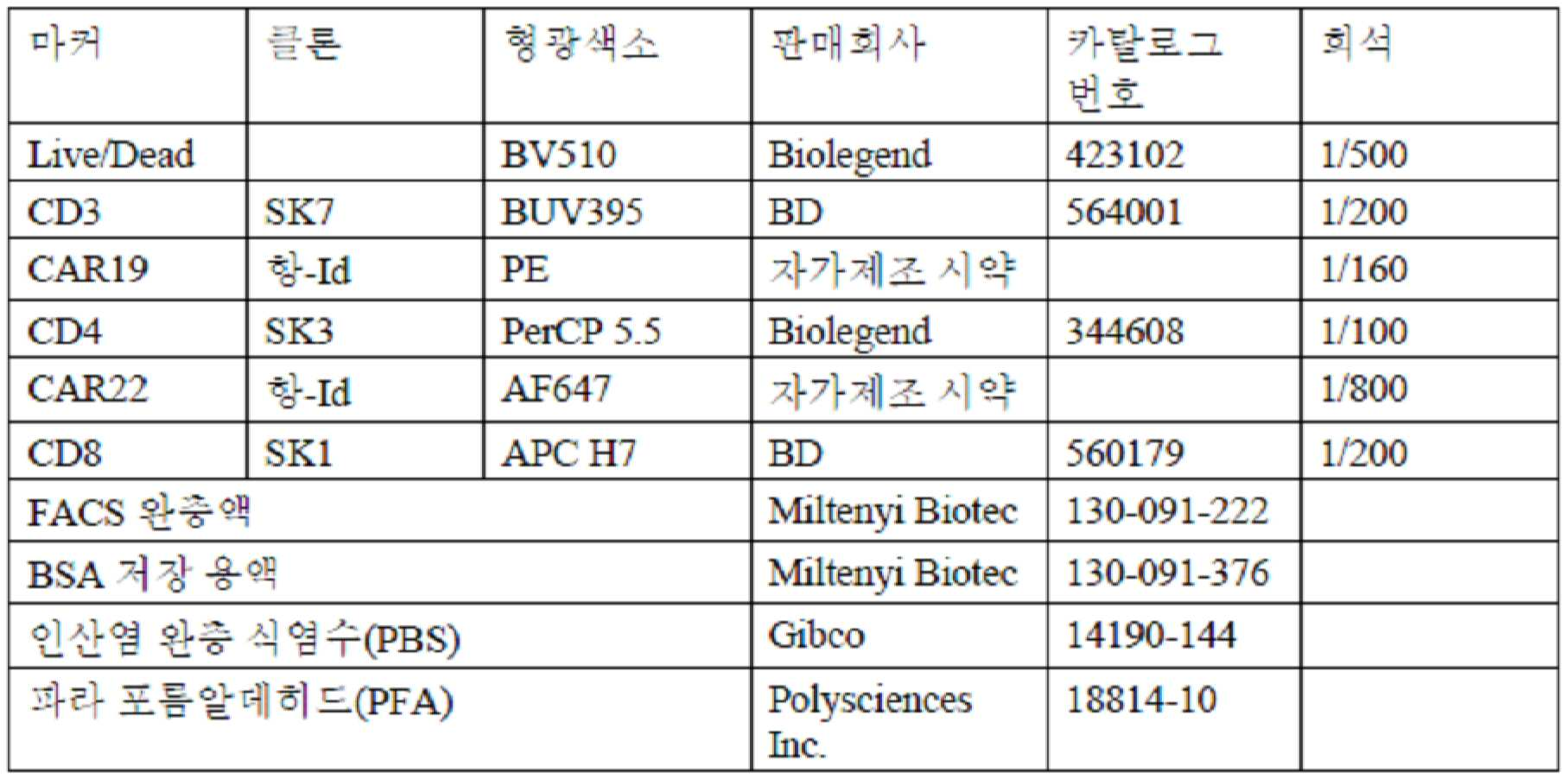
유세포 분석 결과, 각각의 항-이디오타입 항체에 의해 검출되는 바와 같이 대부분의 CAR+ 세포가 CD19 및 CD22 표적화 CAR을 둘 다 발현하고 있는 것으로 나타났다(도 5a 및 도 5b). 이중 CAR 발현에 대한 단일 CAR 발현의 비는 시간이 지남에 따라 이중 CAR 발현 쪽으로 이동했고 144시간 후에 안정화되었다. 동시에, 총 CAR 발현도 증가했다. 두 시점 모두에서, CAR 발현은 MOI가 높을수록 증가를 보이며 MOI에 의존적이었다. 여러 공여체 중 한 대표자의 데이터가 여기 표시되어 있다.Flow cytometry analysis showed that most of the CAR+ cells expressed both CD19 and CD22 targeting CARs as detected by the respective anti-idiotypic antibodies ( FIGS. 5A and 5B ). The ratio of single CAR expression to double CAR expression shifted towards dual CAR expression over time and stabilized after 144 hours. At the same time, total CAR expression also increased. At both time points, CAR expression was dependent on the MOI, increasing with higher MOI. Data from one representative of several donors are presented here.
실시예 4: 대규모 활성화 프로세스를 이용한 c201 세포의 제조Example 4: Preparation of c201 cells using a large-scale activation process
이 실시예는 전체 임상적 대규모의 활성화 프로세스를 이용한 CD19- 및 CD22-표적화 이중 CAR-T세포의 제조가능성 평가를 설명한다.This example describes the manufacturability evaluation of CD19- and CD22-targeted dual CAR-T cells using the entire clinical large-scale activation process.
CAR-T세포의 활성화 프로세스는 표 7에 요약된 바와 같이 배지의 제조로 시작한다. 동결보존된 백혈구 성분채집 산물을 출발물질로 사용하고 T세포 강화를 위해 처리하였다.The activation process of CAR-T cells begins with the preparation of the medium as summarized in Table 7. The cryopreserved leukocyte apheresis product was used as a starting material and treated for T cell enrichment.
[표 7] 배지 및 완충액 유형 및 CART 제조 중 사용 시점Table 7 Media and Buffer Types and Time of Use During CART Preparation

동결보존된 성분채집물을 해동하고, 세척한 후, CliniMACS® 마이크로비드 기술을 이용해 T세포 선택 및 강화를 수행하였다. Miltenyi 마이크로비드로 선택된 생존가능한 세포를 비가습 인큐베이션 챔버인 Prodigy®의 centricult에 시딩하였다. 배양하는 동안, T세포 활성화 및 형질도입을 촉진하기 위해 구성요소 중 CTSTM 보충물(ThermoFisher), Glutamax, IL-2, 및 2% 면역 세포 혈청 대체물을 함유하는 OpTmizerTM CTSTM 기반의 배지인 Rapid 배지에 세포를 현탁시켰다. 생존가능한 유핵 세포(VNC)를 TransACT(Miltenyi)로 활성화시키고, 두 CAR을 모두 암호화하는 c201 렌티바이러스 벡터를 사용하여 형질도입시켰다. TransACT를 배양 배지에 희석된 세포에 첨가한 후, 시딩 당일에 렌티바이러스 형질도입을 수행하였다. GMP 등급 c201 바이러스를 qPCR 역가에 기초하여 1의 감염다중도(MOI)로 첨가하여 세포에 형질도입하였다. 렌티바이러스 벡터를 실온에서 최대 30분 동안 사용 직전에 해동하였다.After thawing and washing the cryopreserved apheresis, T cell selection and enrichment was performed using CliniMACS ® microbead technology. Viable cells selected with Miltenyi microbeads were seeded in the centricult of Prodigy ® , an unhumidified incubation chamber. During culturing, Rapid, an OpTmizer TM CTS TM based medium containing CTS TM supplement (ThermoFisher), Glutamax, IL-2, and 2% immune cell serum replacement among the components to promote T cell activation and transduction. Cells were suspended in the medium. Viable nucleated cells (VNCs) were activated with TransACT (Miltenyi) and transduced using c201 lentiviral vectors encoding both CARs. After TransACT was added to the cells diluted in the culture medium, lentiviral transduction was performed on the day of seeding. Cells were transduced with GMP grade c201 virus added at a multiplicity of infection (MOI) of 1 based on qPCR titer. Lentiviral vectors were thawed immediately prior to use at room temperature for up to 30 minutes.
0일째 프로세스 시작부터 배양물 세척 및 채취 개시까지, CAR-T세포를 시딩 후 20시간 동안 배양하였다. 배양 후, 세포 현탁액은 centricult 챔버 내에서 2회의 배양물 세척과 1회의 채취물 세척을 거쳤다.From the start of the process on
1일째에 CliniMACS® Prodigy®에서 채취물을 세척한 후, 세포 현탁액을 샘플링하여 생존가능한 세포 수 및 생존력을 측정하였다. 이어서, 세포 현탁액을 원심분리기로 옮겨 수동으로 펠릿화하였다. 상청액을 제거하고, 세포 펠릿을 CS10(BioLife Solution)에 재현탁시켜, 최종 DMSO 농도가 약 10%인 생성물 제형을 생성하였다. 이어서, 세포를 개별 냉동백에 분배하고 분석 샘플링을 냉동바이알에 넣었다.After washing the harvest on the CliniMACS ® Prodigy ® on
센티넬 바이알을 해동한 후, 세포를 계수하고, 24-웰 플레이트에 최종 1×10⁶개 세포/mL로 재플레이팅하였다. 재플레이팅 72시간 후, 세포를 채취하고, 계수하고, 유세포 분석을 위해 각 샘플로부터 5×10⁵개 세포의 분취량을 취했다. 세포를 100 μl/웰에서 15분 동안 Live/Dead Aqua(BV510)로 염색한 후, 2회 세척하였다. 이어서, 항체 혼합물(표 5)을 4℃에서 25분 동안 50 μl/웰로 첨가하였다. 세포를 다시 2회 세척한 후, PBS 중 1.6% PFA(100 μl/웰)에서 15분 동안 고정시켰다. 고정 후, 세포를 전술한 바와 같이 세척하고, 유세포 분석 완충액에 150 μl/샘플의 최종 부피로 재현탁시켰다. BD LSRFortessa(BD Biosciences, San Jose CA) 상의 각 샘플의 Live CD3 양성 게이트에서 5e4개 세포를 획득하고, FlowJo v.10 소프트웨어(Ashland, OR)를 사용하여 데이터를 분석하였다. 이 절차를 재플레이팅 144시간 후 반복하였다.After thawing sentinel vials, cells were counted and replated in 24-well plates to a final 1×10 6 cells/mL. After 72 hours of re-plating, cells were harvested, counted, and aliquots of 5×10 5 cells were taken from each sample for flow cytometry. Cells were stained with Live/Dead Aqua (BV510) at 100 μl/well for 15 minutes and then washed twice. The antibody mixture (Table 5) was then added at 50 μl/well at 4° C. for 25 min. Cells were washed again twice and then fixed in 1.6% PFA in PBS (100 μl/well) for 15 min. After fixation, cells were washed as described above and resuspended in flow cytometry buffer to a final volume of 150 μl/sample. 5e4 cells were acquired from a Live CD3 positive gate of each sample on a BD LSRFortessa (BD Biosciences, San Jose CA) and the data were analyzed using FlowJo v.10 software (Ashland, OR). This procedure was repeated 144 hours after re-plating.
전체 규모의 ARM 프로세스는 형질도입 144시간 후 측정시 총 CAR 발현이 12%인 CAR-T 산물을 생성하였다; 9% 이중 CAR+ 세포 및 3% 단일 CAR22+ 세포(도 5c). 소규모 활성화 프로세스 실험에서 알 수 있듯이, 총 CAR%와 단일 CAR에 대한 이중 CAR의 비율은 시간이 지남에 따라 증가했다.The full scale ARM process produced a CAR-T product with a total CAR expression of 12% as measured 144 hours post-transduction; 9% double CAR+ cells and 3% single CAR22+ cells ( FIG. 5C ). As shown in the small-scale activation process experiments, the percentage of total CAR and the ratio of dual CAR to single CAR increased over time.
실시예 5: CD19 및/또는 CD22를 표적화하는 이중 및 단일 CAR-T의 생체내 활성Example 5: In vivo activity of dual and single CAR-T targeting CD19 and/or CD22
이 실시예는 종래의 방법(TM) 및 활성화 프로세스(AP)에 따라 제조된 이중 및 단일 CAR-T세포의 생체내 활성을 보여준다. 이 실시예에 사용된 이중 CAR-T는 활성화 프로세스에 의해 생성된, CD19 CAR의 업스트림에 CD22 CAR이 있는 c201이다. 이 연구에 사용된 관련 단일 CAR-T는 CD22를 인식하고 TM에 의해 생성된 CD22-65s, 및 CD19를 인식하고 TM 및 AP에 의해 생성된 CAR19(뮤린 scFv)이다. 이중 및 단일 CAR-T세포의 항종양 활성을 ALL 이종이식 모델에서 생체내 평가하였다.This example shows the in vivo activity of double and single CAR-T cells prepared according to the conventional method (TM) and activation process (AP). The dual CAR-T used in this example is c201 with a CD22 CAR upstream of the CD19 CAR, generated by the activation process. The relevant single CAR-Ts used in this study are CD22-65s that recognize CD22 and are produced by TM, and CAR19 (murine scFv) that recognizes CD19 and produced by TM and AP. The antitumor activity of double and single CAR-T cells was evaluated in vivo in an ALL xenograft model.
물질 및 방법Substances and methods
동물 연구의 개요는 실시예 2에 있다. 이 실시예에서는, 야생형 Nalm6(RRID: CVCL_0092), 인간 급성 림프모구성 백혈병(ALL) 세포주를 사용하였다.An overview of animal studies is given in Example 2. In this example, wild-type Nalm6 (RRID: CVCL_0092), a human acute lymphoblastic leukemia (ALL) cell line was used.
CAR T세포 투여: 종양 이식 7일 후 마우스에 투여하였다. 종래의 제조에 의해 생성된 CD22-65s CAR-T세포는 3, 1, 및 0.3 x10⁶개 CAR+ T세포로 투여되었다. AP로 생성된 CAR19 세포는 1 및 0.3 x10⁶개 CAR+ T세포로 투여되었고, TM에 의해 생성된 CAR19는 1, 0.3, 및 0.1 x10⁶개 CAR+ T세포로 투여되었다. AP로 생성된 c201 이중 CAR-T세포는 0.3, 0.1, 및 0.03 x10⁶개 CAR+ T세포로 투여되었다. 대조군으로서 비히클(PBS) 또는 UTD를 마우스에 투여하였다.CAR T cell administration: It was administered to mice 7 days after tumor transplantation. CD22-65s CAR-T cells generated by conventional preparation were administered as 3, 1, and 0.3 x 10 6 CAR+ T cells. AP-generated CAR19 cells were administered at 1 and 0.3×10 6 CAR+ T cells, and TM-generated CAR19 cells were administered at 1, 0.3, and 0.1×10 6 CAR+ T cells. AP-generated c201 double CAR-T cells were administered as 0.3, 0.1, and 0.03×10 6 CAR+ T cells. As a control, either vehicle (PBS) or UTD was administered to the mice.
결과result
이중 및 단일 CAR T세포의 항종양 활성을 B세포 급성 림프모구성 백혈병 이종이식 모델에서 평가하였다(Nalm6 세포는 CD19와 CD22를 모두 발현함). 0일째의 종양세포 이식 후, 종양 보유 마우스를 처치군에 무작위 배정하고, 종양 이식 후 7일째에 측면 꼬리 정맥을 통해 CAR T세포를 정맥내 투여하였다. 동물이 평가변수를 달성할 때까지 종양 성장 및 동물 건강을 모니터링하였다.The antitumor activity of dual and single CAR T cells was evaluated in a B-cell acute lymphoblastic leukemia xenograft model (Nalm6 cells express both CD19 and CD22). After tumor cell transplantation on
PBS 또는 UTD T세포를 투여받은 마우스는 종양이 뒷다리 운동성을 감소시키기 전에 3주차에 안락사시켰다. 다른 그룹은 4~7주차에 안락사시켰다. 모든 처치군에 대한 평균 생체발광은 도 6a에 도식화되어 있다. T세포를 투여받지 않은 PBS 처치군은 정맥내 주사된 NSG 마우스에서 기준선 Nalm6 종양 성장 동역학을 보여준다. UTD 처치군은 검출되지 않은 이 모델에서의 인간 공여체 T세포의 비특이적 반응을 보여주기 위해 T세포 대조군으로 사용되었다. 더 나은 비교를 위해, 0.3 x10⁶ 용량 그룹의 상이한 CAR-T를 도 6b에 함께 그래프로 나타냈다. 두 TM 생성 CAR-T 모두 CAR19(TM)에 대한 종양 성장의 약간의 지연과 함께 더 낮은 활성을 나타냈다. 대조적으로, 두 AP CAR-T는 모두 종양 부담을 현저히 감소시켰고, c201(AP) CAR-T는 5마리 중 4마리에서 종양 근절(BLI 기준선 수준)로 이어졌다.Mice receiving PBS or UTD T cells were euthanized at 3 weeks before tumors reduced hind limb motility. The other group was euthanized at 4-7 weeks. The average bioluminescence for all treatment groups is plotted in FIG. 6A . The PBS-treated group without T cells shows baseline Nalm6 tumor growth kinetics in intravenously injected NSG mice. The UTD treatment group was used as a T cell control to show non-specific responses of human donor T cells in this model that were not detected. For better comparison, the different CAR-Ts of the 0.3×10 6 dose group are graphed together in FIG. 6B . Both TM-generating CAR-Ts showed lower activity against CAR19(TM) with a slight delay in tumor growth. In contrast, both AP CAR-T significantly reduced tumor burden, and c201(AP) CAR-T led to tumor eradication (BLI baseline level) in 4 out of 5 animals.
이들 동물에서 혈액을 매주 유세포 분석하여 CAR-T의 증식 및 지속의 동역학을 측정하였다. 컴파일된 데이터는 도 6c에 표시되어 있다. 0.3 x10⁶ 용량의 CAR-T 그룹에 걸쳐 비교하면, AP 처리된 CAR-T가 더 나은 증식을 나타냈다. c201과 CAR19(둘 다 AP)의 비교는 0.3 및 1 x10⁶ 용량 각각에 대해 CAR-T의 유사한 증식을 보여준다.Blood from these animals was analyzed weekly by flow cytometry to determine the kinetics of proliferation and persistence of CAR-T. The compiled data is shown in Fig. 6c . When compared across the CAR-T group at 0.3×10 6 doses, AP treated CAR-T showed better proliferation. Comparison of c201 and CAR19 (both AP) shows similar proliferation of CAR-T for the 0.3 and 1×10 6 doses, respectively.
이 연구는 AP로 제조된 경우에도 c201의 효능을 강조한다. c201 AP는 생체내 항종양 활성 및 세포 증식과 관련하여 CAR19 및 CD22-65s(TM) 뿐만 아니라 CAR19(AP)보다 우수했다.This study highlights the efficacy of c201 even when made with AP. c201 AP was superior to CAR19 and CD22-65s(TM) as well as CAR19(AP) with respect to in vivo antitumor activity and cell proliferation.
본 발명을 상세하게 설명하였지만, 본 명세서 및 첨부된 청구범위에 기재된 바와 같은 본 발명의 사상 및 범위를 벗어나지 않으면서 수정, 변형, 및 균등한 양태가 가능하다는 것이 명백할 것이다. 또한, 본 발명의 모든 예는 비제한적인 예로서 제공됨을 이해해야 한다.While the present invention has been described in detail, it will be apparent that modifications, variations, and equivalent aspects are possible without departing from the spirit and scope of the invention as set forth herein and in the appended claims. It is also to be understood that all examples of the present invention are provided by way of non-limiting example.
SEQUENCE LISTING <110> Novartis AG <120> CD19 AND CD22 CHIMERIC ANTIGEN RECEPTORS AND USES THEREOF <130> PAT058691-WO-PCT <160> 109 <170> PatentIn version 3.5 <210> 1 <211> 2238 <212> DNA <213> Artificial Sequence <220> <223> Synthetic polynucleotide <400> 1 atggccctcc ctgtcaccgc cctgctgctt ccgctggctc ttctgctcca cgccgctcgg 60 cccgaaattg tgatgaccca gtcacccgcc actcttagcc tttcacccgg tgagcgcgca 120 accctgtctt gcagagcctc ccaagacatc tcaaaatacc ttaattggta tcaacagaag 180 cccggacagg ctcctcgcct tctgatctac cacaccagcc ggctccattc tggaatccct 240 gccaggttca gcggtagcgg atctgggacc gactacaccc tcactatcag ctcactgcag 300 ccagaggact tcgctgtcta tttctgtcag caagggaaca ccctgcccta cacctttgga 360 cagggcacca agctcgagat taaaggtgga ggtggcagcg gaggaggtgg gtccggcggt 420 ggaggaagcc aggtccaact ccaagaaagc ggaccgggtc ttgtgaagcc atcagaaact 480 ctttcactga cttgtactgt gagcggagtg tctctccccg attacggggt gtcttggatc 540 agacagccac cggggaaggg tctggaatgg attggagtga tttggggctc tgagactact 600 tactaccaat catccctcaa gtcacgcgtc accatctcaa aggacaactc taagaatcag 660 gtgtcactga aactgtcatc tgtgaccgca gccgacaccg ccgtgtacta ttgcgctaag 720 cattactatt atggcgggag ctacgcaatg gattactggg gacagggtac tctggtcacc 780 gtgtccagct tggcagaagc cgccgcgaaa gaagtgcagc ttcaacaatc aggaccagga 840 ctcgtcaaac catcacagac cctctccctc acatgtgcca tctccgggga ctccatgttg 900 agcaattccg acacttggaa ttggattaga caaagcccgt cccggggtct ggaatggttg 960 ggacgcacct accaccggtc tacttggtac gacgactacg cgtcatccgt gcggggaaga 1020 gtgtccatca acgtggacac ctccaagaac cagtacagcc tgcagcttaa tgccgtgact 1080 cctgaggata cgggcgtcta ctactgcgcc cgcgtccgcc tgcaagacgg gaacagctgg 1140 agcgatgcat tcgatgtctg gggccaggga actatggtca ccgtgtcgtc tgggggcggt 1200 ggatcgggtg gcgggggttc ggggggcggc ggctctcagt ccgctcttac ccaaccggcc 1260 tcagcctcgg ggagccccgg ccagagcgtg accatttcct gcaccggcac ttcatccgac 1320 gtgggcggct acaactacgt gtcctggtac caacagcacc cgggaaaggc ccccaagctc 1380 atgatctacg acgtgtccaa caggccctcg ggagtgtcca accggttctc gggttcgaaa 1440 tcgggaaaca cagccagcct gaccatcagc ggactgcagg ctgaagatga agccgactac 1500 tactgctcct cctacacctc gtcatccacg ctctacgtgt tcggcactgg aactcagctg 1560 actgtgctga ccactacccc agcaccgagg ccacccaccc cggctcctac catcgcctcc 1620 cagcctctgt ccctgcgtcc ggaggcatgt agacccgcag ctggtggggc cgtgcatacc 1680 cggggtcttg acttcgcctg cgatatctac atttgggccc ctctggctgg tacttgcggg 1740 gtcctgctgc tttcactcgt gatcactctt tactgtaagc gcggtcggaa gaagctgctg 1800 tacatcttta agcaaccctt catgaggcct gtgcagacta ctcaagagga ggacggctgt 1860 tcatgccggt tcccagagga ggaggaaggc ggctgcgaac tgcgcgtgaa attcagccgc 1920 agcgcagatg ctccagccta ccagcagggg cagaaccagc tctacaacga actcaatctt 1980 ggtcggagag aggagtacga cgtgctggac aagcggagag gacgggaccc agaaatgggc 2040 gggaagccgc gcagaaagaa tccccaagag ggcctgtaca acgagctcca aaaggataag 2100 atggcagaag cctatagcga gattggtatg aaaggggaac gcagaagagg caaaggccac 2160 gacggactgt accagggact cagcaccgcc accaaggaca cctatgacgc tcttcacatg 2220 caggccctgc cgcctcgg 2238 <210> 2 <211> 746 <212> PRT <213> Artificial Sequence <220> <223> Synthetic polypeptide <400> 2 Met Ala Leu Pro Val Thr Ala Leu Leu Leu Pro Leu Ala Leu Leu Leu 1 5 10 15 His Ala Ala Arg Pro Glu Ile Val Met Thr Gln Ser Pro Ala Thr Leu 20 25 30 Ser Leu Ser Pro Gly Glu Arg Ala Thr Leu Ser Cys Arg Ala Ser Gln 35 40 45 Asp Ile Ser Lys Tyr Leu Asn Trp Tyr Gln Gln Lys Pro Gly Gln Ala 50 55 60 Pro Arg Leu Leu Ile Tyr His Thr Ser Arg Leu His Ser Gly Ile Pro 65 70 75 80 Ala Arg Phe Ser Gly Ser Gly Ser Gly Thr Asp Tyr Thr Leu Thr Ile 85 90 95 Ser Ser Leu Gln Pro Glu Asp Phe Ala Val Tyr Phe Cys Gln Gln Gly 100 105 110 Asn Thr Leu Pro Tyr Thr Phe Gly Gln Gly Thr Lys Leu Glu Ile Lys 115 120 125 Gly Gly Gly Gly Ser Gly Gly Gly Gly Ser Gly Gly Gly Gly Ser Gln 130 135 140 Val Gln Leu Gln Glu Ser Gly Pro Gly Leu Val Lys Pro Ser Glu Thr 145 150 155 160 Leu Ser Leu Thr Cys Thr Val Ser Gly Val Ser Leu Pro Asp Tyr Gly 165 170 175 Val Ser Trp Ile Arg Gln Pro Pro Gly Lys Gly Leu Glu Trp Ile Gly 180 185 190 Val Ile Trp Gly Ser Glu Thr Thr Tyr Tyr Gln Ser Ser Leu Lys Ser 195 200 205 Arg Val Thr Ile Ser Lys Asp Asn Ser Lys Asn Gln Val Ser Leu Lys 210 215 220 Leu Ser Ser Val Thr Ala Ala Asp Thr Ala Val Tyr Tyr Cys Ala Lys 225 230 235 240 His Tyr Tyr Tyr Gly Gly Ser Tyr Ala Met Asp Tyr Trp Gly Gln Gly 245 250 255 Thr Leu Val Thr Val Ser Ser Leu Ala Glu Ala Ala Ala Lys Glu Val 260 265 270 Gln Leu Gln Gln Ser Gly Pro Gly Leu Val Lys Pro Ser Gln Thr Leu 275 280 285 Ser Leu Thr Cys Ala Ile Ser Gly Asp Ser Met Leu Ser Asn Ser Asp 290 295 300 Thr Trp Asn Trp Ile Arg Gln Ser Pro Ser Arg Gly Leu Glu Trp Leu 305 310 315 320 Gly Arg Thr Tyr His Arg Ser Thr Trp Tyr Asp Asp Tyr Ala Ser Ser 325 330 335 Val Arg Gly Arg Val Ser Ile Asn Val Asp Thr Ser Lys Asn Gln Tyr 340 345 350 Ser Leu Gln Leu Asn Ala Val Thr Pro Glu Asp Thr Gly Val Tyr Tyr 355 360 365 Cys Ala Arg Val Arg Leu Gln Asp Gly Asn Ser Trp Ser Asp Ala Phe 370 375 380 Asp Val Trp Gly Gln Gly Thr Met Val Thr Val Ser Ser Gly Gly Gly 385 390 395 400 Gly Ser Gly Gly Gly Gly Ser Gly Gly Gly Gly Ser Gln Ser Ala Leu 405 410 415 Thr Gln Pro Ala Ser Ala Ser Gly Ser Pro Gly Gln Ser Val Thr Ile 420 425 430 Ser Cys Thr Gly Thr Ser Ser Asp Val Gly Gly Tyr Asn Tyr Val Ser 435 440 445 Trp Tyr Gln Gln His Pro Gly Lys Ala Pro Lys Leu Met Ile Tyr Asp 450 455 460 Val Ser Asn Arg Pro Ser Gly Val Ser Asn Arg Phe Ser Gly Ser Lys 465 470 475 480 Ser Gly Asn Thr Ala Ser Leu Thr Ile Ser Gly Leu Gln Ala Glu Asp 485 490 495 Glu Ala Asp Tyr Tyr Cys Ser Ser Tyr Thr Ser Ser Ser Thr Leu Tyr 500 505 510 Val Phe Gly Thr Gly Thr Gln Leu Thr Val Leu Thr Thr Thr Pro Ala 515 520 525 Pro Arg Pro Pro Thr Pro Ala Pro Thr Ile Ala Ser Gln Pro Leu Ser 530 535 540 Leu Arg Pro Glu Ala Cys Arg Pro Ala Ala Gly Gly Ala Val His Thr 545 550 555 560 Arg Gly Leu Asp Phe Ala Cys Asp Ile Tyr Ile Trp Ala Pro Leu Ala 565 570 575 Gly Thr Cys Gly Val Leu Leu Leu Ser Leu Val Ile Thr Leu Tyr Cys 580 585 590 Lys Arg Gly Arg Lys Lys Leu Leu Tyr Ile Phe Lys Gln Pro Phe Met 595 600 605 Arg Pro Val Gln Thr Thr Gln Glu Glu Asp Gly Cys Ser Cys Arg Phe 610 615 620 Pro Glu Glu Glu Glu Gly Gly Cys Glu Leu Arg Val Lys Phe Ser Arg 625 630 635 640 Ser Ala Asp Ala Pro Ala Tyr Gln Gln Gly Gln Asn Gln Leu Tyr Asn 645 650 655 Glu Leu Asn Leu Gly Arg Arg Glu Glu Tyr Asp Val Leu Asp Lys Arg 660 665 670 Arg Gly Arg Asp Pro Glu Met Gly Gly Lys Pro Arg Arg Lys Asn Pro 675 680 685 Gln Glu Gly Leu Tyr Asn Glu Leu Gln Lys Asp Lys Met Ala Glu Ala 690 695 700 Tyr Ser Glu Ile Gly Met Lys Gly Glu Arg Arg Arg Gly Lys Gly His 705 710 715 720 Asp Gly Leu Tyr Gln Gly Leu Ser Thr Ala Thr Lys Asp Thr Tyr Asp 725 730 735 Ala Leu His Met Gln Ala Leu Pro Pro Arg 740 745 <210> 3 <211> 2232 <212> DNA <213> Artificial Sequence <220> <223> Synthetic polynucleotide <400> 3 atggccctcc ctgtcaccgc cctgctgctt ccgctggctc ttctgctcca cgccgctcgg 60 cccgaagtgc agcttcaaca atcaggacca ggactcgtca aaccatcaca gaccctctcc 120 ctcacatgtg ccatctccgg ggactccatg ttgagcaatt ccgacacttg gaattggatt 180 agacaaagcc cgtcccgggg tctggaatgg ttgggacgca cctaccaccg gtctacttgg 240 tacgacgact acgcgtcatc cgtgcgggga agagtgtcca tcaacgtgga cacctccaag 300 aaccagtaca gcctgcagct taatgccgtg actcctgagg atacgggcgt ctactactgc 360 gcccgcgtcc gcctgcaaga cgggaacagc tggagcgatg cattcgatgt ctggggccag 420 ggaactatgg tcaccgtgtc gtctgggggc ggtggatcgg gtggcggggg ttcggggggc 480 ggcggctctc agtccgctct tacccaaccg gcctcagcct cggggagccc cggccagagc 540 gtgaccattt cctgcaccgg cacttcatcc gacgtgggcg gctacaacta cgtgtcctgg 600 taccaacagc acccgggaaa ggcccccaag ctcatgatct acgacgtgtc caacaggccc 660 tcgggagtgt ccaaccggtt ctcgggttcg aaatcgggaa acacagccag cctgaccatc 720 agcggactgc aggctgaaga tgaagccgac tactactgct cctcctacac ctcgtcatcc 780 acgctctacg tgttcggcac tggaactcag ctgactgtgc tgggaggggg agggagtgaa 840 attgtgatga cccagtcacc cgccactctt agcctttcac ccggtgagcg cgcaaccctg 900 tcttgcagag cctcccaaga catctcaaaa taccttaatt ggtatcaaca gaagcccgga 960 caggctcctc gccttctgat ctaccacacc agccggctcc attctggaat ccctgccagg 1020 ttcagcggta gcggatctgg gaccgactac accctcacta tcagctcact gcagccagag 1080 gacttcgctg tctatttctg tcagcaaggg aacaccctgc cctacacctt tggacagggc 1140 accaagctcg agattaaagg tggaggtggc agcggaggag gtgggtccgg cggtggagga 1200 agccaggtcc aactccaaga aagcggaccg ggtcttgtga agccatcaga aactctttca 1260 ctgacttgta ctgtgagcgg agtgtctctc cccgattacg gggtgtcttg gatcagacag 1320 ccaccgggga agggtctgga atggattgga gtgatttggg gctctgagac tacttactac 1380 caatcatccc tcaagtcacg cgtcaccatc tcaaaggaca actctaagaa tcaggtgtca 1440 ctgaaactgt catctgtgac cgcagccgac accgccgtgt actattgcgc taagcattac 1500 tattatggcg ggagctacgc aatggattac tggggacagg gtactctggt caccgtgtcc 1560 agcaccacta ccccagcacc gaggccaccc accccggctc ctaccatcgc ctcccagcct 1620 ctgtccctgc gtccggaggc atgtagaccc gcagctggtg gggccgtgca tacccggggt 1680 cttgacttcg cctgcgatat ctacatttgg gcccctctgg ctggtacttg cggggtcctg 1740 ctgctttcac tcgtgatcac tctttactgt aagcgcggtc ggaagaagct gctgtacatc 1800 tttaagcaac ccttcatgag gcctgtgcag actactcaag aggaggacgg ctgttcatgc 1860 cggttcccag aggaggagga aggcggctgc gaactgcgcg tgaaattcag ccgcagcgca 1920 gatgctccag cctaccagca ggggcagaac cagctctaca acgaactcaa tcttggtcgg 1980 agagaggagt acgacgtgct ggacaagcgg agaggacggg acccagaaat gggcgggaag 2040 ccgcgcagaa agaatcccca agagggcctg tacaacgagc tccaaaagga taagatggca 2100 gaagcctata gcgagattgg tatgaaaggg gaacgcagaa gaggcaaagg ccacgacgga 2160 ctgtaccagg gactcagcac cgccaccaag gacacctatg acgctcttca catgcaggcc 2220 ctgccgcctc gg 2232 <210> 4 <211> 744 <212> PRT <213> Artificial Sequence <220> <223> Synthetic polypeptide <400> 4 Met Ala Leu Pro Val Thr Ala Leu Leu Leu Pro Leu Ala Leu Leu Leu 1 5 10 15 His Ala Ala Arg Pro Glu Val Gln Leu Gln Gln Ser Gly Pro Gly Leu 20 25 30 Val Lys Pro Ser Gln Thr Leu Ser Leu Thr Cys Ala Ile Ser Gly Asp 35 40 45 Ser Met Leu Ser Asn Ser Asp Thr Trp Asn Trp Ile Arg Gln Ser Pro 50 55 60 Ser Arg Gly Leu Glu Trp Leu Gly Arg Thr Tyr His Arg Ser Thr Trp 65 70 75 80 Tyr Asp Asp Tyr Ala Ser Ser Val Arg Gly Arg Val Ser Ile Asn Val 85 90 95 Asp Thr Ser Lys Asn Gln Tyr Ser Leu Gln Leu Asn Ala Val Thr Pro 100 105 110 Glu Asp Thr Gly Val Tyr Tyr Cys Ala Arg Val Arg Leu Gln Asp Gly 115 120 125 Asn Ser Trp Ser Asp Ala Phe Asp Val Trp Gly Gln Gly Thr Met Val 130 135 140 Thr Val Ser Ser Gly Gly Gly Gly Ser Gly Gly Gly Gly Ser Gly Gly 145 150 155 160 Gly Gly Ser Gln Ser Ala Leu Thr Gln Pro Ala Ser Ala Ser Gly Ser 165 170 175 Pro Gly Gln Ser Val Thr Ile Ser Cys Thr Gly Thr Ser Ser Asp Val 180 185 190 Gly Gly Tyr Asn Tyr Val Ser Trp Tyr Gln Gln His Pro Gly Lys Ala 195 200 205 Pro Lys Leu Met Ile Tyr Asp Val Ser Asn Arg Pro Ser Gly Val Ser 210 215 220 Asn Arg Phe Ser Gly Ser Lys Ser Gly Asn Thr Ala Ser Leu Thr Ile 225 230 235 240 Ser Gly Leu Gln Ala Glu Asp Glu Ala Asp Tyr Tyr Cys Ser Ser Tyr 245 250 255 Thr Ser Ser Ser Thr Leu Tyr Val Phe Gly Thr Gly Thr Gln Leu Thr 260 265 270 Val Leu Gly Gly Gly Gly Ser Glu Ile Val Met Thr Gln Ser Pro Ala 275 280 285 Thr Leu Ser Leu Ser Pro Gly Glu Arg Ala Thr Leu Ser Cys Arg Ala 290 295 300 Ser Gln Asp Ile Ser Lys Tyr Leu Asn Trp Tyr Gln Gln Lys Pro Gly 305 310 315 320 Gln Ala Pro Arg Leu Leu Ile Tyr His Thr Ser Arg Leu His Ser Gly 325 330 335 Ile Pro Ala Arg Phe Ser Gly Ser Gly Ser Gly Thr Asp Tyr Thr Leu 340 345 350 Thr Ile Ser Ser Leu Gln Pro Glu Asp Phe Ala Val Tyr Phe Cys Gln 355 360 365 Gln Gly Asn Thr Leu Pro Tyr Thr Phe Gly Gln Gly Thr Lys Leu Glu 370 375 380 Ile Lys Gly Gly Gly Gly Ser Gly Gly Gly Gly Ser Gly Gly Gly Gly 385 390 395 400 Ser Gln Val Gln Leu Gln Glu Ser Gly Pro Gly Leu Val Lys Pro Ser 405 410 415 Glu Thr Leu Ser Leu Thr Cys Thr Val Ser Gly Val Ser Leu Pro Asp 420 425 430 Tyr Gly Val Ser Trp Ile Arg Gln Pro Pro Gly Lys Gly Leu Glu Trp 435 440 445 Ile Gly Val Ile Trp Gly Ser Glu Thr Thr Tyr Tyr Gln Ser Ser Leu 450 455 460 Lys Ser Arg Val Thr Ile Ser Lys Asp Asn Ser Lys Asn Gln Val Ser 465 470 475 480 Leu Lys Leu Ser Ser Val Thr Ala Ala Asp Thr Ala Val Tyr Tyr Cys 485 490 495 Ala Lys His Tyr Tyr Tyr Gly Gly Ser Tyr Ala Met Asp Tyr Trp Gly 500 505 510 Gln Gly Thr Leu Val Thr Val Ser Ser Thr Thr Thr Pro Ala Pro Arg 515 520 525 Pro Pro Thr Pro Ala Pro Thr Ile Ala Ser Gln Pro Leu Ser Leu Arg 530 535 540 Pro Glu Ala Cys Arg Pro Ala Ala Gly Gly Ala Val His Thr Arg Gly 545 550 555 560 Leu Asp Phe Ala Cys Asp Ile Tyr Ile Trp Ala Pro Leu Ala Gly Thr 565 570 575 Cys Gly Val Leu Leu Leu Ser Leu Val Ile Thr Leu Tyr Cys Lys Arg 580 585 590 Gly Arg Lys Lys Leu Leu Tyr Ile Phe Lys Gln Pro Phe Met Arg Pro 595 600 605 Val Gln Thr Thr Gln Glu Glu Asp Gly Cys Ser Cys Arg Phe Pro Glu 610 615 620 Glu Glu Glu Gly Gly Cys Glu Leu Arg Val Lys Phe Ser Arg Ser Ala 625 630 635 640 Asp Ala Pro Ala Tyr Gln Gln Gly Gln Asn Gln Leu Tyr Asn Glu Leu 645 650 655 Asn Leu Gly Arg Arg Glu Glu Tyr Asp Val Leu Asp Lys Arg Arg Gly 660 665 670 Arg Asp Pro Glu Met Gly Gly Lys Pro Arg Arg Lys Asn Pro Gln Glu 675 680 685 Gly Leu Tyr Asn Glu Leu Gln Lys Asp Lys Met Ala Glu Ala Tyr Ser 690 695 700 Glu Ile Gly Met Lys Gly Glu Arg Arg Arg Gly Lys Gly His Asp Gly 705 710 715 720 Leu Tyr Gln Gly Leu Ser Thr Ala Thr Lys Asp Thr Tyr Asp Ala Leu 725 730 735 His Met Gln Ala Leu Pro Pro Arg 740 <210> 5 <211> 2202 <212> DNA <213> Artificial Sequence <220> <223> Synthetic polynucleotide <400> 5 atggccctcc ctgtcaccgc cctgctgctt ccgctggctc ttctgctcca cgccgctcgg 60 ccccagtccg ctcttaccca accggcctca gcctcgggga gccccggcca gagcgtgacc 120 atttcctgca ccggcacttc atccgacgtg ggcggctaca actacgtgtc ctggtaccaa 180 cagcacccgg gaaaggcccc caagctcatg atctacgacg tgtccaacag gccctcggga 240 gtgtccaacc ggttctcggg ttcgaaatcg ggaaacacag ccagcctgac catcagcgga 300 ctgcaggctg aagatgaagc cgactactac tgctcctcct acacctcgtc atccacgctc 360 tacgtgttcg gcactggaac tcagctgact gtgctgggcg gaggaggctc cgaagtgcag 420 cttcaacaat caggaccagg actcgtcaaa ccatcacaga ccctctccct cacatgtgcc 480 atctccgggg actccatgtt gagcaattcc gacacttgga attggattag acaaagcccg 540 tcccggggtc tggaatggtt gggacgcacc taccaccggt ctacttggta cgacgactac 600 gcgtcatccg tgcggggaag agtgtccatc aacgtggaca cctccaagaa ccagtacagc 660 ctgcagctta atgccgtgac tcctgaggat acgggcgtct actactgcgc ccgcgtccgc 720 ctgcaagacg ggaacagctg gagcgatgca ttcgatgtct ggggccaggg aactatggtc 780 accgtgtcgt ctggaggggg agggagtgaa attgtgatga cccagtcacc cgccactctt 840 agcctttcac ccggtgagcg cgcaaccctg tcttgcagag cctcccaaga catctcaaaa 900 taccttaatt ggtatcaaca gaagcccgga caggctcctc gccttctgat ctaccacacc 960 agccggctcc attctggaat ccctgccagg ttcagcggta gcggatctgg gaccgactac 1020 accctcacta tcagctcact gcagccagag gacttcgctg tctatttctg tcagcaaggg 1080 aacaccctgc cctacacctt tggacagggc accaagctcg agattaaagg tggaggtggc 1140 agcggaggag gtgggtccgg cggtggagga agccaggtcc aactccaaga aagcggaccg 1200 ggtcttgtga agccatcaga aactctttca ctgacttgta ctgtgagcgg agtgtctctc 1260 cccgattacg gggtgtcttg gatcagacag ccaccgggga agggtctgga atggattgga 1320 gtgatttggg gctctgagac tacttactac caatcatccc tcaagtcacg cgtcaccatc 1380 tcaaaggaca actctaagaa tcaggtgtca ctgaaactgt catctgtgac cgcagccgac 1440 accgccgtgt actattgcgc taagcattac tattatggcg ggagctacgc aatggattac 1500 tggggacagg gtactctggt caccgtgtcc agcaccacta ccccagcacc gaggccaccc 1560 accccggctc ctaccatcgc ctcccagcct ctgtccctgc gtccggaggc atgtagaccc 1620 gcagctggtg gggccgtgca tacccggggt cttgacttcg cctgcgatat ctacatttgg 1680 gcccctctgg ctggtacttg cggggtcctg ctgctttcac tcgtgatcac tctttactgt 1740 aagcgcggtc ggaagaagct gctgtacatc tttaagcaac ccttcatgag gcctgtgcag 1800 actactcaag aggaggacgg ctgttcatgc cggttcccag aggaggagga aggcggctgc 1860 gaactgcgcg tgaaattcag ccgcagcgca gatgctccag cctaccagca ggggcagaac 1920 cagctctaca acgaactcaa tcttggtcgg agagaggagt acgacgtgct ggacaagcgg 1980 agaggacggg acccagaaat gggcgggaag ccgcgcagaa agaatcccca agagggcctg 2040 tacaacgagc tccaaaagga taagatggca gaagcctata gcgagattgg tatgaaaggg 2100 gaacgcagaa gaggcaaagg ccacgacgga ctgtaccagg gactcagcac cgccaccaag 2160 gacacctatg acgctcttca catgcaggcc ctgccgcctc gg 2202 <210> 6 <211> 734 <212> PRT <213> Artificial Sequence <220> <223> Synthetic polypeptide <400> 6 Met Ala Leu Pro Val Thr Ala Leu Leu Leu Pro Leu Ala Leu Leu Leu 1 5 10 15 His Ala Ala Arg Pro Gln Ser Ala Leu Thr Gln Pro Ala Ser Ala Ser 20 25 30 Gly Ser Pro Gly Gln Ser Val Thr Ile Ser Cys Thr Gly Thr Ser Ser 35 40 45 Asp Val Gly Gly Tyr Asn Tyr Val Ser Trp Tyr Gln Gln His Pro Gly 50 55 60 Lys Ala Pro Lys Leu Met Ile Tyr Asp Val Ser Asn Arg Pro Ser Gly 65 70 75 80 Val Ser Asn Arg Phe Ser Gly Ser Lys Ser Gly Asn Thr Ala Ser Leu 85 90 95 Thr Ile Ser Gly Leu Gln Ala Glu Asp Glu Ala Asp Tyr Tyr Cys Ser 100 105 110 Ser Tyr Thr Ser Ser Ser Thr Leu Tyr Val Phe Gly Thr Gly Thr Gln 115 120 125 Leu Thr Val Leu Gly Gly Gly Gly Ser Glu Val Gln Leu Gln Gln Ser 130 135 140 Gly Pro Gly Leu Val Lys Pro Ser Gln Thr Leu Ser Leu Thr Cys Ala 145 150 155 160 Ile Ser Gly Asp Ser Met Leu Ser Asn Ser Asp Thr Trp Asn Trp Ile 165 170 175 Arg Gln Ser Pro Ser Arg Gly Leu Glu Trp Leu Gly Arg Thr Tyr His 180 185 190 Arg Ser Thr Trp Tyr Asp Asp Tyr Ala Ser Ser Val Arg Gly Arg Val 195 200 205 Ser Ile Asn Val Asp Thr Ser Lys Asn Gln Tyr Ser Leu Gln Leu Asn 210 215 220 Ala Val Thr Pro Glu Asp Thr Gly Val Tyr Tyr Cys Ala Arg Val Arg 225 230 235 240 Leu Gln Asp Gly Asn Ser Trp Ser Asp Ala Phe Asp Val Trp Gly Gln 245 250 255 Gly Thr Met Val Thr Val Ser Ser Gly Gly Gly Gly Ser Glu Ile Val 260 265 270 Met Thr Gln Ser Pro Ala Thr Leu Ser Leu Ser Pro Gly Glu Arg Ala 275 280 285 Thr Leu Ser Cys Arg Ala Ser Gln Asp Ile Ser Lys Tyr Leu Asn Trp 290 295 300 Tyr Gln Gln Lys Pro Gly Gln Ala Pro Arg Leu Leu Ile Tyr His Thr 305 310 315 320 Ser Arg Leu His Ser Gly Ile Pro Ala Arg Phe Ser Gly Ser Gly Ser 325 330 335 Gly Thr Asp Tyr Thr Leu Thr Ile Ser Ser Leu Gln Pro Glu Asp Phe 340 345 350 Ala Val Tyr Phe Cys Gln Gln Gly Asn Thr Leu Pro Tyr Thr Phe Gly 355 360 365 Gln Gly Thr Lys Leu Glu Ile Lys Gly Gly Gly Gly Ser Gly Gly Gly 370 375 380 Gly Ser Gly Gly Gly Gly Ser Gln Val Gln Leu Gln Glu Ser Gly Pro 385 390 395 400 Gly Leu Val Lys Pro Ser Glu Thr Leu Ser Leu Thr Cys Thr Val Ser 405 410 415 Gly Val Ser Leu Pro Asp Tyr Gly Val Ser Trp Ile Arg Gln Pro Pro 420 425 430 Gly Lys Gly Leu Glu Trp Ile Gly Val Ile Trp Gly Ser Glu Thr Thr 435 440 445 Tyr Tyr Gln Ser Ser Leu Lys Ser Arg Val Thr Ile Ser Lys Asp Asn 450 455 460 Ser Lys Asn Gln Val Ser Leu Lys Leu Ser Ser Val Thr Ala Ala Asp 465 470 475 480 Thr Ala Val Tyr Tyr Cys Ala Lys His Tyr Tyr Tyr Gly Gly Ser Tyr 485 490 495 Ala Met Asp Tyr Trp Gly Gln Gly Thr Leu Val Thr Val Ser Ser Thr 500 505 510 Thr Thr Pro Ala Pro Arg Pro Pro Thr Pro Ala Pro Thr Ile Ala Ser 515 520 525 Gln Pro Leu Ser Leu Arg Pro Glu Ala Cys Arg Pro Ala Ala Gly Gly 530 535 540 Ala Val His Thr Arg Gly Leu Asp Phe Ala Cys Asp Ile Tyr Ile Trp 545 550 555 560 Ala Pro Leu Ala Gly Thr Cys Gly Val Leu Leu Leu Ser Leu Val Ile 565 570 575 Thr Leu Tyr Cys Lys Arg Gly Arg Lys Lys Leu Leu Tyr Ile Phe Lys 580 585 590 Gln Pro Phe Met Arg Pro Val Gln Thr Thr Gln Glu Glu Asp Gly Cys 595 600 605 Ser Cys Arg Phe Pro Glu Glu Glu Glu Gly Gly Cys Glu Leu Arg Val 610 615 620 Lys Phe Ser Arg Ser Ala Asp Ala Pro Ala Tyr Gln Gln Gly Gln Asn 625 630 635 640 Gln Leu Tyr Asn Glu Leu Asn Leu Gly Arg Arg Glu Glu Tyr Asp Val 645 650 655 Leu Asp Lys Arg Arg Gly Arg Asp Pro Glu Met Gly Gly Lys Pro Arg 660 665 670 Arg Lys Asn Pro Gln Glu Gly Leu Tyr Asn Glu Leu Gln Lys Asp Lys 675 680 685 Met Ala Glu Ala Tyr Ser Glu Ile Gly Met Lys Gly Glu Arg Arg Arg 690 695 700 Gly Lys Gly His Asp Gly Leu Tyr Gln Gly Leu Ser Thr Ala Thr Lys 705 710 715 720 Asp Thr Tyr Asp Ala Leu His Met Gln Ala Leu Pro Pro Arg 725 730 <210> 7 <211> 2232 <212> DNA <213> Artificial Sequence <220> <223> Synthetic polynucleotide <400> 7 atggccctgc ccgtgactgc gctcctgctt ccgttggccc tgctcctgca tgccgccaga 60 cctcagtccg ctctgactca gccggcctca gcttcggggt cccctggtca aagcgtcact 120 atttcctgta ccggaacctc atcagacgtg ggcggctaca attacgtgtc ctggtaccaa 180 cagcaccccg gaaaggctcc taagcttatg atctacgacg tgtccaaccg gccgtcagga 240 gtgtccaaca gattctccgg ctccaagagc ggaaacactg ccagcttgac cattagcggc 300 ttgcaggccg aggacgaagc cgactactac tgctctagct acacatcctc gtctaccctc 360 tacgtgtttg gaacggggac ccagctgact gtgctcgggg gtggaggatc agaggtgcaa 420 ctccagcagt ccggtcctgg cctcgtgaaa ccgtcccaaa ccctgtccct gacttgcgcc 480 atctcgggcg actccatgct gtccaattcc gacacctgga actggattag acaatcgcct 540 agccggggac tcgaatggct gggccggacc taccaccggt ccacgtggta tgacgactac 600 gcaagctccg tccggggaag ggtgtccatt aacgtcgata cctccaagaa ccagtacagc 660 cttcagctga acgctgtgac ccccgaggat accggcgtct actactgtgc aagagtgcga 720 ttgcaggatg gaaactcgtg gtcggacgca ttcgatgtct ggggacaggg aactatggtg 780 accgtgtcct cgggcggagg cgggagcgga ggaggaggct ctggcggagg aggaagcgag 840 attgtcatga ctcagtcccc ggccacactc tccctgtcac ccggagaaag agcaaccctg 900 agctgcaggg cgtcccagga catctcgaag tacctgaact ggtaccagca gaagcctgga 960 caagcacccc gcctcctgat ctaccacacc tcgcggctgc attcgggaat ccccgccaga 1020 ttctcaggga gcggatcagg aaccgactac accctgacta tctcgagcct gcaaccagag 1080 gatttcgccg tgtacttctg ccagcaagga aacaccctgc cctacacctt tggacaggga 1140 accaagctcg agattaaggg gggtggtgga tcgggagggg gtggatcagg aggaggcggc 1200 tcacaagtcc agctgcaaga atccggtccg ggacttgtga agccgtccga aaccctgtca 1260 ctgacttgca ctgtgtccgg ggtgtcattg cccgactacg gcgtgagctg gattcggcag 1320 ccccctggaa agggattgga atggatcggc gtgatctggg gttcggaaac tacctactat 1380 cagtcctcac tgaagtcccg cgtgaccatc agcaaggata attccaaaaa ccaagtgtct 1440 ctgaagctct ccagcgtcac tgccgccgat actgccgtgt actactgcgc caagcactac 1500 tattacggcg gttcgtacgc catggactac tggggccaag ggacactcgt gaccgtgtca 1560 tccaccacta ccccagcacc gaggccaccc accccggctc ctaccatcgc ctcccagcct 1620 ctgtccctgc gtccggaggc atgtagaccc gcagctggtg gggccgtgca tacccggggt 1680 cttgacttcg cctgcgatat ctacatttgg gcccctctgg ctggtacttg cggggtcctg 1740 ctgctttcac tcgtgatcac tctttactgt aagcgcggtc ggaagaagct gctgtacatc 1800 tttaagcaac ccttcatgag gcctgtgcag actactcaag aggaggacgg ctgttcatgc 1860 cggttcccag aggaggagga aggcggctgc gaactgcgcg tgaaattcag ccgcagcgca 1920 gatgctccag cctaccagca ggggcagaac cagctctaca acgaactcaa tcttggtcgg 1980 agagaggagt acgacgtgct ggacaagcgg agaggacggg acccagaaat gggcgggaag 2040 ccgcgcagaa agaatcccca agagggcctg tacaacgagc tccaaaagga taagatggca 2100 gaagcctata gcgagattgg tatgaaaggg gaacgcagaa gaggcaaagg ccacgacgga 2160 ctgtaccagg gactcagcac cgccaccaag gacacctatg acgctcttca catgcaggcc 2220 ctgccgcctc gg 2232 <210> 8 <211> 744 <212> PRT <213> Artificial Sequence <220> <223> Synthetic polypeptide <400> 8 Met Ala Leu Pro Val Thr Ala Leu Leu Leu Pro Leu Ala Leu Leu Leu 1 5 10 15 His Ala Ala Arg Pro Gln Ser Ala Leu Thr Gln Pro Ala Ser Ala Ser 20 25 30 Gly Ser Pro Gly Gln Ser Val Thr Ile Ser Cys Thr Gly Thr Ser Ser 35 40 45 Asp Val Gly Gly Tyr Asn Tyr Val Ser Trp Tyr Gln Gln His Pro Gly 50 55 60 Lys Ala Pro Lys Leu Met Ile Tyr Asp Val Ser Asn Arg Pro Ser Gly 65 70 75 80 Val Ser Asn Arg Phe Ser Gly Ser Lys Ser Gly Asn Thr Ala Ser Leu 85 90 95 Thr Ile Ser Gly Leu Gln Ala Glu Asp Glu Ala Asp Tyr Tyr Cys Ser 100 105 110 Ser Tyr Thr Ser Ser Ser Thr Leu Tyr Val Phe Gly Thr Gly Thr Gln 115 120 125 Leu Thr Val Leu Gly Gly Gly Gly Ser Glu Val Gln Leu Gln Gln Ser 130 135 140 Gly Pro Gly Leu Val Lys Pro Ser Gln Thr Leu Ser Leu Thr Cys Ala 145 150 155 160 Ile Ser Gly Asp Ser Met Leu Ser Asn Ser Asp Thr Trp Asn Trp Ile 165 170 175 Arg Gln Ser Pro Ser Arg Gly Leu Glu Trp Leu Gly Arg Thr Tyr His 180 185 190 Arg Ser Thr Trp Tyr Asp Asp Tyr Ala Ser Ser Val Arg Gly Arg Val 195 200 205 Ser Ile Asn Val Asp Thr Ser Lys Asn Gln Tyr Ser Leu Gln Leu Asn 210 215 220 Ala Val Thr Pro Glu Asp Thr Gly Val Tyr Tyr Cys Ala Arg Val Arg 225 230 235 240 Leu Gln Asp Gly Asn Ser Trp Ser Asp Ala Phe Asp Val Trp Gly Gln 245 250 255 Gly Thr Met Val Thr Val Ser Ser Gly Gly Gly Gly Ser Gly Gly Gly 260 265 270 Gly Ser Gly Gly Gly Gly Ser Glu Ile Val Met Thr Gln Ser Pro Ala 275 280 285 Thr Leu Ser Leu Ser Pro Gly Glu Arg Ala Thr Leu Ser Cys Arg Ala 290 295 300 Ser Gln Asp Ile Ser Lys Tyr Leu Asn Trp Tyr Gln Gln Lys Pro Gly 305 310 315 320 Gln Ala Pro Arg Leu Leu Ile Tyr His Thr Ser Arg Leu His Ser Gly 325 330 335 Ile Pro Ala Arg Phe Ser Gly Ser Gly Ser Gly Thr Asp Tyr Thr Leu 340 345 350 Thr Ile Ser Ser Leu Gln Pro Glu Asp Phe Ala Val Tyr Phe Cys Gln 355 360 365 Gln Gly Asn Thr Leu Pro Tyr Thr Phe Gly Gln Gly Thr Lys Leu Glu 370 375 380 Ile Lys Gly Gly Gly Gly Ser Gly Gly Gly Gly Ser Gly Gly Gly Gly 385 390 395 400 Ser Gln Val Gln Leu Gln Glu Ser Gly Pro Gly Leu Val Lys Pro Ser 405 410 415 Glu Thr Leu Ser Leu Thr Cys Thr Val Ser Gly Val Ser Leu Pro Asp 420 425 430 Tyr Gly Val Ser Trp Ile Arg Gln Pro Pro Gly Lys Gly Leu Glu Trp 435 440 445 Ile Gly Val Ile Trp Gly Ser Glu Thr Thr Tyr Tyr Gln Ser Ser Leu 450 455 460 Lys Ser Arg Val Thr Ile Ser Lys Asp Asn Ser Lys Asn Gln Val Ser 465 470 475 480 Leu Lys Leu Ser Ser Val Thr Ala Ala Asp Thr Ala Val Tyr Tyr Cys 485 490 495 Ala Lys His Tyr Tyr Tyr Gly Gly Ser Tyr Ala Met Asp Tyr Trp Gly 500 505 510 Gln Gly Thr Leu Val Thr Val Ser Ser Thr Thr Thr Pro Ala Pro Arg 515 520 525 Pro Pro Thr Pro Ala Pro Thr Ile Ala Ser Gln Pro Leu Ser Leu Arg 530 535 540 Pro Glu Ala Cys Arg Pro Ala Ala Gly Gly Ala Val His Thr Arg Gly 545 550 555 560 Leu Asp Phe Ala Cys Asp Ile Tyr Ile Trp Ala Pro Leu Ala Gly Thr 565 570 575 Cys Gly Val Leu Leu Leu Ser Leu Val Ile Thr Leu Tyr Cys Lys Arg 580 585 590 Gly Arg Lys Lys Leu Leu Tyr Ile Phe Lys Gln Pro Phe Met Arg Pro 595 600 605 Val Gln Thr Thr Gln Glu Glu Asp Gly Cys Ser Cys Arg Phe Pro Glu 610 615 620 Glu Glu Glu Gly Gly Cys Glu Leu Arg Val Lys Phe Ser Arg Ser Ala 625 630 635 640 Asp Ala Pro Ala Tyr Gln Gln Gly Gln Asn Gln Leu Tyr Asn Glu Leu 645 650 655 Asn Leu Gly Arg Arg Glu Glu Tyr Asp Val Leu Asp Lys Arg Arg Gly 660 665 670 Arg Asp Pro Glu Met Gly Gly Lys Pro Arg Arg Lys Asn Pro Gln Glu 675 680 685 Gly Leu Tyr Asn Glu Leu Gln Lys Asp Lys Met Ala Glu Ala Tyr Ser 690 695 700 Glu Ile Gly Met Lys Gly Glu Arg Arg Arg Gly Lys Gly His Asp Gly 705 710 715 720 Leu Tyr Gln Gly Leu Ser Thr Ala Thr Lys Asp Thr Tyr Asp Ala Leu 725 730 735 His Met Gln Ala Leu Pro Pro Arg 740 <210> 9 <211> 2232 <212> DNA <213> Artificial Sequence <220> <223> Synthetic polynucleotide <400> 9 atggccctgc ccgtgactgc gctcctgctt ccgttggccc tgctcctgca tgccgccaga 60 cctcagtccg ctctgactca gccggcctca gcttcggggt cccctggtca aagcgtcact 120 atttcctgta ccggaacctc atcagacgtg ggcggctaca attacgtgtc ctggtaccaa 180 cagcaccccg gaaaggctcc taagcttatg atctacgacg tgtccaaccg gccgtcagga 240 gtgtccaaca gattctccgg ctccaagagc ggaaacactg ccagcttgac cattagcggc 300 ttgcaggccg aggacgaagc cgactactac tgctctagct acacatcctc gtctaccctc 360 tacgtgtttg gaacggggac ccagctgact gtgctcgggg gtggaggatc agaggtgcaa 420 ctccagcagt ccggtcctgg cctcgtgaaa ccgtcccaaa ccctgtccct gacttgcgcc 480 atctcgggcg actccatgct gtccaattcc gacacctgga actggattag acaatcgcct 540 agccggggac tcgaatggct gggccggacc taccaccggt ccacgtggta tgacgactac 600 gcaagctccg tccggggaag ggtgtccatt aacgtcgata cctccaagaa ccagtacagc 660 cttcagctga acgctgtgac ccccgaggat accggcgtct actactgtgc aagagtgcga 720 ttgcaggatg gaaactcgtg gtcggacgca ttcgatgtct ggggacaggg aactatggtc 780 actgtgtcct ccggcggtgg aggctcgggg gggggcggct caggaggagg cggctcacaa 840 gtccagctgc aagaatccgg tccgggactt gtgaagccgt ccgaaaccct gtcactgact 900 tgcactgtgt ccggggtgtc attgcccgac tacggcgtga gctggattcg gcagccccct 960 ggaaagggat tggaatggat cggcgtgatc tggggttcgg aaactaccta ctatcagtcc 1020 tcactgaagt cccgcgtgac catcagcaag gataattcca aaaaccaagt gtctctgaag 1080 ctctccagcg tcactgccgc cgatactgcc gtgtactact gcgccaagca ctactattac 1140 ggcggttcgt acgccatgga ctactgggga caaggcactc ttgtgactgt gtcaagcggc 1200 ggtggaggga gcggtggggg cggttcagga ggaggcggat cagagatcgt gatgacccaa 1260 tccccagcca ccctgtccct cagccctgga gaaagagcca ccctgagctg ccgggcctcc 1320 caggatatca gcaagtactt gaactggtac caacaaaagc cggggcaggc gccccggctc 1380 ctgatctacc acacctcgcg cctccactca ggtatccccg ccagattctc agggagcggc 1440 tccggtactg actacaccct gactatttcc tcactgcagc cagaggactt tgccgtgtac 1500 ttctgccagc agggaaacac tctgccgtac accttcgggc agggaacgaa gcttgaaatt 1560 aagaccacta ccccagcacc gaggccaccc accccggctc ctaccatcgc ctcccagcct 1620 ctgtccctgc gtccggaggc atgtagaccc gcagctggtg gggccgtgca tacccggggt 1680 cttgacttcg cctgcgatat ctacatttgg gcccctctgg ctggtacttg cggggtcctg 1740 ctgctttcac tcgtgatcac tctttactgt aagcgcggtc ggaagaagct gctgtacatc 1800 tttaagcaac ccttcatgag gcctgtgcag actactcaag aggaggacgg ctgttcatgc 1860 cggttcccag aggaggagga aggcggctgc gaactgcgcg tgaaattcag ccgcagcgca 1920 gatgctccag cctaccagca ggggcagaac cagctctaca acgaactcaa tcttggtcgg 1980 agagaggagt acgacgtgct ggacaagcgg agaggacggg acccagaaat gggcgggaag 2040 ccgcgcagaa agaatcccca agagggcctg tacaacgagc tccaaaagga taagatggca 2100 gaagcctata gcgagattgg tatgaaaggg gaacgcagaa gaggcaaagg ccacgacgga 2160 ctgtaccagg gactcagcac cgccaccaag gacacctatg acgctcttca catgcaggcc 2220 ctgccgcctc gg 2232 <210> 10 <211> 744 <212> PRT <213> Artificial Sequence <220> <223> Synthetic polypeptide <400> 10 Met Ala Leu Pro Val Thr Ala Leu Leu Leu Pro Leu Ala Leu Leu Leu 1 5 10 15 His Ala Ala Arg Pro Gln Ser Ala Leu Thr Gln Pro Ala Ser Ala Ser 20 25 30 Gly Ser Pro Gly Gln Ser Val Thr Ile Ser Cys Thr Gly Thr Ser Ser 35 40 45 Asp Val Gly Gly Tyr Asn Tyr Val Ser Trp Tyr Gln Gln His Pro Gly 50 55 60 Lys Ala Pro Lys Leu Met Ile Tyr Asp Val Ser Asn Arg Pro Ser Gly 65 70 75 80 Val Ser Asn Arg Phe Ser Gly Ser Lys Ser Gly Asn Thr Ala Ser Leu 85 90 95 Thr Ile Ser Gly Leu Gln Ala Glu Asp Glu Ala Asp Tyr Tyr Cys Ser 100 105 110 Ser Tyr Thr Ser Ser Ser Thr Leu Tyr Val Phe Gly Thr Gly Thr Gln 115 120 125 Leu Thr Val Leu Gly Gly Gly Gly Ser Glu Val Gln Leu Gln Gln Ser 130 135 140 Gly Pro Gly Leu Val Lys Pro Ser Gln Thr Leu Ser Leu Thr Cys Ala 145 150 155 160 Ile Ser Gly Asp Ser Met Leu Ser Asn Ser Asp Thr Trp Asn Trp Ile 165 170 175 Arg Gln Ser Pro Ser Arg Gly Leu Glu Trp Leu Gly Arg Thr Tyr His 180 185 190 Arg Ser Thr Trp Tyr Asp Asp Tyr Ala Ser Ser Val Arg Gly Arg Val 195 200 205 Ser Ile Asn Val Asp Thr Ser Lys Asn Gln Tyr Ser Leu Gln Leu Asn 210 215 220 Ala Val Thr Pro Glu Asp Thr Gly Val Tyr Tyr Cys Ala Arg Val Arg 225 230 235 240 Leu Gln Asp Gly Asn Ser Trp Ser Asp Ala Phe Asp Val Trp Gly Gln 245 250 255 Gly Thr Met Val Thr Val Ser Ser Gly Gly Gly Gly Ser Gly Gly Gly 260 265 270 Gly Ser Gly Gly Gly Gly Ser Gln Val Gln Leu Gln Glu Ser Gly Pro 275 280 285 Gly Leu Val Lys Pro Ser Glu Thr Leu Ser Leu Thr Cys Thr Val Ser 290 295 300 Gly Val Ser Leu Pro Asp Tyr Gly Val Ser Trp Ile Arg Gln Pro Pro 305 310 315 320 Gly Lys Gly Leu Glu Trp Ile Gly Val Ile Trp Gly Ser Glu Thr Thr 325 330 335 Tyr Tyr Gln Ser Ser Leu Lys Ser Arg Val Thr Ile Ser Lys Asp Asn 340 345 350 Ser Lys Asn Gln Val Ser Leu Lys Leu Ser Ser Val Thr Ala Ala Asp 355 360 365 Thr Ala Val Tyr Tyr Cys Ala Lys His Tyr Tyr Tyr Gly Gly Ser Tyr 370 375 380 Ala Met Asp Tyr Trp Gly Gln Gly Thr Leu Val Thr Val Ser Ser Gly 385 390 395 400 Gly Gly Gly Ser Gly Gly Gly Gly Ser Gly Gly Gly Gly Ser Glu Ile 405 410 415 Val Met Thr Gln Ser Pro Ala Thr Leu Ser Leu Ser Pro Gly Glu Arg 420 425 430 Ala Thr Leu Ser Cys Arg Ala Ser Gln Asp Ile Ser Lys Tyr Leu Asn 435 440 445 Trp Tyr Gln Gln Lys Pro Gly Gln Ala Pro Arg Leu Leu Ile Tyr His 450 455 460 Thr Ser Arg Leu His Ser Gly Ile Pro Ala Arg Phe Ser Gly Ser Gly 465 470 475 480 Ser Gly Thr Asp Tyr Thr Leu Thr Ile Ser Ser Leu Gln Pro Glu Asp 485 490 495 Phe Ala Val Tyr Phe Cys Gln Gln Gly Asn Thr Leu Pro Tyr Thr Phe 500 505 510 Gly Gln Gly Thr Lys Leu Glu Ile Lys Thr Thr Thr Pro Ala Pro Arg 515 520 525 Pro Pro Thr Pro Ala Pro Thr Ile Ala Ser Gln Pro Leu Ser Leu Arg 530 535 540 Pro Glu Ala Cys Arg Pro Ala Ala Gly Gly Ala Val His Thr Arg Gly 545 550 555 560 Leu Asp Phe Ala Cys Asp Ile Tyr Ile Trp Ala Pro Leu Ala Gly Thr 565 570 575 Cys Gly Val Leu Leu Leu Ser Leu Val Ile Thr Leu Tyr Cys Lys Arg 580 585 590 Gly Arg Lys Lys Leu Leu Tyr Ile Phe Lys Gln Pro Phe Met Arg Pro 595 600 605 Val Gln Thr Thr Gln Glu Glu Asp Gly Cys Ser Cys Arg Phe Pro Glu 610 615 620 Glu Glu Glu Gly Gly Cys Glu Leu Arg Val Lys Phe Ser Arg Ser Ala 625 630 635 640 Asp Ala Pro Ala Tyr Gln Gln Gly Gln Asn Gln Leu Tyr Asn Glu Leu 645 650 655 Asn Leu Gly Arg Arg Glu Glu Tyr Asp Val Leu Asp Lys Arg Arg Gly 660 665 670 Arg Asp Pro Glu Met Gly Gly Lys Pro Arg Arg Lys Asn Pro Gln Glu 675 680 685 Gly Leu Tyr Asn Glu Leu Gln Lys Asp Lys Met Ala Glu Ala Tyr Ser 690 695 700 Glu Ile Gly Met Lys Gly Glu Arg Arg Arg Gly Lys Gly His Asp Gly 705 710 715 720 Leu Tyr Gln Gly Leu Ser Thr Ala Thr Lys Asp Thr Tyr Asp Ala Leu 725 730 735 His Met Gln Ala Leu Pro Pro Arg 740 <210> 11 <211> 2985 <212> DNA <213> Artificial Sequence <220> <223> Synthetic polynucleotide <400> 11 atggccctcc ctgtcaccgc cctgctgctt ccgctggctc ttctgctcca cgccgctcgg 60 cccgaagtgc agctgcagca gtcagggcct ggcctggtca agccgtcgca gaccctctcc 120 ctgacatgcg ccattagcgg ggactccatg ctgagcaact cggacacctg gaactggatt 180 cggcagtccc cttcccgggg actcgagtgg ctcggacgca cctaccatcg gagcacttgg 240 tacgacgact acgcctcctc cgtgagaggt cgcgtgtcga tcaacgtgga tacctcgaag 300 aaccagtata gcttgcaact gaacgccgtg acccctgagg ataccggagt gtactattgt 360 gcgagagtca ggctgcaaga cggaaactcc tggtccgacg catttgatgt ctggggacag 420 ggtactatgg tcacggtgtc atctggaggc ggaggatcgc aaagcgccct gactcagccg 480 gcttcggcta gcggttcacc ggggcagtcc gtgactatct cctgcaccgg gacttcctcc 540 gacgtgggag gctacaatta cgtgtcctgg taccagcaac accccggcaa agccccaaag 600 ctgatgatct acgacgtcag caacagaccc agcggagtgt ccaaccggtt cagcggctcc 660 aagtccggca acaccgcctc cctgaccatc agcgggcttc aggccgaaga tgaggcggat 720 tactactgct cctcgtacac ctcaagctca actctgtacg tgttcggcac cggtactcag 780 ctcaccgtgc tgaccactac cccagcaccg aggccaccca ccccggctcc taccatcgcc 840 tcccagcctc tgtccctgcg tccggaggca tgtagacccg cagctggtgg ggccgtgcat 900 acccggggtc ttgacttcgc ctgcgatatc tacatttggg cccctctggc tggtacttgc 960 ggggtcctgc tgctttcact cgtgatcact ctttactgta agcgcggtcg gaagaagctg 1020 ctgtacatct ttaagcaacc cttcatgagg cctgtgcaga ctactcaaga ggaggacggc 1080 tgttcatgcc ggttcccaga ggaggaggaa ggcggctgcg aactgcgcgt gaaattcagc 1140 cgcagcgcag atgctccagc ctaccagcag gggcagaacc agctctacaa cgaactcaat 1200 cttggtcgga gagaggagta cgacgtgctg gacaagcgga gaggacggga cccagaaatg 1260 ggcgggaagc cgcgcagaaa gaatccccaa gagggcctgt acaacgagct ccaaaaggat 1320 aagatggcag aagcctatag cgagattggt atgaaagggg aacgcagaag aggcaaaggc 1380 cacgacggac tgtaccaggg actcagcacc gccaccaagg acacctatga cgctcttcac 1440 atgcaggccc tgccgcctcg gggaagcgga gctactaact tcagcctgct gaagcaggct 1500 ggagacgtgg aggagaaccc tggacctatg gccttaccag tgaccgcctt gctcctgccg 1560 ctggccttgc tgctccacgc cgccaggccg gaaattgtga tgacccagtc acccgccact 1620 cttagccttt cacccggtga gcgcgcaacc ctgtcttgca gagcctccca agacatctca 1680 aaatacctta attggtatca acagaagccc ggacaggctc ctcgccttct gatctaccac 1740 accagccggc tccattctgg aatccctgcc aggttcagcg gtagcggatc tgggaccgac 1800 tacaccctca ctatcagctc actgcagcca gaggacttcg ctgtctattt ctgtcagcaa 1860 gggaacaccc tgccctacac ctttggacag ggcaccaagc tcgagattaa aggtggaggt 1920 ggcagcggag gaggtgggtc cggcggtgga ggaagccagg tccaactcca agaaagcgga 1980 ccgggtcttg tgaagccatc agaaactctt tcactgactt gtactgtgag cggagtgtct 2040 ctccccgatt acggggtgtc ttggatcaga cagccaccgg ggaagggtct ggaatggatt 2100 ggagtgattt ggggctctga gactacttac taccaatcat ccctcaagtc acgcgtcacc 2160 atctcaaagg acaactctaa gaatcaggtg tcactgaaac tgtcatctgt gaccgcagcc 2220 gacaccgccg tgtactattg cgctaagcat tactattatg gcgggagcta cgcaatggat 2280 tactggggac agggtactct ggtcaccgtg tccagcacca cgacgccagc gccgcgacca 2340 ccaacaccgg cgcccaccat cgcgtcgcag cccctgtccc tgcgcccaga ggcgtgccgg 2400 ccagcggcgg ggggcgcagt gcacacgagg gggctggact tcgcctgtga tatctacatc 2460 tgggcgccct tggccgggac ttgtggggtc cttctcctgt cactggttat caccctttac 2520 tgcaaacggg gcagaaagaa actcctgtat atattcaaac aaccatttat gagaccagta 2580 caaactactc aagaggaaga tggctgtagc tgccgatttc cagaagaaga agaaggagga 2640 tgtgaactga gagtgaagtt cagcaggagc gcagacgccc ccgcgtacca gcagggccag 2700 aaccagctct ataacgagct caatctagga cgaagagagg agtacgatgt tttggacaag 2760 agacgtggcc gggaccctga gatgggggga aagccgagaa ggaagaaccc tcaggaaggc 2820 ctgtacaatg aactgcagaa agataagatg gcggaggcct acagtgagat tgggatgaaa 2880 ggcgagcgcc ggaggggcaa ggggcacgat ggcctttacc agggtctcag tacagccacc 2940 aaggacacct acgacgccct tcacatgcag gccctgcccc ctcgc 2985 <210> 12 <211> 995 <212> PRT <213> Artificial Sequence <220> <223> Synthetic polypeptide <400> 12 Met Ala Leu Pro Val Thr Ala Leu Leu Leu Pro Leu Ala Leu Leu Leu 1 5 10 15 His Ala Ala Arg Pro Glu Val Gln Leu Gln Gln Ser Gly Pro Gly Leu 20 25 30 Val Lys Pro Ser Gln Thr Leu Ser Leu Thr Cys Ala Ile Ser Gly Asp 35 40 45 Ser Met Leu Ser Asn Ser Asp Thr Trp Asn Trp Ile Arg Gln Ser Pro 50 55 60 Ser Arg Gly Leu Glu Trp Leu Gly Arg Thr Tyr His Arg Ser Thr Trp 65 70 75 80 Tyr Asp Asp Tyr Ala Ser Ser Val Arg Gly Arg Val Ser Ile Asn Val 85 90 95 Asp Thr Ser Lys Asn Gln Tyr Ser Leu Gln Leu Asn Ala Val Thr Pro 100 105 110 Glu Asp Thr Gly Val Tyr Tyr Cys Ala Arg Val Arg Leu Gln Asp Gly 115 120 125 Asn Ser Trp Ser Asp Ala Phe Asp Val Trp Gly Gln Gly Thr Met Val 130 135 140 Thr Val Ser Ser Gly Gly Gly Gly Ser Gln Ser Ala Leu Thr Gln Pro 145 150 155 160 Ala Ser Ala Ser Gly Ser Pro Gly Gln Ser Val Thr Ile Ser Cys Thr 165 170 175 Gly Thr Ser Ser Asp Val Gly Gly Tyr Asn Tyr Val Ser Trp Tyr Gln 180 185 190 Gln His Pro Gly Lys Ala Pro Lys Leu Met Ile Tyr Asp Val Ser Asn 195 200 205 Arg Pro Ser Gly Val Ser Asn Arg Phe Ser Gly Ser Lys Ser Gly Asn 210 215 220 Thr Ala Ser Leu Thr Ile Ser Gly Leu Gln Ala Glu Asp Glu Ala Asp 225 230 235 240 Tyr Tyr Cys Ser Ser Tyr Thr Ser Ser Ser Thr Leu Tyr Val Phe Gly 245 250 255 Thr Gly Thr Gln Leu Thr Val Leu Thr Thr Thr Pro Ala Pro Arg Pro 260 265 270 Pro Thr Pro Ala Pro Thr Ile Ala Ser Gln Pro Leu Ser Leu Arg Pro 275 280 285 Glu Ala Cys Arg Pro Ala Ala Gly Gly Ala Val His Thr Arg Gly Leu 290 295 300 Asp Phe Ala Cys Asp Ile Tyr Ile Trp Ala Pro Leu Ala Gly Thr Cys 305 310 315 320 Gly Val Leu Leu Leu Ser Leu Val Ile Thr Leu Tyr Cys Lys Arg Gly 325 330 335 Arg Lys Lys Leu Leu Tyr Ile Phe Lys Gln Pro Phe Met Arg Pro Val 340 345 350 Gln Thr Thr Gln Glu Glu Asp Gly Cys Ser Cys Arg Phe Pro Glu Glu 355 360 365 Glu Glu Gly Gly Cys Glu Leu Arg Val Lys Phe Ser Arg Ser Ala Asp 370 375 380 Ala Pro Ala Tyr Gln Gln Gly Gln Asn Gln Leu Tyr Asn Glu Leu Asn 385 390 395 400 Leu Gly Arg Arg Glu Glu Tyr Asp Val Leu Asp Lys Arg Arg Gly Arg 405 410 415 Asp Pro Glu Met Gly Gly Lys Pro Arg Arg Lys Asn Pro Gln Glu Gly 420 425 430 Leu Tyr Asn Glu Leu Gln Lys Asp Lys Met Ala Glu Ala Tyr Ser Glu 435 440 445 Ile Gly Met Lys Gly Glu Arg Arg Arg Gly Lys Gly His Asp Gly Leu 450 455 460 Tyr Gln Gly Leu Ser Thr Ala Thr Lys Asp Thr Tyr Asp Ala Leu His 465 470 475 480 Met Gln Ala Leu Pro Pro Arg Gly Ser Gly Ala Thr Asn Phe Ser Leu 485 490 495 Leu Lys Gln Ala Gly Asp Val Glu Glu Asn Pro Gly Pro Met Ala Leu 500 505 510 Pro Val Thr Ala Leu Leu Leu Pro Leu Ala Leu Leu Leu His Ala Ala 515 520 525 Arg Pro Glu Ile Val Met Thr Gln Ser Pro Ala Thr Leu Ser Leu Ser 530 535 540 Pro Gly Glu Arg Ala Thr Leu Ser Cys Arg Ala Ser Gln Asp Ile Ser 545 550 555 560 Lys Tyr Leu Asn Trp Tyr Gln Gln Lys Pro Gly Gln Ala Pro Arg Leu 565 570 575 Leu Ile Tyr His Thr Ser Arg Leu His Ser Gly Ile Pro Ala Arg Phe 580 585 590 Ser Gly Ser Gly Ser Gly Thr Asp Tyr Thr Leu Thr Ile Ser Ser Leu 595 600 605 Gln Pro Glu Asp Phe Ala Val Tyr Phe Cys Gln Gln Gly Asn Thr Leu 610 615 620 Pro Tyr Thr Phe Gly Gln Gly Thr Lys Leu Glu Ile Lys Gly Gly Gly 625 630 635 640 Gly Ser Gly Gly Gly Gly Ser Gly Gly Gly Gly Ser Gln Val Gln Leu 645 650 655 Gln Glu Ser Gly Pro Gly Leu Val Lys Pro Ser Glu Thr Leu Ser Leu 660 665 670 Thr Cys Thr Val Ser Gly Val Ser Leu Pro Asp Tyr Gly Val Ser Trp 675 680 685 Ile Arg Gln Pro Pro Gly Lys Gly Leu Glu Trp Ile Gly Val Ile Trp 690 695 700 Gly Ser Glu Thr Thr Tyr Tyr Gln Ser Ser Leu Lys Ser Arg Val Thr 705 710 715 720 Ile Ser Lys Asp Asn Ser Lys Asn Gln Val Ser Leu Lys Leu Ser Ser 725 730 735 Val Thr Ala Ala Asp Thr Ala Val Tyr Tyr Cys Ala Lys His Tyr Tyr 740 745 750 Tyr Gly Gly Ser Tyr Ala Met Asp Tyr Trp Gly Gln Gly Thr Leu Val 755 760 765 Thr Val Ser Ser Thr Thr Thr Pro Ala Pro Arg Pro Pro Thr Pro Ala 770 775 780 Pro Thr Ile Ala Ser Gln Pro Leu Ser Leu Arg Pro Glu Ala Cys Arg 785 790 795 800 Pro Ala Ala Gly Gly Ala Val His Thr Arg Gly Leu Asp Phe Ala Cys 805 810 815 Asp Ile Tyr Ile Trp Ala Pro Leu Ala Gly Thr Cys Gly Val Leu Leu 820 825 830 Leu Ser Leu Val Ile Thr Leu Tyr Cys Lys Arg Gly Arg Lys Lys Leu 835 840 845 Leu Tyr Ile Phe Lys Gln Pro Phe Met Arg Pro Val Gln Thr Thr Gln 850 855 860 Glu Glu Asp Gly Cys Ser Cys Arg Phe Pro Glu Glu Glu Glu Gly Gly 865 870 875 880 Cys Glu Leu Arg Val Lys Phe Ser Arg Ser Ala Asp Ala Pro Ala Tyr 885 890 895 Gln Gln Gly Gln Asn Gln Leu Tyr Asn Glu Leu Asn Leu Gly Arg Arg 900 905 910 Glu Glu Tyr Asp Val Leu Asp Lys Arg Arg Gly Arg Asp Pro Glu Met 915 920 925 Gly Gly Lys Pro Arg Arg Lys Asn Pro Gln Glu Gly Leu Tyr Asn Glu 930 935 940 Leu Gln Lys Asp Lys Met Ala Glu Ala Tyr Ser Glu Ile Gly Met Lys 945 950 955 960 Gly Glu Arg Arg Arg Gly Lys Gly His Asp Gly Leu Tyr Gln Gly Leu 965 970 975 Ser Thr Ala Thr Lys Asp Thr Tyr Asp Ala Leu His Met Gln Ala Leu 980 985 990 Pro Pro Arg 995 <210> 13 <211> 508 <212> PRT <213> Artificial Sequence <220> <223> Synthetic polypeptide <400> 13 Met Ala Leu Pro Val Thr Ala Leu Leu Leu Pro Leu Ala Leu Leu Leu 1 5 10 15 His Ala Ala Arg Pro Glu Val Gln Leu Gln Gln Ser Gly Pro Gly Leu 20 25 30 Val Lys Pro Ser Gln Thr Leu Ser Leu Thr Cys Ala Ile Ser Gly Asp 35 40 45 Ser Met Leu Ser Asn Ser Asp Thr Trp Asn Trp Ile Arg Gln Ser Pro 50 55 60 Ser Arg Gly Leu Glu Trp Leu Gly Arg Thr Tyr His Arg Ser Thr Trp 65 70 75 80 Tyr Asp Asp Tyr Ala Ser Ser Val Arg Gly Arg Val Ser Ile Asn Val 85 90 95 Asp Thr Ser Lys Asn Gln Tyr Ser Leu Gln Leu Asn Ala Val Thr Pro 100 105 110 Glu Asp Thr Gly Val Tyr Tyr Cys Ala Arg Val Arg Leu Gln Asp Gly 115 120 125 Asn Ser Trp Ser Asp Ala Phe Asp Val Trp Gly Gln Gly Thr Met Val 130 135 140 Thr Val Ser Ser Gly Gly Gly Gly Ser Gln Ser Ala Leu Thr Gln Pro 145 150 155 160 Ala Ser Ala Ser Gly Ser Pro Gly Gln Ser Val Thr Ile Ser Cys Thr 165 170 175 Gly Thr Ser Ser Asp Val Gly Gly Tyr Asn Tyr Val Ser Trp Tyr Gln 180 185 190 Gln His Pro Gly Lys Ala Pro Lys Leu Met Ile Tyr Asp Val Ser Asn 195 200 205 Arg Pro Ser Gly Val Ser Asn Arg Phe Ser Gly Ser Lys Ser Gly Asn 210 215 220 Thr Ala Ser Leu Thr Ile Ser Gly Leu Gln Ala Glu Asp Glu Ala Asp 225 230 235 240 Tyr Tyr Cys Ser Ser Tyr Thr Ser Ser Ser Thr Leu Tyr Val Phe Gly 245 250 255 Thr Gly Thr Gln Leu Thr Val Leu Thr Thr Thr Pro Ala Pro Arg Pro 260 265 270 Pro Thr Pro Ala Pro Thr Ile Ala Ser Gln Pro Leu Ser Leu Arg Pro 275 280 285 Glu Ala Cys Arg Pro Ala Ala Gly Gly Ala Val His Thr Arg Gly Leu 290 295 300 Asp Phe Ala Cys Asp Ile Tyr Ile Trp Ala Pro Leu Ala Gly Thr Cys 305 310 315 320 Gly Val Leu Leu Leu Ser Leu Val Ile Thr Leu Tyr Cys Lys Arg Gly 325 330 335 Arg Lys Lys Leu Leu Tyr Ile Phe Lys Gln Pro Phe Met Arg Pro Val 340 345 350 Gln Thr Thr Gln Glu Glu Asp Gly Cys Ser Cys Arg Phe Pro Glu Glu 355 360 365 Glu Glu Gly Gly Cys Glu Leu Arg Val Lys Phe Ser Arg Ser Ala Asp 370 375 380 Ala Pro Ala Tyr Gln Gln Gly Gln Asn Gln Leu Tyr Asn Glu Leu Asn 385 390 395 400 Leu Gly Arg Arg Glu Glu Tyr Asp Val Leu Asp Lys Arg Arg Gly Arg 405 410 415 Asp Pro Glu Met Gly Gly Lys Pro Arg Arg Lys Asn Pro Gln Glu Gly 420 425 430 Leu Tyr Asn Glu Leu Gln Lys Asp Lys Met Ala Glu Ala Tyr Ser Glu 435 440 445 Ile Gly Met Lys Gly Glu Arg Arg Arg Gly Lys Gly His Asp Gly Leu 450 455 460 Tyr Gln Gly Leu Ser Thr Ala Thr Lys Asp Thr Tyr Asp Ala Leu His 465 470 475 480 Met Gln Ala Leu Pro Pro Arg Gly Ser Gly Ala Thr Asn Phe Ser Leu 485 490 495 Leu Lys Gln Ala Gly Asp Val Glu Glu Asn Pro Gly 500 505 <210> 14 <211> 487 <212> PRT <213> Artificial Sequence <220> <223> Synthetic polypeptide <400> 14 Pro Met Ala Leu Pro Val Thr Ala Leu Leu Leu Pro Leu Ala Leu Leu 1 5 10 15 Leu His Ala Ala Arg Pro Glu Ile Val Met Thr Gln Ser Pro Ala Thr 20 25 30 Leu Ser Leu Ser Pro Gly Glu Arg Ala Thr Leu Ser Cys Arg Ala Ser 35 40 45 Gln Asp Ile Ser Lys Tyr Leu Asn Trp Tyr Gln Gln Lys Pro Gly Gln 50 55 60 Ala Pro Arg Leu Leu Ile Tyr His Thr Ser Arg Leu His Ser Gly Ile 65 70 75 80 Pro Ala Arg Phe Ser Gly Ser Gly Ser Gly Thr Asp Tyr Thr Leu Thr 85 90 95 Ile Ser Ser Leu Gln Pro Glu Asp Phe Ala Val Tyr Phe Cys Gln Gln 100 105 110 Gly Asn Thr Leu Pro Tyr Thr Phe Gly Gln Gly Thr Lys Leu Glu Ile 115 120 125 Lys Gly Gly Gly Gly Ser Gly Gly Gly Gly Ser Gly Gly Gly Gly Ser 130 135 140 Gln Val Gln Leu Gln Glu Ser Gly Pro Gly Leu Val Lys Pro Ser Glu 145 150 155 160 Thr Leu Ser Leu Thr Cys Thr Val Ser Gly Val Ser Leu Pro Asp Tyr 165 170 175 Gly Val Ser Trp Ile Arg Gln Pro Pro Gly Lys Gly Leu Glu Trp Ile 180 185 190 Gly Val Ile Trp Gly Ser Glu Thr Thr Tyr Tyr Gln Ser Ser Leu Lys 195 200 205 Ser Arg Val Thr Ile Ser Lys Asp Asn Ser Lys Asn Gln Val Ser Leu 210 215 220 Lys Leu Ser Ser Val Thr Ala Ala Asp Thr Ala Val Tyr Tyr Cys Ala 225 230 235 240 Lys His Tyr Tyr Tyr Gly Gly Ser Tyr Ala Met Asp Tyr Trp Gly Gln 245 250 255 Gly Thr Leu Val Thr Val Ser Ser Thr Thr Thr Pro Ala Pro Arg Pro 260 265 270 Pro Thr Pro Ala Pro Thr Ile Ala Ser Gln Pro Leu Ser Leu Arg Pro 275 280 285 Glu Ala Cys Arg Pro Ala Ala Gly Gly Ala Val His Thr Arg Gly Leu 290 295 300 Asp Phe Ala Cys Asp Ile Tyr Ile Trp Ala Pro Leu Ala Gly Thr Cys 305 310 315 320 Gly Val Leu Leu Leu Ser Leu Val Ile Thr Leu Tyr Cys Lys Arg Gly 325 330 335 Arg Lys Lys Leu Leu Tyr Ile Phe Lys Gln Pro Phe Met Arg Pro Val 340 345 350 Gln Thr Thr Gln Glu Glu Asp Gly Cys Ser Cys Arg Phe Pro Glu Glu 355 360 365 Glu Glu Gly Gly Cys Glu Leu Arg Val Lys Phe Ser Arg Ser Ala Asp 370 375 380 Ala Pro Ala Tyr Gln Gln Gly Gln Asn Gln Leu Tyr Asn Glu Leu Asn 385 390 395 400 Leu Gly Arg Arg Glu Glu Tyr Asp Val Leu Asp Lys Arg Arg Gly Arg 405 410 415 Asp Pro Glu Met Gly Gly Lys Pro Arg Arg Lys Asn Pro Gln Glu Gly 420 425 430 Leu Tyr Asn Glu Leu Gln Lys Asp Lys Met Ala Glu Ala Tyr Ser Glu 435 440 445 Ile Gly Met Lys Gly Glu Arg Arg Arg Gly Lys Gly His Asp Gly Leu 450 455 460 Tyr Gln Gly Leu Ser Thr Ala Thr Lys Asp Thr Tyr Asp Ala Leu His 465 470 475 480 Met Gln Ala Leu Pro Pro Arg 485 <210> 15 <211> 2985 <212> DNA <213> Artificial Sequence <220> <223> Synthetic polynucleotide <400> 15 atggccttac cagtgaccgc cttgctcctg ccgctggcct tgctgctcca cgccgccagg 60 ccggaaattg tgatgaccca gtcacccgcc actcttagcc tttcacccgg tgagcgcgca 120 accctgtctt gcagagcctc ccaagacatc tcaaaatacc ttaattggta tcaacagaag 180 cccggacagg ctcctcgcct tctgatctac cacaccagcc ggctccattc tggaatccct 240 gccaggttca gcggtagcgg atctgggacc gactacaccc tcactatcag ctcactgcag 300 ccagaggact tcgctgtcta tttctgtcag caagggaaca ccctgcccta cacctttgga 360 cagggcacca agctcgagat taaaggtgga ggtggcagcg gaggaggtgg gtccggcggt 420 ggaggaagcc aggtccaact ccaagaaagc ggaccgggtc ttgtgaagcc atcagaaact 480 ctttcactga cttgtactgt gagcggagtg tctctccccg attacggggt gtcttggatc 540 agacagccac cggggaaggg tctggaatgg attggagtga tttggggctc tgagactact 600 tactaccaat catccctcaa gtcacgcgtc accatctcaa aggacaactc taagaatcag 660 gtgtcactga aactgtcatc tgtgaccgca gccgacaccg ccgtgtacta ttgcgctaag 720 cattactatt atggcgggag ctacgcaatg gattactggg gacagggtac tctggtcacc 780 gtgtccagca ccacgacgcc agcgccgcga ccaccaacac cggcgcccac catcgcgtcg 840 cagcccctgt ccctgcgccc agaggcgtgc cggccagcgg cggggggcgc agtgcacacg 900 agggggctgg acttcgcctg tgatatctac atctgggcgc ccttggccgg gacttgtggg 960 gtccttctcc tgtcactggt tatcaccctt tactgcaaac ggggcagaaa gaaactcctg 1020 tatatattca aacaaccatt tatgagacca gtacaaacta ctcaagagga agatggctgt 1080 agctgccgat ttccagaaga agaagaagga ggatgtgaac tgagagtgaa gttcagcagg 1140 agcgcagacg cccccgcgta ccagcagggc cagaaccagc tctataacga gctcaatcta 1200 ggacgaagag aggagtacga tgttttggac aagagacgtg gccgggaccc tgagatgggg 1260 ggaaagccga gaaggaagaa ccctcaggaa ggcctgtaca atgaactgca gaaagataag 1320 atggcggagg cctacagtga gattgggatg aaaggcgagc gccggagggg caaggggcac 1380 gatggccttt accagggtct cagtacagcc accaaggaca cctacgacgc ccttcacatg 1440 caggccctgc cccctcgcgg aagcggagct actaacttca gcctgctgaa gcaggctgga 1500 gacgtggagg agaaccctgg acctatggcc ctccctgtca ccgccctgct gcttccgctg 1560 gctcttctgc tccacgccgc tcggcccgaa gtgcagctgc agcagtcagg gcctggcctg 1620 gtcaagccgt cgcagaccct ctccctgaca tgcgccatta gcggggactc catgctgagc 1680 aactcggaca cctggaactg gattcggcag tccccttccc ggggactcga gtggctcgga 1740 cgcacctacc atcggagcac ttggtacgac gactacgcct cctccgtgag aggtcgcgtg 1800 tcgatcaacg tggatacctc gaagaaccag tatagcttgc aactgaacgc cgtgacccct 1860 gaggataccg gagtgtacta ttgtgcgaga gtcaggctgc aagacggaaa ctcctggtcc 1920 gacgcatttg atgtctgggg acagggtact atggtcacgg tgtcatctgg aggcggagga 1980 tcgcaaagcg ccctgactca gccggcttcg gctagcggtt caccggggca gtccgtgact 2040 atctcctgca ccgggacttc ctccgacgtg ggaggctaca attacgtgtc ctggtaccag 2100 caacaccccg gcaaagcccc aaagctgatg atctacgacg tcagcaacag acccagcgga 2160 gtgtccaacc ggttcagcgg ctccaagtcc ggcaacaccg cctccctgac catcagcggg 2220 cttcaggccg aagatgaggc ggattactac tgctcctcgt acacctcaag ctcaactctg 2280 tacgtgttcg gcaccggtac tcagctcacc gtgctgacca ctaccccagc accgaggcca 2340 cccaccccgg ctcctaccat cgcctcccag cctctgtccc tgcgtccgga ggcatgtaga 2400 cccgcagctg gtggggccgt gcatacccgg ggtcttgact tcgcctgcga tatctacatt 2460 tgggcccctc tggctggtac ttgcggggtc ctgctgcttt cactcgtgat cactctttac 2520 tgtaagcgcg gtcggaagaa gctgctgtac atctttaagc aacccttcat gaggcctgtg 2580 cagactactc aagaggagga cggctgttca tgccggttcc cagaggagga ggaaggcggc 2640 tgcgaactgc gcgtgaaatt cagccgcagc gcagatgctc cagcctacca gcaggggcag 2700 aaccagctct acaacgaact caatcttggt cggagagagg agtacgacgt gctggacaag 2760 cggagaggac gggacccaga aatgggcggg aagccgcgca gaaagaatcc ccaagagggc 2820 ctgtacaacg agctccaaaa ggataagatg gcagaagcct atagcgagat tggtatgaaa 2880 ggggaacgca gaagaggcaa aggccacgac ggactgtacc agggactcag caccgccacc 2940 aaggacacct atgacgctct tcacatgcag gccctgccgc ctcgg 2985 <210> 16 <211> 995 <212> PRT <213> Artificial Sequence <220> <223> Synthetic polypeptide <400> 16 Met Ala Leu Pro Val Thr Ala Leu Leu Leu Pro Leu Ala Leu Leu Leu 1 5 10 15 His Ala Ala Arg Pro Glu Ile Val Met Thr Gln Ser Pro Ala Thr Leu 20 25 30 Ser Leu Ser Pro Gly Glu Arg Ala Thr Leu Ser Cys Arg Ala Ser Gln 35 40 45 Asp Ile Ser Lys Tyr Leu Asn Trp Tyr Gln Gln Lys Pro Gly Gln Ala 50 55 60 Pro Arg Leu Leu Ile Tyr His Thr Ser Arg Leu His Ser Gly Ile Pro 65 70 75 80 Ala Arg Phe Ser Gly Ser Gly Ser Gly Thr Asp Tyr Thr Leu Thr Ile 85 90 95 Ser Ser Leu Gln Pro Glu Asp Phe Ala Val Tyr Phe Cys Gln Gln Gly 100 105 110 Asn Thr Leu Pro Tyr Thr Phe Gly Gln Gly Thr Lys Leu Glu Ile Lys 115 120 125 Gly Gly Gly Gly Ser Gly Gly Gly Gly Ser Gly Gly Gly Gly Ser Gln 130 135 140 Val Gln Leu Gln Glu Ser Gly Pro Gly Leu Val Lys Pro Ser Glu Thr 145 150 155 160 Leu Ser Leu Thr Cys Thr Val Ser Gly Val Ser Leu Pro Asp Tyr Gly 165 170 175 Val Ser Trp Ile Arg Gln Pro Pro Gly Lys Gly Leu Glu Trp Ile Gly 180 185 190 Val Ile Trp Gly Ser Glu Thr Thr Tyr Tyr Gln Ser Ser Leu Lys Ser 195 200 205 Arg Val Thr Ile Ser Lys Asp Asn Ser Lys Asn Gln Val Ser Leu Lys 210 215 220 Leu Ser Ser Val Thr Ala Ala Asp Thr Ala Val Tyr Tyr Cys Ala Lys 225 230 235 240 His Tyr Tyr Tyr Gly Gly Ser Tyr Ala Met Asp Tyr Trp Gly Gln Gly 245 250 255 Thr Leu Val Thr Val Ser Ser Thr Thr Thr Pro Ala Pro Arg Pro Pro 260 265 270 Thr Pro Ala Pro Thr Ile Ala Ser Gln Pro Leu Ser Leu Arg Pro Glu 275 280 285 Ala Cys Arg Pro Ala Ala Gly Gly Ala Val His Thr Arg Gly Leu Asp 290 295 300 Phe Ala Cys Asp Ile Tyr Ile Trp Ala Pro Leu Ala Gly Thr Cys Gly 305 310 315 320 Val Leu Leu Leu Ser Leu Val Ile Thr Leu Tyr Cys Lys Arg Gly Arg 325 330 335 Lys Lys Leu Leu Tyr Ile Phe Lys Gln Pro Phe Met Arg Pro Val Gln 340 345 350 Thr Thr Gln Glu Glu Asp Gly Cys Ser Cys Arg Phe Pro Glu Glu Glu 355 360 365 Glu Gly Gly Cys Glu Leu Arg Val Lys Phe Ser Arg Ser Ala Asp Ala 370 375 380 Pro Ala Tyr Gln Gln Gly Gln Asn Gln Leu Tyr Asn Glu Leu Asn Leu 385 390 395 400 Gly Arg Arg Glu Glu Tyr Asp Val Leu Asp Lys Arg Arg Gly Arg Asp 405 410 415 Pro Glu Met Gly Gly Lys Pro Arg Arg Lys Asn Pro Gln Glu Gly Leu 420 425 430 Tyr Asn Glu Leu Gln Lys Asp Lys Met Ala Glu Ala Tyr Ser Glu Ile 435 440 445 Gly Met Lys Gly Glu Arg Arg Arg Gly Lys Gly His Asp Gly Leu Tyr 450 455 460 Gln Gly Leu Ser Thr Ala Thr Lys Asp Thr Tyr Asp Ala Leu His Met 465 470 475 480 Gln Ala Leu Pro Pro Arg Gly Ser Gly Ala Thr Asn Phe Ser Leu Leu 485 490 495 Lys Gln Ala Gly Asp Val Glu Glu Asn Pro Gly Pro Met Ala Leu Pro 500 505 510 Val Thr Ala Leu Leu Leu Pro Leu Ala Leu Leu Leu His Ala Ala Arg 515 520 525 Pro Glu Val Gln Leu Gln Gln Ser Gly Pro Gly Leu Val Lys Pro Ser 530 535 540 Gln Thr Leu Ser Leu Thr Cys Ala Ile Ser Gly Asp Ser Met Leu Ser 545 550 555 560 Asn Ser Asp Thr Trp Asn Trp Ile Arg Gln Ser Pro Ser Arg Gly Leu 565 570 575 Glu Trp Leu Gly Arg Thr Tyr His Arg Ser Thr Trp Tyr Asp Asp Tyr 580 585 590 Ala Ser Ser Val Arg Gly Arg Val Ser Ile Asn Val Asp Thr Ser Lys 595 600 605 Asn Gln Tyr Ser Leu Gln Leu Asn Ala Val Thr Pro Glu Asp Thr Gly 610 615 620 Val Tyr Tyr Cys Ala Arg Val Arg Leu Gln Asp Gly Asn Ser Trp Ser 625 630 635 640 Asp Ala Phe Asp Val Trp Gly Gln Gly Thr Met Val Thr Val Ser Ser 645 650 655 Gly Gly Gly Gly Ser Gln Ser Ala Leu Thr Gln Pro Ala Ser Ala Ser 660 665 670 Gly Ser Pro Gly Gln Ser Val Thr Ile Ser Cys Thr Gly Thr Ser Ser 675 680 685 Asp Val Gly Gly Tyr Asn Tyr Val Ser Trp Tyr Gln Gln His Pro Gly 690 695 700 Lys Ala Pro Lys Leu Met Ile Tyr Asp Val Ser Asn Arg Pro Ser Gly 705 710 715 720 Val Ser Asn Arg Phe Ser Gly Ser Lys Ser Gly Asn Thr Ala Ser Leu 725 730 735 Thr Ile Ser Gly Leu Gln Ala Glu Asp Glu Ala Asp Tyr Tyr Cys Ser 740 745 750 Ser Tyr Thr Ser Ser Ser Thr Leu Tyr Val Phe Gly Thr Gly Thr Gln 755 760 765 Leu Thr Val Leu Thr Thr Thr Pro Ala Pro Arg Pro Pro Thr Pro Ala 770 775 780 Pro Thr Ile Ala Ser Gln Pro Leu Ser Leu Arg Pro Glu Ala Cys Arg 785 790 795 800 Pro Ala Ala Gly Gly Ala Val His Thr Arg Gly Leu Asp Phe Ala Cys 805 810 815 Asp Ile Tyr Ile Trp Ala Pro Leu Ala Gly Thr Cys Gly Val Leu Leu 820 825 830 Leu Ser Leu Val Ile Thr Leu Tyr Cys Lys Arg Gly Arg Lys Lys Leu 835 840 845 Leu Tyr Ile Phe Lys Gln Pro Phe Met Arg Pro Val Gln Thr Thr Gln 850 855 860 Glu Glu Asp Gly Cys Ser Cys Arg Phe Pro Glu Glu Glu Glu Gly Gly 865 870 875 880 Cys Glu Leu Arg Val Lys Phe Ser Arg Ser Ala Asp Ala Pro Ala Tyr 885 890 895 Gln Gln Gly Gln Asn Gln Leu Tyr Asn Glu Leu Asn Leu Gly Arg Arg 900 905 910 Glu Glu Tyr Asp Val Leu Asp Lys Arg Arg Gly Arg Asp Pro Glu Met 915 920 925 Gly Gly Lys Pro Arg Arg Lys Asn Pro Gln Glu Gly Leu Tyr Asn Glu 930 935 940 Leu Gln Lys Asp Lys Met Ala Glu Ala Tyr Ser Glu Ile Gly Met Lys 945 950 955 960 Gly Glu Arg Arg Arg Gly Lys Gly His Asp Gly Leu Tyr Gln Gly Leu 965 970 975 Ser Thr Ala Thr Lys Asp Thr Tyr Asp Ala Leu His Met Gln Ala Leu 980 985 990 Pro Pro Arg 995 <210> 17 <211> 507 <212> PRT <213> Artificial Sequence <220> <223> Synthetic polypeptide <400> 17 Met Ala Leu Pro Val Thr Ala Leu Leu Leu Pro Leu Ala Leu Leu Leu 1 5 10 15 His Ala Ala Arg Pro Glu Ile Val Met Thr Gln Ser Pro Ala Thr Leu 20 25 30 Ser Leu Ser Pro Gly Glu Arg Ala Thr Leu Ser Cys Arg Ala Ser Gln 35 40 45 Asp Ile Ser Lys Tyr Leu Asn Trp Tyr Gln Gln Lys Pro Gly Gln Ala 50 55 60 Pro Arg Leu Leu Ile Tyr His Thr Ser Arg Leu His Ser Gly Ile Pro 65 70 75 80 Ala Arg Phe Ser Gly Ser Gly Ser Gly Thr Asp Tyr Thr Leu Thr Ile 85 90 95 Ser Ser Leu Gln Pro Glu Asp Phe Ala Val Tyr Phe Cys Gln Gln Gly 100 105 110 Asn Thr Leu Pro Tyr Thr Phe Gly Gln Gly Thr Lys Leu Glu Ile Lys 115 120 125 Gly Gly Gly Gly Ser Gly Gly Gly Gly Ser Gly Gly Gly Gly Ser Gln 130 135 140 Val Gln Leu Gln Glu Ser Gly Pro Gly Leu Val Lys Pro Ser Glu Thr 145 150 155 160 Leu Ser Leu Thr Cys Thr Val Ser Gly Val Ser Leu Pro Asp Tyr Gly 165 170 175 Val Ser Trp Ile Arg Gln Pro Pro Gly Lys Gly Leu Glu Trp Ile Gly 180 185 190 Val Ile Trp Gly Ser Glu Thr Thr Tyr Tyr Gln Ser Ser Leu Lys Ser 195 200 205 Arg Val Thr Ile Ser Lys Asp Asn Ser Lys Asn Gln Val Ser Leu Lys 210 215 220 Leu Ser Ser Val Thr Ala Ala Asp Thr Ala Val Tyr Tyr Cys Ala Lys 225 230 235 240 His Tyr Tyr Tyr Gly Gly Ser Tyr Ala Met Asp Tyr Trp Gly Gln Gly 245 250 255 Thr Leu Val Thr Val Ser Ser Thr Thr Thr Pro Ala Pro Arg Pro Pro 260 265 270 Thr Pro Ala Pro Thr Ile Ala Ser Gln Pro Leu Ser Leu Arg Pro Glu 275 280 285 Ala Cys Arg Pro Ala Ala Gly Gly Ala Val His Thr Arg Gly Leu Asp 290 295 300 Phe Ala Cys Asp Ile Tyr Ile Trp Ala Pro Leu Ala Gly Thr Cys Gly 305 310 315 320 Val Leu Leu Leu Ser Leu Val Ile Thr Leu Tyr Cys Lys Arg Gly Arg 325 330 335 Lys Lys Leu Leu Tyr Ile Phe Lys Gln Pro Phe Met Arg Pro Val Gln 340 345 350 Thr Thr Gln Glu Glu Asp Gly Cys Ser Cys Arg Phe Pro Glu Glu Glu 355 360 365 Glu Gly Gly Cys Glu Leu Arg Val Lys Phe Ser Arg Ser Ala Asp Ala 370 375 380 Pro Ala Tyr Gln Gln Gly Gln Asn Gln Leu Tyr Asn Glu Leu Asn Leu 385 390 395 400 Gly Arg Arg Glu Glu Tyr Asp Val Leu Asp Lys Arg Arg Gly Arg Asp 405 410 415 Pro Glu Met Gly Gly Lys Pro Arg Arg Lys Asn Pro Gln Glu Gly Leu 420 425 430 Tyr Asn Glu Leu Gln Lys Asp Lys Met Ala Glu Ala Tyr Ser Glu Ile 435 440 445 Gly Met Lys Gly Glu Arg Arg Arg Gly Lys Gly His Asp Gly Leu Tyr 450 455 460 Gln Gly Leu Ser Thr Ala Thr Lys Asp Thr Tyr Asp Ala Leu His Met 465 470 475 480 Gln Ala Leu Pro Pro Arg Gly Ser Gly Ala Thr Asn Phe Ser Leu Leu 485 490 495 Lys Gln Ala Gly Asp Val Glu Glu Asn Pro Gly 500 505 <210> 18 <211> 488 <212> PRT <213> Artificial Sequence <220> <223> Synthetic polypeptide <400> 18 Pro Met Ala Leu Pro Val Thr Ala Leu Leu Leu Pro Leu Ala Leu Leu 1 5 10 15 Leu His Ala Ala Arg Pro Glu Val Gln Leu Gln Gln Ser Gly Pro Gly 20 25 30 Leu Val Lys Pro Ser Gln Thr Leu Ser Leu Thr Cys Ala Ile Ser Gly 35 40 45 Asp Ser Met Leu Ser Asn Ser Asp Thr Trp Asn Trp Ile Arg Gln Ser 50 55 60 Pro Ser Arg Gly Leu Glu Trp Leu Gly Arg Thr Tyr His Arg Ser Thr 65 70 75 80 Trp Tyr Asp Asp Tyr Ala Ser Ser Val Arg Gly Arg Val Ser Ile Asn 85 90 95 Val Asp Thr Ser Lys Asn Gln Tyr Ser Leu Gln Leu Asn Ala Val Thr 100 105 110 Pro Glu Asp Thr Gly Val Tyr Tyr Cys Ala Arg Val Arg Leu Gln Asp 115 120 125 Gly Asn Ser Trp Ser Asp Ala Phe Asp Val Trp Gly Gln Gly Thr Met 130 135 140 Val Thr Val Ser Ser Gly Gly Gly Gly Ser Gln Ser Ala Leu Thr Gln 145 150 155 160 Pro Ala Ser Ala Ser Gly Ser Pro Gly Gln Ser Val Thr Ile Ser Cys 165 170 175 Thr Gly Thr Ser Ser Asp Val Gly Gly Tyr Asn Tyr Val Ser Trp Tyr 180 185 190 Gln Gln His Pro Gly Lys Ala Pro Lys Leu Met Ile Tyr Asp Val Ser 195 200 205 Asn Arg Pro Ser Gly Val Ser Asn Arg Phe Ser Gly Ser Lys Ser Gly 210 215 220 Asn Thr Ala Ser Leu Thr Ile Ser Gly Leu Gln Ala Glu Asp Glu Ala 225 230 235 240 Asp Tyr Tyr Cys Ser Ser Tyr Thr Ser Ser Ser Thr Leu Tyr Val Phe 245 250 255 Gly Thr Gly Thr Gln Leu Thr Val Leu Thr Thr Thr Pro Ala Pro Arg 260 265 270 Pro Pro Thr Pro Ala Pro Thr Ile Ala Ser Gln Pro Leu Ser Leu Arg 275 280 285 Pro Glu Ala Cys Arg Pro Ala Ala Gly Gly Ala Val His Thr Arg Gly 290 295 300 Leu Asp Phe Ala Cys Asp Ile Tyr Ile Trp Ala Pro Leu Ala Gly Thr 305 310 315 320 Cys Gly Val Leu Leu Leu Ser Leu Val Ile Thr Leu Tyr Cys Lys Arg 325 330 335 Gly Arg Lys Lys Leu Leu Tyr Ile Phe Lys Gln Pro Phe Met Arg Pro 340 345 350 Val Gln Thr Thr Gln Glu Glu Asp Gly Cys Ser Cys Arg Phe Pro Glu 355 360 365 Glu Glu Glu Gly Gly Cys Glu Leu Arg Val Lys Phe Ser Arg Ser Ala 370 375 380 Asp Ala Pro Ala Tyr Gln Gln Gly Gln Asn Gln Leu Tyr Asn Glu Leu 385 390 395 400 Asn Leu Gly Arg Arg Glu Glu Tyr Asp Val Leu Asp Lys Arg Arg Gly 405 410 415 Arg Asp Pro Glu Met Gly Gly Lys Pro Arg Arg Lys Asn Pro Gln Glu 420 425 430 Gly Leu Tyr Asn Glu Leu Gln Lys Asp Lys Met Ala Glu Ala Tyr Ser 435 440 445 Glu Ile Gly Met Lys Gly Glu Arg Arg Arg Gly Lys Gly His Asp Gly 450 455 460 Leu Tyr Gln Gly Leu Ser Thr Ala Thr Lys Asp Thr Tyr Asp Ala Leu 465 470 475 480 His Met Gln Ala Leu Pro Pro Arg 485 <210> 19 <211> 2985 <212> DNA <213> Artificial Sequence <220> <223> Synthetic polynucleotide <400> 19 atggcacttc ccgtcaccgc cctgctgctc ccactcgccc tccttctgca cgccgcccgc 60 cccgaagtgc agctgcagca gtcaggaccg ggcctggtca aaccttcgca gactctgtcc 120 ctgacttgcg ctataagcgg ggactccatg ctgagcaatt cggacacttg gaactggatt 180 cgccaaagcc ccagccgggg tctggaatgg ctgggaagga cctaccatcg ctctacttgg 240 tacgacgact acgccagctc cgtgcgagga cgcgtgtcca tcaacgtgga cacctccaag 300 aaccagtact cgcttcaact caacgcagtg acccctgaag ataccggagt ctactattgc 360 gcccgcgtgc ggctccagga cgggaactcc tggtcggacg ctttcgatgt ctggggacag 420 ggcactatgg tcaccgtcag ctccggcggc ggcggtagcc aatcggcgct gacacagccg 480 gcttccgcct cgggatcgcc tggacagtcg gtgaccatct cgtgcactgg aacctcctcc 540 gacgtgggcg gctacaatta tgtgtcatgg taccagcagc acccgggaaa ggcccctaag 600 ctgatgatct acgacgtgtc caatagacct agcggggtgt caaacagatt ctccggatcc 660 aaatccggaa acactgcctc cctgaccatt tccggactgc aggccgagga cgaagccgat 720 tactactgct cctcttacac ctcctcatcc accctctacg tgtttgggac tgggacccag 780 ctgaccgtcc tcactaccac cccggccccg cggcccccta caccggcacc gactattgcc 840 agccagcctc tctcgctgcg gccggaggcc tgccgcccag ccgccggcgg agccgtgcac 900 acccgcggtc tggacttcgc gtgcgatatc tacatctggg ctccgctggc cgggacttgt 960 ggcgtgctgc tgctgtctct ggtcatcaca ctgtactgca agcgcggaag aaagaagctg 1020 ctctacatct tcaagcaacc cttcatgcgg cctgtgcaga ccacccagga agaggatggc 1080 tgctcctgcc ggttcccgga ggaagaagag ggcggatgcg aactgcgcgt gaagttcagc 1140 cgaagcgccg acgccccggc ctaccagcag ggccagaacc aactgtacaa cgaactcaac 1200 ctgggtcgga gagaagagta cgacgtgctg gacaaaagac gcggcaggga ccccgagatg 1260 ggcggaaagc ctcgccgcaa gaacccgcag gagggcctct acaacgagct gcagaaggac 1320 aagatggccg aagcctactc agagatcggc atgaaggggg agcggaggcg cgggaagggc 1380 cacgacggtt tgtaccaagg actttccact gcgaccaagg acacctacga tgccctccat 1440 atgcaagccc tgccgccccg gggttccgga gctaccaact tctcgctgtt gaagcaggcc 1500 ggagatgtcg aggaaaaccc gggacctatg gccctgccag tgaccgcgct cctgctgccc 1560 ctggctctgc tgcttcacgc ggcccggcct gagattgtga tgactcagag cccggcgacc 1620 ctgtccctgt cccccgggga gagagcaacc ctgtcgtgcc gggcctccca agacatctca 1680 aagtacctca attggtatca gcagaagcca ggacaggctc cacggttgct gatctaccac 1740 acttcgagac tgcactcagg aatccccgcg cggttttccg gttccggctc cgggaccgac 1800 tacaccctga ccatcagctc gctccagcct gaggatttcg cagtgtactt ctgtcagcaa 1860 ggaaacaccc ttccatacac cttcggacag ggtaccaagc tggaaatcaa gggaggagga 1920 ggatctgggg gcggtggttc cggaggcggt ggaagccaag tgcagctcca ggaaagcgga 1980 cccgggctgg tcaagccgag cgaaaccctc tcactgactt gtactgtgtc cggagtgtcc 2040 ctgcctgact atggagtgtc ctggatccga cagccccccg gaaagggtct ggagtggatt 2100 ggggtcatct ggggctccga aactacctac taccagagca gcctcaagag ccgggtcacc 2160 atttcaaagg ataactccaa gaatcaagtg tccctgaagc tgtcctcagt gacagccgca 2220 gacaccgccg tgtactactg cgccaagcac tactactacg gaggctccta cgcaatggac 2280 tactggggac aaggcacttt ggtcactgtg tcaagcacca ccacccctgc gcctcggcct 2340 cctaccccgg ctcccactat cgcgagccag ccgctgagcc tgcggcctga ggcttgccga 2400 ccggccgctg gcggcgccgt gcatactcgg ggcctcgact ttgcctgtga catctacatc 2460 tgggcccccc tggccggaac gtgcggagtg ctgctgctgt cgctggtcat taccctgtat 2520 tgcaaacgcg gaaggaagaa gctgttgtac attttcaagc agcccttcat gcgcccggtg 2580 caaactactc aggaggaaga tggctgttcc tgtcggttcc ccgaagagga agaaggcggc 2640 tgcgagttga gggtcaagtt ctcccggtcc gccgatgctc ccgcctacca acaggggcag 2700 aaccagcttt ataacgaact gaacctgggc aggagggagg aatatgatgt gttggataag 2760 cgccggggcc gggacccaga aatgggggga aagcccagaa gaaagaaccc tcaagaggga 2820 ctttacaacg aattgcagaa agacaaaatg gccgaggcct actccgagat tgggatgaag 2880 ggcgaaagac ggagaggaaa ggggcacgac gggctctacc agggactcag caccgccacc 2940 aaagatacct acgacgccct gcatatgcag gcgctgccgc cgcgc 2985 <210> 20 <211> 7 <212> PRT <213> Artificial Sequence <220> <223> Synthetic polypeptide <400> 20 Ser Asn Ser Asp Thr Trp Asn 1 5 <210> 21 <211> 18 <212> PRT <213> Artificial Sequence <220> <223> Synthetic polypeptide <400> 21 Arg Thr Tyr His Arg Ser Thr Trp Tyr Asp Asp Tyr Ala Ser Ser Val 1 5 10 15 Arg Gly <210> 22 <211> 15 <212> PRT <213> Artificial Sequence <220> <223> Synthetic polypeptide <400> 22 Val Arg Leu Gln Asp Gly Asn Ser Trp Ser Asp Ala Phe Asp Val 1 5 10 15 <210> 23 <211> 9 <212> PRT <213> Artificial Sequence <220> <223> Synthetic polypeptide <400> 23 Gly Asp Ser Met Leu Ser Asn Ser Asp 1 5 <210> 24 <211> 7 <212> PRT <213> Artificial Sequence <220> <223> Synthetic polypeptide <400> 24 Tyr His Arg Ser Thr Trp Tyr 1 5 <210> 25 <211> 10 <212> PRT <213> Artificial Sequence <220> <223> Synthetic polypeptide <400> 25 Gly Asp Ser Met Leu Ser Asn Ser Asp Thr 1 5 10 <210> 26 <211> 9 <212> PRT <213> Artificial Sequence <220> <223> Synthetic polypeptide <400> 26 Thr Tyr His Arg Ser Thr Trp Tyr Asp 1 5 <210> 27 <211> 17 <212> PRT <213> Artificial Sequence <220> <223> Synthetic polypeptide <400> 27 Ala Arg Val Arg Leu Gln Asp Gly Asn Ser Trp Ser Asp Ala Phe Asp 1 5 10 15 Val <210> 28 <211> 14 <212> PRT <213> Artificial Sequence <220> <223> Synthetic polypeptide <400> 28 Thr Gly Thr Ser Ser Asp Val Gly Gly Tyr Asn Tyr Val Ser 1 5 10 <210> 29 <211> 7 <212> PRT <213> Artificial Sequence <220> <223> Synthetic polypeptide <400> 29 Asp Val Ser Asn Arg Pro Ser 1 5 <210> 30 <211> 11 <212> PRT <213> Artificial Sequence <220> <223> Synthetic polypeptide <400> 30 Ser Ser Tyr Thr Ser Ser Ser Thr Leu Tyr Val 1 5 10 <210> 31 <211> 10 <212> PRT <213> Artificial Sequence <220> <223> Synthetic polypeptide <400> 31 Thr Ser Ser Asp Val Gly Gly Tyr Asn Tyr 1 5 10 <210> 32 <211> 3 <212> PRT <213> Artificial Sequence <220> <223> Synthetic polypeptide <400> 32 Asp Val Ser 1 <210> 33 <211> 8 <212> PRT <213> Artificial Sequence <220> <223> Synthetic polypeptide <400> 33 Tyr Thr Ser Ser Ser Thr Leu Tyr 1 5 <210> 34 <211> 9 <212> PRT <213> Artificial Sequence <220> <223> Synthetic polypeptide <400> 34 Ser Ser Asp Val Gly Gly Tyr Asn Tyr 1 5 <210> 35 <211> 10 <212> PRT <213> Artificial Sequence <220> <223> Synthetic polypeptide <400> 35 Gly Val Ser Leu Pro Asp Tyr Gly Val Ser 1 5 10 <210> 36 <211> 16 <212> PRT <213> Artificial Sequence <220> <223> Synthetic polypeptide <400> 36 Val Ile Trp Gly Ser Glu Thr Thr Tyr Tyr Ser Ser Ser Leu Lys Ser 1 5 10 15 <210> 37 <211> 16 <212> PRT <213> Artificial Sequence <220> <223> Synthetic polypeptide <400> 37 Val Ile Trp Gly Ser Glu Thr Thr Tyr Tyr Gln Ser Ser Leu Lys Ser 1 5 10 15 <210> 38 <211> 16 <212> PRT <213> Artificial Sequence <220> <223> Synthetic polypeptide <400> 38 Val Ile Trp Gly Ser Glu Thr Thr Tyr Tyr Asn Ser Ser Leu Lys Ser 1 5 10 15 <210> 39 <211> 12 <212> PRT <213> Artificial Sequence <220> <223> Synthetic polypeptide <400> 39 His Tyr Tyr Tyr Gly Gly Ser Tyr Ala Met Asp Tyr 1 5 10 <210> 40 <211> 11 <212> PRT <213> Artificial Sequence <220> <223> Synthetic polypeptide <400> 40 Arg Ala Ser Gln Asp Ile Ser Lys Tyr Leu Asn 1 5 10 <210> 41 <211> 7 <212> PRT <213> Artificial Sequence <220> <223> Synthetic polypeptide <400> 41 His Thr Ser Arg Leu His Ser 1 5 <210> 42 <211> 9 <212> PRT <213> Artificial Sequence <220> <223> Synthetic polypeptide <400> 42 Gln Gln Gly Asn Thr Leu Pro Tyr Thr 1 5 <210> 43 <211> 726 <212> DNA <213> Artificial Sequence <220> <223> Synthetic polynucleotide <400> 43 gaaattgtga tgacccagtc acccgccact cttagccttt cacccggtga gcgcgcaacc 60 ctgtcttgca gagcctccca agacatctca aaatacctta attggtatca acagaagccc 120 ggacaggctc ctcgccttct gatctaccac accagccggc tccattctgg aatccctgcc 180 aggttcagcg gtagcggatc tgggaccgac tacaccctca ctatcagctc actgcagcca 240 gaggacttcg ctgtctattt ctgtcagcaa gggaacaccc tgccctacac ctttggacag 300 ggcaccaagc tcgagattaa aggtggaggt ggcagcggag gaggtgggtc cggcggtgga 360 ggaagccagg tccaactcca agaaagcgga ccgggtcttg tgaagccatc agaaactctt 420 tcactgactt gtactgtgag cggagtgtct ctccccgatt acggggtgtc ttggatcaga 480 cagccaccgg ggaagggtct ggaatggatt ggagtgattt ggggctctga gactacttac 540 taccaatcat ccctcaagtc acgcgtcacc atctcaaagg acaactctaa gaatcaggtg 600 tcactgaaac tgtcatctgt gaccgcagcc gacaccgccg tgtactattg cgctaagcat 660 tactattatg gcgggagcta cgcaatggat tactggggac agggtactct ggtcaccgtg 720 tccagc 726 <210> 44 <211> 242 <212> PRT <213> Artificial Sequence <220> <223> Synthetic polypeptide <400> 44 Glu Ile Val Met Thr Gln Ser Pro Ala Thr Leu Ser Leu Ser Pro Gly 1 5 10 15 Glu Arg Ala Thr Leu Ser Cys Arg Ala Ser Gln Asp Ile Ser Lys Tyr 20 25 30 Leu Asn Trp Tyr Gln Gln Lys Pro Gly Gln Ala Pro Arg Leu Leu Ile 35 40 45 Tyr His Thr Ser Arg Leu His Ser Gly Ile Pro Ala Arg Phe Ser Gly 50 55 60 Ser Gly Ser Gly Thr Asp Tyr Thr Leu Thr Ile Ser Ser Leu Gln Pro 65 70 75 80 Glu Asp Phe Ala Val Tyr Phe Cys Gln Gln Gly Asn Thr Leu Pro Tyr 85 90 95 Thr Phe Gly Gln Gly Thr Lys Leu Glu Ile Lys Gly Gly Gly Gly Ser 100 105 110 Gly Gly Gly Gly Ser Gly Gly Gly Gly Ser Gln Val Gln Leu Gln Glu 115 120 125 Ser Gly Pro Gly Leu Val Lys Pro Ser Glu Thr Leu Ser Leu Thr Cys 130 135 140 Thr Val Ser Gly Val Ser Leu Pro Asp Tyr Gly Val Ser Trp Ile Arg 145 150 155 160 Gln Pro Pro Gly Lys Gly Leu Glu Trp Ile Gly Val Ile Trp Gly Ser 165 170 175 Glu Thr Thr Tyr Tyr Gln Ser Ser Leu Lys Ser Arg Val Thr Ile Ser 180 185 190 Lys Asp Asn Ser Lys Asn Gln Val Ser Leu Lys Leu Ser Ser Val Thr 195 200 205 Ala Ala Asp Thr Ala Val Tyr Tyr Cys Ala Lys His Tyr Tyr Tyr Gly 210 215 220 Gly Ser Tyr Ala Met Asp Tyr Trp Gly Gln Gly Thr Leu Val Thr Val 225 230 235 240 Ser Ser <210> 45 <211> 726 <212> DNA <213> Artificial Sequence <220> <223> Synthetic polynucleotide <400> 45 gagattgtca tgactcagtc cccggccaca ctctccctgt cacccggaga aagagcaacc 60 ctgagctgca gggcgtccca ggacatctcg aagtacctga actggtacca gcagaagcct 120 ggacaagcac cccgcctcct gatctaccac acctcgcggc tgcattcggg aatccccgcc 180 agattctcag ggagcggatc aggaaccgac tacaccctga ctatctcgag cctgcaacca 240 gaggatttcg ccgtgtactt ctgccagcaa ggaaacaccc tgccctacac ctttggacag 300 ggaaccaagc tcgagattaa ggggggtggt ggatcgggag ggggtggatc aggaggaggc 360 ggctcacaag tccagctgca agaatccggt ccgggacttg tgaagccgtc cgaaaccctg 420 tcactgactt gcactgtgtc cggggtgtca ttgcccgact acggcgtgag ctggattcgg 480 cagccccctg gaaagggatt ggaatggatc ggcgtgatct ggggttcgga aactacctac 540 tatcagtcct cactgaagtc ccgcgtgacc atcagcaagg ataattccaa aaaccaagtg 600 tctctgaagc tctccagcgt cactgccgcc gatactgccg tgtactactg cgccaagcac 660 tactattacg gcggttcgta cgccatggac tactggggcc aagggacact cgtgaccgtg 720 tcatcc 726 <210> 46 <211> 726 <212> DNA <213> Artificial Sequence <220> <223> Synthetic polynucleotide <400> 46 caagtccagc tgcaagaatc cggtccggga cttgtgaagc cgtccgaaac cctgtcactg 60 acttgcactg tgtccggggt gtcattgccc gactacggcg tgagctggat tcggcagccc 120 cctggaaagg gattggaatg gatcggcgtg atctggggtt cggaaactac ctactatcag 180 tcctcactga agtcccgcgt gaccatcagc aaggataatt ccaaaaacca agtgtctctg 240 aagctctcca gcgtcactgc cgccgatact gccgtgtact actgcgccaa gcactactat 300 tacggcggtt cgtacgccat ggactactgg ggacaaggca ctcttgtgac tgtgtcaagc 360 ggcggtggag ggagcggtgg gggcggttca ggaggaggcg gatcagagat cgtgatgacc 420 caatccccag ccaccctgtc cctcagccct ggagaaagag ccaccctgag ctgccgggcc 480 tcccaggata tcagcaagta cttgaactgg taccaacaaa agccggggca ggcgccccgg 540 ctcctgatct accacacctc gcgcctccac tcaggtatcc ccgccagatt ctcagggagc 600 ggctccggta ctgactacac cctgactatt tcctcactgc agccagagga ctttgccgtg 660 tacttctgcc agcagggaaa cactctgccg tacaccttcg ggcagggaac gaagcttgaa 720 attaag 726 <210> 47 <211> 242 <212> PRT <213> Artificial Sequence <220> <223> Synthetic polypeptide <400> 47 Gln Val Gln Leu Gln Glu Ser Gly Pro Gly Leu Val Lys Pro Ser Glu 1 5 10 15 Thr Leu Ser Leu Thr Cys Thr Val Ser Gly Val Ser Leu Pro Asp Tyr 20 25 30 Gly Val Ser Trp Ile Arg Gln Pro Pro Gly Lys Gly Leu Glu Trp Ile 35 40 45 Gly Val Ile Trp Gly Ser Glu Thr Thr Tyr Tyr Gln Ser Ser Leu Lys 50 55 60 Ser Arg Val Thr Ile Ser Lys Asp Asn Ser Lys Asn Gln Val Ser Leu 65 70 75 80 Lys Leu Ser Ser Val Thr Ala Ala Asp Thr Ala Val Tyr Tyr Cys Ala 85 90 95 Lys His Tyr Tyr Tyr Gly Gly Ser Tyr Ala Met Asp Tyr Trp Gly Gln 100 105 110 Gly Thr Leu Val Thr Val Ser Ser Gly Gly Gly Gly Ser Gly Gly Gly 115 120 125 Gly Ser Gly Gly Gly Gly Ser Glu Ile Val Met Thr Gln Ser Pro Ala 130 135 140 Thr Leu Ser Leu Ser Pro Gly Glu Arg Ala Thr Leu Ser Cys Arg Ala 145 150 155 160 Ser Gln Asp Ile Ser Lys Tyr Leu Asn Trp Tyr Gln Gln Lys Pro Gly 165 170 175 Gln Ala Pro Arg Leu Leu Ile Tyr His Thr Ser Arg Leu His Ser Gly 180 185 190 Ile Pro Ala Arg Phe Ser Gly Ser Gly Ser Gly Thr Asp Tyr Thr Leu 195 200 205 Thr Ile Ser Ser Leu Gln Pro Glu Asp Phe Ala Val Tyr Phe Cys Gln 210 215 220 Gln Gly Asn Thr Leu Pro Tyr Thr Phe Gly Gln Gly Thr Lys Leu Glu 225 230 235 240 Ile Lys <210> 48 <211> 726 <212> DNA <213> Artificial Sequence <220> <223> Synthetic polynucleotide <400> 48 gagattgtga tgactcagag cccggcgacc ctgtccctgt cccccgggga gagagcaacc 60 ctgtcgtgcc gggcctccca agacatctca aagtacctca attggtatca gcagaagcca 120 ggacaggctc cacggttgct gatctaccac acttcgagac tgcactcagg aatccccgcg 180 cggttttccg gttccggctc cgggaccgac tacaccctga ccatcagctc gctccagcct 240 gaggatttcg cagtgtactt ctgtcagcaa ggaaacaccc ttccatacac cttcggacag 300 ggtaccaagc tggaaatcaa gggaggagga ggatctgggg gcggtggttc cggaggcggt 360 ggaagccaag tgcagctcca ggaaagcgga cccgggctgg tcaagccgag cgaaaccctc 420 tcactgactt gtactgtgtc cggagtgtcc ctgcctgact atggagtgtc ctggatccga 480 cagccccccg gaaagggtct ggagtggatt ggggtcatct ggggctccga aactacctac 540 taccagagca gcctcaagag ccgggtcacc atttcaaagg ataactccaa gaatcaagtg 600 tccctgaagc tgtcctcagt gacagccgca gacaccgccg tgtactactg cgccaagcac 660 tactactacg gaggctccta cgcaatggac tactggggac aaggcacttt ggtcactgtg 720 tcaagc 726 <210> 49 <211> 729 <212> DNA <213> Artificial Sequence <220> <223> Synthetic polynucleotide <400> 49 gaagtgcagc tgcagcagtc agggcctggc ctggtcaagc cgtcgcagac cctctccctg 60 acatgcgcca ttagcgggga ctccatgctg agcaactcgg acacctggaa ctggattcgg 120 cagtcccctt cccggggact cgagtggctc ggacgcacct accatcggag cacttggtac 180 gacgactacg cctcctccgt gagaggtcgc gtgtcgatca acgtggatac ctcgaagaac 240 cagtatagct tgcaactgaa cgccgtgacc cctgaggata ccggagtgta ctattgtgcg 300 agagtcaggc tgcaagacgg aaactcctgg tccgacgcat ttgatgtctg gggacagggt 360 actatggtca cggtgtcatc tggaggcgga ggatcgcaaa gcgccctgac tcagccggct 420 tcggctagcg gttcaccggg gcagtccgtg actatctcct gcaccgggac ttcctccgac 480 gtgggaggct acaattacgt gtcctggtac cagcaacacc ccggcaaagc cccaaagctg 540 atgatctacg acgtcagcaa cagacccagc ggagtgtcca accggttcag cggctccaag 600 tccggcaaca ccgcctccct gaccatcagc gggcttcagg ccgaagatga ggcggattac 660 tactgctcct cgtacacctc aagctcaact ctgtacgtgt tcggcaccgg tactcagctc 720 accgtgctg 729 <210> 50 <211> 243 <212> PRT <213> Artificial Sequence <220> <223> Synthetic polypeptide <400> 50 Glu Val Gln Leu Gln Gln Ser Gly Pro Gly Leu Val Lys Pro Ser Gln 1 5 10 15 Thr Leu Ser Leu Thr Cys Ala Ile Ser Gly Asp Ser Met Leu Ser Asn 20 25 30 Ser Asp Thr Trp Asn Trp Ile Arg Gln Ser Pro Ser Arg Gly Leu Glu 35 40 45 Trp Leu Gly Arg Thr Tyr His Arg Ser Thr Trp Tyr Asp Asp Tyr Ala 50 55 60 Ser Ser Val Arg Gly Arg Val Ser Ile Asn Val Asp Thr Ser Lys Asn 65 70 75 80 Gln Tyr Ser Leu Gln Leu Asn Ala Val Thr Pro Glu Asp Thr Gly Val 85 90 95 Tyr Tyr Cys Ala Arg Val Arg Leu Gln Asp Gly Asn Ser Trp Ser Asp 100 105 110 Ala Phe Asp Val Trp Gly Gln Gly Thr Met Val Thr Val Ser Ser Gly 115 120 125 Gly Gly Gly Ser Gln Ser Ala Leu Thr Gln Pro Ala Ser Ala Ser Gly 130 135 140 Ser Pro Gly Gln Ser Val Thr Ile Ser Cys Thr Gly Thr Ser Ser Asp 145 150 155 160 Val Gly Gly Tyr Asn Tyr Val Ser Trp Tyr Gln Gln His Pro Gly Lys 165 170 175 Ala Pro Lys Leu Met Ile Tyr Asp Val Ser Asn Arg Pro Ser Gly Val 180 185 190 Ser Asn Arg Phe Ser Gly Ser Lys Ser Gly Asn Thr Ala Ser Leu Thr 195 200 205 Ile Ser Gly Leu Gln Ala Glu Asp Glu Ala Asp Tyr Tyr Cys Ser Ser 210 215 220 Tyr Thr Ser Ser Ser Thr Leu Tyr Val Phe Gly Thr Gly Thr Gln Leu 225 230 235 240 Thr Val Leu <210> 51 <211> 729 <212> DNA <213> Artificial Sequence <220> <223> Synthetic polynucleotide <400> 51 gaagtgcagc tgcagcagtc aggaccgggc ctggtcaaac cttcgcagac tctgtccctg 60 acttgcgcta taagcgggga ctccatgctg agcaattcgg acacttggaa ctggattcgc 120 caaagcccca gccggggtct ggaatggctg ggaaggacct accatcgctc tacttggtac 180 gacgactacg ccagctccgt gcgaggacgc gtgtccatca acgtggacac ctccaagaac 240 cagtactcgc ttcaactcaa cgcagtgacc cctgaagata ccggagtcta ctattgcgcc 300 cgcgtgcggc tccaggacgg gaactcctgg tcggacgctt tcgatgtctg gggacagggc 360 actatggtca ccgtcagctc cggcggcggc ggtagccaat cggcgctgac acagccggct 420 tccgcctcgg gatcgcctgg acagtcggtg accatctcgt gcactggaac ctcctccgac 480 gtgggcggct acaattatgt gtcatggtac cagcagcacc cgggaaaggc ccctaagctg 540 atgatctacg acgtgtccaa tagacctagc ggggtgtcaa acagattctc cggatccaaa 600 tccggaaaca ctgcctccct gaccatttcc ggactgcagg ccgaggacga agccgattac 660 tactgctcct cttacacctc ctcatccacc ctctacgtgt ttgggactgg gacccagctg 720 accgtcctc 729 <210> 52 <211> 759 <212> DNA <213> Artificial Sequence <220> <223> Synthetic polynucleotide <400> 52 gaagtgcagc ttcaacaatc aggaccagga ctcgtcaaac catcacagac cctctccctc 60 acatgtgcca tctccgggga ctccatgttg agcaattccg acacttggaa ttggattaga 120 caaagcccgt cccggggtct ggaatggttg ggacgcacct accaccggtc tacttggtac 180 gacgactacg cgtcatccgt gcggggaaga gtgtccatca acgtggacac ctccaagaac 240 cagtacagcc tgcagcttaa tgccgtgact cctgaggata cgggcgtcta ctactgcgcc 300 cgcgtccgcc tgcaagacgg gaacagctgg agcgatgcat tcgatgtctg gggccaggga 360 actatggtca ccgtgtcgtc tgggggcggt ggatcgggtg gcgggggttc ggggggcggc 420 ggctctcagt ccgctcttac ccaaccggcc tcagcctcgg ggagccccgg ccagagcgtg 480 accatttcct gcaccggcac ttcatccgac gtgggcggct acaactacgt gtcctggtac 540 caacagcacc cgggaaaggc ccccaagctc atgatctacg acgtgtccaa caggccctcg 600 ggagtgtcca accggttctc gggttcgaaa tcgggaaaca cagccagcct gaccatcagc 660 ggactgcagg ctgaagatga agccgactac tactgctcct cctacacctc gtcatccacg 720 ctctacgtgt tcggcactgg aactcagctg actgtgctg 759 <210> 53 <211> 253 <212> PRT <213> Artificial Sequence <220> <223> Synthetic polypeptide <400> 53 Glu Val Gln Leu Gln Gln Ser Gly Pro Gly Leu Val Lys Pro Ser Gln 1 5 10 15 Thr Leu Ser Leu Thr Cys Ala Ile Ser Gly Asp Ser Met Leu Ser Asn 20 25 30 Ser Asp Thr Trp Asn Trp Ile Arg Gln Ser Pro Ser Arg Gly Leu Glu 35 40 45 Trp Leu Gly Arg Thr Tyr His Arg Ser Thr Trp Tyr Asp Asp Tyr Ala 50 55 60 Ser Ser Val Arg Gly Arg Val Ser Ile Asn Val Asp Thr Ser Lys Asn 65 70 75 80 Gln Tyr Ser Leu Gln Leu Asn Ala Val Thr Pro Glu Asp Thr Gly Val 85 90 95 Tyr Tyr Cys Ala Arg Val Arg Leu Gln Asp Gly Asn Ser Trp Ser Asp 100 105 110 Ala Phe Asp Val Trp Gly Gln Gly Thr Met Val Thr Val Ser Ser Gly 115 120 125 Gly Gly Gly Ser Gly Gly Gly Gly Ser Gly Gly Gly Gly Ser Gln Ser 130 135 140 Ala Leu Thr Gln Pro Ala Ser Ala Ser Gly Ser Pro Gly Gln Ser Val 145 150 155 160 Thr Ile Ser Cys Thr Gly Thr Ser Ser Asp Val Gly Gly Tyr Asn Tyr 165 170 175 Val Ser Trp Tyr Gln Gln His Pro Gly Lys Ala Pro Lys Leu Met Ile 180 185 190 Tyr Asp Val Ser Asn Arg Pro Ser Gly Val Ser Asn Arg Phe Ser Gly 195 200 205 Ser Lys Ser Gly Asn Thr Ala Ser Leu Thr Ile Ser Gly Leu Gln Ala 210 215 220 Glu Asp Glu Ala Asp Tyr Tyr Cys Ser Ser Tyr Thr Ser Ser Ser Thr 225 230 235 240 Leu Tyr Val Phe Gly Thr Gly Thr Gln Leu Thr Val Leu 245 250 <210> 54 <211> 729 <212> DNA <213> Artificial Sequence <220> <223> Synthetic polynucleotide <400> 54 cagtccgctc ttacccaacc ggcctcagcc tcggggagcc ccggccagag cgtgaccatt 60 tcctgcaccg gcacttcatc cgacgtgggc ggctacaact acgtgtcctg gtaccaacag 120 cacccgggaa aggcccccaa gctcatgatc tacgacgtgt ccaacaggcc ctcgggagtg 180 tccaaccggt tctcgggttc gaaatcggga aacacagcca gcctgaccat cagcggactg 240 caggctgaag atgaagccga ctactactgc tcctcctaca cctcgtcatc cacgctctac 300 gtgttcggca ctggaactca gctgactgtg ctgggcggag gaggctccga agtgcagctt 360 caacaatcag gaccaggact cgtcaaacca tcacagaccc tctccctcac atgtgccatc 420 tccggggact ccatgttgag caattccgac acttggaatt ggattagaca aagcccgtcc 480 cggggtctgg aatggttggg acgcacctac caccggtcta cttggtacga cgactacgcg 540 tcatccgtgc ggggaagagt gtccatcaac gtggacacct ccaagaacca gtacagcctg 600 cagcttaatg ccgtgactcc tgaggatacg ggcgtctact actgcgcccg cgtccgcctg 660 caagacggga acagctggag cgatgcattc gatgtctggg gccagggaac tatggtcacc 720 gtgtcgtct 729 <210> 55 <211> 243 <212> PRT <213> Artificial Sequence <220> <223> Synthetic polypeptide <400> 55 Gln Ser Ala Leu Thr Gln Pro Ala Ser Ala Ser Gly Ser Pro Gly Gln 1 5 10 15 Ser Val Thr Ile Ser Cys Thr Gly Thr Ser Ser Asp Val Gly Gly Tyr 20 25 30 Asn Tyr Val Ser Trp Tyr Gln Gln His Pro Gly Lys Ala Pro Lys Leu 35 40 45 Met Ile Tyr Asp Val Ser Asn Arg Pro Ser Gly Val Ser Asn Arg Phe 50 55 60 Ser Gly Ser Lys Ser Gly Asn Thr Ala Ser Leu Thr Ile Ser Gly Leu 65 70 75 80 Gln Ala Glu Asp Glu Ala Asp Tyr Tyr Cys Ser Ser Tyr Thr Ser Ser 85 90 95 Ser Thr Leu Tyr Val Phe Gly Thr Gly Thr Gln Leu Thr Val Leu Gly 100 105 110 Gly Gly Gly Ser Glu Val Gln Leu Gln Gln Ser Gly Pro Gly Leu Val 115 120 125 Lys Pro Ser Gln Thr Leu Ser Leu Thr Cys Ala Ile Ser Gly Asp Ser 130 135 140 Met Leu Ser Asn Ser Asp Thr Trp Asn Trp Ile Arg Gln Ser Pro Ser 145 150 155 160 Arg Gly Leu Glu Trp Leu Gly Arg Thr Tyr His Arg Ser Thr Trp Tyr 165 170 175 Asp Asp Tyr Ala Ser Ser Val Arg Gly Arg Val Ser Ile Asn Val Asp 180 185 190 Thr Ser Lys Asn Gln Tyr Ser Leu Gln Leu Asn Ala Val Thr Pro Glu 195 200 205 Asp Thr Gly Val Tyr Tyr Cys Ala Arg Val Arg Leu Gln Asp Gly Asn 210 215 220 Ser Trp Ser Asp Ala Phe Asp Val Trp Gly Gln Gly Thr Met Val Thr 225 230 235 240 Val Ser Ser <210> 56 <211> 729 <212> DNA <213> Artificial Sequence <220> <223> Synthetic polynucleotide <400> 56 cagtccgctc tgactcagcc ggcctcagct tcggggtccc ctggtcaaag cgtcactatt 60 tcctgtaccg gaacctcatc agacgtgggc ggctacaatt acgtgtcctg gtaccaacag 120 caccccggaa aggctcctaa gcttatgatc tacgacgtgt ccaaccggcc gtcaggagtg 180 tccaacagat tctccggctc caagagcgga aacactgcca gcttgaccat tagcggcttg 240 caggccgagg acgaagccga ctactactgc tctagctaca catcctcgtc taccctctac 300 gtgtttggaa cggggaccca gctgactgtg ctcgggggtg gaggatcaga ggtgcaactc 360 cagcagtccg gtcctggcct cgtgaaaccg tcccaaaccc tgtccctgac ttgcgccatc 420 tcgggcgact ccatgctgtc caattccgac acctggaact ggattagaca atcgcctagc 480 cggggactcg aatggctggg ccggacctac caccggtcca cgtggtatga cgactacgca 540 agctccgtcc ggggaagggt gtccattaac gtcgatacct ccaagaacca gtacagcctt 600 cagctgaacg ctgtgacccc cgaggatacc ggcgtctact actgtgcaag agtgcgattg 660 caggatggaa actcgtggtc ggacgcattc gatgtctggg gacagggaac tatggtgacc 720 gtgtcctcg 729 <210> 57 <211> 729 <212> DNA <213> Artificial Sequence <220> <223> Synthetic polynucleotide <400> 57 cagtccgctc tgactcagcc ggcctcagct tcggggtccc ctggtcaaag cgtcactatt 60 tcctgtaccg gaacctcatc agacgtgggc ggctacaatt acgtgtcctg gtaccaacag 120 caccccggaa aggctcctaa gcttatgatc tacgacgtgt ccaaccggcc gtcaggagtg 180 tccaacagat tctccggctc caagagcgga aacactgcca gcttgaccat tagcggcttg 240 caggccgagg acgaagccga ctactactgc tctagctaca catcctcgtc taccctctac 300 gtgtttggaa cggggaccca gctgactgtg ctcgggggtg gaggatcaga ggtgcaactc 360 cagcagtccg gtcctggcct cgtgaaaccg tcccaaaccc tgtccctgac ttgcgccatc 420 tcgggcgact ccatgctgtc caattccgac acctggaact ggattagaca atcgcctagc 480 cggggactcg aatggctggg ccggacctac caccggtcca cgtggtatga cgactacgca 540 agctccgtcc ggggaagggt gtccattaac gtcgatacct ccaagaacca gtacagcctt 600 cagctgaacg ctgtgacccc cgaggatacc ggcgtctact actgtgcaag agtgcgattg 660 caggatggaa actcgtggtc ggacgcattc gatgtctggg gacagggaac tatggtcact 720 gtgtcctcc 729 <210> 58 <211> 63 <212> DNA <213> Artificial Sequence <220> <223> Synthetic polynucleotide <400> 58 atggccctcc ctgtcaccgc cctgctgctt ccgctggctc ttctgctcca cgccgctcgg 60 ccc 63 <210> 59 <211> 21 <212> PRT <213> Artificial Sequence <220> <223> Synthetic polypeptide <400> 59 Met Ala Leu Pro Val Thr Ala Leu Leu Leu Pro Leu Ala Leu Leu Leu 1 5 10 15 His Ala Ala Arg Pro 20 <210> 60 <211> 63 <212> DNA <213> Artificial Sequence <220> <223> Synthetic polynucleotide <400> 60 atggccctgc ccgtgactgc gctcctgctt ccgttggccc tgctcctgca tgccgccaga 60 cct 63 <210> 61 <211> 63 <212> DNA <213> Artificial Sequence <220> <223> Synthetic polynucleotide <400> 61 atggccttac cagtgaccgc cttgctcctg ccgctggcct tgctgctcca cgccgccagg 60 ccg 63 <210> 62 <211> 63 <212> DNA <213> Artificial Sequence <220> <223> Synthetic polynucleotide <400> 62 atggcacttc ccgtcaccgc cctgctgctc ccactcgccc tccttctgca cgccgcccgc 60 ccc 63 <210> 63 <211> 63 <212> DNA <213> Artificial Sequence <220> <223> Synthetic polynucleotide <400> 63 atggccctgc cagtgaccgc gctcctgctg cccctggctc tgctgcttca cgcggcccgg 60 cct 63 <210> 64 <211> 207 <212> DNA <213> Artificial Sequence <220> <223> Synthetic polynucleotide <400> 64 accactaccc cagcaccgag gccacccacc ccggctccta ccatcgcctc ccagcctctg 60 tccctgcgtc cggaggcatg tagacccgca gctggtgggg ccgtgcatac ccggggtctt 120 gacttcgcct gcgatatcta catttgggcc cctctggctg gtacttgcgg ggtcctgctg 180 ctttcactcg tgatcactct ttactgt 207 <210> 65 <211> 69 <212> PRT <213> Artificial Sequence <220> <223> Synthetic polypeptide <400> 65 Thr Thr Thr Pro Ala Pro Arg Pro Pro Thr Pro Ala Pro Thr Ile Ala 1 5 10 15 Ser Gln Pro Leu Ser Leu Arg Pro Glu Ala Cys Arg Pro Ala Ala Gly 20 25 30 Gly Ala Val His Thr Arg Gly Leu Asp Phe Ala Cys Asp Ile Tyr Ile 35 40 45 Trp Ala Pro Leu Ala Gly Thr Cys Gly Val Leu Leu Leu Ser Leu Val 50 55 60 Ile Thr Leu Tyr Cys 65 <210> 66 <211> 207 <212> DNA <213> Artificial Sequence <220> <223> Synthetic polynucleotide <400> 66 actaccaccc cggccccgcg gccccctaca ccggcaccga ctattgccag ccagcctctc 60 tcgctgcggc cggaggcctg ccgcccagcc gccggcggag ccgtgcacac ccgcggtctg 120 gacttcgcgt gcgatatcta catctgggct ccgctggccg ggacttgtgg cgtgctgctg 180 ctgtctctgg tcatcacact gtactgc 207 <210> 67 <211> 207 <212> DNA <213> Artificial Sequence <220> <223> Synthetic polynucleotide <400> 67 accacgacgc cagcgccgcg accaccaaca ccggcgccca ccatcgcgtc gcagcccctg 60 tccctgcgcc cagaggcgtg ccggccagcg gcggggggcg cagtgcacac gagggggctg 120 gacttcgcct gtgatatcta catctgggcg cccttggccg ggacttgtgg ggtccttctc 180 ctgtcactgg ttatcaccct ttactgc 207 <210> 68 <211> 207 <212> DNA <213> Artificial Sequence <220> <223> Synthetic polynucleotide <400> 68 accaccaccc ctgcgcctcg gcctcctacc ccggctccca ctatcgcgag ccagccgctg 60 agcctgcggc ctgaggcttg ccgaccggcc gctggcggcg ccgtgcatac tcggggcctc 120 gactttgcct gtgacatcta catctgggcc cccctggccg gaacgtgcgg agtgctgctg 180 ctgtcgctgg tcattaccct gtattgc 207 <210> 69 <211> 126 <212> DNA <213> Artificial Sequence <220> <223> Synthetic polynucleotide <400> 69 aagcgcggtc ggaagaagct gctgtacatc tttaagcaac ccttcatgag gcctgtgcag 60 actactcaag aggaggacgg ctgttcatgc cggttcccag aggaggagga aggcggctgc 120 gaactg 126 <210> 70 <211> 42 <212> PRT <213> Artificial Sequence <220> <223> Synthetic polypeptide <400> 70 Lys Arg Gly Arg Lys Lys Leu Leu Tyr Ile Phe Lys Gln Pro Phe Met 1 5 10 15 Arg Pro Val Gln Thr Thr Gln Glu Glu Asp Gly Cys Ser Cys Arg Phe 20 25 30 Pro Glu Glu Glu Glu Gly Gly Cys Glu Leu 35 40 <210> 71 <211> 126 <212> DNA <213> Artificial Sequence <220> <223> Synthetic polynucleotide <400> 71 aaacggggca gaaagaaact cctgtatata ttcaaacaac catttatgag accagtacaa 60 actactcaag aggaagatgg ctgtagctgc cgatttccag aagaagaaga aggaggatgt 120 gaactg 126 <210> 72 <211> 126 <212> DNA <213> Artificial Sequence <220> <223> Synthetic polynucleotide <400> 72 aagcgcggaa gaaagaagct gctctacatc ttcaagcaac ccttcatgcg gcctgtgcag 60 accacccagg aagaggatgg ctgctcctgc cggttcccgg aggaagaaga gggcggatgc 120 gaactg 126 <210> 73 <211> 126 <212> DNA <213> Artificial Sequence <220> <223> Synthetic polynucleotide <400> 73 aaacgcggaa ggaagaagct gttgtacatt ttcaagcagc ccttcatgcg cccggtgcaa 60 actactcagg aggaagatgg ctgttcctgt cggttccccg aagaggaaga aggcggctgc 120 gagttg 126 <210> 74 <211> 336 <212> DNA <213> Artificial Sequence <220> <223> Synthetic polynucleotide <400> 74 cgcgtgaaat tcagccgcag cgcagatgct ccagcctacc agcaggggca gaaccagctc 60 tacaacgaac tcaatcttgg tcggagagag gagtacgacg tgctggacaa gcggagagga 120 cgggacccag aaatgggcgg gaagccgcgc agaaagaatc cccaagaggg cctgtacaac 180 gagctccaaa aggataagat ggcagaagcc tatagcgaga ttggtatgaa aggggaacgc 240 agaagaggca aaggccacga cggactgtac cagggactca gcaccgccac caaggacacc 300 tatgacgctc ttcacatgca ggccctgccg cctcgg 336 <210> 75 <211> 112 <212> PRT <213> Artificial Sequence <220> <223> Synthetic polypeptide <400> 75 Arg Val Lys Phe Ser Arg Ser Ala Asp Ala Pro Ala Tyr Gln Gln Gly 1 5 10 15 Gln Asn Gln Leu Tyr Asn Glu Leu Asn Leu Gly Arg Arg Glu Glu Tyr 20 25 30 Asp Val Leu Asp Lys Arg Arg Gly Arg Asp Pro Glu Met Gly Gly Lys 35 40 45 Pro Arg Arg Lys Asn Pro Gln Glu Gly Leu Tyr Asn Glu Leu Gln Lys 50 55 60 Asp Lys Met Ala Glu Ala Tyr Ser Glu Ile Gly Met Lys Gly Glu Arg 65 70 75 80 Arg Arg Gly Lys Gly His Asp Gly Leu Tyr Gln Gly Leu Ser Thr Ala 85 90 95 Thr Lys Asp Thr Tyr Asp Ala Leu His Met Gln Ala Leu Pro Pro Arg 100 105 110 <210> 76 <211> 336 <212> DNA <213> Artificial Sequence <220> <223> Synthetic polynucleotide <400> 76 agagtgaagt tcagcaggag cgcagacgcc cccgcgtacc agcagggcca gaaccagctc 60 tataacgagc tcaatctagg acgaagagag gagtacgatg ttttggacaa gagacgtggc 120 cgggaccctg agatgggggg aaagccgaga aggaagaacc ctcaggaagg cctgtacaat 180 gaactgcaga aagataagat ggcggaggcc tacagtgaga ttgggatgaa aggcgagcgc 240 cggaggggca aggggcacga tggcctttac cagggtctca gtacagccac caaggacacc 300 tacgacgccc ttcacatgca ggccctgccc cctcgc 336 <210> 77 <211> 336 <212> DNA <213> Artificial Sequence <220> <223> Synthetic polynucleotide <400> 77 cgcgtgaagt tcagccgaag cgccgacgcc ccggcctacc agcagggcca gaaccaactg 60 tacaacgaac tcaacctggg tcggagagaa gagtacgacg tgctggacaa aagacgcggc 120 agggaccccg agatgggcgg aaagcctcgc cgcaagaacc cgcaggaggg cctctacaac 180 gagctgcaga aggacaagat ggccgaagcc tactcagaga tcggcatgaa gggggagcgg 240 aggcgcggga agggccacga cggtttgtac caaggacttt ccactgcgac caaggacacc 300 tacgatgccc tccatatgca agccctgccg ccccgg 336 <210> 78 <211> 336 <212> DNA <213> Artificial Sequence <220> <223> Synthetic polynucleotide <400> 78 agggtcaagt tctcccggtc cgccgatgct cccgcctacc aacaggggca gaaccagctt 60 tataacgaac tgaacctggg caggagggag gaatatgatg tgttggataa gcgccggggc 120 cgggacccag aaatgggggg aaagcccaga agaaagaacc ctcaagaggg actttacaac 180 gaattgcaga aagacaaaat ggccgaggcc tactccgaga ttgggatgaa gggcgaaaga 240 cggagaggaa aggggcacga cgggctctac cagggactca gcaccgccac caaagatacc 300 tacgacgccc tgcatatgca ggcgctgccg ccgcgc 336 <210> 79 <211> 21 <212> DNA <213> Artificial Sequence <220> <223> Synthetic polynucleotide <400> 79 ttggcagaag ccgccgcgaa a 21 <210> 80 <211> 7 <212> PRT <213> Artificial Sequence <220> <223> Synthetic polypeptide <400> 80 Leu Ala Glu Ala Ala Ala Lys 1 5 <210> 81 <211> 45 <212> DNA <213> Artificial Sequence <220> <223> Synthetic polynucleotide <400> 81 ggtggaggtg gcagcggagg aggtgggtcc ggcggtggag gaagc 45 <210> 82 <211> 15 <212> PRT <213> Artificial Sequence <220> <223> Synthetic polypeptide <400> 82 Gly Gly Gly Gly Ser Gly Gly Gly Gly Ser Gly Gly Gly Gly Ser 1 5 10 15 <210> 83 <211> 45 <212> DNA <213> Artificial Sequence <220> <223> Synthetic polynucleotide <400> 83 ggcggaggcg ggagcggagg aggaggctct ggcggaggag gaagc 45 <210> 84 <211> 45 <212> DNA <213> Artificial Sequence <220> <223> Synthetic polynucleotide <400> 84 ggcggtggag gctcgggggg gggcggctca ggaggaggcg gctca 45 <210> 85 <211> 66 <212> DNA <213> Artificial Sequence <220> <223> Synthetic polynucleotide <400> 85 ggaagcggag ctactaactt cagcctgctg aagcaggctg gagacgtgga ggagaaccct 60 ggacct 66 <210> 86 <211> 22 <212> PRT <213> Artificial Sequence <220> <223> Synthetic polypeptide <400> 86 Gly Ser Gly Ala Thr Asn Phe Ser Leu Leu Lys Gln Ala Gly Asp Val 1 5 10 15 Glu Glu Asn Pro Gly Pro 20 <210> 87 <211> 66 <212> DNA <213> Artificial Sequence <220> <223> Synthetic polynucleotide <400> 87 ggttccggag ctaccaactt ctcgctgttg aagcaggccg gagatgtcga ggaaaacccg 60 ggacct 66 <210> 88 <211> 15 <212> DNA <213> Artificial Sequence <220> <223> Synthetic polynucleotide <400> 88 ggtggaggtg gcagc 15 <210> 89 <211> 5 <212> PRT <213> Artificial Sequence <220> <223> Synthetic polypeptide <400> 89 Gly Gly Gly Gly Ser 1 5 <210> 90 <211> 242 <212> PRT <213> Artificial Sequence <220> <223> Synthetic polypeptide <400> 90 Glu Ile Val Met Thr Gln Ser Pro Ala Thr Leu Ser Leu Ser Pro Gly 1 5 10 15 Glu Arg Ala Thr Leu Ser Cys Arg Ala Ser Gln Asp Ile Ser Lys Tyr 20 25 30 Leu Asn Trp Tyr Gln Gln Lys Pro Gly Gln Ala Pro Arg Leu Leu Ile 35 40 45 Tyr His Thr Ser Arg Leu His Ser Gly Ile Pro Ala Arg Phe Ser Gly 50 55 60 Ser Gly Ser Gly Thr Asp Tyr Thr Leu Thr Ile Ser Ser Leu Gln Pro 65 70 75 80 Glu Asp Phe Ala Val Tyr Phe Cys Gln Gln Gly Asn Thr Leu Pro Tyr 85 90 95 Thr Phe Gly Gln Gly Thr Lys Leu Glu Ile Lys Gly Gly Gly Gly Ser 100 105 110 Gly Gly Gly Gly Ser Gly Gly Gly Gly Ser Gln Val Gln Leu Gln Glu 115 120 125 Ser Gly Pro Gly Leu Val Lys Pro Ser Glu Thr Leu Ser Leu Thr Cys 130 135 140 Thr Val Ser Gly Val Ser Leu Pro Asp Tyr Gly Val Ser Trp Ile Arg 145 150 155 160 Gln Pro Pro Gly Lys Gly Leu Glu Trp Ile Gly Val Ile Trp Gly Ser 165 170 175 Glu Thr Thr Tyr Tyr Ser Ser Ser Leu Lys Ser Arg Val Thr Ile Ser 180 185 190 Lys Asp Asn Ser Lys Asn Gln Val Ser Leu Lys Leu Ser Ser Val Thr 195 200 205 Ala Ala Asp Thr Ala Val Tyr Tyr Cys Ala Lys His Tyr Tyr Tyr Gly 210 215 220 Gly Ser Tyr Ala Met Asp Tyr Trp Gly Gln Gly Thr Leu Val Thr Val 225 230 235 240 Ser Ser <210> 91 <211> 271 <212> PRT <213> Artificial Sequence <220> <223> Synthetic polypeptide <400> 91 Met Ala Leu Pro Val Thr Ala Leu Leu Leu Pro Leu Ala Leu Leu Leu 1 5 10 15 His Ala Ala Arg Pro Glu Ile Val Met Thr Gln Ser Pro Ala Thr Leu 20 25 30 Ser Leu Ser Pro Gly Glu Arg Ala Thr Leu Ser Cys Arg Ala Ser Gln 35 40 45 Asp Ile Ser Lys Tyr Leu Asn Trp Tyr Gln Gln Lys Pro Gly Gln Ala 50 55 60 Pro Arg Leu Leu Ile Tyr His Thr Ser Arg Leu His Ser Gly Ile Pro 65 70 75 80 Ala Arg Phe Ser Gly Ser Gly Ser Gly Thr Asp Tyr Thr Leu Thr Ile 85 90 95 Ser Ser Leu Gln Pro Glu Asp Phe Ala Val Tyr Phe Cys Gln Gln Gly 100 105 110 Asn Thr Leu Pro Tyr Thr Phe Gly Gln Gly Thr Lys Leu Glu Ile Lys 115 120 125 Gly Gly Gly Gly Ser Gly Gly Gly Gly Ser Gly Gly Gly Gly Ser Gln 130 135 140 Val Gln Leu Gln Glu Ser Gly Pro Gly Leu Val Lys Pro Ser Glu Thr 145 150 155 160 Leu Ser Leu Thr Cys Thr Val Ser Gly Val Ser Leu Pro Asp Tyr Gly 165 170 175 Val Ser Trp Ile Arg Gln Pro Pro Gly Lys Gly Leu Glu Trp Ile Gly 180 185 190 Val Ile Trp Gly Ser Glu Thr Thr Tyr Tyr Gln Ser Ser Leu Lys Ser 195 200 205 Arg Val Thr Ile Ser Lys Asp Asn Ser Lys Asn Gln Val Ser Leu Lys 210 215 220 Leu Ser Ser Val Thr Ala Ala Asp Thr Ala Val Tyr Tyr Cys Ala Lys 225 230 235 240 His Tyr Tyr Tyr Gly Gly Ser Tyr Ala Met Asp Tyr Trp Gly Gln Gly 245 250 255 Thr Leu Val Thr Val Ser Ser His His His His His His His His 260 265 270 <210> 92 <211> 486 <212> PRT <213> Artificial Sequence <220> <223> Synthetic polypeptide <400> 92 Met Ala Leu Pro Val Thr Ala Leu Leu Leu Pro Leu Ala Leu Leu Leu 1 5 10 15 His Ala Ala Arg Pro Glu Ile Val Met Thr Gln Ser Pro Ala Thr Leu 20 25 30 Ser Leu Ser Pro Gly Glu Arg Ala Thr Leu Ser Cys Arg Ala Ser Gln 35 40 45 Asp Ile Ser Lys Tyr Leu Asn Trp Tyr Gln Gln Lys Pro Gly Gln Ala 50 55 60 Pro Arg Leu Leu Ile Tyr His Thr Ser Arg Leu His Ser Gly Ile Pro 65 70 75 80 Ala Arg Phe Ser Gly Ser Gly Ser Gly Thr Asp Tyr Thr Leu Thr Ile 85 90 95 Ser Ser Leu Gln Pro Glu Asp Phe Ala Val Tyr Phe Cys Gln Gln Gly 100 105 110 Asn Thr Leu Pro Tyr Thr Phe Gly Gln Gly Thr Lys Leu Glu Ile Lys 115 120 125 Gly Gly Gly Gly Ser Gly Gly Gly Gly Ser Gly Gly Gly Gly Ser Gln 130 135 140 Val Gln Leu Gln Glu Ser Gly Pro Gly Leu Val Lys Pro Ser Glu Thr 145 150 155 160 Leu Ser Leu Thr Cys Thr Val Ser Gly Val Ser Leu Pro Asp Tyr Gly 165 170 175 Val Ser Trp Ile Arg Gln Pro Pro Gly Lys Gly Leu Glu Trp Ile Gly 180 185 190 Val Ile Trp Gly Ser Glu Thr Thr Tyr Tyr Gln Ser Ser Leu Lys Ser 195 200 205 Arg Val Thr Ile Ser Lys Asp Asn Ser Lys Asn Gln Val Ser Leu Lys 210 215 220 Leu Ser Ser Val Thr Ala Ala Asp Thr Ala Val Tyr Tyr Cys Ala Lys 225 230 235 240 His Tyr Tyr Tyr Gly Gly Ser Tyr Ala Met Asp Tyr Trp Gly Gln Gly 245 250 255 Thr Leu Val Thr Val Ser Ser Thr Thr Thr Pro Ala Pro Arg Pro Pro 260 265 270 Thr Pro Ala Pro Thr Ile Ala Ser Gln Pro Leu Ser Leu Arg Pro Glu 275 280 285 Ala Cys Arg Pro Ala Ala Gly Gly Ala Val His Thr Arg Gly Leu Asp 290 295 300 Phe Ala Cys Asp Ile Tyr Ile Trp Ala Pro Leu Ala Gly Thr Cys Gly 305 310 315 320 Val Leu Leu Leu Ser Leu Val Ile Thr Leu Tyr Cys Lys Arg Gly Arg 325 330 335 Lys Lys Leu Leu Tyr Ile Phe Lys Gln Pro Phe Met Arg Pro Val Gln 340 345 350 Thr Thr Gln Glu Glu Asp Gly Cys Ser Cys Arg Phe Pro Glu Glu Glu 355 360 365 Glu Gly Gly Cys Glu Leu Arg Val Lys Phe Ser Arg Ser Ala Asp Ala 370 375 380 Pro Ala Tyr Lys Gln Gly Gln Asn Gln Leu Tyr Asn Glu Leu Asn Leu 385 390 395 400 Gly Arg Arg Glu Glu Tyr Asp Val Leu Asp Lys Arg Arg Gly Arg Asp 405 410 415 Pro Glu Met Gly Gly Lys Pro Arg Arg Lys Asn Pro Gln Glu Gly Leu 420 425 430 Tyr Asn Glu Leu Gln Lys Asp Lys Met Ala Glu Ala Tyr Ser Glu Ile 435 440 445 Gly Met Lys Gly Glu Arg Arg Arg Gly Lys Gly His Asp Gly Leu Tyr 450 455 460 Gln Gly Leu Ser Thr Ala Thr Lys Asp Thr Tyr Asp Ala Leu His Met 465 470 475 480 Gln Ala Leu Pro Pro Arg 485 <210> 93 <211> 465 <212> PRT <213> Artificial Sequence <220> <223> Synthetic polypeptide <400> 93 Glu Ile Val Met Thr Gln Ser Pro Ala Thr Leu Ser Leu Ser Pro Gly 1 5 10 15 Glu Arg Ala Thr Leu Ser Cys Arg Ala Ser Gln Asp Ile Ser Lys Tyr 20 25 30 Leu Asn Trp Tyr Gln Gln Lys Pro Gly Gln Ala Pro Arg Leu Leu Ile 35 40 45 Tyr His Thr Ser Arg Leu His Ser Gly Ile Pro Ala Arg Phe Ser Gly 50 55 60 Ser Gly Ser Gly Thr Asp Tyr Thr Leu Thr Ile Ser Ser Leu Gln Pro 65 70 75 80 Glu Asp Phe Ala Val Tyr Phe Cys Gln Gln Gly Asn Thr Leu Pro Tyr 85 90 95 Thr Phe Gly Gln Gly Thr Lys Leu Glu Ile Lys Gly Gly Gly Gly Ser 100 105 110 Gly Gly Gly Gly Ser Gly Gly Gly Gly Ser Gln Val Gln Leu Gln Glu 115 120 125 Ser Gly Pro Gly Leu Val Lys Pro Ser Glu Thr Leu Ser Leu Thr Cys 130 135 140 Thr Val Ser Gly Val Ser Leu Pro Asp Tyr Gly Val Ser Trp Ile Arg 145 150 155 160 Gln Pro Pro Gly Lys Gly Leu Glu Trp Ile Gly Val Ile Trp Gly Ser 165 170 175 Glu Thr Thr Tyr Tyr Gln Ser Ser Leu Lys Ser Arg Val Thr Ile Ser 180 185 190 Lys Asp Asn Ser Lys Asn Gln Val Ser Leu Lys Leu Ser Ser Val Thr 195 200 205 Ala Ala Asp Thr Ala Val Tyr Tyr Cys Ala Lys His Tyr Tyr Tyr Gly 210 215 220 Gly Ser Tyr Ala Met Asp Tyr Trp Gly Gln Gly Thr Leu Val Thr Val 225 230 235 240 Ser Ser Thr Thr Thr Pro Ala Pro Arg Pro Pro Thr Pro Ala Pro Thr 245 250 255 Ile Ala Ser Gln Pro Leu Ser Leu Arg Pro Glu Ala Cys Arg Pro Ala 260 265 270 Ala Gly Gly Ala Val His Thr Arg Gly Leu Asp Phe Ala Cys Asp Ile 275 280 285 Tyr Ile Trp Ala Pro Leu Ala Gly Thr Cys Gly Val Leu Leu Leu Ser 290 295 300 Leu Val Ile Thr Leu Tyr Cys Lys Arg Gly Arg Lys Lys Leu Leu Tyr 305 310 315 320 Ile Phe Lys Gln Pro Phe Met Arg Pro Val Gln Thr Thr Gln Glu Glu 325 330 335 Asp Gly Cys Ser Cys Arg Phe Pro Glu Glu Glu Glu Gly Gly Cys Glu 340 345 350 Leu Arg Val Lys Phe Ser Arg Ser Ala Asp Ala Pro Ala Tyr Lys Gln 355 360 365 Gly Gln Asn Gln Leu Tyr Asn Glu Leu Asn Leu Gly Arg Arg Glu Glu 370 375 380 Tyr Asp Val Leu Asp Lys Arg Arg Gly Arg Asp Pro Glu Met Gly Gly 385 390 395 400 Lys Pro Arg Arg Lys Asn Pro Gln Glu Gly Leu Tyr Asn Glu Leu Gln 405 410 415 Lys Asp Lys Met Ala Glu Ala Tyr Ser Glu Ile Gly Met Lys Gly Glu 420 425 430 Arg Arg Arg Gly Lys Gly His Asp Gly Leu Tyr Gln Gly Leu Ser Thr 435 440 445 Ala Thr Lys Asp Thr Tyr Asp Ala Leu His Met Gln Ala Leu Pro Pro 450 455 460 Arg 465 <210> 94 <211> 242 <212> PRT <213> Artificial Sequence <220> <223> Synthetic polypeptide <400> 94 Gln Val Gln Leu Gln Glu Ser Gly Pro Gly Leu Val Lys Pro Ser Glu 1 5 10 15 Thr Leu Ser Leu Thr Cys Thr Val Ser Gly Val Ser Leu Pro Asp Tyr 20 25 30 Gly Val Ser Trp Ile Arg Gln Pro Pro Gly Lys Gly Leu Glu Trp Ile 35 40 45 Gly Val Ile Trp Gly Ser Glu Thr Thr Tyr Tyr Ser Ser Ser Leu Lys 50 55 60 Ser Arg Val Thr Ile Ser Lys Asp Asn Ser Lys Asn Gln Val Ser Leu 65 70 75 80 Lys Leu Ser Ser Val Thr Ala Ala Asp Thr Ala Val Tyr Tyr Cys Ala 85 90 95 Lys His Tyr Tyr Tyr Gly Gly Ser Tyr Ala Met Asp Tyr Trp Gly Gln 100 105 110 Gly Thr Leu Val Thr Val Ser Ser Gly Gly Gly Gly Ser Gly Gly Gly 115 120 125 Gly Ser Gly Gly Gly Gly Ser Glu Ile Val Met Thr Gln Ser Pro Ala 130 135 140 Thr Leu Ser Leu Ser Pro Gly Glu Arg Ala Thr Leu Ser Cys Arg Ala 145 150 155 160 Ser Gln Asp Ile Ser Lys Tyr Leu Asn Trp Tyr Gln Gln Lys Pro Gly 165 170 175 Gln Ala Pro Arg Leu Leu Ile Tyr His Thr Ser Arg Leu His Ser Gly 180 185 190 Ile Pro Ala Arg Phe Ser Gly Ser Gly Ser Gly Thr Asp Tyr Thr Leu 195 200 205 Thr Ile Ser Ser Leu Gln Pro Glu Asp Phe Ala Val Tyr Phe Cys Gln 210 215 220 Gln Gly Asn Thr Leu Pro Tyr Thr Phe Gly Gln Gly Thr Lys Leu Glu 225 230 235 240 Ile Lys <210> 95 <211> 247 <212> PRT <213> Artificial Sequence <220> <223> Synthetic polypeptide <400> 95 Glu Ile Val Met Thr Gln Ser Pro Ala Thr Leu Ser Leu Ser Pro Gly 1 5 10 15 Glu Arg Ala Thr Leu Ser Cys Arg Ala Ser Gln Asp Ile Ser Lys Tyr 20 25 30 Leu Asn Trp Tyr Gln Gln Lys Pro Gly Gln Ala Pro Arg Leu Leu Ile 35 40 45 Tyr His Thr Ser Arg Leu His Ser Gly Ile Pro Ala Arg Phe Ser Gly 50 55 60 Ser Gly Ser Gly Thr Asp Tyr Thr Leu Thr Ile Ser Ser Leu Gln Pro 65 70 75 80 Glu Asp Phe Ala Val Tyr Phe Cys Gln Gln Gly Asn Thr Leu Pro Tyr 85 90 95 Thr Phe Gly Gln Gly Thr Lys Leu Glu Ile Lys Gly Gly Gly Gly Ser 100 105 110 Gly Gly Gly Gly Ser Gly Gly Gly Gly Ser Gly Gly Gly Gly Ser Gln 115 120 125 Val Gln Leu Gln Glu Ser Gly Pro Gly Leu Val Lys Pro Ser Glu Thr 130 135 140 Leu Ser Leu Thr Cys Thr Val Ser Gly Val Ser Leu Pro Asp Tyr Gly 145 150 155 160 Val Ser Trp Ile Arg Gln Pro Pro Gly Lys Gly Leu Glu Trp Ile Gly 165 170 175 Val Ile Trp Gly Ser Glu Thr Thr Tyr Tyr Ser Ser Ser Leu Lys Ser 180 185 190 Arg Val Thr Ile Ser Lys Asp Asn Ser Lys Asn Gln Val Ser Leu Lys 195 200 205 Leu Ser Ser Val Thr Ala Ala Asp Thr Ala Val Tyr Tyr Cys Ala Lys 210 215 220 His Tyr Tyr Tyr Gly Gly Ser Tyr Ala Met Asp Tyr Trp Gly Gln Gly 225 230 235 240 Thr Leu Val Thr Val Ser Ser 245 <210> 96 <211> 247 <212> PRT <213> Artificial Sequence <220> <223> Synthetic polypeptide <400> 96 Glu Ile Val Met Thr Gln Ser Pro Ala Thr Leu Ser Leu Ser Pro Gly 1 5 10 15 Glu Arg Ala Thr Leu Ser Cys Arg Ala Ser Gln Asp Ile Ser Lys Tyr 20 25 30 Leu Asn Trp Tyr Gln Gln Lys Pro Gly Gln Ala Pro Arg Leu Leu Ile 35 40 45 Tyr His Thr Ser Arg Leu His Ser Gly Ile Pro Ala Arg Phe Ser Gly 50 55 60 Ser Gly Ser Gly Thr Asp Tyr Thr Leu Thr Ile Ser Ser Leu Gln Pro 65 70 75 80 Glu Asp Phe Ala Val Tyr Phe Cys Gln Gln Gly Asn Thr Leu Pro Tyr 85 90 95 Thr Phe Gly Gln Gly Thr Lys Leu Glu Ile Lys Gly Gly Gly Gly Ser 100 105 110 Gly Gly Gly Gly Ser Gly Gly Gly Gly Ser Gly Gly Gly Gly Ser Gln 115 120 125 Val Gln Leu Gln Glu Ser Gly Pro Gly Leu Val Lys Pro Ser Glu Thr 130 135 140 Leu Ser Leu Thr Cys Thr Val Ser Gly Val Ser Leu Pro Asp Tyr Gly 145 150 155 160 Val Ser Trp Ile Arg Gln Pro Pro Gly Lys Gly Leu Glu Trp Ile Gly 165 170 175 Val Ile Trp Gly Ser Glu Thr Thr Tyr Tyr Gln Ser Ser Leu Lys Ser 180 185 190 Arg Val Thr Ile Ser Lys Asp Asn Ser Lys Asn Gln Val Ser Leu Lys 195 200 205 Leu Ser Ser Val Thr Ala Ala Asp Thr Ala Val Tyr Tyr Cys Ala Lys 210 215 220 His Tyr Tyr Tyr Gly Gly Ser Tyr Ala Met Asp Tyr Trp Gly Gln Gly 225 230 235 240 Thr Leu Val Thr Val Ser Ser 245 <210> 97 <211> 247 <212> PRT <213> Artificial Sequence <220> <223> Synthetic polypeptide <400> 97 Gln Val Gln Leu Gln Glu Ser Gly Pro Gly Leu Val Lys Pro Ser Glu 1 5 10 15 Thr Leu Ser Leu Thr Cys Thr Val Ser Gly Val Ser Leu Pro Asp Tyr 20 25 30 Gly Val Ser Trp Ile Arg Gln Pro Pro Gly Lys Gly Leu Glu Trp Ile 35 40 45 Gly Val Ile Trp Gly Ser Glu Thr Thr Tyr Tyr Ser Ser Ser Leu Lys 50 55 60 Ser Arg Val Thr Ile Ser Lys Asp Asn Ser Lys Asn Gln Val Ser Leu 65 70 75 80 Lys Leu Ser Ser Val Thr Ala Ala Asp Thr Ala Val Tyr Tyr Cys Ala 85 90 95 Lys His Tyr Tyr Tyr Gly Gly Ser Tyr Ala Met Asp Tyr Trp Gly Gln 100 105 110 Gly Thr Leu Val Thr Val Ser Ser Gly Gly Gly Gly Ser Gly Gly Gly 115 120 125 Gly Ser Gly Gly Gly Gly Ser Gly Gly Gly Gly Ser Glu Ile Val Met 130 135 140 Thr Gln Ser Pro Ala Thr Leu Ser Leu Ser Pro Gly Glu Arg Ala Thr 145 150 155 160 Leu Ser Cys Arg Ala Ser Gln Asp Ile Ser Lys Tyr Leu Asn Trp Tyr 165 170 175 Gln Gln Lys Pro Gly Gln Ala Pro Arg Leu Leu Ile Tyr His Thr Ser 180 185 190 Arg Leu His Ser Gly Ile Pro Ala Arg Phe Ser Gly Ser Gly Ser Gly 195 200 205 Thr Asp Tyr Thr Leu Thr Ile Ser Ser Leu Gln Pro Glu Asp Phe Ala 210 215 220 Val Tyr Phe Cys Gln Gln Gly Asn Thr Leu Pro Tyr Thr Phe Gly Gln 225 230 235 240 Gly Thr Lys Leu Glu Ile Lys 245 <210> 98 <211> 247 <212> PRT <213> Artificial Sequence <220> <223> Synthetic polypeptide <400> 98 Gln Val Gln Leu Gln Glu Ser Gly Pro Gly Leu Val Lys Pro Ser Glu 1 5 10 15 Thr Leu Ser Leu Thr Cys Thr Val Ser Gly Val Ser Leu Pro Asp Tyr 20 25 30 Gly Val Ser Trp Ile Arg Gln Pro Pro Gly Lys Gly Leu Glu Trp Ile 35 40 45 Gly Val Ile Trp Gly Ser Glu Thr Thr Tyr Tyr Gln Ser Ser Leu Lys 50 55 60 Ser Arg Val Thr Ile Ser Lys Asp Asn Ser Lys Asn Gln Val Ser Leu 65 70 75 80 Lys Leu Ser Ser Val Thr Ala Ala Asp Thr Ala Val Tyr Tyr Cys Ala 85 90 95 Lys His Tyr Tyr Tyr Gly Gly Ser Tyr Ala Met Asp Tyr Trp Gly Gln 100 105 110 Gly Thr Leu Val Thr Val Ser Ser Gly Gly Gly Gly Ser Gly Gly Gly 115 120 125 Gly Ser Gly Gly Gly Gly Ser Gly Gly Gly Gly Ser Glu Ile Val Met 130 135 140 Thr Gln Ser Pro Ala Thr Leu Ser Leu Ser Pro Gly Glu Arg Ala Thr 145 150 155 160 Leu Ser Cys Arg Ala Ser Gln Asp Ile Ser Lys Tyr Leu Asn Trp Tyr 165 170 175 Gln Gln Lys Pro Gly Gln Ala Pro Arg Leu Leu Ile Tyr His Thr Ser 180 185 190 Arg Leu His Ser Gly Ile Pro Ala Arg Phe Ser Gly Ser Gly Ser Gly 195 200 205 Thr Asp Tyr Thr Leu Thr Ile Ser Ser Leu Gln Pro Glu Asp Phe Ala 210 215 220 Val Tyr Phe Cys Gln Gln Gly Asn Thr Leu Pro Tyr Thr Phe Gly Gln 225 230 235 240 Gly Thr Lys Leu Glu Ile Lys 245 <210> 99 <211> 247 <212> PRT <213> Artificial Sequence <220> <223> Synthetic polypeptide <400> 99 Glu Ile Val Met Thr Gln Ser Pro Ala Thr Leu Ser Leu Ser Pro Gly 1 5 10 15 Glu Arg Ala Thr Leu Ser Cys Arg Ala Ser Gln Asp Ile Ser Lys Tyr 20 25 30 Leu Asn Trp Tyr Gln Gln Lys Pro Gly Gln Ala Pro Arg Leu Leu Ile 35 40 45 Tyr His Thr Ser Arg Leu His Ser Gly Ile Pro Ala Arg Phe Ser Gly 50 55 60 Ser Gly Ser Gly Thr Asp Tyr Thr Leu Thr Ile Ser Ser Leu Gln Pro 65 70 75 80 Glu Asp Phe Ala Val Tyr Phe Cys Gln Gln Gly Asn Thr Leu Pro Tyr 85 90 95 Thr Phe Gly Gln Gly Thr Lys Leu Glu Ile Lys Gly Gly Gly Gly Ser 100 105 110 Gly Gly Gly Gly Ser Gly Gly Gly Gly Ser Gly Gly Gly Gly Ser Gln 115 120 125 Val Gln Leu Gln Glu Ser Gly Pro Gly Leu Val Lys Pro Ser Glu Thr 130 135 140 Leu Ser Leu Thr Cys Thr Val Ser Gly Val Ser Leu Pro Asp Tyr Gly 145 150 155 160 Val Ser Trp Ile Arg Gln Pro Pro Gly Lys Gly Leu Glu Trp Ile Gly 165 170 175 Val Ile Trp Gly Ser Glu Thr Thr Tyr Tyr Asn Ser Ser Leu Lys Ser 180 185 190 Arg Val Thr Ile Ser Lys Asp Asn Ser Lys Asn Gln Val Ser Leu Lys 195 200 205 Leu Ser Ser Val Thr Ala Ala Asp Thr Ala Val Tyr Tyr Cys Ala Lys 210 215 220 His Tyr Tyr Tyr Gly Gly Ser Tyr Ala Met Asp Tyr Trp Gly Gln Gly 225 230 235 240 Thr Leu Val Thr Val Ser Ser 245 <210> 100 <211> 247 <212> PRT <213> Artificial Sequence <220> <223> Synthetic polypeptide <400> 100 Gln Val Gln Leu Gln Glu Ser Gly Pro Gly Leu Val Lys Pro Ser Glu 1 5 10 15 Thr Leu Ser Leu Thr Cys Thr Val Ser Gly Val Ser Leu Pro Asp Tyr 20 25 30 Gly Val Ser Trp Ile Arg Gln Pro Pro Gly Lys Gly Leu Glu Trp Ile 35 40 45 Gly Val Ile Trp Gly Ser Glu Thr Thr Tyr Tyr Asn Ser Ser Leu Lys 50 55 60 Ser Arg Val Thr Ile Ser Lys Asp Asn Ser Lys Asn Gln Val Ser Leu 65 70 75 80 Lys Leu Ser Ser Val Thr Ala Ala Asp Thr Ala Val Tyr Tyr Cys Ala 85 90 95 Lys His Tyr Tyr Tyr Gly Gly Ser Tyr Ala Met Asp Tyr Trp Gly Gln 100 105 110 Gly Thr Leu Val Thr Val Ser Ser Gly Gly Gly Gly Ser Gly Gly Gly 115 120 125 Gly Ser Gly Gly Gly Gly Ser Gly Gly Gly Gly Ser Glu Ile Val Met 130 135 140 Thr Gln Ser Pro Ala Thr Leu Ser Leu Ser Pro Gly Glu Arg Ala Thr 145 150 155 160 Leu Ser Cys Arg Ala Ser Gln Asp Ile Ser Lys Tyr Leu Asn Trp Tyr 165 170 175 Gln Gln Lys Pro Gly Gln Ala Pro Arg Leu Leu Ile Tyr His Thr Ser 180 185 190 Arg Leu His Ser Gly Ile Pro Ala Arg Phe Ser Gly Ser Gly Ser Gly 195 200 205 Thr Asp Tyr Thr Leu Thr Ile Ser Ser Leu Gln Pro Glu Asp Phe Ala 210 215 220 Val Tyr Phe Cys Gln Gln Gly Asn Thr Leu Pro Tyr Thr Phe Gly Gln 225 230 235 240 Gly Thr Lys Leu Glu Ile Lys 245 <210> 101 <211> 242 <212> PRT <213> Artificial Sequence <220> <223> Synthetic polypeptide <400> 101 Glu Ile Val Met Thr Gln Ser Pro Ala Thr Leu Ser Leu Ser Pro Gly 1 5 10 15 Glu Arg Ala Thr Leu Ser Cys Arg Ala Ser Gln Asp Ile Ser Lys Tyr 20 25 30 Leu Asn Trp Tyr Gln Gln Lys Pro Gly Gln Ala Pro Arg Leu Leu Ile 35 40 45 Tyr His Thr Ser Arg Leu His Ser Gly Ile Pro Ala Arg Phe Ser Gly 50 55 60 Ser Gly Ser Gly Thr Asp Tyr Thr Leu Thr Ile Ser Ser Leu Gln Pro 65 70 75 80 Glu Asp Phe Ala Val Tyr Phe Cys Gln Gln Gly Asn Thr Leu Pro Tyr 85 90 95 Thr Phe Gly Gln Gly Thr Lys Leu Glu Ile Lys Gly Gly Gly Gly Ser 100 105 110 Gly Gly Gly Gly Ser Gly Gly Gly Gly Ser Gln Val Gln Leu Gln Glu 115 120 125 Ser Gly Pro Gly Leu Val Lys Pro Ser Glu Thr Leu Ser Leu Thr Cys 130 135 140 Thr Val Ser Gly Val Ser Leu Pro Asp Tyr Gly Val Ser Trp Ile Arg 145 150 155 160 Gln Pro Pro Gly Lys Gly Leu Glu Trp Ile Gly Val Ile Trp Gly Ser 165 170 175 Glu Thr Thr Tyr Tyr Asn Ser Ser Leu Lys Ser Arg Val Thr Ile Ser 180 185 190 Lys Asp Asn Ser Lys Asn Gln Val Ser Leu Lys Leu Ser Ser Val Thr 195 200 205 Ala Ala Asp Thr Ala Val Tyr Tyr Cys Ala Lys His Tyr Tyr Tyr Gly 210 215 220 Gly Ser Tyr Ala Met Asp Tyr Trp Gly Gln Gly Thr Leu Val Thr Val 225 230 235 240 Ser Ser <210> 102 <211> 242 <212> PRT <213> Artificial Sequence <220> <223> Synthetic polypeptide <400> 102 Gln Val Gln Leu Gln Glu Ser Gly Pro Gly Leu Val Lys Pro Ser Glu 1 5 10 15 Thr Leu Ser Leu Thr Cys Thr Val Ser Gly Val Ser Leu Pro Asp Tyr 20 25 30 Gly Val Ser Trp Ile Arg Gln Pro Pro Gly Lys Gly Leu Glu Trp Ile 35 40 45 Gly Val Ile Trp Gly Ser Glu Thr Thr Tyr Tyr Asn Ser Ser Leu Lys 50 55 60 Ser Arg Val Thr Ile Ser Lys Asp Asn Ser Lys Asn Gln Val Ser Leu 65 70 75 80 Lys Leu Ser Ser Val Thr Ala Ala Asp Thr Ala Val Tyr Tyr Cys Ala 85 90 95 Lys His Tyr Tyr Tyr Gly Gly Ser Tyr Ala Met Asp Tyr Trp Gly Gln 100 105 110 Gly Thr Leu Val Thr Val Ser Ser Gly Gly Gly Gly Ser Gly Gly Gly 115 120 125 Gly Ser Gly Gly Gly Gly Ser Glu Ile Val Met Thr Gln Ser Pro Ala 130 135 140 Thr Leu Ser Leu Ser Pro Gly Glu Arg Ala Thr Leu Ser Cys Arg Ala 145 150 155 160 Ser Gln Asp Ile Ser Lys Tyr Leu Asn Trp Tyr Gln Gln Lys Pro Gly 165 170 175 Gln Ala Pro Arg Leu Leu Ile Tyr His Thr Ser Arg Leu His Ser Gly 180 185 190 Ile Pro Ala Arg Phe Ser Gly Ser Gly Ser Gly Thr Asp Tyr Thr Leu 195 200 205 Thr Ile Ser Ser Leu Gln Pro Glu Asp Phe Ala Val Tyr Phe Cys Gln 210 215 220 Gln Gly Asn Thr Leu Pro Tyr Thr Phe Gly Gln Gly Thr Lys Leu Glu 225 230 235 240 Ile Lys <210> 103 <211> 489 <212> PRT <213> Artificial Sequence <220> <223> Synthetic polypeptide <400> 103 Met Leu Leu Leu Val Thr Ser Leu Leu Leu Cys Glu Leu Pro His Pro 1 5 10 15 Ala Phe Leu Leu Ile Pro Asp Ile Gln Met Thr Gln Thr Thr Ser Ser 20 25 30 Leu Ser Ala Ser Leu Gly Asp Arg Val Thr Ile Ser Cys Arg Ala Ser 35 40 45 Gln Asp Ile Ser Lys Tyr Leu Asn Trp Tyr Gln Gln Lys Pro Asp Gly 50 55 60 Thr Val Lys Leu Leu Ile Tyr His Thr Ser Arg Leu His Ser Gly Val 65 70 75 80 Pro Ser Arg Phe Ser Gly Ser Gly Ser Gly Thr Asp Tyr Ser Leu Thr 85 90 95 Ile Ser Asn Leu Glu Gln Glu Asp Ile Ala Thr Tyr Phe Cys Gln Gln 100 105 110 Gly Asn Thr Leu Pro Tyr Thr Phe Gly Gly Gly Thr Lys Leu Glu Ile 115 120 125 Thr Gly Ser Thr Ser Gly Ser Gly Lys Pro Gly Ser Gly Glu Gly Ser 130 135 140 Thr Lys Gly Glu Val Lys Leu Gln Glu Ser Gly Pro Gly Leu Val Ala 145 150 155 160 Pro Ser Gln Ser Leu Ser Val Thr Cys Thr Val Ser Gly Val Ser Leu 165 170 175 Pro Asp Tyr Gly Val Ser Trp Ile Arg Gln Pro Pro Arg Lys Gly Leu 180 185 190 Glu Trp Leu Gly Val Ile Trp Gly Ser Glu Thr Thr Tyr Tyr Asn Ser 195 200 205 Ala Leu Lys Ser Arg Leu Thr Ile Ile Lys Asp Asn Ser Lys Ser Gln 210 215 220 Val Phe Leu Lys Met Asn Ser Leu Gln Thr Asp Asp Thr Ala Ile Tyr 225 230 235 240 Tyr Cys Ala Lys His Tyr Tyr Tyr Gly Gly Ser Tyr Ala Met Asp Tyr 245 250 255 Trp Gly Gln Gly Thr Ser Val Thr Val Ser Ser Ala Ala Ala Ile Glu 260 265 270 Val Met Tyr Pro Pro Pro Tyr Leu Asp Asn Glu Lys Ser Asn Gly Thr 275 280 285 Ile Ile His Val Lys Gly Lys His Leu Cys Pro Ser Pro Leu Phe Pro 290 295 300 Gly Pro Ser Lys Pro Phe Trp Val Leu Val Val Val Gly Gly Val Leu 305 310 315 320 Ala Cys Tyr Ser Leu Leu Val Thr Val Ala Phe Ile Ile Phe Trp Val 325 330 335 Arg Ser Lys Arg Ser Arg Leu Leu His Ser Asp Tyr Met Asn Met Thr 340 345 350 Pro Arg Arg Pro Gly Pro Thr Arg Lys His Tyr Gln Pro Tyr Ala Pro 355 360 365 Pro Arg Asp Phe Ala Ala Tyr Arg Ser Arg Val Lys Phe Ser Arg Ser 370 375 380 Ala Asp Ala Pro Ala Tyr Gln Gln Gly Gln Asn Gln Leu Tyr Asn Glu 385 390 395 400 Leu Asn Leu Gly Arg Arg Glu Glu Tyr Asp Val Leu Asp Lys Arg Arg 405 410 415 Gly Arg Asp Pro Glu Met Gly Gly Lys Pro Arg Arg Lys Asn Pro Gln 420 425 430 Glu Gly Leu Tyr Asn Glu Leu Gln Lys Asp Lys Met Ala Glu Ala Tyr 435 440 445 Ser Glu Ile Gly Met Lys Gly Glu Arg Arg Arg Gly Lys Gly His Asp 450 455 460 Gly Leu Tyr Gln Gly Leu Ser Thr Ala Thr Lys Asp Thr Tyr Asp Ala 465 470 475 480 Leu His Met Gln Ala Leu Pro Pro Arg 485 <210> 104 <211> 245 <212> PRT <213> Artificial Sequence <220> <223> Synthetic polypeptide <400> 104 Asp Ile Gln Met Thr Gln Thr Thr Ser Ser Leu Ser Ala Ser Leu Gly 1 5 10 15 Asp Arg Val Thr Ile Ser Cys Arg Ala Ser Gln Asp Ile Ser Lys Tyr 20 25 30 Leu Asn Trp Tyr Gln Gln Lys Pro Asp Gly Thr Val Lys Leu Leu Ile 35 40 45 Tyr His Thr Ser Arg Leu His Ser Gly Val Pro Ser Arg Phe Ser Gly 50 55 60 Ser Gly Ser Gly Thr Asp Tyr Ser Leu Thr Ile Ser Asn Leu Glu Gln 65 70 75 80 Glu Asp Ile Ala Thr Tyr Phe Cys Gln Gln Gly Asn Thr Leu Pro Tyr 85 90 95 Thr Phe Gly Gly Gly Thr Lys Leu Glu Ile Thr Gly Ser Thr Ser Gly 100 105 110 Ser Gly Lys Pro Gly Ser Gly Glu Gly Ser Thr Lys Gly Glu Val Lys 115 120 125 Leu Gln Glu Ser Gly Pro Gly Leu Val Ala Pro Ser Gln Ser Leu Ser 130 135 140 Val Thr Cys Thr Val Ser Gly Val Ser Leu Pro Asp Tyr Gly Val Ser 145 150 155 160 Trp Ile Arg Gln Pro Pro Arg Lys Gly Leu Glu Trp Leu Gly Val Ile 165 170 175 Trp Gly Ser Glu Thr Thr Tyr Tyr Asn Ser Ala Leu Lys Ser Arg Leu 180 185 190 Thr Ile Ile Lys Asp Asn Ser Lys Ser Gln Val Phe Leu Lys Met Asn 195 200 205 Ser Leu Gln Thr Asp Asp Thr Ala Ile Tyr Tyr Cys Ala Lys His Tyr 210 215 220 Tyr Tyr Gly Gly Ser Tyr Ala Met Asp Tyr Trp Gly Gln Gly Thr Ser 225 230 235 240 Val Thr Val Ser Ser 245 <210> 105 <211> 461 <212> PRT <213> Artificial Sequence <220> <223> Synthetic polypeptide <400> 105 Met Leu Leu Leu Val Thr Ser Leu Leu Leu Cys Glu Leu Pro His Pro 1 5 10 15 Ala Phe Leu Leu Ile Pro Asp Ile Gln Met Thr Gln Thr Thr Ser Ser 20 25 30 Leu Ser Ala Ser Leu Gly Asp Arg Val Thr Ile Ser Cys Arg Ala Ser 35 40 45 Gln Asp Ile Ser Lys Tyr Leu Asn Trp Tyr Gln Gln Lys Pro Asp Gly 50 55 60 Thr Val Lys Leu Leu Ile Tyr His Thr Ser Arg Leu His Ser Gly Val 65 70 75 80 Pro Ser Arg Phe Ser Gly Ser Gly Ser Gly Thr Asp Tyr Ser Leu Thr 85 90 95 Ile Ser Asn Leu Glu Gln Glu Asp Ile Ala Thr Tyr Phe Cys Gln Gln 100 105 110 Gly Asn Thr Leu Pro Tyr Thr Phe Gly Gly Gly Thr Lys Leu Glu Ile 115 120 125 Thr Gly Ser Thr Ser Gly Ser Gly Lys Pro Gly Ser Gly Glu Gly Ser 130 135 140 Thr Lys Gly Glu Val Lys Leu Gln Glu Ser Gly Pro Gly Leu Val Ala 145 150 155 160 Pro Ser Gln Ser Leu Ser Val Thr Cys Thr Val Ser Gly Val Ser Leu 165 170 175 Pro Asp Tyr Gly Val Ser Trp Ile Arg Gln Pro Pro Arg Lys Gly Leu 180 185 190 Glu Trp Leu Gly Val Ile Trp Gly Ser Glu Thr Thr Tyr Tyr Asn Ser 195 200 205 Ala Leu Lys Ser Arg Leu Thr Ile Ile Lys Asp Asn Ser Lys Ser Gln 210 215 220 Val Phe Leu Lys Met Asn Ser Leu Gln Thr Asp Asp Thr Ala Ile Tyr 225 230 235 240 Tyr Cys Ala Lys His Tyr Tyr Tyr Gly Gly Ser Tyr Ala Met Asp Tyr 245 250 255 Trp Gly Gln Gly Thr Ser Val Thr Val Ser Ser Glu Ser Lys Tyr Gly 260 265 270 Pro Pro Cys Pro Pro Cys Pro Met Phe Trp Val Leu Val Val Val Gly 275 280 285 Gly Val Leu Ala Cys Tyr Ser Leu Leu Val Thr Val Ala Phe Ile Ile 290 295 300 Phe Trp Val Lys Arg Gly Arg Lys Lys Leu Leu Tyr Ile Phe Lys Gln 305 310 315 320 Pro Phe Met Arg Pro Val Gln Thr Thr Gln Glu Glu Asp Gly Cys Ser 325 330 335 Cys Arg Phe Pro Glu Glu Glu Glu Gly Gly Cys Glu Leu Arg Val Lys 340 345 350 Phe Ser Arg Ser Ala Asp Ala Pro Ala Tyr Gln Gln Gly Gln Asn Gln 355 360 365 Leu Tyr Asn Glu Leu Asn Leu Gly Arg Arg Glu Glu Tyr Asp Val Leu 370 375 380 Asp Lys Arg Arg Gly Arg Asp Pro Glu Met Gly Gly Lys Pro Arg Arg 385 390 395 400 Lys Asn Pro Gln Glu Gly Leu Tyr Asn Glu Leu Gln Lys Asp Lys Met 405 410 415 Ala Glu Ala Tyr Ser Glu Ile Gly Met Lys Gly Glu Arg Arg Arg Gly 420 425 430 Lys Gly His Asp Gly Leu Tyr Gln Gly Leu Ser Thr Ala Thr Lys Asp 435 440 445 Thr Tyr Asp Ala Leu His Met Gln Ala Leu Pro Pro Arg 450 455 460 <210> 106 <211> 245 <212> PRT <213> Artificial Sequence <220> <223> Synthetic polypeptide <400> 106 Asp Ile Gln Met Thr Gln Thr Thr Ser Ser Leu Ser Ala Ser Leu Gly 1 5 10 15 Asp Arg Val Thr Ile Ser Cys Arg Ala Ser Gln Asp Ile Ser Lys Tyr 20 25 30 Leu Asn Trp Tyr Gln Gln Lys Pro Asp Gly Thr Val Lys Leu Leu Ile 35 40 45 Tyr His Thr Ser Arg Leu His Ser Gly Val Pro Ser Arg Phe Ser Gly 50 55 60 Ser Gly Ser Gly Thr Asp Tyr Ser Leu Thr Ile Ser Asn Leu Glu Gln 65 70 75 80 Glu Asp Ile Ala Thr Tyr Phe Cys Gln Gln Gly Asn Thr Leu Pro Tyr 85 90 95 Thr Phe Gly Gly Gly Thr Lys Leu Glu Ile Thr Gly Ser Thr Ser Gly 100 105 110 Ser Gly Lys Pro Gly Ser Gly Glu Gly Ser Thr Lys Gly Glu Val Lys 115 120 125 Leu Gln Glu Ser Gly Pro Gly Leu Val Ala Pro Ser Gln Ser Leu Ser 130 135 140 Val Thr Cys Thr Val Ser Gly Val Ser Leu Pro Asp Tyr Gly Val Ser 145 150 155 160 Trp Ile Arg Gln Pro Pro Arg Lys Gly Leu Glu Trp Leu Gly Val Ile 165 170 175 Trp Gly Ser Glu Thr Thr Tyr Tyr Asn Ser Ala Leu Lys Ser Arg Leu 180 185 190 Thr Ile Ile Lys Asp Asn Ser Lys Ser Gln Val Phe Leu Lys Met Asn 195 200 205 Ser Leu Gln Thr Asp Asp Thr Ala Ile Tyr Tyr Cys Ala Lys His Tyr 210 215 220 Tyr Tyr Gly Gly Ser Tyr Ala Met Asp Tyr Trp Gly Gln Gly Thr Ser 225 230 235 240 Val Thr Val Ser Ser 245 <210> 107 <211> 22 <212> PRT <213> Artificial Sequence <220> <223> Synthetic polypeptide <400> 107 Met Leu Leu Leu Val Thr Ser Leu Leu Leu Cys Glu Leu Pro His Pro 1 5 10 15 Ala Phe Leu Leu Ile Pro 20 <210> 108 <211> 112 <212> PRT <213> Artificial Sequence <220> <223> Synthetic polypeptide <400> 108 Arg Val Lys Phe Ser Arg Ser Ala Asp Ala Pro Ala Tyr Lys Gln Gly 1 5 10 15 Gln Asn Gln Leu Tyr Asn Glu Leu Asn Leu Gly Arg Arg Glu Glu Tyr 20 25 30 Asp Val Leu Asp Lys Arg Arg Gly Arg Asp Pro Glu Met Gly Gly Lys 35 40 45 Pro Arg Arg Lys Asn Pro Gln Glu Gly Leu Tyr Asn Glu Leu Gln Lys 50 55 60 Asp Lys Met Ala Glu Ala Tyr Ser Glu Ile Gly Met Lys Gly Glu Arg 65 70 75 80 Arg Arg Gly Lys Gly His Asp Gly Leu Tyr Gln Gly Leu Ser Thr Ala 85 90 95 Thr Lys Asp Thr Tyr Asp Ala Leu His Met Gln Ala Leu Pro Pro Arg 100 105 110 <210> 109 <211> 284 <212> PRT <213> Artificial Sequence <220> <223> Synthetic polypeptide <400> 109 Asn Trp Val Asn Val Ile Ser Asp Leu Lys Lys Ile Glu Asp Leu Ile 1 5 10 15 Gln Ser Met His Ile Asp Ala Thr Leu Tyr Thr Glu Ser Asp Val His 20 25 30 Pro Ser Cys Lys Val Thr Ala Met Lys Cys Phe Leu Leu Glu Leu Gln 35 40 45 Val Ile Ser Leu Glu Ser Gly Asp Ala Ser Ile His Asp Thr Val Glu 50 55 60 Asn Leu Ile Ile Leu Ala Asn Asn Ser Leu Ser Ser Asn Gly Asn Val 65 70 75 80 Thr Glu Ser Gly Cys Lys Glu Cys Glu Glu Leu Glu Glu Lys Asn Ile 85 90 95 Lys Glu Phe Leu Gln Ser Phe Val His Ile Val Gln Met Phe Ile Asn 100 105 110 Thr Ser Ile Thr Cys Pro Pro Pro Met Ser Val Glu His Ala Asp Ile 115 120 125 Trp Val Lys Ser Tyr Ser Leu Tyr Ser Arg Glu Arg Tyr Ile Cys Asn 130 135 140 Ser Gly Phe Lys Arg Lys Ala Gly Thr Ser Ser Leu Thr Glu Cys Val 145 150 155 160 Leu Asn Lys Ala Thr Asn Val Ala His Trp Thr Thr Pro Ser Leu Lys 165 170 175 Cys Ile Arg Asp Pro Ala Leu Val His Gln Arg Pro Ala Pro Pro Ser 180 185 190 Thr Val Thr Thr Ala Gly Val Thr Pro Gln Pro Glu Ser Leu Ser Pro 195 200 205 Ser Gly Lys Glu Pro Ala Ala Ser Ser Pro Ser Ser Asn Asn Thr Ala 210 215 220 Ala Thr Thr Ala Ala Ile Val Pro Gly Ser Gln Leu Met Pro Ser Lys 225 230 235 240 Ser Pro Ser Thr Gly Thr Thr Glu Ile Ser Ser His Glu Ser Ser His 245 250 255 Gly Thr Pro Ser Gln Thr Thr Ala Lys Asn Trp Glu Leu Thr Ala Ser 260 265 270 Ala Ser His Gln Pro Pro Gly Val Tyr Pro Gln Gly 275 280 SEQUENCE LISTING <110> Novartis AG <120> CD19 AND CD22 CHIMERIC ANTIGEN RECEPTORS AND USES THEREOF <130> PAT058691-WO-PCT <160> 109 <170> PatentIn version 3.5 <210> 1 <211> 2238 <212> DNA <213> Artificial Sequence <220> <223> Synthetic polynucleotide <400> 1 atggccctcc ctgtcaccgc cctgctgctt ccgctggctc ttctgctcca cgccgctcgg 60 cccgaaattg tgatgaccca gtcacccgcc actcttagcc tttcacccgg tgagcgcgca 120 accctgtctt gcagagcctc ccaagacatc tcaaaatacc ttaattggta tcaacagaag 180 cccggacagg ctcctcgcct tctgatctac cacaccagcc ggctccattc tggaatccct 240 gccaggttca gcggtagcgg atctgggacc gactacaccc tcactatcag ctcactgcag 300 ccagaggact tcgctgtcta tttctgtcag caagggaaca ccctgcccta cacctttgga 360 cagggcacca agctcgagat taaaggtgga ggtggcagcg gaggaggtgg gtccggcggt 420 ggaggaagcc aggtccaact ccaagaaagc ggaccgggtc ttgtgaagcc atcagaaact 480 ctttcactga cttgtactgt gagcggagtg tctctccccg attacggggt gtcttggatc 540 agacagccac cggggaaggg tctggaatgg attggagtga tttggggctc tgagactact 600 tactaccaat catccctcaa gtcacgcgtc accatctcaa aggacaactc taagaatcag 660 gtgtcactga aactgtcatc tgtgaccgca gccgacaccg ccgtgtacta ttgcgctaag 720 cattactatt atggcgggag ctacgcaatg gattactggg gacagggtac tctggtcacc 780 gtgtccagct tggcagaagc cgccgcgaaa gaagtgcagc ttcaacaatc aggaccagga 840 ctcgtcaaac catcacagac cctctccctc acatgtgcca tctccgggga ctccatgttg 900 agcaattccg acacttggaa ttggattaga caaagcccgt cccggggtct ggaatggttg 960 ggacgcacct accaccggtc tacttggtac gacgactacg cgtcatccgt gcggggaaga 1020 gtgtccatca acgtggacac ctccaagaac cagtacagcc tgcagcttaa tgccgtgact 1080 cctgaggata cgggcgtcta ctactgcgcc cgcgtccgcc tgcaagacgg gaacagctgg 1140 agcgatgcat tcgatgtctg gggccaggga actatggtca ccgtgtcgtc tgggggcggt 1200 ggatcgggtg gcgggggttc ggggggcggc ggctctcagt ccgctcttac ccaaccggcc 1260 tcagcctcgg ggagccccgg ccagagcgtg accatttcct gcaccggcac ttcatccgac 1320 gtgggcggct acaactacgt gtcctggtac caacagcacc cgggaaaggc ccccaagctc 1380 atgatctacg acgtgtccaa caggccctcg ggagtgtcca accggttctc gggttcgaaa 1440 tcgggaaaca cagccagcct gaccatcagc ggactgcagg ctgaagatga agccgactac 1500 tactgctcct cctacacctc gtcatccacg ctctacgtgt tcggcactgg aactcagctg 1560 actgtgctga ccactacccc agcaccgagg ccacccaccc cggctcctac catcgcctcc 1620 cagcctctgt ccctgcgtcc ggaggcatgt agacccgcag ctggtggggc cgtgcatacc 1680 cggggtcttg acttcgcctg cgatatctac atttgggccc ctctggctgg tacttgcggg 1740 gtcctgctgc tttcactcgt gatcactctt tactgtaagc gcggtcggaa gaagctgctg 1800 tacatcttta agcaaccctt catgaggcct gtgcagacta ctcaagagga ggacggctgt 1860 tcatgccggt tcccagagga ggaggaaggc ggctgcgaac tgcgcgtgaa attcagccgc 1920 agcgcagatg ctccagccta ccagcagggg cagaaccagc tctacaacga actcaatctt 1980 ggtcggagag aggagtacga cgtgctggac aagcggagag gacgggaccc agaaatgggc 2040 gggaagccgc gcagaaagaa tccccaagag ggcctgtaca acgagctcca aaaggataag 2100 atggcagaag cctatagcga gattggtatg aaaggggaac gcagaagagg caaaggccac 2160 gacggactgt accagggact cagcaccgcc accaaggaca cctatgacgc tcttcacatg 2220 caggccctgc cgcctcgg 2238 <210> 2 <211> 746 <212> PRT <213> Artificial Sequence <220> <223> Synthetic polypeptide <400> 2 Met Ala Leu Pro Val Thr Ala Leu Leu Leu Leu Pro Leu Ala Leu Leu Leu 1 5 10 15 His Ala Ala Arg Pro Glu Ile Val Met Thr Gln Ser Pro Ala Thr Leu 20 25 30 Ser Leu Ser Pro Gly Glu Arg Ala Thr Leu Ser Cys Arg Ala Ser Gln 35 40 45 Asp Ile Ser Lys Tyr Leu Asn Trp Tyr Gln Gln Lys Pro Gly Gln Ala 50 55 60 Pro Arg Leu Leu Ile Tyr His Thr Ser Arg Leu His Ser Gly Ile Pro 65 70 75 80 Ala Arg Phe Ser Gly Ser Gly Ser Gly Thr Asp Tyr Thr Leu Thr Ile 85 90 95 Ser Ser Leu Gln Pro Glu Asp Phe Ala Val Tyr Phe Cys Gln Gln Gly 100 105 110 Asn Thr Leu Pro Tyr Thr Phe Gly Gln Gly Thr Lys Leu Glu Ile Lys 115 120 125 Gly Gly Gly Gly Ser Gly Gly Gly Gly Gly Ser Gly Gly Gly Gly Ser Gln 130 135 140 Val Gln Leu Gln Glu Ser Gly Pro Gly Leu Val Lys Pro Ser Glu Thr 145 150 155 160 Leu Ser Leu Thr Cys Thr Val Ser Gly Val Ser Leu Pro Asp Tyr Gly 165 170 175 Val Ser Trp Ile Arg Gln Pro Pro Gly Lys Gly Leu Glu Trp Ile Gly 180 185 190 Val Ile Trp Gly Ser Glu Thr Thr Tyr Tyr Gln Ser Ser Leu Lys Ser 195 200 205 Arg Val Thr Ile Ser Lys Asp Asn Ser Lys Asn Gln Val Ser Leu Lys 210 215 220 Leu Ser Ser Val Thr Ala Ala Asp Thr Ala Val Tyr Tyr Cys Ala Lys 225 230 235 240 His Tyr Tyr Tyr Gly Gly Ser Tyr Ala Met Asp Tyr Trp Gly Gln Gly 245 250 255 Thr Leu Val Thr Val Ser Ser Leu Ala Glu Ala Ala Ala Lys Glu Val 260 265 270 Gln Leu Gln Gln Ser Gly Pro Gly Leu Val Lys Pro Ser Gln Thr Leu 275 280 285 Ser Leu Thr Cys Ala Ile Ser Gly Asp Ser Met Leu Ser Asn Ser Asp 290 295 300 Thr Trp Asn Trp Ile Arg Gln Ser Pro Ser Arg Gly Leu Glu Trp Leu 305 310 315 320 Gly Arg Thr Tyr His Arg Ser Thr Trp Tyr Asp Asp Tyr Ala Ser Ser 325 330 335 Val Arg Gly Arg Val Ser Ile Asn Val Asp Thr Ser Lys Asn Gln Tyr 340 345 350 Ser Leu Gln Leu Asn Ala Val Thr Pro Glu Asp Thr Gly Val Tyr Tyr 355 360 365 Cys Ala Arg Val Arg Leu Gln Asp Gly Asn Ser Trp Ser Asp Ala Phe 370 375 380 Asp Val Trp Gly Gin Gly Thr Met Val Thr Val Ser Ser Gly Gly Gly 385 390 395 400 Gly Ser Gly Gly Gly Gly Ser Gly Gly Gly Gly Ser Gln Ser Ala Leu 405 410 415 Thr Gln Pro Ala Ser Ala Ser Gly Ser Pro Gly Gln Ser Val Thr Ile 420 425 430 Ser Cys Thr Gly Thr Ser Ser Asp Val Gly Gly Tyr Asn Tyr Val Ser 435 440 445 Trp Tyr Gln Gln His Pro Gly Lys Ala Pro Lys Leu Met Ile Tyr Asp 450 455 460 Val Ser Asn Arg Pro Ser Gly Val Ser Asn Arg Phe Ser Gly Ser Lys 465 470 475 480 Ser Gly Asn Thr Ala Ser Leu Thr Ile Ser Gly Leu Gln Ala Glu Asp 485 490 495 Glu Ala Asp Tyr Tyr Cys Ser Ser Tyr Thr Ser Ser Ser Thr Leu Tyr 500 505 510 Val Phe Gly Thr Gly Thr Gln Leu Thr Val Leu Thr Thr Thr Pro Ala 515 520 525 Pro Arg Pro Pro Thr Pro Ala Pro Thr Ile Ala Ser Gln Pro Leu Ser 530 535 540 Leu Arg Pro Glu Ala Cys Arg Pro Ala Ala Gly Gly Ala Val His Thr 545 550 555 560 Arg Gly Leu Asp Phe Ala Cys Asp Ile Tyr Ile Trp Ala Pro Leu Ala 565 570 575 Gly Thr Cys Gly Val Leu Leu Leu Ser Leu Val Ile Thr Leu Tyr Cys 580 585 590 Lys Arg Gly Arg Lys Lys Leu Leu Tyr Ile Phe Lys Gln Pro Phe Met 595 600 605 Arg Pro Val Gln Thr Thr Gln Glu Glu Asp Gly Cys Ser Cys Arg Phe 610 615 620 Pro Glu Glu Glu Glu Gly Gly Cys Glu Leu Arg Val Lys Phe Ser Arg 625 630 635 640 Ser Ala Asp Ala Pro Ala Tyr Gln Gln Gly Gln Asn Gln Leu Tyr Asn 645 650 655 Glu Leu Asn Leu Gly Arg Arg Glu Glu Tyr Asp Val Leu Asp Lys Arg 660 665 670 Arg Gly Arg Asp Pro Glu Met Gly Gly Lys Pro Arg Arg Lys Asn Pro 675 680 685 Gln Glu Gly Leu Tyr Asn Glu Leu Gln Lys Asp Lys Met Ala Glu Ala 690 695 700 Tyr Ser Glu Ile Gly Met Lys Gly Glu Arg Arg Arg Gly Lys Gly His 705 710 715 720 Asp Gly Leu Tyr Gln Gly Leu Ser Thr Ala Thr Lys Asp Thr Tyr Asp 725 730 735 Ala Leu His Met Gln Ala Leu Pro Pro Arg 740 745 <210> 3 <211> 2232 <212> DNA <213> Artificial Sequence <220> <223> Synthetic polynucleotide <400> 3 atggccctcc ctgtcaccgc cctgctgctt ccgctggctc ttctgctcca cgccgctcgg 60 cccgaagtgc agcttcaaca atcaggacca ggactcgtca aaccatcaca gaccctctcc 120 ctcacatgtg ccatctccgg ggactccatg ttgagcaatt ccgacacttg gaattggatt 180 agacaaagcc cgtcccgggg tctggaatgg ttgggacgca cctaccaccg gtctacttgg 240 tacgacgact acgcgtcatc cgtgcgggga agagtgtcca tcaacgtgga cacctccaag 300 aaccagtaca gcctgcagct taatgccgtg actcctgagg atacgggcgt ctactactgc 360 gcccgcgtcc gcctgcaaga cgggaacagc tggagcgatg cattcgatgt ctggggccag 420 ggaactatgg tcaccgtgtc gtctgggggc ggtggatcgg gtggcggggg ttcggggggc 480 ggcggctctc agtccgctct tacccaaccg gcctcagcct cggggagccc cggccagagc 540 gtgaccattt cctgcaccgg cacttcatcc gacgtgggcg gctacaacta cgtgtcctgg 600 taccaacagc acccgggaaa ggcccccaag ctcatgatct acgacgtgtc caacaggccc 660 tcgggagtgt ccaaccggtt ctcgggttcg aaatcgggaa acacagccag cctgaccatc 720 agcggactgc aggctgaaga tgaagccgac tactactgct cctcctacac ctcgtcatcc 780 acgctctacg tgttcggcac tggaactcag ctgactgtgc tgggaggggg agggagtgaa 840 attgtgatga cccagtcacc cgccactctt agcctttcac ccggtgagcg cgcaaccctg 900 tcttgcagag cctcccaaga catctcaaaa taccttaatt ggtatcaaca gaagcccgga 960 caggctcctc gccttctgat ctaccacacc agccggctcc attctggaat ccctgccagg 1020 ttcagcggta gcggatctgg gaccgactac accctcacta tcagctcact gcagccagag 1080 gacttcgctg tctatttctg tcagcaaggg aacaccctgc cctacacctt tggacagggc 1140 accaagctcg agattaaagg tggaggtggc agcggaggag gtgggtccgg cggtggagga 1200 agccaggtcc aactccaaga aagcggaccg ggtcttgtga agccatcaga aactctttca 1260 ctgacttgta ctgtgagcgg agtgtctctc cccgattacg gggtgtcttg gatcagacag 1320 ccaccgggga agggtctgga atggattgga gtgatttggg gctctgagac tacttactac 1380 caatcatccc tcaagtcacg cgtcaccatc tcaaaggaca actctaagaa tcaggtgtca 1440 ctgaaactgt catctgtgac cgcagccgac accgccgtgt actattgcgc taagcattac 1500 tattatggcg ggagctacgc aatggattac tggggacagg gtactctggt caccgtgtcc 1560 agcaccacta ccccagcacc gaggccaccc accccggctc ctaccatcgc ctcccagcct 1620 ctgtccctgc gtccggaggc atgtagaccc gcagctggtg gggccgtgca tacccggggt 1680 cttgacttcg cctgcgatat ctacatttgg gcccctctgg ctggtacttg cggggtcctg 1740 ctgctttcac tcgtgatcac tctttactgt aagcgcggtc ggaagaagct gctgtacatc 1800 tttaagcaac ccttcatgag gcctgtgcag actactcaag aggaggacgg ctgttcatgc 1860 cggttcccag aggaggagga aggcggctgc gaactgcgcg tgaaattcag ccgcagcgca 1920 gatgctccag cctaccagca ggggcagaac cagctctaca acgaactcaa tcttggtcgg 1980 agagaggagt acgacgtgct ggacaagcgg agaggacggg acccagaaat gggcgggaag 2040 ccgcgcagaa agaatcccca agagggcctg tacaacgagc tccaaaagga taagatggca 2100 gaagcctata gcgagattgg tatgaaaggg gaacgcagaa gaggcaaagg ccacgacgga 2160 ctgtaccagg gactcagcac cgccaccaag gacacctatg acgctcttca catgcaggcc 2220 ctgccgcctc gg 2232 <210> 4 <211> 744 <212> PRT <213> Artificial Sequence <220> <223> Synthetic polypeptide <400> 4 Met Ala Leu Pro Val Thr Ala Leu Leu Leu Leu Pro Leu Ala Leu Leu Leu 1 5 10 15 His Ala Ala Arg Pro Glu Val Gln Leu Gln Gln Ser Gly Pro Gly Leu 20 25 30 Val Lys Pro Ser Gln Thr Leu Ser Leu Thr Cys Ala Ile Ser Gly Asp 35 40 45 Ser Met Leu Ser Asn Ser Asp Thr Trp Asn Trp Ile Arg Gln Ser Pro 50 55 60 Ser Arg Gly Leu Glu Trp Leu Gly Arg Thr Tyr His Arg Ser Thr Trp 65 70 75 80 Tyr Asp Asp Tyr Ala Ser Ser Val Arg Gly Arg Val Ser Ile Asn Val 85 90 95 Asp Thr Ser Lys Asn Gln Tyr Ser Leu Gln Leu Asn Ala Val Thr Pro 100 105 110 Glu Asp Thr Gly Val Tyr Tyr Cys Ala Arg Val Arg Leu Gln Asp Gly 115 120 125 Asn Ser Trp Ser Asp Ala Phe Asp Val Trp Gly Gln Gly Thr Met Val 130 135 140 Thr Val Ser Ser Gly Gly Gly Gly Ser Gly Gly Gly Gly Ser Gly Gly 145 150 155 160 Gly Gly Ser Gln Ser Ala Leu Thr Gln Pro Ala Ser Ala Ser Gly Ser 165 170 175 Pro Gly Gln Ser Val Thr Ile Ser Cys Thr Gly Thr Ser Ser Asp Val 180 185 190 Gly Gly Tyr Asn Tyr Val Ser Trp Tyr Gln Gln His Pro Gly Lys Ala 195 200 205 Pro Lys Leu Met Ile Tyr Asp Val Ser Asn Arg Pro Ser Gly Val Ser 210 215 220 Asn Arg Phe Ser Gly Ser Lys Ser Gly Asn Thr Ala Ser Leu Thr Ile 225 230 235 240 Ser Gly Leu Gln Ala Glu Asp Glu Ala Asp Tyr Tyr Cys Ser Ser Tyr 245 250 255 Thr Ser Ser Ser Thr Leu Tyr Val Phe Gly Thr Gly Thr Gln Leu Thr 260 265 270 Val Leu Gly Gly Gly Gly Ser Glu Ile Val Met Thr Gln Ser Pro Ala 275 280 285 Thr Leu Ser Leu Ser Pro Gly Glu Arg Ala Thr Leu Ser Cys Arg Ala 290 295 300 Ser Gln Asp Ile Ser Lys Tyr Leu Asn Trp Tyr Gln Gln Lys Pro Gly 305 310 315 320 Gln Ala Pro Arg Leu Leu Ile Tyr His Thr Ser Arg Leu His Ser Gly 325 330 335 Ile Pro Ala Arg Phe Ser Gly Ser Gly Ser Gly Thr Asp Tyr Thr Leu 340 345 350 Thr Ile Ser Ser Leu Gln Pro Glu Asp Phe Ala Val Tyr Phe Cys Gln 355 360 365 Gln Gly Asn Thr Leu Pro Tyr Thr Phe Gly Gin Gly Thr Lys Leu Glu 370 375 380 Ile Lys Gly Gly Gly Gly Ser Gly Gly Gly Gly Ser Gly Gly Gly Gly 385 390 395 400 Ser Gln Val Gln Leu Gln Glu Ser Gly Pro Gly Leu Val Lys Pro Ser 405 410 415 Glu Thr Leu Ser Leu Thr Cys Thr Val Ser Gly Val Ser Leu Pro Asp 420 425 430 Tyr Gly Val Ser Trp Ile Arg Gln Pro Pro Gly Lys Gly Leu Glu Trp 435 440 445 Ile Gly Val Ile Trp Gly Ser Glu Thr Thr Tyr Tyr Gln Ser Ser Leu 450 455 460 Lys Ser Arg Val Thr Ile Ser Lys Asp Asn Ser Lys Asn Gln Val Ser 465 470 475 480 Leu Lys Leu Ser Ser Val Thr Ala Ala Asp Thr Ala Val Tyr Tyr Cys 485 490 495 Ala Lys His Tyr Tyr Tyr Gly Gly Ser Tyr Ala Met Asp Tyr Trp Gly 500 505 510 Gln Gly Thr Leu Val Thr Val Ser Ser Thr Thr Thr Pro Ala Pro Arg 515 520 525 Pro Pro Thr Pro Ala Pro Thr Ile Ala Ser Gln Pro Leu Ser Leu Arg 530 535 540 Pro Glu Ala Cys Arg Pro Ala Ala Gly Gly Ala Val His Thr Arg Gly 545 550 555 560 Leu Asp Phe Ala Cys Asp Ile Tyr Ile Trp Ala Pro Leu Ala Gly Thr 565 570 575 Cys Gly Val Leu Leu Leu Leu Ser Leu Val Ile Thr Leu Tyr Cys Lys Arg 580 585 590 Gly Arg Lys Lys Leu Leu Tyr Ile Phe Lys Gln Pro Phe Met Arg Pro 595 600 605 Val Gln Thr Thr Gln Glu Glu Asp Gly Cys Ser Cys Arg Phe Pro Glu 610 615 620 Glu Glu Glu Gly Gly Cys Glu Leu Arg Val Lys Phe Ser Arg Ser Ala 625 630 635 640 Asp Ala Pro Ala Tyr Gln Gln Gly Gln Asn Gln Leu Tyr Asn Glu Leu 645 650 655 Asn Leu Gly Arg Arg Glu Glu Tyr Asp Val Leu Asp Lys Arg Arg Gly 660 665 670 Arg Asp Pro Glu Met Gly Gly Lys Pro Arg Arg Lys Asn Pro Gln Glu 675 680 685 Gly Leu Tyr Asn Glu Leu Gln Lys Asp Lys Met Ala Glu Ala Tyr Ser 690 695 700 Glu Ile Gly Met Lys Gly Glu Arg Arg Arg Gly Lys Gly His Asp Gly 705 710 715 720 Leu Tyr Gln Gly Leu Ser Thr Ala Thr Lys Asp Thr Tyr Asp Ala Leu 725 730 735 His Met Gln Ala Leu Pro Pro Arg 740 <210> 5 <211> 2202 <212> DNA <213> Artificial Sequence <220> <223> Synthetic polynucleotide <400> 5 atggccctcc ctgtcaccgc cctgctgctt ccgctggctc ttctgctcca cgccgctcgg 60 ccccagtccg ctcttaccca accggcctca gcctcgggga gccccggcca gagcgtgacc 120 atttcctgca ccggcacttc atccgacgtg ggcggctaca actacgtgtc ctggtaccaa 180 cagcacccgg gaaaggcccc caagctcatg atctacgacg tgtccaacag gccctcggga 240 gtgtccaacc ggttctcggg ttcgaaatcg ggaaacacag ccagcctgac catcagcgga 300 ctgcaggctg aagatgaagc cgactactac tgctcctcct acacctcgtc atccacgctc 360 tacgtgttcg gcactggaac tcagctgact gtgctgggcg gaggaggctc cgaagtgcag 420 cttcaacaat caggaccagg actcgtcaaa ccatcacaga ccctctccct cacatgtgcc 480 atctccgggg actccatgtt gagcaattcc gacacttgga attggattag acaaagcccg 540 tcccggggtc tggaatggtt gggacgcacc taccaccggt ctacttggta cgacgactac 600 gcgtcatccg tgcggggaag agtgtccatc aacgtggaca cctccaagaa ccagtacagc 660 ctgcagctta atgccgtgac tcctgaggat acgggcgtct actactgcgc ccgcgtccgc 720 ctgcaagacg ggaacagctg gagcgatgca ttcgatgtct ggggccaggg aactatggtc 780 accgtgtcgt ctggaggggg agggagtgaa attgtgatga cccagtcacc cgccactctt 840 agcctttcac ccggtgagcg cgcaaccctg tcttgcagag cctcccaaga catctcaaaa 900 taccttaatt ggtatcaaca gaagcccgga caggctcctc gccttctgat ctaccacacc 960 agccggctcc attctggaat ccctgccagg ttcagcggta gcggatctgg gaccgactac 1020 accctcacta tcagctcact gcagccagag gacttcgctg tctatttctg tcagcaaggg 1080 aacaccctgc cctacacctt tggacagggc accaagctcg agattaaagg tggaggtggc 1140 agcggaggag gtgggtccgg cggtggagga agccaggtcc aactccaaga aagcggaccg 1200 ggtcttgtga agccatcaga aactctttca ctgacttgta ctgtgagcgg agtgtctctc 1260 cccgattacg gggtgtcttg gatcagacag ccaccgggga agggtctgga atggattgga 1320 gtgatttggg gctctgagac tacttactac caatcatccc tcaagtcacg cgtcaccatc 1380 tcaaaggaca actctaagaa tcaggtgtca ctgaaactgt catctgtgac cgcagccgac 1440 accgccgtgt actattgcgc taagcattac tattatggcg ggagctacgc aatggattac 1500 tggggacagg gtactctggt caccgtgtcc agcaccacta ccccagcacc gaggccaccc 1560 accccggctc ctaccatcgc ctcccagcct ctgtccctgc gtccggaggc atgtagaccc 1620 gcagctggtg gggccgtgca tacccggggt cttgacttcg cctgcgatat ctacatttgg 1680 gcccctctgg ctggtacttg cggggtcctg ctgctttcac tcgtgatcac tctttactgt 1740 aagcgcggtc ggaagaagct gctgtacat tttaagcaac ccttcatgag gcctgtgcag 1800 actactcaag aggaggacgg ctgttcatgc cggttcccag aggaggagga aggcggctgc 1860 gaactgcgcg tgaaattcag ccgcagcgca gatgctccag cctaccagca ggggcagaac 1920 cagctctaca acgaactcaa tcttggtcgg agagaggagt acgacgtgct ggacaagcgg 1980 agaggacggg acccagaaat gggcgggaag ccgcgcagaa agaatcccca agagggcctg 2040 tacaacgagc tccaaaagga taagatggca gaagcctata gcgagattgg tatgaaaggg 2100 gaacgcagaa gaggcaaagg ccacgacgga ctgtaccagg gactcagcac cgccaccaag 2160 gacacctatg acgctcttca catgcaggcc ctgccgcctc gg 2202 <210> 6 <211> 734 <212> PRT <213> Artificial Sequence <220> <223> Synthetic polypeptide <400> 6 Met Ala Leu Pro Val Thr Ala Leu Leu Leu Leu Pro Leu Ala Leu Leu Leu 1 5 10 15 His Ala Ala Arg Pro Gln Ser Ala Leu Thr Gln Pro Ala Ser Ala Ser 20 25 30 Gly Ser Pro Gly Gln Ser Val Thr Ile Ser Cys Thr Gly Thr Ser Ser 35 40 45 Asp Val Gly Gly Tyr Asn Tyr Val Ser Trp Tyr Gln Gln His Pro Gly 50 55 60 Lys Ala Pro Lys Leu Met Ile Tyr Asp Val Ser Asn Arg Pro Ser Gly 65 70 75 80 Val Ser Asn Arg Phe Ser Gly Ser Lys Ser Gly Asn Thr Ala Ser Leu 85 90 95 Thr Ile Ser Gly Leu Gln Ala Glu Asp Glu Ala Asp Tyr Tyr Cys Ser 100 105 110 Ser Tyr Thr Ser Ser Ser Thr Leu Tyr Val Phe Gly Thr Gly Thr Gln 115 120 125 Leu Thr Val Leu Gly Gly Gly Gly Ser Glu Val Gln Leu Gln Gln Ser 130 135 140 Gly Pro Gly Leu Val Lys Pro Ser Gln Thr Leu Ser Leu Thr Cys Ala 145 150 155 160 Ile Ser Gly Asp Ser Met Leu Ser Asn Ser Asp Thr Trp Asn Trp Ile 165 170 175 Arg Gln Ser Pro Ser Arg Gly Leu Glu Trp Leu Gly Arg Thr Tyr His 180 185 190 Arg Ser Thr Trp Tyr Asp Asp Tyr Ala Ser Ser Val Arg Gly Arg Val 195 200 205 Ser Ile Asn Val Asp Thr Ser Lys Asn Gln Tyr Ser Leu Gln Leu Asn 210 215 220 Ala Val Thr Pro Glu Asp Thr Gly Val Tyr Tyr Cys Ala Arg Val Arg 225 230 235 240 Leu Gln Asp Gly Asn Ser Trp Ser Asp Ala Phe Asp Val Trp Gly Gln 245 250 255 Gly Thr Met Val Thr Val Ser Ser Gly Gly Gly Gly Ser Glu Ile Val 260 265 270 Met Thr Gln Ser Pro Ala Thr Leu Ser Leu Ser Pro Gly Glu Arg Ala 275 280 285 Thr Leu Ser Cys Arg Ala Ser Gln Asp Ile Ser Lys Tyr Leu Asn Trp 290 295 300 Tyr Gln Gln Lys Pro Gly Gln Ala Pro Arg Leu Leu Ile Tyr His Thr 305 310 315 320 Ser Arg Leu His Ser Gly Ile Pro Ala Arg Phe Ser Gly Ser Gly Ser 325 330 335 Gly Thr Asp Tyr Thr Leu Thr Ile Ser Ser Leu Gln Pro Glu Asp Phe 340 345 350 Ala Val Tyr Phe Cys Gln Gln Gly Asn Thr Leu Pro Tyr Thr Phe Gly 355 360 365 Gln Gly Thr Lys Leu Glu Ile Lys Gly Gly Gly Gly Ser Gly Gly Gly 370 375 380 Gly Ser Gly Gly Gly Gly Ser Gln Val Gln Leu Gln Glu Ser Gly Pro 385 390 395 400 Gly Leu Val Lys Pro Ser Glu Thr Leu Ser Leu Thr Cys Thr Val Ser 405 410 415 Gly Val Ser Leu Pro Asp Tyr Gly Val Ser Trp Ile Arg Gln Pro Pro 420 425 430 Gly Lys Gly Leu Glu Trp Ile Gly Val Ile Trp Gly Ser Glu Thr Thr 435 440 445 Tyr Tyr Gln Ser Ser Leu Lys Ser Arg Val Thr Ile Ser Lys Asp Asn 450 455 460 Ser Lys Asn Gln Val Ser Leu Lys Leu Ser Ser Val Thr Ala Ala Asp 465 470 475 480 Thr Ala Val Tyr Tyr Cys Ala Lys His Tyr Tyr Tyr Gly Gly Ser Tyr 485 490 495 Ala Met Asp Tyr Trp Gly Gln Gly Thr Leu Val Thr Val Ser Ser Thr 500 505 510 Thr Thr Pro Ala Pro Arg Pro Pro Thr Pro Ala Pro Thr Ile Ala Ser 515 520 525 Gln Pro Leu Ser Leu Arg Pro Glu Ala Cys Arg Pro Ala Ala Gly Gly 530 535 540 Ala Val His Thr Arg Gly Leu Asp Phe Ala Cys Asp Ile Tyr Ile Trp 545 550 555 560 Ala Pro Leu Ala Gly Thr Cys Gly Val Leu Leu Leu Ser Leu Val Ile 565 570 575 Thr Leu Tyr Cys Lys Arg Gly Arg Lys Lys Leu Leu Tyr Ile Phe Lys 580 585 590 Gln Pro Phe Met Arg Pro Val Gln Thr Thr Gln Glu Glu Asp Gly Cys 595 600 605 Ser Cys Arg Phe Pro Glu Glu Glu Glu Gly Gly Cys Glu Leu Arg Val 610 615 620 Lys Phe Ser Arg Ser Ala Asp Ala Pro Ala Tyr Gln Gln Gly Gln Asn 625 630 635 640 Gln Leu Tyr Asn Glu Leu Asn Leu Gly Arg Arg Glu Glu Tyr Asp Val 645 650 655 Leu Asp Lys Arg Arg Gly Arg Asp Pro Glu Met Gly Gly Lys Pro Arg 660 665 670 Arg Lys Asn Pro Gln Glu Gly Leu Tyr Asn Glu Leu Gln Lys Asp Lys 675 680 685 Met Ala Glu Ala Tyr Ser Glu Ile Gly Met Lys Gly Glu Arg Arg Arg 690 695 700 Gly Lys Gly His Asp Gly Leu Tyr Gln Gly Leu Ser Thr Ala Thr Lys 705 710 715 720 Asp Thr Tyr Asp Ala Leu His Met Gln Ala Leu Pro Pro Arg 725 730 <210> 7 <211> 2232 <212> DNA <213> Artificial Sequence <220> <223> Synthetic polynucleotide <400> 7 atggccctgc ccgtgactgc gctcctgctt ccgttggccc tgctcctgca tgccgccaga 60 cctcagtccg ctctgactca gccggcctca gcttcggggt cccctggtca aagcgtcact 120 atttcctgta ccggaacctc atcagacgtg ggcggctaca attacgtgtc ctggtaccaa 180 cagcaccccg gaaaggctcc taagcttatg atctacgacg tgtccaaccg gccgtcagga 240 gtgtccaaca gattctccgg ctccaagagc ggaaacactg ccagcttgac cattagcggc 300 ttgcaggccg aggacgaagc cgactactac tgctctagct acacatcctc gtctaccctc 360 tacgtgtttg gaacggggac ccagctgact gtgctcgggg gtggaggatc agaggtgcaa 420 ctccagcagt ccggtcctgg cctcgtgaaa ccgtcccaaa ccctgtccct gacttgcgcc 480 atctcgggcg actccatgct gtccaattcc gacacctgga actggattag acaatcgcct 540 agccggggac tcgaatggct gggccggacc taccaccggt ccacgtggta tgacgactac 600 gcaagctccg tccggggaag ggtgtccatt aacgtcgata cctccaagaa ccagtacagc 660 cttcagctga acgctgtgac ccccgaggat accggcgtct actactgtgc aagagtgcga 720 ttgcaggatg gaaactcgtg gtcggacgca ttcgatgtct ggggacaggg aactatggtg 780 accgtgtcct cgggcggagg cgggagcgga ggaggaggct ctggcggagg aggaagcgag 840 attgtcatga ctcagtcccc ggccacactc tccctgtcac ccggagaaag agcaaccctg 900 agctgcaggg cgtcccagga catctcgaag tacctgaact ggtaccagca gaagcctgga 960 caagcacccc gcctcctgat ctaccacacc tcgcggctgc attcgggaat ccccgccaga 1020 ttctcaggga gcggatcagg aaccgactac accctgacta tctcgagcct gcaaccagag 1080 gatttcgccg tgtacttctg ccagcaagga aacaccctgc cctacacctt tggacaggga 1140 accaagctcg agattaaggg gggtggtgga tcgggagggg gtggatcagg aggaggcggc 1200 tcacaagtcc agctgcaaga atccggtccg ggacttgtga agccgtccga aaccctgtca 1260 ctgacttgca ctgtgtccgg ggtgtcattg cccgactacg gcgtgagctg gattcggcag 1320 ccccctggaa agggattgga atggatcggc gtgatctggg gttcggaaac tacctactat 1380 cagtcctcac tgaagtcccg cgtgaccatc agcaaggata attccaaaaa ccaagtgtct 1440 ctgaagctct ccagcgtcac tgccgccgat actgccgtgt actactgcgc caagcactac 1500 tattacggcg gttcgtacgc catggactac tggggccaag ggacactcgt gaccgtgtca 1560 tccaccacta ccccagcacc gaggccaccc accccggctc ctaccatcgc ctcccagcct 1620 ctgtccctgc gtccggaggc atgtagaccc gcagctggtg gggccgtgca tacccggggt 1680 cttgacttcg cctgcgatat ctacatttgg gcccctctgg ctggtacttg cggggtcctg 1740 ctgctttcac tcgtgatcac tctttactgt aagcgcggtc ggaagaagct gctgtacatc 1800 tttaagcaac ccttcatgag gcctgtgcag actactcaag aggaggacgg ctgttcatgc 1860 cggttcccag aggaggagga aggcggctgc gaactgcgcg tgaaattcag ccgcagcgca 1920 gatgctccag cctaccagca ggggcagaac cagctctaca acgaactcaa tcttggtcgg 1980 agagaggagt acgacgtgct ggacaagcgg agaggacggg acccagaaat gggcgggaag 2040 ccgcgcagaa agaatcccca agagggcctg tacaacgagc tccaaaagga taagatggca 2100 gaagcctata gcgagattgg tatgaaaggg gaacgcagaa gaggcaaagg ccacgacgga 2160 ctgtaccagg gactcagcac cgccaccaag gacacctatg acgctcttca catgcaggcc 2220 ctgccgcctc gg 2232 <210> 8 <211> 744 <212> PRT <213> Artificial Sequence <220> <223> Synthetic polypeptide <400> 8 Met Ala Leu Pro Val Thr Ala Leu Leu Leu Leu Pro Leu Ala Leu Leu Leu 1 5 10 15 His Ala Ala Arg Pro Gln Ser Ala Leu Thr Gln Pro Ala Ser Ala Ser 20 25 30 Gly Ser Pro Gly Gln Ser Val Thr Ile Ser Cys Thr Gly Thr Ser Ser 35 40 45 Asp Val Gly Gly Tyr Asn Tyr Val Ser Trp Tyr Gln Gln His Pro Gly 50 55 60 Lys Ala Pro Lys Leu Met Ile Tyr Asp Val Ser Asn Arg Pro Ser Gly 65 70 75 80 Val Ser Asn Arg Phe Ser Gly Ser Lys Ser Gly Asn Thr Ala Ser Leu 85 90 95 Thr Ile Ser Gly Leu Gln Ala Glu Asp Glu Ala Asp Tyr Tyr Cys Ser 100 105 110 Ser Tyr Thr Ser Ser Ser Thr Leu Tyr Val Phe Gly Thr Gly Thr Gln 115 120 125 Leu Thr Val Leu Gly Gly Gly Gly Ser Glu Val Gln Leu Gln Gln Ser 130 135 140 Gly Pro Gly Leu Val Lys Pro Ser Gln Thr Leu Ser Leu Thr Cys Ala 145 150 155 160 Ile Ser Gly Asp Ser Met Leu Ser Asn Ser Asp Thr Trp Asn Trp Ile 165 170 175 Arg Gln Ser Pro Ser Arg Gly Leu Glu Trp Leu Gly Arg Thr Tyr His 180 185 190 Arg Ser Thr Trp Tyr Asp Asp Tyr Ala Ser Ser Val Arg Gly Arg Val 195 200 205 Ser Ile Asn Val Asp Thr Ser Lys Asn Gln Tyr Ser Leu Gln Leu Asn 210 215 220 Ala Val Thr Pro Glu Asp Thr Gly Val Tyr Tyr Cys Ala Arg Val Arg 225 230 235 240 Leu Gln Asp Gly Asn Ser Trp Ser Asp Ala Phe Asp Val Trp Gly Gln 245 250 255 Gly Thr Met Val Thr Val Ser Ser Gly Gly Gly Gly Ser Gly Gly Gly 260 265 270 Gly Ser Gly Gly Gly Gly Ser Glu Ile Val Met Thr Gln Ser Pro Ala 275 280 285 Thr Leu Ser Leu Ser Pro Gly Glu Arg Ala Thr Leu Ser Cys Arg Ala 290 295 300 Ser Gln Asp Ile Ser Lys Tyr Leu Asn Trp Tyr Gln Gln Lys Pro Gly 305 310 315 320 Gln Ala Pro Arg Leu Leu Ile Tyr His Thr Ser Arg Leu His Ser Gly 325 330 335 Ile Pro Ala Arg Phe Ser Gly Ser Gly Ser Gly Thr Asp Tyr Thr Leu 340 345 350 Thr Ile Ser Ser Leu Gln Pro Glu Asp Phe Ala Val Tyr Phe Cys Gln 355 360 365 Gln Gly Asn Thr Leu Pro Tyr Thr Phe Gly Gin Gly Thr Lys Leu Glu 370 375 380 Ile Lys Gly Gly Gly Gly Ser Gly Gly Gly Gly Ser Gly Gly Gly Gly 385 390 395 400 Ser Gln Val Gln Leu Gln Glu Ser Gly Pro Gly Leu Val Lys Pro Ser 405 410 415 Glu Thr Leu Ser Leu Thr Cys Thr Val Ser Gly Val Ser Leu Pro Asp 420 425 430 Tyr Gly Val Ser Trp Ile Arg Gln Pro Pro Gly Lys Gly Leu Glu Trp 435 440 445 Ile Gly Val Ile Trp Gly Ser Glu Thr Thr Tyr Tyr Gln Ser Ser Leu 450 455 460 Lys Ser Arg Val Thr Ile Ser Lys Asp Asn Ser Lys Asn Gln Val Ser 465 470 475 480 Leu Lys Leu Ser Ser Val Thr Ala Ala Asp Thr Ala Val Tyr Tyr Cys 485 490 495 Ala Lys His Tyr Tyr Tyr Gly Gly Ser Tyr Ala Met Asp Tyr Trp Gly 500 505 510 Gln Gly Thr Leu Val Thr Val Ser Ser Thr Thr Thr Pro Ala Pro Arg 515 520 525 Pro Pro Thr Pro Ala Pro Thr Ile Ala Ser Gln Pro Leu Ser Leu Arg 530 535 540 Pro Glu Ala Cys Arg Pro Ala Ala Gly Gly Ala Val His Thr Arg Gly 545 550 555 560 Leu Asp Phe Ala Cys Asp Ile Tyr Ile Trp Ala Pro Leu Ala Gly Thr 565 570 575 Cys Gly Val Leu Leu Leu Leu Ser Leu Val Ile Thr Leu Tyr Cys Lys Arg 580 585 590 Gly Arg Lys Lys Leu Leu Tyr Ile Phe Lys Gln Pro Phe Met Arg Pro 595 600 605 Val Gln Thr Thr Gln Glu Glu Asp Gly Cys Ser Cys Arg Phe Pro Glu 610 615 620 Glu Glu Glu Gly Gly Cys Glu Leu Arg Val Lys Phe Ser Arg Ser Ala 625 630 635 640 Asp Ala Pro Ala Tyr Gln Gln Gly Gln Asn Gln Leu Tyr Asn Glu Leu 645 650 655 Asn Leu Gly Arg Arg Glu Glu Tyr Asp Val Leu Asp Lys Arg Arg Gly 660 665 670 Arg Asp Pro Glu Met Gly Gly Lys Pro Arg Arg Lys Asn Pro Gln Glu 675 680 685 Gly Leu Tyr Asn Glu Leu Gln Lys Asp Lys Met Ala Glu Ala Tyr Ser 690 695 700 Glu Ile Gly Met Lys Gly Glu Arg Arg Arg Gly Lys Gly His Asp Gly 705 710 715 720 Leu Tyr Gln Gly Leu Ser Thr Ala Thr Lys Asp Thr Tyr Asp Ala Leu 725 730 735 His Met Gln Ala Leu Pro Pro Arg 740 <210> 9 <211> 2232 <212> DNA <213> Artificial Sequence <220> <223> Synthetic polynucleotide <400> 9 atggccctgc ccgtgactgc gctcctgctt ccgttggccc tgctcctgca tgccgccaga 60 cctcagtccg ctctgactca gccggcctca gcttcggggt cccctggtca aagcgtcact 120 atttcctgta ccggaacctc atcagacgtg ggcggctaca attacgtgtc ctggtaccaa 180 cagcaccccg gaaaggctcc taagcttatg atctacgacg tgtccaaccg gccgtcagga 240 gtgtccaaca gattctccgg ctccaagagc ggaaacactg ccagcttgac cattagcggc 300 ttgcaggccg aggacgaagc cgactactac tgctctagct acacatcctc gtctaccctc 360 tacgtgtttg gaacggggac ccagctgact gtgctcgggg gtggaggatc agaggtgcaa 420 ctccagcagt ccggtcctgg cctcgtgaaa ccgtcccaaa ccctgtccct gacttgcgcc 480 atctcgggcg actccatgct gtccaattcc gacacctgga actggattag acaatcgcct 540 agccggggac tcgaatggct gggccggacc taccaccggt ccacgtggta tgacgactac 600 gcaagctccg tccggggaag ggtgtccatt aacgtcgata cctccaagaa ccagtacagc 660 cttcagctga acgctgtgac ccccgaggat accggcgtct actactgtgc aagagtgcga 720 ttgcaggatg gaaactcgtg gtcggacgca ttcgatgtct ggggacaggg aactatggtc 780 actgtgtcct ccggcggtgg aggctcgggg gggggcggct caggaggagg cggctcacaa 840 gtccagctgc aagaatccgg tccgggactt gtgaagccgt ccgaaaccct gtcactgact 900 tgcactgtgt ccggggtgtc attgcccgac tacggcgtga gctggattcg gcagccccct 960 ggaaagggat tggaatggat cggcgtgatc tggggttcgg aaactaccta ctatcagtcc 1020 tcactgaagt cccgcgtgac catcagcaag gataattcca aaaaccaagt gtctctgaag 1080 ctctccagcg tcactgccgc cgatactgcc gtgtactact gcgccaagca ctactattac 1140 ggcggttcgt acgccatgga ctactgggga caaggcactc ttgtgactgt gtcaagcggc 1200 ggtggaggga gcggtggggg cggttcagga ggaggcggat cagagatcgt gatgacccaa 1260 tccccagcca ccctgtccct cagccctgga gaaagagcca ccctgagctg ccgggcctcc 1320 caggatatca gcaagtactt gaactggtac caacaaaagc cggggcaggc gccccggctc 1380 ctgatctacc acacctcgcg cctccactca ggtatccccg ccagattctc agggagcggc 1440 tccggtactg actacaccct gactatttcc tcactgcagc cagaggactt tgccgtgtac 1500 ttctgccagc agggaaacac tctgccgtac accttcgggc agggaacgaa gcttgaaatt 1560 aagaccacta ccccagcacc gaggccaccc accccggctc ctaccatcgc ctcccagcct 1620 ctgtccctgc gtccggaggc atgtagaccc gcagctggtg gggccgtgca tacccggggt 1680 cttgacttcg cctgcgatat ctacatttgg gcccctctgg ctggtacttg cggggtcctg 1740 ctgctttcac tcgtgatcac tctttactgt aagcgcggtc ggaagaagct gctgtacatc 1800 tttaagcaac ccttcatgag gcctgtgcag actactcaag aggaggacgg ctgttcatgc 1860 cggttcccag aggaggagga aggcggctgc gaactgcgcg tgaaattcag ccgcagcgca 1920 gatgctccag cctaccagca ggggcagaac cagctctaca acgaactcaa tcttggtcgg 1980 agagaggagt acgacgtgct ggacaagcgg agaggacggg acccagaaat gggcgggaag 2040 ccgcgcagaa agaatcccca agagggcctg tacaacgagc tccaaaagga taagatggca 2100 gaagcctata gcgagattgg tatgaaaggg gaacgcagaa gaggcaaagg ccacgacgga 2160 ctgtaccagg gactcagcac cgccaccaag gacacctatg acgctcttca catgcaggcc 2220 ctgccgcctc gg 2232 <210> 10 <211> 744 <212> PRT <213> Artificial Sequence <220> <223> Synthetic polypeptide <400> 10 Met Ala Leu Pro Val Thr Ala Leu Leu Leu Leu Pro Leu Ala Leu Leu Leu 1 5 10 15 His Ala Ala Arg Pro Gln Ser Ala Leu Thr Gln Pro Ala Ser Ala Ser 20 25 30 Gly Ser Pro Gly Gln Ser Val Thr Ile Ser Cys Thr Gly Thr Ser Ser 35 40 45 Asp Val Gly Gly Tyr Asn Tyr Val Ser Trp Tyr Gln Gln His Pro Gly 50 55 60 Lys Ala Pro Lys Leu Met Ile Tyr Asp Val Ser Asn Arg Pro Ser Gly 65 70 75 80 Val Ser Asn Arg Phe Ser Gly Ser Lys Ser Gly Asn Thr Ala Ser Leu 85 90 95 Thr Ile Ser Gly Leu Gln Ala Glu Asp Glu Ala Asp Tyr Tyr Cys Ser 100 105 110 Ser Tyr Thr Ser Ser Ser Thr Leu Tyr Val Phe Gly Thr Gly Thr Gln 115 120 125 Leu Thr Val Leu Gly Gly Gly Gly Ser Glu Val Gln Leu Gln Gln Ser 130 135 140 Gly Pro Gly Leu Val Lys Pro Ser Gln Thr Leu Ser Leu Thr Cys Ala 145 150 155 160 Ile Ser Gly Asp Ser Met Leu Ser Asn Ser Asp Thr Trp Asn Trp Ile 165 170 175 Arg Gln Ser Pro Ser Arg Gly Leu Glu Trp Leu Gly Arg Thr Tyr His 180 185 190 Arg Ser Thr Trp Tyr Asp Asp Tyr Ala Ser Ser Val Arg Gly Arg Val 195 200 205 Ser Ile Asn Val Asp Thr Ser Lys Asn Gln Tyr Ser Leu Gln Leu Asn 210 215 220 Ala Val Thr Pro Glu Asp Thr Gly Val Tyr Tyr Cys Ala Arg Val Arg 225 230 235 240 Leu Gln Asp Gly Asn Ser Trp Ser Asp Ala Phe Asp Val Trp Gly Gln 245 250 255 Gly Thr Met Val Thr Val Ser Ser Gly Gly Gly Gly Ser Gly Gly Gly 260 265 270 Gly Ser Gly Gly Gly Gly Ser Gln Val Gln Leu Gln Glu Ser Gly Pro 275 280 285 Gly Leu Val Lys Pro Ser Glu Thr Leu Ser Leu Thr Cys Thr Val Ser 290 295 300 Gly Val Ser Leu Pro Asp Tyr Gly Val Ser Trp Ile Arg Gln Pro Pro 305 310 315 320 Gly Lys Gly Leu Glu Trp Ile Gly Val Ile Trp Gly Ser Glu Thr Thr 325 330 335 Tyr Tyr Gln Ser Ser Leu Lys Ser Arg Val Thr Ile Ser Lys Asp Asn 340 345 350 Ser Lys Asn Gln Val Ser Leu Lys Leu Ser Ser Val Thr Ala Ala Asp 355 360 365 Thr Ala Val Tyr Tyr Cys Ala Lys His Tyr Tyr Tyr Gly Gly Ser Tyr 370 375 380 Ala Met Asp Tyr Trp Gly Gin Gly Thr Leu Val Thr Val Ser Ser Gly 385 390 395 400 Gly Gly Gly Ser Gly Gly Gly Gly Ser Gly Gly Gly Gly Ser Glu Ile 405 410 415 Val Met Thr Gln Ser Pro Ala Thr Leu Ser Leu Ser Pro Gly Glu Arg 420 425 430 Ala Thr Leu Ser Cys Arg Ala Ser Gln Asp Ile Ser Lys Tyr Leu Asn 435 440 445 Trp Tyr Gln Gln Lys Pro Gly Gln Ala Pro Arg Leu Leu Ile Tyr His 450 455 460 Thr Ser Arg Leu His Ser Gly Ile Pro Ala Arg Phe Ser Gly Ser Gly 465 470 475 480 Ser Gly Thr Asp Tyr Thr Leu Thr Ile Ser Ser Leu Gln Pro Glu Asp 485 490 495 Phe Ala Val Tyr Phe Cys Gln Gln Gly Asn Thr Leu Pro Tyr Thr Phe 500 505 510 Gly Gln Gly Thr Lys Leu Glu Ile Lys Thr Thr Thr Pro Ala Pro Arg 515 520 525 Pro Pro Thr Pro Ala Pro Thr Ile Ala Ser Gln Pro Leu Ser Leu Arg 530 535 540 Pro Glu Ala Cys Arg Pro Ala Ala Gly Gly Ala Val His Thr Arg Gly 545 550 555 560 Leu Asp Phe Ala Cys Asp Ile Tyr Ile Trp Ala Pro Leu Ala Gly Thr 565 570 575 Cys Gly Val Leu Leu Leu Leu Ser Leu Val Ile Thr Leu Tyr Cys Lys Arg 580 585 590 Gly Arg Lys Lys Leu Leu Tyr Ile Phe Lys Gln Pro Phe Met Arg Pro 595 600 605 Val Gln Thr Thr Gln Glu Glu Asp Gly Cys Ser Cys Arg Phe Pro Glu 610 615 620 Glu Glu Glu Gly Gly Cys Glu Leu Arg Val Lys Phe Ser Arg Ser Ala 625 630 635 640 Asp Ala Pro Ala Tyr Gln Gln Gly Gln Asn Gln Leu Tyr Asn Glu Leu 645 650 655 Asn Leu Gly Arg Arg Glu Glu Tyr Asp Val Leu Asp Lys Arg Arg Gly 660 665 670 Arg Asp Pro Glu Met Gly Gly Lys Pro Arg Arg Lys Asn Pro Gln Glu 675 680 685 Gly Leu Tyr Asn Glu Leu Gln Lys Asp Lys Met Ala Glu Ala Tyr Ser 690 695 700 Glu Ile Gly Met Lys Gly Glu Arg Arg Arg Gly Lys Gly His Asp Gly 705 710 715 720 Leu Tyr Gln Gly Leu Ser Thr Ala Thr Lys Asp Thr Tyr Asp Ala Leu 725 730 735 His Met Gln Ala Leu Pro Pro Arg 740 <210> 11 <211> 2985 <212> DNA <213> Artificial Sequence <220> <223> Synthetic polynucleotide <400> 11 atggccctcc ctgtcaccgc cctgctgctt ccgctggctc ttctgctcca cgccgctcgg 60 cccgaagtgc agctgcagca gtcagggcct ggcctggtca agccgtcgca gaccctctcc 120 ctgacatgcg ccattagcgg ggactccatg ctgagcaact cggacacctg gaactggatt 180 cggcagtccc cttcccgggg actcgagtgg ctcggacgca cctaccatcg gagcacttgg 240 tacgacgact acgcctcctc cgtgagaggt cgcgtgtcga tcaacgtgga tacctcgaag 300 aaccagtata gcttgcaact gaacgccgtg acccctgagg ataccggagt gtactattgt 360 gcgagagtca ggctgcaaga cggaaactcc tggtccgacg catttgatgt ctggggacag 420 ggtactatgg tcacggtgtc atctggaggc ggaggatcgc aaagcgccct gactcagccg 480 gcttcggcta gcggttcacc ggggcagtcc gtgactatct cctgcaccgg gacttcctcc 540 gacgtgggag gctacaatta cgtgtcctgg taccagcaac accccggcaa agccccaaag 600 ctgatgatct acgacgtcag caacagaccc agcggagtgt ccaaccggtt cagcggctcc 660 aagtccggca acaccgcctc cctgaccatc agcgggcttc aggccgaaga tgaggcggat 720 tactactgct cctcgtacac ctcaagctca actctgtacg tgttcggcac cggtactcag 780 ctcaccgtgc tgaccactac cccagcaccg aggccaccca ccccggctcc taccatcgcc 840 tcccagcctc tgtccctgcg tccggaggca tgtagacccg cagctggtgg ggccgtgcat 900 acccggggtc ttgacttcgc ctgcgatatc tacatttggg cccctctggc tggtacttgc 960 ggggtcctgc tgctttcact cgtgatcact ctttactgta agcgcggtcg gaagaagctg 1020 ctgtacatct ttaagcaacc cttcatgagg cctgtgcaga ctactcaaga ggaggacggc 1080 tgttcatgcc ggttcccaga ggaggaggaa ggcggctgcg aactgcgcgt gaaattcagc 1140 cgcagcgcag atgctccagc ctaccagcag gggcagaacc agctctacaa cgaactcaat 1200 cttggtcgga gagaggagta cgacgtgctg gacaagcgga gaggacggga cccagaaatg 1260 ggcgggaagc cgcgcagaaa gaatccccaa gagggcctgt acaacgagct ccaaaaggat 1320 aagatggcag aagcctatag cgagattggt atgaaagggg aacgcagaag aggcaaaggc 1380 cacgacggac tgtaccaggg actcagcacc gccaccaagg acacctatga cgctcttcac 1440 atgcaggccc tgccgcctcg gggaagcgga gctactaact tcagcctgct gaagcaggct 1500 ggagacgtgg aggagaaccc tggacctatg gccttaccag tgaccgcctt gctcctgccg 1560 ctggccttgc tgctccacgc cgccaggccg gaaattgtga tgacccagtc acccgccact 1620 cttagccttt cacccggtga gcgcgcaacc ctgtcttgca gagcctccca agacatctca 1680 aaatacctta attggtatca acagaagccc ggacaggctc ctcgccttct gatctaccac 1740 accagccggc tccattctgg aatccctgcc aggttcagcg gtagcggatc tgggaccgac 1800 tacaccctca ctatcagctc actgcagcca gaggacttcg ctgtctattt ctgtcagcaa 1860 gggaacaccc tgccctacac ctttggacag ggcaccaagc tcgagattaa aggtggaggt 1920 ggcagcggag gaggtgggtc cggcggtgga ggaagccagg tccaactcca agaaagcgga 1980 ccgggtcttg tgaagccatc agaaactctt tcactgactt gtactgtgag cggagtgtct 2040 ctccccgatt acggggtgtc ttggatcaga cagccaccgg ggaagggtct ggaatggatt 2100 ggagtgattt ggggctctga gactacttac taccaatcat ccctcaagtc acgcgtcacc 2160 atctcaaagg acaactctaa gaatcaggtg tcactgaaac tgtcatctgt gaccgcagcc 2220 gacaccgccg tgtactattg cgctaagcat tactattatg gcgggagcta cgcaatggat 2280 tactggggac agggtactct ggtcaccgtg tccagcacca cgacgccagc gccgcgacca 2340 ccaacaccgg cgcccaccat cgcgtcgcag cccctgtccc tgcgcccaga ggcgtgccgg 2400 ccagcggcgg ggggcgcagt gcacacgagg gggctggact tcgcctgtga tatctacatc 2460 tgggcgccct tggccgggac ttgtggggtc cttctcctgt cactggttat caccctttac 2520 tgcaaacggg gcagaaagaa actcctgtat atattcaaac aaccatttat gagaccagta 2580 caaactactc aagaggaaga tggctgtagc tgccgatttc cagaagaaga agaaggagga 2640 tgtgaactga gagtgaagtt cagcaggagc gcagacgccc ccgcgtacca gcagggccag 2700 aaccagctct ataacgagct caatctagga cgaagagagg agtacgatgt tttggacaag 2760 agacgtggcc gggaccctga gatgggggga aagccgagaa ggaagaaccc tcaggaaggc 2820 ctgtacaatg aactgcagaa agataagatg gcggaggcct acagtgagat tgggatgaaa 2880 ggcgagcgcc ggaggggcaa ggggcacgat ggcctttacc agggtctcag tacagccacc 2940 aaggacacct acgacgccct tcacatgcag gccctgcccc ctcgc 2985 <210> 12 <211> 995 <212> PRT <213> Artificial Sequence <220> <223> Synthetic polypeptide <400> 12 Met Ala Leu Pro Val Thr Ala Leu Leu Leu Leu Pro Leu Ala Leu Leu Leu 1 5 10 15 His Ala Ala Arg Pro Glu Val Gln Leu Gln Gln Ser Gly Pro Gly Leu 20 25 30 Val Lys Pro Ser Gln Thr Leu Ser Leu Thr Cys Ala Ile Ser Gly Asp 35 40 45 Ser Met Leu Ser Asn Ser Asp Thr Trp Asn Trp Ile Arg Gln Ser Pro 50 55 60 Ser Arg Gly Leu Glu Trp Leu Gly Arg Thr Tyr His Arg Ser Thr Trp 65 70 75 80 Tyr Asp Asp Tyr Ala Ser Ser Val Arg Gly Arg Val Ser Ile Asn Val 85 90 95 Asp Thr Ser Lys Asn Gln Tyr Ser Leu Gln Leu Asn Ala Val Thr Pro 100 105 110 Glu Asp Thr Gly Val Tyr Tyr Cys Ala Arg Val Arg Leu Gln Asp Gly 115 120 125 Asn Ser Trp Ser Asp Ala Phe Asp Val Trp Gly Gln Gly Thr Met Val 130 135 140 Thr Val Ser Ser Gly Gly Gly Gly Ser Gln Ser Ala Leu Thr Gln Pro 145 150 155 160 Ala Ser Ala Ser Gly Ser Pro Gly Gln Ser Val Thr Ile Ser Cys Thr 165 170 175 Gly Thr Ser Ser Asp Val Gly Gly Tyr Asn Tyr Val Ser Trp Tyr Gln 180 185 190 Gln His Pro Gly Lys Ala Pro Lys Leu Met Ile Tyr Asp Val Ser Asn 195 200 205 Arg Pro Ser Gly Val Ser Asn Arg Phe Ser Gly Ser Lys Ser Gly Asn 210 215 220 Thr Ala Ser Leu Thr Ile Ser Gly Leu Gln Ala Glu Asp Glu Ala Asp 225 230 235 240 Tyr Tyr Cys Ser Ser Tyr Thr Ser Ser Ser Thr Leu Tyr Val Phe Gly 245 250 255 Thr Gly Thr Gln Leu Thr Val Leu Thr Thr Thr Pro Ala Pro Arg Pro 260 265 270 Pro Thr Pro Ala Pro Thr Ile Ala Ser Gln Pro Leu Ser Leu Arg Pro 275 280 285 Glu Ala Cys Arg Pro Ala Ala Gly Gly Ala Val His Thr Arg Gly Leu 290 295 300 Asp Phe Ala Cys Asp Ile Tyr Ile Trp Ala Pro Leu Ala Gly Thr Cys 305 310 315 320 Gly Val Leu Leu Leu Ser Leu Val Ile Thr Leu Tyr Cys Lys Arg Gly 325 330 335 Arg Lys Lys Leu Leu Tyr Ile Phe Lys Gln Pro Phe Met Arg Pro Val 340 345 350 Gln Thr Thr Gln Glu Glu Asp Gly Cys Ser Cys Arg Phe Pro Glu Glu 355 360 365 Glu Glu Gly Gly Cys Glu Leu Arg Val Lys Phe Ser Arg Ser Ala Asp 370 375 380 Ala Pro Ala Tyr Gln Gln Gly Gln Asn Gln Leu Tyr Asn Glu Leu Asn 385 390 395 400 Leu Gly Arg Arg Glu Glu Tyr Asp Val Leu Asp Lys Arg Arg Gly Arg 405 410 415 Asp Pro Glu Met Gly Gly Lys Pro Arg Arg Lys Asn Pro Gln Glu Gly 420 425 430 Leu Tyr Asn Glu Leu Gln Lys Asp Lys Met Ala Glu Ala Tyr Ser Glu 435 440 445 Ile Gly Met Lys Gly Glu Arg Arg Arg Gly Lys Gly His Asp Gly Leu 450 455 460 Tyr Gln Gly Leu Ser Thr Ala Thr Lys Asp Thr Tyr Asp Ala Leu His 465 470 475 480 Met Gln Ala Leu Pro Pro Arg Gly Ser Gly Ala Thr Asn Phe Ser Leu 485 490 495 Leu Lys Gln Ala Gly Asp Val Glu Glu Asn Pro Gly Pro Met Ala Leu 500 505 510 Pro Val Thr Ala Leu Leu Leu Pro Leu Ala Leu Leu Leu His Ala Ala 515 520 525 Arg Pro Glu Ile Val Met Thr Gln Ser Pro Ala Thr Leu Ser Leu Ser 530 535 540 Pro Gly Glu Arg Ala Thr Leu Ser Cys Arg Ala Ser Gln Asp Ile Ser 545 550 555 560 Lys Tyr Leu Asn Trp Tyr Gln Gln Lys Pro Gly Gln Ala Pro Arg Leu 565 570 575 Leu Ile Tyr His Thr Ser Arg Leu His Ser Gly Ile Pro Ala Arg Phe 580 585 590 Ser Gly Ser Gly Ser Gly Thr Asp Tyr Thr Leu Thr Ile Ser Ser Leu 595 600 605 Gln Pro Glu Asp Phe Ala Val Tyr Phe Cys Gln Gin Gly Asn Thr Leu 610 615 620 Pro Tyr Thr Phe Gly Gin Gly Thr Lys Leu Glu Ile Lys Gly Gly Gly 625 630 635 640 Gly Ser Gly Gly Gly Gly Ser Gly Gly Gly Gly Ser Gln Val Gln Leu 645 650 655 Gln Glu Ser Gly Pro Gly Leu Val Lys Pro Ser Glu Thr Leu Ser Leu 660 665 670 Thr Cys Thr Val Ser Gly Val Ser Leu Pro Asp Tyr Gly Val Ser Trp 675 680 685 Ile Arg Gln Pro Pro Gly Lys Gly Leu Glu Trp Ile Gly Val Ile Trp 690 695 700 Gly Ser Glu Thr Thr Tyr Tyr Gln Ser Ser Leu Lys Ser Arg Val Thr 705 710 715 720 Ile Ser Lys Asp Asn Ser Lys Asn Gln Val Ser Leu Lys Leu Ser Ser 725 730 735 Val Thr Ala Ala Asp Thr Ala Val Tyr Tyr Cys Ala Lys His Tyr Tyr 740 745 750 Tyr Gly Gly Ser Tyr Ala Met Asp Tyr Trp Gly Gln Gly Thr Leu Val 755 760 765 Thr Val Ser Ser Thr Thr Thr Pro Ala Pro Arg Pro Pro Thr Pro Ala 770 775 780 Pro Thr Ile Ala Ser Gln Pro Leu Ser Leu Arg Pro Glu Ala Cys Arg 785 790 795 800 Pro Ala Ala Gly Gly Ala Val His Thr Arg Gly Leu Asp Phe Ala Cys 805 810 815 Asp Ile Tyr Ile Trp Ala Pro Leu Ala Gly Thr Cys Gly Val Leu Leu 820 825 830 Leu Ser Leu Val Ile Thr Leu Tyr Cys Lys Arg Gly Arg Lys Lys Leu 835 840 845 Leu Tyr Ile Phe Lys Gln Pro Phe Met Arg Pro Val Gln Thr Thr Gln 850 855 860 Glu Glu Asp Gly Cys Ser Cys Arg Phe Pro Glu Glu Glu Glu Gly Gly 865 870 875 880 Cys Glu Leu Arg Val Lys Phe Ser Arg Ser Ala Asp Ala Pro Ala Tyr 885 890 895 Gln Gln Gly Gln Asn Gln Leu Tyr Asn Glu Leu Asn Leu Gly Arg Arg 900 905 910 Glu Glu Tyr Asp Val Leu Asp Lys Arg Arg Gly Arg Asp Pro Glu Met 915 920 925 Gly Gly Lys Pro Arg Arg Lys Asn Pro Gln Glu Gly Leu Tyr Asn Glu 930 935 940 Leu Gln Lys Asp Lys Met Ala Glu Ala Tyr Ser Glu Ile Gly Met Lys 945 950 955 960 Gly Glu Arg Arg Arg Gly Lys Gly His Asp Gly Leu Tyr Gln Gly Leu 965 970 975 Ser Thr Ala Thr Lys Asp Thr Tyr Asp Ala Leu His Met Gln Ala Leu 980 985 990 Pro Pro Arg 995 <210> 13 <211> 508 <212> PRT <213> Artificial Sequence <220> <223> Synthetic polypeptide <400> 13 Met Ala Leu Pro Val Thr Ala Leu Leu Leu Leu Pro Leu Ala Leu Leu Leu 1 5 10 15 His Ala Ala Arg Pro Glu Val Gln Leu Gln Gln Ser Gly Pro Gly Leu 20 25 30 Val Lys Pro Ser Gln Thr Leu Ser Leu Thr Cys Ala Ile Ser Gly Asp 35 40 45 Ser Met Leu Ser Asn Ser Asp Thr Trp Asn Trp Ile Arg Gln Ser Pro 50 55 60 Ser Arg Gly Leu Glu Trp Leu Gly Arg Thr Tyr His Arg Ser Thr Trp 65 70 75 80 Tyr Asp Asp Tyr Ala Ser Ser Val Arg Gly Arg Val Ser Ile Asn Val 85 90 95 Asp Thr Ser Lys Asn Gln Tyr Ser Leu Gln Leu Asn Ala Val Thr Pro 100 105 110 Glu Asp Thr Gly Val Tyr Tyr Cys Ala Arg Val Arg Leu Gln Asp Gly 115 120 125 Asn Ser Trp Ser Asp Ala Phe Asp Val Trp Gly Gln Gly Thr Met Val 130 135 140 Thr Val Ser Ser Gly Gly Gly Gly Ser Gln Ser Ala Leu Thr Gln Pro 145 150 155 160 Ala Ser Ala Ser Gly Ser Pro Gly Gln Ser Val Thr Ile Ser Cys Thr 165 170 175 Gly Thr Ser Ser Asp Val Gly Gly Tyr Asn Tyr Val Ser Trp Tyr Gln 180 185 190 Gln His Pro Gly Lys Ala Pro Lys Leu Met Ile Tyr Asp Val Ser Asn 195 200 205 Arg Pro Ser Gly Val Ser Asn Arg Phe Ser Gly Ser Lys Ser Gly Asn 210 215 220 Thr Ala Ser Leu Thr Ile Ser Gly Leu Gln Ala Glu Asp Glu Ala Asp 225 230 235 240 Tyr Tyr Cys Ser Ser Tyr Thr Ser Ser Ser Thr Leu Tyr Val Phe Gly 245 250 255 Thr Gly Thr Gln Leu Thr Val Leu Thr Thr Thr Pro Ala Pro Arg Pro 260 265 270 Pro Thr Pro Ala Pro Thr Ile Ala Ser Gln Pro Leu Ser Leu Arg Pro 275 280 285 Glu Ala Cys Arg Pro Ala Ala Gly Gly Ala Val His Thr Arg Gly Leu 290 295 300 Asp Phe Ala Cys Asp Ile Tyr Ile Trp Ala Pro Leu Ala Gly Thr Cys 305 310 315 320 Gly Val Leu Leu Leu Ser Leu Val Ile Thr Leu Tyr Cys Lys Arg Gly 325 330 335 Arg Lys Lys Leu Leu Tyr Ile Phe Lys Gln Pro Phe Met Arg Pro Val 340 345 350 Gln Thr Thr Gln Glu Glu Asp Gly Cys Ser Cys Arg Phe Pro Glu Glu 355 360 365 Glu Glu Gly Gly Cys Glu Leu Arg Val Lys Phe Ser Arg Ser Ala Asp 370 375 380 Ala Pro Ala Tyr Gln Gln Gly Gln Asn Gln Leu Tyr Asn Glu Leu Asn 385 390 395 400 Leu Gly Arg Arg Glu Glu Tyr Asp Val Leu Asp Lys Arg Arg Gly Arg 405 410 415 Asp Pro Glu Met Gly Gly Lys Pro Arg Arg Lys Asn Pro Gln Glu Gly 420 425 430 Leu Tyr Asn Glu Leu Gln Lys Asp Lys Met Ala Glu Ala Tyr Ser Glu 435 440 445 Ile Gly Met Lys Gly Glu Arg Arg Arg Gly Lys Gly His Asp Gly Leu 450 455 460 Tyr Gln Gly Leu Ser Thr Ala Thr Lys Asp Thr Tyr Asp Ala Leu His 465 470 475 480 Met Gln Ala Leu Pro Pro Arg Gly Ser Gly Ala Thr Asn Phe Ser Leu 485 490 495 Leu Lys Gln Ala Gly Asp Val Glu Glu Asn Pro Gly 500 505 <210> 14 <211> 487 <212> PRT <213> Artificial Sequence <220> <223> Synthetic polypeptide <400> 14 Pro Met Ala Leu Pro Val Thr Ala Leu Leu Leu Leu Pro Leu Ala Leu Leu 1 5 10 15 Leu His Ala Ala Arg Pro Glu Ile Val Met Thr Gln Ser Pro Ala Thr 20 25 30 Leu Ser Leu Ser Pro Gly Glu Arg Ala Thr Leu Ser Cys Arg Ala Ser 35 40 45 Gln Asp Ile Ser Lys Tyr Leu Asn Trp Tyr Gln Gln Lys Pro Gly Gln 50 55 60 Ala Pro Arg Leu Leu Ile Tyr His Thr Ser Arg Leu His Ser Gly Ile 65 70 75 80 Pro Ala Arg Phe Ser Gly Ser Gly Ser Gly Thr Asp Tyr Thr Leu Thr 85 90 95 Ile Ser Ser Leu Gln Pro Glu Asp Phe Ala Val Tyr Phe Cys Gln Gln 100 105 110 Gly Asn Thr Leu Pro Tyr Thr Phe Gly Gly Gly Thr Lys Leu Glu Ile 115 120 125 Lys Gly Gly Gly Gly Ser Gly Gly Gly Gly Ser Gly Gly Gly Gly Ser 130 135 140 Gln Val Gln Leu Gln Glu Ser Gly Pro Gly Leu Val Lys Pro Ser Glu 145 150 155 160 Thr Leu Ser Leu Thr Cys Thr Val Ser Gly Val Ser Leu Pro Asp Tyr 165 170 175 Gly Val Ser Trp Ile Arg Gln Pro Pro Gly Lys Gly Leu Glu Trp Ile 180 185 190 Gly Val Ile Trp Gly Ser Glu Thr Thr Tyr Tyr Gln Ser Ser Leu Lys 195 200 205 Ser Arg Val Thr Ile Ser Lys Asp Asn Ser Lys Asn Gln Val Ser Leu 210 215 220 Lys Leu Ser Ser Val Thr Ala Ala Asp Thr Ala Val Tyr Tyr Cys Ala 225 230 235 240 Lys His Tyr Tyr Tyr Gly Gly Ser Tyr Ala Met Asp Tyr Trp Gly Gln 245 250 255 Gly Thr Leu Val Thr Val Ser Ser Thr Thr Thr Pro Ala Pro Arg Pro 260 265 270 Pro Thr Pro Ala Pro Thr Ile Ala Ser Gln Pro Leu Ser Leu Arg Pro 275 280 285 Glu Ala Cys Arg Pro Ala Ala Gly Gly Ala Val His Thr Arg Gly Leu 290 295 300 Asp Phe Ala Cys Asp Ile Tyr Ile Trp Ala Pro Leu Ala Gly Thr Cys 305 310 315 320 Gly Val Leu Leu Leu Ser Leu Val Ile Thr Leu Tyr Cys Lys Arg Gly 325 330 335 Arg Lys Lys Leu Leu Tyr Ile Phe Lys Gln Pro Phe Met Arg Pro Val 340 345 350 Gln Thr Thr Gln Glu Glu Asp Gly Cys Ser Cys Arg Phe Pro Glu Glu 355 360 365 Glu Glu Gly Gly Cys Glu Leu Arg Val Lys Phe Ser Arg Ser Ala Asp 370 375 380 Ala Pro Ala Tyr Gln Gln Gly Gln Asn Gln Leu Tyr Asn Glu Leu Asn 385 390 395 400 Leu Gly Arg Arg Glu Glu Tyr Asp Val Leu Asp Lys Arg Arg Gly Arg 405 410 415 Asp Pro Glu Met Gly Gly Lys Pro Arg Arg Lys Asn Pro Gln Glu Gly 420 425 430 Leu Tyr Asn Glu Leu Gln Lys Asp Lys Met Ala Glu Ala Tyr Ser Glu 435 440 445 Ile Gly Met Lys Gly Glu Arg Arg Arg Gly Lys Gly His Asp Gly Leu 450 455 460 Tyr Gln Gly Leu Ser Thr Ala Thr Lys Asp Thr Tyr Asp Ala Leu His 465 470 475 480 Met Gln Ala Leu Pro Pro Arg 485 <210> 15 <211> 2985 <212> DNA <213> Artificial Sequence <220> <223> Synthetic polynucleotide <400> 15 atggccttac cagtgaccgc cttgctcctg ccgctggcct tgctgctcca cgccgccagg 60 ccggaaattg tgatgaccca gtcacccgcc actcttagcc tttcacccgg tgagcgcgca 120 accctgtctt gcagagcctc ccaagacatc tcaaaatacc ttaattggta tcaacagaag 180 cccggacagg ctcctcgcct tctgatctac cacaccagcc ggctccattc tggaatccct 240 gccaggttca gcggtagcgg atctgggacc gactacaccc tcactatcag ctcactgcag 300 ccagaggact tcgctgtcta tttctgtcag caagggaaca ccctgcccta cacctttgga 360 cagggcacca agctcgagat taaaggtgga ggtggcagcg gaggaggtgg gtccggcggt 420 ggaggaagcc aggtccaact ccaagaaagc ggaccgggtc ttgtgaagcc atcagaaact 480 ctttcactga cttgtactgt gagcggagtg tctctccccg attacggggt gtcttggatc 540 agacagccac cggggaaggg tctggaatgg attggagtga tttggggctc tgagactact 600 tactaccaat catccctcaa gtcacgcgtc accatctcaa aggacaactc taagaatcag 660 gtgtcactga aactgtcatc tgtgaccgca gccgacaccg ccgtgtacta ttgcgctaag 720 cattactatt atggcgggag ctacgcaatg gattactggg gacagggtac tctggtcacc 780 gtgtccagca ccacgacgcc agcgccgcga ccaccaacac cggcgcccac catcgcgtcg 840 cagcccctgt ccctgcgccc agaggcgtgc cggccagcgg cggggggcgc agtgcacacg 900 agggggctgg acttcgcctg tgatatctac atctgggcgc ccttggccgg gacttgtggg 960 gtccttctcc tgtcactggt tatcaccctt tactgcaaac ggggcagaaa gaaactcctg 1020 tatatattca aacaaccatt tatgagacca gtacaaacta ctcaagagga agatggctgt 1080 agctgccgat ttccagaaga agaagaagga ggatgtgaac tgagagtgaa gttcagcagg 1140 agcgcagacg cccccgcgta ccagcagggc cagaaccagc tctataacga gctcaatcta 1200 ggacgaagag aggagtacga tgttttggac aagagacgtg gccgggaccc tgagatgggg 1260 ggaaagccga gaaggaagaa ccctcaggaa ggcctgtaca atgaactgca gaaagataag 1320 atggcggagg cctacagtga gattgggatg aaaggcgagc gccggagggg caaggggcac 1380 gatggccttt accagggtct cagtacagcc accaaggaca cctacgacgc ccttcacatg 1440 caggccctgc cccctcgcgg aagcggagct actaacttca gcctgctgaa gcaggctgga 1500 gacgtggagg agaaccctgg acctatggcc ctccctgtca ccgccctgct gcttccgctg 1560 gctcttctgc tccacgccgc tcggcccgaa gtgcagctgc agcagtcagg gcctggcctg 1620 gtcaagccgt cgcagaccct ctccctgaca tgcgccatta gcggggactc catgctgagc 1680 aactcggaca cctggaactg gattcggcag tccccttccc ggggactcga gtggctcgga 1740 cgcacctacc atcggagcac ttggtacgac gactacgcct cctccgtgag aggtcgcgtg 1800 tcgatcaacg tggatacctc gaagaaccag tatagcttgc aactgaacgc cgtgacccct 1860 gaggataccg gagtgtacta ttgtgcgaga gtcaggctgc aagacggaaa ctcctggtcc 1920 gacgcatttg atgtctgggg acagggtact atggtcacgg tgtcatctgg aggcggagga 1980 tcgcaaagcg ccctgactca gccggcttcg gctagcggtt caccggggca gtccgtgact 2040 atctcctgca ccgggacttc ctccgacgtg ggaggctaca attacgtgtc ctggtaccag 2100 caacaccccg gcaaagcccc aaagctgatg atctacgacg tcagcaacag acccagcgga 2160 gtgtccaacc ggttcagcgg ctccaagtcc ggcaacaccg cctccctgac catcagcggg 2220 cttcaggccg aagatgaggc ggattactac tgctcctcgt acacctcaag ctcaactctg 2280 tacgtgttcg gcaccggtac tcagctcacc gtgctgacca ctaccccagc accgaggcca 2340 cccaccccgg ctcctaccat cgcctcccag cctctgtccc tgcgtccgga ggcatgtaga 2400 cccgcagctg gtggggccgt gcatacccgg ggtcttgact tcgcctgcga tatctacatt 2460 tgggcccctc tggctggtac ttgcggggtc ctgctgcttt cactcgtgat cactctttac 2520 tgtaagcgcg gtcggaagaa gctgctgtac atctttaagc aacccttcat gaggcctgtg 2580 cagactactc aagaggagga cggctgttca tgccggttcc cagaggagga ggaaggcggc 2640 tgcgaactgc gcgtgaaatt cagccgcagc gcagatgctc cagcctacca gcaggggcag 2700 aaccagctct acaacgaact caatcttggt cggagagagg agtacgacgt gctggacaag 2760 cggagaggac gggacccaga aatgggcggg aagccgcgca gaaagaatcc ccaagagggc 2820 ctgtacaacg agctccaaaa ggataagatg gcagaagcct atagcgagat tggtatgaaa 2880 ggggaacgca gaagaggcaa aggccacgac ggactgtacc agggactcag caccgccacc 2940 aaggacacct atgacgctct tcacatgcag gccctgccgc ctcgg 2985 <210> 16 <211> 995 <212> PRT <213> Artificial Sequence <220> <223> Synthetic polypeptide <400> 16 Met Ala Leu Pro Val Thr Ala Leu Leu Leu Leu Pro Leu Ala Leu Leu Leu 1 5 10 15 His Ala Ala Arg Pro Glu Ile Val Met Thr Gln Ser Pro Ala Thr Leu 20 25 30 Ser Leu Ser Pro Gly Glu Arg Ala Thr Leu Ser Cys Arg Ala Ser Gln 35 40 45 Asp Ile Ser Lys Tyr Leu Asn Trp Tyr Gln Gln Lys Pro Gly Gln Ala 50 55 60 Pro Arg Leu Leu Ile Tyr His Thr Ser Arg Leu His Ser Gly Ile Pro 65 70 75 80 Ala Arg Phe Ser Gly Ser Gly Ser Gly Thr Asp Tyr Thr Leu Thr Ile 85 90 95 Ser Ser Leu Gln Pro Glu Asp Phe Ala Val Tyr Phe Cys Gln Gln Gly 100 105 110 Asn Thr Leu Pro Tyr Thr Phe Gly Gln Gly Thr Lys Leu Glu Ile Lys 115 120 125 Gly Gly Gly Gly Ser Gly Gly Gly Gly Gly Ser Gly Gly Gly Gly Ser Gln 130 135 140 Val Gln Leu Gln Glu Ser Gly Pro Gly Leu Val Lys Pro Ser Glu Thr 145 150 155 160 Leu Ser Leu Thr Cys Thr Val Ser Gly Val Ser Leu Pro Asp Tyr Gly 165 170 175 Val Ser Trp Ile Arg Gln Pro Pro Gly Lys Gly Leu Glu Trp Ile Gly 180 185 190 Val Ile Trp Gly Ser Glu Thr Thr Tyr Tyr Gln Ser Ser Leu Lys Ser 195 200 205 Arg Val Thr Ile Ser Lys Asp Asn Ser Lys Asn Gln Val Ser Leu Lys 210 215 220 Leu Ser Ser Val Thr Ala Ala Asp Thr Ala Val Tyr Tyr Cys Ala Lys 225 230 235 240 His Tyr Tyr Tyr Gly Gly Ser Tyr Ala Met Asp Tyr Trp Gly Gln Gly 245 250 255 Thr Leu Val Thr Val Ser Ser Thr Thr Thr Pro Ala Pro Arg Pro Pro 260 265 270 Thr Pro Ala Pro Thr Ile Ala Ser Gln Pro Leu Ser Leu Arg Pro Glu 275 280 285 Ala Cys Arg Pro Ala Ala Gly Gly Ala Val His Thr Arg Gly Leu Asp 290 295 300 Phe Ala Cys Asp Ile Tyr Ile Trp Ala Pro Leu Ala Gly Thr Cys Gly 305 310 315 320 Val Leu Leu Leu Ser Leu Val Ile Thr Leu Tyr Cys Lys Arg Gly Arg 325 330 335 Lys Lys Leu Leu Tyr Ile Phe Lys Gln Pro Phe Met Arg Pro Val Gln 340 345 350 Thr Thr Gln Glu Glu Asp Gly Cys Ser Cys Arg Phe Pro Glu Glu Glu 355 360 365 Glu Gly Gly Cys Glu Leu Arg Val Lys Phe Ser Arg Ser Ala Asp Ala 370 375 380 Pro Ala Tyr Gln Gln Gly Gln Asn Gln Leu Tyr Asn Glu Leu Asn Leu 385 390 395 400 Gly Arg Arg Glu Glu Tyr Asp Val Leu Asp Lys Arg Arg Gly Arg Asp 405 410 415 Pro Glu Met Gly Gly Lys Pro Arg Arg Lys Asn Pro Gln Glu Gly Leu 420 425 430 Tyr Asn Glu Leu Gln Lys Asp Lys Met Ala Glu Ala Tyr Ser Glu Ile 435 440 445 Gly Met Lys Gly Glu Arg Arg Arg Gly Lys Gly His Asp Gly Leu Tyr 450 455 460 Gln Gly Leu Ser Thr Ala Thr Lys Asp Thr Tyr Asp Ala Leu His Met 465 470 475 480 Gln Ala Leu Pro Pro Arg Gly Ser Gly Ala Thr Asn Phe Ser Leu Leu 485 490 495 Lys Gln Ala Gly Asp Val Glu Glu Asn Pro Gly Pro Met Ala Leu Pro 500 505 510 Val Thr Ala Leu Leu Leu Pro Leu Ala Leu Leu Leu His Ala Ala Arg 515 520 525 Pro Glu Val Gln Leu Gln Gln Ser Gly Pro Gly Leu Val Lys Pro Ser 530 535 540 Gln Thr Leu Ser Leu Thr Cys Ala Ile Ser Gly Asp Ser Met Leu Ser 545 550 555 560 Asn Ser Asp Thr Trp Asn Trp Ile Arg Gln Ser Pro Ser Arg Gly Leu 565 570 575 Glu Trp Leu Gly Arg Thr Tyr His Arg Ser Thr Trp Tyr Asp Asp Tyr 580 585 590 Ala Ser Ser Val Arg Gly Arg Val Ser Ile Asn Val Asp Thr Ser Lys 595 600 605 Asn Gln Tyr Ser Leu Gln Leu Asn Ala Val Thr Pro Glu Asp Thr Gly 610 615 620 Val Tyr Tyr Cys Ala Arg Val Arg Leu Gln Asp Gly Asn Ser Trp Ser 625 630 635 640 Asp Ala Phe Asp Val Trp Gly Gly Gly Thr Met Val Thr Val Ser Ser 645 650 655 Gly Gly Gly Gly Ser Gln Ser Ala Leu Thr Gln Pro Ala Ser Ala Ser 660 665 670 Gly Ser Pro Gly Gln Ser Val Thr Ile Ser Cys Thr Gly Thr Ser Ser 675 680 685 Asp Val Gly Gly Tyr Asn Tyr Val Ser Trp Tyr Gln Gln His Pro Gly 690 695 700 Lys Ala Pro Lys Leu Met Ile Tyr Asp Val Ser Asn Arg Pro Ser Gly 705 710 715 720 Val Ser Asn Arg Phe Ser Gly Ser Lys Ser Gly Asn Thr Ala Ser Leu 725 730 735 Thr Ile Ser Gly Leu Gln Ala Glu Asp Glu Ala Asp Tyr Tyr Cys Ser 740 745 750 Ser Tyr Thr Ser Ser Ser Thr Leu Tyr Val Phe Gly Thr Gly Thr Gln 755 760 765 Leu Thr Val Leu Thr Thr Thr Pro Ala Pro Arg Pro Pro Thr Pro Ala 770 775 780 Pro Thr Ile Ala Ser Gln Pro Leu Ser Leu Arg Pro Glu Ala Cys Arg 785 790 795 800 Pro Ala Ala Gly Gly Ala Val His Thr Arg Gly Leu Asp Phe Ala Cys 805 810 815 Asp Ile Tyr Ile Trp Ala Pro Leu Ala Gly Thr Cys Gly Val Leu Leu 820 825 830 Leu Ser Leu Val Ile Thr Leu Tyr Cys Lys Arg Gly Arg Lys Lys Leu 835 840 845 Leu Tyr Ile Phe Lys Gln Pro Phe Met Arg Pro Val Gln Thr Thr Gln 850 855 860 Glu Glu Asp Gly Cys Ser Cys Arg Phe Pro Glu Glu Glu Glu Gly Gly 865 870 875 880 Cys Glu Leu Arg Val Lys Phe Ser Arg Ser Ala Asp Ala Pro Ala Tyr 885 890 895 Gln Gln Gly Gln Asn Gln Leu Tyr Asn Glu Leu Asn Leu Gly Arg Arg 900 905 910 Glu Glu Tyr Asp Val Leu Asp Lys Arg Arg Gly Arg Asp Pro Glu Met 915 920 925 Gly Gly Lys Pro Arg Arg Lys Asn Pro Gln Glu Gly Leu Tyr Asn Glu 930 935 940 Leu Gln Lys Asp Lys Met Ala Glu Ala Tyr Ser Glu Ile Gly Met Lys 945 950 955 960 Gly Glu Arg Arg Arg Gly Lys Gly His Asp Gly Leu Tyr Gln Gly Leu 965 970 975 Ser Thr Ala Thr Lys Asp Thr Tyr Asp Ala Leu His Met Gln Ala Leu 980 985 990 Pro Pro Arg 995 <210> 17 <211> 507 <212> PRT <213> Artificial Sequence <220> <223> Synthetic polypeptide <400> 17 Met Ala Leu Pro Val Thr Ala Leu Leu Leu Leu Pro Leu Ala Leu Leu Leu 1 5 10 15 His Ala Ala Arg Pro Glu Ile Val Met Thr Gln Ser Pro Ala Thr Leu 20 25 30 Ser Leu Ser Pro Gly Glu Arg Ala Thr Leu Ser Cys Arg Ala Ser Gln 35 40 45 Asp Ile Ser Lys Tyr Leu Asn Trp Tyr Gln Gln Lys Pro Gly Gln Ala 50 55 60 Pro Arg Leu Leu Ile Tyr His Thr Ser Arg Leu His Ser Gly Ile Pro 65 70 75 80 Ala Arg Phe Ser Gly Ser Gly Ser Gly Thr Asp Tyr Thr Leu Thr Ile 85 90 95 Ser Ser Leu Gln Pro Glu Asp Phe Ala Val Tyr Phe Cys Gln Gln Gly 100 105 110 Asn Thr Leu Pro Tyr Thr Phe Gly Gln Gly Thr Lys Leu Glu Ile Lys 115 120 125 Gly Gly Gly Gly Ser Gly Gly Gly Gly Gly Ser Gly Gly Gly Gly Ser Gln 130 135 140 Val Gln Leu Gln Glu Ser Gly Pro Gly Leu Val Lys Pro Ser Glu Thr 145 150 155 160 Leu Ser Leu Thr Cys Thr Val Ser Gly Val Ser Leu Pro Asp Tyr Gly 165 170 175 Val Ser Trp Ile Arg Gln Pro Pro Gly Lys Gly Leu Glu Trp Ile Gly 180 185 190 Val Ile Trp Gly Ser Glu Thr Thr Tyr Tyr Gln Ser Ser Leu Lys Ser 195 200 205 Arg Val Thr Ile Ser Lys Asp Asn Ser Lys Asn Gln Val Ser Leu Lys 210 215 220 Leu Ser Ser Val Thr Ala Ala Asp Thr Ala Val Tyr Tyr Cys Ala Lys 225 230 235 240 His Tyr Tyr Tyr Gly Gly Ser Tyr Ala Met Asp Tyr Trp Gly Gln Gly 245 250 255 Thr Leu Val Thr Val Ser Ser Thr Thr Thr Pro Ala Pro Arg Pro Pro 260 265 270 Thr Pro Ala Pro Thr Ile Ala Ser Gln Pro Leu Ser Leu Arg Pro Glu 275 280 285 Ala Cys Arg Pro Ala Ala Gly Gly Ala Val His Thr Arg Gly Leu Asp 290 295 300 Phe Ala Cys Asp Ile Tyr Ile Trp Ala Pro Leu Ala Gly Thr Cys Gly 305 310 315 320 Val Leu Leu Leu Ser Leu Val Ile Thr Leu Tyr Cys Lys Arg Gly Arg 325 330 335 Lys Lys Leu Leu Tyr Ile Phe Lys Gln Pro Phe Met Arg Pro Val Gln 340 345 350 Thr Thr Gln Glu Glu Asp Gly Cys Ser Cys Arg Phe Pro Glu Glu Glu 355 360 365 Glu Gly Gly Cys Glu Leu Arg Val Lys Phe Ser Arg Ser Ala Asp Ala 370 375 380 Pro Ala Tyr Gln Gln Gly Gln Asn Gln Leu Tyr Asn Glu Leu Asn Leu 385 390 395 400 Gly Arg Arg Glu Glu Tyr Asp Val Leu Asp Lys Arg Arg Gly Arg Asp 405 410 415 Pro Glu Met Gly Gly Lys Pro Arg Arg Lys Asn Pro Gln Glu Gly Leu 420 425 430 Tyr Asn Glu Leu Gln Lys Asp Lys Met Ala Glu Ala Tyr Ser Glu Ile 435 440 445 Gly Met Lys Gly Glu Arg Arg Arg Gly Lys Gly His Asp Gly Leu Tyr 450 455 460 Gln Gly Leu Ser Thr Ala Thr Lys Asp Thr Tyr Asp Ala Leu His Met 465 470 475 480 Gln Ala Leu Pro Pro Arg Gly Ser Gly Ala Thr Asn Phe Ser Leu Leu 485 490 495 Lys Gln Ala Gly Asp Val Glu Glu Asn Pro Gly 500 505 <210> 18 <211> 488 <212> PRT <213> Artificial Sequence <220> <223> Synthetic polypeptide <400> 18 Pro Met Ala Leu Pro Val Thr Ala Leu Leu Leu Leu Pro Leu Ala Leu Leu 1 5 10 15 Leu His Ala Ala Arg Pro Glu Val Gln Leu Gln Gln Ser Gly Pro Gly 20 25 30 Leu Val Lys Pro Ser Gln Thr Leu Ser Leu Thr Cys Ala Ile Ser Gly 35 40 45 Asp Ser Met Leu Ser Asn Ser Asp Thr Trp Asn Trp Ile Arg Gln Ser 50 55 60 Pro Ser Arg Gly Leu Glu Trp Leu Gly Arg Thr Tyr His Arg Ser Thr 65 70 75 80 Trp Tyr Asp Asp Tyr Ala Ser Ser Val Arg Gly Arg Val Ser Ile Asn 85 90 95 Val Asp Thr Ser Lys Asn Gln Tyr Ser Leu Gln Leu Asn Ala Val Thr 100 105 110 Pro Glu Asp Thr Gly Val Tyr Tyr Cys Ala Arg Val Arg Leu Gln Asp 115 120 125 Gly Asn Ser Trp Ser Asp Ala Phe Asp Val Trp Gly Gln Gly Thr Met 130 135 140 Val Thr Val Ser Ser Gly Gly Gly Gly Ser Gln Ser Ala Leu Thr Gln 145 150 155 160 Pro Ala Ser Ala Ser Gly Ser Pro Gly Gln Ser Val Thr Ile Ser Cys 165 170 175 Thr Gly Thr Ser Ser Asp Val Gly Gly Tyr Asn Tyr Val Ser Trp Tyr 180 185 190 Gln Gln His Pro Gly Lys Ala Pro Lys Leu Met Ile Tyr Asp Val Ser 195 200 205 Asn Arg Pro Ser Gly Val Ser Asn Arg Phe Ser Gly Ser Lys Ser Gly 210 215 220 Asn Thr Ala Ser Leu Thr Ile Ser Gly Leu Gln Ala Glu Asp Glu Ala 225 230 235 240 Asp Tyr Tyr Cys Ser Ser Tyr Thr Ser Ser Ser Thr Leu Tyr Val Phe 245 250 255 Gly Thr Gly Thr Gln Leu Thr Val Leu Thr Thr Thr Pro Ala Pro Arg 260 265 270 Pro Pro Thr Pro Ala Pro Thr Ile Ala Ser Gln Pro Leu Ser Leu Arg 275 280 285 Pro Glu Ala Cys Arg Pro Ala Ala Gly Gly Ala Val His Thr Arg Gly 290 295 300 Leu Asp Phe Ala Cys Asp Ile Tyr Ile Trp Ala Pro Leu Ala Gly Thr 305 310 315 320 Cys Gly Val Leu Leu Leu Leu Ser Leu Val Ile Thr Leu Tyr Cys Lys Arg 325 330 335 Gly Arg Lys Lys Leu Leu Tyr Ile Phe Lys Gln Pro Phe Met Arg Pro 340 345 350 Val Gln Thr Thr Gln Glu Glu Asp Gly Cys Ser Cys Arg Phe Pro Glu 355 360 365 Glu Glu Glu Gly Gly Cys Glu Leu Arg Val Lys Phe Ser Arg Ser Ala 370 375 380 Asp Ala Pro Ala Tyr Gln Gln Gly Gln Asn Gln Leu Tyr Asn Glu Leu 385 390 395 400 Asn Leu Gly Arg Arg Glu Glu Tyr Asp Val Leu Asp Lys Arg Arg Gly 405 410 415 Arg Asp Pro Glu Met Gly Gly Lys Pro Arg Arg Lys Asn Pro Gln Glu 420 425 430 Gly Leu Tyr Asn Glu Leu Gln Lys Asp Lys Met Ala Glu Ala Tyr Ser 435 440 445 Glu Ile Gly Met Lys Gly Glu Arg Arg Arg Gly Lys Gly His Asp Gly 450 455 460 Leu Tyr Gln Gly Leu Ser Thr Ala Thr Lys Asp Thr Tyr Asp Ala Leu 465 470 475 480 His Met Gln Ala Leu Pro Pro Arg 485 <210> 19 <211> 2985 <212> DNA <213> Artificial Sequence <220> <223> Synthetic polynucleotide <400> 19 atggcacttc ccgtcaccgc cctgctgctc ccactcgccc tccttctgca cgccgcccgc 60 cccgaagtgc agctgcagca gtcaggaccg ggcctggtca aaccttcgca gactctgtcc 120 ctgacttgcg ctataagcgg ggactccatg ctgagcaatt cggacacttg gaactggatt 180 cgccaaagcc ccagccgggg tctggaatgg ctgggaagga cctaccatcg ctctacttgg 240 tacgacgact acgccagctc cgtgcgagga cgcgtgtcca tcaacgtgga cacctccaag 300 aaccagtact cgcttcaact caacgcagtg acccctgaag ataccggagt ctactattgc 360 gcccgcgtgc ggctccagga cgggaactcc tggtcggacg ctttcgatgt ctggggacag 420 ggcactatgg tcaccgtcag ctccggcggc ggcggtagcc aatcggcgct gacacagccg 480 gcttccgcct cgggatcgcc tggacagtcg gtgaccatct cgtgcactgg aacctcctcc 540 gacgtgggcg gctacaatta tgtgtcatgg taccagcagc acccgggaaa ggcccctaag 600 ctgatgatct acgacgtgtc caatagacct agcggggtgt caaacagatt ctccggatcc 660 aaatccggaa acactgcctc cctgaccatt tccggactgc aggccgagga cgaagccgat 720 tactactgct cctcttacac ctcctcatcc accctctacg tgtttgggac tgggacccag 780 ctgaccgtcc tcactaccac cccggccccg cggcccccta caccggcacc gactattgcc 840 agccagcctc tctcgctgcg gccggaggcc tgccgcccag ccgccggcgg agccgtgcac 900 acccgcggtc tggacttcgc gtgcgatatc tacatctggg ctccgctggc cgggacttgt 960 ggcgtgctgc tgctgtctct ggtcatcaca ctgtactgca agcgcggaag aaagaagctg 1020 ctctacatct tcaagcaacc cttcatgcgg cctgtgcaga ccacccagga agaggatggc 1080 tgctcctgcc ggttcccgga ggaagaagag ggcggatgcg aactgcgcgt gaagttcagc 1140 cgaagcgccg acgccccggc ctaccagcag ggccagaacc aactgtacaa cgaactcaac 1200 ctgggtcgga gagaagagta cgacgtgctg gacaaaagac gcggcaggga ccccgagatg 1260 ggcggaaagc ctcgccgcaa gaacccgcag gagggcctct acaacgagct gcagaaggac 1320 aagatggccg aagcctactc agagatcggc atgaaggggg agcggaggcg cgggaagggc 1380 cacgacggtt tgtaccaagg actttccact gcgaccaagg acacctacga tgccctccat 1440 atgcaagccc tgccgccccg gggttccgga gctaccaact tctcgctgtt gaagcaggcc 1500 ggagatgtcg aggaaaaccc gggacctatg gccctgccag tgaccgcgct cctgctgccc 1560 ctggctctgc tgcttcacgc ggcccggcct gagattgtga tgactcagag cccggcgacc 1620 ctgtccctgt cccccgggga gagagcaacc ctgtcgtgcc gggcctccca agacatctca 1680 aagtacctca attggtatca gcagaagcca ggacaggctc cacggttgct gatctaccac 1740 acttcgagac tgcactcagg aatccccgcg cggttttccg gttccggctc cgggaccgac 1800 tacaccctga ccatcagctc gctccagcct gaggatttcg cagtgtactt ctgtcagcaa 1860 ggaaacaccc ttccatacac cttcggacag ggtaccaagc tggaaatcaa gggaggagga 1920 ggatctgggg gcggtggttc cggaggcggt ggaagccaag tgcagctcca ggaaagcgga 1980 cccgggctgg tcaagccgag cgaaaccctc tcactgactt gtactgtgtc cggagtgtcc 2040 ctgcctgact atggagtgtc ctggatccga cagccccccg gaaagggtct ggagtggatt 2100 ggggtcatct ggggctccga aactacctac taccagagca gcctcaagag ccgggtcacc 2160 atttcaaagg ataactccaa gaatcaagtg tccctgaagc tgtcctcagt gacagccgca 2220 gacaccgccg tgtactactg cgccaagcac tactactacg gaggctccta cgcaatggac 2280 tactggggac aaggcacttt ggtcactgtg tcaagcacca ccacccctgc gcctcggcct 2340 cctaccccgg ctcccactat cgcgagccag ccgctgagcc tgcggcctga ggcttgccga 2400 ccggccgctg gcggcgccgt gcatactcgg ggcctcgact ttgcctgtga catctacatc 2460 tgggcccccc tggccggaac gtgcggagtg ctgctgctgt cgctggtcat taccctgtat 2520 tgcaaacgcg gaaggaagaa gctgttgtac attttcaagc agcccttcat gcgcccggtg 2580 caaactactc aggaggaaga tggctgttcc tgtcggttcc ccgaagagga agaaggcggc 2640 tgcgagttga gggtcaagtt ctcccggtcc gccgatgctc ccgcctacca acaggggcag 2700 aaccagcttt ataacgaact gaacctgggc aggagggagg aatatgatgt gttggataag 2760 cgccggggcc gggacccaga aatgggggga aagcccagaa gaaagaaccc tcaagaggga 2820 ctttacaacg aattgcagaa agacaaaatg gccgaggcct actccgagat tgggatgaag 2880 ggcgaaagac ggagaggaaa ggggcacgac gggctctacc agggactcag caccgccacc 2940 aaagatacct acgacgccct gcatatgcag gcgctgccgc cgcgc 2985 <210> 20 <211> 7 <212> PRT <213> Artificial Sequence <220> <223> Synthetic polypeptide <400> 20 Ser Asn Ser Asp Thr Trp Asn 1 5 <210> 21 <211> 18 <212> PRT <213> Artificial Sequence <220> <223> Synthetic polypeptide <400> 21 Arg Thr Tyr His Arg Ser Thr Trp Tyr Asp Asp Tyr Ala Ser Ser Val 1 5 10 15 Arg Gly <210> 22 <211> 15 <212> PRT <213> Artificial Sequence <220> <223> Synthetic polypeptide <400> 22 Val Arg Leu Gln Asp Gly Asn Ser Trp Ser Asp Ala Phe Asp Val 1 5 10 15 <210> 23 <211> 9 <212> PRT <213> Artificial Sequence <220> <223> Synthetic polypeptide <400> 23 Gly Asp Ser Met Leu Ser Asn Ser Asp 1 5 <210> 24 <211> 7 <212> PRT <213> Artificial Sequence <220> <223> Synthetic polypeptide <400> 24 Tyr His Arg Ser Thr Trp Tyr 1 5 <210> 25 <211> 10 <212> PRT <213> Artificial Sequence <220> <223> Synthetic polypeptide <400> 25 Gly Asp Ser Met Leu Ser Asn Ser Asp Thr 1 5 10 <210> 26 <211> 9 <212> PRT <213> Artificial Sequence <220> <223> Synthetic polypeptide <400> 26 Thr Tyr His Arg Ser Thr Trp Tyr Asp 1 5 <210> 27 <211> 17 <212> PRT <213> Artificial Sequence <220> <223> Synthetic polypeptide <400> 27 Ala Arg Val Arg Leu Gln Asp Gly Asn Ser Trp Ser Asp Ala Phe Asp 1 5 10 15 Val <210> 28 <211> 14 <212> PRT <213> Artificial Sequence <220> <223> Synthetic polypeptide <400> 28 Thr Gly Thr Ser Ser Asp Val Gly Gly Tyr Asn Tyr Val Ser 1 5 10 <210> 29 <211> 7 <212> PRT <213> Artificial Sequence <220> <223> Synthetic polypeptide <400> 29 Asp Val Ser Asn Arg Pro Ser 1 5 <210> 30 <211> 11 <212> PRT <213> Artificial Sequence <220> <223> Synthetic polypeptide <400> 30 Ser Ser Tyr Thr Ser Ser Ser Thr Leu Tyr Val 1 5 10 <210> 31 <211> 10 <212> PRT <213> Artificial Sequence <220> <223> Synthetic polypeptide <400> 31 Thr Ser Ser Asp Val Gly Gly Tyr Asn Tyr 1 5 10 <210> 32 <211> 3 <212> PRT <213> Artificial Sequence <220> <223> Synthetic polypeptide <400> 32 Asp Val Ser One <210> 33 <211> 8 <212> PRT <213> Artificial Sequence <220> <223> Synthetic polypeptide <400> 33 Tyr Thr Ser Ser Ser Thr Leu Tyr 1 5 <210> 34 <211> 9 <212> PRT <213> Artificial Sequence <220> <223> Synthetic polypeptide <400> 34 Ser Ser Asp Val Gly Gly Tyr Asn Tyr 1 5 <210> 35 <211> 10 <212> PRT <213> Artificial Sequence <220> <223> Synthetic polypeptide <400> 35 Gly Val Ser Leu Pro Asp Tyr Gly Val Ser 1 5 10 <210> 36 <211> 16 <212> PRT <213> Artificial Sequence <220> <223> Synthetic polypeptide <400> 36 Val Ile Trp Gly Ser Glu Thr Thr Tyr Tyr Ser Ser Ser Leu Lys Ser 1 5 10 15 <210> 37 <211> 16 <212> PRT <213> Artificial Sequence <220> <223> Synthetic polypeptide <400> 37 Val Ile Trp Gly Ser Glu Thr Thr Tyr Tyr Gln Ser Ser Leu Lys Ser 1 5 10 15 <210> 38 <211> 16 <212> PRT <213> Artificial Sequence <220> <223> Synthetic polypeptide <400> 38 Val Ile Trp Gly Ser Glu Thr Thr Tyr Tyr Asn Ser Ser Leu Lys Ser 1 5 10 15 <210> 39 <211> 12 <212> PRT <213> Artificial Sequence <220> <223> Synthetic polypeptide <400> 39 His Tyr Tyr Tyr Gly Gly Ser Tyr Ala Met Asp Tyr 1 5 10 <210> 40 <211> 11 <212> PRT <213> Artificial Sequence <220> <223> Synthetic polypeptide <400> 40 Arg Ala Ser Gln Asp Ile Ser Lys Tyr Leu Asn 1 5 10 <210> 41 <211> 7 <212> PRT <213> Artificial Sequence <220> <223> Synthetic polypeptide <400> 41 His Thr Ser Arg Leu His Ser 1 5 <210> 42 <211> 9 <212> PRT <213> Artificial Sequence <220> <223> Synthetic polypeptide <400> 42 Gln Gln Gly Asn Thr Leu Pro Tyr Thr 1 5 <210> 43 <211> 726 <212> DNA <213> Artificial Sequence <220> <223> Synthetic polynucleotide <400> 43 gaaattgtga tgacccagtc acccgccact cttagccttt cacccggtga gcgcgcaacc 60 ctgtcttgca gagcctccca agacatctca aaatacctta attggtatca acagaagccc 120 ggacaggctc ctcgccttct gatctaccac accagccggc tccattctgg aatccctgcc 180 aggttcagcg gtagcggatc tgggaccgac tacaccctca ctatcagctc actgcagcca 240 gaggacttcg ctgtctattt ctgtcagcaa gggaacaccc tgccctacac ctttggacag 300 ggcaccaagc tcgagattaa aggtggaggt ggcagcggag gaggtgggtc cggcggtgga 360 ggaagccagg tccaactcca agaaagcgga ccgggtcttg tgaagccatc agaaactctt 420 tcactgactt gtactgtgag cggagtgtct ctccccgatt acggggtgtc ttggatcaga 480 cagccaccgg ggaagggtct ggaatggatt ggagtgattt ggggctctga gactacttac 540 taccaatcat ccctcaagtc acgcgtcacc atctcaaagg acaactctaa gaatcaggtg 600 tcactgaaac tgtcatctgt gaccgcagcc gacaccgccg tgtactattg cgctaagcat 660 tactattatg gcgggagcta cgcaatggat tactggggac agggtactct ggtcaccgtg 720 tccagc 726 <210> 44 <211> 242 <212> PRT <213> Artificial Sequence <220> <223> Synthetic polypeptide <400> 44 Glu Ile Val Met Thr Gln Ser Pro Ala Thr Leu Ser Leu Ser Pro Gly 1 5 10 15 Glu Arg Ala Thr Leu Ser Cys Arg Ala Ser Gln Asp Ile Ser Lys Tyr 20 25 30 Leu Asn Trp Tyr Gln Gln Lys Pro Gly Gln Ala Pro Arg Leu Leu Ile 35 40 45 Tyr His Thr Ser Arg Leu His Ser Gly Ile Pro Ala Arg Phe Ser Gly 50 55 60 Ser Gly Ser Gly Thr Asp Tyr Thr Leu Thr Ile Ser Ser Leu Gln Pro 65 70 75 80 Glu Asp Phe Ala Val Tyr Phe Cys Gln Gln Gly Asn Thr Leu Pro Tyr 85 90 95 Thr Phe Gly Gln Gly Thr Lys Leu Glu Ile Lys Gly Gly Gly Gly Ser 100 105 110 Gly Gly Gly Gly Ser Gly Gly Gly Gly Gly Ser Gln Val Gln Leu Gln Glu 115 120 125 Ser Gly Pro Gly Leu Val Lys Pro Ser Glu Thr Leu Ser Leu Thr Cys 130 135 140 Thr Val Ser Gly Val Ser Leu Pro Asp Tyr Gly Val Ser Trp Ile Arg 145 150 155 160 Gln Pro Pro Gly Lys Gly Leu Glu Trp Ile Gly Val Ile Trp Gly Ser 165 170 175 Glu Thr Thr Tyr Tyr Gln Ser Ser Leu Lys Ser Arg Val Thr Ile Ser 180 185 190 Lys Asp Asn Ser Lys Asn Gln Val Ser Leu Lys Leu Ser Ser Val Thr 195 200 205 Ala Ala Asp Thr Ala Val Tyr Tyr Cys Ala Lys His Tyr Tyr Tyr Gly 210 215 220 Gly Ser Tyr Ala Met Asp Tyr Trp Gly Gin Gly Thr Leu Val Thr Val 225 230 235 240 Ser Ser <210> 45 <211> 726 <212> DNA <213> Artificial Sequence <220> <223> Synthetic polynucleotide <400> 45 gagattgtca tgactcagtc cccggccaca ctctccctgt cacccggaga aagagcaacc 60 ctgagctgca gggcgtccca ggacatctcg aagtacctga actggtacca gcagaagcct 120 ggacaagcac cccgcctcct gatctaccac acctcgcggc tgcattcggg aatccccgcc 180 agattctcag ggagcggatc aggaaccgac tacaccctga ctatctcgag cctgcaacca 240 gaggatttcg ccgtgtactt ctgccagcaa ggaaacaccc tgccctacac ctttggacag 300 ggaaccaagc tcgagattaa ggggggtggt ggatcgggag ggggtggatc aggaggaggc 360 ggctcacaag tccagctgca agaatccggt ccgggacttg tgaagccgtc cgaaaccctg 420 tcactgactt gcactgtgtc cggggtgtca ttgcccgact acggcgtgag ctggattcgg 480 cagccccctg gaaagggatt ggaatggatc ggcgtgatct ggggttcgga aactacctac 540 tatcagtcct cactgaagtc ccgcgtgacc atcagcaagg ataattccaa aaaccaagtg 600 tctctgaagc tctccagcgt cactgccgcc gatactgccg tgtactactg cgccaagcac 660 tactattacg gcggttcgta cgccatggac tactggggcc aagggacact cgtgaccgtg 720 tcatcc 726 <210> 46 <211> 726 <212> DNA <213> Artificial Sequence <220> <223> Synthetic polynucleotide <400> 46 caagtccagc tgcaagaatc cggtccggga cttgtgaagc cgtccgaaac cctgtcactg 60 acttgcactg tgtccggggt gtcattgccc gactacggcg tgagctggat tcggcagccc 120 cctggaaagg gattggaatg gatcggcgtg atctggggtt cggaaactac ctactatcag 180 tcctcactga agtcccgcgt gaccatcagc aaggataatt ccaaaaacca agtgtctctg 240 aagctctcca gcgtcactgc cgccgatact gccgtgtact actgcgccaa gcactactat 300 tacggcggtt cgtacgccat ggactactgg ggacaaggca ctcttgtgac tgtgtcaagc 360 ggcggtggag ggagcggtgg gggcggttca ggaggaggcg gatcagagat cgtgatgacc 420 caatccccag ccaccctgtc cctcagccct ggagaaagag ccaccctgag ctgccgggcc 480 tcccaggata tcagcaagta cttgaactgg taccaacaaa agccggggca ggcgccccgg 540 ctcctgatct accacacctc gcgcctccac tcaggtatcc ccgccagatt ctcagggagc 600 ggctccggta ctgactacac cctgactatt tcctcactgc agccagagga ctttgccgtg 660 tacttctgcc agcagggaaa cactctgccg tacaccttcg ggcagggaac gaagcttgaa 720 attaag 726 <210> 47 <211> 242 <212> PRT <213> Artificial Sequence <220> <223> Synthetic polypeptide <400> 47 Gln Val Gln Leu Gln Glu Ser Gly Pro Gly Leu Val Lys Pro Ser Glu 1 5 10 15 Thr Leu Ser Leu Thr Cys Thr Val Ser Gly Val Ser Leu Pro Asp Tyr 20 25 30 Gly Val Ser Trp Ile Arg Gln Pro Pro Gly Lys Gly Leu Glu Trp Ile 35 40 45 Gly Val Ile Trp Gly Ser Glu Thr Thr Tyr Tyr Gln Ser Ser Leu Lys 50 55 60 Ser Arg Val Thr Ile Ser Lys Asp Asn Ser Lys Asn Gln Val Ser Leu 65 70 75 80 Lys Leu Ser Ser Val Thr Ala Ala Asp Thr Ala Val Tyr Tyr Cys Ala 85 90 95 Lys His Tyr Tyr Tyr Gly Gly Ser Tyr Ala Met Asp Tyr Trp Gly Gln 100 105 110 Gly Thr Leu Val Thr Val Ser Ser Gly Gly Gly Gly Ser Gly Gly Gly 115 120 125 Gly Ser Gly Gly Gly Gly Ser Glu Ile Val Met Thr Gln Ser Pro Ala 130 135 140 Thr Leu Ser Leu Ser Pro Gly Glu Arg Ala Thr Leu Ser Cys Arg Ala 145 150 155 160 Ser Gln Asp Ile Ser Lys Tyr Leu Asn Trp Tyr Gln Gln Lys Pro Gly 165 170 175 Gln Ala Pro Arg Leu Leu Ile Tyr His Thr Ser Arg Leu His Ser Gly 180 185 190 Ile Pro Ala Arg Phe Ser Gly Ser Gly Ser Gly Thr Asp Tyr Thr Leu 195 200 205 Thr Ile Ser Ser Leu Gln Pro Glu Asp Phe Ala Val Tyr Phe Cys Gln 210 215 220 Gln Gly Asn Thr Leu Pro Tyr Thr Phe Gly Gin Gly Thr Lys Leu Glu 225 230 235 240 Ile Lys <210> 48 <211> 726 <212> DNA <213> Artificial Sequence <220> <223> Synthetic polynucleotide <400> 48 gagatgtga tgactcagag cccggcgacc ctgtccctgt cccccgggga gagagcaacc 60 ctgtcgtgcc gggcctccca agacatctca aagtacctca attggtatca gcagaagcca 120 ggacaggctc cacggttgct gatctaccac acttcgagac tgcactcagg aatccccgcg 180 cggttttccg gttccggctc cgggaccgac tacaccctga ccatcagctc gctccagcct 240 gaggatttcg cagtgtactt ctgtcagcaa ggaaacaccc ttccatacac cttcggacag 300 ggtaccaagc tggaaatcaa gggaggagga ggatctgggg gcggtggttc cggaggcggt 360 ggaagccaag tgcagctcca ggaaagcgga cccgggctgg tcaagccgag cgaaaccctc 420 tcactgactt gtactgtgtc cggagtgtcc ctgcctgact atggagtgtc ctggatccga 480 cagccccccg gaaagggtct ggagtggatt ggggtcatct ggggctccga aactacctac 540 taccagagca gcctcaagag ccgggtcacc atttcaaagg ataactccaa gaatcaagtg 600 tccctgaagc tgtcctcagt gacagccgca gacaccgccg tgtactactg cgccaagcac 660 tactactacg gaggctccta cgcaatggac tactggggac aaggcacttt ggtcactgtg 720 tcaagc 726 <210> 49 <211> 729 <212> DNA <213> Artificial Sequence <220> <223> Synthetic polynucleotide <400> 49 gaagtgcagc tgcagcagtc agggcctggc ctggtcaagc cgtcgcagac cctctccctg 60 acatgcgcca ttagcgggga ctccatgctg agcaactcgg acacctggaa ctggattcgg 120 cagtcccctt cccggggact cgagtggctc ggacgcacct accatcggag cacttggtac 180 gacgactacg cctcctccgt gagaggtcgc gtgtcgatca acgtggatac ctcgaagaac 240 cagtatagct tgcaactgaa cgccgtgacc cctgaggata ccggagtgta ctattgtgcg 300 agagtcaggc tgcaagacgg aaactcctgg tccgacgcat ttgatgtctg gggacagggt 360 actatggtca cggtgtcatc tggaggcgga ggatcgcaaa gcgccctgac tcagccggct 420 tcggctagcg gttcaccggg gcagtccgtg actatctcct gcaccgggac ttcctccgac 480 gtgggaggct acaattacgt gtcctggtac cagcaacacc ccggcaaagc cccaaagctg 540 atgatctacg acgtcagcaa cagacccagc ggagtgtcca accggttcag cggctccaag 600 tccggcaaca ccgcctccct gaccatcagc gggcttcagg ccgaagatga ggcggattac 660 tactgctcct cgtacacctc aagctcaact ctgtacgtgt tcggcaccgg tactcagctc 720 accgtgctg 729 <210> 50 <211> 243 <212> PRT <213> Artificial Sequence <220> <223> Synthetic polypeptide <400> 50 Glu Val Gln Leu Gln Gln Ser Gly Pro Gly Leu Val Lys Pro Ser Gln 1 5 10 15 Thr Leu Ser Leu Thr Cys Ala Ile Ser Gly Asp Ser Met Leu Ser Asn 20 25 30 Ser Asp Thr Trp Asn Trp Ile Arg Gln Ser Pro Ser Arg Gly Leu Glu 35 40 45 Trp Leu Gly Arg Thr Tyr His Arg Ser Thr Trp Tyr Asp Asp Tyr Ala 50 55 60 Ser Ser Val Arg Gly Arg Val Ser Ile Asn Val Asp Thr Ser Lys Asn 65 70 75 80 Gln Tyr Ser Leu Gln Leu Asn Ala Val Thr Pro Glu Asp Thr Gly Val 85 90 95 Tyr Tyr Cys Ala Arg Val Arg Leu Gln Asp Gly Asn Ser Trp Ser Asp 100 105 110 Ala Phe Asp Val Trp Gly Gin Gly Thr Met Val Thr Val Ser Ser Gly 115 120 125 Gly Gly Gly Ser Gln Ser Ala Leu Thr Gln Pro Ala Ser Ala Ser Gly 130 135 140 Ser Pro Gly Gln Ser Val Thr Ile Ser Cys Thr Gly Thr Ser Ser Asp 145 150 155 160 Val Gly Gly Tyr Asn Tyr Val Ser Trp Tyr Gln Gln His Pro Gly Lys 165 170 175 Ala Pro Lys Leu Met Ile Tyr Asp Val Ser Asn Arg Pro Ser Gly Val 180 185 190 Ser Asn Arg Phe Ser Gly Ser Lys Ser Gly Asn Thr Ala Ser Leu Thr 195 200 205 Ile Ser Gly Leu Gln Ala Glu Asp Glu Ala Asp Tyr Tyr Cys Ser Ser 210 215 220 Tyr Thr Ser Ser Ser Thr Leu Tyr Val Phe Gly Thr Gly Thr Gln Leu 225 230 235 240 Thr Val Leu <210> 51 <211> 729 <212> DNA <213> Artificial Sequence <220> <223> Synthetic polynucleotide <400> 51 gaagtgcagc tgcagcagtc aggaccgggc ctggtcaaac cttcgcagac tctgtccctg 60 acttgcgcta taagcgggga ctccatgctg agcaattcgg acacttggaa ctggattcgc 120 caaagcccca gccggggtct ggaatggctg ggaaggacct accatcgctc tacttggtac 180 gacgactacg ccagctccgt gcgaggacgc gtgtccatca acgtggacac ctccaagaac 240 cagtactcgc ttcaactcaa cgcagtgacc cctgaagata ccggagtcta ctattgcgcc 300 cgcgtgcggc tccaggacgg gaactcctgg tcggacgctt tcgatgtctg gggacagggc 360 actatggtca ccgtcagctc cggcggcggc ggtagccaat cggcgctgac acagccggct 420 tccgcctcgg gatcgcctgg acagtcggtg accatctcgt gcactggaac ctcctccgac 480 gtgggcggct acaattatgt gtcatggtac cagcagcacc cgggaaaggc ccctaagctg 540 atgatctacg acgtgtccaa tagacctagc ggggtgtcaa acagatctc cggatccaaa 600 tccggaaaca ctgcctccct gaccatttcc ggactgcagg ccgaggacga agccgattac 660 tactgctcct cttacacctc ctcatccacc ctctacgtgt ttgggactgg gacccagctg 720 accgtcctc 729 <210> 52 <211> 759 <212> DNA <213> Artificial Sequence <220> <223> Synthetic polynucleotide <400> 52 gaagtgcagc ttcaacaatc aggaccagga ctcgtcaaac catcacagac cctctccctc 60 acatgtgcca tctccgggga ctccatgttg agcaattccg acacttggaa ttggattaga 120 caaagcccgt cccggggtct ggaatggttg ggacgcacct accaccggtc tacttggtac 180 gacgactacg cgtcatccgt gcggggaaga gtgtccatca acgtggacac ctccaagaac 240 cagtacagcc tgcagcttaa tgccgtgact cctgaggata cgggcgtcta ctactgcgcc 300 cgcgtccgcc tgcaagacgg gaacagctgg agcgatgcat tcgatgtctg gggccaggga 360 actatggtca ccgtgtcgtc tgggggcggt ggatcgggtg gcgggggttc ggggggcggc 420 ggctctcagt ccgctcttac ccaaccggcc tcagcctcgg ggagccccgg ccagagcgtg 480 accatttcct gcaccggcac ttcatccgac gtgggcggct acaactacgt gtcctggtac 540 caacagcacc cgggaaaggc ccccaagctc atgatctacg acgtgtccaa caggccctcg 600 ggagtgtcca accggttctc gggttcgaaa tcgggaaaca cagccagcct gaccatcagc 660 ggactgcagg ctgaagatga agccgactac tactgctcct cctacacctc gtcatccacg 720 ctctacgtgt tcggcactgg aactcagctg actgtgctg 759 <210> 53 <211> 253 <212> PRT <213> Artificial Sequence <220> <223> Synthetic polypeptide <400> 53 Glu Val Gln Leu Gln Gln Ser Gly Pro Gly Leu Val Lys Pro Ser Gln 1 5 10 15 Thr Leu Ser Leu Thr Cys Ala Ile Ser Gly Asp Ser Met Leu Ser Asn 20 25 30 Ser Asp Thr Trp Asn Trp Ile Arg Gln Ser Pro Ser Arg Gly Leu Glu 35 40 45 Trp Leu Gly Arg Thr Tyr His Arg Ser Thr Trp Tyr Asp Asp Tyr Ala 50 55 60 Ser Ser Val Arg Gly Arg Val Ser Ile Asn Val Asp Thr Ser Lys Asn 65 70 75 80 Gln Tyr Ser Leu Gln Leu Asn Ala Val Thr Pro Glu Asp Thr Gly Val 85 90 95 Tyr Tyr Cys Ala Arg Val Arg Leu Gln Asp Gly Asn Ser Trp Ser Asp 100 105 110 Ala Phe Asp Val Trp Gly Gin Gly Thr Met Val Thr Val Ser Ser Gly 115 120 125 Gly Gly Gly Ser Gly Gly Gly Gly Ser Gly Gly Gly Gly Ser Gln Ser 130 135 140 Ala Leu Thr Gln Pro Ala Ser Ala Ser Gly Ser Pro Gly Gln Ser Val 145 150 155 160 Thr Ile Ser Cys Thr Gly Thr Ser Ser Asp Val Gly Gly Tyr Asn Tyr 165 170 175 Val Ser Trp Tyr Gln Gln His Pro Gly Lys Ala Pro Lys Leu Met Ile 180 185 190 Tyr Asp Val Ser Asn Arg Pro Ser Gly Val Ser Asn Arg Phe Ser Gly 195 200 205 Ser Lys Ser Gly Asn Thr Ala Ser Leu Thr Ile Ser Gly Leu Gln Ala 210 215 220 Glu Asp Glu Ala Asp Tyr Tyr Cys Ser Ser Tyr Thr Ser Ser Ser Thr 225 230 235 240 Leu Tyr Val Phe Gly Thr Gly Thr Gln Leu Thr Val Leu 245 250 <210> 54 <211> 729 <212> DNA <213> Artificial Sequence <220> <223> Synthetic polynucleotide <400> 54 cagtccgctc ttacccaacc ggcctcagcc tcggggagcc ccggccagag cgtgaccatt 60 tcctgcaccg gcacttcatc cgacgtgggc ggctacaact acgtgtcctg gtaccaacag 120 cacccgggaa aggcccccaa gctcatgatc tacgacgtgt ccaacaggcc ctcgggagtg 180 tccaaccggt tctcgggttc gaaatcggga aacacagcca gcctgaccat cagcggactg 240 caggctgaag atgaagccga ctactactgc tcctcctaca cctcgtcatc cacgctctac 300 gtgttcggca ctggaactca gctgactgtg ctgggcggag gaggctccga agtgcagctt 360 caacaatcag gaccaggact cgtcaaacca tcacagaccc tctccctcac atgtgccatc 420 tccggggact ccatgttgag caattccgac acttggaatt ggattagaca aagcccgtcc 480 cggggtctgg aatggttggg acgcacctac caccggtcta cttggtacga cgactacgcg 540 tcatccgtgc ggggaagagt gtccatcaac gtggacacct ccaagaacca gtacagcctg 600 cagcttaatg ccgtgactcc tgaggatacg ggcgtctact actgcgcccg cgtccgcctg 660 caagacggga acagctggag cgatgcattc gatgtctggg gccagggaac tatggtcacc 720 gtgtcgtct 729 <210> 55 <211> 243 <212> PRT <213> Artificial Sequence <220> <223> Synthetic polypeptide <400> 55 Gln Ser Ala Leu Thr Gln Pro Ala Ser Ala Ser Gly Ser Pro Gly Gln 1 5 10 15 Ser Val Thr Ile Ser Cys Thr Gly Thr Ser Ser Asp Val Gly Gly Tyr 20 25 30 Asn Tyr Val Ser Trp Tyr Gln Gln His Pro Gly Lys Ala Pro Lys Leu 35 40 45 Met Ile Tyr Asp Val Ser Asn Arg Pro Ser Gly Val Ser Asn Arg Phe 50 55 60 Ser Gly Ser Lys Ser Gly Asn Thr Ala Ser Leu Thr Ile Ser Gly Leu 65 70 75 80 Gln Ala Glu Asp Glu Ala Asp Tyr Tyr Cys Ser Ser Tyr Thr Ser Ser 85 90 95 Ser Thr Leu Tyr Val Phe Gly Thr Gly Thr Gln Leu Thr Val Leu Gly 100 105 110 Gly Gly Gly Ser Glu Val Gln Leu Gln Gln Ser Gly Pro Gly Leu Val 115 120 125 Lys Pro Ser Gln Thr Leu Ser Leu Thr Cys Ala Ile Ser Gly Asp Ser 130 135 140 Met Leu Ser Asn Ser Asp Thr Trp Asn Trp Ile Arg Gln Ser Pro Ser 145 150 155 160 Arg Gly Leu Glu Trp Leu Gly Arg Thr Tyr His Arg Ser Thr Trp Tyr 165 170 175 Asp Asp Tyr Ala Ser Ser Val Arg Gly Arg Val Ser Ile Asn Val Asp 180 185 190 Thr Ser Lys Asn Gln Tyr Ser Leu Gln Leu Asn Ala Val Thr Pro Glu 195 200 205 Asp Thr Gly Val Tyr Tyr Cys Ala Arg Val Arg Leu Gln Asp Gly Asn 210 215 220 Ser Trp Ser Asp Ala Phe Asp Val Trp Gly Gln Gly Thr Met Val Thr 225 230 235 240 Val Ser Ser <210> 56 <211> 729 <212> DNA <213> Artificial Sequence <220> <223> Synthetic polynucleotide <400> 56 cagtccgctc tgactcagcc ggcctcagct tcggggtccc ctggtcaaag cgtcactatt 60 tcctgtaccg gaacctcatc agacgtgggc ggctacaatt acgtgtcctg gtaccaacag 120 caccccggaa aggctcctaa gcttatgatc tacgacgtgt ccaaccggcc gtcaggagtg 180 tccaacagat tctccggctc caagagcgga aacactgcca gcttgaccat tagcggcttg 240 caggccgagg acgaagccga ctactactgc tctagctaca catcctcgtc taccctctac 300 gtgtttggaa cggggaccca gctgactgtg ctcgggggtg gaggatcaga ggtgcaactc 360 cagcagtccg gtcctggcct cgtgaaaccg tcccaaaccc tgtccctgac ttgcgccatc 420 tcgggcgact ccatgctgtc caattccgac acctggaact ggattagaca atcgcctagc 480 cggggactcg aatggctggg ccggacctac caccggtcca cgtggtatga cgactacgca 540 agctccgtcc ggggaagggt gtccattaac gtcgatacct ccaagaacca gtacagcctt 600 cagctgaacg ctgtgacccc cgaggatacc ggcgtctact actgtgcaag agtgcgattg 660 caggatggaa actcgtggtc ggacgcattc gatgtctggg gacagggaac tatggtgacc 720 gtgtcctcg 729 <210> 57 <211> 729 <212> DNA <213> Artificial Sequence <220> <223> Synthetic polynucleotide <400> 57 cagtccgctc tgactcagcc ggcctcagct tcggggtccc ctggtcaaag cgtcactatt 60 tcctgtaccg gaacctcatc agacgtgggc ggctacaatt acgtgtcctg gtaccaacag 120 caccccggaa aggctcctaa gcttatgatc tacgacgtgt ccaaccggcc gtcaggagtg 180 tccaacagat tctccggctc caagagcgga aacactgcca gcttgaccat tagcggcttg 240 caggccgagg acgaagccga ctactactgc tctagctaca catcctcgtc taccctctac 300 gtgtttggaa cggggaccca gctgactgtg ctcgggggtg gaggatcaga ggtgcaactc 360 cagcagtccg gtcctggcct cgtgaaaccg tcccaaaccc tgtccctgac ttgcgccatc 420 tcgggcgact ccatgctgtc caattccgac acctggaact ggattagaca atcgcctagc 480 cggggactcg aatggctggg ccggacctac caccggtcca cgtggtatga cgactacgca 540 agctccgtcc ggggaagggt gtccattaac gtcgatacct ccaagaacca gtacagcctt 600 cagctgaacg ctgtgacccc cgaggatacc ggcgtctact actgtgcaag agtgcgattg 660 caggatggaa actcgtggtc ggacgcattc gatgtctggg gacagggaac tatggtcact 720 gtgtcctcc 729 <210> 58 <211> 63 <212> DNA <213> Artificial Sequence <220> <223> Synthetic polynucleotide <400> 58 atggccctcc ctgtcaccgc cctgctgctt ccgctggctc ttctgctcca cgccgctcgg 60 ccc 63 <210> 59 <211> 21 <212> PRT <213> Artificial Sequence <220> <223> Synthetic polypeptide <400> 59 Met Ala Leu Pro Val Thr Ala Leu Leu Leu Leu Pro Leu Ala Leu Leu Leu 1 5 10 15 His Ala Ala Arg Pro 20 <210> 60 <211> 63 <212> DNA <213> Artificial Sequence <220> <223> Synthetic polynucleotide <400> 60 atggccctgc ccgtgactgc gctcctgctt ccgttggccc tgctcctgca tgccgccaga 60 cct 63 <210> 61 <211> 63 <212> DNA <213> Artificial Sequence <220> <223> Synthetic polynucleotide <400> 61 atggccttac cagtgaccgc cttgctcctg ccgctggcct tgctgctcca cgccgccagg 60 ccg 63 <210> 62 <211> 63 <212> DNA <213> Artificial Sequence <220> <223> Synthetic polynucleotide <400> 62 atggcacttc ccgtcaccgc cctgctgctc ccactcgccc tccttctgca cgccgcccgc 60 ccc 63 <210> 63 <211> 63 <212> DNA <213> Artificial Sequence <220> <223> Synthetic polynucleotide <400> 63 atggccctgc cagtgaccgc gctcctgctg cccctggctc tgctgcttca cgcggcccgg 60 cct 63 <210> 64 <211> 207 <212> DNA <213> Artificial Sequence <220> <223> Synthetic polynucleotide <400> 64 accactaccc cagcaccgag gccacccacc ccggctccta ccatcgcctc ccagcctctg 60 tccctgcgtc cggaggcatg tagacccgca gctggtgggg ccgtgcatac ccggggtctt 120 gacttcgcct gcgatatcta catttgggcc cctctggctg gtacttgcgg ggtcctgctg 180 ctttcactcg tgatcactct ttactgt 207 <210> 65 <211> 69 <212> PRT <213> Artificial Sequence <220> <223> Synthetic polypeptide <400> 65 Thr Thr Thr Pro Ala Pro Arg Pro Pro Thr Pro Ala Pro Thr Ile Ala 1 5 10 15 Ser Gln Pro Leu Ser Leu Arg Pro Glu Ala Cys Arg Pro Ala Ala Gly 20 25 30 Gly Ala Val His Thr Arg Gly Leu Asp Phe Ala Cys Asp Ile Tyr Ile 35 40 45 Trp Ala Pro Leu Ala Gly Thr Cys Gly Val Leu Leu Leu Ser Leu Val 50 55 60 Ile Thr Leu Tyr Cys 65 <210> 66 <211> 207 <212> DNA <213> Artificial Sequence <220> <223> Synthetic polynucleotide <400> 66 actaccaccc cggccccgcg gccccctaca ccggcaccga ctattgccag ccagcctctc 60 tcgctgcggc cggaggcctg ccgcccagcc gccggcggag ccgtgcacac ccgcggtctg 120 gacttcgcgt gcgatatcta catctgggct ccgctggccg ggacttgtgg cgtgctgctg 180 ctgtctctgg tcatcacact gtactgc 207 <210> 67 <211> 207 <212> DNA <213> Artificial Sequence <220> <223> Synthetic polynucleotide <400> 67 accacgacgc cagcgccgcg accaccaaca ccggcgccca ccatcgcgtc gcagcccctg 60 tccctgcgcc cagaggcgtg ccggccagcg gcggggggcg cagtgcacac gagggggctg 120 gacttcgcct gtgatatcta catctgggcg cccttggccg ggacttgtgg ggtccttctc 180 ctgtcactgg ttatcaccct ttactgc 207 <210> 68 <211> 207 <212> DNA <213> Artificial Sequence <220> <223> Synthetic polynucleotide <400> 68 accaccaccc ctgcgcctcg gcctcctacc ccggctccca ctatcgcgag ccagccgctg 60 agcctgcggc ctgaggcttg ccgaccggcc gctggcggcg ccgtgcatac tcggggcctc 120 gactttgcct gtgacatcta catctgggcc cccctggccg gaacgtgcgg agtgctgctg 180 ctgtcgctgg tcattaccct gtattgc 207 <210> 69 <211> 126 <212> DNA <213> Artificial Sequence <220> <223> Synthetic polynucleotide <400> 69 aagcgcggtc ggaagaagct gctgtacat tttaagcaac ccttcatgag gcctgtgcag 60 actactcaag aggaggacgg ctgttcatgc cggttcccag aggaggagga aggcggctgc 120 gaactg 126 <210> 70 <211> 42 <212> PRT <213> Artificial Sequence <220> <223> Synthetic polypeptide <400> 70 Lys Arg Gly Arg Lys Lys Leu Leu Tyr Ile Phe Lys Gln Pro Phe Met 1 5 10 15 Arg Pro Val Gln Thr Thr Gln Glu Glu Asp Gly Cys Ser Cys Arg Phe 20 25 30 Pro Glu Glu Glu Glu Gly Gly Cys Glu Leu 35 40 <210> 71 <211> 126 <212> DNA <213> Artificial Sequence <220> <223> Synthetic polynucleotide <400> 71 aaacggggca gaaagaaact cctgtatata ttcaaacaac catttatgag accagtacaa 60 actactcaag aggaagatgg ctgtagctgc cgatttccag aagaagaaga aggaggatgt 120 gaactg 126 <210> 72 <211> 126 <212> DNA <213> Artificial Sequence <220> <223> Synthetic polynucleotide <400> 72 aagcgcggaa gaaagaagct gctctacatc ttcaagcaac ccttcatgcg gcctgtgcag 60 accacccagg aagaggatgg ctgctcctgc cggttcccgg aggaagaaga gggcggatgc 120 gaactg 126 <210> 73 <211> 126 <212> DNA <213> Artificial Sequence <220> <223> Synthetic polynucleotide <400> 73 aaacgcggaa ggaagaagct gttgtacatt ttcaagcagc ccttcatgcg cccggtgcaa 60 actactcagg aggaagatgg ctgttcctgt cggttccccg aagaggaaga aggcggctgc 120 gagttg 126 <210> 74 <211> 336 <212> DNA <213> Artificial Sequence <220> <223> Synthetic polynucleotide <400> 74 cgcgtgaaat tcagccgcag cgcagatgct ccagcctacc agcaggggca gaaccagctc 60 tacaacgaac tcaatcttgg tcggagagag gagtacgacg tgctggacaa gcggagagga 120 cgggacccag aaatgggcgg gaagccgcgc agaaagaatc cccaagaggg cctgtacaac 180 gagctccaaa aggataagat ggcagaagcc tatagcgaga ttggtatgaa aggggaacgc 240 agaagaggca aaggccacga cggactgtac cagggactca gcaccgccac caaggacacc 300 tatgacgctc ttcacatgca ggccctgccg cctcgg 336 <210> 75 <211> 112 <212> PRT <213> Artificial Sequence <220> <223> Synthetic polypeptide <400> 75 Arg Val Lys Phe Ser Arg Ser Ala Asp Ala Pro Ala Tyr Gln Gln Gly 1 5 10 15 Gln Asn Gln Leu Tyr Asn Glu Leu Asn Leu Gly Arg Arg Glu Glu Tyr 20 25 30 Asp Val Leu Asp Lys Arg Arg Gly Arg Asp Pro Glu Met Gly Gly Lys 35 40 45 Pro Arg Arg Lys Asn Pro Gln Glu Gly Leu Tyr Asn Glu Leu Gln Lys 50 55 60 Asp Lys Met Ala Glu Ala Tyr Ser Glu Ile Gly Met Lys Gly Glu Arg 65 70 75 80 Arg Arg Gly Lys Gly His Asp Gly Leu Tyr Gln Gly Leu Ser Thr Ala 85 90 95 Thr Lys Asp Thr Tyr Asp Ala Leu His Met Gln Ala Leu Pro Pro Arg 100 105 110 <210> 76 <211> 336 <212> DNA <213> Artificial Sequence <220> <223> Synthetic polynucleotide <400> 76 agagtgaagt tcagcaggag cgcagacgcc cccgcgtacc agcagggcca gaaccagctc 60 tataacgagc tcaatctagg acgaagagag gagtacgatg ttttggacaa gagacgtggc 120 cgggaccctg agatgggggg aaagccgaga aggaagaacc ctcaggaagg cctgtacaat 180 gaactgcaga aagataagat ggcggaggcc tacagtgaga ttgggatgaa aggcgagcgc 240 cggaggggca aggggcacga tggcctttac cagggtctca gtacagccac caaggacacc 300 tacgacgccc ttcacatgca ggccctgccc cctcgc 336 <210> 77 <211> 336 <212> DNA <213> Artificial Sequence <220> <223> Synthetic polynucleotide <400> 77 cgcgtgaagt tcagccgaag cgccgacgcc ccggcctacc agcagggcca gaaccaactg 60 tacaacgaac tcaacctggg tcggagagaa gagtacgacg tgctggacaa aagacgcggc 120 agggaccccg agatgggcgg aaagcctcgc cgcaagaacc cgcaggaggg cctctacaac 180 gagctgcaga aggacaagat ggccgaagcc tactcagaga tcggcatgaa gggggagcgg 240 aggcgcggga agggccacga cggtttgtac caaggacttt ccactgcgac caaggacacc 300 tacgatgccc tccatatgca agccctgccg ccccgg 336 <210> 78 <211> 336 <212> DNA <213> Artificial Sequence <220> <223> Synthetic polynucleotide <400> 78 agggtcaagt tctcccggtc cgccgatgct cccgcctacc aacaggggca gaaccagctt 60 tataacgaac tgaacctggg caggagggag gaatatgatg tgttggataa gcgccggggc 120 cgggacccag aaatgggggg aaagcccaga agaaagaacc ctcaagaggg actttacaac 180 gaattgcaga aagacaaaat ggccgaggcc tactccgaga ttgggatgaa gggcgaaaga 240 cggagaggaa aggggcacga cgggctctac cagggactca gcaccgccac caaagatacc 300 tacgacgccc tgcatatgca ggcgctgccg ccgcgc 336 <210> 79 <211> 21 <212> DNA <213> Artificial Sequence <220> <223> Synthetic polynucleotide <400> 79 ttggcagaag ccgccgcgaa a 21 <210> 80 <211> 7 <212> PRT <213> Artificial Sequence <220> <223> Synthetic polypeptide <400> 80 Leu Ala Glu Ala Ala Ala Lys 1 5 <210> 81 <211> 45 <212> DNA <213> Artificial Sequence <220> <223> Synthetic polynucleotide <400> 81 ggtggaggtg gcagcggagg aggtgggtcc ggcggtggag gaagc 45 <210> 82 <211> 15 <212> PRT <213> Artificial Sequence <220> <223> Synthetic polypeptide <400> 82 Gly Gly Gly Gly Ser Gly Gly Gly Gly Ser Gly Gly Gly Gly Ser 1 5 10 15 <210> 83 <211> 45 <212> DNA <213> Artificial Sequence <220> <223> Synthetic polynucleotide <400> 83 ggcggaggcg ggagcggagg aggaggctct ggcggaggag gaagc 45 <210> 84 <211> 45 <212> DNA <213> Artificial Sequence <220> <223> Synthetic polynucleotide <400> 84 ggcggtggag gctcgggggg gggcggctca ggaggaggcg gctca 45 <210> 85 <211> 66 <212> DNA <213> Artificial Sequence <220> <223> Synthetic polynucleotide <400> 85 ggaagcggag ctactaactt cagcctgctg aagcaggctg gagacgtgga ggagaaccct 60 ggacct 66 <210> 86 <211> 22 <212> PRT <213> Artificial Sequence <220> <223> Synthetic polypeptide <400> 86 Gly Ser Gly Ala Thr Asn Phe Ser Leu Leu Lys Gln Ala Gly Asp Val 1 5 10 15 Glu Glu Asn Pro Gly Pro 20 <210> 87 <211> 66 <212> DNA <213> Artificial Sequence <220> <223> Synthetic polynucleotide <400> 87 ggttccggag ctaccaactt ctcgctgttg aagcaggccg gagatgtcga ggaaaacccg 60 ggacct 66 <210> 88 <211> 15 <212> DNA <213> Artificial Sequence <220> <223> Synthetic polynucleotide <400> 88 ggtggaggtg gcagc 15 <210> 89 <211> 5 <212> PRT <213> Artificial Sequence <220> <223> Synthetic polypeptide <400> 89 Gly Gly Gly Gly Ser 1 5 <210> 90 <211> 242 <212> PRT <213> Artificial Sequence <220> <223> Synthetic polypeptide <400> 90 Glu Ile Val Met Thr Gln Ser Pro Ala Thr Leu Ser Leu Ser Pro Gly 1 5 10 15 Glu Arg Ala Thr Leu Ser Cys Arg Ala Ser Gln Asp Ile Ser Lys Tyr 20 25 30 Leu Asn Trp Tyr Gln Gln Lys Pro Gly Gln Ala Pro Arg Leu Leu Ile 35 40 45 Tyr His Thr Ser Arg Leu His Ser Gly Ile Pro Ala Arg Phe Ser Gly 50 55 60 Ser Gly Ser Gly Thr Asp Tyr Thr Leu Thr Ile Ser Ser Leu Gln Pro 65 70 75 80 Glu Asp Phe Ala Val Tyr Phe Cys Gln Gln Gly Asn Thr Leu Pro Tyr 85 90 95 Thr Phe Gly Gln Gly Thr Lys Leu Glu Ile Lys Gly Gly Gly Gly Ser 100 105 110 Gly Gly Gly Gly Ser Gly Gly Gly Gly Gly Ser Gln Val Gln Leu Gln Glu 115 120 125 Ser Gly Pro Gly Leu Val Lys Pro Ser Glu Thr Leu Ser Leu Thr Cys 130 135 140 Thr Val Ser Gly Val Ser Leu Pro Asp Tyr Gly Val Ser Trp Ile Arg 145 150 155 160 Gln Pro Pro Gly Lys Gly Leu Glu Trp Ile Gly Val Ile Trp Gly Ser 165 170 175 Glu Thr Thr Tyr Tyr Ser Ser Ser Leu Lys Ser Arg Val Thr Ile Ser 180 185 190 Lys Asp Asn Ser Lys Asn Gln Val Ser Leu Lys Leu Ser Ser Val Thr 195 200 205 Ala Ala Asp Thr Ala Val Tyr Tyr Cys Ala Lys His Tyr Tyr Tyr Gly 210 215 220 Gly Ser Tyr Ala Met Asp Tyr Trp Gly Gin Gly Thr Leu Val Thr Val 225 230 235 240 Ser Ser <210> 91 <211> 271 <212> PRT <213> Artificial Sequence <220> <223> Synthetic polypeptide <400> 91 Met Ala Leu Pro Val Thr Ala Leu Leu Leu Leu Pro Leu Ala Leu Leu Leu 1 5 10 15 His Ala Ala Arg Pro Glu Ile Val Met Thr Gln Ser Pro Ala Thr Leu 20 25 30 Ser Leu Ser Pro Gly Glu Arg Ala Thr Leu Ser Cys Arg Ala Ser Gln 35 40 45 Asp Ile Ser Lys Tyr Leu Asn Trp Tyr Gln Gln Lys Pro Gly Gln Ala 50 55 60 Pro Arg Leu Leu Ile Tyr His Thr Ser Arg Leu His Ser Gly Ile Pro 65 70 75 80 Ala Arg Phe Ser Gly Ser Gly Ser Gly Thr Asp Tyr Thr Leu Thr Ile 85 90 95 Ser Ser Leu Gln Pro Glu Asp Phe Ala Val Tyr Phe Cys Gln Gln Gly 100 105 110 Asn Thr Leu Pro Tyr Thr Phe Gly Gln Gly Thr Lys Leu Glu Ile Lys 115 120 125 Gly Gly Gly Gly Ser Gly Gly Gly Gly Gly Ser Gly Gly Gly Gly Ser Gln 130 135 140 Val Gln Leu Gln Glu Ser Gly Pro Gly Leu Val Lys Pro Ser Glu Thr 145 150 155 160 Leu Ser Leu Thr Cys Thr Val Ser Gly Val Ser Leu Pro Asp Tyr Gly 165 170 175 Val Ser Trp Ile Arg Gln Pro Pro Gly Lys Gly Leu Glu Trp Ile Gly 180 185 190 Val Ile Trp Gly Ser Glu Thr Thr Tyr Tyr Gln Ser Ser Leu Lys Ser 195 200 205 Arg Val Thr Ile Ser Lys Asp Asn Ser Lys Asn Gln Val Ser Leu Lys 210 215 220 Leu Ser Ser Val Thr Ala Ala Asp Thr Ala Val Tyr Tyr Cys Ala Lys 225 230 235 240 His Tyr Tyr Tyr Gly Gly Ser Tyr Ala Met Asp Tyr Trp Gly Gln Gly 245 250 255 Thr Leu Val Thr Val Ser Ser His His His His His His His His 260 265 270 <210> 92 <211> 486 <212> PRT <213> Artificial Sequence <220> <223> Synthetic polypeptide <400> 92 Met Ala Leu Pro Val Thr Ala Leu Leu Leu Leu Pro Leu Ala Leu Leu Leu 1 5 10 15 His Ala Ala Arg Pro Glu Ile Val Met Thr Gln Ser Pro Ala Thr Leu 20 25 30 Ser Leu Ser Pro Gly Glu Arg Ala Thr Leu Ser Cys Arg Ala Ser Gln 35 40 45 Asp Ile Ser Lys Tyr Leu Asn Trp Tyr Gln Gln Lys Pro Gly Gln Ala 50 55 60 Pro Arg Leu Leu Ile Tyr His Thr Ser Arg Leu His Ser Gly Ile Pro 65 70 75 80 Ala Arg Phe Ser Gly Ser Gly Ser Gly Thr Asp Tyr Thr Leu Thr Ile 85 90 95 Ser Ser Leu Gln Pro Glu Asp Phe Ala Val Tyr Phe Cys Gln Gln Gly 100 105 110 Asn Thr Leu Pro Tyr Thr Phe Gly Gln Gly Thr Lys Leu Glu Ile Lys 115 120 125 Gly Gly Gly Gly Ser Gly Gly Gly Gly Gly Ser Gly Gly Gly Gly Ser Gln 130 135 140 Val Gln Leu Gln Glu Ser Gly Pro Gly Leu Val Lys Pro Ser Glu Thr 145 150 155 160 Leu Ser Leu Thr Cys Thr Val Ser Gly Val Ser Leu Pro Asp Tyr Gly 165 170 175 Val Ser Trp Ile Arg Gln Pro Pro Gly Lys Gly Leu Glu Trp Ile Gly 180 185 190 Val Ile Trp Gly Ser Glu Thr Thr Tyr Tyr Gln Ser Ser Leu Lys Ser 195 200 205 Arg Val Thr Ile Ser Lys Asp Asn Ser Lys Asn Gln Val Ser Leu Lys 210 215 220 Leu Ser Ser Val Thr Ala Ala Asp Thr Ala Val Tyr Tyr Cys Ala Lys 225 230 235 240 His Tyr Tyr Tyr Gly Gly Ser Tyr Ala Met Asp Tyr Trp Gly Gln Gly 245 250 255 Thr Leu Val Thr Val Ser Ser Thr Thr Thr Pro Ala Pro Arg Pro Pro 260 265 270 Thr Pro Ala Pro Thr Ile Ala Ser Gln Pro Leu Ser Leu Arg Pro Glu 275 280 285 Ala Cys Arg Pro Ala Ala Gly Gly Ala Val His Thr Arg Gly Leu Asp 290 295 300 Phe Ala Cys Asp Ile Tyr Ile Trp Ala Pro Leu Ala Gly Thr Cys Gly 305 310 315 320 Val Leu Leu Leu Ser Leu Val Ile Thr Leu Tyr Cys Lys Arg Gly Arg 325 330 335 Lys Lys Leu Leu Tyr Ile Phe Lys Gln Pro Phe Met Arg Pro Val Gln 340 345 350 Thr Thr Gln Glu Glu Asp Gly Cys Ser Cys Arg Phe Pro Glu Glu Glu 355 360 365 Glu Gly Gly Cys Glu Leu Arg Val Lys Phe Ser Arg Ser Ala Asp Ala 370 375 380 Pro Ala Tyr Lys Gln Gly Gln Asn Gln Leu Tyr Asn Glu Leu Asn Leu 385 390 395 400 Gly Arg Arg Glu Glu Tyr Asp Val Leu Asp Lys Arg Arg Gly Arg Asp 405 410 415 Pro Glu Met Gly Gly Lys Pro Arg Arg Lys Asn Pro Gln Glu Gly Leu 420 425 430 Tyr Asn Glu Leu Gln Lys Asp Lys Met Ala Glu Ala Tyr Ser Glu Ile 435 440 445 Gly Met Lys Gly Glu Arg Arg Arg Gly Lys Gly His Asp Gly Leu Tyr 450 455 460 Gln Gly Leu Ser Thr Ala Thr Lys Asp Thr Tyr Asp Ala Leu His Met 465 470 475 480 Gln Ala Leu Pro Pro Arg 485 <210> 93 <211> 465 <212> PRT <213> Artificial Sequence <220> <223> Synthetic polypeptide <400> 93 Glu Ile Val Met Thr Gln Ser Pro Ala Thr Leu Ser Leu Ser Pro Gly 1 5 10 15 Glu Arg Ala Thr Leu Ser Cys Arg Ala Ser Gln Asp Ile Ser Lys Tyr 20 25 30 Leu Asn Trp Tyr Gln Gln Lys Pro Gly Gln Ala Pro Arg Leu Leu Ile 35 40 45 Tyr His Thr Ser Arg Leu His Ser Gly Ile Pro Ala Arg Phe Ser Gly 50 55 60 Ser Gly Ser Gly Thr Asp Tyr Thr Leu Thr Ile Ser Ser Leu Gln Pro 65 70 75 80 Glu Asp Phe Ala Val Tyr Phe Cys Gln Gln Gly Asn Thr Leu Pro Tyr 85 90 95 Thr Phe Gly Gln Gly Thr Lys Leu Glu Ile Lys Gly Gly Gly Gly Ser 100 105 110 Gly Gly Gly Gly Ser Gly Gly Gly Gly Gly Ser Gln Val Gln Leu Gln Glu 115 120 125 Ser Gly Pro Gly Leu Val Lys Pro Ser Glu Thr Leu Ser Leu Thr Cys 130 135 140 Thr Val Ser Gly Val Ser Leu Pro Asp Tyr Gly Val Ser Trp Ile Arg 145 150 155 160 Gln Pro Pro Gly Lys Gly Leu Glu Trp Ile Gly Val Ile Trp Gly Ser 165 170 175 Glu Thr Thr Tyr Tyr Gln Ser Ser Leu Lys Ser Arg Val Thr Ile Ser 180 185 190 Lys Asp Asn Ser Lys Asn Gln Val Ser Leu Lys Leu Ser Ser Val Thr 195 200 205 Ala Ala Asp Thr Ala Val Tyr Tyr Cys Ala Lys His Tyr Tyr Tyr Gly 210 215 220 Gly Ser Tyr Ala Met Asp Tyr Trp Gly Gin Gly Thr Leu Val Thr Val 225 230 235 240 Ser Ser Thr Thr Thr Pro Ala Pro Arg Pro Pro Thr Pro Ala Pro Thr 245 250 255 Ile Ala Ser Gln Pro Leu Ser Leu Arg Pro Glu Ala Cys Arg Pro Ala 260 265 270 Ala Gly Gly Ala Val His Thr Arg Gly Leu Asp Phe Ala Cys Asp Ile 275 280 285 Tyr Ile Trp Ala Pro Leu Ala Gly Thr Cys Gly Val Leu Leu Leu Ser 290 295 300 Leu Val Ile Thr Leu Tyr Cys Lys Arg Gly Arg Lys Lys Leu Leu Tyr 305 310 315 320 Ile Phe Lys Gln Pro Phe Met Arg Pro Val Gln Thr Thr Gln Glu Glu 325 330 335 Asp Gly Cys Ser Cys Arg Phe Pro Glu Glu Glu Glu Gly Gly Cys Glu 340 345 350 Leu Arg Val Lys Phe Ser Arg Ser Ala Asp Ala Pro Ala Tyr Lys Gln 355 360 365 Gly Gln Asn Gln Leu Tyr Asn Glu Leu Asn Leu Gly Arg Arg Glu Glu 370 375 380 Tyr Asp Val Leu Asp Lys Arg Arg Gly Arg Asp Pro Glu Met Gly Gly 385 390 395 400 Lys Pro Arg Arg Lys Asn Pro Gln Glu Gly Leu Tyr Asn Glu Leu Gln 405 410 415 Lys Asp Lys Met Ala Glu Ala Tyr Ser Glu Ile Gly Met Lys Gly Glu 420 425 430 Arg Arg Arg Gly Lys Gly His Asp Gly Leu Tyr Gln Gly Leu Ser Thr 435 440 445 Ala Thr Lys Asp Thr Tyr Asp Ala Leu His Met Gln Ala Leu Pro Pro 450 455 460 Arg 465 <210> 94 <211> 242 <212> PRT <213> Artificial Sequence <220> <223> Synthetic polypeptide <400> 94 Gln Val Gln Leu Gln Glu Ser Gly Pro Gly Leu Val Lys Pro Ser Glu 1 5 10 15 Thr Leu Ser Leu Thr Cys Thr Val Ser Gly Val Ser Leu Pro Asp Tyr 20 25 30 Gly Val Ser Trp Ile Arg Gln Pro Pro Gly Lys Gly Leu Glu Trp Ile 35 40 45 Gly Val Ile Trp Gly Ser Glu Thr Thr Tyr Tyr Ser Ser Ser Leu Lys 50 55 60 Ser Arg Val Thr Ile Ser Lys Asp Asn Ser Lys Asn Gln Val Ser Leu 65 70 75 80 Lys Leu Ser Ser Val Thr Ala Ala Asp Thr Ala Val Tyr Tyr Cys Ala 85 90 95 Lys His Tyr Tyr Tyr Gly Gly Ser Tyr Ala Met Asp Tyr Trp Gly Gln 100 105 110 Gly Thr Leu Val Thr Val Ser Ser Gly Gly Gly Gly Ser Gly Gly Gly 115 120 125 Gly Ser Gly Gly Gly Gly Ser Glu Ile Val Met Thr Gln Ser Pro Ala 130 135 140 Thr Leu Ser Leu Ser Pro Gly Glu Arg Ala Thr Leu Ser Cys Arg Ala 145 150 155 160 Ser Gln Asp Ile Ser Lys Tyr Leu Asn Trp Tyr Gln Gln Lys Pro Gly 165 170 175 Gln Ala Pro Arg Leu Leu Ile Tyr His Thr Ser Arg Leu His Ser Gly 180 185 190 Ile Pro Ala Arg Phe Ser Gly Ser Gly Ser Gly Thr Asp Tyr Thr Leu 195 200 205 Thr Ile Ser Ser Leu Gln Pro Glu Asp Phe Ala Val Tyr Phe Cys Gln 210 215 220 Gln Gly Asn Thr Leu Pro Tyr Thr Phe Gly Gin Gly Thr Lys Leu Glu 225 230 235 240 Ile Lys <210> 95 <211> 247 <212> PRT <213> Artificial Sequence <220> <223> Synthetic polypeptide <400> 95 Glu Ile Val Met Thr Gln Ser Pro Ala Thr Leu Ser Leu Ser Pro Gly 1 5 10 15 Glu Arg Ala Thr Leu Ser Cys Arg Ala Ser Gln Asp Ile Ser Lys Tyr 20 25 30 Leu Asn Trp Tyr Gln Gln Lys Pro Gly Gln Ala Pro Arg Leu Leu Ile 35 40 45 Tyr His Thr Ser Arg Leu His Ser Gly Ile Pro Ala Arg Phe Ser Gly 50 55 60 Ser Gly Ser Gly Thr Asp Tyr Thr Leu Thr Ile Ser Ser Leu Gln Pro 65 70 75 80 Glu Asp Phe Ala Val Tyr Phe Cys Gln Gln Gly Asn Thr Leu Pro Tyr 85 90 95 Thr Phe Gly Gln Gly Thr Lys Leu Glu Ile Lys Gly Gly Gly Gly Ser 100 105 110 Gly Gly Gly Gly Ser Gly Gly Gly Gly Gly Ser Gly Gly Gly Gly Ser Gln 115 120 125 Val Gln Leu Gln Glu Ser Gly Pro Gly Leu Val Lys Pro Ser Glu Thr 130 135 140 Leu Ser Leu Thr Cys Thr Val Ser Gly Val Ser Leu Pro Asp Tyr Gly 145 150 155 160 Val Ser Trp Ile Arg Gln Pro Pro Gly Lys Gly Leu Glu Trp Ile Gly 165 170 175 Val Ile Trp Gly Ser Glu Thr Thr Tyr Tyr Ser Ser Ser Leu Lys Ser 180 185 190 Arg Val Thr Ile Ser Lys Asp Asn Ser Lys Asn Gln Val Ser Leu Lys 195 200 205 Leu Ser Ser Val Thr Ala Ala Asp Thr Ala Val Tyr Tyr Cys Ala Lys 210 215 220 His Tyr Tyr Tyr Gly Gly Ser Tyr Ala Met Asp Tyr Trp Gly Gln Gly 225 230 235 240 Thr Leu Val Thr Val Ser Ser 245 <210> 96 <211> 247 <212> PRT <213> Artificial Sequence <220> <223> Synthetic polypeptide <400> 96 Glu Ile Val Met Thr Gln Ser Pro Ala Thr Leu Ser Leu Ser Pro Gly 1 5 10 15 Glu Arg Ala Thr Leu Ser Cys Arg Ala Ser Gln Asp Ile Ser Lys Tyr 20 25 30 Leu Asn Trp Tyr Gln Gln Lys Pro Gly Gln Ala Pro Arg Leu Leu Ile 35 40 45 Tyr His Thr Ser Arg Leu His Ser Gly Ile Pro Ala Arg Phe Ser Gly 50 55 60 Ser Gly Ser Gly Thr Asp Tyr Thr Leu Thr Ile Ser Ser Leu Gln Pro 65 70 75 80 Glu Asp Phe Ala Val Tyr Phe Cys Gln Gln Gly Asn Thr Leu Pro Tyr 85 90 95 Thr Phe Gly Gln Gly Thr Lys Leu Glu Ile Lys Gly Gly Gly Gly Ser 100 105 110 Gly Gly Gly Gly Ser Gly Gly Gly Gly Gly Ser Gly Gly Gly Gly Ser Gln 115 120 125 Val Gln Leu Gln Glu Ser Gly Pro Gly Leu Val Lys Pro Ser Glu Thr 130 135 140 Leu Ser Leu Thr Cys Thr Val Ser Gly Val Ser Leu Pro Asp Tyr Gly 145 150 155 160 Val Ser Trp Ile Arg Gln Pro Pro Gly Lys Gly Leu Glu Trp Ile Gly 165 170 175 Val Ile Trp Gly Ser Glu Thr Thr Tyr Tyr Gln Ser Ser Leu Lys Ser 180 185 190 Arg Val Thr Ile Ser Lys Asp Asn Ser Lys Asn Gln Val Ser Leu Lys 195 200 205 Leu Ser Ser Val Thr Ala Ala Asp Thr Ala Val Tyr Tyr Cys Ala Lys 210 215 220 His Tyr Tyr Tyr Gly Gly Ser Tyr Ala Met Asp Tyr Trp Gly Gln Gly 225 230 235 240 Thr Leu Val Thr Val Ser Ser 245 <210> 97 <211> 247 <212> PRT <213> Artificial Sequence <220> <223> Synthetic polypeptide <400> 97 Gln Val Gln Leu Gln Glu Ser Gly Pro Gly Leu Val Lys Pro Ser Glu 1 5 10 15 Thr Leu Ser Leu Thr Cys Thr Val Ser Gly Val Ser Leu Pro Asp Tyr 20 25 30 Gly Val Ser Trp Ile Arg Gln Pro Pro Gly Lys Gly Leu Glu Trp Ile 35 40 45 Gly Val Ile Trp Gly Ser Glu Thr Thr Tyr Tyr Ser Ser Ser Leu Lys 50 55 60 Ser Arg Val Thr Ile Ser Lys Asp Asn Ser Lys Asn Gln Val Ser Leu 65 70 75 80 Lys Leu Ser Ser Val Thr Ala Ala Asp Thr Ala Val Tyr Tyr Cys Ala 85 90 95 Lys His Tyr Tyr Tyr Gly Gly Ser Tyr Ala Met Asp Tyr Trp Gly Gln 100 105 110 Gly Thr Leu Val Thr Val Ser Ser Gly Gly Gly Gly Ser Gly Gly Gly 115 120 125 Gly Ser Gly Gly Gly Gly Ser Gly Gly Gly Gly Ser Glu Ile Val Met 130 135 140 Thr Gln Ser Pro Ala Thr Leu Ser Leu Ser Pro Gly Glu Arg Ala Thr 145 150 155 160 Leu Ser Cys Arg Ala Ser Gln Asp Ile Ser Lys Tyr Leu Asn Trp Tyr 165 170 175 Gln Gln Lys Pro Gly Gln Ala Pro Arg Leu Leu Ile Tyr His Thr Ser 180 185 190 Arg Leu His Ser Gly Ile Pro Ala Arg Phe Ser Gly Ser Gly Ser Gly 195 200 205 Thr Asp Tyr Thr Leu Thr Ile Ser Ser Leu Gln Pro Glu Asp Phe Ala 210 215 220 Val Tyr Phe Cys Gln Gln Gly Asn Thr Leu Pro Tyr Thr Phe Gly Gln 225 230 235 240 Gly Thr Lys Leu Glu Ile Lys 245 <210> 98 <211> 247 <212> PRT <213> Artificial Sequence <220> <223> Synthetic polypeptide <400> 98 Gln Val Gln Leu Gln Glu Ser Gly Pro Gly Leu Val Lys Pro Ser Glu 1 5 10 15 Thr Leu Ser Leu Thr Cys Thr Val Ser Gly Val Ser Leu Pro Asp Tyr 20 25 30 Gly Val Ser Trp Ile Arg Gln Pro Pro Gly Lys Gly Leu Glu Trp Ile 35 40 45 Gly Val Ile Trp Gly Ser Glu Thr Thr Tyr Tyr Gln Ser Ser Leu Lys 50 55 60 Ser Arg Val Thr Ile Ser Lys Asp Asn Ser Lys Asn Gln Val Ser Leu 65 70 75 80 Lys Leu Ser Ser Val Thr Ala Ala Asp Thr Ala Val Tyr Tyr Cys Ala 85 90 95 Lys His Tyr Tyr Tyr Gly Gly Ser Tyr Ala Met Asp Tyr Trp Gly Gln 100 105 110 Gly Thr Leu Val Thr Val Ser Ser Gly Gly Gly Gly Ser Gly Gly Gly 115 120 125 Gly Ser Gly Gly Gly Gly Ser Gly Gly Gly Gly Ser Glu Ile Val Met 130 135 140 Thr Gln Ser Pro Ala Thr Leu Ser Leu Ser Pro Gly Glu Arg Ala Thr 145 150 155 160 Leu Ser Cys Arg Ala Ser Gln Asp Ile Ser Lys Tyr Leu Asn Trp Tyr 165 170 175 Gln Gln Lys Pro Gly Gln Ala Pro Arg Leu Leu Ile Tyr His Thr Ser 180 185 190 Arg Leu His Ser Gly Ile Pro Ala Arg Phe Ser Gly Ser Gly Ser Gly 195 200 205 Thr Asp Tyr Thr Leu Thr Ile Ser Ser Leu Gln Pro Glu Asp Phe Ala 210 215 220 Val Tyr Phe Cys Gln Gln Gly Asn Thr Leu Pro Tyr Thr Phe Gly Gln 225 230 235 240 Gly Thr Lys Leu Glu Ile Lys 245 <210> 99 <211> 247 <212> PRT <213> Artificial Sequence <220> <223> Synthetic polypeptide <400> 99 Glu Ile Val Met Thr Gln Ser Pro Ala Thr Leu Ser Leu Ser Pro Gly 1 5 10 15 Glu Arg Ala Thr Leu Ser Cys Arg Ala Ser Gln Asp Ile Ser Lys Tyr 20 25 30 Leu Asn Trp Tyr Gln Gln Lys Pro Gly Gln Ala Pro Arg Leu Leu Ile 35 40 45 Tyr His Thr Ser Arg Leu His Ser Gly Ile Pro Ala Arg Phe Ser Gly 50 55 60 Ser Gly Ser Gly Thr Asp Tyr Thr Leu Thr Ile Ser Ser Leu Gln Pro 65 70 75 80 Glu Asp Phe Ala Val Tyr Phe Cys Gln Gln Gly Asn Thr Leu Pro Tyr 85 90 95 Thr Phe Gly Gln Gly Thr Lys Leu Glu Ile Lys Gly Gly Gly Gly Ser 100 105 110 Gly Gly Gly Gly Ser Gly Gly Gly Gly Gly Ser Gly Gly Gly Gly Ser Gln 115 120 125 Val Gln Leu Gln Glu Ser Gly Pro Gly Leu Val Lys Pro Ser Glu Thr 130 135 140 Leu Ser Leu Thr Cys Thr Val Ser Gly Val Ser Leu Pro Asp Tyr Gly 145 150 155 160 Val Ser Trp Ile Arg Gln Pro Pro Gly Lys Gly Leu Glu Trp Ile Gly 165 170 175 Val Ile Trp Gly Ser Glu Thr Thr Tyr Tyr Asn Ser Ser Leu Lys Ser 180 185 190 Arg Val Thr Ile Ser Lys Asp Asn Ser Lys Asn Gln Val Ser Leu Lys 195 200 205 Leu Ser Ser Val Thr Ala Ala Asp Thr Ala Val Tyr Tyr Cys Ala Lys 210 215 220 His Tyr Tyr Tyr Gly Gly Ser Tyr Ala Met Asp Tyr Trp Gly Gln Gly 225 230 235 240 Thr Leu Val Thr Val Ser Ser 245 <210> 100 <211> 247 <212> PRT <213> Artificial Sequence <220> <223> Synthetic polypeptide <400> 100 Gln Val Gln Leu Gln Glu Ser Gly Pro Gly Leu Val Lys Pro Ser Glu 1 5 10 15 Thr Leu Ser Leu Thr Cys Thr Val Ser Gly Val Ser Leu Pro Asp Tyr 20 25 30 Gly Val Ser Trp Ile Arg Gln Pro Pro Gly Lys Gly Leu Glu Trp Ile 35 40 45 Gly Val Ile Trp Gly Ser Glu Thr Thr Tyr Tyr Asn Ser Ser Leu Lys 50 55 60 Ser Arg Val Thr Ile Ser Lys Asp Asn Ser Lys Asn Gln Val Ser Leu 65 70 75 80 Lys Leu Ser Ser Val Thr Ala Ala Asp Thr Ala Val Tyr Tyr Cys Ala 85 90 95 Lys His Tyr Tyr Tyr Gly Gly Ser Tyr Ala Met Asp Tyr Trp Gly Gln 100 105 110 Gly Thr Leu Val Thr Val Ser Ser Gly Gly Gly Gly Ser Gly Gly Gly 115 120 125 Gly Ser Gly Gly Gly Gly Ser Gly Gly Gly Gly Ser Glu Ile Val Met 130 135 140 Thr Gln Ser Pro Ala Thr Leu Ser Leu Ser Pro Gly Glu Arg Ala Thr 145 150 155 160 Leu Ser Cys Arg Ala Ser Gln Asp Ile Ser Lys Tyr Leu Asn Trp Tyr 165 170 175 Gln Gln Lys Pro Gly Gln Ala Pro Arg Leu Leu Ile Tyr His Thr Ser 180 185 190 Arg Leu His Ser Gly Ile Pro Ala Arg Phe Ser Gly Ser Gly Ser Gly 195 200 205 Thr Asp Tyr Thr Leu Thr Ile Ser Ser Leu Gln Pro Glu Asp Phe Ala 210 215 220 Val Tyr Phe Cys Gln Gln Gly Asn Thr Leu Pro Tyr Thr Phe Gly Gln 225 230 235 240 Gly Thr Lys Leu Glu Ile Lys 245 <210> 101 <211> 242 <212> PRT <213> Artificial Sequence <220> <223> Synthetic polypeptide <400> 101 Glu Ile Val Met Thr Gln Ser Pro Ala Thr Leu Ser Leu Ser Pro Gly 1 5 10 15 Glu Arg Ala Thr Leu Ser Cys Arg Ala Ser Gln Asp Ile Ser Lys Tyr 20 25 30 Leu Asn Trp Tyr Gln Gln Lys Pro Gly Gln Ala Pro Arg Leu Leu Ile 35 40 45 Tyr His Thr Ser Arg Leu His Ser Gly Ile Pro Ala Arg Phe Ser Gly 50 55 60 Ser Gly Ser Gly Thr Asp Tyr Thr Leu Thr Ile Ser Ser Leu Gln Pro 65 70 75 80 Glu Asp Phe Ala Val Tyr Phe Cys Gln Gln Gly Asn Thr Leu Pro Tyr 85 90 95 Thr Phe Gly Gln Gly Thr Lys Leu Glu Ile Lys Gly Gly Gly Gly Ser 100 105 110 Gly Gly Gly Gly Ser Gly Gly Gly Gly Gly Ser Gln Val Gln Leu Gln Glu 115 120 125 Ser Gly Pro Gly Leu Val Lys Pro Ser Glu Thr Leu Ser Leu Thr Cys 130 135 140 Thr Val Ser Gly Val Ser Leu Pro Asp Tyr Gly Val Ser Trp Ile Arg 145 150 155 160 Gln Pro Pro Gly Lys Gly Leu Glu Trp Ile Gly Val Ile Trp Gly Ser 165 170 175 Glu Thr Thr Tyr Tyr Asn Ser Ser Leu Lys Ser Arg Val Thr Ile Ser 180 185 190 Lys Asp Asn Ser Lys Asn Gln Val Ser Leu Lys Leu Ser Ser Val Thr 195 200 205 Ala Ala Asp Thr Ala Val Tyr Tyr Cys Ala Lys His Tyr Tyr Tyr Gly 210 215 220 Gly Ser Tyr Ala Met Asp Tyr Trp Gly Gin Gly Thr Leu Val Thr Val 225 230 235 240 Ser Ser <210> 102 <211> 242 <212> PRT <213> Artificial Sequence <220> <223> Synthetic polypeptide <400> 102 Gln Val Gln Leu Gln Glu Ser Gly Pro Gly Leu Val Lys Pro Ser Glu 1 5 10 15 Thr Leu Ser Leu Thr Cys Thr Val Ser Gly Val Ser Leu Pro Asp Tyr 20 25 30 Gly Val Ser Trp Ile Arg Gln Pro Pro Gly Lys Gly Leu Glu Trp Ile 35 40 45 Gly Val Ile Trp Gly Ser Glu Thr Thr Tyr Tyr Asn Ser Ser Leu Lys 50 55 60 Ser Arg Val Thr Ile Ser Lys Asp Asn Ser Lys Asn Gln Val Ser Leu 65 70 75 80 Lys Leu Ser Ser Val Thr Ala Ala Asp Thr Ala Val Tyr Tyr Cys Ala 85 90 95 Lys His Tyr Tyr Tyr Gly Gly Ser Tyr Ala Met Asp Tyr Trp Gly Gln 100 105 110 Gly Thr Leu Val Thr Val Ser Ser Gly Gly Gly Gly Ser Gly Gly Gly 115 120 125 Gly Ser Gly Gly Gly Gly Ser Glu Ile Val Met Thr Gln Ser Pro Ala 130 135 140 Thr Leu Ser Leu Ser Pro Gly Glu Arg Ala Thr Leu Ser Cys Arg Ala 145 150 155 160 Ser Gln Asp Ile Ser Lys Tyr Leu Asn Trp Tyr Gln Gln Lys Pro Gly 165 170 175 Gln Ala Pro Arg Leu Leu Ile Tyr His Thr Ser Arg Leu His Ser Gly 180 185 190 Ile Pro Ala Arg Phe Ser Gly Ser Gly Ser Gly Thr Asp Tyr Thr Leu 195 200 205 Thr Ile Ser Ser Leu Gln Pro Glu Asp Phe Ala Val Tyr Phe Cys Gln 210 215 220 Gln Gly Asn Thr Leu Pro Tyr Thr Phe Gly Gin Gly Thr Lys Leu Glu 225 230 235 240 Ile Lys <210> 103 <211> 489 <212> PRT <213> Artificial Sequence <220> <223> Synthetic polypeptide <400> 103 Met Leu Leu Leu Val Thr Ser Leu Leu Leu Cys Glu Leu Pro His Pro 1 5 10 15 Ala Phe Leu Leu Ile Pro Asp Ile Gln Met Thr Gln Thr Thr Ser Ser 20 25 30 Leu Ser Ala Ser Leu Gly Asp Arg Val Thr Ile Ser Cys Arg Ala Ser 35 40 45 Gln Asp Ile Ser Lys Tyr Leu Asn Trp Tyr Gln Gln Lys Pro Asp Gly 50 55 60 Thr Val Lys Leu Leu Ile Tyr His Thr Ser Arg Leu His Ser Gly Val 65 70 75 80 Pro Ser Arg Phe Ser Gly Ser Gly Ser Gly Thr Asp Tyr Ser Leu Thr 85 90 95 Ile Ser Asn Leu Glu Gln Glu Asp Ile Ala Thr Tyr Phe Cys Gln Gln 100 105 110 Gly Asn Thr Leu Pro Tyr Thr Phe Gly Gly Gly Thr Lys Leu Glu Ile 115 120 125 Thr Gly Ser Thr Ser Gly Ser Gly Lys Pro Gly Ser Gly Glu Gly Ser 130 135 140 Thr Lys Gly Glu Val Lys Leu Gln Glu Ser Gly Pro Gly Leu Val Ala 145 150 155 160 Pro Ser Gln Ser Leu Ser Val Thr Cys Thr Val Ser Gly Val Ser Leu 165 170 175 Pro Asp Tyr Gly Val Ser Trp Ile Arg Gln Pro Pro Arg Lys Gly Leu 180 185 190 Glu Trp Leu Gly Val Ile Trp Gly Ser Glu Thr Thr Tyr Tyr Asn Ser 195 200 205 Ala Leu Lys Ser Arg Leu Thr Ile Ile Lys Asp Asn Ser Lys Ser Gln 210 215 220 Val Phe Leu Lys Met Asn Ser Leu Gln Thr Asp Asp Thr Ala Ile Tyr 225 230 235 240 Tyr Cys Ala Lys His Tyr Tyr Tyr Gly Gly Ser Tyr Ala Met Asp Tyr 245 250 255 Trp Gly Gln Gly Thr Ser Val Thr Val Ser Ser Ala Ala Ala Ile Glu 260 265 270 Val Met Tyr Pro Pro Tyr Leu Asp Asn Glu Lys Ser Asn Gly Thr 275 280 285 Ile Ile His Val Lys Gly Lys His Leu Cys Pro Ser Pro Leu Phe Pro 290 295 300 Gly Pro Ser Lys Pro Phe Trp Val Leu Val Val Val Gly Gly Val Leu 305 310 315 320 Ala Cys Tyr Ser Leu Leu Val Thr Val Ala Phe Ile Ile Phe Trp Val 325 330 335 Arg Ser Lys Arg Ser Arg Leu Leu His Ser Asp Tyr Met Asn Met Thr 340 345 350 Pro Arg Arg Pro Gly Pro Thr Arg Lys His Tyr Gln Pro Tyr Ala Pro 355 360 365 Pro Arg Asp Phe Ala Ala Tyr Arg Ser Arg Val Lys Phe Ser Arg Ser 370 375 380 Ala Asp Ala Pro Ala Tyr Gln Gln Gly Gln Asn Gln Leu Tyr Asn Glu 385 390 395 400 Leu Asn Leu Gly Arg Arg Glu Glu Tyr Asp Val Leu Asp Lys Arg Arg 405 410 415 Gly Arg Asp Pro Glu Met Gly Gly Lys Pro Arg Arg Lys Asn Pro Gln 420 425 430 Glu Gly Leu Tyr Asn Glu Leu Gln Lys Asp Lys Met Ala Glu Ala Tyr 435 440 445 Ser Glu Ile Gly Met Lys Gly Glu Arg Arg Arg Gly Lys Gly His Asp 450 455 460 Gly Leu Tyr Gln Gly Leu Ser Thr Ala Thr Lys Asp Thr Tyr Asp Ala 465 470 475 480 Leu His Met Gln Ala Leu Pro Pro Arg 485 <210> 104 <211> 245 <212> PRT <213> Artificial Sequence <220> <223> Synthetic polypeptide <400> 104 Asp Ile Gln Met Thr Gln Thr Thr Ser Ser Leu Ser Ala Ser Leu Gly 1 5 10 15 Asp Arg Val Thr Ile Ser Cys Arg Ala Ser Gln Asp Ile Ser Lys Tyr 20 25 30 Leu Asn Trp Tyr Gln Gln Lys Pro Asp Gly Thr Val Lys Leu Leu Ile 35 40 45 Tyr His Thr Ser Arg Leu His Ser Gly Val Pro Ser Arg Phe Ser Gly 50 55 60 Ser Gly Ser Gly Thr Asp Tyr Ser Leu Thr Ile Ser Asn Leu Glu Gln 65 70 75 80 Glu Asp Ile Ala Thr Tyr Phe Cys Gln Gln Gly Asn Thr Leu Pro Tyr 85 90 95 Thr Phe Gly Gly Gly Thr Lys Leu Glu Ile Thr Gly Ser Thr Ser Gly 100 105 110 Ser Gly Lys Pro Gly Ser Gly Glu Gly Ser Thr Lys Gly Glu Val Lys 115 120 125 Leu Gln Glu Ser Gly Pro Gly Leu Val Ala Pro Ser Gln Ser Leu Ser 130 135 140 Val Thr Cys Thr Val Ser Gly Val Ser Leu Pro Asp Tyr Gly Val Ser 145 150 155 160 Trp Ile Arg Gln Pro Pro Arg Lys Gly Leu Glu Trp Leu Gly Val Ile 165 170 175 Trp Gly Ser Glu Thr Thr Tyr Tyr Asn Ser Ala Leu Lys Ser Arg Leu 180 185 190 Thr Ile Ile Lys Asp Asn Ser Lys Ser Gln Val Phe Leu Lys Met Asn 195 200 205 Ser Leu Gln Thr Asp Asp Thr Ala Ile Tyr Tyr Cys Ala Lys His Tyr 210 215 220 Tyr Tyr Gly Gly Ser Tyr Ala Met Asp Tyr Trp Gly Gln Gly Thr Ser 225 230 235 240 Val Thr Val Ser Ser 245 <210> 105 <211> 461 <212> PRT <213> Artificial Sequence <220> <223> Synthetic polypeptide <400> 105 Met Leu Leu Leu Val Thr Ser Leu Leu Leu Cys Glu Leu Pro His Pro 1 5 10 15 Ala Phe Leu Leu Ile Pro Asp Ile Gln Met Thr Gln Thr Thr Ser Ser 20 25 30 Leu Ser Ala Ser Leu Gly Asp Arg Val Thr Ile Ser Cys Arg Ala Ser 35 40 45 Gln Asp Ile Ser Lys Tyr Leu Asn Trp Tyr Gln Gln Lys Pro Asp Gly 50 55 60 Thr Val Lys Leu Leu Ile Tyr His Thr Ser Arg Leu His Ser Gly Val 65 70 75 80 Pro Ser Arg Phe Ser Gly Ser Gly Ser Gly Thr Asp Tyr Ser Leu Thr 85 90 95 Ile Ser Asn Leu Glu Gln Glu Asp Ile Ala Thr Tyr Phe Cys Gln Gln 100 105 110 Gly Asn Thr Leu Pro Tyr Thr Phe Gly Gly Gly Thr Lys Leu Glu Ile 115 120 125 Thr Gly Ser Thr Ser Gly Ser Gly Lys Pro Gly Ser Gly Glu Gly Ser 130 135 140 Thr Lys Gly Glu Val Lys Leu Gln Glu Ser Gly Pro Gly Leu Val Ala 145 150 155 160 Pro Ser Gln Ser Leu Ser Val Thr Cys Thr Val Ser Gly Val Ser Leu 165 170 175 Pro Asp Tyr Gly Val Ser Trp Ile Arg Gln Pro Pro Arg Lys Gly Leu 180 185 190 Glu Trp Leu Gly Val Ile Trp Gly Ser Glu Thr Thr Tyr Tyr Asn Ser 195 200 205 Ala Leu Lys Ser Arg Leu Thr Ile Ile Lys Asp Asn Ser Lys Ser Gln 210 215 220 Val Phe Leu Lys Met Asn Ser Leu Gln Thr Asp Asp Thr Ala Ile Tyr 225 230 235 240 Tyr Cys Ala Lys His Tyr Tyr Tyr Gly Gly Ser Tyr Ala Met Asp Tyr 245 250 255 Trp Gly Gln Gly Thr Ser Val Thr Val Ser Ser Glu Ser Lys Tyr Gly 260 265 270 Pro Pro Cys Pro Pro Cys Pro Met Phe Trp Val Leu Val Val Val Gly 275 280 285 Gly Val Leu Ala Cys Tyr Ser Leu Leu Val Thr Val Ala Phe Ile Ile 290 295 300 Phe Trp Val Lys Arg Gly Arg Lys Lys Leu Leu Tyr Ile Phe Lys Gln 305 310 315 320 Pro Phe Met Arg Pro Val Gln Thr Thr Gln Glu Glu Asp Gly Cys Ser 325 330 335 Cys Arg Phe Pro Glu Glu Glu Glu Gly Gly Cys Glu Leu Arg Val Lys 340 345 350 Phe Ser Arg Ser Ala Asp Ala Pro Ala Tyr Gln Gln Gly Gln Asn Gln 355 360 365 Leu Tyr Asn Glu Leu Asn Leu Gly Arg Arg Glu Glu Tyr Asp Val Leu 370 375 380 Asp Lys Arg Arg Gly Arg Asp Pro Glu Met Gly Gly Lys Pro Arg Arg 385 390 395 400 Lys Asn Pro Gln Glu Gly Leu Tyr Asn Glu Leu Gln Lys Asp Lys Met 405 410 415 Ala Glu Ala Tyr Ser Glu Ile Gly Met Lys Gly Glu Arg Arg Arg Gly 420 425 430 Lys Gly His Asp Gly Leu Tyr Gln Gly Leu Ser Thr Ala Thr Lys Asp 435 440 445 Thr Tyr Asp Ala Leu His Met Gln Ala Leu Pro Pro Arg 450 455 460 <210> 106 <211> 245 <212> PRT <213> Artificial Sequence <220> <223> Synthetic polypeptide <400> 106 Asp Ile Gln Met Thr Gln Thr Thr Ser Ser Leu Ser Ala Ser Leu Gly 1 5 10 15 Asp Arg Val Thr Ile Ser Cys Arg Ala Ser Gln Asp Ile Ser Lys Tyr 20 25 30 Leu Asn Trp Tyr Gln Gln Lys Pro Asp Gly Thr Val Lys Leu Leu Ile 35 40 45 Tyr His Thr Ser Arg Leu His Ser Gly Val Pro Ser Arg Phe Ser Gly 50 55 60 Ser Gly Ser Gly Thr Asp Tyr Ser Leu Thr Ile Ser Asn Leu Glu Gln 65 70 75 80 Glu Asp Ile Ala Thr Tyr Phe Cys Gln Gln Gly Asn Thr Leu Pro Tyr 85 90 95 Thr Phe Gly Gly Gly Thr Lys Leu Glu Ile Thr Gly Ser Thr Ser Gly 100 105 110 Ser Gly Lys Pro Gly Ser Gly Glu Gly Ser Thr Lys Gly Glu Val Lys 115 120 125 Leu Gln Glu Ser Gly Pro Gly Leu Val Ala Pro Ser Gln Ser Leu Ser 130 135 140 Val Thr Cys Thr Val Ser Gly Val Ser Leu Pro Asp Tyr Gly Val Ser 145 150 155 160 Trp Ile Arg Gln Pro Pro Arg Lys Gly Leu Glu Trp Leu Gly Val Ile 165 170 175 Trp Gly Ser Glu Thr Thr Tyr Tyr Asn Ser Ala Leu Lys Ser Arg Leu 180 185 190 Thr Ile Ile Lys Asp Asn Ser Lys Ser Gln Val Phe Leu Lys Met Asn 195 200 205 Ser Leu Gln Thr Asp Asp Thr Ala Ile Tyr Tyr Cys Ala Lys His Tyr 210 215 220 Tyr Tyr Gly Gly Ser Tyr Ala Met Asp Tyr Trp Gly Gln Gly Thr Ser 225 230 235 240 Val Thr Val Ser Ser 245 <210> 107 <211> 22 <212> PRT <213> Artificial Sequence <220> <223> Synthetic polypeptide <400> 107 Met Leu Leu Leu Val Thr Ser Leu Leu Leu Cys Glu Leu Pro His Pro 1 5 10 15 Ala Phe Leu Leu Ile Pro 20 <210> 108 <211> 112 <212> PRT <213> Artificial Sequence <220> <223> Synthetic polypeptide <400> 108 Arg Val Lys Phe Ser Arg Ser Ala Asp Ala Pro Ala Tyr Lys Gln Gly 1 5 10 15 Gln Asn Gln Leu Tyr Asn Glu Leu Asn Leu Gly Arg Arg Glu Glu Tyr 20 25 30 Asp Val Leu Asp Lys Arg Arg Gly Arg Asp Pro Glu Met Gly Gly Lys 35 40 45 Pro Arg Arg Lys Asn Pro Gln Glu Gly Leu Tyr Asn Glu Leu Gln Lys 50 55 60 Asp Lys Met Ala Glu Ala Tyr Ser Glu Ile Gly Met Lys Gly Glu Arg 65 70 75 80 Arg Arg Gly Lys Gly His Asp Gly Leu Tyr Gln Gly Leu Ser Thr Ala 85 90 95 Thr Lys Asp Thr Tyr Asp Ala Leu His Met Gln Ala Leu Pro Pro Arg 100 105 110 <210> 109 <211> 284 <212> PRT <213> Artificial Sequence <220> <223> Synthetic polypeptide <400> 109 Asn Trp Val Asn Val Ile Ser Asp Leu Lys Lys Ile Glu Asp Leu Ile 1 5 10 15 Gln Ser Met His Ile Asp Ala Thr Leu Tyr Thr Glu Ser Asp Val His 20 25 30 Pro Ser Cys Lys Val Thr Ala Met Lys Cys Phe Leu Leu Glu Leu Gln 35 40 45 Val Ile Ser Leu Glu Ser Gly Asp Ala Ser Ile His Asp Thr Val Glu 50 55 60 Asn Leu Ile Ile Leu Ala Asn Asn Ser Leu Ser Ser Asn Gly Asn Val 65 70 75 80 Thr Glu Ser Gly Cys Lys Glu Cys Glu Glu Leu Glu Glu Lys Asn Ile 85 90 95 Lys Glu Phe Leu Gln Ser Phe Val His Ile Val Gln Met Phe Ile Asn 100 105 110 Thr Ser Ile Thr Cys Pro Pro Pro Met Ser Val Glu His Ala Asp Ile 115 120 125 Trp Val Lys Ser Tyr Ser Leu Tyr Ser Arg Glu Arg Tyr Ile Cys Asn 130 135 140 Ser Gly Phe Lys Arg Lys Ala Gly Thr Ser Ser Leu Thr Glu Cys Val 145 150 155 160 Leu Asn Lys Ala Thr Asn Val Ala His Trp Thr Thr Pro Ser Leu Lys 165 170 175 Cys Ile Arg Asp Pro Ala Leu Val His Gln Arg Pro Ala Pro Pro Ser 180 185 190 Thr Val Thr Thr Ala Gly Val Thr Pro Gln Pro Glu Ser Leu Ser Pro 195 200 205 Ser Gly Lys Glu Pro Ala Ala Ser Ser Pro Ser Ser Asn Asn Thr Ala 210 215 220 Ala Thr Thr Ala Ala Ile Val Pro Gly Ser Gln Leu Met Pro Ser Lys 225 230 235 240 Ser Pro Ser Thr Gly Thr Thr Glu Ile Ser Ser His Glu Ser Ser His 245 250 255 Gly Thr Pro Ser Gln Thr Thr Ala Lys Asn Trp Glu Leu Thr Ala Ser 260 265 270 Ala Ser His Gln Pro Pro Gly Val Tyr Pro Gln Gly 275 280
Claims (33)
(a) 제1 항원결합 도메인(CD22에 결합함) 및 제1 막관통 도메인, 제1 공동자극 신호전달 도메인, 및/또는 제1 일차 신호전달 도메인을 포함하는 제1 CAR; 및
(b) 제2 항원결합 도메인(CD19에 결합함) 및 제2 막관통 도메인, 제2 공동자극 도메인, 및/또는 제2 일차 신호전달 도메인을 포함하는 제2 CAR을 포함하고,
(i) 제1 막관통 도메인 및 제2 막관통 도메인은 서열번호 65의 아미노산 서열 또는 이에 대해 적어도 90%의 동일성을 갖는 아미노산 서열을 포함하고(제1 막관통 도메인을 암호화하고 핵산 분자에 포함되는 뉴클레오티드 서열은 제2 막관통 도메인을 암호화하고 핵산 분자에 포함되는 뉴클레오티드 서열과 상이함),
(ii) 제1 공동자극 신호전달 도메인 및 제2 공동자극 신호전달 도메인은 서열번호 70의 아미노산 서열 또는 이에 대해 적어도 90%의 동일성을 갖는 아미노산 서열을 포함하고/하거나(제1 공동자극 신호전달 도메인을 암호화하고 핵산 분자에 포함되는 뉴클레오티드 서열은 제2 공동자극 신호전달 도메인을 암호화하고 핵산 분자에 포함되는 뉴클레오티드 서열과 상이함),
(iii) 제1 일차 신호전달 도메인 및 제2 일차 신호전달 도메인은 서열번호 75의 아미노산 서열 또는 이에 대해 적어도 90%의 동일성을 갖는 아미노산 서열을 포함하는(일차 신호전달 도메인을 암호화하고 핵산 분자에 포함되는 뉴클레오티드 서열은 제2 일차 신호전달 도메인을 암호화하고 핵산 분자에 포함되는 뉴클레오티드 서열과 상이함), 핵산 분자.A nucleic acid molecule encoding a chimeric antigen receptor (CAR) molecule, said CAR molecule comprising:
(a) a first CAR comprising a first antigen binding domain (binds to CD22) and a first transmembrane domain, a first costimulatory signaling domain, and/or a first primary signaling domain; and
(b) a second CAR comprising a second antigen binding domain (which binds CD19) and a second transmembrane domain, a second costimulatory domain, and/or a second primary signaling domain,
(i) the first transmembrane domain and the second transmembrane domain comprise the amino acid sequence of SEQ ID NO: 65 or an amino acid sequence having at least 90% identity thereto (which encodes the first transmembrane domain and is comprised in a nucleic acid molecule) the nucleotide sequence encodes the second transmembrane domain and differs from the nucleotide sequence comprised in the nucleic acid molecule);
(ii) the first costimulatory signaling domain and the second costimulatory signaling domain comprise the amino acid sequence of SEQ ID NO: 70 or an amino acid sequence having at least 90% identity thereto (the first costimulatory signaling domain and the nucleotide sequence encoding the nucleic acid molecule is different from the nucleotide sequence encoding the second costimulatory signaling domain and comprised in the nucleic acid molecule);
(iii) the first primary signaling domain and the second primary signaling domain comprise the amino acid sequence of SEQ ID NO: 75 or an amino acid sequence having at least 90% identity thereto (encoding a primary signaling domain and comprising in a nucleic acid molecule) the nucleotide sequence that encodes the second primary signaling domain and differs from the nucleotide sequence comprised in the nucleic acid molecule), a nucleic acid molecule.
제1 항원결합 도메인(CD22에 결합함), 제1 막관통 도메인, 및 제1 공동자극 신호전달 도메인;
제1 항원결합 도메인(CD22에 결합함), 제1 막관통 도메인, 및 제1 일차 신호전달 도메인; 또는
제1 항원결합 도메인(CD22에 결합함), 제1 막관통 도메인, 제1 공동자극 신호전달 도메인, 및 제1 일차 신호전달 도메인을 포함하는, 핵산 분자.The method of claim 1 , wherein the first CAR is
a first antigen binding domain (binds to CD22), a first transmembrane domain, and a first costimulatory signaling domain;
a first antigen binding domain (binds to CD22), a first transmembrane domain, and a first primary signaling domain; or
A nucleic acid molecule comprising a first antigen binding domain (binds to CD22), a first transmembrane domain, a first costimulatory signaling domain, and a first primary signaling domain.
제2 항원결합 도메인(CD19에 결합함), 제2 막관통 도메인, 및 제2 공동자극 신호전달 도메인;
제2 항원결합 도메인(CD19에 결합함), 제2 막관통 도메인, 및 제2 일차 신호전달 도메인; 또는
제2 항원결합 도메인(CD19에 결합함), 제2 막관통 도메인, 제2 공동자극 신호전달 도메인, 및 제2 일차 신호전달 도메인을 포함하는, 핵산 분자.3. The method of claim 1 or 2, wherein the second CAR is
a second antigen binding domain (which binds CD19), a second transmembrane domain, and a second costimulatory signaling domain;
a second antigen binding domain (binds to CD19), a second transmembrane domain, and a second primary signaling domain; or
A nucleic acid molecule comprising a second antigen binding domain (which binds CD19), a second transmembrane domain, a second costimulatory signaling domain, and a second primary signaling domain.
(a) 제1 항원결합 도메인(CD22에 결합함), 제1 막관통 도메인, 제1 공동자극 신호전달 도메인, 및/또는 제1 일차 신호전달 도메인을 포함하는 제1 CAR(CD22 결합 도메인은 중쇄 상보성 결정 영역 1(HC CDR1), 중쇄 상보성 결정 영역 2(HC CDR2), 및 중쇄 상보성 결정 영역 3(HC CDR3)을 포함하는 중쇄 가변 영역(VH), 및 경쇄 상보성 결정 영역 1(LC CDR1), 경쇄 상보성 결정 영역 2(LC CDR2), 및 경쇄 상보성 결정 영역 3(LC CDR3)을 포함하는 경쇄 가변 영역(VL)을 포함하고, HC CDR1, HC CDR2, HC CDR3, LC CDR1, LC CDR2, 및 LC CDR3은
(i) 각각 서열번호 20, 21, 22, 28, 29, 및 30,
(ii) 각각 서열번호 23, 24, 22, 31, 32, 및 33, 또는
(iii) 각각 서열번호 25, 26, 27, 34, 32, 및 30의 아미노산 서열을 포함함); 및
(b) 제2 항원결합 도메인(CD19에 결합함), 제2 막관통 도메인, 제2 공동자극 도메인, 및/또는 제2 일차 신호전달 도메인을 포함하는 제2 CAR(CD19 결합 도메인은 HC CDR1, HC CDR2, 및 HC CDR3을 포함하는 VH, 및 LC CDR1, LC CDR2, 및 LC CDR3을 포함하는 VL을 포함하고, HC CDR1, HC CDR2, HC CDR3, LC CDR1, LC CDR2, 및 LC CDR3은
(i) 각각 서열번호 35, 36, 39, 40, 41, 및 42,
(ii) 각각 서열번호 35, 37, 39, 40, 41, 및 42, 또는
(iii) 각각 서열번호 35, 38, 39, 40, 41, 및 42의 아미노산 서열을 포함함)을 암호화하는 핵산 분자.A nucleic acid molecule comprising:
(a) a first CAR comprising a first antigen binding domain (binds to CD22), a first transmembrane domain, a first costimulatory signaling domain, and/or a first primary signaling domain, wherein the CD22 binding domain is a heavy chain a heavy chain variable region (VH) comprising complementarity determining region 1 (HC CDR1), heavy chain complementarity determining region 2 (HC CDR2), and heavy chain complementarity determining region 3 (HC CDR3), and light chain complementarity determining region 1 (LC CDR1), a light chain variable region (VL) comprising a light chain complementarity determining region 2 (LC CDR2), and a light chain complementarity determining region 3 (LC CDR3); CDR3 is
(i) SEQ ID NOs: 20, 21, 22, 28, 29, and 30, respectively;
(ii) SEQ ID NOs: 23, 24, 22, 31, 32, and 33, respectively, or
(iii) comprising the amino acid sequences of SEQ ID NOs: 25, 26, 27, 34, 32, and 30, respectively); and
(b) a second CAR comprising a second antigen binding domain (binds to CD19), a second transmembrane domain, a second costimulatory domain, and/or a second primary signaling domain, wherein the CD19 binding domain is HC CDR1; a VH comprising HC CDR2 and HC CDR3, and a VL comprising LC CDR1, LC CDR2, and LC CDR3, wherein HC CDR1, HC CDR2, HC CDR3, LC CDR1, LC CDR2, and LC CDR3 are
(i) SEQ ID NOs: 35, 36, 39, 40, 41, and 42, respectively;
(ii) SEQ ID NOs: 35, 37, 39, 40, 41, and 42, respectively, or
(iii) comprising the amino acid sequences of SEQ ID NOs: 35, 38, 39, 40, 41, and 42, respectively).
(i) 제1 CAR의 CD22 결합 도메인은 서열번호 50의 아미노산 서열 또는 이에 대해 적어도 약 85%, 90%, 95%, 또는 99%의 서열 동일성을 갖는 아미노산 서열을 포함하고/하거나,
(ii) 제2 CAR의 CD19 결합 도메인은 서열번호 44의 아미노산 서열 또는 이에 대해 적어도 약 85%, 90%, 95%, 또는 99%의 서열 동일성을 갖는 아미노산 서열을 포함하는, 핵산 분자.5. The method according to any one of claims 1 to 4,
(i) the CD22 binding domain of the first CAR comprises the amino acid sequence of SEQ ID NO: 50 or an amino acid sequence having at least about 85%, 90%, 95%, or 99% sequence identity thereto;
(ii) the CD19 binding domain of the second CAR comprises the amino acid sequence of SEQ ID NO: 44 or an amino acid sequence having at least about 85%, 90%, 95%, or 99% sequence identity thereto.
(i) 제1 CAR은 서열번호 13 또는 18의 아미노산 서열 또는 이에 대해 적어도 95%, 96%, 97%, 98%, 또는 99%의 동일성을 갖는 아미노산을 포함하고/하거나,
(ii) 제2 CAR은 서열번호 14 또는 17의 아미노산 서열 또는 이에 대해 적어도 95%, 96%, 97%, 98%, 또는 99%의 동일성을 갖는 아미노산을 포함하는, 핵산 분자.12. The method according to any one of claims 1 to 11,
(i) the first CAR comprises the amino acid sequence of SEQ ID NO: 13 or 18 or an amino acid having at least 95%, 96%, 97%, 98%, or 99% identity thereto;
(ii) the second CAR comprises the amino acid sequence of SEQ ID NO: 14 or 17 or an amino acid having at least 95%, 96%, 97%, 98%, or 99% identity thereto.
(a) 제1 항원결합 도메인(CD22에 결합함), 제1 막관통 도메인, 제1 공동자극 신호전달 도메인, 및/또는 제1 일차 신호전달 도메인을 포함하는 제1 CAR; 및
(b) 제2 항원결합 도메인(CD19에 결합함), 제2 막관통 도메인, 제2 공동자극 도메인, 및/또는 제2 일차 신호전달 도메인을 포함하는 제2 CAR을 포함하고,
(i) 제1 막관통 도메인 및 제2 막관통 도메인은 서열번호 65의 아미노산 서열 또는 이에 대해 적어도 90%의 동일성을 갖는 아미노산 서열을 포함하고(제1 막관통 도메인을 암호화하고 핵산 분자에 포함되는 뉴클레오티드 서열은 제2 막관통 도메인을 암호화하고 핵산 분자에 포함되는 뉴클레오티드 서열과 상이함),
(ii) 제1 공동자극 신호전달 도메인 및 제2 공동자극 신호전달 도메인은 서열번호 70의 아미노산 서열 또는 이에 대해 적어도 90%의 동일성을 갖는 아미노산 서열을 포함하고/하거나(제1 공동자극 신호전달 도메인을 암호화하고 핵산 분자에 포함되는 뉴클레오티드 서열은 제2 공동자극 신호전달 도메인을 암호화하고 핵산 분자에 포함되는 뉴클레오티드 서열과 상이함),
(iii) 제1 일차 신호전달 도메인 및 제2 일차 신호전달 도메인은 서열번호 75의 아미노산 서열 또는 이에 대해 적어도 90%의 동일성을 갖는 아미노산 서열을 포함하는(일차 신호전달 도메인을 암호화하고 핵산 분자에 포함되는 뉴클레오티드 서열은 제2 일차 신호전달 도메인을 암호화하고 핵산 분자에 포함되는 뉴클레오티드 서열과 상이함), 세포.A cell (eg, an immune effector cell) comprising a nucleic acid molecule encoding a chimeric antigen receptor (CAR) molecule, wherein the CAR molecule comprises
(a) a first CAR comprising a first antigen binding domain (binds to CD22), a first transmembrane domain, a first costimulatory signaling domain, and/or a first primary signaling domain; and
(b) a second CAR comprising a second antigen binding domain (binds to CD19), a second transmembrane domain, a second costimulatory domain, and/or a second primary signaling domain,
(i) the first transmembrane domain and the second transmembrane domain comprise the amino acid sequence of SEQ ID NO: 65 or an amino acid sequence having at least 90% identity thereto (which encodes the first transmembrane domain and is comprised in a nucleic acid molecule) the nucleotide sequence encodes the second transmembrane domain and differs from the nucleotide sequence comprised in the nucleic acid molecule);
(ii) the first costimulatory signaling domain and the second costimulatory signaling domain comprise the amino acid sequence of SEQ ID NO: 70 or an amino acid sequence having at least 90% identity thereto (the first costimulatory signaling domain and the nucleotide sequence encoding the nucleic acid molecule is different from the nucleotide sequence encoding the second costimulatory signaling domain and comprised in the nucleic acid molecule);
(iii) the first primary signaling domain and the second primary signaling domain comprise the amino acid sequence of SEQ ID NO: 75 or an amino acid sequence having at least 90% identity thereto (encoding a primary signaling domain and comprising in a nucleic acid molecule) the nucleotide sequence that encodes the second primary signaling domain and differs from the nucleotide sequence comprised in the nucleic acid molecule), a cell.
(a) 제1 항원결합 도메인(CD22에 결합함), 제1 막관통 도메인, 제1 공동자극 신호전달 도메인, 및/또는 제1 일차 신호전달 도메인을 포함하는 제1 CAR(CD22 결합 도메인은 HC CDR1, HC CDR2, 및 HC CDR3을 포함하는 VH, 및 LC CDR1, LC CDR2, 및 LC CDR3을 포함하는 VL을 포함하고, HC CDR1, HC CDR2, HC CDR3, LC CDR1, LC CDR2, 및 LC CDR3은
(i) 각각 서열번호 20, 21, 22, 28, 29, 및 30,
(ii) 각각 서열번호 23, 24, 22, 31, 32, 및 33, 또는
(iii) 각각 서열번호 25, 26, 27, 34, 32, 및 30의 아미노산 서열을 포함함); 및
(b) 제2 항원결합 도메인(CD19에 결합함), 제2 막관통 도메인, 제2 공동자극 도메인, 및/또는 제2 일차 신호전달 도메인을 포함하는 제2 CAR(CD19 결합 도메인은 HC CDR1, HC CDR2, 및 HC CDR3을 포함하는 VH, 및 LC CDR1, LC CDR2, 및 LC CDR3을 포함하는 VL을 포함하고, HC CDR1, HC CDR2, HC CDR3, LC CDR1, LC CDR2, 및 LC CDR3은
(i) 각각 서열번호 35, 36, 39, 40, 41, 및 42,
(ii) 각각 서열번호 35, 37, 39, 40, 41, 및 42, 또는
(iii) 각각 서열번호 35, 38, 39, 40, 41, 및 42의 아미노산 서열을 포함함)을 포함하는, 세포.A cell (eg, an immune effector cell) comprising a nucleic acid molecule encoding a chimeric antigen receptor (CAR) molecule, wherein the CAR molecule comprises
(a) a first CAR comprising a first antigen binding domain (binds to CD22), a first transmembrane domain, a first costimulatory signaling domain, and/or a first primary signaling domain, wherein the CD22 binding domain is HC a VH comprising CDR1, HC CDR2, and HC CDR3, and a VL comprising LC CDR1, LC CDR2, and LC CDR3, wherein HC CDR1, HC CDR2, HC CDR3, LC CDR1, LC CDR2, and LC CDR3 are
(i) SEQ ID NOs: 20, 21, 22, 28, 29, and 30, respectively;
(ii) SEQ ID NOs: 23, 24, 22, 31, 32, and 33, respectively, or
(iii) comprising the amino acid sequences of SEQ ID NOs: 25, 26, 27, 34, 32, and 30, respectively); and
(b) a second CAR comprising a second antigen binding domain (binds to CD19), a second transmembrane domain, a second costimulatory domain, and/or a second primary signaling domain, wherein the CD19 binding domain is HC CDR1; a VH comprising HC CDR2 and HC CDR3, and a VL comprising LC CDR1, LC CDR2, and LC CDR3, wherein HC CDR1, HC CDR2, HC CDR3, LC CDR1, LC CDR2, and LC CDR3 are
(i) SEQ ID NOs: 35, 36, 39, 40, 41, and 42, respectively;
(ii) SEQ ID NOs: 35, 37, 39, 40, 41, and 42, respectively, or
(iii) comprising the amino acid sequences of SEQ ID NOs: 35, 38, 39, 40, 41, and 42, respectively).
(i) 제1 CAR의 CD22 결합 도메인은 서열번호 50의 아미노산 서열 또는 이에 대해 적어도 약 85%, 90%, 95%, 또는 99%의 서열 동일성을 갖는 아미노산 서열을 포함하고/하거나,
(ii) 제2 CAR의 CD19 결합 도메인은 서열번호 44의 아미노산 서열 또는 이에 대해 적어도 약 85%, 90%, 95%, 또는 99%의 서열 동일성을 갖는 아미노산 서열을 포함하는, 세포.16. The method of claim 14 or 15,
(i) the CD22 binding domain of the first CAR comprises the amino acid sequence of SEQ ID NO: 50 or an amino acid sequence having at least about 85%, 90%, 95%, or 99% sequence identity thereto;
(ii) the CD19 binding domain of the second CAR comprises the amino acid sequence of SEQ ID NO: 44 or an amino acid sequence having at least about 85%, 90%, 95%, or 99% sequence identity thereto.
(i) 제1 CAR은 서열번호 13 또는 18의 아미노산 서열 또는 이에 대해 적어도 95%, 96%, 97%, 98%, 또는 99%의 동일성을 갖는 아미노산을 포함하고/하거나,
(ii) 제2 CAR은 서열번호 14 또는 17의 아미노산 서열 또는 이에 대해 적어도 95%, 96%, 97%, 98%, 또는 99%의 동일성을 갖는 아미노산을 포함하고,
(i) 제1 CAR의 CD22 결합 도메인은 서열번호 50의 아미노산 서열 또는 이에 대해 적어도 약 85%, 90%, 95%, 또는 99%의 서열 동일성을 갖는 아미노산 서열을 포함하고/하거나,
(ii) 제2 CAR의 CD19 결합 도메인은 서열번호 44의 아미노산 서열 또는 이에 대해 적어도 약 85%, 90%, 95%, 또는 99%의 서열 동일성을 갖는 아미노산 서열을 포함하는, 세포.17. The method according to any one of claims 14 to 16,
(i) the first CAR comprises the amino acid sequence of SEQ ID NO: 13 or 18 or an amino acid having at least 95%, 96%, 97%, 98%, or 99% identity thereto;
(ii) the second CAR comprises the amino acid sequence of SEQ ID NO: 14 or 17 or an amino acid having at least 95%, 96%, 97%, 98%, or 99% identity thereto;
(i) the CD22 binding domain of the first CAR comprises the amino acid sequence of SEQ ID NO: 50 or an amino acid sequence having at least about 85%, 90%, 95%, or 99% sequence identity thereto;
(ii) the CD19 binding domain of the second CAR comprises the amino acid sequence of SEQ ID NO: 44 or an amino acid sequence having at least about 85%, 90%, 95%, or 99% sequence identity thereto.
(i) 제1 CAR은 서열번호 13 또는 18의 아미노산 서열 또는 이에 대해 적어도 95%, 96%, 97%, 98%, 또는 99%의 동일성을 갖는 아미노산을 포함하고/하거나,
(ii) 제2 CAR은 서열번호 14 또는 17의 아미노산 서열 또는 이에 대해 적어도 95%, 96%, 97%, 98%, 또는 99%의 동일성을 갖는 아미노산을 포함하는, 세포.18. The method according to any one of claims 14 to 17,
(i) the first CAR comprises the amino acid sequence of SEQ ID NO: 13 or 18 or an amino acid having at least 95%, 96%, 97%, 98%, or 99% identity thereto;
(ii) the second CAR comprises the amino acid sequence of SEQ ID NO: 14 or 17 or an amino acid having at least 95%, 96%, 97%, 98%, or 99% identity thereto.
(a) 제1 항원결합 도메인(CD22에 결합함) 및 제1 막관통 도메인, 제1 공동자극 신호전달 도메인, 및/또는 제1 일차 신호전달 도메인을 포함하는 제1 CAR; 및
(b) 제2 항원결합 도메인(CD19에 결합함) 및 제2 막관통 도메인, 제2 공동자극 도메인, 및/또는 제2 일차 신호전달 도메인을 포함하는 제2 CAR을 포함하고,
(i) 제1 막관통 도메인 및 제2 막관통 도메인은 서열번호 65의 아미노산 서열 또는 이에 대해 적어도 90%의 동일성을 갖는 아미노산 서열을 포함하고(제1 막관통 도메인을 암호화하고 핵산 분자에 포함되는 뉴클레오티드 서열은 제2 막관통 도메인을 암호화하고 핵산 분자에 포함되는 뉴클레오티드 서열과 상이함),
(ii) 제1 공동자극 신호전달 도메인 및 제2 공동자극 신호전달 도메인은 서열번호 70의 아미노산 서열 또는 이에 대해 적어도 90%의 동일성을 갖는 아미노산 서열을 포함하고/하거나(제1 공동자극 신호전달 도메인을 암호화하고 핵산 분자에 포함되는 뉴클레오티드 서열은 제2 공동자극 신호전달 도메인을 암호화하고 핵산 분자에 포함되는 뉴클레오티드 서열과 상이함),
(iii) 제1 일차 신호전달 도메인 및 제2 일차 신호전달 도메인은 서열번호 75의 아미노산 서열 또는 이에 대해 적어도 90%의 동일성을 갖는 아미노산 서열을 포함하는(일차 신호전달 도메인을 암호화하고 핵산 분자에 포함되는 뉴클레오티드 서열은 제2 일차 신호전달 도메인을 암호화하고 핵산 분자에 포함되는 뉴클레오티드 서열과 상이함), 세포.A cell (eg, an immune effector cell) comprising a chimeric antigen receptor (CAR) molecule, wherein the CAR molecule comprises
(a) a first CAR comprising a first antigen binding domain (binds to CD22) and a first transmembrane domain, a first costimulatory signaling domain, and/or a first primary signaling domain; and
(b) a second CAR comprising a second antigen binding domain (which binds CD19) and a second transmembrane domain, a second costimulatory domain, and/or a second primary signaling domain,
(i) the first transmembrane domain and the second transmembrane domain comprise the amino acid sequence of SEQ ID NO: 65 or an amino acid sequence having at least 90% identity thereto (which encodes the first transmembrane domain and is comprised in a nucleic acid molecule) the nucleotide sequence encodes the second transmembrane domain and differs from the nucleotide sequence comprised in the nucleic acid molecule);
(ii) the first costimulatory signaling domain and the second costimulatory signaling domain comprise the amino acid sequence of SEQ ID NO: 70 or an amino acid sequence having at least 90% identity thereto (the first costimulatory signaling domain and the nucleotide sequence encoding the nucleic acid molecule is different from the nucleotide sequence encoding the second costimulatory signaling domain and comprised in the nucleic acid molecule);
(iii) the first primary signaling domain and the second primary signaling domain comprise the amino acid sequence of SEQ ID NO: 75 or an amino acid sequence having at least 90% identity thereto (encoding a primary signaling domain and comprising in a nucleic acid molecule) the nucleotide sequence that encodes the second primary signaling domain and differs from the nucleotide sequence comprised in the nucleic acid molecule), a cell.
(a) 제1 항원결합 도메인(CD22에 결합함), 제1 막관통 도메인, 제1 공동자극 신호전달 도메인, 및/또는 제1 일차 신호전달 도메인을 포함하는 제1 CAR(CD22 결합 도메인은 HC CDR1, HC CDR2, 및 HC CDR3을 포함하는 VH, 및 LC CDR1, LC CDR2, 및 LC CDR3을 포함하는 VL을 포함하고, HC CDR1, HC CDR2, HC CDR3, LC CDR1, LC CDR2, 및 LC CDR3은
(i) 각각 서열번호 20, 21, 22, 28, 29, 및 30,
(ii) 각각 서열번호 23, 24, 22, 31, 32, 및 33, 또는
(iii) 각각 서열번호 25, 26, 27, 34, 32, 및 30의 아미노산 서열을 포함함); 및
(b) 제2 항원결합 도메인(CD19에 결합함), 제2 막관통 도메인, 제2 공동자극 도메인, 및/또는 제2 일차 신호전달 도메인을 포함하는 제2 CAR(CD19 결합 도메인은 HC CDR1, HC CDR2, 및 HC CDR3을 포함하는 VH, 및 LC CDR1, LC CDR2, 및 LC CDR3을 포함하는 VL을 포함하고, HC CDR1, HC CDR2, HC CDR3, LC CDR1, LC CDR2, 및 LC CDR3은
(i) 각각 서열번호 35, 36, 39, 40, 41, 및 42,
(ii) 각각 서열번호 35, 37, 39, 40, 41, 및 42, 또는
(iii) 각각 서열번호 35, 38, 39, 40, 41, 및 42의 아미노산 서열을 포함함)을 포함하는, 세포.A cell (eg, an immune effector cell) comprising a CAR molecule, wherein the CAR molecule comprises
(a) a first CAR comprising a first antigen binding domain (binds to CD22), a first transmembrane domain, a first costimulatory signaling domain, and/or a first primary signaling domain, wherein the CD22 binding domain is HC a VH comprising CDR1, HC CDR2, and HC CDR3, and a VL comprising LC CDR1, LC CDR2, and LC CDR3, wherein HC CDR1, HC CDR2, HC CDR3, LC CDR1, LC CDR2, and LC CDR3 are
(i) SEQ ID NOs: 20, 21, 22, 28, 29, and 30, respectively;
(ii) SEQ ID NOs: 23, 24, 22, 31, 32, and 33, respectively, or
(iii) comprising the amino acid sequences of SEQ ID NOs: 25, 26, 27, 34, 32, and 30, respectively); and
(b) a second CAR comprising a second antigen binding domain (binds to CD19), a second transmembrane domain, a second costimulatory domain, and/or a second primary signaling domain, wherein the CD19 binding domain is HC CDR1; a VH comprising HC CDR2 and HC CDR3, and a VL comprising LC CDR1, LC CDR2, and LC CDR3, wherein HC CDR1, HC CDR2, HC CDR3, LC CDR1, LC CDR2, and LC CDR3 are
(i) SEQ ID NOs: 35, 36, 39, 40, 41, and 42, respectively;
(ii) SEQ ID NOs: 35, 37, 39, 40, 41, and 42, respectively, or
(iii) comprising the amino acid sequences of SEQ ID NOs: 35, 38, 39, 40, 41, and 42, respectively).
(i) 제1 CAR의 CD22 결합 도메인은 서열번호 50의 아미노산 서열 또는 이에 대해 적어도 약 85%, 90%, 95%, 또는 99%의 서열 동일성을 갖는 아미노산 서열을 포함하고/하거나,
(ii) 제2 CAR의 CD19 결합 도메인은 서열번호 44의 아미노산 서열 또는 이에 대해 적어도 약 85%, 90%, 95%, 또는 99%의 서열 동일성을 갖는 아미노산 서열을 포함하는, 세포.21. The method according to any one of claims 14 to 20,
(i) the CD22 binding domain of the first CAR comprises the amino acid sequence of SEQ ID NO: 50 or an amino acid sequence having at least about 85%, 90%, 95%, or 99% sequence identity thereto;
(ii) the CD19 binding domain of the second CAR comprises the amino acid sequence of SEQ ID NO: 44 or an amino acid sequence having at least about 85%, 90%, 95%, or 99% sequence identity thereto.
(i) 제1 CAR은 서열번호 13 또는 18의 아미노산 서열 또는 이에 대해 적어도 95%, 96%, 97%, 98%, 또는 99%의 동일성을 갖는 아미노산을 포함하고/하거나,
(ii) 제2 CAR은 서열번호 14 또는 17의 아미노산 서열 또는 이에 대해 적어도 95%, 96%, 97%, 98%, 또는 99%의 동일성을 갖는 아미노산을 포함하는, 세포.22. The method according to any one of claims 14 to 21,
(i) the first CAR comprises the amino acid sequence of SEQ ID NO: 13 or 18 or an amino acid having at least 95%, 96%, 97%, 98%, or 99% identity thereto;
(ii) the second CAR comprises the amino acid sequence of SEQ ID NO: 14 or 17 or an amino acid having at least 95%, 96%, 97%, 98%, or 99% identity thereto.
(i) 세포(예를 들어, T세포, 예를 들어 동결된 또는 신선한 백혈구 성분채집 산물로부터 단리된 T세포)의 집단을 CD3/TCR 복합체를 자극하는 제제 및/또는 세포 표면의 공동자극 분자를 자극하는 제제와 접촉(예를 들어, 결합)시키는 단계;
(ii) 세포(예를 들어, T세포)의 집단을 제1항 내지 제13항 중 어느 한 항의 핵산 분자와 접촉시켜, 핵산 분자를 포함하는 세포(예를 들어, T세포)의 집단을 제공하는 단계; 및
(iii) 보관(예를 들어, 동결보존 배지에 세포의 집단을 재제형화) 또는 투여하기 위해 세포(예를 들어, T세포)의 집단을 채취하는 단계를 포함하되,
(a) 단계 (ii)는 단계 (i)과 함께 또는 단계 (i)의 시작 후 20시간 이내, 예를 들어 단계 (i)의 시작 후 12, 13, 14, 15, 16, 17, 또는 18시간 이내, 예를 들어 단계 (i)의 시작 후 18시간 이내에 수행되고,
단계 (iii)은 단계 (i)의 시작 후 30시간 이내(예를 들어, 26시간), 예를 들어 단계 (i)의 시작 후 22, 23, 24, 25, 26, 27, 28, 29, 또는 30시간 이내, 예를 들어 단계 (i)의 시작 후 24시간 이내에 수행되거나,
(b) 단계 (ii)는 단계 (i)과 함께 또는 단계 (i)의 시작 후 20시간 이내, 예를 들어 단계 (i)의 시작 후 12, 13, 14, 15, 16, 17, 또는 18시간 이내, 예를 들어 단계 (i)의 시작 후 18시간 이내에 수행되고,
단계 (iii)은 단계 (ii)의 시작 후 30시간 이내, 예를 들어 단계 (ii)의 시작 후 22, 23, 24, 25, 26, 27, 28, 29, 또는 30시간 이내에 수행되거나,
(c) 단계 (iii)으로부터의 세포의 집단은 단계 (i)의 시작시 세포의 집단과 비교하여, 예를 들어 살아있는 세포의 수로 평가할 때, 증식되지 않거나, 5, 10, 15, 20, 25, 30, 35, 또는 40% 이하, 예를 들어 10% 이하만큼 증식되고,
임의로 단계 (ii)의 핵산 분자는 바이러스 벡터 상에 있고, 임의로 단계 (ii)의 핵산 분자는 바이러스 벡터 상의 RNA 분자이고, 임의로 단계 (ii)는 CAR을 암호화하는 핵산 분자를 포함하는 바이러스 벡터를 세포(예를 들어, T세포)의 집단에 형질도입하는 단계를 포함하는, 방법.23. A method of preparing a population of cells of any one of claims 14-22, comprising:
(i) a population of cells (e.g., T cells, e.g., T cells isolated from frozen or fresh leukocyte apheresis products) with agents that stimulate the CD3/TCR complex and/or costimulatory molecules on the cell surface contacting (eg, binding to) the stimulating agent;
(ii) contacting the population of cells (eg, T cells) with the nucleic acid molecule of any one of claims 1-13 to provide a population of cells (eg, T cells) comprising the nucleic acid molecule to do; and
(iii) harvesting the population of cells (eg, T cells) for storage (eg, re-formulating the population of cells in cryopreservation medium) or administration;
(a) step (ii) occurs concurrently with step (i) or within 20 hours after the start of step (i), for example 12, 13, 14, 15, 16, 17, or 18 after the start of step (i) within an hour, for example within 18 hours after the start of step (i),
Step (iii) is performed within 30 hours (eg, 26 hours) after the start of step (i), for example 22, 23, 24, 25, 26, 27, 28, 29, or within 30 hours, for example within 24 hours after the start of step (i);
(b) step (ii) occurs concurrently with step (i) or within 20 hours after the start of step (i), for example 12, 13, 14, 15, 16, 17, or 18 after the start of step (i) within an hour, for example within 18 hours after the start of step (i),
step (iii) is carried out within 30 hours after the start of step (ii), for example within 22, 23, 24, 25, 26, 27, 28, 29, or 30 hours after the start of step (ii);
(c) the population of cells from step (iii) does not proliferate, e.g., as measured by the number of viable cells, or 5, 10, 15, 20, 25 compared to the population of cells at the beginning of step (i) , 30, 35, or 40% or less, for example 10% or less,
optionally the nucleic acid molecule of step (ii) is on a viral vector, optionally the nucleic acid molecule of step (ii) is an RNA molecule on a viral vector, and optionally step (ii) comprises transfecting a viral vector comprising a nucleic acid molecule encoding a CAR into the cell. A method comprising transducing a population of (eg, T cells).
Applications Claiming Priority (3)
| Application Number | Priority Date | Filing Date | Title |
|---|---|---|---|
| US201962940600P | 2019-11-26 | 2019-11-26 | |
| US62/940,600 | 2019-11-26 | ||
| PCT/US2020/062304 WO2021108613A1 (en) | 2019-11-26 | 2020-11-25 | Cd19 and cd22 chimeric antigen receptors and uses thereof |
Publications (1)
| Publication Number | Publication Date |
|---|---|
| KR20220104217A true KR20220104217A (en) | 2022-07-26 |
Family
ID=74046137
Family Applications (1)
| Application Number | Title | Priority Date | Filing Date |
|---|---|---|---|
| KR1020227021059A Pending KR20220104217A (en) | 2019-11-26 | 2020-11-25 | CD19 and CD22 chimeric antigen receptors and uses thereof |
Country Status (15)
| Country | Link |
|---|---|
| US (2) | US11975026B2 (en) |
| EP (1) | EP4065157A1 (en) |
| JP (1) | JP7805928B2 (en) |
| KR (1) | KR20220104217A (en) |
| CN (1) | CN114945382A (en) |
| AR (1) | AR120563A1 (en) |
| AU (1) | AU2020394441B2 (en) |
| BR (1) | BR112022009679A2 (en) |
| CA (1) | CA3162892A1 (en) |
| CL (1) | CL2022001375A1 (en) |
| IL (1) | IL292924A (en) |
| MX (1) | MX2022006365A (en) |
| PH (1) | PH12022551290A1 (en) |
| TW (1) | TWI904120B (en) |
| WO (1) | WO2021108613A1 (en) |
Families Citing this family (29)
| Publication number | Priority date | Publication date | Assignee | Title |
|---|---|---|---|---|
| KR102685501B1 (en) | 2013-02-20 | 2024-07-17 | 노파르티스 아게 | Treatment of cancer using humanized anti-egfrviii chimeric antigen receptor |
| EP3623380B1 (en) | 2013-03-15 | 2025-10-22 | Novartis AG | Targeting cytotoxic cells with chimeric receptors for adoptive immunotherapy |
| WO2015090229A1 (en) | 2013-12-20 | 2015-06-25 | Novartis Ag | Regulatable chimeric antigen receptor |
| EP4303229A3 (en) | 2014-01-21 | 2024-04-17 | Novartis AG | Enhanced antigen presenting ability of car t cells by co-introduction of costimulatory molecules |
| CN106163547A (en) * | 2014-03-15 | 2016-11-23 | 诺华股份有限公司 | Use Chimeric antigen receptor treatment cancer |
| SG10202109752XA (en) * | 2014-04-07 | 2021-10-28 | Novartis Ag | Treatment of cancer using anti-cd19 chimeric antigen receptor |
| EP3172237A2 (en) | 2014-07-21 | 2017-05-31 | Novartis AG | Treatment of cancer using humanized anti-bcma chimeric antigen receptor |
| TW202140557A (en) | 2014-08-19 | 2021-11-01 | 瑞士商諾華公司 | Treatment of cancer using a cd123 chimeric antigen receptor |
| IL254817B2 (en) | 2015-04-08 | 2023-12-01 | Novartis Ag | CD20 treatments, CD22 treatments and combined treatments with CD19 chimeric antigen receptor expressing cells |
| JP7114457B2 (en) | 2015-04-17 | 2022-08-08 | ザ トラスティーズ オブ ザ ユニバーシティ オブ ペンシルバニア | Methods for Improving Efficacy and Growth of Chimeric Antigen Receptor-Expressing Cells |
| AU2016297014B2 (en) | 2015-07-21 | 2021-06-17 | Novartis Ag | Methods for improving the efficacy and expansion of immune cells |
| WO2017027392A1 (en) | 2015-08-07 | 2017-02-16 | Novartis Ag | Treatment of cancer using chimeric cd3 receptor proteins |
| US11747346B2 (en) | 2015-09-03 | 2023-09-05 | Novartis Ag | Biomarkers predictive of cytokine release syndrome |
| US11549099B2 (en) | 2016-03-23 | 2023-01-10 | Novartis Ag | Cell secreted minibodies and uses thereof |
| MY200337A (en) | 2016-10-07 | 2023-12-20 | Novartis Ag | Nucleic acid molecules encoding chimeric antigen receptors comprising a cd20 binding domain |
| EP4043485A1 (en) | 2017-01-26 | 2022-08-17 | Novartis AG | Cd28 compositions and methods for chimeric antigen receptor therapy |
| JP7585034B2 (en) | 2017-10-18 | 2024-11-18 | ノバルティス アーゲー | Compositions and methods for selective protein degradation |
| EP3806962A1 (en) | 2018-06-13 | 2021-04-21 | Novartis AG | Bcma chimeric antigen receptors and uses thereof |
| KR20220104217A (en) | 2019-11-26 | 2022-07-26 | 노파르티스 아게 | CD19 and CD22 chimeric antigen receptors and uses thereof |
| CA3163104A1 (en) | 2019-11-26 | 2021-06-03 | Novartis Ag | Chimeric antigen receptors and uses thereof |
| TW202307210A (en) * | 2021-06-01 | 2023-02-16 | 瑞士商諾華公司 | Cd19 and cd22 chimeric antigen receptors and uses thereof |
| AU2022423987A1 (en) * | 2021-12-29 | 2024-07-11 | Century Therapeutics, Inc. | Genetically engineered cells having anti-cd19 / anti-cd22 chimeric antigen receptors, and uses thereof |
| US20250257126A1 (en) | 2022-03-03 | 2025-08-14 | Cambridge Enterprise Limited | Therapeutic antibodies |
| WO2023199069A1 (en) | 2022-04-14 | 2023-10-19 | Crescendo Biologics Limited | Chimeric antigen receptor that binds mesothelin |
| WO2023214325A1 (en) | 2022-05-05 | 2023-11-09 | Novartis Ag | Pyrazolopyrimidine derivatives and uses thereof as tet2 inhibitors |
| GB202402048D0 (en) | 2024-02-14 | 2024-03-27 | Bivictrix Ltd | Therapeutic antibodies |
| GB202402046D0 (en) | 2024-02-14 | 2024-03-27 | Bivictrix Ltd | Therapeutic antibodies |
| WO2025202653A1 (en) | 2024-03-27 | 2025-10-02 | Ucl Business Ltd | T-cell therapy targetting mutant calreticulin |
| WO2025219870A1 (en) * | 2024-04-15 | 2025-10-23 | Biocell Innovations Pte Ltd | Modified cd19-targeted chimeric antigen receptor (car)-t cell and uses thereof |
Family Cites Families (272)
| Publication number | Priority date | Publication date | Assignee | Title |
|---|---|---|---|---|
| FR901228A (en) | 1943-01-16 | 1945-07-20 | Deutsche Edelstahlwerke Ag | Ring gap magnet system |
| GB2116183B (en) | 1982-03-03 | 1985-06-05 | Genentech Inc | Human antithrombin iii dna sequences therefore expression vehicles and cloning vectors containing such sequences and cell cultures transformed thereby a process for expressing human antithrombin iii and pharmaceutical compositions comprising it |
| US5906936A (en) | 1988-05-04 | 1999-05-25 | Yeda Research And Development Co. Ltd. | Endowing lymphocytes with antibody specificity |
| US6303121B1 (en) | 1992-07-30 | 2001-10-16 | Advanced Research And Technology | Method of using human receptor protein 4-1BB |
| US6534055B1 (en) | 1988-11-23 | 2003-03-18 | Genetics Institute, Inc. | Methods for selectively stimulating proliferation of T cells |
| US6905680B2 (en) | 1988-11-23 | 2005-06-14 | Genetics Institute, Inc. | Methods of treating HIV infected subjects |
| US6352694B1 (en) | 1994-06-03 | 2002-03-05 | Genetics Institute, Inc. | Methods for inducing a population of T cells to proliferate using agents which recognize TCR/CD3 and ligands which stimulate an accessory molecule on the surface of the T cells |
| US5858358A (en) | 1992-04-07 | 1999-01-12 | The United States Of America As Represented By The Secretary Of The Navy | Methods for selectively stimulating proliferation of T cells |
| US5703055A (en) | 1989-03-21 | 1997-12-30 | Wisconsin Alumni Research Foundation | Generation of antibodies through lipid mediated DNA delivery |
| US5399346A (en) | 1989-06-14 | 1995-03-21 | The United States Of America As Represented By The Department Of Health And Human Services | Gene therapy |
| US5585362A (en) | 1989-08-22 | 1996-12-17 | The Regents Of The University Of Michigan | Adenovirus vectors for gene therapy |
| US6319494B1 (en) | 1990-12-14 | 2001-11-20 | Cell Genesys, Inc. | Chimeric chains for receptor-associated signal transduction pathways |
| KR100246529B1 (en) | 1990-12-14 | 2000-04-01 | 스티븐 에이. 서윈. 엠.디. | Chimeric Chains for Receptor-Related Signal Transduction Pathways |
| IL101147A (en) | 1991-03-07 | 2004-06-20 | Gen Hospital Corp | Redirection of cellular immunity by receptor chimeras |
| US6004811A (en) | 1991-03-07 | 1999-12-21 | The Massachussetts General Hospital | Redirection of cellular immunity by protein tyrosine kinase chimeras |
| US7049136B2 (en) | 1991-03-07 | 2006-05-23 | The General Hospital Corporation | Redirection of cellular immunity by receptor chimeras |
| US5199942A (en) | 1991-06-07 | 1993-04-06 | Immunex Corporation | Method for improving autologous transplantation |
| GB9125768D0 (en) | 1991-12-04 | 1992-02-05 | Hale Geoffrey | Therapeutic method |
| US8211422B2 (en) | 1992-03-18 | 2012-07-03 | The United States Of America, As Represented By The Secretary, Department Of Health And Human Services | Chimeric receptor genes and cells transformed therewith |
| IL104570A0 (en) | 1992-03-18 | 1993-05-13 | Yeda Res & Dev | Chimeric genes and cells transformed therewith |
| US5350674A (en) | 1992-09-04 | 1994-09-27 | Becton, Dickinson And Company | Intrinsic factor - horse peroxidase conjugates and a method for increasing the stability thereof |
| US7211259B1 (en) | 1993-05-07 | 2007-05-01 | Immunex Corporation | 4-1BB polypeptides and DNA encoding 4-1BB polypeptides |
| WO1995030014A1 (en) | 1994-05-02 | 1995-11-09 | Ciba-Geigy Ag | Bifunctional protein, preparation and use |
| US7175843B2 (en) | 1994-06-03 | 2007-02-13 | Genetics Institute, Llc | Methods for selectively stimulating proliferation of T cells |
| US5712149A (en) | 1995-02-03 | 1998-01-27 | Cell Genesys, Inc. | Chimeric receptor molecules for delivery of co-stimulatory signals |
| US6103521A (en) | 1995-02-06 | 2000-08-15 | Cell Genesys, Inc. | Multispecific chimeric receptors |
| DK0871495T3 (en) | 1995-02-24 | 2005-10-17 | Gen Hospital Corp | Redirecting cellular immunity with receptor chimeras |
| US7067318B2 (en) | 1995-06-07 | 2006-06-27 | The Regents Of The University Of Michigan | Methods for transfecting T cells |
| US6692964B1 (en) | 1995-05-04 | 2004-02-17 | The United States Of America As Represented By The Secretary Of The Navy | Methods for transfecting T cells |
| GB9526131D0 (en) | 1995-12-21 | 1996-02-21 | Celltech Therapeutics Ltd | Recombinant chimeric receptors |
| US5874240A (en) | 1996-03-15 | 1999-02-23 | Human Genome Sciences, Inc. | Human 4-1BB receptor splicing variant |
| US6111090A (en) | 1996-08-16 | 2000-08-29 | Schering Corporation | Mammalian cell surface antigens; related reagents |
| AU4055697A (en) | 1996-08-16 | 1998-03-06 | Schering Corporation | Mammalian cell surface antigens; related reagents |
| WO1998018809A1 (en) | 1996-10-25 | 1998-05-07 | Cell Genesys, Inc. | Targeted cytolysis of cancer cells |
| DE69839147T2 (en) | 1997-06-12 | 2009-02-19 | Novartis International Pharmaceutical Ltd. | ARTIFICIAL ANTIBODY POLYPEPTIDE |
| GB9713473D0 (en) | 1997-06-25 | 1997-09-03 | Celltech Therapeutics Ltd | Biological products |
| US20030060444A1 (en) | 1997-06-25 | 2003-03-27 | Celltech Therapeutics, Ltd. | Cell activation process and reagents therefor |
| AU1102399A (en) | 1997-10-21 | 1999-05-10 | Human Genome Sciences, Inc. | Human tumor necrosis factor receptor-like proteins tr11, tr11sv1, and tr11sv2 |
| IL137409A0 (en) | 1998-02-09 | 2001-07-24 | Genentech Inc | Novel tumor necrosis factor receptor homolog and nucleic acids encoding the same |
| WO1999052552A1 (en) | 1998-04-15 | 1999-10-21 | Brigham & Women's Hospital, Inc. | T cell inhibitory receptor compositions and uses thereof |
| GB9809658D0 (en) | 1998-05-06 | 1998-07-01 | Celltech Therapeutics Ltd | Biological products |
| JP2002524081A (en) | 1998-09-04 | 2002-08-06 | スローン − ケッタリング インスティチュート フォー キャンサー リサーチ | Fusion receptor specific for prostate-specific membrane antigen and uses thereof |
| US6410319B1 (en) | 1998-10-20 | 2002-06-25 | City Of Hope | CD20-specific redirected T cells and their use in cellular immunotherapy of CD20+ malignancies |
| AU4418900A (en) | 1999-04-16 | 2000-11-02 | Celltech Therapeutics Limited | Synthetic transmembrane components |
| WO2001003720A2 (en) | 1999-07-12 | 2001-01-18 | Genentech, Inc. | Promotion or inhibition of angiogenesis and cardiovascularization by tumor necrosis factor ligand/receptor homologs |
| WO2001029058A1 (en) | 1999-10-15 | 2001-04-26 | University Of Massachusetts | Rna interference pathway genes as tools for targeted genetic interference |
| GB9925848D0 (en) | 1999-11-01 | 1999-12-29 | Celltech Therapeutics Ltd | Biological products |
| US6326193B1 (en) | 1999-11-05 | 2001-12-04 | Cambria Biosciences, Llc | Insect control agent |
| US6797514B2 (en) | 2000-02-24 | 2004-09-28 | Xcyte Therapies, Inc. | Simultaneous stimulation and concentration of cells |
| US7572631B2 (en) | 2000-02-24 | 2009-08-11 | Invitrogen Corporation | Activation and expansion of T cells |
| ES2302726T3 (en) | 2000-02-24 | 2008-08-01 | Invitrogen Corporation | STIMULATION AND SIMULTANEOUS CONCENTRATION OF CELLS. |
| US6867041B2 (en) | 2000-02-24 | 2005-03-15 | Xcyte Therapies, Inc. | Simultaneous stimulation and concentration of cells |
| IL136511A0 (en) | 2000-06-01 | 2001-06-14 | Gavish Galilee Bio Appl Ltd | Genetically engineered mhc molecules |
| WO2001096584A2 (en) | 2000-06-12 | 2001-12-20 | Akkadix Corporation | Materials and methods for the control of nematodes |
| GB0025307D0 (en) | 2000-10-16 | 2000-11-29 | Celltech Chiroscience Ltd | Biological products |
| CA2425862C (en) | 2000-11-07 | 2013-01-22 | City Of Hope | Cd19-specific redirected immune cells |
| US7070995B2 (en) | 2001-04-11 | 2006-07-04 | City Of Hope | CE7-specific redirected immune cells |
| US7514537B2 (en) | 2001-04-30 | 2009-04-07 | City Of Hope | Chimeric immunoreceptor useful in treating human gliomas |
| AU2002256390B2 (en) | 2001-04-30 | 2007-08-30 | City Of Hope | Chimeric immunoreceptor useful in treating human cancers |
| US20090257994A1 (en) | 2001-04-30 | 2009-10-15 | City Of Hope | Chimeric immunoreceptor useful in treating human cancers |
| US20030148982A1 (en) | 2001-11-13 | 2003-08-07 | Brenner Malcolm K. | Bi-spcific chimeric T cells |
| US7670781B2 (en) | 2002-01-03 | 2010-03-02 | The Trustees Of The University Of Pennsylvania | Activation and expansion of T-cells using an agent that provides a primary activation signal and another agent that provides a co-stimulatory signal |
| US7638326B2 (en) | 2002-01-03 | 2009-12-29 | The Trustees Of The University Of Pennsylvania | Activation and expansion of T-cells using an engineered multivalent signaling platform |
| US7745140B2 (en) | 2002-01-03 | 2010-06-29 | The Trustees Of The University Of Pennsylvania | Activation and expansion of T-cells using an engineered multivalent signaling platform as a research tool |
| TWI275390B (en) | 2002-04-30 | 2007-03-11 | Wyeth Corp | Process for the preparation of 7-substituted-3- quinolinecarbonitriles |
| US7446190B2 (en) | 2002-05-28 | 2008-11-04 | Sloan-Kettering Institute For Cancer Research | Nucleic acids encoding chimeric T cell receptors |
| US20040047858A1 (en) | 2002-09-11 | 2004-03-11 | Blumberg Richard S. | Therapeutic anti-BGP(C-CAM1) antibodies and uses thereof |
| JP4511943B2 (en) | 2002-12-23 | 2010-07-28 | ワイス エルエルシー | Antibody against PD-1 and use thereof |
| US20050129671A1 (en) | 2003-03-11 | 2005-06-16 | City Of Hope | Mammalian antigen-presenting T cells and bi-specific T cells |
| KR20060052681A (en) | 2003-05-23 | 2006-05-19 | 와이어쓰 | Gitr ligand and gitr ligand-related molecules and antibody and uses thereof |
| WO2005007190A1 (en) | 2003-07-11 | 2005-01-27 | Schering Corporation | Agonists or antagonists of the clucocorticoid-induced tumour necrosis factor receptor (gitr) or its ligand for the treatment of immune disorders, infections and cancer |
| US8198020B2 (en) | 2003-08-22 | 2012-06-12 | Potentia Pharmaceuticals, Inc. | Compositions and methods for enhancing phagocytosis or phagocyte activity |
| US7435596B2 (en) | 2004-11-04 | 2008-10-14 | St. Jude Children's Research Hospital, Inc. | Modified cell line and method for expansion of NK cell |
| US20050113564A1 (en) | 2003-11-05 | 2005-05-26 | St. Jude Children's Research Hospital | Chimeric receptors with 4-1BB stimulatory signaling domain |
| WO2005055808A2 (en) | 2003-12-02 | 2005-06-23 | Genzyme Corporation | Compositions and methods to diagnose and treat lung cancer |
| GB0409799D0 (en) | 2004-04-30 | 2004-06-09 | Isis Innovation | Method of generating improved immune response |
| WO2005118788A2 (en) | 2004-05-27 | 2005-12-15 | The Trustees Of The University Of Pennsylvania | Novel artificial antigen presenting cells and uses therefor |
| EP1765402A2 (en) | 2004-06-04 | 2007-03-28 | Duke University | Methods and compositions for enhancement of immunity by in vivo depletion of immunosuppressive cell activity |
| US7994298B2 (en) | 2004-09-24 | 2011-08-09 | Trustees Of Dartmouth College | Chimeric NK receptor and methods for treating cancer |
| ES2766123T3 (en) | 2004-12-10 | 2020-06-11 | Peter Maccallum Cancer Inst | Methods and compositions for adoptive immunotherapy |
| CA2602777C (en) | 2005-03-25 | 2018-12-11 | Tolerrx, Inc. | Gitr binding molecules and uses therefor |
| PL2161336T5 (en) | 2005-05-09 | 2017-10-31 | Ono Pharmaceutical Co | Human monoclonal antibodies to programmed death 1(PD-1) and methods for treating cancer using anti-PD-1 antibodies alone or in combination with other immunotherapeutics |
| CN104356236B (en) | 2005-07-01 | 2020-07-03 | E.R.施贵宝&圣斯有限责任公司 | Human monoclonal antibody against programmed death ligand 1 (PD-L1) |
| US20070036773A1 (en) | 2005-08-09 | 2007-02-15 | City Of Hope | Generation and application of universal T cells for B-ALL |
| AP2911A (en) | 2005-12-02 | 2014-05-31 | Sinai School Medicine | Chimeric Viruses presenting non-native surface proteins and uses thereof |
| WO2007133822A1 (en) | 2006-01-19 | 2007-11-22 | Genzyme Corporation | Gitr antibodies for the treatment of cancer |
| US20100105136A1 (en) | 2006-10-09 | 2010-04-29 | The General Hospital Corporation | Chimeric t-cell receptors and t-cells targeting egfrviii on tumors |
| CL2007003108A1 (en) | 2006-10-28 | 2008-07-18 | Methylgene Inc Envivo Pharmace | COMPOUNDS DERIVED FROM N-HYDROXYAMIDE REPLACED WITH HETEROCICLES, INHIBITORS OF HISTONE DEACETILASE; PHARMACEUTICAL COMPOSITION THAT INCLUDES SUCH COMPOUNDS; AND USE TO TREAT A GROUP DISEASE THAT CONSISTS OF HUNTINGTON'S DISEASE, |
| US20080131415A1 (en) | 2006-11-30 | 2008-06-05 | Riddell Stanley R | Adoptive transfer of cd8 + t cell clones derived from central memory cells |
| US20100178684A1 (en) | 2006-12-21 | 2010-07-15 | Woo Savio L C | Transgenic oncolytic viruses and uses thereof |
| US8389282B2 (en) | 2007-03-30 | 2013-03-05 | Memorial Sloan-Kettering Cancer Center | Constitutive expression of costimulatory ligands on adoptively transferred T lymphocytes |
| CA2691357C (en) | 2007-06-18 | 2014-09-23 | N.V. Organon | Antibodies to human programmed death receptor pd-1 |
| ES2591281T3 (en) | 2007-07-12 | 2016-11-25 | Gitr, Inc. | Combination therapies that employ GITR binding molecules |
| US9416165B2 (en) | 2007-10-26 | 2016-08-16 | The Regents Of The University Of California | Methods of inhibiting viral replication and improving T cell function employing soluble Tim-3 inhibitors |
| WO2009097140A1 (en) | 2008-01-30 | 2009-08-06 | Memorial Sloan-Kettering Cancer Center | Methods for off -the -shelf tumor immunotherapy using allogeneic t-cell precursors |
| HUE034465T2 (en) | 2008-02-11 | 2018-02-28 | Cure Tech Ltd | Monoclonal antibodies for tumor treatment |
| US8379824B2 (en) | 2008-03-06 | 2013-02-19 | At&T Intellectual Property I, Lp | Methods and apparatus to provide a network-based caller identification service in a voice over internet protocol network |
| US8168757B2 (en) | 2008-03-12 | 2012-05-01 | Merck Sharp & Dohme Corp. | PD-1 binding proteins |
| AU2009266873A1 (en) | 2008-07-02 | 2010-01-07 | Emergent Product Development Seattle, Llc | TGF-beta antagonist multi-target binding proteins |
| AR072999A1 (en) | 2008-08-11 | 2010-10-06 | Medarex Inc | HUMAN ANTIBODIES THAT JOIN GEN 3 OF LYMPHOCYTARY ACTIVATION (LAG-3) AND THE USES OF THESE |
| EP2328919A2 (en) | 2008-08-25 | 2011-06-08 | Amplimmune, Inc. | Pd-i antagonists and methods for treating infectious disease |
| PL2350129T3 (en) | 2008-08-25 | 2015-12-31 | Amplimmune Inc | Compositions of pd-1 antagonists and methods of use |
| PL3006459T3 (en) | 2008-08-26 | 2022-01-17 | City Of Hope | Method and compositions for enhanced anti-tumor effector functioning of t cells |
| JPWO2010030002A1 (en) | 2008-09-12 | 2012-02-02 | 国立大学法人三重大学 | Foreign GITR ligand expressing cells |
| EP4331604B9 (en) | 2008-12-09 | 2025-07-23 | F. Hoffmann-La Roche AG | Anti-pd-l1 antibodies and their use to enhance t-cell function |
| US9206440B2 (en) | 2009-01-23 | 2015-12-08 | Roger Williams Hospital | Viral vectors encoding multiple highly homologus non-viral polypeptides and the use of same |
| ES2550179T3 (en) | 2009-02-05 | 2015-11-05 | Icahn School Of Medicine At Mount Sinai | Chimeric Newcastle disease viruses and uses thereof |
| ES2629337T3 (en) | 2009-02-09 | 2017-08-08 | Inserm - Institut National De La Santé Et De La Recherche Médicale | Antibodies against PD-1 and antibodies against PD-L1 and uses thereof |
| KR20180077322A (en) | 2009-04-30 | 2018-07-06 | 텔 하쇼머 메디컬 리서치 인프라스트럭쳐 앤드 서비시스 리미티드. | Anti ceacam1 antibodies and methods of using same |
| CA2772613C (en) | 2009-09-03 | 2020-03-10 | Schering Corporation | Anti-gitr antibodies |
| CA2776143A1 (en) | 2009-10-01 | 2011-04-07 | The United States Of America, As Represented By The Secretary, Departmen T Of Health And Human Services | Anti-vascular endothelial growth factor receptor-2 chimeric antigen receptors and use of same for the treatment of cancer |
| WO2011059836A2 (en) | 2009-10-29 | 2011-05-19 | Trustees Of Dartmouth College | T cell receptor-deficient t cell compositions |
| GB0919054D0 (en) | 2009-10-30 | 2009-12-16 | Isis Innovation | Treatment of obesity |
| US20130017199A1 (en) | 2009-11-24 | 2013-01-17 | AMPLIMMUNE ,Inc. a corporation | Simultaneous inhibition of pd-l1/pd-l2 |
| HUE029257T2 (en) | 2009-12-29 | 2017-02-28 | Aptevo Res And Dev Llc | Heterodimer binding proteins and uses thereof |
| ES2724451T3 (en) | 2010-02-04 | 2019-09-11 | Univ Pennsylvania | ICOS fundamentally regulates the expansion and function of inflammatory human Th17 lymphocytes |
| CA2802344C (en) | 2010-06-18 | 2023-06-13 | The Brigham And Women's Hospital, Inc. | Bi-specific antibodies against tim-3 and pd-1 for immunotherapy in chronic immune conditions |
| NZ723974A (en) | 2010-10-27 | 2017-03-31 | Baylor College Medicine | Chimeric cd27 receptors for redirecting t cells to cd70-positive malignancies |
| PH12013501201A1 (en) | 2010-12-09 | 2013-07-29 | Univ Pennsylvania | Use of chimeric antigen receptor-modified t cells to treat cancer |
| CA2821080C (en) | 2010-12-14 | 2021-02-02 | University Of Maryland, Baltimore | Universal anti-tag chimeric antigen receptor-expressing t cells and methods of treating cancer |
| KR20140004174A (en) | 2011-01-18 | 2014-01-10 | 더 트러스티스 오브 더 유니버시티 오브 펜실바니아 | Compositions and methods for treating cancer |
| WO2012127464A2 (en) | 2011-03-23 | 2012-09-27 | Gavish-Galilee Bio Applications Ltd | Constitutively activated t cells for use in adoptive cell therapy |
| CN106074601A (en) | 2011-03-23 | 2016-11-09 | 弗雷德哈钦森癌症研究中心 | Method and composition for cellular immunotherapy |
| EP2694553B1 (en) | 2011-04-01 | 2017-10-11 | Memorial Sloan-Kettering Cancer Center | T cell receptor-like antibodies specific for a wt1 peptide presented by hla-a2 |
| ES2872077T3 (en) | 2011-04-08 | 2021-11-02 | Us Health | Chimeric antigen receptor anti-variant III epidermal growth factor receptor and use of the same for the treatment of cancer |
| MX380522B (en) | 2011-04-08 | 2025-03-12 | Baylor College Medicine | REVERSING THE EFFECTS OF THE TUMOR MICRO-ENVIRONMENT USING CHIMERIC CYTOKINE RECEPTORS. |
| US20130071414A1 (en) | 2011-04-27 | 2013-03-21 | Gianpietro Dotti | Engineered cd19-specific t lymphocytes that coexpress il-15 and an inducible caspase-9 based suicide gene for the treatment of b-cell malignancies |
| WO2013006490A2 (en) | 2011-07-01 | 2013-01-10 | Cellerant Therapeutics, Inc. | Antibodies that specifically bind to tim3 |
| EP4488370A2 (en) | 2011-07-25 | 2025-01-08 | Nationwide Children's Hospital, Inc. | Recombinant virus products and methods for inhibition of expresssion of dux4 |
| ES2888651T3 (en) | 2011-07-29 | 2022-01-05 | Univ Pennsylvania | costimulatory switching receptors |
| JP5903642B2 (en) | 2011-08-08 | 2016-04-13 | パナソニックIpマネジメント株式会社 | Semiconductor device |
| WO2013033626A2 (en) | 2011-08-31 | 2013-03-07 | Trustees Of Dartmouth College | Nkp30 receptor targeted therapeutics |
| US20130108641A1 (en) | 2011-09-14 | 2013-05-02 | Sanofi | Anti-gitr antibodies |
| ES2795023T3 (en) | 2011-09-16 | 2020-11-20 | Baylor College Medicine | Specific recognition of the tumor microenvironment using engineered NKT cells |
| EA201490636A1 (en) | 2011-09-16 | 2014-08-29 | Дзе Трастиз Оф Дзе Юниверсити Оф Пенсильвания | T-CELLS DESIGNED WITH THE HELP OF RNA FOR THE TREATMENT OF MALIGNOUS NON-FORMATIONS |
| WO2013054320A1 (en) | 2011-10-11 | 2013-04-18 | Tel Hashomer Medical Research Infrastructure And Services Ltd. | Antibodies to carcinoembryonic antigen-related cell adhesion molecule (ceacam) |
| IN2014CN02906A (en) | 2011-10-20 | 2015-07-03 | Us Health | |
| EP2785743B1 (en) | 2011-12-01 | 2019-08-14 | The Brigham and Women's Hospital, Inc. | Anti-ceacam1 recombinant antibodies for cancer therapy |
| JP6850528B2 (en) | 2012-02-13 | 2021-03-31 | シアトル チルドレンズ ホスピタル ドゥーイング ビジネス アズ シアトル チルドレンズ リサーチ インスティテュート | Bispecific chimeric antigen receptor and its therapeutic use |
| BR112014020499A2 (en) | 2012-02-22 | 2019-09-24 | Univ Pennsylvania | isolated nucleic acid sequence, t-cell, vector, and persistent t-cell population |
| EP4230647A1 (en) | 2012-02-22 | 2023-08-23 | The Trustees of the University of Pennsylvania | Use of icos-based cars to enhance antitumor activity and car persistence |
| ES2959443T3 (en) | 2012-02-22 | 2024-02-26 | Univ Pennsylvania | Use of the CD2 signaling domain in second-generation chimeric antigen receptors |
| EP2826963B1 (en) | 2012-03-16 | 2021-01-13 | Nittan Valve Co., Ltd. | Mechanical lash adjuster |
| PT3241902T (en) | 2012-05-25 | 2018-05-28 | Univ California | METHODS AND COMPOSITIONS FOR MODIFICATION OF TARGETED TARGET DNA BY RNA AND FOR MODULATION DIRECTED BY TRANSCRIPTION RNA |
| CN103483452B (en) | 2012-06-12 | 2021-08-13 | 上海细胞治疗集团有限公司 | Dual-signal-independent chimeric antigen receptors and their uses |
| WO2014011988A2 (en) | 2012-07-13 | 2014-01-16 | The Trustees Of The University Of Pennsylvania | Enhancing activity of car t cells by co-introducing a bispecific antibody |
| IN2015DN00139A (en) | 2012-07-13 | 2015-06-12 | Univ Pennsylvania | |
| EA028988B1 (en) | 2012-07-13 | 2018-01-31 | Дзе Трастиз Оф Дзе Юниверсити Оф Пенсильвания | METHOD FOR VITRO CULTURE ANALYSIS OF GENETICALLY MODIFIED T-CELLS FOR POLLUTION DETECTION |
| EP2872617A4 (en) | 2012-07-13 | 2015-12-09 | Univ Pennsylvania | EXTENSION OF EPITOPES IN RELATION TO T CAR LYMPHOCYTES |
| CA2878928C (en) | 2012-07-13 | 2023-03-14 | The Trustees Of The University Of Pennsylvania | Toxicity management for anti-tumor activity of cars |
| SG11201408398UA (en) | 2012-07-13 | 2015-02-27 | Univ Pennsylvania | Compositions and methods for regulating car t cells |
| EP2879709B1 (en) | 2012-07-31 | 2020-01-08 | The Brigham and Women's Hospital, Inc. | Modulation of the immune response |
| ES2842102T3 (en) | 2012-08-20 | 2021-07-12 | Hutchinson Fred Cancer Res | Method and compositions for cellular immunotherapy |
| US9937205B2 (en) | 2012-09-04 | 2018-04-10 | The Trustees Of The University Of Pennsylvania | Inhibition of diacylglycerol kinase to augment adoptive T cell transfer |
| AR092745A1 (en) | 2012-10-01 | 2015-04-29 | Univ Pennsylvania | COMPOSITIONS THAT INCLUDE AN ANTI-FAP UNION DOMAIN AND METHODS TO MAKE WHITE IN STROMAL CELLS FOR THE TREATMENT OF CANCER |
| NZ746914A (en) | 2012-10-02 | 2020-03-27 | Memorial Sloan Kettering Cancer Center | Compositions and methods for immunotherapy |
| US10117896B2 (en) | 2012-10-05 | 2018-11-06 | The Trustees Of The University Of Pennsylvania | Use of a trans-signaling approach in chimeric antigen receptors |
| EP2906241B1 (en) | 2012-10-12 | 2020-01-08 | The Brigham and Women's Hospital, Inc. | Enhancement of the immune response |
| WO2014110591A1 (en) | 2013-01-14 | 2014-07-17 | Fred Hutchinson Cancer Research Center | Compositions and methods for delivery of immune cells to treat un-resectable or non-resected tumor cells and tumor relapse |
| CA3115383A1 (en) | 2013-02-06 | 2014-08-14 | Celgene Corporation | Modified t lymphocytes having improved specificity |
| EP2958942B1 (en) | 2013-02-20 | 2020-06-03 | Novartis AG | Effective targeting of primary human leukemia using anti-cd123 chimeric antigen receptor engineered t cells |
| KR102685501B1 (en) | 2013-02-20 | 2024-07-17 | 노파르티스 아게 | Treatment of cancer using humanized anti-egfrviii chimeric antigen receptor |
| CA2904369A1 (en) | 2013-03-07 | 2014-09-12 | Baylor College Of Medicine | Targeting cd138 in cancer |
| CA2905272A1 (en) | 2013-03-14 | 2014-10-02 | Icahn School Of Medicine At Mount Sinai | Newcastle disease viruses and uses thereof |
| EP3623380B1 (en) | 2013-03-15 | 2025-10-22 | Novartis AG | Targeting cytotoxic cells with chimeric receptors for adoptive immunotherapy |
| TWI654206B (en) | 2013-03-16 | 2019-03-21 | 諾華公司 | Treatment of cancer with a humanized anti-CD19 chimeric antigen receptor |
| EP3783098A1 (en) | 2013-05-14 | 2021-02-24 | Board Of Regents, The University Of Texas System | Human application of engineered chimeric antigen receptor (car) t-cells |
| CA2929181A1 (en) | 2013-11-13 | 2015-05-21 | Novartis Ag | Mtor inhibitors for enhancing the immune response |
| WO2015075470A1 (en) | 2013-11-21 | 2015-05-28 | Ucl Business Plc | Cell |
| JP6779785B2 (en) | 2013-12-19 | 2020-11-04 | ノバルティス アーゲー | Human mesothelin chimeric antigen receptor and its use |
| WO2015090229A1 (en) | 2013-12-20 | 2015-06-25 | Novartis Ag | Regulatable chimeric antigen receptor |
| AU2014368383B2 (en) | 2013-12-20 | 2020-01-16 | Cellectis | Method of engineering multi-input signal sensitive T cell for immunotherapy |
| EP4303229A3 (en) | 2014-01-21 | 2024-04-17 | Novartis AG | Enhanced antigen presenting ability of car t cells by co-introduction of costimulatory molecules |
| WO2015142661A1 (en) | 2014-03-15 | 2015-09-24 | Novartis Ag | Regulatable chimeric antigen receptor |
| CN106163547A (en) | 2014-03-15 | 2016-11-23 | 诺华股份有限公司 | Use Chimeric antigen receptor treatment cancer |
| SG10202109752XA (en) | 2014-04-07 | 2021-10-28 | Novartis Ag | Treatment of cancer using anti-cd19 chimeric antigen receptor |
| WO2016014530A1 (en) | 2014-07-21 | 2016-01-28 | Novartis Ag | Combinations of low, immune enhancing. doses of mtor inhibitors and cars |
| EP3172237A2 (en) | 2014-07-21 | 2017-05-31 | Novartis AG | Treatment of cancer using humanized anti-bcma chimeric antigen receptor |
| WO2016014553A1 (en) | 2014-07-21 | 2016-01-28 | Novartis Ag | Sortase synthesized chimeric antigen receptors |
| BR112017001242A2 (en) | 2014-07-21 | 2017-12-05 | Novartis Ag | cancer treatment using a cd33 chimeric antigen receptor |
| US20170226495A1 (en) | 2014-07-21 | 2017-08-10 | Novartis Ag | Sortase molecules and uses thereof |
| US20170274014A1 (en) | 2014-07-21 | 2017-09-28 | Jennifer Brogdon | Combinations of low, immune enhancing, doses of mtor inhibitors and cars |
| TWI718992B (en) | 2014-07-21 | 2021-02-21 | 瑞士商諾華公司 | Treatment of cancer using a cll-1 chimeric antigen receptor |
| EP3660042B1 (en) | 2014-07-31 | 2023-01-11 | Novartis AG | Subset-optimized chimeric antigen receptor-containing t-cells |
| US10851149B2 (en) | 2014-08-14 | 2020-12-01 | The Trustees Of The University Of Pennsylvania | Treatment of cancer using GFR α-4 chimeric antigen receptor |
| TW202140557A (en) | 2014-08-19 | 2021-11-01 | 瑞士商諾華公司 | Treatment of cancer using a cd123 chimeric antigen receptor |
| MX2017003645A (en) | 2014-09-17 | 2017-05-30 | Novartis Ag | Targeting cytotoxic cells with chimeric receptors for adoptive immunotherapy. |
| CN106973568B (en) | 2014-10-08 | 2021-07-23 | 诺华股份有限公司 | Biomarkers for predicting therapeutic responsiveness to chimeric antigen receptor therapy and uses thereof |
| WO2016061368A1 (en) | 2014-10-15 | 2016-04-21 | The Children's Hospital Of Philadelphia | Compositions and methods for treating b-lymphoid malignancies |
| HRP20240357T1 (en) * | 2014-12-24 | 2024-06-07 | Autolus Limited | Cell |
| IL253149B2 (en) | 2014-12-29 | 2023-11-01 | Novartis Ag | Methods for preparing cells expressing a chimeric receptor antigen |
| US11459390B2 (en) | 2015-01-16 | 2022-10-04 | Novartis Ag | Phosphoglycerate kinase 1 (PGK) promoters and methods of use for expressing chimeric antigen receptor |
| WO2016126608A1 (en) | 2015-02-02 | 2016-08-11 | Novartis Ag | Car-expressing cells against multiple tumor antigens and uses thereof |
| ES2876974T3 (en) | 2015-04-07 | 2021-11-15 | Novartis Ag | Combination therapy with chimeric antigen receptor and amino pyrimidine derivatives |
| IL254817B2 (en) | 2015-04-08 | 2023-12-01 | Novartis Ag | CD20 treatments, CD22 treatments and combined treatments with CD19 chimeric antigen receptor expressing cells |
| JP7114457B2 (en) | 2015-04-17 | 2022-08-08 | ザ トラスティーズ オブ ザ ユニバーシティ オブ ペンシルバニア | Methods for Improving Efficacy and Growth of Chimeric Antigen Receptor-Expressing Cells |
| EP3286211A1 (en) | 2015-04-23 | 2018-02-28 | Novartis AG | Treatment of cancer using chimeric antigen receptor and protein kinase a blocker |
| GB201507111D0 (en) | 2015-04-27 | 2015-06-10 | Ucl Business Plc | Nucleic acid construct |
| WO2016180467A1 (en) | 2015-05-11 | 2016-11-17 | Biontech Cell & Gene Therapies Gmbh | Enhancing the effect of car-engineered t cells by means of nucleic acid vaccination |
| WO2016196388A1 (en) | 2015-05-29 | 2016-12-08 | Juno Therapeutics, Inc. | Composition and methods for regulating inhibitory interactions in genetically engineered cells |
| CN107849112B (en) | 2015-06-25 | 2022-04-01 | 美商生物细胞基因治疗有限公司 | Chimeric Antigen Receptors (CAR), compositions and methods of use thereof |
| HK1256130A1 (en) | 2015-07-21 | 2019-09-13 | City Of Hope | T cells for expression of chimeric antigen receptors and other receptors |
| AU2016297014B2 (en) | 2015-07-21 | 2021-06-17 | Novartis Ag | Methods for improving the efficacy and expansion of immune cells |
| CN108472314A (en) | 2015-07-31 | 2018-08-31 | 明尼苏达大学董事会 | Modified Cells and Therapeutics |
| WO2017027392A1 (en) | 2015-08-07 | 2017-02-16 | Novartis Ag | Treatment of cancer using chimeric cd3 receptor proteins |
| US11747346B2 (en) | 2015-09-03 | 2023-09-05 | Novartis Ag | Biomarkers predictive of cytokine release syndrome |
| MY201101A (en) | 2015-09-17 | 2024-02-05 | Novartis Ag | Car t cell therapies with enhanced efficacy |
| MA45488A (en) | 2015-10-22 | 2018-08-29 | Juno Therapeutics Gmbh | CELL CULTURE PROCESSES, KITS AND APPARATUS |
| MX2018006767A (en) | 2015-12-04 | 2019-03-14 | Novartis Ag | COMPOSITIONS AND METHODS FOR IMMUNOLOGICAL ONCOLOGY. |
| GB201522097D0 (en) | 2015-12-15 | 2016-01-27 | Cellular Therapeutics Ltd | Cells |
| US11413340B2 (en) | 2015-12-22 | 2022-08-16 | Novartis Ag | Mesothelin chimeric antigen receptor (CAR) and antibody against PD-L1 inhibitor for combined use in anticancer therapy |
| SG11201805449PA (en) | 2015-12-28 | 2018-07-30 | Novartis Ag | Methods of making chimeric antigen receptor -expressing cells |
| WO2017114497A1 (en) | 2015-12-30 | 2017-07-06 | Novartis Ag | Immune effector cell therapies with enhanced efficacy |
| US20190030151A1 (en) | 2016-01-15 | 2019-01-31 | Etubics Corporation | Methods and compositions for t-cell immunotherapy |
| US11413309B2 (en) | 2016-01-20 | 2022-08-16 | Fate Therapeutics, Inc. | Compositions and methods for immune cell modulation in adoptive immunotherapies |
| AU2017225733A1 (en) | 2016-03-04 | 2018-09-27 | Novartis Ag | Cells expressing multiple chimeric antigen receptor (CAR) molecules and uses therefore |
| KR102457098B1 (en) | 2016-03-19 | 2022-10-21 | 엑수마 바이오테크, 코포레이션 | Methods and compositions for transducing lymphocytes, and controlled expansion thereof |
| US11549099B2 (en) | 2016-03-23 | 2023-01-10 | Novartis Ag | Cell secreted minibodies and uses thereof |
| CA3021027A1 (en) | 2016-04-15 | 2017-10-19 | Novartis Ag | Compositions and methods for selective expression of chimeric antigen receptors |
| WO2017190100A1 (en) | 2016-04-28 | 2017-11-02 | The Trustees Of Dartmouth College | Nucleic acid constructs for co-expression of chimeric antigen receptor and transcription factor, cells containing and therapeutic use thereof |
| US20210177896A1 (en) | 2016-06-02 | 2021-06-17 | Novartis Ag | Therapeutic regimens for chimeric antigen receptor (car)- expressing cells |
| IL321834A (en) | 2016-06-08 | 2025-08-01 | Precigen Inc | Chimeric receptors for the CD33 antigen |
| CN110461315B (en) | 2016-07-15 | 2025-05-02 | 诺华股份有限公司 | Treatment and prevention of cytokine release syndrome using chimeric antigen receptors in combination with kinase inhibitors |
| TW201806619A (en) | 2016-07-28 | 2018-03-01 | 瑞士商諾華公司 | Combination therapies of chimeric antigen receptors and PD-1 inhibitors |
| CA3032581A1 (en) | 2016-08-01 | 2018-02-08 | Novartis Ag | Treatment of cancer using a chimeric antigen receptor in combination with an inhibitor of a pro-m2 macrophage molecule |
| JP7160482B2 (en) * | 2016-09-02 | 2022-10-25 | レンティジェン・テクノロジー・インコーポレイテッド | Compositions and methods for treating cancer with DUOCAR |
| WO2018052947A1 (en) | 2016-09-16 | 2018-03-22 | Baylor College Of Medicine | Platform for activation and expansion of virus-specific t-cells |
| AU2017330379B2 (en) | 2016-09-23 | 2023-07-13 | Memorial Sloan Kettering Cancer Center | Generation and use in adoptive immunotherapy of stem cell-like memory T cells |
| EP3523290A4 (en) | 2016-09-30 | 2020-07-29 | Novartis AG | IMMUNE EFFECTOR CELL THERAPIES WITH IMPROVED EFFECTIVENESS |
| MY200337A (en) | 2016-10-07 | 2023-12-20 | Novartis Ag | Nucleic acid molecules encoding chimeric antigen receptors comprising a cd20 binding domain |
| WO2018075813A1 (en) | 2016-10-19 | 2018-04-26 | City Of Hope | Use of endogenous viral vaccine in chimeric antigen receptor t cell therapy |
| WO2018102761A1 (en) | 2016-12-02 | 2018-06-07 | City Of Hope | Methods for manufacturing and expanding t cells expressing chimeric antigen receptors and other receptors |
| WO2018106732A1 (en) | 2016-12-05 | 2018-06-14 | Juno Therapeutics, Inc. | Production of engineered cells for adoptive cell therapy |
| EP4043485A1 (en) | 2017-01-26 | 2022-08-17 | Novartis AG | Cd28 compositions and methods for chimeric antigen receptor therapy |
| EP3577134A1 (en) | 2017-01-31 | 2019-12-11 | Novartis AG | Treatment of cancer using chimeric t cell receptor proteins having multiple specificities |
| EP3589647A1 (en) | 2017-02-28 | 2020-01-08 | Novartis AG | Shp inhibitor compositions and uses for chimeric antigen receptor therapy |
| JP2020513828A (en) | 2017-03-22 | 2020-05-21 | ノバルティス アーゲー | Biomarkers and CAR T cell therapy with enhanced efficacy |
| EP3615068A1 (en) | 2017-04-28 | 2020-03-04 | Novartis AG | Bcma-targeting agent, and combination therapy with a gamma secretase inhibitor |
| EP3615055A1 (en) | 2017-04-28 | 2020-03-04 | Novartis AG | Cells expressing a bcma-targeting chimeric antigen receptor, and combination therapy with a gamma secretase inhibitor |
| CN106957822B (en) | 2017-05-10 | 2020-08-11 | 成都美杰赛尔生物科技有限公司 | Culture method, kit and application of in-vitro amplified gene editing activated T cells |
| CA3062433A1 (en) * | 2017-05-15 | 2018-11-22 | The United States Of America, As Represented By The Secretary, Department Of Health And Human Services | Bicistronic chimeric antigen receptors and their uses |
| CN107287164A (en) | 2017-07-07 | 2017-10-24 | 青岛协和华美医学诊断技术有限公司 | Target CD19 Chimeric antigen receptor T cell, preparation method and application |
| JP7585034B2 (en) | 2017-10-18 | 2024-11-18 | ノバルティス アーゲー | Compositions and methods for selective protein degradation |
| CA3078270A1 (en) | 2017-10-25 | 2019-05-02 | Novartis Ag | Methods of making chimeric antigen receptor-expressing cells |
| JP2021502979A (en) | 2017-11-15 | 2021-02-04 | ノバルティス アーゲー | BCMA targeting chimeric antigen receptor, CD19 targeting chimeric antigen receptor and combination therapy |
| KR20200096253A (en) | 2017-11-30 | 2020-08-11 | 노파르티스 아게 | BCMA-targeting chimeric antigen receptor, and uses thereof |
| CN108018312B (en) | 2017-12-20 | 2019-09-10 | 上海优卡迪生物医药科技有限公司 | The CAR-T therapy vector and its construction method of a kind of T lymphocyte leukaemia and application |
| CN108085342A (en) | 2017-12-29 | 2018-05-29 | 深圳市茵冠生物科技有限公司 | A kind of preparation method of the T lymphocytes of Chimeric antigen receptor genetic modification, CAR-T cells obtained and application thereof |
| CN108103105A (en) | 2017-12-29 | 2018-06-01 | 深圳市茵冠生物科技有限公司 | A kind of preparation method of CAR-T cells, CAR-T cells obtained and its application |
| WO2019160956A1 (en) | 2018-02-13 | 2019-08-22 | Novartis Ag | Chimeric antigen receptor therapy in combination with il-15r and il15 |
| US20200061113A1 (en) | 2018-04-12 | 2020-02-27 | Novartis Ag | Chimeric antigen receptor therapy characterization assays and uses thereof |
| US20210047405A1 (en) | 2018-04-27 | 2021-02-18 | Novartis Ag | Car t cell therapies with enhanced efficacy |
| EP3788369A1 (en) | 2018-05-01 | 2021-03-10 | Novartis Ag | Biomarkers for evaluating car-t cells to predict clinical outcome |
| US20200085869A1 (en) | 2018-05-16 | 2020-03-19 | Novartis Ag | Therapeutic regimens for chimeric antigen receptor therapies |
| EP3801769A1 (en) | 2018-05-25 | 2021-04-14 | Novartis AG | Combination therapy with chimeric antigen receptor (car) therapies |
| EP3806962A1 (en) | 2018-06-13 | 2021-04-21 | Novartis AG | Bcma chimeric antigen receptors and uses thereof |
| EP3844267B1 (en) | 2018-08-31 | 2025-06-25 | Novartis AG | Methods of making chimeric antigen receptor-expressing cells |
| EP3844265A2 (en) | 2018-08-31 | 2021-07-07 | Novartis AG | Methods of making chimeric antigen receptor-expressing cells |
| WO2020069405A1 (en) | 2018-09-28 | 2020-04-02 | Novartis Ag | Cd22 chimeric antigen receptor (car) therapies |
| US20210347851A1 (en) | 2018-09-28 | 2021-11-11 | Novartis Ag | Cd19 chimeric antigen receptor (car) and cd22 car combination therapies |
| CA3126087A1 (en) | 2019-02-25 | 2020-09-03 | Novartis Ag | Mesoporous silica particles compositions for viral delivery |
| EP3942025A1 (en) | 2019-03-21 | 2022-01-26 | Novartis AG | Car-t cell therapies with enhanced efficacy |
| WO2020210678A1 (en) | 2019-04-12 | 2020-10-15 | Novartis Ag | Methods of making chimeric antigen receptor-expressing cells |
| WO2020219742A1 (en) | 2019-04-24 | 2020-10-29 | Novartis Ag | Compositions and methods for selective protein degradation |
| KR20220104217A (en) | 2019-11-26 | 2022-07-26 | 노파르티스 아게 | CD19 and CD22 chimeric antigen receptors and uses thereof |
| CA3163104A1 (en) | 2019-11-26 | 2021-06-03 | Novartis Ag | Chimeric antigen receptors and uses thereof |
| EP4104187A1 (en) | 2020-02-14 | 2022-12-21 | Novartis AG | Method of predicting response to chimeric antigen receptor therapy |
| US20230256017A1 (en) | 2020-02-27 | 2023-08-17 | Jennifer Brogdon | Methods of making chimeric antigen receptor-expressing cells |
| MX2022010685A (en) | 2020-02-27 | 2022-09-23 | Novartis Ag | Methods of making chimeric antigen receptor-expressing cells. |
| AU2021288224A1 (en) | 2020-06-11 | 2023-01-05 | Novartis Ag | ZBTB32 inhibitors and uses thereof |
| TW202227124A (en) | 2020-08-21 | 2022-07-16 | 瑞士商諾華公司 | Compositions and methods for in vivo generation of car expressing cells |
| JP2023549504A (en) | 2020-11-13 | 2023-11-27 | ノバルティス アーゲー | Combination therapy with chimeric antigen receptor (CAR) expressing cells |
-
2020
- 2020-11-25 KR KR1020227021059A patent/KR20220104217A/en active Pending
- 2020-11-25 CA CA3162892A patent/CA3162892A1/en active Pending
- 2020-11-25 AR ARP200103282A patent/AR120563A1/en not_active Application Discontinuation
- 2020-11-25 EP EP20829412.4A patent/EP4065157A1/en active Pending
- 2020-11-25 PH PH1/2022/551290A patent/PH12022551290A1/en unknown
- 2020-11-25 BR BR112022009679A patent/BR112022009679A2/en unknown
- 2020-11-25 WO PCT/US2020/062304 patent/WO2021108613A1/en not_active Ceased
- 2020-11-25 MX MX2022006365A patent/MX2022006365A/en unknown
- 2020-11-25 AU AU2020394441A patent/AU2020394441B2/en active Active
- 2020-11-25 CN CN202080082020.1A patent/CN114945382A/en active Pending
- 2020-11-25 JP JP2022530721A patent/JP7805928B2/en active Active
- 2020-11-25 TW TW109141402A patent/TWI904120B/en active
- 2020-11-25 US US17/104,961 patent/US11975026B2/en active Active
- 2020-11-25 IL IL292924A patent/IL292924A/en unknown
-
2022
- 2022-05-25 CL CL2022001375A patent/CL2022001375A1/en unknown
-
2024
- 2024-03-27 US US18/617,912 patent/US12344651B2/en active Active
Also Published As
| Publication number | Publication date |
|---|---|
| MX2022006365A (en) | 2022-06-22 |
| US11975026B2 (en) | 2024-05-07 |
| CA3162892A1 (en) | 2021-06-03 |
| CN114945382A (en) | 2022-08-26 |
| JP2023503161A (en) | 2023-01-26 |
| IL292924A (en) | 2022-07-01 |
| EP4065157A1 (en) | 2022-10-05 |
| AU2020394441B2 (en) | 2025-11-13 |
| TWI904120B (en) | 2025-11-11 |
| BR112022009679A2 (en) | 2022-08-09 |
| TW202134285A (en) | 2021-09-16 |
| JP7805928B2 (en) | 2026-01-26 |
| US12344651B2 (en) | 2025-07-01 |
| US20240390492A1 (en) | 2024-11-28 |
| WO2021108613A1 (en) | 2021-06-03 |
| AR120563A1 (en) | 2022-02-23 |
| AU2020394441A1 (en) | 2022-06-02 |
| CL2022001375A1 (en) | 2023-03-24 |
| PH12022551290A1 (en) | 2023-11-29 |
| US20210177900A1 (en) | 2021-06-17 |
Similar Documents
| Publication | Publication Date | Title |
|---|---|---|
| US12344651B2 (en) | CD19 and CD22 chimeric antigen receptors and uses thereof | |
| US20240398913A1 (en) | Methods for improving the efficacy and expansion of chimeric antigen receptor-expressing cells | |
| JP7438988B2 (en) | BCMA chimeric antigen receptor and its use | |
| US11542488B2 (en) | Sortase synthesized chimeric antigen receptors | |
| EP3393504B1 (en) | Mesothelin chimeric antigen receptor (car) and antibody against pd-l1 inhibitor for combined use in anticancer therapy | |
| CA2931684C (en) | Human mesothelin chimeric antigen receptors and uses thereof | |
| AU2015292811B2 (en) | Treatment of cancer using a CLL-1 chimeric antigen receptor | |
| US20240033358A1 (en) | Combination therapies with chimeric antigen receptor (car)-expressing cells | |
| RU2847299C1 (en) | Chimeric antigen receptors for cd19 and cd22 and ways of their application | |
| US20260042812A1 (en) | Cd19 and cd22 chimeric antigen receptors and uses thereof | |
| TW202307210A (en) | Cd19 and cd22 chimeric antigen receptors and uses thereof | |
| WO2025096673A1 (en) | Compositions comprising cells targeting cancer and methods of using the same | |
| RU2785658C2 (en) | Chimeric antigen receptors for bcma and their use | |
| WO2026006794A1 (en) | Chimeric antigen receptors and uses thereof | |
| WO2026006795A1 (en) | Chimeric antigen receptors and uses thereof |
Legal Events
| Date | Code | Title | Description |
|---|---|---|---|
| PA0105 | International application |
St.27 status event code: A-0-1-A10-A15-nap-PA0105 |
|
| PG1501 | Laying open of application |
St.27 status event code: A-1-1-Q10-Q12-nap-PG1501 |
|
| E13-X000 | Pre-grant limitation requested |
St.27 status event code: A-2-3-E10-E13-lim-X000 |
|
| P11-X000 | Amendment of application requested |
St.27 status event code: A-2-2-P10-P11-nap-X000 |
|
| P13-X000 | Application amended |
St.27 status event code: A-2-2-P10-P13-nap-X000 |
|
| PA0201 | Request for examination |
St.27 status event code: A-1-2-D10-D11-exm-PA0201 |
|
| P22-X000 | Classification modified |
St.27 status event code: A-2-2-P10-P22-nap-X000 |
|
| P22-X000 | Classification modified |
St.27 status event code: A-2-2-P10-P22-nap-X000 |
|
| PE0902 | Notice of grounds for rejection |
St.27 status event code: A-1-2-D10-D21-exm-PE0902 |