WO2014100615A1 - Chimeric antigen receptor-expressing t cells as anti-cancer therapeutics - Google Patents
Chimeric antigen receptor-expressing t cells as anti-cancer therapeutics Download PDFInfo
- Publication number
- WO2014100615A1 WO2014100615A1 PCT/US2013/076986 US2013076986W WO2014100615A1 WO 2014100615 A1 WO2014100615 A1 WO 2014100615A1 US 2013076986 W US2013076986 W US 2013076986W WO 2014100615 A1 WO2014100615 A1 WO 2014100615A1
- Authority
- WO
- WIPO (PCT)
- Prior art keywords
- car
- cells
- fitc
- targeted moiety
- ligand
- Prior art date
- Legal status (The legal status is an assumption and is not a legal conclusion. Google has not performed a legal analysis and makes no representation as to the accuracy of the status listed.)
- Ceased
Links
- 0 C=**C(C=C1Oc2cc(O)ccc2C2=C1*c1cc(N=C=S)ccc21)=O Chemical compound C=**C(C=C1Oc2cc(O)ccc2C2=C1*c1cc(N=C=S)ccc21)=O 0.000 description 1
- VHSQYXUTBSVBGN-BNCXHCIVSA-N NCCNC(CCOCCOCCOCCOCCOCCOCCOCCOCCOCCOCCOCCOCCNC([C@H](Cc1ccccc1)NC([C@H](Cc1ccccc1)NC(CCCCCCCNC(CC[C@@H](C(O)=O)NC(N[C@@H](CCC(O)=O)C(O)=O)=O)=O)=O)=O)=O)=O Chemical compound NCCNC(CCOCCOCCOCCOCCOCCOCCOCCOCCOCCOCCOCCOCCNC([C@H](Cc1ccccc1)NC([C@H](Cc1ccccc1)NC(CCCCCCCNC(CC[C@@H](C(O)=O)NC(N[C@@H](CCC(O)=O)C(O)=O)=O)=O)=O)=O)=O)=O VHSQYXUTBSVBGN-BNCXHCIVSA-N 0.000 description 1
Classifications
-
- A—HUMAN NECESSITIES
- A61—MEDICAL OR VETERINARY SCIENCE; HYGIENE
- A61K—PREPARATIONS FOR MEDICAL, DENTAL OR TOILETRY PURPOSES
- A61K39/00—Medicinal preparations containing antigens or antibodies
- A61K39/0013—Therapeutic immunisation against small organic molecules, e.g. cocaine, nicotine
-
- A—HUMAN NECESSITIES
- A61—MEDICAL OR VETERINARY SCIENCE; HYGIENE
- A61K—PREPARATIONS FOR MEDICAL, DENTAL OR TOILETRY PURPOSES
- A61K35/00—Medicinal preparations containing materials or reaction products thereof with undetermined constitution
- A61K35/12—Materials from mammals; Compositions comprising non-specified tissues or cells; Compositions comprising non-embryonic stem cells; Genetically modified cells
- A61K35/14—Blood; Artificial blood
- A61K35/17—Lymphocytes; B-cells; T-cells; Natural killer cells; Interferon-activated or cytokine-activated lymphocytes
-
- A—HUMAN NECESSITIES
- A61—MEDICAL OR VETERINARY SCIENCE; HYGIENE
- A61K—PREPARATIONS FOR MEDICAL, DENTAL OR TOILETRY PURPOSES
- A61K40/00—Cellular immunotherapy
- A61K40/10—Cellular immunotherapy characterised by the cell type used
- A61K40/11—T-cells, e.g. tumour infiltrating lymphocytes [TIL] or regulatory T [Treg] cells; Lymphokine-activated killer [LAK] cells
-
- A—HUMAN NECESSITIES
- A61—MEDICAL OR VETERINARY SCIENCE; HYGIENE
- A61K—PREPARATIONS FOR MEDICAL, DENTAL OR TOILETRY PURPOSES
- A61K40/00—Cellular immunotherapy
- A61K40/30—Cellular immunotherapy characterised by the recombinant expression of specific molecules in the cells of the immune system
- A61K40/31—Chimeric antigen receptors [CAR]
-
- A—HUMAN NECESSITIES
- A61—MEDICAL OR VETERINARY SCIENCE; HYGIENE
- A61K—PREPARATIONS FOR MEDICAL, DENTAL OR TOILETRY PURPOSES
- A61K40/00—Cellular immunotherapy
- A61K40/40—Cellular immunotherapy characterised by antigens that are targeted or presented by cells of the immune system
- A61K40/41—Vertebrate antigens
- A61K40/42—Cancer antigens
- A61K40/4202—Receptors, cell surface antigens or cell surface determinants
-
- A—HUMAN NECESSITIES
- A61—MEDICAL OR VETERINARY SCIENCE; HYGIENE
- A61K—PREPARATIONS FOR MEDICAL, DENTAL OR TOILETRY PURPOSES
- A61K47/00—Medicinal preparations characterised by the non-active ingredients used, e.g. carriers or inert additives; Targeting or modifying agents chemically bound to the active ingredient
- A61K47/50—Medicinal preparations characterised by the non-active ingredients used, e.g. carriers or inert additives; Targeting or modifying agents chemically bound to the active ingredient the non-active ingredient being chemically bound to the active ingredient, e.g. polymer-drug conjugates
- A61K47/51—Medicinal preparations characterised by the non-active ingredients used, e.g. carriers or inert additives; Targeting or modifying agents chemically bound to the active ingredient the non-active ingredient being chemically bound to the active ingredient, e.g. polymer-drug conjugates the non-active ingredient being a modifying agent
- A61K47/54—Medicinal preparations characterised by the non-active ingredients used, e.g. carriers or inert additives; Targeting or modifying agents chemically bound to the active ingredient the non-active ingredient being chemically bound to the active ingredient, e.g. polymer-drug conjugates the non-active ingredient being a modifying agent the modifying agent being an organic compound
- A61K47/545—Heterocyclic compounds
-
- A—HUMAN NECESSITIES
- A61—MEDICAL OR VETERINARY SCIENCE; HYGIENE
- A61K—PREPARATIONS FOR MEDICAL, DENTAL OR TOILETRY PURPOSES
- A61K47/00—Medicinal preparations characterised by the non-active ingredients used, e.g. carriers or inert additives; Targeting or modifying agents chemically bound to the active ingredient
- A61K47/50—Medicinal preparations characterised by the non-active ingredients used, e.g. carriers or inert additives; Targeting or modifying agents chemically bound to the active ingredient the non-active ingredient being chemically bound to the active ingredient, e.g. polymer-drug conjugates
- A61K47/51—Medicinal preparations characterised by the non-active ingredients used, e.g. carriers or inert additives; Targeting or modifying agents chemically bound to the active ingredient the non-active ingredient being chemically bound to the active ingredient, e.g. polymer-drug conjugates the non-active ingredient being a modifying agent
- A61K47/54—Medicinal preparations characterised by the non-active ingredients used, e.g. carriers or inert additives; Targeting or modifying agents chemically bound to the active ingredient the non-active ingredient being chemically bound to the active ingredient, e.g. polymer-drug conjugates the non-active ingredient being a modifying agent the modifying agent being an organic compound
- A61K47/55—Medicinal preparations characterised by the non-active ingredients used, e.g. carriers or inert additives; Targeting or modifying agents chemically bound to the active ingredient the non-active ingredient being chemically bound to the active ingredient, e.g. polymer-drug conjugates the non-active ingredient being a modifying agent the modifying agent being an organic compound the modifying agent being also a pharmacologically or therapeutically active agent, i.e. the entire conjugate being a codrug, i.e. a dimer, oligomer or polymer of pharmacologically or therapeutically active compounds
- A61K47/551—Medicinal preparations characterised by the non-active ingredients used, e.g. carriers or inert additives; Targeting or modifying agents chemically bound to the active ingredient the non-active ingredient being chemically bound to the active ingredient, e.g. polymer-drug conjugates the non-active ingredient being a modifying agent the modifying agent being an organic compound the modifying agent being also a pharmacologically or therapeutically active agent, i.e. the entire conjugate being a codrug, i.e. a dimer, oligomer or polymer of pharmacologically or therapeutically active compounds one of the codrug's components being a vitamin, e.g. niacinamide, vitamin B3, cobalamin, vitamin B12, folate, vitamin A or retinoic acid
-
- A—HUMAN NECESSITIES
- A61—MEDICAL OR VETERINARY SCIENCE; HYGIENE
- A61K—PREPARATIONS FOR MEDICAL, DENTAL OR TOILETRY PURPOSES
- A61K47/00—Medicinal preparations characterised by the non-active ingredients used, e.g. carriers or inert additives; Targeting or modifying agents chemically bound to the active ingredient
- A61K47/50—Medicinal preparations characterised by the non-active ingredients used, e.g. carriers or inert additives; Targeting or modifying agents chemically bound to the active ingredient the non-active ingredient being chemically bound to the active ingredient, e.g. polymer-drug conjugates
- A61K47/51—Medicinal preparations characterised by the non-active ingredients used, e.g. carriers or inert additives; Targeting or modifying agents chemically bound to the active ingredient the non-active ingredient being chemically bound to the active ingredient, e.g. polymer-drug conjugates the non-active ingredient being a modifying agent
- A61K47/54—Medicinal preparations characterised by the non-active ingredients used, e.g. carriers or inert additives; Targeting or modifying agents chemically bound to the active ingredient the non-active ingredient being chemically bound to the active ingredient, e.g. polymer-drug conjugates the non-active ingredient being a modifying agent the modifying agent being an organic compound
- A61K47/555—Medicinal preparations characterised by the non-active ingredients used, e.g. carriers or inert additives; Targeting or modifying agents chemically bound to the active ingredient the non-active ingredient being chemically bound to the active ingredient, e.g. polymer-drug conjugates the non-active ingredient being a modifying agent the modifying agent being an organic compound pre-targeting systems involving an organic compound, other than a peptide, protein or antibody, for targeting specific cells
-
- A—HUMAN NECESSITIES
- A61—MEDICAL OR VETERINARY SCIENCE; HYGIENE
- A61K—PREPARATIONS FOR MEDICAL, DENTAL OR TOILETRY PURPOSES
- A61K47/00—Medicinal preparations characterised by the non-active ingredients used, e.g. carriers or inert additives; Targeting or modifying agents chemically bound to the active ingredient
- A61K47/50—Medicinal preparations characterised by the non-active ingredients used, e.g. carriers or inert additives; Targeting or modifying agents chemically bound to the active ingredient the non-active ingredient being chemically bound to the active ingredient, e.g. polymer-drug conjugates
- A61K47/51—Medicinal preparations characterised by the non-active ingredients used, e.g. carriers or inert additives; Targeting or modifying agents chemically bound to the active ingredient the non-active ingredient being chemically bound to the active ingredient, e.g. polymer-drug conjugates the non-active ingredient being a modifying agent
- A61K47/56—Medicinal preparations characterised by the non-active ingredients used, e.g. carriers or inert additives; Targeting or modifying agents chemically bound to the active ingredient the non-active ingredient being chemically bound to the active ingredient, e.g. polymer-drug conjugates the non-active ingredient being a modifying agent the modifying agent being an organic macromolecular compound, e.g. an oligomeric, polymeric or dendrimeric molecule
- A61K47/59—Medicinal preparations characterised by the non-active ingredients used, e.g. carriers or inert additives; Targeting or modifying agents chemically bound to the active ingredient the non-active ingredient being chemically bound to the active ingredient, e.g. polymer-drug conjugates the non-active ingredient being a modifying agent the modifying agent being an organic macromolecular compound, e.g. an oligomeric, polymeric or dendrimeric molecule obtained otherwise than by reactions only involving carbon-to-carbon unsaturated bonds, e.g. polyureas or polyurethanes
- A61K47/60—Medicinal preparations characterised by the non-active ingredients used, e.g. carriers or inert additives; Targeting or modifying agents chemically bound to the active ingredient the non-active ingredient being chemically bound to the active ingredient, e.g. polymer-drug conjugates the non-active ingredient being a modifying agent the modifying agent being an organic macromolecular compound, e.g. an oligomeric, polymeric or dendrimeric molecule obtained otherwise than by reactions only involving carbon-to-carbon unsaturated bonds, e.g. polyureas or polyurethanes the organic macromolecular compound being a polyoxyalkylene oligomer, polymer or dendrimer, e.g. PEG, PPG, PEO or polyglycerol
-
- A—HUMAN NECESSITIES
- A61—MEDICAL OR VETERINARY SCIENCE; HYGIENE
- A61K—PREPARATIONS FOR MEDICAL, DENTAL OR TOILETRY PURPOSES
- A61K47/00—Medicinal preparations characterised by the non-active ingredients used, e.g. carriers or inert additives; Targeting or modifying agents chemically bound to the active ingredient
- A61K47/50—Medicinal preparations characterised by the non-active ingredients used, e.g. carriers or inert additives; Targeting or modifying agents chemically bound to the active ingredient the non-active ingredient being chemically bound to the active ingredient, e.g. polymer-drug conjugates
- A61K47/69—Medicinal preparations characterised by the non-active ingredients used, e.g. carriers or inert additives; Targeting or modifying agents chemically bound to the active ingredient the non-active ingredient being chemically bound to the active ingredient, e.g. polymer-drug conjugates the conjugate being characterised by physical or galenical forms, e.g. emulsion, particle, inclusion complex, stent or kit
- A61K47/6901—Conjugates being cells, cell fragments, viruses, ghosts, red blood cells or viral vectors
-
- A—HUMAN NECESSITIES
- A61—MEDICAL OR VETERINARY SCIENCE; HYGIENE
- A61P—SPECIFIC THERAPEUTIC ACTIVITY OF CHEMICAL COMPOUNDS OR MEDICINAL PREPARATIONS
- A61P35/00—Antineoplastic agents
-
- A—HUMAN NECESSITIES
- A61—MEDICAL OR VETERINARY SCIENCE; HYGIENE
- A61K—PREPARATIONS FOR MEDICAL, DENTAL OR TOILETRY PURPOSES
- A61K39/00—Medicinal preparations containing antigens or antibodies
- A61K2039/51—Medicinal preparations containing antigens or antibodies comprising whole cells, viruses or DNA/RNA
- A61K2039/515—Animal cells
- A61K2039/5156—Animal cells expressing foreign proteins
-
- A—HUMAN NECESSITIES
- A61—MEDICAL OR VETERINARY SCIENCE; HYGIENE
- A61K—PREPARATIONS FOR MEDICAL, DENTAL OR TOILETRY PURPOSES
- A61K39/00—Medicinal preparations containing antigens or antibodies
- A61K2039/51—Medicinal preparations containing antigens or antibodies comprising whole cells, viruses or DNA/RNA
- A61K2039/515—Animal cells
- A61K2039/5158—Antigen-pulsed cells, e.g. T-cells
-
- A—HUMAN NECESSITIES
- A61—MEDICAL OR VETERINARY SCIENCE; HYGIENE
- A61K—PREPARATIONS FOR MEDICAL, DENTAL OR TOILETRY PURPOSES
- A61K39/00—Medicinal preparations containing antigens or antibodies
- A61K2039/58—Medicinal preparations containing antigens or antibodies raising an immune response against a target which is not the antigen used for immunisation
- A61K2039/585—Medicinal preparations containing antigens or antibodies raising an immune response against a target which is not the antigen used for immunisation wherein the target is cancer
-
- A—HUMAN NECESSITIES
- A61—MEDICAL OR VETERINARY SCIENCE; HYGIENE
- A61K—PREPARATIONS FOR MEDICAL, DENTAL OR TOILETRY PURPOSES
- A61K2239/00—Indexing codes associated with cellular immunotherapy of group A61K40/00
- A61K2239/10—Indexing codes associated with cellular immunotherapy of group A61K40/00 characterized by the structure of the chimeric antigen receptor [CAR]
- A61K2239/11—Antigen recognition domain
- A61K2239/13—Antibody-based
Definitions
- Immunotherapy based on adoptive transfer of lymphocytes (e.g., T cells) into a patient can play an important role in eliminating cancer.
- T cells e.g., T cells
- T cells expressing Chimeric Antigen Receptors (CAR).
- CARs are genetically engineered receptors that are designed to target a specific antigen of a selected tumor [1].
- T cells that have cytotoxic activity are transfected with and grown to express CARs such that T cells expressing CARs can target and kill tumors via tumor-associated antigens.
- First generation CARs are composed of two main regions.
- a recognition region e.g., a single chain fragment variable (scFv) region derived from a tumor-targeted antibody
- an activation signaling domain e.g., the CD3 ⁇ chain of T cells
- T cells transduced to express such constructs showed positive results in vitro, they have been found to have limited performance in eliminating tumor cells in clinical trials. The main limitation has been the relative inability to prolong and expand the T cells population and achieve sustained antitumor effects in vivo.
- a co- stimulation domain e.g. CD137, CD28 or CD134
- second generation CARs e.g. CD137, CD28 or CD134
- Addition of a co- stimulation domain enhances the in vivo proliferation and survival of T cells containing CARs, and initial clinical data have shown that such constructs are a promising therapeutic agent in the treatment of tumors [3].
- CAR-expressing T cells as an immunotherapeutic agent shows promise, there remain several challenges to overcome in order to achieve significant clinical outcomes.
- CD19 is a tumor-associated antigen that is expressed on malignant B cells.
- CARs containing anti-CD 19 antibody were generated and used treated to patients. Although remission of malignant B cells was found, normal B cells were depleted in the patients as well because normal B cells also express CD19 [4].
- Another example pertains to carbonic anhydrase IX (CAIX) which is overexpressed in clear cell renal carcinoma. Liver toxicity was found in subjects of the first clinical trial using CAR-targeting CAIX, likely due to the fact that CAIX is also expressed in bile duct epithelial cells and as such, the T cells targeted normal tissue as well [5].
- the invention relates to a Chimeric Antigen Receptor (CAR) system and methods for using the system in the treatment of subjects with cancer.
- the CAR system of the present invention includes cytotoxic lymphocytes expressing CARs that target a moiety that is not produced or expressed by cells of the subject being treated. This CAR system thus allows for focused targeting of the cytotoxic lymphocytes to target cells, such as cancer cells.
- the targeted moiety is part of a small conjugate molecule (SCM) that also comprises a ligand of a tumor cell receptor.
- SCM small conjugate molecule
- Administration of a SCM along with the CAR-expressing cytotoxic lymphocytes results in the targeting of the cytotoxic lymphocyte response to only those cells expressing the tumor receptor to which the SCM is bound.
- the invention is directed to CAR-expressing cytotoxic lymphocytes.
- the CAR is a fusion protein comprising a recognition region, at least one co- stimulation domain, and an activation signaling domain.
- the CAR has binding specificity for a selected targeted moiety or can be bound by a targeted moiety.
- the recognition region of the CAR is a single chain fragment variable (scFv) region of an antibody with binding specificity for the targeted moiety.
- the recognition region of the CAR is a single chain fragment variable (scFv) region of an anti-FITC antibody.
- the co-stimulation domain of the CAR is selected from the group consisting of CD28, CD137 (4-1BB), CD134 (OX40), and CD278 (ICOS).
- the activation signaling domain of the CAR is the T cell CD3 ⁇ chain or Fc receptor ⁇ .
- the cytotoxic lymphocytes are one or more of cytotoxic T cells, natural killer (NK) cells, and lymphokine-activated killer (LAK) cells.
- the recognition region is a single chain fragment variable (scFv) region of an anti-FITC antibody
- the co-stimulation domain is CD 137 (4- IBB)
- the activation signaling domain is the T cell CD3 ⁇ chain.
- the targeted moiety is a molecule selected from the group consisting of 2,4-dinitrophenol (DNP), 2,4,6-trinitrophenol (TNP), biotin, digoxigenin, fluorescein, fluorescein isothiocyanate (FITC), NHS -fluorescein, pentafluorophenyl ester (PFP), tetrafluorophenyl ester (TFP), a knottin, a centyrin, and a DARPin.
- DNP 2,4-dinitrophenol
- TNP 2,4,6-trinitrophenol
- biotin digoxigenin
- fluorescein fluorescein isothiocyanate
- FITC fluorescein isothiocyanate
- NHS -fluorescein pentafluorophenyl ester
- TFP tetrafluorophenyl ester
- knottin a centyrin
- centyrin a centyrin
- DARPin
- the binding specificity of the CAR for the targeted moiety has an affinity of at least about 100 pM.
- the invention is directed to small conjugate molecules (SCM) comprising a targeted moiety conjugated to a tumor receptor ligand, wherein the tumor receptor ligand is folate, 2-[3-(l,3-dicarboxypropyl)ureido] pentanedioic acid (DUPA), or cholecystokinin 2 receptor (CCK2R) ligand.
- SCM small conjugate molecules
- Targeted moieties that may be used in the SCMs of the invention include, but are not limited to, 2,4-dinitrophenol (DNP), 2,4,6-trinitrophenol (TNP), biotin, digoxigenin, fluorescein, fluorescein isothiocyanate (FITC), NHS -fluorescein, pentafluorophenyl ester (PFP),
- DNP 2,4-dinitrophenol
- TNP 2,4,6-trinitrophenol
- biotin biotin
- digoxigenin fluorescein
- fluorescein isothiocyanate FITC
- NHS -fluorescein fluorescein isothiocyanate
- PFP pentafluorophenyl ester
- TFP tetrafluorophenyl ester
- knottin a knottin
- centyrin a centyrin
- DARPin a DARPin
- the targeted moiety and the ligand are conjugated via a linker domain.
- Linker domains include, but are not limited to, polyethylene glycol (PEG), polyproline, a hydrophilic amino acid, a sugar, an unnatural peptideoglycan, polyvinylpyrrolidone, and pluronic F- 127.
- the linker domain is (PEG) 12 .
- the targeted moiety is FITC.
- the targeted moiety is FITC and the linker is
- the SCM is FITC-folate, FITC-DUPA, FITC-CCK2R ligand, FITC-(PEG) 12 -folate, FITC- (PEG) 12 -DUPA, or FITC- (PEG) 12 -CCK2R ligand.
- the invention is directed to a two component cancer therapeutic comprising:
- a small conjugate molecule comprising a targeted moiety conjugated to a tumor receptor ligand, wherein the tumor receptor ligand is folate, DUPA, or CCK2R ligand;
- chimeric antigen receptor (CAR)-expressing cytotoxic lymphocytes wherein the CAR is a fusion protein comprising a recognition region, a co-stimulation domain and an activation signaling domain, and wherein the CAR has binding specificity for the targeted moiety.
- CAR chimeric antigen receptor
- Targeted moieties that may be used in the SCMs include, but are not limited to, 2,4- dinitrophenol (DNP), 2,4,6-trinitrophenol (TNP), biotin, digoxigenin, fluorescein, fluorescein isothiocyanate (FITC), NHS -fluorescein, pentafluorophenyl ester (PFP), tetrafluorophenyl ester (TFP), a knottin, a centyrin, and a DARPin.
- DNP 2,4- dinitrophenol
- TNP 2,4,6-trinitrophenol
- biotin digoxigenin
- fluorescein fluorescein isothiocyanate
- FITC fluorescein isothiocyanate
- NHS -fluorescein pentafluorophenyl ester
- TFP tetrafluorophenyl ester
- knottin a centyrin
- centyrin a centyrin
- the targeted moiety and the ligand are conjugated via a linker domain.
- Linker domains include, but are not limited to, polyethylene glycol (PEG), polyproline, a hydrophilic amino acid, a sugar, an unnatural peptideoglycan, polyvinylpyrrolidone, and pluronic F- 127.
- the linker domain is (PEG) 12 .
- the targeted moiety is FITC.
- the targeted moiety is FITC and the linker is
- the SCM is FITC-folate, FITC-DUPA, FITC-CCK2R ligand, FITC-(PEG) 12 -folate, FITC- (PEG) 12 -DUPA, or FITC- (PEG) 12 -CCK2R ligand.
- the recognition region of the CAR is a single chain fragment variable (scFv) region of an antibody with binding specificity for the targeted moiety.
- the recognition region of the CAR is a single chain fragment variable (scFv) region of an anti-FITC antibody.
- the co-stimulation domain of the CAR is CD28, CD137 (4-1BB), CD134 (OX40), or CD278 (ICOS).
- the activation signaling domain of the CAR is the T cell CD3 ⁇ chain or Fc receptor ⁇ .
- the cytotoxic lymphocytes are one or more of cytotoxic T cells, natural killer (NK) cells, and lymphokine-activated killer (LAK) cells.
- the recognition region is a single chain fragment variable (scFv) region of an anti-FITC antibody
- the co-stimulation domain is CD 137 (4- IBB)
- the activation signaling domain is the T cell CD3 ⁇ chain.
- the binding specificity of the CAR for the targeted moiety is an affinity of at least about 100 pM.
- the invention is directed to a method of treating cancer in a subject.
- the method comprises:
- CAR chimeric antigen receptor
- SCM small conjugate molecule
- the method comprises: (a) culturing a population of cytotoxic lymphocytes under conditions promoting activation;
- CAR chimeric antigen receptor
- SCM small conjugate molecule
- the method comprises:
- CAR chimeric antigen receptor
- SCM small conjugate molecule
- the cytotoxic lymphocytes may be autologous or heterologous cells, with respect to the subject being treated, or a combination of both.
- the culturing conditions of (a) may comprise culturing the population of lymphocytes in the presence of anti-CD3 antibodies or anti-CD28 antibodies, or both.
- the recognition region of the CAR is a single chain fragment variable (scFv) region of an antibody with binding specificity for the targeted moiety.
- the recognition region of the CAR is a single chain fragment variable (scFv) region of an anti-FITC antibody.
- the co-stimulation domain of the CAR is CD28, CD137 (4-1BB), CD134 (OX40), or CD278 (ICOS).
- the activation signaling domain of the CAR is the T cell CD3 ⁇ chain or Fc receptor ⁇ .
- the cytotoxic lymphocytes are one or more of cytotoxic T cells, natural killer (NK) cells, and lymphokine- activated killer (LAK) cells.
- the recognition region is a single chain fragment variable (scFv) region of an anti-FITC antibody
- the co-stimulation domain is CD137 (4-1BB)
- the activation signaling domain is the T cell CD3 ⁇ chain.
- the targeted moiety is a molecule selected from the group consisting of 2,4-dinitrophenol (DNP), 2,4,6-trinitrophenol (TNP), biotin, digoxigenin, fluorescein, fluorescein isothiocyanate (FITC), NHS -fluorescein, pentafluorophenyl ester (PFP), tetrafluorophenyl ester (TFP), a knottin, a centyrin, and a
- the targeted moiety is FITC.
- the ligand is folate, DUPA, CCK2R ligand.
- the targeted moiety and the ligand are conjugated via a linker domain.
- the linker domain may be, for example, polyethylene glycol (PEG), polyproline, a hydrophilic amino acid, a sugar, an unnatural peptideoglycan, polyvinylpyrrolidone, or pluronic F-127.
- the targeted moiety is FITC and the linker is (PEG) 12 .
- the vector is a lentivirus vector.
- CAR for the targeted moiety is an affinity of at least about 100 pM.
- the subject is a human.
- the cancer is one or more of a cancer of the brain, thyroid, lung, pancreas, kidney, stomach, gastrointestinal stroma, endometrium, breast, cervix, ovary, colon, prostate, leukemias, lymphomas, other blood-related cancers or head and neck cancer.
- Figure 1A is a schematic showing the CAR4-1BBZ construct.
- Figure IB shows the transduction efficiency into T cells of the CAR4-1BBZ construct. 96h after transduction, the expression of CAR4-1BBZ was identified through copGFP expression by flow cytometry. As shown in the figure, approximately 30% of transduced T cells expressed CAR4-1BBZ.
- Figure 1C shows the expression of CAR4-1BBZ on transduced T cells using confocal microscopy.
- copGFP was expressed on positive transduced T cells containing CAR4-1BBZ (arrows). However, copGFP expression was not detected on non-transduced T cells that do not express CAR4-1BBZ.
- Figure 2 shows confocal microscopy of copGFP expression in transduced T cells containing CAR 4-1BBZ (top row) and FITC-folate binding on CAR-1BBZ transduced T cells (middle row). The bottom row shows the same view in the absence of fluorescence.
- Figure 3 shows the binding ability of FITC-Folate conjugates to cancer cells via florescence microscopy.
- Figure 3A shows the binding of FITC-Folate conjugates to KB cancer cells.
- Figure 3B shows the binding of FITC-Folate conjugates to L1210A cancer cells.
- Figure 3C shows the binding of FITC-(PEG) 1 2-Folate conjugates to KB cancer cells.
- Figure 3D shows the binding of FITC-(PEG) 1 2-Folate conjugates to L1210A cancer cells.
- the competitor was 50X excess folate acid.
- Figure 4 shows the results of assays to determine whether CAR-expressing T cells are cytotoxic to cancer cells in the presence or absence of FITC-Folate conjugates using KB cells ( Figure 4A) or L1210A cells ( Figure 4B).
- “about” refers to a numeric value, including, for example, whole numbers, fractions, and percentages, whether or not explicitly indicated.
- the term “about” generally refers to a range of numerical values (e.g., +/- 5-10% of the recited value) that one of ordinary skill in the art would consider equivalent to the recited value (e.g., having the same function or result). In some instances, the term “about” may include numerical values that are rounded to the nearest significant figure.
- “treat” and all its forms and tenses refer to both therapeutic treatment and prophylactic or preventative treatment.
- the present invention is directed to a CAR system for use in the treatment of subjects with cancer.
- the CAR system of the present invention e.g., cytotoxic lymphocytes expressing novel CARs and cognate small conjugate molecules (SCM)
- SCM small conjugate molecules
- This CAR system thus allows for focused targeting of the cytotoxic lymphocytes to target cells, such as cancer cells.
- the targeted moiety is part of a small conjugate molecule (SCM) that also comprises a ligand of a tumor cell receptor. Because small organic molecules are typically used as the targeted moiety, clearance of the SCM from the bloodstream can be achieved within about 20 minutes.
- the lymphocyte response can be targeted to only those cells expressing the tumor receptor, thereby reducing off-target toxicity, and the activation of lymphocytes can be more easily controlled due to the rapid clearance of the SCM.
- the CAR-expressing lymphocytes can be used as a "universal" cytotoxic cell to target a wide variety of tumors without the need to prepare separate CAR constructs.
- the targeted moiety recognized by the CAR may also remain constant. It is only the ligand portion of the SCM that needs to be altered to allow the system to target cancer cells of different identity.
- a SCM is prepared that comprises FITC linked to a ligand of a selected tumor cell receptor.
- cytotoxic T cells are transduced to express a CAR that comprises anti-FITC scFv. This CAR thus targets Fluorescein
- Isothiocyanate instead of a tumor- associated antigen that might also be expressed by healthy, non-target cells.
- the two components are administered to a subject having cancer and the FITC-SCM (first component) is bound by the target tumor cells (through binding of the ligand portion of the molecule to cognate tumor cell receptor).
- the FITC portion of the SCM is then recognized and bound by the anti-FITC CAR expressed by the T cells (second component).
- the anti-FITC CAR-expressing T cells are activated and the tumor cell is killed.
- the cytotoxic T cells cannot kill cells with first binding to a tumor cell.
- T cells will not bind to non-target cells because the recognition region of the CAR will only recognize and bind FITC, which is not produce or expressed by cells of the subject.
- the SCM thus acts as a bridge between the cytotoxic T cells and the target tumor cells.
- the activity of the T cells can be limited to the target cells.
- the activation of the CAR-expressing T cells can be regulated by limiting the amount of SCM administered to a subject, for example, by manipulating infusion of the small conjugate molecule if a side effect is detected.
- the CAR system of the present invention overcomes problems associated with conventional CAR therapy.
- SCM Small Conjugate Molecules
- the CAR system of the present invention utilizes small conjugate molecules (SCMs) as the bridge between cytotoxic lymphocytes and targeted cancer cells.
- SCMs are conjugates comprising a targeted moiety on one end of the molecule and a tumor receptor ligand on the other, optionally connected by a bridge domain.
- the targeted moiety is a molecule that is recognized by a CAR of a transduced lymphocyte or that can bind to a region of the CAR.
- the identity of the targeted moiety is limited only in that it must be a molecule that can be recognized and bound by CAR expressed by a lymphocyte, or recognized and bind the CAR itself, in both cases preferably with specificity, and that it have a relatively low molecular weight.
- Exemplary targeted moieties are haptens that can be recognized and bound by CARs and include small molecular weight organic molecules such as DNP (2,4-dinitrophenol), TNP (2,4,6- trinitrophenol), biotin, and digoxigenin, along with fluorescein and derivatives thereof, including FITC (fluorescein isothiocyanate), NHS -fluorescein, and pentafluorophenyl ester (PFP) and tetrafluorophenyl ester (TFP) derivatives.
- Suitable targeted moieties that themselves bind to one or more regions of a CAR include knottins [16], centyrins and DARPins [7].
- the tumor receptor ligands that comprise the SCMs of the present invention are molecules recognized and bound by receptors expressed by target tumor cells, typically expressed on the surface of the tumor cells.
- the targeted moiety and the ligand can be directly conjugated through such means as reaction between the isothiocyanate group of FITC and free amine group of small ligands (e.g. folate, DUPA and CCK2R ligand).
- small ligands e.g. folate, DUPA and CCK2R ligand.
- a linking domain to connect the two molecules can be helpful as it can provide flexibility and stability to the SMC depending on the identity of the components comprising the SCM.
- suitable linking domains include: 1) polyethylene glycol (PEG); 2) polyproline; 3) hydrophilic amino acids; 4) sugars; 5) unnatural peptideoglycans; 6) polyvinylpyrrolidone; 7) pluronic F-127.
- Linkers lengths that are suitable include, but are not limited to, linkers having 2, 3, 4, 5, 6, 7, 8, 9, 10, 11, 12, 13, 14, 15, 16, 17, 18, 19, 20, 21, 22, 23, 24, 25, 26, 27, 28, 29, 30, 31, 32, 33, 34, 35, 36, 37, 38, 39 or 40, or more atoms.
- the affinity at which the ligands and cancer cell receptors bind can vary, and in some cases low affinity binding may be preferable (such as about 1 ⁇ ), the binding affinity of the ligands and cancer cell receptors will generally be at least about 100 ⁇ , 1 nM, 10 nM, or 100 nM, preferably at least about 1 pM or 10 pM, even more preferably at least about 100 pM.
- SMCs comprised of a targeted moiety, a linking domain, and a ligand. Examples are provided in the Examples included herein.
- the SCMs Prior to being administered to a subject, the SCMs are prepared in a pharmaceutically acceptable formulation. Such formulations may contain a pharmaceutically acceptable carrier or diluent.
- Exemplary SCMs included within the scope of the invention include the following molecules.
- the CAR system of the present invention also utilizes cytotoxic lymphocytes engineered to express chimeric antigen receptors (CARs) that recognize and bind the targeting moiety of the SCMs.
- CARs chimeric antigen receptors
- the CARs used in the CAR system comprise three domains.
- the first domain is the recognition region which, as the name suggests, recognizes and binds the targeting moiety.
- the second domain is the co- stimulation domain which enhances the proliferation and survival of the lymphocytes.
- the third domain is the activation signaling domain which is a cytotoxic lymphocyte activation signal.
- the three domains, together in the form of a fusion protein, comprise the CARs of the present invention.
- the recognition region is the portion of a CAR that recognizes and binds a targeting moiety.
- the recognition regions comprising the CARs of the present invention are single chain fragment variable (scFv) regions of antibodies that bind the targeted moiety.
- the scFv regions bind the targeted moiety with specificity.
- the identity of the antibody used in the production of the recognition region is limited only in that it binds the targeted moiety of the SCM.
- scFv regions of antibodies that bind one of the following targeted moieties are included within the scope of the invention:
- the scFv regions can be prepared from (i) antibodies known in the art that bind a targeted moiety, (ii) antibodies newly prepared using a selected targeted moiety as a hapten, and (iii) sequence variants derived from the scFv regions of such antibodies, e.g., scFv regions having at least about 80% sequence identity to the amino acid sequence of the scFv region from which they are derived.
- the use of unaltered (i.e., full size) antibodies, such as IgG, IgM, IgA, IgD or IgE, in the CAR or as the CAR is excluded from the scope of the invention.
- the co-stimulation domain serves to enhance the proliferation and survival of the cytotoxic lymphocytes upon binding of the CAR to a targeted moiety.
- the identity of the co- stimulation domain is limited only in that it has the ability to enhance cellular proliferation and survival activation upon binding of the targeted moiety by the CAR.
- Suitable co-stimulation domains include: 1) CD28 [11]; 2) CD137 (4-1BB), a member of the tumor necrosis factor (TNF) receptor family [12]; 3) CD134 (OX40), a member of the TNFR-superfamily of receptors [13]; 4) CD278 (ICOS), a CD28-superfamily co-stimulatory molecule expressed on activated T cells [14].
- sequence variants of these noted co- stimulation domains can be used without adversely impacting the invention, where the variants have the same or similar activity as the domain on which they are modeled. Such variants will have at least about 80% sequence identity to the amino acid sequence of the domain from which they are derived.
- the CAR constructs comprise two co- stimulation domains. While the particular combinations include all possible variations of the four noted domains, specific examples include: 1) CD28+CD137 (4-1BB) and 2) CD28+CD134 (OX40).
- the activation signaling domain serves to activate cytotoxic lymphocytes upon binding of the CAR to a targeted moiety.
- the identity of the activation signaling domain is limited only in that it has the ability to induce activation of the selected cytotoxic lymphocyte upon binding of the targeted moiety by the CAR.
- Suitable activation signaling domains include the T cell CD3 ⁇ chain and Fc receptor ⁇ .
- sequence variants of these noted activation signaling domains can be used without adversely impacting the invention, where the variants have the same or similar activity as the domain on which they are modeled. Such variants will have at least about 80% sequence identity to the amino acid sequence of the domain from which they are derived.
- Constructs encoding the CARs of the invention are prepared through genetic engineering.
- a plasmid or viral expression vector can be prepared that encodes a fusion protein comprising a recognition region, one or more co- stimulation domains, and an activation signaling domain, in frame and linked in a 5' to 3' direction.
- the CARs of the present invention are not limited in this arrangement and other arrangements are acceptable and include: (i) a recognition region, an activation signaling domain, and one or more co- stimulation domains, and (ii) a recognition region, a co- stimulation domain, and an activation signaling domain, linked in a 5' to 3' direction.
- the placement of the recognition region in the fusion protein will generally be such that display of the region on the exterior of the cell is achieved.
- the constructs will generally encode a fusion protein that displays these two domains in the interior of the cell.
- the CARs may include additional elements, such a signal peptide to ensure proper export of the fusion protein to the cells surface, a transmembrane domain to ensure the fusion protein is maintained as an integral membrane protein, and a hinge domain that imparts flexibility to the recognition region and allows strong binding to the targeted moiety.
- FIG. 1A An example of an exemplary CAR of the present invention is shown in Figure 1A where the fusion protein is encoded by a lentivirus expression vector and where "SP" is a signal peptide, the CAR is an anti-FITC CAR, a CD8a hinge is present, a transmembrane domain is present ("TM"), the co-stimulation domain is 4- IBB, and the activation signaling domain is CD3 ⁇ .
- the sequence of the CAR-encoding vector is provided as SEQ ID NO: l.
- cytotoxic lymphocytes can be engineered to express CARs of the invention through retrovirus, lentivirus (viral mediated CAR gene delivery system), sleeping beauty, and piggyback (transposon/transposase systems that include a non-viral mediated CAR gene delivery system).
- the binding affinity of the CARs to the targeted ligand will generally be at least about 100 nM, 1 pM, or 10 pM, preferably at least about 100 pM, 1 fM or 10 fM, even more preferably at least about 100 fM.
- the cells used in the CAR system of the present invention are cytotoxic lymphocytes selected from (i) cytotoxic T cells (also variously known as cytotoxic T lymphocytes, CTLs, T killer cells, cytolytic T cells, CD8 + T cells, and killer T cells), natural killer (NK) cells, and lymphokine- activated killer (LAK) cells.
- cytotoxic T cells also variously known as cytotoxic T lymphocytes, CTLs, T killer cells, cytolytic T cells, CD8 + T cells, and killer T cells
- NK natural killer
- LAK lymphokine- activated killer
- Perforin and granulysin create pores in the target cell, and granzymes enter the cell and trigger a caspase cascade in the cytoplasm that induces apoptosis (programmed cell death) of the cell.
- apoptosis can be induced via Fas-Fas ligand interaction between the T cells and target tumor cells.
- the cytotoxic lymphocytes will preferably be autologous cells, although heterologous cells can also be used, such as when the subject being treated using the CAR system of the invention has received high-dose chemotherapy or radiation treatment to destroy the subject's immune system. Under such circumstances, allogenic cells can be used.
- the cytotoxic lymphocytes can be isolated from peripheral blood using techniques well known in the art, include Ficoll density gradient centrifugation followed by negative selection to remove undesired cells.
- Cytotoxic lymphocytes can be engineered to express CAR constructs by transfecting a population of lymphocytes with an expression vector encoding the CAR construct.
- Appropriates means for preparing a transduced population of lymphocytes expressing a selected CAR construct will be well known to the skilled artisan, and includes retrovirus, lentivirus (viral mediated CAR gene delivery system), sleeping beauty, and piggyback (transposon/transposase systems that include a non- viral mediated CAR gene delivery system), to name a few examples.
- Transduced cytotoxic lymphocytes are grown in conditions that are suitable for a population of cells that will be introduced into a subject such as a human. Specific considerations include the use of culture media that lacks any animal products, such as bovine serum. Other considerations include sterilized-condition to avoid contamination of bacteria, fungi and mycoplasma.
- the cells Prior to being administered to a subject, the cells are pelleted, washed, and resuspended in a pharmaceutically acceptable carrier or diluent.
- exemplary formulations comprising CAR-expressing cytotoxic lymphocytes include formulations comprising the cells in sterile 290 mOsm saline, infusible cryomedia (containing Plasma-Lyte A, dextrose, sodium chloride injection, human serum albumin and DMSO), 0.9% NaCl with 2% human serum albumin or any other sterile 290 mOsm infusible materials.
- the CAR system of the present invention can be used in the treatment of a subject having cancer.
- the methods of treatment encompassed by the invention generally includes the steps of (i) obtaining a population of autologous or heterologous cytotoxic lymphocytes, (ii) culturing the lymphocytes under conditions that promote the activation of the cells, (iii) transfecting the lymphocytes with an expression vector encoding a CAR, (iv) administering a formulation comprising the transfected lymphocytes to a subject having cancer, and (v) administering a formulation comprising SCM to the subject.
- the invention also includes variations on this theme such, as administering the formulation comprising SMC to the subject before the formulation comprising the transfected lymphocytes, or at the same time as the formulation comprising the transfected lymphocytes.
- a further variation includes culturing the formulation comprising the transfected lymphocytes with the SCM prior to administration to the subject.
- the population of cytotoxic lymphocytes can be obtained from a subject by means well known in the art.
- cytotoxic T cells can be obtained by collecting peripheral blood from the subject, subjecting the blood to Ficoll density gradient centrifugation, and then using a negative T cell isolation kit (such as EasySepTM T Cell Isolation Kit) to isolate a population of cytotoxic T cells from the blood.
- a negative T cell isolation kit such as EasySepTM T Cell Isolation Kit
- the population of cytotoxic lymphocytes need not be pure and may contain other blood cells such as T cells, monocytes, macrophages, natural killer cells and B cells, depending of the population being collected, preferably the population comprises at least about 90% of the selected cell type.
- the population comprises at least about 90%, 91%, 92%, 93%, 94%, 95%, 96%, 97%, 98%, 99%, or even 100% of the selected cell type.
- the population of cells may come from the subject to be treated, from one or more different subjects, or the population may be a combination of cells from the subject to be treated and one or more different subjects.
- the cells are cultured under conditions that promote the activation of the cells.
- the culture conditions will be such that the cells can be administered to a subject without concern for reactivity against components of the culture.
- the culture conditions will not include bovine serum products, such as bovine serum albumin.
- the activation of the lymphocytes in the culture can be achieved by introducing known activators into the culture, such as anti-CD3 antibodies in the case of cytotoxic T cells. Other suitable activators include anti-CD28 antibodies.
- the population of lymphocytes will generally be cultured under conditions promoting activation for about 1 to 4 days. The appropriate level of cellular activation can be determined by cell size, proliferation rate or activation markers by flow cytometry.
- the cells are transfected with an expression vector encoding a CAR.
- an expression vector encoding a CAR.
- Such vectors are described above, along with suitable means of transfection.
- the resulting population of cells can be immediately administered to a subject or the cells can be culture for at least about 1, 2, 3, 4, 5, 6, 7, 8, 9, 10, 11, 12, 13, 14, 15, 16, 17, 18 or more days, or between about 5 and 12 days, between about 6 and 13 days, between about 7 and 14 days, or between about 8 and 15 days, for example, to allow time for the cells to recover from the transfection.
- Suitable culture conditions with be the same as those conditions under which the cells were culture while activation was being promoted, either with or without the agent that was used to promote activation and expansion.
- a formulation comprising the cells is prepared and administered to a subject having cancer.
- the population of cells Prior to administration, can be washed and resuspended in a pharmaceutically acceptable carrier or diluent to form the formulation.
- carriers and diluents include, but are not limited to, sterile 290 mOsm saline, infusible cryomedia (containing Plasma-Lyte A, dextrose, sodium chloride injection, human serum albumin and DMSO), 0.9 NaCl with 2% human serum albumin or any other sterile 290 mOsm infusible materials.
- the cells can be administered in the culture media as the formulation, or concentrated and resuspended in the culture media before administration.
- the formulation can be administered to the subject via suitable means, such as parenteral administration, e.g., intradermally, subcutaneously, intramuscularly, intraperitoneally, intravenously, or intrathecally.
- suitable formulations comprising transduced lymphocytes include those having a volume of between about 5 ml and 200 ml, containing from about 1 x 10 5 to 1 x 10 15 transduced cells.
- Typical formulations comprise a volume of between about 10 ml and 125 ml, containing from about 1 x 10 7 to 1 x 10¹⁰ transduced cells.
- An exemplary formulation comprises about 1 x 10 9 transduced cells in a volume of about 100 ml.
- the final step in the method is the administration of a formulation comprising SCM to the subject.
- the SCM will be prepared in a formulation appropriate for the subject receiving the molecules.
- the concentration of SCM in a SCM formulation will vary depending on factors that include the binding specificity of the CAR, the identity of the targeted moiety and the ligand, the identity of the cancer or tumor to be treated, the location in the subject of the cancer or tumor, the means used to administer the formulations to the subject, and the health, age and weight of the subject being treated.
- suitable formulations comprising SCM include those having a volume of between about 1 ml and 50 ml and contain between about 20 ug/kg body weight and 3 mg/kg body weight SCM.
- Typical formulations comprise a volume of between about 5 ml and 20 ml and contain between about 0.2 mg/kg body weight and 0.4 mg/kg body weight SCM.
- An exemplary formulation comprises about 50 ug/kg body weight SCM in a volume of about 10 ml.
- the timing between the administration of transduced lymphocyte formulation and the SCM formation may range widely depending on factors that include the type of cytotoxic lymphocytes being used, the binding specificity of the CAR, the identity of the targeted moiety and the ligand, the identity of the cancer or tumor to be treated, the location in the subject of the cancer or tumor, the means used to administer the formulations to the subject, and the health, age and weight of the subject being treated.
- the SCM formation may be administered prior to, simultaneous with, or after the lymphocyte formulation.
- the SCM formation will be administered after the lymphocyte formulation, such as within 3, 6, 9, 12, 15, 18, 21, or 24 hours, or within 0.5, 1, 1.5, 2, 2.5, 3, 4 5, 6, 7, 8, 9, 10 or more days.
- the lymphocyte formulation When the SCM formation is administered before the lymphocyte formulation, the lymphocyte formulation will generally be administered within about 0.25, 0.5, 0.75, 1, 2, 3, 4, 5, 6, 7, 8, 9, 10, 11, 12 or more hours. When the SCM formation and the lymphocyte formulation are added simultaneously, it is preferable that the formations are not combined and thus administered separately to the subject.
- the step of administering the lymphocyte formulation, or the step of administering the SCM formulation, or both can be repeated one or more times.
- the particular number and order of the steps is not limited as the attending physician may find that a method can be practiced to the advantage of the subject using one or more of the following methodologies, or others not named here: (i) administering the lymphocyte
- the formulations can be administered as single continuous doses, or they can be divided and administered as a multiple-dose regimen depending on the reaction (i.e., side effects) of the patient to the formulations.
- cancers which may be treated using the methods of the invention will be governed based on the identity of the ligand used in the SCM.
- the ligands defined above i.e., DUPA, CCK2R ligand, folate
- cancers that may be treated using the CAR system and methods of the present invention generally include solid tumors, and more specifically include prostate cancer adenocarcinoma, hepatoma, colorectal liver metastasis, and cancers of neuroendocrine origin.
- the subject is a human, a non-human primate, bird, horse, cow, goat, sheep, a companion animal, such as a dog, cat or rodent, or other mammal.
- CAR4-1BBZ The resulting CAR construct (CAR4-1BBZ) (1533 bp; SEQ ID NO:2) was inserted into Nhel/NotI cleaved lentiviral expression vector pCDH-EFl-MCS-BGH-PGK-GFP-T2A-Puro (System Biosciences, Mountain View, CA).
- CAR4-1BBZ expression is regulated by EF la promoter in the lentiviral vector.
- the sequence of CAR constructs in lentiviral vector (CAR4-1BBZ) was confirmed by DNA sequencing (Purdue Genomic Core Facility) and is provided in SEQ ID NO: l. copGFP expression encoded in the lentiviral vector was monitored to identify CAR4-1BBZ expression ( Figure 1C).
- T cells were isolated from mouse spleen or peripheral blood.
- mouse splenocytes and peripheral blood mononuclear cells PBMC
- GF Ficoll density gradient centrifugation
- T cells were isolated by EasySepTM Mouse T Cell Isolation Kit (STEM CELL technologies).
- Purified T cells are cultured in RPMI 1640 with 10% heat inactivated fetal bovine serum (FBS), 1% penicillin and streptomycin sulfate, lOmM HEPES.
- FBS heat inactivated fetal bovine serum
- penicillin and streptomycin sulfate lOmM HEPES.
- lentiviral virus containing CAR4-1BBZ 293TN packaging cell line was co-transfected with CAR4-1BBZ lentiviral vector and packaging plasmids. After 48 and 72 hours transfection, supernatants containing CAR4-1BBZ lenti virus were harvested and virus particles were concentrated for transduction.
- isolated T cells were activated with Dynabeads coupled with anti-CD3/CD28 antibodies (Life Technologies) for 12-24 hours in the presence of mouse IL-2 (50 units/ml), then infected with lentiviral expression vector containing CAR4- 1BBZ.
- Mouse IL-2 50 units/ml
- CAR4-1BBZ The expression of CAR4-1BBZ on transduced T cells was determined by flow cytometry. Since lentiviral expression backbone also encodes copGFP expression, CAR4-1BBZ transduced T cells were verified by copGFP expression.
- Figure 1C shows the expression of CAR4-1BBZ on transduced T cells. Transduced T cells were further confirmed by confocal microscope. copGFP was expressed on positive transduced T cells containing CAR4-1BBZ (arrows). However, copGFP expression was not detected on non-transduced T cells that do not express CAR4-1BBZ. Data was analyzed with FlowJo software. [00111] Based on these result, it was evident that that the CAR4-1BBZ constructs was successfully transduced to mouse T cells and that the transduced T cells express CAR4-1BBZ.
- L1210A is a murine leukemia cell line.
- KB is a human epidermoid carcinoma cell line. Both of them have higher folate receptor expression on cell surface.
- L1210A and KB cells were cultured in folic acid-deficient RPMI medium, 10% of heat inactivated fetal bovine serum (FBS), 1% penicillin and streptomycin sulfate were included in the culture media.
- FBS heat inactivated fetal bovine serum
- penicillin and streptomycin sulfate were included in the culture media.
- the crude product was loaded onto an Xterra RP18 preparative HPLC column (Waters) and eluted with gradient conditions starting with 99% 5 mM sodium phosphate (mobile phase A, pH7.4) and 1% acetonitrile (mobile phase B) and reaching 90% A and 10% B in 10 min at a flow rate of 20 mL/min. Under these conditions, the folate-FITC main peak typically eluted at 27-50 min. The quality of folate-FITC fraction was monitored by analytical reverse-phase HPLC with a UV detector. Fractions with greater than 98.0% purity (LCMS) were lyophilized to obtain the final folate-FITC product.
- LCMS reverse-phase HPLC
- the pure fractions were pooled and freeze-dried, furnishing the FITC-(PEG) 1 2-Folate.
- Reagents and conditions (i) a) 20%piperidine, DMF; b) Fmoc-NH-Glu(O f Bu)-COOH, PyBOP, DIPEA, DMF; (ii) a) 20%piperidine, DMF;
- the peptide was cleaved from the resin in the peptide synthesis vessel using a cleavage mixture consisting of 95% CF 3 C0 2 H, 2.5% H 2 0, and 2.5% triisopropylsilane. Fifteen milliliters of the cleavage mixture was added to the peptide synthesis vessel, and the reaction was bubbled under Ar for 15 min. The resin was treated with two additional 10 mL quantities of the cleavage mixture for 5 min each. The cleavage mixture was concentrated to ca. 5 mL, and ethyl ether was added to induce precipitation. The precipitate was collected by centrifugation, washed with ethyl ether three times, and dried under high vacuum, resulting in the recovery of DUPA-(PEG) 12 -EDA as crude material.
- a cleavage mixture consisting of 95% CF 3 C0 2 H, 2.5% H 2 0, and 2.5% triisopropylsilane. Fifteen milliliters of
- aReagents and conditions (i) Fmoc-NH(PEG) 12 -COOH, PyBop, DIPEA, DMF; (ii) 20%piperidine, DMF; (iii) Fmoc-Phe-OH, PyBop, DIPEA, DMF;(iv) Fmoc-8-amino octanoic acid, PyBop, DIPEA, DMF;(v) DUPA, PyBop, DIPEA, DMF; (vi) TFA, water, -Pr 3 SiH.
- the peptide was cleaved from the resin in the peptide synthesis vessel using a cleavage mixture consisting of 95% CF 3 C0 2 H, 2.5% H 2 0, and 2.5% triisopropylsilane. Fifteen milliliters of the cleavage mixture was added to the peptide synthesis vessel, and the reaction was bubbled under Ar for 15 min. The resin was treated with two additional 10 mL quantities of the cleavage mixture for 5 min each. The cleavage mixture was concentrated to ca. 5 mL, and ethyl ether was added to induce precipitation. The precipitate was collected by centrifugation, washed with ethyl ether three times, and dried under high vacuum, resulting in the recovery of crude material.
- a cleavage mixture consisting of 95% CF 3 C0 2 H, 2.5% H 2 0, and 2.5% triisopropylsilane. Fifteen milliliters of the cleavage mixture was added to the peptide
- a Reagents and conditions (i) Fmoc-NH(PEG) 12 -COOH, PyBop, DIPEA, DMF; (ii) 20%piperidine, DMF; (iii) Z360, PyBop, DIPEA, DMF; (iv) TFA, water, ; ' -Pr 3 SiH.
- transduced T cells were incubated with FITC-Folate or FITC-(PEG) 12 - Folate conjugates at room temperature for 1 hour. After washing with IX PBS, transduced T cells were incubated with anti-FA monoclonal antibody (1: 15 dilution) for 1 hour. After another washing with IX PBS, transduced T cells further were incubated with fluorophore (excitation 640nm) labeled anti-mouse IgG antibody (1:50 dilution). Finally, unbound antibodies were washed away and a confocal microscope was used to confirm the FITC-Folate and FITC- (PEG) 12 -Folate conjugates binding ability.
- FITC-Folate and FITC- (PEG) 12 -Folate conjugates were next investigated.
- FR positive cells lines L1210A Mae lymphocytic leukemia
- KB Mouth epidermal carcinoma
- 3-4 x 10 4 cancer cells were prepared to perform binding affinity assays with FITC-Folate and FITC-(PEG) 12 - Folate conjugates. With two different concentrations (e.g.
- the FITC-Folate conjugates can bind to both cancer cells (KB, L1210A) via FR on the cell surface.
- addition of 50X excess folate acid blocked FITC-Folate binding with these cancer cells, which indicates the specific binding is between folate acid and FR on cell surface.
- the FITC-Folate conjugate was internalized into KB cell cytoplasm, caused by FR mediated endocytosis.
- the FITC- (PEG) 12 -Folate conjugate which has a (PEG) 12 linker between Folate and FITC, stayed on the extracellular surface of the KB cells.
- FITC-Folate and FITC-(PEG) 12 -Folate conjugates can bind to cancer cells through FR on the surface of cancer cells. It was also found that the PEG linker between Folate and FITC can prohibit the internalization of FITC-Folate conjugate. Surface localization of FITC-Folate conjugate would help increase the chance for cancer cells to be recognized by transduced T cell containing CAR4-1BBZ. If FITC-Folate conjugates are internalized via FR mediated endocytosis, transduced T cells cannot target cancer cells through FITC-Folate conjugates.
- CAR-expressing T cells can kill cancer cells.
- 51 Chromium release assays were conducted. In this assay, cancer cells are labeled with 51 Cr. When cancer cells are lysed, Cr would be released from cancer cells to supernatant. By measuring Cr in supernatant, the number of cancer cells killed can be determined.
- target cancer cells L1210A were incubated in 50 ⁇ growth medium containing 50 ⁇ 51 Chromium to get labeled. After washing with PBS X3, L1210A cells were resuspended and incubated at 37°C for 1 hour in the growth medium containing 70nM FITC-Folate conjugate or FITC-(PEG) 1 2-Folate conjugate. After washing away excess FITC conjugates, 5 x 10 target cancer cells were added in each well of 96-well plates.
- KB cells When adhesive KB cells were used as the target, they were treated similar as L1210A cells, except KB cells were grown in 96-well plates for 24 hours before 51 Cr labeling and FITC-Folate conjugates binding were performed in 96-well plates. Effector T cells were then harvested, resuspended in growth media and added to the wells containing target cancer cells. The effector T cell to target cancer cell ratio was 20: 1. After incubation for 4-10 hours, 20 ⁇ L ⁇ aliquots of cell-free supernatant were harvested and 51 Cr in the supernatants was measured with a scintillation counter or a ⁇ -counter.
- % cytolysis (Experimental 51 Cr release - control 51 Cr release) / (Maximum 51 Cr release - control 51 Cr release) X 100
- Control wells contained only target cancer cells, effector T cells were never added in these wells.
- Maximum 51 Cr release was determined by measuring 51 Cr release from labeled target cells treated with 2.5% SDS to lyse all cells.
- FITC-(PEG) 1 2-Folate conjugate which has a -40 A (PEG) 12 spacer between FITC and Folate molecules
- anti-FITC CAR-expressing T cells showed much higher activity (-39%) on cancer cell cytolysis.
- -40 A distance between FITC and Folate this conjugate can redirect CAR-expressing T cells to FR+ KB cells much better (39% vs. 18%).
- unmodified T cells showed only 5-10% cytolysis.
- the existence or absence of the FITC-Folate conjugates did not show any effect on unmodified T cell cytotoxicity against FR+ KB cells.
- FIG. 4B shows cytotoxicity of anti-FITC CAR modified T cells against cancer cell line L1210A.
- CAR-expressing T cells showed negligible activity (2-3%) on target L1210A cell cytolysis.
- CAR-expressing T cells showed -29% cancer cell cytolysis. It is implicated that FITC-Folate conjugate acts as a bridge to redirect anti-FITC CAR-expressing T cells to FR+ L1210A cells.
- the FITC-(PEG) 1 2-Folate conjugate which has a
- anti-FITC CAR-expressing T cells do not have innate cytotoxicity against FR+ cancer cells.
- anti-FITC CAR-expressing T cells are redirected to FR+ cancer cells and cause specific cytolysis, and the activation of CAR-expressing T cells can be regulated by controlling of the addition of FITC-Folate conjugates.
- the FITC- (PEG) 12 -Folate conjugate which has a -40 A spacer between the FITC and the Folate molecules, can redirect anti-FITC CAR- expressing T cells to FR+ cancer cells much better than the conjugate without the spacer.
- Hutloff, A. et al., ICOS is an inducible T-cell costimulator structurally and functionally related to CD28. Nature. 1999. 397:263. 15. Orr, B.A., et al., Rapid Method for Measuring ScFv Thermal Stability by Yeast Surface Display. Biotechnol Prog. 2003. 19(2):631-8.
Landscapes
- Health & Medical Sciences (AREA)
- Life Sciences & Earth Sciences (AREA)
- Animal Behavior & Ethology (AREA)
- Veterinary Medicine (AREA)
- Public Health (AREA)
- General Health & Medical Sciences (AREA)
- Epidemiology (AREA)
- Engineering & Computer Science (AREA)
- Bioinformatics & Cheminformatics (AREA)
- Medicinal Chemistry (AREA)
- Pharmacology & Pharmacy (AREA)
- Chemical & Material Sciences (AREA)
- Immunology (AREA)
- Cell Biology (AREA)
- Virology (AREA)
- Hematology (AREA)
- Molecular Biology (AREA)
- Microbiology (AREA)
- Mycology (AREA)
- Biomedical Technology (AREA)
- Zoology (AREA)
- Developmental Biology & Embryology (AREA)
- Biotechnology (AREA)
- Chemical Kinetics & Catalysis (AREA)
- Organic Chemistry (AREA)
- Nuclear Medicine, Radiotherapy & Molecular Imaging (AREA)
- General Chemical & Material Sciences (AREA)
- Medicines Containing Material From Animals Or Micro-Organisms (AREA)
- Medicines That Contain Protein Lipid Enzymes And Other Medicines (AREA)
- Medicinal Preparation (AREA)
- Peptides Or Proteins (AREA)
- Oncology (AREA)
Abstract
Cytotoxic lymphocytes expressing chimeric antigen receptors (CAR) that target and bind small conjugate molecules (SCM) are disclosed, as well as methods of using the cells and the SCMs in the treatment of cancer.
Description
CHIMERIC ANTIGEN RECEPTOR-EXPRESSING T CELLS AS ANTICANCER THERAPEUTICS
BACKGROUND OF INVENTION
[0001] Immunotherapy based on adoptive transfer of lymphocytes (e.g., T cells) into a patient can play an important role in eliminating cancer. Among many different types of immunotherapeutic agents, one of the most promising therapeutic methods being developed is T cells expressing Chimeric Antigen Receptors (CAR). CARs are genetically engineered receptors that are designed to target a specific antigen of a selected tumor [1]. For example, T cells that have cytotoxic activity are transfected with and grown to express CARs such that T cells expressing CARs can target and kill tumors via tumor-associated antigens.
[0002] First generation CARs are composed of two main regions. First, a recognition region, e.g., a single chain fragment variable (scFv) region derived from a tumor-targeted antibody, is used to recognize and bind tumor-associated antigens. Second, an activation signaling domain, e.g., the CD3ζ chain of T cells, serves as a T cell activation signal in CARs [2]. Although T cells transduced to express such constructs showed positive results in vitro, they have been found to have limited performance in eliminating tumor cells in clinical trials. The main limitation has been the relative inability to prolong and expand the T cells population and achieve sustained antitumor effects in vivo.
[0003] To address these problems, a co- stimulation domain (e.g. CD137, CD28 or CD134) is included in second generation CARs to achieve full, prolonged activation of T cells. Addition of a co- stimulation domain enhances the in vivo proliferation and survival of T cells containing CARs, and initial clinical data have shown that such constructs are a promising therapeutic agent in the treatment of tumors [3].
[0004] Although use of CAR-expressing T cells as an immunotherapeutic agent shows promise, there remain several challenges to overcome in order to achieve significant clinical outcomes. First, Off-target' toxicities may result due to the fact that it is difficult to target only cancer cells via tumor-associated antigens because in many cases normal cells also express the tumor- associated antigen. For example, CD19 is a tumor-associated antigen that is expressed on malignant B cells. CARs containing anti-CD 19 antibody were generated and used treated to patients. Although remission of malignant B cells was found, normal B cells were depleted in the
patients as well because normal B cells also express CD19 [4]. Another example pertains to carbonic anhydrase IX (CAIX) which is overexpressed in clear cell renal carcinoma. Liver toxicity was found in subjects of the first clinical trial using CAR-targeting CAIX, likely due to the fact that CAIX is also expressed in bile duct epithelial cells and as such, the T cells targeted normal tissue as well [5].
[0005] Second, 'unregulated CAR activity' may be found where the rapid eradication of cancer cells by CARs induces a constellation of metabolic disturbances, called tumor lysis syndrome or a cytokine storm, which can be a fatal consequence to patients [1, 4, 6]. This is a result because transduced T cells expressing CARs cannot be easily regulated. Once transduced T cells are infused to patients, it is currently very difficult to regulate or control the activation of the cells.
[0006] Therefore, while CAR-expressing T cells show great promise as a tool in the treatment of cancer, the next generation of the CAR system is needed that provides reduced off- target toxicity and greater control of activation. The present invention is directed to this and other important ends.
BRIEF SUMMARY OF INVENTION
[0007] The invention relates to a Chimeric Antigen Receptor (CAR) system and methods for using the system in the treatment of subjects with cancer. The CAR system of the present invention includes cytotoxic lymphocytes expressing CARs that target a moiety that is not produced or expressed by cells of the subject being treated. This CAR system thus allows for focused targeting of the cytotoxic lymphocytes to target cells, such as cancer cells. The targeted moiety is part of a small conjugate molecule (SCM) that also comprises a ligand of a tumor cell receptor. Administration of a SCM along with the CAR-expressing cytotoxic lymphocytes results in the targeting of the cytotoxic lymphocyte response to only those cells expressing the tumor receptor to which the SCM is bound.
[0008] In a first embodiment, the invention is directed to CAR-expressing cytotoxic lymphocytes. The CAR is a fusion protein comprising a recognition region, at least one co- stimulation domain, and an activation signaling domain. The CAR has binding specificity for a selected targeted moiety or can be bound by a targeted moiety.
[0009] In certain aspects of this embodiment, the recognition region of the CAR is a single chain fragment variable (scFv) region of an antibody with binding specificity for the targeted moiety. In a particular aspect, the recognition region of the CAR is a single chain fragment variable (scFv) region of an anti-FITC antibody.
[0010] In certain aspects of this embodiment, the co-stimulation domain of the CAR is selected from the group consisting of CD28, CD137 (4-1BB), CD134 (OX40), and CD278 (ICOS).
[0011] In certain aspects of this embodiment, the activation signaling domain of the CAR is the T cell CD3ζ chain or Fc receptor γ.
[0012] In certain aspects of this embodiment, the cytotoxic lymphocytes are one or more of cytotoxic T cells, natural killer (NK) cells, and lymphokine-activated killer (LAK) cells.
[0013] In a particular aspect of this embodiment, the recognition region is a single chain fragment variable (scFv) region of an anti-FITC antibody, the co-stimulation domain is CD 137 (4- IBB), and the activation signaling domain is the T cell CD3ζ chain.
[0014] In certain aspects of this embodiment, the targeted moiety is a molecule selected from the group consisting of 2,4-dinitrophenol (DNP), 2,4,6-trinitrophenol (TNP), biotin, digoxigenin, fluorescein, fluorescein isothiocyanate (FITC), NHS -fluorescein, pentafluorophenyl ester (PFP), tetrafluorophenyl ester (TFP), a knottin, a centyrin, and a DARPin.
[0015] In certain aspects of this embodiment, the binding specificity of the CAR for the targeted moiety has an affinity of at least about 100 pM.
[0016] In a second embodiment, the invention is directed to small conjugate molecules (SCM) comprising a targeted moiety conjugated to a tumor receptor ligand, wherein the tumor receptor ligand is folate, 2-[3-(l,3-dicarboxypropyl)ureido] pentanedioic acid (DUPA), or cholecystokinin 2 receptor (CCK2R) ligand.
[0017] Targeted moieties that may be used in the SCMs of the invention include, but are not limited to, 2,4-dinitrophenol (DNP), 2,4,6-trinitrophenol (TNP), biotin, digoxigenin, fluorescein, fluorescein isothiocyanate (FITC), NHS -fluorescein, pentafluorophenyl ester (PFP),
tetrafluorophenyl ester (TFP), a knottin, a centyrin, and a DARPin.
[0018] In certain aspects of this embodiment, the targeted moiety and the ligand are conjugated via a linker domain. Linker domains include, but are not limited to, polyethylene
glycol (PEG), polyproline, a hydrophilic amino acid, a sugar, an unnatural peptideoglycan, polyvinylpyrrolidone, and pluronic F- 127. In a particular aspect, the linker domain is (PEG)12.
[0019] In certain aspects of this embodiment, the targeted moiety is FITC.
[0020] In certain aspects of this embodiment, the targeted moiety is FITC and the linker is
(PEG) i2.
[0021] In particular aspects of this embodiment, the SCM is FITC-folate, FITC-DUPA, FITC-CCK2R ligand, FITC-(PEG)12-folate, FITC- (PEG) 12-DUPA, or FITC- (PEG) 12-CCK2R ligand.
[0022] In a third embodiment, the invention is directed to a two component cancer therapeutic comprising:
(a) a small conjugate molecule (SCM) comprising a targeted moiety conjugated to a tumor receptor ligand, wherein the tumor receptor ligand is folate, DUPA, or CCK2R ligand; and
(b) chimeric antigen receptor (CAR)-expressing cytotoxic lymphocytes, wherein the CAR is a fusion protein comprising a recognition region, a co-stimulation domain and an activation signaling domain, and wherein the CAR has binding specificity for the targeted moiety.
[0023] Targeted moieties that may be used in the SCMs include, but are not limited to, 2,4- dinitrophenol (DNP), 2,4,6-trinitrophenol (TNP), biotin, digoxigenin, fluorescein, fluorescein isothiocyanate (FITC), NHS -fluorescein, pentafluorophenyl ester (PFP), tetrafluorophenyl ester (TFP), a knottin, a centyrin, and a DARPin.
[0024] In certain aspects of this embodiment, the targeted moiety and the ligand are conjugated via a linker domain. Linker domains include, but are not limited to, polyethylene glycol (PEG), polyproline, a hydrophilic amino acid, a sugar, an unnatural peptideoglycan, polyvinylpyrrolidone, and pluronic F- 127. In a particular aspect, the linker domain is (PEG)12.
[0025] In certain aspects of this embodiment, the targeted moiety is FITC.
[0026] In certain aspects of this embodiment, the targeted moiety is FITC and the linker is
(PEG) i2.
[0027] In particular aspects of this embodiment, the SCM is FITC-folate, FITC-DUPA, FITC-CCK2R ligand, FITC-(PEG)12-folate, FITC- (PEG) 12-DUPA, or FITC- (PEG) 12-CCK2R ligand.
[0028] In certain aspects of this embodiment, the recognition region of the CAR is a single chain fragment variable (scFv) region of an antibody with binding specificity for the targeted moiety. In a particular aspect, the recognition region of the CAR is a single chain fragment variable (scFv) region of an anti-FITC antibody.
[0029] In certain aspects of this embodiment, the co-stimulation domain of the CAR is CD28, CD137 (4-1BB), CD134 (OX40), or CD278 (ICOS).
[0030] In certain aspects of this embodiment, the activation signaling domain of the CAR is the T cell CD3ζ chain or Fc receptor γ.
[0031] In certain aspects of this embodiment, the cytotoxic lymphocytes are one or more of cytotoxic T cells, natural killer (NK) cells, and lymphokine-activated killer (LAK) cells.
[0032] In a particular aspect of this embodiment, the recognition region is a single chain fragment variable (scFv) region of an anti-FITC antibody, the co-stimulation domain is CD 137 (4- IBB), and the activation signaling domain is the T cell CD3ζ chain.
[0033] In certain aspects of this embodiment, the binding specificity of the CAR for the targeted moiety is an affinity of at least about 100 pM.
[0034] In a fourth embodiment, the invention is directed to a method of treating cancer in a subject. In a first aspect the method comprises:
(a) culturing a population of cytotoxic lymphocytes under conditions promoting activation;
(b) transfecting the lymphocyte population of (a) with a vector encoding a chimeric antigen receptor (CAR), wherein the CAR is a fusion protein comprising a recognition region, a co-stimulation domain and an activation signaling domain;
(c) administering a therapeutically effective number of the transfected lymphocytes of (b) to a subject having cancer; and
(d) administering a small conjugate molecule (SCM) comprising a targeted moiety conjugated to a tumor receptor ligand to the subject, wherein the ligand is recognized and bound by a receptor on the surface of a cell of the cancer, and wherein the CAR has binding specificity for the targeted moiety or can be bound by the targeted moiety;
thereby treating cancer in a subject.
[0035] In a related embodiment the method comprises:
(a) culturing a population of cytotoxic lymphocytes under conditions promoting activation;
(b) transfecting the lymphocyte population of (a) with a vector encoding a chimeric antigen receptor (CAR), wherein the CAR is a fusion protein comprising a recognition region, a co-stimulation domain and an activation signaling domain;
(c) administering a small conjugate molecule (SCM) comprising a targeted moiety conjugated to a tumor receptor ligand to a subject having cancer, wherein the ligand is recognized and bound by a receptor on the surface of a cell of the cancer; and
(d) administering a therapeutically effective number of the transfected T cells of (b) to the subject, and wherein the CAR has binding specificity for the targeted moiety or can be bound by the targeted moiety;
thereby treating cancer in a subject.
[0036] In a further related embodiment the method comprises:
(a) culturing a population of cytotoxic lymphocytes under conditions promoting activation;
(b) transfecting the lymphocytes population of (a) with a vector encoding a chimeric antigen receptor (CAR), wherein the CAR is a fusion protein comprising a recognition region, a co-stimulation domain and an activation signaling domain, and wherein the CAR has binding specificity for a targeted moiety or can be bound by the targeted moiety;
(c) incubating the lymphocytes of (b) with a small conjugate molecule (SCM) comprising a targeted moiety conjugated to a tumor receptor ligand;
(d) administering a therapeutically effective number of the transfected lymphocytes of (c) to a subject having cancer;
thereby treating cancer in a subject.
[0037] In these three related embodiments the cytotoxic lymphocytes may be autologous or heterologous cells, with respect to the subject being treated, or a combination of both.
[0038] In these three related embodiments the culturing conditions of (a) may comprise culturing the population of lymphocytes in the presence of anti-CD3 antibodies or anti-CD28 antibodies, or both.
[0039] In certain aspects of these three related embodiments, the recognition region of the CAR is a single chain fragment variable (scFv) region of an antibody with binding specificity for
the targeted moiety. In a particular aspect, the recognition region of the CAR is a single chain fragment variable (scFv) region of an anti-FITC antibody.
[0040] In certain aspects of these three related embodiments, the co-stimulation domain of the CAR is CD28, CD137 (4-1BB), CD134 (OX40), or CD278 (ICOS).
[0041] In certain aspects of these three related embodiments, the activation signaling domain of the CAR is the T cell CD3ζ chain or Fc receptor γ.
[0042] In certain aspects of these three related embodiments, the cytotoxic lymphocytes are one or more of cytotoxic T cells, natural killer (NK) cells, and lymphokine- activated killer (LAK) cells.
[0043] In certain aspects of these three related embodiments, the recognition region is a single chain fragment variable (scFv) region of an anti-FITC antibody, the co-stimulation domain is CD137 (4-1BB), and the activation signaling domain is the T cell CD3ζ chain.
[0044] In certain aspects of these three related embodiments, the targeted moiety is a molecule selected from the group consisting of 2,4-dinitrophenol (DNP), 2,4,6-trinitrophenol (TNP), biotin, digoxigenin, fluorescein, fluorescein isothiocyanate (FITC), NHS -fluorescein, pentafluorophenyl ester (PFP), tetrafluorophenyl ester (TFP), a knottin, a centyrin, and a
DARPin. In a particular aspect, the targeted moiety is FITC.
[0045] In certain aspects of these three related embodiments, the ligand is folate, DUPA, CCK2R ligand.
[0046] In certain aspects of these three related embodiments, the targeted moiety and the ligand are conjugated via a linker domain. The linker domain may be, for example, polyethylene glycol (PEG), polyproline, a hydrophilic amino acid, a sugar, an unnatural peptideoglycan, polyvinylpyrrolidone, or pluronic F-127.
[0047] In certain aspects of these three related embodiments, the targeted moiety is FITC and the linker is (PEG)12.
[0048] In certain aspects of these three related embodiments, the vector is a lentivirus vector.
[0049] In certain aspects of these three related embodiments, the binding specificity of the
CAR for the targeted moiety is an affinity of at least about 100 pM.
[0050] In certain aspects of these three related embodiments, the subject is a human.
[0051] In certain embodiments of these three related embodiments, the cancer is one or more of a cancer of the brain, thyroid, lung, pancreas, kidney, stomach, gastrointestinal stroma,
endometrium, breast, cervix, ovary, colon, prostate, leukemias, lymphomas, other blood-related cancers or head and neck cancer.
[0052] The foregoing has outlined rather broadly the features and technical advantages of the present invention in order that the detailed description of the invention that follows may be better understood. Additional features and advantages of the invention will be described herein, which form the subject of the claims of the invention. It should be appreciated by those skilled in the art that any conception and specific embodiment disclosed herein may be readily utilized as a basis for modifying or designing other structures for carrying out the same purposes of the present invention. It should also be realized by those skilled in the art that such equivalent constructions do not depart from the spirit and scope of the invention as set forth in the appended claims. The novel features which are believed to be characteristic of the invention, both as to its organization and method of operation, together with further objects and advantages will be better understood from the following description when considered in connection with the
accompanying figures. It is to be expressly understood, however, that any description, figure, example, etc. is provided for the purpose of illustration and description only and is by no means intended to define the limits the invention.
BRIEF DESCRIPTION OF DRAWINGS
[0053] Figure 1A is a schematic showing the CAR4-1BBZ construct.
[0054] Figure IB shows the transduction efficiency into T cells of the CAR4-1BBZ construct. 96h after transduction, the expression of CAR4-1BBZ was identified through copGFP expression by flow cytometry. As shown in the figure, approximately 30% of transduced T cells expressed CAR4-1BBZ.
[0055] Figure 1C shows the expression of CAR4-1BBZ on transduced T cells using confocal microscopy. copGFP was expressed on positive transduced T cells containing CAR4-1BBZ (arrows). However, copGFP expression was not detected on non-transduced T cells that do not express CAR4-1BBZ.
[0056] Figure 2 shows confocal microscopy of copGFP expression in transduced T cells containing CAR 4-1BBZ (top row) and FITC-folate binding on CAR-1BBZ transduced T cells (middle row). The bottom row shows the same view in the absence of fluorescence.
[0057] Figure 3 shows the binding ability of FITC-Folate conjugates to cancer cells via florescence microscopy. Figure 3A shows the binding of FITC-Folate conjugates to KB cancer cells. Figure 3B shows the binding of FITC-Folate conjugates to L1210A cancer cells. Figure 3C shows the binding of FITC-(PEG) 12-Folate conjugates to KB cancer cells. Figure 3D shows the binding of FITC-(PEG) 12-Folate conjugates to L1210A cancer cells. The competitor was 50X excess folate acid.
[0058] Figure 4 shows the results of assays to determine whether CAR-expressing T cells are cytotoxic to cancer cells in the presence or absence of FITC-Folate conjugates using KB cells (Figure 4A) or L1210A cells (Figure 4B).
DETAILED DESCRIPTION OF THE INVENTION
/. Definitions
[0059] Unless otherwise noted, technical terms are used according to conventional usage. Definitions of common terms in molecular biology may be found, for example, in Benjamin Lewin, Genes VII, published by Oxford University Press, 2000 (ISBN 019879276X); Kendrew et al. (eds.); The Encyclopedia of Molecular Biology, published by Blackwell Publishers, 1994 (ISBN 0632021829); and Robert A. Meyers (ed.), Molecular Biology and Biotechnology: a Comprehensive Desk Reference, published by Wiley, John & Sons, Inc., 1995 (ISBN
0471186341); and other similar technical references.
[0060] As used herein, "a" or "an" may mean one or more. As used herein when used in conjunction with the word "comprising," the words "a" or "an" may mean one or more than one. As used herein "another" may mean at least a second or more. Furthermore, unless otherwise required by context, singular terms include pluralities and plural terms include the singular.
[0061] As used herein, "about" refers to a numeric value, including, for example, whole numbers, fractions, and percentages, whether or not explicitly indicated. The term "about" generally refers to a range of numerical values (e.g., +/- 5-10% of the recited value) that one of ordinary skill in the art would consider equivalent to the recited value (e.g., having the same function or result). In some instances, the term "about" may include numerical values that are rounded to the nearest significant figure.
[0062] As used herein, "treat" and all its forms and tenses (including, for example, treat, treating, treated, and treatment) refer to both therapeutic treatment and prophylactic or preventative treatment.
//. The Present Invention
[0063] The present invention is directed to a CAR system for use in the treatment of subjects with cancer. The CAR system of the present invention (e.g., cytotoxic lymphocytes expressing novel CARs and cognate small conjugate molecules (SCM)) makes use of CARs that target a moiety that is not produced or expressed by cells of the subject being treated. This CAR system thus allows for focused targeting of the cytotoxic lymphocytes to target cells, such as cancer cells. The targeted moiety is part of a small conjugate molecule (SCM) that also comprises a ligand of a tumor cell receptor. Because small organic molecules are typically used as the targeted moiety, clearance of the SCM from the bloodstream can be achieved within about 20 minutes. By administration of a SCM along with the CAR-expressing cytotoxic lymphocytes , the lymphocyte response can be targeted to only those cells expressing the tumor receptor, thereby reducing off-target toxicity, and the activation of lymphocytes can be more easily controlled due to the rapid clearance of the SCM. As an added advantage, the CAR-expressing lymphocytes can be used as a "universal" cytotoxic cell to target a wide variety of tumors without the need to prepare separate CAR constructs. The targeted moiety recognized by the CAR may also remain constant. It is only the ligand portion of the SCM that needs to be altered to allow the system to target cancer cells of different identity.
[0064] One embodiment of the invention provides an illustration of this novel CAR system. In this embodiment, and as a first component, a SCM is prepared that comprises FITC linked to a ligand of a selected tumor cell receptor. As a second component, cytotoxic T cells are transduced to express a CAR that comprises anti-FITC scFv. This CAR thus targets Fluorescein
Isothiocyanate (FITC) instead of a tumor- associated antigen that might also be expressed by healthy, non-target cells. The two components are administered to a subject having cancer and the FITC-SCM (first component) is bound by the target tumor cells (through binding of the ligand portion of the molecule to cognate tumor cell receptor). The FITC portion of the SCM is then recognized and bound by the anti-FITC CAR expressed by the T cells (second component). Upon FITC binding, the anti-FITC CAR-expressing T cells are activated and the tumor cell is
killed. As will be apparent to the skilled artisan, the cytotoxic T cells cannot kill cells with first binding to a tumor cell. As it will be further apparent, T cells will not bind to non-target cells because the recognition region of the CAR will only recognize and bind FITC, which is not produce or expressed by cells of the subject. The SCM thus acts as a bridge between the cytotoxic T cells and the target tumor cells. As long as the targeted moiety of the SCM is a moiety not found in the host, the activity of the T cells can be limited to the target cells. Further, the activation of the CAR-expressing T cells can be regulated by limiting the amount of SCM administered to a subject, for example, by manipulating infusion of the small conjugate molecule if a side effect is detected. Thus, the CAR system of the present invention overcomes problems associated with conventional CAR therapy.
Small Conjugate Molecules (SCM)
[0065] The CAR system of the present invention utilizes small conjugate molecules (SCMs) as the bridge between cytotoxic lymphocytes and targeted cancer cells. The SCMs are conjugates comprising a targeted moiety on one end of the molecule and a tumor receptor ligand on the other, optionally connected by a bridge domain. The targeted moiety is a molecule that is recognized by a CAR of a transduced lymphocyte or that can bind to a region of the CAR. The identity of the targeted moiety is limited only in that it must be a molecule that can be recognized and bound by CAR expressed by a lymphocyte, or recognized and bind the CAR itself, in both cases preferably with specificity, and that it have a relatively low molecular weight. Exemplary targeted moieties are haptens that can be recognized and bound by CARs and include small molecular weight organic molecules such as DNP (2,4-dinitrophenol), TNP (2,4,6- trinitrophenol), biotin, and digoxigenin, along with fluorescein and derivatives thereof, including FITC (fluorescein isothiocyanate), NHS -fluorescein, and pentafluorophenyl ester (PFP) and tetrafluorophenyl ester (TFP) derivatives. Suitable targeted moieties that themselves bind to one or more regions of a CAR include knottins [16], centyrins and DARPins [7].
[0066] The tumor receptor ligands that comprise the SCMs of the present invention are molecules recognized and bound by receptors expressed by target tumor cells, typically expressed on the surface of the tumor cells. Suitable ligands include: 1) DUPA (DUPA- (99m)Tc), a ligand bound by PSMA-positive human prostate cancer cells with nanomolar affinity (KD = 14 nM; [8]); 2) CCK2R ligand, a ligand bound by CCK2R-positive cancer cells
(e.g., cancers of the thyroid, lung, pancreas, ovary, brain, stomach, gastrointestinal stroma, and colon; [9]); 3) folate, a ligand bound by the folate receptor on cells of cancers that include cancers of the ovary, cervix, endometrium, lung, kidney, brain, breast, colon, and head and neck cancers [10].
[0067] The targeted moiety and the ligand can be directly conjugated through such means as reaction between the isothiocyanate group of FITC and free amine group of small ligands (e.g. folate, DUPA and CCK2R ligand). However, the use of a linking domain to connect the two molecules can be helpful as it can provide flexibility and stability to the SMC depending on the identity of the components comprising the SCM. Examples of suitable linking domains include: 1) polyethylene glycol (PEG); 2) polyproline; 3) hydrophilic amino acids; 4) sugars; 5) unnatural peptideoglycans; 6) polyvinylpyrrolidone; 7) pluronic F-127. Linkers lengths that are suitable include, but are not limited to, linkers having 2, 3, 4, 5, 6, 7, 8, 9, 10, 11, 12, 13, 14, 15, 16, 17, 18, 19, 20, 21, 22, 23, 24, 25, 26, 27, 28, 29, 30, 31, 32, 33, 34, 35, 36, 37, 38, 39 or 40, or more atoms.
[0068] While the affinity at which the ligands and cancer cell receptors bind can vary, and in some cases low affinity binding may be preferable (such as about 1 μΜ), the binding affinity of the ligands and cancer cell receptors will generally be at least about 100 μΜ, 1 nM, 10 nM, or 100 nM, preferably at least about 1 pM or 10 pM, even more preferably at least about 100 pM.
[0069] The skilled artisan will understand and recognize that various means can be used to prepare SMCs comprised of a targeted moiety, a linking domain, and a ligand. Examples are provided in the Examples included herein.
[0070] Prior to being administered to a subject, the SCMs are prepared in a pharmaceutically acceptable formulation. Such formulations may contain a pharmaceutically acceptable carrier or diluent.
[0071] Exemplary SCMs included within the scope of the invention include the following molecules.

[0075] FITC-(PEG)i2-DUPA

[0076] FITC-CCK2R ligand


Chimeric Antigen Receptors (CARs)
[0078] The CAR system of the present invention also utilizes cytotoxic lymphocytes engineered to express chimeric antigen receptors (CARs) that recognize and bind the targeting moiety of the SCMs. The CARs used in the CAR system comprise three domains. The first domain is the recognition region which, as the name suggests, recognizes and binds the targeting moiety. The second domain is the co- stimulation domain which enhances the proliferation and survival of the lymphocytes. The third domain is the activation signaling domain which is a cytotoxic lymphocyte activation signal. The three domains, together in the form of a fusion protein, comprise the CARs of the present invention.
[0079] As suggested above, the recognition region is the portion of a CAR that recognizes and binds a targeting moiety. The recognition regions comprising the CARs of the present invention are single chain fragment variable (scFv) regions of antibodies that bind the targeted moiety. Preferably, the scFv regions bind the targeted moiety with specificity. The identity of the antibody used in the production of the recognition region is limited only in that it binds the targeted moiety of the SCM. Thus, as non-limiting examples, scFv regions of antibodies that bind one of the following targeted moieties are included within the scope of the invention:
DUPA, CCK2R ligand, folate. The scFv regions can be prepared from (i) antibodies known in the art that bind a targeted moiety, (ii) antibodies newly prepared using a selected targeted moiety as a hapten, and (iii) sequence variants derived from the scFv regions of such antibodies, e.g., scFv regions having at least about 80% sequence identity to the amino acid sequence of the scFv region from which they are derived. The use of unaltered (i.e., full size) antibodies, such as IgG, IgM, IgA, IgD or IgE, in the CAR or as the CAR is excluded from the scope of the invention.
[0080] The co-stimulation domain serves to enhance the proliferation and survival of the cytotoxic lymphocytes upon binding of the CAR to a targeted moiety. The identity of the co- stimulation domain is limited only in that it has the ability to enhance cellular proliferation and survival activation upon binding of the targeted moiety by the CAR. Suitable co-stimulation domains include: 1) CD28 [11]; 2) CD137 (4-1BB), a member of the tumor necrosis factor (TNF) receptor family [12]; 3) CD134 (OX40), a member of the TNFR-superfamily of receptors [13]; 4) CD278 (ICOS), a CD28-superfamily co-stimulatory molecule expressed on activated T cells [14]. The skilled artisan will understand that sequence variants of these noted co-
stimulation domains can be used without adversely impacting the invention, where the variants have the same or similar activity as the domain on which they are modeled. Such variants will have at least about 80% sequence identity to the amino acid sequence of the domain from which they are derived.
[0081] In some embodiments of the invention, the CAR constructs comprise two co- stimulation domains. While the particular combinations include all possible variations of the four noted domains, specific examples include: 1) CD28+CD137 (4-1BB) and 2) CD28+CD134 (OX40).
[0082] The activation signaling domain serves to activate cytotoxic lymphocytes upon binding of the CAR to a targeted moiety. The identity of the activation signaling domain is limited only in that it has the ability to induce activation of the selected cytotoxic lymphocyte upon binding of the targeted moiety by the CAR. Suitable activation signaling domains include the T cell CD3ζ chain and Fc receptor γ. The skilled artisan will understand that sequence variants of these noted activation signaling domains can be used without adversely impacting the invention, where the variants have the same or similar activity as the domain on which they are modeled. Such variants will have at least about 80% sequence identity to the amino acid sequence of the domain from which they are derived.
[0083] Constructs encoding the CARs of the invention are prepared through genetic engineering. As an example, a plasmid or viral expression vector can be prepared that encodes a fusion protein comprising a recognition region, one or more co- stimulation domains, and an activation signaling domain, in frame and linked in a 5' to 3' direction. However, the CARs of the present invention are not limited in this arrangement and other arrangements are acceptable and include: (i) a recognition region, an activation signaling domain, and one or more co- stimulation domains, and (ii) a recognition region, a co- stimulation domain, and an activation signaling domain, linked in a 5' to 3' direction. It will be understood that because the recognition region must be free to bind the targeted moiety, the placement of the recognition region in the fusion protein will generally be such that display of the region on the exterior of the cell is achieved. In the same manner, because the co-stimulation and activation signaling domains serve to induce activity and proliferation of the cytotoxic lymphocytes, the constructs will generally encode a fusion protein that displays these two domains in the interior of the cell.
[0084] The CARs may include additional elements, such a signal peptide to ensure proper export of the fusion protein to the cells surface, a transmembrane domain to ensure the fusion protein is maintained as an integral membrane protein, and a hinge domain that imparts flexibility to the recognition region and allows strong binding to the targeted moiety.
[0085] An example of an exemplary CAR of the present invention is shown in Figure 1A where the fusion protein is encoded by a lentivirus expression vector and where "SP" is a signal peptide, the CAR is an anti-FITC CAR, a CD8a hinge is present, a transmembrane domain is present ("TM"), the co-stimulation domain is 4- IBB, and the activation signaling domain is CD3ζ. The sequence of the CAR-encoding vector is provided as SEQ ID NO: l.
[0086] In addition to the use of plasmid and viral vectors, cytotoxic lymphocytes can be engineered to express CARs of the invention through retrovirus, lentivirus (viral mediated CAR gene delivery system), sleeping beauty, and piggyback (transposon/transposase systems that include a non-viral mediated CAR gene delivery system).
[0087] While the affinity at which the CARs, expressed by the cytotoxic lymphocytes, bind to the targeted moiety can vary, and in some cases low affinity binding may be preferable (such as about 50 nM), the binding affinity of the CARs to the targeted ligand will generally be at least about 100 nM, 1 pM, or 10 pM, preferably at least about 100 pM, 1 fM or 10 fM, even more preferably at least about 100 fM.
CAR-expressing Cytotoxic Lymphocytes
[0088] The cells used in the CAR system of the present invention are cytotoxic lymphocytes selected from (i) cytotoxic T cells (also variously known as cytotoxic T lymphocytes, CTLs, T killer cells, cytolytic T cells, CD8+ T cells, and killer T cells), natural killer (NK) cells, and lymphokine- activated killer (LAK) cells. Upon activation, each of these cytotoxic lymphocytes triggers the destruction of target tumor cells. For example, cytotoxic T cells trigger the destruction of target tumor cells by either or both of the following means. First, upon activation T cells release cytotoxins such as perforin, granzymes, and granulysin. Perforin and granulysin create pores in the target cell, and granzymes enter the cell and trigger a caspase cascade in the cytoplasm that induces apoptosis (programmed cell death) of the cell. Second, apoptosis can be induced via Fas-Fas ligand interaction between the T cells and target tumor cells.
[0089] The cytotoxic lymphocytes will preferably be autologous cells, although heterologous cells can also be used, such as when the subject being treated using the CAR system of the invention has received high-dose chemotherapy or radiation treatment to destroy the subject's immune system. Under such circumstances, allogenic cells can be used.
[0090] The cytotoxic lymphocytes can be isolated from peripheral blood using techniques well known in the art, include Ficoll density gradient centrifugation followed by negative selection to remove undesired cells.
[0091] Cytotoxic lymphocytes can be engineered to express CAR constructs by transfecting a population of lymphocytes with an expression vector encoding the CAR construct.
Appropriates means for preparing a transduced population of lymphocytes expressing a selected CAR construct will be well known to the skilled artisan, and includes retrovirus, lentivirus (viral mediated CAR gene delivery system), sleeping beauty, and piggyback (transposon/transposase systems that include a non- viral mediated CAR gene delivery system), to name a few examples.
[0092] Transduced cytotoxic lymphocytes are grown in conditions that are suitable for a population of cells that will be introduced into a subject such as a human. Specific considerations include the use of culture media that lacks any animal products, such as bovine serum. Other considerations include sterilized-condition to avoid contamination of bacteria, fungi and mycoplasma.
[0093] Prior to being administered to a subject, the cells are pelleted, washed, and resuspended in a pharmaceutically acceptable carrier or diluent. Exemplary formulations comprising CAR-expressing cytotoxic lymphocytes include formulations comprising the cells in sterile 290 mOsm saline, infusible cryomedia (containing Plasma-Lyte A, dextrose, sodium chloride injection, human serum albumin and DMSO), 0.9% NaCl with 2% human serum albumin or any other sterile 290 mOsm infusible materials.
Methods of Treatment
[0094] The CAR system of the present invention can be used in the treatment of a subject having cancer. The methods of treatment encompassed by the invention generally includes the steps of (i) obtaining a population of autologous or heterologous cytotoxic lymphocytes, (ii) culturing the lymphocytes under conditions that promote the activation of the cells, (iii) transfecting the lymphocytes with an expression vector encoding a CAR, (iv) administering a
formulation comprising the transfected lymphocytes to a subject having cancer, and (v) administering a formulation comprising SCM to the subject.
[0095] The invention also includes variations on this theme such, as administering the formulation comprising SMC to the subject before the formulation comprising the transfected lymphocytes, or at the same time as the formulation comprising the transfected lymphocytes. A further variation includes culturing the formulation comprising the transfected lymphocytes with the SCM prior to administration to the subject.
[0096] The population of cytotoxic lymphocytes can be obtained from a subject by means well known in the art. For example, cytotoxic T cells can be obtained by collecting peripheral blood from the subject, subjecting the blood to Ficoll density gradient centrifugation, and then using a negative T cell isolation kit (such as EasySep™ T Cell Isolation Kit) to isolate a population of cytotoxic T cells from the blood. While the population of cytotoxic lymphocytes need not be pure and may contain other blood cells such as T cells, monocytes, macrophages, natural killer cells and B cells, depending of the population being collected, preferably the population comprises at least about 90% of the selected cell type. In particular aspects, the population comprises at least about 90%, 91%, 92%, 93%, 94%, 95%, 96%, 97%, 98%, 99%, or even 100% of the selected cell type. As indicated earlier, the population of cells may come from the subject to be treated, from one or more different subjects, or the population may be a combination of cells from the subject to be treated and one or more different subjects.
[0097] After the population of cytotoxic lymphocytes is obtained, the cells are cultured under conditions that promote the activation of the cells. The culture conditions will be such that the cells can be administered to a subject without concern for reactivity against components of the culture. For example, when the population will be administered to a human, the culture conditions will not include bovine serum products, such as bovine serum albumin. The activation of the lymphocytes in the culture can be achieved by introducing known activators into the culture, such as anti-CD3 antibodies in the case of cytotoxic T cells. Other suitable activators include anti-CD28 antibodies. The population of lymphocytes will generally be cultured under conditions promoting activation for about 1 to 4 days. The appropriate level of cellular activation can be determined by cell size, proliferation rate or activation markers by flow cytometry.
[0098] After the population of cytotoxic lymphocytes has been cultured under conditions promoting activation, the cells are transfected with an expression vector encoding a CAR. Such
vectors are described above, along with suitable means of transfection. After transfection, the resulting population of cells can be immediately administered to a subject or the cells can be culture for at least about 1, 2, 3, 4, 5, 6, 7, 8, 9, 10, 11, 12, 13, 14, 15, 16, 17, 18 or more days, or between about 5 and 12 days, between about 6 and 13 days, between about 7 and 14 days, or between about 8 and 15 days, for example, to allow time for the cells to recover from the transfection. Suitable culture conditions with be the same as those conditions under which the cells were culture while activation was being promoted, either with or without the agent that was used to promote activation and expansion.
[0099] When the transfected cells are ready a formulation comprising the cells is prepared and administered to a subject having cancer. Prior to administration, the population of cells can be washed and resuspended in a pharmaceutically acceptable carrier or diluent to form the formulation. Such carriers and diluents include, but are not limited to, sterile 290 mOsm saline, infusible cryomedia (containing Plasma-Lyte A, dextrose, sodium chloride injection, human serum albumin and DMSO), 0.9 NaCl with 2% human serum albumin or any other sterile 290 mOsm infusible materials. Alternatively, depending on the identity of the culture media used in the previous step, the cells can be administered in the culture media as the formulation, or concentrated and resuspended in the culture media before administration. The formulation can be administered to the subject via suitable means, such as parenteral administration, e.g., intradermally, subcutaneously, intramuscularly, intraperitoneally, intravenously, or intrathecally.
[00100] The total number of cells and the concentration of cells in the formulation
administered to a subject will vary depending on a number of factors including the type of cytotoxic lymphocytes being used, the binding specificity of the CAR, the identity of the targeted moiety and the ligand, the identity of the cancer or tumor to be treated, the location in the subject of the cancer or tumor, the means used to administer the formulations to the subject, and the health, age and weight of the subject being treated. However, suitable formulations comprising transduced lymphocytes include those having a volume of between about 5 ml and 200 ml, containing from about 1 x 10⁵ to 1 x 10¹⁵ transduced cells. Typical formulations comprise a volume of between about 10 ml and 125 ml, containing from about 1 x 10 7 to 1 x 10¹⁰ transduced cells. An exemplary formulation comprises about 1 x 10⁹ transduced cells in a volume of about 100 ml.
[00101] The final step in the method is the administration of a formulation comprising SCM to the subject. As described above, the SCM will be prepared in a formulation appropriate for the subject receiving the molecules. The concentration of SCM in a SCM formulation will vary depending on factors that include the binding specificity of the CAR, the identity of the targeted moiety and the ligand, the identity of the cancer or tumor to be treated, the location in the subject of the cancer or tumor, the means used to administer the formulations to the subject, and the health, age and weight of the subject being treated. However, suitable formulations comprising SCM include those having a volume of between about 1 ml and 50 ml and contain between about 20 ug/kg body weight and 3 mg/kg body weight SCM. Typical formulations comprise a volume of between about 5 ml and 20 ml and contain between about 0.2 mg/kg body weight and 0.4 mg/kg body weight SCM. An exemplary formulation comprises about 50 ug/kg body weight SCM in a volume of about 10 ml.
[00102] The timing between the administration of transduced lymphocyte formulation and the SCM formation may range widely depending on factors that include the type of cytotoxic lymphocytes being used, the binding specificity of the CAR, the identity of the targeted moiety and the ligand, the identity of the cancer or tumor to be treated, the location in the subject of the cancer or tumor, the means used to administer the formulations to the subject, and the health, age and weight of the subject being treated. Indeed, the SCM formation may be administered prior to, simultaneous with, or after the lymphocyte formulation. In general, the SCM formation will be administered after the lymphocyte formulation, such as within 3, 6, 9, 12, 15, 18, 21, or 24 hours, or within 0.5, 1, 1.5, 2, 2.5, 3, 4 5, 6, 7, 8, 9, 10 or more days. When the SCM formation is administered before the lymphocyte formulation, the lymphocyte formulation will generally be administered within about 0.25, 0.5, 0.75, 1, 2, 3, 4, 5, 6, 7, 8, 9, 10, 11, 12 or more hours. When the SCM formation and the lymphocyte formulation are added simultaneously, it is preferable that the formations are not combined and thus administered separately to the subject.
[00103] Depending on the cancer being treatment the step of administering the lymphocyte formulation, or the step of administering the SCM formulation, or both, can be repeated one or more times. The particular number and order of the steps is not limited as the attending physician may find that a method can be practiced to the advantage of the subject using one or more of the following methodologies, or others not named here: (i) administering the lymphocyte
formulation (A) followed by the SCM formulation (B), i.e., A then B; (ii) B then A; (iii) A then
B then A then B; (iv) A then B then A; (v) B then A then B then A; (vi) A then A then B; (vii) B then A then A; (vii) B then B then A.
[00104] The formulations can be administered as single continuous doses, or they can be divided and administered as a multiple-dose regimen depending on the reaction (i.e., side effects) of the patient to the formulations.
[00105] The types of cancers which may be treated using the methods of the invention will be governed based on the identity of the ligand used in the SCM. When the ligands defined above are used (i.e., DUPA, CCK2R ligand, folate) cancers that may be treated using the CAR system and methods of the present invention generally include solid tumors, and more specifically include prostate cancer adenocarcinoma, hepatoma, colorectal liver metastasis, and cancers of neuroendocrine origin.
[00106] In each of the embodiments and aspects of the invention, the subject is a human, a non-human primate, bird, horse, cow, goat, sheep, a companion animal, such as a dog, cat or rodent, or other mammal.
///. Examples
1. Generation of CAR4-1BBZ and transduction of mouse T cells to express CAR
[00107] To generate modified T cells containing CAR that target cancer cells by FITC-ligand small molecule conjugates, CAR constructs were designed and generated as shown in Figure 1.
A) Generation of chimeric antigen receptor (CAR) in lentiviral vector
[00108] An overlap PCR method was used to generate CAR constructs comprising scFv against FITC (CAR4-1BBZ). scFV against FITC, 4M5.3 (Kd = 270 fM, 762bp) derived from anti-fluorescence (4-4-20) antibody, was synthesized based on a previous report [15]. As shown in Figure 1, sequence encoding the mouse CD8a signal peptide (SP, 81bp), the hinge and transmembrane region (207bp), the cytoplasmic domain of 4-lBB (CD137, 144bp) and the CD3ζ chain (339bp) were fused with the anti-FITC scFV by overlapping PCR. The resulting CAR construct (CAR4-1BBZ) (1533 bp; SEQ ID NO:2) was inserted into Nhel/NotI cleaved lentiviral expression vector pCDH-EFl-MCS-BGH-PGK-GFP-T2A-Puro (System Biosciences, Mountain View, CA). CAR4-1BBZ expression is regulated by EF la promoter in the lentiviral vector. The
sequence of CAR constructs in lentiviral vector (CAR4-1BBZ) was confirmed by DNA sequencing (Purdue Genomic Core Facility) and is provided in SEQ ID NO: l. copGFP expression encoded in the lentiviral vector was monitored to identify CAR4-1BBZ expression (Figure 1C).
B) Isolation and transduction of mouse T cells
[00109] T cells were isolated from mouse spleen or peripheral blood. To isolate T cells, mouse splenocytes and peripheral blood mononuclear cells (PBMC) were isolated by Ficoll density gradient centrifugation (GF. Healthcare Lifesciences). After washing away remaining Ficoll solution, T cells were isolated by EasySep™ Mouse T Cell Isolation Kit (STEM CELL technologies). Purified T cells are cultured in RPMI 1640 with 10% heat inactivated fetal bovine serum (FBS), 1% penicillin and streptomycin sulfate, lOmM HEPES. To prepare lentiviral virus containing CAR4-1BBZ, 293TN packaging cell line was co-transfected with CAR4-1BBZ lentiviral vector and packaging plasmids. After 48 and 72 hours transfection, supernatants containing CAR4-1BBZ lenti virus were harvested and virus particles were concentrated for transduction. For transduction of mouse T cells, isolated T cells were activated with Dynabeads coupled with anti-CD3/CD28 antibodies (Life Technologies) for 12-24 hours in the presence of mouse IL-2 (50 units/ml), then infected with lentiviral expression vector containing CAR4- 1BBZ. Mouse IL-2 (50 units/ml) was provided every other day. After 96 hours, cells were harvested and the expression of CAR on transduced T cells was identified by flow cytometry. As shown in Figure IB, approximately 30% of transduced T cells expressed CAR4-1BBZ.
C) Flow cytometry
[00110] The expression of CAR4-1BBZ on transduced T cells was determined by flow cytometry. Since lentiviral expression backbone also encodes copGFP expression, CAR4-1BBZ transduced T cells were verified by copGFP expression. Figure 1C shows the expression of CAR4-1BBZ on transduced T cells. Transduced T cells were further confirmed by confocal microscope. copGFP was expressed on positive transduced T cells containing CAR4-1BBZ (arrows). However, copGFP expression was not detected on non-transduced T cells that do not express CAR4-1BBZ. Data was analyzed with FlowJo software.
[00111] Based on these result, it was evident that that the CAR4-1BBZ constructs was successfully transduced to mouse T cells and that the transduced T cells express CAR4-1BBZ.
D) Cell culture
[00112] Two cancer cell lines were used in this study: L1210A and KB. L1210A is a murine leukemia cell line. KB is a human epidermoid carcinoma cell line. Both of them have higher folate receptor expression on cell surface.
[00113] L1210A and KB cells were cultured in folic acid-deficient RPMI medium, 10% of heat inactivated fetal bovine serum (FBS), 1% penicillin and streptomycin sulfate were included in the culture media.
2. Generation of Small Conjugate Molecules Comprising FITC and Ligands
A) Synthesis of FITC-Folate
[00114] Folate-y-ethylenediamine was coupled to FITC isomer I ( Sigma- Aldrich, St. Louis, MO) in anhydrous dimethylsulf oxide in the presence of tetramethylguanidine and
diisopropylamine. The crude product was loaded onto an Xterra RP18 preparative HPLC column (Waters) and eluted with gradient conditions starting with 99% 5 mM sodium phosphate (mobile phase A, pH7.4) and 1% acetonitrile (mobile phase B) and reaching 90% A and 10% B in 10 min at a flow rate of 20 mL/min. Under these conditions, the folate-FITC main peak typically eluted at 27-50 min. The quality of folate-FITC fraction was monitored by analytical reverse-phase HPLC with a UV detector. Fractions with greater than 98.0% purity (LCMS) were lyophilized to obtain the final folate-FITC product.
FITC-Folate

B) Synthesis of FITC-(PEG)12-Folate
[00115] Universal PEG Nova Tag™ resin (0.2 g) was loaded into a peptide synthesis vessel and washed with i-PrOH (3 x 10 mL), followed by DMF (3 x lOmL). Fmoc deprotection was carried out using 20% piperidine in DMF (3 x 10 mL). Kaiser tests were performed to assess reaction completion. To the vessel was then introduced a solution of Fmoc-Glu-(0-t-Bu)-OH (23.5 mg) in DMF, i-Pr2NEt (4 equiv), and PyBOP (2 equiv). Fmoc deprotection was carried out using 20% piperidine in DMF (3 x 10 mL). To the vessel was then introduced a solution of N10- TFA-Pte-OH (22.5 mg), DMF, j-Pr2NEt (4 equiv), and PyBOP (2 equiv). Argon was bubbled for 2h, and resin was washed with DMF (3 x 3 mL) and i-PrOH(3 x 3 mL). After swelling the resin in DCM, a solution of 1M HOBT in DCM/TFE (1: 1) (2 x 3 mL) was added for removal of Mmt group. Argon was bubbled for lh, the solvent was removed and resin was washed with DMF (3 x 3 mL) and i-PrOH(3 x 3 mL). After swelling the resin in DMF, a solution of Fmoc-NH-(PEG)12- COOH (46.3 mg) in DMF, j-Pr2NEt (4 equiv), and PyBOP (2 equiv) was added. Argon was bubbled for 2h, and resin was washed with DMF (3 x 3 mL) and i-PrOH (3 x 3 mL). Fmoc deprotection was carried out using 20% piperidine in DMF (3 x 10 mL). Kaiser tests were performed to assess reaction completion. To the vessel was then introduced a solution of FITC (21.4 mg) in DMF, i-Pr2NEt (4 equiv), then Argon was bubbled for 2h, and resin was washed with DMF (3 x 3 mL) and j-PrOH(3 x 3 mL). Then to the vessel was added 2% NH2NH2 in DMF (2 x 2 mL). Final compound was cleaved from resin using a TFA:H20:TIS (95:2.5:2.5) and concentrated under vacuum. The concentrated product was precipitated in Et20 and dried under vacuum. The crude product was purified by using preparative RP-HPLC (mobile phase: A = 10
mM ammonium acetate pH = 7, B = ACN; method: 0% B to 30% B in 30 min at 13 mL/min). The pure fractions were pooled and freeze-dried, furnishing the FITC-(PEG)12-Folate.

Reagents and conditions: (i) a) 20%piperidine, DMF; b) Fmoc-NH-Glu(OfBu)-COOH, PyBOP, DIPEA, DMF; (ii) a) 20%piperidine, DMF;
b) N10-(Trifluoroacetyl)pteroic acid, PyBOP.DIPEA, DMF; (iii) a) 1M HOBT in DCM FE (1:1); b) Fmoc-NH-PEG12CH2CH2COOH, PyBOP, DIPEA,
DMF;(iv) a) 20%piperidine, DMF; b) FITC, DIPEA, DMF; (v) a) 2% NH2NH2 ,DMF; b) TFA, water, -Pr3SiH.
C) Synthesis of FITC-(PEG)12-DUPA
[00116] Synthesis ofDUPA-(PEG)12-EDA: 1,2-Diaminoethane trityl-resin (0.025 g) was loaded into a peptide synthesis vessel and washed with i-PrOH (3 x 10 mL), followed by DMF (3 x lOmL). To the vessel was then introduced a solution of Fmoc-NH-(PEG)12-COOH (42.8 mg) in DMF, j-Pr2NEt (2.5 equiv), and PyBOP (2.5 equiv). The resulting solution was bubbled with Ar for 1 h, the coupling solution was drained, and the resin washed with DMF (3 x 10 mL) and i- PrOH (3 x 10 mL). Kaiser tests were performed to assess reaction completion. Fmoc
deprotection was carried out using 20% piperidine in DMF (3 x 10 mL). This procedure was repeated to complete the all coupling steps (2 x 1.5 equiv of Fmoc-Phe-OH and 1.5 equiv of 8- aminooctanoic acid and 1.2 equiv of DUPA were used on each of their respective coupling steps). After the DUPA coupling, the resin was washed with DMF (3 x 10 mL) and i-PrOH (3 x 10 mL) and dried under reduced pressure. The peptide was cleaved from the resin in the peptide synthesis vessel using a cleavage mixture consisting of 95% CF3C02H, 2.5% H20, and 2.5% triisopropylsilane. Fifteen milliliters of the cleavage mixture was added to the peptide synthesis
vessel, and the reaction was bubbled under Ar for 15 min. The resin was treated with two additional 10 mL quantities of the cleavage mixture for 5 min each. The cleavage mixture was concentrated to ca. 5 mL, and ethyl ether was added to induce precipitation. The precipitate was collected by centrifugation, washed with ethyl ether three times, and dried under high vacuum, resulting in the recovery of DUPA-(PEG)12-EDA as crude material.
SCHEME 1. Synthesis of the DUPA-(PEG)12-EDA Spacer Unit'

aReagents and conditions: (i) Fmoc-NH(PEG)12-COOH, PyBop, DIPEA, DMF; (ii) 20%piperidine, DMF; (iii) Fmoc-Phe-OH, PyBop, DIPEA, DMF;(iv) Fmoc-8-amino octanoic acid, PyBop, DIPEA, DMF;(v) DUPA, PyBop, DIPEA, DMF; (vi) TFA, water, -Pr3SiH.
[00117] Synthesis of FITC-(PEG)12-DUPA: To a stirred solution of the crude DUPA-(PEG)12- EDA (10 mg) and FITC (5.6 mg) in dimethylsulfoxide (DMSO, 1 mL) was added Pr2NEt (5 equiv) at room temperature and stirring continued for 6 hr under argon. The reaction was monitored by LCMS and purified by preparative HPLC (mobile phase: A = 10 mM ammonium acetate pH = 7, B = ACN; method: 0% B to 50% B in 30 min at 13 mL/min). The pure fractions were pooled and freeze-dried, furnishing the FITC-(PEG)12-DUPA.

30
D) Synthesis of FITC-(PEG)12-CCK2R ligand (Z360)
[00118] Synthesis of CCK2R ligand-(PEG)12-EDA: 1,2-Diaminoethane trityl-resin (0.025 g) was loaded into a peptide synthesis vessel and washed with j-PrOH (3 x 10 mL), followed by DMF (3 x lOmL). To the vessel was then introduced a solution of Fmoc-NH-(PEG)12-COOH (42.8 mg) in DMF, i-Pr2NEt (2 equiv), and PyBOP (1 equiv). The resulting solution was bubbled with Ar for 1 h, the coupling solution was drained, and the resin washed with DMF (3 x 10 mL) and j-PrOH (3 x 10 mL). Kaiser tests were performed to assess reaction completion. Fmoc deprotection was carried out using 20% piperidine in DMF (3 x 10 mL). Then added Z360 (10 mg) in DMF, i-Pr2NEt (2.5 equiv), and PyBOP (2.5 equiv). After the Z360 coupling, the resin was washed with DMF (3 x 10 mL) and i-PrOH (3 x 10 mL) and dried under reduced pressure. The peptide was cleaved from the resin in the peptide synthesis vessel using a cleavage mixture consisting of 95% CF3C02H, 2.5% H20, and 2.5% triisopropylsilane. Fifteen milliliters of the cleavage mixture was added to the peptide synthesis vessel, and the reaction was bubbled under Ar for 15 min. The resin was treated with two additional 10 mL quantities of the cleavage mixture for 5 min each. The cleavage mixture was concentrated to ca. 5 mL, and ethyl ether was added to induce precipitation. The precipitate was collected by centrifugation, washed with ethyl ether three times, and dried under high vacuum, resulting in the recovery of crude material.
aReagents and conditions: (i) Fmoc-NH(PEG)12-COOH, PyBop, DIPEA, DMF; (ii) 20%piperidine, DMF; (iii) Z360, PyBop, DIPEA, DMF; (iv) TFA, water, ;'-Pr3SiH.
[00119] Synthesis of FITC-(PEG)12-CCK2R ligand: To a stirred solution of the crude CCK2R ligand-(PEG)12-EDA (10 mg) and FITC (6 mg) in dimethylsulfoxide (DMSO, 1 mL) was added Pr2NEt (5 equiv) at room temperature and stirring continued for 6 hr under argon. The reaction was monitored by LCMS and purified by preparative HPLC (mobile phase: A = 10 mM ammonium acetate pH = 7, B = ACN; method: 0% B to 50% B in 30 min at 13 mL/min). The pure fractions were pooled and freeze-dried, furnishing the FITC-(PEG)12-CCK2R ligand.
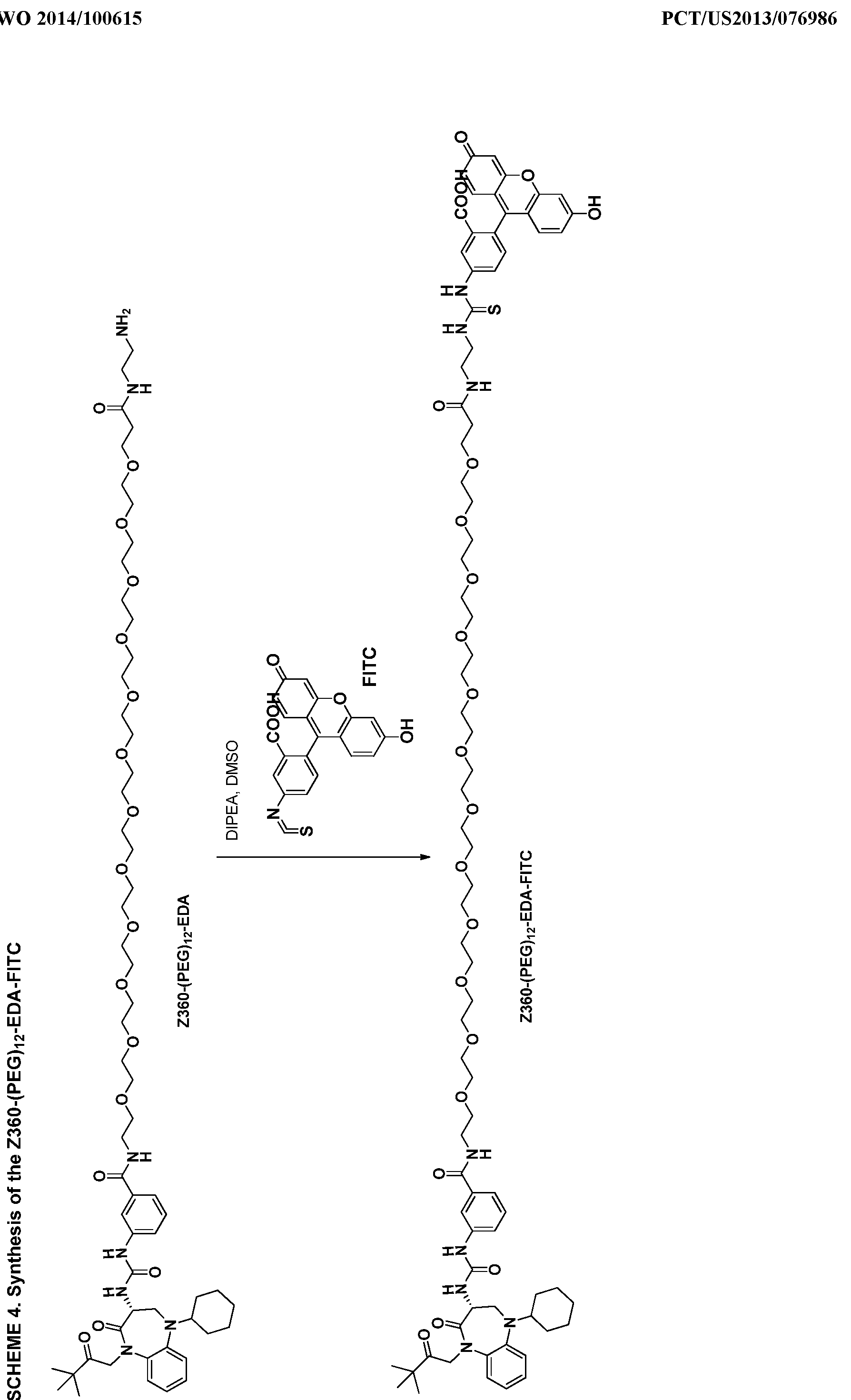
3. Binding of FITC-Folate and FITC-(PEG)r?-Folate conjugates to transduced T cells through anti-FITC scFV in CAR4-1BBZ
[00120] To examine the ability of the transduced T cells containing CAR4-1BBZ to bind the FITC-Folate conjugates, binding assays with the FITC-Folate conjugate and the FITC- (PEG) 12- Folate conjugate were performed. Since the excitation wavelength of FITC in the FITC-Folate conjugates overlapped with copGFP in CAR4-1BB transduced T cells, it was difficult to distinguish between FITC binding and copGFP expression. Therefore, an anti-Folate Acid (FA) monoclonal antibody and a fluorephore (excitation 640nm)-labeled anti-mouse IgG antibody were utilized.
[00121] First, the transduced T cells were incubated with FITC-Folate or FITC-(PEG)12- Folate conjugates at room temperature for 1 hour. After washing with IX PBS, transduced T cells were incubated with anti-FA monoclonal antibody (1: 15 dilution) for 1 hour. After another washing with IX PBS, transduced T cells further were incubated with fluorophore (excitation 640nm) labeled anti-mouse IgG antibody (1:50 dilution). Finally, unbound antibodies were washed away and a confocal microscope was used to confirm the FITC-Folate and FITC- (PEG)12-Folate conjugates binding ability. All data was analyzed by Olympus Fluoview software. As shown in Figure 2, copGFP expression was observed on the transduced T cells containing CAR 4-1BBZ (top row), but not in non-transduced T cells. As shown in the middle panel, FITC-folate binding was observed on CAR-1BBZ transduced T cells, but not on non- transduced T cells. More importantly, only those transduced T cells showing copGFP expression (top row) also show FITC-Folate conjugates binding (middle row). By confocal microscopy, it was confirmed that FITC-Folate and FITC-(PEG)12-Folate conjugates were successfully bound to anti-FITC in transduced T cells, but not to non-transduced T cells. Simultaneously, binding of FITC-Folate and FITC-(PEG)12-Folate conjugates (arrows) were also detected on the CAR4- 1BBZ transduced T cells. Based on this data, it was concluded that transduced T cells express CAR4-1BBZ, and that FITC-Folate conjugates can bind to transduced T cells through anti-FITC scFv expressed by CAR4-1BBZ transduction.
4. The binding of FITC-Folate conjugates to FR positive cancer cells
[00122] The ability of the FITC-Folate and FITC- (PEG) 12-Folate conjugates to bind folate receptor (FR) positive cancer cells was next investigated. FR positive cells lines L1210A (Mouse
lymphocytic leukemia) and KB (Mouth epidermal carcinoma), which are FR positive cell lines, were used to test the binding affinity of the FITC-Folate conjugates. Briefly, 3-4 x 10⁴ cancer cells were prepared to perform binding affinity assays with FITC-Folate and FITC-(PEG)12- Folate conjugates. With two different concentrations (e.g. 20nM, 70nM), the two FITC-Folate conjugates were incubated with cancer cells at room temperature for 1 hour. Since both FITC- Folate conjugates have fluorescence, the binding ability of FITC-Folate conjugates to cancer cells can be detected by florescence microscopy. After two washes with IX phosphate buffered saline (PBS) to remove all unbound compound, the cancer cells were observed by confocal microscope. In order to specify whether FITC-Folate conjugates bind to cancer cells via FR on the surface of cancer cells, Folate Acid was also incubated with cancer cells as a competition compound. As shown in Figures 3A, B, C, and D, the FITC-Folate conjugates can bind to both cancer cells (KB, L1210A) via FR on the cell surface. As shown in competition panel, addition of 50X excess folate acid blocked FITC-Folate binding with these cancer cells, which indicates the specific binding is between folate acid and FR on cell surface.
[00123] As shown in Figure 3A, the FITC-Folate conjugate was internalized into KB cell cytoplasm, caused by FR mediated endocytosis. However, as shown in Figure 3C, the FITC- (PEG)12-Folate conjugate, which has a (PEG)12 linker between Folate and FITC, stayed on the extracellular surface of the KB cells.
[00124] From this data it was concluded that the FITC-Folate and FITC-(PEG)12-Folate conjugates can bind to cancer cells through FR on the surface of cancer cells. It was also found that the PEG linker between Folate and FITC can prohibit the internalization of FITC-Folate conjugate. Surface localization of FITC-Folate conjugate would help increase the chance for cancer cells to be recognized by transduced T cell containing CAR4-1BBZ. If FITC-Folate conjugates are internalized via FR mediated endocytosis, transduced T cells cannot target cancer cells through FITC-Folate conjugates.
5. Cytotoxicity of anti-FITC CAR- modified T cells against Folate receptor positive (FR+) cancer cells
[00125] In order to explore whether CAR-expressing T cells can kill cancer cells, 51Chromium release assays were conducted. In this assay, cancer cells are labeled with 51Cr. When cancer
cells are lysed, Cr would be released from cancer cells to supernatant. By measuring Cr in supernatant, the number of cancer cells killed can be determined.
[00126] First, target cancer cells L1210A were incubated in 50μί growth medium containing 50 μθ 51Chromium to get labeled. After washing with PBS X3, L1210A cells were resuspended and incubated at 37°C for 1 hour in the growth medium containing 70nM FITC-Folate conjugate or FITC-(PEG) 12-Folate conjugate. After washing away excess FITC conjugates, 5 x 10 target cancer cells were added in each well of 96-well plates. When adhesive KB cells were used as the target, they were treated similar as L1210A cells, except KB cells were grown in 96-well plates for 24 hours before 51Cr labeling and FITC-Folate conjugates binding were performed in 96-well plates. Effector T cells were then harvested, resuspended in growth media and added to the wells containing target cancer cells. The effector T cell to target cancer cell ratio was 20: 1. After incubation for 4-10 hours, 20 μL· aliquots of cell-free supernatant were harvested and 51Cr in the supernatants was measured with a scintillation counter or a γ-counter.
[00127] Percent specific cytolysis was calculated using following formula:
% cytolysis = (Experimental 51Cr release - control 51Cr release) / (Maximum 51Cr release - control 51Cr release) X 100
[00128] Control wells contained only target cancer cells, effector T cells were never added in these wells. Maximum 51Cr release was determined by measuring 51Cr release from labeled target cells treated with 2.5% SDS to lyse all cells.
[00129] As shown in Figure 4A, in the absence of FITC-Folate conjugates, CAR-expressing T cells showed negligible activity (-5%) on target KB cell cytolysis. In the presence of FITC- Folate conjugate, CAR-expressing T cells showed -18% cancer cell cytolysis. It is implicated that FITC-Folate conjugate acts as a bridge to redirect anti-FITC CAR-expressing T cells to FR+
KB cells. Furthermore, in the presence of FITC-(PEG) 12-Folate conjugate, which has a -40 A (PEG)12 spacer between FITC and Folate molecules, anti-FITC CAR-expressing T cells showed much higher activity (-39%) on cancer cell cytolysis. With -40 A distance between FITC and Folate, this conjugate can redirect CAR-expressing T cells to FR+ KB cells much better (39% vs. 18%). As the non-specific cytotoxicity control, unmodified T cells showed only 5-10% cytolysis. The existence or absence of the FITC-Folate conjugates did not show any effect on unmodified T cell cytotoxicity against FR+ KB cells.
[00130] Figure 4B shows cytotoxicity of anti-FITC CAR modified T cells against cancer cell line L1210A. In the absence of FITC-Folate conjugates, CAR-expressing T cells showed negligible activity (2-3%) on target L1210A cell cytolysis. In the presence of FITC-Folate conjugate , CAR-expressing T cells showed -29% cancer cell cytolysis. It is implicated that FITC-Folate conjugate acts as a bridge to redirect anti-FITC CAR-expressing T cells to FR+ L1210A cells. Furthermore, in the presence of the FITC-(PEG) 12-Folate conjugate, which has a
-40 A (PEG)12 spacer between FITC and Folate molecules, anti-FITC CAR-expressing T cells showed much higher activity (-51%) on FR+ L1210A cytolysis. With -40 A distance between FITC and Folate, this conjugate can redirect CAR-expressing T cells to FR+ L1210A much better (51% vs. 29%). As the non-specific cytotoxicity control, unmodified T cells showed only 5-10% cytolysis as expected.
[00131] From this data it was concluded that anti-FITC CAR-expressing T cells do not have innate cytotoxicity against FR+ cancer cells. However, in the presence of the FITC-Folate conjugate, anti-FITC CAR-expressing T cells are redirected to FR+ cancer cells and cause specific cytolysis, and the activation of CAR-expressing T cells can be regulated by controlling of the addition of FITC-Folate conjugates. Further, the FITC- (PEG) 12-Folate conjugate, which has a -40 A spacer between the FITC and the Folate molecules, can redirect anti-FITC CAR- expressing T cells to FR+ cancer cells much better than the conjugate without the spacer.
* * * *
[00132] While the invention has been described with reference to certain particular embodiments thereof, those skilled in the art will appreciate that various modifications may be made without departing from the spirit and scope of the invention. The scope of the appended claims is not to be limited to the specific embodiments described.
REFERENCES
[00133] All patents and publications mentioned in this specification are indicative of the level of skill of those skilled in the art to which the invention pertains. Each cited patent and publication is incorporated herein by reference in its entirety. All of the following references have been cited in this application:
1. Sadelain, M. et al., The basic principles of chimeric antigen receptor design. Cancer Discovery. 2013. 3(4):388-98.
2. Cartellieri, M. et al., Chimeric antigen receptor-engineered T cells for immunotherapy of cancer. J Biomedicine and Biotechnology . 2010. Article ID 956304, 13 pages.
3. Urba, W.J. et al., Redirecting T cells. N Engl J Med. 2011. 365:8.
4. Porter, D.L. et al., Chimeric antigen receptor-modified T cells in chronic lymphoid leukemia. N Engl J Med. 2011. 365:725-33.
5. Cor, H.J. et al., Treatment of Metastatic Renal Cell Carcinoma With Autologous T- Lymphocytes Genetically Retargeted Against Carbonic Anhydrase IX: First Clinical Experience. J Clin Oncol. 2006. 24(13):e20-2.
6. Kochenderfer, J.N. et al., B-cell depletion and remissions of malignancy along with cytokine-assoicated toxicity in clinical trial of anti-CD 19 chimeric antigen receptor transduced T cells. Blood. 2012. 119(12):2790-20.
7. Reichert, J.M. Day 1, Emerging Disruptive Technologies and Cutting-Edge Analytical Techniques. MAbs 2009. 1(3): 190-209.
8. Kularatne, S.A. et al., Pro state- specific membrane antigen targeted imaging and therapy of prostate cancer using a PSMA inhibitor as a homing ligand. Mol Pharm. 2009. 6(3):780-9.
9. Wayua. C. et al., Evaluation of a Cholecystokinin 2 Receptor-Targeted Near-Infrared Dye for Fluorescence-Guided Surgery of Cancer. Molecular Pharmaceutics. 2013.
(ePublication).
10. Sega, E.I. et al,, Tumor detection using folate receptor-targeted imaging agents. Cancer Metastasis Rev. 2008. 27(4):655-64.
11. Alvarez- Vallina, L. et al,, Antigen-specific targeting of CD28-mediated T cell co- stimulation using chimeric single-chain antibody variable fragment-CD28 receptors. Eur J Immunol. 1996. 26(10):2304-9.
12. Imai, C. et al., Chimeric receptors with 4- IBB signaling capacity provoke potent cytotoxicity against acute lymphoblastic leukemia. Leukemia. 2004. 18:676-84.
13. Latza, U. et al., The human OX40 homolog: cDNA structure expression and
chromosomal assignment of the ACT35 antigen. Eur. J. Immunol. 1994. 24:677.
14. Hutloff, A. et al., ICOS is an inducible T-cell costimulator structurally and functionally related to CD28. Nature. 1999. 397:263.
15. Orr, B.A., et al., Rapid Method for Measuring ScFv Thermal Stability by Yeast Surface Display. Biotechnol Prog. 2003. 19(2):631-8.
16. Kolmar, H. et al., Alternative binding proteins: biological activity and therapeutic potential of cysteine-knot miniproteins. The FEBS Journal. 2008. 275(11):26684-90
Claims
1. A two component cancer therapeutic comprising:
(a) a small conjugate molecule (SCM) comprising a targeted moiety conjugated to a tumor receptor ligand, wherein the tumor receptor ligand is selected from the group consisting of folate, DUPA, and CCK2R ligand; and
(b) chimeric antigen receptor (CAR)-expressing cytotoxic lymphocytes, wherein the CAR is a fusion protein comprising a recognition region, a co-stimulation domain and an activation signaling domain, and wherein the CAR has binding specificity for the targeted moiety or can be bound by the targeted moiety.
2. The two component cancer therapeutic of claim 1, wherein the targeted moiety and the ligand are conjugated via a linker domain.
3. The two component cancer therapeutic of claim 1, wherein the targeted moiety is a molecule selected from the group consisting of 2,4-dinitrophenol (DNP), 2,4,6-trinitrophenol (TNP), biotin, digoxigenin, fluorescein, fluorescein isothiocyanate (FITC), NHS -fluorescein, pentafluorophenyl ester (PFP), tetrafluorophenyl ester (TFP), a knottin, a centyrin, and a DARPin.
4. The two component cancer therapeutic of claim 2, wherein the linker domain is selected from the group consisting of polyethylene glycol (PEG), polyproline, a hydrophilic amino acid, a sugar, an unnatural peptideoglycan, polyvinylpyrrolidone, and pluronic F-127.
5. The two component cancer therapeutic of claim 1, wherein the targeted moiety is
FITC.
6. The two component cancer therapeutic of claim 4, wherein the targeted moiety is FITC and the linker is (PEG)12.
7. The two component cancer therapeutic of claim 1, wherein the recognition region of the CAR is a single chain fragment variable (scFv) region of an antibody with binding specificity for the targeted moiety.
8. The two component cancer therapeutic of claim 5 or 6, wherein the recognition region of the CAR is a single chain fragment variable (scFv) region of an anti-FITC antibody.
9. The two component cancer therapeutic of claim 1, wherein the co- stimulation domain of the CAR is selected from the group consisting of CD28, CD137 (4-1BB), CD134 (OX40), and CD278 (ICOS).
10. The two component cancer therapeutic of claim 1, wherein the activation signaling domain of the CAR is the T cell CD3ζ chain or Fc receptor γ.
11. The two component cancer therapeutic of claim 5 or 6, wherein the recognition region is a single chain fragment variable (scFv) region of an anti-FITC antibody, wherein the co-stimulation domain is CD137 (4-1BB), and wherein the activation signaling domain is the T cell CD3C chain.
12. The two component cancer therapeutic of claim 1, wherein the cytotoxic lymphocyte are one or more cell types selected from the group consisting of cytotoxic T cells, natural killer (NK) cells, and lymphokine- activated killer (LAK) cells.
13. A small conjugate molecule (SCM) comprising a targeted moiety conjugated to a tumor receptor ligand, wherein the tumor receptor ligand is selected from the group consisting of folate, DUPA, and CCK2R ligand.
14. The SCM of claim 13, wherein the targeted moiety and the ligand are conjugated via a linker domain.
15. The SCM of claim 13, wherein the targeted moiety is a molecule selected from the group consisting of 2,4-dinitrophenol (DNP), 2,4,6-trinitrophenol (TNP), biotin, digoxigenin, fluorescein, fluorescein isothiocyanate (FITC), NHS -fluorescein, pentafluorophenyl ester (PFP), tetrafluorophenyl ester (TFP), a knottin, a centyrin, and a DARPin.
16. The SCM of claim 14, wherein the linker domain is selected from the group consisting of polyethylene glycol (PEG), polyproline, a hydrophilic amino acid, a sugar, an unnatural peptideoglycan, polyvinylpyrrolidone, and pluronic F-127.
17. The SCM of claim 13, wherein the targeted moiety is FITC.
18. The SCM of claim 16, wherein the targeted moiety is FITC and the linker is (PEG)12.
19. The SCM of claim 13, comprising FITC-folate, FITC-DUPA, FITC-CCK2R ligand, FITC-(PEG)12-folate, FITC-(PEG)12-DUPA, or FITC-(PEG)12-CCK2R ligand.
20. CAR-expressing lymphocytes, wherein the CAR is a fusion protein comprising a recognition region, a co- stimulation domain and an activation signaling domain, and wherein the CAR has binding specificity for a selected targeted moiety or can be bound by the targeted moiety.
21. The CAR-expressing cytotoxic lymphocytes of claim 20, wherein the recognition region of the CAR is a single chain fragment variable (scFv) region of an antibody with binding specificity for the targeted moiety.
22. The CAR-expressing cytotoxic lymphocytes of claim 21, wherein the recognition region of the CAR is a single chain fragment variable (scFv) region of an anti-FITC antibody.
23. The CAR-expressing cytotoxic lymphocytes of claim 20, wherein the co- stimulation domain of the CAR is selected from the group consisting of CD28, CD137 (4-lBB), CD134 (OX40), and CD278 (ICOS).
24. The CAR-expressing cytotoxic lymphocytes of claim 20, wherein the activation signaling domain of the CAR is the T cell CD3ζ chain or Fc receptor γ.
25. The CAR-expressing cytotoxic lymphocytes of claim 20, wherein the recognition region is a single chain fragment variable (scFv) region of an anti-FITC antibody, wherein the co-stimulation domain is CD137 (4-lBB), and wherein the activation signaling domain is the T cell CD3C chain.
26. The CAR-expressing cytotoxic lymphocytes of claim 20, wherein the targeted moiety is a molecule selected from the group consisting of 2,4-dinitrophenol (DNP), 2,4,6- trinitrophenol (TNP), biotin, digoxigenin, fluorescein, fluorescein isothiocyanate (FITC), NHS- fluorescein, pentafluorophenyl ester (PFP), tetrafluorophenyl ester (TFP), a knottin, a centyrin, and a DARPin.
27. The CAR-expressing cytotoxic lymphocytes of claim 20, wherein the cytotoxic lymphocyte are one or more cell types selected from the group consisting of cytotoxic T cells, natural killer (NK) cells, and lymphokine- activated killer (LAK) cells.
28. A method of treating cancer in a subject, comprising:
(a) culturing a population of cytotoxic lymphocytes under conditions promoting activation;
(b) transfecting the lymphocyte population of (a) with a vector encoding a chimeric antigen receptor (CAR), wherein the CAR is a fusion protein comprising a recognition region, a co-stimulation domain and an activation signaling domain;
(c) administering a therapeutically effective number of the transfected lymphocytes of (b) to a subject having cancer; and
(d) administering a small conjugate molecule (SCM) comprising a targeted moiety conjugated to a tumor receptor ligand to the subject, wherein the ligand is recognized and bound by a receptor on the surface of a cell of the cancer, and wherein the CAR has binding specificity for the targeted moiety or can be bound by the targeted moiety;
thereby treating cancer in a subject.
29. A method of treating cancer in a subject, comprising:
(a) culturing a population of cytotoxic lymphocytes under conditions promoting activation;
(b) transfecting the lymphocyte population of (a) with a vector encoding a chimeric antigen receptor (CAR), wherein the CAR is a fusion protein comprising a recognition region, a co-stimulation domain and an activation signaling domain;
(c) administering a small conjugate molecule (SCM) comprising a targeted moiety conjugated to a tumor receptor ligand to a subject having cancer, wherein the ligand is recognized and bound by a receptor on the surface of a cell of the cancer; and
(d) administering a therapeutically effective number of the transfected T cells of (b) to the subject, and wherein the CAR has binding specificity for the targeted moiety or can be bound by the targeted moiety;
thereby treating cancer in a subject.
30. A method of treating cancer in a subject, comprising:
(a) culturing a population of cytotoxic lymphocytes under conditions promoting activation;
(b) transfecting the lymphocytes population of (a) with a vector encoding a chimeric antigen receptor (CAR), wherein the CAR is a fusion protein comprising a recognition region, a co-stimulation domain and an activation signaling domain, and wherein the CAR has binding specificity for a targeted moiety or can be bound by the targeted moiety;
(c) incubating the lymphocytes of (b) with a small conjugate molecule (SCM) comprising a targeted moiety conjugated to a tumor receptor ligand;
(d) administering a therapeutically effective number of the transfected lymphocytes of (c) to a subject having cancer;
thereby treating cancer in a subject.
31. The method of any one of claims 28-30, wherein the lymphocytes are autologous or heterologous cells, with respect to the subject being treated.
32. The method of any one of claims 28-30, wherein the culturing conditions of (a) comprise culturing the population of lymphocytes in the presence of anti-CD3 antibodies or anti- CD28 antibodies, or both.
33. The method of any one of claims 28-30, wherein the recognition region of the CAR is a single chain fragment variable (scFv) region of an antibody with binding specificity for the targeted moiety.
34. The method of any one of claims 28-30, wherein the recognition region of the CAR is a single chain fragment variable (scFv) region of an anti-FITC antibody.
35. The method of any one of claims 28-30, wherein the co- stimulation domain of the CAR is selected from the group consisting of CD28, CD137 (4-1BB), CD134 (OX40), and CD278 (ICOS).
36. The method of any one of claims 28-30, wherein the activation signaling domain of the CAR is the T cell CD3ζ chain or Fc receptor γ.
37. The method of any one of claims 28-30, wherein the recognition region is a single chain fragment variable (scFv) region of an anti-FITC antibody, wherein the co-stimulation domain is CD137 (4-1BB), and wherein the activation signaling domain is the T cell CD3ζ chain.
38. The method of any one of claims 28-30, wherein the targeted moiety is a molecule selected from the group consisting of 2,4-dinitrophenol (DNP), 2,4,6-trinitrophenol (TNP), biotin, digoxigenin, fluorescein, fluorescein isothiocyanate (FITC), NHS -fluorescein, pentafluorophenyl ester (PFP), tetrafluorophenyl ester (TFP), a knottin, a centyrin, and a DARPin.
39. The method of any one of claims 28-30, wherein the ligand is selected from the group consisting of folate, DUPA, and CCK2R ligand.
40. The method of any one of claims 28-30, wherein the targeted moiety and the ligand are conjugated via a linker domain.
41. The method of claim 40, wherein the linker domain is selected from the group consisting of polyethylene glycol (PEG), polyproline, a hydrophilic amino acid, a sugar, an unnatural peptideoglycan, polyvinylpyrrolidone, and pluronic F-127.
42. The method of claim 38, wherein the targeted moiety is FITC.
43. The method of claim 41, wherein the targeted moiety is FITC and the linker is (PEG)12.
44. The method of claim 42 or 43, wherein the ligand is selected from the group consisting of folate, DUPA, and CCK2R ligand.
45. The method of any one of claims 28-30, wherein the vector is a lentivirus vector.
46. The method of any one of claims 28-30, wherein the cytotoxic lymphocytes are one or more cell types selected from the group consisting of cytotoxic T cells, natural killer (NK) cells, and lymphokine-activated killer (LAK) cells.
47. The method of any one of claims 28-30, wherein the subject is a human.
48. The method of any one of claims 28-30, wherein the cancer is one or more of a cancer of the brain, thyroid, lung, pancreas, kidney, stomach, gastrointestinal stroma, endometrium, breast, cervix, ovary, colon, prostate, leukemias, lymphomas, other blood-related cancers, or head and neck cancer.
Priority Applications (9)
| Application Number | Priority Date | Filing Date | Title |
|---|---|---|---|
| EP23169858.0A EP4282419A1 (en) | 2012-12-20 | 2013-12-20 | Chimeric antigen receptor-expressing t cells as anti-cancer therapeutics |
| US14/654,227 US20150320799A1 (en) | 2012-12-20 | 2013-12-20 | Chimeric antigen receptor-expressing t cells as anti-cancer therapeutics |
| HK16103743.6A HK1215791B (en) | 2012-12-20 | 2013-12-20 | Chimeric antigen receptor-expressing t cells as anti-cancer therapeutics |
| EP13864097.4A EP2934532B1 (en) | 2012-12-20 | 2013-12-20 | Chimeric antigen receptor-expressing t cells as anti-cancer therapeutics |
| ES13864097T ES2776698T3 (en) | 2012-12-20 | 2013-12-20 | T cells expressing a chimeric antigen receptor as cancer therapy |
| EP19204092.1A EP3653212B1 (en) | 2012-12-20 | 2013-12-20 | Chimeric antigen receptor-expressing t cells as anti-cancer therapeutics |
| US15/296,666 US20170290900A1 (en) | 2012-12-20 | 2016-10-18 | Chimeric antigen receptor-expressing t cells as anti-cancer therapeutics |
| US17/387,892 US12150981B2 (en) | 2012-12-20 | 2021-07-28 | Chimeric antigen receptor-expressing T cells as anti-cancer therapeutics |
| US18/915,595 US20250144195A1 (en) | 2012-12-20 | 2024-10-15 | Chimeric antigen receptor-expressing t cells as anti-cancer therapeutics |
Applications Claiming Priority (2)
| Application Number | Priority Date | Filing Date | Title |
|---|---|---|---|
| US201261740384P | 2012-12-20 | 2012-12-20 | |
| US61/740,384 | 2012-12-20 |
Related Child Applications (2)
| Application Number | Title | Priority Date | Filing Date |
|---|---|---|---|
| US14/654,227 A-371-Of-International US20150320799A1 (en) | 2012-12-20 | 2013-12-20 | Chimeric antigen receptor-expressing t cells as anti-cancer therapeutics |
| US15/296,666 Continuation US20170290900A1 (en) | 2012-12-20 | 2016-10-18 | Chimeric antigen receptor-expressing t cells as anti-cancer therapeutics |
Publications (1)
| Publication Number | Publication Date |
|---|---|
| WO2014100615A1 true WO2014100615A1 (en) | 2014-06-26 |
Family
ID=50979254
Family Applications (1)
| Application Number | Title | Priority Date | Filing Date |
|---|---|---|---|
| PCT/US2013/076986 Ceased WO2014100615A1 (en) | 2012-12-20 | 2013-12-20 | Chimeric antigen receptor-expressing t cells as anti-cancer therapeutics |
Country Status (4)
| Country | Link |
|---|---|
| US (4) | US20150320799A1 (en) |
| EP (3) | EP4282419A1 (en) |
| ES (2) | ES2776698T3 (en) |
| WO (1) | WO2014100615A1 (en) |
Cited By (33)
| Publication number | Priority date | Publication date | Assignee | Title |
|---|---|---|---|---|
| WO2016073381A1 (en) * | 2014-11-03 | 2016-05-12 | Cerus Corporation | Compositions and methods for improved car-t cell therapies |
| WO2016100980A1 (en) * | 2014-12-19 | 2016-06-23 | Dana-Farber Cancer Institute, Inc. | Carbonic anhydrase ix specific chimeric antigen receptors and methods of use thereof |
| WO2017030370A1 (en) * | 2015-08-17 | 2017-02-23 | 서울대학교산학협력단 | Chimeric antibody receptor to which anti-cotinine antibody is linked, and use thereof |
| US9624276B2 (en) | 2013-10-15 | 2017-04-18 | The California Institute For Biomedical Research | Peptidic chimeric antigen receptor T cell switches and uses thereof |
| EP3315511A1 (en) | 2016-10-29 | 2018-05-02 | Miltenyi Biotec GmbH | Adapter chimeric antigen receptor expressing cells for targeting of multiple antigens |
| WO2018160622A1 (en) | 2017-02-28 | 2018-09-07 | Endocyte, Inc. | Compositions and methods for car t cell therapy |
| CN109195611A (en) * | 2016-04-08 | 2019-01-11 | 普渡研究基金会 | Methods and compositions for CAR T cell therapy |
| CN109890841A (en) * | 2016-07-15 | 2019-06-14 | 波赛达治疗公司 | Chimeric antigen receptors and methods of use |
| WO2019166453A1 (en) * | 2018-03-01 | 2019-09-06 | F. Hoffmann-La Roche Ag | Specificity assay for novel target antigen binding moieties |
| EP3620464A1 (en) | 2018-09-10 | 2020-03-11 | Miltenyi Biotec GmbH | Car cell having crosslinked disulfide bridge on antigen recognizing moiety |
| US10611814B2 (en) | 2014-08-29 | 2020-04-07 | Gemoab Monoclonals Gmbh | Universal chimeric antigen expressing immune cells for targeting of diverse multiple antigens and method of manufacturing the same and use of the same for treatment of cancer, infections and autoimmune disorders |
| WO2020201527A1 (en) | 2019-04-04 | 2020-10-08 | Umc Utrecht Holding B.V. | Modified immune receptor constructs |
| US10800828B2 (en) | 2015-03-26 | 2020-10-13 | The Scripps Research Institute | Switchable non-scFv chimeric receptors, switches, and methods of use thereof to treat cancer |
| CN112055595A (en) * | 2018-01-22 | 2020-12-08 | 恩多塞特公司 | Methods of use of CAR T cells |
| CN112105382A (en) * | 2018-02-23 | 2020-12-18 | 恩多塞特公司 | Sequential methods for CAR T cell therapy |
| WO2021156277A1 (en) * | 2020-02-04 | 2021-08-12 | Miltenyi Biotec B.V. & Co. KG | Immune cell expressing adapter chimeric antigen receptor for sensing soluble antigens |
| US11091546B2 (en) | 2015-04-15 | 2021-08-17 | The Scripps Research Institute | Optimized PNE-based chimeric receptor T cell switches and uses thereof |
| WO2021164959A1 (en) * | 2020-02-17 | 2021-08-26 | Miltenyi Biotec B.V. & Co. KG | Method for providing personalized cells with chimeric antigen receptors (car) against tumor microenvironment cells |
| EP3878464A1 (en) | 2020-03-09 | 2021-09-15 | Miltenyi Biotec B.V. & Co. KG | Use of a car cell having crosslinked disulfide bridge on antigen recognizing moiety for targeting cancer cells |
| US11174306B2 (en) | 2016-10-19 | 2021-11-16 | The Scripps Research Institute | Chimeric antigen receptor effector cell switches with humanized targeting moieties and/or optimized chimeric antigen receptor interacting domains and uses thereof |
| US20210393786A1 (en) * | 2018-07-26 | 2021-12-23 | Purdue Research Foundation | Small molecule ligand-targeted drug conjugates for anti-influenza chemotherapy and immunotherapy |
| US11225520B2 (en) | 2016-02-16 | 2022-01-18 | Dana-Farber Cancer Institute, Inc. | Immunotherapy compositions and methods |
| WO2022015955A1 (en) | 2020-07-16 | 2022-01-20 | Umoja Biopharma, Inc. | Gated adapter targeting receptor |
| US20220186232A1 (en) * | 2019-03-26 | 2022-06-16 | Gavish-Galilee Bio Applications Ltd. | Genetically reprogrammed tregs expressing cars |
| JP2023513157A (en) * | 2020-02-04 | 2023-03-30 | シアトル チルドレンズ ホスピタル (ディービーエイ シアトル チルドレンズ リサーチ インスティテュート) | anti-dinitrophenol chimeric antigen receptor |
| US11649288B2 (en) | 2017-02-07 | 2023-05-16 | Seattle Children's Hospital | Phospholipid ether (PLE) CAR T cell tumor targeting (CTCT) agents |
| US11707486B2 (en) | 2017-01-05 | 2023-07-25 | Korea Research Institute Of Bioscience And Biotechnology | Natural killer cell expressing anti-cotinine chimeric antigen receptor |
| US11890300B2 (en) | 2016-12-15 | 2024-02-06 | Miltenyi Biotec B.V. & Co. KG | Immune cells expressing an antigen binding receptor and a chimeric costimulatory receptor |
| EP4178626A4 (en) * | 2020-07-13 | 2024-08-14 | University of Southern California | UNIVERSAL CAR-NK CELL TARGETING VARIOUS HIV-1 GP160 EPITOPES |
| US12150981B2 (en) | 2012-12-20 | 2024-11-26 | Purdue Research Foundation | Chimeric antigen receptor-expressing T cells as anti-cancer therapeutics |
| US12312416B2 (en) | 2018-02-06 | 2025-05-27 | Seattle Children's Hospital | Fluorescein-specific cars exhibiting optimal t cell function against FL-PLE labelled tumors |
| US12415844B2 (en) | 2017-12-20 | 2025-09-16 | Poseida Therapeutics, Inc. | BCMA specific VCAR compositions and methods for use |
| US12466869B2 (en) | 2018-06-28 | 2025-11-11 | Dana-Farber Cancer Institute, Inc. | Targeting of multiple antigens with multiplex CAR T cells in solid and liquid malignancies |
Families Citing this family (24)
| Publication number | Priority date | Publication date | Assignee | Title |
|---|---|---|---|---|
| US9962361B2 (en) | 2011-01-03 | 2018-05-08 | The William M. Yarbrough Foundation | Isothiocyanate functional surfactants, formulations incorporating the same, and associated methods of use |
| US9532969B2 (en) | 2011-02-08 | 2017-01-03 | The William M. Yarbrough Foundation | Method for treating psoriasis |
| US10434081B2 (en) | 2012-07-26 | 2019-10-08 | The William M. Yarbrough Foundation | Inhibitors of macrophage migration inhibitory factor |
| US10441561B2 (en) | 2012-07-26 | 2019-10-15 | The William M. Yanbrough Foundation | Method for treating benign prostatic hyperplasia (BPH), prostatitis, and prostate cancer |
| US10335387B2 (en) | 2012-07-26 | 2019-07-02 | The William M. Yarbrough Foundation | Method for treating infectious diseases with isothiocyanate functional compounds |
| US10434082B2 (en) | 2012-07-26 | 2019-10-08 | The William M. Yarbrough Foundation | Isothiocyanate functional compounds augmented with secondary antineoplastic medicaments and associated methods for treating neoplasms |
| US20180036312A1 (en) * | 2016-08-02 | 2018-02-08 | ISI Life Sciences Inc. | Novel Scaffolds for Intracellular Compound Delivery for the Detection of Cancer Cells |
| KR102630036B1 (en) | 2016-12-23 | 2024-01-29 | 마크로제닉스, 인크. | ADAM9-Binding Molecules, and Methods of Use Thereof |
| US11559504B2 (en) * | 2017-06-02 | 2023-01-24 | The Penn State Research Foundation | Ceramide nanoliposomes, compositions and methods of using for immunotherapy |
| SG11202009975TA (en) | 2018-04-12 | 2020-11-27 | Umoja Biopharma Inc | Viral vectors and packaging cell lines |
| EP3937975A4 (en) * | 2019-03-13 | 2023-06-21 | Seattle Children's Hospital (DBA Seattle Children's Research Institute) | Sodium fluorescein as a reversal agent for an anti-fluorescein car t cells and fluorescein-phospholipid-ethers or profluorescein-phospholipid-ethers |
| IL296176A (en) * | 2020-03-06 | 2022-11-01 | Purdue Research Foundation | Methods, compounds, and compositions for modifying car-t cell activity |
| EP4165584B1 (en) | 2020-06-10 | 2025-04-02 | Snap Inc. | Contextual sending menu |
| CN117858706A (en) * | 2021-01-04 | 2024-04-09 | 普渡研究基金会 | Methods to enhance engineered cell therapies in cancer treatment |
| CA3242986A1 (en) | 2021-12-17 | 2023-06-22 | Umoja Biopharma, Inc. | Cytotoxic innate lymphoid cell and uses thereof |
| JP2025518534A (en) | 2022-05-17 | 2025-06-17 | ウモジャ バイオファーマ インコーポレイテッド | Production of viral particles |
| EP4531862A2 (en) * | 2022-05-26 | 2025-04-09 | Purdue Research Foundation | Combination of small molecule drug conjugate and car-expressing cytotoxic lymphocytes and methods of use |
| JP2025524353A (en) | 2022-06-09 | 2025-07-30 | ウモジャ バイオファーマ インコーポレイテッド | Compositions and methods for NK cell differentiation |
| CA3259061A1 (en) | 2022-06-10 | 2023-12-14 | Umoja Biopharma, Inc. | Engineered stem cells and uses thereof |
| KR20250042171A (en) | 2022-07-27 | 2025-03-26 | 우모자 바이오파마 인코포레이티드 | Differentiation of stem cells in suspension culture |
| WO2024098038A2 (en) | 2022-11-04 | 2024-05-10 | Umoja Biopharma, Inc. | Polynucleotide construct and related viral vectors and methods |
| TW202434735A (en) | 2022-11-04 | 2024-09-01 | 美商烏莫賈生物製藥股份有限公司 | Particles displaying adhesion-molecule fusions |
| WO2025129084A1 (en) | 2023-12-13 | 2025-06-19 | Umoja Biopharma, Inc. | Engineered induced stem cell derived myeloid cells and methods of differentiating and using same |
| WO2025231174A1 (en) | 2024-04-30 | 2025-11-06 | Umoja Biopharma, Inc. | Manufacturing viral particles |
Citations (4)
| Publication number | Priority date | Publication date | Assignee | Title |
|---|---|---|---|---|
| US20050113564A1 (en) * | 2003-11-05 | 2005-05-26 | St. Jude Children's Research Hospital | Chimeric receptors with 4-1BB stimulatory signaling domain |
| WO2009091826A2 (en) * | 2008-01-14 | 2009-07-23 | The Board Of Regents Of The University Of Texas System | Compositions and methods related to a human cd19-specific chimeric antigen receptor (h-car) |
| WO2012082841A2 (en) * | 2010-12-14 | 2012-06-21 | University Of Maryland, Baltimore | Universal anti-tag chimeric antigen receptor-expressing t cells and methods of treating cancer |
| CN102775500A (en) * | 2012-08-03 | 2012-11-14 | 郑骏年 | Chimeric antigen receptor iRGD-scFv (G250)-CD8-CD28-CD137-CD3zeta and application thereof |
Family Cites Families (395)
| Publication number | Priority date | Publication date | Assignee | Title |
|---|---|---|---|---|
| DE3650625T2 (en) | 1985-01-28 | 1997-10-02 | Xoma Corp | AraB promoter and process for the production of polypeptides including cecropins by means of microbiological processes |
| US4690915A (en) | 1985-08-08 | 1987-09-01 | The United States Of America As Represented By The Department Of Health And Human Services | Adoptive immunotherapy as a treatment modality in humans |
| IN165717B (en) | 1986-08-07 | 1989-12-23 | Battelle Memorial Institute | |
| US4946778A (en) | 1987-09-21 | 1990-08-07 | Genex Corporation | Single polypeptide chain binding molecules |
| US5202238A (en) | 1987-10-27 | 1993-04-13 | Oncogen | Production of chimeric antibodies by homologous recombination |
| US6004781A (en) | 1988-01-22 | 1999-12-21 | The General Hospital Corporation | Nucleic acid encoding Ig-CD4 fusion proteins |
| IL86278A (en) | 1988-05-04 | 2003-06-24 | Yeda Res & Dev | Endowing cells with antibody specificity using chimeric t cell receptor |
| US5906936A (en) | 1988-05-04 | 1999-05-25 | Yeda Research And Development Co. Ltd. | Endowing lymphocytes with antibody specificity |
| US5116964A (en) | 1989-02-23 | 1992-05-26 | Genentech, Inc. | Hybrid immunoglobulins |
| US6406697B1 (en) | 1989-02-23 | 2002-06-18 | Genentech, Inc. | Hybrid immunoglobulins |
| US5225538A (en) | 1989-02-23 | 1993-07-06 | Genentech, Inc. | Lymphocyte homing receptor/immunoglobulin fusion proteins |
| US5216132A (en) | 1990-01-12 | 1993-06-01 | Protein Design Labs, Inc. | Soluble t-cell antigen receptor chimeric antigens |
| US20020004052A1 (en) | 1990-05-08 | 2002-01-10 | David Berd | Composition comprising a tumor cell extract and method of using the composition |
| US5914109A (en) | 1990-06-15 | 1999-06-22 | New York University | Heterohybridomas producing human monoclonal antibodies to HIV-1 |
| US6319494B1 (en) | 1990-12-14 | 2001-11-20 | Cell Genesys, Inc. | Chimeric chains for receptor-associated signal transduction pathways |
| US20020111474A1 (en) | 1990-12-14 | 2002-08-15 | Capon Daniel J. | Chimeric chains for receptor-associated signal transduction pathways |
| KR100246529B1 (en) | 1990-12-14 | 2000-04-01 | 스티븐 에이. 서윈. 엠.디. | Chimeric Chains for Receptor-Related Signal Transduction Pathways |
| US6407221B1 (en) | 1990-12-14 | 2002-06-18 | Cell Genesys, Inc. | Chimeric chains for receptor-associated signal transduction pathways |
| US7049136B2 (en) | 1991-03-07 | 2006-05-23 | The General Hospital Corporation | Redirection of cellular immunity by receptor chimeras |
| US6004811A (en) | 1991-03-07 | 1999-12-21 | The Massachussetts General Hospital | Redirection of cellular immunity by protein tyrosine kinase chimeras |
| US5843728A (en) | 1991-03-07 | 1998-12-01 | The General Hospital Corporation | Redirection of cellular immunity by receptor chimeras |
| US6753162B1 (en) | 1991-03-07 | 2004-06-22 | The General Hospital Corporation | Targeted cytolysis of HIV-infected cells by chimeric CD4 receptor-bearing cells |
| US5851828A (en) | 1991-03-07 | 1998-12-22 | The General Hospital Corporation | Targeted cytolysis of HIV-infected cells by chimeric CD4 receptor-bearing cells |
| US5912170A (en) | 1991-03-07 | 1999-06-15 | The General Hospital Corporation | Redirection of cellular immunity by protein-tyrosine kinase chimeras |
| IL101147A (en) | 1991-03-07 | 2004-06-20 | Gen Hospital Corp | Redirection of cellular immunity by receptor chimeras |
| JPH06505396A (en) | 1991-03-08 | 1994-06-23 | サイトメッド,インコーポレイテッド | Soluble CD28 protein and therapeutic methods using the same |
| US6582959B2 (en) | 1991-03-29 | 2003-06-24 | Genentech, Inc. | Antibodies to vascular endothelial cell growth factor |
| DK0610345T3 (en) | 1991-10-21 | 2000-10-23 | Cell Genesys Inc | Combined cellular and immunosuppressive therapies |
| US8211422B2 (en) | 1992-03-18 | 2012-07-03 | The United States Of America, As Represented By The Secretary, Department Of Health And Human Services | Chimeric receptor genes and cells transformed therewith |
| IL104570A0 (en) | 1992-03-18 | 1993-05-13 | Yeda Res & Dev | Chimeric genes and cells transformed therewith |
| US5372930A (en) | 1992-09-16 | 1994-12-13 | The United States Of America As Represented By The Secretary Of The Navy | Sensor for ultra-low concentration molecular recognition |
| US6953668B1 (en) | 1992-11-05 | 2005-10-11 | Sloan-Kettering Institute For Cancer Research | Prostate-specific membrane antigen |
| US7105159B1 (en) | 1992-11-05 | 2006-09-12 | Sloan-Kettering Institute For Cancer Research | Antibodies to prostate-specific membrane antigen |
| WO1994009820A1 (en) | 1992-11-05 | 1994-05-11 | Sloan-Kettering Institute For Cancer Research | Prostate-specific membrane antigen |
| US5861156A (en) | 1993-01-08 | 1999-01-19 | Creative Biomolecules | Methods of delivering agents to target cells |
| AU695869B2 (en) | 1993-04-06 | 1998-08-27 | Fred Hutchinson Cancer Research Center | Chimeric cytokine receptors in lymphocytes |
| US5834256A (en) | 1993-06-11 | 1998-11-10 | Cell Genesys, Inc. | Method for production of high titer virus and high efficiency retroviral mediated transduction of mammalian cells |
| US6051427A (en) | 1993-06-11 | 2000-04-18 | Cell Genesys, Inc. | Method for production of high titer virus and high efficiency retroviral mediated transduction of mammalian cells |
| US5525503A (en) | 1993-09-28 | 1996-06-11 | Dana-Farber Cancer Institute, Inc. | Signal transduction via CD28 |
| US5935818A (en) | 1995-02-24 | 1999-08-10 | Sloan-Kettering Institute For Cancer Research | Isolated nucleic acid molecule encoding alternatively spliced prostate-specific membrane antigen and uses thereof |
| WO1995030014A1 (en) | 1994-05-02 | 1995-11-09 | Ciba-Geigy Ag | Bifunctional protein, preparation and use |
| US7354587B1 (en) | 1994-07-06 | 2008-04-08 | Immunomedics, Inc. | Use of immunoconjugates to enhance the efficacy of multi-stage cascade boosting vaccines |
| US5798100A (en) | 1994-07-06 | 1998-08-25 | Immunomedics, Inc. | Multi-stage cascade boosting vaccine |
| EP0787188A1 (en) | 1994-11-01 | 1997-08-06 | Targeted Genetics Corporation | Chimeric receptors for the generation of selectively-activatable t h?-independent cytotoxic t cells |
| US5741899A (en) | 1995-02-02 | 1998-04-21 | Cell Genesys, Inc. | Chimeric receptors comprising janus kinase for regulating cellular pro liferation |
| US5712149A (en) | 1995-02-03 | 1998-01-27 | Cell Genesys, Inc. | Chimeric receptor molecules for delivery of co-stimulatory signals |
| US6103521A (en) | 1995-02-06 | 2000-08-15 | Cell Genesys, Inc. | Multispecific chimeric receptors |
| CA2212846A1 (en) | 1995-02-24 | 1996-08-29 | Sloan-Kettering Institute For Cancer Research | Prostate-specific membrane antigen and uses thereof |
| US5830755A (en) | 1995-03-27 | 1998-11-03 | The United States Of America As Represented By The Secretary Of The Department Of Health And Human Services | T-cell receptors and their use in therapeutic and diagnostic methods |
| WO1997004752A1 (en) | 1995-07-26 | 1997-02-13 | Duramed Pharmaceuticals, Inc. | Pharmaceutical compositions of conjugated estrogens and methods for their use |
| GB9526131D0 (en) | 1995-12-21 | 1996-02-21 | Celltech Therapeutics Ltd | Recombinant chimeric receptors |
| WO1997034634A1 (en) | 1996-03-20 | 1997-09-25 | Sloan-Kettering Institute For Cancer Research | Single chain fv constructs of anti-ganglioside gd2 antibodies |
| US6261787B1 (en) | 1996-06-03 | 2001-07-17 | Case Western Reserve University | Bifunctional molecules for delivery of therapeutics |
| US5969102A (en) | 1997-03-03 | 1999-10-19 | St. Jude Children's Research Hospital | Lymphocyte surface receptor that binds CAML, nucleic acids encoding the same and methods of use thereof |
| US20020018783A1 (en) | 1997-03-20 | 2002-02-14 | Michel Sadelain | Fusion proteins of a single chain antibody and cd28 and uses thereof |
| ATE380873T1 (en) | 1997-06-11 | 2007-12-15 | Univ New York | PRENYLCYSTONE CARBOXYL METHYL TRANSFERASE, DNA CODING FOR THE SAME, AND A METHOD FOR SEARCHING FOR INHIBITORS |
| US6759243B2 (en) | 1998-01-20 | 2004-07-06 | Board Of Trustees Of The University Of Illinois | High affinity TCR proteins and methods |
| US20090011984A1 (en) | 1998-02-23 | 2009-01-08 | Seppo Yla-Herttuala | Biotin-binding receptor molecules |
| GB9809951D0 (en) | 1998-05-08 | 1998-07-08 | Univ Cambridge Tech | Binding molecules |
| WO1999060119A2 (en) | 1998-05-19 | 1999-11-25 | Avidex, Ltd. | Multivalent t cell receptor complexes |
| JP2002524081A (en) | 1998-09-04 | 2002-08-06 | スローン − ケッタリング インスティチュート フォー キャンサー リサーチ | Fusion receptor specific for prostate-specific membrane antigen and uses thereof |
| US6410319B1 (en) | 1998-10-20 | 2002-06-25 | City Of Hope | CD20-specific redirected T cells and their use in cellular immunotherapy of CD20+ malignancies |
| WO2000023087A1 (en) | 1998-10-21 | 2000-04-27 | Sunol Molecular Corporation | Polyspecific binding molecules and uses thereof |
| US7217421B1 (en) | 1998-11-03 | 2007-05-15 | Cell Genesys, Inc. | Cancer-associated antigens and methods of their identification and use |
| JP2003523722A (en) | 1999-03-01 | 2003-08-12 | セル ジェネシス インコーポレイテッド | Antineoplastic compositions and uses thereof |
| AU4418900A (en) | 1999-04-16 | 2000-11-02 | Celltech Therapeutics Limited | Synthetic transmembrane components |
| US6699972B1 (en) | 1999-06-25 | 2004-03-02 | Academia Sinica | Chimeric protein and method of controlling tumor growth using the protein |
| ATE360031T1 (en) | 2000-01-03 | 2007-05-15 | Tr Associates L L C | CHIMERIC PROTEINS AND APPLICATIONS |
| ATE360430T1 (en) | 2000-02-14 | 2007-05-15 | Univ California | VACCINE SPECIFIC AGAINST KIDNEY TUMORS, DIRECTED AGAINST THE KIDNEY TUMOR ANTIGEN G-250 |
| US6770749B2 (en) | 2000-02-22 | 2004-08-03 | City Of Hope | P53-specific T cell receptor for adoptive immunotherapy |
| NZ521898A (en) | 2000-03-31 | 2004-11-26 | Purdue Research Foundation | Use of a ligand-immunogen conjugate such as folate-FITC for enhancing an endogenous immune response |
| WO2001091625A2 (en) | 2000-04-21 | 2001-12-06 | Rutgers, The State University Of New Jersey | Methods and compositions for the diagnosis of schizophrenia |
| US6524572B1 (en) | 2000-06-26 | 2003-02-25 | Rainbow Therapeutic Company | Targeting recombinant virus with a bispecific fusion protein ligand in coupling with an antibody to cells for gene therapy |
| WO2002010369A1 (en) | 2000-07-31 | 2002-02-07 | Kyogo Itoh | Tumor antigen |
| US7666424B2 (en) | 2001-10-17 | 2010-02-23 | Sloan-Kettering Institute For Cancer Research | Methods of preparing and using single chain anti-tumor antibodies |
| CA2425862C (en) | 2000-11-07 | 2013-01-22 | City Of Hope | Cd19-specific redirected immune cells |
| US20020132983A1 (en) | 2000-11-30 | 2002-09-19 | Junghans Richard P. | Antibodies as chimeric effector cell receptors against tumor antigens |
| US7723111B2 (en) | 2001-03-09 | 2010-05-25 | The United States Of America As Represented By The Department Of Health And Human Services | Activated dual specificity lymphocytes and their methods of use |
| US7070995B2 (en) | 2001-04-11 | 2006-07-04 | City Of Hope | CE7-specific redirected immune cells |
| AU2002256390B2 (en) | 2001-04-30 | 2007-08-30 | City Of Hope | Chimeric immunoreceptor useful in treating human cancers |
| US20090257994A1 (en) | 2001-04-30 | 2009-10-15 | City Of Hope | Chimeric immunoreceptor useful in treating human cancers |
| US7514537B2 (en) | 2001-04-30 | 2009-04-07 | City Of Hope | Chimeric immunoreceptor useful in treating human gliomas |
| US7939059B2 (en) | 2001-12-10 | 2011-05-10 | California Institute Of Technology | Method for the generation of antigen-specific lymphocytes |
| US20070031438A1 (en) | 2001-12-10 | 2007-02-08 | Junghans Richard P | Antibodies as chimeric effector cell receptors against tumor antigens |
| US20030170238A1 (en) | 2002-03-07 | 2003-09-11 | Gruenberg Micheal L. | Re-activated T-cells for adoptive immunotherapy |
| US7446190B2 (en) | 2002-05-28 | 2008-11-04 | Sloan-Kettering Institute For Cancer Research | Nucleic acids encoding chimeric T cell receptors |
| AU2003256912A1 (en) | 2002-08-16 | 2004-03-03 | Yeda Research And Development Co. Ltd. | Tumor associated antigen, peptides thereof, and use of same as anti-tumor vaccines |
| DE10244457A1 (en) | 2002-09-24 | 2004-04-01 | Johannes-Gutenberg-Universität Mainz | Process for the rational mutagenesis of alpha / beta T-cell receptors and corresponding mutated MDM2 protein-specific alpha / beta T-cell receptors |
| US20060018878A1 (en) | 2003-03-11 | 2006-01-26 | City Of Hope | Dual antigen specific T cells with trafficking ability |
| US20050129671A1 (en) | 2003-03-11 | 2005-06-16 | City Of Hope | Mammalian antigen-presenting T cells and bi-specific T cells |
| TWI353991B (en) | 2003-05-06 | 2011-12-11 | Syntonix Pharmaceuticals Inc | Immunoglobulin chimeric monomer-dimer hybrids |
| US7348004B2 (en) | 2003-05-06 | 2008-03-25 | Syntonix Pharmaceuticals, Inc. | Immunoglobulin chimeric monomer-dimer hybrids |
| US7435596B2 (en) | 2004-11-04 | 2008-10-14 | St. Jude Children's Research Hospital, Inc. | Modified cell line and method for expansion of NK cell |
| US20130266551A1 (en) | 2003-11-05 | 2013-10-10 | St. Jude Children's Research Hospital, Inc. | Chimeric receptors with 4-1bb stimulatory signaling domain |
| US8652484B2 (en) | 2004-02-13 | 2014-02-18 | Immunomedics, Inc. | Delivery system for cytotoxic drugs by bispecific antibody pretargeting |
| US7196062B2 (en) | 2004-02-18 | 2007-03-27 | Wisconsin Alumni Research Foundation | Method for treating glaucoma |
| ES2330951T3 (en) | 2004-03-02 | 2009-12-17 | Cellectar, Inc. | PHOSPHOLIPIDE ANALOGS FOR THE TREATMENT OF CANCERES. |
| DK3406631T3 (en) | 2004-07-10 | 2022-08-29 | The Institute For Cancer Res | GENETICALLY MODIFIED HUMAN NATURAL KILLER CELL LINES |
| TWI380996B (en) | 2004-09-17 | 2013-01-01 | Hoffmann La Roche | Anti-ox40l antibodies |
| US7994298B2 (en) | 2004-09-24 | 2011-08-09 | Trustees Of Dartmouth College | Chimeric NK receptor and methods for treating cancer |
| CA2590401C (en) | 2004-10-08 | 2015-04-21 | Government Of The United States Of America, Represented By The Secretary, Department Of Health And Human Services | Adoptive immunotherapy with enhanced t lymphocyte survival |
| CA2587766A1 (en) | 2004-11-10 | 2007-03-01 | Macrogenics, Inc. | Engineering fc antibody regions to confer effector function |
| WO2007044033A2 (en) | 2004-12-07 | 2007-04-19 | University Of Pittsburgh Of The Commonwealth System Of Higher Education | Therapeutic and diagnostic cloned mhc-unrestricted receptor specific for the muc1 tumor associated antigen |
| US20070036773A1 (en) | 2005-08-09 | 2007-02-15 | City Of Hope | Generation and application of universal T cells for B-ALL |
| WO2007065027A2 (en) | 2005-12-02 | 2007-06-07 | Dana Farber Cancer Institute | Carbonic anhydrase ix (g250) antibodies and methods of use thereof |
| US7919079B2 (en) | 2006-03-31 | 2011-04-05 | Biosante Pharmaceuticals, Inc. | Cancer immunotherapy compositions and methods of use |
| RU2487888C2 (en) | 2006-06-12 | 2013-07-20 | ЭМЕРДЖЕНТ ПРОДАКТ ДИВЕЛОПМЕНТ СИЭТЛ, ЭлЭлСи | Single-chain multivalent binding proteins with effector function |
| US20080051380A1 (en) | 2006-08-25 | 2008-02-28 | Auerbach Alan H | Methods and compositions for treating cancer |
| EP1900752A1 (en) | 2006-09-15 | 2008-03-19 | DOMPE' pha.r.ma s.p.a. | Human anti-folate receptor alpha antibodies and antibody fragments for the radioimmunotherapy of ovarian carcinoma |
| US20100105136A1 (en) | 2006-10-09 | 2010-04-29 | The General Hospital Corporation | Chimeric t-cell receptors and t-cells targeting egfrviii on tumors |
| US9334330B2 (en) | 2006-10-10 | 2016-05-10 | Universite De Nantes | Use of monoclonal antibodies specific to the O-acetylated form of GD2 ganglioside for the treatment of certain cancers |
| EP2087337A4 (en) | 2006-11-03 | 2010-09-08 | Purdue Research Foundation | <I> EX VIVO </ I> FLOW CYTOMETRY METHOD AND DEVICE |
| CA2667414C (en) | 2006-11-13 | 2015-12-29 | Sangamo Biosciences, Inc. | Methods and compositions for modification of the human glucocorticoid receptor locus |
| US20080131415A1 (en) | 2006-11-30 | 2008-06-05 | Riddell Stanley R | Adoptive transfer of cd8 + t cell clones derived from central memory cells |
| US8748405B2 (en) | 2007-01-26 | 2014-06-10 | City Of Hope | Methods and compositions for the treatment of cancer or other diseases |
| DE602008006041D1 (en) | 2007-01-30 | 2011-05-19 | Forerunner Pharma Res Co Ltd | CHIMERIC Fc GAMMA RECEPTOR AND METHOD FOR DETERMINING ADCC ACTIVITY USING THE RECEPTOR |
| WO2008095141A2 (en) | 2007-01-31 | 2008-08-07 | Yeda Research And Development Co. Ltd. | Redirected, genetically-engineered t regulatory cells and their use in suppression of autoimmune and inflammatory disease |
| US8859229B2 (en) | 2007-02-02 | 2014-10-14 | Yale University | Transient transfection with RNA |
| US8865169B2 (en) | 2007-02-20 | 2014-10-21 | Tufts University | Methods and systems for multi-antibody therapies |
| US8389282B2 (en) | 2007-03-30 | 2013-03-05 | Memorial Sloan-Kettering Cancer Center | Constitutive expression of costimulatory ligands on adoptively transferred T lymphocytes |
| JPWO2009020094A1 (en) | 2007-08-09 | 2010-11-04 | 第一三共株式会社 | Antibodies modified with hydrophobic molecules |
| US20110070191A1 (en) | 2008-03-19 | 2011-03-24 | Wong Hing C | T cell receptor fusions and conjugates and methods of use there of |
| EP2279253B1 (en) | 2008-04-09 | 2016-11-16 | Maxcyte, Inc. | Engineering and delivery of therapeutic compositions of freshly isolated cells |
| NZ603059A (en) | 2008-04-11 | 2014-07-25 | Emergent Product Dev Seattle | Cd37 immunotherapeutic and combination with bifunctional chemotherapeutic thereof |
| US20090324630A1 (en) | 2008-04-21 | 2009-12-31 | Jensen Michael C | Fusion multiviral chimeric antigen |
| PL3006459T3 (en) | 2008-08-26 | 2022-01-17 | City Of Hope | Method and compositions for enhanced anti-tumor effector functioning of t cells |
| EP2349274B1 (en) * | 2008-09-17 | 2025-04-09 | Endocyte, Inc. | Folate receptor binding conjugates of antifolates |
| EP4335932A3 (en) | 2008-11-07 | 2024-06-26 | Adaptive Biotechnologies Corporation | Methods of monitoring conditions by sequence analysis |
| EP2398466B1 (en) | 2008-11-24 | 2021-02-17 | Massachusetts Institute of Technology | Methods and compositions for localized nanoparticle delivery to a tumor |
| US20110178279A1 (en) | 2009-08-03 | 2011-07-21 | Williams John C | Development of masked therapeutic antibodies to limit off-target effects: application to anti-egfr antibodies |
| WO2010132532A1 (en) | 2009-05-15 | 2010-11-18 | The United States Of America, As Represented By The Secretary, Department Of Health And Human Services | B cell surface reactive antibodies |
| US20100322909A1 (en) | 2009-06-17 | 2010-12-23 | The University Of Pittsburgh - Of The Commonwealth System Of Higher Education | Th1-associated micrornas and their use for tumor immunotherapy |
| CA2776143A1 (en) | 2009-10-01 | 2011-04-07 | The United States Of America, As Represented By The Secretary, Departmen T Of Health And Human Services | Anti-vascular endothelial growth factor receptor-2 chimeric antigen receptors and use of same for the treatment of cancer |
| EP2494038B1 (en) | 2009-10-27 | 2019-06-26 | Immunicum AB | Method for proliferation of antigen-specific t cells |
| US9273283B2 (en) | 2009-10-29 | 2016-03-01 | The Trustees Of Dartmouth College | Method of producing T cell receptor-deficient T cells expressing a chimeric receptor |
| WO2011059836A2 (en) | 2009-10-29 | 2011-05-19 | Trustees Of Dartmouth College | T cell receptor-deficient t cell compositions |
| WO2011056894A2 (en) | 2009-11-03 | 2011-05-12 | Jensen Michael C | TRUNCATED EPIDERIMAL GROWTH FACTOR RECEPTOR (EGFRt) FOR TRANSDUCED T CELL SELECTION |
| EP2698430A3 (en) | 2009-12-08 | 2014-03-05 | Wilson Wolf Manufacturing Corporation | Methods of cell culture for adoptive cell therapy |
| US8956860B2 (en) | 2009-12-08 | 2015-02-17 | Juan F. Vera | Methods of cell culture for adoptive cell therapy |
| CN102947453A (en) | 2010-01-28 | 2013-02-27 | 费城儿童医院 | Scalable production platform for viral vector purification and use of such purified viral vectors in gene therapy |
| ES2724451T3 (en) | 2010-02-04 | 2019-09-11 | Univ Pennsylvania | ICOS fundamentally regulates the expansion and function of inflammatory human Th17 lymphocytes |
| NZ601743A (en) | 2010-02-12 | 2014-11-28 | Oncomed Pharm Inc | Methods for identifying and isolating cells expressing a polypeptide |
| SA111320200B1 (en) | 2010-02-17 | 2014-02-16 | ديبيوفارم اس ايه | Bicyclic Compounds and their Uses as Dual C-SRC / JAK Inhibitors |
| WO2011130491A2 (en) | 2010-04-14 | 2011-10-20 | Roger Williams Medical Center | Methods and compositions for treating hiv |
| ES2686424T5 (en) | 2010-05-04 | 2023-03-27 | Yeda Res & Dev | Redirected allogeneic cell immunotherapy |
| WO2011146862A1 (en) | 2010-05-21 | 2011-11-24 | Bellicum Pharmaceuticals, Inc. | Methods for inducing selective apoptosis |
| US9242014B2 (en) | 2010-06-15 | 2016-01-26 | The Regents Of The University Of California | Receptor tyrosine kinase-like orphan receptor 1 (ROR1) single chain Fv antibody fragment conjugates and methods of use thereof |
| WO2012012695A2 (en) | 2010-07-23 | 2012-01-26 | Fred Hutchinson Cancer Research Center | A method for the treatment of obesity |
| DE102010036122A1 (en) | 2010-09-01 | 2012-03-01 | Nora Systems Gmbh | Flooring |
| EP2614143B1 (en) | 2010-09-08 | 2018-11-07 | Baylor College Of Medicine | Immunotherapy of non-small lung cancer using genetically engineered gd2-specific t cells |
| EP2614151B1 (en) | 2010-09-08 | 2019-07-24 | Chemotherapeutisches Forschungsinstitut Georg-Speyer-Haus | Interleukin 15 as selectable marker for gene transfer in lymphocytes |
| ES2602743T3 (en) | 2010-09-08 | 2017-02-22 | Chemotherapeutisches Forschungsinstitut Georg-Speyer-Haus | Chimeric antigen receptors with an optimized hinge region |
| CN103124740B (en) | 2010-09-21 | 2015-09-02 | 美国卫生和人力服务部 | Anti-SSX-2T cell receptor and associated materials and using method |
| CN103154257A (en) | 2010-09-26 | 2013-06-12 | 大玉企业有限公司 | Method of recombinant macromolecular production |
| US9845362B2 (en) | 2010-10-08 | 2017-12-19 | The University Of North Carolina At Charlotte | Compositions comprising chimeric antigen receptors, T cells comprising the same, and methods of using the same |
| WO2012054825A1 (en) | 2010-10-22 | 2012-04-26 | The United States Of America, As Represented By The Secretary, Department Of Health And Human Services | Anti-mage-a3 t cell receptors and related materials and methods of use |
| PH12013501201A1 (en) | 2010-12-09 | 2013-07-29 | Univ Pennsylvania | Use of chimeric antigen receptor-modified t cells to treat cancer |
| WO2012076059A1 (en) | 2010-12-09 | 2012-06-14 | Stichting Het Nederlands Kanker Instituut | Immune restricted peptides with increased efficacy |
| KR20140004174A (en) | 2011-01-18 | 2014-01-10 | 더 트러스티스 오브 더 유니버시티 오브 펜실바니아 | Compositions and methods for treating cancer |
| EP2673300B1 (en) | 2011-02-11 | 2016-08-24 | Memorial Sloan-Kettering Cancer Center | Hla-restricted, peptide-specific antigen binding proteins |
| CN106074601A (en) | 2011-03-23 | 2016-11-09 | 弗雷德哈钦森癌症研究中心 | Method and composition for cellular immunotherapy |
| EP2502934B1 (en) | 2011-03-24 | 2018-01-17 | Universitätsmedizin der Johannes Gutenberg-Universität Mainz | Single chain antigen recognizing constructs (scARCs) stabilized by the introduction of novel disulfide bonds |
| EP2694553B1 (en) | 2011-04-01 | 2017-10-11 | Memorial Sloan-Kettering Cancer Center | T cell receptor-like antibodies specific for a wt1 peptide presented by hla-a2 |
| ES2872077T3 (en) | 2011-04-08 | 2021-11-02 | Us Health | Chimeric antigen receptor anti-variant III epidermal growth factor receptor and use of the same for the treatment of cancer |
| US9476028B2 (en) | 2011-04-13 | 2016-10-25 | Immunicum Ab | Method for proliferation of antigen-specific T cells |
| EP2696894B1 (en) | 2011-04-13 | 2017-11-01 | Immunicum AB | Method for priming of t cells |
| ES2666550T3 (en) | 2011-04-19 | 2018-05-07 | The United States Of America, As Represented By The Secretary, Department Of Health And Human Services | Human monoclonal antibodies specific for glypican 3 and their use |
| GB201108236D0 (en) | 2011-05-17 | 2011-06-29 | Ucl Business Plc | Method |
| ES2888651T3 (en) | 2011-07-29 | 2022-01-05 | Univ Pennsylvania | costimulatory switching receptors |
| CA2844540C (en) | 2011-08-23 | 2018-10-16 | Roche Glycart Ag | Bispecific antibodies specific for t-cell activating antigens and a tumor antigen and methods of use |
| WO2013033626A2 (en) | 2011-08-31 | 2013-03-07 | Trustees Of Dartmouth College | Nkp30 receptor targeted therapeutics |
| PT3392270T (en) | 2011-09-15 | 2020-11-24 | Us Health | T cell receptors recognizing hla-a1- or hla-cw7-restricted mage |
| EA201490636A1 (en) | 2011-09-16 | 2014-08-29 | Дзе Трастиз Оф Дзе Юниверсити Оф Пенсильвания | T-CELLS DESIGNED WITH THE HELP OF RNA FOR THE TREATMENT OF MALIGNOUS NON-FORMATIONS |
| ES2795023T3 (en) | 2011-09-16 | 2020-11-20 | Baylor College Medicine | Specific recognition of the tumor microenvironment using engineered NKT cells |
| WO2013044225A1 (en) | 2011-09-22 | 2013-03-28 | The Trustees Of The University Of Pennsylvania | A universal immune receptor expressed by t cells for the targeting of diverse and multiple antigens |
| WO2013051718A1 (en) | 2011-10-07 | 2013-04-11 | 国立大学法人三重大学 | Chimeric antigen receptor |
| IN2014CN02906A (en) | 2011-10-20 | 2015-07-03 | Us Health | |
| US9688740B2 (en) | 2011-10-26 | 2017-06-27 | National Cancer Center | Mutant CTLA4 gene transfected T cell and composition including same for anticancer immunotherapy |
| US9272002B2 (en) | 2011-10-28 | 2016-03-01 | The Trustees Of The University Of Pennsylvania | Fully human, anti-mesothelin specific chimeric immune receptor for redirected mesothelin-expressing cell targeting |
| WO2013063019A1 (en) | 2011-10-28 | 2013-05-02 | The Wistar Institute Of Anatomy And Biology | Methods and compositions for enhancing the therapeutic effect of anti-tumor t cells |
| EP2773651B1 (en) | 2011-11-03 | 2020-12-23 | The Trustees of the University of Pennsylvania | Isolated b7-h4 specific compositions and methods of use thereof |
| US20140322216A1 (en) | 2011-11-08 | 2014-10-30 | The Trustees Of The University Of Pennsylvania | Glypican-3-specific antibody and uses thereof |
| JP6368243B2 (en) | 2011-11-11 | 2018-08-08 | フレッド ハッチンソン キャンサー リサーチ センター | T-cell immunotherapy targeted to cyclin A1 for cancer |
| WO2013088446A1 (en) | 2011-12-16 | 2013-06-20 | Targetgene Biotechnologies Ltd | Compositions and methods for modifying a predetermined target nucleic acid sequence |
| CA2859755C (en) | 2011-12-23 | 2021-04-20 | Pfizer Inc. | Engineered antibody constant regions for site-specific conjugation and methods and uses therefor |
| AU2013211824B2 (en) | 2012-01-27 | 2017-06-01 | Gliknik Inc. | Fusion proteins comprising IgG2 hinge domains |
| JP6850528B2 (en) | 2012-02-13 | 2021-03-31 | シアトル チルドレンズ ホスピタル ドゥーイング ビジネス アズ シアトル チルドレンズ リサーチ インスティテュート | Bispecific chimeric antigen receptor and its therapeutic use |
| ES2959443T3 (en) | 2012-02-22 | 2024-02-26 | Univ Pennsylvania | Use of the CD2 signaling domain in second-generation chimeric antigen receptors |
| EP4230647A1 (en) | 2012-02-22 | 2023-08-23 | The Trustees of the University of Pennsylvania | Use of icos-based cars to enhance antitumor activity and car persistence |
| WO2013126726A1 (en) | 2012-02-22 | 2013-08-29 | The Trustees Of The University Of Pennsylvania | Double transgenic t cells comprising a car and a tcr and their methods of use |
| EP3421489B1 (en) | 2012-03-23 | 2021-05-05 | The United States of America, as represented by The Secretary, Department of Health and Human Services | Anti-mesothelin chimeric antigen receptors |
| KR20210032014A (en) | 2012-04-11 | 2021-03-23 | 더 유나이티드 스테이츠 오브 어메리카, 애즈 리프리젠티드 바이 더 세크러테리, 디파트먼트 오브 헬쓰 앤드 휴먼 서비씨즈 | Chimeric antigen receptors targeting b-cell maturation antigen |
| US9156915B2 (en) | 2012-04-26 | 2015-10-13 | Thomas Jefferson University | Anti-GCC antibody molecules |
| CN107557334B (en) | 2012-05-03 | 2021-06-25 | 弗雷德哈钦森癌症研究中心 | T cell receptor with enhanced affinity and preparation method thereof |
| WO2013169691A1 (en) | 2012-05-07 | 2013-11-14 | Trustees Of Dartmouth College | Anti-b7-h6 antibody, fusion proteins, and methods of using the same |
| DE102012009412B4 (en) | 2012-05-11 | 2014-09-18 | Incoe International, Inc. | Cooling device for the drive for adjusting the needle of a needle valve in hot runner systems for injection molding |
| EP2852613B1 (en) | 2012-05-22 | 2019-01-23 | The United States of America, as represented by The Secretary, Department of Health and Human Services | Murine anti-ny-eso-1 t cell receptors |
| AU2013266398A1 (en) | 2012-05-22 | 2015-01-22 | Genentech, Inc. | N-substituted benzamides and their use in the treatment of pain |
| WO2013176915A1 (en) | 2012-05-25 | 2013-11-28 | Roman Galetto | Methods for engineering allogeneic and immunosuppressive resistant t cell for immunotherapy |
| SG11201407972RA (en) | 2012-06-01 | 2015-01-29 | Us Health | High-affinity monoclonal antibodies to glypican-3 and use thereof |
| EP2878670B1 (en) | 2012-06-08 | 2019-08-07 | Kinki University | Antibody against transporter and use thereof |
| JP5863585B2 (en) | 2012-07-11 | 2016-02-16 | 三菱電機株式会社 | Transistor characteristic calculation device using large signal equivalent circuit model |
| EA028988B1 (en) | 2012-07-13 | 2018-01-31 | Дзе Трастиз Оф Дзе Юниверсити Оф Пенсильвания | METHOD FOR VITRO CULTURE ANALYSIS OF GENETICALLY MODIFIED T-CELLS FOR POLLUTION DETECTION |
| SG11201408398UA (en) | 2012-07-13 | 2015-02-27 | Univ Pennsylvania | Compositions and methods for regulating car t cells |
| WO2014011988A2 (en) | 2012-07-13 | 2014-01-16 | The Trustees Of The University Of Pennsylvania | Enhancing activity of car t cells by co-introducing a bispecific antibody |
| CA2878928C (en) | 2012-07-13 | 2023-03-14 | The Trustees Of The University Of Pennsylvania | Toxicity management for anti-tumor activity of cars |
| ES2842102T3 (en) | 2012-08-20 | 2021-07-12 | Hutchinson Fred Cancer Res | Method and compositions for cellular immunotherapy |
| AU2013306076B2 (en) | 2012-08-21 | 2018-01-25 | The United States Of America, As Represented By The Secretary, Department Of Health And Human Services | Mesothelin domain-specific monoclonal antibodies and use thereof |
| BR112015004522A2 (en) | 2012-09-04 | 2017-11-21 | Cellectis | multi-chain chimeric antigen receptor and uses of these |
| PT2895509T (en) | 2012-09-14 | 2020-03-13 | Us Health | T-CELL RECEIVERS THAT RECOGNIZE MHC CLASS 3 MHC RESTRICTED |
| EP2900695B1 (en) | 2012-09-27 | 2018-01-17 | The United States Of America, As Represented By The Secretary, Department Of Health And Human Services | Mesothelin antibodies and methods for eliciting potent antitumor activity |
| AR092745A1 (en) | 2012-10-01 | 2015-04-29 | Univ Pennsylvania | COMPOSITIONS THAT INCLUDE AN ANTI-FAP UNION DOMAIN AND METHODS TO MAKE WHITE IN STROMAL CELLS FOR THE TREATMENT OF CANCER |
| NZ746914A (en) | 2012-10-02 | 2020-03-27 | Memorial Sloan Kettering Cancer Center | Compositions and methods for immunotherapy |
| US10117896B2 (en) | 2012-10-05 | 2018-11-06 | The Trustees Of The University Of Pennsylvania | Use of a trans-signaling approach in chimeric antigen receptors |
| WO2014055771A1 (en) | 2012-10-05 | 2014-04-10 | The Trustees Of The University Of Pennsylvania | Human alpha-folate receptor chimeric antigen receptor |
| AU2013329186B2 (en) | 2012-10-10 | 2019-02-14 | Sangamo Therapeutics, Inc. | T cell modifying compounds and uses thereof |
| WO2014059248A1 (en) | 2012-10-12 | 2014-04-17 | Philadelphia Health & Education Corporation D/B/A/ Drexel | Mir-155 enhancement of cd8+ t cell immunity |
| UY35103A (en) | 2012-10-29 | 2014-05-30 | Glaxo Group Ltd | 2-REPLACED CEFEM COMPOUNDS |
| AU2013204922B2 (en) | 2012-12-20 | 2015-05-14 | Celgene Corporation | Chimeric antigen receptors |
| WO2014100615A1 (en) | 2012-12-20 | 2014-06-26 | Purdue Research Foundation | Chimeric antigen receptor-expressing t cells as anti-cancer therapeutics |
| WO2014099671A1 (en) | 2012-12-20 | 2014-06-26 | Bluebird Bio, Inc. | Chimeric antigen receptors and immune cells targeting b cell malignancies |
| SG11201505858VA (en) | 2013-01-28 | 2015-09-29 | St Jude Childrens Res Hospital | A chimeric receptor with nkg2d specificity for use in cell therapy against cancer and infectious disease |
| CA3115383A1 (en) | 2013-02-06 | 2014-08-14 | Celgene Corporation | Modified t lymphocytes having improved specificity |
| JO3529B1 (en) | 2013-02-08 | 2020-07-05 | Amgen Res Munich Gmbh | Anti-leukocyte adhesion for the mitigation of potential adverse events caused by CD3-specific binding domains |
| KR102332790B1 (en) | 2013-02-15 | 2021-12-01 | 더 리젠츠 오브 더 유니버시티 오브 캘리포니아 | Chimeric Antigen Receptor and Methods of Use Thereof |
| EP2958942B1 (en) | 2013-02-20 | 2020-06-03 | Novartis AG | Effective targeting of primary human leukemia using anti-cd123 chimeric antigen receptor engineered t cells |
| KR102685501B1 (en) | 2013-02-20 | 2024-07-17 | 노파르티스 아게 | Treatment of cancer using humanized anti-egfrviii chimeric antigen receptor |
| US9434935B2 (en) | 2013-03-10 | 2016-09-06 | Bellicum Pharmaceuticals, Inc. | Modified caspase polypeptides and uses thereof |
| US9587237B2 (en) | 2013-03-14 | 2017-03-07 | Elwha Llc | Compositions, methods, and computer systems related to making and administering modified T cells |
| WO2014153002A1 (en) | 2013-03-14 | 2014-09-25 | The California Institute For Biomedical Research | Bispecific antibodies and uses thereof |
| WO2014151960A2 (en) | 2013-03-14 | 2014-09-25 | Bellicum Pharmaceuticals, Inc. | Methods for controlling t cell proliferation |
| US9499855B2 (en) | 2013-03-14 | 2016-11-22 | Elwha Llc | Compositions, methods, and computer systems related to making and administering modified T cells |
| US9402888B2 (en) | 2013-03-14 | 2016-08-02 | The Wistar Institute Of Anatomy And Biology | Methods and compositions for treating cancer |
| US9393268B2 (en) | 2013-03-15 | 2016-07-19 | Thomas Jefferson University | Cell-based anti-cancer compositions with reduced toxicity and methods of making and using the same |
| US9561291B2 (en) | 2013-03-15 | 2017-02-07 | Imre Kovesdi | Methods of targeting T-cells to tumors |
| EP3623380B1 (en) | 2013-03-15 | 2025-10-22 | Novartis AG | Targeting cytotoxic cells with chimeric receptors for adoptive immunotherapy |
| US9657105B2 (en) | 2013-03-15 | 2017-05-23 | City Of Hope | CD123-specific chimeric antigen receptor redirected T cells and methods of their use |
| WO2014152177A1 (en) | 2013-03-15 | 2014-09-25 | Anthrogenesis Corporation | Modified t lymphocytes |
| US9446105B2 (en) | 2013-03-15 | 2016-09-20 | The Trustees Of The University Of Pennsylvania | Chimeric antigen receptor specific for folate receptor β |
| TWI654206B (en) | 2013-03-16 | 2019-03-21 | 諾華公司 | Treatment of cancer with a humanized anti-CD19 chimeric antigen receptor |
| US9790282B2 (en) | 2013-03-25 | 2017-10-17 | The United States Of America, As Represented By The Secretary, Department Of Health And Human Services | Anti-CD276 polypeptides, proteins, and chimeric antigen receptors |
| EP3783098A1 (en) | 2013-05-14 | 2021-02-24 | Board Of Regents, The University Of Texas System | Human application of engineered chimeric antigen receptor (car) t-cells |
| CA2910489A1 (en) | 2013-05-15 | 2014-11-20 | Sangamo Biosciences, Inc. | Methods and compositions for treatment of a genetic condition |
| EP3004168A4 (en) | 2013-05-24 | 2017-03-01 | Board of Regents, The University of Texas System | Chimeric antigen receptor-targeting monoclonal antibodies |
| EP3004337B1 (en) | 2013-05-29 | 2017-08-02 | Cellectis | Methods for engineering t cells for immunotherapy by using rna-guided cas nuclease system |
| ES2883131T3 (en) | 2013-05-29 | 2021-12-07 | Cellectis | Methods for modifying T cells for immunotherapy using the RNA-guided CAS nuclease system |
| EP3569253A1 (en) | 2013-06-05 | 2019-11-20 | Bellicum Pharmaceuticals, Inc. | Methods for inducing partial apoptosis using caspase polypeptides |
| US9738726B2 (en) | 2013-06-11 | 2017-08-22 | The United States Of America, As Represented By The Secretary, Department Of Health And Human Services | HER2-specific monoclonal antibodies and conjugates thereof |
| JP6611709B2 (en) | 2013-06-25 | 2019-11-27 | バクシネックス インコーポレーティッド | Use of a semaphorin-4D inhibitor molecule in combination with immunomodulatory therapy to inhibit tumor growth and metastasis |
| CN105722522B (en) | 2013-08-30 | 2021-10-19 | 得克萨斯大学体系董事会 | Administration of kynurenine depleting enzymes for tumor therapy |
| WO2015038579A1 (en) | 2013-09-11 | 2015-03-19 | Equip, Llc | Discrete peg based dyes |
| ES2960807T3 (en) | 2013-10-11 | 2024-03-06 | Us Health | Antibodies against TEM8 and their use |
| KR102357968B1 (en) | 2013-10-15 | 2022-02-03 | 더 스크립스 리서치 인스티튜트 | Chimeric antigen receptor t cell switches and uses thereof |
| CN105829349B (en) | 2013-10-15 | 2023-02-03 | 斯克利普斯研究所 | Peptide chimeric antigen receptor T cell switches and uses thereof |
| US10144770B2 (en) | 2013-10-17 | 2018-12-04 | National University Of Singapore | Chimeric receptors and uses thereof in immune therapy |
| RU2733652C2 (en) | 2013-10-31 | 2020-10-06 | Фред Хатчинсон Кэнсер Рисерч Сентер | Modified hematopoietic stem cells/progenitor cells and non-t effector cells, and use thereof |
| CN113307880B (en) | 2014-01-13 | 2025-07-04 | 希望之城公司 | Chimeric antigen receptors (CARs) having mutations in the Fc spacer region and methods of use thereof |
| WO2015107075A1 (en) | 2014-01-14 | 2015-07-23 | Cellectis | Chimeric antigen receptor using antigen recognition domains derived from cartilaginous fish |
| US9694033B2 (en) | 2014-01-24 | 2017-07-04 | The Cleveland Clinic Foundation | IL-9 secreting CD8+ Tc9 cells and methods of treating cancer |
| ES2738582T3 (en) | 2014-02-14 | 2020-01-23 | Immune Design Corp | Cancer immunotherapy through a combination of local and systemic immunostimulation |
| JP6772063B2 (en) | 2014-02-14 | 2020-10-21 | ベリカム ファーマシューティカルズ, インコーポレイテッド | Methods for activating cells using inducible chimeric polypeptides |
| MX384646B (en) | 2014-02-21 | 2025-03-14 | Ibc Pharmaceuticals Inc | Bispecific antibody comprising at least one binding site for Trop-2 and at least one binding site for CD3 and its use to induce an immune response |
| JP2017513812A (en) | 2014-02-28 | 2017-06-01 | ザ ロイヤル インスティチューション フォー ジ アドヴァンスメント オブ ラーニング/マギル ユニヴァーシティ | TC-PTP inhibitors as APC activators for immunotherapy |
| KR101605421B1 (en) | 2014-03-05 | 2016-03-23 | 국립암센터 | A monoclonal antibody which specifically recognizes B cell lymphoma and use thereof |
| GB201403875D0 (en) | 2014-03-05 | 2014-04-16 | Cantargia Ab | Novel antibodies and uses thereof |
| US20150328292A1 (en) | 2014-03-07 | 2015-11-19 | Bellicum Pharmaceuticals, Inc. | Caspase polypeptides having modified activity and uses thereof |
| CN106163547A (en) | 2014-03-15 | 2016-11-23 | 诺华股份有限公司 | Use Chimeric antigen receptor treatment cancer |
| WO2015142661A1 (en) | 2014-03-15 | 2015-09-24 | Novartis Ag | Regulatable chimeric antigen receptor |
| SG10202109752XA (en) | 2014-04-07 | 2021-10-28 | Novartis Ag | Treatment of cancer using anti-cd19 chimeric antigen receptor |
| WO2015157299A2 (en) | 2014-04-09 | 2015-10-15 | Seattle Children's Hospital (Dba Seattle Children's Research Institute | Inhibition of lactate dehydrogenase 5 (ldh-5) binding, incorporation, internalization and/or endocytosis to immune cells |
| PH12016502010B1 (en) | 2014-04-10 | 2023-08-16 | Seattle Childrens Hospital Dba Seattle Childrens Res Inst | Drug related transgene expression |
| CN106459924A (en) | 2014-04-23 | 2017-02-22 | 得克萨斯州大学系统董事会 | Chimeric antigen receptors (CAR) for use in therapy and methods for making the same |
| US10494422B2 (en) | 2014-04-29 | 2019-12-03 | Seattle Children's Hospital | CCR5 disruption of cells expressing anti-HIV chimeric antigen receptor (CAR) derived from broadly neutralizing antibodies |
| WO2015188135A1 (en) | 2014-06-06 | 2015-12-10 | The California Institute For Biomedical Research | Constant region antibody fusion proteins and compositions thereof |
| US9885021B2 (en) | 2014-06-12 | 2018-02-06 | Children's National Medical Center | Generation of broadly-specific, virus-immune cells targeting multiple HIV antigens for preventive and therapeutic use |
| BR112017001242A2 (en) | 2014-07-21 | 2017-12-05 | Novartis Ag | cancer treatment using a cd33 chimeric antigen receptor |
| TWI718992B (en) | 2014-07-21 | 2021-02-21 | 瑞士商諾華公司 | Treatment of cancer using a cll-1 chimeric antigen receptor |
| EP3172237A2 (en) | 2014-07-21 | 2017-05-31 | Novartis AG | Treatment of cancer using humanized anti-bcma chimeric antigen receptor |
| PL3177640T3 (en) | 2014-08-08 | 2020-11-02 | The Board Of Trustees Of The Leland Stanford Junior University | High affinity pd-1 agents and methods of use |
| WO2016025322A1 (en) | 2014-08-09 | 2016-02-18 | Purdue Research Foundation | Design and development of neurokinin-1 receptor-binding agent delivery conjugates |
| AU2015301921A1 (en) | 2014-08-12 | 2017-03-02 | Celgene Corporation | Car-T lymphocytes engineered to home to lymph node B cell zone, skin, or gastrointestinal tract |
| TW202140557A (en) | 2014-08-19 | 2021-11-01 | 瑞士商諾華公司 | Treatment of cancer using a cd123 chimeric antigen receptor |
| AU2015312117A1 (en) | 2014-09-02 | 2017-03-02 | Bellicum Pharmaceuticals, Inc. | Costimulation of chimeric antigen receptors by Myd88 and CD40 polypeptides |
| RU2749922C2 (en) | 2014-09-19 | 2021-06-21 | Сити Оф Хоуп | T- CELLS WITH COSTIMULATING CHIMERIC ANTIGEN RECEPTOR TARGETING IL13Rα2 |
| WO2016054520A2 (en) | 2014-10-03 | 2016-04-07 | The California Institute For Biomedical Research | Engineered cell surface proteins and uses thereof |
| EP4553081A1 (en) | 2014-10-09 | 2025-05-14 | Seattle Children's Hospital, dba Seattle Children's Research Institute | Long poly(a) plasmids and methods for introduction of long poly(a) sequences into the plasmid |
| CA2964361A1 (en) | 2014-10-14 | 2016-04-21 | The Usa, As Represented By The Secretary, Dept. Of Health & Human Services | Peptide-based methods for treating pancreatic cancer |
| RU2020139190A (en) | 2014-10-31 | 2021-01-26 | Массачусетс Инститьют Оф Текнолоджи | DELIVERY OF BIOMOLECULES INTO THE CELLS OF THE IMMUNE SYSTEM |
| AU2015343013B2 (en) | 2014-11-05 | 2020-07-16 | Board Of Regents, The University Of Texas System | Gene modified immune effector cells and engineered cells for expansion of immune effector cells |
| US9879087B2 (en) | 2014-11-12 | 2018-01-30 | Siamab Therapeutics, Inc. | Glycan-interacting compounds and methods of use |
| CA2964138C (en) | 2014-11-14 | 2023-11-14 | Massachusetts Institute Of Technology | Disruption and field enabled delivery of compounds and compositions into cells |
| HK1251862A1 (en) | 2014-12-02 | 2019-04-26 | 普拉斯派克特查特凯尔Rwmc有限责任公司 | Methods and compositons for treating cancer |
| CN114085856A (en) | 2014-12-05 | 2022-02-25 | 希望之城公司 | CS1-targeted chimeric antigen receptor-modified T cells |
| US20160166613A1 (en) | 2014-12-15 | 2016-06-16 | Bellicum Pharmaceuticals, Inc. | Methods for controlled elimination of therapeutic cells |
| WO2016100232A1 (en) | 2014-12-15 | 2016-06-23 | The Regents Of The University Of California | Bispecific or-gate chimeric antigen receptor responsive to cd19 and cd20 |
| EP3608408A1 (en) | 2014-12-15 | 2020-02-12 | Bellicum Pharmaceuticals, Inc. | Methods for controlled activation or elimination of therapeutic cells |
| US20190054117A1 (en) | 2014-12-19 | 2019-02-21 | Novartis Ag | Dimerization switches and uses thereof |
| HRP20240357T1 (en) | 2014-12-24 | 2024-06-07 | Autolus Limited | Cell |
| IL253149B2 (en) | 2014-12-29 | 2023-11-01 | Novartis Ag | Methods for preparing cells expressing a chimeric receptor antigen |
| HK1246180A1 (en) | 2014-12-31 | 2018-09-07 | Celgene Corporation | Methods of treating hematological disorders, solid tumors, or infectious diseases using natural killer cells |
| US9765330B1 (en) | 2015-01-09 | 2017-09-19 | Nant Holdings Ip, Llc | Compositions and methods for reduction of allograft recognition and rejection |
| EP3258943B1 (en) | 2015-02-18 | 2021-05-12 | Enlivex Therapeutics Ltd. | Combination immune therapy and cytokine control therapy for cancer treatment |
| KR102624023B1 (en) | 2015-02-24 | 2024-01-11 | 더 리젠츠 오브 더 유니버시티 오브 캘리포니아 | Binding-triggered transcription switches and methods of using them |
| BR112017018770A2 (en) | 2015-03-02 | 2018-04-17 | Innovative Cellular Therapeutics CO., LTD. | reduced immune tolerance induced by pd-l1 |
| US9777064B2 (en) | 2015-03-17 | 2017-10-03 | Chimera Bioengineering, Inc. | Smart CAR devices, DE CAR polypeptides, side CARs and uses thereof |
| WO2016149665A1 (en) | 2015-03-18 | 2016-09-22 | Baylor College Of Medicine | Her2/erbb2 chimeric antigen receptor |
| US9717745B2 (en) | 2015-03-19 | 2017-08-01 | Zhejiang DTRM Biopharma Co. Ltd. | Pharmaceutical compositions and their use for treatment of cancer and autoimmune diseases |
| US20180214527A1 (en) | 2015-03-26 | 2018-08-02 | City Of Hope | Bi-specific targeted chimeric antigen receptor t cells |
| WO2016154621A1 (en) | 2015-03-26 | 2016-09-29 | The California Institute For Biomedical Research | SWITCHABLE NON-scFv CHIMERIC RECEPTORS, SWITCHES, AND USES THEREOF |
| GB201505305D0 (en) | 2015-03-27 | 2015-05-13 | Immatics Biotechnologies Gmbh | Novel Peptides and combination of peptides for use in immunotherapy against various tumors |
| EP3283113A4 (en) | 2015-04-15 | 2018-12-05 | The California Institute for Biomedical Research | Optimized pne-based chimeric receptor t cell switches and uses thereof |
| US20180100026A1 (en) | 2015-04-15 | 2018-04-12 | California Institute For Biomedical Research | Optimized chimeric receptor t cell switches and uses thereof |
| CN107849102B (en) | 2015-05-15 | 2022-05-13 | 希望之城 | Chimeric antigen receptor compositions |
| CN107847577B (en) | 2015-05-19 | 2021-11-23 | 摩尔福基因有限公司 | Cancer vaccine comprising mRNA encoding M-like protein |
| EA201792649A1 (en) | 2015-05-28 | 2018-06-29 | Кайт Фарма, Инк. | PATIENT AIR CONDITIONING METHODS FOR T-CELL THERAPY |
| JP2018522833A (en) | 2015-06-12 | 2018-08-16 | イミューノメディクス、インコーポレイテッドImmunomedics, Inc. | Chimeric antigen receptor (CAR) constructs and disease treatment with T cells (CAR-T) or NK cells (CAR-NK) expressing CAR constructs |
| US9663756B1 (en) | 2016-02-25 | 2017-05-30 | Flodesign Sonics, Inc. | Acoustic separation of cellular supporting materials from cultured cells |
| CA2986604A1 (en) | 2015-06-26 | 2016-12-29 | University Of Southern California | Masking chimeric antigen receptor t cells for tumor-specific activation |
| GB201514328D0 (en) | 2015-08-12 | 2015-09-23 | Sigmoid Pharma Ltd | Compositions |
| GB201514874D0 (en) | 2015-08-20 | 2015-10-07 | Autolus Ltd | Cell |
| GB201514875D0 (en) | 2015-08-20 | 2015-10-07 | Autolus Ltd | Receptor |
| WO2017035362A1 (en) | 2015-08-26 | 2017-03-02 | Achillion Pharmaceuticals, Inc. | Use of complement pathway inhibitor compounds to mitigate adoptive t-cell therapy associated adverse immune responses |
| EP3347026A4 (en) | 2015-09-09 | 2019-05-08 | Seattle Children's Hospital (DBA Seattle Children's Research Institute) | GENETIC MODIFICATION OF MACROPHAGES FOR IMMUNOTHERAPY |
| US9790467B2 (en) | 2015-09-22 | 2017-10-17 | Qt Holdings Corp | Methods and compositions for activation or expansion of T lymphocytes |
| EP3756682B8 (en) | 2015-10-05 | 2022-04-27 | Precision Biosciences, Inc. | Genetically-modified cells comprising a modified human t cell receptor alpha constant region gene |
| IL299114A (en) | 2015-10-06 | 2023-02-01 | Hope City | Chimeric antigen receptors targeted to psca |
| GB201518816D0 (en) | 2015-10-23 | 2015-12-09 | Autolus Ltd | Receptor |
| GB201518817D0 (en) | 2015-10-23 | 2015-12-09 | Autolus Ltd | Cell |
| CA3004299A1 (en) | 2015-11-05 | 2017-05-11 | City Of Hope | Methods for preparing cells for adoptive t cell therapy |
| WO2017083274A1 (en) | 2015-11-09 | 2017-05-18 | Seattle Children's Hospital (dba Seattle Children's Research Institute) | Novel rna-based vector system for transient and stable gene expression |
| TWI724056B (en) | 2015-11-19 | 2021-04-11 | 美商卡默森屈有限公司 | Inhibitors of cxcr2 |
| TWI734715B (en) | 2015-11-19 | 2021-08-01 | 美商卡默森屈有限公司 | Modulators of chemokine receptors |
| US20170166877A1 (en) | 2015-12-14 | 2017-06-15 | Bellicum Pharmaceuticals, Inc. | Dual controls for therapeutic cell activation or elimination |
| US9849092B2 (en) | 2015-12-21 | 2017-12-26 | Gholam A. Peyman | Early cancer detection and enhanced immunotherapy |
| WO2017114497A1 (en) | 2015-12-30 | 2017-07-06 | Novartis Ag | Immune effector cell therapies with enhanced efficacy |
| CA3004491A1 (en) | 2016-01-08 | 2017-07-13 | The Regents Of The University Of California | Conditionally active heterodimeric polypeptides and methods of use thereof |
| BR112018013679A2 (en) | 2016-01-11 | 2019-01-22 | Univ Leland Stanford Junior | chimeric proteins and gene expression regulation methods |
| EP3402509A4 (en) | 2016-01-14 | 2019-07-10 | Seattle Children's Hospital (DBA Seattle Children's Research Institute) | T REGENER SPECIFIC IFNA SECRETION WITH T CAR LYMPHOCYTES FOR REPROGRAMMING THE MICROENVIRONMENT OF A SOLID TUMOR |
| WO2017136829A1 (en) | 2016-02-05 | 2017-08-10 | City Of Hope | Administration of engineered t cells for treatment of cancers in the central nervous system |
| GB201602571D0 (en) | 2016-02-12 | 2016-03-30 | Autolus Ltd | Signalling system |
| GB201602563D0 (en) | 2016-02-12 | 2016-03-30 | Autolus Ltd | Signalling system |
| CA3013479A1 (en) | 2016-02-16 | 2017-08-24 | Carl NOVINA | Immunotherapy compositions and methods |
| WO2017143150A1 (en) | 2016-02-19 | 2017-08-24 | City Of Hope | Bi-specific aptamer |
| US11111505B2 (en) | 2016-03-19 | 2021-09-07 | Exuma Biotech, Corp. | Methods and compositions for transducing lymphocytes and regulating the activity thereof |
| KR102457098B1 (en) | 2016-03-19 | 2022-10-21 | 엑수마 바이오테크, 코포레이션 | Methods and compositions for transducing lymphocytes, and controlled expansion thereof |
| BR112018069251A2 (en) | 2016-03-22 | 2019-01-22 | Seattle Children's Hospital (dba Seattle Children's Research Institute) | early intervention methods to prevent or improve toxicity |
| EP3439675A4 (en) | 2016-04-08 | 2019-12-18 | Purdue Research Foundation | METHODS AND COMPOSITIONS FOR T CAR LYMPHOCYTE THERAPY |
| WO2017180587A2 (en) | 2016-04-11 | 2017-10-19 | Obsidian Therapeutics, Inc. | Regulated biocircuit systems |
| IL308798A (en) | 2016-06-06 | 2024-01-01 | Univ Texas | Modified T cells - BAFF-R targeted chimeric antigen receptor |
| CN109641957B (en) | 2016-06-06 | 2022-10-04 | 希望之城 | BAFF-R antibodies and uses thereof |
| GB201610512D0 (en) | 2016-06-16 | 2016-08-03 | Autolus Ltd | Chimeric antigen receptor |
| GB201610515D0 (en) | 2016-06-16 | 2016-08-03 | Autolus Ltd | Cell |
| US9567399B1 (en) | 2016-06-20 | 2017-02-14 | Kymab Limited | Antibodies and immunocytokines |
| CN115537372A (en) | 2016-07-13 | 2022-12-30 | 哈佛学院院长等 | Antigen-presenting cell mimic scaffold and methods for its preparation and use |
| US12084687B2 (en) | 2016-08-09 | 2024-09-10 | City Of Hope | Chimeric poxvirus compositions and uses thereof |
| US9642906B2 (en) | 2016-09-16 | 2017-05-09 | Baylor College Of Medicine | Generation of HPV-specific T-cells |
| US20190247500A1 (en) | 2016-10-19 | 2019-08-15 | City Of Hope | Use of Triplex CMV Vaccine in CAR T Cell Therapy |
| KR102613430B1 (en) | 2016-10-19 | 2023-12-18 | 더 스크립스 리서치 인스티튜트 | Chimeric antigen receptor effector cell switches with humanized targeting moieties and/or optimized chimeric antigen receptor-interacting domains and uses thereof |
| WO2018075813A1 (en) | 2016-10-19 | 2018-04-26 | City Of Hope | Use of endogenous viral vaccine in chimeric antigen receptor t cell therapy |
| US10617720B2 (en) | 2016-10-20 | 2020-04-14 | Miltenyi Biotech, GmbH | Chimeric antigen receptor specific for tumor cells |
| WO2018080541A1 (en) | 2016-10-31 | 2018-05-03 | Seattle Children's Hospital (dba Seattle Children's Research Institute) | Method for treating autoimmune disease using cd4 t-cells with engineered stabilization of expression of endogennous foxp3 gene |
| WO2018102761A1 (en) | 2016-12-02 | 2018-06-07 | City Of Hope | Methods for manufacturing and expanding t cells expressing chimeric antigen receptors and other receptors |
| US11408005B2 (en) | 2016-12-12 | 2022-08-09 | Seattle Children's Hospital | Chimeric transcription factor variants with augmented sensitivity to drug ligand induction of transgene expression in mammalian cells |
| JP7206214B2 (en) | 2016-12-13 | 2023-01-17 | シアトル チルドレンズ ホスピタル (ディービーエイ シアトル チルドレンズ リサーチ インスティテュート) | Methods for exogenous drug activation of chemo-inducible signaling complexes expressed in engineered cells in vitro and in vivo |
| EP3336107A1 (en) | 2016-12-15 | 2018-06-20 | Miltenyi Biotec GmbH | Immune cells expressing an antigen binding receptor and a chimeric costimulatory receptor |
| CN110381989A (en) | 2016-12-21 | 2019-10-25 | 丹麦技术大学 | Antigen presentation bracket for immunocyte operation |
| CN110612119B (en) | 2017-02-07 | 2024-10-29 | 西雅图儿童医院(Dba西雅图儿童研究所) | Phosphatidylether (PLE) CAR T cell tumor targeting (CTCT) agents |
| CA3053534A1 (en) | 2017-02-17 | 2018-08-23 | Purdue Research Foundation | Targeted ligand-payload based drug delivery for cell therapy |
| US11850262B2 (en) | 2017-02-28 | 2023-12-26 | Purdue Research Foundation | Compositions and methods for CAR T cell therapy |
| US20200276318A1 (en) | 2017-03-06 | 2020-09-03 | University Of Washington | Engineered cells and agent compositions for therapeutic agent delivery and treatments using same |
| WO2018165198A1 (en) | 2017-03-06 | 2018-09-13 | University Of Washington | Cell-based methods and compositions for therapeutic agent delivery and treatments using same |
| CA3056609A1 (en) | 2017-03-16 | 2018-09-20 | Seattle Children's Hospital (dba Seattle Children's Research Institute) | Engraftable cell-based immunotherapy for long-term delivery of therapeutic proteins |
| WO2018175453A1 (en) | 2017-03-20 | 2018-09-27 | City Of Hope | Cs1 targeted chimeric antigen receptor-modified t cells for treatment of al amyloidosis |
| CA3063695A1 (en) | 2017-05-17 | 2018-11-22 | Seattle Children's Hospital (Dba Seattle Children's Research Institute | Generating mammalian t cell activation inducible synthetic promoters (syn+pro) to improve t cell therapy |
| KR20200038490A (en) | 2017-08-01 | 2020-04-13 | 시티 오브 호프 | Anti-IL1RAP antibody |
| WO2019033050A1 (en) | 2017-08-11 | 2019-02-14 | City Of Hope | Bispecific antigen-binding molecule |
| US11311576B2 (en) | 2018-01-22 | 2022-04-26 | Seattle Children's Hospital | Methods of use for CAR T cells |
| EP3749695A4 (en) | 2018-02-06 | 2021-12-29 | Seattle Children's Hospital (DBA Seattle Children's Research Institute) | Fluorescein-specific cars exhibiting optimal t cell function against fl-ple labelled tumors |
| AU2019225174B2 (en) | 2018-02-23 | 2025-11-20 | Endocyte, Inc. | Sequencing method for CAR T cell therapy |
| SG11202009975TA (en) | 2018-04-12 | 2020-11-27 | Umoja Biopharma Inc | Viral vectors and packaging cell lines |
| CN112041436A (en) | 2018-04-27 | 2020-12-04 | 西雅图儿童医院(Dba西雅图儿童研究所) | Rapamycin resistant cells |
| US20210317407A1 (en) | 2018-08-06 | 2021-10-14 | Seattle Children's Hospital (dba Seattle Children's Research Institute) | Methods and compositions for stimulation of chimeric antigen receptor t cells with hapten labelled cells |
| CN112543651B (en) | 2018-08-07 | 2023-06-02 | 普渡研究基金会 | Rejuvenating CAR T cells |
| EP3884058A1 (en) | 2018-11-21 | 2021-09-29 | Umoja Biopharma, Inc. | Multicistronic vector for surface engineering lentiviral particles |
| JP7738544B2 (en) | 2019-07-05 | 2025-09-12 | パーデュー・リサーチ・ファウンデーション | Methods for the design and efficient synthesis of lipid-fluorescein conjugates for CAR-T cell therapy |
| CA3150890A1 (en) | 2019-09-17 | 2021-03-25 | Philip Stewart Low | Fibroblast activation protein (fap)-targeted imaging and therapy of cancers and other fibrotic and inflammatory diseases |
| AU2020366206A1 (en) | 2019-10-16 | 2022-06-02 | Umoja Biopharma, Inc. | Retroviral vector for universal receptor therapy |
| IL295129A (en) | 2020-01-30 | 2022-09-01 | Umoja Biopharma Inc | Bispecific transduction enhancer |
| WO2021158534A1 (en) | 2020-02-04 | 2021-08-12 | Seattle Children's Hospital (dba Seattle Children's Research Institute) | Methods and compositions for stimulation of chimeric antigen receptor t cells with hapten labelled cells |
| CA3169960A1 (en) | 2020-02-04 | 2021-08-12 | Seattle Children's Hospital (dba Seattle Children's Research Institute) | Anti-dinitrophenol chimeric antigen receptors |
| IL296176A (en) | 2020-03-06 | 2022-11-01 | Purdue Research Foundation | Methods, compounds, and compositions for modifying car-t cell activity |
| US20230272039A1 (en) | 2020-07-16 | 2023-08-31 | Umoja Biopharma, Inc. | Gated adapter targeting receptor |
| JP2023551220A (en) | 2020-11-20 | 2023-12-07 | ウモジャ バイオファーマ インコーポレイテッド | Vector systems and their use for delivering multiple polynucleotides |
| MX2023008831A (en) | 2021-01-27 | 2023-10-19 | Umoja Biopharma Inc | Lentivirus for generating cells expressing anti-cd19 chimeric antigen receptor. |
| JP2025524353A (en) | 2022-06-09 | 2025-07-30 | ウモジャ バイオファーマ インコーポレイテッド | Compositions and methods for NK cell differentiation |
-
2013
- 2013-12-20 WO PCT/US2013/076986 patent/WO2014100615A1/en not_active Ceased
- 2013-12-20 EP EP23169858.0A patent/EP4282419A1/en active Pending
- 2013-12-20 ES ES13864097T patent/ES2776698T3/en active Active
- 2013-12-20 ES ES19204092T patent/ES2949648T3/en active Active
- 2013-12-20 EP EP19204092.1A patent/EP3653212B1/en active Active
- 2013-12-20 US US14/654,227 patent/US20150320799A1/en not_active Abandoned
- 2013-12-20 EP EP13864097.4A patent/EP2934532B1/en active Active
-
2016
- 2016-10-18 US US15/296,666 patent/US20170290900A1/en not_active Abandoned
-
2021
- 2021-07-28 US US17/387,892 patent/US12150981B2/en active Active
-
2024
- 2024-10-15 US US18/915,595 patent/US20250144195A1/en active Pending
Patent Citations (4)
| Publication number | Priority date | Publication date | Assignee | Title |
|---|---|---|---|---|
| US20050113564A1 (en) * | 2003-11-05 | 2005-05-26 | St. Jude Children's Research Hospital | Chimeric receptors with 4-1BB stimulatory signaling domain |
| WO2009091826A2 (en) * | 2008-01-14 | 2009-07-23 | The Board Of Regents Of The University Of Texas System | Compositions and methods related to a human cd19-specific chimeric antigen receptor (h-car) |
| WO2012082841A2 (en) * | 2010-12-14 | 2012-06-21 | University Of Maryland, Baltimore | Universal anti-tag chimeric antigen receptor-expressing t cells and methods of treating cancer |
| CN102775500A (en) * | 2012-08-03 | 2012-11-14 | 郑骏年 | Chimeric antigen receptor iRGD-scFv (G250)-CD8-CD28-CD137-CD3zeta and application thereof |
Non-Patent Citations (1)
| Title |
|---|
| LU , Y. ET AL.: "Preclinical pharmacokinetics, tissue distribution, and antitumor activity of a folate-hapten conjugate-targeted immunotherapy in hapten-immunized mice", MOLECULAR CANCER THERAPEUTICS, vol. 5, no. 12, 2006, pages 3258 - 3267, XP055060935 * |
Cited By (65)
| Publication number | Priority date | Publication date | Assignee | Title |
|---|---|---|---|---|
| US12150981B2 (en) | 2012-12-20 | 2024-11-26 | Purdue Research Foundation | Chimeric antigen receptor-expressing T cells as anti-cancer therapeutics |
| US9624276B2 (en) | 2013-10-15 | 2017-04-18 | The California Institute For Biomedical Research | Peptidic chimeric antigen receptor T cell switches and uses thereof |
| US10391155B2 (en) | 2013-10-15 | 2019-08-27 | The Scripps Research Institute | Peptidic chimeric antigen receptor T cell switches and uses thereof |
| US10766943B2 (en) | 2014-08-29 | 2020-09-08 | Gemoab Monoclonals Gmbh | Universal chimeric antigen expressing immune cells for targeting of diverse multiple antigens and method of manufacturing the same and use of the same for treatment of cancer, infections and autoimmune disorders |
| US10611814B2 (en) | 2014-08-29 | 2020-04-07 | Gemoab Monoclonals Gmbh | Universal chimeric antigen expressing immune cells for targeting of diverse multiple antigens and method of manufacturing the same and use of the same for treatment of cancer, infections and autoimmune disorders |
| US10688166B2 (en) | 2014-11-03 | 2020-06-23 | Cerus Corporation | Compositions and methods for improved car-T cell therapies |
| WO2016073381A1 (en) * | 2014-11-03 | 2016-05-12 | Cerus Corporation | Compositions and methods for improved car-t cell therapies |
| WO2016100980A1 (en) * | 2014-12-19 | 2016-06-23 | Dana-Farber Cancer Institute, Inc. | Carbonic anhydrase ix specific chimeric antigen receptors and methods of use thereof |
| JP2018500337A (en) * | 2014-12-19 | 2018-01-11 | デイナ ファーバー キャンサー インスティチュート,インコーポレイテッド | Carbonic anhydrase IX-specific chimeric antigen receptor and method of use thereof |
| CN108064251A (en) * | 2014-12-19 | 2018-05-22 | 达纳-法伯癌症研究所公司 | Carbonic anhydrase IX specific chimerics antigen receptor and its application method |
| US10800828B2 (en) | 2015-03-26 | 2020-10-13 | The Scripps Research Institute | Switchable non-scFv chimeric receptors, switches, and methods of use thereof to treat cancer |
| US11091546B2 (en) | 2015-04-15 | 2021-08-17 | The Scripps Research Institute | Optimized PNE-based chimeric receptor T cell switches and uses thereof |
| KR102157701B1 (en) | 2015-08-17 | 2020-09-21 | 서울대학교산학협력단 | Chimeric antibody receptor to which anti-cotinine antibody is linked and uses thereof |
| WO2017030370A1 (en) * | 2015-08-17 | 2017-02-23 | 서울대학교산학협력단 | Chimeric antibody receptor to which anti-cotinine antibody is linked, and use thereof |
| KR20180031727A (en) * | 2015-08-17 | 2018-03-28 | 서울대학교산학협력단 | Chimeric antibody receptors to which anti-cotinine antibodies are linked and uses thereof |
| US12485185B2 (en) | 2015-08-17 | 2025-12-02 | Seoul National University R&Db Foundation | Chimeric antigen receptor to which anti-cotinine antibody is linked, and use thereof |
| JP2018523487A (en) * | 2015-08-17 | 2018-08-23 | ソウル ナショナル ユニバーシティ アールアンドディービー ファウンデーション | Chimeric antigen receptor linked with anti-cotinine antibody and use thereof |
| JP7010487B2 (en) | 2015-08-17 | 2022-03-03 | ソウル大学校産学協力団 | Chimeric antigen receptor linked with anti-cotinine antibody and its use |
| US11478555B2 (en) | 2015-08-17 | 2022-10-25 | Seoul National University R&Db Foundation | Chimeric antigen receptor to which anti-cotinine antibody is linked, and use thereof |
| US11225520B2 (en) | 2016-02-16 | 2022-01-18 | Dana-Farber Cancer Institute, Inc. | Immunotherapy compositions and methods |
| US12144850B2 (en) | 2016-04-08 | 2024-11-19 | Purdue Research Foundation | Methods and compositions for car T cell therapy |
| EP3439675A4 (en) * | 2016-04-08 | 2019-12-18 | Purdue Research Foundation | METHODS AND COMPOSITIONS FOR T CAR LYMPHOCYTE THERAPY |
| CN109195611A (en) * | 2016-04-08 | 2019-01-11 | 普渡研究基金会 | Methods and compositions for CAR T cell therapy |
| CN109890841A (en) * | 2016-07-15 | 2019-06-14 | 波赛达治疗公司 | Chimeric antigen receptors and methods of use |
| US11174306B2 (en) | 2016-10-19 | 2021-11-16 | The Scripps Research Institute | Chimeric antigen receptor effector cell switches with humanized targeting moieties and/or optimized chimeric antigen receptor interacting domains and uses thereof |
| EP3315511A1 (en) | 2016-10-29 | 2018-05-02 | Miltenyi Biotec GmbH | Adapter chimeric antigen receptor expressing cells for targeting of multiple antigens |
| WO2018078066A1 (en) | 2016-10-29 | 2018-05-03 | Miltenyi Biotec Gmbh | Adapter chimeric antigen receptor expressing cells for targeting of multiple antigens |
| US11890300B2 (en) | 2016-12-15 | 2024-02-06 | Miltenyi Biotec B.V. & Co. KG | Immune cells expressing an antigen binding receptor and a chimeric costimulatory receptor |
| US11707486B2 (en) | 2017-01-05 | 2023-07-25 | Korea Research Institute Of Bioscience And Biotechnology | Natural killer cell expressing anti-cotinine chimeric antigen receptor |
| US11649288B2 (en) | 2017-02-07 | 2023-05-16 | Seattle Children's Hospital | Phospholipid ether (PLE) CAR T cell tumor targeting (CTCT) agents |
| US11850262B2 (en) | 2017-02-28 | 2023-12-26 | Purdue Research Foundation | Compositions and methods for CAR T cell therapy |
| JP2023015291A (en) * | 2017-02-28 | 2023-01-31 | エンドサイト・インコーポレイテッド | Compositions and methods for CAR T cell therapy |
| WO2018160622A1 (en) | 2017-02-28 | 2018-09-07 | Endocyte, Inc. | Compositions and methods for car t cell therapy |
| EP4501352A3 (en) * | 2017-02-28 | 2025-04-16 | Endocyte, Inc. | Compositions and methods for car t cell therapy |
| CN110582288A (en) * | 2017-02-28 | 2019-12-17 | 恩多塞特公司 | Compositions and methods for CAR T cell therapy |
| JP7585280B2 (en) | 2017-02-28 | 2024-11-18 | エンドサイト・インコーポレイテッド | Compositions and methods for CAR T cell therapy |
| CN110582288B (en) * | 2017-02-28 | 2024-09-20 | 恩多塞特公司 | Compositions and methods for CAR T cell therapy |
| TWI831740B (en) * | 2017-02-28 | 2024-02-11 | 美商安德賽特公司 | Compositions and methods for car t cell therapy |
| JP2020510662A (en) * | 2017-02-28 | 2020-04-09 | エンドサイト・インコーポレイテッドEndocyte, Inc. | Compositions and methods for CAR T cell therapy |
| JP7178355B2 (en) | 2017-02-28 | 2022-11-25 | エンドサイト・インコーポレイテッド | Compositions and methods for CAR T cell therapy |
| US11759480B2 (en) | 2017-02-28 | 2023-09-19 | Endocyte, Inc. | Compositions and methods for CAR T cell therapy |
| US12415844B2 (en) | 2017-12-20 | 2025-09-16 | Poseida Therapeutics, Inc. | BCMA specific VCAR compositions and methods for use |
| CN112055595A (en) * | 2018-01-22 | 2020-12-08 | 恩多塞特公司 | Methods of use of CAR T cells |
| US12269862B2 (en) | 2018-01-22 | 2025-04-08 | Endocyte, Inc. | Methods of use for CAR T cells |
| US11311576B2 (en) | 2018-01-22 | 2022-04-26 | Seattle Children's Hospital | Methods of use for CAR T cells |
| US11779602B2 (en) | 2018-01-22 | 2023-10-10 | Endocyte, Inc. | Methods of use for CAR T cells |
| US12312416B2 (en) | 2018-02-06 | 2025-05-27 | Seattle Children's Hospital | Fluorescein-specific cars exhibiting optimal t cell function against FL-PLE labelled tumors |
| US12240870B2 (en) | 2018-02-23 | 2025-03-04 | Purdue Research Foundation | Sequencing method for CAR T cell therapy |
| CN112105382A (en) * | 2018-02-23 | 2020-12-18 | 恩多塞特公司 | Sequential methods for CAR T cell therapy |
| WO2019166453A1 (en) * | 2018-03-01 | 2019-09-06 | F. Hoffmann-La Roche Ag | Specificity assay for novel target antigen binding moieties |
| CN111742219A (en) * | 2018-03-01 | 2020-10-02 | 豪夫迈·罗氏有限公司 | Specificity Assays for Novel Target Antigen Binding Modules |
| US12466869B2 (en) | 2018-06-28 | 2025-11-11 | Dana-Farber Cancer Institute, Inc. | Targeting of multiple antigens with multiplex CAR T cells in solid and liquid malignancies |
| US20210393786A1 (en) * | 2018-07-26 | 2021-12-23 | Purdue Research Foundation | Small molecule ligand-targeted drug conjugates for anti-influenza chemotherapy and immunotherapy |
| AU2019312144B2 (en) * | 2018-07-26 | 2025-05-08 | Purdue Research Foundation | Small molecule ligand-targeted drug conjugates for anti-influenza chemotherapy and immunotherapy |
| EP3620464A1 (en) | 2018-09-10 | 2020-03-11 | Miltenyi Biotec GmbH | Car cell having crosslinked disulfide bridge on antigen recognizing moiety |
| US20220186232A1 (en) * | 2019-03-26 | 2022-06-16 | Gavish-Galilee Bio Applications Ltd. | Genetically reprogrammed tregs expressing cars |
| EP3947690A4 (en) * | 2019-03-26 | 2022-12-21 | Gavish-Galilee Bio Applications Ltd. | GENETICALLY REPROGRAMMED TREGS EXPRESSING CARS |
| WO2020201527A1 (en) | 2019-04-04 | 2020-10-08 | Umc Utrecht Holding B.V. | Modified immune receptor constructs |
| JP2023513157A (en) * | 2020-02-04 | 2023-03-30 | シアトル チルドレンズ ホスピタル (ディービーエイ シアトル チルドレンズ リサーチ インスティテュート) | anti-dinitrophenol chimeric antigen receptor |
| WO2021156277A1 (en) * | 2020-02-04 | 2021-08-12 | Miltenyi Biotec B.V. & Co. KG | Immune cell expressing adapter chimeric antigen receptor for sensing soluble antigens |
| EP4100428A4 (en) * | 2020-02-04 | 2024-03-06 | Seattle Children's Hospital (DBA Seattle Children's Research Institute) | ANTI-DINITROPHENOL CHIMERIC ANTIGEN RECEPTORS |
| WO2021164959A1 (en) * | 2020-02-17 | 2021-08-26 | Miltenyi Biotec B.V. & Co. KG | Method for providing personalized cells with chimeric antigen receptors (car) against tumor microenvironment cells |
| EP3878464A1 (en) | 2020-03-09 | 2021-09-15 | Miltenyi Biotec B.V. & Co. KG | Use of a car cell having crosslinked disulfide bridge on antigen recognizing moiety for targeting cancer cells |
| EP4178626A4 (en) * | 2020-07-13 | 2024-08-14 | University of Southern California | UNIVERSAL CAR-NK CELL TARGETING VARIOUS HIV-1 GP160 EPITOPES |
| WO2022015955A1 (en) | 2020-07-16 | 2022-01-20 | Umoja Biopharma, Inc. | Gated adapter targeting receptor |
Also Published As
| Publication number | Publication date |
|---|---|
| US12150981B2 (en) | 2024-11-26 |
| EP2934532A1 (en) | 2015-10-28 |
| US20220000996A1 (en) | 2022-01-06 |
| ES2776698T3 (en) | 2020-07-31 |
| EP3653212A1 (en) | 2020-05-20 |
| US20150320799A1 (en) | 2015-11-12 |
| EP2934532A4 (en) | 2016-12-07 |
| EP3653212B1 (en) | 2023-04-26 |
| ES2949648T3 (en) | 2023-10-02 |
| US20170290900A1 (en) | 2017-10-12 |
| US20250144195A1 (en) | 2025-05-08 |
| HK1215791A1 (en) | 2016-09-15 |
| EP4282419A1 (en) | 2023-11-29 |
| EP2934532B1 (en) | 2019-10-23 |
Similar Documents
| Publication | Publication Date | Title |
|---|---|---|
| US12150981B2 (en) | Chimeric antigen receptor-expressing T cells as anti-cancer therapeutics | |
| JP7631410B2 (en) | Methods and Compositions for CAR T Cell Therapy | |
| JP7546574B2 (en) | Dual Ligand Drug Conjugates and Uses Thereof | |
| US10822419B2 (en) | Masking chimeric antigen receptor T cells for tumor-specific activation | |
| ES3037919T3 (en) | Mage a4 t cell receptors | |
| Yeku et al. | Adoptive T-cell therapy for solid tumors | |
| Zheng et al. | Optimization of CAR-T cell-based therapies using small-molecule-based safety switches | |
| EP2651442B1 (en) | Universal anti-tag chimeric antigen receptor-expressing t cells and methods of treating cancer | |
| EP3532490B1 (en) | Adapter chimeric antigen receptor expressing cells for targeting of multiple antigens | |
| Zuo et al. | Modification of cytokine-induced killer cells with folate receptor alpha (FRα)-specific chimeric antigen receptors enhances their antitumor immunity toward FRα-positive ovarian cancers | |
| EP3525805A1 (en) | Compositions and methods for modulating the immune system | |
| KR20220053848A (en) | The immunotherapeutic nanocage displaying PD-L1 binding peptide 1 and use in anti-cancer immunotherapeutic agent thereof | |
| KR20200118010A (en) | Chronic CAR treatment of cancer | |
| HK40030582A (en) | Chimeric antigen receptor-expressing t cells as anti-cancer therapeutics | |
| HK40030582B (en) | Chimeric antigen receptor-expressing t cells as anti-cancer therapeutics | |
| JP2025538152A (en) | Polynucleotide constructs and related viral vectors and methods | |
| EP4587463A1 (en) | Compositions and methods for virotherapy | |
| HK1215791B (en) | Chimeric antigen receptor-expressing t cells as anti-cancer therapeutics | |
| US20260000765A1 (en) | CHIMERIC ANTIGEN RECEPTOR THERAPIES FOR TREATING CANCER WITH IL7Fc ARMORED CAR-T CELLS | |
| WO2025117851A1 (en) | Meso-fap with adam17 inhibitor or itk inhibitor | |
| HK40052006A (en) | Bi-ligand drug conjugate and use thereof |
Legal Events
| Date | Code | Title | Description |
|---|---|---|---|
| 121 | Ep: the epo has been informed by wipo that ep was designated in this application |
Ref document number: 13864097 Country of ref document: EP Kind code of ref document: A1 |
|
| WWE | Wipo information: entry into national phase |
Ref document number: 14654227 Country of ref document: US |
|
| NENP | Non-entry into the national phase |
Ref country code: DE |
|
| WWE | Wipo information: entry into national phase |
Ref document number: 2013864097 Country of ref document: EP |