KR20250042171A - Differentiation of stem cells in suspension culture - Google Patents
Differentiation of stem cells in suspension culture Download PDFInfo
- Publication number
- KR20250042171A KR20250042171A KR1020257005910A KR20257005910A KR20250042171A KR 20250042171 A KR20250042171 A KR 20250042171A KR 1020257005910 A KR1020257005910 A KR 1020257005910A KR 20257005910 A KR20257005910 A KR 20257005910A KR 20250042171 A KR20250042171 A KR 20250042171A
- Authority
- KR
- South Korea
- Prior art keywords
- cells
- days
- vegf
- differentiation medium
- exogenous factor
- Prior art date
- Legal status (The legal status is an assumption and is not a legal conclusion. Google has not performed a legal analysis and makes no representation as to the accuracy of the status listed.)
- Pending
Links
Images


Classifications
-
- C—CHEMISTRY; METALLURGY
- C12—BIOCHEMISTRY; BEER; SPIRITS; WINE; VINEGAR; MICROBIOLOGY; ENZYMOLOGY; MUTATION OR GENETIC ENGINEERING
- C12N—MICROORGANISMS OR ENZYMES; COMPOSITIONS THEREOF; PROPAGATING, PRESERVING, OR MAINTAINING MICROORGANISMS; MUTATION OR GENETIC ENGINEERING; CULTURE MEDIA
- C12N5/00—Undifferentiated human, animal or plant cells, e.g. cell lines; Tissues; Cultivation or maintenance thereof; Culture media therefor
- C12N5/06—Animal cells or tissues; Human cells or tissues
- C12N5/0602—Vertebrate cells
- C12N5/0634—Cells from the blood or the immune system
- C12N5/0646—Natural killers cells [NK], NKT cells
-
- A—HUMAN NECESSITIES
- A61—MEDICAL OR VETERINARY SCIENCE; HYGIENE
- A61K—PREPARATIONS FOR MEDICAL, DENTAL OR TOILETRY PURPOSES
- A61K35/00—Medicinal preparations containing materials or reaction products thereof with undetermined constitution
- A61K35/12—Materials from mammals; Compositions comprising non-specified tissues or cells; Compositions comprising non-embryonic stem cells; Genetically modified cells
- A61K35/14—Blood; Artificial blood
- A61K35/17—Lymphocytes; B-cells; T-cells; Natural killer cells; Interferon-activated or cytokine-activated lymphocytes
-
- A—HUMAN NECESSITIES
- A61—MEDICAL OR VETERINARY SCIENCE; HYGIENE
- A61K—PREPARATIONS FOR MEDICAL, DENTAL OR TOILETRY PURPOSES
- A61K35/00—Medicinal preparations containing materials or reaction products thereof with undetermined constitution
- A61K35/12—Materials from mammals; Compositions comprising non-specified tissues or cells; Compositions comprising non-embryonic stem cells; Genetically modified cells
- A61K35/28—Bone marrow; Haematopoietic stem cells; Mesenchymal stem cells of any origin, e.g. adipose-derived stem cells
-
- A—HUMAN NECESSITIES
- A61—MEDICAL OR VETERINARY SCIENCE; HYGIENE
- A61K—PREPARATIONS FOR MEDICAL, DENTAL OR TOILETRY PURPOSES
- A61K40/00—Cellular immunotherapy
- A61K40/10—Cellular immunotherapy characterised by the cell type used
- A61K40/15—Natural-killer [NK] cells; Natural-killer T [NKT] cells
-
- A—HUMAN NECESSITIES
- A61—MEDICAL OR VETERINARY SCIENCE; HYGIENE
- A61P—SPECIFIC THERAPEUTIC ACTIVITY OF CHEMICAL COMPOUNDS OR MEDICINAL PREPARATIONS
- A61P35/00—Antineoplastic agents
-
- C—CHEMISTRY; METALLURGY
- C12—BIOCHEMISTRY; BEER; SPIRITS; WINE; VINEGAR; MICROBIOLOGY; ENZYMOLOGY; MUTATION OR GENETIC ENGINEERING
- C12N—MICROORGANISMS OR ENZYMES; COMPOSITIONS THEREOF; PROPAGATING, PRESERVING, OR MAINTAINING MICROORGANISMS; MUTATION OR GENETIC ENGINEERING; CULTURE MEDIA
- C12N15/00—Mutation or genetic engineering; DNA or RNA concerning genetic engineering, vectors, e.g. plasmids, or their isolation, preparation or purification; Use of hosts therefor
- C12N15/09—Recombinant DNA-technology
- C12N15/11—DNA or RNA fragments; Modified forms thereof; Non-coding nucleic acids having a biological activity
- C12N15/113—Non-coding nucleic acids modulating the expression of genes, e.g. antisense oligonucleotides; Antisense DNA or RNA; Triplex- forming oligonucleotides; Catalytic nucleic acids, e.g. ribozymes; Nucleic acids used in co-suppression or gene silencing
-
- C—CHEMISTRY; METALLURGY
- C12—BIOCHEMISTRY; BEER; SPIRITS; WINE; VINEGAR; MICROBIOLOGY; ENZYMOLOGY; MUTATION OR GENETIC ENGINEERING
- C12N—MICROORGANISMS OR ENZYMES; COMPOSITIONS THEREOF; PROPAGATING, PRESERVING, OR MAINTAINING MICROORGANISMS; MUTATION OR GENETIC ENGINEERING; CULTURE MEDIA
- C12N15/00—Mutation or genetic engineering; DNA or RNA concerning genetic engineering, vectors, e.g. plasmids, or their isolation, preparation or purification; Use of hosts therefor
- C12N15/09—Recombinant DNA-technology
- C12N15/63—Introduction of foreign genetic material using vectors; Vectors; Use of hosts therefor; Regulation of expression
-
- C—CHEMISTRY; METALLURGY
- C12—BIOCHEMISTRY; BEER; SPIRITS; WINE; VINEGAR; MICROBIOLOGY; ENZYMOLOGY; MUTATION OR GENETIC ENGINEERING
- C12N—MICROORGANISMS OR ENZYMES; COMPOSITIONS THEREOF; PROPAGATING, PRESERVING, OR MAINTAINING MICROORGANISMS; MUTATION OR GENETIC ENGINEERING; CULTURE MEDIA
- C12N5/00—Undifferentiated human, animal or plant cells, e.g. cell lines; Tissues; Cultivation or maintenance thereof; Culture media therefor
- C12N5/0062—General methods for three-dimensional culture
-
- C—CHEMISTRY; METALLURGY
- C12—BIOCHEMISTRY; BEER; SPIRITS; WINE; VINEGAR; MICROBIOLOGY; ENZYMOLOGY; MUTATION OR GENETIC ENGINEERING
- C12N—MICROORGANISMS OR ENZYMES; COMPOSITIONS THEREOF; PROPAGATING, PRESERVING, OR MAINTAINING MICROORGANISMS; MUTATION OR GENETIC ENGINEERING; CULTURE MEDIA
- C12N5/00—Undifferentiated human, animal or plant cells, e.g. cell lines; Tissues; Cultivation or maintenance thereof; Culture media therefor
- C12N5/06—Animal cells or tissues; Human cells or tissues
- C12N5/0602—Vertebrate cells
- C12N5/0634—Cells from the blood or the immune system
- C12N5/0647—Haematopoietic stem cells; Uncommitted or multipotent progenitors
-
- C—CHEMISTRY; METALLURGY
- C12—BIOCHEMISTRY; BEER; SPIRITS; WINE; VINEGAR; MICROBIOLOGY; ENZYMOLOGY; MUTATION OR GENETIC ENGINEERING
- C12N—MICROORGANISMS OR ENZYMES; COMPOSITIONS THEREOF; PROPAGATING, PRESERVING, OR MAINTAINING MICROORGANISMS; MUTATION OR GENETIC ENGINEERING; CULTURE MEDIA
- C12N5/00—Undifferentiated human, animal or plant cells, e.g. cell lines; Tissues; Cultivation or maintenance thereof; Culture media therefor
- C12N5/10—Cells modified by introduction of foreign genetic material
-
- C—CHEMISTRY; METALLURGY
- C12—BIOCHEMISTRY; BEER; SPIRITS; WINE; VINEGAR; MICROBIOLOGY; ENZYMOLOGY; MUTATION OR GENETIC ENGINEERING
- C12N—MICROORGANISMS OR ENZYMES; COMPOSITIONS THEREOF; PROPAGATING, PRESERVING, OR MAINTAINING MICROORGANISMS; MUTATION OR GENETIC ENGINEERING; CULTURE MEDIA
- C12N9/00—Enzymes; Proenzymes; Compositions thereof; Processes for preparing, activating, inhibiting, separating or purifying enzymes
- C12N9/14—Hydrolases (3)
- C12N9/16—Hydrolases (3) acting on ester bonds (3.1)
- C12N9/22—Ribonucleases [RNase]; Deoxyribonucleases [DNase]
- C12N9/222—Clustered regularly interspaced short palindromic repeats [CRISPR]-associated [CAS] enzymes
- C12N9/226—Class 2 CAS enzyme complex, e.g. single CAS protein
-
- A—HUMAN NECESSITIES
- A61—MEDICAL OR VETERINARY SCIENCE; HYGIENE
- A61K—PREPARATIONS FOR MEDICAL, DENTAL OR TOILETRY PURPOSES
- A61K35/00—Medicinal preparations containing materials or reaction products thereof with undetermined constitution
- A61K35/12—Materials from mammals; Compositions comprising non-specified tissues or cells; Compositions comprising non-embryonic stem cells; Genetically modified cells
- A61K2035/124—Materials from mammals; Compositions comprising non-specified tissues or cells; Compositions comprising non-embryonic stem cells; Genetically modified cells the cells being hematopoietic, bone marrow derived or blood cells
-
- C—CHEMISTRY; METALLURGY
- C12—BIOCHEMISTRY; BEER; SPIRITS; WINE; VINEGAR; MICROBIOLOGY; ENZYMOLOGY; MUTATION OR GENETIC ENGINEERING
- C12N—MICROORGANISMS OR ENZYMES; COMPOSITIONS THEREOF; PROPAGATING, PRESERVING, OR MAINTAINING MICROORGANISMS; MUTATION OR GENETIC ENGINEERING; CULTURE MEDIA
- C12N2500/00—Specific components of cell culture medium
- C12N2500/90—Serum-free medium, which may still contain naturally-sourced components
-
- C—CHEMISTRY; METALLURGY
- C12—BIOCHEMISTRY; BEER; SPIRITS; WINE; VINEGAR; MICROBIOLOGY; ENZYMOLOGY; MUTATION OR GENETIC ENGINEERING
- C12N—MICROORGANISMS OR ENZYMES; COMPOSITIONS THEREOF; PROPAGATING, PRESERVING, OR MAINTAINING MICROORGANISMS; MUTATION OR GENETIC ENGINEERING; CULTURE MEDIA
- C12N2500/00—Specific components of cell culture medium
- C12N2500/98—Xeno-free medium and culture conditions
-
- C—CHEMISTRY; METALLURGY
- C12—BIOCHEMISTRY; BEER; SPIRITS; WINE; VINEGAR; MICROBIOLOGY; ENZYMOLOGY; MUTATION OR GENETIC ENGINEERING
- C12N—MICROORGANISMS OR ENZYMES; COMPOSITIONS THEREOF; PROPAGATING, PRESERVING, OR MAINTAINING MICROORGANISMS; MUTATION OR GENETIC ENGINEERING; CULTURE MEDIA
- C12N2500/00—Specific components of cell culture medium
- C12N2500/99—Serum-free medium
-
- C—CHEMISTRY; METALLURGY
- C12—BIOCHEMISTRY; BEER; SPIRITS; WINE; VINEGAR; MICROBIOLOGY; ENZYMOLOGY; MUTATION OR GENETIC ENGINEERING
- C12N—MICROORGANISMS OR ENZYMES; COMPOSITIONS THEREOF; PROPAGATING, PRESERVING, OR MAINTAINING MICROORGANISMS; MUTATION OR GENETIC ENGINEERING; CULTURE MEDIA
- C12N2501/00—Active agents used in cell culture processes, e.g. differentation
- C12N2501/10—Growth factors
- C12N2501/115—Basic fibroblast growth factor (bFGF, FGF-2)
-
- C—CHEMISTRY; METALLURGY
- C12—BIOCHEMISTRY; BEER; SPIRITS; WINE; VINEGAR; MICROBIOLOGY; ENZYMOLOGY; MUTATION OR GENETIC ENGINEERING
- C12N—MICROORGANISMS OR ENZYMES; COMPOSITIONS THEREOF; PROPAGATING, PRESERVING, OR MAINTAINING MICROORGANISMS; MUTATION OR GENETIC ENGINEERING; CULTURE MEDIA
- C12N2501/00—Active agents used in cell culture processes, e.g. differentation
- C12N2501/10—Growth factors
- C12N2501/125—Stem cell factor [SCF], c-kit ligand [KL]
-
- C—CHEMISTRY; METALLURGY
- C12—BIOCHEMISTRY; BEER; SPIRITS; WINE; VINEGAR; MICROBIOLOGY; ENZYMOLOGY; MUTATION OR GENETIC ENGINEERING
- C12N—MICROORGANISMS OR ENZYMES; COMPOSITIONS THEREOF; PROPAGATING, PRESERVING, OR MAINTAINING MICROORGANISMS; MUTATION OR GENETIC ENGINEERING; CULTURE MEDIA
- C12N2501/00—Active agents used in cell culture processes, e.g. differentation
- C12N2501/10—Growth factors
- C12N2501/145—Thrombopoietin [TPO]
-
- C—CHEMISTRY; METALLURGY
- C12—BIOCHEMISTRY; BEER; SPIRITS; WINE; VINEGAR; MICROBIOLOGY; ENZYMOLOGY; MUTATION OR GENETIC ENGINEERING
- C12N—MICROORGANISMS OR ENZYMES; COMPOSITIONS THEREOF; PROPAGATING, PRESERVING, OR MAINTAINING MICROORGANISMS; MUTATION OR GENETIC ENGINEERING; CULTURE MEDIA
- C12N2501/00—Active agents used in cell culture processes, e.g. differentation
- C12N2501/10—Growth factors
- C12N2501/155—Bone morphogenic proteins [BMP]; Osteogenins; Osteogenic factor; Bone inducing factor
-
- C—CHEMISTRY; METALLURGY
- C12—BIOCHEMISTRY; BEER; SPIRITS; WINE; VINEGAR; MICROBIOLOGY; ENZYMOLOGY; MUTATION OR GENETIC ENGINEERING
- C12N—MICROORGANISMS OR ENZYMES; COMPOSITIONS THEREOF; PROPAGATING, PRESERVING, OR MAINTAINING MICROORGANISMS; MUTATION OR GENETIC ENGINEERING; CULTURE MEDIA
- C12N2501/00—Active agents used in cell culture processes, e.g. differentation
- C12N2501/10—Growth factors
- C12N2501/165—Vascular endothelial growth factor [VEGF]
-
- C—CHEMISTRY; METALLURGY
- C12—BIOCHEMISTRY; BEER; SPIRITS; WINE; VINEGAR; MICROBIOLOGY; ENZYMOLOGY; MUTATION OR GENETIC ENGINEERING
- C12N—MICROORGANISMS OR ENZYMES; COMPOSITIONS THEREOF; PROPAGATING, PRESERVING, OR MAINTAINING MICROORGANISMS; MUTATION OR GENETIC ENGINEERING; CULTURE MEDIA
- C12N2501/00—Active agents used in cell culture processes, e.g. differentation
- C12N2501/20—Cytokines; Chemokines
- C12N2501/23—Interleukins [IL]
- C12N2501/2307—Interleukin-7 (IL-7)
-
- C—CHEMISTRY; METALLURGY
- C12—BIOCHEMISTRY; BEER; SPIRITS; WINE; VINEGAR; MICROBIOLOGY; ENZYMOLOGY; MUTATION OR GENETIC ENGINEERING
- C12N—MICROORGANISMS OR ENZYMES; COMPOSITIONS THEREOF; PROPAGATING, PRESERVING, OR MAINTAINING MICROORGANISMS; MUTATION OR GENETIC ENGINEERING; CULTURE MEDIA
- C12N2501/00—Active agents used in cell culture processes, e.g. differentation
- C12N2501/20—Cytokines; Chemokines
- C12N2501/23—Interleukins [IL]
- C12N2501/2312—Interleukin-12 (IL-12)
-
- C—CHEMISTRY; METALLURGY
- C12—BIOCHEMISTRY; BEER; SPIRITS; WINE; VINEGAR; MICROBIOLOGY; ENZYMOLOGY; MUTATION OR GENETIC ENGINEERING
- C12N—MICROORGANISMS OR ENZYMES; COMPOSITIONS THEREOF; PROPAGATING, PRESERVING, OR MAINTAINING MICROORGANISMS; MUTATION OR GENETIC ENGINEERING; CULTURE MEDIA
- C12N2501/00—Active agents used in cell culture processes, e.g. differentation
- C12N2501/20—Cytokines; Chemokines
- C12N2501/23—Interleukins [IL]
- C12N2501/2315—Interleukin-15 (IL-15)
-
- C—CHEMISTRY; METALLURGY
- C12—BIOCHEMISTRY; BEER; SPIRITS; WINE; VINEGAR; MICROBIOLOGY; ENZYMOLOGY; MUTATION OR GENETIC ENGINEERING
- C12N—MICROORGANISMS OR ENZYMES; COMPOSITIONS THEREOF; PROPAGATING, PRESERVING, OR MAINTAINING MICROORGANISMS; MUTATION OR GENETIC ENGINEERING; CULTURE MEDIA
- C12N2501/00—Active agents used in cell culture processes, e.g. differentation
- C12N2501/20—Cytokines; Chemokines
- C12N2501/26—Flt-3 ligand (CD135L, flk-2 ligand)
-
- C—CHEMISTRY; METALLURGY
- C12—BIOCHEMISTRY; BEER; SPIRITS; WINE; VINEGAR; MICROBIOLOGY; ENZYMOLOGY; MUTATION OR GENETIC ENGINEERING
- C12N—MICROORGANISMS OR ENZYMES; COMPOSITIONS THEREOF; PROPAGATING, PRESERVING, OR MAINTAINING MICROORGANISMS; MUTATION OR GENETIC ENGINEERING; CULTURE MEDIA
- C12N2501/00—Active agents used in cell culture processes, e.g. differentation
- C12N2501/30—Hormones
- C12N2501/33—Insulin
-
- C—CHEMISTRY; METALLURGY
- C12—BIOCHEMISTRY; BEER; SPIRITS; WINE; VINEGAR; MICROBIOLOGY; ENZYMOLOGY; MUTATION OR GENETIC ENGINEERING
- C12N—MICROORGANISMS OR ENZYMES; COMPOSITIONS THEREOF; PROPAGATING, PRESERVING, OR MAINTAINING MICROORGANISMS; MUTATION OR GENETIC ENGINEERING; CULTURE MEDIA
- C12N2501/00—Active agents used in cell culture processes, e.g. differentation
- C12N2501/70—Enzymes
- C12N2501/72—Transferases [EC 2.]
- C12N2501/727—Kinases (EC 2.7.)
-
- C—CHEMISTRY; METALLURGY
- C12—BIOCHEMISTRY; BEER; SPIRITS; WINE; VINEGAR; MICROBIOLOGY; ENZYMOLOGY; MUTATION OR GENETIC ENGINEERING
- C12N—MICROORGANISMS OR ENZYMES; COMPOSITIONS THEREOF; PROPAGATING, PRESERVING, OR MAINTAINING MICROORGANISMS; MUTATION OR GENETIC ENGINEERING; CULTURE MEDIA
- C12N2506/00—Differentiation of animal cells from one lineage to another; Differentiation of pluripotent cells
- C12N2506/02—Differentiation of animal cells from one lineage to another; Differentiation of pluripotent cells from embryonic cells
-
- C—CHEMISTRY; METALLURGY
- C12—BIOCHEMISTRY; BEER; SPIRITS; WINE; VINEGAR; MICROBIOLOGY; ENZYMOLOGY; MUTATION OR GENETIC ENGINEERING
- C12N—MICROORGANISMS OR ENZYMES; COMPOSITIONS THEREOF; PROPAGATING, PRESERVING, OR MAINTAINING MICROORGANISMS; MUTATION OR GENETIC ENGINEERING; CULTURE MEDIA
- C12N2506/00—Differentiation of animal cells from one lineage to another; Differentiation of pluripotent cells
- C12N2506/45—Differentiation of animal cells from one lineage to another; Differentiation of pluripotent cells from artificially induced pluripotent stem cells
-
- C—CHEMISTRY; METALLURGY
- C12—BIOCHEMISTRY; BEER; SPIRITS; WINE; VINEGAR; MICROBIOLOGY; ENZYMOLOGY; MUTATION OR GENETIC ENGINEERING
- C12N—MICROORGANISMS OR ENZYMES; COMPOSITIONS THEREOF; PROPAGATING, PRESERVING, OR MAINTAINING MICROORGANISMS; MUTATION OR GENETIC ENGINEERING; CULTURE MEDIA
- C12N2510/00—Genetically modified cells
-
- C—CHEMISTRY; METALLURGY
- C12—BIOCHEMISTRY; BEER; SPIRITS; WINE; VINEGAR; MICROBIOLOGY; ENZYMOLOGY; MUTATION OR GENETIC ENGINEERING
- C12N—MICROORGANISMS OR ENZYMES; COMPOSITIONS THEREOF; PROPAGATING, PRESERVING, OR MAINTAINING MICROORGANISMS; MUTATION OR GENETIC ENGINEERING; CULTURE MEDIA
- C12N2513/00—3D culture
-
- C—CHEMISTRY; METALLURGY
- C12—BIOCHEMISTRY; BEER; SPIRITS; WINE; VINEGAR; MICROBIOLOGY; ENZYMOLOGY; MUTATION OR GENETIC ENGINEERING
- C12N—MICROORGANISMS OR ENZYMES; COMPOSITIONS THEREOF; PROPAGATING, PRESERVING, OR MAINTAINING MICROORGANISMS; MUTATION OR GENETIC ENGINEERING; CULTURE MEDIA
- C12N2533/00—Supports or coatings for cell culture, characterised by material
- C12N2533/90—Substrates of biological origin, e.g. extracellular matrix, decellularised tissue
Landscapes
- Health & Medical Sciences (AREA)
- Life Sciences & Earth Sciences (AREA)
- Engineering & Computer Science (AREA)
- Biomedical Technology (AREA)
- Chemical & Material Sciences (AREA)
- Genetics & Genomics (AREA)
- Zoology (AREA)
- Biotechnology (AREA)
- Organic Chemistry (AREA)
- Bioinformatics & Cheminformatics (AREA)
- Wood Science & Technology (AREA)
- General Health & Medical Sciences (AREA)
- Cell Biology (AREA)
- General Engineering & Computer Science (AREA)
- Immunology (AREA)
- Biochemistry (AREA)
- Microbiology (AREA)
- Hematology (AREA)
- Developmental Biology & Embryology (AREA)
- Medicinal Chemistry (AREA)
- Animal Behavior & Ethology (AREA)
- Molecular Biology (AREA)
- Veterinary Medicine (AREA)
- Public Health (AREA)
- Epidemiology (AREA)
- Pharmacology & Pharmacy (AREA)
- Virology (AREA)
- Biophysics (AREA)
- Plant Pathology (AREA)
- Physics & Mathematics (AREA)
- Chemical Kinetics & Catalysis (AREA)
- General Chemical & Material Sciences (AREA)
- Nuclear Medicine, Radiotherapy & Molecular Imaging (AREA)
- Micro-Organisms Or Cultivation Processes Thereof (AREA)
- Medicines Containing Material From Animals Or Micro-Organisms (AREA)
Abstract
3D 현탁 배양에서 조혈 전구세포 및 자연 킬러 (NK) 세포를 생성하기 위한 이종-무함유 방법 및 조성물이 제공된다.Xenogeneic-free methods and compositions for generating hematopoietic progenitor cells and natural killer (NK) cells in 3D suspension culture are provided.

Description
관련 출원에 대한 상호 참조Cross-reference to related applications
본 출원은 2022년 7월 27일에 출원된 미국 특허 가출원 번호 63/392,760에 대한 우선권의 이익을 주장하며, 그의 개시내용은 모든 목적을 위해 그 전문이 본원에 참조로 포함된다.This application claims the benefit of priority to U.S. Provisional Patent Application No. 63/392,760, filed July 27, 2022, the disclosure of which is incorporated herein by reference in its entirety for all purposes.
자연 킬러 (NK) 세포는 일반적으로 세포 표면 단백질 CD56 (CD56+) 및 다른 마커에 대해 양성으로서 확인되고, 세포독성 활성을 갖는 것으로서 확인된 세포독성 선천성 림프성 세포의 유형이다.Natural killer (NK) cells are a type of cytotoxic innate lymphoid cell that are typically identified as positive for the cell surface protein CD56 (CD56+) and other markers and have cytotoxic activity.
면역요법에 사용하기 위한 NK 세포는 1차 공급원, 예컨대 말초 혈액 또는 제대 혈액으로부터 수득될 수 있다. NK 세포에 대한 인공 공급원은 적절한 분화 조건에 적용되었을 때 무제한 증식 및 다른 세포 유형으로의 분화가 가능하도록 유도되는 체세포 (일반적으로 섬유모세포 또는 말초 혈액 단핵 세포 (PBMC)로부터 유래된 세포인 유도된 만능 줄기 세포 (iPSC), 및 인간 배아 줄기 세포 (hESC)를 포함한 만능 줄기 세포를 포함한다. iPSC로부터, NK 세포는 iPSC를 조혈 줄기 세포 (HSC)로도 지칭되는 조혈 전구 세포 (HPC)로 순차적으로 분화시키는 것에 의해 유래될 수 있다.NK cells for use in immunotherapy can be obtained from primary sources, such as peripheral blood or umbilical cord blood. Artificial sources of NK cells include pluripotent stem cells, including induced pluripotent stem cells (iPSCs), which are somatic cells (typically cells derived from fibroblasts or peripheral blood mononuclear cells (PBMCs), and human embryonic stem cells (hESCs), which when subjected to appropriate differentiation conditions can be induced to proliferate indefinitely and differentiate into other cell types. From iPSCs, NK cells can be derived by sequentially differentiating iPSCs into hematopoietic progenitor cells (HPCs), also referred to as hematopoietic stem cells (HSCs).
일단 수득되면, 1차 NK 또는 iPSC-NK 세포를 환자에게 투여하기 전에 생체외 확장시킬 수 있다. iPSC를 NK 세포로 분화시키는 방법은 종종 혈청과 함께 피더 세포 또는 배지를 사용하는 것을 수반한다. 생체내 투여에 적합한 세포를 제공하기 위해, 이종 인자, 예컨대 태아 소 혈청 (FBS) 및/또는 피더 세포와 같은 동물-유래 원료를 사용하지 않으면서 규모-확대 제조를 가능하게 하는, NK 세포를 생성하는 것과 관련된 조성물 및 방법에 대한 필요가 남아있다.Once obtained, primary NK or iPSC-NK cells can be expanded ex vivo prior to administration to a patient. Methods for differentiating iPSCs into NK cells often involve the use of feeder cells or media with serum. There remains a need for compositions and methods for producing NK cells that enable scale-up manufacturing without the use of animal-derived raw materials, such as xenobiotics, such as fetal bovine serum (FBS) and/or feeder cells, to provide cells suitable for in vivo administration.
본 개시내용은, 적어도 부분적으로, 현탁액에서 줄기 세포를 조혈 전구세포 및 NK 세포로 분화시키는 방법의 발견에 기초한다. 본원에 제공된 바와 같이, 3차원 현탁 배양 시스템에서 생성된 조혈 전구세포 및 NK 세포는 보다 높은 순도를 가졌고, 분화를 위한 2차원 배양 시스템에 비해 보다 높은 빈도의 목적하는 세포 마커를 나타내었다. 이론에 얽매이는 것을 원하지는 않지만, 본원에 기재된 현탁 배양 방법은 조혈 전구세포 및/또는 NK 세포의 대규모 제조에 적합하다. 또한, 본원에 입증된 바와 같이, 현탁 배양 방법은 이종 무함유이다. 이론에 얽매이는 것을 원하지는 않지만, 본원에 기재된 이종 무함유 방법은 생체내 투여에 적합한 세포를 생성한다.The present disclosure is based, at least in part, on the discovery of a method for differentiating stem cells into hematopoietic progenitor cells and NK cells in suspension. As provided herein, hematopoietic progenitor cells and NK cells produced in a three-dimensional suspension culture system had higher purity and expressed higher frequencies of desired cell markers compared to a two-dimensional culture system for differentiation. Without wishing to be bound by theory, the suspension culture method described herein is suitable for large-scale production of hematopoietic progenitor cells and/or NK cells. Furthermore, as demonstrated herein, the suspension culture method is xenogeneic-free. Without wishing to be bound by theory, the xenogeneic-free method described herein produces cells suitable for in vivo administration.
일부 실시양태에서, 본 개시내용은 CD34+/CD43+/CD45+ 세포 집단을 생성하는 방법을 제공하며, 이는In some embodiments, the present disclosure provides a method of generating a CD34+/CD43+/CD45+ cell population, comprising:
(i) 전구 세포 집단을 2차원 (2D) 배양 시스템에서 전구 세포 응집체를 형성하기에 충분한 기간 동안 배양하는 단계;(i) culturing a population of progenitor cells in a two-dimensional (2D) culture system for a period of time sufficient to form progenitor cell aggregates;
(ii) 전구 세포 응집체를 2D 배양 시스템으로부터 3차원 (3D) 현탁 배양 시스템으로 계대배양하는 단계;(ii) a step of subculturing the precursor cell aggregates from a 2D culture system to a three-dimensional (3D) suspension culture system;
(iii) 전구 세포 응집체를 3D 현탁 배양 시스템에서 CD34+/CD43+/CD45+ 세포 집단을 생성하기에 충분한 기간 동안 분화 배지와 접촉시키는 단계(iii) a step of contacting the precursor cell aggregates with differentiation medium for a period of time sufficient to generate a CD34+/CD43+/CD45+ cell population in a 3D suspension culture system;
를 포함한다.Includes.
일부 실시양태에서, 본 개시내용은 줄기 세포 집단을 조혈 전구세포 집단으로 분화시키는 방법을 제공하며, 이는In some embodiments, the present disclosure provides a method of differentiating a stem cell population into a hematopoietic progenitor cell population, comprising:
(i) 줄기 세포 집단을 2D 배양 시스템에서 줄기 세포 응집체를 형성하기에 충분한 기간 동안 배양하는 단계;(i) culturing a population of stem cells for a period of time sufficient to form stem cell aggregates in a 2D culture system;
(ii) 줄기 세포 응집체를 2D 배양 시스템으로부터 3D 현탁 배양 시스템으로 계대배양하는 단계;(ii) a step of subculturing stem cell aggregates from a 2D culture system to a 3D suspension culture system;
(iii) 줄기 세포 응집체를 3D 현탁 배양 시스템에서, 줄기 세포 집단을 조혈 전구세포 집단으로 분화시키기에 충분한 기간 동안 골 형태발생 단백질 (BMP) 경로 활성화제, 섬유모세포 성장 인자 (FGF) 및 혈관 내피 성장 인자 (VEGF)를 포함하는 분화 배지와 접촉시키는 단계(iii) contacting the stem cell aggregates with a differentiation medium comprising a bone morphogenetic protein (BMP) pathway activator, a fibroblast growth factor (FGF), and a vascular endothelial growth factor (VEGF) for a period of time sufficient to differentiate the stem cell population into a hematopoietic progenitor cell population in a 3D suspension culture system.
를 포함한다.Includes.
일부 실시양태에서, 3D 현탁 배양은 50-50,000 ml의 부피를 갖는다.In some embodiments, the 3D suspension culture has a volume of 50-50,000 ml.
일부 실시양태에서, 3D 현탁 배양은 교반된다. 일부 실시양태에서, 3D 현탁 배양은 10 분당 회전수 (RPM) 내지 100 RPM의 속도로 교반된다. 일부 실시양태에서, 3D 현탁 배양은 70 RPM의 속도로 교반된다.In some embodiments, the 3D suspension culture is stirred. In some embodiments, the 3D suspension culture is stirred at a speed of 10 revolutions per minute (RPM) to 100 RPM. In some embodiments, the 3D suspension culture is stirred at a speed of 70 RPM.
일부 실시양태에서, 조혈 전구세포 집단은 CD34+/CD43+/CD45+ 세포를 포함한다.In some embodiments, the hematopoietic progenitor cell population comprises CD34+/CD43+/CD45+ cells.
일부 실시양태에서, BMP 경로 활성화제는 BMP4이다. 일부 실시양태에서, FGF는 FGF2이다. 일부 실시양태에서, VEGF는 VEGF-165이다. 일부 실시양태에서, 분화 배지는 Rho-연관 코일드 코일 형성 단백질 세린/트레오닌 키나제 (ROCK) 억제제를 포함한다. 일부 실시양태에서, ROCK 억제제는 Y27632이다.In some embodiments, the BMP pathway activator is BMP4. In some embodiments, the FGF is FGF2. In some embodiments, the VEGF is VEGF-165. In some embodiments, the differentiation medium comprises a Rho-associated coiled-coil protein serine/threonine kinase (ROCK) inhibitor. In some embodiments, the ROCK inhibitor is Y27632.
일부 실시양태에서, 분화 배지는 줄기 세포 인자 (SCF)를 포함한다. 일부 실시양태에서, 분화 배지는 트롬보포이에틴 (TPO)을 포함한다. 일부 실시양태에서, 분화 배지는 저밀도 지단백질 (LDL)을 포함한다.In some embodiments, the differentiation medium comprises stem cell factor (SCF). In some embodiments, the differentiation medium comprises thrombopoietin (TPO). In some embodiments, the differentiation medium comprises low-density lipoprotein (LDL).
일부 실시양태에서, 분화 배지는 BMP 경로 활성화제, FGF, VEGF, 및 ROCK 억제제를 포함한다. 일부 실시양태에서, 분화 배지는 BMP 경로 활성화제, FGF, VEGF, SCF, TPO, 및 LDL을 포함한다.In some embodiments, the differentiation medium comprises a BMP pathway activator, FGF, VEGF, and a ROCK inhibitor. In some embodiments, the differentiation medium comprises a BMP pathway activator, FGF, VEGF, SCF, TPO, and LDL.
일부 실시양태에서, (iii)은 줄기 세포 응집체 집단을 분화 배지와 1-5일 동안 접촉시키는 것을 포함하며, 여기서 분화 배지는 BMP 경로 활성화제, FGF, VEGF, 및 임의로 ROCK 억제제를 포함한다.In some embodiments, (iii) comprises contacting the population of stem cell aggregates with a differentiation medium for 1-5 days, wherein the differentiation medium comprises a BMP pathway activator, FGF, VEGF, and optionally a ROCK inhibitor.
일부 실시양태에서, (iii)은 (a) 줄기 세포 응집체를 BMP 경로 활성화제, FGF, VEGF, ROCK 억제제를 포함하는 분화 배지와 1-5일 동안 접촉시켜, 배상체 또는 중배엽 세포를 생성하는 것, 및 (b) 배상체 또는 중배엽 세포를 BMP 경로 활성화제, FGF, VEGF, SCF, TPO, 및 LDL을 포함하는 분화 배지와 1-15일 동안 접촉시키는 것을 포함한다.In some embodiments, (iii) comprises (a) contacting the stem cell aggregate with a differentiation medium comprising a BMP pathway activator, FGF, VEGF, and a ROCK inhibitor for 1-5 days, thereby generating embryoid or mesodermal cells, and (b) contacting the embryoid or mesodermal cells with a differentiation medium comprising a BMP pathway activator, FGF, VEGF, SCF, TPO, and LDL for 1-15 days.
일부 실시양태에서, 분화 배지는 1-50 ng/mL BMP, 1-50 ng/mL FGF, 5-100 ng/mL VEGF, 0.1-20 uM ROCK 억제제, 1-200 ng/mL SCF, 1-100 ng/mL TPO, 및 1-50 ug/mL LDL, 또는 그의 임의의 조합을 포함한다.In some embodiments, the differentiation medium comprises 1-50 ng/mL BMP, 1-50 ng/mL FGF, 5-100 ng/mL VEGF, 0.1-20 uM ROCK inhibitor, 1-200 ng/mL SCF, 1-100 ng/mL TPO, and 1-50 ug/mL LDL, or any combination thereof.
일부 실시양태에서, 전구 세포 또는 줄기 세포는 유도된 만능 줄기 세포 (iPSC)이다. 일부 실시양태에서, 전구 세포 또는 줄기 세포는 인간 배아 줄기 세포 (hESC)이다.In some embodiments, the progenitor cells or stem cells are induced pluripotent stem cells (iPSCs). In some embodiments, the progenitor cells or stem cells are human embryonic stem cells (hESCs).
일부 실시양태에서, 분화 배지는 혈청 무함유이다. 일부 실시양태에서, 방법은 이종-무함유(xenogenic-free)이다.In some embodiments, the differentiation medium is serum-free. In some embodiments, the method is xenogenic-free.
일부 실시양태에서, 본 개시내용은 NK 세포 집단을 생성하는 방법을 제공하며, 이는In some embodiments, the present disclosure provides a method of generating a population of NK cells, comprising:
(a) 줄기 세포 집단을 2D 배양 시스템에서 줄기 세포 응집체를 형성하기에 충분한 기간 동안 배양하는 단계;(a) culturing a population of stem cells for a period of time sufficient to form stem cell aggregates in a 2D culture system;
(b) 줄기 세포 응집체를 2D 배양 시스템으로부터 3D 현탁 배양 시스템으로 계대배양하는 단계;(b) a step of subculturing stem cell aggregates from a 2D culture system to a 3D suspension culture system;
(c) 줄기 세포 응집체를 3D 현탁 배양 시스템에서 배상체를 생성하기에 충분한 기간 동안 BMP 경로 활성화제, FGF, VEGF, 및 임의로 ROCK의 억제제를 포함하는 제1 배지와 접촉시키는 단계;(c) contacting the stem cell aggregates with a first medium comprising a BMP pathway activator, FGF, VEGF, and optionally a ROCK inhibitor for a period of time sufficient to generate embryoid bodies in a 3D suspension culture system;
(d) 배상체를 조혈 전구세포 집단을 생성하기에 충분한 기간 동안 BMP 경로 활성화제, FGF, VEGF, SCF, TPO 및 LDL을 포함하는 제1 분화 배지와 접촉시키는 단계;(d) contacting the embryonic stem cells with a first differentiation medium comprising a BMP pathway activator, FGF, VEGF, SCF, TPO and LDL for a period of time sufficient to generate a population of hematopoietic progenitor cells;
(e) 조혈 전구세포 집단을 NK 세포 집단을 생성하기에 충분한 기간 동안 제2 분화 배지와 접촉시키는 단계(e) a step of contacting the hematopoietic progenitor cell population with the second differentiation medium for a period of time sufficient to generate the NK cell population;
를 포함한다.Includes.
일부 실시양태에서, 제2 분화 배지는 SCF, IL-7, IL-12, IL-15, FLT3L, 피리미도-[4,5-b]-인돌 유도체 및 AhR 억제제를 포함한다.In some embodiments, the second differentiation medium comprises SCF, IL-7, IL-12, IL-15, FLT3L, a pyrimido-[4,5-b]-indole derivative, and an AhR inhibitor.
일부 실시양태에서, 배지는 1-100 ng/mL SCF, 1-50 ng/mL IL-7, 1-100 ng/mL IL-12, 1-100 ng/mL IL-15, 1-100 ng/mL FLT3L, 0.1-10 uM 피리미도-[4,5-b]-인돌 유도체, 0.1-10 uM AhR 길항제 및 그의 임의의 조합을 포함한다.In some embodiments, the medium comprises 1-100 ng/mL SCF, 1-50 ng/mL IL-7, 1-100 ng/mL IL-12, 1-100 ng/mL IL-15, 1-100 ng/mL FLT3L, 0.1-10 uM pyrimido-[4,5-b]-indole derivative, 0.1-10 uM AhR antagonist, and any combination thereof.
일부 실시양태에서, 피리미도-[4,5-b]-인돌 유도체는 UM729이고, AhR 억제제는 SR1이다.In some embodiments, the pyrimido-[4,5-b]-indole derivative is UM729 and the AhR inhibitor is SR1.
일부 실시양태에서, BMP 경로 활성화제는 BMP4이고, FGF는 FGF2이고, VEGF는 VEGF-165이고, ROCK의 억제제는 Y27632이다.In some embodiments, the BMP pathway activator is BMP4, the FGF is FGF2, the VEGF is VEGF-165, and the ROCK inhibitor is Y27632.
일부 실시양태에서, 단계 (b)-(e)의 각각의 배지는 혈청 무함유이다. 일부 실시양태에서, 방법은 이종-무함유이다.In some embodiments, each of the media of steps (b)-(e) is serum-free. In some embodiments, the method is xenobiotic-free.
일부 실시양태에서, 제1 배지, 제1 분화 배지 및 제2 분화 배지는 각각 동일한 기초 배지를 포함한다. 일부 실시양태에서, 제1 분화 배지 및 제2 분화 배지는 각각 상이한 기초 배지를 포함한다. 일부 실시양태에서, 제1 분화 배지 및 제2 분화 배지는 각각 동일한 기초 배지를 포함하고, 제1 배지는 제1 및 제2 분화 배지와 상이한 기초 배지를 포함한다. 일부 실시양태에서, 제1 분화 배지 및 제2 분화 배지는 각각 이스코브 변형 둘베코 배지, 소 혈청 알부민, 재조합 인간 인슐린, 인간 트랜스페린 및 2-메르캅토에탄올을 포함하는 기초 배지를 포함한다.In some embodiments, the first medium, the first differentiation medium and the second differentiation medium each comprise the same basal medium. In some embodiments, the first differentiation medium and the second differentiation medium each comprise different basal media. In some embodiments, the first differentiation medium and the second differentiation medium each comprise the same basal medium, and the first medium comprises a basal medium that is different from the first and second differentiation media. In some embodiments, the first differentiation medium and the second differentiation medium each comprise a basal medium comprising Iscove's modified Dulbecco's medium, bovine serum albumin, recombinant human insulin, human transferrin and 2-mercaptoethanol.
일부 실시양태에서, 단계 (b)의 기간은 2-8일이고, 단계 (c)의 기간은 1-5일이고, 단계 (d)의 기간은 3-15일이고, 단계 (e)의 기간은 11-25일이다. 일부 실시양태에서, 단계 (a)-(e)는 40-50일 내에 이루어진다.In some embodiments, the duration of step (b) is 2-8 days, the duration of step (c) is 1-5 days, the duration of step (d) is 3-15 days, and the duration of step (e) is 11-25 days. In some embodiments, steps (a)-(e) are performed within 40-50 days.
일부 실시양태에서, 줄기 세포는 유도된 만능 줄기 세포 (iPSC) 또는 인간 배아 줄기 세포 (hESC)이다.In some embodiments, the stem cells are induced pluripotent stem cells (iPSCs) or human embryonic stem cells (hESCs).
일부 실시양태에서, 조혈 전구세포 집단은 약 50% 내지 약 100% CD34+/CD43+/CD45+ 세포를 포함한다. 일부 실시양태에서, NK 세포 집단은 약 60% 내지 약 100% CD43+/CD45+/CD56+/LFA1+ 세포를 포함한다. 일부 실시양태에서, NK 세포 집단은 약 1,000 내지 약 10,000배 확장된다.In some embodiments, the hematopoietic progenitor cell population comprises about 50% to about 100% CD34+/CD43+/CD45+ cells. In some embodiments, the NK cell population comprises about 60% to about 100% CD43+/CD45+/CD56+/LFA1+ cells. In some embodiments, the NK cell population is expanded about 1,000-fold to about 10,000-fold.
일부 실시양태에서, 줄기 세포 집단은 유전자 조작되거나 편집된다. 일부 실시양태에서, NK 세포 집단은 유전자 조작되거나 편집된다.In some embodiments, the stem cell population is genetically engineered or edited. In some embodiments, the NK cell population is genetically engineered or edited.
일부 실시양태에서, 본 개시내용은 본원에 기재된 방법에 의해 생산된 조혈 전구세포를 포함하는 세포 집단을 제공한다. 일부 실시양태에서, 조혈 전구세포는 CD34+/CD43+/CD45+이다. 일부 실시양태에서, 세포 집단은 30-50% 조혈 전구세포를 포함한다.In some embodiments, the present disclosure provides a cell population comprising hematopoietic progenitor cells produced by the methods described herein. In some embodiments, the hematopoietic progenitor cells are CD34+/CD43+/CD45+. In some embodiments, the cell population comprises 30-50% hematopoietic progenitor cells.
일부 실시양태에서, 본 개시내용은 본원에 기재된 방법에 의해 생산된 NK 세포를 포함하는 세포 집단을 제공한다. 일부 실시양태에서, NK 세포는 CD45+/CD56+/LFA1+이다. 일부 실시양태에서, 세포 집단은 60-100% NK 세포를 포함한다.In some embodiments, the present disclosure provides a cell population comprising NK cells produced by the methods described herein. In some embodiments, the NK cells are CD45+/CD56+/LFA1+. In some embodiments, the cell population comprises 60-100% NK cells.
일부 실시양태에서, 본 개시내용은 본 개시내용의 세포 집단을 포함하는 제약 조성물을 제공한다.In some embodiments, the present disclosure provides a pharmaceutical composition comprising a cell population of the present disclosure.
일부 실시양태에서, 본 개시내용은 조혈 전구세포 집단을 생성하는 방법을 제공하며, 이는In some embodiments, the present disclosure provides a method of generating a population of hematopoietic progenitor cells, comprising:
(a) 비-생리학적 리간드에 대한 합성 시토카인 수용체를 발현하도록 줄기 세포 집단을 유전자 조작하는 단계이며,(a) a step of genetically engineering a population of stem cells to express a synthetic cytokine receptor for a non-physiological ligand;
여기서 시토카인 수용체는Here the cytokine receptor is
제1 이량체화 도메인, 제1 막횡단 도메인 및 인터류킨-2 수용체 서브유닛 감마 (IL-2RG) 세포내 도메인을 포함하는 합성 감마 쇄 폴리펩티드, 및A synthetic gamma chain polypeptide comprising a first dimerization domain, a first transmembrane domain, and an interleukin-2 receptor subunit gamma (IL-2RG) intracellular domain, and
제2 이량체화 도메인, 제2 막횡단 도메인 및 세포내 도메인을 포함하는 합성 베타 쇄 폴리펩티드를 포함하는 것인 단계;A step comprising a synthetic beta chain polypeptide comprising a second dimerization domain, a second transmembrane domain, and an intracellular domain;
(b) 줄기 세포 집단을 2D 배양 시스템에서 줄기 세포 응집체를 형성하기에 충분한 기간 동안 배양하는 단계;(b) culturing the stem cell population for a period of time sufficient to form stem cell aggregates in a 2D culture system;
(c) 줄기 세포 응집체를 2D 배양 시스템으로부터 3D 현탁 배양 시스템으로 계대배양하는 단계; 및(c) a step of subculturing stem cell aggregates from a 2D culture system to a 3D suspension culture system; and
(d) 줄기 세포 응집체를 3D 현탁 배양 시스템에서 조혈 전구세포를 생성하기에 충분한 기간 동안 분화 배지와 접촉시키는 단계(d) contacting the stem cell aggregates with a differentiation medium for a period of time sufficient to generate hematopoietic progenitor cells in a 3D suspension culture system.
를 포함한다.Includes.
일부 실시양태에서, 본 개시내용은 NK 세포 집단을 생성하는 방법을 제공하며, 이는In some embodiments, the present disclosure provides a method of generating a population of NK cells, comprising:
(a) 비-생리학적 리간드에 대한 합성 시토카인 수용체를 발현하도록 줄기 세포 집단을 유전자 조작하는 단계이며,(a) a step of genetically engineering a population of stem cells to express a synthetic cytokine receptor for a non-physiological ligand;
여기서 시토카인 수용체는Here the cytokine receptor is
제1 이량체화 도메인, 제1 막횡단 도메인 및 인터류킨-2 수용체 서브유닛 감마 (IL-2RG) 세포내 도메인을 포함하는 합성 감마 쇄 폴리펩티드, 및A synthetic gamma chain polypeptide comprising a first dimerization domain, a first transmembrane domain, and an interleukin-2 receptor subunit gamma (IL-2RG) intracellular domain, and
제2 이량체화 도메인, 제2 막횡단 도메인 및 세포내 도메인을 포함하는 합성 베타 쇄 폴리펩티드를 포함하는 것인 단계;A step comprising a synthetic beta chain polypeptide comprising a second dimerization domain, a second transmembrane domain, and an intracellular domain;
(b) 줄기 세포 집단을 2D 배양 시스템에서 줄기 세포 응집체를 형성하기에 충분한 기간 동안 배양하는 단계;(b) culturing the stem cell population for a period of time sufficient to form stem cell aggregates in a 2D culture system;
(c) 줄기 세포 응집체를 2D 배양 시스템으로부터 3D 현탁 배양 시스템으로 계대배양하는 단계;(c) a step of subculturing stem cell aggregates from a 2D culture system to a 3D suspension culture system;
(d) 줄기 세포 응집체를 3D 현탁 배양 시스템에서 조혈 전구세포를 생성하기에 충분한 기간 동안 제1 분화 배지와 접촉시키는 단계; 및(d) contacting the stem cell aggregates with the first differentiation medium for a period of time sufficient to generate hematopoietic progenitor cells in the 3D suspension culture system; and
(e) 조혈 전구세포 집단을 NK 세포 집단을 생성하기에 충분한 기간 동안 제2 분화 배지와 접촉시키는 단계(e) a step of contacting the hematopoietic progenitor cell population with the second differentiation medium for a period of time sufficient to generate the NK cell population;
를 포함한다.Includes.
일부 실시양태에서, 합성 베타 쇄 폴리펩티드의 세포내 도메인은 인터류킨-2 수용체 서브유닛 베타 (IL-2RB) 세포내 도메인, 인터류킨-7 수용체 서브유닛 베타 (IL-7RB) 세포내 도메인, 및/또는 인터류킨-21 수용체 서브유닛 베타 (IL-21RB) 세포내 도메인으로부터 선택된다.In some embodiments, the intracellular domain of the synthetic beta chain polypeptide is selected from an interleukin-2 receptor subunit beta (IL-2RB) intracellular domain, an interleukin-7 receptor subunit beta (IL-7RB) intracellular domain, and/or an interleukin-21 receptor subunit beta (IL-21RB) intracellular domain.
일부 실시양태에서, 뉴클레오티드 서열은 상동성 지정 복구 (HDR)를 통해 삽입된다.In some embodiments, the nucleotide sequence is inserted via homology directed repair (HDR).
일부 실시양태에서, 벡터는 5'에서 3'으로 (a) 표적 부위의 상류에 위치한 영역과 상동성인 뉴클레오티드 서열, (b) 비-생리학적 리간드에 대한 합성 시토카인 수용체를 코딩하는 뉴클레오티드 서열, 및 (c) 하류에 위치한 영역과 상동성인 뉴클레오티드 서열을 포함하는 핵산을 포함하며, 여기서 이중-가닥 파괴는 내인성 유전자의 표적 부위에서 이루어지고, 핵산은 내인성 유전자의 상동성 뉴클레오티드 서열과 교환된다.In some embodiments, the vector comprises a nucleic acid comprising, from 5' to 3', (a) a nucleotide sequence homologous to a region located upstream of the target site, (b) a nucleotide sequence encoding a synthetic cytokine receptor for a non-physiological ligand, and (c) a nucleotide sequence homologous to a region located downstream of the target site, wherein a double-stranded break is made at the target site of an endogenous gene, and the nucleic acid is exchanged with the homologous nucleotide sequence of the endogenous gene.
일부 실시양태에서, 뉴클레오티드 서열은 비-상동 말단 연결 (NHEJ)을 통해 삽입된다.In some embodiments, the nucleotide sequence is inserted via non-homologous end joining (NHEJ).
일부 실시양태에서, 세포는 RNA-가이드 엔도뉴클레아제로 조작된다. 일부 실시양태에서, RNA-가이드 엔도뉴클레아제는 Cas 엔도뉴클레아제, Mad 엔도뉴클레아제 및 Cpf1 엔도뉴클레아제로부터 선택된다. 일부 실시양태에서, RNA-가이드 엔도뉴클레아제는 Cas9 또는 Mad7이다.In some embodiments, the cell is engineered with an RNA-guided endonuclease. In some embodiments, the RNA-guided endonuclease is selected from a Cas endonuclease, a Mad endonuclease, and a Cpf1 endonuclease. In some embodiments, the RNA-guided endonuclease is Cas9 or Mad7.
일부 실시양태에서, 방법은 표적 유전자를 파괴하고, 파괴된 표적 유전자 내로 뉴클레오티드 서열을 삽입하는 것을 포함하며, 여기서 표적 유전자를 파괴하는 것은 줄기 세포 집단을 (i) 표적 유전자 내의 표적 부위를 표적화하는 gRNA, 및 (ii) RNA-가이드 엔도뉴클레아제와 접촉시키는 것을 포함한다. 일부 실시양태에서, 표적 유전자는 B2M, TRAC 및 SIRPA로부터 선택된다.In some embodiments, the method comprises disrupting a target gene and inserting a nucleotide sequence into the disrupted target gene, wherein disrupting the target gene comprises contacting the stem cell population with (i) a gRNA that targets a target site within the target gene, and (ii) an RNA-guided endonuclease. In some embodiments, the target gene is selected from B2M, TRAC and SIRPA.
일부 실시양태에서, 줄기 세포 집단을 라파마이신에 저항성이도록 조작한다. 일부 실시양태에서, 줄기 세포 집단을 라파마이신에 저항성이도록 조작하는 것은 FKBP12 유전자를 녹아웃시키는 것을 포함한다.In some embodiments, the stem cell population is engineered to be resistant to rapamycin. In some embodiments, engineering the stem cell population to be resistant to rapamycin comprises knocking out the FKBP12 gene.
일부 실시양태에서, 분화 배지는 BMP 경로 활성화제, FGF, VEGF, 및 임의로 ROCK 억제제를 포함한다. 일부 실시양태에서, BMP 경로 활성화제는 BMP4이고, FGF는 FGF2이고, VEGF는 VEGF-165이고, ROCK 억제제는 Y27632이다.In some embodiments, the differentiation medium comprises a BMP pathway activator, FGF, VEGF, and optionally a ROCK inhibitor. In some embodiments, the BMP pathway activator is BMP4, the FGF is FGF2, the VEGF is VEGF-165, and the ROCK inhibitor is Y27632.
일부 실시양태에서, 분화 배지는 SCF, TPO 및 LDL을 포함한다.In some embodiments, the differentiation medium comprises SCF, TPO and LDL.
일부 실시양태에서, (d)는 줄기 세포 응집체 집단을 분화 배지와 1-5일 동안 접촉시키는 것을 포함하며, 여기서 분화 배지는 BMP 경로 활성화제, FGF, VEGF, 및 임의로 ROCK 억제제를 포함한다.In some embodiments, (d) comprises contacting the population of stem cell aggregates with a differentiation medium for 1-5 days, wherein the differentiation medium comprises a BMP pathway activator, FGF, VEGF, and optionally a ROCK inhibitor.
일부 실시양태에서, (d)는 (i) 줄기 세포 응집체를 BMP 경로 활성화제, FGF, VEGF, 및 ROCK 억제제를 포함하는 분화 배지와 1-5일 동안 접촉시켜, 배상체 또는 중배엽 세포를 생성하는 것, 및 (ii) 배상체 또는 중배엽 세포를 BMP 경로 활성화제, FGF, VEGF, SCF, TPO, 및 LDL을 포함하는 분화 배지와 1-15일 동안 접촉시키는 것을 포함한다.In some embodiments, (d) comprises (i) contacting the stem cell aggregate with a differentiation medium comprising a BMP pathway activator, FGF, VEGF, and a ROCK inhibitor for 1-5 days to generate embryoid or mesodermal cells, and (ii) contacting the embryoid or mesodermal cells with a differentiation medium comprising a BMP pathway activator, FGF, VEGF, SCF, TPO, and LDL for 1-15 days.
일부 실시양태에서, 분화 배지는 1-50 ng/mL BMP, 1-50 ng/mL FGF, 5-100 ng/mL VEGF, 0.1-20 uM ROCK 억제제, 1-200 ng/mL SCF, 1-100 ng/mL TPO, 및 1-50 ug/mL LDL, 또는 그의 임의의 조합을 포함한다.In some embodiments, the differentiation medium comprises 1-50 ng/mL BMP, 1-50 ng/mL FGF, 5-100 ng/mL VEGF, 0.1-20 uM ROCK inhibitor, 1-200 ng/mL SCF, 1-100 ng/mL TPO, and 1-50 ug/mL LDL, or any combination thereof.
일부 실시양태에서, 제1 분화 배지는 BMP 경로 활성화제, FGF, VEGF, 및 임의로 ROCK 억제제를 포함한다.In some embodiments, the first differentiation medium comprises a BMP pathway activator, FGF, VEGF, and optionally a ROCK inhibitor.
일부 실시양태에서, (d)는 줄기 세포 응집체 집단을 제1 분화 배지와 1-5일 동안 접촉시키는 것을 포함하며, 여기서 제1 분화 배지는 BMP 경로 활성화제, FGF, VEGF, 및 임의로 ROCK 억제제를 포함한다.In some embodiments, (d) comprises contacting the population of stem cell aggregates with a first differentiation medium for 1-5 days, wherein the first differentiation medium comprises a BMP pathway activator, FGF, VEGF, and optionally a ROCK inhibitor.
일부 실시양태에서, (d)는 (i) 줄기 세포 응집체를 BMP 경로 활성화제, FGF, VEGF, 및 ROCK 억제제를 포함하는 배지와 1-5일 동안 접촉시켜, 배상체 또는 중배엽 세포를 생성하는 것, 및 (ii) 배상체 또는 중배엽 세포를 BMP 경로 활성화제, FGF, VEGF, SCF, TPO, 및 LDL을 포함하는 제1 분화 배지와 1-15일 동안 접촉시키는 것을 포함한다.In some embodiments, (d) comprises (i) contacting the stem cell aggregate with a medium comprising a BMP pathway activator, FGF, VEGF, and a ROCK inhibitor for 1-5 days, thereby generating embryoid or mesodermal cells, and (ii) contacting the embryoid or mesodermal cells with a first differentiation medium comprising a BMP pathway activator, FGF, VEGF, SCF, TPO, and LDL for 1-15 days.
일부 실시양태에서, BMP 경로 활성화제는 BMP4이고, FGF는 FGF2이고, VEGF는 VEGF-165이고, ROCK 억제제는 Y27632이다.In some embodiments, the BMP pathway activator is BMP4, the FGF is FGF2, the VEGF is VEGF-165, and the ROCK inhibitor is Y27632.
일부 실시양태에서, 제2 분화 배지는 SCF, IL-7, IL-12, IL-15, FLT3L, 피리미도-[4,5-b]-인돌 유도체 및 AhR 억제제를 포함한다.In some embodiments, the second differentiation medium comprises SCF, IL-7, IL-12, IL-15, FLT3L, a pyrimido-[4,5-b]-indole derivative, and an AhR inhibitor.
일부 실시양태에서, 제2 분화 배지는 1-100 ng/mL SCF, 1-50 ng/mL IL-7, 1-100 ng/mL IL-12, 1-100 ng/mL IL-15, 1-100 ng/mL FLT3L, 0.1-10 uM 피리미도-[4,5-b]-인돌 유도체, 0.1-10 uM AhR 길항제 및 그의 임의의 조합을 포함한다.In some embodiments, the second differentiation medium comprises 1-100 ng/mL SCF, 1-50 ng/mL IL-7, 1-100 ng/mL IL-12, 1-100 ng/mL IL-15, 1-100 ng/mL FLT3L, 0.1-10 uM pyrimido-[4,5-b]-indole derivative, 0.1-10 uM AhR antagonist, and any combination thereof.
일부 실시양태에서, 피리미도-[4,5-b]-인돌 유도체는 UM729이고, AhR 억제제는 SR1이다.In some embodiments, the pyrimido-[4,5-b]-indole derivative is UM729 and the AhR inhibitor is SR1.
일부 실시양태에서, 제1 분화 배지 및 제2 분화 배지는 혈청 무함유이다.In some embodiments, the first differentiation medium and the second differentiation medium are serum-free.
일부 실시양태에서, 방법은 이종-무함유이다.In some embodiments, the method is heterogeneous-free.
일부 실시양태에서, 제1 분화 배지 및 제2 분화 배지는 각각 동일한 기초 배지를 포함한다. 일부 실시양태에서, 제1 분화 배지 및 제2 분화 배지는 각각 상이한 기초 배지를 포함한다. 일부 실시양태에서, 제1 분화 배지 및 제2 분화 배지는 각각 이스코브 변형 둘베코 배지, 소 혈청 알부민, 재조합 인간 인슐린, 인간 트랜스페린 및 2-메르캅토에탄올을 포함하는 기초 배지를 포함한다.In some embodiments, the first differentiation medium and the second differentiation medium each comprise the same basal medium. In some embodiments, the first differentiation medium and the second differentiation medium each comprise different basal media. In some embodiments, the first differentiation medium and the second differentiation medium each comprise a basal medium comprising Iscove's modified Dulbecco's medium, bovine serum albumin, recombinant human insulin, human transferrin, and 2-mercaptoethanol.
일부 실시양태에서, 단계 (b)의 기간은 2-8일이고, 단계 (c)의 기간은 1-5일이고, 단계 (d)의 기간은 3-15일이고, 단계 (e)의 기간은 11-25일이다. 일부 실시양태에서, 단계 (a)-(e)는 40-50일 내에 이루어진다.In some embodiments, the duration of step (b) is 2-8 days, the duration of step (c) is 1-5 days, the duration of step (d) is 3-15 days, and the duration of step (e) is 11-25 days. In some embodiments, steps (a)-(e) are performed within 40-50 days.
일부 실시양태에서, 줄기 세포는 유도된 만능 줄기 세포 (iPSC) 또는 인간 배아 줄기 세포 (hESC)이다.In some embodiments, the stem cells are induced pluripotent stem cells (iPSCs) or human embryonic stem cells (hESCs).
일부 실시양태에서, 조혈 전구세포 집단은 약 50% 내지 약 100% CD34+/CD43+/CD45+ 세포를 포함한다.In some embodiments, the hematopoietic progenitor cell population comprises about 50% to about 100% CD34+/CD43+/CD45+ cells.
일부 실시양태에서, NK 세포 집단은 약 60% 내지 약 100% CD43+/CD45+/CD56+/LFA1+ 세포를 포함한다.In some embodiments, the NK cell population comprises about 60% to about 100% CD43+/CD45+/CD56+/LFA1+ cells.
일부 실시양태에서, 방법은 NK 세포 집단을 확장시키는 것을 포함하며, 여기서 NK 세포 집단은 약 1,000 내지 약 10,000배 확장된다.In some embodiments, the method comprises expanding a population of NK cells, wherein the NK cell population is expanded by about 1,000 to about 10,000-fold.
일부 실시양태에서, 줄기 세포 집단은 유전자 조작되거나 편집된다. 일부 실시양태에서, NK 세포 집단은 유전자 조작되거나 편집된다.In some embodiments, the stem cell population is genetically engineered or edited. In some embodiments, the NK cell population is genetically engineered or edited.
일부 실시양태에서, 줄기 세포는 iPSC이다.In some embodiments, the stem cells are iPSCs.
일부 실시양태에서, 본 개시내용은 본 개시내용의 방법에 의해 생산된 세포 집단을 제공한다. 일부 실시양태에서, 본 개시내용은 본 개시내용의 세포 집단을 포함하는 제약 조성물을 제공한다.In some embodiments, the present disclosure provides a cell population produced by the methods of the present disclosure. In some embodiments, the present disclosure provides a pharmaceutical composition comprising the cell population of the present disclosure.
일부 실시양태에서, 대상체에게 유효량의 세포 집단 또는 제약 조성물을 투여하는 것을 포함한다.In some embodiments, the method comprises administering to a subject an effective amount of a cell population or pharmaceutical composition.
일부 실시양태에서, 본 개시내용은 세포 집단, 및 세포 집단을 이를 필요로 하는 대상체에게 투여하는 것에 대한 지침서를 포함하는 키트를 제공한다.In some embodiments, the present disclosure provides a kit comprising a population of cells and instructions for administering the population of cells to a subject in need thereof.
일부 실시양태에서, 대상체는 암을 갖는다.In some embodiments, the subject has cancer.
도 1은 현탁 배양에서 줄기 세포를 조혈 전구세포 및 NK 세포로 분화시키기 위한 예시적인 방법 ("방법 #1")을 보여주는 개략도를 제공한다.
도 2는 현탁 배양에서 줄기 세포를 조혈 전구세포로 분화시키기 위한 예시적인 방법 ("방법 #2")을 보여주는 개략도를 제공한다.
도 3a-3d는 도 1 및 도 2에 제공된 프로토콜에 기초한, 줄기 세포로부터 분화된 조혈 전구세포 (HP)의 특징화를 보여준다. 달리 나타내지 않는 한, HP를 제15일에 특징화하였다. 도 3a는 HP 마커 CD34/CD43/CD45에 대해 삼중-양성인 세포의 백분율을 정량화하기 위해 세포를 게이팅함으로써 수행된 유동 세포측정 분석을 보여준다. 도 3b는 CD34/CD43/CD45에 대해 삼중-양성인 모든 세포의, 60-80% 범위의 평균 HP 순도를 보여주는 그래프이다. 도 3c는 제0일에 시딩된 iPSC 대비 HP의 확장에 대한 평균을 보여주는 그래프이다. 도 3d는 표준 2D 분화 프로토콜과 비교하여 제12일에 지시된 방법을 사용하여 생성된 HP의 확장을 보여주는 그래프이다. 도 3e는 HP 수거 전의 EB의 대표적인 명시야 현미경 영상을 제공한다.
도 4a-4d는 방법 1을 사용하여 줄기 세포로부터 분화된 자연 킬러 (NK) 세포의 특징화를 보여준다. NK 세포를 제40일에 특징화하였다. 도 4a는 CD45+CD56+ LFA1+ 세포의 백분율을 정량화하기 위해 세포를 게이팅함으로써 수행된 유동 세포측정 분석을 보여준다. 도 4b는 CD34/CD45/CD56/LFA1에 대해 양성인 모든 세포의 NK 순도를 보여주는 그래프이다. 도 4c는 제0일에 시딩된 iPSC 대비 NK의 확장을 보여주는 그래프이다. 도 4d는 표준 2D 분화 프로토콜과 비교하여 방법 #1을 사용하여 생성된 NK의 확장을 보여주는 그래프이다. 도 4e는 NK의 대표적인 명시야 현미경 영상을 제공한다.
도 5a 및 도 5b는 상이한 T:E 비로 유방 선암종 MDA-MB231 세포와 함께 인큐베이션된 D40 분화된 iNK를 보여준다. NK 세포 및 MDA-MB231 세포를 시토카인 IL-2 및 IL-15의 부재 (비자극, 도 5a) 또는 존재 (자극, 도 5b) 하에 인큐베이션하였다. iNK 세포는 용량-반응성 방식으로 MDA 성장을 감소시켰다.
도 6은 현탁 배양에서 유전자 조작된 줄기 세포를 조혈 전구세포 및 NK 세포로 분화시키기 위한 예시적인 실험 설계를 보여주는 개략도를 제공한다.
도 7은 3D 현탁 배양에서 14일 후, 모 야생형 세포 또는 RACR을 코딩하는 조작된 FKBP12 녹아웃 iPSC (B2M-EF1a-RACR 및 FKBP12 KO 세포)의 조혈 전구 세포 (HP) 대 iPSC의 비를 보여주는 그래프이다. 세포를 젠틀 세포 해리 시약 (GCDR) 또는 EDTA를 사용하여 3D 현탁 배양으로 옮겼다.Figure 1 provides a schematic diagram showing an exemplary method (“
Figure 2 provides a schematic diagram showing an exemplary method (“
Figures 3a-3d show the characterization of hematopoietic progenitor cells (HPs) differentiated from stem cells based on the protocol provided in Figures 1 and 2. HPs were characterized at
Figures 4a-4d show the characterization of natural killer (NK) cells differentiated from stem
Figures 5a and 5b show D40 differentiated iNK incubated with breast adenocarcinoma MDA-MB231 cells at different T:E ratios. NK cells and MDA-MB231 cells were incubated in the absence (unstimulated, Figure 5a) or presence (stimulated, Figure 5b) of cytokines IL-2 and IL-15. iNK cells reduced MDA growth in a dose-responsive manner.
Figure 6 provides a schematic diagram showing an exemplary experimental design for differentiating genetically engineered stem cells into hematopoietic progenitor cells and NK cells in suspension culture.
Figure 7 is a graph showing the ratio of hematopoietic progenitor cells (HP) to iPSCs of the parental wild-type cells or engineered FKBP12 knockout iPSCs encoding RACR (B2M-EF1a-RACR and FKBP12 KO cells) after 14 days in 3D suspension culture. Cells were transferred to 3D suspension culture using Gentle Cell Dissociation Reagent (GCDR) or EDTA.
일부 측면에서, 본 개시내용은 조혈 전구세포, 공통 림프성 전구세포, 프리-NK 전구세포, NK 전구세포, 미성숙 NK 세포, 및/또는 NK 세포를 생성하기 위한 조성물 및 방법을 제공한다. 일부 실시양태에서, 본원에 기재된 방법은 3차원 배양 시스템의 방법이다. 일부 실시양태에서, 본원에 기재된 조성물 및 방법은 이종-무함유이다.In some aspects, the present disclosure provides compositions and methods for producing hematopoietic progenitor cells, common lymphoid progenitor cells, pre-NK progenitor cells, NK progenitor cells, immature NK cells, and/or NK cells. In some embodiments, the methods described herein are methods of a three-dimensional culture system. In some embodiments, the compositions and methods described herein are xenogeneic-free.
정의definition
본원에 언급된 모든 간행물, 특허 출원, 특허 및 다른 참고문헌은 그 전문이 참조로 포함된다.All publications, patent applications, patents, and other references mentioned herein are incorporated by reference in their entirety.
문맥상 달리 나타내지 않는 한, 본원에 기재된 다양한 특색은 본원에 제시된 임의의 특색 또는 특색의 조합과 임의의 조합으로 사용될 수 있고, 각각의 특색은 조합으로부터 배제되거나 생략될 수 있다.Unless the context indicates otherwise, the various features described herein may be used in any combination with any feature or combination of features presented herein, and individual features may be excluded or omitted from a combination.
본원에 사용된 단수 형태는 문맥상 달리 나타내지 않는 한 복수 형태를 또한 포함한다. 접속사 "및/또는"은 열거된 항목 중 1개 이상의 모든 가능한 조합을 나타낸다.As used herein, the singular forms also include the plural forms unless the context clearly indicates otherwise. The conjunction "and/or" indicates any and all possible combinations of one or more of the listed items.
본원에 사용된 "대상체"는 본 개시내용의 방법에 의해 생성된 NK 세포 집단의 수용자를 지칭한다. 상기 용어는 포유동물, 예컨대 영장류, 마우스, 래트, 개, 고양이, 소, 말, 염소, 낙타, 양 또는 돼지, 바람직하게는 인간을 포함한다.As used herein, "subject" refers to a recipient of a NK cell population produced by the methods of the present disclosure. The term includes mammals, such as primates, mice, rats, dogs, cats, cows, horses, goats, camels, sheep or pigs, preferably humans.
본원에 사용된 "치료하다", "치료하는" 또는 "치료"는 환자의 상태의 개선 (즉, 1종 이상의 증상의 개선, 감소 또는 호전, 및 치료에 대한 부분 또는 완전 반응)을 포함하여, 질환 또는 장애를 갖는 대상체에게 이익을 부여하는 임의의 유형의 활동 또는 투여를 지칭한다.As used herein, “treat,” “treating,” or “treatment” refers to any type of activity or administration that provides a benefit to a subject having a disease or disorder, including improving the patient’s condition (i.e., improving, reducing, or ameliorating one or more symptoms, and achieving a partial or complete response to treatment).
용어 "유효량"은 목적하는 생화학적, 세포적, 또는 생리학적 반응을 생성하는 데 효과적인 양을 지칭한다. 용어 "치료 유효량"은 목적하는 치료 효과를 유발하는 데 효과적인 요법의 양, 투여량 또는 투여 요법을 지칭한다.The term "effective amount" refers to an amount effective to produce a desired biochemical, cellular, or physiological response. The term "therapeutically effective amount" refers to an amount, dosage, or administration regimen of a therapy that is effective to produce a desired therapeutic effect.
본원에 사용된 "폴리뉴클레오티드"는 쇄에서 하나의 뉴클레오티드의 포스포릴 기와 다음 뉴클레오티드의 당 성분의 히드록실 기 사이의 에스테르 연결을 통해 공유 결합된 2개 이상의 뉴클레오티드 단량체로 구성된 생체중합체를 지칭한다. DNA 및 RNA는 폴리뉴클레오티드의 비제한적 예이다.As used herein, "polynucleotide" refers to a biopolymer composed of two or more nucleotide monomers covalently linked via an ester linkage between the phosphoryl group of one nucleotide and the hydroxyl group of the sugar moiety of the next nucleotide in the chain. DNA and RNA are non-limiting examples of polynucleotides.
본원에 사용된 "폴리펩티드"는 단백질의 일부 (또는 전체)를 형성하는, 펩티드 결합에 의해 함께 쇄화된 아미노산 잔기로 이루어진 중합체를 지칭한다.As used herein, "polypeptide" refers to a polymer composed of amino acid residues linked together by peptide bonds, forming part (or all) of a protein.
통상의 기술자는 수많은 상이한 폴리뉴클레오티드 및 핵산이 유전자 코드의 축중성의 결과로서 동일한 폴리펩티드를 코딩할 수 있다는 것을 이해할 것이다. 또한, 통상의 기술자는 상용 기술을 사용하여, 폴리펩티드가 발현될 임의의 특정한 숙주 유기체의 코돈 용법을 반영하기 위해 본원에 기재된 폴리뉴클레오티드에 의해 코딩된 폴리펩티드 서열에 영향을 미치지 않는 뉴클레오티드 치환을 만들 수 있다는 것이 이해되어야 한다.Those skilled in the art will appreciate that numerous different polynucleotides and nucleic acids can encode the same polypeptide as a result of the degeneracy of the genetic code. It should also be appreciated that those skilled in the art can, using routine techniques, make nucleotide substitutions that do not affect the polypeptide sequence encoded by the polynucleotides described herein to reflect the codon usage of any particular host organism in which the polypeptide is to be expressed.
핵산은 DNA 또는 RNA를 포함할 수 있다. 이는 단일-가닥 또는 이중-가닥일 수 있다. 이는 또한 합성 또는 변형된 뉴클레오티드를 포함하는 폴리뉴클레오티드일 수 있다. 올리고뉴클레오티드에 대한 다수의 상이한 유형의 변형이 관련 기술분야에 공지되어 있다. 이는 메틸포스포네이트 및 포스포로티오에이트 백본, 분자의 3' 및/또는 5' 말단에 아크리딘 또는 폴리리신 쇄의 부가를 포함한다. 본원에 기재된 바와 같은 사용의 목적을 위해, 폴리뉴클레오티드는 관련 기술분야에서 이용가능한 임의의 방법에 의해 변형될 수 있다는 것이 이해되어야 한다. 이러한 변형은 관심 폴리뉴클레오티드의 생체내 활성 또는 수명을 증진시키기 위해 수행될 수 있다.The nucleic acid may comprise DNA or RNA. It may be single-stranded or double-stranded. It may also be a polynucleotide comprising synthetic or modified nucleotides. Many different types of modifications to oligonucleotides are known in the art. These include methylphosphonate and phosphorothioate backbones, addition of acridine or polylysine chains to the 3' and/or 5' termini of the molecule. It should be understood that for purposes of use as described herein, the polynucleotide may be modified by any method available in the art. Such modifications may be performed to enhance the in vivo activity or lifetime of the polynucleotide of interest.
용어 "변이체"는 참조 폴리뉴클레오티드 또는 폴리펩티드와 비교하여 그의 서열에 적어도 1개의 치환, 삽입 또는 결실을 갖는 폴리뉴클레오티드 또는 폴리펩티드를 의미한다. "기능적 변이체"는 참조 폴리뉴클레오티드 또는 폴리펩티드의 1종 이상의 기능을 보유하는 변이체이다.The term "variant" means a polynucleotide or polypeptide having at least one substitution, insertion, or deletion in its sequence compared to a reference polynucleotide or polypeptide. A "functional variant" is a variant that retains one or more functions of a reference polynucleotide or polypeptide.
용어 "불활성화 돌연변이"는 유전자의 기능을 파괴하는 게놈 서열에서의 돌연변이를 지칭한다. 불활성화 돌연변이는 유전자 발현에 기여하는 임의의 서열 영역 (예를 들어, 코딩 또는 비-코딩)에 있을 수 있다. 예는 시스-작용 요소 (인핸서) 또는 전사에 적용되는 서열 (예를 들어, mRNA 전사체 서열)을 포함하나, 이에 제한되지는 않는다. 불활성화 돌연변이는 유전자 또는 그의 코딩된 단백질을 비-기능적으로 만들거나 또는 유전자 또는 그의 코딩된 단백질의 기능을 감소시키는 돌연변이를 포함한다.The term "inactivating mutation" refers to a mutation in a genomic sequence that disrupts the function of a gene. An inactivating mutation can be in any sequence region (e.g., coding or non-coding) that contributes to gene expression. Examples include, but are not limited to, cis-acting elements (enhancers) or sequences that are involved in transcription (e.g., mRNA transcript sequences). Inactivating mutations include mutations that render a gene or its encoded protein non-functional or reduce the function of a gene or its encoded protein.
폴리뉴클레오티드 또는 폴리펩티드 서열과 관련하여 본원에 사용된 용어 "서열 동일성" 또는 "동일성"은 2개의 최적으로 정렬된 폴리뉴클레오티드 또는 폴리펩티드 서열이 참조 서열의 전장에 걸친 정렬에서 각각의 위치에서 매칭되는 정도를 지칭한다. "퍼센트 동일성"은 최적 정렬에서 매칭된 위치의 수를 참조 서열의 길이 플러스 정렬에서 참조 서열에서의 임의의 갭의 길이의 합으로 나눈 것이다. 최적 정렬은 최대 퍼센트 동일성을 생성하는 정렬이다. 퍼센트 동일성을 결정하기 위한 서열의 정렬은, 예를 들어 BLAST 스위트 또는 클러스탈 오메가(Clustal Omega) 서열 분석 프로그램에서의 것과 같은 수학적 알고리즘을 사용하는 것에 의하는 것을 포함하여 다수의 널리 공지된 방법에 의해 달성될 수 있다. 달리 나타내지 않는 한, 청구범위에서 용어 "서열 동일성"은 디폴트 파라미터를 사용하여 BLAST 버전 2.12.0에 의해 계산된 바와 같은 서열 동일성을 지칭한다. 그리고, 달리 나타내지 않는 한, 정렬은 참조 서열의 전장에 걸친 관심 폴리뉴클레오티드 또는 폴리펩티드 서열의 전부 또는 일부의 정렬이다.The term "sequence identity" or "identity" as used herein in relation to a polynucleotide or polypeptide sequence refers to the extent to which two optimally aligned polynucleotide or polypeptide sequences match at each position in an alignment over the full length of a reference sequence. "Percent identity" is the number of positions matched in the optimal alignment divided by the length of the reference sequence plus the length of any gaps in the reference sequence in the alignment. The optimal alignment is the alignment that produces the greatest percent identity. Alignment of sequences for purposes of determining percent identity can be accomplished by a number of well-known methods, including, for example, by using mathematical algorithms such as those in the BLAST suite or the Clustal Omega sequence analysis program. Unless otherwise indicated, the term "sequence identity" in the claims refers to sequence identity as calculated by BLAST version 2.12.0 using default parameters. And, unless otherwise indicated, an alignment is an alignment of all or part of a polynucleotide or polypeptide sequence of interest over the full length of a reference sequence.
본원에 사용된 용어 "조작된"은 이종 폴리뉴클레오티드로 안정하게 형질도입되었거나 또는 세포 내 폴리뉴클레오티드를 도입, 결실 또는 변형시키기 위해 유전자 편집에 적용된 세포, 또는 세포에서 안정한 표현형 변화를 유발하는 방식으로 폴리뉴클레오티드로 일시적으로 형질도입된 세포를 지칭한다.The term "engineered" as used herein refers to a cell that has been stably transduced with a heterologous polynucleotide or has been subjected to gene editing to introduce, delete or modify a polynucleotide in the cell, or a cell that has been transiently transduced with a polynucleotide in a manner that causes a stable phenotypic change in the cell.
본원에 사용된 용어 "줄기 세포"는 예를 들어 조혈 전구세포 및/또는 NK 세포로 분화할 수 있는 미분화 표현형을 갖는 세포를 기재하는 데 사용된다.The term "stem cell" as used herein is used to describe a cell having an undifferentiated phenotype that can differentiate into, for example, hematopoietic progenitor cells and/or NK cells.
본원에 사용된 용어 "만능"은 줄기 세포가 적어도 배양물에서 유기체의 실질적으로 모든 분화된 세포 유형을 형성할 수 있음을 의미한다. 예를 들어, 배아 줄기 세포는 3가지 배엽, 외배엽, 중배엽, 및 내배엽 각각으로부터의 세포를 형성할 수 있는 만능 줄기 세포의 유형이다.The term "pluripotent" as used herein means that the stem cell is capable of forming substantially all differentiated cell types of an organism, at least in culture. For example, embryonic stem cells are a type of pluripotent stem cell that is capable of forming cells from each of the three germ layers, ectoderm, mesoderm, and endoderm.
본원에 사용된 용어 "유도된 만능 줄기 세포" 및 "iPSC"는 만능 상태로 다시 재프로그래밍되었고, 증식, 선택가능한 분화 및 성숙이 가능한, 체세포로부터 유래된 세포를 지칭하는 데 사용된다. iPSC는 모든 3가지 배엽 또는 진피 층: 중배엽, 내배엽 및 외배엽 조직으로 분화될 수 있는 세포로 유도되거나 변화된, 즉 재프로그래밍된, 분화된 성체, 신생아 또는 태아 세포로부터 생산된 줄기 세포이다. 생산된 iPSC는 자연에서 발견되는 세포를 지칭하지 않는다.The terms "induced pluripotent stem cell" and "iPSC" as used herein are used to refer to cells derived from somatic cells that have been reprogrammed back to a pluripotent state and are capable of proliferation, selectable differentiation, and maturation. iPSCs are stem cells produced from differentiated adult, neonatal, or fetal cells that have been induced or changed, i.e. reprogrammed, into cells capable of differentiating into tissues of all three germ layers or dermal layers: mesoderm, endoderm, and ectoderm. Produced iPSCs do not refer to cells found in nature.
본원에 사용된 용어 "조혈 줄기 세포", "조혈 전구세포" 또는 "조혈 전구 세포"는 자연 킬러 세포, T 세포 및 B 세포를 포함한 성숙 골수성 및 림프성 세포 유형 둘 다를 생성할 수 있는 줄기 세포를 지칭한다. 조혈 줄기 세포는 전형적으로 CD34+로서 특징화된다.The terms "hematopoietic stem cell", "hematopoietic progenitor cell" or "hematopoietic progenitor cell" as used herein refer to stem cells that can give rise to both mature myeloid and lymphoid cell types, including natural killer cells, T cells and B cells. Hematopoietic stem cells are typically characterized as CD34+.
용어 "전구세포"는 목적하는 세포 유형으로 부분적으로 분화된 세포를 지칭한다. 전구 세포는 어느 정도의 만능성을 보유하고, 다중 세포 유형으로 분화될 수 있다.The term "progenitor cell" refers to a cell that has partially differentiated into a desired cell type. Progenitor cells possess some degree of pluripotency and can differentiate into multiple cell types.
본원에 사용된 "분화하다" 또는 "분화된"은 미분화 또는 미성숙 (예를 들어, 비특화) 세포가 성숙 (특화) 세포가 되는 특징을 획득함으로써 특정한 형태 및 기능을 획득하는 과정 및 조건을 지칭하는 데 사용된다. 줄기 세포 (비특화)는 종종 다양한 조건 (예를 들어, 성장 인자 및 형태발생 인자)에 노출되어 상기 줄기 세포의 명시된 계열 수임 또는 분화를 유도한다.As used herein, "differentiate" or "differentiated" is used to refer to the process and conditions by which undifferentiated or immature (e.g., non-specialized) cells acquire the characteristics of mature (specialized) cells, thereby acquiring a specific form and function. Stem cells (non-specialized) are often exposed to various conditions (e.g., growth factors and morphogenetic factors) to induce commitment or differentiation of said stem cells into a specified lineage.
본원에 사용된 "확장하다" 또는 "확장"은 제한된 증식 능력을 갖는 세포, 예를 들어 NK 세포의 유사 분열을 통한 세포 집단 내의 세포 유형의 수 및/또는 순도의 증가를 지칭한다.As used herein, “expand” or “expansion” refers to an increase in the number and/or purity of a cell type within a population of cells through mitosis of cells with limited proliferative capacity, such as NK cells.
본원에 사용된 "활성", "활성화시키다" 또는 "활성화"는 세포 분열, 시토카인 분비 (예를 들어, IFNγ 및/또는 TNFα) 및/또는 세포용해 과립의 방출을 유발하여 면역 반응을 조절하거나 보조하는, 세포독성 선천성 림프성 세포 상의 활성화 수용체의 자극을 지칭한다.As used herein, “activation,” “activate,” or “activation” refers to stimulation of activating receptors on cytotoxic innate lymphoid cells that modulate or assist an immune response by causing cell division, cytokine secretion (e.g., IFNγ and/or TNFα), and/or release of cytolytic granules.
본원에 사용된 "이종 무함유"는 동물-유래 원료 (예를 들어, 태아 소 혈청)가 결여된 조성물 및 방법을 지칭한다. 일부 실시양태에서, 본원에 기재된 이종 무함유 방법은 피더 세포를 포함하지 않는다.As used herein, “xenogeneic-free” refers to compositions and methods that are free of animal-derived raw materials (e.g., fetal bovine serum). In some embodiments, the xenogeneic-free methods described herein do not include feeder cells.
본원에 사용된 "2D 배양"은 세포 배양물을 편평한 표면, 예컨대 페트리 디쉬 또는 플라스크의 바닥에서 성장시키는 것을 지칭하며, 여기서 세포는 편평한 표면과 접촉한다.As used herein, “2D culture” refers to growing cell cultures on a flat surface, such as the bottom of a petri dish or flask, where the cells are in contact with the flat surface.
본원에 사용된 "3D 현탁 배양"은 세포가 모든 3차원으로 성장하거나 그의 주변과 상호작용하도록 허용하는, 인공적으로 생성된 환경을 지칭한다. 3D 현탁 배양은 세포가 생체내에서 성장하는 것과 유사하게 시험관내에서 모든 방향으로 성장하도록 한다. 이들 3차원 배양은 통상적으로 생물반응기, 세포가 타원체로 성장할 수 있는 소형 캡슐, 또는 3D 세포 콜로니에서 성장된다.As used herein, "3D suspension culture" refers to an artificially created environment that allows cells to grow and interact with their surroundings in all three dimensions. 3D suspension cultures allow cells to grow in all directions in vitro, similar to how they grow in vivo. These 3D cultures are typically grown in bioreactors, small capsules in which cells can grow as spheroids, or 3D cell colonies.
용어 "생물반응기"는 생물학적 활성 환경을 지지하는 임의의 제조된 장치 또는 시스템을 지칭한다. 일부 실시양태에서, 생물반응기는 유기체가 성장하도록 하는 과정이 수행되는 용기이다.The term "bioreactor" refers to any manufactured device or system that supports a biologically active environment. In some embodiments, a bioreactor is a vessel in which a process for growing organisms is performed.
3D 현탁 배양3D suspension culture
일부 실시양태에서, 본 개시내용은 3D 현탁 배양에서 줄기 세포를 조혈 전구세포로 분화시키는 방법을 제공한다. 일부 실시양태에서, 방법은 세포를 2D 배양으로부터 3D 현탁 배양으로 계대배양하는 것을 포함한다. 일부 실시양태에서, 본 개시내용은 3D 현탁 배양에서 조혈 전구세포를 배양함으로써 조혈 전구세포를 NK 세포로 분화시키는 방법을 제공한다. 일부 실시양태에서, 본 개시내용은 현탁액에서 NK 세포를 확장시키기 위한 배지를 제공한다. 일부 실시양태에서, 본원에 기재된 분화 및/또는 확장 배지는 분화 및/또는 확장을 구동하는 적어도 1종의 외인성 인자의 존재 하의 혈청-무함유 기초 배지를 포함한다.In some embodiments, the present disclosure provides a method of differentiating stem cells into hematopoietic progenitor cells in a 3D suspension culture. In some embodiments, the method comprises passaging the cells from a 2D culture to a 3D suspension culture. In some embodiments, the present disclosure provides a method of differentiating hematopoietic progenitor cells into NK cells by culturing the hematopoietic progenitor cells in a 3D suspension culture. In some embodiments, the present disclosure provides a medium for expanding NK cells in suspension. In some embodiments, the differentiation and/or expansion medium described herein comprises a serum-free basal medium in the presence of at least one exogenous factor that drives differentiation and/or expansion.
3D 현탁 배양 부피3D suspension culture volume
일부 실시양태에서, 본 개시내용의 세포 집단은 3D 현탁 배양에서 배양된다. 일부 실시양태에서, 3D 현탁 배양의 부피는 적어도 0.01 ml, 적어도 0.1 ml, 적어도 1 ml, 적어도 10 ml, 적어도 100 ml, 적어도 1,000 ml, 적어도 10,000 ml, 적어도 100,000 ml, 또는 적어도 1,000,000 ml이며, 그 사이의 모든 개재 값을 포함한다.In some embodiments, the cell population of the present disclosure is cultured in a 3D suspension culture. In some embodiments, the volume of the 3D suspension culture is at least 0.01 ml, at least 0.1 ml, at least 1 ml, at least 10 ml, at least 100 ml, at least 1,000 ml, at least 10,000 ml, at least 100,000 ml, or at least 1,000,000 ml, including all intervening values therebetween.
일부 실시양태에서, 3D 현탁 배양의 부피는 약 0.01 mL 내지 약 0.1 mL, 약 0.1 mL 내지 약 1 mL, 약 1 mL 내지 약 10 mL, 약 10 mL 내지 약 100 mL, 약 100 mL 내지 약 1,000 mL, 약 1,000 mL 내지 약 10,000 mL, 약 10,000 mL 내지 약 100,000 mL, 또는 약 100,000 mL 내지 약 1,000,000 mL이며, 그 사이의 모든 개재 값을 포함한다. 일부 실시양태에서, 3D 현탁 배양의 부피는 약 1 mL 내지 약 1,000,000 mL이다. 일부 실시양태에서, 3D 현탁 배양의 부피는 약 100 mL 내지 약 1,000 mL이다. 일부 실시양태에서, 3D 현탁 배양의 부피는 약 200 mL 내지 약 2,000 mL이다. 일부 실시양태에서, 3D 현탁 배양의 부피는 약 500 mL 내지 약 2,000 mL이다. 일부 실시양태에서, 3D 현탁 배양의 부피는 약 1,000 mL 내지 약 1,000,000 mL이다.In some embodiments, the volume of the 3D suspension culture is from about 0.01 mL to about 0.1 mL, from about 0.1 mL to about 1 mL, from about 1 mL to about 10 mL, from about 10 mL to about 100 mL, from about 100 mL to about 1,000 mL, from about 1,000 mL to about 10,000 mL, from about 10,000 mL to about 100,000 mL, or from about 100,000 mL to about 1,000,000 mL, including all intervening values therebetween. In some embodiments, the volume of the 3D suspension culture is from about 1 mL to about 1,000,000 mL. In some embodiments, the volume of the 3D suspension culture is from about 100 mL to about 1,000 mL. In some embodiments, the volume of the 3D suspension culture is from about 200 mL to about 2,000 mL. In some embodiments, the volume of the 3D suspension culture is from about 500 mL to about 2,000 mL. In some embodiments, the volume of the 3D suspension culture is from about 1,000 mL to about 1,000,000 mL.
일부 실시양태에서, 3D 현탁 배양 부피는 용기에 수용된다. 일부 실시양태에서, 용기는 플라스크, 다층 플라스크, 병, 디쉬, 또는 생물반응기이다.In some embodiments, the 3D suspension culture volume is contained in a vessel. In some embodiments, the vessel is a flask, a multilayer flask, a bottle, a dish, or a bioreactor.
일부 실시양태에서, 생물반응기는 중공 섬유 생물반응기, 충전층 생물반응기, 교반 탱크 생물반응기, 요동 운동 생물반응기, 교반 탱크 생물반응기 및/또는 웨이브 생물반응기이다.In some embodiments, the bioreactor is a hollow fiber bioreactor, a packed bed bioreactor, a stirred tank bioreactor, a rocking motion bioreactor, a stirred tank bioreactor and/or a wave bioreactor.
일부 실시양태에서, 본원에 기재된 방법은 생물반응기에서 수행된다. 일부 실시양태에서, 3D 배양 현탁 시스템은 생물반응기이다. 일부 실시양태에서, 3D 배양 현탁 시스템은 약 100 mL 내지 약 1,000 mL의 생물반응기이다. 일부 실시양태에서, 3D 배양 현탁 시스템은 약 200 mL 내지 약 2,000 mL의 생물반응기이다. 일부 실시양태에서, 3D 배양 현탁 시스템은 약 500 mL 내지 약 2,000 mL의 생물반응기이다.In some embodiments, the methods described herein are performed in a bioreactor. In some embodiments, the 3D culture suspension system is a bioreactor. In some embodiments, the 3D culture suspension system is a bioreactor of about 100 mL to about 1,000 mL. In some embodiments, the 3D culture suspension system is a bioreactor of about 200 mL to about 2,000 mL. In some embodiments, the 3D culture suspension system is a bioreactor of about 500 mL to about 2,000 mL.
3D 현탁 배양 교반3D suspension culture stirring
일부 실시양태에서, 3D 현탁 배양은 교반된다. 일부 실시양태에서, 교반은 분당 회전수 (RPM)의 속도로 측정된다. 일부 실시양태에서, 3D 현탁 배양물은 적어도 1 RPM, 적어도 5 RPM, 적어도 10 RPM, 적어도 15 RPM, 적어도 20 RPM, 적어도 25 RPM, 적어도 30 RPM, 적어도 35 RPM, 적어도 40 RPM, 적어도 45 RPM, 적어도 50 RPM, 적어도 55 RPM, 적어도 60 RPM, 적어도 65 RPM, 적어도 70 RPM, 적어도 75 RPM, 적어도 80 RPM, 적어도 85 RPM, 적어도 90 RPM, 적어도 95 RPM, 적어도 100 RPM, 적어도 105 RPM, 적어도 110 RPM, 적어도 120 RPM, 적어도 130 RPM, 적어도 140 RPM, 적어도 150 RPM, 적어도 160 RPM, 적어도 170 RPM, 적어도 180 RPM, 적어도 190 RPM, 적어도 200 RPM, 적어도 250 RPM, 적어도 300 RPM, 적어도 350 RPM, 적어도 400 RPM, 적어도 450 RPM, 적어도 500 RPM, 적어도 550 RPM, 적어도 600 RPM, 적어도 650 RPM, 적어도 700 RPM, 적어도 750 RPM, 적어도 800 RPM, 적어도 850 RPM, 적어도 900 RPM, 적어도 950 RPM, 또는 적어도 1,000 RPM, 및 그 사이의 모든 개재 값을 포함한 속도로 교반된다.In some embodiments, the 3D suspension culture is stirred. In some embodiments, the stirring is measured at a speed in revolutions per minute (RPM). In some embodiments, the 3D suspension culture rotates at least 1 RPM, at least 5 RPM, at least 10 RPM, at least 15 RPM, at least 20 RPM, at least 25 RPM, at least 30 RPM, at least 35 RPM, at least 40 RPM, at least 45 RPM, at least 50 RPM, at least 55 RPM, at least 60 RPM, at least 65 RPM, at least 70 RPM, at least 75 RPM, at least 80 RPM, at least 85 RPM, at least 90 RPM, at least 95 RPM, at least 100 RPM, at least 105 RPM, at least 110 RPM, at least 120 RPM, at least 130 RPM, at least 140 RPM, at least 150 RPM, at least 160 RPM, at least 170 RPM, at least 180 RPM, at least 190 RPM, at least 200 Agitated at a speed including RPM, at least 250 RPM, at least 300 RPM, at least 350 RPM, at least 400 RPM, at least 450 RPM, at least 500 RPM, at least 550 RPM, at least 600 RPM, at least 650 RPM, at least 700 RPM, at least 750 RPM, at least 800 RPM, at least 850 RPM, at least 900 RPM, at least 950 RPM, or at least 1,000 RPM, and all intervening values therebetween.
일부 실시양태에서, 3D 현탁 배양물은 약 1 RPM 내지 약 5 RPM, 약 5 RPM 내지 약 10 RPM, 약 10 RPM 내지 약 15 RPM, 약 15 RPM 내지 약 20 RPM, 약 20 RPM 내지 약 25 RPM, 약 25 RPM 내지 약 30 RPM, 약 30 RPM 내지 약 35 RPM, 약 35 RPM 내지 약 40 RPM, 약 40 RPM 내지 약 45 RPM, 약 45 RPM 내지 약 50 RPM, 약 50 RPM 내지 약 55 RPM, 약 55 RPM 내지 약 60 RPM, 약 60 RPM 내지 약 65 RPM, 약 65 RPM 내지 약 70 RPM, 약 70 RPM 내지 약 75 RPM, 약 75 RPM 내지 약 80 RPM, 약 80 RPM 내지 약 85 RPM, 약 85 RPM 내지 약 90 RPM, 약 90 RPM 내지 약 95 RPM, 약 95 RPM 내지 약 100 RPM, 약 100 RPM 내지 약 105 RPM, 약 105 RPM 내지 약 115 RPM, 약 110 RPM 내지 약 120 RPM, 약 120 RPM 내지 약 130 RPM, 약 130 RPM 내지 약 140 RPM, 약 140 RPM 내지 약 150 RPM, 약 150 RPM 내지 약 160 RPM, 약 160 RPM 내지 약 170 RPM, 약 170 RPM 내지 약 180 RPM, 약 180 RPM 내지 약 190 RPM, 약 190 RPM 내지 약 200 RPM, 약 200 RPM 내지 약 250 RPM, 약 250 RPM 내지 약 300 RPM, 약 300 RPM 내지 약 350 RPM, 약 350 RPM 내지 약 400 RPM, 약 400 RPM 내지 약 450 RPM, 약 450 RPM 내지 약 500 RPM, 약 500 RPM 내지 약 550 RPM, 약 550 RPM 내지 약 600 RPM, 약 600 RPM 내지 약 650 RPM, 약 650 RPM 내지 약 700 RPM, 약 700 RPM 내지 약 750 RPM, 약 750 RPM 내지 약 800 RPM, 약 800 RPM 내지 약 850 RPM, 약 850 RPM 내지 약 900 RPM, 약 900 RPM 내지 약 950 RPM, 또는 약 950 RPM 내지 약 1,000 RPM, 및 그 사이의 모든 개재 값을 포함한 속도로 교반된다.In some embodiments, the 3D suspension culture rotates at about 1 RPM to about 5 RPM, about 5 RPM to about 10 RPM, about 10 RPM to about 15 RPM, about 15 RPM to about 20 RPM, about 20 RPM to about 25 RPM, about 25 RPM to about 30 RPM, about 30 RPM to about 35 RPM, about 35 RPM to about 40 RPM, about 40 RPM to about 45 RPM, about 45 RPM to about 50 RPM, about 50 RPM to about 55 RPM, about 55 RPM to about 60 RPM, about 60 RPM to about 65 RPM, about 65 RPM to about 70 RPM, about 70 RPM to about 75 RPM, about 75 RPM to about 80 RPM, about 80 RPM to about 85 RPM, about 85 RPM to about 90 RPM, about 90 RPM to about 95 RPM, about 95 RPM to about 100 RPM, about 100 RPM to about 105 RPM, about 105 RPM to about 115 RPM, about 110 RPM to about 120 RPM, about 120 RPM to about 130 RPM, about 130 RPM to about 140 RPM, about 140 RPM to about 150 RPM, about 150 RPM to about 160 RPM, about 160 RPM to about 170 RPM, about 170 RPM to about 180 RPM, about 180 RPM to about 190 RPM, about 190 RPM to about 200 RPM, about 200 RPM to about 250 RPM, about 250 RPM to at a speed including about 300 RPM, about 300 RPM to about 350 RPM, about 350 RPM to about 400 RPM, about 400 RPM to about 450 RPM, about 450 RPM to about 500 RPM, about 500 RPM to about 550 RPM, about 550 RPM to about 600 RPM, about 600 RPM to about 650 RPM, about 650 RPM to about 700 RPM, about 700 RPM to about 750 RPM, about 750 RPM to about 800 RPM, about 800 RPM to about 850 RPM, about 850 RPM to about 900 RPM, about 900 RPM to about 950 RPM, or about 950 RPM to about 1,000 RPM, and all intervening values therebetween. It is stirred.
일부 실시양태에서, 3D 현탁 배양물은 약 1 RPM 내지 약 1,000 RPM의 속도로 교반된다. 일부 실시양태에서, 3D 현탁 배양물은 약 10 RPM 내지 약 500 RPM의 속도로 교반된다. 일부 실시양태에서, 3D 현탁 배양물은 약 50 RPM 내지 약 100 RPM의 속도로 교반된다.In some embodiments, the 3D suspension culture is agitated at a speed of about 1 RPM to about 1,000 RPM. In some embodiments, the 3D suspension culture is agitated at a speed of about 10 RPM to about 500 RPM. In some embodiments, the 3D suspension culture is agitated at a speed of about 50 RPM to about 100 RPM.
일부 실시양태에서, 3D 현탁 배양물은 약 70 RPM의 속도로 교반된다. 일부 실시양태에서, 3D 현탁 배양은 70 RPM의 속도로 교반된다.In some embodiments, the 3D suspension culture is agitated at a speed of about 70 RPM. In some embodiments, the 3D suspension culture is agitated at a speed of 70 RPM.
3D 현탁 배양 배지 교체3D suspension culture medium replacement
일부 실시양태에서, 3D 현탁 배양 배지는 본원에 기재된 방법 동안 적어도 1회 교체된다. 일부 실시양태에서, 3D 현탁 배양 배지 부피의 적어도 1%, 적어도 5%, 적어도 10%, 적어도 15%, 적어도 20%, 적어도 25%, 적어도 30%, 적어도 35%, 적어도 40%, 적어도 45%, 적어도 50%, 적어도 55%, 적어도 60%, 적어도 65%, 적어도 70%, 적어도 75%, 적어도 80%, 적어도 85%, 적어도 90%, 적어도 95% 또는 100%가, 그 사이의 모든 개재 값을 포함하여, 교체된다.In some embodiments, the 3D suspension culture medium is replaced at least once during the methods described herein. In some embodiments, at least 1%, at least 5%, at least 10%, at least 15%, at least 20%, at least 25%, at least 30%, at least 35%, at least 40%, at least 45%, at least 50%, at least 55%, at least 60%, at least 65%, at least 70%, at least 75%, at least 80%, at least 85%, at least 90%, at least 95%, or 100% of the volume of the 3D suspension culture medium is replaced, including all intervening values therebetween.
일부 실시양태에서, 3D 현탁 배양 배지 부피의 약 1% 내지 5%, 약 5% 내지 10%, 약 10% 내지 15%, 약 15% 내지 20%, 약 20% 내지 25%, 약 25% 내지 30%, 약 30% 내지 35%, 약 35% 내지 40%, 약 40% 내지 45%, 약 45% 내지 50%, 약 50% 내지 55%, 약 55% 내지 60%, 약 60% 내지 65%, 약 65% 내지 70%, 약 70% 내지 75%, 약 75% 내지 80%, 약 80% 내지 85%, 약 85% 내지 90%, 약 90% 내지 95%, 또는 약 95% 내지 100%가, 그 사이의 모든 개재 값을 포함하여, 교체된다.In some embodiments, about 1% to 5%, about 5% to 10%, about 10% to 15%, about 15% to 20%, about 20% to 25%, about 25% to 30%, about 30% to 35%, about 35% to 40%, about 40% to 45%, about 45% to 50%, about 50% to 55%, about 55% to 60%, about 60% to 65%, about 65% to 70%, about 70% to 75%, about 75% to 80%, about 80% to 85%, about 85% to 90%, about 90% to 95%, or about 95% to 100% of the volume of the 3D suspension culture medium is replaced, including all intervening values therebetween.
일부 실시양태에서, 배지 교체는 분화의 제1일, 제2일, 제3일, 제4일, 제5일, 제6일, 제7일, 제8일, 제9일, 제10일, 제11일, 제12일, 제13일, 제14일, 제15일, 제16일, 제17일, 제18일, 제19일, 제20일, 제21일, 제22일, 제23일, 제24일, 제25일, 제26일, 제27일, 제28일, 제29일, 제30일, 제31일, 제32일, 제33일, 제34일, 제35일, 제36일, 제37일, 제38일, 제39일, 제40일, 제41일, 제42일, 제43일, 제44일, 제45일, 제46일, 제47일, 제48일, 제49일, 또는 제50일에 이루어진다.In some embodiments, the medium change is performed on
일부 실시양태에서, 배지는 적어도 1주 1회 교체되고, 다른 날에는 교체되지 않는다. 예를 들어, 일부 실시양태에서, 배지는 주의 제1일에 교체되고, 제2일 내지 제7일에는 교체되지 않는다. 일부 실시양태에서, 배지는 주의 제2일에 교체되고, 제1일 및 제3일 내지 제7일에는 교체되지 않는다. 일부 실시양태에서, 배지는 주의 제3일에 교체되고, 제1일 내지 제2일 및 제4일 내지 제7일에는 교체되지 않는다. 일부 실시양태에서, 배지는 주의 제4일에 교체되고, 제1일 내지 제3일 및 제5일 내지 제7일에는 교체되지 않는다. 일부 실시양태에서, 배지는 주의 제5일에 교체되고, 제1일 내지 제4일 및 제6일 내지 제7일에는 교체되지 않는다. 일부 실시양태에서, 배지는 주의 제6일에 교체되고, 제1일 내지 제5일 및 제7일에는 교체되지 않는다. 일부 실시양태에서, 배지는 주의 제7일에 교체되고, 제1일 내지 제6일에는 교체되지 않는다.In some embodiments, the medium is replaced at least once a week, and is not replaced on other days. For example, in some embodiments, the medium is replaced on
일부 실시양태에서, 배지는 적어도 1주 2회 교체된다. 일부 실시양태에서, 배지는 주의 제1일 및 제2일에 교체되고, 제3일 내지 제7일에는 교체되지 않는다. 일부 실시양태에서, 배지는 주의 제1일 및 제3일에 교체되고, 제2일 및 제4일 내지 제7일에는 교체되지 않는다. 일부 실시양태에서, 배지는 주의 제1일 및 제4일에 교체되고, 제2일 내지 제3일 및 제5일 내지 제7일에는 교체되지 않는다. 일부 실시양태에서, 배지는 주의 제1일 및 제5일에 교체되고, 제2일 내지 제4일 및 제6일 내지 제7일에는 교체되지 않는다. 일부 실시양태에서, 배지는 주의 제1일 및 제6일에 교체되고, 제2일 내지 제5일 및 제6일 내지 제7일에는 교체되지 않는다. 일부 실시양태에서, 배지는 주의 제1일 및 제7일에 교체되고, 제2일 내지 제6일에는 교체되지 않는다. 일부 실시양태에서, 배지는 주의 제2일 및 제3일에 교체되고, 제2일 및 제3일 내지 제7일에는 교체되지 않는다. 일부 실시양태에서, 배지는 주의 제2일 및 제4일에 교체되고, 제1일, 제3일 및 제5일 내지 제7일에는 교체되지 않는다. 일부 실시양태에서, 배지는 주의 제2일 및 제5일에 교체되고, 제1일, 제3일, 제5일, 제6일 및 제7일에는 교체되지 않는다. 일부 실시양태에서, 배지는 주의 제2일 및 제6일에 교체되고, 제1일, 제3일, 제4일, 제5일 및 제7일에는 교체되지 않는다. 일부 실시양태에서, 배지는 주의 제2일 및 제7일에 교체되고, 제1일 및 제3일 내지 제6일에는 교체되지 않는다. 일부 실시양태에서, 배지는 주의 제3일 및 제4일에 교체되고, 제1일, 제2일 및 제5일 내지 제7일에는 교체되지 않는다. 일부 실시양태에서, 배지는 주의 제3일 및 제5일에 교체되고, 제1일, 제2일, 제4일 및 제6일 내지 제7일에는 교체되지 않는다. 일부 실시양태에서, 배지는 주의 제3일 및 제6일에 교체되고, 제1일, 제2일, 제4일, 제5일 및 제7일에는 교체되지 않는다. 일부 실시양태에서, 배지는 주의 제3일 및 제7일에 교체되고, 제1일, 제2일, 제4일, 제5일 및 제7일에는 교체되지 않는다. 일부 실시양태에서, 배지는 주의 제4일 및 제5일에 교체되고, 제1일 내지 제3일 및 제6일 내지 제7일에는 교체되지 않는다. 일부 실시양태에서, 배지는 주의 제4일 및 제6일에 교체되고, 제1일 내지 제3일, 제5일 및 제7일에는 교체되지 않는다. 일부 실시양태에서, 배지는 주의 제4일 및 제7일에 교체되고, 제1일 내지 제3일, 제5일 및 제6일에는 교체되지 않는다. 일부 실시양태에서, 배지는 주의 제5일 및 제6일에 교체되고, 제1일 내지 제4일 및 제7일에는 교체되지 않는다. 일부 실시양태에서, 배지는 주의 제5일 및 제7일에 교체되고, 제1일 내지 제4일 및 제6일에는 교체되지 않는다. 일부 실시양태에서, 배지는 주의 제6일 및 제7일에 교체되고, 제1일 내지 제5일에는 교체되지 않는다.In some embodiments, the medium is replaced at least twice a week. In some embodiments, the medium is replaced on
일부 실시양태에서, 배지는 적어도 1주 3회 교체된다. 일부 실시양태에서, 배지는 제1일 내지 제3일에 교체되고, 제4일 내지 제7일에는 교체되지 않는다. 일부 실시양태에서, 배지는 주의 제1일, 제2일 및 제4일에 교체되고, 제3일 및 제5일 내지 제7일에는 교체되지 않는다. 일부 실시양태에서, 배지는 주의 제1일, 제2일 및 제5일에 교체되고, 제3일, 제4일, 제6일 및 제7일에는 교체되지 않는다. 일부 실시양태에서, 배지는 주의 제1일, 제2일 및 제6일에 교체되고, 제3일, 제4일, 제5일 및 제7일에는 교체되지 않는다. 일부 실시양태에서, 배지는 주의 제1일, 제2일 및 제7일에 교체되고, 제3일 내지 제6일에는 교체되지 않는다. 일부 실시양태에서, 배지는 제1일, 제3일 및 제4일에 교체되고, 제2일 및 제5일 내지 제7일에는 교체되지 않는다. 일부 실시양태에서, 배지는 주의 제1일, 제3일 및 제5일에 교체되고, 제4일, 제5일, 제6일 및 제7일에는 교체되지 않는다. 일부 실시양태에서, 배지는 주의 제1일, 제3일 및 제6일에 교체되고, 제2일 내지 제5일 및 제7일에는 교체되지 않는다. 일부 실시양태에서, 배지는 주의 제1일, 제3일 및 제7일에 교체되고, 제2일 및 제4일 내지 제6일에는 교체되지 않는다. 일부 실시양태에서, 배지는 주의 제1일, 제3일 및 제7일에 교체되고, 제2일 및 제4일 내지 제6일에는 교체되지 않는다. 일부 실시양태에서, 배지는 제1일, 제4일 및 제5일에 교체되고, 제2일, 제3일, 제6일 및 제7일에는 교체되지 않는다. 일부 실시양태에서, 배지는 주의 제1일, 제4일 및 제6일에 교체되고, 제2일 내지 제4일 및 제7일에는 교체되지 않는다. 일부 실시양태에서, 배지는 주의 제1일, 제4일 및 제7일에 교체되고, 제2일, 제3일, 제5일 및 제6일에는 교체되지 않는다. 일부 실시양태에서, 배지는 주의 제1일, 제5일 및 제6일에 교체되고, 제2일 내지 제4일 및 제7일에는 교체되지 않는다. 일부 실시양태에서, 배지는 주의 제1일, 제5일 및 제7일에 교체되고, 제2일 및 제4일 내지 제6일에는 교체되지 않는다. 일부 실시양태에서, 배지는 제2일, 제3일 및 제4일에 교체되고, 제1일 및 제5일 내지 제7일에는 교체되지 않는다. 일부 실시양태에서, 배지는 주의 제2일, 제3일 및 제5일에 교체되고, 제1일, 제4일, 제6일 및 제7일에는 교체되지 않는다. 일부 실시양태에서, 배지는 주의 제2일, 제3일 및 제6일에 교체되고, 제1일, 제4일, 제5일 및 제7일에는 교체되지 않는다. 일부 실시양태에서, 배지는 주의 제2일, 제3일 및 제7일에 교체되고, 제1일, 제4일 내지 제6일에는 교체되지 않는다. 일부 실시양태에서, 배지는 제2일, 제4일 및 제5일에 교체되고, 제1일, 제3일, 제6일 및 제7일에는 교체되지 않는다. 일부 실시양태에서, 배지는 주의 제2일, 제4일 및 제6일에 교체되고, 제1일, 제3일, 제5일 및 제7일에는 교체되지 않는다. 일부 실시양태에서, 배지는 주의 제2일, 제4일 및 제7일에 교체되고, 제1일, 제3일, 제5일 및 제6일에는 교체되지 않는다. 일부 실시양태에서, 배지는 주의 제2일, 제5일 및 제6일에 교체되고, 제1일, 제3일, 제4일 및 제7일에는 교체되지 않는다. 일부 실시양태에서, 배지는 주의 제2일, 제5일 및 제7일에 교체되고, 제1일, 제3일, 제4일 및 제6일에는 교체되지 않는다. 일부 실시양태에서, 배지는 주의 제2일, 제6일 및 제7일에 교체되고, 제1일, 제3일, 제4일 및 제5일에는 교체되지 않는다. 일부 실시양태에서, 배지는 주의 제3일, 제4일 및 제5일에 교체되고, 제1일, 제2일, 제6일 및 제7일에는 교체되지 않는다. 일부 실시양태에서, 배지는 주의 제3일, 제4일 및 제6일에 교체되고, 제1일, 제2일, 제5일 및 제7일에는 교체되지 않는다. 일부 실시양태에서, 배지는 주의 제3일, 제4일 및 제7일에 교체되고, 제1일, 제2일, 제5일 및 제6일에는 교체되지 않는다. 일부 실시양태에서, 배지는 주의 제3일, 제5일 및 제6일에 교체되고, 제1일, 제2일, 제4일 및 제7일에는 교체되지 않는다. 일부 실시양태에서, 배지는 주의 제3일, 제5일 및 제7일에 교체되고, 제1일, 제2일, 제4일 및 제6일에는 교체되지 않는다. 일부 실시양태에서, 배지는 주의 제3일, 제6일 및 제7일에 교체되고, 제1일, 제2일, 제4일 및 제5일에는 교체되지 않는다. 일부 실시양태에서, 배지는 주의 제4일, 제5일 및 제6일에 교체되고, 제1일 내지 제3일 및 제7일에는 교체되지 않는다. 일부 실시양태에서, 배지는 주의 제4일, 제5일 및 제7일에 교체되고, 제1일 내지 제3일 및 제6일에는 교체되지 않는다. 일부 실시양태에서, 배지는 주의 제4일, 제6일 및 제7일에 교체되고, 제1일 내지 제3일 및 제5일에는 교체되지 않는다. 일부 실시양태에서, 배지는 주의 제5일, 제6일 및 제7일에 교체되고, 제1일 내지 제4일에는 교체되지 않는다.In some embodiments, the medium is replaced at least three times a week. In some embodiments, the medium is replaced on
일부 실시양태에서, 배지는 적어도 1주 4회 교체된다. 일부 실시양태에서, 배지는 제1일 내지 제3일에는 교체되지 않고, 제4일 내지 제7일에 교체된다. 일부 실시양태에서, 배지는 주의 제1일, 제2일 및 제4일에는 교체되지 않고, 제3일 및 제5일 내지 제7일에 교체된다. 일부 실시양태에서, 배지는 주의 제1일, 제2일 및 제5일에는 교체되지 않고, 제3일, 제4일, 제6일 및 제7일에 교체된다. 일부 실시양태에서, 배지는 주의 제1일, 제2일 및 제6일에는 교체되지 않고, 제3일, 제4일, 제5일 및 제7일에 교체된다. 일부 실시양태에서, 배지는 주의 제1일, 제2일 및 제7일에는 교체되지 않고, 제3일 내지 제6일에 교체된다. 일부 실시양태에서, 배지는 제1일, 제3일 및 제4일에는 교체되지 않고, 제2일 및 제5일 내지 제7일에 교체된다. 일부 실시양태에서, 배지는 주의 제1일, 제3일 및 제5일에는 교체되지 않고, 제4일, 제5일, 제6일 및 제7일에 교체된다. 일부 실시양태에서, 배지는 주의 제1일, 제3일 및 제6일에는 교체되지 않고, 제2일 내지 제5일 및 제7일에 교체된다. 일부 실시양태에서, 배지는 주의 제1일, 제3일 및 제7일에는 교체되지 않고, 제2일 및 제4일 내지 제6일에 교체된다. 일부 실시양태에서, 배지는 주의 제1일, 제3일 및 제7일에는 교체되지 않고, 제2일 및 제4일 내지 제6일에 교체된다. 일부 실시양태에서, 배지는 제1일, 제4일 및 제5일에는 교체되지 않고, 제2일, 제3일, 제6일 및 제7일에 교체된다. 일부 실시양태에서, 배지는 주의 제1일, 제4일 및 제6일에는 교체되지 않고, 제2일 내지 제4일 및 제7일에 교체된다. 일부 실시양태에서, 배지는 주의 제1일, 제4일 및 제7일에는 교체되지 않고, 제2일, 제3일, 제5일 및 제6일에 교체된다. 일부 실시양태에서, 배지는 주의 제1일, 제5일 및 제6일에는 교체되지 않고, 제2일 내지 제4일 및 제7일에 교체된다. 일부 실시양태에서, 배지는 주의 제1일, 제5일 및 제7일에는 교체되지 않고, 제2일 및 제4일 내지 제6일에 교체된다. 일부 실시양태에서, 배지는 제2일, 제3일 및 제4일에는 교체되지 않고, 제1일 및 제5일 내지 제7일에 교체된다. 일부 실시양태에서, 배지는 주의 제2일, 제3일 및 제5일에는 교체되지 않고, 제1일, 제4일, 제6일 및 제7일에 교체된다. 일부 실시양태에서, 배지는 주의 제2일, 제3일 및 제6일에는 교체되지 않고, 제1일, 제4일, 제5일 및 제7일에 교체된다. 일부 실시양태에서, 배지는 주의 제2일, 제3일 및 제7일에는 교체되지 않고, 제1일, 제4일 내지 제6일에 교체된다. 일부 실시양태에서, 배지는 제2일, 제4일 및 제5일에는 교체되지 않고, 제1일, 제3일, 제6일 및 제7일에 교체된다. 일부 실시양태에서, 배지는 주의 제2일, 제4일 및 제6일에는 교체되지 않고, 제1일, 제3일, 제5일 및 제7일에 교체된다. 일부 실시양태에서, 배지는 주의 제2일, 제4일 및 제7일에는 교체되지 않고, 제1일, 제3일, 제5일 및 제6일에 교체된다. 일부 실시양태에서, 배지는 주의 제2일, 제5일 및 제6일에는 교체되지 않고, 제1일, 제3일, 제4일 및 제7일에 교체된다. 일부 실시양태에서, 배지는 주의 제2일, 제5일 및 제7일에는 교체되지 않고, 제1일, 제3일, 제4일 및 제6일에 교체된다. 일부 실시양태에서, 배지는 주의 제2일, 제6일 및 제7일에는 교체되지 않고, 제1일, 제3일, 제4일 및 제5일에 교체된다. 일부 실시양태에서, 배지는 주의 제3일, 제4일 및 제5일에는 교체되지 않고, 제1일, 제2일, 제6일 및 제7일에 교체된다. 일부 실시양태에서, 배지는 주의 제3일, 제4일 및 제6일에는 교체되지 않고, 제1일, 제2일, 제5일 및 제7일에 교체된다. 일부 실시양태에서, 배지는 주의 제3일, 제4일 및 제7일에는 교체되지 않고, 제1일, 제2일, 제5일 및 제6일에 교체된다. 일부 실시양태에서, 배지는 주의 제3일, 제5일 및 제6일에는 교체되지 않고, 제1일, 제2일, 제4일 및 제7일에 교체된다. 일부 실시양태에서, 배지는 주의 제3일, 제5일 및 제7일에는 교체되지 않고, 제1일, 제2일, 제4일 및 제6일에 교체된다. 일부 실시양태에서, 배지는 주의 제3일, 제6일 및 제7일에는 교체되지 않고, 제1일, 제2일, 제4일 및 제5일에 교체된다. 일부 실시양태에서, 배지는 주의 제4일, 제5일 및 제6일에는 교체되지 않고, 제1일 내지 제3일 및 제7일에 교체된다. 일부 실시양태에서, 배지는 주의 제4일, 제5일 및 제7일에는 교체되지 않고, 제1일 내지 제3일 및 제6일에 교체된다. 일부 실시양태에서, 배지는 주의 제4일, 제6일 및 제7일에는 교체되지 않고, 제1일 내지 제3일 및 제5일에 교체된다. 일부 실시양태에서, 배지는 주의 제5일, 제6일 및 제7일에는 교체되지 않고, 제1일 내지 제4일에 교체된다.In some embodiments, the medium is replaced at least four times a week. In some embodiments, the medium is not replaced on
일부 실시양태에서, 배지는 적어도 1주 5회 교체된다. 일부 실시양태에서, 배지는 주의 제1일 및 제2일에는 교체되지 않고, 제3일 내지 제7일에 교체된다. 일부 실시양태에서, 배지는 주의 제1일 및 제3일에는 교체되지 않고, 제2일 및 제4일 내지 제7일에 교체된다. 일부 실시양태에서, 배지는 주의 제1일 및 제4일에는 교체되지 않고, 제2일 내지 제3일 및 제5일 내지 제7일에 교체된다. 일부 실시양태에서, 배지는 주의 제1일 및 제5일에는 교체되지 않고, 제2일 내지 제4일 및 제6일 내지 제7일에 교체된다. 일부 실시양태에서, 배지는 주의 제1일 및 제6일에는 교체되지 않고, 제2일 내지 제5일 및 제6일 내지 제7일에 교체된다. 일부 실시양태에서, 배지는 주의 제1일 및 제7일에는 교체되지 않고, 제2일 내지 제6일에 교체된다. 일부 실시양태에서, 배지는 주의 제2일 및 제3일에는 교체되지 않고, 제2일 및 제3일 내지 제7일에 교체된다. 일부 실시양태에서, 배지는 주의 제2일 및 제4일에는 교체되지 않고, 제1일, 제3일 및 제5일 내지 제7일에 교체된다. 일부 실시양태에서, 배지는 주의 제2일 및 제5일에는 교체되지 않고, 제1일, 제3일, 제5일, 제6일 및 제7일에 교체된다. 일부 실시양태에서, 배지는 주의 제2일 및 제6일에는 교체되지 않고, 제1일, 제3일, 제4일, 제5일 및 제7일에 교체된다. 일부 실시양태에서, 배지는 주의 제2일 및 제7일에는 교체되지 않고, 제1일 및 제3일 내지 제6일에 교체된다. 일부 실시양태에서, 배지는 주의 제3일 및 제4일에는 교체되지 않고, 제1일, 제2일 및 제5일 내지 제7일에 교체된다. 일부 실시양태에서, 배지는 주의 제3일 및 제5일에는 교체되지 않고, 제1일, 제2일, 제4일 및 제6일 내지 제7일에 교체된다. 일부 실시양태에서, 배지는 주의 제3일 및 제6일에는 교체되지 않고, 제1일, 제2일, 제4일, 제5일 및 제7일에 교체된다. 일부 실시양태에서, 배지는 주의 제3일 및 제7일에는 교체되지 않고, 제1일, 제2일, 제4일, 제5일 및 제7일에 교체된다. 일부 실시양태에서, 배지는 주의 제4일 및 제5일에는 교체되지 않고, 제1일 내지 제3일 및 제6일 내지 제7일에 교체된다. 일부 실시양태에서, 배지는 주의 제4일 및 제6일에는 교체되지 않고, 제1일 내지 제3일, 제5일 및 제7일에 교체된다. 일부 실시양태에서, 배지는 주의 제4일 및 제7일에는 교체되지 않고, 제1일 내지 제3일, 제5일 및 제6일에 교체된다. 일부 실시양태에서, 배지는 주의 제5일 및 제6일에는 교체되지 않고, 제1일 내지 제4일 및 제7일에 교체된다. 일부 실시양태에서, 배지는 주의 제5일 및 제7일에는 교체되지 않고, 제1일 내지 제4일 및 제6일에 교체된다. 일부 실시양태에서, 배지는 주의 제6일 및 제7일에는 교체되지 않고, 제1일 내지 제5일에 교체된다.In some embodiments, the medium is replaced at least five times a week. In some embodiments, the medium is not replaced on
일부 실시양태에서, 배지는 적어도 1주 6회 교체되고, 다른 날에 교체된다. 예를 들어, 배지는 주의 제1일에는 교체되지 않고, 제2일 내지 제7일에 교체된다. 일부 실시양태에서, 배지는 주의 제1일에는 교체되지 않고, 제2일 내지 제7일에 교체된다. 일부 실시양태에서, 배지는 주의 제2일에는 교체되지 않고, 제1일 및 제3일 내지 제7일에 교체된다. 일부 실시양태에서, 배지는 주의 제3일에는 교체되지 않고, 제1일 내지 제2일 및 제4일 내지 제7일에 교체된다. 일부 실시양태에서, 배지는 주의 제4일에는 교체되지 않고, 제1일 내지 제3일 및 제5일 내지 제7일에 교체된다. 일부 실시양태에서, 배지는 주의 제5일에는 교체되지 않고, 제1일 내지 제4일 및 제6일 내지 제7일에 교체된다. 일부 실시양태에서, 배지는 주의 제6일에는 교체되지 않고, 제1일 내지 제5일 및 제7일에 교체된다. 일부 실시양태에서, 배지는 주의 제7일에는 교체되지 않고, 제1일 내지 제6일에 교체된다.In some embodiments, the medium is replaced at least six times a week, and on different days. For example, the medium is not replaced on
일부 실시양태에서, 배지는 주 중 매일 교체된다.In some embodiments, the badges are changed daily during the week.
3D 현탁 배양 시딩 밀도3D suspension culture seeding density
일부 실시양태에서, 본 개시내용의 세포 집단은 3D 현탁 배양에서 적어도 1 x 10³개 세포, 적어도 1 x 10⁴개 세포, 적어도 1 x 10⁵개 세포, 적어도 1 x 10⁶개 세포, 적어도 1 x 10⁷개 세포, 적어도 1 x 10⁸개 세포, 또는 적어도 1 x 10⁹개 세포의 밀도로 시딩된다.In some embodiments, the cell population of the present disclosure is seeded in a 3D suspension culture at a density of at least 1 x 10 3 cells, at least 1 x 10 4 cells, at least 1 x 10 5 cells, at least 1 x 10 6 cells, at least 1 x 10 7 cells, at least 1 x 10 8 cells, or at least 1 x 10 9 cells.
일부 실시양태에서, 본 개시내용의 세포 집단은 3D 현탁 배양에서 약 1 x 10³개 세포 내지 1 x 10⁴개 세포, 약 1 x 10⁴개 세포 내지 1 x 10⁵개 세포, 약 1 x 10⁵개 세포 내지 1 x 10⁶개 세포, 약 1 x 10⁶개 세포 내지 1 x 10⁷개 세포, 약 1 x 10⁷개 세포 내지 1 x 10⁸개 세포, 또는 약 1 x 10⁸개 세포 내지 1 x 10⁹개 세포의 밀도로 시딩된다.In some embodiments, the cell population of the present disclosure is seeded in a 3D suspension culture at a density of about 1 x 10 3 cells to 1 x 10 4 cells, about 1 x 10 4 cells to 1 x 10 5 cells , about 1 x 10 5 cells to 1 x 10 6 cells, about 1 x 10 6 cells to 1 x 10 7 cells, about 1 x 10 7 cells to 1 x 10 8 cells, or about 1 x 10 8 cells to 1 x 10 9 cells.
분화 및 확장 배지Differentiation and expansion badge
일부 실시양태에서, 본 개시내용은 줄기 세포를 조혈 전구세포로 분화시키기 위한 배지를 제공한다. 일부 실시양태에서, 본 개시내용은 조혈 전구세포를 NK 세포로 분화시키기 위한 배지를 제공한다. 일부 실시양태에서, 본 개시내용은 NK 세포를 확장시키기 위한 배지를 제공한다. 일부 실시양태에서, 본원에 기재된 분화 및/또는 확장 배지는 분화 및/또는 확장을 구동하는 적어도 1종의 외인성 인자의 존재 하의 혈청-무함유 기초 배지를 포함한다.In some embodiments, the present disclosure provides a medium for differentiating stem cells into hematopoietic progenitor cells. In some embodiments, the present disclosure provides a medium for differentiating hematopoietic progenitor cells into NK cells. In some embodiments, the present disclosure provides a medium for expanding NK cells. In some embodiments, the differentiation and/or expansion medium described herein comprises a serum-free basal medium in the presence of at least one exogenous factor that drives differentiation and/or expansion.
이종-무함유 배지Heterogen-free media
일부 실시양태에서, 본원에 기재된 분화 및/또는 확장 배지는 한정 배지이다. 본원에 사용된 "한정 배지"는 모든 화학적 성분이 공지되어 있는, 인간 또는 동물 세포의 시험관내 배양에 적합한 성장 배지를 지칭한다. 일부 실시양태에서, 분화 및/또는 확장 배지는 기초 배지를 포함한다. 일부 실시양태에서, 기초 배지는 이스코브 변형 둘베코 배지, 혈청 알부민, 인간 인슐린, 인간 트랜스페린 및 2-메르캅토에탄올을 포함한다. 일부 실시양태에서, 기초 배지는 인간 혈청 알부민을 포함한다. 일부 실시양태에서, 기초 배지는 동물-유래 원료를 포함하지 않는다.In some embodiments, the differentiation and/or expansion medium described herein is a defined medium. As used herein, "defined medium" refers to a growth medium suitable for in vitro culture of human or animal cells, wherein all chemical components are known. In some embodiments, the differentiation and/or expansion medium comprises a basal medium. In some embodiments, the basal medium comprises Iscove's modified Dulbecco's medium, serum albumin, human insulin, human transferrin, and 2-mercaptoethanol. In some embodiments, the basal medium comprises human serum albumin. In some embodiments, the basal medium does not comprise animal-derived materials.
일부 실시양태에서, 기초 배지는 스템스팬 SFEM II 배지 (스템셀 테크놀로지스(STEMCELL Technologies); 혈청 무함유), 스템라인 II (시그마-알드리치(Sigma-Aldrich); 완전 한정, 혈청- 및 동물 성분-무함유, GMP 제조), CTS NK 엑스팬더 배지 (깁코(Gibco); 혈청-무함유 및 동물 성분-무함유 배지), STEMdiff 조혈 - EB 기초 배지 (스템셀 테크놀로지스; 혈청-무함유), STEMdiff APEL 2 배지 (스템 셀 테크놀로지스; 혈청-무함유 및 동물 성분-무함유) 또는 조혈 전구세포 확장 배지 XF (프로모셀(PromoCell); 혈청-무함유 및 이종-무함유 배지)로부터 선택된다. 일부 실시양태에서, 기초 배지는 스템스팬 SFEM II 배지이다. 일부 실시양태에서, 기초 배지는 스템라인 II 배지이다. 일부 실시양태에서, 기초 배지는 STEMdiff APEL 2 배지이다. 일부 실시양태에서, 조혈 전구세포 분화 배지 및 NK 세포 분화 배지는 동일한 기초 배지를 갖는다. 일부 실시양태에서, 조혈 전구세포 분화 배지 및 NK 세포 분화 배지는 상이한 기초 배지를 갖는다.In some embodiments, the basal medium is selected from StemSpan SFEM II Medium (STEMCELL Technologies; serum-free), Stemline II (Sigma-Aldrich; fully defined, serum- and animal component-free, manufactured under GMP), CTS NK Xpander Medium (Gibco; serum-free and animal component-free medium), STEMdiff Hematopoietic-EB Basal Medium (StemCell Technologies; serum-free),
외인성 인자exogenous factors
일부 실시양태에서, 본원에 기재된 분화 및/또는 확장 배지는 외인성 인자를 포함한다. 일부 실시양태에서, 본 개시내용의 방법은 상이한 세포 집단을 이종-무함유 배지에서 다양한 외인성 인자와 접촉시켜 세포의, 예를 들어 조혈 전구세포 및/또는 NK 세포로의 분화를 구동하는 것을 포함한다. 일부 실시양태에서, 외인성 인자는 시토카인, 예를 들어 인터류킨, 섬유모세포 성장 인자 (FGF), 줄기 세포 인자 (SCF), 포스파티딜이노시톨 3-키나제 (PI3K) 억제제, FMS-유사 티로신 키나제 3 리간드 (FLT3L), 골 형태발생 단백질 (BMP) 경로 활성화제, 피리미도-인돌 유도체 및 아릴 탄화수소 수용체 길항제를 포함하나, 이에 제한되지는 않는다.In some embodiments, the differentiation and/or expansion media described herein comprise exogenous factors. In some embodiments, the methods of the present disclosure comprise contacting different cell populations in a xenograft-free media with various exogenous factors to drive differentiation of the cells, for example, into hematopoietic progenitor cells and/or NK cells. In some embodiments, the exogenous factors include, but are not limited to, cytokines, such as interleukins, fibroblast growth factor (FGF), stem cell factor (SCF), phosphatidylinositol 3-kinase (PI3K) inhibitors, FMS-
일부 실시양태에서, 분화 및/또는 확장 배지에 사용하기에 적합한 외인성 인자는 시토카인이다. 시토카인은 인터페론, 인터류킨 및 성장 인자를 포함하며, 이는 세포 신호전달에서 중요한 역할을 하는 소형 단백질이다. 일부 실시양태에서, 시토카인은 인터류킨이다. 일부 실시양태에서, 인터류킨은 IL-2, IL-7, IL-12, IL-15, IL-18, 및 그의 임의의 조합으로부터 선택된다. 일부 실시양태에서, 시토카인은 성장 인자이다. 일부 실시양태에서, 성장 인자는 섬유모세포 성장 인자, 혈관 내피 성장 인자, 및 그의 임의의 조합으로부터 선택된다.In some embodiments, the exogenous factor suitable for use in the differentiation and/or expansion medium is a cytokine. Cytokines include interferons, interleukins, and growth factors, which are small proteins that play an important role in cell signaling. In some embodiments, the cytokine is an interleukin. In some embodiments, the interleukin is selected from IL-2, IL-7, IL-12, IL-15, IL-18, and any combination thereof. In some embodiments, the cytokine is a growth factor. In some embodiments, the growth factor is selected from fibroblast growth factor, vascular endothelial growth factor, and any combination thereof.
일부 실시양태에서, 외인성 인자는 인터류킨 2 (IL-2)이다. IL-2는 T 및 B 림프구의 증식에 중요한, 활성화된 CD4+ 및 CD8+ T 림프구에 의해 생산된 분비된 시토카인이다. IL-2는 IL-4, IL-7, IL-9, IL-15, IL-21, 에리트로포이에틴 및 트롬보포이에틴을 포함한 인터류킨 2 (IL2) 시토카인 서브패밀리의 구성원이다.In some embodiments, the exogenous factor is interleukin 2 (IL-2). IL-2 is a secreted cytokine produced by activated CD4+ and CD8+ T lymphocytes that is important for the proliferation of T and B lymphocytes. IL-2 is a member of the interleukin 2 (IL2) cytokine subfamily, which includes IL-4, IL-7, IL-9, IL-15, IL-21, erythropoietin, and thrombopoietin.
일부 실시양태에서, 외인성 인자는 인터류킨 7 (IL-7)이다. IL-7은 인터류킨 2 (IL2) 시토카인 서브패밀리의 구성원이다. 림프성 분화 및 활성화는 결정적으로 IL-7 신호전달에 의존한다.In some embodiments, the exogenous factor is interleukin 7 (IL-7). IL-7 is a member of the interleukin 2 (IL2) cytokine subfamily. Lymphoid differentiation and activation are critically dependent on IL-7 signaling.
일부 실시양태에서, 외인성 인자는 인터류킨 12 (IL-12)이다. IL-12는 T 및 자연 킬러 세포에 대해 작용하는 시토카인이고, 광범위한 생물학적 활성을 갖는다. NK 세포는 IL-12에 의한 짧은 자극 후에 기억-유사 특성을 획득할 수 있다.In some embodiments, the exogenous factor is interleukin 12 (IL-12). IL-12 is a cytokine that acts on T and natural killer cells and has a wide range of biological activities. NK cells can acquire memory-like properties after brief stimulation with IL-12.
일부 실시양태에서, 외인성 인자는 인터류킨 15 (IL-15)이다. IL-15는 인터류킨 2 (IL2) 시토카인 서브패밀리의 구성원이다. IL-15는 NK 세포 활성화 및 증식을 조절한다.In some embodiments, the exogenous factor is interleukin 15 (IL-15). IL-15 is a member of the interleukin 2 (IL2) cytokine subfamily. IL-15 regulates NK cell activation and proliferation.
일부 실시양태에서, 외인성 인자는 인터류킨 18 (IL-18)이다. IL-18은 다양한 면역 세포의 세포질 내에서 전구체로서 구성적으로 발견되는 IL-1 패밀리의 염증유발 시토카인이다. IL-18은 NK 세포를 강력하게 활성화시키는 것으로 밝혀졌다.In some embodiments, the exogenous factor is interleukin 18 (IL-18). IL-18 is a proinflammatory cytokine of the IL-1 family that is found constitutively as a precursor within the cytoplasm of various immune cells. IL-18 has been shown to potently activate NK cells.
일부 실시양태에서, 외인성 인자는 저밀도 지단백질 (LDL)이다. LDL은 NK 세포의 증식 및 세포독성 활성의 증가를 유도한다.In some embodiments, the exogenous factor is low-density lipoprotein (LDL). LDL induces increased proliferation and cytotoxic activity of NK cells.
일부 실시양태에서, 외인성 인자는 섬유모세포 성장 인자 (FGF)이다. FGF 패밀리 구성원은 대식세포에 의해 생산된 세포 신호전달 단백질이다. FGF 패밀리는 23가지의 구성원을 포함한다. 일부 실시양태에서, 외인성 인자는 FGF1, FGF2, FGF3, FGF4, FGF5, FGF6, FGF7, FGF8, FGF9, FGF10, FGF11, FGF12, FGF13, FGF14, FGF15, FGF16, FGF17, FGF18, FGF19, FGF20, FGF21, FGF22, 또는 FGF23이다. 일부 실시양태에서, 외인성 인자는 FGF2이다.In some embodiments, the exogenous factor is fibroblast growth factor (FGF). FGF family members are cell signaling proteins produced by macrophages. The FGF family includes 23 members. In some embodiments, the exogenous factor is FGF1, FGF2, FGF3, FGF4, FGF5, FGF6, FGF7, FGF8, FGF9, FGF10, FGF11, FGF12, FGF13, FGF14, FGF15, FGF16, FGF17, FGF18, FGF19, FGF20, FGF21, FGF22, or FGF23. In some embodiments, the exogenous factor is FGF2.
일부 실시양태에서, 외인성 인자는 FMS-유사 티로신 키나제 3 리간드 (FLT3L)이다. FLT3L은 NK 세포에 대한 필수 성장 인자이고, 초기 조혈 전구세포의 확장 및 성숙 말초 NK 세포의 생성에서 중요한 역할을 하는 것으로 밝혀졌다.In some embodiments, the exogenous factor is FMS-
일부 실시양태에서, 외인성 인자는 줄기 세포 인자 (SCF)이다. SCF는 줄기 세포의 생존 및 줄기 세포의 자기-재생 및 유지에서 중요한 역할을 한다.In some embodiments, the exogenous factor is stem cell factor (SCF). SCF plays an important role in the survival of stem cells and in the self-renewal and maintenance of stem cells.
일부 실시양태에서, 외인성 인자는 혈관 내피 성장 인자 (VEGF)이다. VEGF 패밀리는 성장 인자의 서브-패밀리, 시스틴-노트 성장 인자의 혈소판-유래 성장 인자 패밀리이다. VEGF 패밀리는 5종의 패밀리 구성원을 포함한다. 일부 실시양태에서, 외인성 인자는 VEGF-A, 태반 성장 인자 (PGF), VEGF-B, VEGF-C 및 VEGF-D이다. 일부 실시양태에서, 외인성 인자는 VEGF-165이다. VEGF165는 165개의 아미노산 폴리펩티드 쇄 2개로 이루어진 38.2 kDa, 디술피드-연결된 동종이량체 단백질이다.In some embodiments, the exogenous factor is vascular endothelial growth factor (VEGF). The VEGF family is a subfamily of growth factors, the platelet-derived growth factor family of cysteine-knot growth factors. The VEGF family includes five family members. In some embodiments, the exogenous factor is VEGF-A, placental growth factor (PGF), VEGF-B, VEGF-C, and VEGF-D. In some embodiments, the exogenous factor is VEGF-165. VEGF165 is a 38.2 kDa, disulfide-linked homodimeric protein consisting of two 165 amino acid polypeptide chains.
일부 실시양태에서, 외인성 인자는 아릴 탄화수소 억제제이다. 아릴 탄화수소 수용체는 유전자 발현을 조절하는 전사 인자이다. 아릴 탄화수소 수용체는 면역, 줄기 세포 유지 및 세포 분화를 조절하는 역할을 한다. 아릴 탄화수소 수용체의 길항작용은 줄기 세포의 재생 및 확장을 촉진하는 것으로 밝혀졌다. 일부 실시양태에서, 외인성 인자는 PD98059, 스템레게닌 1 (SR1), GNF351, BAY 2416964, CH-223191, 페릴알데히드, PDM-11 및 BAY-218로부터 선택된 아릴 탄화수소 수용체의 길항제이다. 일부 실시양태에서, 외인성 인자는 SR1이다.In some embodiments, the exogenous factor is an aryl hydrocarbon inhibitor. The aryl hydrocarbon receptor is a transcription factor that regulates gene expression. The aryl hydrocarbon receptor plays a role in regulating immunity, stem cell maintenance, and cell differentiation. Antagonism of the aryl hydrocarbon receptor has been shown to promote regeneration and expansion of stem cells. In some embodiments, the exogenous factor is an aryl hydrocarbon receptor antagonist selected from PD98059, stemlegenin 1 (SR1), GNF351, BAY 2416964, CH-223191, perylaldehyde, PDM-11, and BAY-218. In some embodiments, the exogenous factor is SR1.
일부 실시양태에서, 외인성 인자는 포스파티딜이노시톨 3-키나제 (PI3K)의 억제제이다. PI3K는 이노시톨 지질의 D-3' 위치로의 포스페이트의 전달을 촉매하여 포스포이노시톨-3-포스페이트 (PIP), 포스포이노시톨-3,4-디포스페이트 (PIP2) 및 포스포이노시톨-3,4,5-트리포스페이트 (PIP3)를 생성하고, 다시 플렉스트린-상동성, FYVE, Phox 및 다른 인지질-결합 도메인을 함유하는 단백질을 종종 형질 막에서 다양한 신호전달 복합체 내로 도킹함으로써 신호전달 캐스케이드에서 제2 메신저로서 작용하는 지질 및 세린/트레오닌 키나제의 패밀리를 포함한다.In some embodiments, the exogenous factor is an inhibitor of phosphatidylinositol 3-kinase (PI3K). PI3K includes a family of lipid and serine/threonine kinases that catalyze the transfer of a phosphate to the D-3' position of inositol lipids to generate phosphoinositol-3-phosphate (PIP), phosphoinositol-3,4-diphosphate (PIP2), and phosphoinositol-3,4,5-triphosphate (PIP3), which in turn act as second messengers in signal transduction cascades by docking proteins containing pleckstrin-homology, FYVE, Phox, and other phospholipid-binding domains into various signaling complexes at the plasma membrane.
PI3K의 억제제는 이델랄리십, 코판리십, 두벨리십, 알펠리십, 움브랄리십, 부파를리십, 코판리십, 닥톨리십, 두벨리십, 이델랄리십, 레니올리십, 파르사클리십, 팍살리십, 타셀리십, 잔델리십, 이나볼리십, 아피톨리십, 비미랄리십, 에가넬리십, 피메피노스타트, 게다톨리십, 린페를리십, 네미랄리십, 픽틸리십, 필라랄리십, 사모톨리십, 셀레탈리십, 세라벨리십, 소놀리십, 테날리십, 복스탈리십, AMG 319, AZD8186, GSK2636771, SF1126, 아칼리십, 오미팔리십, AZD8835, CAL263, GSK1059615, MEN1611, PWT33597, TG100-115, ZSTK474, AEZS-136, B591, GNE-477, 히비스콘 C, IC87114, LY294002, 및 PI-103을 포함하나, 이에 제한되지는 않는다. 일부 실시양태에서, 외인성 인자는 이델랄리십, 코판리십, 두벨리십, 알펠리십, 움브랄리십, 부파를리십, 코판리십, 닥톨리십, 두벨리십, 이델랄리십, 레니올리십, 파르사클리십, 팍살리십, 타셀리십, 잔델리십, 이나볼리십, 아피톨리십, 비미랄리십, 에가넬리십, 피메피노스타트, 게다톨리십, 린페를리십, 네미랄리십, 픽틸리십, 필라랄리십, 사모톨리십, 셀레탈리십, 세라벨리십, 소놀리십, 테날리십, 복스탈리십, AMG 319, AZD8186, GSK2636771, SF1126, 아칼리십, 오미팔리십, AZD8835, CAL263, GSK1059615, MEN1611, PWT33597, TG100-115, ZSTK474, AEZS-136, B591, GNE-477, 히비스콘 C, IC87114, LY294002, PI-103, 또는 그의 임의의 조합이다. 일부 실시양태에서, 외인성 인자는 LY294002이다.PI3K inhibitors include idelalisib, copanlisib, duvelisib, alpelisib, umbralisib, buparlisib, copanlisib, dactolisib, duvelisib, idelalisib, leniolisib, parsaclisib, paxalisib, taselisib, zandelisib, inabolisib, apitolisib, vimiralisib, eganelisib, pimefinostat, gedatolisib, linferlisib, nemiralisib, pictilisib, filalalisib, samotolisib, seletalisib, seravelisib, sonolisib, tenalisib, voxtalisib, AMG 319, AZD8186, GSK2636771, SF1126, acalisib, omipallisib, AZD8835, CAL263, Including but not limited to GSK1059615, MEN1611, PWT33597, TG100-115, ZSTK474, AEZS-136, B591, GNE-477, Hibiscon C, IC87114, LY294002, and PI-103. In some embodiments, the exogenous factor is idelalisib, copanlisib, duvelisib, alpelisib, umbralisib, buparlisib, copanlisib, dactolisib, duvelisib, idelalisib, leniolisib, parsaclisib, paxalisib, taselisib, zandelisib, inabolisib, apitolisib, vimiralisib, eganelisib, pimefinostat, gedatolisib, linferlisib, nemiralisib, pictilisib, filalalisib, samotolisib, seletalisib, seravelisib, sonolisib, tenalisib, voxtalisib, AMG 319, AZD8186, GSK2636771, SF1126, acalisib, omipaalisib, AZD8835, CAL263, GSK1059615, MEN1611, PWT33597, TG100-115, ZSTK474, AEZS-136, B591, GNE-477, Hibiscon C, IC87114, LY294002, PI-103, or any combination thereof. In some embodiments, the exogenous factor is LY294002.
일부 실시양태에서, 외인성 인자는 BMP 경로의 활성화제이다. 골 형태발생 단백질 (BMP)은 번역 후 성숙 펩티드로 단백질분해적으로 프로세싱되는 대형 전구체 분자로서 생산된다. BMP는 표적 세포의 세포 표면 상에 위치하는 특이적 막횡단 수용체를 통해 작용한다. BMP 수용체는 TGF-β 수용체와 유사한 세린-트레오닌 키나제이며, 2종의 하위군: 유형 I 및 유형 II 수용체로 나뉜다. BMP는 이들 수용체의 이종사량체 복합체에만 강하게 결합할 수 있다. 이러한 복합체 형성은 BMP 신호 전달에 필수적이다. 표적 세포 내부에서, BMP 신호는, BMP 신호의 억제도 또한 담당하는, Smad로 불리는 특이적 신호 분자를 통해 핵으로 전달된다.In some embodiments, the exogenous factor is an activator of the BMP pathway. Bone morphogenetic proteins (BMPs) are produced as large precursor molecules that are proteolytically processed into mature peptides after translation. BMPs act through specific transmembrane receptors located on the cell surface of target cells. BMP receptors are serine-threonine kinases similar to TGF-β receptors and are divided into two subgroups: type I and type II receptors. BMP can only bind strongly to heterotetrameric complexes of these receptors. Formation of this complex is essential for BMP signaling. Inside the target cell, the BMP signal is transmitted to the nucleus through specific signaling molecules called Smads, which are also responsible for the inhibition of BMP signaling.
BMP는 형질전환 성장 인자-베타 슈퍼패밀리의 구성원인 다중기능적 시토카인이다. BMP 수용체는 Smad 활성화를 통해 BMP 신호전달을 매개한다. BMP 리간드는 BMP 수용체 BMPRI 및 BMPRII에 결합한다. 인산화된 BMPRII는 BMPRI을 활성화시킨다. 인산화된 BMPRI은 후속적으로 수용체-활성화된 Smad 단백질 (R-Smad)을 인산화하며, 이는 공통 매개체-Smad (co-Smad)와 회합하여 핵에 진입하고, 여기서 이들은 유전자 발현을 조절한다. BMP 경로 활성화제는 본원에 참조로 포함된 WO 2014011540, WO 2014062138, 및 WO 2005117994에 개시된 작용제를 포함한다. BMP 경로 활성화제는 BMP-5, BMP-6, BMP-7, BMP-8, BMP-2, 및 BMP-4를 포함하나, 이에 제한되지는 않는다. 일부 실시양태에서, BMP 경로 활성화제는 BMP-4이다. 일부 실시양태에서, 외인성 인자는 BMP-4이다.BMP is a multifunctional cytokine that is a member of the transforming growth factor-beta superfamily. BMP receptors mediate BMP signaling through Smad activation. BMP ligands bind to the BMP receptors BMPRI and BMPRII. Phosphorylated BMPRII activates BMPRI. Phosphorylated BMPRI subsequently phosphorylates receptor-activated Smad proteins (R-Smads), which associate with common mediator-Smads (co-Smads) and enter the nucleus, where they regulate gene expression. BMP pathway activators include agents disclosed in WO 2014011540, WO 2014062138, and WO 2005117994, which are incorporated herein by reference. BMP pathway activators include, but are not limited to, BMP-5, BMP-6, BMP-7, BMP-8, BMP-2, and BMP-4. In some embodiments, the BMP pathway activator is BMP-4. In some embodiments, the exogenous factor is BMP-4.
일부 실시양태에서, 외인성 인자는 ROCK의 억제제이다. Rho 연관 키나제 (ROCK)는 Rho 키나제 (그의 3종의 이소형이 존재함-RhoA, RhoB 및 RhoC)의 하류 이펙터를 제공하는 세린/트레오닌 키나제이다. ROCK 억제제는 폴리뉴클레오티드, 폴리펩티드 및 소분자를 포함하나, 이에 제한되지는 않는다. 본원에서 고려되는 ROCK 억제제는 ROCK 발현 및/또는 ROCK 활성을 감소시킬 수 있다. 본원에서 고려되는 ROCK 억제제의 예시적인 예는 항-ROCK 항체, 우성 음성 ROCK 변이체, ROCK를 표적화하는 siRNA, shRNA, miRNA 및 안티센스 핵산을 포함하나, 이에 제한되지는 않는다.In some embodiments, the exogenous factor is an inhibitor of ROCK. Rho associated kinase (ROCK) is a serine/threonine kinase that acts as a downstream effector of Rho kinase (of which there are three isoforms - RhoA, RhoB, and RhoC). ROCK inhibitors include, but are not limited to, polynucleotides, polypeptides, and small molecules. ROCK inhibitors contemplated herein can reduce ROCK expression and/or ROCK activity. Illustrative examples of ROCK inhibitors contemplated herein include, but are not limited to, anti-ROCK antibodies, dominant negative ROCK variants, siRNA, shRNA, miRNA, and antisense nucleic acids targeting ROCK.
본원에서 고려되는 예시적인 ROCK 억제제는 티아조비빈, Y27632, 파수딜, AR122-86, Y27632 H-1152, Y-30141, Wf-536, HA-1077, 히드록실-HA-1077, GSK269962A, SB-772077-B, N-(4-피리딜)-N'-(2,4,6-트리클로로페닐)우레아, 3-(4-피리딜)-1H-인돌, 및 (R)-(+)-트랜스-N-(4-피리딜)-4-(1-아미노에틸)-시클로헥산카르복스아미드, 및 그 전문이 본원에 참조로 포함되는 미국 특허 번호 8,044,201에 개시된 ROCK 억제제를 포함하나, 이에 제한되지는 않는다. 일부 실시양태에서, ROCK 억제제는 티아조비빈, Y27632 또는 피린테그린이다. 일부 실시양태에서, ROCK 억제제는 Y27632이다.Exemplary ROCK inhibitors contemplated herein include, but are not limited to, thiazovivine, Y27632, fasudil, AR122-86, Y27632 H-1152, Y-30141, Wf-536, HA-1077, hydroxyl-HA-1077, GSK269962A, SB-772077-B, N-(4-pyridyl)-N'-(2,4,6-trichlorophenyl)urea, 3-(4-pyridyl)-1H-indole, and (R)-(+)-trans-N-(4-pyridyl)-4-(1-aminoethyl)-cyclohexanecarboxamide, and the ROCK inhibitors disclosed in U.S. Pat. No. 8,044,201, which is herein incorporated by reference in its entirety. In some embodiments, the ROCK inhibitor is thiazovivine, Y27632, or pyrinthegrin. In some embodiments, the ROCK inhibitor is Y27632.
중배엽/배상체 분화 배지Mesodermal/embryo differentiation medium
일부 실시양태에서, 본 개시내용은 줄기 세포로부터 중배엽 및/또는 배상체를 생성하기 위한 분화 배지를 제공한다. 일부 실시양태에서, 중배엽 세포는 iPSC 또는 hESC로부터 생성된다. 줄기 세포가 분화하기 시작함에 따라, 3종의 별개의 배엽층이 형성된다: 외배엽, 중배엽 및 내배엽. 면역 세포, 예컨대 NK 세포는 중배엽 세포로부터 분화한다. 배상체는 모든 3종의 배엽층 세포로 분화할 수 있는 3차원 응집체이다. 일부 실시양태에서, 중배엽 세포는 배상체로부터 생산된다. 일부 실시양태에서, 본 개시내용의 조성물 및 방법에 의해 생산된 중배엽 세포는 조혈 전구세포로 추가로 분화된다. 일부 실시양태에서, 본 개시내용의 조성물 및 방법에 의해 생산된 중배엽 세포는 NK 세포로 추가로 분화된다.In some embodiments, the present disclosure provides a differentiation medium for producing mesoderm and/or germ cells from stem cells. In some embodiments, the mesoderm cells are produced from iPSCs or hESCs. As the stem cells begin to differentiate, three distinct germ layers are formed: ectoderm, mesoderm, and endoderm. Immune cells, such as NK cells, differentiate from the mesoderm cells. The germ cells are three-dimensional aggregates that can differentiate into cells of all three germ layers. In some embodiments, the mesoderm cells are produced from the germ cells. In some embodiments, the mesoderm cells produced by the compositions and methods of the present disclosure are further differentiated into hematopoietic progenitor cells. In some embodiments, the mesoderm cells produced by the compositions and methods of the present disclosure are further differentiated into NK cells.
일부 실시양태에서, 줄기 세포 (예를 들어, iPSC 또는 hESC) 집단은 적어도 1종의 외인성 인자와 함께 배양되어 중배엽 및/또는 배상체 세포를 형성한다. 일부 실시양태에서, 외인성 인자는 골 형태발생 단백질 (BMP) 활성화제이다. 일부 실시양태에서, 외인성 인자는 FGF이다. 일부 실시양태에서, 외인성 인자는 VEGF이다. 일부 실시양태에서, 외인성 인자는 ROCK 억제제이다. 일부 실시양태에서, 외인성 인자는 BMP 경로 활성화제, FGF, VEGF, ROCK 억제제, 및 그의 임의의 조합으로부터 선택된다. 일부 실시양태에서, 외인성 인자는 BMP 경로 활성화제 및 FGF를 포함한다. 일부 실시양태에서, 외인성 인자는 BMP 경로 활성화제 및 VEGF를 포함한다. 일부 실시양태에서, 외인성 인자는 BMP 경로 활성화제 및 ROCK 억제제를 포함한다. 일부 실시양태에서, 외인성 인자는 FGF 및 VEGF를 포함한다. 일부 실시양태에서, 외인성 인자는 FGF 및 ROCK 억제제를 포함한다. 일부 실시양태에서, 외인성 인자는 VEGF 및 ROCK 억제제를 포함한다. 일부 실시양태에서, 외인성 인자는 BMP 경로 활성화제, FGF 및 VEGF를 포함한다. 일부 실시양태에서, 외인성 인자는 BMP 경로 활성화제, FGF 및 ROCK 억제제를 포함한다. 일부 실시양태에서, 외인성 인자는 FGF, VEGF 및 ROCK 억제제를 포함한다. 일부 실시양태에서, 외인성 인자는 BMP 경로 활성화제, FGF 및 ROCK 억제제를 포함한다. 일부 실시양태에서, 외인성 인자는 BMP 경로 활성화제, FGF, VEGF 및 ROCK 억제제를 포함한다.In some embodiments, a population of stem cells (e.g., iPSCs or hESCs) is cultured with at least one exogenous factor to form mesoderm and/or embryoid cells. In some embodiments, the exogenous factor is a bone morphogenetic protein (BMP) activator. In some embodiments, the exogenous factor is FGF. In some embodiments, the exogenous factor is VEGF. In some embodiments, the exogenous factor is a ROCK inhibitor. In some embodiments, the exogenous factor is selected from a BMP pathway activator, an FGF, a VEGF, a ROCK inhibitor, and any combination thereof. In some embodiments, the exogenous factor comprises a BMP pathway activator and an FGF. In some embodiments, the exogenous factor comprises a BMP pathway activator and a VEGF. In some embodiments, the exogenous factor comprises a BMP pathway activator and a ROCK inhibitor. In some embodiments, the exogenous factor comprises FGF and VEGF. In some embodiments, the exogenous factor comprises FGF and a ROCK inhibitor. In some embodiments, the exogenous factor comprises VEGF and a ROCK inhibitor. In some embodiments, the exogenous factor comprises a BMP pathway activator, FGF and VEGF. In some embodiments, the exogenous factor comprises a BMP pathway activator, FGF and a ROCK inhibitor. In some embodiments, the exogenous factor comprises FGF, VEGF and a ROCK inhibitor. In some embodiments, the exogenous factor comprises a BMP pathway activator, FGF and a ROCK inhibitor. In some embodiments, the exogenous factor comprises a BMP pathway activator, FGF, VEGF and a ROCK inhibitor. In some embodiments, the exogenous factor comprises a BMP pathway activator, FGF, VEGF and a ROCK inhibitor.
일부 실시양태에서, 외인성 인자는 BMP4 및 FGF2를 포함한다. 일부 실시양태에서, 외인성 인자는 BMP4 및 VEGF-165를 포함한다. 일부 실시양태에서, 외인성 인자는 BMP4 및 Y27632를 포함한다. 일부 실시양태에서, 외인성 인자는 FGF2 및 VEGF-165를 포함한다. 일부 실시양태에서, 외인성 인자는 FGF2 및 Y27632를 포함한다. 일부 실시양태에서, 외인성 인자는 VEGF-165 및 Y27632를 포함한다. 일부 실시양태에서, 외인성 인자는 BMP4, FGF2 및 VEGF-165를 포함한다. 일부 실시양태에서, 외인성 인자는 BMP4, FGF2 및 Y27632를 포함한다. 일부 실시양태에서, 외인성 인자는 FGF, VEGF-165 및 Y27632를 포함한다. 일부 실시양태에서, 외인성 인자는 BMP4, FGF2, 및 Y27632를 포함한다. 일부 실시양태에서, 외인성 인자는 BMP4, FGF2, VEGF-165 및 Y27632를 포함한다.In some embodiments, the exogenous factor comprises BMP4 and FGF2. In some embodiments, the exogenous factor comprises BMP4 and VEGF-165. In some embodiments, the exogenous factor comprises BMP4 and Y27632. In some embodiments, the exogenous factor comprises FGF2 and VEGF-165. In some embodiments, the exogenous factor comprises FGF2 and Y27632. In some embodiments, the exogenous factor comprises VEGF-165 and Y27632. In some embodiments, the exogenous factor comprises BMP4, FGF2, and VEGF-165. In some embodiments, the exogenous factor comprises BMP4, FGF2, and Y27632. In some embodiments, the exogenous factor comprises FGF, VEGF-165, and Y27632. In some embodiments, the exogenous factor comprises BMP4, FGF2, and Y27632. In some embodiments, the exogenous factors include BMP4, FGF2, VEGF-165, and Y27632.
일부 실시양태에서, BMP4, FGF2, VEGF, 및/또는 ROCK 억제제는 중배엽 형성 단계에서 사용된다. 예를 들어, 중배엽 형성 단계는 세포 집단을 BMP4 및 FGF2와; BMP4, FGF2 및 ROCK 억제제와; BMP4 및 VEGF와; BMP4, VEGF 및 ROCK 억제제와; FGF2 및 VEGF와; FGF2, VEGF와, ROCK 억제제와; BMP4, FGF2, 및 VEGF와; BMP4, FGF2, VEGF, 및 ROCK 억제제와; 또는 다른 것 없이 BMP4, FGF2, VEGF, 및 ROCK 억제제 중 어느 하나와 개별적으로 접촉시키는 것을 포함할 수 있다.In some embodiments, the BMP4, FGF2, VEGF, and/or ROCK inhibitor is used at the mesoderm formation step. For example, the mesoderm formation step can comprise individually contacting a cell population with any one of BMP4 and FGF2; BMP4, FGF2, and a ROCK inhibitor; BMP4 and VEGF; BMP4, VEGF, and a ROCK inhibitor; FGF2 and VEGF; FGF2, VEGF, and a ROCK inhibitor; BMP4, FGF2, and VEGF; BMP4, FGF2, VEGF, and a ROCK inhibitor; or BMP4, FGF2, VEGF, and a ROCK inhibitor without the other.
일부 실시양태에서, 골 형태발생 단백질 (BMP) 활성화제는 분화 배지에 약 0.1-500 ng/ml, 약 1-250 ng/ml, 약 1-150 ng/ml, 약 5-100 ng/ml, 약 또는 약 0.1 ng/ml, 약 1 ng/ml, 약 2 ng/ml, 약 3 ng/ml, 약 4 ng/ml, 약 5 ng/ml, 약 6 ng/ml, 약 7 ng/ml, 약 8 ng/ml, 약 9 ng/ml, 약 10 ng/ml, 약 11 ng/ml, 약 12 ng/ml, 약 13 ng/ml, 약 14 ng/ml, 약 15 ng/ml, 약 16 ng/ml, 약 17 ng/ml, 약 18 ng/ml, 약 19 ng/ml, 약 20 ng/ml, 약 21 ng/ml, 약 22 ng/ml, 약 23 ng/ml, 약 24 ng/ml, 약 25 ng/ml, 약 26 ng/ml, 약 27 ng/ml, 약 28 ng/ml, 약 29 ng/ml, 약 30 ng/ml, 약 35 ng/ml, 약 40 ng/ml, 약 45 ng/ml, 약 50 ng/ml, 약 55 ng/ml, 약 60 ng/ml, 약 65 ng/ml, 약 70 ng/ml, 약 75 ng/ml, 약 80 ng/ml, 약 85 ng/ml, 약 90 ng/ml, 약 95 ng/ml, 약 또는 100 ng/ml, 또는 그 안에서 유도가능한 임의의 범위의 농도로 존재한다. 일부 실시양태에서, 골 형태발생 단백질 (BMP) 활성화제는 분화 배지에 약 1-50 ng/ml로 존재한다.In some embodiments, the bone morphogenetic protein (BMP) activator is present in the differentiation medium at about 0.1-500 ng/ml, about 1-250 ng/ml, about 1-150 ng/ml, about 5-100 ng/ml, about or about 0.1 ng/ml, about 1 ng/ml, about 2 ng/ml, about 3 ng/ml, about 4 ng/ml, about 5 ng/ml, about 6 ng/ml, about 7 ng/ml, about 8 ng/ml, about 9 ng/ml, about 10 ng/ml, about 11 ng/ml, about 12 ng/ml, about 13 ng/ml, about 14 ng/ml, about 15 ng/ml, about 16 ng/ml, about 17 ng/ml, about 18 ng/ml, about 19 ng/ml, about at a concentration of about 20 ng/ml, about 21 ng/ml, about 22 ng/ml, about 23 ng/ml, about 24 ng/ml, about 25 ng/ml, about 26 ng/ml, about 27 ng/ml, about 28 ng/ml, about 29 ng/ml, about 30 ng/ml, about 35 ng/ml, about 40 ng/ml, about 45 ng/ml, about 50 ng/ml, about 55 ng/ml, about 60 ng/ml, about 65 ng/ml, about 70 ng/ml, about 75 ng/ml, about 80 ng/ml, about 85 ng/ml, about 90 ng/ml, about 95 ng/ml, about or 100 ng/ml, or any range derivable therein. In some embodiments, the bone morphogenetic protein (BMP) activator is present in the differentiation medium at about 1-50 ng/ml.
일부 실시양태에서, BMP 경로 활성화제는 BMP4이다. 일부 실시양태에서, BMP4는 분화 배지에 약 0.1-500 ng/ml, 약 1-250 ng/ml, 약 1-150 ng/ml, 약 5-100 ng/ml, 약 또는 약 0.1 ng/ml, 약 1 ng/ml, 약 2 ng/ml, 약 3 ng/ml, 약 4 ng/ml, 약 5 ng/ml, 약 6 ng/ml, 약 7 ng/ml, 약 8 ng/ml, 약 9 ng/ml, 약 10 ng/ml, 약 11 ng/ml, 약 12 ng/ml, 약 13 ng/ml, 약 14 ng/ml, 약 15 ng/ml, 약 16 ng/ml, 약 17 ng/ml, 약 18 ng/ml, 약 19 ng/ml, 약 20 ng/ml, 약 21 ng/ml, 약 22 ng/ml, 약 23 ng/ml, 약 24 ng/ml, 약 25 ng/ml, 약 26 ng/ml, 약 27 ng/ml, 약 28 ng/ml, 약 29 ng/ml, 약 30 ng/ml, 약 35 ng/ml, 약 40 ng/ml, 약 45 ng/ml, 약 50 ng/ml, 약 55 ng/ml, 약 60 ng/ml, 약 65 ng/ml, 약 70 ng/ml, 약 75 ng/ml, 약 80 ng/ml, 약 85 ng/ml, 약 90 ng/ml, 약 95 ng/ml, 약 또는 100 ng/ml, 또는 그 안에서 유도가능한 임의의 범위의 농도로 존재한다. 일부 실시양태에서, BMP4는 분화 배지에 약 1-50 ng/ml로 존재한다.In some embodiments, the BMP pathway activator is BMP4. In some embodiments, BMP4 is present in the differentiation medium at about 0.1-500 ng/ml, about 1-250 ng/ml, about 1-150 ng/ml, about 5-100 ng/ml, about or about 0.1 ng/ml, about 1 ng/ml, about 2 ng/ml, about 3 ng/ml, about 4 ng/ml, about 5 ng/ml, about 6 ng/ml, about 7 ng/ml, about 8 ng/ml, about 9 ng/ml, about 10 ng/ml, about 11 ng/ml, about 12 ng/ml, about 13 ng/ml, about 14 ng/ml, about 15 ng/ml, about 16 ng/ml, about 17 ng/ml, about 18 ng/ml, about 19 ng/ml, about 20 ng/ml, about 21 ng/ml, about 22 ng/ml, about 23 ng/ml, about 24 ng/ml, about 25 ng/ml, about 26 ng/ml, about 27 ng/ml, about 28 ng/ml, about 29 ng/ml, about 30 ng/ml, about 35 ng/ml, about 40 ng/ml, about 45 ng/ml, about 50 ng/ml, about 55 ng/ml, about 60 ng/ml, about 65 ng/ml, about 70 ng/ml, about 75 ng/ml, about 80 ng/ml, about 85 ng/ml, about 90 ng/ml, about 95 ng/ml, about or 100 ng/ml, or any range derivable therein. In some embodiments, BMP4 is present in the differentiation medium at about 1-50 ng/ml.
일부 실시양태에서, FGF2는 분화 배지에 약 0.1-500 ng/ml, 약 1-250 ng/ml, 약 1-150 ng/ml, 약 5-100 ng/ml, 약 또는 약 0.1 ng/ml, 약 1 ng/ml, 약 2 ng/ml, 약 3 ng/ml, 약 4 ng/ml, 약 5 ng/ml, 약 6 ng/ml, 약 7 ng/ml, 약 8 ng/ml, 약 9 ng/ml, 약 10 ng/ml, 약 11 ng/ml, 약 12 ng/ml, 약 13 ng/ml, 약 14 ng/ml, 약 15 ng/ml, 약 16 ng/ml, 약 17 ng/ml, 약 18 ng/ml, 약 19 ng/ml, 약 20 ng/ml, 약 21 ng/ml, 약 22 ng/ml, 약 23 ng/ml, 약 24 ng/ml, 약 25 ng/ml, 약 26 ng/ml, 약 27 ng/ml, 약 28 ng/ml, 약 29 ng/ml, 약 30 ng/ml, 약 35 ng/ml, 약 40 ng/ml, 약 45 ng/ml, 약 50 ng/ml, 약 55 ng/ml, 약 60 ng/ml, 약 65 ng/ml, 약 70 ng/ml, 약 75 ng/ml, 약 80 ng/ml, 약 85 ng/ml, 약 90 ng/ml, 약 95 ng/ml, 약 100 ng/ml, 약 110 ng/ml, 약 120 ng/ml, 약 130 ng/ml, 약 140 ng/ml, 약 150 ng/ml, 약 160 ng/ml, 약 170, ng/ml, 약 180 ng/ml, 약 190 ng/ml, 약 200 ng/ml, 약 250 ng/ml, 약 300 ng/ml, 약 350 ng/ml, 약 400 ng/ml, 약 450 ng/ml, 또는 약 500 ng/ml, 또는 그 안에서 유도가능한 임의의 범위의 농도로 존재한다. 일부 실시양태에서, FGF2는 분화 배지에 약 1-100 ng/ml로 존재한다.In some embodiments, FGF2 is present in the differentiation medium at about 0.1-500 ng/ml, about 1-250 ng/ml, about 1-150 ng/ml, about 5-100 ng/ml, about or about 0.1 ng/ml, about 1 ng/ml, about 2 ng/ml, about 3 ng/ml, about 4 ng/ml, about 5 ng/ml, about 6 ng/ml, about 7 ng/ml, about 8 ng/ml, about 9 ng/ml, about 10 ng/ml, about 11 ng/ml, about 12 ng/ml, about 13 ng/ml, about 14 ng/ml, about 15 ng/ml, about 16 ng/ml, about 17 ng/ml, about 18 ng/ml, about 19 ng/ml, about 20 ng/ml, About 21 ng/ml, about 22 ng/ml, about 23 ng/ml, about 24 ng/ml, about 25 ng/ml, about 26 ng/ml, about 27 ng/ml, about 28 ng/ml, about 29 ng/ml, about 30 ng/ml, about 35 ng/ml, about 40 ng/ml, about 45 ng/ml, About 50 ng/ml, about 55 ng/ml, about 60 ng/ml, about 65 ng/ml, about 70 ng/ml, about 75 ng/ml, about 80 ng/ml, about 85 ng/ml, about 90 ng/ml, about 95 ng/ml, about 100 ng/ml, about 110 ng/ml, about 120 ng/ml, approximately 130 ng/ml, about 140 ng/ml, about 150 ng/ml, about 160 ng/ml, about 170, ng/ml, about 180 ng/ml, about 190 ng/ml, about 200 ng/ml, about 250 ng/ml, about 300 ng/ml, about 350 ng/ml, about 400 ng/ml, about 450 ng/ml, or about 500 ng/ml, or any range inducible therein. In some embodiments, FGF2 is present in the differentiation medium at about 1-100 ng/ml.
일부 실시양태에서, VEGF는 분화 배지에 약 0.1-500 ng/ml, 약 1-250 ng/ml, 약 1-150 ng/ml, 약 5-100 ng/ml, 약 또는 약 0.1 ng/ml, 약 1 ng/ml, 약 2 ng/ml, 약 3 ng/ml, 약 4 ng/ml, 약 5 ng/ml, 약 6 ng/ml, 약 7 ng/ml, 약 8 ng/ml, 약 9 ng/ml, 약 10 ng/ml, 약 11 ng/ml, 약 12 ng/ml, 약 13 ng/ml, 약 14 ng/ml, 약 15 ng/ml, 약 16 ng/ml, 약 17 ng/ml, 약 18 ng/ml, 약 19 ng/ml, 약 20 ng/ml, 약 21 ng/ml, 약 22 ng/ml, 약 23 ng/ml, 약 24 ng/ml, 약 25 ng/ml, 약 26 ng/ml, 약 27 ng/ml, 약 28 ng/ml, 약 29 ng/ml, 약 30 ng/ml, 약 35 ng/ml, 약 40 ng/ml, 약 45 ng/ml, 약 50 ng/ml, 약 55 ng/ml, 약 60 ng/ml, 약 65 ng/ml, 약 70 ng/ml, 약 75 ng/ml, 약 80 ng/ml, 약 85 ng/ml, 약 90 ng/ml, 약 95 ng/ml, 약 또는 100 ng/ml, 또는 그 안에서 유도가능한 임의의 범위의 농도로 존재한다. 일부 실시양태에서, VEGF는 분화 배지에 약 5-100 ng/ml로 존재한다.In some embodiments, VEGF is present in the differentiation medium at about 0.1-500 ng/ml, about 1-250 ng/ml, about 1-150 ng/ml, about 5-100 ng/ml, about or about 0.1 ng/ml, about 1 ng/ml, about 2 ng/ml, about 3 ng/ml, about 4 ng/ml, about 5 ng/ml, about 6 ng/ml, about 7 ng/ml, about 8 ng/ml, about 9 ng/ml, about 10 ng/ml, about 11 ng/ml, about 12 ng/ml, about 13 ng/ml, about 14 ng/ml, about 15 ng/ml, about 16 ng/ml, about 17 ng/ml, about 18 ng/ml, about 19 ng/ml, approximately 20 ng/ml, about 21 ng/ml, about 22 ng/ml, about 23 ng/ml, about 24 ng/ml, about 25 ng/ml, about 26 ng/ml, about 27 ng/ml, about 28 ng/ml, about 29 ng/ml, about 30 ng/ml, about 35 ng/ml, about 40 ng/ml, about 45 ng/ml, about 50 ng/ml, about 55 ng/ml, about 60 ng/ml, about 65 ng/ml, about 70 ng/ml, about 75 ng/ml, about 80 ng/ml, about 85 ng/ml, about 90 ng/ml, about 95 ng/ml, about or 100 ng/ml, or any range derivable therein. In some embodiments, VEGF is present in the differentiation medium at about 5-100 ng/ml.
일부 실시양태에서, ROCK 억제제는 분화 배지에 약 0.1-500 μM, 약 1-250 μM, 약 1-150 μM, 약 5-100 μM, 약 또는 약 0.1 μM, 약 1 μM, 약 2 μM, 약 3 μM, 약 4 μM, 약 5 μM, 약 6 μM, 약 7 μM, 약 8 μM, 약 9 μM, 약 10 μM, 약 11 μM, 약 12 μM, 약 13 μM, 약 14 μM, 약 15 μM, 약 16 μM, 약 17 μM, 약 18 μM, 약 19 μM, 약 20 μM, 약 21 μM, 약 22 μM, 약 23 μM, 약 24 μM, 약 25 μM, 약 26 μM, 약 27 μM, 약 28 μM, 약 29 μM, 약 30 μM, 약 35 μM, 약 40 μM, 약 45 μM, 약 50 μM, 약 55 μM, 약 60 μM, 약 65 μM, 약 70 μM, 약 75 μM, 약 80 μM, 약 85 μM, 약 90 μM, 약 95 μM, 약 또는 100 μM, 또는 그 안에서 유도가능한 임의의 범위의 농도로 존재한다. 일부 실시양태에서, ROCK 억제제는 분화 배지에 약 0.1-20 μM로 존재한다.In some embodiments, the ROCK inhibitor is present in the differentiation medium at a concentration of about 0.1-500 μM, about 1-250 μM, about 1-150 μM, about 5-100 μM, about or about 0.1 μM, about 1 μM, about 2 μM, about 3 μM, about 4 μM, about 5 μM, about 6 μM, about 7 μM, about 8 μM, about 9 μM, about 10 μM, about 11 μM, about 12 μM, about 13 μM, about 14 μM, about 15 μM, about 16 μM, about 17 μM, about 18 μM, about 19 μM, about 20 μM, about 21 μM, about 22 μM, about 23 μM, about 24 μM, about 25 μM, about 26 μM, about 27 μM, about 28 μM, about 29 μM, about 30 μM, about 35 μM, about 40 μM, about 45 μM, about 50 μM, about 55 μM, about 60 μM, about 65 μM, about 70 μM, about 75 μM, about 80 μM, about 85 μM, about 90 μM, about 95 μM, about or 100 μM, or any range induced therein. In some embodiments, the ROCK inhibitor is present in the differentiation medium at about 0.1-20 μM.
일부 실시양태에서, ROCK 억제제는 Y27632이다. 일부 실시양태에서, Y27632는 약 0.1-500 μM, 약 1-250 μM, 약 1-150 μM, 약 5-100 μM, 약 또는 약 0.1 μM, 약 1 μM, 약 2 μM, 약 3 μM, 약 4 μM, 약 5 μM, 약 6 μM, 약 7 μM, 약 8 μM, 약 9 μM, 약 10 μM, 약 11 μM, 약 12 μM, 약 13 μM, 약 14 μM, 약 15 μM, 약 16 μM, 약 17 μM, 약 18 μM, 약 19 μM, 약 20 μM, 약 21 μM, 약 22 μM, 약 23 μM, 약 24 μM, 약 25 μM, 약 26 μM, 약 27 μM, 약 28 μM, 약 29 μM, 약 30 μM, 약 35 μM, 약 40 μM, 약 45 μM, 약 50 μM, 약 55 μM, 약 60 μM, 약 65 μM, 약 70 μM, 약 75 μM, 약 80 μM, 약 85 μM, 약 90 μM, 약 95 μM, 약 또는 100 μM, 약 또는 100 μM, 또는 그 안에서 유도가능한 임의의 범위의 농도로 존재한다. 일부 실시양태에서, Y27632는 분화 배지에 약 0.1-100 μM로 존재한다.In some embodiments, the ROCK inhibitor is Y27632. In some embodiments, Y27632 is administered at a concentration of about 0.1-500 μM, about 1-250 μM, about 1-150 μM, about 5-100 μM, about or about 0.1 μM, about 1 μM, about 2 μM, about 3 μM, about 4 μM, about 5 μM, about 6 μM, about 7 μM, about 8 μM, about 9 μM, about 10 μM, about 11 μM, about 12 μM, about 13 μM, about 14 μM, about 15 μM, about 16 μM, about 17 μM, about 18 μM, about 19 μM, about 20 μM, about 21 μM, about 22 μM, about 23 μM, about 24 μM, about 25 μM, about 26 μM, about 27 μM, about is present at a concentration of about 28 μM, about 29 μM, about 30 μM, about 35 μM, about 40 μM, about 45 μM, about 50 μM, about 55 μM, about 60 μM, about 65 μM, about 70 μM, about 75 μM, about 80 μM, about 85 μM, about 90 μM, about 95 μM, about or 100 μM, about or 100 μM, or any range inducible therein. In some embodiments, Y27632 is present in the differentiation medium at about 0.1-100 μM.
일부 실시양태에서, 중배엽 분화 배지는 BMP 경로 활성화제, FGF 및 VEGF를 포함한다. 일부 실시양태에서, 중배엽 분화 배지는 BMP 경로 활성화제, FGF, VEGF 및 ROCK 억제제를 포함한다. 일부 실시양태에서, 중배엽 분화 배지는 한정 이종-무함유 기초 배지, BMP 경로 활성화제, FGF 및 VEGF를 포함한다. 일부 실시양태에서, 중배엽 분화 배지는 한정 이종-무함유 기초 배지, BMP 경로 활성화제, FGF, VEGF, 및 ROCK 억제제를 포함한다. 일부 실시양태에서, 중배엽 분화 배지는 BMP4, FGF2 및 VEGF-165를 포함한다. 일부 실시양태에서, 중배엽 분화 배지는 BMP4, FGF, VEGF-165 및 ROCK 억제제를 포함한다. 일부 실시양태에서, 중배엽 분화 배지는 BMP4, FGF, VEGF-165 및 Y27632를 포함한다.In some embodiments, the mesoderm differentiation medium comprises a BMP pathway activator, FGF, and VEGF. In some embodiments, the mesoderm differentiation medium comprises a BMP pathway activator, FGF, VEGF, and a ROCK inhibitor. In some embodiments, the mesoderm differentiation medium comprises a defined xeno-free basal medium, a BMP pathway activator, FGF, and VEGF. In some embodiments, the mesoderm differentiation medium comprises a defined xeno-free basal medium, a BMP pathway activator, FGF, VEGF, and a ROCK inhibitor. In some embodiments, the mesoderm differentiation medium comprises BMP4, FGF2, and VEGF-165. In some embodiments, the mesoderm differentiation medium comprises BMP4, FGF, VEGF-165, and a ROCK inhibitor. In some embodiments, the mesoderm differentiation medium comprises BMP4, FGF, VEGF-165, and Y27632.
일부 실시양태에서, 중배엽 분화 배지는 1-50 ng/mL BMP4, 1-150 ng/mL FGF2 및 1-100 ng/mL VEGF-165를 포함한다. 일부 실시양태에서, 중배엽 분화 배지는 1-50 ng/mL BMP4, 1-50 ng/mL FGF, 1-100 ng/mL VEGF-165 및 0.1-20 μM의 ROCK 억제제를 포함한다. 일부 실시양태에서, 중배엽 분화 배지는 1-50 ng/mL BMP4, 1-50 ng/mL FGF, 1-100 ng/mL VEGF-165 및 0.1-20 μM Y27632를 포함한다.In some embodiments, the mesoderm differentiation medium comprises 1-50 ng/mL BMP4, 1-150 ng/mL FGF2, and 1-100 ng/mL VEGF-165. In some embodiments, the mesoderm differentiation medium comprises 1-50 ng/mL BMP4, 1-50 ng/mL FGF, 1-100 ng/mL VEGF-165, and 0.1-20 μM ROCK inhibitor. In some embodiments, the mesoderm differentiation medium comprises 1-50 ng/mL BMP4, 1-50 ng/mL FGF, 1-100 ng/mL VEGF-165, and 0.1-20 μM Y27632.
조혈 전구세포 분화 배지Hematopoietic progenitor cell differentiation medium
일부 실시양태에서, 본 개시내용은 중배엽 세포 및 배상체 세포로부터 HP 세포를 생성하기 위한 분화 배지를 제공한다. 일부 실시양태에서, 본 개시내용의 조성물 및 방법에 의해 생산된 중배엽 세포 및 배상체 세포는 조혈 전구세포로 추가로 분화된다.In some embodiments, the present disclosure provides a differentiation medium for producing HP cells from mesodermal cells and embryoid cells. In some embodiments, the mesodermal cells and embryoid cells produced by the compositions and methods of the present disclosure are further differentiated into hematopoietic progenitor cells.
일부 실시양태에서, HP 세포 집단은 적어도 1종의 외인성 인자와 함께 배양되어 분화된 NK 세포를 형성한다. 일부 실시양태에서, 외인성 인자는 BMP 경로 활성화제이다. 일부 실시양태에서, 외인성 인자는 FGF인 외인성 인자이다. 일부 실시양태에서, 외인성 인자는 VEGF이다. 일부 실시양태에서, 외인성 인자는 SCF이다. 일부 실시양태에서, 외인성 인자는 TPO이다. 일부 실시양태에서, 외인성 인자는 LDL이다. 일부 실시양태에서, 외인성 인자는 PI3K 억제제이다. 일부 실시양태에서, 외인성 인자는 피리미도-인돌 유도체이다. 일부 실시양태에서, 외인성 인자는 아릴 탄화수소 수용체 길항제이다. 일부 실시양태에서, 외인성 인자는 TGF-β 수용체 억제제이다. 일부 실시양태에서, 외인성 인자는 BMP 경로 활성화제, FGF, VEGF, SCF, TPO, LDL, PI3K 억제제, 및 그의 임의의 조합으로부터 선택된다. 일부 실시양태에서, 외인성 인자는 BMP 경로 활성화제, FGF, VEGF, SCF, TPO, LDL, 및 그의 임의의 조합으로부터 선택된다. 일부 실시양태에서, 외인성 인자는 BMP 경로 활성화제, FGF, VEGF, SCF, TPO, LDL, PI3K 억제제, 피리미도-인돌 유도체, 아릴 탄화수소 수용체 길항제, TGF-β 수용체 억제제, 및 그의 임의의 조합으로부터 선택된다.In some embodiments, the HP cell population is cultured with at least one exogenous factor to form differentiated NK cells. In some embodiments, the exogenous factor is a BMP pathway activator. In some embodiments, the exogenous factor is an exogenous factor that is FGF. In some embodiments, the exogenous factor is VEGF. In some embodiments, the exogenous factor is SCF. In some embodiments, the exogenous factor is TPO. In some embodiments, the exogenous factor is LDL. In some embodiments, the exogenous factor is a PI3K inhibitor. In some embodiments, the exogenous factor is a pyrimido-indole derivative. In some embodiments, the exogenous factor is an aryl hydrocarbon receptor antagonist. In some embodiments, the exogenous factor is a TGF-β receptor inhibitor. In some embodiments, the exogenous factor is selected from a BMP pathway activator, FGF, VEGF, SCF, TPO, LDL, a PI3K inhibitor, and any combination thereof. In some embodiments, the exogenous factor is selected from a BMP pathway activator, FGF, VEGF, SCF, TPO, LDL, and any combination thereof. In some embodiments, the exogenous factor is selected from a BMP pathway activator, FGF, VEGF, SCF, TPO, LDL, a PI3K inhibitor, a pyrimido-indole derivative, an aryl hydrocarbon receptor antagonist, a TGF-β receptor inhibitor, and any combination thereof.
일부 실시양태에서, 외인성 인자는 BMP 경로 활성화제 및 FGF를 포함한다. 일부 실시양태에서, 외인성 인자는 BMP 경로 활성화제 및 VEGF를 포함한다. 일부 실시양태에서, 외인성 인자는 BMP 경로 활성화제 및 SCF를 포함한다. 일부 실시양태에서, 외인성 인자는 BMP 경로 활성화제 및 TPO를 포함한다. 일부 실시양태에서, 외인성 인자는 BMP 경로 활성화제 및 LDL을 포함한다. 일부 실시양태에서, 외인성 인자는 BMP 경로 활성화제 및 PI3K 억제제를 포함한다. 일부 실시양태에서, 외인성 인자는 FGF 및 VEGF를 포함한다. 일부 실시양태에서, 외인성 인자는 FGF 및 SCF를 포함한다. 일부 실시양태에서, 외인성 인자는 FGF 및 TPO를 포함한다. 일부 실시양태에서, 외인성 인자는 FGF 및 LDL을 포함한다. 일부 실시양태에서, 외인성 인자는 FGF 및 PI3K 억제제를 포함한다. 일부 실시양태에서, 외인성 인자는 VEGF 및 SCF를 포함한다. 일부 실시양태에서, 외인성 인자는 VEGF 및 TPO를 포함한다. 일부 실시양태에서, 외인성 인자는 VEGF 및 LDL을 포함한다. 일부 실시양태에서, 외인성 인자는 VEGF 및 PI3K 억제제를 포함한다. 일부 실시양태에서, 외인성 인자는 SCF 및 TPO를 포함한다. 일부 실시양태에서, 외인성 인자는 SCF 및 LDL을 포함한다. 일부 실시양태에서, 외인성 인자는 SCF 및 PI3K 억제제를 포함한다. 일부 실시양태에서, 외인성 인자는 TPO 및 LDL을 포함한다. 일부 실시양태에서, 외인성 인자는 TPO 및 PI3K 억제제를 포함한다. 일부 실시양태에서, 외인성 인자는 LDL 및 PI3K 억제제를 포함한다.In some embodiments, the exogenous factor comprises a BMP pathway activator and an FGF. In some embodiments, the exogenous factor comprises a BMP pathway activator and an VEGF. In some embodiments, the exogenous factor comprises a BMP pathway activator and an SCF. In some embodiments, the exogenous factor comprises a BMP pathway activator and an TPO. In some embodiments, the exogenous factor comprises a BMP pathway activator and an LDL. In some embodiments, the exogenous factor comprises a BMP pathway activator and a PI3K inhibitor. In some embodiments, the exogenous factor comprises FGF and VEGF. In some embodiments, the exogenous factor comprises FGF and an SCF. In some embodiments, the exogenous factor comprises FGF and an TPO. In some embodiments, the exogenous factor comprises FGF and an LDL. In some embodiments, the exogenous factor comprises an FGF and an PI3K inhibitor. In some embodiments, the exogenous factor comprises VEGF and an SCF. In some embodiments, the exogenous factor comprises VEGF and an TPO. In some embodiments, the exogenous factor comprises VEGF and LDL. In some embodiments, the exogenous factor comprises VEGF and a PI3K inhibitor. In some embodiments, the exogenous factor comprises SCF and TPO. In some embodiments, the exogenous factor comprises SCF and LDL. In some embodiments, the exogenous factor comprises SCF and a PI3K inhibitor. In some embodiments, the exogenous factor comprises TPO and LDL. In some embodiments, the exogenous factor comprises TPO and a PI3K inhibitor. In some embodiments, the exogenous factor comprises LDL and a PI3K inhibitor.
일부 실시양태에서, 외인성 인자는 BMP 경로 활성화제, FGF 및 VEGF를 포함한다. 일부 실시양태에서, 외인성 인자는 BMP 경로 활성화제, FGF, 및 SCF를 포함한다. 일부 실시양태에서, 외인성 인자는 BMP 경로 활성화제, FGF, 및 TPO를 포함한다. 일부 실시양태에서, 외인성 인자는 BMP 경로 활성화제, FGF, 및 LDL을 포함한다. 일부 실시양태에서, 외인성 인자는 BMP 경로 활성화제, FGF, 및 PI3K 억제제를 포함한다. 일부 실시양태에서, 외인성 인자는 BMP 경로 활성화제, VEGF, 및 SCF를 포함한다. 일부 실시양태에서, 외인성 인자는 BMP 경로 활성화제, VEGF, 및 TPO를 포함한다. 일부 실시양태에서, 외인성 인자는 BMP 경로 활성화제, VEGF, 및 LDL을 포함한다. 일부 실시양태에서, 외인성 인자는 BMP 경로 활성화제, VEGF, 및 PI3K 억제제를 포함한다. 일부 실시양태에서, 외인성 인자는 BMP 경로 활성화제, SCF, 및 TPO를 포함한다. 일부 실시양태에서, 외인성 인자는 BMP 경로 활성화제, SCF, 및 LDL을 포함한다. 일부 실시양태에서, 외인성 인자는 BMP 경로 활성화제, SCF, 및 PI3K 억제제를 포함한다. 일부 실시양태에서, 외인성 인자는 BMP 경로 활성화제, TPO, 및 LDL을 포함한다. 일부 실시양태에서, 외인성 인자는 BMP 경로 활성화제, TPO, 및 PI3K 억제제를 포함한다. 일부 실시양태에서, 외인성 인자는 BMP 경로 활성화제, LDL, 및 PI3K 억제제를 포함한다. 일부 실시양태에서, 외인성 인자는 FGF, VEGF 및 SCF를 포함한다. 일부 실시양태에서, 외인성 인자는 FGF, VEGF, 및 TPO를 포함한다. 일부 실시양태에서, 외인성 인자는 FGF, VEGF 및 LDL을 포함한다. 일부 실시양태에서, 외인성 인자는 FGF, VEGF 및 LDL을 포함한다. 일부 실시양태에서, 외인성 인자는 FGF, SCF 및 TPO를 포함한다. 일부 실시양태에서, 외인성 인자는 FGF, SCF 및 LDL을 포함한다. 일부 실시양태에서, 외인성 인자는 FGF, SCF 및 PI3K 억제제를 포함한다. 일부 실시양태에서, 외인성 인자는 FGF, TPO 및 LDL을 포함한다. 일부 실시양태에서, 외인성 인자는 FGF, TPO 및 PI3K 억제제를 포함한다. 일부 실시양태에서, 외인성 인자는 FGF, LDL 및 PI3K 억제제를 포함한다. 일부 실시양태에서, 외인성 인자는 VEGF, SCF 및 TPO를 포함한다. 일부 실시양태에서, 외인성 인자는 VEGF, SCF 및 LDL을 포함한다. 일부 실시양태에서, 외인성 인자는 VEGF, SCF 및 PI3K 억제제를 포함한다. 일부 실시양태에서, 외인성 인자는 VEGF, TPO 및 LDL을 포함한다. 일부 실시양태에서, 외인성 인자는 VEGF, TPO 및 PI3K 억제제를 포함한다.In some embodiments, the exogenous factor comprises a BMP pathway activator, FGF, and VEGF. In some embodiments, the exogenous factor comprises a BMP pathway activator, FGF, and SCF. In some embodiments, the exogenous factor comprises a BMP pathway activator, FGF, and TPO. In some embodiments, the exogenous factor comprises a BMP pathway activator, FGF, and LDL. In some embodiments, the exogenous factor comprises a BMP pathway activator, FGF, and a PI3K inhibitor. In some embodiments, the exogenous factor comprises a BMP pathway activator, VEGF, and SCF. In some embodiments, the exogenous factor comprises a BMP pathway activator, VEGF, and TPO. In some embodiments, the exogenous factor comprises a BMP pathway activator, VEGF, and LDL. In some embodiments, the exogenous factor comprises a BMP pathway activator, VEGF, and a PI3K inhibitor. In some embodiments, the exogenous factor comprises a BMP pathway activator, SCF, and TPO. In some embodiments, the exogenous factor comprises a BMP pathway activator, SCF, and LDL. In some embodiments, the exogenous factor comprises a BMP pathway activator, SCF, and a PI3K inhibitor. In some embodiments, the exogenous factor comprises a BMP pathway activator, TPO, and LDL. In some embodiments, the exogenous factor comprises a BMP pathway activator, TPO, and a PI3K inhibitor. In some embodiments, the exogenous factor comprises a BMP pathway activator, LDL, and a PI3K inhibitor. In some embodiments, the exogenous factor comprises FGF, VEGF, and SCF. In some embodiments, the exogenous factor comprises FGF, VEGF, and TPO. In some embodiments, the exogenous factor comprises FGF, VEGF, and LDL. In some embodiments, the exogenous factor comprises FGF, VEGF, and LDL. In some embodiments, the exogenous factor comprises FGF, SCF, and TPO. In some embodiments, the exogenous factor comprises FGF, SCF, and LDL. In some embodiments, the exogenous factor comprises FGF, SCF, and a PI3K inhibitor. In some embodiments, the exogenous factor comprises FGF, TPO, and LDL. In some embodiments, the exogenous factor comprises FGF, TPO, and a PI3K inhibitor. In some embodiments, the exogenous factor comprises FGF, LDL, and a PI3K inhibitor. In some embodiments, the exogenous factor comprises VEGF, SCF, and TPO. In some embodiments, the exogenous factor comprises VEGF, SCF, and LDL. In some embodiments, the exogenous factor comprises VEGF, SCF, and a PI3K inhibitor. In some embodiments, the exogenous factor comprises VEGF, TPO, and LDL. In some embodiments, the exogenous factor comprises VEGF, TPO, and a PI3K inhibitor.
일부 실시양태에서, 외인성 인자는 BMP 경로 활성화제, FGF, VEGF 및 SCF를 포함한다. 일부 실시양태에서, 외인성 인자는 BMP 경로 활성화제, FGF, VEGF, 및 TPO를 포함한다. 일부 실시양태에서, 외인성 인자는 BMP 경로 활성화제, FGF, VEGF, 및 LDL을 포함한다. 일부 실시양태에서, 외인성 인자는 BMP 경로 활성화제, FGF, VEGF, 및 PI3K 억제제를 포함한다. 일부 실시양태에서, 외인성 인자는 BMP 경로 활성화제, FGF, SCF, 및 TPO를 포함한다. 일부 실시양태에서, 외인성 인자는 BMP 경로 활성화제, FGF, SCF, 및 LDL을 포함한다. 일부 실시양태에서, 외인성 인자는 BMP 경로 활성화제, FGF, SCF, 및 PI3K 억제제를 포함한다. 일부 실시양태에서, 외인성 인자는 BMP 경로 활성화제, FGF, TPO, 및 LDL을 포함한다. 일부 실시양태에서, 외인성 인자는 BMP 경로 활성화제, FGF, TPO, 및 PI3K 억제제를 포함한다. 일부 실시양태에서, 외인성 인자는 BMP 경로 활성화제, FGF, LDL, 및 PI3K 억제제를 포함한다. 일부 실시양태에서, 외인성 인자는 BMP 경로 활성화제, VEGF, SCF, 및 TPO를 포함한다. 일부 실시양태에서, 외인성 인자는 BMP 경로 활성화제, VEGF, SCF, 및 LDL을 포함한다. 일부 실시양태에서, 외인성 인자는 BMP 경로 활성화제, VEGF, SCF, 및 PI3K 억제제를 포함한다. 일부 실시양태에서, 외인성 인자는 BMP 경로 활성화제, VEGF, TPO, 및 LDL을 포함한다. 일부 실시양태에서, 외인성 인자는 BMP 경로 활성화제, VEGF, TPO, 및 PI3K 억제제를 포함한다. 일부 실시양태에서, 외인성 인자는 BMP 경로 활성화제, VEGF, LDL, 및 PI3K 억제제를 포함한다. 일부 실시양태에서, 외인성 인자는 BMP 경로 활성화제, SCF, TPO, 및 LDL을 포함한다. 일부 실시양태에서, 외인성 인자는 BMP 경로 활성화제, SCF, TPO, 및 PI3K 억제제를 포함한다. 일부 실시양태에서, 외인성 인자는 BMP 경로 활성화제, SCF, TPO, 및 PI3K 억제제를 포함한다. 일부 실시양태에서, 외인성 인자는 BMP 경로 활성화제, TPO, LDL, 및 PI3K 억제제를 포함한다. 일부 실시양태에서, 외인성 인자는 FGF, VEGF, SCF 및 TPO를 포함한다. 일부 실시양태에서, 외인성 인자는 FGF, VEGF, SCF 및 LDL을 포함한다. 일부 실시양태에서, 외인성 인자는 FGF, VEGF, SCF 및 PI3K 억제제를 포함한다. 일부 실시양태에서, 외인성 인자는 FGF, VEGF, TPO 및 LDL을 포함한다. 일부 실시양태에서, 외인성 인자는 FGF, VEGF, TPO 및 PI3K 억제제를 포함한다. 일부 실시양태에서, 외인성 인자는 FGF, VEGF, LDL 및 PI3K 억제제를 포함한다. 일부 실시양태에서, 외인성 인자는 FGF, SCF, TPO 및 LDL을 포함한다. 일부 실시양태에서, 외인성 인자는 FGF, SCF, TPO 및 PI3K 억제제를 포함한다. 일부 실시양태에서, 외인성 인자는 FGF, SCF, LDL 및 PI3K 억제제를 포함한다. 일부 실시양태에서, 외인성 인자는 FGF, TPO, LDL, 및 PI3K 억제제를 포함한다.In some embodiments, the exogenous factor comprises a BMP pathway activator, FGF, VEGF, and SCF. In some embodiments, the exogenous factor comprises a BMP pathway activator, FGF, VEGF, and TPO. In some embodiments, the exogenous factor comprises a BMP pathway activator, FGF, VEGF, and LDL. In some embodiments, the exogenous factor comprises a BMP pathway activator, FGF, VEGF, and a PI3K inhibitor. In some embodiments, the exogenous factor comprises a BMP pathway activator, FGF, SCF, and TPO. In some embodiments, the exogenous factor comprises a BMP pathway activator, FGF, SCF, and LDL. In some embodiments, the exogenous factor comprises a BMP pathway activator, FGF, SCF, and a PI3K inhibitor. In some embodiments, the exogenous factor comprises a BMP pathway activator, FGF, TPO, and LDL. In some embodiments, the exogenous factor comprises a BMP pathway activator, FGF, TPO, and a PI3K inhibitor. In some embodiments, the exogenous factor comprises a BMP pathway activator, FGF, LDL, and a PI3K inhibitor. In some embodiments, the exogenous factor comprises a BMP pathway activator, VEGF, SCF, and TPO. In some embodiments, the exogenous factor comprises a BMP pathway activator, VEGF, SCF, and LDL. In some embodiments, the exogenous factor comprises a BMP pathway activator, VEGF, SCF, and a PI3K inhibitor. In some embodiments, the exogenous factor comprises a BMP pathway activator, VEGF, TPO, and LDL. In some embodiments, the exogenous factor comprises a BMP pathway activator, VEGF, TPO, and a PI3K inhibitor. In some embodiments, the exogenous factor comprises a BMP pathway activator, VEGF, LDL, and a PI3K inhibitor. In some embodiments, the exogenous factor comprises a BMP pathway activator, SCF, TPO, and LDL. In some embodiments, the exogenous factor comprises a BMP pathway activator, SCF, TPO, and a PI3K inhibitor. In some embodiments, the exogenous factor comprises a BMP pathway activator, SCF, TPO, and a PI3K inhibitor. In some embodiments, the exogenous factor comprises a BMP pathway activator, SCF, TPO, and a PI3K inhibitor. In some embodiments, the exogenous factor comprises FGF, VEGF, SCF, and TPO. In some embodiments, the exogenous factor comprises FGF, VEGF, SCF, and LDL. In some embodiments, the exogenous factor comprises FGF, VEGF, SCF, and a PI3K inhibitor. In some embodiments, the exogenous factor comprises FGF, VEGF, TPO, and LDL. In some embodiments, the exogenous factor comprises FGF, VEGF, TPO, and a PI3K inhibitor. In some embodiments, the exogenous factor comprises FGF, VEGF, LDL, and a PI3K inhibitor. In some embodiments, the exogenous factor comprises FGF, SCF, TPO, and LDL. In some embodiments, the exogenous factor comprises FGF, SCF, TPO, and a PI3K inhibitor. In some embodiments, the exogenous factor comprises FGF, SCF, LDL, and a PI3K inhibitor. In some embodiments, the exogenous factor comprises FGF, TPO, LDL, and a PI3K inhibitor.
일부 실시양태에서, 외인성 인자는 BMP 경로 활성화제, FGF, VEGF, SCF, 및 TPO를 포함한다. 일부 실시양태에서, 외인성 인자는 BMP 경로 활성화제, FGF, VEGF, SCF, 및 LDL을 포함한다. 일부 실시양태에서, 외인성 인자는 BMP 경로 활성화제, FGF, VEGF, SCF, 및 PI3K 억제제를 포함한다. 일부 실시양태에서, 외인성 인자는 BMP 경로 활성화제, FGF, VEGF, TPO, 및 LDL을 포함한다. 일부 실시양태에서, 외인성 인자는 BMP 경로 활성화제, FGF, VEGF, TPO, 및 PI3K 억제제를 포함한다. 일부 실시양태에서, 외인성 인자는 BMP 경로 활성화제, FGF, VEGF, LDL, 및 PI3K 억제제를 포함한다. 일부 실시양태에서, 외인성 인자는 BMP 경로 활성화제, FGF, SCF, TPO, 및 LDL을 포함한다. 일부 실시양태에서, 외인성 인자는 BMP 경로 활성화제, FGF, SCF, TPO, 및 PI3K 억제제를 포함한다. 일부 실시양태에서, 외인성 인자는 BMP 경로 활성화제, FGF, SCF, LDL, 및 PI3K 억제제를 포함한다. 일부 실시양태에서, 외인성 인자는 BMP 경로 활성화제, FGF, TPO, LDL, 및 PI3K 억제제를 포함한다. 일부 실시양태에서, 외인성 인자는 BMP 경로 활성화제, VEGF, SCF, TPO, 및 LDL을 포함한다. 일부 실시양태에서, 외인성 인자는 BMP 경로 활성화제, VEGF, SCF, TPO, 및 PI3K 억제제를 포함한다. 일부 실시양태에서, 외인성 인자는 BMP 경로 활성화제, VEGF, SCF, LDL, 및 PI3K 억제제를 포함한다. 일부 실시양태에서, 외인성 인자는 BMP 경로 활성화제, VEGF, TPO, LDL, 및 PI3K 억제제를 포함한다. 일부 실시양태에서, 외인성 인자는 BMP 경로 활성화제, SCF, TPO, LDL, 및 PI3K 억제제를 포함한다. 일부 실시양태에서, 외인성 인자는 FGF, VEGF, SCF, TPO 및 LDL을 포함한다. 일부 실시양태에서, 외인성 인자는 FGF, VEGF, SCF, TPO 및 PI3K 억제제를 포함한다. 일부 실시양태에서, 외인성 인자는 FGF, VEGF, SCF, LDL 및 PI3K 억제제를 포함한다. 일부 실시양태에서, 외인성 인자는 FGF, VEGF, TPO, LDL, 및 PI3K 억제제를 포함한다. 일부 실시양태에서, 외인성 인자는 FGF, VEGF, SCF, TPO 및 LDL을 포함한다. 일부 실시양태에서, 외인성 인자는 FGF, VEGF, SCF, TPO 및 PI3K 억제제를 포함한다. 일부 실시양태에서, 외인성 인자는 FGF, VEGF, SCF, LDL 및 PI3K 억제제를 포함한다. 일부 실시양태에서, 외인성 인자는 FGF, VEGF, TPO, LDL, 및 PI3K 억제제를 포함한다. 일부 실시양태에서, 외인성 인자는 FGF, SCF, TPO, LDL 및 PI3K 억제제를 포함한다. 일부 실시양태에서, 외인성 인자는 VEGF, SCF, TPO, LDL 및 PI3K 억제제를 포함한다.In some embodiments, the exogenous factor comprises a BMP pathway activator, FGF, VEGF, SCF, and TPO. In some embodiments, the exogenous factor comprises a BMP pathway activator, FGF, VEGF, SCF, and LDL. In some embodiments, the exogenous factor comprises a BMP pathway activator, FGF, VEGF, SCF, and a PI3K inhibitor. In some embodiments, the exogenous factor comprises a BMP pathway activator, FGF, VEGF, TPO, and LDL. In some embodiments, the exogenous factor comprises a BMP pathway activator, FGF, VEGF, TPO, and a PI3K inhibitor. In some embodiments, the exogenous factor comprises a BMP pathway activator, FGF, VEGF, TPO, and LDL. In some embodiments, the exogenous factor comprises a BMP pathway activator, FGF, SCF, TPO, and a PI3K inhibitor. In some embodiments, the exogenous factor comprises a BMP pathway activator, FGF, SCF, LDL, and a PI3K inhibitor. In some embodiments, the exogenous factor comprises a BMP pathway activator, FGF, TPO, LDL, and a PI3K inhibitor. In some embodiments, the exogenous factor comprises a BMP pathway activator, VEGF, SCF, TPO, and LDL. In some embodiments, the exogenous factor comprises a BMP pathway activator, VEGF, SCF, TPO, and a PI3K inhibitor. In some embodiments, the exogenous factor comprises a BMP pathway activator, VEGF, SCF, TPO, and LDL. In some embodiments, the exogenous factor comprises a BMP pathway activator, VEGF, SCF, LDL, and a PI3K inhibitor. In some embodiments, the exogenous factor comprises a BMP pathway activator, VEGF, TPO, LDL, and a PI3K inhibitor. In some embodiments, the exogenous factor comprises a BMP pathway activator, SCF, TPO, LDL, and a PI3K inhibitor. In some embodiments, the exogenous factor comprises FGF, VEGF, SCF, TPO, and LDL. In some embodiments, the exogenous factor comprises FGF, VEGF, SCF, TPO, and a PI3K inhibitor. In some embodiments, the exogenous factor comprises FGF, VEGF, SCF, LDL, and a PI3K inhibitor. In some embodiments, the exogenous factor comprises FGF, VEGF, SCF, TPO, LDL, and a PI3K inhibitor. In some embodiments, the exogenous factor comprises FGF, VEGF, SCF, TPO, and LDL. In some embodiments, the exogenous factor comprises FGF, VEGF, SCF, TPO, and a PI3K inhibitor. In some embodiments, the exogenous factor comprises FGF, VEGF, SCF, LDL, and a PI3K inhibitor. In some embodiments, the exogenous factor comprises FGF, VEGF, TPO, LDL, and a PI3K inhibitor. In some embodiments, the exogenous factor comprises FGF, SCF, TPO, LDL, and a PI3K inhibitor. In some embodiments, the exogenous factor comprises VEGF, SCF, TPO, LDL, and a PI3K inhibitor.
일부 실시양태에서, 외인성 인자는 BMP 경로 활성화제, FGF, VEGF, SCF, TPO, 및 LDL을 포함한다. 일부 실시양태에서, 외인성 인자는 BMP 경로 활성화제, FGF, VEGF, SCF, TPO, 및 PI3K 억제제를 포함한다. 일부 실시양태에서, 외인성 인자는 BMP 경로 활성화제, FGF, VEGF, SCF, LDL, 및 PI3K 억제제를 포함한다. 일부 실시양태에서, 외인성 인자는 BMP 경로 활성화제, FGF, VEGF, TPO, LDL, 및 PI3K 억제제를 포함한다. 일부 실시양태에서, 외인성 인자는 BMP 경로 활성화제, FGF, SCF, TPO, LDL, 및 PI3K 억제제를 포함한다. 일부 실시양태에서, 외인성 인자는 BMP 경로 활성화제, VEGF, SCF, TPO, LDL, 및 PI3K 억제제를 포함한다. 일부 실시양태에서, 외인성 인자는 FGF, VEGF, SCF, TPO, LDL 및 PI3K 억제제를 포함한다.In some embodiments, the exogenous factor comprises a BMP pathway activator, FGF, VEGF, SCF, TPO, and LDL. In some embodiments, the exogenous factor comprises a BMP pathway activator, FGF, VEGF, SCF, TPO, and a PI3K inhibitor. In some embodiments, the exogenous factor comprises a BMP pathway activator, FGF, VEGF, SCF, LDL, and a PI3K inhibitor. In some embodiments, the exogenous factor comprises a BMP pathway activator, FGF, VEGF, TPO, LDL, and a PI3K inhibitor. In some embodiments, the exogenous factor comprises a BMP pathway activator, FGF, SCF, TPO, LDL, and a PI3K inhibitor. In some embodiments, the exogenous factor comprises a BMP pathway activator, FGF, SCF, TPO, LDL, and a PI3K inhibitor. In some embodiments, the exogenous factor comprises a BMP pathway activator, VEGF, SCF, TPO, LDL, and a PI3K inhibitor. In some embodiments, the exogenous factors include FGF, VEGF, SCF, TPO, LDL, and PI3K inhibitors.
일부 실시양태에서, 외인성 인자는 BMP 경로 활성화제, FGF, VEGF, SCF, TPO, LDL, 및 PI3K 억제제를 포함한다.In some embodiments, the exogenous factors include BMP pathway activators, FGF, VEGF, SCF, TPO, LDL, and PI3K inhibitors.
일부 실시양태에서, 외인성 인자는 BMP4 및 FGF2를 포함한다. 일부 실시양태에서, 외인성 인자는 BMP4 및 VEGF-165를 포함한다. 일부 실시양태에서, 외인성 인자는 BMP4 및 SCF를 포함한다. 일부 실시양태에서, 외인성 인자는 BMP4 및 TPO를 포함한다. 일부 실시양태에서, 외인성 인자는 BMP4 및 LDL을 포함한다. 일부 실시양태에서, 외인성 인자는 BMP4 및 LY294002를 포함한다. 일부 실시양태에서, 외인성 인자는 FGF2 및 VEGF-165를 포함한다. 일부 실시양태에서, 외인성 인자는 FGF2 및 SCF를 포함한다. 일부 실시양태에서, 외인성 인자는 FGF2 및 TPO를 포함한다. 일부 실시양태에서, 외인성 인자는 FGF2 및 LDL을 포함한다. 일부 실시양태에서, 외인성 인자는 FGF2 및 LY294002를 포함한다. 일부 실시양태에서, 외인성 인자는 VEGF-165 및 SCF를 포함한다. 일부 실시양태에서, 외인성 인자는 VEGF-165 및 TPO를 포함한다. 일부 실시양태에서, 외인성 인자는 VEGF-165 및 LDL을 포함한다. 일부 실시양태에서, 외인성 인자는 VEGF-165 및 LY294002를 포함한다. 일부 실시양태에서, 외인성 인자는 SCF 및 TPO를 포함한다. 일부 실시양태에서, 외인성 인자는 SCF 및 LDL을 포함한다. 일부 실시양태에서, 외인성 인자는 SCF 및 LY294002를 포함한다. 일부 실시양태에서, 외인성 인자는 TPO 및 LDL을 포함한다. 일부 실시양태에서, 외인성 인자는 TPO 및 LY294002를 포함한다. 일부 실시양태에서, 외인성 인자는 LDL 및 LY294002를 포함한다.In some embodiments, the exogenous factor comprises BMP4 and FGF2. In some embodiments, the exogenous factor comprises BMP4 and VEGF-165. In some embodiments, the exogenous factor comprises BMP4 and SCF. In some embodiments, the exogenous factor comprises BMP4 and TPO. In some embodiments, the exogenous factor comprises BMP4 and LDL. In some embodiments, the exogenous factor comprises BMP4 and LY294002. In some embodiments, the exogenous factor comprises FGF2 and VEGF-165. In some embodiments, the exogenous factor comprises FGF2 and SCF. In some embodiments, the exogenous factor comprises FGF2 and TPO. In some embodiments, the exogenous factor comprises FGF2 and LDL. In some embodiments, the exogenous factor comprises FGF2 and LY294002. In some embodiments, the exogenous factor comprises VEGF-165 and SCF. In some embodiments, the exogenous factor comprises VEGF-165 and TPO. In some embodiments, the exogenous factor comprises VEGF-165 and LDL. In some embodiments, the exogenous factor comprises VEGF-165 and LY294002. In some embodiments, the exogenous factor comprises SCF and TPO. In some embodiments, the exogenous factor comprises SCF and LDL. In some embodiments, the exogenous factor comprises SCF and LY294002. In some embodiments, the exogenous factor comprises TPO and LDL. In some embodiments, the exogenous factor comprises TPO and LY294002. In some embodiments, the exogenous factor comprises LDL and LY294002.
일부 실시양태에서, 외인성 인자는 BMP4, FGF2 및 VEGF-165를 포함한다. 일부 실시양태에서, 외인성 인자는 BMP4, FGF2, 및 SCF를 포함한다. 일부 실시양태에서, 외인성 인자는 BMP4, FGF2, 및 TPO를 포함한다. 일부 실시양태에서, 외인성 인자는 BMP4, FGF2, 및 LDL을 포함한다. 일부 실시양태에서, 외인성 인자는 BMP4, FGF2, 및 LY294002를 포함한다. 일부 실시양태에서, 외인성 인자는 BMP4, VEGF-165 및 SCF를 포함한다. 일부 실시양태에서, 외인성 인자는 BMP4, VEGF-165 및 TPO를 포함한다. 일부 실시양태에서, 외인성 인자는 BMP4, VEGF-165 및 LDL을 포함한다. 일부 실시양태에서, 외인성 인자는 BMP4, VEGF-165, 및 LY294002를 포함한다. 일부 실시양태에서, 외인성 인자는 BMP4, SCF 및 TPO를 포함한다. 일부 실시양태에서, 외인성 인자는 BMP4, SCF 및 LDL을 포함한다. 일부 실시양태에서, 외인성 인자는 BMP4, SCF 및 LY294002를 포함한다. 일부 실시양태에서, 외인성 인자는 BMP4, TPO 및 LDL을 포함한다. 일부 실시양태에서, 외인성 인자는 BMP4, TPO, 및 LY294002를 포함한다. 일부 실시양태에서, 외인성 인자는 BMP4, LDL, 및 LY294002를 포함한다. 일부 실시양태에서, 외인성 인자는 FGF2, VEGF-165 및 SCF를 포함한다. 일부 실시양태에서, 외인성 인자는 FGF2, VEGF-165 및 TPO를 포함한다. 일부 실시양태에서, 외인성 인자는 FGF2, VEGF-165 및 LDL을 포함한다. 일부 실시양태에서, 외인성 인자는 FGF2, VEGF-165 및 LDL을 포함한다. 일부 실시양태에서, 외인성 인자는 FGF2, SCF 및 TPO를 포함한다. 일부 실시양태에서, 외인성 인자는 FGF2, SCF 및 LDL을 포함한다. 일부 실시양태에서, 외인성 인자는 FGF2, SCF 및 LY294002를 포함한다. 일부 실시양태에서, 외인성 인자는 FGF2, TPO 및 LDL을 포함한다. 일부 실시양태에서, 외인성 인자는 FGF2, TPO, 및 LY294002를 포함한다. 일부 실시양태에서, 외인성 인자는 FGF2, LDL, 및 LY294002를 포함한다. 일부 실시양태에서, 외인성 인자는 VEGF-165, SCF 및 TPO를 포함한다. 일부 실시양태에서, 외인성 인자는 VEGF-165, SCF 및 LDL을 포함한다. 일부 실시양태에서, 외인성 인자는 VEGF-165, SCF 및 LY294002를 포함한다. 일부 실시양태에서, 외인성 인자는 VEGF-165, TPO 및 LDL을 포함한다. 일부 실시양태에서, 외인성 인자는 VEGF-165, TPO 및 LY294002를 포함한다.In some embodiments, the exogenous factor comprises BMP4, FGF2, and VEGF-165. In some embodiments, the exogenous factor comprises BMP4, FGF2, and SCF. In some embodiments, the exogenous factor comprises BMP4, FGF2, and TPO. In some embodiments, the exogenous factor comprises BMP4, FGF2, and LDL. In some embodiments, the exogenous factor comprises BMP4, FGF2, and LY294002. In some embodiments, the exogenous factor comprises BMP4, VEGF-165, and SCF. In some embodiments, the exogenous factor comprises BMP4, VEGF-165, and TPO. In some embodiments, the exogenous factor comprises BMP4, VEGF-165, and LDL. In some embodiments, the exogenous factor comprises BMP4, VEGF-165, and LY294002. In some embodiments, the exogenous factor comprises BMP4, SCF, and TPO. In some embodiments, the exogenous factor comprises BMP4, SCF, and LDL. In some embodiments, the exogenous factor comprises BMP4, SCF, and LY294002. In some embodiments, the exogenous factor comprises BMP4, TPO, and LDL. In some embodiments, the exogenous factor comprises BMP4, TPO, and LY294002. In some embodiments, the exogenous factor comprises BMP4, LDL, and LY294002. In some embodiments, the exogenous factor comprises FGF2, VEGF-165, and SCF. In some embodiments, the exogenous factor comprises FGF2, VEGF-165, and TPO. In some embodiments, the exogenous factor comprises FGF2, VEGF-165, and LDL. In some embodiments, the exogenous factor comprises FGF2, VEGF-165, and LDL. In some embodiments, the exogenous factor comprises FGF2, SCF, and TPO. In some embodiments, the exogenous factor comprises FGF2, SCF, and LDL. In some embodiments, the exogenous factor comprises FGF2, SCF, and LY294002. In some embodiments, the exogenous factor comprises FGF2, TPO, and LDL. In some embodiments, the exogenous factor comprises FGF2, TPO, and LY294002. In some embodiments, the exogenous factor comprises FGF2, LDL, and LY294002. In some embodiments, the exogenous factor comprises VEGF-165, SCF, and TPO. In some embodiments, the exogenous factor comprises VEGF-165, SCF, and LDL. In some embodiments, the exogenous factor comprises VEGF-165, SCF, and LY294002. In some embodiments, the exogenous factor comprises VEGF-165, TPO, and LDL. In some embodiments, the exogenous factors include VEGF-165, TPO, and LY294002.
일부 실시양태에서, 외인성 인자는 BMP4, FGF2, VEGF-165 및 SCF를 포함한다. 일부 실시양태에서, 외인성 인자는 BMP4, FGF2, VEGF-165 및 TPO를 포함한다. 일부 실시양태에서, 외인성 인자는 BMP4, FGF2, VEGF-165 및 LDL을 포함한다. 일부 실시양태에서, 외인성 인자는 BMP4, FGF2, VEGF-165, 및 LY294002를 포함한다. 일부 실시양태에서, 외인성 인자는 BMP4, FGF2, SCF 및 TPO를 포함한다. 일부 실시양태에서, 외인성 인자는 BMP4, FGF2, SCF 및 LDL을 포함한다. 일부 실시양태에서, 외인성 인자는 BMP4, FGF2, SCF 및 LY294002를 포함한다. 일부 실시양태에서, 외인성 인자는 BMP4, FGF2, TPO 및 LDL을 포함한다. 일부 실시양태에서, 외인성 인자는 BMP4, FGF2, TPO 및 LY294002를 포함한다. 일부 실시양태에서, 외인성 인자는 BMP4, FGF2, LDL, 및 LY294002를 포함한다. 일부 실시양태에서, 외인성 인자는 BMP4, VEGF-165, SCF 및 TPO를 포함한다. 일부 실시양태에서, 외인성 인자는 BMP4, VEGF-165, SCF 및 LDL을 포함한다. 일부 실시양태에서, 외인성 인자는 BMP4, VEGF-165, SCF 및 LY294002를 포함한다. 일부 실시양태에서, 외인성 인자는 BMP4, VEGF-165, TPO 및 LDL을 포함한다. 일부 실시양태에서, 외인성 인자는 BMP4, VEGF-165, TPO, 및 LY294002를 포함한다. 일부 실시양태에서, 외인성 인자는 BMP4, VEGF-165, LDL, 및 LY294002를 포함한다. 일부 실시양태에서, 외인성 인자는 BMP4, SCF, TPO 및 LDL을 포함한다. 일부 실시양태에서, 외인성 인자는 BMP4, SCF, TPO, 및 LY294002를 포함한다. 일부 실시양태에서, 외인성 인자는 BMP4, SCF, TPO, 및 LY294002를 포함한다. 일부 실시양태에서, 외인성 인자는 BMP4, TPO, LDL, 및 LY294002를 포함한다. 일부 실시양태에서, 외인성 인자는 FGF2, VEGF-165, SCF 및 TPO를 포함한다. 일부 실시양태에서, 외인성 인자는 FGF2, VEGF-165, SCF 및 LDL을 포함한다. 일부 실시양태에서, 외인성 인자는 FGF2, VEGF-165, SCF 및 LY294002를 포함한다. 일부 실시양태에서, 외인성 인자는 FGF2, VEGF-165, TPO 및 LDL을 포함한다. 일부 실시양태에서, 외인성 인자는 FGF2, VEGF-165, TPO 및 LY294002를 포함한다. 일부 실시양태에서, 외인성 인자는 FGF2, VEGF-165, LDL, 및 LY294002를 포함한다. 일부 실시양태에서, 외인성 인자는 FGF2, SCF, TPO 및 LDL을 포함한다. 일부 실시양태에서, 외인성 인자는 FGF2, SCF, TPO, 및 LY294002를 포함한다. 일부 실시양태에서, 외인성 인자는 FGF2, SCF, LDL, 및 LY294002를 포함한다. 일부 실시양태에서, 외인성 인자는 FGF2, TPO, LDL, 및 LY294002를 포함한다.In some embodiments, the exogenous factor comprises BMP4, FGF2, VEGF-165, and SCF. In some embodiments, the exogenous factor comprises BMP4, FGF2, VEGF-165, and TPO. In some embodiments, the exogenous factor comprises BMP4, FGF2, VEGF-165, and LDL. In some embodiments, the exogenous factor comprises BMP4, FGF2, VEGF-165, and LY294002. In some embodiments, the exogenous factor comprises BMP4, FGF2, SCF, and TPO. In some embodiments, the exogenous factor comprises BMP4, FGF2, SCF, and LDL. In some embodiments, the exogenous factor comprises BMP4, FGF2, SCF, and LY294002. In some embodiments, the exogenous factor comprises BMP4, FGF2, TPO, and LDL. In some embodiments, the exogenous factor comprises BMP4, FGF2, TPO, and LY294002. In some embodiments, the exogenous factor comprises BMP4, FGF2, LDL, and LY294002. In some embodiments, the exogenous factor comprises BMP4, VEGF-165, SCF, and TPO. In some embodiments, the exogenous factor comprises BMP4, VEGF-165, SCF, and LDL. In some embodiments, the exogenous factor comprises BMP4, VEGF-165, SCF, and LY294002. In some embodiments, the exogenous factor comprises BMP4, VEGF-165, TPO, and LDL. In some embodiments, the exogenous factor comprises BMP4, VEGF-165, TPO, and LY294002. In some embodiments, the exogenous factor comprises BMP4, VEGF-165, LDL, and LY294002. In some embodiments, the exogenous factor comprises BMP4, SCF, TPO, and LDL. In some embodiments, the exogenous factor comprises BMP4, SCF, TPO, and LY294002. In some embodiments, the exogenous factor comprises BMP4, SCF, TPO, and LY294002. In some embodiments, the exogenous factor comprises BMP4, TPO, LDL, and LY294002. In some embodiments, the exogenous factor comprises FGF2, VEGF-165, SCF, and TPO. In some embodiments, the exogenous factor comprises FGF2, VEGF-165, SCF, and LDL. In some embodiments, the exogenous factor comprises FGF2, VEGF-165, SCF, and LY294002. In some embodiments, the exogenous factor comprises FGF2, VEGF-165, TPO, and LDL. In some embodiments, the exogenous factor comprises FGF2, VEGF-165, TPO, and LY294002. In some embodiments, the exogenous factor comprises FGF2, VEGF-165, LDL, and LY294002. In some embodiments, the exogenous factor comprises FGF2, SCF, TPO, and LDL. In some embodiments, the exogenous factor comprises FGF2, SCF, TPO, and LY294002. In some embodiments, the exogenous factor comprises FGF2, SCF, LDL, and LY294002. In some embodiments, the exogenous factor comprises FGF2, TPO, LDL, and LY294002.
일부 실시양태에서, 외인성 인자는 BMP4, FGF2, VEGF-165, SCF 및 TPO를 포함한다. 일부 실시양태에서, 외인성 인자는 BMP4, FGF2, VEGF-165, SCF 및 LDL을 포함한다. 일부 실시양태에서, 외인성 인자는 BMP4, FGF2, VEGF-165, SCF 및 LY294002를 포함한다. 일부 실시양태에서, 외인성 인자는 BMP4, FGF2, VEGF-165, TPO 및 LDL을 포함한다. 일부 실시양태에서, 외인성 인자는 BMP4, FGF2, VEGF-165, TPO 및 LY294002를 포함한다. 일부 실시양태에서, 외인성 인자는 BMP4, FGF2, VEGF-165, LDL, 및 LY294002를 포함한다. 일부 실시양태에서, 외인성 인자는 BMP4, FGF2, SCF, TPO 및 LDL을 포함한다. 일부 실시양태에서, 외인성 인자는 BMP4, FGF2, SCF, TPO, 및 LY294002를 포함한다. 일부 실시양태에서, 외인성 인자는 BMP4, FGF2, SCF, LDL, 및 LY294002를 포함한다. 일부 실시양태에서, 외인성 인자는 BMP4, FGF2, TPO, LDL, 및 LY294002를 포함한다. 일부 실시양태에서, 외인성 인자는 BMP4, VEGF-165, SCF, TPO 및 LDL을 포함한다. 일부 실시양태에서, 외인성 인자는 BMP4, VEGF-165, SCF, TPO 및 LY294002를 포함한다. 일부 실시양태에서, 외인성 인자는 BMP4, VEGF-165, SCF, LDL, 및 LY294002를 포함한다. 일부 실시양태에서, 외인성 인자는 BMP4, VEGF-165, TPO, LDL, 및 LY294002를 포함한다. 일부 실시양태에서, 외인성 인자는 BMP4, SCF, TPO, LDL, 및 LY294002를 포함한다. 일부 실시양태에서, 외인성 인자는 FGF2, VEGF-165, SCF, TPO 및 LDL을 포함한다. 일부 실시양태에서, 외인성 인자는 FGF2, VEGF-165, SCF, TPO 및 LY294002를 포함한다. 일부 실시양태에서, 외인성 인자는 FGF2, VEGF-165, SCF, LDL 및 LY294002를 포함한다. 일부 실시양태에서, 외인성 인자는 FGF2, VEGF-165, TPO, LDL, 및 LY294002를 포함한다. 일부 실시양태에서, 외인성 인자는 FGF2, VEGF-165, SCF, TPO 및 LDL을 포함한다. 일부 실시양태에서, 외인성 인자는 FGF2, VEGF-165, SCF, TPO 및 LY294002를 포함한다. 일부 실시양태에서, 외인성 인자는 FGF2, VEGF-165, SCF, LDL 및 LY294002를 포함한다. 일부 실시양태에서, 외인성 인자는 FGF2, VEGF-165, TPO, LDL, 및 LY294002를 포함한다. 일부 실시양태에서, 외인성 인자는 FGF2, SCF, TPO, LDL, 및 LY294002를 포함한다. 일부 실시양태에서, 외인성 인자는 VEGF-165, SCF, TPO, LDL 및 LY294002를 포함한다.In some embodiments, the exogenous factor comprises BMP4, FGF2, VEGF-165, SCF, and TPO. In some embodiments, the exogenous factor comprises BMP4, FGF2, VEGF-165, SCF, and LDL. In some embodiments, the exogenous factor comprises BMP4, FGF2, VEGF-165, SCF, and LY294002. In some embodiments, the exogenous factor comprises BMP4, FGF2, VEGF-165, TPO, and LDL. In some embodiments, the exogenous factor comprises BMP4, FGF2, VEGF-165, TPO, and LY294002. In some embodiments, the exogenous factor comprises BMP4, FGF2, VEGF-165, LDL, and LY294002. In some embodiments, the exogenous factor comprises BMP4, FGF2, SCF, TPO, and LDL. In some embodiments, the exogenous factor comprises BMP4, FGF2, SCF, TPO, and LY294002. In some embodiments, the exogenous factor comprises BMP4, FGF2, SCF, LDL, and LY294002. In some embodiments, the exogenous factor comprises BMP4, FGF2, TPO, LDL, and LY294002. In some embodiments, the exogenous factor comprises BMP4, VEGF-165, SCF, TPO, and LDL. In some embodiments, the exogenous factor comprises BMP4, VEGF-165, SCF, TPO, and LY294002. In some embodiments, the exogenous factor comprises BMP4, VEGF-165, SCF, LDL, and LY294002. In some embodiments, the exogenous factor comprises BMP4, VEGF-165, TPO, LDL, and LY294002. In some embodiments, the exogenous factor comprises BMP4, SCF, TPO, LDL, and LY294002. In some embodiments, the exogenous factor comprises FGF2, VEGF-165, SCF, TPO, and LDL. In some embodiments, the exogenous factor comprises FGF2, VEGF-165, SCF, TPO, and LY294002. In some embodiments, the exogenous factor comprises FGF2, VEGF-165, SCF, LDL, and LY294002. In some embodiments, the exogenous factor comprises FGF2, VEGF-165, TPO, LDL, and LY294002. In some embodiments, the exogenous factor comprises FGF2, VEGF-165, SCF, TPO, and LDL. In some embodiments, the exogenous factor comprises FGF2, VEGF-165, SCF, TPO, and LY294002. In some embodiments, the exogenous factor comprises FGF2, VEGF-165, SCF, LDL, and LY294002. In some embodiments, the exogenous factor comprises FGF2, VEGF-165, TPO, LDL, and LY294002. In some embodiments, the exogenous factor comprises FGF2, SCF, TPO, LDL, and LY294002. In some embodiments, the exogenous factor comprises VEGF-165, SCF, TPO, LDL, and LY294002.
일부 실시양태에서, 외인성 인자는 BMP4, FGF2, VEGF-165, SCF, TPO 및 LDL을 포함한다. 일부 실시양태에서, 외인성 인자는 BMP4, FGF2, VEGF-165, SCF, TPO 및 LY294002를 포함한다. 일부 실시양태에서, 외인성 인자는 BMP4, FGF2, VEGF-165, SCF, LDL 및 LY294002를 포함한다. 일부 실시양태에서, 외인성 인자는 BMP4, FGF2, VEGF-165, TPO, LDL, 및 LY294002를 포함한다. 일부 실시양태에서, 외인성 인자는 BMP4, FGF2, SCF, TPO, LDL, 및 LY294002를 포함한다. 일부 실시양태에서, 외인성 인자는 BMP4, VEGF-165, SCF, TPO, LDL, 및 LY294002를 포함한다. 일부 실시양태에서, 외인성 인자는 FGF2, VEGF-165, SCF, TPO, LDL 및 LY294002를 포함한다.In some embodiments, the exogenous factor comprises BMP4, FGF2, VEGF-165, SCF, TPO, and LDL. In some embodiments, the exogenous factor comprises BMP4, FGF2, VEGF-165, SCF, TPO, and LY294002. In some embodiments, the exogenous factor comprises BMP4, FGF2, VEGF-165, SCF, LDL, and LY294002. In some embodiments, the exogenous factor comprises BMP4, FGF2, VEGF-165, TPO, LDL, and LY294002. In some embodiments, the exogenous factor comprises BMP4, FGF2, VEGF-165, SCF, TPO, LDL, and LY294002. In some embodiments, the exogenous factor comprises BMP4, FGF2, SCF, TPO, LDL, and LY294002. In some embodiments, the exogenous factors include FGF2, VEGF-165, SCF, TPO, LDL, and LY294002.
일부 실시양태에서, 외인성 인자는 BMP4, FGF2, VEGF-165, SCF, TPO, LDL, 및 LY294002를 포함한다.In some embodiments, the exogenous factors include BMP4, FGF2, VEGF-165, SCF, TPO, LDL, and LY294002.
일부 실시양태에서, 골 형태발생 단백질 (BMP) 활성화제는 분화 배지에 약 0.1-500 ng/ml, 약 1-250 ng/ml, 약 1-150 ng/ml, 약 5-100 ng/ml, 약 또는 약 0.1 ng/ml, 약 1 ng/ml, 약 2 ng/ml, 약 3 ng/ml, 약 4 ng/ml, 약 5 ng/ml, 약 6 ng/ml, 약 7 ng/ml, 약 8 ng/ml, 약 9 ng/ml, 약 10 ng/ml, 약 11 ng/ml, 약 12 ng/ml, 약 13 ng/ml, 약 14 ng/ml, 약 15 ng/ml, 약 16 ng/ml, 약 17 ng/ml, 약 18 ng/ml, 약 19 ng/ml, 약 20 ng/ml, 약 21 ng/ml, 약 22 ng/ml, 약 23 ng/ml, 약 24 ng/ml, 약 25 ng/ml, 약 26 ng/ml, 약 27 ng/ml, 약 28 ng/ml, 약 29 ng/ml, 약 30 ng/ml, 약 35 ng/ml, 약 40 ng/ml, 약 45 ng/ml, 약 50 ng/ml, 약 55 ng/ml, 약 60 ng/ml, 약 65 ng/ml, 약 70 ng/ml, 약 75 ng/ml, 약 80 ng/ml, 약 85 ng/ml, 약 90 ng/ml, 약 95 ng/ml, 약 또는 100 ng/ml, 또는 그 안에서 유도가능한 임의의 범위의 농도로 존재한다. 일부 실시양태에서, 골 형태발생 단백질 (BMP) 활성화제는 분화 배지에 약 1-50 ng/ml로 존재한다.In some embodiments, the bone morphogenetic protein (BMP) activator is present in the differentiation medium at about 0.1-500 ng/ml, about 1-250 ng/ml, about 1-150 ng/ml, about 5-100 ng/ml, about or about 0.1 ng/ml, about 1 ng/ml, about 2 ng/ml, about 3 ng/ml, about 4 ng/ml, about 5 ng/ml, about 6 ng/ml, about 7 ng/ml, about 8 ng/ml, about 9 ng/ml, about 10 ng/ml, about 11 ng/ml, about 12 ng/ml, about 13 ng/ml, about 14 ng/ml, about 15 ng/ml, about 16 ng/ml, about 17 ng/ml, about 18 ng/ml, about 19 ng/ml, about at a concentration of about 20 ng/ml, about 21 ng/ml, about 22 ng/ml, about 23 ng/ml, about 24 ng/ml, about 25 ng/ml, about 26 ng/ml, about 27 ng/ml, about 28 ng/ml, about 29 ng/ml, about 30 ng/ml, about 35 ng/ml, about 40 ng/ml, about 45 ng/ml, about 50 ng/ml, about 55 ng/ml, about 60 ng/ml, about 65 ng/ml, about 70 ng/ml, about 75 ng/ml, about 80 ng/ml, about 85 ng/ml, about 90 ng/ml, about 95 ng/ml, about or 100 ng/ml, or any range derivable therein. In some embodiments, the bone morphogenetic protein (BMP) activator is present in the differentiation medium at about 1-50 ng/ml.
일부 실시양태에서, 골 형태발생 단백질 (BMP) 활성화제는 BMP4이다. 일부 실시양태에서, BMP4는 분화 배지에 약 0.1-500 ng/ml, 약 1-250 ng/ml, 약 1-150 ng/ml, 약 5-100 ng/ml, 약 또는 약 0.1 ng/ml, 약 1 ng/ml, 약 2 ng/ml, 약 3 ng/ml, 약 4 ng/ml, 약 5 ng/ml, 약 6 ng/ml, 약 7 ng/ml, 약 8 ng/ml, 약 9 ng/ml, 약 10 ng/ml, 약 11 ng/ml, 약 12 ng/ml, 약 13 ng/ml, 약 14 ng/ml, 약 15 ng/ml, 약 16 ng/ml, 약 17 ng/ml, 약 18 ng/ml, 약 19 ng/ml, 약 20 ng/ml, 약 21 ng/ml, 약 22 ng/ml, 약 23 ng/ml, 약 24 ng/ml, 약 25 ng/ml, 약 26 ng/ml, 약 27 ng/ml, 약 28 ng/ml, 약 29 ng/ml, 약 30 ng/ml, 약 35 ng/ml, 약 40 ng/ml, 약 45 ng/ml, 약 50 ng/ml, 약 55 ng/ml, 약 60 ng/ml, 약 65 ng/ml, 약 70 ng/ml, 약 75 ng/ml, 약 80 ng/ml, 약 85 ng/ml, 약 90 ng/ml, 약 95 ng/ml, 약 또는 100 ng/ml, 또는 그 안에서 유도가능한 임의의 범위의 농도로 존재한다. 일부 실시양태에서, BMP4는 분화 배지에 약 1-50 ng/ml로 존재한다.In some embodiments, the bone morphogenetic protein (BMP) activator is BMP4. In some embodiments, BMP4 is present in the differentiation medium at about 0.1-500 ng/ml, about 1-250 ng/ml, about 1-150 ng/ml, about 5-100 ng/ml, about or about 0.1 ng/ml, about 1 ng/ml, about 2 ng/ml, about 3 ng/ml, about 4 ng/ml, about 5 ng/ml, about 6 ng/ml, about 7 ng/ml, about 8 ng/ml, about 9 ng/ml, about 10 ng/ml, about 11 ng/ml, about 12 ng/ml, about 13 ng/ml, about 14 ng/ml, about 15 ng/ml, about 16 ng/ml, about 17 ng/ml, about 18 ng/ml, about 19 ng/ml, about 20 ng/ml, about 21 ng/ml, about 22 ng/ml, about 23 ng/ml, about 24 ng/ml, about 25 ng/ml, about 26 ng/ml, about 27 ng/ml, about 28 ng/ml, about 29 ng/ml, about 30 ng/ml, about 35 ng/ml, about 40 ng/ml, about 45 ng/ml, about 50 ng/ml, about 55 ng/ml, about 60 ng/ml, about 65 ng/ml, about 70 ng/ml, about 75 ng/ml, about 80 ng/ml, about 85 ng/ml, about 90 ng/ml, about 95 ng/ml, about or 100 ng/ml, or any range derivable therein. In some embodiments, BMP4 is present in the differentiation medium at about 1-50 ng/ml.
일부 실시양태에서, FGF2는 분화 배지에 약 0.1-500 ng/ml, 약 1-250 ng/ml, 약 1-150 ng/ml, 약 5-100 ng/ml, 약 또는 약 0.1 ng/ml, 약 1 ng/ml, 약 2 ng/ml, 약 3 ng/ml, 약 4 ng/ml, 약 5 ng/ml, 약 6 ng/ml, 약 7 ng/ml, 약 8 ng/ml, 약 9 ng/ml, 약 10 ng/ml, 약 11 ng/ml, 약 12 ng/ml, 약 13 ng/ml, 약 14 ng/ml, 약 15 ng/ml, 약 16 ng/ml, 약 17 ng/ml, 약 18 ng/ml, 약 19 ng/ml, 약 20 ng/ml, 약 21 ng/ml, 약 22 ng/ml, 약 23 ng/ml, 약 24 ng/ml, 약 25 ng/ml, 약 26 ng/ml, 약 27 ng/ml, 약 28 ng/ml, 약 29 ng/ml, 약 30 ng/ml, 약 35 ng/ml, 약 40 ng/ml, 약 45 ng/ml, 약 50 ng/ml, 약 55 ng/ml, 약 60 ng/ml, 약 65 ng/ml, 약 70 ng/ml, 약 75 ng/ml, 약 80 ng/ml, 약 85 ng/ml, 약 90 ng/ml, 약 95 ng/ml, 약 또는 100 ng/ml, 또는 그 안에서 유도가능한 임의의 범위의 농도로 존재한다. 일부 실시양태에서, FGF2는 분화 배지에 약 1-50 ng/ml로 존재한다.In some embodiments, FGF2 is present in the differentiation medium at about 0.1-500 ng/ml, about 1-250 ng/ml, about 1-150 ng/ml, about 5-100 ng/ml, about or about 0.1 ng/ml, about 1 ng/ml, about 2 ng/ml, about 3 ng/ml, about 4 ng/ml, about 5 ng/ml, about 6 ng/ml, about 7 ng/ml, about 8 ng/ml, about 9 ng/ml, about 10 ng/ml, about 11 ng/ml, about 12 ng/ml, about 13 ng/ml, about 14 ng/ml, about 15 ng/ml, about 16 ng/ml, about 17 ng/ml, about 18 ng/ml, about 19 ng/ml, about 20 ng/ml, about 21 ng/ml, about 22 ng/ml, about 23 ng/ml, about 24 ng/ml, about 25 ng/ml, about 26 ng/ml, about 27 ng/ml, about 28 ng/ml, about 29 ng/ml, about 30 ng/ml, about 35 ng/ml, about 40 ng/ml, about 45 ng/ml, about 50 ng/ml, about 55 ng/ml, about 60 ng/ml, about 65 ng/ml, about 70 ng/ml, about 75 ng/ml, about 80 ng/ml, about 85 ng/ml, about 90 ng/ml, about 95 ng/ml, about or 100 ng/ml, or any range derivable therein. In some embodiments, FGF2 is present in the differentiation medium at about 1-50 ng/ml.
일부 실시양태에서, VEGF는 분화 배지에 약 0.1-500 ng/ml, 약 1-250 ng/ml, 약 1-150 ng/ml, 약 5-100 ng/ml, 약 또는 약 0.1 ng/ml, 약 1 ng/ml, 약 2 ng/ml, 약 3 ng/ml, 약 4 ng/ml, 약 5 ng/ml, 약 6 ng/ml, 약 7 ng/ml, 약 8 ng/ml, 약 9 ng/ml, 약 10 ng/ml, 약 11 ng/ml, 약 12 ng/ml, 약 13 ng/ml, 약 14 ng/ml, 약 15 ng/ml, 약 16 ng/ml, 약 17 ng/ml, 약 18 ng/ml, 약 19 ng/ml, 약 20 ng/ml, 약 21 ng/ml, 약 22 ng/ml, 약 23 ng/ml, 약 24 ng/ml, 약 25 ng/ml, 약 26 ng/ml, 약 27 ng/ml, 약 28 ng/ml, 약 29 ng/ml, 약 30 ng/ml, 약 35 ng/ml, 약 40 ng/ml, 약 45 ng/ml, 약 50 ng/ml, 약 55 ng/ml, 약 60 ng/ml, 약 65 ng/ml, 약 70 ng/ml, 약 75 ng/ml, 약 80 ng/ml, 약 85 ng/ml, 약 90 ng/ml, 약 95 ng/ml, 약 또는 100 ng/ml, 또는 그 안에서 유도가능한 임의의 범위의 농도로 존재한다. 일부 실시양태에서, VEGF는 분화 배지에 약 1-100 ng/ml로 존재한다.In some embodiments, VEGF is present in the differentiation medium at about 0.1-500 ng/ml, about 1-250 ng/ml, about 1-150 ng/ml, about 5-100 ng/ml, about or about 0.1 ng/ml, about 1 ng/ml, about 2 ng/ml, about 3 ng/ml, about 4 ng/ml, about 5 ng/ml, about 6 ng/ml, about 7 ng/ml, about 8 ng/ml, about 9 ng/ml, about 10 ng/ml, about 11 ng/ml, about 12 ng/ml, about 13 ng/ml, about 14 ng/ml, about 15 ng/ml, about 16 ng/ml, about 17 ng/ml, about 18 ng/ml, about 19 ng/ml, approximately 20 ng/ml, about 21 ng/ml, about 22 ng/ml, about 23 ng/ml, about 24 ng/ml, about 25 ng/ml, about 26 ng/ml, about 27 ng/ml, about 28 ng/ml, about 29 ng/ml, about 30 ng/ml, about 35 ng/ml, about 40 ng/ml, about 45 ng/ml, about 50 ng/ml, about 55 ng/ml, about 60 ng/ml, about 65 ng/ml, about 70 ng/ml, about 75 ng/ml, about 80 ng/ml, about 85 ng/ml, about 90 ng/ml, about 95 ng/ml, about or 100 ng/ml, or any range derivable therein. In some embodiments, VEGF is present in the differentiation medium at about 1-100 ng/ml.
일부 실시양태에서, SCF는 분화 배지에 약 0.1-500 ng/ml, 약 1-250 ng/ml, 약 1-150 ng/ml, 약 5-100 ng/ml, 약 또는 약 0.1 ng/ml, 약 1 ng/ml, 약 2 ng/ml, 약 3 ng/ml, 약 4 ng/ml, 약 5 ng/ml, 약 6 ng/ml, 약 7 ng/ml, 약 8 ng/ml, 약 9 ng/ml, 약 10 ng/ml, 약 11 ng/ml, 약 12 ng/ml, 약 13 ng/ml, 약 14 ng/ml, 약 15 ng/ml, 약 16 ng/ml, 약 17 ng/ml, 약 18 ng/ml, 약 19 ng/ml, 약 20 ng/ml, 약 21 ng/ml, 약 22 ng/ml, 약 23 ng/ml, 약 24 ng/ml, 약 25 ng/ml, 약 26 ng/ml, 약 27 ng/ml, 약 28 ng/ml, 약 29 ng/ml, 약 30 ng/ml, 약 35 ng/ml, 약 40 ng/ml, 약 45 ng/ml, 약 50 ng/ml, 약 55 ng/ml, 약 60 ng/ml, 약 65 ng/ml, 약 70 ng/ml, 약 75 ng/ml, 약 80 ng/ml, 약 85 ng/ml, 약 90 ng/ml, 약 95 ng/ml, 약 또는 100 ng/ml, 또는 그 안에서 유도가능한 임의의 범위의 농도로 존재한다. 일부 실시양태에서, SCF는 분화 배지에 약 1-100 ng/ml로 존재한다.In some embodiments, the SCF is present in the differentiation medium at about 0.1-500 ng/ml, about 1-250 ng/ml, about 1-150 ng/ml, about 5-100 ng/ml, about or about 0.1 ng/ml, about 1 ng/ml, about 2 ng/ml, about 3 ng/ml, about 4 ng/ml, about 5 ng/ml, about 6 ng/ml, about 7 ng/ml, about 8 ng/ml, about 9 ng/ml, about 10 ng/ml, about 11 ng/ml, about 12 ng/ml, about 13 ng/ml, about 14 ng/ml, about 15 ng/ml, about 16 ng/ml, about 17 ng/ml, about 18 ng/ml, about 19 ng/ml, about 20 ng/ml, about at a concentration of about 21 ng/ml, about 22 ng/ml, about 23 ng/ml, about 24 ng/ml, about 25 ng/ml, about 26 ng/ml, about 27 ng/ml, about 28 ng/ml, about 29 ng/ml, about 30 ng/ml, about 35 ng/ml, about 40 ng/ml, about 45 ng/ml, about 50 ng/ml, about 55 ng/ml, about 60 ng/ml, about 65 ng/ml, about 70 ng/ml, about 75 ng/ml, about 80 ng/ml, about 85 ng/ml, about 90 ng/ml, about 95 ng/ml, about or 100 ng/ml, or any range derivable therein. In some embodiments, SCF is present in the differentiation medium at about 1-100 ng/ml.
일부 실시양태에서, TPO는 분화 배지에 약 0.1-500 ng/ml, 약 1-250 ng/ml, 약 1-150 ng/ml, 약 5-100 ng/ml, 약 또는 약 0.1 ng/ml, 약 1 ng/ml, 약 2 ng/ml, 약 3 ng/ml, 약 4 ng/ml, 약 5 ng/ml, 약 6 ng/ml, 약 7 ng/ml, 약 8 ng/ml, 약 9 ng/ml, 약 10 ng/ml, 약 11 ng/ml, 약 12 ng/ml, 약 13 ng/ml, 약 14 ng/ml, 약 15 ng/ml, 약 16 ng/ml, 약 17 ng/ml, 약 18 ng/ml, 약 19 ng/ml, 약 20 ng/ml, 약 21 ng/ml, 약 22 ng/ml, 약 23 ng/ml, 약 24 ng/ml, 약 25 ng/ml, 약 26 ng/ml, 약 27 ng/ml, 약 28 ng/ml, 약 29 ng/ml, 약 30 ng/ml, 약 35 ng/ml, 약 40 ng/ml, 약 45 ng/ml, 약 50 ng/ml, 약 55 ng/ml, 약 60 ng/ml, 약 65 ng/ml, 약 70 ng/ml, 약 75 ng/ml, 약 80 ng/ml, 약 85 ng/ml, 약 90 ng/ml, 약 95 ng/ml, 약 또는 100 ng/ml, 또는 그 안에서 유도가능한 임의의 범위의 농도로 존재한다. 일부 실시양태에서, TPO는 분화 배지에 약 1-100 ng/ml로 존재한다.In some embodiments, TPO is present in the differentiation medium at about 0.1-500 ng/ml, about 1-250 ng/ml, about 1-150 ng/ml, about 5-100 ng/ml, about or about 0.1 ng/ml, about 1 ng/ml, about 2 ng/ml, about 3 ng/ml, about 4 ng/ml, about 5 ng/ml, about 6 ng/ml, about 7 ng/ml, about 8 ng/ml, about 9 ng/ml, about 10 ng/ml, about 11 ng/ml, about 12 ng/ml, about 13 ng/ml, about 14 ng/ml, about 15 ng/ml, about 16 ng/ml, about 17 ng/ml, about 18 ng/ml, about 19 ng/ml, about 20 ng/ml, about at a concentration of about 21 ng/ml, about 22 ng/ml, about 23 ng/ml, about 24 ng/ml, about 25 ng/ml, about 26 ng/ml, about 27 ng/ml, about 28 ng/ml, about 29 ng/ml, about 30 ng/ml, about 35 ng/ml, about 40 ng/ml, about 45 ng/ml, about 50 ng/ml, about 55 ng/ml, about 60 ng/ml, about 65 ng/ml, about 70 ng/ml, about 75 ng/ml, about 80 ng/ml, about 85 ng/ml, about 90 ng/ml, about 95 ng/ml, about or 100 ng/ml, or any range derivable therein. In some embodiments, TPO is present in the differentiation medium at about 1-100 ng/ml.
일부 실시양태에서, LDL은 분화 배지에 약 0.1-500 μg/ml, 약 1-250 μg/ml, 약 1-150 μg/ml, 약 5-100 μg/ml, 약 또는 약 0.1 μg/ml, 약 1 μg/ml, 약 2 μg/ml, 약 3 μg/ml, 약 4 μg/ml, 약 5 μg/ml, 약 6 μg/ml, 약 7 μg/ml, 약 8 μg/ml, 약 9 μg/ml, 약 10 μg/ml, 약 11 μg/ml, 약 12 μg/ml, 약 13 μg/ml, 약 14 μg/ml, 약 15 μg/ml, 약 16 μg/ml, 약 17 μg/ml, 약 18 μg/ml, 약 19 μg/ml, 약 20 μg/ml, 약 21 μg/ml, 약 22 μg/ml, 약 23 μg/ml, 약 24 μg/ml, 약 25 μg/ml, 약 26 μg/ml, 약 27 μg/ml, 약 28 μg/ml, 약 29 μg/ml, 약 30 μg/ml, 약 35 μg/ml, 약 40 μg/ml, 약 45 μg/ml, 약 50 μg/ml, 약 55 μg/ml, 약 60 μg/ml, 약 65 μg/ml, 약 70 μg/ml, 약 75 μg/ml, 약 80 μg/ml, 약 85 μg/ml, 약 90 μg/ml, 약 95 μg/ml, 약 또는 100 μg/ml, 또는 그 안에서 유도가능한 임의의 범위의 농도로 존재한다. 일부 실시양태에서, LDL은 분화 배지에 약 1-50 μg/ml로 존재한다.In some embodiments, the LDL is present in the differentiation medium at about 0.1-500 μg/ml, about 1-250 μg/ml, about 1-150 μg/ml, about 5-100 μg/ml, about or about 0.1 μg/ml, about 1 μg/ml, about 2 μg/ml, about 3 μg/ml, about 4 μg/ml, about 5 μg/ml, about 6 μg/ml, about 7 μg/ml, about 8 μg/ml, about 9 μg/ml, about 10 μg/ml, about 11 μg/ml, about 12 μg/ml, about 13 μg/ml, about 14 μg/ml, about 15 μg/ml, about 16 μg/ml, about 17 μg/ml, about 18 μg/ml, about 19 μg/ml, about 20 μg/ml, about at a concentration of about 21 μg/ml, about 22 μg/ml, about 23 μg/ml, about 24 μg/ml, about 25 μg/ml, about 26 μg/ml, about 27 μg/ml, about 28 μg/ml, about 29 μg/ml, about 30 μg/ml, about 35 μg/ml, about 40 μg/ml, about 45 μg/ml, about 50 μg/ml, about 55 μg/ml, about 60 μg/ml, about 65 μg/ml, about 70 μg/ml, about 75 μg/ml, about 80 μg/ml, about 85 μg/ml, about 90 μg/ml, about 95 μg/ml, about or 100 μg/ml, or any range derivable therein. In some embodiments, LDL is present in the differentiation medium at about 1-50 μg/ml.
일부 실시양태에서, PI3K 억제제는 분화 배지에 약 0.1-500 μM, 약 1-250 μM, 약 1-150 μM, 약 5-100 μM, 약 또는 약 0.1 μM, 약 1 μM, 약 2 μM, 약 3 μM, 약 4 μM, 약 5 μM, 약 6 μM, 약 7 μM, 약 8 μM, 약 9 μM, 약 10 μM, 약 11 μM, 약 12 μM, 약 13 μM, 약 14 μM, 약 15 μM, 약 16 μM, 약 17 μM, 약 18 μM, 약 19 μM, 약 20 μM, 약 21 μM, 약 22 μM, 약 23 μM, 약 24 μM, 약 25 μM, 약 26 μM, 약 27 μM, 약 28 μM, 약 29 μM, 약 30 μM, 약 35 μM, 약 40 μM, 약 45 μM, 약 50 μM, 약 55 μM, 약 60 μM, 약 65 μM, 약 70 μM, 약 75 μM, 약 80 μM, 약 85 μM, 약 90 μM, 약 95 μM, 약 또는 100 μM, 또는 그 안에서 유도가능한 임의의 범위의 농도로 존재한다. 일부 실시양태에서, PI3K 억제제는 분화 배지에 약 0.1-100 μM로 존재한다.In some embodiments, the PI3K inhibitor is present in the differentiation medium at a concentration of about 0.1-500 μM, about 1-250 μM, about 1-150 μM, about 5-100 μM, about or about 0.1 μM, about 1 μM, about 2 μM, about 3 μM, about 4 μM, about 5 μM, about 6 μM, about 7 μM, about 8 μM, about 9 μM, about 10 μM, about 11 μM, about 12 μM, about 13 μM, about 14 μM, about 15 μM, about 16 μM, about 17 μM, about 18 μM, about 19 μM, about 20 μM, about 21 μM, about 22 μM, about 23 μM, about 24 μM, about 25 μM, about 26 μM, about 27 μM, about 28 μM, about 29 μM, about 30 μM, about 35 μM, about 40 μM, about 45 μM, about 50 μM, about 55 μM, about 60 μM, about 65 μM, about 70 μM, about 75 μM, about 80 μM, about 85 μM, about 90 μM, about 95 μM, about or 100 μM, or any range induced therein. In some embodiments, the PI3K inhibitor is present in the differentiation medium at about 0.1-100 μM.
일부 실시양태에서, PI3K 억제제는 LY294002이다. 일부 실시양태에서, LY294002는 약 0.1-500 μM, 약 1-250 μM, 약 1-150 μM, 약 5-100 μM, 약 또는 약 0.1 μM, 약 1 μM, 약 2 μM, 약 3 μM, 약 4 μM, 약 5 μM, 약 6 μM, 약 7 μM, 약 8 μM, 약 9 μM, 약 10 μM, 약 11 μM, 약 12 μM, 약 13 μM, 약 14 μM, 약 15 μM, 약 16 μM, 약 17 μM, 약 18 μM, 약 19 μM, 약 20 μM, 약 21 μM, 약 22 μM, 약 23 μM, 약 24 μM, 약 25 μM, 약 26 μM, 약 27 μM, 약 28 μM, 약 29 μM, 약 30 μM, 약 35 μM, 약 40 μM, 약 45 μM, 약 50 μM, 약 55 μM, 약 60 μM, 약 65 μM, 약 70 μM, 약 75 μM, 약 80 μM, 약 85 μM, 약 90 μM, 약 95 μM, 약 또는 100 μM, 약 또는 100 μM, 또는 그 안에서 유도가능한 임의의 범위의 농도로 존재한다. 일부 실시양태에서, LY294002는 분화 배지에 약 0.1-100 μM로 존재한다.In some embodiments, the PI3K inhibitor is LY294002. In some embodiments, LY294002 is administered at a concentration of about 0.1-500 μM, about 1-250 μM, about 1-150 μM, about 5-100 μM, about or about 0.1 μM, about 1 μM, about 2 μM, about 3 μM, about 4 μM, about 5 μM, about 6 μM, about 7 μM, about 8 μM, about 9 μM, about 10 μM, about 11 μM, about 12 μM, about 13 μM, about 14 μM, about 15 μM, about 16 μM, about 17 μM, about 18 μM, about 19 μM, about 20 μM, about 21 μM, about 22 μM, about 23 μM, about 24 μM, about 25 μM, about 26 μM, about 27 μM, about 28 μM, about 29 μM, about 30 μM, about 35 μM, about 40 μM, about 45 μM, about 50 μM, about 55 μM, about 60 μM, about 65 μM, about 70 μM, about 75 μM, about 80 μM, about 85 μM, about 90 μM, about 95 μM, about or 100 μM, about or 100 μM, or any range inducible therein. In some embodiments, LY294002 is present in the differentiation medium at about 0.1-100 μM.
일부 실시양태에서, 피리미도-인돌 유도체는 분화 배지에 약 0.1-500 μM, 약 1-250 μM, 약 1-150 μM, 약 5-100 μM, 약 또는 약 0.1 μM, 약 1 μM, 약 2 μM, 약 3 μM, 약 4 μM, 약 5 μM, 약 6 μM, 약 7 μM, 약 8 μM, 약 9 μM, 약 10 μM, 약 11 μM, 약 12 μM, 약 13 μM, 약 14 μM, 약 15 μM, 약 16 μM, 약 17 μM, 약 18 μM, 약 19 μM, 약 20 μM, 약 21 μM, 약 22 μM, 약 23 μM, 약 24 μM, 약 25 μM, 약 26 μM, 약 27 μM, 약 28 μM, 약 29 μM, 약 30 μM, 약 35 μM, 약 40 μM, 약 45 μM, 약 50 μM, 약 55 μM, 약 60 μM, 약 65 μM, 약 70 μM, 약 75 μM, 약 80 μM, 약 85 μM, 약 90 μM, 약 95 μM, 약 또는 100 μM, 또는 그 안에서 유도가능한 임의의 범위의 농도로 존재한다. 일부 실시양태에서, 피리미도-인돌 유도체는 분화 배지에 약 0.1-10 μM로 존재한다.In some embodiments, the pyrimido-indole derivative is present in the differentiation medium at about 0.1-500 μM, about 1-250 μM, about 1-150 μM, about 5-100 μM, about or about 0.1 μM, about 1 μM, about 2 μM, about 3 μM, about 4 μM, about 5 μM, about 6 μM, about 7 μM, about 8 μM, about 9 μM, about 10 μM, about 11 μM, about 12 μM, about 13 μM, about 14 μM, about 15 μM, about 16 μM, about 17 μM, about 18 μM, about 19 μM, about 20 μM, about 21 μM, about 22 μM, about 23 μM, about 24 μM, about 25 μM, about 26 μM, about 27 μM, about 28 μM, about 29 μM, about 30 μM, about 35 μM, about 40 μM, about 45 μM, about 50 μM, about 55 μM, about 60 μM, about 65 μM, about 70 μM, about 75 μM, about 80 μM, about 85 μM, about 90 μM, about 95 μM, about or 100 μM, or any range inducible therein. In some embodiments, the pyrimido-indole derivative is present in the differentiation medium at about 0.1-10 μM.
일부 실시양태에서, 피리미도-인돌 유도체는 UM729이다. 일부 실시양태에서, UM729는 약 0.1-500 μM, 약 1-250 μM, 약 1-150 μM, 약 5-100 μM, 약 또는 약 0.1 μM, 약 1 μM, 약 2 μM, 약 3 μM, 약 4 μM, 약 5 μM, 약 6 μM, 약 7 μM, 약 8 μM, 약 9 μM, 약 10 μM, 약 11 μM, 약 12 μM, 약 13 μM, 약 14 μM, 약 15 μM, 약 16 μM, 약 17 μM, 약 18 μM, 약 19 μM, 약 20 μM, 약 21 μM, 약 22 μM, 약 23 μM, 약 24 μM, 약 25 μM, 약 26 μM, 약 27 μM, 약 28 μM, 약 29 μM, 약 30 μM, 약 35 μM, 약 40 μM, 약 45 μM, 약 50 μM, 약 55 μM, 약 60 μM, 약 65 μM, 약 70 μM, 약 75 μM, 약 80 μM, 약 85 μM, 약 90 μM, 약 95 μM, 약 또는 100 μM, 약 또는 100 μM, 또는 그 안에서 유도가능한 임의의 범위의 농도로 존재한다. 일부 실시양태에서, UM729는 분화 배지에 약 0.1-10 μM로 존재한다.In some embodiments, the pyrimido-indole derivative is UM729. In some embodiments, UM729 is administered at a concentration of about 0.1-500 μM, about 1-250 μM, about 1-150 μM, about 5-100 μM, about or about 0.1 μM, about 1 μM, about 2 μM, about 3 μM, about 4 μM, about 5 μM, about 6 μM, about 7 μM, about 8 μM, about 9 μM, about 10 μM, about 11 μM, about 12 μM, about 13 μM, about 14 μM, about 15 μM, about 16 μM, about 17 μM, about 18 μM, about 19 μM, about 20 μM, about 21 μM, about 22 μM, about 23 μM, about 24 μM, about 25 μM, about 26 μM, about 27 μM, about 28 μM, about 29 μM, about 30 μM, about 35 μM, about 40 μM, about 45 μM, about 50 μM, about 55 μM, about 60 μM, about 65 μM, about 70 μM, about 75 μM, about 80 μM, about 85 μM, about 90 μM, about 95 μM, about or 100 μM, about or 100 μM, or any range inducible therein. In some embodiments, UM729 is present in the differentiation medium at about 0.1-10 μM.
일부 실시양태에서, 아릴 탄화수소 수용체 길항제는 분화 배지에 약 0.1-500 μM, 약 1-250 μM, 약 1-150 μM, 약 5-100 μM, 약 또는 약 0.1 μM, 약 1 μM, 약 2 μM, 약 3 μM, 약 4 μM, 약 5 μM, 약 6 μM, 약 7 μM, 약 8 μM, 약 9 μM, 약 10 μM, 약 11 μM, 약 12 μM, 약 13 μM, 약 14 μM, 약 15 μM, 약 16 μM, 약 17 μM, 약 18 μM, 약 19 μM, 약 20 μM, 약 21 μM, 약 22 μM, 약 23 μM, 약 24 μM, 약 25 μM, 약 26 μM, 약 27 μM, 약 28 μM, 약 29 μM, 약 30 μM, 약 35 μM, 약 40 μM, 약 45 μM, 약 50 μM, 약 55 μM, 약 60 μM, 약 65 μM, 약 70 μM, 약 75 μM, 약 80 μM, 약 85 μM, 약 90 μM, 약 95 μM, 약 또는 100 μM, 또는 그 안에서 유도가능한 임의의 범위의 농도로 존재한다. 일부 실시양태에서, 아릴 탄화수소 수용체 길항제는 분화 배지에 약 0.1-10 μM로 존재한다.In some embodiments, the aryl hydrocarbon receptor antagonist is present in the differentiation medium at a concentration of about 0.1 to about 500 μM, about 1 to about 250 μM, about 1 to about 150 μM, about 5 to about 100 μM, about or about 0.1 μM, about 1 μM, about 2 μM, about 3 μM, about 4 μM, about 5 μM, about 6 μM, about 7 μM, about 8 μM, about 9 μM, about 10 μM, about 11 μM, about 12 μM, about 13 μM, about 14 μM, about 15 μM, about 16 μM, about 17 μM, about 18 μM, about 19 μM, about 20 μM, about 21 μM, about 22 μM, about 23 μM, about 24 μM, about 25 μM, about 26 μM, about 27 μM, about 28 μM, about 29 μM, about 30 μM, about 35 μM, about 40 μM, about 45 μM, about 50 μM, about 55 μM, about 60 μM, about 65 μM, about 70 μM, about 75 μM, about 80 μM, about 85 μM, about 90 μM, about 95 μM, about or 100 μM, or any range induced therein. In some embodiments, the aryl hydrocarbon receptor antagonist is present in the differentiation medium at about 0.1-10 μM.
일부 실시양태에서, 아릴 탄화수소 수용체 길항제는 스템레게닌 1 (SR1)이다. 일부 실시양태에서, SR1은 약 0.1-500 μM, 약 1-250 μM, 약 1-150 μM, 약 5-100 μM, 약 또는 약 0.1 μM, 약 1 μM, 약 2 μM, 약 3 μM, 약 4 μM, 약 5 μM, 약 6 μM, 약 7 μM, 약 8 μM, 약 9 μM, 약 10 μM, 약 11 μM, 약 12 μM, 약 13 μM, 약 14 μM, 약 15 μM, 약 16 μM, 약 17 μM, 약 18 μM, 약 19 μM, 약 20 μM, 약 21 μM, 약 22 μM, 약 23 μM, 약 24 μM, 약 25 μM, 약 26 μM, 약 27 μM, 약 28 μM, 약 29 μM, 약 30 μM, 약 35 μM, 약 40 μM, 약 45 μM, 약 50 μM, 약 55 μM, 약 60 μM, 약 65 μM, 약 70 μM, 약 75 μM, 약 80 μM, 약 85 μM, 약 90 μM, 약 95 μM, 약 또는 100 μM, 약 또는 100 μM, 또는 그 안에서 유도가능한 임의의 범위의 농도로 존재한다. 일부 실시양태에서, SR1은 분화 배지에 약 0.1-10 μM로 존재한다.In some embodiments, the aryl hydrocarbon receptor antagonist is stemregenin 1 (SR1). In some embodiments, SR1 is administered at a concentration of about 0.1-500 μM, about 1-250 μM, about 1-150 μM, about 5-100 μM, about or about 0.1 μM, about 1 μM, about 2 μM, about 3 μM, about 4 μM, about 5 μM, about 6 μM, about 7 μM, about 8 μM, about 9 μM, about 10 μM, about 11 μM, about 12 μM, about 13 μM, about 14 μM, about 15 μM, about 16 μM, about 17 μM, about 18 μM, about 19 μM, about 20 μM, about 21 μM, about 22 μM, about 23 μM, about 24 μM, about 25 μM, about 26 μM, about 27 μM, about 28 μM, about 29 μM, about 30 μM, about 35 μM, about 40 μM, about 45 μM, about 50 μM, about 55 μM, about 60 μM, about 65 μM, about 70 μM, about 75 μM, about 80 μM, about 85 μM, about 90 μM, about 95 μM, about or 100 μM, about or 100 μM, or any range inducible therein. In some embodiments, SR1 is present in the differentiation medium at about 0.1-10 μM.
일부 실시양태에서, TGF-β 수용체 억제제는 분화 배지에 약 0.1-500 μM, 약 1-250 μM, 약 1-150 μM, 약 5-100 μM, 약 또는 약 0.1 μM, 약 1 μM, 약 2 μM, 약 3 μM, 약 4 μM, 약 5 μM, 약 6 μM, 약 7 μM, 약 8 μM, 약 9 μM, 약 10 μM, 약 11 μM, 약 12 μM, 약 13 μM, 약 14 μM, 약 15 μM, 약 16 μM, 약 17 μM, 약 18 μM, 약 19 μM, 약 20 μM, 약 21 μM, 약 22 μM, 약 23 μM, 약 24 μM, 약 25 μM, 약 26 μM, 약 27 μM, 약 28 μM, 약 29 μM, 약 30 μM, 약 35 μM, 약 40 μM, 약 45 μM, 약 50 μM, 약 55 μM, 약 60 μM, 약 65 μM, 약 70 μM, 약 75 μM, 약 80 μM, 약 85 μM, 약 90 μM, 약 95 μM, 약 또는 100 μM, 또는 그 안에서 유도가능한 임의의 범위의 농도로 존재한다. 일부 실시양태에서, TGF-β 수용체 억제제는 분화 배지에 약 0.1-20 μM로 존재한다.In some embodiments, the TGF-β receptor inhibitor is present in the differentiation medium at about 0.1-500 μM, about 1-250 μM, about 1-150 μM, about 5-100 μM, about or about 0.1 μM, about 1 μM, about 2 μM, about 3 μM, about 4 μM, about 5 μM, about 6 μM, about 7 μM, about 8 μM, about 9 μM, about 10 μM, about 11 μM, about 12 μM, about 13 μM, about 14 μM, about 15 μM, about 16 μM, about 17 μM, about 18 μM, about 19 μM, about 20 μM, about 21 μM, about 22 μM, about 23 μM, about 24 μM, about 25 μM, about 26 μM, about 27 μM, about 28 μM, about 29 μM, about 30 μM, about 35 μM, about 40 μM, about 45 μM, about 50 μM, about 55 μM, about 60 μM, about 65 μM, about 70 μM, about 75 μM, about 80 μM, about 85 μM, about 90 μM, about 95 μM, about or 100 μM, or any range induced therein. In some embodiments, the TGF-β receptor inhibitor is present in the differentiation medium at about 0.1-20 μM.
일부 실시양태에서, TGF-β 수용체 억제제는 GW788388이다. 일부 실시양태에서, GW788388은 분화 배지에 약 0.1-500 μM, 약 1-250 μM, 약 1-150 μM, 약 5-100 μM, 약 또는 약 0.1 μM, 약 1 μM, 약 2 μM, 약 3 μM, 약 4 μM, 약 5 μM, 약 6 μM, 약 7 μM, 약 8 μM, 약 9 μM, 약 10 μM, 약 11 μM, 약 12 μM, 약 13 μM, 약 14 μM, 약 15 μM, 약 16 μM, 약 17 μM, 약 18 μM, 약 19 μM, 약 20 μM, 약 21 μM, 약 22 μM, 약 23 μM, 약 24 μM, 약 25 μM, 약 26 μM, 약 27 μM, 약 28 μM, 약 29 μM, 약 30 μM, 약 35 μM, 약 40 μM, 약 45 μM, 약 50 μM, 약 55 μM, 약 60 μM, 약 65 μM, 약 70 μM, 약 75 μM, 약 80 μM, 약 85 μM, 약 90 μM, 약 95 μM, 약 또는 100 μM, 또는 그 안에서 유도가능한 임의의 범위의 농도로 존재한다. 일부 실시양태에서, GW788388은 분화 배지에 약 0.1-20 μM로 존재한다.In some embodiments, the TGF-β receptor inhibitor is GW788388. In some embodiments, GW788388 is administered in differentiation medium at a concentration of about 0.1-500 μM, about 1-250 μM, about 1-150 μM, about 5-100 μM, about or about 0.1 μM, about 1 μM, about 2 μM, about 3 μM, about 4 μM, about 5 μM, about 6 μM, about 7 μM, about 8 μM, about 9 μM, about 10 μM, about 11 μM, about 12 μM, about 13 μM, about 14 μM, about 15 μM, about 16 μM, about 17 μM, about 18 μM, about 19 μM, about 20 μM, about 21 μM, about 22 μM, about 23 μM, about 24 μM, about 25 μM, about 26 μM, about 27 μM, about 28 μM, about 29 μM, about 30 μM, about 35 μM, about 40 μM, about 45 μM, about 50 μM, about 55 μM, about 60 μM, about 65 μM, about 70 μM, about 75 μM, about 80 μM, about 85 μM, about 90 μM, about 95 μM, about or 100 μM, or any range inducible therein. In some embodiments, GW788388 is present in the differentiation medium at about 0.1-20 μM.
일부 실시양태에서, TGF-β 수용체 억제제는 SB431542이다. 일부 실시양태에서, GW788388은 분화 배지에 약 0.1-500 μM, 약 1-250 μM, 약 1-150 μM, 약 5-100 μM, 약 또는 약 0.1 μM, 약 1 μM, 약 2 μM, 약 3 μM, 약 4 μM, 약 5 μM, 약 6 μM, 약 7 μM, 약 8 μM, 약 9 μM, 약 10 μM, 약 11 μM, 약 12 μM, 약 13 μM, 약 14 μM, 약 15 μM, 약 16 μM, 약 17 μM, 약 18 μM, 약 19 μM, 약 20 μM, 약 21 μM, 약 22 μM, 약 23 μM, 약 24 μM, 약 25 μM, 약 26 μM, 약 27 μM, 약 28 μM, 약 29 μM, 약 30 μM, 약 35 μM, 약 40 μM, 약 45 μM, 약 50 μM, 약 55 μM, 약 60 μM, 약 65 μM, 약 70 μM, 약 75 μM, 약 80 μM, 약 85 μM, 약 90 μM, 약 95 μM, 약 또는 100 μM, 또는 그 안에서 유도가능한 임의의 범위의 농도로 존재한다. 일부 실시양태에서, SB431542는 분화 배지에 약 0.1-20 μM로 존재한다.In some embodiments, the TGF-β receptor inhibitor is SB431542. In some embodiments, GW788388 is administered in differentiation medium at a concentration of about 0.1-500 μM, about 1-250 μM, about 1-150 μM, about 5-100 μM, about or about 0.1 μM, about 1 μM, about 2 μM, about 3 μM, about 4 μM, about 5 μM, about 6 μM, about 7 μM, about 8 μM, about 9 μM, about 10 μM, about 11 μM, about 12 μM, about 13 μM, about 14 μM, about 15 μM, about 16 μM, about 17 μM, about 18 μM, about 19 μM, about 20 μM, about 21 μM, about 22 μM, about 23 μM, about 24 μM, about 25 μM, about 26 μM, about 27 μM, about 28 μM, about 29 μM, about 30 μM, about 35 μM, about 40 μM, about 45 μM, about 50 μM, about 55 μM, about 60 μM, about 65 μM, about 70 μM, about 75 μM, about 80 μM, about 85 μM, about 90 μM, about 95 μM, about or 100 μM, or any range inducible therein. In some embodiments, SB431542 is present in the differentiation medium at about 0.1-20 μM.
일부 실시양태에서, HP 분화 배지는 BMP 경로 활성화제, FGF 및 VEGF를 포함한다. 일부 실시양태에서, HP 분화 배지는 BMP 경로 활성화제, FGF, VEGF 및 ROCK 억제제를 포함한다. 일부 실시양태에서, HP 분화 배지는 BMP4, FGF2 및 VEGF-165를 포함한다. 일부 실시양태에서, HP 분화 배지는 BMP4, FGF, VEGF-165 및 ROCK 억제제를 포함한다. 일부 실시양태에서, HP 분화 배지는 BMP4, FGF, VEGF-165 및 Y27632를 포함한다.In some embodiments, the HP differentiation medium comprises a BMP pathway activator, FGF, and VEGF. In some embodiments, the HP differentiation medium comprises a BMP pathway activator, FGF, VEGF, and a ROCK inhibitor. In some embodiments, the HP differentiation medium comprises BMP4, FGF2, and VEGF-165. In some embodiments, the HP differentiation medium comprises BMP4, FGF, VEGF-165, and a ROCK inhibitor. In some embodiments, the HP differentiation medium comprises BMP4, FGF, VEGF-165, and Y27632.
일부 실시양태에서, HP 분화 배지는 1-50 ng/mL BMP4, 5-50 ng/mL FGF2 및 1-100 ng/mL VEGF-165를 포함한다. 일부 실시양태에서, HP 분화 배지는 1-50 ng/mL BMP4, 1-50 ng/mL FGF, 1-100 ng/mL VEGF-165 및 1-20 μM의 ROCK 억제제를 포함한다. 일부 실시양태에서, HP 분화 배지는 1-50 ng/mL BMP4, 1-50 ng/mL FGF, 1-100 ng/mL VEGF-165 및 1-20 μM Y27632를 포함한다.In some embodiments, the HP differentiation medium comprises 1-50 ng/mL BMP4, 5-50 ng/mL FGF2, and 1-100 ng/mL VEGF-165. In some embodiments, the HP differentiation medium comprises 1-50 ng/mL BMP4, 1-50 ng/mL FGF, 1-100 ng/mL VEGF-165, and 1-20 μM ROCK inhibitor. In some embodiments, the HP differentiation medium comprises 1-50 ng/mL BMP4, 1-50 ng/mL FGF, 1-100 ng/mL VEGF-165, and 1-20 μM Y27632.
일부 실시양태에서, HP 분화 배지는 BMP 경로 활성화제, FGF, VEGF, 및 피리미도-인돌 유도체를 포함한다. 일부 실시양태에서, HP 분화 배지는 BMP 경로 활성화제, FGF, VEGF, 및 아릴 탄화수소 수용체 길항제를 포함한다. 일부 실시양태에서, HP 분화 배지는 BMP 경로 활성화제, FGF, VEGF, 피리미도-인돌 유도체, 및 아릴 탄화수소 수용체 길항제를 포함한다.In some embodiments, the HP differentiation medium comprises a BMP pathway activator, FGF, VEGF, and a pyrimido-indole derivative. In some embodiments, the HP differentiation medium comprises a BMP pathway activator, FGF, VEGF, and an aryl hydrocarbon receptor antagonist. In some embodiments, the HP differentiation medium comprises a BMP pathway activator, FGF, VEGF, a pyrimido-indole derivative, and an aryl hydrocarbon receptor antagonist.
일부 실시양태에서, HP 분화 배지는 BMP 경로 활성화제, FGF, VEGF, SCF, TPO 및 LDL을 포함한다. 일부 실시양태에서, HP 분화 배지는 BMP4, FGF2, VEGF-165, SCF, TPO 및 LDL을 포함한다. 일부 실시양태에서, HP 분화 배지는 50 ng/mL BMP4, 5-50 ng/mL FGF2, 1-100 ng/mL VEGF-165, 1-100 ng/mL SCF, 1-100 ng/mL TPO, 및 1-50 μg/mL LDL을 포함한다.In some embodiments, the HP differentiation medium comprises a BMP pathway activator, FGF, VEGF, SCF, TPO and LDL. In some embodiments, the HP differentiation medium comprises BMP4, FGF2, VEGF-165, SCF, TPO and LDL. In some embodiments, the HP differentiation medium comprises 50 ng/mL BMP4, 5-50 ng/mL FGF2, 1-100 ng/mL VEGF-165, 1-100 ng/mL SCF, 1-100 ng/mL TPO, and 1-50 μg/mL LDL.
일부 실시양태에서, HP 분화 배지는 BMP4, FGF, VEGF-165 및 피리미도-인돌 유도체를 포함한다. 일부 실시양태에서, HP 분화 배지는 BMP4, FGF, VEGF-165 및 아릴 탄화수소 수용체 길항제를 포함한다. 일부 실시양태에서, HP 분화 배지는 BMP4, FGF, VEGF-165, 피리미도-인돌 유도체, 및 아릴 탄화수소 수용체 길항제를 포함한다. 일부 실시양태에서, HP 분화 배지는 BMP4, FGF, VEGF-165 및 SR1을 포함한다. 일부 실시양태에서, HP 분화 배지는 BMP4, FGF, VEGF-165 및 UM729를 포함한다. 일부 실시양태에서, HP 분화 배지는 BMP4, FGF, VEGF-165, UM729, 및 SR1을 포함한다.In some embodiments, the HP differentiation medium comprises BMP4, FGF, VEGF-165, and a pyrimido-indole derivative. In some embodiments, the HP differentiation medium comprises BMP4, FGF, VEGF-165, and an aryl hydrocarbon receptor antagonist. In some embodiments, the HP differentiation medium comprises BMP4, FGF, VEGF-165, a pyrimido-indole derivative, and an aryl hydrocarbon receptor antagonist. In some embodiments, the HP differentiation medium comprises BMP4, FGF, VEGF-165, and SR1. In some embodiments, the HP differentiation medium comprises BMP4, FGF, VEGF-165, and UM729. In some embodiments, the HP differentiation medium comprises BMP4, FGF, VEGF-165, UM729, and SR1.
일부 실시양태에서, HP 분화 배지는 1-50 ng/mL BMP4, 1-50 ng/mL FGF, 1-100 ng/mL VEGF-165 및 0.1-10 μM UM729를 포함한다. 일부 실시양태에서, HP 분화 배지는 1-50 ng/mL BMP4, 1-50 ng/mL FGF, 1-100 ng/mL VEGF-165 및 0.1-10 μM SR1을 포함한다. 일부 실시양태에서, HP 분화 배지는 1-50 ng/mL BMP4, 1-50 ng/mL FGF, 1-100 ng/mL VEGF-165, 0.1-10 μM UM729, 및 0.1-10 μM SR1을 포함한다.In some embodiments, the HP differentiation medium comprises 1-50 ng/mL BMP4, 1-50 ng/mL FGF, 1-100 ng/mL VEGF-165, and 0.1-10 μM UM729. In some embodiments, the HP differentiation medium comprises 1-50 ng/mL BMP4, 1-50 ng/mL FGF, 1-100 ng/mL VEGF-165, and 0.1-10 μM SR1. In some embodiments, the HP differentiation medium comprises 1-50 ng/mL BMP4, 1-50 ng/mL FGF, 1-100 ng/mL VEGF-165, 0.1-10 μM UM729, and 0.1-10 μM SR1.
일부 실시양태에서, HP 분화 배지는 BMP 경로 활성화제, FGF, VEGF, 및 TGF-β 수용체 억제제를 포함한다. 일부 실시양태에서, HP 분화 배지는 BMP 경로 활성화제, FGF, VEGF, 피리미도-인돌 유도체, 및 TGF-β 수용체 억제제를 포함한다. 일부 실시양태에서, HP 분화 배지는 BMP 경로 활성화제, FGF, VEGF, 아릴 탄화수소 수용체 길항제, 및 TGF-β 수용체 억제제를 포함한다. 일부 실시양태에서, HP 분화 배지는 BMP 경로 활성화제, FGF, VEGF, 피리미도-인돌 유도체, 아릴 탄화수소 수용체 길항제, 및 TGF-β 수용체 억제제를 포함한다.In some embodiments, the HP differentiation medium comprises a BMP pathway activator, an FGF, a VEGF, and a TGF-β receptor inhibitor. In some embodiments, the HP differentiation medium comprises a BMP pathway activator, an FGF, a VEGF, a pyrimido-indole derivative, and a TGF-β receptor inhibitor. In some embodiments, the HP differentiation medium comprises a BMP pathway activator, an FGF, a VEGF, an aryl hydrocarbon receptor antagonist, and a TGF-β receptor inhibitor. In some embodiments, the HP differentiation medium comprises a BMP pathway activator, an FGF, a VEGF, a pyrimido-indole derivative, an aryl hydrocarbon receptor antagonist, and a TGF-β receptor inhibitor.
일부 실시양태에서, HP 분화 배지는 BMP4, FGF, VEGF-165 및 TGF-β 수용체 억제제를 포함한다. 일부 실시양태에서, HP 분화 배지는 BMP4, FGF, VEGF-165 및 GW788388을 포함한다. 일부 실시양태에서, HP 분화 배지는 BMP4, FGF, VEGF-165, UM729, 및 GW788388을 포함한다. 일부 실시양태에서, HP 분화 배지는 BMP4, FGF, VEGF-165, SR1 및 GW788388을 포함한다. 일부 실시양태에서, HP 분화 배지는 BMP4, FGF, VEGF-165, UM729, SR1 및 GW788388을 포함한다.In some embodiments, the HP differentiation medium comprises BMP4, FGF, VEGF-165, and a TGF-β receptor inhibitor. In some embodiments, the HP differentiation medium comprises BMP4, FGF, VEGF-165, and GW788388. In some embodiments, the HP differentiation medium comprises BMP4, FGF, VEGF-165, UM729, and GW788388. In some embodiments, the HP differentiation medium comprises BMP4, FGF, VEGF-165, SR1, and GW788388. In some embodiments, the HP differentiation medium comprises BMP4, FGF, VEGF-165, UM729, SR1, and GW788388.
일부 실시양태에서, HP 분화 배지는 1-50 ng/mL BMP4, 1-50 ng/mL FGF, 1-100 ng/mL VEGF-165 및 0.1-20 μM의 TGF-β 수용체 억제제를 포함한다. 일부 실시양태에서, HP 분화 배지는 1-50 ng/mL BMP4, 1-50 ng/mL FGF, 1-100 ng/mL VEGF-165 및 0.1-20 μM GW788388을 포함한다. 일부 실시양태에서, HP 분화 배지는 1-50 ng/mL BMP4, 1-50 ng/mL FGF, 1-100 ng/mL VEGF-165, 0.1-10 μM UM729, 및 0.1-20 μM GW788388을 포함한다. 일부 실시양태에서, HP 분화 배지는 1-50 ng/mL BMP4, 1-50 ng/mL FGF, 1-100 ng/mL VEGF-165, 0.1-10 μM SR1 및 0.1-20 μM GW788388을 포함한다. 일부 실시양태에서, HP 분화 배지는 1-50 ng/mL BMP4, 1-50 ng/mL FGF, 1-100 ng/mL VEGF-165, 0.1-10 μM UM729, 및 0.1-10 μM SR1, 및 0.1-20 μM GW788388을 포함한다.In some embodiments, the HP differentiation medium comprises 1-50 ng/mL BMP4, 1-50 ng/mL FGF, 1-100 ng/mL VEGF-165, and 0.1-20 μM of a TGF-β receptor inhibitor. In some embodiments, the HP differentiation medium comprises 1-50 ng/mL BMP4, 1-50 ng/mL FGF, 1-100 ng/mL VEGF-165, and 0.1-20 μM GW788388. In some embodiments, the HP differentiation medium comprises 1-50 ng/mL BMP4, 1-50 ng/mL FGF, 1-100 ng/mL VEGF-165, 0.1-10 μM UM729, and 0.1-20 μM GW788388. In some embodiments, the HP differentiation medium comprises 1-50 ng/mL BMP4, 1-50 ng/mL FGF, 1-100 ng/mL VEGF-165, 0.1-10 μM SR1, and 0.1-20 μM GW788388. In some embodiments, the HP differentiation medium comprises 1-50 ng/mL BMP4, 1-50 ng/mL FGF, 1-100 ng/mL VEGF-165, 0.1-10 μM UM729, and 0.1-10 μM SR1, and 0.1-20 μM GW788388.
일부 실시양태에서, HP 분화 배지는 BMP4, FGF, VEGF-165 및 TGF-β 수용체 억제제를 포함한다. 일부 실시양태에서, HP 분화 배지는 BMP4, FGF, VEGF-165 및 SB431542를 포함한다. 일부 실시양태에서, HP 분화 배지는 BMP4, FGF, VEGF-165, UM729, 및 SB431542를 포함한다. 일부 실시양태에서, HP 분화 배지는 BMP4, FGF, VEGF-165, SR1 및 SB431542를 포함한다. 일부 실시양태에서, HP 분화 배지는 BMP4, FGF, VEGF-165, UM729, SR1 및 SB431542를 포함한다.In some embodiments, the HP differentiation medium comprises BMP4, FGF, VEGF-165, and a TGF-β receptor inhibitor. In some embodiments, the HP differentiation medium comprises BMP4, FGF, VEGF-165, and SB431542. In some embodiments, the HP differentiation medium comprises BMP4, FGF, VEGF-165, UM729, and SB431542. In some embodiments, the HP differentiation medium comprises BMP4, FGF, VEGF-165, SR1, and SB431542. In some embodiments, the HP differentiation medium comprises BMP4, FGF, VEGF-165, UM729, SR1, and SB431542.
일부 실시양태에서, HP 분화 배지는 1-50 ng/mL BMP4, 1-50 ng/mL FGF, 1-100 ng/mL VEGF-165 및 0.1-20 μM의 TGF-β 수용체 억제제를 포함한다. 일부 실시양태에서, HP 분화 배지는 1-50 ng/mL BMP4, 1-50 ng/mL FGF, 1-100 ng/mL VEGF-165, 및 0.1-20 μM SB431542를 포함한다. 일부 실시양태에서, HP 분화 배지는 1-50 ng/mL BMP4, 1-50 ng/mL FGF, 1-100 ng/mL VEGF-165, 0.1-10 μM UM729, 및 0.1-20 μM SB431542를 포함한다. 일부 실시양태에서, HP 분화 배지는 1-50 ng/mL BMP4, 1-50 ng/mL FGF, 1-100 ng/mL VEGF-165, 0.1-10 μM SR1, 및 0.1-20 μM SB431542를 포함한다. 일부 실시양태에서, HP 분화 배지는 1-50 ng/mL BMP4, 1-50 ng/mL FGF, 1-100 ng/mL VEGF-165, 0.1-10 μM UM729, 및 0.1-10 μM SR1, 및 0.1-20 μM SB431542를 포함한다.In some embodiments, the HP differentiation medium comprises 1-50 ng/mL BMP4, 1-50 ng/mL FGF, 1-100 ng/mL VEGF-165, and 0.1-20 μM of a TGF-β receptor inhibitor. In some embodiments, the HP differentiation medium comprises 1-50 ng/mL BMP4, 1-50 ng/mL FGF, 1-100 ng/mL VEGF-165, and 0.1-20 μM SB431542. In some embodiments, the HP differentiation medium comprises 1-50 ng/mL BMP4, 1-50 ng/mL FGF, 1-100 ng/mL VEGF-165, 0.1-10 μM UM729, and 0.1-20 μM SB431542. In some embodiments, the HP differentiation medium comprises 1-50 ng/mL BMP4, 1-50 ng/mL FGF, 1-100 ng/mL VEGF-165, 0.1-10 μM SR1, and 0.1-20 μM SB431542. In some embodiments, the HP differentiation medium comprises 1-50 ng/mL BMP4, 1-50 ng/mL FGF, 1-100 ng/mL VEGF-165, 0.1-10 μM UM729, and 0.1-10 μM SR1, and 0.1-20 μM SB431542.
NK 세포 분화 배지NK cell differentiation medium
일부 실시양태에서, 본 개시내용은 HP 세포로부터 NK 세포를 생성하기 위한 분화 배지를 제공한다. 일부 실시양태에서, NK 세포는 HP 세포로부터 생성된다. 일부 실시양태에서, 본 개시내용의 조성물 및 방법에 의해 생산된 HP 세포는 NK 세포로 추가로 분화된다.In some embodiments, the present disclosure provides a differentiation medium for producing NK cells from HP cells. In some embodiments, NK cells are produced from HP cells. In some embodiments, HP cells produced by the compositions and methods of the present disclosure are further differentiated into NK cells.
일부 실시양태에서, HP 세포 집단은 적어도 1종의 외인성 인자와 함께 배양되어 분화된 NK 세포를 형성한다. 일부 실시양태에서, 외인성 인자는 줄기 세포 인자 (SCF)이다. 일부 실시양태에서, 외인성 인자는 IL-7이다. 일부 실시양태에서, 외인성 인자는 IL-15이다. 일부 실시양태에서, 외인성 인자는 IL-12이다. 일부 실시양태에서, 외인성 인자는 FLT3L이다. 일부 실시양태에서, 외인성 인자는 피리미도-인돌 유도체이다. 일부 실시양태에서, 외인성 인자는 아릴 탄화수소 수용체 길항제이다. 일부 실시양태에서, 외인성 인자는 SCF, IL-7, IL-15, IL-12, 피리미도-인돌 유도체, 및 아릴 탄화수소 수용체 길항제로부터 선택된다.In some embodiments, the HP cell population is cultured with at least one exogenous factor to form differentiated NK cells. In some embodiments, the exogenous factor is stem cell factor (SCF). In some embodiments, the exogenous factor is IL-7. In some embodiments, the exogenous factor is IL-15. In some embodiments, the exogenous factor is IL-12. In some embodiments, the exogenous factor is FLT3L. In some embodiments, the exogenous factor is a pyrimido-indole derivative. In some embodiments, the exogenous factor is an aryl hydrocarbon receptor antagonist. In some embodiments, the exogenous factor is selected from SCF, IL-7, IL-15, IL-12, a pyrimido-indole derivative, and an aryl hydrocarbon receptor antagonist.
일부 실시양태에서, 외인성 인자는 SCF 및 IL-7을 포함한다. 일부 실시양태에서, 외인성 인자는 SCF 및 IL-15를 포함한다. 일부 실시양태에서, 외인성 인자는 SCF 및 IL-12를 포함한다. 일부 실시양태에서, 외인성 인자는 SCF 및 FLT3L을 포함한다. 일부 실시양태에서, 외인성 인자는 SCF 및 피리미도-인돌 유도체를 포함한다. 일부 실시양태에서, 외인성 인자는 SCF 및 아릴 탄화수소 수용체 길항제를 포함한다. 일부 실시양태에서, 외인성 인자는 IL-7 및 IL-15를 포함한다. 일부 실시양태에서, 외인성 인자는 IL-7 및 IL-12를 포함한다. 일부 실시양태에서, 외인성 인자는 IL-7 및 FLT3L을 포함한다. 일부 실시양태에서, 외인성 인자는 IL-7 및 피리미도-인돌 유도체를 포함한다. 일부 실시양태에서, 외인성 인자는 IL-7 및 아릴 탄화수소 수용체 길항제를 포함한다. 일부 실시양태에서, 외인성 인자는 IL-15 및 IL-12를 포함한다. 일부 실시양태에서, 외인성 인자는 IL-15 및 FLT3L을 포함한다. 일부 실시양태에서, 외인성 인자는 IL-15 및 피리미도-인돌 유도체를 포함한다. 일부 실시양태에서, 외인성 인자는 IL-15 및 아릴 탄화수소 수용체 길항제를 포함한다. 일부 실시양태에서, 외인성 인자는 IL-12 및 FLT3L을 포함한다. 일부 실시양태에서, 외인성 인자는 IL-12 및 피리미도-인돌 유도체를 포함한다. 일부 실시양태에서, 외인성 인자는 IL-12 및 아릴 탄화수소 수용체 길항제를 포함한다. 일부 실시양태에서, 외인성 인자는 FLT3L 및 피리미도-인돌 유도체를 포함한다. 일부 실시양태에서, 외인성 인자는 FLT3L 및 아릴 탄화수소 수용체 길항제를 포함한다. 일부 실시양태에서, 외인성 인자는 피리미도-인돌 유도체 및 아릴 탄화수소 수용체 길항제를 포함한다.In some embodiments, the exogenous factor comprises SCF and IL-7. In some embodiments, the exogenous factor comprises SCF and IL-15. In some embodiments, the exogenous factor comprises SCF and IL-12. In some embodiments, the exogenous factor comprises SCF and FLT3L. In some embodiments, the exogenous factor comprises SCF and a pyrimido-indole derivative. In some embodiments, the exogenous factor comprises SCF and an aryl hydrocarbon receptor antagonist. In some embodiments, the exogenous factor comprises IL-7 and IL-15. In some embodiments, the exogenous factor comprises IL-7 and IL-12. In some embodiments, the exogenous factor comprises IL-7 and FLT3L. In some embodiments, the exogenous factor comprises IL-7 and a pyrimido-indole derivative. In some embodiments, the exogenous factor comprises IL-7 and an aryl hydrocarbon receptor antagonist. In some embodiments, the exogenous factor comprises IL-15 and IL-12. In some embodiments, the exogenous factor comprises IL-15 and FLT3L. In some embodiments, the exogenous factor comprises IL-15 and a pyrimido-indole derivative. In some embodiments, the exogenous factor comprises IL-15 and an aryl hydrocarbon receptor antagonist. In some embodiments, the exogenous factor comprises IL-12 and FLT3L. In some embodiments, the exogenous factor comprises IL-12 and a pyrimido-indole derivative. In some embodiments, the exogenous factor comprises IL-12 and an aryl hydrocarbon receptor antagonist. In some embodiments, the exogenous factor comprises FLT3L and a pyrimido-indole derivative. In some embodiments, the exogenous factor comprises FLT3L and an aryl hydrocarbon receptor antagonist. In some embodiments, the exogenous factor comprises a pyrimido-indole derivative and an aryl hydrocarbon receptor antagonist.
일부 실시양태에서, 외인성 인자는 SCF, IL-7, 및 IL-12를 포함한다. 일부 실시양태에서, 외인성 인자는 SCF, IL-7, 및 IL-15를 포함한다. 일부 실시양태에서, 외인성 인자는 SCF, IL-7, 및 FLT3L을 포함한다. 일부 실시양태에서, 외인성 인자는 SCF, IL-7, 및 피리미도-인돌 유도체를 포함한다. 일부 실시양태에서, 외인성 인자는 SCF, IL-7, 및 아릴 탄화수소 수용체 길항제를 포함한다. 일부 실시양태에서, 외인성 인자는 SCF, IL-12 및 IL-15를 포함한다. 일부 실시양태에서, 외인성 인자는 SCF, IL-12 및 FLT3L을 포함한다. 일부 실시양태에서, 외인성 인자는 SCF, IL-12 및 피리미도-인돌 유도체를 포함한다. 일부 실시양태에서, 외인성 인자는 SCF, IL-12 및 아릴 탄화수소 수용체 길항제를 포함한다. 일부 실시양태에서, 외인성 인자는 SCF, IL-15, 및 FLT3L을 포함한다. 일부 실시양태에서, 외인성 인자는 SCF, IL-15, 및 피리미도-인돌 유도체를 포함한다. 일부 실시양태에서, 외인성 인자는 SCF, IL-15, 및 아릴 탄화수소 수용체 길항제를 포함한다. 일부 실시양태에서, 외인성 인자는 SCF, FLT3L 및 피리미도-인돌 유도체를 포함한다. 일부 실시양태에서, 외인성 인자는 SCF, FLT3L 및 아릴 탄화수소 수용체 길항제를 포함한다. 일부 실시양태에서, 외인성 인자는 SCF, 피리미도-인돌 유도체, 및 아릴 탄화수소 수용체 길항제를 포함한다. 일부 실시양태에서, 외인성 인자는 IL-7, IL-12 및 IL-15를 포함한다. 일부 실시양태에서, 외인성 인자는 IL-7, IL-12 및 FLT3L을 포함한다. 일부 실시양태에서, 외인성 인자는 IL-7, IL-12 및 피리미도-인돌 유도체를 포함한다. 일부 실시양태에서, 외인성 인자는 IL-7, IL-12 및 피리미도-인돌 유도체를 포함한다. 일부 실시양태에서, 외인성 인자는 IL-7, IL-15, 및 FLT3L을 포함한다. 일부 실시양태에서, 외인성 인자는 IL-7, IL-15, 및 피리미도-인돌 유도체를 포함한다. 일부 실시양태에서, 외인성 인자는 IL-7, IL-15, 및 아릴 탄화수소 수용체 길항제를 포함한다. 일부 실시양태에서, 외인성 인자는 IL-7, FLT3L, 및 피리미도-인돌 유도체를 포함한다. 일부 실시양태에서, 외인성 인자는 IL-7, FLT3L, 및 아릴 탄화수소 수용체 길항제를 포함한다. 일부 실시양태에서, 외인성 인자는 IL-7, 피리미도-인돌 유도체, 및 아릴 탄화수소 수용체 길항제를 포함한다. 일부 실시양태에서, 외인성 인자는 IL-12, IL-15, 및 FLT3L을 포함한다. 일부 실시양태에서, 외인성 인자는 IL-12, IL-15, 및 피리미도-인돌 유도체를 포함한다. 일부 실시양태에서, 외인성 인자는 IL-12, IL-15, 및 아릴 탄화수소 수용체 길항제를 포함한다. 일부 실시양태에서, 외인성 인자는 IL-12, FLT3L 및 피리미도-인돌 유도체를 포함한다. 일부 실시양태에서, 외인성 인자는 IL-12, FLT3L 및 아릴 탄화수소 수용체 길항제를 포함한다.In some embodiments, the exogenous factor comprises SCF, IL-7, and IL-12. In some embodiments, the exogenous factor comprises SCF, IL-7, and IL-15. In some embodiments, the exogenous factor comprises SCF, IL-7, and FLT3L. In some embodiments, the exogenous factor comprises SCF, IL-7, and a pyrimido-indole derivative. In some embodiments, the exogenous factor comprises SCF, IL-7, and an aryl hydrocarbon receptor antagonist. In some embodiments, the exogenous factor comprises SCF, IL-12, and IL-15. In some embodiments, the exogenous factor comprises SCF, IL-12, and FLT3L. In some embodiments, the exogenous factor comprises SCF, IL-12, and a pyrimido-indole derivative. In some embodiments, the exogenous factor comprises SCF, IL-12, and an aryl hydrocarbon receptor antagonist. In some embodiments, the exogenous factor comprises SCF, IL-15, and FLT3L. In some embodiments, the exogenous factor comprises SCF, IL-15, and a pyrimido-indole derivative. In some embodiments, the exogenous factor comprises SCF, IL-15, and an aryl hydrocarbon receptor antagonist. In some embodiments, the exogenous factor comprises SCF, FLT3L, and a pyrimido-indole derivative. In some embodiments, the exogenous factor comprises SCF, FLT3L, and an aryl hydrocarbon receptor antagonist. In some embodiments, the exogenous factor comprises SCF, a pyrimido-indole derivative, and an aryl hydrocarbon receptor antagonist. In some embodiments, the exogenous factor comprises IL-7, IL-12, and IL-15. In some embodiments, the exogenous factor comprises IL-7, IL-12, and FLT3L. In some embodiments, the exogenous factor comprises IL-7, IL-12, and a pyrimido-indole derivative. In some embodiments, the exogenous factor comprises IL-7, IL-12, and a pyrimido-indole derivative. In some embodiments, the exogenous factor comprises IL-7, IL-15, and FLT3L. In some embodiments, the exogenous factor comprises IL-7, IL-15, and a pyrimido-indole derivative. In some embodiments, the exogenous factor comprises IL-7, IL-15, and an aryl hydrocarbon receptor antagonist. In some embodiments, the exogenous factor comprises IL-7, FLT3L, and a pyrimido-indole derivative. In some embodiments, the exogenous factor comprises IL-7, FLT3L, and an aryl hydrocarbon receptor antagonist. In some embodiments, the exogenous factor comprises IL-7, a pyrimido-indole derivative, and an aryl hydrocarbon receptor antagonist. In some embodiments, the exogenous factor comprises IL-12, IL-15, and FLT3L. In some embodiments, the exogenous factor comprises IL-12, IL-15, and a pyrimido-indole derivative. In some embodiments, the exogenous factor comprises IL-12, IL-15, and an aryl hydrocarbon receptor antagonist. In some embodiments, the exogenous factor comprises IL-12, FLT3L, and a pyrimido-indole derivative. In some embodiments, the exogenous factor comprises IL-12, FLT3L, and an aryl hydrocarbon receptor antagonist.
일부 실시양태에서, 외인성 인자는 SCF, IL-7, IL-12 및 IL-15를 포함한다. 일부 실시양태에서, 외인성 인자는 SCF, IL-7, IL-12 및 FLT3L을 포함한다. 일부 실시양태에서, 외인성 인자는 SCF, IL-7, IL-12 및 피리미도-인돌 유도체를 포함한다. 일부 실시양태에서, 외인성 인자는 SCF, IL-7, IL-12 및 아릴 탄화수소 수용체 길항제를 포함한다. 일부 실시양태에서, 외인성 인자는 SCF, IL-7, IL-15, 및 FLT3L을 포함한다. 일부 실시양태에서, 외인성 인자는 SCF, IL-7, IL-15, 및 피리미도-인돌 유도체를 포함한다. 일부 실시양태에서, 외인성 인자는 SCF, IL-7, IL-15, 및 아릴 탄화수소 수용체 길항제를 포함한다. 일부 실시양태에서, 외인성 인자는 SCF, IL-7, FLT3L 및 피리미도-인돌 유도체를 포함한다. 일부 실시양태에서, 외인성 인자는 SCF, IL-7, FLT3L 및 아릴 탄화수소 수용체 길항제를 포함한다. 일부 실시양태에서, 외인성 인자는 SCF, IL-7, 피리미도-인돌 유도체, 및 아릴 탄화수소 수용체 길항제를 포함한다. 일부 실시양태에서, 외인성 인자는 SCF, IL-12, IL-15, 및 FLT3L을 포함한다. 일부 실시양태에서, 외인성 인자는 SCF, IL-12, IL-15, 및 피리미도-인돌 유도체를 포함한다. 일부 실시양태에서, 외인성 인자는 SCF, IL-12, IL-15, 및 아릴 탄화수소 수용체 길항제를 포함한다. 일부 실시양태에서, 외인성 인자는 SCF, IL-12, FLT3L 및 피리미도-인돌 유도체를 포함한다. 일부 실시양태에서, 외인성 인자는 SCF, IL-12, FLT3L 및 아릴 탄화수소 수용체 길항제를 포함한다. 일부 실시양태에서, 외인성 인자는 SCF, IL-12, 피리미도-인돌 유도체, 및 아릴 탄화수소 수용체 길항제를 포함한다. 일부 실시양태에서, 외인성 인자는 SCF, IL-15, FLT3L 및 피리미도-인돌 유도체를 포함한다. 일부 실시양태에서, 외인성 인자는 SCF, IL-15, FLT3L 및 아릴 탄화수소 수용체 길항제를 포함한다. 일부 실시양태에서, 외인성 인자는 SCF, IL-15, FLT3L 및 아릴 탄화수소 수용체 길항제를 포함한다. 일부 실시양태에서, 외인성 인자는 SCF, FLT3L, 피리미도-인돌 유도체, 및 아릴 탄화수소 수용체 길항제를 포함한다. 일부 실시양태에서, 외인성 인자는 IL-7, IL-12, IL-15, 및 FLT3L을 포함한다. 일부 실시양태에서, 외인성 인자는 IL-7, IL-12, IL-15, 및 피리미도-인돌 유도체를 포함한다. 일부 실시양태에서, 외인성 인자는 IL-7, IL-12, IL-15, 및 아릴 탄화수소 수용체 길항제를 포함한다. 일부 실시양태에서, 외인성 인자는 IL-7, IL-12, FLT3L, 및 피리미도-인돌 유도체를 포함한다. 일부 실시양태에서, 외인성 인자는 IL-7, IL-12, FLT3L 및 아릴 탄화수소 수용체 길항제를 포함한다. 일부 실시양태에서, 외인성 인자는 IL-7, IL-12, 피리미도-인돌 유도체, 및 아릴 탄화수소 수용체 길항제를 포함한다. 일부 실시양태에서, 외인성 인자는 IL-7, IL-15, FLT3L, 및 피리미도-인돌 유도체를 포함한다. 일부 실시양태에서, 외인성 인자는 IL-7, IL-15, FLT3L, 및 아릴 탄화수소 수용체 길항제를 포함한다. 일부 실시양태에서, 외인성 인자는 IL-7, IL-15, 피리미도-인돌 유도체, 및 아릴 탄화수소 수용체 길항제를 포함한다. 일부 실시양태에서, 외인성 인자는 IL-7, FLT3L, 피리미도-인돌 유도체, 및 아릴 탄화수소 수용체 길항제를 포함한다.In some embodiments, the exogenous factor comprises SCF, IL-7, IL-12, and IL-15. In some embodiments, the exogenous factor comprises SCF, IL-7, IL-12, and FLT3L. In some embodiments, the exogenous factor comprises SCF, IL-7, IL-12, and a pyrimido-indole derivative. In some embodiments, the exogenous factor comprises SCF, IL-7, IL-12, and an aryl hydrocarbon receptor antagonist. In some embodiments, the exogenous factor comprises SCF, IL-7, IL-15, and FLT3L. In some embodiments, the exogenous factor comprises SCF, IL-7, IL-15, and a pyrimido-indole derivative. In some embodiments, the exogenous factor comprises SCF, IL-7, IL-15, and an aryl hydrocarbon receptor antagonist. In some embodiments, the exogenous factor comprises SCF, IL-7, FLT3L, and a pyrimido-indole derivative. In some embodiments, the exogenous factor comprises SCF, IL-7, FLT3L, and an aryl hydrocarbon receptor antagonist. In some embodiments, the exogenous factor comprises SCF, IL-7, a pyrimido-indole derivative, and an aryl hydrocarbon receptor antagonist. In some embodiments, the exogenous factor comprises SCF, IL-12, IL-15, and FLT3L. In some embodiments, the exogenous factor comprises SCF, IL-12, IL-15, and a pyrimido-indole derivative. In some embodiments, the exogenous factor comprises SCF, IL-12, IL-15, and an aryl hydrocarbon receptor antagonist. In some embodiments, the exogenous factor comprises SCF, IL-12, FLT3L, and a pyrimido-indole derivative. In some embodiments, the exogenous factor comprises SCF, IL-12, FLT3L, and an aryl hydrocarbon receptor antagonist. In some embodiments, the exogenous factor comprises SCF, IL-12, a pyrimido-indole derivative, and an aryl hydrocarbon receptor antagonist. In some embodiments, the exogenous factor comprises SCF, IL-15, FLT3L, and a pyrimido-indole derivative. In some embodiments, the exogenous factor comprises SCF, IL-15, FLT3L, and an aryl hydrocarbon receptor antagonist. In some embodiments, the exogenous factor comprises SCF, IL-15, FLT3L, and an aryl hydrocarbon receptor antagonist. In some embodiments, the exogenous factor comprises SCF, FLT3L, a pyrimido-indole derivative, and an aryl hydrocarbon receptor antagonist. In some embodiments, the exogenous factor comprises IL-7, IL-12, IL-15, and FLT3L. In some embodiments, the exogenous factor comprises IL-7, IL-12, IL-15, and a pyrimido-indole derivative. In some embodiments, the exogenous factor comprises IL-7, IL-12, IL-15, and an aryl hydrocarbon receptor antagonist. In some embodiments, the exogenous factor comprises IL-7, IL-12, FLT3L, and a pyrimido-indole derivative. In some embodiments, the exogenous factor comprises IL-7, IL-12, FLT3L, and an aryl hydrocarbon receptor antagonist. In some embodiments, the exogenous factor comprises IL-7, IL-12, a pyrimido-indole derivative, and an aryl hydrocarbon receptor antagonist. In some embodiments, the exogenous factor comprises IL-7, IL-15, FLT3L, and a pyrimido-indole derivative. In some embodiments, the exogenous factor comprises IL-7, IL-15, FLT3L, and an aryl hydrocarbon receptor antagonist. In some embodiments, the exogenous factor comprises IL-7, IL-15, a pyrimido-indole derivative, and an aryl hydrocarbon receptor antagonist. In some embodiments, the exogenous factor comprises IL-7, FLT3L, a pyrimido-indole derivative, and an aryl hydrocarbon receptor antagonist.
일부 실시양태에서, 외인성 인자는 SCF, IL-7, IL-12, IL-15, 및 FLT3L을 포함한다. 일부 실시양태에서, 외인성 인자는 SCF, IL-7, IL-12, IL-15, 및 피리미도-인돌 유도체를 포함한다. 일부 실시양태에서, 외인성 인자는 SCF, IL-7, IL-12, IL-15, 및 아릴 탄화수소 수용체 길항제를 포함한다. 일부 실시양태에서, 외인성 인자는 SCF, IL-7, IL-12, FLT3L 및 피리미도-인돌 유도체를 포함한다. 일부 실시양태에서, 외인성 인자는 SCF, IL-7, IL-12, FLT3L 및 아릴 탄화수소 수용체 길항제를 포함한다. 일부 실시양태에서, 외인성 인자는 SCF, IL-7, IL-12, 피리미도-인돌 유도체, 및 아릴 탄화수소 수용체 길항제를 포함한다. 일부 실시양태에서, 외인성 인자는 SCF, IL-7, IL-15, FLT3L 및 피리미도-인돌 유도체를 포함한다. 일부 실시양태에서, 외인성 인자는 SCF, IL-7, IL-15, FLT3L 및 아릴 탄화수소 수용체 길항제를 포함한다. 일부 실시양태에서, 외인성 인자는 SCF, IL-7, IL-15, 피리미도-인돌 유도체, 및 아릴 탄화수소 수용체 길항제를 포함한다. 일부 실시양태에서, 외인성 인자는 SCF, IL-7, FLT3L, 피리미도-인돌 유도체, 및 아릴 탄화수소 수용체 길항제를 포함한다. 일부 실시양태에서, 외인성 인자는 SCF, IL-12, IL-15, FLT3L 및 피리미도-인돌 유도체를 포함한다. 일부 실시양태에서, 외인성 인자는 SCF, IL-12, IL-15, FLT3L 및 아릴 탄화수소 수용체 길항제를 포함한다. 일부 실시양태에서, 외인성 인자는 SCF, IL-12, IL-15, 피리미도-인돌 유도체, 및 아릴 탄화수소 수용체 길항제를 포함한다. 일부 실시양태에서, 외인성 인자는 SCF, IL-12, FLT3L, 피리미도-인돌 유도체, 및 아릴 탄화수소 수용체 길항제를 포함한다. 일부 실시양태에서, 외인성 인자는 SCF, IL-15, FLT3L, 피리미도-인돌 유도체, 및 아릴 탄화수소 수용체 길항제를 포함한다. 일부 실시양태에서, 외인성 인자는 IL-7, IL-12, IL-15, FLT3L 및 피리미도-인돌 유도체를 포함한다. 일부 실시양태에서, 외인성 인자는 IL-7, IL-12, IL-15, FLT3L 및 아릴 탄화수소 수용체 길항제를 포함한다. 일부 실시양태에서, 외인성 인자는 IL-7, IL-12, IL-15, 피리미도-인돌 유도체, 및 아릴 탄화수소 수용체 길항제를 포함한다. 일부 실시양태에서, 외인성 인자는 IL-7, IL-12, FLT3L, 피리미도-인돌 유도체, 및 아릴 탄화수소 수용체 길항제를 포함한다. 일부 실시양태에서, 외인성 인자는 IL-7, IL-12, IL-15, FLT3L 및 피리미도-인돌 유도체를 포함한다. 일부 실시양태에서, 외인성 인자는 IL-7, IL-12, IL-15, FLT3L 및 아릴 탄화수소 수용체 길항제를 포함한다. 일부 실시양태에서, 외인성 인자는 IL-7, IL-12, IL-15, 피리미도-인돌 유도체, 및 아릴 탄화수소 수용체 길항제를 포함한다. 일부 실시양태에서, 외인성 인자는 IL-7, IL-12, FLT3L, 피리미도-인돌 유도체, 및 아릴 탄화수소 수용체 길항제를 포함한다. 일부 실시양태에서, 외인성 인자는 IL-7, IL-15, FLT3L, 피리미도-인돌 유도체, 및 아릴 탄화수소 수용체 길항제를 포함한다. 일부 실시양태에서, 외인성 인자는 IL-12, IL-15, FLT3L, 피리미도-인돌 유도체, 및 아릴 탄화수소 수용체 길항제를 포함한다.In some embodiments, the exogenous factor comprises SCF, IL-7, IL-12, IL-15, and FLT3L. In some embodiments, the exogenous factor comprises SCF, IL-7, IL-12, IL-15, and a pyrimido-indole derivative. In some embodiments, the exogenous factor comprises SCF, IL-7, IL-12, IL-15, and an aryl hydrocarbon receptor antagonist. In some embodiments, the exogenous factor comprises SCF, IL-7, IL-12, FLT3L, and a pyrimido-indole derivative. In some embodiments, the exogenous factor comprises SCF, IL-7, IL-12, FLT3L, and an aryl hydrocarbon receptor antagonist. In some embodiments, the exogenous factor comprises SCF, IL-7, IL-12, a pyrimido-indole derivative, and an aryl hydrocarbon receptor antagonist. In some embodiments, the exogenous factor comprises SCF, IL-7, IL-15, FLT3L, and a pyrimido-indole derivative. In some embodiments, the exogenous factor comprises SCF, IL-7, IL-15, FLT3L, and an aryl hydrocarbon receptor antagonist. In some embodiments, the exogenous factor comprises SCF, IL-7, IL-15, a pyrimido-indole derivative, and an aryl hydrocarbon receptor antagonist. In some embodiments, the exogenous factor comprises SCF, IL-7, FLT3L, a pyrimido-indole derivative, and an aryl hydrocarbon receptor antagonist. In some embodiments, the exogenous factor comprises SCF, IL-12, IL-15, FLT3L, and a pyrimido-indole derivative. In some embodiments, the exogenous factor comprises SCF, IL-12, IL-15, FLT3L, and an aryl hydrocarbon receptor antagonist. In some embodiments, the exogenous factor comprises SCF, IL-12, IL-15, a pyrimido-indole derivative, and an aryl hydrocarbon receptor antagonist. In some embodiments, the exogenous factor comprises SCF, IL-12, FLT3L, a pyrimido-indole derivative, and an aryl hydrocarbon receptor antagonist. In some embodiments, the exogenous factor comprises SCF, IL-15, FLT3L, a pyrimido-indole derivative, and an aryl hydrocarbon receptor antagonist. In some embodiments, the exogenous factor comprises IL-7, IL-12, IL-15, FLT3L, and a pyrimido-indole derivative. In some embodiments, the exogenous factor comprises IL-7, IL-12, IL-15, FLT3L, and an aryl hydrocarbon receptor antagonist. In some embodiments, the exogenous factor comprises IL-7, IL-12, IL-15, a pyrimido-indole derivative, and an aryl hydrocarbon receptor antagonist. In some embodiments, the exogenous factor comprises IL-7, IL-12, FLT3L, a pyrimido-indole derivative, and an aryl hydrocarbon receptor antagonist. In some embodiments, the exogenous factor comprises IL-7, IL-12, IL-15, FLT3L and a pyrimido-indole derivative. In some embodiments, the exogenous factor comprises IL-7, IL-12, IL-15, FLT3L and an aryl hydrocarbon receptor antagonist. In some embodiments, the exogenous factor comprises IL-7, IL-12, IL-15, a pyrimido-indole derivative, and an aryl hydrocarbon receptor antagonist. In some embodiments, the exogenous factor comprises IL-7, IL-12, FLT3L, a pyrimido-indole derivative, and an aryl hydrocarbon receptor antagonist. In some embodiments, the exogenous factor comprises IL-7, IL-15, FLT3L, a pyrimido-indole derivative, and an aryl hydrocarbon receptor antagonist. In some embodiments, the exogenous factor comprises IL-12, IL-15, FLT3L, a pyrimido-indole derivative, and an aryl hydrocarbon receptor antagonist.
일부 실시양태에서, 외인성 인자는 SCF, IL-7, IL-12, IL-15, FLT3L 및 피리미도-인돌 유도체를 포함한다. 일부 실시양태에서, 외인성 인자는 SCF, IL-7, IL-12, IL-15, FLT3L 및 아릴 탄화수소 수용체 길항제를 포함한다. 일부 실시양태에서, 외인성 인자는 SCF, IL-7, IL-12, IL-15, 피리미도-인돌 유도체, 및 아릴 탄화수소 수용체 길항제를 포함한다. 일부 실시양태에서, 외인성 인자는 SCF, IL-7, IL-12, FLT3L, 피리미도-인돌 유도체, 및 아릴 탄화수소 수용체 길항제를 포함한다. 일부 실시양태에서, 외인성 인자는 SCF, IL-7, IL-15, FLT3L, 피리미도-인돌 유도체, 및 아릴 탄화수소 수용체 길항제를 포함한다. 일부 실시양태에서, 외인성 인자는 SCF, IL-12, IL-15, FLT3L, 피리미도-인돌 유도체, 및 아릴 탄화수소 수용체 길항제를 포함한다. 일부 실시양태에서, 외인성 인자는 IL-7, IL-12, IL-15, FLT3L, 피리미도-인돌 유도체, 및 아릴 탄화수소 수용체 길항제를 포함한다.In some embodiments, the exogenous factor comprises SCF, IL-7, IL-12, IL-15, FLT3L, and a pyrimido-indole derivative. In some embodiments, the exogenous factor comprises SCF, IL-7, IL-12, IL-15, FLT3L, and an aryl hydrocarbon receptor antagonist. In some embodiments, the exogenous factor comprises SCF, IL-7, IL-12, IL-15, pyrimido-indole derivative, and an aryl hydrocarbon receptor antagonist. In some embodiments, the exogenous factor comprises SCF, IL-7, IL-12, FLT3L, a pyrimido-indole derivative, and an aryl hydrocarbon receptor antagonist. In some embodiments, the exogenous factor comprises SCF, IL-7, IL-15, FLT3L, a pyrimido-indole derivative, and an aryl hydrocarbon receptor antagonist. In some embodiments, the exogenous factor comprises SCF, IL-12, IL-15, FLT3L, a pyrimido-indole derivative, and an aryl hydrocarbon receptor antagonist. In some embodiments, the exogenous factor comprises IL-7, IL-12, IL-15, FLT3L, a pyrimido-indole derivative, and an aryl hydrocarbon receptor antagonist.
일부 실시양태에서, 외인성 인자는 SCF, IL-7, 및 IL-12를 포함한다. 일부 실시양태에서, 외인성 인자는 SCF, IL-7, 및 IL-15를 포함한다. 일부 실시양태에서, 외인성 인자는 SCF, IL-7, 및 FLT3L을 포함한다. 일부 실시양태에서, 외인성 인자는 SCF, IL-7, 및 피리미도-인돌 유도체를 포함한다. 일부 실시양태에서, 외인성 인자는 SCF, IL-7, 및 아릴 탄화수소 수용체 길항제를 포함한다. 일부 실시양태에서, 외인성 인자는 SCF, IL-12 및 IL-15를 포함한다. 일부 실시양태에서, 외인성 인자는 SCF, IL-12 및 FLT3L을 포함한다. 일부 실시양태에서, 외인성 인자는 SCF, IL-12 및 피리미도-인돌 유도체를 포함한다. 일부 실시양태에서, 외인성 인자는 SCF, IL-12 및 SR1을 포함한다. 일부 실시양태에서, 외인성 인자는 SCF, IL-15, 및 FLT3L을 포함한다. 일부 실시양태에서, 외인성 인자는 SCF, IL-15, 및 피리미도-인돌 유도체를 포함한다. 일부 실시양태에서, 외인성 인자는 SCF, IL-15, 및 SR1을 포함한다. 일부 실시양태에서, 외인성 인자는 SCF, FLT3L 및 피리미도-인돌 유도체를 포함한다. 일부 실시양태에서, 외인성 인자는 SCF, FLT3L 및 SR1을 포함한다. 일부 실시양태에서, 외인성 인자는 SCF, 피리미도-인돌 유도체, 및 SR1을 포함한다. 일부 실시양태에서, 외인성 인자는 IL-7, IL-12 및 IL-15를 포함한다. 일부 실시양태에서, 외인성 인자는 IL-7, IL-12 및 FLT3L을 포함한다. 일부 실시양태에서, 외인성 인자는 IL-7, IL-12 및 피리미도-인돌 유도체를 포함한다. 일부 실시양태에서, 외인성 인자는 IL-7, IL-12 및 피리미도-인돌 유도체를 포함한다. 일부 실시양태에서, 외인성 인자는 IL-7, IL-15, 및 FLT3L을 포함한다. 일부 실시양태에서, 외인성 인자는 IL-7, IL-15, 및 피리미도-인돌 유도체를 포함한다. 일부 실시양태에서, 외인성 인자는 IL-7, IL-15, 및 SR1을 포함한다. 일부 실시양태에서, 외인성 인자는 IL-7, FLT3L, 및 피리미도-인돌 유도체를 포함한다. 일부 실시양태에서, 외인성 인자는 IL-7, FLT3L, 및 SR1을 포함한다. 일부 실시양태에서, 외인성 인자는 IL-7, UM729, 및 SR1을 포함한다. 일부 실시양태에서, 외인성 인자는 IL-12, IL-15, 및 FLT3L을 포함한다. 일부 실시양태에서, 외인성 인자는 IL-12, IL-15, 및 UM729를 포함한다. 일부 실시양태에서, 외인성 인자는 IL-12, IL-15, 및 SR1을 포함한다. 일부 실시양태에서, 외인성 인자는 IL-12, FLT3L 및 UM729를 포함한다. 일부 실시양태에서, 외인성 인자는 IL-12, FLT3L 및 SR1을 포함한다.In some embodiments, the exogenous factor comprises SCF, IL-7, and IL-12. In some embodiments, the exogenous factor comprises SCF, IL-7, and IL-15. In some embodiments, the exogenous factor comprises SCF, IL-7, and FLT3L. In some embodiments, the exogenous factor comprises SCF, IL-7, and a pyrimido-indole derivative. In some embodiments, the exogenous factor comprises SCF, IL-7, and an aryl hydrocarbon receptor antagonist. In some embodiments, the exogenous factor comprises SCF, IL-12, and IL-15. In some embodiments, the exogenous factor comprises SCF, IL-12, and FLT3L. In some embodiments, the exogenous factor comprises SCF, IL-12, and a pyrimido-indole derivative. In some embodiments, the exogenous factor comprises SCF, IL-12, and SR1. In some embodiments, the exogenous factor comprises SCF, IL-15, and FLT3L. In some embodiments, the exogenous factor comprises SCF, IL-15, and a pyrimido-indole derivative. In some embodiments, the exogenous factor comprises SCF, IL-15, and SR1. In some embodiments, the exogenous factor comprises SCF, FLT3L, and a pyrimido-indole derivative. In some embodiments, the exogenous factor comprises SCF, FLT3L, and SR1. In some embodiments, the exogenous factor comprises SCF, a pyrimido-indole derivative, and SR1. In some embodiments, the exogenous factor comprises IL-7, IL-12, and IL-15. In some embodiments, the exogenous factor comprises IL-7, IL-12, and FLT3L. In some embodiments, the exogenous factor comprises IL-7, IL-12, and a pyrimido-indole derivative. In some embodiments, the exogenous factor comprises IL-7, IL-12, and a pyrimido-indole derivative. In some embodiments, the exogenous factor comprises IL-7, IL-15, and FLT3L. In some embodiments, the exogenous factor comprises IL-7, IL-15, and a pyrimido-indole derivative. In some embodiments, the exogenous factor comprises IL-7, IL-15, and SR1. In some embodiments, the exogenous factor comprises IL-7, FLT3L, and a pyrimido-indole derivative. In some embodiments, the exogenous factor comprises IL-7, FLT3L, and SR1. In some embodiments, the exogenous factor comprises IL-7, UM729, and SR1. In some embodiments, the exogenous factor comprises IL-12, IL-15, and FLT3L. In some embodiments, the exogenous factor comprises IL-12, IL-15, and UM729. In some embodiments, the exogenous factor comprises IL-12, IL-15, and SR1. In some embodiments, the exogenous factor comprises IL-12, FLT3L and UM729. In some embodiments, the exogenous factor comprises IL-12, FLT3L and SR1.
일부 실시양태에서, 외인성 인자는 SCF, IL-7, IL-12 및 IL-15를 포함한다. 일부 실시양태에서, 외인성 인자는 SCF, IL-7, IL-12 및 FLT3L을 포함한다. 일부 실시양태에서, 외인성 인자는 SCF, IL-7, IL-12 및 UM729를 포함한다. 일부 실시양태에서, 외인성 인자는 SCF, IL-7, IL-12 및 SR1을 포함한다. 일부 실시양태에서, 외인성 인자는 SCF, IL-7, IL-15, 및 FLT3L을 포함한다. 일부 실시양태에서, 외인성 인자는 SCF, IL-7, IL-15, 및 UM729를 포함한다. 일부 실시양태에서, 외인성 인자는 SCF, IL-7, IL-15, 및 SR1을 포함한다. 일부 실시양태에서, 외인성 인자는 SCF, IL-7, FLT3L 및 UM729를 포함한다. 일부 실시양태에서, 외인성 인자는 SCF, IL-7, FLT3L 및 SR1을 포함한다. 일부 실시양태에서, 외인성 인자는 SCF, IL-7, UM729, 및 SR1을 포함한다. 일부 실시양태에서, 외인성 인자는 SCF, IL-12, IL-15, 및 FLT3L을 포함한다. 일부 실시양태에서, 외인성 인자는 SCF, IL-12, IL-15, 및 UM729를 포함한다. 일부 실시양태에서, 외인성 인자는 SCF, IL-12, IL-15, 및 SR1을 포함한다. 일부 실시양태에서, 외인성 인자는 SCF, IL-12, FLT3L 및 UM729를 포함한다. 일부 실시양태에서, 외인성 인자는 SCF, IL-12, FLT3L 및 SR1을 포함한다. 일부 실시양태에서, 외인성 인자는 SCF, IL-12, UM729, 및 SR1을 포함한다. 일부 실시양태에서, 외인성 인자는 SCF, IL-15, FLT3L 및 UM729를 포함한다. 일부 실시양태에서, 외인성 인자는 SCF, IL-15, FLT3L 및 SR1을 포함한다. 일부 실시양태에서, 외인성 인자는 SCF, IL-15, FLT3L 및 SR1을 포함한다. 일부 실시양태에서, 외인성 인자는 SCF, FLT3L, UM729, 및 SR1을 포함한다. 일부 실시양태에서, 외인성 인자는 IL-7, IL-12, IL-15, 및 FLT3L을 포함한다. 일부 실시양태에서, 외인성 인자는 IL-7, IL-12, IL-15, 및 UM729를 포함한다. 일부 실시양태에서, 외인성 인자는 IL-7, IL-12, IL-15, 및 SR1을 포함한다. 일부 실시양태에서, 외인성 인자는 IL-7, IL-12, FLT3L 및 UM729를 포함한다. 일부 실시양태에서, 외인성 인자는 IL-7, IL-12, FLT3L 및 SR1을 포함한다. 일부 실시양태에서, 외인성 인자는 IL-7, IL-12, UM729, 및 SR1을 포함한다. 일부 실시양태에서, 외인성 인자는 IL-7, IL-15, FLT3L 및 UM729를 포함한다. 일부 실시양태에서, 외인성 인자는 IL-7, IL-15, FLT3L, 및 SR1을 포함한다. 일부 실시양태에서, 외인성 인자는 IL-7, IL-15, UM729, 및 SR1을 포함한다. 일부 실시양태에서, 외인성 인자는 IL-7, FLT3L, UM729, 및 SR1을 포함한다.In some embodiments, the exogenous factor comprises SCF, IL-7, IL-12, and IL-15. In some embodiments, the exogenous factor comprises SCF, IL-7, IL-12, and FLT3L. In some embodiments, the exogenous factor comprises SCF, IL-7, IL-12, and UM729. In some embodiments, the exogenous factor comprises SCF, IL-7, IL-12, and SR1. In some embodiments, the exogenous factor comprises SCF, IL-7, IL-15, and FLT3L. In some embodiments, the exogenous factor comprises SCF, IL-7, IL-15, and UM729. In some embodiments, the exogenous factor comprises SCF, IL-7, IL-15, and SR1. In some embodiments, the exogenous factor comprises SCF, IL-7, FLT3L, and UM729. In some embodiments, the exogenous factor comprises SCF, IL-7, FLT3L, and SR1. In some embodiments, the exogenous factor comprises SCF, IL-7, UM729, and SR1. In some embodiments, the exogenous factor comprises SCF, IL-12, IL-15, and FLT3L. In some embodiments, the exogenous factor comprises SCF, IL-12, IL-15, and UM729. In some embodiments, the exogenous factor comprises SCF, IL-12, IL-15, and SR1. In some embodiments, the exogenous factor comprises SCF, IL-12, FLT3L, and UM729. In some embodiments, the exogenous factor comprises SCF, IL-12, FLT3L, and SR1. In some embodiments, the exogenous factor comprises SCF, IL-12, UM729, and SR1. In some embodiments, the exogenous factor comprises SCF, IL-15, FLT3L, and UM729. In some embodiments, the exogenous factor comprises SCF, IL-15, FLT3L, and SR1. In some embodiments, the exogenous factor comprises SCF, IL-15, FLT3L, and SR1. In some embodiments, the exogenous factor comprises SCF, FLT3L, UM729, and SR1. In some embodiments, the exogenous factor comprises IL-7, IL-12, IL-15, and FLT3L. In some embodiments, the exogenous factor comprises IL-7, IL-12, IL-15, and UM729. In some embodiments, the exogenous factor comprises IL-7, IL-12, IL-15, and SR1. In some embodiments, the exogenous factor comprises IL-7, IL-12, FLT3L, and UM729. In some embodiments, the exogenous factor comprises IL-7, IL-12, FLT3L, and SR1. In some embodiments, the exogenous factor comprises IL-7, IL-12, UM729, and SR1. In some embodiments, the exogenous factor comprises IL-7, IL-15, FLT3L, and UM729. In some embodiments, the exogenous factor comprises IL-7, IL-15, FLT3L, and SR1. In some embodiments, the exogenous factor comprises IL-7, IL-15, UM729, and SR1. In some embodiments, the exogenous factor comprises IL-7, FLT3L, UM729, and SR1.
일부 실시양태에서, 외인성 인자는 SCF, IL-7, IL-12, IL-15, 및 FLT3L을 포함한다. 일부 실시양태에서, 외인성 인자는 SCF, IL-7, IL-12, IL-15, 및 UM729를 포함한다. 일부 실시양태에서, 외인성 인자는 SCF, IL-7, IL-12, IL-15, 및 SR1을 포함한다. 일부 실시양태에서, 외인성 인자는 SCF, IL-7, IL-12, FLT3L 및 UM729를 포함한다. 일부 실시양태에서, 외인성 인자는 SCF, IL-7, IL-12, FLT3L 및 SR1을 포함한다. 일부 실시양태에서, 외인성 인자는 SCF, IL-7, IL-12, UM729, 및 SR1을 포함한다. 일부 실시양태에서, 외인성 인자는 SCF, IL-7, IL-15, FLT3L 및 UM729를 포함한다. 일부 실시양태에서, 외인성 인자는 SCF, IL-7, IL-15, FLT3L 및 SR1을 포함한다. 일부 실시양태에서, 외인성 인자는 SCF, IL-7, IL-15, UM729, 및 SR1을 포함한다. 일부 실시양태에서, 외인성 인자는 SCF, IL-7, FLT3L, UM729, 및 SR1을 포함한다. 일부 실시양태에서, 외인성 인자는 SCF, IL-12, IL-15, FLT3L 및 UM729를 포함한다. 일부 실시양태에서, 외인성 인자는 SCF, IL-12, IL-15, FLT3L 및 SR1을 포함한다. 일부 실시양태에서, 외인성 인자는 SCF, IL-12, IL-15, UM729, 및 SR1을 포함한다. 일부 실시양태에서, 외인성 인자는 SCF, IL-12, FLT3L, UM729, 및 SR1을 포함한다. 일부 실시양태에서, 외인성 인자는 SCF, IL-15, FLT3L, UM729, 및 SR1을 포함한다. 일부 실시양태에서, 외인성 인자는 IL-7, IL-12, IL-15, FLT3L 및 UM729를 포함한다. 일부 실시양태에서, 외인성 인자는 IL-7, IL-12, IL-15, FLT3L 및 SR1을 포함한다. 일부 실시양태에서, 외인성 인자는 IL-7, IL-12, IL-15, UM729, 및 SR1을 포함한다. 일부 실시양태에서, 외인성 인자는 IL-7, IL-12, FLT3L, UM729, 및 SR1을 포함한다. 일부 실시양태에서, 외인성 인자는 IL-7, IL-12, IL-15, FLT3L 및 UM729를 포함한다. 일부 실시양태에서, 외인성 인자는 IL-7, IL-12, IL-15, FLT3L 및 SR1을 포함한다. 일부 실시양태에서, 외인성 인자는 IL-7, IL-12, IL-15, UM729, 및 SR1을 포함한다. 일부 실시양태에서, 외인성 인자는 IL-7, IL-12, FLT3L, UM729, 및 SR1을 포함한다. 일부 실시양태에서, 외인성 인자는 IL-7, IL-15, FLT3L, UM729, 및 SR1을 포함한다. 일부 실시양태에서, 외인성 인자는 IL-12, IL-15, FLT3L, UM729, 및 SR1을 포함한다.In some embodiments, the exogenous factor comprises SCF, IL-7, IL-12, IL-15, and FLT3L. In some embodiments, the exogenous factor comprises SCF, IL-7, IL-12, IL-15, and UM729. In some embodiments, the exogenous factor comprises SCF, IL-7, IL-12, IL-15, and SR1. In some embodiments, the exogenous factor comprises SCF, IL-7, IL-12, FLT3L, and UM729. In some embodiments, the exogenous factor comprises SCF, IL-7, IL-12, FLT3L, and SR1. In some embodiments, the exogenous factor comprises SCF, IL-7, IL-12, UM729, and SR1. In some embodiments, the exogenous factor comprises SCF, IL-7, IL-15, FLT3L, and UM729. In some embodiments, the exogenous factor comprises SCF, IL-7, IL-15, FLT3L, and SR1. In some embodiments, the exogenous factor comprises SCF, IL-7, IL-15, UM729, and SR1. In some embodiments, the exogenous factor comprises SCF, IL-7, FLT3L, UM729, and SR1. In some embodiments, the exogenous factor comprises SCF, IL-12, IL-15, FLT3L, and UM729. In some embodiments, the exogenous factor comprises SCF, IL-12, IL-15, FLT3L, and SR1. In some embodiments, the exogenous factor comprises SCF, IL-12, IL-15, UM729, and SR1. In some embodiments, the exogenous factor comprises SCF, IL-12, FLT3L, UM729, and SR1. In some embodiments, the exogenous factor comprises SCF, IL-15, FLT3L, UM729, and SR1. In some embodiments, the exogenous factor comprises IL-7, IL-12, IL-15, FLT3L and UM729. In some embodiments, the exogenous factor comprises IL-7, IL-12, IL-15, FLT3L and SR1. In some embodiments, the exogenous factor comprises IL-7, IL-12, IL-15, UM729, and SR1. In some embodiments, the exogenous factor comprises IL-7, IL-12, IL-15, FLT3L, UM729, and SR1. In some embodiments, the exogenous factor comprises IL-7, IL-12, IL-15, FLT3L and UM729. In some embodiments, the exogenous factor comprises IL-7, IL-12, IL-15, FLT3L and SR1. In some embodiments, the exogenous factor comprises IL-7, IL-12, IL-15, UM729, and SR1. In some embodiments, the exogenous factor comprises IL-7, IL-12, FLT3L, UM729, and SR1. In some embodiments, the exogenous factor comprises IL-7, IL-15, FLT3L, UM729, and SR1. In some embodiments, the exogenous factor comprises IL-12, IL-15, FLT3L, UM729, and SR1.
일부 실시양태에서, 외인성 인자는 SCF, IL-7, IL-12, IL-15, FLT3L 및 UM729를 포함한다. 일부 실시양태에서, 외인성 인자는 SCF, IL-7, IL-12, IL-15, FLT3L 및 SR1을 포함한다. 일부 실시양태에서, 외인성 인자는 SCF, IL-7, IL-12, IL-15, UM729, 및 SR1을 포함한다. 일부 실시양태에서, 외인성 인자는 SCF, IL-7, IL-12, FLT3L, UM729, 및 SR1을 포함한다. 일부 실시양태에서, 외인성 인자는 SCF, IL-7, IL-15, FLT3L, UM729, 및 SR1을 포함한다. 일부 실시양태에서, 외인성 인자는 SCF, IL-12, IL-15, FLT3L, UM729, 및 SR1을 포함한다. 일부 실시양태에서, 외인성 인자는 IL-7, IL-12, IL-15, FLT3L, UM729, 및 SR1을 포함한다.In some embodiments, the exogenous factor comprises SCF, IL-7, IL-12, IL-15, FLT3L, and UM729. In some embodiments, the exogenous factor comprises SCF, IL-7, IL-12, IL-15, FLT3L, and SR1. In some embodiments, the exogenous factor comprises SCF, IL-7, IL-12, IL-15, UM729, and SR1. In some embodiments, the exogenous factor comprises SCF, IL-7, IL-12, FLT3L, UM729, and SR1. In some embodiments, the exogenous factor comprises SCF, IL-7, IL-15, FLT3L, UM729, and SR1. In some embodiments, the exogenous factor comprises SCF, IL-12, IL-15, FLT3L, UM729, and SR1. In some embodiments, the exogenous factors include IL-7, IL-12, IL-15, FLT3L, UM729, and SR1.
일부 실시양태에서, SCF는 분화 배지에 약 0.1-500 ng/ml, 약 1-250 ng/ml, 약 1-150 ng/ml, 약 5-100 ng/ml, 약 또는 약 0.1 ng/ml, 약 1 ng/ml, 약 2 ng/ml, 약 3 ng/ml, 약 4 ng/ml, 약 5 ng/ml, 약 6 ng/ml, 약 7 ng/ml, 약 8 ng/ml, 약 9 ng/ml, 약 10 ng/ml, 약 11 ng/ml, 약 12 ng/ml, 약 13 ng/ml, 약 14 ng/ml, 약 15 ng/ml, 약 16 ng/ml, 약 17 ng/ml, 약 18 ng/ml, 약 19 ng/ml, 약 20 ng/ml, 약 21 ng/ml, 약 22 ng/ml, 약 23 ng/ml, 약 24 ng/ml, 약 25 ng/ml, 약 26 ng/ml, 약 27 ng/ml, 약 28 ng/ml, 약 29 ng/ml, 약 30 ng/ml, 약 35 ng/ml, 약 40 ng/ml, 약 45 ng/ml, 약 50 ng/ml, 약 55 ng/ml, 약 60 ng/ml, 약 65 ng/ml, 약 70 ng/ml, 약 75 ng/ml, 약 80 ng/ml, 약 85 ng/ml, 약 90 ng/ml, 약 95 ng/ml, 약 또는 100 ng/ml, 또는 그 안에서 유도가능한 임의의 범위의 농도로 존재한다. 일부 실시양태에서, SCF는 분화 배지에 약 1-50 ng/ml로 존재한다.In some embodiments, the SCF is present in the differentiation medium at about 0.1-500 ng/ml, about 1-250 ng/ml, about 1-150 ng/ml, about 5-100 ng/ml, about or about 0.1 ng/ml, about 1 ng/ml, about 2 ng/ml, about 3 ng/ml, about 4 ng/ml, about 5 ng/ml, about 6 ng/ml, about 7 ng/ml, about 8 ng/ml, about 9 ng/ml, about 10 ng/ml, about 11 ng/ml, about 12 ng/ml, about 13 ng/ml, about 14 ng/ml, about 15 ng/ml, about 16 ng/ml, about 17 ng/ml, about 18 ng/ml, about 19 ng/ml, about 20 ng/ml, about at a concentration of about 21 ng/ml, about 22 ng/ml, about 23 ng/ml, about 24 ng/ml, about 25 ng/ml, about 26 ng/ml, about 27 ng/ml, about 28 ng/ml, about 29 ng/ml, about 30 ng/ml, about 35 ng/ml, about 40 ng/ml, about 45 ng/ml, about 50 ng/ml, about 55 ng/ml, about 60 ng/ml, about 65 ng/ml, about 70 ng/ml, about 75 ng/ml, about 80 ng/ml, about 85 ng/ml, about 90 ng/ml, about 95 ng/ml, about or 100 ng/ml, or any range derivable therein. In some embodiments, SCF is present in the differentiation medium at about 1-50 ng/ml.
일부 실시양태에서, IL-7은 분화 배지에 약 0.1-500 ng/ml, 약 1-250 ng/ml, 약 1-150 ng/ml, 약 5-100 ng/ml, 약 또는 약 0.1 ng/ml, 약 1 ng/ml, 약 2 ng/ml, 약 3 ng/ml, 약 4 ng/ml, 약 5 ng/ml, 약 6 ng/ml, 약 7 ng/ml, 약 8 ng/ml, 약 9 ng/ml, 약 10 ng/ml, 약 11 ng/ml, 약 12 ng/ml, 약 13 ng/ml, 약 14 ng/ml, 약 15 ng/ml, 약 16 ng/ml, 약 17 ng/ml, 약 18 ng/ml, 약 19 ng/ml, 약 20 ng/ml, 약 21 ng/ml, 약 22 ng/ml, 약 23 ng/ml, 약 24 ng/ml, 약 25 ng/ml, 약 26 ng/ml, 약 27 ng/ml, 약 28 ng/ml, 약 29 ng/ml, 약 30 ng/ml, 약 35 ng/ml, 약 40 ng/ml, 약 45 ng/ml, 약 50 ng/ml, 약 55 ng/ml, 약 60 ng/ml, 약 65 ng/ml, 약 70 ng/ml, 약 75 ng/ml, 약 80 ng/ml, 약 85 ng/ml, 약 90 ng/ml, 약 95 ng/ml, 약 또는 100 ng/ml, 또는 그 안에서 유도가능한 임의의 범위의 농도로 존재한다. 일부 실시양태에서, IL-7은 분화 배지에 약 1-50 ng/ml로 존재한다.In some embodiments, IL-7 is present in the differentiation medium at about 0.1-500 ng/ml, about 1-250 ng/ml, about 1-150 ng/ml, about 5-100 ng/ml, about or about 0.1 ng/ml, about 1 ng/ml, about 2 ng/ml, about 3 ng/ml, about 4 ng/ml, about 5 ng/ml, about 6 ng/ml, about 7 ng/ml, about 8 ng/ml, about 9 ng/ml, about 10 ng/ml, about 11 ng/ml, about 12 ng/ml, about 13 ng/ml, about 14 ng/ml, about 15 ng/ml, about 16 ng/ml, about 17 ng/ml, about 18 ng/ml, about 19 ng/ml, about 20 ng/ml, about 21 ng/ml, about 22 ng/ml, about 23 ng/ml, about 24 ng/ml, about 25 ng/ml, about 26 ng/ml, about 27 ng/ml, about 28 ng/ml, about 29 ng/ml, about 30 ng/ml, about 35 ng/ml, about 40 ng/ml, about 45 ng/ml, about 50 ng/ml, about 55 ng/ml, about 60 ng/ml, about 65 ng/ml, about 70 ng/ml, about 75 ng/ml, about 80 ng/ml, about 85 ng/ml, about 90 ng/ml, about 95 ng/ml, about or 100 ng/ml, or any range derivable therein. In some embodiments, IL-7 is present in the differentiation medium at about 1-50 ng/ml.
일부 실시양태에서, IL-12는 분화 배지에 약 0.1-500 ng/ml, 약 1-250 ng/ml, 약 1-150 ng/ml, 약 5-100 ng/ml, 약 또는 약 0.1 ng/ml, 약 1 ng/ml, 약 2 ng/ml, 약 3 ng/ml, 약 4 ng/ml, 약 5 ng/ml, 약 6 ng/ml, 약 7 ng/ml, 약 8 ng/ml, 약 9 ng/ml, 약 10 ng/ml, 약 11 ng/ml, 약 12 ng/ml, 약 13 ng/ml, 약 14 ng/ml, 약 15 ng/ml, 약 16 ng/ml, 약 17 ng/ml, 약 18 ng/ml, 약 19 ng/ml, 약 20 ng/ml, 약 21 ng/ml, 약 22 ng/ml, 약 23 ng/ml, 약 24 ng/ml, 약 25 ng/ml, 약 26 ng/ml, 약 27 ng/ml, 약 28 ng/ml, 약 29 ng/ml, 약 30 ng/ml, 약 35 ng/ml, 약 40 ng/ml, 약 45 ng/ml, 약 50 ng/ml, 약 55 ng/ml, 약 60 ng/ml, 약 65 ng/ml, 약 70 ng/ml, 약 75 ng/ml, 약 80 ng/ml, 약 85 ng/ml, 약 90 ng/ml, 약 95 ng/ml, 약 또는 100 ng/ml, 또는 그 안에서 유도가능한 임의의 범위의 농도로 존재한다. 일부 실시양태에서, IL-12는 분화 배지에 약 1-100 ng/ml로 존재한다.In some embodiments, IL-12 is present in the differentiation medium at about 0.1-500 ng/ml, about 1-250 ng/ml, about 1-150 ng/ml, about 5-100 ng/ml, about or about 0.1 ng/ml, about 1 ng/ml, about 2 ng/ml, about 3 ng/ml, about 4 ng/ml, about 5 ng/ml, about 6 ng/ml, about 7 ng/ml, about 8 ng/ml, about 9 ng/ml, about 10 ng/ml, about 11 ng/ml, about 12 ng/ml, about 13 ng/ml, about 14 ng/ml, about 15 ng/ml, about 16 ng/ml, about 17 ng/ml, about 18 ng/ml, about 19 ng/ml, about 20 ng/ml, about 21 ng/ml, about 22 ng/ml, about 23 ng/ml, about 24 ng/ml, about 25 ng/ml, about 26 ng/ml, about 27 ng/ml, about 28 ng/ml, about 29 ng/ml, about 30 ng/ml, about 35 ng/ml, about 40 ng/ml, about 45 ng/ml, about 50 ng/ml, about 55 ng/ml, about 60 ng/ml, about 65 ng/ml, about 70 ng/ml, about 75 ng/ml, about 80 ng/ml, about 85 ng/ml, about 90 ng/ml, about 95 ng/ml, about or 100 ng/ml, or any range derivable therein. In some embodiments, IL-12 is present in the differentiation medium at about 1-100 ng/ml.
일부 실시양태에서, IL-15는 분화 배지에 약 0.1-500 ng/ml, 약 1-250 ng/ml, 약 1-150 ng/ml, 약 5-100 ng/ml, 약 또는 약 0.1 ng/ml, 약 1 ng/ml, 약 2 ng/ml, 약 3 ng/ml, 약 4 ng/ml, 약 5 ng/ml, 약 6 ng/ml, 약 7 ng/ml, 약 8 ng/ml, 약 9 ng/ml, 약 10 ng/ml, 약 11 ng/ml, 약 12 ng/ml, 약 13 ng/ml, 약 14 ng/ml, 약 15 ng/ml, 약 16 ng/ml, 약 17 ng/ml, 약 18 ng/ml, 약 19 ng/ml, 약 20 ng/ml, 약 21 ng/ml, 약 22 ng/ml, 약 23 ng/ml, 약 24 ng/ml, 약 25 ng/ml, 약 26 ng/ml, 약 27 ng/ml, 약 28 ng/ml, 약 29 ng/ml, 약 30 ng/ml, 약 35 ng/ml, 약 40 ng/ml, 약 45 ng/ml, 약 50 ng/ml, 약 55 ng/ml, 약 60 ng/ml, 약 65 ng/ml, 약 70 ng/ml, 약 75 ng/ml, 약 80 ng/ml, 약 85 ng/ml, 약 90 ng/ml, 약 95 ng/ml, 약 또는 100 ng/ml, 또는 그 안에서 유도가능한 임의의 범위의 농도로 존재한다. 일부 실시양태에서, IL-15는 분화 배지에 약 1-100 ng/ml로 존재한다.In some embodiments, IL-15 is present in the differentiation medium at about 0.1-500 ng/ml, about 1-250 ng/ml, about 1-150 ng/ml, about 5-100 ng/ml, about or about 0.1 ng/ml, about 1 ng/ml, about 2 ng/ml, about 3 ng/ml, about 4 ng/ml, about 5 ng/ml, about 6 ng/ml, about 7 ng/ml, about 8 ng/ml, about 9 ng/ml, about 10 ng/ml, about 11 ng/ml, about 12 ng/ml, about 13 ng/ml, about 14 ng/ml, about 15 ng/ml, about 16 ng/ml, about 17 ng/ml, about 18 ng/ml, about 19 ng/ml, about 20 ng/ml, about 21 ng/ml, about 22 ng/ml, about 23 ng/ml, about 24 ng/ml, about 25 ng/ml, about 26 ng/ml, about 27 ng/ml, about 28 ng/ml, about 29 ng/ml, about 30 ng/ml, about 35 ng/ml, about 40 ng/ml, about 45 ng/ml, about 50 ng/ml, about 55 ng/ml, about 60 ng/ml, about 65 ng/ml, about 70 ng/ml, about 75 ng/ml, about 80 ng/ml, about 85 ng/ml, about 90 ng/ml, about 95 ng/ml, about or 100 ng/ml, or any range derivable therein. In some embodiments, IL-15 is present in the differentiation medium at about 1-100 ng/ml.
일부 실시양태에서, FLT3L은 분화 배지에 약 0.1-500 ng/ml, 약 1-250 ng/ml, 약 1-150 ng/ml, 약 5-100 ng/ml, 약 또는 약 0.1 ng/ml, 약 1 ng/ml, 약 2 ng/ml, 약 3 ng/ml, 약 4 ng/ml, 약 5 ng/ml, 약 6 ng/ml, 약 7 ng/ml, 약 8 ng/ml, 약 9 ng/ml, 약 10 ng/ml, 약 11 ng/ml, 약 12 ng/ml, 약 13 ng/ml, 약 14 ng/ml, 약 15 ng/ml, 약 16 ng/ml, 약 17 ng/ml, 약 18 ng/ml, 약 19 ng/ml, 약 20 ng/ml, 약 21 ng/ml, 약 22 ng/ml, 약 23 ng/ml, 약 24 ng/ml, 약 25 ng/ml, 약 26 ng/ml, 약 27 ng/ml, 약 28 ng/ml, 약 29 ng/ml, 약 30 ng/ml, 약 35 ng/ml, 약 40 ng/ml, 약 45 ng/ml, 약 50 ng/ml, 약 55 ng/ml, 약 60 ng/ml, 약 65 ng/ml, 약 70 ng/ml, 약 75 ng/ml, 약 80 ng/ml, 약 85 ng/ml, 약 90 ng/ml, 약 95 ng/ml, 약 또는 100 ng/ml, 또는 그 안에서 유도가능한 임의의 범위의 농도로 존재한다. 일부 실시양태에서, FLT3L은 분화 배지에 약 1-100 ng/ml로 존재한다.In some embodiments, FLT3L is present in the differentiation medium at about 0.1-500 ng/ml, about 1-250 ng/ml, about 1-150 ng/ml, about 5-100 ng/ml, about or about 0.1 ng/ml, about 1 ng/ml, about 2 ng/ml, about 3 ng/ml, about 4 ng/ml, about 5 ng/ml, about 6 ng/ml, about 7 ng/ml, about 8 ng/ml, about 9 ng/ml, about 10 ng/ml, about 11 ng/ml, about 12 ng/ml, about 13 ng/ml, about 14 ng/ml, about 15 ng/ml, about 16 ng/ml, about 17 ng/ml, about 18 ng/ml, about 19 ng/ml, about 20 ng/ml, about 21 ng/ml, about 22 ng/ml, about 23 ng/ml, about 24 ng/ml, about 25 ng/ml, about 26 ng/ml, about 27 ng/ml, about 28 ng/ml, about 29 ng/ml, about 30 ng/ml, about 35 ng/ml, about 40 ng/ml, about 45 ng/ml, about 50 ng/ml, about 55 ng/ml, about 60 ng/ml, about 65 ng/ml, about 70 ng/ml, about 75 ng/ml, about 80 ng/ml, about 85 ng/ml, about 90 ng/ml, about 95 ng/ml, about or 100 ng/ml, or any range derivable therein. In some embodiments, FLT3L is present in the differentiation medium at about 1-100 ng/ml.
일부 실시양태에서, 피리미도-인돌 유도체는 분화 배지에 약 0.1-500 μM, 약 1-250 μM, 약 1-150 μM, 약 5-100 μM, 약 또는 약 0.1 μM, 약 1 μM, 약 2 μM, 약 3 μM, 약 4 μM, 약 5 μM, 약 6 μM, 약 7 μM, 약 8 μM, 약 9 μM, 약 10 μM, 약 11 μM, 약 12 μM, 약 13 μM, 약 14 μM, 약 15 μM, 약 16 μM, 약 17 μM, 약 18 μM, 약 19 μM, 약 20 μM, 약 21 μM, 약 22 μM, 약 23 μM, 약 24 μM, 약 25 μM, 약 26 μM, 약 27 μM, 약 28 μM, 약 29 μM, 약 30 μM, 약 35 μM, 약 40 μM, 약 45 μM, 약 50 μM, 약 55 μM, 약 60 μM, 약 65 μM, 약 70 μM, 약 75 μM, 약 80 μM, 약 85 μM, 약 90 μM, 약 95 μM, 약 또는 100 μM, 또는 그 안에서 유도가능한 임의의 범위의 농도로 존재한다. 일부 실시양태에서, 피리미도-인돌 유도체는 분화 배지에 약 0.1-10 μM로 존재한다.In some embodiments, the pyrimido-indole derivative is present in the differentiation medium at about 0.1-500 μM, about 1-250 μM, about 1-150 μM, about 5-100 μM, about or about 0.1 μM, about 1 μM, about 2 μM, about 3 μM, about 4 μM, about 5 μM, about 6 μM, about 7 μM, about 8 μM, about 9 μM, about 10 μM, about 11 μM, about 12 μM, about 13 μM, about 14 μM, about 15 μM, about 16 μM, about 17 μM, about 18 μM, about 19 μM, about 20 μM, about 21 μM, about 22 μM, about 23 μM, about 24 μM, about 25 μM, about 26 μM, about 27 μM, about 28 μM, about 29 μM, about 30 μM, about 35 μM, about 40 μM, about 45 μM, about 50 μM, about 55 μM, about 60 μM, about 65 μM, about 70 μM, about 75 μM, about 80 μM, about 85 μM, about 90 μM, about 95 μM, about or 100 μM, or any range inducible therein. In some embodiments, the pyrimido-indole derivative is present in the differentiation medium at about 0.1-10 μM.
일부 실시양태에서, 피리미도-인돌 유도체는 UM729이다. 일부 실시양태에서, UM729는 약 0.1-500 μM, 약 1-250 μM, 약 1-150 μM, 약 5-100 μM, 약 또는 약 0.1 μM, 약 1 μM, 약 2 μM, 약 3 μM, 약 4 μM, 약 5 μM, 약 6 μM, 약 7 μM, 약 8 μM, 약 9 μM, 약 10 μM, 약 11 μM, 약 12 μM, 약 13 μM, 약 14 μM, 약 15 μM, 약 16 μM, 약 17 μM, 약 18 μM, 약 19 μM, 약 20 μM, 약 21 μM, 약 22 μM, 약 23 μM, 약 24 μM, 약 25 μM, 약 26 μM, 약 27 μM, 약 28 μM, 약 29 μM, 약 30 μM, 약 35 μM, 약 40 μM, 약 45 μM, 약 50 μM, 약 55 μM, 약 60 μM, 약 65 μM, 약 70 μM, 약 75 μM, 약 80 μM, 약 85 μM, 약 90 μM, 약 95 μM, 약 또는 100 μM, 약 또는 100 μM, 또는 그 안에서 유도가능한 임의의 범위의 농도로 존재한다. 일부 실시양태에서, UM729는 분화 배지에 약 0.1-10 μM로 존재한다.In some embodiments, the pyrimido-indole derivative is UM729. In some embodiments, UM729 is administered at a concentration of about 0.1-500 μM, about 1-250 μM, about 1-150 μM, about 5-100 μM, about or about 0.1 μM, about 1 μM, about 2 μM, about 3 μM, about 4 μM, about 5 μM, about 6 μM, about 7 μM, about 8 μM, about 9 μM, about 10 μM, about 11 μM, about 12 μM, about 13 μM, about 14 μM, about 15 μM, about 16 μM, about 17 μM, about 18 μM, about 19 μM, about 20 μM, about 21 μM, about 22 μM, about 23 μM, about 24 μM, about 25 μM, about 26 μM, about 27 μM, about 28 μM, about 29 μM, about 30 μM, about 35 μM, about 40 μM, about 45 μM, about 50 μM, about 55 μM, about 60 μM, about 65 μM, about 70 μM, about 75 μM, about 80 μM, about 85 μM, about 90 μM, about 95 μM, about or 100 μM, about or 100 μM, or any range inducible therein. In some embodiments, UM729 is present in the differentiation medium at about 0.1-10 μM.
일부 실시양태에서, 아릴 탄화수소 수용체 길항제는 분화 배지에 약 0.1-500 μM, 약 1-250 μM, 약 1-150 μM, 약 5-100 μM, 약 또는 약 0.1 μM, 약 1 μM, 약 2 μM, 약 3 μM, 약 4 μM, 약 5 μM, 약 6 μM, 약 7 μM, 약 8 μM, 약 9 μM, 약 10 μM, 약 11 μM, 약 12 μM, 약 13 μM, 약 14 μM, 약 15 μM, 약 16 μM, 약 17 μM, 약 18 μM, 약 19 μM, 약 20 μM, 약 21 μM, 약 22 μM, 약 23 μM, 약 24 μM, 약 25 μM, 약 26 μM, 약 27 μM, 약 28 μM, 약 29 μM, 약 30 μM, 약 35 μM, 약 40 μM, 약 45 μM, 약 50 μM, 약 55 μM, 약 60 μM, 약 65 μM, 약 70 μM, 약 75 μM, 약 80 μM, 약 85 μM, 약 90 μM, 약 95 μM, 약 또는 100 μM, 또는 그 안에서 유도가능한 임의의 범위의 농도로 존재한다. 일부 실시양태에서, 아릴 탄화수소 수용체 길항제는 분화 배지에 약 0.1-10 μM로 존재한다.In some embodiments, the aryl hydrocarbon receptor antagonist is present in the differentiation medium at a concentration of about 0.1 to about 500 μM, about 1 to about 250 μM, about 1 to about 150 μM, about 5 to about 100 μM, about or about 0.1 μM, about 1 μM, about 2 μM, about 3 μM, about 4 μM, about 5 μM, about 6 μM, about 7 μM, about 8 μM, about 9 μM, about 10 μM, about 11 μM, about 12 μM, about 13 μM, about 14 μM, about 15 μM, about 16 μM, about 17 μM, about 18 μM, about 19 μM, about 20 μM, about 21 μM, about 22 μM, about 23 μM, about 24 μM, about 25 μM, about 26 μM, about 27 μM, about 28 μM, about 29 μM, about 30 μM, about 35 μM, about 40 μM, about 45 μM, about 50 μM, about 55 μM, about 60 μM, about 65 μM, about 70 μM, about 75 μM, about 80 μM, about 85 μM, about 90 μM, about 95 μM, about or 100 μM, or any range induced therein. In some embodiments, the aryl hydrocarbon receptor antagonist is present in the differentiation medium at about 0.1-10 μM.
일부 실시양태에서, 아릴 탄화수소 수용체 길항제는 스템레게닌 1 (SR1)이다. 일부 실시양태에서, SR1은 약 0.1-500 μM, 약 1-250 μM, 약 1-150 μM, 약 5-100 μM, 약 또는 약 0.1 μM, 약 1 μM, 약 2 μM, 약 3 μM, 약 4 μM, 약 5 μM, 약 6 μM, 약 7 μM, 약 8 μM, 약 9 μM, 약 10 μM, 약 11 μM, 약 12 μM, 약 13 μM, 약 14 μM, 약 15 μM, 약 16 μM, 약 17 μM, 약 18 μM, 약 19 μM, 약 20 μM, 약 21 μM, 약 22 μM, 약 23 μM, 약 24 μM, 약 25 μM, 약 26 μM, 약 27 μM, 약 28 μM, 약 29 μM, 약 30 μM, 약 35 μM, 약 40 μM, 약 45 μM, 약 50 μM, 약 55 μM, 약 60 μM, 약 65 μM, 약 70 μM, 약 75 μM, 약 80 μM, 약 85 μM, 약 90 μM, 약 95 μM, 약 또는 100 μM, 약 또는 100 μM, 또는 그 안에서 유도가능한 임의의 범위의 농도로 존재한다. 일부 실시양태에서, 스템레게닌 1 (SR1)은 분화 배지에 약 0.1-10 μM로 존재한다.In some embodiments, the aryl hydrocarbon receptor antagonist is stemregenin 1 (SR1). In some embodiments, SR1 is administered at a concentration of about 0.1-500 μM, about 1-250 μM, about 1-150 μM, about 5-100 μM, about or about 0.1 μM, about 1 μM, about 2 μM, about 3 μM, about 4 μM, about 5 μM, about 6 μM, about 7 μM, about 8 μM, about 9 μM, about 10 μM, about 11 μM, about 12 μM, about 13 μM, about 14 μM, about 15 μM, about 16 μM, about 17 μM, about 18 μM, about 19 μM, about 20 μM, about 21 μM, about 22 μM, about 23 μM, about 24 μM, about 25 μM, about 26 μM, about 27 μM, about 28 μM, about 29 μM, about 30 μM, about 35 μM, about 40 μM, about 45 μM, about 50 μM, about 55 μM, about 60 μM, about 65 μM, about 70 μM, about 75 μM, about 80 μM, about 85 μM, about 90 μM, about 95 μM, about or 100 μM, about or 100 μM, or any range inducible therein. In some embodiments, stemregenin 1 (SR1) is present in the differentiation medium at about 0.1-10 μM.
일부 실시양태에서, NK 세포 분화 배지는 SCF, IL-7, IL-12, IL-15 및 FLT3L을 포함한다. 일부 실시양태에서, NK 세포 분화 배지는 SCF, IL-7, IL-12, IL-15, FLT3L 및 피리미도-인돌 유도체를 포함한다. 일부 실시양태에서, NK 세포 분화 배지는 SCF, IL-7, IL-12, IL-15, FLT3L 및 아릴 탄화수소 수용체 길항제를 포함한다. 일부 실시양태에서, NK 세포 분화 배지는 SCF, IL-7, IL-12, IL-15, FLT3L, 피리미도-인돌 유도체, 및 아릴 탄화수소 수용체 길항제를 포함한다.In some embodiments, the NK cell differentiation medium comprises SCF, IL-7, IL-12, IL-15, and FLT3L. In some embodiments, the NK cell differentiation medium comprises SCF, IL-7, IL-12, IL-15, FLT3L, and a pyrimido-indole derivative. In some embodiments, the NK cell differentiation medium comprises SCF, IL-7, IL-12, IL-15, FLT3L, and an aryl hydrocarbon receptor antagonist. In some embodiments, the NK cell differentiation medium comprises SCF, IL-7, IL-12, IL-15, FLT3L, a pyrimido-indole derivative, and an aryl hydrocarbon receptor antagonist.
일부 실시양태에서, NK 세포 분화 배지는 SCF, IL-7, IL-12, IL-15, FLT3L 및 SR1을 포함한다. 일부 실시양태에서, NK 세포 분화 배지는 SCF, IL-7, IL-12, IL-15, FLT3L 및 UM729를 포함한다. 일부 실시양태에서, NK 세포 분화 배지는 SCF, IL-7, IL-12, IL-15, FLT3L, SR1 및 UM729를 포함한다.In some embodiments, the NK cell differentiation medium comprises SCF, IL-7, IL-12, IL-15, FLT3L, and SR1. In some embodiments, the NK cell differentiation medium comprises SCF, IL-7, IL-12, IL-15, FLT3L, and UM729. In some embodiments, the NK cell differentiation medium comprises SCF, IL-7, IL-12, IL-15, FLT3L, SR1, and UM729.
일부 실시양태에서, NK 세포 분화 배지는 1-50 ng/ml SCF, 1-50 ng/ml IL-7, 1-100 ng/ml IL-12, 1-100 ng/ml IL-15, 및 1-100 ng/ml FLT3L을 포함한다. 일부 실시양태에서, NK 세포 분화 배지는 1-50 ng/ml SCF, 1-50 ng/ml IL-7, 1-100 ng/ml IL-12, 1-100 ng/ml IL-15, 1-100 ng/ml FLT3L, 및 0.1-10 μM의 피리미도-인돌 유도체를 포함한다. 일부 실시양태에서, NK 세포 분화 배지는 1-50 ng/ml SCF, 1-50 NG/ML IL-7, 1-100 ng/ml IL-12, 1-100 ng/ml IL-15, 1-100 ng/ml FLT3L, 및 0.1-10 μM의 아릴 탄화수소 수용체 길항제를 포함한다. 일부 실시양태에서, NK 세포 분화 배지는 1-50 ng/ml SCF, 1-50 ng/ml IL-7, 1-100 ng/ml IL-12, 1-100 ng/ml IL-15, 1-100 ng/ml FLT3L, 0.1-10 μM의 피리미도-인돌 유도체, 및 0.1-10 μM의 아릴 탄화수소 수용체 길항제를 포함한다.In some embodiments, the NK cell differentiation medium comprises 1-50 ng/ml SCF, 1-50 ng/ml IL-7, 1-100 ng/ml IL-12, 1-100 ng/ml IL-15, and 1-100 ng/ml FLT3L. In some embodiments, the NK cell differentiation medium comprises 1-50 ng/ml SCF, 1-50 ng/ml IL-7, 1-100 ng/ml IL-12, 1-100 ng/ml IL-15, 1-100 ng/ml FLT3L, and 0.1-10 μM of a pyrimido-indole derivative. In some embodiments, the NK cell differentiation medium comprises 1-50 ng/ml SCF, 1-50 ng/ml IL-7, 1-100 ng/ml IL-12, 1-100 ng/ml IL-15, 1-100 ng/ml FLT3L, and 0.1-10 μM of an aryl hydrocarbon receptor antagonist. In some embodiments, the NK cell differentiation medium comprises 1-50 ng/ml SCF, 1-50 ng/ml IL-7, 1-100 ng/ml IL-12, 1-100 ng/ml IL-15, 1-100 ng/ml FLT3L, 0.1-10 μM of a pyrimido-indole derivative, and 0.1-10 μM of an aryl hydrocarbon receptor antagonist.
일부 실시양태에서, NK 세포 분화 배지는 1-50 ng/ml SCF, 1-50 ng/ml IL-7, 1-100 ng/ml IL-12, 1-100 ng/ml IL-15, 1-100 ng/ml FLT3L, 및 SR1을 포함한다. 일부 실시양태에서, NK 세포 분화 배지는 1-50 ng/ml SCF, 1-50 ng/ml IL-7, 1-100 ng/ml IL-12, 1-100 ng/ml IL-15, 1-100 ng/ml FLT3L 및 0.1-10 μM UM729를 포함한다. 일부 실시양태에서, NK 세포 분화 배지는 1-50 ng/ml SCF, 1-50 ng/ml IL-7, 1-100 ng/ml IL-12, 1-100 ng/ml IL-15, 1-100 ng/ml FLT3L, 1-10 μM SR1, 및 0.1-10 μM UM729를 포함한다.In some embodiments, the NK cell differentiation medium comprises 1-50 ng/ml SCF, 1-50 ng/ml IL-7, 1-100 ng/ml IL-12, 1-100 ng/ml IL-15, 1-100 ng/ml FLT3L, and SR1. In some embodiments, the NK cell differentiation medium comprises 1-50 ng/ml SCF, 1-50 ng/ml IL-7, 1-100 ng/ml IL-12, 1-100 ng/ml IL-15, 1-100 ng/ml FLT3L and 0.1-10 μM UM729. In some embodiments, the NK cell differentiation medium comprises 1-50 ng/ml SCF, 1-50 ng/ml IL-7, 1-100 ng/ml IL-12, 1-100 ng/ml IL-15, 1-100 ng/ml FLT3L, 1-10 μM SR1, and 0.1-10 μM UM729.
일부 실시양태에서, NK 세포 분화 배지는 한정 이종-무함유 기초 배지, 1-50 ng/ml SCF, 1-50 ng/ml IL-7, 1-100 ng/ml IL-12, 1-100 ng/ml IL-15, 1-100 ng/ml FLT3L, 및 0.1-10 μM SR1을 포함한다. 일부 실시양태에서, NK 세포 분화 배지는 한정 이종-무함유 기초 배지, 1-50 ng/ml SCF, 1-50 ng/ml IL-7, 1-100 ng/ml IL-12, 1-100 ng/ml IL-15, 1-100 ng/ml FLT3L 및 0.1-10 μM UM729를 포함한다. 일부 실시양태에서, NK 세포 분화 배지는 한정 이종-무함유 기초 배지, 1-50 ng/ml SCF, 1-50 ng/ml IL-7, 1-100 ng/ml IL-12, 1-100 ng/ml IL-15, 1-100 ng/ml FLT3L, 0.1-10 μM SR1, 및 0.1-10 μM UM729를 포함한다.In some embodiments, the NK cell differentiation medium comprises defined xenograft-free basal medium, 1-50 ng/ml SCF, 1-50 ng/ml IL-7, 1-100 ng/ml IL-12, 1-100 ng/ml IL-15, 1-100 ng/ml FLT3L, and 0.1-10 μM SR1. In some embodiments, the NK cell differentiation medium comprises defined xenograft-free basal medium, 1-50 ng/ml SCF, 1-50 ng/ml IL-7, 1-100 ng/ml IL-12, 1-100 ng/ml IL-15, 1-100 ng/ml FLT3L, and 0.1-10 μM UM729. In some embodiments, the NK cell differentiation medium comprises defined xenograft-free basal medium, 1-50 ng/ml SCF, 1-50 ng/ml IL-7, 1-100 ng/ml IL-12, 1-100 ng/ml IL-15, 1-100 ng/ml FLT3L, 0.1-10 μM SR1, and 0.1-10 μM UM729.
NK 세포 확장 배지NK cell expansion medium
일부 실시양태에서, 본 개시내용은 분화된 NK 세포로부터 성숙 NK 세포를 생성하기 위한 확장 배지를 제공한다. 일부 실시양태에서, 분화된 NK 세포는 HP 세포로부터 생성된다. 일부 실시양태에서, 본 개시내용의 조성물 및 방법에 의해 생산된 분화된 NK 세포는 성숙 NK 세포로 추가로 확장된다.In some embodiments, the present disclosure provides an expansion medium for producing mature NK cells from differentiated NK cells. In some embodiments, the differentiated NK cells are produced from HP cells. In some embodiments, the differentiated NK cells produced by the compositions and methods of the present disclosure are further expanded into mature NK cells.
일부 실시양태에서, 분화된 NK 세포 집단은 적어도 1종의 외인성 인자와 함께 배양되어 성숙 NK 세포를 형성한다. 일부 실시양태에서, 외인성 인자는 IL-2이다. 일부 실시양태에서, 외인성 인자는 IL-7인 외인성 인자이다. 일부 실시양태에서, 외인성 인자는 IL-12이다. 일부 실시양태에서, 외인성 인자는 IL-15이다. 일부 실시양태에서, 외인성 인자는 IL-18이다. 일부 실시양태에서, 외인성 인자는 LDL이다. 일부 실시양태에서, 외인성 인자는 활성화 비드이다. 일부 실시양태에서, 외인성 인자는 IL-2, IL-7, IL-12, IL-15, IL-18, 및 활성화 비드로부터 선택된다.In some embodiments, the differentiated NK cell population is cultured with at least one exogenous factor to form mature NK cells. In some embodiments, the exogenous factor is IL-2. In some embodiments, the exogenous factor is an exogenous factor that is IL-7. In some embodiments, the exogenous factor is IL-12. In some embodiments, the exogenous factor is IL-15. In some embodiments, the exogenous factor is IL-18. In some embodiments, the exogenous factor is LDL. In some embodiments, the exogenous factor is an activation bead. In some embodiments, the exogenous factor is selected from IL-2, IL-7, IL-12, IL-15, IL-18, and an activation bead.
일부 실시양태에서, 외인성 인자는 IL-2 및 IL-7을 포함한다. 일부 실시양태에서, 외인성 인자는 IL-2 및 IL-12를 포함한다. 일부 실시양태에서, 외인성 인자는 IL-2 및 IL-15를 포함한다. 일부 실시양태에서, 외인성 인자는 IL-2 및 IL-18을 포함한다. 일부 실시양태에서, 외인성 인자는 IL-2 및 활성화 비드를 포함한다. 일부 실시양태에서, 외인성 인자는 IL-7 및 IL-12를 포함한다. 일부 실시양태에서, 외인성 인자는 IL-7 및 IL-15를 포함한다. 일부 실시양태에서, 외인성 인자는 IL-7 및 IL-18을 포함한다. 일부 실시양태에서, 외인성 인자는 IL-7 및 활성화 비드를 포함한다. 일부 실시양태에서, 외인성 인자는 IL-12 및 IL-15를 포함한다. 일부 실시양태에서, 외인성 인자는 IL-12 및 IL-18을 포함한다. 일부 실시양태에서, 외인성 인자는 IL-12 및 활성화 비드를 포함한다. 일부 실시양태에서, 외인성 인자는 IL-15 및 IL-18을 포함한다. 일부 실시양태에서, 외인성 인자는 IL-15 및 활성화 비드를 포함한다. 일부 실시양태에서, 외인성 인자는 IL-18 및 활성화 비드를 포함한다.In some embodiments, the exogenous factor comprises IL-2 and IL-7. In some embodiments, the exogenous factor comprises IL-2 and IL-12. In some embodiments, the exogenous factor comprises IL-2 and IL-15. In some embodiments, the exogenous factor comprises IL-2 and IL-18. In some embodiments, the exogenous factor comprises IL-2 and an activation bead. In some embodiments, the exogenous factor comprises IL-7 and IL-12. In some embodiments, the exogenous factor comprises IL-7 and IL-15. In some embodiments, the exogenous factor comprises IL-7 and IL-18. In some embodiments, the exogenous factor comprises IL-7 and an activation bead. In some embodiments, the exogenous factor comprises IL-12 and IL-15. In some embodiments, the exogenous factor comprises IL-12 and IL-18. In some embodiments, the exogenous factor comprises IL-12 and an activation bead. In some embodiments, the exogenous factor comprises IL-15 and IL-18. In some embodiments, the exogenous factor comprises IL-15 and an activation bead. In some embodiments, the exogenous factor comprises IL-18 and an activation bead.
일부 실시양태에서, 외인성 인자는 IL-2, IL-7, 및 IL-12를 포함한다. 일부 실시양태에서, 외인성 인자는 IL-2, IL-7, 및 IL-15를 포함한다. 일부 실시양태에서, 외인성 인자는 IL-2, IL-7, 및 IL-18을 포함한다. 일부 실시양태에서, 외인성 인자는 IL-2, IL-7, 및 활성화 비드를 포함한다. 일부 실시양태에서, 외인성 인자는 IL-2, IL-12 및 IL-15를 포함한다. 일부 실시양태에서, 외인성 인자는 IL-2, IL-12 및 IL-18을 포함한다. 일부 실시양태에서, 외인성 인자는 IL-2, IL-12 및 활성화 비드를 포함한다. 일부 실시양태에서, 외인성 인자는 IL-2, IL-15 및 IL-18을 포함한다. 일부 실시양태에서, 외인성 인자는 IL-2, IL-15, 및 활성화 비드를 포함한다. 일부 실시양태에서, 외인성 인자는 IL-2, IL-18 및 활성화 비드를 포함한다. 일부 실시양태에서, 외인성 인자는 IL-7, IL-12 및 IL-15를 포함한다. 일부 실시양태에서, 외인성 인자는 IL-7, IL-12 및 IL-18을 포함한다. 일부 실시양태에서, 외인성 인자는 IL-7, IL-12 및 활성화 비드를 포함한다. 일부 실시양태에서, 외인성 인자는 IL-7, IL-15, 및 IL-18을 포함한다. 일부 실시양태에서, 외인성 인자는 IL-7, IL-15, 및 활성화 비드를 포함한다. 일부 실시양태에서, 외인성 인자는 IL-7, IL-18 및 활성화 비드를 포함한다. 일부 실시양태에서, 외인성 인자는 IL-12, IL-15, 및 IL-18을 포함한다. 일부 실시양태에서, 외인성 인자는 IL-12, IL-15, 및 활성화 비드를 포함한다. 일부 실시양태에서, 외인성 인자는 IL-12, IL-18, 및 활성화 비드를 포함한다. 일부 실시양태에서, 외인성 인자는 IL-15, IL-18, 및 활성화 비드를 포함한다.In some embodiments, the exogenous factor comprises IL-2, IL-7, and IL-12. In some embodiments, the exogenous factor comprises IL-2, IL-7, and IL-15. In some embodiments, the exogenous factor comprises IL-2, IL-7, and IL-18. In some embodiments, the exogenous factor comprises IL-2, IL-7, and an activation bead. In some embodiments, the exogenous factor comprises IL-2, IL-12, and IL-15. In some embodiments, the exogenous factor comprises IL-2, IL-12, and IL-18. In some embodiments, the exogenous factor comprises IL-2, IL-12, and an activation bead. In some embodiments, the exogenous factor comprises IL-2, IL-15, and IL-18. In some embodiments, the exogenous factor comprises IL-2, IL-15, and an activation bead. In some embodiments, the exogenous factor comprises IL-2, IL-18, and an activation bead. In some embodiments, the exogenous factor comprises IL-7, IL-12, and IL-15. In some embodiments, the exogenous factor comprises IL-7, IL-12, and IL-18. In some embodiments, the exogenous factor comprises IL-7, IL-12, and an activation bead. In some embodiments, the exogenous factor comprises IL-7, IL-15, and IL-18. In some embodiments, the exogenous factor comprises IL-7, IL-15, and an activation bead. In some embodiments, the exogenous factor comprises IL-7, IL-18, and an activation bead. In some embodiments, the exogenous factor comprises IL-12, IL-15, and IL-18. In some embodiments, the exogenous factor comprises IL-12, IL-15, and an activation bead. In some embodiments, the exogenous factor comprises IL-12, IL-18, and an activation bead. In some embodiments, the exogenous factor comprises IL-15, IL-18, and an activation bead.
일부 실시양태에서, 외인성 인자는 IL-2, IL-7, IL-12 및 IL-15를 포함한다. 일부 실시양태에서, 외인성 인자는 IL-2, IL-7, IL-12 및 IL-18을 포함한다. 일부 실시양태에서, 외인성 인자는 IL-2, IL-7, IL-12 및 활성화 비드를 포함한다. 일부 실시양태에서, 외인성 인자는 IL-2, IL-7, IL-15, 및 IL-18을 포함한다. 일부 실시양태에서, 외인성 인자는 IL-2, IL-7, IL-15, 및 활성화 비드를 포함한다. 일부 실시양태에서, 외인성 인자는 IL-2, IL-7, IL-18 및 활성화 비드를 포함한다. 일부 실시양태에서, 외인성 인자는 IL-2, IL-12, IL-15, 및 IL-18을 포함한다. 일부 실시양태에서, 외인성 인자는 IL-2, IL-12, IL-15, 및 활성화 비드를 포함한다. 일부 실시양태에서, 외인성 인자는 IL-2, IL-12, IL-18 및 활성화 비드를 포함한다. 일부 실시양태에서, 외인성 인자는 IL-2, IL-15, IL-18, 및 활성화 비드를 포함한다. 일부 실시양태에서, 외인성 인자는 IL-7, IL-12, IL-15, 및 IL-18을 포함한다. 일부 실시양태에서, 외인성 인자는 IL-7, IL-12, IL-15, 및 활성화 비드를 포함한다. 일부 실시양태에서, 외인성 인자는 IL-7, IL-12, IL-18, 및 활성화 비드를 포함한다. 일부 실시양태에서, 외인성 인자는 IL-7, IL-15, IL-18, 및 활성화 비드를 포함한다. 일부 실시양태에서, 외인성 인자는 IL-12, IL-15, IL-18, 및 활성화 비드를 포함한다.In some embodiments, the exogenous factor comprises IL-2, IL-7, IL-12, and IL-15. In some embodiments, the exogenous factor comprises IL-2, IL-7, IL-12, and IL-18. In some embodiments, the exogenous factor comprises IL-2, IL-7, IL-12, and an activation bead. In some embodiments, the exogenous factor comprises IL-2, IL-7, IL-15, and IL-18. In some embodiments, the exogenous factor comprises IL-2, IL-7, IL-15, and an activation bead. In some embodiments, the exogenous factor comprises IL-2, IL-7, IL-15, and an activation bead. In some embodiments, the exogenous factor comprises IL-2, IL-7, IL-18, and an activation bead. In some embodiments, the exogenous factor comprises IL-2, IL-12, IL-15, and IL-18. In some embodiments, the exogenous factor comprises IL-2, IL-12, IL-15, and an activation bead. In some embodiments, the exogenous factor comprises IL-2, IL-12, IL-18, and an activation bead. In some embodiments, the exogenous factor comprises IL-2, IL-15, IL-18, and an activation bead. In some embodiments, the exogenous factor comprises IL-7, IL-12, IL-15, and IL-18. In some embodiments, the exogenous factor comprises IL-7, IL-12, IL-15, and an activation bead. In some embodiments, the exogenous factor comprises IL-7, IL-12, IL-18, and an activation bead. In some embodiments, the exogenous factor comprises IL-7, IL-15, IL-18, and an activation bead. In some embodiments, the exogenous factor comprises IL-12, IL-15, IL-18, and an activation bead.
일부 실시양태에서, 외인성 인자는 IL-2, IL-7, IL-12, IL-15, 및 IL-18을 포함한다. 일부 실시양태에서, 외인성 인자는 IL-2, IL-7, IL-12, IL-15, 및 활성화 비드를 포함한다. 일부 실시양태에서, 외인성 인자는 IL-2, IL-7, IL-12, IL-18, 및 활성화 비드를 포함한다. 일부 실시양태에서, 외인성 인자는 IL-2, IL-7, IL-15, IL-18, 및 활성화 비드를 포함한다. 일부 실시양태에서, 외인성 인자는 IL-2, IL-12, IL-15, IL-18, 및 활성화 비드를 포함한다. 일부 실시양태에서, 외인성 인자는 IL-7, IL-12, IL-15, IL-18, 및 활성화 비드를 포함한다.In some embodiments, the exogenous factor comprises IL-2, IL-7, IL-12, IL-15, and IL-18. In some embodiments, the exogenous factor comprises IL-2, IL-7, IL-12, IL-15, and an activation bead. In some embodiments, the exogenous factor comprises IL-2, IL-7, IL-12, IL-18, and an activation bead. In some embodiments, the exogenous factor comprises IL-2, IL-7, IL-15, IL-18, and an activation bead. In some embodiments, the exogenous factor comprises IL-2, IL-7, IL-15, IL-18, and an activation bead. In some embodiments, the exogenous factor comprises IL-2, IL-12, IL-15, IL-18, and an activation bead. In some embodiments, the exogenous factor comprises IL-7, IL-12, IL-15, IL-18, and an activation bead.
일부 실시양태에서, 외인성 인자는 IL-2, IL-7, IL-12, IL-15, IL-18, 및 활성화 비드를 포함한다.In some embodiments, the exogenous factors include IL-2, IL-7, IL-12, IL-15, IL-18, and activating beads.
일부 실시양태에서, 외인성 인자는 IL-2 및 IL-7을 포함한다. 일부 실시양태에서, 외인성 인자는 IL-2 및 IL-12를 포함한다. 일부 실시양태에서, 외인성 인자는 IL-2 및 IL-15를 포함한다. 일부 실시양태에서, 외인성 인자는 IL-2 및 IL-18을 포함한다. 일부 실시양태에서, 외인성 인자는 IL-2 및 항-CD2/항-NKp46으로 코팅된 활성화 비드를 포함한다. 일부 실시양태에서, 외인성 인자는 IL-7 및 IL-12를 포함한다. 일부 실시양태에서, 외인성 인자는 IL-7 및 IL-15를 포함한다. 일부 실시양태에서, 외인성 인자는 IL-7 및 IL-18을 포함한다. 일부 실시양태에서, 외인성 인자는 IL-7 및 항-CD2/항-NKp46으로 코팅된 활성화 비드를 포함한다. 일부 실시양태에서, 외인성 인자는 IL-12 및 IL-15를 포함한다. 일부 실시양태에서, 외인성 인자는 IL-12 및 IL-18을 포함한다. 일부 실시양태에서, 외인성 인자는 IL-12 및 항-CD2/항-NKp46으로 코팅된 활성화 비드를 포함한다. 일부 실시양태에서, 외인성 인자는 IL-15 및 IL-18을 포함한다. 일부 실시양태에서, 외인성 인자는 IL-15 및 항-CD2/항-NKp46으로 코팅된 활성화 비드를 포함한다. 일부 실시양태에서, 외인성 인자는 IL-18 및 항-CD2/항-NKp46으로 코팅된 활성화 비드를 포함한다.In some embodiments, the exogenous factor comprises IL-2 and IL-7. In some embodiments, the exogenous factor comprises IL-2 and IL-12. In some embodiments, the exogenous factor comprises IL-2 and IL-15. In some embodiments, the exogenous factor comprises IL-2 and IL-18. In some embodiments, the exogenous factor comprises activation beads coated with IL-2 and anti-CD2/anti-NKp46. In some embodiments, the exogenous factor comprises IL-7 and IL-12. In some embodiments, the exogenous factor comprises IL-7 and IL-15. In some embodiments, the exogenous factor comprises IL-7 and IL-18. In some embodiments, the exogenous factor comprises activation beads coated with IL-7 and anti-CD2/anti-NKp46. In some embodiments, the exogenous factor comprises IL-12 and IL-15. In some embodiments, the exogenous factor comprises IL-12 and IL-18. In some embodiments, the exogenous factor comprises activation beads coated with IL-12 and anti-CD2/anti-NKp46. In some embodiments, the exogenous factor comprises IL-15 and IL-18. In some embodiments, the exogenous factor comprises activation beads coated with IL-15 and anti-CD2/anti-NKp46. In some embodiments, the exogenous factor comprises activation beads coated with IL-18 and anti-CD2/anti-NKp46.
일부 실시양태에서, 외인성 인자는 IL-2, IL-7, 및 IL-12를 포함한다. 일부 실시양태에서, 외인성 인자는 IL-2, IL-7, 및 IL-15를 포함한다. 일부 실시양태에서, 외인성 인자는 IL-2, IL-7, 및 IL-18을 포함한다. 일부 실시양태에서, 외인성 인자는 IL-2, IL-7, 및 항-CD2/항-NKp46으로 코팅된 활성화 비드를 포함한다. 일부 실시양태에서, 외인성 인자는 IL-2, IL-12 및 IL-15를 포함한다. 일부 실시양태에서, 외인성 인자는 IL-2, IL-12 및 IL-18을 포함한다. 일부 실시양태에서, 외인성 인자는 IL-2, IL-12, 및 항-CD2/항-NKp46으로 코팅된 활성화 비드를 포함한다. 일부 실시양태에서, 외인성 인자는 IL-2, IL-15 및 IL-18을 포함한다. 일부 실시양태에서, 외인성 인자는 IL-2, IL-15, 및 항-CD2/항-NKp46으로 코팅된 활성화 비드를 포함한다. 일부 실시양태에서, 외인성 인자는 IL-2, IL-18, 및 항-CD2/항-NKp46으로 코팅된 활성화 비드를 포함한다. 일부 실시양태에서, 외인성 인자는 IL-7, IL-12 및 IL-15를 포함한다. 일부 실시양태에서, 외인성 인자는 IL-7, IL-12 및 IL-18을 포함한다. 일부 실시양태에서, 외인성 인자는 IL-7, IL-12, 및 항-CD2/항-NKp46으로 코팅된 활성화 비드를 포함한다. 일부 실시양태에서, 외인성 인자는 IL-7, IL-15, 및 IL-18을 포함한다. 일부 실시양태에서, 외인성 인자는 IL-7, IL-15, 및 항-CD2/항-NKp46으로 코팅된 활성화 비드를 포함한다. 일부 실시양태에서, 외인성 인자는 IL-7, IL-18, 및 항-CD2/항-NKp46으로 코팅된 활성화 비드를 포함한다. 일부 실시양태에서, 외인성 인자는 IL-12, IL-15, 및 IL-18을 포함한다. 일부 실시양태에서, 외인성 인자는 IL-12, IL-15, 및 항-CD2/항-NKp46으로 코팅된 활성화 비드를 포함한다. 일부 실시양태에서, 외인성 인자는 IL-12, IL-18, 및 항-CD2/항-NKp46으로 코팅된 활성화 비드를 포함한다. 일부 실시양태에서, 외인성 인자는 IL-15, IL-18, 및 항-CD2/항-NKp46으로 코팅된 활성화 비드를 포함한다.In some embodiments, the exogenous factor comprises IL-2, IL-7, and IL-12. In some embodiments, the exogenous factor comprises IL-2, IL-7, and IL-15. In some embodiments, the exogenous factor comprises IL-2, IL-7, and IL-18. In some embodiments, the exogenous factor comprises activation beads coated with IL-2, IL-7, and anti-CD2/anti-NKp46. In some embodiments, the exogenous factor comprises IL-2, IL-12, and IL-15. In some embodiments, the exogenous factor comprises IL-2, IL-12, and IL-18. In some embodiments, the exogenous factor comprises activation beads coated with IL-2, IL-12, and anti-CD2/anti-NKp46. In some embodiments, the exogenous factor comprises IL-2, IL-15, and IL-18. In some embodiments, the exogenous factor comprises activation beads coated with IL-2, IL-15, and anti-CD2/anti-NKp46. In some embodiments, the exogenous factor comprises activation beads coated with IL-2, IL-18, and anti-CD2/anti-NKp46. In some embodiments, the exogenous factor comprises IL-7, IL-12, and IL-15. In some embodiments, the exogenous factor comprises IL-7, IL-12, and IL-18. In some embodiments, the exogenous factor comprises activation beads coated with IL-7, IL-12, and anti-CD2/anti-NKp46. In some embodiments, the exogenous factor comprises IL-7, IL-15, and IL-18. In some embodiments, the exogenous factor comprises activation beads coated with IL-7, IL-15, and anti-CD2/anti-NKp46. In some embodiments, the exogenous factor comprises activation beads coated with IL-7, IL-18, and anti-CD2/anti-NKp46. In some embodiments, the exogenous factor comprises IL-12, IL-15, and IL-18. In some embodiments, the exogenous factor comprises activation beads coated with IL-12, IL-15, and anti-CD2/anti-NKp46. In some embodiments, the exogenous factor comprises activation beads coated with IL-12, IL-18, and anti-CD2/anti-NKp46. In some embodiments, the exogenous factor comprises activation beads coated with IL-15, IL-18, and anti-CD2/anti-NKp46.
일부 실시양태에서, 외인성 인자는 IL-2, IL-7, IL-12 및 IL-15를 포함한다. 일부 실시양태에서, 외인성 인자는 IL-2, IL-7, IL-12 및 IL-18을 포함한다. 일부 실시양태에서, 외인성 인자는 IL-2, IL-7, IL-12, 및 항-CD2/항-NKp46으로 코팅된 활성화 비드를 포함한다. 일부 실시양태에서, 외인성 인자는 IL-2, IL-7, IL-15, 및 IL-18을 포함한다. 일부 실시양태에서, 외인성 인자는 IL-2, IL-7, IL-15, 및 항-CD2/항-NKp46으로 코팅된 활성화 비드를 포함한다. 일부 실시양태에서, 외인성 인자는 IL-2, IL-7, IL-18, 및 항-CD2/항-NKp46으로 코팅된 활성화 비드를 포함한다. 일부 실시양태에서, 외인성 인자는 IL-2, IL-12, IL-15, 및 IL-18을 포함한다. 일부 실시양태에서, 외인성 인자는 IL-2, IL-12, IL-15, 및 항-CD2/항-NKp46으로 코팅된 활성화 비드를 포함한다. 일부 실시양태에서, 외인성 인자는 IL-2, IL-12, IL-18, 및 항-CD2/항-NKp46으로 코팅된 활성화 비드를 포함한다. 일부 실시양태에서, 외인성 인자는 IL-2, IL-15, IL-18, 및 항-CD2/항-NKp46으로 코팅된 활성화 비드를 포함한다. 일부 실시양태에서, 외인성 인자는 IL-7, IL-12, IL-15, 및 IL-18을 포함한다. 일부 실시양태에서, 외인성 인자는 IL-7, IL-12, IL-15, 및 항-CD2/항-NKp46으로 코팅된 활성화 비드를 포함한다. 일부 실시양태에서, 외인성 인자는 IL-7, IL-12, IL-18, 및 항-CD2/항-NKp46으로 코팅된 활성화 비드를 포함한다. 일부 실시양태에서, 외인성 인자는 IL-7, IL-15, IL-18, 및 항-CD2/항-NKp46으로 코팅된 활성화 비드를 포함한다. 일부 실시양태에서, 외인성 인자는 IL-12, IL-15, IL-18, 및 항-CD2/항-NKp46으로 코팅된 활성화 비드를 포함한다.In some embodiments, the exogenous factor comprises IL-2, IL-7, IL-12, and IL-15. In some embodiments, the exogenous factor comprises IL-2, IL-7, IL-12, and IL-18. In some embodiments, the exogenous factor comprises activation beads coated with IL-2, IL-7, IL-12, and anti-CD2/anti-NKp46. In some embodiments, the exogenous factor comprises IL-2, IL-7, IL-15, and IL-18. In some embodiments, the exogenous factor comprises activation beads coated with IL-2, IL-7, IL-15, and anti-CD2/anti-NKp46. In some embodiments, the exogenous factor comprises activation beads coated with IL-2, IL-7, IL-18, and anti-CD2/anti-NKp46. In some embodiments, the exogenous factor comprises IL-2, IL-12, IL-15, and IL-18. In some embodiments, the exogenous factor comprises activation beads coated with IL-2, IL-12, IL-15, and anti-CD2/anti-NKp46. In some embodiments, the exogenous factor comprises activation beads coated with IL-2, IL-12, IL-18, and anti-CD2/anti-NKp46. In some embodiments, the exogenous factor comprises activation beads coated with IL-2, IL-15, IL-18, and anti-CD2/anti-NKp46. In some embodiments, the exogenous factor comprises IL-7, IL-12, IL-15, and IL-18. In some embodiments, the exogenous factor comprises activation beads coated with IL-7, IL-12, IL-15, and anti-CD2/anti-NKp46. In some embodiments, the exogenous factor comprises activation beads coated with IL-7, IL-12, IL-18, and anti-CD2/anti-NKp46. In some embodiments, the exogenous factor comprises activating beads coated with IL-7, IL-15, IL-18, and anti-CD2/anti-NKp46. In some embodiments, the exogenous factor comprises activating beads coated with IL-12, IL-15, IL-18, and anti-CD2/anti-NKp46.
일부 실시양태에서, 외인성 인자는 IL-2, IL-7, IL-12, IL-15, 및 IL-18을 포함한다. 일부 실시양태에서, 외인성 인자는 IL-2, IL-7, IL-12, IL-15, 및 항-CD2/항-NKp46으로 코팅된 활성화 비드를 포함한다. 일부 실시양태에서, 외인성 인자는 IL-2, IL-7, IL-12, IL-18, 및 항-CD2/항-NKp46으로 코팅된 활성화 비드를 포함한다. 일부 실시양태에서, 외인성 인자는 IL-2, IL-7, IL-15, IL-18, 및 항-CD2/항-NKp46으로 코팅된 활성화 비드를 포함한다. 일부 실시양태에서, 외인성 인자는 IL-2, IL-12, IL-15, IL-18, 및 항-CD2/항-NKp46으로 코팅된 활성화 비드를 포함한다. 일부 실시양태에서, 외인성 인자는 IL-7, IL-12, IL-15, IL-18, 및 항-CD2/항-NKp46으로 코팅된 활성화 비드를 포함한다.In some embodiments, the exogenous factor comprises IL-2, IL-7, IL-12, IL-15, and IL-18. In some embodiments, the exogenous factor comprises activation beads coated with IL-2, IL-7, IL-12, IL-15, and anti-CD2/anti-NKp46. In some embodiments, the exogenous factor comprises activation beads coated with IL-2, IL-7, IL-12, IL-18, and anti-CD2/anti-NKp46. In some embodiments, the exogenous factor comprises activation beads coated with IL-2, IL-7, IL-15, IL-18, and anti-CD2/anti-NKp46. In some embodiments, the exogenous factor comprises activation beads coated with IL-2, IL-12, IL-15, IL-18, and anti-CD2/anti-NKp46. In some embodiments, the exogenous factors comprise activating beads coated with IL-7, IL-12, IL-15, IL-18, and anti-CD2/anti-NKp46.
일부 실시양태에서, 외인성 인자는 IL-2, IL-7, IL-12, IL-15, IL-18, 및 항-CD2/항-NKp46으로 코팅된 활성화 비드를 포함한다.In some embodiments, the exogenous factors comprise activating beads coated with IL-2, IL-7, IL-12, IL-15, IL-18, and anti-CD2/anti-NKp46.
일부 실시양태에서, IL-2는 확장 배지에 약 0.1-500 ng/ml, 약 1-250 ng/ml, 약 1-150 ng/ml, 약 5-100 ng/ml, 약 또는 약 0.1 ng/ml, 약 1 ng/ml, 약 2 ng/ml, 약 3 ng/ml, 약 4 ng/ml, 약 5 ng/ml, 약 6 ng/ml, 약 7 ng/ml, 약 8 ng/ml, 약 9 ng/ml, 약 10 ng/ml, 약 11 ng/ml, 약 12 ng/ml, 약 13 ng/ml, 약 14 ng/ml, 약 15 ng/ml, 약 16 ng/ml, 약 17 ng/ml, 약 18 ng/ml, 약 19 ng/ml, 약 20 ng/ml, 약 21 ng/ml, 약 22 ng/ml, 약 23 ng/ml, 약 24 ng/ml, 약 25 ng/ml, 약 26 ng/ml, 약 27 ng/ml, 약 28 ng/ml, 약 29 ng/ml, 약 30 ng/ml, 약 35 ng/ml, 약 40 ng/ml, 약 45 ng/ml, 약 50 ng/ml, 약 55 ng/ml, 약 60 ng/ml, 약 65 ng/ml, 약 70 ng/ml, 약 75 ng/ml, 약 80 ng/ml, 약 85 ng/ml, 약 90 ng/ml, 약 95 ng/ml, 약 또는 100 ng/ml, 또는 그 안에서 유도가능한 임의의 범위의 농도로 존재한다. 일부 실시양태에서, IL-2는 확장 배지에 약 1-50 ng/ml로 존재한다.In some embodiments, the IL-2 is present in the expansion medium at about 0.1-500 ng/ml, about 1-250 ng/ml, about 1-150 ng/ml, about 5-100 ng/ml, about or about 0.1 ng/ml, about 1 ng/ml, about 2 ng/ml, about 3 ng/ml, about 4 ng/ml, about 5 ng/ml, about 6 ng/ml, about 7 ng/ml, about 8 ng/ml, about 9 ng/ml, about 10 ng/ml, about 11 ng/ml, about 12 ng/ml, about 13 ng/ml, about 14 ng/ml, about 15 ng/ml, about 16 ng/ml, about 17 ng/ml, about 18 ng/ml, about 19 ng/ml, about 20 ng/ml, about 21 ng/ml, about 22 ng/ml, about 23 ng/ml, about 24 ng/ml, about 25 ng/ml, about 26 ng/ml, about 27 ng/ml, about 28 ng/ml, about 29 ng/ml, about 30 ng/ml, about 35 ng/ml, about 40 ng/ml, about 45 ng/ml, about 50 ng/ml, about 55 ng/ml, about 60 ng/ml, about 65 ng/ml, about 70 ng/ml, about 75 ng/ml, about 80 ng/ml, about 85 ng/ml, about 90 ng/ml, about 95 ng/ml, about or 100 ng/ml, or any range derivable therein. In some embodiments, IL-2 is present in the expansion medium at about 1-50 ng/ml.
일부 실시양태에서, IL-7은 확장 배지에 약 0.1-500 ng/ml, 약 1-250 ng/ml, 약 1-150 ng/ml, 약 5-100 ng/ml, 약 또는 약 0.1 ng/ml, 약 1 ng/ml, 약 2 ng/ml, 약 3 ng/ml, 약 4 ng/ml, 약 5 ng/ml, 약 6 ng/ml, 약 7 ng/ml, 약 8 ng/ml, 약 9 ng/ml, 약 10 ng/ml, 약 11 ng/ml, 약 12 ng/ml, 약 13 ng/ml, 약 14 ng/ml, 약 15 ng/ml, 약 16 ng/ml, 약 17 ng/ml, 약 18 ng/ml, 약 19 ng/ml, 약 20 ng/ml, 약 21 ng/ml, 약 22 ng/ml, 약 23 ng/ml, 약 24 ng/ml, 약 25 ng/ml, 약 26 ng/ml, 약 27 ng/ml, 약 28 ng/ml, 약 29 ng/ml, 약 30 ng/ml, 약 35 ng/ml, 약 40 ng/ml, 약 45 ng/ml, 약 50 ng/ml, 약 55 ng/ml, 약 60 ng/ml, 약 65 ng/ml, 약 70 ng/ml, 약 75 ng/ml, 약 80 ng/ml, 약 85 ng/ml, 약 90 ng/ml, 약 95 ng/ml, 약 또는 100 ng/ml, 또는 그 안에서 유도가능한 임의의 범위의 농도로 존재한다. 일부 실시양태에서, IL-7은 확장 배지에 약 1-50 ng/ml로 존재한다.In some embodiments, the IL-7 is present in the expansion medium at about 0.1-500 ng/ml, about 1-250 ng/ml, about 1-150 ng/ml, about 5-100 ng/ml, about or about 0.1 ng/ml, about 1 ng/ml, about 2 ng/ml, about 3 ng/ml, about 4 ng/ml, about 5 ng/ml, about 6 ng/ml, about 7 ng/ml, about 8 ng/ml, about 9 ng/ml, about 10 ng/ml, about 11 ng/ml, about 12 ng/ml, about 13 ng/ml, about 14 ng/ml, about 15 ng/ml, about 16 ng/ml, about 17 ng/ml, about 18 ng/ml, about 19 ng/ml, about 20 ng/ml, about 21 ng/ml, about 22 ng/ml, about 23 ng/ml, about 24 ng/ml, about 25 ng/ml, about 26 ng/ml, about 27 ng/ml, about 28 ng/ml, about 29 ng/ml, about 30 ng/ml, about 35 ng/ml, about 40 ng/ml, about 45 ng/ml, about 50 ng/ml, about 55 ng/ml, about 60 ng/ml, about 65 ng/ml, about 70 ng/ml, about 75 ng/ml, about 80 ng/ml, about 85 ng/ml, about 90 ng/ml, about 95 ng/ml, about or 100 ng/ml, or any range derivable therein. In some embodiments, IL-7 is present in the expansion medium at about 1-50 ng/ml.
일부 실시양태에서, IL-12는 확장 배지에 약 0.1-500 ng/ml, 약 1-250 ng/ml, 약 1-150 ng/ml, 약 5-100 ng/ml, 약 또는 약 0.1 ng/ml, 약 1 ng/ml, 약 2 ng/ml, 약 3 ng/ml, 약 4 ng/ml, 약 5 ng/ml, 약 6 ng/ml, 약 7 ng/ml, 약 8 ng/ml, 약 9 ng/ml, 약 10 ng/ml, 약 11 ng/ml, 약 12 ng/ml, 약 13 ng/ml, 약 14 ng/ml, 약 15 ng/ml, 약 16 ng/ml, 약 17 ng/ml, 약 18 ng/ml, 약 19 ng/ml, 약 20 ng/ml, 약 21 ng/ml, 약 22 ng/ml, 약 23 ng/ml, 약 24 ng/ml, 약 25 ng/ml, 약 26 ng/ml, 약 27 ng/ml, 약 28 ng/ml, 약 29 ng/ml, 약 30 ng/ml, 약 35 ng/ml, 약 40 ng/ml, 약 45 ng/ml, 약 50 ng/ml, 약 55 ng/ml, 약 60 ng/ml, 약 65 ng/ml, 약 70 ng/ml, 약 75 ng/ml, 약 80 ng/ml, 약 85 ng/ml, 약 90 ng/ml, 약 95 ng/ml, 약 또는 100 ng/ml, 또는 그 안에서 유도가능한 임의의 범위의 농도로 존재한다. 일부 실시양태에서, IL-12는 확장 배지에 약 1-100 ng/ml로 존재한다.In some embodiments, IL-12 is present in the expansion medium at about 0.1-500 ng/ml, about 1-250 ng/ml, about 1-150 ng/ml, about 5-100 ng/ml, about or about 0.1 ng/ml, about 1 ng/ml, about 2 ng/ml, about 3 ng/ml, about 4 ng/ml, about 5 ng/ml, about 6 ng/ml, about 7 ng/ml, about 8 ng/ml, about 9 ng/ml, about 10 ng/ml, about 11 ng/ml, about 12 ng/ml, about 13 ng/ml, about 14 ng/ml, about 15 ng/ml, about 16 ng/ml, about 17 ng/ml, about 18 ng/ml, about 19 ng/ml, about 20 ng/ml, about 21 ng/ml, about 22 ng/ml, about 23 ng/ml, about 24 ng/ml, about 25 ng/ml, about 26 ng/ml, about 27 ng/ml, about 28 ng/ml, about 29 ng/ml, about 30 ng/ml, about 35 ng/ml, about 40 ng/ml, about 45 ng/ml, about 50 ng/ml, about 55 ng/ml, about 60 ng/ml, about 65 ng/ml, about 70 ng/ml, about 75 ng/ml, about 80 ng/ml, about 85 ng/ml, about 90 ng/ml, about 95 ng/ml, about or 100 ng/ml, or any range derivable therein. In some embodiments, IL-12 is present in the expansion medium at about 1-100 ng/ml.
일부 실시양태에서, IL-15는 확장 배지에 약 0.1-500 ng/ml, 약 1-250 ng/ml, 약 1-150 ng/ml, 약 5-100 ng/ml, 약 또는 약 0.1 ng/ml, 약 1 ng/ml, 약 2 ng/ml, 약 3 ng/ml, 약 4 ng/ml, 약 5 ng/ml, 약 6 ng/ml, 약 7 ng/ml, 약 8 ng/ml, 약 9 ng/ml, 약 10 ng/ml, 약 11 ng/ml, 약 12 ng/ml, 약 13 ng/ml, 약 14 ng/ml, 약 15 ng/ml, 약 16 ng/ml, 약 17 ng/ml, 약 18 ng/ml, 약 19 ng/ml, 약 20 ng/ml, 약 21 ng/ml, 약 22 ng/ml, 약 23 ng/ml, 약 24 ng/ml, 약 25 ng/ml, 약 26 ng/ml, 약 27 ng/ml, 약 28 ng/ml, 약 29 ng/ml, 약 30 ng/ml, 약 35 ng/ml, 약 40 ng/ml, 약 45 ng/ml, 약 50 ng/ml, 약 55 ng/ml, 약 60 ng/ml, 약 65 ng/ml, 약 70 ng/ml, 약 75 ng/ml, 약 80 ng/ml, 약 85 ng/ml, 약 90 ng/ml, 약 95 ng/ml, 약 또는 100 ng/ml, 또는 그 안에서 유도가능한 임의의 범위의 농도로 존재한다. 일부 실시양태에서, IL-15는 확장 배지에 약 1-100 ng/ml로 존재한다.In some embodiments, IL-15 is present in the expansion medium at about 0.1-500 ng/ml, about 1-250 ng/ml, about 1-150 ng/ml, about 5-100 ng/ml, about or about 0.1 ng/ml, about 1 ng/ml, about 2 ng/ml, about 3 ng/ml, about 4 ng/ml, about 5 ng/ml, about 6 ng/ml, about 7 ng/ml, about 8 ng/ml, about 9 ng/ml, about 10 ng/ml, about 11 ng/ml, about 12 ng/ml, about 13 ng/ml, about 14 ng/ml, about 15 ng/ml, about 16 ng/ml, about 17 ng/ml, about 18 ng/ml, about 19 ng/ml, about 20 ng/ml, about 21 ng/ml, about 22 ng/ml, about 23 ng/ml, about 24 ng/ml, about 25 ng/ml, about 26 ng/ml, about 27 ng/ml, about 28 ng/ml, about 29 ng/ml, about 30 ng/ml, about 35 ng/ml, about 40 ng/ml, about 45 ng/ml, about 50 ng/ml, about 55 ng/ml, about 60 ng/ml, about 65 ng/ml, about 70 ng/ml, about 75 ng/ml, about 80 ng/ml, about 85 ng/ml, about 90 ng/ml, about 95 ng/ml, about or 100 ng/ml, or any range derivable therein. In some embodiments, IL-15 is present in the expansion medium at about 1-100 ng/ml.
일부 실시양태에서, IL-18은 확장 배지에 약 0.1-500 ng/ml, 약 1-250 ng/ml, 약 1-150 ng/ml, 약 5-100 ng/ml, 약 또는 약 0.1 ng/ml, 약 1 ng/ml, 약 2 ng/ml, 약 3 ng/ml, 약 4 ng/ml, 약 5 ng/ml, 약 6 ng/ml, 약 7 ng/ml, 약 8 ng/ml, 약 9 ng/ml, 약 10 ng/ml, 약 11 ng/ml, 약 12 ng/ml, 약 13 ng/ml, 약 14 ng/ml, 약 15 ng/ml, 약 16 ng/ml, 약 17 ng/ml, 약 18 ng/ml, 약 19 ng/ml, 약 20 ng/ml, 약 21 ng/ml, 약 22 ng/ml, 약 23 ng/ml, 약 24 ng/ml, 약 25 ng/ml, 약 26 ng/ml, 약 27 ng/ml, 약 28 ng/ml, 약 29 ng/ml, 약 30 ng/ml, 약 35 ng/ml, 약 40 ng/ml, 약 45 ng/ml, 약 50 ng/ml, 약 55 ng/ml, 약 60 ng/ml, 약 65 ng/ml, 약 70 ng/ml, 약 75 ng/ml, 약 80 ng/ml, 약 85 ng/ml, 약 90 ng/ml, 약 95 ng/ml, 약 또는 100 ng/ml, 또는 그 안에서 유도가능한 임의의 범위의 농도로 존재한다. 일부 실시양태에서, IL-18은 확장 배지에 약 1-100 ng/ml로 존재한다.In some embodiments, IL-18 is present in the expansion medium at about 0.1-500 ng/ml, about 1-250 ng/ml, about 1-150 ng/ml, about 5-100 ng/ml, about or about 0.1 ng/ml, about 1 ng/ml, about 2 ng/ml, about 3 ng/ml, about 4 ng/ml, about 5 ng/ml, about 6 ng/ml, about 7 ng/ml, about 8 ng/ml, about 9 ng/ml, about 10 ng/ml, about 11 ng/ml, about 12 ng/ml, about 13 ng/ml, about 14 ng/ml, about 15 ng/ml, about 16 ng/ml, about 17 ng/ml, about 18 ng/ml, about 19 ng/ml, about 20 ng/ml, about 21 ng/ml, about 22 ng/ml, about 23 ng/ml, about 24 ng/ml, about 25 ng/ml, about 26 ng/ml, about 27 ng/ml, about 28 ng/ml, about 29 ng/ml, about 30 ng/ml, about 35 ng/ml, about 40 ng/ml, about 45 ng/ml, about 50 ng/ml, about 55 ng/ml, about 60 ng/ml, about 65 ng/ml, about 70 ng/ml, about 75 ng/ml, about 80 ng/ml, about 85 ng/ml, about 90 ng/ml, about 95 ng/ml, about or 100 ng/ml, or any range derivable therein. In some embodiments, IL-18 is present in the expansion medium at about 1-100 ng/ml.
일부 실시양태에서, 활성화 비드는 확장 배지에 존재한다.In some embodiments, the activation beads are present in the expansion medium.
일부 실시양태에서, 항-CD2/항-NKp46으로 코팅된 활성화 비드는 분화된 NK 세포의 수에 기초한 비로 확장 배지에 존재한다. 예를 들어, 1개의 활성화 비드가 각각의 NK 세포에 대해 존재하거나, 또는 1:1의 활성화 비드 대 NK 세포의 비로 존재한다.In some embodiments, the anti-CD2/anti-NKp46 coated activation beads are present in the expansion medium at a ratio based on the number of differentiated NK cells. For example, one activation bead is present for each NK cell, or at a ratio of 1:1 activation beads to NK cells.
일부 실시양태에서, 활성화 비드:NK 세포 비는 적어도 1:1, 적어도 2:1, 적어도 3:1, 적어도 4:1, 적어도 5:1, 적어도 6:1, 적어도 7:1, 적어도 8:1, 적어도 9:1, 적어도 10:1, 적어도 15:1, 적어도 20:1, 적어도 25:1, 적어도 30:1, 적어도 35:1, 적어도 40:1, 적어도 45:1, 또는 적어도 50:1이다.In some embodiments, the activation bead:NK cell ratio is at least 1:1, at least 2:1, at least 3:1, at least 4:1, at least 5:1, at least 6:1, at least 7:1, at least 8:1, at least 9:1, at least 10:1, at least 15:1, at least 20:1, at least 25:1, at least 30:1, at least 35:1, at least 40:1, at least 45:1, or at least 50:1.
일부 실시양태에서, 활성화 비드:NK 세포 비는 약 1:1 내지 2:1, 약 2:1 내지 3:1, 약 3:1 내지 4:1, 약 4:1 내지 5:1, 약 5:1 내지 6:1, 약 6:1 내지 7:1, 약 7:1 내지 8:1, 약 8:1 내지 9:1, 약 9:1 내지 10:1, 약 10:1 내지 15:1, 약 15:1 내지 20:1, 약 20:1 내지 25:1, 약 25:1 내지 30:1, 약 30:1 내지 35:1, 약 35:1 내지 40:1, 약 40:1 내지 45:1, 또는 약 45:1 내지 50:1이다.In some embodiments, the activation bead:NK cell ratio is about 1:1 to 2:1, about 2:1 to 3:1, about 3:1 to 4:1, about 4:1 to 5:1, about 5:1 to 6:1, about 6:1 to 7:1, about 7:1 to 8:1, about 8:1 to 9:1, about 9:1 to 10:1, about 10:1 to 15:1, about 15:1 to 20:1, about 20:1 to 25:1, about 25:1 to 30:1, about 30:1 to 35:1, about 35:1 to 40:1, about 40:1 to 45:1, or about 45:1 to 50:1.
일부 실시양태에서, NK 세포:활성화 비드 비는 적어도 1:1, 적어도 2:1, 적어도 3:1, 적어도 4:1, 적어도 5:1, 적어도 6:1, 적어도 7:1, 적어도 8:1, 적어도 9:1, 적어도 10:1, 적어도 15:1, 적어도 20:1, 적어도 25:1, 적어도 30:1, 적어도 35:1, 적어도 40:1, 적어도 45:1, 또는 적어도 50:1이다.In some embodiments, the NK cell:activating bead ratio is at least 1:1, at least 2:1, at least 3:1, at least 4:1, at least 5:1, at least 6:1, at least 7:1, at least 8:1, at least 9:1, at least 10:1, at least 15:1, at least 20:1, at least 25:1, at least 30:1, at least 35:1, at least 40:1, at least 45:1, or at least 50:1.
일부 실시양태에서, NK 세포:활성화 비드 비는 약 1:1 내지 2:1, 약 2:1 내지 3:1, 약 3:1 내지 4:1, 약 4:1 내지 5:1, 약 5:1 내지 6:1, 약 6:1 내지 7:1, 약 7:1 내지 8:1, 약 8:1 내지 9:1, 약 9:1 내지 10:1, 약 10:1 내지 15:1, 약 15:1 내지 20:1, 약 20:1 내지 25:1, 약 25:1 내지 30:1, 약 30:1 내지 35:1, 약 35:1 내지 40:1, 약 40:1 내지 45:1, 또는 약 45:1 내지 50:1이다.In some embodiments, the NK cell:activating bead ratio is about 1:1 to 2:1, about 2:1 to 3:1, about 3:1 to 4:1, about 4:1 to 5:1, about 5:1 to 6:1, about 6:1 to 7:1, about 7:1 to 8:1, about 8:1 to 9:1, about 9:1 to 10:1, about 10:1 to 15:1, about 15:1 to 20:1, about 20:1 to 25:1, about 25:1 to 30:1, about 30:1 to 35:1, about 35:1 to 40:1, about 40:1 to 45:1, or about 45:1 to 50:1.
일부 실시양태에서, NK 세포 확장 배지는 IL-2, IL-7, IL-12, IL-15, IL-18, 및 활성화 비드를 포함한다. 일부 실시양태에서, NK 세포 확장 배지는 한정 이종-무함유 기초 배지를 포함하고, IL-2, IL-7, IL-12, IL-15, IL-18, 및 활성화 비드를 포함한다.In some embodiments, the NK cell expansion medium comprises IL-2, IL-7, IL-12, IL-15, IL-18, and activation beads. In some embodiments, the NK cell expansion medium comprises a defined xenograft-free basal medium and comprises IL-2, IL-7, IL-12, IL-15, IL-18, and activation beads.
일부 실시양태에서, NK 세포 확장 배지는 IL-2, IL-7, IL-12, IL-15, IL-18, 및 항-CD2/항-NKp46으로 코팅된 활성화 비드를 포함한다. 일부 실시양태에서, NK 세포 확장 배지는 한정 이종-무함유 기초 배지를 포함하고, IL-2, IL-7, IL-12, IL-15, IL-18, 및 항-CD2/항-NKp46으로 코팅된 활성화 비드를 포함한다.In some embodiments, the NK cell expansion medium comprises activation beads coated with IL-2, IL-7, IL-12, IL-15, IL-18, and anti-CD2/anti-NKp46. In some embodiments, the NK cell expansion medium comprises a defined xenograft-free basal medium and comprises activation beads coated with IL-2, IL-7, IL-12, IL-15, IL-18, and anti-CD2/anti-NKp46.
일부 실시양태에서, NK 세포 확장 배지는 1-50 ng/ml IL-2, 1-50 ng/ml IL-7, 1-100 ng/ml IL-12, 1-100 ng/ml IL-15, 1-100 ng/ml IL-18, 및 세포:비드 비 1:1의 활성화 비드를 포함한다. 일부 실시양태에서, NK 세포 확장 배지는 한정 이종-무함유 기초 배지를 포함하고, 1-50 ng/ml IL-2, 1-50 ng/ml IL-7, 1-100 ng/ml IL-12, 1-100 ng/ml IL-15, 1-100 ng/ml IL-18, 및 세포:비드 비 1:1의 활성화 비드를 포함한다.In some embodiments, the NK cell expansion medium comprises 1-50 ng/ml IL-2, 1-50 ng/ml IL-7, 1-100 ng/ml IL-12, 1-100 ng/ml IL-15, 1-100 ng/ml IL-18, and activating beads at a cell:bead ratio of 1:1. In some embodiments, the NK cell expansion medium comprises defined xenograft-free basal medium and comprises 1-50 ng/ml IL-2, 1-50 ng/ml IL-7, 1-100 ng/ml IL-12, 1-100 ng/ml IL-15, 1-100 ng/ml IL-18, and activating beads at a cell:bead ratio of 1:1.
일부 실시양태에서, NK 세포 확장 배지는 1-50 ng/ml IL-2, 1-50 ng/ml IL-7, 1-100 ng/ml IL-12, 1-100 ng/ml IL-15, 1-100 ng/ml IL-18, 및 세포:비드 비 1:1의 항-CD2/항-NKp46으로 코팅된 활성화 비드를 포함한다. 일부 실시양태에서, NK 세포 확장 배지는 한정 이종-무함유 기초 배지를 포함하고, 1-50 ng/ml IL-2, 1-50 ng/ml IL-7, 1-100 ng/ml IL-12, 1-100 ng/ml IL-15, 1-100 ng/ml IL-18, 및 세포:비드 비 1:1의 항-CD2/항-NKp46으로 코팅된 활성화 비드를 포함한다.In some embodiments, the NK cell expansion medium comprises activating beads coated with 1-50 ng/ml IL-2, 1-50 ng/ml IL-7, 1-100 ng/ml IL-12, 1-100 ng/ml IL-15, 1-100 ng/ml IL-18, and anti-CD2/anti-NKp46 at a cell:bead ratio of 1:1. In some embodiments, the NK cell expansion medium comprises defined xenograft-free basal medium and comprises activating beads coated with 1-50 ng/ml IL-2, 1-50 ng/ml IL-7, 1-100 ng/ml IL-12, 1-100 ng/ml IL-15, 1-100 ng/ml IL-18, and anti-CD2/anti-NKp46 at a cell:bead ratio of 1:1.
분화 방법Differentiation method
일부 측면에서, 본 개시내용은 3D 배양 시스템에서 줄기 세포로부터 조혈 전구세포를 생성하는 방법을 제공한다. 일부 측면에서, 본 개시내용은 3D 배양 시스템에서 줄기 세포로부터 NK 세포를 생성하는 방법을 제공한다. 일부 측면에서, 본 개시내용은 3D 배양 시스템에서 조혈 전구세포로부터 NK 세포를 생성하는 방법을 제공한다. 일부 실시양태에서, NK 세포를 생성하는 방법은 3D 배양 시스템에서 줄기 세포를 조혈 전구세포로 분화시키고, 조혈 전구세포를 NK 세포로 분화시키는 것을 포함한다.In some aspects, the present disclosure provides a method for generating hematopoietic progenitor cells from stem cells in a 3D culture system. In some aspects, the present disclosure provides a method for generating NK cells from stem cells in a 3D culture system. In some aspects, the present disclosure provides a method for generating NK cells from hematopoietic progenitor cells in a 3D culture system. In some embodiments, the method for generating NK cells comprises differentiating stem cells into hematopoietic progenitor cells in a 3D culture system, and differentiating the hematopoietic progenitor cells into NK cells.
일부 측면에서, 본 개시내용은 3D 배양 시스템에서 줄기 세포로부터 공통 림프성 전구세포 (CLP)를 생성하는 방법을 제공한다. 일부 실시양태에서, 상기 방법은 3D 배양 시스템에서 줄기 세포를 조혈 전구세포로 분화시키고, 조혈 전구세포를 CLP로 분화시키는 것을 포함한다. CLP는 림프성 세포에 대한 전구체인 세포를 지칭한다. CLP는 조혈 세포 유형으로의 조혈 전이가 가능한 세포이다. 일부 실시양태에서, CLP는 CD45+ CD7+ CD5+/lo CD3- CD56-이다. 일부 실시양태에서, CLP는 CD45+ CD5+/lo CD7+이다. 일부 측면에서, 본 개시내용은 3D 배양 시스템에서 CLP로부터 NK 세포를 생성하는 방법을 제공한다. 일부 실시양태에서, NK 세포를 생성하는 방법은 3D 배양 시스템에서 줄기 세포를 조혈 전구세포로 분화시키고, 조혈 전구세포를 CLP로 분화시키고, CLP를 NK 세포로 분화시키는 것을 포함한다.In some aspects, the present disclosure provides a method for generating common lymphoid progenitor cells (CLPs) from stem cells in a 3D culture system. In some embodiments, the method comprises differentiating stem cells into hematopoietic progenitor cells in a 3D culture system, and differentiating the hematopoietic progenitor cells into CLPs. CLPs refer to cells that are precursors to lymphoid cells. CLPs are cells capable of hematopoietic transition into hematopoietic cell types. In some embodiments, the CLPs are CD45+ CD7+ CD5+/lo CD3- CD56-. In some embodiments, the CLPs are CD45+ CD5+/lo CD7+. In some aspects, the present disclosure provides a method for generating NK cells from CLPs in a 3D culture system. In some embodiments, the method for generating NK cells comprises differentiating stem cells into hematopoietic progenitor cells in a 3D culture system, differentiating the hematopoietic progenitor cells into CLPs, and differentiating the CLPs into NK cells.
일부 측면에서, 본 개시내용은 3D 배양 시스템에서 줄기 세포로부터 preNK 세포 전구세포 (preNKP)를 생성하는 방법을 제공한다. 일부 실시양태에서, 상기 방법은 3D 배양 시스템에서 줄기 세포를 조혈 전구세포로 분화시키고, 조혈 전구세포를 CLP로 분화시키고, CLP를 PreNKP로 분화시키는 것을 포함한다. PreNKP는 CLP와 NKP 사이의 중간 세포이다. 일부 실시양태에서, PreNKP는 Lin-/CD244+/c-Kit저/IL-7Ra+/FLT3-/CD122-이다. 일부 측면에서, 본 개시내용은 preNKP로부터 NK 세포를 생성하는 방법을 제공한다. 일부 실시양태에서, NK 세포를 생성하는 방법은 3D 배양 시스템에서 줄기 세포를 조혈 전구세포로 분화시키고, 조혈 전구세포를 CLP로 분화시키고, CLP를 preNKP로 분화시키고, preNKP를 NK 세포로 분화시키는 것을 포함한다.In some aspects, the present disclosure provides a method for generating preNK cell progenitor cells (preNKPs) from stem cells in a 3D culture system. In some embodiments, the method comprises differentiating stem cells into hematopoietic progenitor cells, differentiating the hematopoietic progenitor cells into CLPs, and differentiating the CLPs into PreNKPs in a 3D culture system. PreNKPs are intermediate cells between CLPs and NKPs. In some embodiments, PreNKPs are Lin-/CD244+/c-Kit low /IL-7Ra+/FLT3-/CD122-. In some aspects, the present disclosure provides a method for generating NK cells from preNKPs. In some embodiments, the method for generating NK cells comprises differentiating stem cells into hematopoietic progenitor cells, differentiating the hematopoietic progenitor cells into CLPs, differentiating the CLPs into preNKPs, and differentiating the preNKPs into NK cells in a 3D culture system.
일부 측면에서, 본 개시내용은 3D 배양 시스템에서 줄기 세포로부터 NK 세포 전구체 (NKP)를 생성하는 방법을 제공한다. 일부 실시양태에서, 상기 방법은 3D 배양 시스템에서 줄기 세포를 조혈 전구세포로 분화시키고, 조혈 전구세포를 CLP로 분화시키고, CLP를 PreNKP로 분화시키고, PreNKP를 NKP로 분화시키는 것을 포함한다. NKP는 최종 NK 계열 수임 전의 마지막 세포이다. 일부 실시양태에서, NKP는 Lin-/NK1.1-DX5-/IL-7Ra+/CD122+/NKG2D+이다. 일부 측면에서, 본 개시내용은 3D 배양 시스템에서 NKP로부터 NK 세포를 생성하는 방법을 제공한다. 일부 실시양태에서, NK 세포를 생성하는 방법은 3D 배양 시스템에서 줄기 세포를 조혈 전구세포로 분화시키고, 조혈 전구세포를 CLP로 분화시키고, CLP를 preNKP로 분화시키고, preNKP를 NKP로 분화시키고, NKP를 NK 세포로 분화시키는 것을 포함한다.In some aspects, the present disclosure provides a method for generating NK cell precursors (NKPs) from stem cells in a 3D culture system. In some embodiments, the method comprises differentiating stem cells into hematopoietic precursor cells, differentiating the hematopoietic precursor cells into CLPs, differentiating the CLPs into PreNKPs, and differentiating the PreNKPs into NKPs in a 3D culture system. NKPs are the final cells before final NK lineage commitment. In some embodiments, the NKPs are Lin-/NK1.1-DX5-/IL-7Ra+/CD122+/NKG2D+. In some aspects, the present disclosure provides a method for generating NK cells from NKPs in a 3D culture system. In some embodiments, the method for generating NK cells comprises differentiating stem cells into hematopoietic precursor cells, differentiating the hematopoietic precursor cells into CLPs, differentiating the CLPs into preNKPs, differentiating the preNKPs into NKPs, and differentiating the NKPs into NK cells in a 3D culture system.
일부 측면에서, 본 개시내용은 3D 배양 시스템에서 줄기 세포로부터 미성숙 NK (iNK) 세포를 생성하는 방법을 제공한다. 일부 실시양태에서, 상기 방법은 3D 배양 시스템에서 줄기 세포를 조혈 전구세포로 분화시키고, 조혈 전구세포를 CLP로 분화시키고, CLP를 PreNKP로 분화시키고, PreNKP를 NKP로 분화시키고, NKP를 iNK 세포로 분화시키는 것을 포함한다. 일부 측면에서, 본 개시내용은 3D 배양 시스템에서 iNK 세포로부터 NK 세포를 생성하는 방법을 제공한다. 일부 실시양태에서, NK 세포를 생성하는 방법은 3D 배양 시스템에서 줄기 세포를 조혈 전구세포로 분화시키고, 조혈 전구세포를 CLP로 분화시키고, CLP를 preNKP로 분화시키고, preNKP를 NKP로 분화시키고, NKP를 iNK 세포로 분화시키고, iNK 세포를 NK 세포로 분화시키는 것을 포함한다.In some aspects, the present disclosure provides a method for generating immature NK (iNK) cells from stem cells in a 3D culture system. In some embodiments, the method comprises differentiating the stem cells into hematopoietic progenitor cells, differentiating the hematopoietic progenitor cells into CLPs, differentiating the CLPs into PreNKPs, differentiating the PreNKPs into NKPs, and differentiating the NKPs into iNK cells. In some aspects, the present disclosure provides a method for generating NK cells from iNK cells in a 3D culture system. In some embodiments, the method for generating NK cells comprises differentiating the stem cells into hematopoietic progenitor cells, differentiating the hematopoietic progenitor cells into CLPs, differentiating the CLPs into preNKPs, differentiating the preNKPs into NKPs, differentiating the NKPs into iNK cells, and differentiating the iNK cells into NK cells.
일부 측면에서, 본 개시내용은 3D 배양 시스템에서 줄기 세포로부터 성숙 NK (mNK) 세포를 생성하는 방법을 제공한다. 일부 측면에서, 본 개시내용은 3D 배양 시스템에서 미성숙 NK 세포로부터 성숙 NK 세포를 생성하는 방법을 제공한다. 일부 실시양태에서, NK 세포를 생성하는 방법은 3D 배양 시스템에서 줄기 세포를 조혈 전구세포로 분화시키고, 조혈 전구세포를 CLP로 분화시키고, CLP를 preNKP로 분화시키고, preNKP를 NKP로 분화시키고, NKP를 iNK 세포로 분화시키고, iNK 세포를 mNK 세포로 분화시키는 것을 포함한다.In some aspects, the present disclosure provides methods for generating mature NK (mNK) cells from stem cells in a 3D culture system. In some aspects, the present disclosure provides methods for generating mature NK cells from immature NK cells in a 3D culture system. In some embodiments, the methods for generating NK cells comprise differentiating stem cells into hematopoietic progenitor cells, differentiating the hematopoietic progenitor cells into CLPs, differentiating the CLPs into preNKPs, differentiating the preNKPs into NKPs, differentiating the NKPs into iNK cells, and differentiating the iNK cells into mNK cells in a 3D culture system.
일부 실시양태에서, 본원에 제공된 방법은 이종-무함유이다. 일부 실시양태에서, 본원에 제공된 방법은 동물-유래 원료를 함유하지 않는다.In some embodiments, the methods provided herein are xeno-free. In some embodiments, the methods provided herein do not contain animal-derived raw materials.
발현 마커Expression markers
공급원 세포의 NK 세포로의 분화는, 예를 들어 유동 세포측정법에 의해 마커, 예를 들어 CD56, CD94, CD117, NKG2D, DNAM-1 및 NKp46을 검출함으로써 평가될 수 있다. 분화는 또한 NK 세포의 형태학적 특징, 예를 들어 큰 크기, 풍부한 내형질 세망 (ER)에서의 높은 단백질 합성 활성, 및/또는 사전형성된 과립에 의해 평가될 수 있다. NK 세포의 성숙은 1종 이상의 기능적으로 관련된 마커, 예를 들어 CD94, CD161, NKp44, DNAM-1, 2B4, NKp46, CD94, KIR, 및 활성화 수용체의 NKG2 패밀리 (예를 들어, NKG2D)를 검출함으로써 평가될 수 있다. NK 세포의 성숙은 또한 상이한 발생 단계 동안 특이적 마커를 검출함으로써 평가될 수 있다. 예를 들어, 한 실시양태에서, preNKP 세포는 CD34+, CD45RA+, CD10+, CD117- 및/또는 CD161-이다. 또 다른 실시양태에서, 미성숙 NK 세포는 CD34-, CD117+, CD161+, NKp46- 및/또는 CD94/NKG2A-이다. 또 다른 실시양태에서, CD56bright NK 세포는 CD117+, NKp46+, CD94/NKG2A+, CD16- 및/또는 KIR+/-이다. 또 다른 실시양태에서, CD56dim NK 세포는 CD117-, NKp46+, CD94/NKG2A+/-, CD16+ 및/또는 KIR+이다. 구체적 실시양태에서, NK 세포 (예를 들어, TSNK 세포)의 성숙은 CD161-, CD94+ 및/또는 NKp46+인 NK 세포 (예를 들어, TSNK 세포)의 백분율에 의해 결정된다. 보다 구체적인 실시양태에서, 성숙 NK 세포 (예컨대, TSNK 세포) 중 적어도 10%, 20%, 25%, 30%, 35%, 40%, 50%, 55%, 60%, 65% 또는 70%는 NKp46+이다. 또 다른 보다 구체적인 실시양태에서, 성숙 NK 세포 (예컨대, TSNK 세포) 중 적어도 10%, 20%, 25%, 30%, 35%, 40%, 45% 또는 50%는 CD94+이다. 또 다른 보다 구체적인 실시양태에서, 성숙 NK 세포 (예컨대, TSNK 세포) 중 적어도 10%, 20%, 25%, 30%, 35%, 40%, 45% 또는 50%는 CD161-이다.Differentiation of source cells into NK cells can be assessed, for example, by detecting markers such as CD56, CD94, CD117, NKG2D, DNAM-1, and NKp46 by flow cytometry. Differentiation can also be assessed by morphological features of the NK cells, such as large size, high protein synthesis activity in the abundant endoplasmic reticulum (ER), and/or preformed granules. Maturation of NK cells can be assessed by detecting one or more functionally relevant markers such as CD94, CD161, NKp44, DNAM-1, 2B4, NKp46, CD94, KIR, and the NKG2 family of activating receptors (e.g., NKG2D). Maturation of NK cells can also be assessed by detecting specific markers during different stages of development. For example, in one embodiment, the preNKP cells are CD34+, CD45RA+, CD10+, CD117-, and/or CD161-. In another embodiment, the immature NK cells are CD34-, CD117+, CD161+, NKp46-, and/or CD94/NKG2A-. In another embodiment, the CD56bright NK cells are CD117+, NKp46+, CD94/NKG2A+, CD16-, and/or KIR+/-. In another embodiment, the CD56dim NK cells are CD117-, NKp46+, CD94/NKG2A+/-, CD16+, and/or KIR+. In specific embodiments, maturation of NK cells (e.g., TSNK cells) is determined by the percentage of NK cells (e.g., TSNK cells) that are CD161-, CD94+, and/or NKp46+. In more specific embodiments, at least 10%, 20%, 25%, 30%, 35%, 40%, 50%, 55%, 60%, 65%, or 70% of the mature NK cells (e.g., TSNK cells) are NKp46+. In yet other more specific embodiments, at least 10%, 20%, 25%, 30%, 35%, 40%, 45%, or 50% of the mature NK cells (e.g., TSNK cells) are CD94+. In another more specific embodiment, at least 10%, 20%, 25%, 30%, 35%, 40%, 45% or 50% of the mature NK cells (e.g., TSNK cells) are CD161-.
일부 실시양태에서, 공급원 세포의 NK 세포로의 분화는, 예를 들어 CD3, CD7 또는 CD127, CD10, CD14, CD15, CD16, CD33, CD34, CD56, CD94, CD117, CD161, NKp44, NKp46, NKG2D, DNAM-1, 2B4 또는 TO-PRO-3의 발현 수준을, 예를 들어 이들 세포 마커 중 1종 이상에 대한 항체를 사용하여 검출함으로써 평가된다. 이러한 항체는 검출가능한 표지, 예를 들어 형광 표지, 예를 들어 FITC, R-PE, PerCP, PerCP-Cy5.5, APC, APC-Cy7 또는 APC-H7에 접합될 수 있다.In some embodiments, differentiation of the source cells into NK cells is assessed by detecting, for example, the expression level of CD3, CD7 or CD127, CD10, CD14, CD15, CD16, CD33, CD34, CD56, CD94, CD117, CD161, NKp44, NKp46, NKG2D, DNAM-1, 2B4 or TO-PRO-3 using antibodies to one or more of these cell markers. Such antibodies can be conjugated to a detectable label, for example, a fluorescent label, such as FITC, R-PE, PerCP, PerCP-Cy5.5, APC, APC-Cy7 or APC-H7.
일부 실시양태에서, 목적하는 발현 패턴을 갖는 세포 집단의 빈도는 2D 배양과 비교하여 3D 배양에서 더 높다. 일부 실시양태에서, 3D 배양 시스템은 2D 배양과 비교하여 적어도 10%, 20%, 25%, 30%, 35%, 40%, 50%, 55%, 60%, 65% 70%, 75%, 80%, 85%, 90%, 95%, 또는 100% 더 많은 조혈 전구 세포 (CD34+, CD45+, 및 CD43+)를 생산할 수 있다. 일부 실시양태에서, 3D 배양 시스템은 2D 배양과 비교하여 적어도 10%, 20%, 25%, 30%, 35%, 40%, 50%, 55%, 60%, 65% 70%, 75%, 80%, 85%, 90%, 95%, 또는 100% 더 많은 preNKP 세포 (CD34+, CD45RA+, CD10+, CD117- 및/또는 CD161-)를 생산할 수 있다. 일부 실시양태에서, 3D 배양 시스템은 2D 배양과 비교하여 적어도 10%, 20%, 25%, 30%, 35%, 40%, 50%, 55%, 60%, 65% 70%, 75%, 80%, 85%, 90%, 95%, 또는 100% 더 많은 미성숙 NK 세포 (CD34-, CD117+, CD161+, NKp46- 및/또는 CD94/NKG2A-)를 생산한다. 일부 실시양태에서, 3D 배양 시스템은 2D 배양과 비교하여 적어도 10%, 20%, 25%, 30%, 35%, 40%, 50%, 55%, 60%, 65% 70%, 75%, 80%, 85%, 90%, 95%, 또는 100% 더 많은 CD56bright NK 세포 (CD117+, NKp46+, CD94/NKG2A+, CD16-, 및/또는 KIR+/-)를 생산한다. 일부 실시양태에서, 3D 배양 시스템은 2D 배양과 비교하여 적어도 10%, 20%, 25%, 30%, 35%, 40%, 50%, 55%, 60%, 65% 70%, 75%, 80%, 85%, 90%, 95%, 또는 100% 더 많은 CD56dim NK 세포 (CD117-, NKp46+, CD94/NKG2A+/-, CD16+, 및/또는 KIR+)를 생산한다. 일부 실시양태에서, 3D 배양 시스템은 2D 배양과 비교하여 적어도 10%, 20%, 25%, 30%, 35%, 40%, 50%, 55%, 60%, 65% 70%, 75%, 80%, 85%, 90%, 95%, 또는 100% 더 많은 성숙 NK 세포 (CD161-, CD94+ 및/또는 NKp46+)를 생산한다.In some embodiments, the frequency of a cell population having a desired expression pattern is higher in a 3D culture as compared to a 2D culture. In some embodiments, the 3D culture system can produce at least 10%, 20%, 25%, 30%, 35%, 40%, 50%, 55%, 60%, 65% 70%, 75%, 80%, 85%, 90%, 95%, or 100% more hematopoietic progenitor cells (CD34+, CD45+, and CD43+) as compared to a 2D culture. In some embodiments, the 3D culture system can produce at least 10%, 20%, 25%, 30%, 35%, 40%, 50%, 55%, 60%, 65% 70%, 75%, 80%, 85%, 90%, 95%, or 100% more preNKP cells (CD34+, CD45RA+, CD10+, CD117- and/or CD161-) as compared to 2D culture. In some embodiments, the 3D culture system produces at least 10%, 20%, 25%, 30%, 35%, 40%, 50%, 55%, 60%, 65% 70%, 75%, 80%, 85%, 90%, 95%, or 100% more immature NK cells (CD34-, CD117+, CD161+, NKp46-, and/or CD94/NKG2A-) as compared to 2D culture. In some embodiments, the 3D culture system produces at least 10%, 20%, 25%, 30%, 35%, 40%, 50%, 55%, 60%, 65% 70%, 75%, 80%, 85%, 90%, 95%, or 100% more CD56bright NK cells (CD117+, NKp46+, CD94/NKG2A+, CD16-, and/or KIR+/-) as compared to 2D culture. In some embodiments, the 3D culture system produces at least 10%, 20%, 25%, 30%, 35%, 40%, 50%, 55%, 60%, 65% 70%, 75%, 80%, 85%, 90%, 95%, or 100% more CD56dim NK cells (CD117-, NKp46+, CD94/NKG2A+/-, CD16+, and/or KIR+) as compared to 2D culture. In some embodiments, the 3D culture system produces at least 10%, 20%, 25%, 30%, 35%, 40%, 50%, 55%, 60%, 65% 70%, 75%, 80%, 85%, 90%, 95%, or 100% more mature NK cells (CD161-, CD94+ and/or NKp46+) as compared to 2D culture.
공급원 세포Source cell
일부 실시양태에서, NK 세포는 공급원 세포로부터 생성된다. 관련 기술분야에 공지된 임의의 전구 세포가 본 개시내용의 방법에서 공급원 세포로서 사용될 수 있다.In some embodiments, the NK cells are generated from a source cell. Any precursor cell known in the art can be used as a source cell in the methods of the present disclosure.
일부 실시양태에서, 공급원 세포는 hESC이다. 일부 실시양태에서, 공급원 세포는 iPSC이다. iPSC로부터 유래된 NK 세포는 대안적으로 iPSC-유래 NK 세포로 지칭될 수 있다.In some embodiments, the source cells are hESCs. In some embodiments, the source cells are iPSCs. NK cells derived from iPSCs may alternatively be referred to as iPSC-derived NK cells.
면역요법에서, 공급원 세포는, 각각 공여자로부터의 것 또는 대상체로부터의 것을 의미하는, 동종 또는 자가이다. 일부 실시양태에서, 공급원 세포는 동종이다. 일부 실시양태에서, 공급원 세포는 자가이다.In immunotherapy, the source cells are either allogeneic or autologous, meaning from a donor or from a subject, respectively. In some embodiments, the source cells are allogeneic. In some embodiments, the source cells are autologous.
일부 실시양태에서, 공급원 세포는 말초 혈액 세포이다. 본원에 사용된 용어 "말초 혈액 세포"는 순환 혈액으로부터 기원하고 증식, 선택가능한 분화 및 성숙이 가능한 조혈 줄기 세포를 포함한 세포를 지칭하는 데 사용된다. 따라서, 말초 혈액 NK 세포는 대안적으로 분화된 혈액-유래 NK 세포 (bdNK)로 지칭될 수 있다.In some embodiments, the source cell is a peripheral blood cell. As used herein, the term "peripheral blood cell" is used to refer to cells originating from circulating blood and including hematopoietic stem cells capable of proliferation, selective differentiation, and maturation. Accordingly, peripheral blood NK cells may alternatively be referred to as differentiated blood-derived NK cells (bdNK).
일부 실시양태에서, 공급원 세포는 CD34+ 및/또는 CD45+인 것을 특징으로 하는 조혈 줄기 세포를 포함한다.In some embodiments, the source cells comprise hematopoietic stem cells characterized as being CD34+ and/or CD45+.
일부 실시양태에서, 공급원 세포는 CD45+ CD7+ CD56-인 것을 특징으로 하는 공통 림프성 전구 세포를 포함한다.In some embodiments, the source cells comprise common lymphoid progenitor cells characterized as being CD45+ CD7+ CD56-.
일부 실시양태에서, NK 세포는 유도된 만능 줄기 세포 (iPSC)로부터 생성될 수 있다. iPSC는 배아 줄기 세포의 정의 특성을 유지하는 데 중요한 유전자 및 인자의 강제 발현을 통해 배아 줄기 세포-유사 상태로 유전자 재프로그래밍된 성체 체세포로부터 유래된 만능 줄기 세포의 유형이다. iPSC는 피부, 치아 조직, 말초 혈액 및 소변을 포함하나 이에 제한되지는 않는, 체세포를 갖는 조직으로부터 생성될 수 있다. iPSC를 생성하기 위해, 체세포는 재프로그래밍 인자의 일시적 발현, 바이러스-무함유 방법, 아데노바이러스, 플라스미드, 미니서클 벡터, 에피솜 벡터, 센다이 바이러스, 합성 mRNA, 자기-복제 RNA, 레트로바이러스, 렌티바이러스, PhiC31 인테그라제, 절제가능한 트랜스포손, CRISPR-기반 유전자 편집, 또는 재조합 단백질을 포함하나 이에 제한되지는 않는 방법을 통해 재프로그래밍될 수 있다. iPSC를 생성하는 방법은 US 9315779 B2, US 10370452 B2, US 11319555 B2, 및 US20210015859A1에 개시되어 있으며, 이는 그 전문이 참조로 포함된다.In some embodiments, NK cells can be generated from induced pluripotent stem cells (iPSCs). iPSCs are a type of pluripotent stem cell derived from adult somatic cells that have been genetically reprogrammed into an embryonic stem cell-like state through the forced expression of genes and factors important for maintaining the defining characteristics of embryonic stem cells. iPSCs can be generated from tissues containing somatic cells, including but not limited to skin, dental tissue, peripheral blood, and urine. To generate iPSCs, somatic cells can be reprogrammed through methods including but not limited to transient expression of reprogramming factors, virus-free methods, adenovirus, plasmids, minicircle vectors, episomal vectors, Sendai virus, synthetic mRNA, self-replicating RNA, retrovirus, lentivirus, PhiC31 integrase, excisable transposons, CRISPR-based gene editing, or recombinant proteins. Methods for generating iPSCs are disclosed in US 9315779 B2, US 10370452 B2, US 11319555 B2, and US20210015859A1, which are incorporated by reference in their entireties.
중배엽/배상체 형성Mesoderm/embryo formation
일부 실시양태에서, 본원에 기재된 방법은 iPSC 및/또는 hESC로부터 중배엽 세포를 생성하는 것을 포함한다. 줄기 세포가 분화하기 시작함에 따라, 3종의 별개의 배엽층이 형성된다: 외배엽, 중배엽 및 내배엽. 면역 세포, 예컨대 NK 세포는 중배엽 세포로부터 분화한다. 일부 실시양태에서, 본 개시내용의 방법에 의해 생산된 중배엽 세포는 NK 세포로 추가로 분화된다.In some embodiments, the methods described herein comprise generating mesodermal cells from iPSCs and/or hESCs. As stem cells begin to differentiate, three distinct germ layers are formed: ectoderm, mesoderm, and endoderm. Immune cells, such as NK cells, differentiate from mesodermal cells. In some embodiments, mesodermal cells produced by the methods of the present disclosure further differentiate into NK cells.
중배엽 형성 단계는 iPSC 또는 hESC 세포 집단을 1종 이상의 인자와 한정 확장 배지에서 명시된 기간 동안 접촉시키는 것을 포함할 수 있다. 일부 실시양태에서, 중배엽 세포는 배상체로부터 형성된다.The mesoderm formation step can comprise contacting a population of iPSC or hESC cells with one or more factors in a defined expansion medium for a specified period of time. In some embodiments, the mesoderm cells are formed from an embryoid body.
일부 실시양태에서, 줄기 세포는 중배엽 세포 및/또는 배상체를 생성하기 위해 소정의 기간 동안 본원에 기재된 분화 배지와 접촉된다. 일부 실시양태에서, iPSC 또는 hESC 세포 집단은 중배엽 세포 및/또는 배상체를 생성하기에 충분한 기간 동안 3D 배양 시스템에서 분화 배지와 접촉된다. 일부 실시양태에서, 줄기 세포로부터 중배엽 세포를 생성하기에 충분한 기간은 적어도 24시간, 적어도 48시간, 적어도 72시간, 적어도 96시간, 또는 적어도 120시간이다.In some embodiments, the stem cells are contacted with a differentiation medium described herein for a period of time to generate mesoderm cells and/or embryoid bodies. In some embodiments, the population of iPSCs or hESC cells is contacted with a differentiation medium in a 3D culture system for a period of time sufficient to generate mesoderm cells and/or embryoid bodies. In some embodiments, the period of time sufficient to generate mesoderm cells from the stem cells is at least 24 hours, at least 48 hours, at least 72 hours, at least 96 hours, or at least 120 hours.
일부 실시양태에서, 중배엽 형성 단계는 약 12시간 내지 24시간, 약 24시간 내지 48시간, 약 48시간 내지 72시간, 약 72시간 내지 96시간, 또는 약 96시간 내지 120시간의 지속기간을 갖는다.In some embodiments, the mesoderm formation phase has a duration of about 12 hours to 24 hours, about 24 hours to 48 hours, about 48 hours to 72 hours, about 72 hours to 96 hours, or about 96 hours to 120 hours.
일부 실시양태에서, 공급원 세포로부터 유래된 세포는 세포가 응집하고 클러스터를 형성하도록 유도하기 위해 용기에 배치된다. 일부 실시양태에서, 용기는 웰 또는 마이크로웰을 갖는 플레이트, 예컨대 96-웰 플레이트 및/또는 아그레웰(Aggrewell)™ 플레이트 (마이크로웰 플레이트; 스템셀 테크놀로지스 인크., 캐나다 밴쿠버)이다. 일부 실시양태에서, 예를 들어 아그레웰™ 플레이트를 사용하여, 마이크로웰을 갖는 플레이트에서 세포 클러스터를 제조하여 균일한 크기 및 형상의 세포의 응집체를 형성한다. 일부 실시양태에서, 적어도 1개의 세포, 적어도 10개의 세포, 적어도 100개의 세포, 적어도 1,000개의 세포, 적어도 10,000개의 세포, 또는 적어도 50,000개의 세포가 각각의 웰에 시딩된다. 일부 실시양태에서, 약 1개의 세포 내지 10개의 세포, 약 10개의 세포 내지 100개의 세포, 약 100개의 세포 내지 1,000개의 세포, 약 1,000개의 세포 내지 10,000개의 세포, 또는 약 10,000개의 세포 내지 50,000개의 세포가 각각의 웰에 시딩된다.In some embodiments, cells derived from the source cells are placed in a vessel to induce the cells to aggregate and form clusters. In some embodiments, the vessel is a plate having wells or microwells, such as a 96-well plate and/or an Aggrewell™ plate (microwell plate; StemCell Technologies, Inc., Vancouver, Canada). In some embodiments, cell clusters are prepared in a plate having microwells, for example using an Aggrewell™ plate, to form aggregates of cells of uniform size and shape. In some embodiments, at least 1 cell, at least 10 cells, at least 100 cells, at least 1,000 cells, at least 10,000 cells, or at least 50,000 cells are seeded in each well. In some embodiments, about 1 cell to 10 cells, about 10 cells to 100 cells, about 100 cells to 1,000 cells, about 1,000 cells to 10,000 cells, or about 10,000 cells to 50,000 cells are seeded per well.
조혈 전구세포로의 분화Differentiation into hematopoietic progenitor cells
일부 측면에서, 본 개시내용은 조혈 전구 세포로부터 NK 세포를 생성하는 방법을 제공한다. 일부 실시양태에서, NK 세포를 생성하는 방법은 조혈 전구세포를 NK 세포로 분화시키는 것을 포함한다. 일부 실시양태에서, 본원에 제공된 방법은 이종-무함유이다.In some aspects, the present disclosure provides a method of generating NK cells from hematopoietic progenitor cells. In some embodiments, the method of generating NK cells comprises differentiating hematopoietic progenitor cells into NK cells. In some embodiments, the methods provided herein are xenogeneic-free.
본 개시내용의 한 측면은 NK 세포를 생산하는 방법이 조혈 전구세포 분화 단계를 포함할 수 있다는 것이다. 조혈 전구세포 분화 단계는 배상체 세포 집단을 1종 이상의 인자와 한정 분화 배지에서 명시된 기간 동안 접촉시켜 세포 집단에서 조혈 전구세포의 형성을 유도하는 것을 포함할 수 있다. 이어서, 조혈 전구세포는 마커의 조합의 발현에 의해 규정된다.One aspect of the present disclosure is that the method for producing NK cells can include a hematopoietic progenitor cell differentiation step. The hematopoietic progenitor cell differentiation step can include contacting a population of embryoid cells with one or more factors in a defined differentiation medium for a specified period of time to induce the formation of hematopoietic progenitor cells in the cell population. The hematopoietic progenitor cells are then defined by expression of a combination of markers.
일부 실시양태에서, 중배엽 및/또는 배상체 세포는 조혈 전구 세포를 생성하기 위해 소정의 기간 동안 본원에 기재된 분화 배지와 접촉된다. 일부 실시양태에서, 중배엽 및/또는 배상체 세포는 조혈 전구 세포를 생성하기에 충분한 기간 동안 3D 배양 시스템에서 분화 배지와 접촉된다. 일부 실시양태에서, 중배엽 및/또는 배상체 세포로부터 조혈 전구 세포를 생성하기에 충분한 기간은 적어도 1일, 적어도 2일, 적어도 3일, 적어도 4일, 적어도 5일, 적어도 6일, 적어도 7일, 적어도 8일, 적어도 9일, 적어도 10일, 적어도 11일, 적어도 12일, 적어도 13일, 적어도 14일, 적어도 15일, 적어도 16일, 적어도 17일, 적어도 18일, 적어도 19일, 또는 적어도 20일이다.In some embodiments, the mesoderm and/or germinal cells are contacted with a differentiation medium described herein for a period of time to generate hematopoietic progenitor cells. In some embodiments, the mesoderm and/or germinal cells are contacted with a differentiation medium in a 3D culture system for a period of time sufficient to generate hematopoietic progenitor cells. In some embodiments, the period of time sufficient to generate hematopoietic progenitor cells from the mesoderm and/or germinal cells is at least 1 day, at least 2 days, at least 3 days, at least 4 days, at least 5 days, at least 6 days, at least 7 days, at least 8 days, at least 9 days, at least 10 days, at least 11 days, at least 12 days, at least 13 days, at least 14 days, at least 15 days, at least 16 days, at least 17 days, at least 18 days, at least 19 days, or at least 20 days.
일부 실시양태에서, 조혈 전구세포로의 분화 단계는 약 1일 내지 2일, 약 2일 내지 3일, 약 3일 내지 4일, 약 4일 내지 5일, 약 5일 내지 6일, 약 6일 내지 7일, 약 7일 내지 8일, 약 8일 내지 9일, 약 9일 내지 10일, 약 10일 내지 11일, 약 11일 내지 12일, 약 12일 내지 13일, 약 13일 내지 14일, 약 14일 내지 15일, 약 15일 내지 16일, 약 16일 내지 17일, 약 17일 내지 18일, 약 18일 내지 19일, 또는 약 19일 내지 20일의 지속기간을 갖는다.In some embodiments, the differentiation step into hematopoietic progenitor cells has a duration of about 1 day to 2 days, about 2 days to 3 days, about 3 days to 4 days, about 4 days to 5 days, about 5 days to 6 days, about 6 days to 7 days, about 7 days to 8 days, about 8 days to 9 days, about 9 days to 10 days, about 10 days to 11 days, about 11 days to 12 days, about 12 days to 13 days, about 13 days to 14 days, about 14 days to 15 days, about 15 days to 16 days, about 16 days to 17 days, about 17 days to 18 days, about 18 days to 19 days, or about 19 days to 20 days.
일부 실시양태에서, 조혈 전구 세포는 CD34, CD43 및 CD45를 발현한다. 일부 실시양태에서, 본 개시내용의 방법은 CD34+CD43+CD45+ 삼중-양성 세포의 백분율을 증가시킨다.In some embodiments, the hematopoietic progenitor cells express CD34, CD43, and CD45. In some embodiments, the methods of the present disclosure increase the percentage of CD34+CD43+CD45+ triple-positive cells.
일부 실시양태에서, 본 개시내용의 방법은 iPSC로부터 적어도 40%, 적어도 50%, 적어도 60%, 적어도 70%, 적어도 80%, 적어도 90% 또는 100%의 CD34+CD43+CD45+ 삼중-양성 세포의 순도를 갖는 세포 집단을 생성한다.In some embodiments, the methods of the present disclosure generate a population of cells having a purity of CD34+CD43+CD45+ triple-positive cells of at least 40%, at least 50%, at least 60%, at least 70%, at least 80%, at least 90%, or 100% from iPSCs.
일부 실시양태에서, 본 개시내용의 방법은 iPSC로부터 약 40% 내지 50%, 약 50% 내지 60%, 약 60% 내지 70%, 약 70% 내지 80%, 약 80% 내지 90%, 또는 약 90% 내지 100%의 CD34+CD43+CD45+ 삼중-양성 세포의 순도를 갖는 세포 집단을 생성한다.In some embodiments, the methods of the present disclosure generate a population of cells having a purity of CD34+CD43+CD45+ triple-positive cells of about 40% to 50%, about 50% to 60%, about 60% to 70%, about 70% to 80%, about 80% to 90%, or about 90% to 100% from iPSCs.
NK 세포로의 분화Differentiation into NK cells
일부 측면에서, 본 개시내용은 조혈 전구 세포로부터 NK 세포를 생성하는 방법을 제공한다. 일부 실시양태에서, NK 세포를 생성하는 방법은 조혈 전구 세포를 분화시키는 것을 포함한다. 일부 실시양태에서, 본원에 제공된 방법은 이종-무함유이다.In some aspects, the present disclosure provides a method of generating NK cells from hematopoietic progenitor cells. In some embodiments, the method of generating NK cells comprises differentiating hematopoietic progenitor cells. In some embodiments, the methods provided herein are xenogeneic-free.
본 개시내용의 한 측면은 NK 세포를 생산하는 방법이 NK 분화 단계를 포함할 수 있다는 것이다. NK 분화 단계는 HP 세포 집단을 한정 분화 배지에서 1종 이상의 인자와 명시된 기간 동안 접촉시켜 세포 집단에서 NK 세포의 형성을 유도하는 것을 포함할 수 있다. 일부 실시양태에서, HP 세포 집단은 NK 세포를 형성하기에 충분한 기간 동안 3D 현탁 배양에서 분화 배지와 접촉된다. 이어서, NK 세포는 마커의 조합의 발현에 의해 규정된다.One aspect of the present disclosure is that the method of producing NK cells can include an NK differentiation step. The NK differentiation step can include contacting a population of HP cells with one or more factors in a defined differentiation medium for a specified period of time to induce the formation of NK cells in the cell population. In some embodiments, the population of HP cells is contacted with a differentiation medium in a 3D suspension culture for a period of time sufficient to form NK cells. The NK cells are then defined by expression of a combination of markers.
일부 실시양태에서, 조혈 전구 세포는 NK 세포를 생성하기 위해 소정의 기간 동안 본원에 기재된 분화 배지와 접촉된다. 일부 실시양태에서, 조혈 전구 세포로부터 NK 세포를 생성하기에 충분한 기간은 적어도 1일, 적어도 2일, 적어도 3일, 적어도 4일, 적어도 5일, 적어도 6일, 적어도 7일, 적어도 8일, 적어도 9일, 적어도 10일, 적어도 11일, 적어도 12일, 적어도 13일, 적어도 14일, 적어도 15일, 적어도 16일, 적어도 17일, 적어도 18일, 적어도 19일, 적어도 20일, 적어도 21일, 적어도 22일, 적어도 23일, 적어도 24일, 적어도 25일, 적어도 26일, 적어도 27일, 적어도 28일, 적어도 29일, 적어도 30일, 적어도 31일, 적어도 32일, 적어도 33일, 적어도 34일, 적어도 35일, 적어도 36일, 적어도 37일, 적어도 38일, 적어도 39일, 또는 적어도 40일이다.In some embodiments, hematopoietic progenitor cells are contacted with a differentiation medium described herein for a period of time to generate NK cells. In some embodiments, a period of time sufficient to produce NK cells from hematopoietic progenitor cells is at least 1 day, at least 2 days, at least 3 days, at least 4 days, at least 5 days, at least 6 days, at least 7 days, at least 8 days, at least 9 days, at least 10 days, at least 11 days, at least 12 days, at least 13 days, at least 14 days, at least 15 days, at least 16 days, at least 17 days, at least 18 days, at least 19 days, at least 20 days, at least 21 days, at least 22 days, at least 23 days, at least 24 days, at least 25 days, at least 26 days, at least 27 days, at least 28 days, at least 29 days, at least 30 days, at least 31 days, at least 32 days, at least 33 days, at least 34 days, at least 35 days, at least 36 days, at least 37 days, at least 38 days, at least 39 days, or at least It's 40 days.
일부 실시양태에서, NK 분화 단계는 약 1일 내지 2일, 약 2일 내지 3일, 약 3일 내지 4일, 약 4일 내지 5일, 약 5일 내지 6일, 약 6일 내지 7일, 약 7일 내지 8일, 약 8일 내지 9일, 약 9일 내지 10일, 약 10일 내지 11일, 약 11일 내지 12일, 약 12일 내지 13일, 약 13일 내지 14일, 약 14일 내지 15일, 약 15일 내지 16일, 약 16일 내지 17일, 약 17일 내지 18일, 약 18일 내지 19일 또는 약 19일 내지 20일, 약 20일 내지 21일, 약 21일 내지 22일, 약 22일 내지 23일, 약 23일 내지 24일, 약 24일 내지 25일, 약 25일 내지 26일, 약 26일 내지 27일, 약 27일 내지 28일, 약 28일 내지 29일, 약 29일 내지 30일, 약 30일 내지 31일, 약 31일 내지 32일, 약 32일 내지 33일, 약 33일 내지 34일, 약 34일 내지 35일, 약 35일 내지 36일, 약 36일 내지 37일, 약 37일 내지 38일, 약 38일 내지 39일 또는 약 39일 내지 40일의 지속기간을 갖는다.In some embodiments, the NK differentiation step takes about 1 to 2 days, about 2 to 3 days, about 3 to 4 days, about 4 to 5 days, about 5 to 6 days, about 6 to 7 days, about 7 to 8 days, about 8 to 9 days, about 9 to 10 days, about 10 to 11 days, about 11 to 12 days, about 12 to 13 days, about 13 to 14 days, about 14 to 15 days, about 15 to 16 days, about 16 to 17 days, about 17 to 18 days, about 18 to 19 days or about 19 to 20 days, about 20 to 21 days, about 21 to 22 days, about 22 to 23 days, about 23 to 24 days, has a duration of about 24 days to 25 days, about 25 days to 26 days, about 26 days to 27 days, about 27 days to 28 days, about 28 days to 29 days, about 29 days to 30 days, about 30 days to 31 days, about 31 days to 32 days, about 32 days to 33 days, about 33 days to 34 days, about 34 days to 35 days, about 35 days to 36 days, about 36 days to 37 days, about 37 days to 38 days, about 38 days to 39 days, or about 39 days to 40 days.
일부 실시양태에서, 분화된 NK 세포는 마커 CD34, CD43, CD45 및 LFA1을 포함한다. 일부 실시양태에서, 본 개시내용의 방법은 CD34+CD43+CD45+LFA1+ 사중-양성 세포의 백분율을 증가시킨다.In some embodiments, the differentiated NK cells comprise the markers CD34, CD43, CD45 and LFA1. In some embodiments, the methods of the present disclosure increase the percentage of CD34+CD43+CD45+LFA1+ quadruple-positive cells.
일부 실시양태에서, 본 개시내용의 방법은 조혈 전구 세포로부터 적어도 40%, 적어도 50%, 적어도 60%, 적어도 70%, 적어도 80%, 적어도 90% 또는 100%의 CD34+CD43+CD45+LFA1+ 사중-양성 세포의 순도를 갖는 NK 세포 집단을 생성한다.In some embodiments, the methods of the present disclosure generate NK cell populations having a purity of at least 40%, at least 50%, at least 60%, at least 70%, at least 80%, at least 90%, or 100% CD34+CD43+CD45+LFA1+ quadruple-positive cells from hematopoietic progenitor cells.
일부 실시양태에서, 본 개시내용의 방법은 조혈 전구 세포로부터 약 40% 내지 50%, 약 50% 내지 60%, 약 60% 내지 70%, 약 70% 내지 80%, 약 80% 내지 90% 또는 약 90% 내지 100%의 CD34+CD43+CD45+LFA1+ 사중-양성 세포의 순도를 갖는 NK 세포 집단을 생성한다.In some embodiments, the methods of the present disclosure generate NK cell populations having a purity of CD34+CD43+CD45+LFA1+ quadruple-positive cells of about 40% to 50%, about 50% to 60%, about 60% to 70%, about 70% to 80%, about 80% to 90%, or about 90% to 100% from hematopoietic progenitor cells.
NK 세포 성숙NK cell maturation
일부 측면에서, 본 개시내용은 분화된 NK 세포로부터 성숙 NK 세포를 생성하는 방법을 제공한다. 일부 실시양태에서, 성숙 NK 세포를 생성하는 방법은 NK 세포를 분화시키는 것을 포함한다. 일부 실시양태에서, 본원에 제공된 방법은 이종-무함유이다.In some aspects, the present disclosure provides a method of generating mature NK cells from differentiated NK cells. In some embodiments, the method of generating mature NK cells comprises differentiating NK cells. In some embodiments, the methods provided herein are xenogeneic-free.
본 개시내용의 한 측면은 NK 세포를 생산하는 방법이 NK 성숙 단계를 포함할 수 있다는 것이다. NK 성숙 단계는 분화된 NK 세포 집단을 한정 확장 배지에서 1종 이상의 인자와 명시된 기간 동안 접촉시켜 세포 집단에서 NK 세포 성숙을 유도하는 것을 포함할 수 있다. 일부 실시양태에서, 상기 방법은 분화된 NK 세포 집단을 3D 배양 시스템에서 1종 이상의 인자와 NK 세포 성숙을 유도하기에 충분한 기간 동안 접촉시키는 것을 포함한다. 이어서, 성숙 NK 세포는 마커의 조합의 발현에 의해 규정된다.One aspect of the present disclosure is that the method of producing NK cells can include an NK maturation step. The NK maturation step can include contacting a population of differentiated NK cells with one or more factors in a defined expansion medium for a specified period of time to induce NK cell maturation in the population of cells. In some embodiments, the method comprises contacting a population of differentiated NK cells with one or more factors in a 3D culture system for a period of time sufficient to induce NK cell maturation. The mature NK cells are then defined by expression of a combination of markers.
일부 실시양태에서, 분화된 NK 세포는 성숙 NK 세포를 생성하기 위해 소정의 기간 동안 본원에 기재된 성숙 배지와 접촉된다. 일부 실시양태에서, 조혈 전구 세포로부터 성숙 NK 세포를 생성하기에 충분한 기간은 적어도 24시간, 적어도 48시간, 적어도 72시간, 적어도 96시간, 적어도 120시간, 적어도 144시간, 적어도 168시간, 적어도 192시간, 적어도 216시간 또는 적어도 240시간이다.In some embodiments, the differentiated NK cells are contacted with a maturation medium described herein for a period of time to produce mature NK cells. In some embodiments, the period of time sufficient to produce mature NK cells from hematopoietic progenitor cells is at least 24 hours, at least 48 hours, at least 72 hours, at least 96 hours, at least 120 hours, at least 144 hours, at least 168 hours, at least 192 hours, at least 216 hours, or at least 240 hours.
일부 실시양태에서, 성숙 단계는 약 12시간 내지 24시간, 약 24시간 내지 48시간, 약 48시간 내지 72시간, 약 72시간 내지 96시간, 약 96시간 내지 120시간, 약 120시간 내지 144시간, 약 144시간 내지 168시간, 약 168시간 내지 192시간, 약 192시간 내지 216시간 또는 약 216시간 내지 240시간의 지속기간을 갖는다.In some embodiments, the maturation step has a duration of about 12 hours to 24 hours, about 24 hours to 48 hours, about 48 hours to 72 hours, about 72 hours to 96 hours, about 96 hours to 120 hours, about 120 hours to 144 hours, about 144 hours to 168 hours, about 168 hours to 192 hours, about 192 hours to 216 hours, or about 216 hours to 240 hours.
일부 실시양태에서, 성숙 NK 세포는 마커 CD34, CD43, CD45 및 LFA1을 포함한다. 일부 실시양태에서, 본 개시내용의 방법은 CD34+CD43+CD45+LFA1+ 사중-양성 세포의 백분율을 증가시킨다. 일부 실시양태에서, 방법은 활성화 마커의 발현을 증가시킨다. 일부 실시양태에서, 활성화 마커는 NKp46, NKG2D, LFA1 및/또는 CD16을 포함한다. 일부 실시양태에서, 방법은 억제 마커의 발현을 감소시킨다. 일부 실시양태에서, 억제 마커는 CD161 및 CD73을 포함한다.In some embodiments, the mature NK cells comprise the markers CD34, CD43, CD45 and LFA1. In some embodiments, the methods of the present disclosure increase the percentage of CD34+CD43+CD45+LFA1+ quadruple-positive cells. In some embodiments, the methods increase expression of an activation marker. In some embodiments, the activation marker comprises NKp46, NKG2D, LFA1 and/or CD16. In some embodiments, the methods decrease expression of an inhibitory marker. In some embodiments, the inhibitory marker comprises CD161 and CD73.
일부 실시양태에서, 본 개시내용의 방법은 분화된 NK 세포로부터 적어도 40%, 적어도 50%, 적어도 60%, 적어도 70%, 적어도 80%, 적어도 90% 또는 100%의 CD34+CD43+CD45+LFA1+ NKp46+NKG2D+LFA1+CD161-CD73- 세포의 순도를 갖는 성숙 NK 세포 집단을 생성한다.In some embodiments, the methods of the present disclosure generate a mature NK cell population having a purity of at least 40%, at least 50%, at least 60%, at least 70%, at least 80%, at least 90%, or 100% of CD34+CD43+CD45+LFA1+ NKp46+NKG2D+LFA1+CD161-CD73- cells from differentiated NK cells.
일부 실시양태에서, 본 개시내용의 방법은 분화된 NK 세포로부터 약 40% 내지 50%, 약 50% 내지 60%, 약 60% 내지 70%, 약 70% 내지 80%, 약 80% 내지 90% 또는 약 90% 내지 100%의 CD34+CD43+CD45+LFA1+ NKp46+NKG2D+LFA1+ CD161-CD73- 세포의 순도를 갖는 성숙 NK 세포 집단을 생성한다.In some embodiments, the methods of the present disclosure generate a mature NK cell population having a purity of CD34+CD43+CD45+LFA1+ NKp46+NKG2D+LFA1+ CD161-CD73- cells of about 40% to 50%, about 50% to 60%, about 60% to 70%, about 70% to 80%, about 80% to 90%, or about 90% to 100% from differentiated NK cells.
일부 실시양태에서, 성숙 단계는 CD56- 세포 집단을 감소시킨다.In some embodiments, the maturation step reduces the CD56- cell population.
일부 실시양태에서, 본 개시내용의 방법은 분화된 NK 세포로부터 적어도 40%, 적어도 50%, 적어도 60%, 적어도 70%, 적어도 80%, 적어도 90% 또는 100%의 CD56- 세포의 순도를 갖는 성숙 NK 세포 집단을 생성한다.In some embodiments, the methods of the present disclosure generate a mature NK cell population having a purity of CD56- cells of at least 40%, at least 50%, at least 60%, at least 70%, at least 80%, at least 90%, or 100% from differentiated NK cells.
일부 실시양태에서, 본 개시내용의 방법은 분화된 NK 세포로부터 약 40% 내지 50%, 약 50% 내지 60%, 약 60% 내지 70%, 약 70% 내지 80%, 약 80% 내지 90% 또는 약 90% 내지 100%의 CD56- 세포의 순도를 갖는 성숙 NK 세포 집단을 생성한다.In some embodiments, the methods of the present disclosure generate a mature NK cell population having a purity of CD56- cells of about 40% to 50%, about 50% to 60%, about 60% to 70%, about 70% to 80%, about 80% to 90%, or about 90% to 100% from differentiated NK cells.
예시적인 분화 방법Exemplary differentiation method
일부 실시양태에서, 줄기 세포를 조혈 전구세포로 분화시키는 방법은 줄기 세포 집단을 3D 배양 시스템에서 BMP4, FGF2 및 VEGF를 포함하는 이종-무함유 분화 배지와 접촉시키는 것을 포함한다. 일부 실시양태에서, 줄기 세포를 조혈 전구세포로 분화시키는 방법은 줄기 세포 집단을 3D 배양 시스템에서 1-50 ng/mL BMP4, 1-150 ng/mL FGF2 및 5-100 ng/mL VEGF를 포함하는 이종-무함유 분화 배지와 접촉시키는 것을 포함한다. 일부 실시양태에서, 줄기 세포를 조혈 전구세포로 분화시키는 방법은 줄기 세포 집단을 3D 배양 시스템에서 BMP4, FGF2 및 VEGF를 포함하는 이종-무함유 분화 배지와 12 내지 120시간 동안 접촉시키는 것을 포함한다. 일부 실시양태에서, 줄기 세포를 조혈 전구세포로 분화시키는 방법은 줄기 세포 집단을 3D 배양 시스템에서 1-50 ng/mL BMP4, 1-150 ng/mL FGF2 및 5-100 ng/mL VEGF를 포함하는 이종-무함유 분화 배지와 12 내지 120시간 동안 접촉시키는 것을 포함한다.In some embodiments, a method of differentiating stem cells into hematopoietic progenitor cells comprises contacting a population of stem cells with a xeno-free differentiation medium comprising BMP4, FGF2 and VEGF in a 3D culture system. In some embodiments, a method of differentiating stem cells into hematopoietic progenitor cells comprises contacting a population of stem cells with a xeno-free differentiation medium comprising 1-50 ng/mL BMP4, 1-150 ng/mL FGF2 and 5-100 ng/mL VEGF in a 3D culture system. In some embodiments, a method of differentiating stem cells into hematopoietic progenitor cells comprises contacting a population of stem cells with a xeno-free differentiation medium comprising BMP4, FGF2 and VEGF in a 3D culture system for 12 to 120 hours. In some embodiments, a method of differentiating stem cells into hematopoietic progenitor cells comprises contacting a population of stem cells in a 3D culture system with a xenobiotic-free differentiation medium comprising 1-50 ng/mL BMP4, 1-150 ng/mL FGF2, and 5-100 ng/mL VEGF for 12 to 120 hours.
일부 실시양태에서, 줄기 세포를 조혈 전구세포로 분화시키는 방법은 줄기 세포 집단을 3D 배양 시스템에서 BMP4, FGF2, VEGF 및 ROCK 억제제를 포함하는 이종-무함유 분화 배지와 접촉시키는 것을 포함한다. 일부 실시양태에서, 줄기 세포를 조혈 전구세포로 분화시키는 방법은 줄기 세포 집단을 3D 배양 시스템에서 1-50 ng/mL BMP4, 1-150 ng/mL FGF2, 5-100 ng/mL VEGF 및 0.1-20 μM의 ROCK 억제제를 포함하는 이종-무함유 분화 배지와 접촉시키는 것을 포함한다. 일부 실시양태에서, 줄기 세포를 조혈 전구세포로 분화시키는 방법은 줄기 세포 집단을 3D 배양 시스템에서 BMP4, FGF2, VEGF 및 ROCK 억제제를 포함하는 이종-무함유 분화 배지와 12-120시간 동안 접촉시키는 것을 포함한다. 일부 실시양태에서, 줄기 세포를 조혈 전구세포로 분화시키는 방법은 줄기 세포 집단을 3D 배양 시스템에서 1-50 ng/mL BMP4, 1-150 ng/mL FGF2, 5-100 ng/mL VEGF 및 0.1-20 μM의 ROCK 억제제를 포함하는 이종-무함유 분화 배지와 12 내지 120시간 동안 접촉시키는 것을 포함한다.In some embodiments, a method of differentiating stem cells into hematopoietic progenitor cells comprises contacting a population of stem cells in a 3D culture system with a xeno-free differentiation medium comprising BMP4, FGF2, VEGF and a ROCK inhibitor. In some embodiments, a method of differentiating stem cells into hematopoietic progenitor cells comprises contacting a population of stem cells in a 3D culture system with a xeno-free differentiation medium comprising 1-50 ng/mL BMP4, 1-150 ng/mL FGF2, 5-100 ng/mL VEGF and 0.1-20 μM ROCK inhibitor. In some embodiments, a method of differentiating stem cells into hematopoietic progenitor cells comprises contacting a population of stem cells in a 3D culture system with a xeno-free differentiation medium comprising BMP4, FGF2, VEGF and a ROCK inhibitor for 12-120 hours. In some embodiments, a method of differentiating stem cells into hematopoietic progenitor cells comprises contacting a population of stem cells in a 3D culture system with a xenobiotic-free differentiation medium comprising 1-50 ng/mL BMP4, 1-150 ng/mL FGF2, 5-100 ng/mL VEGF, and 0.1-20 μM ROCK inhibitor for 12 to 120 hours.
일부 실시양태에서, 줄기 세포를 조혈 전구세포로 분화시키는 방법은 줄기 세포 집단을 3D 배양에서 BMP4, FGF2, VEGF 및 Y27632를 포함하는 혈청-무함유 분화 배지와 접촉시키는 것을 포함한다. 일부 실시양태에서, 줄기 세포를 조혈 전구세포로 분화시키는 방법은 줄기 세포 집단을 3D 배양 시스템에서 1-50 ng/mL BMP4, 1-150 ng/mL FGF2, 5-100 ng/mL VEGF 및 0.1-20 μM Y27632를 포함하는 이종-무함유 분화 배지와 접촉시키는 것을 포함한다. 일부 실시양태에서, 줄기 세포를 조혈 전구세포로 분화시키는 방법은 줄기 세포 집단을 3D 배양 시스템에서 BMP4, FGF2, VEGF 및 Y27632를 포함하는 이종-무함유 분화 배지와 12-120시간 동안 접촉시키는 것을 포함한다. 일부 실시양태에서, 줄기 세포를 조혈 전구세포로 분화시키는 방법은 줄기 세포 집단을 3D 배양 시스템에서 1-50 ng/mL BMP4, 1-150 ng/mL FGF2, 5-100 ng/mL VEGF 및 0.1-20 μM Y27632를 포함하는 이종-무함유 분화 배지와 12 내지 120시간 동안 접촉시키는 것을 포함한다.In some embodiments, a method of differentiating stem cells into hematopoietic progenitor cells comprises contacting a population of stem cells in a 3D culture with a serum-free differentiation medium comprising BMP4, FGF2, VEGF and Y27632. In some embodiments, a method of differentiating stem cells into hematopoietic progenitor cells comprises contacting a population of stem cells in a 3D culture system with a xeno-free differentiation medium comprising 1-50 ng/mL BMP4, 1-150 ng/mL FGF2, 5-100 ng/mL VEGF and 0.1-20 μM Y27632. In some embodiments, a method of differentiating stem cells into hematopoietic progenitor cells comprises contacting a population of stem cells in a 3D culture system with a xeno-free differentiation medium comprising BMP4, FGF2, VEGF and Y27632 for 12-120 hours. In some embodiments, a method of differentiating stem cells into hematopoietic progenitor cells comprises contacting a population of stem cells in a 3D culture system with a xenobiotic-free differentiation medium comprising 1-50 ng/mL BMP4, 1-150 ng/mL FGF2, 5-100 ng/mL VEGF, and 0.1-20 μM Y27632 for 12 to 120 hours.
일부 실시양태에서, 줄기 세포를 조혈 전구세포로 분화시키는 방법은 (i) 줄기 세포 집단을 3D 배양 시스템에서 BMP4, FGF2 및 VEGF를 포함하는 제1 이종-무함유 분화 배지와 접촉시켜 중배엽 세포 집단을 생성하는 단계 및 (ii) 중배엽 세포 집단을 3D 배양 시스템에서 BMP4, FGF2, VEGF, SCF, LDL 및 TPO를 포함하는 제2 이종-무함유 분화 배지와 접촉시켜 조혈 전구세포를 생성하는 단계를 포함한다. 일부 실시양태에서, 줄기 세포를 조혈 전구세포로 분화시키는 방법은 (i) 줄기 세포 집단을 3D 배양 시스템에서 1-50 ng/mL BMP4, 1-150 ng/mL FGF2 및 5-100 ng/mL VEGF를 포함하는 제1 이종-무함유 분화 배지와 접촉시켜 중배엽 세포 집단을 생성하는 단계 및 (ii) 중배엽 세포 집단을 3D 배양 시스템에서 1-50 ng/mL BMP4, 1-150 ng/mL FGF2, 5-100 ng/mL VEGF, 약 1-100 ng/mL SCF, 약 1-50 ug/mL LDL 및 약 1-100 ng/mL TPO를 포함하는 제2 이종-무함유 분화 배지와 접촉시켜 조혈 전구세포를 생성하는 단계를 포함한다. 일부 실시양태에서, 줄기 세포를 조혈 전구세포로 분화시키는 방법은 (i) 줄기 세포 집단을 3D 배양 시스템에서 BMP4, FGF2 및 VEGF를 포함하는 제1 이종-무함유 분화 배지와 12-120시간 동안 접촉시켜 중배엽 세포 집단을 생성하는 단계 및 (ii) 중배엽 세포 집단을 3D 배양에서 BMP4, FGF2, VEGF, SCF, LDL 및 TPO를 포함하는 제2 이종-무함유 분화 배지와 2-20일 동안 접촉시켜 조혈 전구세포를 생성하는 단계를 포함한다. 일부 실시양태에서, 줄기 세포를 조혈 전구세포로 분화시키는 방법은 (i) 줄기 세포 집단을 3D 배양 시스템에서 1-50 ng/mL BMP4, 1-150 ng/mL FGF2 및 5-100 ng/mL VEGF를 포함하는 제1 이종-무함유 분화 배지와 12-120시간 동안 접촉시켜 중배엽 세포 집단을 생성하는 단계 및 (ii) 중배엽 세포 집단을 3D 배양 시스템에서 1-50 ng/mL BMP4, 1-150 ng/mL FGF2, 5-100 ng/mL VEGF, 약 1-100 ng/mL SCF, 약 1-50 ug/mL LDL 및 약 1-100 ng/mL TPO를 포함하는 제2 이종-무함유 분화 배지와 2-20일 동안 접촉시켜 조혈 전구세포를 생성하는 단계를 포함한다.In some embodiments, a method of differentiating stem cells into hematopoietic progenitor cells comprises (i) contacting a population of stem cells with a first xeno-free differentiation medium comprising BMP4, FGF2 and VEGF in a 3D culture system to generate a population of mesodermal cells, and (ii) contacting the population of mesodermal cells with a second xeno-free differentiation medium comprising BMP4, FGF2, VEGF, SCF, LDL and TPO in a 3D culture system to generate hematopoietic progenitor cells. In some embodiments, a method of differentiating stem cells into hematopoietic progenitor cells comprises (i) contacting a population of stem cells with a first xenobiotic-free differentiation medium comprising 1-50 ng/mL BMP4, 1-150 ng/mL FGF2, and 5-100 ng/mL VEGF in a 3D culture system to generate a population of mesodermal cells, and (ii) contacting the population of mesodermal cells with a second xenobiotic-free differentiation medium comprising 1-50 ng/mL BMP4, 1-150 ng/mL FGF2, 5-100 ng/mL VEGF, about 1-100 ng/mL SCF, about 1-50 ug/mL LDL, and about 1-100 ng/mL TPO in a 3D culture system to generate hematopoietic progenitor cells. In some embodiments, a method of differentiating stem cells into hematopoietic progenitor cells comprises (i) contacting a population of stem cells with a first xeno-free differentiation medium comprising BMP4, FGF2 and VEGF in a 3D culture system for 12-120 hours to generate a population of mesodermal cells, and (ii) contacting the population of mesodermal cells with a second xeno-free differentiation medium comprising BMP4, FGF2, VEGF, SCF, LDL and TPO in a 3D culture for 2-20 days to generate hematopoietic progenitor cells. In some embodiments, a method of differentiating stem cells into hematopoietic progenitor cells comprises (i) contacting a population of stem cells with a first xeno-free differentiation medium comprising 1-50 ng/mL BMP4, 1-150 ng/mL FGF2, and 5-100 ng/mL VEGF in a 3D culture system for 12-120 hours to generate a population of mesodermal cells, and (ii) contacting the population of mesodermal cells with a second xeno-free differentiation medium comprising 1-50 ng/mL BMP4, 1-150 ng/mL FGF2, 5-100 ng/mL VEGF, about 1-100 ng/mL SCF, about 1-50 ug/mL LDL, and about 1-100 ng/mL TPO in a 3D culture system for 2-20 days to generate hematopoietic progenitor cells.
일부 실시양태에서, 줄기 세포를 조혈 전구세포로 분화시키는 방법은 (i) 줄기 세포 집단을 3D 배양 시스템에서 BMP4, FGF2, VEGF 및 ROCK 억제제를 포함하는 제1 이종-무함유 분화 배지와 접촉시켜 중배엽 세포 집단을 생성하는 단계 및 (ii) 중배엽 세포 집단을 3D 배양 시스템에서 BMP4, FGF2, VEGF, SCF, LDL 및 TPO를 포함하는 제2 이종-무함유 분화 배지와 접촉시켜 조혈 전구세포를 생성하는 단계를 포함한다. 일부 실시양태에서, 줄기 세포를 조혈 전구세포로 분화시키는 방법은 (i) 줄기 세포 집단을 3D 배양 시스템에서 1-50 ng/mL BMP4, 1-150 ng/mL FGF2, 5-100 ng/mL VEGF 및 0.1-20 μM의 ROCK 억제제를 포함하는 제1 이종-무함유 분화 배지와 접촉시켜 중배엽 세포 집단을 생성하는 단계 및 (ii) 중배엽 세포 집단을 3D 배양 시스템에서 -50 ng/mL BMP4, 1-150 ng/mL FGF2, 5-100 ng/mL VEGF, 약 1-100 ng/mL SCF, 약 1-50 ug/mL LDL 및 약 1-100 ng/mL TPO를 포함하는 제2 이종-무함유 분화 배지와 접촉시켜 조혈 전구세포를 생성하는 단계를 포함한다. 일부 실시양태에서, 줄기 세포를 조혈 전구세포로 분화시키는 방법은 (i) 줄기 세포 집단을 3D 배양 시스템에서 BMP4, FGF2, VEGF 및 ROCK 억제제를 포함하는 제1 이종-무함유 분화 배지와 12-120시간 동안 접촉시켜 중배엽 세포 집단을 생성하는 단계 및 (ii) 중배엽 세포 집단을 3D 배양 시스템에서 BMP4, FGF2, VEGF, SCF, LDL 및 TPO를 포함하는 제2 이종-무함유 분화 배지와 2-20일 동안 접촉시켜 조혈 전구세포를 생성하는 단계를 포함한다. 일부 실시양태에서, 줄기 세포를 조혈 전구세포로 분화시키는 방법은 (i) 줄기 세포 집단을 3D 배양 시스템에서 1-50 ng/mL BMP4, 1-150 ng/mL FGF2, 5-100 ng/mL VEGF 및 0.1-20 μM의 ROCK 억제제를 포함하는 제1 이종-무함유 분화 배지와 12-120시간 동안 접촉시켜 중배엽 세포 집단을 생성하는 단계 및 (ii) 중배엽 세포 집단을 3D 배양 시스템에서 5-50 ng/mL BMP4, 1-150 ng/mL FGF2, 5-100 ng/mL VEGF, 약 1-100 ng/mL SCF, 약 1-50 ug/mL LDL 및 약 1-100 ng/mL TPO를 포함하는 제2 이종-무함유 분화 배지와 2-20일 동안 접촉시켜 조혈 전구세포를 생성하는 단계를 포함한다.In some embodiments, a method of differentiating stem cells into hematopoietic progenitor cells comprises (i) contacting a population of stem cells with a first xeno-free differentiation medium comprising BMP4, FGF2, VEGF and a ROCK inhibitor in a 3D culture system to generate a population of mesodermal cells, and (ii) contacting the population of mesodermal cells with a second xeno-free differentiation medium comprising BMP4, FGF2, VEGF, SCF, LDL and TPO in a 3D culture system to generate hematopoietic progenitor cells. In some embodiments, a method of differentiating stem cells into hematopoietic progenitor cells comprises (i) contacting a population of stem cells in a 3D culture system with a first xeno-free differentiation medium comprising 1-50 ng/mL BMP4, 1-150 ng/mL FGF2, 5-100 ng/mL VEGF, and 0.1-20 μM ROCK inhibitor, thereby generating a population of mesodermal cells, and (ii) contacting the population of mesodermal cells in a 3D culture system with a second xeno-free differentiation medium comprising -50 ng/mL BMP4, 1-150 ng/mL FGF2, 5-100 ng/mL VEGF, about 1-100 ng/mL SCF, about 1-50 ug/mL LDL, and about 1-100 ng/mL TPO, thereby generating hematopoietic progenitor cells. In some embodiments, a method of differentiating stem cells into hematopoietic progenitor cells comprises (i) contacting a population of stem cells in a 3D culture system with a first xeno-free differentiation medium comprising BMP4, FGF2, VEGF and a ROCK inhibitor for 12-120 hours to generate a population of mesodermal cells, and (ii) contacting the population of mesodermal cells in a 3D culture system with a second xeno-free differentiation medium comprising BMP4, FGF2, VEGF, SCF, LDL and TPO for 2-20 days to generate hematopoietic progenitor cells. In some embodiments, a method of differentiating stem cells into hematopoietic progenitor cells comprises (i) contacting a population of stem cells in a 3D culture system with a first xeno-free differentiation medium comprising 1-50 ng/mL BMP4, 1-150 ng/mL FGF2, 5-100 ng/mL VEGF, and 0.1-20 μM ROCK inhibitor for 12-120 hours to generate a population of mesodermal cells, and (ii) contacting the population of mesodermal cells in a 3D culture system with a second xeno-free differentiation medium comprising 5-50 ng/mL BMP4, 1-150 ng/mL FGF2, 5-100 ng/mL VEGF, about 1-100 ng/mL SCF, about 1-50 ug/mL LDL, and about 1-100 ng/mL TPO for 2-20 days to generate hematopoietic progenitor cells.
일부 실시양태에서, 줄기 세포를 조혈 전구세포로 분화시키는 방법은 (i) 줄기 세포 집단을 3D 배양 시스템에서 BMP4, FGF2, VEGF 및 Y27632를 포함하는 제1 이종-무함유 분화 배지와 접촉시켜 중배엽 세포 집단을 생성하는 단계 및 (ii) 중배엽 세포 집단을 3D 배양 시스템에서 BMP4, FGF2, VEGF, SCF, LDL 및 TPO를 포함하는 제2 이종-무함유 분화 배지와 접촉시켜 조혈 전구세포를 생성하는 단계를 포함한다. 일부 실시양태에서, 줄기 세포를 조혈 전구세포로 분화시키는 방법은 (i) 줄기 세포 집단을 3D 배양 시스템에서 1-50 ng/mL BMP4, 1-150 ng/mL FGF2, 5-100 ng/mL VEGF 및 0.1-20 μM Y27632를 포함하는 제1 이종-무함유 분화 배지와 접촉시켜 중배엽 세포 집단을 생성하는 단계 및 (ii) 중배엽 세포 집단을 3D 배양 시스템에서 -50 ng/mL BMP4, 1-150 ng/mL FGF2, 5-100 ng/mL VEGF, 약 1-100 ng/mL SCF, 약 1-50 ug/mL LDL 및 약 1-100 ng/mL TPO를 포함하는 제2 이종-무함유 분화 배지와 접촉시켜 조혈 전구세포를 생성하는 단계를 포함한다. 일부 실시양태에서, 줄기 세포를 조혈 전구세포로 분화시키는 방법은 (i) 줄기 세포 집단을 3D 배양 시스템에서 BMP4, FGF2, VEGF 및 Y27632를 포함하는 제1 이종-무함유 분화 배지와 12-120시간 동안 접촉시켜 중배엽 세포 집단을 생성하는 단계 및 (ii) 중배엽 세포 집단을 3D 배양 시스템에서 BMP4, FGF2, VEGF, SCF, LDL 및 TPO를 포함하는 제2 이종-무함유 분화 배지와 2-20일 동안 접촉시켜 조혈 전구세포를 생성하는 단계를 포함한다. 일부 실시양태에서, 줄기 세포를 조혈 전구세포로 분화시키는 방법은 (i) 줄기 세포 집단을 3D 배양 시스템에서 1-50 ng/mL BMP4, 1-150 ng/mL FGF2, 5-100 ng/mL VEGF 및 0.1-20 μM Y27632를 포함하는 제1 이종-무함유 분화 배지와 12-120시간 동안 접촉시켜 중배엽 세포 집단을 생성하는 단계 및 (ii) 중배엽 세포 집단을 3D 배양 시스템에서 -50 ng/mL BMP4, 1-150 ng/mL FGF2, 5-100 ng/mL VEGF, 약 1-100 ng/mL SCF, 약 1-50 ug/mL LDL 및 약 1-100 ng/mL TPO를 포함하는 제2 이종-무함유 분화 배지와 2-20일 동안 접촉시켜 조혈 전구세포를 생성하는 단계를 포함한다.In some embodiments, a method of differentiating stem cells into hematopoietic progenitor cells comprises (i) contacting a population of stem cells with a first xeno-free differentiation medium comprising BMP4, FGF2, VEGF and Y27632 in a 3D culture system to generate a population of mesodermal cells, and (ii) contacting the population of mesodermal cells with a second xeno-free differentiation medium comprising BMP4, FGF2, VEGF, SCF, LDL and TPO in a 3D culture system to generate hematopoietic progenitor cells. In some embodiments, a method of differentiating stem cells into hematopoietic progenitor cells comprises (i) contacting a population of stem cells in a 3D culture system with a first xeno-free differentiation medium comprising 1-50 ng/mL BMP4, 1-150 ng/mL FGF2, 5-100 ng/mL VEGF, and 0.1-20 μM Y27632, thereby generating a population of mesodermal cells, and (ii) contacting the population of mesodermal cells in a 3D culture system with a second xeno-free differentiation medium comprising -50 ng/mL BMP4, 1-150 ng/mL FGF2, 5-100 ng/mL VEGF, about 1-100 ng/mL SCF, about 1-50 ug/mL LDL, and about 1-100 ng/mL TPO, thereby generating hematopoietic progenitor cells. In some embodiments, a method of differentiating stem cells into hematopoietic progenitor cells comprises (i) contacting a population of stem cells with a first xeno-free differentiation medium comprising BMP4, FGF2, VEGF and Y27632 in a 3D culture system for 12-120 hours to generate a population of mesodermal cells, and (ii) contacting the population of mesodermal cells with a second xeno-free differentiation medium comprising BMP4, FGF2, VEGF, SCF, LDL and TPO in a 3D culture system for 2-20 days to generate hematopoietic progenitor cells. In some embodiments, a method of differentiating stem cells into hematopoietic progenitor cells comprises (i) contacting a population of stem cells in a 3D culture system with a first xeno-free differentiation medium comprising 1-50 ng/mL BMP4, 1-150 ng/mL FGF2, 5-100 ng/mL VEGF, and 0.1-20 μM Y27632 for 12-120 hours to generate a population of mesodermal cells, and (ii) contacting the population of mesodermal cells in a 3D culture system with a second xeno-free differentiation medium comprising -50 ng/mL BMP4, 1-150 ng/mL FGF2, 5-100 ng/mL VEGF, about 1-100 ng/mL SCF, about 1-50 ug/mL LDL, and about 1-100 ng/mL TPO for 2-20 days to generate hematopoietic progenitor cells.
일부 실시양태에서, 조혈 전구 세포 형성 단계 후에 NK 세포 분화 단계가 이어진다. 일부 실시양태에서, HP를 NK로 분화시키는 방법은 HP 세포 집단을 3D 배양 시스템에서 이종-무함유 NK 분화 배지와 접촉시키는 것을 포함한다. 일부 실시양태에서, HP를 NK로 분화시키는 방법은 HP 세포 집단을 3D 배양 시스템에서 이종-무함유 NK 분화 배지와 15-25일 동안 접촉시키는 것을 포함한다.In some embodiments, the hematopoietic progenitor cell formation step is followed by an NK cell differentiation step. In some embodiments, the method of differentiating HPs into NKs comprises contacting the HP cell population with a xenograft-free NK differentiation medium in a 3D culture system. In some embodiments, the method of differentiating HPs into NKs comprises contacting the HP cell population with a xenograft-free NK differentiation medium in a 3D culture system for 15-25 days.
일부 실시양태에서, 줄기 세포를 NK 세포로 분화시키는 방법은 (i) 줄기 세포 집단을 BMP4, FGF2 및 VEGF를 포함하는 제1 이종-무함유 분화 배지와 접촉시켜 중배엽 세포 집단을 생성하는 단계, (ii) 중배엽 세포 집단을 BMP4, FGF2, VEGF, SCF, LDL, TPO 및 PI3K 억제제를 포함하는 제2 이종-무함유 분화 배지와 접촉시켜 조혈 전구세포를 생성하는 단계 및 (iii) 조혈 전구 세포 집단을 제3 이종-무함유 NK 분화 배지와 접촉시켜 3D 배양 시스템에서 NK 세포를 생성하는 단계를 포함한다.In some embodiments, a method of differentiating stem cells into NK cells comprises (i) contacting a population of stem cells with a first xeno-free differentiation medium comprising BMP4, FGF2 and VEGF to generate a population of mesodermal cells, (ii) contacting the population of mesodermal cells with a second xeno-free differentiation medium comprising BMP4, FGF2, VEGF, SCF, LDL, TPO and a PI3K inhibitor to generate hematopoietic progenitor cells, and (iii) contacting the population of hematopoietic progenitor cells with a third xeno-free NK differentiation medium to generate NK cells in a 3D culture system.
일부 실시양태에서, 줄기 세포를 NK 세포로 분화시키는 방법은 (i) 줄기 세포 집단을 5-50 ng/mL BMP4, 5-50 ng/mL FGF2 및 5-100 ng/mL VEGF를 포함하는 제1 이종 무함유 분화 배지와 접촉시켜 중배엽 세포 집단을 생성하는 단계, (ii) 중배엽 세포 집단을 5-50 ng/mL BMP4, 5-50 ng/mL FGF2, 5-100 ng/mL VEGF, 약 100 ng/mL SCF, 약 50 ug/mL LDL, 약 100 ng/mL TPO 및 5-100 uM의 PI3K 억제제를 포함하는 제2 이종-무함유 분화 배지와 접촉시켜 조혈 전구세포를 생성하는 단계 및 (iii) 조혈 전구 세포 집단을 3D 배양 시스템에서 제3 이종-무함유 NK 분화 배지와 접촉시켜 NK 세포를 생성하는 단계를 포함한다.In some embodiments, a method of differentiating stem cells into NK cells comprises (i) contacting a population of stem cells with a first xenogeneic-free differentiation medium comprising 5-50 ng/mL BMP4, 5-50 ng/mL FGF2, and 5-100 ng/mL VEGF to generate a population of mesodermal cells, (ii) contacting the population of mesodermal cells with a second xenogeneic-free differentiation medium comprising 5-50 ng/mL BMP4, 5-50 ng/mL FGF2, 5-100 ng/mL VEGF, about 100 ng/mL SCF, about 50 ug/mL LDL, about 100 ng/mL TPO, and 5-100 uM PI3K inhibitor, to generate hematopoietic progenitor cells, and (iii) contacting the population of hematopoietic progenitor cells with a third xenogeneic-free NK differentiation medium in a 3D culture system to generate NK cells.
일부 실시양태에서, 줄기 세포를 조혈 전구세포로 분화시키는 방법은 (i) 줄기 세포 집단을 3D 배양 시스템에서 BMP4, FGF2 및 VEGF를 포함하는 제1 이종-무함유 분화 배지와 12-120시간 동안 접촉시켜 중배엽 세포 집단을 생성하는 단계, (ii) 중배엽 세포 집단을 3D 배양 시스템에서 BMP4, FGF2, VEGF, SCF, LDL, TPO 및 PI3K 억제제를 포함하는 제2 이종-무함유 분화 배지와 2-20일 동안 접촉시켜 조혈 전구세포를 생성하는 단계 및 (iii) 조혈 전구 세포 집단을 3D 배양 시스템에서 제3 이종-무함유 NK 분화 배지와 15-25일 동안 접촉시켜 NK 세포를 생성하는 단계를 포함한다.In some embodiments, a method of differentiating stem cells into hematopoietic progenitor cells comprises (i) contacting a population of stem cells in a 3D culture system with a first xeno-free differentiation medium comprising BMP4, FGF2 and VEGF for 12-120 hours to generate a population of mesodermal cells, (ii) contacting the population of mesodermal cells in a 3D culture system with a second xeno-free differentiation medium comprising BMP4, FGF2, VEGF, SCF, LDL, TPO and a PI3K inhibitor for 2-20 days to generate hematopoietic progenitor cells, and (iii) contacting the population of hematopoietic progenitor cells in a 3D culture system with a third xeno-free NK differentiation medium for 15-25 days to generate NK cells.
일부 실시양태에서, 줄기 세포를 NK 세포로 분화시키는 방법은 (i) 줄기 세포 집단을 3D 배양 시스템에서 BMP4, FGF2, VEGF 및 ROCK 억제제를 포함하는 제1 이종-무함유 분화 배지와 접촉시켜 중배엽 세포 집단을 생성하는 단계, (ii) 중배엽 세포 집단을 3D 배양 시스템에서 BMP4, FGF2, VEGF, SCF, LDL 및 TPO를 포함하는 제2 이종-무함유 분화 배지와 접촉시켜 조혈 전구세포를 생성하는 단계 및 (iii) 조혈 전구 세포 집단을 3D 배양 시스템에서 제3 이종-무함유 NK 분화 배지와 접촉시켜 NK 세포를 생성하는 단계를 포함한다.In some embodiments, a method of differentiating stem cells into NK cells comprises (i) contacting a population of stem cells with a first xeno-free differentiation medium comprising BMP4, FGF2, VEGF and a ROCK inhibitor in a 3D culture system to generate a population of mesodermal cells, (ii) contacting the population of mesodermal cells with a second xeno-free differentiation medium comprising BMP4, FGF2, VEGF, SCF, LDL and TPO in a 3D culture system to generate hematopoietic progenitor cells, and (iii) contacting the population of hematopoietic progenitor cells with a third xeno-free NK differentiation medium in a 3D culture system to generate NK cells.
일부 실시양태에서, 줄기 세포를 조혈 전구세포로 분화시키는 방법은 (i) 줄기 세포 집단을 3D 배양 시스템에서 5-50 ng/mL BMP4, 5-50 ng/mL FGF2, 5-100 ng/mL VEGF 및 1-20 μM의 ROCK 억제제를 포함하는 제1 이종-무함유 분화 배지와 접촉시켜 중배엽 세포 집단을 생성하는 단계, (ii) 중배엽 세포 집단을 3D 배양 시스템에서 5-50 ng/mL BMP4, 5-50 ng/mL FGF2, 5-100 ng/mL VEGF, 약 100 ng/mL SCF, 약 50 ug/mL LDL 및 약 100 ng/mL TPO를 포함하는 제2 이종-무함유 분화 배지와 접촉시켜 조혈 전구세포를 생성하는 단계 및 (iii) 조혈 전구 세포 집단을 3D 배양 시스템에서 제3 이종-무함유 NK 분화 배지와 접촉시켜 NK 세포를 생성하는 단계를 포함한다.In some embodiments, a method of differentiating stem cells into hematopoietic progenitor cells comprises: (i) contacting a population of stem cells with a first xeno-free differentiation medium comprising 5-50 ng/mL BMP4, 5-50 ng/mL FGF2, 5-100 ng/mL VEGF, and 1-20 μM of a ROCK inhibitor in a 3D culture system to generate a population of mesodermal cells, (ii) contacting the population of mesodermal cells with a second xeno-free differentiation medium comprising 5-50 ng/mL BMP4, 5-50 ng/mL FGF2, 5-100 ng/mL VEGF, about 100 ng/mL SCF, about 50 ug/mL LDL, and about 100 ng/mL TPO in a 3D culture system to generate hematopoietic progenitor cells, and (iii) contacting the population of hematopoietic progenitor cells with a third xeno-free NK differentiation medium in a 3D culture system to generate NK cells. Includes a generating step.
일부 실시양태에서, 줄기 세포를 조혈 전구세포로 분화시키는 방법은 (i) 줄기 세포 집단을 3D 배양 시스템에서 BMP4, FGF2, VEGF 및 ROCK 억제제를 포함하는 제1 이종-무함유 분화 배지와 12-120시간 동안 접촉시켜 중배엽 세포 집단을 생성하는 단계, (ii) 중배엽 세포 집단을 3D 배양 시스템에서 BMP4, FGF2, VEGF, SCF, LDL 및 TPO를 포함하는 제2 이종-무함유 분화 배지와 2-20일 동안 접촉시켜 조혈 전구세포를 생성하는 단계 및 (iii) 조혈 전구 세포 집단을 3D 배양 시스템에서 제3 이종-무함유 NK 분화 배지와 15-25일 동안 접촉시켜 NK 세포를 생성하는 단계를 포함한다.In some embodiments, a method of differentiating stem cells into hematopoietic progenitor cells comprises (i) contacting a population of stem cells in a 3D culture system with a first xeno-free differentiation medium comprising BMP4, FGF2, VEGF and a ROCK inhibitor for 12-120 hours to generate a population of mesodermal cells, (ii) contacting the population of mesodermal cells in a 3D culture system with a second xeno-free differentiation medium comprising BMP4, FGF2, VEGF, SCF, LDL and TPO for 2-20 days to generate hematopoietic progenitor cells, and (iii) contacting the population of hematopoietic progenitor cells in a 3D culture system with a third xeno-free NK differentiation medium for 15-25 days to generate NK cells.
일부 실시양태에서, 줄기 세포를 조혈 전구세포로 분화시키는 방법은 (i) 줄기 세포 집단을 3D 배양 시스템에서 5-50 ng/mL BMP4, 5-50 ng/mL FGF2, 5-100 ng/mL VEGF 및 1-20 μM의 ROCK 억제제를 포함하는 제1 이종-무함유 분화 배지와 12-120시간 동안 접촉시켜 중배엽 세포 집단을 생성하는 단계, (ii) 중배엽 세포 집단을 3D 배양 시스템에서 5-50 ng/mL BMP4, 5-50 ng/mL FGF2, 5-100 ng/mL VEGF, 약 100 ng/mL SCF, 약 50 ug/mL LDL 및 약 100 ng/mL TPO를 포함하는 제2 이종-무함유 분화 배지와 2-20일 동안 접촉시켜 조혈 전구세포를 생성하는 단계 및 (iii) 조혈 전구 세포 집단을 3D 배양 시스템에서 제3 이종-무함유 NK 분화 배지와 15-25일 동안 접촉시켜 NK 세포를 생성하는 단계를 포함한다.In some embodiments, a method of differentiating stem cells into hematopoietic progenitor cells comprises: (i) contacting a population of stem cells with a first xeno-free differentiation medium comprising 5-50 ng/mL BMP4, 5-50 ng/mL FGF2, 5-100 ng/mL VEGF, and 1-20 μM of a ROCK inhibitor in a 3D culture system for 12-120 hours to generate a population of mesodermal cells, (ii) contacting the population of mesodermal cells with a second xeno-free differentiation medium comprising 5-50 ng/mL BMP4, 5-50 ng/mL FGF2, 5-100 ng/mL VEGF, about 100 ng/mL SCF, about 50 ug/mL LDL, and about 100 ng/mL TPO in a 3D culture system for 2-20 days to generate hematopoietic progenitor cells, and (iii) contacting the population of hematopoietic progenitor cells with a third xeno-free differentiation medium comprising 5-50 ng/mL BMP4, 5-50 ng/mL FGF2, 5-100 ng/mL VEGF, about 100 ng/mL SCF, about 50 ug/mL LDL, and about 100 ng/mL TPO in a 3D culture system for 2-20 days to generate hematopoietic progenitor cells. It comprises a step of generating NK cells by contacting them with a xenograft-free NK differentiation medium for 15-25 days.
일부 실시양태에서, 줄기 세포를 NK 세포로 분화시키는 방법은 (i) 줄기 세포 집단을 3D 배양 시스템에서 BMP4, FGF2, VEGF 및 Y27632를 포함하는 제1 이종-무함유 분화 배지와 접촉시켜 중배엽 세포 집단을 생성하는 단계, (ii) 중배엽 세포 집단을 3D 배양 시스템에서 BMP4, FGF2, VEGF, SCF, LDL 및 TPO를 포함하는 제2 이종-무함유 분화 배지와 접촉시켜 조혈 전구세포를 생성하는 단계 및 (iii) 조혈 전구 세포 집단을 3D 배양 시스템에서 제3 이종-무함유 NK 분화 배지와 접촉시켜 NK 세포를 생성하는 단계를 포함한다.In some embodiments, a method of differentiating stem cells into NK cells comprises (i) contacting a population of stem cells with a first xeno-free differentiation medium comprising BMP4, FGF2, VEGF and Y27632 in a 3D culture system to generate a population of mesodermal cells, (ii) contacting the population of mesodermal cells with a second xeno-free differentiation medium comprising BMP4, FGF2, VEGF, SCF, LDL and TPO in a 3D culture system to generate hematopoietic progenitor cells, and (iii) contacting the population of hematopoietic progenitor cells with a third xeno-free NK differentiation medium in a 3D culture system to generate NK cells.
일부 실시양태에서, 줄기 세포를 조혈 전구세포로 분화시키는 방법은 (i) 줄기 세포 집단을 3D 배양 시스템에서 5-50 ng/mL BMP4, 5-50 ng/mL FGF2, 5-100 ng/mL VEGF 및 1-20 μM의 Y27632를 포함하는 제1 이종-무함유 분화 배지와 접촉시켜 중배엽 세포 집단을 생성하는 단계, (ii) 중배엽 세포 집단을 3D 배양 시스템에서 5-50 ng/mL BMP4, 5-50 ng/mL FGF2, 5-100 ng/mL VEGF, 약 100 ng/mL SCF, 약 50 ug/mL LDL 및 약 100 ng/mL TPO를 포함하는 제2 이종-무함유 분화 배지와 접촉시켜 조혈 전구세포를 생성하는 단계 및 (iii) 조혈 전구 세포 집단을 3D 배양 시스템에서 제3 이종-무함유 NK 분화 배지와 접촉시켜 NK 세포를 생성하는 단계를 포함한다.In some embodiments, a method of differentiating stem cells into hematopoietic progenitor cells comprises: (i) contacting a population of stem cells with a first xeno-free differentiation medium comprising 5-50 ng/mL BMP4, 5-50 ng/mL FGF2, 5-100 ng/mL VEGF, and 1-20 μM Y27632 in a 3D culture system to generate a population of mesodermal cells, (ii) contacting the population of mesodermal cells with a second xeno-free differentiation medium comprising 5-50 ng/mL BMP4, 5-50 ng/mL FGF2, 5-100 ng/mL VEGF, about 100 ng/mL SCF, about 50 ug/mL LDL, and about 100 ng/mL TPO in a 3D culture system to generate hematopoietic progenitor cells, and (iii) contacting the population of hematopoietic progenitor cells with a third xeno-free NK differentiation medium in a 3D culture system. It includes a step of generating NK cells.
일부 실시양태에서, 줄기 세포를 조혈 전구세포로 분화시키는 방법은 (i) 줄기 세포 집단을 3D 배양 시스템에서 BMP4, FGF2, VEGF 및 Y27632를 포함하는 제1 이종-무함유 분화 배지와 12-120시간 동안 접촉시켜 중배엽 세포 집단을 생성하는 단계, (ii) 중배엽 세포 집단을 3D 배양 시스템에서 BMP4, FGF2, VEGF, SCF, LDL 및 TPO를 포함하는 제2 이종-무함유 분화 배지와 2-20일 동안 접촉시켜 조혈 전구세포를 생성하는 단계 및 (iii) 조혈 전구 세포 집단을 3D 배양 시스템에서 제3 이종-무함유 NK 분화 배지와 15-25일 동안 접촉시켜 NK 세포를 생성하는 단계를 포함한다.In some embodiments, a method of differentiating stem cells into hematopoietic progenitor cells comprises (i) contacting a population of stem cells with a first xeno-free differentiation medium comprising BMP4, FGF2, VEGF and Y27632 in a 3D culture system for 12-120 hours to generate a population of mesodermal cells, (ii) contacting the population of mesodermal cells with a second xeno-free differentiation medium comprising BMP4, FGF2, VEGF, SCF, LDL and TPO in a 3D culture system for 2-20 days to generate hematopoietic progenitor cells, and (iii) contacting the population of hematopoietic progenitor cells with a third xeno-free NK differentiation medium in a 3D culture system for 15-25 days to generate NK cells.
일부 실시양태에서, 줄기 세포를 조혈 전구세포로 분화시키는 방법은 (i) 줄기 세포 집단을 3D 배양 시스템에서 5-50 ng/mL BMP4, 5-50 ng/mL FGF2, 5-100 ng/mL VEGF 및 1-20 μM의 Y27632를 포함하는 제1 이종-무함유 분화 배지와 12-120시간 동안 접촉시켜 중배엽 세포 집단을 생성하는 단계, (ii) 중배엽 세포 집단을 3D 배양 시스템에서 5-50 ng/mL BMP4, 5-50 ng/mL FGF2, 5-100 ng/mL VEGF, 약 100 ng/mL SCF, 약 50 ug/mL LDL 및 약 100 ng/mL TPO를 포함하는 제2 이종-무함유 분화 배지와 2-20일 동안 접촉시켜 조혈 전구세포를 생성하는 단계 및 (iii) 조혈 전구 세포 집단을 3D 배양 시스템에서 제3 이종-무함유 NK 분화 배지와 15-25일 동안 접촉시켜 NK 세포를 생성하는 단계를 포함한다.In some embodiments, a method of differentiating stem cells into hematopoietic progenitor cells comprises: (i) contacting a population of stem cells with a first xeno-free differentiation medium comprising 5-50 ng/mL BMP4, 5-50 ng/mL FGF2, 5-100 ng/mL VEGF, and 1-20 μM Y27632 in a 3D culture system for 12-120 hours to generate a population of mesodermal cells, (ii) contacting the population of mesodermal cells with a second xeno-free differentiation medium comprising 5-50 ng/mL BMP4, 5-50 ng/mL FGF2, 5-100 ng/mL VEGF, about 100 ng/mL SCF, about 50 ug/mL LDL, and about 100 ng/mL TPO in a 3D culture system for 2-20 days to generate hematopoietic progenitor cells, and (iii) 3D culturing the population of hematopoietic progenitor cells. The method comprises the step of generating NK cells by contacting them with a third xenograft-free NK differentiation medium in the system for 15-25 days.
상기 실시양태 중 일부 또는 임의의 것에서, NK 분화 배지는 SCF, IL-7, IL-15, IL-12, FLT3L, 피리미도-인돌 유도체 및 아릴 탄화수소 수용체 길항제를 포함한다. 일부 실시양태에서, 피리미도-인돌 유도체는 UM729이다. 일부 실시양태에서, 아릴 탄화수소 수용체는 SR1이다. 일부 실시양태에서, NK 분화 배지는 SCF, IL-7, IL-15, IL-12, FLT3L, UM729 및 SR1을 포함한다.In some or any of the above embodiments, the NK differentiation medium comprises SCF, IL-7, IL-15, IL-12, FLT3L, a pyrimido-indole derivative, and an aryl hydrocarbon receptor antagonist. In some embodiments, the pyrimido-indole derivative is UM729. In some embodiments, the aryl hydrocarbon receptor is SR1. In some embodiments, the NK differentiation medium comprises SCF, IL-7, IL-15, IL-12, FLT3L, UM729, and SR1.
상기 실시양태 중 일부 또는 임의의 것에서, NK 분화 배지는 5-50 ng/mL SCF, 5-50 ng/mL IL-7, 5-100 ng/mL IL-15, 5-100 ng/mL IL-12, 5-100 ng/mL FLT3L, 1-10 μM의 피리미도-인돌 유도체 및 1-10 μM의 아릴 탄화수소 수용체 길항제를 포함한다. 일부 실시양태에서, NK 분화 배지는 5-50 ng/mL SCF, 5-50 ng/mL IL-7, 5-100 ng/mL IL-15, 5-100 ng/mL IL-12, 5-100 ng/mL FLT3L, 1-10 μM의 UM729 및 1-10 μM의 SR1을 포함한다.In any or all of the above embodiments, the NK differentiation medium comprises 5-50 ng/mL SCF, 5-50 ng/mL IL-7, 5-100 ng/mL IL-15, 5-100 ng/mL IL-12, 5-100 ng/mL FLT3L, 1-10 μM of a pyrimido-indole derivative, and 1-10 μM of an aryl hydrocarbon receptor antagonist. In some embodiments, the NK differentiation medium comprises 5-50 ng/mL SCF, 5-50 ng/mL IL-7, 5-100 ng/mL IL-15, 5-100 ng/mL IL-12, 5-100 ng/mL FLT3L, 1-10 μM of UM729, and 1-10 μM of SR1.
상기 실시양태 중 일부 또는 임의의 것에서, 3D 배양 시스템은 약 50 RPM 내지 약 100 RPM으로 교반된다. 상기 실시양태 중 일부 또는 임의의 것에서, 3D 배양 시스템은 생물반응기이다.In some or any of the above embodiments, the 3D culture system is agitated at about 50 RPM to about 100 RPM. In some or any of the above embodiments, the 3D culture system is a bioreactor.
일부 실시양태에서, 줄기 세포 및 그로부터 분화된 세포에 대한 것은 유전자 편집을 포함한다. 일부 실시양태에서, 유전자 편집은 유전자 녹아웃이다. 일부 실시양태에서, 유전자 편집은 FKBP12 유전자 녹아웃이다. 일부 실시양태에서, 유전자 편집은 B2M 유전자 녹아웃이다.In some embodiments, the stem cell and cells differentiated therefrom comprise gene editing. In some embodiments, the gene editing is a gene knockout. In some embodiments, the gene editing is a FKBP12 gene knockout. In some embodiments, the gene editing is a B2M gene knockout.
일부 실시양태에서, 줄기 세포는 녹-인 유전자를 포함한다. 일부 실시양태에서, 녹-인 유전자는 외인성 수용체를 코딩한다. 일부 실시양태에서, 외인성 수용체는 키메라 항원 수용체 (CAR)이다. 일부 실시양태에서, 외인성 수용체는 라파마이신-활성화된 시토카인 수용체 (RACR)이다. 일부 실시양태에서, 줄기 세포 및 그로부터 분화된 세포는 유전자 녹아웃 및 유전자 녹-인을 포함한다. 일부 실시양태에서, 유전자 녹-인은 유전자 녹아웃에 위치한다.In some embodiments, the stem cells comprise a knock-in gene. In some embodiments, the knock-in gene encodes an exogenous receptor. In some embodiments, the exogenous receptor is a chimeric antigen receptor (CAR). In some embodiments, the exogenous receptor is a rapamycin-activated cytokine receptor (RACR). In some embodiments, the stem cells and cells differentiated therefrom comprise a gene knockout and a gene knock-in. In some embodiments, the gene knock-in is located at a gene knockout.
NK 세포의 특징Characteristics of NK cells
일부 실시양태에서, 본 개시내용의 3D 현탁 배양 방법에 의해 생산된 NK 세포는 2D 배양 방법에 의해 생산된 NK 세포와 비교하여 개선된 또는 증진된 특성을 갖는다.In some embodiments, NK cells produced by the 3D suspension culture method of the present disclosure have improved or enhanced properties compared to NK cells produced by the 2D culture method.
일부 실시양태에서, 본 개시내용의 3D 현탁 배양 방법에 의해 생산된 NK 세포는 증진된 확장을 갖는다. 일부 실시양태에서, NK 세포는 2D 배양 방법에 의해 생산된 NK 세포와 비교하여 적어도 50배 확장, 적어도 100배 확장, 적어도 150배 확장, 적어도 200배 확장, 적어도 250배 확장, 적어도 300배 확장, 적어도 350배 확장, 적어도 400배 확장, 적어도 450배 확장, 적어도 500배 확장, 적어도 1,000배 확장, 적어도 10,000배 확장, 적어도 100,000배 확장 또는 적어도 1,000,000배 확장을 갖는다.In some embodiments, NK cells produced by the 3D suspension culture method of the present disclosure have enhanced expansion. In some embodiments, the NK cells have at least a 50-fold expansion, at least a 100-fold expansion, at least a 150-fold expansion, at least a 200-fold expansion, at least a 250-fold expansion, at least a 300-fold expansion, at least a 350-fold expansion, at least a 400-fold expansion, at least a 450-fold expansion, at least a 500-fold expansion, at least a 1,000-fold expansion, at least a 10,000-fold expansion, at least a 100,000-fold expansion, or at least a 1,000,000-fold expansion compared to NK cells produced by a 2D culture method.
일부 실시양태에서, NK 세포는 다른 2D 배양 방법에 의해 생산된 NK 세포와 비교하여 약 50배 확장 내지 100배 확장, 약 100배 확장 내지 150배 확장, 약 150배 확장 내지 200배 확장, 약 200배 확장 내지 250배 확장, 약 250배 확장 내지 300배 확장, 약 300배 확장 내지 350배 확장, 약 350배 확장 내지 400배 확장, 약 400배 확장 내지 450배 확장, 약 450배 확장 내지 500배 확장, 약 500배 확장 내지 1,000배 확장, 약 1,000배 확장 내지 10,000배 확장, 약 10,000배 확장 내지 100,000배 확장 또는 약 100,000배 확장 내지 1,000,000배 확장을 갖는다.In some embodiments, the NK cells have about a 50-fold expansion to a 100-fold expansion, about a 100-fold expansion to a 150-fold expansion, about a 150-fold expansion to a 200-fold expansion, about a 200-fold expansion to a 250-fold expansion, about a 250-fold expansion to a 300-fold expansion, about a 300-fold expansion to a 350-fold expansion, about a 350-fold expansion to a 400-fold expansion, about a 400-fold expansion to a 450-fold expansion, about a 450-fold expansion to a 500-fold expansion, about a 500-fold expansion to a 1,000-fold expansion, about a 1,000-fold expansion to a 10,000-fold expansion, about a 10,000-fold expansion to a 100,000-fold expansion, or about a 100,000-fold expansion to a 1,000,000-fold expansion compared to NK cells produced by other 2D culture methods.
일부 실시양태에서, 본 개시내용의 3D 현탁 배양 방법에 의해 생산된 분화된 NK 세포는 2D 배양 방법에 의해 생산된 분화된 NK 세포와 비교하여 더 많은 종양 세포 성장을 감소시킨다. 일부 실시양태에서, 3D 현탁 배양 방법에 의해 생산된 분화된 NK 세포는 2D 배양 방법에 의해 생산된 분화된 NK 세포보다 종양 세포 성장을 적어도 50%, 적어도 60%, 적어도 70%, 적어도 80%, 적어도 90% 또는 100% 더 감소시킨다.In some embodiments, the differentiated NK cells produced by the 3D suspension culture method of the present disclosure reduce tumor cell growth more than the differentiated NK cells produced by the 2D culture method. In some embodiments, the differentiated NK cells produced by the 3D suspension culture method reduce tumor cell growth by at least 50%, at least 60%, at least 70%, at least 80%, at least 90%, or 100% more than the differentiated NK cells produced by the 2D culture method.
일부 실시양태에서, 3D 현탁 배양 방법에 의해 생산된 분화된 NK 세포는 2D 배양 방법에 의해 생산된 분화된 NK 세포보다 종양 세포 성장을 약 50% 내지 60%, 약 60% 내지 70%, 약 70% 내지 80%, 약 80% 내지 90% 또는 약 90% 내지 100% 더 감소시킨다.In some embodiments, differentiated NK cells produced by a 3D suspension culture method reduce tumor cell growth by about 50% to 60%, about 60% to 70%, about 70% to 80%, about 80% to 90%, or about 90% to 100% more than differentiated NK cells produced by a 2D culture method.
일부 실시양태에서, 본 개시내용의 3D 현탁 배양 방법에 의해 생산된 성숙 NK 세포는 2D 배양 방법과 비교하여 더 많은 종양 세포 성장을 감소시킨다. 일부 실시양태에서, 3D 현탁 배양 방법에 의해 생산된 성숙 NK 세포는 2D 배양 방법에 의해 생산된 성숙 NK 세포보다 종양 세포 성장을 적어도 50%, 적어도 60%, 적어도 70%, 적어도 80%, 적어도 90% 또는 100% 더 감소시킨다.In some embodiments, mature NK cells produced by the 3D suspension culture method of the present disclosure reduce tumor cell growth more as compared to a 2D culture method. In some embodiments, mature NK cells produced by the 3D suspension culture method reduce tumor cell growth by at least 50%, at least 60%, at least 70%, at least 80%, at least 90%, or 100% more than mature NK cells produced by a 2D culture method.
일부 실시양태에서, 3D 현탁 배양 방법에 의해 생산된 성숙 NK 세포는 2D 배양 방법에 의해 생산된 성숙 NK 세포보다 종양 세포 성장을 약 50% 내지 60%, 약 60% 내지 70%, 약 70% 내지 80%, 약 80% 내지 90% 또는 약 90% 내지 100% 더 감소시킨다.In some embodiments, mature NK cells produced by the 3D suspension culture method reduce tumor cell growth by about 50% to 60%, about 60% to 70%, about 70% to 80%, about 80% to 90%, or about 90% to 100% more than mature NK cells produced by the 2D culture method.
일부 실시양태에서, 본 개시내용의 방법은 분화된 NK 세포 집단을 생산한다. 일부 실시양태에서, 본 개시내용의 3D 현탁 배양 방법은 2D 배양 방법과 비교하여 적어도 40%, 적어도 50%, 적어도 60%, 적어도 70%, 적어도 80%, 적어도 90% 또는 100% 더 많은 CD34+CD43+CD45+LFA1+ 사중-양성 세포인 분화된 NK 세포 집단을 생산한다.In some embodiments, the methods of the present disclosure produce a differentiated NK cell population. In some embodiments, the 3D suspension culture methods of the present disclosure produce a differentiated NK cell population that is at least 40%, at least 50%, at least 60%, at least 70%, at least 80%, at least 90%, or 100% more CD34+CD43+CD45+LFA1+ quadruple-positive cells as compared to a 2D culture method.
일부 실시양태에서, 본 개시내용의 3D 현탁 배양 방법은 2D 배양 방법과 비교하여 약 40% 내지 50%, 약 50% 내지 60%, 약 60% 내지 70%, 약 70% 내지 80%, 약 80% 내지 90% 또는 약 90% 내지 100% 더 많은 CD34+CD43+CD45+LFA1+ 사중-양성 세포인 분화된 NK 세포 집단을 생산한다.In some embodiments, the 3D suspension culture method of the present disclosure produces a differentiated NK cell population that is about 40% to 50%, about 50% to 60%, about 60% to 70%, about 70% to 80%, about 80% to 90%, or about 90% to 100% more CD34+CD43+CD45+LFA1+ quadruple-positive cells as compared to a 2D culture method.
일부 실시양태에서, 본 개시내용의 3D 현탁 배양 방법은 성숙 NK 세포 집단을 생산한다. 일부 실시양태에서, 본 개시내용의 방법은 2D 배양 방법과 비교하여 적어도 40%, 적어도 50%, 적어도 60%, 적어도 70%, 적어도 80%, 적어도 90% 또는 100% 더 많은 CD34+CD43+CD45+LFA1+ NKp46+NKG2D+LFA1+CD161-CD73- 세포인 성숙 NK 세포 집단을 생산한다.In some embodiments, the 3D suspension culture methods of the present disclosure produce a mature NK cell population. In some embodiments, the methods of the present disclosure produce a mature NK cell population that is at least 40%, at least 50%, at least 60%, at least 70%, at least 80%, at least 90% or 100% more CD34+CD43+CD45+LFA1+ NKp46+NKG2D+LFA1+CD161-CD73- cells as compared to a 2D culture method.
일부 실시양태에서, 본 개시내용의 3D 현탁 배양 방법은 2D 배양 방법과 비교하여 약 40% 내지 50%, 약 50% 내지 60%, 약 60% 내지 70%, 약 70% 내지 80%, 약 80% 내지 90% 또는 약 90% 내지 100% 더 많은 CD34+CD43+CD45+LFA1+ NKp46+NKG2D+LFA1+CD161-CD73- 세포인 성숙 NK 세포 집단을 생산한다.In some embodiments, the 3D suspension culture method of the present disclosure produces a population of mature NK cells that are CD34+CD43+CD45+LFA1+ NKp46+NKG2D+LFA1+CD161-CD73- cells that are about 40% to 50%, about 50% to 60%, about 60% to 70%, about 70% to 80%, about 80% to 90%, or about 90% to 100% more as compared to a 2D culture method.
유전자 편집Gene editing
게놈 편집은 일반적으로 게놈의 뉴클레오티드 서열을, 바람직하게는 정확하고/거나, 바람직하고/거나, 미리 결정된 방식으로 편집 또는 변화시키는 과정을 지칭한다. 본원에 기재된 게놈 편집 조성물, 시스템 및 방법의 예는 부위-지정 뉴클레아제를 사용하여 게놈 내의 정확한 표적 위치에서 DNA를 컷팅하거나 절단함으로써, DNA 내에 이중-가닥 파괴 (DSB)를 생성한다. 이러한 파괴는 내인성 DNA 복구 경로, 예컨대 상동성 지정 복구 (HDR) 및/또는 비-상동 말단-연결 (NHEJ) 복구에 의해 복구될 수 있다 (예를 들어, 문헌 [Cox et al., (2015) Nature Medicine 21 (2):121-31] 참조).Genome editing generally refers to the process of editing or changing the nucleotide sequence of a genome, preferably in a precise, desirable, and/or predetermined manner. Examples of the genome editing compositions, systems, and methods described herein use site-directed nucleases to cut or cleave DNA at precise target locations within the genome, thereby creating double-strand breaks (DSBs) in the DNA. Such breaks can be repaired by endogenous DNA repair pathways, such as homology directed repair (HDR) and/or non-homologous end-joining (NHEJ) repair (see, e.g., Cox et al., (2015) Nature Medicine 21 (2):121-31).
일부 실시양태에서, 본원에 기재된 세포 (예를 들어, 줄기 세포, HP, NK)는 유전자 변형된다. 일부 실시양태에서, 변형은 DNA-표적화된 단백질 및 뉴클레아제 또는 RNA-가이드 뉴클레아제를 사용하여 1종 이상의 내인성 유전자를 녹아웃시키는 것 및/또는 관심 외인성 유전자를 녹인시키는 것을 수반한다. 일부 실시양태에서, 관심 유전자는 특정한 관심 유전자좌 내로 녹인된다. 일부 실시양태에서, 관심 유전자는 합성 시토카인 수용체 복합체이다. 일부 실시양태에서, 관심 유전자는 키메라 항원 수용체 (CAR)이다. 일부 실시양태에서, RACR은 관심 유전자좌 내로 녹인된다.In some embodiments, the cells described herein (e.g., stem cells, HPs, NKs) are genetically modified. In some embodiments, the modification involves knocking out one or more endogenous genes and/or knocking in an exogenous gene of interest using a DNA-targeted protein and a nuclease or an RNA-guided nuclease. In some embodiments, the gene of interest is knocked in into a particular locus of interest. In some embodiments, the gene of interest is a synthetic cytokine receptor complex. In some embodiments, the gene of interest is a chimeric antigen receptor (CAR). In some embodiments, a RACR is knocked in into the locus of interest.
일부 실시양태에서, 변형은 세포를 DNA-표적화된 단백질 및 뉴클레아제 또는 RNA-가이드 뉴클레아제와 접촉시키는 것을 포함한다. 일부 실시양태에서, DNA-표적화된 단백질 및 뉴클레아제 또는 RNA-가이드 뉴클레아제는 아연 핑거 단백질 (ZFP), 클러스터링된 규칙적 간격의 짧은 회문식 핵산 (CRISPR) 또는 TAL-이펙터 뉴클레아제 (TALEN)를 포함한다. 일부 실시양태에서, Crispr-CAS9가 사용된다. 일부 실시양태에서, Crispr-MAD7이 사용된다.In some embodiments, the modification comprises contacting the cell with a DNA-targeted protein and a nuclease or an RNA-guided nuclease. In some embodiments, the DNA-targeted protein and a nuclease or an RNA-guided nuclease comprises a zinc finger protein (ZFP), a clustered regularly interspaced short palindromic nucleic acid (CRISPR), or a TAL-effector nuclease (TALEN). In some embodiments, Crispr-CAS9 is used. In some embodiments, Crispr-MAD7 is used.
세포 치료제 (예를 들어, CAR T 세포)의 거부는 적어도 공여자와 수용자 사이의 인간 백혈구 항원 (HLA)의 미스매치에 기인한다. 최근에 확인된 하나의 해결책은 이러한 거부에 수반되는 유전자, 예컨대 T 세포 수용체 알파 불변 (TRAC), 베타-2-마이크로글로불린 (B2M) 및 신호 조절 단백질 알파 (SIRPA)의 발현을 파괴하는 것이다. 따라서, 일부 실시양태에서, 본원에 기재된 세포 (예를 들어, iPSC, CIL)는 B2M 유전자좌, TRAC 유전자좌 및/또는 SIRPA 유전자좌를 녹아웃시키도록 유전자 조작된다. 일부 실시양태에서, 본원에 기재된 세포는 B2M 유전자좌를 녹아웃시키도록 유전자 조작된다. 일부 실시양태에서, 본원에 기재된 세포는 TRAC 유전자좌를 녹아웃시키도록 유전자 조작된다. 일부 실시양태에서, 본원에 기재된 세포는 SIPRA 유전자좌를 녹아웃시키도록 유전자 조작된다.Rejection of cell therapies (e.g., CAR T cells) is due at least to mismatches in human leukocyte antigens (HLA) between the donor and recipient. One recently identified solution is to disrupt expression of genes involved in such rejection, such as T cell receptor alpha invariant (TRAC), beta-2-microglobulin (B2M), and signal regulatory protein alpha (SIRPA). Accordingly, in some embodiments, the cells described herein (e.g., iPSCs, CILs) are genetically engineered to knockout the B2M locus, the TRAC locus, and/or the SIRPA locus. In some embodiments, the cells described herein are genetically engineered to knockout the B2M locus. In some embodiments, the cells described herein are genetically engineered to knockout the TRAC locus. In some embodiments, the cells described herein are genetically engineered to knockout the SIPRA locus.
일부 실시양태에서, 본원에 기재된 세포는 라파마이신 저항성이도록 유전자 조작된다. 일부 실시양태에서, 세포는 라파마이신 인식과 연관된 유전자를 파괴하도록 유전자 조작된다. 일부 실시양태에서, 세포는 mTOR 유전자를 파괴하도록 유전자 조작된다. 일부 실시양태에서, 세포는 FKBP12 유전자를 파괴하도록 유전자 조작된다. 일부 실시양태에서, 세포는 FKB12 유전자를 녹아웃시켜 라파마이신 저항성을 유도하도록 유전자 조작된다.In some embodiments, the cell described herein is genetically engineered to be rapamycin resistant. In some embodiments, the cell is genetically engineered to disrupt a gene associated with rapamycin recognition. In some embodiments, the cell is genetically engineered to disrupt the mTOR gene. In some embodiments, the cell is genetically engineered to disrupt the FKBP12 gene. In some embodiments, the cell is genetically engineered to knockout the FKB12 gene, thereby inducing rapamycin resistance.
일부 실시양태에서, 본원에 기재된 세포는 내인성 유전자에 합성 시토카인 수용체를 코딩하는 뉴클레오티드 서열이 포함되도록 유전자 조작된다. 일부 실시양태에서, 합성 시토카인 수용체는 내인성 유전자의 발현이 파괴되지 않도록 유전자 내로 조작된다. 일부 실시양태에서, 합성 시토카인 수용체는 세이프-하버 유전자좌 내로 조작된다.In some embodiments, the cells described herein are genetically engineered to include a nucleotide sequence encoding a synthetic cytokine receptor in the endogenous gene. In some embodiments, the synthetic cytokine receptor is engineered into the gene such that expression of the endogenous gene is not disrupted. In some embodiments, the synthetic cytokine receptor is engineered into a safe-harbor locus.
일부 실시양태에서, 본원에 기재된 세포는 하우스킵핑 유전자에 합성 시토카인 수용체를 코딩하는 뉴클레오티드 서열이 포함되도록 유전자 조작된다. 일부 실시양태에서, 하우스킵핑 유전자는 진핵 번역 신장 인자 1 알파 (EEF1A), 글리세르알데히드-3-포스페이트 데히드로게나제 (GAPDH), 유비퀴틴 C (UBC) 또는 액틴 베타 (ACTB)이다.In some embodiments, the cells described herein are genetically engineered to include a nucleotide sequence encoding a synthetic cytokine receptor in the housekeeping gene. In some embodiments, the housekeeping gene is eukaryotic
일부 실시양태에서, 내인성 유전자좌 내로 삽입된 관심 유전자는 합성 시토카인 수용체 복합체이다. 일부 실시양태에서, 특정한 유전자좌의 내인성 프로모터가 사용된다. 일부 실시양태에서, 2개 이상의 프로모터가 관심 외인성 유전자의 발현을 구동하도록 추가의 프로모터(들)가 포함될 수 있다.In some embodiments, the gene of interest inserted into the endogenous locus is a synthetic cytokine receptor complex. In some embodiments, the endogenous promoter of a particular locus is used. In some embodiments, additional promoter(s) may be included so that two or more promoters drive expression of the exogenous gene of interest.
일부 실시양태에서, 본원에 기재된 세포는 파괴된 유전자에 합성 시토카인 수용체 복합체를 코딩하는 뉴클레오티드 서열이 포함되도록 유전자 조작된다. 예를 들어, 일부 실시양태에서 세포는 파괴된 B2M 유전자, 및 파괴된 B2M 유전자 내의 합성 시토카인 수용체를 코딩하는 뉴클레오티드 서열을 포함한다.In some embodiments, the cells described herein are genetically engineered such that the disrupted gene comprises a nucleotide sequence encoding a synthetic cytokine receptor complex. For example, in some embodiments, the cells comprise a disrupted B2M gene and a nucleotide sequence encoding a synthetic cytokine receptor within the disrupted B2M gene.
일부 실시양태에서, 본원에 기재된 세포 (예를 들어, iPSC, CIL)는 (i) 파괴된 B2M 유전자좌 및 (ii) 내인성 B2M 프로모터 및 EEF1A 프로모터의 제어 하의 합성 시토카인 수용체 복합체를 코딩하는 뉴클레오티드 서열을 포함한다.In some embodiments, the cells described herein (e.g., iPSCs, CILs) comprise (i) a disrupted B2M locus and (ii) a nucleotide sequence encoding a synthetic cytokine receptor complex under the control of the endogenous B2M promoter and the EEF1A promoter.
일부 실시양태에서, 본원에 기재된 세포 (예를 들어, iPSC, HP, NK)는 (i) 파괴된 B2M 유전자좌 및 (ii) 내인성 B2M 유전자 내로 삽입되고 내인성 B2M 프로모터 및 EEF1A 프로모터의 제어 하에 있는 합성 시토카인 수용체 복합체를 코딩하는 뉴클레오티드 서열을 포함한다.In some embodiments, the cells described herein (e.g., iPSCs, HPs, NKs) comprise (i) a disrupted B2M locus and (ii) a nucleotide sequence encoding a synthetic cytokine receptor complex inserted into the endogenous B2M gene and under the control of the endogenous B2M promoter and the EEF1A promoter.
게놈 편집을 위한 시스템System for genome editing
일부 실시양태에서, 본원에 기재된 세포를 편집하기 위한 시스템은 부위-지정 뉴클레아제, 예컨대 CRISPR/Cas 시스템 및 임의로 gRNA를 포함한다. 일부 실시양태에서, 시스템은 조작된 뉴클레아제를 포함한다. 일부 실시양태에서, 시스템은 부위-지정 뉴클레아제를 포함한다. 일부 실시양태에서, 부위-지정 뉴클레아제는 CRISPR/Cas 뉴클레아제 시스템을 포함한다. 일부 실시양태에서, Cas 뉴클레아제는 Cas9이다. 일부 실시양태에서, 뉴클레아제는 Mad7이다. 일부 실시양태에서, CRISPR/Cas 시스템을 포함하는 가이드 RNA는 sgRNA이다.In some embodiments, a system for editing a cell described herein comprises a site-directed nuclease, such as a CRISPR/Cas system, and optionally a gRNA. In some embodiments, the system comprises an engineered nuclease. In some embodiments, the system comprises a site-directed nuclease. In some embodiments, the site-directed nuclease comprises a CRISPR/Cas nuclease system. In some embodiments, the Cas nuclease is Cas9. In some embodiments, the nuclease is Mad7. In some embodiments, the guide RNA comprising the CRISPR/Cas system is an sgRNA.
CRISPR/Cas 뉴클레아제 시스템CRISPR/Cas nuclease system
자연-발생 CRISPR/Cas 시스템은 원핵생물에서 후천성 면역의 형태를 제공하는 유전적 방어 시스템이다. CRISPR은, 예를 들어 원핵생물을 감염시키거나 공격한 바이러스에 의해 세포에 이전에 노출된 외래 DNA와 유사성을 갖는 DNA의 단편 (스페이서 DNA)을 함유하는, 박테리아 및 고세균의 게놈에서 발견되는 DNA 서열의 패밀리인 클러스터링된 규칙적 간격의 짧은 회문식 반복부에 대한 약어이다. DNA의 이들 단편은, 예를 들어 후속 공격 동안 유사한 바이러스로부터의 재도입 시 유사한 외래 DNA를 검출하고 파괴하기 위해 원핵생물에 의해 사용된다. CRISPR 유전자좌의 전사는 외래 외인성 DNA를 인식하고 컷팅할 수 있는 Cas (CRISPR-연관) 단백질과 회합하고 이를 표적화하는, 스페이서 서열을 포함하는 RNA 분자의 형성을 발생시킨다. CRISPR/Cas 시스템의 수많은 유형 및 부류가 기재되어 있다 (예를 들어, 문헌 [Koonin et al., (2017) Curr Opin Microbiol 37:67-78] 참조).The naturally occurring CRISPR/Cas system is a genetic defense system that provides a form of acquired immunity in prokaryotes. CRISPR is an abbreviation for clustered regularly interspaced short palindromic repeats, a family of DNA sequences found in the genomes of bacteria and archaea that contain segments of DNA (spacer DNA) that have similarity to foreign DNA previously exposed to the cell, for example by a virus that infects or attacks the prokaryote. These segments of DNA are used by the prokaryote to detect and destroy similar foreign DNA, for example upon reintroduction from a similar virus during a subsequent attack. Transcription of the CRISPR locus results in the formation of an RNA molecule containing the spacer sequence that associates with and targets the Cas (CRISPR-associated) protein, which can recognize and cut the foreign exogenous DNA. Numerous types and classes of CRISPR/Cas systems have been described (see, e.g., Koonin et al., (2017) Curr Opin Microbiol 37:67-78).
CRISPR/Cas 시스템의 조작된 버전은 다른 종으로부터의 세포의 게놈 DNA를 돌연변이시키거나 편집하기 위해 수많은 포맷으로 개발되었다. CRISPR/Cas 시스템을 사용하는 일반적 접근법은 가이드 RNA (gRNA)와 조합된 부위-지정 뉴클레아제 (예를 들어: Cas 뉴클레아제)의 세포 내 이종 발현 또는 도입을 수반하며, 이는 세포의 게놈 DNA의 백본에서 정확한 표적화가능한 위치에서 DNA 절단 사건 (예를 들어, 단일-가닥 또는 이중-가닥 파괴 (SSB 또는 DSB)의 형성)을 유발한다. DNA 절단 사건이 세포에 의해 복구되는 방식은 DNA 뉴클레오티드(들) 또는 서열 (예를 들어, 유전자)의 부가, 제거 또는 변형 (치환)에 의해 게놈을 편집할 기회를 제공한다.Engineered versions of the CRISPR/Cas system have been developed in a number of formats to mutate or edit the genomic DNA of cells from other species. A common approach using the CRISPR/Cas system involves heterologous expression or introduction into cells of a site-directed nuclease (e.g., a Cas nuclease) in combination with a guide RNA (gRNA), which triggers a DNA cleavage event (e.g., the formation of a single-strand or double-strand break (SSB or DSB)) at a precisely targetable location in the backbone of the cell's genomic DNA. The manner in which the DNA cleavage event is repaired by the cell provides the opportunity to edit the genome by adding, removing, or modifying (substituting) DNA nucleotide(s) or sequences (e.g., genes).
i. 가이드 RNA (gRNA)i. Guide RNA (gRNA)
조작된 CRISPR/Cas 시스템은 적어도 2개의 성분: 1) 가이드 RNA (gRNA) 분자 및 2) 상호작용하여 gRNA/Cas 뉴클레아제 복합체를 형성하는 Cas 뉴클레아제를 포함한다. gRNA는 뉴클레오티드 서열 및 CRISPR 반복 서열을 포함하는, 적어도 "스페이서"로 명명되는 사용자-정의 표적화 도메인을 포함한다. 조작된 CRISPR/Cas 시스템에서, gRNA/Cas 뉴클레아제 복합체는 상보적 방식으로 특이적 표적 서열에 결합할 수 있는 뉴클레오티드 서열을 갖는 스페이서를 포함하는 gRNA를 생성함으로써 표적 핵산 (예를 들어, 게놈 DNA 분자) 내의 특이적 관심 표적 서열로 표적화된다 (문헌 [Jinek et al., Science, 337, 816-821 (2012) and Deltcheva et al., Nature, 471, 602-607 (2011)] 참조). 따라서, 스페이서는 gRNA/Cas 뉴클레아제 복합체의 표적화 기능을 제공한다.The engineered CRISPR/Cas system comprises at least two components: 1) a guide RNA (gRNA) molecule and 2) a Cas nuclease that interact with each other to form a gRNA/Cas nuclease complex. The gRNA comprises at least a user-defined targeting domain, termed a "spacer," comprising a nucleotide sequence and a CRISPR repeat sequence. In the engineered CRISPR/Cas system, the gRNA/Cas nuclease complex is targeted to a specific target sequence of interest within a target nucleic acid (e.g., a genomic DNA molecule) by generating a gRNA comprising a spacer having a nucleotide sequence that is capable of binding to the specific target sequence in a complementary manner (see, e.g., Jinek et al., Science, 337, 816-821 (2012) and Deltcheva et al., Nature, 471, 602-607 (2011)). Thus, the spacer provides the targeting function of the gRNA/Cas nuclease complex.
자연 발생 유형 II-CRISPR/Cas 시스템에서, "gRNA"는 2개의 RNA 가닥으로 구성된다: 1) 스페이서 및 CRISPR 반복 서열을 포함하는 CRISPR RNA (crRNA) 및 2) 트랜스-활성화 CRISPR RNA (tracrRNA). 유형 II-CRISPR/Cas 시스템에서, CRISPR 반복 서열을 포함하는 crRNA의 부분 및 tracrRNA의 부분은 혼성화하여 crRNA:tracrRNA 듀플렉스를 형성하고, 이는 Cas 뉴클레아제 (예를 들어, Cas9)와 상호작용한다. 본원에 사용된 용어 "스플릿 gRNA" 또는 "모듈 gRNA"는 2개의 RNA 가닥을 포함하는 gRNA 분자를 지칭하며, 여기서 제1 RNA 가닥은 crRNA 기능(들) 및/또는 구조를 포함하고, 제2 RNA 가닥은 tracrRNA 기능(들) 및/또는 구조를 포함하고, 제1 및 제2 RNA 가닥은 부분적으로 혼성화한다.In a naturally occurring Type II-CRISPR/Cas system, the "gRNA" is composed of two RNA strands: 1) a CRISPR RNA (crRNA) comprising a spacer and CRISPR repeat sequences, and 2) a trans-activating CRISPR RNA (tracrRNA). In a Type II-CRISPR/Cas system, the portion of the crRNA comprising the CRISPR repeat sequences and the portion of the tracrRNA hybridize to form a crRNA:tracrRNA duplex, which interacts with a Cas nuclease (e.g., Cas9). The term "split gRNA" or "modular gRNA," as used herein, refers to a gRNA molecule comprising two RNA strands, wherein a first RNA strand comprises crRNA function(s) and/or structure, a second RNA strand comprises tracrRNA function(s) and/or structure, and wherein the first and second RNA strands partially hybridize.
따라서, 일부 실시양태에서, gRNA는 2개의 RNA 분자를 포함한다. 일부 실시양태에서, gRNA는 CRISPR RNA (crRNA) 및 트랜스-활성화 CRISPR RNA (tracrRNA)를 포함한다. 일부 실시양태에서, gRNA는 스플릿 gRNA이다. 일부 실시양태에서, gRNA는 모듈 gRNA이다. 일부 실시양태에서, 스플릿 gRNA는 5'에서 3'으로 스페이서 및 제1 상보성 영역을 포함하는 제1 가닥; 및 5'에서 3'으로 제2 상보성 영역을 포함하는 제2 가닥; 및 임의로 테일 도메인을 포함한다.Thus, in some embodiments, the gRNA comprises two RNA molecules. In some embodiments, the gRNA comprises a CRISPR RNA (crRNA) and a trans-activating CRISPR RNA (tracrRNA). In some embodiments, the gRNA is a split gRNA. In some embodiments, the gRNA is a modular gRNA. In some embodiments, the split gRNA comprises a first strand comprising a spacer and a first region of complementarity from 5' to 3'; and a second strand comprising a second region of complementarity from 5' to 3'; and optionally a tail domain.
일부 실시양태에서, crRNA는 표적 핵산 (예를 들어, 게놈 DNA 분자) 상의 표적 서열에 상보적인 서열에 상보적이고 그와 혼성화하는 뉴클레오티드 서열을 포함하는 스페이서를 포함한다. 일부 실시양태에서, crRNA는 tracrRNA 부분에 상보적이고 그와 혼성화하는 영역을 포함한다.In some embodiments, the crRNA comprises a spacer comprising a nucleotide sequence that is complementary to and hybridizes with a sequence complementary to a target sequence on a target nucleic acid (e.g., a genomic DNA molecule). In some embodiments, the crRNA comprises a region that is complementary to and hybridizes with a tracrRNA portion.
일부 실시양태에서, tracrRNA는 자연 발생 CRISPR/Cas 시스템으로부터의 야생형 tracrRNA 서열의 전부 또는 일부를 포함할 수 있다. 일부 실시양태에서, tracrRNA는 야생형 tracr RNA의 말단절단된 또는 변형된 변이체를 포함할 수 있다. tracr RNA의 길이는 사용되는 CRISPR/Cas 시스템에 좌우될 수 있다. 일부 실시양태에서, tracrRNA는 5, 6, 7, 8, 9, 10, 11, 12, 13, 14, 15, 16, 17, 18, 19, 20, 25, 30, 40, 50, 60, 70, 80, 90, 100개 또는 100개 초과의 뉴클레오티드 길이를 포함할 수 있다. 특정 실시양태에서, tracrRNA는 적어도 26개의 뉴클레오티드 길이이다. 추가 실시양태에서, tracrRNA는 적어도 40개의 뉴클레오티드 길이이다. 일부 실시양태에서, tracrRNA는 특정 2차 구조, 예컨대 예를 들어 1개 이상의 헤어핀 또는 스템-루프 구조 또는 1개 이상의 돌출 구조를 포함할 수 있다.In some embodiments, the tracrRNA can comprise all or part of a wild-type tracrRNA sequence from a naturally occurring CRISPR/Cas system. In some embodiments, the tracrRNA can comprise a truncated or modified variant of the wild-type tracrRNA. The length of the tracrRNA can depend on the CRISPR/Cas system used. In some embodiments, the tracrRNA can comprise 5, 6, 7, 8, 9, 10, 11, 12, 13, 14, 15, 16, 17, 18, 19, 20, 25, 30, 40, 50, 60, 70, 80, 90, 100 or more than 100 nucleotides in length. In certain embodiments, the tracrRNA is at least 26 nucleotides in length. In further embodiments, the tracrRNA is at least 40 nucleotides in length. In some embodiments, tracrRNA can comprise a particular secondary structure, such as, for example, one or more hairpin or stem-loop structures or one or more protruding structures.
단일 가이드 RNA (sgRNA)Single guide RNA (sgRNA)
조작된 CRISPR/Cas 뉴클레아제 시스템은 종종 crRNA 및 tracrRNA를, 이들 성분 사이에 링커를 부가함으로써, 본원에서 "단일 가이드 RNA" (sgRNA)로 지칭되는 단일 RNA 분자로 조합한다. 이론에 얽매이지는 않지만, 듀플렉스화된 crRNA 및 tracrRNA와 유사하게, sgRNA는 Cas 뉴클레아제 (예를 들어, Cas9)와 복합체를 형성하고, Cas 뉴클레아제를 표적 서열로 가이드하고, 표적 핵산 (예를 들어, 게놈 DNA)을 절단하기 위해 Cas 뉴클레아제를 활성화시킬 것이다. 따라서, 일부 실시양태에서, gRNA는 작동가능하게 연결된 crRNA 및 tracrRNA를 포함할 수 있다. 일부 실시양태에서, sgRNA는 tracrRNA에 공유 연결된 crRNA를 포함할 수 있다. 일부 실시양태에서, crRNA 및 tracrRNA는 링커를 통해 공유 연결된다. 일부 실시양태에서, sgRNA는 crRNA와 tracrRNA 사이의 염기 쌍형성을 통해 스템-루프 구조를 포함할 수 있다. 일부 실시양태에서, sgRNA는 5'에서 3'으로 스페이서, 제1 상보성 영역, 연결 도메인, 제2 상보성 영역 및 임의로 테일 도메인을 포함한다.Engineered CRISPR/Cas nuclease systems often combine crRNA and tracrRNA into a single RNA molecule, referred to herein as a “single guide RNA” (sgRNA), by adding a linker between these components. Without being bound by theory, similar to duplexed crRNA and tracrRNA, the sgRNA will complex with a Cas nuclease (e.g., Cas9), guide the Cas nuclease to a target sequence, and activate the Cas nuclease to cleave the target nucleic acid (e.g., genomic DNA). Thus, in some embodiments, the gRNA can comprise operably linked crRNA and tracrRNA. In some embodiments, the sgRNA can comprise a crRNA covalently linked to a tracrRNA. In some embodiments, the crRNA and tracrRNA are covalently linked via a linker. In some embodiments, the sgRNA can comprise a stem-loop structure through base pairing between the crRNA and tracrRNA. In some embodiments, the sgRNA comprises, from 5' to 3', a spacer, a first region of complementarity, a linking domain, a second region of complementarity, and optionally a tail domain.
sgRNA는 비변형되거나 또는 변형될 수 있다. 예를 들어, 변형된 sgRNA는 1개 이상의 2'-O-메틸 포스포로티오에이트 뉴클레오티드를 포함할 수 있다.The sgRNA may be unmodified or modified. For example, a modified sgRNA may comprise one or more 2'-O-methyl phosphorothioate nucleotides.
예시로서, CRISPR/Cas 시스템에 사용되는 가이드 RNA 또는 다른 보다 작은 RNA는 본원에 예시되고 관련 기술분야에 기재된 바와 같은 화학적 수단에 의해 용이하게 합성될 수 있다. 화학적 합성 절차가 계속해서 확장되고 있지만, 고성능 액체 크로마토그래피 (HPLC, PAGE와 같은 겔의 사용을 피함)와 같은 절차에 의한 이러한 RNA의 정제는 폴리뉴클레오티드 길이가 100개 가량의 뉴클레오티드를 넘어 유의하게 증가하기 때문에 보다 도전과제가 되는 경향이 있다. 보다 긴 길이의 RNA를 생성하기 위해 사용되는 하나의 접근법은 함께 라이게이션되는 2개 이상의 분자를 생산하는 것이다. 훨씬 더 긴 RNA, 예컨대 Cas9 엔도뉴클레아제를 코딩하는 것은 효소적으로 보다 용이하게 생성된다. 다양한 유형의 RNA 변형, 예를 들어 안정성을 증진시키고/거나, 선천성 면역 반응의 가능성 또는 정도를 감소시키고/거나, 관련 기술분야에 기재된 바와 같은 다른 속성을 증진시키는 변형이 RNA의 화학적 합성 및/또는 효소적 생성 동안 또는 그 후에 도입될 수 있다.By way of example, guide RNAs or other smaller RNAs used in the CRISPR/Cas system can be readily synthesized by chemical means, as exemplified herein and described in the art. While chemical synthesis procedures continue to expand, purification of such RNAs by procedures such as high performance liquid chromatography (HPLC, avoiding the use of gels such as PAGE) tends to become more challenging as the polynucleotide length increases significantly beyond 100 nucleotides or so. One approach used to produce longer RNAs is to produce two or more molecules that are ligated together. Even longer RNAs, such as those encoding the Cas9 endonuclease, are more readily produced enzymatically. Various types of RNA modifications, such as those that enhance stability, reduce the likelihood or extent of an innate immune response, and/or enhance other properties as described in the art, can be introduced during or after the chemical synthesis and/or enzymatic production of the RNA.
스페이서Spacer
일부 실시양태에서, gRNA는 스페이서 서열을 포함한다. 스페이서 서열은 표적 핵산 (예를 들어, DNA)의 표적 부위를 규정하는 서열이다. 표적 핵산은 이중-가닥 분자로서: 하나의 가닥은 PAM 서열에 인접한 표적 서열을 포함하고, "PAM 가닥"으로 지칭되며, 제2 가닥은 "비-PAM 가닥"으로 지칭되고, PAM 가닥 및 표적 서열에 상보적이다. gRNA 스페이서 및 표적 서열 둘 다는 표적 핵산의 비-PAM 가닥에 상보적이다. 일부 실시양태에서, PAM 서열에 인접한 표적 서열에 상응하는 스페이서 서열은 표적 핵산의 비-PAM 가닥에 상보적이다. 따라서, 일부 실시양태에서, PAM 서열에 인접한 표적 서열에 상응하는 스페이서 서열은 PAM 가닥과 동일하다. gRNA 스페이서 서열은 상보적 가닥 (예를 들어: 표적 핵산/표적 부위의 비-PAM 가닥)에 혼성화한다. 일부 실시양태에서, 스페이서는 Cas 뉴클레아제를 표적 핵산에 표적화하기 위해 표적 서열 (예를 들어, 비-PAM 가닥)의 상보적 가닥에 충분히 상보적이다. 일부 실시양태에서, 스페이서는 표적 핵산의 비-PAM 가닥에 적어도 80%, 85%, 90% 또는 95% 상보적이다. 일부 실시양태에서, 스페이서는 표적 핵산의 비-PAM 가닥에 100% 상보적이다. 일부 실시양태에서, 스페이서는 표적 핵산의 비-PAM 가닥과 상보적이지 않은 1, 2, 3, 4, 5, 6개 또는 그 초과의 뉴클레오티드를 포함한다. 일부 실시양태에서, 스페이서는 표적 핵산의 비-PAM 가닥과 상보적이지 않은 1개의 뉴클레오티드를 포함한다. 일부 실시양태에서, 스페이서는 표적 핵산의 비-PAM 가닥과 상보적이지 않은 2개의 뉴클레오티드를 포함한다.In some embodiments, the gRNA comprises a spacer sequence. The spacer sequence is a sequence that defines a target site of a target nucleic acid (e.g., DNA). The target nucleic acid is a double-stranded molecule: one strand comprises the target sequence adjacent to the PAM sequence, referred to as the "PAM strand," and the second strand, referred to as the "non-PAM strand," is complementary to the PAM strand and the target sequence. Both the gRNA spacer and the target sequence are complementary to the non-PAM strand of the target nucleic acid. In some embodiments, the spacer sequence corresponding to the target sequence adjacent to the PAM sequence is complementary to the non-PAM strand of the target nucleic acid. Thus, in some embodiments, the spacer sequence corresponding to the target sequence adjacent to the PAM sequence is identical to the PAM strand. The gRNA spacer sequence hybridizes to the complementary strand (e.g., the non-PAM strand of the target nucleic acid/target site). In some embodiments, the spacer is sufficiently complementary to the complementary strand of the target sequence (e.g., the non-PAM strand) to target the Cas nuclease to the target nucleic acid. In some embodiments, the spacer is at least 80%, 85%, 90%, or 95% complementary to the non-PAM strand of the target nucleic acid. In some embodiments, the spacer is 100% complementary to the non-PAM strand of the target nucleic acid. In some embodiments, the spacer comprises 1, 2, 3, 4, 5, 6, or more nucleotides that are not complementary to the non-PAM strand of the target nucleic acid. In some embodiments, the spacer comprises 1 nucleotide that is not complementary to the non-PAM strand of the target nucleic acid. In some embodiments, the spacer comprises 2 nucleotides that are not complementary to the non-PAM strand of the target nucleic acid.
일부 실시양태에서, gRNA의 가장 5' 뉴클레오티드는 스페이서의 가장 5' 뉴클레오티드를 포함한다. 일부 실시양태에서, 스페이서는 crRNA의 5' 말단에 위치한다. 일부 실시양태에서, 스페이서는 sgRNA의 5' 말단에 위치한다. 일부 실시양태에서, 스페이서는 약 15-50, 약 20-45, 약 25-40 또는 약 30-35개의 뉴클레오티드 길이이다. 일부 실시양태에서, 스페이서는 약 19-22개의 뉴클레오티드 길이이다. 일부 실시양태에서, 스페이서는 약 15, 16, 17, 18, 19, 20, 21, 22, 23, 24, 25, 26, 27, 28, 29 또는 30개의 뉴클레오티드 길이이다. 일부 실시양태에서, 스페이서는 19개의 뉴클레오티드 길이이다. 일부 실시양태에서, 스페이서는 20개의 뉴클레오티드 길이이고, 일부 실시양태에서, 스페이서는 21개의 뉴클레오티드 길이이다.In some embodiments, the most 5' nucleotide of the gRNA comprises the most 5' nucleotide of the spacer. In some embodiments, the spacer is located at the 5' end of the crRNA. In some embodiments, the spacer is located at the 5' end of the sgRNA. In some embodiments, the spacer is about 15-50, about 20-45, about 25-40, or about 30-35 nucleotides in length. In some embodiments, the spacer is about 19-22 nucleotides in length. In some embodiments, the spacer is about 15, 16, 17, 18, 19, 20, 21, 22, 23, 24, 25, 26, 27, 28, 29, or 30 nucleotides in length. In some embodiments, the spacer is 19 nucleotides in length. In some embodiments, the spacer is 20 nucleotides in length, and in some embodiments, the spacer is 21 nucleotides in length.
일부 실시양태에서, 스페이서의 뉴클레오티드 서열은 컴퓨터 프로그램을 사용하여 설계되거나 선택된다. 컴퓨터 프로그램은 변수, 예컨대 예측된 용융 온도, 2차 구조 형성, 예측된 어닐링 온도, 서열 동일성, 게놈 콘텍스트, 염색질 접근성, % GC, (예를 들어, 동일하거나 유사하지만 미스매치, 삽입 또는 결실의 결과로서 1종 이상의 스팟에서 상이한 서열의) 게놈 발생의 빈도, 메틸화 상태 및/또는 SNP의 존재를 사용할 수 있다.In some embodiments, the nucleotide sequence of the spacer is designed or selected using a computer program. The computer program can use variables such as predicted melting temperature, secondary structure formation, predicted annealing temperature, sequence identity, genomic context, chromatin accessibility, % GC, frequency of genomic occurrence (e.g., of identical or similar but different sequences at one or more spots as a result of mismatches, insertions or deletions), methylation status, and/or the presence of SNPs.
일부 실시양태에서, 스페이서는 본원에 기재된 것과 같은 적어도 1개 이상의 변형된 뉴클레오티드(들)를 포함한다. 본 개시내용은 핵염기 우라실 (U)을 포함할 수 있는 스페이서를 포함하는 gRNA 분자를 제공하며, 핵염기 우라실 (U)을 포함하는 스페이서를 포함하는 gRNA를 코딩하는 임의의 DNA는 상응하는 위치(들)에서 핵염기 티민 (T)을 포함할 것이다.In some embodiments, the spacer comprises at least one modified nucleotide(s) as described herein. The present disclosure provides a gRNA molecule comprising a spacer that can comprise the nucleobase uracil (U), wherein any DNA encoding a gRNA comprising a spacer comprising the nucleobase uracil (U) will comprise the nucleobase thymine (T) at the corresponding position(s).
ii. gRNA의 제조 방법ii. Method for producing gRNA
gRNA를 제조하는 방법은 관련 기술분야의 통상의 기술자에게 공지되어 있고, 시험관내 전사 (IVT), 합성 및/또는 화학적 합성 방법 또는 그의 조합을 포함하나 이에 제한되지는 않는다. 효소적 (IVT), 고체-상, 액체-상, 조합된 합성 방법, 작은 영역 합성 및 라이게이션 방법이 이용된다. 한 실시양태에서, gRNA는 IVT 효소적 합성 방법을 사용하여 제조된다. IVT에 의해 폴리뉴클레오티드를 제조하는 방법은 관련 기술분야에 공지되어 있고, 국제 출원 PCT/US2013/30062에 기재되어 있다. 따라서, 본 개시내용은 또한 본원에 기재된 gRNA를 시험관내 전사시키는 데 사용되는 폴리뉴클레오티드, 예를 들어 DNA, 구축물 및 벡터를 포함한다.Methods for making gRNAs are known to those of ordinary skill in the art and include, but are not limited to, in vitro transcription (IVT), synthetic and/or chemical synthesis methods, or combinations thereof. Enzymatic (IVT), solid-phase, liquid-phase, combined synthesis methods, small area synthesis and ligation methods are utilized. In one embodiment, the gRNA is made using an IVT enzymatic synthesis method. Methods for making polynucleotides by IVT are known in the art and are described in International Application No. PCT/US2013/30062. Accordingly, the present disclosure also encompasses polynucleotides, e.g., DNA, constructs and vectors, used to in vitro transcribe a gRNA as described herein.
일부 실시양태에서, 비-천연 변형된 핵염기는 합성 동안 또는 합성-후에 폴리뉴클레오티드, 예를 들어 gRNA 내로 도입된다. 특정 실시양태에서, 변형은 뉴클레오시드간 연결, 퓨린 또는 피리미딘 염기 또는 당에 대해 존재한다. 일부 실시양태에서, 변형은 화학적 합성에 의해 또는 폴리머라제 효소에 의해 폴리뉴클레오티드의 말단에 도입된다. 변형된 핵산 및 그의 합성의 예는 PCT 출원 번호 PCT/US2012/058519에 개시되어 있다. 변형된 폴리뉴클레오티드의 합성은 또한 문헌 [Verma and Eckstein, Annual Review of Biochemistry, vol. 76, 99-134 (1998)]에 기재되어 있다.In some embodiments, the non-naturally modified nucleobase is incorporated into the polynucleotide, e.g., gRNA, during or after synthesis. In certain embodiments, the modification is present at an internucleoside linkage, a purine or pyrimidine base, or a sugar. In some embodiments, the modification is incorporated at the end of the polynucleotide by chemical synthesis or by a polymerase enzyme. Examples of modified nucleic acids and their synthesis are disclosed in PCT Application No. PCT/US2012/058519. Synthesis of modified polynucleotides is also described in the literature [Verma and Eckstein, Annual Review of Biochemistry, vol. 76, 99-134 (1998).
일부 실시양태에서, 효소적 또는 화학적 라이게이션 방법을 사용하여 폴리뉴클레오티드 또는 그의 영역을 상이한 기능적 모이어티, 예컨대 표적화제 또는 전달제, 형광 표지, 액체, 나노입자 등과 접합시킨다. 폴리뉴클레오티드 및 변형된 폴리뉴클레오티드의 접합체는 문헌 [Goodchild, Bioconjugate Chemistry, vol. 1(3), 165-187 (1990)]에서 검토된다.In some embodiments, enzymatic or chemical ligation methods are used to conjugate the polynucleotide or a region thereof to different functional moieties, such as targeting or delivery agents, fluorescent labels, liquids, nanoparticles, and the like. Conjugates of polynucleotides and modified polynucleotides are reviewed in Goodchild, Bioconjugate Chemistry, vol. 1(3), 165-187 (1990).
일부 실시양태에서, 본 개시내용은 본원에 기재된 gRNA를 코딩하는 핵산, 예를 들어 벡터를 제공한다. 일부 실시양태에서, 핵산은 DNA 분자이다. 다른 실시양태에서, 핵산은 RNA 분자이다. 일부 실시양태에서, 핵산은 crRNA를 코딩하는 뉴클레오티드 서열을 포함한다. 일부 실시양태에서, crRNA를 코딩하는 뉴클레오티드 서열은 자연 발생 CRISPR/Cas 시스템으로부터의 반복 서열의 전부 또는 일부에 플랭킹된 스페이서를 포함한다. 일부 실시양태에서, 핵산은 tracrRNA를 코딩하는 뉴클레오티드 서열을 포함한다. 일부 실시양태에서, crRNA 및 tracrRNA는 2개의 별개의 핵산에 의해 코딩된다. 다른 실시양태에서, crRNA 및 tracrRNA는 단일 핵산에 의해 코딩된다. 일부 실시양태에서, crRNA 및 tracrRNA는 단일 핵산의 대향하는 가닥에 의해 코딩된다. 다른 실시양태에서, crRNA 및 tracrRNA는 단일 핵산의 동일한 가닥에 의해 코딩된다.In some embodiments, the present disclosure provides a nucleic acid, e.g., a vector, encoding a gRNA described herein. In some embodiments, the nucleic acid is a DNA molecule. In other embodiments, the nucleic acid is an RNA molecule. In some embodiments, the nucleic acid comprises a nucleotide sequence encoding a crRNA. In some embodiments, the nucleotide sequence encoding the crRNA comprises a spacer flanked by all or part of a repeat sequence from a naturally occurring CRISPR/Cas system. In some embodiments, the nucleic acid comprises a nucleotide sequence encoding a tracrRNA. In some embodiments, the crRNA and tracrRNA are encoded by two separate nucleic acids. In other embodiments, the crRNA and tracrRNA are encoded by a single nucleic acid. In some embodiments, the crRNA and tracrRNA are encoded by opposite strands of a single nucleic acid. In other embodiments, the crRNA and tracrRNA are encoded by the same strand of a single nucleic acid.
일부 실시양태에서, 본 개시내용에 의해 제공된 gRNA는 관련 기술분야에 기재된 임의의 수단에 의해 화학적으로 합성된다 (예를 들어, WO/2005/01248 참조). 화학적 합성 절차가 계속해서 확장되고 있지만, 고성능 액체 크로마토그래피 (HPLC, PAGE와 같은 겔의 사용을 피함)와 같은 절차에 의한 이러한 RNA의 정제는 폴리뉴클레오티드 길이가 100개 가량의 뉴클레오티드를 넘어 유의하게 증가하기 때문에 보다 도전과제가 되는 경향이 있다. 보다 긴 길이의 RNA를 생성하기 위해 사용되는 하나의 접근법은 함께 라이게이션되는 2개 이상의 분자를 생산하는 것이다.In some embodiments, the gRNAs provided by the present disclosure are chemically synthesized by any means described in the art (see, e.g., WO/2005/01248). Although chemical synthesis procedures continue to expand, purification of such RNAs by procedures such as high performance liquid chromatography (HPLC, avoiding the use of gels such as PAGE) tends to become more challenging as polynucleotide lengths increase significantly beyond 100 nucleotides or so. One approach used to produce longer RNA lengths is to produce two or more molecules that are ligated together.
일부 실시양태에서, 1개 초과의 가이드 RNA가 CRISPR/Cas 뉴클레아제 시스템과 함께 사용될 수 있다. 각각의 가이드 RNA는 CRISPR/Cas 시스템이 1개 초과의 표적 핵산을 절단하도록 상이한 표적화 서열을 함유할 수 있다. 일부 실시양태에서, 1개 이상의 가이드 RNA는 Cas9 RNP 복합체 내에서 동일하거나 상이한 특성, 예컨대 활성 또는 안정성을 가질 수 있다. 1개 초과의 가이드 RNA가 사용되는 경우에, 각각의 가이드 RNA는 동일한 또는 상이한 벡터 상에 코딩될 수 있다. 1개 초과의 가이드 RNA의 발현을 구동시키는 데 사용되는 프로모터는 동일하거나 상이하다.In some embodiments, more than one guide RNA can be used with the CRISPR/Cas nuclease system. Each guide RNA can contain a different targeting sequence such that the CRISPR/Cas system cleaves more than one target nucleic acid. In some embodiments, the more than one guide RNA can have the same or different properties, such as activity or stability, within the Cas9 RNP complex. When more than one guide RNA is used, each guide RNA can be encoded on the same or different vectors. The promoters used to drive expression of the more than one guide RNA are the same or different.
가이드 RNA는 crRNA의 표적화 서열 (예를 들어, 스페이서 서열)을 통해 임의의 관심 서열을 표적화할 수 있다. 일부 실시양태에서, 가이드 RNA의 표적화 서열과 표적 핵산 분자 상의 표적 서열 사이의 상보성 정도는 약 60%, 65%, 70%, 75%, 80%, 85%, 90%, 95%, 97%, 98%, 99% 또는 100%이다. 일부 실시양태에서, 가이드 RNA의 표적화 서열 및 표적 핵산 분자 상의 표적 서열은 100% 상보적이다. 다른 실시양태에서, 가이드 RNA의 표적화 서열 및 표적 핵산 분자 상의 표적 서열은 적어도 1개의 미스매치를 함유할 수 있다. 예를 들어, 가이드 RNA의 표적화 서열 및 표적 핵산 분자 상의 표적 서열은 1, 2, 3, 4, 5, 6, 7, 8, 9 또는 10개의 미스매치를 함유할 수 있다. 일부 실시양태에서, 가이드 RNA의 표적화 서열 및 표적 핵산 분자 상의 표적 서열은 1-6개의 미스매치를 함유할 수 있다. 일부 실시양태에서, 가이드 RNA의 표적화 서열 및 표적 핵산 분자 상의 표적 서열은 5 또는 6개의 미스매치를 함유할 수 있다.The guide RNA can target any sequence of interest via the targeting sequence of the crRNA (e.g., a spacer sequence). In some embodiments, the degree of complementarity between the targeting sequence of the guide RNA and the target sequence on the target nucleic acid molecule is about 60%, 65%, 70%, 75%, 80%, 85%, 90%, 95%, 97%, 98%, 99%, or 100%. In some embodiments, the targeting sequence of the guide RNA and the target sequence on the target nucleic acid molecule are 100% complementary. In other embodiments, the targeting sequence of the guide RNA and the target sequence on the target nucleic acid molecule can contain at least one mismatch. For example, the targeting sequence of the guide RNA and the target sequence on the target nucleic acid molecule can contain 1, 2, 3, 4, 5, 6, 7, 8, 9, or 10 mismatches. In some embodiments, the targeting sequence of the guide RNA and the target sequence on the target nucleic acid molecule can contain 1-6 mismatches. In some embodiments, the targeting sequence of the guide RNA and the target sequence on the target nucleic acid molecule can contain 5 or 6 mismatches.
표적화 서열의 길이는 사용되는 CRISPR-Cas 시스템 및 성분에 좌우될 수 있다. 예를 들어, 상이한 박테리아 종으로부터의 상이한 Cas9 단백질은 다양한 최적 표적화 서열 길이를 갖는다. 따라서, 표적화 서열은 5, 6, 7, 8, 9, 10, 11, 12, 13, 14, 15, 16, 17, 18, 19, 20, 21, 22, 23, 24, 25, 26, 27, 28, 29, 30, 35, 40, 45, 50 또는 50개 초과의 뉴클레오티드 길이를 포함할 수 있다. 일부 실시양태에서, 표적화 서열은 18-24개의 뉴클레오티드 길이를 포함할 수 있다. 일부 실시양태에서, 표적화 서열은 19-21개의 뉴클레오티드 길이를 포함할 수 있다. 일부 실시양태에서, 표적화 서열은 20개의 뉴클레오티드 길이를 포함할 수 있다.The length of the targeting sequence can depend on the CRISPR-Cas system and components used. For example, different Cas9 proteins from different bacterial species have varying optimal targeting sequence lengths. Thus, the targeting sequence can comprise 5, 6, 7, 8, 9, 10, 11, 12, 13, 14, 15, 16, 17, 18, 19, 20, 21, 22, 23, 24, 25, 26, 27, 28, 29, 30, 35, 40, 45, 50, or more than 50 nucleotides in length. In some embodiments, the targeting sequence can comprise 18-24 nucleotides in length. In some embodiments, the targeting sequence can comprise 19-21 nucleotides in length. In some embodiments, the targeting sequence can comprise 20 nucleotides in length.
본 개시내용의 일부 실시양태에서, CRISPR/Cas 뉴클레아제 시스템은 적어도 1개의 가이드 RNA를 포함한다. 일부 실시양태에서, 가이드 RNA 및 Cas 단백질은 리보핵단백질 (RNP), 예를 들어 CRISPR/Cas 복합체를 형성할 수 있다. 가이드 RNA는 Cas 단백질을 표적 핵산 분자 (예를 들어, 게놈 DNA 분자) 상의 표적 서열로 가이드할 수 있으며, 여기서 Cas 단백질은 표적 핵산을 절단한다. 일부 실시양태에서, CRISPR/Cas 복합체는 Cpf1/가이드 RNA 복합체이다. 일부 실시양태에서, CRISPR 복합체는 유형-II CRISPR/Cas9 복합체이다. 일부 실시양태에서, Cas 단백질은 Cas9 단백질이다. 일부 실시양태에서, CRISPR/Cas9 복합체는 Cas9/가이드 RNA 복합체이다. 일부 실시양태에서, CRISPR/Cas 복합체는 조작된 부류 2 유형 V CRISPR 시스템이다. 일부 실시양태에서, 엔도뉴클레아제는 Mad7이다.In some embodiments of the present disclosure, the CRISPR/Cas nuclease system comprises at least one guide RNA. In some embodiments, the guide RNA and the Cas protein can form a ribonucleoprotein (RNP), e.g., a CRISPR/Cas complex. The guide RNA can guide the Cas protein to a target sequence on a target nucleic acid molecule (e.g., a genomic DNA molecule), wherein the Cas protein cleaves the target nucleic acid. In some embodiments, the CRISPR/Cas complex is a Cpf1/guide RNA complex. In some embodiments, the CRISPR complex is a type-II CRISPR/Cas9 complex. In some embodiments, the Cas protein is a Cas9 protein. In some embodiments, the CRISPR/Cas9 complex is a Cas9/guide RNA complex. In some embodiments, the CRISPR/Cas complex is an
iii. Cas 뉴클레아제iii. Cas nuclease
일부 실시양태에서, 본 개시내용은 부위-지정 뉴클레아제를 포함하는 조성물 및 시스템 (예를 들어, 조작된 CRISPR/Cas 시스템)을 제공하며, 여기서 부위-지정 뉴클레아제는 Cas 뉴클레아제이다. Cas 뉴클레아제는 가이드 RNA (gRNA)와 상호작용하는 적어도 1개의 도메인을 포함할 수 있다. 추가적으로, Cas 뉴클레아제는 가이드 RNA에 의해 표적 서열로 지시된다. 가이드 RNA는 Cas 뉴클레아제뿐만 아니라 표적 서열과 상호작용하여, 표적 서열로 지시되면, Cas 뉴클레아제가 표적 서열을 절단할 수 있도록 한다. 일부 실시양태에서, 가이드 RNA는 표적 서열의 절단에 대한 특이성을 제공하고, Cas 뉴클레아제는 보편적이고, 상이한 가이드 RNA와 쌍형성하여 상이한 표적 서열을 절단한다.In some embodiments, the present disclosure provides compositions and systems (e.g., engineered CRISPR/Cas systems) comprising a site-directed nuclease, wherein the site-directed nuclease is a Cas nuclease. The Cas nuclease can comprise at least one domain that interacts with a guide RNA (gRNA). Additionally, the Cas nuclease is directed to a target sequence by the guide RNA. The guide RNA interacts with the Cas nuclease as well as the target sequence, such that when directed to the target sequence, the Cas nuclease can cleave the target sequence. In some embodiments, the guide RNA provides specificity for cleavage of the target sequence, and the Cas nuclease is universal and pairs with different guide RNAs to cleave different target sequences.
일부 실시양태에서, CRISPR/Cas 시스템은 유형-I, 유형-II 또는 유형-III 시스템으로부터 유래된 성분을 포함한다. CRISPR/Cas 유전자좌에 대한 업데이트된 분류 체계는 유형 I 내지 V 또는 VI을 갖는 부류 1 및 부류 2 CRISPR/Cas 시스템을 정의한다 (Makarova et al., (2015) Nat Rev Microbiol, 13(11):722-36; Shmakov et al., (2015) Mol Cell, 60:385-397). 부류 2 CRISPR/Cas 시스템은 단일 단백질 이펙터를 갖는다. 유형 II, V 및 VI의 Cas 단백질은 단일-단백질, RNA-가이드 엔도뉴클레아제로서, 본원에서 "부류 2 Cas 뉴클레아제"로 불린다. 부류 2 Cas 뉴클레아제는, 예를 들어 Cas9, Cpf1, C2c1, C2c2 및 C2c3 단백질을 포함한다. Cpf1 뉴클레아제 (Zetsche et al., (2015) Cell 163:1-13)는 Cas9와 상동성이고, RuvC-유사 뉴클레아제 도메인을 함유한다.In some embodiments, the CRISPR/Cas system comprises components derived from a Type-I, Type-II, or Type-III system. An updated classification scheme for CRISPR/Cas loci defines
일부 실시양태에서, Cas 뉴클레아제는 유형-II CRISPR/Cas 시스템으로부터의 것이다 (예를 들어, CRISPR/Cas9 시스템으로부터의 Cas9 단백질). 일부 실시양태에서, Cas 뉴클레아제는 부류 2 CRISPR/Cas 시스템으로부터의 것이다 (단일-단백질 Cas 뉴클레아제, 예컨대 Cas9 단백질 또는 Cpf1 단백질). 단백질의 Cas9 및 Cpf1 패밀리는 DNA 엔도뉴클레아제 활성을 갖는 효소이고, 이들은 본원에 추가로 기재된 바와 같이 적절한 가이드 RNA를 설계함으로써 목적하는 핵산 표적을 절단하도록 지시될 수 있다.In some embodiments, the Cas nuclease is from a Type-II CRISPR/Cas system (e.g., a Cas9 protein from a CRISPR/Cas9 system). In some embodiments, the Cas nuclease is from a
유형-II CRISPR/Cas 시스템 성분은 유형-IIA, 유형-IIB 또는 유형-IIC 시스템으로부터의 것이다. Cas9 및 그의 오르토로그가 포괄된다. Cas9 뉴클레아제 또는 다른 성분이 유래하는 비제한적인 예시적인 종은 스트렙토코쿠스 피오게네스(Streptococcus pyogenes), 스트렙토코쿠스 써모필루스(Streptococcus thermophilus), 스트렙토코쿠스 종, 스타필로코쿠스 아우레우스(Staphylococcus aureus), 리스테리아 인노쿠아(Listeria innocua), 락토바실루스 가세리(Lactobacillus gasseri), 프란시셀라 노비시다(Francisella novicida), 월리넬라 숙시노게네스(Wolinella succinogenes), 수테렐라 워즈워텐시스(Sutterella wadsworthensis), 감마 프로테오박테리움(Gamma proteobacterium), 네이세리아 메닌기티디스(Neisseria meningitidis), 캄필로박터 제주니(Campylobacter jejuni), 파스테우렐라 물토시다(Pasteurella multocida), 피브로박터 숙시노게네(Fibrobacter succinogene), 로도스피릴룸 루브룸(Rhodospirillum rubrum), 노카르디옵시스 다스손빌레이(Nocardiopsis dassonvillei), 스트렙토미세스 프리스티나에스피랄리스(Streptomyces pristinaespiralis), 스트렙토미세스 비리도크로모게네스(Streptomyces viridochromogenes), 스트렙토미세스 비리도크로모게네스(Streptomyces viridochromogenes), 스트렙토스포란기움 로세움(Streptosporangium roseum), 스트렙토스포란기움 로세움, 알리시클로바실루스 아시도칼다리우스(Alicyclobacillus acidocaldarius), 바실루스 슈도미코이데스(Bacillus pseudomycoides), 바실루스 셀레니티레두센스(Bacillus selenitireducens), 엑시구오박테리움 시비리쿰(Exiguobacterium sibiricum), 락토바실루스 델브루엑키이(Lactobacillus delbrueckii), 락토바실루스 살리바리우스(Lactobacillus salivarius), 락토바실루스 부크네리(Lactobacillus buchneri), 트레포네마 덴티콜라(Treponema denticola), 미크로실라 마리나(Microscilla marina), 부르크홀데리알레스 박테리움(Burkholderiales bacterium), 폴라로모나스 나프탈레니보란스(Polaromonas naphthalenivorans), 폴라로모나스 종, 크로코스파에라 와트소니이(Crocosphaera watsonii), 시아노테세 종(Cyanothece sp.), 미크로시스티스 아에루기노사(Microcystis aeruginosa), 시네코코쿠스 종(Synechococcus sp.), 아세토할로비움 아라바티쿰(Acetohalobium arabaticum), 암모니펙스 데겐시이(Ammonifex degensii), 칼디셀룰로시루프토르 베크시이(Caldicelulosiruptor becscii), 칸디다투스 데술포루디스(Candidatus Desulforudis), 클로스트리디움 보툴리눔(Clostridium botulinum), 클로스트리디움 디피실레(Clostridium difficile), 피네골디아 마그나(Finegoldia magna), 나트라나에로비우스 써모필루스(Natranaerobius thermophilus), 펠로토마쿨룸 써모프로피오니쿰(Pelotomaculum thermopropionicum), 아시디티오바실루스 칼두스(Acidithiobacillus caldus), 아시디티오바실루스 페로옥시단스(Acidithiobacillus ferrooxidans), 알로크로마티움 비노숨(Allochromatium vinosum), 마리노박터 종(Marinobacter sp.), 니트로소코쿠스 할로필루스(Nitrosococcus halophilus), 니트로소코쿠스 와트소니(Nitrosococcus watsoni), 슈도알테로모나스 할로플란크티스(Pseudoalteromonas haloplanktis), 크테도노박터 라세미페르(Ktedonobacter racemifer), 메타노할로비움 에베스티가툼(Methanohalobium evestigatum), 아나바에나 바리아빌리스(Anabaena variabilis), 노둘라리아 스푸미게나(Nodularia spumigena), 노스톡 종(Nostoc sp.), 아르트로스피라 막시마(Arthrospira maxima), 아르트로스피라 플라텐시스(Arthrospira platensis), 아르트로스피라 종, 린그비아 종(Lyngbya sp.), 미크로콜레우스 크토노플라스테스(Microcoleus chthonoplastes), 오실라토리아 종(Oscillatoria sp.), 페트로토가 모빌리스(Petrotoga mobilis), 써모시포 아프리카누스(Thermosipho africanus), 스트렙토코쿠스 파스테우리아누스(Streptococcus pasteurianus), 네이세리아 시네레아(Neisseria cinerea), 캄필로박터 라리(Campylobacter lari), 파르비바쿨룸 라바멘티보란스(Parvibaculum lavamentivorans), 코리네박테리움 디프테리아(Corynebacterium diphtheria), 또는 아카리오클로리스 마리나(Acaryochloris marina)를 포함한다. 일부 실시양태에서, Cas9 단백질은 스트렙토코쿠스 피오게네스 유래의 것 (SpCas9)이다. 일부 실시양태에서, Cas9 단백질은 스트렙토코쿠스 써모필루스 유래의 것 (StCas9)이다. 일부 실시양태에서, Cas9 단백질은 네이세리아 메닌기티데스 유래의 것 (NmCas9)이다. 일부 실시양태에서, Cas9 단백질은 스타필로코쿠스 아우레우스 유래의 것 (SaCas9)이다. 일부 실시양태에서, Cas9 단백질은 캄필로박터 제주니 유래의 것 (CjCas9)이다.Type-II CRISPR/Cas system components are from type-IIA, type-IIB, or type-IIC systems. Cas9 and its orthologs are encompassed. Non-limiting exemplary species from which the Cas9 nuclease or other component is derived include Streptococcus pyogenes, Streptococcus thermophilus, Streptococcus species, Staphylococcus aureus, Listeria innocua, Lactobacillus gasseri, Francisella novicida, Wolinella succinogenes, Sutterella wadsworthensis, Gamma proteobacterium, Neisseria meningitidis, Campylobacter jejuni, Pasteurella Pasteurella multocida, Fibrobacter succinogene, Rhodospirillum rubrum, Nocardiopsis dassonvillei, Streptomyces pristinaespiralis, Streptomyces viridochromogenes, Streptomyces viridochromogenes, Streptosporangium roseum, Streptosporangium roseum, Alicyclobacillus acidocaldarius, Bacillus pseudomycoides, Bacillus selenityreducens selenitireducens, Exiguobacterium sibiricum, Lactobacillus delbrueckii, Lactobacillus salivarius, Lactobacillus buchneri, Treponema denticola, Microscilla marina, Burkholderiales bacterium, Polaromonas naphthalenivorans, Polaromonas sp., Crocosphaera watsonii, Cyanothece sp., Microcystis aeruginosa, Synechococcus sp., Acetohalobium arabaticum, Ammonifex degensii, Caldicelulosiruptor becscii, Candidatus Desulforudis, Clostridium botulinum, Clostridium difficile, Finegoldia magna, Natranaerobius thermophilus, Pelotomaculum thermopropionicum, Acidithiobacillus caldus, Acidithiobacillus Acidithiobacillus ferrooxidans, Allochromatium vinosum, Marinobacter sp., Nitrosococcus halophilus, Nitrosococcus watsoni, Pseudoalteromonas haloplanktis, Ktedonobacter racemifer, Methanohalobium evestigatum, Anabaena variabilis, Nodularia spumigena, Nostoc sp., Arthrospira maxima, Arthrospira platensis, Arthrospira sp., Lyngbya sp., Microcoleus chthonoplastes, Oscillatoria sp., Petrotoga mobilis, Thermosipho africanus, Streptococcus pasteurianus, Neisseria cinerea, Campylobacter lari, Parvibaculum lavamentivorans, Corynebacterium diphtheria, or Acaryochloris marina. In some embodiments, the Cas9 protein is from Streptococcus pyogenes (SpCas9). In some embodiments, the Cas9 protein is from Streptococcus thermophilus (StCas9). In some embodiments, the Cas9 protein is from Neisseria meningitides (NmCas9). In some embodiments, the Cas9 protein is from Staphylococcus aureus (SaCas9). In some embodiments, the Cas9 protein is from Campylobacter jejuni (CjCas9).
일부 실시양태에서, Cas 뉴클레아제는 1개 초과의 뉴클레아제 도메인을 포함할 수 있다. 예를 들어, Cas9 뉴클레아제는 적어도 1개의 RuvC-유사 뉴클레아제 도메인 (예를 들어, Cpf1) 및 적어도 1개의 HNH-유사 뉴클레아제 도메인 (예를 들어, Cas9)을 포함할 수 있다. 일부 실시양태에서, Cas9 뉴클레아제는 표적 서열에 DSB를 도입한다. 일부 실시양태에서, Cas9 뉴클레아제는 오직 1개의 기능적 뉴클레아제 도메인만을 함유하도록 변형된다. 예를 들어, Cas9 뉴클레아제는 뉴클레아제 도메인 중 1개가 돌연변이되거나 또는 완전히 또는 부분적으로 결실되어 그의 핵산 절단 활성이 감소되도록 변형된다. 일부 실시양태에서, Cas9 뉴클레아제는 기능적 RuvC-유사 뉴클레아제 도메인을 함유하지 않도록 변형된다. 다른 실시양태에서, Cas9 뉴클레아제는 기능적 HNH-유사 뉴클레아제 도메인을 함유하지 않도록 변형된다. 뉴클레아제 도메인 중 오직 1개만이 기능적인 일부 실시양태에서, Cas9 뉴클레아제는 표적 서열 내로 단일 가닥 절단 ("닉")을 도입할 수 있는 닉카제이다. 일부 실시양태에서, Cas9 뉴클레아제 도메인 내의 보존된 아미노산은 뉴클레아제 활성을 감소시키거나 변경시키기 위해 치환된다. 일부 실시양태에서, Cas 뉴클레아제 닉카제는 RuvC-유사 뉴클레아제 도메인에 아미노산 치환을 포함한다. RuvC-유사 뉴클레아제 도메인에서의 예시적인 아미노산 치환은 D10A (에스. 피오게네스 Cas9 뉴클레아제에 기초함)를 포함한다. 일부 실시양태에서, 닉카제는 HNH-유사 뉴클레아제 도메인에 아미노산 치환을 포함한다. HNH-유사 뉴클레아제 도메인에서의 예시적인 아미노산 치환은 E762A, H840A, N863A, H983A 및 D986A (에스. 피오게네스 Cas9 뉴클레아제에 기초함)를 포함한다. 일부 실시양태에서, 본원에 기재된 뉴클레아제 시스템은 닉카제, 및 표적 서열의 센스 및 안티센스 가닥 각각에 상보적인 한 쌍의 가이드 RNA를 포함한다. 가이드 RNA는 표적 서열의 대향하는 가닥에 닉을 생성함으로써 (즉, 이중 닉킹) 닉카제가 표적화하고 DSB를 도입하도록 지시한다. 키메라 Cas9 뉴클레아제가 사용되며, 여기서 단백질의 1개의 도메인 또는 영역은 상이한 단백질의 부분에 의해 대체된다. 예를 들어, Cas9 뉴클레아제 도메인은 상이한 뉴클레아제, 예컨대 Fok1로부터의 도메인으로 대체된다. Cas9 뉴클레아제는 변형된 뉴클레아제이다.In some embodiments, the Cas nuclease can comprise more than one nuclease domain. For example, the Cas9 nuclease can comprise at least one RuvC-like nuclease domain (e.g., Cpf1) and at least one HNH-like nuclease domain (e.g., Cas9). In some embodiments, the Cas9 nuclease introduces a DSB in the target sequence. In some embodiments, the Cas9 nuclease is modified to contain only one functional nuclease domain. For example, the Cas9 nuclease is modified such that one of the nuclease domains is mutated or completely or partially deleted such that its nucleic acid cleavage activity is reduced. In some embodiments, the Cas9 nuclease is modified such that it does not contain a functional RuvC-like nuclease domain. In other embodiments, the Cas9 nuclease is modified such that it does not contain a functional HNH-like nuclease domain. In some embodiments, where only one of the nuclease domains is functional, the Cas9 nuclease is a nickase capable of introducing a single stranded break (“nick”) into the target sequence. In some embodiments, a conserved amino acid within the Cas9 nuclease domain is substituted to reduce or alter nuclease activity. In some embodiments, the Cas nuclease nickase comprises an amino acid substitution in a RuvC-like nuclease domain. An exemplary amino acid substitution in a RuvC-like nuclease domain includes D10A (based on the S. pyogenes Cas9 nuclease). In some embodiments, the nickase comprises an amino acid substitution in a HNH-like nuclease domain. Exemplary amino acid substitutions in the HNH-like nuclease domain include E762A, H840A, N863A, H983A, and D986A (based on the S. pyogenes Cas9 nuclease). In some embodiments, the nuclease system described herein comprises a nickase and a pair of guide RNAs complementary to the sense and antisense strands of a target sequence, respectively. The guide RNAs direct the nickase to target and introduce a DSB by generating a nick (i.e., double nicking) in opposite strands of the target sequence. A chimeric Cas9 nuclease is used, wherein one domain or region of the protein is replaced by a portion of a different protein. For example, the Cas9 nuclease domain is replaced with a domain from a different nuclease, such as Fok1. The Cas9 nuclease is a modified nuclease.
일부 실시양태에서, Cas 뉴클레아제는 유형-I CRISPR/Cas 시스템으로부터의 것이다. 일부 실시양태에서, Cas 뉴클레아제는 유형-I CRISPR/Cas 시스템의 캐스케이드 복합체의 성분이다. 예를 들어, Cas 뉴클레아제는 Cas3 뉴클레아제이다. 일부 실시양태에서, Cas 뉴클레아제는 유형-III CRISPR/Cas 시스템으로부터 유래된다. 일부 실시양태에서, Cas 뉴클레아제는 유형-IV CRISPR/Cas 시스템으로부터 유래된다. 일부 실시양태에서, Cas 뉴클레아제는 유형-V CRISPR/Cas 시스템으로부터 유래된다. 일부 실시양태에서, Cas 뉴클레아제는 유형-VI CRISPR/Cas 시스템으로부터 유래된다.In some embodiments, the Cas nuclease is from a Type-I CRISPR/Cas system. In some embodiments, the Cas nuclease is a component of a Cascade complex of a Type-I CRISPR/Cas system. For example, the Cas nuclease is a Cas3 nuclease. In some embodiments, the Cas nuclease is from a Type-III CRISPR/Cas system. In some embodiments, the Cas nuclease is from a Type-IV CRISPR/Cas system. In some embodiments, the Cas nuclease is from a Type-V CRISPR/Cas system. In some embodiments, the Cas nuclease is from a Type-VI CRISPR/Cas system.
일부 실시양태에서, Cas 뉴클레아제는 Mad 엔도뉴클레아제이다. CRISPR/Mad 시스템은 Cas 효소의 부류-2 패밀리의 유형 V (Cpf1-유사)와 밀접하게 관련된다. 일부 실시양태에서, CRISPR-Mad 시스템은 유박테리움 렉탈레(Eubacterium rectale) Mad7 엔도뉴클레아제 또는 그의 변이체를 사용한다. Mad7-crRNA 복합체는 PAM 5'-YTTN의 확인에 의해 표적 DNA를 절단한다.In some embodiments, the Cas nuclease is a Mad endonuclease. The CRISPR/Mad system is closely related to the type V (Cpf1-like) family of Cas enzymes of the class-2 family. In some embodiments, the CRISPR-Mad system uses the Eubacterium rectale Mad7 endonuclease or a variant thereof. The Mad7-crRNA complex cleaves the target DNA upon confirmation of the PAM 5'-YTTN.
조작된 뉴클레아제Engineered nuclease
일부 실시양태에서, 본원에 기재된 세포는 부위-지정 뉴클레아제로 유전자 조작되며, 여기서 부위-지정 뉴클레아제는 조작된 뉴클레아제이다. 예시적인 조작된 뉴클레아제는 메가뉴클레아제 (예를 들어, 귀소 엔도뉴클레아제), ZFN, TALEN 및 메가TAL이다.In some embodiments, the cells described herein are genetically engineered with a site-directed nuclease, wherein the site-directed nuclease is an engineered nuclease. Exemplary engineered nucleases are meganucleases (e.g., homing endonucleases), ZFNs, TALENs, and megaTALs.
자연 발생 메가뉴클레아제는 약 12 내지 40개 염기 쌍의 이중-가닥 DNA 서열을 인식하고 절단할 수 있고, 통상적으로 5개의 패밀리로 그룹화된다. 일부 실시양태에서, 메가뉴클레아제는 LAGLIDADG 패밀리, GIY-YIG 패밀리, HNH 패밀리, His-Cys 박스 패밀리 및 PD-(D/E)XK 패밀리로부터 선택된다. 일부 실시양태에서, 메가뉴클레아제의 DNA 결합 도메인은 그의 동족 표적 서열 이외의 서열을 인식하고 그에 결합하도록 조작된다. 일부 실시양태에서, 메가뉴클레아제의 DNA 결합 도메인은 이종 뉴클레아제 도메인에 융합된다. 일부 실시양태에서, 메가뉴클레아제, 예컨대 귀소 엔도뉴클레아제는 TAL 모듈에 융합되어 하이브리드 단백질, 예컨대 "메가TAL" 단백질을 생성한다. 메가TAL 단백질은 메가뉴클레아제의 DNA 결합 도메인 및 TAL 모듈 둘 다의 표적 서열을 인식함으로써 개선된 DNA 표적화 특이성을 갖는다.Naturally occurring meganucleases are capable of recognizing and cleaving double-stranded DNA sequences of about 12 to 40 base pairs and are typically grouped into five families. In some embodiments, the meganuclease is selected from the LAGLIDADG family, the GIY-YIG family, the HNH family, the His-Cys box family, and the PD-(D/E)XK family. In some embodiments, the DNA binding domain of the meganuclease is engineered to recognize and bind to a sequence other than its cognate target sequence. In some embodiments, the DNA binding domain of the meganuclease is fused to a heterologous nuclease domain. In some embodiments, a meganuclease, such as a homing endonuclease, is fused to a TAL module to create a hybrid protein, such as a "megaTAL" protein. The megaTAL protein has improved DNA targeting specificity by recognizing target sequences of both the DNA binding domain of the meganuclease and the TAL module.
ZFN은 아연-핑거 DNA 결합 도메인 ("아연 핑거" 또는 "ZF") 및 뉴클레아제 도메인을 포함하는 융합 단백질이다. 각각의 자연 발생 ZF는 3개의 연속 염기 쌍 (DNA 트리플렛)에 결합할 수 있고, ZF 반복부는 조합되어 DNA 표적 서열을 인식하고 충분한 친화도를 제공한다. 따라서, 조작된 ZF 반복부는 조합되어 보다 긴 DNA 서열, 예컨대, 예를 들어 9-, 12-, 15- 또는 18-bp 등을 인식한다. 일부 실시양태에서, ZFN은 제한 엔도뉴클레아제로부터의 뉴클레아제 도메인에 융합된 ZF를 포함한다. 예를 들어, 제한 엔도뉴클레아제는 FokI이다. 일부 실시양태에서, 뉴클레아제 도메인은 예컨대 뉴클레아제가 활성이도록 이량체화될 때 이량체화 도메인을 포함하고, ZF 반복부 및 뉴클레아제 도메인을 포함하는 한 쌍의 ZFN은 DNA 분자의 대향하는 가닥 상의 각각의 ZF 반복부에 의해 인식되는 2개의 절반 표적 서열을 그 사이의 상호연결 서열 (이는 때때로 문헌에서 스페이서로 불림)과 함께 포함하는 표적 서열을 표적화하도록 설계된다. 예를 들어, 상호연결 서열은 5 내지 7 bp 길이이다. 쌍의 둘 다의 ZFN이 결합하는 경우에, 뉴클레아제 도메인은 이량체화되고 상호연결 서열 내에 DSB를 도입할 수 있다. 일부 실시양태에서, 뉴클레아제 도메인의 이량체화 도메인은 이량체화를 촉진하기 위해 노브-인투-홀 모티프를 포함한다. 예를 들어, ZFN은 FokI의 이량체화 도메인 내에 노브-인투-홀 모티프를 포함한다.ZFNs are fusion proteins comprising a zinc-finger DNA binding domain ("zinc finger" or "ZF") and a nuclease domain. Each naturally occurring ZF can bind to three consecutive base pairs (DNA triplets), and the ZF repeats combine to recognize a DNA target sequence with sufficient affinity. Thus, engineered ZF repeats combine to recognize longer DNA sequences, such as, for example, 9-, 12-, 15-, or 18-bp. In some embodiments, a ZFN comprises a ZF fused to a nuclease domain from a restriction endonuclease. For example, the restriction endonuclease is FokI. In some embodiments, the nuclease domain comprises a dimerization domain, such that when the nuclease is dimerized to be active, a pair of ZFNs comprising a ZF repeat and a nuclease domain are designed to target a target sequence comprising two half-target sequences recognized by each of the ZF repeats on opposite strands of a DNA molecule, with an interconnecting sequence (sometimes referred to in the literature as a spacer) therebetween. For example, the interconnecting sequence is 5 to 7 bp in length. When both ZFNs of the pair bind, the nuclease domains dimerize and can introduce a DSB within the interconnecting sequence. In some embodiments, the dimerization domain of the nuclease domain comprises a knob-into-hole motif to promote dimerization. For example, a ZFN comprises a knob-into-hole motif within the dimerization domain of FokI.
TALEN의 DNA 결합 도메인은 통상적으로 가변 수의 34 또는 35개의 아미노산 반복부 ("모듈" 또는 "TAL 모듈")를 포함하며, 각각의 모듈은 단일 DNA 염기 쌍, A, T, G 또는 C에 결합한다. 각각의 모듈의 위치 12 및 13의 인접 잔기 ("반복부-가변 이-잔기" 또는 RVD)는 모듈이 결합하는 단일 DNA 염기 쌍을 명시한다. G를 인식하는 데 사용되는 모듈은 또한 A에 대해서도 친화도를 가질 수 있지만, TALEN은 특이적 표적 서열을 인식하는 DNA-결합 도메인의 맞춤화를 크게 단순화하는 단순 인식 코드 - 4개의 염기 각각에 대해 1개의 모듈 - 로부터 이익을 얻는다. 일부 실시양태에서, TALEN은 제한 엔도뉴클레아제로부터의 뉴클레아제 도메인을 포함할 수 있다. 예를 들어, 제한 엔도뉴클레아제는 FokI이다. 일부 실시양태에서, 뉴클레아제 도메인은 활성이도록 이량체화될 수 있고, 한 쌍의 TALEN은 DNA 분자의 대향하는 가닥 상의 각각의 DNA 결합 도메인에 의해 인식되는 2개의 절반 표적 서열을 그사이의 상호연결 서열과 함께 포함하는 표적 서열을 표적화하도록 설계된다. 예를 들어, 각각의 절반 표적 서열은 10 내지 20 bp 범위이고, 상호연결 서열은 12 내지 19 bp 길이이다. 쌍의 둘 다의 TALEN이 결합하는 경우에, 뉴클레아제 도메인은 이량체화되고 상호연결 서열 내에 DSB를 도입할 수 있다. 일부 실시양태에서, 뉴클레아제 도메인의 이량체화 도메인은 이량체화를 촉진하기 위해 노브-인투-홀 모티프를 포함할 수 있다. 예를 들어, TALEN은 FokI의 이량체화 도메인 내에 노브-인투-홀 모티프를 포함할 수 있다.The DNA binding domain of a TALEN typically comprises a variable number of 34 or 35 amino acid repeats (“modules” or “TAL modules”), each of which binds to a single DNA base pair, A, T, G or C. Adjacent residues at
표적 부위Target area
일부 실시양태에서, 본원에 기재된 부위-지정 뉴클레아제는 표적 핵산 분자에 대해 지시되고 이를 절단한다 (예를 들어, DSB를 도입함). 일부 실시양태에서, 표적 핵산 분자는 하우스킵핑 유전자이다. 일부 실시양태에서, 하우스킵핑 유전자는 진핵 번역 신장 인자 1 알파 (EEF1A), 글리세르알데히드-3-포스페이트 데히드로게나제 (GAPDH), 유비퀴틴 C (UBC) 또는 액틴 베타 (ACTB)이다. 일부 실시양태에서, 표적 핵산 분자는 혈액-계열 유전자이다. 일부 실시양태에서, 혈액-계열 유전자는 단백질 티로신 포스파타제 수용체 유형 C (PTPRC), IL2RG 또는 IL2RB이다. 일부 실시양태에서, 표적 핵산은 라파마이신 반응과 연관된 유전자이다. 일부 실시양태에서, 표적 핵산은 FKBP12이다. 일부 실시양태에서, 표적 핵산은 B2M, TRAC 또는 SIRPA이다.In some embodiments, the site-directed nuclease described herein is directed to and cleaves a target nucleic acid molecule (e.g., introduces a DSB). In some embodiments, the target nucleic acid molecule is a housekeeping gene. In some embodiments, the housekeeping gene is eukaryotic
표적 핵산 분자는 세포에 내인성 또는 외인성인 임의의 DNA 분자이다. 본원에 사용된 용어 "내인성 서열"은 세포에 대해 천연인 서열을 지칭한다. 일부 실시양태에서, 표적 핵산 분자는 세포로부터의 또는 세포 내의 게놈 DNA (gDNA) 분자 또는 염색체이다. 일부 실시양태에서, 표적 핵산 분자의 표적 서열은 세포로부터의 또는 세포 내의 게놈 서열이다. 일부 실시양태에서, 표적 서열은 유전자의 코딩 서열, 유전자의 인트론 서열, 유전자의 전사 제어 서열, 유전자의 번역 제어 서열 또는 유전자 사이의 비-코딩 서열에 위치할 수 있다. 일부 실시양태에서, 유전자는 단백질 코딩 유전자일 수 있다. 다른 실시양태에서, 유전자는 비-코딩 RNA 유전자일 수 있다. 일부 실시양태에서, 표적 서열은 질환-연관 유전자의 전부 또는 일부를 포함할 수 있다.The target nucleic acid molecule is any DNA molecule endogenous or exogenous to the cell. The term "endogenous sequence" as used herein refers to a sequence that is native to the cell. In some embodiments, the target nucleic acid molecule is a genomic DNA (gDNA) molecule or a chromosome from or within the cell. In some embodiments, the target sequence of the target nucleic acid molecule is a genomic sequence from or within the cell. In some embodiments, the target sequence can be located in a coding sequence of a gene, an intronic sequence of a gene, a transcriptional control sequence of a gene, a translational control sequence of a gene, or a non-coding sequence between genes. In some embodiments, the gene can be a protein coding gene. In other embodiments, the gene can be a non-coding RNA gene. In some embodiments, the target sequence can comprise all or part of a disease-associated gene.
일부 실시양태에서, 표적 서열은 염색질 조직화 측면을 제어하는 게놈 내의 비-유전자 기능적 부위, 예컨대 스캐폴드 부위 또는 유전자좌 제어 영역에 위치할 수 있다. 일부 실시양태에서, 표적 서열은 유전자 세이프 하버 부위, 즉 안전한 유전자 변형을 용이하게 하는 유전자좌일 수 있다.In some embodiments, the target sequence may be located at a non-genic functional site within the genome that controls aspects of chromatin organization, such as a scaffold site or a locus control region. In some embodiments, the target sequence may be a genetic safe harbor site, i.e., a locus that facilitates safe genetic modification.
일부 실시양태에서, 표적 서열은 CRISPR/Cas 복합체에 의해 인식되는 짧은 서열인 프로토스페이서 인접 모티프 (PAM)에 인접할 수 있다. 일부 실시양태에서, PAM은 표적 서열의 3' 말단에 인접하거나 또는 그의 1, 2, 3 또는 4개 뉴클레오티드 내에 있을 수 있다. 일부 실시양태에서, 표적 서열은 PAM을 포함할 수 있다. PAM의 길이 및 서열은 사용되는 Cas 단백질에 좌우될 수 있다. 예를 들어, PAM은 본원에 참조로 포함되는 문헌 [Ran et al., (2015) Nature, 520:186-191 (2015)]의 도 1에 개시된 것을 포함한, 특이적 Cas 뉴클레아제 또는 Cas 오르토로그에 대한 컨센서스 또는 특정한 PAM 서열로부터 선택될 수 있다. 일부 실시양태에서, PAM은 2, 3, 4, 5, 6, 7, 8, 9 또는 10개의 뉴클레오티드 길이를 포함할 수 있다. 비제한적인 예시적인 PAM 서열은 NGG (SpCas9 WT, SpCas9 니카제, 이량체 dCas9-Fok1, SpCas9-HF1, SpCas9 K855A, eSpCas9 (1.0), eSpCas9 (1.1)), NGAN 또는 NGNG (SpCas9 VQR 변이체), NGAG (SpCas9 EQR 변이체), NGCG (SpCas9 VRER 변이체), NAAG (SpCas9 QQR1 변이체), NNGRRT 또는 NNGRRN (SaCas9), NNNRRT (KKH SaCas9), NNNNRYAC (CjCas9), NNAGAAW (St1Cas9), NAAAAC (TdCas9), NGGNG (St3Cas9), NG (FnCas9), NAAAAN (TdCas9), NNAAAAW (StCas9), NNNNACA (CjCas9), GNNNCNNA (PmCas9), 및 NNNNGATT (NmCas9)를 포함한다 (예를 들어, 문헌 [Cong et al., (2013) Science 339:819-823; Kleinstiver et al., (2015) Nat Biotechnol 33:1293-1298; Kleinstiver et al., (2015) Nature 523:481-485; Kleinstiver et al., (2016) Nature 529:490-495; Tsai et al., (2014) Nat Biotechnol 32:569-576; Slaymaker et al., (2016) Science 351:84-88; Anders et al., (2016) Mol Cell 61:895-902; Kim et al., (2017) Nat Comm 8:14500; Fonfara et al., (2013) Nucleic Acids Res 42:2577-2590; Garneau et al., (2010) Nature 468:67-71; Magadan et al., (2012) PLoS ONE 7:e40913; Esvelt et al., (2013) Nat Methods 10(11):1116-1121(여기서 N은 임의의 뉴클레오티드로 정의되고, W는 A 또는 T로 정의되고, R은 퓨린 (A) 또는 (G)로 정의되고, Y는 피리미딘 (C) 또는 (T)로 정의됨] 참조). 일부 실시양태에서, PAM 서열은 NGG이다. 일부 실시양태에서, PAM 서열은 NGAN이다. 일부 실시양태에서, PAM 서열은 NGNG이다. 일부 실시양태에서, PAM은 NNGRRT이다. 일부 실시양태에서, PAM 서열은 NGGNG이다. 일부 실시양태에서, PAM 서열은 NNAAAAW일 수 있다.In some embodiments, the target sequence can be adjacent to a protospacer adjacent motif (PAM), a short sequence recognized by the CRISPR/Cas complex. In some embodiments, the PAM can be adjacent to the 3' end of the target sequence or within 1, 2, 3, or 4 nucleotides thereof. In some embodiments, the target sequence can comprise a PAM. The length and sequence of the PAM can depend on the Cas protein used. For example, the PAM can be selected from a consensus or specific PAM sequence for a specific Cas nuclease or Cas ortholog, including those disclosed in Figure 1 of Ran et al., (2015) Nature, 520:186-191 (2015), which is incorporated herein by reference. In some embodiments, the PAM can comprise 2, 3, 4, 5, 6, 7, 8, 9, or 10 nucleotides in length. Non-limiting exemplary PAM sequences include NGG (SpCas9 WT, SpCas9 nickase, dimeric dCas9-Fok1, SpCas9-HF1, SpCas9 K855A, eSpCas9 (1.0), eSpCas9 (1.1)), NGAN or NGNG (SpCas9 VQR mutants), NGAG (SpCas9 EQR mutants), NGCG (SpCas9 VRER mutants), NAAG (SpCas9 QQR1 mutants), NNGRRT or NNGRRN (SaCas9), NNNRRT (KKH SaCas9), NNNNRYAC (CjCas9), NNAGAAW (St1Cas9), NAAAAC (TdCas9), NGGNG (St3Cas9), NG (FnCas9), NAAAAN (TdCas9), NNAAAAW (StCas9), NNNNACA (CjCas9), GNNNCNNA (PmCas9), and NNNNGATT (NmCas9) (see, e.g., Cong et al., (2013) Science 339:819-823; Kleinstiver et al., (2015) Nat Biotechnol 33:1293-1298; Kleinstiver et al., (2015) Nature 523:481-485; Kleinstiver et al., (2016) Nature 529:490-495; Tsai et al., (2014) Nat Biotechnol 32:569-576; Slaymaker et al., (2016) Science 351:84-88; Anders et al., (2016) Mol Cell 61:895-902; Kim et al. al., (2017) Nat Comm 8:14500; Fonfara et al., (2013) Nucleic Acids Res 42:2577-2590; Garneau et al., (2010) Nature 468:67-71; Magadan et al., (2012) PLoS ONE 7:e40913; Esvelt et al., (2013) Nat Methods 10(11):1116-1121 (wherein N is defined as any nucleotide, W is defined as A or T, R is defined as purine (A) or (G), and Y is defined as pyrimidine (C) or (T)). In some embodiments, the PAM sequence is NGG. In some embodiments, the PAM sequence is NGAN. In some embodiments, the PAM sequence is NGNG. In some embodiments, the PAM is NNGRRT. In some embodiments, the PAM sequence is NGGNG. In some embodiments, the PAM sequence can be NNAAAAW.
리보핵단백질ribonucleoprotein
일부 실시양태에서, 부위-지정 폴리펩티드 (예를 들어, Cas 뉴클레아제) 및 게놈-표적화 핵산 (예를 들어, gRNA 또는 sgRNA)은 각각 세포 또는 대상체에게 개별적으로 투여될 수 있다. 일부 실시양태에서, 부위-지정 폴리펩티드는 1개 이상의 가이드 RNA 또는 1개 이상의 sgRNA와 사전-복합체화될 수 있다. 이러한 사전-복합체화된 물질은 리보핵단백질 입자 (RNP)로서 공지되어 있다. 일부 실시양태에서, 뉴클레아제 시스템은 리보핵단백질 (RNP)을 포함한다. 일부 실시양태에서, 뉴클레아제 시스템은 gRNA와 복합체화된 정제된 Cas9 단백질을 포함하는 Cas9 RNP를 포함한다. 일부 실시양태에서, 뉴클레아제 시스템은 gRNA와 복합체화된 정제된 Mad7 단백질을 포함하는 Mad7 RNP를 포함한다. Cas9 및 Mad7 단백질은 관련 기술분야에 공지된 임의의 수단에 의해 발현 및 정제될 수 있다. 리보핵단백질은 시험관내 어셈블리되고, 관련 기술분야에 공지된 표준 전기천공 또는 형질감염 기술을 사용하여 세포에 직접 전달될 수 있다.In some embodiments, the site-directed polypeptide (e.g., a Cas nuclease) and the genome-targeting nucleic acid (e.g., a gRNA or sgRNA) can each be administered separately to a cell or subject. In some embodiments, the site-directed polypeptide can be pre-complexed with one or more guide RNAs or one or more sgRNAs. Such pre-complexed materials are known as ribonucleoprotein particles (RNPs). In some embodiments, the nuclease system comprises a ribonucleoprotein (RNP). In some embodiments, the nuclease system comprises a Cas9 RNP comprising a purified Cas9 protein complexed with a gRNA. In some embodiments, the nuclease system comprises a Mad7 RNP comprising a purified Mad7 protein complexed with a gRNA. The Cas9 and Mad7 proteins can be expressed and purified by any means known in the art. Ribonucleoproteins can be assembled in vitro and delivered directly to cells using standard electroporation or transfection techniques known in the art.
조작된 줄기 세포engineered stem cells
일부 실시양태에서, 본 개시내용은 합성 시토카인 수용체 복합체를 일시적으로 또는 안정하게 발현하는 조작된 줄기 세포를 제공한다. 일부 실시양태에서, 본 개시내용은 합성 시토카인 수용체 복합체를 안정하게 발현하는 조작된 줄기 세포를 제공한다.In some embodiments, the present disclosure provides engineered stem cells that transiently or stably express a synthetic cytokine receptor complex. In some embodiments, the present disclosure provides engineered stem cells that stably express a synthetic cytokine receptor complex.
일부 실시양태에서, 조작된 줄기 세포는 합성 시토카인 수용체 복합체를 코딩하는 뉴클레오티드 서열을 포함하는 게놈을 포함한다. 일부 실시양태에서, 게놈은 파괴된 B2M, TRAC 및/또는 SIRPA 유전자좌를 추가로 포함한다. 일부 실시양태에서, 게놈은 파괴된 FKBP12 유전자좌를 추가로 포함한다.In some embodiments, the engineered stem cell comprises a genome comprising a nucleotide sequence encoding a synthetic cytokine receptor complex. In some embodiments, the genome further comprises a disrupted B2M, TRAC and/or SIRPA locus. In some embodiments, the genome further comprises a disrupted FKBP12 locus.
일부 실시양태에서, 조작된 줄기 세포는 (i) 합성 시토카인 수용체 복합체를 코딩하는 뉴클레오티드 서열, (ii) 파괴된 B2M 유전자좌 및 (iii) 파괴된 FKBP12 유전자좌를 포함하는 게놈을 포함한다. 일부 실시양태에서, 조작된 줄기 세포는 (i) 합성 시토카인 수용체 복합체를 코딩하는 뉴클레오티드 서열, (ii) 파괴된 TRAC 유전자좌 및 (iii) 파괴된 FKBP12 유전자좌를 포함하는 게놈을 포함한다. 일부 실시양태에서, 조작된 줄기 세포는 (i) 합성 시토카인 수용체 복합체를 코딩하는 뉴클레오티드 서열, (ii) 파괴된 SIRPA 유전자좌 및 (iii) 파괴된 FKBP12 유전자좌를 포함하는 게놈을 포함한다. 일부 실시양태에서, 조작된 줄기 세포는 (i) 합성 시토카인 수용체 복합체를 코딩하는 뉴클레오티드 서열, (ii) 파괴된 B2M 유전자좌, (iii) 파괴된 TRAC 유전자좌 및 (iv) 파괴된 FKBP12 유전자좌를 포함하는 게놈을 포함한다. 일부 실시양태에서, 조작된 줄기 세포는 (i) 합성 시토카인 수용체 복합체를 코딩하는 뉴클레오티드 서열, (ii) 파괴된 B2M 유전자좌, (iii) 파괴된 SIRPA 유전자좌 및 (iv) 파괴된 FKBP12 유전자좌를 포함하는 게놈을 포함한다. 일부 실시양태에서, 조작된 줄기 세포는 (i) 합성 시토카인 수용체 복합체를 코딩하는 뉴클레오티드 서열, (ii) 파괴된 SIRPA 유전자좌, (iii) 파괴된 TRAC 유전자좌 및 (iv) 파괴된 FKBP12 유전자좌를 포함하는 게놈을 포함한다.In some embodiments, the engineered stem cell comprises a genome comprising (i) a nucleotide sequence encoding a synthetic cytokine receptor complex, (ii) a disrupted B2M locus, and (iii) a disrupted FKBP12 locus. In some embodiments, the engineered stem cell comprises a genome comprising (i) a nucleotide sequence encoding a synthetic cytokine receptor complex, (ii) a disrupted TRAC locus, and (iii) a disrupted FKBP12 locus. In some embodiments, the engineered stem cell comprises a genome comprising (i) a nucleotide sequence encoding a synthetic cytokine receptor complex, (ii) a disrupted SIRPA locus, and (iii) a disrupted FKBP12 locus. In some embodiments, the engineered stem cell comprises a genome comprising (i) a nucleotide sequence encoding a synthetic cytokine receptor complex, (ii) a disrupted B2M locus, (iii) a disrupted TRAC locus, and (iv) a disrupted FKBP12 locus. In some embodiments, the engineered stem cell comprises a genome comprising (i) a nucleotide sequence encoding a synthetic cytokine receptor complex, (ii) a disrupted B2M locus, (iii) a disrupted SIRPA locus, and (iv) a disrupted FKBP12 locus. In some embodiments, the engineered stem cell comprises a genome comprising (i) a nucleotide sequence encoding a synthetic cytokine receptor complex, (ii) a disrupted SIRPA locus, (iii) a disrupted TRAC locus, and (iv) a disrupted FKBP12 locus.
조작된 세포manipulated cells
일부 실시양태에서, 본원에 기재된 세포 집단은 유전자 조작된다. 일부 실시양태에서, 공급원 세포는 유전자 조작된다. 일부 실시양태에서, 중배엽 세포는 유전자 조작된다. 일부 실시양태에서, 배상체 세포는 유전자 조작된다. 일부 실시양태에서, 조혈 전구 세포는 유전자 조작된다. 일부 실시양태에서, 분화된 NK 세포는 유전자 조작된다. 일부 실시양태에서, 성숙 NK 세포는 유전자 조작된다. 일부 실시양태에서, 유전자 조작은 내인성 유전자의 발현을 감소시킨다. 일부 실시양태에서, 유전자 조작은 내인성 유전자의 발현을 증가시킨다.In some embodiments, the cell population described herein is genetically engineered. In some embodiments, the source cells are genetically engineered. In some embodiments, the mesodermal cells are genetically engineered. In some embodiments, the germinal cells are genetically engineered. In some embodiments, the hematopoietic progenitor cells are genetically engineered. In some embodiments, the differentiated NK cells are genetically engineered. In some embodiments, the mature NK cells are genetically engineered. In some embodiments, the genetic engineering reduces expression of an endogenous gene. In some embodiments, the genetic engineering increases expression of an endogenous gene.
일부 실시양태에서, 세포를 유전자 조작하는 것은 외래 DNA를 세포 내로 도입하는 것을 포함한다. 일부 실시양태에서, 외래 DNA는 유전자이다. 일부 실시양태에서, 외래 DNA는 내인성 유전자의 발현을 변경시킨다.In some embodiments, genetically engineering a cell comprises introducing foreign DNA into the cell. In some embodiments, the foreign DNA is a gene. In some embodiments, the foreign DNA alters the expression of an endogenous gene.
일부 실시양태에서, 유전자 조작은 RNA, 예컨대 간섭 RNA (RNAi), 이중-가닥 rna (dsrna), 소형 간섭 RNA (siRNA) 및/또는 마이크로rna (miRNA)를 세포 내로 도입하는 것을 포함한다.In some embodiments, genetic manipulation comprises introducing RNA, such as interfering RNA (RNAi), double-stranded RNA (dsrna), small interfering RNA (siRNA) and/or microRNA (miRNA), into the cell.
일부 실시양태에서, 유전자 조작은 DNA, 예컨대 플라스미드 또는 박테리아 인공 염색체 (BAC)를 세포 내로 도입하는 것을 포함한다.In some embodiments, genetic manipulation involves introducing DNA, such as a plasmid or a bacterial artificial chromosome (BAC), into the cell.
일부 실시양태에서, 유전자 조작은 (a) DNA-표적화 단백질 및 뉴클레아제를 포함하는 융합 단백질 또는 (b) RNA-가이드 뉴클레아제를 도입하는 것을 포함한다. 예를 들어, 일부 실시양태에서, DNA-표적화 단백질 또는 RNA-가이드 뉴클레아제는 유전자에 특이적인 아연 핑거 단백질 (ZFP), TAL 단백질 또는 클러스터링된 규칙적 간격의 짧은 회문식 핵산 (CRISPR)을 포함한다. 일부 실시양태에서, 파괴는 유전자에 특이적으로 결합하거나, 인식하거나 또는 혼성화하는 아연 핑거 뉴클레아제 (ZFN), TAL-이펙터 뉴클레아제 (TALEN) 또는 및 CRISPR-Cas9 조합을 도입하는 것을 포함한다. 일부 실시양태에서, 도입은 DNA-결합 단백질, DNA-결합 뉴클레오티드 및/또는 DNA-결합 단백질 또는 DNA-결합 뉴클레오티드를 포함하는 복합체를 코딩하는 서열을 포함하는 핵산을 세포 내로 도입하는 것에 의해 수행된다. 일부 실시양태에서, 핵산은 바이러스 벡터이다.In some embodiments, the genetic manipulation comprises introducing (a) a fusion protein comprising a DNA-targeting protein and a nuclease, or (b) an RNA-guided nuclease. For example, in some embodiments, the DNA-targeting protein or RNA-guided nuclease comprises a zinc finger protein (ZFP), a TAL protein, or a clustered regularly interspaced short palindromic nucleic acid (CRISPR) that is specific for the gene. In some embodiments, the disruption comprises introducing a combination of a zinc finger nuclease (ZFN), a TAL-effector nuclease (TALEN), or a CRISPR-Cas9 that specifically binds, recognizes, or hybridizes to the gene. In some embodiments, the introduction is performed by introducing into the cell a nucleic acid comprising a sequence encoding a DNA-binding protein, a DNA-binding nucleotide, and/or a complex comprising a DNA-binding protein or a DNA-binding nucleotide. In some embodiments, the nucleic acid is a viral vector.
일부 실시양태에서, 본원에 기재된 유전자 조작된 세포는 키메라 항원 수용체 (CAR)를 포함한다. 일부 실시양태에서, 유전자 조작된 줄기 세포는 CAR을 포함한다. 일부 실시양태에서, 유전자 조작된 조혈 전구세포는 CAR을 포함한다. 일부 실시양태에서, 유전자 조작된 NK 세포는 CAR을 포함한다.In some embodiments, the genetically engineered cells described herein comprise a chimeric antigen receptor (CAR). In some embodiments, the genetically engineered stem cells comprise a CAR. In some embodiments, the genetically engineered hematopoietic progenitor cells comprise a CAR. In some embodiments, the genetically engineered NK cells comprise a CAR.
일부 실시양태에서, 본원에 기재된 유전자 조작된 세포는 라파마이신-활성화된 시토카인 수용체 (RACR)를 포함한다. 일부 실시양태에서, 유전자 조작된 줄기 세포는 RACR을 포함한다. 일부 실시양태에서, 유전자 조작된 조혈 전구세포는 RACR을 포함한다. 일부 실시양태에서, 유전자 조작된 NK 세포는 RACR을 포함한다.In some embodiments, the genetically engineered cells described herein comprise a rapamycin-activated cytokine receptor (RACR). In some embodiments, the genetically engineered stem cells comprise a RACR. In some embodiments, the genetically engineered hematopoietic progenitor cells comprise a RACR. In some embodiments, the genetically engineered NK cells comprise a RACR.
일부 실시양태에서, 본원에 기재된 유전자 조작된 세포는 CAR 및 RACR을 포함한다. 일부 실시양태에서, 유전자 조작된 줄기 세포는 CAR 및 RACR을 포함한다. 일부 실시양태에서, 유전자 조작된 조혈 전구세포는 CAR 및 RACR을 포함한다. 일부 실시양태에서, 유전자 조작된 NK 세포는 CAR 및 RACR을 포함한다.In some embodiments, the genetically engineered cell described herein comprises a CAR and a RACR. In some embodiments, the genetically engineered stem cell comprises a CAR and a RACR. In some embodiments, the genetically engineered hematopoietic progenitor cell comprises a CAR and a RACR. In some embodiments, the genetically engineered NK cell comprises a CAR and a RACR.
일부 실시양태에서, 유전자 조작된 NK 세포는 불활성화 돌연변이를 포함할 수 있다. 일부 실시양태에서, 불활성화 돌연변이는 넌센스 돌연변이이다. 일부 실시양태에서, 넌센스 돌연변이는 조기 정지 코돈이다. 일부 실시양태에서, 불활성화 돌연변이는 미스센스 돌연변이이다.In some embodiments, the genetically engineered NK cell can comprise an inactivating mutation. In some embodiments, the inactivating mutation is a nonsense mutation. In some embodiments, the nonsense mutation is a premature stop codon. In some embodiments, the inactivating mutation is a missense mutation.
합성 시토카인 수용체 복합체Synthetic cytokine receptor complex
일부 실시양태에서, 본원에 기재된 세포는 합성 시토카인 수용체를 발현하도록 유전자 조작된다. 일부 실시양태에서, 합성 시토카인 수용체는 합성 감마 쇄 및 합성 베타 쇄를 포함하며, 이는 각각 이량체화 도메인을 포함한다. 이량체화 도메인은 비-생리학적 리간드의 존재 하에 제어가능하게 이량체화되어, 합성 시토카인 수용체의 신호전달을 활성화시킨다.In some embodiments, the cells described herein are genetically engineered to express a synthetic cytokine receptor. In some embodiments, the synthetic cytokine receptor comprises a synthetic gamma chain and a synthetic beta chain, each of which comprises a dimerization domain. The dimerization domain controllably dimerizes in the presence of a non-physiological ligand, thereby activating signaling of the synthetic cytokine receptor.
합성 감마 쇄 폴리펩티드는 제1 이량체화 도메인, 제1 막횡단 도메인 및 세포내 도메인을 포함한다. 일부 실시양태에서, 세포내 도메인은 인터류킨-2 수용체 서브유닛 감마 (IL-2RG) 세포내 도메인이다. 이량체화 도메인은 세포외 (막횡단 도메인에 대해 N-말단) 또는 세포내 (막횡단 도메인에 대해 C-말단) 및 IL-2G 세포내 도메인에 대해 N- 또는 C-말단일 수 있다.The synthetic gamma chain polypeptide comprises a first dimerization domain, a first transmembrane domain, and an intracellular domain. In some embodiments, the intracellular domain is an interleukin-2 receptor subunit gamma (IL-2RG) intracellular domain. The dimerization domain can be extracellular (N-terminal to the transmembrane domain) or intracellular (C-terminal to the transmembrane domain) and N- or C-terminal to the IL-2RG intracellular domain.
합성 베타 쇄 폴리펩티드는 제2 이량체화 도메인, 제2 막횡단 도메인 및 세포내 도메인을 포함한다. 일부 실시양태에서, 세포내 도메인은 인터류킨-2 수용체 서브유닛 베타 (IL-2RB) 세포내 도메인, 인터류킨-7 수용체 서브유닛 베타 (IL-7RB) 세포내 도메인 또는 인터류킨-21 수용체 서브유닛 베타 (IL-21RB) 세포내 도메인으로부터 선택된다. 일부 실시양태에서, 세포내 도메인은 인터류킨-2/인터류킨-15 수용체 서브유닛 베타 (IL-2/15RB)를 포함한다. 일부 실시양태에서, 세포내 도메인은 인터류킨-15 수용체 알파 서브유닛을 포함한다. 합성 감마 쇄 폴리펩티드는 제1 이량체화 도메인, 제1 막횡단 도메인 및 인터류킨-2 수용체 서브유닛 감마 (IL-2RG) 세포내 도메인을 포함한다. 이량체화 도메인은 세포외 (막횡단 도메인에 대해 N-말단) 또는 세포내 (막횡단 도메인에 대해 C-말단 및 IL-2RB 또는 IL-7RB 세포내 도메인에 대해 N- 또는 C-말단)일 수 있다.The synthetic beta chain polypeptide comprises a second dimerization domain, a second transmembrane domain, and an intracellular domain. In some embodiments, the intracellular domain is selected from an interleukin-2 receptor subunit beta (IL-2RB) intracellular domain, an interleukin-7 receptor subunit beta (IL-7RB) intracellular domain, or an interleukin-21 receptor subunit beta (IL-21RB) intracellular domain. In some embodiments, the intracellular domain comprises interleukin-2/interleukin-15 receptor subunit beta (IL-2/15RB). In some embodiments, the intracellular domain comprises an interleukin-15 receptor alpha subunit. The synthetic gamma chain polypeptide comprises a first dimerization domain, a first transmembrane domain, and an interleukin-2 receptor subunit gamma (IL-2RG) intracellular domain. The dimerization domain can be extracellular (N-terminal to the transmembrane domain) or intracellular (C-terminal to the transmembrane domain and N- or C-terminal to the IL-2RB or IL-7RB intracellular domain).
비-생리학적 리간드는 세포독성 선천성 림프성 세포에서 합성 시토카인 수용체를 활성화시켜 조작된 세포독성 선천성 림프성 세포의 확장 및/또는 활성화를 유도할 수 있다. 바람직한 실시양태에서, 비-생리학적 리간드는 라파마이신 또는 라파로그, 예컨대 라파마이신-활성화된 시토카인 수용체 (RACR)로 명명되는 합성 시토카인 수용체이다.The non-physiological ligand can activate a synthetic cytokine receptor on the cytotoxic innate lymphoid cells to induce expansion and/or activation of the engineered cytotoxic innate lymphoid cells. In a preferred embodiment, the non-physiological ligand is rapamycin or a rapalog, such as a synthetic cytokine receptor termed rapamycin-activated cytokine receptor (RACR).
일부 실시양태에서, 비-생리학적 리간드는 NK 세포에서 합성 시토카인 수용체를 활성화시켜 NK 세포의 확장을 유도한다. 일부 실시양태에서, 합성 시토카인 수용체의 활성화는 비유도된 세포와 비교하여 적어도 약 10-배, 적어도 약 50-배, 적어도 약 100-배, 적어도 약 200-배, 적어도 약 300-배, 적어도 약 400-배, 적어도 약 500-배, 적어도 약 1000-배, 적어도 약 1500-배, 적어도 약 2000-배, 적어도 약 2500-배, 적어도 약 3000-배, 적어도 약 3500-배 또는 적어도 약 4000-배 증가된 수의 NK 세포를 생성한다.In some embodiments, the non-physiological ligand activates a synthetic cytokine receptor on NK cells to induce expansion of NK cells. In some embodiments, activation of the synthetic cytokine receptor results in an increased number of NK cells at least about 10-fold, at least about 50-fold, at least about 100-fold, at least about 200-fold, at least about 300-fold, at least about 400-fold, at least about 500-fold, at least about 1000-fold, at least about 1500-fold, at least about 2000-fold, at least about 2500-fold, at least about 3000-fold, at least about 3500-fold, or at least about 4000-fold as compared to uninduced cells.
일부 실시양태에서, NK 세포는 약 10-배 내지 약 100-배, 약 50-배 내지 약 200-배, 약 100-배 내지 약 300-배, 약 200-배 내지 약 400-배, 약 300-배 내지 약 500-배, 약 400-배 내지 약 1000-배, 약 500-배 내지 약 1500-배, 약 1000-배 내지 약 2000-배, 약 1500-배 내지 약 2500-배, 약 2000-배 내지 약 3000-배, 약 2500-배 내지 약 3500-배, 약 3000-배 내지 약 4000-배 또는 이들 범위 사이의 임의의 값만큼 증가한다.In some embodiments, NK cells are increased by about 10-fold to about 100-fold, about 50-fold to about 200-fold, about 100-fold to about 300-fold, about 200-fold to about 400-fold, about 300-fold to about 500-fold, about 400-fold to about 1000-fold, about 500-fold to about 1500-fold, about 1000-fold to about 2000-fold, about 1500-fold to about 2500-fold, about 2000-fold to about 3000-fold, about 2500-fold to about 3500-fold, about 3000-fold to about 4000-fold or any range therebetween.
세포내 도메인Intracellular domain
일부 실시양태에서, 제1 막횡단 수용체 단백질의 세포내 신호전달 도메인은 인터류킨-2 수용체 서브유닛 감마 (IL2Rg) 도메인을 포함한다. 일부 실시양태에서, IL2Rg 도메인은 서열식별번호(SEQ ID NO): 1에 제시된 서열을 포함한다. 일부 실시양태에서, IL2Rg 공통 감마 쇄 세포내 도메인은 서열식별번호: 1에 대해 적어도 80% 아미노산 동일성, 적어도 85% 아미노산 동일성, 적어도 90% 아미노산 동일성, 적어도 95% 아미노산 동일성 또는 100% 아미노산 동일성을 갖는다.In some embodiments, the intracellular signaling domain of the first transmembrane receptor protein comprises an interleukin-2 receptor subunit gamma (IL2Rg) domain. In some embodiments, the IL2Rg domain comprises the sequence set forth in SEQ ID NO: 1. In some embodiments, the IL2Rg consensus gamma chain intracellular domain has at least 80% amino acid identity, at least 85% amino acid identity, at least 90% amino acid identity, at least 95% amino acid identity, or 100% amino acid identity to SEQ ID NO: 1.
일부 실시양태에서, IL2RG 공통 감마 쇄 세포내 도메인의 서열은 서열식별번호: 1에 제시된다:In some embodiments, the sequence of the IL2RG common gamma chain intracellular domain is set forth in SEQ ID NO: 1:

일부 실시양태에서, 합성 시토카인 수용체는 IL-2RG 세포내 도메인을 포함하는 제1 막횡단 수용체 단백질, 제1 이량체화 도메인, IL-2RB 세포내 도메인을 포함하는 제2 막횡단 수용체 단백질 및 제2 이량체화 도메인을 포함한다.In some embodiments, the synthetic cytokine receptor comprises a first transmembrane receptor protein comprising an IL-2RG intracellular domain, a first dimerization domain, a second transmembrane receptor protein comprising an IL-2RB intracellular domain, and a second dimerization domain.
일부 실시양태에서, 합성 베타 쇄는 인터류킨-2 수용체 서브유닛 베타 (IL2RB) 세포내 도메인을 포함한다. 일부 실시양태에서, IL-2 수용체 서브유닛 베타는 IL-2/IL-15 수용체 베타 서브유닛으로 지칭된다. 일부 실시양태에서, IL2RB 세포내 도메인은 서열식별번호: 2에 제시된 서열을 포함한다. 일부 실시양태에서, IL2RB 세포내 도메인은 서열식별번호: 2에 대해 적어도 80% 아미노산 동일성, 적어도 85% 아미노산 동일성, 적어도 90% 아미노산 동일성, 적어도 95% 아미노산 동일성 또는 100% 아미노산 동일성을 갖는다.In some embodiments, the synthetic beta chain comprises an interleukin-2 receptor subunit beta (IL2RB) intracellular domain. In some embodiments, the IL-2 receptor subunit beta is referred to as an IL-2/IL-15 receptor beta subunit. In some embodiments, the IL2RB intracellular domain comprises the sequence set forth in SEQ ID NO: 2. In some embodiments, the IL2RB intracellular domain has at least 80% amino acid identity, at least 85% amino acid identity, at least 90% amino acid identity, at least 95% amino acid identity, or 100% amino acid identity to SEQ ID NO: 2.
일부 실시양태에서, IL2RB 세포내 도메인의 서열은 서열식별번호: 2에 제시된다:In some embodiments, the sequence of the IL2RB intracellular domain is set forth in SEQ ID NO: 2:

일부 실시양태에서, 합성 시토카인 수용체는 IL-2RG 세포내 도메인을 포함하는 제1 막횡단 수용체 단백질, 제1 이량체화 도메인, IL-7RB 세포내 도메인을 포함하는 제2 막횡단 수용체 단백질 및 제2 이량체화 도메인을 포함한다.In some embodiments, the synthetic cytokine receptor comprises a first transmembrane receptor protein comprising an IL-2RG intracellular domain, a first dimerization domain, a second transmembrane receptor protein comprising an IL-7RB intracellular domain, and a second dimerization domain.
일부 실시양태에서, 합성 베타 쇄는 인터류킨-7 수용체 서브유닛 베타 (IL7RB) 세포내 도메인을 포함한다. 일부 실시양태에서, IL7RB 세포내 도메인은 서열식별번호: 3에 제시된 서열을 포함한다. 일부 실시양태에서, IL7RB 세포내 도메인은 서열식별번호: 3에 대해 적어도 80% 아미노산 동일성, 적어도 85% 아미노산 동일성, 적어도 90% 아미노산 동일성, 적어도 95% 아미노산 동일성 또는 100% 아미노산 동일성을 갖는다.In some embodiments, the synthetic beta chain comprises an interleukin-7 receptor subunit beta (IL7RB) intracellular domain. In some embodiments, the IL7RB intracellular domain comprises the sequence set forth in SEQ ID NO: 3. In some embodiments, the IL7RB intracellular domain has at least 80% amino acid identity, at least 85% amino acid identity, at least 90% amino acid identity, at least 95% amino acid identity, or 100% amino acid identity to SEQ ID NO: 3.
일부 실시양태에서, IL7RB 세포내 도메인의 서열은 서열식별번호: 3에 제시된다:In some embodiments, the sequence of the IL7RB intracellular domain is set forth in SEQ ID NO: 3:

일부 실시양태에서, 합성 시토카인 수용체는 IL-2RG 세포내 도메인을 포함하는 제1 막횡단 수용체 단백질, 제1 이량체화 도메인, IL-21RB 세포내 도메인을 포함하는 제2 막횡단 수용체 단백질 및 제2 이량체화 도메인을 포함한다.In some embodiments, the synthetic cytokine receptor comprises a first transmembrane receptor protein comprising an IL-2RG intracellular domain, a first dimerization domain, a second transmembrane receptor protein comprising an IL-21RB intracellular domain, and a second dimerization domain.
일부 실시양태에서, 합성 베타 쇄는 인터류킨-21 수용체 서브유닛 베타 (IL21RB) 세포내 도메인을 포함한다. 일부 실시양태에서, IL21RB 세포내 도메인은 서열식별번호: 4에 제시된 서열을 포함한다. 일부 실시양태에서, IL21RB 세포내 도메인은 서열식별번호: 4에 대해 적어도 80% 아미노산 동일성, 적어도 85% 아미노산 동일성, 적어도 90% 아미노산 동일성, 적어도 95% 아미노산 동일성 또는 100% 아미노산 동일성을 갖는다.In some embodiments, the synthetic beta chain comprises an interleukin-21 receptor subunit beta (IL21RB) intracellular domain. In some embodiments, the IL21RB intracellular domain comprises the sequence set forth in SEQ ID NO: 4. In some embodiments, the IL21RB intracellular domain has at least 80% amino acid identity, at least 85% amino acid identity, at least 90% amino acid identity, at least 95% amino acid identity, or 100% amino acid identity to SEQ ID NO: 4.
일부 실시양태에서, IL21RB 세포내 도메인의 서열은 서열식별번호: 4에 제시된다:In some embodiments, the sequence of the IL21RB intracellular domain is set forth in SEQ ID NO: 4:

이량체화 도메인Dimerization domain
이량체화 도메인은 라파마이신 또는 라파로그의 존재 하에 이량체화하는 것으로 관련 기술분야에 공지되어 있는, 크기 12 kD의 FK506-결합 단백질 (FKBP) 및 FKBP12-라파마이신 결합 (FRB) 도메인을 포함하나 이에 제한되지는 않는 이종이량체화 도메인일 수 있다. FRB 도메인은 서열식별번호: 6 또는 서열식별번호: 7과 적어도 80%, 적어도 90%, 적어도 95%, 적어도 96%, 적어도 97%, 적어도 98%, 적어도 99% 또는 100% 동일한 폴리펩티드 서열을 포함할 수 있다. FKBP 도메인은 서열식별번호: 5와 적어도 80%, 적어도 90%, 적어도 95%, 적어도 96%, 적어도 97%, 적어도 98%, 적어도 99% 또는 100% 동일한 폴리펩티드 서열을 포함할 수 있다.The dimerization domain can be a heterodimerization domain including but not limited to a FK506-binding protein (FKBP) and FKBP12-rapamycin binding (FRB) domain of
일부 실시양태에서, 예시적인 FKBP 도메인의 서열은 서열식별번호: 5에 제시된다:In some embodiments, the sequence of an exemplary FKBP domain is set forth in SEQ ID NO: 5:

일부 실시양태에서, 예시적인 FRB 도메인의 서열은 서열식별번호: 6에 제시된다:In some embodiments, the sequence of an exemplary FRB domain is set forth in SEQ ID NO: 6:

일부 실시양태에서, 변이체 FRB 도메인 (FRB 돌연변이체 도메인)의 서열은 서열식별번호: 7에 제시된다:In some embodiments, the sequence of the mutant FRB domain (FRB mutant domain) is set forth in SEQ ID NO: 7:

대안적으로, 제1 이량체화 도메인 및 제2 이량체화 도메인은 FK506 또는 그의 유사체의 존재 하에 이량체화하는 것으로 관련 기술분야에 공지되어 있는, 크기 12 kD의 FK506-결합 단백질 (FKBP) 및 칼시뉴린 도메인일 수 있다.Alternatively, the first dimerization domain and the second dimerization domain can be a 12 kD FK506-binding protein (FKBP) and calcineurin domain, which are known in the art to dimerize in the presence of FK506 or an analog thereof.
일부 실시양태에서, 이량체화 도메인은In some embodiments, the dimerization domain is
i) 크기 12 kD의 FK506-결합 단백질 (FKBP);i) FK506-binding protein (FKBP) of
ii) 시클로필리A (CypA); 또는ii) Cyclophila A (CypA); or
iii) 기라제 B (CyrB)iii) CyrB
로부터 선택된 동종이량체화 도메인이며;is a homodimerization domain selected from;
상응하는 비-생리학적 리간드는 각각The corresponding non-physiological ligands are respectively
i) FK1012, AP1510, AP1903 또는 AP20187;i) FK1012, AP1510, AP1903 or AP20187;
ii) 시클로스포린-A (CsA); 또는ii) cyclosporin-A (CsA); or
iii) 쿠메르마이신 또는 그의 유사체이다.iii) Cumermycin or an analogue thereof.
일부 실시양태에서, 막횡단 수용체 단백질의 제1 및 제2 이량체화 도메인은 FKBP 도메인 및 시클로필린 도메인이다.In some embodiments, the first and second dimerization domains of the transmembrane receptor protein are an FKBP domain and a cyclophilin domain.
일부 실시양태에서, 막횡단 수용체 단백질의 제1 및 제2 이량체화 도메인은 FKBP 도메인 및 박테리아 디히드로폴레이트 리덕타제 (DHFR) 도메인이다.In some embodiments, the first and second dimerization domains of the transmembrane receptor protein are an FKBP domain and a bacterial dihydrofolate reductase (DHFR) domain.
일부 실시양태에서, 막횡단 수용체 단백질의 제1 및 제2 이량체화 도메인은 칼시뉴린 도메인 및 시클로필린 도메인이다.In some embodiments, the first and second dimerization domains of the transmembrane receptor protein are a calcineurin domain and a cyclophilin domain.
일부 실시양태에서, 막횡단 수용체 단백질의 제1 및 제2 이량체화 도메인은 PYR1-유사 1 (PYL1) 및 아브시스산 비감수성 1 (ABI1)이다.In some embodiments, the first and second dimerization domains of the transmembrane receptor protein are PYR1-like 1 (PYL1) and abscisic acid insensitive 1 (ABI1).
막횡단 도메인transmembrane domain
막횡단 도메인은 막에 걸쳐 있는 합성 시토카인 수용체의 서열이다. 막횡단 도메인은 소수성 알파 헬릭스를 포함할 수 있다. 일부 실시양태에서, 막횡단 도메인은 인간 단백질로부터 유래된다.A transmembrane domain is a sequence of a synthetic cytokine receptor that spans the membrane. The transmembrane domain may comprise a hydrophobic alpha helix. In some embodiments, the transmembrane domain is derived from a human protein.
일부 실시양태에서, 막횡단 (TM) 도메인의 서열은 서열식별번호: 8: VVISVGSMGLIISLLCVYFWL로서 제시된다.In some embodiments, the sequence of the transmembrane (TM) domain is set forth as SEQ ID NO: 8: VVISVGSMGLIISLLCVYFWL.
일부 실시양태에서, TM 도메인의 서열은 서열식별번호: 9: VAVAGCVFLLISVLLLSGL로서 제시된다.In some embodiments, the sequence of the TM domain is set forth as SEQ ID NO: 9: VAVAGCVFLLISVLLLSGL.
일부 실시양태에서, TM 도메인의 서열은 서열식별번호: 10: PILLTISILSFFSVALLVILACVLW로서 제시된다:In some embodiments, the sequence of the TM domain is set forth as SEQ ID NO: 10: PILLTISILSFFSVALLVILACVLW:
일부 실시양태에서, TM 도메인의 서열은 서열식별번호: 11: GWNPHLLLLLLLVIVFIPAFW로서 제시된다.In some embodiments, the sequence of the TM domain is set forth as SEQ ID NO: 11: GWNPHLLLLLLLVIVFIPAFW.
일부 실시양태에서, CD8a 신호 서열의 서열은 서열식별번호: 12: MALPVTALLLPLALLLHAARP로서 제시된다.In some embodiments, the sequence of the CD8a signal sequence is set forth as SEQ ID NO: 12: MALPVTALLLPLALLLHAARP.
비-생리학적 리간드Non-physiological ligands
본 개시내용의 조성물 및 방법의 다양한 실시양태에서, 시스템은 비-생리학적 리간드를 포함한다. 리간드로서 유용한 예시적인 소분자는 비제한적으로 라파마이신, 플루오레세인, 플루오레세인 이소티오시아네이트 (FITC), 4-[(6-메틸피라진-2-일) 옥시] 벤조산 (aMPOB), 폴레이트, 로다민, 아세타졸아미드 및 CA9 리간드를 포함한다.In various embodiments of the compositions and methods of the present disclosure, the system comprises a non-physiological ligand. Exemplary small molecules useful as ligands include, but are not limited to, rapamycin, fluorescein, fluorescein isothiocyanate (FITC), 4-[(6-methylpyrazin-2-yl) oxy] benzoic acid (aMPOB), folate, rhodamine, acetazolamide, and CA9 ligands.
일부 실시양태에서, 합성 시토카인 수용체는 리간드에 의해 활성화된다. 일부 실시양태에서, 리간드는 비-생리학적 리간드이다.In some embodiments, the synthetic cytokine receptor is activated by a ligand. In some embodiments, the ligand is a non-physiological ligand.
일부 실시양태에서, 비-생리학적 리간드는 라파로그이다.In some embodiments, the non-physiological ligand is a rapalog.
일부 실시양태에서, 비-생리학적 리간드는 라파마이신이다.In some embodiments, the non-physiological ligand is rapamycin.
일부 실시양태에서, 비-생리학적 리간드는 AP21967이다.In some embodiments, the non-physiological ligand is AP21967.
일부 실시양태에서, 비-생리학적 리간드는 FK506이다.In some embodiments, the non-physiological ligand is FK506.
일부 실시양태에서, 비-생리학적 리간드는 FK1012이다. 일부 실시양태에서, 비-생리학적 리간드는 AP1510이다. 일부 실시양태에서, 비-생리학적 리간드는 AP1903이다. 일부 실시양태에서, 비-생리학적 리간드는 AP20187이다. 일부 실시양태에서, 비-생리학적 리간드는 시클로스포린-A (CsA)이다. 일부 실시양태에서, 비-생리학적 리간드는 쿠메르마이신이다.In some embodiments, the non-physiological ligand is FK1012. In some embodiments, the non-physiological ligand is AP1510. In some embodiments, the non-physiological ligand is AP1903. In some embodiments, the non-physiological ligand is AP20187. In some embodiments, the non-physiological ligand is cyclosporin-A (CsA). In some embodiments, the non-physiological ligand is coumermycin.
일부 실시양태에서, 합성 시토카인 수용체 복합체는 폴레이트, 플루오레세인, aMPOB, 아세타졸아미드, CA9 리간드, 타크롤리무스, 라파마이신, 라파로그 (라파마이신 유사체), CD28 리간드, 폴리(his) 태그, Strep-태그, FLAG-태그, VS-태그, Myc-태그, HA-태그, NE-태그, 비오틴, 디곡시게닌, 디니트로페놀 또는 그의 유도체에 의해 활성화된다.In some embodiments, the synthetic cytokine receptor complex is activated by folate, fluorescein, aMPOB, acetazolamide, CA9 ligand, tacrolimus, rapamycin, a rapalog (a rapamycin analogue), CD28 ligand, poly(his) tag, Strep-tag, FLAG-tag, VS-tag, Myc-tag, HA-tag, NE-tag, biotin, digoxigenin, dinitrophenol or a derivative thereof.
일부 실시양태에서, 비-생리학적 리간드는 1000 달톤 미만인 무기 또는 유기 화합물일 수 있다.In some embodiments, the non-physiological ligand can be an inorganic or organic compound having a molecular weight of less than 1000 daltons.
일부 실시양태에서, 리간드는 라파마이신 또는 라파마이신 유사체 (라파로그)일 수 있다. 일부 실시양태에서, 라파로그는 라파마이신에 비해 하기 변형 중 1종 이상을 갖는 라파마이신의 변이체를 포함한다: C7, C42 및/또는 C29에서의 메톡시의 탈메틸화, 제거 또는 대체; C13, C43 및/또는 C28에서의 히드록시의 제거, 유도체화 또는 대체; C14, C24 및/또는 C30에서의 케톤의 환원, 제거 또는 유도체화; 6-원 피페콜레이트 고리의 5-원 프롤릴 고리로의 대체; 및 시클로헥실 고리 상의 대안적 치환 또는 시클로헥실 고리의 치환된 시클로펜틸 고리로의 대체.In some embodiments, the ligand can be rapamycin or a rapamycin analogue (a rapalog). In some embodiments, the rapalog comprises a variant of rapamycin having one or more of the following modifications relative to rapamycin: demethylation, removal or replacement of a methoxy at C7, C42 and/or C29; removal, derivatization or replacement of a hydroxy at C13, C43 and/or C28; reduction, elimination or derivatization of a ketone at C14, C24 and/or C30; replacement of a 6-membered pipecolate ring with a 5-membered prolyl ring; and alternative substitutions on the cyclohexyl ring or replacement of the cyclohexyl ring with a substituted cyclopentyl ring.
따라서, 일부 실시양태에서, 라파로그는 에베롤리무스, 노볼리무스, 피메크롤리무스, 리다포롤리무스, 타크롤리무스, 템시롤리무스, 우미롤리무스, 조타롤리무스, 템시롤리무스 (CCI-779), C20-메트알릴라파마이신, C16-(S)-3-메틸인돌라파마이신, C16-(S)-3-메틸인돌라파마이신 (C16-iRap), AP21967 (A/C 이종이량체화제, 다카라 바이오(Takara Bio)®), 소듐 미코페놀산, 베니디핀 히드로클로라이드, 라파민, AP23573 (리다포롤리무스), AP1903 (리미두시드), 또는 그의 대사물, 유도체, 및/또는 조합이다.Thus, in some embodiments, the rapalog is everolimus, novolimus, pimecrolimus, ridaforolimus, tacrolimus, temsirolimus, umirolimus, zotarolimus, temsirolimus (CCI-779), C20-metalilapamycin, C16-(S)-3-methylindoleapamycin, C16-(S)-3-methylindoleapamycin (C16-iRap), AP21967 (A/C heterodimerizer, Takara Bio®), sodium mycophenolic acid, benidipine hydrochloride, rapamine, AP23573 (ridaforolimus), AP1903 (rimiducid), or a metabolite, derivative, and/or combination thereof.
일부 실시양태에서, 리간드는 FK1012 (FK506의 반합성 이량체), 타크롤리무스 (FK506), FKCsA (FK506 및 시클로스포린의 복합물), 라파마이신, 쿠메르마이신, 지베렐린, HaXS 이량체화제 (할로태그 및 SNAP-태그의 화학적 이량체화제), TMP-HTag (트리메토프림 할로효소 단백질 이량체화제) 또는 ABT-737 또는 그의 기능적 유도체를 포함한다.In some embodiments, the ligand comprises FK1012 (a semisynthetic dimer of FK506), tacrolimus (FK506), FKCsA (a complex of FK506 and cyclosporin), rapamycin, coumermycin, gibberellin, HaXS dimerizer (a chemical dimerizer of halotag and SNAP-tag), TMP-HTag (trimethoprim halotag protein dimerizer), or ABT-737 or a functional derivative thereof.
일부 실시양태에서, 비-생리학적 리간드는 0 nM 내지 1000 nM, 예컨대 예를 들어 0.05 nM, 0.1 nM, 0.5 nM, 1.0 nM, 5.0 nM, 10.0 nM, 15.0 nM, 20.0 nM, 25.0 nM, 30.0 nM, 35.0 nM, 40.0 nM, 45.0 nM, 50.0 nM, 55.0 nM, 60.0 nM, 65.0 nM, 70.0 nM, 75.0 nM, 80.0 nM, 90.0 nM, 95.0 nM, 100 nM, 200 nM, 300 nM, 400 nM, 500 nM, 600 nM, 700 nM, 800 nM, 900 nM 또는 1000 nM의 양 또는 상기 언급된 양 중 임의의 2개에 의해 정의되는 범위 내인 양으로 존재하거나 제공된다.In some embodiments, the non-physiological ligand is present at a concentration of 0 nM to 1000 nM, such as, for example, 0.05 nM, 0.1 nM, 0.5 nM, 1.0 nM, 5.0 nM, 10.0 nM, 15.0 nM, 20.0 nM, 25.0 nM, 30.0 nM, 35.0 nM, 40.0 nM, 45.0 nM, 50.0 nM, 55.0 nM, 60.0 nM, 65.0 nM, 70.0 nM, 75.0 nM, 80.0 nM, 90.0 nM, 95.0 nM, 100 nM, 200 nM, 300 nM, 400 nM, 500 nM, 600 nM, Present or provided in an amount of 700 nM, 800 nM, 900 nM or 1000 nM or within a range defined by any two of the aforementioned amounts.
일부 실시양태에서, 비-생리학적 리간드는 AP21967이고, 10 nM로 존재하거나 제공된다. 일부 실시양태에서, 비-생리학적 리간드는 AP21967이고, 20 nM로 존재하거나 제공된다. 일부 실시양태에서, 비-생리학적 리간드는 AP21967이고, 50 nM로 존재하거나 제공된다. 일부 실시양태에서, 비-생리학적 리간드는 AP21967이고, 100 nM로 존재하거나 제공된다.In some embodiments, the non-physiological ligand is AP21967 and is present or provided at 10 nM. In some embodiments, the non-physiological ligand is AP21967 and is present or provided at 20 nM. In some embodiments, the non-physiological ligand is AP21967 and is present or provided at 50 nM. In some embodiments, the non-physiological ligand is AP21967 and is present or provided at 100 nM.
일부 실시양태에서, 비-생리학적 리간드는 라파마이신이고, 1 nM로 존재하거나 제공된다. 일부 실시양태에서, 비-생리학적 리간드는 라파마이신이고, 10 nM로 존재하거나 제공된다. 일부 실시양태에서, 비-생리학적 리간드는 라파마이신이고, 20 nM로 존재하거나 제공된다. 일부 실시양태에서, 비-생리학적 리간드는 라파마이신이고, 50 nM로 존재하거나 제공된다.In some embodiments, the non-physiological ligand is rapamycin and is present or provided at 1 nM. In some embodiments, the non-physiological ligand is rapamycin and is present or provided at 10 nM. In some embodiments, the non-physiological ligand is rapamycin and is present or provided at 20 nM. In some embodiments, the non-physiological ligand is rapamycin and is present or provided at 50 nM.
일부 실시양태에서, 비-생리학적 리간드는 라팔로그이고, 1 nM로 존재하거나 제공된다. 일부 실시양태에서, 비-생리학적 리간드는 라팔로그이고, 10 nM로 존재하거나 제공된다. 일부 실시양태에서, 비-생리학적 리간드는 라팔로그이고, 20 nM로 존재하거나 제공된다. 일부 실시양태에서, 비-생리학적 리간드는 라팔로그이고, 50 nM로 존재하거나 제공된다. 일부 실시양태에서, 비-생리학적 리간드는 라팔로그이고, 100 nM로 존재하거나 제공된다.In some embodiments, the non-physiological ligand is a rapalog and is present or provided at 1 nM. In some embodiments, the non-physiological ligand is a rapalog and is present or provided at 10 nM. In some embodiments, the non-physiological ligand is a rapalog and is present or provided at 20 nM. In some embodiments, the non-physiological ligand is a rapalog and is present or provided at 50 nM. In some embodiments, the non-physiological ligand is a rapalog and is present or provided at 100 nM.
일부 실시양태에서, 비-생리학적 리간드는 1 nM로 존재하거나 제공된다. 일부 실시양태에서, 비-생리학적 리간드는 10 nM로 존재하거나 제공된다. 일부 실시양태에서, 비-생리학적 리간드는 100 nM로 존재하거나 제공된다. 일부 실시양태에서, 비-생리학적 리간드는 1000 nM로 존재하거나 제공된다.In some embodiments, the non-physiological ligand is present or provided at 1 nM. In some embodiments, the non-physiological ligand is present or provided at 10 nM. In some embodiments, the non-physiological ligand is present or provided at 100 nM. In some embodiments, the non-physiological ligand is present or provided at 1000 nM.
시토졸 FRBCytosol FRB
FRB 도메인은 mTOR 단백질 키나제로부터 유래된 대략 100개의 아미노산 도메인이다. 이는 시토졸에서 자유롭게 확산가능한 가용성 단백질로서 발현될 수 있다. 유리하게는, FRB 도메인은 형질도입된 세포에서 mTOR에 대한 라파마이신의 억제 효과를 감소시키고, 형질도입된 세포의 일관된 활성화를 촉진하여 천연 세포에 비해 세포에게 증식 이점을 제공한다.The FRB domain is a domain of approximately 100 amino acids derived from the mTOR protein kinase. It can be expressed as a soluble protein that is freely diffusible in the cytosol. Advantageously, the FRB domain reduces the inhibitory effect of rapamycin on mTOR in transduced cells and promotes consistent activation of transduced cells, providing a proliferative advantage to the cells over native cells.
일부 실시양태에서, 합성 시토카인 수용체 복합체는 리간드 또는 리간드를 포함하는 복합체에 결합하는 시토졸 폴리펩티드를 포함한다.In some embodiments, the synthetic cytokine receptor complex comprises a cytosolic polypeptide that binds to a ligand or a complex comprising a ligand.
일부 실시양태에서, 시토졸 폴리펩티드는 FRB 도메인을 포함한다. 일부 실시양태에서, 시토졸 폴리펩티드는 FRB 도메인을 포함하고, 리간드는 라파마이신이다. 시토졸 FRB 도메인은 서열식별번호: 6 또는 서열식별번호: 7과 적어도 80%, 적어도 90%, 적어도 95%, 적어도 96%, 적어도 97%, 적어도 98%, 적어도 99% 또는 100% 동일한 폴리펩티드 서열을 포함할 수 있다. FRB 도메인은 서열식별번호: 6 또는 서열식별번호: 7과 적어도 80%, 적어도 90%, 적어도 95%, 적어도 96%, 적어도 97%, 적어도 98%, 적어도 99% 또는 100% 동일한 폴리펩티드 서열을 갖는 폴리펩티드로 본질적으로 이루어진 네이키드 FRB 도메인일 수 있다. 유리하게는, 시토졸 FRB는 비-생리학적 리간드 (예를 들어, 라파마이신 또는 라파로그)의 면역억제 효과에 대해 저항성을 부여한다.In some embodiments, the cytosolic polypeptide comprises a FRB domain. In some embodiments, the cytosolic polypeptide comprises a FRB domain and the ligand is rapamycin. The cytosolic FRB domain can comprise a polypeptide sequence that is at least 80%, at least 90%, at least 95%, at least 96%, at least 97%, at least 98%, at least 99% or 100% identical to SEQ ID NO: 6 or SEQ ID NO: 7. The FRB domain can be a naked FRB domain consisting essentially of a polypeptide sequence that is at least 80%, at least 90%, at least 95%, at least 96%, at least 97%, at least 98%, at least 99% or 100% identical to SEQ ID NO: 6 or SEQ ID NO: 7. Advantageously, cytosolic FRBs confer resistance to the immunosuppressive effects of non-physiological ligands (e.g., rapamycin or rapalogs).
키메라 항원 수용체chimeric antigen receptor
일부 실시양태에서, 본원에 기재된 세포는 키메라 항원 수용체 (CAR)를 발현하도록 유전자 조작된다.In some embodiments, the cells described herein are genetically engineered to express a chimeric antigen receptor (CAR).
일부 실시양태에서, 본 개시내용은 암을 갖는 대상체의 치료에 사용하기 위한 CAR 시스템을 고려한다. 일부 실시양태에서, 본 개시내용의 NK 세포는 CAR 서열을 포함한다 (CAR-NK 세포).In some embodiments, the present disclosure contemplates a CAR system for use in treating a subject having cancer. In some embodiments, an NK cell of the present disclosure comprises a CAR sequence (CAR-NK cell).
일부 실시양태에서, NK 세포는 CAR 구축물을 코딩하는 발현 벡터로 세포 집단을 형질감염시킴으로써 CAR 구축물을 발현하도록 조작된다. 형질감염될 수 있는 세포 집단의 예시적인 예는 HSC, 혈액 전구 세포, 공통 림프성 전구 세포 또는 NK 세포를 포함한다. 선택된 CAR 구축물을 발현하는 형질도입된 NK 세포 집단을 제조하기 위한 적절한 수단은 관련 기술분야의 통상의 기술자에게 널리 공지되어 있을 것이고, 몇몇 예를 들자면 레트로바이러스, 렌티바이러스 (바이러스 매개된 CAR 유전자 전달 시스템), 슬리핑 뷰티 및 피기백 (비-바이러스 매개된 CAR 유전자 전달 시스템을 포함하는 트랜스포손/트랜스포사제 시스템)을 포함한다. 일부 실시양태에서, 본 개시내용에서 고려되는 임의의 형질도입 방법은 CAR-발현 NK 세포를 생성하기 위해 사용될 수 있다.In some embodiments, NK cells are engineered to express a CAR construct by transfecting the cell population with an expression vector encoding the CAR construct. Illustrative examples of cell populations that can be transfected include HSCs, blood progenitor cells, common lymphoid progenitor cells, or NK cells. Suitable means for producing a transduced NK cell population expressing a selected CAR construct will be well known to those of ordinary skill in the art, and include, but are not limited to, retroviruses, lentiviruses (viral mediated CAR gene delivery systems), Sleeping Beauty, and PiggyBac (transposon/transposase systems comprising non-viral mediated CAR gene delivery systems). In some embodiments, any of the transduction methods contemplated in the present disclosure can be used to produce CAR-expressing NK cells.
CAR에 대한 표적화제Targeting agent for CAR
통상적으로, CAR은 VL, VH 또는 scFv를 코딩하는 폴리뉴클레오티드를 막횡단 및 세포내 도메인을 코딩하는 폴리뉴클레오티드의 5' 말단에 융합시키고, 그러한 폴리뉴클레오티드뿐만 아니라 필요한 경우에 상응하는 VH 또는 VL로 세포를 형질도입함으로써 생성된다. CAR에 대한 수많은 변형이 관련 기술분야에 널리 공지되어 있고, 본 개시내용은 공지된 변형 중 임의의 것을 사용하는 것을 고려한다. 추가적으로, 무수한 합텐에 대한 VL/VH 쌍 및 scFv는 관련 기술분야에 공지되어 있거나 또는 통상적인 방법에 의해 상용적으로 생성될 수 있다. 따라서, 본 개시내용은 임의의 공지된 합텐-결합 도메인을 사용하는 것을 고려한다.Typically, CARs are produced by fusing a polynucleotide encoding a VL, VH or scFv to the 5' end of a polynucleotide encoding a transmembrane and intracellular domain, and transducing a cell with such polynucleotide as well as the corresponding VH or VL, if desired. Numerous modifications to CARs are well known in the art, and the present disclosure contemplates use of any of the known modifications. Additionally, VL/VH pairs and scFvs for a myriad of haptens are well known in the art or can be produced commercially by conventional methods. Accordingly, the present disclosure contemplates use of any known hapten-binding domain.
CAR 및 CAR-발현 세포를 표적화하는 다양한 방법이, 예를 들어 US 2020/0123224를 포함하여 관련 기술분야에 기재되어 있고, 그의 개시내용은 본원에 참조로 포함된다. 예를 들어, 플루오레세인 또는 플루오레세인 이소티오시아네이트 (FITC) 모이어티가 목적하는 표적 세포 (예컨대 암 세포)에 결합하는 작용제에 접합될 수 있고, 이에 의해 항-플루오레세인/FITC 키메라 항원 수용체를 발현하는 CAR-NK 세포가 접합체에 의해 표지된 표적 세포로 선택적으로 표적화될 수 있다. 변형으로, CAR에 의해 인식되는 다른 합텐이 플루오레세인/FITC 대신 사용될 수 있다. CAR은 관련 기술분야에 공지된 다양한 scFv 서열 또는 통상적이고 상용적인 방법에 의해 생성된 scFv 서열을 사용하여 생성될 수 있다. 플루오레세인/FITC 및 다른 합텐에 대한 추가의 예시적인 scFv 서열은 예를 들어 WO 2021/076788에 제공되어 있고, 그의 개시내용은 본원에 참조로 포함된다.A variety of methods for targeting CARs and CAR-expressing cells are described in the art, including, for example, US 2020/0123224, the disclosures of which are incorporated herein by reference. For example, a fluorescein or fluorescein isothiocyanate (FITC) moiety can be conjugated to an agent that binds to a target cell of interest (e.g., a cancer cell), such that a CAR-NK cell expressing an anti-fluorescein/FITC chimeric antigen receptor can be selectively targeted to a target cell labeled by the conjugate. In a variation, another hapten recognized by the CAR can be used instead of fluorescein/FITC. CARs can be generated using a variety of scFv sequences known in the art or scFv sequences generated by conventional and routine methods. Additional exemplary scFv sequences for fluorescein/FITC and other haptens are provided, for example, in WO 2021/076788, the disclosure of which is incorporated herein by reference.
일부 실시양태에서, 본 개시내용의 CAR 시스템은 치료될 대상체의 세포에 의해 생산 또는 발현되지 않는 모이어티를 표적화하는 CAR을 사용한다. 따라서, 이러한 CAR 시스템은 표적 세포, 예컨대 암 세포에 대한 NK 세포의 집중 표적화를 가능하게 한다. CAR-발현 NK 세포와 함께 작은 접합체 분자를 투여함으로써, NK 세포 반응은 종양 수용체를 발현하는 세포에 대해서만 표적화될 수 있고, 이에 의해 오프-타겟 독성이 감소되고, NK 세포의 활성화는 작은 접합체 분자의 신속한 클리어런스로 인해 보다 용이하게 제어될 수 있다. 추가의 이점으로서, CAR-발현 NK 세포는 별개의 CAR 구축물을 제조할 필요 없이 매우 다양한 종양을 표적화하기 위한 "범용" 세포독성 세포로서 사용될 수 있다. CAR에 의해 인식되는 표적화된 모이어티는 또한 일정하게 유지될 수 있다. 시스템이 상이한 정체성의 암 세포를 표적화하도록 하기에 변경될 필요가 있는 것은 단지 작은 접합체 분자의 리간드 부분이다.In some embodiments, the CAR system of the present disclosure utilizes a CAR that targets a moiety that is not produced or expressed by the cells of the subject being treated. Thus, such CAR systems allow for focused targeting of NK cells to target cells, such as cancer cells. By administering a small conjugate molecule together with the CAR-expressing NK cells, the NK cell response can be targeted only to cells expressing the tumor receptor, thereby reducing off-target toxicity, and the activation of the NK cells can be more easily controlled due to the rapid clearance of the small conjugate molecule. As a further advantage, the CAR-expressing NK cells can be used as a "universal" cytotoxic cell to target a wide variety of tumors without the need to manufacture separate CAR constructs. The targeting moiety recognized by the CAR can also remain constant. All that needs to be changed to allow the system to target cancer cells of different identities is the ligand portion of the small conjugate molecule.
한 실시양태에서, 본 개시내용은 이러한 접합체 분자/CAR 시스템의 예시를 제공한다.In one embodiment, the present disclosure provides an example of such a conjugate molecule/CAR system.
일부 실시양태에서, 본 개시내용의 CAR 시스템은 접합체 분자를 CAR-발현 세포와 표적화된 암 세포 사이의 가교로서 이용한다. 접합체 분자는 합텐 및 세포-표적화 모이어티, 예컨대 임의의 적합한 종양 세포-특이적 리간드를 포함하는 접합체이다. CAR에 의해 인식되고 결합될 수 있는 예시적인 합텐은, FITC (플루오레세인 이소티오시아네이트), NHS-플루오레세인 및 펜타플루오로페닐 에스테르 (PFP) 및 테트라플루오로페닐 에스테르 (TFP) 유도체, 노틴, 센티린 및 DARPin을 포함한 플루오레세인 및 그의 유도체와 함께, 소분자량 유기 분자, 예컨대 DNP (2,4-디니트로페놀), TNP (2,4,6-트리니트로페놀), 비오틴 및 디곡시게닌을 포함한다. 그 자체가 CAR에 대한 합텐으로서 작용할 수 있는 적합한 세포-표적화 모이어티는 노틴 (문헌 [Kolmar H. et al., The FEBS Journal. 2008. 275(11):26684-90] 참조), 센티린 및 DARPin (문헌 [Reichert, J.M. MAbs 2009. 1(3):190-209] 참조)을 포함한다.In some embodiments, the CAR system of the present disclosure utilizes a conjugate molecule as a bridge between a CAR-expressing cell and a targeted cancer cell. The conjugate molecule is a conjugate comprising a hapten and a cell-targeting moiety, such as any suitable tumor cell-specific ligand. Exemplary haptens that can be recognized and bound by the CAR include fluorescein and its derivatives, including FITC (fluorescein isothiocyanate), NHS-fluorescein and pentafluorophenyl ester (PFP) and tetrafluorophenyl ester (TFP) derivatives, nothin, centirin, and DARPins, along with small molecular weight organic molecules, such as DNP (2,4-dinitrophenol), TNP (2,4,6-trinitrophenol), biotin, and digoxigenin. Suitable cell-targeting moieties that can themselves act as haptens for CARs include notins (see review [Kolmar H. et al., The FEBS Journal. 2008. 275(11):26684-90]), centrins and DARPins (see review [Reichert, J.M. MAbs 2009. 1(3):190-209]).
일부 실시양태에서, 세포-표적화 모이어티는 나노몰 친화도로 PSMA-양성 인간 전립선암 세포에 의해 결합되는 리간드인 DUPA (DUPA-(99m) Tc)이다 (KD = 14 nM; 문헌 [Kularatne, S.A. et al., Mol Pharm. 2009. 6(3):780-9] 참조). 한 실시양태에서, DUPA 유도체는 표적화 모이어티에 연결된 소분자 리간드의 리간드일 수 있고, DUPA 유도체는 본원에 참조로 포함된 WO 2015/057852에 기재되어 있다.In some embodiments, the cell-targeting moiety is DUPA (DUPA-(99m) Tc), a ligand that is bound by PSMA-positive human prostate cancer cells with nanomolar affinity (KD = 14 nM; see Kularatne, S.A. et al., Mol Pharm. 2009. 6(3):780-9). In one embodiment, the DUPA derivative can be a ligand of a small molecule ligand linked to the targeting moiety, DUPA derivatives are described in WO 2015/057852, which is incorporated herein by reference.
일부 실시양태에서, 세포-표적화 모이어티는 CCK2R-양성 암 세포 (예를 들어, 갑상선암, 폐암, 췌장암, 난소암, 뇌암, 위암, 위장 기질암 및 결장암; 문헌 [Wayua. C. et al., Molecular Pharmaceutics. 2013. ePublication] 참조)에 의해 결합되는 리간드인 CCK2R 리간드이다.In some embodiments, the cell-targeting moiety is a CCK2R ligand, a ligand that is bound by CCK2R-positive cancer cells (e.g., thyroid cancer, lung cancer, pancreatic cancer, ovarian cancer, brain cancer, gastric cancer, gastrointestinal stromal cancer, and colon cancer; see Wayua. C. et al., Molecular Pharmaceutics. 2013. ePublication).
일부 실시양태에서, 세포-표적화 모이어티는 난소암, 자궁경부암, 자궁내막암, 폐암, 신장암, 뇌암, 유방암, 결장암 및 두경부암을 포함한 암 세포 상의 폴레이트 수용체에 의해 결합되는 리간드인 폴레이트, 폴산 또는 그의 유사체이고; 문헌 [Sega, E.I. et al., Cancer Metastasis Rev. 2008. 27(4):655-64)]을 참조한다.In some embodiments, the cell-targeting moiety is folate, folic acid or an analog thereof, which is a ligand that binds to a folate receptor on cancer cells, including ovarian cancer, cervical cancer, endometrial cancer, lung cancer, renal cancer, brain cancer, breast cancer, colon cancer and head and neck cancer; see Sega, E.I. et al., Cancer Metastasis Rev. 2008. 27(4):655-64).
일부 실시양태에서, 세포-표적화 모이어티는 NK-1R 리간드이다. NK-1R 리간드에 대한 수용체는, 예를 들어 결장암 및 췌장암에서 발견된다. 일부 실시양태에서, NK-1R 리간드는 본원에 참조로 포함되는 국제 특허 출원 번호 PCT/US2015/044229에 개시된 방법에 따라 합성될 수 있다.In some embodiments, the cell-targeting moiety is an NK-1R ligand. Receptors for NK-1R ligands are found, for example, in colon cancer and pancreatic cancer. In some embodiments, the NK-1R ligand can be synthesized according to the methods disclosed in International Patent Application No. PCT/US2015/044229, which is incorporated herein by reference.
일부 실시양태에서, 세포-표적화 모이어티는 펩티드 리간드일 수 있고, 예를 들어 리간드는 NK1 수용체에 대한 내인성 리간드인 펩티드 리간드일 수 있다. 일부 실시양태에서, 작은 접합체 분자 리간드는 타키키닌 수용체를 표적화하는 타키키닌 패밀리에 속하는 조절 펩티드일 수 있다. 이러한 조절 펩티드는 물질 P (SP), 뉴로키닌 A (물질 K) 및 뉴로키닌 B (뉴로메딘 K)를 포함한다 (문헌 [Hennig et al., International Journal of Cancer: 61, 786-792] 참조).In some embodiments, the cell-targeting moiety can be a peptide ligand, for example, the ligand can be a peptide ligand that is an endogenous ligand for the NK1 receptor. In some embodiments, the small conjugate molecule ligand can be a regulatory peptide belonging to the tachykinin family that targets tachykinin receptors. Such regulatory peptides include substance P (SP), neurokinin A (substance K), and neurokinin B (neuromedin K) (see Hennig et al., International Journal of Cancer: 61, 786-792).
일부 실시양태에서, 세포-표적화 모이어티는 CAIX 리간드이다. CAIX 리간드에 대한 수용체는, 예를 들어 신암, 난소암, 외음부암 및 유방암에서 발견된다. CAIX 리간드는 본원에서 CA9로도 지칭될 수 있다.In some embodiments, the cell-targeting moiety is a CAIX ligand. Receptors for CAIX ligands are found, for example, in renal cancer, ovarian cancer, vulvar cancer, and breast cancer. A CAIX ligand may also be referred to herein as CA9.
일부 실시양태에서, 세포-표적화 모이어티는 감마 글루타밀 트랜스펩티다제의 리간드이다. 트랜스펩티다제는, 예를 들어 난소암, 결장암, 간암, 성상세포 신경교종, 흑색종 및 백혈병에서 과다발현된다.In some embodiments, the cell-targeting moiety is a ligand for gamma glutamyl transpeptidase. Transpeptidase is overexpressed in, for example, ovarian cancer, colon cancer, hepatic cancer, astrocytic glioma, melanoma, and leukemia.
일부 실시양태에서, 세포-표적화 모이어티는 CCK2R 리간드이다. CCK2R 리간드에 대한 수용체는 특히 갑상선암, 폐암, 췌장암, 난소암, 뇌암, 위암, 위장 기질암 및 결장암에서 발견된다.In some embodiments, the cell-targeting moiety is a CCK2R ligand. Receptors for CCK2R ligands are found, inter alia, in thyroid, lung, pancreatic, ovarian, brain, gastric, gastrointestinal stromal, and colon cancers.
한 실시양태에서, 세포-표적화 모이어티는 약 10,000 달톤 미만, 약 9000 달톤 미만, 약 8,000 달톤 미만, 약 7000 달톤 미만, 약 6000 달톤 미만, 약 5000 달톤 미만, 약 4500 달톤 미만, 약 4000 달톤 미만, 약 3500 달톤 미만, 약 3000 달톤 미만, 약 2500 달톤 미만, 약 2000 달톤 미만, 약 1500 달톤 미만, 약 1000 달톤 미만 또는 약 500 달톤 미만의 질량을 가질 수 있다. 또 다른 실시양태에서, 소분자 리간드는 약 1 내지 약 10,000 달톤, 약 1 내지 약 9000 달톤, 약 1 내지 약 8,000 달톤, 약 1 내지 약 7000 달톤, 약 1 내지 약 6000 달톤, 약 1 내지 약 5000 달톤, 약 1 내지 약 4500 달톤, 약 1 내지 약 4000 달톤, 약 1 내지 약 3500 달톤, 약 1 내지 약 3000 달톤, 약 1 내지 약 2500 달톤, 약 1 내지 약 2000 달톤, 약 1 내지 약 1500 달톤, 약 1 내지 약 1000 달톤 또는 약 1 내지 약 500 달톤의 질량을 가질 수 있다.In one embodiment, the cell-targeting moiety can have a mass of less than about 10,000 Daltons, less than about 9000 Daltons, less than about 8000 Daltons, less than about 7000 Daltons, less than about 6000 Daltons, less than about 5000 Daltons, less than about 4500 Daltons, less than about 4000 Daltons, less than about 3500 Daltons, less than about 3000 Daltons, less than about 2500 Daltons, less than about 2000 Daltons, less than about 1500 Daltons, less than about 1000 Daltons, or less than about 500 Daltons. In another embodiment, the small molecule ligand can have a mass of about 1 to about 10,000 daltons, about 1 to about 9000 daltons, about 1 to about 8000 daltons, about 1 to about 7000 daltons, about 1 to about 6000 daltons, about 1 to about 5000 daltons, about 1 to about 4500 daltons, about 1 to about 4000 daltons, about 1 to about 3500 daltons, about 1 to about 3000 daltons, about 1 to about 2500 daltons, about 1 to about 2000 daltons, about 1 to about 1500 daltons, about 1 to about 1000 daltons, or about 1 to about 500 daltons.
하나의 예시적 실시양태에서, 본원에 기재된 접합체에서의 연결은 직접 연결 (예를 들어, FITC의 이소티오시아네이트 기와 소분자 리간드의 유리 아민 기 사이의 반응)일 수 있거나 또는 연결은 중간 링커를 통할 수 있다. 한 실시양태에서, 존재하는 경우에, 중간 링커는 관련 기술분야에 공지된 임의의 생체적합성 링커, 예컨대 2가 링커일 수 있다. 하나의 예시적 실시양태에서, 2가 링커는 약 1 내지 약 30개의 탄소 원자를 포함할 수 있다. 또 다른 예시적 실시양태에서, 2가 링커는 약 2 내지 약 20개의 탄소 원자를 포함할 수 있다. 다른 실시양태에서, 저분자량 2가 링커 (즉, 대략적 분자량이 약 30 내지 약 300 Da인 것)가 사용된다. 또 다른 실시양태에서, 적합한 링커 길이는 2, 3, 4, 5, 6, 7, 8, 9, 10, 11, 12, 13, 14, 15, 16, 17, 18, 19, 20, 21, 22, 23, 24, 25, 26, 27, 28, 29, 30, 31, 32, 33, 34, 35, 36, 37, 38, 39 또는 40개 또는 그 초과의 원자를 갖는 링커를 포함하나 이에 제한되지는 않는다.In one exemplary embodiment, the linkage in the conjugates described herein can be a direct linkage (e.g., a reaction between an isothiocyanate group of FITC and a free amine group of a small molecule ligand) or the linkage can be via an intermediate linker. In one embodiment, if present, the intermediate linker can be any biocompatible linker known in the art, such as a divalent linker. In one exemplary embodiment, the divalent linker can comprise from about 1 to about 30 carbon atoms. In another exemplary embodiment, the divalent linker can comprise from about 2 to about 20 carbon atoms. In other embodiments, low molecular weight divalent linkers (i.e., having an approximate molecular weight of from about 30 to about 300 Da) are used. In another embodiment, suitable linker lengths include, but are not limited to, linkers having 2, 3, 4, 5, 6, 7, 8, 9, 10, 11, 12, 13, 14, 15, 16, 17, 18, 19, 20, 21, 22, 23, 24, 25, 26, 27, 28, 29, 30, 31, 32, 33, 34, 35, 36, 37, 38, 39 or 40 or more atoms.
일부 실시양태에서, 합텐 및 세포-표적화 잔기는 FITC의 이소티오시아네이트 기와 소형 리간드 (예컨대 폴레이트, DUPA 및 CCK2R 리간드)의 유리 아민 기 사이의 반응과 같은 수단을 통해 직접 접합될 수 있다. 그러나, 2개의 분자를 연결하기 위한 연결 도메인의 사용이 가요성 및 안정성을 제공할 수 있기 때문에 도움이 될 수 있다. 적합한 연결 도메인의 예는 1) 폴리에틸렌 글리콜 (PEG); 2) 폴리프롤린; 3) 친수성 아미노산; 4) 당; 5) 비천연 펩티도글리칸; 6) 폴리비닐피롤리돈; 7) 플루로닉 F-127을 포함한다. 적합한 링커 길이는 2, 3, 4, 5, 6, 7, 8, 9, 10, 11, 12, 13, 14, 15, 16, 17, 18, 19, 20, 21, 22, 23, 24, 25, 26, 27, 28, 29, 30, 31, 32, 33, 34, 35, 36, 37, 38, 39 또는 40개 또는 그 초과의 원자를 갖는 링커를 포함하나 이에 제한되지는 않는다.In some embodiments, the hapten and cell-targeting moiety can be directly conjugated, such as by a reaction between an isothiocyanate group of FITC and a free amine group of a small ligand (e.g., folate, DUPA, and CCK2R ligands). However, the use of a linking domain to link the two molecules can be helpful, as it can provide flexibility and stability. Examples of suitable linking domains include 1) polyethylene glycol (PEG); 2) polyproline; 3) hydrophilic amino acids; 4) sugars; 5) non-natural peptidoglycans; 6) polyvinylpyrrolidone; 7) Pluronic F-127. Suitable linker lengths include, but are not limited to, linkers having 2, 3, 4, 5, 6, 7, 8, 9, 10, 11, 12, 13, 14, 15, 16, 17, 18, 19, 20, 21, 22, 23, 24, 25, 26, 27, 28, 29, 30, 31, 32, 33, 34, 35, 36, 37, 38, 39 or 40 or more atoms.
일부 실시양태에서, 링커는 1개 이상의 스페이서를 포함할 수 있는 2가 링커일 수 있다.In some embodiments, the linker may be a bivalent linker that may include one or more spacers.
본 개시내용의 예시적인 접합체는 FITC-폴레이트이다.An exemplary conjugate of the present disclosure is FITC-folate.

본 개시내용의 예시적인 접합체는 FITC-CA9이다.An exemplary conjugate of the present disclosure is FITC-CA9.

본 개시내용의 예시적인 접합체는 하기 분자를 포함한다: FITC-(PEG)12-폴레이트, FITC-(PEG)20-폴레이트, FITC-(PEG)108-폴레이트, FITC-DUPA, FITC-(PEG)12-DUPA, FITC-CCK2R 리간드, FITC-(PEG)12-CCK2R 리간드, FITC-(PEG)11-NK1R 리간드 및 FITC-(PEG)2-CA9.Exemplary conjugates of the present disclosure include the following molecules: FITC-(PEG)12-folate, FITC-(PEG)20-folate, FITC-(PEG)108-folate, FITC-DUPA, FITC-(PEG)12-DUPA, FITC-CCK2R ligand, FITC-(PEG)12-CCK2R ligand, FITC-(PEG)11-NK1R ligand, and FITC-(PEG)2-CA9.
리간드 및 암 세포 수용체가 결합하는 친화도는 달라질 수 있고, 일부 경우에 낮은 친화도 결합 (예컨대 약 1 μM)이 바람직할 수 있지만, 리간드 및 암 세포 수용체의 결합 친화도는 일반적으로 적어도 약 100 μM, 1 nM, 10 nM 또는 100 nM, 바람직하게는 적어도 약 1 pM 또는 10 pM, 보다 더 바람직하게는 적어도 약 100 pM일 것이다.The affinity with which the ligand and the cancer cell receptor bind can vary, and in some cases lower affinity binding (e.g., about 1 μM) may be desirable, but the binding affinity of the ligand and the cancer cell receptor will generally be at least about 100 μM, 1 nM, 10 nM or 100 nM, preferably at least about 1 pM or 10 pM, and more preferably at least about 100 pM.
접합체 및 그의 제조 방법의 예는 미국 특허 출원 US 2017/0290900, US 2019/0091308 및 US 2020/0023009에 제공되어 있으며, 이들 모두는 본원에 참조로 포함된다.Examples of conjugates and methods for making them are provided in U.S. Patent Applications US 2017/0290900, US 2019/0091308, and US 2020/0023009, all of which are incorporated herein by reference.
CAR 구축물CAR construction
일부 실시양태에서, CAR의 결합 부분은, 예를 들어 항체의 단일 쇄 단편 가변 영역 (scFv), Fab, Fv, Fc 또는 (Fab')2 단편 등일 수 있다. CAR에서 또는 CAR로서 비변경된 (즉, 전체 크기) 항체, 예컨대 IgG, IgM, IgA, IgD 또는 IgE의 사용은 본 발명의 범주로부터 배제된다.In some embodiments, the binding portion of the CAR can be, for example, a single chain fragment variable region (scFv), a Fab, Fv, Fc or (Fab')2 fragment of an antibody. The use of an unmodified (i.e., full size) antibody, such as IgG, IgM, IgA, IgD or IgE, in or as a CAR is excluded from the scope of the present invention.
일부 실시양태에서, 공동-자극 도메인은 표적화된 모이어티에 대한 CAR의 결합 시 림프구의 증식 및 생존을 증진시키는 역할을 한다. 공동-자극 도메인의 정체성은 CAR에 의한 표적화된 모이어티의 결합 시 세포 증식 및 생존 활성화를 증진시키는 능력을 갖는다는 점에서만 제한된다. 적합한 공동-자극 도메인은 CD28 (예를 들어, 문헌 [Alvarez-Vallina, L. et al., Eur J Immunol. 1996. 26(10):2304-9] 참조); 종양 괴사 인자 (TNF) 수용체 패밀리의 구성원인 CD137 (4-1BB) (예를 들어, 문헌 [Imai, C. et al., Leukemia. 2004. 18:676-84] 참조); 및 수용체의 TNFR-슈퍼패밀리의 구성원인 CD134 (OX40) (예를 들어, 문헌 [Latza, U. et al., Eur. J. Immunol. 1994. 24:677] 참조)를 포함하나 이에 제한되지는 않는다. 통상의 기술자는 이들 공동-자극 도메인의 서열 변이체가 사용될 수 있으며, 여기서 변이체는 모델링된 도메인과 동일하거나 유사한 활성을 갖는다는 것을 이해할 것이다. 다양한 실시양태에서, 이러한 변이체는 그것이 유래된 도메인의 아미노산 서열에 대해 적어도 약 80%, 적어도 약 90%, 적어도 약 95%, 적어도 약 97%, 적어도 약 98%, 적어도 약 99% 또는 적어도 약 99.5% 서열 동일성을 갖는다.In some embodiments, the co-stimulatory domain serves to enhance proliferation and survival of lymphocytes upon binding of the CAR to the targeting moiety. The identity of the co-stimulatory domain is limited solely by its ability to enhance cell proliferation and survival activation upon binding of the targeting moiety by the CAR. Suitable co-stimulatory domains include, but are not limited to, CD28 (see, e.g., Alvarez-Vallina, L. et al., Eur J Immunol. 1996. 26(10):2304-9); CD137 (4-1BB), a member of the tumor necrosis factor (TNF) receptor family (see, e.g., Imai, C. et al., Leukemia. 2004. 18:676-84); And CD134 (OX40), a member of the TNFR-superfamily of receptors (see, e.g., Latza, U. et al., Eur. J. Immunol. 1994. 24:677). Those of ordinary skill in the art will appreciate that sequence variants of these co-stimulatory domains may be used, wherein the variants have identical or similar activity to the domain from which they are modeled. In various embodiments, such variants have at least about 80%, at least about 90%, at least about 95%, at least about 97%, at least about 98%, at least about 99%, or at least about 99.5% sequence identity to the amino acid sequence of the domain from which they are derived.
일부 실시양태에서, CAR 구축물은 2개의 공동-자극 도메인을 포함한다. 특정한 조합은 4개의 언급된 도메인의 모든 가능한 변이를 포함하며, 구체적 예는 1) CD28+CD137 (4-1BB) 및 2) CD28+CD134 (OX40)를 포함한다.In some embodiments, the CAR construct comprises two co-stimulatory domains. Certain combinations include all possible mutations of the four mentioned domains, specific examples of which include 1) CD28+CD137 (4-1BB) and 2) CD28+CD134 (OX40).
일부 실시양태에서, 활성화 신호전달 도메인은 표적화된 모이어티에 대한 CAR의 결합 시 세포를 활성화시키는 역할을 한다. 활성화 신호전달 도메인의 정체성은 CAR에 의한 표적화된 모이어티의 결합 시 선택된 세포의 활성화를 유도하는 능력을 갖는다는 점에서만 제한된다. 적합한 활성화 신호전달 도메인은 CD3ζ 쇄 및 Fc 수용체 γ를 포함한다. 통상의 기술자는 이들 언급된 활성화 신호전달 도메인의 서열 변이체가 본 발명에 유해한 영향을 미치지 않으면서 사용될 수 있으며, 여기서 변이체는 모델링된 도메인과 동일하거나 유사한 활성을 갖는다는 것을 이해할 것이다. 이러한 변이체는 그것이 유래된 도메인의 아미노산 서열에 대해 적어도 약 80%, 적어도 약 90%, 적어도 약 95%, 적어도 약 97%, 적어도 약 98%, 적어도 약 99% 또는 적어도 약 99.5% 서열 동일성을 가질 수 있다.In some embodiments, the activation signaling domain serves to activate a cell upon binding of the CAR to the targeting moiety. The identity of the activation signaling domain is limited only by its ability to induce activation of a selected cell upon binding of the targeting moiety by the CAR. Suitable activation signaling domains include the CD3ζ chain and the Fc receptor γ. Those of ordinary skill in the art will appreciate that sequence variants of these mentioned activation signaling domains may be used in the present invention without detrimentally affecting the invention, wherein the variants have the same or similar activity as the modeled domain. Such variants can have at least about 80%, at least about 90%, at least about 95%, at least about 97%, at least about 98%, at least about 99%, or at least about 99.5% sequence identity to the amino acid sequence of the domain from which it is derived.
일부 실시양태에서, CAR은 추가의 요소, 예컨대 세포 표면으로의 융합 단백질의 적절한 유출을 보장하기 위한 신호 펩티드, 융합 단백질이 내재성 막 단백질로서 유지되는 것을 보장하기 위한 막횡단 도메인, 및 인식 영역에 가요성을 부여하고 표적화된 모이어티에 대한 강한 결합을 가능하게 하는 힌지 도메인을 포함할 수 있다.In some embodiments, the CAR may comprise additional elements, such as a signal peptide to ensure proper export of the fusion protein to the cell surface, a transmembrane domain to ensure that the fusion protein remains as an integral membrane protein, and a hinge domain that confers flexibility to the recognition domain and allows for strong binding to the targeting moiety.
CAR-NK 세포에 적합한 예시적인 CAR 구축물이 하기에 제공된다:Exemplary CAR constructs suitable for CAR-NK cells are provided below:
(1) scFv-CD8TM-4-1BBIC-CD3ζ (예를 들어, 문헌 [Liu E, Tong Y, Dotti G, et al., Leukemia. 2018; 32: 520-531] 참조);(1) scFv-CD8TM-4-1BBIC-CD3ζ (see, e.g., Liu E, Tong Y, Dotti G, et al., Leukemia. 2018; 32: 520-531);
(2) scFv-CD28TM+IC-CD3ζ (예를 들어, 문헌 [Han J, Chu J, Keung CW et al., Sci Rep. 2015; 5: 11483; Kruschinski A, Moosmann A, Poschke I et al., Proc Natl Acad Sci U S A. 2008; 105: 17481-17486; 및 Chu J, Deng Y, Benson DM et al., Leukemia. 2014; 28: 917-927] 참조);(2) scFv-CD28TM+IC-CD3ζ (see, e.g., Han J, Chu J, Keung CW et al., Sci Rep. 2015; 5: 11483; Kruschinski A, Moosmann A, Poschke I et al., Proc Natl Acad Sci U S A. 2008; 105: 17481-17486; and Chu J, Deng Y, Benson DM et al., Leukemia. 2014; 28: 917-927);
(3) scFv-DAP12TM+IC (예를 들어, 문헌 [Muller N, Michen S, Tietze S et al., J Immunother. 2015; 38: 197-210] 참조);(3) scFv-DAP12TM+IC (see, e.g., Muller N, Michen S, Tietze S et al., J Immunother. 2015; 38: 197-210);
(4) scFv-CD8TM-2B4IC-CD3ζ (예를 들어, 문헌 [Xu Y, Liu Q, Zhong M et al., J Hematol Oncol. 2019; 12: 49] 참조);(4) scFv-CD8TM-2B4IC-CD3ζ (see, e.g., Xu Y, Liu Q, Zhong M et al., J Hematol Oncol. 2019; 12: 49));
(5) scFv-2B4TM+IC-CD3ζ (예를 들어, 문헌 [Altvater B, Landmeier S, Pscherer S et al., Clin Cancer Res. 2009; 15: 4857-4866] 참조);(5) scFv-2B4TM+IC-CD3ζ (see, e.g., Altvater B, Landmeier S, Pscherer S et al., Clin Cancer Res. 2009; 15: 4857-4866);
(6) scFv-CD28TM+IC-4-1BBIC-CD3ζ (예를 들어, 문헌 [Kloss S, Oberschmidt O, Morgan M et al., Hum Gene Ther. 2017; 28: 897-913] 참조);(6) scFv-CD28TM+IC-4-1BBIC-CD3ζ (see, e.g., Kloss S, Oberschmidt O, Morgan M et al., Hum Gene Ther. 2017; 28: 897-913);
(7) scFv-CD16TM-2B4IC-CD3ζ (예를 들어, 문헌 [Li Y, Hermanson DL, Moriarity BS Kaufman DS, Cell Stem Cell. 2018; 23: 181-192] 참조);(7) scFv-CD16TM-2B4IC-CD3ζ (see, e.g., Li Y, Hermanson DL, Moriarity BS Kaufman DS, Cell Stem Cell. 2018; 23: 181-192));
(8) scFv-NKp44TM-DAP10IC-CD3ζ (예를 들어, 문헌 [Li Y, Hermanson DL, Moriarity BS Kaufman DS, Cell Stem Cell. 2018; 23: 181-192] 참조);(8) scFv-NKp44TM-DAP10IC-CD3ζ (see, e.g., Li Y, Hermanson DL, Moriarity BS Kaufman DS, Cell Stem Cell. 2018; 23: 181-192));
(9) scFv-NKp46TM-2B4IC-CD3ζ (예를 들어, 문헌 [Li Y, Hermanson DL, Moriarity BS Kaufman DS, Cell Stem Cell. 2018; 23: 181-192] 참조);(9) scFv-NKp46TM-2B4IC-CD3ζ (see, e.g., Li Y, Hermanson DL, Moriarity BS Kaufman DS, Cell Stem Cell. 2018; 23: 181-192));
(10) scFv-NKG2DTM-2B4IC-CD3ζ (예를 들어, 문헌 [Li Y, Hermanson DL, Moriarity BS Kaufman DS, Cell Stem Cell. 2018; 23: 181-192] 참조);(10) scFv-NKG2DTM-2B4IC-CD3ζ (see, e.g., Li Y, Hermanson DL, Moriarity BS Kaufman DS, Cell Stem Cell. 2018; 23: 181-192));
(11) scFv-NKG2DTM-4-1BBIC-CD3ζ (예를 들어, 문헌 [Li Y, Hermanson DL, Moriarity BS Kaufman DS, Cell Stem Cell. 2018; 23: 181-192] 참조);(11) scFv-NKG2DTM-4-1BBIC-CD3ζ (see, e.g., Li Y, Hermanson DL, Moriarity BS Kaufman DS, Cell Stem Cell. 2018; 23: 181-192);
(12) scFv-NKG2DTM-2B4IC-DAP12IC-CD3ζ (예를 들어, 문헌 [Li Y, Hermanson DL, Moriarity BS Kaufman DS, Cell Stem Cell. 2018; 23: 181-192] 참조);(12) scFv-NKG2DTM-2B4IC-DAP12IC-CD3ζ (see, e.g., Li Y, Hermanson DL, Moriarity BS Kaufman DS, Cell Stem Cell. 2018; 23: 181-192);
(13) scFv-NKG2DTM-2B4IC-DAP10IC-CD3ζ (예를 들어, 문헌 [Li Y, Hermanson DL, Moriarity BS Kaufman DS, Cell Stem Cell. 2018; 23: 181-192] 참조);(13) scFv-NKG2DTM-2B4IC-DAP10IC-CD3ζ (see, e.g., Li Y, Hermanson DL, Moriarity BS Kaufman DS, Cell Stem Cell. 2018; 23: 181-192);
(14) scFv-NKG2DTM-4-1BBIC-2B4IC-CD3ζ (예를 들어, 문헌 [Li Y, Hermanson DL, Moriarity BS Kaufman DS, Cell Stem Cell. 2018; 23: 181-192] 참조); 및(14) scFv-NKG2DTM-4-1BBIC-2B4IC-CD3ζ (see, e.g., Li Y, Hermanson DL, Moriarity BS Kaufman DS, Cell Stem Cell. 2018; 23: 181-192); and
(15) scFv-NKG2DTM-CD3ζ (예를 들어, 문헌 [Li Y, Hermanson DL, Moriarity BS Kaufman DS, Cell Stem Cell. 2018; 23: 181-192] 참조).(15) scFv-NKG2DTM-CD3ζ (see, e.g., Li Y, Hermanson DL, Moriarity BS Kaufman DS, Cell Stem Cell. 2018; 23: 181-192).
본 개시내용의 예시적인 CAR이 도 8에 제시되고, 여기서 융합 단백질은 렌티바이러스 발현 벡터에 의해 코딩되고, 여기서 "SP"는 신호 펩티드이고, CAR은 항-FITC CAR이고, CD8α 힌지가 존재하고, 막횡단 도메인이 존재하고 ("TM"), 공동-자극 도메인은 4-1BB이고, 활성화 신호전달 도메인은 CD3ζ이다.An exemplary CAR of the present disclosure is presented in FIG. 8 , wherein the fusion protein is encoded by a lentiviral expression vector, wherein “SP” is a signal peptide, the CAR is an anti-FITC CAR, a CD8α hinge is present, a transmembrane domain is present (“TM”), the co-stimulatory domain is 4-1BB, and the activating signaling domain is CD3ζ.
CAR을 코딩하는 예시적인 뉴클레오티드 서열은 서열식별번호: 13을 포함할 수 있다:An exemplary nucleotide sequence encoding a CAR may comprise SEQ ID NO: 13:

예시적인 CAR 아미노산 서열은 서열식별번호: 14를 포함할 수 있다:An exemplary CAR amino acid sequence may comprise SEQ ID NO: 14:
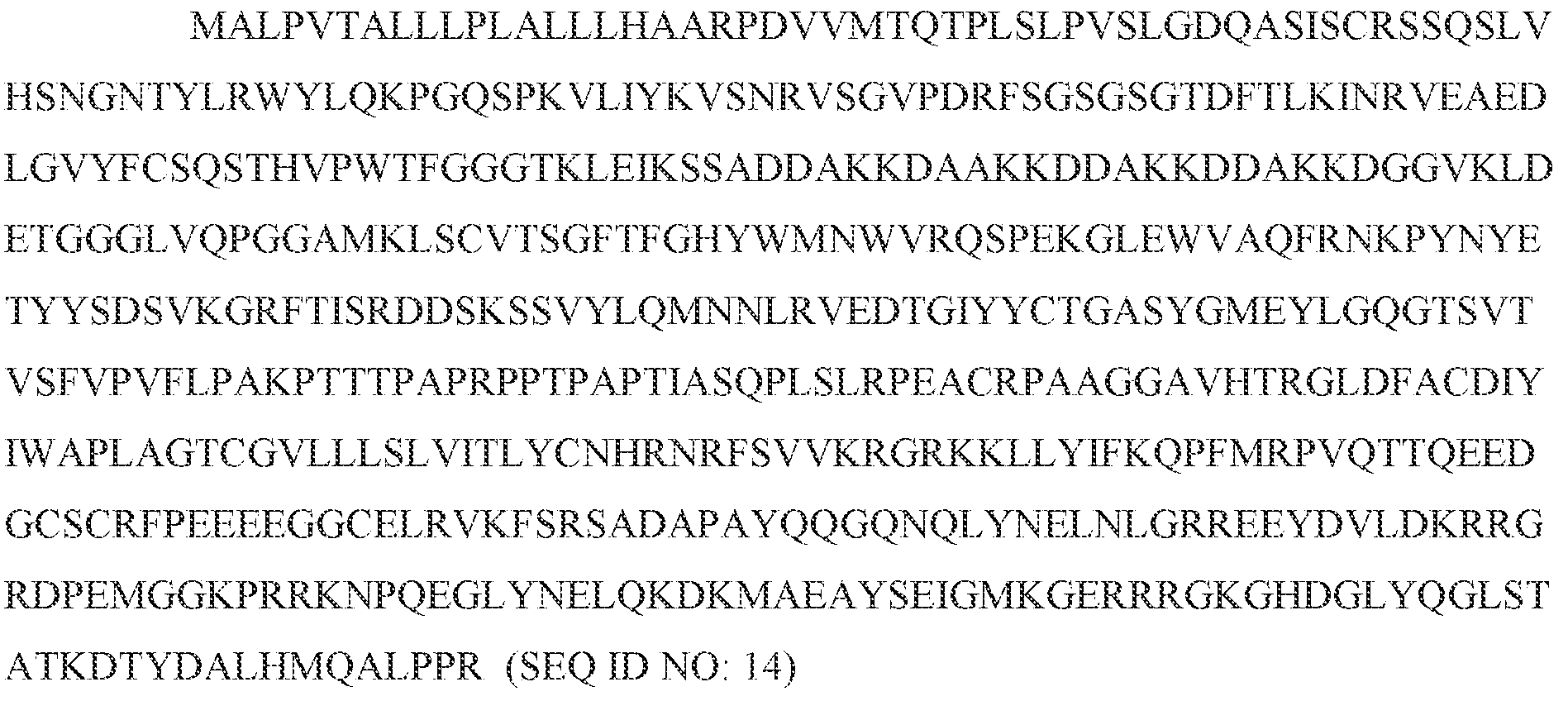
예시적인 뉴클레오티드 삽입물은 서열식별번호: 15를 포함할 수 있다:An exemplary nucleotide insert may include SEQ ID NO: 15:

다양한 실시양태에서, 서열식별번호: 13 또는 15의 핵산을 포함하는 CAR-발현 세포가 제공된다. 일부 실시양태에서, 서열식별번호: 14를 포함하는 키메라 항원 수용체 폴리펩티드가 고려된다. 일부 실시양태에서, 서열식별번호: 13 또는 15를 포함하는 벡터가 고려된다. 일부 실시양태에서, 서열식별번호: 13 또는 15를 포함하는 렌티바이러스 벡터가 고려된다. 일부 실시양태에서, 서열식별번호: 14는 인간 또는 인간화 아미노산 서열을 포함하거나 또는 이로 이루어질 수 있다.In various embodiments, a CAR-expressing cell is provided comprising a nucleic acid of SEQ ID NO: 13 or 15. In some embodiments, a chimeric antigen receptor polypeptide comprising SEQ ID NO: 14 is contemplated. In some embodiments, a vector comprising SEQ ID NO: 13 or 15 is contemplated. In some embodiments, a lentiviral vector comprising SEQ ID NO: 13 or 15 is contemplated. In some embodiments, SEQ ID NO: 14 may comprise or consist of a human or humanized amino acid sequence.
일부 실시양태에서, 서열식별번호: 13, 서열식별번호: 14 또는 서열식별번호: 15에 대해 적어도 약 80%, 적어도 약 90%, 적어도 약 95%, 적어도 약 97%, 적어도 약 98%, 적어도 약 99% 또는 적어도 약 99.5% 서열 동일성을 갖는 변이체 핵산 서열 또는 아미노산 서열이 고려된다.In some embodiments, variant nucleic acid sequences or amino acid sequences having at least about 80%, at least about 90%, at least about 95%, at least about 97%, at least about 98%, at least about 99%, or at least about 99.5% sequence identity to SEQ ID NO: 13, SEQ ID NO: 14, or SEQ ID NO: 15 are contemplated.
림프구에 의해 발현된 CAR이 표적화된 모이어티에 결합하는 친화도는 달라질 수 있고, 일부 경우에 낮은 친화도 결합 (예컨대 약 50 nM)이 바람직할 수 있지만, 표적화된 리간드에 대한 CAR의 결합 친화도는 일반적으로 적어도 약 100 nM, 1 pM 또는 10 pM, 바람직하게는 적어도 약 100 pM, 1 fM 또는 10 fM, 보다 더 바람직하게는 적어도 약 100 fM일 것이다.The affinity with which a CAR expressed by a lymphocyte binds to a targeted moiety can vary, and in some cases lower affinity binding (e.g., about 50 nM) may be desirable, but the binding affinity of the CAR for the targeted ligand will generally be at least about 100 nM, 1 pM or 10 pM, preferably at least about 100 pM, 1 fM or 10 fM, and more preferably at least about 100 fM.
치료 조성물Therapeutic composition
일부 실시양태에서, 본 개시내용은 1종 이상의 세포 집단을 포함하는 조성물을 제공한다.In some embodiments, the present disclosure provides a composition comprising one or more cell populations.
일부 실시양태에서, 조성물은 분화된 NK 세포 집단을 포함한다. 일부 실시양태에서, 조성물은 적어도 40%, 적어도 50%, 적어도 60%, 적어도 70%, 적어도 80%, 적어도 90% 또는 100%의 CD34+CD43+CD45+LFA1+ 사중-양성 세포인 분화된 NK 세포 집단을 포함한다.In some embodiments, the composition comprises a differentiated NK cell population. In some embodiments, the composition comprises a differentiated NK cell population that is at least 40%, at least 50%, at least 60%, at least 70%, at least 80%, at least 90%, or 100% CD34+CD43+CD45+LFA1+ quadruple-positive cells.
일부 실시양태에서, 조성물은 약 40% 내지 50%, 약 50% 내지 60%, 약 60% 내지 70%, 약 70% 내지 80%, 약 80% 내지 90% 또는 약 90% 내지 100%의 CD34+CD43+CD45+LFA1+ 사중-양성 세포인 분화된 NK 세포 집단을 포함한다.In some embodiments, the composition comprises a differentiated NK cell population that is about 40% to 50%, about 50% to 60%, about 60% to 70%, about 70% to 80%, about 80% to 90%, or about 90% to 100% CD34+CD43+CD45+LFA1+ quadruple-positive cells.
일부 실시양태에서, 조성물은 성숙 NK 세포 집단을 포함한다. 일부 실시양태에서, 조성물은 적어도 40%, 적어도 50%, 적어도 60%, 적어도 70%, 적어도 80%, 적어도 90% 또는 100%의 CD34+CD43+CD45+LFA1+ NKp46+NKG2D+LFA1+CD161-CD73- 세포인 성숙 NK 세포 집단을 포함한다.In some embodiments, the composition comprises a mature NK cell population. In some embodiments, the composition comprises a mature NK cell population that is at least 40%, at least 50%, at least 60%, at least 70%, at least 80%, at least 90% or 100% CD34+CD43+CD45+LFA1+ NKp46+NKG2D+LFA1+CD161-CD73- cells.
일부 실시양태에서, 조성물은 약 40% 내지 50%, 약 50% 내지 60%, 약 60% 내지 70%, 약 70% 내지 80%, 약 80% 내지 90% 또는 약 90% 내지 100%의 CD34+CD43+CD45+LFA1+ NKp46+NKG2D+LFA1+CD161-CD73- 세포인 성숙 NK 세포 집단을 포함한다.In some embodiments, the composition comprises a mature NK cell population of about 40% to 50%, about 50% to 60%, about 60% to 70%, about 70% to 80%, about 80% to 90%, or about 90% to 100% CD34+CD43+CD45+LFA1+ NKp46+NKG2D+LFA1+CD161-CD73- cells.
치료 방법Treatment method
본 개시내용은 본원에 개시된 조성물, 치료 조성물 또는 세포를 사용한 치료를 필요로 하는 대상체를 치료하는 방법을 제공한다. 일부 실시양태에서, 본 개시내용은 치료 유효량의 개시된 세포를 대상체에게 투여하는 것을 포함하는, 대상체에서 암을 치료하고/거나 암 세포를 사멸시키는 방법을 제공한다.The present disclosure provides methods of treating a subject in need thereof using the compositions, therapeutic compositions, or cells disclosed herein. In some embodiments, the present disclosure provides methods of treating cancer and/or killing cancer cells in a subject, comprising administering to the subject a therapeutically effective amount of the disclosed cells.
일부 실시양태에서, 암은 고형 종양, 육종, 암종, 림프종, 다발성 골수종, 호지킨병, 비-호지킨 림프종 (NHL), 원발성 종격 대 B 세포 림프종 (PMBC), 미만성 대 B 세포 림프종 (DLBCL), 여포성 림프종 (FL), 형질전환된 여포성 림프종, 비장 변연부 림프종 (SMZL), 만성 또는 급성 백혈병, 급성 골수성 백혈병, 만성 골수성 백혈병, 급성 림프모구성 백혈병 (ALL) (비 T-세포 ALL 포함), 만성 림프구성 백혈병 (CLL), T-세포 림프종, 1종 이상의 B-세포 급성 림프성 백혈병 ("BALL"), T-세포 급성 림프성 백혈병 ("TALL"), 급성 림프성 백혈병 (ALL), 만성 골수 백혈병 (CML), B 세포 전림프구성 백혈병, 모구성 형질세포양 수지상 세포 신생물, 버킷 림프종, 미만성 대 B 세포 림프종, 여포성 림프종, 모발상 세포 백혈병, 소세포- 또는 대세포-여포성 림프종, 악성 림프증식성 상태, MALT 림프종, 외투 세포 림프종, 변연부 림프종, 골수이형성증 및 골수이형성 증후군, 형질모구성 림프종, 형질세포양 수지상 세포 신생물, 발덴스트롬 마크로글로불린혈증, 형질 세포 증식성 장애 (예를 들어, 무증상 골수종 (무증상 다발성 골수종 또는 무통성 골수종)), 의미 불명의 모노클로날 감마글로불린병증 (MGUS), 형질세포종 (예를 들어, 형질 세포 이혼화증, 고립 골수종, 고립 형질세포종, 골수외 형질세포종, 및 다발성 형질세포종), 전신 아밀로이드 경쇄 아밀로이드증, POEMS 증후군 (또한 크로우-푸카세 증후군, 다카츠키병, 및 PEP 증후군으로도 공지됨), 또는 그의 조합이다.In some embodiments, the cancer is a solid tumor, a sarcoma, a carcinoma, a lymphoma, multiple myeloma, Hodgkin's disease, non-Hodgkin's lymphoma (NHL), primary mediastinal large B-cell lymphoma (PMBC), diffuse large B-cell lymphoma (DLBCL), follicular lymphoma (FL), transformed follicular lymphoma, splenic marginal zone lymphoma (SMZL), chronic or acute leukemia, acute myeloid leukemia, chronic myeloid leukemia, acute lymphoblastic leukemia (ALL) (including non-T-cell ALL), chronic lymphocytic leukemia (CLL), T-cell lymphoma, one or more B-cell acute lymphoblastic leukemias ("BALL"), T-cell acute lymphoblastic leukemia ("TALL"), acute lymphoblastic leukemia (ALL), chronic myelogenous leukemia (CML), B-cell prolymphocytic leukemia, blastic plasmacytoid dendritic cell neoplasm, Burkitt's lymphoma, diffuse large B-cell lymphoma, follicular lymphoma, Hairy cell leukemia, small- or large-cell-follicular lymphoma, malignant lymphoproliferative conditions, MALT lymphoma, mantle cell lymphoma, marginal zone lymphoma, myelodysplasia and myelodysplastic syndromes, plasmablastic lymphoma, plasmacytoid dendritic cell neoplasm, Waldenström macroglobulinemia, a plasma cell proliferative disorder (e.g., smoldering myeloma (small multiple myeloma or indolent myeloma)), monoclonal gammopathy of undetermined significance (MGUS), plasmacytomas (e.g., plasma cell dyscrasia, solitary myeloma, solitary plasmacytoma, extramedullary plasmacytoma, and multiple plasmacytomas), systemic amyloid light chain amyloidosis, POEMS syndrome (also known as Crow-Fukase syndrome, Takatsuki disease, and PEP syndrome), or a combination thereof.
일부 실시양태에서, 본원에 개시된 방법은 치료 유효량의 임의의 상기 실시양태에 따른 세포를 투여함으로써 대상체에서 암을 치료하고/거나 암 세포를 사멸시키는 데 사용될 수 있다.In some embodiments, the methods disclosed herein can be used to treat cancer and/or kill cancer cells in a subject by administering a therapeutically effective amount of a cell according to any of the above embodiments.
본 개시내용은 또한 임의의 상기 실시양태의 조성물을 대상체에게 투여하는 것을 포함하는, 대상체에서 암을 치료하고/거나 암 세포를 사멸시키는 방법을 제공한다.The present disclosure also provides a method of treating cancer and/or killing cancer cells in a subject, comprising administering to the subject a composition of any of the above embodiments.
일부 실시양태에서, 본 개시내용은 본원에 제공된 임의의 조성물로 암을 치료하는 방법을 제공한다. "암"은 본 명세서의 관점에서 읽을 때 그의 평범하고 통상적인 의미를 갖고, 예를 들어 신체의 다른 부분으로 침습 또는 확산될 잠재력을 갖는 비정상적 세포 성장을 수반하는 일군의 질환을 포함할 수 있으나 이에 제한되지는 않는다. 본원에 기재된 방법을 사용하여 다룰 수 있는 대상체는 결장암, 폐암, 간암, 유방암, 신암, 전립선암, 난소암, 피부암 (흑색종 포함), 골암 및 뇌암 등을 포함하나 이에 제한되지는 않는 암을 갖는 것으로 확인되거나 선택된 대상체를 포함한다. 이러한 확인 및/또는 선택은 임상 또는 진단 평가에 의해 이루어질 수 있다. 일부 실시양태에서, 흑색종, 유방암, 뇌암, 편평 세포 암종, 결장암, 백혈병, 골수종 및/또는 전립선암과 같은 종양 연관 항원 또는 분자가 공지된다. 예는 B 세포 림프종, 유방암, 뇌암, 전립선암 및/또는 백혈병을 포함하나 이에 제한되지는 않는다. 일부 실시양태에서, 1종 이상의 종양원성 폴리펩티드는 신장암, 자궁암, 결장암, 폐암, 간암, 유방암, 신암, 전립선암, 난소암, 피부암 (흑색종 포함), 골암, 뇌암, 선암종, 췌장암, 만성 골수 백혈병 또는 백혈병과 연관된다. 일부 실시양태에서, 대상체에서 암을 치료, 호전 또는 억제하는 방법이 제공된다. 일부 실시양태에서, 암은 유방암, 난소암, 폐암, 췌장암, 전립선암, 흑색종, 신암, 췌장암, 교모세포종, 신경모세포종, 수모세포종, 육종, 간암, 결장암, 피부암 (흑색종 포함), 골암 또는 뇌암이다.In some embodiments, the present disclosure provides a method of treating cancer with any of the compositions provided herein. "Cancer" has its ordinary and customary meaning when read in the context of this specification and may include, but is not limited to, a group of diseases involving abnormal cell growth, for example, having the potential to invade or spread to other parts of the body. Subjects that may be treated using the methods described herein include subjects identified or selected as having cancer, including but not limited to, colon cancer, lung cancer, liver cancer, breast cancer, renal cancer, prostate cancer, ovarian cancer, skin cancer (including melanoma), bone cancer, and brain cancer. Such identification and/or selection may be made by clinical or diagnostic evaluation. In some embodiments, a tumor-associated antigen or molecule is known, such as melanoma, breast cancer, brain cancer, squamous cell carcinoma, colon cancer, leukemia, myeloma, and/or prostate cancer. Examples include, but are not limited to, B cell lymphoma, breast cancer, brain cancer, prostate cancer, and/or leukemia. In some embodiments, the one or more oncogenic polypeptides are associated with kidney cancer, uterine cancer, colon cancer, lung cancer, liver cancer, breast cancer, renal cancer, prostate cancer, ovarian cancer, skin cancer (including melanoma), bone cancer, brain cancer, adenocarcinoma, pancreatic cancer, chronic myelogenous leukemia, or leukemia. In some embodiments, a method of treating, ameliorating, or inhibiting a cancer in a subject is provided. In some embodiments, the cancer is breast cancer, ovarian cancer, lung cancer, pancreatic cancer, prostate cancer, melanoma, renal cancer, pancreatic cancer, glioblastoma, neuroblastoma, medulloblastoma, sarcoma, liver cancer, colon cancer, skin cancer (including melanoma), bone cancer, or brain cancer.
일부 실시양태에서, 추가의 암 요법, 예컨대 소분자, 예를 들어 방사성핵종, 독소 또는 약물에 접합되거나 접합되지 않은 화학적 화합물, 항체 요법, 예를 들어 인간화 모노클로날 항체, 수술 및/또는 방사선이 제공된다.In some embodiments, additional cancer therapies are provided, such as small molecules, e.g., radionuclides, chemical compounds conjugated or unconjugated to toxins or drugs, antibody therapies, e.g., humanized monoclonal antibodies, surgery, and/or radiation.
일부 실시양태에서, 대상체는 암 치료제, 방사선, 화학요법 또는 암의 치료를 위한 약물을 포함할 수 있는 추가의 암 요법을 받도록 선택된다. 일부 실시양태에서, 약물은 아비라테론, 알렘투주맙, 아나스트로졸, 아프레피탄트, 삼산화비소, 아테졸리주맙, 아자시티딘, 베바시주맙, 블레오마이신, 보르테조밉, 카바지탁셀, 카페시타빈, 카르보플라틴, 세툭시맙, 화학요법 약물 조합, 시스플라틴, 크리조티닙, 시클로포스파미드, 시타라빈, 데노수맙, 도세탁셀, 독소루비신, 에리불린, 에를로티닙, 에토포시드, 에베롤리무스, 엑세메스탄, 필그라스팀, 플루오로우라실, 풀베스트란트, 겜시타빈, 이마티닙, 이미퀴모드, 이필리무맙, 익사베필론, 라파티닙, 레날리도미드, 레트로졸, 류프롤리드, 메스나, 메토트렉세이트, 니볼루맙, 옥살리플라틴, 파클리탁셀, 팔로노세트론, 펨브롤리주맙, 페메트렉세드, 프레드니손, 라듐-223, 리툭시맙, 시푸류셀-T, 소라페닙, 수니티닙, 활석 흉막내, 타목시펜, 테모졸로미드, 템시롤리무스, 탈리도미드, 트라스투주맙, 비노렐빈 또는 졸레드론산을 포함한다.In some embodiments, the subject is selected to receive additional cancer therapy, which may include anticancer drugs, radiation, chemotherapy, or drugs for treating cancer. In some embodiments, the drug is selected from the group consisting of abiraterone, alemtuzumab, anastrozole, aprepitant, arsenic trioxide, atezolizumab, azacitidine, bevacizumab, bleomycin, bortezomib, cabazitaxel, capecitabine, carboplatin, cetuximab, a chemotherapy drug combination, cisplatin, crizotinib, cyclophosphamide, cytarabine, denosumab, docetaxel, doxorubicin, eribulin, erlotinib, etoposide, everolimus, exemestane, filgrastim, fluorouracil, fulvestrant, gemcitabine, imatinib, imiquimod, ipilimumab, ixabepilone, lapatinib, lenalidomide, letrozole, leuprolide, mesna, methotrexate, nivolumab, Includes oxaliplatin, paclitaxel, palonosetron, pembrolizumab, pemetrexed, prednisone, radium-223, rituximab, sipuleucel-T, sorafenib, sunitinib, intrapleural talc, tamoxifen, temozolomide, temsirolimus, thalidomide, trastuzumab, vinorelbine, or zoledronic acid.
투여 방식 및 투여Dosage and Administration
일부 실시양태에서, NK 세포는 대상체, 예컨대 인간 내로 도입될 세포 집단에 적합한 조건에서 성장될 수 있다. 구체적 고려사항은 임의의 동물 제품, 예컨대 소 혈청이 결여된 배양 배지의 사용을 포함한다. 다른 고려사항은 박테리아, 진균 및 미코플라스마의 오염을 피하기 위한 멸균-조건을 포함한다.In some embodiments, NK cells can be grown under conditions suitable for the cell population to be introduced into a subject, such as a human. Specific considerations include the use of culture media lacking any animal products, such as bovine serum. Other considerations include sterile conditions to avoid contamination with bacteria, fungi, and mycoplasma.
일부 실시양태에서, 형질감염 후에, 세포는 환자에게 즉시 투여될 수 있거나 또는 세포는, 예를 들어 세포가 형질감염으로부터 회복될 시간을 허용하기 위해 적어도 약 1, 2, 3, 4, 5, 6, 7, 8, 9, 10, 11, 12, 13, 14, 15, 16, 17, 18일 또는 그 초과 또는 약 5 내지 약 12일, 약 6 내지 약 13일, 약 7 내지 약 14일 또는 약 8 내지 약 15일 동안 배양될 수 있다. 적합한 배양 조건은 세포를 활성화를 위해 활성화를 촉진하는 데 사용되는 작용제의 존재 또는 부재 하에 배양하는 조건과 유사할 수 있다.In some embodiments, following transfection, the cells may be administered to the patient immediately or the cells may be cultured for at least about 1, 2, 3, 4, 5, 6, 7, 8, 9, 10, 11, 12, 13, 14, 15, 16, 17, 18 or more days, or about 5 to about 12 days, about 6 to about 13 days, about 7 to about 14 days, or about 8 to about 15 days, for example to allow time for the cells to recover from transfection. Suitable culture conditions may be similar to conditions in which the cells are cultured in the presence or absence of an agent used to promote activation for activation.
개시된 세포는 국부 또는 전신 치료를 목적으로 하는지에 따라 다수의 방식으로 투여될 수 있다.The disclosed cells can be administered in a number of ways, depending on whether local or systemic treatment is desired.
입양 세포 요법의 경우에, 입양 세포 요법을 위한 세포의 투여 방법은 공지되어 있고, 제공된 방법 및 조성물과 관련하여 사용될 수 있다.In the case of adoptive cell therapy, methods of administering cells for adoptive cell therapy are known and can be used in connection with the methods and compositions provided.
일반적으로, 투여는 국소, 비경구 또는 경장 투여일 수 있다. 본 개시내용의 조성물은 전형적으로 비경구 투여에 적합하다. 본원에 사용된 제약 조성물의 "비경구 투여"는 대상체의 조직의 물리적 돌파 및 조직 내 돌파를 통한 제약 조성물의 투여, 이에 따라 일반적으로 혈류 내, 근육 내 또는 내부 기관 내로의 직접 투여를 발생시키는 것을 특징으로 하는 임의의 투여 경로를 포함한다. 따라서, 비경구 투여는 조성물의 주사, 외과적 절개를 통한 조성물의 적용, 조직-관통 비-외과적 상처를 통한 조성물의 적용 등에 의한 제약 조성물의 투여를 포함하나 이에 제한되지는 않는다. 특히, 비경구 투여는 피하, 복강내, 근육내, 흉골내, 정맥내, 동맥내, 척수강내, 뇌실내, 요도내, 두개내, 종양내, 활막내 주사 또는 주입; 및 신장 투석 주입 기술을 포함하나 이에 제한되지는 않는 것으로 고려된다. 한 실시양태에서, 본 개시내용의 조성물의 비경구 투여는 정맥내 투여를 포함한다.In general, administration may be topical, parenteral, or enteral. The compositions of the present disclosure are typically suitable for parenteral administration. As used herein, “parenteral administration” of a pharmaceutical composition includes any route of administration characterized by physical penetration of a tissue of a subject and penetration within the tissue, thereby generally resulting in direct administration into the bloodstream, intramuscularly, or into an internal organ. Thus, parenteral administration includes, but is not limited to, administration of the pharmaceutical composition by injection of the composition, application of the composition through a surgical incision, application of the composition through a tissue-penetrating non-surgical wound, and the like. In particular, parenteral administration is contemplated to include, but is not limited to, subcutaneous, intraperitoneal, intramuscular, intrasternal, intravenous, intraarterial, intrathecal, intraventricular, intraurethral, intracranial, intratumoral, intrasynovial injection or infusion; and renal dialysis infusion techniques. In one embodiment, parenteral administration of a composition of the present disclosure includes intravenous administration.
비경구 투여에 적합한 제약 조성물의 제제는 전형적으로 제약상 허용되는 담체, 예컨대 멸균수 또는 멸균 등장성 염수와 조합된 활성 성분을 일반적으로 포함한다. 이러한 제제는 볼루스 투여 또는 연속 투여에 적합한 형태로 제조, 포장 또는 판매될 수 있다. 주사가능한 제제는 단위 투여 형태로, 예컨대 앰플로 또는 보존제를 함유하는 다중-용량 용기로 제조, 포장 또는 판매될 수 있다. 비경구 투여를 위한 제제는 현탁액, 용액, 유성 또는 수성 비히클 중 에멀젼, 페이스트 등을 포함하나 이에 제한되지는 않는다. 이러한 제제는 현탁화제, 안정화제 또는 분산제를 포함하나 이에 제한되지는 않는 1종 이상의 추가의 성분을 추가로 포함할 수 있다. 비경구 투여를 위한 제제의 한 실시양태에서, 활성 성분은 적합한 비히클 (예를 들어, 멸균 발열원-무함유 물)로 재구성한 후 재구성된 조성물을 비경구 투여하기 위한 건조 (즉, 분말 또는 과립) 형태로 제공된다. 비경구 제제는 또한 부형제, 예컨대 염, 탄수화물 및 (바람직하게는 pH 3 내지 9로의) 완충제를 함유할 수 있는 수용액을 포함하지만, 일부 적용을 위해, 이들은 보다 적합하게는 멸균 비-수성 용액으로서 또는 적합한 비히클, 예컨대 멸균, 발열원-무함유 물과 함께 사용될 건조 형태로서 제제화될 수 있다. 예시적인 비경구 투여 형태는 멸균 수용액, 예를 들어 수성 프로필렌 글리콜 또는 덱스트로스 용액 중의 용액 또는 현탁액을 포함한다. 이러한 투여 형태는 원하는 경우에 적합하게 완충될 수 있다. 유용한 다른 비경구-투여가능한 제제는 미세결정질 형태 또는 리포솜 제제로 활성 성분을 포함하는 것을 포함한다. 비경구 투여를 위한 제제는 즉시 및/또는 변형 방출되도록 제제화될 수 있다. 변형 방출 제제는 지연-, 지속-, 펄스-, 제어-, 표적화 및 프로그램화 방출을 포함한다.Formulations of pharmaceutical compositions suitable for parenteral administration typically comprise the active ingredient in combination with a pharmaceutically acceptable carrier, such as sterile water or sterile isotonic saline. Such formulations may be prepared, packaged, or sold in a form suitable for bolus administration or continuous administration. Injectable formulations may be prepared, packaged, or sold in unit dosage form, such as in ampoules or in multi-dose containers containing a preservative. Formulations for parenteral administration include, but are not limited to, suspensions, solutions, emulsions in oily or aqueous vehicles, pastes, and the like. Such formulations may further comprise one or more additional ingredients, including but not limited to suspending, stabilizing, or dispersing agents. In one embodiment of the formulation for parenteral administration, the active ingredient is provided in dry (i.e., powder or granule) form for parenteral administration after reconstitution with a suitable vehicle (e.g., sterile pyrogen-free water). Parenteral preparations also include aqueous solutions which may contain excipients such as salts, carbohydrates and buffers (preferably to a pH of 3 to 9), but for some applications they may be more suitably formulated as sterile non-aqueous solutions or as dry forms for use with a suitable vehicle such as sterile, pyrogen-free water. Exemplary parenteral dosage forms include solutions or suspensions in sterile aqueous solutions, for example, aqueous propylene glycol or dextrose solutions. Such dosage forms may be suitably buffered, if desired. Other useful parenterally-administrable formulations include those comprising the active ingredient in microcrystalline form or in liposomal formulations. Formulations for parenteral administration can be formulated to be immediate and/or modified release. Modified release formulations include delayed-, sustained-, pulse-, controlled-, targeted and programmed release.
본 발명의 조성물은 제약 조성물에서 통상적으로 발견되는 다른 보조 성분을 추가적으로 함유할 수 있다. 따라서, 예를 들어 조성물은 추가의 상용성 제약 활성 물질, 예컨대, 예를 들어 항소양제, 수렴제, 국부 마취제 또는 항염증제를 함유할 수 있거나 또는 본 발명의 조성물의 다양한 투여 형태를 물리적으로 제제화하는 데 유용한 추가의 물질, 예컨대 염료, 향미제, 보존제, 항산화제, 불투명화제, 증점제 및 안정화제를 함유할 수 있다. 그러나, 이러한 물질은, 첨가되는 경우에, 본 발명의 조성물의 성분의 생물학적 활성을 과도하게 방해하지 않아야 한다. 제제는 멸균될 수 있고, 원하는 경우에 제제의 핵산(들)과 유해하게 상호작용하지 않는 보조제, 예를 들어 윤활제, 보존제, 안정화제, 습윤제, 유화제, 삼투압에 영향을 미치는 염, 완충제, 착색제, 향미제 및/또는 방향족 물질 등과 혼합될 수 있다.The compositions of the present invention may additionally contain other adjuvant ingredients commonly found in pharmaceutical compositions. Thus, for example, the compositions may contain additional compatible pharmaceutically active substances, such as, for example, antipruritics, astringents, local anesthetics, or anti-inflammatory agents, or may contain additional substances useful for physically formulating the various dosage forms of the compositions of the present invention, such as dyes, flavoring agents, preservatives, antioxidants, opacifiers, thickeners, and stabilizers. However, such substances, when added, should not unduly interfere with the biological activity of the components of the compositions of the present invention. The formulations may be sterilized and, if desired, mixed with adjuvants that do not deleteriously interact with the nucleic acid(s) of the formulation, such as lubricants, preservatives, stabilizers, wetting agents, emulsifiers, salts affecting osmotic pressure, buffers, colorants, flavoring agents, and/or aromatic substances.
바이러스 입자, 어댑터 분자 및/또는 면역 세포의 본 발명의 조성물은 질환 또는 상태를 치료 또는 예방하는 데 효과적인 양, 예컨대 치료 유효량 또는 예방 유효량으로 투여될 수 있다. 일부 실시양태에서 치료 또는 예방 효능은 치료받은 대상체의 주기적 평가에 의해 모니터링된다. 수일 이상에 걸친 반복 투여의 경우에, 상태에 따라, 치료는 질환 증상의 목적하는 억제가 발생할 때까지 반복된다. 그러나, 다른 투여 요법이 유용할 수 있고 결정될 수 있다. 목적하는 투여량은 조성물의 단일 볼루스 투여에 의해, 조성물의 다중 볼루스 투여에 의해 또는 조성물의 연속 주입 투여에 의해 전달될 수 있다.The compositions of the present invention comprising viral particles, adapter molecules, and/or immune cells may be administered in an amount effective to treat or prevent a disease or condition, such as a therapeutically effective amount or a prophylactically effective amount. In some embodiments, the efficacy of the treatment or prevention is monitored by periodic evaluation of the treated subject. In cases of repeated administrations over several days or more, depending on the condition, the treatment is repeated until the desired suppression of disease symptoms occurs. However, other dosing regimens may be useful and can be determined. The desired dosage may be delivered by a single bolus administration of the composition, by multiple bolus administrations of the composition, or by continuous infusion administration of the composition.
특정 실시양태에서, 본 개시내용에 따른 분화된 세포 또는 트랜스제닉 분화된 세포를 주입하는 것과 관련하여, 대상체는 대상체의 체중 킬로그램당 약 1백만개 내지 약 1000억개 세포, 예컨대, 예를 들어, 1백만개 내지 약 500억개 세포 (예를 들어, 약 5백만개 세포, 약 25백만개 세포, 약 500백만개 세포, 약 10억개 세포, 약 50억개 세포, 약 200억개 세포, 약 300억개 세포, 약 400억개 세포, 또는 상기 값 중 임의의 2개에 의해 정의되는 범위), 예컨대 약 10백만개 내지 약 1000억개 세포 (예를 들어, 약 20백만개 세포, 약 30백만개 세포, 약 40백만개 세포, 약 60백만개 세포, 약 70백만개 세포, 약 80백만개 세포, 약 90백만개 세포, 약 100억개 세포, 약 250억개 세포, 약 500억개 세포, 약 750억개 세포, 약 900억개 세포, 또는 상기 값 중 임의의 2개에 의해 정의되는 범위), 및 일부 경우에 약 100백만개 세포 내지 약 500억개 세포 (예를 들어, 약 120백만개 세포, 약 250백만개 세포, 약 350백만개 세포, 약 450백만개 세포, 약 650백만개 세포, 약 800백만개 세포, 약 900백만개 세포, 약 30억개 세포, 약 300억개 세포, 약 450억개 세포)의 범위 또는 이들 범위 사이의 임의의 값, 및/또는 이러한 다수개의 세포를 투여받는다. 예를 들어, 일부 실시양태에서, 세포 또는 세포 집단의 투여는 체중 kg당 약 103 내지 약 109개의 세포 (이러한 범위 내의 세포 수의 모든 정수 값 포함)의 투여를 포함할 수 있다.In certain embodiments, in connection with infusing differentiated cells or transgenic differentiated cells according to the present disclosure, the subject is administered from about 1 million to about 100 billion cells per kilogram of body weight of the subject, such as, for example, from about 1 million to about 50 billion cells (e.g., about 5 million cells, about 25 million cells, about 500 million cells, about 1 billion cells, about 5 billion cells, about 20 billion cells, about 30 billion cells, about 40 billion cells, or a range defined by any two of the foregoing values), such as from about 10 million to about 100 billion cells (e.g., about 20 million cells, about 30 million cells, about 40 million cells, about 60 million cells, about 70 million cells, about 80 million cells, about 90 million cells, about 10 billion cells, about In some embodiments, the cells are administered in a range of about 25 billion cells, about 50 billion cells, about 75 billion cells, about 90 billion cells, or a range defined by any two of the foregoing values), and in some cases in a range of about 100 million cells to about 50 billion cells (e.g., about 120 million cells, about 250 million cells, about 350 million cells, about 450 million cells, about 650 million cells, about 800 million cells, about 900 million cells, about 3 billion cells, about 30 billion cells, about 45 billion cells) or any value therebetween, and/or a plurality of such cells. For example, in some embodiments, the administration of a cell or population of cells can comprise administration of about 10 3 to about 10 9 cells per kilogram of body weight (including all integer values of the number of cells within these ranges).
키트Kit
또한, 본원에 기재된 세포, 뿐만 아니라 그의 제조 및 사용에 대한 서면 지침서를 포함하는 키트가 본원에 제공된다. 따라서, 예를 들어 본원에 기재된 바와 같은 세포 집단, 그의 제조 및 사용에 대한 서면 지침서를 포함하는 키트가 본원에 제공된다.Also provided herein are kits comprising the cells described herein, as well as written instructions for their preparation and use. Thus, for example, provided herein are kits comprising a cell population as described herein, as well as written instructions for their preparation and use.
일부 실시양태에서, 키트는 원하는 목적, 예를 들어 게놈 편집 또는 세포 요법을 위한 또 다른 성분과 동시에 또는 순차적으로 투여될 수 있는 1종 이상의 추가의 치료제를 가질 수 있다.In some embodiments, the kit may have one or more additional therapeutic agents that may be administered simultaneously or sequentially with another component for a desired purpose, e.g., genome editing or cell therapy.
일부 실시양태에서, 키트는 방법을 실시하기 위해 키트의 성분을 사용하는 것에 대한 지침서를 추가로 포함할 수 있다. 방법을 실시하는 것에 대한 지침서는 일반적으로 적합한 기록 매체 상에 기록된다. 예를 들어, 지침서는 기재, 예컨대 종이 또는 플라스틱 상 등에 인쇄될 수 있다. 지침서는 키트 내에 패키지 삽입물로서, 키트의 용기 또는 그의 구성요소의 라벨링 (예컨대, 패키징 또는 서브패키징과 회합됨) 등으로 존재할 수 있다. 지침서는 적합한 컴퓨터 판독가능 저장 매체, 예를 들어 CD-ROM, 디스켓, 플래시 드라이브 등에 존재하는 전자 저장 데이터 파일로서 존재할 수 있다. 일부 경우에, 실 지침서는 키트에 존재하지 않지만, 원격 공급원으로부터 (예를 들어, 인터넷을 통해) 지침서를 수득하는 수단이 제공될 수 있다. 이러한 실시양태의 예는 지침서를 볼 수 있고/거나 지침서를 다운로드할 수 있는 웹 주소를 포함하는 키트이다. 지침서와 마찬가지로, 지침서를 수득하는 이러한 수단이 적합한 기재 상에 기록될 수 있다.In some embodiments, the kit may further include instructions for using the components of the kit to perform the method. The instructions for performing the method are generally recorded on a suitable recording medium. For example, the instructions may be printed on a substrate, such as paper or plastic. The instructions may be present as a package insert within the kit, in the labeling of the container of the kit or a component thereof (e.g., associated with the packaging or subpackaging), etc. The instructions may be present as an electronic storage data file on a suitable computer-readable storage medium, such as a CD-ROM, a diskette, a flash drive, etc. In some cases, the actual instructions are not present in the kit, but a means for obtaining the instructions from a remote source (e.g., via the Internet) may be provided. An example of such an embodiment is a kit that includes a web address where the instructions can be viewed and/or downloaded. As with the instructions, such a means for obtaining the instructions may be recorded on a suitable substrate.
실시예Example
실시예 1: 이종-무함유 및 혈청-무함유 현탁 배양 NK 세포 분화 방법의 개발Example 1: Development of a Xenograft-Free and Serum-Free Suspension Culture NK Cell Differentiation Method
본 연구의 목적은 줄기 세포로부터 NK 세포를 분화시키기 위한 3차원 (3D) 혈청-무함유 및 이종-무함유 방법을 개발하는 것이었다. 구체적으로, 미분화된 인간 iPSC를 hESC-적격 매트리겔 (코닝(Corning)) 상의 mTeSR 플러스 배지 (스템셀 테크놀로지스)에 유지시키고, EDTA (써모 피셔 사이언티픽(Thermo Fisher Scientific))를 사용하여 상용적으로 계대배양하였다. 만능 현탁 배양을 위해, 미분화된 인간 iPSC를 젠틀 세포 해리 시약 (Gentle Cell Dissociation Reagent(GCDR); 스템셀 테크놀로지스)을 사용하여 계대배양하여 작은 응집체를 생성하였고, 응집체를 6-웰 플레이트 (비-조직 배양-처리됨)의 1개의 웰에 mTeSR 3D (혈청-무함유; 스템셀 테크놀로지스) 중 2 mL/웰로 5 x 10⁵개 세포/mL의 농도로 시딩하고, 오비탈 진탕기 (1" 직경 사정거리, 70 rpm으로 설정됨) 상에서 배양하였다. 세포를 전체 분화 과정 동안 오비탈 진탕기 (70 rpm) 상에서 계속 배양하였다. 단일 세포 및 GCDR을 제거하기 위해 37 um 필터를 사용하고, 재-시딩을 위해 응집체를 보다 작은 크기로 해리시키기 위해 추가의 여과를 사용하여, 제조업체의 지침에 따라 계대배양하기 전에, 제조업체의 지침에 따라 4일 동안 매일 배지를 첨가하여 iPSC를 배치-공급하였다. 이에 따라 만능 응집체를 배양하고, 분화 개시 전 4-8일 동안 계대배양하였다. 만능 응집체를 STEMdiff NK 세포 키트 (스템셀 테크놀로지스)로부터의 배지를 사용하여 현탁액에서 iNK로 분화시켰다.The objective of this study was to develop a three-dimensional (3D) serum-free and xeno-free method for differentiating NK cells from stem cells. Specifically, undifferentiated human iPSCs were maintained in mTeSR Plus medium (StemCell Technologies) on hESC-qualified Matrigel (Corning) and passaged routinely using EDTA (Thermo Fisher Scientific). For pluripotent suspension culture, undifferentiated human iPSCs were passaged using Gentle Cell Dissociation Reagent (GCDR; StemCell Technologies) to generate small aggregates, and the aggregates were seeded at a concentration of 5 x 10⁵ cells/mL in 2 mL/well in
간략하게, 제0일에, 상기 기재된 현탁액 계대배양 프로토콜을 사용하여 생성된 균일한 만능 응집체를 6-웰 플레이트 (비-조직 배양-처리됨)의 각각의 웰에 EB 보충물 A (혈청-무함유)가 보충된 STEMdiff 조혈 - EB 기초 배지 중 웰당 10,000개의 응괴 및 2 mL/웰로 시딩하여 배상체 (EB)를 생성하였다. 현탁된 EB를 EB 보충물 A (제0일-제3일) 및 이어서 EB 보충물 B (제3일-제12일) (혈청-무함유)가 보충된 STEMdiff 조혈 - EB 기초 배지에서 배양하고, 부분 배지 교체를 수행하였다. 제12일에, EB를 수거하고, 단일-세포 현탁액으로 해리시키고, 스템스팬 림프성 전구세포 확장 보충물이 보충된 스템스팬 SFEM II 배지가 존재하는, 스템스팬 림프성 전구세포 분화 코팅으로 코팅된 비-조직 배양-처리된 6-웰 플레이트에 웰당 50,000개 세포의 밀도로 2.5 mL/웰로 재-시딩하였고 (CD34+ 선택 과정은 수행하지 않음) (제12일-제26일), 부분 배지 교체를 수행하였다. 제19일에, 세포를 새로 코팅된 플레이트로 옮겼다. 제26일에, 세포를 스템스팬 NK 세포 분화 보충물 및 UM729 (1 uM)가 보충된 스템스팬 SFEM II 배지가 존재하는 6-웰 비-처리, 비-코팅된 플레이트에 재시딩하였고 (웰당 250,000개 세포, 2.5 mL/웰) (제26일-제40일), 부분 배지 교체하였다. 제40일에, NK 세포를 수거하였다. 도 1은 분화 방법 #1의 개략도를 제공한다.Briefly, on
실시예 2: 3D 이종-무함유 및 혈청-무함유 HP 분화 방법의 개발Example 2: Development of a 3D heterogeneous-free and serum-free HP differentiation method
본 연구의 목적은 줄기 세포로부터 조혈 전구세포 (HP)를 분화시키는 3D 혈청-무함유 및 이종-무함유 방법을 개발하는 것이었다. 이러한 HP는 면역 세포 집단, 예컨대 NK 세포로 추가로 분화될 수 있다. 실시예 1에 기재된 바와 같이 미분화된 인간 iPSC를 유지시키고, 응집체를 형성하였다. 제0일에, 상기 기재된 현탁액 계대배양 프로토콜을 사용하여 균일한 응집체를 생성하고, 800개의 응괴를 6-웰 플레이트 (비-조직 배양-처리됨)의 각각의 웰에 BMP4 (5 내지 50 ng/mL), FGF2 (5 내지 50 ng/mL), VEGF (5 내지 100 ng/mL) 및 Y27632 (1-20 μM)가 보충된 STEMdiff APEL 2 배지 (스템셀 테크놀로지스; 배지는 완전 한정, 혈청- 및 동물 성분-무함유임) 중 2 mL/웰로 시딩하여 (제0일-제3일) 현탁액 중 배상체 (EB)를 생성하였다. 조혈 전구세포 형성을 유도하기 위해, EB를 BMP4 및 FGF2 (5 내지 50 ng/mL), VEGF 및 SCF (최대 100 ng/mL), TPO (최대 100 ng/mL) 및 LDL (최대 50 μg/mL) 조합물이 보충된 스템스팬 SFEM II 배지 (스템셀 테크놀로지스; 혈청-무함유)에서 배양하였다 (제3일-제15일). 도 2는 분화 방법 #2의 개략도를 제공한다.The objective of this study was to develop a 3D serum-free and xeno-free method for differentiating hematopoietic progenitor cells (HPs) from stem cells. These HPs can be further differentiated into immune cell populations, such as NK cells. Undifferentiated human iPSCs were maintained and aggregates were formed as described in Example 1. On
실시예 3: 조혈 전구세포 (HP)의 특징화Example 3: Characterization of hematopoietic progenitor cells (HPs)
실시예 1 및 2에 기재된 바와 같이 iPSC-유래 EB로부터 HP가 형성되도록 유도하였다. 분화의 제12일-제15일에 존재하는 총 세포 중 생성된 HP의 백분율을 결정하기 위해, 유동 세포측정 분석을 수행하여 세포를 게이팅하여 HP 마커 CD34/CD43/CD45에 대해 삼중-양성인 세포의 백분율을 정량화하였다 (도 3a).HP formation was induced from iPSC-derived EBs as described in Examples 1 and 2. To determine the percentage of generated HPs among total cells present on
높은 HP 순도가 둘 다의 방법에 대해 관찰되었고, 이는 방법 #1의 경우 CD34/CD43/CD45에 대해 삼중-양성인 모든 세포의 58-74% 및 방법 #2의 경우 68-88%의 범위였다 (도 3b). HP의 높은 수율이 관찰되었고, 이는 제0일에 시딩된 iPSC에 비해 방법 #1의 경우 제12일에 HP의 9.8 내지 23.6-배 확장 및 방법 #2의 경우 제15일에 3.6 내지 15.4-배 확장의 범위였다 (도 3c). 현탁액 프로토콜과 표준 2D 분화 프로토콜 사이의 비교를 도 3d에 제시한다. 제12일-제15일의, HP 수거 전 및 HP 수거 후의 EB의 대표적인 명시야 현미경 영상이 제시된다 (도 3e). 본 실험은 방법 #1 및 방법 #2가 15일의 분화 후에 CD34+/CD43+/CD45+ 마커 발현 (>65%) 및 높은 배수의 iPSC-에서-HP 확장에 기초하여 높은 수율의 HP를 생성하였다는 것을 보여준다.High HP purity was observed for both methods, ranging from 58-74% of all cells triple-positive for CD34/CD43/CD45 for
실시예 4: iNK 세포의 특징화Example 4: Characterization of iNK cells
실시예 1에 기재된 바와 같이 iPSC-유래 HP로부터 iNK가 형성되도록 유도하였다. 분화의 제40일에 존재하는 총 세포 중 생성된 iNK의 백분율을 결정하기 위해, 유동 세포측정 분석을 수행하여 세포를 게이팅하여 3종의 NK 마커, CD45/CD56/LFA1에 대해 양성인 세포의 백분율을 정량화하였다 (도 4a). 높은 순도의 iNK가 관찰되었으며, 모든 세포의 80.6%가 NK 마커 CD45/CD56/LFA1에 대해 삼중-양성이었다 (도 4b). 제0일에 시딩된 iPSC에 비해 제40일에 iNK의 8,024-배 확장으로, iNK의 높은 수율이 또한 관찰되었다 (도 4c). 현탁액 프로토콜과 표준 2D 분화 프로토콜 사이의 비교를 도 4d에 제시한다. iNK 분화 제40일의 세포의 대표적인 명시야 현미경 영상이 제시된다 (도 4e). 본 실험은 방법 #1이 40일의 분화 후에 CD45+/CD56+/LFA1+ 마커 발현에 기초하여 높은 순도 및 수율의 NK를 생성하였다는 것을 보여준다.iNK formation was induced from iPSC-derived HPs as described in Example 1. To determine the percentage of generated iNKs among total cells present at
이어서, iNK 세포의 세포독성을 결정하였다. 방법 #1로부터 수거한 제40일의 iNK (도 4a-d에 제시됨)를 핵 형광 단백질을 발현하는 유방 선암종 MDA-MB231 세포와 함께 상이한 E:T 비 (2.5:1, 5:1, 10:1)로 시토카인 IL-2 및 IL-15의 부재 (비자극, 도 5a) 또는 존재 (자극, 도 5b) 하에 인큐베이션하였다. 세포 혼합물을 인큐사이트 형광 현미경에 놓고, 2시간마다 영상화하였다. MDA 세포를 형광 마커를 통해 시간 경과에 따라 정량화하고, 시간 0과 비교한 MDA 세포의 비로서 그래프화하였다 (시간 0은 1과 동일함). iNK 세포는 MDA 성장을 용량-반응성 방식으로 감소시켰고, 시토카인 지지 하에 클리어런스가 더 빨랐다. 본 실험은 방법 #1이 종양 세포 성장을 감소시킬 수 있는 기능적 활성 세포를 생산하였음을 보여준다.Next, the cytotoxicity of iNK cells was determined.
실시예 5: 조작된 세포를 사용한 3D 이종-무함유 및 혈청-무함유 HP 분화 방법의 개발Example 5: Development of a 3D xeno-free and serum-free HP differentiation method using engineered cells
실시예 1-4로부터의 세포 집단의 증식을 증가시키기 위해, 그 전문이 참조로 포함되는 문헌 [Ran et al., Nature Protocols, Vol. 8, pgs. 2281-2308 (2013), Liu et al., The CRISPR Journal, Vol. 3, Issue 3 (2020), 및 General CRISPR RNP Transfection Guidelines by Thermo Fisher Scientific]에서와 같이 관련 기술분야에 널리 공지된 방법을 사용하여 iPSC를 유전자 조작하였다. 본 실시예에서는, 전기천공을 사용하였다. 일반적으로, 기재된 바와 같이 CRISPR-Cas9-매개된 유전자 편집을 사용하여 iPSC를 조작하여 발현을 조정하고 다양한 내인성 유전자좌를 녹아웃시켰다. 세포를 표시된 특정 유전자좌를 표적화하는 Cas9 및 가이드 RNA를 포함하는 리보핵단백질 (RNP) 복합체로 전기천공하였다.To increase proliferation of cell populations from Examples 1-4, iPSCs were genetically engineered using methods well known in the art, such as those described in Ran et al., Nature Protocols, Vol. 8, pgs. 2281-2308 (2013), Liu et al., The CRISPR Journal, Vol. 3, Issue 3 (2020), and General CRISPR RNP Transfection Guidelines by Thermo Fisher Scientific, the entire contents of which are incorporated herein by reference. In this example, electroporation was used. Generally, iPSCs were engineered using CRISPR-Cas9-mediated gene editing to modulate expression and knockdown of various endogenous loci as described. Cells were electroporated with ribonucleoprotein (RNP) complexes comprising Cas9 and guide RNAs that target the indicated specific loci.
CRISPR-Cas9는 다양한 유전자좌에서 상동성-지정 복구 (HDR)를 통해 라파마이신 활성화된 시토카인 수용체 (RACR)를 코딩하는 구축물의 부위-특이적 녹-인을 생성하는 데 사용된다. RACR은 소분자 라파마이신 또는 라파로그에 의해 활성화되는 합성 시토카인 수용체이고, 세포 증식을 구동한다.CRISPR-Cas9 is used to generate site-specific knock-ins of constructs encoding the rapamycin-activated cytokine receptor (RACR) via homology-directed repair (HDR) at multiple loci. RACR is a synthetic cytokine receptor that is activated by small molecule rapamycin or rapalogs and drives cell proliferation.
RACR을 먼저 B2M 녹아웃과 동시에 B2M 유전자좌 내로 녹인시키고, 내인성 B2M 프로모터뿐만 아니라 외인성으로 제공된 EF1a 프로모터 둘 다를 함유하는 이중 프로모터 시스템을 사용하여 발현시켰다. 내인성 B2M 프로모터 단독은 높은 수준의 RACR을 생산하기에 불충분하다. 이러한 이중 프로모터 시스템은 강한 외인성 MND 프로모터에 의해 RACR의 렌티바이러스 형질도입을 통해 도달될 수 있는 것과 동등하거나 또는 그보다 더 높은 RACR 수준을 발생시켰다. 유전자 녹아웃을 통해 B2M을 제거하는 것은 또한 CD8 T 세포 미스-매치 반응을 제거함으로써 세포 요법의 동종 항-이식편 반응을 감소시킨다.RACR was first knocked out into the B2M locus simultaneously with B2M knockout and expressed using a dual promoter system containing both the endogenous B2M promoter as well as the exogenously provided EF1a promoter. The endogenous B2M promoter alone is insufficient to produce high levels of RACR. This dual promoter system resulted in RACR levels comparable to or higher than those achievable via lentiviral transduction of RACR with the strong exogenous MND promoter. Deletion of B2M via gene knockout also reduces allogeneic anti-graft responses in cell therapy by eliminating CD8 T cell mismatch responses.
RACR은 활성화를 위해 라파마이신을 필요로 하지만; 라파마이신은 세포 성장을 억제한다. 라파마이신 저항성 세포를 생성하기 위해, FKBP12 유전자를 녹아웃시켰다. 야생형 세포에서, FKBP12는 라파마이신에 결합하여, FKBP12-라파마이신이 mTOR의 FRB 도메인과 이량체화하고 후속적으로 mTOR을 억제할 수 있게 하는 신규 결합 표면을 생성한다. FKBP12의 부재 하에, 라파마이신은 mTOR 복합체와 상호작용할 수 없고, 따라서 그의 억제 능력이 상실된다.RACR requires rapamycin for activation; however, rapamycin inhibits cell growth. To generate rapamycin-resistant cells, the FKBP12 gene was knocked out. In wild-type cells, FKBP12 binds rapamycin, creating a novel binding surface that allows FKBP12-rapamycin to dimerize with the FRB domain of mTOR and subsequently inhibit mTOR. In the absence of FKBP12, rapamycin cannot interact with the mTOR complex, and thus its inhibitory ability is lost.
RACR을 코딩하는 조작된 FKBP12 녹아웃 iPSC (B2M-EF1a-RACR 및 FKBP12 KO 세포)를 수득한 후, 세포를 8 x 10⁴개 세포/웰의 농도로 시딩하였다. 이어서, 세포를 해리 시약으로 처리한 후 교반하면서 3D 현탁 배양에 적응시키거나, 또는 임의의 적응 또는 교반 없이 3D 현탁 분화 방법으로 바로 통과시킬 것이다.After obtaining engineered FKBP12 knockout iPSCs encoding RACR (B2M-EF1a-RACR and FKBP12 KO cells), cells were seeded at a density of 8 x 10 4 cells/well. Cells will then be adapted to 3D suspension culture with agitation after treatment with dissociation reagent, or directly passaged to 3D suspension differentiation method without any adaptation or agitation.
이어서, 세포를 라파마이신으로 처리한 후, 제0일 또는 제4일에 높은 FGF (100 ng/ml vs 10 ng/ml)를 함유하는 분화 배지로 교체하였다. 대조군으로서, 세포를 라파마이신으로 처리하지 않았다. 50% 배지 교체는 분화 제2일에 행한다. 도 6은 RACR을 발현하는 조작된 세포를 사용하는 분화 방법의 개략도를 제공한다.Subsequently, cells were treated with rapamycin and then replaced with differentiation medium containing high FGF (100 ng/ml vs 10 ng/ml) on
세포를 본원에 기재된 프로토콜에 따라 HP 세포로 분화시켰다. HP 세포를 각각 실시예 3에 상술된 바와 같이 특징화하였다.Cells were differentiated into HP cells according to the protocol described herein. HP cells were characterized as described in Example 3, respectively.
조작된 세포가 비-조작된 세포와 비교하여 더 많은 세포를 생산하는지 결정하기 위해, iPSC 세포의 HP로의 확장을 3D 현탁 배양에서 14일 후에 측정하였다. 세포를 3D 배양에 적응시킨 후 (1회 계대 동안, 줄기 세포 미분화 상태로 유지됨), 제2 3D 배양으로 통과시켰고, 여기서 iNK로의 분화가 시작되었다 (제0일 또는 계대와 동일한 날). 분화 과정으로의 14일째에 분석을 수행하여 HP 생성을 결정하였다. 분석을 표 1에 요약한다. 도 7은 모 세포 또는 라파마이신 및 처리의 존재 또는 부재 하에 처리된 조작된 세포에 대한 14일 후의 HP:iPSC 비를 보여준다. 세포를 2D 배양으로부터 3D 배양으로 계대배양하기 위해 EDTA 또는 GDCR을 사용하는 데 있어서 어떠한 차이도 관찰되지 않았다. 본 실험은 조작된 세포가 모 세포주보다 더 많은 HP를 생산한다는 것을 보여준다.To determine whether the engineered cells produce more cells compared to the unengineered cells, the expansion of iPSC cells into HP was measured after 14 days in 3D suspension culture. After acclimation to 3D culture (maintained in a stem cell undifferentiated state for 1 passage), the cells were passaged into a second 3D culture where differentiation into iNK was initiated (
표 1. 조작된 세포에 대한 3D 현탁 배양의 요약Table 1. Summary of 3D suspension cultures for engineered cells

서열목록 전자파일 첨부Attach electronic file of sequence list
Claims (95)
(i) 전구 세포 집단을 2차원 (2D) 배양 시스템에서 전구 세포 응집체를 형성하기에 충분한 기간 동안 배양하는 단계;
(ii) 전구 세포 응집체를 2D 배양 시스템으로부터 3차원 (3D) 현탁 배양 시스템으로 계대배양하는 단계;
(iii) 전구 세포 응집체를 3D 현탁 배양 시스템에서 CD34+/CD43+/CD45+ 세포 집단을 생성하기에 충분한 기간 동안 분화 배지와 접촉시키는 단계
를 포함하는 방법.A method for generating a CD34+/CD43+/CD45+ cell population,
(i) culturing a population of progenitor cells in a two-dimensional (2D) culture system for a period of time sufficient to form progenitor cell aggregates;
(ii) a step of subculturing the precursor cell aggregates from a 2D culture system to a three-dimensional (3D) suspension culture system;
(iii) a step of contacting the precursor cell aggregates with differentiation medium for a period of time sufficient to generate a CD34+/CD43+/CD45+ cell population in a 3D suspension culture system;
A method including:
(i) 줄기 세포 집단을 2D 배양 시스템에서 줄기 세포 응집체를 형성하기에 충분한 기간 동안 배양하는 단계;
(ii) 줄기 세포 응집체를 2D 배양 시스템으로부터 3D 현탁 배양 시스템으로 계대배양하는 단계;
(iii) 줄기 세포 응집체를 3D 현탁 배양 시스템에서, 줄기 세포 집단을 조혈 전구세포 집단으로 분화시키기에 충분한 기간 동안 골 형태발생 단백질 (BMP) 경로 활성화제, 섬유모세포 성장 인자 (FGF) 및 혈관 내피 성장 인자 (VEGF)를 포함하는 분화 배지와 접촉시키는 단계
를 포함하는 방법.A method for differentiating a stem cell population into a hematopoietic progenitor cell population,
(i) culturing a population of stem cells for a period of time sufficient to form stem cell aggregates in a 2D culture system;
(ii) a step of subculturing stem cell aggregates from a 2D culture system to a 3D suspension culture system;
(iii) contacting the stem cell aggregates with a differentiation medium comprising a bone morphogenetic protein (BMP) pathway activator, a fibroblast growth factor (FGF), and a vascular endothelial growth factor (VEGF) for a period of time sufficient to differentiate the stem cell population into a hematopoietic progenitor cell population in a 3D suspension culture system.
A method including:
(a) 줄기 세포 집단을 2D 배양 시스템에서 줄기 세포 응집체를 형성하기에 충분한 기간 동안 배양하는 단계;
(b) 줄기 세포 응집체를 2D 배양 시스템으로부터 3D 현탁 배양 시스템으로 계대배양하는 단계;
(c) 줄기 세포 응집체를 3D 현탁 배양 시스템에서 배상체를 생성하기에 충분한 기간 동안 BMP 경로 활성화제, FGF, VEGF, 및 임의로 ROCK의 억제제를 포함하는 제1 배지와 접촉시키는 단계;
(d) 배상체를 조혈 전구세포 집단을 생성하기에 충분한 기간 동안 BMP 경로 활성화제, FGF, VEGF, SCF, TPO 및 LDL을 포함하는 제1 분화 배지와 접촉시키는 단계;
(e) 조혈 전구세포 집단을 NK 세포 집단을 생성하기에 충분한 기간 동안 제2 분화 배지와 접촉시키는 단계
를 포함하는 방법.As a method for generating a population of NK cells,
(a) culturing a population of stem cells for a period of time sufficient to form stem cell aggregates in a 2D culture system;
(b) a step of subculturing stem cell aggregates from a 2D culture system to a 3D suspension culture system;
(c) contacting the stem cell aggregates with a first medium comprising a BMP pathway activator, FGF, VEGF, and optionally a ROCK inhibitor for a period of time sufficient to generate embryoid bodies in a 3D suspension culture system;
(d) contacting the embryonic stem cells with a first differentiation medium comprising a BMP pathway activator, FGF, VEGF, SCF, TPO and LDL for a period of time sufficient to generate a population of hematopoietic progenitor cells;
(e) a step of contacting the hematopoietic progenitor cell population with the second differentiation medium for a period of time sufficient to generate the NK cell population;
A method including:
(a) 비-생리학적 리간드에 대한 합성 시토카인 수용체를 발현하도록 줄기 세포 집단을 유전자 조작하는 단계이며,
여기서 시토카인 수용체는
제1 이량체화 도메인, 제1 막횡단 도메인 및 인터류킨-2 수용체 서브유닛 감마 (IL-2RG) 세포내 도메인을 포함하는 합성 감마 쇄 폴리펩티드, 및
제2 이량체화 도메인, 제2 막횡단 도메인 및 세포내 도메인을 포함하는 합성 베타 쇄 폴리펩티드를 포함하는 것인 단계;
(b) 줄기 세포 집단을 2D 배양 시스템에서 줄기 세포 응집체를 형성하기에 충분한 기간 동안 배양하는 단계;
(c) 줄기 세포 응집체를 2D 배양 시스템으로부터 3D 현탁 배양 시스템으로 계대배양하는 단계; 및
(d) 줄기 세포 응집체를 3D 현탁 배양 시스템에서 조혈 전구세포를 생성하기에 충분한 기간 동안 분화 배지와 접촉시키는 단계
를 포함하는 방법.A method for generating a hematopoietic progenitor cell population,
(a) a step of genetically engineering a population of stem cells to express a synthetic cytokine receptor for a non-physiological ligand;
Here the cytokine receptor is
A synthetic gamma chain polypeptide comprising a first dimerization domain, a first transmembrane domain, and an interleukin-2 receptor subunit gamma (IL-2RG) intracellular domain, and
A step comprising a synthetic beta chain polypeptide comprising a second dimerization domain, a second transmembrane domain, and an intracellular domain;
(b) culturing the stem cell population for a period of time sufficient to form stem cell aggregates in a 2D culture system;
(c) a step of subculturing stem cell aggregates from a 2D culture system to a 3D suspension culture system; and
(d) contacting the stem cell aggregates with a differentiation medium for a period of time sufficient to generate hematopoietic progenitor cells in a 3D suspension culture system.
A method including:
(a) 비-생리학적 리간드에 대한 합성 시토카인 수용체를 발현하도록 줄기 세포 집단을 유전자 조작하는 단계이며,
여기서 시토카인 수용체는
제1 이량체화 도메인, 제1 막횡단 도메인 및 인터류킨-2 수용체 서브유닛 감마 (IL-2RG) 세포내 도메인을 포함하는 합성 감마 쇄 폴리펩티드, 및
제2 이량체화 도메인, 제2 막횡단 도메인 및 세포내 도메인을 포함하는 합성 베타 쇄 폴리펩티드를 포함하는 것인 단계;
(b) 줄기 세포 집단을 2D 배양 시스템에서 줄기 세포 응집체를 형성하기에 충분한 기간 동안 배양하는 단계;
(c) 줄기 세포 응집체를 2D 배양 시스템으로부터 3D 현탁 배양 시스템으로 계대배양하는 단계;
(d) 줄기 세포 응집체를 3D 현탁 배양 시스템에서 조혈 전구세포를 생성하기에 충분한 기간 동안 제1 분화 배지와 접촉시키는 단계; 및
(e) 조혈 전구세포 집단을 NK 세포 집단을 생성하기에 충분한 기간 동안 제2 분화 배지와 접촉시키는 단계
를 포함하는 방법.As a method for generating a population of NK cells,
(a) a step of genetically engineering a population of stem cells to express a synthetic cytokine receptor for a non-physiological ligand;
Here the cytokine receptor is
A synthetic gamma chain polypeptide comprising a first dimerization domain, a first transmembrane domain, and an interleukin-2 receptor subunit gamma (IL-2RG) intracellular domain, and
A step comprising a synthetic beta chain polypeptide comprising a second dimerization domain, a second transmembrane domain, and an intracellular domain;
(b) culturing the stem cell population for a period of time sufficient to form stem cell aggregates in a 2D culture system;
(c) a step of subculturing stem cell aggregates from a 2D culture system to a 3D suspension culture system;
(d) contacting the stem cell aggregates with the first differentiation medium for a period of time sufficient to generate hematopoietic progenitor cells in the 3D suspension culture system; and
(e) a step of contacting the hematopoietic progenitor cell population with the second differentiation medium for a period of time sufficient to generate the NK cell population;
A method including:
Applications Claiming Priority (3)
| Application Number | Priority Date | Filing Date | Title |
|---|---|---|---|
| US202263392760P | 2022-07-27 | 2022-07-27 | |
| US63/392,760 | 2022-07-27 | ||
| PCT/US2023/071097 WO2024026391A1 (en) | 2022-07-27 | 2023-07-27 | Differentiation of stem cells in suspension culture |
Publications (1)
| Publication Number | Publication Date |
|---|---|
| KR20250042171A true KR20250042171A (en) | 2025-03-26 |
Family
ID=87695956
Family Applications (1)
| Application Number | Title | Priority Date | Filing Date |
|---|---|---|---|
| KR1020257005910A Pending KR20250042171A (en) | 2022-07-27 | 2023-07-27 | Differentiation of stem cells in suspension culture |
Country Status (9)
| Country | Link |
|---|---|
| US (1) | US20260028588A1 (en) |
| EP (1) | EP4562133A1 (en) |
| JP (1) | JP2025526380A (en) |
| KR (1) | KR20250042171A (en) |
| CN (1) | CN119923463A (en) |
| AU (1) | AU2023314782A1 (en) |
| CA (1) | CA3263301A1 (en) |
| IL (1) | IL318360A (en) |
| WO (1) | WO2024026391A1 (en) |
Family Cites Families (19)
| Publication number | Priority date | Publication date | Assignee | Title |
|---|---|---|---|---|
| AU2003303082B2 (en) | 2002-01-30 | 2009-07-02 | Dana-Farber Cancer Institute, Inc. | Compositions and methods related to TIM-3, a Th1-specific cell surface molecule |
| DE10328289B3 (en) | 2003-06-23 | 2005-01-05 | Enginion Ag | Working medium for steam cycle processes |
| US20070036769A9 (en) | 2004-06-03 | 2007-02-15 | Linheng Li | BMP pathway methods and compositions |
| CA2995883C (en) | 2008-12-03 | 2023-01-24 | The Scripps Research Institute | Compounds and methods for stabilizing cell cultures |
| AU2011235212B2 (en) | 2010-03-31 | 2014-07-31 | The Scripps Research Institute | Reprogramming cells |
| US9260696B2 (en) * | 2012-04-24 | 2016-02-16 | Dan S. Kaufman | Method for developing natural killer cells from stem cells |
| WO2014011540A1 (en) | 2012-07-09 | 2014-01-16 | Emory University | Bone morphogenetic protein pathway activation, compositions for ossification, and methods related thereto |
| CN104995294A (en) | 2012-10-19 | 2015-10-21 | 新加坡科技研究局 | Methods of differentiating stem cells into one or more cell lineages |
| WO2014100615A1 (en) | 2012-12-20 | 2014-06-26 | Purdue Research Foundation | Chimeric antigen receptor-expressing t cells as anti-cancer therapeutics |
| CA2908668C (en) | 2013-04-03 | 2023-03-14 | Memorial Sloan-Kettering Cancer Center | Effective generation of tumor-targeted t cells derived from pluripotent stem cells |
| KR102357968B1 (en) | 2013-10-15 | 2022-02-03 | 더 스크립스 리서치 인스티튜트 | Chimeric antigen receptor t cell switches and uses thereof |
| US11319555B2 (en) | 2014-11-20 | 2022-05-03 | Duke University | Compositions, systems and methods for cell therapy |
| CA3002157A1 (en) * | 2015-10-20 | 2017-04-27 | FUJIFILM Cellular Dynamics, Inc. | Methods for directed differentiation of pluripotent stem cells to immune cells |
| EP3439675A4 (en) | 2016-04-08 | 2019-12-18 | Purdue Research Foundation | METHODS AND COMPOSITIONS FOR T CAR LYMPHOCYTE THERAPY |
| JP7206214B2 (en) | 2016-12-13 | 2023-01-17 | シアトル チルドレンズ ホスピタル (ディービーエイ シアトル チルドレンズ リサーチ インスティテュート) | Methods for exogenous drug activation of chemo-inducible signaling complexes expressed in engineered cells in vitro and in vivo |
| US11850262B2 (en) | 2017-02-28 | 2023-12-26 | Purdue Research Foundation | Compositions and methods for CAR T cell therapy |
| BR112020010597A2 (en) | 2017-12-08 | 2020-10-27 | Fate Therapeutics, Inc. | immunotherapies using enhanced ipsc-derived effector cells |
| AU2020366206A1 (en) | 2019-10-16 | 2022-06-02 | Umoja Biopharma, Inc. | Retroviral vector for universal receptor therapy |
| US11473060B2 (en) * | 2020-12-30 | 2022-10-18 | Crispr Therapeutics Ag | Compositions and methods for differentiating stem cells into NK cells |
-
2023
- 2023-07-27 KR KR1020257005910A patent/KR20250042171A/en active Pending
- 2023-07-27 CA CA3263301A patent/CA3263301A1/en active Pending
- 2023-07-27 WO PCT/US2023/071097 patent/WO2024026391A1/en not_active Ceased
- 2023-07-27 EP EP23757490.0A patent/EP4562133A1/en active Pending
- 2023-07-27 CN CN202380067899.6A patent/CN119923463A/en active Pending
- 2023-07-27 US US18/995,112 patent/US20260028588A1/en active Pending
- 2023-07-27 AU AU2023314782A patent/AU2023314782A1/en active Pending
- 2023-07-27 IL IL318360A patent/IL318360A/en unknown
- 2023-07-27 JP JP2025504204A patent/JP2025526380A/en active Pending
Also Published As
| Publication number | Publication date |
|---|---|
| WO2024026391A1 (en) | 2024-02-01 |
| JP2025526380A (en) | 2025-08-13 |
| EP4562133A1 (en) | 2025-06-04 |
| CA3263301A1 (en) | 2024-02-01 |
| CN119923463A (en) | 2025-05-02 |
| US20260028588A1 (en) | 2026-01-29 |
| IL318360A (en) | 2025-03-01 |
| AU2023314782A1 (en) | 2025-01-30 |
Similar Documents
| Publication | Publication Date | Title |
|---|---|---|
| US12344655B2 (en) | Gene-edited natural killer cells | |
| US12241087B2 (en) | Compositions and methods for differentiating stem cells into NK cells | |
| JP2021535747A (en) | Generation of hematopoietic progenitor cells from human pluripotent stem cells | |
| US20250354118A1 (en) | Compositions and methods for nk cell differentiation | |
| US20250041415A1 (en) | Cytotoxic innate lymphoid cell and uses thereof | |
| US20250367290A1 (en) | Engineered stem cells and uses thereof | |
| US20260028588A1 (en) | Differentiation of stem cells in suspension culture | |
| US20250368959A1 (en) | Compositions and methods for differentiating stem cells into nk cells | |
| WO2025129084A1 (en) | Engineered induced stem cell derived myeloid cells and methods of differentiating and using same |
Legal Events
| Date | Code | Title | Description |
|---|---|---|---|
| PA0105 | International application |
St.27 status event code: A-0-1-A10-A15-nap-PA0105 |
|
| PG1501 | Laying open of application |
St.27 status event code: A-1-1-Q10-Q12-nap-PG1501 |
|
| P11 | Amendment of application requested |
Free format text: ST27 STATUS EVENT CODE: A-2-2-P10-P11-NAP-X000 (AS PROVIDED BY THE NATIONAL OFFICE) |
|
| P11-X000 | Amendment of application requested |
St.27 status event code: A-2-2-P10-P11-nap-X000 |
|
| P13 | Application amended |
Free format text: ST27 STATUS EVENT CODE: A-2-2-P10-P13-NAP-X000 (AS PROVIDED BY THE NATIONAL OFFICE) |
|
| P13-X000 | Application amended |
St.27 status event code: A-2-2-P10-P13-nap-X000 |
|
| R15 | Change to inventor requested |
Free format text: ST27 STATUS EVENT CODE: A-3-3-R10-R15-OTH-X000 (AS PROVIDED BY THE NATIONAL OFFICE) |
|
| R15-X000 | Change to inventor requested |
St.27 status event code: A-3-3-R10-R15-oth-X000 |
|
| R16 | Change to inventor recorded |
Free format text: ST27 STATUS EVENT CODE: A-3-3-R10-R16-OTH-X000 (AS PROVIDED BY THE NATIONAL OFFICE) |
|
| R16-X000 | Change to inventor recorded |
St.27 status event code: A-3-3-R10-R16-oth-X000 |