JP7542681B2 - CRISPR-Cas Component Systems, Methods and Compositions for Sequence Manipulation - Google Patents
CRISPR-Cas Component Systems, Methods and Compositions for Sequence Manipulation Download PDFInfo
- Publication number
- JP7542681B2 JP7542681B2 JP2023070572A JP2023070572A JP7542681B2 JP 7542681 B2 JP7542681 B2 JP 7542681B2 JP 2023070572 A JP2023070572 A JP 2023070572A JP 2023070572 A JP2023070572 A JP 2023070572A JP 7542681 B2 JP7542681 B2 JP 7542681B2
- Authority
- JP
- Japan
- Prior art keywords
- crispr
- sequence
- cas9
- rna
- target
- Prior art date
- Legal status (The legal status is an assumption and is not a legal conclusion. Google has not performed a legal analysis and makes no representation as to the accuracy of the status listed.)
- Active
Links
Classifications
-
- C—CHEMISTRY; METALLURGY
- C12—BIOCHEMISTRY; BEER; SPIRITS; WINE; VINEGAR; MICROBIOLOGY; ENZYMOLOGY; MUTATION OR GENETIC ENGINEERING
- C12N—MICROORGANISMS OR ENZYMES; COMPOSITIONS THEREOF; PROPAGATING, PRESERVING, OR MAINTAINING MICROORGANISMS; MUTATION OR GENETIC ENGINEERING; CULTURE MEDIA
- C12N15/00—Mutation or genetic engineering; DNA or RNA concerning genetic engineering, vectors, e.g. plasmids, or their isolation, preparation or purification; Use of hosts therefor
- C12N15/09—Recombinant DNA-technology
- C12N15/63—Introduction of foreign genetic material using vectors; Vectors; Use of hosts therefor; Regulation of expression
- C12N15/74—Vectors or expression systems specially adapted for prokaryotic hosts other than E. coli, e.g. Lactobacillus, Micromonospora
- C12N15/746—Vectors or expression systems specially adapted for prokaryotic hosts other than E. coli, e.g. Lactobacillus, Micromonospora for lactic acid bacteria (Streptococcus; Lactococcus; Lactobacillus; Pediococcus; Enterococcus; Leuconostoc; Propionibacterium; Bifidobacterium; Sporolactobacillus)
-
- C—CHEMISTRY; METALLURGY
- C12—BIOCHEMISTRY; BEER; SPIRITS; WINE; VINEGAR; MICROBIOLOGY; ENZYMOLOGY; MUTATION OR GENETIC ENGINEERING
- C12N—MICROORGANISMS OR ENZYMES; COMPOSITIONS THEREOF; PROPAGATING, PRESERVING, OR MAINTAINING MICROORGANISMS; MUTATION OR GENETIC ENGINEERING; CULTURE MEDIA
- C12N15/00—Mutation or genetic engineering; DNA or RNA concerning genetic engineering, vectors, e.g. plasmids, or their isolation, preparation or purification; Use of hosts therefor
- C12N15/09—Recombinant DNA-technology
- C12N15/11—DNA or RNA fragments; Modified forms thereof; Non-coding nucleic acids having a biological activity
- C12N15/113—Non-coding nucleic acids modulating the expression of genes, e.g. antisense oligonucleotides; Antisense DNA or RNA; Triplex- forming oligonucleotides; Catalytic nucleic acids, e.g. ribozymes; Nucleic acids used in co-suppression or gene silencing
-
- C—CHEMISTRY; METALLURGY
- C12—BIOCHEMISTRY; BEER; SPIRITS; WINE; VINEGAR; MICROBIOLOGY; ENZYMOLOGY; MUTATION OR GENETIC ENGINEERING
- C12N—MICROORGANISMS OR ENZYMES; COMPOSITIONS THEREOF; PROPAGATING, PRESERVING, OR MAINTAINING MICROORGANISMS; MUTATION OR GENETIC ENGINEERING; CULTURE MEDIA
- C12N15/00—Mutation or genetic engineering; DNA or RNA concerning genetic engineering, vectors, e.g. plasmids, or their isolation, preparation or purification; Use of hosts therefor
- C12N15/09—Recombinant DNA-technology
- C12N15/63—Introduction of foreign genetic material using vectors; Vectors; Use of hosts therefor; Regulation of expression
-
- C—CHEMISTRY; METALLURGY
- C12—BIOCHEMISTRY; BEER; SPIRITS; WINE; VINEGAR; MICROBIOLOGY; ENZYMOLOGY; MUTATION OR GENETIC ENGINEERING
- C12N—MICROORGANISMS OR ENZYMES; COMPOSITIONS THEREOF; PROPAGATING, PRESERVING, OR MAINTAINING MICROORGANISMS; MUTATION OR GENETIC ENGINEERING; CULTURE MEDIA
- C12N15/00—Mutation or genetic engineering; DNA or RNA concerning genetic engineering, vectors, e.g. plasmids, or their isolation, preparation or purification; Use of hosts therefor
- C12N15/09—Recombinant DNA-technology
- C12N15/63—Introduction of foreign genetic material using vectors; Vectors; Use of hosts therefor; Regulation of expression
- C12N15/70—Vectors or expression systems specially adapted for E. coli
-
- C—CHEMISTRY; METALLURGY
- C12—BIOCHEMISTRY; BEER; SPIRITS; WINE; VINEGAR; MICROBIOLOGY; ENZYMOLOGY; MUTATION OR GENETIC ENGINEERING
- C12N—MICROORGANISMS OR ENZYMES; COMPOSITIONS THEREOF; PROPAGATING, PRESERVING, OR MAINTAINING MICROORGANISMS; MUTATION OR GENETIC ENGINEERING; CULTURE MEDIA
- C12N15/00—Mutation or genetic engineering; DNA or RNA concerning genetic engineering, vectors, e.g. plasmids, or their isolation, preparation or purification; Use of hosts therefor
- C12N15/09—Recombinant DNA-technology
- C12N15/63—Introduction of foreign genetic material using vectors; Vectors; Use of hosts therefor; Regulation of expression
- C12N15/74—Vectors or expression systems specially adapted for prokaryotic hosts other than E. coli, e.g. Lactobacillus, Micromonospora
-
- C—CHEMISTRY; METALLURGY
- C12—BIOCHEMISTRY; BEER; SPIRITS; WINE; VINEGAR; MICROBIOLOGY; ENZYMOLOGY; MUTATION OR GENETIC ENGINEERING
- C12N—MICROORGANISMS OR ENZYMES; COMPOSITIONS THEREOF; PROPAGATING, PRESERVING, OR MAINTAINING MICROORGANISMS; MUTATION OR GENETIC ENGINEERING; CULTURE MEDIA
- C12N15/00—Mutation or genetic engineering; DNA or RNA concerning genetic engineering, vectors, e.g. plasmids, or their isolation, preparation or purification; Use of hosts therefor
- C12N15/09—Recombinant DNA-technology
- C12N15/63—Introduction of foreign genetic material using vectors; Vectors; Use of hosts therefor; Regulation of expression
- C12N15/79—Vectors or expression systems specially adapted for eukaryotic hosts
- C12N15/85—Vectors or expression systems specially adapted for eukaryotic hosts for animal cells
-
- C—CHEMISTRY; METALLURGY
- C12—BIOCHEMISTRY; BEER; SPIRITS; WINE; VINEGAR; MICROBIOLOGY; ENZYMOLOGY; MUTATION OR GENETIC ENGINEERING
- C12N—MICROORGANISMS OR ENZYMES; COMPOSITIONS THEREOF; PROPAGATING, PRESERVING, OR MAINTAINING MICROORGANISMS; MUTATION OR GENETIC ENGINEERING; CULTURE MEDIA
- C12N15/00—Mutation or genetic engineering; DNA or RNA concerning genetic engineering, vectors, e.g. plasmids, or their isolation, preparation or purification; Use of hosts therefor
- C12N15/09—Recombinant DNA-technology
- C12N15/63—Introduction of foreign genetic material using vectors; Vectors; Use of hosts therefor; Regulation of expression
- C12N15/79—Vectors or expression systems specially adapted for eukaryotic hosts
- C12N15/85—Vectors or expression systems specially adapted for eukaryotic hosts for animal cells
- C12N15/8509—Vectors or expression systems specially adapted for eukaryotic hosts for animal cells for producing genetically modified animals, e.g. transgenic
-
- C—CHEMISTRY; METALLURGY
- C12—BIOCHEMISTRY; BEER; SPIRITS; WINE; VINEGAR; MICROBIOLOGY; ENZYMOLOGY; MUTATION OR GENETIC ENGINEERING
- C12N—MICROORGANISMS OR ENZYMES; COMPOSITIONS THEREOF; PROPAGATING, PRESERVING, OR MAINTAINING MICROORGANISMS; MUTATION OR GENETIC ENGINEERING; CULTURE MEDIA
- C12N15/00—Mutation or genetic engineering; DNA or RNA concerning genetic engineering, vectors, e.g. plasmids, or their isolation, preparation or purification; Use of hosts therefor
- C12N15/09—Recombinant DNA-technology
- C12N15/87—Introduction of foreign genetic material using processes not otherwise provided for, e.g. co-transformation
- C12N15/90—Stable introduction of foreign DNA into chromosome
- C12N15/902—Stable introduction of foreign DNA into chromosome using homologous recombination
- C12N15/907—Stable introduction of foreign DNA into chromosome using homologous recombination in mammalian cells
-
- C—CHEMISTRY; METALLURGY
- C12—BIOCHEMISTRY; BEER; SPIRITS; WINE; VINEGAR; MICROBIOLOGY; ENZYMOLOGY; MUTATION OR GENETIC ENGINEERING
- C12N—MICROORGANISMS OR ENZYMES; COMPOSITIONS THEREOF; PROPAGATING, PRESERVING, OR MAINTAINING MICROORGANISMS; MUTATION OR GENETIC ENGINEERING; CULTURE MEDIA
- C12N9/00—Enzymes; Proenzymes; Compositions thereof; Processes for preparing, activating, inhibiting, separating or purifying enzymes
- C12N9/14—Hydrolases (3)
- C12N9/16—Hydrolases (3) acting on ester bonds (3.1)
- C12N9/22—Ribonucleases [RNase]; Deoxyribonucleases [DNase]
-
- G—PHYSICS
- G16—INFORMATION AND COMMUNICATION TECHNOLOGY [ICT] SPECIALLY ADAPTED FOR SPECIFIC APPLICATION FIELDS
- G16B—BIOINFORMATICS, i.e. INFORMATION AND COMMUNICATION TECHNOLOGY [ICT] SPECIALLY ADAPTED FOR GENETIC OR PROTEIN-RELATED DATA PROCESSING IN COMPUTATIONAL MOLECULAR BIOLOGY
- G16B20/00—ICT specially adapted for functional genomics or proteomics, e.g. genotype-phenotype associations
-
- G—PHYSICS
- G16—INFORMATION AND COMMUNICATION TECHNOLOGY [ICT] SPECIALLY ADAPTED FOR SPECIFIC APPLICATION FIELDS
- G16B—BIOINFORMATICS, i.e. INFORMATION AND COMMUNICATION TECHNOLOGY [ICT] SPECIALLY ADAPTED FOR GENETIC OR PROTEIN-RELATED DATA PROCESSING IN COMPUTATIONAL MOLECULAR BIOLOGY
- G16B20/00—ICT specially adapted for functional genomics or proteomics, e.g. genotype-phenotype associations
- G16B20/20—Allele or variant detection, e.g. single nucleotide polymorphism [SNP] detection
-
- G—PHYSICS
- G16—INFORMATION AND COMMUNICATION TECHNOLOGY [ICT] SPECIALLY ADAPTED FOR SPECIFIC APPLICATION FIELDS
- G16B—BIOINFORMATICS, i.e. INFORMATION AND COMMUNICATION TECHNOLOGY [ICT] SPECIALLY ADAPTED FOR GENETIC OR PROTEIN-RELATED DATA PROCESSING IN COMPUTATIONAL MOLECULAR BIOLOGY
- G16B20/00—ICT specially adapted for functional genomics or proteomics, e.g. genotype-phenotype associations
- G16B20/30—Detection of binding sites or motifs
-
- G—PHYSICS
- G16—INFORMATION AND COMMUNICATION TECHNOLOGY [ICT] SPECIALLY ADAPTED FOR SPECIFIC APPLICATION FIELDS
- G16B—BIOINFORMATICS, i.e. INFORMATION AND COMMUNICATION TECHNOLOGY [ICT] SPECIALLY ADAPTED FOR GENETIC OR PROTEIN-RELATED DATA PROCESSING IN COMPUTATIONAL MOLECULAR BIOLOGY
- G16B20/00—ICT specially adapted for functional genomics or proteomics, e.g. genotype-phenotype associations
- G16B20/50—Mutagenesis
-
- G—PHYSICS
- G16—INFORMATION AND COMMUNICATION TECHNOLOGY [ICT] SPECIALLY ADAPTED FOR SPECIFIC APPLICATION FIELDS
- G16B—BIOINFORMATICS, i.e. INFORMATION AND COMMUNICATION TECHNOLOGY [ICT] SPECIALLY ADAPTED FOR GENETIC OR PROTEIN-RELATED DATA PROCESSING IN COMPUTATIONAL MOLECULAR BIOLOGY
- G16B30/00—ICT specially adapted for sequence analysis involving nucleotides or amino acids
- G16B30/10—Sequence alignment; Homology search
-
- C—CHEMISTRY; METALLURGY
- C12—BIOCHEMISTRY; BEER; SPIRITS; WINE; VINEGAR; MICROBIOLOGY; ENZYMOLOGY; MUTATION OR GENETIC ENGINEERING
- C12N—MICROORGANISMS OR ENZYMES; COMPOSITIONS THEREOF; PROPAGATING, PRESERVING, OR MAINTAINING MICROORGANISMS; MUTATION OR GENETIC ENGINEERING; CULTURE MEDIA
- C12N15/00—Mutation or genetic engineering; DNA or RNA concerning genetic engineering, vectors, e.g. plasmids, or their isolation, preparation or purification; Use of hosts therefor
- C12N15/09—Recombinant DNA-technology
- C12N15/10—Processes for the isolation, preparation or purification of DNA or RNA
- C12N15/102—Mutagenizing nucleic acids
-
- C—CHEMISTRY; METALLURGY
- C12—BIOCHEMISTRY; BEER; SPIRITS; WINE; VINEGAR; MICROBIOLOGY; ENZYMOLOGY; MUTATION OR GENETIC ENGINEERING
- C12N—MICROORGANISMS OR ENZYMES; COMPOSITIONS THEREOF; PROPAGATING, PRESERVING, OR MAINTAINING MICROORGANISMS; MUTATION OR GENETIC ENGINEERING; CULTURE MEDIA
- C12N15/00—Mutation or genetic engineering; DNA or RNA concerning genetic engineering, vectors, e.g. plasmids, or their isolation, preparation or purification; Use of hosts therefor
- C12N15/09—Recombinant DNA-technology
- C12N15/10—Processes for the isolation, preparation or purification of DNA or RNA
- C12N15/1034—Isolating an individual clone by screening libraries
- C12N15/1082—Preparation or screening gene libraries by chromosomal integration of polynucleotide sequences, HR-, site-specific-recombination, transposons, viral vectors
-
- C—CHEMISTRY; METALLURGY
- C12—BIOCHEMISTRY; BEER; SPIRITS; WINE; VINEGAR; MICROBIOLOGY; ENZYMOLOGY; MUTATION OR GENETIC ENGINEERING
- C12N—MICROORGANISMS OR ENZYMES; COMPOSITIONS THEREOF; PROPAGATING, PRESERVING, OR MAINTAINING MICROORGANISMS; MUTATION OR GENETIC ENGINEERING; CULTURE MEDIA
- C12N15/00—Mutation or genetic engineering; DNA or RNA concerning genetic engineering, vectors, e.g. plasmids, or their isolation, preparation or purification; Use of hosts therefor
- C12N15/09—Recombinant DNA-technology
- C12N15/63—Introduction of foreign genetic material using vectors; Vectors; Use of hosts therefor; Regulation of expression
- C12N15/79—Vectors or expression systems specially adapted for eukaryotic hosts
-
- C—CHEMISTRY; METALLURGY
- C12—BIOCHEMISTRY; BEER; SPIRITS; WINE; VINEGAR; MICROBIOLOGY; ENZYMOLOGY; MUTATION OR GENETIC ENGINEERING
- C12N—MICROORGANISMS OR ENZYMES; COMPOSITIONS THEREOF; PROPAGATING, PRESERVING, OR MAINTAINING MICROORGANISMS; MUTATION OR GENETIC ENGINEERING; CULTURE MEDIA
- C12N2310/00—Structure or type of the nucleic acid
- C12N2310/10—Type of nucleic acid
-
- C—CHEMISTRY; METALLURGY
- C12—BIOCHEMISTRY; BEER; SPIRITS; WINE; VINEGAR; MICROBIOLOGY; ENZYMOLOGY; MUTATION OR GENETIC ENGINEERING
- C12N—MICROORGANISMS OR ENZYMES; COMPOSITIONS THEREOF; PROPAGATING, PRESERVING, OR MAINTAINING MICROORGANISMS; MUTATION OR GENETIC ENGINEERING; CULTURE MEDIA
- C12N2310/00—Structure or type of the nucleic acid
- C12N2310/10—Type of nucleic acid
- C12N2310/20—Type of nucleic acid involving clustered regularly interspaced short palindromic repeats [CRISPR]
-
- C—CHEMISTRY; METALLURGY
- C12—BIOCHEMISTRY; BEER; SPIRITS; WINE; VINEGAR; MICROBIOLOGY; ENZYMOLOGY; MUTATION OR GENETIC ENGINEERING
- C12N—MICROORGANISMS OR ENZYMES; COMPOSITIONS THEREOF; PROPAGATING, PRESERVING, OR MAINTAINING MICROORGANISMS; MUTATION OR GENETIC ENGINEERING; CULTURE MEDIA
- C12N2310/00—Structure or type of the nucleic acid
- C12N2310/30—Chemical structure
- C12N2310/35—Nature of the modification
- C12N2310/351—Conjugate
- C12N2310/3519—Fusion with another nucleic acid
-
- C—CHEMISTRY; METALLURGY
- C12—BIOCHEMISTRY; BEER; SPIRITS; WINE; VINEGAR; MICROBIOLOGY; ENZYMOLOGY; MUTATION OR GENETIC ENGINEERING
- C12N—MICROORGANISMS OR ENZYMES; COMPOSITIONS THEREOF; PROPAGATING, PRESERVING, OR MAINTAINING MICROORGANISMS; MUTATION OR GENETIC ENGINEERING; CULTURE MEDIA
- C12N2310/00—Structure or type of the nucleic acid
- C12N2310/50—Physical structure
- C12N2310/53—Physical structure partially self-complementary or closed
- C12N2310/531—Stem-loop; Hairpin
-
- C—CHEMISTRY; METALLURGY
- C12—BIOCHEMISTRY; BEER; SPIRITS; WINE; VINEGAR; MICROBIOLOGY; ENZYMOLOGY; MUTATION OR GENETIC ENGINEERING
- C12N—MICROORGANISMS OR ENZYMES; COMPOSITIONS THEREOF; PROPAGATING, PRESERVING, OR MAINTAINING MICROORGANISMS; MUTATION OR GENETIC ENGINEERING; CULTURE MEDIA
- C12N2320/00—Applications; Uses
- C12N2320/10—Applications; Uses in screening processes
- C12N2320/11—Applications; Uses in screening processes for the determination of target sites, i.e. of active nucleic acids
-
- C—CHEMISTRY; METALLURGY
- C12—BIOCHEMISTRY; BEER; SPIRITS; WINE; VINEGAR; MICROBIOLOGY; ENZYMOLOGY; MUTATION OR GENETIC ENGINEERING
- C12N—MICROORGANISMS OR ENZYMES; COMPOSITIONS THEREOF; PROPAGATING, PRESERVING, OR MAINTAINING MICROORGANISMS; MUTATION OR GENETIC ENGINEERING; CULTURE MEDIA
- C12N2320/00—Applications; Uses
- C12N2320/30—Special therapeutic applications
-
- C—CHEMISTRY; METALLURGY
- C12—BIOCHEMISTRY; BEER; SPIRITS; WINE; VINEGAR; MICROBIOLOGY; ENZYMOLOGY; MUTATION OR GENETIC ENGINEERING
- C12N—MICROORGANISMS OR ENZYMES; COMPOSITIONS THEREOF; PROPAGATING, PRESERVING, OR MAINTAINING MICROORGANISMS; MUTATION OR GENETIC ENGINEERING; CULTURE MEDIA
- C12N2750/00—MICROORGANISMS OR ENZYMES; COMPOSITIONS THEREOF; PROPAGATING, PRESERVING, OR MAINTAINING MICROORGANISMS; MUTATION OR GENETIC ENGINEERING; CULTURE MEDIA ssDNA viruses
- C12N2750/00011—Details
- C12N2750/14011—Parvoviridae
- C12N2750/14111—Dependovirus, e.g. adenoassociated viruses
- C12N2750/14141—Use of virus, viral particle or viral elements as a vector
- C12N2750/14143—Use of virus, viral particle or viral elements as a vector viral genome or elements thereof as genetic vector
-
- C—CHEMISTRY; METALLURGY
- C12—BIOCHEMISTRY; BEER; SPIRITS; WINE; VINEGAR; MICROBIOLOGY; ENZYMOLOGY; MUTATION OR GENETIC ENGINEERING
- C12N—MICROORGANISMS OR ENZYMES; COMPOSITIONS THEREOF; PROPAGATING, PRESERVING, OR MAINTAINING MICROORGANISMS; MUTATION OR GENETIC ENGINEERING; CULTURE MEDIA
- C12N2800/00—Nucleic acids vectors
- C12N2800/10—Plasmid DNA
- C12N2800/101—Plasmid DNA for bacteria
-
- G—PHYSICS
- G16—INFORMATION AND COMMUNICATION TECHNOLOGY [ICT] SPECIALLY ADAPTED FOR SPECIFIC APPLICATION FIELDS
- G16B—BIOINFORMATICS, i.e. INFORMATION AND COMMUNICATION TECHNOLOGY [ICT] SPECIALLY ADAPTED FOR GENETIC OR PROTEIN-RELATED DATA PROCESSING IN COMPUTATIONAL MOLECULAR BIOLOGY
- G16B30/00—ICT specially adapted for sequence analysis involving nucleotides or amino acids
Landscapes
- Health & Medical Sciences (AREA)
- Life Sciences & Earth Sciences (AREA)
- Genetics & Genomics (AREA)
- Engineering & Computer Science (AREA)
- Bioinformatics & Cheminformatics (AREA)
- Chemical & Material Sciences (AREA)
- Biotechnology (AREA)
- Zoology (AREA)
- Organic Chemistry (AREA)
- Wood Science & Technology (AREA)
- Biomedical Technology (AREA)
- General Engineering & Computer Science (AREA)
- Molecular Biology (AREA)
- Physics & Mathematics (AREA)
- General Health & Medical Sciences (AREA)
- Biophysics (AREA)
- Biochemistry (AREA)
- Microbiology (AREA)
- Plant Pathology (AREA)
- Bioinformatics & Computational Biology (AREA)
- Analytical Chemistry (AREA)
- Theoretical Computer Science (AREA)
- Spectroscopy & Molecular Physics (AREA)
- Medical Informatics (AREA)
- Evolutionary Biology (AREA)
- Proteomics, Peptides & Aminoacids (AREA)
- Cell Biology (AREA)
- Medicinal Chemistry (AREA)
- Mycology (AREA)
- Veterinary Medicine (AREA)
- Crystallography & Structural Chemistry (AREA)
- Micro-Organisms Or Cultivation Processes Thereof (AREA)
- Enzymes And Modification Thereof (AREA)
- Peptides Or Proteins (AREA)
- Medicines That Contain Protein Lipid Enzymes And Other Medicines (AREA)
- Breeding Of Plants And Reproduction By Means Of Culturing (AREA)
- Measuring Or Testing Involving Enzymes Or Micro-Organisms (AREA)
- Virology (AREA)
Description
関連出願および参照による組み込み
本出願は、それぞれBroad参照番号BI-2011/008/WSGR整理番号44063-701.101、BI-2011/008/WSGR整理番号44063-701.102、Broad参照番号BI-2011/008/VP整理番号44790.01.2003、BI-2011/008/VP整理番号44790.02.2003およびBI-2011/008/VP整理番号44790.03.2003を有する米国仮特許出願第61/736,527号明細書、同第61/748,427号明細書、同第61/768,959号明細書、同第61/791,409号明細書および同第61/835,931号明細書の優先権を主張し、これらは全て標題SYSTEMS METHODS AND COMPOSITIONS FOR SEQUENCE MANIPULATIONであり、それぞれ2012年12月12日、2013年1月2日、2013年2月25日、2013年3月15日および2013年6月17日に出願されたものである。 米国仮特許出願第61/758,468号明細書;同第61/769,046号明細書;同第61/802,174号明細書;同第61/806,375号明細書;同第61/814,263号明細書;同第61/819,803号明細書および同第61/828,130号明細書が参照され、それぞれ、標題ENGINEERING AND OPTIMIZATION OF SYSTEMS,METHODS AND COMPOSITIONS FOR SEQUENCE MANIPULATIONであり、それぞれ、2013年1月30日;2013年2月25日;2013年3月15日;2013年3月28日;2013年4月20日;2013年5月6日および2013年5月28日に出願されたものである。それぞれ2013年6月17日に出願された米国仮特許出願第61/835,936号明細書、同第61/836,127号明細書、同第61/836,101号明細書、同第61/836,080号明細書、同第61/836,123号明細書および同第61/835,973号明細書も参照される。それぞれBroad参照番号BI-2011/008Aを有する米国仮特許出願第61/842,322号明細書および米国特許出願第14/054,414号明細書も参照され、標題CRISPR-CAS SYSTEMS AND METHODS FOR ALTERING EXPRESSION OF GENE PRODUCTSを有し、それぞれ2013年7月2日および2013年10月15日に出願されたものである。
RELATED APPLICATIONS AND INCORPORATION BY REFERENCE This application is incorporated herein by reference in its entirety by reference to Broad Reference Nos. BI-2011/008/WSGR Docket No. 44063-701.101, BI-2011/008/WSGR Docket No. 44063-701.102, Broad Reference Nos. BI-2011/008/VP Docket No. 44790.01.2003, BI-2011/008/VP Docket No. 44790.02.2004, and BI-2011/008/VP Docket No. 44790.02.2005, respectively. This application claims priority to U.S. Provisional Patent Applications Nos. 61/736,527, 61/748,427, 61/768,959, 61/791,409, and 61/835,931, all of which are entitled SYSTEMS METHODS AND COMPOSITIONS FOR SEQUENCE MANIPULATION, and which were filed on Dec. 12, 2012, Jan. 2, 2013, Feb. 25, 2013, Mar. 15, 2013, and Jun. 17, 2013, respectively. Reference is made to U.S. Provisional Patent Applications Nos. 61/758,468; 61/769,046; 61/802,174; 61/806,375; 61/814,263; 61/819,803 and 61/828,130, each of which is entitled ENGINEERING AND OPTIMIZATION OF SYSTEMS, METHODS AND COMPOSITIONS FOR SEQUENCES. MANIPULATION, filed on Jan. 30, 2013; Feb. 25, 2013; Mar. 15, 2013; Mar. 28, 2013; Apr. 20, 2013; May 6, 2013, and May 28, 2013, respectively. See also U.S. Provisional Patent Applications Nos. 61/835,936, 61/836,127, 61/836,101, 61/836,080, 61/836,123, and 61/835,973, each filed on Jun. 17, 2013. See also U.S. Provisional Patent Application No. 61/842,322 and U.S. Patent Application No. 14/054,414, each having Broad Reference No. BI-2011/008A and entitled CRISPR-CAS SYSTEMS AND METHODS FOR ALTERING EXPRESSION OF GENE PRODUCTS, filed July 2, 2013 and October 15, 2013, respectively.
上記の出願、ならびにそれらの出願においてまたはそれらの審査中に引用される全ての文献(「出願引用文献」)およびその出願引用文献において引用または参照される全ての文献、ならびに本明細書において引用または参照される全ての文献(「本明細書引用文献」)、および本明細書引用文献において引用または参照される全ての文献は、本明細書においてまたは本明細書に参照により組み込まれる任意の文献において挙げられる任意の製品に関する任意の製造業者の指示書、説明書、製品仕様書、および製品シートと一緒に、参照により本明細書に組み込まれ、本発明の実施において用いることができる。より具体的には、全ての参照文献は、それぞれの個々の文献が個別具体的に参照により組み込まれることが示されるような程度で参照により組み込まれる。 The above applications, and all documents cited in those applications or during their prosecution ("application cited documents") and all documents cited or referenced in those application cited documents, and all documents cited or referenced herein ("herein cited documents") and all documents cited or referenced in the herein cited documents, are hereby incorporated by reference and may be used in the practice of the present invention, together with any manufacturer's instructions, manuals, product specifications, and product sheets for any products mentioned herein or in any document incorporated by reference herein. More specifically, all references are incorporated by reference to the extent that each individual document is individually and specifically indicated to be incorporated by reference.
本発明は、一般に、クラスター化等間隔短鎖回分リピート(Clustered Regularly Interspaced Short Palindromic Repeat)(CRISPR)およびその成分に関するベクター系を使用し得る配列ターゲティング、例えば、ゲノム摂動または遺伝子編集を含む遺伝子発現の制御に使用される系、方法および組成物に関する。 The present invention generally relates to systems, methods and compositions used for sequence targeting, e.g., genomic perturbation or gene editing control of gene expression, including vector systems relating to Clustered Regularly Interspaced Short Palindromic Repeats (CRISPR) and its components.
連邦政府により資金提供された研究に関する記述
本発明は、米国国立衛生研究所(National Institutes of Health)により助成されたNIHパイオニアアワードDP1MH100706のもと政府支援によりなされた。米国政府は本発明において一定の権利を有する。
STATEMENT REGARDING FEDERALLY SPONSORED RESEARCH This invention was made with Government support under NIH Pioneer Award DP1MH100706 awarded by the National Institutes of Health. The U.S. Government has certain rights in this invention.
ゲノムシーケンシング技術および分析法の近年の進歩により、多様な範囲の生物学的機能および疾患に関連する遺伝因子を分類およびマッピングする技能が顕著に加速されている。正確なゲノムターゲティング技術は、個々の遺伝子エレメントの選択的摂動を可能とすることにより因果的遺伝子変異の体系的なリバースエンジニアリングを可能とするため、ならびに合成生物学、バイオテクノロジーおよび医薬用途を進歩させるために必要とされる。ゲノム編集技術、例えば、デザイナー亜鉛フィンガー、転写アクチベーター様エフェクター(TALE)、またはホーミングメガヌクレアーゼがターゲティングされるゲノム摂動の産生に利用可能であるが、安価で、設定が容易で、スケーラブルで、真核ゲノム内の複数位置をターゲティングしやすい新たなゲノムエンジニアリング技術が依然として必要とされている。 Recent advances in genome sequencing technologies and analytical methods have significantly accelerated the ability to classify and map genetic factors associated with a diverse range of biological functions and diseases. Precise genome targeting technologies are needed to enable the systematic reverse engineering of causal genetic mutations by allowing selective perturbation of individual genetic elements, as well as to advance synthetic biology, biotechnology and pharmaceutical applications. Although genome editing technologies, e.g., designer zinc fingers, transcription activator-like effectors (TALEs), or homing meganucleases, are available for the production of targeted genome perturbations, there remains a need for new genome engineering technologies that are inexpensive, easy to set up, scalable, and amenable to targeting multiple locations in eukaryotic genomes.
多彩な用途の配列ターゲティングのための代替的で堅牢な系および技術が差し迫って必要とされている。本発明は、この必要性に対処し、関連する利点を提供する。CRISPR/CasまたはCRISPR-Cas系(両方の用語は、本出願全体にわたり互換的に使用される)は特異的配列をターゲティングするためにカスタム化タンパク質の生成を要求しないが、単一Cas酵素を短鎖RNA分子によりプログラミングして特異的DNA標的を認識させることができ、換言すると、Cas酵素は、前記短鎖RNA分子を使用して特異的DNA標的にリクルートすることができる。ゲノムシーケンシング技術および分析法のレパートリーへのCRISPR-Cas系の付加により方法論が顕著に簡易化され、多様な範囲の生物学的機能および疾患に関連する遺伝因子を分類およびマッピングする技能が加速される。有害効果を有さずにゲノム編集にCRISPR-Cas系を有効に利用するため、特許請求される本発明の態様であるそれらのゲノムエンジニアリングツールのエンジニアリングおよび最適化の態様を理解することが重要である。 There is an urgent need for alternative and robust systems and techniques for sequence targeting for a variety of applications. The present invention addresses this need and provides related advantages. The CRISPR/Cas or CRISPR-Cas systems (both terms are used interchangeably throughout this application) do not require the generation of customized proteins to target specific sequences, but rather a single Cas enzyme can be programmed with a short RNA molecule to recognize a specific DNA target, or in other words, the Cas enzyme can be recruited to a specific DNA target using said short RNA molecule. The addition of the CRISPR-Cas system to the repertoire of genome sequencing technologies and analytical methods significantly simplifies the methodology and accelerates the ability to classify and map genetic factors associated with a diverse range of biological functions and diseases. To effectively utilize the CRISPR-Cas system for genome editing without adverse effects, it is important to understand the engineering and optimization aspects of these genome engineering tools, which are an aspect of the claimed invention.
一態様において、本発明は、1つ以上のベクターを含むベクター系を提供する。一部の実施形態において、系は、(a)tracrメイト配列および1つ以上のガイド配列をtracrメイト配列の上流に挿入するための1つ以上の挿入部位に作動可能に結合している第1の調節エレメント(ガイド配列は、発現された場合、真核細胞中の標的配列へのCRISPR複合体の配列特異的結合を指向し、CRISPR複合体は、(1)標的配列にハイブリダイズされるガイド配列、および(2)tracr配列にハイブリダイズされるtracrメイト配列と複合体形成しているCRISPR酵素を含む);ならびに(b)核局在化配列を含む前記CRISPR酵素をコードする酵素コード配列に作動可能に結合している第2の調節エレメントを含み;成分(a)および(b)は、系の同一または異なるベクター上にある。一部の実施形態において、成分(a)は、第1の調節エレメントの制御下でtracrメイト配列の下流のtracr配列をさらに含む。一部の実施形態において、成分(a)は、第1の調節エレメントに作動可能に結合している2つ以上のガイド配列をさらに含み、2つ以上のガイド配列のそれぞれは、発現された場合、真核細胞中の異なる標的配列へのCRISPR複合体の配列特異的結合を指向する。一部の実施形態において、系は、第3の調節エレメント、例えば、ポリメラーゼIIIプロモーターの制御下でtracr配列を含む。一部の実施形態において、tracr配列は、最適にアラインされた場合にtracrメイト配列の長さに沿って少なくとも50%、60%、70%、80%、90%、95%、または99%の配列相補性を示す。最適アラインメントの決定は、当業者の技能の範囲内である。例えば、公開および市販のアラインメントアルゴリズムおよびプログラム、例えば、限定されるものではないが、ClustalW、matlabにおけるSmith-Waterman、Bowtie、Geneious、BiopythonおよびSeqManが存在する。一部の実施形態において、CRISPR複合体は、真核細胞の核中の検出可能な量の前記CRISPR複合体の蓄積をドライブするために十分な強度の1つ以上の核局在化配列を含む。理論により拘束されるものではないが、核局在化配列は、真核生物中のCRISPR複合体活性に必要でないが、そのような配列を含めることにより、特に核中の核酸分子のターゲティングに関して系の活性が向上すると考えられる。一部の実施形態において、CRISPR酵素は、II型CRISPR系酵素である。一部の実施形態において、CRISPR酵素は、Cas9酵素である。一部の実施形態において、Cas9酵素は、肺炎連鎖球菌(S.pneumoniae)、化膿性連鎖球菌(S.pyogenes)、またはS.サーモフィラス(S.thermophilus)Cas9であり、それらの生物に由来する突然変異Cas9を含み得る。酵素は、Cas9ホモログまたはオルソログであり得る。一部の実施形態において、CRISPR酵素は、真核細胞中の発現のためにコドン最適化されている。一部の実施形態において、CRISPR酵素は、標的配列の局在における1つまたは2つの鎖の開裂を指向する。一部の実施形態において、CRISPR酵素は、DNA鎖開裂活性を欠く。一部の実施形態において、第1の調節エレメントは、ポリメラーゼIIIプロモーターである。一部の実施形態において、第2の調節エレメントは、ポリメラーゼIIプロモーターである。一部の実施形態において、ガイド配列は、少なくとも15、16、17、18、19、20、25ヌクレオチド、または10~30、もしくは15~25、もしくは15~20ヌクレオチド長である。一般に、および本明細書全体で、用語「ベクター」は、それが結合した別の核酸を輸送し得る核酸分子を指す。ベクターとしては、限定されるものではないが、一本鎖、二本鎖、または部分二本鎖の核酸分子;1つ以上の自由末端を含み、自由末端を含まない(例えば、環状)核酸分子;DNA、RNA、またはその両方を含む核酸分子;および当技術分野において公知の他の種々のポリヌクレオチドが挙げられる。あるタイプのベクターは、「プラスミド」であり、それは、付加DNAセグメントを例えば標準分子クローニング技術により挿入することができる環状二本鎖DNAループを指す。別のタイプのベクターは、ウイルスベクターであり、それにおいてウイルス由来DNAまたはRNA配列がウイルス(例えば、レトロウイルス、複製欠損レトロウイルス、アデノウイルス、複製欠損アデノウイルス、およびアデノ随伴ウイルス)中へのパッケージングのためにベクター中に存在する。ウイルスベクターとしては、宿主細胞中への形質移入のためにウイルスにより担持されるポリヌクレオチドも挙げられる。あるベクターは、それが導入された宿主細胞中で自己複製し得る(例えば、細菌複製起点を有する細菌ベクターおよびエピソーマル哺乳動物ベクター)。他のベクター(例えば、非エピソーマル哺乳動物ベクター)は、宿主細胞中への導入時に宿主細胞のゲノム中にインテグレートされ、それにより宿主ゲノムとともに複製される。さらに、あるベクターは、それが作動的に結合している遺伝子の発現を指向し得る。このようなベクターは、本明細書において「発現ベクター」と称される。組換えDNA技術において有用な一般的な発現ベクターは、プラスミドの形態であることが多い。 In one aspect, the present invention provides a vector system comprising one or more vectors. In some embodiments, the system comprises (a) a first regulatory element operably linked to a tracr mate sequence and one or more insertion sites for inserting one or more guide sequences upstream of the tracr mate sequence, the guide sequence, when expressed, directing sequence-specific binding of a CRISPR complex to a target sequence in a eukaryotic cell, the CRISPR complex comprising (1) a guide sequence hybridized to a target sequence, and (2) a CRISPR enzyme complexed with a tracr mate sequence hybridized to a tracr sequence; and (b) a second regulatory element operably linked to an enzyme coding sequence encoding said CRISPR enzyme comprising a nuclear localization sequence; components (a) and (b) are on the same or different vectors of the system. In some embodiments, component (a) further comprises a tracr sequence downstream of the tracr mate sequence under the control of the first regulatory element. In some embodiments, component (a) further comprises two or more guide sequences operably linked to the first regulatory element, each of the two or more guide sequences, when expressed, directs sequence-specific binding of the CRISPR complex to a different target sequence in a eukaryotic cell. In some embodiments, the system comprises a third regulatory element, e.g., a tracr sequence under the control of a polymerase III promoter. In some embodiments, the tracr sequence exhibits at least 50%, 60%, 70%, 80%, 90%, 95%, or 99% sequence complementarity along the length of the tracr mate sequence when optimally aligned. Determining optimal alignment is within the skill of the artisan. For example, there are publicly and commercially available alignment algorithms and programs, such as, but not limited to, ClustalW, Smith-Waterman in matlab, Bowtie, Geneious, Biopython, and SeqMan. In some embodiments, the CRISPR complex comprises one or more nuclear localization sequences of sufficient strength to drive the accumulation of the CRISPR complex in a detectable amount in the nucleus of a eukaryotic cell. Without being bound by theory, it is believed that the nuclear localization sequence is not necessary for the CRISPR complex activity in eukaryotic organisms, but the inclusion of such sequences improves the activity of the system, especially with respect to targeting nucleic acid molecules in the nucleus. In some embodiments, the CRISPR enzyme is a type II CRISPR system enzyme. In some embodiments, the CRISPR enzyme is a Cas9 enzyme. In some embodiments, the Cas9 enzyme is S. pneumoniae, S. pyogenes, or S. thermophilus Cas9, and may include mutant Cas9 from these organisms. The enzyme may be a Cas9 homolog or ortholog. In some embodiments, the CRISPR enzyme is codon-optimized for expression in eukaryotic cells. In some embodiments, the CRISPR enzyme directs one or two strand cleavage at the location of the target sequence. In some embodiments, the CRISPR enzyme lacks DNA strand cleavage activity. In some embodiments, the first regulatory element is a polymerase III promoter. In some embodiments, the second regulatory element is a polymerase II promoter. In some embodiments, the guide sequence is at least 15, 16, 17, 18, 19, 20, 25 nucleotides, or 10-30, or 15-25, or 15-20 nucleotides in length. Generally, and throughout this specification, the term "vector" refers to a nucleic acid molecule capable of transporting another nucleic acid to which it is linked. Vectors include, but are not limited to, single-stranded, double-stranded, or partially double-stranded nucleic acid molecules; nucleic acid molecules that contain one or more free ends and no free ends (e.g., circular); nucleic acid molecules that contain DNA, RNA, or both; and various other polynucleotides known in the art. One type of vector is a "plasmid," which refers to a circular double-stranded DNA loop into which additional DNA segments can be inserted, for example, by standard molecular cloning techniques. Another type of vector is a viral vector, in which virus-derived DNA or RNA sequences are present in the vector for packaging into a virus (e.g., retroviruses, replication-deficient retroviruses, adenoviruses, replication-deficient adenoviruses, and adeno-associated viruses). Viral vectors also include polynucleotides carried by viruses for transfection into host cells. Some vectors can replicate autonomously in the host cell into which they are introduced (e.g., bacterial vectors with a bacterial origin of replication and episomal mammalian vectors). Other vectors (e.g., non-episomal mammalian vectors) are integrated into the genome of the host cell upon introduction into the host cell, thereby replicating along with the host genome. Moreover, certain vectors are capable of directing the expression of genes to which they are operatively linked. Such vectors are referred to herein as "expression vectors." Common expression vectors useful in recombinant DNA techniques are often in the form of plasmids.
組換え発現ベクターは、宿主細胞中の核酸の発現に好適な形態の本発明の核酸を含み得、そのことは、組換え発現ベクターが、発現に使用すべき宿主細胞に基づき選択することができ、発現させるべき核酸配列に作動的に結合している1つ以上の調節エレメントを含むことを意味する。組換え発現ベクターのうち、「作動可能に結合している」は、目的ヌクレオチド配列が調節エレメントに、そのヌクレオチド配列の発現(例えば、インビトロ転写/翻訳系またはベクターが宿主細胞中に導入された場合、宿主細胞中で)を可能とするように結合していることを意味するものとする。 A recombinant expression vector may contain a nucleic acid of the invention in a form suitable for expression of the nucleic acid in a host cell, meaning that the recombinant expression vector may be selected based on the host cell to be used for expression and contains one or more regulatory elements operably linked to the nucleic acid sequence to be expressed. In the context of a recombinant expression vector, "operably linked" shall mean that the nucleotide sequence of interest is linked to a regulatory element in a manner that allows for expression of that nucleotide sequence (e.g., in an in vitro transcription/translation system or in a host cell when the vector is introduced into the host cell).
用語「調節エレメント」は、プロモーター、エンハンサー、内部リボソーム進入部位(IRES)、および他の発現制御エレメント(例えば、転写終結シグナル、例えば、ポリアデニル化シグナルおよびポリU配列)を含むものとする。このような調節エレメントは、例えば、Goeddel,GENE EXPRESSION TECHNOLOGY:METHODS IN ENZYMOLOGY 185,Academic Press,San Diego,Calif.(1990)に記載されている。調節エレメントとしては、多くのタイプの宿主細胞中のヌクレオチド配列の構成的発現を指向するものおよびある宿主細胞中でのみヌクレオチド配列の発現を指向するもの(例えば、組織特異的調節配列)が挙げられる。組織特異的プロモーターは、主として所望の目的組織、例えば、筋肉、神経細胞、骨、皮膚、血液、特異的臓器(例えば、肝臓、膵臓)、または特定の細胞タイプ(例えば、リンパ球)中で発現を指向し得る。調節エレメントは、時間依存的様式、例えば、細胞周期依存的または発生段階依存的様式の発現も指向し得、それは、組織または細胞タイプ特異的であってもなくてもよい。一部の実施形態において、ベクターは、1つ以上のpolIIIプロモーター(例えば、1、2、3、4、5つ、またはそれよりも多いpolIIIプロモーター)、1つ以上のpolIIプロモーター(例えば、1、2、3、4、5つ、またはそれよりも多いpolIIプロモーター)、1つ以上のpolIプロモーター(例えば、1、2、3、4、5つ、またはそれよりも多いpolIプロモーター)、またはそれらの組合せを含む。polIIIプロモーターの例としては、限定されるものではないが、U6およびH1プロモーターが挙げられる。polIIプロモーターの例としては、限定されるものではないが、レトロウイルスのラウス肉腫ウイルス(RSV)LTRプロモーター(場合により、RSVエンハンサーを有する)、サイトメガロウイルス(CMV)プロモーター(場合により、CMVエンハンサーを有する)[例えば、Boshart et al,Cell,41:521-530(1985)参照]、SV40プロモーター、ジヒドロ葉酸レダクターゼプロモーター、β-アクチンプロモーター、ホスホグリセロールキナーゼ(PGK)プロモーター、およびEF1αプロモーターが挙げられる。用語「調節エレメント」により、エンハンサーエレメント、例えば、WPRE;CMVエンハンサー;HTLV-IのLTR中のR-U5’セグメント(Mol.Cell.Biol.,Vol.8(1),p.466-472,1988);SV40エンハンサー;およびウサギβ-グロビンのエキソン2と3との間のイントロン配列(Proc.Natl.Acad.Sci.USA.,Vol.78(3),p.1527-31,1981)も包含される。発現ベクターの設計は、形質転換すべき宿主細胞の選択、所望の発現レベルなどのような因子に依存し得ることが当業者により認識される。ベクターを宿主細胞中に導入し、それにより本明細書に記載の核酸によりコードされる転写物、融合タンパク質またはペプチドを含むタンパク質、またはペプチド(例えば、クラスター化等間隔短鎖回分リピート(CRISPR)転写物、タンパク質、酵素、それらの突然変異体、それらの融合タンパク質など)を産生することができる。 The term "regulatory element" is intended to include promoters, enhancers, internal ribosome entry sites (IRES), and other expression control elements (e.g., transcription termination signals, e.g., polyadenylation signals and polyU sequences). Such regulatory elements are described, for example, in Goeddel, GENE EXPRESSION TECHNOLOGY: METHODS IN ENZYMOLOGY 185, Academic Press, San Diego, Calif. (1990). Regulatory elements include those that direct constitutive expression of a nucleotide sequence in many types of host cells and those that direct expression of a nucleotide sequence only in certain host cells (e.g., tissue-specific regulatory sequences). A tissue-specific promoter may direct expression primarily in a desired tissue of interest, such as muscle, nerve cells, bone, skin, blood, a specific organ (e.g., liver, pancreas), or a particular cell type (e.g., lymphocytes). Regulatory elements may also direct expression in a time-dependent manner, such as a cell cycle-dependent or developmental stage-dependent manner, which may or may not be tissue or cell type specific. In some embodiments, the vector comprises one or more polIII promoters (e.g., 1, 2, 3, 4, 5, or more polIII promoters), one or more polII promoters (e.g., 1, 2, 3, 4, 5, or more polII promoters), one or more polI promoters (e.g., 1, 2, 3, 4, 5, or more polI promoters), or a combination thereof. Examples of polIII promoters include, but are not limited to, U6 and H1 promoters. Examples of pol II promoters include, but are not limited to, the retroviral Rous sarcoma virus (RSV) LTR promoter (optionally with the RSV enhancer), the cytomegalovirus (CMV) promoter (optionally with the CMV enhancer) [see, e.g., Boshart et al, Cell, 41:521-530 (1985)], the SV40 promoter, the dihydrofolate reductase promoter, the β-actin promoter, the phosphoglycerol kinase (PGK) promoter, and the EF1α promoter. The term "regulatory element" also encompasses enhancer elements, such as WPRE; the CMV enhancer; the R-U5' segment in the LTR of HTLV-I (Mol. Cell. Biol., Vol. 8(1), p. 466-472, 1988); the SV40 enhancer; and the intron sequence between exons 2 and 3 of rabbit β-globin (Proc. Natl. Acad. Sci. USA., Vol. 78(3), p. 1527-31, 1981). It will be appreciated by those skilled in the art that the design of the expression vector can depend on such factors as the choice of the host cell to be transformed, the level of expression desired, and the like. The vector can be introduced into a host cell to produce a protein or peptide, including a transcript, fusion protein or peptide, encoded by the nucleic acid described herein (e.g., clustered regularly interspaced short random repeats (CRISPR) transcripts, proteins, enzymes, mutants thereof, fusion proteins thereof, etc.).
有利なベクターとしては、レンチウイルスおよびアデノ随伴ウイルスが挙げられ、そのようなベクターのタイプは、特定のタイプの細胞のターゲティングのために選択することもできる。 Advantageous vectors include lentiviruses and adeno-associated viruses, and such vector types can also be selected for targeting specific cell types.
一態様において、本発明は、1つ以上の核局在化配列を含むCRISPR酵素をコードする酵素コード配列に作動可能に結合している調節エレメントを含むベクターを提供する。一部の実施形態において、前記調節エレメントは真核細胞中のCRISPR酵素の転写を、前記CRISPR酵素が真核細胞の核中で検出可能な量で蓄積するようにドライブする。一部の実施形態において、調節エレメントは、ポリメラーゼIIプロモーターである。一部の実施形態において、CRISPR酵素は、II型CRISPR系酵素である。一部の実施形態において、CRISPR酵素は、Cas9酵素である。一部の実施形態において、Cas9酵素は、肺炎連鎖球菌(S.pneumoniae)、化膿性連鎖球菌(S.pyogenes)またはS.サーモフィラス(S.thermophilus)Cas9であり、それらの生物に由来する突然変異Cas9を含み得る。一部の実施形態において、CRISPR酵素は、真核細胞中の発現のためにコドン最適化されている。一部の実施形態において、CRISPR酵素は、標的配列の局在における1つまたは2つの鎖の開裂を指向する。一部の実施形態において、CRISPR酵素は、DNA鎖開裂活性を欠く。 In one aspect, the present invention provides a vector comprising a regulatory element operably linked to an enzyme coding sequence encoding a CRISPR enzyme comprising one or more nuclear localization sequences. In some embodiments, the regulatory element drives transcription of the CRISPR enzyme in a eukaryotic cell such that the CRISPR enzyme accumulates in detectable amounts in the nucleus of the eukaryotic cell. In some embodiments, the regulatory element is a polymerase II promoter. In some embodiments, the CRISPR enzyme is a type II CRISPR system enzyme. In some embodiments, the CRISPR enzyme is a Cas9 enzyme. In some embodiments, the Cas9 enzyme is a S. pneumoniae, S. pyogenes or S. thermophilus Cas9, and may include mutant Cas9s derived from those organisms. In some embodiments, the CRISPR enzyme is codon-optimized for expression in a eukaryotic cell. In some embodiments, the CRISPR enzyme directs cleavage of one or two strands at the location of the target sequence. In some embodiments, the CRISPR enzyme lacks DNA strand cleavage activity.
一態様において、本発明は、真核細胞の核中の検出可能な量の前記CRISPR酵素の蓄積をドライブするために十分な強度の1つ以上の核局在化配列を含むCRISPR酵素を提供する。一部の実施形態において、CRISPR酵素は、II型CRISPR系酵素である。一部の実施形態において、CRISPR酵素は、Cas9酵素である。一部の実施形態において、Cas9酵素は、肺炎連鎖球菌(S.pneumoniae)、化膿性連鎖球菌(S.pyogenes)またはS.サーモフィラス(S.thermophilus)Cas9であり、それらの生物に由来する突然変異Cas9を含み得る。酵素は、Cas9ホモログまたはオルソログであり得る。一部の実施形態において、CRISPR酵素は、それが結合する標的配列の1つ以上の鎖を開裂する能力を欠く。 In one aspect, the invention provides a CRISPR enzyme comprising one or more nuclear localization sequences of sufficient strength to drive accumulation of said CRISPR enzyme in a detectable amount in the nucleus of a eukaryotic cell. In some embodiments, the CRISPR enzyme is a type II CRISPR system enzyme. In some embodiments, the CRISPR enzyme is a Cas9 enzyme. In some embodiments, the Cas9 enzyme is a S. pneumoniae, S. pyogenes or S. thermophilus Cas9, including mutant Cas9s from those organisms. The enzyme may be a Cas9 homolog or ortholog. In some embodiments, the CRISPR enzyme lacks the ability to cleave one or more strands of the target sequence to which it binds.
一態様において、本発明は、(a)tracrメイト配列および1つ以上のガイド配列をtracrメイト配列の上流に挿入するための1つ以上の挿入部位に作動可能に結合している第1の調節エレメント(ガイド配列は、発現された場合、真核細胞中の標的配列へのCRISPR複合体の配列特異的結合を指向し、CRISPR複合体は、(1)標的配列にハイブリダイズされるガイド配列、および(2)tracr配列にハイブリダイズされるtracrメイト配列と複合体形成しているCRISPR酵素を含む);ならびに/または(b)核局在化配列を含む前記CRISPR酵素をコードする酵素コード配列に作動可能に結合している第2の調節エレメントを含む真核宿主細胞を提供する。一部の実施形態において、宿主細胞は、成分(a)および(b)を含む。一部の実施形態において、成分(a)、成分(b)、または成分(a)および(b)は、宿主真核細胞のゲノム中に安定的にインテグレートされている。一部の実施形態において、成分(a)は、第1の調節エレメントの制御下でtracrメイト配列の下流のtracr配列をさらに含む。一部の実施形態において、成分(a)は、第1の調節エレメントに作動可能に結合している2つ以上のガイド配列をさらに含み、2つ以上のガイド配列のそれぞれは、発現された場合、真核細胞中の異なる標的配列へのCRISPR複合体の配列特異的結合を指向する。一部の実施形態において、真核宿主細胞は、前記tracr配列に作動可能に結合している第3の調節エレメント、例えば、ポリメラーゼIIIプロモーターをさらに含む。一部の実施形態において、tracr配列は、最適にアラインされた場合にtracrメイト配列の長さに沿って少なくとも50%、60%、70%、80%、90%、95%、または99%の配列相補性を示す。一部の実施形態において、CRISPR酵素は、真核細胞の核中の検出可能な量の前記CRISPR酵素の蓄積をドライブするために十分な強度の1つ以上の核局在化配列を含む。一部の実施形態において、CRISPR酵素は、II型CRISPR系酵素である。一部の実施形態において、CRISPR酵素は、Cas9酵素である。一部の実施形態において、Cas9酵素は、肺炎連鎖球菌(S.pneumoniae)、化膿性連鎖球菌(S.pyogenes)またはS.サーモフィラス(S.thermophilus)Cas9であり、それらの生物に由来する突然変異Cas9を含み得る。酵素は、Cas9ホモログまたはオルソログであり得る。一部の実施形態において、CRISPR酵素は、真核細胞中の発現のためにコドン最適化されている。一部の実施形態において、CRISPR酵素は、標的配列の局在における1つまたは2つの鎖の開裂を指向する。一部の実施形態において、CRISPR酵素は、DNA鎖開裂活性を欠く。一部の実施形態において、第1の調節エレメントは、ポリメラーゼIIIプロモーターである。一部の実施形態において、第2の調節エレメントは、ポリメラーゼIIプロモーターである。一部の実施形態において、ガイド配列は、少なくとも15、16、17、18、19、20、25ヌクレオチド、または10~30、もしくは15~25、もしくは15~20ヌクレオチド長である。一態様において、本発明は、記載の実施形態のいずれかによる真核宿主細胞を含む非ヒト真核生物;好ましくは、多細胞真核生物を提供する。他の態様において、本発明は、記載の実施形態のいずれかによる真核宿主細胞を含む真核生物;好ましくは、多細胞真核生物を提供する。これらの態様の一部の実施形態における生物は、動物;例えば、哺乳動物であり得る。また、生物は、節足動物、例えば、昆虫であり得る。生物は、植物でもあり得る。さらに、生物は、真菌であり得る。 In one aspect, the invention provides a eukaryotic host cell comprising: (a) a first regulatory element operably linked to a tracr mate sequence and one or more insertion sites for inserting one or more guide sequences upstream of the tracr mate sequence, the guide sequence, when expressed, directing sequence-specific binding of a CRISPR complex to a target sequence in a eukaryotic cell, the CRISPR complex comprising (1) a guide sequence hybridized to a target sequence, and (2) a CRISPR enzyme complexed with a tracr mate sequence hybridized to a tracr sequence; and/or (b) a second regulatory element operably linked to an enzyme coding sequence encoding the CRISPR enzyme comprising a nuclear localization sequence. In some embodiments, the host cell comprises components (a) and (b). In some embodiments, components (a), (b), or (a) and (b) are stably integrated into the genome of the host eukaryotic cell. In some embodiments, component (a) further comprises a tracr sequence downstream of the tracr mate sequence under the control of the first regulatory element. In some embodiments, component (a) further comprises two or more guide sequences operably linked to the first regulatory element, each of which, when expressed, directs sequence-specific binding of the CRISPR complex to a different target sequence in the eukaryotic cell. In some embodiments, the eukaryotic host cell further comprises a third regulatory element operably linked to the tracr sequence, such as a polymerase III promoter. In some embodiments, the tracr sequence exhibits at least 50%, 60%, 70%, 80%, 90%, 95%, or 99% sequence complementarity along the length of the tracr mate sequence when optimally aligned. In some embodiments, the CRISPR enzyme comprises one or more nuclear localization sequences of sufficient strength to drive the accumulation of a detectable amount of the CRISPR enzyme in the nucleus of the eukaryotic cell. In some embodiments, the CRISPR enzyme is a type II CRISPR system enzyme. In some embodiments, the CRISPR enzyme is a Cas9 enzyme. In some embodiments, the Cas9 enzyme is S. pneumoniae, S. pyogenes or S. thermophilus Cas9, and may include mutant Cas9 from these organisms. The enzyme may be a Cas9 homolog or ortholog. In some embodiments, the CRISPR enzyme is codon-optimized for expression in eukaryotic cells. In some embodiments, the CRISPR enzyme directs the cleavage of one or two strands at the location of the target sequence. In some embodiments, the CRISPR enzyme lacks DNA strand cleavage activity. In some embodiments, the first regulatory element is a polymerase III promoter. In some embodiments, the second regulatory element is a polymerase II promoter. In some embodiments, the guide sequence is at least 15, 16, 17, 18, 19, 20, 25 nucleotides, or 10-30, or 15-25, or 15-20 nucleotides in length. In one aspect, the invention provides a non-human eukaryotic organism comprising a eukaryotic host cell according to any of the described embodiments; preferably a multicellular eukaryotic organism. In another aspect, the invention provides a eukaryotic organism comprising a eukaryotic host cell according to any of the described embodiments; preferably a multicellular eukaryotic organism. The organism in some embodiments of these aspects may be an animal; for example, a mammal. The organism may also be an arthropod, for example, an insect. The organism may also be a plant. Additionally, the organism may be a fungus.
一態様において、本発明は、本明細書に記載の成分の1つ以上を含むキットを提供する。一部の実施形態において、キットは、ベクター系およびキットの使用指示書を含む。一部の実施形態において、ベクター系は、(a)tracrメイト配列および1つ以上のガイド配列をtracrメイト配列の上流に挿入するための1つ以上の挿入部位に作動可能に結合している第1の調節エレメント(ガイド配列は、発現された場合、真核細胞中の標的配列へのCRISPR複合体の配列特異的結合を指向し、CRISPR複合体は、(1)標的配列にハイブリダイズされるガイド配列、および(2)tracr配列にハイブリダイズされるtracrメイト配列と複合体形成しているCRISPR酵素を含む);ならびに/または(b)核局在化配列を含む前記CRISPR酵素をコードする酵素コード配列に作動可能に結合している第2の調節エレメントを含む。一部の実施形態において、キットは、系の同一または異なるベクター上にある成分(a)および(b)を含む。一部の実施形態において、成分(a)は、第1の調節エレメントの制御下でtracrメイト配列の下流のtracr配列をさらに含む。一部の実施形態において、成分(a)は、第1の調節エレメントに作動可能に結合している2つ以上のガイド配列をさらに含み、2つ以上のガイド配列のそれぞれは、発現された場合、真核細胞中の異なる標的配列へのCRISPR複合体の配列特異的結合を指向する。一部の実施形態において、系は、前記tracr配列に作動可能に結合している第3の調節エレメント、例えば、ポリメラーゼIIIプロモーターをさらに含む。一部の実施形態において、tracr配列は、最適にアラインされた場合にtracrメイト配列の長さに沿って少なくとも50%、60%、70%、80%、90%、95%、または99%の配列相補性を示す。一部の実施形態において、CRISPR酵素は、真核細胞の核中の検出可能な量の前記CRISPR酵素の蓄積をドライブするために十分な強度の1つ以上の核局在化配列を含む。一部の実施形態において、CRISPR酵素は、II型CRISPR系酵素である。一部の実施形態において、CRISPR酵素は、Cas9酵素である。一部の実施形態において、Cas9酵素は、肺炎連鎖球菌(S.pneumoniae)、化膿性連鎖球菌(S.pyogenes)またはS.サーモフィラス(S.thermophilus)Cas9であり、それらの生物に由来する突然変異Cas9を含み得る。酵素は、Cas9ホモログまたはオルソログであり得る。一部の実施形態において、CRISPR酵素は、真核細胞中の発現のためにコドン最適化されている。一部の実施形態において、CRISPR酵素は、標的配列の局在における1つまたは2つの鎖の開裂を指向する。一部の実施形態において、CRISPR酵素は、DNA鎖開裂活性を欠く。一部の実施形態において、第1の調節エレメントは、ポリメラーゼIIIプロモーターである。一部の実施形態において、第2の調節エレメントは、ポリメラーゼIIプロモーターである。一部の実施形態において、ガイド配列は、少なくとも15、16、17、18、19、20、25ヌクレオチド、または10~30、もしくは15~25、もしくは15~20ヌクレオチド長である。 In one aspect, the invention provides a kit comprising one or more of the components described herein. In some embodiments, the kit comprises a vector system and instructions for use of the kit. In some embodiments, the vector system comprises (a) a first regulatory element operably linked to a tracr mate sequence and one or more insertion sites for inserting one or more guide sequences upstream of the tracr mate sequence, the guide sequence directing sequence-specific binding of a CRISPR complex to a target sequence in a eukaryotic cell, the CRISPR complex comprising (1) a guide sequence hybridized to a target sequence, and (2) a CRISPR enzyme complexed with a tracr mate sequence hybridized to a tracr sequence; and/or (b) a second regulatory element operably linked to an enzyme coding sequence encoding said CRISPR enzyme comprising a nuclear localization sequence. In some embodiments, the kit comprises components (a) and (b) on the same or different vectors of the system. In some embodiments, component (a) further comprises a tracr sequence downstream of the tracr mate sequence under the control of the first regulatory element. In some embodiments, component (a) further comprises two or more guide sequences operably linked to the first regulatory element, each of which, when expressed, directs sequence-specific binding of the CRISPR complex to a different target sequence in a eukaryotic cell. In some embodiments, the system further comprises a third regulatory element operably linked to the tracr sequence, such as a polymerase III promoter. In some embodiments, the tracr sequence exhibits at least 50%, 60%, 70%, 80%, 90%, 95%, or 99% sequence complementarity along the length of the tracr mate sequence when optimally aligned. In some embodiments, the CRISPR enzyme comprises one or more nuclear localization sequences of sufficient strength to drive the accumulation of a detectable amount of the CRISPR enzyme in the nucleus of a eukaryotic cell. In some embodiments, the CRISPR enzyme is a type II CRISPR system enzyme. In some embodiments, the CRISPR enzyme is a Cas9 enzyme. In some embodiments, the Cas9 enzyme is S. pneumoniae, S. pyogenes or S. thermophilus Cas9, and may include mutant Cas9 from these organisms. The enzyme may be a Cas9 homolog or ortholog. In some embodiments, the CRISPR enzyme is codon-optimized for expression in eukaryotic cells. In some embodiments, the CRISPR enzyme directs the cleavage of one or two strands at the location of the target sequence. In some embodiments, the CRISPR enzyme lacks DNA strand cleavage activity. In some embodiments, the first regulatory element is a polymerase III promoter. In some embodiments, the second regulatory element is a polymerase II promoter. In some embodiments, the guide sequence is at least 15, 16, 17, 18, 19, 20, 25 nucleotides, or 10-30, or 15-25, or 15-20 nucleotides in length.
一態様において、本発明は、真核細胞中の標的ポリヌクレオチドを改変する方法を提供する。一部の実施形態において、方法は、CRISPR複合体を標的ポリヌクレオチドに結合させて前記標的ポリヌクレオチドの開裂を生じさせ、それにより標的ポリヌクレオチドを改変することを含み、CRISPR複合体は、前記標的ポリヌクレオチド内の標的配列にハイブリダイズされるガイド配列と複合体形成しているCRISPR酵素を含み、前記ガイド配列は、次いでtracr配列にハイブリダイズするtracrメイト配列に結合している。一部の実施形態において、前記開裂は、前記CRISPR酵素により標的配列の局在における1つまたは2つの鎖を開裂することを含む。一部の実施形態において、前記開裂は、標的遺伝子の転写の減少をもたらす。一部の実施形態において、方法は、外因性テンプレートポリヌクレオチドとの相同組換えにより前記開裂標的ポリヌクレオチドを修復することをさらに含み、前記修復は、前記標的ポリヌクレオチドの1つ以上のヌクレオチドの挿入、欠失、または置換を含む突然変異をもたらす。一部の実施形態において、前記突然変異は、標的配列を含む遺伝子から発現されるタンパク質中の1つ以上のアミノ酸変化をもたらす。一部の実施形態において、方法は、1つ以上のベクターを前記真核細胞に送達することをさらに含み、1つ以上のベクターは、CRISPR酵素、tracrメイト配列に結合しているガイド配列、およびtracr配列の1つ以上の発現をドライブする。一部の実施形態において、前記ベクターを対象中の真核細胞中に送達する。一部の実施形態において、前記改変を、細胞培養物中の前記真核細胞中で行う。一部の実施形態において、方法は、前記改変前に前記真核細胞を対象から単離することをさらに含む。一部の実施形態において、方法は、前記真核細胞および/またはそれに由来する細胞を前記対象に戻すことをさらに含む。 In one aspect, the present invention provides a method for modifying a target polynucleotide in a eukaryotic cell. In some embodiments, the method comprises binding a CRISPR complex to a target polynucleotide to cause cleavage of the target polynucleotide, thereby modifying the target polynucleotide, the CRISPR complex comprising a CRISPR enzyme complexed with a guide sequence hybridized to a target sequence within the target polynucleotide, the guide sequence being bound to a tracr mate sequence that in turn hybridizes to a tracr sequence. In some embodiments, the cleavage comprises cleaving one or both strands at the location of the target sequence by the CRISPR enzyme. In some embodiments, the cleavage results in a decrease in transcription of a target gene. In some embodiments, the method further comprises repairing the cleaved target polynucleotide by homologous recombination with an exogenous template polynucleotide, the repair resulting in a mutation comprising an insertion, deletion, or substitution of one or more nucleotides of the target polynucleotide. In some embodiments, the mutation results in one or more amino acid changes in a protein expressed from a gene comprising a target sequence. In some embodiments, the method further comprises delivering one or more vectors to the eukaryotic cell, the one or more vectors driving expression of one or more of a CRISPR enzyme, a guide sequence linked to a tracr mate sequence, and a tracr sequence. In some embodiments, the vector is delivered into a eukaryotic cell in a subject. In some embodiments, the modification is performed in the eukaryotic cell in cell culture. In some embodiments, the method further comprises isolating the eukaryotic cell from a subject prior to the modification. In some embodiments, the method further comprises returning the eukaryotic cell and/or cells derived therefrom to the subject.
一態様において、本発明は、真核細胞中のポリヌクレオチドの発現を改変する方法を提供する。一部の実施形態において、方法は、CRISPR複合体をポリヌクレオチドに結合させ、その結果、前記結合が前記ポリヌクレオチドの発現の増加または減少をもたらすことを含み;CRISPR複合体は、前記ポリヌクレオチド内の標的配列にハイブリダイズされるガイド配列と複合体形成しているCRISPR酵素を含み、前記ガイド配列は、次いでtracr配列にハイブリダイズするtracrメイト配列に結合している。一部の実施形態において、方法は、1つ以上のベクターを前記真核細胞に送達することをさらに含み、1つ以上のベクターは、CRISPR酵素、tracrメイト配列に結合しているガイド配列、およびtracr配列の1つ以上の発現をドライブする。 In one aspect, the invention provides a method of modifying expression of a polynucleotide in a eukaryotic cell. In some embodiments, the method includes binding a CRISPR complex to a polynucleotide, such that the binding results in increased or decreased expression of the polynucleotide; the CRISPR complex includes a CRISPR enzyme complexed with a guide sequence that hybridizes to a target sequence within the polynucleotide, the guide sequence being bound to a tracr mate sequence that in turn hybridizes to a tracr sequence. In some embodiments, the method further includes delivering one or more vectors to the eukaryotic cell, the one or more vectors driving expression of one or more of the CRISPR enzyme, the guide sequence bound to the tracr mate sequence, and the tracr sequence.
一態様において、本発明は、突然変異疾患遺伝子を含むモデル真核細胞を生成する方法を提供する。一部の実施形態において、疾患遺伝子は、疾患を有し、または発症するリスクの増加に関連する任意の遺伝子である。一部の実施形態において、方法は、(a)1つ以上のベクターを真核細胞に導入すること(1つ以上のベクターは、CRISPR酵素、tracrメイト配列に結合しているガイド配列、およびtracr配列の1つ以上の発現をドライブする)および(b)CRISPR複合体を標的ポリヌクレオチドに結合させて前記疾患遺伝子内の標的ポリヌクレオチドの開裂を生じさせ(CRISPR複合体は、(1)標的ポリヌクレオチド内の標的配列にハイブリダイズされるガイド配列、および(2)tracr配列にハイブリダイズされるtracrメイト配列と複合体形成しているCRISPR酵素を含む)、それにより、突然変異疾患遺伝子を含むモデル真核細胞を生成することを含む。一部の実施形態において、前記開裂は、前記CRISPR酵素により標的配列の局在における1つまたは2つの鎖を開裂することを含む。一部の実施形態において、前記開裂は、標的遺伝子の転写の減少をもたらす。一部の実施形態において、方法は、外因性テンプレートポリヌクレオチドとの相同組換えにより前記開裂標的ポリヌクレオチドを修復することをさらに含み、前記修復は、前記標的ポリヌクレオチドの1つ以上のヌクレオチドの挿入、欠失、または置換を含む突然変異をもたらす。一部の実施形態において、前記突然変異は、標的配列を含む遺伝子から発現されるタンパク質中の1つ以上のアミノ酸変化をもたらす。 In one aspect, the invention provides a method for generating a model eukaryotic cell comprising a mutated disease gene. In some embodiments, the disease gene is any gene associated with an increased risk of having or developing a disease. In some embodiments, the method includes (a) introducing one or more vectors into a eukaryotic cell, the one or more vectors driving expression of one or more of a CRISPR enzyme, a guide sequence linked to a tracr mate sequence, and a tracr sequence, and (b) binding a CRISPR complex to a target polynucleotide to cause cleavage of a target polynucleotide within the disease gene, the CRISPR complex comprising (1) a guide sequence hybridized to a target sequence within the target polynucleotide, and (2) a CRISPR enzyme complexed with a tracr mate sequence hybridized to a tracr sequence, thereby generating a model eukaryotic cell comprising a mutated disease gene. In some embodiments, the cleavage includes cleavage of one or both strands at the location of the target sequence by the CRISPR enzyme. In some embodiments, the cleavage results in a decrease in transcription of the target gene. In some embodiments, the method further comprises repairing the cleaved target polynucleotide by homologous recombination with an exogenous template polynucleotide, the repair resulting in a mutation comprising an insertion, deletion, or substitution of one or more nucleotides of the target polynucleotide. In some embodiments, the mutation results in one or more amino acid changes in a protein expressed from a gene comprising the target sequence.
一態様において、本発明は、疾患遺伝子に関連する細胞シグナリングイベントをモジュレートする生物活性剤を開発する方法を提供する。一部の実施形態において、疾患遺伝子は、疾患を有し、または発症するリスクの増加に関連する任意の遺伝子である。一部の実施形態において、方法は、(a)試験化合物を、記載の実施形態のいずれか1つのモデル細胞と接触させること;および(b)前記疾患遺伝子中の前記突然変異に関連する細胞シグナリングイベントの低減または増大を示すリードアウトの変化を検出し、それにより、前記疾患遺伝子に関連する前記細胞シグナリングイベントをモジュレートする前記生物活性剤を開発することを含む。 In one aspect, the invention provides a method of developing a bioactive agent that modulates a cellular signaling event associated with a disease gene. In some embodiments, the disease gene is any gene associated with an increased risk of having or developing a disease. In some embodiments, the method includes: (a) contacting a test compound with a model cell of any one of the described embodiments; and (b) detecting a change in a readout indicative of a reduction or increase in a cellular signaling event associated with the mutation in the disease gene, thereby developing the bioactive agent that modulates the cellular signaling event associated with the disease gene.
一態様において、本発明は、tracrメイト配列の上流のガイド配列を含む組換えポリヌクレオチドであって、ガイド配列は、発現された場合、真核細胞中に存在する対応する標的配列へのCRISPR複合体の配列特異的結合を指向する組換えポリヌクレオチドを提供する。一部の実施形態において、標的配列は、真核細胞中に存在するウイルス配列である。一部の実施形態において、標的配列は、原癌遺伝子または癌遺伝子である。 In one aspect, the invention provides a recombinant polynucleotide comprising a guide sequence upstream of a tracr mate sequence, which when expressed directs sequence-specific binding of a CRISPR complex to a corresponding target sequence present in a eukaryotic cell. In some embodiments, the target sequence is a viral sequence present in a eukaryotic cell. In some embodiments, the target sequence is a proto-oncogene or an oncogene.
一態様において、本発明は、1つ以上の原核細胞中の遺伝子中の1つ以上の突然変異を導入することにより1つ以上の原核細胞を選択する方法であって、1つ以上のベクターを原核細胞中に導入すること(1つ以上のベクターは、CRISPR酵素、tracrメイト配列に結合しているガイド配列、tracr配列、および編集テンプレートの1つ以上の発現をドライブし;編集テンプレートは、CRISPR酵素開裂を停止させる1つ以上の突然変異を含む);編集テンプレートと、選択すべき細胞中の標的ポリヌクレオチドとを相同組換えさせること;CRISPR複合体を標的ポリヌクレオチドに結合させて前記遺伝子内の標的ポリヌクレオチドの開裂を生じさせ(CRISPR複合体は、(1)標的ポリヌクレオチド内の標的配列にハイブリダイズされるガイド配列、および(2)tracr配列にハイブリダイズされるtracrメイト配列と複合体形成しているCRISPR酵素を含み、標的ポリヌクレオチドへのCRISPR複合体の結合は、細胞死を誘導する)、それにより、1つ以上の突然変異が導入された1つ以上の原核細胞の選択を可能とすることを含む方法を提供する。好ましい実施形態において、CRISPR酵素は、Cas9である。本発明の別の態様において、選択すべき細胞は、真核細胞であり得る。本発明の態様により、選択マーカーもカウンターセレクション系を含み得る2ステッププロセスも要求しない規定の細胞の選択が可能となる。 In one aspect, the invention provides a method of selecting one or more prokaryotic cells by introducing one or more mutations in a gene in one or more prokaryotic cells, the method comprising: introducing one or more vectors into the prokaryotic cells, the one or more vectors driving expression of one or more of a CRISPR enzyme, a guide sequence linked to a tracr mate sequence, a tracr sequence, and an editing template; the editing template comprising one or more mutations that abolish CRISPR enzyme cleavage; allowing homologous recombination between the editing template and a target polynucleotide in the cell to be selected; binding a CRISPR complex to the target polynucleotide resulting in cleavage of the target polynucleotide within said gene, the CRISPR complex comprising a CRISPR enzyme complexed with (1) a guide sequence hybridized to a target sequence within the target polynucleotide, and (2) a tracr mate sequence hybridized to the tracr sequence, wherein binding of the CRISPR complex to the target polynucleotide induces cell death, thereby allowing selection of one or more prokaryotic cells in which one or more mutations have been introduced. In a preferred embodiment, the CRISPR enzyme is Cas9. In another aspect of the invention, the cell to be selected may be a eukaryotic cell. This aspect of the invention allows for the selection of defined cells without requiring a selection marker or a two-step process that may include a counterselection system.
したがって、本発明の目的は、任意の既に公知の生成物、その生成物の作製方法、またはその生成物の使用方法を本発明に包含することではなく、したがって、本出願人らは、その権利を保有し、任意の既に公知の生成物、作製方法、または使用方法の放棄を本明細書に開示する。本発明は、USPTO(米国特許法第112条、第1段落)またはEPO(欧州特許条約第83条)の記載要件および実施可能要件を満たさない任意の生成物、方法、または生成物の作製または生成物の使用方法を、本発明の範囲に包含しないものとし、したがって、本出願人らは、その権利を保有し、任意の既に記載の生成物、その生成物の作製方法、またはその生成物の使用方法の放棄を本明細書に開示することがさらに留意される。 It is therefore not the object of the present invention to encompass any previously known products, methods of making the products, or methods of using the products, and the applicants therefore reserve the right and hereby disclose a disclaimer of any previously known products, methods of making the products, or methods of using the products. It is further noted that the present invention does not encompass within its scope any products, methods, or methods of making the products or methods of using the products that do not meet the description and enablement requirements of the USPTO (35 U.S.C. § 112, first paragraph) or the EPO (European Patent Convention, Article 83), and the applicants therefore reserve the right and hereby disclose a disclaimer of any previously described products, methods of making the products, or methods of using the products.
本開示および特に特許請求の範囲および/または段落において、「含む(comprises)」、「含んだ(comprised)」、「含む(comprising)」などのような用語は、米国特許法に帰属する意味を有し得;例えば、それらは、「含む(includes)」、「含んだ(included)」、「含む(including)」などを意味し得;「本質的に~からなる(consisting essentially of)」および「本質的に~からなる(consists essentially of)」のような用語は、米国特許法に帰属する意味を有し、例えば、それらは、明示的に記述されない構成要素を許容するが、先行技術に見出され、または本発明の基本もしくは新規特徴に影響する構成要素を排除することが留意される。これらのおよび他の実施形態は、以下の詳細な説明により開示され、またはそれから明らかであり、それにより包含される。 In this disclosure and particularly in the claims and/or paragraphs, terms such as "comprises," "comprised," "comprising," and the like may have the meanings ascribed to them in U.S. Patent Law; for example, they may mean "includes," "included," "including," and the like; terms such as "consisting essentially of" and "consists essentially of" may have the meanings ascribed to them in U.S. Patent Law; for example, it is noted that they allow for elements not expressly recited, but exclude elements found in the prior art or that affect a basic or novel characteristic of the invention. These and other embodiments are disclosed or apparent from the following detailed description and are encompassed thereby.
本発明の新規特徴を、特に添付の特許請求の範囲を用いて記載する。本発明の特徴および利点のより良好な理解は、本発明の原理が利用される説明的な実施形態を記載する以下の詳細な説明、および付属の図面を参照することにより得られる。 The novel features of the invention are set forth with particularity in the appended claims. A better understanding of the features and advantages of the present invention can be obtained by reference to the following detailed description that sets forth illustrative embodiments, in which the principles of the invention are utilized, and the accompanying drawings.
本明細書における図面は、説明目的のためのものにすぎず、必ずしも一定の縮尺で描画されるものではない。 The drawings herein are for illustrative purposes only and are not necessarily drawn to scale.
用語「ポリヌクレオチド」、「ヌクレオチド」、「ヌクレオチド配列」、「核酸」および「オリゴヌクレオチド」は、互換的に使用される。これらは、任意の長さのヌクレオチド、デオキシリボヌクレオチドもしくはリボヌクレオチドのいずれか、またはそれらのアナログのポリマー形態を指す。ポリヌクレオチドは、任意の三次元構造を有し得、既知または未知の任意の機能を遂行し得る。以下のものは、ポリヌクレオチドの非限定的な例である:遺伝子または遺伝子断片のコードまたは非コード領域、連鎖分析から定義される遺伝子座(遺伝子座)、エキソン、イントロン、メッセンジャーRNA(mRNA)、トランスファーRNA、リボソームRNA、短鎖干渉RNA(siRNA)、短鎖ヘアピンRNA(shRNA)、マイクロRNA(miRNA)、リボザイム、cDNA、組換えポリヌクレオチド、分枝鎖ポリヌクレオチド、プラスミド、ベクター、任意配列の単離DNA、任意配列の単離RNA、核酸プローブ、およびプライマー。ポリヌクレオチドは、1つ以上の改変ヌクレオチド、例えば、メチル化ヌクレオチドまたはヌクレオチドアナログを含み得る。ヌクレオチド構造の改変は、存在する場合、ポリマーの集合前または後に与えることができる。ヌクレオチドの配列は、非ヌクレオチド成分により中断することができる。ポリヌクレオチドは、重合後に例えば標識成分とのコンジュゲーションによりさらに改変することができる。 The terms "polynucleotide", "nucleotide", "nucleotide sequence", "nucleic acid" and "oligonucleotide" are used interchangeably. They refer to polymeric forms of nucleotides of any length, either deoxyribonucleotides or ribonucleotides, or their analogs. Polynucleotides can have any three-dimensional structure and can perform any function, known or unknown. The following are non-limiting examples of polynucleotides: coding or non-coding regions of a gene or gene fragment, loci defined from linkage analysis, exons, introns, messenger RNA (mRNA), transfer RNA, ribosomal RNA, short interfering RNA (siRNA), short hairpin RNA (shRNA), microRNA (miRNA), ribozymes, cDNA, recombinant polynucleotides, branched polynucleotides, plasmids, vectors, isolated DNA of any sequence, isolated RNA of any sequence, nucleic acid probes, and primers. A polynucleotide can contain one or more modified nucleotides, e.g., methylated nucleotides or nucleotide analogs. Modifications to the nucleotide structure, if present, can be imparted before or after assembly of the polymer. The sequence of nucleotides can be interrupted by non-nucleotide components. Polynucleotides can be further modified after polymerization, for example, by conjugation with a labeling component.
本発明の態様において、用語「キメラRNA」、「キメラガイドRNA」、「ガイドRNA」、「単一ガイドRNA」および「合成ガイドRNA」は、互換的に使用され、ガイド配列、tracr配列およびtracrメイト配列を含むポリヌクレオチド配列を指す。用語「ガイド配列」は、標的部位を規定するガイドRNA内の約20bp配列を指し、用語「ガイド」または「スペーサー」と互換的に使用することができる。用語「tracrメイト配列」も、用語「ダイレクトリピート」と互換的に使用することができる。 In embodiments of the present invention, the terms "chimeric RNA", "chimeric guide RNA", "guide RNA", "single guide RNA" and "synthetic guide RNA" are used interchangeably and refer to a polynucleotide sequence that includes a guide sequence, a tracr sequence and a tracr mate sequence. The term "guide sequence" refers to an approximately 20 bp sequence within the guide RNA that defines the target site and can be used interchangeably with the terms "guide" or "spacer". The term "tracr mate sequence" can also be used interchangeably with the term "direct repeat".
本明細書において使用される用語「野生型」は、当業者により理解される当技術分野の用語であり、突然変異体またはバリアント形態から区別される天然状態で生じるままの生物、株、遺伝子または特徴の典型的な形態を意味する。 The term "wild-type" as used herein is a term of the art understood by those of skill in the art and means the typical form of an organism, strain, gene or characteristic as it occurs in nature, as distinguished from mutant or variant forms.
本明細書において使用される用語「バリアント」は、天然状態で生じるものから逸脱するパターンを有する品質の提示を意味すると解釈すべきである。 The term "variant" as used herein should be construed to mean exhibiting a quality having a pattern that deviates from that occurring in nature.
用語「天然に存在しない」または「エンジニアリングされた」は、互換的に使用され、人工の関与を示す。この用語は、核酸分子またはポリペプチドを指す場合、核酸分子またはポリペプチドが、それらが天然状態で天然に会合し、または天然状態で見出される少なくとも1つの他の成分を少なくとも実質的に含まないことを意味する。 The terms "non-naturally occurring" or "engineered" are used interchangeably and indicate artificial involvement. The terms, when referring to a nucleic acid molecule or polypeptide, mean that the nucleic acid molecule or polypeptide is at least substantially free of at least one other component with which they are naturally associated or found in the natural state.
「相補性」は、古典的ワトソン-クリック塩基対形成または他の非古典的タイプのいずれかによる別の核酸配列との水素結合を形成する核酸の能力を指す。相補性パーセントは、第2の核酸配列との水素結合(例えば、ワトソン-クリック塩基対形成)を形成し得る核酸分子中の残基の割合を示す(例えば、10のうち5、6、7、8、9、10は、50%、60%、70%、80%、90%、および100%の相補性である)。「完全に相補的」は、核酸配列の全ての連続残基が第2の核酸配列中の同一数の連続残基と水素結合することを意味する。本明細書において使用される「実質的に相補的」は、8、9、10、11、12、13、14、15、16、17、18、19、20、21、22、23、24、25、30、35、40、45、50、またはそれよりも多いヌクレオチドの領域に対して少なくとも60%、65%、70%、75%、80%、85%、90%、95%、97%、98%、99%、もしくは100%である相補性の程度を指し、またはストリンジェントな条件下でハイブリダイズする2つの核酸を指す。 "Complementarity" refers to the ability of a nucleic acid to form hydrogen bonds with another nucleic acid sequence, either by classical Watson-Crick base pairing or other non-classical types. Percent complementarity indicates the percentage of residues in a nucleic acid molecule that can form hydrogen bonds (e.g., Watson-Crick base pairing) with a second nucleic acid sequence (e.g., 5, 6, 7, 8, 9, 10 out of 10 are 50%, 60%, 70%, 80%, 90%, and 100% complementary). "Fully complementary" means that all contiguous residues of a nucleic acid sequence will hydrogen bond with the same number of contiguous residues in a second nucleic acid sequence. As used herein, "substantially complementary" refers to a degree of complementarity that is at least 60%, 65%, 70%, 75%, 80%, 85%, 90%, 95%, 97%, 98%, 99%, or 100% over a region of 8, 9, 10, 11, 12, 13, 14, 15, 16, 17, 18, 19, 20, 21, 22, 23, 24, 25, 30, 35, 40, 45, 50, or more nucleotides, or refers to two nucleic acids that hybridize under stringent conditions.
本明細書において使用されるハイブリダイゼーションのための「ストリンジェントな条件」は、標的配列に対する相補性を有する核酸が、標的配列と優位にハイブリダイズし、非標的配列と実質的にハイブリダイズしない条件を指す。ストリンジェントな条件は、一般に、配列依存的であり、多数の因子に応じて変動する。一般に、配列が長ければ、配列がその標的配列と特異的にハイブリダイズする温度が高い。ストリンジェントな条件の非限定的な例は、Tijssen(1993),Laboratory Techniques In Biochemistry And Molecular Biology-Hybridization With Nucleic Acid Probes Part I,Second Chapter“Overview of principles of hybridization and the strategy of nucleic acid probe assay”,Elsevier,N.Y.に詳述されている。 As used herein, "stringent conditions" for hybridization refers to conditions under which a nucleic acid having complementarity to a target sequence will hybridize predominantly to the target sequence and will not substantially hybridize to non-target sequences. Stringent conditions are generally sequence-dependent and vary depending on a number of factors. In general, the longer the sequence, the higher the temperature at which the sequence will specifically hybridize to its target sequence. Non-limiting examples of stringent conditions are described in detail in Tijssen (1993), Laboratory Techniques In Biochemistry And Molecular Biology-Hybridization With Nucleic Acid Probes Part I, Second Chapter "Overview of principles of hybridization and the strategy of nucleic acid probe assay", Elsevier, N.Y.
「ハイブリダイゼーション」は、1つ以上のポリヌクレオチドが反応してヌクレオチド残基の塩基間の水素結合を介して安定化される複合体を形成する反応を指す。水素結合は、ワトソン・クリック塩基対形成、フーグスティーン結合により、または任意の他の配列特異的様式で生じ得る。複合体は、二本鎖構造を形成する2つの鎖、多重鎖複合体を形成する3つ以上の鎖、単一の自己ハイブリダイズする鎖、またはそれらの任意の組合せを含み得る。ハイブリダイゼーション反応は、より広範なプロセス、例えば、PCRの開始、または酵素によるポリヌクレオチドの開裂におけるステップを構成し得る。所与の配列とハイブリダイズし得る配列は、所与の配列の「相補鎖」と称される。 "Hybridization" refers to a reaction in which one or more polynucleotides react to form a complex stabilized through hydrogen bonding between the bases of the nucleotide residues. Hydrogen bonding may occur by Watson-Crick base pairing, Hoogsteen binding, or in any other sequence-specific manner. The complex may contain two strands forming a double-stranded structure, three or more strands forming a multistranded complex, a single self-hybridizing strand, or any combination thereof. A hybridization reaction may constitute a step in a more extensive process, e.g., the initiation of PCR, or the cleavage of a polynucleotide by an enzyme. A sequence that can hybridize to a given sequence is referred to as the "complementary strand" of the given sequence.
本明細書において使用される「発現」は、ポリヌクレオチドがDNAテンプレートから(例えば、mRNAまたは他のRNA転写物に)転写されるプロセスおよび/または転写されたmRNAが続いてペプチド、ポリペプチド、またはタンパク質に翻訳されるプロセスを指す。転写物およびコードされるポリペプチドは、集合的に「遺伝子産物」と称することができる。ポリヌクレオチドがゲノムDNAに由来する場合、発現は、真核細胞中のmRNAのスプライシングを含み得る。 As used herein, "expression" refers to the process by which a polynucleotide is transcribed from a DNA template (e.g., into an mRNA or other RNA transcript) and/or the process by which the transcribed mRNA is subsequently translated into a peptide, polypeptide, or protein. The transcript and the encoded polypeptide may be collectively referred to as a "gene product." If the polynucleotide is derived from genomic DNA, expression may include splicing of the mRNA in a eukaryotic cell.
用語「ポリペプチド」、「ペプチド」および「タンパク質」は、本明細書において、任意の長さのアミノ酸のポリマーを指すために互換的に使用される。ポリマーは、直鎖または分枝鎖であり得、それは、改変アミノ酸を含み得、それは、非アミノ酸により中断されていてよい。この用語は、改変、例えば、ジスルフィド結合形成、グリコシル化、脂質化、アセチル化、リン酸化、または任意の他の操作、例えば、標識成分とのコンジュゲーションを受けたアミノ酸ポリマーも包含する。本明細書において使用される用語「アミノ酸」は、グリシンおよびDまたはL光学異性体の両方を含む天然および/または非天然または合成アミノ酸、ならびにアミノ酸アナログおよびペプチド模倣体を含む。 The terms "polypeptide", "peptide" and "protein" are used interchangeably herein to refer to polymers of amino acids of any length. The polymer may be linear or branched, it may contain modified amino acids, and it may be interrupted by non-amino acids. The term also encompasses amino acid polymers that have been modified, e.g., by disulfide bond formation, glycosylation, lipidation, acetylation, phosphorylation, or any other manipulation, e.g., conjugation with a labeling moiety. The term "amino acid" as used herein includes natural and/or unnatural or synthetic amino acids, including glycine and both the D or L optical isomers, as well as amino acid analogs and peptidomimetics.
用語「対象」、「個体」、および「患者」は、本明細書において脊椎動物、好ましくは、哺乳動物、より好ましくは、ヒトを指すために互換的に使用される。哺乳動物としては、限定されるものではないが、ネズミ、サル、ヒト、家畜、競技動物、および愛玩動物が挙げられる。インビボで得られ、またはインビトロで培養される生物学的実体の組織、細胞およびそれらの子孫も包含される。 The terms "subject," "individual," and "patient" are used interchangeably herein to refer to a vertebrate, preferably a mammal, more preferably a human. Mammals include, but are not limited to, murines, simians, humans, farm animals, sports animals, and pets. Also included are tissues, cells, and their progeny of biological entities obtained in vivo or cultured in vitro.
用語「治療剤(therapeutic agent)」、「治療可能薬剤」または「治療剤(treatment agent)」は、互換的に使用され、対象への投与時にいくつかの利益効果を付与する分子または化合物を指す。利益効果としては、診断測定の使用可能性;疾患、症状、障害、または病的状態の改善;疾患、症状、障害または病態の軽減またはその発症の予防;および一般には疾患、症状、障害または病的状態の中和が挙げられる。 The terms "therapeutic agent", "therapeutic agent" or "treatment agent" are used interchangeably and refer to a molecule or compound that confers some beneficial effect upon administration to a subject. Beneficial effects include the availability of a diagnostic measurement; amelioration of a disease, symptom, disorder, or pathological condition; alleviation of or prevention of the onset of a disease, symptom, disorder, or pathological condition; and generally neutralization of a disease, symptom, disorder, or pathological condition.
本明細書において使用される「治療」もしくは「治療する」または「緩和する」または「改善する」は、互換的に使用される。これらの用語は、利益または所望の結果、例として、限定されるものではないが、治療利益および/または予防利益を得るためのアプローチを指す。治療利益は、治療中の1つ以上の疾患、病態、または症状の任意の治療関連改善またはそれらに対する効果を意味する。予防利益については、疾患も、病態も、症状もこれまで顕在化し得なかった場合であっても、組成物を特定の疾患、病態、もしくは症状の発症リスクのある対象に、または疾患の生理学的症状の1つ以上を報告する対象に投与することができる。 As used herein, "treatment" or "treat" or "alleviate" or "ameliorate" are used interchangeably. These terms refer to an approach to obtain a benefit or desired result, for example, but not limited to, a therapeutic benefit and/or a prophylactic benefit. A therapeutic benefit refers to any treatment-related improvement of or effect on one or more diseases, conditions, or symptoms being treated. For a prophylactic benefit, the composition can be administered to a subject at risk of developing a particular disease, condition, or symptom, or to a subject reporting one or more physiological symptoms of a disease, even if the disease, condition, or symptom may not have been previously manifested.
用語「有効量」または「治療有効量」は、利益または所望の結果を生じさせるために十分な薬剤の量を指す。治療有効量は、治療される対象および病状、対象の体重および年齢、病状の重症度、投与様式などの1つ以上に応じて変動し得、それらは当業者が容易に決定することができる。この用語は、本明細書に記載のイメージング法のいずれか1つによる検出のための画像を提供する用量にも当てはまる。規定の用量は、選択される特定の薬剤、遵守すべき投与レジメン、他の化合物との組合せで投与するか否か、投与のタイミング、イメージングすべき組織、およびそれが担持される物理的送達系の1つ以上に応じて変動し得る。 The term "effective amount" or "therapeutically effective amount" refers to an amount of an agent sufficient to produce a benefit or desired result. A therapeutically effective amount may vary depending on one or more of the subject and condition being treated, the weight and age of the subject, the severity of the condition, the mode of administration, and the like, which can be readily determined by one of skill in the art. The term also applies to a dose that provides an image for detection by any one of the imaging methods described herein. The prescribed dose may vary depending on one or more of the particular agent selected, the dosing regimen to be followed, whether it is administered in combination with other compounds, the timing of administration, the tissue to be imaged, and the physical delivery system in which it is carried.
本発明の実施は、特に記載のない限り、当業者の技能の範囲内である免疫学、生化学、化学、分子生物学、微生物学、細胞生物学、ゲノミクスおよび組換えDNAの慣用の技術を用いる。Sambrook,Fritsch and Maniatis,MOLECULAR CLONING:A LABORATORY MANUAL,2nd edition(1989);CURRENT PROTOCOLS IN MOLECULAR BIOLOGY(F.M.Ausubel,et al.eds.,(1987));シリーズMETHODS IN ENZYMOLOGY(Academic Press,Inc.):PCR 2:A PRACTICAL APPROACH(M.J.MacPherson,B.D.Hames and G.R.Taylor eds.(1995))、Harlow and Lane,eds.(1988)ANTIBODIES,A LABORATORY MANUAL、およびANIMAL CELL CULTURE(R.I.Freshney,ed.(1987))参照。 The practice of the present invention employs, unless otherwise indicated, conventional techniques of immunology, biochemistry, chemistry, molecular biology, microbiology, cell biology, genomics and recombinant DNA that are within the skill of one in the art. Sambrook, Fritsch and Maniatis, MOLECULAR CLONING: A LABORATORY MANUAL, 2nd edition (1989); CURRENT PROTOCOLS IN MOLECULAR BIOLO GY (F.M. Ausubel, et al. eds., (1987)); Series METHODS IN ENZYMOLOGY (Academic Press, Inc.): PCR 2: A PRACTICAL APPROACH (M.J. MacPherson, B. D. Hames and G.Taylor eds. (1995)), Harlow and Lane, eds. (1988), ANTIBODIES, A LABORATORY MANUAL, and ANIMAL CELL CULTURE (R.I. Freshney, ed. (1987)).
本発明のいくつかの態様は、1つ以上のベクターを含むベクター系、またはベクター自体に関する。ベクターは、原核または真核細胞中のCRISPR転写物(例えば、核酸転写物、タンパク質、または酵素)の発現のために設計することができる。例えば、CRISPR転写物は、細菌細胞、例えば、大腸菌(Escherichia coli)、昆虫細胞(バキュロウイルス発現ベクターを使用)、酵母細胞、または哺乳動物細胞中で発現させることができる。好適な宿主細胞は、Goeddel,GENE EXPRESSION TECHNOLOGY:METHODS IN ENZYMOLOGY 185,Academic Press,San Diego,Calif.(1990)にさらに考察されている。あるいは、組換え発現ベクターをインビトロで、例えばT7プロモーター調節配列およびT7ポリメラーゼを使用して転写および翻訳させることができる。 Some aspects of the invention relate to vector systems, including one or more vectors, or to the vectors themselves. The vectors can be designed for expression of CRISPR transcripts (e.g., nucleic acid transcripts, proteins, or enzymes) in prokaryotic or eukaryotic cells. For example, CRISPR transcripts can be expressed in bacterial cells, such as Escherichia coli, insect cells (using baculovirus expression vectors), yeast cells, or mammalian cells. Suitable host cells are further discussed in Goeddel, GENE EXPRESSION TECHNOLOGY: METHODS IN ENZYMOLOGY 185, Academic Press, San Diego, Calif. (1990). Alternatively, the recombinant expression vector can be transcribed and translated in vitro, for example, using T7 promoter regulatory sequences and T7 polymerase.
ベクターは、原核生物中に導入し、その中で増殖させることができる。一部の実施形態において、原核生物を使用して真核細胞中に導入すべきベクターのコピーを増幅し、または真核細胞中に導入すべきベクターの産生における中間ベクターとして使用される(例えば、ウイルスベクターパッケージング系の一部としてプラスミドを増幅)。一部の実施形態において、原核生物を使用してベクターのコピーを増幅し、1つ以上の核酸を発現させ、例えば、宿主細胞または宿主生物への送達のための1つ以上のタンパク質の資源を提供する。原核生物中のタンパク質の発現は、大腸菌(Escherichia coli)中で、融合または非融合タンパク質のいずれかの発現を指向する構成的または誘導的プロモーターを含有するベクターを用いて実施されることが最も多い。融合ベクターは、多数のアミノ酸をそれにコードされるタンパク質に、例えば、組換えタンパク質のアミノ末端に付加する。このような融合ベクターは、1つ以上の目的、例えば、(i)組換えタンパク質の発現の増加;(ii)組換えタンパク質の溶解度の増加;および(iii)親和性精製におけるリガンドとして作用することによる組換えタンパク質の精製の支援を果たし得る。融合発現ベクターにおいて、タンパク質分解開裂部位を融合部分および組換えタンパク質の接合部に導入して融合タンパク質の精製後に融合部分からの組換えタンパク質の分離を可能とすることが多い。このような酵素、およびそのコグネート認識配列としては、Xa因子、トロンビンおよびエンテロキナーゼが挙げられる。例示的融合発現ベクターとしては、pGEX(Pharmacia Biotech Inc;Smith and Johnson,1988.Gene 67:31-40)、pMAL(New England Biolabs,Beverly,Mass.)およびpRIT5(Pharmacia,Piscataway,N.J.)が挙げられ、それぞれ、グルタチオンS-トランスフェラーゼ(GST)、マルトースE結合タンパク質、またはプロテインAを標的組換えタンパク質に融合する。 Vectors can be introduced into and propagated in prokaryotes. In some embodiments, prokaryotes are used to amplify copies of a vector to be introduced into a eukaryotic cell or are used as intermediate vectors in the production of vectors to be introduced into eukaryotic cells (e.g., amplifying a plasmid as part of a viral vector packaging system). In some embodiments, prokaryotes are used to amplify copies of a vector, express one or more nucleic acids, and provide a source of one or more proteins, for example, for delivery to a host cell or host organism. Expression of proteins in prokaryotes is most often carried out in Escherichia coli with vectors containing constitutive or inducible promoters directing the expression of either fusion or non-fusion proteins. Fusion vectors add a number of amino acids to the protein encoded therein, for example, to the amino terminus of the recombinant protein. Such fusion vectors can serve one or more purposes, for example, (i) increasing expression of the recombinant protein; (ii) increasing the solubility of the recombinant protein; and (iii) aiding in the purification of the recombinant protein by acting as a ligand in affinity purification. In fusion expression vectors, a proteolytic cleavage site is often introduced at the junction of the fusion moiety and the recombinant protein to allow separation of the recombinant protein from the fusion moiety after purification of the fusion protein. Such enzymes, and their cognate recognition sequences, include factor Xa, thrombin, and enterokinase. Exemplary fusion expression vectors include pGEX (Pharmacia Biotech Inc; Smith and Johnson, 1988. Gene 67:31-40), pMAL (New England Biolabs, Beverly, Mass.), and pRIT5 (Pharmacia, Piscataway, N.J.), which fuse glutathione S-transferase (GST), maltose E binding protein, or protein A, respectively, to the target recombinant protein.
好適な誘導的非融合大腸菌(E.coli)発現ベクターの例としては、pTrc(Amrann et al.,(1988)Gene 69:301-315)およびpET 11d(Studier et al.,GENE EXPRESSION TECHNOLOGY:METHODS IN ENZYMOLOGY 185,Academic Press,San Diego,Calif.(1990)60-89)が挙げられる。 Examples of suitable inducible non-fusion E. coli expression vectors include pTrc (Amran et al., (1988) Gene 69:301-315) and pET 11d (Studier et al., GENE EXPRESSION TECHNOLOGY: METHODS IN ENZYMOLOGY 185, Academic Press, San Diego, Calif. (1990) 60-89).
一部の実施形態において、ベクターは、酵母発現ベクターである。酵母の出芽酵母(Saccharomyces cerivisae)中の発現のためのベクターの例としては、pYepSec1(Baldari,et al.,1987.EMBO J.6:229-234)、pMFa(Kuijan and Herskowitz,1982.Cell 30:933-943)、pJRY88(Schultz et al.,1987.Gene 54:113-123)、pYES2(Invitrogen Corporation,San Diego,Calif.)、およびpicZ(InVitrogen Corp,San Diego,Calif.)が挙げられる。 In some embodiments, the vector is a yeast expression vector. Examples of vectors for expression in the yeast Saccharomyces cerivisae include pYepSec1 (Baldari, et al., 1987. EMBO J. 6:229-234), pMFa (Kuijan and Herskowitz, 1982. Cell 30:933-943), pJRY88 (Schultz et al., 1987. Gene 54:113-123), pYES2 (Invitrogen Corporation, San Diego, Calif.), and picZ (InVitrogen Corp, San Diego, Calif.).
一部の実施形態において、ベクターは、バキュロウイルス発現ベクターを使用して昆虫細胞中のタンパク質発現をドライブする。培養昆虫細胞(例えば、SF9細胞)中のタンパク質の発現に利用可能なバキュロウイルスベクターとしては、pAcシリーズ(Smith,et al.,1983.Mol.Cell.Biol.3:2156-2165)およびpVLシリーズ(Lucklow and Summers,1989.Virology 170:31-39)が挙げられる。 In some embodiments, the vector drives protein expression in insect cells using a baculovirus expression vector. Baculovirus vectors available for expression of proteins in cultured insect cells (e.g., SF9 cells) include the pAc series (Smith, et al., 1983. Mol. Cell. Biol. 3:2156-2165) and the pVL series (Lucklow and Summers, 1989. Virology 170:31-39).
一部の実施形態において、ベクターは、哺乳動物発現ベクターを使用して哺乳動物細胞中の1つ以上の配列の発現をドライブし得る。哺乳動物発現ベクターの例としては、pCDM8(Seed,1987.Nature 329:840)およびpMT2PC(Kaufman,et al.,1987.EMBO J.6:187-195)が挙げられる。哺乳動物細胞中で使用される場合、発現ベクター制御機能は、典型的には、1つ以上の調節エレメントにより提供される。例えば、一般に使用されるプロモーターは、ポリオーマ、アデノウイルス2型、サイトメガロウイルス、シミアンウイルス40、ならびに本明細書に開示の他のものおよび当技術分野において公知のものに由来する。原核および真核細胞の両方のために他の好適な発現系については、例えば、Chapters 16 and 17 of Sambrook,et al.,MOLECULAR CLONING:A LABORATORY MANUAL.2nd ed.,Cold Spring Harbor Laboratory,Cold Spring Harbor Laboratory Press,Cold Spring Harbor,N.Y.,1989参照。 In some embodiments, the vector may drive expression of one or more sequences in mammalian cells using a mammalian expression vector. Examples of mammalian expression vectors include pCDM8 (Seed, 1987. Nature 329:840) and pMT2PC (Kaufman, et al., 1987. EMBO J. 6:187-195). When used in mammalian cells, expression vector control functions are typically provided by one or more regulatory elements. For example, commonly used promoters are derived from polyoma, adenovirus type 2, cytomegalovirus, simian virus 40, and others disclosed herein and known in the art. For other suitable expression systems for both prokaryotic and eukaryotic cells, see, for example, Chapters 16 and 17 of Sambrook, et al. , MOLECULAR CLONING: A LABORATORY MANUAL. 2nd ed. , Cold Spring Harbor Laboratory, Cold Spring Harbor Laboratory Press, Cold Spring Harbor, N.C. Y. , 1989.
一部の実施形態において、組換え哺乳動物発現ベクターは、特定の細胞タイプ中の核酸の発現を優先的に指向し得る(例えば、組織特異的調節エレメントを使用して核酸を発現させる)。組織特異的調節エレメントは、当技術分野において公知である。好適な組織特異的プロモーターの非限定的な例としては、アルブミンプロモーター(肝臓特異的;Pinkert,et al.,1987.Genes Dev.1:268-277)、リンパ系特異的プロモーター(Calame and Eaton,1988.Adv.Immunol.43:235-275)、特にT細胞受容体のプロモーター(Winoto and Baltimore,1989.EMBO J.8:729-733)および免疫グロブリン(Baneiji,et al.,1983.Cell 33:729-740;Queen and Baltimore,1983.Cell 33:741-748)、神経細胞特異的プロモーター(例えば、ニューロフィラメントプロモーター;Byrne and Ruddle,1989.Proc.Natl.Acad.Sci.USA 86:5473-5477)、膵臓特異的プロモーター(Edlund,et al.,1985.Science 230:912-916)、および乳腺特異的プロモーター(例えば、乳清プロモーター;米国特許第4,873,316号明細書および欧州特許出願公開第264,166号明細書)が挙げられる。発生制御プロモーター、例えば、ネズミhoxプロモーター(Kessel and Gruss,1990.Science 249:374-379)およびα-フェトタンパク質プロモーター(Campes and Tilghman,1989.Genes Dev.3:537-546)も包含される。 In some embodiments, the recombinant mammalian expression vector may preferentially direct expression of the nucleic acid in a particular cell type (e.g., tissue-specific regulatory elements are used to express the nucleic acid). Tissue-specific regulatory elements are known in the art. Non-limiting examples of suitable tissue-specific promoters include the albumin promoter (liver-specific; Pinkert, et al., 1987. Genes Dev. 1:268-277), lymphoid-specific promoters (Calame and Eaton, 1988. Adv. Immunol. 43:235-275), particularly promoters of T cell receptors (Winoto and Baltimore, 1989. EMBO J. 8:729-733) and immunoglobulins (Baneiji, et al., 1983. Cell 33:729-740; Queen and Baltimore, 1983. Cell 33:741-748), neuronal cell-specific promoters (e.g., the neurofilament promoter; Byrne and Ruddle, 1989. Proc. Natl. Acad. Sci. USA 86:5473-5477), pancreatic specific promoters (Edlund, et al., 1985. Science 230:912-916), and mammary gland specific promoters (e.g., whey promoters; U.S. Pat. No. 4,873,316 and European Patent Publication No. 264,166). Developmentally regulated promoters, such as murine hox promoters (Kessel and Gruss, 1990. Science 249:374-379) and the α-fetoprotein promoter (Campes and Tilghman, 1989. Genes Dev. 3:537-546), are also included.
一部の実施形態において、調節エレメントは、CRISPR系の1つ以上のエレメントの発現をドライブするようにCRISPR系の1つ以上のエレメントに作動可能に結合している。一般に、CRISPR(クラスター化等間隔短鎖回分リピート)は、SPIDR(スペーサー散在型ダイレクトリピート(SPacer Interspersed Direct Repeat))としても公知であり、通常、特定の細菌種に特異的であるDNA遺伝子座のファミリーを構成する。CRISPR遺伝子座は、大腸菌(E.coli)中で認識された区別されるクラスの散在型短鎖配列リピート(SSR)(Ishino et al.,J.Bacteriol.,169:5429-5433[1987];およびNakata et al.,J.Bacteriol.,171:3553-3556[1989])および関連遺伝子を含む。類似の散在型SSRが、ハロフェラックス・メディテラネイ(Haloferax mediterranei)、化膿性連鎖球菌(Streptococcus pyogenes)、アナベナ属(Anabaena)、および結核菌(Mycobacterium tuberculosis)中で同定されている(Groenen et al.,Mol.Microbiol.,10:1057-1065[1993];Hoe et al.,Emerg.Infect.Dis.,5:254-263[1999];Masepohl et al.,Biochim.Biophys.Acta 1307:26-30[1996];およびMojica et al.,Mol.Microbiol.,17:85-93[1995]参照)。CRISPR遺伝子座は、典型的には他のSSRとリピートの構造が異なり、それは短鎖等間隔リピート(SRSR)と称されている(Janssen et al.,OMICS J.Integ.Biol.,6:23-33[2002];およびMojica et al.,Mol.Microbiol.,36:244-246[2000])。一般に、リピートは、実質的に一定の長さを有するユニーク介入配列により等間隔とされているクラスターで生じる短いエレメントである(Mojica et al.,[2000]、前掲)。リピート配列は株間で高度に保存されているが、散在型リピートの数およびスペーサー領域の配列は、典型的には、株ごとに異なる(van Embden et al.,J.Bacteriol.,182:2393-2401[2000])。CRISPR遺伝子座は、40を超える原核生物中で同定されており(例えば、Jansen et al.,Mol.Microbiol.,43:1565-1575[2002];およびMojica et al.,[2005]参照)、例として、限定されるものではないが、アエロパイラム属(Aeropyrum)、パイロバキュラム属(Pyrobaculum)、スルフォロバス属(Sulfolobus)、アーケオグロバス属(Archaeoglobus)、ハロカーキュラ属(Halocarcula)、メタノバクテリウム属(Methanobacterium)、メタノコッカス属(Methanococcus)、メタノサルシナ属(Methanosarcina)、メタノパイラス属(Methanopyrus)、パイロコッカス属(Pyrococcus)、ピクロフィラス属(Picrophilus)、サーモプラズマ属(Thermoplasma)、コリネバクテリウム属(Corynebacterium)、マイコバクテリウム属(Mycobacterium)、ストレプトマイセス属(Streptomyces)、アキフェックス属(Aquifex)、ポーフィロモナス属(Porphyromonas)、クロロビウム属(Chlorobium)、サーマス属(Thermus)、バシラス属(Bacillus)、リステリア属(Listeria)、スタフィロコッカス属(Staphylococcus)、クロストリジウム属(Clostridium)、サーモアナエロバクター属(Thermoanaerobacter)、マイコプラズマ属(Mycoplasma)、フソバクテリウム属(Fusobacterium)、アザーカス属(Azarcus)、クロモバクテリウム属(Chromobacterium)、ネイセリア属(Neisseria)、ニトロソモナス属(Nitrosomonas)、デスルフォビブリオ属(Desulfovibrio)、ジオバクター属(Geobacter)、ミクソコッカス属(Myxococcus)、カンピロバクター属(Campylobacter)、ウォリネラ属(Wolinella)、アシネトバクター属(Acinetobacter)、エルウィニア属(Erwinia)、エシェリキア属(Escherichia)、レジオネラ属(Legionella)、メチロコッカス属(Methylococcus)、パスツレラ属(Pasteurella)、フォトバクテリウム属(Photobacterium)、サルモネラ属(Salmonella)、キサントモナス属(Xanthomonas)、エルシニア属(Yersinia)、トレポネーマ属(Treponema)、およびサーモトガ属(Thermotoga)である。 In some embodiments, the regulatory element is operably linked to one or more elements of the CRISPR system to drive expression of one or more elements of the CRISPR system. In general, CRISPR (Clustered Regularly Interspaced Short Repeats), also known as SPIDR (Spacer Interspersed Direct Repeat), constitute a family of DNA loci that are usually specific to a particular bacterial species. The CRISPR locus contains a distinct class of interspersed short sequence repeats (SSRs) recognized in E. coli (Ishino et al., J. Bacteriol., 169:5429-5433 [1987]; and Nakata et al., J. Bacteriol., 171:3553-3556 [1989]) and associated genes. Similar disseminated SSRs have been identified in Haloferax mediterranei, Streptococcus pyogenes, Anabaena, and Mycobacterium tuberculosis (Gronen et al., Mol. Microbiol., 10:1057-1065 [1993]; Hoe et al., Emerg. Infect. Dis., 5:254-263 [1999]; Masepohl et al., Biochim. Biophys. Acta, 1999, 11:111-112 [1999]). 1307:26-30 [1996]; and Mojica et al., Mol. Microbiol., 17:85-93 [1995]). CRISPR loci typically differ from other SSRs in the structure of their repeats, which are termed short regularly interspaced repeats (SRSRs) (Janssen et al., OMICS J. Integ. Biol., 6:23-33 [2002]; and Mojica et al., Mol. Microbiol., 36:244-246 [2000]). In general, the repeats are short elements that occur in clusters that are regularly spaced by unique intervening sequences of substantially constant length (Mojica et al., [2000], supra). The repeat sequences are highly conserved among strains, but the number of interspersed repeats and the sequence of the spacer region typically vary from strain to strain (van Embden et al., J. Bacteriol., 182:2393-2401 [2000]). CRISPR loci have been identified in over 40 prokaryotes (e.g., Jansen et al., Mol. Microbiol., 43:1565-1575 [2002]; and Mojica et al., J. Microbiol., 43:1565-1575 [2002]). al., [2005]), examples of which include, but are not limited to, genera Aeropyrum, Pyrobaculum, Sulfolobus, Archaeoglobus, Halocarcula, Methanobacterium, Methanococcus, Methanosarcina, Methanopyrus, Pyrococcus, Picurovaginaceae, and the like. The genus Piprofilus, Thermoplasma, Corynebacterium, Mycobacterium, Streptomyces, Aquifex, Porphyromonas, Chlorobium, Thermus, Bacillus, Listeria, Staphylococcus, Clostridium, ostridium), Thermoanaerobacter, Mycoplasma, Fusobacterium, Azarcus, Chromobacterium, Neisseria, Nitrosomonas, Desulfovibrio, Geobacter, Myxococcus, Campylobacter, Wolinae The genera Wolinella, Acinetobacter, Erwinia, Escherichia, Legionella, Methylococcus, Pasteurella, Photobacterium, Salmonella, Xanthomonas, Yersinia, Treponema, and Thermotoga.
一般に、「CRISPR系」は、集合的に、CRISPR関連(「Cas」)遺伝子の発現またはその活性の指向に関与する転写物および他のエレメント、例として、Cas遺伝子をコードする配列、tracr(トランス活性化CRISPR)配列(例えば、tracrRNAまたは活性部分tracrRNA)、tracrメイト配列(内因性CRISPR系に関して「ダイレクトリピート」およびtracrRNAによりプロセシングされる部分ダイレクトリピートを包含)、ガイド配列(内因性CRISPR系に関して「スペーサー」とも称される)、またはCRISPR遺伝子座からの他の配列および転写物を指す。一部の実施形態において、CRISPR系の1つ以上のエレメントは、I型、II型、またはIII型CRISPR系に由来する。一部の実施形態において、CRISPR系の1つ以上のエレメントは、内因性CRISPR系を含む特定の生物、例えば、化膿性連鎖球菌(Streptococcus pyogenes)に由来する。一般に、CRISPR系は、標的配列(内因性CRISPR系に関してプロトスペーサーとも称される)におけるCRISPR複合体の形成を促進するエレメントを特徴とする。CRISPR複合体の形成に関して、「標的配列」は、ガイド配列が相補性を有するように設計される配列を指し、標的配列とガイド配列との間のハイブリダイゼーションがCRISPR複合体の形成を促進する。完全相補性は必ずしも要求されず、但し、ハイブリダイゼーションを引き起こし、CRISPR複合体の形成を促進するために十分な相補性が存在することを条件とする。標的配列は、任意のポリヌクレオチド、例えば、DNAまたはRNAポリヌクレオチドを含み得る。一部の実施形態において、標的配列は、細胞の核または細胞質中に局在している。一部の実施形態において、標的配列は、真核細胞のオルガネラ、例えば、ミトコンドリアまたはクロロプラスト内に存在し得る。標的配列を含むターゲティングされる遺伝子座中への組換えに使用することができる配列またはテンプレートは、「編集テンプレート」または「編集ポリヌクレオチド」または「編集配列」と称される。本発明の態様において、外因性テンプレートポリヌクレオチドを編集テンプレートと称することができる。本発明の一態様において、組換えは、相同組換えである。 In general, "CRISPR system" collectively refers to transcripts and other elements involved in directing the expression or activity of CRISPR-associated ("Cas") genes, such as sequences encoding Cas genes, tracr (transactivating CRISPR) sequences (e.g., tracrRNA or active partial tracrRNA), tracr mate sequences (including "direct repeats" and partial direct repeats processed by tracrRNA in the context of endogenous CRISPR systems), guide sequences (also referred to as "spacers" in the context of endogenous CRISPR systems), or other sequences and transcripts from the CRISPR locus. In some embodiments, one or more elements of the CRISPR system are derived from a type I, type II, or type III CRISPR system. In some embodiments, one or more elements of the CRISPR system are derived from a particular organism that contains an endogenous CRISPR system, such as Streptococcus pyogenes. In general, the CRISPR system is characterized by an element that promotes the formation of a CRISPR complex in a target sequence (also referred to as a protospacer for an endogenous CRISPR system). In the context of the formation of a CRISPR complex, "target sequence" refers to a sequence that a guide sequence is designed to have complementarity with, and hybridization between the target sequence and the guide sequence promotes the formation of a CRISPR complex. Full complementarity is not necessarily required, provided that there is sufficient complementarity to cause hybridization and promote the formation of a CRISPR complex. The target sequence may comprise any polynucleotide, such as a DNA or RNA polynucleotide. In some embodiments, the target sequence is located in the nucleus or cytoplasm of a cell. In some embodiments, the target sequence may be present in an organelle of a eukaryotic cell, such as a mitochondrion or a chloroplast. A sequence or template that can be used for recombination into a targeted locus that contains a target sequence is referred to as an "editing template" or an "editing polynucleotide" or an "editing sequence." In aspects of the invention, the exogenous template polynucleotide may be referred to as an editing template. In one aspect of the invention, the recombination is homologous recombination.
典型的には、内因性CRISPR系に関して、CRISPR複合体の形成(標的配列にハイブリダイズされ、1つ以上のCasタンパク質と複合体形成しているガイド配列を含む)は、標的配列中または付近(例えば、それから1、2、3、4、5、6、7、8、9、10、20、50、またはそれよりも多い塩基対内)の一方または両方の鎖の開裂をもたらす。理論により拘束されるものではないが、tracr配列は、野生型tracr配列の全部または一部(例えば、野生型tracr配列の約または約20、26、32、45、48、54、63、67、85、またはそれよりも多い数を超えるヌクレオチド)を含み得、またはそれからなっていてよく、例えば、ガイド配列に作動可能に結合しているtracrメイト配列の全部または一部とのtracr配列の少なくとも一部に沿うハイブリダイゼーションによりCRISPR複合体の一部も形成し得る。一部の実施形態において、tracr配列は、ハイブリダイズし、CRISPR複合体の形成に関与するためにtracrメイト配列に対する十分な相補性を有する。標的配列と同様に、完全相補性は必要とされず、但し、機能的であるために十分な相補性が存在することを条件とすることが考えられる。一部の実施形態において、tracr配列は、最適にアラインされた場合、tracrメイト配列の長さに沿って少なくとも50%、60%、70%、80%、90%、95%または99%の配列相補性を有する。一部の実施形態において、CRISPR系の1つ以上のエレメントの発現をドライブする1つ以上のベクターを宿主細胞中に導入し、その結果、CRISPR系のエレメントの発現が1つ以上の標的部位におけるCRISPR複合体の形成を指向する。例えば、Cas酵素、tracrメイト配列に結合しているガイド配列、およびtracr配列は、それぞれ別個のベクター上の別個の調節エレメントに作動可能に結合させることができる。あるいは、同一または異なる調節エレメントから発現されるエレメントの2つ以上を単一ベクター中で合わせることができ、CRISPR系の任意の成分を提供する1つ以上の追加のベクターは第1のベクター中に含まれない。単一ベクター中で合わせるCRISPR系エレメントは、任意の好適な配向で配置することができ、例えば、あるエレメントを第2のエレメントに対して5’側(の上流)にまたは3’側(の下流)に局在化することができる。あるエレメントのコード配列は、第2のエレメントのコード配列の同一または逆鎖上で局在化し、同一または逆向きで配向させることができる。一部の実施形態において、単一のプロモーターは、CRISPR酵素をコードする転写物、ならびに1つ以上のイントロン配列内に埋め込まれているガイド配列、tracrメイト配列(場合により、ガイド配列に作動可能に結合している)、およびtracr配列(例えば、それぞれが異なるイントロン中に、2つ以上が少なくとも1つのイントロン中に、または全部が単一のイントロン中に存在する)の1つ以上の発現をドライブする。一部の実施形態において、CRISPR酵素、ガイド配列、tracrメイト配列、およびtracr配列は、同一のプロモーターに作動可能に結合しており、それから発現される。 Typically, with respect to an endogenous CRISPR system, formation of a CRISPR complex (including a guide sequence hybridized to a target sequence and complexed with one or more Cas proteins) results in cleavage of one or both strands in or near the target sequence (e.g., within 1, 2, 3, 4, 5, 6, 7, 8, 9, 10, 20, 50, or more base pairs therefrom). Without being bound by theory, the tracr sequence may comprise or consist of all or a portion of a wild-type tracr sequence (e.g., about or more than about 20, 26, 32, 45, 48, 54, 63, 67, 85, or more nucleotides of the wild-type tracr sequence), and may also form part of a CRISPR complex, for example, by hybridization along at least a portion of the tracr sequence with all or a portion of a tracr mate sequence operably linked to the guide sequence. In some embodiments, the tracr sequence has sufficient complementarity to the tracr mate sequence to hybridize and participate in the formation of a CRISPR complex. As with the target sequence, complete complementarity is not required, provided that there is sufficient complementarity to be functional. In some embodiments, the tracr sequence has at least 50%, 60%, 70%, 80%, 90%, 95% or 99% sequence complementarity along the length of the tracr mate sequence when optimally aligned. In some embodiments, one or more vectors that drive the expression of one or more elements of the CRISPR system are introduced into the host cell, such that the expression of the elements of the CRISPR system directs the formation of a CRISPR complex at one or more target sites. For example, the Cas enzyme, the guide sequence that is linked to the tracr mate sequence, and the tracr sequence can each be operably linked to separate regulatory elements on separate vectors. Alternatively, two or more of the elements expressed from the same or different regulatory elements can be combined in a single vector, and one or more additional vectors providing any components of the CRISPR system are not included in the first vector. The CRISPR system elements combined in a single vector can be arranged in any suitable orientation, for example, an element can be located 5' (upstream) or 3' (downstream) relative to the second element. The coding sequence of an element can be located on the same or opposite strand of the coding sequence of the second element and oriented in the same or opposite direction. In some embodiments, a single promoter drives the expression of a transcript encoding a CRISPR enzyme, as well as one or more of a guide sequence embedded in one or more intron sequences, a tracr mate sequence (optionally operably linked to the guide sequence), and a tracr sequence (e.g., each in a different intron, two or more in at least one intron, or all in a single intron). In some embodiments, the CRISPR enzyme, guide sequence, tracr mate sequence, and tracr sequence are operably linked to and expressed from the same promoter.
一部の実施形態において、ベクターは、1つ以上の挿入部位、例えば、制限エンドヌクレアーゼ認識配列(「クローニング部位」とも称される)を含む。一部の実施形態において、1つ以上の挿入部位(例えば、約または約1、2、3、4、5、6、7、8、9、10、またはそれよりも多い数を超える挿入部位)は、1つ以上のベクターの1つ以上の配列エレメントの上流および/または下流に局在している。一部の実施形態において、ベクターは、tracrメイト配列の上流、および場合によりtracrメイト配列に作動可能に結合している調節エレメントの下流の挿入部位を含み、その結果、挿入部位中へのガイド配列の挿入後および発現時にガイド配列が真核細胞中の標的配列へのCRISPR複合体の配列特異的結合を指向する。一部の実施形態において、ベクターは、2つ以上の挿入部位を含み、それぞれの挿入部位は、それぞれの部位におけるガイド配列の挿入を可能とするために2つのtracrメイト配列間に局在している。このような配置において、2つ以上のガイド配列は、単一ガイド配列の2つ以上のコピー、2つ以上の異なるガイド配列、またはそれらの組合せを含み得る。複数の異なるガイド配列を使用する場合、単一発現構築物を使用して細胞内の複数の異なる対応する標的配列に対するCRISPR活性をターゲティングすることができる。例えば、単一ベクターは、約または約1、2、3、4、5、6、7、8、9、10、15、20、またはそれよりも多い数を超えるガイド配列を含み得る。一部の実施形態において、約または約1、2、3、4、5、6、7、8、9、10、またはそれよりも多い数を超えるそのようなガイド配列含有ベクターを提供し、場合により細胞に送達することができる。 In some embodiments, the vector comprises one or more insertion sites, e.g., restriction endonuclease recognition sequences (also referred to as "cloning sites"). In some embodiments, the one or more insertion sites (e.g., about or more than about 1, 2, 3, 4, 5, 6, 7, 8, 9, 10, or more insertion sites) are located upstream and/or downstream of one or more sequence elements of the one or more vectors. In some embodiments, the vector comprises an insertion site upstream of the tracr mate sequence and optionally downstream of a regulatory element operably linked to the tracr mate sequence, such that after insertion of the guide sequence into the insertion site and upon expression, the guide sequence directs sequence-specific binding of the CRISPR complex to the target sequence in the eukaryotic cell. In some embodiments, the vector comprises two or more insertion sites, each of which is located between two tracr mate sequences to allow insertion of a guide sequence at the respective site. In such an arrangement, the two or more guide sequences may include two or more copies of a single guide sequence, two or more different guide sequences, or a combination thereof. When multiple different guide sequences are used, a single expression construct can be used to target CRISPR activity to multiple different corresponding target sequences in a cell. For example, a single vector can include about or more than about 1, 2, 3, 4, 5, 6, 7, 8, 9, 10, 15, 20, or more guide sequences. In some embodiments, about or more than about 1, 2, 3, 4, 5, 6, 7, 8, 9, 10, or more such guide sequence-containing vectors can be provided and optionally delivered to a cell.
一部の実施形態において、ベクターは、CRISPR酵素、例えば、Casタンパク質をコードする酵素コード配列に作動可能に結合している調節エレメントを含む。Casタンパク質の非限定的な例としては、Cas1、Cas1B、Cas2、Cas3、Cas4、Cas5、Cas6、Cas7、Cas8、Cas9(Csn1およびCsx12としても公知)、Cas10、Csy1、Csy2、Csy3、Cse1、Cse2、Csc1、Csc2、Csa5、Csn2、Csm2、Csm3、Csm4、Csm5、Csm6、Cmr1、Cmr3、Cmr4、Cmr5、Cmr6、Csb1、Csb2、Csb3、Csx17、Csx14、Csx10、Csx16、CsaX、Csx3、Csx1、Csx15、Csf1、Csf2、Csf3、Csf4、それらのホモログ、またはそれらの改変バージョンが挙げられる。これらの酵素は公知であり;例えば、化膿性連鎖球菌(S.pyogenes)Cas9タンパク質のアミノ酸配列は、SwissProtデータベース中にアクセッション番号Q99ZW2のもと見出すことができる。一部の実施形態において、非改変CRISPR酵素は、DNA開裂活性を有し、例えば、Cas9である。一部の実施形態において、CRISPR酵素は、Cas9であり、化膿性連鎖球菌(S.pyogenes)または肺炎連鎖球菌(S.pneumoniae)からのCas9であり得る。一部の実施形態において、CRISPR酵素は、標的配列の局在における、例えば、標的配列内および/または標的配列の相補鎖内の一方または両方の鎖の開裂を指向する。一部の実施形態において、CRISPR酵素は、標的配列の最初または最後のヌクレオチドからの約1、2、3、4、5、6、7、8、9、10、15、20、25、50、100、200、500、またはそれよりも多い塩基対内の一方または両方の鎖の開裂を指向する。一部の実施形態において、ベクターは、対応する野生型酵素に対して突然変異しているCRISPR酵素をコードし、その結果、突然変異CRISPR酵素は、標的配列を含有する標的ポリヌクレオチドの一方または両方の鎖を開裂する能力を欠く。例えば、化膿性連鎖球菌(S.pyogenes)からのCas9のRuvC I触媒ドメイン中のアスパラギン酸からアラニンへの置換(D10A)は、Cas9を両方の鎖を開裂するヌクレアーゼからニッカーゼ(一本鎖を開裂する)に変換する。Cas9をニッカーゼに変える突然変異の他の例としては、限定されるものではないが、H840A、N854A、およびN863Aが挙げられる。一部の実施形態において、Cas9ニッカーゼは、ガイド配列、例えば、DNA標的のセンスおよびアンチセンス鎖をそれぞれターゲティングする2つのガイド配列との組合せで使用することができる。この組合せにより、両方の鎖をニック形成し、それを使用してNHEJを誘導することが可能となる。本出願人らは、突然変異原性NHEJの誘導における2つのニッカーゼ標的(すなわち、同一局在であるがDNAの異なる鎖にターゲティングされるsgRNA)の効力を実証した(データ示さず)。単一ニッカーゼ(単一sgRNAを有するCas9-D10A)は、NHEJを誘導し、インデルを創成し得ないが、本出願人らは、二重ニッカーゼ(同一局在における異なる鎖にターゲティングされるCas9-D10Aおよび2つのsgRNA)がヒト胚性幹細胞(hESC)中でそれを行い得ることを示した。効率は、hESC中でヌクレアーゼ(すなわち、D10突然変異を有さない通常のCas9)の約50%である。 In some embodiments, the vector comprises a regulatory element operably linked to an enzyme coding sequence encoding a CRISPR enzyme, e.g., a Cas protein. Non-limiting examples of Cas proteins include Cas1, Cas1B, Cas2, Cas3, Cas4, Cas5, Cas6, Cas7, Cas8, Cas9 (also known as Csn1 and Csx12), Cas10, Csy1, Csy2, Csy3, Cse1, Cse2, Csc1, Csc2, Csa5, Csn2, Csm2, Csm3. , Csm4, Csm5, Csm6, Cmr1, Cmr3, Cmr4, Cmr5, Cmr6, Csb1, Csb2, Csb3, Csx17, Csx14, Csx10, Csx16, CsaX, Csx3, Csx1, Csx15, Csf1, Csf2, Csf3, Csf4, homologs thereof, or modified versions thereof. These enzymes are known; for example, the amino acid sequence of the S. pyogenes Cas9 protein can be found in the SwissProt database under accession number Q99ZW2. In some embodiments, the unmodified CRISPR enzyme has DNA cleavage activity, e.g., Cas9. In some embodiments, the CRISPR enzyme is Cas9, and may be Cas9 from S. pyogenes or S. pneumoniae. In some embodiments, the CRISPR enzyme directs cleavage of one or both strands at the location of the target sequence, for example, within the target sequence and/or within the complementary strand of the target sequence. In some embodiments, the CRISPR enzyme directs cleavage of one or both strands within about 1, 2, 3, 4, 5, 6, 7, 8, 9, 10, 15, 20, 25, 50, 100, 200, 500, or more base pairs from the first or last nucleotide of the target sequence. In some embodiments, the vector encodes a CRISPR enzyme that is mutated relative to the corresponding wild-type enzyme, such that the mutant CRISPR enzyme lacks the ability to cleave one or both strands of a target polynucleotide that contains a target sequence. For example, an aspartic acid to alanine substitution (D10A) in the RuvC I catalytic domain of Cas9 from S. pyogenes converts Cas9 from a nuclease that cleaves both strands to a nickase (cleaves a single strand). Other examples of mutations that turn Cas9 into a nickase include, but are not limited to, H840A, N854A, and N863A. In some embodiments, Cas9 nickase can be used in combination with a guide sequence, for example, two guide sequences that target the sense and antisense strands of a DNA target, respectively. This combination allows both strands to be nicked and used to induce NHEJ. Applicants have demonstrated the efficacy of two nickase targets (i.e., sgRNAs that are co-localized but targeted to different strands of DNA) in inducing mutagenic NHEJ (data not shown). Although single nickases (Cas9-D10A with a single sgRNA) cannot induce NHEJ and create indels, we have shown that double nickases (Cas9-D10A and two sgRNAs targeted to different strands at the same localization) can do so in human embryonic stem cells (hESCs). The efficiency is about 50% of that of nucleases (i.e., regular Cas9 without the D10 mutation) in hESCs.
さらなる例として、Cas9の2つ以上の触媒ドメイン(RuvC I、RuvC II、およびRuvC III)を突然変異させて全てのDNA開裂活性を実質的に欠く突然変異Cas9を産生することができる。一部の実施形態において、D10A突然変異を、H840A、N854A、またはN863A突然変異の1つ以上と組み合わせて全てのDNA開裂活性を実質的に欠くCas9酵素を産生する。一部の実施形態において、CRISPR酵素は、突然変異酵素のDNA開裂活性がその非突然変異形態に対して約25%、10%、5%、1%、0.1%、0.01%、またはそれよりも小さい数未満である場合、全てのDNA開裂活性を実質的に欠くとみなす。他の突然変異は有用であり得;Cas9または他のCRISPR酵素は、化膿性連鎖球菌(S.pyogenes)以外の種からのものである場合、対応するアミノ酸の突然変異は、類似効果を達成するように作製することができる。 As a further example, two or more catalytic domains of Cas9 (RuvC I, RuvC II, and RuvC III) can be mutated to produce a mutant Cas9 that substantially lacks all DNA cleavage activity. In some embodiments, the D10A mutation is combined with one or more of the H840A, N854A, or N863A mutations to produce a Cas9 enzyme that substantially lacks all DNA cleavage activity. In some embodiments, a CRISPR enzyme is considered to substantially lack all DNA cleavage activity if the DNA cleavage activity of the mutant enzyme is less than about 25%, 10%, 5%, 1%, 0.1%, 0.01%, or a smaller number relative to its non-mutated form. Other mutations may be useful; if the Cas9 or other CRISPR enzyme is from a species other than S. pyogenes, mutations of the corresponding amino acids can be made to achieve a similar effect.
一部の実施形態において、CRISPR酵素をコードする酵素コード配列は、特定の細胞、例えば、真核細胞中の発現のためにコドン最適化されている。真核細胞は、特定の生物、例えば、哺乳動物、例として、限定されるものではないが、ヒト、マウス、ラット、ウサギ、イヌ、または非ヒト霊長類のものまたはそれに由来し得る。一般に、コドン最適化は、天然配列の少なくとも1つのコドン(例えば、約または約1、2、3、4、5、10、15、20、25、50、またはそれよりも多い数を超えるコドン)を、その宿主細胞の遺伝子中で使用されるより高頻度または最も高頻度のコドンにより置き換える一方、天然アミノ酸配列を維持することにより目的宿主細胞中の発現の向上のために核酸配列を改変するプロセスを指す。種々の種は、特定のアミノ酸のあるコドンについて特定のバイアスを示す。コドンバイアス(生物間のコドン使用頻度の差)は、メッセンジャーRNA(mRNA)の翻訳の効率と相関することが多く、このことは、次いで、とりわけ、翻訳されるコドンの特性および特定のトランスファーRNA(tRNA)分子の利用可能性に依存的であると考えられる。細胞中で選択されるtRNAの優位性は、一般に、ペプチド合成において最も高頻度で使用されるコドンの反映である。したがって、遺伝子は、コドン最適化に基づき所与の生物中の最適な遺伝子発現のために調整することができる。コドン使用頻度表は、例えば、「コドン使用頻度データベース」において容易に入手可能であり、これらの表は、多数の手法で適応させることができる。Nakamura,Y.,et al.“Codon usage tabulated from the international DNA sequence databases:status for the year 2000”Nucl.Acids Res.28:292(2000)参照。特定の宿主細胞中の発現のために特定の配列をコドン最適化するためのコンピュータアルゴリズムも入手可能であり、例えば、Gene Forge(Aptagen;Jacobus,PA)も入手可能である。一部の実施形態において、CRISPR酵素をコードする配列中の1つ以上のコドン(例えば、1、2、3、4、5、10、15、20、25、50、またはそれよりも多い、または全てのコドン)は、特定のアミノ酸について最も高頻度で使用されるコドンに対応する。 In some embodiments, the enzyme coding sequence encoding the CRISPR enzyme is codon-optimized for expression in a particular cell, e.g., a eukaryotic cell. The eukaryotic cell may be of or derived from a particular organism, e.g., a mammal, such as, but not limited to, a human, mouse, rat, rabbit, dog, or non-human primate. In general, codon optimization refers to the process of modifying a nucleic acid sequence for improved expression in a host cell of interest by replacing at least one codon (e.g., about or more than about 1, 2, 3, 4, 5, 10, 15, 20, 25, 50, or more codons) of a native sequence with a more frequent or most frequent codon used in the genes of that host cell, while maintaining the native amino acid sequence. Different species exhibit certain biases for certain codons of particular amino acids. Codon bias (differences in codon usage between organisms) often correlates with the efficiency of messenger RNA (mRNA) translation, which in turn is believed to be dependent, among other things, on the properties of the codons being translated and the availability of specific transfer RNA (tRNA) molecules. The dominance of tRNAs selected in a cell is generally a reflection of the codons most frequently used in peptide synthesis. Thus, genes can be tailored for optimal gene expression in a given organism based on codon optimization. Codon usage tables are readily available, for example in "codon usage databases," and these tables can be adapted in a number of ways. Nakamura, Y., et al. "Codon usage tabulated from the international DNA sequence databases: status for the year 2000" Nucl. Acids Res. 28:292 (2000). Computer algorithms are also available for codon-optimizing a particular sequence for expression in a particular host cell, e.g., Gene Forge (Aptagen; Jacobus, PA). In some embodiments, one or more codons (e.g., 1, 2, 3, 4, 5, 10, 15, 20, 25, 50, or more, or all codons) in a sequence encoding a CRISPR enzyme correspond to the most frequently used codon for a particular amino acid.
一部の実施形態において、ベクターは、1つ以上の核局在化配列(NLS)、例えば、約また約1、2、3、4、5、6、7、8、9、10、またはそれよりも多い数を超えるNLSを含むCRISPR酵素をコードする。一部の実施形態において、CRISPR酵素は、アミノ末端またはその付近における約または約1、2、3、4、5、6、7、8、9、10、またはそれよりも多い数を超えるNLS、カルボキシ末端またはその付近における約または約1、2、3、4、5、6、7、8、9、10、またはそれよりも多い数を超えるNLS、またはそれらの組合せ(例えば、アミノ末端における1つ以上のNLSおよびカルボキシ末端における1つ以上のNLS)を含む。2つ以上のNLSが存在する場合、それぞれは、単一のNLSが2つ以上のコピーで存在し得るように他のものから独立して、および/または1つ以上のコピーで存在する1つ以上の他のNLSとの組合せで選択することができる。本発明の好ましい実施形態において、CRISPR酵素は、多くとも6つのNLSを含む。一部の実施形態において、NLSは、NLSの最近傍アミノ酸が、NまたはC末端からポリペプチド鎖に沿って約1、2、3、4、5、10、15、20、25、30、40、50、またはそれよりも多いアミノ酸内である場合、NまたはC末端付近に存在するとみなす。典型的には、NLSは、タンパク質表面上で露出される正荷電リジンまたはアルギニンの1つ以上の短い配列からなるが、他のタイプのNLSが公知である。NLSの非限定的な例としては、アミノ酸配列PKKKRKVを有するSV40ウイルスラージT抗原のNLS;ヌクレオプラスミンからのNLS(例えば、配列KRPAATKKAGQAKKKKを有するヌクレオプラスミン二分(bipartite)NLS);アミノ酸配列PAAKRVKLDまたはRQRRNELKRSPを有するc-mycNLS;配列NQSSNFGPMKGGNFGGRSSGPYGGGGQYFAKPRNQGGYを有するhRNPA1 M9 NLS;インポーチンアルファからのIBBドメインの配列RMRIZFKNKGKDTAELRRRRVEVSVELRKAKKDEQILKRRNV;筋腫Tタンパク質の配列VSRKRPRPおよびPPKKARED;ヒトp53の配列POPKKKPL;マウスc-abl IVの配列SALIKKKKKMAP;インフルエンザウイルスNS1の配列DRLRRおよびPKQKKRK;肝炎ウイルスデルタ抗原の配列RKLKKKIKKL;マウスMx1タンパク質の配列REKKKFLKRR;ヒトポリ(ADP-リボース)ポリメラーゼの配列KRKGDEVDGVDEVAKKKSKK;ならびにステロイドホルモン受容体(ヒト)グルココルチコイドの配列RKCLQAGMNLEARKTKKに由来するNLS配列が挙げられる。 In some embodiments, the vector encodes a CRISPR enzyme that includes one or more nuclear localization sequences (NLS), e.g., about or more than about 1, 2, 3, 4, 5, 6, 7, 8, 9, 10, or more NLS. In some embodiments, the CRISPR enzyme includes about or more than about 1, 2, 3, 4, 5, 6, 7, 8, 9, 10, or more NLS at or near the amino terminus, about or more than about 1, 2, 3, 4, 5, 6, 7, 8, 9, 10, or more NLS at or near the carboxy terminus, or a combination thereof (e.g., one or more NLS at the amino terminus and one or more NLS at the carboxy terminus). When more than one NLS is present, each can be selected independently of the others, such that a single NLS can be present in more than one copy, and/or in combination with one or more other NLSs present in more than one copy. In a preferred embodiment of the present invention, the CRISPR enzyme comprises at most six NLS. In some embodiments, an NLS is considered to be near the N- or C-terminus if the nearest amino acid of the NLS is within about 1, 2, 3, 4, 5, 10, 15, 20, 25, 30, 40, 50 or more amino acids along the polypeptide chain from the N- or C-terminus. Typically, an NLS consists of one or more short sequences of positively charged lysines or arginines exposed on the protein surface, although other types of NLS are known. Non-limiting examples of NLSs include the SV40 virus large T antigen NLS having the amino acid sequence PKKKRKV; an NLS from nucleoplasmin (e.g., the nucleoplasmin bipartite NLS having the sequence KRPAATKKAGQAKKKKK); a c-myc NLS having the amino acid sequence PAAKRVKLD or RQRRNELKRSP; a hRNPA1 M9 NLS having the sequence NQSSNFGPMKGGNFGGRSSGPYGGGGQYFAKPRNQGGY; NLS; sequence of the IBB domain from importin alpha RMRIZFKNKGKDTAELRRRRVEVSVELRKAKKDEQILKRRNV; sequences of sarcoma T protein VSRKRPRP and PPKKARED; sequence of human p53 POPKKKPL; sequence of mouse c-abl IV sequence SALIKKKKKMAP; influenza virus NS1 sequences DRLRR and PKQKKRK; hepatitis virus delta antigen sequence RKLKKKIKKL; mouse Mx1 protein sequence REKKKFLKRR; human poly(ADP-ribose) polymerase sequence KRKGDEVDGVDEVAKKKSKK; and steroid hormone receptor (human) glucocorticoid sequence RKCLQAGMNLEARKTKK.
一般に、1つ以上のNLSは、真核細胞の核中の検出可能な量のCRISPR酵素の蓄積をドライブするために十分な強度である。一般に、核局在化活性の強度は、CRISPR酵素中のNLSの数、使用される特定のNLS、またはそれらの因子の組合せに由来し得る。核中の蓄積の検出は、任意の好適な技術により実施することができる。例えば、検出可能なマーカーをCRISPR酵素に融合させることができ、その結果、細胞内の局在を、例えば、核の局在を検出する手段(例えば、核に特異的な染色、例えば、DAPI)との組合せで可視化することができる。検出可能なマーカーの例としては、蛍光タンパク質(例えば、緑色蛍光タンパク質、またはGFP;RFP;CFP)、およびエピトープタグ(HAタグ、flagタグ、SNAPタグ)が挙げられる。細胞核を細胞から単離することもでき、次いでその含有物を、タンパク質を検出する任意の好適なプロセス、例えば、免疫組織学的分析、ウエスタンブロット、または酵素活性アッセイにより分析することができる。核中の蓄積は、例えば、CRISPR複合体形成の効果についてのアッセイ(例えば、標的配列におけるDNA開裂もしくは突然変異についてのアッセイ、またはCRISPR複合体形成および/もしくはCRISPR酵素活性により影響される遺伝子発現活性の変化についてのアッセイ)により、CRISPR酵素にも複合体にも曝露されず、または1つ以上のNLSを欠くCRISPR酵素に曝露される対照と比較して間接的に測定することもできる。 Generally, one or more NLSs are strong enough to drive accumulation of a detectable amount of the CRISPR enzyme in the nucleus of a eukaryotic cell. In general, the strength of the nuclear localization activity can derive from the number of NLSs in the CRISPR enzyme, the particular NLS used, or a combination of these factors. Detection of accumulation in the nucleus can be performed by any suitable technique. For example, a detectable marker can be fused to the CRISPR enzyme, so that localization within the cell can be visualized, for example, in combination with a means to detect nuclear localization (e.g., a nuclear-specific stain, e.g., DAPI). Examples of detectable markers include fluorescent proteins (e.g., green fluorescent protein, or GFP; RFP; CFP), and epitope tags (HA tag, flag tag, SNAP tag). Cell nuclei can also be isolated from the cells, and the contents can then be analyzed by any suitable process to detect proteins, for example, immunohistological analysis, Western blot, or enzyme activity assay. Accumulation in the nucleus can also be measured indirectly, for example, by assaying for the effect of CRISPR complex formation (e.g., assaying for DNA cleavage or mutation at the target sequence, or assaying for changes in gene expression activity affected by CRISPR complex formation and/or CRISPR enzyme activity), relative to a control exposed to neither the CRISPR enzyme nor the complex, or to a CRISPR enzyme lacking one or more NLS.
一般に、ガイド配列は、標的配列とハイブリダイズし、標的配列へのCRISPR複合体の配列特異的結合を指向するために標的ポリヌクレオチド配列との十分な相補性を有する任意のポリヌクレオチド配列である。一部の実施形態において、ガイド配列とその対応する標的配列との間の相補性の程度は、好適なアラインメントアルゴリズムを使用して最適にアラインされた場合、約または約50%、60%、75%、80%、85%、90%、95%、97.5%、99%、またはそれよりも大きい数を超える。最適なアラインメントは、配列をアラインするための任意の好適なアルゴリズムを使用して決定することができ、その非限定的な例としては、Smith-Watermanアルゴリズム、Needleman-Wunschアルゴリズム、Burrows-Wheeler Transformをベースとするアルゴリズム(例えば、Burrows Wheeler Aligner)、ClustalW、Clustal X、BLAT、Novoalign(Novocraft Technologies,ELAND(Illumina,San Diego,CA)、SOAP(soap.genomics.org.cnにおいて入手可能)、およびMaq(maq.sourceforge.netにおいて入手可能)が挙げられる。一部の実施形態において、ガイド配列は、約または約5、10、11、12、13、14、15、16、17、18、19、20、21、22、23、24、25、26、27、28、29、30、35、40、45、50、75、またはそれよりも大きい数を超えるヌクレオチド長である。一部の実施形態において、ガイド配列は、約75、50、45、40、35、30、25、20、15、12、またはそれよりも小さい数未満のヌクレオチド長である。標的配列へのCRISPR複合体の配列特異的結合を指向するガイド配列の能力は、任意の好適なアッセイにより評価することができる。例えば、CRISPR複合体を形成するために十分なCRISPR系の成分、例として、試験すべきガイド配列は、対応する標的配列を有する宿主細胞に、例えば、CRISPR配列の成分をコードするベクターによる形質移入により提供することができ、次いで標的配列内の優先的開裂を例えば本明細書に記載のSurveyorアッセイにより評価する。同様に、標的ポリヌクレオチド配列の開裂は、試験管中で標的配列、CRISPR複合体の成分、例として、試験すべきガイド配列および試験ガイド配列とは異なる対照ガイド配列を提供し、試験および対照ガイド配列反応間の標的配列における結合または開裂の比率を比較することにより評価することができる。他のアッセイが考えられ、当業者はそれを認識する。 In general, a guide sequence is any polynucleotide sequence that has sufficient complementarity with a target polynucleotide sequence to hybridize with the target sequence and direct sequence-specific binding of a CRISPR complex to the target sequence. In some embodiments, the degree of complementarity between a guide sequence and its corresponding target sequence, when optimally aligned using a suitable alignment algorithm, is greater than about or about 50%, 60%, 75%, 80%, 85%, 90%, 95%, 97.5%, 99%, or more. Optimal alignment can be determined using any suitable algorithm for aligning sequences, non-limiting examples of which include the Smith-Waterman algorithm, the Needleman-Wunsch algorithm, algorithms based on the Burrows-Wheeler Transform (e.g., Burrows Wheeler Aligner), ClustalW, Clustal X, BLAT, Novoalign (Novocraft Technologies, ELAND (Illumina, San Jose, CA), and the like. Diego, Calif.), SOAP (available at soap.genomics.org.cn), and Maq (available at maq.sourceforge.net). In some embodiments, the guide sequence is about or greater than about 5, 10, 11, 12, 13, 14, 15, 16, 17, 18, 19, 20, 21, 22, 23, 24, 25, 26, 27, 28, 29, 30, 35, 40, 45, 50, 75, or more nucleotides in length. In some embodiments, the guide sequence is less than about 75, 50, 45, 40, 35, 30, 25, 20, 15, 12, or fewer nucleotides in length. The ability of the guide sequence to direct sequence-specific binding of a CRISPR complex to a target sequence can be determined by any suitable assay. For example, a component of the CRISPR system sufficient to form a CRISPR complex, e.g., a guide sequence to be tested, can be provided to a host cell having a corresponding target sequence, e.g., by transfection with a vector encoding the component of the CRISPR sequence, and then preferential cleavage within the target sequence is assessed, e.g., by the Surveyor assay described herein. Similarly, cleavage of a target polynucleotide sequence can be assessed by providing the target sequence, a component of the CRISPR complex, e.g., a control guide sequence different from the guide sequence to be tested and the test guide sequence, in a test tube, and comparing the rate of binding or cleavage at the target sequence between the test and control guide sequence reactions. Other assays are contemplated and will be recognized by those skilled in the art.
ガイド配列は、任意の標的配列をターゲティングするように選択することができる。一部の実施形態において、標的配列は、細胞のゲノム内の配列である。例示的な標的配列としては、標的ゲノム中でユニークなものが挙げられる。例えば、化膿性連鎖球菌(S.pyogenes)Cas9について、ゲノム中のユニーク標的配列としては、フォームMMMMMMMMNNNNNNNNNNNNXGGのCas9標的部位を挙げることができ、NNNNNNNNNNNNXGG(Nは、A、G、T、またはCであり;Xは、いずれでもよい)は、ゲノム中の単一発生を有する。ゲノム中のユニーク標的配列としては、フォームMMMMMMMMMNNNNNNNNNNNXGGの化膿性連鎖球菌(S.pyogenes)Cas9標的部位を挙げることができ、NNNNNNNNNNNXGG(Nは、A、G、T、またはCであり;Xは、いずれであってもよい)は、ゲノム中の単一発生を有する。S.サーモフィラス(S.thermophilus)CRISPR1Cas9について、ゲノム中のユニーク標的配列としては、フォームMMMMMMMMNNNNNNNNNNNNXXAGAAWのCas9標的部位を挙げることができ、NNNNNNNNNNNNXXAGAAW(Nは、A、G、T、またはCであり;Xは、いずれであってもよく;Wは、AまたはTである)は、ゲノム中の単一発生を有する。ゲノム中のユニーク標的配列としては、フォームMMMMMMMMMNNNNNNNNNNNXXAGAAWのS.サーモフィラス(S.thermophilus)CRISPR1Cas9標的部位を挙げることができ、NNNNNNNNNNNXXAGAAW(Nは、A、G、T、またはCであり;Xは、いずれであってもよく;Wは、AまたはTである)は、ゲノム中の単一発生を有する。化膿性連鎖球菌(S.pyogenes)Cas9について、ゲノム中のユニーク標的配列としては、フォームMMMMMMMMNNNNNNNNNNNNXGGXGのCas9標的部位を挙げることができ、NNNNNNNNNNNNXGGXG(Nは、A、G、T、またはCであり;Xは、いずれであってもよい)は、ゲノム中の単一発生を有する。ゲノム中のユニーク標的配列としては、フォームMMMMMMMMMNNNNNNNNNNNXGGXGの化膿性連鎖球菌(S.pyogenes)Cas9標的部位を挙げることができ、NNNNNNNNNNNXGGXG(Nは、A、G、T、またはCであり;Xは、いずれであってもよい)は、ゲノム中の単一発生を有する。これらの配列のそれぞれにおいて、「M」は、A、G、T、またはCであり得、配列をユニークと同定するにあたり考慮する必要はない。 Guide sequences can be selected to target any target sequence. In some embodiments, the target sequence is a sequence within the genome of a cell. Exemplary target sequences include those that are unique in the target genome. For example, for S. pyogenes Cas9, a unique target sequence in the genome can include a Cas9 target site of the form MMMMMMMMMNNNNNNNNNNNNNXGG, where NNNNNNNNNNNNXGG (N is A, G, T, or C; X can be anything) has a single occurrence in the genome. Unique target sequences in the genome can include S. pyogenes Cas9 target sites of the form MMMMMMMMMNNNNNNNNNNNNNXGG, where NNNNNNNNNNNNXGG (N is A, G, T, or C; X can be anything) has a single occurrence in the genome. For S. thermophilus CRISPR1Cas9, unique target sequences in the genome can include Cas9 target sites of the form MMMMMMMMMNNNNNNNNNNNNXXAGAAW, where NNNNNNNNNNNNNXXAGAAW (N is A, G, T, or C; X can be anything; W is A or T) has a single occurrence in the genome. Unique target sequences in the genome can include S. thermophilus CRISPR1 Cas9 target sites of the form MMMMMMMMMNNNNNNNNNNNNXXAGAAW, where NNNNNNNNNNNXXAGAAW (N is A, G, T, or C; X can be anything; W is A or T) has a single occurrence in the genome. For S. pyogenes Cas9, unique target sequences in the genome can include Cas9 target sites of the form MMMMMMMMMNNNNNNNNNNNNNXGGXG, where NNNNNNNNNNNNXGGXG (N is A, G, T, or C; X can be anything) has a single occurrence in the genome. A unique target sequence in a genome can include an S. pyogenes Cas9 target site of the form MMMMMMMMMNNNNNNNNNNNNNXGGXG, where NNNNNNNNNNNNNXGGXG (N is A, G, T, or C; X can be anything) has a single occurrence in the genome. In each of these sequences, "M" can be A, G, T, or C and need not be considered in identifying the sequence as unique.
一部の実施形態において、ガイド配列は、ガイド配列内の二次構造の程度を低減させるように選択される。二次構造は、任意の好適なポリヌクレオチドフォールディングアルゴリズムにより決定することができる。一部のプログラムは、最小ギブス自由エネルギーの算出をベースとする。1つのこのようなアルゴリズムの例は、mFoldであり、Zuker and Stiegler(Nucleic Acids Res.9(1981),133-148)により記載されている。別の例示的フォールディングアルゴリズムは、セントロイド構造予測アルゴリズムを使用するInstitute for Theoretical Chemistry at the University of Viennaにより開発されたオンラインウェブサーバーRNAfoldである(例えばA.R.Gruber et al.,2008,Cell 106(1):23-24;およびPA Carr and GM Church,2009,Nature Biotechnology 27(12):1151-62参照)。さらなるアルゴリズムは、参照により本明細書に組み込まれる米国特許出願番号TBA(代理人整理番号44790.11.2022;Broad参照番号BI-2013/004A)に見出すことができる。 In some embodiments, the guide sequence is selected to reduce the degree of secondary structure within the guide sequence. The secondary structure can be determined by any suitable polynucleotide folding algorithm. Some programs are based on calculating the minimum Gibbs free energy. An example of one such algorithm is mFold, described by Zuker and Stiegler (Nucleic Acids Res. 9 (1981), 133-148). Another exemplary folding algorithm is the online web server RNAfold developed by the Institute for Theoretical Chemistry at the University of Vienna, which uses a centroid structure prediction algorithm (see, e.g., A.R. Gruber et al., 2008, Cell 106(1):23-24; and PA Carr and GM Church, 2009, Nature Biotechnology 27(12):1151-62). Additional algorithms can be found in U.S. Patent Application No. TBA (Attorney Docket No. 44790.11.2022; Broad Reference No. BI-2013/004A), which is incorporated herein by reference.
一般に、tracrメイト配列は、(1)対応するtracr配列を含有する細胞中でtracrメイト配列によりフランキングされているガイド配列の切り出し;および(2)標的配列におけるCRISPR複合体の形成(CRISPR複合体は、tracr配列にハイブリダイズされるtracrメイト配列を含む)の1つ以上を促進するためにtracr配列との十分な相補性を有する任意の配列を含む。一般に、相補性の程度は、2つの配列の短い方の長さに沿うtracrメイト配列およびtracr配列の最適なアラインメントに準拠する。最適なアラインメントは、任意の好適なアラインメントアルゴリズムにより決定することができ、二次構造、例えばtracr配列またはtracrメイト配列内の自己相補性をさらに説明し得る。一部の実施形態において、2つの短い方の長さに沿ったtracr配列とtracrメイト配列との間の相補性の程度は、最適にアラインされた場合、約または約25%、30%、40%、50%、60%、70%、80%、90%、95%、97.5%、99%、またはそれよりも大きい数を超える。tracr配列とtracrメイト配列との間の最適なアラインメントの例示的説明を図12Bおよび13Bに提供する。一部の実施形態において、tracr配列は、約または約5、6、7、8、9、10、11、12、13、14、15、16、17、18、19、20、25、30、40、50、またはそれよりも大きい数を超えるヌクレオチド長である。一部の実施形態において、tracr配列およびtractメイト配列は、単一転写物内に含有され、その結果、2つの間のハイブリダイゼーションが二次構造、例えば、ヘアピンを有する転写物を産生する。ヘアピン構造において使用される好ましいループ形成配列は、4ヌクレオチド長であり、最も好ましくは、配列GAAAを有する。しかしながら、代替配列であり得るようにより長いまたは短いループ配列を使用することができる。配列は、好ましくは、ヌクレオチドトリプレット(例えば、AAA)、および追加のヌクレオチド(例えば、CまたはG)を含む。ループ形成配列の例としては、CAAAおよびAAAGが挙げられる。本発明の一実施形態において、転写物または転写されるポリヌクレオチド配列は、少なくとも2つ以上のヘアピンを有する。好ましい実施形態において、転写物は、2、3、4または5つのヘアピンを有する。本発明の別のさらなる実施形態において、転写物は、多くとも5つのヘアピンを有する。一部の実施形態において、単一転写物は、転写終結配列をさらに含み;好ましくは、これはポリT配列、例えば、6つのTヌクレオチドである。このようなヘアピン構造の例示的説明を、図13Bの下方位置に提供し、最後の「N」およびループの上流の5’側の配列の部分は、tracrメイト配列に対応し、ループの3’側の配列の部分は、tracr配列に対応する。ガイド配列、tracrメイト配列、およびtracr配列を含む単一ポリヌクレオチドのさらなる非限定的な例は、以下のとおりであり(5’から3’に列記)、「N」は、ガイド配列の塩基を表し、第1の小文字のブロックは、tracrメイト配列を表し、第2の小文字のブロックは、tracr配列を表し、最後のポリT配列は、転写ターミネーターを表す:

一部の実施形態において、組換えテンプレートも提供される。組換えテンプレートは、本明細書に記載の別のベクターの成分であり、別個のベクター中で含有させ、または別個のポリヌクレオチドとして提供することができる。一部の実施形態において、組換えテンプレートは、例えば、CRISPR複合体の一部としてのCRISPR酵素によりニック形成または開裂される標的配列内またはその付近での相同組換えにおけるテンプレートとして機能するように設計される。テンプレートポリヌクレオチドは、任意の好適な長さ、例えば、約または約10、15、20、25、50、75、100、150、200、500、1000、またはそれよりも大きい数を超えるヌクレオチド長であり得る。一部の実施形態において、テンプレートポリヌクレオチドは、標的配列を含むポリヌクレオチドの一部に相補的である。最適にアラインされた場合、テンプレートポリヌクレオチドは、標的配列の1つ以上のヌクレオチド(例えば、約または約1、5、10、15、20、25、30、35、40、45、50、60、70、80、90、100、またはそれよりも多い数を超えるヌクレオチド)と重複し得る。一部の実施形態において、テンプレート配列および標的配列を含むポリヌクレオチドが最適にアラインされた場合、テンプレートポリヌクレオチドの最近傍ヌクレオチドは、標的配列から約1、5、10、15、20、25、50、75、100、200、300、400、500、1000、5000、10000、またはそれよりも多いヌクレオチド内に存在する。 In some embodiments, a recombination template is also provided. The recombination template is a component of another vector described herein and can be contained in a separate vector or provided as a separate polynucleotide. In some embodiments, the recombination template is designed to serve as a template in homologous recombination, for example, within or near a target sequence that is nicked or cleaved by a CRISPR enzyme as part of a CRISPR complex. The template polynucleotide can be of any suitable length, for example, about or greater than about 10, 15, 20, 25, 50, 75, 100, 150, 200, 500, 1000, or more nucleotides in length. In some embodiments, the template polynucleotide is complementary to a portion of a polynucleotide that includes the target sequence. When optimally aligned, the template polynucleotide may overlap one or more nucleotides (e.g., about or more than about 1, 5, 10, 15, 20, 25, 30, 35, 40, 45, 50, 60, 70, 80, 90, 100, or more nucleotides) of the target sequence. In some embodiments, when polynucleotides comprising a template sequence and a target sequence are optimally aligned, the nearest neighboring nucleotide of the template polynucleotide is within about 1, 5, 10, 15, 20, 25, 50, 75, 100, 200, 300, 400, 500, 1000, 5000, 10000, or more nucleotides of the target sequence.
一部の実施形態において、CRISPR酵素は、1つ以上の異種タンパク質ドメイン(例えば、CRISPR酵素の他の約または約1、2、3、4、5、6、7、8、9、10、またはそれよりも多い数を超えるドメイン)を含む融合タンパク質の一部である。CRISPR酵素融合タンパク質は、任意の追加のタンパク質配列、および場合により任意の2つのドメイン間のリンカー配列を含み得る。CRISPR酵素に融合させることができるタンパク質ドメインの例としては、限定されるものではないが、エピトープタグ、レポーター遺伝子配列、ならびに以下の活性:メチラーゼ活性、デメチラーゼ活性、転写活性化活性、転写抑制活性、転写放出因子活性、ヒストン修飾活性、RNA開裂活性および核酸結合活性の1つ以上を有するタンパク質ドメインが挙げられる。エピトープタグの非限定的な例としては、ヒスチジン(His)タグ、V5タグ、FLAGタグ、インフルエンザヘマグルチニン(HA)タグ、Mycタグ、VSV-Gタグ、およびチオレドキシン(Trx)タグが挙げられる。レポーター遺伝子の例としては、限定されるものではないが、グルタチオン-S-トランスフェラーゼ(GST)、セイヨウワサビペルオキシダーゼ(HRP)、クロラムフェニコールアセチルトランスフェラーゼ(CAT)ベータ-ガラクトシダーゼ、ベータ-グルクロニダーゼ、ルシフェラーゼ、緑色蛍光タンパク質(GFP)、HcRed、DsRed、シアン蛍光タンパク質(CFP)、黄色蛍光タンパク質(YFP)、および自己蛍光タンパク質、例として、青色蛍光タンパク質(BFP)が挙げられる。CRISPR酵素は、DNA分子に結合し、または他の細胞分子に結合するタンパク質またはタンパク質の断片、例として、限定されるものではないが、マルトース結合タンパク質(MBP)、S-タグ、Lex A DNA結合ドメイン(DBD)融合物、GAL4DNA結合ドメイン融合物、および単純ヘルペスウイルス(HSV)BP16タンパク質融合物をコードする遺伝子配列に融合させることができる。CRISPR酵素を含む融合タンパク質の一部を形成し得る追加のドメインは、参照により本明細書に組み込まれる米国特許出願公開第20110059502号明細書に記載されている。一部の実施形態において、タグ化CRISPR酵素を使用して標的配列の局在を同定する。 In some embodiments, the CRISPR enzyme is part of a fusion protein that includes one or more heterologous protein domains (e.g., about or more than about 1, 2, 3, 4, 5, 6, 7, 8, 9, 10, or more other domains of the CRISPR enzyme). The CRISPR enzyme fusion protein may include any additional protein sequences, and optionally a linker sequence between any two domains. Examples of protein domains that can be fused to the CRISPR enzyme include, but are not limited to, epitope tags, reporter gene sequences, and protein domains that have one or more of the following activities: methylase activity, demethylase activity, transcriptional activation activity, transcriptional repression activity, transcriptional release factor activity, histone modification activity, RNA cleavage activity, and nucleic acid binding activity. Non-limiting examples of epitope tags include histidine (His) tags, V5 tags, FLAG tags, influenza hemagglutinin (HA) tags, Myc tags, VSV-G tags, and thioredoxin (Trx) tags. Examples of reporter genes include, but are not limited to, glutathione-S-transferase (GST), horseradish peroxidase (HRP), chloramphenicol acetyltransferase (CAT) beta-galactosidase, beta-glucuronidase, luciferase, green fluorescent protein (GFP), HcRed, DsRed, cyan fluorescent protein (CFP), yellow fluorescent protein (YFP), and autofluorescent proteins, such as blue fluorescent protein (BFP). The CRISPR enzyme can be fused to a genetic sequence encoding a protein or a fragment of a protein that binds to a DNA molecule or binds to another cellular molecule, including, but not limited to, maltose binding protein (MBP), S-tag, Lex A DNA binding domain (DBD) fusion, GAL4 DNA binding domain fusion, and herpes simplex virus (HSV) BP16 protein fusion. Additional domains that can form part of a fusion protein that includes a CRISPR enzyme are described in U.S. Patent Publication No. 20110059502, which is incorporated herein by reference. In some embodiments, a tagged CRISPR enzyme is used to identify the location of the target sequence.
一部の態様において、本発明は、1つ以上のポリヌクレオチド、例えば、または本明細書に記載の1つ以上のベクター、1つ以上のその転写物、および/またはそれから転写された1つまたはタンパク質を宿主細胞に送達することを含む方法を提供する。一部の態様において、本発明は、そのような細胞により産生された細胞、およびそのような細胞を含み、またはそれから産生された生物(例えば、動物、植物、または真菌)をさらに提供する。一部の実施形態において、ガイド配列との組合せの(および場合によりそれと複合体形成している)CRISPR酵素を細胞に送達する。慣用のウイルスおよび非ウイルスベース遺伝子移入法を使用して核酸を哺乳動物細胞または標的組織中に導入することができる。このような方法を使用してCRISPR系の成分をコードする核酸を培養物中の細胞に、または宿主生物中に投与することができる。非ウイルスベクター送達系としては、DNAプラスミド、RNA(例えば、本明細書に記載のベクターの転写物)、ネイキッド核酸、および送達ビヒクル、例えば、リポソームと複合体形成している核酸が挙げられる。ウイルスベクター送達系としては、細胞への送達後にエピソーム性またはインテグレートされるゲノムを有するDNAおよびRNAウイルスが挙げられる。遺伝子療法手順の概要については、Anderson,Science 256:808-813(1992);Nabel&Felgner,TIBTECH 11:211-217(1993);Mitani&Caskey,TIBTECH 11:162-166(1993);Dillon,TIBTECH 11:167-175(1993);Miller,Nature 357:455-460(1992);Van Brunt,Biotechnology 6(10):1149-1154(1988);Vigne,Restorative Neurology and Neuroscience 8:35-36(1995);Kremer&Perricaudet,British Medical Bulletin 51(1):31-44(1995);Haddada et al.,in Current Topics in Microbiology and Immunology,Doerfler and Boehm(eds)(1995);およびYu et al.,Gene Therapy 1:13-26(1994)参照。 In some aspects, the invention provides methods that include delivering one or more polynucleotides, e.g., or one or more vectors described herein, one or more transcripts thereof, and/or one or more proteins transcribed therefrom, to a host cell. In some aspects, the invention further provides cells produced by such cells, and organisms (e.g., animals, plants, or fungi) that contain or are produced from such cells. In some embodiments, a CRISPR enzyme in combination with (and optionally complexed with) a guide sequence is delivered to the cell. Conventional viral and non-viral based gene transfer methods can be used to introduce nucleic acids into mammalian cells or target tissues. Such methods can be used to administer nucleic acids encoding components of the CRISPR system to cells in culture or into a host organism. Non-viral vector delivery systems include DNA plasmids, RNA (e.g., transcripts of vectors described herein), naked nucleic acids, and nucleic acids complexed with a delivery vehicle, e.g., a liposome. Viral vector delivery systems include DNA and RNA viruses with genomes that are episomal or integrated after delivery to a cell. For reviews of gene therapy procedures, see Anderson, Science 256:808-813 (1992); Nabel & Felgner, TIBTECH 11:211-217 (1993); Mitani & Caskey, TIBTECH 11:162-166 (1993); Dillon, TIBTECH 11:167-175 (1993); Miller, Nature 357:455-460 (1992); Van Brunt, Biotechnology 6(10):1149-1154 (1988); Vigne, Restorative Neurology and Neuroscience 8:35-36 (1995); Kremer & Perricaudet, British Medical Bulletin 51(1):31-44 (1995); Haddada et al. , in Current Topics in Microbiology and Immunology, Doerfler and Boehm (eds) (1995); and Yu et al. , Gene Therapy 1:13-26 (1994).
核酸の非ウイルス送達の方法としては、リポフェクション、ヌクレオフェクション、マイクロインジェクション、遺伝子銃、ビロソーム、リポソーム、イムノリポソーム、ポリカチオンまたは脂質:核酸コンジュゲート、ネイキッドDNA、人工ビリオン、および薬剤により向上されるDNAの取り込みが挙げられる。リポフェクションは、例えば、米国特許第5,049,386号明細書、同第4,946,787号明細書;および同第4,897,355号明細書)に記載されており、リポフェクション試薬は、市販されている(例えば、Transfectam(商標)およびLipofectin(商標))。ポリヌクレオチドの効率的な受容体認識リポフェクションに好適なカチオンおよび中性脂質としては、Felgner、国際公開第91/17424号パンフレット;国際公開第91/16024号パンフレットのものが挙げられる。送達は、細胞(例えば、インビトロまたはエクスビボ投与)または標的組織(例えば、インビボ投与)に対するものであり得る。 Methods of non-viral delivery of nucleic acids include lipofection, nucleofection, microinjection, gene guns, virosomes, liposomes, immunoliposomes, polycation or lipid:nucleic acid conjugates, naked DNA, artificial virions, and drug-enhanced DNA uptake. Lipofection is described, for example, in U.S. Pat. Nos. 5,049,386; 4,946,787; and 4,897,355, and lipofection reagents are commercially available (e.g., Transfectam™ and Lipofectin™). Cationic and neutral lipids suitable for efficient receptor-recognition lipofection of polynucleotides include those of Felgner, WO 91/17424; WO 91/16024. Delivery can be to cells (e.g., in vitro or ex vivo administration) or to target tissues (e.g., in vivo administration).
脂質:核酸複合体、例として、ターゲティングされるリポソーム、例えば、免疫脂質複合体の調製は、当業者に周知である(例えば、Crystal,Science 270:404-410(1995);Blaese et al.,Cancer Gene Ther.2:291-297(1995);Behr et al.,Bioconjugate Chem.5:382-389(1994);Remy et al.,Bioconjugate Chem.5:647-654(1994);Gao et al.,Gene Therapy 2:710-722(1995);Ahmad et al.,Cancer Res.52:4817-4820(1992);米国特許第4,186,183号明細書、同第4,217,344号明細書、同第4,235,871号明細書、同第4,261,975号明細書、同第4,485,054号明細書、同第4,501,728号明細書、同第4,774,085号明細書、同第4,837,028号明細書、および同第4,946,787号明細書参照)。 The preparation of lipid:nucleic acid complexes, including targeted liposomes, such as immunolipid complexes, is well known to those of skill in the art (see, e.g., Crystal, Science 270:404-410 (1995); Blaese et al., Cancer Gene Ther. 2:291-297 (1995); Behr et al., Bioconjugate Chem. 5:382-389 (1994); Remy et al., Bioconjugate Chem. 5:647-654 (1994); Gao et al., Gene Therapy 2:710-722 (1995); Ahmad et al., Cancer Res. 52:4817-4820 (1992); see U.S. Pat. Nos. 4,186,183, 4,217,344, 4,235,871, 4,261,975, 4,485,054, 4,501,728, 4,774,085, 4,837,028, and 4,946,787).
核酸の送達のためのRNAまたはDNAウイルスベース系の使用は、ウイルスを体内の規定の細胞にターゲティングし、ウイルスペイロードを核に輸送する高度に進化したプロセスを利用する。ウイルスベクターは、患者に直接投与することができ(インビボ)、またはそれらを使用してインビトロで細胞を治療することができ、場合により、改変された細胞を患者に投与することができる(エクスビボ)。慣用のウイルスベース系としては、遺伝子移入のためのレトロウイルス、レンチウイルス、アデノウイルス、アデノ随伴および単純ヘルペスウイルスベクターを挙げることができる。宿主ゲノム中のインテグレーションは、レトロウイルス、レンチウイルス、およびアデノ随伴ウイルス遺伝子移入法について考えられ、挿入されたトランス遺伝子の長期発現をもたらすことが多い。さらに、高い形質導入効率が多くの異なる細胞タイプおよび標的組織において観察されている。 The use of RNA or DNA virus-based systems for delivery of nucleic acids takes advantage of the highly evolved process of targeting viruses to defined cells in the body and transporting the viral payload to the nucleus. Viral vectors can be administered directly to patients (in vivo) or they can be used to treat cells in vitro and, optionally, the modified cells can be administered to patients (ex vivo). Conventional virus-based systems can include retroviral, lentiviral, adenoviral, adeno-associated and herpes simplex virus vectors for gene transfer. Integration in the host genome is considered for retroviral, lentiviral and adeno-associated viral gene transfer methods, often resulting in long-term expression of the inserted transgene. Furthermore, high transduction efficiencies have been observed in many different cell types and target tissues.
レトロウイルスの向性は、外来エンベロープタンパク質を取り込むことにより変え、標的細胞の潜在的な標的集団を拡大することができる。レンチウイルスベクターは、非分裂細胞に形質導入または感染し、典型的には、高ウイルス力価を産生し得るレトロウイルスベクターである。したがって、レトロウイルス遺伝子移入系の選択は、標的組織に依存する。レトロウイルスベクターは、6~10kbまでの外来配列のためのパッケージング能を有するシス作用長鎖末端リピートを含む。最小シス作用LTRは、ベクターの複製およびパッケージングに十分であり、次いでそれを使用して治療遺伝子を標的細胞中にインテグレートして恒久的なトランス遺伝子発現を提供する。広く使用されるレトロウイルスベクターとしては、ネズミ白血病ウイルス(MuLV)、テナガザル白血病ウイルス(GaLV)、サル免疫不全ウイルス(SIV)、ヒト免疫不全ウイルス(HIV)をベースとするもの、またはそれらの組合せが挙げられる(例えば、Buchscher et al.,J.Virol.66:2731-2739(1992);Johann et al.,J.Virol.66:1635-1640(1992);Sommnerfelt et al.,Virol.176:58-59(1990);Wilson et al.,J.Virol.63:2374-2378(1989);Miller et al.,J.Virol.65:2220-2224(1991);PCT/US94/05700号明細書参照)。一過的発現が好ましい用途においては、アデノウイルスベース系を使用することができる。アデノウイルスベースベクターは、多くの細胞タイプにおいて極めて高い形質導入効率を示し得、細胞分裂を要求しない。このようなベクターについて、高い力価および発現のレベルが得られている。このベクターは、比較的単純な系で大量に産生することができる。例えば、核酸およびペプチドのインビトロ産生において、ならびにインビボおよびエクスビボ遺伝子療法手順のためにアデノ随伴ウイルス(「AAV」)ベクターを使用して細胞に標的核酸を形質導入することもできる(例えば、West et al.,Virology 160:38-47(1987);米国特許第4,797,368号明細書;国際公開第93/24641号パンフレット;Kotin,Human Gene Therapy 5:793-801(1994);Muzyczka,J.Clin.Invest.94:1351(1994)参照。組換えAAVベクターの構築は、多数の刊行物、例として、米国特許第5,173,414号明細書;Tratschin et al.,Mol.Cell.Biol.5:3251-3260(1985);Tratschin,et al.,Mol.Cell.Biol.4:2072-2081(1984);Hermonat&Muzyczka,PNAS 81:6466-6470(1984);およびSamulski et al.,J.Virol.63:03822-3828(1989)に記載されている。 The tropism of retroviruses can be altered by incorporating foreign envelope proteins to expand the potential target population of target cells. Lentiviral vectors are retroviral vectors that can transduce or infect non-dividing cells and typically produce high viral titers. Thus, the choice of retroviral gene transfer system depends on the target tissue. Retroviral vectors contain cis-acting long terminal repeats with packaging capacity for up to 6-10 kb of foreign sequence. The minimal cis-acting LTRs are sufficient for replication and packaging of the vector, which is then used to integrate a therapeutic gene into the target cell to provide permanent transgene expression. Widely used retroviral vectors include those based on murine leukemia virus (MuLV), gibbon ape leukemia virus (GaLV), simian immunodeficiency virus (SIV), human immunodeficiency virus (HIV), or combinations thereof (e.g., Buchscher et al., J. Virol. 66:2731-2739 (1992); Johann et al., J. Virol. 66:1635-1640 (1992); Sommnerfelt et al., Virol. 176:58-59 (1990); Wilson et al., J. Virol. 63:2374-2378 (1989); Miller et al., J. Virol. 63:2374-2378 (1989)). al., J. Virol. 65:2220-2224 (1991); see PCT/US94/05700). In applications where transient expression is preferred, adenovirus-based systems can be used. Adenovirus-based vectors can exhibit extremely high transduction efficiency in many cell types and do not require cell division. High titers and levels of expression have been obtained with such vectors. The vectors can be produced in large quantities in a relatively simple system. For example, adeno-associated virus ("AAV") vectors can also be used to transduce cells with target nucleic acids for in vitro production of nucleic acids and peptides, and for in vivo and ex vivo gene therapy procedures (see, e.g., West et al., Virology 160:38-47 (1987); U.S. Pat. No. 4,797,368; WO 93/24641; Kotin, Human Gene Therapy 5:793-801 (1994); Muzyczka, J. Clin. Invest. 94:1351 (1994). The construction of recombinant AAV vectors is described in numerous publications, e.g., U.S. Pat. No. 5,173,414; Tratschin et al., J. Immunol. 1999, 11:111-113, and WO 99/122641). al., Mol. Cell. Biol. 5:3251-3260 (1985); Tratschin, et al., Mol. Cell. Biol. 4:2072-2081 (1984); Hermonat & Muzyczka, PNAS 81:6466-6470 (1984); and Samulski et al., J. Virol. 63:03822-3828 (1989).
典型的には、パッケージング細胞を使用して宿主細胞に感染し得るウイルス粒子を形成する。このような細胞としては、アデノウイルスをパッケージングする293細胞、およびレトロウイルスをパッケージングするψ2細胞またはPA317細胞が挙げられる。遺伝子療法において使用されるウイルスベクターは、通常、核酸ベクターをウイルス粒子中にパッケージングする細胞系を産生することにより生成する。ベクターは、典型的には、パッケージングおよび後続の宿主中へのインテグレーションに要求される最小ウイルス配列を含有し、他のウイルス配列は、発現させるべきポリヌクレオチドのための発現カセットにより置き換えられている。欠損ウイルス機能は、典型的には、パッケージング細胞系によりトランスで供給する。例えば、遺伝子療法において使用されるAAVベクターは、典型的には、宿主ゲノム中へのパッケージングおよびインテグレーションに要求されるAAVゲノムからのITR配列のみを有する。ウイルスDNAは、他のAAV遺伝子、すなわち、repおよびcapをコードするが、ITR配列を欠くヘルパープラスミドを含有する細胞系中にパッケージングされる。細胞系は、ヘルパーとしてのアデノウイルスにより感染させることもできる。ヘルパーウイルスは、AAVベクターの複製およびヘルパープラスミドからのAAV遺伝子の発現を促進する。ヘルパープラスミドは、ITR配列の欠如に起因して顕著な量でパッケージングされない。アデノウイルスによる汚染は、例えば、アデノウイルスがAAVよりも感受性である熱処理により低減させることができる。核酸を細胞に送達する追加の方法は、当業者に公知である。例えば、参照により本明細書に組み込まれる米国特許出願公開第20030087817号明細書参照。 Typically, packaging cells are used to form viral particles that can infect host cells. Such cells include 293 cells, which package adenovirus, and ψ2 or PA317 cells, which package retrovirus. Viral vectors used in gene therapy are usually generated by producing cell lines that package nucleic acid vectors into viral particles. The vectors typically contain minimal viral sequences required for packaging and subsequent integration into the host, with other viral sequences being replaced by an expression cassette for the polynucleotide to be expressed. Missing viral functions are typically supplied in trans by the packaging cell line. For example, AAV vectors used in gene therapy typically have only the ITR sequences from the AAV genome required for packaging and integration into the host genome. The viral DNA is packaged into a cell line that contains a helper plasmid that encodes the other AAV genes, i.e., rep and cap, but lacks the ITR sequences. The cell line can also be infected with adenovirus as a helper. The helper virus facilitates the replication of the AAV vector and the expression of AAV genes from the helper plasmid. The helper plasmid is not packaged in significant amounts due to the lack of ITR sequences. Contamination with adenovirus can be reduced, for example, by heat treatment, to which adenovirus is more sensitive than AAV. Additional methods of delivering nucleic acids to cells are known to those of skill in the art. See, for example, U.S. Patent Application Publication No. 20030087817, incorporated herein by reference.
一部の実施形態において、宿主細胞を、本明細書に記載の1つ以上のベクターにより一過的にまたは非一過的に形質移入する。一部の実施形態において、細胞を、それが対象中で天然に生じるままで形質移入する。一部の実施形態において、形質移入される細胞を対象から採取する。一部の実施形態において、細胞は、対象から採取された細胞、例えば、細胞系に由来する。組織培養のための広範な細胞系は、当技術分野において公知である。細胞系の例としては、限定されるものではないが、C8161、CCRF-CEM、MOLT、mIMCD-3、NHDF、HeLa-S3、Huh1、Huh4、Huh7、HUVEC、HASMC、HEKn、HEKa、MiaPaCell、Panc1、PC-3、TF1、CTLL-2、C1R、Rat6、CV1、RPTE、A10、T24、J82、A375、ARH-77、Calu1、SW480、SW620、SKOV3、SK-UT、CaCo2、P388D1、SEM-K2、WEHI-231、HB56、TIB55、Jurkat、J45.01、LRMB、Bcl-1、BC-3、IC21、DLD2、Raw264.7、NRK、NRK-52E、MRC5、MEF、Hep G2、HeLa B、HeLa T4、COS、COS-1、COS-6、COS-M6A、BS-C-1サル腎臓上皮、BALB/3T3マウス胚線維芽細胞、3T3Swiss、3T3-L1、132-d5ヒト胎児線維芽細胞;10.1マウス線維芽細胞、293-T、3T3、721、9L、A2780、A2780ADR、A2780cis、A172、A20、A253、A431、A-549、ALC、B16、B35、BCP-1細胞、BEAS-2B、bEnd.3、BHK-21、BR293、BxPC3、C3H-10T1/2、C6/36、Cal-27、CHO、CHO-7、CHO-IR、CHO-K1、CHO-K2、CHO-T、CHO Dhfr-/-、COR-L23、COR-L23/CPR、COR-L23/5010、COR-L23/R23、COS-7、COV-434、CML T1、CMT、CT26、D17、DH82、DU145、DuCaP、EL4、EM2、EM3、EMT6/AR1、EMT6/AR10.0、FM3、H1299、H69、HB54、HB55、HCA2、HEK-293、HeLa、Hepa1c1c7、HL-60、HMEC、HT-29、Jurkat、JY細胞K562細胞、Ku812、KCL22、KG1、KYO1、LNCap、Ma-Mel1-48、MC-38、MCF-7、MCF-10A、MDA-MB-231、MDA-MB-468、MDA-MB-435、MDCK II、MDCK II、MOR/0.2R、MONO-MAC6、MTD-1A、MyEnd、NCI-H69/CPR、NCI-H69/LX10、NCI-H69/LX20、NCI-H69/LX4、NIH-3T3、NALM-1、NW-145、OPCN/OPCT細胞系、Peer、PNT-1A/PNT2、RenCa、RIN-5F、RMA/RMAS、Saos-2細胞、Sf-9、SkBr3、T2、T-47D、T84、THP1細胞系、U373、U87、U937、VCaP、Vero細胞、WM39、WT-49、X63、YAC-1、YAR、およびそれらのトランスジェニック変種が挙げられる。細胞系は、当業者に公知の種々の資源から入手可能である(例えば、American Type Culture Collection(ATCC)(Manassus,Va.)参照)。一部の実施形態において、本明細書に記載の1つ以上のベクターにより形質移入された細胞を使用して1つ以上のベクター由来配列を含む新たな細胞系を樹立する。一部の実施形態において、本明細書に記載のCRISPR系の成分により一過的に形質移入され(例えば、1つ以上のベクターの一過的形質移入、またはRNAによる形質移入により)、CRISPR複合体の活性を通して改変された細胞を使用して改変を含有するがあらゆる他の外因性配列を欠く細胞を含む新たな細胞系を樹立する。一部の実施形態において、本明細書に記載の1つ以上のベクターにより一過的にまたは非一過的に形質移入された細胞、またはそのような細胞に由来する細胞系を、1つ以上の試験化合物の評価において使用する。 In some embodiments, host cells are transiently or non-transiently transfected with one or more vectors described herein. In some embodiments, cells are transfected as they naturally occur in a subject. In some embodiments, the cells to be transfected are harvested from a subject. In some embodiments, the cells are derived from cells, e.g., cell lines, harvested from a subject. A wide range of cell lines for tissue culture are known in the art. Examples of cell lines include, but are not limited to, C8161, CCRF-CEM, MOLT, mIMCD-3, NHDF, HeLa-S3, Huh1, Huh4, Huh7, HUVEC, HASMC, HEKn, HEKa, MiaPaCell, Panc1, PC-3, TF1, CTLL-2, C1R, Rat6, CV1, RPTE, A10, T24, J82, A375, ARH-77, Calu1, SW480, SW620, SKOV3, SK-UT, CaCo2, P388D1, SEM-K2, WEHI-231, HB56, TIB55, Jurkat, J45.01, LRMB, Bcl-1, BC-3, IC21, DLD2, Raw264.7, NRK, NRK-52E, MRC5, MEF, Hep G2, HeLa B, HeLa T4, COS, COS-1, COS-6, COS-M6A, BS-C-1 monkey kidney epithelium, BALB/3T3 mouse embryonic fibroblasts, 3T3 Swiss, 3T3-L1, 132-d5 human fetal fibroblasts; 10.1 mouse fibroblasts, 293-T, 3T3, 721, 9L, A2780, A2780ADR, A2780cis, A172, A20, A253, A431, A-549, ALC, B16, B35, BCP-1 cells, BEAS-2B, bEnd. 3, BHK-21, BR293, BxPC3, C3H-10T1/2, C6/36, Cal-27, CHO, CHO-7, CHO-IR, CHO-K1, CHO-K2, CHO-T, CHO Dhfr-/-, COR-L23, COR-L23/CPR, COR-L23/ 5010, COR-L23/R23, COS-7, COV-434, CML T1, CMT, CT26, D17, DH82, DU145, DuCaP, EL4, EM2, EM3, EMT6/AR1, EMT6/AR10.0, FM3, H1299, H69, HB54, HB55, HCA2, HEK-293, HeLa, Hepa1c1c7, HL- 60, HMEC, HT-29, Jurkat, JY cell K562 cell, Ku812, KCL22, KG1, KYO1, LNCap, Ma-Mel1-48, MC-38, MCF-7, MCF-10A, MDA-MB-231, MDA-MB-468, MDA-MB-435, MDCK II, MDCK II, MOR/0.2R, MONO-MAC6, MTD-1A, MyEnd, NCI-H69/CPR, NCI-H69/LX10, NCI-H69/LX20, NCI-H69/LX4, NIH-3T3, NALM-1, NW-145, OPCN/OPCT cell lines, Peer, PNT-1A/PNT2, RenCa, RIN-5F, RMA/RMAS, Saos-2 cells, Sf-9, SkBr3, T2, T-47D, T84, THP1 cell lines, U373, U87, U937, VCaP, Vero cells, WM39, WT-49, X63, YAC-1, YAR, and transgenic variants thereof. Cell lines are available from a variety of sources known to those of skill in the art (see, e.g., American Type Culture Collection (ATCC), Manassus, Va.). In some embodiments, cells transfected with one or more vectors described herein are used to establish new cell lines that contain one or more vector-derived sequences. In some embodiments, cells that have been transiently transfected with components of the CRISPR system described herein (e.g., by transient transfection of one or more vectors or transfection with RNA) and modified through activity of the CRISPR complex are used to establish new cell lines that include cells that contain modifications but lack any other exogenous sequences. In some embodiments, cells that have been transiently or non-transiently transfected with one or more vectors described herein, or cell lines derived from such cells, are used in the evaluation of one or more test compounds.
一部の実施形態において、本明細書に記載の1つ以上のベクターを使用して非ヒトトランスジェニック動物またはトランスジェニック植物を産生する。一部の実施形態において、トランスジェニック動物は、哺乳動物、例えば、マウス、ラット、またはウサギである。ある実施形態において、生物または対象は、植物である。ある実施形態において、生物または対象または植物は、藻類である。トランスジェニック植物および動物を産生する方法は、当技術分野において公知であり、一般に、例えば、本明細書に記載の細胞形質移入の方法から出発する。 In some embodiments, one or more of the vectors described herein are used to produce a non-human transgenic animal or a transgenic plant. In some embodiments, the transgenic animal is a mammal, e.g., a mouse, a rat, or a rabbit. In some embodiments, the organism or subject is a plant. In some embodiments, the organism or subject or plant is an algae. Methods for producing transgenic plants and animals are known in the art and generally start with the methods of cell transfection described herein, for example.
一態様において、本発明は、真核細胞中の標的ポリヌクレオチドを改変する方法を提供する。一部の実施形態において、方法は、CRISPR複合体を標的ポリヌクレオチドに結合させて前記標的ポリヌクレオチドの開裂を生じさせ、それにより、標的ポリヌクレオチドを改変することを含み、CRISPR複合体は、前記標的ポリヌクレオチド内の標的配列にハイブリダイズされるガイド配列と複合体形成しているCRISPR酵素を含み、前記ガイド配列は、次いでtracr配列にハイブリダイズするtracrメイト配列に結合している。 In one aspect, the invention provides a method of modifying a target polynucleotide in a eukaryotic cell. In some embodiments, the method comprises binding a CRISPR complex to a target polynucleotide to effect cleavage of the target polynucleotide, thereby modifying the target polynucleotide, the CRISPR complex comprising a CRISPR enzyme complexed with a guide sequence hybridized to a target sequence within the target polynucleotide, the guide sequence being bound to a tracr mate sequence that in turn hybridizes to a tracr sequence.
一態様において、本発明は、真核細胞中のポリヌクレオチドの発現を改変する方法を提供する。一部の実施形態において、方法は、CRISPR複合体をポリヌクレオチドに結合させ、その結果、前記結合が前記ポリヌクレオチドの発現の増加または減少をもたらすことを含み;CRISPR複合体は、前記標的ポリヌクレオチド内の標的配列にハイブリダイズされるガイド配列と複合体形成しているCRISPR酵素を含み、前記ガイド配列は、次いでtracr配列にハイブリダイズするtracrメイト配列に結合している。 In one aspect, the invention provides a method of modifying expression of a polynucleotide in a eukaryotic cell. In some embodiments, the method comprises binding a CRISPR complex to a polynucleotide, such that said binding results in increased or decreased expression of said polynucleotide; the CRISPR complex comprises a CRISPR enzyme complexed with a guide sequence that is hybridized to a target sequence within said target polynucleotide, said guide sequence being bound to a tracr mate sequence that in turn hybridizes to a tracr sequence.
作物ゲノミクスの近年の進歩とともに、CRISPR-Cas系を使用して効率的でコスト効率の良い遺伝子編集および操作を実施する技能により、産生の改善および形質の向上のためにそのようなゲノムを形質転換するための単一および多重化遺伝子操作の迅速な選択および比較が可能となる。これに関して、米国特許および刊行物:米国特許第6,603,061号明細書-Agrobacterium-Mediated Plant Transformation Method;米国特許第7,868,149号明細書-Plant Genome Sequences and Uses Thereofおよび米国特許出願公開第2009/0100536号明細書-Transgenic Plants with Enhanced Agronomic Traitsが参照され、これらのそれぞれの全ての内容および開示は、参照により全体として本明細書に組み込まれる。本発明の実施において、Morrell et al“Crop genomics:advances and applications”Nat Rev Genet.2011 Dec 29;13(2):85-96の内容および開示も参照により全体として本明細書に組み込まれる。本発明の有利な実施形態において、CRISPR/Cas9系を使用して微細藻類をエンジニアリングする(実施例15)。したがって、本明細書における動物細胞への言及は、必要な変更を加え、特に明らかでない限り植物細胞にも当てはまり得る。 Along with recent advances in crop genomics, the ability to perform efficient and cost-effective gene editing and manipulation using the CRISPR-Cas system allows for rapid selection and comparison of single and multiplexed genetic manipulations to transform such genomes for improved production and enhanced traits. In this regard, reference is made to the following U.S. patents and publications: U.S. Patent No. 6,603,061 - Agrobacterium-Mediated Plant Transformation Method; U.S. Patent No. 7,868,149 - Plant Genome Sequences and Uses Thereof and U.S. Patent Publication No. 2009/0100536 - Transgenic Plants with Enhanced Agronomic Traits, the entire contents and disclosures of each of which are incorporated herein by reference in their entirety. In the practice of the present invention, reference is made to Morrell et al "Crop genomics: advances and applications" Nat Rev Genet. 2011 Dec 29;13(2):85-96, the contents and disclosures of which are also incorporated herein by reference in their entirety. In an advantageous embodiment of the present invention, the CRISPR/Cas9 system is used to engineer microalgae (Example 15). Thus, references herein to animal cells may, mutatis mutandis, also apply to plant cells, unless otherwise clear.
一態様において、本発明は、インビボ、エクスビボまたはインビトロであり得る真核細胞中の標的ポリヌクレオチドを改変する方法を提供する。一部の実施形態において、方法は、ヒトまたは非ヒト動物または植物(微細藻類を含む)から細胞または細胞の集団をサンプリングし、1つまたは複数の細胞を改変することを含む。培養は、任意の段階においてエクスビボで行うことができる。1つまたは複数の細胞は、非ヒト動物または植物(微細藻類を含む)中に再導入することもできる。 In one aspect, the invention provides a method of modifying a target polynucleotide in a eukaryotic cell, which may be in vivo, ex vivo or in vitro. In some embodiments, the method comprises sampling a cell or population of cells from a human or non-human animal or plant (including microalgae) and modifying one or more cells. Culturing may be performed ex vivo at any stage. The one or more cells may also be reintroduced into the non-human animal or plant (including microalgae).
植物において、病原体は宿主特異的であることが多い。例えば、トマト萎凋病菌(Fusarium oxysporum f.sp.lycopersici)は、トマト萎凋病を引き起こすが、トマトのみを攻撃し、カーネーション萎凋病菌(F.oxysporum f.dianthii)コムギ黒さび病菌(Puccinia graminis f.sp.tritici)はコムギのみを攻撃する。植物は、ほとんどの病原体に抵抗するための既存および誘導的防御を有する。植物生成にわたる突然変異および組換えイベントは、特に病原体が植物よりも高頻度で繁殖する場合に感受性を生じさせる遺伝子変異をもたらす。植物において、非宿主耐性が存在し得、例えば、宿主および病原体は不適合性である。水平耐性、例えば、典型的には、多くの遺伝子により制御される病原体の全ての種に対する部分耐性および垂直耐性、例えば、典型的には、少数の遺伝子により制御される病原体の一部の種に対するが他の種に対するものでない完全耐性も存在し得る。遺伝子対遺伝子レベルにおいて、植物および病原体は、一緒に進化し、あるものの遺伝子変化は他の変化と均衡を保つ。したがって、自然変動を使用して、育種者は、収穫高、品質、均一性、耐寒性、耐性に最も有用な遺伝子を組み合わせる。耐性遺伝子の資源としては、天然または外来種、在来種、野生植物類縁種、および誘導突然変異、例えば、植物材料を突然変異誘発剤により処理することが挙げられる。本発明を使用して、植物育種者に、突然変異を誘導するための新たなツールを提供する。したがって、当業者は、耐性遺伝子の資源のゲノムを分析し、所望の特徴または形質を有する品種において本発明を用いて耐性遺伝子の出現を従来の突然変異誘発剤よりも正確に誘導し、したがって、植物育種プログラムを加速および改善することができる。 In plants, pathogens are often host-specific. For example, Fusarium oxysporum f.sp. lycopersici, which causes tomato wilt, attacks only tomatoes, F. oxysporum f. dianthii, and Puccinia graminis f.sp. tritici, which attacks only wheat. Plants have pre-existing and inducible defenses to resist most pathogens. Mutation and recombination events throughout plant generation result in genetic variations that cause susceptibility, especially when the pathogen reproduces at a higher frequency than the plant. In plants, non-host resistance can exist, e.g., the host and pathogen are incompatible. There may also be horizontal resistance, e.g., partial resistance to all species of pathogens, typically controlled by many genes, and vertical resistance, e.g., complete resistance to some species of pathogens but not others, typically controlled by a few genes. At the gene-by-gene level, plants and pathogens evolve together, with genetic changes in some balanced with changes in others. Thus, using natural variation, breeders combine the most useful genes for yield, quality, uniformity, cold hardiness, and resistance. Sources of resistance genes include native or exotic species, landraces, wild plant relatives, and induced mutations, e.g., treating plant material with mutagenizing agents. Using the present invention, plant breeders are provided with a new tool for inducing mutations. Thus, those skilled in the art can analyze the genomes of sources of resistance genes and use the present invention in varieties with desired characteristics or traits to induce the emergence of resistance genes more precisely than traditional mutagenizing agents, thus accelerating and improving plant breeding programs.
一態様において、本発明は、上記方法および組成物に開示のエレメントのいずれか1つ以上を含有するキットを提供する。一部の実施形態において、キットは、ベクター系およびキットの使用指示書を含む。一部の実施形態において、ベクター系は、(a)tracrメイト配列およびガイド配列をtracrメイト配列の上流に挿入するための1つ以上の挿入部位に作動可能に結合している第1の調節エレメント(ガイド配列は、発現された場合、真核細胞中の標的配列へのCRISPR複合体の配列特異的結合を指向し、CRISPR複合体は、(1)標的配列にハイブリダイズされるガイド配列、および(2)tracr配列にハイブリダイズされるtracrメイト配列と複合体形成しているCRISPR酵素を含む);ならびに/または(b)核局在化配列を含む前記CRISPR酵素をコードする酵素コード配列に作動可能に結合している第2の調節エレメントを含む。エレメントは、個々にまたは組合せで提供することができ、任意の好適な容器、例えば、バイアル、ボトル、またはチューブ中で提供することができる。一部の実施形態において、キットは、1つ以上の言語の、例えば、2つ以上の言語の指示書を含む。 In one aspect, the invention provides a kit containing any one or more of the elements disclosed in the methods and compositions above. In some embodiments, the kit includes a vector system and instructions for use of the kit. In some embodiments, the vector system includes (a) a first regulatory element operably linked to a tracr mate sequence and one or more insertion sites for inserting a guide sequence upstream of the tracr mate sequence, the guide sequence directing sequence-specific binding of a CRISPR complex to a target sequence in a eukaryotic cell, the CRISPR complex comprising (1) a guide sequence hybridized to a target sequence, and (2) a CRISPR enzyme complexed with a tracr mate sequence hybridized to a tracr sequence; and/or (b) a second regulatory element operably linked to an enzyme coding sequence encoding the CRISPR enzyme comprising a nuclear localization sequence. The elements can be provided individually or in combination and can be provided in any suitable container, e.g., a vial, a bottle, or a tube. In some embodiments, the kit includes instructions in one or more languages, e.g., in two or more languages.
一部の実施形態において、キットは、本明細書に記載のエレメントの1つ以上を利用するプロセスにおいて使用される1つ以上の試薬を含む。試薬は、任意の好適な容器中で提供することができる。例えば、キットは、1つ以上の反応または貯蔵緩衝液を提供し得る。試薬は、特定のアッセイにおいて使用可能な形態で、または使用前に1つ以上の他の成分の添加を要求する形態(例えば、濃縮物または凍結乾燥形態)で提供することができる。緩衝液は、任意の緩衝液、例として、限定されるものではないが、炭酸ナトリウム緩衝液、重炭酸ナトリウム緩衝液、ホウ酸緩衝液、Tris緩衝液、MOPS緩衝液、HEPES緩衝液、およびそれらの組合せであり得る。一部の実施形態において、緩衝液はアルカリ性である。一部の実施形態において、緩衝液は、約7から約10のpHを有する。一部の実施形態において、キットは、ガイド配列および調節エレメントを作動可能に結合させるためのベクター中への挿入のためのガイド配列に対応する1つ以上のオリゴヌクレオチドを含む。一部の実施形態において、キットは、相同組換えテンプレートポリヌクレオチドを含む。 In some embodiments, the kit includes one or more reagents used in a process utilizing one or more of the elements described herein. The reagents can be provided in any suitable container. For example, the kit may provide one or more reaction or storage buffers. The reagents can be provided in a form that is usable in a particular assay or that requires the addition of one or more other components prior to use (e.g., concentrated or lyophilized). The buffer can be any buffer, including, but not limited to, sodium carbonate buffer, sodium bicarbonate buffer, borate buffer, Tris buffer, MOPS buffer, HEPES buffer, and combinations thereof. In some embodiments, the buffer is alkaline. In some embodiments, the buffer has a pH of about 7 to about 10. In some embodiments, the kit includes one or more oligonucleotides corresponding to the guide sequence for insertion into a vector for operably linking the guide sequence and the regulatory element. In some embodiments, the kit includes a homologous recombination template polynucleotide.
一態様において、本発明は、CRISPR系の1つ以上のエレメントを使用する方法を提供する。本発明のCRISPR複合体は、標的ポリヌクレオチドを改変する有効な手段を提供する。本発明のCRISPR複合体は、広範な有用性、例として、非常に多数の細胞タイプ中の標的ポリヌクレオチドの改変(例えば、欠失、挿入、転座、不活性化、活性化)を有する。したがって、本発明のCRISPR複合体は、例えば、遺伝子療法、薬物スクリーニング、疾患診断、および予後における幅広い用途範囲を有する。例示的CRISPR複合体は、標的ポリヌクレオチド内の標的配列にハイブリダイズされるガイド配列と複合体形成しているCRISPR酵素を含む。ガイド配列は、次いでtract配列にハイブリダイズするtracrメイト配列に結合している。 In one aspect, the present invention provides a method of using one or more elements of the CRISPR system. The CRISPR complexes of the present invention provide an effective means of modifying target polynucleotides. The CRISPR complexes of the present invention have broad utility, for example, modifying (e.g., deleting, inserting, translocating, inactivating, activating) target polynucleotides in numerous cell types. Thus, the CRISPR complexes of the present invention have a broad range of applications, for example, in gene therapy, drug screening, disease diagnosis, and prognosis. An exemplary CRISPR complex includes a CRISPR enzyme complexed with a guide sequence that is hybridized to a target sequence within a target polynucleotide. The guide sequence is bound to a tracr mate sequence that in turn hybridizes to a tract sequence.
CRISPR複合体の標的ポリヌクレオチドは、真核細胞に対して内因性または外因性である任意のポリヌクレオチドであり得る。例えば、標的ポリヌクレオチドは、真核細胞の核中に残留するポリヌクレオチドであり得る。標的ポリヌクレオチドは、遺伝子産物(例えば、タンパク質)をコードする配列または非コード配列(例えば、調節ポリヌクレオチドまたはジャンクDNA)であり得る。理論により拘束されるものではないが、標的配列がPAM(プロトスペーサー隣接モチーフ);すなわち、CRISPR複合体により認識される短い配列と会合するはずであることが考えられる。PAMについての正確な配列および長さの条件は、使用されるCRISPR酵素に応じて異なるが、PAMは、典型的には、プロトスペーサー(すなわち、標的配列)に隣接する2~5塩基対配列である。PAM配列の例を以下の実施例セクションに挙げ、当業者は、所与のCRISPR酵素について使用されるさらなるPAM配列を同定することができる。 The target polynucleotide of the CRISPR complex can be any polynucleotide that is endogenous or exogenous to the eukaryotic cell. For example, the target polynucleotide can be a polynucleotide that remains in the nucleus of the eukaryotic cell. The target polynucleotide can be a sequence that codes for a gene product (e.g., a protein) or a non-coding sequence (e.g., a regulatory polynucleotide or junk DNA). Without being bound by theory, it is believed that the target sequence should associate with a PAM (protospacer adjacent motif); i.e., a short sequence that is recognized by the CRISPR complex. The exact sequence and length requirements for the PAM vary depending on the CRISPR enzyme used, but the PAM is typically a 2-5 base pair sequence adjacent to the protospacer (i.e., the target sequence). Examples of PAM sequences are provided in the Examples section below, and one of skill in the art can identify additional PAM sequences for use with a given CRISPR enzyme.
CRISPR複合体の標的ポリヌクレオチドとしては、それぞれBroad参照番号BI-2011/008/WSGR整理番号44063-701.101およびBI-2011/008/WSGR整理番号44063-701.102を有する米国仮特許出願第61/736,527号明細書および同第61/748,427号明細書(両方とも、標題SYSTEMS METHODS AND COMPOSITIONS FOR SEQUENCE MANIPULATION、それぞれ2012年12月12日および2013年1月2日に出願、これらの全ての内容は参照により全体として本明細書に組み込まれる)に列記の多数の疾患関連遺伝子およびポリヌクレオチドならびにシグナリング生化学経路関連遺伝子およびポリヌクレオチドを挙げることができる。 Target polynucleotides for the CRISPR complex can include many of the disease-associated and signaling biochemical pathway-associated genes and polynucleotides listed in U.S. Provisional Patent Applications Nos. 61/736,527 and 61/748,427 (both entitled SYSTEMS METHODS AND COMPOSITIONS FOR SEQUENCE MANIPULATION, filed Dec. 12, 2012 and Jan. 2, 2013, respectively, having Broad Reference Nos. BI-2011/008/WSGR Docket No. 44063-701.101 and BI-2011/008/WSGR Docket No. 44063-701.102, respectively, the entire contents of which are incorporated herein by reference in their entirety).
標的ポリヌクレオチドの例としては、シグナリング生化学経路に関連する配列、例えば、シグナリング生化学経路関連遺伝子またはポリヌクレオチドが挙げられる。標的ポリヌクレオチドの例としては、疾患関連遺伝子またはポリヌクレオチドが挙げられる。「疾患関連」遺伝子またはポリヌクレオチドは、非疾患対照の組織または細胞と比較して患部組織に由来する細胞中で異常なレベルにおいてまたは異常な形態で転写または翻訳産物を生じさせている任意の遺伝子またはポリヌクレオチドを指す。これは、異常に高いレベルにおいて発現されるようになる遺伝子であり得;これは、異常に低いレベルにおいて発現されるようになる遺伝子であり得、発現の変化は、疾患の発生および/または進行と相関する。疾患関連遺伝子は、疾患の病因を直接担い、または疾患の病因を担う遺伝子と連鎖不平衡をなす突然変異または遺伝子変異を有する遺伝子も指す。転写または翻訳される産物は、既知または未知のものであり得、正常または異常レベルにおけるものであり得る。 Examples of target polynucleotides include sequences associated with signaling biochemical pathways, such as signaling biochemical pathway-associated genes or polynucleotides. Examples of target polynucleotides include disease-associated genes or polynucleotides. A "disease-associated" gene or polynucleotide refers to any gene or polynucleotide that gives rise to a transcription or translation product at an abnormal level or in an abnormal form in cells derived from diseased tissue compared to non-disease control tissues or cells. This can be a gene that becomes expressed at an abnormally high level; this can be a gene that becomes expressed at an abnormally low level, where the change in expression correlates with the development and/or progression of the disease. A disease-associated gene also refers to a gene that is directly responsible for the pathogenesis of the disease or has a mutation or genetic variation that is in linkage disequilibrium with a gene that is responsible for the pathogenesis of the disease. The transcribed or translated product can be known or unknown and can be at normal or abnormal levels.
疾患関連遺伝子およびポリヌクレオチドの例は、McKusick-Nathans Institute of Genetic Medicine,Johns Hopkins University(Baltimore, Md.)およびNational Center for Biotechnology Information,National Library of Medicine(Bethesda,Md.)から入手可能であり、ワールドワイドウェブから入手可能である。 Examples of disease-associated genes and polynucleotides are available from the McKusick-Nathans Institute of Genetic Medicine, Johns Hopkins University (Baltimore, Md.) and the National Center for Biotechnology Information, National Library of Medicine (Bethesda, Md.) and available on the World Wide Web.
疾患関連遺伝子およびポリヌクレオチドの例を表AおよびBに列記する。疾患特異的情報は、McKusick-Nathans Institute of Genetic Medicine,Johns Hopkins University (Baltimore,Md.)およびNational Center for Biotechnology Information,National Library of Medicine(Bethesda,Md.)から入手可能であり、ワールドワイドウェブから入手可能である。シグナリング生化学経路関連遺伝子およびポリヌクレオチドの例を表Cに列記する。 Examples of disease-associated genes and polynucleotides are listed in Tables A and B. Disease-specific information is available from the McKusick-Nathans Institute of Genetic Medicine, Johns Hopkins University (Baltimore, Md.) and the National Center for Biotechnology Information, National Library of Medicine (Bethesda, Md.) and available on the World Wide Web. Examples of signaling biochemical pathway-associated genes and polynucleotides are listed in Table C.
これらの遺伝子および経路中の突然変異は、不適切なタンパク質の産生または機能に影響する不適切な量のタンパク質をもたらし得る。遺伝子、疾患およびタンパク質のさらなる例は、2012年12月12日に出願された米国仮特許出願第61/736,527号明細書および2013年2月2日に出願された同第61/748,427号明細書から参照により本明細書に組み込まれる。このような遺伝子、タンパク質および経路は、CRISPR複合体の標的ポリヌクレオチドであり得る。 Mutations in these genes and pathways can result in inappropriate protein production or inappropriate amounts of protein that affect function. Further examples of genes, diseases and proteins are incorporated herein by reference from U.S. Provisional Patent Application Nos. 61/736,527, filed December 12, 2012, and 61/748,427, filed February 2, 2013. Such genes, proteins and pathways can be target polynucleotides for the CRISPR complex.


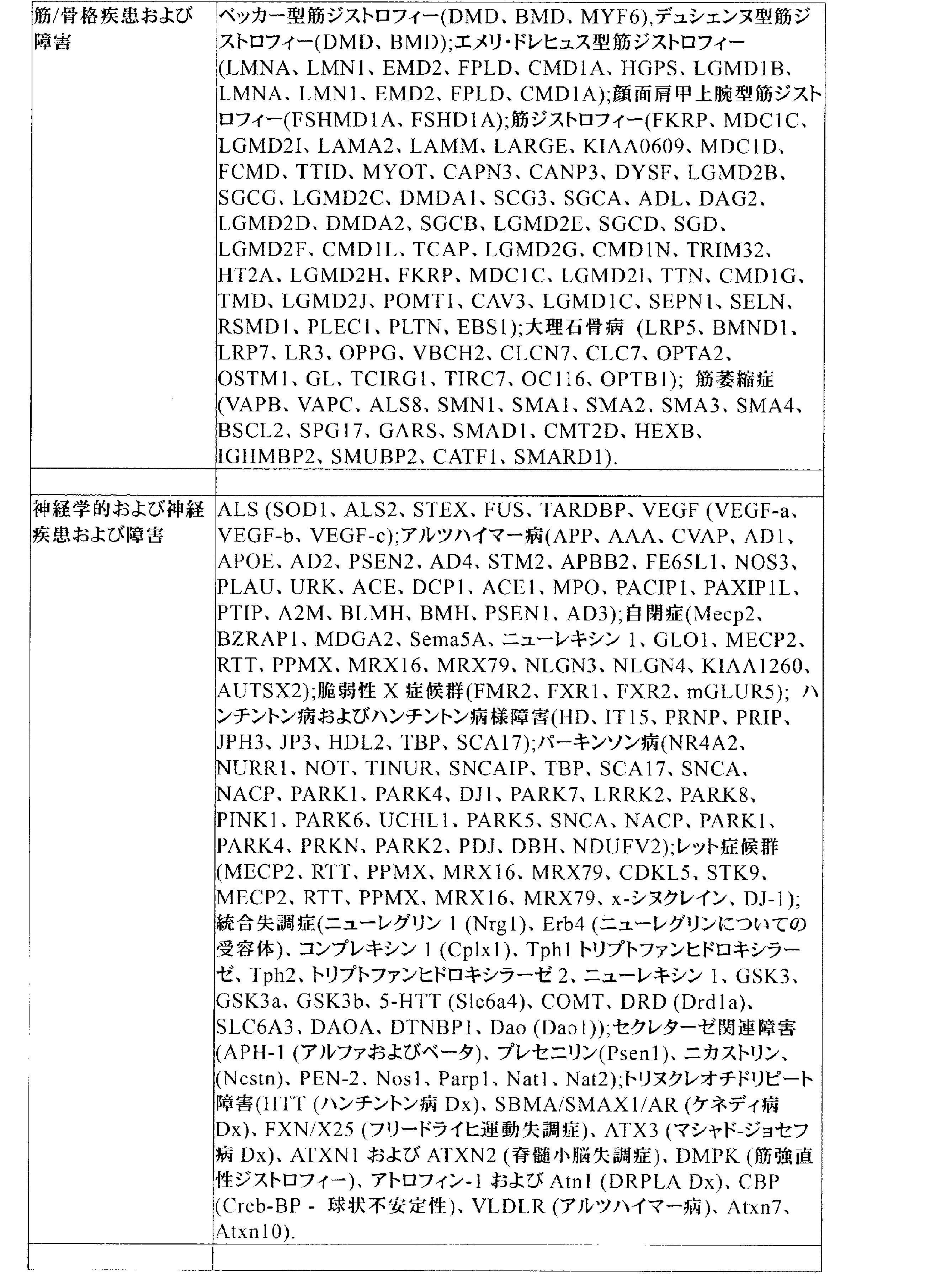


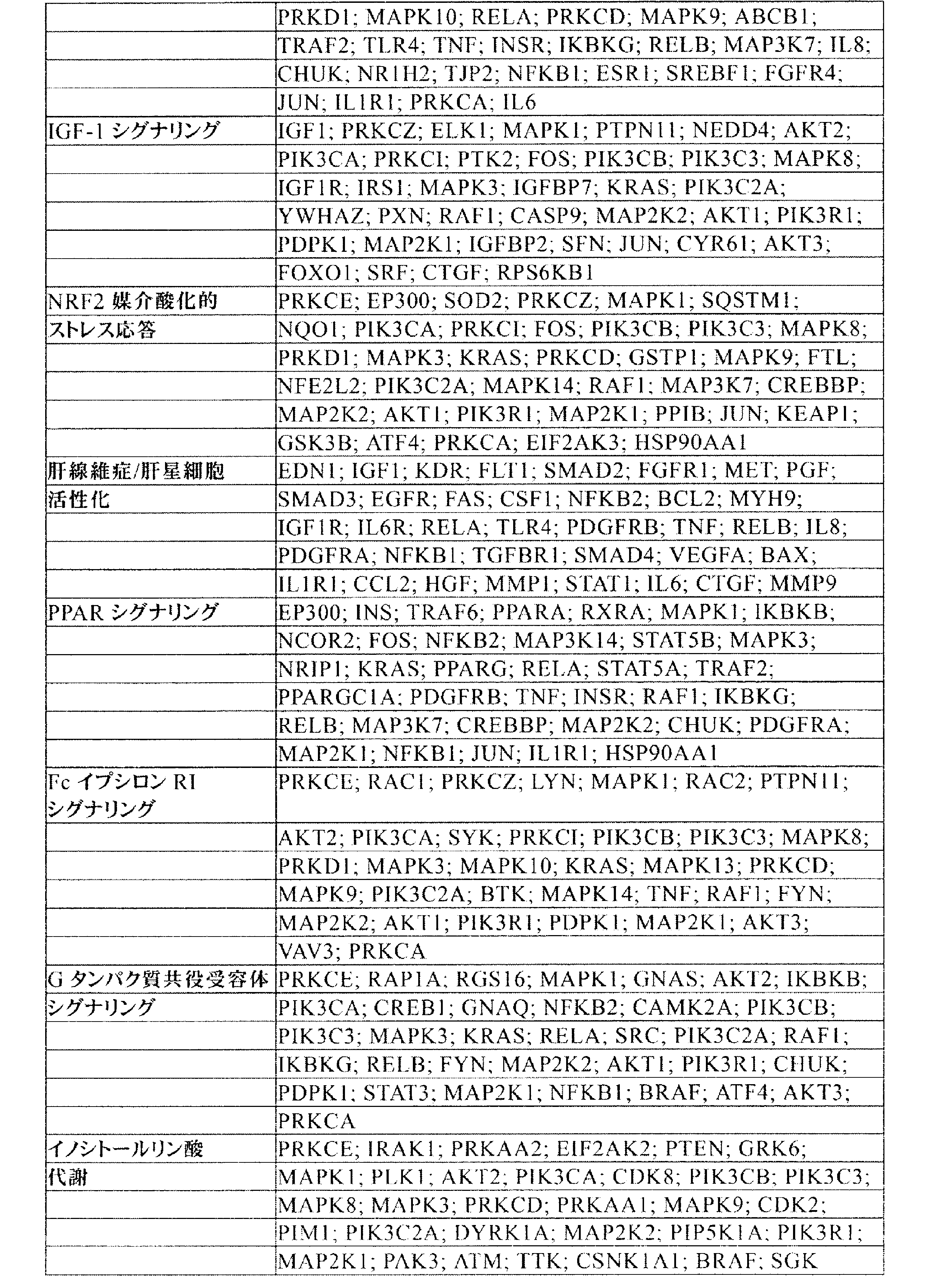
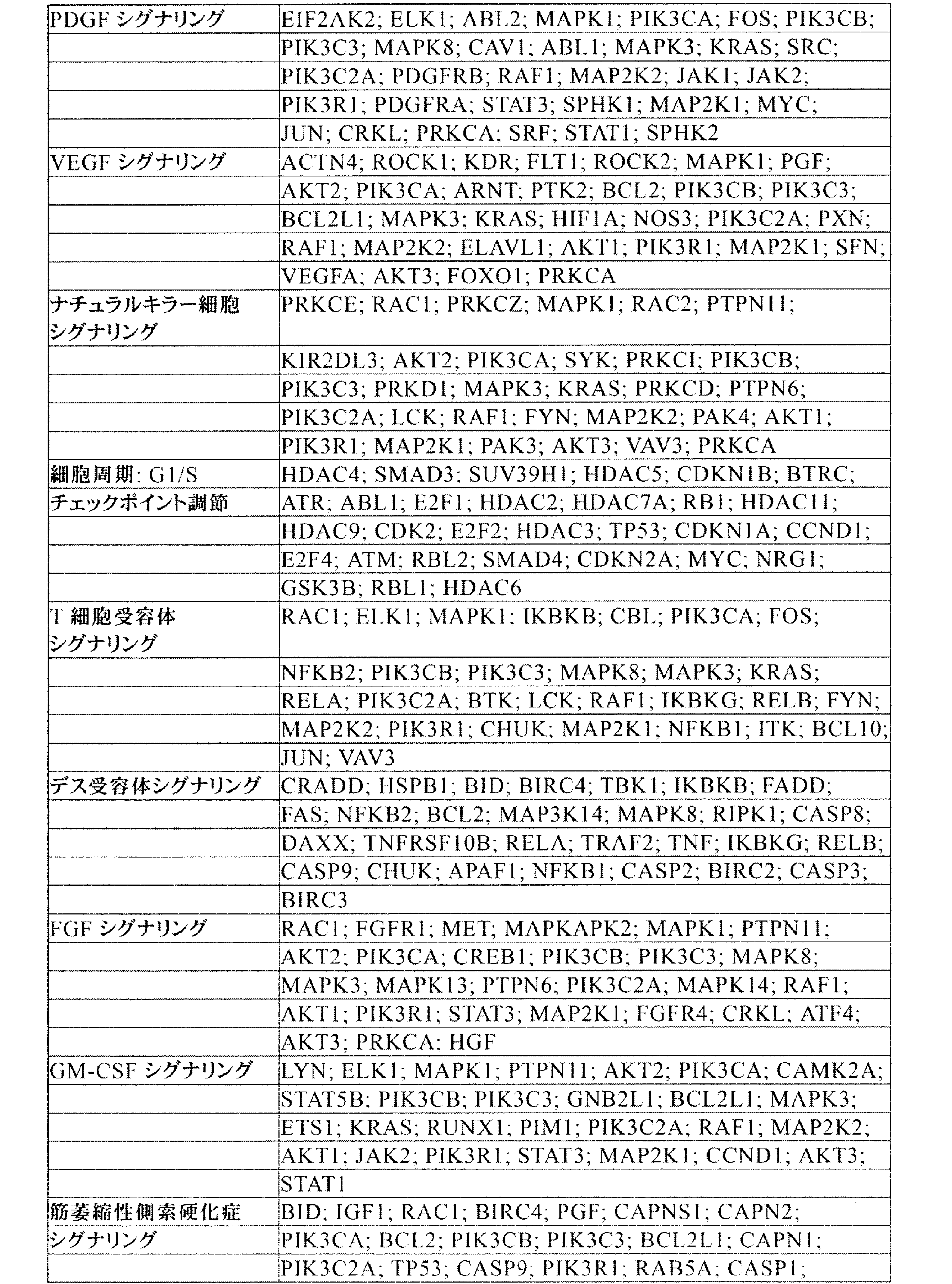
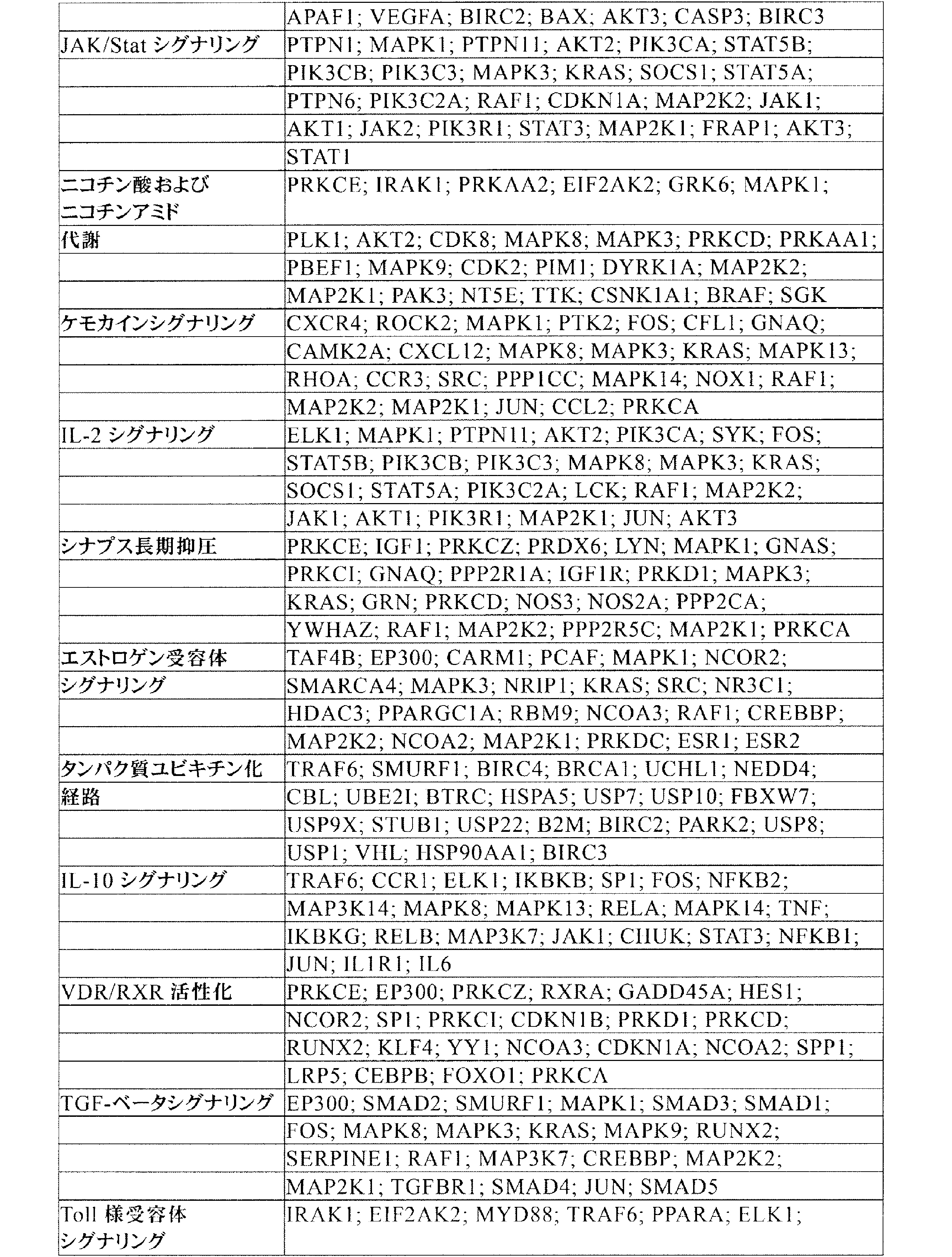


本発明の実施形態は、遺伝子のノックアウト、遺伝子の増幅ならびにDNAリピート不安定性および神経学的疾患に関連する特定の突然変異の修復に関連する方法および組成物にも関する(Robert D.Wells,Tetsuo Ashizawa,Genetic Instabilities and Neurological Diseases,Second Edition,Academic Press,Oct 13,2011-Medical)。規定の態様のタンデムリピート配列が20を超えるヒト疾患を担うことが見出されている(New insights into repeat instability:role of RNA・DNA hybrids.McIvor EI,Polak U,Napierala M.RNA Biol.2010 Sep-Oct;7(5):551-8)。CRISPR-Cas系を利用してゲノム不安定性のこれらの異常を補正することができる。 Embodiments of the present invention also relate to methods and compositions relating to gene knockout, gene amplification and repair of specific mutations associated with DNA repeat instability and neurological diseases (Robert D. Wells, Tetsuo Ashizawa, Genetic Instabilities and Neurological Diseases, Second Edition, Academic Press, Oct 13, 2011-Medical). Tandem repeat sequences of defined configurations have been found to be responsible for over 20 human diseases (New insights into repeat instability: role of RNA-DNA hybrids. McIvor EI, Polak U, Napierala M. RNA Biol. 2010 Sep-Oct; 7(5):551-8). The CRISPR-Cas system can be used to correct these defects in genomic instability.
本発明のさらなる態様は、ラフォラ病に関連することが同定されているEMP2AおよびEMP2B遺伝子の異常の補正のためのCRISPR-Cas系の利用に関する。ラフ
ォラ病は、青年期において癲癇性発作として始まり得る進行性ミオクローヌス癲癇を特徴とする常染色体劣性病態である。この疾患の数例は、未だ同定されていない遺伝子の突然変異により引き起こされ得る。この疾患は、発作、筋痙攣、歩行困難、認知症、および最終的に死亡を引き起こす。現在、疾患進行に対して有効であることが証明されている治療は存在しない。癲癇に関連する他の遺伝子異常を、CRISPR-Cas系によりターゲティングすることもでき、基礎となる遺伝学は、Genetics of Epilepsy and Genetic Epilepsies,Giuliano Avanzini,Jeffrey L.Noebelsにより編集,Mariani Foundation Paediatric Neurology:20;2009)にさらに記載されている。
A further aspect of the invention relates to the use of the CRISPR-Cas system for the correction of abnormalities in the EMP2A and EMP2B genes that have been identified as being associated with Lafora's disease. Lafora's disease is an autosomal recessive condition characterized by progressive myoclonic epilepsy that may begin as epileptic seizures in adolescence. Some cases of the disease may be caused by mutations in genes that have not yet been identified. The disease causes seizures, muscle spasms, difficulty walking, dementia, and ultimately death. Currently, there is no treatment that has proven effective against disease progression. Other genetic abnormalities associated with epilepsy can also be targeted with the CRISPR-Cas system, and the underlying genetics are described in Genetics of Epilepsy and Genetic Epilepsies, Giuliano Avanzini, Jeffrey L. This is further described in Mariani Foundation Paediatric Neurology: 20; 2009, edited by Noebels.
本発明のさらに別の態様において、CRISPR-Cas系を使用し、Genetic Diseases of the Eye,Second Edition,Elia
s I.Traboulsiにより編集,Oxford University Press,2012にさらに記載されているいくつかの遺伝子突然変異から生じる眼の異常を補正することができる。
In yet another aspect of the present invention, the CRISPR-Cas system is used to perform the method of treating cancer, as described in Genetic Diseases of the Eye, Second Edition, Eliah.
It is possible to correct eye defects resulting from several gene mutations, which are further described in "Eyelidromics: A Guide to the Treatment of Eye Disease," edited by I. Traboulsi, Oxford University Press, 2012.
本発明のいくつかのさらなる態様は、米国国立衛生研究所のウェブサイト(health.nih.gov/topic/GeneticDisordersにおけるウェブサイト)上にトピックサブセクションGenetic Disordersのもとでさらに記載されている広範な遺伝子疾患に関連する異常の補正に関する。遺伝子脳疾患としては、限定されるものではないが、副腎白質ジストロフィー、脳梁欠損症、アイカルディ症候群、アルパース病、アルツハイマー病、バース症候群、バッテン病、CADASIL、小脳変性症、ファブリー病、ゲルストマン-ストロイスラー-シャインカー病、ハンチントン病および他のトリプレットリピート病、リー病、レッシュ-ナイハン症候群、メンケス病、ミトコンドリアミオパチーならびにNINDSコルポセファリーが挙げられる。これらの疾患は、米国国立衛生研究所のウェブサイト上にサブセクションGenetic Brain Disordersのもとでさらに記載されている。 Some further aspects of the invention relate to the correction of abnormalities associated with a wide range of genetic disorders further described on the National Institutes of Health website under the topic subsection Genetic Disorders (website at health.nih.gov/topic/GeneticDisorders). Genetic brain disorders include, but are not limited to, adrenoleukodystrophy, agenesis of the corpus callosum, Aicardi syndrome, Alpers disease, Alzheimer's disease, Barth syndrome, Batten disease, CADASIL, cerebellar degeneration, Fabry disease, Gerstmann-Straussler-Scheinker disease, Huntington's disease and other triplet repeat diseases, Leigh's disease, Lesch-Nyhan syndrome, Menkes disease, mitochondrial myopathies, and NINDS colpocephaly. These disorders are further described on the National Institutes of Health website under the subsection Genetic Brain Disorders.
一部の実施形態において、病態は、新形成である。病態が新形成であり得る一部の実施形態において、ターゲティングすべき遺伝子は、表Aに列記のもののいずれかであり得る(この場合、PTENなど)。一部の実施形態において、病態は、加齢黄斑変性症であり得る。一部の実施形態において、病態は、統合失調症であり得る。一部の実施形態において、病態は、トリヌクレオチドリピート障害であり得る。一部の実施形態において、病態は、脆弱性X症候群であり得る。一部の実施形態において、病態は、セクレターゼ関連障害であり得る。一部の実施形態において、病態は、プリオン関連障害であり得る。一部の実施形態において、病態は、ALSであり得る。一部の実施形態において、病態は、薬物嗜好であり得る。一部の実施形態において、病態は、自閉症であり得る。一部の実施形態において、病態は、アルツハイマー病であり得る。一部の実施形態において、病態は、炎症であり得る。一部の実施形態において、病態は、パーキンソン病であり得る。 In some embodiments, the condition is neoplasia. In some embodiments where the condition may be neoplasia, the gene to be targeted may be any of those listed in Table A (such as PTEN in this case). In some embodiments, the condition may be age-related macular degeneration. In some embodiments, the condition may be schizophrenia. In some embodiments, the condition may be a trinucleotide repeat disorder. In some embodiments, the condition may be fragile X syndrome. In some embodiments, the condition may be a secretase-associated disorder. In some embodiments, the condition may be a prion-associated disorder. In some embodiments, the condition may be ALS. In some embodiments, the condition may be drug addiction. In some embodiments, the condition may be autism. In some embodiments, the condition may be Alzheimer's disease. In some embodiments, the condition may be inflammation. In some embodiments, the condition may be Parkinson's disease.
パーキンソン病に関連するタンパク質の例としては、限定されるものではないが、α-シヌクレイン、DJ-1、LRRK2、PINK1、パーキン、UCHL1、シンフィリン-1、およびNURR1が挙げられる。 Examples of proteins associated with Parkinson's disease include, but are not limited to, α-synuclein, DJ-1, LRRK2, PINK1, parkin, UCHL1, synphilin-1, and NURR1.
嗜好関連タンパク質の例としては、例えば、ABATを挙げることができる。 An example of a preference-related protein is ABAT.
炎症関連タンパク質の例としては、例えば、Ccr2遺伝子によりコードされる単球走化性タンパク質-1(MCP1)、Ccr5遺伝子によりコードされるC-Cケモカイン受容体5型(CCR5)、Fcgr2b遺伝子によりコードされるIgG受容体IIB(FCGR2b、CD32とも称される)、またはFcer1g遺伝子によりコードされるFcイプシロンR1g(FCER1g)タンパク質を挙げることができる。 Examples of inflammation-related proteins include, for example, monocyte chemotactic protein-1 (MCP1) encoded by the Ccr2 gene, C-C chemokine receptor type 5 (CCR5) encoded by the Ccr5 gene, IgG receptor IIB (FCGR2b, also known as CD32) encoded by the Fcgr2b gene, or Fc epsilon R1g (FCER1g) protein encoded by the Fcer1g gene.
心血管疾患関連タンパク質の例としては、例えば、IL1B(インターロイキン1、ベータ)、XDH(キサンチンデヒドロゲナーゼ)、TP53(腫瘍タンパク質p53)、PTGIS(プロスタグランジンI2(プロスタサイクリン)シンターゼ)、MB(ミオグロビン)、IL4(インターロイキン4)、ANGPT1(アンジオポエチン1)、ABCG8(ATP結合カセット、サブファミリーG(WHITE)、メンバー8)、またはCTSK(カテプシンK)を挙げることができる。 Examples of cardiovascular disease-related proteins include, for example, IL1B (interleukin 1, beta), XDH (xanthine dehydrogenase), TP53 (tumor protein p53), PTGIS (prostaglandin I2 (prostacyclin) synthase), MB (myoglobin), IL4 (interleukin 4), ANGPT1 (angiopoietin 1), ABCG8 (ATP-binding cassette, subfamily G (WHITE), member 8), or CTSK (cathepsin K).
アルツハイマー病関連タンパク質の例としては、例えば、VLDLR遺伝子によりコードされる超低密度リポタンパク質受容体タンパク質(VLDLR)、UBA1遺伝子によりコードされるユビキチン様修飾因子活性化酵素1(UBA1)、またはUBA3遺伝子によりコードされるNEDD8活性化酵素E1触媒サブユニットタンパク質(UBE1C)を挙げることができる。 Examples of Alzheimer's disease-related proteins include the very low density lipoprotein receptor protein (VLDLR) encoded by the VLDLR gene, the ubiquitin-like modifier activating enzyme 1 (UBA1) encoded by the UBA1 gene, and the NEDD8-activating enzyme E1 catalytic subunit protein (UBE1C) encoded by the UBA3 gene.
自閉症スペクトラム障害に関連するタンパク質の例としては、例えば、BZRAP1遺伝子によりコードされるベンゾジアゼピン受容体(末梢性)関連タンパク質1(BZRAP1)、AFF2遺伝子(MFR2とも称される)によりコードされるAF4/FMR2ファミリーメンバー2タンパク質(AFF2)、FXR1遺伝子によりコードされる脆弱性X精神遅滞常染色体ホモログ1タンパク質(FXR1)、またはFXR2遺伝子によりコードされる脆弱性X精神遅滞常染色体ホモログ2タンパク質(FXR2)を挙げることができる。 Examples of proteins associated with autism spectrum disorders include, for example, benzodiazepine receptor (peripheral) associated protein 1 (BZRAP1) encoded by the BZRAP1 gene, AF4/FMR2 family member 2 protein (AFF2) encoded by the AFF2 gene (also called MFR2), fragile X mental retardation autosomal homolog 1 protein (FXR1) encoded by the FXR1 gene, or fragile X mental retardation autosomal homolog 2 protein (FXR2) encoded by the FXR2 gene.
黄斑変性症に関連するタンパク質の例としては、例えば、ABCR遺伝子によりコードされるATP結合カセットサブファミリーA(ABC1)メンバー4タンパク質(ABCA4)、APOE遺伝子によりコードされるアポリポタンパク質Eタンパク質(APOE)、またはCCL2遺伝子によりコードされるケモカイン(C-Cモチーフ)リガンド2タンパク質(CCL2)を挙げることができる。 Examples of proteins associated with macular degeneration include the ATP-binding cassette subfamily A (ABC1) member 4 protein (ABCA4) encoded by the ABCR gene, the apolipoprotein E protein (APOE) encoded by the APOE gene, or the chemokine (C-C motif) ligand 2 protein (CCL2) encoded by the CCL2 gene.
統合失調症に関連するタンパク質の例としては、NRG1、ErbB4、CPLX1、TPH1、TPH2、NRXN1、GSK3A、BDNF、DISC1、GSK3B、およびそれらの組合せを挙げることができる。 Examples of proteins associated with schizophrenia include NRG1, ErbB4, CPLX1, TPH1, TPH2, NRXN1, GSK3A, BDNF, DISC1, GSK3B, and combinations thereof.
腫瘍抑制に関与するタンパク質の例としては、例えば、ATM(毛細血管拡張性運動失調症変異)、ATR(毛細血管拡張性運動失調症およびRad3関連)、EGFR(上皮成長因子受容体)、ERBB2(v-erb-b2赤芽球性白血病ウイルス癌遺伝子ホモログ2)、ERBB3(v-erb-b2赤芽球性白血病ウイルス癌遺伝子ホモログ3)、ERBB4(v-erb-b2赤芽球性白血病ウイルス癌遺伝子ホモログ4)、Notch1、Notch2、Notch3、またはNotch4を挙げることができる。 Examples of proteins involved in tumor suppression include, for example, ATM (ataxia telangiectasia mutated), ATR (ataxia telangiectasia and Rad3 associated), EGFR (epidermal growth factor receptor), ERBB2 (v-erb-b2 erythroblastic leukemia viral oncogene homolog 2), ERBB3 (v-erb-b2 erythroblastic leukemia viral oncogene homolog 3), ERBB4 (v-erb-b2 erythroblastic leukemia viral oncogene homolog 4), Notch1, Notch2, Notch3, or Notch4.
セクレターゼ障害に関連するタンパク質の例としては、例えば、PSENEN(プレセニリンエンハンサー2ホモログ(線虫(C.elegans)))、CTSB(カテプシンB)、PSEN1(プレセニリン1)、APP(アミロイドベータ(A4)前駆体タンパク質)、APH1B(咽頭前部欠損1ホモログB(線虫(C.elegans)))、PSEN2(プレセニリン2(アルツハイマー病4))、またはBACE1(ベータ部位APP開裂酵素1)を挙げることができる。 Examples of proteins associated with secretase disorders include, for example, PSENEN (presenilin enhancer 2 homolog (C. elegans)), CTSB (cathepsin B), PSEN1 (presenilin 1), APP (amyloid beta (A4) precursor protein), APH1B (anterior pharyngeal defect 1 homolog B (C. elegans)), PSEN2 (presenilin 2 (Alzheimer's disease 4)), or BACE1 (beta site APP cleavage enzyme 1).
筋萎縮性側索硬化症に関連するタンパク質の例としては、SOD1(スーパーオキシドジスムターゼ1)、ALS2(筋萎縮性側索硬化症2)、FUS(fused in sarcoma)、TARDBP(TAR DNA結合タンパク質)、VAGFA(血管内皮成長因子A)、VAGFB(血管内皮成長因子B)、およびVAGFC(血管内皮成長因子C)、およびそれらの任意の組合せを挙げることができる。 Examples of proteins associated with amyotrophic lateral sclerosis include SOD1 (superoxide dismutase 1), ALS2 (amyotrophic lateral sclerosis 2), FUS (fused in sarcoma), TARDBP (TAR DNA binding protein), VAGFA (vascular endothelial growth factor A), VAGFB (vascular endothelial growth factor B), and VAGFC (vascular endothelial growth factor C), and any combination thereof.
プリオン疾患に関連するタンパク質の例としては、SOD1(スーパーオキシドジスムターゼ1)、ALS2(筋萎縮性側索硬化症2)、FUS(fused in sarcoma)、TARDBP(TAR DNA結合タンパク質)、VAGFA(血管内皮成長因子A)、VAGFB(血管内皮成長因子B)、およびVAGFC(血管内皮成長因子C)、およびそれらの任意の組合せを挙げることができる。 Examples of proteins associated with prion diseases include SOD1 (superoxide dismutase 1), ALS2 (amyotrophic lateral sclerosis 2), FUS (fused in sarcoma), TARDBP (TAR DNA binding protein), VAGFA (vascular endothelial growth factor A), VAGFB (vascular endothelial growth factor B), and VAGFC (vascular endothelial growth factor C), and any combination thereof.
プリオン障害における神経変性病態に関連するタンパク質の例としては、例えば、A2M(アルファ-2-マクログロブリン)、AATF(アポトーシス拮抗転写因子)、ACPP(前立腺酸性ホスファターゼ)、ACTA2(大動脈平滑筋アクチンアルファ2)、ADAM22(ADAMメタロペプチダーゼドメイン)、ADORA3(アデノシンA3受容体)、またはADRA1D(アルファ-1Dアドレナリン受容体についてのアルファ-1Dアドレナリン作動性受容体)を挙げることができる。 Examples of proteins associated with neurodegenerative pathology in prion disorders include, for example, A2M (alpha-2-macroglobulin), AATF (apoptosis antagonistic transcription factor), ACPP (prostatic acid phosphatase), ACTA2 (aortic smooth muscle actin alpha 2), ADAM22 (ADAM metallopeptidase domain), ADORA3 (adenosine A3 receptor), or ADRA1D (alpha-1D adrenergic receptor for alpha-1D adrenergic receptor).
免疫不全症に関連するタンパク質の例としては、例えば、A2M[アルファ-2-マクログロブリン];AANAT[アリールアルキルアミンN-アセチルトランスフェラーゼ];ABCA1[ATP結合カセットサブファミリーA(ABC1)、メンバー1];ABCA2[ATP結合カセットサブファミリーA(ABC1)、メンバー2];またはABCA3[ATP結合カセットサブファミリーA(ABC1)、メンバー3]を挙げることができる。 Examples of proteins associated with immunodeficiency include, for example, A2M [alpha-2-macroglobulin]; AANAT [arylalkylamine N-acetyltransferase]; ABCA1 [ATP-binding cassette subfamily A (ABC1), member 1]; ABCA2 [ATP-binding cassette subfamily A (ABC1), member 2]; or ABCA3 [ATP-binding cassette subfamily A (ABC1), member 3].
トリヌクレオチドリピート障害に関連するタンパク質の例としては、例えば、AR(アンドロゲン受容体)、FMR1(脆弱性X精神遅滞1)、HTT(ハンチントン)、また
はDMPK(筋緊張性異栄養症タンパク質キナーゼ)、FXN(フラタキシン)、ATX
N2(アタキシン2)が挙げられる。
Examples of proteins associated with trinucleotide repeat disorders include, for example, AR (androgen receptor), FMR1 (Fragile X Mental Retardation 1), HTT (Huntington's disease), or DMPK (myotonic dystrophy protein kinase), FXN (frataxin), ATX (Frataxin), and the like.
N2 (ataxin 2) is an example.
神経伝達障害に関連するタンパク質の例としては、例えば、SST(ソマトスタチン)、NOS1(一酸化窒素シンターゼ1(神経型))、ADRA2A(アドレナリン作動性アルファ-2A受容体)、ADRA2C(アドレナリン作動性アルファ-2C受容体)、TACR1(タキキニン受容体1)、またはHTR2c(5-ヒドロキシトリプタミン(セロトニン)受容体2C)が挙げられる。 Examples of proteins associated with impaired neurotransmission include, for example, SST (somatostatin), NOS1 (nitric oxide synthase 1 (neuronal type)), ADRA2A (adrenergic alpha-2A receptor), ADRA2C (adrenergic alpha-2C receptor), TACR1 (tachykinin receptor 1), or HTR2c (5-hydroxytryptamine (serotonin) receptor 2C).
神経発達関連配列の例としては、例えば、A2BP1[アタキシン2結合タンパク質1]、AADAT[アミノアジピン酸アミノトランスフェラーゼ]、AANAT[アリールアルキルアミンN-アセチルトランスフェラーゼ]、ABAT[4-アミノ酪酸アミノトランスフェラーゼ]、ABCA1[ATP結合カセットサブファミリーA(ABC1)メンバー1]、またはABCA13[ATP結合カセットサブファミリーA(ABC1)メンバー13]が挙げられる。 Examples of neurodevelopment-related sequences include, for example, A2BP1 [ataxin 2-binding protein 1], AADAT [aminoadipate aminotransferase], AANAT [arylalkylamine N-acetyltransferase], ABAT [4-aminobutyrate aminotransferase], ABCA1 [ATP-binding cassette subfamily A (ABC1) member 1], or ABCA13 [ATP-binding cassette subfamily A (ABC1) member 13].
本発明の系により治療可能な好ましい病態のさらなる例は、以下のものから選択することができる:アルカルディ-グティエール症候群;アレキサンダー病;アラン-ハーンドン-ダッドリー症候群;POLG関連障害;アルファ-マンノシドーシス(IIおよびIII型);アルストレム症候群;アンジェルマン症候群;毛細血管拡張性運動失調症;神経セロイドリポフスチン症;ベータ-セラサミア;両側性視神経委縮症および(幼児型)視神経委縮症1型;網膜芽腫(両側性);カナバン病;脳・眼・顔・骨格症候群1[COFS1];脳腱黄色腫症;コルネリア・デ・ラング症候群;MAPT関連障害;遺伝性プリオン病;ドラベ症候群;早期発症型家族性アルツハイマー病;フリードライヒ運動失調症[FRDA];フリンス症候群;フコシドーシス;福山型先天性筋ジストロフィー;ガラクトシアリドーシス;ゴーシェ病;有機酸血症;血球貪食性リンパ組織球症;ハッチンソン-ギルフォード早老症候群;ムコリピドーシスII型;幼児遊離シアル酸蓄積症;PLA2G6関連神経変性症;ジャーベル・ランゲ-ニールセン症候群;接合型表皮水疱症;ハンチントン病;クラッベ病(幼児型);ミトコンドリアDNA関連リー症候群およびNARP;レッシュ-ナイハン症候群;LIS1関連滑脳症;ロウ症候群;メープルシロップ尿症;MECP2重複症候群;ATP7A関連銅輸送障害;LAMA2関連筋ジストロフィー;アリールスルファターゼA欠損症;ムコ多糖症I、IIまたはIII型;ペルオキシソーム形成異常症、ツェルウェーガー症候群スペクトラム;脳の鉄蓄積症を伴う神経変性症;酸性スフィンゴミエリナーゼ欠損症;ニーマン-ピック病C型;グリシン脳症;ARX関連障害;尿素サイクル異常症;COL1A1/2関連骨形成不全症;ミトコンドリアDNA欠失症候群;PLP1関連障害;ペリー症候群;フェラン-マクダーモット症候群;グリコーゲン蓄積症II型(ポンペ病)(幼児型);MAPT関連障害;MECP2関連障害;肢根型点状軟骨異形成症1型;ロバーツ症候群;サンドホフ病;シンドラー病1型;アデノシンデアミナーゼ欠損症;スミス-レムリ-オピッツ症候群;脊髄性筋萎縮症;幼児期発症型脊髄小脳失調症;ヘキソサミニダーゼA欠損症;致死性異形成1型;コラーゲンVI型関連障害;アッシャー症候群I型;先天性筋ジストロフィー;ウォルフ-ヒルシュホーン症候群;リソソーム酸リパーゼ欠損症;ならびに色素性乾皮症。 Further examples of preferred conditions treatable by the system of the present invention can be selected from: Alcaldi-Goutières syndrome; Alexander disease; Allan-Herndon-Dudley syndrome; POLG-related disorders; alpha-mannosidosis (types II and III); Alström syndrome; Angelman syndrome; ataxia-telangiectasia; neuronal ceroid lipofuscinosis; beta-thalassemia; bilateral optic atrophy and (infantile) optic atrophy type 1; retinoblastoma (bilateral); Canavan disease; cerebro-ocular-facial-skeletal syndrome 1 [COFS1]; cerebrotendinous xanthomatosis; Cornelia de Lang syndrome; MAPT-related disorders; inherited prion diseases; Dravet syndrome; early-onset familial Alzheimer's disease; Friedreich's ataxia [FRDA]; Frins syndrome; fucosidosis; Fukuyama-type congenital muscular dystrophy; galactosialidosis; Gaucher disease; organic acidemias; hemophagocytic lymphohistiocytosis; Hutchinson-Gilford progeria syndrome; mucolipidosis type II; infantile free sialic acid storage disease; PLA2G6-associated neurodegeneration; Jervell-Lange-Nielsen syndrome; junctional epidermolysis bullosa; Huntington's disease; Krabbe disease (infantile); mitochondrial DNA-associated Leigh syndrome and NARP; Lesch-Nyhan syndrome; LIS1-related lissencephaly; Lowe syndrome; Maple syrup urine disease; MECP2 duplication syndrome; ATP7A-related copper transport disorder; LAMA2-related muscular dystrophy; Arylsulfatase A deficiency; Mucopolysaccharidosis I, II, or III; Peroxisomal biogenesis disorders, Zellweger syndrome spectrum; Neurodegeneration with cerebral iron storage; Acid sphingomyelinase deficiency; Niemann-Pick disease type C; Glycine encephalopathy; ARX-related disorders; Urea cycle disorders; COL1A1/2-related osteogenesis imperfecta; Mitochondrial DNA deletion syndrome; PLP1-related disorders damage; Perry syndrome; McDermott-Phelan syndrome; Glycogen storage disease type II (Pompe disease) (infantile form); MAPT-related disorder; MECP2-related disorder; Rhizome chondrodysplasia punctata type 1; Roberts syndrome; Sandhoff disease; Schindler disease type 1; Adenosine deaminase deficiency; Smith-Lemli-Opitz syndrome; Spinal muscular atrophy; Infantile-onset spinocerebellar ataxia; Hexosaminidase A deficiency; Thalassemia dysplasia type 1; Collagen VI-related disorder; Usher syndrome type I; Congenital muscular dystrophy; Wolf-Hirschhorn syndrome; Lysosomal acid lipase deficiency; and Xeroderma pigmentosum.
明らかなとおり、本発明の系を使用して任意の目的ポリヌクレオチド配列をターゲティングすることができることが想定される。本発明の系を使用して有用に治療することができる病態または疾患の一部の例を上記表に含め、それらの病態に現在関連する遺伝子の例もその表に提供する。しかしながら、例示される遺伝子は排他的なものではない。 As will be apparent, it is contemplated that the system of the present invention may be used to target any polynucleotide sequence of interest. Some examples of conditions or diseases that may be usefully treated using the system of the present invention are included in the table above, and examples of genes currently associated with those conditions are also provided in the table. However, the exemplified genes are not intended to be exhaustive.
以下の実施例を、本発明の種々の実施形態を説明する目的のために挙げ、それらは本発明をいかなる様式にも限定することを意味しない。本実施例は、本明細書に記載の方法とともに、目下好ましい実施形態の代表例であり、例示であり、本発明の範囲に対する限定を意図するものではない。特許請求の範囲の範囲により定義される本発明の趣旨に包含されるその変更および他の使用は、当業者が行う。 The following examples are provided for the purpose of illustrating various embodiments of the present invention and are not meant to limit the invention in any manner. The examples, together with the methods described herein, are representative and illustrative of presently preferred embodiments and are not intended as limitations on the scope of the invention. Modifications thereof and other uses within the spirit of the invention as defined by the scope of the claims will occur to those skilled in the art.
実施例1:真核細胞の核中のCRISPR複合体活性
例示的なII型CRISPR系は、4つの遺伝子Cas9、Cas1、Cas2、およびCsn1のクラスター、ならびに2つの非コードRNAエレメント、tracrRNAおよび非反復配列の短いストレッチ(スペーサー、それぞれ約30bp)により間隔が空いている反復配列の特徴的アレイ(ダイレクトリピート)を含有する化膿性連鎖球菌(Streptococcus pyogenes)SF370からのII型CRISPR遺伝子座である。この系において、ターゲティングされるDNA二本鎖切断(DSB)を4つの連続ステップにおいて生成する(図2A)。第1に、2つの非コードRNA、プレcrRNAアレイおよびtracrRNAがCRISPR遺伝子座から転写される。第2に、tracrRNAがプレcrRNAのダイレクトリピートにハイブリダイズし、次いでそれが個々のスペーサー配列を含有する成熟crRNAにプロセシングされる。第3に、成熟crRNA:tracrRNA複合体がCas9を、crRNAのスペーサー領域とプロトスペーサーDNAとの間のヘテロ二本鎖形成を介してプロトスペーサーおよび対応するPAMからなるDNA標的に指向する。最後に、Cas9は、PAMの上流の標的DNAの開裂を媒介してプロトスペーサー内でDSBを創成する(図2A)。この例は、このRNAプログラマブルヌクレアーゼ系を適応させて真核細胞の核中のCRISPR複合体活性を指向する例示プロセスを記載する。
Example 1: CRISPR complex activity in the nucleus of eukaryotic cells An exemplary type II CRISPR system is the type II CRISPR locus from Streptococcus pyogenes SF370, which contains a cluster of four genes Cas9, Cas1, Cas2, and Csn1, and two non-coding RNA elements, tracrRNA and a characteristic array of repeat sequences (direct repeats) spaced by short stretches of non-repeated sequences (spacers, each about 30 bp). In this system, the targeted DNA double-strand break (DSB) is generated in four successive steps (Figure 2A). First, two non-coding RNAs, pre-crRNA array and tracrRNA, are transcribed from the CRISPR locus. Secondly, tracrRNA hybridizes to the direct repeat of pre-crRNA, which is then processed into mature crRNA containing individual spacer sequences.Thirdly, the mature crRNA:tracrRNA complex directs Cas9 to the DNA target consisting of the protospacer and the corresponding PAM through heteroduplex formation between the spacer region of crRNA and the protospacer DNA.Finally, Cas9 mediates the cleavage of the target DNA upstream of the PAM to create a DSB within the protospacer (Figure 2A).This example describes an exemplary process of adapting this RNA programmable nuclease system to direct CRISPR complex activity in the nucleus of eukaryotic cells.
細胞培養および形質移入
ヒト胚腎臓(HEK)細胞系HEK293FT(Life Technologies)を、10%のウシ胎仔血清(HyClone)、2mMのGlutaMAX(Life Technologies)、100U/mLのペニシリン、および100μg/mLのストレプトマイシンが補給されたダルベッコ改変イーグル培地(DMEM)中で37℃において5%のCO2インキュベーションで維持した。マウスneuro2A(N2A)細胞系(ATCC)を、5%のウシ胎仔血清(HyClone)、2mMのGlutaMAX(Life Technologies)、100U/mLのペニシリン、および100μg/mLのストレプトマイシンが補給されたDMEMにより、37℃、5%のCO2で維持した。
Cell Culture and Transfection Human embryonic kidney (HEK) cell line HEK293FT (Life Technologies) was maintained in Dulbecco's modified Eagle's medium (DMEM) supplemented with 10% fetal bovine serum (HyClone), 2 mM GlutaMAX (Life Technologies), 100 U/mL penicillin, and 100 μg/mL streptomycin at 37° C. with 5% CO2 incubation. The mouse neuro2A (N2A) cell line (ATCC) was maintained in DMEM supplemented with 5% fetal bovine serum (HyClone), 2 mM GlutaMAX (Life Technologies), 100 U/mL penicillin, and 100 μg/mL streptomycin at 37° C. and 5% CO2.
HEK293FTまたはN2A細胞を24ウェルプレート(Corning)中に、形質移入1日前に1ウェル当たり200,000個の細胞の密度において播種した。Lipofectamine2000(Life Technologies)を製造業者の推奨プロトコルに従って使用して細胞を形質移入した。24ウェルプレートのそれぞれのウェルについて、合計800ngのプラスミドを使用した。 HEK293FT or N2A cells were seeded in 24-well plates (Corning) at a density of 200,000 cells per well one day before transfection. Cells were transfected using Lipofectamine2000 (Life Technologies) according to the manufacturer's recommended protocol. A total of 800 ng of plasmid was used for each well of the 24-well plate.
ゲノム改変についてのSurveyorアッセイおよびシーケンシング分析
HEK293FTまたはN2A細胞を、上記プラスミドDNAにより形質移入した。形質移入後、細胞を37℃において72時間インキュベートしてからゲノムDNAを抽出した。ゲノムDNAは、QuickExtractDNA抽出キット(Epicentre)を製造業者のプロトコルに従って使用して抽出した。手短に述べると、細胞をQuickExtract溶液中で再懸濁させ、65℃において15分間および98℃において10分間インキュベートした。抽出されたゲノムDNAを直ちに処理または-20℃において貯蔵した。
Surveyor assay and sequencing analysis for genome modification HEK293FT or N2A cells were transfected with the above plasmid DNA. After transfection, cells were incubated at 37°C for 72 hours before genomic DNA extraction. Genomic DNA was extracted using QuickExtract DNA extraction kit (Epicentre) according to the manufacturer's protocol. Briefly, cells were resuspended in QuickExtract solution and incubated at 65°C for 15 minutes and 98°C for 10 minutes. Extracted genomic DNA was immediately processed or stored at -20°C.
それぞれの遺伝子についてのCRISPR標的部位周囲のゲノム領域をPCR増幅し、QiaQuick Spin Column(Qiagen)を製造業者のプロトコルに従って使用して産物を精製した。合計400ngの精製PCR産物を2μlの10×TaqポリメラーゼPCR緩衝液(Enzymatics)と混合し、超純水で20μlの最終容量とし、リアニーリングプロセスに供してヘテロ二本鎖形成を可能とした:95℃において10分間、-2℃/秒における傾斜で95℃から85℃、-0.25℃/秒における85℃から25℃、および25℃において1分間維持。リアニーリング後、産物をSurveyorヌクレアーゼおよびSurveyorエンハンサーS(Transgenomics)により製造業者の推奨プロトコルに従って処理し、4~20%のNovex TBEポリアクリルアミドゲル(Life Technologies)上で分析した。ゲルをSYBR Gold DNA染色(Life Technologies)により30分間染色し、Gel Docゲルイメージングシステム(Bio-rad)によりイメージングした。定量は、開裂したDNAの率の尺度としての相対バンド強度に基づくものであった。図8は、このSurveyorアッセイの模式的説明を提供する。 Genomic regions around the CRISPR target site for each gene were PCR amplified and products were purified using a QiaQuick Spin Column (Qiagen) according to the manufacturer's protocol. A total of 400 ng of purified PCR product was mixed with 2 μl of 10× Taq polymerase PCR buffer (Enzymatics), brought to a final volume of 20 μl with ultrapure water, and subjected to a reannealing process to allow heteroduplex formation: 95°C for 10 min, ramping from 95°C to 85°C at -2°C/s, 85°C to 25°C at -0.25°C/s, and holding at 25°C for 1 min. After reannealing, the products were treated with Surveyor Nuclease and Surveyor Enhancer S (Transgenomics) according to the manufacturer's recommended protocol and analyzed on 4-20% Novex TBE polyacrylamide gels (Life Technologies). Gels were stained with SYBR Gold DNA stain (Life Technologies) for 30 min and imaged with a Gel Doc gel imaging system (Bio-rad). Quantitation was based on relative band intensity as a measure of the percentage of DNA cleaved. Figure 8 provides a schematic description of the Surveyor assay.
相同組換えの検出のための制限断片長多型アッセイ
HEK293FTおよびN2A細胞を、プラスミドDNAにより形質移入し、37℃において72時間インキュベートしてから上記のとおりゲノムDNAを抽出した。相同組換え(HR)テンプレートのホモロジーアーム外側のプライマーを使用して標的ゲノム領域をPCR増幅した。PCR産物を1%のアガロースゲル上で分離し、MinElute GelExtraction Kit(Qiagen)により抽出した。精製産物をHindIII(Fermentas)により消化し、6%のNovex TBEポリアクリルアミドゲル(Life Technologies)上で分析した。
Restriction fragment length polymorphism assay for detection of homologous recombination HEK293FT and N2A cells were transfected with plasmid DNA and incubated at 37°C for 72 hours before genomic DNA extraction as described above. Target genomic regions were PCR amplified using primers outside the homology arms of the homologous recombination (HR) template. PCR products were separated on a 1% agarose gel and extracted with MinElute GelExtraction Kit (Qiagen). Purified products were digested with HindIII (Fermentas) and analyzed on a 6% Novex TBE polyacrylamide gel (Life Technologies).
RNA二次構造予測および分析
RNA二次構造予測は、Institute for Theoretical Chemistry at the University of Viennaにおいて開発されたオンラインウェブサーバーRNAfoldを使用し、セントロイド構造予測アルゴリズムを使用して実施した(例えば、A.R.Gruber et al.,2008,Cell 106(1):23-24;およびPA Carr and GM Church,2009,Nature Biotechnology 27(12):1151-62参照)。
RNA Secondary Structure Prediction and Analysis RNA secondary structure prediction was performed using the online web server RNAfold developed at the Institute for Theoretical Chemistry at the University of Vienna, using the centroid structure prediction algorithm (see, e.g., A. R. Gruber et al., 2008, Cell 106(1):23-24; and PA Carr and GM Church, 2009, Nature Biotechnology 27(12):1151-62).
細菌プラスミド形質転換干渉アッセイ
CRISPR活性に十分な化膿性連鎖球菌(S.pyogenes)CRISPR遺伝子座1のエレメントを、pCRISPRプラスミドを使用して大腸菌(E.coli)中で再構成した(図10Aに模式的に説明する)。pCRISPRは、tracrRNA、SpCas9、およびcrRNAアレイをドライブするリーダー配列を含有した。スペーサー(「ガイド配列」とも称される)を、説明のとおりアニールされたオリゴヌクレオチドを使用してcrRNAアレイ中にBsaI部位間で挿入した。干渉アッセイにおいて使用されるチャレンジプラスミドは、プロトスペーサー(「標的配列」とも称される)配列を、隣接CRISPRモチーフ配列(PAM)とともにpUC19中に挿入することにより構築した(図10B参照)。チャレンジプラスミドは、アンピシリン耐性を含有した。図10Cは、干渉アッセイの模式的表示を提供する。既にpCRISPRおよび適切なスペーサーを担持する化学コンピテント大腸菌(E.coli)株を、対応するプロトスペーサー-PAM配列を含有するチャレンジプラスミドにより形質転換した。pUC19を使用してそれぞれのpCRISPR担持コンピテント株の形質転換効率を評価した。CRISPR活性は、プロトスペーサーを担持するpPSPプラスミドの開裂をもたらし、そうでなければプロトスペーサーを欠くpUC19により付与されるアンピシリン耐性を除外した。図10Dは、図4Cに説明されるアッセイにおいて使用されたそれぞれのpCRISPR担持大腸菌(E.coli)株のコンピテンスを説明する。
Bacterial Plasmid Transformation Interference Assay S. pyogenes CRISPR locus 1 elements sufficient for CRISPR activity were reconstituted in E. coli using pCRISPR plasmid (schematically illustrated in FIG. 10A). pCRISPR contained tracrRNA, SpCas9, and a leader sequence driving the crRNA array. A spacer (also referred to as "guide sequence") was inserted between the BsaI sites into the crRNA array using oligonucleotides annealed as illustrated. The challenge plasmid used in the interference assay was constructed by inserting the protospacer (also referred to as "target sequence") sequence with flanking CRISPR motif sequences (PAM) into pUC19 (see FIG. 10B). The challenge plasmid contained ampicillin resistance. FIG. 10C provides a schematic representation of the interference assay. Chemically competent E. coli strains already carrying pCRISPR and the appropriate spacer were transformed with the challenge plasmid containing the corresponding protospacer-PAM sequence. pUC19 was used to assess the transformation efficiency of each pCRISPR-carrying competent strain. CRISPR activity resulted in cleavage of the pPSP plasmid carrying the protospacer, eliminating the ampicillin resistance otherwise conferred by pUC19 lacking the protospacer. Figure 10D illustrates the competence of each pCRISPR-carrying E. coli strain used in the assay described in Figure 4C.
RNA精製
HEK293FT細胞を上記のとおり維持および形質移入した。細胞をトリプシン処理により回収し、次いでリン酸緩衝生理食塩水(PBS)中で洗浄した。トータル細胞RNAをTRI試薬(Sigma)により製造業者のプロトコルに従って抽出した。抽出されたトータルRNAをNaonodrop(Thermo Scientific)を使用して定量し、同一濃度に正規化した。
RNA purification HEK293FT cells were maintained and transfected as described above. Cells were harvested by trypsinization and then washed in phosphate-buffered saline (PBS). Total cellular RNA was extracted with TRI Reagent (Sigma) according to the manufacturer's protocol. Extracted total RNA was quantified using Naonodrop (Thermo Scientific) and normalized to the same concentration.
哺乳動物細胞中のcrRNAおよびtracrRNA発現のノザンブロット分析
RNAを等容量の2×ローディング緩衝液(Ambion)と混合し、95℃に5分間加熱し、氷上で1分間冷蔵し、次いで8%の変性ポリアクリルアミドゲル(SequaGel,National Diagnostics)上に、少なくとも30分間のゲルのプレラン後にロードした。試料を40W限界において1.5時間電気泳動した。その後、RNAをHybond N+メンブレン(GE Healthcare)に300mAにおいてセミドライ転写装置(Bio-rad)中で室温において1.5時間転写した。Stratagene UV CrosslinkerのStratalinker(Stratagene)上のオートクロスリンクボタンを使用してRNAをメンブレンに架橋させた。メンブレンをULTRAhyb-オリゴハイブリダイゼーション緩衝液(Ambion)中で回転させながら42℃において30分間プレハイブリダイズさせ、次いでプローブを添加し、一晩ハイブリダイズさせた。プローブはIDTに発注し、T4ポリヌクレオチドキナーゼ(New England Biolabs)を用いて[ガンマ-32P]ATP(Perkin Elmer)により標識した。メンブレンを予備加温(42℃)された2×SSC、0.5%のSDSにより1分間1回洗浄し、次いで42℃において30分間2回洗浄した。メンブレンを蛍光スクリーンに室温において1時間または一晩曝露させ、次いでphosphorimager(Typhoon)によりスキャンした。
Northern blot analysis of crRNA and tracrRNA expression in mammalian cells RNA was mixed with an equal volume of 2x loading buffer (Ambion), heated to 95°C for 5 min, chilled on ice for 1 min, and then loaded onto an 8% denaturing polyacrylamide gel (SequaGel, National Diagnostics) after pre-running the gel for at least 30 min. Samples were electrophoresed for 1.5 h at 40 W limit. RNA was then transferred to a Hybond N+ membrane (GE Healthcare) at 300 mA in a semi-dry transfer apparatus (Bio-rad) for 1.5 h at room temperature. RNA was cross-linked to the membrane using the autocrosslink button on a Stratagene UV Crosslinker (Stratagene). Membranes were prehybridized in ULTRAhyb-oligohybridization buffer (Ambion) for 30 min at 42°C with rotation, then probes were added and hybridized overnight. Probes were ordered from IDT and labeled with [gamma-32P]ATP (Perkin Elmer) using T4 polynucleotide kinase (New England Biolabs). Membranes were washed once for 1 min with prewarmed (42°C) 2xSSC, 0.5% SDS, then washed twice for 30 min at 42°C. Membranes were exposed to a phosphor screen for 1 h or overnight at room temperature, then scanned with a phosphorimager (Typhoon).
細菌CRISPR系構築および評価
tracrRNA、Cas9、およびリーダーを含むCRISPR遺伝子座エレメントを、化膿性連鎖球菌(Streptococcus pyogenes)SF370ゲノムDNAから、ギブソン・アセンブリ(Gibson Assembly)のためのフランキングホモロジーアームを用いてPCR増幅した。2つのBsaI IIS型部位を2つのダイレクトリピート間に導入してスペーサーの容易な挿入を促進した(図9)。Gibson Assembly Master Mix(NEB)を使用してPCR産物をEcoRV消化pACYC184中にtetプロモーターの下流でクローニングした。Csn2の最後の50bpは除き、他の内因性CRISPR系エレメントは除外した。相補的オーバーハングを有するスペーサーをコードするオリゴ(Integrated DNA Technology)をBsaI消化ベクターpDC000(NEB)中にクローニングし、次いでT7リガーゼ(Enzymatics)によりライゲートしてpCRISPRプラスミドを生成した。PAM配列(本明細書において「CRISPRモチーフ配列」とも称される)を有するスペーサーを含有するチャレンジプラスミドを、同等のオーバーハングを担持するハイブリダイズされたオリゴ(Integrated DNA Technology)をBamHI消化pUC19中にライゲートすることにより創成した。全ての構築物のためのクローニングは、大腸菌(E.coli)株JM109(Zymo Research)中で実施した。
Bacterial CRISPR system construction and evaluation CRISPR locus elements, including tracrRNA, Cas9, and leader, were PCR amplified from Streptococcus pyogenes SF370 genomic DNA with flanking homology arms for Gibson Assembly. Two BsaI type IIS sites were introduced between the two direct repeats to facilitate easy insertion of spacers (Figure 9). The PCR product was cloned downstream of the tet promoter into EcoRV-digested pACYC184 using Gibson Assembly Master Mix (NEB). The last 50 bp of Csn2 was removed, excluding other endogenous CRISPR system elements. Oligos encoding spacers with complementary overhangs (Integrated DNA Technology) were cloned into BsaI-digested vector pDC000 (NEB) and then ligated with T7 ligase (Enzymatics) to generate pCRISPR plasmids. Challenge plasmids containing spacers with PAM sequences (also referred to herein as "CRISPR motif sequences") were created by ligating hybridized oligos carrying equivalent overhangs (Integrated DNA Technology) into BamHI-digested pUC19. Cloning for all constructs was performed in E. coli strain JM109 (Zymo Research).
Z-Competent E.coli Transformation Kit and Buffer Set(Zymo Research,T3001)を製造業者の指示書に従って使用して、pCRISPR担持細胞をコンピテントとした。形質転換アッセイにおいて、pCRISPRを担持するコンピテント細胞の50uLのアリコートを氷上で解凍し、1ngのスペーサープラスミドまたはpUC19により氷上で30分間形質転換し、次いで42℃において45秒間熱ショックし、氷上で2分間維持した。続いて、250ulのSOC(Invitrogen)を添加し、次いで振とうさせながら37℃において1時間インキュベートし、100uLのSOC後前培養物を二重選択プレート(12.5ug/mlのクロラムフェニコール、100ug/mlのアンピシリン)上にプレーティングした。cfu/DNA1ngを得るため、総コロニー数に3を乗じた。 pCRISPR-carrying cells were made competent using Z-Competent E. coli Transformation Kit and Buffer Set (Zymo Research, T3001) according to the manufacturer's instructions. In the transformation assay, a 50 uL aliquot of pCRISPR-carrying competent cells was thawed on ice and transformed with 1 ng of spacer plasmid or pUC19 on ice for 30 minutes, then heat shocked at 42°C for 45 seconds and kept on ice for 2 minutes. Subsequently, 250 ul of SOC (Invitrogen) was added, followed by incubation at 37°C with shaking for 1 hour, and 100 uL of post-SOC preculture was plated on double selection plates (12.5 ug/ml chloramphenicol, 100 ug/ml ampicillin). The total colony count was multiplied by 3 to obtain cfu/ng of DNA.
哺乳動物細胞中のCRISPR成分の発現を改善するため、化膿性連鎖球菌(Streptococcus pyogenes(S.pyogenes))SF370遺伝子座1からの2つの遺伝子Cas9(SpCas9)およびRNアーゼIII(SpRNアーゼIII)をコドン最適化した。核局在化を促進するため、核局在化シグナル(NLS)をSpCas9およびSpRNアーゼIIIの両方のアミノ(N)またはカルボキシル(C)末端に含めた(図2B)。タンパク質発現の可視化を促進するため、蛍光タンパク質マーカーも両方のタンパク質のNまたはC末端に含めた(図2B)。NおよびC末端の両方に付着しているNLSを有するSpCas9のバージョン(2×NLS-SpCas9)も生成した。NLS融合SpCas9およびSpRNアーゼIIIを含有する構築物を293FTヒト胚腎臓(HEK)細胞中に形質移入し、SpCas9およびSpRNアーゼIIIに対するNLSの相対的位置決めが、それらの核局在化効率に影響することが見出された。C末端NLSは標的SpRNアーゼIIIを核にターゲティングするために十分であった一方、SpCas9のNまたはC末端のいずれかへのこれらの特定のNLSの単一コピーの付着は、この系中の適切な核局在化を達成し得なかった。この例において、C末端NLSは、ヌクレオプラスミンのもの(KRPAATKKAGQAKKKK)であり、C末端NLSは、SV40ラージT抗原のもの(PKKKRKV)であった。試験されたSpCas9のバージョンのうち、2×NLS-SpCas9のみが核局在化を示した(図2B)。 To improve expression of CRISPR components in mammalian cells, two genes from Streptococcus pyogenes (S. pyogenes) SF370 locus 1, Cas9 (SpCas9) and RNase III (SpRNase III), were codon-optimized. To facilitate nuclear localization, nuclear localization signals (NLS) were included at the amino (N) or carboxyl (C) termini of both SpCas9 and SpRNase III (Figure 2B). To facilitate visualization of protein expression, fluorescent protein markers were also included at the N or C termini of both proteins (Figure 2B). A version of SpCas9 with NLS attached at both the N and C termini (2xNLS-SpCas9) was also generated. Constructs containing NLS-fused SpCas9 and SpRNase III were transfected into 293FT human embryonic kidney (HEK) cells, and it was found that the relative positioning of the NLS to SpCas9 and SpRNase III affected their nuclear localization efficiency. While the C-terminal NLS was sufficient to target the target SpRNase III to the nucleus, attachment of a single copy of these specific NLS to either the N- or C-terminus of SpCas9 failed to achieve proper nuclear localization in this system. In this example, the C-terminal NLS was that of nucleoplasmin (KRPAATKKAGQAKKKK), and the C-terminal NLS was that of SV40 large T antigen (PKKKRKV). Of the versions of SpCas9 tested, only 2xNLS-SpCas9 showed nuclear localization (Figure 2B).
化膿性連鎖球菌(S.pyogenes)SF370のCRISPR遺伝子座からのtracrRNAは、2つの転写開始部位を有し、89ヌクレオチド(nt)および171ntの2つの転写物を生じさせ、それは続いて同一の75nt成熟tracrRNAにプロセシングされる。より短い89ntのtracrRNAを哺乳動物細胞中の発現のために選択した(図7Aに説明される発現構築物、図7Bに示されるSurveyorアッセイの結果により決定された機能性を有する)。転写開始部位を+1として標識し、転写ターミネーターおよびノザンブロットによりプロ―ビングされる配列も示す。プロセシングされたtracrRNAの発現もノザンブロットにより確認した。図7Cは、長鎖または短鎖tracrRNA、ならびにSpCas9およびDR-EMX1(1)-DRを担持するU6発現構築物により形質移入された293FT細胞から抽出されたトータルRNAのノザンブロット分析の結果を示す。左および右側のパネルは、それぞれSpRNアーゼIIIを用いず、または用いて形質移入された293FT細胞からのものである。U6は、ヒトU6snRNAをターゲティングするプローブによりブロットされたローディング対照を示す。短鎖tracrRNA発現構築物の形質移入は、十分なレベルのプロセシング形態のtracrRNA(約75bp)をもたらした。極めて少量の長鎖tracrRNAがノザンブロット上で検出される。 The tracrRNA from the CRISPR locus of S. pyogenes SF370 has two transcription start sites, giving rise to two transcripts of 89 nucleotides (nt) and 171 nt, which are subsequently processed into identical 75 nt mature tracrRNAs. The shorter 89 nt tracrRNA was selected for expression in mammalian cells (expression construct illustrated in FIG. 7A, with functionality determined by Surveyor assay results shown in FIG. 7B). The transcription start site is labeled as +1, and the transcription terminator and sequences probed by Northern blot are also shown. Expression of the processed tracrRNA was also confirmed by Northern blot. FIG. 7C shows the results of Northern blot analysis of total RNA extracted from 293FT cells transfected with long or short tracrRNA and U6 expression constructs carrying SpCas9 and DR-EMX1(1)-DR. The left and right panels are from 293FT cells transfected without or with SpRNase III, respectively. U6 represents a loading control blotted with a probe targeting human U6 snRNA. Transfection of the short tracrRNA expression construct resulted in sufficient levels of the processed form of tracrRNA (approximately 75 bp). Very little long tracrRNA is detected on the Northern blot.
正確な転写開始を促進するため、RNAポリメラーゼIIIベースU6プロモーターを選択してtracrRNAの発現をドライブした(図2C)。同様に、U6プロモーターベース構築物を開発して2つのダイレクトリピート(DR、用語「tracrメイト配列」にも包含される;図2C)によりフランキングされている単一スペーサーからなるプレcrRNAアレイを発現させた。最初のスペーサーは、大脳皮質の発達におけるキー遺伝子であるヒトEMX1遺伝子座中の33塩基対(bp)標的部位(30bpのプロトスペーサーと、Cas9のNGG認識モチーフを満たす3bpのCRISPRモチーフ(PAM)配列)をターゲティングするように設計した(図2C)。 To promote accurate transcription initiation, an RNA polymerase III-based U6 promoter was selected to drive the expression of tracrRNA (Figure 2C). Similarly, a U6 promoter-based construct was developed to express a pre-crRNA array consisting of a single spacer flanked by two direct repeats (DRs, also encompassed by the term "tracr mate sequence"; Figure 2C). The first spacer was designed to target a 33 base pair (bp) target site (a 30-bp protospacer and a 3-bp CRISPR motif (PAM) sequence that fulfills the NGG recognition motif of Cas9) in the human EMX1 locus, a key gene in the development of the cerebral cortex (Figure 2C).
哺乳動物細胞中のCRISPR系(SpCas9、SpRNアーゼIII、tracrRNA、およびプレcrRNA)の異種発現がターゲティングされる哺乳動物染色体の開裂を達成し得るか否かを試験するため、HEK293FT細胞をCRISPR成分の組合せにより形質移入した。哺乳動物核中のDSBは部分的には、インデルの形成をもたらす非相同末端結合(NHEJ)経路により修復されるため、Surveyorアッセイを使用して標的EMX1遺伝子座における潜在的な開裂活性を検出した(図8)(例えば、Guschin et al.,2010,Methods Mol Biol 649:247参照)。4つ全てのCRISPR成分の同時形質移入は、プロトスペーサーの最大5.0%の開裂を誘導し得た(図2D参照)。SpRNアーゼIIIを除く全てのCRISPR成分の同時形質移入も、プロトスペーサーの最大4.7%のインデルを誘導し、このことはcrRNA成熟を支援し得る内因性哺乳動物RNアーゼ、例えば、関連DicerおよびDrosha酵素などが存在し得ることを示唆した。残り3つの成分のいずれかを除去すると、CRISPR系のゲノム開裂活性は停止する(図2D)。標的遺伝子座を含有するアンプリコンのサンガーシーケンシングにより開裂活性を確認し;43個のシーケンシングされたクローンのうち5つの突然変異アレル(11.6%)が見出された。種々のガイド配列を使用する同様の実験は、29%と高いインデル割合を生じさせた(図4~7、12、および13参照)。これらの結果は、哺乳動物細胞中の効率的なCRISPR媒介ゲノム改変のための3成分系を定義する。開裂効率を最適化するため、本出願人らは、tracrRNAの異なるアイソフォームが開裂効率に影響するか否かも試験し、この例示的系において、短鎖(89bp)転写物形態のみがヒトEMX1ゲノム遺伝子座の開裂を媒介し得ることを見出した(図7B)。 To test whether heterologous expression of the CRISPR system (SpCas9, SpRNase III, tracrRNA, and pre-crRNA) in mammalian cells could achieve cleavage of targeted mammalian chromosomes, HEK293FT cells were transfected with a combination of CRISPR components. Because DSBs in mammalian nuclei are repaired in part by the non-homologous end joining (NHEJ) pathway, which leads to the formation of indels, the Surveyor assay was used to detect potential cleavage activity at the target EMX1 locus (Figure 8) (see, e.g., Guschin et al., 2010, Methods Mol Biol 649:247). Co-transfection of all four CRISPR components could induce cleavage of up to 5.0% of the protospacers (see Figure 2D). Co-transfection of all CRISPR components except SpRNase III also induced indels in up to 4.7% of the protospacers, suggesting that there may be endogenous mammalian RNases that may assist in crRNA maturation, such as the related Dicer and Drosha enzymes. Removal of any of the remaining three components abolished the genome cleavage activity of the CRISPR system (Figure 2D). Sanger sequencing of amplicons containing the target locus confirmed the cleavage activity; five mutant alleles (11.6%) were found among 43 sequenced clones. Similar experiments using various guide sequences produced indel rates as high as 29% (see Figures 4-7, 12, and 13). These results define a three-component system for efficient CRISPR-mediated genome modification in mammalian cells. To optimize cleavage efficiency, we also tested whether different isoforms of tracrRNA affect cleavage efficiency and found that in this exemplary system, only the short (89 bp) transcript form was able to mediate cleavage of the human EMX1 genomic locus (Figure 7B).
図14は、哺乳動物細胞中のcrRNAプロセシングの追加のノザンブロット分析を提供する。図14Aは、2つのダイレクトリピートによりフランキングされている単一スペーサー(DR-EMX1(1)-DR)についての発現ベクターを示す模式図を説明する。ヒトEMX1遺伝子座プロトスペーサー1をターゲティングする30bpのスペーサー(図6参照)およびダイレクトリピート配列を、図14Aの下方の配列中に示す。線は、逆相補配列を使用してEMX1(1)crRNA検出のためのノザンブロットプローブを生成する領域を示す。図14Bは、DR-EMX1(1)-DRを担持するU6発現構築物により形質移入された293FT細胞から抽出されたトータルRNAのノザンブロット分析を示す。左および右側のパネルは、それぞれSpRNアーゼIIIを用いず、または用いて形質移入された293FT細胞からのものである。DR-EMX1(1)-DRは、SpCas9が存在する場合のみ成熟crRNAにプロセシングされ、短鎖tracrRNAはSpRNアーゼIIIの存在に依存的でなかった。形質移入293FTトータルRNAから検出された成熟crRNAは、約33bpであり、化膿性連鎖球菌(S.pyogenes)からの39~42bpの成熟crRNAよりも短かった。これらの結果は、CRISPR系を真核細胞中に移植し、リプログラミングして内因性哺乳動物標的ポリヌクレオチドの開裂を促進することができることを実証する。 Figure 14 provides additional Northern blot analysis of crRNA processing in mammalian cells. Figure 14A illustrates a schematic showing an expression vector for a single spacer (DR-EMX1(1)-DR) flanked by two direct repeats. The 30 bp spacer targeting human EMX1 locus protospacer 1 (see Figure 6) and the direct repeat sequence are shown in the lower sequence of Figure 14A. The line indicates the region where the reverse complement sequence was used to generate a Northern blot probe for EMX1(1) crRNA detection. Figure 14B shows Northern blot analysis of total RNA extracted from 293FT cells transfected with U6 expression construct carrying DR-EMX1(1)-DR. The left and right panels are from 293FT cells transfected without or with SpRNase III, respectively. DR-EMX1(1)-DR was processed to mature crRNA only in the presence of SpCas9, and the short tracrRNA was not dependent on the presence of SpRNase III. The mature crRNA detected from transfected 293FT total RNA was approximately 33 bp, shorter than the 39-42 bp mature crRNA from S. pyogenes. These results demonstrate that the CRISPR system can be transplanted into eukaryotic cells and reprogrammed to promote cleavage of endogenous mammalian target polynucleotides.
図2は、本実施例に記載の細菌CRISPR系を説明する。図2Aは、化膿性連鎖球菌(Streptococcus pyogenes)SF370からのCRISPR遺伝子座1およびこの系によるCRISPR媒介DNA開裂の提案される機序を示す模式図を説明する。ダイレクトリピート-スペーサーアレイからプロセシングされた成熟crRNAは、Cas9を、相補的プロトスペーサーおよびプロトスペーサー隣接モチーフ(PAM)からなるゲノム標的に指向する。標的-スペーサー塩基対形成時、Cas9は標的DNA中の二本鎖切断を媒介する。図2Bは、化膿性連鎖球菌(S.pyogenes)Cas9(SpCas9)およびRNアーゼIII(SpRNアーゼIII)の、哺乳動物核中への輸送を可能とするための核局在化シグナル(NLS)によるエンジニアリングを説明する。図2Cは、構成的EF1aプロモーターによりドライブされるSpCas9およびSpRNアーゼIIIならびに正確な転写開始および終結を促進するためのRNAPol3プロモーターU6によりドライブされるtracrRNAおよびプレcrRNAアレイ(DR-スペーサー-DR)の哺乳動物発現を説明する。十分なPAM配列を有するヒトEMX1遺伝子座からのプロトスペーサーを、プレcrRNAアレイ中のスペーサーとして使用する。図2Dは、SpCas9媒介少数挿入および欠失についてのsurveyorヌクレアーゼアッセイを説明する。SpCas9を、SpRNアーゼIII、tracrRNA、およびEMX1標的スペーサーを担持するプレcrRNAアレイを用いてまたは用いずに発現させた。図2Eは、標的遺伝子座とEMX1ターゲティングcrRNAとの間の塩基対形成の模式的表示、ならびにSpCas9開裂部位に隣接する微小欠失を示す例示的クロマトグラムを説明する。図2Fは、種々の微小挿入および欠失を示す43個のクローンアンプリコンのシーケンシング分析から同定された突然変異アレルを説明する。点線は、欠失塩基を示し、アラインされず、またはミスマッチの塩基は挿入または突然変異を示す。スケールバー=10μm。 Figure 2 illustrates the bacterial CRISPR system described in this example. Figure 2A illustrates a schematic showing the CRISPR locus 1 from Streptococcus pyogenes SF370 and the proposed mechanism of CRISPR-mediated DNA cleavage by this system. Mature crRNA processed from the direct repeat-spacer array directs Cas9 to a genomic target consisting of a complementary protospacer and a protospacer adjacent motif (PAM). Upon target-spacer base pairing, Cas9 mediates a double-stranded break in the target DNA. Figure 2B illustrates the engineering of S. pyogenes Cas9 (SpCas9) and RNase III (SpRNase III) with a nuclear localization signal (NLS) to enable transport into the mammalian nucleus. Figure 2C illustrates mammalian expression of SpCas9 and SpRNase III driven by the constitutive EF1a promoter and tracrRNA and pre-crRNA arrays (DR-spacer-DR) driven by the RNAPol3 promoter U6 to promote accurate transcription initiation and termination. A protospacer from the human EMX1 locus with sufficient PAM sequence is used as the spacer in the pre-crRNA array. Figure 2D illustrates surveyor nuclease assays for SpCas9-mediated small insertions and deletions. SpCas9 was expressed with or without SpRNase III, tracrRNA, and pre-crRNA arrays carrying the EMX1 targeting spacer. Figure 2E illustrates a schematic representation of base pairing between the target locus and EMX1 targeting crRNA, as well as an exemplary chromatogram showing a microdeletion adjacent to the SpCas9 cleavage site. FIG. 2F illustrates mutant alleles identified from sequencing analysis of 43 clone amplicons showing various microinsertions and deletions. Dotted lines indicate deleted bases, while unaligned or mismatched bases indicate insertions or mutations. Scale bar = 10 μm.
3成分系をさらに簡略化するため、ステム-ループを介して成熟crRNA(ガイド配列を含む)を部分tracrRNAに融合させて天然crRNA:tracrRNA二本鎖を模倣するキメラcrRNA-tracrRNAハイブリッド設計を適応させた(図3A)。同時送達効率を増加させるため、形質移入細胞中のキメラRNAおよびSpCas9の同時発現をドライブするバイシストロニック発現ベクターを創成した(図3Aおよび8)。並行して、バイシストロニックベクターを使用してプレcrRNA(DR-ガイド配列-DR)をSpCas9とともに発現させてcrRNAへのプロセシングを誘導し、tracrRNAを別個に発現させた(図13Bの上図および下図を比較)。図9は、hSpCas9を有するプレcrRNAアレイ(図9A)またはキメラcrRNA(図9B中のガイド配列挿入部位の下流およびEF1αプロモーターの上流の短い線により表わされる)のためのバイシストロニック発現ベクターの模式的説明を提供し、種々のエレメントの局在およびガイド配列挿入の場所を示す。図9B中のガイド配列挿入部位の局在周囲の拡大された配列は、部分DR配列(GTTTAGAGCTA)および部分tracrRNA配列(TAGCAAGTTAAAATAAGGCTAGTCCGTTTTT)も示す。ガイド配列は、アニールされたオリゴヌクレオチドを使用してBbsI部位間に挿入することができる。オリゴヌクレオチドについての配列設計を図9の模式的説明の下方に示し、適切なライゲーションアダプターを示す。WPREは、ウッドチャック肝炎ウイルス転写後調節エレメントを表す。キメラRNA媒介開裂の効率を、上記の同一のEMX1遺伝子座をターゲティングすることにより試験した。Surveyorアッセイおよびアンプリコンのサンガーシーケンシングの両方を使用して、本出願人らは、キメラRNA設計がヒトEMX1遺伝子座の開裂を約4.7%の改変比率で促進することを確認した(図4)。 To further simplify the three-component system, we adapted a chimeric crRNA-tracrRNA hybrid design in which the mature crRNA (including the guide sequence) is fused to a partial tracrRNA via a stem-loop to mimic the natural crRNA:tracrRNA duplex (Fig. 3A). To increase the co-delivery efficiency, we created a bicistronic expression vector that drives the co-expression of the chimeric RNA and SpCas9 in transfected cells (Figs. 3A and 8). In parallel, we used a bicistronic vector to express pre-crRNA (DR-guide sequence-DR) together with SpCas9 to guide its processing into crRNA and to express tracrRNA separately (compare top and bottom panels in Fig. 13B). FIG. 9 provides a schematic illustration of a bicistronic expression vector for pre-crRNA arrays (FIG. 9A) or chimeric crRNA (represented by a short line downstream of the guide sequence insertion site and upstream of the EF1α promoter in FIG. 9B) with hSpCas9, showing the location of various elements and the location of guide sequence insertion. The expanded sequence around the location of the guide sequence insertion site in FIG. 9B also shows a partial DR sequence (GTTTAGAGCTA) and a partial tracrRNA sequence (TAGCAAGTTAAAAATAAGGCTAGTCCGTTTTT). Guide sequences can be inserted between the BbsI sites using annealed oligonucleotides. The sequence design for the oligonucleotides is shown below the schematic illustration in FIG. 9, and the appropriate ligation adapters are shown. WPRE stands for woodchuck hepatitis virus post-transcriptional regulatory element. The efficiency of chimeric RNA-mediated cleavage was tested by targeting the same EMX1 locus described above. Using both the Surveyor assay and Sanger sequencing of the amplicons, we confirmed that the chimeric RNA design promoted cleavage of the human EMX1 locus with a modification rate of about 4.7% (Figure 4).
真核細胞中のCRISPR媒介開裂の一般化可能性を、ヒトEMX1およびPVALB、ならびにマウスTh遺伝子座中の複数部位をターゲティングするキメラRNAを設計することによりヒトおよびマウス細胞の両方において追加のゲノム遺伝子座をターゲティングすることにより試験した。図15は、いくつかの追加のターゲティングされるヒトPVALB(図15A)およびマウスTh(図15B)遺伝子座中のプロトスペーサーの選択を説明する。遺伝子座およびそれぞれの最後のエキソン内の3つのプロトスペーサーの局在の模式図を提供する。下線付き配列は、30bpのプロトスペーサー配列およびPAM配列に対応する3’末端における3bpを含む。センスおよびアンチセンス鎖上のプロトスペーサーを、それぞれDNA配列の上方および下方に示す。ヒトPVALBおよびマウスTh遺伝子座についてそれぞれ6.3%および0.75%の改変比率が達成され、このことは複数の生物にわたる異なる遺伝子座の改変におけるCRISPR系の幅広い適用可能性を実証した(図3Bおよび6)。開裂はキメラ構築物を使用してそれぞれの遺伝子座について3つのスペーサーのうち1つについてのみ検出された一方、同時発現されるプレcrRNA配置を使用した場合、全ての標的配列が27%に達するインデル生成の効率で開裂された(図6)。 The generalizability of CRISPR-mediated cleavage in eukaryotic cells was tested by targeting additional genomic loci in both human and mouse cells by designing chimeric RNAs targeting multiple sites in the human EMX1 and PVALB, and mouse Th loci. Figure 15 illustrates the selection of protospacers in several additional targeted human PVALB (Figure 15A) and mouse Th (Figure 15B) loci. A schematic diagram of the localization of the three protospacers within the loci and their respective last exons is provided. The underlined sequences include the 30 bp protospacer sequence and 3 bp at the 3' end corresponding to the PAM sequence. The protospacers on the sense and antisense strands are shown above and below the DNA sequence, respectively. Modification rates of 6.3% and 0.75% were achieved for the human PVALB and mouse Th loci, respectively, demonstrating the broad applicability of the CRISPR system in modifying different loci across multiple organisms (Figures 3B and 6). While cleavage was only detected for one of three spacers for each locus using the chimeric constructs, when using the co-expressed pre-crRNA configuration, all target sequences were cleaved with an efficiency of indel generation reaching 27% (Figure 6).
図13は、SpCas9をリプログラミングして哺乳動物細胞中の複数のゲノム遺伝子座をターゲティングすることができることのさらなる説明を提供する。図13Aは、下線付き配列により示される5つのプロトスペーサーの局在を示すヒトEMX1遺伝子座の模式図を提供する。図13Bは、プレcrRNAおよびtracrRNAのダイレクトリピート領域間のハイブリダイゼーションを示すプレcrRNA/trcrRNA複合体の模式図(上図)および20bpのガイド配列、ならびにヘアピン構造にハイブリダイズしている部分ダイレクトリピートおよびtracrRNA配列からなるtracrメイトおよびtracr配列を含むキメラRNA設計の模式図(下図)を提供する。ヒトEMX1遺伝子座中の5つのプロトスペーサーにおけるCas9媒介開裂の効力を比較するSurveyorアッセイの結果を、図13Cに説明する。プロセシングされたプレcrRNA/tracrRNA複合体(crRNA)またはキメラRNA(chiRNA)のいずれかを使用してそれぞれのプロトスペーサーをターゲティングする。 Figure 13 provides further illustration of the ability of SpCas9 to reprogram to target multiple genomic loci in mammalian cells. Figure 13A provides a schematic of the human EMX1 locus showing the localization of five protospacers indicated by underlined sequences. Figure 13B provides a schematic of the pre-crRNA/trcrRNA complex showing hybridization between the direct repeat regions of the pre-crRNA and tracrRNA (top) and a schematic of the chimeric RNA design including a 20 bp guide sequence and a tracr mate and tracr sequence consisting of a partial direct repeat and tracrRNA sequence hybridized to a hairpin structure (bottom). The results of a Surveyor assay comparing the efficacy of Cas9-mediated cleavage at five protospacers in the human EMX1 locus are illustrated in Figure 13C. Either processed pre-crRNA/tracrRNA complexes (crRNA) or chimeric RNAs (chiRNAs) are used to target each protospacer.
RNAの二次構造は分子間相互作用に重要であり得るため、最小自由エネルギーおよびボルツマン加重構造アンサンブルに基づく構造予測アルゴリズムを使用して本出願人らのゲノムターゲティング実験に使用される全てのガイド配列の推定二次構造を比較した(図3B)(例えば、Gruber et al.,2008,Nucleic Acids Research,36:W70参照)。分析により、ほとんどの場合、キメラcrRNAコンテクスト中の有効なガイド配列は二次構造モチーフを実質的に含まない一方、無効なガイド配列は標的プロトスペーサーDNAとの塩基対形成を妨害し得る内部二次構造を形成する可能性がより高いことが明らかになった。したがって、スペーサー二次構造の変動性は、キメラcrRNAを使用する場合にCRISPR媒介干渉の効率に影響し得ることが考えられる。 Because RNA secondary structure can be important for intermolecular interactions, we used a structure prediction algorithm based on minimum free energy and Boltzmann weighted structure ensemble to compare the predicted secondary structures of all guide sequences used in our genome targeting experiments (Figure 3B) (see, e.g., Gruber et al., 2008, Nucleic Acids Research, 36:W70). The analysis revealed that in most cases, effective guide sequences in the chimeric crRNA context were substantially free of secondary structure motifs, while ineffective guide sequences were more likely to form internal secondary structures that could interfere with base pairing with the target protospacer DNA. Thus, it is conceivable that variability in spacer secondary structure may affect the efficiency of CRISPR-mediated interference when using chimeric crRNAs.
図3は、例示的発現ベクターを説明する。図3Aは、合成crRNA-tracrRNAキメラ(キメラRNA)およびSpCas9の発現をドライブするためのバイシストロニックベクターの模式図を提供する。キメラガイドRNAは、ゲノム標的部位中のプロトスペーサーに対応する20bpのガイド配列を含有する。図3Bは、ヒトEMX1、PVALB、およびマウスTh遺伝子座をターゲティングするガイド配列、ならびにそれらの予測二次構造を示す模式図を提供する。それぞれの標的部位における改変効率をRNA二次構造図の下方に示す(EMX1、n=216アンプリコンシーケンシングリード;PVALB、n=224リード;Th、n=265リード)。フォールディングアルゴリズムは、図3Bにグレースケールで再現されるレインボースケールにより示されるとおり、それぞれの塩基が予測二次構造を仮定するその確率に従って着色されたアウトプットを生じさせた。SpCas9のためのさらなるベクター設計を図44に示し、それはガイドオリゴのための挿入部位に結合しているU6プロモーター、およびSpCas9コード配列に結合しているCbhプロモーターを取り込む単一発現ベクターを説明する。図44bに示されるベクターは、H1プロモーターに結合しているtracrRNAコード配列を含む。 Figure 3 illustrates an exemplary expression vector. Figure 3A provides a schematic diagram of a synthetic crRNA-tracrRNA chimera (chimeric RNA) and a bicistronic vector for driving expression of SpCas9. The chimeric guide RNA contains a 20 bp guide sequence that corresponds to a protospacer in the genomic target site. Figure 3B provides a schematic diagram showing guide sequences targeting human EMX1, PVALB, and mouse Th loci, as well as their predicted secondary structures. The modification efficiency at each target site is shown below the RNA secondary structure diagram (EMX1, n=216 amplicon sequencing reads; PVALB, n=224 reads; Th, n=265 reads). The folding algorithm produced an output in which each base was colored according to its probability of assuming the predicted secondary structure, as indicated by the rainbow scale reproduced in grayscale in Figure 3B. Further vector designs for SpCas9 are shown in Figure 44, which illustrates a single expression vector incorporating a U6 promoter linked to an insertion site for a guide oligo, and a Cbh promoter linked to the SpCas9 coding sequence. The vector shown in Figure 44b contains a tracrRNA coding sequence linked to the H1 promoter.
CRISPRが天然に作動する原核細胞中で二次構造を含有するスペーサーが機能し得るか否かを試験するため、プロトスペーサー担持プラスミドの形質転換干渉を、化膿性連鎖球菌(S.pyogenes)SF370CRISPR遺伝子座1を異種発現する大腸菌(E.coli)株中で試験した(図10)。CRISPR遺伝子座を低コピー大腸菌(E.coli)発現ベクター中にクローニングし、crRNAアレイをDRのペアによりフランキングされている単一スペーサーにより置き換えた(pCRISPR)。異なるpCRISPRプラスミドを保有する大腸菌(E.coli)株を、対応するプロトスペーサーおよびPAM配列を含有するチャレンジプラスミドにより形質転換した(図10C)。細菌アッセイにおいて、全てのスペーサーが効率的なCRISPR干渉を促進した(図4C)。これらの結果は、哺乳動物細胞中のCRISPR活性の効率に影響する追加の因子が存在し得ることを示唆する。 To test whether spacers containing secondary structures can function in prokaryotic cells where CRISPR naturally operates, transformation interference of protospacer-bearing plasmids was tested in E. coli strains heterologously expressing S. pyogenes SF370 CRISPR locus 1 (Figure 10). The CRISPR locus was cloned into a low-copy E. coli expression vector, and the crRNA array was replaced by a single spacer flanked by a pair of DRs (pCRISPR). E. coli strains carrying different pCRISPR plasmids were transformed with challenge plasmids containing the corresponding protospacer and PAM sequences (Figure 10C). In bacterial assays, all spacers promoted efficient CRISPR interference (Figure 4C). These results suggest that there may be additional factors that affect the efficiency of CRISPR activity in mammalian cells.
CRISPR媒介開裂の特異性を調査するため、哺乳動物ゲノム中のプロトスペーサー開裂に対するガイド配列中の単一ヌクレオチド突然変異の効果を、単一点突然変異を有する一連のEMX1ターゲティングキメラcrRNAを使用して分析した(図4A)。図4Bは、異なる突然変異体キメラRNAと対形成した場合のCas9の開裂効率を比較するSurveyorヌクレアーゼアッセイの結果を説明する。PAMの5’側の最大12bpの単一塩基ミスマッチは、SpCas9によるゲノム開裂を実質的に停止させた一方、さらなる上流位置に突然変異を有するスペーサーは元のプロトスペーサー標的に対する活性を保持した(図4B)。PAMの他、SpCas9は、スペーサーの最後の12bp内の単一塩基特異性を有する。さらに、CRISPRは、同一EMX1プロトスペーサーをターゲティングするTALEヌクレアーゼ(TALEN)のペアと同程度に効率的にゲノム開裂を媒介し得る。図4Cは、EMX1をターゲティングするTALENの設計を示す模式図を提供し、図4Dは、TALENおよびCas9の効率を比較するSurveyorゲルを示す(n=3)。 To investigate the specificity of CRISPR-mediated cleavage, the effect of single nucleotide mutations in the guide sequence on protospacer cleavage in mammalian genomes was analyzed using a series of EMX1-targeting chimeric crRNAs with single point mutations (Figure 4A). Figure 4B illustrates the results of a Surveyor nuclease assay comparing the cleavage efficiency of Cas9 when paired with different mutant chimeric RNAs. Single base mismatches up to 12 bp 5' of the PAM essentially stopped genome cleavage by SpCas9, while spacers with mutations at further upstream positions retained activity against the original protospacer target (Figure 4B). In addition to the PAM, SpCas9 has single base specificity within the last 12 bp of the spacer. Furthermore, CRISPR can mediate genome cleavage as efficiently as a pair of TALE nucleases (TALENs) targeting the same EMX1 protospacer. FIG. 4C provides a schematic showing the design of a TALEN targeting EMX1, and FIG. 4D shows a Surveyor gel comparing the efficiency of TALENs and Cas9 (n=3).
エラープローンNHEJ機序を通した哺乳動物細胞中のCRISPR媒介遺伝子編集を達成するための成分のセットを樹立したため、相同組換え(HR)、ゲノム中の正確な編集を作製するための高フィデリティ遺伝子修復経路を刺激するCRISPRの能力を試験した。野生型SpCas9は、NHEJおよびHRの両方を通して修復され得る部位特異的DSBを媒介し得る。さらに、SpCas9のRuvC I触媒ドメイン中のアスパラギン酸からアラニンへの置換(D10A)をエンジニアリングしてヌクレアーゼをニッカーゼに変換し(SpCas9n;図5Aに説明)(例えば、Sapranauskas et al.,2011,Nucleic Acids Research,39:9275;Gasiunas et al.,2012,Proc.Natl.Acad.Sci.USA,109:E2579参照)、その結果、ニック形成されたゲノムDNAが高フィデリティ相同性組換え修復(HDR)を受ける。Surveyorアッセイにより、SpCas9nはEMX1プロトスペーサー標的におけるインデルを生成しないことを確認した。図5Bに説明されるとおり、EMX1ターゲティングキメラcrRNAとSpCas9との同時発現は標的部位中のインデルを生じさせた一方、SpCas9nとの同時発現は生じさせなかった(n=3)。さらに、327個のアンプリコンのシーケンシングは、SpCas9nにより誘導されるいかなるインデルも検出しなかった。同一の遺伝子座を選択し、HEK293FT細胞をEMX1をターゲティングするキメラRNA、hSpCas9またはhSpCas9n、およびプロトスペーサー付近に制限部位のペア(HindIIIおよびNheI)を導入するためのHRテンプレートにより同時形質移入することによりCRISPR媒介HRを試験した。図5Cは、HR方針の模式的説明を、組換え場所の相対局在およびプライマーアニーリング配列(矢印)とともに提供する。SpCas9およびSpCas9nは、実際、EMX1遺伝子中へのHRテンプレートのインテグレーションを触媒した。標的領域のPCR増幅とそれに続くHindIIIによる制限消化により、予測断片サイズ(図5Dに示される制限断片長多型ゲル分析中の矢印)に対応する開裂産物が明らかになり、SpCas9およびSpCas9nは類似レベルのHR効率を媒介した。本出願人らは、ゲノムアンプリコンのサンガーシーケンシングを使用してHRをさらに確認した(図5E)。これらの結果は、哺乳動物ゲノム中のターゲティングされる遺伝子挿入を促進するためのCRISPRの有用性を実証する。野生型SpCas9の14bp(スペーサーからの12bpおよびPAMからの2bp)の標的特異性を考慮すると、ニッカーゼの利用可能性は、一本鎖分解物がエラープローンNHEJ経路のための基質でないため、オフターゲット改変の可能性を顕著に低減させ得る。 Having established a set of components to achieve CRISPR-mediated gene editing in mammalian cells through the error-prone NHEJ mechanism, we tested the ability of CRISPR to stimulate homologous recombination (HR), a high-fidelity gene repair pathway to create precise edits in the genome. Wild-type SpCas9 can mediate site-specific DSBs that can be repaired through both NHEJ and HR. Additionally, an aspartate-to-alanine substitution (D10A) in the RuvC I catalytic domain of SpCas9 was engineered to convert the nuclease into a nickase (SpCas9n; illustrated in FIG. 5A) (see, e.g., Sapranauskas et al., 2011, Nucleic Acids Research, 39:9275; Gasiunas et al., 2012, Proc. Natl. Acad. Sci. USA, 109:E2579), such that nicked genomic DNA undergoes high-fidelity homology-directed repair (HDR). Surveyor assays confirmed that SpCas9n does not generate indels in the EMX1 protospacer target. As illustrated in Figure 5B, co-expression of EMX1-targeting chimeric crRNA with SpCas9 resulted in indels in the target site, whereas co-expression with SpCas9n did not (n=3). Furthermore, sequencing of 327 amplicons did not detect any indels induced by SpCas9n. The same locus was selected and CRISPR-mediated HR was tested by co-transfecting HEK293FT cells with EMX1-targeting chimeric RNA, hSpCas9 or hSpCas9n, and a HR template to introduce a pair of restriction sites (HindIII and NheI) near the protospacer. Figure 5C provides a schematic illustration of the HR strategy, with the relative localization of the recombination sites and primer annealing sequences (arrows). SpCas9 and SpCas9n indeed catalyzed the integration of the HR template into the EMX1 gene. PCR amplification of the target region followed by restriction digestion with HindIII revealed cleavage products corresponding to the predicted fragment sizes (arrows in the restriction fragment length polymorphism gel analysis shown in FIG. 5D), and SpCas9 and SpCas9n mediated similar levels of HR efficiency. Applicants further confirmed the HR using Sanger sequencing of the genomic amplicon (FIG. 5E). These results demonstrate the utility of CRISPR to facilitate targeted gene insertion in mammalian genomes. Given the target specificity of 14 bp (12 bp from the spacer and 2 bp from the PAM) of wild-type SpCas9, the availability of nickase may significantly reduce the possibility of off-target modifications, as single-stranded breaks are not substrates for the error-prone NHEJ pathway.
アレイスペーサーを有するCRISPR遺伝子座の天然アーキテクチャーを模倣する発現構築物(図2A)を構築して多重化配列ターゲティングの可能性を試験した。EMX1およびPVALBターゲティングスペーサーのペアをコードする単一のCRISPRアレイを使用して、両方の遺伝子座における効率的な開裂が検出された(図4F、crRNAアレイの模式的設計および開裂の効率的な媒介を示すSurveyorブロットの両方を示す)。119bpにより間隔が空いているEMX1内の2つの標的に対するスペーサーを使用する同時DSBを通したより大きいゲノム領域のターゲティングされる欠失も試験し、1.6%の欠失効力(182個のアンプリコンのうち3つ;図4G)が検出された。このことは、CRISPR系が単一ゲノム内の多重化編集を媒介し得ることを実証する。 An expression construct mimicking the natural architecture of the CRISPR locus with an array spacer (Figure 2A) was constructed to test the possibility of multiplexed sequence targeting. Using a single CRISPR array encoding a pair of EMX1 and PVALB targeting spacers, efficient cleavage at both loci was detected (Figure 4F, showing both a schematic design of the crRNA array and a Surveyor blot showing efficient mediation of cleavage). Targeted deletion of a larger genomic region through simultaneous DSBs using spacers to two targets in EMX1 spaced by 119 bp was also tested, and a deletion efficacy of 1.6% (3 out of 182 amplicons; Figure 4G) was detected. This demonstrates that the CRISPR system can mediate multiplexed editing within a single genome.
実施例2:CRISPR系改変および代替例
配列特異的DNA開裂をプログラミングするためにRNAを使用する技能は、種々の研究および産業用途のための新たなクラスのゲノムエンジニアリングツールを定義する。CRISPR系のいくつかの態様は、CRISPRターゲティングの効率および多用途性を増加させるようにさらに改善することができる。最適なCas9活性は、哺乳動物核中に存在するものよりも高いレベルにおけるフリーMg2+の利用可能性に依存し得(例えば、Jinek et al.,2012,Science,337:816参照)、プロトスペーサーのすぐ下流のNGGモチーフについての優先性は、ヒトゲノム中で平均12bpごとでターゲティング能を制限する(図11、ヒト染色体配列のプラスおよびマイナス鎖の両方を評価)。これらの拘束の一部は、微生物メタゲノムにわたるCRISPR遺伝子座の多様性を利用することにより克服することができる(例えば、Makarova et al.,2011,Nat Rev Microbiol,9:467参照)。他のCRISPR遺伝子座を、実施例1に記載のものと同様の方法により哺乳動物細胞環境中に移植することができる。例えば、図12は、CRISPR媒介ゲノム編集を達成するための哺乳動物細胞中の異種発現のためのストレプトコッカス・サーモフィラス(Streptococcus thermophilus)LMD-9のCRISPR1からのII型CRISPR系の適応を説明する。図12Aは、S.サーモフィラス(S.thermophilus)LMD-9のCRISPR1の模式的説明を提供する。図12Bは、S.サーモフィラス(S.thermophilus)CRISPR系のための発現系の設計を説明する。ヒトコドン最適化hStCas9を、構成的EF1αプロモーターを使用して発現させる。tracrRNAおよびcrRNAの成熟バージョンを、U6プロモーターを使用して発現させて正確な転写開始を促進する。成熟crRNAおよびtracrRNAからの配列を説明する。crRNA配列中の小文字「a」により示される単一塩基を使用してRNApolIII転写ターミネーターとして機能するポリU配列を除去する。図12Cは、ヒトEMX1遺伝子座ターゲティングするガイド配列を示す模式図およびそれらの予測二次構造を提供する。それぞれの標的部位における改変効率を、RNA二次構造の下方に示す。この構造を生成するアルゴリズムは、それぞれの塩基を予測二次構造を仮定するその確率に従って着色し、これを図12Cにグレースケールで再現されるレインボースケールにより示す。図12Dは、Surveyorアッセイを使用する標的遺伝子座中のhStCas9媒介開裂の結果を示す。RNAガイドスペーサー1および2は、それぞれ14%および6.4%を誘導した。これらの2つのプロトスペーサー部位における生物学的複製物にわたる開裂活性の統計分析も図6に提供する。図16は、ヒトEMX1遺伝子座中のS.サーモフィラス(S.thermophilus)CRISPR系の追加のプロトスペーサーおよび対応するPAM配列標的の模式図を提供する。2つのプロトスペーサー配列を強調し、NNAGAAWモチーフを満たすそれらの対応するPAM配列を対応する強調配列に対して3’側で下線を付けることにより示す。両方のプロトスペーサーは、アンチセンス鎖をターゲティングする。
Example 2: CRISPR System Modifications and Alternatives The ability to use RNA to program sequence-specific DNA cleavage defines a new class of genome engineering tools for a variety of research and industrial applications. Some aspects of the CRISPR system can be further improved to increase the efficiency and versatility of CRISPR targeting. Optimal Cas9 activity may depend on the availability of free Mg2+ at levels higher than those present in mammalian nuclei (see, e.g., Jinek et al., 2012, Science, 337:816), and the preference for NGG motifs immediately downstream of the protospacer limits targeting ability to an average of every 12 bp in the human genome (Figure 11, evaluating both the positive and negative strands of human chromosomal sequences). Some of these constraints can be overcome by taking advantage of the diversity of CRISPR loci across microbial metagenomes (see, e.g., Makarova et al., 2011, Nat Rev Microbiol, 9:467). Other CRISPR loci can be transplanted into a mammalian cell environment in a manner similar to that described in Example 1. For example, FIG. 12 illustrates the adaptation of the type II CRISPR system from CRISPR1 of Streptococcus thermophilus LMD-9 for heterologous expression in mammalian cells to achieve CRISPR-mediated genome editing. FIG. 12A provides a schematic illustration of CRISPR1 of S. thermophilus LMD-9. FIG. 12B illustrates the design of an expression system for the S. thermophilus CRISPR system. Human codon-optimized hStCas9 is expressed using a constitutive EF1α promoter. Mature versions of tracrRNA and crRNA are expressed using a U6 promoter to facilitate accurate transcription initiation. Sequences from mature crRNA and tracrRNA are illustrated. A single base, indicated by a lowercase "a" in the crRNA sequence, is used to remove the polyU sequence that functions as an RNA polIII transcription terminator. Figure 12C provides a schematic showing guide sequences targeting the human EMX1 locus and their predicted secondary structures. The modification efficiency at each target site is shown below the RNA secondary structure. The algorithm that generates this structure colors each base according to its probability of assuming the predicted secondary structure, shown by a rainbow scale reproduced in grayscale in Figure 12C. Figure 12D shows the results of hStCas9-mediated cleavage in the target locus using the Surveyor assay. RNA guide spacers 1 and 2 induced 14% and 6.4%, respectively. A statistical analysis of cleavage activity across biological replicates at these two protospacer sites is also provided in Figure 6. Figure 16 shows the results of the S. cerevisiae cleavage in the human EMX1 locus. 1 provides a schematic diagram of additional protospacers and corresponding PAM sequence targets of the S. thermophilus CRISPR system. Two protospacer sequences are highlighted and their corresponding PAM sequences that fulfill the NNAGAAW motif are shown by underlining them 3' to the corresponding highlighted sequences. Both protospacers target the antisense strand.
実施例3:試料標的配列選択アルゴリズム
規定のCRISPR酵素についての所望のガイド配列長およびCRISPRモチーフ配列(PAM)に基づきインプットDNA配列の両方の鎖上の候補CRISPR標的配列を同定するためのソフトウェアプログラムを設計する。例えば、化膿性連鎖球菌(S.pyogenes)からのCas9についての標的部位は、PAM配列NGGを用いて、インプット配列およびインプットの逆相補鎖の両方の上の5’-Nx-NGG-3’を探索することにより同定することができる。同様に、S.サーモフィラス(S.thermophilus)CRISPR1のCas9についての標的部位は、PAM配列NNAGAAWを用いて、インプット配列およびインプットの逆相補鎖の両方の上の5’-Nx-NNAGAAW-3’を探索することにより同定することができる。同様に、S.サーモフィラス(S.thermophilus)CRISPR3のCas9についての標的部位は、PAM配列NGGNGを用いて、インプット配列およびインプットの逆相補鎖の両方の上の5’-Nx-NGGNG-3’を探索することにより同定することができる。Nx中の値「x」は、プログラムにより固定し、または使用者により規定することができ、例えば、20である。
Example 3: Sample Target Sequence Selection Algorithm A software program is designed to identify candidate CRISPR target sequences on both strands of an input DNA sequence based on the desired guide sequence length and CRISPR motif sequence (PAM) for a given CRISPR enzyme. For example, a target site for Cas9 from S. pyogenes can be identified by searching for 5'-Nx-NGG-3' on both the input sequence and the reverse complement of the input with the PAM sequence NGG. Similarly, a target site for Cas9 of S. thermophilus CRISPR1 can be identified by searching for 5'-Nx-NNAGAAW-3' on both the input sequence and the reverse complement of the input with the PAM sequence NNAGAAW. Similarly, a target site for Cas9 of S. thermophilus CRISPR1 can be identified by searching for 5'-Nx-NNAGAAW-3' on both the input sequence and the reverse complement of the input with the PAM sequence NNAGAAW. A target site for Cas9 of S. thermophilus CRISPR3 can be identified by searching for 5'-Nx-NGGNG-3' on both the input sequence and the reverse complement of the input, using the PAM sequence NGGNG. The value "x" in Nx can be fixed by the program or user-defined, e.g., 20.
DNA標的部位のゲノム中の複数の発生は、非特異的ゲノム編集をもたらし得るため、全ての潜在的な部位を同定した後、プログラムは配列が関連参照ゲノム中で出現する回数に基づき配列をフィルタリング除去する。配列特異性が「シード」配列、例えば、PAM配列自体を含め、PAM配列から5’側の11~12bpにより決定されるそれらのCRISPR酵素について、フィルタリングステップはシード配列に基づき得る。したがって、追加のゲノム遺伝子座における編集を回避するため、結果を関連ゲノム中のシード:PAM配列の発生数に基づきフィルタリングする。使用者に、シード配列の長さを選択させることができる。使用者に、フィルタ通過の目的のためにゲノム中のシード:PAM配列の発生数を規定させることもできる。デフォルトは、ユニーク配列をスクリーニングすることである。フィルトレーションレベルは、シード配列の長さおよびゲノム中の配列の発生数の両方を変えることにより変更する。プログラムは、さらにまたは代替的に、同定された標的配列の逆相補鎖を提供することにより、報告された標的配列に相補的なガイド配列の配列を提供し得る。 Since multiple occurrences of a DNA target site in a genome can result in non-specific genome editing, after identifying all potential sites, the program filters out sequences based on the number of times the sequence appears in the relevant reference genome. For those CRISPR enzymes whose sequence specificity is determined by a "seed" sequence, e.g., 11-12 bp 5' from the PAM sequence, including the PAM sequence itself, the filtering step can be based on the seed sequence. Thus, to avoid editing at additional genomic loci, the results are filtered based on the number of occurrences of the seed:PAM sequence in the relevant genome. The user can be allowed to select the length of the seed sequence. The user can also be allowed to define the number of occurrences of the seed:PAM sequence in the genome for filtering purposes. The default is to screen for unique sequences. The filtration level is altered by changing both the length of the seed sequence and the number of occurrences of the sequence in the genome. The program can additionally or alternatively provide a sequence of a guide sequence complementary to the reported target sequence by providing the reverse complement of the identified target sequence.
配列選択を最適化する方法およびアルゴリズムのさらなる詳細は、参照により本明細書に組み込まれる米国特許出願第61/836,080号明細書(代理人整理番号44790.11.2022)に見出すことができる。 Further details of methods and algorithms for optimizing sequence selection can be found in U.S. Patent Application No. 61/836,080 (Attorney Docket No. 44790.11.2022), which is incorporated herein by reference.
実施例4:複数のキメラcrRNA-tracrRNAハイブリッドの評価
本実施例は、異なる長さの野生型tracrRNA配列を取り込むtracr配列を有するキメラRNA(chiRNA;ガイド配列、tracrメイト配列、およびtracr配列を単一転写物中で含む)について得られた結果を記載する。図18aは、キメラRNAおよびCas9のためのバイシストロニック発現ベクターの模式図を説明する。Cas9はCBhプロモーターによりドライブされ、キメラRNAはU6プロモーターによりドライブされる。キメラガイドRNAは、からなる。示される種々の位置においてトランケートされたtracr配列(下方の鎖の最初の「U」から転写物の末端に及ぶ)に結合している20bpのガイド配列(N)からなる。ガイドおよびtracr配列は、tracrメイト配列GUUUUAGAGCUAと、それに続くループ配列GAAAにより離隔
している。ヒト遺伝子座EMX1およびPVALB遺伝子座におけるCas9媒介インデルについてのSURVEYORアッセイの結果を、それぞれ図18bおよび18cに説明する。矢印は、予測SURVEYOR断片を示す。chiRNAをそれらの「+n」表記により示し、crRNAは、ガイドおよびtracr配列が別個の転写物として発現されるハイブリッドRNAを指す。トリプリケートで実施されたこれらの結果の定量を、図19aおよび19bにヒストグラムにより示し、それぞれ図18bおよび18cに対応する(「N.D.」は、インデルが検出されなかったことを示す)。プロトスペーサーIDおよびそれらの対応するゲノム標的、プロトスペーサー配列、PAM配列、および鎖局在を表Dに提供する。ガイド配列は、ハイブリッド系における別個の転写物の場合、プロトスペーサー配列全体に相補的であるように、またはキメラRNAの場合、下線部にのみ相補的であるように設計した。
Example 4: Evaluation of multiple chimeric crRNA-tracrRNA hybrids This example describes results obtained for chimeric RNAs (chiRNAs; containing guide, tracr mate, and tracr sequences in a single transcript) with tracr sequences incorporating different lengths of wild-type tracrRNA sequences. Figure 18a illustrates a schematic of the bicistronic expression vector for chimeric RNA and Cas9. Cas9 is driven by the CBh promoter and the chimeric RNA is driven by the U6 promoter. The chimeric guide RNA consists of a 20 bp guide sequence (N) linked to a truncated tracr sequence (extending from the first "U" on the lower strand to the end of the transcript) at various positions as indicated. The guide and tracr sequences are separated by the tracr mate sequence GUUUUAGAGCUA followed by the loop sequence GAAA. The results of the SURVEYOR assay for Cas9-mediated indels at the human loci EMX1 and PVALB are illustrated in Figures 18b and 18c, respectively. The arrows indicate the predicted SURVEYOR fragments. The chiRNAs are indicated by their "+n" designation, and the crRNA refers to the hybrid RNA in which the guide and tracr sequences are expressed as separate transcripts. Quantification of these results, performed in triplicate, is shown by histograms in Figures 19a and 19b, corresponding to Figures 18b and 18c, respectively ("N.D." indicates that no indels were detected). The protospacer IDs and their corresponding genomic targets, protospacer sequences, PAM sequences, and strand localization are provided in Table D. The guide sequences were designed to be complementary to the entire protospacer sequence in the case of separate transcripts in the hybrid system, or to only the underlined portion in the case of chimeric RNA.

細胞培養および形質移入
ヒト胚腎臓(HEK)細胞系293FT(Life Technologies)を、10%のウシ胎仔血清(HyClone)、2mMのGlutaMAX(Life Technologies)、100U/mLのペニシリン、および100μg/mLのストレプトマイシンが補給されたダルベッコ改変イーグル培地(DMEM)中で37℃において5%のCO2インキュベーションで維持した。293FT細胞を24ウェルプレート(Corning)上に、形質移入24時間前に1ウェル当たり150,000個の細胞の密度において播種した。Lipofectamine2000(Life Technologies)を製造業者の推奨プロトコルに従って使用して細胞を形質移入した。24ウェルプレートのそれぞれのウェルについて、合計500ngのプラスミドを使用した。
Cell Culture and Transfection Human embryonic kidney (HEK) cell line 293FT (Life Technologies) was maintained in Dulbecco's modified Eagle's medium (DMEM) supplemented with 10% fetal bovine serum (HyClone), 2 mM GlutaMAX (Life Technologies), 100 U/mL penicillin, and 100 μg/mL streptomycin at 37° C. with 5% CO2 incubation. 293FT cells were seeded onto 24-well plates (Corning) at a density of 150,000 cells per well 24 hours prior to transfection. Cells were transfected using Lipofectamine 2000 (Life Technologies) according to the manufacturer's recommended protocol. A total of 500 ng of plasmid was used for each well of a 24-well plate.
ゲノム改変についてのSURVEYORアッセイ
293FT細胞を上記プラスミドDNAにより形質移入した。細胞を37℃において形質移入後72時間インキュベートしてからゲノムDNAを抽出した。ゲノムDNAは、QuickExtract DNA Extraction Solution(Epicentre)を製造業者のプロトコルに従って使用して抽出した。手短に述べると、ペレット化細胞をQuickExtract溶液中で再懸濁させ、65℃において15分間および98℃において10分間インキュベートした。それぞれの遺伝子についてのCRISPR標的部位をフランキングするゲノム領域を、PCR増幅し(表Eに列記のプライマー)、QiaQuick Spin Column(Qiagen)を製造業者のプロトコルに従って使用して産物を精製した。合計400ngの精製PCR産物を2μlの10×Taq DNA Polymerase PCR緩衝液(Enzymatics)と混合し、超純水で20μlの最終容量とし、リアニーリングプロセスに供してヘテロ二本鎖形成を可能とした:95℃において10分間、-2℃/秒における傾斜で95℃から85℃、-0.25℃/秒における85℃から25℃、および25℃において1分間維持。リアニーリング後、産物をSURVEYORヌクレアーゼおよびSURVEYORエンハンサーS(Transgenomics)により製造業者の推奨プロトコルに従って処理し、
4~20%のNovex TBEポリアクリルアミドゲル(Life Technologies)上で分析した。ゲルをSYBR Gold DNA染色(Life Technologies)により30分間染色し、Gel Docゲルイメージングシステム(Bio-rad)によりイメージングした。定量は、相対バンド強度に基づくものであった。
SURVEYOR Assay for Genomic Modification 293FT cells were transfected with the above plasmid DNA. Cells were incubated at 37°C for 72 hours after transfection before genomic DNA was extracted. Genomic DNA was extracted using QuickExtract DNA Extraction Solution (Epicentre) according to the manufacturer's protocol. Briefly, pelleted cells were resuspended in QuickExtract solution and incubated at 65°C for 15 minutes and at 98°C for 10 minutes. Genomic regions flanking the CRISPR target site for each gene were PCR amplified (primers listed in Table E) and products were purified using QiaQuick Spin Column (Qiagen) according to the manufacturer's protocol. A total of 400 ng of purified PCR products were mixed with 2 μl of 10× Taq DNA Polymerase PCR buffer (Enzymatics), brought to a final volume of 20 μl with ultrapure water, and subjected to a reannealing process to allow heteroduplex formation: 95° C. for 10 min, ramping from 95° C. to 85° C. at −2° C./s, 85° C. to 25° C. at −0.25° C./s, and holding at 25° C. for 1 min. After reannealing, the products were treated with SURVEYOR nuclease and SURVEYOR enhancer S (Transgenomics) according to the manufacturer's recommended protocol,
Analysis was performed on 4-20% Novex TBE polyacrylamide gels (Life Technologies). Gels were stained with SYBR Gold DNA stain (Life Technologies) for 30 min and imaged with a Gel Doc gel imaging system (Bio-rad). Quantitation was based on relative band intensity.

ユニークCRISPR標的部位のコンピュータによる同定
ヒト、マウス、ラット、ゼブラフィッシュ、ミバエ、および線虫(C.elegans)ゲノム中の化膿性連鎖球菌(S.pyogenes)SF370Cas9(SpCas9)酵素についてのユニーク標的部位を同定するため、本出願人らは、DNA配列の両方の鎖をスキャンし、考えられる全てのSpCas9標的部位を同定するためのソフトウェアパッケージを開発した。この実施例について、それぞれのSpCas9標的部位を20bp配列と、それに続くNGGプロトスペーサー隣接モチーフ(PAM)配列として操作上定義し、本出願人らは、全ての染色体上のこの5’-N20-NGG-3’定義を満たす全ての配列を同定した。非特異的ゲノム編集を防止するため、全ての潜在的な部位を同定した後、全ての標的部位をそれらが関連参照ゲノム中で出現する回数に基づきフィルタリングした。例えば、PAM配列から5’側の約11~12bp配列であり得る「シード」配列により付与されるCas9活性の配列特異性を利用するため、5’-NNNNNNNNNN-NGG-3’配列を関連ゲノム中でユニークであると選択した。全てのゲノム配列をUCSCゲノムブラウザからダウンロードした(ヒトゲノムhg19、マウスゲノムmm9、ラットゲノムrn5、ゼブラフィッシュゲノムdanRer7、キイロショウジョウバエ(D.melanogaster)ゲノムdm4および線虫(C.elegans)ゲノムce10)。全探索結果は、UCSCゲノムブラウザ情報を使用して閲覧利用可能である。ヒトゲノム中の一部の標的部位の例示的可視化を図21に提供する。
Computational Identification of Unique CRISPR Target Sites To identify unique target sites for the S. pyogenes SF370Cas9 (SpCas9) enzyme in the human, mouse, rat, zebrafish, fruit fly, and C. elegans genomes, Applicants developed a software package to scan both strands of a DNA sequence and identify all possible SpCas9 target sites. For this example, each SpCas9 target site was operationally defined as a 20 bp sequence followed by a NGG protospacer adjacent motif (PAM) sequence, and Applicants identified all sequences that met this 5'-N20-NGG-3' definition on all chromosomes. To prevent non-specific genome editing, after identifying all potential sites, all target sites were filtered based on the number of times they appeared in the relevant reference genome. To take advantage of the sequence specificity of Cas9 activity conferred by the "seed" sequence, which may be, for example, approximately 11-12 bp 5' from the PAM sequence, the 5'-NNNNNNNNNN-NGG-3' sequence was selected as unique in the relevant genome. All genome sequences were downloaded from the UCSC genome browser (human genome hg19, mouse genome mm9, rat genome rn5, zebrafish genome danRer7, D. melanogaster genome dm4, and C. elegans genome ce10). The full search results are available for viewing using the UCSC genome browser resource. An exemplary visualization of some target sites in the human genome is provided in FIG. 21.
最初に、ヒトHEK293FT細胞中のEMX1遺伝子座内の3つの部位をターゲティングした。それぞれのchiRNAのゲノム改変効率は、DNA二本鎖切断(DSB)および非相同末端結合(NHEJ)DNA損傷修復経路によるその後続の修復から生じる突然変異を検出するSURVEYORヌクレアーゼアッセイを使用して評価した。chiRNA(+n)と表記される構築物は、野生型tracrRNAの最大+n個のヌクレオチドがキメラRNA構築物中に含まれることを示し、nについては48、54、67、および85の値が使用される。野生型tracrRNAのより長い断片を含有するキメラRNA(chiRNA(+67)およびchiRNA(+85))は、3つ全てのEMX1標的部位におけるDNA開裂を媒介し、特にchiRNA(+85)は、ガイドおよびtracr配列を別個の転写物中で発現する対応するcrRNA/tracrRNAハイブリッドよりも顕著に高いレベルのDNA開裂を実証した(図18bおよび19a)。ハイブリッド系(別個の転写物として発現されるガイド配列およびtracr配列)を検出可能な開裂を生じなかったPVALB遺伝子座中の2つの部位も、chiRNAを使用してターゲティングした。chiRNA(+67)およびchiRNA(+85)は、2つのPVALBプロトスペーサーにおける顕著な開裂を媒介し得た(図18cおよび19b)。 Initially, three sites within the EMX1 locus in human HEK293FT cells were targeted. The genome modification efficiency of each chiRNA was assessed using the SURVEYOR nuclease assay, which detects mutations resulting from DNA double-strand breaks (DSBs) and their subsequent repair by the non-homologous end joining (NHEJ) DNA damage repair pathway. Constructs designated chiRNA(+n) indicate that up to +n nucleotides of the wild-type tracrRNA are included in the chimeric RNA construct, with values of 48, 54, 67, and 85 used for n. Chimeric RNAs containing longer fragments of wild-type tracrRNA (chiRNA(+67) and chiRNA(+85)) mediated DNA cleavage at all three EMX1 target sites, with chiRNA(+85) in particular demonstrating significantly higher levels of DNA cleavage than the corresponding crRNA/tracrRNA hybrids expressing guide and tracr sequences in separate transcripts (Figures 18b and 19a). Two sites in the PVALB locus that did not produce detectable cleavage in the hybrid system (guide and tracr sequences expressed as separate transcripts) were also targeted using chiRNA. chiRNA(+67) and chiRNA(+85) were able to mediate significant cleavage at the two PVALB protospacers (Figures 18c and 19b).
EMX1およびPVALB遺伝子座中の5つ全ての標的について、tracr配列長さの増加に伴うゲノム改変効率の一貫した増加が観察された。いかなる理論によっても拘束されるものではないが、tracrRNAの3’末端により形成される二次構造は、CRISPR複合体形成の比率の向上における役割を担い得る。本実施例において使用されるキメラRNAのそれぞれについての予測二次構造の説明を、図21に提供する。二次構造は、最小自由エネルギーおよび分配関数アルゴリズムを使用するRNAfold(http://rna.tbi.univie.ac.at/cgi-bin/RNAfold.cgi)を使用して予測した。それぞれの塩基についての疑似カラー(グレースケールで再現)は、対形成の確率を示す。より長いtracr配列を有するchiRNAは、天然CRISPRcrRNA/tracrRNAハイブリッドにより開裂されない標的を開裂し得たため、キメラRNAをCas9上にその天然ハイブリッド相当物よりも効率的にロードすることができることが考えられる。真核細胞および生物中の部位特異的ゲノム編集のためのCas9の適用を促進するため、化膿性連鎖球菌(S.pyogenes)Cas9について予測される全てのユニーク標的部位をヒト、マウス、ラット、ゼブラフィッシュ、線虫(C.elegans)、およびキイロショウジョウバエ(D.melanogaster)ゲノムにおいてコンピュータにより同定した。キメラRNAは、他の微生物からのCas9酵素について設計してCRISPR RNAプログラマブルヌクレアーゼの標的スペースを拡大することができる。 For all five targets in the EMX1 and PVALB loci, a consistent increase in genome modification efficiency with increasing tracr sequence length was observed. Without being bound by any theory, the secondary structure formed by the 3' end of the tracrRNA may play a role in enhancing the rate of CRISPR complex formation. A description of the predicted secondary structure for each of the chimeric RNAs used in this example is provided in FIG. 21. Secondary structures were predicted using RNAfold (http://rna.tbi.univie.ac.at/cgi-bin/RNAfold.cgi), which uses a minimum free energy and partition function algorithm. The pseudocolor (reproduced in grayscale) for each base indicates the probability of pairing. It is believed that chiRNAs with longer tracr sequences could cleave targets not cleaved by the native CRISPRcrRNA/tracrRNA hybrid, and therefore chimeric RNAs could be loaded onto Cas9 more efficiently than their native hybrid counterparts. To facilitate the application of Cas9 for site-specific genome editing in eukaryotic cells and organisms, all unique target sites predicted for S. pyogenes Cas9 were computationally identified in the human, mouse, rat, zebrafish, C. elegans, and D. melanogaster genomes. Chimeric RNAs can be designed for Cas9 enzymes from other microorganisms to expand the target space of CRISPR RNA programmable nucleases.
図22は、最大+85ヌクレオチドの野生型tracrRNA配列、および核局在化配
列を有するSpCas9を含むキメラRNAの発現のための例示的なバイシストロニック
発現ベクターを説明する。SpCas9は、CBhプロモーターから発現され、bGHポ
リAシグナル(bGHpA)により終結される。模式図の直下に説明される拡大配列は、
ガイド配列挿入部位を包囲する領域に対応し、5’から3’でU6プロモーターの3’部分(最初の陰影領域)、BbsI開裂部位(矢印)、部分ダイレクトリピート(tracrメイト配列GTTTTAGAGCTA、下線付き)、ループ配列GAAA、および+85tracr配列(ループ配列後の下線付き配列)を含む。例示的なガイド配列インサートを、ガイド配列挿入部位の下方に説明し、選択される標的についてのガイド配列のヌクレオチドを「N」により表す。
22 illustrates an exemplary bicistronic expression vector for expression of a chimeric RNA comprising SpCas9 with up to +85 nucleotides of the wild-type tracrRNA sequence and a nuclear localization sequence. SpCas9 is expressed from the CBh promoter and terminated by the bGH polyA signal (bGHpA). The expanded sequence illustrated immediately below the schematic is:
It corresponds to the region surrounding the guide sequence insertion site and includes, from 5' to 3', the 3' portion of the U6 promoter (first shaded area), a BbsI cleavage site (arrow), a partial direct repeat (tracr mate sequence GTTTTAGAGCTA, underlined), a loop sequence GAAA, and a +85 tracr sequence (underlined sequence after the loop sequence). An exemplary guide sequence insert is illustrated below the guide sequence insertion site, with the nucleotide of the guide sequence for the selected target represented by "N".
上記実施例に記載の配列は、以下のとおりである(ポリヌクレオチド配列は、5’から3’である):
U6-短鎖tracrRNA(化膿連鎖球菌(Streptococcus pyogenes)SF370):

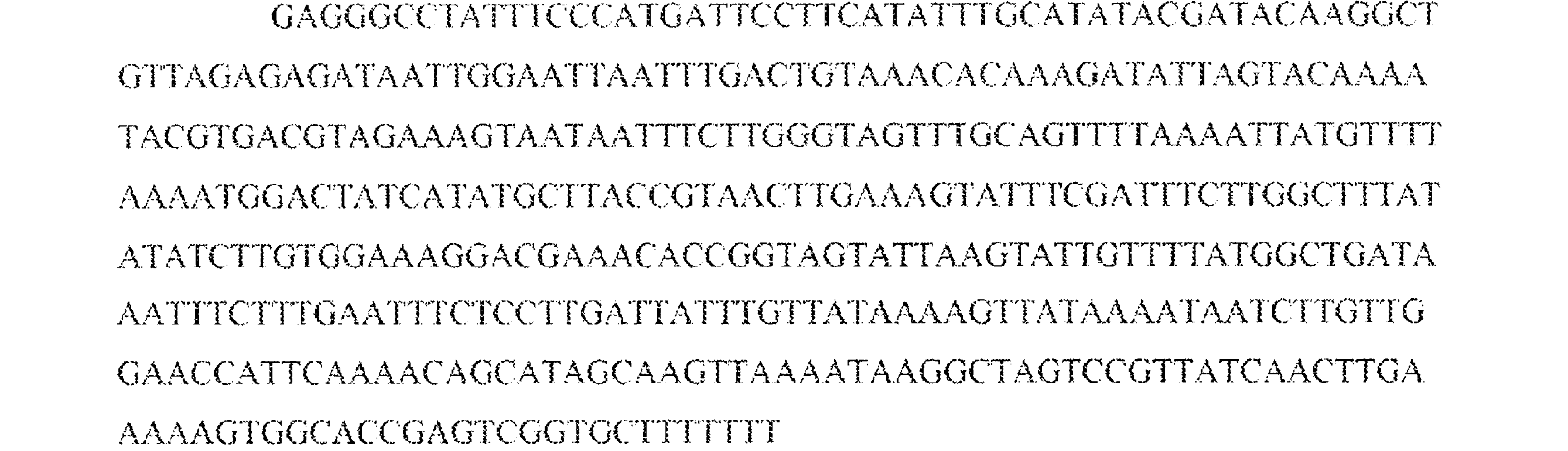


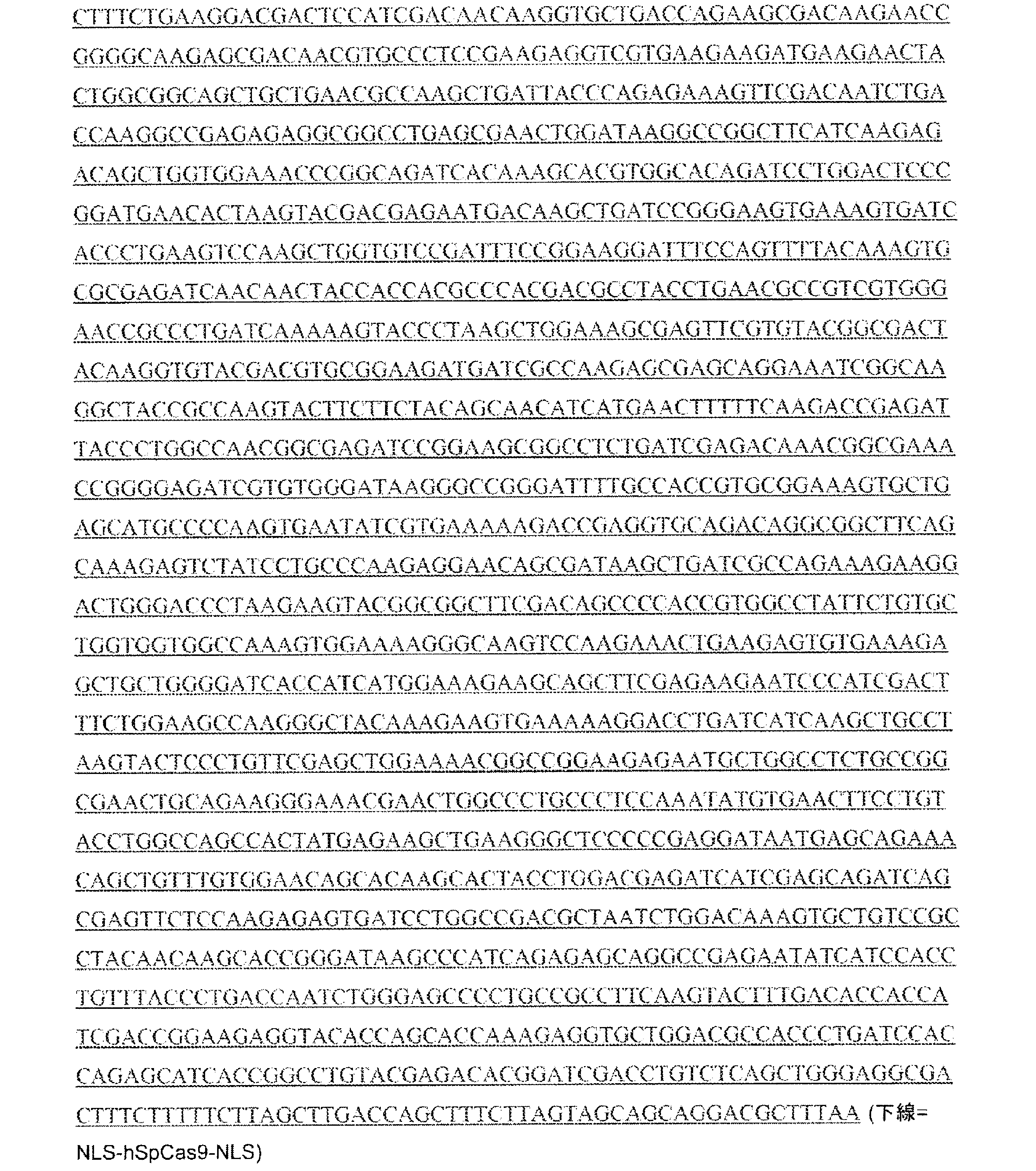


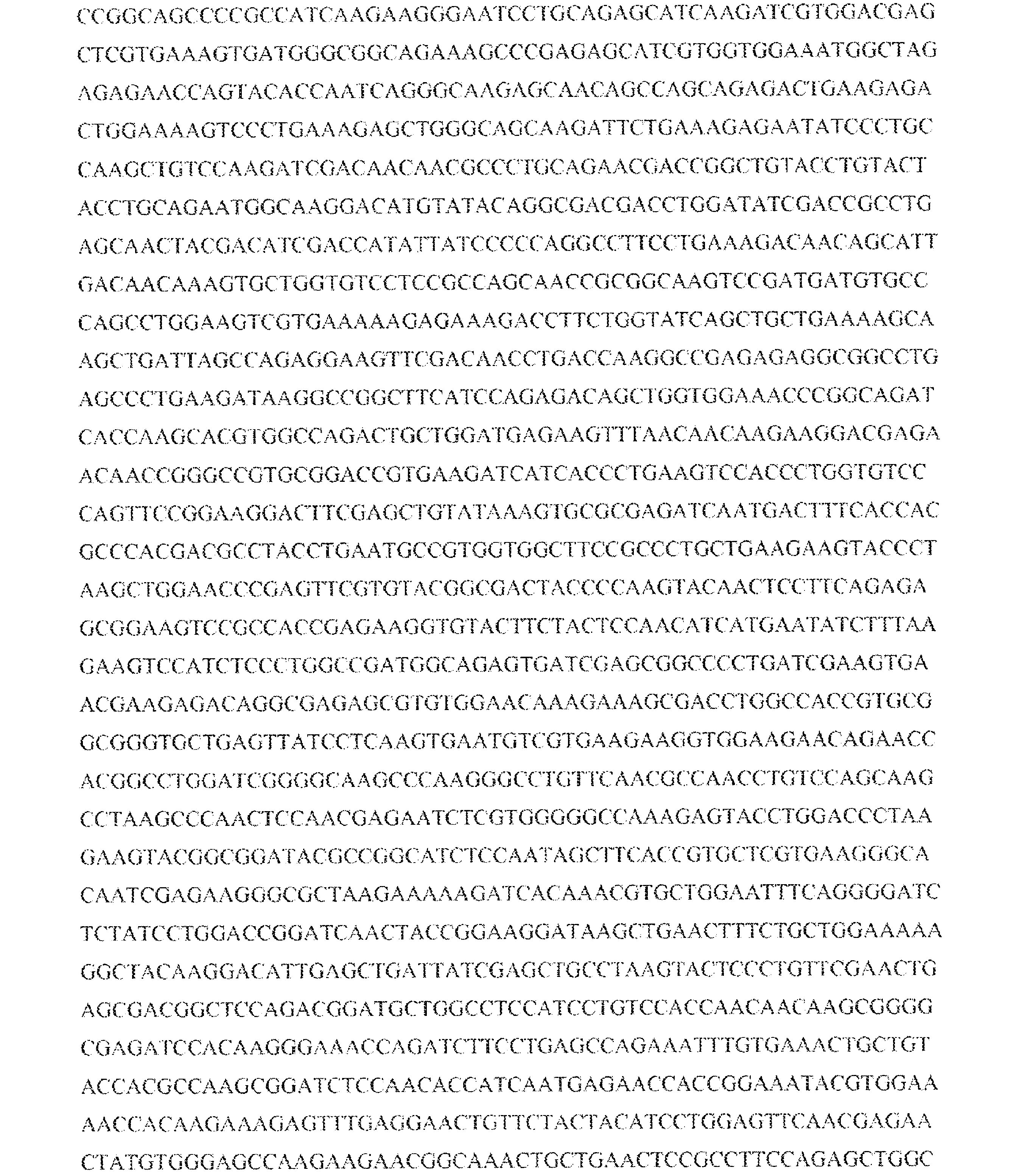

U6-short tracrRNA (Streptococcus pyogenes SF370):
実施例5:CRISPR-Cas系を使用する細菌ゲノムのRNAによりガイドされる編集
本出願人らは、CRISPR関連エンドヌクレアーゼCas9を使用して肺炎連鎖球菌(Streptococcus pneumoniae)および大腸菌(Escherichia coli)のゲノム中に正確な突然変異を導入した。このアプローチは、非突然変異細胞を殺傷するためのターゲティングされる部位におけるCas9指向開裂に依存し、選択可能なマーカーまたはカウンターセレクション系の必要性を回避した。Cas9特異性は、編集テンプレート上で担持される単一および多ヌクレオチド変化を作製するように短鎖CRISPR RNA(crRNA)配列を変化させることによりリプログラミングした。2つのcrRNAの同時使用により、複数の突然変異導入が可能になった。肺炎連鎖球菌(S.pneumoniae)において、Cas9開裂から生存した細胞のほぼ100%が、所望の突然変異を含有し、大腸菌(E.coli)におけるリコンビニアリングとの組合せで使用された場合は65%が所望の突然変異を含有した。本出願人らは、もっぱら、ターゲティング可能な配列の範囲を定義するためのCas9標的要件を徹底的に分析し、それらの要件に合致しない編集部位のための方針を示し、このことは、細菌ゲノムエンジニアリングのためのこの技術の多用途性を示唆した。
Example 5: RNA-guided editing of bacterial genomes using the CRISPR-Cas system The applicants used the CRISPR-associated endonuclease Cas9 to introduce precise mutations into the genomes of Streptococcus pneumoniae and Escherichia coli. This approach relied on Cas9-directed cleavage at targeted sites to kill non-mutated cells, avoiding the need for selectable markers or counterselection systems. Cas9 specificity was reprogrammed by altering short CRISPR RNA (crRNA) sequences to generate single and multi-nucleotide changes carried on the editing template. The simultaneous use of two crRNAs allowed for the introduction of multiple mutations. In S. pneumoniae, nearly 100% of cells surviving Cas9 cleavage contained the desired mutation, and 65% contained the desired mutation when used in combination with recombineering in E. coli. Applicants have thoroughly analyzed the Cas9 targeting requirements exclusively to define the range of targetable sequences and presented strategies for editing sites that do not meet those requirements, suggesting the versatility of this technology for bacterial genome engineering.
遺伝子機能の理解は、制御様式での細胞内のDNA配列の変化の可能性に依存する。真核生物中の部位特異的突然変異導入は、目的突然変異を含有するテンプレートDNAの相同組換えを促進する配列特異的ヌクレアーゼの使用により達成される。亜鉛フィンガーヌクレアーゼ(ZFN)、転写アクチベーター様エフェクターヌクレアーゼ(TALEN)およびホーミングメガヌクレアーゼを、規定の局在のゲノムを開裂するようにプログラミングすることができるが、それらのアプローチは、それぞれの標的配列のための新たな酵素のエンジニアリングを要求する。原核生物において、突然変異導入法は、編集される遺伝子座中に選択マーカーを導入し、またはカウンターセレクション系を含む2ステッププロセスを要求する。近年、直鎖DNAまたはオリゴヌクレオチドの相同組換えを促進する技術であるファージ組換えタンパク質がリコンビニアリングに使用されている。しかしながら、突然変異の選択が存在しないため、リコンビニアリング効率は比較的低いことがあり(より大きい改変について10-5~10-6に至る点突然変異について0.1~10%)、多くの場合、多数のコロニーのスクリーニングを要求する。したがって、安価で、使用が容易であり、効率的な新たな技術が真核および原核生物の両方の遺伝子エンジニアリングに依然として必要とされている。 Understanding gene function depends on the possibility of altering DNA sequences in cells in a controlled manner. Site-specific mutagenesis in eukaryotes is achieved by the use of sequence-specific nucleases that promote homologous recombination of template DNA containing the mutation of interest. Zinc finger nucleases (ZFNs), transcription activator-like effector nucleases (TALENs) and homing meganucleases can be programmed to cleave the genome at a defined location, but these approaches require engineering new enzymes for each target sequence. In prokaryotes, mutagenesis requires a two-step process that introduces a selection marker into the locus to be edited or includes a counterselection system. Recently, phage recombination proteins, a technology that promotes homologous recombination of linear DNA or oligonucleotides, have been used for recombineering. However, because there is no selection for mutations, recombineering efficiency can be relatively low (0.1-10% for point mutations to 10-5-10-6 for larger modifications) and often requires screening of a large number of colonies. Thus, new technologies remain needed for genetic engineering of both eukaryotic and prokaryotic organisms that are inexpensive, easy to use, and efficient.
原核生物のCRISPR(クラスター化等間隔短鎖回分リピート)適応免疫系に関する近年の研究は、配列特異性が小分子RNAによりプログラミングされるヌクレアーゼの同定をもたらしている。CRISPR遺伝子座は、バクテリオファージおよび他の可動遺伝子エレメントのゲノムにマッチする「スペーサー」配列により離隔している一連のリピートから構成される。リピート-スペーサーアレイは、長い前駆体として転写され、リピート配列内でプロセシングされてCRISPR系により開裂される標的配列(プロトスペーサーとしても公知)を規定する小分子crRNAを生成する。プロトスペーサー隣接モチーフ(PAM)としての公知の標的領域のすぐ下流の配列モチーフの存在は、開裂に不可欠である。CRISPR関連(cas)遺伝子は、通常、リピート-スペーサーアレイをフランキングし、crRNAバイオジェネシスおよびターゲティングを担う酵素機構をコードする。Cas9は、crRNAガイドを使用して開裂の部位を規定するdsDNAエンドヌクレアーゼである。Cas9上へのcrRNAガイドのローディングは、crRNA前駆体のプロセシングの間に生じ、前駆体に対する小分子RNAアンチセンス、tracrRNA、およびRNアーゼIIIを要求する。ZFNまたはTALENによるゲノム編集とは対照的に、Cas9標的特異性の変化は、タンパク質エンジニアリングを要求するのではなく、短鎖crRNAガイドの設計のみを要求する。 Recent studies of the prokaryotic CRISPR (clustered regularly interspaced short batch repeats) adaptive immune system have led to the identification of nucleases whose sequence specificity is programmed by small RNAs. CRISPR loci consist of a series of repeats separated by "spacer" sequences that match the genomes of bacteriophages and other mobile genetic elements. The repeat-spacer array is transcribed as a long precursor and processed within the repeat sequence to generate small crRNAs that define the target sequence (also known as protospacer) that is cleaved by the CRISPR system. The presence of a sequence motif immediately downstream of the target region, known as the protospacer adjacent motif (PAM), is essential for cleavage. CRISPR-associated (cas) genes usually flank the repeat-spacer array and encode the enzymatic machinery responsible for crRNA biogenesis and targeting. Cas9 is a dsDNA endonuclease that uses a crRNA guide to define the site of cleavage. Loading of the crRNA guide onto Cas9 occurs during processing of the crRNA precursor and requires a small RNA antisense to the precursor, tracrRNA, and RNase III. In contrast to genome editing with ZFNs or TALENs, altering Cas9 target specificity does not require protein engineering, but only the design of a short crRNA guide.
本出願人らは、近年、肺炎連鎖球菌(S.pneumoniae)において染色体遺伝子座をターゲティングするCRISPR系の導入が、形質転換細胞の殺傷をもたらすことを示した。偶発的生存物が標的領域中の突然変異を含有することが観察され、このことは、内因性標的に対するCas9dsDNAエンドヌクレアーゼ活性をゲノム編集に使用することができることを示唆した。本出願人らは、ゲノム中で組換わり、Cas9標的認識を排除するテンプレートDNA断片の形質転換を通してマーカーレス突然変異を導入することができることを示した。いくつかの異なるcrRNAによるCas9の特異性の指向により、複数の突然変異の同時導入が可能となる。本出願人らは、Cas9ターゲティングのための配列要件も詳細に特性決定し、このアプローチを大腸菌(E.coli)中のゲノム編集のためのリコンビニアリングと組み合わせることができることを示す。 Applicants recently showed that introduction of a CRISPR system targeting a chromosomal locus in S. pneumoniae resulted in killing of transformed cells. Occasional survivors were observed to contain mutations in the targeted region, suggesting that Cas9 dsDNA endonuclease activity against endogenous targets could be used for genome editing. Applicants showed that markerless mutations could be introduced through transformation of a template DNA fragment that recombines in the genome and precludes Cas9 target recognition. Directing the specificity of Cas9 with several different crRNAs allows for simultaneous introduction of multiple mutations. Applicants also characterized the sequence requirements for Cas9 targeting in detail and show that this approach can be combined with recombineering for genome editing in E. coli.
結果:染色体標的のCas9開裂によるゲノム編集
肺炎連鎖球菌(S.pneumoniae)株crR6は、バクテリオファージφ8232.5中に存在する標的配列を開裂するCas9ベースCRISPR系を含有する。この標的を第2の株R68232.5のsrtA染色体遺伝子座中にインテグレートした。PAM領域中の突然変異を含有する変化標的配列を第3の株R6370.1のsrtA遺伝子座中にインテグレートし、この株をCRISPR開裂に対して「免疫性」とした(図28a)。本出願人らは、R68232.5およびR6370.1細胞をcrR6細胞からのゲノムDNAにより形質転換し、R68232.5細胞の良好な形質転換が標的遺伝子座の開裂および細胞死をもたらすはずであることを予測した。この予測とは逆に、本出願人らは、R6370.1形質転換体よりも約10倍小さい効率にもかかわらず、R68232.5形質転換体を単離した(図28b)。8つのR68232.5形質転換体の遺伝子分析(図28)により、大多数は、φ8232.5標的をCas9認識に要求されるプロトスペーサーを含有しないcrR6ゲノム野生型srtA遺伝子座により置き換えることによりCas9ターゲティングの毒性を排除する二重組換えイベントの産物であることが明らかになった。これらの結果は、ゲノム遺伝子座をターゲティングするCRISPR系(ターゲティング構築物)の、ターゲティングされる遺伝子座中への組換えのためのテンプレート(編集テンプレート)と一緒の同時導入はターゲティングされるゲノム編集をもたらす証明であった(図23a)。
Results: Genome editing by Cas9 cleavage of a chromosomal target S. pneumoniae strain crR6 contains a Cas9-based CRISPR system that cleaves a target sequence present in bacteriophage φ8232.5. This target was integrated into the srtA chromosomal locus of a second strain, R68232.5. A variant target sequence containing a mutation in the PAM region was integrated into the srtA locus of a third strain, R6370.1, rendering this strain "immune" to CRISPR cleavage (FIG. 28a). Applicants transformed R68232.5 and R6370.1 cells with genomic DNA from crR6 cells, predicting that successful transformation of R68232.5 cells should result in cleavage of the target locus and cell death. Contrary to this prediction, we isolated R68232.5 transformants, albeit with an efficiency approximately 10-fold less than that of R6370.1 transformants (Fig. 28b). Genetic analysis of eight R68232.5 transformants (Fig. 28) revealed that the majority were the product of a double recombination event that eliminated the toxicity of Cas9 targeting by replacing the φ8232.5 target with a crR6 genomic wild-type srtA locus that does not contain the protospacer required for Cas9 recognition. These results were evidence that the co-introduction of a CRISPR system targeting a genomic locus (targeting construct) together with a template for recombination into the targeted locus (editing template) resulted in targeted genome editing (Fig. 23a).
簡略化されたゲノム編集のための系を創成するため、本出願人らは、CRISPRターゲティングに非必須であることが示されているcas1、cas2およびcsn2遺伝子を欠失させることにより株crR6中のCRISPR遺伝子座を改変し、株crR6Mを生じさせた(図28a)。この株は、crR6の同一の特性を保持した(図28b)。Cas9ベース編集の効率を増加させ、最適なDNAのテンプレートを使用して導入される突然変異を制御することができることを実証するため、本出願人らは、R68232.5細胞を、いずれかがCas9による開裂に対して耐性であるはずの野生型srtA遺伝子または突然変異体R6370.1標的のPCR産物により同時形質転換した。このことは、ゲノムcrR6DNA単独と比較して形質転換頻度の5から10倍増加をもたらした(図23b)。編集の効率も実質的に増加し、試験された8つのうち8つの形質転換体が野生型srtAコピーを含有し、8つのうち7つがR6370.1標的中に存在するPAM突然変異を含有した(図23bおよび図29a)。まとめると、これらの結果は、Cas9により支援されるゲノム編集の潜在性を示した。 To create a simplified system for genome editing, we modified the CRISPR locus in strain crR6 by deleting the cas1, cas2, and csn2 genes, which have been shown to be non-essential for CRISPR targeting, resulting in strain crR6M (Figure 28a). This strain retained the same properties of crR6 (Figure 28b). To demonstrate that we can increase the efficiency of Cas9-based editing and control the mutations introduced using an optimal DNA template, we co-transformed R68232.5 cells with PCR products of the wild-type srtA gene or the mutant R6370.1 target, either of which should be resistant to cleavage by Cas9. This resulted in a 5- to 10-fold increase in transformation frequency compared to genomic crR6 DNA alone (Figure 23b). The efficiency of editing was also substantially increased, with eight of eight transformants tested containing wild-type srtA copies and seven of eight containing the PAM mutation present in the R6370.1 target (FIGS. 23b and 29a). Collectively, these results demonstrated the potential of Cas9-assisted genome editing.
Cas9標的要件の分析:ゲノム中の規定の変化を導入するため、Cas9媒介開裂を停止させ、それにより細胞死を妨害する突然変異を担持する編集テンプレートを使用しなければならない。このことは、標的の欠失または別の配列によるその置換(遺伝子挿入)が求められる場合に達成することが容易である。目的が遺伝子融合物を産生することまたは単一ヌクレオチド突然変異を生成することである場合、Cas9ヌクレアーゼ活性の停止は、PAMまたはプロトスペーサー配列のいずれかを変える編集テンプレート中の突然変異を導入することによってのみ可能である。CRISPR媒介編集の拘束を決定するため、本出願人らは、CRISPRターゲティングを停止させるPAMおよびプロトスペーサー突然変異の徹底的分析を実施した。 Analysis of Cas9 target requirements: To introduce defined changes in the genome, an editing template must be used that carries a mutation that stops Cas9-mediated cleavage and thereby prevents cell death. This is easy to achieve if targeted deletion or its replacement with another sequence (gene insertion) is sought. If the goal is to produce gene fusions or generate single nucleotide mutations, stopping Cas9 nuclease activity is only possible by introducing mutations in the editing template that alter either the PAM or protospacer sequence. To determine the constraints of CRISPR-mediated editing, applicants performed an extensive analysis of PAM and protospacer mutations that stop CRISPR targeting.
従来の研究は、化膿性連鎖球菌(S.pyogenes)Cas9がプロトスペーサーのすぐ下流のNGG PAMを要求することを提案した。しかしながら、極めて限定された数のPAM不活性化突然変異がこれまで記載されているにすぎないため、本出願人らは、体系的分析を実施してCRISPR開裂を排除するプロトスペーサー後の全ての5ヌクレオチド配列を見出した。本出願人らは、ランダム化オリゴヌクレオチドを使用してcrR6またはR6細胞中に形質転換される異種PCR産物中の考えられる全ての1,024個のPAM配列を生成した。機能的PAMを担持する構築物は、R6細胞ではなくcrR6細胞中でCas9により認識および破壊されることが予測された(図24a)。2×10⁵個を超えるコロニーを一緒にプールして全ての標的の同時増幅のためのテンプレートとして使用されるDNAを抽出した。PCR産物をディープシーケンシングし、全1,024個の配列を含有することを見出し、カバレッジは5から42,472リードの範囲であった(セクション「ディープシーケンシングデータの分析」参照)。それぞれのPAMの機能性は、R6試料に対するcrR6試料中のそのリードの相対比率により推定した。PAMの最初の3塩基の分析により、2つの最後の塩基を平均化し、NGGパターンがcrR6形質転換体中で過少であることが明確に示された(図24b)。さらに、次の2つの塩基は、NGG PAMに対する検出可能な効果を有さず(セクション「ディープシーケンシングデータの分析」参照)、このことは、NGGNN配列がCas9活性を許容するために十分であることを実証した。部分ターゲティングは、NAG PAM配列について観察された(図24b)。また、NNGGNパターンは、CRISPRターゲティングを部分的に不活性化し(表G)、このことは、NGGモチーフが1bpだけシフトされた場合に低減された効率でCas9により依然として認識され得ることを示した。これらのデータにより、Cas9標的認識の分子機序が浮き彫りになり、NGG(または相補鎖上のCCN)配列がCas9ターゲティングに十分であることおよび編集テンプレート中のNGGからNAGまたはNNGGNへの突然変異を回避すべきことが明らかになった。これらのトリヌクレオチド配列の高頻度(8bpごとに1回)に起因して、このことは、ゲノムのほぼいずれの位置でも編集することができることを意味する。実際、本出願人らは、ランダムに選択された、種々のPAMを担持する10個の標的を試験し、全てが機能的であることが見出された(図30)。 Previous studies have proposed that S. pyogenes Cas9 requires an NGG PAM immediately downstream of the protospacer. However, because only a very limited number of PAM-inactivating mutations have been described so far, we performed a systematic analysis to find all 5-nucleotide sequences after the protospacer that would eliminate CRISPR cleavage. We generated all 1,024 possible PAM sequences in heterologous PCR products transformed into crR6 or R6 cells using randomized oligonucleotides. Constructs carrying functional PAM were predicted to be recognized and destroyed by Cas9 in crR6 cells but not in R6 cells (Figure 24a). More than 2x10⁵ colonies were pooled together to extract DNA used as a template for simultaneous amplification of all targets. The PCR products were deep sequenced and found to contain a total of 1,024 sequences, with coverage ranging from 5 to 42,472 reads (see section "Analysis of deep sequencing data"). The functionality of each PAM was estimated by the relative proportion of its reads in the crR6 sample versus the R6 sample. Analysis of the first three bases of the PAM, averaging the two last bases, clearly showed that the NGG pattern was underrepresented in the crR6 transformants (Figure 24b). Furthermore, the next two bases had no detectable effect on the NGG PAM (see section "Analysis of deep sequencing data"), demonstrating that the NGGNN sequence was sufficient to permit Cas9 activity. Partial targeting was observed for the NAG PAM sequence (Figure 24b). The NNGGN pattern also partially inactivated CRISPR targeting (Table G), indicating that the NGG motif could still be recognized by Cas9 with reduced efficiency when shifted by 1 bp. These data highlight the molecular mechanism of Cas9 target recognition, revealing that NGG (or CCN on the complementary strand) sequences are sufficient for Cas9 targeting and that mutations from NGG to NAG or NNGGN in the editing template should be avoided. Due to the high frequency of these trinucleotide sequences (once every 8 bp), this means that editing can be done at almost any position in the genome. Indeed, we tested 10 randomly selected targets carrying various PAMs and found all to be functional (Figure 30).
Cas9媒介開裂を破壊する別の手法は、編集テンプレートのプロトスペーサー領域中の突然変異を導入することである。「シード配列」(PAMに直接隣接する8から10個のプロトスペーサーヌクレオチド)内の点突然変異が、CRISPRヌクレアーゼによる開裂を停止させ得ることが公知である。しかしながら、この領域の正確な長さは不明であり、シード中のどのヌクレオチドの突然変異がCas9標的認識を破壊し得るかが不明確である。本出願人らは、上記の同一のディープシーケンシングアプローチに従ってcrRNAとの塩基対接触に関与するプロトスペーサー配列全体をランダム化し、ターゲティングを破壊する全ての配列を決定した。R68232.5細胞中に存在するspc1標的中の20個のマッチングヌクレオチド(14)(図23a)のそれぞれの位置をランダム化し、crR6およびR6細胞中に形質転換した(図24a)。シード配列の存在と一致して、PAMのすぐ上流の12ヌクレオチドの突然変異のみが、Cas9による開裂を停止させた(図24c)。しかしながら、異なる突然変異は、著しく異なる効果を示した。シードの(PAMから)遠位位置(12から7位)は、ほとんどの突然変異を許容し、1つの特定の塩基置換のみターゲティングを停止させた。対照的に、近位位置(6から1位、3位を除く)における任意のヌクレオチドの突然変異は、それぞれの特定の置換について異なるレベルにおいてであるが、Cas9活性を排除した。3位においては、2つの置換のみがCRISPR活性に影響し、強度が異なった。本出願人らは、シード配列突然変異がCRISPRターゲティングを妨害し得るが、シードのそれぞれの位置において作製することができるヌクレオチド変化に関して制限が存在することを結論付けた。さらに、これらの制限は、異なるスペーサー配列によって変動する可能性が最も高いことがある。したがって、本出願人らは、PAM配列中の突然変異が、可能であれば、好ましい編集方針であるはずであると考える。あるいは、シード配列中の複数の突然変異を導入してCas9ヌクレアーゼ活性を妨害することができる。 Another approach to disrupt Cas9-mediated cleavage is to introduce mutations in the protospacer region of the editing template. It is known that point mutations in the "seed sequence" (8 to 10 protospacer nucleotides directly adjacent to the PAM) can stop cleavage by the CRISPR nuclease. However, the exact length of this region is unknown, making it unclear which nucleotide mutations in the seed can disrupt Cas9 target recognition. We randomized the entire protospacer sequence involved in base-pair contacts with the crRNA following the same deep sequencing approach described above and determined all sequences that disrupt targeting. The positions of each of the 20 matching nucleotides (14) (Figure 23a) in the spc1 target present in R68232.5 cells were randomized and transformed into crR6 and R6 cells (Figure 24a). Consistent with the presence of a seed sequence, only mutations of the 12 nucleotides immediately upstream of the PAM stopped cleavage by Cas9 (Figure 24c). However, different mutations showed significantly different effects. The distal (from PAM) positions of the seed (positions 12 to 7) tolerated most mutations, with only one specific base substitution abolishing targeting. In contrast, mutation of any nucleotide at the proximal positions (positions 6 to 1, except position 3) eliminated Cas9 activity, albeit at different levels for each specific substitution. At position 3, only two substitutions affected CRISPR activity, with different strengths. Applicants concluded that seed sequence mutations can interfere with CRISPR targeting, but there are limitations regarding the nucleotide changes that can be made at each position of the seed. Furthermore, these limitations may most likely vary with different spacer sequences. Thus, Applicants believe that mutations in the PAM sequence should be the preferred editing strategy, if possible. Alternatively, multiple mutations in the seed sequence can be introduced to interfere with Cas9 nuclease activity.
肺炎連鎖球菌(S.pneumonia)中のCas9媒介ゲノム編集:ターゲティングされるゲノム編集の迅速で効率的な方法を開発するため、本出願人らは、スペーサーをPCRにより容易に導入することができる株である株crR6Rkをエンジニアリングした(図33)。本出願人らは、活性を容易に計測することができる肺炎連鎖球菌(S.pneumonia)のβ-ガラクトシダーゼ(bgaA)遺伝子を編集することを決定した。本出願人らは、この酵素の活性部位中のアミノ酸のアラニン置換を導入した:R481A(R→A)およびN563A、E564A(NE→AA)突然変異。異なる編集方針を説明するため、本出願人らは、PAM配列およびプロトスペーサーシードの両方の突然変異を設計した。両方の場合、TGG PAM配列(相補鎖中のCCA、図26)に隣接するβ-ガラクトシダーゼ遺伝子の領域に相補的なcrRNAを有する同一のターゲティング構築物を使用した。R→A編集テンプレートは、プロトスペーサーシード配列上の3ヌクレオチドミスマッチを創成した(CGTからGCA、BtgZI制限部位も導入)。NE→AA編集テンプレートにおいて、本出願人らは、不活性PAMを創成する同義的突然変異(TGGからTTG)を、プロトスペーサー領域の218nt下流の突然変異(AAT GAAからGCT GCA、TseI制限部位も生成)とともに同時に導入した。この最後の編集方針は、遠いPAMを使用して適切な標的を選択することが困難であり得る場所に突然変異を作製する可能性を実証した。例えば、肺炎連鎖球菌(S.pneumoniae)R6ゲノムは、39.7%のGC含有率を有し、12bpごとに平均1つのPAMモチーフを含有するが、一部のPAMモチーフは、最大194bpだけ離隔している(図33)。さらに、本出願人らは、6,664bpのΔbgaAインフレーム欠失を設計した。3つ全ての場合、ターゲティングおよび編集テンプレートの同時形質転換は、野生型bgaA配列を含有する対照編集テンプレートによる同時形質転換よりも10倍カナマイシン耐性の細胞を産生した(図25b)。本出願人らは、24個の形質転換体(それぞれの編集実験について8つ)をゲノタイピングし、1つを除き全てが所望の変化を取り込むことを見出した(図25c)。DNAシーケンシングによっても、導入された突然変異の存在だけでなく、標的領域中の二次突然変異の不存在を確認した(図29b、c)。最後に、本出願人らは、β-ガラクトシダーゼ活性を計測して全ての編集細胞が予測表現型を示すことを確認した(図25d)。 Cas9-Mediated Genome Editing in S. pneumonia: To develop a rapid and efficient method of targeted genome editing, we engineered strain crR6Rk, a strain in which spacers can be easily introduced by PCR (Figure 33). We decided to edit the β-galactosidase (bgaA) gene of S. pneumonia, whose activity can be easily measured. We introduced alanine substitutions of amino acids in the active site of this enzyme: R481A (R→A) and N563A, E564A (NE→AA) mutations. To account for different editing strategies, we designed mutations in both the PAM sequence and the protospacer seed. In both cases, we used the same targeting construct with a crRNA complementary to a region of the β-galactosidase gene adjacent to a TGG PAM sequence (CCA in the complementary strand, FIG. 26). The R→A editing template created a three-nucleotide mismatch on the protospacer seed sequence (CGT to GCA, also introducing a BtgZI restriction site). In the NE→AA editing template, we simultaneously introduced a synonymous mutation (TGG to TTG) that creates an inactive PAM, along with a mutation 218 nt downstream of the protospacer region (AAT GAA to GCT GCA, also generating a TseI restriction site). This last editing strategy demonstrated the possibility of creating mutations in places where it may be difficult to select an appropriate target using a distant PAM. For example, the S. pneumoniae R6 genome has a GC content of 39.7% and contains an average of one PAM motif every 12 bp, although some PAM motifs are separated by up to 194 bp (Fig. 33). Additionally, we engineered a 6,664 bp ΔbgaA in-frame deletion. In all three cases, co-transformation of the targeting and editing templates produced cells that were 10-fold more kanamycin resistant than co-transformation with a control editing template containing the wild-type bgaA sequence (Fig. 25b). We genotyped 24 transformants (8 for each editing experiment) and found that all but one incorporated the desired changes (Fig. 25c). DNA sequencing also confirmed the presence of the introduced mutations as well as the absence of secondary mutations in the target region (Fig. 29b, c). Finally, the applicants confirmed that all edited cells exhibited the predicted phenotype by measuring β-galactosidase activity (Figure 25d).
Cas9媒介編集を使用して生物学的経路の研究のために複数の突然変異を生成することもできる。本出願人らは、表面タンパク質をグラム陽性細菌のエンベロープに固定するソルターゼ依存性経路についてそれを説明することを決定した。本出願人らは、クロラムフェニコール耐性ターゲティング構築物およびΔsrtA編集テンプレートの同時形質転換(図33a、b)と、それに続くΔbgaAを置き換えるカナマイシン耐性ターゲティング構築物を使用するΔbgaA欠失によりソルターゼ欠失を導入した。肺炎連鎖球菌(S.pneumoniae)において、β-ガラクトシダーゼは、ソルターゼにより細胞壁に共有結合している。したがって、srtAの欠失は、上清中への表面タンパク質の放出をもたらす一方、二重欠失は、検出可能なβ-ガラクトシダーゼ活性を有さない(図34c)。このような逐次選択を必要な回数繰り返して複数の突然変異を生成することができる。 Cas9-mediated editing can also be used to generate multiple mutations for the study of biological pathways. We decided to illustrate this for a sortase-dependent pathway that anchors surface proteins to the envelope of Gram-positive bacteria. We introduced a sortase deletion by co-transformation of a chloramphenicol resistance targeting construct and a ΔsrtA editing template (FIG. 33a, b), followed by a ΔbgaA deletion using a kanamycin resistance targeting construct to replace ΔbgaA. In S. pneumoniae, β-galactosidase is covalently linked to the cell wall by sortase. Thus, deletion of srtA results in the release of surface proteins into the supernatant, while the double deletion has no detectable β-galactosidase activity (FIG. 34c). Such sequential selections can be repeated as many times as necessary to generate multiple mutations.
これらの2つの突然変異は、同時に導入することもできる。本出願人らは、2つのスペーサー、1つのマッチングsrtAおよび他のマッチングbgaAを含有するターゲティング構築物を設計し、それを両方の編集テンプレートとともに同時に同時形質転換した(図25e)。形質転換体の遺伝子分析により、編集が8つのケースのうち6つに生じることが示された(図25f)。特に、残りの2つのクローンは、それぞれΔsrtAおよびΔbgaA欠失のいずれかを含有し、このことは、Cas9を使用するコンビナトリアル突然変異導入を実施する可能性を示唆した。最後に、CRISPR配列を排除するため、本出願人らは、bgaA標的およびスペクチノマイシン耐性遺伝子を野生型株R6からのゲノムDNAとともに含有するプラスミドを導入した。プラスミドを保持するスペクチノマイシン耐性形質転換体は、CRISPR配列を排除した(図34a、d)。 These two mutations can also be introduced simultaneously. We designed a targeting construct containing two spacers, one matching srtA and the other matching bgaA, and co-transformed it with both editing templates at the same time (Fig. 25e). Genetic analysis of the transformants showed that editing occurred in six out of eight cases (Fig. 25f). Notably, the remaining two clones contained either the ΔsrtA and ΔbgaA deletions, respectively, suggesting the possibility of performing combinatorial mutagenesis using Cas9. Finally, to eliminate the CRISPR sequence, we introduced a plasmid containing the bgaA target and the spectinomycin resistance gene together with genomic DNA from the wild-type strain R6. Spectinomycin-resistant transformants harboring the plasmid eliminated the CRISPR sequence (Fig. 34a, d).
編集の機序および効率:Cas9によるゲノム編集の基礎をなす機序を理解するため、本出願人らは、編集効率をCas9開裂とは独立して計測する実験を設計した。本出願人らは、ermAMエリスロマイシン耐性遺伝子をsrtA遺伝子座中にインテグレートし、Cas9媒介編集を使用して早期終止コドンを導入した(図33)。得られた株(JEN53)は、ermAM(終止)アレルを含有し、エリスロマイシンに対して感受性である。この株を使用してCas9開裂を使用してまたは使用せずに抗生物質耐性を復帰させる細胞の率を計測することによりermAM遺伝子が修復される効率を評価することができる。JEN53を、野生型アレルを復帰させる編集テンプレートにより、ermAM(終止)アレルをターゲティングするカナマイシン耐性CRISPR構築物(CRISPR::ermAM(終止))またはスペーサーを有さない対照構築物(CRISPR::φ)のいずれかと一緒に形質転換した(図26a、b)。カナマイシン選択の不存在下、編集されたコロニーの率は、10-2(エリスロマイシン耐性cfu/総cfu)(図26c)のオーダーであり、これは、非編集細胞に対するCas9媒介選択を有さない組換えのベースライン頻度を表した。しかしながら、カナマイシン選択を適用し、対照CRISPR構築物を同時形質転換した場合、編集されたコロニーの率は、約10-1(カナマイシンおよびエリスロマイシン耐性cfu/カナマイシン耐性cfu)(図26c)に増加した。この結果は、CRISPR遺伝子座の組換えの選択が、ゲノムのCas9開裂とは独立してermAM遺伝子座の組換えを同時選択したことを示し、このことは、細胞の部分集団が形質転換および/または組換えを受ける傾向があることを示唆する。CRISPR::ermAM(終止)構築物の形質転換とそれに続くカナマイシン選択は、エリスロマイシン耐性の編集細胞の率の99%への増加をもたらした(図26c)。この増加が非編集細胞の殺傷により引き起こされるか否かを決定するため、本出願人らは、JEN53細胞のCRISPR::ermAM(終止)またはCRISPR::φ構築物による同時形質転換後に得られたカナマイシン耐性コロニー形成単位(cfu)を比較した。 Editing mechanism and efficiency: To understand the mechanism underlying genome editing by Cas9, we designed an experiment to measure editing efficiency independent of Cas9 cleavage. We integrated the ermAM erythromycin resistance gene into the srtA locus and used Cas9-mediated editing to introduce a premature stop codon (Figure 33). The resulting strain (JEN53) contains the ermAM (stop) allele and is sensitive to erythromycin. This strain can be used to assess the efficiency with which the ermAM gene is repaired by measuring the percentage of cells that revert antibiotic resistance with or without Cas9 cleavage. JEN53 was transformed with an editing template reverting to the wild type allele together with either a kanamycin resistant CRISPR construct targeting the ermAM(stop) allele (CRISPR::ermAM(stop)) or a control construct without a spacer (CRISPR::φ) (Fig. 26a, b). In the absence of kanamycin selection, the rate of edited colonies was on the order of 10-2 (erythromycin resistant cfu/total cfu) (Fig. 26c), representing the baseline frequency of recombination without Cas9-mediated selection for non-edited cells. However, when kanamycin selection was applied and a control CRISPR construct was co-transformed, the rate of edited colonies increased to approximately 10-1 (kanamycin and erythromycin resistant cfu/kanamycin resistant cfu) (Fig. 26c). This result indicates that selection for recombination at the CRISPR locus co-selected for recombination at the ermAM locus independently of Cas9 cleavage of the genome, suggesting that a subpopulation of cells is prone to transformation and/or recombination. Transformation of the CRISPR::ermAM(stop) construct followed by kanamycin selection resulted in an increase in the rate of erythromycin-resistant edited cells to 99% (Figure 26c). To determine whether this increase was caused by killing of non-edited cells, applicants compared the kanamycin-resistant colony forming units (cfu) obtained after co-transformation of JEN53 cells with the CRISPR::ermAM(stop) or CRISPR::φ constructs.
本出願人らは、ermAM(終止)構築物(2.5×10⁴/4.7×103、図35a)の形質転換後に5.3倍少ないカナマイシン耐性コロニーを計数し、Cas9による染色体遺伝子座のターゲティングが実際に非編集細胞の殺傷をもたらすことを示唆する結果であった。最後に、細菌染色体中のdsDNA分解の導入は、損傷DNAの組換えの比率を増加させる修復機序をトリガーすることが公知であるため、本出願人らは、Cas9による開裂が編集テンプレートの組換えを誘導するか否かを調査した。本出願人らは、CRISPR::erm(終止)構築物による同時形質転換後にCRISPR::φ構築物よりも2.2倍多いコロニーを計数し(図26d)、このことは、適度な組換えの誘導が存在することを示した。まとめると、これらの結果は、形質転換可能な細胞の同時選択、Cas9媒介開裂による組換えの誘導および非編集細胞に対する選択は、それぞれ、肺炎連鎖球菌(S.pneumoniae)中の高い効率のゲノム編集に寄与することを示した。 We counted 5.3-fold fewer kanamycin-resistant colonies after transformation with the ermAM(stop) construct (2.5×10⁴/4.7×103, FIG. 35a), a result suggesting that targeting of chromosomal loci with Cas9 does indeed result in killing of non-edited cells. Finally, because the introduction of dsDNA breaks in bacterial chromosomes is known to trigger repair mechanisms that increase the rate of recombination of damaged DNA, we investigated whether cleavage by Cas9 induces recombination of the edited template. We counted 2.2-fold more colonies after co-transformation with the CRISPR::erm(stop) construct than with the CRISPR::φ construct (FIG. 26d), indicating that there is a moderate induction of recombination. Taken together, these results demonstrated that simultaneous selection of transformable cells, induction of recombination by Cas9-mediated cleavage, and selection against non-edited cells each contribute to highly efficient genome editing in S. pneumoniae.
Cas9によるゲノムの開裂が非編集細胞を殺傷するため、編集テンプレートを受容しなかったものを除きカナマイシン耐性含有Cas9カセットを受容したいかなる細胞も回収されないことが予測される。しかしながら、編集テンプレートの不存在下、本出願人らは、CRISPR::ermAM(終止)構築物の形質転換後に多くのカナマイシン耐性コロニーを回収した(図35a)。CRISPR誘導死から「エスケープ」するこれらの細胞は、本方法の限界を決定するバックグラウンドを産生した。このバックグラウンド頻度は、CRISPR::ermAM(終止)/CRISPR::φcfuの比として算出することができ、この実験においては2.6×10-3(7.1×101/2.7×104)であり、これは、編集テンプレートの組換え頻度がこの値未満である場合、CRISPR選択がバックグラウンドを上回って所望の突然変異体を効率的に回収し得ないことを意味する。これらの細胞の起源を理解するため、本出願人らは、8つのバックグラウンドコロニーをゲノタイピングし、7つがターゲティングスペーサーを欠失し(図35b)、1つがCas9中の推定不活性化突然変異を保有することを見出した(図35c)。 Because cleavage of the genome by Cas9 kills non-edited cells, it is expected that no cells that received the kanamycin resistance-containing Cas9 cassette will be recovered, except for those that did not receive the editing template. However, in the absence of an editing template, the applicants recovered many kanamycin-resistant colonies after transformation of the CRISPR::ermAM(stop) construct (FIG. 35a). These cells that "escape" from CRISPR-induced death produced a background that determined the limitations of the method. This background frequency can be calculated as the ratio of CRISPR::ermAM(stop)/CRISPR::φcfu, which in this experiment was 2.6×10⁻³ (7.1×101/2.7×104), meaning that if the recombination frequency of the editing template is below this value, CRISPR selection cannot efficiently recover the desired mutant above the background. To understand the origin of these cells, we genotyped eight background colonies and found that seven lacked the targeting spacer (Fig. 35b) and one carried a putative inactivating mutation in Cas9 (Fig. 35c).
大腸菌(E.coli)中のCas9によるゲノム編集:CRISPR-Cas系の染色体インテグレーションを通すCas9ターゲティングの活性化は、高度に組換え性の生物中でのみ可能である。他の微生物に適用可能なより一般的な方法を開発するため、本出願人らは、プラスミドベースCRISPR-Cas系を使用して大腸菌(E.coli)中のゲノム編集を実施することを決定した。2つのプラスミドを構築した:tracrRNA、Cas9およびクロラムフェニコール耐性カセットを担持するpCas9プラスミド(図36)、およびCRISPRスペーサーのアレイを担持するpCRISPRカナマイシン耐性プラスミド。CRISPR選択とは独立した編集の効率を計測するため、本出願人らは、ストレプトマイシン耐性を付与するrpsL遺伝子中のAからCへのトランスバージョンを導入することを求めた。本出願人らは、野生型rpsLアレルのCas9開裂をガイドするが、突然変異体rpsLアレルのCas9開裂をガイドしないスペーサーを保有するpCRISPR::rpsLプラスミドを構築した(図27b)。pCas9プラスミドを最初に大腸菌(E.coli)MG1655中に導入し、得られた株をpCRISPR::rpsLプラスミドおよびAからCへの突然変異を含有する編集オリゴヌクレオチドW542により同時形質転換した。pCRISPR::rpsLプラスミドの形質転換後にストレプトマイシン耐性コロニーのみが回収され、このことは、Cas9開裂がオリゴヌクレオチドの組換えを誘導することを示唆した(図37)。しかしながら、ストレプトマイシン耐性コロニーの数は、推定上Cas9による開裂からエスケープする細胞であるカナマイシン耐性コロニーの数よりも2桁低かった。したがって、これらの条件において、Cas9による開裂は、突然変異の導入を促進したが、効率は、「エスケーパー」のバックグラウンドを上回って突然変異体細胞を選択するために十分でなかった。 Genome editing with Cas9 in E. coli: Activation of Cas9 targeting through chromosomal integration of the CRISPR-Cas system is only possible in highly recombinant organisms. To develop a more general method applicable to other microorganisms, we decided to perform genome editing in E. coli using a plasmid-based CRISPR-Cas system. Two plasmids were constructed: the pCas9 plasmid carrying tracrRNA, Cas9 and a chloramphenicol resistance cassette (Figure 36), and the pCRISPR kanamycin resistance plasmid carrying an array of CRISPR spacers. To measure the efficiency of editing independent of CRISPR selection, we sought to introduce an A to C transversion in the rpsL gene that confers streptomycin resistance. We constructed the pCRISPR::rpsL plasmid carrying a spacer that guides Cas9 cleavage of wild-type rpsL alleles but not of mutant rpsL alleles (Fig. 27b). The pCas9 plasmid was first introduced into E. coli MG1655, and the resulting strain was co-transformed with the pCRISPR::rpsL plasmid and the editing oligonucleotide W542 containing the A to C mutation. Only streptomycin-resistant colonies were recovered after transformation of the pCRISPR::rpsL plasmid, suggesting that Cas9 cleavage induces recombination of the oligonucleotide (Fig. 37). However, the number of streptomycin-resistant colonies was two orders of magnitude lower than the number of kanamycin-resistant colonies, which are presumably cells that escape cleavage by Cas9. Thus, in these conditions, cleavage by Cas9 promoted the introduction of mutations, but the efficiency was not sufficient to select mutant cells over a background of "escapers."
大腸菌(E.coli)中のゲノム編集の効率を改善するため、本出願人らは、Cas9誘導細胞死を使用するリコンビニアリングにより本発明のCRISPR系を適用して所望の突然変異を選択した。pCas9プラスミドを、□-redファージのGam、ExoおよびBeta機能を含有するリコンビニアリング株HME63(31)中に導入した。得られた株を、pCRISPR::rpsLプラスミド(またはpCRISPR::φ対照)およびW542オリゴヌクレオチドにより同時形質転換した(図27a)。リコンビニアリング効率は、対照プラスミドを使用した場合にストレプトマイシン耐性になる総細胞数の率として算出して5.3×10-5であった(図27c)。対照的に、pCRISPR::rpsLプラスミドによる形質転換は、突然変異体細胞の割合を65±14%に増加させた(図27cおよび29f)。本出願人らは、cfuの数がpCRISPR::rpsLプラスミドの形質転換後に対照プラスミドよりも約3桁だけ低減することを観察し(4.8×105/5.3×102、図38a)、このことは、選択が非編集細胞のCRISPR誘導死から生じることを示唆した。本出願人らの方法の重要なパラメータであるCas9開裂が不活性化される比率を計測するため、本出願人らは、細胞をpCRISPR::rpsLまたは対照プラスミドのいずれかによりW542編集オリゴヌクレオチドを用いずに形質転換した(図38a)。CRISPR「エスケーパー」のこのバックグラウンドは、pCRISPR::rpsL/pCRISPR::φcfuの比として計測して、2.5×10-4(1.2×102/4.8×105)であった。これらのエスケーパーの8つのゲノタイピングにより、全ての場合、ターゲティングスペーサーの欠失が存在することが明らかになった(図38b)。このバックグラウンドは、rpsL突然変異のリコンビニアリング効率5.3×10-5よりも高く、このことは、65%の編集細胞を得るためにCas9開裂はオリゴヌクレオチド組換えを誘導しなければならないことを示唆した。これを確認するため、本出願人らは、pCRISPR::rpsLまたはpCRISPR::φの形質転換後のカナマイシンおよびストレプトマイシン耐性cfuの数を比較した(図27d)。肺炎連鎖球菌(S.pneumoniae)の場合と同様に、本出願人らは、約6.7倍(2.0×10-4/3.0×10-5)の適度な組換えの誘導を観察した。まとめると、これらの結果は、CRISPR系がリコンビニアリングにより導入された突然変異を選択する方法を提供することを示した。 To improve the efficiency of genome editing in E. coli, we applied the CRISPR system of the present invention to select for the desired mutations by recombineering using Cas9-induced cell death. The pCas9 plasmid was introduced into the recombineering strain HME63 (31), which contains the Gam, Exo, and Beta functions of the □-red phage. The resulting strain was co-transformed with the pCRISPR::rpsL plasmid (or pCRISPR::φ control) and the W542 oligonucleotide (Figure 27a). The recombineering efficiency, calculated as the percentage of the total number of cells that became streptomycin resistant when the control plasmid was used, was 5.3 x 10⁻⁵ (Figure 27c). In contrast, transformation with the pCRISPR::rpsL plasmid increased the percentage of mutant cells to 65 ± 14% (Figures 27c and 29f). We observed that the number of cfu was reduced by about three orders of magnitude after transformation of the pCRISPR::rpsL plasmid compared to the control plasmid (4.8x10⁵/5.3x102, Fig. 38a), suggesting that selection resulted from CRISPR-induced death of non-edited cells. To measure the rate at which Cas9 cleavage was inactivated, a key parameter of our method, we transformed cells with either pCRISPR::rpsL or the control plasmid without the W542 editing oligonucleotide (Fig. 38a). This background of CRISPR "escapers", measured as the ratio of pCRISPR::rpsL/pCRISPR::φcfu, was 2.5x10⁻⁴ (1.2x10²/4.8x105). Genotyping of eight of these escapers revealed the presence of deletions of the targeting spacer in all cases (Fig. 38b). This background was higher than the recombineering efficiency of the rpsL mutation, 5.3x10⁻⁵, suggesting that Cas9 cleavage must induce oligonucleotide recombination to obtain 65% edited cells. To confirm this, we compared the number of kanamycin- and streptomycin-resistant cfu after transformation with pCRISPR::rpsL or pCRISPR::φ (Fig. 27d). As in the case of S. pneumoniae, we observed a modest induction of recombination of about 6.7-fold (2.0x10⁻⁴/3.0x10-5). Taken together, these results demonstrated that the CRISPR system provides a method to select for mutations introduced by recombineering.
本出願人らは、CRISPR-Cas系を、野生型細胞を殺傷するターゲティング構築物およびCRISPR開裂を排除し、所望の突然変異を誘導する編集テンプレートの同時形質転換により細菌中のターゲティングされるゲノム編集に使用することができることを示した。異なるタイプの突然変異(挿入、欠失またはスカーレス単一ヌクレオチド置換)を生成することができる。複数の突然変異を同時に導入することができる。CRISPR系を使用する編集の特異性および多用途性は、Cas9エンドヌクレアーゼのいくつかのユニークな特性に依存した:(i)その標的特異性は、酵素エンジニアリングを必要とせずに小分子RNAによりプログラミングすることができ、(ii)標的特異性は、20bpのRNA-DNA相互作用により決定して極めて高く、非標的認識の可能性は低く、(iii)ほぼいずれの配列もターゲティングすることができ、要件は、隣接NGG配列の存在のみであり、(iv)NGG配列中のほぼいずれの突然変異も、およびプロトスペーサーのシード配列中の突然変異は、ターゲティングを排除する。 Applicants have shown that the CRISPR-Cas system can be used for targeted genome editing in bacteria by co-transformation of a targeting construct that kills wild-type cells and an editing template that eliminates CRISPR cleavage and induces the desired mutation. Different types of mutations (insertion, deletion or scarless single nucleotide substitutions) can be generated. Multiple mutations can be introduced simultaneously. The specificity and versatility of editing using the CRISPR system relied on several unique properties of the Cas9 endonuclease: (i) its target specificity can be programmed by small RNA without the need for enzyme engineering, (ii) its target specificity is extremely high as determined by 20 bp RNA-DNA interactions, with low probability of non-target recognition, (iii) it can target almost any sequence, the only requirement being the presence of a flanking NGG sequence, and (iv) almost any mutation in the NGG sequence and in the seed sequence of the protospacer eliminates targeting.
本出願人らは、CRISPR系を使用するゲノムエンジニアリングが、高度に組換え性の細菌、例えば、肺炎連鎖球菌(S.pneumoniae)中だけでなく、大腸菌(E.coli)中でも機能することを示した。大腸菌(E.coli)中の結果は、本方法がプラスミドを導入することができる他の微生物に適用可能であり得ることを示唆した。大腸菌(E.coli)において、このアプローチは、突然変異原性オリゴヌクレオチドのリコンビニアリングを補完する。リコンビニアリングが可能でない微生物中でこの方法論を使用するため、プラスミド上の編集テンプレートを提供することにより宿主相同組換え機構を使用することができる。さらに、蓄積した証拠は、染色体のCRISPR媒介開裂が、多くの細菌および古細菌の細胞死をもたらすことを示すため、編集目的のための内因性CRISPR-Cas系の使用を想定することが可能である。 The applicants have shown that genome engineering using the CRISPR system works not only in highly recombinogenic bacteria, such as S. pneumoniae, but also in E. coli. The results in E. coli suggested that the method may be applicable to other microorganisms in which plasmids can be introduced. In E. coli, this approach complements recombineering of mutagenic oligonucleotides. To use this methodology in microorganisms in which recombineering is not possible, the host homologous recombination machinery can be used by providing an editing template on a plasmid. Furthermore, accumulating evidence indicates that CRISPR-mediated cleavage of the chromosome leads to cell death in many bacteria and archaea, so it is possible to envisage the use of endogenous CRISPR-Cas systems for editing purposes.
肺炎連鎖球菌(S.pneumoniae)および大腸菌(E.coli)の両方において、本出願人らは、編集が形質転換可能な細胞の同時選択およびCas9開裂による標的部位における組換えの小さい誘導により促進されるが、編集に大部分寄与する機序が非編集細胞に対する選択であることを観察した。したがって、本方法の主な限定は、CRISPR誘導細胞死からエスケープし、所望の突然変異を欠く細胞のバックグラウンドの存在であった。本出願人らは、これらの「エスケーパー」が、推定上、ターゲティングスペーサーをフランキングするリピート配列の組換え後に主としてターゲティングスペーサーの欠失を通して生じることを示した。さらなる改善は、機能的crRNAのバイオジェネシスを依然として支持し得るが、組換えを排除するために互いに十分に異なるフランキング配列のエンジニアリングにフォーカスし得る。あるいは、キメラcrRNAのダイレクト形質転換を調査することができる。大腸菌(E.coli)の特定の場合、CRISPR-Cas系の構築は、この生物をクローニング宿主としても使用した場合に可能でなかった。本出願人らは、この問題をCas9およびtracrRNAをCRISPRアレイとは異なるプラスミド上に配置することにより解決した。誘導系のエンジニアリングもこの限定を回避し得る。 In both S. pneumoniae and E. coli, we observed that editing was promoted by the simultaneous selection of transformable cells and the small induction of recombination at the target site by Cas9 cleavage, but the mechanism that contributes most to editing is selection against non-edited cells. Thus, the main limitation of the method was the presence of a background of cells that escaped from CRISPR-induced cell death and lacked the desired mutation. We showed that these "escapers" arise primarily through deletion of the targeting spacer, presumably after recombination of repeat sequences flanking the targeting spacer. Further improvements could focus on engineering flanking sequences that are sufficiently different from each other to preclude recombination, while still supporting the biogenesis of a functional crRNA. Alternatively, direct transformation of chimeric crRNAs could be explored. In the specific case of E. coli, the construction of a CRISPR-Cas system was not possible when this organism was also used as a cloning host. The applicants solved this problem by placing Cas9 and tracrRNA on a different plasmid than the CRISPR array. Engineering an inducible system may also circumvent this limitation.
新たなDNA合成技術が高スループットで任意の配列をコスト効率良く創成する技能を提供するが、合成DNAを生細胞中にインテグレートして機能的ゲノムを創成する困難性が残る。近年、同時選択MAGE方針が、所与の遺伝子座またはその周囲における組換えを達成する可能性が増加した細胞の部分集団を選択することによりリコンビニアリングの突然変異効率を改善するために示された。この方法において、選択可能な突然変異の導入を使用して近くの選択不可能な突然変異を生成する機会を増加させる。この方針により提供される間接的選択とは対照的に、CRISPR系の使用により、所望の突然変異を直接選択し、それを高い効率で回収することが可能となる。これらの技術は、遺伝子エンジニアのツールボックスを増大し、DNA合成と一緒に、それらは遺伝子機能を解読し、バイオテクノロジー目的のために生物を操作する技能を実質的に進歩させ得る。2つの他の試験も、哺乳動物ゲノムのCRISPR支援エンジニアリングに関する。これらのcrRNA指向ゲノム編集技術は、基礎および医科学において幅広く有用であり得ることが予測される。 Although new DNA synthesis techniques provide the ability to cost-effectively create any sequence at high throughput, the difficulty of integrating synthetic DNA into living cells to create functional genomes remains. Recently, a co-selection MAGE strategy has been shown to improve the mutation efficiency of recombineering by selecting a subpopulation of cells with an increased likelihood of achieving recombination at or around a given locus. In this way, the introduction of a selectable mutation is used to increase the chance of generating nearby unselectable mutations. In contrast to the indirect selection offered by this strategy, the use of the CRISPR system allows the direct selection of the desired mutation and its recovery with high efficiency. These techniques increase the toolbox of the genetic engineer, and together with DNA synthesis, they may substantially advance the ability to decipher gene function and engineer organisms for biotechnological purposes. Two other studies also concern CRISPR-assisted engineering of mammalian genomes. It is predicted that these crRNA-directed genome editing techniques may be widely useful in basic and medical sciences.
株および培養条件。肺炎連鎖球菌(S.pneumoniae)株R6は、Alexander Tomasz博士により提供された。株crR6は上記試験において生成した。肺炎連鎖球菌(S.pneumoniae)の液体培養物をTHYE培地(30g/lのTodd-Hewitt寒天、5g/lの酵母エキス)中で増殖させた。細胞を、5%の脱線維素ヒツジ血液が補給されたトリプシンダイズ寒天(TSA)上でプレーティングした。適宜、抗生物質を以下のとおり添加した:カナマイシン(400μg/ml)、クロラムフェニコール(5μg/ml)、エリスロマイシン(1μg/ml)ストレプトマイシン(100μg/ml)またはスペクチノマイシン(100μg/ml)。β-ガラクトシダーゼ活性の計測は、上記のとおりMillerアッセイを使用して行った。 Strains and culture conditions. S. pneumoniae strain R6 was provided by Dr. Alexander Tomasz. Strain crR6 was generated in the above study. Liquid cultures of S. pneumoniae were grown in THYE medium (30 g/l Todd-Hewitt agar, 5 g/l yeast extract). Cells were plated on tryptic soy agar (TSA) supplemented with 5% defibrinated sheep blood. Antibiotics were added as appropriate: kanamycin (400 μg/ml), chloramphenicol (5 μg/ml), erythromycin (1 μg/ml), streptomycin (100 μg/ml) or spectinomycin (100 μg/ml). β-galactosidase activity was measured using the Miller assay as described above.
大腸菌(E.coli)株MG1655およびHME63(MG1655に由来、Δ(argF-lac)U169λcI857Δcro-bioA galK tyr145UAG mutS<>amp)(31)は、それぞれJeff RobertsおよびDonald Courtにより提供された。大腸菌(E.coli)の液体培養物をLB培地(Difco)中で増殖させた。適宜、抗生物質を以下のとおり添加した:クロラムフェニコール(25μg/ml)、カナマイシン(25μg/ml)およびストレプトマイシン(50μg/ml)。 E. coli strains MG1655 and HME63 (derived from MG1655, Δ(argF-lac)U169λcI857Δcro-bioA galK tyr145UAG mutS<>amp) (31) were kindly provided by Jeff Roberts and Donald Court, respectively. Liquid cultures of E. coli were grown in LB medium (Difco). Antibiotics were added as appropriate as follows: chloramphenicol (25 μg/ml), kanamycin (25 μg/ml), and streptomycin (50 μg/ml).
肺炎連鎖球菌(S.pneumoniae)形質転換。コンピテント細胞を上記のとおり調製した(23)。全てのゲノム編集形質転換のため、細胞を穏やかに氷上で解凍し、100ng/mlのコンピテンス刺激ペプチドCSP1(40)が補給された10容量のM2培地中で再懸濁させ、次いで編集構築物を添加した(編集構築物は、0.7ng/μlから2.5μg/ulの最終濃度において細胞に添加した)。細胞を37℃において20分間インキュベートしてから、2μlのターゲティング構築物を添加し、次いで37℃において40分間インキュベートした。細胞の段階希釈物を適切な培地上でプレーティングしてコロニー形成単位(cfu)計数値を測定した。 S. pneumoniae transformation. Competent cells were prepared as described above (23). For all genome editing transformations, cells were gently thawed on ice and resuspended in 10 volumes of M2 medium supplemented with 100 ng/ml of the competence stimulating peptide CSP1 (40), followed by the addition of the editing construct (editing constructs were added to cells at final concentrations of 0.7 ng/μl to 2.5 μg/ul). Cells were incubated for 20 min at 37°C before the addition of 2 μl of the targeting construct, followed by incubation for 40 min at 37°C. Serial dilutions of cells were plated on the appropriate media to determine colony forming unit (cfu) counts.
大腸菌(E.coli)ラムダ-redリコンビニアリング。株HME63を全てのリコンビニアリング実験に使用した。リコンビニアリング細胞を調製し、既に公開されているプロトコルに従って取り扱った(6)。手短に述べると、プレートから得られた単一コロニーから接種された2mlの一晩培養物(LB培地)を、30℃において増殖させた。一晩培養物を100倍希釈し、振とう(200rpm)させながら30℃においてOD600が0.4~0.5になるまで(約3時間)増殖させた。ラムダred誘導のため、培養物を42℃の水浴に移して200rpmにおいて15分間振とうさせた。誘導直後、培養物を氷水スラリー中で回転させ、氷上で5~10分間冷蔵した。次いで、細胞をプロトコルに従って洗浄およびアリコート処理した。電気的形質転換のため、50μlの細胞を1mMの塩不含オリゴ(IDT)または100~150ngのプラスミドDNA(QIAprep Spin Miniprep Kit,Qiagenにより調製)と混合した。1mmのGene Pulserキュベット(Bio-rad)を1.8kVにおいて使用して細胞をエレクトロポレートし、1mlの室温LB培地中で直ちに再懸濁させた。細胞を30℃において1~2時間回収してから適切な抗生物質耐性を有するLB寒天上でプレーティングし、32℃において一晩インキュベートした。 E. coli lambda-red recombineering. Strain HME63 was used for all recombineering experiments. Recombineering cells were prepared and handled according to previously published protocols (6). Briefly, 2 ml overnight cultures (LB medium) inoculated from single colonies obtained from plates were grown at 30°C. The overnight cultures were diluted 100-fold and grown with shaking (200 rpm) at 30°C until OD600 of 0.4-0.5 (approximately 3 h). For lambda-red induction, the cultures were transferred to a 42°C water bath and shaken at 200 rpm for 15 min. Immediately after induction, the cultures were spun in an ice-water slurry and chilled on ice for 5-10 min. The cells were then washed and aliquoted according to the protocol. For electrotransformation, 50 μl of cells were mixed with 1 mM salt-free oligos (IDT) or 100-150 ng of plasmid DNA (prepared by QIAprep Spin Miniprep Kit, Qiagen). Cells were electroporated using a 1 mm Gene Pulser cuvette (Bio-rad) at 1.8 kV and immediately resuspended in 1 ml of room temperature LB medium. Cells were allowed to recover for 1-2 hours at 30°C before being plated on LB agar with the appropriate antibiotic resistance and incubated overnight at 32°C.
肺炎連鎖球菌(S.pneumoniae)ゲノムDNAの調製。形質転換目的のため、Wizard Genomic DNA Purification Kitを製造業者(Promega)により提供された指示書に従って使用して肺炎連鎖球菌(S.pneumoniae)ゲノムDNAを抽出した。ゲノタイピング目的のため、700ulの一晩肺炎連鎖球菌(S.pneumoniae)培養物をペレット化し、60ulのリゾチーム溶液(2mg/ml)中で再懸濁させ、37℃において30分間インキュベートした。QIAprep Spin Miniprep Kit(Qiagen)を使用してゲノムDNAを抽出した。 Preparation of S. pneumoniae genomic DNA. For transformation purposes, S. pneumoniae genomic DNA was extracted using the Wizard Genomic DNA Purification Kit according to the instructions provided by the manufacturer (Promega). For genotyping purposes, 700 ul of overnight S. pneumoniae culture was pelleted, resuspended in 60 ul of lysozyme solution (2 mg/ml) and incubated at 37°C for 30 minutes. Genomic DNA was extracted using the QIAprep Spin Miniprep Kit (Qiagen).
株構築。本試験において使用された全てのプライマーを表Gに提供する。肺炎連鎖球菌(S.pneumoniae)crR6Mを生成するため、中間株LAM226を作製した。この株において、肺炎連鎖球菌(S.pneumoniae)crR6株のCRISPRアレイに隣接するaphA-3遺伝子(カナマイシン耐性を提供)を、cat遺伝子(クロラムフェニコール耐性を提供)により置き換えた。手短に述べると、プライマーL448/L444およびL447/L481をそれぞれ使用してcrR6ゲノムDNAを増幅した。cat遺伝子をプラスミドpC194からプライマーL445/L446を使用して増幅した。それぞれのPCR産物をゲル精製し、3つ全てをプライマーL448/L481を用いてSOEing PCRにより融合させた。得られたPCR産物をコンピテント肺炎連鎖球菌(S.pneumoniae)crR6細胞中に形質転換し、クロラムフェニコール耐性形質転換体を選択した。肺炎連鎖球菌(S.pneumoniae)crR6Mを生成するため、プライマーL409/L488およびL448/L481をそれぞれ使用して肺炎連鎖球菌(S.pneumoniae)crR6ゲノムDNAをPCRにより増幅した。それぞれのPCR産物をゲル精製し、それらをプライマーL409/L481を用いてSOEing PCRにより融合させた。得られたPCR産物をコンピテント肺炎連鎖球菌(S.pneumoniae)LAM226細胞に形質転換し、カナマイシン耐性形質転換体を選択した。 Strain construction. All primers used in this study are provided in Table G. To generate S. pneumoniae crR6M, an intermediate strain LAM226 was created. In this strain, the aphA-3 gene (providing kanamycin resistance) flanking the CRISPR array of S. pneumoniae crR6 strain was replaced by the cat gene (providing chloramphenicol resistance). Briefly, crR6 genomic DNA was amplified using primers L448/L444 and L447/L481, respectively. The cat gene was amplified from plasmid pC194 using primers L445/L446. Each PCR product was gel purified and all three were fused by SOEing PCR using primers L448/L481. The resulting PCR products were transformed into competent S. pneumoniae crR6 cells and chloramphenicol-resistant transformants were selected. To generate S. pneumoniae crR6M, S. pneumoniae crR6 genomic DNA was amplified by PCR using primers L409/L488 and L448/L481, respectively. Each PCR product was gel purified and fused by SOEing PCR using primers L409/L481. The resulting PCR products were transformed into competent S. pneumoniae LAM226 cells and kanamycin-resistant transformants were selected.
肺炎連鎖球菌(S.pneumoniae)crR6Rcを生成するため、プライマーL430/W286を使用して肺炎連鎖球菌(S.pneumoniae)crR6MゲノムDNAをPCRにより増幅し、プライマーW288/L481を使用して肺炎連鎖球菌(S.pneumoniae)LAM226ゲノムDNAをPCRにより増幅した。それぞれのPCR産物をゲル精製し、プライマーL430/L481を用いてそれらをSOEing PCRにより融合させた。得られたPCR産物をコンピテント肺炎連鎖球菌(S.pneumoniae)crR6M細胞中に形質転換し、クロラムフェニコール耐性形質転換体を選択した。 To generate S. pneumoniae crR6Rc, S. pneumoniae crR6M genomic DNA was amplified by PCR using primers L430/W286, and S. pneumoniae LAM226 genomic DNA was amplified by PCR using primers W288/L481. Each PCR product was gel purified and fused by SOEing PCR using primers L430/L481. The resulting PCR products were transformed into competent S. pneumoniae crR6M cells and chloramphenicol resistant transformants were selected.
肺炎連鎖球菌(S.pneumoniae)crR6Rkを生成するため、プライマーL430/W286およびW287/L481をそれぞれ使用して肺炎連鎖球菌(S.pneumoniae)crR6MゲノムDNAをPCRにより増幅した。それぞれのPCR産物をゲル精製し、プライマーL430/L481を用いてそれらをSOEing PCRにより融合させた。得られたPCR産物をコンピテント肺炎連鎖球菌(S.pneumoniae)crR6Rc細胞中に形質転換し、カナマイシン耐性形質転換体を選択した。 To generate S. pneumoniae crR6Rk, S. pneumoniae crR6M genomic DNA was amplified by PCR using primers L430/W286 and W287/L481, respectively. Each PCR product was gel purified and fused by SOEing PCR using primers L430/L481. The resulting PCR products were transformed into competent S. pneumoniae crR6Rc cells and kanamycin-resistant transformants were selected.
JEN37を生成するため、プライマーL430/W356およびW357/L481をそれぞれ使用して肺炎連鎖球菌(S.pneumoniae)crR6RkゲノムDNAをPCRにより増幅した。それぞれのPCR産物をゲル精製し、プライマーL430/L481を用いてそれらをSOEing PCRにより融合させた。得られたPCR産物をコンピテント肺炎連鎖球菌(S.pneumoniae)crR6Rc細胞中に形質転換し、カナマイシン耐性形質転換体を選択した。 To generate JEN37, S. pneumoniae crR6Rk genomic DNA was amplified by PCR using primers L430/W356 and W357/L481, respectively. Each PCR product was gel purified and fused by SOEing PCR using primers L430/L481. The resulting PCR products were transformed into competent S. pneumoniae crR6Rc cells and kanamycin-resistant transformants were selected.
JEN38を生成するため、プライマーL422/L461およびL459/L426をそれぞれ使用してR6ゲノムDNAを増幅した。プライマーL457/L458を使用してプラスミドpFW1543からermAM遺伝子(エリスロマイシン耐性を規定)を増幅した。それぞれのPCR産物をゲル精製し、プライマーL422/L426を用いて3つ全てをSOEing PCRにより融合させた。得られたPCR産物をコンピテント肺炎連鎖球菌(S.pneumoniae)crR6Rc細胞中に形質転換し、エリスロマイシン耐性形質転換体を選択した。 To generate JEN38, R6 genomic DNA was amplified using primers L422/L461 and L459/L426, respectively. Primers L457/L458 were used to amplify the ermAM gene (specifying erythromycin resistance) from plasmid pFW1543. Each PCR product was gel purified and all three were fused by SOEing PCR using primers L422/L426. The resulting PCR products were transformed into competent S. pneumoniae crR6Rc cells and erythromycin-resistant transformants were selected.
肺炎連鎖球菌(S.pneumoniae)JEN53は2ステップで生成した。最初に、JEN43を図33に説明されるとおり構築した。JEN53は、JEN25のゲノムDNAをコンピテントJEN43細胞中に形質転換し、クロラムフェニコールおよびエリスロマイシンの両方に基づき選択することにより生成した。 S. pneumoniae JEN53 was generated in two steps. First, JEN43 was constructed as illustrated in Figure 33. JEN53 was generated by transforming JEN25 genomic DNA into competent JEN43 cells and selecting on both chloramphenicol and erythromycin.
肺炎連鎖球菌(S.pneumoniae)JEN62を生成するため、プライマーW256/W365およびW366/L403をそれぞれ使用して肺炎連鎖球菌(S.pneumoniae)crR6RkゲノムDNAをPCRにより増幅した。それぞれのPCR産物を精製し、ギブソン・アセンブリによりライゲートした。アセンブリ産物をコンピテント肺炎連鎖球菌(S.pneumoniae)crR6Rc細胞中に形質転換し、カナマイシン耐性形質転換体を選択した。 To generate S. pneumoniae JEN62, S. pneumoniae crR6Rk genomic DNA was amplified by PCR using primers W256/W365 and W366/L403, respectively. Each PCR product was purified and ligated by Gibson assembly. The assembly products were transformed into competent S. pneumoniae crR6Rc cells and kanamycin-resistant transformants were selected.
プラスミド構築。pDB97は、オリゴヌクレオチドB296/B297のリン酸化およびアニーリングと、それに続くEcoRI/BamHIにより消化されたpLZ12spec中へのライゲーションを通して構築した。本出願人らは、pLZ12specを完全にシーケンシングし、その配列をgenebankに寄託した(アクセッション番号:KC112384)。 Plasmid construction. pDB97 was constructed through phosphorylation and annealing of oligonucleotides B296/B297 followed by ligation into EcoRI/BamHI digested pLZ12spec. Applicants have fully sequenced pLZ12spec and deposited the sequence in genebank (accession number: KC112384).
pDB98は、CRISPRリーダー配列をリピート-スペーサー-リピート単位と一緒にpLZ12spec中にクローニングした後に得た。このことは、プライマーB298/B320およびB299/B321を用いるcrR6RcDNAの増幅と、それに続く両方の産物のSOEing PCRおよび制限部位BamHI/EcoRIを有するpLZ12spec中のクローニングを通して達成した。このように、pDB98中のスペーサー配列を、新たなスペーサーのスカーレスクローニングを可能とする反対方向の2つのBsaI制限部位を含有するようにエンジニアリングした。 pDB98 was obtained after cloning the CRISPR leader sequence together with the repeat-spacer-repeat unit into pLZ12spec. This was achieved through amplification of the crR6R cDNA with primers B298/B320 and B299/B321, followed by SOEing PCR of both products and cloning into pLZ12spec with the restriction sites BamHI/EcoRI. Thus, the spacer sequence in pDB98 was engineered to contain two BsaI restriction sites in opposite orientations that allow scarless cloning of new spacers.
pDB99からpDB108は、オリゴヌクレオチドB300/B301(pDB99)、B302/B303(pDB100)、B304/B305(pDB101)、B306/B307(pDB102)、B308/B309(pDB103)、B310/B311(pDB104)、B312/B313(pDB105)、B314/B315(pDB106)、B315/B317(pDB107)、B318/B319(pDB108)のアリーリングと、それに続くBsaIにより切断されたpDB98中のライゲーションにより構築した。 pDB99 to pDB108 were constructed by annealing of oligonucleotides B300/B301 (pDB99), B302/B303 (pDB100), B304/B305 (pDB101), B306/B307 (pDB102), B308/B309 (pDB103), B310/B311 (pDB104), B312/B313 (pDB105), B314/B315 (pDB106), B315/B317 (pDB107), and B318/B319 (pDB108) followed by ligation into pDB98 cut with BsaI.
pCas9プラスミドは、以下のとおり構築した。不可欠なCRISPRエレメントを
、ギブソン・アセンブリのためのフランキングホモロジーアームを用いて化膿性連鎖球菌
(Streptococcos pyogenes)SF370ゲノムDNAから増幅し
た。tracrRNAおよびCas9は、オリゴHC008およびHC010を用いて増幅した。リーダーおよびCRISPR配列は、スペーサーの容易な挿入を促進するために2つのBsaI IIS型部位が2つのダイレクトリピート間に導入されるようにHC011/HC014およびHC015/HC009を用いて増幅した。
The pCas9 plasmid was constructed as follows: the essential CRISPR element was amplified from Streptococcus pyogenes SF370 genomic DNA with flanking homology arms for Gibson assembly. tracrRNA and Cas9 were amplified with oligos HC008 and HC010. The leader and CRISPR sequences were amplified with HC011/HC014 and HC015/HC009 such that two BsaI type IIS sites were introduced between the two direct repeats to facilitate easy insertion of spacers.
pCRISPRは、オリゴB298+B299を用いる増幅ならびにEcoRIおよびBamHIを用いる制限を通してpCas9CRISPRアレイをpZE21-MCS1中でサブクローニングすることにより構築した。オリゴB352+B353をアリーリングし、BsaI切断pCRISPR中にクローニングすることによりrpsLターゲティングスペーサーをクローニングし、pCRISPR::rpsLを得た。 pCRISPR was constructed by subcloning the pCas9CRISPR array into pZE21-MCS1 via amplification with oligos B298+B299 and restriction with EcoRI and BamHI. The rpsL targeting spacer was cloned by annealing oligos B352+B353 and cloning into BsaI-cut pCRISPR, resulting in pCRISPR::rpsL.
ターゲティングおよび編集構築物の生成。ゲノム編集に使用されるターゲティング構築物は、左側PCRおよび右側PCRのギブソン・アセンブリにより作製した(表G)。編集構築物は、適用可能な場合、PCR産物A(PCR A)、PCR産物B(PCR B)およびPCR産物C(PCR C)を融合するSOEing PCRにより作製した(表G)。CRISPR::φおよびCRISPR::ermAM(終止)ターゲティング構築物は、JEN62およびcrR6ゲノムDNAぞれぞれのオリゴL409およびL481を用いるPCR増幅により生成した。 Generation of targeting and editing constructs. Targeting constructs used for genome editing were generated by Gibson assembly of left-handed and right-handed PCR (Table G). Editing constructs were generated by SOEing PCR fusing PCR product A (PCR A), PCR product B (PCR B) and PCR product C (PCR C) where applicable (Table G). CRISPR::φ and CRISPR::ermAM (stop) targeting constructs were generated by PCR amplification of JEN62 and crR6 genomic DNA with oligos L409 and L481, respectively.
ランダム化PAMまたはプロトスペーサー配列を用いる標的の生成。スペーサー1標的後の5ヌクレオチドを、プライマーW377/L426を用いるR68232.5ゲノムDNAの増幅を通してランダム化した。次いで、このPCR産物を、プライマーL422/W376を用いて同一テンプレートから増幅されたcat遺伝子およびsrtA上流領域とアセンブルした。80ngのアセンブルされたDNAを使用して株R6およびcrR6を形質転換した。ランダム化試料のための試料は、以下のプライマーを使用して調製した:標的の塩基1~10をランダム化するためのB280~B290/L426および塩基10~20をランダム化するためのB269~B278/L426。プライマーL422/B268およびL422/B279を使用してそれぞれ最初および最後の10個のPCR産物とアセンブルすべきcat遺伝子およびsrtA上流領域を増幅した。アセンブルされた構築物を一緒にプールし、R6およびcrR6中で30ngを形質転換した。形質転換後、細胞をクロラムフェニコール選択に基づきプレーティングした。それぞれの試料について、2×105個を超える細胞を1mlのTHYE中で一緒にプールし、ゲノム
DNAをPromega Wizardキットにより抽出した。プライマーB250/B251を使用して標的領域を増幅した。PCR産物をタグ化し、1つのIllumina MiSeqペアエンドレーン上で300サイクルを使用して流した。
Generation of targets with randomized PAM or protospacer sequences. The 5 nucleotides after the spacer 1 target were randomized through amplification of R68232.5 genomic DNA with primers W377/L426. This PCR product was then assembled with the cat gene and srtA upstream region amplified from the same template with primers L422/W376. 80 ng of assembled DNA was used to transform strains R6 and crR6. Samples for randomized samples were prepared using the following primers: B280-B290/L426 to randomize bases 1-10 of the target and B269-B278/L426 to randomize bases 10-20. Primers L422/B268 and L422/B279 were used to amplify the cat gene and srtA upstream region to be assembled with the first and last 10 PCR products, respectively. The assembled constructs were pooled together and 30 ng were transformed in R6 and crR6. After transformation, cells were plated under chloramphenicol selection. For each sample, more than 2x10⁵ cells were pooled together in 1 ml of THYE and genomic DNA was extracted by Promega Wizard kit. Primers B250/B251 were used to amplify the target region. PCR products were tagged and run on one Illumina MiSeq paired-end lane using 300 cycles.
ディープシーケンシングデータの分析
ランダム化PAM:ランダム化PAM実験について、crR6について3,429,406リード、R6について3,253,998リードが得られた。これらの半数のみがPAM標的に対応する一方、他の半数がPCR産物の他の末端をシーケンシングすることが予測される。crR6リードの1,623,008およびR6リードの1,537,131は、エラーのない標的配列を担持した。これらのリードの中のそれぞれの考えられるPAMの発生率を補足ファイルに示す。PAMの機能性を推定するため、R6試料に対するcrR6試料中のその相対比率を計算し、rijklm(式中、I、j、k、l、mは、4つの考えられる塩基の1つである)で示す。以下の統計モデルを構築した:
log(rijklm)=μ+b2i+b3j+b4k+b2b3i,j+b3b4j,
k+εijklm
(式中、εは、残差であり、b2は、PAMの第2の塩基の効果であり、b3は、第3の塩基の効果であり、b4は、第4の塩基の効果であり、b2b3は、第2の塩基と第3の塩基との間の相互作用であり、b3b4は、第3の塩基と第4の塩基との間の相互作用である)。分散分析を実施した。
Analysis of deep sequencing data Randomized PAM: For the randomized PAM experiment, 3,429,406 reads were obtained for crR6 and 3,253,998 reads for R6. Only half of these are expected to correspond to the PAM target, while the other half are expected to sequence the other end of the PCR product. 1,623,008 of the crR6 reads and 1,537,131 of the R6 reads carried error-free target sequences. The incidence of each possible PAM among these reads is shown in the supplementary file. To estimate the functionality of PAM, its relative ratio in the crR6 sample to the R6 sample was calculated and denoted by rijklm (where I, j, k, l, m is one of the four possible bases). The following statistical model was constructed:
log(rijklm)=μ+b2i+b3j+b4k+b2b3i,j+b3b4j,
k + εijklm
(where ε is the residual, b2 is the effect of the second base of PAM, b3 is the effect of the third base, b4 is the effect of the fourth base, b2b3 is the interaction between the second and third bases, and b3b4 is the interaction between the third and fourth bases.) An analysis of variance was performed.
このモデルに付加する場合、b1またはb5は、有意でないと考えられ、含められるものを除き他の相互作用を廃棄することもできる。モデル選択を、R.テューキーのHSD検定(R.Tukey’s honest significance test)におけるanova法の使用を使用して事実上完全なモデルの継時比較を通して行って効果間のペアワイズ差が有意であるか否かを決定した。 When added to this model, b1 or b5 are considered not significant and other interactions can be discarded except for the one included. Model selection was performed through time-wise comparison of virtually complete models using the anova method in R. Tukey's honest significance test to determine whether pairwise differences between effects were significant.
NGGNNパターンは、全ての他のパターンと有意に異なり、最も強い効果を有する(以下の表参照)。 The NGGNN pattern is significantly different from all other patterns and has the strongest effect (see table below).
1、4または5位がNGGNNパターンに影響しないことを示すため、本出願人らは、これらの配列のみを考察した。これらの効果は、正規分布されると考えられ(図71中のQQプロット参照)、Rにおけるanova法を使用するモデル比較は、ヌルモデルが最良のものであること、すなわち、b1、b4およびb5の有意な役割が存在しないことを示す。 To show that positions 1, 4 or 5 do not affect the NGGNN pattern, we only considered these sequences. These effects appear to be normally distributed (see QQ plot in Figure 71) and model comparison using the anova method in R shows that the null model is the best one, i.e. there is no significant role for b1, b4 and b5.
NAGNNおよびNNGGNパターンの部分干渉
NAGNNパターンは、全ての他のパターンと有意に異なるが、NGGNNよりもかなり少ない効果を有する(以下のテューキーのHSD検定参照)。
Partial Interference of NAGNN and NNGGN Patterns The NAGNN pattern is significantly different from all other patterns, but has a much smaller effect than NGGNN (see Tukey's HSD test below).
最後に、NTGGNおよびNCGGNパターンも同様であり、ボンフェローニ調整ペアワイズスチューデント検定により示されるとおり、NTGHNおよびNCGHNパターン(Hは、A、TまたはCである)よりも大きいCRISPR干渉を有意に示す。 Finally, the NTGGN and NCGGN patterns are similar and show significantly greater CRISPR interference than the NTGHN and NCGHN patterns (where H is A, T, or C) as shown by Bonferroni-adjusted pairwise Student's test.
まとめると、これらの結果により、NNGGNパターンが一般にNGGGNの場合に完全干渉を、またはNAGGN、NTGGNもしくはNCGGNの場合に部分干渉を生じさせることを結論付けることが可能となる。 Taken together, these results allow us to conclude that the NNGGN pattern generally produces full interference in the case of NGGGN, or partial interference in the cases of NAGGN, NTGGN or NCGGN.
ランダム化標的
ランダム化標的実験について、crR6について540,726リードが、R6について753,570リードが得られた。上記のとおり、リードの半数のみがPCR産物の目的末端をシーケンシングすることが予測される。エラーフリーまたは単一の点突然変異を有する標的を担持するリードをフィルタリングした後、crR6およびR6についてそれぞれ217,656および353,141リードが残存した。R6試料に対するcrR6試料におけるそれぞれの突然変異体の相対比率を計算した(図24c)。シード配列の外側(PAMから13~20塩基離れている)の全ての突然変異は、完全干渉を示す。これらの配列を参照として使用してシード配列の内側の他の突然変異が干渉を有意に破壊し得ると考えられるか否かを決定した。MASS Rパッケージのfitdistr関数を使用して正規分布をこれらの配列にフィットさせた。フィットされた分布の0.99分位点を図24cに点線として示す。図72は、フィットされた正規分布(黒線)および0.99分位点(点線)を有するデータ密度のヒストグラムを示す。
Randomized Targets For the randomized target experiments, 540,726 reads were obtained for crR6 and 753,570 reads for R6. As mentioned above, only half of the reads are expected to sequence the intended end of the PCR product. After filtering reads carrying targets that are error-free or have a single point mutation, 217,656 and 353,141 reads remained for crR6 and R6, respectively. The relative proportion of each mutant in the crR6 sample versus the R6 sample was calculated (Figure 24c). All mutations outside the seed sequence (13-20 bases away from the PAM) show complete interference. These sequences were used as references to determine whether other mutations inside the seed sequence could significantly disrupt interference. A normal distribution was fitted to these sequences using the fitdist function in the MASS R package. The 0.99 quantile of the fitted distribution is shown as a dotted line in Figure 24c. FIG. 72 shows a histogram of data density with a fitted normal distribution (black line) and the 0.99 quantile (dotted line).

実施例6:化膿性連鎖球菌(Streptococcus pyogenes)Cas9(SpCas9と称される)についてのガイドRNAの最適化
本出願人らは、tracrRNAおよびダイレクトリピート配列を突然変異させ、またはキメラガイドRNAを突然変異させて細胞中のRNAを向上させた。
Example 6: Optimization of guide RNA for Streptococcus pyogenes Cas9 (referred to as SpCas9) Applicants mutated the tracrRNA and direct repeat sequences, or mutated chimeric guide RNAs to improve RNA in cells.
最適化は、pol3プロモーターによる早期転写終結をもたらし得るtracrRNAおよびガイドRNA中にチミンのストレッチ(T)が存在した観察に基づく。したがって、本出願人らは、以下の最適化配列を生成した。最適化tracrRNAおよび対応する最適化ダイレクトリピートをペアで表す。
最適化tracrRNA1(下線は突然変異):



元のガイドRNA:


Optimized tracrRNA1 (mutations underlined):
Original guide RNA:
本出願人らは、最適化キメラガイドRNAが図3に示されるとおり、より良好に機能することを示した。本実験は、293FT細胞をCas9およびU6ガイドRNA DNAカセットにより同時形質移入して上記4つのRNA形態の1つを発現させることにより実施した。ガイドRNAの標的は、ヒトEmx1遺伝子座:「GTCACCTCCAATGACTAGGG」中の同一標的部位である。 Applicants have shown that the optimized chimeric guide RNA works better, as shown in Figure 3. The experiment was performed by co-transfecting 293FT cells with Cas9 and U6 guide RNA DNA cassettes to express one of the four RNA forms. The guide RNAs target the same target site in the human Emx1 locus: "GTCACCTCCAATGACTAGGG".
実施例7:ストレプトコッカス・サーモフィラス(Streptococcus thermophiles)LMD-9 CRISPR1 Cas9(St1Cas9と称される)の最適化
本出願人らは、図4に示されるガイドキメラRNAを設計した。
Example 7: Optimization of Streptococcus thermophiles LMD-9 CRISPR1 Cas9 (designated St1Cas9) Applicants designed a guide chimeric RNA as shown in FIG.
St1Cas9ガイドRNAは、ポリチミンのストレッチ(T)を分解することによりSpCas9ガイドRNAに関して同一タイプの最適化を受け得る。 The St1Cas9 guide RNA can undergo the same type of optimization as the SpCas9 guide RNA by deleting the stretches of polythymines (Ts).
実施例8:Cas9多様性および突然変異
CRISPR-Cas系は、細菌から古細菌にわたる多様な種により用いられる侵入外因性DNAに対する適応免疫機序である。II型CRISPR-Cas9系は、CRISPR遺伝子座中への外来DNAの「獲得」を担うタンパク質をコードする遺伝子のセット、およびDNA開裂機序の「実行」をコードする遺伝子のセットからなり;これらは、DNAヌクレアーゼ(Cas9)、非コードトランス活性化crRNA(tracrRNA)、およびダイレクトリピートによりフランキングされている外来DNA由来スペーサーのアレイ(crRNA)を含む。Cas9による成熟時、tracRNAおよびcrRNA二本鎖は、Cas9ヌクレアーゼをスペーサーガイド配列により規定される標的DNA配列にガイドし、開裂に要求され、それぞれのCRISPR-Cas系に特異的な標的DNA中の短鎖配列モチーフ付近のDNAの二本鎖切断を媒介する。II型CRISPR-Cas系は、細菌界全体にわたり見出されており、Cas9タンパク質配列およびサイズ、tracrRNAおよびcrRNAダイレクトリピート配列、それらのエレメントのゲノム構成、および標的開裂のためのモチーフ要件は高度に多様である。ある種は、複数の区別されるCRISPR-Cas系を有し得る。
Example 8: Cas9 diversity and mutations The CRISPR-Cas system is an adaptive immune mechanism against invading exogenous DNA used by a variety of species ranging from bacteria to archaea. Type II CRISPR-Cas9 systems consist of a set of genes encoding proteins responsible for the "getting" of foreign DNA into the CRISPR locus, and a set of genes encoding the "execution" of the DNA cleavage mechanism; these include a DNA nuclease (Cas9), a non-coding trans-activating crRNA (tracrRNA), and an array of spacers derived from the foreign DNA flanked by direct repeats (crRNA). Upon maturation by Cas9, the tracRNA and crRNA duplexes guide the Cas9 nuclease to the target DNA sequence defined by the spacer guide sequence and mediate a double-stranded break in DNA near a short sequence motif in the target DNA required for cleavage and specific for each CRISPR-Cas system. Type II CRISPR-Cas systems are found throughout the bacterial kingdom and are highly diverse in Cas9 protein sequence and size, tracrRNA and crRNA direct repeat sequences, genomic organization of their elements, and motif requirements for targeted cleavage. Some species may have multiple distinct CRISPR-Cas systems.
本出願人らは、公知のCas9との配列相同性および公知のサブドメイン、例として、HNHエンドヌクレアーゼドメインおよびRuvCエンドヌクレアーゼドメイン[Eugene KooninおよびKira Makarovaからの情報]とオルソロガスな構造に基づき同定された細菌種から207個の推定Cas9を評価した。このセットのタンパク質配列保存に基づく系統発生分析により、大型Cas9(約1400アミノ酸)の3つの群および小型Cas9(約1100アミノ酸)の2つの群を含むCas9の5つのファミリーが明らかになった(図39および40A~F)。 Applicants evaluated 207 putative Cas9s from bacterial species that were identified based on sequence homology to known Cas9s and orthologous structures to known subdomains, e.g., the HNH endonuclease domain and the RuvC endonuclease domain [information from Eugene Koonin and Kira Makarova]. Phylogenetic analysis based on protein sequence conservation of this set revealed five families of Cas9s, including three groups of large Cas9s (~1400 amino acids) and two groups of small Cas9s (~1100 amino acids) (Figures 39 and 40A-F).
本実施例において、本出願人らは、以下の突然変異がSpCas9をニック形成酵素に変換し得ることを示す:D10A、E762A、H840A、N854A、N863A、D986A。 In this example, we show that the following mutations can convert SpCas9 into a nicking enzyme: D10A, E762A, H840A, N854A, N863A, D986A.
本出願人らは、突然変異点がSpCas9遺伝子内のどこに局在するかを示す配列を提供する(図41)。本出願人らは、ニッカーゼが相同組換えを依然として媒介し得ることも示す(図2に示されるアッセイ)。さらに、本出願人らは、これらの突然変異を有するSpCas9が(個々に)二本鎖切断を誘導しないことを示す(図47)。 We provide sequences showing where the mutations are located within the SpCas9 gene (Figure 41). We also show that the nickase can still mediate homologous recombination (assay shown in Figure 2). Furthermore, we show that SpCas9 with these mutations (individually) does not induce double-strand breaks (Figure 47).
実施例9:RNAによりガイドされるCas9ヌクレアーゼのDNA標的特異性に関する補足
細胞培養および形質移入
ヒト胚腎臓(HEK)細胞系293FT(Life Technologies)を、10%のウシ胎仔血清(HyClone)、2mMのGlutaMAX(Life Technologies)、100U/mLのペニシリン、および100μg/mLのストレプトマイシンが補給されたダルベッコ改変イーグル培地(DMEM)中で37℃において5%のCO2インキュベーションで維持した。
Example 9: Supplementary Cell Culture and Transfection for DNA Target Specificity of RNA-Guided Cas9 Nuclease Human embryonic kidney (HEK) cell line 293FT (Life Technologies) was maintained in Dulbecco's modified Eagle's medium (DMEM) supplemented with 10% fetal bovine serum (HyClone), 2 mM GlutaMAX (Life Technologies), 100 U/mL penicillin, and 100 μg/mL streptomycin at 37° C. with 5% CO2 incubation.
293FT細胞を6ウェルプレート、24ウェルプレート、または96ウェルプレート(Corning)上に、形質移入24時間前に播種した。Lipofectamine2000(Life Technologies)を製造業者の推奨プロトコルに従って使用して細胞を80~90%のコンフルエンスにおいて形質移入した。6ウェルプレートのそれぞれのウェルについて、合計1ugのCas9+sgRNAプラスミドを使用した。特に記載のない限り、24ウェルプレートのそれぞれのウェルについて、合計500ngのCas9+sgRNAプラスミドを使用した。96ウェルプレートのそれぞれのウェルについて、65ngのCas9プラスミドをU6-sgRNA PCR産物との1:1のモル比において使用した。 293FT cells were seeded onto 6-, 24-, or 96-well plates (Corning) 24 hours prior to transfection. Cells were transfected at 80-90% confluence using Lipofectamine 2000 (Life Technologies) following the manufacturer's recommended protocol. A total of 1 ug of Cas9+sgRNA plasmid was used for each well of a 6-well plate. A total of 500 ng of Cas9+sgRNA plasmid was used for each well of a 24-well plate unless otherwise noted. For each well of a 96-well plate, 65 ng of Cas9 plasmid was used in a 1:1 molar ratio with the U6-sgRNA PCR product.
ヒト胚性幹細胞系HUES9(Harvard Stem Cell Institute core)を、100ug/mlのNormocin(InvivoGen)が補給されたmTesR培地(Stemcell Technologies)中のGelTrex(Life Technologies)上でフィーダーフリー条件において維持した。HUES9細胞をAmaxa P3 Primary Cell 4-D Nucleofector Kit(Lonza)により製造業者のプロトコルに従って形質移入した。 Human embryonic stem cell line HUES9 (Harvard Stem Cell Institute core) was maintained in feeder-free conditions on GelTrex (Life Technologies) in mTesR medium (Stemcell Technologies) supplemented with 100ug/ml Normocin (InvivoGen). HUES9 cells were transfected with Amaxa P3 Primary Cell 4-D Nucleofector Kit (Lonza) according to the manufacturer's protocol.
ゲノム改変についてのSURVEYORヌクレアーゼアッセイ
293FT細胞を上記のとおりプラスミドDNAにより形質移入した。細胞を37℃において形質移入後72時間インキュベートしてからゲノムDNAを抽出した。ゲノムDNAは、QuickExtract DNA Extraction Solution(Epicentre)を製造業者のプロトコルに従って使用して抽出した。手短に述べると、ペレット化細胞をQuickExtract溶液中で懸濁させ、65℃において15分間および98℃において10分間インキュベートした。
SURVEYOR Nuclease Assay for Genomic Modification 293FT cells were transfected with plasmid DNA as described above. Cells were incubated at 37°C for 72 hours after transfection before genomic DNA extraction. Genomic DNA was extracted using QuickExtract DNA Extraction Solution (Epicentre) according to the manufacturer's protocol. Briefly, pelleted cells were suspended in QuickExtract solution and incubated at 65°C for 15 minutes and 98°C for 10 minutes.
それぞれの遺伝子についてのCRISPR標的部位をフランキングするゲノム領域をPCR増幅(表JおよびKに列記のプライマー)し、QiaQuick Spin Column(Qiagen)を製造業者のプロトコルに従って使用して産物を精製した。合計400ngの精製PCR産物を、2μlの10×Taq DNA Polymerase PCR緩衝液(Enzymatics)と混合し、超純水で20μlの最終容量とし、リアニーリングプロセスに供してヘテロ二本鎖形成を可能とした:95℃において10分間、-2℃/秒における傾斜で95℃から85℃、-0.25℃/秒における85℃から25℃、および25℃において1分間維持。リアニーリング後、産物をSURVEYORヌクレアーゼおよびSURVEYORエンハンサーS(Transgenomics)により製造業者の推奨プロトコルに従って処理し、4~20%のNovex TBEポリアクリルアミドゲル(Life Technologies)上で分析した。ゲルをSYBR Gold DNA染色(Life Technologies)により30分間染色し、Gel Docゲルイメージングシステム(Bio-rad)によりイメージングした。定量は、相対バンド強度に基づくものであった。 Genomic regions flanking the CRISPR target site for each gene were PCR amplified (primers listed in Tables J and K) and products were purified using a QiaQuick Spin Column (Qiagen) according to the manufacturer's protocol. A total of 400 ng of purified PCR product was mixed with 2 μl of 10× Taq DNA Polymerase PCR Buffer (Enzymatics), brought to a final volume of 20 μl with ultrapure water, and subjected to a reannealing process to allow heteroduplex formation: 95°C for 10 min, ramping from 95°C to 85°C at -2°C/s, 85°C to 25°C at -0.25°C/s, and holding at 25°C for 1 min. After reannealing, the products were treated with SURVEYOR Nuclease and SURVEYOR Enhancer S (Transgenomics) according to the manufacturer's recommended protocol and analyzed on 4-20% Novex TBE polyacrylamide gels (Life Technologies). Gels were stained with SYBR Gold DNA stain (Life Technologies) for 30 min and imaged with a Gel Doc gel imaging system (Bio-rad). Quantitation was based on relative band intensity.
ヒト細胞中のtracrRNA発現のノザンブロット分析
ノザンブロットを、上記のとおり実施した。手短に述べると、RNAを95℃に5分間加熱してから8%の変性ポリアクリルアミドゲル(SequaGel,National Diagnostics)上にロードした。その後、RNAを事前にハイブリダイズさせたHybond N+メンブレン(GE Healthcare)に転写し、Stratagene UV Crosslinker(Stratagene)により架橋した。プローブをT4ポリヌクレオチドキナーゼ(New England Biolabs)を用いて[ガンマ-32P]ATP(Perkin Elmer)により標識した。洗浄後、メンブレンを蛍光スクリーンに1時間曝露し、phosphorimager(Typhoon)によりスキャンした。
Northern blot analysis of tracrRNA expression in human cells Northern blots were performed as described above. Briefly, RNA was heated to 95°C for 5 min before loading onto an 8% denaturing polyacrylamide gel (SequaGel, National Diagnostics). RNA was then transferred to prehybridized Hybond N+ membranes (GE Healthcare) and crosslinked by Stratagene UV Crosslinker (Stratagene). Probes were labeled with [gamma-32P]ATP (Perkin Elmer) using T4 polynucleotide kinase (New England Biolabs). After washing, the membrane was exposed to a phosphor screen for 1 h and scanned by a phosphorimager (Typhoon).
DNAメチル化状態を評価するためのバイサルファイトシーケンシング
HEK293FT細胞を、上記のとおりCas9により形質移入した。ゲノムDNAをDNeasy Blood&Tissue Kit(Qiagen)により単離し、バイサルファイトをEZ DNA Methylation-Lightning Kit(Zymo Research)により変換した。バイサルファイトPCRは、Bisulfite Primer Seekerを使用して設計されたプライマー(Zymo Research、表JおよびK)を用いてKAPA2G Robust HotStart DNA Polymerase(KAPA Biosystems)を使用して実施した。得られたPCRアンプリコンをゲル精製し、EcoRIおよびHindIIIにより消化し、形質転換前にpUC19骨格中にライゲートした。次いで、個々のクローンをサンガーシーケンシングしてDNAメチル化状態を評価した。
Bisulfite sequencing to assess DNA methylation status HEK293FT cells were transfected with Cas9 as described above. Genomic DNA was isolated with DNeasy Blood & Tissue Kit (Qiagen) and bisulfite converted with EZ DNA Methylation-Lightning Kit (Zymo Research). Bisulfite PCR was performed using KAPA2G Robust HotStart DNA Polymerase (KAPA Biosystems) with primers designed using Bisulfite Primer Seeker (Zymo Research, Tables J and K). The resulting PCR amplicons were gel purified, digested with EcoRI and HindIII, and ligated into a pUC19 backbone prior to transformation. Individual clones were then Sanger sequenced to assess DNA methylation status.
インビトロ転写および開裂アッセイ
HEK293FT細胞を上記のとおりCas9により形質移入した。次いで、ホールセル溶解物を、Protease Inhibitor Cocktail(Roche)が補給された溶解緩衝液(20mMのHEPES、100mMのKCl、5mMのMgCl2、1mMのDTT、5%のグリセロール、0.1%のTriton X-100)を用いて調製した。カスタムオリゴ(実施例10)およびHiScribe T7 In Vitro Transcription Kit(NEB)を製造業者の推奨プロトコルに従って使用してT7によりドライブされるsgRNAをインビトロで転写させた。メチル化標的部位を調製するため、pUC19プラスミドをM.SssIによりメチル化し、次いでNheIにより線形化した。インビトロ開裂アッセイを以下のとおり実施した:20uLの開裂反応物について、10uLの細胞溶解物を2uLの開裂緩衝液(100mMのHEPES、500mMのKCl、25mMのMgCl2、5mMのDTT、25%のグリセロール)、インビトロ転写されたRNA、300ngのpUC19プラスミドDNAとともにインキュベートした。
In vitro transcription and cleavage assays HEK293FT cells were transfected with Cas9 as described above. Whole cell lysates were then prepared using lysis buffer (20 mM HEPES, 100 mM KCl, 5 mM MgCl2, 1 mM DTT, 5% glycerol, 0.1% Triton X-100) supplemented with Protease Inhibitor Cocktail (Roche). T7-driven sgRNAs were transcribed in vitro using custom oligos (Example 10) and the HiScribe T7 In Vitro Transcription Kit (NEB) following the manufacturer's recommended protocol. To prepare methylated target sites, pUC19 plasmids were methylated with M. SssI and then linearized with NheI. In vitro cleavage assays were performed as follows: for a 20 uL cleavage reaction, 10 uL of cell lysate was incubated with 2 uL of cleavage buffer (100 mM HEPES, 500 mM KCl, 25 mM MgCl2, 5 mM DTT, 25% glycerol), in vitro transcribed RNA, and 300 ng of pUC19 plasmid DNA.
ターゲティング特異性を評価するためのディープシーケンシング
96ウェルプレート中でプレーティングされたHEK293FT細胞を、Cas9プラスミドDNAおよび単一ガイドRNA(sgRNA)PCRカセットにより72時間形質移入してからゲノムDNAを抽出した(図72)。それぞれの遺伝子についてのCRISPR標的部位をフランキングするゲノム領域を、融合PCR法により増幅してIllum
ina P5アダプターおよびユニークな試料特異的バーコードを標的アンプリコン(図73に記載の模式図)に付着させた(図74、図80(実施例10)。PCR産物は、EconoSpin96ウェルFilter Plates(Epoch Life Sciences)を製造業者の推奨プロトコルに従って使用して精製した。
Deep sequencing to assess targeting specificity HEK293FT cells plated in 96-well plates were transfected with Cas9 plasmid DNA and single guide RNA (sgRNA) PCR cassettes for 72 hours before genomic DNA extraction (Figure 72). Genomic regions flanking the CRISPR target sites for each gene were amplified by fusion PCR and expressed as Illum.
Ina P5 adapters and unique sample-specific barcodes were attached to the target amplicons (schematic diagram depicted in FIG. 73) (FIG. 74, FIG. 80 (Example 10)). PCR products were purified using EconoSpin 96-well Filter Plates (Epoch Life Sciences) following the manufacturer's recommended protocol.
バーコード化および精製DNA試料を、Quant-iT PicoGreen dsDNA Assay KitまたはQubit 2.0 Fluorometer(Life Technologies)により定量し、等モル比でプールした。次いで、シーケンシングライブラリーをIllumina MiSeq Personal Sequencer(Life Technologies)によりディープシーケンシングした。 Barcoded and purified DNA samples were quantified by Quant-iT PicoGreen dsDNA Assay Kit or Qubit 2.0 Fluorometer (Life Technologies) and pooled in equimolar ratios. Sequencing libraries were then deep sequenced by Illumina MiSeq Personal Sequencer (Life Technologies).
シーケンシングデータ分析およびインデル検出
MiSeqリードは、少なくとも23の平均Phredクオリティ(Qスコア)ならびにバーコードおよびアンプリコンフォワードプライマーとの完全配列マッチを要求することによりフィルタリングした。オンおよびオフターゲット遺伝子座からのリードは、標的部位の上流および下流の50ヌクレオチド(合計120bp)を含むアンプリコン配列に対してSmith-Watermanアラインメントを最初に実施することにより分析した。その一方、アラインメントを標的部位の上流の5ヌクレオチドから下流の5ヌクレオチド(合計30bp)のインデルについて分析した。これらのアラインメントの一部がMiSeqリード自体の外側に収まる場合、またはマッチした塩基対がそれらの全長の85%未満を含む場合に分析された標的領域を廃棄した。
Sequencing Data Analysis and Indel Detection MiSeq reads were filtered by requiring an average Phred quality (Q score) of at least 23 and a perfect sequence match with the barcode and amplicon forward primer. Reads from on- and off-target loci were analyzed by first performing Smith-Waterman alignments to the amplicon sequence including 50 nucleotides upstream and downstream of the target site (total of 120 bp). Meanwhile, alignments were analyzed for indels from 5 nucleotides upstream to 5 nucleotides downstream of the target site (total of 30 bp). Analyzed target regions were discarded if any part of these alignments fell outside the MiSeq read itself or if the matched base pairs included less than 85% of their total length.
それぞれの試料についての陰性対照は、推定切断イベントとしてのインデルの包含または排除のための測定基準を提供した。それぞれの試料について、インデルをその品質スコアがμ-σ(μは、その試料に対応する陰性対照の平均品質スコアを意味し、σはその標準偏差である)を超過する場合のみカウントした。このことは、陰性対照およびそれらの対応試料の両方についての全標的領域インデル比率を生じさせた。陰性対照の標的領域ごとのリードごとのエラー比率q、試料の観察されたインデルカウントn、およびそのリードカウントRを使用して、真のインデルを有する標的領域を有するリードの率についての最尤推定量pを以下のとおり2項エラーモデルを適用することにより得た。 The negative controls for each sample provided a metric for the inclusion or exclusion of indels as putative cleavage events. For each sample, an indel was counted only if its quality score exceeded μ-σ (μ means the mean quality score of the negative controls corresponding to that sample, and σ is its standard deviation). This yielded a total target region indel fraction for both the negative controls and their corresponding samples. Using the error fraction per read per target region of the negative controls, q, the observed indel count of the sample, n, and its read count, R, a maximum likelihood estimate, p, for the fraction of reads with target regions with true indels was obtained by applying a binomial error model as follows:
少なくとも1つのインデルを有するとして不正確にカウントされた標的領域を有する試料中の(不明)数のリードをEとして、


真のインデルpを有する標的領域の頻度の全ての値が推測的に同等に起こり得るとみなす場合、Prob(n|p)∝Prob(p|n)である。したがって、真のインデルを有する標的領域の頻度についての最尤推定量(MLE)を、Prob(n|p)を最大化するpの値として設定した。これを数値評価した。 If we consider all values of the frequency of a target region with a true indel p to be a priori equally likely, then Prob(n|p) ∝ Prob(p|n). Therefore, we set the maximum likelihood estimator (MLE) for the frequency of a target region with a true indel as the value of p that maximizes Prob(n|p). We evaluated this numerically.
エラーバウンドをシーケンシングライブラリー自体の中の真のインデルリード頻度に配置するため、Wilsonスコア間隔(2)をそれぞれの試料について算出し、真のインデル標的領域Rpおよびリードの数RについてのMLE推定量を得た。明確には、下限lおよび上限μを下式
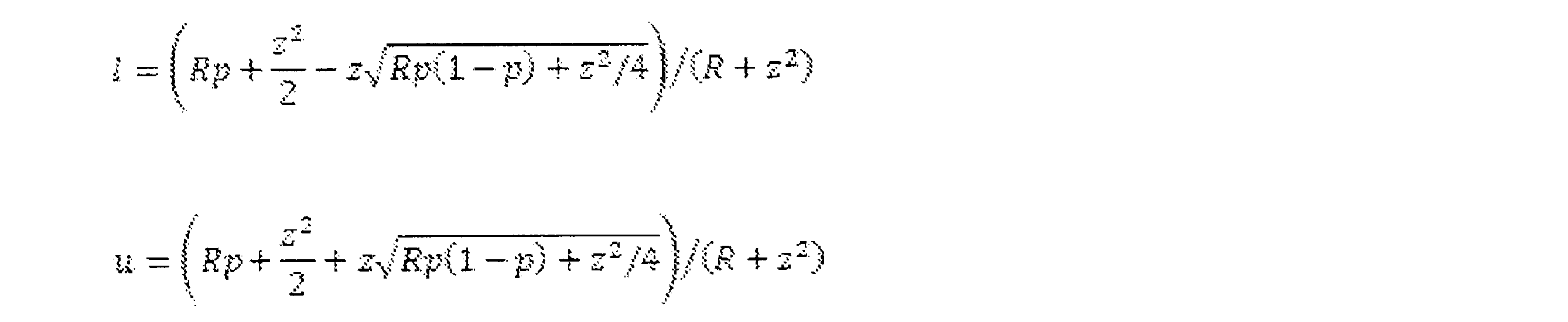
相対Cas9およびsgRNA発現のqRT-PCR分析
24ウェルプレート中でプレーティングされた293FT細胞を、上記のとおり形質移入した。形質移入72時間後、トータルRNAをmiRNeasy Micro Kit(Qiagen)により回収した。sgRNAについての逆鎖合成は、qScript Flex cDNAキット(VWR)およびカスタム第1鎖合成プライマー(表JおよびK)を用いて実施した。qPCR分析は、GAPDHを内因性対照として使用してFast SYBR Green Master Mix(Life Technologies)およびカスタムプライマー(表JおよびK)を用いて実施した。相対定量をΔΔCT法により算出した。
qRT-PCR analysis of relative Cas9 and sgRNA expression 293FT cells plated in 24-well plates were transfected as described above. 72 hours after transfection, total RNA was harvested using miRNeasy Micro Kit (Qiagen). Reverse strand synthesis for sgRNA was performed using qScript Flex cDNA Kit (VWR) and custom first strand synthesis primers (Tables J and K). qPCR analysis was performed using Fast SYBR Green Master Mix (Life Technologies) and custom primers (Tables J and K) with GAPDH as an endogenous control. Relative quantification was calculated by the ΔΔCT method.
表I|標的部位配列。化膿性連鎖球菌(S.pyogenes)II型CRISPR系についての試験標的部位と必要なPAM。細胞をCas9およびそれぞれの標的についてのcrRNA-tracrRNAまたはキメラsgRNAのいずれかにより形質移入した。 Table I | Target site sequences. Test target sites and required PAMs for the S. pyogenes Type II CRISPR system. Cells were transfected with Cas9 and either crRNA-tracrRNA or chimeric sgRNA for each target.


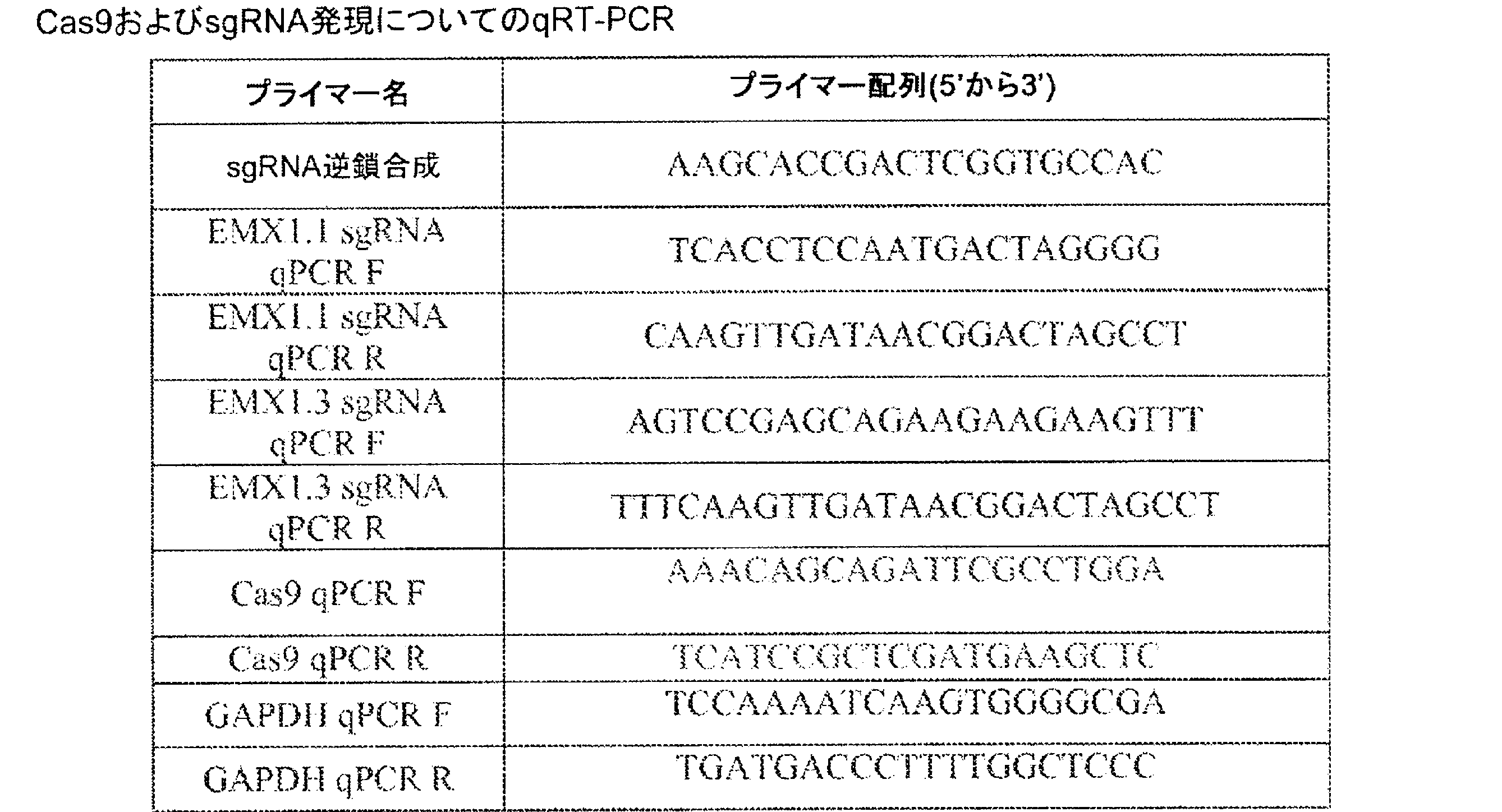

表K|sgRNAアーキテクチャーを試験するためのプライマーについての配列。プライマーは、特に記載のない限り、U6プロモーターの逆鎖にハイブリダイズする。U6プライミング部位をイタリックで、ガイド配列をNのストレッチとして示し、ダイレクトリピート配列を太字で強調し、tracrRNA配列に下線を付す。それぞれのsgRNAアーキテクチャーの二次構造を図43に示す。 Table K | Sequences for primers to test sgRNA architectures. Primers hybridize to opposite strands of the U6 promoter unless otherwise noted. U6 priming sites are shown in italics, guide sequences as stretches of N, direct repeat sequences are highlighted in bold, and tracrRNA sequences are underlined. The secondary structure of each sgRNA architecture is shown in Figure 43.

表L|Cas9のPAM特異性を試験するための標的部位と代替PAM。PAM特異性試験のための全ての標的部位が、ヒトEMX1遺伝子座内に見出される。 Table L | Target sites and alternative PAMs for testing Cas9 PAM specificity. All target sites for PAM specificity testing are found within the human EMX1 locus.

実施例10:補足配列
全ての配列は、5’から3’方向である。U6転写のため、下線付きのTのストリングが転写ターミネーターとして機能する。
>U6-短鎖tracrRNA(化膿性連鎖球菌(Streptococcus pyogenes)SF370)
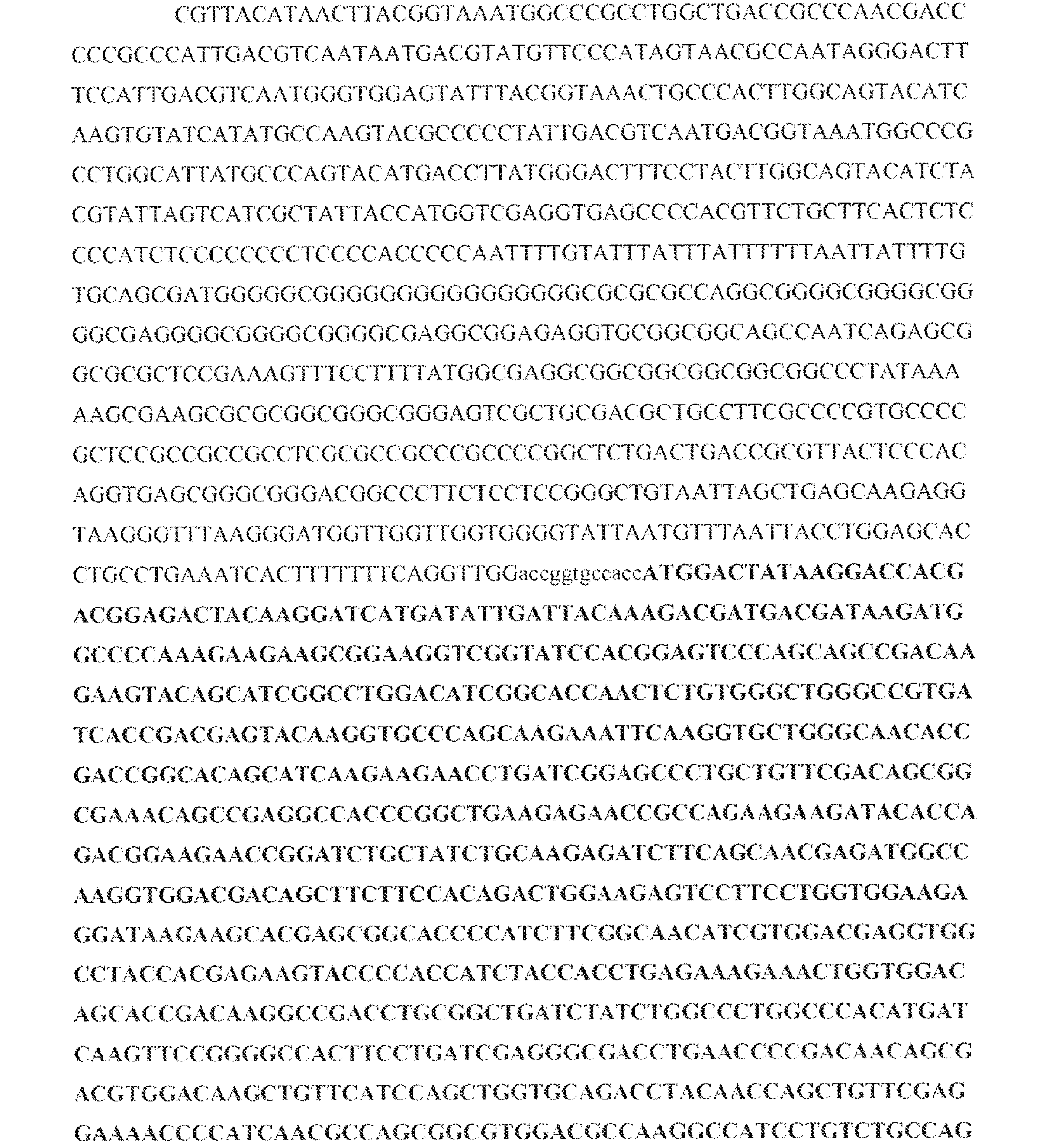
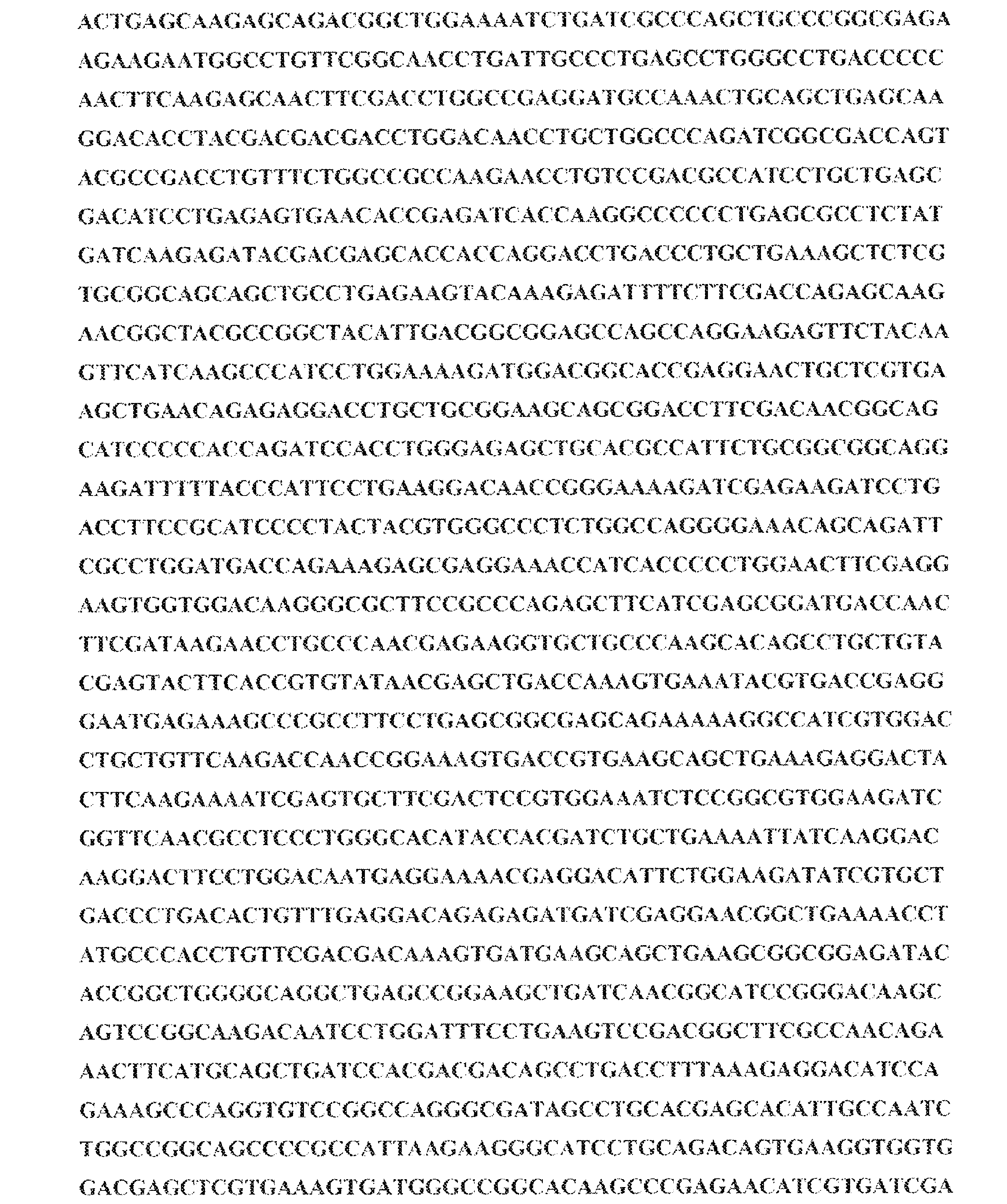
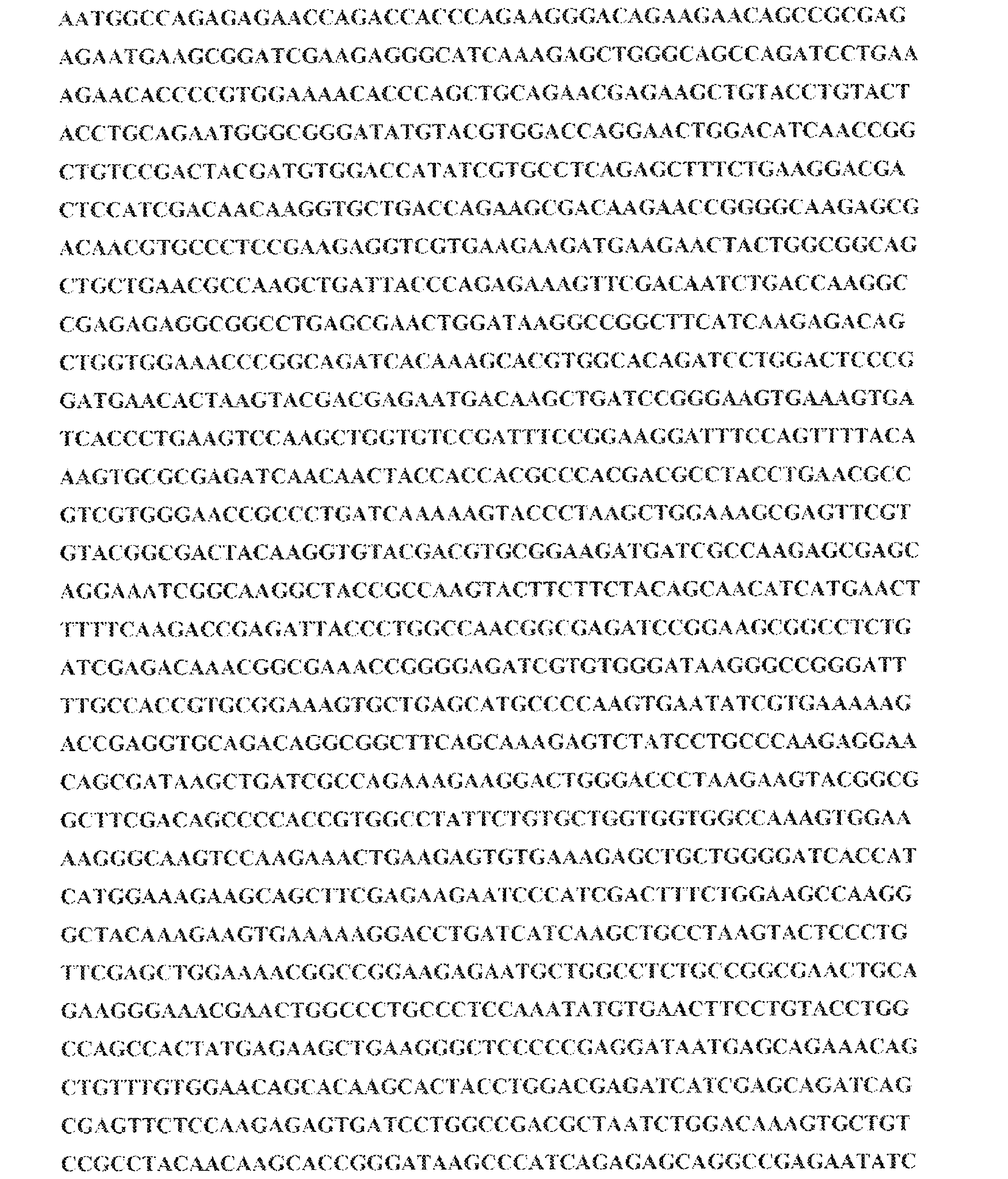
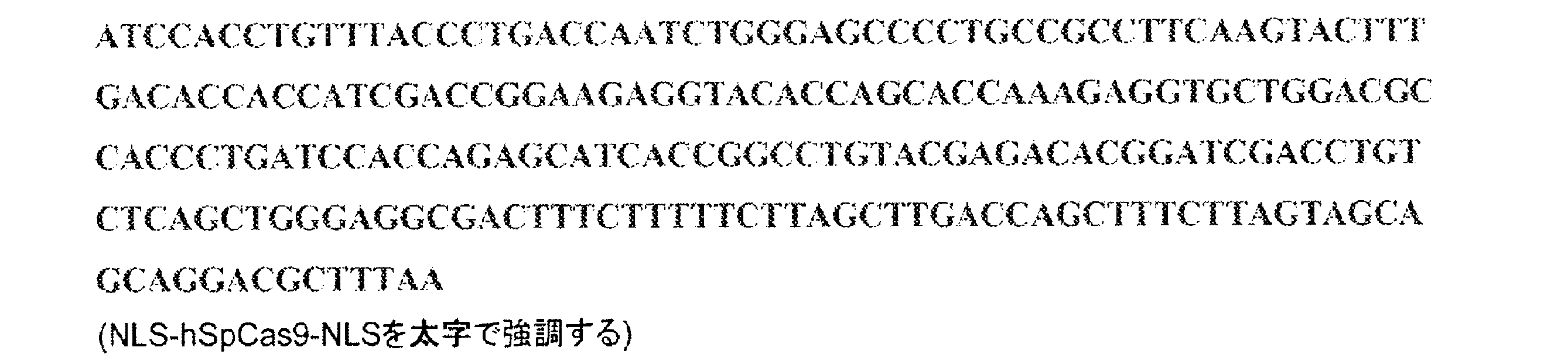


>U6-short tracrRNA (Streptococcus pyogenes SF370)
実施例11:オリゴ媒介Cas9誘導相同組換え
オリゴ相同組換え試験は、異なるCas9バリアントおよび異なるHRテンプレート(オリゴ対プラスミド)にわたる効率の比較である。
Example 11: Oligo-mediated Cas9-induced homologous recombination The oligo-homologous recombination study is a comparison of efficiency across different Cas9 variants and different HR templates (oligo vs. plasmid).
293FT細胞を使用した。SpCas9=野生型Cas9であり、SpCas9n=ニッカーゼCas9(D10A)である。キメラRNA標的は、実施例5、9および10と同一のEMX1プロトスペーサー標的1であり、オリゴはPAGE精製を使用してIDTにより合成されたものである。 293FT cells were used. SpCas9 = wild type Cas9, SpCas9n = nickase Cas9 (D10A). The chimeric RNA target was the same EMX1 protospacer target 1 as in examples 5, 9 and 10, and oligos were synthesized by IDT using PAGE purification.
図44は、本実験における相同組換え(HR)テンプレートとして使用されるオリゴDNAの設計を示す。長鎖オリゴは、EMX1遺伝子座およびHindIII制限部位と100bpの相同性を含有する。293FT細胞を、第1に、ヒトEMX1遺伝子座をターゲティングするキメラRNAおよび野生型cas9タンパク質を含有するプラスミド、ならびに第2に、HRテンプレートとしてのオリゴDNAにより同時形質移入した。試料は、Lipofectamine2000による形質移入から96時間後に回収された293FT細胞からのものである。全ての産物を、EMX1HRプライマーを用いて増幅し、ゲル精製し、次いでHindIIIにより消化してヒトゲノム中へのHRテンプレートのインテグレーションの効率を検出した。 Figure 44 shows the design of the oligo DNA used as a homologous recombination (HR) template in this experiment. The long oligo contains 100 bp of homology with the EMX1 locus and HindIII restriction site. 293FT cells were co-transfected, first, with a plasmid containing a chimeric RNA targeting the human EMX1 locus and wild-type cas9 protein, and, second, with the oligo DNA as the HR template. The samples were from 293FT cells harvested 96 hours after transfection with Lipofectamine2000. All products were amplified with EMX1HR primers, gel purified, and then digested with HindIII to detect the efficiency of integration of the HR template into the human genome.
図45および46は、Cas9タンパク質およびHRテンプレートの異なる組合せにより誘導されたHR効率の比較を示す。使用されるCas9構築物は、野生型Cas9またはCas9のニッカーゼバージョン(Cas9n)のいずれかであった。使用されるHRテンプレートは、アンチセンスオリゴDNA(上図のアンチセンスオリゴ)またはセンスオリゴDNA(上図のセンスオリゴ)、またはプラスミドHRテンプレート(上図のHRテンプレート)であった。センス/アンチセンス定義は、転写されるmRNAに対応する配列を有する活性的に転写される鎖が、ゲノムのセンス鎖として定義されることである。HR効率は、全てのゲノムPCR増幅産物に対するHindIII消化バンドの割合として示す(下方の数字)。 Figures 45 and 46 show a comparison of HR efficiency induced by different combinations of Cas9 protein and HR template. The Cas9 constructs used were either wild-type Cas9 or the nickase version of Cas9 (Cas9n). The HR templates used were antisense oligo DNA (antisense oligo in the upper figure) or sense oligo DNA (sense oligo in the upper figure), or a plasmid HR template (HR template in the upper figure). The sense/antisense definition is that the actively transcribed strand with the sequence corresponding to the transcribed mRNA is defined as the sense strand of the genome. The HR efficiency is shown as the percentage of the HindIII digested band to the total genomic PCR amplification product (lower number).
実施例12:自閉症マウス
近年の大規模シーケンシング構想は、疾患に関連する多数の遺伝子を生じさせた。遺伝子の発見は、その遺伝子が何であるか、およびいかにそれが疾患表現型をもたらすのかの理解の始まりにすぎない。候補遺伝子を研究するための現在の技術およびアプローチは、緩慢で煩雑である。代表的な基準である遺伝子ターゲティングおよび遺伝子ノックアウトは、金銭および研究人材の両方の観点から時間および資源のかなりの投資を要求する。本出願人らは、hSpCas9ヌクレアーゼを利用して多くの標的遺伝子をターゲティングし、任意の他の技術と比較して高い効率および低いターンアラウンドでそれを行うように設定した。hSpCas9の高い効率のため、本出願人らは、RNAインジェクションをマウス接合子中に行い、mESCにおけるいかなる予備遺伝子ターゲティングを行うことも必要とせずにゲノム改変動物を直ちに得ることができる。
Example 12: Autistic Mice Recent large-scale sequencing initiatives have generated a large number of genes associated with disease. Gene discovery is only the beginning of understanding what the gene is and how it leads to disease phenotypes. Current techniques and approaches to study candidate genes are slow and cumbersome. The gold standard of gene targeting and gene knockout requires a significant investment of time and resources in terms of both money and research personnel. Applicants have set up hSpCas9 nuclease to target many target genes and do so with high efficiency and low turnaround compared to any other technology. Due to the high efficiency of hSpCas9, Applicants can perform RNA injection into mouse zygotes and immediately obtain genome-modified animals without the need to perform any prior gene targeting in mESCs.
クロモドメインヘリカーゼDNA結合タンパク質8(CHD8)は、早期脊椎動物発生および形態形成に関与する極めて重要な遺伝子である。CHD8を欠くマウスは、胚発生の間に死亡する。CHD8遺伝子の突然変異は、ヒトにおける自閉症スペクトラム障害に関連している。この関連は、Natureに同時に公開された3つの異なる論文においてなされた。同一の3つの研究は、自閉症スペクトラム障害に関連する大量の遺伝子を同定した。本出願人らの目的は、全ての論文に見出された4つの遺伝子Chd8、Katnal2、Kctd13、およびScn2aについてのノックアウトマウスを創成することであった。さらに、本出願人らは、自閉症スペクトラム障害、統合失調症、およびADHDに関連する2つの他の遺伝子GIT1、CACNA1C、およびCACNB2を選択した。最後に、陽性対照として本出願人らは、MeCP2をターゲティングすることを決定した。 Chromodomain helicase DNA-binding protein 8 (CHD8) is a crucial gene involved in early vertebrate development and morphogenesis. Mice lacking CHD8 die during embryonic development. Mutations in the CHD8 gene have been linked to autism spectrum disorder in humans. This link was made in three different papers published simultaneously in Nature. The same three studies identified a large number of genes associated with autism spectrum disorder. Our aim was to create knockout mice for the four genes Chd8, Katnal2, Kctd13, and Scn2a found in all papers. In addition, we selected two other genes GIT1, CACNA1C, and CACNB2, which are associated with autism spectrum disorder, schizophrenia, and ADHD. Finally, as a positive control we decided to target MeCP2.
それぞれの遺伝子について、本出願人らは、遺伝子をノックアウトする可能性が高い3
つのgRNAを設計した。ノックアウトは、hSpCas9ヌクレアーゼが二本鎖切断、
およびエラープローンDNA修復経路、非相同末端結合を作製し、切断を補正し、突然変
異を創成した後に生じる。最も可能性が高い結果は、遺伝子をノックアウトするフレーム
シフト突然変異である。ターゲティング方針は、PAM配列NGGを有し、ゲノム中でユ
ニークな遺伝子のエキソン中のプロトスペーサーを見出すことを含んだ。遺伝子に最も有
害である第1のエキソン中のプロトスペーサーを優先した。
For each gene, we identify three genes with high probability of knocking out the gene.
We designed two gRNAs. The knockout was achieved by detecting a double-strand break in the hSpCas9 nuclease.
and error-prone DNA repair pathways, which create non-homologous end joining, correct the break, and create mutations. The most likely outcome is a frameshift mutation that knocks out the gene. The targeting strategy involved finding protospacers in the exons of genes that have the PAM sequence NGG and are unique in the genome. Priority was given to protospacers in the first exon that are most detrimental to the gene.
それぞれのgRNAは、マウス細胞系Neuro-N2a中でhSpCas9とのリポソーム一過的同時形質移入により検証した。形質移入から72時間後、EpicentreからのQuickExtract DNAを使用してゲノムDNAを精製した。PCRを実施して目的遺伝子座を増幅した。続いて、TransgenomicsからのSURVEYOR Mutation Detection Kitを用いた。それぞれのgRNAについてのSURVEYOR結果およびそれぞれの対照を図A1に示す。陽性SURVEYOR結果は、ゲノムPCRに対応する1つの大きいバンドであり、突然変異の部位における二本鎖切断を作製するSURVEYORヌクレアーゼの産物である2つのより小さいバンドである。それぞれのgRNAの平均切断効率も、それぞれのgRNAについて測定した。インジェクションのために選択されたgRNAは、ゲノム内の最もユニークな最大効率のgRNAであった。 Each gRNA was validated by liposomal transient co-transfection with hSpCas9 in the mouse cell line Neuro-N2a. 72 hours after transfection, genomic DNA was purified using QuickExtract DNA from Epicentre. PCR was performed to amplify the locus of interest. This was followed by the SURVEYOR Mutation Detection Kit from Transgenomics. The SURVEYOR results for each gRNA and the respective controls are shown in Figure A1. A positive SURVEYOR result is one large band corresponding to the genomic PCR and two smaller bands that are the products of the SURVEYOR nuclease creating a double-stranded break at the site of the mutation. The average cleavage efficiency of each gRNA was also measured for each gRNA. The gRNA selected for injection was the most unique and most efficient gRNA in the genome.
RNA(hSpCas9+gRNA RNA)を接合子の前核中にインジェクトし、その後に代理母に移植した。代理母を妊娠満期にさせ、出産10日後に仔をテールスニップ(tail snip)によりサンプリングした。DNAを抽出し、PCRのためのテンプレートとして使用し、次いでそれをSURVEYORにより処理した。さらに、PCR産物をシーケンシングのために送った。SURVEYORアッセイまたはPCRシーケンシングのいずれかにおいて陽性として検出された動物は、pUC19ベクター中にクローニングされ、シーケンシングされてそれぞれのアレルからの推定突然変異を決定されたそれらのゲノムPCR産物を有する。 RNA (hSpCas9+gRNA RNA) was injected into the pronuclei of zygotes and subsequently implanted into surrogate mothers. Surrogate mothers were allowed to carry pregnancy to term and pups were sampled by tail snip 10 days after birth. DNA was extracted and used as template for PCR, which was then processed by SURVEYOR. Furthermore, PCR products were sent for sequencing. Animals detected as positive in either the SURVEYOR assay or PCR sequencing had their genomic PCR products cloned into pUC19 vector and sequenced to determine putative mutations from each allele.
これまで、Chd8ターゲティング実験からの仔マウスは、アレルシーケンシングの時点まで完全に処理されている。38匹の生存仔(レーン1~38)、1匹の死亡仔(レーン39)および比較用の1匹の野生型の仔(レーン40)についてのSurveyor結果を図A2に示す。仔1~19にgRNA Chd8.2をインジェクトし、仔20~38にgRNA Chd8.3をインジェクトした。38匹の生存仔のうち、13匹は突然変異について陽性であった。1匹の死亡仔も突然変異を有した。野生型試料において突然変異は検出されなかった。ゲノムPCRシーケンシングは、SURVEYORアッセイの知見と一致した。 To date, pups from the Chd8 targeting experiment have been fully processed to the time of allele sequencing. Surveyor results for 38 live pups (lanes 1-38), one dead pup (lane 39) and one wild-type pup for comparison (lane 40) are shown in Figure A2. Pups 1-19 were injected with gRNA Chd8.2 and pups 20-38 were injected with gRNA Chd8.3. Of the 38 live pups, 13 were positive for the mutation. One dead pup also had the mutation. No mutations were detected in the wild-type sample. Genomic PCR sequencing was consistent with the SURVEYOR assay findings.
実施例13:CRISPR/Cas媒介転写モジュレーション
図67は、転写活性化活性を有するCRISPR-TF(転写因子)の設計を示す。キメラRNAをU6プロモーターにより発現させる一方、3つのNLSおよびVP64機能ドメインに作動可能に結合しているCas9タンパク質のヒトコドン最適化二重突然変異体バージョン(hSpCas9m)をEF1aプロモーターにより発現させる。二重突然変異D10AおよびH840Aにより、cas9タンパク質がいかなる開裂も導入し得なくなるが、キメラRNAによりガイドされた場合に標的DNAに結合するその能力は維持された。
Example 13: CRISPR/Cas-mediated transcriptional modulation Figure 67 shows the design of CRISPR-TF (transcription factor) with transcriptional activation activity. The chimeric RNA is expressed by the U6 promoter, while the human codon-optimized double mutant version of Cas9 protein (hSpCas9m) operably linked to three NLS and VP64 functional domain is expressed by the EF1a promoter. The double mutations D10A and H840A render the cas9 protein unable to introduce any cleavage but maintained its ability to bind to target DNA when guided by the chimeric RNA.
図68は、CRISPR-TF系(キメラRNAおよびCas9-NLS-VP64融合タンパク質)によるヒトSOX2遺伝子の転写活性化を示す。293FT細胞を2つの成分を担持するプラスミドにより形質移入した:(1)ヒトSOX2ゲノム遺伝子座内またはその周囲の20bp配列をターゲティングするU6によりドライブされる異なるキメラRNA、および(2)EF1aによりドライブされるhSpCas9m(二重突然変異体)-NLS-VP64融合タンパク質。形質移入から96時間後、293FT細胞を回収し、qRT-PCRアッセイを使用してmRNA発現の導入により活性化のレベルを計測する。全ての発現レベルを、キメラRNAを有さないCRISPR-TF骨格プラスミドにより形質移入された細胞からの結果を表す対照群(灰色バー)に対して正規化する。SOX2mRNAを検出するために使用されるqRT-PCRプローブは、Taqman Human Gene Expression Assay(Life Technologies)である。全ての実験は、3つの生物学的複製物からのデータを表し、n=3であり、エラーバーは標準誤差(s.e.m.)を示す。 Figure 68 shows transcriptional activation of the human SOX2 gene by the CRISPR-TF system (chimeric RNA and Cas9-NLS-VP64 fusion protein). 293FT cells were transfected with plasmids carrying two components: (1) different chimeric RNAs driven by U6 targeting 20 bp sequences in or around the human SOX2 genomic locus, and (2) hSpCas9m (double mutant)-NLS-VP64 fusion protein driven by EF1a. 96 hours after transfection, 293FT cells are harvested and the level of activation by induction of mRNA expression is measured using a qRT-PCR assay. All expression levels are normalized to the control group (gray bar) representing the results from cells transfected with the CRISPR-TF backbone plasmid without chimeric RNA. The qRT-PCR probe used to detect SOX2 mRNA is the Taqman Human Gene Expression Assay (Life Technologies). All experiments represent data from three biological replicates, n=3, and error bars indicate standard error (s.e.m.).
実施例14:NLS:Cas9NLS
293FT細胞を、2つの成分を含有するプラスミドにより形質移入した:(1)異なるNLS設計を有するCas9(野生型ヒトコドン最適化SpCas9)の発現をドライブするEF1aプロモーター(2)ヒトEMX1遺伝子座をターゲティングする同一キメラRNAをドライブするU6プロモーター。
Example 14: NLS: Cas9NLS
293FT cells were transfected with a plasmid containing two components: (1) the EF1a promoter driving expression of Cas9 (wild-type human codon-optimized SpCas9) with a different NLS design (2) the U6 promoter driving the same chimeric RNA targeting the human EMX1 locus.
細胞を形質移入後72時間の時点において回収し、次いで50μlのQuickExtractゲノムDNA抽出溶液により製造業者のプロトコルに従って抽出した。標的EMX1ゲノムDNAをPCR増幅し、次いで1%のアガロースゲルによりゲル精製した。ゲノムPCR産物をリアニーリングし、Surveyorアッセイに製造業者のプロトコルに従って供した。異なる構築物のゲノム開裂効率を4~12%のTBE-PAGEゲル(Life Technologies)上のSDS-PAGEを使用して計測し、ImageLab(Bio-rad)ソフトウェアにより分析および定量し、全て製造業者のプロトコルに従った。 Cells were harvested at 72 hours post-transfection and then extracted with 50 μl of QuickExtract genomic DNA extraction solution according to the manufacturer's protocol. Target EMX1 genomic DNA was PCR amplified and then gel purified on a 1% agarose gel. Genomic PCR products were reannealed and subjected to Surveyor assay according to the manufacturer's protocol. Genomic cleavage efficiency of different constructs was measured using SDS-PAGE on 4-12% TBE-PAGE gels (Life Technologies) and analyzed and quantified by ImageLab (Bio-rad) software, all according to the manufacturer's protocol.
図69は、異なるCas9NLS構築物の設計を示す。全てのCas9は、SpCas9のヒトコドン最適化バージョンであった。NLS配列をcas9遺伝子にN末端またはC末端のいずれかにおいて結合させた。異なるNLS設計を有する全てのCas9バリアントを、それがEF1aプロモーターによりドライブされるように含有する骨格ベクター中にクローニングした。同一ベクター上に、U6プロモーターによりドライブされるヒトEMX1遺伝子座をターゲティングするキメラRNAが存在し、2成分系を一緒に形成する。 Figure 69 shows the design of the different Cas9 NLS constructs. All Cas9s were human codon-optimized versions of SpCas9. The NLS sequence was attached to the cas9 gene either at the N-terminus or C-terminus. All Cas9 variants with different NLS designs were cloned into a backbone vector containing it as driven by the EF1a promoter. On the same vector there is a chimeric RNA targeting the human EMX1 locus driven by the U6 promoter, together forming a two-component system.
表M.Cas9 NLS設計試験結果。surveyorアッセイによる異なるcas9-nls構築物のゲノム開裂の定量。 Table M. Cas9 NLS design test results. Quantification of genome cleavage of different cas9-nls constructs by surveyor assay.
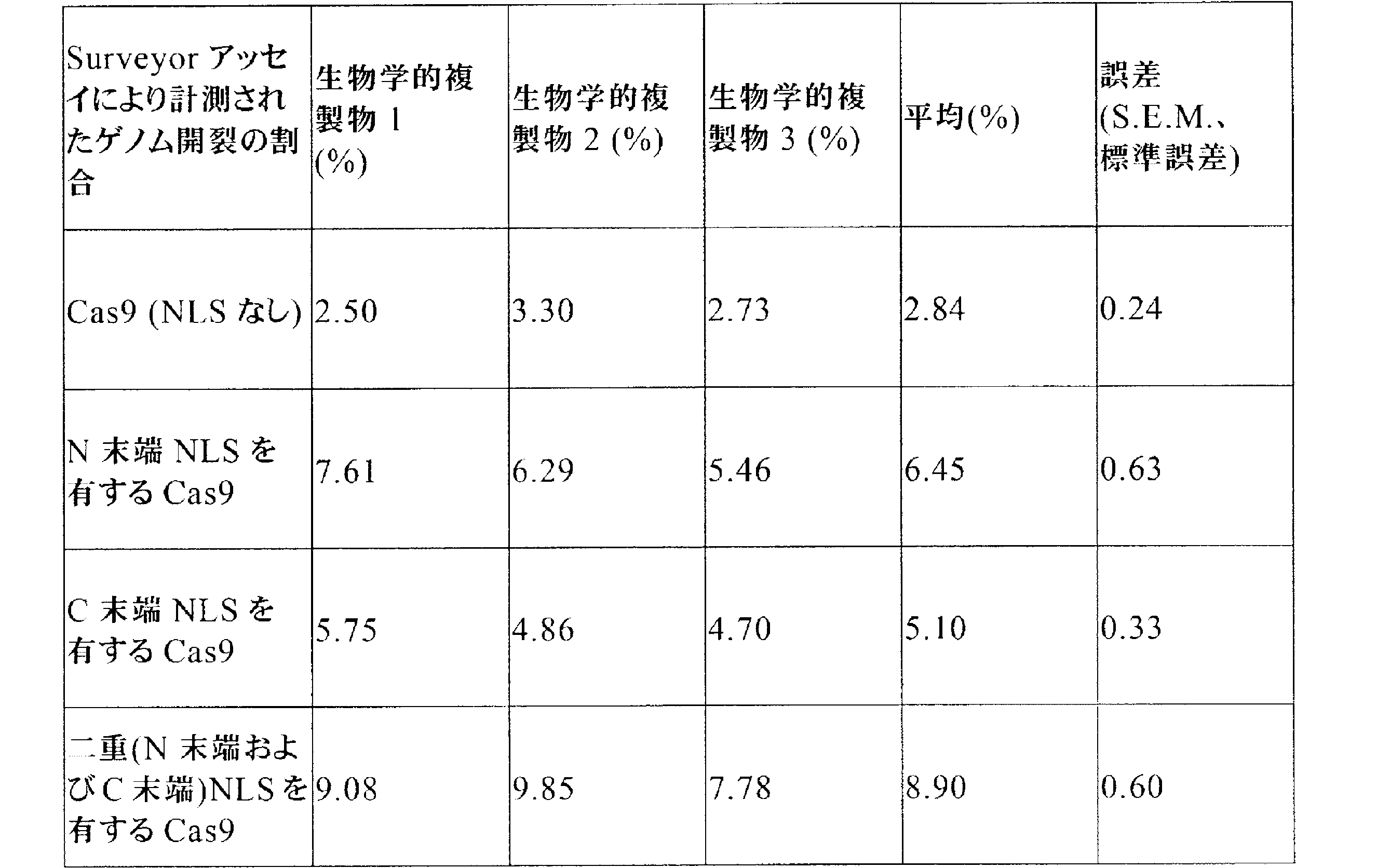
図70は、異なるNLS設計を担持するCas9バリアントにより誘導されたゲノム開裂の効率を示す。割合は、それぞれの構築物により開裂されたヒトEMX1ゲノムDNAの一部を示す。全ての実験は、3つの生物学的複製物からのデータを表し、n=3であり、エラーバーは標準誤差(S.E.M.)を示す。 Figure 70 shows the efficiency of genome cleavage induced by Cas9 variants carrying different NLS designs. The percentages indicate the fraction of human EMX1 genomic DNA cleaved by each construct. All experiments represent data from three biological replicates, n=3, and error bars indicate standard error (S.E.M.).
実施例15:Cas9を使用する微細藻類のエンジニアリング
Cas9を送達する方法
Example 15: Engineering Microalgae Using Cas9 Methods for Delivering Cas9
方法1:本出願人らは、構成的プロモーター、例えば、Hsp70A-Rbc S2またはベータ2-チューブリンの制御下でCas9を発現するベクターを使用してCas9およびガイドRNAを送達する。 Method 1: We deliver Cas9 and guide RNA using a vector that expresses Cas9 under the control of a constitutive promoter, e.g., Hsp70A-Rbc S2 or beta2-tubulin.
方法2:本出願人らは、構成的プロモーター、例えば、Hsp70A-Rbc S2またはベータ2-チューブリンの制御下でCas9およびT7ポリメラーゼを発現するベクターを使用してCas9およびT7ポリメラーゼを送達する。ガイドRNAは、ガイドR
NAをドライブするT7プロモーターを含有するベクターを使用して送達する。
Method 2: Applicants deliver Cas9 and T7 polymerase using vectors expressing Cas9 and T7 polymerase under the control of a constitutive promoter, e.g., Hsp70A-Rbc S2 or beta2-tubulin.
It is delivered using a vector containing a T7 promoter driving NA.
方法3:本出願人らは、Cas9mRNAおよびインビトロで転写されたガイドRNAを藻類細胞に送達する。RNAは、インビトロで転写させることができる。Cas9mRNAは、Cas9についてのコード領域およびCas9mRNAの安定化を確保するためのCop1からの3’UTRからなる。 Method 3: We deliver Cas9 mRNA and in vitro transcribed guide RNA to algal cells. RNA can be transcribed in vitro. Cas9 mRNA consists of the coding region for Cas9 and the 3'UTR from Cop1 to ensure stabilization of Cas9 mRNA.
相同組換えのため、本出願人らは、追加の相同組換え修復テンプレートを提供する。 For homologous recombination, the applicants provide additional homology-directed repair templates.
ベータ-2チューブリンプロモーターの制御下でCas9の発現をドライブするカセットと、それに続くCop1の3’UTRについての配列。


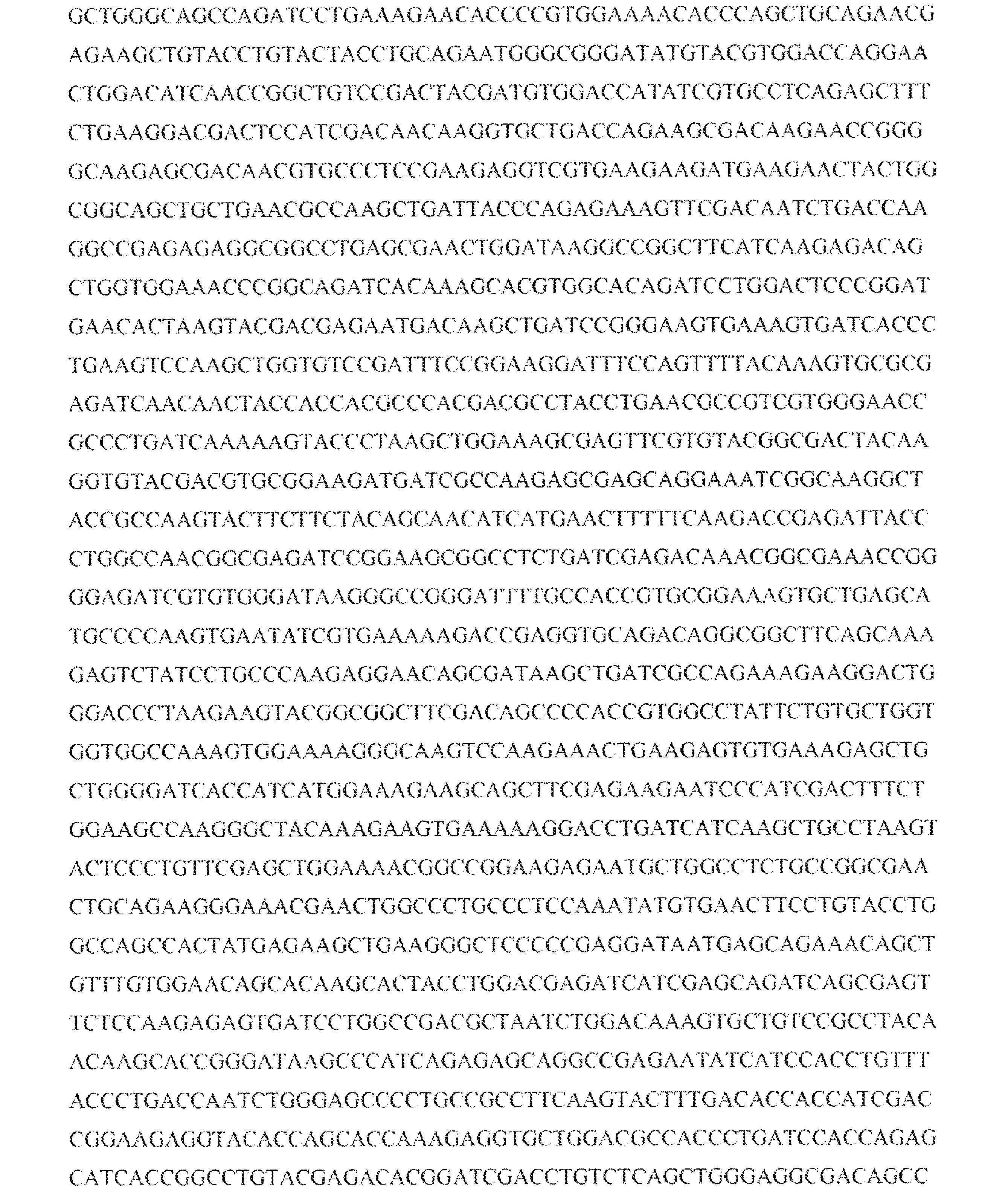

ベータ-2チューブリンプロモーターの制御下でT7ポリメラーゼの発現をドライブするカセットと、それに続くCop1の3’UTRについての配列:
T7プロモーターによりドライブされるガイドRNAの配列(T7プロモーター、Nは、ターゲティング配列を表す):
遺伝子送達:
Chlamydomonas Resource Centerからのコナミドリムシ(Chlamydomonas reinhardtii)株CC-124およびCC-125を、エレクトロポレーションに使用する。エレクトロポレーションプロトコルは、GeneArt Chlamydomonas Engineeringキットからの標準的な推奨プロトコルに従う。
Gene delivery:
Chlamydomonas reinhardtii strains CC-124 and CC-125 from the Chlamydomonas Resource Center are used for electroporation. The electroporation protocol follows the standard recommended protocol from the GeneArt Chlamydomonas Engineering kit.
また、本出願人らは、Cas9を構成的に発現するコナミドリムシ(Chlamydomonas reinhardtii)の系統を生成する。このことは、pChlamy1(PvuIを使用して線形化)を使用し、ハイグロマイシン耐性コロニーを選択することにより行うことができる。Cas9を含有するpChlamy1についての配列を以下に示す。遺伝子ノックアウトを達成するためのこの手法において、ガイドRNAのためのRNAを送達することが必要なだけである。相同組換えのため、本出願人らは、ガイドRNAおよび線形化相同組換えテンプレートを送達する。
pChlamy1-Cas9:


pChlamy1-Cas9:
全ての改変コナミドリムシ(Chlamydomonas reinhardtii)細胞について、本出願人らは、PCR、SURVEYORヌクレアーゼアッセイ、およびDNAシーケンシングを使用して良好な改変を確認した。 For all modified Chlamydomonas reinhardtii cells, the applicants confirmed successful modifications using PCR, SURVEYOR nuclease assays, and DNA sequencing.
実施例16:細菌中の転写リプレッサーとしてのCas9の使用
転写を人工的に制御する技能は、遺伝子機能の研究および所望の特性を有する合成遺伝子ネットワークの構築の両方に不可欠である。本出願人らは、本明細書において、プログラマブル転写リプレッサーとしてのRNAによりガイドされるCas9タンパク質の使用を記載する。
Example 16: Use of Cas9 as a transcriptional repressor in bacteria The ability to artificially control transcription is essential for both studying gene function and constructing synthetic gene networks with desired properties. Applicants herein describe the use of RNA-guided Cas9 protein as a programmable transcriptional repressor.
本出願人らは、化膿性連鎖球菌(Streptococcus pyogenes)SF370のCas9タンパク質をいかに使用して肺炎連鎖球菌(Streptococcus pneumoniae)中のゲノム編集を指向することができるかを既に実証している。この研究において、本出願人らは、cas9、tracrRNAおよびリピートからなる最小のCRISPR系を含有するcrR6Rk株をエンジニアリングした。D10A-H840突然変異をこの株中のcas9中に導入し、株crR6Rk**を得た。bgaAβ-ガラクトシダーゼ遺伝子プロモーターの異なる位置をターゲティングする4つのスペーサーを、既に記載されたpDB98プラスミドにより担持されるCRISPRアレイ中でクローニングした。本出願人らは、ターゲティングされる位置に応じてβ-ガラクトシダーゼ活性のXからY倍の低減を観察し、このことは、プログラマブルリプレッサーとしてのCas9の潜在性を実証した(図73)。 The applicants have already demonstrated how the Cas9 protein of Streptococcus pyogenes SF370 can be used to direct genome editing in Streptococcus pneumoniae. In this study, the applicants engineered a strain crR6Rk that contains a minimal CRISPR system consisting of cas9, tracrRNA and repeats. The D10A-H840 mutation was introduced into cas9 in this strain, resulting in strain crR6Rk**. Four spacers targeting different positions of the bgaAβ-galactosidase gene promoter were cloned into a CRISPR array carried by the pDB98 plasmid already described. We observed an X to Y-fold reduction in β-galactosidase activity depending on the location targeted, demonstrating the potential of Cas9 as a programmable repressor (Figure 73).
大腸菌(Escherichia coli)中のCas9**抑制を達成するため、緑色蛍光タンパク質(GFP)レポータープラスミド(pDB127)を構築して構成的プロモーターからgfpmut2遺伝子を発現させた。プロモーターは、両方の鎖上のいくつかのNPP PAMを担持するように設計して種々の位置におけるCas9**結合の効果を計測した。本出願人らは、D10A-H840突然変異を、tracrRNA、cas9および新たなスペーサーの容易なクローニングのために設計された最小のCRISPRアレイを担持する記載のプラスミドのpCas9中に導入した。22個の異なるスペーサーを、gfpmut2プロモーターおよびオープンリーディングフレームの異なる領域をターゲティングするよう設計した。-35および-10プロモーターエレメントならびにシャインダルガノ配列に重複または隣接する領域のターゲティング時に蛍光の約20倍の低減が観察された。両方の鎖上の標的は、類似の抑制レベルを示した。これらの結果は、プロモーター領域の任意の位置へのCas9**の結合が、推定上RNAP結合の立体阻害を通して転写開始を妨害することを示唆する。 To achieve Cas9** repression in Escherichia coli, a green fluorescent protein (GFP) reporter plasmid (pDB127) was constructed to express the gfpmut2 gene from a constitutive promoter. The promoter was designed to carry several NPP PAMs on both strands to measure the effect of Cas9** binding at various positions. We introduced the D10A-H840 mutation into pCas9, a described plasmid carrying tracrRNA, cas9, and a minimal CRISPR array designed for easy cloning of new spacers. Twenty-two different spacers were designed to target different regions of the gfpmut2 promoter and open reading frame. An approximately 20-fold reduction in fluorescence was observed upon targeting the -35 and -10 promoter elements and regions overlapping or adjacent to the Shine-Dalgarno sequence. Targets on both strands showed similar levels of repression. These results suggest that binding of Cas9** to any position in the promoter region disrupts transcription initiation, presumably through steric inhibition of RNAP binding.
Cas9**が転写伸長を妨害し得るか否かを決定するため、本出願人らは、それをgpfmut2のリーディングフレームに指向した。ターゲティングされたコードおよび非コード鎖の両方の場合に蛍光の低減が観察され、このことは、Cas9結合が作動するRNAPに対する障害を表すほど実際に強力であることを示唆した。しかしながら、コード鎖をターゲティングした場合には発現の40%の低減が観察された一方、非コード鎖の場合には20倍の低減が観察された(図21b、T9、T10およびT11とB9、B10およびB11とを比較)。転写に対するCas9**結合の効果を直接決定するため、本出願人らは、T5、T10、B10またはpDB127をターゲティングしない対照構築物のいずれかを担持する株からRNAを抽出し、それを、B10およびT10標的部位の前(B477)または後(B510)に結合するプローブのいずれかを使用するノザンブロット分析に供した。本出願人らの蛍光法と一致して、Cas9**をプロモーター領域(T5標的)に指向した場合にgfpmut2転写は検出されず、T10領域のターゲティング後に転写が観察された。興味深いことに、B477プローブについてより小さい転写物が観察された。このバンドは、Cas9**により中断される転写物の予測サイズに対応し、コード鎖へのdgRNA::Cas9**結合により引き起こされる転写終結の直接的な指標である。驚くべきことに、本出願人らは、非コード鎖をターゲティングした場合(B10)に転写物を検出しなかった。B10領域へのCas9**結合が転写開始を干渉する可能性が低いため、この結果は、mRNAが分解されたことを示唆する。DgRNA::Cas9は、インビトロでssRNAに結合することが示された。本出願人らは、結合が宿主ヌクレアーゼによるmRNAの分解をトリガーし得ることを推測する。実際、リボソーム停滞は、大腸菌(E.coli)中の翻訳されるmRNAに対する開裂を誘導し得る。 To determine whether Cas9** could interfere with transcription elongation, we directed it at the reading frame of gpfmut2. A reduction in fluorescence was observed when both the coding and non-coding strands were targeted, suggesting that Cas9 binding was indeed strong enough to represent an impediment to RNAP operating. However, a 40% reduction in expression was observed when the coding strand was targeted, whereas a 20-fold reduction was observed when the non-coding strand was targeted (Fig. 21b, compare T9, T10, and T11 with B9, B10, and B11). To directly determine the effect of Cas9** binding on transcription, we extracted RNA from strains carrying either T5, T10, B10, or a control construct not targeting pDB127, and subjected it to Northern blot analysis using either B10 and a probe that binds before (B477) or after (B510) the T10 target site. Consistent with our fluorescent method, no gfpmut2 transcription was detected when Cas9** was directed to the promoter region (T5 target), and transcription was observed after targeting the T10 region. Interestingly, a smaller transcript was observed for the B477 probe. This band corresponds to the predicted size of the transcript interrupted by Cas9** and is a direct indication of transcription termination caused by dgRNA::Cas9** binding to the coding strand. Surprisingly, we did not detect any transcript when targeting the non-coding strand (B10). This result suggests that the mRNA was degraded, as Cas9** binding to the B10 region is unlikely to interfere with transcription initiation. DgRNA::Cas9 has been shown to bind to ssRNA in vitro. We speculate that binding may trigger degradation of the mRNA by host nucleases. In fact, ribosome stalling can induce cleavage in the translated mRNA in E. coli.
一部の用途は、遺伝子発現の完全な抑制よりも遺伝子発現の正確な調整を要求する。本出願人らは、crRNA/標的相互作用を弱めるミスマッチの導入を通して中間的な抑制レベルを達成することを求めた。本出願人らは、crRNAの5’末端中の突然変異の増加数を有するB1、T5およびB10構築物に基づき一連のスペーサーを創成した。B1およびT5中の最大8つの突然変異が抑制レベルに影響せず、蛍光の漸増が追加の突然変異について観察された。 Some applications require precise modulation of gene expression rather than complete inhibition. Applicants sought to achieve intermediate levels of inhibition through the introduction of mismatches that weaken the crRNA/target interaction. Applicants created a series of spacers based on the B1, T5 and B10 constructs with increasing numbers of mutations in the 5' end of the crRNA. Up to eight mutations in B1 and T5 did not affect the level of inhibition, and a gradual increase in fluorescence was observed for additional mutations.
crRNAとその標的との間の8ntマッチについてのみ観察された抑制により、転写調節因子としてのCas9**の使用のオフターゲティング効果の問題が生じる。良好なPAM(NGG)もCas9結合に要求されるため、同一レベルの呼吸を得るためにマッチするヌクレオチドの数は10である。10ntマッチは、約1Mbpごとに1回ランダムに生じ、したがってそのような部位は小さい細菌ゲノム中でも見出される可能性が高い。しかしながら、転写を有効に抑制するため、そのような部位は遺伝子のプロモーター領域中に存在することが必要であり、これによりオフターゲティングの可能性がかなり低くなる。本出願人らは、遺伝子の非コード鎖がターゲティングされる場合に遺伝子発現が影響され得ることも示した。これを起こすため、ランダム標的は右方向で存在しなければならないが、そのようなイベントは起こる可能性が比較的高い。実際のところ、本試験の過程の間、本出願人らは、pCas9**上で設計されたスペーサーの1つを構築することができなかった。本出願人らは後に、このスペーサーが不可欠なmurC遺伝子中の良好なPAMに隣接する12bpマッチを示すことを見出した。このようなオフターゲティングは、設計されるスペーサーの体系的なblastにより容易に回避することができる。 The observed inhibition only for 8-nt matches between the crRNA and its target raises the question of off-targeting effects of using Cas9** as a transcription regulator. Since a good PAM (NGG) is also required for Cas9 binding, the number of matching nucleotides to obtain the same level of respiration is 10. The 10-nt match occurs randomly approximately once every 1 Mbp, so such sites are likely to be found even in small bacterial genomes. However, to effectively inhibit transcription, such sites need to be present in the promoter region of the gene, which makes off-targeting much less likely. Applicants have also shown that gene expression can be affected when the non-coding strand of a gene is targeted. For this to happen, the random target must be in the right direction, but such an event is relatively likely to occur. Indeed, during the course of this study, Applicants were unable to construct one of the spacers designed on pCas9**. We later found that this spacer showed a good adjacent 12-bp match to a PAM in the essential murC gene. Such off-targeting can be easily avoided by systematic blasting of the designed spacer.
本発明の態様を、以下の番号付与された段落にさらに記載する:
1.1つ以上のベクターを含むベクター系であって、
a.traerメイト配列およびガイド配列をtraerメイト配列の上流に挿入するための1つ以上の挿入部位に作動可能に結合している第1の調節エレメント(ガイド配列は、発現された場合、真核細胞中の標的配列へのCRISPR複合体の配列特異的結合を指向し、CRISPR複合体は、(1)標的配列にハイブリダイズされるガイド配列、および(2)traer配列にハイブリダイズされるtraerメイト配列と複合体形成しているCRISPR酵素を含む);ならびに
b.核局在化配列を含む前記CRISPR酵素をコードする酵素コード配列に作動可能に結合している第2の調節エレメント
を含み;
成分(a)および(b)は、系の同一または異なるベクター上にある
ベクター系。
Aspects of the invention are further described in the following numbered paragraphs:
1. A vector system comprising one or more vectors,
a. a first regulatory element operably linked to a traer mate sequence and one or more insertion sites for inserting a guide sequence upstream of the traer mate sequence, the guide sequence, when expressed, directs sequence-specific binding of a CRISPR complex to a target sequence in a eukaryotic cell, the CRISPR complex comprising (1) the guide sequence hybridized to the target sequence, and (2) a CRISPR enzyme complexed with the traer mate sequence hybridized to the traer sequence; and b. a second regulatory element operably linked to an enzyme coding sequence encoding the CRISPR enzyme comprising a nuclear localization sequence;
A vector system in which components (a) and (b) are on the same or different vectors of the system.
2.成分(a)が、第1の調節エレメントの制御下でtraerメイト配列の下流のtraer配列をさらに含む、段落1に記載のベクター系。 2. The vector system of paragraph 1, wherein component (a) further comprises a traer sequence downstream of the traer mate sequence under the control of the first regulatory element.
3.成分(a)が、第1の調節エレメントに作動可能に結合している2つ以上のガイド配列をさらに含み、2つ以上のガイド配列のそれぞれは、発現された場合、真核細胞中の異なる標的配列へのCRISPR複合体の配列特異的結合を指向する、段落1に記載のベクター系。 3. The vector system of paragraph 1, wherein component (a) further comprises two or more guide sequences operably linked to the first regulatory element, each of the two or more guide sequences, when expressed, directs sequence-specific binding of the CRISPR complex to a different target sequence in a eukaryotic cell.
4.第3の調節エレメントの制御下でtraer配列を含む、段落1に記載のベクター系。 4. The vector system described in paragraph 1, comprising a traer sequence under the control of a third regulatory element.
5.traer配列が、最適にアラインされた場合にtraerメイト配列の長さに沿って少なくとも50%の配列相補性を示す、段落1に記載のベクター系。 5. A vector system as described in paragraph 1, in which the traer sequence exhibits at least 50% sequence complementarity along the length of the traer mate sequence when optimally aligned.
6.CRISPR酵素が、真核細胞の核中の検出可能な量の前記CRISPR酵素の蓄積をドライブするために十分な強度の1つ以上の核局在化配列を含む、段落1に記載のベクター系。 6. The vector system of paragraph 1, wherein the CRISPR enzyme comprises one or more nuclear localization sequences of sufficient strength to drive accumulation of the CRISPR enzyme in a detectable amount in the nucleus of a eukaryotic cell.
7.CRISPR酵素が、II型CRISPR系酵素である、段落1に記載のベクター系。 7. The vector system of paragraph 1, wherein the CRISPR enzyme is a type II CRISPR system enzyme.
8.CRISPR酵素が、Cas9酵素である、段落1に記載のベクター系。 8. The vector system of paragraph 1, wherein the CRISPR enzyme is a Cas9 enzyme.
9.CRISPR酵素が、真核細胞中の発現のためにコドン最適化されている、段落1に記載のベクター系。 9. The vector system of paragraph 1, wherein the CRISPR enzyme is codon-optimized for expression in eukaryotic cells.
10.CRISPR酵素が、標的配列の局在における1つまたは2つの鎖の開裂を指向する、段落1に記載のベクター系。 10. The vector system of paragraph 1, wherein the CRISPR enzyme directs cleavage of one or both strands at the location of the target sequence.
11.CRISPR酵素が、DNA鎖開裂活性を欠く、段落1に記載のベクター系。 11. The vector system of paragraph 1, wherein the CRISPR enzyme lacks DNA strand cleavage activity.
12.第1の調節エレメントが、ポリメラーゼIIIプロモーターである、段落1に記載のベクター系。 12. The vector system of paragraph 1, wherein the first regulatory element is a polymerase III promoter.
13.第2の調節エレメントが、ポリメラーゼIIプロモーターである、段落1に記載のベクター系。 13. The vector system of paragraph 1, wherein the second regulatory element is a polymerase II promoter.
14.第3の調節エレメントが、ポリメラーゼIIIプロモーターである、段落4に記載のベクター系。 14. The vector system of paragraph 4, wherein the third regulatory element is a polymerase III promoter.
15.ガイド配列が、少なくとも15ヌクレオチド長である、段落1に記載のベクター系。 15. The vector system of paragraph 1, wherein the guide sequence is at least 15 nucleotides in length.
16.ガイド配列のヌクレオチドの50%未満が、最適にフォールディングされた場合に自己相補的塩基対形成に関与する、段落1に記載のベクター系。 16. The vector system of paragraph 1, wherein less than 50% of the nucleotides of the guide sequence participate in self-complementary base pairing when optimally folded.
17.1つ以上の核局在化配列を含むCRISPR酵素をコードする酵素コード配列に作動可能に結合している調節エレメントを含むベクターであって、前記調節エレメントは、真核細胞中のCRISPR酵素の転写を、前記CRISPR酵素が真核細胞の核中で検出可能な量で蓄積するようにドライブするベクター。 17. A vector comprising a regulatory element operably linked to an enzyme coding sequence encoding a CRISPR enzyme comprising one or more nuclear localization sequences, the regulatory element driving transcription of the CRISPR enzyme in a eukaryotic cell such that the CRISPR enzyme accumulates in detectable amounts in the nucleus of the eukaryotic cell.
18.前記調節エレメントが、ポリメラーゼIIプロモーターである、段落17に記載のベクター系。 18. The vector system of paragraph 17, wherein the regulatory element is a polymerase II promoter.
19.前記CRISPR酵素が、II型CRISPR系酵素である、段落17に記載のベクター系。 19. The vector system according to paragraph 17, wherein the CRISPR enzyme is a type II CRISPR system enzyme.
20.前記CRISPR酵素が、Cas9酵素である、段落17に記載のベクター系。 20. The vector system according to paragraph 17, wherein the CRISPR enzyme is a Cas9 enzyme.
21.前記CRISPR酵素が、それが結合する標的配列の1つ以上の鎖を開裂する能力を欠く、段落17に記載のベクター系。 21. The vector system of paragraph 17, wherein the CRISPR enzyme lacks the ability to cleave one or more strands of the target sequence to which it binds.
22.真核細胞の核中の検出可能な量のCRISPR酵素の蓄積をドライブするために十分な強度の1つ以上の核局在化配列を含むCRISPR酵素。 22. A CRISPR enzyme comprising one or more nuclear localization sequences of sufficient strength to drive accumulation of a detectable amount of the CRISPR enzyme in the nucleus of a eukaryotic cell.
23.II型CRISPR系酵素である、段落22に記載のCRISPR酵素。 23. The CRISPR enzyme according to paragraph 22, which is a type II CRISPR system enzyme.
24.Cas9酵素である、段落22に記載のCRISPR酵素。 24. The CRISPR enzyme according to paragraph 22, which is a Cas9 enzyme.
25.結合する標的配列の1つ以上の鎖を開裂する能力を欠く、段落22に記載のCRISPR酵素。 25. The CRISPR enzyme of paragraph 22, which lacks the ability to cleave one or more strands of a target sequence to which it binds.
26.a.traerメイト配列およびガイド配列をtraerメイト配列の上流に挿入するための1つ以上の挿入部位に作動可能に結合している第1の調節エレメント(ガイド配列は、発現された場合、真核細胞中の標的配列へのCRISPR複合体の配列特異的結合を指向し、CRISPR複合体は、(1)標的配列にハイブリダイズされるガイド配列、および(2)traer配列にハイブリダイズされるtraerメイト配列と複合体形成しているCRISPR酵素を含む);ならびに/または
b.核局在化配列を含む前記CRISPR酵素をコードする酵素コード配列に作動可能に結合している第2の調節エレメント
を含む真核宿主細胞。
26. A eukaryotic host cell comprising: a. a first regulatory element operably linked to a traer mate sequence and one or more insertion sites for inserting a guide sequence upstream of the traer mate sequence, the guide sequence directing sequence-specific binding of a CRISPR complex to a target sequence in a eukaryotic cell, the CRISPR complex comprising (1) a guide sequence hybridized to a target sequence, and (2) a CRISPR enzyme complexed with a traer mate sequence hybridized to the traer sequence; and/or b. a second regulatory element operably linked to an enzyme coding sequence encoding the CRISPR enzyme comprising a nuclear localization sequence.
27.成分(a)および(b)を含む、段落26に記載の真核宿主細胞。 27. A eukaryotic host cell according to paragraph 26, comprising components (a) and (b).
28.成分(a)、成分(b)、または成分(a)および(b)が、宿主真核細胞のゲノム中に安定的にインテグレートされている、段落26に記載の真核宿主細胞。 28. The eukaryotic host cell of paragraph 26, wherein component (a), component (b), or components (a) and (b) are stably integrated into the genome of the host eukaryotic cell.
29.成分(a)が、第1の調節エレメントの制御下でtraerメイト配列の下流のtraer配列をさらに含む、段落26に記載の真核宿主細胞。 29. The eukaryotic host cell of paragraph 26, wherein component (a) further comprises a traer sequence downstream of the traer mate sequence under the control of the first regulatory element.
30.成分(a)が、第1の調節エレメントに作動可能に結合している2つ以上のガイド配列をさらに含み、2つ以上のガイド配列のそれぞれは、発現された場合、真核細胞中の異なる標的配列へのCRISPR複合体の配列特異的結合を指向する、段落26に記載の真核宿主細胞。 30. The eukaryotic host cell of paragraph 26, wherein component (a) further comprises two or more guide sequences operably linked to the first regulatory element, each of the two or more guide sequences, when expressed, directs sequence-specific binding of the CRISPR complex to a different target sequence in the eukaryotic cell.
31.前記traer配列に作動可能に結合している第3の調節エレメントをさらに含む、段落26に記載の真核宿主細胞。 31. The eukaryotic host cell of paragraph 26, further comprising a third regulatory element operably linked to the traer sequence.
32.traer配列が、最適にアラインされた場合にtraerメイト配列の長さに沿って少なくとも50%の配列相補性を示す、段落26に記載の真核宿主細胞。 32. The eukaryotic host cell of paragraph 26, wherein the traer sequence exhibits at least 50% sequence complementarity along the length of the traer mate sequence when optimally aligned.
33.CRISPR酵素が、真核細胞の核中の検出可能な量の前記CRISPR酵素の蓄積をドライブするために十分な強度の1つ以上の核局在化配列を含む、段落26に記載の真核宿主細胞。 33. The eukaryotic host cell of paragraph 26, wherein the CRISPR enzyme comprises one or more nuclear localization sequences of sufficient strength to drive accumulation of the CRISPR enzyme in a detectable amount in the nucleus of the eukaryotic cell.
34.CRISPR酵素が、II型CRISPR系酵素である、段落26に記載の真核宿主細胞。 34. The eukaryotic host cell according to paragraph 26, wherein the CRISPR enzyme is a type II CRISPR system enzyme.
35.CRISPR酵素が、Cas9酵素である、段落26に記載の真核宿主細胞。 35. The eukaryotic host cell according to paragraph 26, wherein the CRISPR enzyme is a Cas9 enzyme.
36.CRISPR酵素が、真核細胞中の発現のためにコドン最適化されている、段落26に記載の真核宿主細胞。 36. The eukaryotic host cell of paragraph 26, wherein the CRISPR enzyme is codon-optimized for expression in the eukaryotic cell.
37.CRISPR酵素が、標的配列の局在における1つまたは2つの鎖の開裂を指向する、段落26に記載の真核宿主細胞。 37. The eukaryotic host cell of paragraph 26, wherein the CRISPR enzyme directs cleavage of one or two strands at the location of the target sequence.
38.CRISPR酵素が、DNA鎖開裂活性を欠く、段落26に記載の真核宿主細胞。 38. The eukaryotic host cell of paragraph 26, wherein the CRISPR enzyme lacks DNA strand cleavage activity.
39.第1の調節エレメントが、ポリメラーゼIIIプロモーターである、段落26に記載の真核宿主細胞。 39. The eukaryotic host cell of paragraph 26, wherein the first regulatory element is a polymerase III promoter.
40.第2の調節エレメントが、ポリメラーゼIIプロモーターである、段落26に記載の真核宿主細胞。 40. The eukaryotic host cell of paragraph 26, wherein the second regulatory element is a polymerase II promoter.
41.第3の調節エレメントが、ポリメラーゼIIIプロモーターである、段落31に記載の真核宿主細胞。 41. The eukaryotic host cell of paragraph 31, wherein the third regulatory element is a polymerase III promoter.
42.ガイド配列が、少なくとも15ヌクレオチド長である、段落26に記載の真核宿主細胞。 42. The eukaryotic host cell of paragraph 26, wherein the guide sequence is at least 15 nucleotides in length.
43.ガイド配列のヌクレオチドの50%未満が、最適にフォールディングされた場合に自己相補的塩基対形成に関与する、段落26に記載の真核宿主細胞。 43. The eukaryotic host cell of paragraph 26, wherein less than 50% of the nucleotides of the guide sequence are involved in self-complementary base pairing when optimally folded.
44.段落26~43のいずれか1つに記載の真核宿主細胞を含む非ヒト動物。 44. A non-human animal comprising a eukaryotic host cell according to any one of paragraphs 26 to 43.
45.ベクター系およびキットの使用指示書を含むキットであって、ベクター系は、
a.traerメイト配列およびガイド配列をtraerメイト配列の上流に挿入するための1つ以上の挿入部位に作動可能に結合している第1の調節エレメント(ガイド配列は、発現された場合、真核細胞中の標的配列へのCRISPR複合体の配列特異的結合を指向し、CRISPR複合体は、(1)標的配列にハイブリダイズされるガイド配列、および(2)traer配列にハイブリダイズされるtraerメイト配列と複合体形成しているCRISPR酵素を含む);ならびに/または
b.核局在化配列を含む前記CRISPR酵素をコードする酵素コード配列に作動可能に結合している第2の調節エレメント
を含むキット。
45. A kit comprising a vector system and instructions for use of the kit, the vector system comprising:
A kit comprising: a. a first regulatory element operably linked to a traer mate sequence and one or more insertion sites for inserting a guide sequence upstream of the traer mate sequence, the guide sequence, when expressed, directs sequence-specific binding of a CRISPR complex to a target sequence in a eukaryotic cell, the CRISPR complex comprising (1) the guide sequence hybridized to the target sequence, and (2) a CRISPR enzyme complexed with the traer mate sequence hybridized to the traer sequence; and/or b. a second regulatory element operably linked to an enzyme coding sequence encoding said CRISPR enzyme comprising a nuclear localization sequence.
46.系の同一または異なるベクター上にある成分(a)および(b)を含む、段落45に記載のキット。 46. The kit according to paragraph 45, comprising components (a) and (b) on the same or different vectors of the system.
47.成分(a)が、第1の調節エレメントの制御下でtraerメイト配列の下流のtraer配列をさらに含む、段落45に記載のキット。 47. The kit of paragraph 45, wherein component (a) further comprises a traer sequence downstream of the traer mate sequence under the control of the first regulatory element.
48.成分(a)が、第1の調節エレメントに作動可能に結合している2つ以上のガイド配列をさらに含み、2つ以上のガイド配列のそれぞれは、発現された場合、真核細胞中の異なる標的配列へのCRISPR複合体の配列特異的結合を指向する、段落45に記載のキット。 48. The kit of paragraph 45, wherein component (a) further comprises two or more guide sequences operably linked to the first regulatory element, each of the two or more guide sequences, when expressed, directs sequence-specific binding of the CRISPR complex to a different target sequence in a eukaryotic cell.
49.系が、第3の調節エレメントの制御下でtraer配列を含む、段落45に記載のキット。 49. The kit of paragraph 45, wherein the system comprises a traer sequence under the control of a third regulatory element.
50.traer配列が、最適にアラインされた場合にtraerメイト配列の長さに沿って少なくとも50%の配列相補性を示す、段落45に記載のキット。 50. The kit of paragraph 45, wherein the traer sequence exhibits at least 50% sequence complementarity along the length of the traer mate sequence when optimally aligned.
51.CRISPR酵素が、真核細胞の核中の検出可能な量の前記CRISPR酵素の蓄積をドライブするために十分な強度の1つ以上の核局在化配列を含む、段落45に記載のキット。 51. The kit of paragraph 45, wherein the CRISPR enzyme comprises one or more nuclear localization sequences of sufficient strength to drive accumulation of the CRISPR enzyme in a detectable amount in the nucleus of a eukaryotic cell.
52.CRISPR酵素が、II型CRISPR系酵素である、段落45に記載のキット。 52. The kit described in paragraph 45, wherein the CRISPR enzyme is a type II CRISPR system enzyme.
53.CRISPR酵素が、Cas9酵素である、段落45に記載のキット。 53. The kit according to paragraph 45, wherein the CRISPR enzyme is a Cas9 enzyme.
54.CRISPR酵素が、真核細胞中の発現のためにコドン最適化されている、段落45に記載のキット。 54. The kit of paragraph 45, wherein the CRISPR enzyme is codon-optimized for expression in eukaryotic cells.
55.CRISPR酵素が、標的配列の局在における1つまたは2つの鎖の開裂を指向する、段落45に記載のキット。 55. The kit of paragraph 45, wherein the CRISPR enzyme directs cleavage of one or two strands at the location of the target sequence.
56.CRISPR酵素が、DNA鎖開裂活性を欠く、段落45に記載のキット。 56. The kit of paragraph 45, wherein the CRISPR enzyme lacks DNA strand cleavage activity.
57.第1の調節エレメントが、ポリメラーゼIIIプロモーターである、段落45に記載のキット。 57. The kit of paragraph 45, wherein the first regulatory element is a polymerase III promoter.
58.第2の調節エレメントが、ポリメラーゼIIプロモーターである、段落45に記載のキット。 58. The kit of paragraph 45, wherein the second regulatory element is a polymerase II promoter.
59.第3の調節エレメントが、ポリメラーゼIIIプロモーターである、段落49に記載のキット。 59. The kit of paragraph 49, wherein the third regulatory element is a polymerase III promoter.
60.ガイド配列が、少なくとも15ヌクレオチド長である、段落45に記載のキット。 60. The kit of paragraph 45, wherein the guide sequence is at least 15 nucleotides in length.
61.ガイド配列のヌクレオチドの50%未満が、最適にフォールディングされた場合に自己相補的塩基対形成に関与する、段落45に記載のキット。 61. The kit of paragraph 45, wherein less than 50% of the nucleotides of the guide sequence are involved in self-complementary base pairing when optimally folded.
62.CRISPR複合体によるターゲティングのための真核細胞中の核酸配列内の候補標的配列を選択するコンピュータシステムであって、
a.前記核酸配列を受容および/または保存するように構成された記憶装置;および
b.(i)前記核酸配列内のCRISPRモチーフ配列を局在化し、(ii)前記局在化されたCRISPRモチーフ配列に隣接する配列を、CRISPR複合体が結合する候補標的配列として選択するようにプログラミングされた単独または組合せにおける1つ以上のプロセッサ
を含むシステム。
62. A computer system for selecting candidate target sequences within a nucleic acid sequence in a eukaryotic cell for targeting by a CRISPR complex, comprising:
A system comprising: a. a storage device configured to receive and/or store the nucleic acid sequence; and b. one or more processors, alone or in combination, programmed to: (i) localize a CRISPR motif sequence within the nucleic acid sequence; and (ii) select sequences adjacent to the localized CRISPR motif sequence as candidate target sequences to which a CRISPR complex binds.
63.前記局在化ステップが、前記標的配列から約500ヌクレオチド未満離れて局在しているCRISPRモチーフ配列を同定することを含む、段落62に記載のコンピュータシステム。 63. The computer system of paragraph 62, wherein the localization step includes identifying a CRISPR motif sequence that is located less than about 500 nucleotides away from the target sequence.
64.候補標的配列が、少なくとも10ヌクレオチド長である、段落62に記載のコンピュータシステム。 64. The computer system of paragraph 62, wherein the candidate target sequence is at least 10 nucleotides in length.
65.候補標的配列の3’末端におけるヌクレオチドが、CRISPRモチーフ配列の上流の約10ヌクレオチド以下に局在している、段落62に記載のコンピュータシステム。 65. The computer system of paragraph 62, wherein the nucleotide at the 3' end of the candidate target sequence is located about 10 nucleotides or less upstream of the CRISPR motif sequence.
66.真核細胞中の核酸配列が、真核ゲノムに対して内因性である、段落62に記載のコンピュータシステム。 66. The computer system of paragraph 62, wherein the nucleic acid sequence in the eukaryotic cell is endogenous to the eukaryotic genome.
67.真核細胞中の核酸配列が、真核ゲノムに対して外因性である、請求項62に記載
のコンピュータシステム。
67. The computer system of claim 62, wherein the nucleic acid sequence in the eukaryotic cell is exogenous to the eukaryotic genome.
68.1つ以上のプロセッサによる実行時、CRISPR複合体によるターゲティングのための真核細胞中の核酸配列内の候補標的配列を選択する方法を実装するコードを含むコンピュータ可読媒体であって、前記方法が、(a)前記核酸配列内のCRISPRモチーフ配列を局在化し、(b)前記局在化されたCRISPRモチーフ配列に隣接する配列をCRISPR複合体が結合する候補標的配列として選択することを含むコンピュータ可読媒体。 68. A computer-readable medium comprising code that, when executed by one or more processors, implements a method for selecting candidate target sequences within a nucleic acid sequence in a eukaryotic cell for targeting by a CRISPR complex, the method comprising: (a) localizing a CRISPR motif sequence within the nucleic acid sequence; and (b) selecting sequences adjacent to the localized CRISPR motif sequence as candidate target sequences to which the CRISPR complex binds.
69.前記局在化ステップが、前記標的配列から約500ヌクレオチド未満離れているCRISPRモチーフ配列を局在化することを含む、段落68に記載のコンピュータ可読媒体。 69. The computer-readable medium of paragraph 68, wherein the localizing step includes localizing a CRISPR motif sequence that is less than about 500 nucleotides away from the target sequence.
70.前記候補標的配列が、少なくとも10ヌクレオチド長である、段落68に記載のコンピュータ可読媒体。 70. The computer-readable medium of paragraph 68, wherein the candidate target sequence is at least 10 nucleotides in length.
71.候補標的配列の3’末端におけるヌクレオチドが、CRISPRモチーフ配列の上流の約10ヌクレオチド以下に局在している、段落68に記載のコンピュータ可読媒体。 71. The computer-readable medium of paragraph 68, wherein the nucleotide at the 3' end of the candidate target sequence is located no more than about 10 nucleotides upstream of the CRISPR motif sequence.
72.真核細胞中の核酸配列が、真核ゲノムに対して内因性である、段落68に記載のコンピュータ可読媒体。 72. The computer-readable medium of paragraph 68, wherein the nucleic acid sequence in the eukaryotic cell is endogenous to the eukaryotic genome.
73.真核細胞中の核酸配列が、真核ゲノムに対して外因性である、段落68に記載のコンピュータ可読媒体。 73. The computer-readable medium of paragraph 68, wherein the nucleic acid sequence in the eukaryotic cell is exogenous to the eukaryotic genome.
74.真核生物中の標的ポリヌクレオチドを改変する方法であって、CRISPR複合体を標的ポリヌクレオチドに結合させて前記標的ポリヌクレオチドの開裂を生じさせ、それにより標的ポリヌクレオチドを改変することを含み、CRISPR複合体は、前記標的ポリヌクレオチド内の標的配列にハイブリダイズされるガイド配列と複合体形成しているCRISPR酵素を含み、前記ガイド配列は、次いでtraer配列にハイブリダイズするtraerメイト配列に結合している方法。 74. A method of modifying a target polynucleotide in a eukaryote, comprising binding a CRISPR complex to a target polynucleotide to effect cleavage of the target polynucleotide, thereby modifying the target polynucleotide, the CRISPR complex comprising a CRISPR enzyme complexed with a guide sequence hybridized to a target sequence within the target polynucleotide, the guide sequence being bound to a traer mate sequence that in turn hybridizes to a traer sequence.
75.前記開裂は、前記CRISPR酵素により標的配列の局在における1つまたは2つの鎖を開裂することを含む、段落74に記載の方法。 75. The method of paragraph 74, wherein the cleavage comprises cleaving one or two strands at the location of the target sequence by the CRISPR enzyme.
76.前記開裂が、標的遺伝子の転写の減少をもたらす、段落74に記載の方法。 76. The method of paragraph 74, wherein the cleavage results in a decrease in transcription of the target gene.
77.外因性テンプレートポリヌクレオチドとの相同組換えにより前記開裂標的ポリヌクレオチドを修復することをさらに含み、前記修復は、前記標的ポリヌクレオチドの1つ以上のヌクレオチドの挿入、欠失、または置換を含む突然変異をもたらす、段落74に記載の方法。 77. The method of paragraph 74, further comprising repairing the cleaved target polynucleotide by homologous recombination with an exogenous template polynucleotide, the repair resulting in a mutation comprising an insertion, deletion, or substitution of one or more nucleotides of the target polynucleotide.
78.前記突然変異は、標的配列を含む遺伝子から発現されるタンパク質中の1つ以上のアミノ酸変化をもたらす、段落77に記載の方法。 78. The method of paragraph 77, wherein the mutation results in one or more amino acid changes in a protein expressed from a gene containing the target sequence.
79.1つ以上のベクターを前記真核細胞に送達することをさらに含み、1つ以上のベクターは、CRISPR酵素、traerメイト配列に結合しているガイド配列、およびtraer配列の1つ以上の発現をドライブする、段落74に記載の方法。 79. The method of paragraph 74, further comprising delivering one or more vectors to the eukaryotic cell, the one or more vectors driving expression of one or more of a CRISPR enzyme, a guide sequence linked to a traer mate sequence, and a traer sequence.
80.前記ベクターを対象中の真核細胞中に送達する、段落79に記載の方法。 80. The method of paragraph 79, wherein the vector is delivered into a eukaryotic cell in a subject.
81.前記改変を、細胞培養物中の前記真核細胞中で行う、段落74に記載の方法。 81. The method of paragraph 74, wherein the modification is performed in the eukaryotic cell in cell culture.
82.前記改変前に前記真核細胞を対象から単離することをさらに含む、段落74に記載の方法。 82. The method of paragraph 74, further comprising isolating the eukaryotic cell from the subject prior to the modification.
83.前記真核細胞および/またはそれに由来する細胞を前記対象に戻すことをさらに含む、段落82に記載の方法。 83. The method of paragraph 82, further comprising returning the eukaryotic cells and/or cells derived therefrom to the subject.
84.真核細胞中のポリヌクレオチドの発現を改変する方法であって、CRISPR複合体をポリヌクレオチドに結合させ、その結果、前記結合が前記ポリヌクレオチドの発現の増加または減少をもたらすことを含み;CRISPR複合体は、前記標的ポリヌクレオチド内の標的配列にハイブリダイズされるガイド配列と複合体形成しているCRISPR酵素を含み、前記ガイド配列は、次いでtraer配列にハイブリダイズするtraer
メイト配列に結合している方法。
84. A method for modifying expression of a polynucleotide in a eukaryotic cell, comprising: binding a CRISPR complex to a polynucleotide, such that the binding results in increased or decreased expression of the polynucleotide; the CRISPR complex comprises a CRISPR enzyme complexed with a guide sequence that hybridizes to a target sequence within the target polynucleotide, the guide sequence then hybridizes to a traer sequence.
How it is linked to a mate sequence.
85.1つ以上のベクターを前記真核細胞に送達することをさらに含み、1つ以上のベクターは、CRISPR酵素、traerメイト配列に結合しているガイド配列、およびtraer配列の1つ以上の発現をドライブする、段落74に記載の方法。 85. The method of paragraph 74, further comprising delivering one or more vectors to the eukaryotic cell, the one or more vectors driving expression of one or more of a CRISPR enzyme, a guide sequence linked to a traer mate sequence, and a traer sequence.
86.突然変異疾患遺伝子を含むモデル真核細胞を生成する方法であって、
a.1つ以上のベクターを真核細胞に導入すること(1つ以上のベクターは、CRISPR酵素、traerメイト配列に結合しているガイド配列、およびtraer配列の1つ以上の発現をドライブする);および
b.CRISPR複合体を標的ポリヌクレオチドに結合させて前記疾患遺伝子内の標的ポリヌクレオチドの開裂を生じさせ(CRISPR複合体は、(1)標的ポリヌクレオチド内の標的配列にハイブリダイズされるガイド配列、および(2)traer配列にハイブリダイズされるtraerメイト配列と複合体形成しているCRISPR酵素を含む)、それにより、突然変異疾患遺伝子を含むモデル真核細胞を生成することを含む方法。
86. A method for generating a model eukaryotic cell containing a mutated disease gene, comprising:
The method includes: a. introducing one or more vectors into a eukaryotic cell, the one or more vectors driving expression of one or more of a CRISPR enzyme, a guide sequence linked to a traer mate sequence, and a traer sequence; and b. allowing a CRISPR complex to bind to a target polynucleotide to cause cleavage of a target polynucleotide within said disease gene, the CRISPR complex comprising (1) a guide sequence hybridized to a target sequence within the target polynucleotide, and (2) a CRISPR enzyme complexed with a traer mate sequence hybridized to the traer sequence, thereby generating a model eukaryotic cell comprising a mutant disease gene.
87.前記開裂が、前記CRISPR酵素により標的配列の局在における1つまたは2つの鎖を開裂することを含む、段落86に記載の方法。 87. The method of paragraph 86, wherein the cleavage comprises cleaving one or two strands at the location of the target sequence by the CRISPR enzyme.
88.前記開裂が、標的遺伝子の転写の減少をもたらす、段落86に記載の方法。 88. The method of paragraph 86, wherein the cleavage results in a decrease in transcription of the target gene.
89.外因性テンプレートポリヌクレオチドとの相同組換えにより前記開裂標的ポリヌクレオチドを修復することをさらに含み、前記修復は、前記標的ポリヌクレオチドの1つ以上のヌクレオチドの挿入、欠失、または置換を含む突然変異をもたらす、段落86に記載の方法。 89. The method of paragraph 86, further comprising repairing the cleaved target polynucleotide by homologous recombination with an exogenous template polynucleotide, the repair resulting in a mutation comprising an insertion, deletion, or substitution of one or more nucleotides of the target polynucleotide.
90.前記突然変異は、標的配列を含む遺伝子から発現されるタンパク質中の1つ以上のアミノ酸変化をもたらす、段落89に記載の方法。 90. The method of paragraph 89, wherein the mutation results in one or more amino acid changes in a protein expressed from a gene containing the target sequence.
91.疾患遺伝子に関連する細胞シグナリングイベントをモジュレートする生物活性剤を開発する方法であって、
a.試験化合物を、段落86~90のいずれか1つに記載のモデル細胞と接触させること;および
b.前記疾患遺伝子中の前記突然変異に関連する細胞シグナリングイベントの低減または増大を示すリードアウトの変化を検出し、それにより、前記疾患遺伝子に関連する前記細胞シグナリングイベントをモジュレートする前記生物活性剤を開発することを含む方法。
91. A method for developing a bioactive agent that modulates a cell signaling event associated with a disease gene, comprising:
a) contacting a test compound with the model cell of any one of paragraphs 86-90; and b) detecting a change in a readout indicative of a reduction or an increase in a cell signaling event associated with said mutation in said disease gene, thereby developing said bioactive agent that modulates said cell signaling event associated with said disease gene.
92.traerメイト配列の上流のガイド配列を含む組換えポリヌクレオチドであって、ガイド配列は、発現された場合、真核細胞中に存在する対応する標的配列へのCRISPR複合体の配列特異的結合を指向する組換えポリヌクレオチド。 92. A recombinant polynucleotide comprising a guide sequence upstream of a traer mate sequence, the guide sequence directing sequence-specific binding of a CRISPR complex to a corresponding target sequence present in a eukaryotic cell when expressed.
93.標的配列が、真核細胞中に存在するウイルス配列である、段落89に記載の組換
えポリヌクレオチド。
93. The recombinant polynucleotide of paragraph 89, wherein the target sequence is a viral sequence present in a eukaryotic cell.
94.標的配列が、原癌遺伝子または癌遺伝子である、段落89に記載の組換えポリヌクレオチド。 94. The recombinant polynucleotide of paragraph 89, wherein the target sequence is a protooncogene or an oncogene.
本発明の好ましい実施形態を本明細書において示し、記載したが、そのような実施形態が例として提供されるにすぎないことは当業者に明らかである。当業者は目下、多数のバリエーション、変更、および置換を本発明から逸脱せずに行う。本明細書に記載の本発明の実施形態の種々の代替例を本発明の実施において用いることができることを理解されるべきである。以下の特許請求の範囲は、本発明の範囲を定義し、それらの特許請求の範囲の範囲内の方法および構造ならびにそれらの均等物は、特許請求の範囲により包含されるものとする。 While preferred embodiments of the present invention have been shown and described herein, it will be apparent to those skilled in the art that such embodiments are provided by way of example only. Numerous variations, changes, and substitutions will now occur to those skilled in the art without departing from the invention. It should be understood that various alternatives to the embodiments of the invention described herein may be employed in the practice of the invention. The following claims define the scope of the invention, and it is intended that methods and structures within the scope of these claims and their equivalents be covered thereby.
参考文献:
1.Urnov,F.D.,Rebar,E.J.,Holmes,M.C.,Zhang,H.S.&Gregory,P.D.Genome editing with engineered zinc finger nucleases.Nat.Rev.Genet.11,636-646(2010).
2.Bogdanove,A.J.&Voytas,D.F.TAL effectors:customizable proteins for DNA targeting.Science 333,1843-1846(2011).
3.Stoddard,B.L.Homing endonuclease structure and function.Q.Rev.Biophys.38,49-95(2005).
4.Bae,T.&Schneewind,O.Allelic replacement in Staphylococcus aureus with inducible counter-selection.Plasmid 55,58-63(2006).
5.Sung,C.K.,Li,H.,Claverys,J.P.&Morrison,D.A.An rpsL cassette,janus,for gene replacement through negative selection in Streptococcus pneumoniae.Appl.Environ.Microbiol.67,5190-5196(2001).
6.Sharan,S.K.,Thomason,L.C.,Kuznetsov,S.G.&Court,D.L.Recombineering:a homologous recombination-based method of genetic engineering.Nat.Protoc.4,206-223(2009).
7.Jinek,M.et al.A programmable dual-RNA-guided DNA endonuclease in adaptive bacterial immunity.Science 337,816-821(2012).
8.Deveau,H.,Garneau,J.E.&Moineau,S.CRISPR/Cas system and its role in phage-bacteria interactions.Annu.Rev.Microbiol.64,475-493(2010).
9.Horvath,P.&Barrangou,R.CRISPR/Cas,the immune system of bacteria and archaea.Science 327,167-170(2010).
10.Terns,M.P.&Terns,R.M.CRISPR-based adaptive immune systems.Curr.Opin.Microbiol.14,321-327(2011).
11.van der Oost,J.,Jore,M.M.,Westra,E.R.,Lundgren,M.&Brouns,S.J.CRISPR-based adaptive and heritable immunity in prokaryotes.Trends.Biochem.Sci.34,401-407(2009).
12.Brouns,S.J.et al.Small CRISPR RNAs guide antiviral defense in prokaryotes.Science 321,960-964(2008).
13.Carte,J.,Wang,R.,Li,H.,Terns,R.M.&Terns,M.P.Cas6 is an endoribonuclease that generates guide RNAs for invader defense in prokaryotes.Genes Dev.22,3489-3496(2008).
14.Deltcheva,E.et al.CRISPR RNA maturation by trans-encoded small RNA and host factor RNase III.Nature 471,602-607 (2011).
15.Hatoum-Aslan,A.,Maniv,I.&Marraffini,L.A.Mature clustered,regularly interspaced,short palindromic repeats RNA(crRNA)length is measured by a ruler mechanism anchored at the precursor processing site.Proc.Natl.Acad.Sci.U.S.A.108,21218-21222(2011).
16.Haurwitz,R.E.,Jinek,M.,Wiedenheft,B.,Zhou,K.&Doudna,J.A.Sequence-and structure-specific RNA processing by a CRISPR endonuclease.Science 329,1355-1358(2010).
17.Deveau,H.et al.Phage response to CRISPR-encoded resistance in Streptococcus thermophilus.J.Bacteriol.190,1390-1400(2008).
18.Gasiunas,G.,Barrangou,R.,Horvath,P.&Siksnys,V.Cas9-crRNA ribonucleoprotein complex mediates specific DNA cleavage for adaptive immunity in bacteria.Proc.Natl.Acad.Sci.U.S.A.(2012).
19.Makarova,K.S.,Aravind,L.,Wolf,Y.I.&Koonin,E.V.Unification of Cas protein families and a simple scenario for the origin and evolution of CRISPR-Cas systems.Biol.Direct.6,38(2011).
20.Barrangou,R.RNA-mediated programmable DNA cleavage.Nat.Biotechnol.30,836-838(2012).
21.Brouns,S.J.Molecular biology.A Swiss army knife of immunity.Science 337,808-809(2012).
22.Carroll,D.A CRISPR Approach to Gene Targeting.Mol.Ther.20,1658-1660(2012).
23.Bikard,D.,Hatoum-Aslan,A.,Mucida,D.&Marraffini,L.A.CRISPR interference can prevent natural transformation and virulence acquisition during in vivo bacterial infection.Cell Host Microbe 12,177-186(2012).
24.Sapranauskas,R.et al.The Streptococcus thermophilus CRISPR/Cas system provides immunity in Escherichia coli.Nucleic Acids Res.(2011).
25.Semenova,E.et al.Interference by clustered regularly interspaced short palindromic repeat(CRISPR)RNA is governed by a seed sequence.Proc.Natl.Acad.Sci.U.S.A.(2011).
26.Wiedenheft,B.et al.RNA-guided complex from a bacterial immune system enhances target recognition through seed sequence interactions.Proc.Natl.Acad.Sci.U.S.A.(2011).
27.Zahner,D.&Hakenbeck,R.The Streptococcus pneumoniae beta-galactosidase is a surface protein.J.Bacteriol.182,5919-5921(2000).
28.Marraffini,L.A.,Dedent,A.C.&Schneewind,O.Sortases and the art of anchoring proteins to the envelopes of gram-positive bacteria.Microbiol.Mol.Biol.Rev.70,192-221(2006).
29.Motamedi,M.R.,Szigety,S.K.&Rosenberg,S.M.Double-strand-break repair recombination in Escherichia coli:physical evidence for a DNA replication mechanism in vivo.Genes Dev.13,2889-2903(1999).
30.Hosaka,T.et al.The novel mutation K87E in ribosomal protein S12 enhances protein synthesis activity during the late growth phase in Escherichia coli.Mol.Genet.Genomics 271,317-324(2004).
31.Costantino,N.&Court,D.L.Enhanced levels of lambda Red-mediated recombinants in mismatch repair mutants.Proc.Natl.Acad.Sci.U.S.A.100,15748-15753(2003).
32.Edgar,R.&Qimron,U.The Escherichia coli CRISPR system protects from lambda lysogenization,lysogens,and prophage induction.J.Bacteriol.192,6291-6294(2010).
33.Marraffini,L.A.&Sontheimer,E.J.Self versus non-self discrimination during CRISPR RNA-directed immunity.Nature 463,568-571(2010).
34.Fischer,S.et al.An archaeal immune system can detect multiple Protospacer Adjacent Motifs(PAMs)to target invader DNA.J.Biol.Chem.287,33351-33363(2012).
35.Gudbergsdottir,S.et al.Dynamic properties of the Sulfolobus CRISPR/Cas and CRISPR/Cmr systems when challenged with vector-borne viral and plasmid genes and protospacers.Mol.Microbiol.79,35-49(2011).
36.Wang,H.H.et al.Genome-scale promoter engineering by coselection MAGE.Nat Methods 9,591-593(2012).
37.Cong,L.et al.Multiplex Genome Engineering Using CRISPR/Cas Systems.Science In press(2013).
38.Mali,P.et al.RNA-Guided Human Genome Engineering via Cas9.Science In press(2013).
39.Hoskins,J.et al.Genome of the bacterium Streptococcus pneumoniae strain R6.J.Bacteriol.183,5709-5717(2001).
40.Havarstein,L.S.,Coomaraswamy,G.&Morrison,D.A.An unmodified heptadecapeptide pheromone induces competence for genetic transformation in Streptococcus pneumoniae.Proc.Natl.Acad.Sci.U.S.A.92,11140-11144(1995).
41.Horinouchi,S.&Weisblum,B.Nucleotide sequence and functional map of pC194,a plasmid that specifies inducible chloramphenicol resistance.J.Bacteriol.150,815-825(1982).
42.Horton,R.M.In Vitro Recombination and Mutagenesis of DNA:SOEing Together Tailor-Made Genes.Methods Mol.Biol.15,251-261(1993).
43.Podbielski,A.,Spellerberg,B.,Woischnik,M.,Pohl,B.&Lutticken,R.Novel series of plasmid vectors for gene inactivation and expression analysis in group A streptococci(GAS).Gene 177,137-147(1996).
44.Husmann,L.K.,Scott,J.R.,Lindahl,G.&Stenberg,L.Expression of the Arp protein,a member of the M protein family,is not sufficient to inhibit phagocytosis of Streptococcus pyogenes.Infection and immunity 63,345-348(1995).
45.Gibson,D.G.et al.Enzymatic assembly of DNA molecules up to several hundred kilobases.Nat Methods 6,343-345(2009).
References:
1. Urnov, F. D. , Rebar, E. J. , Holmes, M. C. , Zhang, H. S. & Gregory, P. D. Genome editing with engineered zinc finger nucleases. Nat. Rev. Genet. 11, 636-646 (2010).
2. Bogdanove, A. J. & Voytas, D. F. TAL effectors: customizable proteins for DNA targeting. Science 333, 1843-1846 (2011).
3. Stoddard, B. L. Homing endonuclease structure and function. Q. Rev. Biophys. 38, 49-95 (2005).
4. Bae, T. & Schneewind, O. Allelic replacement in Staphylococcus aureus with inducible counter-selection. Plasmid 55, 58-63 (2006).
5. Sung, C. K. , Li, H. , Claverys, J. P. &Morrison, D. A. An rpsL cassette, janus, for gene replacement through negative selection in Streptococcus pneumoniae. Appl. Environ. Microbiol. 67, 5190-5196 (2001).
6. Sharan, S. K. , Thomason, L. C. , Kuznetsov, S. G. & Court, D. L. Recombineering: a homologous recombination-based method of genetic engineering. Nat. Protoc. 4, 206-223 (2009).
7. Jinek, M. et al. A programmable dual-RNA-guided DNA endonuclease in adaptive bacterial immunity. Science 337, 816-821 (2012).
8. Deveau, H. , Garneau, J. E. & Moineau, S. CRISPR/Cas system and its role in phage-bacteria interactions. Annu. Rev. Microbiol. 64, 475-493 (2010).
9. Horvath, P. & Barrangou, R. CRISPR/Cas, the immune system of bacteria and archaea. Science 327, 167-170 (2010).
10. Terns, M. P. & Terns, R. M. CRISPR-based adaptive immune systems. Curr. Open. Microbiol. 14, 321-327 (2011).
11. van der Oost, J. , Jore, M. M. , Westra, E. R. , Lundgren, M. &Browns, S. J. CRISPR-based adaptive and heritable immunity in prokaryotes. Trends. Biochem. Sci. 34, 401-407 (2009).
12. Browns, S. J. et al. Small CRISPR RNAs guide antiviral defense in prokaryotes. Science 321, 960-964 (2008).
13. Carte, J. , Wang, R. , Li, H. , Terns, R. M. & Terns, M. P. Cas6 is an endoribonuclease that generates guide RNAs for invader defense in prokaryotes. Genes Dev. 22, 3489-3496 (2008).
14. Deltcheva, E. et al. CRISPR RNA maturation by trans-encoded small RNA and host factor RNase III. Nature 471, 602-607 (2011).
15. Hatoum-Aslan, A. , Maniv, I. & Marraffini, L. A. Mature clustered, regularly interspaced, short palindromic repeats RNA (crRNA) length is measured by a ruler mechanism anchor d at the precursor processing site. Proc. Natl. Acad. Sci. U. S. A. 108, 21218-21222 (2011).
16. Haurwitz, R. E. , Jinek, M. , Wiedenheft, B. , Zhou, K. & Doudna, J. A. Sequence-and structure-specific RNA processing by a CRISPR endonuclease. Science 329, 1355-1358 (2010).
17. Deveau, H. et al. Phage response to CRISPR-encoded resistance in Streptococcus thermophilus. J. Bacteriol. 190, 1390-1400 (2008).
18. Gasiunas, G. , Barrangou, R. , Horvath, P. & Siksnys, V. Cas9-crRNA ribonucleoprotein complex mediates specific DNA cleavage for adaptive immunity in bacteria. Proc. Natl. Acad. Sci. U. S. A. (2012).
19. Makarova, K. S. , Aravind, L. , Wolf, Y. I. & Koonin, E. V. Unification of Cas protein families and a simple scenario for the origin and evolution of CRISPR-Cas systems. Biol. Direct. 6, 38 (2011).
20. Barrangou, R. RNA-mediated programmable DNA cleavage. Nat. Biotechnol. 30, 836-838 (2012).
21. Browns, S. J. Molecular biology. A Swiss army knife of immunity. Science 337, 808-809 (2012).
22. Carroll, D. A CRISPR Approach to Gene Targeting. Mol. Ther. 20, 1658-1660 (2012).
23. Bikard, D. , Hatoum-Aslan, A. , Mucida, D. & Marraffini, L. A. CRISPR interference can prevent natural transformation and virulence acquisition during in vivo bacterial infection. Cell Host Microbe 12, 177-186 (2012).
24. Sapranauskas, R. et al. The Streptococcus thermophilus CRISPR/Cas system provides immunity in Escherichia coli. Nucleic Acids Res. (2011).
25. Semenova, E. et al. Interference by clustered regularly interspaced short palindromic repeat (CRISPR) RNA is governed by a seed sequence. Proc. Natl. Acad. Sci. U. S. A. (2011).
26. Wiedenheft, B. et al. RNA-guided complex from a bacterial immune system enhances target recognition through seed sequence interactions. Proc. Natl. Acad. Sci. U. S. A. (2011).
27. Zahner, D. & Hakenbeck, R. The Streptococcus pneumoniae beta-galactosidase is a surface protein. J. Bacteriol. 182, 5919-5921 (2000).
28. Marraffini, L. A. , Dedent, A. C. & Schneewind, O. Sortases and the art of anchoring proteins to the envelopes of gram-positive bacteria. Microbiol. Mol. Biol. Rev. 70, 192-221 (2006).
29. Motamedi, M. R. , Szigety, S. K. & Rosenberg, S. M. Double-strand-break repair recombination in Escherichia coli: physical evidence for a DNA replication mechanism in vivo. Genes Dev. 13, 2889-2903 (1999).
30. Hosaka, T. et al. The novel mutation K87E in ribosomal protein S12 enhances protein synthesis activity during the late growth phase in Esche richia coli. Mol. Genet. Genomics 271, 317-324 (2004).
31. Costantino, N. & Court, D. L. Enhanced levels of lambda Red-mediated recombinants in mismatch repair mutants. Proc. Natl. Acad. Sci. U. S. A. 100, 15748-15753 (2003).
32. Edgar, R. & Qimron, U. The Escherichia coli CRISPR system protects from lambda lysogenization, lysogens, and prophage induction. J. Bacteriol. 192, 6291-6294 (2010).
33. Marraffini, L. A. & Sontheimer, E. J. Self vs non-self discrimination during CRISPR RNA-directed immunity. Nature 463, 568-571 (2010).
34. Fischer, S. et al. An archaeal immune system can detect multiple Protospacer Adjacent Motifs (PAMs) to target invader DNA. J. Biol. Chem. 287, 33351-33363 (2012).
35. Gudbergsdottir, S. et al. Dynamic properties of the Sulfolobus CRISPR/Cas and CRISPR/Cmr systems when challenged with vector-borne viral and plasmid genes and protospacers. Mol. Microbiol. 79, 35-49 (2011).
36. Wang, H. H. et al. Genome-scale promoter engineering by coselection MAGE. Nat Methods 9, 591-593 (2012).
37. Cong, L. et al. Multiplex Genome Engineering Using CRISPR/Cas Systems. Science In press (2013).
38. Mali, P. et al. RNA-Guided Human Genome Engineering via Cas9. Science In press (2013).
39. Hoskins, J. et al. Genome of the bacterium Streptococcus pneumoniae strain R6. J. Bacteriol. 183, 5709-5717 (2001).
40. Havarstein, L. S. , Coomaraswamy, G. &Morrison, D. A. An unmodified heptadecapeptide pheromone induces competence for genetic transformation in Streptococcus pneumoniae. Proc. Natl. Acad. Sci. U. S. A. 92, 11140-11144 (1995).
41. Horinouchi, S. & Weisblum, B. Nucleotide sequence and functional map of pC194, a plasmid that specifies inducible chloramphenicol resistance. J. Bacteriol. 150, 815-825 (1982).
42. Horton, R. M. In Vitro Recombination and Mutagenesis of DNA: SOEing Together Tailor-Made Genes. Methods Mol. Biol. 15, 251-261 (1993).
43. Podbielski, A. , Spellerberg, B. , Woischnik, M. , Pohl, B. & Lutticken, R. Novel series of plasmid vectors for gene activation and expression analysis in group A streptococci (GAS). Gene 177, 137-147 (1996).
44. Husmann, L. K. , Scott, J. R. , Lindahl, G. & Stenberg, L. Expression of the Arp protein, a member of the M protein family, is not sufficient to inhibit phagocytosis of Streptococcus pyogenes. Infection and immunity 63, 345-348 (1995).
45. Gibson, D. G. et al. Enzymatic assembly of DNA molecules up to several hundred kilobases. Nat Methods 6, 343-345 (2009).
Claims (42)
(b)CRISPR-Cas系RNAまたは前記CRISPR-Cas系RNAをコードする1以上の核酸、ここで前記CRISPR-Cas系RNAは、真核細胞の核内のプロトスペーサー隣接モチーフ(PAM)に隣接する標的配列にハイブリダイズすることができるガイド配列、tracr配列にハイブリダイズすることができるtracrメイト配列、およびtracr配列を含む;
を含む、真核細胞を改変するためのエンジニアリングされたCRISPR-Cas系であって、
Cas9タンパク質は、触媒ドメインに少なくとも1つの変異を含み、1本のDNA鎖を切断する能力を欠くニッカーゼであり、
Cas9タンパク質は、Cas9タンパク質のカルボキシル末端に連結された少なくとも1つのNLSおよびCas9タンパク質のアミノ末端に連結された少なくとも1つのNLSを含む、少なくとも2つの核局在化シグナル(NLS)に連結され、
CRISPR-Cas系RNAは、Cas9タンパク質とCRISPR複合体を形成し、Cas9タンパク質を真核細胞内の標的配列に指向することができる、
CRISPR-Cas系。 (a) a Cas9 protein or one or more nucleic acids encoding a Cas9 protein; and (b) a CRISPR-Cas system RNA or one or more nucleic acids encoding said CRISPR-Cas system RNA, wherein said CRISPR-Cas system RNA comprises a guide sequence capable of hybridizing to a target sequence adjacent to a protospacer adjacent motif (PAM) in the nucleus of a eukaryotic cell, a tracr mate sequence capable of hybridizing to a tracr sequence, and a tracr sequence;
An engineered CRISPR-Cas system for modifying eukaryotic cells, comprising:
The Cas9 protein is a nickase that contains at least one mutation in the catalytic domain and lacks the ability to cleave a single DNA strand;
The Cas9 protein is linked to at least two nuclear localization signals (NLSs), including at least one NLS linked to the carboxyl terminus of the Cas9 protein and at least one NLS linked to the amino terminus of the Cas9 protein;
The CRISPR-Cas RNA can form a CRISPR complex with the Cas9 protein and direct the Cas9 protein to a target sequence in a eukaryotic cell.
CRISPR-Cas system.
(b)CRISPR-Cas系RNAまたは前記CRISPR-Cas系RNAをコードする1以上の核酸、ここで前記CRISPR-Cas系RNAは、真核細胞の核内のプロトスペーサー隣接モチーフ(PAM)に隣接する標的配列にハイブリダイズすることができるガイド配列、tracr配列にハイブリダイズすることができるtracrメイト配列、およびtracr配列を含む;
を含む、真核細胞を改変するためのエンジニアリングされたCRISPR-Cas系であって、
Cas9タンパク質は、少なくとも2つの核局在化シグナル(NLS)および少なくとも1つの異種タンパク質ドメインに連結されており、ここで、少なくとも1つのNLSはCas9タンパク質のカルボキシル末端に連結され、少なくとも1つのNLSはCas9タンパク質のアミノ末端に連結され、
CRISPR-Cas系RNAは、Cas9タンパク質とCRISPR複合体を形成し、Cas9タンパク質を真核細胞内の標的配列に指向することができる、
CRISPR-Cas系。 (a) a Cas9 protein or one or more nucleic acids encoding a Cas9 protein; and (b) a CRISPR-Cas system RNA or one or more nucleic acids encoding said CRISPR-Cas system RNA, wherein said CRISPR-Cas system RNA comprises a guide sequence capable of hybridizing to a target sequence adjacent to a protospacer adjacent motif (PAM) in the nucleus of a eukaryotic cell, a tracr mate sequence capable of hybridizing to a tracr sequence, and a tracr sequence;
An engineered CRISPR-Cas system for modifying eukaryotic cells, comprising:
The Cas9 protein is linked to at least two nuclear localization signals (NLS) and at least one heterologous protein domain, where at least one NLS is linked to the carboxyl terminus of the Cas9 protein and at least one NLS is linked to the amino terminus of the Cas9 protein;
The CRISPR-Cas RNA can form a CRISPR complex with the Cas9 protein and direct the Cas9 protein to a target sequence in a eukaryotic cell.
CRISPR-Cas system.
Priority Applications (1)
| Application Number | Priority Date | Filing Date | Title |
|---|---|---|---|
| JP2024138377A JP2024170441A (en) | 2012-12-12 | 2024-08-20 | CRISPR-Cas Component Systems, Methods and Compositions for Sequence Manipulation |
Applications Claiming Priority (11)
| Application Number | Priority Date | Filing Date | Title |
|---|---|---|---|
| US201261736527P | 2012-12-12 | 2012-12-12 | |
| US61/736,527 | 2012-12-12 | ||
| US201361748427P | 2013-01-02 | 2013-01-02 | |
| US61/748,427 | 2013-01-02 | ||
| US201361768959P | 2013-02-25 | 2013-02-25 | |
| US61/768,959 | 2013-02-25 | ||
| US201361791409P | 2013-03-15 | 2013-03-15 | |
| US61/791,409 | 2013-03-15 | ||
| US201361835931P | 2013-06-17 | 2013-06-17 | |
| US61/835,931 | 2013-06-17 | ||
| JP2021096264A JP7269990B2 (en) | 2012-12-12 | 2021-06-09 | CRISPR-Cas Component Systems, Methods and Compositions for Sequence Engineering |
Related Parent Applications (1)
| Application Number | Title | Priority Date | Filing Date |
|---|---|---|---|
| JP2021096264A Division JP7269990B2 (en) | 2012-12-12 | 2021-06-09 | CRISPR-Cas Component Systems, Methods and Compositions for Sequence Engineering |
Related Child Applications (1)
| Application Number | Title | Priority Date | Filing Date |
|---|---|---|---|
| JP2024138377A Division JP2024170441A (en) | 2012-12-12 | 2024-08-20 | CRISPR-Cas Component Systems, Methods and Compositions for Sequence Manipulation |
Publications (3)
| Publication Number | Publication Date |
|---|---|
| JP2023093658A JP2023093658A (en) | 2023-07-04 |
| JP2023093658A5 JP2023093658A5 (en) | 2023-09-01 |
| JP7542681B2 true JP7542681B2 (en) | 2024-08-30 |
Family
ID=49881125
Family Applications (5)
| Application Number | Title | Priority Date | Filing Date |
|---|---|---|---|
| JP2015547530A Pending JP2016505256A (en) | 2012-12-12 | 2013-12-12 | CRISPR-Cas component system, method and composition for sequence manipulation |
| JP2019080952A Active JP6896786B2 (en) | 2012-12-12 | 2019-04-22 | CRISPR-Cas component systems, methods and compositions for sequence manipulation |
| JP2021096264A Active JP7269990B2 (en) | 2012-12-12 | 2021-06-09 | CRISPR-Cas Component Systems, Methods and Compositions for Sequence Engineering |
| JP2023070572A Active JP7542681B2 (en) | 2012-12-12 | 2023-04-24 | CRISPR-Cas Component Systems, Methods and Compositions for Sequence Manipulation |
| JP2024138377A Pending JP2024170441A (en) | 2012-12-12 | 2024-08-20 | CRISPR-Cas Component Systems, Methods and Compositions for Sequence Manipulation |
Family Applications Before (3)
| Application Number | Title | Priority Date | Filing Date |
|---|---|---|---|
| JP2015547530A Pending JP2016505256A (en) | 2012-12-12 | 2013-12-12 | CRISPR-Cas component system, method and composition for sequence manipulation |
| JP2019080952A Active JP6896786B2 (en) | 2012-12-12 | 2019-04-22 | CRISPR-Cas component systems, methods and compositions for sequence manipulation |
| JP2021096264A Active JP7269990B2 (en) | 2012-12-12 | 2021-06-09 | CRISPR-Cas Component Systems, Methods and Compositions for Sequence Engineering |
Family Applications After (1)
| Application Number | Title | Priority Date | Filing Date |
|---|---|---|---|
| JP2024138377A Pending JP2024170441A (en) | 2012-12-12 | 2024-08-20 | CRISPR-Cas Component Systems, Methods and Compositions for Sequence Manipulation |
Country Status (10)
| Country | Link |
|---|---|
| US (27) | US20140189896A1 (en) |
| EP (9) | EP4234696A3 (en) |
| JP (5) | JP2016505256A (en) |
| KR (1) | KR20150105635A (en) |
| CN (3) | CN105658796B (en) |
| AU (4) | AU2013359262C1 (en) |
| BR (2) | BR122021008308B1 (en) |
| CA (1) | CA2894668A1 (en) |
| DK (1) | DK3252160T3 (en) |
| WO (1) | WO2014093595A1 (en) |
Families Citing this family (930)
| Publication number | Priority date | Publication date | Assignee | Title |
|---|---|---|---|---|
| US9314005B2 (en) | 2009-07-01 | 2016-04-19 | Transposagen Biopharmaceuticals, Inc. | Genetically modified rat models for severe combined immunodeficiency (SCID) |
| US9719068B2 (en) | 2010-05-06 | 2017-08-01 | Children's Hospital Medical Center | Methods and systems for converting precursor cells into intestinal tissues through directed differentiation |
| US9528124B2 (en) | 2013-08-27 | 2016-12-27 | Recombinetics, Inc. | Efficient non-meiotic allele introgression |
| US10920242B2 (en) | 2011-02-25 | 2021-02-16 | Recombinetics, Inc. | Non-meiotic allele introgression |
| BR112013024337A2 (en) | 2011-03-23 | 2017-09-26 | Du Pont | complex transgenic trace locus in a plant, plant or seed, method for producing in a plant a complex transgenic trace locus and expression construct |
| US10323236B2 (en) | 2011-07-22 | 2019-06-18 | President And Fellows Of Harvard College | Evaluation and improvement of nuclease cleavage specificity |
| US10501791B2 (en) | 2011-10-14 | 2019-12-10 | President And Fellows Of Harvard College | Sequencing by structure assembly |
| WO2014163886A1 (en) | 2013-03-12 | 2014-10-09 | President And Fellows Of Harvard College | Method of generating a three-dimensional nucleic acid containing matrix |
| ES2991004T3 (en) | 2011-12-22 | 2024-12-02 | Harvard College | Methods for the detection of analytes |
| GB201122458D0 (en) | 2011-12-30 | 2012-02-08 | Univ Wageningen | Modified cascade ribonucleoproteins and uses thereof |
| WO2013119602A1 (en) | 2012-02-06 | 2013-08-15 | President And Fellows Of Harvard College | Arrdc1-mediated microvesicles (armms) and uses thereof |
| US9637739B2 (en) | 2012-03-20 | 2017-05-02 | Vilnius University | RNA-directed DNA cleavage by the Cas9-crRNA complex |
| AU2013251558B2 (en) | 2012-04-25 | 2019-01-03 | Regeneron Pharmaceuticals, Inc. | Nuclease-mediated targeting with large targeting vectors |
| WO2013163628A2 (en) | 2012-04-27 | 2013-10-31 | Duke University | Genetic correction of mutated genes |
| PT3241902T (en) | 2012-05-25 | 2018-05-28 | Univ California | METHODS AND COMPOSITIONS FOR MODIFICATION OF TARGETED TARGET DNA BY RNA AND FOR MODULATION DIRECTED BY TRANSCRIPTION RNA |
| CA2877290A1 (en) | 2012-06-19 | 2013-12-27 | Daniel F. Voytas | Gene targeting in plants using dna viruses |
| DK2872625T3 (en) | 2012-07-11 | 2017-02-06 | Sangamo Biosciences Inc | METHODS AND COMPOSITIONS FOR TREATING LYSOSOMAL STORAGE DISEASES |
| US10648001B2 (en) | 2012-07-11 | 2020-05-12 | Sangamo Therapeutics, Inc. | Method of treating mucopolysaccharidosis type I or II |
| KR102530118B1 (en) * | 2012-07-25 | 2023-05-08 | 더 브로드 인스티튜트, 인코퍼레이티드 | Inducible dna binding proteins and genome perturbation tools and applications thereof |
| WO2014065596A1 (en) | 2012-10-23 | 2014-05-01 | Toolgen Incorporated | Composition for cleaving a target dna comprising a guide rna specific for the target dna and cas protein-encoding nucleic acid or cas protein, and use thereof |
| WO2014071182A1 (en) | 2012-11-01 | 2014-05-08 | Massachusetts Institute Of Technology | Directed evolution of synthetic gene cluster |
| CN108715602A (en) | 2012-12-06 | 2018-10-30 | 西格马-奥尔德里奇有限责任公司 | Genomic modification based on CRISPR and regulation and control |
| SG10201707569YA (en) | 2012-12-12 | 2017-10-30 | Broad Inst Inc | Delivery, Engineering and Optimization of Systems, Methods and Compositions for Sequence Manipulation and Therapeutic Applications |
| DK2784162T3 (en) | 2012-12-12 | 2015-07-13 | Broad Inst Inc | Design of systems, methods and optimized control manipulations for sequence manipulation |
| EP3434776A1 (en) | 2012-12-12 | 2019-01-30 | The Broad Institute, Inc. | Methods, models, systems, and apparatus for identifying target sequences for cas enzymes or crispr-cas systems for target sequences and conveying results thereof |
| US8697359B1 (en) | 2012-12-12 | 2014-04-15 | The Broad Institute, Inc. | CRISPR-Cas systems and methods for altering expression of gene products |
| KR20150105634A (en) | 2012-12-12 | 2015-09-17 | 더 브로드 인스티튜트, 인코퍼레이티드 | Engineering and optimization of improved systems, methods and enzyme compositions for sequence manipulation |
| EP2931899A1 (en) | 2012-12-12 | 2015-10-21 | The Broad Institute, Inc. | Functional genomics using crispr-cas systems, compositions, methods, knock out libraries and applications thereof |
| EP4234696A3 (en) | 2012-12-12 | 2023-09-06 | The Broad Institute Inc. | Crispr-cas component systems, methods and compositions for sequence manipulation |
| WO2014093655A2 (en) | 2012-12-12 | 2014-06-19 | The Broad Institute, Inc. | Engineering and optimization of systems, methods and compositions for sequence manipulation with functional domains |
| DK3553174T3 (en) * | 2012-12-17 | 2025-08-04 | Harvard College | RNA-GUIDED MODIFICATION OF THE HUMAN GENOME |
| CN104995302B (en) | 2013-01-16 | 2021-08-31 | 爱默蕾大学 | CAS9-nucleic acid complexes and related uses |
| US11135273B2 (en) | 2013-02-07 | 2021-10-05 | The Rockefeller University | Sequence specific antimicrobials |
| US10660943B2 (en) | 2013-02-07 | 2020-05-26 | The Rockefeller University | Sequence specific antimicrobials |
| NZ712727A (en) | 2013-03-14 | 2017-05-26 | Caribou Biosciences Inc | Compositions and methods of nucleic acid-targeting nucleic acids |
| EP3744842A1 (en) | 2013-03-15 | 2020-12-02 | The General Hospital Corporation | Using truncated guide rnas (tru-grnas) to increase specificity for rna-guided genome editing |
| US10760064B2 (en) | 2013-03-15 | 2020-09-01 | The General Hospital Corporation | RNA-guided targeting of genetic and epigenomic regulatory proteins to specific genomic loci |
| US20140364333A1 (en) * | 2013-03-15 | 2014-12-11 | President And Fellows Of Harvard College | Methods for Live Imaging of Cells |
| US9234213B2 (en) | 2013-03-15 | 2016-01-12 | System Biosciences, Llc | Compositions and methods directed to CRISPR/Cas genomic engineering systems |
| US9828582B2 (en) | 2013-03-19 | 2017-11-28 | Duke University | Compositions and methods for the induction and tuning of gene expression |
| CN115261411A (en) | 2013-04-04 | 2022-11-01 | 哈佛学院校长同事会 | Therapeutic uses of genome editing with CRISPR/Cas systems |
| HRP20181648T1 (en) | 2013-04-16 | 2019-01-25 | Regeneron Pharmaceuticals, Inc. | TARGET GENOMIC TARGET MODIFICATION |
| US9873907B2 (en) | 2013-05-29 | 2018-01-23 | Agilent Technologies, Inc. | Method for fragmenting genomic DNA using CAS9 |
| WO2014191518A1 (en) * | 2013-05-29 | 2014-12-04 | Cellectis | A method for producing precise dna cleavage using cas9 nickase activity |
| US9267135B2 (en) * | 2013-06-04 | 2016-02-23 | President And Fellows Of Harvard College | RNA-guided transcriptional regulation |
| MX385330B (en) * | 2013-06-04 | 2025-03-18 | Harvard College | RIBONUCLEIC ACID-GUIDED TRANSCRIPTIONAL REGULATION. |
| ES2987399T3 (en) * | 2013-06-05 | 2024-11-14 | Univ Duke | RNA-guided gene editing and gene regulation |
| US9982277B2 (en) | 2013-06-11 | 2018-05-29 | The Regents Of The University Of California | Methods and compositions for target DNA modification |
| JP6738728B2 (en) | 2013-06-17 | 2020-08-19 | ザ・ブロード・インスティテュート・インコーポレイテッド | Delivery and use of CRISPR-Cas systems, vectors and compositions for liver targeting and therapy |
| WO2014204725A1 (en) | 2013-06-17 | 2014-12-24 | The Broad Institute Inc. | Optimized crispr-cas double nickase systems, methods and compositions for sequence manipulation |
| WO2014204727A1 (en) | 2013-06-17 | 2014-12-24 | The Broad Institute Inc. | Functional genomics using crispr-cas systems, compositions methods, screens and applications thereof |
| AU2014281031B2 (en) * | 2013-06-17 | 2020-05-21 | Massachusetts Institute Of Technology | Delivery, use and therapeutic applications of the CRISPR-Cas systems and compositions for targeting disorders and diseases using viral components |
| WO2014204724A1 (en) | 2013-06-17 | 2014-12-24 | The Broad Institute Inc. | Delivery, engineering and optimization of tandem guide systems, methods and compositions for sequence manipulation |
| US10011850B2 (en) | 2013-06-21 | 2018-07-03 | The General Hospital Corporation | Using RNA-guided FokI Nucleases (RFNs) to increase specificity for RNA-Guided Genome Editing |
| WO2015006498A2 (en) | 2013-07-09 | 2015-01-15 | President And Fellows Of Harvard College | Therapeutic uses of genome editing with crispr/cas systems |
| US9163284B2 (en) | 2013-08-09 | 2015-10-20 | President And Fellows Of Harvard College | Methods for identifying a target site of a Cas9 nuclease |
| MX2016002118A (en) | 2013-08-22 | 2016-06-28 | Du Pont | MODIFICATION OF THE GENOME OF PLANTS THROUGH THE USE OF SYSTEMS OF RIBONUCLEIC ACID (RNA) GUIDE / ENDONUCLEASE CAS AND METHODS OF USE. |
| US9359599B2 (en) | 2013-08-22 | 2016-06-07 | President And Fellows Of Harvard College | Engineered transcription activator-like effector (TALE) domains and uses thereof |
| US10760065B2 (en) | 2013-09-05 | 2020-09-01 | Massachusetts Institute Of Technology | Tuning microbial populations with programmable nucleases |
| US9340799B2 (en) | 2013-09-06 | 2016-05-17 | President And Fellows Of Harvard College | MRNA-sensing switchable gRNAs |
| US9322037B2 (en) | 2013-09-06 | 2016-04-26 | President And Fellows Of Harvard College | Cas9-FokI fusion proteins and uses thereof |
| US9526784B2 (en) | 2013-09-06 | 2016-12-27 | President And Fellows Of Harvard College | Delivery system for functional nucleases |
| EP3842528A1 (en) * | 2013-09-18 | 2021-06-30 | Kymab Limited | Methods, cells and organisms |
| WO2015054507A1 (en) | 2013-10-10 | 2015-04-16 | Pronutria, Inc. | Nutritive polypeptide production systems, and methods of manufacture and use thereof |
| WO2015065964A1 (en) | 2013-10-28 | 2015-05-07 | The Broad Institute Inc. | Functional genomics using crispr-cas systems, compositions, methods, screens and applications thereof |
| WO2015070062A1 (en) | 2013-11-07 | 2015-05-14 | Massachusetts Institute Of Technology | Cell-based genomic recorded accumulative memory |
| WO2015070083A1 (en) | 2013-11-07 | 2015-05-14 | Editas Medicine,Inc. | CRISPR-RELATED METHODS AND COMPOSITIONS WITH GOVERNING gRNAS |
| MX388127B (en) | 2013-12-11 | 2025-03-19 | Regeneron Pharma | METHODS AND COMPOSITIONS FOR THE TARGETED MODIFICATION OF A GENOME. |
| US9994831B2 (en) | 2013-12-12 | 2018-06-12 | The Regents Of The University Of California | Methods and compositions for modifying a single stranded target nucleic acid |
| JP6793547B2 (en) | 2013-12-12 | 2020-12-02 | ザ・ブロード・インスティテュート・インコーポレイテッド | Optimization Function Systems, methods and compositions for sequence manipulation with the CRISPR-Cas system |
| WO2015089473A1 (en) | 2013-12-12 | 2015-06-18 | The Broad Institute Inc. | Engineering of systems, methods and optimized guide compositions with new architectures for sequence manipulation |
| MX374529B (en) | 2013-12-12 | 2025-03-06 | Broad Inst Inc | SUPPLY, USE AND THERAPEUTIC APPLICATIONS OF CRISPR-CAS SYSTEMS AND COMPOSITIONS FOR GENOME EDITING. |
| JP2017501149A (en) | 2013-12-12 | 2017-01-12 | ザ・ブロード・インスティテュート・インコーポレイテッド | Delivery, use and therapeutic applications of CRISPR-CAS systems and compositions for targeting disorders and diseases using particle delivery components |
| MX2016007325A (en) | 2013-12-12 | 2017-07-19 | Broad Inst Inc | Compositions and methods of use of crispr-cas systems in nucleotide repeat disorders. |
| JP2017527256A (en) | 2013-12-12 | 2017-09-21 | ザ・ブロード・インスティテュート・インコーポレイテッド | Delivery, use and therapeutic applications of CRISPR-Cas systems and compositions for HBV and viral diseases and disorders |
| WO2015089364A1 (en) | 2013-12-12 | 2015-06-18 | The Broad Institute Inc. | Crystal structure of a crispr-cas system, and uses thereof |
| US20150165054A1 (en) | 2013-12-12 | 2015-06-18 | President And Fellows Of Harvard College | Methods for correcting caspase-9 point mutations |
| JP6779785B2 (en) | 2013-12-19 | 2020-11-04 | ノバルティス アーゲー | Human mesothelin chimeric antigen receptor and its use |
| WO2015103153A1 (en) * | 2013-12-31 | 2015-07-09 | The Regents Of The University Of California | Cas9 crystals and methods of use thereof |
| CN111705365B (en) | 2014-02-11 | 2024-12-17 | 科罗拉多州立大学董事会(法人团体) | CRISPR supported multiplex genome engineering |
| WO2015126927A2 (en) | 2014-02-18 | 2015-08-27 | Duke University | Compositions for the inactivation of virus replication and methods of making and using the same |
| US11186843B2 (en) | 2014-02-27 | 2021-11-30 | Monsanto Technology Llc | Compositions and methods for site directed genomic modification |
| EP3514246B1 (en) | 2014-02-27 | 2021-11-17 | The Broad Institute, Inc. | T cell balance gene expression and methods of use thereof |
| EP3114227B1 (en) | 2014-03-05 | 2021-07-21 | Editas Medicine, Inc. | Crispr/cas-related methods and compositions for treating usher syndrome and retinitis pigmentosa |
| WO2015133554A1 (en) | 2014-03-05 | 2015-09-11 | 国立大学法人神戸大学 | Genomic sequence modification method for specifically converting nucleic acid bases of targeted dna sequence, and molecular complex for use in same |
| US11141493B2 (en) | 2014-03-10 | 2021-10-12 | Editas Medicine, Inc. | Compositions and methods for treating CEP290-associated disease |
| US9938521B2 (en) | 2014-03-10 | 2018-04-10 | Editas Medicine, Inc. | CRISPR/CAS-related methods and compositions for treating leber's congenital amaurosis 10 (LCA10) |
| US11339437B2 (en) | 2014-03-10 | 2022-05-24 | Editas Medicine, Inc. | Compositions and methods for treating CEP290-associated disease |
| CN106163547A (en) | 2014-03-15 | 2016-11-23 | 诺华股份有限公司 | Use Chimeric antigen receptor treatment cancer |
| EP3981876A1 (en) | 2014-03-26 | 2022-04-13 | Editas Medicine, Inc. | Crispr/cas-related methods and compositions for treating sickle cell disease |
| CA2943794C (en) | 2014-03-26 | 2023-01-24 | University Of Maryland, College Park | Targeted genome editing in zygotes of domestic large animals |
| EP3540061A1 (en) * | 2014-04-02 | 2019-09-18 | Editas Medicine, Inc. | Crispr/cas-related methods and compositions for treating primary open angle glaucoma |
| SG10202109752XA (en) | 2014-04-07 | 2021-10-28 | Novartis Ag | Treatment of cancer using anti-cd19 chimeric antigen receptor |
| DK3132034T3 (en) * | 2014-04-14 | 2020-10-19 | Nemesis Bioscience Ltd | Therapeutics |
| GB201406970D0 (en) * | 2014-04-17 | 2014-06-04 | Green Biologics Ltd | Targeted mutations |
| GB201406968D0 (en) | 2014-04-17 | 2014-06-04 | Green Biologics Ltd | Deletion mutants |
| WO2015168125A1 (en) | 2014-04-28 | 2015-11-05 | Recombinetics, Inc. | Multiplex gene editing in swine |
| US10280419B2 (en) | 2014-05-09 | 2019-05-07 | UNIVERSITé LAVAL | Reduction of amyloid beta peptide production via modification of the APP gene using the CRISPR/Cas system |
| EP3145934B1 (en) | 2014-05-19 | 2020-11-11 | Pfizer Inc | Substituted-6,8-dioxabicyclo[3.2.1]octane-2,3-diol compounds as targeting agents of asgpr |
| US10174289B2 (en) | 2014-05-28 | 2019-01-08 | Children's Hospital Medical Center | Methods and systems for converting precursor cells into gastric tissues through directed differentiation |
| CA2950173C (en) * | 2014-06-06 | 2023-10-10 | Regeneron Pharmaceuticals, Inc. | Methods and compositions for modifying a targeted locus |
| EP3154694B1 (en) | 2014-06-13 | 2025-01-29 | Children's Medical Center Corporation | Products and methods to isolate mitochondria |
| WO2015200378A1 (en) | 2014-06-23 | 2015-12-30 | The General Hospital Corporation | Genomewide unbiased identification of dsbs evaluated by sequencing (guide-seq) |
| US10179932B2 (en) | 2014-07-11 | 2019-01-15 | President And Fellows Of Harvard College | Methods for high-throughput labelling and detection of biological features in situ using microscopy |
| BR112017000482A2 (en) | 2014-07-11 | 2017-11-07 | Du Pont | methods for producing a mutant plant and for generating a plant, plant, seed, rna, methods for producing a cell, for duplicating a gene fragment, for replacing a first promoter sequence, for inserting a regulatory element in a nucleotide sequence, and for inserting an intron in a nucleotide sequence, maize plant and plant cell |
| CA2954686A1 (en) * | 2014-07-11 | 2016-01-14 | Pioneer Hi-Bred International, Inc. | Agronomic trait modification using guide rna/cas endonuclease systems and methods of use |
| EP3169310A1 (en) | 2014-07-15 | 2017-05-24 | Life Technologies Corporation | Compositions with lipid aggregates and methods for efficient delivery of molecules to cells |
| EP3172237A2 (en) | 2014-07-21 | 2017-05-31 | Novartis AG | Treatment of cancer using humanized anti-bcma chimeric antigen receptor |
| WO2016014553A1 (en) | 2014-07-21 | 2016-01-28 | Novartis Ag | Sortase synthesized chimeric antigen receptors |
| WO2016014530A1 (en) | 2014-07-21 | 2016-01-28 | Novartis Ag | Combinations of low, immune enhancing. doses of mtor inhibitors and cars |
| BR112017001242A2 (en) | 2014-07-21 | 2017-12-05 | Novartis Ag | cancer treatment using a cd33 chimeric antigen receptor |
| US10077453B2 (en) | 2014-07-30 | 2018-09-18 | President And Fellows Of Harvard College | CAS9 proteins including ligand-dependent inteins |
| EP3660042B1 (en) | 2014-07-31 | 2023-01-11 | Novartis AG | Subset-optimized chimeric antigen receptor-containing t-cells |
| US10513711B2 (en) | 2014-08-13 | 2019-12-24 | Dupont Us Holding, Llc | Genetic targeting in non-conventional yeast using an RNA-guided endonuclease |
| US10851149B2 (en) | 2014-08-14 | 2020-12-01 | The Trustees Of The University Of Pennsylvania | Treatment of cancer using GFR α-4 chimeric antigen receptor |
| EP3180426B1 (en) | 2014-08-17 | 2019-12-25 | The Broad Institute, Inc. | Genome editing using cas9 nickases |
| TW202140557A (en) | 2014-08-19 | 2021-11-01 | 瑞士商諾華公司 | Treatment of cancer using a cd123 chimeric antigen receptor |
| SG11201701245QA (en) * | 2014-08-27 | 2017-03-30 | Caribou Biosciences Inc | Methods for increasing cas9-mediated engineering efficiency |
| EP3186375A4 (en) | 2014-08-28 | 2019-03-13 | North Carolina State University | NEW CAS9 PROTEINS AND GUIDING ELEMENTS FOR DNA TARGETING AND THE GENOME EDITION |
| WO2016036754A1 (en) | 2014-09-02 | 2016-03-10 | The Regents Of The University Of California | Methods and compositions for rna-directed target dna modification |
| MX2017002930A (en) | 2014-09-12 | 2017-06-06 | Du Pont | Generation of site-specific-integration sites for complex trait loci in corn and soybean, and methods of use. |
| MX2017003645A (en) | 2014-09-17 | 2017-05-30 | Novartis Ag | Targeting cytotoxic cells with chimeric receptors for adoptive immunotherapy. |
| US9616114B1 (en) | 2014-09-18 | 2017-04-11 | David Gordon Bermudes | Modified bacteria having improved pharmacokinetics and tumor colonization enhancing antitumor activity |
| MX2017003770A (en) | 2014-09-23 | 2017-06-30 | Aggenetics Inc | Materials and methods for producing animals with short hair. |
| WO2016049163A2 (en) | 2014-09-24 | 2016-03-31 | The Broad Institute Inc. | Use and production of chd8+/- transgenic animals with behavioral phenotypes characteristic of autism spectrum disorder |
| WO2016049024A2 (en) | 2014-09-24 | 2016-03-31 | The Broad Institute Inc. | Delivery, use and therapeutic applications of the crispr-cas systems and compositions for modeling competition of multiple cancer mutations in vivo |
| WO2016049251A1 (en) | 2014-09-24 | 2016-03-31 | The Broad Institute Inc. | Delivery, use and therapeutic applications of the crispr-cas systems and compositions for modeling mutations in leukocytes |
| WO2016049258A2 (en) | 2014-09-25 | 2016-03-31 | The Broad Institute Inc. | Functional screening with optimized functional crispr-cas systems |
| US10040048B1 (en) | 2014-09-25 | 2018-08-07 | Synthego Corporation | Automated modular system and method for production of biopolymers |
| EP3204496A1 (en) | 2014-10-10 | 2017-08-16 | Editas Medicine, Inc. | Compositions and methods for promoting homology directed repair |
| WO2016061073A1 (en) * | 2014-10-14 | 2016-04-21 | Memorial Sloan-Kettering Cancer Center | Composition and method for in vivo engineering of chromosomal rearrangements |
| CN105602935B (en) * | 2014-10-20 | 2020-11-13 | 聂凌云 | A novel mitochondrial genome editing tool |
| GB201418965D0 (en) | 2014-10-24 | 2014-12-10 | Ospedale San Raffaele And Fond Telethon | |
| US20170247762A1 (en) | 2014-10-27 | 2017-08-31 | The Board Institute Inc. | Compositions, methods and use of synthetic lethal screening |
| US9816080B2 (en) * | 2014-10-31 | 2017-11-14 | President And Fellows Of Harvard College | Delivery of CAS9 via ARRDC1-mediated microvesicles (ARMMs) |
| WO2016073433A1 (en) | 2014-11-06 | 2016-05-12 | E. I. Du Pont De Nemours And Company | Peptide-mediated delivery of rna-guided endonuclease into cells |
| US12180263B2 (en) | 2014-11-06 | 2024-12-31 | President And Fellows Of Harvard College | Cells lacking B2M surface expression and methods for allogeneic administration of such cells |
| WO2016073990A2 (en) | 2014-11-07 | 2016-05-12 | Editas Medicine, Inc. | Methods for improving crispr/cas-mediated genome-editing |
| ES2731437T3 (en) | 2014-11-21 | 2019-11-15 | Regeneron Pharma | Methods and compositions for directed genetic modification through the use of guide RNA pairs |
| EP3224381B1 (en) | 2014-11-25 | 2019-09-04 | The Brigham and Women's Hospital, Inc. | Method of identifying a person having a predisposition to or afflicted with a cardiometabolic disease |
| CA2969145A1 (en) | 2014-11-26 | 2016-06-02 | The Regents Of The University Of California | Therapeutic compositions comprising transcription factors and methods of making and using the same |
| GB201421096D0 (en) | 2014-11-27 | 2015-01-14 | Imp Innovations Ltd | Genome editing methods |
| US20180105834A1 (en) * | 2014-11-27 | 2018-04-19 | Institute Of Animal Sciences, Chinese Academy Of Agrigultural Sciences | A method of site-directed insertion to h11 locus in pigs by using site-directed cutting system |
| KR102763527B1 (en) | 2014-12-03 | 2025-02-05 | 애질런트 테크놀로지스, 인크. | Guide rna with chemical modifications |
| JP6830437B2 (en) | 2014-12-10 | 2021-02-17 | リージェンツ オブ ザ ユニバーシティ オブ ミネソタ | Genetically modified cells, tissues and organs to treat the disease |
| EP3985115A1 (en) | 2014-12-12 | 2022-04-20 | The Broad Institute, Inc. | Protected guide rnas (pgrnas) |
| WO2016094874A1 (en) | 2014-12-12 | 2016-06-16 | The Broad Institute Inc. | Escorted and functionalized guides for crispr-cas systems |
| WO2016094880A1 (en) | 2014-12-12 | 2016-06-16 | The Broad Institute Inc. | Delivery, use and therapeutic applications of crispr systems and compositions for genome editing as to hematopoietic stem cells (hscs) |
| EP3230452B1 (en) | 2014-12-12 | 2025-06-11 | The Broad Institute, Inc. | Dead guides for crispr transcription factors |
| WO2016100333A1 (en) | 2014-12-15 | 2016-06-23 | Syngenta Participations Ag | Pesticidal microrna carriers and use thereof |
| FI3234150T3 (en) * | 2014-12-16 | 2025-11-05 | Danisco Us Inc | FUNGAL GENOME EDITING SYSTEMS AND METHODS OF USING THEM |
| CA2971391C (en) * | 2014-12-17 | 2023-05-09 | E. I. Du Pont De Nemours And Company | Compositions and methods for efficient gene editing in e. coli using guide rna/cas endonuclease systems in combination with circular polynucleotide modification templates. |
| US20190054117A1 (en) | 2014-12-19 | 2019-02-21 | Novartis Ag | Dimerization switches and uses thereof |
| EP3234192B1 (en) | 2014-12-19 | 2021-07-14 | The Broad Institute, Inc. | Unbiased identification of double-strand breaks and genomic rearrangement by genome-wide insert capture sequencing |
| US10190106B2 (en) | 2014-12-22 | 2019-01-29 | Univesity Of Massachusetts | Cas9-DNA targeting unit chimeras |
| EP3237624B1 (en) | 2014-12-23 | 2020-01-29 | Syngenta Participations AG | Methods and compositions for identifying and enriching for cells comprising site specific genomic modifications |
| WO2016106236A1 (en) | 2014-12-23 | 2016-06-30 | The Broad Institute Inc. | Rna-targeting system |
| EP3237615B2 (en) | 2014-12-24 | 2023-07-26 | The Broad Institute, Inc. | Crispr having or associated with destabilization domains |
| WO2016108926A1 (en) | 2014-12-30 | 2016-07-07 | The Broad Institute Inc. | Crispr mediated in vivo modeling and genetic screening of tumor growth and metastasis |
| US11339399B2 (en) | 2014-12-31 | 2022-05-24 | Viridos, Inc. | Compositions and methods for high efficiency in vivo genome editing |
| US11208638B2 (en) | 2015-01-12 | 2021-12-28 | The Regents Of The University Of California | Heterodimeric Cas9 and methods of use thereof |
| PL3250691T3 (en) | 2015-01-28 | 2023-11-27 | Caribou Biosciences, Inc. | Crispr hybrid dna/rna polynucleotides and methods of use |
| US11180792B2 (en) | 2015-01-28 | 2021-11-23 | The Regents Of The University Of California | Methods and compositions for labeling a single-stranded target nucleic acid |
| US10676726B2 (en) | 2015-02-09 | 2020-06-09 | Duke University | Compositions and methods for epigenome editing |
| WO2016138488A2 (en) | 2015-02-26 | 2016-09-01 | The Broad Institute Inc. | T cell balance gene expression, compositions of matters and methods of use thereof |
| EP3265560B1 (en) | 2015-03-02 | 2021-12-08 | Sinai Health System | Homologous recombination factors |
| WO2016141224A1 (en) | 2015-03-03 | 2016-09-09 | The General Hospital Corporation | Engineered crispr-cas9 nucleases with altered pam specificity |
| CN104673816A (en) * | 2015-03-05 | 2015-06-03 | 广东医学院 | PCr-NHEJ (non-homologous end joining) carrier as well as construction method of pCr-NHEJ carrier and application of pCr-NHEJ carrier in site-specific knockout of bacterial genes |
| US10450576B2 (en) | 2015-03-27 | 2019-10-22 | E I Du Pont De Nemours And Company | Soybean U6 small nuclear RNA gene promoters and their use in constitutive expression of small RNA genes in plants |
| ES2884838T3 (en) | 2015-04-06 | 2021-12-13 | Univ Leland Stanford Junior | Chemically modified guide RNA for CRISPR / CAS-mediated gene regulation |
| WO2016168594A1 (en) * | 2015-04-16 | 2016-10-20 | President And Fellows Of Harvard College | Sensor systems for target ligands and uses thereof |
| GB201506509D0 (en) | 2015-04-16 | 2015-06-03 | Univ Wageningen | Nuclease-mediated genome editing |
| EP3286211A1 (en) | 2015-04-23 | 2018-02-28 | Novartis AG | Treatment of cancer using chimeric antigen receptor and protein kinase a blocker |
| EP3286571B1 (en) | 2015-04-24 | 2021-08-18 | Editas Medicine, Inc. | Evaluation of cas9 molecule/guide rna molecule complexes |
| US20180156807A1 (en) | 2015-04-29 | 2018-06-07 | New York University | Method for treating high-grade gliomas |
| CN106191040B (en) * | 2015-04-30 | 2021-09-14 | 杭州菁因康生物科技有限公司 | Gene targeting method |
| EP4545082A3 (en) | 2015-05-06 | 2025-07-02 | SNIPR Technologies Limited | Altering microbial populations & modifying microbiota |
| WO2016182893A1 (en) | 2015-05-08 | 2016-11-17 | Teh Broad Institute Inc. | Functional genomics using crispr-cas systems for saturating mutagenesis of non-coding elements, compositions, methods, libraries and applications thereof |
| CA2988854A1 (en) | 2015-05-08 | 2016-11-17 | President And Fellows Of Harvard College | Universal donor stem cells and related methods |
| US11390884B2 (en) | 2015-05-11 | 2022-07-19 | Editas Medicine, Inc. | Optimized CRISPR/cas9 systems and methods for gene editing in stem cells |
| US10676723B2 (en) | 2015-05-11 | 2020-06-09 | David Gordon Bermudes | Chimeric protein toxins for expression by therapeutic bacteria |
| US20180291372A1 (en) * | 2015-05-14 | 2018-10-11 | Massachusetts Institute Of Technology | Self-targeting genome editing system |
| WO2016186953A1 (en) | 2015-05-15 | 2016-11-24 | Pioneer Hi Bred International Inc | Guide rna/cas endonuclease systems |
| WO2016187904A1 (en) * | 2015-05-22 | 2016-12-01 | 深圳市第二人民医院 | Method for pig cmah gene specific knockout by means of crispr-cas9 and sgrna for specially targeting cmah gene |
| EP3302575A4 (en) * | 2015-05-28 | 2019-01-16 | Coda Biotherapeutics | GENOME EDITION VECTORS |
| KR20220139447A (en) * | 2015-05-29 | 2022-10-14 | 노쓰 캐롤라이나 스테이트 유니버시티 | Methods for screening bacteria, archaea, algae, and yeast using crispr nucleic acids |
| KR102553518B1 (en) | 2015-06-01 | 2023-07-07 | 템플 유니버시티-오브 더 커먼웰쓰 시스템 오브 하이어 에듀케이션 | Methods and compositions for RNA-guided treatment of HIV infection |
| EP3303634B1 (en) | 2015-06-03 | 2023-08-30 | The Regents of The University of California | Cas9 variants and methods of use thereof |
| WO2016196887A1 (en) | 2015-06-03 | 2016-12-08 | Board Of Regents Of The University Of Nebraska | Dna editing using single-stranded dna |
| WO2016193945A2 (en) | 2015-06-05 | 2016-12-08 | Novartis Ag | Methods and compositions for diagnosing, treating, and monitoring treatment of shank3 deficiency associated disorders |
| JP7396783B2 (en) | 2015-06-09 | 2023-12-12 | エディタス・メディシン、インコーポレイテッド | CRISPR/CAS-related methods and compositions for improving implantation |
| MX2017015962A (en) | 2015-06-10 | 2018-07-06 | Univ Texas | Use of exosomes for the treatment of disease. |
| WO2016198500A1 (en) * | 2015-06-10 | 2016-12-15 | INSERM (Institut National de la Santé et de la Recherche Médicale) | Methods and compositions for rna-guided treatment of human cytomegalovirus (hcmv) infection |
| WO2016200263A1 (en) * | 2015-06-12 | 2016-12-15 | Erasmus University Medical Center Rotterdam | New crispr assays |
| CA2989858A1 (en) | 2015-06-17 | 2016-12-22 | The Uab Research Foundation | Crispr/cas9 complex for introducing a functional polypeptide into cells of blood cell lineage |
| CA2989831A1 (en) | 2015-06-17 | 2016-12-22 | The Uab Research Foundation | Crispr/cas9 complex for genomic editing |
| WO2016205728A1 (en) | 2015-06-17 | 2016-12-22 | Massachusetts Institute Of Technology | Crispr mediated recording of cellular events |
| US9790490B2 (en) * | 2015-06-18 | 2017-10-17 | The Broad Institute Inc. | CRISPR enzymes and systems |
| WO2016205759A1 (en) | 2015-06-18 | 2016-12-22 | The Broad Institute Inc. | Engineering and optimization of systems, methods, enzymes and guide scaffolds of cas9 orthologs and variants for sequence manipulation |
| CA2989830A1 (en) | 2015-06-18 | 2016-12-22 | The Broad Institute, Inc. | Crispr enzyme mutations reducing off-target effects |
| US10648020B2 (en) | 2015-06-18 | 2020-05-12 | The Broad Institute, Inc. | CRISPR enzymes and systems |
| AU2016279062A1 (en) | 2015-06-18 | 2019-03-28 | Omar O. Abudayyeh | Novel CRISPR enzymes and systems |
| CA3012631A1 (en) | 2015-06-18 | 2016-12-22 | The Broad Institute Inc. | Novel crispr enzymes and systems |
| WO2016205745A2 (en) * | 2015-06-18 | 2016-12-22 | The Broad Institute Inc. | Cell sorting |
| AU2016285724A1 (en) | 2015-06-29 | 2017-11-16 | Ionis Pharmaceuticals, Inc. | Modified CRISPR RNA and modified single CRISPR RNA and uses thereof |
| EP3322679A4 (en) | 2015-07-13 | 2019-07-10 | Pivot Bio, Inc. | METHODS AND COMPOSITIONS FOR IMPROVING THE CHARACTERISTICS OF A PLANT |
| CA3168241A1 (en) | 2015-07-15 | 2017-01-19 | Rutgers. The State University of New Jersey | Nuclease-independent targeted gene editing platform and uses thereof |
| WO2017015637A1 (en) | 2015-07-22 | 2017-01-26 | Duke University | High-throughput screening of regulatory element function with epigenome editing technologies |
| CN108472314A (en) | 2015-07-31 | 2018-08-31 | 明尼苏达大学董事会 | Modified Cells and Therapeutics |
| WO2017027392A1 (en) | 2015-08-07 | 2017-02-16 | Novartis Ag | Treatment of cancer using chimeric cd3 receptor proteins |
| US9580727B1 (en) | 2015-08-07 | 2017-02-28 | Caribou Biosciences, Inc. | Compositions and methods of engineered CRISPR-Cas9 systems using split-nexus Cas9-associated polynucleotides |
| WO2017027810A2 (en) | 2015-08-12 | 2017-02-16 | The General Hospital Corporation | Compositions and methods that promote hypoxia or the hypoxia response for treatment and prevention of mitochondrial dysfunction and oxidative stress disorders |
| JP2018529759A (en) | 2015-08-14 | 2018-10-11 | ザ ユニバーシティー オブ シドニー | Therapeutic connexin 45 inhibitor |
| AU2016308339A1 (en) | 2015-08-18 | 2018-04-12 | Baylor College Of Medicine | Methods and compositions for altering function and structure of chromatin loops and/or domains |
| KR20240132120A (en) | 2015-08-25 | 2024-09-02 | 듀크 유니버시티 | Compositions and methods of improving specificity in genomic engineering using rna-guided endonucleases |
| US9512446B1 (en) | 2015-08-28 | 2016-12-06 | The General Hospital Corporation | Engineered CRISPR-Cas9 nucleases |
| HK1257676A1 (en) | 2015-08-28 | 2019-10-25 | The General Hospital Corporation | Engineered crispr-cas9 nucleases |
| US9926546B2 (en) | 2015-08-28 | 2018-03-27 | The General Hospital Corporation | Engineered CRISPR-Cas9 nucleases |
| WO2017043656A1 (en) | 2015-09-09 | 2017-03-16 | 国立大学法人神戸大学 | Method for converting genome sequence of gram-positive bacterium by specifically converting nucleic acid base of targeted dna sequence, and molecular complex used in same |
| IL241462A0 (en) | 2015-09-10 | 2015-11-30 | Yeda Res & Dev | Heterologous engineering of betalain pigments in plants |
| CA3000816A1 (en) | 2015-09-11 | 2017-03-16 | The General Hospital Corporation | Full interrogation of nuclease dsbs and sequencing (find-seq) |
| US11667911B2 (en) | 2015-09-24 | 2023-06-06 | Editas Medicine, Inc. | Use of exonucleases to improve CRISPR/CAS-mediated genome editing |
| CA3000762A1 (en) | 2015-09-30 | 2017-04-06 | The General Hospital Corporation | Comprehensive in vitro reporting of cleavage events by sequencing (circle-seq) |
| AU2016336328A1 (en) | 2015-10-05 | 2018-04-19 | Massachusetts Institute Of Technology | Nitrogen fixation using refactored nif clusters |
| US12241053B2 (en) | 2015-10-09 | 2025-03-04 | The Brigham And Women's Hospital, Inc. | Modulation of novel immune checkpoint targets |
| JP7011590B2 (en) | 2015-10-12 | 2022-02-10 | イー・アイ・デュポン・ドウ・ヌムール・アンド・カンパニー | Protected DNA template and method of use for increased intracellular gene recombination and homologous recombination |
| EP4089175A1 (en) | 2015-10-13 | 2022-11-16 | Duke University | Genome engineering with type i crispr systems in eukaryotic cells |
| EP3362561A2 (en) | 2015-10-16 | 2018-08-22 | Astrazeneca AB | Inducible modification of a cell genome |
| WO2018071362A1 (en) | 2016-10-13 | 2018-04-19 | Pioneer Hi-Bred International, Inc. | Generating northern leaf blight resistant maize |
| JP2018531024A (en) | 2015-10-20 | 2018-10-25 | パイオニア ハイ−ブレッド インターナショナル, イン | Methods and compositions for marker-free genome modification |
| US10968253B2 (en) | 2015-10-20 | 2021-04-06 | Institut National De La Sante Et De La Recherche Medicale (Inserm) | Methods and products for genetic engineering |
| EP4636083A3 (en) | 2015-10-20 | 2026-01-21 | Institut National de la Santé et de la Recherche Médicale (INSERM) | Methods and products for genetic engineering |
| EP3365441A1 (en) | 2015-10-22 | 2018-08-29 | The Broad Institute Inc. | Type vi-b crispr enzymes and systems |
| US10167457B2 (en) | 2015-10-23 | 2019-01-01 | President And Fellows Of Harvard College | Nucleobase editors and uses thereof |
| US9677090B2 (en) | 2015-10-23 | 2017-06-13 | Caribou Biosciences, Inc. | Engineered nucleic-acid targeting nucleic acids |
| US11492670B2 (en) | 2015-10-27 | 2022-11-08 | The Broad Institute Inc. | Compositions and methods for targeting cancer-specific sequence variations |
| WO2017075451A1 (en) | 2015-10-28 | 2017-05-04 | The Broad Institute Inc. | Compositions and methods for evaluating and modulating immune responses by detecting and targeting pou2af1 |
| WO2017075294A1 (en) | 2015-10-28 | 2017-05-04 | The Board Institute Inc. | Assays for massively combinatorial perturbation profiling and cellular circuit reconstruction |
| WO2017075265A1 (en) | 2015-10-28 | 2017-05-04 | The Broad Institute, Inc. | Multiplex analysis of single cell constituents |
| WO2017075465A1 (en) | 2015-10-28 | 2017-05-04 | The Broad Institute Inc. | Compositions and methods for evaluating and modulating immune responses by detecting and targeting gata3 |
| WO2017075478A2 (en) | 2015-10-28 | 2017-05-04 | The Broad Institute Inc. | Compositions and methods for evaluating and modulating immune responses by use of immune cell gene signatures |
| CA3004285A1 (en) | 2015-11-03 | 2017-05-11 | President And Fellows Of Harvard College | Method and apparatus for volumetric imaging of a three-dimensional nucleic acid containing matrix |
| CA3004497A1 (en) * | 2015-11-06 | 2017-05-11 | The Jackson Laboratory | Large genomic dna knock-in and uses thereof |
| TW201737944A (en) * | 2015-11-12 | 2017-11-01 | 輝瑞大藥廠 | Tissue-specific genome engineering using CRISPR-CAS9 |
| WO2017083852A1 (en) | 2015-11-13 | 2017-05-18 | MOORE, Tara | Methods for the treatment of corneal dystrophies |
| US11306308B2 (en) | 2015-11-13 | 2022-04-19 | Massachusetts Institute Of Technology | High-throughput CRISPR-based library screening |
| MX2018006116A (en) | 2015-11-16 | 2019-04-04 | Res Institute At Nationwide Children´S Hospital | Materials and methods for treatment of titin-based myopathies and other titinopaties. |
| US11001622B2 (en) | 2015-11-19 | 2021-05-11 | The Brigham And Women's Hospital, Inc. | Method of treating autoimmune disease with lymphocyte antigen CD5-like (CD5L) protein |
| WO2017087885A1 (en) | 2015-11-19 | 2017-05-26 | Dana-Farber Cancer Institute, Inc. | Methods of identifying compounds that interfere with erg-driven misguidance of baf complexes in tmprss2-erg driven prostate cancers |
| ES2914623T3 (en) | 2015-11-27 | 2022-06-14 | Univ Kobe Nat Univ Corp | Method for converting a genomic sequence of a monocot plant in which a nucleic acid base in the target DNA sequence is specifically converted and the molecular complex used therein |
| EA201891317A3 (en) | 2015-11-30 | 2019-04-30 | Дьюк Юниверсити | THERAPEUTIC TARGETS FOR CORRECTION OF HUMAN DISTROPHIN GENE BY EDITING GENES AND METHODS OF THEIR APPLICATION |
| EP3383411B1 (en) | 2015-11-30 | 2025-07-09 | Sana Biotechnology, Inc. | Sub-mitochondrial particles for use in treating metabolic conditions |
| CN105296518A (en) * | 2015-12-01 | 2016-02-03 | 中国农业大学 | Homologous arm vector construction method used for CRISPR/Cas 9 technology |
| SG11201803593QA (en) | 2015-12-04 | 2018-06-28 | Caribou Biosciences Inc | Engineered nucleic-acid targeting nucleic acids |
| US9988624B2 (en) | 2015-12-07 | 2018-06-05 | Zymergen Inc. | Microbial strain improvement by a HTP genomic engineering platform |
| KR20180084756A (en) | 2015-12-07 | 2018-07-25 | 지머젠 인코포레이티드 | Promoter from Corynebacterium glutamicum |
| US11208649B2 (en) | 2015-12-07 | 2021-12-28 | Zymergen Inc. | HTP genomic engineering platform |
| EP3387134B1 (en) | 2015-12-11 | 2020-10-14 | Danisco US Inc. | Methods and compositions for enhanced nuclease-mediated genome modification and reduced off-target site effects |
| WO2017106657A1 (en) | 2015-12-18 | 2017-06-22 | The Broad Institute Inc. | Novel crispr enzymes and systems |
| EP3390631B1 (en) | 2015-12-18 | 2020-04-08 | Danisco US Inc. | Methods and compositions for t-rna based guide rna expression |
| WO2017112620A1 (en) | 2015-12-22 | 2017-06-29 | North Carolina State University | Methods and compositions for delivery of crispr based antimicrobials |
| WO2017114497A1 (en) | 2015-12-30 | 2017-07-06 | Novartis Ag | Immune effector cell therapies with enhanced efficacy |
| MX2018008345A (en) | 2016-01-11 | 2018-12-06 | Univ Leland Stanford Junior | Chimeric proteins and methods of immunotherapy. |
| BR112018013679A2 (en) | 2016-01-11 | 2019-01-22 | Univ Leland Stanford Junior | chimeric proteins and gene expression regulation methods |
| JP7185527B2 (en) | 2016-01-15 | 2022-12-07 | ザ チルドレンズ メディカル センター コーポレーション | Therapeutic use of mitochondria and combined mitochondrial agents |
| WO2017132239A1 (en) | 2016-01-26 | 2017-08-03 | Pioneer Hi-Bred International, Inc. | Waxy corn |
| US10876129B2 (en) | 2016-02-12 | 2020-12-29 | Ceres, Inc. | Methods and materials for high throughput testing of mutagenized allele combinations |
| WO2017143071A1 (en) | 2016-02-18 | 2017-08-24 | The Regents Of The University Of California | Methods and compositions for gene editing in stem cells |
| WO2017143207A1 (en) | 2016-02-18 | 2017-08-24 | The Penn State Research Foundation | GENERATING GABAergic NEURONS IN BRAINS |
| US20190144942A1 (en) | 2016-02-22 | 2019-05-16 | Massachusetts Institute Of Technology | Methods for identifying and modulating immune phenotypes |
| US10538750B2 (en) | 2016-02-29 | 2020-01-21 | Agilent Technologies, Inc. | Methods and compositions for blocking off-target nucleic acids from cleavage by CRISPR proteins |
| WO2017152023A1 (en) | 2016-03-04 | 2017-09-08 | Indoor Biotechnologies Inc. | Fel d 1 knockouts and associated compositions and methods based on crispr-cas9 genomic editing |
| US20190161742A1 (en) | 2016-03-11 | 2019-05-30 | Pioneer Hi-Bred International, Inc. | Novel cas9 systems and methods of use |
| WO2017155715A1 (en) | 2016-03-11 | 2017-09-14 | Pioneer Hi-Bred International, Inc. | Novel cas9 systems and methods of use |
| EP3426778A1 (en) | 2016-03-11 | 2019-01-16 | Pioneer Hi-Bred International, Inc. | Novel cas9 systems and methods of use |
| JP2019515654A (en) | 2016-03-16 | 2019-06-13 | ザ ジェイ. デヴィッド グラッドストーン インスティテューツ | Methods and compositions for treating obesity and / or diabetes, and methods and compositions for identifying candidate treatment agents |
| EP3219799A1 (en) | 2016-03-17 | 2017-09-20 | IMBA-Institut für Molekulare Biotechnologie GmbH | Conditional crispr sgrna expression |
| WO2017161325A1 (en) | 2016-03-17 | 2017-09-21 | Massachusetts Institute Of Technology | Methods for identifying and modulating co-occurant cellular phenotypes |
| WO2017165655A1 (en) * | 2016-03-23 | 2017-09-28 | Dana-Farber Cancer Institute, Inc. | Methods for enhancing the efficiency of gene editing |
| EP3433363A1 (en) | 2016-03-25 | 2019-01-30 | Editas Medicine, Inc. | Genome editing systems comprising repair-modulating enzyme molecules and methods of their use |
| WO2017165862A1 (en) | 2016-03-25 | 2017-09-28 | Editas Medicine, Inc. | Systems and methods for treating alpha 1-antitrypsin (a1at) deficiency |
| WO2017180694A1 (en) | 2016-04-13 | 2017-10-19 | Editas Medicine, Inc. | Cas9 fusion molecules gene editing systems, and methods of use thereof |
| US20190127713A1 (en) | 2016-04-13 | 2019-05-02 | Duke University | Crispr/cas9-based repressors for silencing gene targets in vivo and methods of use |
| CA3021027A1 (en) | 2016-04-15 | 2017-10-19 | Novartis Ag | Compositions and methods for selective expression of chimeric antigen receptors |
| WO2017184786A1 (en) | 2016-04-19 | 2017-10-26 | The Broad Institute Inc. | Cpf1 complexes with reduced indel activity |
| KR20260004568A (en) | 2016-04-19 | 2026-01-08 | 더 브로드 인스티튜트, 인코퍼레이티드 | The novel CRISPR enzyme and system |
| CN105861485B (en) * | 2016-04-20 | 2021-08-17 | 上海伊丽萨生物科技有限公司 | Method for improving gene replacement efficiency |
| HUE055862T2 (en) * | 2016-04-20 | 2021-12-28 | Centro De Investig Energeticas | Compositions and methods for enhanced gene expression of PKLR |
| WO2017189525A1 (en) | 2016-04-25 | 2017-11-02 | President And Fellows Of Harvard College | Hybridization chain reaction methods for in situ molecular detection |
| US20190203207A1 (en) * | 2016-05-20 | 2019-07-04 | The Trustees Of Columbia University In The City Of New York | Anabolic Enhancers for Ameliorating Neurodegeneration |
| WO2017205503A1 (en) | 2016-05-24 | 2017-11-30 | Indiana University Research And Technology Corporation | Ku inhibitors and their use |
| GB201609811D0 (en) | 2016-06-05 | 2016-07-20 | Snipr Technologies Ltd | Methods, cells, systems, arrays, RNA and kits |
| US10767175B2 (en) | 2016-06-08 | 2020-09-08 | Agilent Technologies, Inc. | High specificity genome editing using chemically modified guide RNAs |
| AU2017283713B2 (en) | 2016-06-17 | 2021-04-08 | Massachusetts Institute Of Technology | Type VI CRISPR orthologs and systems |
| US11202840B2 (en) | 2016-06-21 | 2021-12-21 | The Curators Of The University Of Missouri | Modified dystrophin proteins |
| US10017760B2 (en) | 2016-06-24 | 2018-07-10 | Inscripta, Inc. | Methods for generating barcoded combinatorial libraries |
| EP3474849B1 (en) | 2016-06-27 | 2025-05-21 | The Broad Institute, Inc. | Compositions and methods for detecting and treating diabetes |
| US10544411B2 (en) | 2016-06-30 | 2020-01-28 | Zymergen Inc. | Methods for generating a glucose permease library and uses thereof |
| KR102345899B1 (en) | 2016-06-30 | 2021-12-31 | 지머젠 인코포레이티드 | Methods for generating bacterial hemoglobin libraries and uses thereof |
| US11359234B2 (en) * | 2016-07-01 | 2022-06-14 | Microsoft Technology Licensing, Llc | Barcoding sequences for identification of gene expression |
| US20180004537A1 (en) | 2016-07-01 | 2018-01-04 | Microsoft Technology Licensing, Llc | Molecular State Machines |
| US10669558B2 (en) | 2016-07-01 | 2020-06-02 | Microsoft Technology Licensing, Llc | Storage through iterative DNA editing |
| JP7033583B2 (en) | 2016-07-13 | 2022-03-10 | バーテックス ファーマシューティカルズ インコーポレイテッド | Methods, compositions and kits for increasing genome editing efficiency |
| CN110461315B (en) | 2016-07-15 | 2025-05-02 | 诺华股份有限公司 | Treatment and prevention of cytokine release syndrome using chimeric antigen receptors in combination with kinase inhibitors |
| JP7490211B2 (en) | 2016-07-19 | 2024-05-27 | デューク ユニバーシティ | Therapeutic Applications of CPF1-Based Genome Editing |
| EP3494220A1 (en) | 2016-08-02 | 2019-06-12 | Editas Medicine, Inc. | Compositions and methods for treating cep290 associated disease |
| KR20250103795A (en) | 2016-08-03 | 2025-07-07 | 프레지던트 앤드 펠로우즈 오브 하바드 칼리지 | Adenosine nucleobase editors and uses thereof |
| US11078481B1 (en) | 2016-08-03 | 2021-08-03 | KSQ Therapeutics, Inc. | Methods for screening for cancer targets |
| EP3497214B1 (en) | 2016-08-09 | 2023-06-28 | President and Fellows of Harvard College | Programmable cas9-recombinase fusion proteins and uses thereof |
| CN109844118B (en) | 2016-08-12 | 2024-08-27 | 株式会社图尔金 | Manipulated immune modulators and altered immunity therefrom |
| KR20180018457A (en) * | 2016-08-12 | 2018-02-21 | 주식회사 툴젠 | Engineered-immune regulatory factor and Immunity Activation thereby |
| WO2018035364A1 (en) | 2016-08-17 | 2018-02-22 | The Broad Institute Inc. | Product and methods useful for modulating and evaluating immune responses |
| EP3500967A1 (en) | 2016-08-17 | 2019-06-26 | The Broad Institute, Inc. | Methods for identifying class 2 crispr-cas systems |
| EP3500671B1 (en) | 2016-08-17 | 2024-07-10 | The Broad Institute, Inc. | Method of selecting target sequences for the design of guide rnas |
| EP3500670B1 (en) | 2016-08-17 | 2024-07-10 | The Broad Institute, Inc. | Method for selecting target sequences for guide rna of crispr systems |
| KR20230155013A (en) * | 2016-08-20 | 2023-11-09 | 아벨리노 랩 유에스에이, 인크. | Single guide rna, crispr/cas9 systems, and methods of use thereof |
| WO2020225754A1 (en) | 2019-05-06 | 2020-11-12 | Mcmullen Tara | Crispr gene editing for autosomal dominant diseases |
| WO2018039438A1 (en) | 2016-08-24 | 2018-03-01 | President And Fellows Of Harvard College | Incorporation of unnatural amino acids into proteins using base editing |
| US11078483B1 (en) | 2016-09-02 | 2021-08-03 | KSQ Therapeutics, Inc. | Methods for measuring and improving CRISPR reagent function |
| EP3510145A4 (en) | 2016-09-06 | 2020-03-25 | The Children's Medical Center Corporation | IMMUNE CELLS DERIVED FROM INDUCED PLURIPOTENT STEM CELLS |
| WO2018049025A2 (en) | 2016-09-07 | 2018-03-15 | The Broad Institute Inc. | Compositions and methods for evaluating and modulating immune responses |
| JP7256739B2 (en) | 2016-09-07 | 2023-04-12 | サンガモ セラピューティクス, インコーポレイテッド | Modulation of liver genes |
| IL247752A0 (en) | 2016-09-11 | 2016-11-30 | Yeda Res & Dev | Compositions and methods for regulating gene expression for targeted mutagenesis |
| US20190225974A1 (en) | 2016-09-23 | 2019-07-25 | BASF Agricultural Solutions Seed US LLC | Targeted genome optimization in plants |
| WO2018064208A1 (en) | 2016-09-28 | 2018-04-05 | The Broad Institute, Inc. | Systematic screening and mapping of regulatory elements in non-coding genomic regions, methods, compositions, and applications thereof |
| US20190203230A1 (en) | 2016-09-28 | 2019-07-04 | Novartis Ag | Porous membrane-based macromolecule delivery system |
| KR20190072548A (en) | 2016-09-30 | 2019-06-25 | 더 리젠츠 오브 더 유니버시티 오브 캘리포니아 | RNA-guided nucleic acid modification enzymes and methods for their use |
| CN110023494A (en) | 2016-09-30 | 2019-07-16 | 加利福尼亚大学董事会 | RNA-guided nucleic acid-modifying enzymes and methods of using the same |
| WO2018067546A1 (en) | 2016-10-03 | 2018-04-12 | President And Fellows Of Harvard College | Delivery of therapeutic rnas via arrdc1-mediated microvesicles |
| US10669539B2 (en) | 2016-10-06 | 2020-06-02 | Pioneer Biolabs, Llc | Methods and compositions for generating CRISPR guide RNA libraries |
| US12447213B2 (en) | 2016-10-07 | 2025-10-21 | The Broad Institute, Inc. | Modulation of novel immune checkpoint targets |
| AU2017342543B2 (en) | 2016-10-14 | 2024-06-27 | President And Fellows Of Harvard College | AAV delivery of nucleobase editors |
| GB201617559D0 (en) | 2016-10-17 | 2016-11-30 | University Court Of The University Of Edinburgh The | Swine comprising modified cd163 and associated methods |
| US10738338B2 (en) | 2016-10-18 | 2020-08-11 | The Research Foundation for the State University | Method and composition for biocatalytic protein-oligonucleotide conjugation and protein-oligonucleotide conjugate |
| EP4338799A3 (en) | 2016-10-18 | 2024-06-05 | Regents of the University of Minnesota | Tumor infiltrating lymphocytes and methods of therapy |
| CN110234762A (en) * | 2016-10-28 | 2019-09-13 | 吉尼松公司 | For treating the composition and method of myotonia atrophica |
| WO2018081531A2 (en) | 2016-10-28 | 2018-05-03 | Ariad Pharmaceuticals, Inc. | Methods for human t-cell activation |
| WO2018076335A1 (en) | 2016-10-31 | 2018-05-03 | Institute Of Genetics And Developmental Biology, Chinese Academy Of Sciences | Compositions and methods for enhancing abiotic stress tolerance |
| US20180245065A1 (en) | 2016-11-01 | 2018-08-30 | Novartis Ag | Methods and compositions for enhancing gene editing |
| KR102546194B1 (en) | 2016-11-04 | 2023-06-21 | 칠드런즈 호스피탈 메디칼 센터 | Liver-Like Organ Compositions and Methods of Making and Using The Same |
| CA3042259A1 (en) | 2016-11-04 | 2018-05-11 | Flagship Pioneering Innovations V. Inc. | Novel plant cells, plants, and seeds |
| US12227578B2 (en) | 2016-11-11 | 2025-02-18 | The Broad Institute, Inc. | Modulation of intestinal epithelial cell differentiation, maintenance and/or function through T cell action |
| EP3541955A1 (en) | 2016-11-15 | 2019-09-25 | Genomic Vision | Method for the monitoring of modified nucleases induced-gene editing events by molecular combing |
| CN110199031A (en) | 2016-11-29 | 2019-09-03 | 基因组影像公司 | Method designed for analyzing one group of polynucleotide sequence of the particular event in interested genetic region |
| US9816093B1 (en) | 2016-12-06 | 2017-11-14 | Caribou Biosciences, Inc. | Engineered nucleic acid-targeting nucleic acids |
| US11129906B1 (en) | 2016-12-07 | 2021-09-28 | David Gordon Bermudes | Chimeric protein toxins for expression by therapeutic bacteria |
| US11180535B1 (en) | 2016-12-07 | 2021-11-23 | David Gordon Bermudes | Saccharide binding, tumor penetration, and cytotoxic antitumor chimeric peptides from therapeutic bacteria |
| US12404514B2 (en) | 2016-12-09 | 2025-09-02 | The Broad Institute, Inc. | CRISPR-systems for modifying a trait of interest in a plant |
| US10975388B2 (en) | 2016-12-14 | 2021-04-13 | Ligandal, Inc. | Methods and compositions for nucleic acid and protein payload delivery |
| EP3555297A1 (en) | 2016-12-19 | 2019-10-23 | Editas Medicine, Inc. | Assessing nuclease cleavage |
| CA3047163A1 (en) | 2016-12-22 | 2018-06-28 | Monsanto Technology Llc | Genome editing-based crop engineering and production of brachytic plants |
| US10745677B2 (en) | 2016-12-23 | 2020-08-18 | President And Fellows Of Harvard College | Editing of CCR5 receptor gene to protect against HIV infection |
| WO2018129129A1 (en) | 2017-01-05 | 2018-07-12 | Rutgers, The State University Of New Jersey | Targeted gene editing platform independent of dna double strand break and uses thereof |
| EP3346001A1 (en) | 2017-01-06 | 2018-07-11 | TXCell | Monospecific regulatory t cell population with cytotoxicity for b cells |
| WO2018129368A2 (en) | 2017-01-06 | 2018-07-12 | Editas Medicine, Inc. | Methods of assessing nuclease cleavage |
| WO2018127585A1 (en) | 2017-01-06 | 2018-07-12 | Txcell | Monospecific regulatory t cell population with cytotoxicity for b cells |
| US11519009B2 (en) | 2017-01-09 | 2022-12-06 | University Of Massachusetts | Complexes for gene deletion and editing |
| UY37566A (en) | 2017-01-12 | 2018-07-31 | Pivot Bio Inc | METHODS AND COMPOSITIONS TO IMPROVE CHARACTERISTICS IN PLANTS |
| EP4043485A1 (en) | 2017-01-26 | 2022-08-17 | Novartis AG | Cd28 compositions and methods for chimeric antigen receptor therapy |
| WO2018140899A1 (en) | 2017-01-28 | 2018-08-02 | Inari Agriculture, Inc. | Novel plant cells, plants, and seeds |
| EP3577134A1 (en) | 2017-01-31 | 2019-12-11 | Novartis AG | Treatment of cancer using chimeric t cell receptor proteins having multiple specificities |
| TW201839136A (en) | 2017-02-06 | 2018-11-01 | 瑞士商諾華公司 | Composition and method for treating hemochromatosis |
| EP3580337A4 (en) | 2017-02-10 | 2020-12-02 | Zymergen, Inc. | MODULAR UNIVERSAL PLASMID DESIGN STRATEGY FOR COMPILING AND PROCESSING SEVERAL DNA CONSTRUCTS FOR SEVERAL HOST |
| AU2018225180B2 (en) | 2017-02-22 | 2024-09-12 | Io Biosciences, Inc. | Nucleic acid constructs comprising gene editing multi-sites and uses thereof |
| US10828330B2 (en) | 2017-02-22 | 2020-11-10 | IO Bioscience, Inc. | Nucleic acid constructs comprising gene editing multi-sites and uses thereof |
| EP3589647A1 (en) | 2017-02-28 | 2020-01-08 | Novartis AG | Shp inhibitor compositions and uses for chimeric antigen receptor therapy |
| EP3592853A1 (en) | 2017-03-09 | 2020-01-15 | President and Fellows of Harvard College | Suppression of pain by gene editing |
| US12390514B2 (en) | 2017-03-09 | 2025-08-19 | President And Fellows Of Harvard College | Cancer vaccine |
| US11542496B2 (en) | 2017-03-10 | 2023-01-03 | President And Fellows Of Harvard College | Cytosine to guanine base editor |
| WO2018170184A1 (en) | 2017-03-14 | 2018-09-20 | Editas Medicine, Inc. | Systems and methods for the treatment of hemoglobinopathies |
| CN110959039B (en) | 2017-03-15 | 2025-03-14 | 博德研究所 | Novel Cas13B orthologs CRISPR enzymes and systems |
| WO2018170436A1 (en) | 2017-03-16 | 2018-09-20 | Jacobs Farm Del Cabo | Basil with high tolerance to downy mildew |
| WO2018170515A1 (en) | 2017-03-17 | 2018-09-20 | The Broad Institute, Inc. | Methods for identifying and modulating co-occurant cellular phenotypes |
| BR112019019655A2 (en) | 2017-03-23 | 2020-04-22 | Harvard College | nucleobase editors comprising nucleic acid programmable dna binding proteins |
| US12161694B2 (en) | 2017-03-24 | 2024-12-10 | The Broad Institute, Inc. | Methods and compositions for regulating innate lymphoid cell inflammatory responses |
| US11963966B2 (en) | 2017-03-31 | 2024-04-23 | Dana-Farber Cancer Institute, Inc. | Compositions and methods for treating ovarian tumors |
| WO2018183878A1 (en) | 2017-03-31 | 2018-10-04 | Pioneer Hi-Bred International, Inc. | Expression modulating elements and use thereof |
| US11913075B2 (en) | 2017-04-01 | 2024-02-27 | The Broad Institute, Inc. | Methods and compositions for detecting and modulating an immunotherapy resistance gene signature in cancer |
| CN118995694A (en) | 2017-04-12 | 2024-11-22 | 博德研究所 | Novel VI CRISPR ortholog and system |
| WO2018191553A1 (en) | 2017-04-12 | 2018-10-18 | Massachusetts Eye And Ear Infirmary | Tumor signature for metastasis, compositions of matter methods of use thereof |
| WO2018191520A1 (en) | 2017-04-12 | 2018-10-18 | The Broad Institute, Inc. | Respiratory and sweat gland ionocytes |
| US12350368B2 (en) | 2017-04-14 | 2025-07-08 | The Broad Institute, Inc. | Delivery of large payloads |
| WO2018191673A1 (en) | 2017-04-14 | 2018-10-18 | Children's Hospital Medical Center | Multi donor stem cell compositions and methods of making same |
| EP3612629A1 (en) | 2017-04-18 | 2020-02-26 | The Broad Institute, Inc. | Compositions for detecting secretion and methods of use |
| US11834670B2 (en) | 2017-04-19 | 2023-12-05 | Global Life Sciences Solutions Usa Llc | Site-specific DNA modification using a donor DNA repair template having tandem repeat sequences |
| MX2019012567A (en) | 2017-04-20 | 2020-02-13 | Egenesis Inc | Methods for generating genetically modified animals. |
| EP3612232A1 (en) | 2017-04-21 | 2020-02-26 | The Broad Institute, Inc. | Targeted delivery to beta cells |
| WO2018195545A2 (en) | 2017-04-21 | 2018-10-25 | The General Hospital Corporation | Variants of cpf1 (cas12a) with altered pam specificity |
| EP3615068A1 (en) | 2017-04-28 | 2020-03-04 | Novartis AG | Bcma-targeting agent, and combination therapy with a gamma secretase inhibitor |
| EP3615055A1 (en) | 2017-04-28 | 2020-03-04 | Novartis AG | Cells expressing a bcma-targeting chimeric antigen receptor, and combination therapy with a gamma secretase inhibitor |
| US11499151B2 (en) | 2017-04-28 | 2022-11-15 | Editas Medicine, Inc. | Methods and systems for analyzing guide RNA molecules |
| US11591601B2 (en) | 2017-05-05 | 2023-02-28 | The Broad Institute, Inc. | Methods for identification and modification of lncRNA associated with target genotypes and phenotypes |
| US12275963B2 (en) | 2017-05-08 | 2025-04-15 | Toolgen Incorporated | Artificially manipulated immune cell |
| EP3622070A2 (en) | 2017-05-10 | 2020-03-18 | Editas Medicine, Inc. | Crispr/rna-guided nuclease systems and methods |
| US12226479B2 (en) | 2017-05-11 | 2025-02-18 | The General Hospital Corporation | Methods and compositions of use of CD8+ tumor infiltrating lymphocyte subtypes and gene signatures thereof |
| WO2018209320A1 (en) | 2017-05-12 | 2018-11-15 | President And Fellows Of Harvard College | Aptazyme-embedded guide rnas for use with crispr-cas9 in genome editing and transcriptional activation |
| AU2018270088B2 (en) | 2017-05-18 | 2024-05-16 | Massachusetts Institute Of Technology | Systems, methods, and compositions for targeted nucleic acid editing |
| WO2018213726A1 (en) | 2017-05-18 | 2018-11-22 | The Broad Institute, Inc. | Systems, methods, and compositions for targeted nucleic acid editing |
| CN110997728A (en) | 2017-05-25 | 2020-04-10 | 通用医疗公司 | Binary base editor (BBE) structure and type II-CAS9 zinc finger editing |
| EP3409104A1 (en) | 2017-05-31 | 2018-12-05 | Vilmorin et Cie | Tomato plant resistant to tomato yellow leaf curl virus, powdery mildew, and nematodes |
| EP3409106A1 (en) | 2017-06-01 | 2018-12-05 | Vilmorin et Cie | Tolerance in plants of solanum lycopersicum to the tobamovirus tomato brown rugose fruit virus (tbrfv) |
| WO2020249996A1 (en) | 2019-06-14 | 2020-12-17 | Vilmorin & Cie | Resistance in plants of solanum lycopersicum to the tobamovirus tomato brown rugose fruit virus |
| EP3635103A1 (en) | 2017-06-05 | 2020-04-15 | Research Institute at Nationwide Children's Hospital | Enhanced modified viral capsid proteins |
| CA3102054A1 (en) | 2017-06-05 | 2018-12-13 | Fred Hutchinson Cancer Research Center | Genomic safe harbors for genetic therapies in human stem cells and engineered nanoparticles to provide targeted genetic therapies |
| JP2020524490A (en) | 2017-06-06 | 2020-08-20 | ザイマージェン インコーポレイテッド | HTP genome manipulation platform to improve Escherichia coli |
| EP3635112A2 (en) | 2017-06-06 | 2020-04-15 | Zymergen, Inc. | A htp genomic engineering platform for improving fungal strains |
| ES2980050T3 (en) | 2017-06-08 | 2024-09-27 | Univ Osaka | Method for manufacturing DNA-edited eukaryotic cells |
| KR102746733B1 (en) | 2017-06-09 | 2024-12-24 | 에디타스 메디신, 인코포레이티드 | Engineered CAS9 nuclease |
| US11845942B2 (en) | 2017-06-09 | 2023-12-19 | Vilmorin & Cie | Compositions and methods for genome editing |
| CA3066750A1 (en) | 2017-06-13 | 2018-12-20 | Flagship Pioneering Innovations V, Inc. | Compositions comprising curons and uses thereof |
| US11897953B2 (en) | 2017-06-14 | 2024-02-13 | The Broad Institute, Inc. | Compositions and methods targeting complement component 3 for inhibiting tumor growth |
| BR112019026625A2 (en) | 2017-06-15 | 2020-06-30 | The Regents Of The University Of California | targeted non-viral DNA inserts |
| US10011849B1 (en) | 2017-06-23 | 2018-07-03 | Inscripta, Inc. | Nucleic acid-guided nucleases |
| US9982279B1 (en) | 2017-06-23 | 2018-05-29 | Inscripta, Inc. | Nucleic acid-guided nucleases |
| AU2018290843B2 (en) | 2017-06-26 | 2025-04-24 | Massachusetts Institute Of Technology | CRISPR/Cas-adenine deaminase based compositions, systems, and methods for targeted nucleic acid editing |
| EP3645021A4 (en) | 2017-06-30 | 2021-04-21 | Intima Bioscience, Inc. | ADENO-ASSOCIATED VIRAL VECTORS FOR GENE THERAPY |
| US10392616B2 (en) | 2017-06-30 | 2019-08-27 | Arbor Biotechnologies, Inc. | CRISPR RNA targeting enzymes and systems and uses thereof |
| EP3645721A1 (en) | 2017-06-30 | 2020-05-06 | Novartis AG | Methods for the treatment of disease with gene editing systems |
| US12049643B2 (en) | 2017-07-14 | 2024-07-30 | The Broad Institute, Inc. | Methods and compositions for modulating cytotoxic lymphocyte activity |
| US11866726B2 (en) | 2017-07-14 | 2024-01-09 | Editas Medicine, Inc. | Systems and methods for targeted integration and genome editing and detection thereof using integrated priming sites |
| EP3654993A4 (en) | 2017-07-17 | 2021-08-25 | The Broad Institute, Inc. | CELL ATLAS OF HEALTHY HUMAN COLUMN AND HUMAN COLUMN WITH COLITIS ULCEROSA |
| US10510743B2 (en) * | 2017-07-18 | 2019-12-17 | Hong Kong Applied Science and Technology Research Institute Company, Limited | Step fin field-effect-transistor (FinFET) with slim top of fin and thick bottom of fin for electro-static-discharge (ESD) or electrical over-stress (EOS) protection |
| EP3655532B1 (en) * | 2017-07-18 | 2021-08-18 | Genovie AB | A two-component vector library system for rapid assembly and diversification of full-length t-cell receptor open reading frames |
| US12239646B2 (en) | 2017-07-19 | 2025-03-04 | Dana-Farber Cancer Institute, Inc. | Cancer diagnostic and treatment |
| WO2019023291A2 (en) | 2017-07-25 | 2019-01-31 | Dana-Farber Cancer Institute, Inc. | Compositions and methods for making and decoding paired-guide rna libraries and uses thereof |
| US11732274B2 (en) | 2017-07-28 | 2023-08-22 | President And Fellows Of Harvard College | Methods and compositions for evolving base editors using phage-assisted continuous evolution (PACE) |
| EP3950957A1 (en) | 2017-08-08 | 2022-02-09 | Depixus | In vitro isolation and enrichment of nucleic acids using site-specific nucleases |
| US11970720B2 (en) | 2017-08-22 | 2024-04-30 | Salk Institute For Biological Studies | RNA targeting methods and compositions |
| US10476825B2 (en) | 2017-08-22 | 2019-11-12 | Salk Institue for Biological Studies | RNA targeting methods and compositions |
| JP7581046B2 (en) | 2017-08-23 | 2024-11-12 | ザ ジェネラル ホスピタル コーポレイション | Engineered CRISPR-Cas9 nucleases with altered PAM specificity |
| CN111212632B (en) | 2017-08-25 | 2024-04-16 | 隆萨销售股份公司 | Using membrane proteins to generate therapeutic exosomes |
| US11319532B2 (en) | 2017-08-30 | 2022-05-03 | President And Fellows Of Harvard College | High efficiency base editors comprising Gam |
| CN111315889A (en) * | 2017-09-08 | 2020-06-19 | 生命技术公司 | Methods and compositions for enhancing homologous recombination |
| US20190076814A1 (en) | 2017-09-11 | 2019-03-14 | Synthego Corporation | Biopolymer synthesis system and method |
| EP3681307B1 (en) | 2017-09-15 | 2025-06-04 | Covercress Inc. | Low fiber pennycress meal and methods of making |
| MX2020003046A (en) | 2017-09-19 | 2020-10-12 | Univ British Columbia | Anti-hla-a2 antibodies and methods of using the same. |
| JP7317023B2 (en) | 2017-09-20 | 2023-07-28 | ザ・ユニバーシティ・オブ・ブリティッシュ・コロンビア | Novel anti-HLA-A2 antibodies and uses thereof |
| CN109517820B (en) | 2017-09-20 | 2021-09-24 | 北京宇繁生物科技有限公司 | A gRNA targeting HPK1 and an HPK1 gene editing method |
| WO2019060746A1 (en) | 2017-09-21 | 2019-03-28 | The Broad Institute, Inc. | Systems, methods, and compositions for targeted nucleic acid editing |
| US11252928B2 (en) | 2017-09-21 | 2022-02-22 | The Condard-Pyle Company | Miniature rose plant named ‘Meibenbino’ |
| CA3076249A1 (en) | 2017-09-21 | 2019-03-28 | Dana-Farber Cancer Institute, Inc. | Isolation, preservation, compositions and uses of extracts from justicia plants |
| US11917978B2 (en) | 2017-09-21 | 2024-03-05 | The Conard Pyle Company | Miniature rose plant named ‘meibenbino’ |
| EP3688168A4 (en) | 2017-09-25 | 2021-07-14 | Agrospheres, Inc. | COMPOSITIONS AND PROCESSES FOR THE PRODUCTION AND ADVANCED ADMINISTRATION OF ORGANIC PRODUCTS |
| WO2019070755A1 (en) | 2017-10-02 | 2019-04-11 | The Broad Institute, Inc. | Methods and compositions for detecting and modulating an immunotherapy resistance gene signature in cancer |
| US20200255828A1 (en) | 2017-10-04 | 2020-08-13 | The Broad Institute, Inc. | Methods and compositions for altering function and structure of chromatin loops and/or domains |
| EP3694603A4 (en) | 2017-10-10 | 2021-07-14 | Children's Hospital Medical Center | COMPOSITIONS OF ESOPHAGIAN TISSUES AND / OR ORGANOIDS AND THEIR MANUFACTURING PROCESSES |
| EP3694993A4 (en) | 2017-10-11 | 2021-10-13 | The General Hospital Corporation | METHOD OF DETECTING A SITE-SPECIFIC AND UNDESIRED GENOMIC DESAMINATION INDUCED BY BASE EDITING TECHNOLOGIES |
| WO2019079338A1 (en) | 2017-10-16 | 2019-04-25 | Centro de Investigaciones Energeticas, Medioambientales Y Tecnologicas, O.A., M.P. | Lentiviral vectors for delivery of pklr to treat pyruvate kinase deficiency |
| US11680296B2 (en) | 2017-10-16 | 2023-06-20 | Massachusetts Institute Of Technology | Mycobacterium tuberculosis host-pathogen interaction |
| AU2018352592C1 (en) | 2017-10-16 | 2025-09-25 | Beam Therapeutics, Inc. | Uses of adenosine base editors |
| CN111479916B (en) | 2017-10-20 | 2024-10-22 | 弗莱德哈钦森癌症中心 | Systems and methods for generating B cells genetically modified to express selected antibodies |
| WO2019135816A2 (en) | 2017-10-23 | 2019-07-11 | The Broad Institute, Inc. | Novel nucleic acid modifiers |
| AU2018354221B2 (en) | 2017-10-25 | 2025-04-17 | Pivot Bio, Inc. | Methods and compositions for improving engineered microbes that fix nitrogen |
| BR112020008002A2 (en) | 2017-10-25 | 2020-11-03 | Pivot Bio, Inc. | gene targets for nitrogen fixation to enhance plant traits |
| SG11202003798TA (en) | 2017-10-27 | 2020-05-28 | Univ California | Targeted replacement of endogenous t cell receptors |
| US11547614B2 (en) | 2017-10-31 | 2023-01-10 | The Broad Institute, Inc. | Methods and compositions for studying cell evolution |
| WO2019089798A1 (en) | 2017-10-31 | 2019-05-09 | Novartis Ag | Anti-car compositions and methods |
| CN111886336B (en) | 2017-11-01 | 2025-05-02 | 加利福尼亚大学董事会 | CASZ compositions and methods of use |
| WO2019087113A1 (en) | 2017-11-01 | 2019-05-09 | Novartis Ag | Synthetic rnas and methods of use |
| US12227753B2 (en) | 2017-11-01 | 2025-02-18 | The Regents Of The University Of California | CasY compositions and methods of use |
| US20200255830A1 (en) | 2017-11-02 | 2020-08-13 | Arbor Biotechnologies, Inc. | Novel crispr-associated transposon systems and components |
| EP3707263A4 (en) | 2017-11-06 | 2021-06-16 | Shenzhen Cell Inspire Biotechnology Co., Ltd. | Novel human induced pluripotent stem cell lines for modeling alzheimer's disease and usage thereof |
| WO2019094983A1 (en) | 2017-11-13 | 2019-05-16 | The Broad Institute, Inc. | Methods and compositions for treating cancer by targeting the clec2d-klrb1 pathway |
| WO2019094955A1 (en) | 2017-11-13 | 2019-05-16 | The Broad Institute, Inc. | Methods and compositions for targeting developmental and oncogenic programs in h3k27m gliomas |
| US12221720B2 (en) | 2017-11-13 | 2025-02-11 | The Broad Institute, Inc. | Methods for determining spatial and temporal gene expression dynamics during adult neurogenesis in single cells |
| BR112020009663A2 (en) | 2017-11-17 | 2020-11-10 | Iovance Biotherapeutics, Inc. | method for the expansion of tumor infiltrating lymphocytes (tils) in a therapeutic population of tils, method for the treatment of an individual with cancer, composition |
| CA3083118A1 (en) | 2017-11-22 | 2019-05-31 | Iovance Biotherapeutics, Inc. | Expansion of peripheral blood lymphocytes (pbls) from peripheral blood |
| AU2018381232A1 (en) * | 2017-12-05 | 2020-07-09 | Synthetic Genomics, Inc | Improving algal lipid productivity via genetic modification of a signaling protein |
| US11332736B2 (en) | 2017-12-07 | 2022-05-17 | The Broad Institute, Inc. | Methods and compositions for multiplexing single cell and single nuclei sequencing |
| US11124798B2 (en) | 2017-12-08 | 2021-09-21 | Synthetic Genomics, Inc. | Algal lipid productivity via genetic modification of a TPR domain containing protein |
| US12406749B2 (en) | 2017-12-15 | 2025-09-02 | The Broad Institute, Inc. | Systems and methods for predicting repair outcomes in genetic engineering |
| US20200354413A1 (en) | 2017-12-15 | 2020-11-12 | Dana-Farber Cancer Institute, Inc. | Stabilized peptide-mediated targeted protein degradation |
| KR102705104B1 (en) | 2017-12-15 | 2024-09-09 | 다니스코 유에스 인크. | CAS9 Variants and Methods of Use |
| WO2019126626A1 (en) | 2017-12-21 | 2019-06-27 | Children's Hospital Medical Center | Digitalized human organoids and methods of using same |
| CN121287653A (en) | 2017-12-28 | 2026-01-09 | 隆萨销售股份公司 | Exogens used in immuno-oncology and anti-inflammatory therapy |
| WO2019133881A1 (en) | 2017-12-29 | 2019-07-04 | Rubius Therapeutics, Inc. | Gene editing and targeted transcriptional modulation for enginerering erythroid cells |
| US11994512B2 (en) | 2018-01-04 | 2024-05-28 | Massachusetts Institute Of Technology | Single-cell genomic methods to generate ex vivo cell systems that recapitulate in vivo biology with improved fidelity |
| CN111566121A (en) | 2018-01-12 | 2020-08-21 | 巴斯夫欧洲公司 | Genes on the 7a chromosome in wheat that determine the QTL for the number of spikelets per ear |
| US12121524B2 (en) | 2018-01-17 | 2024-10-22 | Vertex Pharmaceuticals Incorporated | DNA-PK inhibitors |
| KR20200110687A (en) | 2018-01-17 | 2020-09-24 | 버텍스 파마슈티칼스 인코포레이티드 | Quinoxalinone compounds, compositions, methods and kits for increasing genome editing efficiency |
| ES2980444T3 (en) | 2018-01-17 | 2024-10-01 | Vertex Pharma | DNA-PK inhibitors |
| WO2019143926A1 (en) | 2018-01-19 | 2019-07-25 | Covercress Inc. | Low glucosinolate pennycress meal and methods of making |
| EP3740580A4 (en) | 2018-01-19 | 2021-10-20 | Duke University | GENOMIC ENGINEERING WITH CRISPR-CAS SYSTEMS IN EUKARYOTES |
| US20190233816A1 (en) | 2018-01-26 | 2019-08-01 | Massachusetts Institute Of Technology | Structure-guided chemical modification of guide rna and its applications |
| US11926835B1 (en) | 2018-01-29 | 2024-03-12 | Inari Agriculture Technology, Inc. | Methods for efficient tomato genome editing |
| CN112153984A (en) | 2018-01-30 | 2020-12-29 | 福宏治疗公司 | Compounds and their uses |
| KR102136132B1 (en) * | 2018-01-31 | 2020-07-22 | 서울대학교 산학협력단 | A method for producing avian leukosis virus(alv)-resistant avian line using crispr/cas9 system |
| CA3089080A1 (en) | 2018-01-31 | 2019-08-08 | Research Institute At Nationwide Children's Hospital | Gene therapy for limb-girdle muscular dystrophy type 2c |
| EP3749764A1 (en) | 2018-02-08 | 2020-12-16 | Zymergen, Inc. | Genome editing using crispr in corynebacterium |
| KR102465067B1 (en) * | 2018-02-15 | 2022-11-10 | 시그마-알드리치 컴퍼니., 엘엘씨 | Engineered CAS9 System for Eukaryotic Genome Modification |
| WO2019165168A1 (en) | 2018-02-23 | 2019-08-29 | Pioneer Hi-Bred International, Inc. | Novel cas9 orthologs |
| US11390876B2 (en) | 2018-03-09 | 2022-07-19 | Pioneer Hi-Bred International, Inc. | Compositions and methods for modification of fatty acids in soybean |
| EP3765614A1 (en) | 2018-03-14 | 2021-01-20 | Editas Medicine, Inc. | Systems and methods for the treatment of hemoglobinopathies |
| DE202019005567U1 (en) | 2018-03-14 | 2021-02-16 | Arbor Biotechnologies, Inc. | New CRISPR DNA Targeting Enzymes and Systems |
| AU2019236211B2 (en) | 2018-03-14 | 2025-05-15 | Arbor Biotechnologies, Inc. | Novel CRISPR DNA and RNA targeting enzymes and systems |
| US10760075B2 (en) | 2018-04-30 | 2020-09-01 | Snipr Biome Aps | Treating and preventing microbial infections |
| US20210155959A1 (en) | 2018-04-06 | 2021-05-27 | Children's Medical Center Corporation | Compositions and methods for somatic cell reprogramming and modulating imprinting |
| US12539316B2 (en) | 2018-04-11 | 2026-02-03 | Spacecraft Seven, Llc | Compositions and methods for stem cell transplant |
| AU2019250692A1 (en) | 2018-04-13 | 2020-11-05 | Sangamo Therapeutics France | Chimeric antigen receptor specific for Interleukin-23 receptor |
| EP3781585A4 (en) | 2018-04-17 | 2022-01-26 | The General Hospital Corporation | SENSITIVE IN VITRO ASSAYS FOR SUBSTRATE AND SITE PREFERENCES OF NUCLEIC ACID BINDERS, MODIFIERS AND CLEAVATORS |
| WO2019204585A1 (en) | 2018-04-19 | 2019-10-24 | Massachusetts Institute Of Technology | Single-stranded break detection in double-stranded dna |
| SG11202009783WA (en) | 2018-04-19 | 2020-11-27 | Univ California | Compositions and methods for gene editing |
| HUE059223T2 (en) | 2018-04-24 | 2022-10-28 | Kws Saat Se & Co Kgaa | Plants with improved digestibility and marker haplotypes |
| US11957695B2 (en) | 2018-04-26 | 2024-04-16 | The Broad Institute, Inc. | Methods and compositions targeting glucocorticoid signaling for modulating immune responses |
| MA52533A (en) | 2018-04-27 | 2021-03-03 | Iovance Biotherapeutics Inc | CLOSED CIRCUIT PROCESS FOR THE AMPLIFICATION AND EDITING OF TUMOR INFILTRATION LYMPHOCYTE GENES AND THEIR USES IN IMMUNOTHERAPY |
| US12281301B2 (en) | 2018-04-27 | 2025-04-22 | The Broad Institute, Inc. | Sequencing-based proteomics |
| US20210047405A1 (en) | 2018-04-27 | 2021-02-18 | Novartis Ag | Car t cell therapies with enhanced efficacy |
| WO2019210326A2 (en) | 2018-04-27 | 2019-10-31 | Genedit Inc. | Cationic polymer and use for biomolecule delivery |
| US20210386829A1 (en) | 2018-05-04 | 2021-12-16 | The Broad Institute, Inc. | Compositions and methods for modulating cgrp signaling to regulate innate lymphoid cell inflammatory responses |
| WO2019222555A1 (en) | 2018-05-16 | 2019-11-21 | Arbor Biotechnologies, Inc. | Novel crispr-associated systems and components |
| WO2019222545A1 (en) | 2018-05-16 | 2019-11-21 | Synthego Corporation | Methods and systems for guide rna design and use |
| US12157760B2 (en) | 2018-05-23 | 2024-12-03 | The Broad Institute, Inc. | Base editors and uses thereof |
| BR112020023853A2 (en) | 2018-05-25 | 2021-04-13 | Pioneer Hi-Bred International, Inc. | SYSTEMS AND METHODS FOR IMPROVED IMPROVEMENT BY MODULATING RECOMBINATION RATES |
| CN108707628B (en) * | 2018-05-28 | 2021-11-23 | 上海海洋大学 | Preparation method of zebra fish notch2 gene mutant |
| WO2019232542A2 (en) | 2018-06-01 | 2019-12-05 | Massachusetts Institute Of Technology | Methods and compositions for detecting and modulating microenvironment gene signatures from the csf of metastasis patients |
| US11866719B1 (en) | 2018-06-04 | 2024-01-09 | Inari Agriculture Technology, Inc. | Heterologous integration of regulatory elements to alter gene expression in wheat cells and wheat plants |
| EP3578658A1 (en) * | 2018-06-08 | 2019-12-11 | Johann Wolfgang Goethe-Universität Frankfurt | Method for generating a gene editing vector with fixed guide rna pairs |
| US20220403001A1 (en) | 2018-06-12 | 2022-12-22 | Obsidian Therapeutics, Inc. | Pde5 derived regulatory constructs and methods of use in immunotherapy |
| EP3806962A1 (en) | 2018-06-13 | 2021-04-21 | Novartis AG | Bcma chimeric antigen receptors and uses thereof |
| US12036240B2 (en) | 2018-06-14 | 2024-07-16 | The Broad Institute, Inc. | Compositions and methods targeting complement component 3 for inhibiting tumor growth |
| CA3102264A1 (en) * | 2018-06-19 | 2019-12-26 | Lunella Biotech, Inc. | "energetic" cancer stem cells (e-cscs): a new hyper-metabolic and proliferative tumor cell phenotype, driven by mitochondrial energy |
| US20210147915A1 (en) | 2018-06-26 | 2021-05-20 | The Broad Institute, Inc. | Crispr/cas and transposase based amplification compositions, systems and methods |
| KR20210040943A (en) | 2018-06-26 | 2021-04-14 | 매사추세츠 인스티튜트 오브 테크놀로지 | CRISPR effector system-based amplification method, system, and diagnosis |
| WO2020006064A2 (en) | 2018-06-27 | 2020-01-02 | Pivot Bio, Inc. | Agricultural compositions comprising remodeled nitrogen fixing microbes |
| WO2020002592A1 (en) | 2018-06-29 | 2020-01-02 | Stichting Het Nederlands Kanker Instituut - Antoni Van Leeuwenhoek Ziekenhuis | Traf2 inhibitors for use in the treatment of a cancer |
| WO2020006423A1 (en) | 2018-06-29 | 2020-01-02 | Editas Medicine, Inc. | Synthetic guide molecules, compositions and methods relating thereto |
| JP7507697B2 (en) | 2018-06-29 | 2024-06-28 | リサーチ インスティチュート アット ネイションワイド チルドレンズ ホスピタル | Recombinant adeno-associated virus products and methods for treating limb-girdle muscular dystrophy 2a |
| US12522807B2 (en) | 2018-07-09 | 2026-01-13 | The Broad Institute, Inc. | RNA programmable epigenetic RNA modifiers and uses thereof |
| AU2019302747B2 (en) | 2018-07-11 | 2025-11-20 | Pivot Bio, Inc. | Temporally and spatially targeted dynamic nitrogen delivery by remodeled microbes |
| WO2020014528A1 (en) | 2018-07-13 | 2020-01-16 | The Regents Of The University Of California | Retrotransposon-based delivery vehicle and methods of use thereof |
| US20210301288A1 (en) | 2018-07-16 | 2021-09-30 | Arbor Biotechnologies, Inc. | Novel crispr dna targeting enzymes and systems |
| WO2020023245A1 (en) | 2018-07-26 | 2020-01-30 | Children's Hospital Medical Center | Hepato-biliary-pancreatic tissues and methods of making same |
| CA3111432A1 (en) | 2018-07-31 | 2020-02-06 | The Broad Institute, Inc. | Novel crispr enzymes and systems |
| WO2020028729A1 (en) | 2018-08-01 | 2020-02-06 | Mammoth Biosciences, Inc. | Programmable nuclease compositions and methods of use thereof |
| KR20210056329A (en) | 2018-08-07 | 2021-05-18 | 더 브로드 인스티튜트, 인코퍼레이티드 | New CAS12B enzyme and system |
| WO2020030979A2 (en) | 2018-08-10 | 2020-02-13 | Sangamo Therapeutics France | New car constructs comprising tnfr2 domains |
| EP3607819A1 (en) | 2018-08-10 | 2020-02-12 | Vilmorin et Cie | Resistance to xanthomonas campestris pv. campestris (xcc) in cauliflower |
| KR20210044795A (en) | 2018-08-15 | 2021-04-23 | 지머젠 인코포레이티드 | Application of CRISPRi in high-throughput metabolic engineering |
| WO2020041387A1 (en) | 2018-08-20 | 2020-02-27 | The Brigham And Women's Hospital, Inc. | Degradation domain modifications for spatio-temporal control of rna-guided nucleases |
| WO2020041380A1 (en) | 2018-08-20 | 2020-02-27 | The Broad Institute, Inc. | Methods and compositions for optochemical control of crispr-cas9 |
| WO2020041456A1 (en) | 2018-08-22 | 2020-02-27 | The Regents Of The University Of California | Variant type v crispr/cas effector polypeptides and methods of use thereof |
| CA3109592A1 (en) | 2018-08-23 | 2020-02-27 | Sangamo Therapeutics, Inc. | Engineered target specific base editors |
| WO2020047234A1 (en) | 2018-08-30 | 2020-03-05 | The University Of North Carolina At Chapel Hill | Feedback enabled synthetic genes, target seed match cassettes, and their uses |
| US11459551B1 (en) | 2018-08-31 | 2022-10-04 | Inari Agriculture Technology, Inc. | Compositions, systems, and methods for genome editing |
| US12534743B2 (en) | 2018-08-31 | 2026-01-27 | Inari Agriculture Technology, Inc. | Compositions, systems, and methods for genome editing |
| US20210317479A1 (en) | 2018-09-06 | 2021-10-14 | The Broad Institute, Inc. | Nucleic acid assemblies for use in targeted delivery |
| SG11202102431YA (en) | 2018-09-12 | 2021-04-29 | Childrens Hospital Med Ct | Organoid compositions for the production of hematopoietic stem cells and derivatives thereof |
| WO2020056170A1 (en) | 2018-09-12 | 2020-03-19 | Fred Hutchinson Cancer Research Center | Reducing cd33 expression to selectively protect therapeutic cells |
| CA3113095A1 (en) | 2018-09-18 | 2020-03-26 | Vnv Newco Inc. | Arc-based capsids and uses thereof |
| CN109265562B (en) * | 2018-09-26 | 2021-03-30 | 北京市农林科学院 | Nicking enzyme and application thereof in genome base replacement |
| GB201815820D0 (en) | 2018-09-28 | 2018-11-14 | Univ Wageningen | Off-target activity inhibitors for guided endonucleases |
| WO2020072254A1 (en) | 2018-10-01 | 2020-04-09 | North Carolina State University | Recombinant type i crispr-cas system and uses thereof for killing target cells |
| WO2020072253A1 (en) | 2018-10-01 | 2020-04-09 | North Carolina State University | Recombinant type i crispr-cas system and uses thereof for screening for variant cells |
| US10711267B2 (en) | 2018-10-01 | 2020-07-14 | North Carolina State University | Recombinant type I CRISPR-Cas system |
| US12264313B2 (en) | 2018-10-01 | 2025-04-01 | North Carolina State University | Recombinant type I CRISPR-Cas system and uses thereof for genome modification and alteration of expression |
| WO2020076976A1 (en) | 2018-10-10 | 2020-04-16 | Readcoor, Inc. | Three-dimensional spatial molecular indexing |
| WO2020077236A1 (en) | 2018-10-12 | 2020-04-16 | The Broad Institute, Inc. | Method for extracting nuclei or whole cells from formalin-fixed paraffin-embedded tissues |
| US11851663B2 (en) | 2018-10-14 | 2023-12-26 | Snipr Biome Aps | Single-vector type I vectors |
| WO2020081730A2 (en) | 2018-10-16 | 2020-04-23 | Massachusetts Institute Of Technology | Methods and compositions for modulating microenvironment |
| US12473334B2 (en) | 2018-10-17 | 2025-11-18 | Dana-Farber Cancer Institute, Inc. | SWI/SNF family chromatin remodeling complexes and uses thereof |
| WO2020086910A1 (en) | 2018-10-24 | 2020-04-30 | Genedit Inc. | Cationic polymer with alkyl side chains and use for biomolecule delivery |
| US20210386788A1 (en) | 2018-10-24 | 2021-12-16 | Obsidian Therapeutics, Inc. | Er tunable protein regulation |
| US11407995B1 (en) | 2018-10-26 | 2022-08-09 | Inari Agriculture Technology, Inc. | RNA-guided nucleases and DNA binding proteins |
| CN111757889B (en) * | 2018-10-29 | 2021-05-25 | 中国农业大学 | Novel CRISPR/Cas12f enzymes and systems |
| WO2020092453A1 (en) | 2018-10-29 | 2020-05-07 | The Broad Institute, Inc. | Nucleobase editors comprising geocas9 and uses thereof |
| AU2019369418A1 (en) | 2018-10-31 | 2021-03-18 | Pioneer Hi-Bred International, Inc. | Compositions and methods for Ochrobactrum-mediated gene editing |
| KR20210088615A (en) | 2018-10-31 | 2021-07-14 | 지머젠 인코포레이티드 | Multiple deterministic assemblies of DNA libraries |
| WO2020093025A1 (en) * | 2018-11-01 | 2020-05-07 | Synthego Corporation | Methods for knock-out of a target sequence through introduction of a premature stop codon |
| US11434477B1 (en) | 2018-11-02 | 2022-09-06 | Inari Agriculture Technology, Inc. | RNA-guided nucleases and DNA binding proteins |
| KR20210091213A (en) | 2018-11-05 | 2021-07-21 | 이오반스 바이오테라퓨틱스, 인크. | Methods for generating tumor-infiltrating lymphocytes and their use in immunotherapy |
| CA3118634A1 (en) | 2018-11-05 | 2020-05-14 | Iovance Biotherapeutics, Inc. | Treatment of nsclc patients refractory for anti-pd-1 antibody |
| BR112021008266A2 (en) | 2018-11-05 | 2022-01-04 | Iovance Biotherapeutics Inc | Methods for expanding tumor-infiltrating lymphocytes in a therapeutic population of tumor-infiltrating lymphocytes and for treating a subject with cancer, and, therapeutic population of tumor-infiltrating lymphocytes |
| JP2022506508A (en) | 2018-11-05 | 2022-01-17 | アイオバンス バイオセラピューティクス,インコーポレイテッド | Expanded culture of TIL using AKT pathway inhibitors |
| WO2020097445A1 (en) | 2018-11-09 | 2020-05-14 | Inari Agriculture, Inc. | Rna-guided nucleases and dna binding proteins |
| US12165743B2 (en) | 2018-11-09 | 2024-12-10 | The Broad Institute, Inc. | Compressed sensing for screening and tissue imaging |
| US12402610B2 (en) | 2018-11-09 | 2025-09-02 | The Broad Institute, Inc. | Methods and compositions for modulating innate lymphoid cell pathogenic effectors |
| WO2020102659A1 (en) | 2018-11-15 | 2020-05-22 | The Broad Institute, Inc. | G-to-t base editors and uses thereof |
| BR112021009913A2 (en) | 2018-12-05 | 2021-08-17 | Abeona Therapeutics, Inc. | recombinant adeno-associated viral vector for gene insertion |
| US11166996B2 (en) | 2018-12-12 | 2021-11-09 | Flagship Pioneering Innovations V, Inc. | Anellovirus compositions and methods of use |
| WO2020123887A2 (en) | 2018-12-14 | 2020-06-18 | Pioneer Hi-Bred International, Inc. | Novel crispr-cas systems for genome editing |
| WO2020131586A2 (en) | 2018-12-17 | 2020-06-25 | The Broad Institute, Inc. | Methods for identifying neoantigens |
| US12264323B2 (en) | 2018-12-17 | 2025-04-01 | The Broad Institute, Inc. | CRISPR CPF1 direct repeat variants |
| CA3124110A1 (en) | 2018-12-17 | 2020-06-25 | The Broad Institute, Inc. | Crispr-associated transposase systems and methods of use thereof |
| BR112021011629A2 (en) | 2018-12-18 | 2021-09-08 | Braskem S.A. | CO-PRODUCTION ROUTE OF 3-HP AND ACETYL-COA DERIVATIVES FROM SEMIALDEHYDE MALONATE |
| EP3898949A1 (en) | 2018-12-19 | 2021-10-27 | Iovance Biotherapeutics, Inc. | Methods of expanding tumor infiltrating lymphocytes using engineered cytokine receptor pairs and uses thereof |
| JP2022515782A (en) | 2018-12-19 | 2022-02-22 | ニュークレイン リミテッド ライアビリティ カンパニー | Devices and methods for molecular diagnostics |
| CN113825393A (en) | 2018-12-21 | 2021-12-21 | 皮沃特生物股份有限公司 | Methods, compositions and media for improving plant traits |
| WO2020132737A2 (en) | 2018-12-28 | 2020-07-02 | Braskem S.A. | Modulation of carbon flux through the meg and c3 pathways for the improved production of monoethylene glycol and c3 compounds |
| SG11202107257UA (en) | 2019-01-03 | 2021-07-29 | Inst Nat Sante Rech Med | Methods and pharmaceutical compositions for enhancing cd8+ t cell-dependent immune responses in subjects suffering from cancer |
| WO2020142754A2 (en) | 2019-01-04 | 2020-07-09 | Mammoth Biosciences, Inc. | Programmable nuclease improvements and compositions and methods for nucleic acid amplification and detection |
| US11739156B2 (en) | 2019-01-06 | 2023-08-29 | The Broad Institute, Inc. Massachusetts Institute of Technology | Methods and compositions for overcoming immunosuppression |
| CA3123940A1 (en) | 2019-01-07 | 2020-07-16 | Pivot Bio, Inc. | Plant colonization assays using natural microbial barcodes |
| US20220106584A1 (en) | 2019-01-14 | 2022-04-07 | INSERM (Institut National de la Santé et de la Recherche Médicale) | Methods and kits for generating and selecting a variant of a binding protein with increased binding affinity and/or specificity |
| US12351837B2 (en) | 2019-01-23 | 2025-07-08 | The Broad Institute, Inc. | Supernegatively charged proteins and uses thereof |
| US12384776B2 (en) | 2019-01-29 | 2025-08-12 | Foghorn Therapeutics Inc. | Compounds and uses thereof |
| US12509453B2 (en) | 2019-01-29 | 2025-12-30 | Foghorn Therapeutics Inc. | BRM/BRG1 inhibitors and uses thereof |
| EP3921417A4 (en) | 2019-02-04 | 2022-11-09 | The General Hospital Corporation | ADENINE DNA BASE EDITOR VARIANTS WITH REDUCED OFF-TARGET RNA EDITING |
| WO2020163528A1 (en) * | 2019-02-06 | 2020-08-13 | TearClear Corp. | Systems and methods for preservative removal from ophthalmic formulations comprising complexing agents |
| EP3921416A1 (en) | 2019-02-06 | 2021-12-15 | Fred Hutchinson Cancer Research Center | Minicircle producing bacteria engineered to differentially methylate nucleic acid molecules therein |
| WO2020163856A1 (en) | 2019-02-10 | 2020-08-13 | The J. David Gladstone Institutes, A Testamentary Trust Established Under The Will Of J. David Gladstone | Modified mitochondrion and methods of use thereof |
| CN113766935A (en) | 2019-02-26 | 2021-12-07 | 全国儿童医院研究所 | Adeno-associated viral vector delivery of beta-myoglycan and treatment of muscular dystrophy |
| JP2022523540A (en) | 2019-03-01 | 2022-04-25 | ブラスケム エス.エー. | Methods for In vivo Synthesis of 4-Hydroxymethylfurfural and its Derivatives |
| CN110177061B (en) * | 2019-03-01 | 2023-04-07 | 致讯科技(天津)有限公司 | Coordination method for signal interference in heterogeneous network |
| WO2020180733A1 (en) | 2019-03-01 | 2020-09-10 | Iovance Biotherapeutics, Inc. | Expansion of tumor infiltrating lymphocytes from liquid tumors and therapeutic uses thereof |
| WO2020181178A1 (en) | 2019-03-06 | 2020-09-10 | The Broad Institute, Inc. | T:a to a:t base editing through thymine alkylation |
| WO2020181202A1 (en) | 2019-03-06 | 2020-09-10 | The Broad Institute, Inc. | A:t to t:a base editing through adenine deamination and oxidation |
| WO2020181193A1 (en) | 2019-03-06 | 2020-09-10 | The Broad Institute, Inc. | T:a to a:t base editing through adenosine methylation |
| WO2020181195A1 (en) | 2019-03-06 | 2020-09-10 | The Broad Institute, Inc. | T:a to a:t base editing through adenine excision |
| WO2020181180A1 (en) | 2019-03-06 | 2020-09-10 | The Broad Institute, Inc. | A:t to c:g base editors and uses thereof |
| JP7239725B2 (en) | 2019-03-07 | 2023-03-14 | ザ リージェンツ オブ ザ ユニバーシティ オブ カリフォルニア | CRISPR-Cas effector polypeptides and methods of use thereof |
| KR20210136997A (en) | 2019-03-08 | 2021-11-17 | 지머젠 인코포레이티드 | Iterative genome editing in microorganisms |
| KR20210149251A (en) | 2019-03-08 | 2021-12-08 | 옵시디안 테라퓨틱스, 인크. | Human carbonic anhydrase 2 compositions and methods for tunable modulation |
| US11053515B2 (en) | 2019-03-08 | 2021-07-06 | Zymergen Inc. | Pooled genome editing in microbes |
| SG11202108090XA (en) | 2019-03-18 | 2021-08-30 | Regeneron Pharma | Crispr/cas dropout screening platform to reveal genetic vulnerabilities associated with tau aggregation |
| ES2970541T3 (en) | 2019-03-18 | 2024-05-29 | Regeneron Pharma | CRISPR/CAS screening platform to identify genetic modifiers of tau seeding or aggregation |
| WO2020191102A1 (en) | 2019-03-18 | 2020-09-24 | The Broad Institute, Inc. | Type vii crispr proteins and systems |
| US12281299B2 (en) | 2019-03-19 | 2025-04-22 | Massachusetts Institute Of Technology | Control of nitrogen fixation in rhizobia that associate with cereals |
| CN114127285B (en) | 2019-03-19 | 2024-09-10 | 布罗德研究所股份有限公司 | Methods and compositions for editing nucleotide sequences |
| US20220162649A1 (en) | 2019-04-01 | 2022-05-26 | The Broad Institute, Inc. | Novel nucleic acid modifiers |
| RU2710731C1 (en) * | 2019-04-02 | 2020-01-10 | Общество с ограниченной ответственностью "Зеленые линии" | YEAST GENOME EDITING SYSTEM DEBARYOMYCES HANSENII BASED ON CRISPR/Cas9 |
| WO2020198830A1 (en) | 2019-04-04 | 2020-10-08 | Braskem S.A. | Metabolic engineering for simultaneous consumption of xylose and glucose for production of chemicals from second generation sugars |
| CN113748205A (en) * | 2019-04-12 | 2021-12-03 | 阿斯利康(瑞典)有限公司 | Compositions and methods for improved gene editing |
| EP3956349A1 (en) | 2019-04-17 | 2022-02-23 | The Broad Institute, Inc. | Adenine base editors with reduced off-target effects |
| MX2021012908A (en) | 2019-04-23 | 2022-01-31 | Genedit Inc | Cationic polymer with alkyl side chains. |
| WO2020219742A1 (en) | 2019-04-24 | 2020-10-29 | Novartis Ag | Compositions and methods for selective protein degradation |
| BR112021020165A2 (en) | 2019-04-24 | 2021-12-21 | Pivot Bio Inc | Gene targets for targeted nitrogen fixation to improve plant traits |
| CA3138329A1 (en) | 2019-05-10 | 2020-11-19 | Basf Se | Regulatory nucleic acid molecules for enhancing gene expression in plants |
| US11162079B2 (en) | 2019-05-10 | 2021-11-02 | The Regents Of The University Of California | Blood type O Rh-hypo-immunogenic pluripotent cells |
| WO2020232029A1 (en) | 2019-05-13 | 2020-11-19 | Iovance Biotherapeutics, Inc. | Methods and compositions for selecting tumor infiltrating lymphocytes and uses of the same in immunotherapy |
| WO2020229533A1 (en) | 2019-05-13 | 2020-11-19 | KWS SAAT SE & Co. KGaA | Drought tolerance in corn |
| WO2020232138A1 (en) | 2019-05-14 | 2020-11-19 | Yield10 Bioscience, Inc. | Modified plants comprising a polynucleotide comprising a non-cognate promoter operably linked to a coding sequence that encodes a transcription factor |
| US20220235340A1 (en) | 2019-05-20 | 2022-07-28 | The Broad Institute, Inc. | Novel crispr-cas systems and uses thereof |
| US20220249697A1 (en) | 2019-05-20 | 2022-08-11 | The Broad Institute, Inc. | Aav delivery of nucleobase editors |
| US20220220469A1 (en) | 2019-05-20 | 2022-07-14 | The Broad Institute, Inc. | Non-class i multi-component nucleic acid targeting systems |
| CA3141159A1 (en) | 2019-05-21 | 2020-11-26 | Sangamo Therapeutics, Inc. | Controlled transgene expression in regulatory t cells |
| AR118995A1 (en) | 2019-05-25 | 2021-11-17 | Kws Saat Se & Co Kgaa | HAPLOID INDUCTION ENHANCER |
| EP3976015A1 (en) | 2019-05-28 | 2022-04-06 | Genedit Inc. | Polymer comprising multiple functionalized sidechains for biomolecule delivery |
| CN114008203A (en) | 2019-05-29 | 2022-02-01 | 孟山都技术公司 | Methods and compositions for generating dominant alleles using genome editing |
| WO2020243661A1 (en) | 2019-05-31 | 2020-12-03 | The Broad Institute, Inc. | Methods for treating metabolic disorders by targeting adcy5 |
| EP3976066A4 (en) | 2019-05-31 | 2023-06-28 | Children's Hospital Medical Center | Methods of generating and expanding hematopoietic stem cells |
| CA3141814A1 (en) | 2019-05-31 | 2020-12-03 | Children's Hospital Medical Center | Shaped organoid compositions and methods of making same |
| KR20220025757A (en) * | 2019-06-01 | 2022-03-03 | 시벡 바이오테크놀로지스, 엘엘씨 | Bacterial platform for delivering gene editing systems to eukaryotic cells |
| WO2020244759A1 (en) | 2019-06-05 | 2020-12-10 | Klemm & Sohn Gmbh & Co. Kg | New plants having a white foliage phenotype |
| AU2020290509B2 (en) | 2019-06-14 | 2024-11-28 | Regeneron Pharmaceuticals, Inc. | Models of tauopathy |
| WO2020254850A1 (en) | 2019-06-21 | 2020-12-24 | Vilmorin & Cie | Improvement of quality and permanence of green color of peppers at maturity and over-maturity |
| AU2020308448A1 (en) | 2019-06-24 | 2022-02-03 | Promega Corporation | Modified polyamine polymers for delivery of biomolecules into cells |
| MX2021014861A (en) | 2019-06-25 | 2022-06-22 | Inari Agriculture Tech Inc | Improved homology dependent repair genome editing. |
| SG11202111943UA (en) | 2019-07-02 | 2021-11-29 | Hutchinson Fred Cancer Res | Recombinant ad35 vectors and related gene therapy improvements |
| GB201909597D0 (en) | 2019-07-03 | 2019-08-14 | Univ Wageningen | Crispr type v-u1 system from mycobacterium mucogenicum and uses thereof |
| AU2020311897A1 (en) | 2019-07-08 | 2022-02-03 | Research Institute At Nationwide Children's Hospital | Antibody compositions for disrupting biofilms |
| CN110452966A (en) * | 2019-07-17 | 2019-11-15 | 浙江善测禾骑士生物科技有限公司 | It is a kind of to utilize RAA-CRISPR protease system rapid detection method |
| CN110387405A (en) * | 2019-07-17 | 2019-10-29 | 浙江善测禾骑士生物科技有限公司 | A kind of (RT) RAA-CRISPR system of quick detection nucleic acid |
| WO2021009299A1 (en) | 2019-07-17 | 2021-01-21 | INSERM (Institut National de la Santé et de la Recherche Médicale) | Bcl-xl:fkbp12 fusion proteins suitable for screening agents capable of slowing down the aging process |
| US11746354B2 (en) | 2019-07-19 | 2023-09-05 | Inari Agriculture Technology, Inc. | Homology dependent repair genome editing |
| WO2021019272A1 (en) | 2019-07-31 | 2021-02-04 | Vilmorin & Cie | Tolerance to tolcndv in cucumber |
| EP3772542A1 (en) | 2019-08-07 | 2021-02-10 | KWS SAAT SE & Co. KGaA | Modifying genetic variation in crops by modulating the pachytene checkpoint protein 2 |
| WO2021028359A1 (en) | 2019-08-09 | 2021-02-18 | Sangamo Therapeutics France | Controlled expression of chimeric antigen receptors in t cells |
| EP4013859A4 (en) * | 2019-08-15 | 2023-10-11 | The Rockefeller University | Crispr genome editing with cell surface display to produce homozygously edited eukaryotic cells |
| WO2021030666A1 (en) | 2019-08-15 | 2021-02-18 | The Broad Institute, Inc. | Base editing by transglycosylation |
| PL4017871T3 (en) | 2019-08-21 | 2024-07-08 | Research Institute At Nationwide Children's Hospital | Adeno-associated virus vector delivery of alpha-sarcoglycan and the treatment of muscular dystrophy |
| WO2021041922A1 (en) | 2019-08-30 | 2021-03-04 | The Broad Institute, Inc. | Crispr-associated mu transposase systems |
| US20220348937A1 (en) | 2019-09-06 | 2022-11-03 | Obsidian Therapeutics, Inc. | Compositions and methods for dhfr tunable protein regulation |
| US12460190B2 (en) | 2019-09-09 | 2025-11-04 | Arbor Biotechnologies, Inc. | CRISPR DNA targeting enzymes and systems |
| AU2020344905A1 (en) | 2019-09-12 | 2022-04-28 | Basf Se | Regulatory nucleic acid molecules for enhancing gene expression in plants |
| EP4031660A1 (en) | 2019-09-20 | 2022-07-27 | The Broad Institute, Inc. | Novel type vi crispr enzymes and systems |
| CN110541001A (en) * | 2019-09-20 | 2019-12-06 | 福建上源生物科学技术有限公司 | Gene knock-out method combining precise large-fragment gene deletion with stop codon insertion |
| JP2022548320A (en) | 2019-09-23 | 2022-11-17 | オメガ セラピューティクス, インコーポレイテッド | Compositions and methods for modulating apolipoprotein B (APOB) gene expression |
| WO2021061815A1 (en) | 2019-09-23 | 2021-04-01 | Omega Therapeutics, Inc. | COMPOSITIONS AND METHODS FOR MODULATING HEPATOCYTE NUCLEAR FACTOR 4-ALPHA (HNF4α) GENE EXPRESSION |
| US12503497B2 (en) | 2019-09-26 | 2025-12-23 | President And Fellows Of Harvard College | Minimal arrestin domain containing protein 1(ARRDC1) constructs |
| US11981922B2 (en) | 2019-10-03 | 2024-05-14 | Dana-Farber Cancer Institute, Inc. | Methods and compositions for the modulation of cell interactions and signaling in the tumor microenvironment |
| WO2021069387A1 (en) | 2019-10-07 | 2021-04-15 | Basf Se | Regulatory nucleic acid molecules for enhancing gene expression in plants |
| US12435330B2 (en) | 2019-10-10 | 2025-10-07 | The Broad Institute, Inc. | Methods and compositions for prime editing RNA |
| EP3808766A1 (en) | 2019-10-15 | 2021-04-21 | Sangamo Therapeutics France | Chimeric antigen receptor specific for interleukin-23 receptor |
| WO2021074367A1 (en) | 2019-10-17 | 2021-04-22 | KWS SAAT SE & Co. KGaA | Enhanced disease resistance of crops by downregulation of repressor genes |
| WO2021081378A1 (en) | 2019-10-25 | 2021-04-29 | Iovance Biotherapeutics, Inc. | Gene editing of tumor infiltrating lymphocytes and uses of same in immunotherapy |
| EP4057802A1 (en) | 2019-11-14 | 2022-09-21 | Vilmorin & Cie | Resistance to acidovorax valerianellae in corn salad |
| IL293145A (en) | 2019-11-22 | 2022-07-01 | Harvard College | Ionic liquids for drug delivery |
| US20230086199A1 (en) | 2019-11-26 | 2023-03-23 | The Broad Institute, Inc. | Systems and methods for evaluating cas9-independent off-target editing of nucleic acids |
| WO2021105191A1 (en) | 2019-11-29 | 2021-06-03 | Basf Se | Increasing resistance against fungal infections in plants |
| US20230031670A1 (en) * | 2019-12-02 | 2023-02-02 | Counci of Scientific & Industrial Research | Method and kit for detection of polynucleotide |
| AU2020396138A1 (en) | 2019-12-03 | 2022-06-16 | Basf Se | Regulatory nucleic acid molecules for enhancing gene expression in plants |
| BR112022011372A2 (en) | 2019-12-10 | 2022-08-23 | Univ Indiana Trustees | REPLICATION PROTEIN A (RPA)-DNA INTERACTION INHIBITORS |
| WO2021118990A1 (en) | 2019-12-11 | 2021-06-17 | Iovance Biotherapeutics, Inc. | Processes for the production of tumor infiltrating lymphocytes (tils) and methods of using the same |
| CN114787362A (en) | 2019-12-13 | 2022-07-22 | 中外制药株式会社 | System for detecting extracellular purine receptor ligand and non-human animal introduced with the system |
| JP7793519B2 (en) | 2019-12-19 | 2026-01-05 | ビーエーエスエフ ソシエタス・ヨーロピア | Increased space-time yield, carbon conversion efficiency, and carbon substrate adaptability in producing fine chemicals |
| US20230041211A1 (en) | 2019-12-20 | 2023-02-09 | Basf Se | Decreasing toxicity of terpenes and increasing the production potential in micro-organisms |
| WO2021146222A1 (en) | 2020-01-13 | 2021-07-22 | Sana Biotechnology, Inc. | Modification of blood type antigens |
| WO2021221690A1 (en) | 2020-05-01 | 2021-11-04 | Pivot Bio, Inc. | Modified bacterial strains for improved fixation of nitrogen |
| US20230073449A1 (en) | 2020-01-23 | 2023-03-09 | The Children's Medical Center Corporation | Stroma-free t cell differentiation from human pluripotent stem cells |
| US12264341B2 (en) | 2020-01-24 | 2025-04-01 | The General Hospital Corporation | CRISPR-Cas enzymes with enhanced on-target activity |
| US12312613B2 (en) | 2020-01-24 | 2025-05-27 | The General Hospital Corporation | Unconstrained genome targeting with near-PAMless engineered CRISPR-Cas9 variants |
| JP7561195B2 (en) | 2020-01-29 | 2024-10-03 | フォグホーン セラピューティクス インコーポレイテッド | Compounds and their uses |
| US20230235309A1 (en) | 2020-02-05 | 2023-07-27 | The Broad Institute, Inc. | Adenine base editors and uses thereof |
| US12116580B2 (en) | 2020-02-21 | 2024-10-15 | The Board Of Trustees Of The University Of Illinois | Genetic toolbox for metabolic engineering of non-conventional yeast |
| EP3872190A1 (en) | 2020-02-26 | 2021-09-01 | Antibodies-Online GmbH | A method of using cut&run or cut&tag to validate crispr-cas targeting |
| CN116096886A (en) | 2020-03-11 | 2023-05-09 | 欧米茄治疗公司 | Compositions and methods for modulating fork-box P3 (FOXP 3) gene expression |
| CN115916823A (en) | 2020-03-20 | 2023-04-04 | 法国国家健康和医学研究院 | Human CD45RC-specific chimeric antigen receptor and use thereof |
| US12057197B2 (en) | 2020-04-03 | 2024-08-06 | Creyon Bio, Inc. | Oligonucleotide-based machine learning |
| WO2021216622A1 (en) | 2020-04-21 | 2021-10-28 | Aspen Neuroscience, Inc. | Gene editing of gba1 in stem cells and method of use of cells differentiated therefrom |
| WO2021216623A1 (en) | 2020-04-21 | 2021-10-28 | Aspen Neuroscience, Inc. | Gene editing of lrrk2 in stem cells and method of use of cells differentiated therefrom |
| WO2021217082A1 (en) | 2020-04-23 | 2021-10-28 | Genedit Inc. | Polymer with cationic and hydrophobic side chains |
| WO2021222567A2 (en) | 2020-05-01 | 2021-11-04 | Pivot Bio, Inc. | Modified bacterial strains for improved fixation of nitrogen |
| EP4143293A1 (en) | 2020-05-01 | 2023-03-08 | Pivot Bio, Inc. | Measurement of nitrogen fixation and incorporation |
| WO2021222643A1 (en) | 2020-05-01 | 2021-11-04 | Pivot Bio, Inc. | Stable liquid formulations for nitrogen-fixing microorganisms |
| WO2021226061A1 (en) | 2020-05-04 | 2021-11-11 | Iovance Biotherapeutics, Inc. | Processes for production of tumor infiltrating lymphocytes and uses of the same in immunotherapy |
| EP4146797A1 (en) | 2020-05-06 | 2023-03-15 | Orchard Therapeutics (Europe) Limited | Treatment for neurodegenerative diseases |
| DE112021002672T5 (en) | 2020-05-08 | 2023-04-13 | President And Fellows Of Harvard College | METHODS AND COMPOSITIONS FOR EDIT BOTH STRANDS SIMULTANEOUSLY OF A DOUBLE STRANDED NUCLEOTIDE TARGET SEQUENCE |
| EP4149245A2 (en) | 2020-05-13 | 2023-03-22 | Pivot Bio, Inc. | De-repression of nitrogen fixation in gram-positive microorganisms |
| US12383555B2 (en) | 2020-05-20 | 2025-08-12 | Foghorn Therapeutics Inc. | Methods of treating cancers |
| CA3178602A1 (en) | 2020-05-22 | 2021-11-25 | Daphne Koller | Predicting disease outcomes using machine learned models |
| GB202007943D0 (en) | 2020-05-27 | 2020-07-08 | Snipr Biome Aps | Products & methods |
| PE20230080A1 (en) | 2020-05-29 | 2023-01-11 | Kws Saat Se And Co Kgaa | INDUCTION OF HAPLOIDS IN PLANTS |
| WO2021245435A1 (en) | 2020-06-03 | 2021-12-09 | Vilmorin & Cie | Melon plants resistant to scab disease, aphids and powdery mildew |
| MA59015B1 (en) | 2020-06-05 | 2023-11-30 | Vilmorin & Cie | RESISTANCE OF TOMATO PLANTS - SOLANUM LYCOPERSICUM - TO TOBRFV |
| JP2023530234A (en) | 2020-06-05 | 2023-07-14 | ザ・ブロード・インスティテュート・インコーポレイテッド | Compositions and methods for treating neoplasms |
| AU2021288224A1 (en) | 2020-06-11 | 2023-01-05 | Novartis Ag | ZBTB32 inhibitors and uses thereof |
| US20230235315A1 (en) | 2020-07-10 | 2023-07-27 | Horizon Discovery Limited | Method for producing genetically modified cells |
| CA3184489A1 (en) | 2020-07-14 | 2022-01-20 | Abeona Therapeutics Inc. | Recombinant adeno-associated viral vectors for multipartite gene delivery |
| EP4189071A1 (en) | 2020-08-03 | 2023-06-07 | Institut National de la Santé et de la Recherche Médicale (INSERM) | Population of treg cells functionally committed to exert a regulatory activity and their use for adoptive therapy |
| US20240011030A1 (en) | 2020-08-10 | 2024-01-11 | Novartis Ag | Treatments for retinal degenerative diseases |
| US20220049303A1 (en) | 2020-08-17 | 2022-02-17 | Readcoor, Llc | Methods and systems for spatial mapping of genetic variants |
| CN116134143A (en) | 2020-08-18 | 2023-05-16 | 先锋国际良种公司 | Multiple disease resistance genes and their genome stacks |
| JP7621461B2 (en) | 2020-08-20 | 2025-01-24 | エー2 バイオセラピューティクス, インコーポレイテッド | Compositions and methods for treating EGFR positive cancer |
| MX2023002017A (en) | 2020-08-20 | 2023-04-28 | A2 Biotherapeutics Inc | COMPOSITIONS AND METHODS FOR TREATING CEACAM POSITIVE CANCERS. |
| CA3188862A1 (en) | 2020-08-20 | 2022-02-24 | Carl Alexander Kamb | Compositions and methods for treating mesothelin positive cancers |
| CN112080587A (en) * | 2020-08-31 | 2020-12-15 | 上海海关动植物与食品检验检疫技术中心 | RAA-CRISPR amplification primer group, kit and method for efficiently detecting novel coronavirus |
| KR102424351B1 (en) * | 2020-09-21 | 2022-08-05 | 한국과학기술원 | CRISPR/Cas9 system for suppressing of parvalbumin gene expression and use thereof |
| WO2022068912A1 (en) | 2020-09-30 | 2022-04-07 | Huigene Therapeutics Co., Ltd. | Engineered crispr/cas13 system and uses thereof |
| WO2022188039A1 (en) | 2021-03-09 | 2022-09-15 | Huigene Therapeutics Co., Ltd. | Engineered crispr/cas13 system and uses thereof |
| US11944063B2 (en) | 2020-09-30 | 2024-04-02 | Spring Meadow Nursery, Inc. | Hydrangea ‘SMNHPH’ |
| CN116322313B (en) | 2020-10-02 | 2025-11-21 | 维尔莫林公司 | Melon with prolonged shelf life |
| WO2022076606A1 (en) | 2020-10-06 | 2022-04-14 | Iovance Biotherapeutics, Inc. | Treatment of nsclc patients with tumor infiltrating lymphocyte therapies |
| US20230372397A1 (en) | 2020-10-06 | 2023-11-23 | Iovance Biotherapeutics, Inc. | Treatment of nsclc patients with tumor infiltrating lymphocyte therapies |
| EP3984355B1 (en) | 2020-10-16 | 2024-05-15 | Klemm & Sohn GmbH & Co. KG | Double-flowering dwarf calibrachoa |
| US11155884B1 (en) | 2020-10-16 | 2021-10-26 | Klemm & Sohn Gmbh & Co. Kg | Double-flowering dwarf Calibrachoa |
| WO2022093977A1 (en) | 2020-10-30 | 2022-05-05 | Fortiphyte, Inc. | Pathogen resistance in plants |
| JP2023549504A (en) | 2020-11-13 | 2023-11-27 | ノバルティス アーゲー | Combination therapy with chimeric antigen receptor (CAR) expressing cells |
| EP4001429A1 (en) | 2020-11-16 | 2022-05-25 | Antibodies-Online GmbH | Analysis of crispr-cas binding and cleavage sites followed by high-throughput sequencing (abc-seq) |
| JP2023551722A (en) | 2020-12-03 | 2023-12-12 | ビルモラン エ コンパニー | Tomato plants and corresponding resistance genes with resistance to ToBRFV, TMV, ToMV, and ToMMV |
| US20240123067A1 (en) | 2020-12-17 | 2024-04-18 | Iovance Biotherapeutics, Inc. | Treatment of cancers with tumor infiltrating lymphocyte therapies |
| CA3202483A1 (en) | 2020-12-17 | 2022-06-23 | Maria Fardis | Treatment with tumor infiltrating lymphocyte therapies in combination with ctla-4 and pd-1 inhibitors |
| TW202235622A (en) | 2020-12-23 | 2022-09-16 | 美商旗艦先鋒創新公司 | In vitro assembly of anellovirus capsids enclosing rna |
| CA3207144A1 (en) | 2021-01-05 | 2022-07-14 | Horizon Discovery Limited | Method for producing genetically modified cells |
| WO2022150776A1 (en) * | 2021-01-11 | 2022-07-14 | Vedere Bio Ii, Inc. | OPTOGENETIC COMPOSITIONS COMPRISING A CBh PROMOTER SEQUENCE AND METHODS FOR USE |
| US20240318159A1 (en) | 2021-01-12 | 2024-09-26 | Mitolab Inc. | Context-dependent, double-stranded dna-specific deaminases and uses thereof |
| CA3206549A1 (en) | 2021-01-29 | 2022-08-04 | Frederick G. Vogt | Methods of making modified tumor infiltrating lymphocytes and their use in adoptive cell therapy |
| AU2022216614A1 (en) | 2021-02-05 | 2023-02-23 | Christiana Care Gene Editing Institute, Inc. | Methods of and compositions for reducing gene expression and/or activity |
| JP2024507129A (en) | 2021-02-16 | 2024-02-16 | エー2 バイオセラピューティクス, インコーポレイテッド | Compositions and methods for treating HER2-positive cancer |
| EP4305157A1 (en) | 2021-03-09 | 2024-01-17 | Huidagene Therapeutics (Singapore) Pte. Ltd. | Engineered crispr/cas13 system and uses thereof |
| JP2024510505A (en) | 2021-03-19 | 2024-03-07 | アイオバンス バイオセラピューティクス,インコーポレイテッド | Methods for tumor-infiltrating lymphocyte (TIL) expansion and gene knockout in TILs associated with CD39/CD69 selection |
| IL307298A (en) | 2021-03-31 | 2023-11-01 | Entrada Therapeutics Inc | Cyclic cell penetrating peptides |
| WO2022208489A1 (en) | 2021-04-02 | 2022-10-06 | Vilmorin & Cie | Semi-determinate or determinate growth habit trait in cucurbita |
| EP4323501A1 (en) | 2021-04-16 | 2024-02-21 | Beam Therapeutics Inc. | Genetic modification of hepatocytes |
| EP4326287A2 (en) | 2021-04-19 | 2024-02-28 | Iovance Biotherapeutics, Inc. | Chimeric costimulatory receptors, chemokine receptors, and the use of same in cellular immunotherapies |
| US20240374761A1 (en) | 2021-05-05 | 2024-11-14 | Radius Pharmaceuticals, Inc. | Animal model having homologous recombination of mouse pth1 receptor |
| KR20240012425A (en) | 2021-05-10 | 2024-01-29 | 엔트라다 테라퓨틱스, 인크. | Compositions and methods for intracellular therapeutics |
| WO2022240721A1 (en) | 2021-05-10 | 2022-11-17 | Entrada Therapeutics, Inc. | Compositions and methods for modulating interferon regulatory factor-5 (irf-5) activity |
| US20250051780A1 (en) | 2021-05-10 | 2025-02-13 | Entrada Therapeutics, Inc. | COMPOSITIONS AND METHODS FOR MODULATING mRNA SPLICING |
| US20240352456A1 (en) | 2021-05-13 | 2024-10-24 | The United States Of America, As Represented By The Secretary, Department Of Health & Human Services | Compositions and methods for treating sickle cell diseases |
| JP2024519029A (en) | 2021-05-17 | 2024-05-08 | アイオバンス バイオセラピューティクス,インコーポレイテッド | PD-1 gene-edited tumor-infiltrating lymphocytes and their use in immunotherapy |
| US20240102007A1 (en) | 2021-06-01 | 2024-03-28 | Arbor Biotechnologies, Inc. | Gene editing systems comprising a crispr nuclease and uses thereof |
| JP2024525141A (en) | 2021-06-11 | 2024-07-10 | ジーンエディット インコーポレイテッド | Biodegradable polymers containing side chains having polyamine and polyalkylene oxide groups |
| WO2022261509A1 (en) | 2021-06-11 | 2022-12-15 | The Broad Institute, Inc. | Improved cytosine to guanine base editors |
| US20240271212A1 (en) * | 2021-06-14 | 2024-08-15 | The University Of Chicago | Characterization and treatment of asthma |
| KR20240038967A (en) | 2021-06-23 | 2024-03-26 | 엔트라다 테라퓨틱스, 인크. | Antisense compounds and methods for targeting CUG repeats |
| AU2022301301A1 (en) | 2021-07-02 | 2023-12-14 | Pivot Bio, Inc. | Genetically-engineered bacterial strains for improved fixation of nitrogen |
| WO2023283359A2 (en) | 2021-07-07 | 2023-01-12 | Omega Therapeutics, Inc. | Compositions and methods for modulating secreted frizzled receptor protein 1 (sfrp1) gene expression |
| JP2024526898A (en) | 2021-07-22 | 2024-07-19 | アイオバンス バイオセラピューティクス,インコーポレイテッド | Methods for cryopreservation of solid tumor fragments |
| CA3226942A1 (en) | 2021-07-28 | 2023-02-02 | Iovance Biotherapeutics, Inc. | Treatment of cancer patients with tumor infiltrating lymphocyte therapies in combination with kras inhibitors |
| AR126622A1 (en) | 2021-07-30 | 2023-10-25 | Kws Saat Se & Co Kgaa | PLANTS WITH IMPROVED DIGESTIBILITY AND MARKER HAPLOTYPES |
| CA3187918A1 (en) | 2021-07-30 | 2023-01-30 | Helaina, Inc. | Methods and compositions for protein synthesis and secretion |
| US20250280784A1 (en) | 2021-08-06 | 2025-09-11 | Vilmorin & Cie | Resistance to leveillula taurica in pepper |
| EP4396357A1 (en) | 2021-09-02 | 2024-07-10 | SESVanderHave NV | Methods and compositions for ppo herbicide tolerance |
| US11884915B2 (en) | 2021-09-10 | 2024-01-30 | Agilent Technologies, Inc. | Guide RNAs with chemical modification for prime editing |
| WO2023056291A1 (en) | 2021-09-28 | 2023-04-06 | Acrigen Biosciences | Compositions and methods for nucleic acid modifications |
| CA3233427A1 (en) | 2021-09-30 | 2023-04-06 | The Board Of Regents Of The University Of Texas System | Slc13a5 gene therapy vectors and uses thereof |
| JP2024538700A (en) | 2021-10-08 | 2024-10-23 | プレジデント・アンド・フェロウズ・オブ・ハーバード・カレッジ | Ionic Liquids for Drug Delivery |
| PE20241173A1 (en) | 2021-10-14 | 2024-05-28 | Arsenal Biosciences Inc | IMMUNE CELLS THAT HAVE CO-EXPRESSED HCRNA AND LOGIC GATE SYSTEMS |
| JP2023059858A (en) | 2021-10-15 | 2023-04-27 | リサーチ インスティチュート アット ネイションワイド チルドレンズ ホスピタル | Self-complementary adeno-associated virus vector and use thereof in treatment of muscular dystrophy |
| EP4423755A2 (en) | 2021-10-27 | 2024-09-04 | Iovance Biotherapeutics, Inc. | Systems and methods for coordinating manufacturing of cells for patient-specific immunotherapy |
| IL312452A (en) | 2021-11-01 | 2024-06-01 | Tome Biosciences Inc | Single construct platform for simultaneous delivery of gene editing machinery and nucleic acid cargo |
| CA3237482A1 (en) | 2021-11-03 | 2023-05-11 | The J. David Gladstone Institutes, A Testamentary Trust Established Under The Will Of J. David Gladstone | Precise genome editing using retrons |
| CA3236802A1 (en) * | 2021-11-03 | 2023-05-11 | The University Of California | Serine recombinases |
| AU2022388729A1 (en) | 2021-11-10 | 2024-05-16 | Iovance Biotherapeutics, Inc. | Methods of expansion treatment utilizing cd8 tumor infiltrating lymphocytes |
| US20250011781A1 (en) * | 2021-11-22 | 2025-01-09 | The Texas A&M University System | Methods and compositions targeting nucleus accumbens-associated protein-1 for treatment of autoimmune disorders and cancers |
| WO2023096996A2 (en) | 2021-11-24 | 2023-06-01 | Research Institute At Nationwide Children's Hospital | Chimeric hsv expressing hil21 to boost anti-tumor immune activity |
| CN118401658A (en) | 2021-11-26 | 2024-07-26 | 益杰立科(上海)生物科技有限公司 | Methods of modulating PCSK9 and uses thereof |
| WO2023102406A1 (en) | 2021-12-01 | 2023-06-08 | The Board Of Regents Of The Univesity Of Texas System | Vector genome design to express optimized cln7 transgene |
| WO2023102518A1 (en) | 2021-12-03 | 2023-06-08 | The Board Of Regents Of The University Of Texas System | Gnao1 gene therapy vectors and uses thereof |
| GB202118058D0 (en) | 2021-12-14 | 2022-01-26 | Univ Warwick | Methods to increase yields in crops |
| US20230279442A1 (en) | 2021-12-15 | 2023-09-07 | Versitech Limited | Engineered cas9-nucleases and method of use thereof |
| TW202342498A (en) | 2021-12-17 | 2023-11-01 | 美商薩那生物科技公司 | Modified paramyxoviridae fusion glycoproteins |
| TW202342757A (en) | 2021-12-17 | 2023-11-01 | 美商薩那生物科技公司 | Modified paramyxoviridae attachment glycoproteins |
| WO2023122805A1 (en) | 2021-12-20 | 2023-06-29 | Vestaron Corporation | Sorbitol driven selection pressure method |
| WO2023122764A1 (en) | 2021-12-22 | 2023-06-29 | Tome Biosciences, Inc. | Co-delivery of a gene editor construct and a donor template |
| IL313726A (en) | 2021-12-23 | 2024-08-01 | Univ Massachusetts | Therapeutic treatment for fragile x-associated disorder |
| US20250082777A1 (en) | 2022-01-10 | 2025-03-13 | Sana Biotechnology, Inc. | Methods of ex vivo dosing and administration of lipid particles or viral vectors and related systems and uses |
| WO2023141602A2 (en) | 2022-01-21 | 2023-07-27 | Renagade Therapeutics Management Inc. | Engineered retrons and methods of use |
| EP4469582A1 (en) | 2022-01-28 | 2024-12-04 | The Board Of Regents Of The University Of Texas System | Transgene cassette designed to express the human codon-optimized gene |
| JP2025504908A (en) | 2022-01-28 | 2025-02-19 | アイオバンス バイオセラピューティクス,インコーポレイテッド | Cytokine-associated tumor infiltrating lymphocyte compositions and methods |
| WO2023150518A1 (en) | 2022-02-01 | 2023-08-10 | Sana Biotechnology, Inc. | Cd3-targeted lentiviral vectors and uses thereof |
| US20250144235A1 (en) | 2022-02-02 | 2025-05-08 | Sana Biotechnology, Inc. | Methods of repeat dosing and administration of lipid particles or viral vectors and related systems and uses |
| US20250099584A1 (en) | 2022-02-18 | 2025-03-27 | Institut National de la Santé et de la Recherche Médicale | Use of tcr-deficient car-tregs in combination with anti-tcr complex monoclonal antibodies for inducing durable tolerance |
| CA3247173A1 (en) | 2022-04-04 | 2023-10-12 | Trustees Of Boston University | Cas9 variants having non-canonical pam specificities and uses thereof |
| EP4256950A1 (en) | 2022-04-06 | 2023-10-11 | Vilmorin et Cie | Tolerance to cgmmv in cucumber |
| EP4504220A1 (en) | 2022-04-06 | 2025-02-12 | Iovance Biotherapeutics, Inc. | Treatment of nsclc patients with tumor infiltrating lymphocyte therapies |
| EP4507704A1 (en) | 2022-04-15 | 2025-02-19 | Iovance Biotherapeutics, Inc. | Til expansion processes using specific cytokine combinations and/or akti treatment |
| WO2023205744A1 (en) | 2022-04-20 | 2023-10-26 | Tome Biosciences, Inc. | Programmable gene insertion compositions |
| AU2023259642A1 (en) | 2022-04-28 | 2024-11-14 | President And Fellows Of Harvard College | Aav vectors encoding base editors and uses thereof |
| WO2023215831A1 (en) | 2022-05-04 | 2023-11-09 | Tome Biosciences, Inc. | Guide rna compositions for programmable gene insertion |
| EP4522221A1 (en) | 2022-05-09 | 2025-03-19 | Entrada Therapeutics, Inc. | Compositions and methods for delivery of nucleic acid therapeutics |
| WO2023220043A1 (en) | 2022-05-09 | 2023-11-16 | Synteny Therapeutics, Inc. | Erythroparvovirus with a modified genome for gene therapy |
| US20250320521A1 (en) | 2022-05-09 | 2025-10-16 | Synteny Therapeutics, Inc. | Erythroparvovirus compositions and methods for gene therapy |
| WO2023220040A1 (en) | 2022-05-09 | 2023-11-16 | Synteny Therapeutics, Inc. | Erythroparvovirus with a modified capsid for gene therapy |
| EP4522202A1 (en) | 2022-05-10 | 2025-03-19 | Iovance Biotherapeutics, Inc. | Treatment of cancer patients with tumor infiltrating lymphocyte therapies in combination with an il-15r agonist |
| WO2023225670A2 (en) | 2022-05-20 | 2023-11-23 | Tome Biosciences, Inc. | Ex vivo programmable gene insertion |
| CA3254388A1 (en) | 2022-05-25 | 2023-11-30 | Flagship Pioneering Innovations Vii, Llc | Compositions and methods for modulating circulating factors |
| CA3253328A1 (en) | 2022-05-25 | 2023-11-30 | Flagship Pioneering Innovations Vii, Llc | Compositions and methods for modulating genetic drivers |
| EP4532771A2 (en) | 2022-05-25 | 2025-04-09 | Flagship Pioneering Innovations VII, LLC | Compositions and methods for modulation of tumor suppressors and oncogenes |
| CA3253436A1 (en) | 2022-05-25 | 2023-11-30 | Flagship Pioneering Innovations Vii, Llc | Compositions and methods for modulation of immune responses |
| US20250319115A1 (en) | 2022-05-25 | 2025-10-16 | Flagship Pioneering Innovations Vii, Llc | Compositions and Methods for Modulating Cytokines |
| IL317874A (en) | 2022-06-24 | 2025-02-01 | Tune Therapeutics Inc | Compositions, systems, and methods for reducing low-density lipoprotein through targeted gene repression |
| GB202209518D0 (en) | 2022-06-29 | 2022-08-10 | Snipr Biome Aps | Treating & preventing E coli infections |
| GB2621813A (en) | 2022-06-30 | 2024-02-28 | Univ Newcastle | Preventing disease recurrence in Mitochondrial replacement therapy |
| EP4299739A1 (en) | 2022-06-30 | 2024-01-03 | Inari Agriculture Technology, Inc. | Compositions, systems, and methods for genome editing |
| WO2024005864A1 (en) | 2022-06-30 | 2024-01-04 | Inari Agriculture Technology, Inc. | Compositions, systems, and methods for genome editing |
| EP4548351A1 (en) | 2022-06-30 | 2025-05-07 | Pioneer Hi-Bred International, Inc. | Artificial intelligence-mediated methods and systems for genome editing |
| WO2024005863A1 (en) | 2022-06-30 | 2024-01-04 | Inari Agriculture Technology, Inc. | Compositions, systems, and methods for genome editing |
| EP4299733A1 (en) | 2022-06-30 | 2024-01-03 | Inari Agriculture Technology, Inc. | Compositions, systems, and methods for genome editing |
| WO2024020346A2 (en) | 2022-07-18 | 2024-01-25 | Renagade Therapeutics Management Inc. | Gene editing components, systems, and methods of use |
| WO2024020587A2 (en) | 2022-07-22 | 2024-01-25 | Tome Biosciences, Inc. | Pleiopluripotent stem cell programmable gene insertion |
| WO2024023578A1 (en) | 2022-07-28 | 2024-02-01 | Institut Pasteur | Hsc70-4 in host-induced and spray-induced gene silencing |
| WO2024026406A2 (en) | 2022-07-29 | 2024-02-01 | Vestaron Corporation | Next Generation ACTX Peptides |
| EP4569122A2 (en) | 2022-08-09 | 2025-06-18 | Pioneer Hi-Bred International, Inc. | Guide polynucleotide multiplexing |
| EP4573191A1 (en) | 2022-08-16 | 2025-06-25 | The Broad Institute, Inc. | Evolved cytosine deaminases and methods of editing dna using same |
| WO2024040222A1 (en) | 2022-08-19 | 2024-02-22 | Generation Bio Co. | Cleavable closed-ended dna (cedna) and methods of use thereof |
| WO2024044655A1 (en) | 2022-08-24 | 2024-02-29 | Sana Biotechnology, Inc. | Delivery of heterologous proteins |
| WO2024044723A1 (en) | 2022-08-25 | 2024-02-29 | Renagade Therapeutics Management Inc. | Engineered retrons and methods of use |
| US20250386788A1 (en) | 2022-08-26 | 2025-12-25 | KWS SAAT SE & Co. KGaA | Use of paired genes in hybrid breeding |
| WO2024050544A2 (en) | 2022-09-01 | 2024-03-07 | J.R. Simplot Company | Enhanced targeted knock-in frequency in host genomes through crispr exonuclease processing |
| WO2024047605A1 (en) | 2022-09-01 | 2024-03-07 | SESVanderHave NV | Methods and compositions for ppo herbicide tolerance |
| EP4583905A1 (en) | 2022-09-06 | 2025-07-16 | Institut National de la Santé et de la Recherche Médicale | Novel dual split car-t cells for the treatment of cd38-positive hematological malignancies |
| WO2024064838A1 (en) | 2022-09-21 | 2024-03-28 | Sana Biotechnology, Inc. | Lipid particles comprising variant paramyxovirus attachment glycoproteins and uses thereof |
| WO2024064824A2 (en) | 2022-09-21 | 2024-03-28 | Yale University | Compositions and methods for identification of membrane targets for enhancement of nk cell therapy |
| EP4602174A1 (en) | 2022-10-13 | 2025-08-20 | Sana Biotechnology, Inc. | Viral particles targeting hematopoietic stem cells |
| JP7353602B1 (en) | 2022-10-14 | 2023-10-02 | 株式会社インプランタイノベーションズ | Genome editing method and composition for genome editing |
| WO2024083579A1 (en) | 2022-10-20 | 2024-04-25 | Basf Se | Regulatory nucleic acid molecules for enhancing gene expression in plants |
| WO2024098024A1 (en) | 2022-11-04 | 2024-05-10 | Iovance Biotherapeutics, Inc. | Expansion of tumor infiltrating lymphocytes from liquid tumors and therapeutic uses thereof |
| WO2024098027A1 (en) | 2022-11-04 | 2024-05-10 | Iovance Biotherapeutics, Inc. | Methods for tumor infiltrating lymphocyte (til) expansion related to cd39/cd103 selection |
| EP4615424A1 (en) | 2022-11-10 | 2025-09-17 | Sail Biomedicines, Inc. | Rna compositions comprising lipid nanoparticles or lipid reconstructed natural messenger packs |
| EP4623072A2 (en) | 2022-11-21 | 2025-10-01 | Iovance Biotherapeutics, Inc. | Two-dimensional processes for the expansion of tumor infiltrating lymphocytes and therapies therefrom |
| WO2024118836A1 (en) | 2022-11-30 | 2024-06-06 | Iovance Biotherapeutics, Inc. | Processes for production of tumor infiltrating lymphocytes with shortened rep step |
| EP4627096A1 (en) | 2022-12-02 | 2025-10-08 | Sana Biotechnology, Inc. | Lipid particles with cofusogens and methods of producing and using the same |
| WO2024123786A1 (en) | 2022-12-06 | 2024-06-13 | Pioneer Hi-Bred International, Inc. | Methods and compositions for co-delivery of t-dnas expressing multiple guide polynucleotides into plants |
| WO2024138194A1 (en) | 2022-12-22 | 2024-06-27 | Tome Biosciences, Inc. | Platforms, compositions, and methods for in vivo programmable gene insertion |
| CN120583887A (en) | 2022-12-23 | 2025-09-02 | 皮沃特生物股份有限公司 | Combinations of various nitrogen-fixing bacteria with various bioproducts to achieve synergistic effects |
| WO2024141599A1 (en) | 2022-12-29 | 2024-07-04 | Vilmorin & Cie | Tomato plants resistant to resistance-breaking tswv strains and corresponding resistance genes |
| EP4652271A1 (en) | 2023-01-18 | 2025-11-26 | The Broad Institute, Inc. | Base editing-mediated readthrough of premature termination codons (bert) |
| EP4658061A1 (en) | 2023-02-01 | 2025-12-10 | United Beet Seeds | Beet yellows virus resistance |
| WO2024168253A1 (en) | 2023-02-10 | 2024-08-15 | Possible Medicines Llc | Delivery of an rna guided recombination system |
| WO2024168265A1 (en) | 2023-02-10 | 2024-08-15 | Possible Medicines Llc | Aav delivery of rna guided recombination system |
| WO2024173645A1 (en) | 2023-02-15 | 2024-08-22 | Arbor Biotechnologies, Inc. | Gene editing method for inhibiting aberrant splicing in stathmin 2 (stmn2) transcript |
| EP4684008A1 (en) | 2023-03-20 | 2026-01-28 | Pioneer Hi-Bred International, Inc. | Cas polypeptides with altered pam recognition |
| WO2024197242A1 (en) | 2023-03-23 | 2024-09-26 | Carbon Biosciences, Inc. | Protoparvovirus compositions comprising a protoparvovirus variant vp1 capsid polypeptide and related methods |
| US12225874B2 (en) | 2023-03-27 | 2025-02-18 | Redsea Science And Technology Inc. | Tomato plant designated ‘X22-31’ |
| WO2024206687A1 (en) * | 2023-03-29 | 2024-10-03 | William Marsh Rice University | Methods and compostions for engineered mitochondrial biogenesis |
| CN121013904A (en) | 2023-03-30 | 2025-11-25 | 儿童医院医学中心 | Clinical-grade organoids |
| WO2024211287A1 (en) | 2023-04-03 | 2024-10-10 | Seagen Inc. | Production cell lines with targeted integration sites |
| WO2024220719A1 (en) | 2023-04-18 | 2024-10-24 | Crystal Ronald G | Modified aav capsids for gene delivery |
| WO2024220598A2 (en) | 2023-04-18 | 2024-10-24 | Sana Biotechnology, Inc. | Lentiviral vectors with two or more genomes |
| WO2024220560A1 (en) | 2023-04-18 | 2024-10-24 | Sana Biotechnology, Inc. | Engineered protein g fusogens and related lipid particles and methods thereof |
| WO2024220574A1 (en) | 2023-04-18 | 2024-10-24 | Sana Biotechnology, Inc. | Universal protein g fusogens and adapter systems thereof and related lipid particles and uses |
| TW202449159A (en) | 2023-04-19 | 2024-12-16 | 美商旗艦先鋒創新有限責任(Vii)公司 | Compositions and methods for the production of libraries |
| CN121443140A (en) | 2023-04-21 | 2026-01-30 | 非营利性组织佛兰芒综合大学生物技术研究所 | Allele combinations for crop yield enhancement |
| WO2024226499A1 (en) | 2023-04-24 | 2024-10-31 | The Broad Institute, Inc. | Compositions and methods for modifying fertility |
| CN121013646A (en) | 2023-04-28 | 2025-11-25 | 维尔莫林公司 | Genetic determinants that confer improved ToBRFV resistance |
| WO2024234006A1 (en) | 2023-05-11 | 2024-11-14 | Tome Biosciences, Inc. | Systems, compositions, and methods for targeting liver sinusodial endothelial cells (lsecs) |
| WO2024236547A1 (en) | 2023-05-18 | 2024-11-21 | Inceptor Bio, Llc | Modified phagocytic cells expressing chimeric antigen receptors comprising a herpes virus entry mediator (hvem) co-stimulatory domain and uses thereof |
| WO2024238977A2 (en) | 2023-05-18 | 2024-11-21 | Children's Hospital Medical Center | Liver organoids with intrahepatic sympathetic nerves, and methods of use thereof |
| WO2024243438A2 (en) | 2023-05-23 | 2024-11-28 | Omega Therapeutics, Inc. | Compositions and methods for reducing cxcl9, cxcl10, and cxcl11 gene expression |
| CN121443743A (en) | 2023-05-23 | 2026-01-30 | 赛纳生物技术公司 | Tandem fusion agents and related lipid particles |
| WO2024263961A2 (en) | 2023-06-23 | 2024-12-26 | Children's Hospital Medical Center | Methods of matrix-free suspension culture |
| TW202509220A (en) | 2023-06-26 | 2025-03-01 | 美商旗艦先鋒創新有限責任(Vii)公司 | Engineered plasmodia and related methods |
| WO2025003305A1 (en) | 2023-06-28 | 2025-01-02 | Vilmorin & Cie | Pepper resistance to meloidogyne enterolobii |
| WO2025021893A1 (en) | 2023-07-24 | 2025-01-30 | Vilmorin & Cie | Resistance to cysdv in melons |
| WO2025027166A1 (en) | 2023-08-01 | 2025-02-06 | Basf Plant Science Company Gmbh | Increased resistance by expression of msbp1 protein |
| WO2025027165A1 (en) | 2023-08-01 | 2025-02-06 | Basf Plant Science Company Gmbh | Increased resistance by expression of an ics protein |
| US20250043304A1 (en) | 2023-08-03 | 2025-02-06 | J.R. Simplot Company | Fusarium wilt resistance genes |
| WO2025038723A1 (en) | 2023-08-14 | 2025-02-20 | The Texas A&M University System | Corn endotype-derived polypeptides capable of metabolizing fumonisin |
| WO2025046513A1 (en) | 2023-08-29 | 2025-03-06 | Inceptor Bio, Llc | Methods of manufacturing myeloid-derived cells from hematopoietic stem cells and compositions and uses thereof |
| WO2025050069A1 (en) | 2023-09-01 | 2025-03-06 | Tome Biosciences, Inc. | Programmable gene insertion using engineered integration enzymes |
| WO2025049959A2 (en) | 2023-09-01 | 2025-03-06 | Renagade Therapeutics Management Inc. | Gene editing systems, compositions, and methods for treatment of vexas syndrome |
| WO2025054202A1 (en) | 2023-09-05 | 2025-03-13 | Sana Biotechnology, Inc. | Method of screening a sample comprising a transgene with a unique barcode |
| WO2025054540A1 (en) | 2023-09-08 | 2025-03-13 | Iovance Biotherapeutics, Inc. | Methods of gene-editing using programmable nucleases |
| WO2025064408A1 (en) | 2023-09-18 | 2025-03-27 | The Broad Institute, Inc. | Compositions and methods for treating cardiovascular disease |
| GB202314578D0 (en) | 2023-09-22 | 2023-11-08 | Univ Manchester | Methods of producing homoplasmic modified plants or parts thereof |
| WO2025072803A1 (en) | 2023-09-29 | 2025-04-03 | Children's Hospital Medical Center | Ntrk2 signaling-mediated alveolar capillary injury and repair |
| WO2025076141A1 (en) | 2023-10-03 | 2025-04-10 | Inari Agriculture Technology, Inc. | Viral delivery of grna to the scion |
| WO2025081042A1 (en) | 2023-10-12 | 2025-04-17 | Renagade Therapeutics Management Inc. | Nickase-retron template-based precision editing system and methods of use |
| WO2025101484A1 (en) | 2023-11-06 | 2025-05-15 | Iovance Biotherapeutics, Inc. | Treatment of endometrial cancers with tumor infiltrating lymphocyte therapies |
| TW202523695A (en) | 2023-11-22 | 2025-06-16 | 美商旗艦先鋒創新有限責任(Vii)公司 | Methods and compositions for treating non-alcoholic fatty liver disease |
| WO2025151838A1 (en) | 2024-01-12 | 2025-07-17 | Sana Biotechnology, Inc. | Safety switches to control in vitro and in vivo proliferation of cell therapy products |
| WO2025155753A2 (en) | 2024-01-17 | 2025-07-24 | Renagade Therapeutics Management Inc. | Improved gene editing system, guides, and methods |
| WO2025155521A1 (en) | 2024-01-18 | 2025-07-24 | Pivot Bio, Inc. | Host cells for enhanced plant growth |
| WO2025155518A1 (en) | 2024-01-18 | 2025-07-24 | Pivot Bio, Inc. | Host cells for enhanced plant growth |
| WO2025158400A1 (en) | 2024-01-24 | 2025-07-31 | Yale University | Compositions and methods of natural killer cell hyperboosts for enhancement of nk cell therapy |
| WO2025162985A1 (en) | 2024-01-30 | 2025-08-07 | Basf Plant Science Company Gmbh | Increased plant disease resistance by expression of a glycine-rich protein |
| WO2025168705A1 (en) | 2024-02-08 | 2025-08-14 | Vib Vzw | Means and methods for the production of saponins with endosomal escape-enhancing properties |
| WO2025171210A1 (en) | 2024-02-09 | 2025-08-14 | Arbor Biotechnologies, Inc. | Compositions and methods for gene editing via homology-mediated end joining |
| WO2025174765A1 (en) | 2024-02-12 | 2025-08-21 | Renagade Therapeutics Management Inc. | Lipid nanoparticles comprising coding rna molecules for use in gene editing and as vaccines and therapeutic agents |
| WO2025184529A1 (en) | 2024-03-01 | 2025-09-04 | Sana Biotechnology, Inc. | Viral particles with fusogen display and related compositions and methods |
| WO2025184759A1 (en) | 2024-03-04 | 2025-09-12 | Pioneer Hi-Bred International, Inc. | Maize plants comprising resistance to gray leaf spot and compositions and methods for selecting and producing the same |
| WO2025186284A1 (en) | 2024-03-05 | 2025-09-12 | Vilmorin & Cie | Increased yield in cucumber |
| WO2025194019A1 (en) | 2024-03-14 | 2025-09-18 | Flagship Pioneering Innovations Vii, Llc | Methods for treating liver fibrosis and non-alcoholic fatty liver disease |
| WO2025202473A1 (en) | 2024-03-28 | 2025-10-02 | Revvity Discovery Limited | A nucleic acid deaminase, a base editor and uses thereof |
| WO2025212920A1 (en) | 2024-04-03 | 2025-10-09 | Children's Hospital Medical Center | Multi-zonal liver organoids |
| WO2025217202A1 (en) | 2024-04-08 | 2025-10-16 | Children's Hospital Medical Center | Bile duct organoid |
| EP4677108A1 (en) | 2024-04-22 | 2026-01-14 | Basecamp Research Ltd | Method and compositions for detecting off-target editing |
| WO2025224182A2 (en) | 2024-04-23 | 2025-10-30 | Basecamp Research Ltd | Single construct platform for simultaneous delivery of gene editing machinery and nucleic acid cargo |
| WO2025232898A1 (en) | 2024-05-10 | 2025-11-13 | Yoltech Therapeutics Co., Ltd | Lipid compounds and lipid nanoparticle compositions |
| WO2025240947A1 (en) | 2024-05-17 | 2025-11-20 | University Of Massachusetts | Therapeutic treatment for fragile x-associated disorder |
| WO2025245188A2 (en) | 2024-05-21 | 2025-11-27 | Flagship Pioneering Innovations Vii, Llc | Methods of treating liver steatosis and non-alcoholic fatty liver disease |
| WO2025259554A1 (en) | 2024-06-13 | 2025-12-18 | J.R. Simplot Company | Engineering remontant flowering in rosaceae |
| WO2026006542A2 (en) | 2024-06-26 | 2026-01-02 | Yale University | Compositions and methods for crispr/cas9 based reactivation of human angelman syndrome |
| WO2026015523A1 (en) | 2024-07-09 | 2026-01-15 | Pioneer Hi-Bred International, Inc. | Methods and systems for use in plant breeding |
| WO2026015829A2 (en) | 2024-07-12 | 2026-01-15 | Arbor Biotechnologies, Inc. | Small reverse transcriptases and gene editing systems comprising such |
| WO2026015832A2 (en) | 2024-07-12 | 2026-01-15 | Arbor Biotechnologies, Inc. | Reverse transcriptases and gene editing systems comprising such |
| WO2026017833A1 (en) | 2024-07-17 | 2026-01-22 | Vilmorin & Cie | Tswv-resistant pepper |
| CN119601083A (en) * | 2024-11-16 | 2025-03-11 | 大连易康生物科技有限公司 | A gene sequencing data processing method and system |
| CN119874861B (en) * | 2025-01-10 | 2025-11-25 | 中国科学院遗传与发育生物学研究所 | Application of the SlABCG45 gene in improving broomrape resistance and yield in tomatoes |
Citations (1)
| Publication number | Priority date | Publication date | Assignee | Title |
|---|---|---|---|---|
| JP2023073245A (en) | 2012-12-12 | 2023-05-25 | ザ・ブロード・インスティテュート・インコーポレイテッド | Delivery, engineering and optimization of systems, methods and compositions for sequence manipulation and therapeutic applications |
Family Cites Families (82)
| Publication number | Priority date | Publication date | Assignee | Title |
|---|---|---|---|---|
| US44790A (en) | 1864-10-25 | Improvement in force-pumps | ||
| US2011A (en) | 1841-03-18 | Appabatxts for piling saws | ||
| US2011008A (en) | 1929-04-15 | 1935-08-13 | Rca Corp | Electric discharge tube |
| US4217344A (en) | 1976-06-23 | 1980-08-12 | L'oreal | Compositions containing aqueous dispersions of lipid spheres |
| US4235871A (en) | 1978-02-24 | 1980-11-25 | Papahadjopoulos Demetrios P | Method of encapsulating biologically active materials in lipid vesicles |
| US4186183A (en) | 1978-03-29 | 1980-01-29 | The United States Of America As Represented By The Secretary Of The Army | Liposome carriers in chemotherapy of leishmaniasis |
| US4261975A (en) | 1979-09-19 | 1981-04-14 | Merck & Co., Inc. | Viral liposome particle |
| US4485054A (en) | 1982-10-04 | 1984-11-27 | Lipoderm Pharmaceuticals Limited | Method of encapsulating biologically active materials in multilamellar lipid vesicles (MLV) |
| US4501728A (en) | 1983-01-06 | 1985-02-26 | Technology Unlimited, Inc. | Masking of liposomes from RES recognition |
| US4897355A (en) | 1985-01-07 | 1990-01-30 | Syntex (U.S.A.) Inc. | N[ω,(ω-1)-dialkyloxy]- and N-[ω,(ω-1)-dialkenyloxy]-alk-1-yl-N,N,N-tetrasubstituted ammonium lipids and uses therefor |
| US5049386A (en) | 1985-01-07 | 1991-09-17 | Syntex (U.S.A.) Inc. | N-ω,(ω-1)-dialkyloxy)- and N-(ω,(ω-1)-dialkenyloxy)Alk-1-YL-N,N,N-tetrasubstituted ammonium lipids and uses therefor |
| US4946787A (en) | 1985-01-07 | 1990-08-07 | Syntex (U.S.A.) Inc. | N-(ω,(ω-1)-dialkyloxy)- and N-(ω,(ω-1)-dialkenyloxy)-alk-1-yl-N,N,N-tetrasubstituted ammonium lipids and uses therefor |
| US4797368A (en) | 1985-03-15 | 1989-01-10 | The United States Of America As Represented By The Department Of Health And Human Services | Adeno-associated virus as eukaryotic expression vector |
| US4774085A (en) | 1985-07-09 | 1988-09-27 | 501 Board of Regents, Univ. of Texas | Pharmaceutical administration systems containing a mixture of immunomodulators |
| DE122007000007I1 (en) | 1986-04-09 | 2007-05-16 | Genzyme Corp | Genetically transformed animals secreting a desired protein in milk |
| US4837028A (en) | 1986-12-24 | 1989-06-06 | Liposome Technology, Inc. | Liposomes with enhanced circulation time |
| US4873316A (en) | 1987-06-23 | 1989-10-10 | Biogen, Inc. | Isolation of exogenous recombinant proteins from the milk of transgenic mammals |
| US5264618A (en) | 1990-04-19 | 1993-11-23 | Vical, Inc. | Cationic lipids for intracellular delivery of biologically active molecules |
| WO1991017424A1 (en) | 1990-05-03 | 1991-11-14 | Vical, Inc. | Intracellular delivery of biologically active substances by means of self-assembling lipid complexes |
| US5173414A (en) | 1990-10-30 | 1992-12-22 | Applied Immune Sciences, Inc. | Production of recombinant adeno-associated virus vectors |
| US7150982B2 (en) | 1991-09-09 | 2006-12-19 | Third Wave Technologies, Inc. | RNA detection assays |
| US5587308A (en) | 1992-06-02 | 1996-12-24 | The United States Of America As Represented By The Department Of Health & Human Services | Modified adeno-associated virus vector capable of expression from a novel promoter |
| US6534261B1 (en) | 1999-01-12 | 2003-03-18 | Sangamo Biosciences, Inc. | Regulation of endogenous gene expression in cells using zinc finger proteins |
| US7868149B2 (en) | 1999-07-20 | 2011-01-11 | Monsanto Technology Llc | Plant genome sequence and uses thereof |
| US6603061B1 (en) | 1999-07-29 | 2003-08-05 | Monsanto Company | Agrobacterium-mediated plant transformation method |
| US20090100536A1 (en) | 2001-12-04 | 2009-04-16 | Monsanto Company | Transgenic plants with enhanced agronomic traits |
| US7539579B2 (en) | 2002-04-09 | 2009-05-26 | Beattie Kenneth L | Oligonucleotide probes for genosensor chips |
| WO2005070948A1 (en) | 2004-01-23 | 2005-08-04 | Intronn, Inc. | Correction of alpha-1-antitrypsin genetic defects using spliceosome mediated rna trans splicing |
| US20050220796A1 (en) | 2004-03-31 | 2005-10-06 | Dynan William S | Compositions and methods for modulating DNA repair |
| AU2006239169A1 (en) | 2005-04-28 | 2006-11-02 | Benitec, Limited. | Multiple-RNAi expression cassettes for simultaneous delivery of RNAi agents related to heterozygotic expression patterns |
| US7892224B2 (en) | 2005-06-01 | 2011-02-22 | Brainlab Ag | Inverse catheter planning |
| WO2007014275A2 (en) * | 2005-07-26 | 2007-02-01 | Sangamo Biosciences, Inc. | Targeted integration and expression of exogenous nucleic acid sequences |
| WO2007106690A2 (en) | 2006-03-15 | 2007-09-20 | Siemens Healthcare Diagnostics Inc. | Degenerate nucleobase analogs |
| WO2008093152A1 (en) * | 2007-02-01 | 2008-08-07 | Cellectis | Obligate heterodimer meganucleases and uses thereof |
| DK2126130T3 (en) | 2007-03-02 | 2015-06-29 | Dupont Nutrition Biosci Aps | CULTURES WITH IMPROVED phage resistance |
| EP2203470A4 (en) * | 2007-09-25 | 2011-04-13 | Pastoral Greenhouse Gas Res Ltd | Vaccines and vaccine components for inhibition of microbial cells |
| US8546553B2 (en) | 2008-07-25 | 2013-10-01 | University Of Georgia Research Foundation, Inc. | Prokaryotic RNAi-like system and methods of use |
| US20100076057A1 (en) * | 2008-09-23 | 2010-03-25 | Northwestern University | TARGET DNA INTERFERENCE WITH crRNA |
| WO2010054108A2 (en) | 2008-11-06 | 2010-05-14 | University Of Georgia Research Foundation, Inc. | Cas6 polypeptides and methods of use |
| CN102625655B (en) * | 2008-12-04 | 2016-07-06 | 桑格摩生物科学股份有限公司 | Zinc finger nuclease is used to carry out genome editor in rats |
| US20110016540A1 (en) | 2008-12-04 | 2011-01-20 | Sigma-Aldrich Co. | Genome editing of genes associated with trinucleotide repeat expansion disorders in animals |
| WO2010075424A2 (en) * | 2008-12-22 | 2010-07-01 | The Regents Of University Of California | Compositions and methods for downregulating prokaryotic genes |
| US20110239315A1 (en) | 2009-01-12 | 2011-09-29 | Ulla Bonas | Modular dna-binding domains and methods of use |
| US8889394B2 (en) | 2009-09-07 | 2014-11-18 | Empire Technology Development Llc | Multiple domain proteins |
| EP2504439B1 (en) * | 2009-11-27 | 2016-03-02 | BASF Plant Science Company GmbH | Optimized endonucleases and uses thereof |
| US10087431B2 (en) | 2010-03-10 | 2018-10-02 | The Regents Of The University Of California | Methods of generating nucleic acid fragments |
| BR112012028805A2 (en) | 2010-05-10 | 2019-09-24 | The Regents Of The Univ Of California E Nereus Pharmaceuticals Inc | endoribonuclease compositions and methods of use thereof. |
| EP2571512B1 (en) | 2010-05-17 | 2017-08-23 | Sangamo BioSciences, Inc. | Novel dna-binding proteins and uses thereof |
| WO2012014988A1 (en) * | 2010-07-29 | 2012-02-02 | タカラバイオ株式会社 | Method for manufacturing a probe containing rna for detecting a target base |
| US9081737B2 (en) | 2010-08-02 | 2015-07-14 | Integrated Dna Technologies, Inc. | Methods for predicting stability and melting temperatures of nucleic acid duplexes |
| US9405700B2 (en) | 2010-11-04 | 2016-08-02 | Sonics, Inc. | Methods and apparatus for virtualization in an integrated circuit |
| BR112013025567B1 (en) * | 2011-04-27 | 2021-09-21 | Amyris, Inc | METHODS FOR GENOMIC MODIFICATION |
| US20140113376A1 (en) | 2011-06-01 | 2014-04-24 | Rotem Sorek | Compositions and methods for downregulating prokaryotic genes |
| US8555733B2 (en) | 2011-09-23 | 2013-10-15 | Airgas, Inc. | System and method for analyzing a refrigerant sample |
| EP2591770B1 (en) | 2011-11-14 | 2016-03-16 | Silenseed Ltd | Compositions for siRNA delivery and methods of manufacturing and using same |
| US8450107B1 (en) | 2011-11-30 | 2013-05-28 | The Broad Institute Inc. | Nucleotide-specific recognition sequences for designer TAL effectors |
| GB201122458D0 (en) | 2011-12-30 | 2012-02-08 | Univ Wageningen | Modified cascade ribonucleoproteins and uses thereof |
| RU2639277C2 (en) | 2012-02-29 | 2017-12-20 | Сангамо Байосайенсиз, Инк. | Methods and compositions for huntington disease treatment |
| US9637739B2 (en) * | 2012-03-20 | 2017-05-02 | Vilnius University | RNA-directed DNA cleavage by the Cas9-crRNA complex |
| WO2013141680A1 (en) * | 2012-03-20 | 2013-09-26 | Vilnius University | RNA-DIRECTED DNA CLEAVAGE BY THE Cas9-crRNA COMPLEX |
| PT3241902T (en) | 2012-05-25 | 2018-05-28 | Univ California | METHODS AND COMPOSITIONS FOR MODIFICATION OF TARGETED TARGET DNA BY RNA AND FOR MODULATION DIRECTED BY TRANSCRIPTION RNA |
| WO2014065596A1 (en) * | 2012-10-23 | 2014-05-01 | Toolgen Incorporated | Composition for cleaving a target dna comprising a guide rna specific for the target dna and cas protein-encoding nucleic acid or cas protein, and use thereof |
| CN108715602A (en) | 2012-12-06 | 2018-10-30 | 西格马-奥尔德里奇有限责任公司 | Genomic modification based on CRISPR and regulation and control |
| WO2014093479A1 (en) | 2012-12-11 | 2014-06-19 | Montana State University | Crispr (clustered regularly interspaced short palindromic repeats) rna-guided control of gene regulation |
| EP3434776A1 (en) | 2012-12-12 | 2019-01-30 | The Broad Institute, Inc. | Methods, models, systems, and apparatus for identifying target sequences for cas enzymes or crispr-cas systems for target sequences and conveying results thereof |
| EP4234696A3 (en) | 2012-12-12 | 2023-09-06 | The Broad Institute Inc. | Crispr-cas component systems, methods and compositions for sequence manipulation |
| DK2784162T3 (en) | 2012-12-12 | 2015-07-13 | Broad Inst Inc | Design of systems, methods and optimized control manipulations for sequence manipulation |
| EP2931899A1 (en) | 2012-12-12 | 2015-10-21 | The Broad Institute, Inc. | Functional genomics using crispr-cas systems, compositions, methods, knock out libraries and applications thereof |
| US8697359B1 (en) | 2012-12-12 | 2014-04-15 | The Broad Institute, Inc. | CRISPR-Cas systems and methods for altering expression of gene products |
| WO2014093694A1 (en) | 2012-12-12 | 2014-06-19 | The Broad Institute, Inc. | Crispr-cas nickase systems, methods and compositions for sequence manipulation in eukaryotes |
| WO2014093655A2 (en) | 2012-12-12 | 2014-06-19 | The Broad Institute, Inc. | Engineering and optimization of systems, methods and compositions for sequence manipulation with functional domains |
| ES2553782T3 (en) | 2012-12-12 | 2015-12-11 | The Broad Institute, Inc. | Systems engineering, methods and guide compositions optimized for sequence manipulation |
| KR20150105634A (en) | 2012-12-12 | 2015-09-17 | 더 브로드 인스티튜트, 인코퍼레이티드 | Engineering and optimization of improved systems, methods and enzyme compositions for sequence manipulation |
| DK3553174T3 (en) | 2012-12-17 | 2025-08-04 | Harvard College | RNA-GUIDED MODIFICATION OF THE HUMAN GENOME |
| US11135273B2 (en) * | 2013-02-07 | 2021-10-05 | The Rockefeller University | Sequence specific antimicrobials |
| US10660943B2 (en) * | 2013-02-07 | 2020-05-26 | The Rockefeller University | Sequence specific antimicrobials |
| CN115261411A (en) * | 2013-04-04 | 2022-11-01 | 哈佛学院校长同事会 | Therapeutic uses of genome editing with CRISPR/Cas systems |
| WO2014204724A1 (en) | 2013-06-17 | 2014-12-24 | The Broad Institute Inc. | Delivery, engineering and optimization of tandem guide systems, methods and compositions for sequence manipulation |
| WO2014204725A1 (en) * | 2013-06-17 | 2014-12-24 | The Broad Institute Inc. | Optimized crispr-cas double nickase systems, methods and compositions for sequence manipulation |
| AU2014281031B2 (en) | 2013-06-17 | 2020-05-21 | Massachusetts Institute Of Technology | Delivery, use and therapeutic applications of the CRISPR-Cas systems and compositions for targeting disorders and diseases using viral components |
| JP2017501149A (en) | 2013-12-12 | 2017-01-12 | ザ・ブロード・インスティテュート・インコーポレイテッド | Delivery, use and therapeutic applications of CRISPR-CAS systems and compositions for targeting disorders and diseases using particle delivery components |
| US12180263B2 (en) * | 2014-11-06 | 2024-12-31 | President And Fellows Of Harvard College | Cells lacking B2M surface expression and methods for allogeneic administration of such cells |
-
2013
- 2013-12-12 EP EP23161559.2A patent/EP4234696A3/en active Pending
- 2013-12-12 EP EP23192951.4A patent/EP4286404A3/en active Pending
- 2013-12-12 EP EP23192260.0A patent/EP4286402A3/en active Pending
- 2013-12-12 EP EP17162030.5A patent/EP3252160B1/en active Active
- 2013-12-12 DK DK17162030.5T patent/DK3252160T3/en active
- 2013-12-12 WO PCT/US2013/074611 patent/WO2014093595A1/en not_active Ceased
- 2013-12-12 EP EP13812430.0A patent/EP2825654B1/en not_active Revoked
- 2013-12-12 EP EP25158803.4A patent/EP4570817A3/en active Pending
- 2013-12-12 KR KR1020157018662A patent/KR20150105635A/en active Pending
- 2013-12-12 CA CA2894668A patent/CA2894668A1/en active Pending
- 2013-12-12 AU AU2013359262A patent/AU2013359262C1/en active Active
- 2013-12-12 EP EP23192949.8A patent/EP4286403A3/en active Pending
- 2013-12-12 BR BR122021008308-8A patent/BR122021008308B1/en active IP Right Grant
- 2013-12-12 CN CN201380072868.6A patent/CN105658796B/en active Active
- 2013-12-12 EP EP14188820.6A patent/EP2840140B2/en active Active
- 2013-12-12 JP JP2015547530A patent/JP2016505256A/en active Pending
- 2013-12-12 CN CN202111233527.5A patent/CN114634950A/en active Pending
- 2013-12-12 BR BR112015013786-5A patent/BR112015013786B1/en active IP Right Grant
- 2013-12-12 CN CN201910829026.XA patent/CN110982844B/en active Active
- 2013-12-12 US US14/105,035 patent/US20140189896A1/en not_active Abandoned
- 2013-12-12 EP EP20198492.9A patent/EP3825401A1/en active Pending
-
2014
- 2014-02-18 US US14/183,486 patent/US8795965B2/en active Active
- 2014-04-23 US US14/259,420 patent/US8871445B2/en active Active
- 2014-09-26 US US14/497,627 patent/US20150031134A1/en not_active Abandoned
- 2014-10-24 US US14/523,799 patent/US9840713B2/en active Active
-
2016
- 2016-01-07 US US14/990,444 patent/US9822372B2/en active Active
- 2016-01-08 US US14/991,083 patent/US20160115489A1/en not_active Abandoned
- 2016-08-05 US US15/230,161 patent/US20180327756A1/en active Pending
-
2017
- 2017-12-11 US US15/838,064 patent/US20180305704A1/en not_active Abandoned
-
2018
- 2018-02-02 US US15/887,377 patent/US20180179547A1/en not_active Abandoned
- 2018-04-30 US US15/967,510 patent/US20190040399A1/en not_active Abandoned
- 2018-04-30 US US15/967,495 patent/US20190017058A1/en active Pending
- 2018-11-01 US US16/178,551 patent/US20190292550A1/en not_active Abandoned
-
2019
- 2019-04-22 JP JP2019080952A patent/JP6896786B2/en active Active
- 2019-06-18 US US16/445,156 patent/US20200032278A1/en not_active Abandoned
- 2019-06-18 US US16/445,150 patent/US20200032277A1/en not_active Abandoned
- 2019-08-05 US US16/532,442 patent/US20200063147A1/en active Pending
- 2019-08-07 US US16/535,043 patent/US20200080094A1/en active Pending
- 2019-12-16 AU AU2019280394A patent/AU2019280394B2/en active Active
-
2020
- 2020-06-19 US US16/906,580 patent/US20200318123A1/en active Pending
- 2020-09-28 US US17/034,754 patent/US20210079407A1/en active Pending
-
2021
- 2021-06-09 JP JP2021096264A patent/JP7269990B2/en active Active
- 2021-10-18 US US17/503,928 patent/US20220135985A1/en active Pending
-
2022
- 2022-06-01 AU AU2022203763A patent/AU2022203763B2/en active Active
-
2023
- 2023-02-14 US US18/109,550 patent/US20240182913A1/en active Pending
- 2023-03-29 US US18/128,122 patent/US20230340505A1/en active Pending
- 2023-04-13 US US18/134,317 patent/US20230374527A1/en active Pending
- 2023-04-24 JP JP2023070572A patent/JP7542681B2/en active Active
- 2023-08-23 US US18/454,343 patent/US20240117365A1/en active Pending
-
2024
- 2024-08-20 JP JP2024138377A patent/JP2024170441A/en active Pending
-
2025
- 2025-01-17 US US19/028,841 patent/US20250250578A1/en active Pending
- 2025-01-17 US US19/028,666 patent/US20250304977A1/en active Pending
- 2025-05-22 AU AU2025203777A patent/AU2025203777A1/en active Pending
- 2025-09-29 US US19/342,889 patent/US20260022392A1/en active Pending
Patent Citations (1)
| Publication number | Priority date | Publication date | Assignee | Title |
|---|---|---|---|---|
| JP2023073245A (en) | 2012-12-12 | 2023-05-25 | ザ・ブロード・インスティテュート・インコーポレイテッド | Delivery, engineering and optimization of systems, methods and compositions for sequence manipulation and therapeutic applications |
Non-Patent Citations (1)
| Title |
|---|
| Science,2012年,Vol. 337,pp. 816-821, Supplementary Materials,Published online: 2012 Jun 28 |
Also Published As
Similar Documents
| Publication | Publication Date | Title |
|---|---|---|
| JP7542681B2 (en) | CRISPR-Cas Component Systems, Methods and Compositions for Sequence Manipulation | |
| JP7542595B2 (en) | Engineering systems, methods and optimization guide compositions for sequence manipulation - Patents.com | |
| JP7463436B2 (en) | CRISPR-Cas Systems and Methods for Altering Expression of Gene Products | |
| DK2921557T3 (en) | Design of systems, methods and optimized sequence manipulation guide compositions | |
| KR102649341B1 (en) | Compositions and methods for the expression of crispr guide rnas using the h1 promoter | |
| DK2825654T3 (en) | SYSTEMS, PROCEDURES, AND COMPOSITIONS WITH CRISPR-CAS COMPONENTS FOR SEQUENCE MANIPULATION. | |
| HK1216759B (en) | Engineering of systems, methods and optimized guide compositions for sequence manipulation |
Legal Events
| Date | Code | Title | Description |
|---|---|---|---|
| A521 | Request for written amendment filed |
Free format text: JAPANESE INTERMEDIATE CODE: A523 Effective date: 20230515 |
|
| A621 | Written request for application examination |
Free format text: JAPANESE INTERMEDIATE CODE: A621 Effective date: 20230515 |
|
| A521 | Request for written amendment filed |
Free format text: JAPANESE INTERMEDIATE CODE: A523 Effective date: 20230822 |
|
| A131 | Notification of reasons for refusal |
Free format text: JAPANESE INTERMEDIATE CODE: A131 Effective date: 20240416 |
|
| A521 | Request for written amendment filed |
Free format text: JAPANESE INTERMEDIATE CODE: A523 Effective date: 20240716 |
|
| TRDD | Decision of grant or rejection written | ||
| A01 | Written decision to grant a patent or to grant a registration (utility model) |
Free format text: JAPANESE INTERMEDIATE CODE: A01 Effective date: 20240730 |
|
| A61 | First payment of annual fees (during grant procedure) |
Free format text: JAPANESE INTERMEDIATE CODE: A61 Effective date: 20240820 |
|
| R150 | Certificate of patent or registration of utility model |
Ref document number: 7542681 Country of ref document: JP Free format text: JAPANESE INTERMEDIATE CODE: R150 |