WO2025021893A1 - Resistance to cysdv in melons - Google Patents
Resistance to cysdv in melons Download PDFInfo
- Publication number
- WO2025021893A1 WO2025021893A1 PCT/EP2024/071056 EP2024071056W WO2025021893A1 WO 2025021893 A1 WO2025021893 A1 WO 2025021893A1 EP 2024071056 W EP2024071056 W EP 2024071056W WO 2025021893 A1 WO2025021893 A1 WO 2025021893A1
- Authority
- WO
- WIPO (PCT)
- Prior art keywords
- allele
- qtl1
- plant
- marker
- melo
- Prior art date
- Legal status (The legal status is an assumption and is not a legal conclusion. Google has not performed a legal analysis and makes no representation as to the accuracy of the status listed.)
- Pending
Links
Classifications
-
- A—HUMAN NECESSITIES
- A01—AGRICULTURE; FORESTRY; ANIMAL HUSBANDRY; HUNTING; TRAPPING; FISHING
- A01H—NEW PLANTS OR NON-TRANSGENIC PROCESSES FOR OBTAINING THEM; PLANT REPRODUCTION BY TISSUE CULTURE TECHNIQUES
- A01H5/00—Angiosperms, i.e. flowering plants, characterised by their plant parts; Angiosperms characterised otherwise than by their botanic taxonomy
- A01H5/08—Fruits
-
- A—HUMAN NECESSITIES
- A01—AGRICULTURE; FORESTRY; ANIMAL HUSBANDRY; HUNTING; TRAPPING; FISHING
- A01H—NEW PLANTS OR NON-TRANSGENIC PROCESSES FOR OBTAINING THEM; PLANT REPRODUCTION BY TISSUE CULTURE TECHNIQUES
- A01H6/00—Angiosperms, i.e. flowering plants, characterised by their botanic taxonomy
- A01H6/34—Cucurbitaceae, e.g. bitter melon, cucumber or watermelon
- A01H6/344—Cucumis melo [melon]
Definitions
- the present invention relates to resistance and / or tolerance in plants of Cucumis melo, especially C. melo subsp. melo to criniviruses, including to Cucumber Yellow Stunting Disorder virus (CYSDV) and/or to Cucurbit Chlorotic Yellows virus (CCYV).
- the resistance is provided by DNA sequences, especially QTLs, introgressed from a wild Cucumis melo accession, at specific loci in the genome of a commercial Cucumis melo plant.
- Cucumis melo is a member of the family Cucurbitaceae.
- the Cucurbitaceae is a family of about 100 genera and with 700 to 900 species depending on the authors, mostly of the tropics.
- the family includes pumpkins, squashes, gourds, watermelon, luffa and several weeds.
- the genus Cucumis, to which the cantaloupe, cucumbers, and several melons belong, includes about 70 species.
- Cucumis melo includes a wide range of cultivated plants, with a center of origin very probably in East Africa.
- Cucumis melo subsp. melo comprises 11 types as cantalupensis (cantaloupe), reticulatus (muskmelon), adana, chandalak, ameri, inodorus (winter melon), flexuosus (snakemelon), chate, tibish, dudaim and chito (mango melon, garden melon) (Pitrat et al. 2000).
- Cucumis melo is a simple diploid species with twelve pairs of highly differentiated chromosomes.
- the Cucumis melo genome includes over 375 Mb of sequence with an estimated 27,427 protein-coding genes (Garcia-Mas et al., 2012).
- pathogens affect the productivity of melon plants including viruses, fungi, bacteria, nematodes, and insects. Melons are inter alia susceptible to many viruses and virus resistance is therefore of major agricultural importance.
- cucurbits are susceptible to several vector borne viruses, transmitted by insects such as whiteflies (Bemisia tabaci).
- the family Closteroviridae includes a diverse group of plant viruses based on their distinctive particle morphology, length, semi-persistent transmission by hemipteran vectors, phloem-limitation, cytopathology, genome organization and expression.
- the family includes viruses of the genus Crinivirus which are single stranded RNA (ssRNA), and also the genera Ampelovirus and Closterovirus.
- CYSDV Cucurbit Yellow Stunting Disorder Virus
- CCYV Cucurbit Chlorotic Yellows Virus
- CYSDV Cucurbit Yellow Stunting Disorder Virus
- CCYV Cucurbit Chlorotic Yellows Virus
- the plant’s internal transport system breaks down, it begins to drop older leaves in attempt to preserve itself. Without enough leaves, the plant’s strength dwindles and it no longer can support or nourish its fruit. As a result, the fruits are smaller, not as sweet, and they become more difficult to be shipped or stored.
- a representative sequence of a CYSDV is for example the sequence with the GenBank accession number FJ492808.
- CCYV also causes chlorotic leaf spots and yellowing of leaves, in different cucurbits, including melons and watermelons.
- CYSDV CCYV is also transmitted in a semi persistent manner, inter alia by Bemisia tabaci. The symptoms caused by both viruses are hardly distinguishable.
- a representative sequence of a CCYV is for example the sequence with the GenBank accession number AB523789.
- CYSDV and CCYV have been recently shown as spreading and being responsible for an increased amount of crop damage, year after year, and are spreading over new areas.
- Control of CCYV and CYSDV is difficult due to the ability of the main vector, namely B. tabaci whiteflies, to develop resistance to most of the commonly authorized and used insecticides. Moreover, the virus cycle, acquisition and transmission are relatively short, such that, even the effective authorized insecticides cannot act sufficiently rapidly to stop the transmission.
- W02020025631 discloses a modified gene that allegedly provides resistance to CYSDV, namely a modified clathrin assembly protein gene, CLAPR1.
- the modification essentially corresponds to the specific insertion of a 9 bp, "CAGCAACAA", in said gene, on chromosome 5. This insertion was however detected in many different lines by the inventors, however unlinked to any CYSDV resistance.
- TGR-1551 was described as resistant to CYSDV (Perez-de-Castro et al, 2020), as well as SGR material (EP3005862).
- the inventors demonstrated that the first one is highly isolate-dependent, and thus location dependent, and gives rise to necrotic lesions, whereas the second one, conferred by the SGR gene on chromosome 9, is insufficient, mainly occulting symptoms due to the “stay green” phenotype, but not impairing virus multiplication and spread. Symptoms are still seen on the plant. Moreover, non-dark green leaves are less affected from the “stay green” phenotype and thus mask CYSDV and CCYV symptoms less effectively.
- the present invention provides C. melo plants that display resistance or tolerance to Cucumber Yellow Stunting Disorder Virus (CYSDV) and/or to Cucurbit Chlorotic Yellows Virus (CCYV), as well as methods that produce or identify melon plants that display resistance and I or tolerance to one or both of these viruses, and potentially also to other criniviruses.
- CYSDV Cucumber Yellow Stunting Disorder Virus
- CYV Cucurbit Chlorotic Yellows Virus
- the present invention also discloses molecular genetic markers, especially SNPs, linked to the genetic determinants conferring resistance and / or tolerance to CYSDV and/or CCYV.
- the present inventors have identified a wild C. melo accession which displays a high level of resistance to CYSDV and they have been able to introgress, into commercial C. melo genetic background, the genetic determinants of the wild accession conferring resistance to CYSDV, thus obtaining resistant Cucumis melo plants. They have moreover highlighted that these genetic determinants are also conferring CCYV resistance.
- the resistance of the present invention is imparted by the newly discovered genetic determinants or QTLs. Said resistance is easily transferable to different genetic backgrounds, especially insofar as the inventors have identified genetic markers linked to these genetic determinants.
- this resistance can be transferred without being linked to negative traits, especially unlinked to negative commercial traits for the fruit, such as fruit size and shape, poor flesh qualities or low brix, found in the wild accession, from which the genetic determinants are introgressed. These genetic determinants or QTLs can also be introgressed into plants without affecting the commercially acceptable fruit quality.
- the present invention thus provides these introgressed sequences or QTLs conferring the phenotype of resistance/tolerance to CYSDV, and potentially also to CCYV.
- the invention also provides Cucumis melo plants, especially commercial ones, that display high resistance level to criniviruses, especially resistance to CYSDV and/or CCYV, as well as methods that produce or identify Cucumis melo plants or populations (germplasm) that display resistance to CYSDV infection, as well as seeds, fruits and other plant parts such as pollen and ovules containing the introgressed sequences conferring the resistance.
- the present invention also discloses molecular genetic markers, especially SNPs, linked to the introgressed sequences conferring resistance.
- brix indicates the soluble solid content of an aqueous solution inter alia of a juice, the vast majority of which being sugars. These are mostly estimated by a refractometer and measured as degrees Brix. The higher the degree, the more sugar content. The brix measurement is important to assess melon taste as fruits with low brix and therefore poor sugar content will not be appreciated by customers.
- Resistance is as defined by the ISF (International Seed Federation) Vegetable and Ornamental Crops Section for describing the reaction of plants to pests or pathogens, and abiotic stresses for the Vegetable Seed Industry. Specifically, by resistance, it is meant the ability of a plant variety to restrict the growth and development of a specified pest or pathogen and/or the damage they cause when compared to susceptible plant varieties under similar environmental conditions and pest or pathogen pressure. Resistant varieties or plants may exhibit some disease symptoms or damage under heavy pest or pathogen pressure. Two levels of resistance are defined: High Resistance (HR): plants that highly restrict the growth and/or development of the specified pest and/or the damage it causes under normal pest pressure when compared to susceptible plants. These plants may, however, exhibit some symptoms or damage under heavy pest pressure.
- HR High Resistance
- Intermediate Resistance plants that highly restrict the growth and/or development of the specified pest and/or the damage it causes but may exhibit a greater range of symptoms or damage compared to high resistance plants. Intermediate resistant plants will still show less severe symptoms or damage than susceptible plants when grown under similar environmental conditions and/or pest pressure.
- Tolerance is normally used to describe the ability of a plant to endure abiotic stresses without serious consequences for growth, appearance and yield.
- this term is however also used to indicate a phenotype of a plant wherein at least some of the disease-symptoms remain absent upon exposure of said plant to an infective dose of virus, whereby the presence of a systemic or local infection, virus multiplication, at least the presence of viral genomic sequences in cells of said plant and/or genomic integration thereof can be established, at least under some culture conditions.
- Tolerant plants are therefore resistant for symptom expression but symptomless carriers of the virus.
- viral sequences may be present or even multiply in plants without causing disease symptoms. It is to be understood that a tolerant plant, although it is infected by the virus, is generally able to restrict at least moderately the growth and development of the virus.
- tolerant plants according to this definition are best characterized by Intermediate Resistant plants.
- Susceptibility The inability of a plant variety to restrict the growth and development of a specified pest or pathogen.
- a Cucumis melo subsp. melo plant susceptible to CYSDV is for example the commercially available variety C. melo subsp. melo Arava.
- a plant according to the invention has thus at least improved resistance to CYSDV and potentially also to CCYV, with respect to the variety Arava.
- the resistance of the invention is a resistance to CYSDV, especially to the aggressive strains, to aggressive infections or high-pressure infection, giving rise to the more severe symptoms.
- an offspring plant refers to any plant resulting as progeny from a vegetative or sexual reproduction from one or more parent plants or descendants thereof.
- an offspring plant may be obtained by cloning or selfing of a parent plant or by crossing two parent plants and include selfings as well as the F1 or F2 or still further generations.
- An F1 is a first-generation offspring produced from parents at least one of which is used for the first time as donor of a trait, while offspring of second generation (F2) or subsequent generations (F3, F4, etc.) are specimens produced from selfings of F1 's, F2's etc.
- An F1 may thus be (and usually is) a hybrid resulting from a cross between two true breeding parents (true-breeding is homozygous for a trait), while an F2 may be (and usually is) an offspring resulting from self-pollination of said F1 hybrids.
- Progeny thus includes the 1 st generation, obtained after one cross, as well as the 2 nd generation, obtained from the 1 st generation after a further cross.
- a progeny refers to plants obtained from a F1 as defined and one or several backcrosses or selfings, preferably less than 10. The introgressed sequences are thus limited to those transferred from the first crossing.
- cross refers to the process by which the pollen of one flower on one plant is applied (artificially or naturally) to the ovule (stigma) of a flower on another plant.
- QTL refers to any segment of DNA associated with a biological function.
- QTLs and/or genetic determinants include, but are not limited to, genes, coding sequences and/or the regulatory sequences required for their expression. They can also include nonexpressed DNA segments that, e.g. form recognition sequences for other proteins.
- QTL Quality of Trait Loci
- a QTL may for instance comprise one or more genes of which products confer genetic resistance or tolerance.
- a QTL may for instance comprise regulatory genes or sequences of which products influence the expression of genes on other loci in the genome of the plant thereby conferring the resistance or tolerance.
- the QTLs of the present invention may be defined by indicating their genetic location in the genome of the respective pathogen-resistant accession using one or more molecular genomic markers.
- One or more markers indicate a specific locus. Distances between loci are usually measured by frequency or crossing-over between loci on the same chromosome. The farther apart two are, the more likely that a crossover will occur between them. Conversely, if two loci are close together, a cross over is less likely to occur between them. As a rule, one centimorgan (cM) is equal to 1 % recombination between loci (marker).
- the term “genotype” refers to the genetic makeup of an individual cell, cell culture, tissue, organism (e.g., a plant), or group of organisms.
- heterozygote refers to a diploid or polyploid individual cell or plant having different alleles (forms of a given gene, genetic sequence or QTL) present at least at one locus.
- heterozygous refers to the presence of different alleles (forms of a given gene, genetic sequence or QTL) at a particular locus.
- homologous chromosomes refer to a set of one maternal and one paternal chromosomes that pair up with each other during meiosis. These copies have the same genes in the same loci and the same centromere location.
- homozygote refers to an individual cell or plant having the same alleles at one or more loci on all homologous chromosomes.
- homozygous refers to the presence of identical alleles at one or more loci in homologous chromosomal segments.
- hybrid refers to any individual cell, tissue or plant resulting from a cross between parents that differ in one or more genes.
- locus refers to any site that has been defined genetically.
- a locus may be a gene, or part of a gene, or a DNA sequence, and may be occupied by different sequences.
- a locus may also be defined by a SNP (Single Nucleotide Polymorphism), or by several SNPs.
- the invention encompasses plants of different ploidy levels, whether a diploid plant, but also a triploid plant, a tetrapioid plant, etc.
- introgression it is meant the infiltration of the genes, or the alleles, or of genomic sequences of one species, subspecies or variety into the gene pool of another one from an initial interspecific hybrid between these species or subspecies.
- commercially acceptable fruit quality it is meant a fruit which is edible and can be marketed, and thus has a good size and gustative quality, such fruit preferably has the same form as already marketed fruit (see for example Fig.11 for illustration), for example a fruit having the same gustative quality than fruit of already marketed varieties.
- fruits having a commercially acceptable fruit quality can be the fruits of the HUGO, ALONSO, ORIGAMI or VALVERDE varieties from HM CLAUSE or SABROSON from Hazera. Wild species generally do not have fruit displaying a commercially acceptable fruit quality.
- association or genetic association, and more specifically genetic linkage
- a polymorphism of a genetic marker e.g. a specific allele of the SNP marker where the allele can be defined by the nucleotide found on either of the DNA strands, i.e., allele A is equivalent to allele T and allele G is equivalent to allele C
- allele A is equivalent to allele T
- allele G is equivalent to allele C
- the phenotype of interest occur simultaneously, i.e. are inherited together, more often than would be expected by chance occurrence, i.e. there is a non-random association of the allele and of the genetic sequences responsible for the phenotype, as a result of their genomic proximity.
- a CYSDV according to the present invention is a crinivirus causing the symptoms mentioned previously in the background section, and having the representative sequence FJ492808 (SEQ ID NO:68), or a sequence having at least 90% sequence identity with said representative sequence, preferably at least 95% or at least 98% sequence identity.
- Suitable primers for detecting such a virus are disclosed in Example 6 and Abrahamian et al, 2020.
- a CCYV according to the present invention is a crinivirus causing the symptoms mentioned previously in the background section, and having the representative sequence AB523789 (SEQ ID NO:69), or a sequence having at least 90% sequence identity with said representative sequence, preferably at least 95% or at least 98% sequence identity.
- Suitable primers for detecting such a virus are disclosed in Example 6 and Abrahamian et al, 2020.
- the present inventors have identified genetic determinants, also referred to as QTLs in the following, in a wild C. melo accession, conferring resistance to criniviruses, especially to CYSDV and/or to CCYV, to C. melo plants, when present in specific combinations.
- the invention is thus directed to plants, seeds and cells comprising one or more of these genetic determinants, and specifically comprising one of the combinations of genetic determinants or QTLs conferring CYSDV and/or CCYV resistance.
- the present invention also discloses molecular genetic markers, especially SNPs, linked to the resistance loci or genetic determinants.
- the resistance is preferably a resistance to at least CYSDV, at least CCYV, or to at least CYSDV and CCYV.
- the invention is thus directed to a plant or seed of Cucumis melo resistant to criniviruses, and more specifically to Cucumber Yellow Stunting Disorder Virus (CYSDV) and/or to Cucurbit Chlorotic Yellows Virus (CCYV), comprising in its genome or genotype one or more of the following QTLs:
- CYSDV Cucumber Yellow Stunting Disorder Virus
- CYV Cucurbit Chlorotic Yellows Virus
- QTL5 located on chromosome 5 and QTL11 , located on chromosome 11 , and more specifically one of the following combinations:
- QTL1 homozygously, and potentially also at least one of QTL5 and QTL11 , independently homozygously or heterozygously,
- QTL1 heterozygously and both QTL5 and QTL11 , independently homozygously or heterozygously, and
- the combinations of the genetic determinants or QTLs mentioned above are referred to in the following as the combinations of the invention, or the combinations of genetic determinants or QTLs of the invention.
- the genome or genotype corresponding to only QTL1 is also referred to as a “combination” in the following, as it is directed to the combination of at least two QTL1 , one on each chromosome 1 homologue.
- the combination according to the invention comprises at least two distinct QTLs, i.e. a combination of at least two amongst the 3 QTLs, i.e. one of the following combinations:
- QTL1 homozygously and at least one of QTL5 and QTL11 , independently homozygously or heterozygously,
- QTL1 heterozygously and both QTL5 and QTL11 , independently homozygously or heterozygously, and
- the invention is also directed to a cell of such a plant or seed or plant part, comprising one of the combinations of genetic determinants or QTLs conferring the resistance.
- CYSDV and/or CCYV By resistance or tolerance to CYSDV and/or CCYV, it is to be understood that the plant either presents none of the symptoms generally attributed to CYSDV or CCYV infections, inter alia chlorotic leaf spots, yellowing of leaves, ... , or less symptoms, or lighter symptoms, or a reduced viral replication and thus a reduced viral load, by comparison to a plant not comprising one of the combinations of the invention, but potentially comprising one of the QTLs according to the present invention. Plants in which the symptoms are masked, but still present, such as plants with the SGR phenotype, are however not considered as resistant.
- the resistance or tolerance according to the invention is exhibited irrespective of the location where the plants are grown, even if variations in the level of resistance may however be observed, depending on the climate.
- the resistance or tolerance according to the invention is also preferably independent from the CYSDV or CCYV isolate.
- the tolerance/resistance phenotype can be tested and scored as described in the experimental section, by natural infection, for example by using whiteflies, or by artificial inoculation using whiteflies preinfected with the virus, preferably at the first leaves level. Other protocols are also known to the skilled artisan.
- the infection can be with CYSDV only, or by both CYSDV and CCYV, as frequently occurring in natural infection conditions.
- Presence of viral sequences can be assayed by ELISA or Polymerase Chain Reaction (PCR), especially quantitative PCR (qPCR). Viability of virus can be tested by bioassay on tobacco plants.
- PCR Polymerase Chain Reaction
- qPCR quantitative PCR
- the C. melo plant, seed or cell thereof according to the first aspect of the invention is advantageously a commercial plant, seed or cell, e.g. an elite line. This means that this plant is likely to be cultivated for its agronomical features, especially fruit quality. Such a plant either bears marketable fruits, when cultivated and pollinated in appropriate conditions, or is suitable for pollination of other plants in order to give rise to fruits which are marketable, when cultivated in suitable conditions. Preferably such a plant has a commercially acceptable fruit quality.
- the C. melo plant, seed or cell thereof according to the invention is thus not a wild accession, bearing unmarketable fruit such as those illustrated in the examples.
- Such a plant, cell or seed is in some embodiments a C. melo subsp melo plant, cell or seed, especially a melon likely to bear fruits which are marketable, i.e. which have an appropriate taste, an appropriate size, and which can be stored and shipped.
- the QTLs according to the invention are indeed unlinked to negative or deleterious factors responsible for undesirable phenotypes found in wild accessions, such as unmarketable fruits.
- the QTL1 of the invention corresponds to introgressed sequences on chromosome 1 , especially within the chromosomal region flanked by SNP ME-0004372 (SEQ ID NO:1) and SNP ME-0007598 (SEQ ID NO:14), or in a region delimited by boundaries differing by less than 5 or preferably less than 1 centimorgan from these markers, or alternatively less than 0.1 megabase.
- the introgressed sequences are to be found within the positions corresponding to ME- 0006564 (SEQ ID NO:3) and ME-0008111 (SEQ ID NO:6), even more preferably within the region delimited by ME-0027623 (SEQ ID NO:19) and SNP ME-0002337 (SEQ ID NO:4).
- the introgressed sequences are within the region delimited or flanked by SNP ME-0027365 (SEQ ID NQ:20) and SNP ME-0002337 (SEQ ID NO:4). The boundaries may be differing as specified above.
- a plant, seed or cell of the invention comprising this QTL thus comprises, on chromosome 1 , in the region flanked by these markers, introgressed sequences originating from the wild accession.
- the introgressed sequences provide resistance to CYSDV and/or CCYV, when present homozygously, i.e. on all chromosomes 1 of the plant, seed or cell.
- the introgressed sequences are preferably to be found in the genome at a genetic distance of less than 20 cM, preferably less than 15 cM, most preferably less than 10 cM, and even preferably less than 5 cM from the locus corresponding to SNP ME-0027623, ME-0027365 or ME-0002337.
- a SNP refers to a single nucleotide in the genome, which is variable depending on the allele which is present, whereas the flanking nucleotides are identical.
- DHL92 genome assembly of Melon
- SEQ ID NO:1 for the SNP ME-0004372
- the 26 th nucleotide of SEQ ID NO:1 corresponds to the polymorphic position of SNP ME-0004372, which can be A (or T, depending on DNA strand) or C (or G, depending on DNA strand) as indicated in table A, corresponding to M in the sequence listing.
- the flanking sequences are given for positioning the SNP in the genome but are not part of the polymorphism as such.
- the polymorphic nucleotide which is indicative corresponds to the position 96324 in the melon genome DHL92, indicated in the table. It is to be noted that the polymorphic alleles at the marker positions in table A are indicated according to the conventional orientation. Detection of a SNP marker, or of an allele of this SNP therefore refers to the detection of the polymorphic nucleotide of this marker on either of the DNA strands and does not require all the flanking sequences to be identical.
- a genomic or chromosomal region identified by flanking sequences e.g. SNPs markers, is thus defined clearly and non-ambiguously.
- a genomic region delimited or flanked by two SNPs X and Y refers to the section of the genome, more specifically of a chromosome, lying between the positions of these two SNPs and preferably comprising said SNPs, therefore the nucleotide sequence of this chromosomal region begins with the nucleotide corresponding to SNP X and ends with the nucleotide corresponding to SNP Y, i.e. the SNPs are comprised within the region they delimit, according to the invention.
- introgressed sequences from a donor present at a given locus of the genome of a C. melo plant, cell or seed, it is to be understood that the genomic sequences found at this locus have the same sequence as the corresponding genomic sequences found in the donor, i.e. in the wild introgression partner, at the same locus.
- introgressed sequences from a donor present within a given region delimited or flanked by two SNPs X and Y of the genome of a C. melo plant, cell or seed, it is to be understood that all or part of the genomic sequence lying between the positions of these two SNPs, are introgressed sequences from the donor.
- GISH genetic in situ hybridization
- GISH is indeed a powerful technique for detection of the introgression of chromatin material from one species or subspecies or accession onto another species.
- the advantage of GISH is that the introgression process is visualized by means of “pictures of the introgressed genome”. With this technique, it is also possible to establish if a particular genomic region is homozygous or heterozygous, thanks to the use of molecular cytogenetic markers which are co-dominant. By this technique, it is also possible to determine in which chromosome an introgressed gene of interest is present.
- a plant, cell or seed of the invention comprises introgressed sequences in a region delimited on chromosome 1 , by SNP ME-0004372 and SNP ME-0007598.
- These introgressed sequences which are the corresponding sequences at the homologous position of the wild accession donor, confer the resistance to CYSDV and/or CCYV, when present homozygously.
- the introgressed sequences conferring the resistance when present homozygously, are to be found in the region flanked by markers ME-0006564 and ME-0008111 , or by markers ME-0027623 and ME-0002337.
- the introgressed sequences from the wild accession conferring the resistance are to be found within the region delimited or flanked by the markers ME-0027365 and ME-0002337.
- the introgressed sequences extend from the position corresponding to marker ME-0027365 to the position corresponding to marker ME-0002337. These introgressed sequences confer the CYSDV and/or CCYV resistance, when present homozygously.
- This first genetic determinant or QTL is according to an embodiment chosen from the ones present in the genome of seeds of Cucumis melo ME22BNGA-F06-52563/001 . Such a genetic determinant is indeed present in the genome or genotype of these deposited seeds.
- a sample of seed representative of these C. melo subsp. melo seed has been deposited pursuant to and in satisfaction of the requirements of the Budapest Treaty, with the National collection of Industrial, Food and Marine bacteria (NCIMB) (NCIMB, Ltd, Ferguson Building, Craibstone Estate, Bucksburn, Aberdeen AB21 9YA, United Kingdom) on 7 th June 2023 under accession number NCIMB 44156.
- NCIMB Industrial, Food and Marine bacteria
- the QTL1 is thus, for example, obtainable from a C. melo plant grown from seeds of ME22BNGA-F06- 52563/001 , by crossing and selection, in order to introgress the genetic determinant or QTL1 conferring the CYSDV and/or CCYV resistance, when present homozygously.
- the genome of ME22BNGA-F06- 52563/001 seeds indeed comprises the QTL1 homozygously.
- the QTL1 homozygously is for example obtainable by a first cross with a plant grown from the deposited seed, selfing of the F1 and selection in the F2 of plants comprising the QTL1 homozygously.
- the presence of the introgressed sequences, corresponding to QTL1 or genetic determinant on chromosome 1 , conferring the resistance phenotype, when present homozygously, can thus be identified on the basis of the phenotype, namely CYSDV and/or CCYV resistance, or by the use of SNP markers associated with the introgressed sequences.
- said QTL1 , on chromosome 1 , conferring CYSDV and/or CCYV resistance when present homozygously is thus identified or characterized in a C. melo plant, seed or cell, by the detection of one or more of the markers ME-0006564, ME-0027363, ME-0027608, ME-0027609, ME-0027622, ME-0027623, ME-0027365, ME-0002337, ME-0006240, ME-0027367, ME-0027328, ME-0027330, ME- 0027332, ME-0027334, ME-0027336 and ME-0008111 , or by any other marker within the chromosomal region delimited by ME-0006564 and ME-0008111.
- detection of ME-0027623, ME-0027365 and/or ME-0002337 is used for identifying the presence of QTL1 .
- a particularly preferred marker is e.g. ME-0027623.
- detection of these markers is performed by amplification, preferably by PCR, using specific primers which can be used to amplify the resistant/susceptible allele of each of these markers, or is performed by sequencing, by hybridizations with suitable probes or by restriction with suitable enzymes. Such methods are well-known to the skilled person.
- the QTL1 is thus preferably obtained or obtainable from the deposited seeds, i.e. as progeny of said seeds, after 1 , 2, 3, 4, or 5 to 10, or more crossings, and selection on the basis of at least one of the markers mentioned above or on the basis of alternative markers in the genomic interval that can distinguish between a resistance and susceptible allele; this ensures that the QTL1 present in said plant, cell or seed is indeed as present in the deposited seeds.
- the presence of the introgressed sequences in a C is particularly preferred embodiment, the presence of the introgressed sequences in a C.
- melo plant, cell or seed of the invention obtainable from ME22BNGA-F06-52563/001 seeds or from another source comprising QTL1 , is identifiable by at least 2, preferably at least 3, or at least 4 of said SNP markers.
- the presence of the introgressed sequences from the donor on chromosome 1 conferring CYSDV and/or CCYV resistance are detected by the presence of a haplotype constituted by at least 2 SNPs, for example by ME-0027365 and ME-0002337, or by at least 2 SNPs, one being ME-0027623.
- the alleles representative of the introgressed QTL1 are allele G of marker ME-0006564, allele G of marker ME-0027363, allele G of marker ME-0027608, allele C of marker ME-0027609, allele C of marker ME-0027622, allele G of marker ME-0027623, allele A of marker ME-0027365, allele A of maker ME-0002337, allele G of marker ME-0006240, allele G of marker ME-0027367, allele A of marker ME-0027328, allele G of marker ME-0027330, allele A of marker ME-0027332, allele A of marker ME-0027334, allele A of marker ME- 0027336 and allele G of marker ME-008111 .
- a particularly preferred allele is allele G of ME-0027623.
- the presence of the QTL in the genome or genotype of a C. melo plant, cell or seed according to the first aspect of the invention can thus be detected or revealed by detecting sequences representative of the QTL1 , more preferably by detecting one or more of the resistant alleles of the SNPs disclosed above, preferably at least 2 or at least 3 of these alleles, e.g. at least 5 or at least 8.
- detection of the markers is performed by amplification preferably by PCR, using specific primers which can be used to amplify the resistant/susceptible allele of each of the markers.
- detection of the marker is performed using two forward primers, one being specific for the resistant allele and one being specific for the susceptible allele, and one common reverse primer (like KASPAR assay).
- the detection of the marker can be performed by using a forward and a revers primers flanking the SNP of interest and two probes with different fluorescent reporters.
- the first probe labeled with one fluorescent dye — detects the resistant allele sequence
- the second probe labeled with second fluorescent dye — detects the susceptible allele (like TaqMan assay).
- HRM High-Resolution-Melting
- sequencing hybridization
- hybridization or other technologies well-known to the skilled person can also be used.
- a C. melo plant, cell or seed of the invention may be heterozygous or homozygous for the QTL1 , or introgressed sequences of the invention, conferring CYSDV and/or CCYV resistance when present homozygously.
- the inventors have indeed demonstrated in the experimental section that said QTL1 can confer resistance to CYSDV and/or CCYV in the homozygous state, and can also confer resistance at the heterozygous state, when combined with the QTL5 and QTL1 1 as defined according to the present invention.
- the simultaneous detection of the susceptible and resistant allele of one or more of the markers is indicative of the presence of the QTL1 heterozygously; the sole detection of the resistant allele(s) is indicative of the presence of the QTL1 homozygously.
- the QTL5 of the invention corresponds to introgressed sequences on chromosome 5, especially within the chromosomal region flanked by SNP ME-0004289 (SEQ ID NO:27) and SNP ME-0006334 SEQ ID NO:40) or in a region delimited by boundaries differing by less than 5 or preferably less than 1 centimorgan from these markers, alternatively less than 0.1 megabase.
- the introgressed sequences are within the chromosomal region delimited by markers ME- 0027624 (SEQ ID NO:55) and ME-0000109 (SEQ ID NO:35), even more preferably within the region delimited by ME-0004225 (SEQ ID NO:31) and ME-0027388 (SEQ ID NQ:60), or within the region delimited by ME-0027624 and ME-0027650 (SEQ ID NO: 56) or the region delimited by ME-0004225 and ME-0027650 or the region delimited by ME-0003342 (SEQ ID NO:32) and ME-0027650.
- the boundaries may be differing as specified above.
- a plant, seed or cell of the invention comprising this QTL thus comprises, on chromosome 5, in the region flanked by these markers, introgressed sequences originating from the wild accession.
- the introgressed sequences participate to the resistance to CYSDV and/or CCYV, namely they confer resistance when combined with QTL1 and QTL11 , or when present homozygously in combination with QTL1 1 homozygously; these sequences, when present homozygously, also improve the resistance provided by homozygous QTL1 (see FIG. 5).
- a plant, cell or seed of the invention comprising said QTL5 comprises introgressed sequences in a region delimited on chromosome 5, by SNP ME-0004289 and SNP ME-0006334.
- These introgressed sequences which are the corresponding sequences at the homologous position of the wild accession donor, confer the resistance to CYSDV and/or CCYV, when combined with QTL1 and QTL11 , or when present homozygously in combination with QTL1 1 homozygously.
- the introgressed sequences participating to the resistance are to be found in the region flanked by markers ME-0027624 and ME-0000109, or ME- 0004225 and ME0027388, or ME-0027624 and ME-0027650, or ME-004225 and ME-0027650 or ME- 0003342 and ME-0027650.
- the introgressed sequences extend from the position corresponding to marker ME-0004225 to the position corresponding to marker ME-0000109, or ME-0027624 to ME-0000109, or ME-0004225 to ME0027388, or ME-0027624 to ME-0027650, or ME-004225 to ME-0027650 or ME-0003342 to ME- 0027650.
- These introgressed sequences confer the CYSDV and/or CCYV resistance, when combined with QTL1 and QTL11 , or when present homozygously in combination with QTL11 homozygously; they also improve the resistance conferred by homozygous QTL1 , when they are present homozygously.
- the introgressed sequences are preferably to be found in the genome at a genetic distance of less than 20 cM, preferably less than 15 cM, most preferably less than 10 cM, and even preferably less than 5 cM from the locus corresponding to SNP ME-0004225, ME-0003342, ME-0027650, ME-0027384, ME-0027385, ME-0027387, ME-0027388 or ME-0006334.
- This genetic determinant or QTL is according to an embodiment chosen from the ones present in the genome of seeds of Cucumis melo ME22BNGA-F06-52563/001 . Such a genetic determinant is indeed present in the genome or genotype of these deposited seeds.
- the QTL5 is thus, for example, obtainable from a C. melo plant grown from seeds of Cucmis melo ME22BNGA-F06-52563/001 , by crossing and selection, in order to introgress the genetic determinant or QTL5 participating to the CYSDV and/or CCYV resistance.
- the genome of ME22BNGA-F06- 52563/001 seeds indeed comprises the QTL5 homozygously.
- the QTL5 homozygously is for example obtainable by a first cross with a plant grown from the deposited seed, selfing of the F1 and selection in the F2 of plants comprising the QTL5 homozygously.
- the QTL5 heterozygously is for example obtainable by a first cross with a plant grown from the deposited seed.
- the presence of the introgressed sequences, corresponding to the QTL5 or genetic determinant on chromosome 5, participating to the resistance phenotype, when combined with QTL1 and QTL1 1 or when present homozygously with QTL1 homozygously or QTL11 homozygously, can thus be identified on the basis of the phenotype, namely CYSDV and/or CCYV resistance, or by the use of SNP markers associated with the introgressed sequences.
- said QTL5, on chromosome 5, participating to the CYSDV and/or CCYV resistance is thus identified or characterized in a C.
- melo plant by the detection of one or more of the markers ME-0027624, ME-0004225, ME-0003342, ME-0027650, ME-0009162, ME-0009163, ME- 0027384, ME-0027385, ME-0027387, ME-0027388, ME-0007780, and/or SNP ME-0000109, or by the detection of one or more of the markers ME-0027624, ME-0004225, ME-0003342, ME-0027650, ME- 0009163, ME-0027384, ME-0027385, ME-0027387, ME-0027388, ME-0007780, and/or SNP ME- 0000109, or by any other marker within the chromosomal region delimited by ME-0004289 and ME- 0006334.
- detection of these markers is performed by amplification, preferably by PCR, using specific primers which can be used to amplify the resistant/susceptible allele of each of these markers or is performed by sequencing, by hybridizations with suitable probes or by restriction with suitable enzymes. Such methods are well-known to the skilled person.
- the QTL5 is thus preferably obtained or obtainable from the deposited seeds, i.e. as progeny of said seeds, after 1 , 2, 3, 4, or 5 to 10, or more crossings, and selection on the basis of at least one of the markers mentioned above or on the basis of alternative markers in the genomic interval that can distinguish between a resistance and susceptible allele; this ensures that the QTL5 present in said plant, cell or seed is indeed as present in the deposited seeds.
- the presence of the introgressed sequences in a C. melo plant, cell or seed of the invention is identifiable by at least 2, preferably at least 3, or at least 4 of said SNP markers.
- the presence of the introgressed sequences from the donor on chromosome 5 participating to the CYSDV and/or CCYV resistance are detected by the presence of a haplotype constituted by at least 2 SNPs.
- the alleles representative of the introgressed QTL5, and thus allowing detection of this QTL5, are allele G of marker ME-0027624, allele A of marker ME-0004225, allele A of marker ME-0003342, allele C of marker ME-0027650, allele A of marker ME-0009162, allele A of marker ME-0009163, allele G of marker ME-0027384, allele G of marker ME-0027385, allele G of marker ME-0027387, allele G of marker ME-0027388, allele G of marker ME-0007780 and allele G of marker ME-0000109, preferably allele G of marker ME-0027624, allele A of marker ME-0004225, allele A of marker ME-0003342, allele C of marker ME-0027650, allele A of marker ME-0009163, allele G of marker ME-0027384, allele G of marker ME-0027385, allele G of marker ME-00273
- the presence of the QTL in the genome or genotype of a C. melo plant, cell or seed according to the invention can thus be detected or revealed by detecting sequences representative of the QTL5, more preferably by detecting one or more of the resistant alleles of the SNPs disclosed above preferably at least 2 or at least 3 of these alleles, e.g. at least 5 or at least 8.
- detection of the marker is performed using two forward primers, one being specific for the resistant allele and one being specific for the susceptible allele, and one common reverse primer (like KASPAR assay).
- the detection of the marker can be performed by using a forward and a revers primers flanking the SNP of interest and two probes with different fluorescent reporters.
- the first probe labeled with one fluorescent dye — detects the resistant allele sequence
- the second probe labeled with second fluorescent dye — detects the susceptible allele (like TaqMan assay).
- HRM High-Resolution-Melting
- sequencing and hybridization or other technologies well-known to the skilled person can also be used.
- a C. melo plant, cell or seed of the invention may be heterozygous or homozygous for the QTL5, or introgressed sequences of the invention.
- the inventors have indeed demonstrated in the experimental section that said QTL5 can confer resistance to CYSDV and/or CCYV when combined with QTL1 and QTL11 , or when present homozygously in combination with QTL11 homozygously, and can also improve the resistance to CYSDV and/or CCYV conferred by homozygous QTL1 , when present homozygously.
- the simultaneous detection of the susceptible and resistant alleles of one or more of the markers is indicative of the presence of the QTL5 heterozygously; the sole detection of the resistant allele(s) is indicative of the presence of the QTL5 homozygously.
- the QTL11 of the invention corresponds to introgressed sequences on chromosome 11 , especially within the chromosomal region flanked by SNP ME-0005874 (SEQ ID NO:41) and SNP ME-0000595 SEQ ID NO:44) or in a region delimited by boundaries differing by less than 5 or preferably less than 1 centimorgan from these markers, alternatively less than 0.1 megabase.
- the boundaries may be differing as specified above.
- a plant, seed or cell of the invention comprising this QTL thus comprises, on chromosome 11 , in the region flanked by these markers, introgressed sequences originating from the wild accession.
- the introgressed sequences participate to the resistance to CYSDV and/or CCYV, namely they confer resistance when combined with QTL1 and QTL5 or when present homozygously in combination with homozygous QTL5; these sequences, when present homozygously, also improve the resistance provided by homozygous QTL1 (see FIG. 5).
- the introgressed sequences are preferably to be found in the genome at a genetic distance of less than 20 cM, preferably less than 15 cM, most preferably less than 10 cM, and even preferably less than 5 cM from the locus corresponding to SNP ME-0005874, ME-0019064, ME-0027670 or ME-00027671 .
- a plant, cell or seed of the invention comprising this QTL comprises introgressed sequences in a region delimited on chromosome 1 1 , by SNP ME-0005874 and SNP ME-0000595.
- These introgressed sequences which are the corresponding sequences at the homologous position of the wild accession donor, confer the resistance to CYSDV and/or CCYV, when combined with QTL1 and QTL5, or when present homozygously with QTL5 homozygously, or improve the resistance provided by QTL1.
- the introgressed sequences participating to the resistance are to be found in the region flanked by markers ME-0005874 and ME- 0019064, or by markers ME-0027670 and ME-0027671.
- the introgressed sequences extend from the position corresponding to marker ME-0005874 to the position corresponding to marker ME-0000595.
- These introgressed sequences confer the CYSDV and/or CCYV resistance, when combined with QTL1 and QTL5, or when present homozygously with homozygous QTL5; they also improve the resistance conferred by homozygous QTL1 , when present homozygously.
- This genetic determinant or QTL is according to an embodiment chosen from the ones present in the genome of seeds of ME22BNGA-F06-52563/001 . Such a genetic determinant is indeed present in the genome or genotype of these deposited seeds.
- the QTL11 is thus, for example, obtainable from a C. melo plant grown from seeds of Cucumis melo ME22BNGA-F06-52563/001 , by crossing and selection, in order to introgress the genetic determinant or QTL11 participating to the CYSDV and/or CCYV resistance.
- the genome of ME22BNGA-F06- 52563/001 seeds indeed comprises the QTL11 homozygously.
- the QTL11 homozygously is for example obtainable by a first cross with a plant grown from the deposited seed, selfing of the F1 and selection in the F2 of plants comprising the QTL1 1 homozygously.
- the QTL11 heterozygously is for example obtainable by a first cross with a plant grown from the deposited seed.
- the presence of the introgressed sequences, corresponding to the QTL11 or genetic determinant on chromosome 11 , participating to the resistance phenotype, when combined with QTL1 and QTL5 or when present homozygously with QTL1 also present homozygously or with QTL5 also present homozygously, can thus be identified on the basis of the phenotype, namely CYSDV and/or CCYV resistance, or by the use of SNP markers associated with the introgressed sequences.
- said QTL11 on chromosome 11 , participating to the CYSDV and/or CCYV resistance, is thus identified or characterized in a C. melo plant by the detection of one or more of the markers SNPs ME-0005874, ME-0027651 , ME-0027655, ME-0027656, ME-0027659, ME-0027664, ME-027667, ME-027668, ME-0027670, ME-0027671 , ME-0027675, ME-0007096, ME-0019064, and ME-0000595, or by any other marker within the chromosomal region delimited by ME-0005874 and ME- 0000595.
- detection of ME-0027670, ME-0027671 and/or ME-0007096 is used for identifying the presence of QTL11.
- a particularly preferred marker is e.g. ME-0027670.
- detection of these markers is performed by amplification, preferably by PCR, using specific primers which can be used to amplify the resistant/susceptible allele of each of these markers or is performed by sequencing, by hybridizations with suitable probes or by restriction with suitable enzymes. Such methods are well-known to the skilled person.
- the QTL11 is thus preferably obtained or obtainable from the deposited seeds, i.e. as progeny of said seeds, after 1 , 2, 3, 4, or 5 to 10, or more crossings, and selection on the basis of at least one of the markers mentioned above or on the basis of alternative markers in the genomic interval that can distinguish between a resistance and susceptible allele; this ensures that the QTL11 present in said plant, cell or seed is indeed as present in the deposited seeds.
- the presence of the introgressed sequences in a C is particularly preferred embodiment, the presence of the introgressed sequences in a C.
- melo plant, cell or seed of the invention obtainable from ME22BNGA-F06-52563/001 seeds or from another source comprising QTL11 , is identifiable by at least 2, preferably at least 3, or at least 4 of said SNP markers.
- the presence of the introgressed sequences from the donor on chromosome 11 participating to the CYSDV and/or CCYV resistance are detected by the presence of a haplotype constituted by at least 2 SNPs, e. g. by ME-0027670 and ME-27671 .
- the alleles representative of the introgressed QTL11 are allele C of marker ME-0005874, allele A of marker ME-0007096, allele A of marker ME-0019064, allele A of marker ME-0027651 , allele C of marker ME-0027655, allele C of marker ME-0027656, allele G of marker ME-0027659, allele A of marker ME-0027664, allele A of marker ME-0027667, allele G of marker ME-027668, allele G of marker ME-0027670, allele A of marker ME-0027671 , allele A of marker ME-0027675 and allele C of marker ME-0000595.
- a particularly preferred allele is allele G of ME-0027670.
- the presence of the QTL in the genome or genotype of a C. melo plant, cell or seed according to the invention can thus be detected or revealed by detecting sequences representative of the QTL11 , more preferably by detecting one or more of the resistant alleles of the SNPs disclosed above, preferably at least 2 or at least 3 of these alleles, e.g. at least 5 or at least 8.
- detection of the markers is performed by amplification, preferably by PCR, using specific primers which can be used to amplify the resistant/susceptible allele of each of the markers.
- detection of the marker is performed using two forward primers, one being specific for the resistant allele and one being specific for the susceptible allele, and one common reverse primer (like KASPAR assay).
- the detection of the marker can be performed by using a forward and a revers primers flanking the SNP of interest and two probes with different fluorescent reporters.
- the first probe labeled with one fluorescent dye — detects the resistant allele sequence
- the second probe labeled with second fluorescent dye — detects the susceptible allele (like TaqMan assay).
- a C. melo plant, cell or seed of the invention may be heterozygous or homozygous for the QTL11 , or introgressed sequences of the invention.
- the inventors have indeed demonstrated in the experimental section that said QTL11 can confer resistance to CYSDV and/or CCYV when combined with QTL1 and QTL5, or when present homozygously with QTL5 also present homozygously, and can also improve the resistance to CYSDV and/or CCYV conferred by homozygous QTL1 , when present homozygously.
- the simultaneous detection of the susceptible and resistant alleles of one or more of the markers is indicative of the presence of the QTL11 heterozygously; the sole detection of the resistant allele(s) is indicative of the presence of the QTL11 homozygously.
- a plant, seed or cell of the invention thus comprises in its genome the combination of genetic determinants as already defined, namely a resistance QTL on chromosome 1 , either homozygously or heterozygously, potentially with a QTL on chromosome 5 and/or a QTL on chromosome 11 , or both QTL5 and QTL11 , said combination providing the CYSDV and/or CCYV resistance.
- a plant, seed or cell according to the invention preferably comprises one of the following combinations of genetic determinants: a) The resistance QTL on chromosome 1 (QTL1) homozygously, b) QTL1 homozygously and the resistance QTL on chromosome 5 (QTL5), homozygously c) QTL1 homozygously and QTL5 heterozygously; d) QTL1 homozygously and the resistance QTL on chromosome 11 (QTL11) homozygously e) QTL1 homozygously and QTL11 heterozygously; f) QTL1 homozygously, QTL5 heterozygously and QTL1 1 heterozygously, g) QTL1 homozygously, QTL5 homozygously and QTL1 1 heterozygously, h) QTL1 homozygously, QTL5 heterozygously and QTL11 homozygously, i) QTL1 homozygously, QTL5 homozygously and QTL11 homozygously,
- the combination is chosen from combinations a), j), k) and n); or j), k) and n) detailed above.
- Such a plant, seed or cell according to the invention comprising either the combination corresponding to QTL1 homozygously, or a combination of QTL1 , QTL5 and QTL11 , or a combination of QTL5 and QTL1 1 can be obtained from the seed of C. melo ME22BNGA-F06-52563/001 , deposited under accession number NCIMB 44156.
- the deposited seed indeed comprise the three QTLs as defined; the QTLs can thus be introgressed inter alia from this source, by crossing and selection.
- Selection can be carried out on the basis of the markers disclosed for each of the QTLs; these markers indeed allow to detect the presence of the QTLs, either homozygously or heterozygously, in the progeny arising from a cross with plants corresponding to the deposited seed.
- presence of QTL1 can be identified by detection of one or more of the markers ME-0006564, ME-0027363, ME-0027608, ME-0027609, ME-0027622, ME-0027623, ME-0027365, ME-0002337, ME- 0006240, ME-0027367, ME-0027328, ME-0027330, ME-0027332, ME-0027334, ME-0027336 and ME- 0008111 , preferably ME-0027623, ME-0027365 and/or ME-0002337. It is preferred that the presence of QTL1 be detected by at least 2, preferably 3 or more of these markers.
- the presence of the resistance allele corresponding to QTL1 can be identified by the detection of one or more of the following alleles: allele G of marker ME-0006564, allele G of marker ME-0027363, allele G of marker ME-0027608, allele C of marker ME-0027609, allele C of marker ME-0027622, allele G of marker ME-0027623, allele A of marker ME-0027365, allele A of maker ME-0002337, allele G of marker ME-0006240, allele G of marker ME-0027367, allele A of marker ME-0027328, allele G of marker ME-0027330, allele A of marker ME-0027332, allele A of marker ME-0027334, allele A of marker ME- 0027336 and allele G of marker ME-00811 .
- Presence of QTL5 can be identified by detection of one or more of the markers ME-0027624, ME- 0004225, ME-0003342, ME-0027650, ME-0009162, ME-0009163, ME-0027384, ME-0027385, ME- 0027387, ME-0027388, ME-0007780, and/or SNP ME-0000109, and preferably by one or more of the markers ME-0027624, ME-0004225, ME-0003342, ME-0027650, ME-0009163, ME-0027384, ME- 0027385, ME-0027387, ME-0027388, ME-0007780, and/or SNP ME-0000109. It is preferred that the presence of QTL5 be detected by at least 2, or more of these markers.
- presence of QTL5 can be identified by detection of one or more of the following alleles: allele G of marker ME-0027624, allele A of marker ME-0004225, allele A of marker ME-0003342, allele C of marker ME-0027650, allele A of marker ME-0009162, allele A of marker ME-0009163, allele G of marker ME-0027384, allele G of marker ME-0027385, allele G of marker ME-0027387, allele G of marker ME- 0027388, allele G of marker ME-0007780 and allele G of marker ME-0000109.
- Presence of QTL11 can be identified by detection of one or more of the markers ME-0005874, ME- 0027651 , ME-0027655, ME-0027656, ME-0027659, ME-0027664, ME-0027667, ME-027668, ME- 0027670, ME-0027671 , ME-0027675, ME-0007096, ME-0019064, and/or ME-0000595, preferably ME- 0027670, ME-0027671 and/or ME-0007096. It is preferred that the presence of QTL11 be detected by at least 2, preferably 3 or more of these markers.
- presence of QTL11 can be identified by detection of one or more of the following alleles: allele C of marker ME-0005874, allele A of marker ME-0007096, allele A of marker ME-0019064, allele A of marker ME-0027651 , allele C of marker ME-0027655, allele C of marker ME-0027656, allele G of marker ME-0027659, allele A of marker ME-0027664, allele A of marker ME-0027667, allele G of marker ME-027668, allele G of marker ME-0027670, allele A of marker ME-0027671 , allele A of marker ME- 0027675 and allele C of marker ME-0000595.
- the plant of the invention has commercially acceptable fruit quality, when cultivated in suitable conditions.
- the number of fruits per plant is moreover essentially unaffected by the presence of the combination of genetic determinants of the invention, i.e. the productivity of a plant according to the invention is not inferior by more than 20%, preferably not inferior by more than 10%, to a plant having the same genotype but devoid of said combination.
- the invention is directed to C.
- melo plants exhibiting the improved CYSDV and/or CCYV resistance due to the combination of genetic determinants or QTLs, as well as to seeds giving rise to those plants, and cells of these plants or seeds, or other plant parts, comprising said combination in their genome or genotype, and to progeny of such a plant of the invention, the progeny comprising said combination of genetic determinants in its genome or genotype.
- Progeny encompasses the first generation, the second, and all further descendants from a cross with a plant according to the invention, wherein a cross comprises a cross with itself, i.e. a selfing; or a cross with another plant or a recurrent cross (backcross).
- a plant or seed according to the invention may be a progeny or offspring of a plant grown from the deposited seeds ME22BNGA-F06-52563/001 , deposited at the NCIMB under the accession number NCIMB 44156. Plants grown from these deposited seeds indeed comprise the QTLs according to the invention.
- They can be used to transfer one or more of the QTLs into another background by crossing and selfing and/ or backcrossing, in order to obtain a plant comprising one of the combinations of QTLs according to the invention, providing CYSDV and/or CCYV resistance.
- NCIMB 44156 NCIMB 44156
- these seeds do not correspond to plant varieties, they are not homozygous for most of the genes except for the QTLs on chromosomes 1 , 5 and 11 ; their phenotype is thus not fixed during propagation, except for the CYSDV and/or CCYV resistance/tolerance QTLs; most of their phenotypic traits segregate during propagation, with the exception of the QTLs of the invention.
- the progeny or offspring mentioned above relates to progeny selected for the presence of the combination of genetic determinants according to the invention.
- the invention is directed to seed as described above, which develops into a plant according to the first aspect of the invention, thus having resistance against CYSDV and/or CCYV infection thanks to the presence of the combination of genetic determinants as defined above, especially one of the combinations a) to n) mentioned above, or b) to n) and preferably one of the combinations a), j), k) and n) or one ofj), k) and n).
- the invention is also directed to a cell of a C. melo plant, such that this cell comprises, in its genome, the combination of genetic determinants of the present invention conferring the resistance to CYSDV and/or to CCYV to a C. melo plant, namely a plant cell that comprises :
- QTL11 located on chromosome 11 , within the chromosomal region flanked by SNP ME-0005874 and SNP ME-0000595, wherein said combination comprises : QTL1 homozygously, and potentially at least one of QTL5 and QTL11 , independently homozygously or heterozygously,
- QTL1 heterozygously and both QTL5 and QTL11 , independently homozygously or heterozygously, or
- QTL5 and QTL11 both homozygously, and the combination of QTLs confers said CYSDV and/or CCYV resistance.
- the cell is from a C. melo plant having commercially acceptable fruit quality, for example a C. melo subsp melo plant having commercially acceptable fruit quality.
- the combination of genetic determinants is the one already defined in the frame of the present invention, preferably one of combinations a) to n), or b) to n) preferably combination a), j), k) or n); or combination j), k) or n); it is characterized by the same features and preferred embodiments already disclosed with respect to the plants and seeds according to the preceding aspects of the invention.
- the presence of the genetic determinants, responsible for the phenotype of interest, can be revealed by the techniques disclosed above and well known to the skilled reader.
- Cells according to the invention can be any type of C. melo cell, inter alia an isolated cell and/or a cell capable of regenerating a whole C. melo plant, bearing the combination of genetic determinants of the invention.
- the cell may be a regenerable cell, or a non-regenerable cell.
- the present invention is also directed to a tissue culture of non-regenerable or regenerable cells of the plant as defined above according to the present invention; preferably, the regenerable cells are derived from embryos, protoplasts, meristematic cells, callus, pollen, leaves, anthers, stems, petioles, roots, root tips, fruits, seeds, flowers, cotyledons, and/or hypocotyls of the invention, and the cells contain in their genome the combination of genetic determinants of the invention, which confers the resistance to CYSDV and/or CCYV. Preferably, this is an in vitro cell culture or in vitro tissue culture.
- the tissue culture will preferably be capable of regenerating plants having the physiological and morphological characteristics of the foregoing C. melo plant, and of regenerating plants having substantially the same genotype as the foregoing C. melo plant.
- the present invention also provides C. melo plants regenerated from the tissue culture of the invention.
- the invention is also directed to a plant part, of a plant according to the invention, and which comprises a cell as defined above, comprising the combination of QTLs ofthe invention.
- the plant part is any part of a plant according to the invention, it may be in particular seeds, reproductive material, propagation material, roots, flowers, fruits, rootstock or scion. It comprises a cell as defined.
- the invention also provides a protoplast of the plant defined above, or from the tissue culture defined above, said protoplast containing the combination of genetic determinants of the invention, conferring the phenotype as defined.
- the invention is also directed to tissue of a plant of the invention; the tissue can be an undifferentiated tissue, or a differentiated tissue.
- tissue comprises one or more cells comprising the combination of genetic elements of the invention.
- the invention is also directed to propagation material, capable of producing a resistant C. melo plant according to the invention, especially a melon plant, comprising the combination of genetic determinants or elements as defined above, and having commercially acceptable fruit quality.
- Particularly preferred propagation material is seed.
- the invention is thus directed to seed of C. melo plant, which develops into a plant according to the invention, or which derives from a plant according to the invention and which comprises in its genome the combination of genetic determinants as disclosed.
- the invention also concerns a container comprising a C. melo plant as defined above, resistant to CYSDV and/or CCYV, thanks to a combination of QTLs of the invention, or a plant part as defined, or a seed as defined in the context of the present invention.
- a plant has commercially acceptable fruit quality.
- the invention is also directed to an hybrid plant of C. melo, obtainable by crossing a C. melo plant with a resistant plant according to the invention, comprising homozygously the QTL1 as defined.
- the obtained hybrid plant may or may not be resistant to CYSDV and/or CCYV; it comprises heterozygously in its genome at least the QTL1 as defined, and can thus be used to combine with QTL5 and QTL11 .
- the present invention is also directed to the use of plants or seed of ME22BNGA-F06-52563/001 , deposited at the NCIMB under the accession number NCIMB 44156, or a part thereof or a progeny thereof, bearing the QTL1 , QTL5 and QTL1 1 according to the invention, as a breeding partner in a breeding program aiming at introgressing or transferring these genetic determinants or QTLs in C. melo plants, for obtaining plants having the resistance phenotype of the invention, i.e. CYSDV and/or CCYV resistant plants, especially C. melo subsp. melo plants, preferably commercial melon plants.
- the breeding program is for conferring CYSDV and/or CCYV resistance to C. melo plants susceptible to CYSDV and to CCYV, especially to plants having commercially acceptable fruit quality.
- the invention is also directed to use of not only the deposited seeds and plants, but also plants or seeds of the invention, comprising the three QTLs, i.e. QTL1 , QTL5 and QTL11 , or only QTL1 , or both QTL5 and QTL1 1 , in one of the combinations of the invention, as a breeding partner or introgression partner in a breeding program for obtaining other C. melo plants having the resistance phenotype of the invention.
- the combination of genetic determinants will advantageously be introduced into varieties that contain other desirable genetic traits such as resistance to disease, early fruit maturation, drought tolerance, fruit shape, and the like, as well as a commercially acceptable fruit quality.
- said QTLs are present homozygously in the breeding partner.
- the selection of the progeny displaying the desired phenotype, or bearing the combination of genetic determinants linked to the desired phenotype can advantageously be carried out on the basis of the alleles of the SNP markers mentioned above, for QTL1 , QTL5 and/or QTL11 .
- the selection can indeed be made on the basis of the presence of any one of the resistant alleles of the SNPs linked to the genetic determinants providing the phenotype of interest, or a combination of these alleles.
- the progeny is preferably selected on the presence of one or more of the following specific alleles: allele G of marker ME-0027623, allele A of marker ME-0027365, allele A of maker ME-0002337, allele A of marker ME-0004225, allele A of marker ME-0003342, allele A of marker ME-0009163, allele G of marker ME-0007780, allele G of marker ME-0000109; allele G of marker ME-0027670 and allele A of marker ME-0027671 .
- Such selection will be made on the presence of the alleles of interest in a genetic material sample of the plant to be selected.
- the presence of this or these allele(s) indeed may confirm the presence of the QTL on chromosome 1 , 5 and/or 11 , at the loci defined by said SNPs. Following point mutation or recombination event, it is however conceivable that at least 1 or 2 of these alleles is lost, the remaining of the chromosomal fragment bearing the QTL1 , QTL5 and/or QTL11 of interest still conferring the phenotype of interest, when combined.
- a plant according to the invention, or grown from a seed of the invention is thus particularly valuable in a marker assisted selection for obtaining commercial melon lines and varieties, having the resistance phenotype of the invention.
- the invention is also directed to the use of said plants in a program aiming at identifying, sequencing and/or cloning the genetic sequences conferring the desired phenotype.
- the invention is also directed to a method for breeding C. melo plants having resistance against CYSDV and/or CCYV, comprising at least the steps of: crossing an initial C. melo plant susceptible to CYSDV, with a plant grown from the deposited seeds NCIMB 44156 or progeny thereof or alternative source bearing the QTL1 on chromosome 1 and preferably also the QTL5 on chromosome 5 and/or the QTL1 1 on chromosome 11 , and selecting a plant comprising the combination of QTLs according to claim 1 , wherein said QTL1 , QTL5 and QTL1 1 are present in the genome of the seeds of plant ME22BNGA- F06-52563/001 , NCIMB accession number 44156, and are identifiable by allele G of ME-0027623, allele A of ME-0027365 or allele A of ME-0002337, for QTL1 , allele A of ME-0004225, allele A of ME-0003342, allele A of ME
- the invention also concerns methods or processes for the production or breeding of C. melo plants, having the desired phenotype of CYSDC and/or CCYV resistance, especially commercial plants, especially hybrids, and inbred parental lines.
- the present invention is indeed also directed to transferring the combination of genetic determinants of the invention, conferring the resistance, to other C. melo plants, especially other melon varieties, or other species or inbred parental lines, of C. melo or C. melo subsp. melo, and is useful for producing new types and varieties of C. melo, especially melon.
- the invention thus concerns a method or process for the production of a plant having CYSDV and/or CCYV resistance, or for conferring resistance against CYSDV and/or CCYV to a C. melo plant comprising the following steps: a) Crossing a plant grown from the deposited seed NCIMB 44156, or progeny thereof, or alternative source comprising the QTL1 on chromosome 1 and preferably also the QTL5 on chromosome 5 and/or the QTL11 on chromosome 11 , and an initial C.
- QTL1 homozygously and potentially at least one of QTL5 and QTL11 , homozygously or heterozygously,
- the method or process may comprise instead of step a) the following steps: a1) Crossing a plant grown from the deposited seed NCIMB 44156, or progeny thereof, comprising the QTL1 on chromosome 1 and preferably also the QTL5 on chromosome 5 and/or the QTL11 on chromosome 11 , and an initial C. melo plant, susceptible to CYSDV and to CCYV, thus generating F1 hybrids; a2) Increasing the F1 hybrid by means of selfing to create F2 population.
- the invention also concerns a method or process for the production of a plant having CYSDV and/or CCYV resistance, or for conferring resistance against CYSDV and/or CCYV to a C. melo plant comprising the following steps: a) Crossing a plant grown from the deposited seed NCIMB 44156, or progeny thereof, or alternative source, comprising the QTL5 on chromosome 5 and the QTL11 on chromosome 11 , preferably both homozygously, and an initial C.
- the method or process may comprise instead of step a) the following steps: a1) Crossing a plant grown from the deposited seed NCIMB 44156, or progeny thereof, comprising the QTL5 on chromosome 5 and the QTL1 1 on chromosome 11 , preferably both homozygously, and an initial C. melo plant, susceptible to CYSDV and to CCYV, thus generating F1 hybrids; a2) Increasing the F1 hybrid by means of selfing to create F2 population.
- the method may also comprise back-cross(es), or selfing(s) and back-cross(es).
- a method or process as defined above may advantageously comprise a backcrossing step d), with one or more other elite lines, preferably after step c), in order to obtain plants having all the characterizing features of commercial C. melo plants, especially C. melo subsp. melo.
- the method or process may also comprise as step e) a step of selecting a plant resistant to CYSDV and/or CCYV.
- the plant used in step a), namely the plant corresponding to the deposited seeds can be a plant grown from the deposited seeds; it may alternatively be, according to other embodiments, any plant according to the 1 st aspect of the invention, bearing a QTL1 , conferring the phenotype, preferably bearing these sequences homozygously.
- the plant used in step a) may be a plant comprising QTL5 and QTL11 , and not necessarily QTL1 .
- the initial C. melo plant is preferably a plant devoid of said QTL(s).
- the plant selected at step c) or e) is preferably a commercial plant, especially a plant having commercially acceptable fruit quality.
- steps d) and e) are repeated at least twice and preferably three times, not necessarily with the same susceptible C. melo plant.
- Said susceptible C. melo plant is preferably a breeding line.
- the self-pollination and backcrossing steps may be carried out in any order and can be intercalated, for example a backcross can be carried out before and after one or several self-pollinations, and self- pollinations can be envisaged before and after one or several backcrosses.
- SNPs markers are preferably used in steps b), c) and I or e), for selecting resistant plants, by selecting plants bearing one of the combinations of the QTLs of the invention conferring CYSDV and/or CCYV resistance.
- the SNP markers are preferably as disclosed in connection with the preceding aspects of the invention.
- selecting a plant on the basis of the allele of one or more SNPs it is to be understood that the plant is selected when the allele of the SNP(s) is (are) the allele corresponding to the “resistant” allele of the SNP, as defined in table A.
- the selection can also be made on the basis of any other marker linked to the genetic determinants or QTLs and representative of the presence of these genetic determinants by opposition to the resident sequences of the susceptible parent.
- the markers for selecting plants resistant to CYSDV and/or CCYV are:
- ME-0005874 ME-0027651 , ME-0027655, ME-0027656, ME- 0027659, ME-0027664, ME-027667, ME-027668, ME-0027670, ME-0027671 , ME-0027675, ME- 0007096, ME-0019064, and/or ME-0000595, preferably ME-0027670, ME-0027671 and/or ME- 0007096, for QTL11 .
- QTL1 , QTL5 and QTL11 are identifiable by allele G of ME- 0027623, allele A of ME-0027365 or allele A of ME-0002337, for QTL1 , allele A of ME-0004225, allele A of ME-0003342, allele A of ME-0009163, allele G of ME-0007780 or allele G of ME-0000109 for QTL5, and allele A of ME-0007096, allele G of ME-0027670 or allele A of ME-0027671 for QTL11 .
- the plant selected at any one of steps b), c) and/or e) is preferably selected on the presence of one of the allele’s combinations a) to n) or b) to n) as defined in the first aspect of the invention, for example combination a), j), k) or n); or alternatively j), k) or n).
- the selection of the progeny having the desired phenotype can also be made on conditions of pathogen infestation, as disclosed inter alia in the examples or with other tests well-known to the skilled reader.
- the method used for allele detection can be based on any technique allowing the distinction or discrimination between two different alleles of a marker, on a specific chromosome.
- the present invention also concerns a C. melo plant obtained or obtainable by such a method, especially a C. melo subsp. melo, preferably a plant having commercially acceptable fruit quality.
- a plant is indeed a C. melo plant that is resistant to CYSDV and/or CCYV according to the first aspect of the invention.
- the invention is also directed to a method for obtaining commercial C. melo plants that are resistant to CYSDV and/or CCYV, said method comprising the steps of:
- the selection in the second step is preferably carried out as detailed above for the other methods of the invention. Said selection is preferably carried out on the presence of one or more of the specific alleles of the markers as described here above, as found in line ME22BNGA-F06-52563/001 .
- the plant selected is preferably a commercial plant, especially a plant having commercially acceptable fruit quality.
- the methods comprise crossing the C. melo plant according to the invention with itself or with another C. melo plant, and harvesting the resultant seeds.
- said sequences can also be introduced into C. melo background by genetic engineering in order to obtain a commercial C. melo plant resistant to CYSDV and/or CCYV, especially a plant having commercially acceptable fruit quality.
- the identification and cloning of the introgressed QTLs from C. melo conferring the desired phenotype, inter alia from the seed deposit, are routine for the skilled person.
- the invention is thus also directed to a method for conferring resistance against CYSDV and/or CCYV to a C. melo plant, comprising genetically modifying said plant to introduce a QTL1 on chromosome 1 heterozygously or homozygously, and potentially either a QTL5 on chromosome 5 or a QTL11 on chromosome 11 , or both, conferring said resistance, or to introduce QTL5 and QTL11 homozygously, wherein said QTL1 on chromosome 1 , said QTL5 on chromosome 5 and said QTL11 on chromosome 11 are as defined previously.
- melo plant which is advantageously a melon plant, is genetically modified such as one of combinations a) to n) or b) to n) as disclosed above, is introduced into its genome or genotype, e.g. combination a), j), k) or n).
- the seeds or plants of the invention may be obtained by different processes and are not exclusively obtained by means of an essentially biological process. In some embodiments, the plants and seed are not exclusively obtained by means of an essentially biological process.
- the invention thus also concerns seeds and plants specifically obtained by non-essentially biological processes.
- the invention relates in some embodiments to plants and seeds obtained, or exclusively obtained by techniques such a targeted mutagenesis, by cisgenesis, including intragenesis, and most preferably by targeted cisgenesis.
- Cisgenesis relates to the insertion of genetic material into a recipient organism from a donor that is sexually compatible, with or without modifications/rearrangements.
- the plants or seeds of the invention are obtained by insertion of the QTL of the invention, with or without replacement of the endogenous sequences, by at least one of a site-specific nuclease, oligonucleotide directed mutagenesis, chemical mutagenesis , or TILLING.
- the invention relates to a C. melo plant or seed, preferably a non-naturally occurring C. melo plant or seed, which may comprise one or more mutations in its genome, which provide(s) the plant with resistance to CYSDV and/or CCYV, which mutations correspond to a resistance QTL on chromosome 1 , 5 and/or 11 , in a combination as defined according to the invention, especially one of the combinations a) to n) or b) to n), e.g. a), j), k) or n).
- the invention in another embodiment, relates to a method for obtaining a C. melo plant or seed carrying one or more mutations in its genome, which provide the plant with resistance to CYSDV and/or CCYV as defined according to the invention.
- a method for obtaining a C. melo plant or seed carrying one or more mutations in its genome which provide the plant with resistance to CYSDV and/or CCYV as defined according to the invention.
- Such a method is illustrated in the following experimental section, and may comprise: a) treating MO seeds of a C. melo or melon plant to be modified with a mutagenic agent to obtain M1 seeds; b) growing plants from the thus obtained M1 seeds to obtain M1 plants; c) producing M2 seeds by self-fertilisation of M1 plants; and d) optionally repeating step b) and c) n times to obtain M1 +n seeds.
- the M1 +n seeds are grown into plants and submitted to CYSDV and/or CCYV infection.
- the surviving plants, or those with the milder symptoms of CYSDV and/or CCYV infection, are multiplied one or more further generations while continuing to be selected for their resistance to CYSDV.
- the M1 seeds of step a) can be obtained via chemical mutagenesis such as EMS mutagenesis.
- chemical mutagenic agents include but are not limited to, diethyl sufate (des), ethyleneimine (ei), propane sultone, N-methyl-N-nitrosourethane (mnu), N-nitroso-N-methylurea (NMU), N-ethyl-N-nitrosourea(enu), and sodium azide.
- the mutations are induced by means of irradiation, which is for example selected from x- rays, fast neutrons, UV radiation.
- the mutations are induced by means of genetic engineering.
- Such mutations also include the integration of sequences conferring the CYSDV and/or CCYV resistance, as well as the substitution of residing sequences by alternative sequences conferring the CYSDV and/or CCYV resistance.
- the mutations are the integration of a resistance QTL on chromosome 1 , and potentially one of the QTL5 and QTL1 1 , as described above, in replacement of the homologous sequences of a C. melo plants.
- the mutation is the substitution of the sequence comprised within SNP ME-0004372 and SNP ME-0007598 on chromosome 1 of C.
- melo genome or a fragment thereof such as the sequence comprised within SNP ME-0027623 and SNP ME-002337, by the homologous sequence on chromosome 1 present in the genome of a plant of which a representative sample was deposited with the NCIMB under deposit number NCIMB 44156, wherein the sequence or fragment thereof confers resistance to CYSDV and/or CCYV when present homozygously.
- the mutation is the substitution of the sequence comprised within SNP ME-0004289 and SNP ME-0006334 on chromosome 5 of C. melo genome, or a fragment thereof, such as the sequence comprised within SNP ME-0004225 and SNP ME-0000109 by the homologous sequence on chromosome 5 present in the genotype of a plant of which a representative sample was deposited with the NCIMB under deposit number NCIMB 44156, wherein the sequence or fragment thereof participates to the CYSDV and/or CCYV resistance, i.e. either confers resistance to CYSDV and/or CCYV when combined with QTL1 and QTL11 , or, when present homozygously, improves the CYSDV and/or CCYV resistance provided by QTL1 homozygously.
- the mutation is the substitution of the sequence comprised within SNP ME-0005874 and ME-0000595 on chromosome 1 1 of C. melo genome, or a fragment thereof, such as the sequence comprised within SNP ME-0027670 and SNP ME-0027671 by the homologous sequence on chromosome 11 present in the genotype of a plant of which a representative sample was deposited with the NCIMB under deposit number NCIMB 44156, wherein the sequence or fragment thereof participates to the CYSDV and/or CCYV resistance, i.e. either confers resistance to CYSDV and/or CCYV when combined with QTL1 and QTL5, or, wherein present homozygously, improves the CYSDV and/or CCYV resistance provided by QTL1 homozygously.
- the genetic engineering means which can be used include the use of all such techniques called New Breeding Techniques which are various new technologies developed and/or used to create new characteristics in plants through genetic variation, the aim being targeted mutagenesis, targeted introduction of new genes or gene silencing (RdDM).
- New Breeding Techniques which are various new technologies developed and/or used to create new characteristics in plants through genetic variation, the aim being targeted mutagenesis, targeted introduction of new genes or gene silencing (RdDM).
- Example of such new breeding techniques are targeted sequence changes facilitated through the use of Zinc finger nuclease (ZFN) technology (ZFN- 1 , ZFN-2 and ZFN-3, see U.S. Pat. No.
- Oligonucleotide directed mutagenesis ODM
- Cisgenesis Cisgenesis and intragenesis
- Grafting on GM rootstock
- Reverse breeding Agro-infiltration (agroinfiltration "sensu stricto", agro-inoculation, floral dip), Transcription Activator-Like Effector Nucleases (TALENs, see U.S. Pat. Nos. 8,586,363 and 9,181 ,535)
- TALENs Transcription Activator-Like Effector Nucleases
- Such applications can be utilized to generate mutations (e.g., targeted mutations or precise native gene editing) as well as precise insertion of genes (e.g., cisgenes, intragenes, or transgenes).
- JRC Joint Research Center
- the present invention also provides methods for detecting and/or selecting a C. melo plant that is resistant to CYSDV and/or CCYV, wherein said method comprises the steps of:
- steps (ii) and (iii) are optional.
- the present invention also provides a method for detecting a C. melo plant that is resistant to CYSDV and/or CCYV, wherein said method comprises the steps of:
- the present invention also provides methods for detecting and/or selecting a C. melo plant that is resistant to CYSDV and/or CCYV, wherein said method comprises the steps of:
- a plant is selected if any one of the allele’s combination a) to n), as defined in the first aspect of the invention, is detected in a genetic material sample of the plant to be selected, for example combination a), j), k) or n).
- the present invention is also directed to a method for selecting C. melo plants having QTLs, conferring CYSDV and/or CCYV resistance, said method comprising: a) Assaying C. melo plants for the presence of at least one first genetic marker, genetically linked to the QTL1 as defined according to the invention; b) Potentially assaying said plants for the presence of at least one second genetic marker, genetically linked to the QTL5 as defined according to the invention, c) Potentially assaying said plants for the presence of at least one third genetic marker, genetically linked to the QTL11 , as defined according to the invention; d) Selecting a plant comprising the 3 genetic markers and the QTL1 , QTL5 and QTL1 1 conferring CYSDV and/or CCYV tolerance, or a plant comprising the first genetic marker and QTL1 homozygously.
- the method for selecting C. melo plants having QTLs, conferring CYSDV or CCYV resistance comprises: a) Assaying C. melo plants for the presence of at least one first genetic marker, genetically linked to the QTL5 as defined according to the invention; b) Assaying said plants for the presence of at least one second genetic marker, genetically linked to the QTL11 as defined according to the invention, c) Selecting a plant comprising the 2 genetic markers and the QTL5 and QTL11 conferring CYSDV and/or CCYV tolerance homozygously.
- QTL1 , QTL5 and QTL11 are as defined in the other aspects of the invention, namely the QTL1 and the genetic marker are to be found in the genomic interval delimited on chromosome 1 by the SNP ME- 0004372 and ME-0007598, preferably within ME-0006564 and ME-0008111 , the QTL5 and the genetic marker are to be found in the genomic interval delimited on chromosome 5 by the SNP ME-0004289 and the SNP ME-0006334, preferably within ME-0027624 and ME-0000109, and the QTL1 1 and the genetic marker are to be found in the genomic interval delimited on chromosome 11 by the SNP ME- 0005874 and SNP ME-000595, preferably within ME-0005874 and ME-0010064.
- Said plant is detected or selected as resistant to CYSDV and/or CCYV if said marker linked to QTL1 is present homozygously, or if said markers linked to QTL1 , QTL5 and QTL11 are simultaneously detected, or if said markers linked to QTL5 and QTL11 are detected homozygously.
- the method is preferably carried out in assaying the present of at least two genetic markers per QTL, for example 2 different genetic markers, or 3 different genetic markers, or more.
- at least one marker is.ME-0027623.
- at least one marker is ME-0027670.
- the invention relates to methods for the production of C. melo plantlets or plants resistant to CYSDV and/or CCYV, which method comprises: i. culturing in vitro an isolated cell or tissue of the C. melo plant according to the invention to produce C. melo micro-plantlets resistant to CYSDV and/or CCYV, and ii. optionally further subjecting the C. melo micro-plantlets to an in vivo culture phase to develop into C. melo plant resistant to CYSDV and/or CCYV.
- the isolated cell or tissue used to produce a micro-plantlet is an explant obtained under sterile conditions from a C. melo parent plant of the invention to be propagated.
- the explant comprises or consists, for instance, of a cotyledon, hypocotyl, stem tissue, leaf, embryo, meristem, node bud, shoot apice, or protoplast.
- the explant can be surface sterilized before being placed on a culture medium for micropropagation.
- Micropropagation typically involves: i. axillary shoot production : axillary shoot proliferation is induced by adding cytokinin to the shoot culture medium, to produce shoots preferably with minimum callus formation; ii. adventitious shoot production: addition of auxin to the medium induces root formation, in order to produce plantlets that are able to be transferred into the soil. Alternatively, root formation can be induced directly into the soil.
- Plantlets can be further subjected to an in vivo culture phase, by culture into the soil under lab conditions, and then progressive adaptation to natural climate, to develop into C. melo plant resistant to CYSDV and/or CCYV, especially C. melo subsp. melo, and in plants having commercially acceptable fruit quality.
- the resistant plants of the invention are advantageously grown in an environment infested or likely to be infested or infected by these whitefly-transmitted viruses, or by whiteflies bearing or likely to bear these viruses ; in these conditions, the resistant plants of the invention produce more marketable fruit, especially melons, than susceptible plants, including seedless fruit.
- the invention is thus also directed to a method for improving the yield of C.melo plants or for increasing the number of harvestable C. melo plants or fruits, especially C. melo subspecies melo plants in an environment infested by whitefly-transmitted CYSDV and/or CCYV, comprising growing in said environment C.
- the invention is also directed to a method for increasing the number of harvestable seedless C. melo fruits, especially C. melo subspecies melo fruits in an environment infested by whitefly-transmitted CYSDV and/or CCYV, comprising growing in said environment C.
- melo plants resistant to CCYV and/or CYSDV as defined namely comprising on chromosome 1 , and potentially on chromosome 5 and 11 , or comprising on chromosomes 5 and 11 , the QTLs or sequences according to the invention and conferring to said plants resistance to CYSDV and/or CCYV and fertilizing with a C. melo plant having a different ploidy level, especially a triploid parent, such that the fruit are seedless.
- the method comprises a first step of choosing or selecting a C. melo plant comprising said sequences of interest, or combination of QTLs, conferring to said plants resistance to CYSDV and/or CCYV, preferably one of combinations a) to n), or b) to n), preferably a), j), k) or n), or j), k) or n).
- the method can also be defined as a method of increasing the productivity of a C. melo field, tunnel or glasshouse, or as a method of reducing the intensity or number of chemical or fungicide applications in the production of melons, especially of seedless melon.
- the invention is also directed to a method for reducing the loss on C. melo production in condition of CYSDV and/or CCYV infestation or infection, comprising growing a C. melo plant as defined above.
- the method may advantageously comprise a step of fertilizing with a plant having a different ploidy level, in order to obtain seedless fruit.
- the resistant plants of the invention are also able to restrict the viral replication or propagation of CYSDV and/or CCYV within the plant, thus limiting the infection of further insects and therefore the infection of further plants and the propagation of the virus.
- the invention is also directed to a method for protecting a field, tunnel or glasshouse, or any other type of plantation, from whitefly-transmitted CYSDV and/or CCYV infestation, or of at least limiting the level of infestation or limiting the spread of whitefly-transmitted CYSDV and/or CCYV.
- Such a method preferably comprises the step of growing a resistant plant of the invention, i.e.
- a plant comprising on chromosome 1 , and potentially on chromosomes 5 and 11 , or comprising on chromosomes 5 and 11 , one of the combination a) to n) of the sequences or QTLs conferring resistance to CYSDV and/or CCYV.
- the invention also concerns the use of a C. melo plant resistant to CYSDV and/or CCYV according to the invention, for controlling infection by CYSDV and/or CCYV, in a field, tunnel or glasshouse, or other plantation, or for reducing the loss on C. melo production in condition of CYSDV and/or CCYV infestation or infection.
- the present invention is also directed to a method for improving the yield of C. melo plants in an environment infested by whitefly-transmitted CYSDV or CCYV comprising: (a) identifying C. melo plants resistant to CYSDV and/or CCYV comprising in their genome a combination of QTL1 , located on chromosome 1 , within the chromosomal region delimited by SNP ME-0004372 and SNP ME-0007598, QTL5, located on chromosome 5, within the chromosomal region delimited by SNP ME-0004289 and SNP ME-0006334, and/or QTL11 , located on chromosome 11 , within the chromosomal region delimited by SNP ME-0005874 and SNP ME-0000595, wherein said combination confers said CYSDV and/or CCYV resistance and comprises:
- QTL1 homozygously and potentially at least one of QTL5 and QTL11 , homozygously or heterozygously,
- QTL1 heterozygously and both QTL5 and QTL11 , homozygously or heterozygously, or QTL5 and QTL11 , both homozygously and
- the yield if the C. melo plants is increased inter alia more marketable melon can be harvested, or more commercial melons are produced, or more seeds are obtained.
- the invention also relates to a method of producing melons comprising: a) growing a C. melo plant of the invention, as defined previously; b) allowing said plant to set fruit; and c) harvesting fruit of said plant, preferably at maturity and/or before maturity.
- the method may advantageously comprise a further step of processing said melons into a processed food.
- the invention is also directed to a combination of molecular markers for detecting a C. melo plant, especially C. melo subsp. melo plant, that is resistant to CYSDV and/or CCYV infection, wherein said markers are located in at least one of the following chromosomal regions:
- Said combination comprises at least one marker on chromosome 1 , in said region, and at least one marker on chromosome 5 or 11 , in the regions as defined; or comprise at least one marker on chromosome 5, in said region, and at least one marker on chromosome 11 in said region.
- the combination of markers according to the invention comprises at least one marker on chromosome 1 , in said region, at least one marker on chromosome 5, in said region, and at least one marker on chromosome 11 , in said region.
- said combination comprises: at least one marker amongst ME-0006564, ME-0027363, ME-0027608, ME-0027609, ME- 0027622, ME-0027623, ME-0027365, ME-0002337, ME-0006240, ME-0027367, ME-0027328, ME-0027330, ME-0027332, ME-0027334, ME-0027336 and ME-0008111 , preferably ME- 0027623, ME-0027365 or ME-0002337; preferably at least 2 or 3 of these markers, at least one marker amongst ME-0027624, ME-0004225, ME-0003342, ME-0027650, ME- 0009162, ME-0009163, ME-0027
- the invention also concerns methods for identifying additional or alternative markers, for completing or replacing those described in the present invention, for identifying or selecting plants having the QTLs of the invention. Having knowledge of the markers of the invention, and having access to plants according to the invention, the invention is indeed also directed to the use of these markers and their genomic position, for the identification of alternative markers.
- This method may comprise screening a resistant plant according to the invention and susceptible material with a SNP array, or with KASPar markers, or by targeted sequencing or with any other suitable potential genotyping technology.
- the method may also comprise following the inheritance of a potential marker, with the inheritance of one or more of the markers of the invention in a population obtained from a plant according to the invention.
- the potential markers are to be found in the region delimited by SNP ME-0004372 and SNP ME-0007598 for QTL1 , in the region delimited by SNP ME-0004289 and SNP ME-0006334 for QTL5 and in the region delimited by ME-0005874 and SNP ME-0000595 for QTL11 .
- Sequencing method can be for example by short reads, long read or sanger sequencing. It can target one or more of QTL1 , QTL5 and QTL11 , or genes found within the QTL interval or any genomic interval within the QTL. It can include un-targeted sequencing driving vast number of reads spread along the genome. It can include DNA or transcriptome sequencing. Analysis of the sequence, including comparison of the resistant sequence with the sequences found in susceptible samples, thus identifying variations which can be used to design markers.
- Table A list of markers mentioned in this description, with their SEQ ID number (first column), their name (second column), the chromosome and the position on this chromosome according to the genome assembly DHL92_3.6.1 (third and fourth columns respectively), their flanking sequence (fifth column) and the resistant and susceptible allele of the markers (sixth and seventh columns respectively).
- FIG. 2 F2 QTL mapping results, for the 12 chromosomes of C. melo. (controlled infection)
- FIG 3 controlled infection
- 3B Phenotypic distribution of F2 plants carrying homozygously the QTL1 , i.e. carrying R/R allele of chr1 QTL, corresponding to QTL1 (allele A/A of marker ME-0002337). These plants show mean CYSDV score of 7.9. All are Resistant plants (scored 6-9).
- Chr1 stands for QTL1
- Chr5 stands forQTL5
- Chr11 stands for QTL11 .
- the marker used for QTL1 is ME-0002337
- the marker used for QTL5 is ME-0009162 (SEQ ID NO: 61), having A for resistant allele and G for susceptible allele
- the marker used for QTL11 is ME-0007096.
- FIG. controlled infection
- FIG. QTL combination effect in different melon types.
- Ananas, WS, YC, Galia -CYSDV resistance levels as seen in BC1 F3 lines carry different QTL combinations.
- Different letters (A-D) show significant differences.
- FIG. 6 QTL1 mapping on chromosome 1 .
- FIG.7 Fine-Mapping of QTL1 on chromosome 1.
- CYSDV score of Recombinant lines (following recombination screening within the primary identified QTL peak (ME-0006564 to ME-0008111). Alleles of the resistant source are in dark grey (e.g. allele A/A for ME-0002337). Alleles of the susceptible parents are in light grey (e.g. allele G/G for ME-0002337).
- QTL interval is narrowed to 30 Kbp between markers ME-0027623 and ME-0002337.
- Chr1 effect refers to QTL1 effect.
- FIG. 8 QTL5 mapping on chromosome 5.
- FIG.10 Fine-Mapping QTL11 on chromosome 11.
- CYSDV score of Recombinant lines following recombination screening within the primary identified QTL peak (ME-0005874 to ME-0000595).
- Alleles of the resistant source are in dark grey (e.g. allele A/A for ME-0027671).
- Alleles of the susceptible parents are in light grey (e.g. allele G/G for ME-0027671).
- QTL interval is narrowed to 70 Kbp between markers ME-0027670 and ME-0027671 .
- FIG.11 Photographs of adult plants and fruits.
- A Resistance source Viridis, elongated fruit, no netting.
- B Susceptible parental line (Western shipper), round netted fruit.
- C Parental line, in which the resistant QTLs have been incorporated: round netted fruit similar to the original (susceptible) parental line.
- FIG.12. CYSDV scoring in Autumn 2018 trial, under controlled infection.
- FIG.13 QTL5reduced interval.
- CYSDV score of Recombinant lines (following recombination screening within the primary identified QTL peak. Alleles of the resistant source are in dark grey. Alleles of the susceptible parents are in light grey. Chr5 effect refers to QTL5 effect.
- FIG.14 Phenotypic comparisons between Viridis and material derived from SGR material.
- Example 1 Materials and methods
- Example 2 Identification of a potential source of resistance.
- the inventors carried out several cycles of CYSDV infection, and selection of resistant individuals, on several wild species, in different locations, in order to identify a reliable source of resistance.
- TGR-1551 described as resistant to CYSDV (Perez-de-Castro et al, 2020), as well as SGR material (EP3005862) were inter alia tested in different locations, namely Spain (Almeria), Arizona (Yuma) and Israel, according to the protocol disclosed in example 1 , or by natural infection.
- the phenotypic resistance score of these wild species or cultivars was highly different according to the locations for TGR-1551 , and very low (around 3 in some locations).
- the phenotypic disease index was more uniform, but at 7 or below, however, the inventors have found out that these plants were mainly occulting symptoms, due to the “stay green” phenotype, but were not impairing virus multiplication and spread. Symptoms are still seen on the plants, which multiply the virus and can spread it.
- SGR material can be identified inter alia by marker NCMEL009102569 on chromosome 9, as defined in EP3005862.
- a C. melo subsp. melo source presenting a resistance scored between 8 and 9, which was uniform in the different locations.
- This source named Viridis, which is a wild accession, bearing unmarketable fruit (see Fig. 11), was thus chosen for the further steps.
- Fig 12 illustrates the CYSDV phenotypic results as seen in a controlled infection trial in Israel during Autumn 2018.
- Example 3 Identification of DNA markers associated with resistance.
- 222 F2 plant derived from Viridis x GAL (long shelf life Galia type, round shape, no abscission, yellow rind at maturity, netted, green flesh, Brix range from 10° to 15°, fruit weight about 1 kg, susceptible to CYSDV) were infected as described in example 1 and then transplanted in a net-house. The experiment was conducted in Israel, during Autumn 2019, in a complete blocks design with 12 Blocks (6 rows, each with north and south block). All plants were phenotyped as described in example 1 .
- the phenotypic disease index of the source Viridis and of the F2 are illustrated in FIG.1 .
- SNP array covering ⁇ 1700 informative SNPs distributed along all melon chromosomes, was used for testing linkage with resistance in the F2 populations.
- a main QTL was identified on chromosome 1 (QTL1) and secondary QTLs were identified on chromosomes 5 and 11 , namely QTL5 and QTL1 1 respectively.
- FIG. 3B illustrates the phenotypic distribution of F2 individuals fixed with the allele (A/A) for ME-0002337, i.e. comprising homozygously the allele corresponding to QTL1 .
- FIG. 3C illustrates the interaction analysis and CYSDV predictions.
- QTL1 was mapped, on the basis of the p-value of different SNP markers along the chromosome.
- the evolution of -Log10 (pvalue) along the QTL1 genomic region is illustrated on FIG.6.
- QTL peak is spanning 0.6 Mbp between ME-0006564 and ME-0008111.
- Fine mapping was then carried out, to define as precisely as possible the minimal length of the QTL on chromosome 1 necessary to provide the effects.
- the results are presented in FIG.7.
- the sequences and positions of the additional SNP are also given in table A.
- QTL5 was mapped, on the basis of the p-value of different SNP markers along the chromosome.
- the evolution of -Log10 (pvalue) along the QTL genomic interval is illustrated on FIG.8.
- a major QTL spanning 13.4 Mbp was identified.
- the interval is flanked by markers ME-0004289 and ME-0006334.
- QTL peak is spaning 8.7 Mbp between markers ME-0004225 and ME- 0000109.
- QTL1 1 was mapped, on the basis of the p-value of different SNP markers along the chromosome.
- the evolution of -Log10 (pvalue) along the chromosome is illustrated on FIG.9.
- a major QTL spanning 0.8 Mbp was identified.
- the interval is flanked by markers ME-0005874 and ME- 0000595.
- the best linked marker is ME-0007096.
- Example 5 Study of the resistance according to W02020025631.
- the gene described in the patent application WQ2020025631 is CLAPR1.
- the sequence of the melon gene which is described in this document was identified on chromosome 5.
- DULCE for example is a susceptible line to CYSDV, as reported in McCreight, J. D., et al.
- the insertion disclosed in WQ2020025631 is thus not responsible for any resistance.
- CYSDV and CCYV resistance assessment was carried out in naturally infected plants in the season of fall 2022. CYSDV and CCYV are indeed frequently both circulating in the same area.
- Virus spread in the field was detected by RT-PCR as described in Gyoutoku el al, 2009 and Abrahamian et al, 2020, with the following primers:
- the resistance score is a global resistance score, against both CCYV and CYSDV.
- the value is the average of two different repetitions.
- Seeds of C. melo plants are to be treated with EMS by submergence of approximately 2000 seeds into an aerated solution of either 1 % (w/v) or 2% EMS for 24 hours at room temperature. Approximately 1500 treated seeds per EMS dose are germinated and the resulting plants are grown, preferably in a greenhouse, for example, from March to September, to produce seeds.
- M2 seeds are harvested and bulked in one pool per variety per treatment.
- the resulting pools of M2 seeds are used as starting material to identify the individual M2 seeds and the plants resistant to CYSDV and/or CCYV.
- Example 8 Comparison of Virdis vs. SGR derived lines.
- Virdis and SGR material were tested during Autumn 18 in Almeria.
Landscapes
- Life Sciences & Earth Sciences (AREA)
- Health & Medical Sciences (AREA)
- Physiology (AREA)
- Botany (AREA)
- Developmental Biology & Embryology (AREA)
- Environmental Sciences (AREA)
- Natural Medicines & Medicinal Plants (AREA)
- Breeding Of Plants And Reproduction By Means Of Culturing (AREA)
Abstract
The present invention relates to Cucumis melo plants, resistant to CYSDV infection, especially melon plants, thanks to the presence in their genotype of specific combinations of a QTL on chromosome 1, a QTL on chromosome 5 and a QTL on chromosome 11, conferring said resistance. The invention also relates to cells, seeds of these plants, as well as to different methods and uses taking advantage of the CYSDV resistance.
Description
RESISTANCE TO CYSDV IN MELONS
The present invention relates to resistance and / or tolerance in plants of Cucumis melo, especially C. melo subsp. melo to criniviruses, including to Cucumber Yellow Stunting Disorder virus (CYSDV) and/or to Cucurbit Chlorotic Yellows virus (CCYV). According to the invention, the resistance is provided by DNA sequences, especially QTLs, introgressed from a wild Cucumis melo accession, at specific loci in the genome of a commercial Cucumis melo plant.
Background of the invention
Cucumis melo is a member of the family Cucurbitaceae. The Cucurbitaceae is a family of about 100 genera and with 700 to 900 species depending on the authors, mostly of the tropics. The family includes pumpkins, squashes, gourds, watermelon, luffa and several weeds. The genus Cucumis, to which the cantaloupe, cucumbers, and several melons belong, includes about 70 species. Cucumis melo includes a wide range of cultivated plants, with a center of origin very probably in East Africa.
Melon has been divided in two subspecies, according to the hypanthium’s hairiness: Cucumis melo subsp. melo with long and spreading hairs on the ovary or the young fruit and Cucumis melo subsp. agrestis with short and appressed hairs (Kirkbride, 1993). Botanical groups belonging to the Cucumis melo subsp. agrestis are found in eastern Asia, from India to Japan while Cucumis melo subsp. melo are more found from India to Europe and in the new world. Although crosses outside the species are sterile, intraspecific crosses are generally fertile, resulting in a confusing range of variation.
Cucumis melo subsp. melo comprises 11 types as cantalupensis (cantaloupe), reticulatus (muskmelon), adana, chandalak, ameri, inodorus (winter melon), flexuosus (snakemelon), chate, tibish, dudaim and chito (mango melon, garden melon) (Pitrat et al. 2000).
Cucumis melo is a simple diploid species with twelve pairs of highly differentiated chromosomes. The Cucumis melo genome includes over 375 Mb of sequence with an estimated 27,427 protein-coding genes (Garcia-Mas et al., 2012).
A variety of pathogens affect the productivity of melon plants including viruses, fungi, bacteria, nematodes, and insects. Melons are inter alia susceptible to many viruses and virus resistance is therefore of major agricultural importance.
In this regard, cucurbits are susceptible to several vector borne viruses, transmitted by insects such as whiteflies (Bemisia tabaci). The family Closteroviridae includes a diverse group of plant viruses based on their distinctive particle morphology, length, semi-persistent transmission by hemipteran vectors, phloem-limitation, cytopathology, genome organization and expression. The family includes viruses of the genus Crinivirus which are single stranded RNA (ssRNA), and also the genera Ampelovirus and Closterovirus.
CYSDV (Cucurbit Yellow Stunting Disorder Virus) and CCYV (Cucurbit Chlorotic Yellows Virus) are the most widespread and damaging criniviruses for cucurbits.
From the epidemiological and economical point of view, CYSDV is the most threatening to cultivated cucurbits. The Cucurbit yellow stunting disorder virus, CYSDV, is transmitted in a semi persistent manner. It shows symptoms of interveinal chlorosis (yellowing), commonly observed in cucumber and melon plants. The CYSDV symptoms develop first in older leaves and mimic water stress. Interveinal chlorosis, a yellowing between the veins, streaks the leaves. Eventually the entire leaf becomes yellow except for the veins, which remain green. Sometimes, green spots develop on the leaves. As the plant’s internal transport system breaks down, it begins to drop older leaves in attempt to preserve itself. Without enough leaves, the plant’s strength dwindles and it no longer can support or nourish its fruit. As a result, the fruits are smaller, not as sweet, and they become more difficult to be shipped or stored.
A representative sequence of a CYSDV is for example the sequence with the GenBank accession number FJ492808.
CCYV also causes chlorotic leaf spots and yellowing of leaves, in different cucurbits, including melons and watermelons. As CYSDV, CCYV is also transmitted in a semi persistent manner, inter alia by Bemisia tabaci. The symptoms caused by both viruses are hardly distinguishable.
A representative sequence of a CCYV is for example the sequence with the GenBank accession number AB523789.
CYSDV and CCYV have been recently shown as spreading and being responsible for an increased amount of crop damage, year after year, and are spreading over new areas.
Control of CCYV and CYSDV is difficult due to the ability of the main vector, namely B. tabaci whiteflies, to develop resistance to most of the commonly authorized and used insecticides. Moreover, the virus cycle, acquisition and transmission are relatively short, such that, even the effective authorized insecticides cannot act sufficiently rapidly to stop the transmission.
W02020025631 discloses a modified gene that allegedly provides resistance to CYSDV, namely a modified clathrin assembly protein gene, CLAPR1. The modification essentially corresponds to the specific insertion of a 9 bp, "CAGCAACAA", in said gene, on chromosome 5. This insertion was however detected in many different lines by the inventors, however unlinked to any CYSDV resistance.
The wild species TGR-1551 was described as resistant to CYSDV (Perez-de-Castro et al, 2020), as well as SGR material (EP3005862). The inventors however demonstrated that the first one is highly isolate-dependent, and thus location dependent, and gives rise to necrotic lesions, whereas the second one, conferred by the SGR gene on chromosome 9, is insufficient, mainly occulting symptoms due to the “stay green” phenotype, but not impairing virus multiplication and spread. Symptoms are still seen on the plant. Moreover, non-dark green leaves are less affected from the “stay green” phenotype and thus mask CYSDV and CCYV symptoms less effectively.
There is thus an urgent need to identify genetic determinants providing resistance to these viruses, and to obtain resistant commercial materials, which could also be used to avoid spread of these viruses.
The present invention provides C. melo plants that display resistance or tolerance to Cucumber Yellow Stunting Disorder Virus (CYSDV) and/or to Cucurbit Chlorotic Yellows Virus (CCYV), as well as methods that produce or identify melon plants that display resistance and I or tolerance to one or both of these viruses, and potentially also to other criniviruses. The present invention also discloses molecular genetic
markers, especially SNPs, linked to the genetic determinants conferring resistance and / or tolerance to CYSDV and/or CCYV.
Summary:
The present inventors have identified a wild C. melo accession which displays a high level of resistance to CYSDV and they have been able to introgress, into commercial C. melo genetic background, the genetic determinants of the wild accession conferring resistance to CYSDV, thus obtaining resistant Cucumis melo plants. They have moreover highlighted that these genetic determinants are also conferring CCYV resistance. The resistance of the present invention is imparted by the newly discovered genetic determinants or QTLs. Said resistance is easily transferable to different genetic backgrounds, especially insofar as the inventors have identified genetic markers linked to these genetic determinants. Moreover, this resistance can be transferred without being linked to negative traits, especially unlinked to negative commercial traits for the fruit, such as fruit size and shape, poor flesh qualities or low brix, found in the wild accession, from which the genetic determinants are introgressed. These genetic determinants or QTLs can also be introgressed into plants without affecting the commercially acceptable fruit quality.
The present invention thus provides these introgressed sequences or QTLs conferring the phenotype of resistance/tolerance to CYSDV, and potentially also to CCYV. The invention also provides Cucumis melo plants, especially commercial ones, that display high resistance level to criniviruses, especially resistance to CYSDV and/or CCYV, as well as methods that produce or identify Cucumis melo plants or populations (germplasm) that display resistance to CYSDV infection, as well as seeds, fruits and other plant parts such as pollen and ovules containing the introgressed sequences conferring the resistance. The present invention also discloses molecular genetic markers, especially SNPs, linked to the introgressed sequences conferring resistance.
Definitions:
The term “Degree brix” or “brix” indicates the soluble solid content of an aqueous solution inter alia of a juice, the vast majority of which being sugars. These are mostly estimated by a refractometer and measured as degrees Brix. The higher the degree, the more sugar content. The brix measurement is important to assess melon taste as fruits with low brix and therefore poor sugar content will not be appreciated by customers.
The term “Resistance” is as defined by the ISF (International Seed Federation) Vegetable and Ornamental Crops Section for describing the reaction of plants to pests or pathogens, and abiotic stresses for the Vegetable Seed Industry. Specifically, by resistance, it is meant the ability of a plant variety to restrict the growth and development of a specified pest or pathogen and/or the damage they cause when compared to susceptible plant varieties under similar environmental conditions and pest or pathogen pressure. Resistant varieties or plants may exhibit some disease symptoms or damage under heavy pest or pathogen pressure. Two levels of resistance are defined:
High Resistance (HR): plants that highly restrict the growth and/or development of the specified pest and/or the damage it causes under normal pest pressure when compared to susceptible plants. These plants may, however, exhibit some symptoms or damage under heavy pest pressure.
Intermediate Resistance (IR): plants that highly restrict the growth and/or development of the specified pest and/or the damage it causes but may exhibit a greater range of symptoms or damage compared to high resistance plants. Intermediate resistant plants will still show less severe symptoms or damage than susceptible plants when grown under similar environmental conditions and/or pest pressure.
The term “Tolerance” is normally used to describe the ability of a plant to endure abiotic stresses without serious consequences for growth, appearance and yield.
In the literature and patents, this term is however also used to indicate a phenotype of a plant wherein at least some of the disease-symptoms remain absent upon exposure of said plant to an infective dose of virus, whereby the presence of a systemic or local infection, virus multiplication, at least the presence of viral genomic sequences in cells of said plant and/or genomic integration thereof can be established, at least under some culture conditions. Tolerant plants are therefore resistant for symptom expression but symptomless carriers of the virus. Sometimes, viral sequences may be present or even multiply in plants without causing disease symptoms. It is to be understood that a tolerant plant, although it is infected by the virus, is generally able to restrict at least moderately the growth and development of the virus.
For this reason, tolerant plants according to this definition are best characterized by Intermediate Resistant plants.
Susceptibility: The inability of a plant variety to restrict the growth and development of a specified pest or pathogen.
A Cucumis melo subsp. melo plant susceptible to CYSDV, is for example the commercially available variety C. melo subsp. melo Arava.
A plant according to the invention has thus at least improved resistance to CYSDV and potentially also to CCYV, with respect to the variety Arava. The resistance of the invention is a resistance to CYSDV, especially to the aggressive strains, to aggressive infections or high-pressure infection, giving rise to the more severe symptoms.
As used herein, the term “offspring” or “progeny” refers to any plant resulting as progeny from a vegetative or sexual reproduction from one or more parent plants or descendants thereof. For instance, an offspring plant may be obtained by cloning or selfing of a parent plant or by crossing two parent plants and include selfings as well as the F1 or F2 or still further generations. An F1 is a first-generation offspring produced from parents at least one of which is used for the first time as donor of a trait, while offspring of second generation (F2) or subsequent generations (F3, F4, etc.) are specimens produced from selfings of F1 's, F2's etc. An F1 may thus be (and usually is) a hybrid resulting from a cross between two true breeding parents (true-breeding is homozygous for a trait), while an F2 may be (and usually is) an offspring resulting from self-pollination of said F1 hybrids. Progeny thus includes the 1st generation, obtained after one cross, as well as the 2nd generation, obtained from the 1st generation after a further cross. Preferably, a progeny refers to plants obtained from a F1 as defined and one or
several backcrosses or selfings, preferably less than 10. The introgressed sequences are thus limited to those transferred from the first crossing.
As used herein, the term “cross”, “crossing”, “cross pollination” or “cross-breeding” refer to the process by which the pollen of one flower on one plant is applied (artificially or naturally) to the ovule (stigma) of a flower on another plant.
As used herein, “genetic determinant” and/or “QTL” refers to any segment of DNA associated with a biological function. QTLs and/or genetic determinants include, but are not limited to, genes, coding sequences and/or the regulatory sequences required for their expression. They can also include nonexpressed DNA segments that, e.g. form recognition sequences for other proteins. The term “Quantitative Trait Loci (QTL)” refers more specifically to a genomic region that may comprise one or more genes or regulatory sequences. A QTL may for instance comprise one or more genes of which products confer genetic resistance or tolerance. Alternatively, a QTL may for instance comprise regulatory genes or sequences of which products influence the expression of genes on other loci in the genome of the plant thereby conferring the resistance or tolerance. The QTLs of the present invention may be defined by indicating their genetic location in the genome of the respective pathogen-resistant accession using one or more molecular genomic markers. One or more markers, in turn, indicate a specific locus. Distances between loci are usually measured by frequency or crossing-over between loci on the same chromosome. The farther apart two are, the more likely that a crossover will occur between them. Conversely, if two loci are close together, a cross over is less likely to occur between them. As a rule, one centimorgan (cM) is equal to 1 % recombination between loci (marker). When a QTL can be indicated by multiple markers, the genetic distance between the end-point markers is indicative of the size of the QTL.
As used herein, the term “genotype” refers to the genetic makeup of an individual cell, cell culture, tissue, organism (e.g., a plant), or group of organisms.
As used herein, the term “heterozygote” refers to a diploid or polyploid individual cell or plant having different alleles (forms of a given gene, genetic sequence or QTL) present at least at one locus.
As used herein, the term “heterozygous” refers to the presence of different alleles (forms of a given gene, genetic sequence or QTL) at a particular locus.
As used herein, homologous chromosomes, or homologs (or homologues), refer to a set of one maternal and one paternal chromosomes that pair up with each other during meiosis. These copies have the same genes in the same loci and the same centromere location.
As used herein, the term “homozygote” refers to an individual cell or plant having the same alleles at one or more loci on all homologous chromosomes.
As used herein, the term “homozygous” refers to the presence of identical alleles at one or more loci in homologous chromosomal segments.
As used herein, the term “hybrid” refers to any individual cell, tissue or plant resulting from a cross between parents that differ in one or more genes.
As used herein, the term “locus” (plural: “loci”) refers to any site that has been defined genetically. A locus may be a gene, or part of a gene, or a DNA sequence, and may be occupied by different sequences. A locus may also be defined by a SNP (Single Nucleotide Polymorphism), or by several
SNPs.
The invention encompasses plants of different ploidy levels, whether a diploid plant, but also a triploid plant, a tetrapioid plant, etc.
By introgression, it is meant the infiltration of the genes, or the alleles, or of genomic sequences of one species, subspecies or variety into the gene pool of another one from an initial interspecific hybrid between these species or subspecies.
By “commercially acceptable fruit quality”, it is meant a fruit which is edible and can be marketed, and thus has a good size and gustative quality, such fruit preferably has the same form as already marketed fruit (see for example Fig.11 for illustration), for example a fruit having the same gustative quality than fruit of already marketed varieties. Examples of fruits having a commercially acceptable fruit quality can be the fruits of the HUGO, ALONSO, ORIGAMI or VALVERDE varieties from HM CLAUSE or SABROSON from Hazera. Wild species generally do not have fruit displaying a commercially acceptable fruit quality.
By association, or genetic association, and more specifically genetic linkage, it is to be understood that a polymorphism of a genetic marker (e.g. a specific allele of the SNP marker where the allele can be defined by the nucleotide found on either of the DNA strands, i.e., allele A is equivalent to allele T and allele G is equivalent to allele C) and the phenotype of interest occur simultaneously, i.e. are inherited together, more often than would be expected by chance occurrence, i.e. there is a non-random association of the allele and of the genetic sequences responsible for the phenotype, as a result of their genomic proximity.
A CYSDV according to the present invention is a crinivirus causing the symptoms mentioned previously in the background section, and having the representative sequence FJ492808 (SEQ ID NO:68), or a sequence having at least 90% sequence identity with said representative sequence, preferably at least 95% or at least 98% sequence identity. Suitable primers for detecting such a virus are disclosed in Example 6 and Abrahamian et al, 2020.
A CCYV according to the present invention is a crinivirus causing the symptoms mentioned previously in the background section, and having the representative sequence AB523789 (SEQ ID NO:69), or a sequence having at least 90% sequence identity with said representative sequence, preferably at least 95% or at least 98% sequence identity. Suitable primers for detecting such a virus are disclosed in Example 6 and Abrahamian et al, 2020.
Detailed description of the invention:
The present inventors have identified genetic determinants, also referred to as QTLs in the following, in a wild C. melo accession, conferring resistance to criniviruses, especially to CYSDV and/or to CCYV, to C. melo plants, when present in specific combinations. The invention is thus directed to plants, seeds and cells comprising one or more of these genetic determinants, and specifically comprising one of the combinations of genetic determinants or QTLs conferring CYSDV and/or CCYV resistance. The present invention also discloses molecular genetic markers, especially SNPs, linked to the resistance loci or genetic determinants. The resistance is preferably a resistance to at least CYSDV, at least CCYV, or to at least CYSDV and CCYV.
According to a first aspect, the invention is thus directed to a plant or seed of Cucumis melo resistant to criniviruses, and more specifically to Cucumber Yellow Stunting Disorder Virus (CYSDV) and/or to Cucurbit Chlorotic Yellows Virus (CCYV), comprising in its genome or genotype one or more of the following QTLs:
QTL1 , located on chromosome 1 ;
QTL5, located on chromosome 5 and QTL11 , located on chromosome 11 , and more specifically one of the following combinations:
QTL1 homozygously, and potentially also at least one of QTL5 and QTL11 , independently homozygously or heterozygously,
QTL1 heterozygously, and both QTL5 and QTL11 , independently homozygously or heterozygously, and
QTL5 and QTL11 , both homozygously, such that this combination confers CYSDV and/or CCYV resistance.
The combinations of the genetic determinants or QTLs mentioned above are referred to in the following as the combinations of the invention, or the combinations of genetic determinants or QTLs of the invention. The genome or genotype corresponding to only QTL1 , but homozygously, is also referred to as a “combination” in the following, as it is directed to the combination of at least two QTL1 , one on each chromosome 1 homologue. In a preferred embodiment, the combination according to the invention comprises at least two distinct QTLs, i.e. a combination of at least two amongst the 3 QTLs, i.e. one of the following combinations:
QTL1 homozygously and at least one of QTL5 and QTL11 , independently homozygously or heterozygously,
QTL1 heterozygously and both QTL5 and QTL11 , independently homozygously or heterozygously, and
QTL5 and QTL1 1 both homozygously.
The invention is also directed to a cell of such a plant or seed or plant part, comprising one of the combinations of genetic determinants or QTLs conferring the resistance.
By resistance or tolerance to CYSDV and/or CCYV, it is to be understood that the plant either presents none of the symptoms generally attributed to CYSDV or CCYV infections, inter alia chlorotic leaf spots, yellowing of leaves, ... , or less symptoms, or lighter symptoms, or a reduced viral replication and thus a reduced viral load, by comparison to a plant not comprising one of the combinations of the invention, but potentially comprising one of the QTLs according to the present invention. Plants in which the symptoms are masked, but still present, such as plants with the SGR phenotype, are however not considered as resistant.
The resistance or tolerance according to the invention is exhibited irrespective of the location where the plants are grown, even if variations in the level of resistance may however be observed, depending on
the climate. The resistance or tolerance according to the invention is also preferably independent from the CYSDV or CCYV isolate.
The tolerance/resistance phenotype can be tested and scored as described in the experimental section, by natural infection, for example by using whiteflies, or by artificial inoculation using whiteflies preinfected with the virus, preferably at the first leaves level. Other protocols are also known to the skilled artisan. The infection can be with CYSDV only, or by both CYSDV and CCYV, as frequently occurring in natural infection conditions.
Presence of viral sequences can be assayed by ELISA or Polymerase Chain Reaction (PCR), especially quantitative PCR (qPCR). Viability of virus can be tested by bioassay on tobacco plants.
The C. melo plant, seed or cell thereof according to the first aspect of the invention is advantageously a commercial plant, seed or cell, e.g. an elite line. This means that this plant is likely to be cultivated for its agronomical features, especially fruit quality. Such a plant either bears marketable fruits, when cultivated and pollinated in appropriate conditions, or is suitable for pollination of other plants in order to give rise to fruits which are marketable, when cultivated in suitable conditions. Preferably such a plant has a commercially acceptable fruit quality. The C. melo plant, seed or cell thereof according to the invention is thus not a wild accession, bearing unmarketable fruit such as those illustrated in the examples.
Such a plant, cell or seed is in some embodiments a C. melo subsp melo plant, cell or seed, especially a melon likely to bear fruits which are marketable, i.e. which have an appropriate taste, an appropriate size, and which can be stored and shipped.
The QTLs according to the invention are indeed unlinked to negative or deleterious factors responsible for undesirable phenotypes found in wild accessions, such as unmarketable fruits.
Regarding the QTLs of the invention, they correspond to sequences introgressed from a wild C. melo accession.
QTL1:
The QTL1 of the invention corresponds to introgressed sequences on chromosome 1 , especially within the chromosomal region flanked by SNP ME-0004372 (SEQ ID NO:1) and SNP ME-0007598 (SEQ ID NO:14), or in a region delimited by boundaries differing by less than 5 or preferably less than 1 centimorgan from these markers, or alternatively less than 0.1 megabase.
Preferably the introgressed sequences are to be found within the positions corresponding to ME- 0006564 (SEQ ID NO:3) and ME-0008111 (SEQ ID NO:6), even more preferably within the region delimited by ME-0027623 (SEQ ID NO:19) and SNP ME-0002337 (SEQ ID NO:4). In a particular embodiment, the introgressed sequences are within the region delimited or flanked by SNP ME-0027365 (SEQ ID NQ:20) and SNP ME-0002337 (SEQ ID NO:4). The boundaries may be differing as specified above.
A plant, seed or cell of the invention comprising this QTL thus comprises, on chromosome 1 , in the
region flanked by these markers, introgressed sequences originating from the wild accession. The introgressed sequences provide resistance to CYSDV and/or CCYV, when present homozygously, i.e. on all chromosomes 1 of the plant, seed or cell.
In a plant, seed or cell of the invention comprising said QTL1 , the introgressed sequences are preferably to be found in the genome at a genetic distance of less than 20 cM, preferably less than 15 cM, most preferably less than 10 cM, and even preferably less than 5 cM from the locus corresponding to SNP ME-0027623, ME-0027365 or ME-0002337.
The specific polymorphisms corresponding to the SNPs (Single Nucleotide Polymorphism) or markers referred to in this description, as well as the flanking sequences of these SNPs or markers in the public genome assembly of melon (DHL92) version 3.6.1 (Garcia-Mas et al, 2012, available at the following address http://cucurbitgenomics.org/organism/18) are given in table A and the accompanying sequence listing. Their location (chromosome and position) with respect to the melon genome DHL92 and their flanking sequences are also illustrated in this table.
It is to be noted in this respect that, by definition, a SNP refers to a single nucleotide in the genome, which is variable depending on the allele which is present, whereas the flanking nucleotides are identical. For ease of clear identification of the position of the different SNPs, their position is given in the tables, by reference to the genome assembly of Melon (DHL92) version 3.6.1 and by reference to their flanking sequences, identified by SEQ ID number. In the sequence associated with a specific SNP in the present application, for example SEQ ID NO:1 for the SNP ME-0004372, only one nucleotide within the sequence actually corresponds to the polymorphism, namely the 26th nucleotide of SEQ ID NO:1 corresponds to the polymorphic position of SNP ME-0004372, which can be A (or T, depending on DNA strand) or C (or G, depending on DNA strand) as indicated in table A, corresponding to M in the sequence listing. The flanking sequences are given for positioning the SNP in the genome but are not part of the polymorphism as such. The polymorphic nucleotide which is indicative, namely A (or T, depending on DNA strand) or C (or G, depending on DNA strand), corresponds to the position 96324 in the melon genome DHL92, indicated in the table. It is to be noted that the polymorphic alleles at the marker positions in table A are indicated according to the conventional orientation. Detection of a SNP marker, or of an allele of this SNP therefore refers to the detection of the polymorphic nucleotide of this marker on either of the DNA strands and does not require all the flanking sequences to be identical.
A genomic or chromosomal region identified by flanking sequences, e.g. SNPs markers, is thus defined clearly and non-ambiguously.
A genomic region delimited or flanked by two SNPs X and Y refers to the section of the genome, more specifically of a chromosome, lying between the positions of these two SNPs and preferably comprising said SNPs, therefore the nucleotide sequence of this chromosomal region begins with the nucleotide corresponding to SNP X and ends with the nucleotide corresponding to SNP Y, i.e. the SNPs are comprised within the region they delimit, according to the invention.
By “introgressed sequences from a donor” present at a given locus of the genome of a C. melo plant, cell or seed, it is to be understood that the genomic sequences found at this locus have the same sequence as the corresponding genomic sequences found in the donor, i.e. in the wild introgression
partner, at the same locus.
By “introgressed sequences from a donor present within a given region delimited or flanked by two SNPs X and Y” of the genome of a C. melo plant, cell or seed, it is to be understood that all or part of the genomic sequence lying between the positions of these two SNPs, are introgressed sequences from the donor.
The presence of introgressed sequences from a wild donor into the genome of a C. melo plant, seed or cell may for example be shown by GISH (genetic in situ hybridization). GISH is indeed a powerful technique for detection of the introgression of chromatin material from one species or subspecies or accession onto another species. The advantage of GISH is that the introgression process is visualized by means of “pictures of the introgressed genome”. With this technique, it is also possible to establish if a particular genomic region is homozygous or heterozygous, thanks to the use of molecular cytogenetic markers which are co-dominant. By this technique, it is also possible to determine in which chromosome an introgressed gene of interest is present.
According to a preferred embodiment, a plant, cell or seed of the invention comprises introgressed sequences in a region delimited on chromosome 1 , by SNP ME-0004372 and SNP ME-0007598. These introgressed sequences, which are the corresponding sequences at the homologous position of the wild accession donor, confer the resistance to CYSDV and/or CCYV, when present homozygously. According to other embodiments, the introgressed sequences conferring the resistance, when present homozygously, are to be found in the region flanked by markers ME-0006564 and ME-0008111 , or by markers ME-0027623 and ME-0002337. In a particularly preferred embodiment, the introgressed sequences from the wild accession conferring the resistance are to be found within the region delimited or flanked by the markers ME-0027365 and ME-0002337.
Preferably, the introgressed sequences extend from the position corresponding to marker ME-0027365 to the position corresponding to marker ME-0002337. These introgressed sequences confer the CYSDV and/or CCYV resistance, when present homozygously.
This first genetic determinant or QTL, corresponding to QTL1 , is according to an embodiment chosen from the ones present in the genome of seeds of Cucumis melo ME22BNGA-F06-52563/001 . Such a genetic determinant is indeed present in the genome or genotype of these deposited seeds. A sample of seed representative of these C. melo subsp. melo seed has been deposited pursuant to and in satisfaction of the requirements of the Budapest Treaty, with the National collection of Industrial, Food and Marine bacteria (NCIMB) (NCIMB, Ltd, Ferguson Building, Craibstone Estate, Bucksburn, Aberdeen AB21 9YA, United Kingdom) on 7th June 2023 under accession number NCIMB 44156.
The QTL1 is thus, for example, obtainable from a C. melo plant grown from seeds of ME22BNGA-F06- 52563/001 , by crossing and selection, in order to introgress the genetic determinant or QTL1 conferring the CYSDV and/or CCYV resistance, when present homozygously. The genome of ME22BNGA-F06- 52563/001 seeds indeed comprises the QTL1 homozygously. The QTL1 homozygously is for example obtainable by a first cross with a plant grown from the deposited seed, selfing of the F1 and selection in the F2 of plants comprising the QTL1 homozygously.
The presence of the introgressed sequences, corresponding to QTL1 or genetic determinant on chromosome 1 , conferring the resistance phenotype, when present homozygously, can thus be identified on the basis of the phenotype, namely CYSDV and/or CCYV resistance, or by the use of SNP markers associated with the introgressed sequences.
In some embodiments, said QTL1 , on chromosome 1 , conferring CYSDV and/or CCYV resistance when present homozygously, is thus identified or characterized in a C. melo plant, seed or cell, by the detection of one or more of the markers ME-0006564, ME-0027363, ME-0027608, ME-0027609, ME-0027622, ME-0027623, ME-0027365, ME-0002337, ME-0006240, ME-0027367, ME-0027328, ME-0027330, ME- 0027332, ME-0027334, ME-0027336 and ME-0008111 , or by any other marker within the chromosomal region delimited by ME-0006564 and ME-0008111. In some embodiments, detection of ME-0027623, ME-0027365 and/or ME-0002337 is used for identifying the presence of QTL1 . A particularly preferred marker is e.g. ME-0027623. In some embodiments, detection of these markers is performed by amplification, preferably by PCR, using specific primers which can be used to amplify the resistant/susceptible allele of each of these markers, or is performed by sequencing, by hybridizations with suitable probes or by restriction with suitable enzymes. Such methods are well-known to the skilled person.
In a plant, cell or seed of the invention, the QTL1 is thus preferably obtained or obtainable from the deposited seeds, i.e. as progeny of said seeds, after 1 , 2, 3, 4, or 5 to 10, or more crossings, and selection on the basis of at least one of the markers mentioned above or on the basis of alternative markers in the genomic interval that can distinguish between a resistance and susceptible allele; this ensures that the QTL1 present in said plant, cell or seed is indeed as present in the deposited seeds. According to a preferred embodiment, the presence of the introgressed sequences in a C. melo plant, cell or seed of the invention, obtainable from ME22BNGA-F06-52563/001 seeds or from another source comprising QTL1 , is identifiable by at least 2, preferably at least 3, or at least 4 of said SNP markers. For example, the presence of the introgressed sequences from the donor on chromosome 1 conferring CYSDV and/or CCYV resistance are detected by the presence of a haplotype constituted by at least 2 SNPs, for example by ME-0027365 and ME-0002337, or by at least 2 SNPs, one being ME-0027623. The alleles of these molecular markers, representative of the QTL1 or introgressed sequences conferring the resistance of the invention are reported in table A for the different SNPs on chromosome 1 disclosed. Methods for defining suitable alternative markers are also disclosed in the present specification.
For the SNPs markers mentioned above, the alleles representative of the introgressed QTL1 , and thus allowing detection of this QTL1 are allele G of marker ME-0006564, allele G of marker ME-0027363, allele G of marker ME-0027608, allele C of marker ME-0027609, allele C of marker ME-0027622, allele G of marker ME-0027623, allele A of marker ME-0027365, allele A of maker ME-0002337, allele G of marker ME-0006240, allele G of marker ME-0027367, allele A of marker ME-0027328, allele G of marker ME-0027330, allele A of marker ME-0027332, allele A of marker ME-0027334, allele A of marker ME- 0027336 and allele G of marker ME-008111 . A particularly preferred allele is allele G of ME-0027623. The presence of the QTL in the genome or genotype of a C. melo plant, cell or seed according to the first aspect of the invention can thus be detected or revealed by detecting sequences representative of
the QTL1 , more preferably by detecting one or more of the resistant alleles of the SNPs disclosed above, preferably at least 2 or at least 3 of these alleles, e.g. at least 5 or at least 8.
In some embodiments, detection of the markers is performed by amplification preferably by PCR, using specific primers which can be used to amplify the resistant/susceptible allele of each of the markers.
For example, detection of the marker is performed using two forward primers, one being specific for the resistant allele and one being specific for the susceptible allele, and one common reverse primer (like KASPAR assay). Alternatively, the detection of the marker can be performed by using a forward and a revers primers flanking the SNP of interest and two probes with different fluorescent reporters. The first probe — labeled with one fluorescent dye — detects the resistant allele sequence, while the second probe — labeled with second fluorescent dye — detects the susceptible allele (like TaqMan assay). This is applicable to all allelic markers disclosed in the present description, or to alternative allelic markers, which can be easily designed by a skilled person on the basis of the teaching of the invention. Other detection methods are e.g. High-Resolution-Melting (HRM), sequencing, hybridization; or other technologies well-known to the skilled person can also be used.
A C. melo plant, cell or seed of the invention may be heterozygous or homozygous for the QTL1 , or introgressed sequences of the invention, conferring CYSDV and/or CCYV resistance when present homozygously. The inventors have indeed demonstrated in the experimental section that said QTL1 can confer resistance to CYSDV and/or CCYV in the homozygous state, and can also confer resistance at the heterozygous state, when combined with the QTL5 and QTL1 1 as defined according to the present invention. The simultaneous detection of the susceptible and resistant allele of one or more of the markers is indicative of the presence of the QTL1 heterozygously; the sole detection of the resistant allele(s) is indicative of the presence of the QTL1 homozygously.
QTL5:
The QTL5 of the invention corresponds to introgressed sequences on chromosome 5, especially within the chromosomal region flanked by SNP ME-0004289 (SEQ ID NO:27) and SNP ME-0006334 SEQ ID NO:40) or in a region delimited by boundaries differing by less than 5 or preferably less than 1 centimorgan from these markers, alternatively less than 0.1 megabase.
Preferably the introgressed sequences are within the chromosomal region delimited by markers ME- 0027624 (SEQ ID NO:55) and ME-0000109 (SEQ ID NO:35), even more preferably within the region delimited by ME-0004225 (SEQ ID NO:31) and ME-0027388 (SEQ ID NQ:60), or within the region delimited by ME-0027624 and ME-0027650 (SEQ ID NO: 56) or the region delimited by ME-0004225 and ME-0027650 or the region delimited by ME-0003342 (SEQ ID NO:32) and ME-0027650. The boundaries may be differing as specified above.
A plant, seed or cell of the invention comprising this QTL thus comprises, on chromosome 5, in the region flanked by these markers, introgressed sequences originating from the wild accession. The introgressed sequences participate to the resistance to CYSDV and/or CCYV, namely they confer resistance when combined with QTL1 and QTL11 , or when present homozygously in combination with QTL1 1 homozygously; these sequences, when present homozygously, also improve the resistance
provided by homozygous QTL1 (see FIG. 5).
According to a preferred embodiment, a plant, cell or seed of the invention comprising said QTL5, comprises introgressed sequences in a region delimited on chromosome 5, by SNP ME-0004289 and SNP ME-0006334. These introgressed sequences, which are the corresponding sequences at the homologous position of the wild accession donor, confer the resistance to CYSDV and/or CCYV, when combined with QTL1 and QTL11 , or when present homozygously in combination with QTL1 1 homozygously. According to other embodiments, the introgressed sequences participating to the resistance, are to be found in the region flanked by markers ME-0027624 and ME-0000109, or ME- 0004225 and ME0027388, or ME-0027624 and ME-0027650, or ME-004225 and ME-0027650 or ME- 0003342 and ME-0027650.
Preferably, the introgressed sequences extend from the position corresponding to marker ME-0004225 to the position corresponding to marker ME-0000109, or ME-0027624 to ME-0000109, or ME-0004225 to ME0027388, or ME-0027624 to ME-0027650, or ME-004225 to ME-0027650 or ME-0003342 to ME- 0027650. These introgressed sequences confer the CYSDV and/or CCYV resistance, when combined with QTL1 and QTL11 , or when present homozygously in combination with QTL11 homozygously; they also improve the resistance conferred by homozygous QTL1 , when they are present homozygously.
In a plant, seed or cell of the invention comprising said QTL5, the introgressed sequences are preferably to be found in the genome at a genetic distance of less than 20 cM, preferably less than 15 cM, most preferably less than 10 cM, and even preferably less than 5 cM from the locus corresponding to SNP ME-0004225, ME-0003342, ME-0027650, ME-0027384, ME-0027385, ME-0027387, ME-0027388 or ME-0006334.
This genetic determinant or QTL, corresponding to QTL5, is according to an embodiment chosen from the ones present in the genome of seeds of Cucumis melo ME22BNGA-F06-52563/001 . Such a genetic determinant is indeed present in the genome or genotype of these deposited seeds.
The QTL5 is thus, for example, obtainable from a C. melo plant grown from seeds of Cucmis melo ME22BNGA-F06-52563/001 , by crossing and selection, in order to introgress the genetic determinant or QTL5 participating to the CYSDV and/or CCYV resistance. The genome of ME22BNGA-F06- 52563/001 seeds indeed comprises the QTL5 homozygously. The QTL5 homozygously is for example obtainable by a first cross with a plant grown from the deposited seed, selfing of the F1 and selection in the F2 of plants comprising the QTL5 homozygously. The QTL5 heterozygously is for example obtainable by a first cross with a plant grown from the deposited seed.
The presence of the introgressed sequences, corresponding to the QTL5 or genetic determinant on chromosome 5, participating to the resistance phenotype, when combined with QTL1 and QTL1 1 or when present homozygously with QTL1 homozygously or QTL11 homozygously, can thus be identified on the basis of the phenotype, namely CYSDV and/or CCYV resistance, or by the use of SNP markers associated with the introgressed sequences.
In some embodiments, said QTL5, on chromosome 5, participating to the CYSDV and/or CCYV resistance, is thus identified or characterized in a C. melo plant by the detection of one or more of the markers ME-0027624, ME-0004225, ME-0003342, ME-0027650, ME-0009162, ME-0009163, ME- 0027384, ME-0027385, ME-0027387, ME-0027388, ME-0007780, and/or SNP ME-0000109, or by the detection of one or more of the markers ME-0027624, ME-0004225, ME-0003342, ME-0027650, ME- 0009163, ME-0027384, ME-0027385, ME-0027387, ME-0027388, ME-0007780, and/or SNP ME- 0000109, or by any other marker within the chromosomal region delimited by ME-0004289 and ME- 0006334. In some embodiments, detection of these markers is performed by amplification, preferably by PCR, using specific primers which can be used to amplify the resistant/susceptible allele of each of these markers or is performed by sequencing, by hybridizations with suitable probes or by restriction with suitable enzymes. Such methods are well-known to the skilled person.
In a plant, cell or seed of the invention, the QTL5 is thus preferably obtained or obtainable from the deposited seeds, i.e. as progeny of said seeds, after 1 , 2, 3, 4, or 5 to 10, or more crossings, and selection on the basis of at least one of the markers mentioned above or on the basis of alternative markers in the genomic interval that can distinguish between a resistance and susceptible allele; this ensures that the QTL5 present in said plant, cell or seed is indeed as present in the deposited seeds.
According to a preferred embodiment, the presence of the introgressed sequences in a C. melo plant, cell or seed of the invention, obtainable from ME22BNGA-F06-52563/001 seeds or from another source comprising QTL5, is identifiable by at least 2, preferably at least 3, or at least 4 of said SNP markers. For example, the presence of the introgressed sequences from the donor on chromosome 5 participating to the CYSDV and/or CCYV resistance are detected by the presence of a haplotype constituted by at least 2 SNPs.
The alleles of these molecular markers, representative of the QTL5 or introgressed sequences conferring the resistance of the invention are reported in table A for the different SNPs on chromosome 5 as disclosed.
For the SNPs markers mentioned above, the alleles representative of the introgressed QTL5, and thus allowing detection of this QTL5, are allele G of marker ME-0027624, allele A of marker ME-0004225, allele A of marker ME-0003342, allele C of marker ME-0027650, allele A of marker ME-0009162, allele A of marker ME-0009163, allele G of marker ME-0027384, allele G of marker ME-0027385, allele G of marker ME-0027387, allele G of marker ME-0027388, allele G of marker ME-0007780 and allele G of marker ME-0000109, preferably allele G of marker ME-0027624, allele A of marker ME-0004225, allele A of marker ME-0003342, allele C of marker ME-0027650, allele A of marker ME-0009163, allele G of marker ME-0027384, allele G of marker ME-0027385, allele G of marker ME-0027387, allele G of marker ME-0027388, allele G of marker ME-0007780 and allele G of marker ME-000010, even more preferably allele G of marker ME-0027624, allele A of marker ME-0004225, allele A of marker ME- 0003342 and allele C of marker ME-0027650.
The presence of the QTL in the genome or genotype of a C. melo plant, cell or seed according to the invention can thus be detected or revealed by detecting sequences representative of the QTL5, more
preferably by detecting one or more of the resistant alleles of the SNPs disclosed above preferably at least 2 or at least 3 of these alleles, e.g. at least 5 or at least 8.
For example, detection of the marker is performed using two forward primers, one being specific for the resistant allele and one being specific for the susceptible allele, and one common reverse primer (like KASPAR assay). Alternatively, the detection of the marker can be performed by using a forward and a revers primers flanking the SNP of interest and two probes with different fluorescent reporters. The first probe — labeled with one fluorescent dye — detects the resistant allele sequence, while the second probe — labeled with second fluorescent dye — detects the susceptible allele (like TaqMan assay). This is applicable to all allelic markers disclosed in the present description, or to alternative allelic markers, which can be easily designed by a skilled person on the basis of the teaching of the invention. Other detection methods are e.g. High-Resolution-Melting (HRM), sequencing and hybridization; or other technologies well-known to the skilled person can also be used.
A C. melo plant, cell or seed of the invention may be heterozygous or homozygous for the QTL5, or introgressed sequences of the invention. The inventors have indeed demonstrated in the experimental section that said QTL5 can confer resistance to CYSDV and/or CCYV when combined with QTL1 and QTL11 , or when present homozygously in combination with QTL11 homozygously, and can also improve the resistance to CYSDV and/or CCYV conferred by homozygous QTL1 , when present homozygously. The simultaneous detection of the susceptible and resistant alleles of one or more of the markers is indicative of the presence of the QTL5 heterozygously; the sole detection of the resistant allele(s) is indicative of the presence of the QTL5 homozygously.
QTL11:
The QTL11 of the invention corresponds to introgressed sequences on chromosome 11 , especially within the chromosomal region flanked by SNP ME-0005874 (SEQ ID NO:41) and SNP ME-0000595 SEQ ID NO:44) or in a region delimited by boundaries differing by less than 5 or preferably less than 1 centimorgan from these markers, alternatively less than 0.1 megabase.
Preferably, the introgressed sequences within the chromosomal region delimited by markers ME- 0005874 (SEQ ID NO:41) and ME-0019064 (SEQ ID NO:43), more preferably within the region delimited by SNP ME-0027670 (SEQ ID NO:52) and SNP ME-00027671 (SEQ ID NO:53). The boundaries may be differing as specified above.
A plant, seed or cell of the invention comprising this QTL thus comprises, on chromosome 11 , in the region flanked by these markers, introgressed sequences originating from the wild accession. The introgressed sequences participate to the resistance to CYSDV and/or CCYV, namely they confer resistance when combined with QTL1 and QTL5 or when present homozygously in combination with homozygous QTL5; these sequences, when present homozygously, also improve the resistance provided by homozygous QTL1 (see FIG. 5).
In a plant, seed or cell of the invention comprising said QTL11 , the introgressed sequences are preferably to be found in the genome at a genetic distance of less than 20 cM, preferably less than 15 cM, most preferably less than 10 cM, and even preferably less than 5 cM from the locus
corresponding to SNP ME-0005874, ME-0019064, ME-0027670 or ME-00027671 .
According to a preferred embodiment, a plant, cell or seed of the invention comprising this QTL comprises introgressed sequences in a region delimited on chromosome 1 1 , by SNP ME-0005874 and SNP ME-0000595. These introgressed sequences, which are the corresponding sequences at the homologous position of the wild accession donor, confer the resistance to CYSDV and/or CCYV, when combined with QTL1 and QTL5, or when present homozygously with QTL5 homozygously, or improve the resistance provided by QTL1. According to other embodiments, the introgressed sequences participating to the resistance, are to be found in the region flanked by markers ME-0005874 and ME- 0019064, or by markers ME-0027670 and ME-0027671.
Preferably, the introgressed sequences extend from the position corresponding to marker ME-0005874 to the position corresponding to marker ME-0000595. These introgressed sequences confer the CYSDV and/or CCYV resistance, when combined with QTL1 and QTL5, or when present homozygously with homozygous QTL5; they also improve the resistance conferred by homozygous QTL1 , when present homozygously.
This genetic determinant or QTL, corresponding to QTL11 , is according to an embodiment chosen from the ones present in the genome of seeds of ME22BNGA-F06-52563/001 . Such a genetic determinant is indeed present in the genome or genotype of these deposited seeds.
The QTL11 is thus, for example, obtainable from a C. melo plant grown from seeds of Cucumis melo ME22BNGA-F06-52563/001 , by crossing and selection, in order to introgress the genetic determinant or QTL11 participating to the CYSDV and/or CCYV resistance. The genome of ME22BNGA-F06- 52563/001 seeds indeed comprises the QTL11 homozygously. The QTL11 homozygously is for example obtainable by a first cross with a plant grown from the deposited seed, selfing of the F1 and selection in the F2 of plants comprising the QTL1 1 homozygously. The QTL11 heterozygously is for example obtainable by a first cross with a plant grown from the deposited seed.
The presence of the introgressed sequences, corresponding to the QTL11 or genetic determinant on chromosome 11 , participating to the resistance phenotype, when combined with QTL1 and QTL5 or when present homozygously with QTL1 also present homozygously or with QTL5 also present homozygously, can thus be identified on the basis of the phenotype, namely CYSDV and/or CCYV resistance, or by the use of SNP markers associated with the introgressed sequences.
In some embodiments, said QTL11 , on chromosome 11 , participating to the CYSDV and/or CCYV resistance, is thus identified or characterized in a C. melo plant by the detection of one or more of the markers SNPs ME-0005874, ME-0027651 , ME-0027655, ME-0027656, ME-0027659, ME-0027664, ME-027667, ME-027668, ME-0027670, ME-0027671 , ME-0027675, ME-0007096, ME-0019064, and ME-0000595, or by any other marker within the chromosomal region delimited by ME-0005874 and ME- 0000595. In some embodiments, detection of ME-0027670, ME-0027671 and/or ME-0007096 is used for identifying the presence of QTL11. A particularly preferred marker is e.g. ME-0027670. In some embodiments, detection of these markers is performed by amplification, preferably by PCR, using specific primers which can be used to amplify the resistant/susceptible allele of each of these markers
or is performed by sequencing, by hybridizations with suitable probes or by restriction with suitable enzymes. Such methods are well-known to the skilled person.
In a plant, cell or seed of the invention, the QTL11 is thus preferably obtained or obtainable from the deposited seeds, i.e. as progeny of said seeds, after 1 , 2, 3, 4, or 5 to 10, or more crossings, and selection on the basis of at least one of the markers mentioned above or on the basis of alternative markers in the genomic interval that can distinguish between a resistance and susceptible allele; this ensures that the QTL11 present in said plant, cell or seed is indeed as present in the deposited seeds. According to a preferred embodiment, the presence of the introgressed sequences in a C. melo plant, cell or seed of the invention, obtainable from ME22BNGA-F06-52563/001 seeds or from another source comprising QTL11 , is identifiable by at least 2, preferably at least 3, or at least 4 of said SNP markers. For example, the presence of the introgressed sequences from the donor on chromosome 11 participating to the CYSDV and/or CCYV resistance are detected by the presence of a haplotype constituted by at least 2 SNPs, e. g. by ME-0027670 and ME-27671 .
The alleles of these molecular markers, representative of the QTL11 or introgressed sequences conferring the resistance of the invention are reported in table A for the different SNPs on chromosome 11 as disclosed.
For the SNPs markers mentioned above, the alleles representative of the introgressed QTL11 , and thus allowing detection of this QTL11 are allele C of marker ME-0005874, allele A of marker ME-0007096, allele A of marker ME-0019064, allele A of marker ME-0027651 , allele C of marker ME-0027655, allele C of marker ME-0027656, allele G of marker ME-0027659, allele A of marker ME-0027664, allele A of marker ME-0027667, allele G of marker ME-027668, allele G of marker ME-0027670, allele A of marker ME-0027671 , allele A of marker ME-0027675 and allele C of marker ME-0000595. A particularly preferred allele is allele G of ME-0027670.
The presence of the QTL in the genome or genotype of a C. melo plant, cell or seed according to the invention can thus be detected or revealed by detecting sequences representative of the QTL11 , more preferably by detecting one or more of the resistant alleles of the SNPs disclosed above, preferably at least 2 or at least 3 of these alleles, e.g. at least 5 or at least 8.
In some embodiments, detection of the markers is performed by amplification, preferably by PCR, using specific primers which can be used to amplify the resistant/susceptible allele of each of the markers.
For example, detection of the marker is performed using two forward primers, one being specific for the resistant allele and one being specific for the susceptible allele, and one common reverse primer (like KASPAR assay). Alternatively, the detection of the marker can be performed by using a forward and a revers primers flanking the SNP of interest and two probes with different fluorescent reporters. The first probe — labeled with one fluorescent dye — detects the resistant allele sequence, while the second probe — labeled with second fluorescent dye — detects the susceptible allele (like TaqMan assay). This is applicable to all allelic markers disclosed in the present description, or to alternative allelic markers, which can be easily designed by a skilled person on the basis of the teaching of the invention. Other detection methods are e.g. High-Resolution-Melting (HRM), sequencing and hybridization; or other technologies well-known to the skilled person can also be used.
A C. melo plant, cell or seed of the invention may be heterozygous or homozygous for the QTL11 , or introgressed sequences of the invention. The inventors have indeed demonstrated in the experimental section that said QTL11 can confer resistance to CYSDV and/or CCYV when combined with QTL1 and QTL5, or when present homozygously with QTL5 also present homozygously, and can also improve the resistance to CYSDV and/or CCYV conferred by homozygous QTL1 , when present homozygously. The simultaneous detection of the susceptible and resistant alleles of one or more of the markers is indicative of the presence of the QTL11 heterozygously; the sole detection of the resistant allele(s) is indicative of the presence of the QTL11 homozygously.
A plant, seed or cell of the invention thus comprises in its genome the combination of genetic determinants as already defined, namely a resistance QTL on chromosome 1 , either homozygously or heterozygously, potentially with a QTL on chromosome 5 and/or a QTL on chromosome 11 , or both QTL5 and QTL11 , said combination providing the CYSDV and/or CCYV resistance. A plant, seed or cell according to the invention preferably comprises one of the following combinations of genetic determinants: a) The resistance QTL on chromosome 1 (QTL1) homozygously, b) QTL1 homozygously and the resistance QTL on chromosome 5 (QTL5), homozygously c) QTL1 homozygously and QTL5 heterozygously; d) QTL1 homozygously and the resistance QTL on chromosome 11 (QTL11) homozygously e) QTL1 homozygously and QTL11 heterozygously; f) QTL1 homozygously, QTL5 heterozygously and QTL1 1 heterozygously, g) QTL1 homozygously, QTL5 homozygously and QTL1 1 heterozygously, h) QTL1 homozygously, QTL5 heterozygously and QTL11 homozygously, i) QTL1 homozygously, QTL5 homozygously and QTL11 homozygously, j) QTL1 heterozygously, QTL5 homozygously and QTL1 1 heterozygously, k) QTL1 heterozygously, QTL5 heterozygously and QTL11 homozygously, l) QTL1 heterozygously, QTL5 homozygously and QTL11 homozygously, m) QTL1 heterozygously, QTL5 heterozygously and QTL11 heterozygously, n) The QTL5 homozygously and QTL1 1 homozygously.
According to specific embodiments, the combination is chosen from combinations a), j), k) and n); or j), k) and n) detailed above.
Such a plant, seed or cell according to the invention, comprising either the combination corresponding to QTL1 homozygously, or a combination of QTL1 , QTL5 and QTL11 , or a combination of QTL5 and QTL1 1 can be obtained from the seed of C. melo ME22BNGA-F06-52563/001 , deposited under accession number NCIMB 44156. The deposited seed indeed comprise the three QTLs as defined; the QTLs can thus be introgressed inter alia from this source, by crossing and selection. Selection can be carried out on the basis of the markers disclosed for each of the QTLs; these markers indeed allow to detect the presence of the QTLs, either homozygously or heterozygously, in the progeny arising from a cross with plants corresponding to the deposited seed.
Especially, presence of QTL1 can be identified by detection of one or more of the markers ME-0006564, ME-0027363, ME-0027608, ME-0027609, ME-0027622, ME-0027623, ME-0027365, ME-0002337, ME- 0006240, ME-0027367, ME-0027328, ME-0027330, ME-0027332, ME-0027334, ME-0027336 and ME- 0008111 , preferably ME-0027623, ME-0027365 and/or ME-0002337. It is preferred that the presence of QTL1 be detected by at least 2, preferably 3 or more of these markers.
Namely, the presence of the resistance allele corresponding to QTL1 can be identified by the detection of one or more of the following alleles: allele G of marker ME-0006564, allele G of marker ME-0027363, allele G of marker ME-0027608, allele C of marker ME-0027609, allele C of marker ME-0027622, allele G of marker ME-0027623, allele A of marker ME-0027365, allele A of maker ME-0002337, allele G of marker ME-0006240, allele G of marker ME-0027367, allele A of marker ME-0027328, allele G of marker ME-0027330, allele A of marker ME-0027332, allele A of marker ME-0027334, allele A of marker ME- 0027336 and allele G of marker ME-00811 .
Presence of QTL5 can be identified by detection of one or more of the markers ME-0027624, ME- 0004225, ME-0003342, ME-0027650, ME-0009162, ME-0009163, ME-0027384, ME-0027385, ME- 0027387, ME-0027388, ME-0007780, and/or SNP ME-0000109, and preferably by one or more of the markers ME-0027624, ME-0004225, ME-0003342, ME-0027650, ME-0009163, ME-0027384, ME- 0027385, ME-0027387, ME-0027388, ME-0007780, and/or SNP ME-0000109. It is preferred that the presence of QTL5 be detected by at least 2, or more of these markers.
Especially, presence of QTL5 can be identified by detection of one or more of the following alleles: allele G of marker ME-0027624, allele A of marker ME-0004225, allele A of marker ME-0003342, allele C of marker ME-0027650, allele A of marker ME-0009162, allele A of marker ME-0009163, allele G of marker ME-0027384, allele G of marker ME-0027385, allele G of marker ME-0027387, allele G of marker ME- 0027388, allele G of marker ME-0007780 and allele G of marker ME-0000109.
Presence of QTL11 can be identified by detection of one or more of the markers ME-0005874, ME- 0027651 , ME-0027655, ME-0027656, ME-0027659, ME-0027664, ME-0027667, ME-027668, ME- 0027670, ME-0027671 , ME-0027675, ME-0007096, ME-0019064, and/or ME-0000595, preferably ME- 0027670, ME-0027671 and/or ME-0007096. It is preferred that the presence of QTL11 be detected by at least 2, preferably 3 or more of these markers.
Especially, presence of QTL11 can be identified by detection of one or more of the following alleles: allele C of marker ME-0005874, allele A of marker ME-0007096, allele A of marker ME-0019064, allele A of marker ME-0027651 , allele C of marker ME-0027655, allele C of marker ME-0027656, allele G of marker ME-0027659, allele A of marker ME-0027664, allele A of marker ME-0027667, allele G of marker ME-027668, allele G of marker ME-0027670, allele A of marker ME-0027671 , allele A of marker ME- 0027675 and allele C of marker ME-0000595.
The plant of the invention has commercially acceptable fruit quality, when cultivated in suitable conditions. The number of fruits per plant is moreover essentially unaffected by the presence of the combination of genetic determinants of the invention, i.e. the productivity of a plant according to the invention is not inferior by more than 20%, preferably not inferior by more than 10%, to a plant having the same genotype but devoid of said combination.
As detailed above, the invention is directed to C. melo plants, exhibiting the improved CYSDV and/or CCYV resistance due to the combination of genetic determinants or QTLs, as well as to seeds giving rise to those plants, and cells of these plants or seeds, or other plant parts, comprising said combination in their genome or genotype, and to progeny of such a plant of the invention, the progeny comprising said combination of genetic determinants in its genome or genotype.
Progeny encompasses the first generation, the second, and all further descendants from a cross with a plant according to the invention, wherein a cross comprises a cross with itself, i.e. a selfing; or a cross with another plant or a recurrent cross (backcross). A plant or seed according to the invention may be a progeny or offspring of a plant grown from the deposited seeds ME22BNGA-F06-52563/001 , deposited at the NCIMB under the accession number NCIMB 44156. Plants grown from these deposited seeds indeed comprise the QTLs according to the invention. They can be used to transfer one or more of the QTLs into another background by crossing and selfing and/ or backcrossing, in order to obtain a plant comprising one of the combinations of QTLs according to the invention, providing CYSDV and/or CCYV resistance.
Regarding the deposited seeds NCIMB 44156, it is noted that these seeds do not correspond to plant varieties, they are not homozygous for most of the genes except for the QTLs on chromosomes 1 , 5 and 11 ; their phenotype is thus not fixed during propagation, except for the CYSDV and/or CCYV resistance/tolerance QTLs; most of their phenotypic traits segregate during propagation, with the exception of the QTLs of the invention.
The progeny or offspring mentioned above relates to progeny selected for the presence of the combination of genetic determinants according to the invention.
According to a preferred embodiment, the invention is directed to seed as described above, which develops into a plant according to the first aspect of the invention, thus having resistance against CYSDV and/or CCYV infection thanks to the presence of the combination of genetic determinants as defined above, especially one of the combinations a) to n) mentioned above, or b) to n) and preferably one of the combinations a), j), k) and n) or one ofj), k) and n).
The invention is also directed to a cell of a C. melo plant, such that this cell comprises, in its genome, the combination of genetic determinants of the present invention conferring the resistance to CYSDV and/or to CCYV to a C. melo plant, namely a plant cell that comprises :
- QTL1 , located on chromosome 1 , within the chromosomal region flanked by SNP ME-0004372 and SNP ME-0007598,
- QTL5, located on chromosome 5, within the chromosomal region flanked by SNP ME-0004289 and SNP ME-0006334, and
- QTL11 , located on chromosome 11 , within the chromosomal region flanked by SNP ME-0005874 and SNP ME-0000595, wherein said combination comprises :
QTL1 homozygously, and potentially at least one of QTL5 and QTL11 , independently homozygously or heterozygously,
QTL1 heterozygously and both QTL5 and QTL11 , independently homozygously or heterozygously, or
QTL5 and QTL11 , both homozygously, and the combination of QTLs confers said CYSDV and/or CCYV resistance.
The cell is from a C. melo plant having commercially acceptable fruit quality, for example a C. melo subsp melo plant having commercially acceptable fruit quality.
The combination of genetic determinants is the one already defined in the frame of the present invention, preferably one of combinations a) to n), or b) to n) preferably combination a), j), k) or n); or combination j), k) or n); it is characterized by the same features and preferred embodiments already disclosed with respect to the plants and seeds according to the preceding aspects of the invention. The presence of the genetic determinants, responsible for the phenotype of interest, can be revealed by the techniques disclosed above and well known to the skilled reader.
Cells according to the invention can be any type of C. melo cell, inter alia an isolated cell and/or a cell capable of regenerating a whole C. melo plant, bearing the combination of genetic determinants of the invention. The cell may be a regenerable cell, or a non-regenerable cell.
The present invention is also directed to a tissue culture of non-regenerable or regenerable cells of the plant as defined above according to the present invention; preferably, the regenerable cells are derived from embryos, protoplasts, meristematic cells, callus, pollen, leaves, anthers, stems, petioles, roots, root tips, fruits, seeds, flowers, cotyledons, and/or hypocotyls of the invention, and the cells contain in their genome the combination of genetic determinants of the invention, which confers the resistance to CYSDV and/or CCYV. Preferably, this is an in vitro cell culture or in vitro tissue culture.
The tissue culture will preferably be capable of regenerating plants having the physiological and morphological characteristics of the foregoing C. melo plant, and of regenerating plants having substantially the same genotype as the foregoing C. melo plant. The present invention also provides C. melo plants regenerated from the tissue culture of the invention.
The invention is also directed to a plant part, of a plant according to the invention, and which comprises a cell as defined above, comprising the combination of QTLs ofthe invention. According to embodiments of the invention, the plant part is any part of a plant according to the invention, it may be in particular seeds, reproductive material, propagation material, roots, flowers, fruits, rootstock or scion. It comprises a cell as defined.
All the embodiments detailed in the preceding section in connection with the previous aspects of the invention are also preferred embodiments according to this aspect of the invention.
The invention also provides a protoplast of the plant defined above, or from the tissue culture defined above, said protoplast containing the combination of genetic determinants of the invention, conferring the phenotype as defined.
The invention is also directed to tissue of a plant of the invention; the tissue can be an undifferentiated
tissue, or a differentiated tissue. Such a tissue comprises one or more cells comprising the combination of genetic elements of the invention.
The invention is also directed to propagation material, capable of producing a resistant C. melo plant according to the invention, especially a melon plant, comprising the combination of genetic determinants or elements as defined above, and having commercially acceptable fruit quality. Particularly preferred propagation material is seed. According to an embodiment, the invention is thus directed to seed of C. melo plant, which develops into a plant according to the invention, or which derives from a plant according to the invention and which comprises in its genome the combination of genetic determinants as disclosed.
The invention also concerns a container comprising a C. melo plant as defined above, resistant to CYSDV and/or CCYV, thanks to a combination of QTLs of the invention, or a plant part as defined, or a seed as defined in the context of the present invention. Such a plant has commercially acceptable fruit quality.
According to another aspect, the invention is also directed to an hybrid plant of C. melo, obtainable by crossing a C. melo plant with a resistant plant according to the invention, comprising homozygously the QTL1 as defined. The obtained hybrid plant may or may not be resistant to CYSDV and/or CCYV; it comprises heterozygously in its genome at least the QTL1 as defined, and can thus be used to combine with QTL5 and QTL11 .
According to other aspects, the present invention is also directed to the use of plants or seed of ME22BNGA-F06-52563/001 , deposited at the NCIMB under the accession number NCIMB 44156, or a part thereof or a progeny thereof, bearing the QTL1 , QTL5 and QTL1 1 according to the invention, as a breeding partner in a breeding program aiming at introgressing or transferring these genetic determinants or QTLs in C. melo plants, for obtaining plants having the resistance phenotype of the invention, i.e. CYSDV and/or CCYV resistant plants, especially C. melo subsp. melo plants, preferably commercial melon plants. In an embodiment, the breeding program is for conferring CYSDV and/or CCYV resistance to C. melo plants susceptible to CYSDV and to CCYV, especially to plants having commercially acceptable fruit quality.
The invention is also directed to use of not only the deposited seeds and plants, but also plants or seeds of the invention, comprising the three QTLs, i.e. QTL1 , QTL5 and QTL11 , or only QTL1 , or both QTL5 and QTL1 1 , in one of the combinations of the invention, as a breeding partner or introgression partner in a breeding program for obtaining other C. melo plants having the resistance phenotype of the invention. The combination of genetic determinants will advantageously be introduced into varieties that contain other desirable genetic traits such as resistance to disease, early fruit maturation, drought tolerance, fruit shape, and the like, as well as a commercially acceptable fruit quality. Preferably said QTLs are present homozygously in the breeding partner.
In such a breeding program, the selection of the progeny displaying the desired phenotype, or bearing the combination of genetic determinants linked to the desired phenotype, can advantageously be carried
out on the basis of the alleles of the SNP markers mentioned above, for QTL1 , QTL5 and/or QTL11 . The selection can indeed be made on the basis of the presence of any one of the resistant alleles of the SNPs linked to the genetic determinants providing the phenotype of interest, or a combination of these alleles. The progeny is preferably selected on the presence of one or more of the following specific alleles: allele G of marker ME-0027623, allele A of marker ME-0027365, allele A of maker ME-0002337, allele A of marker ME-0004225, allele A of marker ME-0003342, allele A of marker ME-0009163, allele G of marker ME-0007780, allele G of marker ME-0000109; allele G of marker ME-0027670 and allele A of marker ME-0027671 .
Such selection will be made on the presence of the alleles of interest in a genetic material sample of the plant to be selected. The presence of this or these allele(s) indeed may confirm the presence of the QTL on chromosome 1 , 5 and/or 11 , at the loci defined by said SNPs. Following point mutation or recombination event, it is however conceivable that at least 1 or 2 of these alleles is lost, the remaining of the chromosomal fragment bearing the QTL1 , QTL5 and/or QTL11 of interest still conferring the phenotype of interest, when combined.
A plant according to the invention, or grown from a seed of the invention, is thus particularly valuable in a marker assisted selection for obtaining commercial melon lines and varieties, having the resistance phenotype of the invention.
The invention is also directed to the use of said plants in a program aiming at identifying, sequencing and/or cloning the genetic sequences conferring the desired phenotype.
Any specific embodiment described for the previous aspect of the invention is also applicable to this aspect of the invention, especially with regard to the features of the QTLs conferring the phenotype of interest.
In an embodiment, the invention is also directed to a method for breeding C. melo plants having resistance against CYSDV and/or CCYV, comprising at least the steps of: crossing an initial C. melo plant susceptible to CYSDV, with a plant grown from the deposited seeds NCIMB 44156 or progeny thereof or alternative source bearing the QTL1 on chromosome 1 and preferably also the QTL5 on chromosome 5 and/or the QTL1 1 on chromosome 11 , and selecting a plant comprising the combination of QTLs according to claim 1 , wherein said QTL1 , QTL5 and QTL1 1 are present in the genome of the seeds of plant ME22BNGA- F06-52563/001 , NCIMB accession number 44156, and are identifiable by allele G of ME-0027623, allele A of ME-0027365 or allele A of ME-0002337, for QTL1 , allele A of ME-0004225, allele A of ME-0003342, allele A of ME-0009163, allele G of ME-0007780 or allele G of ME-0000109 for QTL5, and allele A of ME-0007096, allele G of ME-0027670 or allele A of ME-0027671 for QTL11 .
According to still another aspect, the invention also concerns methods or processes for the production or breeding of C. melo plants, having the desired phenotype of CYSDC and/or CCYV resistance, especially commercial plants, especially hybrids, and inbred parental lines. The present invention is
indeed also directed to transferring the combination of genetic determinants of the invention, conferring the resistance, to other C. melo plants, especially other melon varieties, or other species or inbred parental lines, of C. melo or C. melo subsp. melo, and is useful for producing new types and varieties of C. melo, especially melon.
According to some embodiments, the invention thus concerns a method or process for the production of a plant having CYSDV and/or CCYV resistance, or for conferring resistance against CYSDV and/or CCYV to a C. melo plant comprising the following steps: a) Crossing a plant grown from the deposited seed NCIMB 44156, or progeny thereof, or alternative source comprising the QTL1 on chromosome 1 and preferably also the QTL5 on chromosome 5 and/or the QTL11 on chromosome 11 , and an initial C. melo plant, susceptible to CYSDV and to CCYV, b) Selecting a plant in the progeny thus obtained, bearing the combination of QTLs according to the invention, conferring CYSDV and/or CCYV resistance; c) Optionally self-pollinating or crossing or backcrossing one for several times the plant obtained at step b) and selecting in the progeny thus obtained a plant having the CYSDV and/or CCYV resistance, and thus having
QTL1 homozygously and potentially at least one of QTL5 and QTL11 , homozygously or heterozygously,
QTL1 heterozygously and QTL5 and QTL11 , homozygously or heterozygously.
Said QTLs on chromosomes 1 , 5 and 11 are present in the genome of the seeds of plant ME22BNGA- F06-52563/001 , NCIMB accession number 44156
Alternatively, the method or process may comprise instead of step a) the following steps: a1) Crossing a plant grown from the deposited seed NCIMB 44156, or progeny thereof, comprising the QTL1 on chromosome 1 and preferably also the QTL5 on chromosome 5 and/or the QTL11 on chromosome 11 , and an initial C. melo plant, susceptible to CYSDV and to CCYV, thus generating F1 hybrids; a2) Increasing the F1 hybrid by means of selfing to create F2 population.
According to other embodiments, the invention also concerns a method or process for the production of a plant having CYSDV and/or CCYV resistance, or for conferring resistance against CYSDV and/or CCYV to a C. melo plant comprising the following steps: a) Crossing a plant grown from the deposited seed NCIMB 44156, or progeny thereof, or alternative source, comprising the QTL5 on chromosome 5 and the QTL11 on chromosome 11 , preferably both homozygously, and an initial C. melo plant, susceptible to CYSDV and to CCYV, b) Selecting a plant in the progeny thus obtained, bearing the combination of QTLs according to the invention, conferring CYSDV and/or CCYV resistance; c) Optionally self-pollinating or crossing or backcross one or several times the plant obtained at step b) and selecting in the progeny thus obtained a plant having the CYSDV and/or CCYV resistance, and thus having
QTL5 and QTL11 , both homozygously.
Alternatively, the method or process may comprise instead of step a) the following steps: a1) Crossing a plant grown from the deposited seed NCIMB 44156, or progeny thereof, comprising the QTL5 on chromosome 5 and the QTL1 1 on chromosome 11 , preferably both homozygously, and an initial C. melo plant, susceptible to CYSDV and to CCYV, thus generating F1 hybrids; a2) Increasing the F1 hybrid by means of selfing to create F2 population.
Instead or in addition to selfing at step a2), the method may also comprise back-cross(es), or selfing(s) and back-cross(es).
A method or process as defined above may advantageously comprise a backcrossing step d), with one or more other elite lines, preferably after step c), in order to obtain plants having all the characterizing features of commercial C. melo plants, especially C. melo subsp. melo.
The method or process may also comprise as step e) a step of selecting a plant resistant to CYSDV and/or CCYV.
The plant used in step a), namely the plant corresponding to the deposited seeds can be a plant grown from the deposited seeds; it may alternatively be, according to other embodiments, any plant according to the 1st aspect of the invention, bearing a QTL1 , conferring the phenotype, preferably bearing these sequences homozygously. Alternatively, the plant used in step a) may be a plant comprising QTL5 and QTL11 , and not necessarily QTL1 . The initial C. melo plant is preferably a plant devoid of said QTL(s). The plant selected at step c) or e) is preferably a commercial plant, especially a plant having commercially acceptable fruit quality.
Preferably, steps d) and e) are repeated at least twice and preferably three times, not necessarily with the same susceptible C. melo plant. Said susceptible C. melo plant is preferably a breeding line.
The self-pollination and backcrossing steps may be carried out in any order and can be intercalated, for example a backcross can be carried out before and after one or several self-pollinations, and self- pollinations can be envisaged before and after one or several backcrosses.
In the above methods or processes, SNPs markers are preferably used in steps b), c) and I or e), for selecting resistant plants, by selecting plants bearing one of the combinations of the QTLs of the invention conferring CYSDV and/or CCYV resistance.
The SNP markers are preferably as disclosed in connection with the preceding aspects of the invention. By selecting a plant on the basis of the allele of one or more SNPs, it is to be understood that the plant is selected when the allele of the SNP(s) is (are) the allele corresponding to the “resistant” allele of the SNP, as defined in table A. The selection can also be made on the basis of any other marker linked to the genetic determinants or QTLs and representative of the presence of these genetic determinants by opposition to the resident sequences of the susceptible parent.
In some embodiments, the markers for selecting plants resistant to CYSDV and/or CCYV are:
- One or more, or all of the markers: ME-0006564, ME-0027363, ME-0027608, ME-0027609, ME- 0027622, ME-0027623, ME-0027365, ME-0002337, ME-0006240, ME-0027367, ME-0027328, ME-0027330, ME-0027332, ME-0027334, ME-0027336 and ME-0008111 , preferably ME- 0027623, ME-0027365 and/or ME-0002337, for QTL1 ,
- One or more, or all of the markers: ME-0027624, ME-0004225, ME-0003342, ME-0027650, ME- 0009162, ME-0009163, ME-0027384, ME-0027385, ME-0027387, ME-0027388, ME-0007780, and/or SNP ME-0000109, for QTL5,
- One or more, or all of the markers: ME-0005874, ME-0027651 , ME-0027655, ME-0027656, ME- 0027659, ME-0027664, ME-027667, ME-027668, ME-0027670, ME-0027671 , ME-0027675, ME- 0007096, ME-0019064, and/or ME-0000595, preferably ME-0027670, ME-0027671 and/or ME- 0007096, for QTL11 .
According to other preferred embodiments, QTL1 , QTL5 and QTL11 are identifiable by allele G of ME- 0027623, allele A of ME-0027365 or allele A of ME-0002337, for QTL1 , allele A of ME-0004225, allele A of ME-0003342, allele A of ME-0009163, allele G of ME-0007780 or allele G of ME-0000109 for QTL5, and allele A of ME-0007096, allele G of ME-0027670 or allele A of ME-0027671 for QTL11 .
In some embodiments, the plant selected at any one of steps b), c) and/or e) is preferably selected on the presence of one of the allele’s combinations a) to n) or b) to n) as defined in the first aspect of the invention, for example combination a), j), k) or n); or alternatively j), k) or n).
The selection of the progeny having the desired phenotype can also be made on conditions of pathogen infestation, as disclosed inter alia in the examples or with other tests well-known to the skilled reader.
The method used for allele detection can be based on any technique allowing the distinction or discrimination between two different alleles of a marker, on a specific chromosome.
The present invention also concerns a C. melo plant obtained or obtainable by such a method, especially a C. melo subsp. melo, preferably a plant having commercially acceptable fruit quality. Such a plant is indeed a C. melo plant that is resistant to CYSDV and/or CCYV according to the first aspect of the invention.
The invention is also directed to a method for obtaining commercial C. melo plants that are resistant to CYSDV and/or CCYV, said method comprising the steps of:
Backcrossing a plant obtained by germinating the deposited seeds ME22BNGA-F06-52563/001 (NCIMB accession number 44156) or a C. melo plant according to the first aspect of the invention, with a C. melo plant, for example a C. melo plant susceptible to CYSDV and/or CCYV, Selecting a plant resistant to CYSDV and/or CCYV.
The selection in the second step is preferably carried out as detailed above for the other methods of the invention. Said selection is preferably carried out on the presence of one or more of the specific alleles of the markers as described here above, as found in line ME22BNGA-F06-52563/001 .
The plant selected is preferably a commercial plant, especially a plant having commercially acceptable fruit quality.
Also provided are methods for producing C. melo plants seeds. In some embodiments, the methods comprise crossing the C. melo plant according to the invention with itself or with another C. melo plant, and harvesting the resultant seeds.
In addition to introgression of the QTLs associated to CYSDV and/or CCYV resistance, as detailed in the methods of the invention, said sequences can also be introduced into C. melo background by genetic engineering in order to obtain a commercial C. melo plant resistant to CYSDV and/or CCYV, especially a plant having commercially acceptable fruit quality. The identification and cloning of the introgressed QTLs from C. melo conferring the desired phenotype, inter alia from the seed deposit, are routine for the skilled person.
The invention is thus also directed to a method for conferring resistance against CYSDV and/or CCYV to a C. melo plant, comprising genetically modifying said plant to introduce a QTL1 on chromosome 1 heterozygously or homozygously, and potentially either a QTL5 on chromosome 5 or a QTL11 on chromosome 11 , or both, conferring said resistance, or to introduce QTL5 and QTL11 homozygously, wherein said QTL1 on chromosome 1 , said QTL5 on chromosome 5 and said QTL11 on chromosome 11 are as defined previously. They are thus as present in the genome of the seed of plant ME22BNGA- F06-52563/001 , representative seed being deposited at the NCIMB under accession number 44156, and are identifiable by allele G of ME-0027623, allele A of ME-0027365 or allele A of ME-0002337, for QTL1 , allele A of ME-0004225, allele A of ME-0003342, allele A of ME-0009163, allele G of ME-0007780 or allele G of ME-0000109 for QTL5, and allele A of ME-0007096, allele G of ME-0027670 or allele A of ME-0027671 for QTL11. According to preferred embodiments, the C. melo plant, which is advantageously a melon plant, is genetically modified such as one of combinations a) to n) or b) to n) as disclosed above, is introduced into its genome or genotype, e.g. combination a), j), k) or n).
It is noted that the seeds or plants of the invention may be obtained by different processes and are not exclusively obtained by means of an essentially biological process. In some embodiments, the plants and seed are not exclusively obtained by means of an essentially biological process.
The invention thus also concerns seeds and plants specifically obtained by non-essentially biological processes. The invention relates in some embodiments to plants and seeds obtained, or exclusively obtained by techniques such a targeted mutagenesis, by cisgenesis, including intragenesis, and most preferably by targeted cisgenesis. Cisgenesis relates to the insertion of genetic material into a recipient organism from a donor that is sexually compatible, with or without modifications/rearrangements.
According to these embodiments, the plants or seeds of the invention are obtained by insertion of the QTL of the invention, with or without replacement of the endogenous sequences, by at least one of a site-specific nuclease, oligonucleotide directed mutagenesis, chemical mutagenesis , or TILLING.
According to such an aspect, the invention relates to a C. melo plant or seed, preferably a non-naturally occurring C. melo plant or seed, which may comprise one or more mutations in its genome, which provide(s) the plant with resistance to CYSDV and/or CCYV, which mutations correspond to a resistance QTL on chromosome 1 , 5 and/or 11 , in a combination as defined according to the invention, especially one of the combinations a) to n) or b) to n), e.g. a), j), k) or n).
In another embodiment, the invention relates to a method for obtaining a C. melo plant or seed carrying one or more mutations in its genome, which provide the plant with resistance to CYSDV and/or CCYV
as defined according to the invention. Such a method is illustrated in the following experimental section, and may comprise: a) treating MO seeds of a C. melo or melon plant to be modified with a mutagenic agent to obtain M1 seeds; b) growing plants from the thus obtained M1 seeds to obtain M1 plants; c) producing M2 seeds by self-fertilisation of M1 plants; and d) optionally repeating step b) and c) n times to obtain M1 +n seeds.
The M1 +n seeds are grown into plants and submitted to CYSDV and/or CCYV infection. The surviving plants, or those with the milder symptoms of CYSDV and/or CCYV infection, are multiplied one or more further generations while continuing to be selected for their resistance to CYSDV.
In this method, the M1 seeds of step a) can be obtained via chemical mutagenesis such as EMS mutagenesis. Other chemical mutagenic agents include but are not limited to, diethyl sufate (des), ethyleneimine (ei), propane sultone, N-methyl-N-nitrosourethane (mnu), N-nitroso-N-methylurea (NMU), N-ethyl-N-nitrosourea(enu), and sodium azide.
Alternatively, the mutations are induced by means of irradiation, which is for example selected from x- rays, fast neutrons, UV radiation.
In another embodiment of the invention, the mutations are induced by means of genetic engineering. Such mutations also include the integration of sequences conferring the CYSDV and/or CCYV resistance, as well as the substitution of residing sequences by alternative sequences conferring the CYSDV and/or CCYV resistance. Preferably, the mutations are the integration of a resistance QTL on chromosome 1 , and potentially one of the QTL5 and QTL1 1 , as described above, in replacement of the homologous sequences of a C. melo plants. According to an embodiment, the mutation is the substitution of the sequence comprised within SNP ME-0004372 and SNP ME-0007598 on chromosome 1 of C. melo genome, or a fragment thereof such as the sequence comprised within SNP ME-0027623 and SNP ME-002337, by the homologous sequence on chromosome 1 present in the genome of a plant of which a representative sample was deposited with the NCIMB under deposit number NCIMB 44156, wherein the sequence or fragment thereof confers resistance to CYSDV and/or CCYV when present homozygously.
According to another embodiment, the mutation is the substitution of the sequence comprised within SNP ME-0004289 and SNP ME-0006334 on chromosome 5 of C. melo genome, or a fragment thereof, such as the sequence comprised within SNP ME-0004225 and SNP ME-0000109 by the homologous sequence on chromosome 5 present in the genotype of a plant of which a representative sample was deposited with the NCIMB under deposit number NCIMB 44156, wherein the sequence or fragment thereof participates to the CYSDV and/or CCYV resistance, i.e. either confers resistance to CYSDV and/or CCYV when combined with QTL1 and QTL11 , or, when present homozygously, improves the CYSDV and/or CCYV resistance provided by QTL1 homozygously.
In an embodiment, the mutation is the substitution of the sequence comprised within SNP ME-0005874 and ME-0000595 on chromosome 1 1 of C. melo genome, or a fragment thereof, such as the sequence comprised within SNP ME-0027670 and SNP ME-0027671 by the homologous sequence on chromosome 11 present in the genotype of a plant of which a representative sample was deposited with
the NCIMB under deposit number NCIMB 44156, wherein the sequence or fragment thereof participates to the CYSDV and/or CCYV resistance, i.e. either confers resistance to CYSDV and/or CCYV when combined with QTL1 and QTL5, or, wherein present homozygously, improves the CYSDV and/or CCYV resistance provided by QTL1 homozygously.
The genetic engineering means which can be used include the use of all such techniques called New Breeding Techniques which are various new technologies developed and/or used to create new characteristics in plants through genetic variation, the aim being targeted mutagenesis, targeted introduction of new genes or gene silencing (RdDM). Example of such new breeding techniques are targeted sequence changes facilitated through the use of Zinc finger nuclease (ZFN) technology (ZFN- 1 , ZFN-2 and ZFN-3, see U.S. Pat. No. 9,145,565), Oligonucleotide directed mutagenesis (ODM), Cisgenesis and intragenesis, Grafting (on GM rootstock), Reverse breeding, Agro-infiltration (agroinfiltration "sensu stricto", agro-inoculation, floral dip), Transcription Activator-Like Effector Nucleases (TALENs, see U.S. Pat. Nos. 8,586,363 and 9,181 ,535), the CRISPR/Cas system (see U.S. Pat. Nos. 8,697,359; 8,771 ,945; 8,795,965; 8,865,406; 8,871 ,445; 8,889,356; 8,895,308; 8,906,616; 8,932,814; 8,945,839; 8,993,233; and 8,999,641), engineered meganuclease, re-engineered homing endonucleases, DNA guided genome editing (Gao et al., 2016), and Synthetic genomics. A major part of targeted genome editing, another designation for New Breeding Techniques, is the applications to induce a DNA double strand break (DSB) at a selected location in the genome where the modification is intended. Directed repair of the DSB allows for targeted genome editing. Such applications can be utilized to generate mutations (e.g., targeted mutations or precise native gene editing) as well as precise insertion of genes (e.g., cisgenes, intragenes, or transgenes). A complete description of each of these techniques can be found in the report made by the Joint Research Center (JRC) Institute for Prospective Technological Studies of the European Commission in 201 1 and titled “New plant breeding techniques - State-of-the-art and prospects for commercial development”.
The present invention also provides methods for detecting and/or selecting a C. melo plant that is resistant to CYSDV and/or CCYV, wherein said method comprises the steps of:
(i) detecting the presence of QTL1 on chromosome 1 , as defined according to the invention, and
(ii) potentially detecting the presence of QTL5 on chromosome 5, as defined according to the invention, and
(iii) potentially detecting the presence of QTL11 on chromosome 11 , as defined according to the invention.
If QTL1 is detected homozygously, steps (ii) and (iii) are optional.
The present invention also provides a method for detecting a C. melo plant that is resistant to CYSDV and/or CCYV, wherein said method comprises the steps of:
(i) detecting the presence of at least one genetic marker linked to QTL1 on chromosome 1 , as defined in claim 1 , and potentially,
(ii) detecting the presence of at least one genetic marker linked to QTL5 on chromosome 5 and/or at least one genetic marker linked to QTL11 on chromosome 11 , as defined in claim 1 ,
wherein said plant is resistant to CYSDV and/or CCYV if said marker linked to QTL1 is present homozygously, or if said markers linked to QTL1 , QTL5 and QTL11 are simultaneously detected.
The present invention also provides methods for detecting and/or selecting a C. melo plant that is resistant to CYSDV and/or CCYV, wherein said method comprises the steps of:
(i) detecting the homozygous presence of QTL5 on chromosome 5, as defined according to the invention, and
(ii) detecting the homozygous presence of QTL11 on chromosome 11 , as defined according to the invention.
In some embodiments, a plant is selected if any one of the allele’s combination a) to n), as defined in the first aspect of the invention, is detected in a genetic material sample of the plant to be selected, for example combination a), j), k) or n).
According to still another aspect, the present invention is also directed to a method for selecting C. melo plants having QTLs, conferring CYSDV and/or CCYV resistance, said method comprising: a) Assaying C. melo plants for the presence of at least one first genetic marker, genetically linked to the QTL1 as defined according to the invention; b) Potentially assaying said plants for the presence of at least one second genetic marker, genetically linked to the QTL5 as defined according to the invention, c) Potentially assaying said plants for the presence of at least one third genetic marker, genetically linked to the QTL11 , as defined according to the invention; d) Selecting a plant comprising the 3 genetic markers and the QTL1 , QTL5 and QTL1 1 conferring CYSDV and/or CCYV tolerance, or a plant comprising the first genetic marker and QTL1 homozygously.
Alternatively, the method for selecting C. melo plants having QTLs, conferring CYSDV or CCYV resistance comprises: a) Assaying C. melo plants for the presence of at least one first genetic marker, genetically linked to the QTL5 as defined according to the invention; b) Assaying said plants for the presence of at least one second genetic marker, genetically linked to the QTL11 as defined according to the invention, c) Selecting a plant comprising the 2 genetic markers and the QTL5 and QTL11 conferring CYSDV and/or CCYV tolerance homozygously.
QTL1 , QTL5 and QTL11 are as defined in the other aspects of the invention, namely the QTL1 and the genetic marker are to be found in the genomic interval delimited on chromosome 1 by the SNP ME- 0004372 and ME-0007598, preferably within ME-0006564 and ME-0008111 , the QTL5 and the genetic marker are to be found in the genomic interval delimited on chromosome 5 by the SNP ME-0004289 and the SNP ME-0006334, preferably within ME-0027624 and ME-0000109, and the QTL1 1 and the genetic marker are to be found in the genomic interval delimited on chromosome 11 by the SNP ME- 0005874 and SNP ME-000595, preferably within ME-0005874 and ME-0010064.
Said plant is detected or selected as resistant to CYSDV and/or CCYV if said marker linked to QTL1 is present homozygously, or if said markers linked to QTL1 , QTL5 and QTL11 are simultaneously detected, or if said markers linked to QTL5 and QTL11 are detected homozygously.
The method is preferably carried out in assaying the present of at least two genetic markers per QTL, for example 2 different genetic markers, or 3 different genetic markers, or more. For QTL1 , at least one marker is.ME-0027623. For QTL1 1 , at least one marker is ME-0027670.
In a further aspect, the invention relates to methods for the production of C. melo plantlets or plants resistant to CYSDV and/or CCYV, which method comprises: i. culturing in vitro an isolated cell or tissue of the C. melo plant according to the invention to produce C. melo micro-plantlets resistant to CYSDV and/or CCYV, and ii. optionally further subjecting the C. melo micro-plantlets to an in vivo culture phase to develop into C. melo plant resistant to CYSDV and/or CCYV.
The isolated cell or tissue used to produce a micro-plantlet is an explant obtained under sterile conditions from a C. melo parent plant of the invention to be propagated. The explant comprises or consists, for instance, of a cotyledon, hypocotyl, stem tissue, leaf, embryo, meristem, node bud, shoot apice, or protoplast. The explant can be surface sterilized before being placed on a culture medium for micropropagation.
Conditions and culture media that can be suitably used in plant micropropagation are well known to those skilled in the art of plant cultivation and are described, for example, in "Plant Propagation by Tissue Culture, Handbook and Directory of Commercial Laboratories, eds. Edwin F George and Paul D Sherrington, Exegetics Ltd, 1984".
Micropropagation typically involves: i. axillary shoot production : axillary shoot proliferation is induced by adding cytokinin to the shoot culture medium, to produce shoots preferably with minimum callus formation; ii. adventitious shoot production: addition of auxin to the medium induces root formation, in order to produce plantlets that are able to be transferred into the soil. Alternatively, root formation can be induced directly into the soil.
Plantlets can be further subjected to an in vivo culture phase, by culture into the soil under lab conditions, and then progressive adaptation to natural climate, to develop into C. melo plant resistant to CYSDV and/or CCYV, especially C. melo subsp. melo, and in plants having commercially acceptable fruit quality.
In view of the ability of the resistant plants of the invention to restrict the damages caused by CYSDV and/or CCYV, they are advantageously grown in an environment infested or likely to be infested or infected by these whitefly-transmitted viruses, or by whiteflies bearing or likely to bear these viruses ; in these conditions, the resistant plants of the invention produce more marketable fruit, especially melons, than susceptible plants, including seedless fruit. The invention is thus also directed to a method for improving the yield of C.melo plants or for increasing the number of harvestable C. melo plants or fruits, especially C. melo subspecies melo plants in an environment infested by whitefly-transmitted CYSDV and/or CCYV, comprising growing in said environment C. melo plants resistant to CCYV and/or CYSDV
as defined, namely comprising on chromosome 1 , and potentially on chromosome 5 and 11 , or comprising on chromosomes 5 and 11 , the QTLs or sequences according to the invention and conferring to said plants resistance to CYSDV and/or CCYV. The invention is also directed to a method for increasing the number of harvestable seedless C. melo fruits, especially C. melo subspecies melo fruits in an environment infested by whitefly-transmitted CYSDV and/or CCYV, comprising growing in said environment C. melo plants resistant to CCYV and/or CYSDV as defined, namely comprising on chromosome 1 , and potentially on chromosome 5 and 11 , or comprising on chromosomes 5 and 11 , the QTLs or sequences according to the invention and conferring to said plants resistance to CYSDV and/or CCYV and fertilizing with a C. melo plant having a different ploidy level, especially a triploid parent, such that the fruit are seedless.
Preferably, the method comprises a first step of choosing or selecting a C. melo plant comprising said sequences of interest, or combination of QTLs, conferring to said plants resistance to CYSDV and/or CCYV, preferably one of combinations a) to n), or b) to n), preferably a), j), k) or n), or j), k) or n). The method can also be defined as a method of increasing the productivity of a C. melo field, tunnel or glasshouse, or as a method of reducing the intensity or number of chemical or fungicide applications in the production of melons, especially of seedless melon.
The invention is also directed to a method for reducing the loss on C. melo production in condition of CYSDV and/or CCYV infestation or infection, comprising growing a C. melo plant as defined above. The method may advantageously comprise a step of fertilizing with a plant having a different ploidy level, in order to obtain seedless fruit.
The resistant plants of the invention are also able to restrict the viral replication or propagation of CYSDV and/or CCYV within the plant, thus limiting the infection of further insects and therefore the infection of further plants and the propagation of the virus. Accordingly, the invention is also directed to a method for protecting a field, tunnel or glasshouse, or any other type of plantation, from whitefly-transmitted CYSDV and/or CCYV infestation, or of at least limiting the level of infestation or limiting the spread of whitefly-transmitted CYSDV and/or CCYV. Such a method preferably comprises the step of growing a resistant plant of the invention, i.e. a plant comprising on chromosome 1 , and potentially on chromosomes 5 and 11 , or comprising on chromosomes 5 and 11 , one of the combination a) to n) of the sequences or QTLs conferring resistance to CYSDV and/or CCYV.
The invention also concerns the use of a C. melo plant resistant to CYSDV and/or CCYV according to the invention, for controlling infection by CYSDV and/or CCYV, in a field, tunnel or glasshouse, or other plantation, or for reducing the loss on C. melo production in condition of CYSDV and/or CCYV infestation or infection.
All the preferred features of the QTL are as defined in connection with the other aspects of the invention, namely it is preferably present in the seeds of ME22BNGA-F06-52563/001 (NCIMB accession number 44156), and it is identifiable by the markers as defined according to the present invention.
The present invention is also directed to a method for improving the yield of C. melo plants in an environment infested by whitefly-transmitted CYSDV or CCYV comprising:
(a) identifying C. melo plants resistant to CYSDV and/or CCYV comprising in their genome a combination of QTL1 , located on chromosome 1 , within the chromosomal region delimited by SNP ME-0004372 and SNP ME-0007598, QTL5, located on chromosome 5, within the chromosomal region delimited by SNP ME-0004289 and SNP ME-0006334, and/or QTL11 , located on chromosome 11 , within the chromosomal region delimited by SNP ME-0005874 and SNP ME-0000595, wherein said combination confers said CYSDV and/or CCYV resistance and comprises:
QTL1 homozygously and potentially at least one of QTL5 and QTL11 , homozygously or heterozygously,
QTL1 heterozygously and both QTL5 and QTL11 , homozygously or heterozygously, or QTL5 and QTL11 , both homozygously and
(b) growing said resistant C. melo plants in said infested environment.
By this method, the yield if the C. melo plants is increased, inter alia more marketable melon can be harvested, or more commercial melons are produced, or more seeds are obtained.
In still a further aspect, the invention also relates to a method of producing melons comprising: a) growing a C. melo plant of the invention, as defined previously; b) allowing said plant to set fruit; and c) harvesting fruit of said plant, preferably at maturity and/or before maturity.
All the preferred embodiments regarding the C. melo plant are already disclosed in the context of the previous aspects of the invention.
The method may advantageously comprise a further step of processing said melons into a processed food.
According to still a further aspect, the invention is also directed to a combination of molecular markers for detecting a C. melo plant, especially C. melo subsp. melo plant, that is resistant to CYSDV and/or CCYV infection, wherein said markers are located in at least one of the following chromosomal regions:
- on chromosome 1 , within the chromosomal region delimited by ME-0004372 and ME-0007598,
- on chromosome 5, within the chromosomal region delimited by ME-0004289 and ME-0006334, and
- on chromosome 11 , within the chromosomal region delimited by ME-0005874 and ME-0000595. Said combination comprises at least one marker on chromosome 1 , in said region, and at least one marker on chromosome 5 or 11 , in the regions as defined; or comprise at least one marker on chromosome 5, in said region, and at least one marker on chromosome 11 in said region.
Preferably, the combination of markers according to the invention comprises at least one marker on chromosome 1 , in said region, at least one marker on chromosome 5, in said region, and at least one marker on chromosome 11 , in said region. In an embodiment, said combination comprises: at least one marker amongst ME-0006564, ME-0027363, ME-0027608, ME-0027609, ME- 0027622, ME-0027623, ME-0027365, ME-0002337, ME-0006240, ME-0027367, ME-0027328,
ME-0027330, ME-0027332, ME-0027334, ME-0027336 and ME-0008111 , preferably ME- 0027623, ME-0027365 or ME-0002337; preferably at least 2 or 3 of these markers, at least one marker amongst ME-0027624, ME-0004225, ME-0003342, ME-0027650, ME- 0009162, ME-0009163, ME-0027384, ME-0027385, ME-0027387, ME-0027388, ME-0007780, and SNP ME-0000109 ; preferably at least 2 or 3 of these markers, and at least one marker amongst ME-0005874, ME-0027651 , ME-0027655, ME-0027656, ME- 0027659, ME-0027664, ME-0027667, ME-027668, ME-0027670, ME-0027671 , ME-0027675, ME-0007096, ME-0019064 and ME-0000595, preferably ME-0027670, ME-0027671 or ME- 0007096, preferably at least 2 or 3 of these markers.
The invention also concerns methods for identifying additional or alternative markers, for completing or replacing those described in the present invention, for identifying or selecting plants having the QTLs of the invention. Having knowledge of the markers of the invention, and having access to plants according to the invention, the invention is indeed also directed to the use of these markers and their genomic position, for the identification of alternative markers. This method may comprise screening a resistant plant according to the invention and susceptible material with a SNP array, or with KASPar markers, or by targeted sequencing or with any other suitable potential genotyping technology. The method may also comprise following the inheritance of a potential marker, with the inheritance of one or more of the markers of the invention in a population obtained from a plant according to the invention. The potential markers are to be found in the region delimited by SNP ME-0004372 and SNP ME-0007598 for QTL1 , in the region delimited by SNP ME-0004289 and SNP ME-0006334 for QTL5 and in the region delimited by ME-0005874 and SNP ME-0000595 for QTL11 .
Once resistant material is available, as well as markers delimiting the QTLs, alternative markers may also be designed by sequencing of resistance plant. Sequencing method can be for example by short reads, long read or sanger sequencing. It can target one or more of QTL1 , QTL5 and QTL11 , or genes found within the QTL interval or any genomic interval within the QTL. It can include un-targeted sequencing driving vast number of reads spread along the genome. It can include DNA or transcriptome sequencing. Analysis of the sequence, including comparison of the resistant sequence with the sequences found in susceptible samples, thus identifying variations which can be used to design markers.
Throughout the instant application, the term “comprising” is to be interpreted as encompassing all specifically mentioned features as well optional, additional, unspecified ones. As used herein, the use of the term “comprising” also discloses the embodiment wherein no features other than the specifically mentioned features are present (i.e. “consisting of’).
Table A: list of markers mentioned in this description, with their SEQ ID number (first column), their name (second column), the chromosome and the position on this chromosome according to the genome assembly DHL92_3.6.1 (third and fourth columns respectively), their flanking sequence (fifth column) and the resistant and susceptible allele of the markers (sixth and seventh columns respectively).


Seed deposit:
A sample of the C. melo seeds ME22BNGA-F06-52563/001 has been deposited by Hazera Seeds Ltd. Berurim, M.P. Shikmim 79837, Israel, pursuant to and in satisfaction of the requirements of the Budapest treaty on the International Recognition of the deposit of Microorganisms for the Purpose of Patent procedure (“the Budapest Treaty” with the National collection of Industrial, Food and Marine bacteria (NCIMB) (NCIMB, Ltd, Wellheads Place, Aberdeen, Dyce, AB21 7GB, Scotland, United Kingdom) on 7th June 2023 under accession number NCIMB 44156. A deposit of this melon seed is maintained by Hazera Seeds Ltd. Berurim, M.P. Shikmim 79837, Israel.
LEGENDS OF THE FIGURES :
FIG. 1 : Phenotypic distributions (1 =S, 9=R). A. Viridis selection (resistance source from C. melo subsp. melo). B. F2 population (Viridis x GAL).
FIG. 2: F2 QTL mapping results, for the 12 chromosomes of C. melo. (controlled infection) FIG 3: controlled infection
3A - Phenotypic differences between genetic groups identified in Chr1 QTL (ME-0002337, R2=0.2), corresponding to QTL1 . Partial dominant effect is observed.
3B - Phenotypic distribution of F2 plants carrying homozygously the QTL1 , i.e. carrying R/R allele of chr1 QTL, corresponding to QTL1 (allele A/A of marker ME-0002337). These plants show mean CYSDV score of 7.9. All are Resistant plants (scored 6-9).
3C- Interaction analysis and CYSDV predictions, in the F2. Chr1 stands for QTL1 , Chr5 stands forQTL5 and Chr11 stands for QTL11 . The marker used for QTL1 is ME-0002337, the marker used for QTL5 is ME-0009162 (SEQ ID NO: 61), having A for resistant allele and G for susceptible allele, and the marker used for QTL11 is ME-0007096.
FIG 4. controlled infection
4A. QTL1 major effect. CYSDV mean score in F3 families.
4B. QTL combination effect. CYSDV resistance levels as seen in F3 individuals carry different QTL combinations. Different letters (A-E) show significant differences.
FIG 5. QTL combination effect in different melon types. Ananas, WS, YC, Galia -CYSDV resistance levels as seen in BC1 F3 lines carry different QTL combinations. Different letters (A-D) show significant differences.
FIG. 6. QTL1 mapping on chromosome 1 .
FIG.7. Fine-Mapping of QTL1 on chromosome 1. CYSDV score of Recombinant lines (following recombination screening within the primary identified QTL peak (ME-0006564 to ME-0008111). Alleles of the resistant source are in dark grey (e.g. allele A/A for ME-0002337). Alleles of the susceptible parents are in light grey (e.g. allele G/G for ME-0002337). QTL interval is narrowed to 30 Kbp between markers ME-0027623 and ME-0002337. Chr1 effect refers to QTL1 effect.
FIG. 8. QTL5 mapping on chromosome 5.
FIG. 9. QTL11 mapping on chromosome 11 .
FIG.10. Fine-Mapping QTL11 on chromosome 11. CYSDV score of Recombinant lines (following recombination screening within the primary identified QTL peak (ME-0005874 to ME-0000595). Alleles of the resistant source are in dark grey (e.g. allele A/A for ME-0027671). Alleles of the susceptible parents are in light grey (e.g. allele G/G for ME-0027671). QTL interval is narrowed to 70 Kbp between markers ME-0027670 and ME-0027671 .
FIG.11. Photographs of adult plants and fruits. A: Resistance source Viridis, elongated fruit, no netting. B: Susceptible parental line (Western shipper), round netted fruit. C. Parental line, in which the resistant QTLs have been incorporated: round netted fruit similar to the original (susceptible) parental line.
FIG.12. CYSDV scoring in Autumn 2018 trial, under controlled infection. A. Susceptible controls. B. Resistant Source Viridis identified. C. Candidate alternative sources: TGR 1551 ,90625 (also known as PI 313970) and SGR material.
FIG.13. QTL5reduced interval.
Reducing the QTL 5 interval on chromosome 5. CYSDV score of Recombinant lines (following recombination screening within the primary identified QTL peak. Alleles of the resistant source are in dark grey. Alleles of the susceptible parents are in light grey. Chr5 effect refers to QTL5 effect.
FIG.14. Phenotypic comparisons between Viridis and material derived from SGR material.
CYSDV scoring in Autumn 2018 trial, under controlled infection (Almeria). Virdis is showing highly and stable resistant while symptoms can be seen on SGR material.
EXAMPLES :
Example 1 : Materials and methods
A. Infection:
Infection of CYSDV by its natural vector, Bemisia tabaci (White fly, WF) was performed inside cages covered with insect proof net (50 mesh). Infected squash plants (Victoria F1 , HM. CLAUSE) with CYSDV served as an inoculum source. Virus free WFs were mounted on the infected plants. This WF population acquired the virus and was multiplied until it reached sufficient quantity. At this stage, melon seedlings (at the stage of 1 true leaf) were inserted into the cages for three days to allow effective plant infestation (an average of 10 WFs/melon plant was observed). After three days, pesticides were applied to remove the WF, and then the infected melon seedlings were transplanted in the greenhouse.
B. Phenotypic diseases index:
All plants were phenotyped using the following scale:
• 9 - Resistant: no or few symptoms develop at the lower part of the plants.
• 7 - Resistant (-): few symptoms develop at the 1-3 lower leaves.
• 5 - Intermediate: symptoms developed from the bottom and up to 5 leaves from the bottom.
• 3 - Susceptible (+): symptoms developed from the bottom and up to % height (from the bottom).
• 1 - Susceptible: plants fully (or almost fully) show yellowing symptoms.
Example 2 : Identification of a potential source of resistance.
The inventors carried out several cycles of CYSDV infection, and selection of resistant individuals, on several wild species, in different locations, in order to identify a reliable source of resistance.
The wild species TGR-1551 , described as resistant to CYSDV (Perez-de-Castro et al, 2020), as well as SGR material (EP3005862) were inter alia tested in different locations, namely Spain (Almeria), Arizona (Yuma) and Israel, according to the protocol disclosed in example 1 , or by natural infection.
The phenotypic resistance score of these wild species or cultivars was highly different according to the locations for TGR-1551 , and very low (around 3 in some locations). Regarding the SGR material, the phenotypic disease index was more uniform, but at 7 or below, however, the inventors have found out that these plants were mainly occulting symptoms, due to the “stay green” phenotype, but were not impairing virus multiplication and spread. Symptoms are still seen on the plants, which multiply the virus and can spread it. SGR material can be identified inter alia by marker NCMEL009102569 on chromosome 9, as defined in EP3005862.
Amongst the other wild species tested, the inventors identified a C. melo subsp. melo source presenting a resistance scored between 8 and 9, which was uniform in the different locations. This source, named Viridis, which is a wild accession, bearing unmarketable fruit (see Fig. 11), was thus chosen for the further steps. Fig 12 illustrates the CYSDV phenotypic results as seen in a controlled infection trial in Israel during Autumn 2018.
Example 3 : Identification of DNA markers associated with resistance.
3.1. Mapping population - Phenotypinq
222 F2 plant, derived from Viridis x GAL (long shelf life Galia type, round shape, no abscission, yellow rind at maturity, netted, green flesh, Brix range from 10° to 15°, fruit weight about 1 kg, susceptible to CYSDV) were infected as described in example 1 and then transplanted in a net-house. The experiment was conducted in Israel, during Autumn 2019, in a complete blocks design with 12 Blocks (6 rows, each with north and south block). All plants were phenotyped as described in example 1 .
The phenotypic disease index of the source Viridis and of the F2 are illustrated in FIG.1 .
It was observed that the resistance was segregating in the F2 population (see FIG.1 B).
3.2. Mapping population - QTL identification
SNP array covering ~1700 informative SNPs distributed along all melon chromosomes, was used for testing linkage with resistance in the F2 populations. A main QTL was identified on chromosome 1 (QTL1) and secondary QTLs were identified on chromosomes 5 and 11 , namely QTL5 and QTL1 1 respectively.
The results are illustrated in FIG.2.
A genetic based mechanism study based on the F2 was carried out. FIG. 3A illustrates the differences between genetic groups identified in QTL1 , on the basis of the alleles of ME-0002337 (R2=0.2). The plants bearing the QTL1 homozygously were moreover all scored as resistant, having a mean CYSDV score of 7.9.
A partial dominant effect of QTL1 can be deduced. FIG. 3B illustrates the phenotypic distribution of F2 individuals fixed with the allele (A/A) for ME-0002337, i.e. comprising homozygously the allele corresponding to QTL1 .
FIG. 3C illustrates the interaction analysis and CYSDV predictions.
(A) combination of QTL 1 (-/-), QTL5 (-/-) and QTL11 (-/-). CYSDV predicted range is 2-5.7 with an average of 3.85.
(B) combination of QTL1 (+/-), QTL5 and QTL11 (+/-). CYSDV predicted range is 5.7- 7.4 with an average of 6.55.
(C) combination of QTL1 (+/-), QTL5 (+/-) and QTL11 (+/+). CYSDV predicted range is 6.85-8.9 with an average of 7.9.
(D) combination of QTL1 (+/-), QTL5 (+/+) and QTL11 (+/-). CYSDV predicted range is 6.89-9 with an average of 8.
Combining QTL1 in heterozygous state with QTL5 at heterozygous state and QTL11 homozygous state results similar level of resistance as QTL1 in heterozygous state with QTL5 at homozygous state and QTL1 1 heterozygous state.
3.3. QTL validation - F3 families
The major role of QTL1 was validated by the inventors during Spring 2020 on F3 families, on the basis of the allele of SNP ME-000237 for QTLI (A= resistant allele, G= susceptible allele) and on ME-0009163
for QTL5 (A= resistant allele, G= susceptible allele) and ME-0007096 for and QTL11 (A= resistant allele, G= susceptible allele).
The results obtained are illustrated in FIG.4.
3.4 QTL validation - Diverse melon types (Ananas, Yellow-Canary, Western-Shipper)
The effect of the QTL combination was tested by the inventors in different melon types (BC1 F3) during Autumn 2022.
The results are illustrated in FIG.5 and show that a significant level of resistance is already conferred by QTL1 homozygously, which can then be enhanced by the presence of the additive QTL5 and QTL11. These results confirm the importance of QTL1 as main QTL, which can be completed by the presence of QTL5 and QTL11.
Example 4: DNA markers associated with resistance
QTL1.
QTL1 was mapped, on the basis of the p-value of different SNP markers along the chromosome. The evolution of -Log10 (pvalue) along the QTL1 genomic region is illustrated on FIG.6.
A major QTL spanning 2.6 Mbp was identified. The interval is flanked by markers ME-0004372 and ME- 0007598. In particular, QTL peak is spanning 0.6 Mbp between ME-0006564 and ME-0008111.
The sequences of the markers in this region, as well as the details regarding the allele linked to the resistance QTL and to the susceptible QTL are given in table A, for ME-0004372, ME-0008627, ME- 0006564, ME-0002337, ME-0006240, ME-0008111 , ME-0011885, ME-0011886, ME-0006851 , ME- 0006850, ME-0006008, ME-0008213, ME-0007599 and ME-0007598.
Fine mapping was then carried out, to define as precisely as possible the minimal length of the QTL on chromosome 1 necessary to provide the effects. The results are presented in FIG.7. The sequences and positions of the additional SNP are also given in table A.
QTL5.
QTL5 was mapped, on the basis of the p-value of different SNP markers along the chromosome. The evolution of -Log10 (pvalue) along the QTL genomic interval is illustrated on FIG.8.
A major QTL spanning 13.4 Mbp was identified. The interval is flanked by markers ME-0004289 and ME-0006334. In particular, QTL peak is spaning 8.7 Mbp between markers ME-0004225 and ME- 0000109.
The sequences of the markers in this region, as well as the details regarding the allele linked to the resistance QTL and to the susceptible QTL are given in table A, for ME-0004289, ME-0017469, ME- 0008946, ME-0001758, ME-0004225, ME-0003342, ME-0009163, ME-0007780, ME-0000109, ME- 0000155, ME-0000160, ME-0000170, ME-0006335 and ME-0006334.
Sequence data of "Viridis", GAL parental line and R and S individuals were analyzed to identify additional SNPs in the QTL region. The sequences of the markers, as well as the details regarding the
allele linked to the resistance QTL and to the susceptible QTL are given in table A, for ME-0027624, ME-0027650, ME-0027384, ME-0027385, ME-0027386, ME-0027387, ME-0027388.
Additional mapping was then carried out, on different lines, to define a potential reduced length of the QTL on chromosome 5 necessary to provide the effects, even at a lesser extent. The results are presented in FIG.13, identifying the reduced QTL. The sequences and positions of the additional SNP are also given in table A.
QTL11.
QTL1 1 was mapped, on the basis of the p-value of different SNP markers along the chromosome. The evolution of -Log10 (pvalue) along the chromosome is illustrated on FIG.9.
A major QTL spanning 0.8 Mbp was identified. The interval is flanked by markers ME-0005874 and ME- 0000595. In particular, the best linked marker is ME-0007096.
The sequences of the markers in this region, as well as the details regarding the allele linked to the resistance QTL and to the susceptible QTL are given in table A, for ME-0005874, ME-0007096, ME- 0019064 and ME-0000595.
Fine mapping was then carried out, to define as precisely as possible the minimal length of the QTL on chromosome 11 necessary to provide the effects. The results are presented in FIG.10.
The sequences of the markers in the QTL, as well as the details regarding the allele linked to the resistance QTL and to the susceptible allele are given in table A above.
Example 5: Study of the resistance according to W02020025631.
The gene described in the patent application WQ2020025631 is CLAPR1. The sequence of the melon gene which is described in this document was identified on chromosome 5.
This document describes a specific insertion of 9 bp, "CAGCAACAA", that results the resistant reaction. This specific insertion was identified in 38 samples (sequence data Demirci, Sevgin, et al. "Chasing breeding footprints through structural variations in Cucumis melo and wild relatives." G3 11.1 (2021): jkaa038) including the line Dulce.
Some of these melons have been tested and are however not resistant to CYSDV. DULCE (for example is a susceptible line to CYSDV, as reported in McCreight, J. D., et al. The insertion disclosed in WQ2020025631 is thus not responsible for any resistance.
Example 6: Test for CCYV resistance.
A trial was performed in open field in Yuma Arizona. CYSDV and CCYV resistance assessment was carried out in naturally infected plants in the season of fall 2022. CYSDV and CCYV are indeed frequently both circulating in the same area.
Virus spread in the field was detected by RT-PCR as described in Gyoutoku el al, 2009 and Abrahamian et al, 2020, with the following primers:
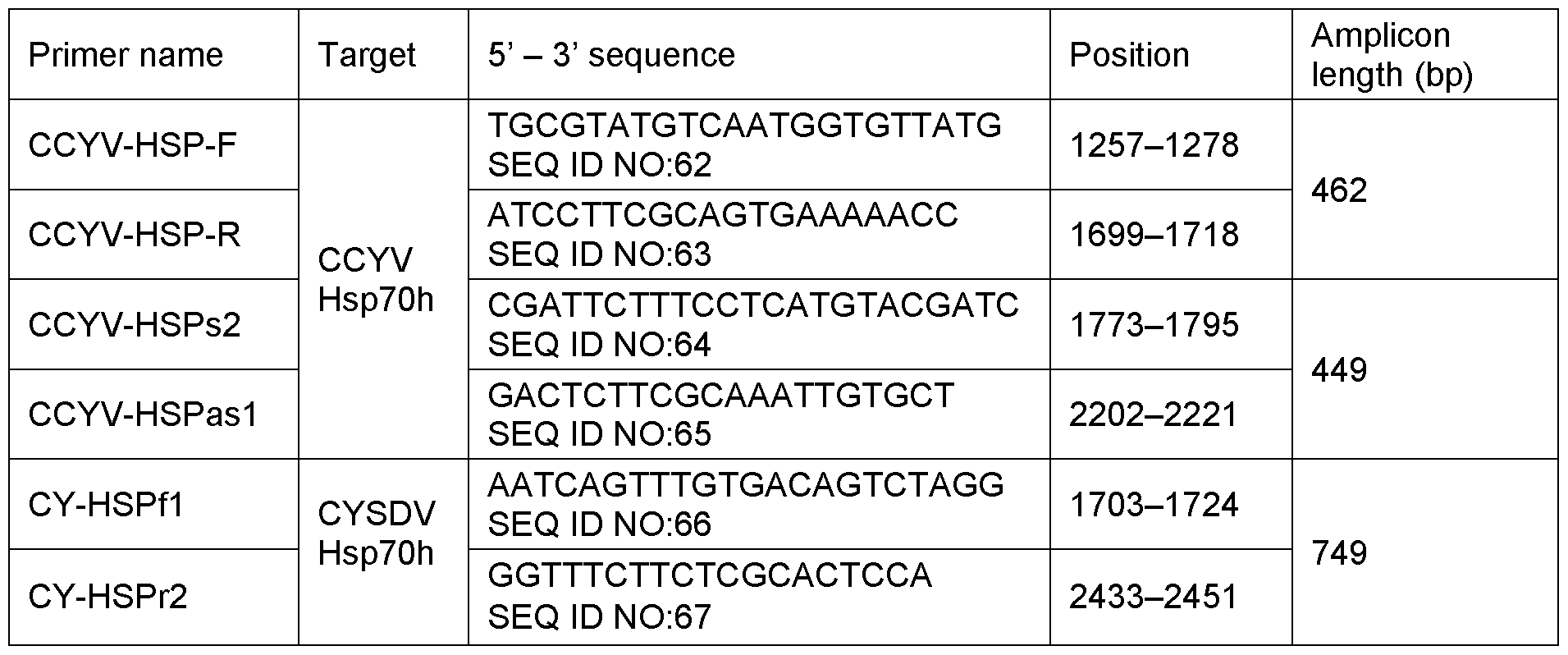
The presence of both viruses was confirmed by these primers.
Plant scoring was:- 1 =S (susceptible) and 9=R (resistant) with regard to both types of infections, namely CCYV and CYSDV.
Each line represented in two replicates of 20 plant each.
The scores regarding resistance to both viruses CYSDV and CCYV, for the parent source (Viridis), the recurrent susceptible parent (GAL) and plants according to the invention, having different combinations of QTL1 , QTL5 and QTL11 are reported in the table below. In the second column regarding the genotype of the tested plants, R stands for homozygous for the Resistance allele of the QTL, S for homozygous susceptible allele, and the 3 letters corresponds to the 3 QTLs 1 , 5 and 11 , in this order.
In the third column, the resistance score is a global resistance score, against both CCYV and CYSDV. The value is the average of two different repetitions.

These results demonstrate that the QTL on chromosomes 1 , 5 and 11 , namely QTL1 , QTL5 and QTL11 as identified in the preceding examples, in the combinations mentioned before, provide an improved resistance to both CYSDV and CCYV infections.
Example 7: Genetic Modification of C. melo Seeds by Ethyl Methane Sulfonate (EMS)
Seeds of C. melo plants are to be treated with EMS by submergence of approximately 2000 seeds into an aerated solution of either 1 % (w/v) or 2% EMS for 24 hours at room temperature.
Approximately 1500 treated seeds per EMS dose are germinated and the resulting plants are grown, preferably in a greenhouse, for example, from March to September, to produce seeds.
Following maturation, M2 seeds are harvested and bulked in one pool per variety per treatment. The resulting pools of M2 seeds are used as starting material to identify the individual M2 seeds and the plants resistant to CYSDV and/or CCYV.
Example 8: Comparison of Virdis vs. SGR derived lines.
Virdis and SGR material (deriving from Seminis commercial variety SV5133 and comprising the SGR gene as disclosed in EP3005862; presence of SGR allele was checked with the marker NCMEL00910256) were tested during Autumn 18 in Almeria.
Infection with CYSDV was carried out as described earlier (high viral pressure). While all plants (18) of Virdis were symptomless and highly resistance (score=9), for the SGR material, 15 out of 18 plants were scored 7, i.e., symptoms are masked by the stay green effect, but still seen on the plants.
REFERENCES
Abrahamian et al, 2013
Garcia-Mas et al, 2012, PNAS 109(29):1 1872-11877.
Gyoutoku, H., et al. 2009. Jpn. J. Phytopathol. 75:109. Kirkbride, J. H., Jr. 1993. Biosystematic monograph of the genus Cucumis (Cucurbitaceae). 84.
McCreight, J. D., et al. "Recessive resistance to CYSDV in melon TGR 1551 ." !/ International Symposium on Cucurbits 1151. 20 5
Perez-de-Castro et al, 2020 “Melon Genome Regions Associated with TGR-1551 -Derived Resistance to Cucurbit yellow stunting disorder virus ». Int. J. Mol. Sci. 2020, 27(17), 5970.
Pitrat, M. P. Hanelt and K. Hammer. 2000. Some comments on intraspecific classification of cultivars of melon. Acta Hort. 510:29-36.
EP3005862
WG2020025631
Claims
1. A Cucumis melo plant resistant to Cucurbit Yellow Stunting Disorder Virus (CYSDV), having commercially acceptable fruit quality, comprising in its genome a combination of quantitative trait loci (QTLs), wherein said QTLs are chosen from:
QTL1 , located on chromosome 1 , within the chromosomal region flanked by SNP ME- 0004372 (SEQ ID NO:1) and SNP ME-0007598 (SEQ ID NO:14),
QTL5, located on chromosome 5, within the chromosomal region flanked by SNP ME- 0004289 (SEQ ID NO:27) and SNP ME-0006334 (SEQ ID NQ:40), and
QTL11 , located on chromosome 11 , within the chromosomal region flanked by SNP ME-0005874 (SEQ ID NO:41) and SNP ME-0000595 (SEQ ID NO:44), wherein said combination comprises:
QTL1 homozygously and potentially at least one of QTL5 and QTL11 , homozygously or heterozygously,
QTL1 heterozygously and both QTL5 and QTL11 , homozygously or heterozygously, or QTL5 and QTL11 , both homozygously, and wherein said combination of QTLs confers said CYSDV resistance.
2. The C. melo plant according to claim 1 , wherein said QTL1 , QTL5 and QTL11 are as present in the genome of the seeds of Cucumis melo subsp. melo ME22BNGA-F06-52563/001 deposited under accession number NCIMB 44156, and are obtainable from said deposited seeds, e.g. by crossing with a plant grown from the deposited seeds.
3. The C. melo plant according to any one of claims 1-2, wherein: said QTL1 on chromosome 1 is identified by detection of one or more of the markers ME-0006564, ME-0027363, ME-0027608, ME-0027609, ME-0027622, ME- 0027623, ME-0027365, ME-0002337, ME-0006240, ME-0027367, ME-0027328, ME-0027330, ME-0027332, ME-0027334, ME-0027336 and ME-0008111 , preferably ME-0027623, ME-0027365 and/or ME-0002337; said QTL5 on chromosome 5 is identified by detection of one or more of the markers ME-0027624, ME-0004225, ME-0003342, ME-0027650, ME-0009162, ME- 0009163, ME-0027384, ME-0027385, ME-0027387, ME-0027388, ME-0007780, and/or SNP ME-0000109; said QTL1 1 on chromosome 11 is identified by detection of one or more of the markers ME-0005874, ME-0027651 , ME-0027655, ME-0027656, ME-0027659, ME- 0027664, ME-027667, ME-027668, ME-0027670, ME-0027671 , ME-0027675, ME- 0007096, ME-0019064, and/or ME-0000595, preferably ME-0027670, ME-0027671 and/or ME-0007096.
4. The C. melo plant according to any one of claims 1-3, wherein: said QTL1 on chromosome 1 is identified by detection of one or more of the following alleles: allele G of marker ME-0006564, allele G of marker ME-0027363, allele G of marker ME-0027608, allele C of marker ME-0027609, allele C of marker ME- 0027622, allele G of marker ME-0027623, allele A of marker ME-0027365, allele A of maker ME-0002337, allele G of marker ME-0006240, allele G of marker ME- 0027367, allele A of marker ME-0027328, allele G of marker ME-0027330, allele A of marker ME-0027332, allele A of marker ME-0027334, allele A of marker ME- 0027336 and allele G of marker ME-008111 ; said QTL5 on chromosome 5 is identified by detection of one or more of the following alleles: allele G of marker ME-0027624, allele A of marker ME-0004225, allele A of marker ME-0003342, allele C of marker ME-0027650, allele A of marker ME- 0009162, allele A of marker ME-0009163, allele G of marker ME-0027384, allele G of marker ME-0027385, allele G of marker ME-0027387, allele G of marker ME- 0027388, allele G of marker ME-0007780 and allele G of marker ME-0000109; and/or said QTL11 on chromosome 11 is identified by detection of one or more of the following alleles: allele C of marker ME-0005874, allele A of marker ME-0007096, allele A of marker ME-0019064, allele A of marker ME-0027651 , allele C of marker ME-0027655, allele C of marker ME-0027656, allele G of marker ME-0027659, allele A of marker ME-0027664, allele A of marker ME-0027667, allele G of marker ME- 027668, allele G of marker ME-0027670, allele A of marker ME-0027671 , allele A of marker ME-0027675 and allele C of marker ME-0000595.
5. The C. melo subsp. melo plant according to any one of claims 1-4, wherein said plant is a progeny of the line ME22BNGA-F06-52563/001 (NCIMB accession number 44156).
6. The C. melo subsp. melo plant according to any one of claims 1 -5, wherein said plant comprises:
QTL1 homozygously,
QTL1 homozygously and QTL5 heterozygously,
QTL1 homozygously and QTL5 homozygously, QTL1 homozygously and QTL11 heterozygously, QTL1 homozygously and QTL11 homozygously. QTL1 homozygously, QTL5 heterozygously and QTL11 heterozygously, QTL1 homozygously, QTL5 homozygously and QTL1 1 heterozygously, QTL1 homozygously, QTL5 heterozygously and QTL11 homozygously, QTL1 homozygously, QTL5 homozygously and QTL11 homozygously, QTL1 heterozygously, QTL5 homozygously and QTL11 heterozygously, QTL1 heterozygously, QTL5 heterozygously and QTL11 homozygously, QTL1 heterozygously, QTL5 homozygously and QTL11 homozygously,
QTL1 heterozygously, QTL5 heterozygously and QTL11 heterozygously, and/or QTL5 homozygously and QTL11 heterozygously.
7. The C. melo subsp. melo plant according to any one of claims 1 to 6, wherein said plant is a cultivated or commercial plant, bearing marketable fruits.
8. The C. melo subsp. melo plant according to any one of claims 1 to 7, wherein said QTL1 on chromosome 1 , is to be found within the chromosomal region delimited by markers ME-0006564 (SEQ ID NO:3) and ME-0008111 (SEQ ID NO:6), preferably within the region delimited by ME- 0027623 (SEQ ID NO:19) and SNP ME-0002337 (SEQ ID NO:4), preferably within the region delimited by SNP ME-0027365 (SEQ ID NQ:20) and SNP ME-0002337 (SEQ ID NO:4).
9. The C. melo subsp. melo plant according to any one of claims 1 to 7, wherein said QTL5 on chromosome 5, is to be found within the chromosomal region delimited by markers ME-0004225 (SEQ ID NO:31) and ME-0000109 (SEQ ID NO:35), preferably within the region delimited by ME-0027624 (SEQ ID NO:55) and SNP ME-0000109 (SEQ ID NO:35), preferably within the region delimited by SNP ME-0004225 (SEQ ID NO:31) and SNP ME-0027388 (SEQ ID NQ:60).
10. The C. melo subsp. melo plant according to any one of claims 1 to 7, wherein said QTL11 on chromosome 11 , is to be found within the chromosomal region delimited by markers ME- 0005874 (SEQ ID NO:41) and ME-0019064 (SEQ ID NO:43), preferably within the region delimited by SNP ME-0027670 (SEQ ID NO:52) and SNP ME-00027671 (SEQ ID NO:53).
11. The C. melo plant according to any one of claims 1 to 10, wherein said plant is further resistant to Cucurbit Chlorotic Yellow virus CCYV.
12. A cell of a C. melo plant according to any one of claims 1 to 11 , comprising in its genome said combination of quantitative trait loci.
13. A cell according to claim 12, wherein said cell is a regenerable cell, or a non-regenerable cell.
14. An in vitro cell or tissue culture of cells of the plant according to any one of claims 1 to 11 , wherein the cells are derived from embryos, protoplasts, meristematic cells, callus, pollen, leaves, anthers, stems, petioles, roots, root tips, seeds, flowers, cotyledons, and/or hypocotyls.
15. A plant part obtained from a C. melo plant as defined in any one of claims 1 to 11 , comprising a cell according to claim 12.
16. A plant part according to claim 15, wherein said plant part is a seed, a fruit, a reproductive material, propagation material, roots, flowers, a rootstock or a scion.
17. A seed of a C. melo plant, giving rise when grown up to a plant according to any one of claims 1 to 11 .
18. A hybrid plant of C. melo, obtainable by crossing a C. melo plant with a resistant plant according to any one of claims 1 to 11 , comprising homozygously QTL1 .
19. Use of a plant or seed of C. melo, deposited at the NCIMB under the accession number NCIMB 44156, or a part thereof or a progeny thereof, bearing homozygously the QTL1 , QTL5 and QTL11 as defined in claim 1 , as a breeding partner in a breeding program for conferring CYSDV resistance to C. melo plants, preferably to C. melo plants susceptible to CYSDV.
20. Use of a plant or seed of C. melo according to any one of claims 1-11 or 17, as a breeding partner in a breeding program for conferring CYSDV resistance to C. melo plants, preferably to C. melo plants susceptible to CYSDV.
21. A method for detecting a C. melo plant that is resistant to CYSDV, wherein said method comprises the steps of:
- detecting the presence of at least one genetic marker linked to QTL1 on chromosome 1 , as defined in claim 1 , and potentially,
- detecting the presence of at least one genetic marker linked to QTL5 on chromosome 5 and/or at least one genetic marker linked to QTL1 1 on chromosome 11 , as defined in claim 1 , wherein said plant is resistant to CYSDV if said marker linked to QTL1 is present homozygously, or if said markers linked to QTL1 , QTL5 and QTL1 1 are simultaneously detected.
22. A method for selecting C. melo plants having QTLs, conferring CYSDV resistance, said method comprising: a) Assaying C. melo plants for the presence of at least one first genetic marker, genetically linked to the QTL1 as defined in claim 1 ; b) Potentially assaying said plants for the presence of at least one second genetic marker, genetically linked to the QTL5 as defined in claim 1 , c) Potentially assaying said plants for the presence of at least one third genetic marker, genetically linked to the QTL11 , as defined in claim 1 ; d) Selecting a plant comprising the 3 genetic markers and the QTL1 , QTL5 and QTL11 conferring CYSDV resistance, or a plant comprising the first genetic marker and QTL1 homozygously, or a plant comprising the second and third genetic markers and QTL5 and QTL11 homozygously, wherein the QTL1 and the genetic marker are to be found in the genomic interval delimited on chromosome 1 by the SNP ME-0004372 and ME-0007598, preferably within ME- 0006564 and ME-0008111 , wherein the QTL5 and the genetic marker are to be found in the genomic interval delimited on chromosome 5 by the SNP ME-0004289 and the SNP ME-0006334, preferably within ME-0004225 and ME-0000109, and wherein the QTL11 and the genetic marker are to be found in the genomic interval delimited
on chromosome 11 by the SNP ME-0005874 and SNP ME-000595, preferably within ME- 0005874 and ME-0010064.
23. A method for selecting C. melo plants having QTLs, conferring CYSDV and CCYV resistance, said method comprising: a) Assaying C. melo plants for the presence of at least one first genetic marker, genetically linked to the QTL1 as defined in claim 1 ; b) Potentially assaying said plants for the presence of at least one second genetic marker, genetically linked to the QTL5 as defined in claim 1 , c) Potentially assaying said plants for the presence of at least one third genetic marker, genetically linked to the QTL11 , as defined in claim 1 ; d) Selecting a plant comprising the 3 genetic markers and the QTL1 , QTL5 and QTL11 conferring CYSDV and CCYV resistance, or a plant comprising the first genetic marker and QTL1 homozygously, or a plant comprising the second and third genetic markers and QTL5 and QTL11 homozygously, wherein the QTL1 and the genetic marker are to be found in the genomic interval delimited on chromosome 1 by the SNP ME-0004372 and ME-0007598, preferably within ME- 0006564 and ME-0008111 , wherein the QTL5 and the genetic marker are to be found in the genomic interval delimited on chromosome 5 by the SNP ME-0004289 and the SNP ME-0006334, preferably within ME-0004225 and ME-0000109, and wherein the QTL11 and the genetic marker are to be found in the genomic interval delimited on chromosome 11 by the SNP ME-0005874 and SNP ME-000595, preferably within ME- 0005874 and ME-0010064.
24. A method for breeding C. melo plants having resistance against CYSDV, comprising at least the steps of: crossing an initial C. melo plant susceptible to CYSDV, with a plant grown from the deposited seeds NCIMB 44156 or progeny thereof bearing the QTL1 on chromosome 1 and preferably also the QTL5 on chromosome 5 and/or the QTL11 on chromosome 1 1 , and selecting a plant comprising the combination of QTLs according to claim 1 , wherein said QTL1 , QTL5 and QTL11 are present in the genome of the seeds of plant ME22BNGA-F06-52563/001 , NCIMB accession number 44156, and are identifiable by allele G of ME-0027623, allele A of ME-0027365 or allele A of ME-0002337, for QTL1 , allele A of ME- 0004225, allele A of ME-0003342, allele A of ME-0009163, allele G of ME-0007780 or allele G of ME-0000109 for QTL5, and allele A of ME-0007096, allele G of ME-0027670 or allele A of ME-0027671 for QTL11 .
25. A method for conferring resistance against CYSDV to a C. melo plant, comprising genetically modifying said plant to introduce a QTL1 on chromosome 1 heterozygously or homozygously,
and potentially either a QTL5 on chromosome 5 or a QTL1 1 on chromosome 11 , or both, conferring said resistance, wherein said QTL1 on chromosome 1 , said QTL5 on chromosome 5 and said QTL1 1 on chromosome 11 are present in the genome of the seeds of plant ME22BNGA-F06-52563/001 , NCIMB accession number 44156, and are identifiable by allele G of ME-0027623, allele A of ME-0027365 or allele A of ME-0002337, for QTL1 , allele A of ME- 0004225, allele A of ME-0003342, allele A of ME-0009163, allele G of ME-0007780 or allele G of ME-0000109 for QTL5, and allele A of ME-0007096, allele G of ME-0027670 or allele A of ME-0027671 for QTLH .
26. A method for conferring resistance against CYSDV and CCYV to a C. melo plant, comprising genetically modifying said plant to introduce a QTL1 on chromosome 1 heterozygously or homozygously, and potentially either a QTL5 on chromosome 5 or a QTL1 1 on chromosome 11 , or both, conferring said resistance, wherein said QTL1 on chromosome 1 , said QTL5 on chromosome 5 and said QTL11 on chromosome 11 are present in the genome of the seeds of plant ME22BNGA-F06-52563/001 , NCIMB accession number 44156, and are identifiable by allele G of ME-0027623, allele A of ME-0027365 or allele A of ME-0002337, for QTL1 , allele A of ME-0004225, allele A of ME-0003342, allele A of ME-0009163, allele G of ME-0007780 or allele G of ME-0000109 for QTL5, and allele A of ME-0007096, allele G of ME-0027670 or allele A of ME-0027671 for QTL11 .
27. A method for conferring resistance against CYSDV to a C. melo plant, comprising the steps of:
(a) Crossing a plant grown from the deposited seeds NCIMB 44156, or progeny thereof, bearing QTL1 on chromosome 1 , and potentially QTL5 on chromosome 5 and/or QTL1 1 on chromosome 11 , and an initial Cucumis melo plant preferably devoid of said QTL(s),
(b) Selecting a plant in the progeny thus obtained, bearing at least QTL1 ;
(c) Optionally self-pollinating one or several times the plant obtained at step b) and selecting in the progeny thus obtained a plant having resistance against CYSDV, and having:
QTL1 homozygously and potentially at least one of QTL5 and QTL11 , homozygously or heterozygously,
QTL1 heterozygously and QTL5 and QTL11 , homozygously or heterozygously wherein said QTLs on chromosomes 1 , 5 and 11 are present in the genome of the seeds of plant ME22BNGA-F06-52563/001 , NCIMB accession number 44156.
28. A method for conferring resistance against CYSDV to a C. melo plant, comprising the steps of:
(a1) Crossing a plant grown from the deposited seeds NCIMB 44156, or progeny thereof, bearing QTL1 on chromosome 1 , and potentially QTL5 on chromosome 5 and/or QTL1 1 on chromosome 11 , and an initial C. melo plant preferably devoid of said QTL(s), thus generating F1 hybrids;
(a2) Selfing or backcrossing the F1 hybrids to create F2 population,
(b) Selecting individuals in the progeny thus obtained having:
QTL1 homozygously and potentially at least one of QTL5 and QTL11 , homozygously or heterozygously,
QTL1 heterozygously and QTL5 and/or QTL11 , homozygously or heterozygously, wherein said QTLs on chromosomes 1 , 5 and 11 are present in the genome of the seeds of plant ME22BNGA-F06-52563/001 , NCIMB accession number 44156.
29. The method of claim 27 or 28, wherein SNPs markers are used in steps b) and/or c) for selecting plants bearing QTL1 and potentially QTL5 and/or QTL11 conferring resistance against CYSDV.
30. A Cucumis melo plant obtainable by the method according to any one of claims 25 to 29.
31. A method for increasing the number of harvestable melons from C. melo subspecies melo plants grown in an environment infested by whitefly-transmitted CYSDV, comprising growing in said environment C. melo subspecies melo plants resistant to CYSDV according to any one of claims 1 to 11 and allowing them to set fruit.
32. A method for protecting a field, glasshouse or tunnel from infestation and/or spread of whitefly- transmitted CYSDV, comprising growing in said field, glasshouse or tunnel C. melo subspecies melo plants resistant to CYSDV according to any one of claims 1 to 11 .
33. Use of a C. melo plant resistant to CYSDV, according to any one of claims 1 to 11 for controlling infection by CYSDV in a field, glasshouse or tunnel.
34. A method for improving the yield of C. melo plants in an environment infested by whitefly- transmitted CYSDV comprising: identifying C. melo plants resistant to CYSDV comprising in their genome a combination of QTL1 , located on chromosome 1 , within the chromosomal region delimited by SNP ME-0004372 and SNP ME-0007598, QTL5, located on chromosome 5, within the chromosomal region delimited by SNP ME-0004289 and SNP ME-0006334, and/or QTL11 , located on chromosome 11 , within the chromosomal region delimited by SNP ME-0005874 and SNP ME-0000595, wherein said combination confers said CYSDV resistance and comprises:
QTL1 homozygously and potentially at least one of QTL5 and QTL11 , homozygously or heterozygously, or
QTL1 heterozygously and both QTL5 and QTL11 , homozygously or heterozygously, and growing said resistant C. melo plants in said infested environment.
35. Combination of molecular markers for detecting Cucumis melo plant that is resistant to CYSDV
infection, wherein said markers are located in at least one of the following chromosomal regions: on chromosome 1 , within the chromosomal region delimited by SNP ME-0004372 and SNP ME-0007598, on chromosome 5, within the chromosomal region delimited by SNP ME-0004289 and SNP ME-0006334, and on chromosome 11 , within the chromosomal region delimited by SNP ME-0005874 and SNP ME-0000595, wherein said combination comprises at least one marker on chromosome 1 , in said region, and at least one marker on chromosome 5 or 1 1 , in said regions.
36. The combination of markers according to claim 35, comprising at least one marker on chromosome 1 , in said region, at least one marker on chromosome 5, in said region, and at least one marker on chromosome 11 , in said region.
37. A container comprising a C. melo plant according to any one of claims 1 to 11 , a plant part according to claim 15 or 16 or a seed according to claim 17.
38. A method for the production of C. melo plantlets or plants resistant to CYSDV, which method comprises: i. culturing in vitro an isolated cell or tissue according to claim 12 to produce C. melo micro-plantlets resistant to CYSDV, and ii. optionally further subjecting the C. melo micro-plantlets to an in vivo culture phase to develop into C. melo plant resistant to CYSDV.
Applications Claiming Priority (2)
| Application Number | Priority Date | Filing Date | Title |
|---|---|---|---|
| EP23306279.3 | 2023-07-24 | ||
| EP23306279 | 2023-07-24 |
Publications (1)
| Publication Number | Publication Date |
|---|---|
| WO2025021893A1 true WO2025021893A1 (en) | 2025-01-30 |
Family
ID=88016361
Family Applications (1)
| Application Number | Title | Priority Date | Filing Date |
|---|---|---|---|
| PCT/EP2024/071056 Pending WO2025021893A1 (en) | 2023-07-24 | 2024-07-24 | Resistance to cysdv in melons |
Country Status (1)
| Country | Link |
|---|---|
| WO (1) | WO2025021893A1 (en) |
Citations (12)
| Publication number | Priority date | Publication date | Assignee | Title |
|---|---|---|---|---|
| US8586363B2 (en) | 2009-12-10 | 2013-11-19 | Regents Of The University Of Minnesota | TAL effector-mediated DNA modification |
| US8697359B1 (en) | 2012-12-12 | 2014-04-15 | The Broad Institute, Inc. | CRISPR-Cas systems and methods for altering expression of gene products |
| US8795965B2 (en) | 2012-12-12 | 2014-08-05 | The Broad Institute, Inc. | CRISPR-Cas component systems, methods and compositions for sequence manipulation |
| US8865406B2 (en) | 2012-12-12 | 2014-10-21 | The Broad Institute Inc. | Engineering and optimization of improved systems, methods and enzyme compositions for sequence manipulation |
| US8889356B2 (en) | 2012-12-12 | 2014-11-18 | The Broad Institute Inc. | CRISPR-Cas nickase systems, methods and compositions for sequence manipulation in eukaryotes |
| US8906616B2 (en) | 2012-12-12 | 2014-12-09 | The Broad Institute Inc. | Engineering of systems, methods and optimized guide compositions for sequence manipulation |
| US8993233B2 (en) | 2012-12-12 | 2015-03-31 | The Broad Institute Inc. | Engineering and optimization of systems, methods and compositions for sequence manipulation with functional domains |
| US9145565B2 (en) | 2002-01-23 | 2015-09-29 | University Of Utah Research Foundation | Targeted chromosomal mutagenesis using zinc finger nucleases |
| US9181535B2 (en) | 2012-09-24 | 2015-11-10 | The Chinese University Of Hong Kong | Transcription activator-like effector nucleases (TALENs) |
| EP3005862A1 (en) | 2014-10-10 | 2016-04-13 | Seminis Vegetable Seeds, Inc. | Melon plants with improved disease tolerance |
| US20160100537A1 (en) * | 2014-10-10 | 2016-04-14 | Seminis Vegetable Seeds, Inc. | Melon hybrid sv5845mp and parents thereof |
| WO2020025631A1 (en) | 2018-08-01 | 2020-02-06 | Rijk Zwaan Zaadteelt En Zaadhandel B.V. | Cysdv resistance in members of the cucurbitaceae family |
-
2024
- 2024-07-24 WO PCT/EP2024/071056 patent/WO2025021893A1/en active Pending
Patent Citations (18)
| Publication number | Priority date | Publication date | Assignee | Title |
|---|---|---|---|---|
| US9145565B2 (en) | 2002-01-23 | 2015-09-29 | University Of Utah Research Foundation | Targeted chromosomal mutagenesis using zinc finger nucleases |
| US8586363B2 (en) | 2009-12-10 | 2013-11-19 | Regents Of The University Of Minnesota | TAL effector-mediated DNA modification |
| US9181535B2 (en) | 2012-09-24 | 2015-11-10 | The Chinese University Of Hong Kong | Transcription activator-like effector nucleases (TALENs) |
| US8906616B2 (en) | 2012-12-12 | 2014-12-09 | The Broad Institute Inc. | Engineering of systems, methods and optimized guide compositions for sequence manipulation |
| US8945839B2 (en) | 2012-12-12 | 2015-02-03 | The Broad Institute Inc. | CRISPR-Cas systems and methods for altering expression of gene products |
| US8871445B2 (en) | 2012-12-12 | 2014-10-28 | The Broad Institute Inc. | CRISPR-Cas component systems, methods and compositions for sequence manipulation |
| US8889356B2 (en) | 2012-12-12 | 2014-11-18 | The Broad Institute Inc. | CRISPR-Cas nickase systems, methods and compositions for sequence manipulation in eukaryotes |
| US8895308B1 (en) | 2012-12-12 | 2014-11-25 | The Broad Institute Inc. | Engineering and optimization of improved systems, methods and enzyme compositions for sequence manipulation |
| US8795965B2 (en) | 2012-12-12 | 2014-08-05 | The Broad Institute, Inc. | CRISPR-Cas component systems, methods and compositions for sequence manipulation |
| US8932814B2 (en) | 2012-12-12 | 2015-01-13 | The Broad Institute Inc. | CRISPR-Cas nickase systems, methods and compositions for sequence manipulation in eukaryotes |
| US8865406B2 (en) | 2012-12-12 | 2014-10-21 | The Broad Institute Inc. | Engineering and optimization of improved systems, methods and enzyme compositions for sequence manipulation |
| US8993233B2 (en) | 2012-12-12 | 2015-03-31 | The Broad Institute Inc. | Engineering and optimization of systems, methods and compositions for sequence manipulation with functional domains |
| US8999641B2 (en) | 2012-12-12 | 2015-04-07 | The Broad Institute Inc. | Engineering and optimization of systems, methods and compositions for sequence manipulation with functional domains |
| US8771945B1 (en) | 2012-12-12 | 2014-07-08 | The Broad Institute, Inc. | CRISPR-Cas systems and methods for altering expression of gene products |
| US8697359B1 (en) | 2012-12-12 | 2014-04-15 | The Broad Institute, Inc. | CRISPR-Cas systems and methods for altering expression of gene products |
| EP3005862A1 (en) | 2014-10-10 | 2016-04-13 | Seminis Vegetable Seeds, Inc. | Melon plants with improved disease tolerance |
| US20160100537A1 (en) * | 2014-10-10 | 2016-04-14 | Seminis Vegetable Seeds, Inc. | Melon hybrid sv5845mp and parents thereof |
| WO2020025631A1 (en) | 2018-08-01 | 2020-02-06 | Rijk Zwaan Zaadteelt En Zaadhandel B.V. | Cysdv resistance in members of the cucurbitaceae family |
Non-Patent Citations (10)
| Title |
|---|
| "GenBank", Database accession no. AB523789 |
| DEMIRCI, SEVGIN ET AL.: "Chasing breeding footprints through structural variations in Cucumis melo and wild relatives", G3, vol. 11, no. 1, 2021, pages jkaa038 |
| GARCIA-MAS ET AL., PNAS, vol. 109, no. 29, 2012, pages 11872 - 11877 |
| GYOUTOKU, H. ET AL., JPN. J. PHYTOPATHOL, vol. 75, 2009, pages 109 |
| KIRKBRIDE, J. H., JR, BIOSYSTEMATIC MONOGRAPH OF THE GENUS CUCUMIS (CUCURBITACEAE, 1993, pages 84 |
| MCCREIGHT, J. D ET AL.: "Recessive resistance to CYSDV in melon TGR 1551", V INTERNATIONAL SYMPOSIUM ON CUCURBITS, 2015, pages 1151 |
| MONSANTO VEGETABLE IP MANAGEMENT B V: "Cucumis melo L. ; Albizu ; svmg7420", COMMUNITY PLANT VARIETY OFFICE, CPVO, 3 BOULEVARD MARÉCHAL FOCH CS 10121 49101 ANGERS CEDEX 2 - FRANCE, 21 October 2019 (2019-10-21), XP090008350 * |
| PÉREZ-DE-CASTRO ANA ET AL: "Melon Genome Regions Associated with TGR-1551-Derived Resistance to Cucurbit yellow stunting disorder virus", INTERNATIONAL JOURNAL OF MOLECULAR SCIENCES, vol. 21, no. 17, 19 August 2020 (2020-08-19), Basel, CH, pages 5970, XP093117286, ISSN: 1422-0067, DOI: 10.3390/ijms21175970 * |
| PÉREZ-DE-CASTRO ET AL.: "Melon Genome Regions Associated with TGR-1551-Derived Resistance to Cucurbit yellow stunting disorder virus", INT. J. MOL. SCI. 2020, vol. 21, no. 17, 2020, pages 5970, XP093117286, DOI: 10.3390/ijms21175970 |
| PITRAT, M. P. HANELTK. HAMMER: "Some comments on intraspecific classification of cultivars of melon", ACTA HORT, vol. 510, 2000, pages 29 - 36 |
Similar Documents
| Publication | Publication Date | Title |
|---|---|---|
| EP3629711B1 (en) | Tolerance in plants of solanum lycopersicum to the tobamovirus tomato brown rugose fruit virus (tbrfv) | |
| US11730135B2 (en) | Resistance in plants of Solanum lycopersicum to the tobamovirus tomato brown rugose fruit virus | |
| US20210195859A1 (en) | Resistance to tolcndv in melons | |
| US11895961B2 (en) | CGMMV resistant Citrullus plants | |
| US20220304272A1 (en) | Resistance in plants of solanum lycopersicum to the tobamovirus tomato brown rugose fruit virus | |
| US20230276763A1 (en) | Resistance in plants of solanum lycopersicum to the tobrfv | |
| US20120066790A1 (en) | Fusarium Resistant Cucumber Plants | |
| US11535861B2 (en) | Tomato plant resistant to tomato yellow leaf curl virus, powdery mildew, and nematodes | |
| US12414514B2 (en) | Tolerance to ToLCNDV in cucumber | |
| US20250228178A1 (en) | Tolerance to cgmmv in cucumber | |
| WO2025021893A1 (en) | Resistance to cysdv in melons | |
| WO2026017833A1 (en) | Tswv-resistant pepper | |
| WO2024223900A1 (en) | Genetic determinants conferring improved tobrfv resistance | |
| WO2024223901A1 (en) | Resistance to tomato brown rugose fruit virus at elevated temperatures |
Legal Events
| Date | Code | Title | Description |
|---|---|---|---|
| 121 | Ep: the epo has been informed by wipo that ep was designated in this application |
Ref document number: 24748871 Country of ref document: EP Kind code of ref document: A1 |
|
| WWE | Wipo information: entry into national phase |
Ref document number: 325779 Country of ref document: IL |