WO2024220560A1 - Engineered protein g fusogens and related lipid particles and methods thereof - Google Patents
Engineered protein g fusogens and related lipid particles and methods thereof Download PDFInfo
- Publication number
- WO2024220560A1 WO2024220560A1 PCT/US2024/025020 US2024025020W WO2024220560A1 WO 2024220560 A1 WO2024220560 A1 WO 2024220560A1 US 2024025020 W US2024025020 W US 2024025020W WO 2024220560 A1 WO2024220560 A1 WO 2024220560A1
- Authority
- WO
- WIPO (PCT)
- Prior art keywords
- protein
- lipid particle
- cell
- niv
- seq
- Prior art date
- Legal status (The legal status is an assumption and is not a legal conclusion. Google has not performed a legal analysis and makes no representation as to the accuracy of the status listed.)
- Pending
Links
Classifications
-
- C—CHEMISTRY; METALLURGY
- C12—BIOCHEMISTRY; BEER; SPIRITS; WINE; VINEGAR; MICROBIOLOGY; ENZYMOLOGY; MUTATION OR GENETIC ENGINEERING
- C12N—MICROORGANISMS OR ENZYMES; COMPOSITIONS THEREOF; PROPAGATING, PRESERVING, OR MAINTAINING MICROORGANISMS; MUTATION OR GENETIC ENGINEERING; CULTURE MEDIA
- C12N15/00—Mutation or genetic engineering; DNA or RNA concerning genetic engineering, vectors, e.g. plasmids, or their isolation, preparation or purification; Use of hosts therefor
- C12N15/09—Recombinant DNA-technology
- C12N15/63—Introduction of foreign genetic material using vectors; Vectors; Use of hosts therefor; Regulation of expression
- C12N15/79—Vectors or expression systems specially adapted for eukaryotic hosts
- C12N15/85—Vectors or expression systems specially adapted for eukaryotic hosts for animal cells
- C12N15/86—Viral vectors
-
- C—CHEMISTRY; METALLURGY
- C12—BIOCHEMISTRY; BEER; SPIRITS; WINE; VINEGAR; MICROBIOLOGY; ENZYMOLOGY; MUTATION OR GENETIC ENGINEERING
- C12N—MICROORGANISMS OR ENZYMES; COMPOSITIONS THEREOF; PROPAGATING, PRESERVING, OR MAINTAINING MICROORGANISMS; MUTATION OR GENETIC ENGINEERING; CULTURE MEDIA
- C12N15/00—Mutation or genetic engineering; DNA or RNA concerning genetic engineering, vectors, e.g. plasmids, or their isolation, preparation or purification; Use of hosts therefor
- C12N15/09—Recombinant DNA-technology
- C12N15/87—Introduction of foreign genetic material using processes not otherwise provided for, e.g. co-transformation
- C12N15/88—Introduction of foreign genetic material using processes not otherwise provided for, e.g. co-transformation using microencapsulation, e.g. using amphiphile liposome vesicle
-
- C—CHEMISTRY; METALLURGY
- C12—BIOCHEMISTRY; BEER; SPIRITS; WINE; VINEGAR; MICROBIOLOGY; ENZYMOLOGY; MUTATION OR GENETIC ENGINEERING
- C12N—MICROORGANISMS OR ENZYMES; COMPOSITIONS THEREOF; PROPAGATING, PRESERVING, OR MAINTAINING MICROORGANISMS; MUTATION OR GENETIC ENGINEERING; CULTURE MEDIA
- C12N2740/00—Reverse transcribing RNA viruses
- C12N2740/00011—Details
- C12N2740/10011—Retroviridae
- C12N2740/16011—Human Immunodeficiency Virus, HIV
- C12N2740/16041—Use of virus, viral particle or viral elements as a vector
- C12N2740/16043—Use of virus, viral particle or viral elements as a vector viral genome or elements thereof as genetic vector
-
- C—CHEMISTRY; METALLURGY
- C12—BIOCHEMISTRY; BEER; SPIRITS; WINE; VINEGAR; MICROBIOLOGY; ENZYMOLOGY; MUTATION OR GENETIC ENGINEERING
- C12N—MICROORGANISMS OR ENZYMES; COMPOSITIONS THEREOF; PROPAGATING, PRESERVING, OR MAINTAINING MICROORGANISMS; MUTATION OR GENETIC ENGINEERING; CULTURE MEDIA
- C12N2740/00—Reverse transcribing RNA viruses
- C12N2740/00011—Details
- C12N2740/10011—Retroviridae
- C12N2740/16011—Human Immunodeficiency Virus, HIV
- C12N2740/16041—Use of virus, viral particle or viral elements as a vector
- C12N2740/16044—Chimeric viral vector comprising heterologous viral elements for production of another viral vector
-
- C—CHEMISTRY; METALLURGY
- C12—BIOCHEMISTRY; BEER; SPIRITS; WINE; VINEGAR; MICROBIOLOGY; ENZYMOLOGY; MUTATION OR GENETIC ENGINEERING
- C12N—MICROORGANISMS OR ENZYMES; COMPOSITIONS THEREOF; PROPAGATING, PRESERVING, OR MAINTAINING MICROORGANISMS; MUTATION OR GENETIC ENGINEERING; CULTURE MEDIA
- C12N2760/00—MICROORGANISMS OR ENZYMES; COMPOSITIONS THEREOF; PROPAGATING, PRESERVING, OR MAINTAINING MICROORGANISMS; MUTATION OR GENETIC ENGINEERING; CULTURE MEDIA ssRNA viruses negative-sense
- C12N2760/00011—Details
- C12N2760/18011—Paramyxoviridae
- C12N2760/18022—New viral proteins or individual genes, new structural or functional aspects of known viral proteins or genes
Definitions
- the present disclosure relates to lipid particles, such as lentiviral particles, that incorporate or are pseudotyped with a retargeted paramyxovirus envelope attachment glycoproteins as fused to a targeting moiety inserted within a peptide loop of the paramyxovirus envelope attachment glycoprotein, and in some aspects also a fusion (F) protein such as a NiV-F protein or a biologically active portion or variant thereof.
- lipid particles such as lentiviral particles, comprising a retargeted paramyxovirus envelope attachment glycoproteins, as well as methods for preparing and using the lipid particles, such as lentiviral particles.
- Lipid particles including viral-based particles like virus-like particles and viral vectors such as lentiviral particles, are commonly used for delivery of exogenous agents to cells.
- the host range can be altered by pseudotyping with a heterologous envelope protein or a modified envelope protein which further comprises a targeting moiety.
- the efficient preparation and production of particles with certain pseudotyped envelope proteins with a targeting moiety may not always be efficient, such as due to effects of the envelope protein and/or targeting moiety on low titer of the produced lentiviral vector particles.
- Improved lipid particles, including virus-like particles and viral vectors, that can be produced with a higher titer and with efficient transduction efficiency of target cells are needed. The provided disclosure addresses this need.
- a lipid particle comprising: (a) a retargeted paramyxovirus envelope attachment protein fused to a targeting moiety inserted within a peptide loop of the paramyxovirus envelope attachment protein; and (b) at least one paramyxovirus fusion (F) protein; wherein the protein in (a) and (b) are exposed on the outside of the lipid bilayer.
- the targeting moiety is a first targeting moiety and the lipid particle comprises a second targeting moiety, wherein the second targeting moiety is inserted within a different peptide loop of the paramyxovirus envelope attachment protein, wherein the first targeting moiety and the second targeting moiety target the same or a different target cell.
- the targeting moiety is a first targeting moiety and the lipid particle comprises a second targeting moiety, wherein the second targeting moiety is attached to the C-terminus of the paramyxovirus envelope attachment protein, wherein the first targeting moiety and the second targeting moiety target the same or a different target cell.
- the at least one linker is selected from: (GGS)n, wherein n is 1 to 10; (GGGGS)n, wherein n is 1 to 10; or (GGGGGS)n, wherein n is 1 to 6.
- the at least one linker is a poly-Glycine-Serine (G4S) linker, optionally wherein the linker is set forth in any one of SEQ ID NOs. 7-10.
- the paramyxovirus envelope attachment protein is an envelope attachment protein from a Nipah virus, Hendra virus, or Measles virus, or is a variant or biologically active portion thereof of any of the foregoing.
- the paramyxovirus envelope attachment protein is a variant Nipah G protein (NiV-G) that is a variant or a biologically active portion of a wild-type NiV-G
- the peptide loop of the paramyxovirus envelope attachment protein is selected from the group consisting: (i) amino acid residues 194-197; (ii) amino acid residues 208-213; (iii) amino acid residues 241-243; (iv) amino acid residues 242-243; (v) amino acid residues 388-391; (vi) amino acid residues 402-405; (vii) amino acid residues 489-491; and(viii) amino acid residues 495-497; optionally wherein the peptide loop is 388-391, 489-491, or 495- 497.
- the variant NiV-G tis truncated by up to 40 contiguous amino acids at or near the N-terminus of the wild-type NiV-G set forth in SEQ ID NO:5. In some of any of the provided embodiments, the variant NiV-G has a truncation of amino acids 2-34 of the wild-type NiV-G set forth in SEQ ID NO:5.
- the paramyxovirus envelope attachment protein comprises one or more mutations that reduces native tropism relative to the wild-type paramyxovirus envelope attachment protein not comprising the one or more mutations.
- the variant NiV-G exhibits reduced binding to Ephrin B2 or Ephrin B3.
- the variant NiV-G comprises: one or more amino acid substitutions corresponding to amino acid substitutions selected from the group consisting of E501A, W504A, Q530A and E533A with reference to numbering set forth in SEQ ID NO:5.
- the variant NiV-G comprises amino acid substitutions E501A, W504A, Q530A and E533A with reference to numbering set forth in SEQ ID NO:5.
- the variant NiV-G has the amino acid sequence set forth in SEQ ID NO: 6 or an amino acid sequence having at or about 80%, at least at or about 81 %, at least at or about 82%, at least at or about 83%, at or about 84%, at least at or about 85%, at least at or about 86%, or at least at or about 87%, at least at or about 88%, or at least at or about 89%, at least at or about 90%, at least at or about 91 %, at least at or about 92%, at least at or about 93%, at least at or about 94%, at least at or about 95%, at or about 96%, at least at or about 97%, at least at or about 98%, or at least at or about 99% sequence identity to SEQ ID NO:6.
- the variant NiV-G has the amino acid sequence set forth in SEQ ID NO:6.
- the at least one paramyxovirus fusion (F) protein is a wild-type Nipah F protein (NiV-F) or is a functionally active variant or a biologically active portion thereof.
- the NiV-F protein or the biologically active portion is a truncated NiV-F that is truncated by at least 22 amino acids or at least 20 amino acids, at or near the C-terminus of wild-type NiV-F set forth in SEQ ID NO:1.
- the NiV-F protein or the biologically active portion thereof has a 22 amino acid truncation at or near the C-terminus of the wild-type NiV-F protein.
- the NiV-F protein comprises a deletion in it cytoplasmic tail and lacks amino acid residues 525-546 of SEQ ID NO:1.
- the NiV-F protein or the biologically active portion thereof has the sequence set forth in SEQ ID NO: 3 or 4, or a sequence of amino acids that exhibits at least at or about 80%, 85%, 90% or 95% sequence identity to the sequence set forth in SEQ ID NO: 3 or 4.
- the paramyxovirus F protein is an F0 precursor or is a proteolytically cleaved form thereof comprising Fl and F2 subunits.
- the proteolytically cleaved form is a cathepsin L cleavage product.
- the targeting moiety is specific for a target molecule expressed on the surface of a target cell.
- the targeting moiety is selected from the group consisting of an antibody or antigen-binding fragment, an engineered binding domain, a nanobody, a DARPin, an Aptamer, an Affimer, an Affibody, a Knottin, an Avimer, a Monobody, an Anticalin, a Fynomer, and a targeting peptide.
- the targeting moiety is selected from the group consisting of a single domain antibody or a single chain variable fragment (scFv).
- the single domain antibody is a VHH.
- targeting the target molecule does not modulate or induce a signal in the target cell.
- the target molecule is a cell surface molecule is a protein, glycan, or lipid.
- the target cell is selected from the group consisting of tumor-infiltrating lymphocytes, T cells, neoplastic or tumor cells, virus-infected cells, stem cells, central nervous system (CNS) cells, hematopoietic stem cells (HSCs), and liver cells.
- the target cells is selected from the group consisting of a CD3+ T cell, a CD4+ T cell, a CD8+ T cell, a hepatocyte, a hematopoietic stem cell, a CD34+ hematopoietic stem cell, a CD 105+ hematopoietic stem cell, a CD117+ hematopoietic stem cell, a CD105+ endothelial cell, a B cell, a CD20+ B cell, a CD19+ B cell, a cancer cell, a CD133+ cancer cell, an EpCAM+ cancer cell, a CD19+ cancer cell, a Her2/Neu+ cancer cell, a GluA2+ neuron, a GluA4+ neuron, a NKG2D+ natural killer cell, a SLC1A3+ astrocyte, a SLC7A10+ adipocyte, or a CD30+ lung epithelial cell.
- the target cell is a hepatocyte. In some of any of the provided embodiments, the target molecule is a cell surface molecule selected from the group consisting of ASGR1, ASGR2 and TM4SF5. In some of any of the provided embodiments, the target cell is a T cell. In some of any of the provided embodiments, the target molecule is a cell surface molecule selected from the group consisting of CD3, CD4, CD7 CD8, ASCT2, CD105, CD110, CD117, CD133, CD146, CD164, CD34, CD46, CD49f, CD90, EPCR, and ITGA3.
- the target cell is a CD4+ T cell or a CD8+ T cell, optionally wherein the lipid particle comprises a first targeting moiety targeting a CD4+ T cell and a second targeting moiety targeting a CD8+ T cell.
- the lipid particle comprises a viral nucleic acid.
- the viral nucleic acid comprises one or more of (e.g., all of) the following nucleic acid sequences: 5’ LTR (e.g., comprising U5 and lacking a functional U3 domain), Psi packaging element (Psi), Central polypurine tract (cPPT)/central termination sequence (CTS) (e.g.
- the lipid particle is a viral vector. In some of any of the provided embodiments, the lipid particle is a retroviral vector. In some of any of the provided embodiments, the lipid particle is a lentiviral vector. In some of any of the provided embodiments, the lipid particle is devoid of viral genomic DNA. In some of any of the provided embodiments, the lipid particle is a viral-like particle. In some of any of the provided embodiments, the lipid particle is a retroviral-like particle. In some of any of the provided embodiments, the lipid particle is a lenti viral-like particle.
- the lipid particle further comprises an exogenous agent for delivery to a target cell.
- the exogenous agent is present in the lumen.
- the exogenous agent is a protein or a nucleic acid, optionally wherein the nucleic acid is a DNA or RNA.
- the exogenous agent is a nucleic acid encoding a cargo for delivery to the target cell.
- the exogenous agent is or encodes a therapeutic agent, a diagnostic agent or a genome-modifying enzyme.
- the exogenous agent encodes a membrane protein, optionally wherein the membrane protein is an antigen receptor for targeting cells expressed by or associated with a disease or condition.
- the membrane protein is a chimeric antigen receptor (CAR).
- a polynucleotide comprising a nucleic acid encoding the paramyxovirus attachment protein of any of the provided lipid particles.
- a polypeptide comprising the paramyxovirus attachment protein of any of the provided lipid particles.
- the nucleic acid sequence is a first nucleic acid sequence and the polynucleotide further comprises a second nucleic acid sequence encoding a paramyxovirus fusion (F) protein of any of the provided lipid particles.
- the polynucleotide comprises an IRES or a sequence encoding a linking peptide between the first and second nucleic acid sequences.
- the linking peptide is a self-cleaving peptide or a peptide that causes ribosome skipping.
- the linking peptide is a T2A peptide.
- the polynucleotide further comprises at least one promoter that is operatively linked to control expression of the nucleic acid.
- the promoter controls expression of the first nucleic acid sequence and the second nucleic acid sequence.
- a vector comprising any of the provided polynucleotides.
- the vector is a mammalian vector, viral vector or artificial chromosome, optionally wherein the artificial chromosome is a bacterial artificial chromosome (BAC).
- BAC bacterial artificial chromosome
- a plasmid comprising any of the provided polynucleotides.
- the plasmid further comprises one or more nucleic acids encoding proteins for lenti virus production.
- a cell comprising any of the provided nucleotides, vectors, or plasmids.
- a method of making a lipid particle comprising: a) providing a cell that comprises any of the provided nucleotides, vectors, or plasmids; b) culturing the cell under conditions that allow for production of a lipid particle, and c) separating, enriching, or purifying the targeted lipid particle from the cell, thereby making the targeted lipid particle.
- the cell is a producer host cell.
- a method of making a pseudotyped lenti viral vector comprising: a) providing a producer cell that comprises a lenti viral viral nucleic acid(s), and any of the provided nucleotides, vectors, or plasmids; b) culturing the cell under conditions that allow for production of the lentiviral vector, and c) separating, enriching, or purifying the lentiviral vector from the cell, thereby making the pseudotyped lentiviral vector.
- a producer cell comprising any of the provided nucleotides, vectors, or plasmids.
- the producer cell further comprises nucleic acid encoding a paramyxovirus F protein or a biologically active portion thereof.
- the cell further comprises a viral nucleic acid.
- the viral nucleic acid is a lentiviral nucleic acid.
- a lipid particle produced by any of the methods.
- composition comprising a plurality of any of the provided lipid particles.
- the composition further comprises a pharmaceutically acceptable carrier.
- a method of transducing a cell comprising contacting a cell with any of the provided lipid particles or compositions.
- a method of delivering an exogenous agent to a subject e.g., a human subject
- the method comprising administering to the subject any of the provided lipid particles or compositions, wherein the lipid particle or lentiviral vector comprise the exogenous agent.
- the contacting transduces the cell with lentiviral vector or the lipid particle.
- the contacting is in vivo in a subject.
- the method treats a disease or condition in the subject by the delivery of the exogenous agent.
- a method of treating a disease or disorder in a subject e.g., a human subject
- the method comprising administering to the subject any of the provided lipid particles or compositions.
- a paramyxovirus envelope attachment protein comprising a targeting moiety inserted into a loop region of the paramyxovirus envelope attachment protein.
- the loop region is selected from the group consisting of: (i) amino acid residues 194-197; (ii) amino acid residues 208-213; (iii) amino acid residues 241-243; (iv) amino acid residues 242-243; (v) amino acid residues 388-391; (vi) amino acid residues 402-405; (vii) amino acid residues 489-491; and (viii) amino acid residues 495-497.
- the peptide loop is 388- 391, 489-491, or 495-497.
- the targeting moiety is selected from the group consisting of an antibody or antigen-binding fragment, an engineered binding domain, a nanobody, a DARPin, an Aptamer, an Affimer, an Affibody, a Knottin, an Avimer, a Monobody, an Anticalin, a Fynomer, and a targeting peptide.
- the paramyxovirus envelope attachment protein is from Nipah.
- the paramyxovirus envelope attachment protein is a NiV-G or is a biologically active variant or truncated form thereof.
- FIG. 1 depicts GFP expression as a measure of transduction efficiency of an exemplary lentiviral vector. Transduction efficiency of the produced pseudotyped lentivirus preparations for recipient target cells is shown for a first exemplary CD8 targeted scFv at position 553-555 (FIG 2A) and position 388-391 (FIG. 2C). A second exemplary CD8 targeted scFv at position 553-555 is shown in FIG 2D, and an exemplary CD8 targeted VHH is shown in FIG. 2B.
- FIG. 3 depicts a sequence of an exemplary NiV-G envelope attachment glycoprotein (SEQ ID NO:6) with exemplary regions into which a targeting moiety (e.g. scFv or VHH) can be inserted, shown (underlined and bolded).
- a targeting moiety e.g. scFv or VHH
- lipid particle comprising a retargeted paramyxovirus envelope attachment protein.
- lipid particles containing a lipid bilayer enclosing a lumen or cavity and a retargeted paramyxovirus envelope attachment protein, wherein the paramyxovirus envelope attachment protein is fused to a tag polypeptide component or is fused to a targeting moiety inserted within a peptide loop of the paramyxovirus envelope attachment protein.
- the lipid particles can be a virus-like particle, a virus, or a viral vector, such as a lentiviral vector.
- any of the provided lipid particles also contains a viral fusion (F) protein molecule or a biologically active portion thereof embedded in the lipid bilayer.
- the F protein is from a Paramyxovirus, or is a biologically active portion thereof or is a variant or mutant thereof.
- the F protein is from a Nipah (NiV) virus.
- the fusion (F) and attachment (G, H, or HN) glycoproteins mediate cellular entry of paramyxovirus, such as Nipah virus.
- the combination of an F protein, such as a NiV-F protein, and NiV-G protein as provided herein is able to mediate cellular entry of a provided lipid particle (e.g. lentiviral vector).
- the F protein such as Nipah Virus F protein, also known as NiV-F, is a class I fusion protein that has structural and functional features in common with fusion proteins of many families (e.g., HIV-1 gp41 or influenza virus hemagglutinin [HA]), such as an ectodomain with a hydrophobic fusion peptide and two heptad repeat regions (White JM et al. 2008. Crit Rev Biochem Mol Biol 43:189-219). F proteins are synthesized as inactive precursors Fo and are activated by proteolytic cleavage into the two disulfide-linked subunits Fi and F2 (Moll M. et al. 2004. J. Virol. 78(18): 9705-9712).
- G proteins are attachment proteins of paramyxovirus such as henipavirus (e.g. Nipah virus or Hendra virus) that are type II transmembrane glycoproteins containing an N-terminal cytoplasmic tail, a transmembrane domain, an extracellular stalk, and a globular head (Liu, Q. et al. 2015. Journal of Virology, 89(3): 1838-1850).
- the Nipah virus attachment protein, NiV-G recognizes the receptors EphrinB2 and EphrinB3.
- EphrinB2 was previously identified as the primary NiV receptor (Negrete et al., 2005), as well as ephrinB3 as an alternate receptor (Negrete et al., 2006).
- the retargeted paramyxovirus envelope attachment protein may be fused a targeting moiety, including targeting moieties such as an antigen binding domain, to facilitate specific targeting of the lipid particle to a target molecule for fusion with a desired target cell.
- the retargeted paramyxovirus envelope attachment protein may be re-targeted to any desired cell type for specific targeting of a lipid particle (e.g. lentiviral vector) and, in some cases, specific delivery to a target cell of a transgene or heterologous protein (e.g., exogenous agent) contained therein.
- a lipid particle e.g. lentiviral vector
- heterologous protein e.g., exogenous agent
- methods to improve targeting of lipid particles can be achieved by fusion of a binding molecule with a paramyxovirus envelope attachment protein (e.g. NiV-G, including a Niv-G with mutations to abrogate Ephrin B2 and Ephrin B3 binding).
- a paramyxovirus envelope attachment protein e.g. NiV-G, including a Niv-G with mutations to abrogate Ephrin B2 and Ephrin B3 binding.
- a paramyxovirus envelope attachment protein may further contain a mutation to reduce or abrogate binding to Ephrin B2 and/B3.
- the mutations can include one or more of mutations E501A, W504A, Q530A and E533A, with reference to numbering of wild-type NiV-G set forth in SEQ ID NO:5.
- certain retargeted paramyxovirus envelope attachment protein when fused to a targeting moiety inserted within a peptide loop of the paramyxovirus envelope attachment protein exhibit high titers. Further, in provided aspects, the titers are superior to other paramyxovirus envelope attachment protein. In particular, it is found herein that certain retargeted paramyxovirus envelope attachment protein result in improved titer of a lentiviral preparation. Finally, combining the retargeted paramyxovirus envelope attachment protein when pseudotyped on a lentiviral vector with an F protein (e.g. a NiV-F or a biologically active portion or variant thereof) retains high fusion activity of the lentiviral vector, and in some cases also delivery of a transgene or other exogenous agent, to a target cell.
- an F protein e.g. a NiV-F or a biologically active portion or variant thereof
- lipid particles such as targeted lipid particles, additionally containing one or more exogenous agents, such as for delivery of a diagnostic or therapeutic agent to cells, including following in vivo administration to a subject.
- methods and uses of the lipid particles such in diagnostic and therapeutic methods.
- polynucleotides, methods for engineering, preparing, and producing the lipid non-cell particles, compositions containing the particles, and kits and devices containing and for using, producing and administering the particles are also provided.
- the term “about” will be understood by persons of ordinary skill in the art and will vary to some extent on the context in which it is used. As used herein, “about” when referring to a measurable value such as an amount, a temporal duration, and the like, is meant to encompass variations of ⁇ 20% or ⁇ 10%, more preferably ⁇ 5%, even more preferably ⁇ 1%, and still more preferably ⁇ 0.1% from the specified value, as such variations are appropriate to perform the disclosed methods.
- lipid particle refers to any biological or synthetic particle that contains a bilayer of amphipathic lipids enclosing a lumen or cavity. Typically a lipid particle does not contain a nucleus. Such lipid particles include, but are not limited to, viral particles (e.g.
- lentiviral particles lentiviral particles
- viruslike particles viral vectors (e.g., lentiviral vectors) exosomes
- enucleated cells various vesicles, such as a microvesicle, a membrane vesicle, an extracellular membrane vesicle, a plasma membrane vesicle, a giant plasma membrane vesicle, an apoptotic body, a mitoparticle, a pyrenocyte, or a lysosome.
- a lipid particle can be a fusosome.
- the lipid particle is not a platelet.
- the fusosome is derived from a source cell.
- a lipid particle also may include an exogenous agent or a nucleic acid encoding an exogenous agent, which may be present in the lumen of the lipid particle.
- viral vector particle and “viral vector” are used interchangeably herein and refer to a vector for transfer of an exogenous agent (e.g. non-viral or exogenous nucleic acid) into a recipient or target cell and that contains one or more viral structural proteins in addition to at least one non- structural viral genomic component or functional fragment thereof (i.e., a polymerase, an integrase, a protease or other non-structural component).
- the viral vector thus contains the exogenous agent, such as heterologous nucleic acid that includes non-viral coding sequences, to be transferred into a cell.
- examples of viral vectors are retroviral vectors, such as lentiviral vectors.
- retroviral vector refers to a viral vector that contains retroviral nucleic acid or is derived from a retrovirus.
- a retroviral vector particle includes the following components: a vector genome (retrovirus nucleic acid), a nucleocapsid encapsidating the nucleic acid, and a membrane envelope surrounding the nucleocapsid.
- a retroviral vector contains sufficient retroviral genetic information to allow packaging of an RNA genome, in the presence of packaging components, into a viral particle capable of infecting a target cell. Infection of the target cell may include reverse transcription and integration into the target cell genome.
- a “lentiviral vector” or LV refers to a viral vector that contains lentiviral nucleic acid or is derived from a lenti virus.
- a lentiviral vector particle includes the following components: a vector genome (lenti virus nucleic acid), a nucleocapsid encapsidating the nucleic acid, and a membrane surrounding the nucleocapsid.
- a lentiviral vector contains sufficient lentiviral genetic information to allow packaging of an RNA genome, in the presence of packaging components, into a viral particle capable of infecting a target cell. Infection of the target cell may include reverse transcription and integration into the target cell genome.
- a lentiviral vector may be a recombinant lentiviral vector that is replication defective and lacks genes essential for replication, such as a functional gag-pol and/or env gene and/or other genes essential for replication.
- a lentiviral vector also may be a self-inactivating (SIN) vector.
- a “retroviral nucleic acid,” refers to a nucleic acid containing at least the minimal sequence requirements for packaging into a retroviral vector, alone or in combination with a helper cell, helper virus, or helper plasmid.
- lentiviral nucleic acid the nucleic acid refers to at least the minimal sequence requirements for packaging into a lentiviral vector, alone or in combination with a helper cell, helper virus, or helper plasmid.
- the viral nucleic acid comprises one or more of (e.g., all of) a 5’ LTR (e.g., to promote integration), U3 (e.g., to activate viral genomic RNA transcription), R (e.g., a Tat-binding region), U5, a 3’ LTR (e.g., to promote integration), a packaging site (e.g., psi ( )), RRE (e.g., to bind to Rev and promote nuclear export).
- the viral nucleic acid can comprise RNA (e.g., when part of a virion) or DNA (e.g., when being introduced into a source cell or after reverse transcription in a recipient cell).
- the viral nucleic acid is packaged using a helper cell, helper virus, or helper plasmid which comprises one or more of (e.g., all of) gag, pol, and env.
- fusosome refers to a lipid particle containing a bilayer of amphipathic lipids enclosing a lumen or cavity and a fusogen that interacts with the amphipathic lipid bilayer.
- the fusosome is a membrane enclosed preparation.
- the fusosome is derived from a source cell.
- a fusosome also may include an exogenous agent or a nucleic acid encoding an exogenous agent, which may be present in the lumen of the fusosome.
- fusogen refers to an agent or molecule that creates an interaction between two membrane enclosed lumens.
- the fusogen facilitates fusion of the membranes.
- the fusogen creates a connection, e.g., a pore, between two lumens (e.g., a lumen of a retroviral vector and a cytoplasm of a target cell).
- the fusogen comprises a complex of two or more proteins, e.g., wherein neither protein has fusogenic activity alone.
- the fusogen comprises a targeting domain. Examples of fusogens include paramyxovirus F and G proteins such as those from Nipah Virus (NiV) and biologically active portions or variants thereof including any as described.
- a “re-targeted fusogen,” such as a re-targeted G protein, refers to a fusogen that comprises a targeting moiety having a sequence that is not part of the naturally-occurring form of the fusogen in which the targeting moiety targets or binds a molecule on a desired cell type.
- the fusogen comprises a different targeting moiety relative to the targeting moiety in the naturally-occurring form of the fusogen.
- the naturally-occurring form of the fusogen lacks a targeting domain, and the re-targeted fusogen comprises a targeting moiety that is absent from the naturally-occurring form of the fusogen.
- a “non-target cell” refers to a cell of a type to which it is not desired that a lipid particle delivers an exogenous agent.
- a non-target cell is a cell of a specific tissue type or class.
- a non-target cell is a non-diseased cell, e.g., a non-cancerous cell.
- the fusogen e.g., re-targeted fusogen leads to lower delivery of the exogenous agent to a non-target cell compared to a target cell.
- Amino acids may be grouped according to common side-chain properties:
- Non-conservative substitutions will entail exchanging a member of one of these classes for another class.
- nucleotides or amino acid positions “correspond to” nucleotides or amino acid positions in a disclosed sequence refers to nucleotides or amino acid positions identified upon alignment with the disclosed sequence based on structural sequence alignment or using a standard alignment algorithm, such as the GAP algorithm.
- corresponding residues of a similar sequence e.g. fragment or species variant
- structural alignment methods By aligning the sequences, one skilled in the art can identify corresponding residues, for example, using conserved and identical amino acid residues as guides.
- isolated refers to a molecule that has been separated from at least some of the components with which it is typically found in nature or produced.
- a polypeptide is referred to as “isolated” when it is separated from at least some of the components of the cell in which it was produced.
- a polypeptide is secreted by a cell after expression, physically separating the supernatant containing the polypeptide from the cell that produced it is considered to be “isolating” the polypeptide.
- a polynucleotide is referred to as “isolated” when it is not part of the larger polynucleotide (such as, for example, genomic DNA or mitochondrial DNA, in the case of a DNA polynucleotide) in which it is typically found in nature, or is separated from at least some of the components of the cell in which it was produced, for example, in the case of an RNA polynucleotide.
- a DNA polynucleotide that is contained in a vector inside a host cell may be referred to as “isolated”.
- the term “effective amount” as used herein means an amount of a pharmaceutical composition which is sufficient to significantly and positively modify the symptoms and/or conditions to be treated (e.g., provide a positive clinical response).
- the effective amount of an active ingredient for use in a pharmaceutical composition will vary with the particular condition being treated, the severity of the condition, the duration of treatment, the nature of concurrent therapy, the particular active ingredient(s) being employed, the particular pharmaceutically-acceptable excipient(s) and/or carrier(s) utilized, and like factors with the knowledge and expertise of the attending physician.
- an “exogenous agent” as used herein with reference to a lipid particle, such as a viral vector refers to an agent that is neither comprised by nor encoded in the corresponding wild-type virus or fusosome made from a corresponding wild-type source cell.
- the exogenous agent does not naturally exist, such as a protein or nucleic acid that has a sequence that is altered (e.g., by insertion, deletion, or substitution) relative to a naturally occurring protein.
- the exogenous agent does not naturally exist in the source cell.
- the exogenous agent exists naturally in the source cell but is exogenous to the virus.
- the exogenous agent does not naturally exist in the recipient cell.
- the exogenous agent exists naturally in the recipient cell, but is not present at a desired level or at a desired time.
- the exogenous agent comprises RNA or protein.
- a “promoter” refers to a cis- regulatory DNA sequence that, when operably linked to a gene coding sequence, drives transcription of the gene.
- the promoter may comprise a transcription factor binding sites.
- a promoter works in concert with one or more enhancers which are distal to the gene.
- composition refers to any mixture of two or more products, substances, or compounds, including cells. It may be a solution, a suspension, liquid, powder, a paste, aqueous, nonaqueous or any combination thereof.
- the term “pharmaceutically acceptable” refers to a material, such as a carrier or diluent, which does not abrogate the biological activity or properties of the compound, and is relatively nontoxic, i.e., the material may be administered to an individual without causing undesirable biological effects or interacting in a deleterious manner with any of the components of the composition in which it is contained.
- the term “pharmaceutical composition” refers to a mixture of at least one compound of the invention with other chemical components, such as carriers, stabilizers, diluents, dispersing agents, suspending agents, thickening agents, and/or excipients.
- the pharmaceutical composition facilitates administration of the compound to an organism. Multiple techniques of administering a compound exist in the art including, but not limited to, intravenous, oral, aerosol, parenteral, ophthalmic, pulmonary and topical administration.
- a “disease” or “disorder” as used herein refers to a condition where treatment is needed and/or desired.
- the terms “treat,” “treating,” or “treatment” refer to ameliorating a disease or disorder, e.g., slowing or arresting or reducing the development of the disease or disorder or reducing at least one of the clinical symptoms thereof.
- ameliorating a disease or disorder can include obtaining a beneficial or desired clinical result that includes, but is not limited to, any one or more of: alleviation of one or more symptoms, diminishment of extent of disease, preventing or delaying spread (for example, metastasis, for example metastasis to the lung or to the lymph node) of disease, preventing or delaying recurrence of disease, delay or slowing of disease progression, amelioration of the disease state, inhibiting the disease or progression of the disease, inhibiting or slowing the disease or its progression, arresting its development, and remission (whether partial or total).
- a beneficial or desired clinical result that includes, but is not limited to, any one or more of: alleviation of one or more symptoms, diminishment of extent of disease, preventing or delaying spread (for example, metastasis, for example metastasis to the lung or to the lymph node) of disease, preventing or delaying recurrence of disease, delay or slowing of disease progression, amelioration of the disease state, inhibiting the disease or
- the terms “individual” and “subject” are used interchangeably herein to refer to an animal; for example a mammal.
- patient includes human and veterinary subjects.
- methods of treating mammals including, but not limited to, humans, rodents, simians, felines, canines, equines, bovines, porcines, ovines, caprines, mammalian laboratory animals, mammalian farm animals, mammalian sport animals, and mammalian pets, are provided.
- the subject can be male or female and can be any suitable age, including infant, juvenile, adolescent, adult, and geriatric subjects.
- an “individual” or “subject” refers to an individual or subject in need of treatment for a disease or disorder.
- the subject to receive the treatment can be a patient, designating the fact that the subject has been identified as having a disorder of relevance to the treatment, or being at adequate risk of contracting the disorder.
- the subject is a human, such as a human patient.
- lipid particle comprising a retargeted paramyxovirus envelope attachment protein attached to a targeting moiety via inserted within a peptide loop of the paramyxovirus envelope attachment protein.
- the lipid particle further comprises an F protein.
- the paramyxovirus envelope attachment protein and paramyxovirus F protein are exposed on the outside of the lipid bilayer.
- the lipid particle includes a retargeted paramyxovirus envelope attachment protein exposed on the surface of the targeted lipid particle.
- the paramyxovirus envelope attachment protein may be retargeted by fusion to a targeting moiety (e.g. a targeting moiety that is an antibody or antigen-binding fragment, e.g. sdAb or scFv that binds to a target cell).
- a targeting moiety e.g. a targeting moiety that is an antibody or antigen-binding fragment, e.g. sdAb or scFv that binds to a target cell.
- the retargeted paramyxovirus envelope attachment protein and an F protein provided herein together exhibit fusogenic activity to a target cell, such as to deliver an exogenous agent or nucleic acid exogenous agent to the target cell.
- the retargeted paramyxovirus envelope attachment protein can be linked directly or indirectly to the targeting moiety.
- the targeting moiety is linked to the C- terminus (C-terminal amino acid) of the paramyxovirus envelope attachment protein or the biologically active portion thereof.
- the targeting moiety is linked to the N-terminus (N- terminal amino acid) of the paramyxovirus envelope attachment protein or the biologically active portion thereof.
- the linkage can be via a peptide linker, such as a flexible peptide linker.
- the C-terminus of the targeting moiety is attached to the C-terminus of the paramyxovirus envelope attachment protein or biologically active portion thereof.
- the N-terminus of the targeting moiety is exposed on the exterior surface of the lipid bilayer.
- the retargeted paramyxovirus envelope attachment protein or functionally active variant or biologically active portion thereof is linked directly to the targeting moiety.
- the paramyxovirus envelope attachment protein is a fusion protein that has the following structure: (N’- targeting moiety -C’)-(C’- retargeted paramyxovirus envelope attachment protein -N’).
- the retargeted paramyxovirus envelope attachment protein is linked indirectly via a linker to the targeting moiety.
- the linker is a peptide linker.
- the linker is a chemical linker.
- the linker is a peptide linker and the paramyxovirus envelope attachment protein is a fusion protein containing the paramyxovirus envelope attachment protein linked via a peptide linker to the targeting moiety.
- the peptide linker is up to 65 amino acids in length. In some embodiments, the peptide linker comprises from or from about 2 to 65 amino acids, 2 to 60 amino acids, 2 to 56 amino acids, 2 to 52 amino acids, 2 to 48 amino acids, 2 to 44 amino acids, 2 to 40 amino acids,
- amino acids 2 to 14 amino acids, 2 to 12 amino acids, 2 to 10 amino acids, 2 to 8 amino acids, 2 to 6 amino acids, 6 to 65 amino acids, 6 to 60 amino acids, 6 to 56 amino acids, 6 to 52 amino acids, 6 to
- the peptide linker is a polypeptide that is 3, 4, 5, 6, 7, 8, 9, 10, 11, 12, 13, 14, 15, 16, 17, 18, 19, 20, 21, 22, 23, 24, 25, 26, 27, 28, 29, 30, 31, 32, 33, 34, 35, 36, 37, 38, 39, 40, 41, 42, 43, 44, 45, 46, 47, 48, 49, 50, 51, 52, 53, 54, 55, 56, 57, 58, 59, 60, 61, 62, 63, 64, or 65 amino acids in length.
- the linker is a flexible peptide linker.
- the linker is 1-20 amino acids, such as 1-20 amino acids predominantly composed of glycine.
- the linker is 1-20 amino acids, such as 1-20 amino acids predominantly composed of glycine and serine.
- the linker is a flexible peptide linker containing amino acids Glycine and Serine, referred to as GS-linkers.
- the peptide linker includes the sequences GS, GGS, GGGGS (SEQ ID NO:7), GGGGGS (SEQ ID NO:8) or combinations thereof.
- the polypeptide linker has the sequence (GGS)n, wherein n is 1 to 10. In some embodiments, the polypeptide linker has the sequence (GGGGS)n, (SEQ ID NO:9) wherein n is 1 to 10. In some embodiments, the polypeptide linker has the sequence (GGGGGS)n (SEQ ID NO: 10), wherein n is 1 to 6. In some embodiments, the polypeptide linker has the sequence GGGSGGGS (SEQ ID NO: 11). In some embodiments, the polypeptide linker has the sequence GGGGSGGGGS (SEQ ID NO: 12). In some embodiments, the polypeptide linker has the sequence GGGGSGGGGSGGGGS (SEQ ID NO: 305).
- lipid particles comprising a paramyxovirus envelope attachment protein.
- Paramyxoviral attachment proteins are type II transmembrane glycoproteins that are designated as hemagglutinin-neuraminidase (HN), hemagglutinin (H), or glycoproteins (G), depending on two characteristics; the ability to agglutinate erythrocytes (hemagglutination) and the presence or absence of neuraminidase activity (cleavage of sialic acid).
- the HN attachment glycoprotein is characteristic of the Avulavirus, Respirovirus, and Rubulavirus genera, the H attachment glycoproteins are found in members of the Morbilli virus genus, while the G attachment glycoproteins are utilized by the viruses of the genus Henipavirus and the Pneumovirinae subfamily.
- the geometries of HN, H, or G glycoproteins possess high structural similarity, however although H and G glycoproteins are capable of recognizing protein receptors, they lack neuraminidase activity.
- Paramyxoviral attachment glycoproteins contain a short N-terminal cytoplasmic tail, a transmembrane domain, and an extracellular domain containing an extracellular stalk and a globular head.
- the N-terminal cytoplasmic domain is within the inner lumen of the lipid bilayer and the C- terminal portion is the extracellular domain that is exposed on the outside of the lipid bilayer.
- the receptor binding and antigenic sites reside on the extracellular domain. Regions of the stalk in the C- terminal region have been shown to be involved in interactions with the F protein and triggering of fusion with a target cell membrane (Liu et al. 2015 J of Virology 89:1838).
- the F protein undergoes significant conformational change that facilitates the insertion of the fusion peptide into target membranes, bringing the two HR regions together in the formation of a six-helix bundle structure or trimer-of-hairpins during or immediately following fusion of virus and cell membranes (Bishop et al. 2008. J of Virology 82(22): 11398-11409).
- the cytoplasmic tails play a role in particle formation, incorporation into packaged particles, and serves as a signal peptide to modulate protein maturation and surface transport (Sawatsky et al. 2016. J of Virology 97:1066-1076).
- the attachment G proteins are type II transmembrane glycoproteins containing an N-terminal cytoplasmic tail (e.g. corresponding to amino acids 1-49 of SEQ ID NO:5), a transmembrane domain (e.g. corresponding to amino acids 50-70 of SEQ ID NO:5), and an extracellular domain containing an extracellular stalk (e.g. corresponding to amino acids 71-187 of SEQ ID NO:5), and a globular head (corresponding to amino acids 188-602 of SEQ ID NO:5).
- the N-terminal cytoplasmic domain is within the inner lumen of the lipid bilayer and the C-terminal portion is the extracellular domain that is exposed on the outside of the lipid bilayer.
- Regions of the stalk in the C-terminal region have been shown to be involved in interactions with F protein and triggering of F protein fusion (Eiu et al. 2015 J of Virology 89:1838).
- the globular head mediates receptor binding to henipavirus entry receptors Ephrin B2 and Ephrin B3, but is dispensable for membrane fusion (Brandel-Tretheway et al. Journal of Virology. 2019. 93(13)e00577- 19).
- tropism of the G protein is altered by linkage of the G protein or biologically active fragment thereof (e.g. cytoplasmic truncation) to a targeting moiety. Binding of the G protein to a binding partner can trigger fusion mediated by a compatible F protein or biologically active portion thereof.
- G protein sequences disclosed herein are predominantly disclosed as expressed sequences including an N-terminal methionine required for start of translation. As such N-terminal methionines are commonly cleaved co- or post-translationally, the mature protein sequences for all G protein sequences disclosed herein are also contemplated as lacking the N-terminal methionine.
- G glycoproteins are highly conserved between henipavirus species.
- the G protein of NiV and HeV viruses share 79% amino acids identity.
- Studies have shown a high degree of compatibility among G proteins with F proteins of different species as demonstrated by heterotypic fusion activation (Brandel-Tretheway et al. Journal of Virology. 2019.
- the F protein or the functionally active variant or biologically active portion thereof retains fusogenic activity in conjunction with a G protein as provided.
- Fusogenic activity includes the activity of the variant F protein in conjunction with a G protein to promote or facilitate fusion of two membrane lumens, such as the lumen of the lipid particle provided herein (e.g.
- lipid bilayer having embedded in its lipid bilayer, such as exposed on its surface, a G protein and a variant F protein), and a cytoplasm of a target cell, e.g. a cell that contains a surface receptor or molecule that is recognized or bound by the G protein.
- Table 2A Henipavirus protein G sequence clusters.
- Column 1 Genbank ID includes the Genbank ID of the whole genome sequence of the virus that is the centroid sequence of the cluster.
- Genbank ID includes the Genbank ID of the whole genome sequence of the virus that is the centroid sequence of the cluster.
- Column 2 nucleotides of CDS provides the nucleotides corresponding to the CDS of the gene in the whole genome.
- Column 3 Full Gene Name, provides the full name of the gene including Genbank ID, virus species, strain, and protein name.
- Column 4 Sequence, provides the amino acid sequence of the gene.
- Column 5 #Sequences/Cluster, provides the number of sequences that cluster with this centroid sequence.
- Column 6 provides the SEQ ID numbers for the described sequences.
- the G protein has a sequence set forth in any of SEQ ID NOS: 5, 270, 271, 272, or 273 or is a functionally active variant or biologically active portion thereof that has a sequence that is at least at or about 80%, at least at or about 81%, at least at or about 82%, at least at or about 83%, at least at or about 84%, at least at or about 85%, at least at or about 86%, at least at or about 87%, at least at or about 88%, at least at or about 89%, at least at or about 90%, at least at or about 91%, at least at or about 92%, at least at or about 93%, at least at or about 94%, at least at or about 95%, at least at or about 96%, at least at or about 97%, at least at or about 98%, or at least at or about 99% identical to any one of SEQ ID NOS: 5, 270, 271, 272, or 273.
- the G protein or functionally active variant or biologically active portion is a protein that retains fusogenic activity in conjunction with a paramyxovirus F protein, such as a NiV-F protein described herein.
- Fusogenic activity includes the activity of the G protein in conjunction with a F protein to promote or facilitate fusion of two membrane lumens, such as the lumen of the targeted lipid particle having embedded in its lipid bilayer a F and G protein, and a cytoplasm of a target cell, e.g. a cell that contains a surface receptor or molecule that is recognized or bound by the targeted envelope protein via inserted within a peptide loop of the paramyxovirus envelope attachment protein of a targeting moiety.
- the F protein and G protein are from the same species (e.g. NiV-G and NiV-F).
- the NiV-G is a variant NiV-G protein that contain an altered cytoplasmic tail compared to native NiV-G (e.g. SEQ ID NO:5) that are or can be incorporated into a lipid particle, such as a viral particle, including a lentiviral particle or lentiviral-like particle.
- the cytoplasmic tail of NiV-G corresponds to amino acids 1-45 of SEQ ID NO:41.
- the N-terminal methionine of NiV-G, or a variant NiV-G, as described herein can be cleaved and the cytoplasmic tail lacks an initial N-terminal methionine.
- the cytoplasmic tail of wild-type NiV-G may correspond to amino acids 2-45 of SEQ ID NO:41, and the variant NiV-G protein contains a cytoplasmic tail that is altered compared to amino acids 2-45 of SEQ ID NO:41.
- the variant NiV-G contains a modified cytoplasmic tail in which the native cytoplasmic tail is truncated or is replaced by a heterologous cytoplasmic tail.
- Non-limiting examples of variant NiV-G proteins including truncated NiV-G or NiV-G with an altered or modified cytoplasmic tail, are described in WO2013148327, WO2017182585, or PCT/US2022/081872. Further exemplary variant NiV-G proteins are described in Bender et al. 2016 PEoS Pathol 12(6):el00564.
- the G protein is a variant G protein that is a functionally active variant or biologically active portion containing one or more amino acid mutations, such as one or more amino acid insertions, deletions, substitutions or truncations.
- the mutations described herein relate to amino acid insertions, deletions, substitutions or truncations of amino acids compared to a reference G protein sequence.
- the reference G protein sequence is the wild- type sequence of a G protein or a biologically active portion thereof.
- At least one functionally active variant or the biologically active portion thereof is a variant of a wild-type Hendra (HeV) virus G protein, a wild-type Nipah (NiV) virus G-protein (NiV-G), a wild-type Cedar (CedPV) virus G-protein, a wild-type Mojiang virus G-protein, a wild-type bat Paramyxovirus G-protein or biologically active portion thereof.
- the wild- type G protein has the sequence set forth in any one of SEQ ID NOS: 5, 270, 271, 272, or 273.
- the G protein is a variant G protein that is a biologically active portion that is an N-terminally and/or C-terminally truncated fragment of a wild- type Hendra (HeV) virus G protein, a wild-type Nipah (NiV) virus G-protein (NiV-G), a wild-type Cedar (CedPV) virus G- protein, a wild-type Mojiang virus G-protein, a wild-type bat Paramyxovirus G-protein.
- the truncation is an N-terminal truncation of all or a portion of the cytoplasmic domain.
- At least one variant G protein is a biologically active portion that is truncated and lacks up to 49 contiguous amino acid residues at or near the N-terminus of the wild-type G protein, such as a wild-type G protein set forth in any one of SEQ ID NOS: 5, 270, 271, 272, or 273.
- the variant G protein is truncated and lacks up to 49 contiguous amino acids, such as up to 49, 48, 47, 46, 45, 44, 43, 42, 41, 40, 30, 38, 37, 36, 35, 34, 33, 32, 31, 30, 29, 28, 27, 26, 25, 24, 23, 22, 21, 20, 19, 18, 17, 16, 15, 14, 13, 12, 11, 10, 9, 8, 7, 6, 5, 4, 3, 2 or 1 contiguous amino acids at the N- terminus of the wild-type G protein.
- the G protein is a wild-type Nipah virus G (NiV-G) protein, or is a functionally active variant or biologically active portion thereof.
- the G protein is a NiV-G protein that has the sequence set forth in SEQ ID NO:5, or is a functional variant or a biologically active portion thereof that has an amino acid sequence having at least at or about 80%, at least at or about 81%, at least at or about 82%, at least at or about 83%, at least at or about 84%, at least at or about 85%, at least at or about 86%, at least at or about 87%, at least at or about 88%, at least at or about 89%, at least at or about 90%, at least at or about 91%, at least at or about 92%, at least at or about 93%, at least at or about 94%, at least at or about 95%, at or about 96%, at least at or about 97%, at least at or about 98%, at least at or about 99% sequence
- the G protein is a variant NiV-G that comprises a modified cytoplasmic tail which comprises a truncated cytoplasmic tail from a glycoprotein from the same Nipah virus.
- the variant NiV-G contains a modified cytoplasmic tail in which at least a part of the native cytoplasmic tail (e.g. corresponding to amino acids 1-45 of SEQ ID NO:41) is a truncated portion thereof from a glycoprotein from Nipah Virus.
- the cytoplasmic tail is a truncated portion thereof that is at least 5 amino acids in length, from or from about 5-44, from or from about 5-40, from or from about 5-30, from or from about 5-20, from or from about 5-10, from or from about 10-44, from or from about 10-40, from or from about 10-30, from or from about 10-20, from or from about 20-44, from or from about 20-40, from or from about 20-30, from or from about 30-44, from or from about 30-40, from or from about 40-44amino acids in length.
- the truncated portion thereof is 5, 6, 7, 8, 9, 10, 11, 12, 13, 14, 15, 16, 17, 18, 19, 20, 21, 22, 23, 24, 25, 26, 27, 28, 29, 30, 31, 32, 33, 34, 35, 36, 37, 38, 39, 40, 41, 42, 43 or 44 amino acids in length.
- the variant NiV-G has a cytoplasmic tail that is a truncated NiV-G cytoplasmic tail.
- the truncated NiV-G cytoplasmic tail has a deletion of up to 40, up to 35, up to 30, up to 29, up to 28, up to 27, up to 26, up to 25, up to 24, up to 23, up to 22, up to 21, up to 20, up to 19, up to 18, up to 17, up to 16, up to 15, or up to 14 contiguous amino acid residues at or near the N- terminus of the wild-type NiV-G cytoplasmic tail set forth in SEQ ID NO: 64.
- the variant NiV-G has a deletion of between 5 and 41 contiguous amino acid residues at or near the N- terminus of the wild-type NiV-G protein cytoplasmic tail set forth in SEQ ID NO: 40.
- the variant NiV-G has a deletion of between 26 and 40 contiguous amino acid residues at or near the N-terminus of the wild-type NiV-G protein cytoplasmic tail set forth in SEQ ID NO: 40.
- the G protein is a NiV-G protein that is a biologically active portion of a wild-type NiV-G.
- the biologically active portion is an N-terminally truncated fragment.
- the NiV-G protein is truncated and lacks up to 5 contiguous amino acid residues at or near the N-terminus of the wild-type NiV-G protein, such as compared to wild-type NiV-G set forth in SEQ ID NO: 5.
- the NiV-G protein is truncated and lacks up to 10 contiguous amino acid residues at or near the N-terminus of the wild-type NiV-G protein, such as compared to wild-type NiV-G set forth in SEQ ID NO: 5. In some embodiments, the NiV-G protein is truncated and lacks up to 15 contiguous amino acid residues at or near the N-terminus of the wild-type NiV-G protein, such as compared to wild-type NiV-G set forth in SEQ ID NO: 5.
- the NiV-G protein is truncated and lacks up to 20 contiguous amino acid residues at or near the N- terminus of the wild-type NiV-G protein, such as compared to wild-type NiV-G set forth in SEQ ID NO: 5. In some embodiments, the NiV-G protein is truncated and lacks up to 25 contiguous amino acid residues at or near the N-terminus of the wild-type NiV-G protein, such as compared to wild-type NiV-G set forth in SEQ ID NO: 5.
- the NiV-G protein is truncated and lacks up to 30 contiguous amino acid residues at or near the N-terminus of the wild-type NiV-G protein, such as compared to wild-type NiV-G set forth in SEQ ID NO: 5. In some embodiments, the NiV-G protein is truncated and lacks up to 35 contiguous amino acid residues at or near the N-terminus of the wild-type NiV-G protein, such as compared to wild-type NiV-G set forth in SEQ ID NO: 5. In some embodiments, the NiV-G protein (also called variant NiV-G) contains an N-terminal methionine.
- the variant NiV-G has a cytoplasmic tail deletion of amino acid residues 2-41, 2-40, 2-39, 2-38, 2-37, 2-36, 2-35, 2-34, 2-33, 2-32, 2-31, 2-30, 2-29, 2-28, 2-27, 2-26, 2- 25, 2-22, 2-21, 2-16, 2-11, or 2-5 of SEQ ID NO:4.
- the cytoplasmic tail is a truncated portion of the Nipah virus cytoplasmic tail set forth in any one of SEQ ID NOS: 42-64.
- the cytoplasmic tail is a truncated portion of the Nipah virus cytoplasmic tail set forth in any one of SEQ ID NOS: 42-64 that lacks the N-terminal methionine.
- the variant NiV-G has a sequence in which the cytoplasmic tail, such as set forth in any one of SEQ ID NOS: 42-64, is directly linked to the N-terminus of the sequence set forth in SEQ ID NO: 38.
- the variant NiV-G has a sequence in which the cytoplasmic tail set forth in any one of SEQ ID NOS: 42- 64 is directly linked to the N-terminus of the sequence set forth in SEQ ID NO: 39.
- the cytoplasmic tails is set forth in SEQ ID NO: 43, 49, 55.
- the variant NiV-G comprises the sequence of amino acids set forth in SEQ ID NO: 247, 256 or 257, or a sequence of amino acids that exhibits at least 85% sequence identity, at least 86% sequence identity, at least 87% sequence identity, at least 88% sequence identity, at least 89% sequence identity, at least 90% sequence identity, at least 91% sequence identity, at least 92% sequence identity, at least 93% sequence identity, at least 94% sequence identity, at least 95% sequence identity, at least 96% sequence identity, at least 97% sequence identity, at least 98% sequence identity, or at least 99% sequence identity to any one of SEQ ID NOs: 247, 256 or 257.
- the variant NiV-G is the sequence of amino acids set forth in SEQ ID NO: 247, 256 or 257.
- the variant NiV-G comprises a modified cytoplasmic tail which comprises a heterologous cytoplasmic tail or a truncated portion thereof from a glycoprotein from another virus.
- the other virus is a member of the Kingdom Orthornavirae.
- the other virus is a member of the family Paramyxoviridae, Rhabdoviridae, Arenaviridae, or Retroviridae.
- the other virus is a member of the family Paramyxoviridae.
- the variant NiV-G contains a modified cytoplasmic tail in which at least a part of the native cytoplasmic tail (e.g. corresponding to amino acids 1-45 of SEQ ID NO:41) is replaced by a heterologous cytoplasmic tail or a truncated portion thereof from a glycoprotein from another virus from another virus or viral-associated protein.
- the replaced cytoplasmic tail is a heterologous cytoplasmic tail or a truncated portion thereof that is at least 5 amino acids in length.
- the replaced heterologous cytoplasmic tail or a truncated portion thereof is from or from about 5-180 amino acids in length, such as from or from about 5-150, from or from about 5-100, from or from about 5-75, from or from about 5-50, from or from about 5-40, from or from about 5-30, from or from about 5-20, from or from about 5-10, from or from about 10-150, from or from about 10-100, from or from about 10-75, from or from about 10-50, from or from about 10-40, from or from about 10-30, from or from about 10-20, from or from about 20-150, from or from about 20-100, from or from about 20-75, from or from about 20-50, from or from about 20-40, from or from about 20- 30, from or from about 30-150, from or from about 30-100, from or from about 30-75, from or from about 30-50, from or from about 30-40, from or from about 40-150, from or from about 40-100, from or from about 40-75, from or from about 40-50,
- the replaced heterologous cytoplasmic tail or a truncated portion thereof is 5, 6, 7, 8, 9, 10, 11, 12, 13, 14, 15, 16, 17, 18, 19, 20, 21, 22, 23, 24, 25, 26, 27, 28, 29, 30, 31, 32, 33, 34, 35, 36, 37, 38, 39 or 40 amino acids in length.
- the heterologous cytoplasmic tail or the truncated portion thereof is directly linked to the N-terminus of the sequence set forth in SEQ ID NO: 38.
- the heterologous cytoplasmic tail is a cytoplasmic tail or a truncated portion thereof from a glycoprotein from another virus, such as a paramyxovirus, a retrovirus, a filovirus, a rhabdovirus or an arenavirus.
- the virus is a paramyxovirus other than a Nipah virus.
- the virus is a measles virus, Bat paramyxovirus, Cedar Virus, Canine Distemper Virus, Sendai virus, Hendra virus, Human Parainfluenza virus, or Newcastle Disease virus.
- the replaced heterologous cytoplasmic tail is the native cytoplasmic tail or a truncated portion of the native cytoplasmic tail of another virus, such as a truncated portion of the cytoplasmic tail set forth in any one of SEQ ID NOS: 76-202.
- the variant NiV-G has a sequence in which the heterologous cytoplasmic tail or the truncated portion thereof set forth in any one of SEQ ID NOS: 76-202 is directly linked to the N-terminus of the sequence set forth in SEQ ID NO: 38.
- the variant NiV-G contains mutations in the extracellular domain that reduce or abrogate binding to an Ephrin B2 or B3 corresponding to one or more of E501A, W504A, Q530A and E533A, with numbering of residues as set forth SEQ ID NO:5.
- the variant NiV-G has a sequence in which the heterologous cytoplasmic tail or the truncated portion thereof set forth in any one of SEQ ID NOS: 76-202 is directly linked to the N-terminus of the sequence set forth in SEQ ID NO: 39.
- the heterologous cytoplasmic tail or the truncated portion thereof may include any sequence set forth in any one of SEQ ID NOS: 76-202 that lacks the N-terminal methionine.
- the virus is a retrovirus.
- the virus may be a baboon endogenous virus (BaEV), Gibbon Ape Leukemia virus (GaLV), murine leukemia virus, or human immunodeficiency virus 1 (HIV-1).
- the replaced heterologous cytoplasmic tail is the native cytoplasmic tail or a truncated portion of the native cytoplasmic tail of another virus, such as set forth in any one of SEQ ID NOS: 203-204, 210-213, 215-218, or 221-235.
- the variant NiV-G has a sequence in which the heterologous cytoplasmic tail or the truncated portion thereof set forth in any one of SEQ ID NOS: 203-204, 210-213, 215-218, or 221-235 is directly linked to the N- terminus of the sequence set forth in SEQ ID NO: 38.
- the variant NiV-G contains mutations in the extracellular domain that reduce or abrogate binding to an Ephrin B2 or B3 corresponding to one or more of E501A, W504A, Q530A and E533A, with numbering of residues as set forth SEQ ID NO:5.
- the variant NiV-G has a sequence in which the heterologous cytoplasmic tail or the truncated portion thereof set forth in any one of SEQ ID NOS: 203-204, 210-213, 215-218, or 221-235 is directly linked to the N-terminus of the sequence set forth in SEQ ID NO: 39.
- the heterologous cytoplasmic tail or the truncated portion thereof may include any sequence set forth in any one of SEQ ID NOS: 203-204, 210-213, 215-218, or 221-235 that lacks the N-terminal methionine.
- the virus is a filovirus.
- the virus may be an Ebola virus (EboV).
- the replaced heterologous cytoplasmic tail is the native cytoplasmic tail 1 or a truncated portion of the native cytoplasmic tail of another virus, such as set forth in any one of SEQ ID NOS: 208 or 209.
- the variant NiV-G has a sequence in which the heterologous cytoplasmic tail or the truncated portion thereof set forth in any one of SEQ ID NOS: 208 or 209 is directly linked to the N-terminus of the sequence set forth in SEQ ID NO: 38.
- the variant NiV-G contains mutations in the extracellular domain that reduce or abrogate binding to an Ephrin B2 or B3 corresponding to one or more of E501 A, W504A, Q530A and E533A, with numbering of residues as set forth SEQ ID NO:5.
- the variant NiV-G has a sequence in which the heterologous cytoplasmic tail or the truncated portion thereof set forth in any one of SEQ ID NOS: 208 or 209 is directly linked to the N-terminus of the sequence set forth in SEQ ID NO: 39.
- the heterologous cytoplasmic tail or the truncated portion thereof may include any sequence set forth in any one of SEQ ID NOS: 208 or 209 that lacks the N-terminal methionine.
- the virus is a rhabdovirus.
- the virus may be Cocal vesiculovirus (Cocal) or vesicular stomatitis virus (VSV).
- the replaced heterologous cytoplasmic tail is the native cytoplasmic tail or a truncated portion of the native cytoplasmic tail of another virus, such as set forth in any one of SEQ ID NOS: 206, 207, 219, or 220.
- the variant NiV-G has a sequence in which the heterologous cytoplasmic tail or the truncated portion thereof set forth in any one of SEQ ID NOS: 206, 207, 219, or 220 is directly linked to the N-terminus of the sequence set forth in SEQ ID NO: 38.
- the variant NiV-G contains mutations in the extracellular domain that reduce or abrogate binding to an Ephrin B2 or B3 corresponding to one or more of E501A, W504A, Q530A and E533A, with numbering of residues as set forth SEQ ID NO:5.
- the variant NiV-G has a sequence in which the heterologous cytoplasmic tail or the truncated portion thereof set forth in any one of SEQ ID NOS: 206, 207, 219, or 220 is directly linked to the N-terminus of the sequence set forth in SEQ ID NO: 39.
- the heterologous cytoplasmic tail or the truncated portion thereof may include any sequence set forth in any one of SEQ ID NOS: 206, 207, 219, or 220 that lacks the N- terminal methionine.
- the virus is an arenavirus.
- the virus may be Lymphocytic choriomeningitis virus (LCMV).
- the replaced heterologous cytoplasmic tail is the native cytoplasmic tail or a truncated portion of the native cytoplasmic tail of another virus, such as set forth in SEQ ID NOS: 214.
- the variant NiV-G has a sequence in which the heterologous cytoplasmic tail or the truncated portion thereof set forth in SEQ ID NOS: 214 is directly linked to the N-terminus of the sequence set forth in SEQ ID NO: 38.
- the variant NiV-G contains mutations in the extracellular domain that reduce or abrogate binding to an Ephrin B2 or B3 corresponding to one or more of E501A, W504A, Q530A and E533A, with numbering of residues as set forth SEQ ID NO:5.
- the variant NiV-G has a sequence in which the heterologous cytoplasmic tail or the truncated portion thereof set forth in SEQ ID NOS: 214 is directly linked to the N-terminus of the sequence set forth in SEQ ID NO: 3.
- the heterologous cytoplasmic tail or the truncated portion thereof may include any sequence set forth in any one of SEQ ID NOS: 214 that lacks the N-terminal methionine.
- the NiV-G protein is truncated and lacks up to amino acid 34 at or near the N-terminus of the wild-type NiV-G protein, such as compared to wild-type NiV-G set forth in SEQ ID NO: 5.
- the NiV-G protein contains an N-terminal methionine.
- the NiV-G protein lacks amino acids 2-34 as compared to wild-type NiV-G set forth in SEQ ID NO:5.
- the NiV-G has the sequence set forth in SEQ ID NO: 6.
- the variant NiV-G contains a heterologous cytoplasmic tail that is a cytoplasmic tail or a truncated portion thereof from a glycoprotein from CD63.
- the heterologous cytoplasmic tail replaces at least a part of the native cytoplasmic tail of NiV-G (e.g. corresponding to amino acids 1-45 of SEQ ID NO:5).
- the heterologous tail is a contiguous sequence of 5, 6, 7, 8, 9, 10, 11, 12, 13, 14, 15, 16, 17, 18, 19, 20, 21, 22, 23, 24, or 25 N- terminal amino acids of the native cytoplasmic tail of CD63.
- the native cytoplasmic tail of CD63 is set forth in SEQ ID NOs: 164, 165, or 166.
- the heterologous cytoplasmic tail is a truncated portion of the CD63 cytoplasmic tail set forth in any one of SEQ ID NOS: 165-169.
- the variant NiV-G has a sequence in which the heterologous cytoplasmic tail set forth in any one of SEQ ID NOS: 165-169 is directly linked to the N- terminus of the sequence set forth in SEQ ID NO: 38.
- the variant NiV-G has a sequence in which the heterologous cytoplasmic tail set forth in any one of SEQ ID NOS: 165-169 is directly linked to the N-terminus of the sequence set forth in SEQ ID NO: 39.
- the variant NiV-G comprises a modified cytoplasmic tail which comprises a mutated cytoplasmic tail from a glycoprotein from the same Nipah virus.
- the variant NiV-G contains a modified cytoplasmic tail in which at least a part of the native cytoplasmic tail (e.g. corresponding to amino acids 1-45 of SEQ ID NO:41) is a mutated portion thereof from a glycoprotein from Nipah Virus.
- the cytoplasmic tail is a mutated portion of the Nipah virus cytoplasmic tail set forth in any one of SEQ ID NOS: 65-74.
- the truncated NiV-G cytoplasmic tail may include the sequence set forth in any one of SEQ ID NOS: 65-74 that lacks the N-terminal methionine.
- the variant NiV-G has a sequence in which the cytoplasmic tail set forth in any one of SEQ ID NOS: 65-74 is directly linked to the N-terminus of the sequence set forth in SEQ ID NO: 38.
- the variant NiV-G has a sequence in which the cytoplasmic tail set forth in any one of SEQ ID NOS: 65-74 is directly linked to the N-terminus of the sequence set forth in SEQ ID NO: 39.
- the G protein or the functionally active variant or biologically active portion thereof binds to Ephrin B2 or Ephrin B3.
- the G protein is a variant G protein, such as a truncated G protein as described and retains binding to Ephrin B2 or B3.
- Reference to retaining binding to Ephrin B2 or B3 includes binding that is similar to the level or degree of binding of the corresponding wild-type G protein, such as set forth in SEQ ID NO: 5, 270, 271, 272, or 273, such as at least 50%, at least 60%, at least 70%, at least 80% or at least 90% of the binding of the wild-type G protein.
- NiV-G proteins that are re-targeted compared to the native tropism of NiV-G.
- mutations in NiV-G that completely abrogate ephrinB2 and B3 binding, but that do not impact the association of this NiV-G with NiV-F have been identified (Aguilar, et al. J Biol Chem. 2009;284(3):1628-1635.; Weise et al. J Virol. 2010;84(15):7634-764; Negrete et al.. J Virol. 2007;81(19):10804-10814; Negrete et al. PLoS Pathog.
- a variant NiV-G protein provided herein may further contain a mutation in its extracellular domain to reduce or abrogate binding to Ephrin B2 and/B3.
- the mutations can include one or more of mutations E501A, W504A, Q530A and E533A, with reference to numbering of wild-type NiV-G set forth in SEQ ID NO:1.
- any of the provided variant NiV-G proteins may also be linked or fused to a binding molecule for targeted binding to a target molecule of interest.
- the variant G protein is a fusion of a binding molecule with variant NiV-G, including a NiV-G with mutations to abrogate Ephrin B2 and/or Ephrin B3 binding. This could allow for altered G protein tropism allowing for targeting of other desired cell types that are not ephrinB2+ through the addition of the binding molecule directed against a different cell surface molecule.
- the G protein or the biologically thereof is a G protein that exhibits reduced binding for the native binding partner of a wild-type G protein.
- the G protein or the biologically active portion thereof is a mutant of wild-type Niv-G (e.g., variant Niv-G) and exhibits reduced binding to one or both of the native binding partners Ephrin B2 or Ephrin B3.
- the G-protein or the biologically active portion, such as a variant NiV-G protein exhibits reduced binding to the native binding partner.
- the reduced binding to Ephrin B2 or Ephrin B3 is reduced by greater than at or about 5%, at or about 10%, at or about 15%, at or about 20%, at or about 25%, at or about 30%, at or about 40%, at or about 50%, at or about 60%, at or about 70%, at or about 80%, at or about 90%, or at or about 100%.
- the mutations can improve transduction efficiency. In some embodiments, the mutations allow for specific targeting of other desired cell types that are not Ephrin B2 or Ephrin B3. In some embodiments, the mutations result in at least the partial inability to bind at least one natural receptor, such has reduced the binding to at least one of Ephrin B2 or Ephrin B3. In some embodiments, the mutations described herein interfere with natural receptor recognition.
- the G protein contains one or more amino acid substitutions in a residue that is involved in the interaction with one or both of Ephrin B2 and Ephrin B3.
- the amino acid substitutions correspond to mutations E501 A, W504A, Q530A and E533A with reference to numbering set forth in SEQ ID NO:5.
- the G protein is a mutant G protein containing one or more amino acid substitutions selected from the group consisting of E501 A, W504A, Q530A and E533A with reference to numbering set forth in SEQ ID NO:5.
- the G protein is a mutant G protein that contains one or more amino acid substitutions elected from the group consisting of E501 A, W504A, Q530A and E533A with reference to SEQ ID NO:5 and is a biologically active portion thereof containing an N-terminal truncation.
- At least one G protein has the sequence of amino acids set forth in any one of SEQ ID NO: 46-273, or is a functionally active variant thereof or a biologically active portion thereof that retains binding and/or fusogenic activity.
- the functionally active variant comprises an amino acid sequence having at least at or about 80%, at least at or about 85%, at least at or about 90%, at least at or about 91%, at least at or about 92%, at least at or about 93%, at least at or about 94%, at least at or about 95%, at or about 96%, at least at or about 97%, at least at or about 98%, or at least at or about 99% sequence identity to any one of SEQ ID NO: 46-273 and retains fusogenic activity in conjunction with a variant NiV-F protein as described.
- at least one G protein is a variant G protein that comprises the amino acid sequence of any one of SEQ ID NO: 46-273.
- any of the provided lipid particles may also contain an F protein, such as a NiV-F protein, such as a full-length NiV-F protein or a biologically active portion thereof or a variant thereof.
- an F protein such as a NiV-F protein, such as a full-length NiV-F protein or a biologically active portion thereof or a variant thereof.
- viral particles or viral-like particles such as lentiviral particles or lentiviral-like particles, that are pseudotyped with any of the provided variant NiV-G proteins and a NiV-F protein, such as a full-length NiV-F protein or a biologically active portion or a variant thereof.
- Exemplary NiV-F proteins are further described in Section I.A.2.
- the G protein or functionally active variant or biologically active portion thereof is a protein that retains fusogenic activity in conjunction with other retargeted attachment proteins, such as more than one G protein expressed as a multimer on the lipid bi-layer.
- the paramyxovirus attachment protein such as at least one G protein or functionally active variant or biologically active portion thereof, is a protein that retains fusogenic activity in conjunction with other retargeted attachment proteins, such as more than one G protein expressed as a multimer on the lipid bi-layer.
- Fusogenic activity includes the activity of the paramyxovirus envelope attachment protein in conjunction with a protein that is a paramyxovirus fusion protein (e.g., an F protein) to promote or facilitate fusion of two membrane lumens, such as the lumen of the targeted lipid particle having embedded in its lipid bilayer at a paramyxovirus envelope attachment protein and paramyxovirus fusion protein (e.g., F and G proteins), and a cytoplasm of a target cell, e.g. a cell that contains a surface receptor or molecule that is recognized or bound by the targeted envelope protein.
- a protein that is a paramyxovirus fusion protein e.g., an F protein
- F and G proteins paramyxovirus fusion protein
- a cytoplasm of a target cell e.g. a cell that contains a surface receptor or molecule that is recognized or bound by the targeted envelope protein.
- a target cell e.g. a cell that contains a surface receptor or molecule that is recognized
- NiV-G mutations in NiV-G that completely abrogate ephrinB2 and B3 binding, but that do not impact the association of this NiV-G with NiV-F, have been identified (Aguilar, et al. J Biol Chem. 2009;284(3):1628-1635.; Weise et al. J Virol. 2010;84(15):7634-764; Negrete et al.. J Virol. 2007;81(19):10804-10814; Negrete et al. PLoS Pathog. 2006; criz et al., J. Virol 2006, 80 (15) 7546-7554).
- a variant NiV-G protein provided herein may further contain a mutation in its extracellular domain to reduce or abrogate binding to Ephrin B2 and/B3.
- the mutations can include one or more of mutations E501A, W504A, Q530A and E533A, with reference to numbering of wild-type NiV-G set forth in SEQ ID NO:5.
- any of the provided variant NiV-G proteins may also be linked or fused to a binding molecule for targeted binding to a target molecule of interest.
- the variant G protein is a fusion of a binding molecule with variant NiV-G, including a NiV-G with mutations to abrogate Ephrin B2 and/or Ephrin B3 binding. This could allow for altered G protein tropism allowing for targeting of other desired cell types that are not ephrinB2+ through the addition of the binding molecule directed against a different cell surface molecule.
- the G protein has the sequence of amino acids set forth in SEQ ID NO: 6, or is a functionally active variant thereof or a biologically active portion thereof that retains binding and/or fusogenic activity.
- the functionally active variant comprises an amino acid sequence having at least at or about 80%, at least at or about 85%, at least at or about 90%, at least at or about 91%, at least at or about 92%, at least at or about 93%, at least at or about 94%, at least at or about 95%, at or about 96%, at least at or about 97%, at least at or about 98%, or at least at or about 99% sequence identity to SEQ ID NO: 6 and retains fusogenic activity in conjunction with a variant NiV-F protein as described.
- Reference to retaining fusogenic activity includes activity of a lipid particle (e.g. lentiviral vector) containing a variant NiV-F protein as described or biologically active portion or functionally active variant of the F protein (in conjunction with a G protein, such as a NiV-G protein as described) that is between at or about 10% and at or about 150% or more of the level or degree of binding of a reference lipid particle (e.g. lentiviral vector) that is similar, such as contains the same variant NiV-F, but that contains the corresponding wild-type G protein, such as set forth in SEQ ID NO: 5.
- a lipid particle e.g. lentiviral vector
- lentiviral vector that retains fusogenic activity has at least or at least about 10% of the level or degree of fusogenic activity of the reference lipid particle that is similar (such as contains the same variant NiV-F) but that contains the corresponding wild-type G protein, such as at least or at least about 15% of the level or degree of fusogenic activity, at least or at least about 20% of the level or degree of fusogenic activity, at least or at least about 25% of the level or degree of fusogenic activity, at least or at least about 30% of the level or degree of fusogenic activity, at least or at least about 35% of the level or degree of fusogenic activity, at least or at least about 40% of the level or degree of fusogenic activity, at least or at least about 45% of the level or degree of fusogenic activity, at least or at least about 50% of the level or degree of fusogenic activity, at least or at least about 55% of the level or degree of fusogenic activity, at least or at least about 60% of the level or degree of fusogenic activity, at least or at least about
- the targeting moiety is inserted within a peptide loop of the paramyxovirus envelope attachment protein that is a NiV-G protein, such as the NiV-G set forth in SEQ ID NO: 5 or SEQ ID NO: 6.
- exemplary NiV-G constructs featuring a targeting moiety are set forth in Table 2C.
- the variant NiV-G has an amino acid sequence set forth in any one of SEQ ID Nos: 529-554, or an amino acid sequence having at or about 80%, at least at or about 81 %, at least at or about 82%, at least at or about 83%, at or about 84%, at least at or about 85%, at least at or about 86%, or at least at or about 87%, at least at or about 88%, or at least at or about 89%, at least at or about 90%, at least at or about 91%, at least at or about 92%, at least at or about 93%, at least at or about 94%, at least at or about 95%, at or about 96%, at least at or about 97%, at least at or about 98%, or at least at or about 99% sequence identity to an amino acid sequence set forth in any one of SEQ ID Nos: 529-554.
- the targeting moiety is inserted at positions 194-197 with respect to the exemplary truncated NiV-G set forth in SEQ ID NO: 6.
- the variant NiV-G has the nucleic acid sequence set forth in SEQ ID NO: 503 or a nucleic acid sequence having at or about 80%, at least at or about 81 %, at least at or about 82%, at least at or about 83%, at or about 84%, at least at or about 85%, at least at or about 86%, or at least at or about 87%, at least at or about 88%, or at least at or about 89%, at least at or about 90%, at least at or about 91%, at least at or about 92%, at least at or about 93%, at least at or about 94%, at least at or about 95%, at or about 96%, at least at or about 97%, at least at or about 98%, or at least at or about 99% sequence identity to SEQ ID NO:503.
- the variant NiV-G has the amino acid sequence set forth in SEQ ID NO: 529 or an amino acid sequence having at or about 80%, at least at or about 81 %, at least at or about 82%, at least at or about 83%, at or about 84%, at least at or about 85%, at least at or about 86%, or at least at or about 87%, at least at or about 88%, or at least at or about 89%, at least at or about 90%, at least at or about 91%, at least at or about 92%, at least at or about 93%, at least at or about 94%, at least at or about 95%, at or about 96%, at least at or about 97%, at least at or about 98%, or at least at or about 99% sequence identity to SEQ ID NO:529.
- the targeting moiety is inserted at positions 208-213 with respect to the exemplary truncated NiV-G set forth in SEQ ID NO: 6.
- the variant NiV-G has the nucleic acid sequence set forth in SEQ ID NO: 504 or a nucleic acid sequence having at or about 80%, at least at or about 81 %, at least at or about 82%, at least at or about 83%, at or about 84%, at least at or about 85%, at least at or about 86%, or at least at or about 87%, at least at or about 88%, or at least at or about 89%, at least at or about 90%, at least at or about 91%, at least at or about 92%, at least at or about 93%, at least at or about 94%, at least at or about 95%, at or about 96%, at least at or about 97%, at least at or about 98%, or at least at or about 99% sequence identity to SEQ ID NO:504.
- the variant NiV-G has the amino acid sequence set forth in SEQ ID NO: 530 or an amino acid sequence having at or about 80%, at least at or about 81 %, at least at or about 82%, at least at or about 83%, at or about 84%, at least at or about 85%, at least at or about 86%, or at least at or about 87%, at least at or about 88%, or at least at or about 89%, at least at or about 90%, at least at or about 91 %, at least at or about 92%, at least at or about 93%, at least at or about 94%, at least at or about 95%, at or about 96%, at least at or about 97%, at least at or about 98%, or at least at or about 99% sequence identity to SEQ ID NO:530.
- the targeting moiety is inserted at positions 237-244 with respect to the exemplary truncated NiV-G set forth in SEQ ID NO: 6.
- the variant NiV-G has the nucleic acid sequence set forth in SEQ ID NO: 505 or a nucleic acid sequence having at or about 80%, at least at or about 81 %, at least at or about 82%, at least at or about 83%, at or about 84%, at least at or about 85%, at least at or about 86%, or at least at or about 87%, at least at or about 88%, or at least at or about 89%, at least at or about 90%, at least at or about 91%, at least at or about 92%, at least at or about 93%, at least at or about 94%, at least at or about 95%, at or about 96%, at least at or about 97%, at least at or about 98%, or at least at or about 99% sequence identity to SEQ ID NO:505.
- the variant NiV-G has the amino acid sequence set forth in SEQ ID NO: 531 or an amino acid sequence having at or about 80%, at least at or about 81%, at least at or about 82%, at least at or about 83%, at or about 84%, at least at or about 85%, at least at or about 86%, or at least at or about 87%, at least at or about 88%, or at least at or about 89%, at least at or about 90%, at least at or about 91%, at least at or about 92%, at least at or about 93%, at least at or about 94%, at least at or about 95%, at or about 96%, at least at or about 97%, at least at or about 98%, or at least at or about 99% sequence identity to SEQ ID NO:531.
- the targeting moiety is inserted at positions 241-243 with respect to the exemplary truncated NiV-G set forth in SEQ ID NO: 6.
- the variant NiV-G has the nucleic acid sequence set forth in SEQ ID NO: 506 or a nucleic acid sequence having at or about 80%, at least at or about 81 %, at least at or about 82%, at least at or about 83%, at or about 84%, at least at or about 85%, at least at or about 86%, or at least at or about 87%, at least at or about 88%, or at least at or about 89%, at least at or about 90%, at least at or about 91%, at least at or about 92%, at least at or about 93%, at least at or about 94%, at least at or about 95%, at or about 96%, at least at or about 97%, at least at or about 98%, or at least at or about 99% sequence identity to SEQ ID NO:506.
- the variant NiV-G has the amino acid sequence set forth in SEQ ID NO: 532 or an amino acid sequence having at or about 80%, at least at or about 81%, at least at or about 82%, at least at or about 83%, at or about 84%, at least at or about 85%, at least at or about 86%, or at least at or about 87%, at least at or about 88%, or at least at or about 89%, at least at or about 90%, at least at or about 91%, at least at or about 92%, at least at or about 93%, at least at or about 94%, at least at or about 95%, at or about 96%, at least at or about 97%, at least at or about 98%, or at least at or about 99% sequence identity to SEQ ID NO:532.
- the targeting moiety is inserted at positions 242-244 with respect to the exemplary truncated NiV-G set forth in SEQ ID NO: 6.
- the variant NiV-G has the nucleic acid sequence set forth in SEQ ID NO: 507 or a nucleic acid sequence having at or about 80%, at least at or about 81 %, at least at or about 82%, at least at or about 83%, at or about 84%, at least at or about 85%, at least at or about 86%, or at least at or about 87%, at least at or about 88%, or at least at or about 89%, at least at or about 90%, at least at or about 91%, at least at or about 92%, at least at or about 93%, at least at or about 94%, at least at or about 95%, at or about 96%, at least at or about 97%, at least at or about 98%, or at least at or about 99% sequence identity to SEQ ID NO:507.
- the variant NiV-G has the amino acid sequence set forth in SEQ ID NO: 533 or an amino acid sequence having at or about 80%, at least at or about 81 %, at least at or about 82%, at least at or about 83%, at or about 84%, at least at or about 85%, at least at or about 86%, or at least at or about 87%, at least at or about 88%, or at least at or about 89%, at least at or about 90%, at least at or about 91%, at least at or about 92%, at least at or about 93%, at least at or about 94%, at least at or about 95%, at or about 96%, at least at or about 97%, at least at or about 98%, or at least at or about 99% sequence identity to SEQ ID NO:533.
- the targeting moiety is inserted at positions 273-277 with respect to the exemplary truncated NiV-G set forth in SEQ ID NO: 6.
- the variant NiV-G has the nucleic acid sequence set forth in SEQ ID NO: 508 or a nucleic acid sequence having at or about 80%, at least at or about 81 %, at least at or about 82%, at least at or about 83%, at or about 84%, at least at or about 85%, at least at or about 86%, or at least at or about 87%, at least at or about 88%, or at least at or about 89%, at least at or about 90%, at least at or about 91%, at least at or about 92%, at least at or about 93%, at least at or about 94%, at least at or about 95%, at or about 96%, at least at or about 97%, at least at or about 98%, or at least at or about 99% sequence identity to SEQ ID NO:508.
- the variant NiV-G has the amino acid sequence set forth in SEQ ID NO: 534 or an amino acid sequence having at or about 80%, at least at or about 81 %, at least at or about 82%, at least at or about 83%, at or about 84%, at least at or about 85%, at least at or about 86%, or at least at or about 87%, at least at or about 88%, or at least at or about 89%, at least at or about 90%, at least at or about 91%, at least at or about 92%, at least at or about 93%, at least at or about 94%, at least at or about 95%, at or about 96%, at least at or about 97%, at least at or about 98%, or at least at or about 99% sequence identity to SEQ ID NO:534.
- the targeting moiety is inserted at positions 288-289 with respect to the exemplary truncated NiV-G set forth in SEQ ID NO: 6.
- the variant NiV-G has the nucleic acid sequence set forth in SEQ ID NO: 509 or a nucleic acid sequence having at or about 80%, at least at or about 81 %, at least at or about 82%, at least at or about 83%, at or about 84%, at least at or about 85%, at least at or about 86%, or at least at or about 87%, at least at or about 88%, or at least at or about 89%, at least at or about 90%, at least at or about 91%, at least at or about 92%, at least at or about 93%, at least at or about 94%, at least at or about 95%, at or about 96%, at least at or about 97%, at least at or about 98%, or at least at or about 99% sequence identity to SEQ ID NO:509.
- the variant NiV-G has the amino acid sequence set forth in SEQ ID NO: 535 or an amino acid sequence having at or about 80%, at least at or about 81 %, at least at or about 82%, at least at or about 83%, at or about 84%, at least at or about 85%, at least at or about 86%, or at least at or about 87%, at least at or about 88%, or at least at or about 89%, at least at or about 90%, at least at or about 91%, at least at or about 92%, at least at or about 93%, at least at or about 94%, at least at or about 95%, at or about 96%, at least at or about 97%, at least at or about 98%, or at least at or about 99% sequence identity to SEQ ID NO:535.
- the targeting moiety is inserted at positions 302-307 with respect to the exemplary truncated NiV-G set forth in SEQ ID NO: 6.
- the variant NiV-G has the nucleic acid sequence set forth in SEQ ID NO: 510 or a nucleic acid sequence having at or about 80%, at least at or about 81 %, at least at or about 82%, at least at or about 83%, at or about 84%, at least at or about 85%, at least at or about 86%, or at least at or about 87%, at least at or about 88%, or at least at or about 89%, at least at or about 90%, at least at or about 91%, at least at or about 92%, at least at or about 93%, at least at or about 94%, at least at or about 95%, at or about 96%, at least at or about 97%, at least at or about 98%, or at least at or about 99% sequence identity to SEQ ID NO:510.
- the variant NiV-G has the amino acid sequence set forth in SEQ ID NO: 536 or an amino acid sequence having at or about 80%, at least at or about 81 %, at least at or about 82%, at least at or about 83%, at or about 84%, at least at or about 85%, at least at or about 86%, or at least at or about 87%, at least at or about 88%, or at least at or about 89%, at least at or about 90%, at least at or about 91%, at least at or about 92%, at least at or about 93%, at least at or about 94%, at least at or about 95%, at or about 96%, at least at or about 97%, at least at or about 98%, or at least at or about 99% sequence identity to SEQ ID NO:536.
- the targeting moiety is inserted at positions 306-309 with respect to the exemplary truncated NiV-G set forth in SEQ ID NO: 6.
- the variant NiV-G has the nucleic acid sequence set forth in SEQ ID NO: 511 or a nucleic acid sequence having at or about 80%, at least at or about 81 %, at least at or about 82%, at least at or about 83%, at or about 84%, at least at or about 85%, at least at or about 86%, or at least at or about 87%, at least at or about 88%, or at least at or about 89%, at least at or about 90%, at least at or about 91%, at least at or about 92%, at least at or about 93%, at least at or about 94%, at least at or about 95%, at or about 96%, at least at or about 97%, at least at or about 98%, or at least at or about 99% sequence identity to SEQ ID NO:511.
- the variant NiV-G has the amino acid sequence set forth in SEQ ID NO: 537 or an amino acid sequence having at or about 80%, at least at or about 81%, at least at or about 82%, at least at or about 83%, at or about 84%, at least at or about 85%, at least at or about 86%, or at least at or about 87%, at least at or about 88%, or at least at or about 89%, at least at or about 90%, at least at or about 91%, at least at or about 92%, at least at or about 93%, at least at or about 94%, at least at or about 95%, at or about 96%, at least at or about 97%, at least at or about 98%, or at least at or about 99% sequence identity to SEQ ID NO:537.
- the targeting moiety is inserted at positions 322-325 with respect to the exemplary truncated NiV-G set forth in SEQ ID NO: 6.
- the variant NiV-G has the nucleic acid sequence set forth in SEQ ID NO: 512 or a nucleic acid sequence having at or about 80%, at least at or about 81 %, at least at or about 82%, at least at or about 83%, at or about 84%, at least at or about 85%, at least at or about 86%, or at least at or about 87%, at least at or about 88%, or at least at or about 89%, at least at or about 90%, at least at or about 91%, at least at or about 92%, at least at or about 93%, at least at or about 94%, at least at or about 95%, at or about 96%, at least at or about 97%, at least at or about 98%, or at least at or about 99% sequence identity to SEQ ID NO:512.
- the variant NiV-G has the amino acid sequence set forth in SEQ ID NO: 538 or an amino acid sequence having at or about 80%, at least at or about 81 %, at least at or about 82%, at least at or about 83%, at or about 84%, at least at or about 85%, at least at or about 86%, or at least at or about 87%, at least at or about 88%, or at least at or about 89%, at least at or about 90%, at least at or about 91%, at least at or about 92%, at least at or about 93%, at least at or about 94%, at least at or about 95%, at or about 96%, at least at or about 97%, at least at or about 98%, or at least at or about 99% sequence identity to SEQ ID NO:538.
- the targeting moiety is inserted at positions 343-345 with respect to the exemplary truncated NiV-G set forth in SEQ ID NO: 6.
- the variant NiV-G has the nucleic acid sequence set forth in SEQ ID NO: 513 or a nucleic acid sequence having at or about 80%, at least at or about 81 %, at least at or about 82%, at least at or about 83%, at or about 84%, at least at or about 85%, at least at or about 86%, or at least at or about 87%, at least at or about 88%, or at least at or about 89%, at least at or about 90%, at least at or about 91%, at least at or about 92%, at least at or about 93%, at least at or about 94%, at least at or about 95%, at or about 96%, at least at or about 97%, at least at or about 98%, or at least at or about 99% sequence identity to SEQ ID NO:513.
- the variant NiV-G has the amino acid sequence set forth in SEQ ID NO: 539 or an amino acid sequence having at or about 80%, at least at or about 81%, at least at or about 82%, at least at or about 83%, at or about 84%, at least at or about 85%, at least at or about 86%, or at least at or about 87%, at least at or about 88%, or at least at or about 89%, at least at or about 90%, at least at or about 91%, at least at or about 92%, at least at or about 93%, at least at or about 94%, at least at or about 95%, at or about 96%, at least at or about 97%, at least at or about 98%, or at least at or about 99% sequence identity to SEQ ID NO:539.
- the targeting moiety is inserted at positions 359-360 with respect to the exemplary truncated NiV-G set forth in SEQ ID NO: 6.
- the variant NiV-G has the nucleic acid sequence set forth in SEQ ID NO: 514 or a nucleic acid sequence having at or about 80%, at least at or about 81 %, at least at or about 82%, at least at or about 83%, at or about 84%, at least at or about 85%, at least at or about 86%, or at least at or about 87%, at least at or about 88%, or at least at or about 89%, at least at or about 90%, at least at or about 91%, at least at or about 92%, at least at or about 93%, at least at or about 94%, at least at or about 95%, at or about 96%, at least at or about 97%, at least at or about 98%, or at least at or about 99% sequence identity to SEQ ID NO:514.
- the variant NiV-G has the amino acid sequence set forth in SEQ ID NO: 540 or an amino acid sequence having at or about 80%, at least at or about 81 %, at least at or about 82%, at least at or about 83%, at or about 84%, at least at or about 85%, at least at or about 86%, or at least at or about 87%, at least at or about 88%, or at least at or about 89%, at least at or about 90%, at least at or about 91%, at least at or about 92%, at least at or about 93%, at least at or about 94%, at least at or about 95%, at or about 96%, at least at or about 97%, at least at or about 98%, or at least at or about 99% sequence identity to SEQ ID NO:540.
- the targeting moiety is inserted at positions 388-391 with respect to the exemplary truncated NiV-G set forth in SEQ ID NO: 6.
- the variant NiV-G has the nucleic acid sequence set forth in SEQ ID NO: 515 or a nucleic acid sequence having at or about 80%, at least at or about 81 %, at least at or about 82%, at least at or about 83%, at or about 84%, at least at or about 85%, at least at or about 86%, or at least at or about 87%, at least at or about 88%, or at least at or about 89%, at least at or about 90%, at least at or about 91 %, at least at or about 92%, at least at or about 93%, at least at or about 94%, at least at or about 95%, at or about 96%, at least at or about 97%, at least at or about 98%, or at least at or about 99% sequence identity to SEQ ID NO:515.
- the variant NiV-G has the amino acid sequence set forth in SEQ ID NO: 541 or an amino acid sequence having at or about 80%, at least at or about 81%, at least at or about 82%, at least at or about 83%, at or about 84%, at least at or about 85%, at least at or about 86%, or at least at or about 87%, at least at or about 88%, or at least at or about 89%, at least at or about 90%, at least at or about 91%, at least at or about 92%, at least at or about 93%, at least at or about 94%, at least at or about 95%, at or about 96%, at least at or about 97%, at least at or about 98%, or at least at or about 99% sequence identity to SEQ ID NO:541.
- the targeting moiety is inserted at positions 402-405 with respect to the exemplary truncated NiV-G set forth in SEQ ID NO: 6.
- the variant NiV-G has the nucleic acid sequence set forth in SEQ ID NO: 516 or a nucleic acid sequence having at or about 80%, at least at or about 81 %, at least at or about 82%, at least at or about 83%, at or about 84%, at least at or about 85%, at least at or about 86%, or at least at or about 87%, at least at or about 88%, or at least at or about 89%, at least at or about 90%, at least at or about 91%, at least at or about 92%, at least at or about 93%, at least at or about 94%, at least at or about 95%, at or about 96%, at least at or about 97%, at least at or about 98%, or at least at or about 99% sequence identity to SEQ ID NO:516.
- the variant NiV-G has the amino acid sequence set forth in SEQ ID NO: 542 or an amino acid sequence having at or about 80%, at least at or about 81 %, at least at or about 82%, at least at or about 83%, at or about 84%, at least at or about 85%, at least at or about 86%, or at least at or about 87%, at least at or about 88%, or at least at or about 89%, at least at or about 90%, at least at or about 91%, at least at or about 92%, at least at or about 93%, at least at or about 94%, at least at or about 95%, at or about 96%, at least at or about 97%, at least at or about 98%, or at least at or about 99% sequence identity to SEQ ID NO:542.
- the targeting moiety is inserted at positions 419-424 with respect to the exemplary truncated NiV-G set forth in SEQ ID NO: 6.
- the variant NiV-G has the nucleic acid sequence set forth in SEQ ID NO: 517 or a nucleic acid sequence having at or about 80%, at least at or about 81 %, at least at or about 82%, at least at or about 83%, at or about 84%, at least at or about 85%, at least at or about 86%, or at least at or about 87%, at least at or about 88%, or at least at or about 89%, at least at or about 90%, at least at or about 91%, at least at or about 92%, at least at or about 93%, at least at or about 94%, at least at or about 95%, at or about 96%, at least at or about 97%, at least at or about 98%, or at least at or about 99% sequence identity to SEQ ID NO:517.
- the variant NiV-G has the amino acid sequence set forth in SEQ ID NO: 543 or an amino acid sequence having at or about 80%, at least at or about 81 %, at least at or about 82%, at least at or about 83%, at or about 84%, at least at or about 85%, at least at or about 86%, or at least at or about 87%, at least at or about 88%, or at least at or about 89%, at least at or about 90%, at least at or about 91%, at least at or about 92%, at least at or about 93%, at least at or about 94%, at least at or about 95%, at or about 96%, at least at or about 97%, at least at or about 98%, or at least at or about 99% sequence identity to SEQ ID NO:543.
- the targeting moiety is inserted at positions 472-474 with respect to the exemplary truncated NiV-G set forth in SEQ ID NO: 6.
- the variant NiV-G has the nucleic acid sequence set forth in SEQ ID NO: 518 or a nucleic acid sequence having at or about 80%, at least at or about 81 %, at least at or about 82%, at least at or about 83%, at or about 84%, at least at or about 85%, at least at or about 86%, or at least at or about 87%, at least at or about 88%, or at least at or about 89%, at least at or about 90%, at least at or about 91 %, at least at or about 92%, at least at or about 93%, at least at or about 94%, at least at or about 95%, at or about 96%, at least at or about 97%, at least at or about 98%, or at least at or about 99% sequence identity to SEQ ID NO:518.
- the variant NiV-G has the amino acid sequence set forth in SEQ ID NO: 544 or an amino acid sequence having at or about 80%, at least at or about 81%, at least at or about 82%, at least at or about 83%, at or about 84%, at least at or about 85%, at least at or about 86%, or at least at or about 87%, at least at or about 88%, or at least at or about 89%, at least at or about 90%, at least at or about 91%, at least at or about 92%, at least at or about 93%, at least at or about 94%, at least at or about 95%, at or about 96%, at least at or about 97%, at least at or about 98%, or at least at or about 99% sequence identity to SEQ ID NO:544.
- the targeting moiety is inserted at positions 489-491 with respect to the exemplary truncated NiV-G set forth in SEQ ID NO: 6.
- the variant NiV-G has the nucleic acid sequence set forth in SEQ ID NO: 519 or a nucleic acid sequence having at or about 80%, at least at or about 81 %, at least at or about 82%, at least at or about 83%, at or about 84%, at least at or about 85%, at least at or about 86%, or at least at or about 87%, at least at or about 88%, or at least at or about 89%, at least at or about 90%, at least at or about 91 %, at least at or about 92%, at least at or about 93%, at least at or about 94%, at least at or about 95%, at or about 96%, at least at or about 97%, at least at or about 98%, or at least at or about 99% sequence identity to SEQ ID NO:519.
- the variant NiV-G has the amino acid sequence set forth in SEQ ID NO: 545 or an amino acid sequence having at or about 80%, at least at or about 81 %, at least at or about 82%, at least at or about 83%, at or about 84%, at least at or about 85%, at least at or about 86%, or at least at or about 87%, at least at or about 88%, or at least at or about 89%, at least at or about 90%, at least at or about 91%, at least at or about 92%, at least at or about 93%, at least at or about 94%, at least at or about 95%, at or about 96%, at least at or about 97%, at least at or about 98%, or at least at or about 99% sequence identity to SEQ ID NO:545.
- the targeting moiety is inserted at positions 516-518 with respect to the exemplary truncated NiV-G set forth in SEQ ID NO: 6.
- the variant NiV-G has the nucleic acid sequence set forth in SEQ ID NO: 520 or a nucleic acid sequence having at or about 80%, at least at or about 81%, at least at or about 82%, at least at or about 83%, at or about 84%, at least at or about 85%, at least at or about 86%, or at least at or about 87%, at least at or about 88%, or at least at or about 89%, at least at or about 90%, at least at or about 91%, at least at or about 92%, at least at or about 93%, at least at or about 94%, at least at or about 95%, at or about 96%, at least at or about 97%, at least at or about 98%, or at least at or about 99% sequence identity to SEQ ID NO:520.
- the variant NiV-G has the amino acid sequence set forth in SEQ ID NO: 546 or an amino acid sequence having at or about 80%, at least at or about 81%, at least at or about 82%, at least at or about 83%, at or about 84%, at least at or about 85%, at least at or about 86%, or at least at or about 87%, at least at or about 88%, or at least at or about 89%, at least at or about 90%, at least at or about 91%, at least at or about 92%, at least at or about 93%, at least at or about 94%, at least at or about 95%, at or about 96%, at least at or about 97%, at least at or about 98%, or at least at or about 99% sequence identity to SEQ ID NO:546.
- the targeting moiety is inserted at positions 542-543 with respect to the exemplary truncated NiV-G set forth in SEQ ID NO: 6.
- the variant NiV-G has the nucleic acid sequence set forth in SEQ ID NO: 521 or a nucleic acid sequence having at or about 80%, at least at or about 81 %, at least at or about 82%, at least at or about 83%, at or about 84%, at least at or about 85%, at least at or about 86%, or at least at or about 87%, at least at or about 88%, or at least at or about 89%, at least at or about 90%, at least at or about 91%, at least at or about 92%, at least at or about 93%, at least at or about 94%, at least at or about 95%, at or about 96%, at least at or about 97%, at least at or about 98%, or at least at or about 99% sequence identity to SEQ ID NO:521.
- SEQ ID NO:521 In some embodiments,
- the targeting moiety is inserted at positions 553-555 with respect to the exemplary truncated NiV-G set forth in SEQ ID NO: 6.
- the variant NiV-G has the nucleic acid sequence set forth in SEQ ID NO: 522 or a nucleic acid sequence having at or about 80%, at least at or about 81%, at least at or about 82%, at least at or about 83%, at or about 84%, at least at or about 85%, at least at or about 86%, or at least at or about 87%, at least at or about 88%, or at least at or about 89%, at least at or about 90%, at least at or about 91%, at least at or about 92%, at least at or about 93%, at least at or about 94%, at least at or about 95%, at or about 96%, at least at or about 97%, at least at or about 98%, or at least at or about 99% sequence identity to SEQ ID NO:522.
- the variant NiV-G has the amino acid sequence set forth in SEQ ID NO: 548 or an amino acid sequence having at or about 80%, at least at or about 81 %, at least at or about 82%, at least at or about 83%, at or about 84%, at least at or about 85%, at least at or about 86%, or at least at or about 87%, at least at or about 88%, or at least at or about 89%, at least at or about 90%, at least at or about 91%, at least at or about 92%, at least at or about 93%, at least at or about 94%, at least at or about 95%, at or about 96%, at least at or about 97%, at least at or about 98%, or at least at or about 99% sequence identity to SEQ ID NO:548.
- the targeting moiety is inserted at positions 569-570 with respect to the exemplary truncated NiV-G set forth in SEQ ID NO: 6.
- the variant NiV-G has the nucleic acid sequence set forth in SEQ ID NO: 523 or a nucleic acid sequence having at or about 80%, at least at or about 81 %, at least at or about 82%, at least at or about 83%, at or about 84%, at least at or about 85%, at least at or about 86%, or at least at or about 87%, at least at or about 88%, or at least at or about 89%, at least at or about 90%, at least at or about 91%, at least at or about 92%, at least at or about 93%, at least at or about 94%, at least at or about 95%, at or about 96%, at least at or about 97%, at least at or about 98%, or at least at or about 99% sequence identity to SEQ ID NO:523.
- the variant NiV-G has the amino acid sequence set forth in SEQ ID NO: 549 or an amino acid sequence having at or about 80%, at least at or about 81%, at least at or about 82%, at least at or about 83%, at or about 84%, at least at or about 85%, at least at or about 86%, or at least at or about 87%, at least at or about 88%, or at least at or about 89%, at least at or about 90%, at least at or about 91 %, at least at or about 92%, at least at or about 93%, at least at or about 94%, at least at or about 95%, at or about 96%, at least at or about 97%, at least at or about 98%, or at least at or about 99% sequence identity to SEQ ID NO:549.
- the targeting moiety is inserted at positions 583-586 with respect to the exemplary truncated NiV-G set forth in SEQ ID NO: 6.
- the variant NiV-G has the nucleic acid sequence set forth in SEQ ID NO: 524 or a nucleic acid sequence having at or about 80%, at least at or about 81 %, at least at or about 82%, at least at or about 83%, at or about 84%, at least at or about 85%, at least at or about 86%, or at least at or about 87%, at least at or about 88%, or at least at or about 89%, at least at or about 90%, at least at or about 91%, at least at or about 92%, at least at or about 93%, at least at or about 94%, at least at or about 95%, at or about 96%, at least at or about 97%, at least at or about 98%, or at least at or about 99% sequence identity to SEQ ID NO:524.
- the variant NiV-G has the amino acid sequence set forth in SEQ ID NO: 550 or an amino acid sequence having at or about 80%, at least at or about 81%, at least at or about 82%, at least at or about 83%, at or about 84%, at least at or about 85%, at least at or about 86%, or at least at or about 87%, at least at or about 88%, or at least at or about 89%, at least at or about 90%, at least at or about 91%, at least at or about 92%, at least at or about 93%, at least at or about 94%, at least at or about 95%, at or about 96%, at least at or about 97%, at least at or about 98%, or at least at or about 99% sequence identity to SEQ ID NO:550.
- the targeting moiety is inserted at positions 225-227 with respect to the exemplary truncated NiV-G set forth in SEQ ID NO: 6.
- the variant NiV-G has the nucleic acid sequence set forth in SEQ ID NO: 525 or a nucleic acid sequence having at or about 80%, at least at or about 81 %, at least at or about 82%, at least at or about 83%, at or about 84%, at least at or about 85%, at least at or about 86%, or at least at or about 87%, at least at or about 88%, or at least at or about 89%, at least at or about 90%, at least at or about 91%, at least at or about 92%, at least at or about 93%, at least at or about 94%, at least at or about 95%, at or about 96%, at least at or about 97%, at least at or about 98%, or at least at or about 99% sequence identity to SEQ ID NO:525.
- the variant NiV-G has the amino acid sequence set forth in SEQ ID NO: 551 or an amino acid sequence having at or about 80%, at least at or about 81%, at least at or about 82%, at least at or about 83%, at or about 84%, at least at or about 85%, at least at or about 86%, or at least at or about 87%, at least at or about 88%, or at least at or about 89%, at least at or about 90%, at least at or about 91%, at least at or about 92%, at least at or about 93%, at least at or about 94%, at least at or about 95%, at or about 96%, at least at or about 97%, at least at or about 98%, or at least at or about 99% sequence identity to SEQ ID NO:551.
- the targeting moiety is inserted at positions 239-242 with respect to the exemplary truncated NiV-G set forth in SEQ ID NO: 6.
- the variant NiV-G has the nucleic acid sequence set forth in SEQ ID NO: 526 or a nucleic acid sequence having at or about 80%, at least at or about 81 %, at least at or about 82%, at least at or about 83%, at or about 84%, at least at or about 85%, at least at or about 86%, or at least at or about 87%, at least at or about 88%, or at least at or about 89%, at least at or about 90%, at least at or about 91%, at least at or about 92%, at least at or about 93%, at least at or about 94%, at least at or about 95%, at or about 96%, at least at or about 97%, at least at or about 98%, or at least at or about 99% sequence identity to SEQ ID NO:526.
- the variant NiV-G has the amino acid sequence set forth in SEQ ID NO: 552 or an amino acid sequence having at or about 80%, at least at or about 81 %, at least at or about 82%, at least at or about 83%, at or about 84%, at least at or about 85%, at least at or about 86%, or at least at or about 87%, at least at or about 88%, or at least at or about 89%, at least at or about 90%, at least at or about 91 %, at least at or about 92%, at least at or about 93%, at least at or about 94%, at least at or about 95%, at or about 96%, at least at or about 97%, at least at or about 98%, or at least at or about 99% sequence identity to SEQ ID NO:552.
- the targeting moiety is inserted at positions 299-310 with respect to the exemplary truncated NiV-G set forth in SEQ ID NO: 6.
- the variant NiV-G has the nucleic acid sequence set forth in SEQ ID NO: 527 or a nucleic acid sequence having at or about 80%, at least at or about 81 %, at least at or about 82%, at least at or about 83%, at or about 84%, at least at or about 85%, at least at or about 86%, or at least at or about 87%, at least at or about 88%, or at least at or about 89%, at least at or about 90%, at least at or about 91%, at least at or about 92%, at least at or about 93%, at least at or about 94%, at least at or about 95%, at or about 96%, at least at or about 97%, at least at or about 98%, or at least at or about 99% sequence identity to SEQ ID NO:527.
- the variant NiV-G has the amino acid sequence set forth in SEQ ID NO: 553 or an amino acid sequence having at or about 80%, at least at or about 81 %, at least at or about 82%, at least at or about 83%, at or about 84%, at least at or about 85%, at least at or about 86%, or at least at or about 87%, at least at or about 88%, or at least at or about 89%, at least at or about 90%, at least at or about 91 %, at least at or about 92%, at least at or about 93%, at least at or about 94%, at least at or about 95%, at or about 96%, at least at or about 97%, at least at or about 98%, or at least at or about 99% sequence identity to SEQ ID NO:553.
- the targeting moiety is inserted at positions 495-497 with respect to the exemplary truncated NiV-G set forth in SEQ ID NO: 6.
- the variant NiV-G has the nucleic acid sequence set forth in SEQ ID NO: 528 or a nucleic acid sequence having at or about 80%, at least at or about 81 %, at least at or about 82%, at least at or about 83%, at or about 84%, at least at or about 85%, at least at or about 86%, or at least at or about 87%, at least at or about 88%, or at least at or about 89%, at least at or about 90%, at least at or about 91%, at least at or about 92%, at least at or about 93%, at least at or about 94%, at least at or about 95%, at or about 96%, at least at or about 97%, at least at or about 98%, or at least at or about 99% sequence identity to SEQ ID NO:528.
- SEQ ID NO:528 In some embodiments
- the G protein is a Paramyxovirus G glycoprotein (e.g., variant Paramyxovirus G glycoproteins) comprising one or more amino acid mutations that result in decreased glycosylation of the protein.
- the one or more amino acid mutations also called deglycosylation mutations, can be one or more amino acid substitutions (also referred to as mutations).
- the mutant Paramyxovirus G glycoprotein comprises an amino acid substitution at one or more amino acid positions that reduce glycosylation of the G glycoprotein.
- the one or more amino acid substitutions disrupts an N-linked glycosylation site.
- the one or more amino acid substitutions disrupts an O-linked glycosylation site.
- the mutant Paramyxovirus G glycoprotein is derived from Morbillivirus (e.g., measles virus (MeV), canine distemper virus, Cetacean morbilli virus, Peste-des-driven-ruminants virus, Phocine distemper virus, Rinderpest virus), Henipavirus (e.g., Hendra (HeV) virus, Nipah (NiV) virus, a Cedar (CedPV) virus, Mojiang virus, a Langya virus or bat Paramyxovirus).
- Morbillivirus e.g., measles virus (MeV), canine distemper virus, Cetacean morbilli virus, Peste-des-driven-ruminants virus, Phocine distemper virus, Rinderpest virus
- Henipavirus e.g., Hendra (HeV) virus, Nipah (NiV) virus, a Cedar (CedPV) virus, Mojiang virus,
- the mutant Paramyxovirus G glycoprotein is a mutant of a Paramyxovirus G glycoprotein derived from Nipah virus or Measles virus. In some embodiments, the mutant Paramyxovirus G protein is a mutant of a paramyxovirus G protein selected from the group consisting of SEQ ID NOs: 5, 6, 38, 39, 41, and 244-265 or a modified Paramyxovirus G glycoprotein derived from any one of 5, 6, 38, 39, 41, and 244-265 containing an altered cytoplasmic tail .
- the mutant Paramyxovirus G protein has a sequence of amino acids that has at least 85%, at least 86%, at least 87%, at least 88%, at least 89%, at least 90%, at least 91%, at least 92%, at least 93%, at least 94% or at least 95% to any one of SEQ ID NOs: 5, 6, 38, 39, 41, and 244-265 and contains the acid substitution at one or more amino acid positions that reduce glycosylation of the G glycoprotein as provided herein.
- the mutant Paramyxovirus G protein that has one or more amino acid mutations that result in decreased glycosylation is a mutant of the truncated NiV-G set forth in SEQ ID NO:6.
- the location of precited glycosylation sites can be determined using the sequence of a protein.
- N-glycosylation often occurs at sites with the sequence N-X-S/T in which “X” is any amino acid except P.
- Various algorithms and tools are available for prediction of both N- and O- linked glycosylation, including SprintGly (http://sparks-lab.org/server/sprint-gly/), NetNGlyc (https://services.healthtech.dtu.dk/service.php?NetNGlyc-1.0), NetOGlyc (https://services.healthtech.dtu.dk/service.php?NetOGlyc-4.0), and GlycoMine struct (http://glycomine.erc.monash.edu/Lab/GlycoMine_Struct/), and methods described in Pitti et al., Sci. Reports, 9:15975 (2019) and Pakhrin et al., Molecules 26:7314 (2021
- the Paramyxovirus G glycoprotein to which the deglycosylation mutation is made is a NiV-G set forth in SEQ ID NO: 5 or a modified Nipah G glycoprotein (NiV-G) that has an altered cytoplasmic tail compared to native NiV-G (e.g., SEQ ID NO: 5).
- the variant Paramyxovirus G protein has a sequence of amino acids that has at least 85%, at least 86%, at least 87%, at least 88%, at least 89%, at least 90%, at least 91%, at least 92%, at least 93%, at least 94% or at least 95% to SEQ ID NO: 5 and contains the acid substitution at one or more amino acid positions that reduce glycosylation of the G glycoprotein as provided herein.
- the Paramyxovirus G glycoprotein to which the deglycosylation mutation is made is a NiV-G set forth in SEQ ID NO: 5 or a modified Nipah G glycoprotein (NiV-G) that has an altered cytoplasmic tail compared to native NiV-G (e.g., SEQ ID NO: 5).
- the variant Paramyxovirus G protein has a sequence of amino acids that has at least 85%, at least 86%, at least 87%, at least 88%, at least 89%, at least 90%, at least 91%, at least 92%, at least 93%, at least 94% or at least 95% to SEQ ID NO: 5 and contains the acid substitution at one or more amino acid positions that reduce glycosylation of the G glycoprotein as provided herein.
- Exemplary modified NiV-G proteins including those with altered cytoplasmic tails, to which the one or more amino acid substitutions for reducing glycosylation can be incorporated are described in Section I.A.l.
- amino acid positions for substitutions are described herein with positions “corresponding to” positions of a reference sequence. It is understood that the amino acid substitutions are not limited to being made in only the reference sequence but also can be made in similar sequences by identification of residues that align or correspond with the reference positions. For instance, positions “corresponding to” to positions of a protein in a reference sequence can be identified upon alignment of a similar sequence with the referenced sequence based on structural sequence alignment or using a standard alignment algorithm, such as the GAP algorithm. By aligning the sequences, one skilled in the art can identify corresponding residues, for example, using conserved and identical amino acid residues as guides.
- amino acid positions for mutations are described herein with reference to the exemplary truncated NiV-G sequence set forth in SEQ ID NO:6; however, similar amino acid positions for mutations as described can be made in other modified NiV-G sequences, such as any as described in Section I.A.l, by sequence alignment and identification of the corresponding residues.
- the one or more amino acid mutations are at positions corresponding to positions 39, 126, 128, 273, 345, 384, 448, and 496 of SEQ ID NO: 41.
- the variant Paramyxovirus G glycoprotein comprises an amino acid mutation at any one of positions 39, 126, 128, 273, 345, 384, 448, and 496 of SEQ ID NO: 41.
- the variant Paramyxovirus G glycoprotein comprises two or more amino acid mutations at any of positions corresponding to positions 39, 126, 128, 273, 345, 384, 448, and 496 of SEQ ID NO: 41, such as mutations at 2, 3, 4, 5, 7, or 8 of the positions.
- the one or more amino acid mutations is at a position corresponding to position 39 of SEQ ID NO: 41. In some embodiments, the one or more amino acid mutations is at a position corresponding to position 126 of SEQ ID NO: 41. In some embodiments, the one or more amino acid mutations is at a position corresponding to position 128 of SEQ ID NO: 41. In some embodiments, the one or more amino acid mutations is at a position corresponding to position 273 of SEQ ID NO: 41. In some embodiments, the one or more amino acid mutations is at a position corresponding to position 345 of SEQ ID NO: 41.
- the one or more amino acid mutations is at a position corresponding to position 384 of SEQ ID NO: 41. In some embodiments, the one or more amino acid mutations is at a position corresponding to position 448 of SEQ ID NO: 41. In some embodiments, the one or more amino acid mutations is at a position corresponding to position 496 of SEQ ID NO: 41.
- the native amino acid at the position comprising the amino acid mutation is asparagine or serine.
- the amino acid mutation is an amino acid substitution.
- the mutation is an asparagine to glutamine substitution.
- the mutation is a serine to alanine substitution.
- the mutation is an asparagine to glutamine substitution at a position corresponding to position 39 (N39Q) of SEQ ID NO: 41. In some embodiments, the mutation is an asparagine to glutamine substitution at a position corresponding to position 126 (N126Q) of SEQ ID NO: 41. In some embodiments, the mutation is an asparagine to glutamine substitution at a position corresponding to position 273 (N273Q) of SEQ ID NO: 41. In some embodiments, the mutation is an asparagine to glutamine substitution at a position corresponding to position 345 (N345Q) of SEQ ID NO: 41.
- the mutation is an asparagine to glutamine substitution at a position corresponding to position 384 (N384Q) of SEQ ID NO: 41. In some embodiments, the mutation is an asparagine to glutamine substitution at a position corresponding to position 448 (N448Q) of SEQ ID NO: 41. In some embodiments, the mutation is an asparagine to glutamine substitution at a position corresponding to position 496 (N496Q) of SEQ ID NO: 41.
- the mutation is a serine to alanine substitution at a position corresponding to position 128 (S128A) of SEQ ID NO: 41.
- the G glycoprotein is derived from Nipah virus G protein and the one or more amino acid substitutions are at positions corresponding to positions selected from the group consisting of 39, 126, 128, 273, 345, 384, 448, and 496 of SEQ ID NO: 41.
- the one or more amino acid substitutions are selected from N39Q, N126Q, S128A, N273Q, N345Q, N384Q, N448Q, N496Q or any combination thereof.
- the G glycoprotein is a mutant NiV- G containing one amino acid substitution from any one of N39Q, N126Q, S128A, N273Q, N345Q, N384Q, N448Q, N496Q. In some embodiments, the G glycoprotein is a mutant NiV-G containing two amino acid substitutions from any two of N39Q, N126Q, S128A, N273Q, N345Q, N384Q, N448Q, N496Q.
- the G glycoprotein is a mutant NiV-G containing three amino acid substitutions from any three of N39Q, N126Q, S128A, N273Q, N345Q, N384Q, N448Q, N496Q. In some embodiments, the G glycoprotein is a mutant NiV-G containing four amino acid substitutions from any one of N39Q, N126Q, S128A, N273Q, N345Q, N384Q, N448Q, N496Q.
- the G glycoprotein is a mutant NiV-G containing five amino acid substitutions from any one of N39Q, N126Q, S128A, N273Q, N345Q, N384Q, N448Q, N496Q. In some embodiments, the G glycoprotein is a mutant NiV-G containing six amino acid substitutions from any one of N39Q, N126Q, S128A, N273Q, N345Q, N384Q, N448Q, N496Q.
- the G glycoprotein is a mutant NiV-G containing seven amino acid substitutions from any one of N39Q, N126Q, S128A, N273Q, N345Q, N384Q, N448Q, N496Q. In some embodiments, the G glycoprotein is a mutant NiV-G containing eight amino acid substitutions from any one of N39Q, N126Q, S128A, N273Q, N345Q, N384Q, N448Q, N496Q.
- the one or more amino acid substitutions are in the SEQ ID NO: 41 or a or a modified Nipah G glycoprotein (NiV-G) that has an altered cytoplasmic tail compared to native NiV-G (e.g., SEQ ID NO: 41).
- the amino acid substitutions are in the NiV-G set forth in SEQ ID NO: 41.
- the variant Nipah-G protein comprises at least three amino acid substitutions.
- the amino acid substitutions are at positions 273, 384, and 496 of SEQ ID NO:41.
- the amino acid substitutions are at positions 273, 345, and 496 of SEQ ID NO:41.
- the amino acid substitutions are at positions 39, 126, and 128 of SEQ ID NO:41.
- the amino acid substitutions are at positions 39, 273, and 345 of SEQ ID NO:41.
- the amino acid substitutions are at positions 39, 384, and 448 of SEQ ID NO:41.
- the amino acid substitutions are at positions 39, 448, and 496 of SEQ ID NO:41. In some embodiments, the amino acid substitutions are at positions 39, 128, and 273 of SEQ ID NO:41. In some embodiments, the amino acid substitutions are at positions 39, 345, and 384 of SEQ ID NO:41. In some embodiments, the amino acid substitutions are at positions 39, 384, and 448 of SEQ ID NO:41.
- the variant Nipah-G protein comprises at least two amino acid substitutions.
- the amino acid substitutions are at positions 273, and 496 of SEQ ID NO:41. In some embodiments, the amino acid substitutions are at positions 345, and 496 of SEQ ID NO:41. In some embodiments, the amino acid substitutions are at positions 39 and 128 of SEQ ID NO:41. In some embodiments, the amino acid substitutions are at positions 39, and 345 of SEQ ID NO:41. In some embodiments, the amino acid substitutions are at positions 39, and 448 of SEQ ID NO:41. In some embodiments, the amino acid substitutions are at positions 39 and 496 of SEQ ID NO:41.
- the amino acid substitutions are at positions 39 and 273 of SEQ ID NO:41. In some embodiments, the amino acid substitutions are at positions 39 and 384 of SEQ ID NO:41. In some embodiments, the amino acid substitutions are at positions 384 and 448 of SEQ ID NO:41.
- the amino acid substitution is at position 39 of SEQ ID NO:41. In some embodiments, the amino acid substitution is at position 126 of SEQ ID NO:41. In some embodiments, the amino acid substitution is at position 128 of SEQ ID NO:41. In some embodiments, the amino acid substitution is at position 273 of SEQ ID NO:41. In some embodiments, the amino acid substitution is at position 345 of SEQ ID NO:41. In some embodiments, the amino acid substitution is at position 384 of SEQ ID NO:41. In some embodiments, the amino acid substitution is at position 448 of SEQ ID NO:41. In some embodiments, the amino acid substitution is at position 496 of SEQ ID NO:41.
- the mutant Nipah-G protein comprises an asparagine to glutamine substitution at position 39 of SEQ ID NO:41. In some embodiments, the mutant Nipah-G protein comprises an asparagine to glutamine substitution at position 126 of SEQ ID NO:41. In some embodiments, the mutant Nipah-G protein comprises an asparagine to glutamine substitution at position 273 of SEQ ID NO:41. In some embodiments, the mutant Nipah-G protein comprises an asparagine to glutamine substitution at position 345 of SEQ ID NO:41. In some embodiments, the mutant Nipah-G protein comprises an asparagine to glutamine substitution at position 384 of SEQ ID NO:41.
- the mutant Nipah-G protein comprises an asparagine to glutamine substitution at position 448 of SEQ ID NO:41. In some embodiments, the mutant Nipah-G protein comprises an asparagine to glutamine substitution at position 496 of SEQ ID NO:41. In some embodiments, the mutant Nipah-G protein comprises a serine to alanine substitution at position 128 of SEQ ID NO:41.
- the mutant Nipah-G protein comprises the sequence selected from the group consisting of any one of SEQ ID NOs: 381-507, such as any exemplary mutant Nipah-G proteins set forth in Table 3A below.
- the mutant Nipah-G protein comprises the sequence of SEQ ID NO: 393.
- the variant Nipah-G protein comprises the sequence of SEQ ID NO: 396.
- the variant Nipah-G protein comprises the sequence of SEQ ID NO:
- the Paramyxovirus G glycoprotein to which the deglycosylation mutations is made is a Measles virus H (Mev-H) protein or a modified MeV-H protein that has an altered cytoplasmic tail compared to native MeV-H (e.g., SEQ ID NO:501).
- Mev-H Measles virus H
- SEQ ID NO:501 native MeV-H
- the mutant Paramyxovirus G protein has a sequence of amino acids that has at least 85%, at least 86%, at least 87%, at least 88%, at least 89%, at least 90%, at least 91%, at least 92%, at least 93%, at least 94% or at least 95% to SEQ ID NO: 501 and contains the acid substitution at one or more amino acid positions that reduce glycosylation of the G glycoprotein as provided herein.
- the G glycoprotein is derived from Measles virus H (Mev-H) protein and the one or more amino acid substitutions are at positions corresponding to positions selected from the group consisting of 168, 187, 200, 215, 238 of SEQ ID NO: 501.
- the mutant Mev- H protein comprises at least two amino acid substitutions, such as 2, 3, 4, or 5 substitutions at positions 168, 187, 200, 215, 238 of SEQ ID NO: 501.
- the Paramyxovirus G glycoprotein to which the deglycosylation mutations is made is a Canine distemper virus H (CDV-H) protein or a modified CDV-H protein that has an altered cytoplasmic tail compared to native CDV-H (e.g., SEQ ID NO: 502).
- CDV-H Canine distemper virus H
- SEQ ID NO: 502 a modified CDV-H protein that has an altered cytoplasmic tail compared to native CDV-H
- the mutant Paramyxovirus G protein has a sequence of amino acids that has at least 85%, at least 86%, at least 87%, at least 88%, at least 89%, at least 90%, at least 91%, at least 92%, at least 93%, at least 94% or at least 95% to SEQ ID NO: 502 and contains the acid substitution at one or more amino acid positions that reduce glycosylation of the G glycoprotein as provided herein.
- the G glycoprotein is derived from Canine distemper virus H (CDV- H) protein and the one or more amino acid substitutions are at positions corresponding to positions selected from the group consisting of 19, 149, 422 of SEQ ID NO: 502.
- the variant CDV-H protein comprises at least two amino acid substitutions, such as 2 or 3 substitutions at positions 19, 149, 422 of SEQ ID NO: 502.
- any of the provided lipid particles may also contain an F protein, such as a NiV-F protein, such as a full-length NiV-F protein or a biologically active portion thereof or a variant thereof.
- F protein such as a NiV-F protein
- a full-length NiV-F protein or a biologically active portion thereof or a variant thereof may also contain viral particles or viral-like particles, such as lentiviral particles or lentiviral-like particles, that are pseudotyped with any of the provided NiV-G proteins and a NiV-F protein, such as a full-length NiV-F protein or a biologically active portion or a variant thereof.
- the NiV-F protein exhibits fusogenic activity.
- the NiV-F facilitates the fusion of the lipid particle (e.g. lentiviral vector) to a membrane.
- F proteins of henipaviruses, including NiV-F are encoded as F0 precursors containing a signal peptide (e.g. corresponding to amino acid residues 1-26 of SEQ ID NO. 1). Following cleavage of the signal peptide, the mature F0 (SEQ ID NO:1 lacking the signal peptide, i.e. set forth in SEQ ID NO:2) is transported to the cell surface, then endocytosed and cleaved by cathepsin E (e.g.
- the Fl and F2 subunits are associated by a disulfide bond and recycled back to the cell surface.
- the Fl subunit contains the fusion peptide domain located at the N terminus of the Fl subunit (e.g. corresponding to amino acids 110-129 of the below e.g.
- NiV-F set forth in SEQ ID NO:2) where it is able to insert into a cell membrane to drive fusion.
- fusion activity is blocked by association of the F protein with G protein, until G engages with a target molecule resulting in its disassociation from F and exposure of the fusion peptide to mediate membrane fusion.
- the sequence and activity of the F protein is highly conserved.
- the F protein of NiV and HeV viruses share 89% amino acid sequence identity.
- the henipavirus F proteins exhibit compatibility with G proteins from other species to trigger fusion (Brandel-Tretheway et al. Journal of Virology. 2019. 93(13):e00577-19).
- the F protein is heterologous to the G protein, i.e. the F and G protein or biologically active portions are from different henipavirus species.
- the F protein is from Hendra virus and the G protein is from Nipah virus.
- the F protein can be a chimeric F protein containing regions of F proteins from different species of Henipavirus. In some embodiments, switching a region of amino acid residues of the F protein from one species of Henipavirus to another can result in fusion to the G protein of the species comprising the amino acid insertion. (Brandel-Tretheway et al. 2019).
- the chimeric F protein contains an extracellular domain from one henipavirus species and a transmembrane and/or cytoplasmic domain from a different henipavirus species. For example, the F protein contains an extracellular domain of Hendra virus and a transmembrane/cytoplasmic domain of Nipah virus.
- F protein sequences disclosed herein are predominantly disclosed as expressed sequences including an N-terminal signal sequence. As such N- terminal signal sequences are commonly cleaved co- or post-translationally, the mature protein sequences for all F protein sequences disclosed herein are also contemplated as lacking the N-terminal signal sequence.
- the F protein or the biologically active portion thereof is a wild-type Nipah virus F (NiV-F) protein or a Hendra virus F protein or is a functionally active variant or biologically active portion thereof.
- the F protein or the biologically active portion thereof is a wild-type NiV-F protein or a functionally active variant or a biologically active portion thereof.
- the F protein has the sequence of amino acids set forth in SEQ ID NO:1, SEQ ID NO. 2, SEQ ID NO. 3, or SEQ ID NO. 4, , or is a functionally active variant thereof or a biologically active portion thereof that retains fusogenic activity.
- the functionally active variant comprises an amino acid sequence having at least at or about 80%, at least at or about 85%, at least at or about 90%, at least at or about 91%, at least at or about 92%, at least at or about 93%, at least at or about 94%, at least at or about 95%, at or about 96%, at least at or about 97%, at least at or about 98%, or at least at or about 99% sequence identity to SEQ ID NO:1, SEQ ID NO. 2, SEQ ID NO. 3, or SEQ ID NO. 4, and retains fusogenic activity in conjunction with a G protein, such as a NiV-G as provided herein.
- a G protein such as a NiV-G as provided herein.
- the biologically active portion has an amino acid sequence having at least at or about 80%, at least at or about 85%, at least at or about 90%, at least at or about 91%, at least at or about 92%, at least at or about 93%, at least at or about 94%, at least at or about 95%, at or about 96%, at least at or about 97%, at least at or about 98%, or at least at or about 99% sequence identity to SEQ ID NO:1, SEQ ID NO. 2, SEQ ID NO. 3, or SEQ ID NO. 4.
- the F protein has the sequence of amino acids set forth in SEQ ID NO:1, SEQ ID NO. 2, SEQ ID NO. 3, or SEQ ID NO. 4, or is a functionally active variant thereof or a biologically active portion thereof that retains fusogenic activity.
- the functionally active variant comprises an amino acid sequence having at least at or about 80%, at least at or about 85%, at least at or about 90%, at least at or about 91%, at least at or about 92%, at least at or about 93%, at least at or about 94%, at least at or about 95%, at or about 96%, at least at or about 97%, at least at or about 98%, or at least at or about 99% sequence identity to SEQ ID NO:1, SEQ ID NO. 2, SEQ ID NO. 3, or SEQ ID NO. 4, and retains fusogenic activity in conjunction with a G protein, such as a NiV-G as provided herein.
- a G protein such as a NiV-G as provided herein.
- the biologically active portion has an amino acid sequence having at least at or about 80%, at least at or about 85%, at least at or about 90%, at least at or about 91%, at least at or about 92%, at least at or about 93%, at least at or about 94%, at least at or about 95%, at or about 96%, at least at or about 97%, at least at or about 98%, or at least at or about 99% sequence identity to SEQ ID NO:1, SEQ ID NO. 2, SEQ ID NO. 3, or SEQ ID NO. 4.
- Fusogenic activity includes the activity of the F protein in conjunction with a G protein to promote or facilitate fusion of two membrane lumens, such as the lumen of the targeted lipid particle having embedded in its lipid bilayer a henipavirus F and G protein, and a cytoplasm of a target cell, e.g. a cell that contains a surface receptor or molecule that is recognized or bound by the targeting moiety.
- the F protein and G protein are from the same species (e.g. NiV-G and NiV-F). In some embodiments, the F protein and G protein are from different species (e.g. NiV-G and HeV-F).
- the F protein of the functionally active variant or biologically active portion retains the cleavage site cleaved by cathepsin E (e.g. corresponding to the cleavage site between amino acids 109-110 of SEQ ID NO:2).
- Reference to retaining fusogenic activity includes activity (in conjunction with a G protein, such as a variant G protein provided herein) that is between at or about 10% and at or about 150% or more of the level or degree of binding of the corresponding wild-type F protein, such as set forth in SEQ ID NO:1, SEQ ID NO. 2, SEQ ID NO. 3, or SEQ ID NO. 4 or a cathepsin L cleaved from thereof containing an Fl and F2 subunit.
- the fusogenic activity is at least or at least about 10% of the level or degree of fusogenic activity of the corresponding wild-type F protein, such as at least or at least about 15% of the level or degree of fusogenic activity of the corresponding wild-type F protein, such as at least or at least about 20% of the level or degree of fusogenic activity of the corresponding wild-type F protein, such as at least or at least about 25% of the level or degree of fusogenic activity of the corresponding wild-type F protein, such as at least or at least about 30% of the level or degree of fusogenic activity of the corresponding wild-type F protein, such as at least or at least about 35% of the level or degree of fusogenic activity of the corresponding wild-type F protein, such as at least or at least about 40% of the level or degree of fusogenic activity of the corresponding wild-type F protein, such as at least or at least about 45% of the level or degree of fusogenic activity of the corresponding wild-type F protein, such as at least or at least about 50% of the level
- the mutant F protein is a biologically active portion that is truncated and lacks up to 22 contiguous amino acid residues at or near the C-terminus of the wild-type F protein, such as a wild-type F protein set forth in any one of SEQ ID NO:1 or 2.
- the mutant F protein is truncated and lacks up to 22 contiguous amino acids, such as up to 21, 20, 19, 18 , 17, 16, 15, 14, 13, 12, 11, 10, 9, 8, 7, 6, 5, 4, 3, 2, or 1 contiguous amino acids at the C-terminus of the wildtype F protein.
- the NiV-F such as a mutant or truncated NiV-F, of a provided lipid particle includes the F0 precursor or a proteolytically cleaved form thereof containing the Fl and F2 subunits, such as resulting following proteolytic cleavage at the cleavage site (e.g. between amino acids corresponding to amino acids between amino acids 109-110 of SEQ ID NO:2) to produce two chains that can be linked by disulfide bond.
- the NiV-F such as wild-type NiV-F or a truncated or mutated NiV- F protein
- the NiV-F is produced or encoded as an F0 precursor which then is able to be proteolytically cleaved to result in an F protein containing the Fl and F2 subunit linked by a disulfide bond.
- reference to a particular sequence (SEQ ID NO) of a NiV-F herein is typically with reference to the F0 precursor sequence but also is understood to include the proteolytically cleaved form or sequence thereof containing the two cleaved chains, Fl and F2.
- the NiV-F such as a mutant or truncated NiV-F, contains an Fl subunit corresponding to amino acids 110-546 of NiV-F set forth in SEQ ID NO:2 or truncated or mutant sequence thereof, and an F2 corresponding to amino acid residues 27-109 of NiV-F set forth in SEQ ID NO:2.
- the mutant F protein is a biologically active portion that is truncated and lacks up to 22 contiguous amino acid residues at or near the C-terminus of the wild-type NiV-F protein, such as a wild-type NiV-F protein set forth in SEQ ID NO:1 or SEQ ID NO:2.
- the mutant F protein is truncated and lacks up to 22 contiguous amino acids, such as up to 21, 20, 19, 18 , 17, 16, 15, 14, 13, 12, 11, 10, 9, 8, 7, 6, 5, 4, 3, 2, or 1 contiguous amino acids at the C- terminus of the wild-type NiV-F protein, such as a wild-type NiV-F protein set forth in SEQ ID NO:1 or SEQ ID NO:2.
- the mutant F protein contains an Fl subunit and an F2 subunit in which (1) the Fl subunit is truncated and lacks up to 22 contiguous amino acids at or near the C-terminus of the wild-type Fl subunit, such as lacks up to 22 contiguous amino acids at or near the C-terminus of the wild-type Fl subunit corresponding to amino acids 110-546 of NiV-F set forth in SEQ ID NO:2, and (2) the F2 subunit has the sequence corresponding to amino acid residues 27-109 of NiV-F set forth in SEQ ID NO:2.
- the F protein is a mutant NiV-F protein that is a biologically active portion thereof that comprises a 22 amino acid truncation at or near the C-terminus of the wild-type NiV- F protein (SEQ ID NO:1 or SEQ ID NO:2).
- the NiV-F protein is encoded by a nucleotide sequence that encodes the sequence set forth in SEQ ID NO: 3.
- the NiV-F proteins is encoded by a nucleotide sequence that encodes sequence having at least at or about 90%, at least at or about 91%, at least at or about 92%, at least at or about 93%, at least at or about 94%, at least at or about 95%, at or about 96%, at least at or about 97%, at least at or about 98%, or at least at or about 99% sequence identity to SEQ ID NO: 3.
- the variant F protein is a mutant Niv-F protein that has the sequence of amino acids set forth in SEQ ID NO:4.
- the NiV-F proteins is encoded by a sequence having at least at or about 90%, at least at or about 91%, at least at or about 92%, at least at or about 93%, at least at or about 94%, at least at or about 95%, at or about 96%, at least at or about 97%, at least at or about 98%, or at least at or about 99% sequence identity to SEQ ID NO: 4.
- the F protein molecule or biologically active portion thereof comprises the sequence set forth in SEQ ID NO: 4.
- a retargeted paramyxovirus envelope attachment protein such as any disclosed herein is fused to a targeting moiety inserted within a peptide loop of the paramyxovirus envelope attachment protein.
- the targeting moiety can be any agent that binds to a cell surface molecule on a target cell.
- the targeting moiety can be an antibody or an antibody portion or fragment.
- the targeting moiety may be modulated to have different binding strengths.
- scFvs and antibodies with various binding strengths may be used to alter the fusion activity of the chimeric attachment proteins towards cells that display high or low amounts of the target antigen.
- DARPins with different affinities may be used to alter the fusion activity towards cells that display high or low amounts of the target antigen.
- Targeting moieties may also be modulated to target different regions on the target ligand, which will affect the fusion rate with cells displaying the target.
- the targeting moiety may comprise a humanized antibody molecule, intact IgA, IgG, IgE or IgM antibody; bi- or multi- specific antibody (e.g., Zybodies®, etc.); antibody fragments such as Fab fragments, Fab’ fragments, F(ab’)2 fragments, Fd’ fragments, Fd fragments, and isolated CDRs or sets thereof; single chain Fvs; polypeptide-Fc fusions; single domain antibodies (e.g., shark single domain antibodies such as IgNAR or fragments thereof); cameloid antibodies; masked antibodies (e.g., Probodies®); Small Modular ImmunoPharmaceuticals (“SMIPsTM”); single chain or Tandem diabodies (TandAb®); VHHs; Anticalins®; Nanobodies®; minibodies; BiTE®s; ankyrin repeat proteins or DARPINs®; Avimers®; DARTs; TCR-like antibodies;, Adnectins®; Af
- a targeting moiety can also include an antibody or an antigen-binding fragment thereof (e.g., Fab, Fab', F(ab')2, Fv fragments, scFv antibody fragments, disulfide-linked Fvs (sdFv), a Fd fragment consisting of the VH and CHI domains, linear antibodies, single domain antibodies such as sdAb (either VL or VH), nanobodies, or camelid VHH domains), an antigen-binding fibronectin type III (Fn3) scaffold such as a fibronectin polypeptide minibody, a ligand, a cytokine, a chemokine, or a T cell receptor (TCRs).
- an antibody or an antigen-binding fragment thereof e.g., Fab, Fab', F(ab')2, Fv fragments, scFv antibody fragments, disulfide-linked Fvs (sdFv), a Fd fragment consisting of the VH and
- the targeting moiety is a single chain molecule. In some embodiments, the targeting moiety is a single domain antibody. In some embodiments, the targeting moiety is a single chain variable fragment. In particular embodiments, the targeting moiety contains an antibody variable sequence that is human or humanized.
- the targeting moiety is a single domain antibody.
- the single domain antibody can be human or humanized.
- the single domain antibody or portion thereof is naturally occurring.
- the single domain antibody or portion thereof is synthetic.
- the single domain antibodies are antibodies whose complementary determining regions are part of a single domain polypeptide.
- the single domain antibody is a heavy chain only antibody variable domain. In some embodiments, the single domain antibody does not include light chains.
- the heavy chain antibody devoid of light chains is referred to as VHH.
- the single domain antibody antibodies have a molecular weight of 12-15 kDa.
- the single domain antibody antibodies include camelid antibodies or shark antibodies.
- the single domain antibody molecule is derived from antibodies raised in Camelidae species, for example in camel, llama, dromedary, alpaca, vicuna and guanaco.
- the single domain antibody is referred to as immunoglobulin new antigen receptors (IgNARs) and is derived from cartilaginous fishes.
- the single domain antibody is generated by splitting dimeric variable domains of human or mouse IgG into monomers and camelizing critical residues.
- the single domain antibody can be generated from phage display libraries.
- the phage display libraries are generated from a VHH repertoire of camelids immunized with various antigens, as described in Arbabi et al., FEBS Letters, 414, 521-526 (1997); Lauwereys et al., EMBO J., 17, 3512-3520 (1998); Decanniere et al., Structure, 7 , 361-370 (1999).
- the phage display library is generated comprising antibody fragments of a non-immunized camelid.
- single domain antibodies a library of human single domain antibodies is synthetically generated by introducing diversity into one or more scaffolds.
- the single chain antibody is an scFv.
- a targeting moiety binds to a cell surface antigen of a cell.
- a cell surface antigen is characteristic of one type of cell. In some embodiments, a cell surface antigen is characteristic of more than one type of cell.
- the cell surface molecule of a target cell is an antigen or portion thereof.
- the single domain antibody or portion thereof is an antibody having a single monomeric domain antigen binding/recognition domain that is able to bind selectively to a specific antigen.
- the single domain antibody binds an antigen present on a target cell.
- Exemplary cells include polymorphonuclear cells (also known as PMN, PML, PMNL, or granulocytes), stem cells, embryonic stem cells, neural stem cells, mesenchymal stem cells (MSCs), hematopoietic stem cells (HSCs), human myogenic stem cells, muscle-derived stem cells (MuStem), embryonic stem cells (ES or ESCs), limbal epithelial stem cells, cardio-myogenic stem cells, cardiomyocytes, progenitor cells, immune effector cells, lymphocytes, macrophages, dendritic cells, natural killer cells, T cells, cytotoxic T lymphocytes, allogenic cells, resident cardiac cells, induced pluripotent stem cells (iPS), adipose-derived or phenotypic modified stem or progenitor cells, CD133+ cells, aldehyde dehydrogenase-positive cells (ALDH+), umbilical cord blood (UCB) cells, peripheral blood stem cells (PBSCs), neurons, neural progen
- the target cell is a cell of a target tissue.
- the target tissue can include liver, lungs, heart, spleen, pancreas, gastrointestinal tract, kidney, testes, ovaries, brain, reproductive organs, central nervous system, peripheral nervous system, skeletal muscle, endothelium, inner ear, or eye.
- the target cell is a muscle cell (e.g., skeletal muscle cell), kidney cell, liver cell (e.g. hepatocyte), or a cardiac cell (e.g. cardiomyocyte).
- the target cell is a cardiac cell, e.g., a cardiomyocyte (e.g., a quiescent cardiomyocyte), a hepatoblast (e.g., a bile duct hepatoblast), an epithelial cell, a T cell (e.g. a naive T cell), a macrophage (e.g., a tumor infiltrating macrophage), or a fibroblast (e.g., a cardiac fibroblast).
- a cardiomyocyte e.g., a quiescent cardiomyocyte
- a hepatoblast e.g., a bile duct hepatoblast
- an epithelial cell e.g. a T cell
- a macrophage e.g.,
- the target cell is a tumor-infiltrating lymphocyte, a T cell, a neoplastic or tumor cell, a virus-infected cell, a stem cell, a central nervous system (CNS) cell, a hematopoeietic stem cell (HSC), a liver cell or a fully differentiated cell.
- a tumor-infiltrating lymphocyte a T cell, a neoplastic or tumor cell, a virus-infected cell, a stem cell, a central nervous system (CNS) cell, a hematopoeietic stem cell (HSC), a liver cell or a fully differentiated cell.
- CNS central nervous system
- HSC hematopoeietic stem cell
- the target cell is a CD3+ T cell, a CD4+ T cell, a CD8+ T cell, a hepatocyte, a hematopoietic stem cell, a CD34+ hematopoietic stem cell, a CD105+ hematopoietic stem cell, a CD117+ hematopoietic stem cell, a CD105+ endothelial cell, a B cell, a CD20+ B cell, a CD19+ B cell, a cancer cell, a CD133+ cancer cell, an EpCAM+ cancer cell, a CD19+ cancer cell, a Her2/Neu+ cancer cell, a GluA2+ neuron, a GluA4+ neuron, a NKG2D+ natural killer cell, a SLC1A3+ astrocyte, a SLC7A10+ adipocyte, or a CD30+ lung epithelial cell.
- the target cell is an antigen presenting cell, an MHC class 114- cell, a professional antigen presenting cell, an atypical antigen presenting cell, a macrophage, a dendritic cell, a myeloid dendritic cell, a plasmacyteoid dendritic cell, a CDllc-i- cell, a CDllb-i- cell, a splenocyte, a B cell, a hepatocyte, a endothelial cell, or a non-cancerous cell).
- the targeting moiety e.g. sdAb variable domain binds a cell surface molecule or antigen.
- the cell surface molecule is ASGR1, ASGR2, TM4SF5, CD8, CD4, or low density lipoprotein receptor (LDL-R).
- the cell surface molecule is ASGR1.
- the cell surface molecule is ASGR2.
- the cell surface molecule is TM4SF5.
- the cell surface molecule is CD8.
- the cell surface molecule is CD4.
- the cell surface molecule is LDL- R.
- the target molecule is a cell surface molecule selected from the group consisting of CD3, CD4, CD7 CD8, ASCT2, CD105, CD110, CD117, CD133, CD146, CD164, CD34, CD46, CD49f, CD90, EPCR, and ITGA3.
- the targeting moiety targets a target molecule on the surface of a hepatocyte.
- the target molecule is a cell surface molecule selected from the group consisting of ASGR1, ASGR2 and TM4SF5.
- the targeting moiety targets a target molecule on the surface of a T cell.
- the target molecule is CD3, CD4 or CD8.
- a lipid particle comprising a lipid bilayer, a lumen surrounded by the lipid bilayer and a retargeted paramyxovirus envelope attachment protein, such as any as described, in which the retargeted paramyxovirus envelope attachment protein is embedded within the lipid bilayer.
- the provided lipid particles preferentially target hematopoietic cells (e.g. T cells), which is mediated by the tropism of the retargeted paramyxovirus envelope attachment protein (e.g., variant NiV-G).
- the lipid particle may additionally contain an exogenous agent (e.g. therapeutic agent) for delivery to a cell.
- a lipid particle is introduced to a cell in the subject. Also provided are methods of delivering any of the provided lipid particles to a cell.
- the provided lipid particles exhibit fusogenic activity, which is mediated by the variant NiV-G along with any of the provided F proteins that facilitates merger or fusion of the two lumens of the lipid particle and the target cell membranes.
- the fusosome comprises a naturally derived bilayer of amphipathic lipids with the variant NiV-G as a fusogen.
- the fusosome comprises (a) a lipid bilayer, (b) a lumen (e.g., comprising cytosol) surrounded by the lipid bilayer; and (c) a fusogen that is exogenous or overexpressed relative to the source cell.
- the variant NiV-G disposed in the lipid bilayer.
- the fusosome comprises several different types of lipids, e.g., amphipathic lipids, such as phospholipids
- the lipid particle includes a naturally derived bilayer of amphipathic lipids that encloses lumen or cavity.
- the lipid particle comprises a lipid bilayer as the outermost surface.
- the lipid bilayer encloses a lumen.
- the lumen is aqueous.
- the lumen is in contact with the hydrophilic head groups on the interior of the lipid bilayer.
- the lumen is a cytosol.
- the cytosol contains cellular components present in a source cell.
- the cytosol does not contain components present in a source cell.
- the lumen is a cavity.
- the cavity contains an aqueous environment.
- the cavity does not contain an aqueous environment.
- the lipid bilayer is derived from a source cell during a process to produce a lipid-containing particle. Exemplary methods for producing lipid-containing particles are provided in Section II. A.
- the lipid bilayer includes membrane components of the cell from which the lipid bilayer is produced, e.g., phospholipids, membrane proteins, etc.
- the lipid bilayer includes a cytosol that includes components found in the cell from which the microvesicle is produced, e.g., solutes, proteins, nucleic acids, etc., but not all of the components of a cell, e.g., they lack a nucleus.
- the lipid bilayer is considered to be exosome-like.
- the lipid bilayer may vary in size, and in some instances have a diameter ranging from 30 and 300 nm, such as from 30 and 150 nm, and including from 40 to 100 nm.
- the lipid bilayer is a viral envelope.
- the viral envelope is obtained from a source cell.
- the viral envelope is obtained by the viral capsid from the source cell plasma membrane.
- the lipid bilayer is obtained from a membrane other than the plasma membrane of a host cell.
- the viral envelope lipid bilayer is embedded with viral proteins, including viral glycoproteins as described herein such as a variant NiV-G protein and, in some aspects, also a NiV-F protein.
- the lipid bilayer includes synthetic lipid complex.
- the synthetic lipid complex is a liposome.
- the lipid bilayer is a vesicular structure characterized by a phospholipid bilayer membrane and an inner aqueous medium.
- the lipid bilayer has multiple lipid layers separated by aqueous medium.
- the lipid bilayer forms spontaneously when phospholipids are suspended in an excess of aqueous solution.
- the lipid components undergo self-rearrangement before the formation of closed structures and entrap water and dissolved solutes between the lipid bilayers.
- a targeted envelope protein and fusogen such as any described above including any that are exogenous or overexpressed relative to the source cell, is disposed in the lipid bilayer.
- the lipid particle comprises several different types of lipids.
- the lipids are amphipathic lipids.
- the amphipathic lipids are phospholipids.
- the phospholipids comprise phosphatidylcholine, phosphatidylethanolamine, phosphatidylinositol, and phosphatidylserine.
- the lipids comprise phospholipids such as phosphocholines and phosphoinositols.
- the lipids comprise DMPC, DOPC, and DSPC.
- the bilayer may be comprised of one or more lipids of the same or different type.
- the source cell comprises a cell selected from HEK293 cells, CHO cells, BHK cells, MDCK cells, C3H 10T1/2 cells, FLY cells, Psi-2 cells, BOSC 23 cells, PA317 cells, WEHI cells, COS cells, BSC 1 cells, BSC 40 cells, BMT 10 cells, VERO cells, W138 cells, MRC5 cells, A549 cells, HT1080 cells, 293 cells, 293T cells, B-50 cells, 3T3 cells, NIH3T3 cells, HepG2 cells, Saos- 2 cells, Huh7 cells, HeLa cells, W163 cells, 211 cells, and 211 A cells.
- the lipid particle can be a viral particle, a virus-like particle, a nanoparticle, a vesicle, an exosome, a dendrimer, a lentivirus, a viral vector, an enucleated cell, a microvesicle, a membrane vesicle, an extracellular membrane vesicle, a plasma membrane vesicle, a giant plasma membrane vesicle, an apoptotic body, a mitoparticle, a pyrenocyte, a lysosome, another membrane enclosed vesicle, or a lentiviral vector, a viral based particle, a virus like particle (VLP) or a cell based particle.
- VLP virus like particle
- the lipid particle is virally derived.
- the lipid particle can be a viral-based particle, such as a viral vector particle (e.g. lentiviral vector particle) or a virus-like particle (e.g. a lentiviral-like particle).
- the lipid bilayer is a viral envelope.
- the viral envelope is obtained from a host cell.
- the viral envelope is obtained by the viral capsid from the source cell plasma membrane.
- the lipid bilayer is obtained from a membrane other than the plasma membrane of a host cell.
- the viral envelope lipid bilayer is embedded with viral proteins, including viral glycoproteins.
- the lipid particle is not virally derived.
- the lipid particle can be a nanoparticle, a vesicle, an exosome, a dendrimer, an enucleated cell, a microvesicle, a membrane vesicle, an extracellular membrane vesicle, a plasma membrane vesicle, a giant plasma membrane vesicle, an apoptotic body, a mitoparticle, a pyrenocyte, a lysosome, another membrane enclosed vesicle, or a cell derived particle.
- the lipid bilayer includes membrane components of the host cell from which the lipid bilayer is derived, e.g., phospholipids, membrane proteins, etc.
- the lipid bilayer includes a cytosol that includes components found in the cell from which the vehicle is derived, e.g., solutes, proteins, nucleic acids, etc., but not all of the components of a cell, e.g., lacking a nucleus.
- the lipid bilayer is considered to be exosome-like.
- the lipid bilayer may vary in size, and in some instances have a diameter ranging from 30 and 300 nm, such as from 30 and 150 nm, and including from 40 to 100 nm.
- an exogenous agent such as a polynucleotide or polypeptide
- a lipid particle may have various properties that facilitate delivery of a payload, such as, e.g., a desired transgene or exogenous agent, to a target cell.
- the exogenous agent may be a polynucleotide or a polypeptide.
- a lipid particle provided herein is administered to a subject, e.g., a mammal, e.g., a human.
- the subject may be at risk of, may have a symptom of, or may be diagnosed with or identified as having, a particular disease or condition.
- the subject has cancer.
- the subject has an infectious disease.
- the lipid particle contains nucleic acid sequences (polynucleotide) encoding an exogenous agent or a polypeptide exogenous agent for treating the disease or condition.
- the lipid particles can include spherical particles or can include particles of elongated or irregular shape.
- a composition of particles can be assessed for one or more features related to their size, including diameter, range of variation thereof above and below an average (mean) or median value of the diameter, coefficient of variation, polydispersity index or other measure of size of particles in a composition.
- Various methods for particle characterization can be used, including, but not limited to, laser diffraction, dynamic light scattering (DLS; also known as photon correlation spectroscopy) or image analysis, such as microscopy or automated image analysis.
- the provided lipid particle has a diameter of, or the average (mean) diameter of particles in a composition is, less than about 3 pm, less than about 2 pm, less than about 1 pm, less than about 900 nm, less than about 800 nm, less than about 700 nm, less than about 600 nm, less than about 500 m, less than about 400 nm, less than about 300, less than about 200 nm, less than about 150 nm, less than about 100 nm, less than about 50 nm, or less than about 20 nm. In some embodiments, the lipid particle has a diameter of, or the average (mean) diameter of particles in a composition is, less than about 400 nm.
- the lipid particle has a diameter of, or the average (mean) diameter of particles in a composition is, less than about 150 nm. In some embodiments, the lipid particle has a diameter of, or the average (mean) diameter of particles in a composition is, between at or about 2 pm and at or about 1 pm, between at or about 1 pm and at or about 900 nm, between at or about 900 nm and at or about 800 nm, between at or about 800 and at or about 700 nm, between at or about 700 nm and at or about 600 nm, between at or about 600 nm and at or about 500 nm, between at or about 500 nm and at or about 400 nm, between at or about 400 nm and at or about 300 nm, between at or about 300 nm and at or about 200 nm, between at or about 200 and at or about 100 nm, between at or about 100 and at or about 50 nm, or between at or about 20 nm and at or or
- the median particle diameter in a composition of particles is between at or about 10 nm and at or about 1000 nM, between at or about 25 nm and at or about 500 nm, between at or about 40 nm and at or about 300 nm, between at or about 50 nm and at or about 250 nm, between at or about 60 nm and at or about 225 nm, between at or about 70 nm and at or about 200 nm, between at or about 80 nm and at or about 175 nm, or between at or about 90 nm and at or about 150 nm.
- 90% of the lipid particles in a composition fall within 50% of the median diameter of the lipid particles. In some embodiments, 90% of the lipid particles in a composition fall within 25% of the median diameter of the lipid particles. In some embodiments, 90% of the lipid particles in a composition fall within 20% of the median diameter. In some embodiments, 90% of the lipid particles in a composition fall within 15% of the median diameter of lipid particles. In some embodiments, 90% of the lipid particles in a composition fall within 10% of the median diameter of the lipid particles.
- 75% of the lipid particles in a composition fall within +/- 2 or +/- 1 St Dev standard deviations (St Dev) of the mean diameter of lipid particles.
- 80% of the lipid particles in a composition fall within +/- 2 St Dev or +/- 1 St Dev of the mean diameter of lipid particles.
- 85% of the lipid particles in a composition fall within +/- 2 St Dev or +/- 1 St Dev of the mean diameter of lipid particles.
- 90% of the lipid particles in a composition fall within +/- 2 St Dev or +/- 1 St Dev of the mean diameter of lipid particles.
- 95% of the lipid particles in a composition fall within +/- 2 St Dev or +/- 1 St Dev of the mean diameter of lipid particles.
- the lipid particles have an average hydrodynamic radius, e.g. as determined by DLS, of about 100 nm to about two microns. In some embodiments, the lipid particles have an average hydrodynamic radius between at or about 2 pm and at or about 1 pm, between at or about 1 pm and at or about 900 nm, between at or about 900 nm and at or about 800 nm, between at or about 800 and at or about 700 nm, between at or about 700 nm and at or about 600 nm, between at or about 600 nm and at or about 500 nm, between at or about 500 nm and at or about 400 nm, between at or about 400 nm and at or about 300 nm, between at or about 300 nm and at or about 200 nm, between at or about 200 and at or about 100 nm, between at or about 100 and at or about 50 nm, or between at or about 20 nm and at or about 50 nm.
- DLS average hydrodynamic radius
- the lipid particles have an average geometric radius, e.g. as determined by a multi-angle light scattering, of about 100 nm to about two microns. In some embodiments, the lipid particles have an average geometric radius between at or about 2 pm and at or about 1 pm, between at or about 1 pm and at or about 900 nm, between at or about 900 nm and at or about 800 nm, between at or about 800 and at or about 700 nm, between at or about 700 nm and at or about 600 nm, between at or about 600 nm and at or about 500 nm, between at or about 500 nm and at or about 400 nm, between at or about 400 nm and at or about 300 nm, between at or about 300 nm and at or about 200 nm, between at or about 200 and at or about 100 nm, between at or about 100 and at or about
- the coefficient of variation (COV) (i.e. standard deviation divided by the mean) of a composition of lipid particles is less than at or about 30%, less than at or about 25%, less than at or about 20%, less than at or about 15%, less than at or about 10% or less than at or about 5%.
- compositions of lipid particles are characterized by their polydispersity index, which is a measure of the size distribution of the particles wherein values between 1 (maximum dispersion) and 0 (identical size of all of the particles) are possible.
- compositions of lipid particles provided herein have a polydispersity index of between at or about 0.05 and at or about 0.7, between at or about 0.05 and at or about 0.6, between at or about 0.05 and at or about 0.5, between at or about 0.05 and at or about 0.4, between at or about 0.05 and at or about 0.3, between at or about 0.05 and at or about 0.2, between at or about 0.05 and at or about 0.1, between at or about 0.1 and at or about 0.7, between at or about 0.1 and at or about 0.6, between at or about 0.1 and at or about 0.5, between at or about 0.1 and at or about 0.4, between at or about 0.1 and at or about 0.3, between at or about 0.1 and at or about 0.2, between at or about 0.2 and at or about 0.7, between at or about 0.2 and at or about 0.6, between at or about 0.2 and at or about 0.5, between at or about 0.2 and at or about 0.4 between at or about 0.2 and at or about 0.5, between at or
- the polydispersity index is less than at or about 0.05, less than at or about 0.1, less than at or about 0.15, less than at or about 0.2, less than at or about 0.25, less than at or about 0.3, less than at or about 0.4, less than at or about 0.5, less than at or about 0.6 or less than at or about 0.7.
- lipid particles are known, any of which can be generated in accord with the provided embodiments. Non-limiting examples of lipid particles include any as described in, or contain features as described in, International published PCT Application No.
- the lipid particle’s bilayer of amphipathic lipids is or comprises the viral envelope.
- the lipid particle’s bilayer of amphipathic lipids is or comprises lipids derived from a producer cell.
- the viral envelope may comprise a fusogen, e.g., a fusogen that is endogenous to the virus or a pseudotyped fusogen.
- the lipid particle’s lumen or cavity comprises a viral nucleic acid, e.g., a retroviral nucleic acid, e.g., a lentiviral nucleic acid.
- the viral nucleic acid may be a viral genome.
- the lipid particle further comprises one or more viral non-structural proteins, e.g., in its cavity or lumen.
- the viral-based particle is or comprises a virus-like particle (VLP).
- the VLP does not comprise any viral genetic material.
- the viral-based particle does not contain any virally derived nucleic acids or viral proteins, such as viral structural proteins.
- Biological methods for introducing an exogenous agent to a host cell include the use of DNA and RNA vectors.
- DNA and RNA vectors can also be used to house and deliver polynucleotides and polypeptides.
- Viral vectors and virus like particles, and especially retroviral vectors have become the most widely used method for inserting genes into mammalian, e.g., human cells.
- Other viral vectors and virus like particles can be derived from lentivirus, poxviruses, herpes simplex virus I, adenoviruses and adeno-associated viruses, and the like. See, for example, U.S. Pat. Nos. 5,350,674 and 5,585,362.
- Methods for producing cells comprising vectors and/or exogenous acids are well-known in the art. See, for example, Sambrook et al., 2001, Molecular Cloning: A Laboratory Manual, Cold Spring Harbor Laboratory, New York.
- the viral particles or virus-like particles bilayer of amphipathic lipids is or comprises lipids derived from an infected host cell.
- the lipid bilayer is a viral envelope.
- the viral particles or virus-like particles envelope is obtained from a host cell.
- the viral particles or virus-like particles envelope is obtained by the viral capsid from the source cell plasma membrane.
- the lipid bilayer is obtained from a membrane other than the plasma membrane of a host cell.
- the viral particles or virus-like particles envelope lipid bilayer is embedded with viral proteins, including viral glycoproteins, including a paramyxovirus envelope attachment protein (e.g., NiV-G fused to a targeting moiety inserted within a peptide loop of NiV-G).
- viral proteins including viral glycoproteins, including a paramyxovirus envelope attachment protein (e.g., NiV-G fused to a targeting moiety inserted within a peptide loop of NiV-G).
- one or more transducing units of viral particles or virus-like particles are administered to the subject.
- at least 1, 10, 100, 1000, 104, 105, 106, 107, 108, 109, 1010, 1011, 1012, 1013, or 1014, transducing units per kg are administered to the subject.
- at least 1, 10, 100, 1000, 104, 105, 106, 107, 108, 109, 1010, 1011, 1012, 1013, or 1014, transducing units per target cell per ml of blood are administered to the subject.
- the lipid particle is or comprises a virus or a viral vector, e.g., a retrovirus or retroviral vector, e.g., a lentivirus or lentiviral vector.
- the virus or viral vector is recombinant.
- the viral particle may be referred to as a recombinant virus and/or a recombinant viral vector, which are used interchangeably.
- the lipid particle is a recombinant lentivirus vector particle.
- a lipid particle comprises a lipid bilayer comprising a retroviral vector comprising an envelope.
- the bilayer of amphipathic lipids is or comprises the viral envelope.
- the viral envelope may comprise a fusogen, e.g., a NiV-G fused to a targeting moiety, that is endogenous to the virus or is a pseudotyped fusogen.
- the viral vector’s lumen or cavity comprises a viral nucleic acid, e.g., a retroviral nucleic acid, e.g., a lentiviral nucleic acid.
- the viral nucleic acid may be a viral genome.
- the viral vector may further comprises one or more viral non- structural proteins, e.g., in its cavity or lumen.
- the virus based vector particles are lentivirus.
- the lentiviral vector particle is Human Immunodeficiency Virus-1 (HIV-1).
- the viral vector particle is limited in the number of polynucleotides that can be packaged.
- nucleotides encoding polypeptides to be packaged can be modified such that they retain functional activity with fewer nucleotides in the coding region than that which encodes for the wild-type peptide. Such modifications can include truncations, or other deletions.
- more than one polypeptide can be expressed from the same promoter, such that they are fusion polypeptides.
- the insert size to be packaged (i.e., viral genome, or portions thereof; or heterologous polynucleotides as described) can be between 500-1000, 1000-2000, 2000-3000, 3000-4000, 4000-5000, 5000-6000, 6000-7000, or 7000-8000 nucleotides in length. In some embodiments, the insert can be over 8000 nucleotides, such as 9000, 10,000, or 11,000 nucleotides in length.
- the viral vector particle such as retroviral vector particle, comprises one or more of gag polyprotein, polymerase (e.g., pol), integrase (e.g., a functional or non-functional variant), protease, and a fusogen.
- the lipid particle further comprises rev.
- one or more of the aforesaid proteins are encoded in the retroviral genome (i.e., the insert as described above), and in some embodiments, one or more of the aforesaid proteins are provided in trans, e.g., by a helper cell, helper virus, or helper plasmid.
- the lipid particle nucleic acid (e.g., retroviral nucleic acid) comprises one or more of the following nucleic acid sequences: 5’ LTR (e.g., comprising U5 and lacking a functional U3 domain), Psi packaging element (Psi), Central polypurine tract (cPPT) Promoter operatively linked to the pay load gene, pay load gene (optionally comprising an intron before the open reading frame), Poly A tail sequence, WPRE, and 3’ LTR (e.g., comprising U5 and lacking a functional U3).
- the lipid particle nucleic acid further comprises a retroviral cis-acting RNA packaging element, and a cPPT/CTS element.
- the lipid particle nucleic acid further comprises one or more insulator element.
- the recognition sites are situated between the poly A tail sequence and the WPRE.
- the lipid particle comprises supramolecular complexes formed by viral proteins that self-assemble into capsids. In some embodiments, the lipid particle is a viral particle derived from viral capsids. In some embodiments, the lipid particle is a viral particle derived from viral nucleocapsids. In some embodiments, the lipid particle comprises nucleocapsid-derived that retain the property of packaging nucleic acids.
- the lipid particle packages nucleic acids from host cells carrying one or more viral nucleic acids (e.g. retroviral nucleic acids) during the expression process.
- the nucleic acids do not encode any genes involved in virus replication.
- the lipid particle is a virus-based particle, e.g. retrovirus particle such as a lentivirus particle, that is replication defective.
- the lipid particle is a viral particle that is morphologically indistinguishable from the wild type infectious virus.
- the viral particle presents the entire viral proteome as an antigen. In some embodiments, the viral particle presents only a portion of the proteome as an antigen.
- the retroviral nucleic acid comprises one or more of (e.g., all of): a 5’ promoter (e.g., to control expression of the entire packaged RNA), a 5’ LTR (e.g., that includes R (poly adenylation tail signal) and/or U5 which includes a primer activation signal), a primer binding site, a psi packaging signal, a RRE element for nuclear export, a promoter directly upstream of the transgene to control transgene expression, a transgene (or other exogenous agent element), a polypurine tract, and a 3’ LTR (e.g., that includes a mutated U3, a R, and U5).
- the retroviral nucleic acid further comprises one or more of a cPPT, a WPRE, and/or an insulator element.
- a retrovirus typically replicates by reverse transcription of its genomic RNA into a linear double-stranded DNA copy and subsequently covalently integrates its genomic DNA into a host genome.
- Illustrative retroviruses suitable for use in particular embodiments include, but are not limited to: Moloney murine leukemia virus (M-MuLV), Moloney murine sarcoma virus (MoMSV), Harvey murine sarcoma virus (HaMuSV), murine mammary tumor virus (MuMTV), gibbon ape leukemia virus (GaLV), feline leukemia virus (FLV), spumavirus, Friend murine leukemia virus, Murine Stem Cell Virus (MSCV) and Rous Sarcoma Virus (RSV)) and lentivirus.
- M-MuLV Moloney murine leukemia virus
- MoMSV Moloney murine sarcoma virus
- Harvey murine sarcoma virus HaMuSV
- murine mammary tumor virus M
- the retrovirus is a Gammaretrovirus. In some embodiments the retrovirus is an Epsilonretrovirus. In some embodiments the retrovirus is an Alpharetrovirus. In some embodiments the retrovirus is a Betaretrovirus. In some embodiments the retrovirus is a Deltaretrovirus. In some embodiments the retrovirus is a Lenti virus. In some embodiments the retrovirus is a Spumaretro virus. In some embodiments the retrovirus is an endogenous retrovirus.
- Illustrative lentiviruses include, but are not limited to: HIV (human immunodeficiency virus; including HIV type 1, and HIV type 2); visna-maedi virus (VMV) virus; the caprine arthritis-encephalitis virus (CAEV); equine infectious anemia virus (El AV); feline immunodeficiency virus (FIV); bovine immune deficiency virus (BIV); and simian immunodeficiency virus (SIV).
- HIV based vector backbones i.e., HIV cis-acting sequence elements
- a viral vector can comprise a nucleic acid molecule (e.g., a transfer plasmid) that includes virus-derived nucleic acid elements that typically facilitate transfer of a nucleic acid molecule (e.g. including nucleic acid encoding an exogenous agent) or integration into the genome of a cell or to a viral particle that mediates nucleic acid transfer.
- Viral vector particles will typically include various viral components and sometimes also host cell components in addition to nucleic acid(s).
- a viral vector can comprise a virus or viral particle capable of transferring a nucleic acid into a cell (e.g. nucleic acid encoding an exogenous agent), or to the transferred nucleic acid (e.g., as naked DNA).
- Viral vectors and transfer plasmids can comprise structural and/or functional genetic elements that are primarily derived from a virus.
- a retroviral vector can comprise a viral vector or plasmid containing structural and functional genetic elements, or portions thereof, that are primarily derived from a retrovirus.
- a lenti viral vector can comprise a viral vector or plasmid containing structural and functional genetic elements, or portions thereof, including LTRs that are primarily derived from a lenti virus.
- a lentiviral vector may comprise a lentiviral transfer plasmid (e.g., as naked DNA) or an infectious lentiviral particle.
- a lentiviral transfer plasmid e.g., as naked DNA
- infectious lentiviral particle e.g., as naked DNA
- elements such as cloning sites, promoters, regulatory elements, heterologous nucleic acids, etc., it is to be understood that the sequences of these elements can be present in RNA form in lentiviral particles and can be present in DNA form in DNA plasmids.
- the vector is capable of transducing a target non-dividing host cell and/or integrating its genome into a host genome.
- the structure of a wild-type retrovirus genome often comprises a 5' long terminal repeat (LTR) and a 3' LTR, between or within which are located a packaging signal to enable the genome to be packaged, a primer binding site, integration sites to enable integration into a host cell genome and gag, pol and env genes encoding the packaging components which promote the assembly of viral particles.
- More complex retroviruses have additional features, such as rev and RRE sequences in HIV, which enable the efficient export of RNA transcripts of the integrated provirus from the nucleus to the cytoplasm of an infected target cell.
- the viral genes are flanked at both ends by regions called long terminal repeats (LTRs).
- LTRs are involved in pro viral integration and transcription. LTRs also serve as enhancer-promoter sequences and can control the expression of the viral genes. Encapsidation of the retroviral RNAs occurs by virtue of a psi sequence located at the 5' end of the viral genome.
- the LTRs themselves are typically similar (e.g., identical) sequences that can be divided into three elements, which are called U3, R and U5.
- U3 is derived from the sequence unique to the 3' end of the RNA.
- R is derived from a sequence repeated at both ends of the RNA and
- U5 is derived from the sequence unique to the 5' end of the RNA.
- the sizes of the three elements can vary considerably among different retroviruses.
- the site of transcription initiation is typically at the boundary between U3 and R in one LTR and the site of poly (A) addition (termination) is at the boundary between R and U5 in the other LTR.
- U3 contains most of the transcriptional control elements of the provirus, which include the promoter and multiple enhancer sequences responsive to cellular and in some cases, viral transcriptional activator proteins.
- Some retroviruses comprise any one or more of the following genes that code for proteins that are involved in the regulation of gene expression: tot, rev, tax and rex. With regard to the structural genes gag, pol and env themselves, gag encodes the internal structural protein of the virus.
- Gag protein is proteolytically processed into the mature proteins MA (matrix), CA (capsid) and NC (nucleocapsid).
- the pol gene encodes the reverse transcriptase (RT), which contains DNA polymerase, associated RNase H and integrase (IN), which mediate replication of the genome.
- the env gene encodes the surface (SU) glycoprotein and the transmembrane (TM) protein of the virion, which form a complex that interacts specifically with cellular receptor proteins. This interaction promotes infection, e.g., by fusion of the viral membrane with the cell membrane.
- RNA gag, pol and env may be absent or not functional.
- the R regions at both ends of the RNA are typically repeated sequences.
- U5 and U3 represent unique sequences at the 5' and 3' ends of the RNA genome respectively.
- Retroviruses may also contain additional genes which code for proteins other than gag, pol and env.
- additional genes include (in HIV), one or more of vif, vpr, vpx, vpu, tat, rev and nef.
- EIAV has (amongst others) the additional gene S2. Proteins encoded by additional genes serve various functions, some of which may be duplicative of a function provided by a cellular protein.
- tat acts as a transcriptional activator of the viral LTR (Derse and Newbold 1993 Virology 194:530-6; Maury et al. 1994 Virology 200:632- 42).
- TAR binds to a stable, stem-loop RNA secondary structure referred to as TAR.
- RRE rev-response elements
- Ttm an EIAV protein, Ttm, has been identified that is encoded by the first exon of tat spliced to the env coding sequence at the start of the transmembrane protein.
- non-primate lentiviruses contain a fourth pol gene product which codes for a dUTPase. This may play a role in the ability of these lentiviruses to infect certain non-dividing or slowly dividing cell types.
- a recombinant lenti viral vector is a vector with sufficient retroviral genetic information to allow packaging of an RNA genome, in the presence of packaging components, into a viral particle capable of infecting a target cell. Infection of the target cell can comprise reverse transcription and integration into the target cell genome.
- the RLV typically carries non- viral coding sequences which are to be delivered by the vector to the target cell, such as nucleic acid encoding an exogenous agent as described herein.
- an RLV is incapable of independent replication to produce infectious retroviral particles within the target cell. Usually the RLV lacks a functional gag-pol and/or env gene and/or other genes involved in replication.
- the vector may be configured as a splitintron vector, e.g., as described in PCT patent application WO 99/15683, which is herein incorporated by reference in its entirety.
- the lentiviral vector comprises a minimal viral genome, e.g., the viral vector has been manipulated so as to remove the non-essential elements and to retain the essential elements in order to provide the required functionality to infect, transduce and deliver a nucleotide sequence of interest to a target host cell, e.g., as described in WO 98/17815, which is herein incorporated by reference in its entirety.
- a minimal lentiviral genome may comprise, e.g., (5')R-U5-one or more first nucleotide sequences-U3-R(3')-
- the plasmid vector used to produce the lentiviral genome within a source cell can also include transcriptional regulatory control sequences operably linked to the lentiviral genome to direct transcription of the genome in a source cell.
- These regulatory sequences may comprise the natural sequences associated with the transcribed retroviral sequence, e.g., the 5' U3 region, or they may comprise a heterologous promoter such as another viral promoter, for example the CMV promoter.
- Some lentiviral genomes comprise additional sequences to promote efficient virus production.
- rev and RRE sequences may be included.
- codon optimization may be used, e.g., the gene encoding the exogenous agent may be codon optimized, e.g., as described in WO 01/79518, which is herein incorporated by reference in its entirety.
- Alternative sequences which perform a similar or the same function as the rev/RRE system may also be used.
- a functional analogue of the rev/RRE system is found in the Mason Pfizer monkey virus. This is known as CTE and comprises an RRE-type sequence in the genome which is believed to interact with a factor in the infected cell. The cellular factor can be thought of as a rev analogue.
- a retroviral nucleic acid e.g., a lentiviral nucleic acid, e.g., a primate or non-primate lentiviral nucleic acid
- (1) comprises a deleted gag gene wherein the deletion in gag removes one or more nucleotides downstream of about nucleotide 350 or 354 of the gag coding sequence; (2) has one or more accessory genes absent from the retroviral nucleic acid; (3) lacks the tat gene but includes the leader sequence between the end of the 5' LTR and the ATG of gag; and (4) combinations of (1), (2) and (3).
- the lentiviral vector comprises all of features (1) and (2) and (3). This strategy is described in more detail in WO 99/32646, which is herein incorporated
- a primate lentivirus minimal system requires none of the HIV/SIV additional genes vif, vpr, vpx, vpu, tat, rev and nef for either vector production or for transduction of dividing and non-dividing cells.
- an EIAV minimal vector system does not require S2 for either vector production or for transduction of dividing and non dividing cells.
- additional genes may permit vectors to be produced without the genes associated with disease in lentiviral (e.g. HIV) infections. In particular, tat is associated with disease. Secondly, the deletion of additional genes permits the vector to package more heterologous DNA. Thirdly, genes whose function is unknown, such as S2, may be omitted, thus reducing the risk of causing undesired effects. Examples of minimal lentiviral vectors are disclosed in WO 99/32646 and in WO 98/17815.
- the retroviral nucleic acid is devoid of at least tat and S2 (if it is an EIAV vector system), and possibly also vif, vpr, vpx, vpu and nef. In some embodiments, the retroviral nucleic acid is also devoid of rev, RRE, or both.
- the retroviral nucleic acid comprises vpx.
- the Vpx polypeptide binds to and induces the degradation of the SAMHD1 restriction factor, which degrades free dNTPs in the cytoplasm.
- the concentration of free dNTPs in the cytoplasm increases as Vpx degrades SAMHD1 and reverse transcription activity is increased, thus facilitating reverse transcription of the retroviral genome and integration into the target cell genome.
- codon bias corresponds to a bias in the relative abundance of particular tRNAs in the cell type.
- codon optimization has a number of other advantages.
- the nucleotide sequences encoding the packaging components may have RNA instability sequences (INS) reduced or eliminated from them.
- INS RNA instability sequences
- codon optimization also overcomes the Rev/RRE requirement for export, rendering optimized sequences Rev independent. In some embodiments, codon optimization also reduces homologous recombination between different constructs within the vector system (for example between the regions of overlap in the gag-pol and env open reading frames). In some embodiments, codon optimization leads to an increase in viral titer and/or improved safety.
- codons relating to INS are codon optimized.
- sequences are codon optimized in their entirety, with the exception of the sequence encompassing the frameshift site of gag-pol.
- the gag-pol gene comprises two overlapping reading frames encoding the gag-pol proteins.
- the expression of both proteins depends on a frameshift during translation. This frameshift occurs as a result of ribosome "slippage" during translation. This slippage is thought to be caused at least in part by ribosome-stalling RNA secondary structures.
- Such secondary structures exist downstream of the frameshift site in the gag-pol gene.
- the region of overlap extends from nucleotide 1222 downstream of the beginning of gag (wherein nucleotide 1 is the A of the gag ATG) to the end of gag (nt 1503). Consequently, a 281 bp fragment spanning the frameshift site and the overlapping region of the two reading frames is preferably not codon optimized.
- retaining this fragment will enable more efficient expression of the gag-pol proteins.
- the beginning of the overlap is at nt 1262 (where nucleotide 1 is the A of the gag ATG).
- the end of the overlap is at nt 1461.
- the wild type sequence may be retained from nt 1156 to 1465.
- derivations from optimal codon usage may be made, for example, in order to accommodate convenient restriction sites, and conservative amino acid changes may be introduced into the gag-pol proteins.
- codon optimization is based on codons with poor codon usage in mammalian systems.
- the third and sometimes the second and third base may be changed.
- gag-pol sequences can be achieved by a skilled worker.
- retroviral variants described which can be used as a starting point for generating a codon optimized gag-pol sequence.
- Eenti viral genomes can be quite variable. For example there are many quasi-species of HIV-I which are still functional. This is also the case for EIAV. These variants may be used to enhance particular parts of the transduction process. Examples of HIV-I variants may be found in the HIV databases maintained by Los Alamos National Laboratory. Details of EIAV clones may be found at the NCBI database maintained by the National Institutes of Health.
- codon optimized sequences can be used in relation to any retrovirus, e.g., EIAV, FIV, BIV, CAEV, VMR, SIV, HIV-I and HIV -2.
- this method could be used to increase expression of genes from HTLV-I, HTLV-2, HFV, HSRV and human endogenous retroviruses (HERV), MLV and other retroviruses.
- the retroviral vector comprises a packaging signal that comprises from 255 to 360 nucleotides of gag in vectors that still retain env sequences, or about 40 nucleotides of gag in a particular combination of splice donor mutation, gag and env deletions.
- the retroviral vector includes a gag sequence which comprises one or more deletions, e.g., the gag sequence comprises about 360 nucleotides derivable from the N-terminus.
- the retroviral vector, helper cell, helper virus, or helper plasmid may comprise retroviral structural and accessory proteins, for example gag, pol, env, tat, rev, vif, vpr, vpu, vpx, or nef proteins or other retroviral proteins.
- the retroviral proteins are derived from the same retrovirus.
- the retroviral proteins are derived from more than one retrovirus, e.g. 2, 3, 4, or more retroviruses.
- the gag and pol coding sequences are generally organized as the Gag- Pol Precursor in native lentivirus.
- the gag sequence codes for a 55-kD Gag precursor protein, also called p55.
- the p55 is cleaved by the virally encoded protease (a product of the pol gene) during the process of maturation into four smaller proteins designated MA (matrix [pl7]), CA (capsid [p24]), NC (nucleocapsid [p9]) , and p6.
- the pol precursor protein is cleaved away from Gag by a virally encoded protease, and further digested to separate the protease (plO), RT (p50), RNase H (pl5), and integrase (p31) activities.
- the lentiviral vector is integration-deficient.
- the pol is integrase deficient, such as by encoding due to mutations in the integrase gene.
- the pol coding sequence can contain an inactivating mutation in the integrase, such as by mutation of one or more of amino acids involved in catalytic activity, i.e. mutation of one or more of aspartic 64, aspartic acid 116 and/or glutamic acid 152.
- the integrase mutation is a D64V mutation.
- the mutation in the integrase allows for packaging of viral RNA into a lentivirus.
- the mutation in the integrase allows for packaging of viral proteins into a lentivirus. In some embodiments, the mutation in the integrase reduces the possibility of insertional mutagenesis. In some embodiments, the mutation in the integrase decreases the possibility of generating replication- competent recombinants (RCRs) (Wanisch et al. 2009. Mol Ther. 1798): 1316-1332).
- RCRs replication- competent recombinants
- native Gag-Pol sequences can be utilized in a helper vector (e.g., helper plasmid or helper virus), or modifications can be made.
- These modifications include, chimeric Gag-Pol, where the Gag and Pol sequences are obtained from different viruses (e.g., different species, subspecies, strains, clades, etc.), and/or where the sequences have been modified to improve transcription and/or translation, and/or reduce recombination.
- viruses e.g., different species, subspecies, strains, clades, etc.
- the retroviral nucleic acid includes a polynucleotide encoding a 150- 250 (e.g., 168) nucleotide portion of a gag protein that (i) includes a mutated INS1 inhibitory sequence that reduces restriction of nuclear export of RNA relative to wild-type INS1, (ii) contains two nucleotide insertion that results in frame shift and premature termination, and/or (iii) does not include INS2, INS3, and INS4 inhibitory sequences of gag.
- a 150- 250 e.g., 168) nucleotide portion of a gag protein that (i) includes a mutated INS1 inhibitory sequence that reduces restriction of nuclear export of RNA relative to wild-type INS1, (ii) contains two nucleotide insertion that results in frame shift and premature termination, and/or (iii) does not include INS2, INS3, and INS4 inhibitory sequences of gag.
- a vector described herein is a hybrid vector that comprises both retroviral (e.g., lentiviral) sequences and non-lentiviral viral sequences.
- a hybrid vector comprises retroviral e.g., lentiviral, sequences for reverse transcription, replication, integration and/or packaging.
- most or all of the viral vector backbone sequences are derived from a lentivirus, e.g., HIV-1.
- a lentivirus e.g., HIV-1.
- retroviral and/or lentiviral sequences can be used, or combined and numerous substitutions and alterations in certain of the lentiviral sequences may be accommodated without impairing the ability of a transfer vector to perform the functions described herein.
- a variety of lentiviral vectors are described in Naldini et ah, (1996a, 1996b, and 1998); Zufferey et al., (1997); Dull et al., 1998, U.S. Pat. Nos. 6,013,516; and 5,994,136, many of which may be adapted to produce a retroviral nucleic acid.
- LTRs long terminal repeats
- An LTR typically comprises a domain located at the ends of retroviral nucleic acid which, in their natural sequence context, are direct repeats and contain U3, R and U5 regions. LTRs generally promote the expression of retroviral genes (e.g., promotion, initiation and poly adenylation of gene transcripts) and viral replication.
- the LTR can comprise numerous regulatory signals including transcriptional control elements, polyadenylation signals and sequences for replication and integration of the viral genome.
- the viral LTR is typically divided into three regions called U3, R and U5.
- the U3 region typically contains the enhancer and promoter elements.
- the U5 region is typically the sequence between the primer binding site and the R region and can contain the polyadenylation sequence.
- the R (repeat) region can be flanked by the U3 and U5 regions.
- the LTR is typically composed of U3, R and U5 regions and can appear at both the 5' and 3' ends of the viral genome. In some embodiments, adjacent to the 5' LTR are sequences for reverse transcription of the genome (the tRNA primer binding site) and for efficient packaging of viral RNA into particles (the Psi site).
- a packaging signal can comprise a sequence located within the retroviral genome which mediate insertion of the viral RNA into the viral capsid or particle, see e.g., Clever et al., 1995. J. of Virology, Vol. 69, No. 4; pp. 2101-2109.
- Several retroviral vectors use a minimal packaging signal (a psi [Y] sequence) for encapsidation of the viral genome.
- retroviral nucleic acids comprise modified 5' LTR and/or 3' LTRs.
- Either or both of the LTR may comprise one or more modifications including, but not limited to, one or more deletions, insertions, or substitutions.
- Modifications of the 3' LTR are often made to improve the safety of lentiviral or retroviral systems by rendering viruses replication-defective, e.g., virus that is not capable of complete, effective replication such that infective virions are not produced (e.g., replicationdefective lentiviral progeny).
- a vector is a self-inactivating (SIN) vector, e.g., replication- defective vector, e.g., retroviral or lentiviral vector, in which the right (3') LTR enhancer- promoter region, known as the U3 region, has been modified (e.g., by deletion or substitution) to prevent viral transcription beyond the first round of viral replication.
- SI self-inactivating
- a replication incompetent also referred to herein as replication defective vector particle, that cannot participate in replication in the absence of the packaging cell (i.e., viral vector particles are not produced from the transduced cell).
- the right (3') LTR U3 region can be used as a template for the left (5') LTR U3 region during viral replication and, thus, absence of the U3 enhancer-promoter inhibits viral replication.
- the 3' LTR is modified such that the U5 region is removed, altered, or replaced, for example, with an exogenous poly(A) sequence
- the 3' LTR, the 5' LTR, or both 3' and 5' LTRs may be modified LTRs.
- Other modifications to the viral vector, i.e., retroviral or lentiviral vector, to render said vector replication incompetent are known in the art.
- the U3 region of the 5' LTR is replaced with a heterologous promoter to drive transcription of the viral genome during production of viral particles.
- heterologous promoters include, for example, viral simian virus 40 (SV40) (e.g., early or late), cytomegalovirus (CMV) (e.g., immediate early), Moloney murine leukemia virus (MoMLV), Rous sarcoma virus (RSV), and herpes simplex virus (HSV) (thymidine kinase) promoters.
- SV40 viral simian virus 40
- CMV cytomegalovirus
- MoMLV Moloney murine leukemia virus
- RSV Rous sarcoma virus
- HSV herpes simplex virus
- promoters are able to drive high levels of transcription in a Tat- independent manner.
- the heterologous promoter has additional advantages in controlling the manner in which the viral genome is transcribed.
- the heterologous promoter can be inducible, such that transcription of all or part of the viral genome will occur only when the induction factors are present.
- Induction factors include, but are not limited to, one or more chemical compounds or the physiological conditions such as temperature or pH, in which the host cells are cultured.
- viral vectors comprise a TAR (trans-activation response) element, e.g., located in the R region of lentiviral (e.g., HIV) LTRs.
- This element interacts with the lentiviral trans-activator (tat) genetic element to enhance viral replication.
- this element is not required, e.g., in embodiments wherein the U3 region of the 5' LTR is replaced by a heterologous promoter.
- the R region e.g., the region within retroviral LTRs beginning at the start of the capping group (i.e., the start of transcription) and ending immediately prior to the start of the poly A tract can be flanked by the U3 and U5 regions. The R region plays a role during reverse transcription in the transfer of nascent DNA from one end of the genome to the other.
- the retroviral nucleic acid can also comprise a FLAP element, e.g., a nucleic acid whose sequence includes the central polypurine tract and central termination sequences (cPPT and CTS) of a retrovirus, e.g., HIV-1 or HIV-2.
- a FLAP element e.g., a nucleic acid whose sequence includes the central polypurine tract and central termination sequences (cPPT and CTS) of a retrovirus, e.g., HIV-1 or HIV-2.
- a retrovirus e.g., HIV-1 or HIV-2.
- Suitable FLAP elements are described in U.S. Pat. No. 6,682,907 and in Zennou, et ah, 2000, Cell, 101:173, which are herein incorporated by reference in their entireties.
- central initiation of the plus-strand DNA at the central polypurine tract (cPPT) and central termination at the central termination sequence (CTS) can lead to the formation of a three- stranded DNA
- the retroviral or lentiviral vector backbones comprise one or more FLAP elements upstream or downstream of the gene encoding the exogenous agent.
- a transfer plasmid includes a FLAP element, e.g., a FLAP element derived or isolated from HIV-L
- a retroviral or lentiviral nucleic acid comprises one or more export elements, e.g., a cis-acting post-transcriptional regulatory element which regulates the transport of an RNA transcript from the nucleus to the cytoplasm of a cell.
- export elements include, but are not limited to, the human immunodeficiency virus (HIV) rev response element (RRE) (see e.g., Cullen et al., 1991. J. Virol. 65: 1053; and Cullen et al., 1991. Cell 58: 423), and the hepatitis B virus post-transcriptional regulatory element (HPRE), which are herein incorporated by reference in their entireties.
- the RNA export element is placed within the 3' UTR of a gene, and can be inserted as one or multiple copies.
- heterologous sequences e.g. nucleic acid encoding an exogenous agent
- expression of heterologous sequences is increased by incorporating one or more of, e.g., all of, posttranscriptional regulatory elements, polyadenylation sites, and transcription termination signals into the vectors.
- posttranscriptional regulatory elements can increase expression of a heterologous nucleic acid at the protein, e.g., woodchuck hepatitis virus posttranscriptional regulatory element (WPRE; Zufferey et al., 1999, J. Virol., 73:2886); the posttranscriptional regulatory element present in hepatitis B virus (HPRE) (Huang et al., Mol. Cell.
- a retroviral nucleic acid described herein comprises a posttranscriptional regulatory element such as a WPRE or HPRE
- a retroviral nucleic acid described herein lacks or does not comprise a posttranscriptional regulatory element such as a WPRE or HPRE.
- Elements directing the termination and polyadenylation of the heterologous nucleic acid transcripts may be included, e.g., to increases expression of the exogenous agent. Transcription termination signals may be found downstream of the polyadenylation signal.
- vectors comprise a polyadenylation sequence 3' of a polynucleotide encoding the exogenous agent.
- a polyA site may comprise a DNA sequence which directs both the termination and polyadenylation of the nascent RNA transcript by RNA polymerase II.
- Polyadenylation sequences can promote mRNA stability by addition of a polyA tail to the 3' end of the coding sequence and thus, contribute to increased translational efficiency.
- polyA signals that can be used in a retroviral nucleic acid, include AATAAA, ATT AAA, AGTAAA, a bovine growth hormone polyA sequence (BGHpA), a rabbit b-globin polyA sequence (rPgpA), or another suitable heterologous or endogenous polyA sequence.
- BGHpA bovine growth hormone polyA sequence
- rPgpA rabbit b-globin polyA sequence
- a retroviral or lentiviral vector further comprises one or more insulator elements, e.g., an insulator element described herein.
- the vectors comprise a promoter operably linked to a polynucleotide encoding an exogenous agent.
- the vectors may have one or more LTRs, wherein either LTR comprises one or more modifications, such as one or more nucleotide substitutions, additions, or deletions.
- the vectors may further comprise one of more accessory elements to increase transduction efficiency (e.g., a cPPT/FLAP), viral packaging (e.g., a Psi (Y) packaging signal, RRE), and/or other elements that increase exogenous gene expression (e.g., poly (A) sequences), and may optionally comprise a WPRE or HPRE.
- a lentiviral nucleic acid comprises one or more of, e.g., all of, e.g., from 5’ to 3’, a promoter (e.g., CMV), an R sequence (e.g., comprising TAR), a U5 sequence (e.g., for integration), a PBS sequence (e.g., for reverse transcription), a DIS sequence (e.g., for genome dimerization), a psi packaging signal, a partial gag sequence, an RRE sequence (e.g., for nuclear export), a cPPT sequence (e.g., for nuclear import), a promoter to drive expression of the exogenous agent, a gene encoding the exogenous agent, a WPRE sequence (e.g., for efficient transgene expression), a PPT sequence (e.g., for reverse transcription), an R sequence (e.g., for polyadenylation and termination), and a U5 signal (e.g.
- a promoter e
- the viral-based particles are viral-like lipid particles (VLPs) that are derived from virus.
- the viral envelope may comprise a fusogen, e.g., a fusogen that is endogenous to the virus or a pseudotyped fusogen, e.g., a retargeted paramyxovirus envelope attachment protein fused to a targeting moiety as described in Section I and/or a paramyxovirus fusion (F) protein (e.g., NiV-F).
- the VLPs include those derived from retroviruses or lentiviruses. While VLPs mimic native virion structure, they lack the viral genomic information necessary for independent replication within a host cell.
- VLPs are non-infectious.
- a VLP does not contain a viral genome.
- the VLP’s bilayer of amphipathic lipids is or comprises the viral envelope.
- the lipid particle’s bilayer of amphipathic lipids is or comprises lipids derived from a cell.
- a VLP contains at least one type of structural protein from a virus. In most cases this protein will form a proteinaceous capsid. In some cases the capsid will also be enveloped in a lipid bilayer originating from the cell from which the assembled VLP has been released (e.g. VLPs comprising a human immunodeficiency virus structural protein such as GAG).
- the VLP further comprises a targeting moiety as an envelope protein within the lipid bilayer.
- the vector vehicle particle comprises supramolecular complexes formed by viral proteins that self-assemble into capsids.
- the vector vehicle particle is a virus-like particle derived from viral capsid proteins.
- the vector vehicle particle is a virus-like particle derived from viral nucleocapsid proteins.
- the vector vehicle particle comprises nucleocapsid-derived proteins that retain the property of packaging nucleic acids.
- the viral-based particles, such as virus-like particles comprises only viral structural glycoproteins among proteins from the viral genome. In some embodiments, the vector vehicle particle does not contain a viral genome.
- the vector vehicle particle packages nucleic acids from host cells during the expression process, such as a nucleic acid encoding an exogenous agent.
- the nucleic acids do not encode any genes involved in virus replication.
- the vector vehicle particle is a virus-like particle, e.g. retrovirus-like particle such as a lentivirus-like particle, that is replication defective.
- the vector vehicle particle is a virus-like particle which comprises a sequence that is devoid of or lacking viral RNA may be the result of removing or eliminating the viral RNA from the sequence. In some embodiments, this may be achieved by using an endogenous packaging signal binding site on gag. In some embodiments, the endogenous packaging signal binding site is on pol. In some embodiments, the RNA which is to be delivered will contain a cognate packaging signal. In some embodiments, a heterologous binding domain (which is heterologous to gag) located on the RNA to be delivered, and a cognate binding site located on gag or pol, can be used to ensure packaging of the RNA to be delivered.
- the heterologous sequence could be non-viral or it could be viral, in which case it may be derived from a different virus.
- the vector particles could be used to deliver therapeutic RNA, in which case functional integrase and/or reverse transcriptase is not required.
- the vector particles could also be used to deliver a therapeutic gene of interest, in which case pol is typically included.
- the VLP comprises supramolecular complexes formed by viral proteins that self-assemble into capsids.
- the VLP is derived from viral capsids.
- the VLP is derived from viral nucleocapsids.
- the VLP is nucleocapsid-derived and retains the property of packaging nucleic acids.
- the VLP includes only viral structural glycoproteins. In some embodiments, the VLP does not contain a viral genome.
- Viral particles can be produced by transfecting a transfer vector into a packaging cell line that comprises viral structural and/or accessory genes, e.g., gag, pol, env, tat, rev, vif, vpr, vpu, vpx, or nef genes or other retroviral genes.
- viral structural and/or accessory genes e.g., gag, pol, env, tat, rev, vif, vpr, vpu, vpx, or nef genes or other retroviral genes.
- viral vector particles may be produced in multiple cell culture systems including bacteria, mammalian cell lines, insect cell lines, yeast and plant cells. Methods of producing such viral-based particles can also be found in US Pat No. 10,316,295, which is incorporated herein by reference. Exemplary methods for producing viral vector particles are described.
- elements for the production of a viral vector i.e., a recombinant viral vector such as a replication incompetent lentiviral vector, are included in a packaging cell line or are present on a packaging vector.
- viral vectors can include packaging elements, rev, gag, and pol, delivered to the packaging cells line via one or more packaging vectors.
- the packaging vector is an expression vector or viral vector that lacks a packaging signal and comprises a polynucleotide encoding one, two, three, four or more viral structural and/or accessory genes.
- the packaging vectors are included in a packaging cell, and are introduced into the cell via transfection, transduction or infection.
- a retroviral, e.g., lentiviral, transfer vector can be introduced into a packaging cell line, via transfection, transduction or infection, to generate a source cell or cell line.
- the packaging vectors can be introduced into human cells or cell lines by standard methods including, e.g., calcium phosphate transfection, lipofection or electroporation.
- the packaging vectors are introduced into the cells together with a dominant selectable marker, such as neomycin, hygromycin, puromycin, blastocidin, zeocin, thymidine kinase, DHFR, Gin synthetase or ADA, followed by selection in the presence of the appropriate drug and isolation of clones.
- a selectable marker gene can be linked physically to genes encoding by the packaging vector, e.g., by IRES or self-cleaving viral peptides.
- the packaging vector is a packaging plasmid.
- Producer cell lines include cell lines that do not contain a packaging signal, but do stably or transiently express viral structural proteins and replication enzymes (e.g., gag, pol and env) which can package viral particles.
- Any suitable cell line can be employed, e.g., mammalian cells, e.g., human cells.
- Suitable cell lines which can be used include, for example, CHO cells, BHK cells, MDCK cells, C3H 10T1/2 cells, FLY cells, Psi-2 cells, BOSC 23 cells, PA317 cells, WEHI cells, COS cells, BSC 1 cells, BSC 40 cells, BMT 10 cells, VERO cells, W138 cells, MRC5 cells, A549 cells, HT1080 cells, 293 cells, 293T cells, B-50 cells, 3T3 cells, NIH3T3 cells, HepG2 cells, Saos- 2 cells, Huh7 cells, HeLa cells, W163 cells, 211 cells, and 211 A cells.
- the packaging cells are 293 cells, 293T cells, or A549 cells.
- a producer cell i.e., a source cell line
- a cell line which is capable of producing recombinant retroviral particles, comprising a packaging cell line and a transfer vector construct comprising a packaging signal.
- Methods of preparing viral stock solutions are illustrated by, e.g., Y. Soneoka et al. (1995) Nucl. Acids Res. 23:628-633, and N. R. Landau et al. (1992) J. Virol. 66:5110-5113, which are incorporated herein by reference.
- Infectious virus particles may be collected from the packaging cells, e.g., by cell lysis, or collection of the supernatant of the cell culture.
- the collected virus particles may be enriched or purified.
- the source cell comprises one or more plasmids coding for viral structural proteins and replication enzymes (e.g., gag, pol and env) which can package viral particles (i.e., a packaging plasmid).
- the sequences coding for at least two of the gag, pol, and env precursors are on the same plasmid.
- the sequences coding for the gag, pol, and env precursors are on different plasmids.
- the sequences coding for the gag, pol, and env precursors have the same expression signal, e.g., promoter.
- the sequences coding for the gag, pol, and env precursors have a different expression signal, e.g., different promoters. In some embodiments, expression of the gag, pol, and env precursors is inducible.
- the plasmids coding for viral structural proteins and replication enzymes are transfected at the same time or at different times. In some embodiments, the plasmids coding for viral structural proteins and replication enzymes are transfected at the same time or at a different time from the packaging vector.
- the source cell line comprises one or more stably integrated viral structural genes.
- expression of the stably integrated viral structural genes is inducible.
- expression of the viral structural genes is regulated at the transcriptional level. In some embodiments, expression of the viral structural genes is regulated at the translational level. In some embodiments, expression of the viral structural genes is regulated at the post- translational level.
- expression of the viral structural genes is regulated by a tetracycline (Tet) -dependent system, in which a Tet-regulated transcriptional repressor (Tet-R) binds to DNA sequences included in a promoter and represses transcription by steric hindrance (Yao et al, 1998; Jones et al, 2005). Upon addition of doxycycline (dox), Tet-R is released, allowing transcription.
- Tet-R Tet-regulated transcriptional repressor
- dox doxycycline
- Multiple other suitable transcriptional regulatory promoters, transcription factors, and small molecule inducers are suitable to regulate transcription of viral structural genes.
- the third-generation lenti virus components, human immunodeficiency virus type 1 (HIV) Rev, Gag/Pol, and an envelope under the control of Tet- regulated promoters and coupled with antibiotic resistance cassettes are separately integrated into the source cell genome.
- the source cell only has one copy of each of Rev, Gag/Pol, and an envelope protein integrated into the genome.
- a nucleic acid encoding the exogenous agent (e.g., a retroviral nucleic acid encoding the exogenous agent) is also integrated into the source cell genome.
- a nucleic acid encoding the exogenous agent is maintained episomally.
- a nucleic acid encoding the exogenous agent is transfected into the source cell that has stably integrated Rev, Gag/Pol, and an envelope protein in the genome. See, e.g., Milani et al. EMBO Molecular Medicine , 2017, which is herein incorporated by reference in its entirety.
- a retroviral nucleic acid described herein is unable to undergo reverse transcription.
- a nucleic acid in embodiments, is able to transiently express an exogenous agent.
- the retrovirus or VLP may comprise a disabled reverse transcriptase protein, or may not comprise a reverse transcriptase protein.
- the retroviral nucleic acid comprises a disabled primer binding site (PBS) and/or att site.
- PBS primer binding site
- one or more viral accessory genes including rev, tat, vif, nef, vpr, vpu, vpx and S2 or functional equivalents thereof, are disabled or absent from the retroviral nucleic acid.
- one or more accessory genes selected from S2, rev and tat are disabled or absent from the retroviral nucleic acid.
- retroviral vector systems typically include viral genomes bearing cis-acting vector sequences for transcription, reverse-transcription, integration, translation and packaging of viral RNA into the viral particles, and (2) producer cells lines which express the trans-acting retroviral gene sequences (e.g., gag, pol and env) needed for production of virus particles.
- trans-acting retroviral gene sequences e.g., gag, pol and env
- a virus-like particle which comprises a sequence that is devoid of or lacking viral RNA as described in Section II.A.2 may be the result of removing or eliminating the viral RNA from the sequence.
- VLPs contain a viral outer envelope made from the host cell (i.e., producer cell or source cell) lipid-bi layer as well as at least one viral structural protein.
- a viral structural protein refers to any viral protein or fragment thereof which contributes to the structure of the viral core or capsid.
- gag proteins or fragments thereof have been demonstrated to assemble into structures analogous to viral cores. In one embodiment this may be achieved by using an endogenous packaging signal binding site on gag. Alternatively, the endogenous packaging signal binding site is on pol. In this embodiment, the RNA which is to be delivered will contain a cognate packaging signal. In another embodiment, a heterologous binding domain (which is heterologous to gag) located on the RNA to be delivered, and a cognate binding site located on gag or pol, can be used to ensure packaging of the RNA to be delivered.
- the heterologous sequence could be non-viral or it could be viral, in which case it may be derived from a different virus.
- the VLP could be used to deliver therapeutic RNA, in which case functional integrase and/or reverse transcriptase is not required. These VLPs could also be used to deliver a therapeutic gene of interest, in which case pol is typically included.
- gag-pol are altered, and the packaging signal is replaced with a corresponding packaging signal.
- the particle can package the RNA with the new packaging signal.
- RNA to be packaged is over-expressed in the absence of any RNA containing a packaging signal. This may result in a significant level of therapeutic RNA being packaged, and that this amount is sufficient to transduce a cell and have a biological effect.
- a polynucleotide comprises a nucleotide sequence encoding a viral gag protein or retroviral gag and pol proteins, wherein the gag protein or pol protein comprises a heterologous RNA binding domain capable of recognizing a corresponding sequence in an RNA sequence to facilitate packaging of the RNA sequence into a viral vector particle.
- the heterologous RNA binding domain comprises an RNA binding domain derived from a bacteriophage coat protein, a Rev protein, a protein of the U 1 small nuclear ribonucleoprotein particle, a Nova protein, a TF111 A protein, a TIS 11 protein, a trp RNA-binding attenuation protein (TRAP) or a pseudouridine synthase.
- the assembly of a viral based vector particle is initiated by binding of the core protein to a unique encapsidation sequence within the viral genome (e.g. UTR with stem-loop structure).
- a unique encapsidation sequence within the viral genome (e.g. UTR with stem-loop structure).
- the interaction of the core with the encapsidation sequence facilitates oligomerization.
- the source cell for VLP production comprises one or more plasmids coding for viral structural proteins (e.g., gag, pol) which can package viral particles (i.e., a packaging plasmid).
- the sequences coding for at least two of the gag and pol precursors are on the same plasmid.
- the sequences coding for the gag and pol precursors are on different plasmids.
- the sequences coding for the gag and pol precursors have the same expression signal, e.g., promoter.
- the sequences coding for the gag and pol precursors have a different expression signal, e.g., different promoters.
- expression of the gag and pol precursors is inducible.
- formation of VLPs or any viral-based particle, such as described above in Section II can be detected by any suitable technique known in the art.
- suitable techniques include, e.g., electron microscopy, dynamic light scattering, selective chromatographic separation and/or density gradient centrifugation.
- the lipid particle as described herein or pharmaceutical composition comprising same described contains an exogenous agent.
- the lipid particle or pharmaceutical composition comprising same described herein contains a nucleic acid that encodes an exogenous agent.
- the lipid particle contains the exogenous agent.
- the lipid particle contains a nucleic acid that encodes an exogenous agent.
- Reference to the coding sequence of the nucleic acid encoding the exogenous agent also is referred to herein as a payload gene.
- the exogenous agent or the nucleic acid encoding the exogenous agent are present in the lumen of the lipid particle.
- the exogenous agent is a protein or a nucleic acid (e.g., a DNA, a chromosome (e.g. a human artificial chromosome), an RNA, e.g., an mRNA or miRNA).
- the exogenous agent comprises or encodes a membrane protein.
- the exogenous agent comprises or encodes a therapeutic agent.
- the therapeutic agent is chosen from one or more of a protein, e.g., an enzyme, a transmembrane protein, a receptor, or an antibody; a nucleic acid, e.g., DNA, a chromosome (e.g. a human artificial chromosome), RNA, mRNA, siRNA, or miRNA; or a small molecule.
- the lipid particle or pharmaceutical composition delivers to a target cell at least 10%, 20%, 30%, 40%, 50%, 60%, 70%, 80%, 90%, 95%, 96%, 97%, 98%, or 99% of the exogenous agent (e.g., an exogenous agent comprising or encoding a therapeutic agent) comprised by the lipid particle.
- the exogenous agent e.g., an exogenous agent comprising or encoding a therapeutic agent
- the lipid particle, e.g., fusosome, that contacts, e.g., fuses, with the target cell(s) delivers to the target cell an average of at least 10%, 20%, 30%, 40%, 50%, 60%, 70%, 80%, 90%, 95%, 96%, 97%, 98%, or 99% of the exogenous agent (e.g., an exogenous agent comprising or encoding a therapeutic agent) comprised by the lipid particles, e.g., fusosomes, that contact, e.g., fuse, with the target cell(s).
- the exogenous agent e.g., an exogenous agent comprising or encoding a therapeutic agent
- the lipid particle composition delivers to a target tissue at least 10%, 20%, 30%, 40%, 50%, 60%, 70%, 80%, 90%, 95%, 96%, 97%, 98%, or 99% of the exogenous agent (e.g., an exogenous agent comprising or encoding a therapeutic agent) comprised by the lipid particle compositions.
- the exogenous agent e.g., an exogenous agent comprising or encoding a therapeutic agent
- the exogenous agent is not expressed naturally in the cell from which the lipid particle is derived. In some embodiments, the exogenous agent is expressed naturally in the cell from which the lipid particle is derived. In some embodiments, the exogenous agent is loaded into the lipid particle via expression in the cell from which the lipid particle is derived (e.g. expression from DNA or mRNA introduced via transfection, transduction, or electroporation). In some embodiments, the exogenous is expressed from DNA integrated into the genome or maintained episomally. In some embodiments, expression of the exogenous agent is constitutive. In some embodiments, expression of the exogenous agent is induced. In some embodiments, expression of the exogenous agent is induced immediately prior to generating the lipid particle. In some embodiments, expression of the exogenous agent is induced at the same time as expression of the fusogen.
- the exogenous agent is loaded into the lipid particle via expression in the cell from which the lipid particle is derived (e.g. expression from DNA or mRNA introduced via
- the exogenous agent is loaded into the lipid particle via electroporation into the lipid particle itself or into the cell from which the lipid particle is derived. In some embodiments, the exogenous agent is loaded into the lipid particle via transfection (e.g., of a DNA or mRNA encoding the exogenous agent) into the lipid particle itself or into the cell from which the lipid particle is derived.
- transfection e.g., of a DNA or mRNA encoding the exogenous agent
- the exogenous agent may include one or more nucleic acid sequences, one or more polypeptides, a combination of nucleic acid sequences and/or polypeptides, one or more organelles, and any combination thereof.
- the exogenous agent may include one or more cellular components.
- the exogenous agent includes one or more cytosolic and/or nuclear components.
- the lipid particle contains an exogenous agent that is a nucleic acid or contains a nucleic acid encoding the exogenous agent.
- the nucleic acid is operatively linked to a “positive target cell-specific regulatory element” (or positive TCSRE).
- the positive TCSRE is a functional nucleic acid sequence.
- the positive TCSRE comprises a promoter or enhancer.
- the TCSRE is a nucleic acid sequence that increases the level of an exogenous agent in a target cell.
- the positive target cell-specific regulatory element comprises a T cell-specific promoter, a T cell-specific enhancer, a T cell-specific splice site, a T cell-specific site extending half-life of an RNA or protein, a T cell-specific mRNA nuclear export promoting site, a T cell-specific translational enhancing site, or a T cell-specific post-translational modification site.
- the T cell-specific promoter is a promoter described in Immgen consortium, herein incorporated by reference in its entirety, e.g., the T cell-specific promoter is an IL2RA (CD25), LRRC32, FOXP3, or IKZF2 promoter.
- the T cell-specific promoter or enhancer is a promoter or enhancer described in Schmidl et a , Blood. 2014 Apr 24;123(17):e68-78., herein incorporated by reference in its entirety.
- the T cell-specific promoter is a transcriptionally active fragment of any of the foregoing.
- the T-cell specific promoter is a variant having at least 70%, 75%, 80%, 85%, 90%, 95%, 96%, 97%, 98%, or 99% identity to any of the foregoing.
- the lipid particle contains an exogenous agent that is a nucleic acid or contains a nucleic acid encoding the exogenous agent.
- the nucleic acid is operatively linked to a “negative target cell-specific regulatory element” (or negative TCSRE).
- negative TCSRE is a functional nucleic acid sequence.
- the negative TCSRE is a miRNA recognition site that causes degradation of inhibition of the lipid particle in a non-target cell.
- the exogenous agent is operatively linked to a “non-target cellspecific regulatory element” (or NTCSRE).
- the NTCSRE comprises a nucleic acid sequence that decreases the level of an exogenous agent in a non-target cell compared to in a target cell.
- the NTCSRE comprises a non-target cell-specific miRNA recognition sequence, non-target cell-specific protease recognition site, non-target cell-specific ubiquitin ligase site, non-target cell-specific transcriptional repression site, or non-target cell-specific epigenetic repression site.
- the NTCSRE comprises a tissue-specific miRNA recognition sequence, tissue-specific protease recognition site, tissue-specific ubiquitin ligase site, tissue-specific transcriptional repression site, or tissue-specific epigenetic repression site.
- the NTCSRE comprises a non-target cell-specific miRNA recognition sequence, non-target cell-specific protease recognition site, non-target cell-specific ubiquitin ligase site, non-target cell-specific transcriptional repression site, or non-target cell-specific epigenetic repression site.
- the NTCSRE comprises a non-target cell-specific miRNA recognition sequence and the miRNA recognition sequence is able to be bound by one or more of miR3 1, miR363, or miR29c.
- the NTCSRE is situated or encoded within a transcribed region encoding the exogenous agent, optionally wherein an RNA produced by the transcribed region comprises the miRNA recognition sequence within a UTR or coding region.
- the exogenous agent may include a nucleic acid.
- the exogenous agent may comprise RNA to enhance expression of an endogenous protein, or a siRNA or miRNA that inhibits protein expression of an endogenous protein.
- the endogenous protein may modulate structure or function in the target cells.
- the exogenous agent may include a nucleic acid encoding an engineered protein that modulates structure or function in the target cells.
- the exogenous agent is a nucleic acid that targets a transcriptional activator that modulate structure or function in the target cells
- a lipid particle described herein comprises a nucleic acid, e.g., RNA or DNA.
- the nucleic acid is, comprises, or consists of one or more natural nucleic acid residues.
- the nucleic acid is, comprises, or consists of one or more nucleic acid analogs.
- the nucleic acid has a nucleotide sequence that encodes a functional gene product such as an RNA or protein.
- the nucleic acid includes one or more introns.
- nucleic acids are prepared by one or more of isolation from a natural source, enzymatic synthesis by polymerization based on a complementary template (in vivo or in vitro), reproduction in a recombinant cell or system, and chemical synthesis.
- the nucleic acid is at least 3, 4, 5, 6, 7, 8, 9, 10, 15, 20, 25, 30, 35, 40, 45, 50, 55, 60, 65, 70, 75, 80, 85, 90, 95, 100, 1 10, 120, 130, 140, 150, 160, 170, 180, 190, 20, 225, 250, 275, 300, 325, 350, 375, 400, 425, 450, 475, 500, 600, 700, 800, 900, 1000, 1500, 2000, 2500, 3000, 3500, 4000, 4500, 5000 or more residues long.
- the nucleic acid is partly or wholly single stranded; in some embodiments, the nucleic acid is partly or wholly double stranded.
- the nucleic acid has a nucleotide sequence comprising at least one element that encodes, or is the complement of a sequence that encodes, a polypeptide.
- the nucleic acid may include variants, e.g., having an overall sequence identity with a reference nucleic acid of at least 85%, 86%, 87%, 88%, 89%, 90%, 91%, 92%, 93%, 94%, 95%, 96%, 97%, or 99%.
- a variant nucleic acid does not share at least one characteristic sequence element with a reference nucleic acid.
- a variant nucleic acid shares one or more of the biological activities of the reference nucleic acid.
- a nucleic acid variant has a nucleic acid sequence that is identical to that of the reference but for a small number of sequence alterations at particular positions. In some embodiments, fewer than about 20%, about 15%, about 10%, about 9%, about 8%, about 7%, about 6%, about 5%, about 4%, about 3%, or about 2% of the residues in a variant are substituted, inserted, or deleted, as compared to the reference. In some embodiments, a variant nucleic acid comprises about 10, about 9, about 8, about 7, about 6, about 5, about 4, about 3, about 2, or about 1 substituted residue as compared to a reference.
- a variant nucleic acid comprises a very small number (e.g., fewer than about 5, about 4, about 3, about 2, or about 1) number of substituted, inserted, or deleted, functional residues that participate in a particular biological activity relative to the reference.
- a variant nucleic acid comprises not more than about 15, about 12, about 9, about 3, or about 1 addition or deletion, and, in some embodiments, comprises no additions or deletions, as compared to the reference.
- a variant nucleic acid comprises fewer than about 27, about 24, about 21, about 18, about 15, about 12, about 9, about 6, about 3, or fewer than about 9, about 6, about 3, or about 2 additions or deletions as compared to the reference.
- the exogenous agent includes a nucleic acid, e.g., DNA, nDNA (nuclear DNA), mtDNA (mitochondrial DNA), protein coding DNA, gene, operon, chromosome, genome, transposon, retrotransposon, viral genome, intron, exon, modified DNA, mRNA (messenger RNA), tRNA (transfer RNA), modified RNA, microRNA, siRNA (small interfering RNA), tmRNA (transfer messenger RNA), rRNA (ribosomal RNA), mtRNA (mitochondrial RNA), snRNA (small nuclear RNA), small nucleolar RNA (snoRNA), SmY RNA (mRNA trans-splicing RNA), gRNA (guide RNA), TERC (telomerase RNA component), aRNA (antisense RNA), cis-NAT (Cis-natural antisense transcript), CRISPR RNA (crRNA), IncRNA (a nucleic acid, e
- the nucleic acid is a wild- type nucleic acid.
- the protein is a mutant nucleic acid.
- the nucleic acid is a fusion or chimera of multiple nucleic acid sequences [0331]
- the nucleic acid encodes one or more (e.g. two or more) inhibitory RNA molecules directed against one or more RNA targets.
- An inhibitory RNA molecule can be, e.g., a miRNA or an shRNA.
- the inhibitory molecule can be a precursor of a miRNA, such as for example, a Pri-miRNA or a Pre-miRNA, or a precursor of an shRNA.
- the inhibitory molecule can be an artificially derived miRNA or shRNA.
- the inhibitory RNA molecule can be a dsRNA (either transcribed or artificially introduced) that is processed into an siRNA or the siRNA itself.
- the inhibitory RNA molecule can be a miRNA or shRNA that has a sequence that is not found in nature, or has at least one functional segment that is not found in nature, or has a combination of functional segments that are not found in nature.
- at least one or all of the inhibitory RNA molecules are miR-155.
- a retroviral vector described herein encodes two or more inhibitory RNA molecules directed against one or more RNA targets.
- Two or more inhibitory RNA molecules can be directed against different targets. In other embodiments, the two or more inhibitory RNA molecules are directed against the same target.
- the exogenous agent comprises a shRNA.
- a shRNA short hairpin RNA
- shRNA constructs can comprise a nucleotide sequence identical to a portion, of either coding or non-coding sequence, of a target gene. RNA sequences with insertions, deletions, and single point mutations relative to the target sequence can also be used. Greater than 90% sequence identity, or even 100% sequence identity, between the inhibitory RNA and the portion of the target gene can be used.
- the length of the duplex-forming portion of an shRNA is at least 20, 2 1 or 22 nucleotides in length, e.g., corresponding in size to RNA products produced by Dicer-dependent cleavage.
- the shRNA construct is at least 25, 50, 100, 200, 300 or 400 bases in length.
- the shRNA construct is 400-800 bases in length. shRNA constructs are highly tolerant of variation in loop sequence and loop size.
- a retroviral vector that encodes an siRNA, an miRNA, an shRNA, or a ribozyme comprises one or more regulatory sequences, such as, for example, a strong constitutive pol III, e.g., human U6 snRNA promoter, the mouse U6 snRNA promoter, the human and mouse H 1 RNA promoter and the human tRNA-val promoter, or a strong constitutive pol II promoter.
- a strong constitutive pol III e.g., human U6 snRNA promoter, the mouse U6 snRNA promoter, the human and mouse H 1 RNA promoter and the human tRNA-val promoter, or a strong constitutive pol II promoter.
- the lipid particle contains a nucleic acid that encodes a protein exogenous agent (also referred to as a “payload gene encoding an exogenous agent.”).
- a lipid particle described herein comprises an exogenous agent which is or comprises a protein.
- the protein may include moieties other than amino acids (e.g., may be glycoproteins, proteoglycans, etc.) and/or may be otherwise processed or modified.
- the protein can sometimes include more than one polypeptide chain, for example linked by one or more disulfide bonds or associated by other means.
- the protein may contain L-amino acids, D-amino acids, or both and may contain any of a variety of amino acid modifications or analogs.
- proteins may comprise natural amino acids, non-natural amino acids, synthetic amino acids, and combinations thereof.
- proteins are antibodies, antibody fragments, biologically active portions thereof, and/or characteristic portions thereof.
- a polypeptide may include its variants, e.g., having an overall sequence identity with a reference polypeptide of at least 85%, 86%, 87%, 88%, 89%, 90%, 91%, 92%, 93%, 94%, 95%, 96%, 97%, or 99%.
- a variant polypeptide does not share at least one characteristic sequence element with a reference polypeptide. In some embodiments, a variant polypeptide shares one or more of the biological activities of the reference polypeptide. In some embodiments, a polypeptide variant has an amino acid sequence that is identical to that of the reference but for a small number of sequence alterations at particular positions. In some embodiments, fewer than about 20%, about 15%, about 10%, about 9%, about 8%, about 7%, about 6%, about 5%, about 4%, about 3%, or about 2% of the residues in a variant are substituted, inserted, or deleted, as compared to the reference.
- a variant polypeptide comprises about 10, about 9, about 8, about 7, about 6, about 5, about 4, about 3, about 2, or about 1 substituted residue as compared to a reference.
- a variant polypeptide comprises a very small number (e.g., fewer than about 5, about 4, about 3, about 2, or about 1) number of substituted, inserted, or deleted, functional that participate in a particular biological activity relative to the reference.
- a variant polypeptide comprises not more than about 5, about 4, about 3, about 2, or about 1 addition or deletion, and, in some embodiments, comprises no additions or deletions, as compared to the reference.
- a variant polypeptide comprises fewer than about 25, about 20, about 19, about 18, about 17, about 16, about 15, about 14, about 13, about 10, about 9, about 8, about 7, about 6, and commonly fewer than about 5, about 4, about 3, or about 2 additions or deletions as compared to the reference.
- the protein includes a polypeptide, e.g., enzymes, structural polypeptides, signaling polypeptides, regulatory polypeptides, transport polypeptides, sensory polypeptides, motor polypeptides, defense polypeptides, storage polypeptides, transcription factors, antibodies, cytokines, hormones, catabolic polypeptides, anabolic polypeptides, proteolytic polypeptides, metabolic polypeptides, kinases, transferases, hydrolases, lyases, isomerases, ligases, enzyme modulator polypeptides, protein binding polypeptides, lipid binding polypeptides, membrane fusion polypeptides, cell differentiation polypeptides, epigenetic polypeptides, cell death polypeptides, nuclear transport polypeptides, nucleic acid binding polypeptides, reprogramming polypeptides, DNA editing polypeptides, DNA repair polypeptides, DNA recombination polypeptides, transposase polypeptides
- the protein targets a protein in the cell for degradation. In some embodiments, the protein targets a protein in the cell for degradation by localizing the protein to the proteasome. In some embodiments, the protein is a wild-type protein. In some embodiments, the protein is a mutant protein.
- lipid particle provided herein can include any of such exogenous agents.
- a lipid particle contains a nucleic acid encoding any of such exogenous agents.
- the exogenous agent comprises a cytosolic protein, e.g., a protein that is produced in the recipient cell and localizes to the recipient cell cytoplasm.
- the exogenous agent comprises a secreted protein, e.g., a protein that is produced and secreted by the recipient cell.
- the exogenous agent comprises a nuclear protein, e.g., a protein that is produced in the recipient cell and is imported to the nucleus of the recipient cell.
- the exogenous agent comprises an organellar protein (e.g., a mitochondrial protein), e.g., a protein that is produced in the recipient cell and is imported into an organelle (e.g., a mitochondrial) of the recipient cell.
- organellar protein e.g., a mitochondrial protein
- the protein is a wild-type protein or a mutant protein.
- the protein is a fusion or chimeric protein.
- the exogenous agent comprises a membrane protein.
- the membrane protein comprises a chimeric antigen receptor (CAR), a T cell receptor, an integrin, an ion channel, a pore forming protein, a Toll-Like Receptor, an interleukin receptor, a cell adhesion protein, or a transport protein.
- a payload gene described herein encodes a chimeric antigen receptor (CAR) comprising an antigen binding domain.
- an exogenous agent described herein comprises a chimeric antigen receptor (CAR) comprising an antigen binding domain.
- the payload is or comprises a chimeric antigen receptor (CAR) comprising an antigen binding domain.
- the CAR is or comprises a first generation CAR comprising an antigen binding domain, a transmembrane domain, and signaling domain (e.g., one, two or three signaling domains).
- the CAR comprises a third generation CAR comprising an antigen binding domain, a transmembrane domain, and at least three signaling domains.
- a fourth generation CAR comprising an antigen binding domain, a transmembrane domain, three or four signaling domains, and a domain which upon successful signaling of the CAR induces expression of a cytokine gene.
- the antigen binding domain is or comprises an scFv or Fab.
- the antigen binding domain targets an antigen characteristic of a cell type. In some embodiments, the antigen binding domain targets an antigen characteristic of a neoplastic cell. In some embodiments, the antigen characteristic of a neoplastic cell is selected from a cell surface receptor, an ion channel-linked receptor, an enzyme-linked receptor, a G protein-coupled receptor, receptor tyrosine kinase, tyrosine kinase associated receptor, receptor-like tyrosine phosphatase, receptor serine/ threonine kinase, receptor guanylyl cyclase, histidine kinase associated receptor, Epidermal Growth Factor Receptors (EGFR) (including ErbBl/EGFR, ErbB2/HER2, ErbB3/HER3, and ErbB4/HER4), Fibroblast Growth Factor Receptors (FGFR) (including FGF1, FGF2, FGF3, FGF4, FGF5, FGF1, FGF2, FGF3,
- EphB3, EphB4, and EphB6) CXCR1, CXCR2, CXCR3, CXCR4, CXCR6, CCR1, CCR2, CCR3, CCR4, CCR5, CCR6, CCR8, CFTR, CIC-1, CIC-2, CIC-4, CIC-5, CIC-7, CIC-Ka, CIC- Kb, Bestrophins, TMEM16A, GABA receptor, glycin receptor, ABC transporters, NAV1.1, NAVI.2, NAVI.3, NAVI.4, NAV1.5, NAVI.6, NAV1.7, NAVI.8, NAV1.9, sphingosin-1 -phosphate receptor (S1P1R), NMDA channel, transmembrane protein, multispan transmembrane protein, T-cell receptor motifs; T-cell alpha chains; T-cell P chains; T-cell y chains; T-cell 5 chains; CCR7; CD3; CD4; CD5; CD7; CD8; CDl lb; CDl
- the antigen binding domain targets an antigen characteristic of a T cell.
- the antigen characteristic of a T cell is selected from a cell surface receptor, a membrane transport protein (e.g., an active or passive transport protein such as, for example, an ion channel protein, a pore-forming protein, etc.), a transmembrane receptor, a membrane enzyme, and/or a cell adhesion protein characteristic of a T cell.
- an antigen characteristic of a T cell may be a G protein-coupled receptor, receptor tyrosine kinase, tyrosine kinase associated receptor, receptor-like tyrosine phosphatase, receptor serine/ threonine kinase, receptor guanylyl cyclase, histidine kinase associated receptor, AKT1; AKT2; AKT3; ATF2; BCL10; CALM1; CD3D (CD35); CD3E (CD3e); CD3G (CD3y); CD4; CD8; CD28; CD45; CD80 (B7-1); CD86 (B7-2); CD247 (CD3Q; CTLA4 (CD152); ELK1; ERK1 (MAPK3); ERK2; FOS; FYN; GRAP2 (GADS); GRB2; HLA-DRA; HLA- DRB1; HLA-DRB3; HLA-DRB4; HLA-
- NF ATI NFAT2; NFKB1; NFKB2; NFKBIA; NRAS; PAK1; PAK2; PAK3; PAK4; PIK3C2B; PIK3C3 (VPS34); PIK3CA; PIK3CB; PIK3CD; PIK3R1; PKCA; PKCB; PKCM; PKCQ; PLCY1; PRF1 (Perforin); PTEN; RAC1; RAFI; RELA; SDF1; SHP2; SLP76; SOS; SRC; TBK1; TCRA; TEC; TRAF6; VAV1; VAV2; or ZAP70.
- the antigen binding domain targets an antigen characteristic of a disorder. In some embodiments, the antigen binding domain targets an antigen characteristic of an autoimmune or inflammatory disorder. In some embodiments, the autoimmune or inflammatory disorder is selected from chronic graft-vs-host disease (GVHD), lupus, arthritis, immune complex glomerulonephritis, goodpasture, uveitis, hepatitis, systemic sclerosis or scleroderma, type I diabetes, multiple sclerosis, cold agglutinin disease, Pemphigus vulgaris, Grave's disease, autoimmune hemolytic anemia, Hemophilia A, Primary Sjogren's Syndrome, thrombotic thrombocytopenia purrpura, neuromyelits optica, Evan's syndrome, IgM mediated neuropathy, cyroglobulinemia, dermatomyositis, idiopathic thrombocytopenia, ankylosing spondylitis, bull
- GVHD chronic graf
- the antigen characteristic of an autoimmune or inflammatory disorder is selected from a cell surface receptor, an ion channel-linked receptor, an enzyme-linked receptor, a G protein-coupled receptor, receptor tyrosine kinase, tyrosine kinase associated receptor, receptor-like tyrosine phosphatase, receptor serine/ threonine kinase, receptor guanylyl cyclase, or histidine kinase associated receptor.
- a CAR antigen binding domain binds to a ligand expressed on B cells, plasma cells, plasmablasts, CD10, CD19, CD20, CD22, CD24, CD27, CD38, CD45R, CD138, CD319, BCMA, CD28, TNF, interferon receptors, GM-CSF, ZAP-70, EFA-1, CD3 gamma, CD5 or CD2.
- the antigen binding domain targets an antigen characteristic of senescent cells, e.g., urokinase-type plasminogen activator receptor (uPAR).
- uPAR urokinase-type plasminogen activator receptor
- the CAR may be used for treatment or prophylaxis of disorders characterized by the aberrant accumulation of senescent cells, e.g., liver and lung fibrosis, atherosclerosis, diabetes and osteoarthritis.
- the antigen binding domain targets an antigen characteristic of an infectious disease.
- infectious disease is selected from HIV, hepatitis B virus, hepatitis C virus, Human herpes virus, Human herpes virus 8 (HHV-8, Kaposi sarcoma- associated herpes virus (KSHV)), Human T-lymphotrophic virus-1 (HTEV-1), Merkel cell polyomavirus (MCV), Simian virus 40 (SV40), Epstein-Barr virus, CMV, human papillomavirus.
- the antigen characteristic of an infectious disease is selected from a cell surface receptor, an ion channel-linked receptor, an enzyme-linked receptor, a G protein-coupled receptor, receptor tyrosine kinase, tyrosine kinase associated receptor, receptor-like tyrosine phosphatase, receptor serine/ threonine kinase, receptor guanylyl cyclase, histidine kinase associated receptor, HIV Env, gpl20, or CD4-induced epitope on HIV-1 Env.
- the CAR transmembrane domain comprises at least a transmembrane region of the alpha, beta or zeta chain of a T cell receptor, CD28, CD3 epsilon, CD45, CD4, CD5, CD8, CD9, CD16, CD22, CD33, CD37, CD64, CD80, CD86, CD134, CD137, CD154, or functional variant thereof.
- the transmembrane domain comprises at least a transmembrane region(s) of CD8a, CD8P, 4-1BB/CD137, CD28, CD34, CD4, FceRIy, CD16, OX40/CD134, CD3 ⁇ , CD3e, CD3y, CD35, TCRa, TCRp, TCR ⁇ , CD32, CD64, CD64, CD45, CD5, CD9, CD22, CD37, CD80, CD86, CD40, CD40L/CD154, VEGFR2, FAS, and FGFR2B, or functional variant thereof.
- the CAR comprises at least one signaling domain selected from one or more of B7-1/CD80; B7-2/CD86; B7-H1/PD-L1; B7-H2; B7-H3; B7-H4; B7-H6; B7-H7;
- the CAR comprises a CD3 zeta domain or an immunoreceptor tyrosine-based activation motif (ITAM), or functional variant thereof.
- the CAR comprises (i) a CD3 zeta domain, or an immunoreceptor tyrosine-based activation motif (ITAM), or functional variant thereof; and (ii) a CD28 domain, or a 4-1BB domain, or functional variant thereof.
- the CAR comprises a (i) a CD3 zeta domain, or an immunoreceptor tyrosine-based activation motif (ITAM), or functional variant thereof; (ii) a CD28 domain or functional variant thereof; and (iii) a 4-1BB domain, or a CD134 domain, or functional variant thereof.
- the CAR comprises (i) a CD3 zeta domain, or an immunoreceptor tyrosine-based activation motif (ITAM), or functional variant thereof; (ii) a CD28 domain, or a 4-1BB domain, or functional variant thereof, and/or (iii) a 4-1BB domain, or a CD134 domain, or functional variant thereof.
- the CAR comprises a (i) a CD3 zeta domain, or an immunoreceptor tyrosine-based activation motif (ITAM), or functional variant thereof; (ii) a CD28 domain or functional variant thereof; (iii) a 4-1BB domain, or a CD134 domain, or functional variant thereof; and (iv) a cytokine or costimulatory ligand transgene.
- ITAM immunoreceptor tyrosine-based activation motif
- the CAR further comprises one or more spacers, e.g., wherein the spacer is a first spacer between the antigen binding domain and the transmembrane domain.
- the first spacer includes at least a portion of an immunoglobulin constant region or variant or modified version thereof.
- the spacer is a second spacer between the transmembrane domain and a signaling domain.
- the second spacer is an oligopeptide, e.g., wherein the oligopeptide comprises glycine-serine doublets.
- the exogenous agent is or comprises a CAR, e.g., a first generation CAR or a nucleic acid encoding a first generation CAR.
- a first generation CAR comprises an antigen binding domain, a transmembrane domain, and signaling domain.
- a signaling domain mediates downstream signaling during T cell activation.
- the exogenous agent is or comprises a second generation CAR or a nucleic acid encoding a second generation CAR.
- a second generation CAR comprises an antigen binding domain, a transmembrane domain, and two signaling domains.
- a signaling domain mediates downstream signaling during T cell activation.
- a signaling domain is a costimulatory domain.
- a costimulatory domain enhances cytokine production, CAR T cell proliferation, and or CAR T cell persistence during T cell activation.
- the exogenous agent is or comprises a third generation CAR or a nucleic acid encoding a third generation CAR.
- a third generation CAR comprises an antigen binding domain, a transmembrane domain, and at least three signaling domains.
- a signaling domain mediates downstream signaling during T cell activation.
- a signaling domain is a costimulatory domain.
- a costimulatory domain enhances cytokine production, CAR T cell proliferation, and or CAR T cell persistence during T cell activation.
- a third generation CAR comprises at least two costimulatory domains. In some embodiments, the at least two costimulatory domains are not the same.
- the exogenous is or comprises a fourth generation CAR or a nucleic acid encoding a fourth generation CAR.
- a fourth generation CAR comprises an antigen binding domain, a transmembrane domain, and at least two, three, or four signaling domains.
- a signaling domain mediates downstream signaling during T cell activation.
- a signaling domain is a costimulatory domain.
- a costimulatory domain enhances cytokine production, CAR T cell proliferation, and or CAR T cell persistence during T cell activation.
- a first, second, third, or fourth generation CAR further comprises a domain which upon successful signaling of the CAR induces expression of a cytokine gene.
- a cytokine gene is endogenous or exogenous to a target cell comprising a CAR which comprises a domain which upon successful signaling of the CAR induces expression of a cytokine gene.
- a cytokine gene encodes a pro-inflammatory cytokine.
- a cytokine gene encodes IL-1, IL-2, IL-9, IL-12, IL-18, TNF, or IFN-gamma, or functional fragment thereof.
- a domain which upon successful signaling of the CAR induces expression of a cytokine gene is or comprises a transcription factor or functional domain or fragment thereof. In some embodiments a domain which upon successful signaling of the CAR induces expression of a cytokine gene is or comprises a transcription factor or functional domain or fragment thereof. In some embodiments a transcription factor or functional domain or fragment thereof is or comprises a nuclear factor of activated T cells (NF AT), an NF-kB, or functional domain or fragment thereof. See, e.g., Zhang. C. et al., Engineering CAR-T cells. Biomarker Research. 5:22 (2017); WO 2016126608; Sha, H. et al. Chimaeric antigen receptor T-cell therapy for tumour immunotherapy. Bioscience Reports Jan 27, 2017, 37 (1).
- NF AT nuclear factor of activated T cells
- a CAR antigen binding domain is or comprises an antibody or antigen-binding portion thereof. In some embodiments, a CAR antigen binding domain is or comprises an scFv or Fab. In some embodiments a CAR antigen binding domain comprises an scFv or Fab fragment of a T-cell alpha chain antibody; T-cell chain antibody; T-cell y chain antibody; T-cell 5 chain antibody; CCR7 antibody; CD3 antibody; CD4 antibody; CD5 antibody; CD7 antibody; CD8 antibody; CDl lb antibody; CDl lc antibody; CD16 antibody; CD19 antibody; CD20 antibody; CD21 antibody; CD22 antibody; CD25 antibody; CD28 antibody; CD34 antibody; CD35 antibody; CD40 antibody; CD45RA antibody; CD45RO antibody; CD52 antibody; CD56 antibody; CD62L antibody; CD68 antibody; CD80 antibody; CD95 antibody; CD117 antibody; CD127 antibody; CD133 antibody; CD137 (4-1 BB) antibody; CD163 antibody; F4/
- an antigen binding domain binds to a cell surface antigen of a cell.
- a cell surface antigen is characteristic of one type of cell. In some embodiments, a cell surface antigen is characteristic of more than one type of cell.
- a CAR antigen binding domain binds a cell surface antigen characteristic of a T cell.
- an antigen characteristic of a T cell may be a cell surface receptor, a membrane transport protein (e.g., an active or passive transport protein such as, for example, an ion channel protein, a pore-forming protein, etc.), a transmembrane receptor, a membrane enzyme, and/or a cell adhesion protein characteristic of a T cell.
- an antigen characteristic of a T cell may be a G protein-coupled receptor, receptor tyrosine kinase, tyrosine kinase associated receptor, receptor-like tyrosine phosphatase, receptor serine/ threonine kinase, receptor guanylyl cyclase, or histidine kinase associated receptor.
- an antigen characteristic of a T cell may be a T cell receptor.
- a T cell receptor may be AKT1; AKT2; AKT3; ATF2; BCL10; CALM1; CD3D (CD35); CD3E (CD3e); CD3G (CD3y); CD4; CD8; CD28; CD45; CD80 (B7-1); CD86 (B7-2); CD247 (CD3Q; CTLA4 (CD152); ELK1; ERK1 (MAPK3); ERK2; FOS; FYN; GRAP2 (GADS); GRB2; HLA-DRA; HLA-DRB1; HLA-DRB3; HLA-DRB4; HLA-DRB5; HRAS; IKBKA (CHUK); IKBKB; IKBKE; IKBKG (NEMO); IL2; ITPR1; ITK; JUN; KRAS2; LAT; LCK; MAP2K1 (MEK1);
- a CAR comprises a signaling domain which is a costimulatory domain. In some embodiments a CAR comprises a second costimulatory domain. In some embodiments a CAR comprises at least two costimulatory domains. In some embodiments a CAR comprises at least three costimulatory domains. In some embodiments a CAR comprises a costimulatory domain selected from one or more of CD27, CD28, 4-1BB, CD134/OX40, CD30, CD40, PD-1, ICOS, lymphocyte function-associated antigen-1 (LFA-1), CD2, CD7, LIGHT, NKG2C, B7-H3, a ligand that specifically binds with CD83.
- LFA-1 lymphocyte function-associated antigen-1
- the CAR comprises a CD3 zeta domain or an immunoreceptor tyrosine-based activation motif (IT AM), or functional variant thereof.
- the CAR comprises (i) a CD3 zeta domain, or an immunoreceptor tyrosine-based activation motif (IT AM), or functional variant thereof; and (ii) a CD28 domain, or a 4-1BB domain, or functional variant thereof.
- the CAR comprises a (i) a CD3 zeta domain, or an immunoreceptor tyrosine-based activation motif (IT AM), or functional variant thereof; (ii) a CD28 domain or functional variant thereof; and (iii) a 4-1BB domain, or a CD134 domain, or functional variant thereof.
- the CAR comprises (i) a CD3 zeta domain, or an immunoreceptor tyrosine-based activation motif (IT AM), or functional variant thereof; (ii) a CD28 domain, or a 4-1BB domain, or functional variant thereof, and/or (iii) a 4-1BB domain, or a CD134 domain, or functional variant thereof.
- the CAR comprises a (i) a CD3 zeta domain, or an immunoreceptor tyrosine-based activation motif (IT AM), or functional variant thereof; (ii) a CD28 domain or functional variant thereof; (iii) a 4-1BB domain, or a CD 134 domain, or functional variant thereof; and (iv) a cytokine or costimulatory ligand transgene.
- the intracellular signaling domain comprises a CD28 transmembrane and signaling domain linked to a CD3 (e.g., CD3-zeta) intracellular domain.
- the intracellular signaling domain comprises a chimeric CD28 and CD137 (4-1BB, TNFRSF9) co-stimulatory domains, linked to a CD3 zeta intracellular domain.
- the CAR encompasses one or more, e.g., two or more, costimulatory domains and an activation domain, e.g., primary activation domain, in the cytoplasmic portion.
- exemplary CARs include intracellular components of CD3-zeta, CD28, and 4-1BB.
- the intracellular signaling domain includes intracellular components of a 4-1BB signaling domain and a CD3-zeta signaling domain. In some embodiments, the intracellular signaling domain includes intracellular components of a CD28 signaling domain and a CD3zeta signaling domain.
- the CAR comprises an extracellular antigen binding domain (e.g., antibody or antibody fragment, such as an scFv) that binds to an antigen (e.g. tumor antigen), a spacer (e.g. containing a hinge domain, such as any as described herein), a transmembrane domain (e.g. any as described herein), and an intracellular signaling domain (e.g. any intracellular signaling domain, such as a primary signaling domain or costimulatory signaling domain as described herein).
- the intracellular signaling domain is or includes a primary cytoplasmic signaling domain.
- the intracellular signaling domain additionally includes an intracellular signaling domain of a costimulatory molecule (e.g., a costimulatory domain).
- the CAR contains one or more domains that combine an antigen- or ligand-binding domain (e.g. antibody or antibody fragment) that provides specificity for a desired antigen (e.g., tumor antigen) with intracellular signaling domains.
- the intracellular signaling domain is a stimulating or an activating intracellular domain portion, such as a T cell stimulating or activating domain, providing a primary activation signal or a primary signal.
- the intracellular signaling domain contains or additionally contains a costimulatory signaling domain to facilitate effector functions.
- chimeric receptors when genetically engineered into immune cells can modulate T cell activity, and, in some cases, can modulate T cell differentiation or homeostasis, thereby resulting in genetically engineered cells with improved longevity, survival and/or persistence in vivo, such as for use in adoptive cell therapy methods.
- Exemplary antigen receptors including CARs, and methods for engineering and introducing such receptors into cells, include those described, for example, in W0200014257, WO2013126726, WO2012/129514, WO2014031687, WO2013/166321, WO2013/071154, W02013/123061, U.S. patent app. Pub. Nos. US2002131960, US2013287748, US20130149337, U.S. Patent Nos. 6,451,995,
- the antigen receptors include a CAR as described in U.S. Patent No.: 7,446,190, and those described in WO/2014055668.
- CARs examples include CARs as disclosed in any of the aforementioned publications, such as WO2014031687, US 8,339,645, US 7,446,179, US 2013/0149337, US 7,446,190, US 8,389,282, Kochenderfer et al., (2013) Nature Reviews Clinical Oncology, 10, 267-276; Wang et al. (2012) J. Immunother. 35(9): 689-701; and Brentjens et al., Sci Transl Med. 2013 5(177).
- the recombinant receptors such as CARs, generally include an extracellular antigen binding domain, such as a portion of an antibody molecule, generally a variable heavy (VH) chain region and/or variable light (VL) chain region of the antibody, e.g., an scFv antibody fragment.
- VH variable heavy
- VL variable light
- the antigen binding domain of the CAR molecule comprises an antibody, an antibody fragment, an scFv, a Fv, a Fab, a (Fab')2, a single domain antibody (SdAb), a VH or VE domain, or a camelid VHH domain.
- a CAR antigen binding domain is or comprises an antibody or antigen-binding portion thereof. In some embodiments, a CAR antigen binding domain is or comprises an scFv or Fab. In some embodiments, a CAR antigen binding domain comprises an scFv or Fab fragment of a CD19 antibody; CD22 antibody; T-cell alpha chain antibody; T-cell chain antibody; T- cell y chain antibody; T-cell 5 chain antibody; CCR7 antibody; CD3 antibody; CD4 antibody; CD5 antibody; CD7 antibody; CD8 antibody; CDllb antibody; CDllc antibody; CD16 antibody; CD20 antibody; CD21 antibody; CD25 antibody; CD28 antibody; CD34 antibody; CD35 antibody; CD40 antibody; CD45RA antibody; CD45RO antibody; CD52 antibody; CD56 antibody; CD62E antibody; CD68 antibody; CD80 antibody; CD95 antibody; CD117 antibody; CD127 antibody; CD133 antibody; CD137 (4-1 BB) antibody; CD163 antibody; F4/80 antibody;
- a CAR comprises a signaling domain which is a costimulatory domain. In some embodiments, a CAR comprises a second costimulatory domain. In some embodiments, a CAR comprises at least two costimulatory domains. In some embodiments, a CAR comprises at least three costimulatory domains. In some embodiments, a CAR comprises a costimulatory domain selected from one or more of CD27, CD28, 4-1BB, CD134/OX40, CD30, CD40, PD-1, ICOS, lymphocyte function-associated antigen-1 (EFA-1), CD2, CD7, EIGHT, NKG2C, B7-H3, a ligand that specifically binds with CD83.
- EFA-1 lymphocyte function-associated antigen-1
- a CAR comprises two or more costimulatory domains, two costimulatory domains are different. In some embodiments, if a CAR comprises two or more costimulatory domains, two costimulatory domains are the same.
- the CAR further comprises one or more spacers, e.g., wherein the spacer is a first spacer between the antigen binding domain and the transmembrane domain.
- the first spacer includes at least a portion of an immunoglobulin constant region or variant or modified version thereof.
- the spacer is a second spacer between the transmembrane domain and a signaling domain.
- the second spacer is an oligopeptide, e.g., wherein the oligopeptide comprises glycine-serine doublets.
- the antigen targeted by the receptor is a polypeptide. In some embodiments, it is a carbohydrate or other molecule. In some embodiments, the antigen is selectively expressed or overexpressed on cells of the disease or condition, e.g., the tumor or pathogenic cells, as compared to normal or non-targeted cells or tissues. In other embodiments, the antigen is expressed on normal cells and/or is expressed on the engineered cells.
- the antigen targeted by the receptor includes antigens associated with a B cell malignancy, such as any of a number of known B cell markers.
- the antigen targeted by the receptor is CD20, CD19, CD22, ROR1, CD45, CD47, CD21, CD5, CD33, Igkappa, Iglambda, CD79a, CD79b or CD30.
- the CAR binds to CD 19. In some embodiments, the CAR binds to CD22. In some embodiments, the CAR binds to CD19 and CD22. In some embodiments, the CAR is selected from the group consisting of a first generation CAR, a second generation CAR, a third generation CAR, and a fourth generation CAR. In some embodiments, the CAR includes a single binding domain that binds to a single target antigen. In some embodiments, the CAR includes a single binding domain that binds to more than one target antigen, e.g., 2, 3, or more target antigens.
- the CAR includes two binding domains such that each binding domain binds to a different target antigens. In some embodiments, the CAR includes two binding domains such that each binding domain binds to the same target antigen.
- CD 19- specific, CD22-specific and CD19/CD22-bispecific CARs can be found in W02012/079000, WO2016/149578 and W02020/014482, the disclosures including the sequence listings and figures are incorporated herein by reference in their entirety.
- the chimeric antigen receptor includes an extracellular portion containing an antibody or antibody fragment. In some aspects, the chimeric antigen receptor includes an extracellular portion containing the antibody or fragment and an intracellular signaling domain. In some embodiments, the antibody or fragment includes an scFv.
- the antigen targeted by the antigen-binding domain is CD 19.
- the antigen-binding domain of the recombinant receptor, e.g., CAR, and the antigen-binding domain binds, such as specifically binds or specifically recognizes, a CD19, such as a human CD19.
- the scFv contains a VH and a VL derived from an antibody or an antibody fragment specific to CD 19.
- the antibody or antibody fragment that binds CD 19 is a mouse derived antibody such as FMC63 and SJ25C1.
- the antibody or antibody fragment is a human antibody, e.g., as described in U.S. Patent Publication No. US 2016/0152723.
- the antigen is CD 19.
- the scFv contains a VH and a VL derived from an antibody or an antibody fragment specific to CD 19.
- the antibody or antibody fragment that binds CD 19 is a mouse derived antibody such as FMC63 and SJ25C1.
- the antibody or antibody fragment is a human antibody, e.g., as described in U.S. Patent Publication No. US 2016/0152723.
- the scFv is derived from FMC63.
- FMC63 generally refers to a mouse monoclonal IgGl antibody raised against Naim-1 and -16 cells expressing CD19 of human origin (Fing, N. R., et al. (1987). Leucocyte typing III. 302).
- the antibody portion of the recombinant receptor e.g., CAR
- the spacer includes at least a portion of an immunoglobulin constant region, such as a hinge region, e.g., an IgG4 hinge region, and/or a CH1/CL and/or Fc region.
- the constant region or portion is of a human IgG, such as IgG4 or IgGl.
- the portion of the constant region serves as a spacer region between the antigen-recognition component, e.g., scFv, and transmembrane domain.
- the spacer can be of a length that provides for increased responsiveness of the cell following antigen binding, as compared to in the absence of the spacer.
- Exemplary spacers include, but are not limited to, those described in Hudecek et al. (2013) Clin. Cancer Res., 19:3153, WO2014031687, U.S. Patent No. 8,822,647 or published app. No. US 2014/0271635.
- the constant region or portion is of a human IgG, such as IgG4 or IgGl.
- the antigen receptor comprises an intracellular domain linked directly or indirectly to the extracellular domain.
- the chimeric antigen receptor includes a transmembrane domain linking the extracellular domain and the intracellular signaling domain.
- the intracellular signaling domain comprises an IT AM.
- the antigen recognition domain e.g. extracellular domain
- the chimeric receptor comprises a transmembrane domain linked or fused between the extracellular domain (e.g.
- the antigen-binding component e.g., antibody
- the transmembrane domain is linked to one or more transmembrane and intracellular signaling domains.
- a transmembrane domain that naturally is associated with one of the domains in the receptor e.g., CAR
- the transmembrane domain is selected or modified by amino acid substitution to avoid binding of such domains to the transmembrane domains of the same or different surface membrane proteins to minimize interactions with other members of the receptor complex.
- the CAR transmembrane domain comprises at least a transmembrane region of the alpha, beta or zeta chain of a T cell receptor, CD28, CD3 epsilon, CD45, CD4, CD5, CD8, CD9, CD16, CD22, CD33, CD37, CD64, CD80, CD86, CD134, CD137, CD154, or functional variant thereof.
- the transmembrane domain comprises at least a transmembrane region(s) of CD8a, CD8P, 4-1BB/CD137, CD28, CD34, CD4, FceRIy, CD16, OX40/CD134, CD3 ⁇ , CD3e, CD3y, CD35, TCRa, TCRp, TCR ⁇ , CD32, CD64, CD64, CD45, CD5, CD9, CD22, CD37, CD80, CD86, CD40, CD40L/CD154, VEGFR2, FAS, and FGFR2B, or functional variant thereof.
- the transmembrane domain in some embodiments is derived either from a natural or from a synthetic source.
- the domain in some aspects is derived from any membrane-bound or transmembrane protein.
- Transmembrane regions include those derived from (i.e. comprise at least the transmembrane region(s) of) the alpha, beta or zeta chain of the T-cell receptor, CD28, CD3 epsilon, CD45, CD4, CD5, CD8, CD9, CD16, CD22, CD33, CD37, CD64, CD80, CD86, CD 134, CD 137, CD 154.
- the transmembrane domain in some embodiments is synthetic.
- the synthetic transmembrane domain comprises predominantly hydrophobic residues such as leucine and valine.
- a triplet of phenylalanine, tryptophan and valine will be found at each end of a synthetic transmembrane domain.
- the linkage is by linkers, spacers, and/or transmembrane domain(s).
- the transmembrane domain contains a transmembrane portion of CD28.
- the extracellular domain and transmembrane domain can be linked directly or indirectly.
- the extracellular domain and transmembrane are linked by a spacer, such as any described herein.
- the receptor contains extracellular portion of the molecule from which the transmembrane domain is derived, such as a CD28 extracellular portion.
- intracellular signaling domains are those that mimic or approximate a signal through a natural antigen receptor, a signal through such a receptor in combination with a costimulatory receptor, and/or a signal through a costimulatory receptor alone.
- a short oligo- or polypeptide linker for example, a linker of between 2 and 10 amino acids in length, such as one containing glycines and serines, e.g., glycine-serine doublet, is present and forms a linkage between the transmembrane domain and the cytoplasmic signaling domain of the CAR.
- T cell activation is in some aspects described as being mediated by two classes of cytoplasmic signaling sequences: those that initiate antigen-dependent primary activation through the TCR (primary cytoplasmic signaling sequences), and those that act in an antigen-independent manner to provide a secondary or co-stimulatory signal (secondary cytoplasmic signaling sequences).
- primary cytoplasmic signaling sequences those that initiate antigen-dependent primary activation through the TCR
- secondary cytoplasmic signaling sequences those that act in an antigen-independent manner to provide a secondary or co-stimulatory signal.
- the CAR includes one or both of such signaling components.
- the receptor e.g., the CAR
- the CAR generally includes at least one intracellular signaling component or components.
- the CAR includes a primary cytoplasmic signaling sequence that regulates primary activation of the TCR complex.
- Primary cytoplasmic signaling sequences that act in a stimulatory manner may contain signaling motifs which are known as immunoreceptor tyrosine -based activation motifs or IT AMs.
- IT AM containing primary cytoplasmic signaling sequences include those derived from CD3 zeta chain, FcR gamma, CD3 gamma, CD3 delta and CD3 epsilon.
- cytoplasmic signaling molecule(s) in the CAR contain(s) a cytoplasmic signaling domain, portion thereof, or sequence derived from CD3 zeta.
- the receptor includes an intracellular component of a TCR complex, such as a TCR CD3 chain that mediates T-cell activation and cytotoxicity, e.g., CD3 zeta chain.
- the antigen-binding portion is linked to one or more cell signaling modules.
- cell signaling modules include CD3 transmembrane domain, CD3 intracellular signaling domains, and/or other CD transmembrane domains.
- the intracellular component is or includes a CD3-zeta intracellular signaling domain.
- the intracellular component is or includes a signaling domain from Fc receptor gamma chain.
- the receptor e.g., CAR
- the receptor includes the intracellular signaling domain and further includes a portion, such as a transmembrane domain and/or hinge portion, of one or more additional molecules such as CD8, CD4, CD25, or CD 16.
- the CAR or other chimeric receptor is a chimeric molecule of CD3-zeta (CD3-z) or Fc receptor and a portion of one of CD8, CD4, CD25 or CD16.
- the cytoplasmic domain or intracellular signaling domain of the receptor activates at least one of the normal effector functions or responses of the immune cell, e.g., T cell engineered to express the CAR.
- the CAR induces a function of a T cell such as cytolytic activity or T-helper activity, such as secretion of cytokines or other factors.
- a truncated portion of an intracellular signaling domain of an antigen receptor component or costimulatory molecule is used in place of an intact immunostimulatory chain, for example, if it transduces the effector function signal.
- the intracellular signaling domain or domains include the cytoplasmic sequences of the T cell receptor (TCR), and in some aspects also those of co-receptors that in the natural context act in concert with such receptors to initiate signal transduction following antigen receptor engagement.
- TCR T cell receptor
- full activation In the context of a natural TCR, full activation generally requires not only signaling through the TCR, but also a costimulatory signal.
- a component for generating secondary or co-stimulatory signal is also included in the CAR.
- the CAR does not include a component for generating a costimulatory signal.
- an additional CAR is expressed in the same cell and provides the component for generating the secondary or costimulatory signal.
- the chimeric antigen receptor contains an intracellular domain of a T cell costimulatory molecule.
- the CAR includes a signaling domain and/or transmembrane portion of a costimulatory receptor, such as CD28, 4- IBB, 0X40, DAP 10, and ICOS.
- the same CAR includes both the activating and costimulatory components.
- the chimeric antigen receptor contains an intracellular domain derived from a T cell costimulatory molecule or a functional variant thereof, such as between the transmembrane domain and intracellular signaling domain.
- the T cell costimulatory molecule is CD28 or 41BB.
- the T cell costimulatory molecule is 41BB.
- the activating domain is included within one CAR, whereas the costimulatory component is provided by another CAR recognizing another antigen.
- the CARs include activating or stimulatory CARs, costimulatory CARs, both expressed on the same cell (see WO2014/055668).
- the cells include one or more stimulatory or activating CAR and/or a costimulatory CAR.
- the cells further include inhibitory CARs (iCARs, see Fedorov et al., Sci. Transl.
- the intracellular signaling domain comprises a CD28 transmembrane and signaling domain linked to a CD3 (e.g., CD3-zeta) intracellular domain.
- the intracellular signaling domain comprises a chimeric CD28 and CD137 (4-1BB, TNFRSF9) co-stimulatory domains, linked to a CD3 zeta intracellular domain.
- the CAR encompasses one or more, e.g., two or more, costimulatory domains and an activation domain, e.g., primary activation domain, in the cytoplasmic portion.
- exemplary CARs include intracellular components of CD3-zeta, CD28, and 4-1BB.
- the intracellular signaling domain includes intracellular components of a 4-1BB signaling domain and a CD3-zeta signaling domain. In some embodiments, the intracellular signaling domain includes intracellular components of a CD28 signaling domain and a CD3zeta signaling domain.
- a CD19 specific CAR includes an anti-CD19 single-chain antibody fragment (scFv), a transmembrane domain such as one derived from human CD8a, a 4-1BB (CD137) costimulatory signaling domain, and a CD3 ⁇ signaling domain.
- a CD22 specific CAR includes an anti-CD22 scFv, a transmembrane domain such as one derived from human CD8a, a 4- 1BB (CD137) co-stimulatory signaling domain, and a CD3 ⁇ signaling domain.
- a CD19/CD22-bispecific CAR includes an anti-CD19 scFv, an anti-CD22 scFv, a transmembrane domain such as one derived from human CD8a, a 4-1BB (CD137) co-stimulatory signaling domain, and a CD3 ⁇ signaling domain.
- the CAR comprises a commercial CAR construct carried by a T cell.
- CAR-T cell based therapies include brexucabtagene autoleucel (TECARTUS®), axicabtagene ciloleucel (YESCARTA®), idecabtagene vicleucel (ABECMA®), lisocabtagene maraleucel (BREYANZI®), tisagenlecleucel (KYMRIAH®), Descartes-08 and Descartes- 11 from Cartesian Therapeutics, CTL110 from Novartis, P-BMCA-101 from Poseida Therapeutics, AUTO4 from Autolus Limited, UCARTCS from Cellectis, PBCAR19B and PBCAR269A from Precision Biosciences, FT819 from Fate Therapeutics, and CYAD-211 from Clyad Oncology.
- TECARTUS® brexucabtagene autoleucel
- YESCARTA® axicabtagene ciloleucel
- the antigen binding domain targets an antigen characteristic of an autoimmune or inflammatory disorder.
- the ABD binds an antigen associated with an autoimmune or inflammatory disorder.
- the antigen is expressed by a cell associated with an autoimmune or inflammatory disorder.
- the autoimmune or inflammatory disorder is selected from chronic graft-vs-host disease (GVHD), lupus, arthritis, immune complex glomerulonephritis, goodpasture syndrome, uveitis, hepatitis, systemic sclerosis or scleroderma, type I diabetes, multiple sclerosis, cold agglutinin disease, Pemphigus vulgaris, Grave's disease, autoimmune hemolytic anemia, Hemophilia A, Primary Sjogren's Syndrome, thrombotic thrombocytopenia purrpura, neuromyelits optica, Evan's syndrome, IgM mediated neuropathy, cryoglobulinemia, dermatomyositis, idiopathic thrombocytopenia, ankylosing spondylitis, bullous pemphigoid, acquired angioedema, chronic urticarial, antiphospholipid demyelinating polyneuropathy, and autoimmune thrombocytopenia or neutropenia or
- the antigen characteristic of an autoimmune or inflammatory disorder is selected from a cell surface receptor, an ion channel-linked receptor, an enzyme-linked receptor, a G protein-coupled receptor, receptor tyrosine kinase, tyrosine kinase associated receptor, receptor-like tyrosine phosphatase, receptor serine/ threonine kinase, receptor guanylyl cyclase, or histidine kinase associated receptor.
- an antigen binding domain of a CAR binds to a ligand expressed on B cells, plasma cells, or plasmablasts. In some embodiments, an antigen binding domain of a CAR binds to CD10, CD19, CD20, CD22, CD24, CD27, CD38, CD45R, CD138, CD319, BCMA, CD28, TNF, interferon receptors, GM-CSF, ZAP-70, LFA-1, CD3 gamma, CD5 or CD2. See, e.g., US 2003/0077249; WO 2017/058753; WO 2017/058850, the contents of which are herein incorporated by reference.
- the antigen binding domain targets an antigen characteristic of senescent cells, e.g., urokinase-type plasminogen activator receptor (uPAR).
- uPAR urokinase-type plasminogen activator receptor
- the ABD binds an antigen associated with a senescent cell.
- the antigen is expressed by a senescent cell.
- the CAR may be used for treatment or prophylaxis of disorders characterized by the aberrant accumulation of senescent cells, e.g., liver and lung fibrosis, atherosclerosis, diabetes and osteoarthritis.
- the antigen binding domain targets an antigen characteristic of an infectious disease.
- the ABD binds an antigen associated with an infectious disease.
- the antigen is expressed by a cell affected by an infectious disease.
- the infectious disease is selected from HIV, hepatitis B virus, hepatitis C virus, Human herpes virus, Human herpes virus 8 (HHV-8, Kaposi sarcoma-associated herpes virus (KSHV)), Human T-lymphotrophic virus-1 (HTLV-1), Merkel cell polyomavirus (MCV), Simian virus 40 (SV40), Epstein-Barr virus, CMV, human papillomavirus.
- the antigen characteristic of an infectious disease is selected from a cell surface receptor, an ion channel-linked receptor, an enzyme- linked receptor, a G protein-coupled receptor, receptor tyrosine kinase, tyrosine kinase associated receptor, receptor-like tyrosine phosphatase, receptor serine/ threonine kinase, receptor guanylyl cyclase, histidine kinase associated receptor, HIV Env, gp!20, or CD4-induced epitope on HIV-1 Env.
- an antigen binding domain binds to a cell surface antigen of a cell.
- a cell surface antigen is characteristic of (e.g., expressed by) a particular or specific cell type. In some embodiments, a cell surface antigen is characteristic of more than one type of cell.
- a CAR antigen binding domain binds a cell surface antigen characteristic of a T cell, such as a cell surface antigen on a T cell.
- an antigen characteristic of a T cell may be a cell surface receptor, a membrane transport protein e.g., an active or passive transport protein such as, for example, an ion channel protein, a pore-forming protein, etc.), a transmembrane receptor, a membrane enzyme, and/or a cell adhesion protein characteristic of a T cell.
- an antigen characteristic of a T cell may be a G protein-coupled receptor, receptor tyrosine kinase, tyrosine kinase associated receptor, receptor-like tyrosine phosphatase, receptor serine/ threonine kinase, receptor guanylyl cyclase, or histidine kinase associated receptor.
- the CAR comprises an extracellular antigen binding domain (e.g., antibody or antibody fragment, such as an scFv) that binds to an antigen (e.g. tumor antigen), a spacer (e.g. containing a hinge domain, such as any as described herein), a transmembrane domain (e.g. any as described herein), and an intracellular signaling domain (e.g. any intracellular signaling domain, such as a primary signaling domain or costimulatory signaling domain as described herein).
- the intracellular signaling domain is or includes a primary cytoplasmic signaling domain.
- the intracellular signaling domain additionally includes an intracellular signaling domain of a costimulatory molecule (e.g., a costimulatory domain).
- the antigen receptor further includes a marker and/or cells expressing the CAR or other antigen receptor further includes a surrogate marker, such as a cell surface marker, which may be used to confirm transduction or engineering of the cell to express the receptor.
- a surrogate marker such as a cell surface marker
- the marker includes all or part (e.g., truncated form) of CD34, a NGFR, or epidermal growth factor receptor, such as truncated version of such a cell surface receptor (e.g., tEGFR).
- the nucleic acid encoding the marker is operably linked to a polynucleotide encoding for a linker sequence, such as a cleavable linker sequence, e.g., T2A.
- a linker sequence such as a cleavable linker sequence, e.g., T2A.
- a marker, and optionally a linker sequence can be any as disclosed in published patent application No. WO2014031687.
- the marker can be a truncated EGFR (tEGFR) that is, optionally, linked to a linker sequence, such as a T2A cleavable linker sequence.
- the marker is a molecule, e.g., cell surface protein, not naturally found on T cells or not naturally found on the surface of T cells, or a portion thereof.
- the molecule is a non-self molecule, e.g., non-self protein, i.e., one that is not recognized as “self’ by the immune system of the host into which the cells will be adoptively transferred.
- the marker serves no therapeutic function and/or produces no effect other than to be used as a marker for genetic engineering, e.g., for selecting cells successfully engineered.
- the marker may be a therapeutic molecule or molecule otherwise exerting some desired effect, such as a ligand for a cell to be encountered in vivo, such as a costimulatory or immune checkpoint molecule to enhance and/or dampen responses of the cells upon adoptive transfer and encounter with ligand.
- CARs are referred to as first, second, and/or third generation CARs.
- a first generation CAR is one that solely provides a CD3-chain induced signal upon antigen binding;
- a second-generation CARs is one that provides such a signal and costimulatory signal, such as one including an intracellular signaling domain from a costimulatory receptor such as CD28 or CD 137;
- a third generation CAR is one that includes multiple costimulatory domains of different costimulatory receptors.
- the CAR contains an antibody, e.g., an antibody fragment, a transmembrane domain that is or contains a transmembrane portion of CD28 or a functional variant thereof, and an intracellular signaling domain containing a signaling portion of CD28 or functional variant thereof and a signaling portion of CD3 zeta or functional variant thereof.
- the CAR contains an antibody, e.g., antibody fragment, a transmembrane domain that is or contains a transmembrane portion of CD28 or a functional variant thereof, and an intracellular signaling domain containing a signaling portion of a 4- IBB or functional variant thereof and a signaling portion of CD3 zeta or functional variant thereof.
- the receptor further includes a spacer containing a portion of an Ig molecule, such as a human Ig molecule, such as an Ig hinge, e.g. an IgG4 hinge, such as a hinge -only spacer.
- an Ig molecule such as a human Ig molecule
- an Ig hinge e.g. an IgG4 hinge, such as a hinge -only spacer.
- the spacer contains only a hinge region of an IgG, such as only a hinge of IgG4 or IgGlIn other embodiments, the spacer is or contains an Ig hinge, e.g., an IgG4-derived hinge, optionally linked to a CH2 and/or CH3 domains. In some embodiments, the spacer is an Ig hinge, e.g., an IgG4 hinge, linked to CH2 and CH3 domains. In some embodiments, the spacer is an Ig hinge, e.g., an IgG4 hinge, linked to a CH3 domain only. In some embodiments, the spacer is or comprises a glycineserine rich sequence or other flexible linker such as known flexible linkers.
- the CAR includes an antibody such as an antibody fragment, including scFvs, a spacer, such as a spacer containing a portion of an immunoglobulin molecule, such as a hinge region and/or one or more constant regions of a heavy chain molecule, such as an Ig-hinge containing spacer, a transmembrane domain containing all or a portion of a CD28-derived transmembrane domain, a CD28 -derived intracellular signaling domain, and a CD3 zeta signaling domain.
- an antibody such as an antibody fragment, including scFvs
- a spacer such as a spacer containing a portion of an immunoglobulin molecule, such as a hinge region and/or one or more constant regions of a heavy chain molecule, such as an Ig-hinge containing spacer, a transmembrane domain containing all or a portion of a CD28-derived transmembrane domain, a CD28 -derived intracellular signal
- the CAR includes an antibody or fragment, such as scFv, a spacer such as any of the Ig-hinge containing spacers, a CD28-derived transmembrane domain, a 4-lBB-derived intracellular signaling domain, and a CD3 zeta-derived signaling domain.
- the recombinant receptors, such as CARs, expressed by the cells administered to the subject generally recognize or specifically bind to a molecule that is expressed in, associated with, and/or specific for the disease or condition or cells thereof being treated.
- the receptor Upon specific binding to the molecule, e.g., antigen, the receptor generally delivers an immunostimulatory signal, such as an ITAM-transduced signal, into the cell, thereby promoting an immune response targeted to the disease or condition.
- the cells express a CAR that specifically binds to an antigen expressed by a cell or tissue of the disease or condition or associated with the disease or condition.
- a lipid particle comprising a CAR or a nucleic acid encoding a CAR is delivered to a target cell.
- a CAR e.g., a DNA, a gDNA, a cDNA, an RNA, a pre-MRNA, an mRNA, an miRNA, an siRNA, etc.
- the target cell is an effector cell, e.g., a cell of the immune system that expresses one or more Fc receptors and mediates one or more effector functions.
- a target cell may include, but may not be limited to, one or more of a monocyte, macrophage, neutrophil, dendritic cell, eosinophil, mast cell, platelet, large granular lymphocyte, Langerhans' cell, natural killer (NK) cell, T lymphocyte (e.g., T cell), a Gamma delta T cell, B lymphocyte (e.g., B cell) and may be from any organism including but not limited to humans, mice, rats, rabbits, and monkeys.
- a monocyte e.g., macrophage, neutrophil, dendritic cell, eosinophil, mast cell, platelet, large granular lymphocyte, Langerhans' cell, natural killer (NK) cell, T lymphocyte (e.g., T cell), a Gamma delta T cell, B lymphocyte (e.g., B cell) and may be from any organism including but not limited to humans, mice, rats, rabbits, and monkeys.
- the exogenous agent is a CAR.
- CARs also known as chimeric immunoreceptors, chimeric T cell receptors, or artificial T cell receptors
- CARs are receptor proteins that have been engineered to give host cells (e.g., T cells) the new ability to target a specific protein.
- the receptors are chimeric because they combine both antigen-binding and T cell activating functions into a single
- the provided particles may be used to express one or more CARs in a host cell (e.g., a T cell) for use in cell-based therapies against various target antigens.
- the CAR may comprise an extracellular binding domain (also referred to as a “binder”) that specifically binds a target antigen, a transmembrane domain, and an intracellular signaling domain.
- the CAR may further comprise one or more additional elements, including one or more signal peptides, one or more extracellular hinge domains, and/or one or more intracellular costimulatory domains. Domains may be directly adjacent to one another, or there may be one or more amino acids linking the domains.
- the nucleotide sequence encoding a CAR may be derived from a mammalian sequence, for example, a mouse sequence, a primate sequence, a human sequence, or combinations thereof. In the cases where the nucleotide sequence encoding a CAR is non-human, the sequence of the CAR may be humanized. The nucleotide sequence encoding a CAR may also be codon-optimized for expression in a mammalian cell, for example, a human cell.
- the nucleotide sequence encoding a CAR may be at least 80% identical e.g., at least 80%, at least 85%, at least 90%, at least 95%, at least 96%, at least 97%, at least 98%, at least 99%, or 100% identical) to any of the nucleotide sequences disclosed herein.
- the sequence variations may be due to codon-optimalization, humanization, restriction enzyme-based cloning scars, and/or additional amino acid residues linking the functional domains, etc.
- the CAR may comprise a signal peptide at the N-terminus.
- signal peptides include CD8a signal peptide, IgK signal peptide, and granulocytemacrophage colony-stimulating factor receptor subunit alpha (GMCSFR-a, also known as colony stimulating factor 2 receptor subunit alpha (CSF2RA)) signal peptide, and variants thereof, the amino acid sequences of which are provided in Table 4 below.
- the extracellular binding domain of the CAR may comprise one or more antibodies specific to one target antigen or multiple target antigens.
- the antibody may be an antibody fragment, for example, an scFv, or a single-domain antibody fragment, for example, a VHH.
- the scFv may comprise a heavy chain variable region (VH) and a light chain variable region (VL) of an antibody connected by a linker.
- the VH and the VL may be connected in either order, i.e., Vn-linker-VL or VL-linker-Vn-
- linkers include Whitlow linker, (GrSjn (n can be a positive integer, e.g., 1, 2, 3, 4, 5, 6, etc.) linker, and variants thereof.
- the antigen may be an antigen that is exclusively or preferentially expressed on tumor cells, or an antigen that is characteristic of an autoimmune or inflammatory disease.
- target antigens include, but are not limited to, CD5, CD19, CD20, CD22, CD23, CD30, CD70, Kappa, Lambda, and B cell maturation agent (BCMA), G-protein coupled receptor family C group 5 member D (GPRC5D) (associated with leukemias); CS1/SLAMF7, CD38, CD138, GPRC5D, TACI, and BCMA (associated with myelomas); GD2, HER2, EGFR, EGFRvIII, B7H3, PSMA, PSCA, CAIX, CD171, CEA, CSPG4, EPHA2, FAP, FRa, IE-13Ra, Mesothelin, MUC1, MUC16, and R0R1 (associated with solid tumors).
- the extracellular binding domain of the CAR can be codon- optimized for expression in a host cell or have variant sequences to increase functions of the extracellular binding domain.
- the CAR may comprise a hinge domain, also referred to as a spacer.
- hinge domains include CD8a hinge domain, CD28 hinge domain, IgG4 hinge domain, IgG4 hinge-CH2-CH3 domain, and variants thereof, the amino acid sequences of which are provided in Table 5 below.
- the transmembrane domain of the CAR may comprise a transmembrane region of the alpha, beta, or zeta chain of a T cell receptor, CD28, CD3s.
- the transmembrane domain may comprise a transmembrane region of CD8a, CD8P, 4- 1BB/CD137, CD28, CD34, CD4, FceRIy, CD16, OX40/CD134, CD3 ⁇ , CD3e, CD3y, CD35, TCRa, TCRP, TCR ⁇ , CD32, CD64, CD64, CD45, CD5, CD9, CD22, CD37, CD80, CD86, CD40, CD40L/CD154, VEGFR2, FAS, and FGFR2B, or a functional variant thereof, including the human versions of each of these sequences.
- Table 6 provides the amino acid sequences of a few exemplary transmembrane domains.
- the intracellular signaling domain and/or intracellular costimulatory domain of the CAR may comprise one or more signaling domains selected from B7-1/CD80, B7- 2/CD86, B7-H1/PD-L1, B7-H2, B7-H3, B7-H4, B7-H6, B7-H7, BTLA/CD272, CD28, CTLA-4, Gi24/VISTA/B7-H5, ICOS/CD278, PD-1, PD-L2/B7-DC, PDCD6, 4-1BB/TNFSF9/CD137, 4-1BB Ligand/TNFSF9, BAFF/BLyS/TNFSF13B, BAFF R/TNFRSF13C, CD27/TNFRSF7, CD27 Ligand/TNFSF7, CD30/TNFRSF8, CD30 Ligand/TNFSF8, CD40/TNFRSF5, CD40/TNFSF5, CD40 Ligand/TNFSF5, DR3/TNFRSF25, GITR/
- the intracellular signaling domain and/or intracellular costimulatory domain comprises one or more signaling domains selected from a CD3 ⁇ domain, an ITAM, a CD28 domain, 4-1BB domain, or a functional variant thereof.
- Table 7 provides the amino acid sequences of a few exemplary intracellular costimulatory and/or signaling domains.
- the CD3 ⁇ signaling domain of SEQ ID NO:292 may have a mutation, e.g., a glutamine (Q) to lysine (K) mutation, at amino acid position 14 (see SEQ ID NO:292). Table 7.
- the CAR is a CD19 CAR (“CD19-CAR”).
- the CD19 CAR may comprise a signal peptide, an extracellular binding domain that specifically binds CD19, a hinge domain, a transmembrane domain, an intracellular costimulatory domain, and/or an intracellular signaling domain in tandem.
- the signal peptide of the CD19 CAR comprises a CD8a signal peptide.
- the CD8a signal peptide comprises or consists of an amino acid sequence set forth in SEQ ID NO:278 or an amino acid sequence that is at least 80% identical (e.g., at least 80%, at least 85%, at least 90%, at least 95%, at least 96%, at least 97%, at least 98%, at least 99%, or 100% identical) to the amino acid sequence set forth in of SEQ ID NO:278.
- the signal peptide comprises an IgK signal peptide.
- the IgK signal peptide comprises or consists of an amino acid sequence set forth in SEQ ID NO:279 or an amino acid sequence that is at least 80% identical (e.g., at least 80%, at least 85%, at least 90%, at least 95%, at least 96%, at least 97%, at least 98%, at least 99%, or 100% identical) to the amino acid sequence set forth in of SEQ ID NO:279.
- the signal peptide comprises a GMCSFR-a or CSF2RA signal peptide.
- the GMCSFR-a or CSF2RA signal peptide comprises or consists of an amino acid sequence set forth in SEQ ID NO:280 or an amino acid sequence that is at least 80% identical (e.g., at least 80%, at least 85%, at least 90%, at least 95%, at least 96%, at least 97%, at least 98%, at least 99%, or 100% identical) to the amino acid sequence set forth in of SEQ ID NO:280.
- the extracellular binding domain of the CD 19 CAR is specific to CD 19, for example, human CD 19.
- the extracellular binding domain of the CD 19 CAR can be codon- optimized for expression in a host cell or to have variant sequences to increase functions of the extracellular binding domain.
- the extracellular binding domain comprises an immunogenically active portion of an immunoglobulin molecule, for example, an scFv.
- the extracellular binding domain of the CD19 CAR comprises an scFv derived from the FMC63 monoclonal antibody (FMC63), which comprises the heavy chain variable region (VH) and the light chain variable region (VL) of FMC63 connected by a linker.
- FMC63 and the derived scFv have been described in Nicholson et al., Mol. Immun. 34(16-17): 1157-1165 (1997) and PCT Application Publication No. WO2018/213337, the entire contents of each of which are incorporated by reference herein.
- the amino acid sequences of the entire FMC63-derived scFv (also referred to as FMC63 scFv) and its different portions are provided in Table 8 below.
- the CD19-specific scFv comprises or consists of an amino acid sequence set forth in SEQ ID NO:294, 295, or 300, or an amino acid sequence that is at least 80% identical (e.g., at least 80%, at least 85%, at least 90%, at least 95%, at least 96%, at least 97%, at least 98%, at least 99%, or 100% identical) to the amino acid sequence set forth in SEQ ID NO:294, 295, or 300.
- the CD19-specific scFv may comprise one or more CDRs having amino acid sequences set forth in SEQ ID NOs: 296-298 and 301-303. In some embodiments, the CD19-specific scFv may comprise a light chain with one or more CDRs having amino acid sequences set forth in SEQ ID NOs: 296-298. In some embodiments, the CD19-specific scFv may comprise a heavy chain with one or more CDRs having amino acid sequences set forth in SEQ ID NOs: 301-303.
- the CD19- specific scFv may comprise one or more CDRs comprising one or more amino acid substitutions, or comprising a sequence that is at least 80% identical (e.g., at least 80%, at least 85%, at least 90%, at least 95%, at least 96%, at least 97%, at least 98%, at least 99%, or 100% identical), to any of the sequences identified.
- the extracellular binding domain of the CD 19 CAR comprises or consists of the one or more CDRs as described herein.
- the linker linking the VH and the VL portions of the scFv is a Whitlow linker having an amino acid sequence set forth in SEQ ID NO:299.
- the Whitlow linker may be replaced by a different linker, for example, a 3xGrS linker having an amino acid sequence set forth in SEQ ID NO:305, which gives rise to a different FMC63-derived scFv having an amino acid sequence set forth in SEQ ID NO:304.
- the CD19-specific scFv comprises or consists of an amino acid sequence set forth in SEQ ID NO:304 or an amino acid sequence that is at least 80% identical (e.g., at least 80%, at least 85%, at least 90%, at least 95%, at least 96%, at least 97%, at least 98%, at least 99%, or 100% identical) to the amino acid sequence set forth in of SEQ ID NO:304.
- the extracellular binding domain of the CD 19 CAR is derived from an antibody specific to CD19, including, for example, SJ25C1 (Bejcek et al., Cancer Res. 55:2346-2351 (1995)), HD37 (Pezutto et al., J. Immunol. 138(9):2793-2799 (1987)), 4G7 (Meeker et al., Hybridoma 3:305-320 (1984)), B43 (Bejcek (1995)), BLY3 (Bejcek (1995)), B4 (Freedman et al., 70:418-427 (1987)), B4 HB12b (Kansas & Tedder, J.
- SJ25C1 Bejcek et al., Cancer Res. 55:2346-2351 (1995)
- HD37 Pezutto et al., J. Immunol. 138(9):2793-2799 (1987)
- 4G7 (Meeker
- the extracellular binding domain of the CD19 CAR can comprise or consist of the VH, the VL, and/or one or more CDRs of any of the antibodies.
- the hinge domain of the CD19 CAR comprises a CD8a hinge domain, for example, a human CD8a hinge domain.
- the CD8a hinge domain comprises or consists of an amino acid sequence set forth in SEQ ID NO:281 or an amino acid sequence that is at least 80% identical (e.g., at least 80%, at least 85%, at least 90%, at least 95%, at least 96%, at least 97%, at least 98%, at least 99%, or 100% identical) to the amino acid sequence set forth in of SEQ ID NO:281.
- the hinge domain comprises a CD28 hinge domain, for example, a human CD28 hinge domain.
- the CD28 hinge domain comprises or consists of an amino acid sequence set forth in SEQ ID NO:282 or an amino acid sequence that is at least 80% identical (e.g., at least 80%, at least 85%, at least 90%, at least 95%, at least 96%, at least 97%, at least 98%, at least 99%, or 100% identical) to the amino acid sequence set forth in of SEQ ID NO:282.
- the hinge domain comprises an IgG4 hinge domain, for example, a human IgG4 hinge domain.
- the IgG4 hinge domain comprises or consists of an amino acid sequence set forth in SEQ ID NO:284 or SEQ ID NO:285, or an amino acid sequence that is at least 80% identical (e.g., at least 80%, at least 85%, at least 90%, at least 95%, at least 96%, at least 97%, at least 98%, at least 99%, or 100% identical) to the amino acid sequence set forth in of SEQ ID NO:284 or SEQ ID NO:285.
- the hinge domain comprises a IgG4 hinge-Ch2-Ch3 domain, for example, a human IgG4 hinge-Ch2-Ch3 domain.
- the IgG4 hinge-Ch2-Ch3 domain comprises or consists of an amino acid sequence set forth in SEQ ID NO:285 or an amino acid sequence that is at least 80% identical (e.g., at least 80%, at least 85%, at least 90%, at least 95%, at least 96%, at least 97%, at least 98%, at least 99%, or 100% identical) to the amino acid sequence set forth in of SEQ ID NO:285.
- the transmembrane domain of the CD19 CAR comprises a CD8a transmembrane domain, for example, a human CD8a transmembrane domain.
- the CD8a transmembrane domain comprises or consists of an amino acid sequence set forth in SEQ ID NO:286 or an amino acid sequence that is at least 80% identical (e.g., at least 80%, at least 85%, at least 90%, at least 95%, at least 96%, at least 97%, at least 98%, at least 99%, or 100% identical) to the amino acid sequence set forth in SEQ ID NO:286.
- the transmembrane domain comprises a CD28 transmembrane domain, for example, a human CD28 transmembrane domain.
- the CD28 transmembrane domain comprises or consists of an amino acid sequence set forth in SEQ ID NO:288 or an amino acid sequence that is at least 80% identical (e.g., at least 80%, at least 85%, at least 90%, at least 95%, at least 96%, at least 97%, at least 98%, at least 99%, or 100% identical) to the amino acid sequence set forth in SEQ ID NO:288.
- the intracellular costimulatory domain of the CD 19 CAR comprises a 4-1BB costimulatory domain.
- 4-1BB also known as CD137, transmits a potent costimulatory signal to T cells, promoting differentiation and enhancing long-term survival of T lymphocytes.
- the 4-1BB costimulatory domain is human.
- the 4-1BB costimulatory domain comprises or consists of an amino acid sequence set forth in SEQ ID NO:290 or an amino acid sequence that is at least 80% identical (e.g., at least 80%, at least 85%, at least 90%, at least 95%, at least 96%, at least 97%, at least 98%, at least 99%, or 100% identical) to the amino acid sequence set forth in SEQ ID NO:290.
- the intracellular costimulatory domain comprises a CD28 costimulatory domain.
- CD28 is another co-stimulatory molecule on T cells.
- the CD28 costimulatory domain is human.
- the CD28 costimulatory domain comprises or consists of an amino acid sequence set forth in SEQ ID NO: 291 or an amino acid sequence that is at least 80% identical (e.g., at least 80%, at least 85%, at least 90%, at least 95%, at least 96%, at least 97%, at least 98%, at least 99%, or 100% identical) to the amino acid sequence set forth in SEQ ID NO: 291.
- the intracellular costimulatory domain of the CD 19 CAR comprises a 4-1BB costimulatory domain and a CD28 costimulatory domain as described.
- the intracellular signaling domain of the CD19 CAR comprises a CD3 zeta (Q signaling domain.
- CD3 zeta associates with T cell receptors (TCRs) to produce a signal and contains immunoreceptor tyrosine-based activation motifs (ITAMs).
- TCRs T cell receptors
- ITAMs immunoreceptor tyrosine-based activation motifs
- the CD3 zeta signaling domain refers to amino acid residues from the cytoplasmic domain of the zeta chain that are sufficient to functionally transmit an initial signal necessary for T cell activation.
- the CD3 zeta signaling domain is human.
- the CD3 zeta signaling domain comprises or consists of an amino acid sequence set forth in SEQ ID NO:292 or an amino acid sequence that is at least 80% identical (e.g., at least 80%, at least 85%, at least 90%, at least 95%, at least 96%, at least 97%, at least 98%, at least 99%, or 100% identical) to the amino acid sequence set forth in SEQ ID NO:292.
- the payload agent is a CD19 CAR, including, for example, a CD19 CAR comprising the CD19-specific scFv having sequences set forth in SEQ ID NO:294 or SEQ ID NO:304, the CD8a hinge domain of SEQ ID NO:281, the CD8a transmembrane domain of SEQ ID NO:287, the 4-1BB costimulatory domain of SEQ ID NO:290, the CD3 ⁇ signaling domain of SEQ ID NO:292, and/or variants (i.e., having a sequence that is at least 80% identical, for example, at least 80%, at least 85%, at least 90%, at least 95%, at least 96%, at least 97%, at least 98%, or at least 99 identical to the disclosed sequence) thereof.
- the CD 19 CAR may additionally comprise a signal peptide (e.g., a CD8a signal peptide) as described.
- the payload agent is a CD19 CAR, including, for example, a CD19 CAR comprising the CD19-specific scFv having sequences set forth in SEQ ID NO:294 or SEQ ID NO:304, the IgG4 hinge domain of SEQ ID NO:284 or SEQ ID NO:285, the CD28 transmembrane domain of SEQ ID NO:288, the 4-1BB costimulatory domain of SEQ ID NO:290, the CD3 ⁇ signaling domain of SEQ ID NO:292, and/or variants (i.e., having a sequence that is at least 80% identical, for example, at least 80%, at least 85%, at least 90%, at least 95%, at least 96%, at least 97%, at least 98%, or at least 99 identical to the disclosed sequence) thereof.
- the CD19 CAR may additionally comprise a signal peptide (e.g., a CD8a signal peptide) as described.
- the payload agent is a CD19 CAR, including, for example, a CD19 CAR comprising the CD19-specific scFv having sequences set forth in SEQ ID NO:294 or SEQ ID NO:304, the CD28 hinge domain of SEQ ID NO:282, the CD28 transmembrane domain of SEQ ID NO:288, the CD28 costimulatory domain of SEQ ID NO:291, the CD3 ⁇ signaling domain of SEQ ID NO:292, and/or variants (i.e., having a sequence that is at least 80% identical, for example, at least 80%, at least 85%, at least 90%, at least 95%, at least 96%, at least 97%, at least 98%, or at least 99 identical to the disclosed sequence) thereof.
- the CD 19 CAR may additionally comprise a signal peptide (e.g., a CD8a signal peptide) as described.
- the pay load agent is a CD 19 CAR as encoded by the sequence set forth in SEQ ID NO:306 or a sequence at least 80% identical (e.g., at least 80%, at least 85%, at least 90%, at least 95%, at least 96%, at least 97%, at least 98%, at least 99%, or 100% identical) to the nucleotide sequence set forth in SEQ ID NO:306 (see Table 9).
- the encoded CD19 CAR has a corresponding amino acid sequence set forth in SEQ ID NO:307 or is at least 80% identical (e.g., at least 80%, at least 85%, at least 90%, at least 95%, at least 96%, at least 97%, at least 98%, at least 99%, or 100% identical) to the amino acid sequence set forth in of SEQ ID NO:307, with the following components: CD8a signal peptide, FMC63 scFv (VL- Whitlow linker-Vn), CD8a hinge domain, CD8a transmembrane domain, 4-1BB costimulatory domain, and CD3 ⁇ signaling domain.
- the pay load agent is a commercially available embodiment of a CD 19 CAR.
- CD 19 CARs include tisagenlecleucel, lisocabtagene maraleucel, axicabtagene ciloleucel, and brexucabtagene autoleucel.
- the CAR is tisagenlecleucel or portions thereof.
- Tisagenlecleucel comprises a CD19 CAR with the following components: CD8a signal peptide, FMC63 scFv (VL-3XG4S linker-Vn), CD8a hinge domain, CD8a transmembrane domain, 4-1BB costimulatory domain, and CD3 ⁇ signaling domain.
- CD8a signal peptide CD8a signal peptide
- FMC63 scFv VL-3XG4S linker-Vn
- CD8a hinge domain CD8a transmembrane domain
- 4-1BB costimulatory domain CD3 ⁇ signaling domain.
- the CAR is lisocabtagene maraleucel or portions thereof.
- Lisocabtagene maraleucel comprises a CD19 CAR with the following components: GMCSFR-a or CSF2RA signal peptide, FMC63 scFv (VL- Whitlow linker-Vn), IgG4 hinge domain, CD28 transmembrane domain, 4-1BB costimulatory domain, and CD3 ⁇ signaling domain.
- the nucleotide and amino acid sequence of the CD19 CAR in lisocabtagene maraleucel are provided in Table 9, with annotations of the sequences provided in Table 11.
- the CAR is axicabtagene ciloleucel or portions thereof.
- Axicabtagene ciloleucel comprises a CD19 CAR with the following components: GMCSFR-a or CSF2RA signal peptide, FMC63 scFv (VL- Whitlow linker-Vn), CD28 hinge domain, CD28 transmembrane domain, CD28 costimulatory domain, and CD3 ⁇ signaling domain.
- the nucleotide and amino acid sequence of the CD 19 CAR in axicabtagene ciloleucel are provided in Table 9, with annotations of the sequences provided in Table 12.
- the CAR is brexucabtagene autoleucel or portions thereof.
- Brexucabtagene autoleucel comprises a CD 19 CAR with the following components: GMCSFR- a signal peptide, FMC63 scFv, CD28 hinge domain, CD28 transmembrane domain, CD28 costimulatory domain, and CD3 ⁇ signaling domain.
- the CAR is encoded by the sequence set forth in SEQ ID NO: 308, 310 or 312, or a sequence at least 80% identical (e.g., at least 80%, at least 85%, at least 90%, at least 95%, at least 96%, at least 97%, at least 98%, at least 99%, or 100% identical) to the nucleotide sequence set forth in SEQ ID NO: 308, 310, or 312.
- the encoded CD19 CAR has a corresponding amino acid sequence set forth in SEQ ID NO: 309, 311, or 313, respectively, or is at least 80% identical (e.g., at least 80%, at least 85%, at least 90%, at least 95%, at least 96%, at least 97%, at least 98%, at least 99%, or 100% identical) to the amino acid sequence set forth in of SEQ ID NO: 309, 311, or 313, respectively.
- the CAR is encoded by the sequence set forth in SEQ ID NO: 308, 310, or 312, or a sequence at least 80% identical (e.g., at least 80%, at least 85%, at least 90%, at least 95%, at least 96%, at least 97%, at least 98%, at least 99%, or 100% identical) to the nucleotide sequence set forth in SEQ ID NO: 308, 310, or 312.
- the encoded CD19 CAR has a corresponding amino acid sequence set forth in SEQ ID NO: 309, 311, or 313, respectively, is at least 80% identical (e.g., at least 80%, at least 85%, at least 90%, at least 95%, at least 96%, at least 97%, at least 98%, at least 99%, or 100% identical) to the amino acid sequence set forth in of SEQ ID NO: 309, 311, or 313, respectively.
- the CAR is a CD20 CAR (“CD20-CAR”).
- CD20 is an antigen found on the surface of B cells as early at the pro-B phase and progressively at increasing levels until B cell maturity, as well as on the cells of most B-cell neoplasms. CD20 positive cells are also sometimes found in cases of Hodgkin’s disease, myeloma, and thymoma.
- the CD20 CAR may comprise a signal peptide, an extracellular binding domain that specifically binds CD20, a hinge domain, a transmembrane domain, an intracellular costimulatory domain, and/or an intracellular signaling domain in tandem.
- the signal peptide of the CD20 CAR comprises a CD8a signal peptide.
- the CD8a signal peptide comprises or consists of an amino acid sequence set forth in SEQ ID NO:278 or an amino acid sequence that is at least 80% identical (e.g., at least 80%, at least 85%, at least 90%, at least 95%, at least 96%, at least 97%, at least 98%, at least 99%, or 100% identical) to the amino acid sequence set forth in of SEQ ID NO:278.
- the signal peptide comprises an IgK signal peptide.
- the IgK signal peptide comprises or consists of an amino acid sequence set forth in SEQ ID NO:279 or an amino acid sequence that is at least 80% identical (e.g., at least 80%, at least 85%, at least 90%, at least 95%, at least 96%, at least 97%, at least 98%, at least 99%, or 100% identical) to the amino acid sequence set forth in of SEQ ID NO:279.
- the signal peptide comprises a GMCSFR-a or CSF2RA signal peptide.
- the GMCSFR-a or CSF2RA signal peptide comprises or consists of an amino acid sequence set forth in SEQ ID NO:280 or an amino acid sequence that is at least 80% identical (e.g., at least 80%, at least 85%, at least 90%, at least 95%, at least 96%, at least 97%, at least 98%, at least 99%, or 100% identical) to the amino acid sequence set forth in of SEQ ID NO:280.
- the extracellular binding domain of the CD20 CAR is specific to CD20, for example, human CD20.
- the extracellular binding domain of the CD20 CAR can be codon- optimized for expression in a host cell or to have variant sequences to increase functions of the extracellular binding domain.
- the extracellular binding domain comprises an immunogenically active portion of an immunoglobulin molecule, for example, an scFv.
- the extracellular binding domain of the CD20 CAR is derived from an antibody specific to CD20, including, for example, Leul6, IF5, 1.5.3, rituximab, obinutuzumab, ibritumomab, ofatumumab, tositumumab, odronextamab, veltuzumab, ublituximab, and ocrelizumab.
- the extracellular binding domain of the CD20 CAR can comprise or consist of the VH, the VL, and/or one or more CDRs of any of the antibodies.
- the extracellular binding domain of the CD20 CAR comprises an scFv derived from the Leu 16 monoclonal antibody, which comprises the heavy chain variable region (VH) and the light chain variable region (VL) of Leul6 connected by a linker.
- the linker is a 3xGrS linker.
- the linker is a Whitlow linker as described herein.
- the amino acid sequences of different portions of the entire Leul6-derived scFv (also referred to as Leu 16 scFv) and its different portions are provided in Table 13 below.
- the CD20-specific scFv comprises or consists of an amino acid sequence set forth in SEQ ID NO:314, 315, or 319, or an amino acid sequence that is at least 80% identical (e.g., at least 80%, at least 85%, at least 90%, at least 95%, at least 96%, at least 97%, at least 98%, at least 99%, or 100% identical) to the amino acid sequence set forth in of SEQ ID NO: 314, 315, or 319.
- the CD20-specific scFv may comprise one or more CDRs having amino acid sequences set forth in SEQ ID NOs: 316-318, 320, 321, and 322.
- the CD20-specific scFv may comprise a light chain with one or more CDRs having amino acid sequences set forth in SEQ ID NOs: 316-318. In some embodiments, the CD20- specific scFv may comprise a heavy chain with one or more CDRs having amino acid sequences set forth in SEQ ID NOs: 320, 321, and 322.
- the CD20-specific scFv may comprise one or more CDRs comprising one or more amino acid substitutions, or comprising a sequence that is at least 80% identical (e.g., at least 80%, at least 85%, at least 90%, at least 95%, at least 96%, at least 97%, at least 98%, at least 99%, or 100% identical), to any of the sequences identified.
- the extracellular binding domain of the CD20 CAR comprises or consists of the one or more CDRs as described herein.
- the hinge domain of the CD20 CAR comprises a CD8a hinge domain, for example, a human CD8a hinge domain.
- the CD8a hinge domain comprises or consists of an amino acid sequence set forth in SEQ ID NO:281 or an amino acid sequence that is at least 80% identical (e.g., at least 80%, at least 85%, at least 90%, at least 95%, at least 96%, at least 97%, at least 98%, at least 99%, or 100% identical) to the amino acid sequence set forth in of SEQ ID NO:281.
- the hinge domain comprises a CD28 hinge domain, for example, a human CD28 hinge domain.
- the CD28 hinge domain comprises or consists of an amino acid sequence set forth in SEQ ID NO:282 or an amino acid sequence that is at least 80% identical (e.g., at least 80%, at least 85%, at least 90%, at least 95%, at least 96%, at least 97%, at least 98%, at least 99%, or 100% identical) to the amino acid sequence set forth in of SEQ ID NO:282.
- the hinge domain comprises an IgG4 hinge domain, for example, a human IgG4 hinge domain.
- the IgG4 hinge domain comprises or consists of an amino acid sequence set forth in SEQ ID NO:284 or SEQ ID NO:285, or an amino acid sequence that is at least 80% identical (e.g., at least 80%, at least 85%, at least 90%, at least 95%, at least 96%, at least 97%, at least 98%, at least 99%, or 100% identical) to the amino acid sequence set forth in of SEQ ID NO:284 or SEQ ID NO:285.
- the hinge domain comprises a IgG4 hinge -Ch2-Ch3 domain, for example, a human IgG4 hinge-Ch2-Ch3 domain.
- the transmembrane domain of the CD20 CAR comprises a CD8a transmembrane domain, for example, a human CD8a transmembrane domain.
- the CD8a transmembrane domain comprises or consists of an amino acid sequence set forth in SEQ ID NO:284 or an amino acid sequence that is at least 80% identical (e.g., at least 80%, at least 85%, at least 90%, at least 95%, at least 96%, at least 97%, at least 98%, at least 99%, or 100% identical) to the amino acid sequence set forth in SEQ ID NO:287.
- the transmembrane domain comprises a CD28 transmembrane domain, for example, a human CD28 transmembrane domain.
- the CD28 transmembrane domain comprises or consists of an amino acid sequence set forth in SEQ ID NO:288 or an amino acid sequence that is at least 80% identical (e.g., at least 80%, at least 85%, at least 90%, at least 95%, at least 96%, at least 97%, at least 98%, at least 99%, or 100% identical) to the amino acid sequence set forth in SEQ ID NO:288.
- the intracellular costimulatory domain of the CD20 CAR comprises a 4-1BB costimulatory domain, for example, a human 4-1BB costimulatory domain.
- the 4-1BB costimulatory domain comprises or consists of an amino acid sequence set forth in SEQ ID NO:290 or an amino acid sequence that is at least 80% identical (e.g., at least 80%, at least 85%, at least 90%, at least 95%, at least 96%, at least 97%, at least 98%, at least 99%, or 100% identical) to the amino acid sequence set forth in SEQ ID NO:290.
- the intracellular costimulatory domain comprises a CD28 costimulatory domain, for example, a human CD28 costimulatory domain.
- the CD28 costimulatory domain comprises or consists of an amino acid sequence set forth in SEQ ID NO:291 or an amino acid sequence that is at least 80% identical (e.g., at least 80%, at least 85%, at least 90%, at least 95%, at least 96%, at least 97%, at least 98%, at least 99%, or 100% identical) to the amino acid sequence set forth in SEQ ID NO:291.
- the intracellular signaling domain of the CD20 CAR comprises a CD3 zeta (Q signaling domain, for example, a human CD3 ⁇ signaling domain.
- the CD3 ⁇ signaling domain comprises or consists of an amino acid sequence set forth in SEQ ID NO: 292 or an amino acid sequence that is at least 80% identical (e.g., at least 80%, at least 85%, at least 90%, at least 95%, at least 96%, at least 97%, at least 98%, at least 99%, or 100% identical) to the amino acid sequence set forth in SEQ ID NO:292.
- the CAR is a CD20 CAR, including, for example, a CD20 CAR comprising the CD20-specific scFv having sequences set forth in SEQ ID NO: 314, the CD8a hinge domain of SEQ ID NO:281, the CD8a transmembrane domain of SEQ ID NO:286, the 4-1BB costimulatory domain of SEQ ID NO:290, the CD3 ⁇ signaling domain of SEQ ID NO:292, and/or variants (i.e., having a sequence that is at least 80% identical, for example, at least 80%, at least 85%, at least 90%, at least 95%, at least 96%, at least 97%, at least 98%, or at least 99 identical to the disclosed sequence) thereof.
- a CD20 CAR comprising the CD20-specific scFv having sequences set forth in SEQ ID NO: 314, the CD8a hinge domain of SEQ ID NO:281, the CD8a transmembrane domain of SEQ ID NO:286, the 4-1BB costim
- the CAR is a CD20 CAR, including, for example, a CD20 CAR comprising the CD20-specific scFv having sequences set forth in SEQ ID NO:314, the CD28 hinge domain of SEQ ID NO:282, the CD8a transmembrane domain of SEQ ID NO: 287, the 4-1BB costimulatory domain of SEQ ID NO:290, the CD3 ⁇ signaling domain of SEQ ID NO:292, and/or variants (i.e., having a sequence that is at least 80% identical, for example, at least 80%, at least 85%, at least 90%, at least 95%, at least 96%, at least 97%, at least 98%, or at least 99 identical to the disclosed sequence) thereof.
- a CD20 CAR comprising the CD20-specific scFv having sequences set forth in SEQ ID NO:314, the CD28 hinge domain of SEQ ID NO:282, the CD8a transmembrane domain of SEQ ID NO: 287, the 4-1BB costim
- the CAR is a CD20 CAR, including, for example, a CD20 CAR comprising the CD20-specific scFv having sequences set forth in SEQ ID NO:314, the IgG4 hinge domain of SEQ ID NO:284 or SEQ ID NO:285, the CD8a transmembrane domain of SEQ ID NO:287, the 4-1BB costimulatory domain of SEQ ID NO: 290, the CD3 ⁇ signaling domain of SEQ ID NO:292, and/or variants (i.e., having a sequence that is at least 80% identical, for example, at least 80%, at least 85%, at least 90%, at least 95%, at least 96%, at least 97%, at least 98%, or at least 99 identical to the disclosed sequence) thereof.
- variants i.e., having a sequence that is at least 80% identical, for example, at least 80%, at least 85%, at least 90%, at least 95%, at least 96%, at least 97%, at least 98%, or
- the CAR is a CD20 CAR, including, for example, a CD20 CAR comprising the CD20-specific scFv having sequences set forth in SEQ ID NO:314, the CD8a hinge domain of SEQ ID NO:281, the CD28 transmembrane domain of SEQ ID NO:288, the 4-1BB costimulatory domain of SEQ ID NO:290, the CD3 ⁇ signaling domain of SEQ ID NO:292, and/or variants (i.e., having a sequence that is at least 80% identical, for example, at least 80%, at least 85%, at least 90%, at least 95%, at least 96%, at least 97%, at least 98%, or at least 99 identical to the disclosed sequence) thereof.
- a CD20 CAR comprising the CD20-specific scFv having sequences set forth in SEQ ID NO:314, the CD8a hinge domain of SEQ ID NO:281, the CD28 transmembrane domain of SEQ ID NO:288, the 4-1BB costimulatory
- the CAR is a CD20 CAR, including, for example, a CD20 CAR comprising the CD20-specific scFv having sequences set forth in SEQ ID NO:314, the CD28 hinge domain of SEQ ID NO:282, the CD28 transmembrane domain of SEQ ID NO:288, the 4-1BB costimulatory domain of SEQ ID NO:290, the CD3 ⁇ signaling domain of SEQ ID NO:292, and/or variants (i.e., having a sequence that is at least 80% identical, for example, at least 80%, at least 85%, at least 90%, at least 95%, at least 96%, at least 97%, at least 98%, or at least 99 identical to the disclosed sequence) thereof.
- a CD20 CAR comprising the CD20-specific scFv having sequences set forth in SEQ ID NO:314, the CD28 hinge domain of SEQ ID NO:282, the CD28 transmembrane domain of SEQ ID NO:288, the 4-1BB costimulatory domain of
- the CAR is a CD20 CAR, including, for example, a CD20 CAR comprising the CD20-specific scFv having sequences set forth in SEQ ID NO:314, the IgG4 hinge domain of SEQ ID NO:284 or SEQ ID NO:285, the CD28 transmembrane domain of SEQ ID NO:288, the 4-1BB costimulatory domain of SEQ ID NO: 290, the CD3 ⁇ signaling domain of SEQ ID NO:292, and/or variants (i.e., having a sequence that is at least 80% identical, for example, at least 80%, at least 85%, at least 90%, at least 95%, at least 96%, at least 97%, at least 98%, or at least 99 identical to the disclosed sequence) thereof.
- variants i.e., having a sequence that is at least 80% identical, for example, at least 80%, at least 85%, at least 90%, at least 95%, at least 96%, at least 97%, at least 98%, or at least
- the CAR is a CD22 CAR (“CD22-CAR”).
- CD22 which is a transmembrane protein found mostly on the surface of mature B cells that functions as an inhibitory receptor for B cell receptor (BCR) signaling.
- BCR B cell receptor
- CD22 is expressed in 60-70% of B cell lymphomas and leukemias (e.g., B-chronic lymphocytic leukemia, hairy cell leukemia, acute lymphocytic leukemia (ALL), and Burkitt's lymphoma) and is not present on the cell surface in early stages of B cell development or on stem cells.
- B-chronic lymphocytic leukemia e.g., hairy cell leukemia, acute lymphocytic leukemia (ALL), and Burkitt's lymphoma
- the CD22 CAR may comprise a signal peptide, an extracellular binding domain that specifically binds CD22, a hinge domain, a transmembrane domain, an intracellular costimulatory domain, and/or an intracellular signaling domain in tandem.
- the signal peptide of the CD22 CAR comprises a CD8a signal peptide.
- the CD8a signal peptide comprises or consists of an amino acid sequence set forth in SEQ ID NO:278 or an amino acid sequence that is at least 80% identical (e.g., at least 80%, at least 85%, at least 90%, at least 95%, at least 96%, at least 97%, at least 98%, at least 99%, or 100% identical) to the amino acid sequence set forth in of SEQ ID NO:278.
- the signal peptide comprises an IgK signal peptide.
- the IgK signal peptide comprises or consists of an amino acid sequence set forth in SEQ ID NO:279 or an amino acid sequence that is at least 80% identical (e.g., at least 80%, at least 85%, at least 90%, at least 95%, at least 96%, at least 97%, at least 98%, at least 99%, or 100% identical) to the amino acid sequence set forth in of SEQ ID NO:279.
- the signal peptide comprises a GMCSFR-a or CSF2RA signal peptide.
- the GMCSFR-a or CSF2RA signal peptide comprises or consists of an amino acid sequence set forth in SEQ ID NO:280 or an amino acid sequence that is at least 80% identical (e.g., at least 80%, at least 85%, at least 90%, at least 95%, at least 96%, at least 97%, at least 98%, at least 99%, or 100% identical) to the amino acid sequence set forth in of SEQ ID NO:280.
- the extracellular binding domain of the CD22 CAR is specific to CD22, for example, human CD22.
- the extracellular binding domain of the CD22 CAR can be codon- optimized for expression in a host cell or to have variant sequences to increase functions of the extracellular binding domain.
- the extracellular binding domain comprises an immunogenically active portion of an immunoglobulin molecule, for example, an scFv.
- the extracellular binding domain of the CD22 CAR is derived from an antibody specific to CD22, including, for example, SM03, inotuzumab, epratuzumab, moxetumomab, and pinatuzumab.
- the extracellular binding domain of the CD22 CAR can comprise or consist of the VH, the VL, and/or one or more CDRs of any of the antibodies.
- the extracellular binding domain of the CD22 CAR comprises an scFv derived from the m971 monoclonal antibody (m971), which comprises the heavy chain variable region (VH) and the light chain variable region (VL) of m971 connected by a linker.
- the linker is a 3xGrS linker.
- the Whitlow linker may be used instead.
- the amino acid sequences of the entire m971 -derived scFv (also referred to as m971 scFv) and its different portions are provided in Table 14 below.
- the CD22-specific scFv comprises or consists of an amino acid sequence set forth in SEQ ID NO:323, 324, or 328, or an amino acid sequence that is at least 80% identical (e.g., at least 80%, at least 85%, at least 90%, at least 95%, at least 96%, at least 97%, at least 98%, at least 99%, or 100% identical) to the amino acid sequence set forth in of SEQ ID NO: 323, 324, or 328.
- the CD22-specific scFv may comprise one or more CDRs having amino acid sequences set forth in SEQ ID NOs: 325-327 and 329-331.
- the CD22-specific scFv may comprise a heavy chain with one or more CDRs having amino acid sequences set forth in SEQ ID NOs: 325-327. In some embodiments, the CD22-specific scFv may comprise a light chain with one or more CDRs having amino acid sequences set forth in SEQ ID NOs: 329-331.
- the CD22-specific scFv may comprise one or more CDRs comprising one or more amino acid substitutions, or comprising a sequence that is at least 80% identical (e.g., at least 80%, at least 85%, at least 90%, at least 95%, at least 96%, at least 97%, at least 98%, at least 99%, or 100% identical), to any of the sequences identified.
- the extracellular binding domain of the CD22 CAR comprises or consists of the one or more CDRs as described herein.
- the extracellular binding domain of the CD22 CAR comprises an scFv derived from m971-L7, which is an affinity matured variant of m971 with significantly improved CD22 binding affinity compared to the parental antibody m971 (improved from about 2 nM to less than 50 pM).
- the scFv derived from m971-L7 comprises the VH and the VL of m971- L7 connected by a 3xGrS linker. In other embodiments, the Whitlow linker may be used instead.
- the amino acid sequences of the entire m971-L7-derived scFv (also referred to as m971-L7 scFv) and its different portions are provided in Table 14 below.
- the CD22-specific scFv comprises or consists of an amino acid sequence set forth in SEQ ID NO:332, 333, or 337, or an amino acid sequence that is at least 80% identical (e.g., at least 80%, at least 85%, at least 90%, at least 95%, at least 96%, at least 97%, at least 98%, at least 99%, or 100% identical) to the amino acid sequence set forth in of SEQ ID NO: 332, 333, or 337.
- the CD22-specific scFv may comprise one or more CDRs having amino acid sequences set forth in SEQ ID NOs: 334-336 and 338-340. In some embodiments, the CD22-specific scFv may comprise a heavy chain with one or more CDRs having amino acid sequences set forth in SEQ ID NOs: 334-336. In some embodiments, the CD22-specific scFv may comprise a light chain with one or more CDRs having amino acid sequences set forth in SEQ ID NOs: 338-340.
- the CD22-specific scFv may comprise one or more CDRs comprising one or more amino acid substitutions, or comprising a sequence that is at least 80% identical (e.g., at least 80%, at least 85%, at least 90%, at least 95%, at least 96%, at least 97%, at least 98%, at least 99%, or 100% identical), to any of the sequences identified.
- the extracellular binding domain of the CD22 CAR comprises or consists of the one or more CDRs as described herein.
- the extracellular binding domain of the CD22 CAR comprises immunotoxins HA22 or BL22.
- Immunotoxins BL22 and HA22 are therapeutic agents that comprise an scFv specific for CD22 fused to a bacterial toxin, and thus can bind to the surface of the cancer cells that express CD22 and kill the cancer cells.
- BL22 comprises a dsFv of an anti-CD22 antibody, RFB4, fused to a 38-kDa truncated form of Pseudomonas exotoxin A (Bang et al., Clin. Cancer Res., 11:1545-50 (2005)).
- HA22 (CAT8015, moxetumomab pasudotox) is a mutated, higher affinity version of BL22 (Ho et al., J. Biol. Chem., 280(1): 607-17 (2005)).
- Suitable sequences of antigen binding domains of HA22 and BL22 specific to CD22 are disclosed in, for example, U.S. Patent Nos. 7,541,034; 7,355,012; and 7,982,011, which are hereby incorporated by reference in their entirety.
- the hinge domain of the CD22 CAR comprises a CD8a hinge domain, for example, a human CD8a hinge domain.
- the CD8a hinge domain comprises or consists of an amino acid sequence set forth in SEQ ID NO:281 or an amino acid sequence that is at least 80% identical (e.g., at least 80%, at least 85%, at least 90%, at least 95%, at least 96%, at least 97%, at least 98%, at least 99%, or 100% identical) to the amino acid sequence set forth in of SEQ ID NO:281.
- the hinge domain comprises a CD28 hinge domain, for example, a human CD28 hinge domain.
- the CD28 hinge domain comprises or consists of an amino acid sequence set forth in SEQ ID NO:282 or an amino acid sequence that is at least 80% identical (e.g., at least 80%, at least 85%, at least 90%, at least 95%, at least 96%, at least 97%, at least 98%, at least 99%, or 100% identical) to the amino acid sequence set forth in of SEQ ID NO:282.
- the hinge domain comprises an IgG4 hinge domain, for example, a human IgG4 hinge domain.
- the IgG4 hinge domain comprises or consists of an amino acid sequence set forth in SEQ ID NO:284 or SEQ ID NO:285, or an amino acid sequence that is at least 80% identical (e.g., at least 80%, at least 85%, at least 90%, at least 95%, at least 96%, at least 97%, at least 98%, at least 99%, or 100% identical) to the amino acid sequence set forth in of SEQ ID NO:284 or SEQ ID NO:285.
- the hinge domain comprises a IgG4 hinge-Ch2-Ch3 domain, for example, a human IgG4 hinge-Ch2-Ch3 domain.
- the transmembrane domain of the CD22 CAR comprises a CD8a transmembrane domain, for example, a human CD8a transmembrane domain.
- the CD8a transmembrane domain comprises or consists of an amino acid sequence set forth in SEQ ID NO:286 or an amino acid sequence that is at least 80% identical (e.g., at least 80%, at least 85%, at least 90%, at least 95%, at least 96%, at least 97%, at least 98%, at least 99%, or 100% identical) to the amino acid sequence set forth in SEQ ID NO:286.
- the transmembrane domain comprises a CD28 transmembrane domain, for example, a human CD28 transmembrane domain.
- the CD28 transmembrane domain comprises or consists of an amino acid sequence set forth in SEQ ID NO:288 or an amino acid sequence that is at least 80% identical (e.g., at least 80%, at least 85%, at least 90%, at least 95%, at least 96%, at least 97%, at least 98%, at least 99%, or 100% identical) to the amino acid sequence set forth in SEQ ID NO:288.
- the intracellular costimulatory domain of the CD22 CAR comprises a 4-1BB costimulatory domain, for example, a human 4-1BB costimulatory domain.
- the 4-1BB costimulatory domain comprises or consists of an amino acid sequence set forth in SEQ ID NO:290 or an amino acid sequence that is at least 80% identical (e.g., at least 80%, at least 85%, at least 90%, at least 95%, at least 96%, at least 97%, at least 98%, at least 99%, or 100% identical) to the amino acid sequence set forth in SEQ ID NO:290.
- the intracellular costimulatory domain comprises a CD28 costimulatory domain, for example, a human CD28 costimulatory domain.
- the CD28 costimulatory domain comprises or consists of an amino acid sequence set forth in SEQ ID NO:291 or an amino acid sequence that is at least 80% identical (e.g., at least 80%, at least 85%, at least 90%, at least 95%, at least 96%, at least 97%, at least 98%, at least 99%, or 100% identical) to the amino acid sequence set forth in SEQ ID NO:291.
- the intracellular signaling domain of the CD22 CAR comprises a CD3 zeta (Q signaling domain, for example, a human CD3 ⁇ signaling domain.
- the CD3 ⁇ signaling domain comprises or consists of an amino acid sequence set forth in SEQ ID NO: 292 or an amino acid sequence that is at least 80% identical (e.g., at least 80%, at least 85%, at least 90%, at least 95%, at least 96%, at least 97%, at least 98%, at least 99%, or 100% identical) to the amino acid sequence set forth in SEQ ID NO:292.
- the CAR is a CD22 CAR, including, for example, a CD22 CAR comprising the CD22-specific scFv having sequences set forth in SEQ ID NO:323 or SEQ ID NO:332, the CD8a hinge domain of SEQ ID NO:50, the CD8a transmembrane domain of SEQ ID NO:287, the 4- 1BB costimulatory domain of SEQ ID NO:278, the CD3 ⁇ signaling domain of SEQ ID NO:292, and/or variants (i.e., having a sequence that is at least 80% identical, for example, at least 80%, at least 85%, at least 90%, at least 95%, at least 96%, at least 97%, at least 98%, or at least 99 identical to the disclosed sequence) thereof.
- a CD22 CAR comprising the CD22-specific scFv having sequences set forth in SEQ ID NO:323 or SEQ ID NO:332, the CD8a hinge domain of SEQ ID NO:50, the CD8a transmembr
- the CAR is a CD22 CAR, including, for example, a CD22 CAR comprising the CD22-specific scFv having sequences set forth in SEQ ID NO:323 or SEQ ID NO:332, the CD28 hinge domain of SEQ ID NO:280, the CD8a transmembrane domain of SEQ ID NO:287, the 4-1BB costimulatory domain of SEQ ID NO:290, the CD3 ⁇ signaling domain of SEQ ID NO:292, and/or variants (i.e., having a sequence that is at least 80% identical, for example, at least 80%, at least 85%, at least 90%, at least 95%, at least 96%, at least 97%, at least 98%, or at least 99 identical to the disclosed sequence) thereof.
- a CD22 CAR comprising the CD22-specific scFv having sequences set forth in SEQ ID NO:323 or SEQ ID NO:332, the CD28 hinge domain of SEQ ID NO:280, the CD8a transmembrane
- the CAR is a CD22 CAR, including, for example, a CD22 CAR comprising the CD22-specific scFv having sequences set forth in SEQ ID NO:323 or SEQ ID NO:332, the IgG4 hinge domain of SEQ ID NO:284 or SEQ ID NO:285, the CD8a transmembrane domain of SEQ ID NO:286, the 4-1BB costimulatory domain of SEQ ID NO:290, the CD3 ⁇ signaling domain of SEQ ID NO:292, and/or variants (i.e., having a sequence that is at least 80% identical, for example, at least 80%, at least 85%, at least 90%, at least 95%, at least 96%, at least 97%, at least 98%, or at least 99 identical to the disclosed sequence) thereof.
- variants i.e., having a sequence that is at least 80% identical, for example, at least 80%, at least 85%, at least 90%, at least 95%, at least 96%, at least 97%,
- the CAR is a CD22 CAR, including, for example, a CD22 CAR comprising the CD22-specific scFv having sequences set forth in SEQ ID NO:323 or SEQ ID NO:332, the CD8a hinge domain of SEQ ID NO:281, the CD28 transmembrane domain of SEQ ID NO:288, the 4-1BB costimulatory domain of SEQ ID NO:290, the CD3 ⁇ signaling domain of SEQ ID NO:292, and/or variants (i.e., having a sequence that is at least 80% identical, for example, at least 80%, at least 85%, at least 90%, at least 95%, at least 96%, at least 97%, at least 98%, or at least 99 identical to the disclosed sequence) thereof.
- a CD22 CAR comprising the CD22-specific scFv having sequences set forth in SEQ ID NO:323 or SEQ ID NO:332, the CD8a hinge domain of SEQ ID NO:281, the CD28 transmembrane domain
- the CAR is a CD22 CAR, including, for example, a CD22 CAR comprising the CD22-specific scFv having sequences set forth in SEQ ID NO:323 or SEQ ID NO:332, the CD28 hinge domain of SEQ ID NO:282, the CD28 transmembrane domain of SEQ ID NO:288, the 4-1BB costimulatory domain of SEQ ID NO:290, the CD3 ⁇ signaling domain of SEQ ID NO:292, and/or variants (i.e., having a sequence that is at least 80% identical, for example, at least 80%, at least 85%, at least 90%, at least 95%, at least 96%, at least 97%, at least 98%, or at least 99 identical to the disclosed sequence) thereof.
- a CD22 CAR comprising the CD22-specific scFv having sequences set forth in SEQ ID NO:323 or SEQ ID NO:332, the CD28 hinge domain of SEQ ID NO:282, the CD28 transmembrane domain of S
- the CAR is a CD22 CAR, including, for example, a CD22 CAR comprising the CD22-specific scFv having sequences set forth in SEQ ID NO:323 or SEQ ID NO:332, the IgG4 hinge domain of SEQ ID NO:284 or SEQ ID NO:285, the CD28 transmembrane domain of SEQ ID NO:288, the 4-1BB costimulatory domain of SEQ ID NO:290, the CD3 ⁇ signaling domain of SEQ ID NO:292, and/or variants (i.e., having a sequence that is at least 80% identical, for example, at least 80%, at least 85%, at least 90%, at least 95%, at least 96%, at least 97%, at least 98%, or at least 99 identical to the disclosed sequence) thereof.
- variants i.e., having a sequence that is at least 80% identical, for example, at least 80%, at least 85%, at least 90%, at least 95%, at least 96%, at least 97%, at
- the CAR is a BCMA CAR (“BCMA-CAR”).
- BCMA is a tumor necrosis family receptor (TNFR) member expressed on cells of the B cell lineage, with the highest expression on terminally differentiated B cells or mature B lymphocytes.
- TNFR tumor necrosis family receptor
- BCMA is involved in mediating the survival of plasma cells for maintaining long-term humoral immunity.
- the expression of BCMA has been recently linked to a number of cancers, such as multiple myeloma, Hodgkin's and nonHodgkin's lymphoma, various leukemias, and glioblastoma.
- the BCMA CAR may comprise a signal peptide, an extracellular binding domain that specifically binds BCMA, a hinge domain, a transmembrane domain, an intracellular costimulatory domain, and/or an intracellular signaling domain in tandem.
- the signal peptide of the BCMA CAR comprises a CD8a signal peptide.
- the CD8a signal peptide comprises or consists of an amino acid sequence set forth in SEQ ID NO:278 or an amino acid sequence that is at least 80% identical (e.g., at least 80%, at least 85%, at least 90%, at least 95%, at least 96%, at least 97%, at least 98%, at least 99%, or 100% identical) to the amino acid sequence set forth in of SEQ ID NO:278.
- the signal peptide comprises an IgK signal peptide.
- the IgK signal peptide comprises or consists of an amino acid sequence set forth in SEQ ID NO:279 or an amino acid sequence that is at least 80% identical (e.g., at least 80%, at least 85%, at least 90%, at least 95%, at least 96%, at least 97%, at least 98%, at least 99%, or 100% identical) to the amino acid sequence set forth in of SEQ ID NO:279.
- the signal peptide comprises a GMCSFR-a or CSF2RA signal peptide.
- the GMCSFR-a or CSF2RA signal peptide comprises or consists of an amino acid sequence set forth in SEQ ID NO:280 or an amino acid sequence that is at least 80% identical (e.g., at least 80%, at least 85%, at least 90%, at least 95%, at least 96%, at least 97%, at least 98%, at least 99%, or 100% identical) to the amino acid sequence set forth in of SEQ ID NO:280.
- the extracellular binding domain of the BCMA CAR is specific to BCMA, for example, human BCMA.
- the extracellular binding domain of the BCMA CAR can be codon-optimized for expression in a host cell or to have variant sequences to increase functions of the extracellular binding domain.
- the extracellular binding domain comprises an immunogenically active portion of an immunoglobulin molecule, for example, an scFv.
- the extracellular binding domain of the BCMA CAR is derived from an antibody specific to BCMA, including, for example, belantamab, erlanatamab, teclistamab, LCAR-B38M, and ciltacabtagene.
- the extracellular binding domain of the BCMA CAR can comprise or consist of the VH, the VL, and/or one or more CDRs of any of the antibodies.
- the extracellular binding domain of the BCMA CAR comprises an scFv derived from Cl 1D5.3, a murine monoclonal antibody as described in Carpenter et al., Clin. Cancer Res. 19(8):2048-2060 (2013). See also PCT Application Publication No. W 02010/ 104949.
- the Cl 1D5.3 -derived scFv may comprise the heavy chain variable region (VH) and the light chain variable region (VL) of Cl 1D5.3 connected by the Whitlow linker, the amino acid sequences of which is provided in Table 15 below.
- the BCMA-specific extracellular binding domain comprises or consists of an amino acid sequence set forth in SEQ ID NO:341, 342, or 346, or an amino acid sequence that is at least 80% identical (e.g., at least 80%, at least 85%, at least 90%, at least 95%, at least 96%, at least 97%, at least 98%, at least 99%, or 100% identical) to the amino acid sequence set forth in of SEQ ID NO:341, 342, or 346.
- the BCMA-specific extracellular binding domain may comprise one or more CDRs having amino acid sequences set forth in SEQ ID NOs: 343- 345 and 347-349.
- the BCMA-specific extracellular binding domain may comprise a light chain with one or more CDRs having amino acid sequences set forth in SEQ ID NOs: 343-372. In some embodiments, the BCMA-specific extracellular binding domain may comprise a heavy chain with one or more CDRs having amino acid sequences set forth in SEQ ID NOs: 343-372.
- the BCMA-specific scFv may comprise one or more CDRs comprising one or more amino acid substitutions, or comprising a sequence that is at least 80% identical (e.g., at least 80%, at least 85%, at least 90%, at least 95%, at least 96%, at least 97%, at least 98%, at least 99%, or 100% identical), to any of the sequences identified.
- the extracellular binding domain of the BCMA CAR comprises or consists of the one or more CDRs as described herein.
- the extracellular binding domain of the BCMA CAR comprises an scFv derived from another murine monoclonal antibody, C12A3.2, as described in Carpenter et al., Clin. Cancer Res. 19(8):2048-2060 (2013) and PCT Application Publication No. WO2010/104949, the amino acid sequence of which is also provided in Table 15 below.
- the BCMA-specific extracellular binding domain comprises or consists of an amino acid sequence set forth in SEQ ID NO:350, 351, 355, or an amino acid sequence that is at least 80% identical (e.g., at least 80%, at least 85%, at least 90%, at least 95%, at least 96%, at least 97%, at least 98%, at least 99%, or 100% identical) to the amino acid sequence set forth in of SEQ ID NO: 350, 350, 355.
- the BCMA-specific extracellular binding domain may comprise one or more CDRs having amino acid sequences set forth in SEQ ID NOs: 353-354 and 356-358.
- the BCMA-specific extracellular binding domain may comprise a light chain with one or more CDRs having amino acid sequences set forth in SEQ ID NOs: 353-354. In some embodiments, the BCMA-specific extracellular binding domain may comprise a heavy chain with one or more CDRs having amino acid sequences set forth in SEQ ID NOs: 356-358.
- the BCMA-specific scFv may comprise one or more CDRs comprising one or more amino acid substitutions, or comprising a sequence that is at least 80% identical (e.g., at least 80%, at least 85%, at least 90%, at least 95%, at least 96%, at least 97%, at least 98%, at least 99%, or 100% identical), to any of the sequences identified.
- the extracellular binding domain of the BCMA CAR comprises or consists of the one or more CDRs as described herein.
- the extracellular binding domain of the BCMA CAR comprises a murine monoclonal antibody with high specificity to human BCMA, referred to as BB2121 in Friedman et al., Hum. Gene Ther. 29(5):585-601 (2016)). See also, PCT Application Publication No. WO2012163805.
- the extracellular binding domain of the BCMA CAR comprises single variable fragments of two heavy chains (VHH) that can bind to two epitopes of BCMA as described in Zhao et al., J. Hematol. Oncol. 11(1): 141 (2016), also referred to as LCAR-B38M. See also, PCT Application Publication No. WO2018/028647.
- VHH variable fragments of two heavy chains
- the extracellular binding domain of the BCMA CAR comprises a fully human heavy-chain variable domain (FHVH) as described in Lam et al., Nat. Commun. 11(1):283 (2020), also referred to as FHVH33. See also, PCT Application Publication No. W02019/006072.
- FHVH33 The amino acid sequences of FHVH33 and its CDRs are provided in Table 15 below.
- the BCMA-specific extracellular binding domain comprises or consists of an amino acid sequence set forth in SEQ ID NO:359 or an amino acid sequence that is at least 80% identical (e.g., at least 80%, at least 85%, at least 90%, at least 95%, at least 96%, at least 97%, at least 98%, at least 99%, or 100% identical) to the amino acid sequence set forth in of SEQ ID NO:359.
- the BCMA- specific extracellular binding domain may comprise one or more CDRs having amino acid sequences set forth in SEQ ID NOs: 360-362.
- the BCMA-specific extracellular binding domain may comprise one or more CDRs comprising one or more amino acid substitutions, or comprising a sequence that is at least 80% identical (e.g., at least 80%, at least 85%, at least 90%, at least 95%, at least 96%, at least 97%, at least 98%, at least 99%, or 100% identical), to any of the sequences identified.
- the extracellular binding domain of the BCMA CAR comprises or consists of the one or more CDRs as described herein.
- the extracellular binding domain of the BCMA CAR comprises an scFv derived from CT103A (or CAR0085) as described in U.S. Patent No. 11,026,975 B2, the amino acid sequence of which is provided in Table 16 below.
- the BCMA-specific extracellular binding domain comprises or consists of an amino acid sequence set forth in SEQ ID NO:363, 364, or 368, or an amino acid sequence that is at least 80% identical (e.g., at least 80%, at least 85%, at least 90%, at least 95%, at least 96%, at least 97%, at least 98%, at least 99%, or 100% identical) to the amino acid sequence set forth in of SEQ ID NO: 363, 364, or 368.
- the BCMA-specific extracellular binding domain may comprise one or more CDRs having amino acid sequences set forth in SEQ ID NOs: 365-367 and 369-371. In some embodiments, the BCMA-specific extracellular binding domain may comprise a light chain with one or more CDRs having amino acid sequences set forth in SEQ ID NOs: 365-367. In some embodiments, the BCMA-specific extracellular binding domain may comprise a heavy chain with one or more CDRs having amino acid sequences set forth in SEQ ID NOs: 369-371.
- the BCMA-specific scFv may comprise one or more CDRs comprising one or more amino acid substitutions, or comprising a sequence that is at least 80% identical (e.g., at least 80%, at least 85%, at least 90%, at least 95%, at least 96%, at least 97%, at least 98%, at least 99%, or 100% identical), to any of the sequences identified.
- the extracellular binding domain of the BCMA CAR comprises or consists of the one or more CDRs as described herein.
- the hinge domain of the BCMA CAR comprises a CD8a hinge domain, for example, a human CD8a hinge domain.
- the CD8a hinge domain comprises or consists of an amino acid sequence set forth in SEQ ID NO:281 or an amino acid sequence that is at least 80% identical (e.g., at least 80%, at least 85%, at least 90%, at least 95%, at least 96%, at least 97%, at least 98%, at least 99%, or 100% identical) to the amino acid sequence set forth in of SEQ ID NO:281.
- the hinge domain comprises a CD28 hinge domain, for example, a human CD28 hinge domain.
- the CD28 hinge domain comprises or consists of an amino acid sequence set forth in SEQ ID NO:282 or an amino acid sequence that is at least 80% identical (e.g., at least 80%, at least 85%, at least 90%, at least 95%, at least 96%, at least 97%, at least 98%, at least 99%, or 100% identical) to the amino acid sequence set forth in of SEQ ID NO:282.
- the hinge domain comprises an IgG4 hinge domain, for example, a human IgG4 hinge domain.
- the IgG4 hinge domain comprises or consists of an amino acid sequence set forth in SEQ ID NO:284 or SEQ ID NO:285, or an amino acid sequence that is at least 80% identical (e.g., at least 80%, at least 85%, at least 90%, at least 95%, at least 96%, at least 97%, at least 98%, at least 99%, or 100% identical) to the amino acid sequence set forth in of SEQ ID NO:284 or SEQ ID NO:284.
- the hinge domain comprises a IgG4 hinge-Ch2-Ch3 domain, for example, a human IgG4 hinge-Ch2-Ch3 domain.
- the transmembrane domain of the BCMA CAR comprises a CD8a transmembrane domain, for example, a human CD8a transmembrane domain.
- the CD8a transmembrane domain comprises or consists of an amino acid sequence set forth in SEQ ID NO:286 or an amino acid sequence that is at least 80% identical (e.g., at least 80%, at least 85%, at least 90%, at least 95%, at least 96%, at least 97%, at least 98%, at least 99%, or 100% identical) to the amino acid sequence set forth in SEQ ID NO:286.
- the transmembrane domain comprises a CD28 transmembrane domain, for example, a human CD28 transmembrane domain.
- the CD28 transmembrane domain comprises or consists of an amino acid sequence set forth in SEQ ID NO:288 or an amino acid sequence that is at least 80% identical (e.g., at least 80%, at least 85%, at least 90%, at least 95%, at least 96%, at least 97%, at least 98%, at least 99%, or 100% identical) to the amino acid sequence set forth in SEQ ID NO:288.
- the intracellular costimulatory domain of the BCMA CAR comprises a 4-1BB costimulatory domain, for example, a human 4-1BB costimulatory domain.
- the 4-1BB costimulatory domain comprises or consists of an amino acid sequence set forth in SEQ ID NO:290 or an amino acid sequence that is at least 80% identical (e.g., at least 80%, at least 85%, at least 90%, at least 95%, at least 96%, at least 97%, at least 98%, at least 99%, or 100% identical) to the amino acid sequence set forth in SEQ ID NO:290.
- the intracellular costimulatory domain comprises a CD28 costimulatory domain, for example, a human CD28 costimulatory domain.
- the CD28 costimulatory domain comprises or consists of an amino acid sequence set forth in SEQ ID NO:291 or an amino acid sequence that is at least 80% identical (e.g., at least 80%, at least 85%, at least 90%, at least 95%, at least 96%, at least 97%, at least 98%, at least 99%, or 100% identical) to the amino acid sequence set forth in SEQ ID NO:291.
- the intracellular signaling domain of the BCMA CAR comprises a CD3 zeta (Q signaling domain, for example, a human CD3 ⁇ signaling domain.
- the CD3 ⁇ signaling domain comprises or consists of an amino acid sequence set forth in SEQ ID NO: 292 or an amino acid sequence that is at least 80% identical (e.g., at least 80%, at least 85%, at least 90%, at least 95%, at least 96%, at least 97%, at least 98%, at least 99%, or 100% identical) to the amino acid sequence set forth in SEQ ID NO:292.
- the CAR is a BCMA CAR, including, for example, a BCMA CAR comprising any of the BCMA-specific extracellular binding domains as described, the CD8a hinge domain of SEQ ID NO:281, the CD8a transmembrane domain of SEQ ID NO:286, the 4-1BB costimulatory domain of SEQ ID NO:290, the CD3 ⁇ signaling domain of SEQ ID NO:292, and/or variants (i.e., having a sequence that is at least 80% identical, for example, at least 80%, at least 85%, at least 90%, at least 95%, at least 96%, at least 97%, at least 98%, or at least 99 identical to the disclosed sequence) thereof.
- the BCMA CAR may additionally comprise a signal peptide (e.g., a CD8a signal peptide) as described.
- the CAR is a BCMA CAR, including, for example, a BCMA CAR comprising any of the BCMA-specific extracellular binding domains as described, the CD8a hinge domain of SEQ ID NO:281, the CD8a transmembrane domain of SEQ ID NO:286, the CD28 costimulatory domain of SEQ ID NO:291, the CD3 ⁇ signaling domain of SEQ ID NO:292, and/or variants (i.e., having a sequence that is at least 80% identical, for example, at least 80%, at least 85%, at least 90%, at least 95%, at least 96%, at least 97%, at least 98%, or at least 99 identical to the disclosed sequence) thereof.
- the BCMA CAR may additionally comprise a signal peptide as described.
- the CAR is a BCMA CAR as set forth in SEQ ID NO:352 or is at least 80% identical e.g., at least 80%, at least 85%, at least 90%, at least 95%, at least 96%, at least 97%, at least 98%, at least 99%, or 100% identical) to the nucleotide sequence set forth in SEQ ID NO:372 (see Table 16).
- the encoded BCMA CAR has a corresponding amino acid sequence set forth in SEQ ID NO:373 or is at least 80% identical (e.g., at least 80%, at least 85%, at least 90%, at least 95%, at least 96%, at least 97%, at least 98%, at least 99%, or 100% identical) to the amino acid sequence set forth in of SEQ ID NO:373, with the following components: CD8a signal peptide, CT103A scFv (VL- Whitlow linker-Vn), CD8a hinge domain, CD8a transmembrane domain, 4-1BB costimulatory domain, and CD3 ⁇ signaling domain.
- the CAR is a commercially available embodiment of BCMA CAR, including, for example, idecabtagene vicleucel (ide-cel, also called bb2121).
- the CAR is idecabtagene vicleucel or portions thereof.
- Idecabtagene vicleucel comprises a BCMA CAR with the following components: the BB2121 binder, CD8a hinge domain, CD8a transmembrane domain, 4-1BB costimulatory domain, and CD3 ⁇ signaling domain.
- the exogenous agent is or comprises a genome editing technology.
- the exogenous agent is or comprises a heterologous protein that is associated with a genome editing technology. Any of a variety of agents associated with gene editing technologies can be included as the exogenous agent and/or heterologous protein, such as for delivery of gene editing machinery to a cell.
- the gene editing technology can include systems involving nuclease, nickase, homing, integrase, transposase, recombinase, and/or reverse transcriptase activity.
- the gene editing technologies can be used for knock-out or knock-down of genes.
- the gene-editing technologies can be used for knock-in or integration of DNA into a region of the genome.
- the exogenous agent and/or heterologous protein mediates single-strand breaks (SSB).
- the exogenous agent and/or heterologous protein mediates double-strand breaks (DSB), including in connection with non-homologous end-joining (NHEJ) or homology-directed repair (HDR).
- NHEJ non-homologous end-joining
- HDR homology-directed repair
- the exogenous agent and/or heterologous protein does not mediate SSB.
- the exogenous agent and/or heterologous protein does not mediate DSB.
- the exogenous agent and/or heterologous protein can be used for DNA base editing or prime-editing. In some embodiments, the exogenous agent and/or heterologous protein can be used for Programmable Addition via Site-specific Targeting Elements (PASTE).
- PASTE Site-specific Targeting Elements
- the exogenous agent is a nuclease for use in gene editing methods.
- the nuclease is a zinc-finger nucleases (ZFNs), transcription-activator like effector nucleases (TALENs), or a CRISPR-associated protein- nuclease (Cas).
- the Cas protein is selected from the group consisting of Cas3, Cas9, CaslO, Casl2, and Casl3.
- the Cas is a Casl2a (also known as cpfl) from a Prevotella, Francisella novicida, Acidaminococcus sp., Lachnospiraceae bacterium, or Francisella bacteria.
- the Cas is Cas9 from Streptococcus pyogenes.
- the Cas is Cas9 from Streptococcus pyogenes (SpCas).
- the Cas9 is from Staphylococcus aureus (SaCas9).
- the Cas9 is from Neisseria meningitidis (NmeCas9).
- the Cas9 is from Campylobacter jejuni (CjCas9). In some embodiments, the Cas9 is from Streptococcus thermophilis (StCas9). In some embodiments, the Cas is a Casl2a (also known as Cpfl) from a Prevotella or Francisella bacteria, or the Cas is a Casl2b from a Bacillus, optionally Bacillus hisashii. In some embodiments, the Cas is a Casl2a (also known as cpfl) from a Prevotella, Francisella novicida, Acidaminococcus sp., Lachnospiraceae bacterium, or Francisella bacteria.
- CjCas9 Campylobacter jejuni
- StCas9 Streptococcus thermophilis
- the Cas is a Casl2a (also known as Cpfl) from a Prevotella or Francisella bacteria, or the Cas is a Casl2
- the nuclease is MAD7 or CasX.
- the Cas is a Cas3, Casl3, CasMini, or any other Cas protein known in the art. See for example, Wang et al., Biosensors and Bioelectronics (165) 1: 2020, and Wu et al. Nature Reviews Chemistry (4) 441: 2020).
- the Cas9 nuclease can, in some embodiments, be a Cas9 or functional fragment thereof from any bacterial species. See, e.g., Makarova et al. Nature Reviews, Microbiology, 9: 467-477 (2011), including supplemental information, hereby incorporated by reference in its entirety.
- delivery of the nuclease is by a provided vector encoding the nuclease (e.g. Cas).
- the provided viral vector particles contain a nuclease protein and the nuclease protein is directly delivered to a target cell.
- Methods of delivering a nuclease protein include those as described, for example, in Cai et al. Elife, 2014, 3:e01911 and International patent publication No. W02017068077.
- provided viral vector particles comprise one or more Cas protein(s), such as Cas9.
- the nuclease protein e.g. Cas, such as Cas 9
- the nuclease protein is engineered as a chimeric nuclease protein with a viral structural protein (e.g. GAG) for packaging into the viral vector particle (e.g. lentiviral vector particle).
- a chimeric Cas9-protein fusion with the structural GAG protein can be packaged inside a lentiviral vector particle.
- the fusion protein is a cleavable fusion protein between (i) a viral structural protein (e.g. GAG) and (ii) a nuclease protein (e.g. Cas protein, such as Cas 9).
- the Cas is wild-type Cas9, which can site-specifically cleave doublestranded DNA, resulting in the activation of the double-strand break (DSB) repair machinery.
- DSBs can be repaired by the cellular Non-Homologous End Joining (NHEJ) pathway (Overballe-Petersen et al., 2013, Proc Natl Acad Sci USA, Vol. 110: 19860-19865), resulting in insertions and/or deletions (indels) which disrupt the targeted locus.
- NHEJ Non-Homologous End Joining
- the DSB may be repaired by the homology-directed repair (HDR) pathway allowing for precise replacement mutations to be made (Overballe- Petersen et al., 2013, Proc Natl Acad Sci USA, Vol. 110: 19860-19865; Gong et al., 2005, Nat. Struct Mol Biol, Vol. 12: 304-312).
- HDR homology-directed repair
- the Cas is mutant form, known as Cas9 D10A, with only nickase activity. This means that Cas9D10A cleaves only one DNA strand, and does not activate NHEJ.
- the Cas is a nuclease-deficient Cas9 (Qi et al., 2013 Cell, Vol. 152: 1173-1183).
- this variant can be used to target in a sequence-specific manner any region of the genome without cleavage.
- dCas9 can be used either as a gene silencing or activation tools.
- it can be used as a visualization tool by coupling the guide RNA or the Cas9 protein to a fluorophore or a fluorescent protein.
- the Cas protein comprises one or more mutations such that the Cas protein is converted into a nickase that is able to cleave only one strand of a double stranded DNA molecule (e.g., a SSB).
- a nickase that is able to cleave only one strand of a double stranded DNA molecule
- the Cas protein is selected from the group consisting of Cas3, Cas4, Cas5, Cas8a, Cas8b, Cas8c, Cas9, CaslO, Casl2, Casl2a (Cpfl), Casl2b (C2cl), Casl2c (C2c3), Casl2d (CasY), Casl2e (CasX), Casl2f (C2cl0), Casl2g, Casl2h, Casl2i, Casl2k (C2c5), Casl3, Casl3a (C2c2), Casl3b, Casl3c, Casl3d, C2c4, C2c8, C2c9, Cmr5, Csel, Cse2, Csfl, Csm2, Csn2, CsxlO, Csxll, Csyl, Csy2, Csy3, and Mad7.
- the Cas protein is Cas9.
- the Cas9 is from a bacteria selected from the group consisting of Streptococcus pyogenes, Staphylococcus aureus, Neisseria meningitides, Campylobacter jejuni, and Streptococcus thermophilis.
- the Cas9 is from Streptococcus pyogenes.
- the Cas9 is from Streptococcus pyogenes and comprises one or more mutations in the RuvC I, RuvC II, or RuvC III motifs.
- the Cas9 is from Streptococcus pyogenes and comprises a D10A mutation in the RuvC I motif. In some embodiments, the Cas9 is from Streptococcus pyogenes and comprises one or more mutations in the HNH catalytic domain. In some embodiments, the Cas9 is from Streptococcus pyogenes and comprises one or more mutations in the HNH catalytic domain selected from the group consisting of H840A, H854A, and H863A. In some embodiments, the Cas9 is from Streptococcus pyogenes and comprises a H840A mutation in the HNH catalytic domain. In some embodiments, the Cas9 is from Streptococcus pyogenes and comprises a mutation selected from the group consisting of D10A, H840A, H854A, and H863A.
- the Cas protein is selected from the group consisting of Cas3, Cas9, CaslO, Casl2, and Casl3.
- the nuclease is a Cas nuclease, such as Cas9.
- delivery of the CRISPR/Cas can be used to introduce single point mutations (deletions or insertions) in a particular target gene, via a single gRNA.
- gRNA-directed Cas9 nucleases instead, it is also possible to induce large deletions or genomic rearrangements, such as inversions or translocations.
- the guide RNA e.g., the first guide RNA or the second guide RNA, in some embodiments, binds to the recombinant nuclease and targets the recombinant nuclease to a specific location within the target gene such as at a location within the sense strand or the antisense strand of the target gene that is or includes the cleavage site.
- the recombinant nuclease is a Cas protein from any bacterial species, or is a functional fragment thereof.
- the Cas protein is Cas9 nuclease.
- Cas9 can, in some embodiments, be a Cas9 or functional fragment thereof from any bacterial species. See, e.g., Makarova et al. Nature Reviews, Microbiology, 9: 467-477 (2011), including supplemental information, hereby incorporated by reference in its entirety.
- the Cas9 is from Streptococcus pyogenes (SpCas9).
- the Cas9 is from Staphylococcus aureus (SaCas9).
- the Cas9 is from Neisseria meningitidis (NmeCas9). In some embodiments, the Cas9 is from Campylobacter jejuni (CjCas9). In some embodiments, the Cas9 is from Streptococcus thermophilis (StCas9).
- the Cas9 is from Streptococcus pyogenes (SpCas9) and comprises one or more mutations in the RuvC catalytic domain or the HNH catalytic domain. In some embodiments, the one or more mutations in the RuvC catalytic domain or the HNH catalytic domain inactivates the catalytic activity of the domain. In some embodiments, the recombinant nuclease has RuvC activity but does not have HNH activity. In some embodiments, the recombinant nuclease does not have RuvC activity but does have HNH activity.
- the Cas9 is from Streptococcus pyogenes (SpCas9) and comprises one or more mutations selected from the group consisting of D10A, H840A, H854A, and H863A. In some embodiments, the Cas9 is from Streptococcus pyogenes (SpCas9) and comprises one or more mutations in the RuvC I, RuvC II, or RuvC III motifs. In some embodiments, the Cas9 is from Streptococcus pyogenes (SpCas9) and comprises a mutation in the RuvC I motif.
- the Cas9 is from Streptococcus pyogenes (SpCas9) and comprises a D10A mutation in the RuvC I motif. In some embodiments, the Cas9 is from Streptococcus pyogenes (SpCas9) and comprises one or more mutations in the HNH catalytic domain. In some embodiments, the one or more mutations in the HNH catalytic domain is selected from the group consisting of H840A, H854A, and H863A. In some embodiments, the Cas9 is from Streptococcus pyogenes (SpCas9) and comprises a H840A mutation in the HNH catalytic domain.
- the Cas9 is from Streptococcus pyogenes (SpCas9) and comprises a H840A mutation. In some embodiments, the Cas9 is from Streptococcus pyogenes (SpCas9) and comprises a D10A mutation. In some embodiments, the Cas9 is from Streptococcus pyogenes (SpCas9) and comprises one or more mutations selected from the group consisting of N497A, R661 A, Q695A, and Q926A.
- the Cas9 is from Streptococcus pyogenes (SpCas9) and comprises one or more mutations selected from the group consisting of R780A, K810A, K855A, H982A, K1003A, R1060A, and K848A. In some embodiments, the Cas9 is from Streptococcus pyogenes (SpCas9) and comprises one or more mutations selected from the group consisting of N692A, M694A, Q695A, and H698A.
- the Cas9 is from Streptococcus pyogenes (SpCas9) and comprises one or more mutations selected from the group consisting of M495V, Y515N, K526E, and R661Q. In some embodiments, the Cas9 is from Streptococcus pyogenes (SpCas9) and comprises one or more mutations selected from the group consisting of F539S, M763I, and K890N.
- the Cas9 is from Streptococcus pyogenes (SpCas9) and comprises one or more mutations selected from the group consisting of E480K, E543D, E1219V, A262T, S409I, M694I, E108G, S217A.
- the Cas9 is from Streptococcus pyogenes (SaCas9). In some embodiments, the SaCas9 is wild type SaCas9. In some embodiments, the SaCas9 comprises one or more mutations in REC3 domain. In some embodiments, the SaCas9 comprises one or more mutations in RECI domain. In some embodiments, the SaCas9 comprises one or more mutations selected from the group consisting of N260D, N260Q, N260E, Q414A, Q414L. In some embodiments, the SaCas9 comprises one or more mutations in the recognition lobe.
- the SaCas9 comprises one or more mutations selected from the group consisting of R245A, N413A, N419A. In some embodiments, the SaCas9 comprises one or more mutations in the RuvC-III domain. In some embodiments, the SaCas9 comprises a R654A mutation.
- the Cas protein is Casl2.
- the Cas protein is Casl2a (i.e. cpfl).
- the Casl2a is from the group consisting of Francisella novicida U112 (FnCasl2a), Acidaminococcus sp. BV3L6 (AsCasl2a), Moraxella bovoculi AAXl l_00205 (Mb3Casl2a), Lachnospiraceae bacterium ND2006 (LbCasl2a), Thiomicrospira sp.
- the Cas 12a recognizes a T-rich 5’ protospacer adjacent motif (PAM).
- the Casl2a processes its own crRNA without requiring a transactivating crRNA (tracrRNA).
- the Casl2a processes both RNase and DNase activity.
- the Casl2a is a split Casl2a platform, consisting of N-terminal and C-terminal fragments of Casl2a.
- the split Casl2a platform is from Lachnospiraceae bacterium.
- the lipid particle further comprises a polynucleotide per se, i.e. a polynucleotide that does not encode for a heterologous protein.
- the polynucleotide per se is associated with a gene editing system.
- a lipid particle may comprise a guide RNA (gRNA), such as a single guide RNA (sgRNA).
- the one or more agent(s) comprise, or are used in combination with, a guide RNA, e.g., single guide RNA (sgRNA), for inducing a DSB at the cleavage site.
- a guide RNA e.g., single guide RNA (sgRNA)
- the one or more agent(s) comprise, or are used in combination with, more than one guide RNA, e.g., a first sgRNA and a second sgRNA, for inducing a DSB at the cleavage site through a SSB on each strand.
- the one or more agent(s) can be used in combination with a donor template, e.g., a single-stranded DNA oligonucleotide (ssODN), for HDR-mediated integration of the donor template into the target gene, such as at the targeting sequence.
- a donor template e.g., a single-stranded DNA oligonucleotide (ssODN)
- the one or more agent(s) e.g., one or more exogenous agent and/or heterologous protein
- a donor template e.g., an ssODN
- a guide RNA e.g., a sgRNA
- the one or more agent(s) can be used in combination with a donor template, e.g., an ssODN, and a first guide RNA, e.g., a first sgRNA, and a second guide RNA, e.g., a second sgRNA, for HDR-mediated integration of the donor template into the target gene, such as at the targeting sequence.
- a donor template e.g., an ssODN
- a first guide RNA e.g., a first sgRNA
- a second guide RNA e.g., a second sgRNA
- the genome-modifying agent is a Cas protein, such as Cas9.
- delivery of the CRISPR/Cas can be used to introduce single point mutations (deletions or insertions) in a particular target gene, via a single gRNA.
- a pair of gRNA-directed Cas9 nucleases instead, it is also possible to induce large deletions or genomic rearrangements, such as inversions or translocations.
- a dCas9 version of the CRISPR/Cas9 system can be used to target protein domains for transcriptional regulation, epigenetic modification, and microscopic visualization of specific genome loci.
- the genome-modifying agent e.g., Cas9
- a guide RNA e.g., sgRNA
- PAM Protospacer Adjacent Motif
- a guide RNA e.g., sgRNA
- sgRNA is any nucleotide sequence comprising a sequence, e.g., a crRNA sequence, that has sufficient complementarity with a target gene sequence to hybridize with the target gene sequence at the cleavage site and direct sequence-specific binding of the recombinant nuclease to a portion of the target gene that includes the cleavage site.
- Full complementarity (100%) is not necessarily required, so long as there is sufficient complementarity to cause hybridization and promote formation of a complex, e.g., CRISPR complex, that includes the recombinant nuclease, e.g., Cas9, and the guide RNA, e.g., sgRNA.
- the cleavage site is situated at a site within the target gene that is homologous to the sequence of the guide RNA, e.g., sgRNA. In some embodiments, the cleavage site is situated approximately 3 nucleotides upstream of the PAM sequence.
- the cleavage site is situated approximately 3 nucleotides upstream of the juncture between the guide RNA and the PAM sequence. In some embodiments, the cleavage site is situated 3 nucleotides upstream of the PAM sequence. In some embodiments, the cleavage site is situated 4 nucleotides upstream of the PAM sequence.
- the one or more agent(s) capable of inducing a DSB comprise a fusion protein comprising a DNA binding domain and a DNA cleavage domain.
- the DNA cleavage domain is or comprises a recombinant nuclease.
- the fusion protein is a TALEN comprising a DNA binding domain and a DNA cleavage domain.
- the DNA binding domain is a transcription activator-like (TAL) effector DNA binding domain.
- the TAL effector DNA binding domain is from Xanthomonas bacteria.
- the DNA cleavage domain is a Fokl nuclease domain.
- the TAL effector DNA binding domain is engineered to target a specific target sequence, e.g., a portion of a target gene that includes a cleavage site.
- the fusion protein is a zinc finger nuclease (ZFN) comprising a zinc finger DNA binding domain and a DNA cleavage domain.
- ZFN zinc finger nuclease
- the DNA cleavage domain is a Fokl nuclease domain.
- the zinc finger DNA binding domain is engineered to target a specific target sequence, e.g., a portion of a target gene, that includes a cleavage site, such as the targeting sequence.
- the provided lipid particles can be for use in a method to deliver an exogenous agent which involves introducing, into a cell, one or more agent(s) (e.g., one or more exogenous agent and/or heterologous protein) capable of inducing a SSB at a cleavage site within the sense strand and a SSB at a cleavage site within the antisense strand of an endogenous target gene in the cell.
- agent(s) e.g., one or more exogenous agent and/or heterologous protein
- the cleavage site in the sense strand is less than 400, less than 350, less than 300, less than 250, less than 200, less than 175, less than 150, less than 125, less than 100, less than 90, less than 80, less than 75, less than 70, less than 65, less than 60, less than 55, less than 50, less than 45, less than 40, or less than 35 nucleotides from the nucleotide that is complementary to the cleavage site in the antisense strand.
- the cleavage site in the antisense strand is less than 400, less than 350, less than 300, less than 250, less than 200, less than 175, less than 150, less than 125, less than 100, less than 90, less than 80, less than 75, less than 70, less than 65, less than 60, less than 55, less than 50, less than 45, less than 40, or less than 35 nucleotides from the nucleotide that is complementary to the cleavage site in the sense strand.
- the cleavage site in the sense strand is between 20 and 400, 20 and 350, 20 and 300, 20 and 250, 20 and 200, 20 and 150, 20 and 125, 20 and 100, 20 and 90, 20 and 80, 20 and 70, 30 and 400, 30 and 350, 30 and 300, 30 and 250, 30 and 200, 30 and 150, 30 and 125, 30 and 100, 30 and 90, 30 and 80, 30 and 70, 40 and 400, 40 and 350, 40 and 300, 40 and 250, 40 and 200, 40 and 150, 40 and 125, 40 and 100, 40 and 90, 40 and 80, or 40 and 70 nucleotides from the nucleotide that is complementary to the cleavage site in the antisense strand.
- the cleavage site in the antisense strand is between 20 and 400, 20 and 350, 20 and 300, 20 and 250, 20 and 200, 20 and 150, 20 and 125, 20 and 100, 20 and 90, 20 and 80, 20 and 70, 30 and 400, 30 and 350, 30 and 300, 30 and 250, 30 and 200, 30 and 150, 30 and 125, 30 and 100, 30 and 90, 30 and 80, 30 and 70, 40 and 400, 40 and 350, 40 and 300, 40 and 250, 40 and 200, 40 and 150, 40 and 125, 40 and 100, 40 and 90, 40 and 80, or 40 and 70 nucleotides from the nucleotide that is complementary to the cleavage site in the sense strand.
- the one or more agent(s) e.g., one or more exogenous agent and/or heterologous protein
- the one or more agent(s) capable of inducing a SSB at a cleavage site within the sense strand and a SSB at a cleavage site within the antisense strand comprise a recombinant nuclease.
- the recombinant nuclease includes a recombinant nuclease that induces the SSB in the sense strand, and a recombinant nuclease that induced the SSB in the antisense strand, and both of which recombinant nucleases are referred to as the recombinant nuclease.
- the method involves introducing, into a cell, one or more agent(s) (e.g., the one or more exogenous agent and/or heterologous protein) comprising a recombinant nuclease for inducing a SSB at a cleavage site in the sense strand and a SSB at a cleavage site in the antisense strand within an endogenous target gene in the cell.
- agent(s) e.g., the one or more exogenous agent and/or heterologous protein
- a” or “the” recombinant nuclease induces a SSB in the antisense strand a SSB in the sense strand
- this includes situations where two of the same recombinant nuclease is used, such that one of the recombinant nuclease induces the SSB in the sense strand and the other recombinant nuclease induces the SSB in the antisense strand.
- the recombinant nuclease that induces the SSB lacks the ability to induce a DSB by cleaving both strands of double stranded DNA.
- the one or more agent(s) capable of inducing a SSB comprise a recombinant nuclease and a first guide RNA, e.g., a first sgRNA, and a second guide RNA, e.g., a second sgRNA.
- the genome-modifying agent is a Cas protein, a transcription activator-like effector nuclease (TALEN), or a zinc finger nuclease (ZFN).
- the recombinant nuclease is a Cas nuclease.
- the recombinant nuclease is a TALEN.
- the recombinant nuclease is a ZFN.
- the one or more agent(s) capable of inducing a SSB at a cleavage site within the sense strand and a SSB at a cleavage site within the antisense strand comprise a fusion protein comprising a DNA binding domain and a DNA cleavage domain.
- the DNA cleavage domain is or comprises a recombinant nuclease.
- the fusion protein is a TALEN comprising a DNA binding domain and a DNA cleavage domain.
- the DNA binding domain is a transcription activator-like (TAL) effector DNA binding domain.
- the TAL effector DNA binding domain is from Xanthomonas bacteria.
- the DNA cleavage domain is a Fokl nuclease domain.
- the TAL effector DNA binding domain is engineered to target a specific target sequence, e.g., a portion of a target gene that includes a cleavage site.
- the fusion protein is a zinc finger nuclease (ZFN) comprising a zinc finger DNA binding domain and a DNA cleavage domain.
- the DNA cleavage domain is a Fokl nuclease domain.
- the zinc finger DNA binding domain is engineered to target a specific target sequence, e.g., a portion of a target gene that includes a cleavage site, such as the targeting sequence.
- the one or more agent(s) capable of inducing a SSB at a cleavage site within the sense strand and a SSB at a cleavage site within the antisense strand involve use of the CRISPR/Cas gene editing system.
- the one or more agent(s) comprise a recombinant nuclease.
- the genome-modifying agent is a Cas protein.
- the Cas protein comprises one or more mutations such that the Cas protein is converted into a nickase that lacks the ability to cleave both strands of a double stranded DNA molecule.
- the Cas protein comprises one or more mutations such that the Cas protein is converted into a nickase that is able to cleave only one strand of a double stranded DNA molecule.
- Cas9 which is normally capable of inducing a double strand break, can be converted into a Cas9 nickase, which is capable of inducing a single strand break, by mutating one of two Cas9 catalytic domains: the RuvC domain, which comprises the RuvC I, RuvC II, and RuvC III motifs, or the NHN domain.
- the Cas protein comprises one or more mutations in the RuvC catalytic domain or the HNH catalytic domain.
- the genome-modifying protein is a recombinant nuclease that has been modified to have nickase activity.
- the recombinant nuclease cleaves the strand to which the guide RNA, e.g., sgRNA, hybridizes, but does not cleave the strand that is complementary to the strand to which the guide RNA, e.g., sgRNA, hybridizes. In some embodiments, the recombinant nuclease does not cleave the strand to which the guide RNA, e.g., sgRNA, hybridizes, but does cleave the strand that is complementary to the strand to which the guide RNA, e.g., sgRNA, hybridizes.
- the lipid particle further comprises a guide RNA (gRNA), such as a single guide RNA (sgRNA).
- gRNA guide RNA
- the heterologous agent comprises a guide RNA (gRNA).
- gRNA is a single guide RNA (sgRNA).
- the genome-modifying protein e.g., Cas9
- a guide RNA e.g., a first guide RNA, such as a first sgRNA, or a second guide RNA, such as a second sgRNA, that hybridizes to a DNA sequence on the sense strand or the antisense strand that immediately precedes a Protospacer Adjacent Motif (PAM) sequence.
- a guide RNA e.g., a first guide RNA, such as a first sgRNA, or a second guide RNA, such as a second sgRNA, that hybridizes to a DNA sequence on the sense strand or the antisense strand that immediately precedes a Protospacer Adjacent Motif (PAM) sequence.
- PAM Protospacer Adjacent Motif
- the genome-modifying agent e.g., Cas9
- a first guide RNA e.g., first sgRNA
- a second guide RNA e.g., second sgRNA
- the first guide RNA e.g., first sgNA
- the recombinant nuclease e.g., Cas9
- the first guide RNA, e.g., first sgNA, that is specific to the antisense strand of a target gene of interest is used to target the recombinant nuclease, e.g., Cas9, to induce a SSB at a cleavage site within the antisense strand of the target gene.
- the second guide RNA e.g., second sgNA
- the second guide RNA that is specific to the sense strand of a target gene of interest used to target the recombinant nuclease, e.g., Cas9, to induce a SSB at a cleavage site within the sense strand of the target gene.
- the second guide RNA e.g., second sgNA
- the second guide RNA, e.g., second sgNA that is specific to the antisense strand of a target gene of interest is used to target the recombinant nuclease, e.g., Cas9, to induce a SSB at a cleavage site within the antisense strand of the target gene.
- the first guide RNA e.g., first sgNA
- the recombinant nuclease e.g., Cas9
- the second guide RNA e.g., second sgNA
- the recombinant nuclease e.g., Cas9
- the first guide RNA e.g., first sgNA
- the recombinant nuclease e.g., Cas9
- the second guide RNA e.g., second sgNA
- the recombinant nuclease e.g., Cas9
- a guide RNA e.g., a first guide RNA, such as a first sgRNA, or a second guide RNA, such as a second sgRNA
- a guide RNA is any nucleotide sequence comprising a sequence, e.g., a crRNA sequence, that has sufficient complementarity with a target gene sequence to hybridize with the target gene sequence at the cleavage site and direct sequence-specific binding of the recombinant nuclease to a portion of the target gene that includes the cleavage site.
- Full complementarity (100%) is not necessarily required, so long as there is sufficient complementarity to cause hybridization and promote formation of a complex, e.g., CRISPR complex, that includes the recombinant nuclease, e.g., Cas9, and the guide RNA, e.g., the first guide RNA, such as the first sgRNA, or the second guide RNA, such as the second sgRNA.
- a complex e.g., CRISPR complex
- the guide RNA e.g., the first guide RNA, such as the first sgRNA
- the second guide RNA such as the second sgRNA.
- the cleavage site is situated at a site within the target gene that is homologous to a sequence comprised within the guide RNA, e.g., sgRNA.
- the cleavage site of the sense strand is situated at a site within the sense strand of the target gene that is homologous to a sequence comprised within the first guide RNA, e.g., the first sgRNA.
- the cleavage site of the antisense strand is situated at a site within the antisense strand of the target gene that is homologous to a sequence comprised within the first guide RNA, e.g., the first sgRNA.
- the cleavage site of the sense strand is situated at a site within the sense strand of the target gene that is homologous to a sequence comprised within the second guide RNA, e.g., the second sgRNA.
- the cleavage site of the antisense strand is situated at a site within the antisense strand of the target gene that is homologous to a sequence comprised within the second guide RNA, e.g., the second sgRNA.
- the cleavage site of the sense strand is situated at a site within the sense strand of the target gene that is homologous to a sequence comprised within the first guide RNA, e.g., the first sgRNA; and the cleavage site of the antisense strand is situated at a site within the antisense strand of the target gene that is homologous to a sequence comprised within the second guide RNA, e.g., the second sgRNA.
- the cleavage site of the antisense strand is situated at a site within the antisense strand of the target gene that is homologous to a sequence comprised within the first guide RNA, e.g., the first sgRNA; and the cleavage site of the sense strand is situated at a site within the sense strand of the target gene that is homologous to a sequence comprised within the second guide RNA, e.g., the second sgRNA.
- the cleavage site of the antisense strand is situated at a site within the antisense strand of the target gene that is homologous to a sequence comprised within the second guide RNA, e.g., the second sgRNA; and the cleavage site of the sense strand is situated at a site within the sense strand of the target gene that is homologous to a sequence comprised within the first guide RNA, e.g., the first sgRNA.
- the sense strand comprises the targeting sequence, and the targeting sequence includes the SNP and a protospacer adjacent motif (PAM) sequence.
- the sense strand comprises the targeting sequence, and the targeting sequence includes the SNP and a protospacer adjacent motif (PAM) sequence; and the antisense strand comprises a sequence that is complementary to the targeting sequence and includes a PAM sequence.
- the antisense strand comprises the targeting sequence, and the targeting sequence includes the SNP and a protospacer adjacent motif (PAM) sequence.
- the antisense strand comprises the targeting sequence, and the targeting sequence includes the SNP and a protospacer adjacent motif (PAM) sequence; and the sense strand comprises a sequence that is complementary to the targeting sequence and includes a PAM sequence.
- the cleavage site on the sense strand and/or the antisense strand is situated approximately 3 nucleotides upstream of the PAM sequence. In some embodiments, the cleavage site on the sense strand and/or the antisense strand is situated approximately 3 nucleotides upstream of the juncture between the guide RNA and the PAM sequence. In some embodiments, the cleavage site on the sense strand and/or the antisense strand is situated 3 nucleotides upstream of the PAM sequence. In some embodiments, the cleavage site on the sense strand and/or the antisense strand is situated 4 nucleotides upstream of the PAM sequence.
- the PAM sequence that is recognized by a recombinant nuclease is in the sense strand. In some embodiments, the PAM sequence that is recognized by a recombinant nuclease is in the antisense strand. In some embodiments, the PAM sequence that is recognized by a recombinant nuclease is in the sense strand and is in the antisense strand. In some embodiments, the PAM sequence on the sense strand and the PAM sequence on the antisense strand are outwardly facing. In some embodiments, the PAM sequence on the sense strand and the PAM sequence on the antisense strand comprise the same nucleic acid sequence, which can be any PAM sequence disclosed herein. In some embodiments, the PAM sequence on the sense strand and the PAM sequence on the antisense strand each comprise a different nucleic acid sequence, each of which can be any of the PAM sequences disclosed herein.
- the PAM sequence that is recognized by a recombinant nuclease differs depending on the particular recombinant nuclease and the bacterial species it is from [0524]
- Methods for designing guide RNAs, e.g., sgRNAs, and their exemplary targeting sequences, e.g., crRNA sequences can include those described in, e.g., International PCT Pub. Nos. WO2015/161276, W02017/193107, and WO2017/093969.
- Exemplary guide RNA structures, including particular domains, are described in WO2015/161276, e.g., in FIGS. 1A-1G therein.
- guide RNA is an RNA molecule, it will comprise the base uracil (U), while any DNA encoding the guide RNA molecule will comprise the base thymine (T).
- the guide RNA e.g., sgRNA, comprises a CRISPR targeting RNA sequence (crRNA) and a trans-activating crRNA sequence (tracrRNA).
- the first guide RNA e.g., the first sgRNA
- the second guide RNA e.g., the second sgRNA, each comprise a crRNA and a tracrRNA.
- the guide RNA e.g., sgRNA
- the guide RNA is an RNA comprising, from 5’ to 3’: a crRNA sequence and a tracrRNA sequence.
- each of the first guide RNA, e.g., first sgRNA, and the second guide RNA, e.g., second sgRNA is an RNA comprising, from 5’ to 3’ : a crRNA sequence and a tracrRNA sequence.
- the crRNA and tracrRNA do not naturally occur together in the same sequence.
- the crRNA comprises a nucleotide sequence that is homologous, e.g., is at least 80%, 85%, 90%, 95%, 96%, 97%, 98%, or 99% homologous, or is 100% homologous, to a portion of the target gene that includes the cleavage site. In some embodiments, the crRNA comprises a nucleotide sequence that is 100% homologous to a portion of the target gene that includes the cleavage site. In some embodiments, the portion of the target gene that includes the cleavage site is a portion of the sense strand of the target gene that includes the cleavage site. In some embodiments, the portion of the target gene that includes the cleavage site is a portion of the antisense strand of the target gene that includes the cleavage site.
- the sgRNA comprises a crRNA sequence that is homologous to a sequence in the target gene that includes the cleavage site.
- the first sgRNA comprises a crRNA sequence that is homologous to a sequence in the sense strand of the target gene that includes the cleavage site; and/or the second sgRNA comprises a crRNA sequence that is homologous to a sequence in the antisense strand of the target gene that includes the cleavage site.
- the first sgRNA comprises a crRNA sequence that is homologous to a sequence in the antisense strand of the target gene that includes the cleavage site; and/or the second sgRNA comprises a crRNA sequence that is homologous to a sequence in the sense strand of the target gene that includes the cleavage site.
- the crRNA sequence has 100% sequence identity to a sequence in the target gene that includes the cleavage site.
- the crRNA sequence of the first sgRNA has 100% sequence identity to a sequence in the sense strand of the target gene that includes the cleavage site; and/or the crRNA sequence of the second sgRNA has 100% sequence identity to a sequence in the antisense strand of the target gene that includes the cleavage site.
- the crRNA sequence of the first sgRNA has 100% sequence identity to a sequence in the antisense strand of the target gene that includes the cleavage site; and/or the crRNA sequence of the second sgRNA has 100% sequence identity to a sequence in the sense strand of the target gene that includes the cleavage site.
- crRNA sequences can be found, e.g., in Fu Y et al., Nat Biotechnol 2014 (doi: 10.1038/nbt.2808) and Sternberg SH et al., Nature 2014 (doi: 10.1038/naturel3011).
- Examples of the placement of crRNA sequences within the guide RNA, e.g., sgRNA, structure include those described in WO2015/161276, e.g., in FIGS. 1A-1G therein.
- the crRNA is to be understood as also including reference to the crRNA of the first sgRNA and the crRNA of the second sgRNA, each independently.
- the crRNA is to be understood as independently referring to embodiments of (i) the crRNA, (ii) the crRNA of the first sgRNA, and (iii) the crRNA of the second sgRNA.
- the crRNA is 15-27 nucleotides in length, i.e., the crRNA is 15, 16, 17, 18, 19, 20, 21, 22, 23, 24, 25, 26, or 27 nucleotides in length.
- the crRNA is 18-22 nucleotides in length.
- the crRNA is 19-21 nucleotides in length.
- the crRNA is 20 nucleotides in length.
- the crRNA is homologous to a portion of a target gene that includes the cleavage site. In some embodiments, the crRNA is homologous to a portion of the sense strand of the target gene that includes the cleavage site. In some embodiments, the crRNA is homologous to a portion of the antisense strand of the target gene that includes the cleavage site. In some embodiments, the crRNA of the first sgRNA is homologous to a portion of the sense strand of the target gene that includes the cleavage site; and the crRNA of the second sgRNA is homologous to a portion of the antisense strand of the target gene that includes the cleavage site.
- the crRNA is homologous to a portion of the antisense strand of a target gene that includes the cleavage site. In some embodiments, the crRNA is homologous to a portion of the sense strand of the target gene that includes the cleavage site. In some embodiments, the crRNA of the first sgRNA is homologous to a portion of the antisense strand of the target gene that includes the cleavage site; and the crRNA of the second sgRNA is homologous to a portion of the sense strand of the target gene that includes the cleavage site.
- the crRNA is homologous to a portion of a target gene that includes the cleavage site, and is 15-27 nucleotides in length, i.e., the crRNA is 15, 16, 17, 18, 19, 20, 21, 22, 23, 24, 25, 26, or 27 nucleotides in length.
- the portion of the target gene that includes the cleavage site is on the sense strand.
- the portion of the target gene that includes the cleavage site is on the antisense strand.
- the crRNA is homologous to a portion, i.e., sequence, in the sense strand or the antisense strand of the target gene that includes the cleavage site and is immediately upstream of the PAM sequence.
- the tracrRNA sequence may be or comprise any sequence for tracrRNA that is used in any CRISPR/Cas9 system known in the art.
- Reference to “the tracrRNA” is to be understood as also including reference to the tracrRNA of the first sgRNA and the tracrRNA of the second sgRNA, each independently.
- embodiments referring to “the tracrRNA” is to be understood as independently referring to embodiments of (i) the tracrRNA, (ii) the tracrRNA of the first sgRNA, and (iii) the tracrRNA of the second sgRNA.
- Exemplary CRISPR/Cas9 systems, sgRNA, crRNA, and tracrRNA, and their manufacturing process and use include those described in, e.g., International PCT Pub. Nos. WO2015/161276, W02017/193107 and WO2017/093969, and those described in, e.g., U.S. Patent Application Publication Nos.
- the heterologous protein is associated with base editing.
- Base editors are typically fusions of a Cas (“CRISPR-associated”) domain and a nucleobase modification domain (e.g., a natural or evolved deaminase, such as a cytidine deaminase that include APOBEC1 (“apolipoprotein B mRNA editing enzyme, catalytic polypeptide 1”), CDA (“cytidine deaminase”), and AID (“activation-induced cytidine deaminase”)) domains.
- base editors may also include proteins or domains that alter cellular DNA repair processes to increase the efficiency and/or stability of the resulting single-nucleotide change.
- base editors include cytidine base editors (e.g., BE4) that convert target OG to T*A and adenine base editors (e.g., ABE7.10) that convert target A*T to G*C.
- Cas9-targeted deamination was first demonstrated in connection with a Base Editor (BE) system designed to induce base changes without introducing double-strand DNA breaks.
- Further Rat deaminase APOBEC1 (rAPOBECl) fused to deactivated Cas9 (dCas9) was used to successfully convert cytidines to thymidines upstream of the PAM of the sgRNA.
- this first BE system was optimized by changing the dCas9 to a “nickase” Cas9 D10A, which nicks the strand opposite the deaminated cytidine. Without being bound by theory, this is expected to initiate long-patch base excision repair (BER), where the deaminated strand is preferentially used to template the repair to produce a U:A base pair, which is then converted to T:A during DNA replication.
- BER base excision repair
- the exogenous agent and/or heterologous protein is or encodes a base editor (e.g., a nucleobase editor).
- the exogenous agent and/or heterologous protein is a nucleobase editor containing a first DNA binding protein domain that is catalytically inactive, a domain having base editing activity, and a second DNA binding protein domain having nickase activity, where the DNA binding protein domains are expressed on a single fusion protein or are expressed separately (e.g., on separate expression vectors).
- the base editor is a fusion protein comprising a domain having base editing activity (e.g., cytidine deaminase or adenosine deaminase), and two nucleic acid programmable DNA binding protein domains (napDNAbp), a first comprising nickase activity and a second napDNAbp that is catalytically inactive, wherein at least the two napDNAbp are joined by a linker.
- base editing activity e.g., cytidine deaminase or adenosine deaminase
- napDNAbp nucleic acid programmable DNA binding protein domains
- the base editor is a fusion protein that comprises a DNA domain of a CRISPR-Cas (e.g., Cas9) having nickase activity (nCas; nCas9), a catalytically inactive domain of a CRISPR-Cas protein (e.g., Cas9) having nucleic acid programmable DNA binding activity (dCas; e.g., dCas9), and a deaminase domain, wherein the dCas is joined to the nCas by a linker, and the dCas is immediately adjacent to the deaminase domain.
- a CRISPR-Cas e.g., Cas9 having nickase activity
- dCas e.g., Cas9 having nucleic acid programmable DNA binding activity
- dCas deaminase domain
- the base editor is a adenine-to-thymine or “ATBE” (or thymine-to-adenine or “TABE”) transversion base editors.
- ATBE adenine-to-thymine
- TABE thymine-to-adenine transversion base editors.
- Exemplary base editor and base editor systems include any as described in patent publication Nos. US20220127622, US20210079366, US20200248169, US20210093667, US20210071163, W02020181202, WO2021158921, WO2019126709, W02020181178, W02020181195, WO2020214842, W02020181193, which are hereby incorporated in their entirety.
- the exogenous agent and/or heterologous protein is one for use in target-primed reverse transcription (TPRT) or “prime editing”.
- TPRT target-primed reverse transcription
- prime editing mediates targeted insertions, deletions, all 12 possible base-to-base conversions, and combinations thereof in human cells without requiring DSBs or donor DNA templates.
- Prime editing is a genome editing method that directly writes new genetic information into a specified DNA site using a nucleic acid programmable DNA binding protein (“napDNAbp”) working in association with a polymerase (i.e., in the form of a fusion protein or otherwise provided in trans with the napDNAbp), wherein the prime editing system is programmed with a prime editing (PE) guide RNA (“PEgRNA”) that both specifies the target site and templates the synthesis of the desired edit in the form of a replacement DNA strand by way of an extension (either DNA or RNA) engineered onto a guide RNA (e.g., at the 5' or 3' end, or at an internal portion of a guide RNA).
- PE prime editing
- PEgRNA prime editing guide RNA
- the replacement strand containing the desired edit (e.g., a single nucleobase substitution) shares the same sequence as the endogenous strand of the target site to be edited (with the exception that it includes the desired edit).
- the endogenous strand of the target site is replaced by the newly synthesized replacement strand containing the desired edit.
- prime editing may be thought of as a “search-and- replace” genome editing technology since the prime editors search and locate the desired target site to be edited, and encode a replacement strand containing a desired edit which is installed in place of the corresponding target site endogenous DNA strand at the same time.
- prime editing can be adapted for conducting precision CRISPR/Cas-based genome editing in order to bypass double stranded breaks.
- the heterologous protein is or encodes for a Cas protein-reverse transcriptase fusions or related systems to target a specific DNA sequence with a guide RNA, generate a single strand nick at the target site, and use the nicked DNA as a primer for reverse transcription of an engineered reverse transcriptase template that is integrated with the guide RNA.
- the prime editor protein is paired with two prime editing guide RNAs (pegRNAs) that template the synthesis of complementary DNA flaps on opposing strands of genomic DNA, resulting in the replacement of endogenous DNA sequence between the PE-induced nick sites with pegRNA-encoded sequences.
- pegRNAs prime editing guide RNAs
- the exogenous agent and/or heterologous protein is or encodes for a primer editor that is a reverse transcriptase, or any DNA polymerase known in the art.
- the prime editor may comprise Cas9 (or an equivalent napDNAbp) which is programmed to target a DNA sequence by associating it with a specialized guide RNA (i.e., PEgRNA) containing a spacer sequence that anneals to a complementary protospacer in the target DNA.
- a specialized guide RNA i.e., PEgRNA
- the exogenous agent and/or heterologous protein is for use in Programmable Addition via Site-specific Targeting Elements (PASTE).
- PASTE is platform in which genomic insertion is directed via a CRISPR-Cas9 nickase fused to both a reverse transcriptase and serine integrase.
- PASTE does not generate double stranded breaks, but allowed for integration of sequences as large as ⁇ 36 kb.
- the serine integrase can be any known in the art.
- the serine integrase has sufficient orthogonality such that PASTE can be used for multiplexed gene integration, simultaneously integrating at least two different genes at least two genomic loci.
- PASTE has editing efficiencies comparable to or better than those of homology directed repair or non-homologous end joining based integration, with activity in nondividing cells and fewer detectable off-target events.
- the exogenous agent and/or heterologous protein is or encodes one or more polypeptides having an activity selected from the group consisting of: nuclease activity (e.g., programmable nuclease activity); nickase activity (e.g., programmable nickase activity); homing activity (e.g., programmable DNA binding activity); nucleic acid polymerase activity (e.g., DNA polymerase or RNA polymerase activity); integrase activity; recombinase activity; or base editing activity (e.g., cytidine deaminase or adenosine deaminase activity).
- nuclease activity e.g., programmable nuclease activity
- nickase activity e.g., programmable nickase activity
- homing activity e.g., programmable DNA binding activity
- nucleic acid polymerase activity e.g., DNA
- delivery of the nuclease is by a provided vector encoding the nuclease (e.g. Cas).
- the provided lipid particles contain a nuclease protein and the nuclease protein is directly delivered to a target cell.
- Methods of delivering a nuclease protein include those as described, for example, in Cai et al. Elife, 2014, 3:e01911 and International patent publication No. W02017068077.
- provided lipid particles comprise one or more Cas protein(s), such as Cas9.
- the nuclease protein e.g. Cas, such as Cas 9
- the nuclease protein is engineered as a chimeric nuclease protein with a viral structural protein (e.g. GAG) for packaging into the lipid particle (e.g.
- a chimeric Cas9-protein fusion with the structural GAG protein can be packaged inside a lipid particle.
- the fusion protein is a cleavable fusion protein between (i) a viral structural protein (e.g. GAG) and (ii) a nuclease protein (e.g. Cas protein, such as Cas9).
- the fusion protein is a cleavable fusion protein between (i) a viral matrix (MA) protein and (ii) a nuclease protein (e.g. Cas protein, such as Cas9).
- the particle contains a nuclease protein (e.g., Cas protein, such as Cas 9) immediately downstream of the gag start codon.
- the provided lipid particles contain mRNA encoding a Cas nuclease (e.g., Cas9).
- the provided lipid particles contain guide RNA (gRNA), such as a single guide RNA (sgRNA).
- gRNA guide RNA
- sgRNA single guide RNA
- a dCas9 version of the CRISPR/Cas9 system can be used to target protein domains for transcriptional regulation, epigenetic modification, and microscopic visualization of specific genome loci.
- the provided virus particles e.g. lentiviral particles containing a Cas nuclease (e.g. Cas9) further comprise, or is further complexed with, one or more CRISPR-Cas system guide RNA(s) for targeting a desired target gene.
- the CRISPR guide RNAs are efficiently encapsulated in the CAS -containing viral particles.
- the provided virus particles e.g. lentiviral particles
- the exogenous agent includes a mixture of proteins, nucleic acids, or metabolites, e.g., multiple polypeptides, multiple nucleic acids, multiple small molecules; combinations of nucleic acids, polypeptides, and small molecules; ribonucleoprotein complexes (e.g. Cas9-gRNA complex); multiple transcription factors, multiple epigenetic factors, reprogramming factors (e.g. Oct4, Sox2, cMyc, and Klf4); multiple regulatory RNAs; and any combination thereof.
- proteins, nucleic acids, or metabolites e.g., multiple polypeptides, multiple nucleic acids, multiple small molecules; combinations of nucleic acids, polypeptides, and small molecules; ribonucleoprotein complexes (e.g. Cas9-gRNA complex); multiple transcription factors, multiple epigenetic factors, reprogramming factors (e.g. Oct4, Sox2, cMyc, and Klf4); multiple regulatory RNAs; and any combination thereof.
- compositions containing the lipid particles herein including pharmaceutical compositions and formulations.
- the pharmaceutical compositions can include any of the described lipid particles.
- pharmaceutical formulation refers to a preparation which is in such form as to permit the biological activity of an active ingredient contained therein to be effective, and which contains no additional components which are unacceptably toxic to a subject to which the formulation would be administered.
- a “pharmaceutically acceptable carrier” refers to an ingredient in a pharmaceutical formulation, other than an active ingredient, which is nontoxic to a subject.
- a pharmaceutically acceptable carrier includes, but is not limited to, a buffer, excipient, stabilizer, or preservative.
- Pharmaceutically acceptable carriers are generally nontoxic to recipients at the dosages and concentrations employed, and include, but are not limited to: buffers such as phosphate, citrate, and other organic acids; antioxidants including ascorbic acid and methionine; preservatives (such as octadecyldimethylbenzyl ammonium chloride; hexamethonium chloride; benzalkonium chloride; benzethonium chloride; phenol, butyl or benzyl alcohol; alkyl parabens such as methyl or propyl paraben; catechol; resorcinol; cyclohexanol; 3-pentanol; and m-cresol); low molecular weight (less than about 10 residues) polypeptides; proteins, such as serum albumin, gelatin, or immunoglobulins; hydrophilic polymers such as polyvinylpyrrolidone; amino acids such as glycine, glutamine, asparagine, histidine, arg
- the lipid particle meets a pharmaceutical or good manufacturing practices (GMP) standard. In some embodiments, the lipid particle is made according to good manufacturing practices (GMP). In some embodiments, the lipid particle has a pathogen level below a predetermined reference value, e.g., is substantially free of pathogens. In some embodiments, the lipid particle has a contaminant level below a predetermined reference value, e.g., is substantially free of contaminants. In some embodiments, the lipid particle has low immunogenicity.
- a “unit dose” is a discrete amount of the pharmaceutical composition comprising a predetermined amount of the active ingredient.
- the amount of the active ingredient is generally equal to the dosage of the active ingredient that would be administered to a subject or a convenient fraction of such a dosage such as, for example, one-half or one-third of such a dosage.
- the unit dosage form may be for a single daily dose or one of multiple daily doses (e.g., about 1 to 4 or more times per day). In some embodiments, when multiple daily doses are used, the unit dosage form may be the same or different for each dose.
- the lipid particle containing the variant NiV-G is a viral vector or virus-like particle (e.g., Section II).
- the compositions provided herein can be formulated in dosage units of genome copies (GC). Suitable method for determining GC have been described and include, e.g., qPCR or digital droplet PCR (ddPCR) as described in, e.g., M. Lock et al, Hu Gene Therapy Methods, Hum Gene Ther Methods 25(2): 115-25. 2014, which is incorporated herein by reference.
- the dosage of administration of a viral vector or virus-like particle is from about 10 4 to about IO 10 GC units, inclusive.
- the dosage of administration of a viral vector or virus-like particle is from about 10 9 to about 10 15 GC units, inclusive. In some embodiments, the dosage of administration of a viral vector or virus-like particle is from about 10 5 to about 10 9 GC units, inclusive. In some embodiments, the dosage of administration of a viral vector or virus-like particle is from about 10 6 to about 10 9 GC units, inclusive. In some embodiments, the dosage of administration of a viral vector or virus-like particle is from about 10 12 to about 10 14 GC units, inclusive.
- the dosage of administration is l.OxlO 9 GC units, 5.0xl0 9 GC units, 1.0x10'° GC units, 5.OxlO 10 GC units, 1.0x10" GC units, 5.0x10" GC units, l.OxlO 12 GC units, 5.0xl0 12 GC units, or l.OxlO 13 GC units, 5.0xl0 13 GC units, l.OxlO 14 GC units, 5.0xl0 14 GC units, or l.OxlO 15 GC units.
- the dosage of administration of a viral vector or virus-like particle is from about 10 4 to about 10 10 infectious units, inclusive. In some embodiments, the dosage of administration of a viral vector or virus-like particle is from about 10 9 to about 10 15 infectious units, inclusive In some embodiments, the dosage of administration of a viral vector or virus-like particle is from about 10 5 to about 10 9 infectious units. In some embodiments, the dosage of administration of a viral vector or virus-like particle is from about 10 6 to about 10 9 infectious units. In some embodiments, the dosage of administration of a viral vector or virus-like particle is from about 10 12 to about 10 14 infectious units, inclusive.
- the dosage of administration is l.OxlO 9 infectious units, 5.0xl0 9 infectious units, l.OxlO 10 infectious units, 5.OxlO 10 infectious units, 1.0x10” infectious units, 5.0x10¹¹ infectious units, l.OxlO 12 infectious units, 5.0xl0 12 infectious units, or l.OxlO 13 infectious units, 5.0xl0 13 infectious units, l.OxlO 14 infectious units, 5.0xl0 14 infectious units, or l.OxlO 15 infectious units.
- the techniques available for quantifying infectious units are routine in the art and include viral particle number determination, fluorescence microscopy, and titer by plaque assay. For example, the number of adenovirus particles can be determined by measuring the absorbance at A260. Similarly, infectious units can also be determined by quantitative immunofluorescence of vector specific proteins using monoclonal antibodies or by plaque assay.
- methods that calculate the infectious units include the plaque assay, in which titrations of the virus are grown on cell monolayers and the number of plaques is counted after several days to several weeks.
- the infectious titer is determined, such as by plaque assay, for example an assay to assess cytopathic effects (CPE).
- CPE assay is performed by serially diluting virus on monolayers of cells, such as HFF cells, that are overlaid with agarose. After incubation for a time period to achieve a cytopathic effect, such as for about 3 to 28 days, generally 7 to 10 days, the cells can be fixed and foci of absent cells visualized as plaques are determined.
- infectious units can be determined using an endpoint dilution (TCID50) method, which determines the dilution of virus at which 50% of the cell cultures are infected and hence, generally, can determine the titer within a certain range, such as one log.
- TCID50 endpoint dilution
- the dosage of administration of a viral vector or virus-like particle is from about 10 4 to about 10 10 plaque forming units (pfu), inclusive. In some embodiments, the dosage of administration of a viral vector or virus-like particle is from about 10 9 to about 10 15 pfu, inclusive In some embodiments, the dosage of administration of a viral vector or virus-like particle is from about 10 5 to about 10 9 pfu. In some embodiments, the dosage of administration of a viral vector or virus-like particle is from about 10 6 to about 10 9 pfu. In some embodiments, the dosage of administration of a viral vector or virus-like particle is from about 1012 to about 10 14 pfu, inclusive.
- the dosage of administration is l.OxlO 9 pfu, 5.0xl0 9 pfu, l.OxlO 10 pfu, 5.0xl0 10 pfu, 1.0x10” pfu, 5.0x10” pfu, l.OxlO 12 pfu, 5.0xl0 12 pfu, or l.OxlO 13 pfu, 5.0xl0 13 pfu, l.OxlO 14 pfu, 5.0xl0 14 pfu, or l.OxlO 15 pfu.
- the subject will receive a single injection.
- administration can be repeated at daily/weekly/monthly intervals for an indefinite period and/or until the efficacy of the treatment has been established.
- the efficacy of treatment can be determined by evaluating the symptoms and clinical parameters described herein and/or by detecting a desired response.
- the exact amount of vehicle provided lipid particle required will vary from subject to subject, depending on the species, age, weight and general condition of the subject, the particular polynucleic acid, polypeptide, or vector used, its mode of administration etc. An appropriate amount can be determined by one of ordinary skill in the art using only routine experimentation given the teachings herein.
- compositions in some embodiments are provided as sterile liquid preparations, e.g., isotonic aqueous solutions, suspensions, emulsions, dispersions, or viscous compositions, which may in some aspects be buffered to a selected pH.
- sterile liquid preparations e.g., isotonic aqueous solutions, suspensions, emulsions, dispersions, or viscous compositions, which may in some aspects be buffered to a selected pH.
- Liquid preparations are normally easier to prepare than gels, other viscous compositions, and solid compositions. Additionally, liquid compositions are somewhat more convenient to administer, especially by injection. Viscous compositions, on the other hand, can be formulated within the appropriate viscosity range to provide longer contact periods with specific tissues.
- Liquid or viscous compositions can comprise carriers, which can be a solvent or dispersing medium containing, for example, water, saline, phosphate buffered saline, polyol (for example, glycerol, propylene glycol, liquid polyethylene glycol) and suitable mixtures thereof.
- carriers can be a solvent or dispersing medium containing, for example, water, saline, phosphate buffered saline, polyol (for example, glycerol, propylene glycol, liquid polyethylene glycol) and suitable mixtures thereof.
- Sterile injectable solutions can be prepared by incorporating the lipid particles in a solvent, such as in admixture with a suitable carrier, diluent, or excipient such as sterile water, physiological saline, glucose, dextrose, or the like.
- a suitable carrier such as a suitable carrier, diluent, or excipient
- the compositions can also be lyophilized.
- the compositions can contain auxiliary substances such as wetting, dispersing, or emulsifying agents (e.g., methylcellulose), pH buffering agents, gelling or viscosity enhancing additives, preservatives, flavoring agents, colors, and the like, depending upon the route of administration and the preparation desired. Standard texts may in some aspects be consulted to prepare suitable preparations.
- Injectables can be prepared in conventional forms, either as liquid solutions or suspensions, solid forms suitable for solution of suspension in liquid prior to injection, or as emulsions.
- parenteral administration includes intradermal, intranasal, subcutaneous, intramuscular, intraperitoneal, intravenous and intratracheal routes, as well as a slow release or sustained release system such that a constant dosage is maintained.
- compositions which enhance the stability and sterility of the compositions, including antimicrobial preservatives, antioxidants, chelating agents, and buffers, can be added.
- antimicrobial preservatives for example, parabens, chlorobutanol, phenol, sorbic acid, and the like.
- Prolonged absorption of the injectable pharmaceutical form can be brought about by the use of agents delaying absorption, for example, aluminum monostearate and gelatin.
- Sustained-release preparations may be prepared. Suitable examples of sustained-release preparations include semipermeable matrices of solid hydrophobic polymers containing the antibody, which matrices are in the form of shaped articles, e.g. films, or microcapsules.
- vehicle formulations may comprise cyroprotectants.
- cryoprotectant refers to one or more agent that when combined with a given substance, helps to reduce or eliminate damage to that substance that occurs upon freezing.
- cryoprotectants are combined with vector vehicles in order to stabilize them during freezing.
- Frozen storage of RNA between -20° C. and -80° C.
- RNA species is mRNA.
- cryoprotectants are included in vehicle formulations to stabilize polynucleotide through freeze/thaw cycles and under frozen storage conditions.
- Cryoprotectants of the provided embodiments may include, but are not limited to sucrose, trehalose, lactose, glycerol, dextrose, raffinose and/or mannitol.
- Trehalose is listed by the Food and Drug Administration as being generally regarded as safe (GRAS) and is commonly used in commercial pharmaceutical formulations.
- the formulations to be used for in vivo administration are generally sterile. Sterility may be readily accomplished, e.g., by filtration through sterile filtration membranes.
- the lipid particles provided herein or pharmaceutical compositions containing same can be administered to a subject, e.g. a mammal, e.g. a human.
- the subject may be at risk of, may have a symptom of, or may be diagnosed with or identified as having, a particular disease or condition.
- the subject has cancer.
- the subject has an infectious disease.
- the lipid particle contains nucleic acid sequences encoding an exogenous agent for treating the disease or condition in the subject.
- the exogenous agent is one that targets or is specific for a protein of a neoplastic cells and the lipid particle is administered to a subject for treating a tumor or cancer in the subject.
- the exogenous agent is an inflammatory mediator or immune molecule, such as a cytokine, and lipid particle is administered to a subject for treating any condition in which it is desired to modulate (e.g. increase) the immune response, such as a cancer or infectious disease.
- the lipid particle is administered in an effective amount or dose to effect treatment of the disease, condition or disorder.
- Provided herein are uses of any of the provided lipid particles in such methods and treatments, and in the preparation of a medicament in order to carry out such therapeutic methods.
- the methods are carried out by administering the lipid particle or compositions comprising the same, to the subject having, having had, or suspected of having the disease or condition or disorder. In some embodiments, the methods thereby treat the disease or condition or disorder in the subject. Also provided herein are uses of any of the compositions, such as pharmaceutical compositions provided herein, for the treatment of a disease, condition or disorder associated with a particular gene or protein targeted by or provided by the exogenous agent. [0572] In some embodiments, the provided methods or uses involve administration of a pharmaceutical composition comprising oral, inhaled, transdermal or parenteral (including intravenous, intratumoral, intraperitoneal, intramuscular, intracavity, intranodal and subcutaneous) administration.
- a pharmaceutical composition comprising oral, inhaled, transdermal or parenteral (including intravenous, intratumoral, intraperitoneal, intramuscular, intracavity, intranodal and subcutaneous) administration.
- the lipid particle may be administered alone or formulated as a pharmaceutical composition.
- the lipid particle or compositions described herein can be administered to a subject, e.g., a mammal, e.g., a human.
- the subject may be at risk of, may have a symptom of, or may be diagnosed with or identified as having, a particular disease or condition (e.g., a disease or condition described herein).
- the disease is a disease or disorder.
- the lipid particles may be administered in the form of a unit-dose composition, such as a unit dose oral, parenteral, transdermal or inhaled composition.
- the compositions are prepared by admixture and are adapted for oral, inhaled, transdermal or parenteral administration, and as such may be in the form of tablets, capsules, oral liquid preparations, powders, granules, lozenges, reconstitutable powders, injectable and infusible solutions or suspensions or suppositories or aerosols.
- the regimen of administration may affect what constitutes an effective amount.
- the therapeutic formulations may be administered to the subject either prior to or after a diagnosis of disease.
- several divided dosages, as well as staggered dosages may be administered daily or sequentially, or the dose may be continuously infused, or may be a bolus injection.
- the dosages of the therapeutic formulations may be proportionally increased or decreased as indicated by the exigencies of the therapeutic or prophylactic situation.
- the administration of the compositions of the present invention to a subject may be carried out using known procedures, at dosages and for periods of time effective to prevent or treat disease.
- an effective amount of the therapeutic compound necessary to achieve a therapeutic effect may vary according to factors such as the activity of the particular compound employed; the time of administration; the rate of excretion of the compound; the duration of the treatment; other drugs, compounds or materials used in combination with the compound; the state of the disease or disorder, age, sex, weight, condition, general health and prior medical history of the subject being treated, and like factors well-known in the medical arts.
- the dosage regimens may be adjusted to provide the optimum therapeutic response.
- the effective dose range for a therapeutic compound of the invention is from about 1 and 5,000 mg/kg of body weight/per day.
- One of ordinary skill in the art would be able to study the relevant factors and make the determination regarding the effective amount of the therapeutic compound without undue experimentation.
- the compound may be administered to a subject as frequently as several times daily, or it may be administered less frequently, such as once a day, once a week, once every two weeks, once a month, or even less frequently, such as once every several months or even once a year or less.
- the amount of compound dosed per day may be administered, in non-limiting examples, every day, every other day, every 2 days, every 3 days, every 4 days, or every 5 days.
- a 5 mg per day dose may be initiated on Monday with a first subsequent 5 mg per day dose administered on Wednesday, a second subsequent 5 mg per day dose administered on Friday, and so on.
- the frequency of the dose will be readily apparent to the skilled artisan and will depend upon any number of factors, such as, but not limited to, the type and severity of the disease being treated, the type and age of the animal, etc.
- dosage levels of the active ingredients in the pharmaceutical compositions of this invention may be varied so as to obtain an amount of the active ingredient that is effective to achieve the desired therapeutic response for a particular subject, composition, and mode of administration, without being toxic to the subject.
- a medical doctor e.g., physician or veterinarian, having ordinary skill in the art may readily determine and prescribe the effective amount of the pharmaceutical composition required.
- the physician or veterinarian could start doses of the compounds of the invention employed in the pharmaceutical composition at levels lower than that required in order to achieve the desired therapeutic effect and gradually increase the dosage until the desired effect is achieved.
- dosage unit form refers to physically discrete units suited as unitary dosages for the subjects to be treated; each unit containing a predetermined quantity of therapeutic compound calculated to produce the desired therapeutic effect in association with the required pharmaceutical vehicle.
- the dosage unit forms of the invention are dictated by and directly dependent on (a) the unique characteristics of the therapeutic compound and the particular therapeutic effect to be achieved, and (b) the limitations inherent in the art of compounding/formulating such a therapeutic compound for the treatment of a disease in a subject.
- the term “container” includes any receptacle for holding the pharmaceutical composition.
- the container is the packaging that contains the pharmaceutical composition.
- the container is not the packaging that contains the pharmaceutical composition, i.e., the container is a receptacle, such as a box or vial that contains the packaged pharmaceutical composition or unpackaged pharmaceutical composition and the instructions for use of the pharmaceutical composition.
- the instructions for use of the pharmaceutical composition may be contained on the packaging containing the pharmaceutical composition, and as such the instructions form an increased functional relationship to the packaged product.
- instructions may contain information pertaining to the compound's ability to perform its intended function, e.g., treating or preventing a disease in a subject, or delivering an imaging or diagnostic agent to a subject.
- routes of administration of any of the compositions disclosed herein include oral, nasal, rectal, parenteral, sublingual, transdermal, transmucosal (e.g., sublingual, lingual, (trans)buccal, (trans)urethral, vaginal (e.g., trans- and perivaginally), (intra)nasal, and (trans)rectal), intravesical, intrapulmonary, intraduodenal, intragastrical, intrathecal, subcutaneous, intramuscular, intradermal, intra-arterial, intravenous, intrabronchial, inhalation, and topical administration.
- suitable compositions and dosage forms include, for example, tablets, capsules, caplets, pills, gel caps, troches, dispersions, suspensions, solutions, syrups, granules, beads, transdermal patches, gels, powders, pellets, magmas, lozenges, creams, pastes, plasters, lotions, discs, suppositories, liquid sprays for nasal or oral administration, dry powder or aerosolized formulations for inhalation, compositions and formulations for intravesical administration and the like.
- the lipid particle composition comprising an exogenous agent or cargo
- delivery of a cargo by administration of a lipid particle composition described herein may modify cellular protein expression levels.
- the administered composition directs upregulation of (via expression in the cell, delivery in the cell, or induction within the cell) of one or more cargo (e.g., a polypeptide or mRNA) that provide a functional activity which is substantially absent or reduced in the cell in which the polypeptide is delivered.
- the missing functional activity may be enzymatic, structural, or regulatory in nature.
- the administered composition directs up-regulation of one or more polypeptides that increases (e.g., synergistically) a functional activity which is present but substantially deficient in the cell in which the polypeptide is upregulated.
- the administered composition directs downregulation of (via expression in the cell, delivery in the cell, or induction within the cell) of one or more cargo (e.g., a polypeptide, siRNA, or miRNA) that repress a functional activity which is present or upregulated in the cell in which the polypeptide, siRNA, or miRNA is delivered.
- the upregulated functional activity may be enzymatic, structural, or regulatory in nature.
- the administered composition directs down-regulation of one or more polypeptides that decreases (e.g., synergistically) a functional activity which is present or upregulated in the cell in which the polypeptide is downregulated. In some embodiments, the administered composition directs upregulation of certain functional activities and downregulation of other functional activities.
- the lipid particle composition (e.g., one comprising mitochondria or DNA) mediates an effect on a target cell, and the effect lasts for at least 1, 2, 3, 4, 5, 6, or 7 days, 2, 3, or 4 weeks, or 1, 2, 3, 6, or 12 months. In some embodiments (e.g., wherein the lipid particle composition comprises an exogenous protein), the effect lasts for less than 1, 2, 3, 4, 5, 6, or 7 days, 2, 3, or 4 weeks, or 1, 2, 3, 6, or 12 months.
- the lipid particle composition described herein is delivered ex- vivo to a cell or tissue, e.g., a human cell or tissue.
- the composition improves function of a cell or tissue ex-vivo, e.g., improves cell viability, respiration, or other function (e.g., another function described herein).
- the composition is delivered to an ex vivo tissue that is in an injured state (e.g., from trauma, disease, hypoxia, ischemia or other damage).
- an injured state e.g., from trauma, disease, hypoxia, ischemia or other damage.
- the composition is delivered to an ex-vivo transplant (e.g., a tissue explant or tissue for transplantation, e.g., a human vein, a musculoskeletal graft such as bone or tendon, cornea, skin, heart valves, nerves; or an isolated or cultured organ, e.g., an organ to be transplanted into a human, e.g., a human heart, liver, lung, kidney, pancreas, intestine, thymus, eye).
- the composition is delivered to the tissue or organ before, during and/or after transplantation.
- the composition is delivered, administered or contacted with a cell, e.g., a cell preparation.
- the cell preparation may be a cell therapy preparation (a cell preparation intended for administration to a human subject).
- the cell preparation comprises cells expressing a chimeric antigen receptor (CAR), e.g., expressing a recombinant CAR.
- the cells expressing the CAR may be, e.g., T cells, Natural Killer (NK) cells, cytotoxic T lymphocytes (CTL), regulatory T cells.
- the cell preparation is a neural stem cell preparation.
- the cell preparation is a mesenchymal stem cell (MSC) preparation.
- the cell preparation is a hematopoietic stem cell (HSC) preparation.
- the cell preparation is an islet cell preparation.
- the lipid particle compositions described herein can be administered to a subject, e.g., a mammal, e.g., a human.
- the subject may be at risk of, may have a symptom of, or may be diagnosed with or identified as having, a particular disease or condition (e.g., a disease or condition described herein).
- the source of lipid particles are from the same subject that is administered a lipid particle composition. In other embodiments, they are different. In some embodiments, the source of lipid particles and recipient tissue may be autologous (from the same subject) or heterologous (from different subjects). In some embodiments, the donor tissue for lipid particle compositions described herein may be a different tissue type than the recipient tissue. In some embodiments, the donor tissue may be muscular tissue and the recipient tissue may be connective tissue (e.g., adipose tissue). In other embodiments, the donor tissue and recipient tissue may be of the same or different type, but from different organ systems.
- the lipid particle composition described herein may be administered to a subject having a cancer, an autoimmune disease, an infectious disease, a metabolic disease, a neurodegenerative disease, or a genetic disease (e.g., enzyme deficiency).
- the subject is in need of regeneration.
- the lipid particle is co-administered with an inhibitor of a protein that inhibits membrane fusion.
- Suppressyn is a human protein that inhibits cell-cell fusion (Sugimoto et al., "A novel human endogenous retroviral protein inhibits cell-cell fusion” Scientific Reports 3: 1462 (DOI: 10.1038/srep01462)).
- the lipid particle particles is coadministered with an inhibitor of suppressyn, e.g., a siRNA or inhibitory antibody.
- a lipid particle comprising:
- lipid particle of any of embodiments 4-8, wherein the at least one linker is selected from: (GGS)n, wherein n is 1 to 10; (GGGGS)n, wherein n is 1 to 10; or (GGGGGS)n, wherein n is 1 to 6.
- lipid particle any of embodiments 4-9, wherein the at least one linker is a poly- Glycine-Serine (G4S) linker, optionally wherein the linker is set forth in any one of SEQ ID NOs. 7-10.
- G4S poly- Glycine-Serine
- lipid particle of any of embodiments 1-10, wherein the paramyxovirus envelope attachment protein is an envelope attachment protein from a Nipah virus, Hendra virus, or Measles virus, or is a variant or biologically active portion thereof of any of the foregoing.
- the lipid particle of embodiment 11, wherein the paramyxovirus envelope attachment protein is a variant Nipah G protein (NiV-G) that is a variant or a biologically active portion of a wildtype NiV-G.
- NiV-G Nipah G protein
- lipid particle of any of embodiments 1-12, wherein the peptide loop of the paramyxovirus envelope attachment protein is selected from the group consisting of:
- the lipid particle of embodiment 17, wherein the variant NiV-G comprises: one or more amino acid substitutions corresponding to amino acid substitutions selected from the group consisting of E501A, W504A, Q530A and E533A with reference to numbering set forth in SEQ ID NO:5. 19.
- the lipid particle of embodiment 17 or embodiment 18, wherein the variant NiV-G comprises amino acid substitutions E501A, W504A, Q530A and E533A with reference to numbering set forth in SEQ ID NO:5.
- F paramyxovirus fusion
Landscapes
- Genetics & Genomics (AREA)
- Health & Medical Sciences (AREA)
- Life Sciences & Earth Sciences (AREA)
- Engineering & Computer Science (AREA)
- Chemical & Material Sciences (AREA)
- Wood Science & Technology (AREA)
- Organic Chemistry (AREA)
- Biotechnology (AREA)
- General Engineering & Computer Science (AREA)
- Biomedical Technology (AREA)
- Zoology (AREA)
- Bioinformatics & Cheminformatics (AREA)
- Molecular Biology (AREA)
- Microbiology (AREA)
- Plant Pathology (AREA)
- Physics & Mathematics (AREA)
- Biochemistry (AREA)
- General Health & Medical Sciences (AREA)
- Biophysics (AREA)
- Virology (AREA)
- Peptides Or Proteins (AREA)
- Micro-Organisms Or Cultivation Processes Thereof (AREA)
Abstract
Description
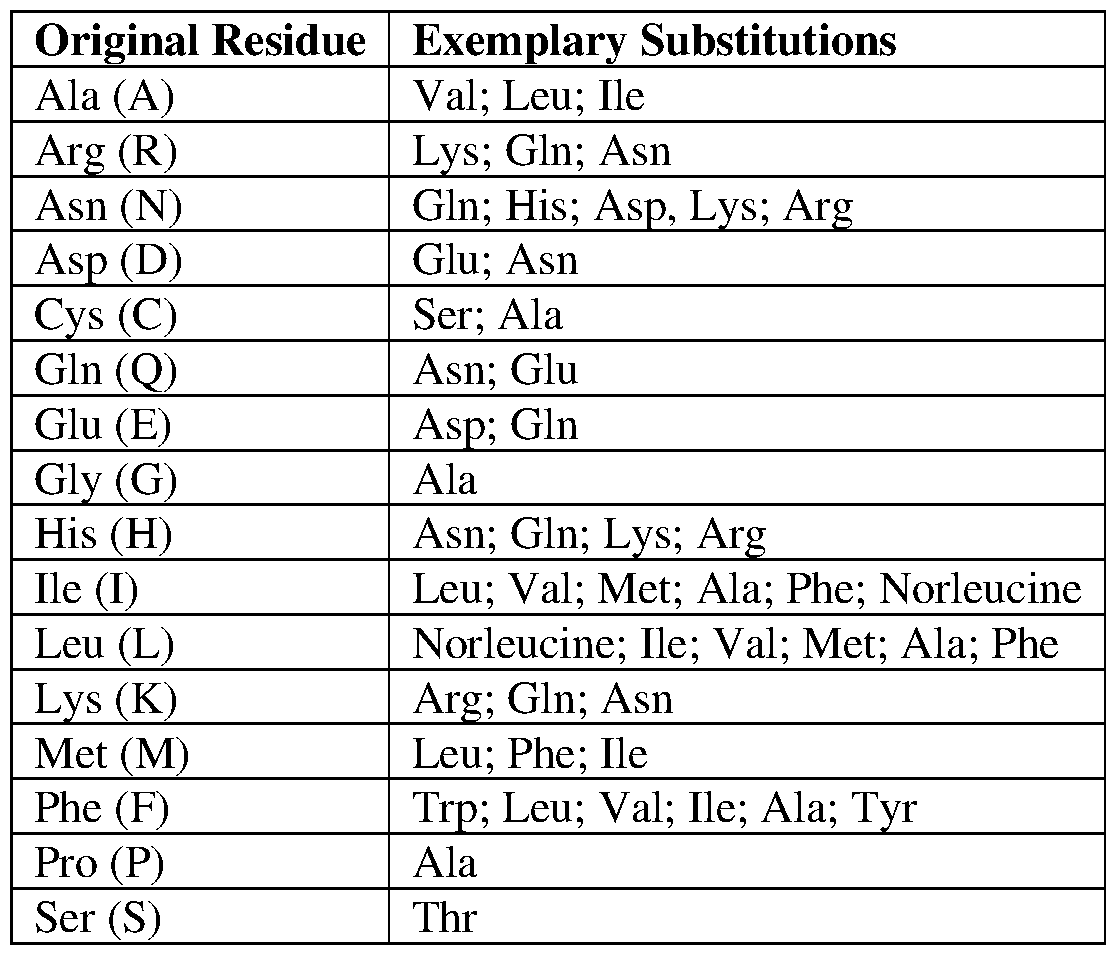


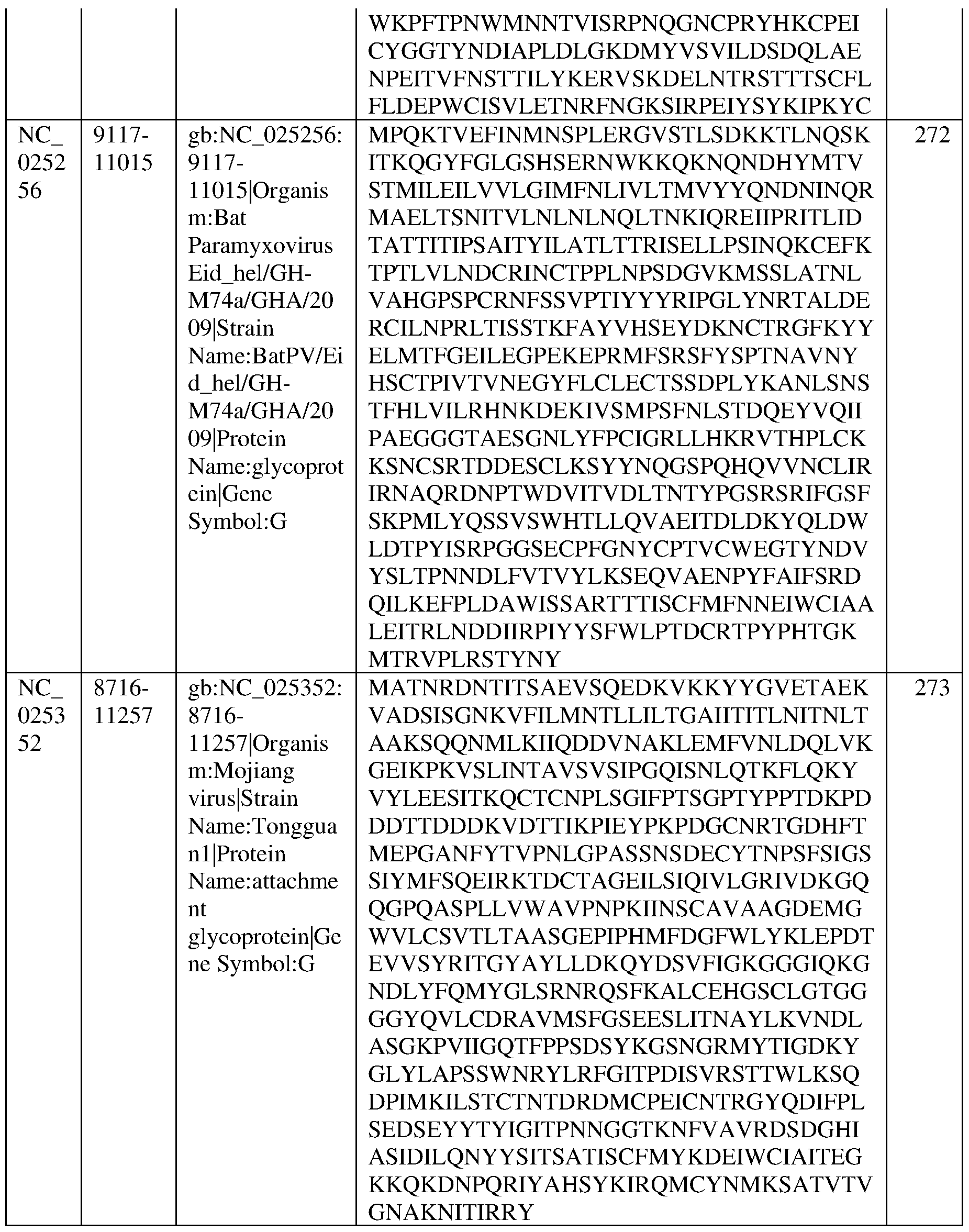


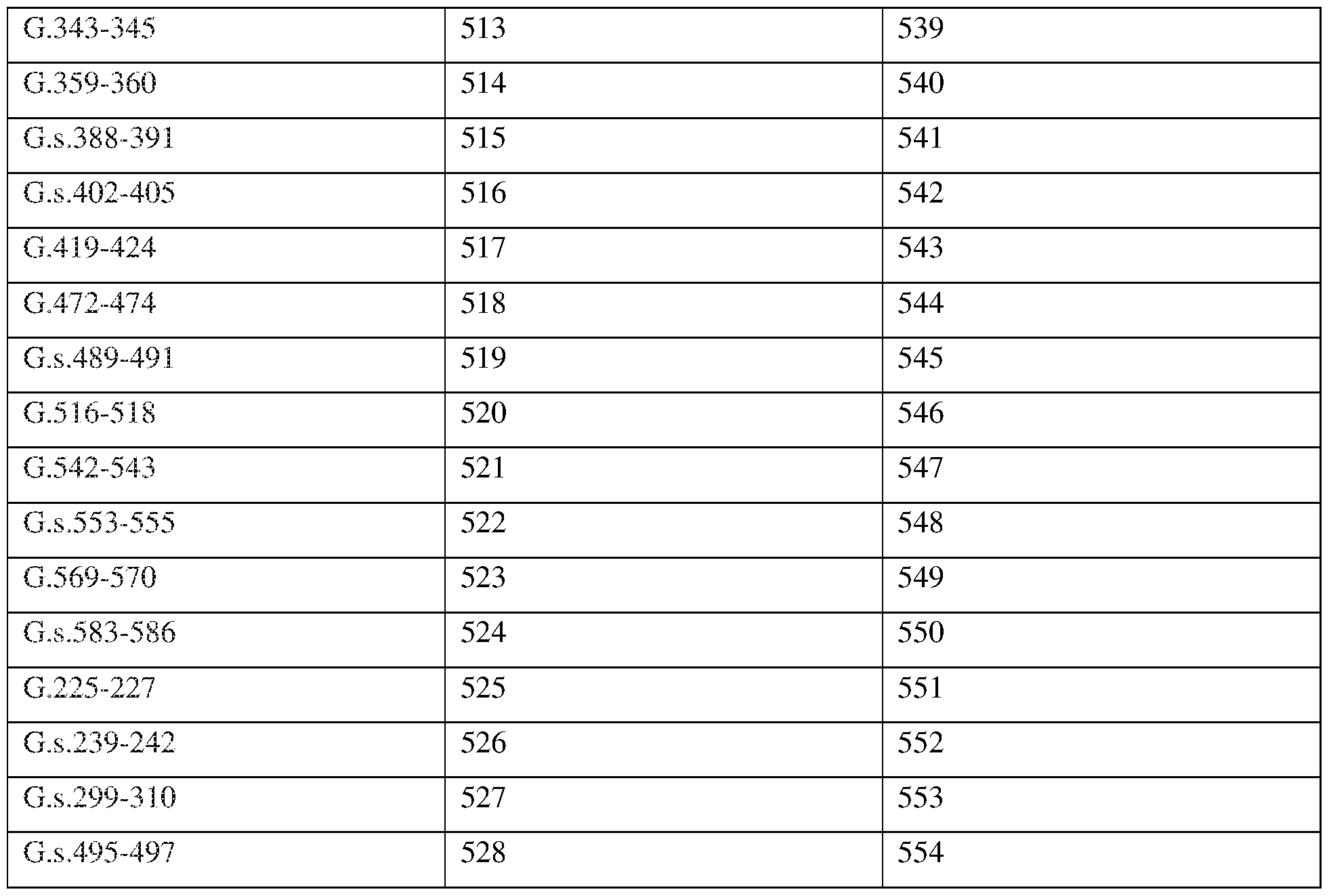


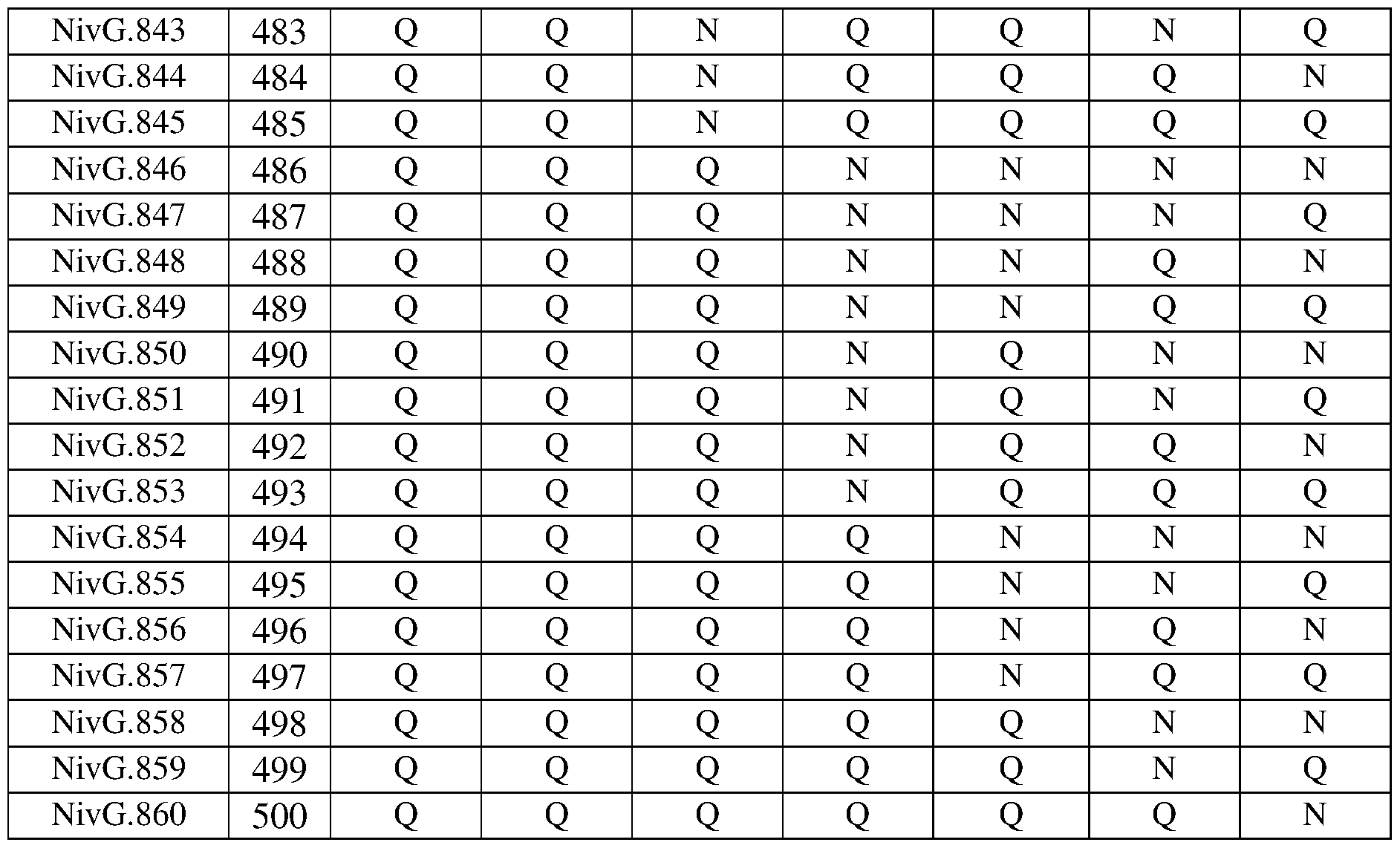
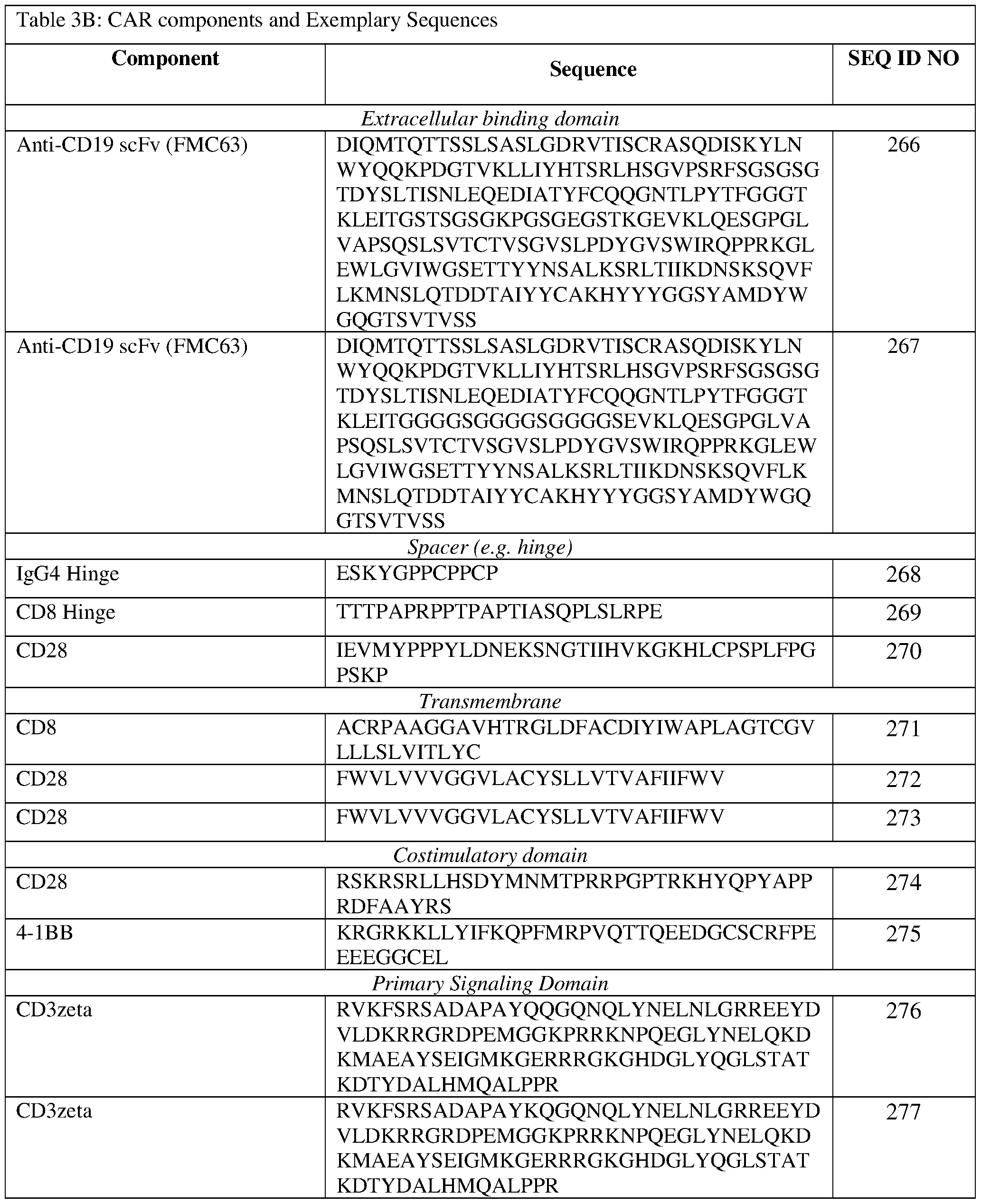


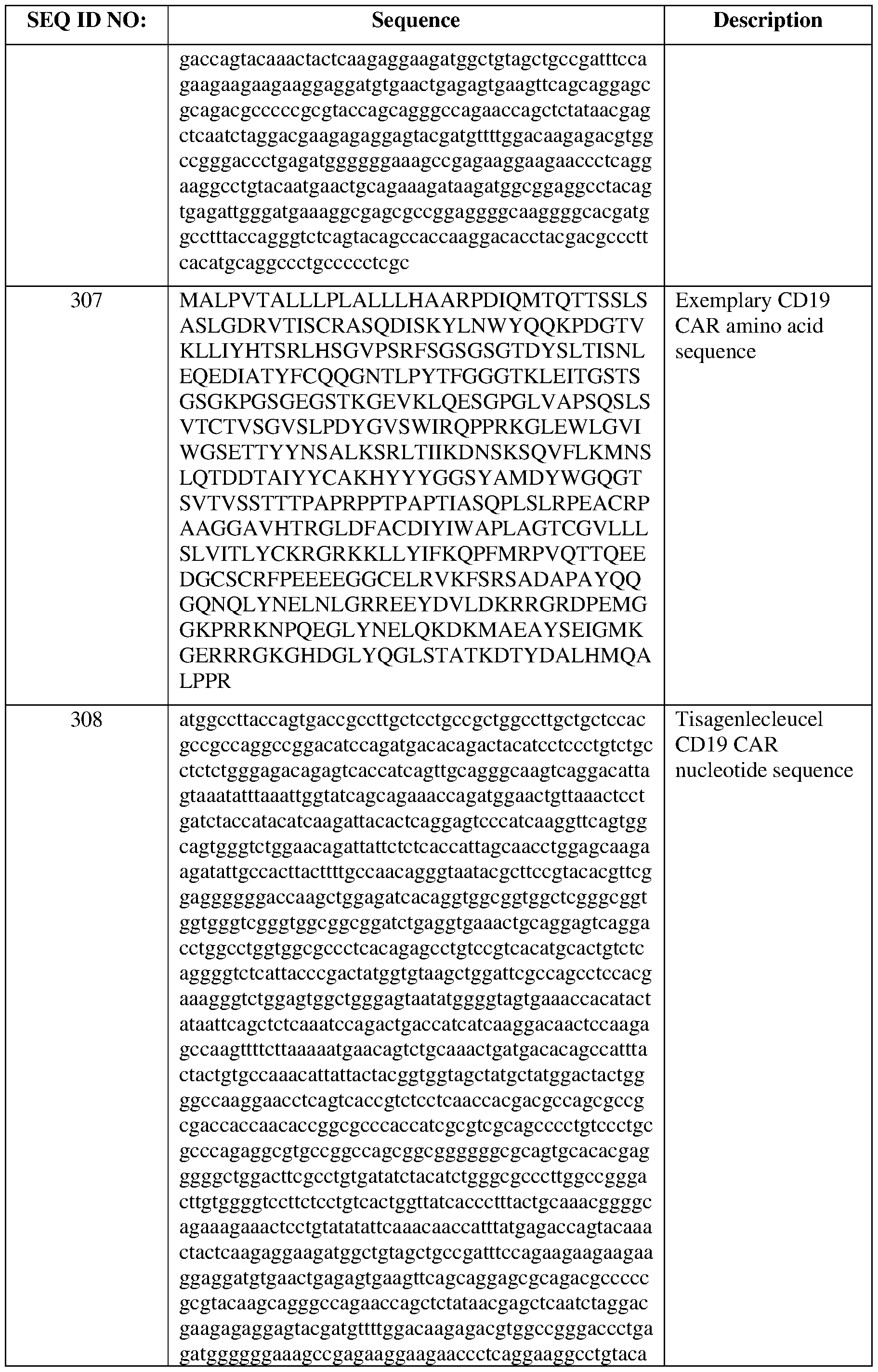


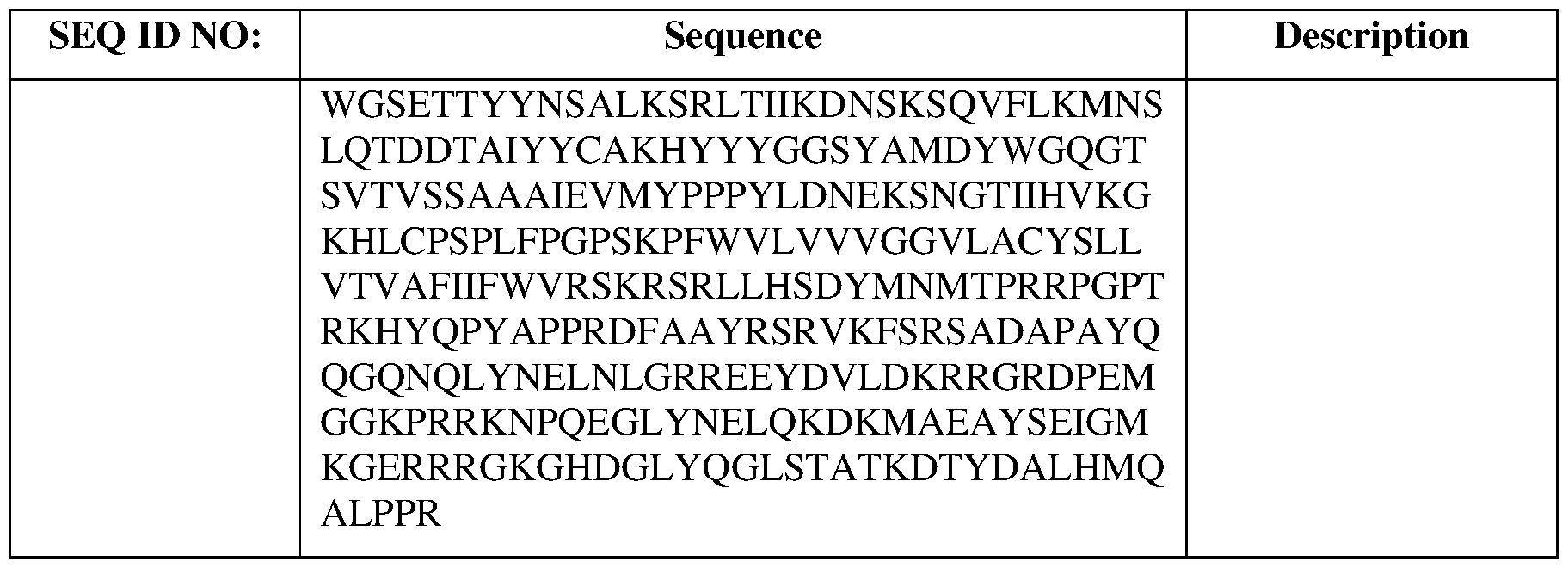
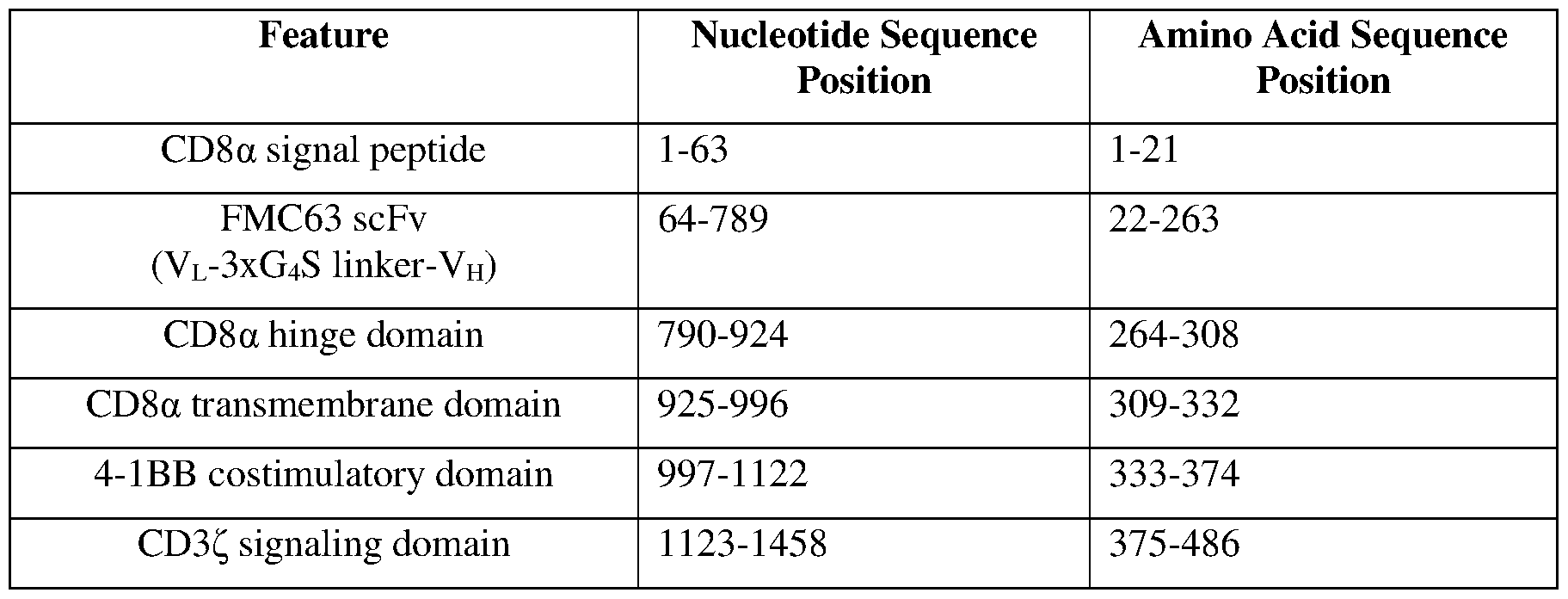

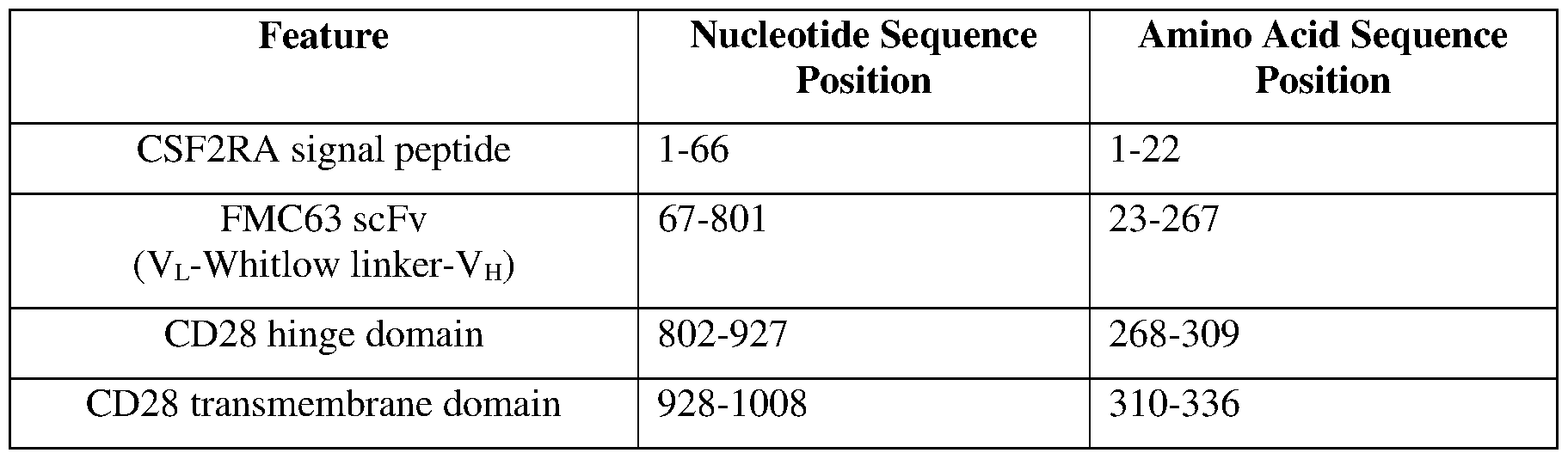


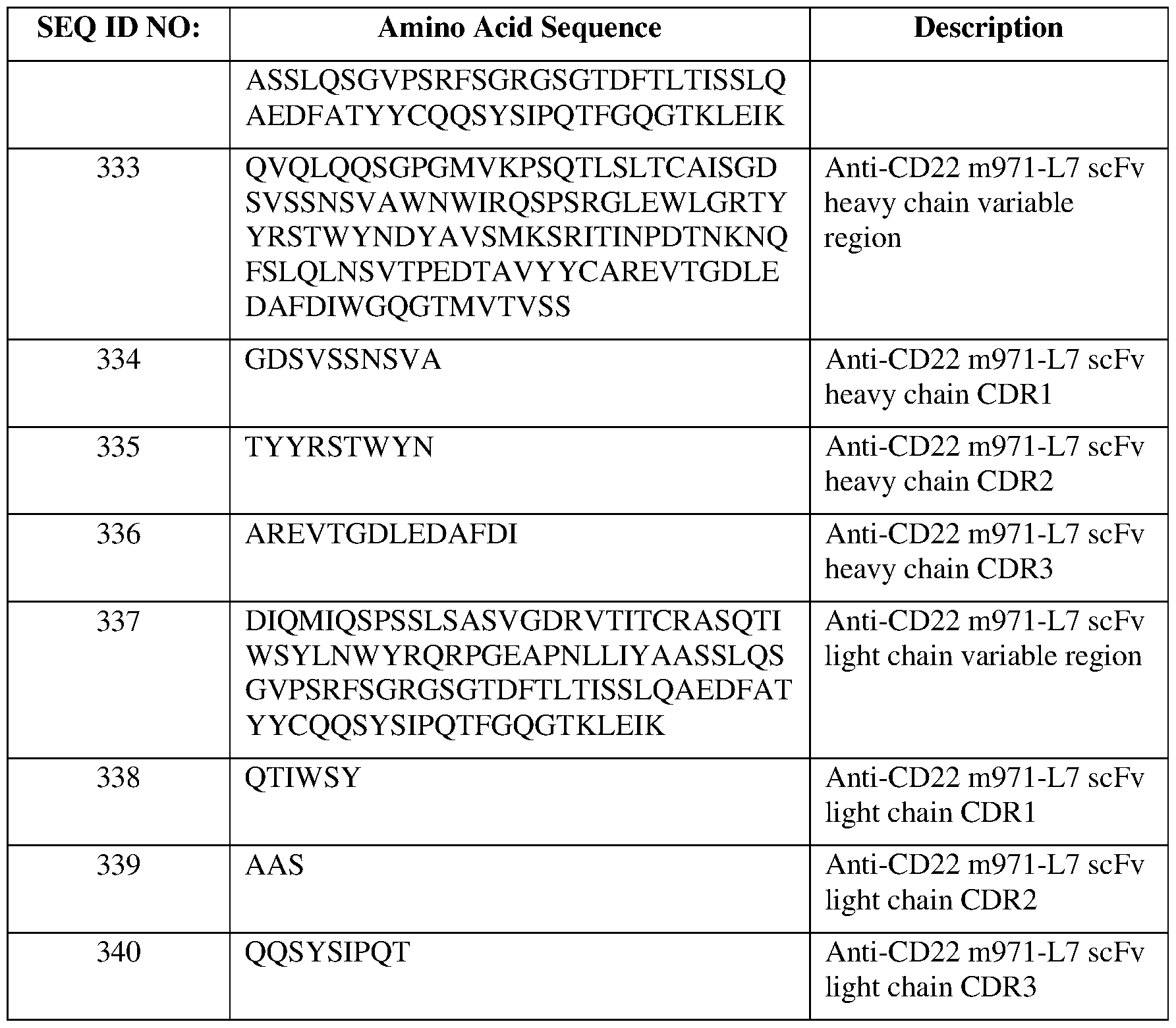
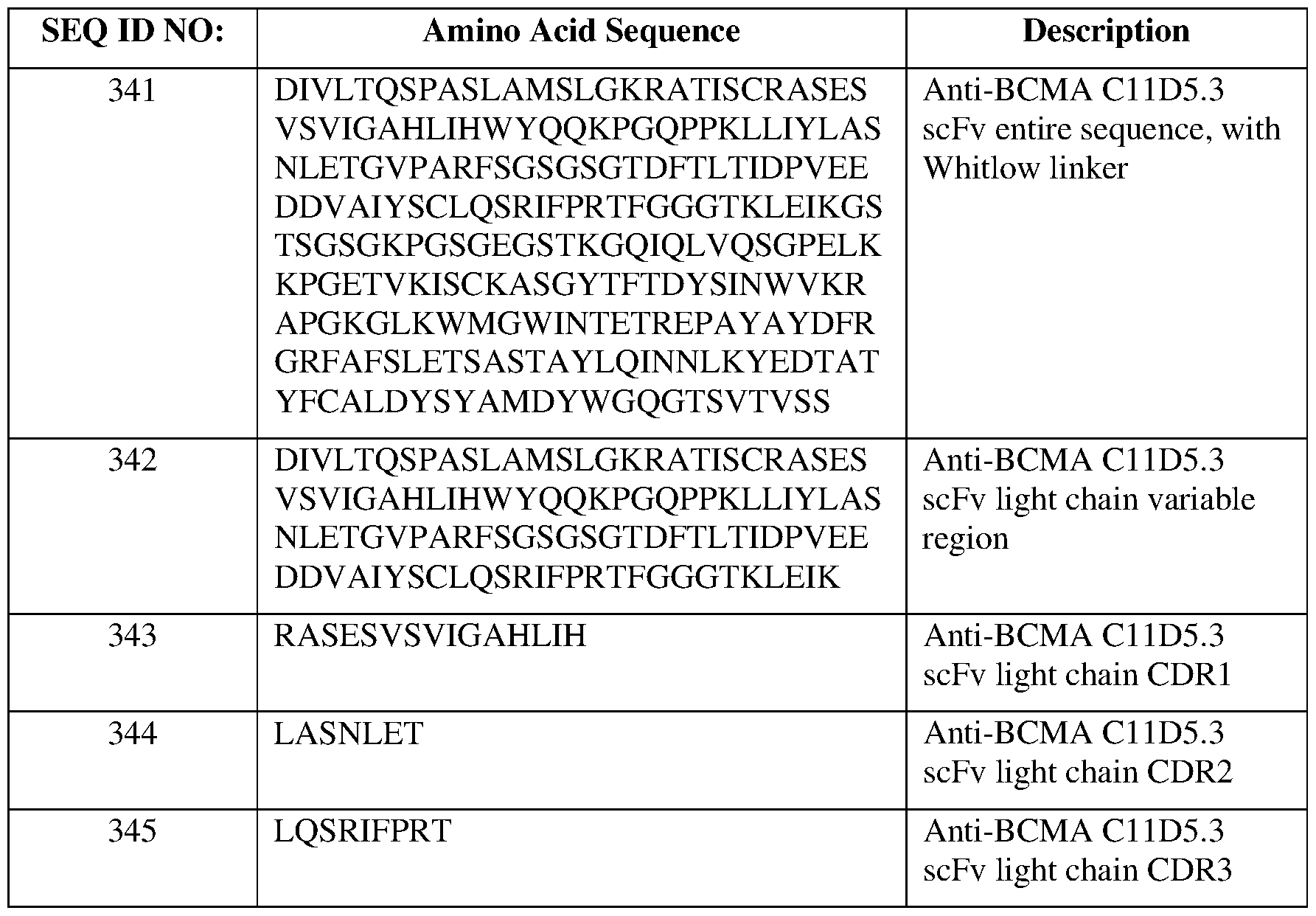


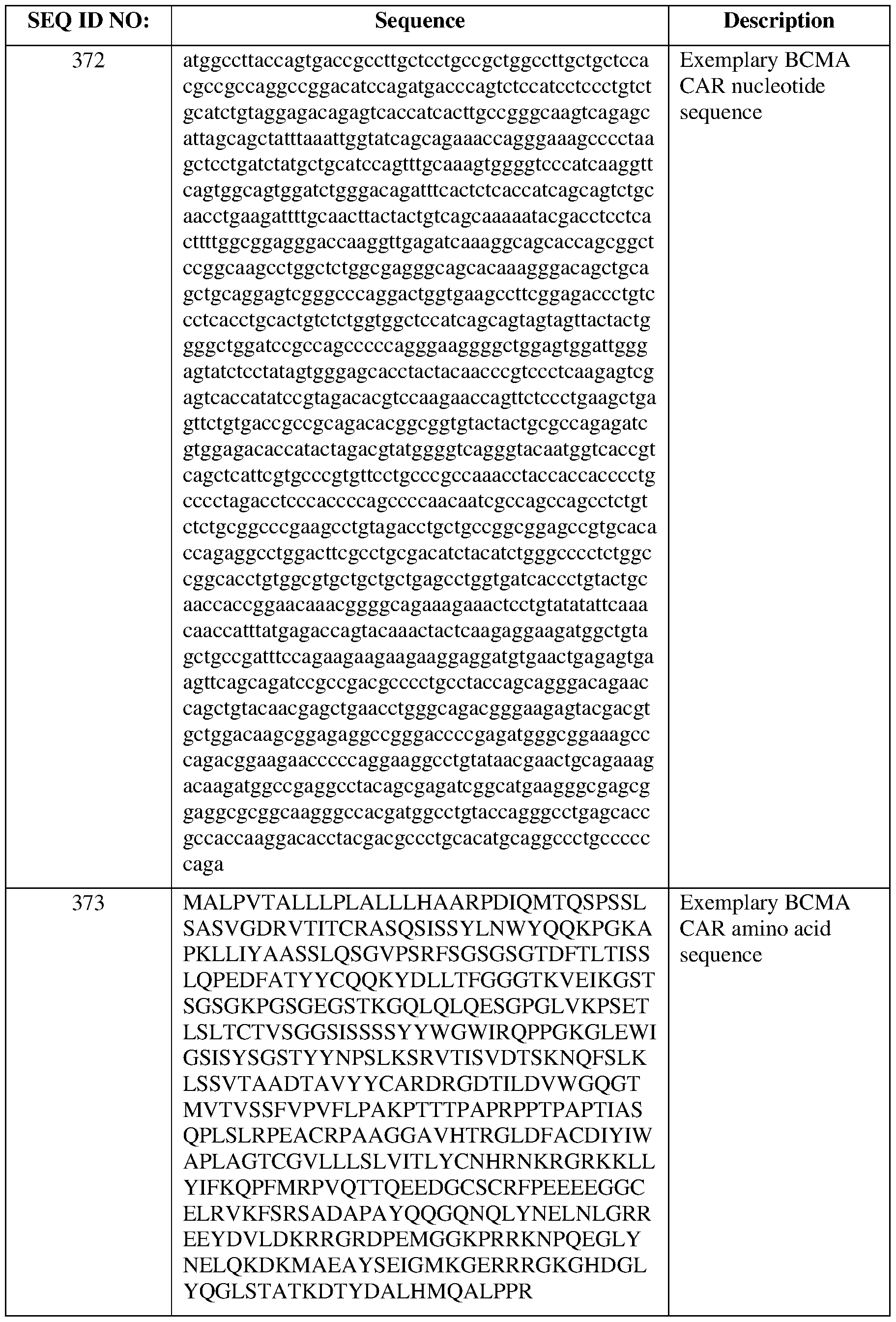

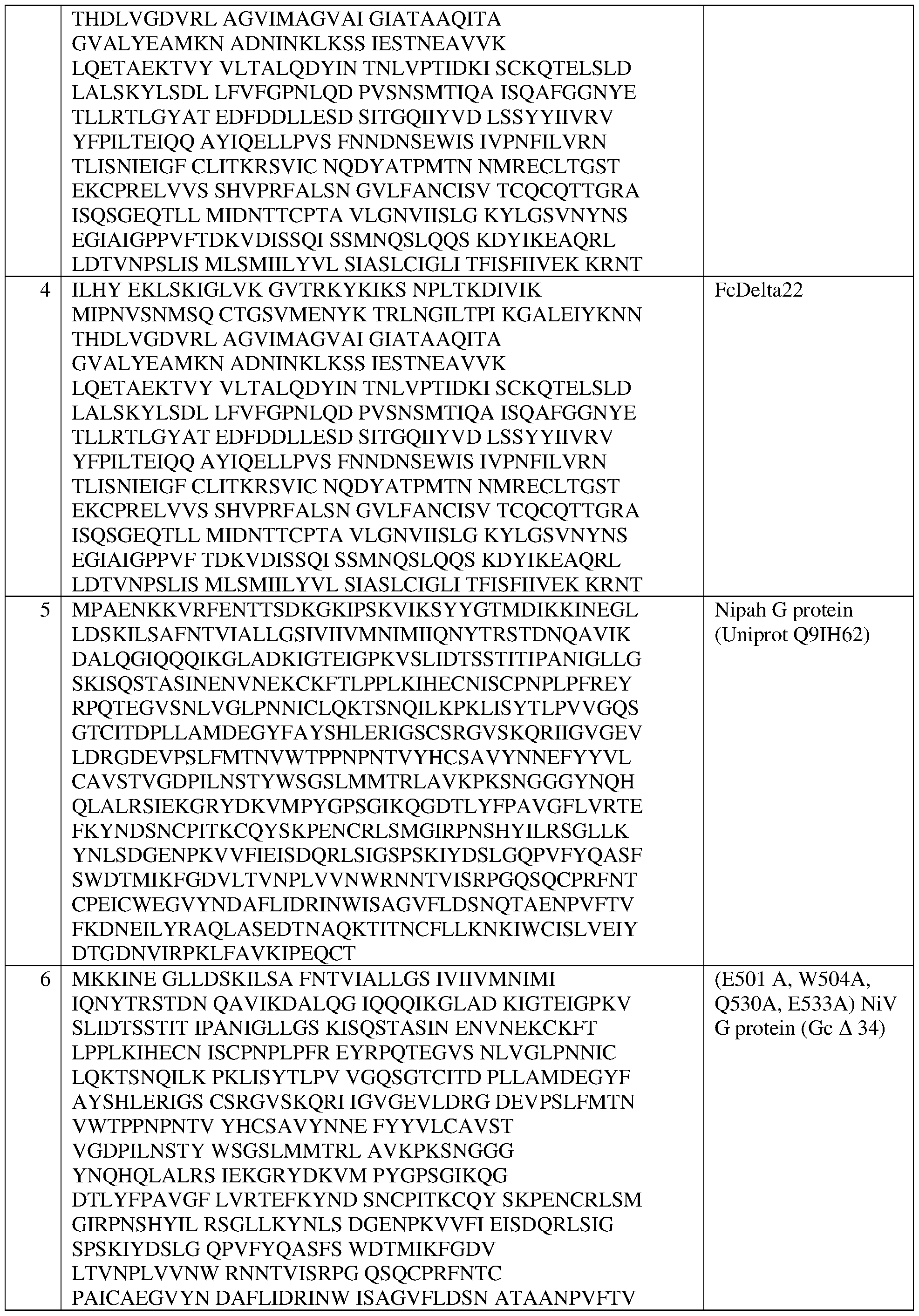
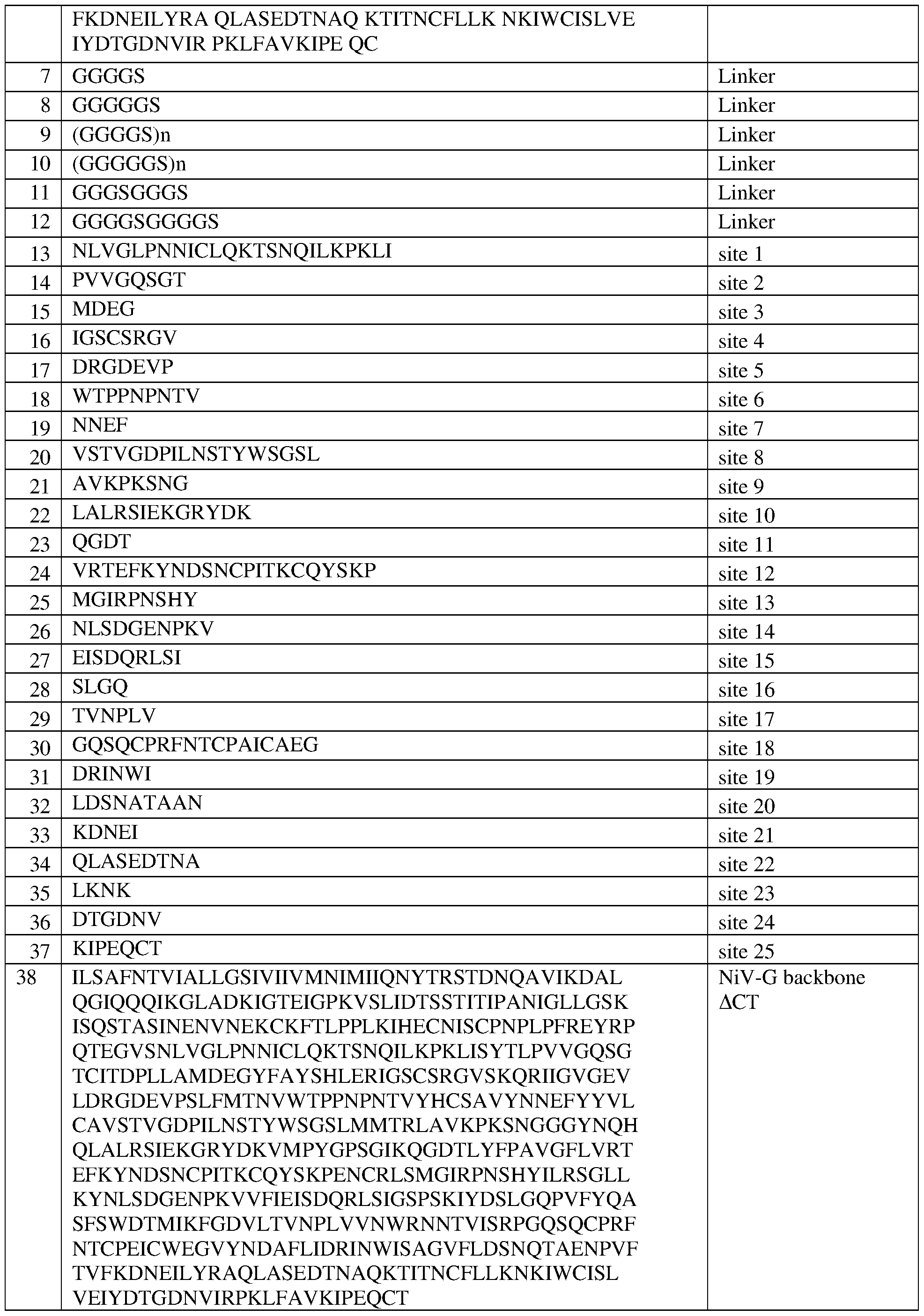
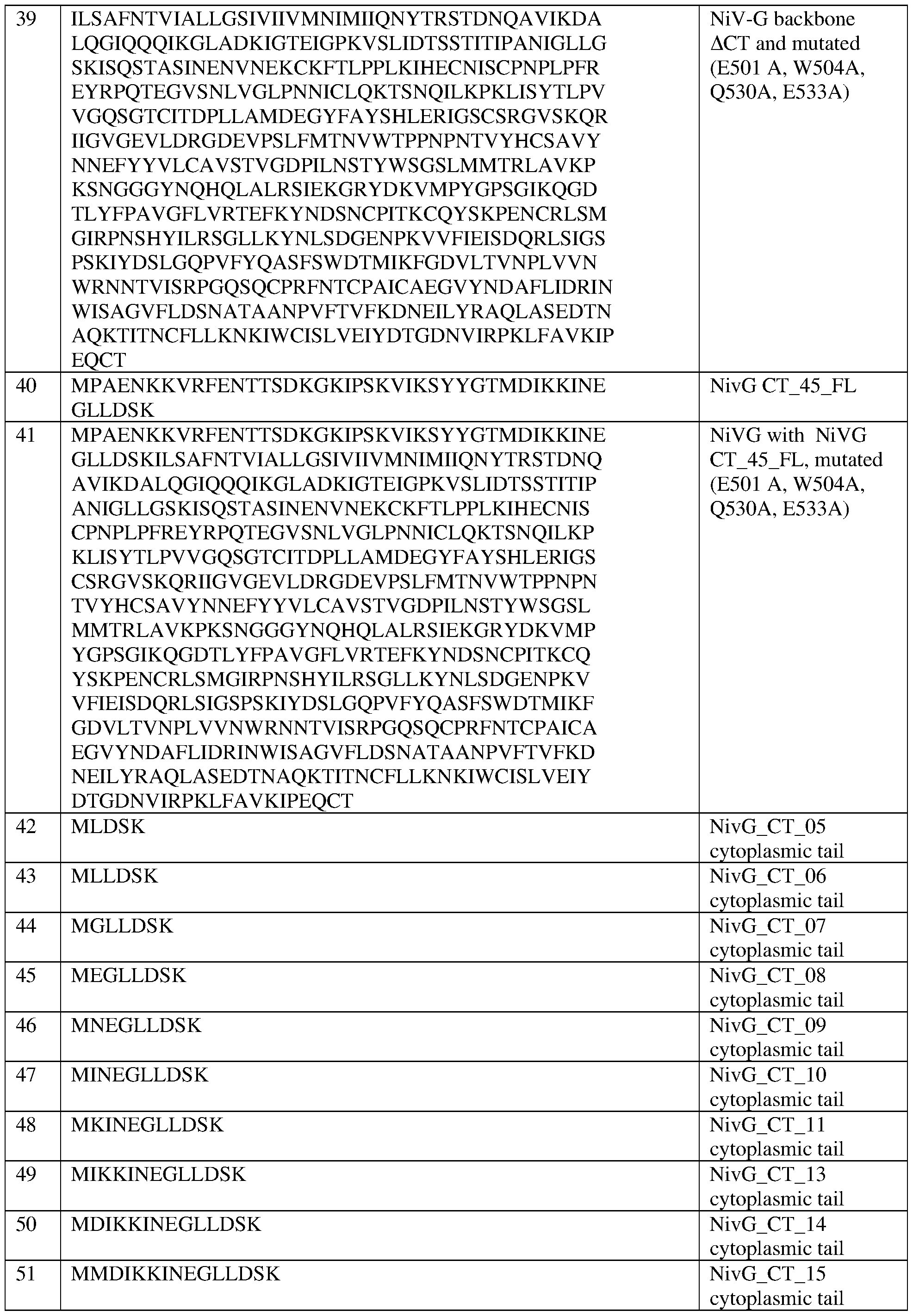

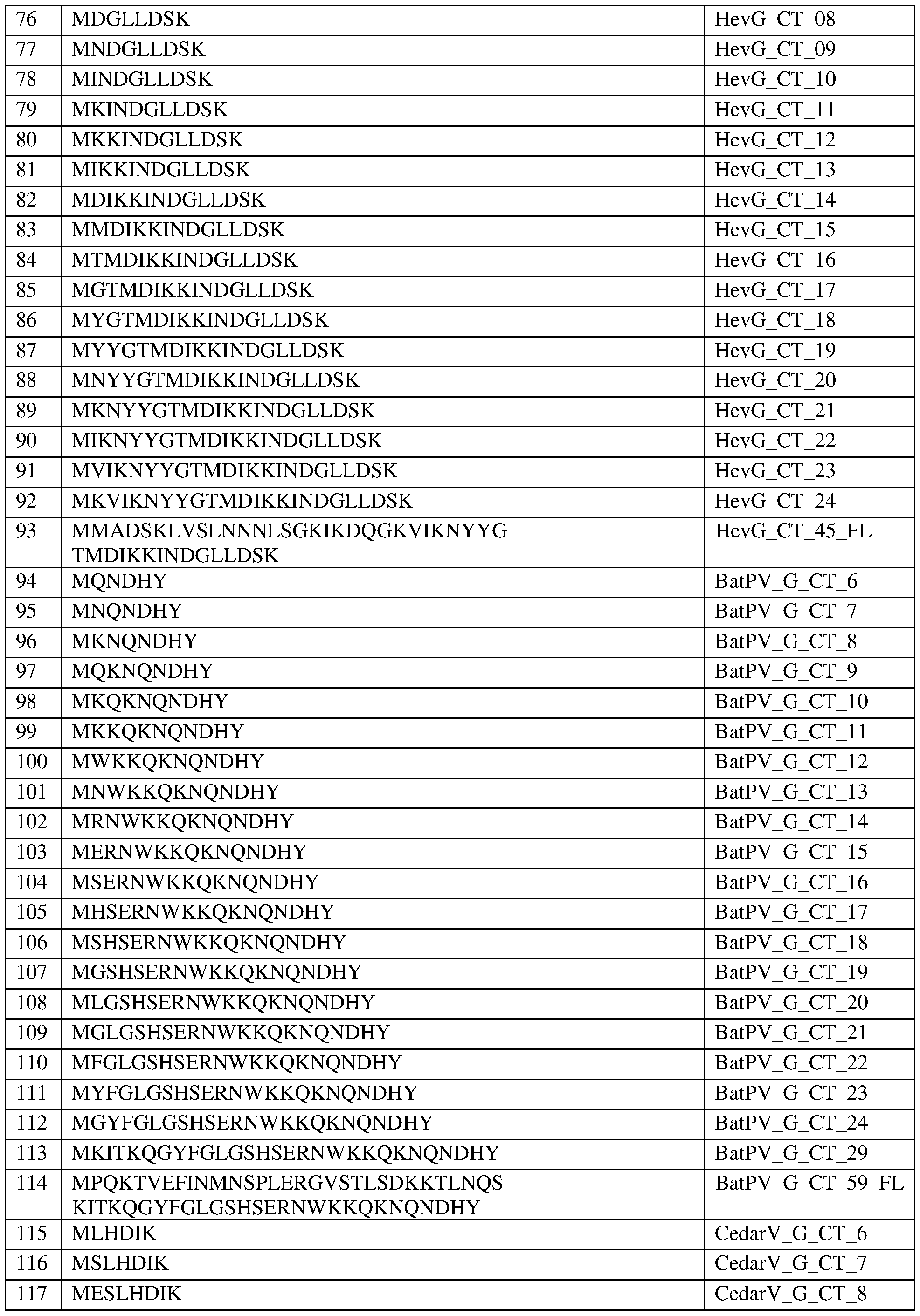


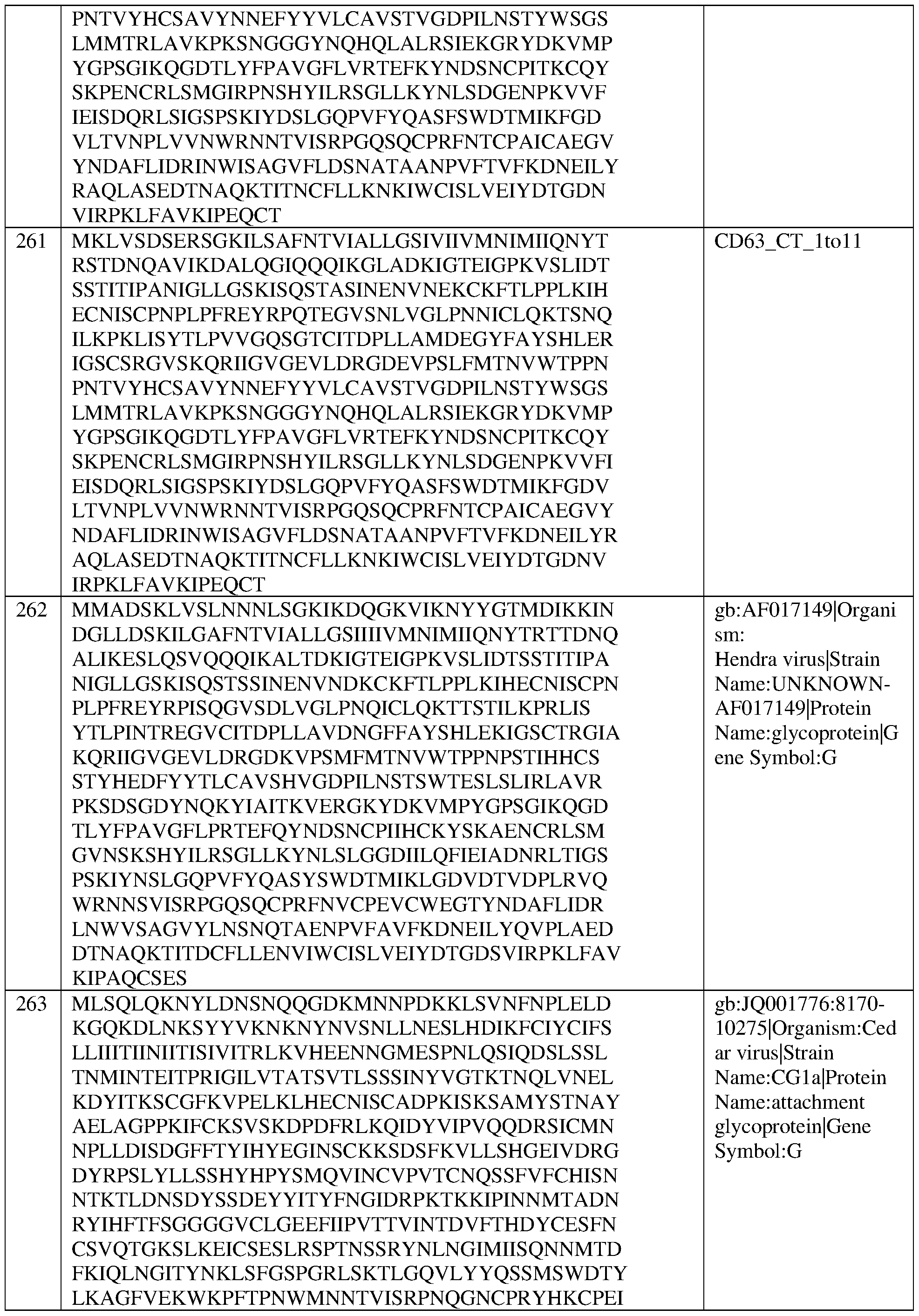
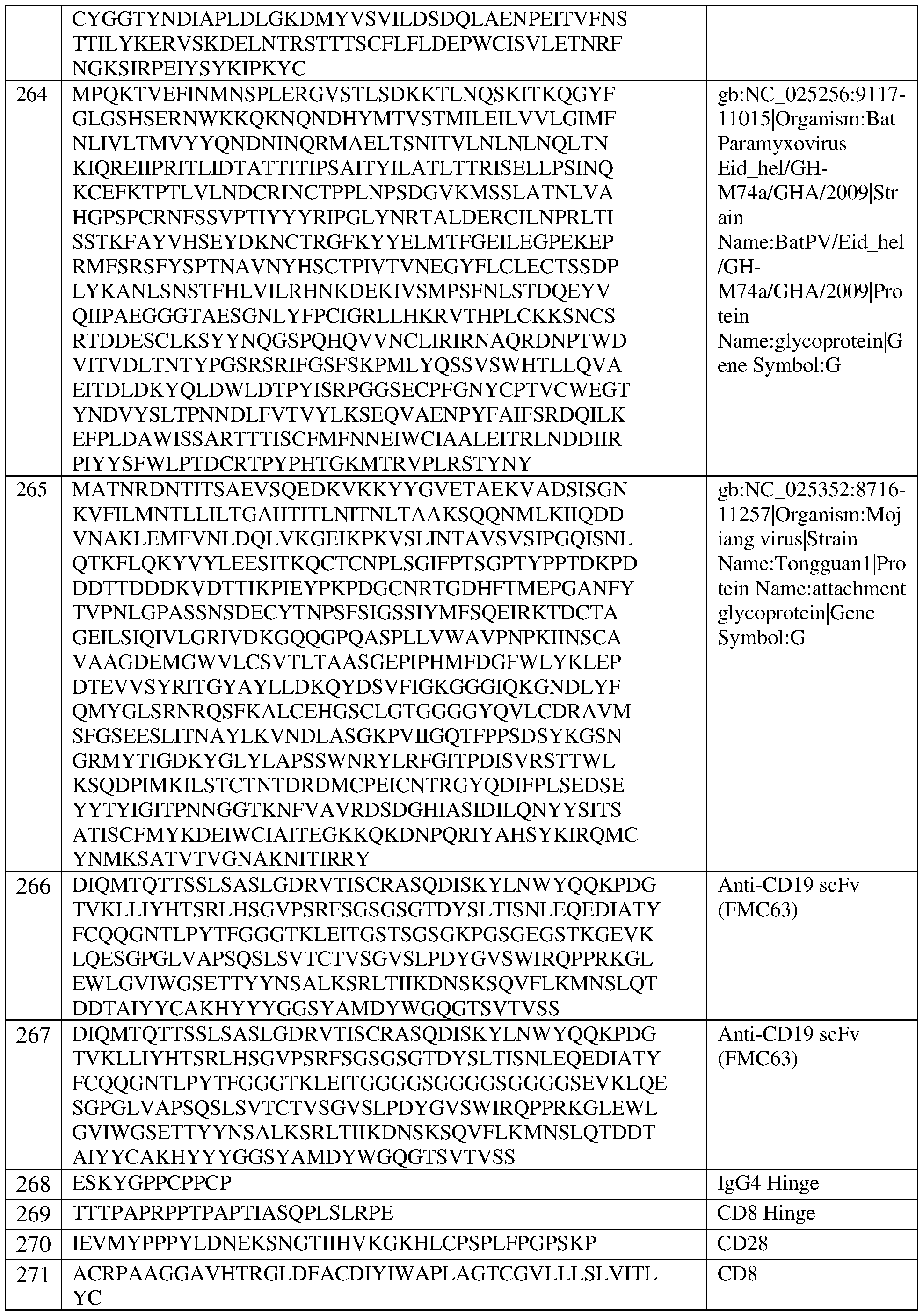


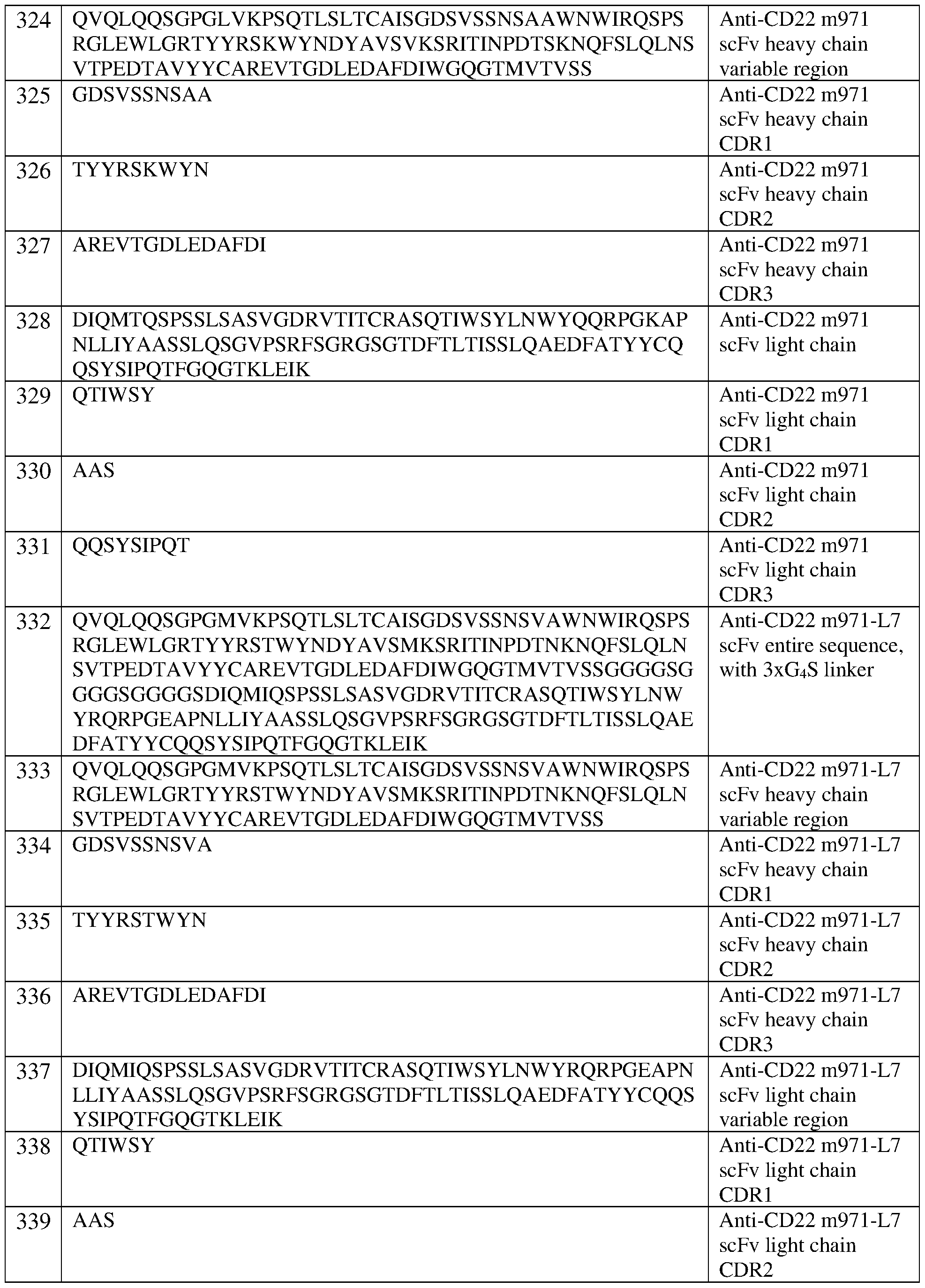

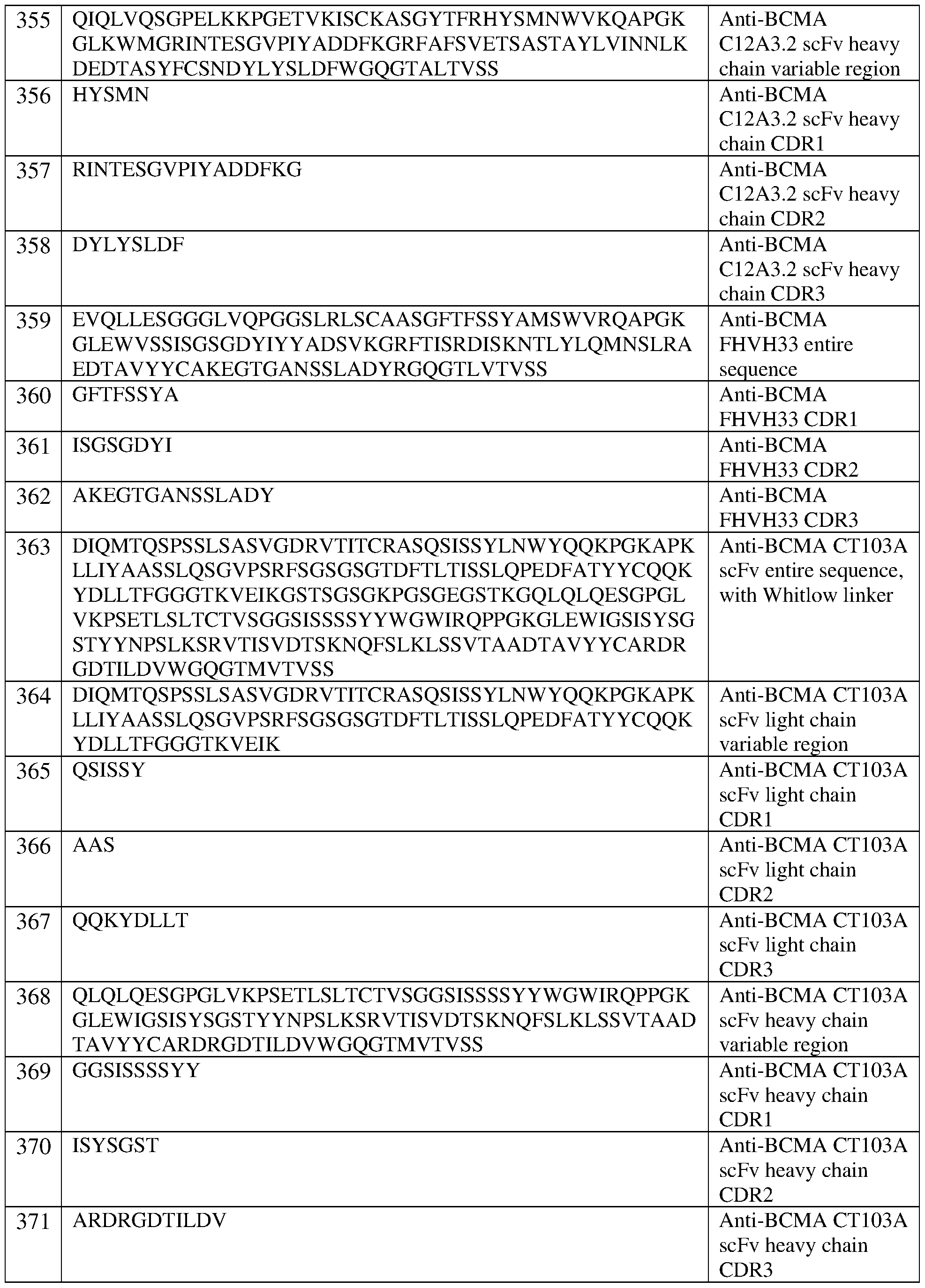

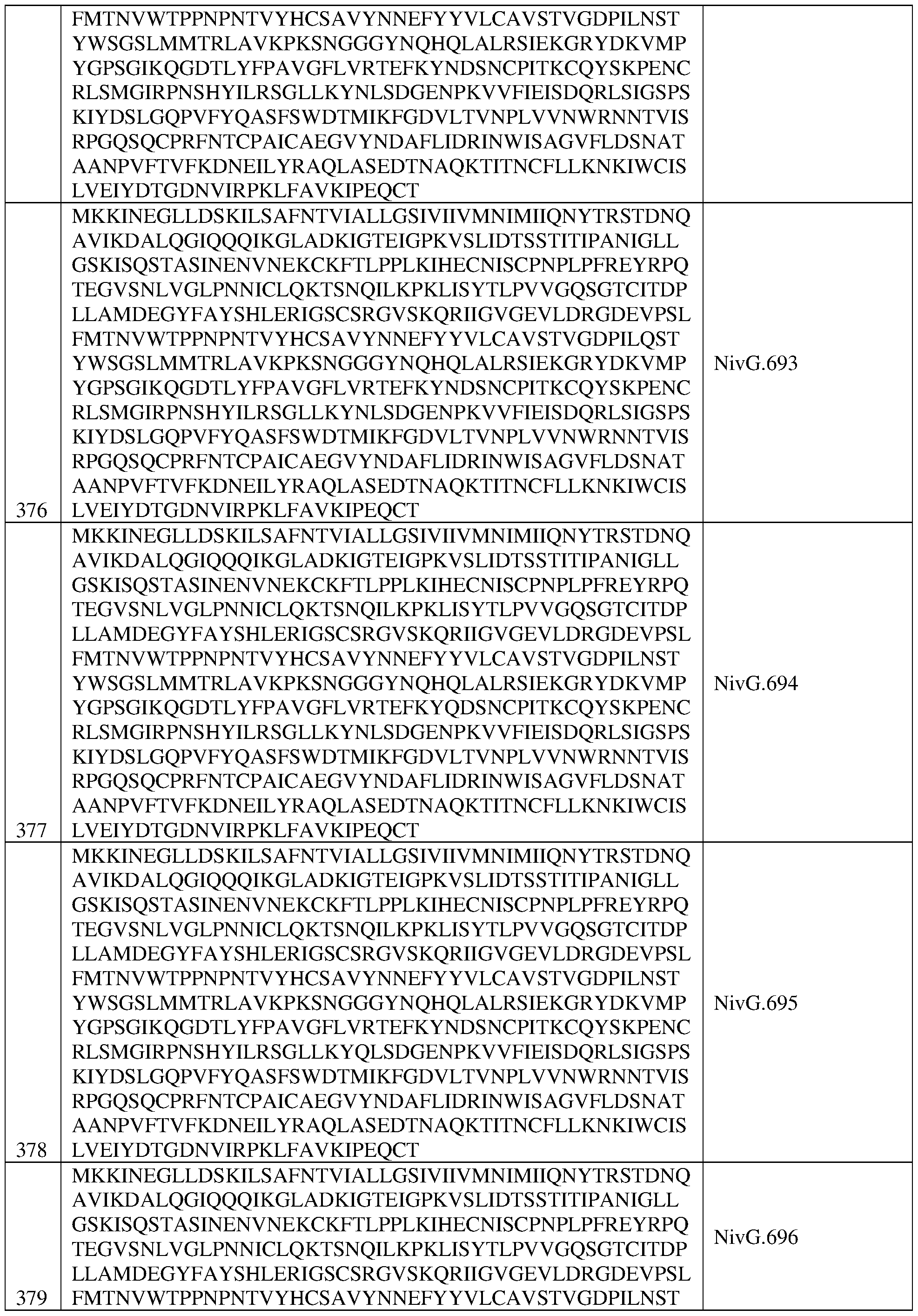
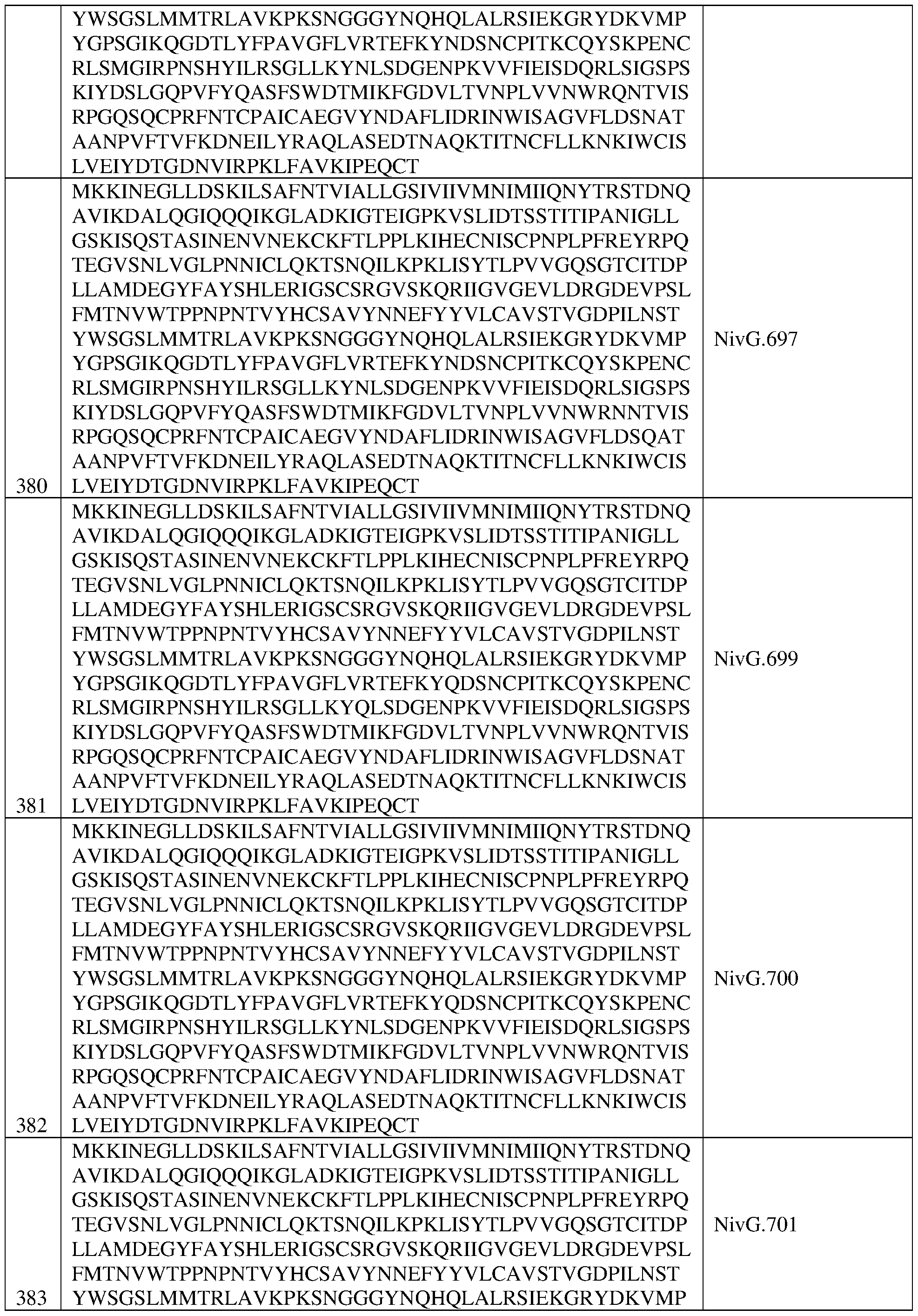
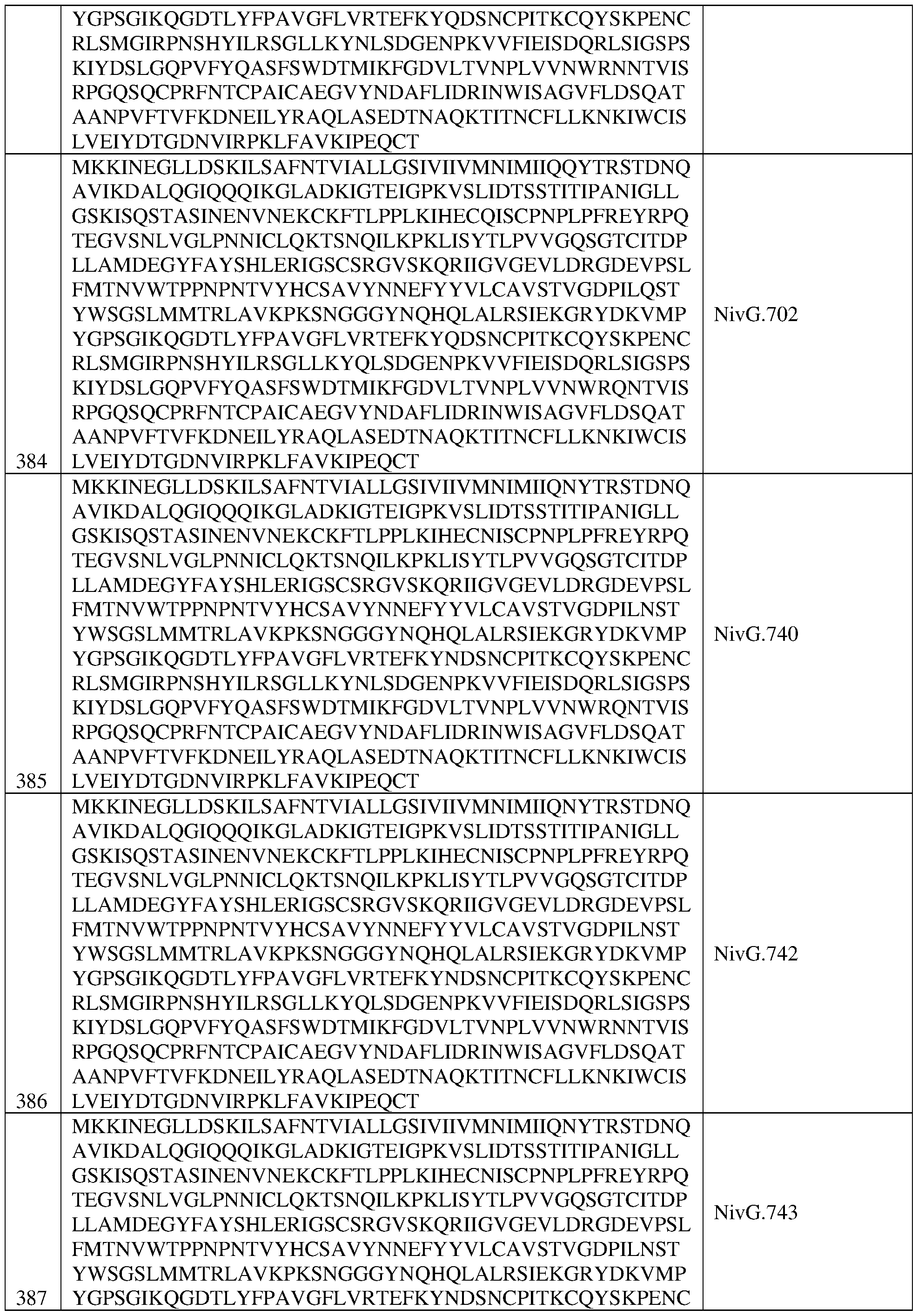


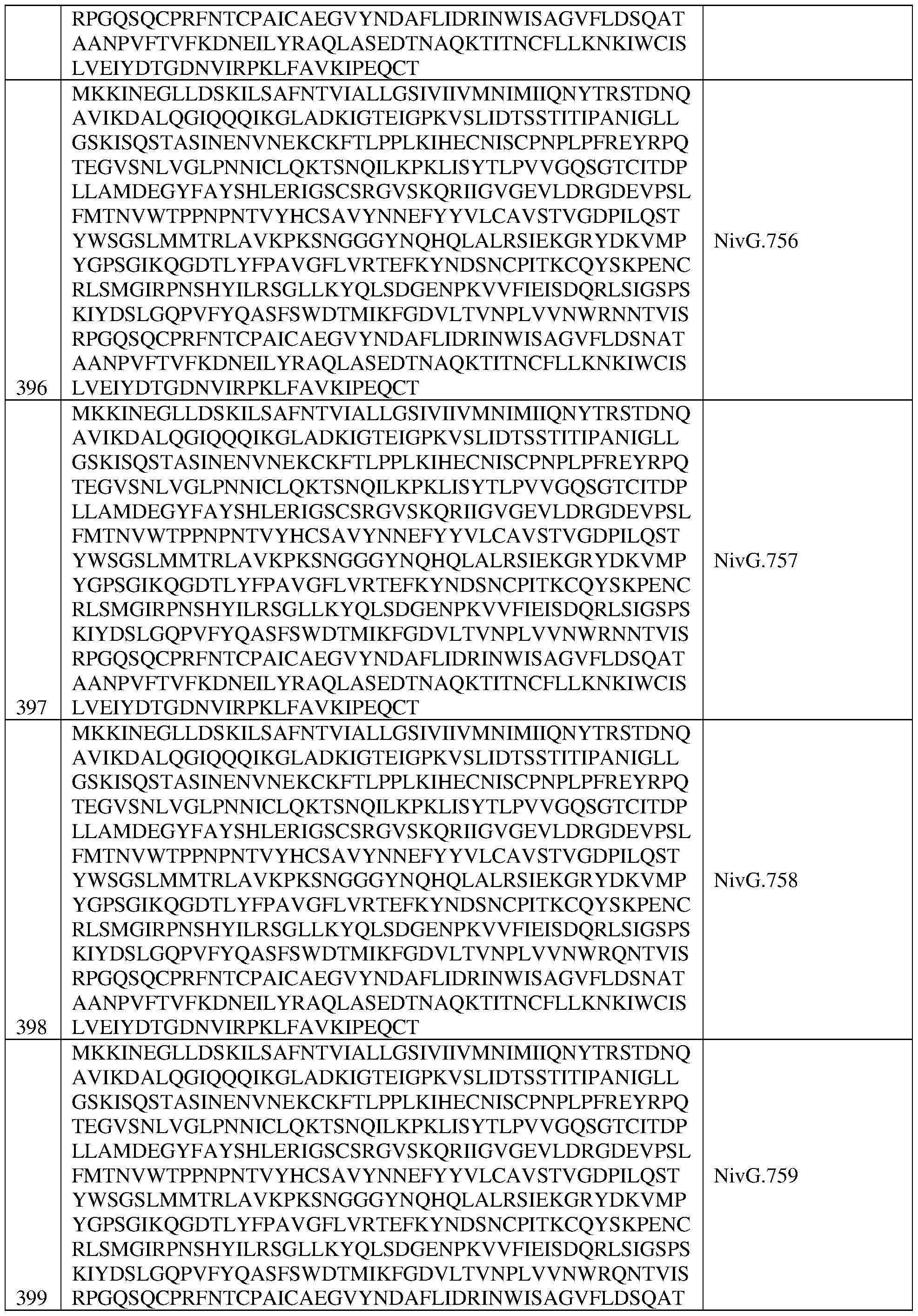


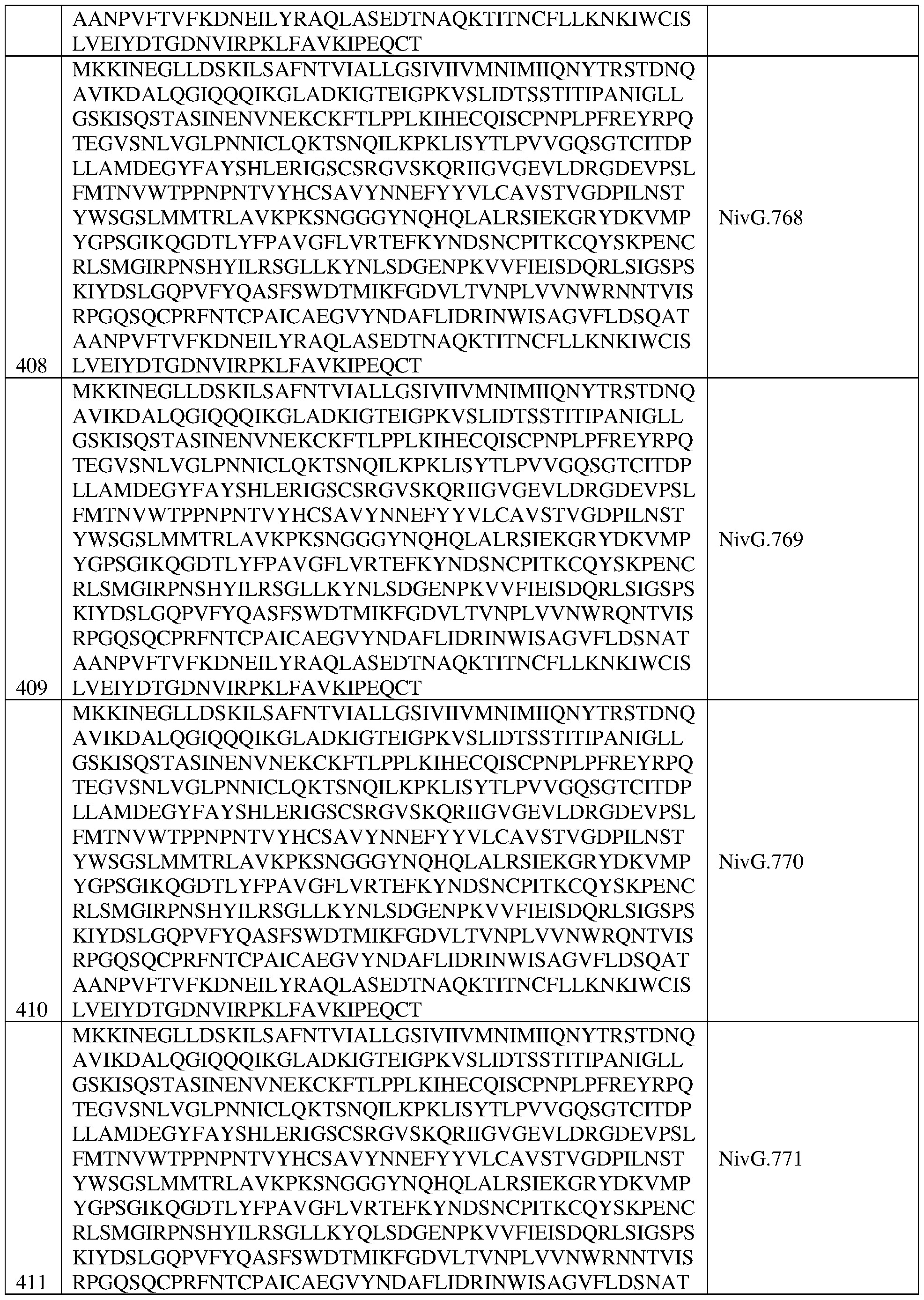
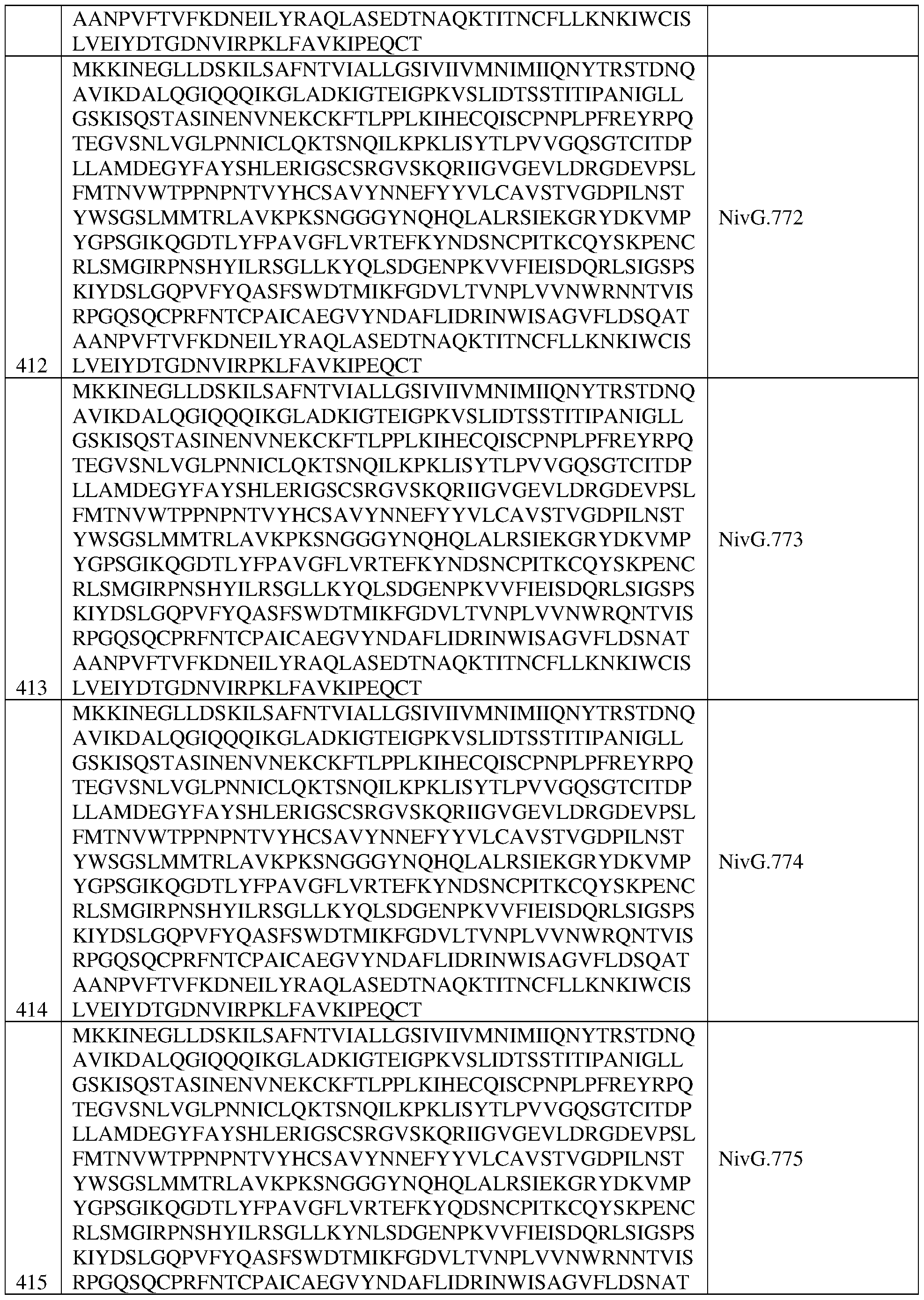


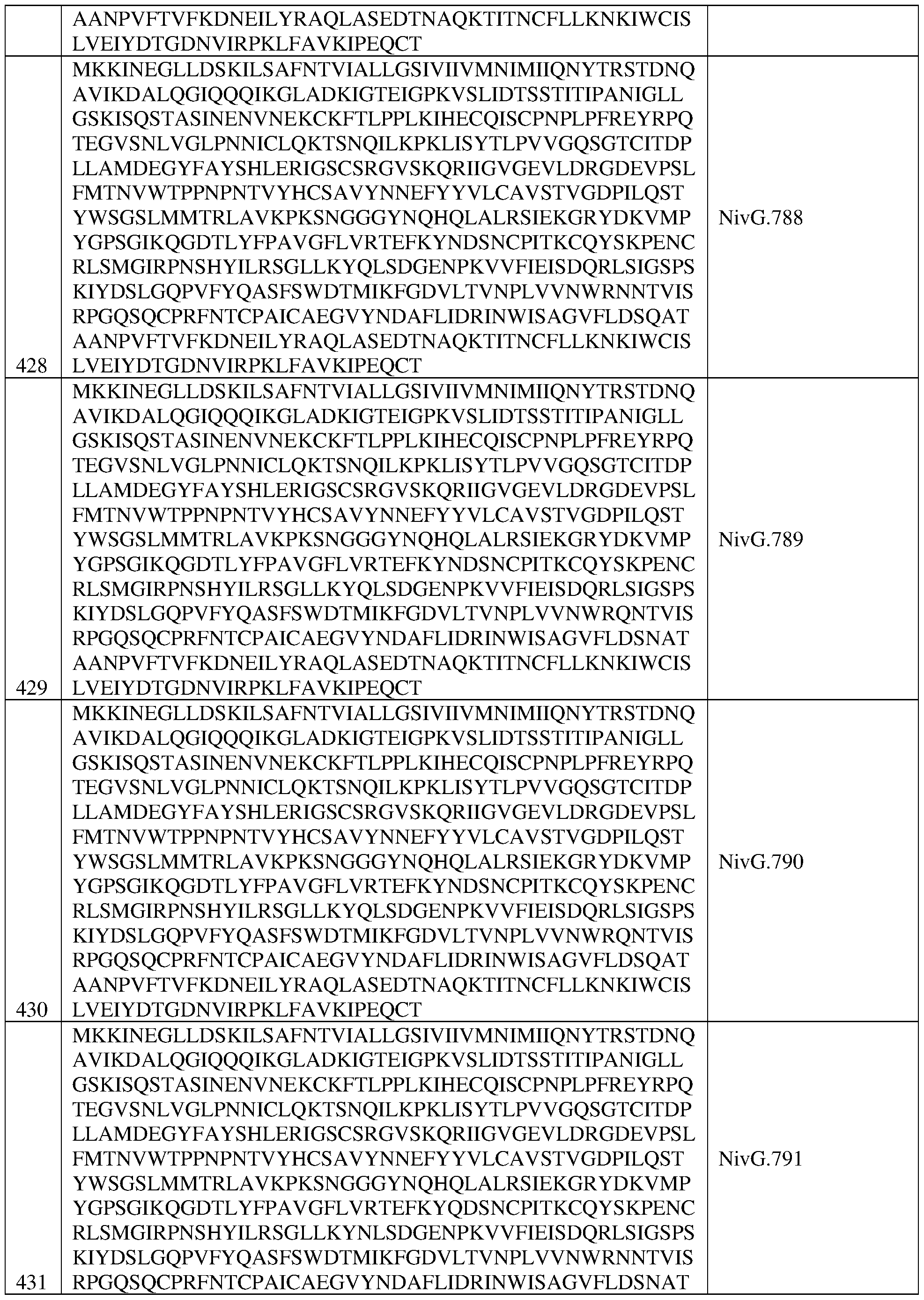

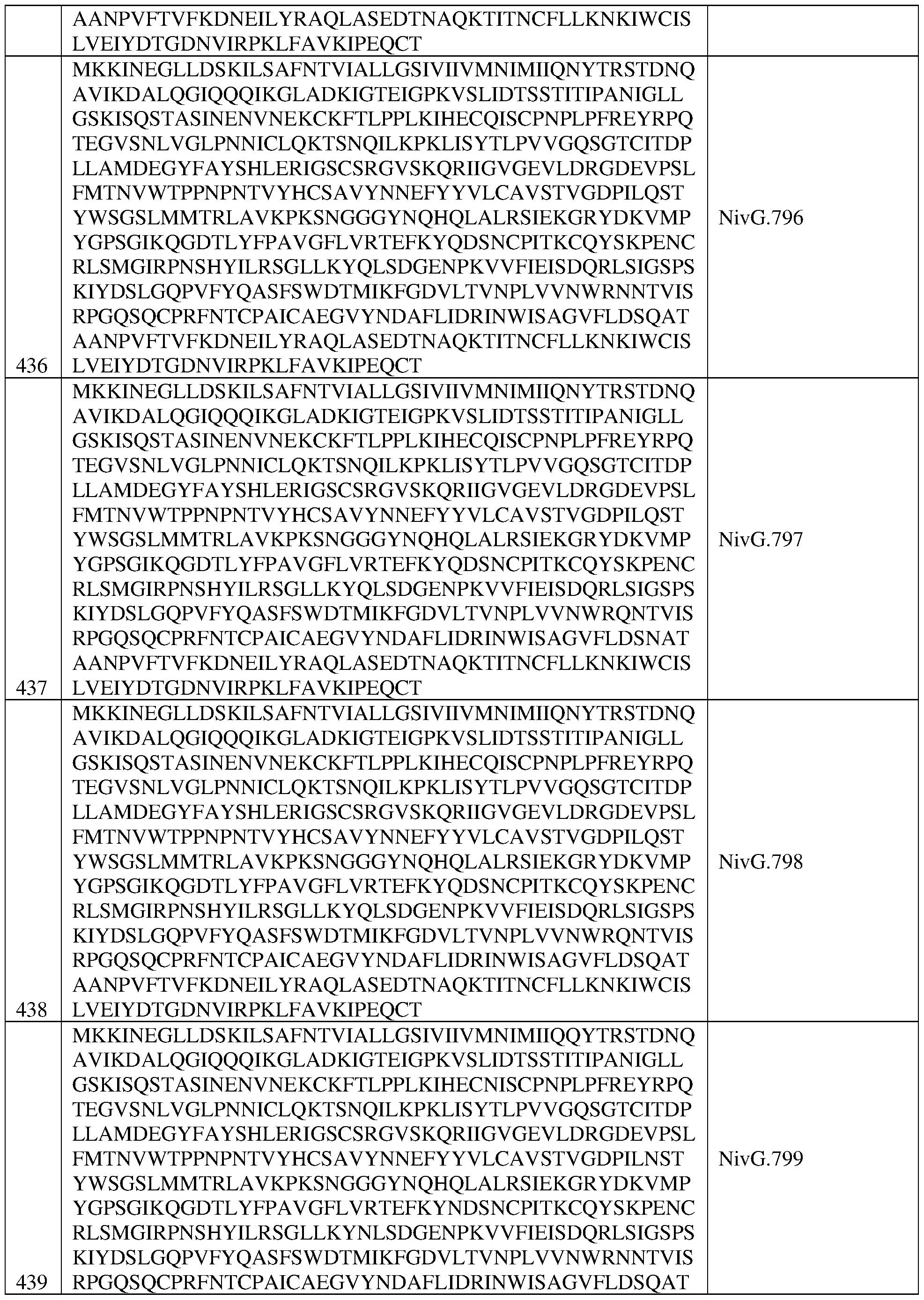

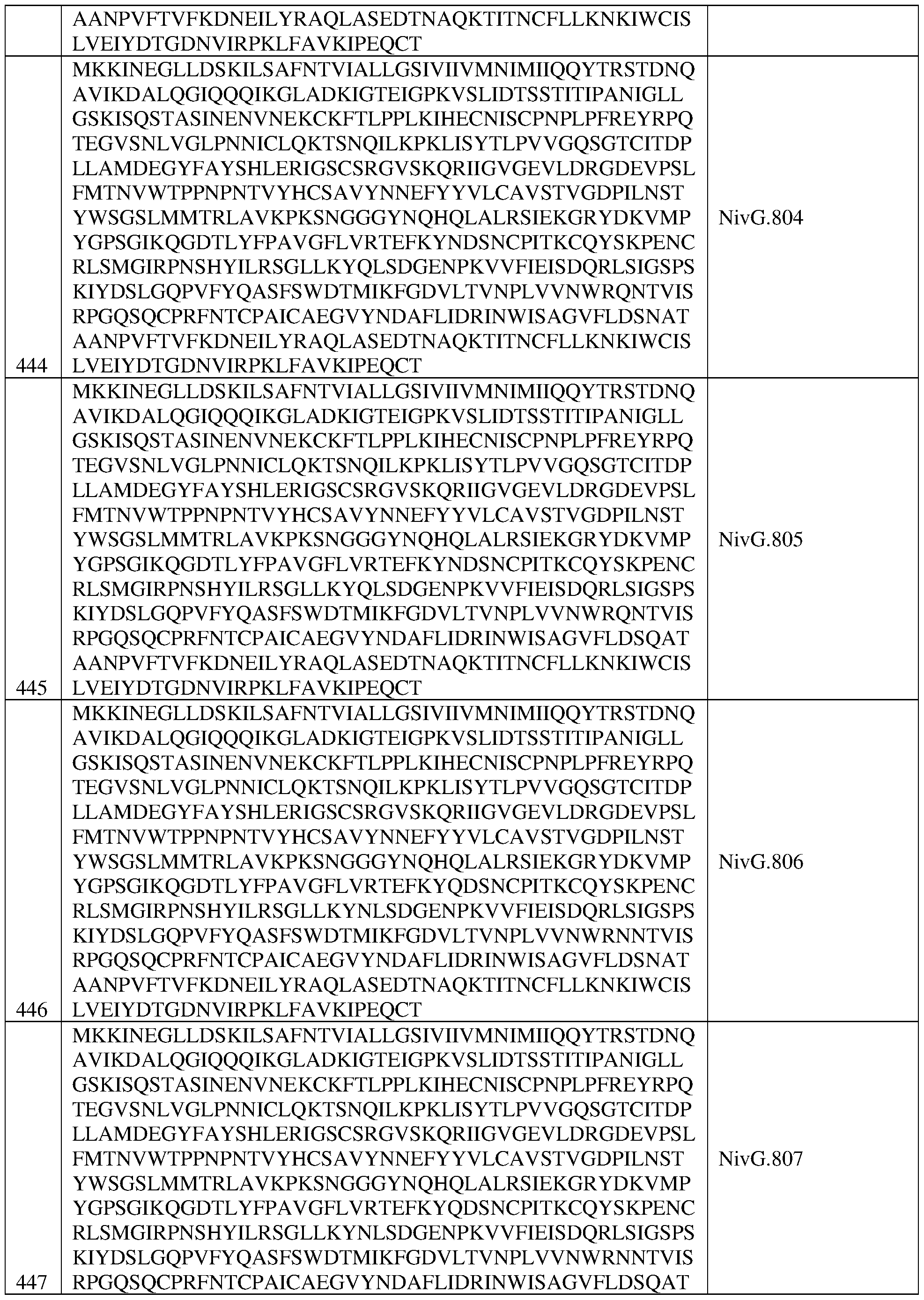


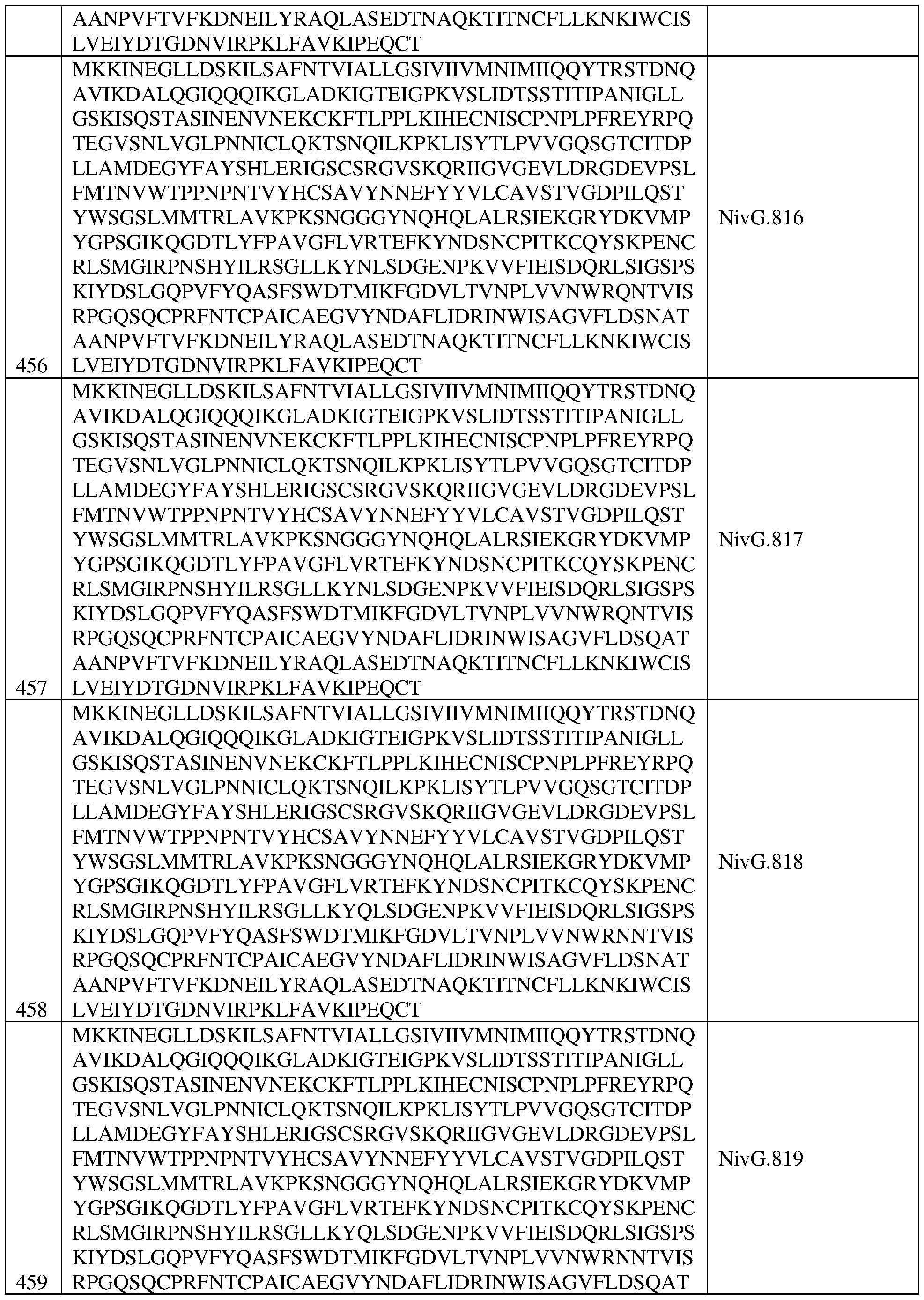

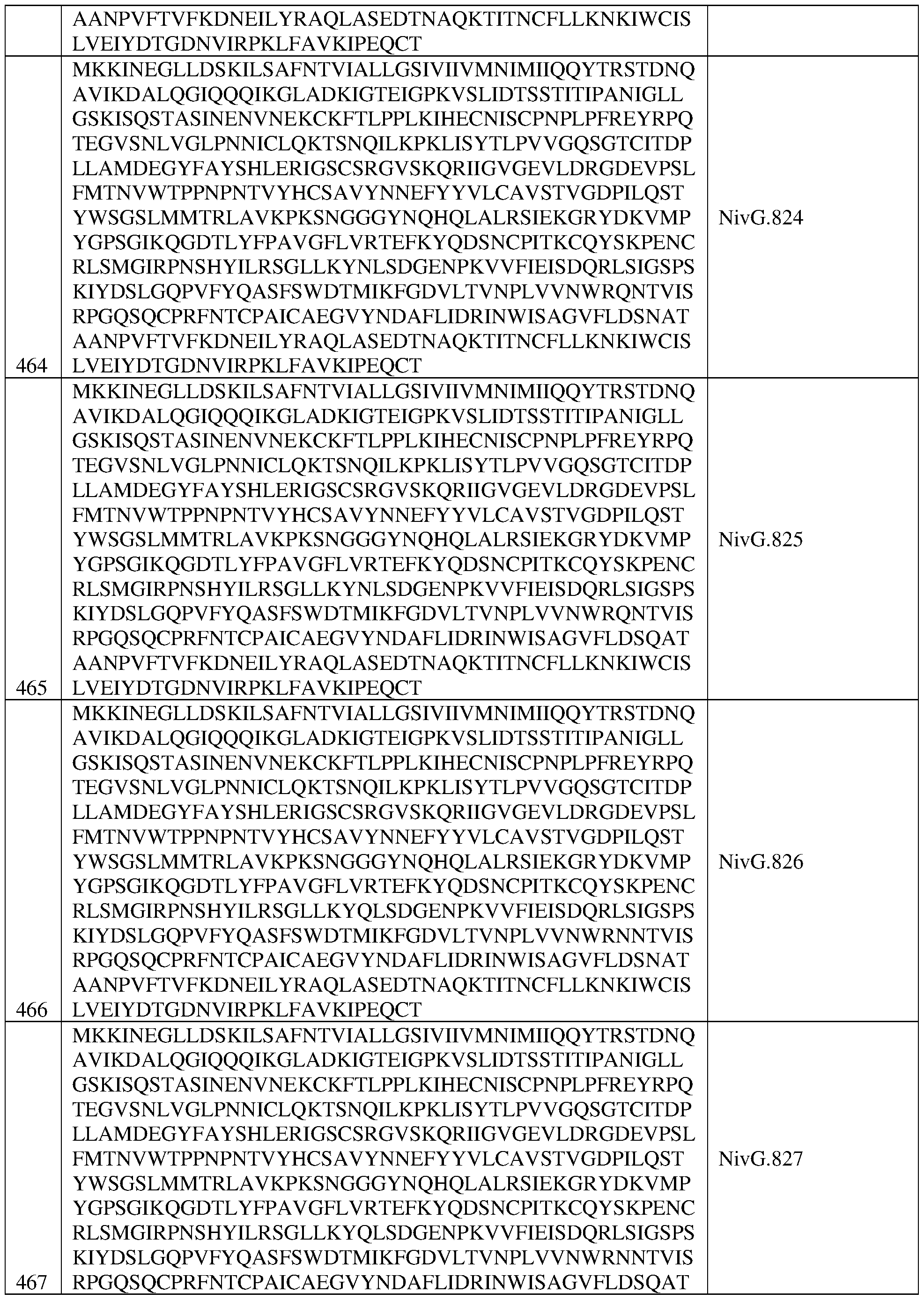

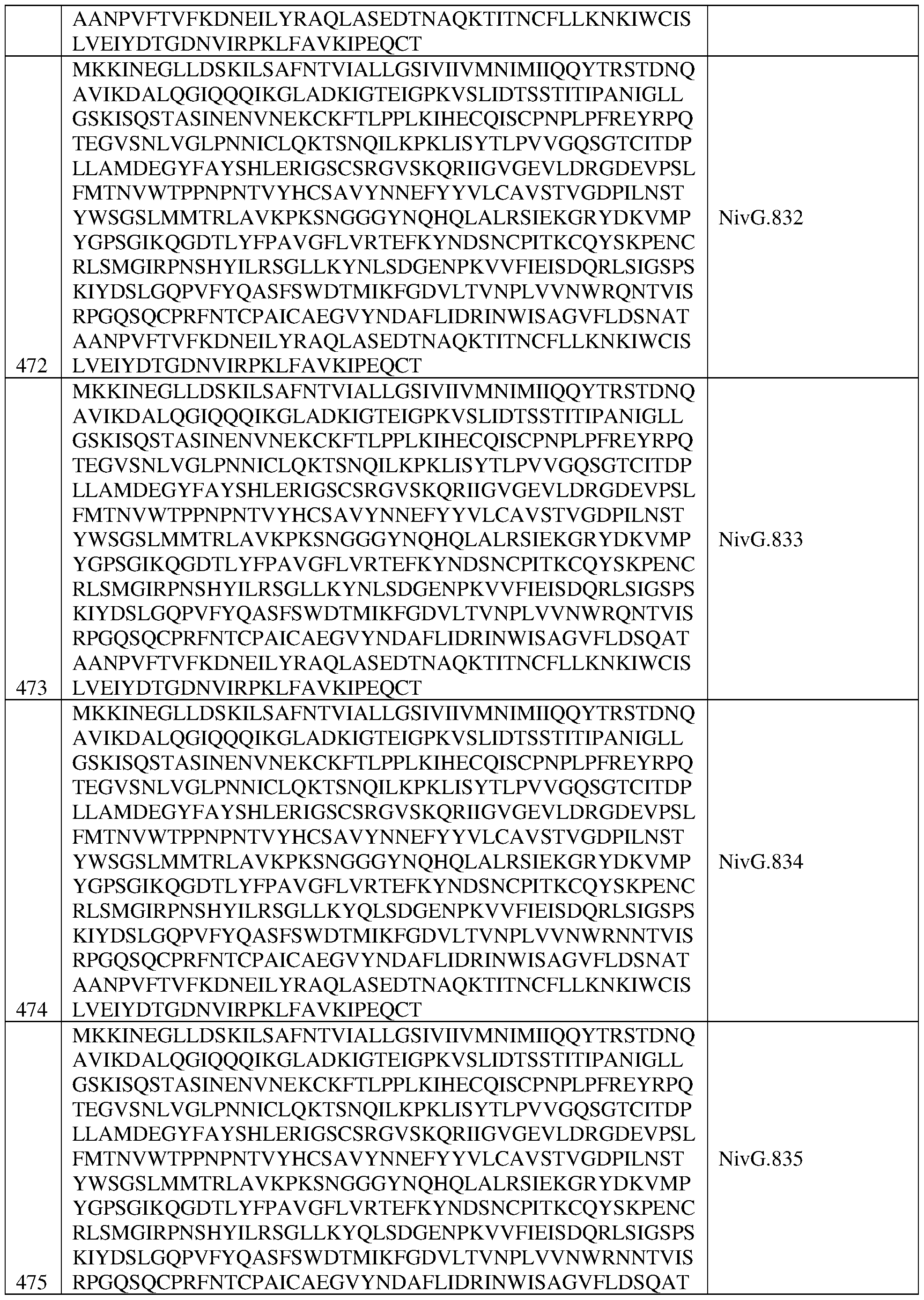
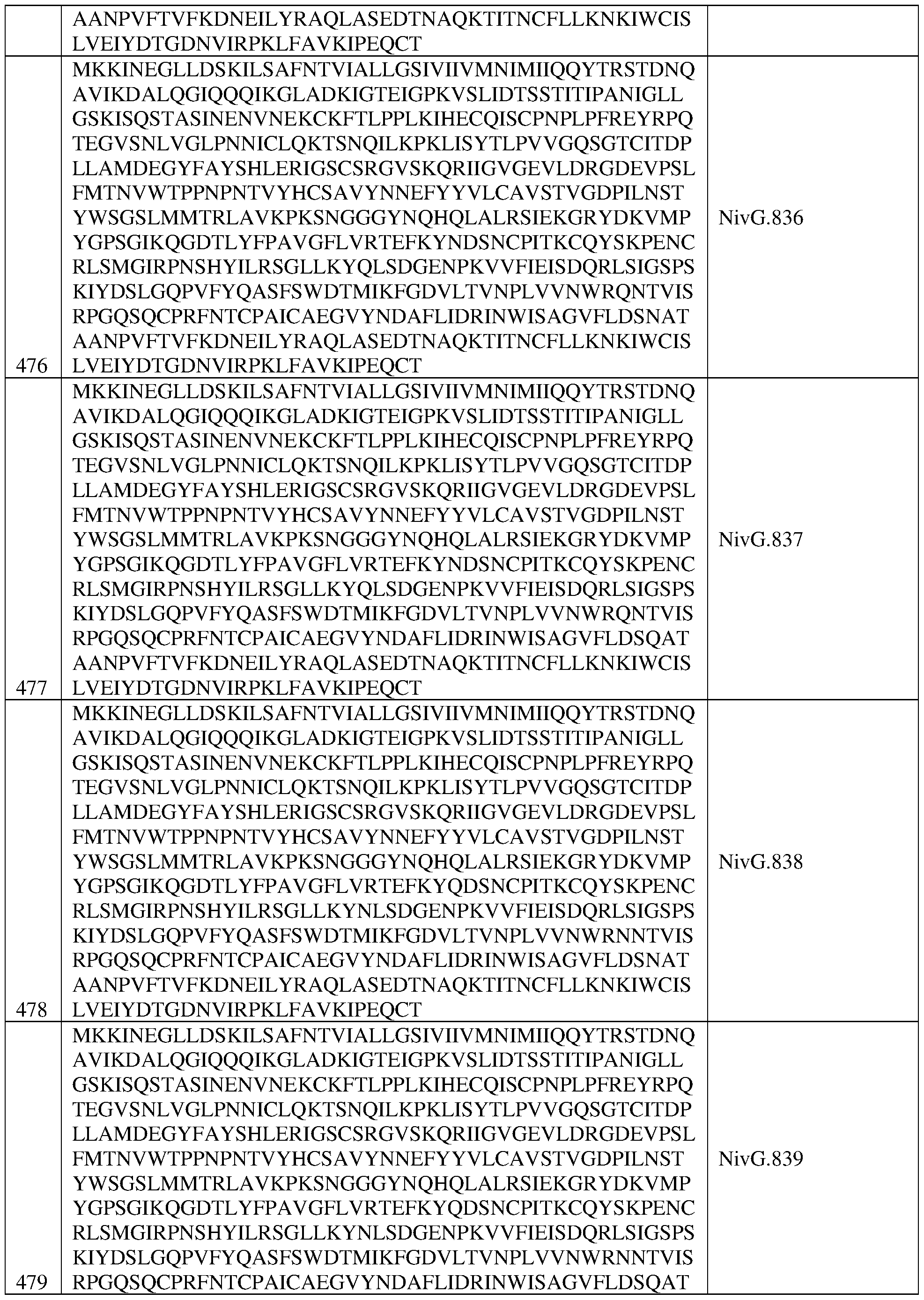
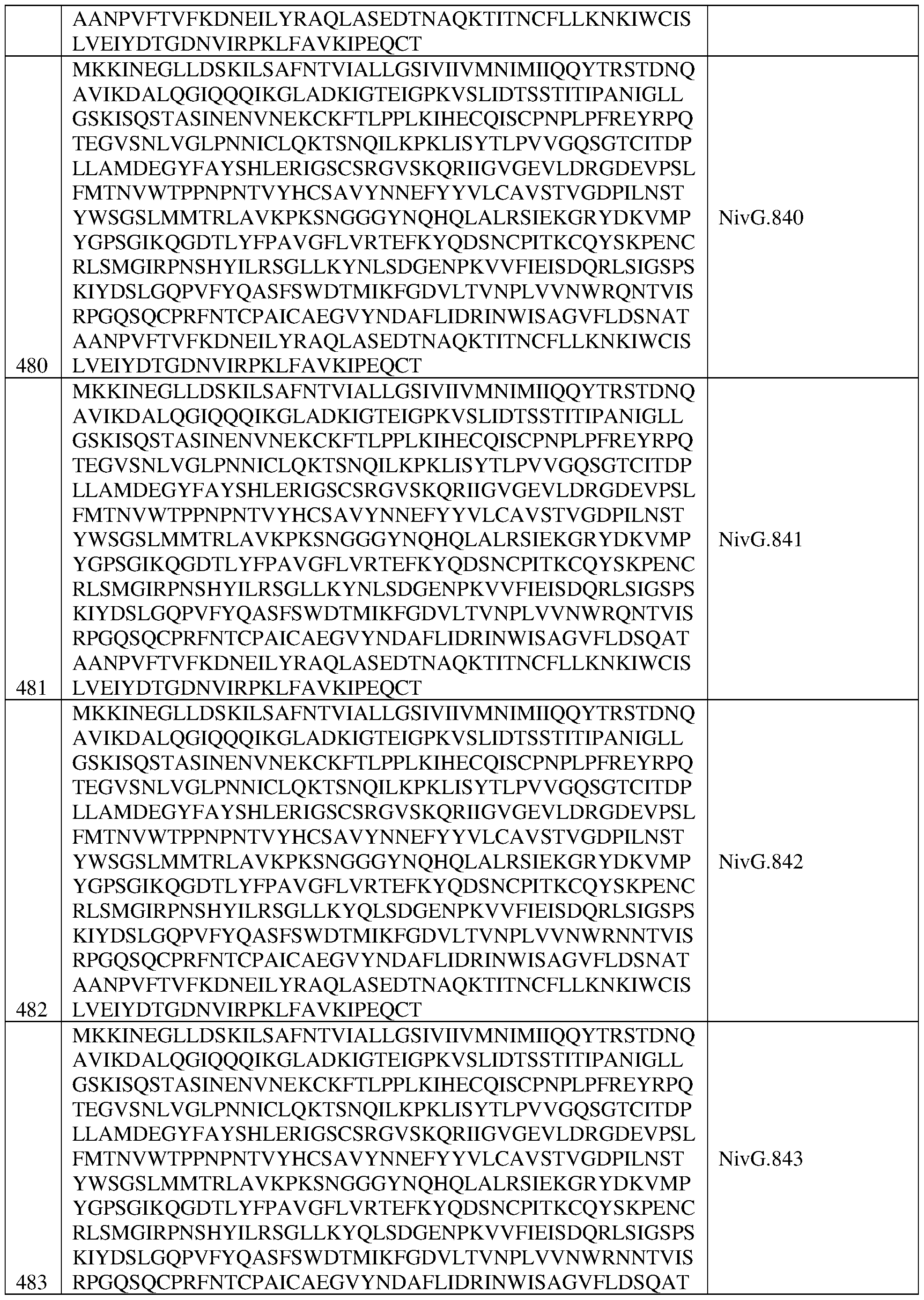
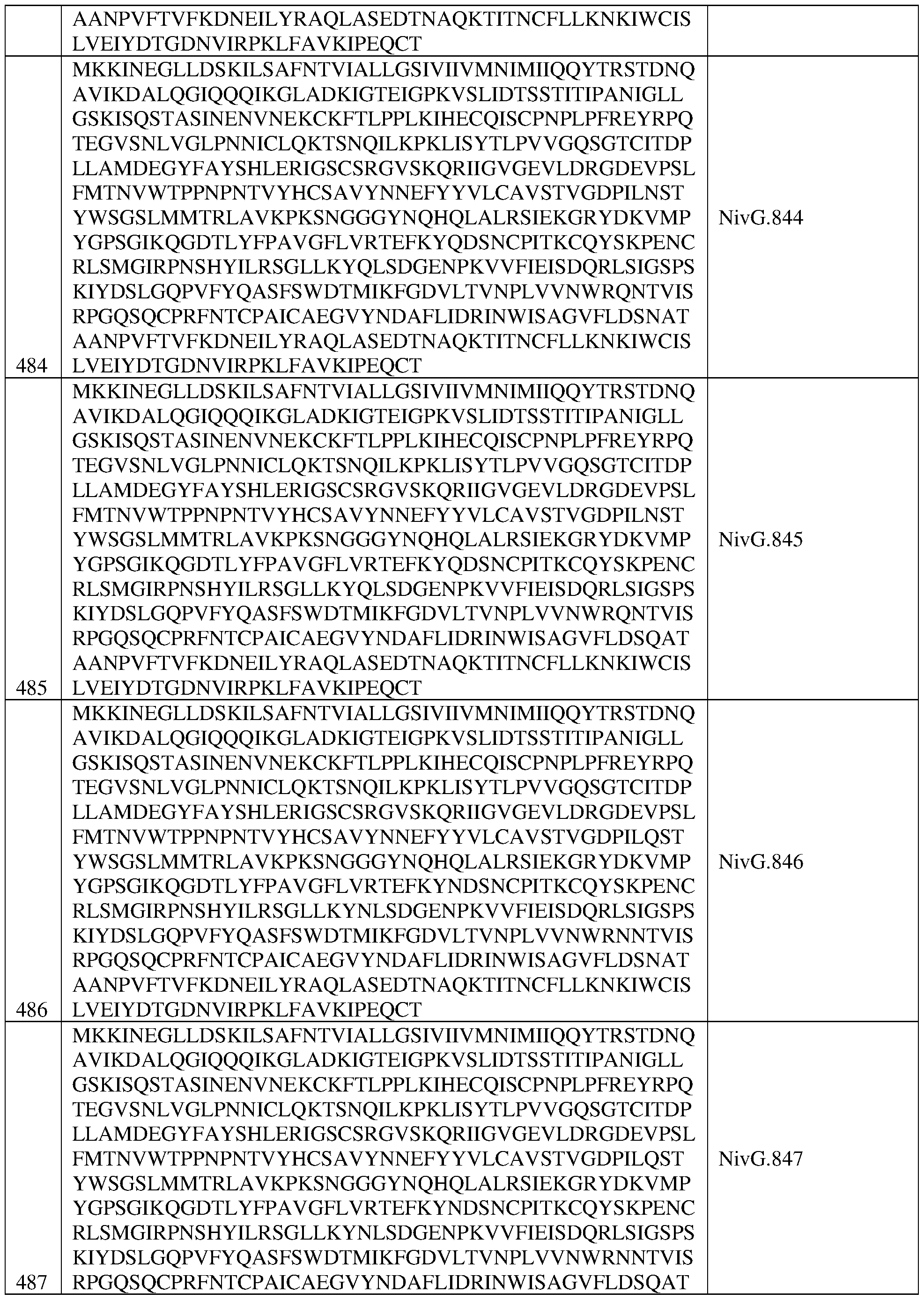

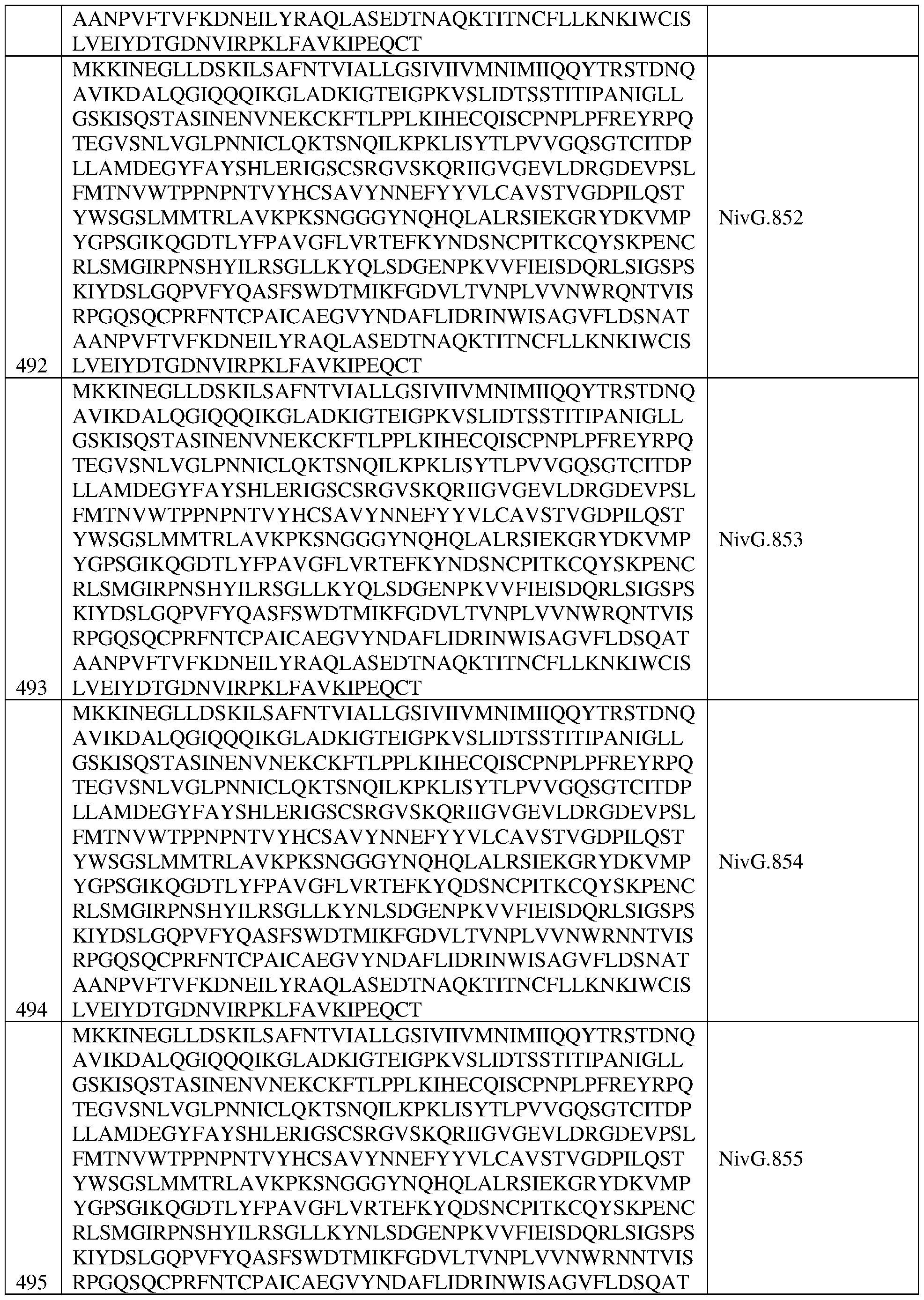


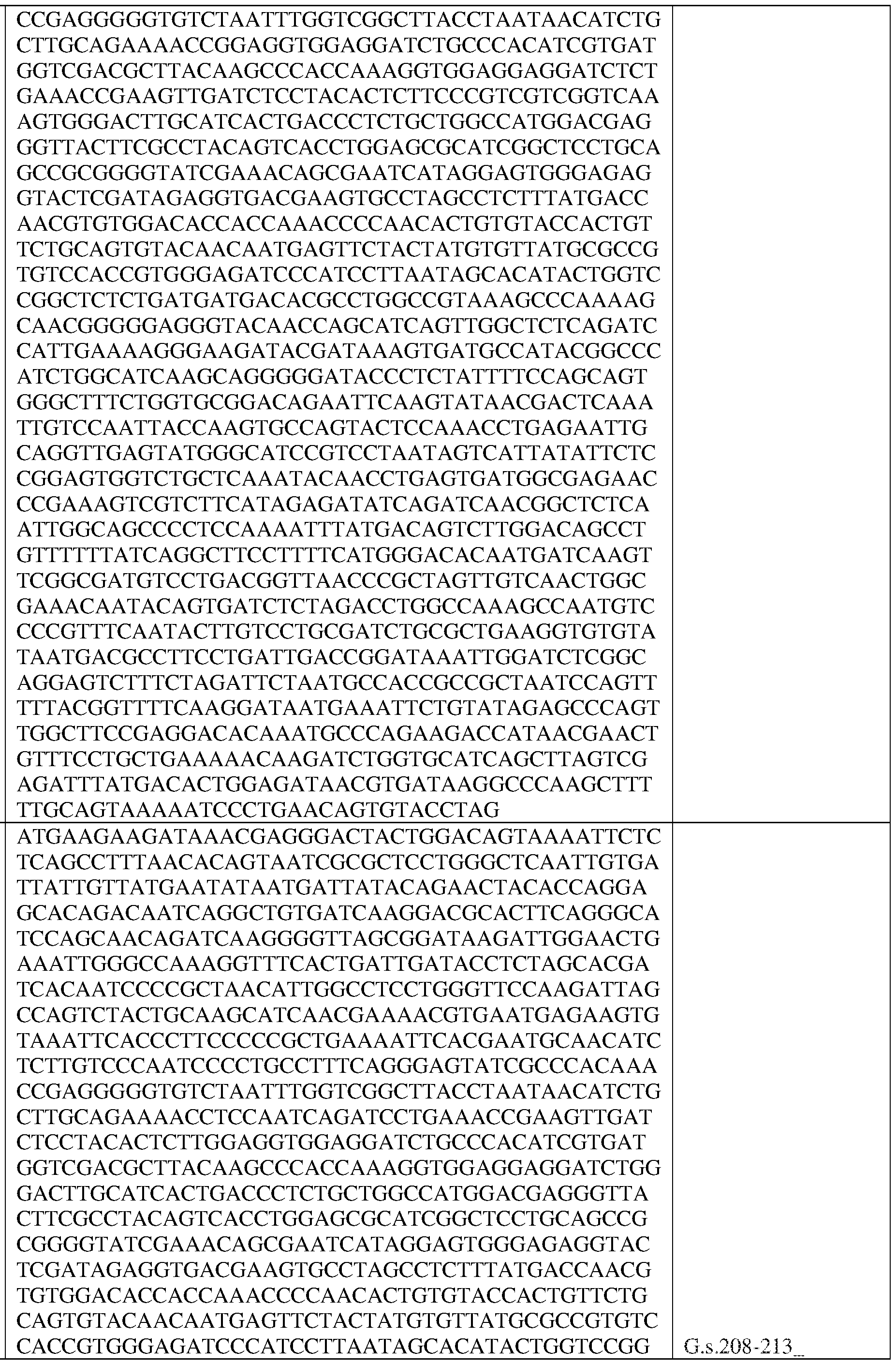
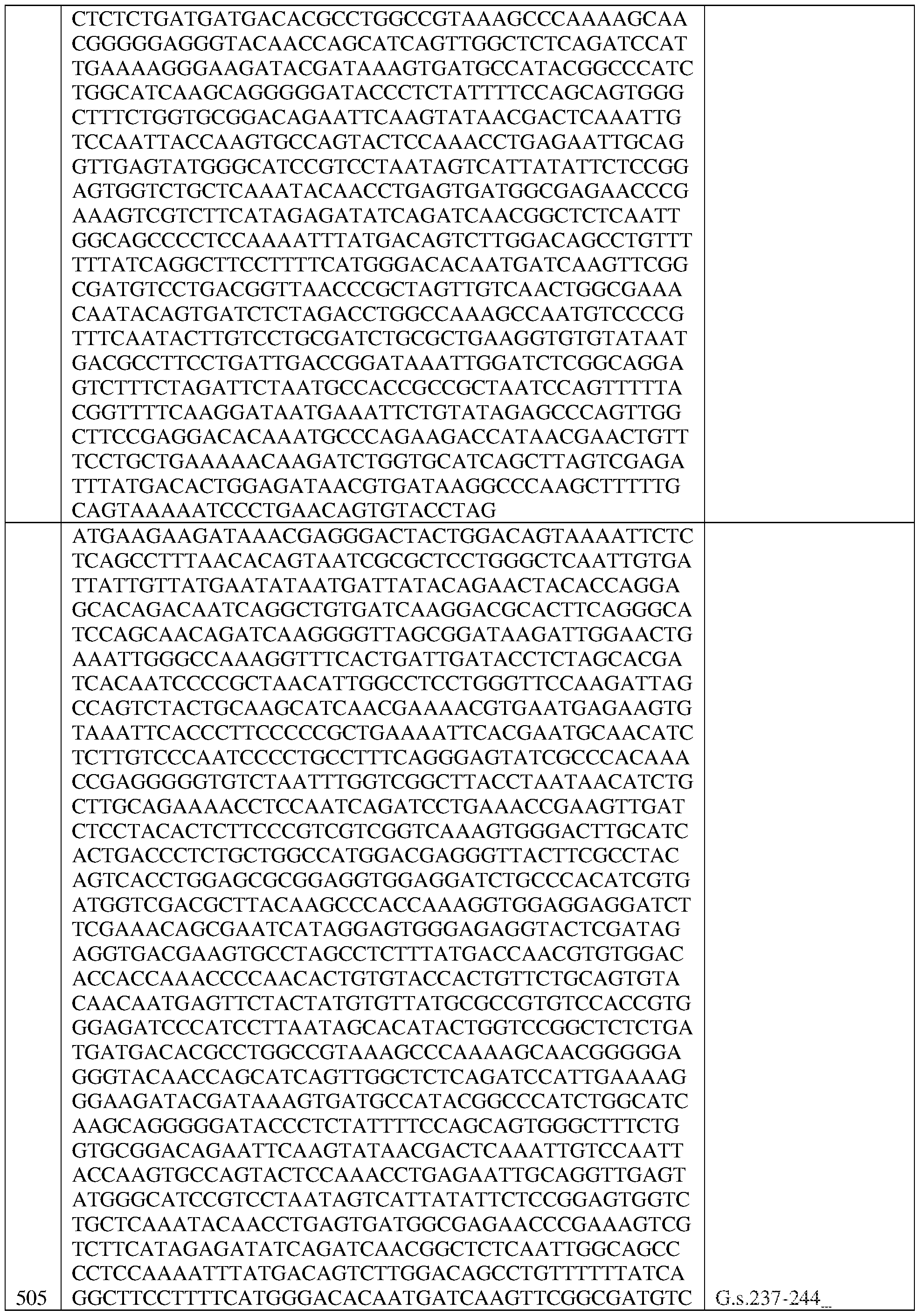

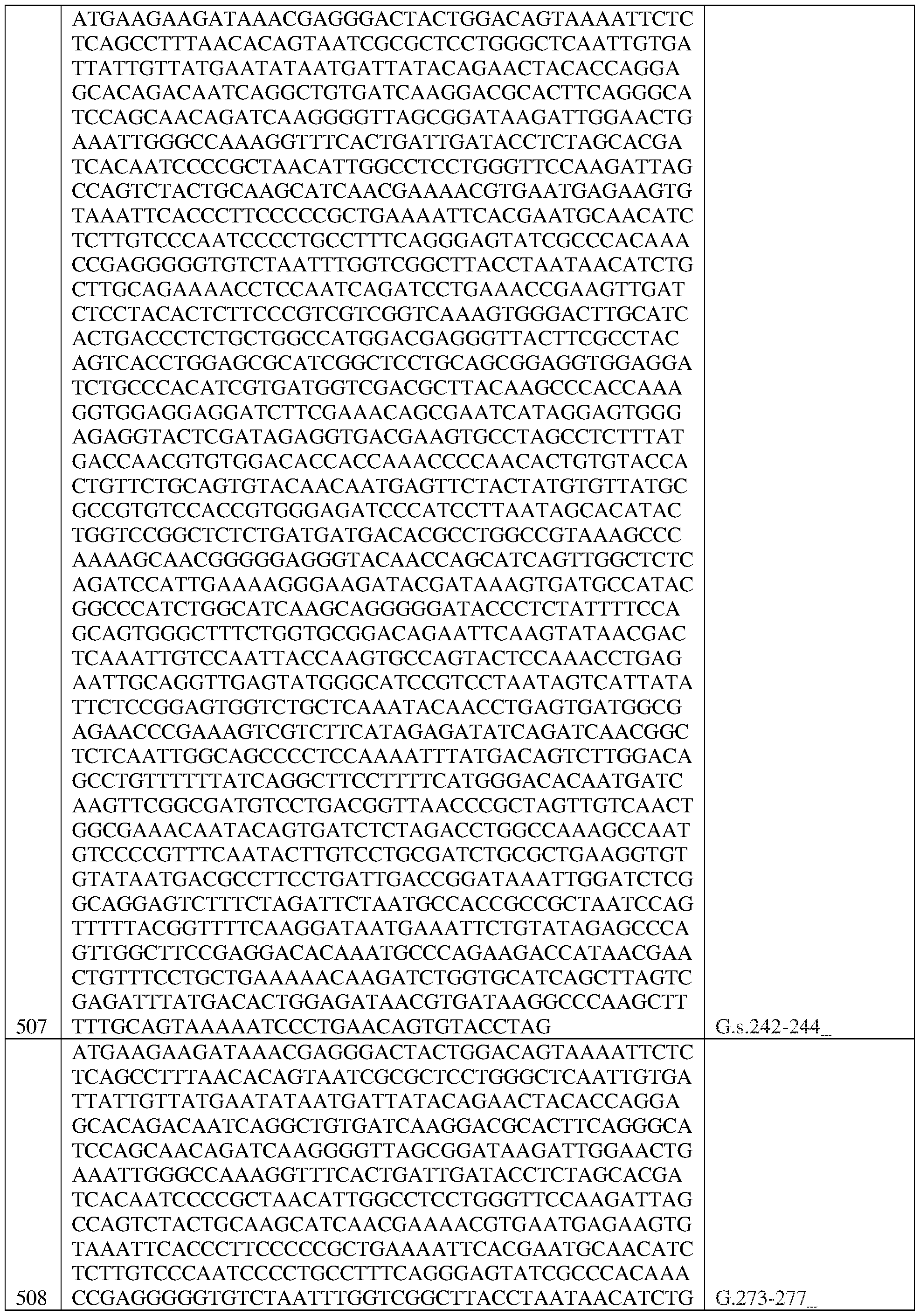


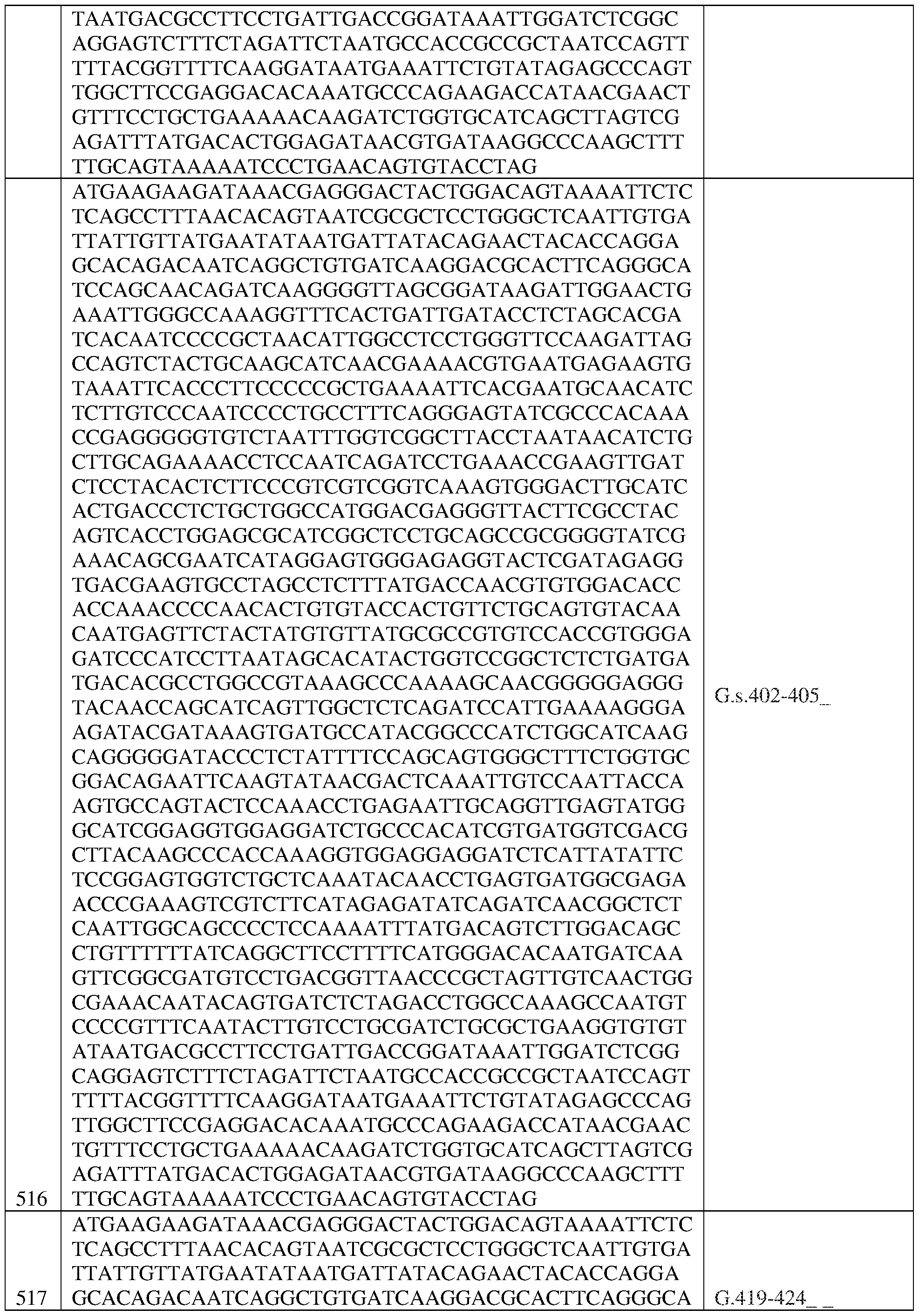







Claims
Applications Claiming Priority (4)
| Application Number | Priority Date | Filing Date | Title |
|---|---|---|---|
| US202363460302P | 2023-04-18 | 2023-04-18 | |
| US63/460,302 | 2023-04-18 | ||
| US202363522714P | 2023-06-22 | 2023-06-22 | |
| US63/522,714 | 2023-06-22 |
Publications (1)
| Publication Number | Publication Date |
|---|---|
| WO2024220560A1 true WO2024220560A1 (en) | 2024-10-24 |
Family
ID=91070273
Family Applications (1)
| Application Number | Title | Priority Date | Filing Date |
|---|---|---|---|
| PCT/US2024/025020 Pending WO2024220560A1 (en) | 2023-04-18 | 2024-04-17 | Engineered protein g fusogens and related lipid particles and methods thereof |
Country Status (1)
| Country | Link |
|---|---|
| WO (1) | WO2024220560A1 (en) |
Citations (101)
| Publication number | Priority date | Publication date | Assignee | Title |
|---|---|---|---|---|
| US5350674A (en) | 1992-09-04 | 1994-09-27 | Becton, Dickinson And Company | Intrinsic factor - horse peroxidase conjugates and a method for increasing the stability thereof |
| US5585362A (en) | 1989-08-22 | 1996-12-17 | The Regents Of The University Of Michigan | Adenovirus vectors for gene therapy |
| WO1998017815A1 (en) | 1996-10-17 | 1998-04-30 | Oxford Biomedica (Uk) Limited | Retroviral vectors |
| WO1999015683A1 (en) | 1997-09-25 | 1999-04-01 | Oxford Biomedica (Uk) Limited | Retroviral vectors comprising a functional splice donor site and a functional splice acceptor site |
| WO1999032646A1 (en) | 1997-12-22 | 1999-07-01 | Oxford Biomedica (Uk) Limited | Equine infectious anaemia virus (eiav) based |
| WO1999041397A1 (en) | 1998-02-17 | 1999-08-19 | Oxford Biomedica (Uk) Limited | Anti-viral vectors |
| US5994136A (en) | 1997-12-12 | 1999-11-30 | Cell Genesys, Inc. | Method and means for producing high titer, safe, recombinant lentivirus vectors |
| US6013516A (en) | 1995-10-06 | 2000-01-11 | The Salk Institute For Biological Studies | Vector and method of use for nucleic acid delivery to non-dividing cells |
| WO2000014257A1 (en) | 1998-09-04 | 2000-03-16 | Sloan-Kettering Institute For Cancer Research | Fusion receptors specific for prostate-specific membrane antigen and uses thereof |
| WO2001079518A2 (en) | 2000-04-19 | 2001-10-25 | Oxford Biomedica (Uk) Limited | Codon optimisation for expression in retrovirus packaging cells |
| US6410319B1 (en) | 1998-10-20 | 2002-06-25 | City Of Hope | CD20-specific redirected T cells and their use in cellular immunotherapy of CD20+ malignancies |
| US6451995B1 (en) | 1996-03-20 | 2002-09-17 | Sloan-Kettering Institute For Cancer Research | Single chain FV polynucleotide or peptide constructs of anti-ganglioside GD2 antibodies, cells expressing same and related methods |
| US20020131960A1 (en) | 2000-06-02 | 2002-09-19 | Michel Sadelain | Artificial antigen presenting cells and methods of use thereof |
| US20030077249A1 (en) | 1995-12-21 | 2003-04-24 | Christopher Robert Bebbington | Cell activation process and reagents therefor |
| US6682907B1 (en) | 1998-04-24 | 2004-01-27 | Institut Pasteur | Use of triplex structure DNA in transferring nucleotide sequences |
| US7070995B2 (en) | 2001-04-11 | 2006-07-04 | City Of Hope | CE7-specific redirected immune cells |
| US7355012B2 (en) | 2001-09-26 | 2008-04-08 | United States Of America As Represented By The Secretary Of The Department Of Health And Human Services | Mutated anti-CD22 antibodies with increased affinity to CD22-expressing leukemia cells |
| US7446190B2 (en) | 2002-05-28 | 2008-11-04 | Sloan-Kettering Institute For Cancer Research | Nucleic acids encoding chimeric T cell receptors |
| US7446179B2 (en) | 2000-11-07 | 2008-11-04 | City Of Hope | CD19-specific chimeric T cell receptor |
| US7541034B1 (en) | 1997-03-20 | 2009-06-02 | The United States Of America As Represented By The Department Of Health And Human Services | Recombinant antibodies and immunoconjugates targeted to CD-22 bearing cells and tumors |
| WO2010104949A2 (en) | 2009-03-10 | 2010-09-16 | Biogen Idec Ma Inc. | Anti-bcma antibodies |
| WO2011058052A1 (en) | 2009-11-13 | 2011-05-19 | INSERM (Institut National de la Santé et de la Recherche Médicale) | Direct protein delivery with engineered microvesicles |
| US7982011B2 (en) | 2003-11-25 | 2011-07-19 | The United States Of America As Represented By The Secretary Of The Department Of Health And Human Services | Mutated anti-cd22 antibodies and immunoconjugates |
| WO2012079000A1 (en) | 2010-12-09 | 2012-06-14 | The Trustees Of The University Of Pennsylvania | Use of chimeric antigen receptor-modified t cells to treat cancer |
| WO2012129514A1 (en) | 2011-03-23 | 2012-09-27 | Fred Hutchinson Cancer Research Center | Method and compositions for cellular immunotherapy |
| US8324353B2 (en) | 2001-04-30 | 2012-12-04 | City Of Hope | Chimeric immunoreceptor useful in treating human gliomas |
| WO2012163805A1 (en) | 2011-05-27 | 2012-12-06 | Glaxo Group Limited | Bcma (cd269/tnfrsf17) -binding proteins |
| US8339645B2 (en) | 2008-05-27 | 2012-12-25 | Canon Kabushiki Kaisha | Managing apparatus, image processing apparatus, and processing method for the same, wherein a first user stores a temporary object having attribute information specified but not partial-area data, at a later time an object is received from a second user that includes both partial-area data and attribute information, the storage unit is searched for the temporary object that matches attribute information of the received object, and the first user is notified in response to a match |
| EP2537416A1 (en) | 2007-03-30 | 2012-12-26 | Memorial Sloan-Kettering Cancer Center | Constitutive expression of costimulatory ligands on adoptively transferred T lymphocytes |
| US8398282B2 (en) | 2011-05-12 | 2013-03-19 | Delphi Technologies, Inc. | Vehicle front lighting assembly and systems having a variable tint electrowetting element |
| WO2013040557A2 (en) | 2011-09-16 | 2013-03-21 | The Trustees Of The University Of Pennsylvania | Rna engineered t cells for the treatment of cancer |
| WO2013071154A1 (en) | 2011-11-11 | 2013-05-16 | Fred Hutchinson Cancer Research Center | Cyclin a1-targeted t-cell immunotherapy for cancer |
| US20130149337A1 (en) | 2003-03-11 | 2013-06-13 | City Of Hope | Method of controlling administration of cancer antigen |
| US8479118B2 (en) | 2007-12-10 | 2013-07-02 | Microsoft Corporation | Switching search providers within a browser search box |
| WO2013123061A1 (en) | 2012-02-13 | 2013-08-22 | Seattle Children's Hospital D/B/A Seattle Children's Research Institute | Bispecific chimeric antigen receptors and therapeutic uses thereof |
| WO2013126726A1 (en) | 2012-02-22 | 2013-08-29 | The Trustees Of The University Of Pennsylvania | Double transgenic t cells comprising a car and a tcr and their methods of use |
| WO2013148327A1 (en) | 2012-03-26 | 2013-10-03 | The Regents Of The University Of California | Nipah virus envelope psuedotyped lentiviruses and methods of their use |
| WO2013166321A1 (en) | 2012-05-03 | 2013-11-07 | Fred Hutchinson Cancer Research Center | Enhanced affinity t cell receptors and methods for making the same |
| WO2014031687A1 (en) | 2012-08-20 | 2014-02-27 | Jensen, Michael | Method and compositions for cellular immunotherapy |
| US20140080216A1 (en) | 2012-08-29 | 2014-03-20 | Sangamo Biosciences, Inc. | Methods and compositions for treatment of a genetic condition |
| WO2014055668A1 (en) | 2012-10-02 | 2014-04-10 | Memorial Sloan-Kettering Cancer Center | Compositions and methods for immunotherapy |
| US20140170753A1 (en) | 2012-12-12 | 2014-06-19 | Massachusetts Institute Of Technology | Crispr-cas systems and methods for altering expression of gene products |
| US20140179006A1 (en) | 2012-12-12 | 2014-06-26 | Massachusetts Institute Of Technology | Crispr-cas component systems, methods and compositions for sequence manipulation |
| US20140179770A1 (en) | 2012-12-12 | 2014-06-26 | Massachusetts Institute Of Technology | Delivery, engineering and optimization of systems, methods and compositions for sequence manipulation and therapeutic applications |
| US20140186919A1 (en) | 2012-12-12 | 2014-07-03 | Feng Zhang | Engineering and optimization of improved systems, methods and enzyme compositions for sequence manipulation |
| US20140186843A1 (en) | 2012-12-12 | 2014-07-03 | Massachusetts Institute Of Technology | Methods, systems, and apparatus for identifying target sequences for cas enzymes or crispr-cas systems for target sequences and conveying results thereof |
| US20140186958A1 (en) | 2012-12-12 | 2014-07-03 | Feng Zhang | Engineering and optimization of systems, methods and compositions for sequence manipulation with functional domains |
| US20140234972A1 (en) | 2012-12-12 | 2014-08-21 | Massachusetts Institute Of Technology | CRISPR-CAS Nickase Systems, Methods And Compositions For Sequence Manipulation in Eukaryotes |
| US20140242664A1 (en) | 2012-12-12 | 2014-08-28 | The Broad Institute, Inc. | Engineering of systems, methods and optimized guide compositions for sequence manipulation |
| US8822647B2 (en) | 2008-08-26 | 2014-09-02 | City Of Hope | Method and compositions using a chimeric antigen receptor for enhanced anti-tumor effector functioning of T cells |
| US20140271635A1 (en) | 2013-03-16 | 2014-09-18 | The Trustees Of The University Of Pennsylvania | Treatment of cancer using humanized anti-cd19 chimeric antigen receptor |
| US20140357530A1 (en) | 2012-12-12 | 2014-12-04 | The Broad Institute Inc. | Functional genomics using crispr-cas systems, compositions, methods, knock out libraries and applications thereof |
| US20150056705A1 (en) | 2013-05-15 | 2015-02-26 | Sangamo Biosciences, Inc. | Methods and compositions for treatment of a genetic condition |
| US20150073041A1 (en) | 2011-12-02 | 2015-03-12 | Yale University | Formulations for targeted release of agents to low ph tissue environments or cellular compartments and methods of use thereof |
| WO2015161276A2 (en) | 2014-04-18 | 2015-10-22 | Editas Medicine, Inc. | Crispr-cas-related methods, compositions and components for cancer immunotherapy |
| WO2016030414A1 (en) | 2014-08-29 | 2016-03-03 | Gemoab Monoclonals Gmbh | Universal chimeric antigen receptor expressing immune cells for targeting of diverse multiple antigens and method of manufacturing the same and use of the same for treatment of cancer, infections and autoimmune disorders |
| US20160152723A1 (en) | 2014-08-28 | 2016-06-02 | Juno Therapeutics, Inc. | Antibodies and chimeric antigen receptors specific for cd19 |
| WO2016126608A1 (en) | 2015-02-02 | 2016-08-11 | Novartis Ag | Car-expressing cells against multiple tumor antigens and uses thereof |
| WO2016149578A1 (en) | 2015-03-19 | 2016-09-22 | The United States Of America, As Represented By The Secretary, Department Of Health And Human Services | Dual specific anti-cd22-anti-cd19 chimeric antigen receptors |
| WO2017058753A1 (en) | 2015-09-28 | 2017-04-06 | Trustees Of Dartmouth College | Chimeric antigen receptor, regulatory cells and methods of use |
| WO2017058850A1 (en) | 2015-09-28 | 2017-04-06 | Regents Of The University Of Minnesota | Chimeric antigen receptor (car) t cells as therapeutic interventions for auto- and allo-immunity |
| WO2017068077A1 (en) | 2015-10-20 | 2017-04-27 | Institut National De La Sante Et De La Recherche Medicale (Inserm) | Methods and products for genetic engineering |
| WO2017093969A1 (en) | 2015-12-04 | 2017-06-08 | Novartis Ag | Compositions and methods for immunooncology |
| WO2017095946A1 (en) | 2015-11-30 | 2017-06-08 | Flagship Pioneering, Inc. | Methods and compositions relating to chondrisomes |
| WO2017182585A1 (en) | 2016-04-21 | 2017-10-26 | Ecole Normale Superieure De Lyon | Methods for selectively modulating the activity of distinct subtypes of cells |
| WO2017193107A2 (en) | 2016-05-06 | 2017-11-09 | Juno Therapeutics, Inc. | Genetically engineered cells and methods of making the same |
| WO2018028647A1 (en) | 2015-08-11 | 2018-02-15 | Legend Biotech Usa Inc. | Chimeric antigen receptors targeting bcma and methods of use thereof |
| WO2018208728A1 (en) | 2017-05-08 | 2018-11-15 | Flagship Pioneering, Inc. | Compositions for facilitating membrane fusion and uses thereof |
| WO2018213337A1 (en) | 2017-05-15 | 2018-11-22 | The United States Of America, As Represented By The Secretary, Department Of Health And Human Services | Bicistronic chimeric antigen receptors and their uses |
| WO2019006072A1 (en) | 2017-06-30 | 2019-01-03 | The United States Of America, As Represented By The Secretary, Department Of Health And Human Services | Anti-b-cell maturation antigen chimeric antigen receptors with human domains |
| US10316295B2 (en) | 2015-12-17 | 2019-06-11 | The Penn State Research Foundation | Paramyxovirus virus-like particles as protein delivery vehicles |
| WO2019113512A1 (en) | 2017-12-07 | 2019-06-13 | Flagship Pioneering Innovations V, Inc. | Cytobiologics and therapeutic uses thereof |
| WO2019126709A1 (en) | 2017-12-22 | 2019-06-27 | The Broad Institute, Inc. | Cas12b systems, methods, and compositions for targeted dna base editing |
| WO2019157319A1 (en) | 2018-02-12 | 2019-08-15 | Flagship Pioneering Innovations V, Inc. | Devices and methods for delivering material into a biological tissue or cell |
| WO2019161281A1 (en) | 2018-02-17 | 2019-08-22 | Flagship Pioneering Innovations V, Inc. | Compositions and methods for membrane protein delivery |
| WO2019222403A2 (en) | 2018-05-15 | 2019-11-21 | Flagship Pioneering Innovations V, Inc. | Fusosome compositions and uses thereof |
| WO2020014482A1 (en) | 2018-07-12 | 2020-01-16 | The United States Of America, As Represented By The Secretary, Department Of Health And Human Services | Affinity matured cd22-specific monoclonal antibody and uses thereof |
| WO2020014209A1 (en) | 2018-07-09 | 2020-01-16 | Flagship Pioneering Innovations V, Inc. | Fusosome compositions and uses thereof |
| WO2020102578A1 (en) | 2018-11-14 | 2020-05-22 | Flagship Pioneering Innovations V, Inc | Compositions and methods for compartment-specific cargo delivery |
| WO2020102503A2 (en) | 2018-11-14 | 2020-05-22 | Flagship Pioneering Innovations V, Inc. | Fusosome compositions for t cell delivery |
| WO2020102499A2 (en) | 2018-11-14 | 2020-05-22 | Flagship Pioneering Innovations V, Inc. | Fusosome compositions for cns delivery |
| WO2020102485A1 (en) | 2018-11-14 | 2020-05-22 | Flagship Pioneering Innovations V, Inc. | Fusosome compositions for hematopoietic stem cell delivery |
| US20200248169A1 (en) | 2017-06-26 | 2020-08-06 | The Broad Institute, Inc. | Crispr/cas-cytidine deaminase based compositions, systems, and methods for targeted nucleic acid editing |
| US20200246381A1 (en) | 2018-02-01 | 2020-08-06 | Nanjing Iaso Biotherapeutics Co., Ltd. | Chimeric antigen receptor (car) binding to bcma, and uses thereof |
| WO2020181178A1 (en) | 2019-03-06 | 2020-09-10 | The Broad Institute, Inc. | T:a to a:t base editing through thymine alkylation |
| WO2020181202A1 (en) | 2019-03-06 | 2020-09-10 | The Broad Institute, Inc. | A:t to t:a base editing through adenine deamination and oxidation |
| WO2020181195A1 (en) | 2019-03-06 | 2020-09-10 | The Broad Institute, Inc. | T:a to a:t base editing through adenine excision |
| WO2020181193A1 (en) | 2019-03-06 | 2020-09-10 | The Broad Institute, Inc. | T:a to a:t base editing through adenosine methylation |
| WO2020191248A1 (en) | 2019-03-19 | 2020-09-24 | The Broad Institute, Inc. | Method and compositions for editing nucleotide sequences |
| WO2020214842A1 (en) | 2019-04-17 | 2020-10-22 | The Broad Institute, Inc. | Adenine base editors with reduced off-target effects |
| US20200339699A1 (en) | 2018-02-01 | 2020-10-29 | Innovent Biologics (Suzhou) Co., Ltd. | Fully humanized anti-b cell maturation antigen (bcma) single-chain antibody and use thereof |
| US20210071163A1 (en) | 2017-12-22 | 2021-03-11 | The Broad Institute, Inc. | Cas12b systems, methods, and compositions for targeted rna base editing |
| US20210079366A1 (en) | 2017-12-22 | 2021-03-18 | The Broad Institute, Inc. | Cas12a systems, methods, and compositions for targeted rna base editing |
| US20210093667A1 (en) | 2017-06-26 | 2021-04-01 | The Broad Institute, Inc. | Crispr/cas-adenine deaminase based compositions, systems, and methods for targeted nucleic acid editing |
| US11026975B2 (en) | 2018-02-01 | 2021-06-08 | Nanjing Iaso Biotherapeutics Co., Ltd. | Chimeric antigen receptor (CAR) binding to BCMA, and uses thereof |
| WO2021158921A2 (en) | 2020-02-05 | 2021-08-12 | The Broad Institute, Inc. | Adenine base editors and uses thereof |
| WO2021202604A1 (en) * | 2020-03-31 | 2021-10-07 | Sana Biotechnology, Inc. | Targeted lipid particles and compositions and uses thereof |
| WO2021226558A1 (en) | 2020-05-08 | 2021-11-11 | The Broad Institute, Inc. | Methods and compositions for simultaneous editing of both strands of a target double-stranded nucleotide sequence |
| WO2022067130A2 (en) | 2020-09-24 | 2022-03-31 | The Broad Institute, Inc. | Prime editing guide rnas, compositions thereof, and methods of using the same |
| US20220127622A1 (en) | 2018-09-07 | 2022-04-28 | Beam Therapeutics Inc. | Compositions and Methods for Improving Base Editing |
| WO2022216915A1 (en) * | 2021-04-08 | 2022-10-13 | Sana Biotechnology, Inc. | Cd8-specific antibody constructs and compositions thereof |
-
2024
- 2024-04-17 WO PCT/US2024/025020 patent/WO2024220560A1/en active Pending
Patent Citations (126)
| Publication number | Priority date | Publication date | Assignee | Title |
|---|---|---|---|---|
| US5585362A (en) | 1989-08-22 | 1996-12-17 | The Regents Of The University Of Michigan | Adenovirus vectors for gene therapy |
| US5350674A (en) | 1992-09-04 | 1994-09-27 | Becton, Dickinson And Company | Intrinsic factor - horse peroxidase conjugates and a method for increasing the stability thereof |
| US6013516A (en) | 1995-10-06 | 2000-01-11 | The Salk Institute For Biological Studies | Vector and method of use for nucleic acid delivery to non-dividing cells |
| US20030077249A1 (en) | 1995-12-21 | 2003-04-24 | Christopher Robert Bebbington | Cell activation process and reagents therefor |
| US6451995B1 (en) | 1996-03-20 | 2002-09-17 | Sloan-Kettering Institute For Cancer Research | Single chain FV polynucleotide or peptide constructs of anti-ganglioside GD2 antibodies, cells expressing same and related methods |
| WO1998017815A1 (en) | 1996-10-17 | 1998-04-30 | Oxford Biomedica (Uk) Limited | Retroviral vectors |
| US7541034B1 (en) | 1997-03-20 | 2009-06-02 | The United States Of America As Represented By The Department Of Health And Human Services | Recombinant antibodies and immunoconjugates targeted to CD-22 bearing cells and tumors |
| WO1999015683A1 (en) | 1997-09-25 | 1999-04-01 | Oxford Biomedica (Uk) Limited | Retroviral vectors comprising a functional splice donor site and a functional splice acceptor site |
| US5994136A (en) | 1997-12-12 | 1999-11-30 | Cell Genesys, Inc. | Method and means for producing high titer, safe, recombinant lentivirus vectors |
| WO1999032646A1 (en) | 1997-12-22 | 1999-07-01 | Oxford Biomedica (Uk) Limited | Equine infectious anaemia virus (eiav) based |
| WO1999041397A1 (en) | 1998-02-17 | 1999-08-19 | Oxford Biomedica (Uk) Limited | Anti-viral vectors |
| US6682907B1 (en) | 1998-04-24 | 2004-01-27 | Institut Pasteur | Use of triplex structure DNA in transferring nucleotide sequences |
| WO2000014257A1 (en) | 1998-09-04 | 2000-03-16 | Sloan-Kettering Institute For Cancer Research | Fusion receptors specific for prostate-specific membrane antigen and uses thereof |
| US6410319B1 (en) | 1998-10-20 | 2002-06-25 | City Of Hope | CD20-specific redirected T cells and their use in cellular immunotherapy of CD20+ malignancies |
| WO2001079518A2 (en) | 2000-04-19 | 2001-10-25 | Oxford Biomedica (Uk) Limited | Codon optimisation for expression in retrovirus packaging cells |
| US20020131960A1 (en) | 2000-06-02 | 2002-09-19 | Michel Sadelain | Artificial antigen presenting cells and methods of use thereof |
| US7446179B2 (en) | 2000-11-07 | 2008-11-04 | City Of Hope | CD19-specific chimeric T cell receptor |
| US7265209B2 (en) | 2001-04-11 | 2007-09-04 | City Of Hope | CE7-specific chimeric T cell receptor |
| US7354762B2 (en) | 2001-04-11 | 2008-04-08 | City Of Hope | Method for producing CE7-specific redirected immune cells |
| US7446191B2 (en) | 2001-04-11 | 2008-11-04 | City Of Hope | DNA construct encoding CE7-specific chimeric T cell receptor |
| US7070995B2 (en) | 2001-04-11 | 2006-07-04 | City Of Hope | CE7-specific redirected immune cells |
| US8324353B2 (en) | 2001-04-30 | 2012-12-04 | City Of Hope | Chimeric immunoreceptor useful in treating human gliomas |
| US7355012B2 (en) | 2001-09-26 | 2008-04-08 | United States Of America As Represented By The Secretary Of The Department Of Health And Human Services | Mutated anti-CD22 antibodies with increased affinity to CD22-expressing leukemia cells |
| US7446190B2 (en) | 2002-05-28 | 2008-11-04 | Sloan-Kettering Institute For Cancer Research | Nucleic acids encoding chimeric T cell receptors |
| US20130149337A1 (en) | 2003-03-11 | 2013-06-13 | City Of Hope | Method of controlling administration of cancer antigen |
| US7982011B2 (en) | 2003-11-25 | 2011-07-19 | The United States Of America As Represented By The Secretary Of The Department Of Health And Human Services | Mutated anti-cd22 antibodies and immunoconjugates |
| EP2537416A1 (en) | 2007-03-30 | 2012-12-26 | Memorial Sloan-Kettering Cancer Center | Constitutive expression of costimulatory ligands on adoptively transferred T lymphocytes |
| US8389282B2 (en) | 2007-03-30 | 2013-03-05 | Memorial Sloan-Kettering Cancer Center | Constitutive expression of costimulatory ligands on adoptively transferred T lymphocytes |
| US8479118B2 (en) | 2007-12-10 | 2013-07-02 | Microsoft Corporation | Switching search providers within a browser search box |
| US8339645B2 (en) | 2008-05-27 | 2012-12-25 | Canon Kabushiki Kaisha | Managing apparatus, image processing apparatus, and processing method for the same, wherein a first user stores a temporary object having attribute information specified but not partial-area data, at a later time an object is received from a second user that includes both partial-area data and attribute information, the storage unit is searched for the temporary object that matches attribute information of the received object, and the first user is notified in response to a match |
| US8822647B2 (en) | 2008-08-26 | 2014-09-02 | City Of Hope | Method and compositions using a chimeric antigen receptor for enhanced anti-tumor effector functioning of T cells |
| WO2010104949A2 (en) | 2009-03-10 | 2010-09-16 | Biogen Idec Ma Inc. | Anti-bcma antibodies |
| WO2011058052A1 (en) | 2009-11-13 | 2011-05-19 | INSERM (Institut National de la Santé et de la Recherche Médicale) | Direct protein delivery with engineered microvesicles |
| US20130287748A1 (en) | 2010-12-09 | 2013-10-31 | The Trustees Of The University Of Pennsylvania | Use of Chimeric Antigen Receptor-Modified T-Cells to Treat Cancer |
| WO2012079000A1 (en) | 2010-12-09 | 2012-06-14 | The Trustees Of The University Of Pennsylvania | Use of chimeric antigen receptor-modified t cells to treat cancer |
| WO2012129514A1 (en) | 2011-03-23 | 2012-09-27 | Fred Hutchinson Cancer Research Center | Method and compositions for cellular immunotherapy |
| US8398282B2 (en) | 2011-05-12 | 2013-03-19 | Delphi Technologies, Inc. | Vehicle front lighting assembly and systems having a variable tint electrowetting element |
| WO2012163805A1 (en) | 2011-05-27 | 2012-12-06 | Glaxo Group Limited | Bcma (cd269/tnfrsf17) -binding proteins |
| WO2013040557A2 (en) | 2011-09-16 | 2013-03-21 | The Trustees Of The University Of Pennsylvania | Rna engineered t cells for the treatment of cancer |
| WO2013071154A1 (en) | 2011-11-11 | 2013-05-16 | Fred Hutchinson Cancer Research Center | Cyclin a1-targeted t-cell immunotherapy for cancer |
| US20150073041A1 (en) | 2011-12-02 | 2015-03-12 | Yale University | Formulations for targeted release of agents to low ph tissue environments or cellular compartments and methods of use thereof |
| WO2013123061A1 (en) | 2012-02-13 | 2013-08-22 | Seattle Children's Hospital D/B/A Seattle Children's Research Institute | Bispecific chimeric antigen receptors and therapeutic uses thereof |
| WO2013126726A1 (en) | 2012-02-22 | 2013-08-29 | The Trustees Of The University Of Pennsylvania | Double transgenic t cells comprising a car and a tcr and their methods of use |
| WO2013148327A1 (en) | 2012-03-26 | 2013-10-03 | The Regents Of The University Of California | Nipah virus envelope psuedotyped lentiviruses and methods of their use |
| WO2013166321A1 (en) | 2012-05-03 | 2013-11-07 | Fred Hutchinson Cancer Research Center | Enhanced affinity t cell receptors and methods for making the same |
| WO2014031687A1 (en) | 2012-08-20 | 2014-02-27 | Jensen, Michael | Method and compositions for cellular immunotherapy |
| US20140080216A1 (en) | 2012-08-29 | 2014-03-20 | Sangamo Biosciences, Inc. | Methods and compositions for treatment of a genetic condition |
| US20140093913A1 (en) | 2012-08-29 | 2014-04-03 | Sangamo Biosciences, Inc. | Methods and compositions for treatment of a genetic condition |
| WO2014055668A1 (en) | 2012-10-02 | 2014-04-10 | Memorial Sloan-Kettering Cancer Center | Compositions and methods for immunotherapy |
| US20140273234A1 (en) | 2012-12-12 | 2014-09-18 | The Board Institute, Inc. | Engineering and optimization of improved systems, methods and enzyme compositions for sequence manipulation |
| US20140357530A1 (en) | 2012-12-12 | 2014-12-04 | The Broad Institute Inc. | Functional genomics using crispr-cas systems, compositions, methods, knock out libraries and applications thereof |
| US20140186843A1 (en) | 2012-12-12 | 2014-07-03 | Massachusetts Institute Of Technology | Methods, systems, and apparatus for identifying target sequences for cas enzymes or crispr-cas systems for target sequences and conveying results thereof |
| US20140186958A1 (en) | 2012-12-12 | 2014-07-03 | Feng Zhang | Engineering and optimization of systems, methods and compositions for sequence manipulation with functional domains |
| US20140189896A1 (en) | 2012-12-12 | 2014-07-03 | Feng Zhang | Crispr-cas component systems, methods and compositions for sequence manipulation |
| US20140227787A1 (en) | 2012-12-12 | 2014-08-14 | The Broad Institute, Inc. | Crispr-cas systems and methods for altering expression of gene products |
| US20140234972A1 (en) | 2012-12-12 | 2014-08-21 | Massachusetts Institute Of Technology | CRISPR-CAS Nickase Systems, Methods And Compositions For Sequence Manipulation in Eukaryotes |
| US20140242699A1 (en) | 2012-12-12 | 2014-08-28 | Massachusetts Institute Of Technology | Delivery, engineering and optimization of systems, methods and compositions for sequence manipulation and therapeutic applications |
| US20140242700A1 (en) | 2012-12-12 | 2014-08-28 | Massachusetts Institute Of Technology | Engineering and optimization of improved systems, methods and enzyme compositions for sequence manipulation |
| US20140242664A1 (en) | 2012-12-12 | 2014-08-28 | The Broad Institute, Inc. | Engineering of systems, methods and optimized guide compositions for sequence manipulation |
| US20140179770A1 (en) | 2012-12-12 | 2014-06-26 | Massachusetts Institute Of Technology | Delivery, engineering and optimization of systems, methods and compositions for sequence manipulation and therapeutic applications |
| US20140248702A1 (en) | 2012-12-12 | 2014-09-04 | The Broad Institute, Inc. | CRISPR-Cas Nickase Systems, Methods And Compositions For Sequence Manipulation in Eukaryotes |
| US20140256046A1 (en) | 2012-12-12 | 2014-09-11 | Massachusetts Institute Of Technology | Engineering and optimization of systems, methods and compositions for sequence manipulation with functional domains |
| US20140179006A1 (en) | 2012-12-12 | 2014-06-26 | Massachusetts Institute Of Technology | Crispr-cas component systems, methods and compositions for sequence manipulation |
| US20140273232A1 (en) | 2012-12-12 | 2014-09-18 | The Broad Institute, Inc. | Engineering of systems, methods and optimized guide compositions for sequence manipulation |
| US20150232882A1 (en) | 2012-12-12 | 2015-08-20 | The Broad Institute Inc. | Engineering of systems, methods and optimized guide compositions for sequence manipulation |
| US20140273231A1 (en) | 2012-12-12 | 2014-09-18 | The Broad Institute, Inc. | Crispr-cas component systems, methods and compositions for sequence manipulation |
| US20140310830A1 (en) | 2012-12-12 | 2014-10-16 | Feng Zhang | CRISPR-Cas Nickase Systems, Methods And Compositions For Sequence Manipulation in Eukaryotes |
| US20140335620A1 (en) | 2012-12-12 | 2014-11-13 | The Broad Institute, Inc. | Engineering and optimization of improved systems, methods and enzyme compositions for sequence manipulation |
| US20140186919A1 (en) | 2012-12-12 | 2014-07-03 | Feng Zhang | Engineering and optimization of improved systems, methods and enzyme compositions for sequence manipulation |
| US20150020223A1 (en) | 2012-12-12 | 2015-01-15 | The Broad Institute Inc. | Delivery, engineering and optimization of systems, methods and compositions for sequence manipulation and therapeutic applications |
| US20150031134A1 (en) | 2012-12-12 | 2015-01-29 | The Broad Institute Inc. | Crispr-cas component systems, methods and compositions for sequence manipulation |
| US20150203872A1 (en) | 2012-12-12 | 2015-07-23 | The Broad Institute Inc. | Crispr-cas systems and methods for altering expression of gene products |
| US20140170753A1 (en) | 2012-12-12 | 2014-06-19 | Massachusetts Institute Of Technology | Crispr-cas systems and methods for altering expression of gene products |
| US20150079681A1 (en) | 2012-12-12 | 2015-03-19 | The Broad Institute Inc. | Crispr-cas component systems, methods and compositions for sequence manipulation |
| US20150184139A1 (en) | 2012-12-12 | 2015-07-02 | The Broad Institute Inc. | Crispr-cas systems and methods for altering expression of gene products |
| US20140271635A1 (en) | 2013-03-16 | 2014-09-18 | The Trustees Of The University Of Pennsylvania | Treatment of cancer using humanized anti-cd19 chimeric antigen receptor |
| US20150056705A1 (en) | 2013-05-15 | 2015-02-26 | Sangamo Biosciences, Inc. | Methods and compositions for treatment of a genetic condition |
| WO2015161276A2 (en) | 2014-04-18 | 2015-10-22 | Editas Medicine, Inc. | Crispr-cas-related methods, compositions and components for cancer immunotherapy |
| US20160152723A1 (en) | 2014-08-28 | 2016-06-02 | Juno Therapeutics, Inc. | Antibodies and chimeric antigen receptors specific for cd19 |
| WO2016030414A1 (en) | 2014-08-29 | 2016-03-03 | Gemoab Monoclonals Gmbh | Universal chimeric antigen receptor expressing immune cells for targeting of diverse multiple antigens and method of manufacturing the same and use of the same for treatment of cancer, infections and autoimmune disorders |
| WO2016126608A1 (en) | 2015-02-02 | 2016-08-11 | Novartis Ag | Car-expressing cells against multiple tumor antigens and uses thereof |
| WO2016149578A1 (en) | 2015-03-19 | 2016-09-22 | The United States Of America, As Represented By The Secretary, Department Of Health And Human Services | Dual specific anti-cd22-anti-cd19 chimeric antigen receptors |
| WO2018028647A1 (en) | 2015-08-11 | 2018-02-15 | Legend Biotech Usa Inc. | Chimeric antigen receptors targeting bcma and methods of use thereof |
| WO2017058753A1 (en) | 2015-09-28 | 2017-04-06 | Trustees Of Dartmouth College | Chimeric antigen receptor, regulatory cells and methods of use |
| WO2017058850A1 (en) | 2015-09-28 | 2017-04-06 | Regents Of The University Of Minnesota | Chimeric antigen receptor (car) t cells as therapeutic interventions for auto- and allo-immunity |
| WO2017068077A1 (en) | 2015-10-20 | 2017-04-27 | Institut National De La Sante Et De La Recherche Medicale (Inserm) | Methods and products for genetic engineering |
| WO2017095940A1 (en) | 2015-11-30 | 2017-06-08 | Flagship Pioneering, Inc. | Methods and compositions relating to chondrisomes from cultured cells |
| WO2017095946A1 (en) | 2015-11-30 | 2017-06-08 | Flagship Pioneering, Inc. | Methods and compositions relating to chondrisomes |
| WO2017095944A1 (en) | 2015-11-30 | 2017-06-08 | Flagship Pioneering, Inc. | Methods and compositions relating to chondrisomes from blood products |
| WO2017093969A1 (en) | 2015-12-04 | 2017-06-08 | Novartis Ag | Compositions and methods for immunooncology |
| US10316295B2 (en) | 2015-12-17 | 2019-06-11 | The Penn State Research Foundation | Paramyxovirus virus-like particles as protein delivery vehicles |
| WO2017182585A1 (en) | 2016-04-21 | 2017-10-26 | Ecole Normale Superieure De Lyon | Methods for selectively modulating the activity of distinct subtypes of cells |
| WO2017193107A2 (en) | 2016-05-06 | 2017-11-09 | Juno Therapeutics, Inc. | Genetically engineered cells and methods of making the same |
| WO2018208728A1 (en) | 2017-05-08 | 2018-11-15 | Flagship Pioneering, Inc. | Compositions for facilitating membrane fusion and uses thereof |
| WO2018213337A1 (en) | 2017-05-15 | 2018-11-22 | The United States Of America, As Represented By The Secretary, Department Of Health And Human Services | Bicistronic chimeric antigen receptors and their uses |
| US20210093667A1 (en) | 2017-06-26 | 2021-04-01 | The Broad Institute, Inc. | Crispr/cas-adenine deaminase based compositions, systems, and methods for targeted nucleic acid editing |
| US20200248169A1 (en) | 2017-06-26 | 2020-08-06 | The Broad Institute, Inc. | Crispr/cas-cytidine deaminase based compositions, systems, and methods for targeted nucleic acid editing |
| WO2019006072A1 (en) | 2017-06-30 | 2019-01-03 | The United States Of America, As Represented By The Secretary, Department Of Health And Human Services | Anti-b-cell maturation antigen chimeric antigen receptors with human domains |
| WO2019113512A1 (en) | 2017-12-07 | 2019-06-13 | Flagship Pioneering Innovations V, Inc. | Cytobiologics and therapeutic uses thereof |
| WO2019126709A1 (en) | 2017-12-22 | 2019-06-27 | The Broad Institute, Inc. | Cas12b systems, methods, and compositions for targeted dna base editing |
| US20210071163A1 (en) | 2017-12-22 | 2021-03-11 | The Broad Institute, Inc. | Cas12b systems, methods, and compositions for targeted rna base editing |
| US20210079366A1 (en) | 2017-12-22 | 2021-03-18 | The Broad Institute, Inc. | Cas12a systems, methods, and compositions for targeted rna base editing |
| US20200246381A1 (en) | 2018-02-01 | 2020-08-06 | Nanjing Iaso Biotherapeutics Co., Ltd. | Chimeric antigen receptor (car) binding to bcma, and uses thereof |
| US11026975B2 (en) | 2018-02-01 | 2021-06-08 | Nanjing Iaso Biotherapeutics Co., Ltd. | Chimeric antigen receptor (CAR) binding to BCMA, and uses thereof |
| US20200339699A1 (en) | 2018-02-01 | 2020-10-29 | Innovent Biologics (Suzhou) Co., Ltd. | Fully humanized anti-b cell maturation antigen (bcma) single-chain antibody and use thereof |
| WO2019157319A1 (en) | 2018-02-12 | 2019-08-15 | Flagship Pioneering Innovations V, Inc. | Devices and methods for delivering material into a biological tissue or cell |
| WO2019161281A1 (en) | 2018-02-17 | 2019-08-22 | Flagship Pioneering Innovations V, Inc. | Compositions and methods for membrane protein delivery |
| WO2019222403A2 (en) | 2018-05-15 | 2019-11-21 | Flagship Pioneering Innovations V, Inc. | Fusosome compositions and uses thereof |
| WO2020014209A1 (en) | 2018-07-09 | 2020-01-16 | Flagship Pioneering Innovations V, Inc. | Fusosome compositions and uses thereof |
| WO2020014482A1 (en) | 2018-07-12 | 2020-01-16 | The United States Of America, As Represented By The Secretary, Department Of Health And Human Services | Affinity matured cd22-specific monoclonal antibody and uses thereof |
| US20220127622A1 (en) | 2018-09-07 | 2022-04-28 | Beam Therapeutics Inc. | Compositions and Methods for Improving Base Editing |
| WO2020102499A2 (en) | 2018-11-14 | 2020-05-22 | Flagship Pioneering Innovations V, Inc. | Fusosome compositions for cns delivery |
| WO2020102485A1 (en) | 2018-11-14 | 2020-05-22 | Flagship Pioneering Innovations V, Inc. | Fusosome compositions for hematopoietic stem cell delivery |
| WO2020102578A1 (en) | 2018-11-14 | 2020-05-22 | Flagship Pioneering Innovations V, Inc | Compositions and methods for compartment-specific cargo delivery |
| WO2020102503A2 (en) | 2018-11-14 | 2020-05-22 | Flagship Pioneering Innovations V, Inc. | Fusosome compositions for t cell delivery |
| WO2020181195A1 (en) | 2019-03-06 | 2020-09-10 | The Broad Institute, Inc. | T:a to a:t base editing through adenine excision |
| WO2020181202A1 (en) | 2019-03-06 | 2020-09-10 | The Broad Institute, Inc. | A:t to t:a base editing through adenine deamination and oxidation |
| WO2020181178A1 (en) | 2019-03-06 | 2020-09-10 | The Broad Institute, Inc. | T:a to a:t base editing through thymine alkylation |
| WO2020181193A1 (en) | 2019-03-06 | 2020-09-10 | The Broad Institute, Inc. | T:a to a:t base editing through adenosine methylation |
| WO2020191248A1 (en) | 2019-03-19 | 2020-09-24 | The Broad Institute, Inc. | Method and compositions for editing nucleotide sequences |
| WO2020214842A1 (en) | 2019-04-17 | 2020-10-22 | The Broad Institute, Inc. | Adenine base editors with reduced off-target effects |
| WO2021158921A2 (en) | 2020-02-05 | 2021-08-12 | The Broad Institute, Inc. | Adenine base editors and uses thereof |
| WO2021202604A1 (en) * | 2020-03-31 | 2021-10-07 | Sana Biotechnology, Inc. | Targeted lipid particles and compositions and uses thereof |
| WO2021226558A1 (en) | 2020-05-08 | 2021-11-11 | The Broad Institute, Inc. | Methods and compositions for simultaneous editing of both strands of a target double-stranded nucleotide sequence |
| WO2022067130A2 (en) | 2020-09-24 | 2022-03-31 | The Broad Institute, Inc. | Prime editing guide rnas, compositions thereof, and methods of using the same |
| WO2022216915A1 (en) * | 2021-04-08 | 2022-10-13 | Sana Biotechnology, Inc. | Cd8-specific antibody constructs and compositions thereof |
Non-Patent Citations (79)
| Title |
|---|
| AGUILAR ET AL., J BIOL CHEM., vol. 284, no. 3, 2009, pages 1628 - 1635 |
| ARBABI ET AL., FEBS LETTERS, vol. 414, 1997, pages 521 - 526 |
| BANG ET AL., CLIN. CANCER RES., 2005, pages 1545 - 50 |
| BEJCEK ET AL., CANCER RES., vol. 55, 1995, pages 2346 - 2351 |
| BENDER ET AL., PLOS PATHOL, vol. 12, no. 6, pages e100564 |
| BISHOP ET AL., J OF VIROLOGY, vol. 82, no. 22, 2008, pages 11398 - 11409 |
| BLAZAR ET AL., AM. J. TRANSPLANT, vol. 15, no. 4, 2015, pages 931 - 41 |
| BRANDEL-TRETHEWAY ET AL., JOURNAL OF VIROLOGY, vol. 93, no. 13, 2019, pages e00577 - 19 |
| BRENTJENS ET AL., SCI TRANSL MED, vol. 5, no. 177, 2013 |
| CAI ET AL., ELIFE, vol. 3, 2014, pages e01911 |
| CALLARD ET AL., J. IMMUNOLOGY, vol. 148, no. 10, 1992, pages 2983 - 2987 |
| CARPENTER ET AL., CLIN. CANCER RES., vol. 19, no. 8, 2013, pages 2048 - 2060 |
| CARRIERS: "Remington's Pharmaceutical Sciences", 1980 |
| CLEVER ET AL., J. OF VIROLOGY, vol. 69, no. 4, 1995, pages 2101 - 2109 |
| CONG ET AL., SCIENCE, vol. 339, 2013, pages 819 - 823 |
| CULLEN ET AL., CELL, vol. 58, no. 423, 1991 |
| CULLEN ET AL., J. VIROL, vol. 65, 1991, pages 1053 |
| DAVILA ET AL., PLOS ONE, vol. 8, no. 4, 2013, pages e6133 |
| DE RIE CELL. IMMUNOL, vol. 118, 1989, pages 368 - 381 |
| DECANNIERE ET AL., STRUCTURE, vol. 7, 1999, pages 361 - 370 |
| DERSENEWBOLD, VIROLOGY, vol. 194, 1993, pages 530 - 6 |
| FEDOROV ET AL., SCI. TRANSL. MEDICINE, vol. 5, no. 215, December 2013 (2013-12-01) |
| FING, N. R. ET AL., LEUCOCYTE TYPING, vol. III, 1987, pages 302 |
| FU Y ET AL., NAT BIOTECHNOL, 2014 |
| GONG ET AL., NAT. STRUCT MOL BIOL, vol. 12, 2005, pages 304 - 312 |
| GUILLAUME ET AL., J. VIROL, vol. 80, no. 15, 2006, pages 7546 - 7554 |
| HERBST ET AL., J. PHARMACOL. EXP. THER, vol. 335, 2010, pages 213 - 222 |
| HO ET AL., J. BIOL. CHEM., vol. 280, no. 1, 2005, pages 607 - 17 |
| HUANG ET AL., MOL. CELL. BIOL, vol. 5, pages 3864 |
| HUM. GENE THER, vol. 29, no. 5, 2018, pages 585 - 601 |
| JINEK ET AL., SCIENCE, vol. 337, 2012, pages 816 - 821 |
| KANSASTEDDER, J. IMMUNOL., vol. 147, 1991, pages 4094 - 4102 |
| KASARANENI N ET AL: "Retargeting lentiviruses via spycather-spytag chemistry for gene delivery into specific cell types", MBIO,, vol. 8, no. 6, 12 December 2017 (2017-12-12), pages 1 - 12, XP002785105, DOI: 10.1128/MBIO.01860-17 * |
| KOCHENDERFER ET AL., NATURE REVIEWS CLINICAL ONCOLOGY, vol. 10, 2013, pages 267 - 276 |
| LAM ET AL., NAT. COMMUN., vol. 11, no. 1, 2020, pages 283 |
| LAUWEREYS ET AL., EMBO J., vol. 17, 1998, pages 3512 - 3520 |
| LEE, TRENDS IN MICROBIOLOGY, 2011 |
| LIU ET AL., GENES DEV, vol. 9, 1995, pages 1766 |
| LIU ET AL., J OF VIROLOGY, vol. 89, 2015, pages 1838 |
| LIU, Q. ET AL., JOURNAL OF VIROLOGY, vol. 89, no. 3, 2015, pages 1838 - 1850 |
| M. LOCK ET AL.: "Hu Gene Therapy Methods", HUM GENE THER METHODS, vol. 25, no. 2, 2014, pages 115 - 25 |
| MAKAROVA ET AL., NATURE REVIEWS, MICROBIOLOGY, vol. 9, 2011, pages 467 - 477 |
| MARTARANO ET AL., J. VIROL, vol. 68, 1994, pages 3102 - 11 |
| MAURY ET AL., VIROLOGY, vol. 200, 1994, pages 632 - 42 |
| MEEKER ET AL., HYBRIDOMA, vol. 3, 1984, pages 305 - 320 |
| MILANI ET AL., EMBO MOLECULAR MEDICINE, 2017 |
| MOLL M. ET AL., J. VIROL, vol. 78, no. 18, 2004, pages 9705 - 9712 |
| N. R. LANDAU ET AL., J. VIROL, vol. 66, 1992, pages 5110 - 5113 |
| NEGRETE ET AL., J VIRAL, vol. 81, no. 19, 2007, pages 10804 - 10814 |
| NEGRETE ET AL., J VIROL, vol. 81, no. 19, 2007, pages 10804 - 10814 |
| NEGRETE ET AL., J VIROL., vol. 81, no. 19, 2007, pages 10804 - 10814 |
| NEGRETE ET AL., PLOS PATHOG, 2006 |
| NICHOLSON ET AL., MOL. IMMUN, vol. 34, no. 16-17, 1997, pages 1157 - 1165 |
| OVERBALLE- PETERSEN ET AL., PROC NATL ACAD SCI USA, vol. 110, 2013, pages 19860 - 19865 |
| PAKHRIN ET AL., MOLECULES, vol. 26, 2021, pages 7314 |
| PEZUTTO ET AL., J. IMMUNOL., vol. 138, no. 9, 1987, pages 2793 - 2799 |
| PITTI ET AL., SCI. REPORTS, vol. 9, 2019, pages 15975 |
| RAN ET AL., CELL, vol. 154, 2013, pages 1380 - 1389 |
| SADELAIN ET AL., CANCER DISCOV, vol. 3, no. 4, April 2013 (2013-04-01), pages 388 - 398 |
| SAWATSKY ET AL., J OF VIROLOGY, vol. 97, 2016, pages 1066 - 1076 |
| SHA, H. ET AL.: "Chimaeric antigen receptor T-cell therapy for tumour immunotherapy", BIOSCIENCE REPORTS, vol. 37, no. 1, 27 January 2017 (2017-01-27) |
| SMITH T ET AL., NATURE NANOTECHNOLOGY., 2017 |
| STERNBERG SH ET AL., NATURE, 2014 |
| STONE J.A. ET AL., J VIROL, vol. 90, no. 23, 2016, pages 10762 - 10773 |
| SUGIMOTO ET AL.: "A novel human endogenous retroviral protein inhibits cell-cell fusion", SCIENTIFIC REPORTS, vol. 3, pages 1462 |
| TURTLE ET AL., CURR. OPIN. IMMUNOL, vol. 24, no. 5, October 2012 (2012-10-01), pages 633 - 39 |
| WANG ET AL., BIOSENSORS AND BIOELECTRONICS, vol. 165, no. 1, 2020 |
| WANG ET AL., J. IMMUNOTHER, vol. 35, no. 9, 2012, pages 689 - 701 |
| WEISE ET AL., J VIROL, vol. 84, no. 15, 2010, pages 7634 - 764 |
| WHITE JM ET AL., CRIT REV BIOCHEM MOL BIOL, vol. 43, 2008, pages 189 - 219 |
| WU ET AL., CANCER, no. 2, 18 March 2012 (2012-03-18), pages 160 - 75 |
| WU ET AL., NATURE REVIEWS CHEMISTRY, no. 4, 2020, pages 441 |
| WU ET AL., PROTEIN ENGINEERING, vol. 14, no. 12, 2001, pages 1025 - 1033 |
| Y. SONEOKA ET AL., NUCL. ACIDS RES, vol. 23, 1995, pages 628 - 633 |
| YAZAWA ET AL., PROC. NATL. ACAD. SCI. USA, vol. 102, 2005, pages 15178 - 15183 |
| ZENNOU: "101", CELL, 2000, pages 173 |
| ZHANG. C ET AL.: "Engineering CAR-T cells", BIOMARKER RESEARCH, vol. 5, 2017, pages 22, XP055551810, DOI: 10.1186/s40364-017-0102-y |
| ZHAO ET AL., J. HEMATOL. ONCOL, vol. 11, no. 1, 2018, pages 141 |
| ZUFFEREY ET AL., J. VIROL, vol. 73, 1999, pages 2886 |
Similar Documents
| Publication | Publication Date | Title |
|---|---|---|
| US20240254168A1 (en) | LIPID PARTICLES CONTAINING A TRUNCATED BABOON ENDOGENOUS RETROVIRUS (BaEV) ENVELOPE GLYCOPROTEIN AND RELATED METHODS AND USES | |
| US20250059239A1 (en) | Modified paramyxoviridae fusion glycoproteins | |
| US20250333469A1 (en) | Use of cd8-targeted viral vectors | |
| US20240408192A1 (en) | Modified paramyxoviridae attachment glycoproteins | |
| WO2021202604A1 (en) | Targeted lipid particles and compositions and uses thereof | |
| US20240279685A1 (en) | Methods and compositions for producing viral fusosomes | |
| CA3120103A1 (en) | Fusosome compositions for t cell delivery | |
| EP4602174A1 (en) | Viral particles targeting hematopoietic stem cells | |
| WO2024064838A1 (en) | Lipid particles comprising variant paramyxovirus attachment glycoproteins and uses thereof | |
| US20250152709A1 (en) | Cd3-targeted lentiviral vectors and uses thereof | |
| WO2024220560A1 (en) | Engineered protein g fusogens and related lipid particles and methods thereof | |
| WO2024220574A1 (en) | Universal protein g fusogens and adapter systems thereof and related lipid particles and uses | |
| KR20260016952A (en) | Tandem fusogens and related lipid particles | |
| WO2024119157A1 (en) | Lipid particles with cofusogens and methods of producing and using the same | |
| AU2024274792A1 (en) | Tandem fusogens and related lipid particles | |
| WO2025184529A1 (en) | Viral particles with fusogen display and related compositions and methods |
Legal Events
| Date | Code | Title | Description |
|---|---|---|---|
| 121 | Ep: the epo has been informed by wipo that ep was designated in this application |
Ref document number: 24725321 Country of ref document: EP Kind code of ref document: A1 |
|
| WWE | Wipo information: entry into national phase |
Ref document number: 2024725321 Country of ref document: EP |
|
| NENP | Non-entry into the national phase |
Ref country code: DE |
|
| ENP | Entry into the national phase |
Ref document number: 2024725321 Country of ref document: EP Effective date: 20251118 |
|
| ENP | Entry into the national phase |
Ref document number: 2024725321 Country of ref document: EP Effective date: 20251118 |
|
| ENP | Entry into the national phase |
Ref document number: 2024725321 Country of ref document: EP Effective date: 20251118 |
|
| ENP | Entry into the national phase |
Ref document number: 2024725321 Country of ref document: EP Effective date: 20251118 |