JP7396783B2 - CRISPR/CAS-related methods and compositions for improving implantation - Google Patents
CRISPR/CAS-related methods and compositions for improving implantation Download PDFInfo
- Publication number
- JP7396783B2 JP7396783B2 JP2017564333A JP2017564333A JP7396783B2 JP 7396783 B2 JP7396783 B2 JP 7396783B2 JP 2017564333 A JP2017564333 A JP 2017564333A JP 2017564333 A JP2017564333 A JP 2017564333A JP 7396783 B2 JP7396783 B2 JP 7396783B2
- Authority
- JP
- Japan
- Prior art keywords
- hla
- allele
- gene
- cells
- cas9
- Prior art date
- Legal status (The legal status is an assumption and is not a legal conclusion. Google has not performed a legal analysis and makes no representation as to the accuracy of the status listed.)
- Active
Links
- 238000000034 method Methods 0.000 title claims description 280
- 108091033409 CRISPR Proteins 0.000 title claims description 271
- 239000000203 mixture Substances 0.000 title claims description 27
- 238000010354 CRISPR gene editing Methods 0.000 title description 18
- 238000002513 implantation Methods 0.000 title 1
- 108700028369 Alleles Proteins 0.000 claims description 707
- 108020005004 Guide RNA Proteins 0.000 claims description 474
- 210000004027 cell Anatomy 0.000 claims description 433
- 108090000623 proteins and genes Proteins 0.000 claims description 417
- 230000008685 targeting Effects 0.000 claims description 204
- 230000004048 modification Effects 0.000 claims description 144
- 238000012986 modification Methods 0.000 claims description 143
- 102100028972 HLA class I histocompatibility antigen, A alpha chain Human genes 0.000 claims description 113
- 108010075704 HLA-A Antigens Proteins 0.000 claims description 113
- 150000007523 nucleic acids Chemical class 0.000 claims description 97
- 230000000295 complement effect Effects 0.000 claims description 95
- 210000000601 blood cell Anatomy 0.000 claims description 86
- 102000039446 nucleic acids Human genes 0.000 claims description 81
- 108020004707 nucleic acids Proteins 0.000 claims description 81
- 102100028976 HLA class I histocompatibility antigen, B alpha chain Human genes 0.000 claims description 80
- 108010058607 HLA-B Antigens Proteins 0.000 claims description 79
- 230000014509 gene expression Effects 0.000 claims description 79
- 102100040485 HLA class II histocompatibility antigen, DRB1 beta chain Human genes 0.000 claims description 72
- 108010039343 HLA-DRB1 Chains Proteins 0.000 claims description 72
- 230000002163 immunogen Effects 0.000 claims description 68
- 239000000427 antigen Substances 0.000 claims description 64
- 241000193996 Streptococcus pyogenes Species 0.000 claims description 62
- 108091007433 antigens Proteins 0.000 claims description 62
- 102000036639 antigens Human genes 0.000 claims description 61
- 102100028971 HLA class I histocompatibility antigen, C alpha chain Human genes 0.000 claims description 53
- 108010052199 HLA-C Antigens Proteins 0.000 claims description 53
- 102000004169 proteins and genes Human genes 0.000 claims description 52
- 108700019146 Transgenes Proteins 0.000 claims description 38
- 108010010378 HLA-DP Antigens Proteins 0.000 claims description 37
- 102000015789 HLA-DP Antigens Human genes 0.000 claims description 37
- 108010062347 HLA-DQ Antigens Proteins 0.000 claims description 35
- 210000000130 stem cell Anatomy 0.000 claims description 35
- 108020004414 DNA Proteins 0.000 claims description 32
- 108090000765 processed proteins & peptides Proteins 0.000 claims description 28
- 102000004196 processed proteins & peptides Human genes 0.000 claims description 27
- 230000035772 mutation Effects 0.000 claims description 26
- 150000001413 amino acids Chemical class 0.000 claims description 25
- 229920001184 polypeptide Polymers 0.000 claims description 25
- 238000003776 cleavage reaction Methods 0.000 claims description 22
- 230000000694 effects Effects 0.000 claims description 22
- 230000007017 scission Effects 0.000 claims description 22
- 210000004698 lymphocyte Anatomy 0.000 claims description 21
- 210000000265 leukocyte Anatomy 0.000 claims description 19
- 238000006467 substitution reaction Methods 0.000 claims description 19
- 102100040482 HLA class II histocompatibility antigen, DR beta 3 chain Human genes 0.000 claims description 18
- 108010061311 HLA-DRB3 Chains Proteins 0.000 claims description 18
- 108091026890 Coding region Proteins 0.000 claims description 17
- 125000003275 alpha amino acid group Chemical group 0.000 claims description 16
- 238000012239 gene modification Methods 0.000 claims description 16
- 210000003958 hematopoietic stem cell Anatomy 0.000 claims description 14
- 230000005017 genetic modification Effects 0.000 claims description 13
- 235000013617 genetically modified food Nutrition 0.000 claims description 13
- 230000001939 inductive effect Effects 0.000 claims description 12
- 230000001603 reducing effect Effects 0.000 claims description 12
- 108010008532 Deoxyribonuclease I Proteins 0.000 claims description 11
- 102000007260 Deoxyribonuclease I Human genes 0.000 claims description 11
- 239000003550 marker Substances 0.000 claims description 9
- 210000002798 bone marrow cell Anatomy 0.000 claims description 8
- 238000002512 chemotherapy Methods 0.000 claims description 8
- 210000003738 lymphoid progenitor cell Anatomy 0.000 claims description 8
- 210000003643 myeloid progenitor cell Anatomy 0.000 claims description 8
- 238000012545 processing Methods 0.000 claims description 8
- 101710160107 Outer membrane protein A Proteins 0.000 claims description 7
- 239000012634 fragment Substances 0.000 claims description 7
- 230000036541 health Effects 0.000 claims description 5
- 230000008520 organization Effects 0.000 claims description 4
- 108091028664 Ribonucleotide Proteins 0.000 claims description 3
- 101100166144 Staphylococcus aureus cas9 gene Proteins 0.000 claims description 3
- 229940046166 oligodeoxynucleotide Drugs 0.000 claims description 3
- 239000002336 ribonucleotide Substances 0.000 claims description 3
- 125000002652 ribonucleotide group Chemical group 0.000 claims description 3
- 125000003729 nucleotide group Chemical group 0.000 description 298
- 239000002773 nucleotide Substances 0.000 description 297
- 102000054766 genetic haplotypes Human genes 0.000 description 171
- 208000037265 diseases, disorders, signs and symptoms Diseases 0.000 description 136
- 201000010099 disease Diseases 0.000 description 126
- 108700026244 Open Reading Frames Proteins 0.000 description 49
- 208000024908 graft versus host disease Diseases 0.000 description 44
- 208000009329 Graft vs Host Disease Diseases 0.000 description 43
- 238000002054 transplantation Methods 0.000 description 42
- 235000018102 proteins Nutrition 0.000 description 41
- 210000001744 T-lymphocyte Anatomy 0.000 description 39
- 239000000047 product Substances 0.000 description 36
- 238000011282 treatment Methods 0.000 description 35
- 101100284398 Bos taurus BoLA-DQB gene Proteins 0.000 description 34
- 235000001014 amino acid Nutrition 0.000 description 31
- 230000001404 mediated effect Effects 0.000 description 29
- 108010064885 HLA-DR3 Antigen Proteins 0.000 description 26
- 108091028043 Nucleic acid sequence Proteins 0.000 description 24
- 238000000338 in vitro Methods 0.000 description 24
- 229940024606 amino acid Drugs 0.000 description 23
- 108700018351 Major Histocompatibility Complex Proteins 0.000 description 22
- 210000001185 bone marrow Anatomy 0.000 description 22
- 238000003197 gene knockdown Methods 0.000 description 22
- 238000010362 genome editing Methods 0.000 description 22
- 241000194019 Streptococcus mutans Species 0.000 description 21
- 238000001727 in vivo Methods 0.000 description 21
- 230000002068 genetic effect Effects 0.000 description 20
- 238000003860 storage Methods 0.000 description 20
- 230000000735 allogeneic effect Effects 0.000 description 18
- -1 e.g. Proteins 0.000 description 18
- 206010052779 Transplant rejections Diseases 0.000 description 17
- 210000004369 blood Anatomy 0.000 description 17
- 239000008280 blood Substances 0.000 description 17
- 210000003995 blood forming stem cell Anatomy 0.000 description 17
- 210000001519 tissue Anatomy 0.000 description 17
- 238000010453 CRISPR/Cas method Methods 0.000 description 16
- 101001105486 Homo sapiens Proteasome subunit alpha type-7 Proteins 0.000 description 16
- 102100021201 Proteasome subunit alpha type-7 Human genes 0.000 description 16
- 230000020382 suppression by virus of host antigen processing and presentation of peptide antigen via MHC class I Effects 0.000 description 16
- PZNPLUBHRSSFHT-RRHRGVEJSA-N 1-hexadecanoyl-2-octadecanoyl-sn-glycero-3-phosphocholine Chemical compound CCCCCCCCCCCCCCCCCC(=O)O[C@@H](COP([O-])(=O)OCC[N+](C)(C)C)COC(=O)CCCCCCCCCCCCCCC PZNPLUBHRSSFHT-RRHRGVEJSA-N 0.000 description 15
- 108010065026 HLA-DQB1 antigen Proteins 0.000 description 15
- 241000194020 Streptococcus thermophilus Species 0.000 description 15
- 108020004999 messenger RNA Proteins 0.000 description 15
- 230000008569 process Effects 0.000 description 15
- RYYWUUFWQRZTIU-UHFFFAOYSA-K thiophosphate Chemical compound [O-]P([O-])([O-])=S RYYWUUFWQRZTIU-UHFFFAOYSA-K 0.000 description 15
- 102100036241 HLA class II histocompatibility antigen, DQ beta 1 chain Human genes 0.000 description 14
- 238000004520 electroporation Methods 0.000 description 14
- 230000001965 increasing effect Effects 0.000 description 14
- 208000007056 sickle cell anemia Diseases 0.000 description 14
- 238000013518 transcription Methods 0.000 description 14
- 230000035897 transcription Effects 0.000 description 14
- 101001000998 Homo sapiens Protein phosphatase 1 regulatory subunit 12C Proteins 0.000 description 13
- 102100035620 Protein phosphatase 1 regulatory subunit 12C Human genes 0.000 description 13
- 239000002299 complementary DNA Substances 0.000 description 13
- 238000000684 flow cytometry Methods 0.000 description 13
- 102100031573 Hematopoietic progenitor cell antigen CD34 Human genes 0.000 description 12
- 101000777663 Homo sapiens Hematopoietic progenitor cell antigen CD34 Proteins 0.000 description 12
- 210000004700 fetal blood Anatomy 0.000 description 12
- 101001100327 Homo sapiens RNA-binding protein 45 Proteins 0.000 description 11
- 108091092724 Noncoding DNA Proteins 0.000 description 11
- 102100038823 RNA-binding protein 45 Human genes 0.000 description 11
- 238000003556 assay Methods 0.000 description 11
- 230000007812 deficiency Effects 0.000 description 11
- 238000012217 deletion Methods 0.000 description 11
- 230000037430 deletion Effects 0.000 description 11
- 208000014951 hematologic disease Diseases 0.000 description 11
- 230000008488 polyadenylation Effects 0.000 description 11
- 239000013598 vector Substances 0.000 description 11
- 108020005345 3' Untranslated Regions Proteins 0.000 description 10
- 208000007502 anemia Diseases 0.000 description 10
- 230000001419 dependent effect Effects 0.000 description 10
- 238000001514 detection method Methods 0.000 description 10
- 208000035475 disorder Diseases 0.000 description 10
- 239000003623 enhancer Substances 0.000 description 10
- 230000000925 erythroid effect Effects 0.000 description 10
- 230000001976 improved effect Effects 0.000 description 10
- 230000002779 inactivation Effects 0.000 description 10
- 238000002560 therapeutic procedure Methods 0.000 description 10
- 238000011144 upstream manufacturing Methods 0.000 description 10
- 102210047469 A*02:01 Human genes 0.000 description 9
- 206010061598 Immunodeficiency Diseases 0.000 description 9
- 208000029462 Immunodeficiency disease Diseases 0.000 description 9
- 102000043129 MHC class I family Human genes 0.000 description 9
- 230000003213 activating effect Effects 0.000 description 9
- 230000004913 activation Effects 0.000 description 9
- 210000000349 chromosome Anatomy 0.000 description 9
- 238000001943 fluorescence-activated cell sorting Methods 0.000 description 9
- 230000007813 immunodeficiency Effects 0.000 description 9
- 230000000415 inactivating effect Effects 0.000 description 9
- 238000003780 insertion Methods 0.000 description 9
- 230000037431 insertion Effects 0.000 description 9
- 230000003211 malignant effect Effects 0.000 description 9
- 230000006780 non-homologous end joining Effects 0.000 description 9
- 108091006106 transcriptional activators Proteins 0.000 description 9
- 108091032973 (ribonucleotides)n+m Proteins 0.000 description 8
- 102100022005 B-lymphocyte antigen CD20 Human genes 0.000 description 8
- 208000009292 Hemophilia A Diseases 0.000 description 8
- 101000897405 Homo sapiens B-lymphocyte antigen CD20 Proteins 0.000 description 8
- ISAKRJDGNUQOIC-UHFFFAOYSA-N Uracil Chemical compound O=C1C=CNC(=O)N1 ISAKRJDGNUQOIC-UHFFFAOYSA-N 0.000 description 8
- 230000037361 pathway Effects 0.000 description 8
- 230000003252 repetitive effect Effects 0.000 description 8
- 210000002536 stromal cell Anatomy 0.000 description 8
- 238000012360 testing method Methods 0.000 description 8
- 108091006107 transcriptional repressors Proteins 0.000 description 8
- FWMNVWWHGCHHJJ-SKKKGAJSSA-N 4-amino-1-[(2r)-6-amino-2-[[(2r)-2-[[(2r)-2-[[(2r)-2-amino-3-phenylpropanoyl]amino]-3-phenylpropanoyl]amino]-4-methylpentanoyl]amino]hexanoyl]piperidine-4-carboxylic acid Chemical compound C([C@H](C(=O)N[C@H](CC(C)C)C(=O)N[C@H](CCCCN)C(=O)N1CCC(N)(CC1)C(O)=O)NC(=O)[C@H](N)CC=1C=CC=CC=1)C1=CC=CC=C1 FWMNVWWHGCHHJJ-SKKKGAJSSA-N 0.000 description 7
- 108091035707 Consensus sequence Proteins 0.000 description 7
- 102210042925 HLA-A*02:01 Human genes 0.000 description 7
- 241000186805 Listeria innocua Species 0.000 description 7
- 108091054437 MHC class I family Proteins 0.000 description 7
- 238000013459 approach Methods 0.000 description 7
- 230000006721 cell death pathway Effects 0.000 description 7
- 238000006243 chemical reaction Methods 0.000 description 7
- 230000003750 conditioning effect Effects 0.000 description 7
- 238000013461 design Methods 0.000 description 7
- 230000005782 double-strand break Effects 0.000 description 7
- 208000034737 hemoglobinopathy Diseases 0.000 description 7
- 230000028993 immune response Effects 0.000 description 7
- 208000015181 infectious disease Diseases 0.000 description 7
- 230000015788 innate immune response Effects 0.000 description 7
- 230000008439 repair process Effects 0.000 description 7
- 238000009256 replacement therapy Methods 0.000 description 7
- 230000004044 response Effects 0.000 description 7
- 239000000126 substance Substances 0.000 description 7
- 102100033647 Activity-regulated cytoskeleton-associated protein Human genes 0.000 description 6
- 108091023043 Alu Element Proteins 0.000 description 6
- 102100024222 B-lymphocyte antigen CD19 Human genes 0.000 description 6
- 102000004506 Blood Proteins Human genes 0.000 description 6
- 108010017384 Blood Proteins Proteins 0.000 description 6
- 208000019838 Blood disease Diseases 0.000 description 6
- 102100035875 C-C chemokine receptor type 5 Human genes 0.000 description 6
- 101710149870 C-C chemokine receptor type 5 Proteins 0.000 description 6
- 102000019034 Chemokines Human genes 0.000 description 6
- 108010012236 Chemokines Proteins 0.000 description 6
- 108010077544 Chromatin Proteins 0.000 description 6
- 102100026735 Coagulation factor VIII Human genes 0.000 description 6
- 102000004127 Cytokines Human genes 0.000 description 6
- 108090000695 Cytokines Proteins 0.000 description 6
- HMFHBZSHGGEWLO-SOOFDHNKSA-N D-ribofuranose Chemical compound OC[C@H]1OC(O)[C@H](O)[C@@H]1O HMFHBZSHGGEWLO-SOOFDHNKSA-N 0.000 description 6
- 101150051710 EPOR gene Proteins 0.000 description 6
- 201000003542 Factor VIII deficiency Diseases 0.000 description 6
- 102100021519 Hemoglobin subunit beta Human genes 0.000 description 6
- 101000980825 Homo sapiens B-lymphocyte antigen CD19 Proteins 0.000 description 6
- 101000911390 Homo sapiens Coagulation factor VIII Proteins 0.000 description 6
- 241000725303 Human immunodeficiency virus Species 0.000 description 6
- 102000015696 Interleukins Human genes 0.000 description 6
- 108010063738 Interleukins Proteins 0.000 description 6
- 101710163270 Nuclease Proteins 0.000 description 6
- PYMYPHUHKUWMLA-LMVFSUKVSA-N Ribose Natural products OC[C@@H](O)[C@@H](O)[C@@H](O)C=O PYMYPHUHKUWMLA-LMVFSUKVSA-N 0.000 description 6
- HMFHBZSHGGEWLO-UHFFFAOYSA-N alpha-D-Furanose-Ribose Natural products OCC1OC(O)C(O)C1O HMFHBZSHGGEWLO-UHFFFAOYSA-N 0.000 description 6
- 238000004458 analytical method Methods 0.000 description 6
- 230000015556 catabolic process Effects 0.000 description 6
- 239000003153 chemical reaction reagent Substances 0.000 description 6
- 210000003483 chromatin Anatomy 0.000 description 6
- 230000002759 chromosomal effect Effects 0.000 description 6
- 238000006731 degradation reaction Methods 0.000 description 6
- 210000002889 endothelial cell Anatomy 0.000 description 6
- 230000003394 haemopoietic effect Effects 0.000 description 6
- 208000018706 hematopoietic system disease Diseases 0.000 description 6
- 230000001506 immunosuppresive effect Effects 0.000 description 6
- 230000002757 inflammatory effect Effects 0.000 description 6
- 238000004519 manufacturing process Methods 0.000 description 6
- 230000011987 methylation Effects 0.000 description 6
- 238000007069 methylation reaction Methods 0.000 description 6
- 239000013642 negative control Substances 0.000 description 6
- RWQNBRDOKXIBIV-UHFFFAOYSA-N thymine Chemical compound CC1=CNC(=O)NC1=O RWQNBRDOKXIBIV-UHFFFAOYSA-N 0.000 description 6
- 230000003827 upregulation Effects 0.000 description 6
- 230000003612 virological effect Effects 0.000 description 6
- 208000030507 AIDS Diseases 0.000 description 5
- 206010010356 Congenital anomaly Diseases 0.000 description 5
- 206010011017 Corneal graft rejection Diseases 0.000 description 5
- 230000005778 DNA damage Effects 0.000 description 5
- 231100000277 DNA damage Toxicity 0.000 description 5
- 102210047362 DRB1*15:01 Human genes 0.000 description 5
- 108010042407 Endonucleases Proteins 0.000 description 5
- 102210059845 HLA-DRB1*15:01 Human genes 0.000 description 5
- 101000899111 Homo sapiens Hemoglobin subunit beta Proteins 0.000 description 5
- 238000006640 acetylation reaction Methods 0.000 description 5
- 230000006907 apoptotic process Effects 0.000 description 5
- 230000001413 cellular effect Effects 0.000 description 5
- 230000008859 change Effects 0.000 description 5
- 210000004087 cornea Anatomy 0.000 description 5
- 230000006378 damage Effects 0.000 description 5
- 230000036039 immunity Effects 0.000 description 5
- 208000027866 inflammatory disease Diseases 0.000 description 5
- 208000032839 leukemia Diseases 0.000 description 5
- 238000012423 maintenance Methods 0.000 description 5
- 208000030159 metabolic disease Diseases 0.000 description 5
- 238000005457 optimization Methods 0.000 description 5
- 102000054765 polymorphisms of proteins Human genes 0.000 description 5
- 230000002829 reductive effect Effects 0.000 description 5
- 230000004083 survival effect Effects 0.000 description 5
- 208000024891 symptom Diseases 0.000 description 5
- 239000013603 viral vector Substances 0.000 description 5
- 102100022712 Alpha-1-antitrypsin Human genes 0.000 description 4
- 102100022641 Coagulation factor IX Human genes 0.000 description 4
- 102000053602 DNA Human genes 0.000 description 4
- 102100031780 Endonuclease Human genes 0.000 description 4
- 206010062016 Immunosuppression Diseases 0.000 description 4
- 108091092195 Intron Proteins 0.000 description 4
- 108700005092 MHC Class II Genes Proteins 0.000 description 4
- 108060004795 Methyltransferase Proteins 0.000 description 4
- 102000016397 Methyltransferase Human genes 0.000 description 4
- SGSSKEDGVONRGC-UHFFFAOYSA-N N(2)-methylguanine Chemical compound O=C1NC(NC)=NC2=C1N=CN2 SGSSKEDGVONRGC-UHFFFAOYSA-N 0.000 description 4
- 206010028980 Neoplasm Diseases 0.000 description 4
- KRWMERLEINMZFT-UHFFFAOYSA-N O6-benzylguanine Chemical compound C=12NC=NC2=NC(N)=NC=1OCC1=CC=CC=C1 KRWMERLEINMZFT-UHFFFAOYSA-N 0.000 description 4
- 208000001388 Opportunistic Infections Diseases 0.000 description 4
- 208000008601 Polycythemia Diseases 0.000 description 4
- 108091028113 Trans-activating crRNA Proteins 0.000 description 4
- 125000000539 amino acid group Chemical group 0.000 description 4
- 210000000612 antigen-presenting cell Anatomy 0.000 description 4
- 238000003782 apoptosis assay Methods 0.000 description 4
- 230000008901 benefit Effects 0.000 description 4
- 230000010094 cellular senescence Effects 0.000 description 4
- 238000007796 conventional method Methods 0.000 description 4
- 230000004069 differentiation Effects 0.000 description 4
- 201000005787 hematologic cancer Diseases 0.000 description 4
- 208000024200 hematopoietic and lymphoid system neoplasm Diseases 0.000 description 4
- 208000018337 inherited hemoglobinopathy Diseases 0.000 description 4
- 230000000977 initiatory effect Effects 0.000 description 4
- 230000001400 myeloablative effect Effects 0.000 description 4
- 210000000822 natural killer cell Anatomy 0.000 description 4
- 230000005522 programmed cell death Effects 0.000 description 4
- 241000894007 species Species 0.000 description 4
- 229940035893 uracil Drugs 0.000 description 4
- 102000040650 (ribonucleotides)n+m Human genes 0.000 description 3
- 208000023275 Autoimmune disease Diseases 0.000 description 3
- 102210047218 B*07:02 Human genes 0.000 description 3
- 102000052609 BRCA2 Human genes 0.000 description 3
- 108700020462 BRCA2 Proteins 0.000 description 3
- 101150030812 BTK gene Proteins 0.000 description 3
- 108010039209 Blood Coagulation Factors Proteins 0.000 description 3
- 102000015081 Blood Coagulation Factors Human genes 0.000 description 3
- 101150008921 Brca2 gene Proteins 0.000 description 3
- DLGOEMSEDOSKAD-UHFFFAOYSA-N Carmustine Chemical compound ClCCNC(=O)N(N=O)CCCl DLGOEMSEDOSKAD-UHFFFAOYSA-N 0.000 description 3
- 102000009410 Chemokine receptor Human genes 0.000 description 3
- 108050000299 Chemokine receptor Proteins 0.000 description 3
- 108091060290 Chromatid Proteins 0.000 description 3
- 208000035473 Communicable disease Diseases 0.000 description 3
- 102000004190 Enzymes Human genes 0.000 description 3
- 108090000790 Enzymes Proteins 0.000 description 3
- 101150104226 F8 gene Proteins 0.000 description 3
- 108010080347 HLA-A*26 antigen Proteins 0.000 description 3
- 102100027685 Hemoglobin subunit alpha Human genes 0.000 description 3
- 101000823116 Homo sapiens Alpha-1-antitrypsin Proteins 0.000 description 3
- 101150022680 IDUA gene Proteins 0.000 description 3
- 101150047851 IL2RG gene Proteins 0.000 description 3
- 241000713666 Lentivirus Species 0.000 description 3
- 208000003221 Lysosomal acid lipase deficiency Diseases 0.000 description 3
- 208000015439 Lysosomal storage disease Diseases 0.000 description 3
- 101150001753 MPL gene Proteins 0.000 description 3
- 241000124008 Mammalia Species 0.000 description 3
- 101150106646 NCF1 gene Proteins 0.000 description 3
- 241000588650 Neisseria meningitidis Species 0.000 description 3
- 102000001195 RAD51 Human genes 0.000 description 3
- 238000011529 RT qPCR Methods 0.000 description 3
- 108010068097 Rad51 Recombinase Proteins 0.000 description 3
- 208000025747 Rheumatic disease Diseases 0.000 description 3
- 108010081734 Ribonucleoproteins Proteins 0.000 description 3
- 102000004389 Ribonucleoproteins Human genes 0.000 description 3
- 101150016306 SGSH gene Proteins 0.000 description 3
- 206010060872 Transplant failure Diseases 0.000 description 3
- 208000027276 Von Willebrand disease Diseases 0.000 description 3
- 230000001154 acute effect Effects 0.000 description 3
- 230000003044 adaptive effect Effects 0.000 description 3
- 239000011324 bead Substances 0.000 description 3
- 239000003114 blood coagulation factor Substances 0.000 description 3
- 201000011510 cancer Diseases 0.000 description 3
- 230000006037 cell lysis Effects 0.000 description 3
- 239000002458 cell surface marker Substances 0.000 description 3
- 238000002659 cell therapy Methods 0.000 description 3
- 210000004756 chromatid Anatomy 0.000 description 3
- 230000001684 chronic effect Effects 0.000 description 3
- 238000010586 diagram Methods 0.000 description 3
- 230000034431 double-strand break repair via homologous recombination Effects 0.000 description 3
- 239000003814 drug Substances 0.000 description 3
- 230000008030 elimination Effects 0.000 description 3
- 238000003379 elimination reaction Methods 0.000 description 3
- 101150055782 gH gene Proteins 0.000 description 3
- 238000001415 gene therapy Methods 0.000 description 3
- 208000037824 growth disorder Diseases 0.000 description 3
- 230000002489 hematologic effect Effects 0.000 description 3
- 208000009429 hemophilia B Diseases 0.000 description 3
- 230000005847 immunogenicity Effects 0.000 description 3
- 238000002347 injection Methods 0.000 description 3
- 239000007924 injection Substances 0.000 description 3
- 230000008774 maternal effect Effects 0.000 description 3
- 230000017074 necrotic cell death Effects 0.000 description 3
- 230000001613 neoplastic effect Effects 0.000 description 3
- 208000004235 neutropenia Diseases 0.000 description 3
- 230000009438 off-target cleavage Effects 0.000 description 3
- 230000002853 ongoing effect Effects 0.000 description 3
- 230000008775 paternal effect Effects 0.000 description 3
- 230000002062 proliferating effect Effects 0.000 description 3
- 102000005962 receptors Human genes 0.000 description 3
- 108020003175 receptors Proteins 0.000 description 3
- 230000009467 reduction Effects 0.000 description 3
- 230000001105 regulatory effect Effects 0.000 description 3
- 239000000523 sample Substances 0.000 description 3
- 208000002491 severe combined immunodeficiency Diseases 0.000 description 3
- 230000005783 single-strand break Effects 0.000 description 3
- 230000001225 therapeutic effect Effects 0.000 description 3
- 229940113082 thymine Drugs 0.000 description 3
- 230000009466 transformation Effects 0.000 description 3
- 238000012795 verification Methods 0.000 description 3
- 208000012137 von Willebrand disease (hereditary or acquired) Diseases 0.000 description 3
- 102210048101 A*01:01 Human genes 0.000 description 2
- 102210042961 A*03:01 Human genes 0.000 description 2
- 102100035028 Alpha-L-iduronidase Human genes 0.000 description 2
- 201000010717 Bruton-type agammaglobulinemia Diseases 0.000 description 2
- 102210047283 C*07:01 Human genes 0.000 description 2
- 102100031650 C-X-C chemokine receptor type 4 Human genes 0.000 description 2
- 101150069146 C5 gene Proteins 0.000 description 2
- 238000010356 CRISPR-Cas9 genome editing Methods 0.000 description 2
- 101150018129 CSF2 gene Proteins 0.000 description 2
- 101150066398 CXCR4 gene Proteins 0.000 description 2
- 102000004039 Caspase-9 Human genes 0.000 description 2
- 108090000566 Caspase-9 Proteins 0.000 description 2
- 102000011727 Caspases Human genes 0.000 description 2
- 108010076667 Caspases Proteins 0.000 description 2
- 206010053138 Congenital aplastic anaemia Diseases 0.000 description 2
- 102100025621 Cytochrome b-245 heavy chain Human genes 0.000 description 2
- 230000033616 DNA repair Effects 0.000 description 2
- 238000001712 DNA sequencing Methods 0.000 description 2
- 102210012675 DRB1*15 Human genes 0.000 description 2
- 101150082328 DRB5 gene Proteins 0.000 description 2
- 241000702421 Dependoparvovirus Species 0.000 description 2
- 101150002621 EPO gene Proteins 0.000 description 2
- 101150039808 Egfr gene Proteins 0.000 description 2
- 208000031637 Erythroblastic Acute Leukemia Diseases 0.000 description 2
- 208000036566 Erythroleukaemia Diseases 0.000 description 2
- 101150039948 F9 gene Proteins 0.000 description 2
- 201000004939 Fanconi anemia Diseases 0.000 description 2
- 101150047960 GCG gene Proteins 0.000 description 2
- 108700039691 Genetic Promoter Regions Proteins 0.000 description 2
- 108010051696 Growth Hormone Proteins 0.000 description 2
- 206010056438 Growth hormone deficiency Diseases 0.000 description 2
- 102210024048 HLA-A*01:01 Human genes 0.000 description 2
- 102210009881 HLA-C*07:01 Human genes 0.000 description 2
- 108010058597 HLA-DR Antigens Proteins 0.000 description 2
- 102000006354 HLA-DR Antigens Human genes 0.000 description 2
- 208000031220 Hemophilia Diseases 0.000 description 2
- 102000008949 Histocompatibility Antigens Class I Human genes 0.000 description 2
- 108010088652 Histocompatibility Antigens Class I Proteins 0.000 description 2
- 241000282412 Homo Species 0.000 description 2
- 101001019502 Homo sapiens Alpha-L-iduronidase Proteins 0.000 description 2
- 101000922348 Homo sapiens C-X-C chemokine receptor type 4 Proteins 0.000 description 2
- 101001009007 Homo sapiens Hemoglobin subunit alpha Proteins 0.000 description 2
- 101150007193 IFNB1 gene Proteins 0.000 description 2
- 101150006655 INS gene Proteins 0.000 description 2
- 108060003951 Immunoglobulin Proteins 0.000 description 2
- 206010025323 Lymphomas Diseases 0.000 description 2
- 102000018697 Membrane Proteins Human genes 0.000 description 2
- 108010052285 Membrane Proteins Proteins 0.000 description 2
- 208000002678 Mucopolysaccharidoses Diseases 0.000 description 2
- 206010056886 Mucopolysaccharidosis I Diseases 0.000 description 2
- 208000028781 Mucopolysaccharidosis type 1 Diseases 0.000 description 2
- 201000003793 Myelodysplastic syndrome Diseases 0.000 description 2
- NWIBSHFKIJFRCO-WUDYKRTCSA-N Mytomycin Chemical compound C1N2C(C(C(C)=C(N)C3=O)=O)=C3[C@@H](COC(N)=O)[C@@]2(OC)[C@@H]2[C@H]1N2 NWIBSHFKIJFRCO-WUDYKRTCSA-N 0.000 description 2
- 102100027661 N-sulphoglucosamine sulphohydrolase Human genes 0.000 description 2
- 244000097806 Narcissus tazetta subsp aureus Species 0.000 description 2
- 108091034117 Oligonucleotide Proteins 0.000 description 2
- 101100117565 Oryza sativa subsp. japonica DRB4 gene Proteins 0.000 description 2
- 101100117569 Oryza sativa subsp. japonica DRB6 gene Proteins 0.000 description 2
- 206010033661 Pancytopenia Diseases 0.000 description 2
- 101150025052 Pklr gene Proteins 0.000 description 2
- 206010035226 Plasma cell myeloma Diseases 0.000 description 2
- 102100027637 Plasma protease C1 inhibitor Human genes 0.000 description 2
- 101150055168 Plat gene Proteins 0.000 description 2
- 208000025816 Sanfilippo syndrome type A Diseases 0.000 description 2
- 108020004682 Single-Stranded DNA Proteins 0.000 description 2
- 102100038803 Somatotropin Human genes 0.000 description 2
- 241000201788 Staphylococcus aureus subsp. aureus Species 0.000 description 2
- 208000012827 T-B+ severe combined immunodeficiency due to gamma chain deficiency Diseases 0.000 description 2
- 101150033527 TNF gene Proteins 0.000 description 2
- 101150045640 VWF gene Proteins 0.000 description 2
- 108020000999 Viral RNA Proteins 0.000 description 2
- 208000023940 X-Linked Combined Immunodeficiency disease Diseases 0.000 description 2
- 208000016349 X-linked agammaglobulinemia Diseases 0.000 description 2
- 201000007146 X-linked severe combined immunodeficiency Diseases 0.000 description 2
- 239000012190 activator Substances 0.000 description 2
- 208000021841 acute erythroid leukemia Diseases 0.000 description 2
- 230000004721 adaptive immunity Effects 0.000 description 2
- 201000006288 alpha thalassemia Diseases 0.000 description 2
- 230000001668 ameliorated effect Effects 0.000 description 2
- 238000011319 anticancer therapy Methods 0.000 description 2
- 239000002246 antineoplastic agent Substances 0.000 description 2
- 210000003719 b-lymphocyte Anatomy 0.000 description 2
- 208000005980 beta thalassemia Diseases 0.000 description 2
- 230000033228 biological regulation Effects 0.000 description 2
- 230000015572 biosynthetic process Effects 0.000 description 2
- 230000000903 blocking effect Effects 0.000 description 2
- 230000036765 blood level Effects 0.000 description 2
- 210000000170 cell membrane Anatomy 0.000 description 2
- 230000004663 cell proliferation Effects 0.000 description 2
- 230000000973 chemotherapeutic effect Effects 0.000 description 2
- 229940044683 chemotherapy drug Drugs 0.000 description 2
- 208000016532 chronic granulomatous disease Diseases 0.000 description 2
- 230000001332 colony forming effect Effects 0.000 description 2
- 201000004037 congenital amegakaryocytic thrombocytopenia Diseases 0.000 description 2
- 238000012937 correction Methods 0.000 description 2
- 230000009089 cytolysis Effects 0.000 description 2
- 208000024389 cytopenia Diseases 0.000 description 2
- 230000001472 cytotoxic effect Effects 0.000 description 2
- 230000007423 decrease Effects 0.000 description 2
- 230000002950 deficient Effects 0.000 description 2
- 238000002716 delivery method Methods 0.000 description 2
- 238000011161 development Methods 0.000 description 2
- 230000018109 developmental process Effects 0.000 description 2
- 206010012601 diabetes mellitus Diseases 0.000 description 2
- 238000006471 dimerization reaction Methods 0.000 description 2
- 210000002919 epithelial cell Anatomy 0.000 description 2
- 108700021358 erbB-1 Genes Proteins 0.000 description 2
- 210000003743 erythrocyte Anatomy 0.000 description 2
- 210000001035 gastrointestinal tract Anatomy 0.000 description 2
- 239000000499 gel Substances 0.000 description 2
- 238000003209 gene knockout Methods 0.000 description 2
- 239000000122 growth hormone Substances 0.000 description 2
- 208000007475 hemolytic anemia Diseases 0.000 description 2
- 230000006801 homologous recombination Effects 0.000 description 2
- 238000002744 homologous recombination Methods 0.000 description 2
- 210000000987 immune system Anatomy 0.000 description 2
- 102000018358 immunoglobulin Human genes 0.000 description 2
- 239000000411 inducer Substances 0.000 description 2
- 230000002401 inhibitory effect Effects 0.000 description 2
- 230000010354 integration Effects 0.000 description 2
- 230000003993 interaction Effects 0.000 description 2
- 229940047122 interleukins Drugs 0.000 description 2
- 239000000543 intermediate Substances 0.000 description 2
- 238000010253 intravenous injection Methods 0.000 description 2
- 238000005304 joining Methods 0.000 description 2
- 150000002605 large molecules Chemical class 0.000 description 2
- 231100001231 less toxic Toxicity 0.000 description 2
- 230000000670 limiting effect Effects 0.000 description 2
- 210000004185 liver Anatomy 0.000 description 2
- 229920002521 macromolecule Polymers 0.000 description 2
- 230000007246 mechanism Effects 0.000 description 2
- 239000011325 microbead Substances 0.000 description 2
- 238000007799 mixed lymphocyte reaction assay Methods 0.000 description 2
- 206010028093 mucopolysaccharidosis Diseases 0.000 description 2
- 208000005340 mucopolysaccharidosis III Diseases 0.000 description 2
- 208000011045 mucopolysaccharidosis type 3 Diseases 0.000 description 2
- 208000012226 mucopolysaccharidosis type IIIA Diseases 0.000 description 2
- 201000006417 multiple sclerosis Diseases 0.000 description 2
- 208000010125 myocardial infarction Diseases 0.000 description 2
- 230000009437 off-target effect Effects 0.000 description 2
- 244000052769 pathogen Species 0.000 description 2
- 210000005259 peripheral blood Anatomy 0.000 description 2
- 239000011886 peripheral blood Substances 0.000 description 2
- 239000008194 pharmaceutical composition Substances 0.000 description 2
- 230000004962 physiological condition Effects 0.000 description 2
- 239000013612 plasmid Substances 0.000 description 2
- 229920002401 polyacrylamide Polymers 0.000 description 2
- 230000001681 protective effect Effects 0.000 description 2
- 238000000746 purification Methods 0.000 description 2
- 238000001959 radiotherapy Methods 0.000 description 2
- 230000000754 repressing effect Effects 0.000 description 2
- 206010039073 rheumatoid arthritis Diseases 0.000 description 2
- 229960004641 rituximab Drugs 0.000 description 2
- 238000012216 screening Methods 0.000 description 2
- 238000012163 sequencing technique Methods 0.000 description 2
- 230000001568 sexual effect Effects 0.000 description 2
- 230000006641 stabilisation Effects 0.000 description 2
- 238000011105 stabilization Methods 0.000 description 2
- 238000010186 staining Methods 0.000 description 2
- 210000001541 thymus gland Anatomy 0.000 description 2
- 238000001890 transfection Methods 0.000 description 2
- 230000032258 transport Effects 0.000 description 2
- 238000010200 validation analysis Methods 0.000 description 2
- YXHLJMWYDTXDHS-IRFLANFNSA-N 7-aminoactinomycin D Chemical compound C[C@H]1OC(=O)[C@H](C(C)C)N(C)C(=O)CN(C)C(=O)[C@@H]2CCCN2C(=O)[C@@H](C(C)C)NC(=O)[C@H]1NC(=O)C1=C(N)C(=O)C(C)=C2OC(C(C)=C(N)C=C3C(=O)N[C@@H]4C(=O)N[C@@H](C(N5CCC[C@H]5C(=O)N(C)CC(=O)N(C)[C@@H](C(C)C)C(=O)O[C@@H]4C)=O)C(C)C)=C3N=C21 YXHLJMWYDTXDHS-IRFLANFNSA-N 0.000 description 1
- 108700012813 7-aminoactinomycin D Proteins 0.000 description 1
- 239000013607 AAV vector Substances 0.000 description 1
- 102100024643 ATP-binding cassette sub-family D member 1 Human genes 0.000 description 1
- 208000024893 Acute lymphoblastic leukemia Diseases 0.000 description 1
- 208000014697 Acute lymphocytic leukaemia Diseases 0.000 description 1
- 208000031261 Acute myeloid leukaemia Diseases 0.000 description 1
- 229930024421 Adenine Natural products 0.000 description 1
- GFFGJBXGBJISGV-UHFFFAOYSA-N Adenine Chemical compound NC1=NC=NC2=C1N=CN2 GFFGJBXGBJISGV-UHFFFAOYSA-N 0.000 description 1
- 241000972680 Adeno-associated virus - 6 Species 0.000 description 1
- 201000011452 Adrenoleukodystrophy Diseases 0.000 description 1
- 208000008190 Agammaglobulinemia Diseases 0.000 description 1
- 108090000672 Annexin A5 Proteins 0.000 description 1
- 102000004121 Annexin A5 Human genes 0.000 description 1
- 208000032467 Aplastic anaemia Diseases 0.000 description 1
- 108091023037 Aptamer Proteins 0.000 description 1
- 102100022718 Atypical chemokine receptor 2 Human genes 0.000 description 1
- 102210048102 B*08:01 Human genes 0.000 description 1
- 208000010839 B-cell chronic lymphocytic leukemia Diseases 0.000 description 1
- 102100022976 B-cell lymphoma/leukemia 11A Human genes 0.000 description 1
- 208000032791 BCR-ABL1 positive chronic myelogenous leukemia Diseases 0.000 description 1
- 108700020463 BRCA1 Proteins 0.000 description 1
- 102000036365 BRCA1 Human genes 0.000 description 1
- 101150072950 BRCA1 gene Proteins 0.000 description 1
- 241000283690 Bos taurus Species 0.000 description 1
- 102100031172 C-C chemokine receptor type 1 Human genes 0.000 description 1
- 101710149814 C-C chemokine receptor type 1 Proteins 0.000 description 1
- 102100031151 C-C chemokine receptor type 2 Human genes 0.000 description 1
- 101710149815 C-C chemokine receptor type 2 Proteins 0.000 description 1
- 101710149863 C-C chemokine receptor type 4 Proteins 0.000 description 1
- 102100025074 C-C chemokine receptor-like 2 Human genes 0.000 description 1
- 102100036166 C-X-C chemokine receptor type 1 Human genes 0.000 description 1
- 102100028989 C-X-C chemokine receptor type 2 Human genes 0.000 description 1
- 102100028990 C-X-C chemokine receptor type 3 Human genes 0.000 description 1
- 102100025618 C-X-C chemokine receptor type 6 Human genes 0.000 description 1
- 102100032976 CCR4-NOT transcription complex subunit 6 Human genes 0.000 description 1
- 101150017501 CCR5 gene Proteins 0.000 description 1
- 229940124292 CD20 monoclonal antibody Drugs 0.000 description 1
- 241000282472 Canis lupus familiaris Species 0.000 description 1
- 241000283707 Capra Species 0.000 description 1
- 241000700198 Cavia Species 0.000 description 1
- 102000000844 Cell Surface Receptors Human genes 0.000 description 1
- 108010001857 Cell Surface Receptors Proteins 0.000 description 1
- 206010057248 Cell death Diseases 0.000 description 1
- 208000010833 Chronic myeloid leukaemia Diseases 0.000 description 1
- 208000031879 Chédiak-Higashi syndrome Diseases 0.000 description 1
- 206010010099 Combined immunodeficiency Diseases 0.000 description 1
- 206010062759 Congenital dyskeratosis Diseases 0.000 description 1
- 208000006069 Corneal Opacity Diseases 0.000 description 1
- 206010061788 Corneal infection Diseases 0.000 description 1
- 208000028006 Corneal injury Diseases 0.000 description 1
- 241000699800 Cricetinae Species 0.000 description 1
- 102100036279 DNA (cytosine-5)-methyltransferase 1 Human genes 0.000 description 1
- 230000000970 DNA cross-linking effect Effects 0.000 description 1
- 230000007018 DNA scission Effects 0.000 description 1
- 102210047286 DQB1*02:01 Human genes 0.000 description 1
- 102210047356 DRB1*03:01 Human genes 0.000 description 1
- 101150034979 DRB3 gene Proteins 0.000 description 1
- 208000008743 Desmoplastic Small Round Cell Tumor Diseases 0.000 description 1
- 102000004533 Endonucleases Human genes 0.000 description 1
- 241000283086 Equidae Species 0.000 description 1
- 208000006168 Ewing Sarcoma Diseases 0.000 description 1
- 108010076282 Factor IX Proteins 0.000 description 1
- 108010054218 Factor VIII Proteins 0.000 description 1
- 102000001690 Factor VIII Human genes 0.000 description 1
- 208000035366 Familial hemophagocytic lymphohistiocytosis Diseases 0.000 description 1
- 241000282326 Felis catus Species 0.000 description 1
- 208000015872 Gaucher disease Diseases 0.000 description 1
- 208000032612 Glial tumor Diseases 0.000 description 1
- 206010018338 Glioma Diseases 0.000 description 1
- 208000010055 Globoid Cell Leukodystrophy Diseases 0.000 description 1
- 102400000321 Glucagon Human genes 0.000 description 1
- 108060003199 Glucagon Proteins 0.000 description 1
- 101150116759 HBA2 gene Proteins 0.000 description 1
- 101150013707 HBB gene Proteins 0.000 description 1
- 208000031886 HIV Infections Diseases 0.000 description 1
- 208000037357 HIV infectious disease Diseases 0.000 description 1
- 102100036242 HLA class II histocompatibility antigen, DQ alpha 2 chain Human genes 0.000 description 1
- 108010088729 HLA-A*02:01 antigen Proteins 0.000 description 1
- 102210009883 HLA-B*07:02 Human genes 0.000 description 1
- 102210049241 HLA-DQB1*02:01 Human genes 0.000 description 1
- 206010066476 Haematological malignancy Diseases 0.000 description 1
- 101150052743 Hba1 gene Proteins 0.000 description 1
- 208000002250 Hematologic Neoplasms Diseases 0.000 description 1
- 208000036066 Hemophagocytic Lymphohistiocytosis Diseases 0.000 description 1
- 208000003923 Hereditary Corneal Dystrophies Diseases 0.000 description 1
- 102000018713 Histocompatibility Antigens Class II Human genes 0.000 description 1
- 108010027412 Histocompatibility Antigens Class II Proteins 0.000 description 1
- 208000017604 Hodgkin disease Diseases 0.000 description 1
- 208000021519 Hodgkin lymphoma Diseases 0.000 description 1
- 208000010747 Hodgkins lymphoma Diseases 0.000 description 1
- 101000678892 Homo sapiens Atypical chemokine receptor 2 Proteins 0.000 description 1
- 101000903703 Homo sapiens B-cell lymphoma/leukemia 11A Proteins 0.000 description 1
- 101100493741 Homo sapiens BCL11A gene Proteins 0.000 description 1
- 101000777558 Homo sapiens C-C chemokine receptor type 10 Proteins 0.000 description 1
- 101000716068 Homo sapiens C-C chemokine receptor type 6 Proteins 0.000 description 1
- 101000947174 Homo sapiens C-X-C chemokine receptor type 1 Proteins 0.000 description 1
- 101000916050 Homo sapiens C-X-C chemokine receptor type 3 Proteins 0.000 description 1
- 101000856683 Homo sapiens C-X-C chemokine receptor type 6 Proteins 0.000 description 1
- 101100220044 Homo sapiens CD34 gene Proteins 0.000 description 1
- 101000931098 Homo sapiens DNA (cytosine-5)-methyltransferase 1 Proteins 0.000 description 1
- 101000930801 Homo sapiens HLA class II histocompatibility antigen, DQ alpha 2 chain Proteins 0.000 description 1
- 101001091536 Homo sapiens Pyruvate kinase PKLR Proteins 0.000 description 1
- 206010020983 Hypogammaglobulinaemia Diseases 0.000 description 1
- 208000026350 Inborn Genetic disease Diseases 0.000 description 1
- 102100023915 Insulin Human genes 0.000 description 1
- 108090001061 Insulin Proteins 0.000 description 1
- 102100034349 Integrase Human genes 0.000 description 1
- 108010061833 Integrases Proteins 0.000 description 1
- 108010018951 Interleukin-8B Receptors Proteins 0.000 description 1
- 208000028226 Krabbe disease Diseases 0.000 description 1
- 208000031422 Lymphocytic Chronic B-Cell Leukemia Diseases 0.000 description 1
- 102100026001 Lysosomal acid lipase/cholesteryl ester hydrolase Human genes 0.000 description 1
- 108700005089 MHC Class I Genes Proteins 0.000 description 1
- 108010049137 Member 1 Subfamily D ATP Binding Cassette Transporter Proteins 0.000 description 1
- 201000011442 Metachromatic leukodystrophy Diseases 0.000 description 1
- 206010027476 Metastases Diseases 0.000 description 1
- 102100025825 Methylated-DNA-protein-cysteine methyltransferase Human genes 0.000 description 1
- 208000034578 Multiple myelomas Diseases 0.000 description 1
- 101100264174 Mus musculus Xiap gene Proteins 0.000 description 1
- 241000699670 Mus sp. Species 0.000 description 1
- 208000026305 Myelodysplastic-Myeloproliferative disease Diseases 0.000 description 1
- 208000033761 Myelogenous Chronic BCR-ABL Positive Leukemia Diseases 0.000 description 1
- 208000033776 Myeloid Acute Leukemia Diseases 0.000 description 1
- 208000033833 Myelomonocytic Chronic Leukemia Diseases 0.000 description 1
- 201000007224 Myeloproliferative neoplasm Diseases 0.000 description 1
- 206010028851 Necrosis Diseases 0.000 description 1
- 108700019961 Neoplasm Genes Proteins 0.000 description 1
- 102000048850 Neoplasm Genes Human genes 0.000 description 1
- 206010029260 Neuroblastoma Diseases 0.000 description 1
- 208000014060 Niemann-Pick disease Diseases 0.000 description 1
- 208000015914 Non-Hodgkin lymphomas Diseases 0.000 description 1
- 229960005524 O6-benzylguanine Drugs 0.000 description 1
- 241000283973 Oryctolagus cuniculus Species 0.000 description 1
- 101100278514 Oryza sativa subsp. japonica DRB2 gene Proteins 0.000 description 1
- 206010031243 Osteogenesis imperfecta Diseases 0.000 description 1
- 240000007019 Oxalis corniculata Species 0.000 description 1
- 238000012408 PCR amplification Methods 0.000 description 1
- 241001494479 Pecora Species 0.000 description 1
- 108010001014 Plasminogen Activators Proteins 0.000 description 1
- 102000001938 Plasminogen Activators Human genes 0.000 description 1
- 241000097929 Porphyria Species 0.000 description 1
- 208000010642 Porphyrias Diseases 0.000 description 1
- 208000006664 Precursor Cell Lymphoblastic Leukemia-Lymphoma Diseases 0.000 description 1
- 241000288906 Primates Species 0.000 description 1
- 108700014121 Pyruvate Kinase Deficiency of Red Cells Proteins 0.000 description 1
- 102100034909 Pyruvate kinase PKLR Human genes 0.000 description 1
- 102000001183 RAG-1 Human genes 0.000 description 1
- 108060006897 RAG1 Proteins 0.000 description 1
- 241000700159 Rattus Species 0.000 description 1
- 241000283984 Rodentia Species 0.000 description 1
- 238000012300 Sequence Analysis Methods 0.000 description 1
- 201000004283 Shwachman-Diamond syndrome Diseases 0.000 description 1
- 208000018020 Sickle cell-beta-thalassemia disease syndrome Diseases 0.000 description 1
- 108010055297 Sterol Esterase Proteins 0.000 description 1
- 241000282887 Suidae Species 0.000 description 1
- 230000006044 T cell activation Effects 0.000 description 1
- 230000024932 T cell mediated immunity Effects 0.000 description 1
- 101710137500 T7 RNA polymerase Proteins 0.000 description 1
- QJJXYPPXXYFBGM-LFZNUXCKSA-N Tacrolimus Chemical compound C1C[C@@H](O)[C@H](OC)C[C@@H]1\C=C(/C)[C@@H]1[C@H](C)[C@@H](O)CC(=O)[C@H](CC=C)/C=C(C)/C[C@H](C)C[C@H](OC)[C@H]([C@H](C[C@H]2C)OC)O[C@@]2(O)C(=O)C(=O)N2CCCC[C@H]2C(=O)O1 QJJXYPPXXYFBGM-LFZNUXCKSA-N 0.000 description 1
- 206010043391 Thalassaemia beta Diseases 0.000 description 1
- 208000002903 Thalassemia Diseases 0.000 description 1
- RYYWUUFWQRZTIU-UHFFFAOYSA-N Thiophosphoric acid Chemical group OP(O)(S)=O RYYWUUFWQRZTIU-UHFFFAOYSA-N 0.000 description 1
- 208000007536 Thrombosis Diseases 0.000 description 1
- 102000003978 Tissue Plasminogen Activator Human genes 0.000 description 1
- 108090000373 Tissue Plasminogen Activator Proteins 0.000 description 1
- 108020000411 Toll-like receptor Proteins 0.000 description 1
- 102000002689 Toll-like receptor Human genes 0.000 description 1
- 108091023040 Transcription factor Proteins 0.000 description 1
- 102000040945 Transcription factor Human genes 0.000 description 1
- 108010067390 Viral Proteins Proteins 0.000 description 1
- 206010047571 Visual impairment Diseases 0.000 description 1
- 208000006110 Wiskott-Aldrich syndrome Diseases 0.000 description 1
- 208000026589 Wolman disease Diseases 0.000 description 1
- FHHZHGZBHYYWTG-INFSMZHSSA-N [(2r,3s,4r,5r)-5-(2-amino-7-methyl-6-oxo-3h-purin-9-ium-9-yl)-3,4-dihydroxyoxolan-2-yl]methyl [[[(2r,3s,4r,5r)-5-(2-amino-6-oxo-3h-purin-9-yl)-3,4-dihydroxyoxolan-2-yl]methoxy-hydroxyphosphoryl]oxy-hydroxyphosphoryl] phosphate Chemical compound N1C(N)=NC(=O)C2=C1[N+]([C@H]1[C@@H]([C@H](O)[C@@H](COP([O-])(=O)OP(O)(=O)OP(O)(=O)OC[C@@H]3[C@H]([C@@H](O)[C@@H](O3)N3C4=C(C(N=C(N)N4)=O)N=C3)O)O1)O)=CN2C FHHZHGZBHYYWTG-INFSMZHSSA-N 0.000 description 1
- 208000037919 acquired disease Diseases 0.000 description 1
- 238000007792 addition Methods 0.000 description 1
- 229960000643 adenine Drugs 0.000 description 1
- 230000002411 adverse Effects 0.000 description 1
- 230000032683 aging Effects 0.000 description 1
- 239000000556 agonist Substances 0.000 description 1
- 230000002152 alkylating effect Effects 0.000 description 1
- 230000000961 alloantigen Effects 0.000 description 1
- 108010050122 alpha 1-Antitrypsin Proteins 0.000 description 1
- 229940024142 alpha 1-antitrypsin Drugs 0.000 description 1
- 201000008333 alpha-mannosidosis Diseases 0.000 description 1
- 230000004075 alteration Effects 0.000 description 1
- 238000000137 annealing Methods 0.000 description 1
- 230000025164 anoikis Effects 0.000 description 1
- 239000005557 antagonist Substances 0.000 description 1
- 230000009789 autophagic cell death Effects 0.000 description 1
- 230000004900 autophagic degradation Effects 0.000 description 1
- 208000036556 autosomal recessive T cell-negative B cell-negative NK cell-negative due to adenosine deaminase deficiency severe combined immunodeficiency Diseases 0.000 description 1
- 210000000270 basal cell Anatomy 0.000 description 1
- 229960000074 biopharmaceutical Drugs 0.000 description 1
- 238000004422 calculation algorithm Methods 0.000 description 1
- 238000004364 calculation method Methods 0.000 description 1
- 150000001720 carbohydrates Chemical class 0.000 description 1
- 235000014633 carbohydrates Nutrition 0.000 description 1
- 238000004113 cell culture Methods 0.000 description 1
- 230000030833 cell death Effects 0.000 description 1
- 230000003915 cell function Effects 0.000 description 1
- 230000022534 cell killing Effects 0.000 description 1
- 230000006727 cell loss Effects 0.000 description 1
- 230000012292 cell migration Effects 0.000 description 1
- 230000003833 cell viability Effects 0.000 description 1
- 208000032852 chronic lymphocytic leukemia Diseases 0.000 description 1
- 201000010902 chronic myelomonocytic leukemia Diseases 0.000 description 1
- 238000011281 clinical therapy Methods 0.000 description 1
- 229940105774 coagulation factor ix Drugs 0.000 description 1
- 229940105778 coagulation factor viii Drugs 0.000 description 1
- 230000005757 colony formation Effects 0.000 description 1
- 230000000052 comparative effect Effects 0.000 description 1
- 238000013329 compounding Methods 0.000 description 1
- 150000001875 compounds Chemical class 0.000 description 1
- 238000010276 construction Methods 0.000 description 1
- 230000001276 controlling effect Effects 0.000 description 1
- 239000003431 cross linking reagent Substances 0.000 description 1
- 238000012258 culturing Methods 0.000 description 1
- 230000001086 cytosolic effect Effects 0.000 description 1
- 231100000433 cytotoxic Toxicity 0.000 description 1
- 229940127089 cytotoxic agent Drugs 0.000 description 1
- 230000034994 death Effects 0.000 description 1
- 230000003247 decreasing effect Effects 0.000 description 1
- 230000007547 defect Effects 0.000 description 1
- 230000007123 defense Effects 0.000 description 1
- 210000004443 dendritic cell Anatomy 0.000 description 1
- 229910003460 diamond Inorganic materials 0.000 description 1
- 239000010432 diamond Substances 0.000 description 1
- 230000006806 disease prevention Effects 0.000 description 1
- 238000009826 distribution Methods 0.000 description 1
- 230000002222 downregulating effect Effects 0.000 description 1
- 230000003828 downregulation Effects 0.000 description 1
- 229940079593 drug Drugs 0.000 description 1
- 208000009356 dyskeratosis congenita Diseases 0.000 description 1
- 210000001671 embryonic stem cell Anatomy 0.000 description 1
- 230000002708 enhancing effect Effects 0.000 description 1
- 230000002255 enzymatic effect Effects 0.000 description 1
- 238000010195 expression analysis Methods 0.000 description 1
- 210000002950 fibroblast Anatomy 0.000 description 1
- 239000012530 fluid Substances 0.000 description 1
- 238000009472 formulation Methods 0.000 description 1
- 230000037433 frameshift Effects 0.000 description 1
- 230000006870 function Effects 0.000 description 1
- 238000002825 functional assay Methods 0.000 description 1
- 230000004927 fusion Effects 0.000 description 1
- 108020001507 fusion proteins Proteins 0.000 description 1
- 102000037865 fusion proteins Human genes 0.000 description 1
- 238000001476 gene delivery Methods 0.000 description 1
- 238000003198 gene knock in Methods 0.000 description 1
- 238000010363 gene targeting Methods 0.000 description 1
- 208000016361 genetic disease Diseases 0.000 description 1
- 238000011773 genetically engineered mouse model Methods 0.000 description 1
- 101150009271 gh1 gene Proteins 0.000 description 1
- 208000007345 glycogen storage disease Diseases 0.000 description 1
- 210000003714 granulocyte Anatomy 0.000 description 1
- 238000011134 hematopoietic stem cell transplantation Methods 0.000 description 1
- 210000000777 hematopoietic system Anatomy 0.000 description 1
- 210000003917 human chromosome Anatomy 0.000 description 1
- 208000033519 human immunodeficiency virus infectious disease Diseases 0.000 description 1
- 210000002865 immune cell Anatomy 0.000 description 1
- 230000036737 immune function Effects 0.000 description 1
- 238000002649 immunization Methods 0.000 description 1
- 230000003053 immunization Effects 0.000 description 1
- 238000003018 immunoassay Methods 0.000 description 1
- 239000003018 immunosuppressive agent Substances 0.000 description 1
- 229940125721 immunosuppressive agent Drugs 0.000 description 1
- 230000006698 induction Effects 0.000 description 1
- 230000010661 induction of programmed cell death Effects 0.000 description 1
- 238000013383 initial experiment Methods 0.000 description 1
- 210000005007 innate immune system Anatomy 0.000 description 1
- 230000010468 interferon response Effects 0.000 description 1
- 210000002570 interstitial cell Anatomy 0.000 description 1
- 230000003834 intracellular effect Effects 0.000 description 1
- 230000004068 intracellular signaling Effects 0.000 description 1
- 238000010255 intramuscular injection Methods 0.000 description 1
- 239000007927 intramuscular injection Substances 0.000 description 1
- 208000028867 ischemia Diseases 0.000 description 1
- 239000003446 ligand Substances 0.000 description 1
- 150000002632 lipids Chemical class 0.000 description 1
- 210000004072 lung Anatomy 0.000 description 1
- 210000001165 lymph node Anatomy 0.000 description 1
- 210000002540 macrophage Anatomy 0.000 description 1
- 210000004962 mammalian cell Anatomy 0.000 description 1
- 239000011159 matrix material Substances 0.000 description 1
- 230000009401 metastasis Effects 0.000 description 1
- QCAWEPFNJXQPAN-UHFFFAOYSA-N methoxyfenozide Chemical compound COC1=CC=CC(C(=O)NN(C(=O)C=2C=C(C)C=C(C)C=2)C(C)(C)C)=C1C QCAWEPFNJXQPAN-UHFFFAOYSA-N 0.000 description 1
- 108040008770 methylated-DNA-[protein]-cysteine S-methyltransferase activity proteins Proteins 0.000 description 1
- 210000000274 microglia Anatomy 0.000 description 1
- 238000000386 microscopy Methods 0.000 description 1
- 230000003278 mimic effect Effects 0.000 description 1
- 229960004857 mitomycin Drugs 0.000 description 1
- 238000002625 monoclonal antibody therapy Methods 0.000 description 1
- 238000010172 mouse model Methods 0.000 description 1
- 210000000066 myeloid cell Anatomy 0.000 description 1
- 201000000050 myeloid neoplasm Diseases 0.000 description 1
- 210000000651 myofibroblast Anatomy 0.000 description 1
- 238000007481 next generation sequencing Methods 0.000 description 1
- 208000002865 osteopetrosis Diseases 0.000 description 1
- 230000036961 partial effect Effects 0.000 description 1
- 239000002245 particle Substances 0.000 description 1
- 230000008506 pathogenesis Effects 0.000 description 1
- 210000004976 peripheral blood cell Anatomy 0.000 description 1
- 230000002688 persistence Effects 0.000 description 1
- 229940127126 plasminogen activator Drugs 0.000 description 1
- 229920000642 polymer Polymers 0.000 description 1
- 102000040430 polynucleotide Human genes 0.000 description 1
- 108091033319 polynucleotide Proteins 0.000 description 1
- 239000002157 polynucleotide Substances 0.000 description 1
- 210000003240 portal vein Anatomy 0.000 description 1
- 230000004481 post-translational protein modification Effects 0.000 description 1
- 230000001323 posttranslational effect Effects 0.000 description 1
- 244000144977 poultry Species 0.000 description 1
- 229960005205 prednisolone Drugs 0.000 description 1
- OIGNJSKKLXVSLS-VWUMJDOOSA-N prednisolone Chemical compound O=C1C=C[C@]2(C)[C@H]3[C@@H](O)C[C@](C)([C@@](CC4)(O)C(=O)CO)[C@@H]4[C@@H]3CCC2=C1 OIGNJSKKLXVSLS-VWUMJDOOSA-N 0.000 description 1
- 229960004618 prednisone Drugs 0.000 description 1
- XOFYZVNMUHMLCC-ZPOLXVRWSA-N prednisone Chemical compound O=C1C=C[C@]2(C)[C@H]3C(=O)C[C@](C)([C@@](CC4)(O)C(=O)CO)[C@@H]4[C@@H]3CCC2=C1 XOFYZVNMUHMLCC-ZPOLXVRWSA-N 0.000 description 1
- 238000002360 preparation method Methods 0.000 description 1
- 230000001566 pro-viral effect Effects 0.000 description 1
- 230000035755 proliferation Effects 0.000 description 1
- 238000011321 prophylaxis Methods 0.000 description 1
- XJMOSONTPMZWPB-UHFFFAOYSA-M propidium iodide Chemical compound [I-].[I-].C12=CC(N)=CC=C2C2=CC=C(N)C=C2[N+](CCC[N+](C)(CC)CC)=C1C1=CC=CC=C1 XJMOSONTPMZWPB-UHFFFAOYSA-M 0.000 description 1
- 238000011002 quantification Methods 0.000 description 1
- ZAHRKKWIAAJSAO-UHFFFAOYSA-N rapamycin Natural products COCC(O)C(=C/C(C)C(=O)CC(OC(=O)C1CCCCN1C(=O)C(=O)C2(O)OC(CC(OC)C(=CC=CC=CC(C)CC(C)C(=O)C)C)CCC2C)C(C)CC3CCC(O)C(C3)OC)C ZAHRKKWIAAJSAO-UHFFFAOYSA-N 0.000 description 1
- 230000009257 reactivity Effects 0.000 description 1
- 230000008707 rearrangement Effects 0.000 description 1
- 230000000306 recurrent effect Effects 0.000 description 1
- 230000010076 replication Effects 0.000 description 1
- 230000003362 replicative effect Effects 0.000 description 1
- 230000002441 reversible effect Effects 0.000 description 1
- 238000012552 review Methods 0.000 description 1
- 238000010845 search algorithm Methods 0.000 description 1
- 230000028327 secretion Effects 0.000 description 1
- QFJCIRLUMZQUOT-HPLJOQBZSA-N sirolimus Chemical compound C1C[C@@H](O)[C@H](OC)C[C@@H]1C[C@@H](C)[C@H]1OC(=O)[C@@H]2CCCCN2C(=O)C(=O)[C@](O)(O2)[C@H](C)CC[C@H]2C[C@H](OC)/C(C)=C/C=C/C=C/[C@@H](C)C[C@@H](C)C(=O)[C@H](OC)[C@H](O)/C(C)=C/[C@@H](C)C(=O)C1 QFJCIRLUMZQUOT-HPLJOQBZSA-N 0.000 description 1
- 229960002930 sirolimus Drugs 0.000 description 1
- 150000003384 small molecules Chemical class 0.000 description 1
- 238000000638 solvent extraction Methods 0.000 description 1
- 210000001082 somatic cell Anatomy 0.000 description 1
- 210000000952 spleen Anatomy 0.000 description 1
- 150000003431 steroids Chemical class 0.000 description 1
- 238000013517 stratification Methods 0.000 description 1
- 238000010254 subcutaneous injection Methods 0.000 description 1
- 239000007929 subcutaneous injection Substances 0.000 description 1
- 125000001424 substituent group Chemical group 0.000 description 1
- 230000001629 suppression Effects 0.000 description 1
- 208000011580 syndromic disease Diseases 0.000 description 1
- 230000002195 synergetic effect Effects 0.000 description 1
- 238000003786 synthesis reaction Methods 0.000 description 1
- 229960001967 tacrolimus Drugs 0.000 description 1
- QJJXYPPXXYFBGM-SHYZHZOCSA-N tacrolimus Natural products CO[C@H]1C[C@H](CC[C@@H]1O)C=C(C)[C@H]2OC(=O)[C@H]3CCCCN3C(=O)C(=O)[C@@]4(O)O[C@@H]([C@H](C[C@H]4C)OC)[C@@H](C[C@H](C)CC(=C[C@@H](CC=C)C(=O)C[C@H](O)[C@H]2C)C)OC QJJXYPPXXYFBGM-SHYZHZOCSA-N 0.000 description 1
- 230000002123 temporal effect Effects 0.000 description 1
- 229960000187 tissue plasminogen activator Drugs 0.000 description 1
- 230000002103 transcriptional effect Effects 0.000 description 1
- 238000010361 transduction Methods 0.000 description 1
- 230000026683 transduction Effects 0.000 description 1
- 230000017105 transposition Effects 0.000 description 1
- 230000008733 trauma Effects 0.000 description 1
- 210000003954 umbilical cord Anatomy 0.000 description 1
- 210000002700 urine Anatomy 0.000 description 1
- 230000035899 viability Effects 0.000 description 1
- 108700026220 vif Genes Proteins 0.000 description 1
- 208000029257 vision disease Diseases 0.000 description 1
- 230000004393 visual impairment Effects 0.000 description 1
Images


Classifications
-
- C—CHEMISTRY; METALLURGY
- C12—BIOCHEMISTRY; BEER; SPIRITS; WINE; VINEGAR; MICROBIOLOGY; ENZYMOLOGY; MUTATION OR GENETIC ENGINEERING
- C12N—MICROORGANISMS OR ENZYMES; COMPOSITIONS THEREOF; PROPAGATING, PRESERVING, OR MAINTAINING MICROORGANISMS; MUTATION OR GENETIC ENGINEERING; CULTURE MEDIA
- C12N15/00—Mutation or genetic engineering; DNA or RNA concerning genetic engineering, vectors, e.g. plasmids, or their isolation, preparation or purification; Use of hosts therefor
- C12N15/09—Recombinant DNA-technology
- C12N15/63—Introduction of foreign genetic material using vectors; Vectors; Use of hosts therefor; Regulation of expression
- C12N15/79—Vectors or expression systems specially adapted for eukaryotic hosts
- C12N15/85—Vectors or expression systems specially adapted for eukaryotic hosts for animal cells
- C12N15/86—Viral vectors
-
- A—HUMAN NECESSITIES
- A61—MEDICAL OR VETERINARY SCIENCE; HYGIENE
- A61K—PREPARATIONS FOR MEDICAL, DENTAL OR TOILETRY PURPOSES
- A61K35/00—Medicinal preparations containing materials or reaction products thereof with undetermined constitution
- A61K35/12—Materials from mammals; Compositions comprising non-specified tissues or cells; Compositions comprising non-embryonic stem cells; Genetically modified cells
- A61K35/28—Bone marrow; Haematopoietic stem cells; Mesenchymal stem cells of any origin, e.g. adipose-derived stem cells
-
- C—CHEMISTRY; METALLURGY
- C12—BIOCHEMISTRY; BEER; SPIRITS; WINE; VINEGAR; MICROBIOLOGY; ENZYMOLOGY; MUTATION OR GENETIC ENGINEERING
- C12N—MICROORGANISMS OR ENZYMES; COMPOSITIONS THEREOF; PROPAGATING, PRESERVING, OR MAINTAINING MICROORGANISMS; MUTATION OR GENETIC ENGINEERING; CULTURE MEDIA
- C12N15/00—Mutation or genetic engineering; DNA or RNA concerning genetic engineering, vectors, e.g. plasmids, or their isolation, preparation or purification; Use of hosts therefor
- C12N15/09—Recombinant DNA-technology
- C12N15/11—DNA or RNA fragments; Modified forms thereof; Non-coding nucleic acids having a biological activity
- C12N15/111—General methods applicable to biologically active non-coding nucleic acids
-
- A—HUMAN NECESSITIES
- A61—MEDICAL OR VETERINARY SCIENCE; HYGIENE
- A61P—SPECIFIC THERAPEUTIC ACTIVITY OF CHEMICAL COMPOUNDS OR MEDICINAL PREPARATIONS
- A61P3/00—Drugs for disorders of the metabolism
-
- A—HUMAN NECESSITIES
- A61—MEDICAL OR VETERINARY SCIENCE; HYGIENE
- A61P—SPECIFIC THERAPEUTIC ACTIVITY OF CHEMICAL COMPOUNDS OR MEDICINAL PREPARATIONS
- A61P19/00—Drugs for skeletal disorders
-
- A—HUMAN NECESSITIES
- A61—MEDICAL OR VETERINARY SCIENCE; HYGIENE
- A61P—SPECIFIC THERAPEUTIC ACTIVITY OF CHEMICAL COMPOUNDS OR MEDICINAL PREPARATIONS
- A61P31/00—Antiinfectives, i.e. antibiotics, antiseptics, chemotherapeutics
- A61P31/12—Antivirals
- A61P31/14—Antivirals for RNA viruses
- A61P31/18—Antivirals for RNA viruses for HIV
-
- A—HUMAN NECESSITIES
- A61—MEDICAL OR VETERINARY SCIENCE; HYGIENE
- A61P—SPECIFIC THERAPEUTIC ACTIVITY OF CHEMICAL COMPOUNDS OR MEDICINAL PREPARATIONS
- A61P35/00—Antineoplastic agents
-
- A—HUMAN NECESSITIES
- A61—MEDICAL OR VETERINARY SCIENCE; HYGIENE
- A61P—SPECIFIC THERAPEUTIC ACTIVITY OF CHEMICAL COMPOUNDS OR MEDICINAL PREPARATIONS
- A61P35/00—Antineoplastic agents
- A61P35/02—Antineoplastic agents specific for leukemia
-
- A—HUMAN NECESSITIES
- A61—MEDICAL OR VETERINARY SCIENCE; HYGIENE
- A61P—SPECIFIC THERAPEUTIC ACTIVITY OF CHEMICAL COMPOUNDS OR MEDICINAL PREPARATIONS
- A61P37/00—Drugs for immunological or allergic disorders
- A61P37/02—Immunomodulators
- A61P37/04—Immunostimulants
-
- A—HUMAN NECESSITIES
- A61—MEDICAL OR VETERINARY SCIENCE; HYGIENE
- A61P—SPECIFIC THERAPEUTIC ACTIVITY OF CHEMICAL COMPOUNDS OR MEDICINAL PREPARATIONS
- A61P7/00—Drugs for disorders of the blood or the extracellular fluid
-
- A—HUMAN NECESSITIES
- A61—MEDICAL OR VETERINARY SCIENCE; HYGIENE
- A61P—SPECIFIC THERAPEUTIC ACTIVITY OF CHEMICAL COMPOUNDS OR MEDICINAL PREPARATIONS
- A61P7/00—Drugs for disorders of the blood or the extracellular fluid
- A61P7/06—Antianaemics
-
- C—CHEMISTRY; METALLURGY
- C07—ORGANIC CHEMISTRY
- C07K—PEPTIDES
- C07K14/00—Peptides having more than 20 amino acids; Gastrins; Somatostatins; Melanotropins; Derivatives thereof
- C07K14/435—Peptides having more than 20 amino acids; Gastrins; Somatostatins; Melanotropins; Derivatives thereof from animals; from humans
- C07K14/705—Receptors; Cell surface antigens; Cell surface determinants
- C07K14/70503—Immunoglobulin superfamily
- C07K14/70539—MHC-molecules, e.g. HLA-molecules
-
- C—CHEMISTRY; METALLURGY
- C12—BIOCHEMISTRY; BEER; SPIRITS; WINE; VINEGAR; MICROBIOLOGY; ENZYMOLOGY; MUTATION OR GENETIC ENGINEERING
- C12N—MICROORGANISMS OR ENZYMES; COMPOSITIONS THEREOF; PROPAGATING, PRESERVING, OR MAINTAINING MICROORGANISMS; MUTATION OR GENETIC ENGINEERING; CULTURE MEDIA
- C12N15/00—Mutation or genetic engineering; DNA or RNA concerning genetic engineering, vectors, e.g. plasmids, or their isolation, preparation or purification; Use of hosts therefor
- C12N15/09—Recombinant DNA-technology
- C12N15/10—Processes for the isolation, preparation or purification of DNA or RNA
- C12N15/102—Mutagenizing nucleic acids
-
- C—CHEMISTRY; METALLURGY
- C12—BIOCHEMISTRY; BEER; SPIRITS; WINE; VINEGAR; MICROBIOLOGY; ENZYMOLOGY; MUTATION OR GENETIC ENGINEERING
- C12N—MICROORGANISMS OR ENZYMES; COMPOSITIONS THEREOF; PROPAGATING, PRESERVING, OR MAINTAINING MICROORGANISMS; MUTATION OR GENETIC ENGINEERING; CULTURE MEDIA
- C12N15/00—Mutation or genetic engineering; DNA or RNA concerning genetic engineering, vectors, e.g. plasmids, or their isolation, preparation or purification; Use of hosts therefor
- C12N15/09—Recombinant DNA-technology
- C12N15/11—DNA or RNA fragments; Modified forms thereof; Non-coding nucleic acids having a biological activity
-
- C—CHEMISTRY; METALLURGY
- C12—BIOCHEMISTRY; BEER; SPIRITS; WINE; VINEGAR; MICROBIOLOGY; ENZYMOLOGY; MUTATION OR GENETIC ENGINEERING
- C12N—MICROORGANISMS OR ENZYMES; COMPOSITIONS THEREOF; PROPAGATING, PRESERVING, OR MAINTAINING MICROORGANISMS; MUTATION OR GENETIC ENGINEERING; CULTURE MEDIA
- C12N5/00—Undifferentiated human, animal or plant cells, e.g. cell lines; Tissues; Cultivation or maintenance thereof; Culture media therefor
- C12N5/06—Animal cells or tissues; Human cells or tissues
- C12N5/0602—Vertebrate cells
- C12N5/0634—Cells from the blood or the immune system
- C12N5/0647—Haematopoietic stem cells; Uncommitted or multipotent progenitors
-
- C—CHEMISTRY; METALLURGY
- C12—BIOCHEMISTRY; BEER; SPIRITS; WINE; VINEGAR; MICROBIOLOGY; ENZYMOLOGY; MUTATION OR GENETIC ENGINEERING
- C12N—MICROORGANISMS OR ENZYMES; COMPOSITIONS THEREOF; PROPAGATING, PRESERVING, OR MAINTAINING MICROORGANISMS; MUTATION OR GENETIC ENGINEERING; CULTURE MEDIA
- C12N9/00—Enzymes; Proenzymes; Compositions thereof; Processes for preparing, activating, inhibiting, separating or purifying enzymes
- C12N9/14—Hydrolases (3)
- C12N9/16—Hydrolases (3) acting on ester bonds (3.1)
- C12N9/22—Ribonucleases [RNase]; Deoxyribonucleases [DNase]
-
- G—PHYSICS
- G16—INFORMATION AND COMMUNICATION TECHNOLOGY [ICT] SPECIALLY ADAPTED FOR SPECIFIC APPLICATION FIELDS
- G16B—BIOINFORMATICS, i.e. INFORMATION AND COMMUNICATION TECHNOLOGY [ICT] SPECIALLY ADAPTED FOR GENETIC OR PROTEIN-RELATED DATA PROCESSING IN COMPUTATIONAL MOLECULAR BIOLOGY
- G16B25/00—ICT specially adapted for hybridisation; ICT specially adapted for gene or protein expression
- G16B25/10—Gene or protein expression profiling; Expression-ratio estimation or normalisation
-
- G—PHYSICS
- G16—INFORMATION AND COMMUNICATION TECHNOLOGY [ICT] SPECIALLY ADAPTED FOR SPECIFIC APPLICATION FIELDS
- G16B—BIOINFORMATICS, i.e. INFORMATION AND COMMUNICATION TECHNOLOGY [ICT] SPECIALLY ADAPTED FOR GENETIC OR PROTEIN-RELATED DATA PROCESSING IN COMPUTATIONAL MOLECULAR BIOLOGY
- G16B40/00—ICT specially adapted for biostatistics; ICT specially adapted for bioinformatics-related machine learning or data mining, e.g. knowledge discovery or pattern finding
-
- G—PHYSICS
- G16—INFORMATION AND COMMUNICATION TECHNOLOGY [ICT] SPECIALLY ADAPTED FOR SPECIFIC APPLICATION FIELDS
- G16B—BIOINFORMATICS, i.e. INFORMATION AND COMMUNICATION TECHNOLOGY [ICT] SPECIALLY ADAPTED FOR GENETIC OR PROTEIN-RELATED DATA PROCESSING IN COMPUTATIONAL MOLECULAR BIOLOGY
- G16B50/00—ICT programming tools or database systems specially adapted for bioinformatics
-
- C—CHEMISTRY; METALLURGY
- C12—BIOCHEMISTRY; BEER; SPIRITS; WINE; VINEGAR; MICROBIOLOGY; ENZYMOLOGY; MUTATION OR GENETIC ENGINEERING
- C12N—MICROORGANISMS OR ENZYMES; COMPOSITIONS THEREOF; PROPAGATING, PRESERVING, OR MAINTAINING MICROORGANISMS; MUTATION OR GENETIC ENGINEERING; CULTURE MEDIA
- C12N2310/00—Structure or type of the nucleic acid
- C12N2310/10—Type of nucleic acid
- C12N2310/20—Type of nucleic acid involving clustered regularly interspaced short palindromic repeats [CRISPR]
-
- C—CHEMISTRY; METALLURGY
- C12—BIOCHEMISTRY; BEER; SPIRITS; WINE; VINEGAR; MICROBIOLOGY; ENZYMOLOGY; MUTATION OR GENETIC ENGINEERING
- C12N—MICROORGANISMS OR ENZYMES; COMPOSITIONS THEREOF; PROPAGATING, PRESERVING, OR MAINTAINING MICROORGANISMS; MUTATION OR GENETIC ENGINEERING; CULTURE MEDIA
- C12N2510/00—Genetically modified cells
-
- C—CHEMISTRY; METALLURGY
- C12—BIOCHEMISTRY; BEER; SPIRITS; WINE; VINEGAR; MICROBIOLOGY; ENZYMOLOGY; MUTATION OR GENETIC ENGINEERING
- C12N—MICROORGANISMS OR ENZYMES; COMPOSITIONS THEREOF; PROPAGATING, PRESERVING, OR MAINTAINING MICROORGANISMS; MUTATION OR GENETIC ENGINEERING; CULTURE MEDIA
- C12N2740/00—Reverse transcribing RNA viruses
- C12N2740/00011—Details
- C12N2740/10011—Retroviridae
- C12N2740/16011—Human Immunodeficiency Virus, HIV
- C12N2740/16041—Use of virus, viral particle or viral elements as a vector
- C12N2740/16043—Use of virus, viral particle or viral elements as a vector viral genome or elements thereof as genetic vector
-
- C—CHEMISTRY; METALLURGY
- C12—BIOCHEMISTRY; BEER; SPIRITS; WINE; VINEGAR; MICROBIOLOGY; ENZYMOLOGY; MUTATION OR GENETIC ENGINEERING
- C12N—MICROORGANISMS OR ENZYMES; COMPOSITIONS THEREOF; PROPAGATING, PRESERVING, OR MAINTAINING MICROORGANISMS; MUTATION OR GENETIC ENGINEERING; CULTURE MEDIA
- C12N2750/00—MICROORGANISMS OR ENZYMES; COMPOSITIONS THEREOF; PROPAGATING, PRESERVING, OR MAINTAINING MICROORGANISMS; MUTATION OR GENETIC ENGINEERING; CULTURE MEDIA ssDNA viruses
- C12N2750/00011—Details
- C12N2750/14011—Parvoviridae
- C12N2750/14111—Dependovirus, e.g. adenoassociated viruses
- C12N2750/14141—Use of virus, viral particle or viral elements as a vector
- C12N2750/14143—Use of virus, viral particle or viral elements as a vector viral genome or elements thereof as genetic vector
-
- C—CHEMISTRY; METALLURGY
- C12—BIOCHEMISTRY; BEER; SPIRITS; WINE; VINEGAR; MICROBIOLOGY; ENZYMOLOGY; MUTATION OR GENETIC ENGINEERING
- C12N—MICROORGANISMS OR ENZYMES; COMPOSITIONS THEREOF; PROPAGATING, PRESERVING, OR MAINTAINING MICROORGANISMS; MUTATION OR GENETIC ENGINEERING; CULTURE MEDIA
- C12N2800/00—Nucleic acids vectors
- C12N2800/10—Plasmid DNA
- C12N2800/106—Plasmid DNA for vertebrates
- C12N2800/107—Plasmid DNA for vertebrates for mammalian
Landscapes
- Health & Medical Sciences (AREA)
- Life Sciences & Earth Sciences (AREA)
- Engineering & Computer Science (AREA)
- Chemical & Material Sciences (AREA)
- Organic Chemistry (AREA)
- Genetics & Genomics (AREA)
- Bioinformatics & Cheminformatics (AREA)
- General Health & Medical Sciences (AREA)
- Biomedical Technology (AREA)
- Zoology (AREA)
- Biotechnology (AREA)
- Wood Science & Technology (AREA)
- Medicinal Chemistry (AREA)
- Molecular Biology (AREA)
- General Engineering & Computer Science (AREA)
- Public Health (AREA)
- Immunology (AREA)
- Pharmacology & Pharmacy (AREA)
- Animal Behavior & Ethology (AREA)
- Veterinary Medicine (AREA)
- Physics & Mathematics (AREA)
- Hematology (AREA)
- Biochemistry (AREA)
- Nuclear Medicine, Radiotherapy & Molecular Imaging (AREA)
- General Chemical & Material Sciences (AREA)
- Chemical Kinetics & Catalysis (AREA)
- Biophysics (AREA)
- Microbiology (AREA)
- Cell Biology (AREA)
- Developmental Biology & Embryology (AREA)
- Virology (AREA)
- Plant Pathology (AREA)
- Medical Informatics (AREA)
- Diabetes (AREA)
- Epidemiology (AREA)
- Theoretical Computer Science (AREA)
- Spectroscopy & Molecular Physics (AREA)
- Evolutionary Biology (AREA)
- Bioinformatics & Computational Biology (AREA)
- Bioethics (AREA)
Description
関連出願
本出願は、2015年6月9日に出願された米国仮特許出願第62/173,321号明細書;および2016年2月12日に出願された米国仮特許出願第62/294,493号明細書の優先権を主張するものであり、これら各々の内容全体は、本明細書に参照により明示的に援用される。
Related Applications This application is filed in U.S. Provisional Patent Application No. 62/173,321, filed on June 9, 2015; No. 493, the entire contents of each of which are expressly incorporated herein by reference.
配列表
本出願は、ASCIIフォーマットで電子的に提出された配列表を含み、これは、その内容全体が、本明細書に参照により援用される。前記ASCIIコピーは、2016年6月9日に作製され、2016-06-09_126454-01420_EM052PCT1_ST25.txtと命名され、サイズは227KBである。
SEQUENCE LISTING This application contains a Sequence Listing submitted electronically in ASCII format, the entire contents of which are incorporated herein by reference. The ASCII copy was created on June 9, 2016 and is named 2016-06-09_126454-01420_EM052PCT1_ST25. txt and has a size of 227KB.
細胞療法は、疾患の治療を受ける患者に生存細胞を投与するか、またはその患者において特定の細胞集団を成熟させる。例えば、同種異系造血幹/前駆細胞移植(アロ-HSCT)、および同種異系臍帯移植は、鎌状赤血球症(SCD)などの多様な後天性、悪性、および遺伝性血液系疾患の有効な治療法である(Bacigalupo A,et al.Haematologica 100(5):696-702(2015);Kamani NR et al.Biol.Blood Marrow Transplant 18(8):1265-72(2012))。 Cell therapy involves administering living cells to a patient undergoing treatment for a disease or maturing specific cell populations in that patient. For example, allogeneic hematopoietic stem/progenitor cell transplantation (allo-HSCT) and allogeneic umbilical cord transplantation are effective treatments for a variety of acquired, malignant, and inherited hematologic diseases such as sickle cell disease (SCD). (Bacigalupo A, et al. Haematologica 100(5): 696-702 (2015); Kamani NR et al. Biol. Blood Marrow Transplant 18(8): 1265-72 (2015) 2)).
遺伝子療法の出現によって、今日、多種の疾患が、特定の病態(例えば、血液系障害)の原因を治療するように遺伝子改変された細胞を移植することにより治療することが可能であるため、遺伝子改変細胞を用いた細胞療法は、極めて有望である。例えば、CRISPR/Cas9システムの発見および哺乳動物細胞へのその適用によって、例えば、非相同末端結合経路(NHEJ)、相同組換え修復(HDR)、またはその他のDNA修復経路を介して、標的遺伝子の有効かつ正確な編集が達成される。任意選択的にドナーDNA修復テンプレート分子と一緒に、Cas9分子および標的特異的ガイドRNA(gRNA)分子を共送達すると、ゲノム内での標的配列の遺伝子編集(例えば、疾患関連突然変異)が促進される。従って細胞(例えば、幹細胞)中の遺伝子の修飾を目的とするCRISPR/Cas9システムの使用は、複数の遺伝性疾患を治療する上で有望な戦略である。
レシピエント対象由来ではない細胞(例えば、造血幹細胞(HSC若しくはHSPC)および/またはT細胞)の移植を成功させるために、ドナー細胞が、1つまたは複数の免疫原性遺伝子の遺伝子座で対立遺伝子の高いおよび/または有意なマッチング度を呈示するようなドナーを見出さなければならない。残念ながら、ヒト集団におけるハプロタイプ異質性のために、1つまたは複数の免疫原性遺伝子座でマッチする対立遺伝子を有する好適なドナー細胞の入手可能性は限られている。従って、好適なドナーセルを同定することができないために、最終的に、患者は必要な移植を受けることができないか、または医者が、ミスマッチドナー細胞を使用せざるを得なくなり、これが最終的に免疫拒絶を引き起こし得る。例えば、ヒト白血球抗原遺伝子(HLA)は、早期骨髄造血幹/前駆細胞移植(HSCT)臨床治療中に初めて同定された免疫原性遺伝子である。骨髄HSPCドナーとレシピエント対象との間のHLAのミスマッチは、免疫反応を引き起こす恐れがあり、その場合、ドナー移植片から発生するリンパ球が、宿主組織に対して免疫応答を開始する。この病状、すなわち移植片対宿主病(GVHD)を引き起こすドナーT細胞同種抗原反応は、皮膚、消化管(GI)、および肝臓に集中する。GVHDは、非再発罹患率および死亡率の主な原因であり、同種異系HSCT対象の約50%に影響を与える(Bhatia S.Expert Rev Hematol.2011;4(4):437-452;Garnett C,et al.Ther Adv Hematol.4(6):366-78(2013))。反対に、レシピエントT細胞は、同種異系HSPC細胞表面上に発現若しくは提示されたHLAタンパク質またはドナー特異的抗原を認識することによって、入来したドナー同種異系HSPCを外来のものとして認識する可能性があり、最終的に移植片拒絶を引き起こす。
With the advent of gene therapy, many diseases can now be treated by transplanting cells that have been genetically modified to treat the cause of a particular condition (e.g. blood system disorders). Cell therapy using modified cells holds great promise. For example, the discovery of the CRISPR/Cas9 system and its application to mammalian cells has enabled the repair of target genes, e.g., via the non-homologous end joining pathway (NHEJ), homologous recombination repair (HDR), or other DNA repair pathways. Effective and accurate editing is achieved. Co-delivery of a Cas9 molecule and a target-specific guide RNA (gRNA) molecule, optionally together with a donor DNA repair template molecule, facilitates gene editing of target sequences (e.g., disease-associated mutations) within the genome. Ru. Therefore, the use of the CRISPR/Cas9 system to modify genes in cells (eg, stem cells) is a promising strategy for treating multiple genetic diseases.
For successful transplantation of cells not derived from the recipient subject (e.g., hematopoietic stem cells (HSCs or HSPCs) and/or T cells), donor cells must be allelic at one or more immunogenic gene loci. A donor must be found that exhibits a high and/or significant degree of matching. Unfortunately, due to haplotype heterogeneity in human populations, the availability of suitable donor cells with matching alleles at one or more immunogenic loci is limited. Therefore, the inability to identify suitable donor cells ultimately prevents patients from receiving the transplant they need, or forces doctors to use mismatched donor cells, which ultimately lead to immunization. May cause rejection. For example, the human leukocyte antigen gene (HLA) is an immunogenic gene that was first identified during early bone marrow hematopoietic stem/progenitor cell transplantation (HSCT) clinical therapy. HLA mismatch between a bone marrow HSPC donor and a recipient subject can lead to an immune response in which lymphocytes developing from the donor graft mount an immune response against the host tissue. The donor T cell alloantigen response that causes this condition, graft-versus-host disease (GVHD), is concentrated in the skin, gastrointestinal tract (GI), and liver. GVHD is a major cause of non-recurrent morbidity and mortality, affecting approximately 50% of allogeneic HSCT subjects (Bhatia S. Expert Rev Hematol. 2011;4(4):437-452; Garnett C, et al. Ther Adv Hematol. 4(6):366-78 (2013)). Conversely, recipient T cells recognize incoming donor allogeneic HSPCs as foreign by recognizing HLA proteins or donor-specific antigens expressed or presented on the allogeneic HSPC cell surface. potentially leading to eventual graft rejection.
同種異系移植ドナー細胞に対する免疫応答を抑制するための医学分野の進歩にもかかわらず、例えば、CRISPR/Cas9システムを用いて、特定の病態の原因を治療するために遺伝子改変されたドナー細胞をはじめとする、ドナー細胞の拒絶を低減し、および/またはその免疫適合性を改善することができる別の方法および組成物が依然として求められている。とりわけ、免疫原性遺伝子ハプロタイプの相違とは関係なく、レシピエント対象に首尾よく移植することができる好適なドナー細胞の利用可能性を向上させることが依然として求められる。 Despite advances in the medical field to suppress the immune response against allogeneic transplant donor cells, genetically modified donor cells can be used to treat the cause of specific disease conditions, for example using the CRISPR/Cas9 system. There remains a need for other methods and compositions that can reduce rejection of donor cells and/or improve their immunocompatibility, including methods. In particular, there remains a need to increase the availability of suitable donor cells that can be successfully transplanted into recipient subjects, regardless of differences in immunogenic gene haplotypes.
本明細書に記載される方法および組成物は、レシピエント対象への移植のためのドナー細胞(例えば、HSCおよび/またはT細胞)の免疫適合性を高める。本明細書に記載される方法および組成物によって、細胞の1つまたは複数の免疫原性遺伝子(例えば、HLA遺伝子)の対立遺伝子特異的修飾が達成され、これにより、レシピエント対象への移植に好適なドナー細胞が得られる。特に、本明細書に記載される細胞を、Cas9分子、および内在性免疫原性遺伝子を標的化する少なくとも1つの対立遺伝子特異的gRNA分子(例えば、修飾gRNA分子)と接触させることにより、対立遺伝子は、免疫適合性細胞(例えば、免疫適合性血球)を産生するように改変される。本明細書に記載される方法および組成物を用いて産生された細胞は、レシピエント対象に移植されたとき、免疫応答を誘導しにくく、および/またはレシピエント対象の免疫系によって拒絶されにくい。ドナーの免疫原性遺伝子ハプロタイプとは関係なく、あらゆるドナー対象に移植されるようにカスタム化され得るドナー細胞の免疫適合性を改善することができれば、多様な臨床用途の細胞療法の分野で使用することができるドナー細胞のプールの著しい増加をもたらすため、特に有利である。 The methods and compositions described herein enhance the immunocompatibility of donor cells (eg, HSCs and/or T cells) for transplantation into a recipient subject. The methods and compositions described herein achieve allele-specific modification of one or more immunogenic genes (e.g., HLA genes) of a cell, thereby making it suitable for transplantation into a recipient subject. Suitable donor cells are obtained. In particular, alleles can be isolated by contacting cells described herein with a Cas9 molecule and at least one allele-specific gRNA molecule (e.g., a modified gRNA molecule) that targets an endogenous immunogenic gene. are modified to produce immunocompetent cells (eg, immunocompetent blood cells). Cells produced using the methods and compositions described herein are less likely to induce an immune response and/or be rejected by the recipient subject's immune system when transplanted into a recipient subject. The ability to improve the immunocompatibility of donor cells, which can be customized to be transplanted into any donor subject, regardless of the donor's immunogenic gene haplotype, could be used in the field of cell therapy for a variety of clinical applications. This is particularly advantageous because it results in a significant increase in the pool of available donor cells.
本明細書には、免疫適合性血球を生成する方法が提供され、これは、第1対立遺伝子特異的修飾gRNA分子およびCas9分子と血球を接触させて、第1対立遺伝子特異的修飾gRNA分子およびCas9分子を、内在性免疫原性遺伝子の第1対立遺伝子と結合させ、これにより、内在性免疫原性遺伝子の第1対立遺伝子を修飾して、免疫適合性血球を生成するステップを含む。 Provided herein is a method of producing an immunocompatible blood cell, comprising contacting the blood cell with a first allele-specific modified gRNA molecule and a Cas9 molecule to produce an immunocompetent blood cell. binding a Cas9 molecule to a first allele of an endogenous immunogenic gene, thereby modifying the first allele of the endogenous immunogenic gene to produce immunocompetent blood cells.
また、血球中の内在性免疫原性遺伝子を修飾する方法も本明細書に提供され、これは、データベーススキーマを用いて第1対立遺伝子特異的gRNA分子を選択するステップ、ならびに第1対立遺伝子特異的gRNA分子およびCas9分子と血球を接触させて、対立遺伝子特異的gRNA分子およびCas9分子を、内在性免疫原性遺伝子の第1対立遺伝子と結合させ、これにより、内在性免疫原性遺伝子の第1対立遺伝子を修飾するステップを含む。 Also provided herein is a method of modifying an endogenous immunogenic gene in a blood cell, which comprises the steps of selecting a first allele-specific gRNA molecule using a database schema; contacting a blood cell with a target gRNA molecule and a Cas9 molecule to cause the allele-specific gRNA molecule and Cas9 molecule to bind to the first allele of the endogenous immunogenic gene, thereby 1 allele.
さらに、血球中の内在性免疫原性遺伝子の第1対立遺伝子の細胞表面発現を低減する方法も提供され、これは、第1対立遺伝子特異的gRNA分子およびCas9分子と血球を接触させて、対立遺伝子特異的gRNA分子およびCas9分子を、内在性免疫原性遺伝子の第1対立遺伝子と結合させ、これにより、内在性免疫原性遺伝子の第1対立遺伝子の細胞表面発現を低減するステップを含む。 Further provided is a method of reducing cell surface expression of a first allele of an endogenous immunogenic gene in a blood cell, which comprises contacting the blood cell with a first allele-specific gRNA molecule and a Cas9 molecule. binding a gene-specific gRNA molecule and a Cas9 molecule to a first allele of an endogenous immunogenic gene, thereby reducing cell surface expression of the first allele of the endogenous immunogenic gene.
ハプロタイプ修飾血球を対象に移植する方法も提供され、本方法は、内在性免疫原性遺伝子に第1ハプロタイプを有する第1の対象から血球を単離するステップ、第1対立遺伝子特異的gRNA分子およびCas9分子と血球を接触させて、第1対立遺伝子特異的gRNA分子を、内在性免疫原性遺伝子の第1対立遺伝子と結合させ、これにより、内在性免疫原性遺伝子の第1対立遺伝子を修飾するステップ、ならびに内在性免疫原性遺伝子に第2ハプロタイプを有する第2の対象へと血球を移入するステップを含む。 Also provided is a method of transplanting haplotype-modified blood cells into a subject, the method comprising the steps of isolating blood cells from a first subject having a first haplotype in an endogenous immunogenic gene, a first allele-specific gRNA molecule, and Contacting the Cas9 molecule with the blood cell causes the first allele-specific gRNA molecule to bind to the first allele of the endogenous immunogenic gene, thereby modifying the first allele of the endogenous immunogenic gene. and transferring the blood cells into a second subject having a second haplotype in the endogenous immunogenic gene.
ハプロタイプ修飾血球は、ドナーとレシピエントの細胞間のマッチングの増大、ならびに混合型リンパ球または白血球反応アッセイにより決定される、免疫原性の低減に基づいて、第2の対象による拒絶が低下する傾向を有し得る。 Haplotype-modified blood cells tend to be less susceptible to rejection by a second subject based on increased matching between donor and recipient cells and reduced immunogenicity, as determined by mixed lymphocyte or leukocyte reaction assays. may have.
ハプロタイプ修飾血球は、第2の対象により拒絶されない場合もある。 The haplotype-modified blood cells may not be rejected by the second subject.
さらに、対立遺伝子特異的遺伝子修飾を有する細胞の集団を含む組成物を製造する生体外の方法も提供され、これは、対立遺伝子特異的gRNA分子およびCas9分子と細胞の集団を接触させて、対立遺伝子特異的gRNA分子およびCas9分子を、同定可能な遺伝子産物をコードする遺伝子の単一対立遺伝子と結合させるステップ;ならびに同定可能な遺伝子産物を発現するが、第1対立遺伝子は発現しない細胞を富化するステップを含む。 Further provided is an in vitro method of producing a composition comprising a population of cells having an allele-specific genetic modification, which comprises contacting the population of cells with an allele-specific gRNA molecule and a Cas9 molecule. combining a gene-specific gRNA molecule and a Cas9 molecule with a single allele of a gene encoding an identifiable gene product; and enriching cells that express the identifiable gene product but not the first allele. including the step of converting
本明細書に記載される方法で、遺伝子を発現するが、第1対立遺伝子は発現しない細胞を富化するステップは、フローサイトメトリーを用いて、細胞を選別するステップを含み得る。 In the methods described herein, enriching for cells that express the gene, but not the first allele, can include sorting the cells using flow cytometry.
遺伝子を発現するが、第1対立遺伝子は発現しない細胞を富化するステップは、遺伝子の第1対立遺伝子によりコードされる同定可能な遺伝子産物の第1変異体と特異的に結合する第1の抗体および同定可能な遺伝子産物の第2変異体に結合する第2の抗体と複数の細胞の各々を接触させるステップを含み得る。 Enriching cells that express the gene, but not the first allele, includes a first allele that specifically binds to a first variant of an identifiable gene product encoded by a first allele of the gene. The method may include contacting each of the plurality of cells with a second antibody that binds to the antibody and a second variant of the identifiable gene product.
遺伝子を発現するが、第1対立遺伝子は発現しない細胞を富化するステップは、複数の細胞の各細胞において、同定可能な遺伝子産物の機能性変異体と結合した物質またはシグナルを検出するステップを含んでもよい。 Enriching cells that express the gene but not the first allele includes detecting in each cell of the plurality of cells a substance or signal associated with an identifiable functional variant of the gene product. May include.
細胞の集団は、血球の集団であってよい。血球は、造血幹/前駆細胞(HSC)であってよい。 The population of cells may be a population of blood cells. The blood cells may be hematopoietic stem/progenitor cells (HSC).
細胞の集団は、循環血球の集団、動員血球の集団、骨髄細胞の集団、骨髄系前駆細胞の集団、リンパ球系前駆細胞の集団、リンパ球の集団、複能性前駆細胞の集団、系列特異的前駆細胞の集団、内皮細胞の集団、間葉系間質細胞の集団、またはこれらの組合せからなる群から選択され得る。 Cell populations include circulating blood cell populations, mobilized blood cell populations, bone marrow cell populations, myeloid progenitor cell populations, lymphoid progenitor cell populations, lymphocyte populations, multipotent progenitor cell populations, and lineage-specific populations. may be selected from the group consisting of a population of natural progenitor cells, a population of endothelial cells, a population of mesenchymal stromal cells, or a combination thereof.
血球は、幹細胞である。幹細胞は、造血幹/前駆細胞(HSC)である。また、細胞は、循環血球、動員血球、骨髄細胞、骨髄系前駆細胞、リンパ球系前駆細胞、リンパ球、複能性前駆細胞、系列特異的前駆細胞、内皮細胞、Tリンパ球、または間葉系間質細胞からなる群から選択してもよい。 Blood cells are stem cells. Stem cells are hematopoietic stem/progenitor cells (HSC). Cells can also be circulating blood cells, recruited blood cells, bone marrow cells, myeloid progenitor cells, lymphoid progenitor cells, lymphocytes, multipotent progenitor cells, lineage-specific progenitor cells, endothelial cells, T lymphocytes, or mesenchymal cells. stromal cells may be selected from the group consisting of stromal cells.
gRNA分子は、修飾gRNA分子であってよい。 The gRNA molecule may be a modified gRNA molecule.
gRNA分子は、ヒト白血球抗原(HLA)遺伝子中の標的ドメインと相補的である標的化ドメインを含んでもよい。HLA遺伝子は、HLA-A、HLA-B、HLA-C、HLA-DRB1、HLA-DRB3/4/5、HLA-DQ、およびHLA-DPからなる群から選択され得る。 The gRNA molecule may include a targeting domain that is complementary to a targeting domain in a human leukocyte antigen (HLA) gene. The HLA gene may be selected from the group consisting of HLA-A, HLA-B, HLA-C, HLA-DRB1, HLA-DRB3/4/5, HLA-DQ, and HLA-DP.
本方法は、細胞、または細胞の集団を、第2のgRNA分子と接触させるステップをさらに含み、ここで、前記第2のgRNA分子は、表16に記載される遺伝子を標的化する。 The method further comprises contacting the cell, or population of cells, with a second gRNA molecule, wherein said second gRNA molecule targets a gene listed in Table 16.
第2のgRNA分子は、修飾gRNA分子であってよい。 The second gRNA molecule may be a modified gRNA molecule.
本方法は、第2のCas9分子と細胞を接触させるステップをさらに含む。 The method further includes contacting the cell with a second Cas9 molecule.
Cas9分子は、酵素的に活性なCas9(eaCas9)分子であってよい。eaCas9分子は、内在性免疫原性遺伝子内に一本鎖切断を生成し得る。eaCas9分子は、内在性免疫原性遺伝子内に二本鎖切断を生成し得る。 The Cas9 molecule may be an enzymatically active Cas9 (eaCas9) molecule. The eaCas9 molecule can generate single-stranded breaks within endogenous immunogenic genes. The eaCas9 molecule can generate double-strand breaks within endogenous immunogenic genes.
Cas9分子は、野生型Cas9、Cas9ニッカーゼ、不活性型Cas9(dCas9)、分割型Cas9、および誘導性Cas9からなる群から選択してもよい。 The Cas9 molecule may be selected from the group consisting of wild-type Cas9, Cas9 nickase, inactive Cas9 (dCas9), split Cas9, and inducible Cas9.
Cas9分子は、N末端RuvC様ドメイン切断活性を含むが、HNH様ドメイン切断活性はなくてもよい。Cas9分子は、ストレプトコッカス・ピオゲネス(Streptococcus pyogenes)Cas9のアミノ酸位置N863に対応するアミノ酸位置にアミノ酸突然変異を含み得る。 Cas9 molecules contain N-terminal RuvC-like domain cleavage activity, but may lack HNH-like domain cleavage activity. The Cas9 molecule may contain an amino acid mutation at an amino acid position corresponding to amino acid position N863 of Streptococcus pyogenes Cas9.
Cas9分子は、HNH様ドメイン切断活性を含むが、N末端RuvC様ドメイン切断活性はなくてもよい。Cas9分子は、ストレプトコッカス・ピオゲネス(Streptococcus pyogenes)Cas9のアミノ酸位置D10に対応するアミノ酸位置にアミノ酸突然変異を含み得る。 Cas9 molecules contain HNH-like domain cleavage activity, but may lack N-terminal RuvC-like domain cleavage activity. The Cas9 molecule may contain an amino acid mutation at an amino acid position corresponding to amino acid position D10 of Streptococcus pyogenes Cas9.
Cas9分子は、Cas9ポリペプチドであってもよい。Cas9ポリペプチドは、スタフィロコッカス・アウレウス(Staphylococcus aureus)Cas9ポリペプチドであってもよい。Cas9ポリペプチドは、ストレプトコッカス・ピオゲネス(Streptococcus pyogenes)Cas9ポリペプチドであってもよい。gRNA分子とCas9ポリペプチドは、事前に形成されたリボヌクレオチド複合体中で結合されていてもよい。 A Cas9 molecule may be a Cas9 polypeptide. The Cas9 polypeptide may be a Staphylococcus aureus Cas9 polypeptide. The Cas9 polypeptide may be a Streptococcus pyogenes Cas9 polypeptide. The gRNA molecule and Cas9 polypeptide may be linked in a preformed ribonucleotide complex.
Cas9分子は、Cas9ポリペプチドをコードする核酸であってよい。 A Cas9 molecule may be a nucleic acid encoding a Cas9 polypeptide.
修飾gRNA分子は、5’末端キャップ構造を含んでもよい。5’末端キャップ構造は、3’-O-Me-m7G(5’)ppp(5’)G抗リバースキャップアナログ(ARCA)である。修飾gRNA分子は、3’末端ポリ-Aテールを含んでもよい。 Modified gRNA molecules may include a 5' end cap structure. The 5' end cap structure is 3'-O-Me-m7G(5')ppp(5')G anti-reverse cap analog (ARCA). The modified gRNA molecule may include a 3' terminal poly-A tail.
本明細書に記載される方法は、細胞、または細胞の集団をテンプレート核酸と接触させるステップをさらに含んでもよい。テンプレート核酸は、一本鎖オリゴデオキシヌクレオチド(ssODN)であってよい。ssODNは、5’ホスホロチオエート修飾を含んでもよい。ssODNは、3’ホスホロチオエート修飾を含む。ssODNは、5’ホスホロチオエート修飾と3’ホスホロチオエート修飾を含んでもよい。 The methods described herein may further include contacting the cell, or population of cells, with a template nucleic acid. The template nucleic acid may be a single-stranded oligodeoxynucleotide (ssODN). The ssODN may include a 5' phosphorothioate modification. The ssODN contains a 3' phosphorothioate modification. The ssODN may include a 5' phosphorothioate modification and a 3' phosphorothioate modification.
テンプレート核酸は、アデノ関連ウイルス(AAV)または組込み欠陥レンチウイルス(ILDV)を用いて、細胞、または細胞の集団に送達してもよい。 Template nucleic acids may be delivered to cells, or populations of cells, using adeno-associated virus (AAV) or integration-defective lentivirus (ILDV).
本明細書に記載される方法は、細胞、または細胞の集団をトランスジーンと接触させるステップをさらに含んでもよく、ここで、接触ステップは、トランスジーンが、細胞のゲノム、または細胞の集団の細胞に組み込まれることを可能にする条件下で行う。トランスジーンは、細胞のゲノム内のセーフ・ハーバー部位に組み込まれ得る。 The methods described herein may further include contacting a cell, or a population of cells, with a transgene, wherein the contacting step includes the step of contacting a cell, or a population of cells, with a transgene, wherein the contacting step includes the step of contacting a cell, or a population of cells, with a transgene. under conditions that allow it to be incorporated into the Transgenes can be integrated into safe harbor sites within the genome of a cell.
トランスジーンは、免疫同一ヒト白血球抗原(HLA)をコードする遺伝子、化学療法選択マーカー、細胞表面抗原、または自殺遺伝子である遺伝子であってもよい。トランスジーンは、HLA遺伝子またはその断片であってもよい。HLA遺伝子は、HLA-A、HLA-B、HLA-C、HLA-DRB1、HLA-DRB3/4/5、HLA-DQ、およびHLA-DPからなる群から選択され得る。 The transgene may be a gene encoding an immunoidentical human leukocyte antigen (HLA), a chemotherapy selection marker, a cell surface antigen, or a suicide gene. The transgene may be an HLA gene or a fragment thereof. The HLA gene may be selected from the group consisting of HLA-A, HLA-B, HLA-C, HLA-DRB1, HLA-DRB3/4/5, HLA-DQ, and HLA-DP.
本明細書に記載される方法は、細胞、または細胞の集団をeiCas9分子と接触させるステップをさらに含んでもよい。eiCas9を転写レプレッサーまたは転写アクチベーターと融合させてもよい。 The methods described herein may further include contacting the cell, or population of cells, with an eiCas9 molecule. eiCas9 may be fused to a transcriptional repressor or activator.
細胞は、細胞の集団を含んでもよい。 A cell may include a population of cells.
本明細書に記載される方法は、対立遺伝子特異的抗体を用いて、細胞の集団を選別することにより、1遺伝子の特定の対立遺伝子を発現する細胞を選択するステップをさらに含んでもよい。細胞の集団は、蛍光活性化細胞選別(FACS)または免疫原性マイクロビーズ媒介性細胞選別によって選別してもよい。 The methods described herein may further include selecting cells that express a particular allele of a gene by sorting the population of cells using allele-specific antibodies. Populations of cells may be sorted by fluorescence-activated cell sorting (FACS) or immunogenic microbead-mediated cell sorting.
遺伝子は、免疫原性遺伝子であってもよい。 The gene may be an immunogenic gene.
本明細書に記載される方法は、内在性免疫原性遺伝子に第1ハプロタイプを有する第1の対象から血球を単離するステップをさらに含んでもよい。 The methods described herein may further include isolating blood cells from a first subject having a first haplotype in an endogenous immunogenic gene.
本明細書に記載される方法は、接触ステップ後に、内在性免疫原性遺伝子に第2ハプロタイプを有する第2の対象に血球を移入するステップをさらに含んでもよい。 The methods described herein may further include, after the contacting step, transferring blood cells to a second subject having a second haplotype in the endogenous immunogenic gene.
本明細書に記載される方法は、接触ステップ後に、生体外で細胞または細胞の集団を拡大するステップをさらに含んでもよい。 The methods described herein may further include expanding the cell or population of cells in vitro after the contacting step.
本明細書に記載される方法は、T細胞補充療法(add-back)をさらに含んでもよい。 The methods described herein may further include T cell replacement therapy (add-back).
同定可能な遺伝子産物は、細胞表面マーカーであってもよい。同定可能な遺伝子産物は、ヒト白血球抗原(HLA)であってもよい。同定可能な遺伝子産物は、主要組織適合性抗原複合体タンパク質またはマイナー組織適合性抗原(MiHA)(例えば、ケモカイン受容体)であってもよい。 The identifiable gene product may be a cell surface marker. The identifiable gene product may be a human leukocyte antigen (HLA). The identifiable gene product may be a major histocompatibility complex protein or a minor histocompatibility antigen (MiHA) (eg, a chemokine receptor).
遺伝子の第1対立遺伝子は、同定可能な遺伝子産物の非機能性変異体をコードし得る。 A first allele of a gene may encode an identifiable non-functional variant of the gene product.
本明細書に記載される方法は、Cas9分子およびgRNA分子を用いて、追加遺伝子座を改変(例えば、ノックダウンもしくはノックアウトにより、例えば、不活性化)するステップをさらに含んでもよい。追加遺伝子座は、ケモカイン受容体の遺伝子座、例えば、CCR1、CCR2、CCR4、CCR5、CCR6、CCR10、CXCR1、CXCR2、CXCR3、またはCXCR6であってもよい。 The methods described herein may further include modifying (eg, inactivating, eg, by knocking down or knocking out) additional loci using the Cas9 molecule and the gRNA molecule. The additional locus may be a chemokine receptor locus, such as CCR1, CCR2, CCR4, CCR5, CCR6, CCR10, CXCR1, CXCR2, CXCR3, or CXCR6.
一実施形態では、本方法は、修飾を確認するために細胞の配列を取得するステップをさらに含んでもよい。 In one embodiment, the method may further include obtaining a sequence of the cell to confirm the modification.
細胞または細胞の集団は、一次血球または一次血球の集団であってもよい。細胞または細胞の集団は、CD34+骨髄細胞、CD34+末梢血球、人工多能性幹(iPS)細胞から産生されたCD34+細胞、胚性幹(ES)細胞、内皮細胞、リンパ球系前駆細胞、骨髄系前駆細胞、Tリンパ球細胞、またはこれらの集団のいずれかであってもよい。細胞の集団は、異質の細胞集団または同種の細胞集団であってもよい。 The cell or population of cells may be a primary blood cell or a population of primary blood cells. Cells or populations of cells include CD34 + bone marrow cells, CD34 + peripheral blood cells, CD34 + cells produced from induced pluripotent stem (iPS) cells, embryonic stem (ES) cells, endothelial cells, lymphoid progenitor cells. , myeloid progenitor cells, T lymphocyte cells, or any of these populations. The population of cells may be a heterogeneous or homogeneous cell population.
本明細書に記載される方法を使用して、1つまたは複数の対立遺伝子特異的gRNA分子およびCas9分子を用い、第1、第2、第3、第4、第5、第6、第2、第8、第9、第10、またはそれ以上の対立遺伝子を改変することができる。本明細書に記載される方法を使用して改変される対立遺伝子は、改変された対立遺伝子(例えば、インデルの挿入による)の不活性化をもたらし得る。 Using the methods described herein, using one or more allele-specific gRNA molecules and a Cas9 molecule, the first, second, third, fourth, fifth, sixth, second , the eighth, ninth, tenth, or more alleles can be modified. Alleles modified using the methods described herein can result in inactivation of the modified allele (eg, by insertion of an indel).
本明細書に記載される方法のいずれかによって作製される組成物も提供される。組成物は、薬剤としての使用を目的とし得る。組成物は、移植での使用を目的とし得る。 Also provided are compositions made by any of the methods described herein. The composition may be intended for use as a medicine. The composition may be intended for use in transplantation.
本明細書に記載される方法によって改変された細胞または細胞の集団も提供される。 Also provided are cells or populations of cells modified by the methods described herein.
本明細書に記載される細胞または細胞の集団を含む医薬組成物も提供される。 Also provided are pharmaceutical compositions comprising a cell or population of cells as described herein.
細胞は、表1から選択されるHLA-A対立遺伝子、表2から選択されるHLA-B対立遺伝子、表3から選択されるHLA-C対立遺伝子、表4から選されるHLA-DRB1対立遺伝子、または表5から選択されるHLA-DQB1対立遺伝子を含んでもよい。 The cell has an HLA-A allele selected from Table 1, an HLA-B allele selected from Table 2, an HLA-C allele selected from Table 3, and an HLA-DRB1 allele selected from Table 4. , or an HLA-DQB1 allele selected from Table 5.
第2の対象は、表6~15から選択されるハプロタイプを含んでもよい。第2の対象は、遺伝性血液障害、例えば、貧血、免疫不全、または異常ヘモグロビン症、血液疾患、酵素蓄積欠損またはその他の疾患(例えば、遺伝性もしくは後天性血液疾患)を有し得る。第2の対象は、後天性障害、または望ましくない細胞増殖を特徴とする障害を有し得る。第2の対象は、白血病、リンパ腫、骨髄腫、骨髄異形成症候群、または骨髄増殖性疾患を有し得る。第2の対象は、HIVに感染しているか、または後天性免疫不全症候群(AIDS)を有し得る。 The second subject may include a haplotype selected from Tables 6-15. The second subject may have an inherited blood disorder, such as anemia, an immunodeficiency, or a hemoglobinopathy, a blood disease, an enzyme storage defect, or other disease (eg, an inherited or acquired blood disease). The second subject may have an acquired disorder or a disorder characterized by unwanted cell proliferation. The second subject may have leukemia, lymphoma, myeloma, myelodysplastic syndrome, or myeloproliferative disease. The second subject may be infected with HIV or have acquired immunodeficiency syndrome (AIDS).
第1および第2の対象は、異性であってもよく、例えば、第1の対象は男性で、第2の対象は女性であるか、または第1の対象は女性で、第2の対象は男性である。 The first and second subjects may be of the opposite sex, for example, the first subject is male and the second subject is female, or the first subject is female and the second subject is female. He is male.
第1の対象は、第1の対象とは異なる民族的背景または民族であってもよい。第1の対象と第2の対象は、同じ民族的背景または民族であってもよい。民族的背景または民族は、アジア系(例えば、アジア系アメリカ人、例えば、アジア系パシフィックアイランダー)、アフリカ系(例えば、アフリカ系移民、例えば、アフリカ系アメリカ人)、白色人種(例えば、ヨーロッパ系アメリカ人)、ヒスパニック系(例えば、ラテンアメリカ人、例えば、ヒスパニック系アメリカ人)、ユダヤ人、またはインド亜大陸(亜大陸住民)であってよい。第1の対象は、第1の対象とは異なる民族系統であってもよい。第1の対象と第2の対象は、同じ民族系統であってもよい。 The first subject may be of a different ethnic background or ethnicity than the first subject. The first subject and the second subject may be of the same ethnic background or ethnicity. Ethnic background or ethnicity can include Asian (e.g., Asian American, e.g., Asian Pacific Islander), African (e.g., African immigrant, e.g., African American), Caucasian (e.g., European American), Hispanic (e.g., Latin American, e.g., Hispanic American), Jewish, or Indian subcontinental (subcontinental). The first subject may be of a different ethnic lineage than the first subject. The first subject and the second subject may be of the same ethnic lineage.
修飾細胞または本明細書に記載される方法のいずれかによって改変された細胞を対象に投与するステップを含む、対象の疾患を治療または予防する方法も提供される。疾患は、表16に列記される疾患であってよい。 Also provided are methods of treating or preventing a disease in a subject comprising administering to the subject a modified cell or a cell modified by any of the methods described herein. The disease may be a disease listed in Table 16.
疾患を治療または予防する方法は、修飾細胞または本明細書に記載される方法のいずれかによって改変された細胞の対象への2回目の投与を含み得る。修飾細胞の2回目の投与は、最初の投与から3、6、9、12、1、または24ヵ月以内に行ってよい。 A method of treating or preventing a disease can include administering to a subject a second time a modified cell or a cell modified by any of the methods described herein. A second administration of modified cells may occur within 3, 6, 9, 12, 1, or 24 months of the first administration.
対象は、前処置または免疫抑制と相反する病状を有し得る。対象は、複数の併存疾患、重症併存疾患、GVHDもしくは移植片拒絶の高いリスク、または発症中、慢性もしくは急性感染症を有し得る。対象の年齢は、50、55、60、65、70、または75歳超であってもよい。対象の年齢は、5、4、3、2、または1歳未満であってもよい。 The subject may have a medical condition that is compatible with pretreatment or immunosuppression. The subject may have multiple comorbidities, severe comorbidities, high risk of GVHD or graft rejection, or an ongoing, chronic or acute infection. The age of the subject may be greater than 50, 55, 60, 65, 70, or 75 years. The age of the subject may be less than 5, 4, 3, 2, or 1 year old.
本方法は、修飾細胞(例えば、修飾HSPC、HPC、CB-HSPC、CD34+細胞、リンパ球系前駆細胞、骨髄系前駆細胞、またはTリンパ球)の投与前に、対象を前処置する(例えば、内在性HSPCをアブレートするか、または造血空間を形成する)ステップをさらに含んでもよい。 The method includes pretreating a subject (e.g., , ablating endogenous HSPCs or creating a hematopoietic space).
前処置は、修飾細胞において修飾された1つまたは複数の対立遺伝子でマッチしない同種異系細胞の移植の際に用いられる前処置レジメンよりも低毒性となり得る。 Pretreatment can be less toxic than pretreatment regimens used during transplantation of allogeneic cells that are not matched for the modified allele or alleles in the modified cells.
本方法は、対象に免疫抑制処置を投与するステップを(例えば、修飾細胞の投与前または後に)含んでもよい。免疫抑制剤は、修飾細胞において修飾された1つまたは複数の遺伝子座で不一致の同種異系細胞の移植の際に用いられる免疫抑制処置よりも低毒性となり得る。 The method may include administering an immunosuppressive treatment to the subject (eg, before or after administering the modified cells). Immunosuppressive agents may be less toxic than immunosuppressive treatments used upon transplantation of allogeneic cells mismatched at one or more genetic loci modified in the modified cells.
対象は、治療前に妊娠していてもよい。対象は、治療前に輸血が為されていてもよい。 Subjects may be pregnant prior to treatment. The subject may have received a blood transfusion prior to treatment.
修飾細胞は、治療しようとする障害の発症後に投与してもよい。修飾細胞は、治療しようとする障害の発症前に投与してもよい。 Modified cells may be administered after the onset of the disorder to be treated. Modified cells may be administered prior to the onset of the disorder to be treated.
内在性免疫原性遺伝子の第1対立遺伝子に修飾を含む血球であって、第1対立遺伝子特異的修飾gRNA分子およびCas9分子と接触させた血球も提供される。血球は、1つまたは複数の対立遺伝子特異的gRNA分子およびCas9分子を用いて、第1、第2、第3、第4、第5、第6、第2、第8、第9、第10、またはそれ以上の対立遺伝子で、修飾され得る。 Also provided are blood cells comprising a modification on a first allele of an endogenous immunogenic gene that has been contacted with a first allele-specific modified gRNA molecule and a Cas9 molecule. Blood cells use one or more allele-specific gRNA molecules and Cas9 molecules to generate first, second, third, fourth, fifth, sixth, second, eighth, ninth, tenth , or more alleles.
内在性免疫原性遺伝子の第1対立遺伝子に修飾を含む血球の集団であって、第1対立遺伝子特異的修飾gRNA分子およびCas9分子と接触させた血球の集団も提供される。血球の集団は、1つまたは複数の対立遺伝子特異的gRNA分子およびCas9分子を用いて、第1、第2、第3、第4、第5、第6、第2、第8、第9、第10、またはそれ以上の対立遺伝子で、修飾され得る。 Also provided is a population of blood cells comprising a modification on a first allele of an endogenous immunogenic gene that has been contacted with a first allele-specific modified gRNA molecule and a Cas9 molecule. A population of blood cells can be isolated using one or more allele-specific gRNA molecules and a Cas9 molecule. The tenth or more alleles may be modified.
免疫原性遺伝子は、ヒト白血球抗原(HLA)遺伝子であってもよい。 The immunogenic gene may be a human leukocyte antigen (HLA) gene.
本明細書に記載される方法は、データベーススキーマを用いて、第1対立遺伝子特異的gRNA分子を選択するステップをさらに含んでもよい。 The methods described herein may further include selecting a first allele-specific gRNA molecule using a database schema.
データベーススキーマを用いて、第1対立遺伝子特異的gRNA分子を選択するステップは、以下:コンピューターシステムのインターフェースを介して、第1の対象の内在性免疫原性遺伝子の第1の複数の対立遺伝子の一覧を受けるステップ;コンピューターシステムのインターフェースを介して、第2の対象の内在性免疫原性遺伝子の第2の複数の対立遺伝子の一覧を受けるステップ;第1および第2の複数の対立遺伝子の一覧を処理して、第1の複数の対立遺伝子と第2の複数の対立遺伝子間の1つまたは複数のミスマッチ対立遺伝子を同定するステップ;1つまたは複数のgRNA分子が、第2の複数の対立遺伝子の1つまたは複数のミスマッチ対立遺伝子を編集するために好適であるか否かを決定するためにデータベースに問い合わせ(クエリー)するステップ;データベースからの1つまたは複数のgRNA分子が、1つまたは複数のミスマッチ対立遺伝子を編集するのに好適であるという決定に応じて、好適であることが判明した1つまたは複数のgRNA分子を同定するgRNA分子のリストを作成するステップ;gRNA分子のリストをランク付けするステップ;ならびにgRNA分子のランク付けリストを表示するステップを含み得る。 Selecting a first allele-specific gRNA molecule using the database schema includes: selecting a first plurality of alleles of a first subject endogenous immunogenic gene via an interface of a computer system; receiving a list of a second plurality of alleles of a second subject endogenous immunogenic gene; receiving a list of the first and second plurality of alleles through an interface of the computer system; identifying one or more mismatched alleles between the first plurality of alleles and the second plurality of alleles; querying a database to determine whether one or more mismatched alleles of a gene are suitable for editing; in response to the determination that the plurality of mismatched alleles are suitable for editing, creating a list of gRNA molecules that identifies one or more gRNA molecules that are found to be suitable; and displaying a ranked list of gRNA molecules.
さらに、データベーススキーマをインプリメントするための処理装置による実行のための命令を保存する非一時的コンピューター可読記憶媒体も提供され、データベーススキーマは、以下を含む:主要HLA対立遺伝子に関するデータを保存する対立遺伝子テーブル;gRNAに関するデータを保存するgRNAテーブル;対立遺伝子テーブルの記録とgRNAテーブルの記録とのリレーションシップを保存する対立遺伝子-gRNAリレーションテーブル(ここで、対立遺伝子テーブルは、対立遺伝子-gRNAリレーションテーブルと1対多のリレーションシップを有し、gRNAテーブルは、対立遺伝子-gRNAリレーションテーブルと1対多のリレーションシップを有する);ハプロタイプに関するデータを保存するハプロタイプテーブル(ここで、対立遺伝子テーブルは、ハプロタイプテーブルと1対多のリレーションシップを有する);複数の系統内に発生するハプロタイプの頻度に関するデータを保存するハプロタイプ-頻度テーブル(ここで、ハプロタイプテーブルは、ハプロタイプ-頻度テーブルと1対1のリレーションシップを有する);系統に関するデータを保存する系統テーブル;ハプロタイプ-頻度テーブルの記録と系統テーブルの記録とのリレーションシップを保存する系統-ハプロタイプ-リレーションテーブル(ここで、ハプロタイプ-頻度テーブルは、系統-ハプロタイプ-リレーションテーブルと1対多のリレーションシップを有し、系統テーブルは、系統-ハプロタイプ-リレーションテーブルと1対多のリレーションシップを有する);複数の系統内に発生する対立遺伝子の頻度に関するデータを保存する対立遺伝子頻度テーブル(ここで、対立遺伝子テーブルは、対立遺伝子頻度テーブルと1対1のリレーションシップを有する);ならびに対立遺伝子頻度テーブルの記録と系統テーブルの記録とのリレーションシップを保存する対立遺伝子-系統-リレーションテーブル(ここで、対立遺伝子頻度テーブルは、対立遺伝子-系統-リレーションテーブルと1対多のリレーションシップを有し、系統テーブルは、対立遺伝子-系統-リレーションテーブルと1対多のリレーションシップを有する)。 Further provided is a non-transitory computer readable storage medium storing instructions for execution by a processing unit to implement a database schema, the database schema comprising: alleles storing data regarding major HLA alleles; Table; gRNA table that stores data related to gRNAs; Allele-gRNA relationship table that stores relationships between records in the allele table and records in the gRNA table (here, the allele table is the same as the allele-gRNA relationship table) The gRNA table has a one-to-many relationship with the allele-gRNA relationship table); the haplotype table stores data about haplotypes (where the allele table has a one-to-many relationship with the allele-gRNA relationship table); ); a haplotype-frequency table that stores data about the frequency of haplotypes occurring within multiple lineages (here, the haplotype table has a one-to-many relationship with the haplotype-frequency table); lineage table that stores data related to lineages; lineage-haplotype-relation table that stores the relationship between records in the haplotype-frequency table and records in the lineage table (here, the haplotype-frequency table is defined as the lineage-haplotype-relation table); has a one-to-many relationship with the relation table, and the lineage table has a one-to-many relationship with the lineage-haplotype-relationship table); stores data about the frequency of alleles that occur within multiple lineages. an allele frequency table (where the allele table has a one-to-one relationship with the allele frequency table); and an allele that stores the relationship between the records in the allele frequency table and the records in the pedigree table. Lineage-Relationship Table (Here, the allele frequency table has a one-to-many relationship with the allele-lineage-relationship table, and the lineage table has a one-to-many relationship with the allele-lineage-relationship table. ).
データベーススキーマは、マイナー組織適合性抗原に関するデータを保存するマイナー抗原テーブル;およびマイナー組織適合性抗原に対するHLA制限に関するデータを保存する主要-マイナー-制限テーブルをさらに含んでもよく、ここで、マイナー抗原テーブルは、主要-マイナー-制限テーブルと1対多のリレーションシップを有し、対立遺伝子テーブルは、主要-マイナー-制限テーブルと1対多のリレーションシップを有する。 The database schema may further include a minor antigen table that stores data regarding minor histocompatibility antigens; and a major-minor-restriction table that stores data regarding HLA restrictions to minor histocompatibility antigens, where the minor antigen table stores data regarding HLA restrictions for minor histocompatibility antigens. has a one-to-many relationship with the major-minor-restriction table, and the allele table has a one-to-many relationship with the major-minor-restriction table.
対立遺伝子テーブルは、対立遺伝子idキー、対立遺伝子属性、遺伝子名属性、および対立遺伝子配列属性を含んでもよい。 The allele table may include an allele id key, an allele attribute, a gene name attribute, and an allele sequence attribute.
gRNAテーブルは、gRNAidキー、Cas変異体属性、gRNA配列(PAMを含む)属性、gRNA配列(PAMを含まない)属性、鎖属性、直交性スコア属性、およびオフターゲットリスト情報属性を含んでもよい。 The gRNA table may include a gRNAid key, a Cas variant attribute, a gRNA sequence (with PAM) attribute, a gRNA sequence (without PAM) attribute, a strand attribute, an orthogonality score attribute, and an off-target list information attribute.
対立遺伝子-ガイド-リレーションテーブルは、リレーションidキー、対立遺伝子テーブルの対立遺伝子idキーに対応する対立遺伝子id属性、gRNAテーブルのgRNAidキーに対応するgRNAid属性を含んでもよい。 The allele-guide-relation table may include a relation id key, an allele id attribute corresponding to the allele id key of the allele table, and a gRNAid attribute corresponding to the gRNAid key of the gRNA table.
ハプロタイプテーブルは、ハプロタイプidキー、HLA-A-対立遺伝子属性、HLA-B対立遺伝子属性、HLA-C対立遺伝子属性、HLA-DRB1遺伝子座属性、HLA-DRB3/DRB4/DRB5遺伝子座属性、HLA-DQB1対立遺伝子遺伝子座属性を含んでもよい。 The haplotype table includes haplotype id key, HLA-A-allele attribute, HLA-B allele attribute, HLA-C allele attribute, HLA-DRB1 locus attribute, HLA-DRB3/DRB4/DRB5 locus attribute, HLA- DQB1 allele locus attributes may also be included.
ハプロタイプ-頻度テーブルは、ハプロタイプ頻度idキー、ハプロタイプテーブルのハプロタイプidキーに対応するハプロタイプid属性、ヨーロッパ系統群におけるハプロタイプの発生頻度の属性、ヨーロッパ系統群におけるハプロタイプの発生のランクの属性、アフリカ系アメリカ人系統群におけるハプロタイプの発生頻度の属性、アフリカ系アメリカ人系統群におけるハプロタイプの発生のランクの属性、アジア系統群におけるハプロタイプの発生頻度の属性、アジア系統群におけるハプロタイプの発生のランクの属性、ヒスパニック系統群におけるハプロタイプの発生頻度の属性、ヒスパニック系統群におけるハプロタイプの発生のランクの属性、ユダヤ人系統群におけるハプロタイプの発生頻度の属性、およびユダヤ人系統群におけるハプロタイプの発生のランクの属性を含んでもよい。 The haplotype-frequency table includes a haplotype frequency id key, a haplotype id attribute that corresponds to the haplotype id key in the haplotype table, an attribute for the frequency of occurrence of the haplotype in the European phylogenetic group, an attribute for the rank of occurrence of the haplotype in the European phylogenetic group, and an attribute for the rank of haplotype occurrence in the European phylogenetic group. Attributes of the frequency of occurrence of haplotypes in human phylogenetic groups, attributes of the rank of occurrence of haplotypes in African American phylogenetic groups, attributes of the frequency of occurrence of haplotypes in Asian phylogenetic groups, attributes of the rank of occurrence of haplotypes in Asian phylogenetic groups, Hispanic Even if it includes the attribute of the frequency of occurrence of a haplotype in a phylogenetic group, the attribute of the rank of occurrence of a haplotype in a Hispanic phylogenetic group, the attribute of the frequency of occurrence of a haplotype in a Jewish phylogenetic group, and the attribute of the rank of occurrence of a haplotype in a Jewish phylogenetic group. good.
対立遺伝子-頻度テーブルは、対立遺伝子頻度idキー、対立遺伝子テーブルの対立遺伝子idキーに対応する対立遺伝子id属性、ヨーロッパ系統群における対立遺伝子の発生頻度の属性、ヨーロッパ系統群における対立遺伝子の発生のランクの属性、アフリカ系アメリカ人系統群における対立遺伝子の発生頻度の属性、アフリカ系アメリカ人系統群における対立遺伝子の発生のランクの属性、アジア系統群における対立遺伝子の発生頻度の属性、アジア系統群における対立遺伝子の発生のランクの属性、ヒスパニック系統群における対立遺伝子の発生頻度の属性、ヒスパニック系統群における対立遺伝子の発生のランクの属性、ユダヤ人系統群における対立遺伝子の発生頻度の属性、ユダヤ人系統群における対立遺伝子の発生のランクの属性を含んでもよい。 The allele-frequency table contains an allele frequency id key, an allele id attribute corresponding to the allele id key in the allele table, an attribute for the allele frequency in the European phylogenetic group, and an allele occurrence frequency in the European phylogenetic group. rank attribute, allele frequency attribute in African American phylogenetic group, rank attribute of allele occurrence in African American phylogenetic group, allele frequency attribute in Asian phylogenetic group, Asian phylogenetic group Attribute of rank of allele occurrence in Hispanic ancestry group, Attribute of rank of allele occurrence in Hispanic ancestry group, Attribute of allele frequency of occurrence in Jewish ancestry group, Attribute of allele frequency in Hispanic ancestry group, It may also include an attribute of the rank of occurrence of an allele in a phylogenetic group.
対立遺伝子-頻度テーブルは、対立遺伝子テーブルと依存リレーションシップを有し得るため、対立遺伝子テーブルに完全に依存的である。 The allele-frequency table is completely dependent on the allele table, as it may have a dependent relationship with the allele table.
ハプロタイプ-頻度テーブルは、ハプロタイプテーブルと依存リレーションシップを有し得るため、ハプロタイプテーブルに完全に依存的である。 The haplotype-frequency table is completely dependent on the haplotype table, as it may have a dependent relationship with the haplotype table.
gRNAは、免疫原性遺伝子を編集するために設計してもよい。gRNAは、HLA対立遺伝子を編集するために設計してもよい。 gRNAs may be designed to edit immunogenic genes. gRNAs may be designed to edit HLA alleles.
ハプロタイプは、異なるHLA遺伝子の対立遺伝子群であってもよい。 A haplotype may be a group of alleles of different HLA genes.
さらに、1つまたは複数の対立遺伝子を編集するためのgRNA分子を同定するために、コンピューターシステムで実施される方法も提供され、これは、以下:コンピューターシステムのインターフェースを介して、標的化移植片レシピエントの第1の複数の対立遺伝子の一覧を受信するステップ;コンピューターシステムのインターフェースを介して、標的化移植片ドナーの第2の複数の対立遺伝子の一覧を受信するステップ;第1および第2の複数の対立遺伝子の一覧を処理して、第1の複数の対立遺伝子と第2の複数の対立遺伝子との間で1つまたは複数のミスマッチ対立遺伝子を同定するステップ;データベースに問い合わせて、1つまたは複数のgRNAが、第2の複数の対立遺伝子の1つまたは複数のミスマッチ対立遺伝子を編集するのに好適であるか否かを決定するステップ;データベースからの1つまたは複数のgRNAが、1つまたは複数のミスマッチ対立遺伝子を編集するのに好適であるという決定に応じて、好適であることが判明した1つまたは複数のgRNAを同定するgRNAのリストを作成するステップ;gRNAのリストをランク付けするステップ;ならびにgRNAのランク付けリストを表示するステップを含む。 Further provided are computer system-implemented methods for identifying gRNA molecules for editing one or more alleles, which can be used to: receiving a list of a first plurality of alleles of a recipient; receiving, via an interface of a computer system, a list of a second plurality of alleles of a targeted graft donor; querying a database to identify one or more mismatched alleles between the first plurality of alleles and the second plurality of alleles; determining whether the one or more gRNAs are suitable for editing one or more mismatched alleles of the second plurality of alleles; the one or more gRNAs from the database are responsive to the determination that the one or more mismatched alleles are suitable for editing, creating a list of gRNAs that identifies one or more gRNAs that are found to be suitable; and displaying a ranked list of gRNAs.
gRNAのリストからのgRNAは、標的化移植片ドナーの第2の複数の対立遺伝子からのミスマッチ対立遺伝子を編集して、第1の複数の対立遺伝子と第2の複数の対立遺伝子との間でマッチする対立遺伝子の数を増加することができると考えられる。 The gRNAs from the list of gRNAs are used to edit mismatched alleles from the second plurality of alleles of the targeted graft donor, and between the first plurality of alleles and the second plurality of alleles. It is believed that the number of matching alleles can be increased.
gRNAのリストからのgRNAは、1つまたは複数のミスマッチ対立遺伝子を編集して、標的化移植片レシピエントに移植片対宿主病(GVHD)が発生する可能性を低減することができると考えられる。 It is believed that gRNAs from the list of gRNAs can edit one or more mismatched alleles to reduce the likelihood of developing graft-versus-host disease (GVHD) in targeted graft recipients. .
本明細書に記載される方法は、第1の複数の対立遺伝子の各々についてDNA配列を表示するステップをさらに含んでもよい。 The methods described herein may further include displaying the DNA sequence for each of the first plurality of alleles.
データベースは、ある人種群に発生する対立遺伝子の尤度を示す数を評点してもよい。データベースは、ある民族群に発生する対立遺伝子の尤度を示す数を評点してもよい。 The database may score a number indicating the likelihood of an allele occurring in a given racial group. The database may score a number indicating the likelihood of an allele occurring in an ethnic group.
本明細書に記載される方法は、ある系統内に第1の複数の対立遺伝子の各々の発生頻度を表示するステップをさらに含んでもよい。 The methods described herein may further include displaying the frequency of occurrence of each of the first plurality of alleles within a lineage.
本明細書に記載される方法は、第1の複数の対立遺伝子の各々とマイナー組織適合性抗原との間の制限リレーションシップを表示するステップをさらに含んでもよい。 The methods described herein may further include displaying a restricted relationship between each of the first plurality of alleles and a minor histocompatibility antigen.
第1の複数の対立遺伝子は、標的化移植片レシピエントの母系遺伝性主要HLAハプロタイプであり、第2の複数の対立遺伝子は、標的化移植片ドナーの母系遺伝性主要HLAハプロタイプである。 The first plurality of alleles are the maternally inherited major HLA haplotypes of the targeted graft recipient and the second plurality of alleles are the maternally inherited major HLA haplotypes of the targeted graft donor.
第1の複数の対立遺伝子の一覧は、1つの対立遺伝子、2つの対立遺伝子、3つの対立遺伝子、4つの対立遺伝子、5つの対立遺伝子、6つの対立遺伝子、7つの対立遺伝子、8つの対立遺伝子、9つの対立遺伝子または10の対立遺伝子を含み得る。血球は、1つまたは複数の対立遺伝子特異的gRNA分子およびCas9分子を用いて、第1、第2、第3、第4、第5、第6、第2、第8、第9、第10、または第11以上の対立遺伝子で、修飾され得る。 The first list of multiple alleles is 1 allele, 2 alleles, 3 alleles, 4 alleles, 5 alleles, 6 alleles, 7 alleles, 8 alleles , 9 alleles or 10 alleles. Blood cells use one or more allele-specific gRNA molecules and Cas9 molecules to generate first, second, third, fourth, fifth, sixth, second, eighth, ninth, tenth , or with the eleventh or more alleles.
第2の複数の対立遺伝子の一覧は、1つの対立遺伝子、2つの対立遺伝子、3つの対立遺伝子、4つの対立遺伝子、5つの対立遺伝子、6つの対立遺伝子、7つの対立遺伝子、または8つの対立遺伝子を含み得る。 The second list of multiple alleles is 1 allele, 2 alleles, 3 alleles, 4 alleles, 5 alleles, 6 alleles, 7 alleles, or 8 alleles. May contain genes.
gRNAのリストは、1つのミスマッチ対立遺伝子を編集するための1つのgRNAを同定し得る。gRNAのリストは、2つ以上のミスマッチ対立遺伝子を編集するための2つ以上のgRNAを同定し得る。 The list of gRNAs can identify one gRNA for editing one mismatched allele. The list of gRNAs may identify two or more gRNAs for editing two or more mismatched alleles.
gRNAのリストは、2つ以上のミスマッチ対立遺伝子を編集するための1つのgRNAを同定し得る。 The list of gRNAs can identify one gRNA for editing two or more mismatched alleles.
データベースは、本明細書に記載されるデータベーススキーマを用いてインプリメントされ得る。 The database may be implemented using the database schema described herein.
さらに、データベーススキーマをインプリメントするためのシステムも提供され、このシステムは、プロセッサー;およびデータベーススキーマを保存するメモリーを含み、ここで、データベーススキーマは、以下を含む:HLA対立遺伝子に関するデータを保存する対立遺伝子テーブル;gRNAに関するデータを保存するgRNAテーブル;対立遺伝子テーブルの記録とgRNAテーブルの記録とのリレーションシップを保存する対立遺伝子gRNAリレーションテーブル(ここで、対立遺伝子テーブルは、対立遺伝子gRNAリレーションテーブルと1対多のリレーションシップを有し、gRNAテーブルは、対立遺伝子gRNAリレーションテーブルと1対多のリレーションシップを有する);ハプロタイプに関するデータを保存するハプロタイプテーブル(ここで、対立遺伝子テーブルは、ハプロタイプテーブルと1対多のリレーションシップを有する);系統情報に関するデータを保存する系統テーブル;ハプロタイプテーブルの記録と系統テーブルの記録とのリレーションシップを保存する系統ハプロタイプリレーションテーブル(ここで、ハプロタイプテーブルは、系統ハプロタイプリレーションテーブルと1対多のリレーションシップを有し、系統テーブルは、系統ハプロタイプリレーションテーブルと1対多のリレーションシップを有する);複数の系統内に発生する対立遺伝子の頻度に関するデータを保存する対立遺伝子頻度テーブル(ここで、対立遺伝子テーブルは、対立遺伝子頻度テーブルと1対多のリレーションシップを有する);ならびに対立遺伝子頻度テーブルの記録と系統テーブルの記録とのリレーションシップを保存する対立遺伝子系統リレーションテーブル(ここで、対立遺伝子頻度テーブルは、対立遺伝子系統リレーションテーブルと1対多のリレーションシップを有し、系統テーブルは、対立遺伝子系統リレーションテーブルと1対多のリレーションシップを有する)。 Additionally, a system for implementing a database schema is provided, the system including a processor; and a memory for storing a database schema, wherein the database schema includes: an allele for storing data regarding HLA alleles; Gene table; gRNA table that stores data related to gRNAs; Allele gRNA relationship table that stores relationships between records in the allele table and records in the gRNA table (here, the allele table is the same as the allele gRNA relationship table) The gRNA table has a one-to-many relationship with the allele gRNA relationship table); the haplotype table stores data about haplotypes (where the allele table has a one-to-many relationship with the haplotype table); pedigree table that stores data related to pedigree information; pedigree haplotype relationship table that stores the relationship between records in the haplotype table and records in the pedigree table (here, the haplotype table is the pedigree haplotype relationship The lineage table has a one-to-many relationship with the lineage haplotype relationship table (which has a one-to-many relationship with the lineage haplotype relationship table); allele frequency stores data about the frequency of alleles that occur within multiple lineages. table (where the allele table has a one-to-many relationship with the allele frequency table); and an allele lineage relationship table that stores the relationships between records in the allele frequency table and records in the lineage table ( Here, the allele frequency table has a one-to-many relationship with the allele lineage relationship table, and the lineage table has a one-to-many relationship with the allele lineage relationship table).
さらに、1つまたは複数の対立遺伝子を編集するためのgRNAを同定するシステムも提供され、このシステムは、プロセッサー;ならびに、実行されると以下のことをプロセッサーに行わせる命令を保存するメモリーを含む:標的化移植片レシピエントの第1の複数の対立遺伝子の一覧を受信する;標的化移植片ドナーの第2の複数の対立遺伝子の一覧を受信する;第1および第2の複数の対立遺伝子の一覧を処理して、第1の複数の対立遺伝子と第2の複数の対立遺伝子との間で1つまたは複数のミスマッチ対立遺伝子を同定する;データベースに問い合わせて、1つまたは複数のgRNAが、第2の複数の対立遺伝子の1つまたは複数のミスマッチ対立遺伝子を編集するのに好適であるか否かを決定する;データベースからの1つまたは複数のgRNAが、1つまたは複数のミスマッチ対立遺伝子を編集するのに好適であるという決定に応じて、好適であることが判明した1つまたは複数のgRNAを同定するgRNAのリストを作成する;gRNAのリストをランク付けする;ならびにgRNAのランク付けリストを表示する。 Further provided is a system for identifying gRNA for editing one or more alleles, the system including a processor; and a memory storing instructions that, when executed, cause the processor to: : receiving a list of a first plurality of alleles of a targeted graft recipient; receiving a list of a second plurality of alleles of a targeted graft donor; first and second plurality of alleles. process the list of gRNAs to identify one or more mismatched alleles between the first plurality of alleles and the second plurality of alleles; , determine whether one or more mismatched alleles of the second plurality of alleles are suitable for editing; In response to the determination that the gene is suitable for editing, creating a list of gRNAs that identifies one or more gRNAs found to be suitable; ranking the list of gRNAs; and ranking the gRNAs. Display the attached list.
さらに、処理装置による実行の命令を保存する非一時的コンピューター可読記憶媒体も提供され、命令の実行によって、処理装置はスキーマに従いデータベースを作成し、スキーマは、以下を規定する:HLA対立遺伝子に関するデータを保存する対立遺伝子テーブル;gRNAに関するデータを保存するgRNAテーブル;対立遺伝子テーブルの記録とgRNAテーブルの記録とのリレーションシップを保存する対立遺伝子gRNAリレーションテーブル(ここで、対立遺伝子テーブルは、対立遺伝子gRNAリレーションテーブルと1対多のリレーションシップを有し、gRNAテーブルは、対立遺伝子gRNAリレーションテーブルと1対多のリレーションシップを有する);ハプロタイプに関するデータを保存するハプロタイプテーブル(ここで、対立遺伝子テーブルは、ハプロタイプテーブルと1対多のリレーションシップを有する);系統情報に関するデータを保存する系統テーブル;ハプロタイプテーブルの記録と系統テーブルの記録とのリレーションシップを保存する系統ハプロタイプリレーションテーブル(ここで、ハプロタイプテーブルは、系統ハプロタイプリレーションテーブルと1対多のリレーションシップを有し、系統テーブルは、系統ハプロタイプリレーションテーブルと1対多のリレーションシップを有する);複数の系統内に発生する対立遺伝子の頻度に関するデータを保存する対立遺伝子頻度テーブル(ここで、対立遺伝子テーブルは、対立遺伝子頻度テーブルと1対多のリレーションシップを有する);ならびに対立遺伝子頻度テーブルの記録と系統テーブルの記録とのリレーションシップを保存する対立遺伝子系統リレーションテーブル(ここで、対立遺伝子頻度テーブルは、対立遺伝子系統リレーションテーブルと1対多のリレーションシップを有し、系統テーブルは、対立遺伝子系統リレーションテーブルと1対多のリレーションシップを有する)。
特定の実施形態では、例えば、以下が提供される:
(項目1)
免疫適合性血球を生成する方法であって、以下:
第1の対立遺伝子特異的修飾gRNA分子およびCas9分子と血球を接触させて、前記第1対立遺伝子特異的修飾gRNA分子および前記Cas9分子を、内在性免疫原性遺伝子の第1の対立遺伝子と結合させ、
これにより、前記内在性免疫原性遺伝子の第1の対立遺伝子を修飾して、前記免疫適合性血球を生成するステップ
を含む方法。
(項目2)
血球中の内在性免疫原性遺伝子を修飾する方法であって、以下:
データベーススキーマを用いて、第1の対立遺伝子特異的gRNA分子を選択するステップ、ならびに
前記第1の対立遺伝子特異的gRNA分子およびCas9分子と前記血球を接触させて、前記対立遺伝子特異的gRNA分子および前記Cas9分子を、内在性免疫原性遺伝子の第1の対立遺伝子と結合させ、これにより、前記内在性免疫原性遺伝子の第1の対立遺伝子を修飾するステップ
を含む方法。
(項目3)
血球中の内在性免疫原性遺伝子の第1の対立遺伝子の前記細胞表面発現を低減する方法であって、以下:
第1の対立遺伝子特異的gRNA分子およびCas9分子と前記血球を接触させて、前記対立遺伝子特異的gRNA分子および前記Cas9分子を、前記内在性免疫原性遺伝子の第1対立遺伝子と結合させ、
これにより、前記内在性免疫原性遺伝子の第1の対立遺伝子の前記細胞表面発現を低減するステップ
を含む方法。
(項目4)
ハプロタイプ修飾血球を対象に移植する方法であって、以下:
内在性免疫原性遺伝子に第1ハプロタイプを有する第1の対象から血球を単離するステップ、
第1対立遺伝子特異的gRNA分子およびCas9分子と前記血球を接触させて、前記第1対立遺伝子特異的gRNA分子を、内在性免疫原性遺伝子の第1対立遺伝子と結合させ、これにより、前記内在性免疫原性遺伝子の第1の対立遺伝子を修飾するステップ、ならびに
内在性免疫原性遺伝子に第2ハプロタイプを有する第2の対象に前記血球を移入するステップ
を含む方法。
(項目5)
対立遺伝子特異的遺伝子修飾を有する細胞の集団を含む組成物を製造する生体外の方法であって、以下:
対立遺伝子特異的gRNA分子およびCas9分子と細胞の集団を接触させて、前記対立遺伝子特異的gRNA分子および前記Cas9分子を、同定可能な遺伝子産物をコードする遺伝子の単一対立遺伝子と結合させるステップ;ならびに
前記同定可能な遺伝子産物を発現するが、前記第1対立遺伝子は発現しない細胞を富化するステップ
を含む方法。
(項目6)
前記細胞の集団が、血球の集団である、項目5に記載の方法。
(項目7)
前記血球が、造血幹/前駆細胞(HSC)である、項目6に記載の方法。
(項目8)
前記細胞の集団が、循環血球の集団、動員血球の集団、骨髄細胞の集団、骨髄系前駆細胞の集団、リンパ球系前駆細胞の集団、リンパ球の集団、複能性前駆細胞の集団、系列特異的前駆細胞の集団、内皮細胞の集団、もしくは間葉系間質細胞の集団、またはこれらの組合せからなる群から選択される、項目5~7のいずれか1項に記載の方法。
(項目9)
前記血球が、幹細胞である、項目1~4のいずれか1項に記載の方法。
(項目10)
前記幹細胞が、造血幹/前駆細胞(HSC)である、項目4に記載の方法。
(項目11)
前記細胞が、循環血球、動員血球、骨髄細胞、骨髄系前駆細胞、リンパ球系前駆細胞、リンパ球、複能性前駆細胞、系列特異的前駆細胞、内皮細胞、または間葉系間質細胞からなる群から選択される、項目1~4、9および10のいずれか1項に記載の方法。
(項目12)
前記gRNA分子が、修飾gRNA分子である、項目2~11のいずれか1項に記載の方法。
(項目13)
前記gRNA分子が、ヒト白血球抗原(HLA)遺伝子中の標的ドメインと相補的である標的化ドメインを含む、項目1~12のいずれか1項に記載の方法。
(項目14)
前記HLA遺伝子が、HLA-A、HLA-B、HLA-C、HLA-DRB1、HLA-DRB3/4/5、HLA-DQ、およびHLA-DPからなる群から選択される、項目13に記載の方法。
(項目15)
前記細胞、または細胞の集団を、第2のgRNA分子と接触させるステップをさらに含み、ここで、前記第2のgRNA分子は、表16に記載される遺伝子を標的化する、項目1~14のいずれか1項に記載の方法。
(項目16)
前記第2のgRNA分子が、修飾gRNA分子である、項目15に記載の方法。
(項目17)
前記細胞を第2のCas9分子と接触させるステップをさらに含む、項目1~16のいずれか1項に記載の方法。
(項目18)
前記Cas9分子が、酵素的に活性なCas9(eaCas9)分子である、項目1~17のいずれか1項に記載の方法。
(項目19)
前記eaCas9分子が、前記内在性免疫原性遺伝子内に一本鎖切断を生成する、項目18に記載の方法。
(項目20)
前記eaCas9分子が、前記内在性免疫原性遺伝子内に二本鎖切断を生成する、項目15に記載の方法。
(項目21)
前記Cas9分子が、野生型Cas9、Cas9ニッカーゼ、不活性型Cas9(dCas9)、分割型Cas9、および誘導性Cas9からなる群から選択される、項目1~20のいずれか1項に記載の方法。
(項目22)
前記Cas9分子が、N末端RuvC様ドメイン切断活性を含むが、HNH様ドメイン切断活性は含まない、項目1~18のいずれか1項に記載の方法。
(項目23)
前記Cas9分子が、ストレプトコッカス・ピオゲネス(Streptococcus pyogenes)Cas9のアミノ酸位置N863に対応するアミノ酸位置にアミノ酸突然変異を含む、項目22に記載の方法。
(項目24)
前記Cas9分子が、HNH様ドメイン切断活性を含むが、N末端RuvC様ドメイン切断活性を含まない、項目1~18のいずれか1項に記載の方法。
(項目25)
前記Cas9分子が、ストレプトコッカス・ピオゲネス(Streptococcus pyogenes)Cas9のアミノ酸位置D10に対応するアミノ酸位置にアミノ酸突然変異を含む、項目24に記載の方法。
(項目26)
前記Cas9分子が、Cas9ポリペプチドである、項目1~25のいずれか1項に記載の方法。
(項目27)
前記Cas9ポリペプチドが、スタフィロコッカス・アウレウス(Staphylococcus aureus)Cas9ポリペプチドである、項目26に記載の方法。
(項目28)
前記Cas9ポリペプチドが、ストレプトコッカス・ピオゲネス(Streptococcus pyogenes)Cas9ポリペプチドである、項目26に記載の方法。
(項目29)
前記gRNA分子と前記Cas9ポリペプチドが、事前に形成されたリボヌクレオチド複合体中で結合されている、項目26~28のいずれか1項に記載の方法。
(項目30)
前記Cas9分子が、Cas9ポリペプチドをコードする核酸である、項目1~25のいずれか1項に記載の方法。
(項目31)
前記修飾gRNA分子が、5’末端キャップ構造を含む、項目1または12~30のいずれか1項に記載の方法。
(項目32)
前記5’末端キャップ構造が、3’-O-Me-m7G(5’)ppp(5’)G抗リバースキャップアナログ(ARCA)である、項目31に記載の方法。
(項目33)
前記修飾gRNA分子が、3’末端ポリ-Aテールを含む、項目1または12~32のいずれか1項に記載の方法。
(項目34)
前記細胞、または前記細胞の集団をテンプレート核酸と接触させるステップをさらに含む、項目1~33のいずれか1項に記載の方法。
(項目35)
前記テンプレート核酸が、一本鎖オリゴデオキシヌクレオチド(ssODN)である、項目34に記載の方法。
(項目36)
前記テンプレート核酸が、アデノ関連ウイルス(AAV)または組込み欠陥レンチウイルス(ILDV)を用いて、細胞、または細胞の集団に送達される、項目35に記載の方法。
(項目37)
前記ssODNが、5’ホスホロチオエート修飾を含む、項目35に記載の方法。
(項目38)
前記ssODNが、3’ホスホロチオエート修飾を含む、項目35に記載の方法。
(項目39)
前記ssODNが、5’ホスホロチオエート修飾と3’ホスホロチオエート修飾を含む、項目35に記載の方法。
(項目40)
前記細胞、または前記細胞の集団をトランスジーンと接触させるステップをさらに含み、ここで、前記接触ステップは、前記トランスジーンが、前記細胞の前記ゲノム、または前記細胞の集団の細胞に組み込まれることを可能にする条件下で行う、項目1~39のいずれか1項に記載の方法。
(項目41)
前記トランスジーンが、免疫同一ヒト白血球抗原(HLA)をコードする遺伝子、化学療法選択マーカー、細胞表面抗原、または自殺遺伝子である遺伝子である、項目40に記載の方法。
(項目42)
前記トランスジーンが、HLA遺伝子またはその断片である、項目41に記載の方法。
(項目43)
前記HLA遺伝子が、HLA-A、HLA-B、HLA-C、HLA-DRB1、HLA-DRB3/4/5、HLA-DQ、およびHLA-DPからなる群から選択される、項目39に記載の方法。
(項目44)
前記細胞、または前記細胞の集団をeiCas9分子と接触させるステップをさらに含む、項目1~43のいずれか1項に記載の方法。
(項目45)
前記eiCas9を転写レプレッサーまたは転写アクチベーターと融合させる、項目44に記載の方法。
(項目46)
前記細胞が、細胞の集団を含む、項目1~4、および5~8のいずれか1項に記載の方法。
(項目47)
前記対立遺伝子特異的抗体を用いて、前記細胞の集団を選別することにより、1遺伝子の特定の対立遺伝子を発現する細胞を選択するステップをさらに含む、項目46に記載の方法。
(項目48)
前記遺伝子が、免疫原性遺伝子である、項目47に記載の方法。
(項目49)
前記細胞の集団が、蛍光活性化細胞選別(FACS)または免疫原性マイクロビーズ媒介性細胞選別によって選別される、項目47または項目48に記載の方法。
(項目50)
前記内在性免疫原性遺伝子に第1ハプロタイプを有する第1の対象から前記血球を単離するステップをさらに含む、項目1~4のいずれか1項に記載の方法。
(項目51)
前記接触ステップ後に、前記内在性免疫原性遺伝子に第2ハプロタイプを有する第2の対象に前記血球を移入するステップをさらに含む、項目1~4または50のいずれか1項に記載の方法。
(項目52)
前記接触ステップ後に、生体外で前記細胞または細胞の集団を拡大するステップをさらに含む、項目1~51のいずれか1項に記載の方法。
(項目53)
T細胞補充療法をさらに含む、項目1~52のいずれか1項に記載の方法。
(項目54)
前記ハプロタイプ修飾血球が、ドナーとレシピエントの細胞間のマッチングの増大に基づく第2の対象による拒絶の低い尤度、ならびに混合リンパ球または白血球反応アッセイにより決定される低い免疫原性を有する、項目4に記載の方法。
(項目55)
前記ハプロタイプ修飾血球が、前記第2の対象により拒絶されない、項目4に記載の方法。
(項目56)
前記遺伝子を発現するが、前記第1対立遺伝子は発現しない細胞を富化する前記ステップが、フローサイトメトリーによって前記細胞を選別するステップを含む、項目5に記載の方法。
(項目57)
前記遺伝子を発現するが、前記第1対立遺伝子は発現しない細胞を富化する前記ステップが、前記遺伝子の第1対立遺伝子によりコードされる前記同定可能な遺伝子産物の第1変異体と特異的に結合する第1抗体および前記同定可能な産物の第2変異体と結合する第2抗体と、前記複数の細胞の各々を接触させるステップを含む、項目56に記載の方法。
(項目58)
前記同定可能な遺伝子産物が、細胞表面マーカーである、項目5、56、または57のいずれか1項に記載の方法。
(項目59)
前記同定可能な遺伝子産物が、ヒト白血球抗原(HLA)である、項目58に記載の方法。
(項目60)
前記遺伝子の第1対立遺伝子が、前記同定可能な遺伝子産物の非機能性変異体をコードする、項目59に記載の方法。
(項目61)
前記遺伝子を発現するが、前記第1対立遺伝子は発現しない細胞を富化する前記ステップが、前記複数の細胞の各細胞において、前記同定可能な遺伝子産物の機能性変異体と結合した物質またはシグナルを検出するステップを含む、項目56に記載の方法。
(項目62)
前記細胞または細胞の集団が、一次血球または一次血球の集団である、項目1~61のいずれか1項に記載の方法。
(項目63)
項目1~62のいずれか1項に記載の方法により製造される組成物。
(項目64)
薬剤として使用するための項目63に記載の組成物。
(項目65)
移植に使用するための項目63に記載の組成物。
(項目66)
項目1~62のいずれか1項に記載の方法により改変される細胞または細胞の集団。
(項目67)
項目66に記載の細胞または細胞の集団を含む医薬組成物。
(項目68)
対象の疾患を治療または予防する方法であって、修飾細胞または項目1~62のいずれか1項に記載の方法により改変された細胞を前記対象に投与するステップを含む方法。
(項目69)
内在性免疫原性遺伝子の第1対立遺伝子に修飾を含む血球であって、前記血球が、第1対立遺伝子特異的修飾gRNA分子およびCas9分子と接触している血球。
(項目70)
内在性免疫原性遺伝子の第1対立遺伝子に修飾を含む血球の集団であって、前記血球の集団が、第1対立遺伝子特異的修飾gRNA分子およびCas9分子と接触している血球の集団。
(項目71)
前記免疫原性遺伝子が、ヒト白血球抗原(HLA)遺伝子である、項目69に記載の血球、または項目70に記載の血球の集団。
(項目72)
データベーススキーマを用いて、第1対立遺伝子特異的gRNA分子を選択するステップをさらに含む、項目1または3~5のいずれか1項に記載の方法。
(項目73)
データベーススキーマを用いて、前記第1対立遺伝子特異的gRNA分子を選択するステップが、以下:
コンピューターシステムのインターフェースを介して、第1の対象の前記内在性免疫原性遺伝子の第1の複数の対立遺伝子の一覧を受信するステップ;
前記コンピューターシステムのインターフェースを介して、第2の対象の前記内在性免疫原性遺伝子の第2の複数の対立遺伝子の一覧を受信するステップ;
前記第1および第2の複数の対立遺伝子の一覧を処理して、前記第1の複数の対立遺伝子と第2の複数の対立遺伝子との間で1つまたは複数のミスマッチ対立遺伝子を同定するステップ;
1つまたは複数のgRNA分子が、前記第2の複数の対立遺伝子の前記1つまたは複数のミスマッチ対立遺伝子を編集するのに好適であるか否かを決定するためにデータベースに問い合わせるステップ;
前記データベースからの1つまたは複数のgRNA分子が、前記1つまたは複数のミスマッチ対立遺伝子を編集するのに好適であるという決定に応じて、好適であることが判明した前記1つまたは複数のgRNA分子を同定するgRNA分子のリストを作成するステップ;
gRNA分子のリストをランク付けするステップ;ならびに
前記gRNA分子のランク付けリストを表示するステップ
を含む、項目2または項目72に記載の方法。
(項目74)
データベーススキーマをインプリメントするための処理装置による実行の命令を保存する非一時的コンピューター可読記憶媒体であって、前記データスキーマが、以下:
主要HLA対立遺伝子に関するデータを保存する対立遺伝子テーブル;
gRNAに関するデータを保存するgRNAテーブル;
前記対立遺伝子テーブルの記録と前記gRNAテーブルの記録とのリレーションシップを保存する対立遺伝子-gRNA-リレーションテーブルであって、ここで、前記対立遺伝子テーブルは、前記対立遺伝子-gRNA-リレーションテーブルと1対多のリレーションシップを有し、前記gRNAテーブルは、前記対立遺伝子-gRNA-リレーションテーブルと1対多のリレーションシップを有する、テーブル;
ハプロタイプに関するデータを保存するハプロタイプテーブルであって、ここで、前記対立遺伝子テーブルは、前記ハプロタイプテーブルと1対多のリレーションシップを有する、テーブル;
複数の系統内で発生するハプロタイプの頻度に関するデータを保存するハプロタイプ-頻度テーブルであって、ここで、前記ハプロタイプテーブルは、前記ハプロタイプ-頻度テーブルと1対1のリレーションシップを有する、テーブル;
系統に関するデータを保存する系統テーブル;
前記ハプロタイプ-頻度テーブルの記録と前記系統テーブルの記録とのリレーションシップを保存する系統-ハプロタイプ-リレーションテーブルであって、ここで、前記ハプロタイプ-頻度テーブルは、前記系統-ハプロタイプ-リレーションテーブルと1対多のリレーションシップを有し、前記系統テーブルは、前記系統-ハプロタイプ-リレーションテーブルと1対多のリレーションシップを有する、テーブル;
複数の系統内で発生する対立遺伝子の頻度に関するデータを保存する対立遺伝子頻度テーブルであって、ここで、前記対立遺伝子テーブルは、前記対立遺伝子頻度テーブルと1対1のリレーションシップを有する、テーブル;ならびに
前記対立遺伝子頻度テーブルの記録と前記系統テーブルの記録とのリレーションシップを保存する対立遺伝子系統リレーションテーブルであって、ここで、前記対立遺伝子頻度テーブルは、前記対立遺伝子-系統-リレーションテーブルと1対多のリレーションシップを有し、前記系統テーブルは、前記対立遺伝子-系統-リレーションテーブルと1対多のリレーションシップを有するテーブル
を含む、非一時的コンピューター可読記憶媒体。
(項目75)
前記データスキーマが、以下:
マイナー組織適合性抗原に関するデータを保存するマイナー-抗原テーブル;および
マイナー組織適合性抗原に対するHLA制限に関するデータを保存する主要-マイナー-制限テーブルをさらに含み、前記マイナー-抗原テーブルは、前記主要-マイナー-制限テーブルと1対多のリレーションシップを有し、前記対立遺伝子テーブルは、前記主要-マイナー-制限テーブルと1対多のリレーションシップを有する、項目74に記載の非一時的コンピューター可読記憶媒体。
(項目76)
前記対立遺伝子テーブルが、対立遺伝子idキー、対立遺伝子属性、遺伝子名属性、および対立遺伝子配列属性を含む、項目74に記載の非一時的コンピューター可読記憶媒体。
(項目77)
前記gRNAテーブルが、gRNAidキー、Cas変異体属性、gRNA配列(PAMを含む)属性、gRNA配列(PAMを含まない)属性、鎖属性、直交性スコア属性、およびオフターゲットリスト情報属性を含む、項目74に記載の非一時的コンピューター可読記憶媒体。
(項目78)
前記対立遺伝子-ガイド-リレーションテーブルが、リレーションidキー、前記対立遺伝子テーブルの対立遺伝子idキーに対応する対立遺伝子id属性、および前記gRNAテーブルのgRNAidキーに対応するgRNAid属性を含む、項目74に記載の非一時的コンピューター可読記憶媒体。
(項目79)
前記ハプロタイプテーブルが、ハプロタイプidキー、HLA-A-対立遺伝子属性、HLA-B対立遺伝子属性、HLA-C対立遺伝子属性、HLA-DRB1遺伝子座属性、HLA-DRB3/DRB4/DRB5遺伝子座属性、HLA-DQB1対立遺伝子遺伝子座属性を含む、項目74に記載の非一時的コンピューター可読記憶媒体。
(項目80)
前記ハプロタイプ-頻度テーブルが、ハプロタイプ頻度idキー、前記ハプロタイプテーブルのハプロタイプidキーに対応するハプロタイプid属性、ヨーロッパ系統群におけるハプロタイプの発生頻度の属性、ヨーロッパ系統群におけるハプロタイプ発生のランクの属性、アフリカ系アメリカ人系統群におけるハプロタイプの発生頻度の属性、アフリカ系アメリカ人系統群におけるハプロタイプ発生のランクの属性、アジア系統群におけるハプロタイプの発生頻度の属性、アジア系統群におけるハプロタイプ発生のランクの属性、ヒスパニック系統群におけるハプロタイプの発生頻度の属性、ヒスパニック系統群におけるハプロタイプ発生のランクの属性、ユダヤ人系統群におけるハプロタイプの発生頻度の属性、およびユダヤ人系統群におけるハプロタイプ発生のランクの属性を含む、項目74に記載の非一時的コンピューター可読記憶媒体。
(項目81)
前記対立遺伝子-頻度テーブルが、対立遺伝子頻度idキー、前記対立遺伝子テーブルの対立遺伝子idキーに対応する対立遺伝子id属性、ヨーロッパ系統群における対立遺伝子の発生頻度の属性、ヨーロッパ系統群における対立遺伝子発生のランクの属性、アフリカ系アメリカ人系統群における対立遺伝子の発生頻度の属性、アフリカ系アメリカ人系統群における対立遺伝子発生のランクの属性、アジア系統群における対立遺伝子の発生頻度の属性、アジア系統群における対立遺伝子発生のランクの属性、ヒスパニック系統群における対立遺伝子の発生頻度の属性、ヒスパニック系統群における対立遺伝子発生のランクの属性、ユダヤ人系統群における対立遺伝子の発生頻度の属性、およびユダヤ人系統群における対立遺伝子発生のランクの属性を含む、項目74に記載の非一時的コンピューター可読記憶媒体。
(項目82)
前記対立遺伝子-頻度テーブルが、前記対立遺伝子テーブルと依存リレーションシップを有し、前記対立遺伝子テーブルに完全に依存的である、項目74に記載の非一時的コンピューター可読記憶媒体。
(項目83)
前記ハプロタイプ-頻度テーブルが、ハプロタイプテーブルと依存リレーションシップを有し、前記ハプロタイプテーブルに完全に依存的である、項目74に記載の非一時的コンピューター可読記憶媒体。
(項目84)
前記gRNAが、HLA対立遺伝子を編集するために設計される、項目74に記載の非一時的コンピューター可読記憶媒体。
(項目85)
前記ハプロタイプが、異なるHLA遺伝子の対立遺伝子群である、項目74に記載の非一時的コンピューター可読記憶媒体。
(項目86)
1つまたは複数の対立遺伝子を編集するためのgRNAを同定するコンピューターシステムを用いて実施される方法であって、以下:
前記コンピューターシステムのインターフェースを介して、標的化移植片レシピエントの第1の複数の対立遺伝子の一覧を受信するステップ;
前記コンピューターシステムのインターフェースを介して、標的化移植片ドナーの第2の複数の対立遺伝子の一覧を受信するステップ;
前記第1および第2の複数の対立遺伝子の一覧を処理して、前記第1の複数の対立遺伝子と前記第2の複数の対立遺伝子との間で1つまたは複数のミスマッチ対立遺伝子を同定するステップ;
1つまたは複数のgRNA分子が、前記第2の複数の対立遺伝子の前記1つまたは複数のミスマッチ対立遺伝子を編集するのに好適であるか否かを決定するためにデータベースに問い合わせるステップ;
前記データベースからの1つまたは複数のgRNAが、前記1つまたは複数のミスマッチ対立遺伝子を編集するのに好適であるという決定に応じて、好適であることが判明した前記1つまたは複数のgRNAを同定するgRNAのリストを作成するステップ;
前記gRNAのリストをランク付けするステップ;ならびに
前記gRNAのランク付けリストを表示するステップ
を含む方法。
(項目87)
前記gRNAのリストからのgRNAが、前記標的化移植片ドナーの前記第2の複数の対立遺伝子からのミスマッチ対立遺伝子を編集して、前記第1の複数の対立遺伝子と前記第2の複数の対立遺伝子間でマッチする対立遺伝子の数を増加させることができる、項目86に記載の方法。
(項目88)
前記gRNAのリストからのgRNAが、1つまたは複数のミスマッチ対立遺伝子を編集して、標的化移植片レシピエントに移植片対宿主病(GVHD)が発生する尤度を低減することができる、項目86に記載の方法。
(項目89)
前記第1の複数の対立遺伝子の各々について前記DNA配列を表示するステップをさらに含む、項目86に記載の方法。
(項目90)
前記データベースが、1つの人種群に発生する対立遺伝子の尤度を示す数を保存する、項目86に記載の方法。
(項目91)
1系統内の前記第1の複数の対立遺伝子の各々の発生頻度を表示するステップをさらに含む、項目86に記載の方法。
(項目92)
前記第1の複数の対立遺伝子の各々とマイナー組織適合性抗原との制限リレーションシップを表示するステップをさらに含む、項目86に記載の方法。
(項目93)
前記第1の複数の対立遺伝子が、前記標的化移植片レシピエントの母系遺伝性主要HLAハプロタイプであり、前記第2の複数の対立遺伝子が、前記標的化移植片ドナーの母系遺伝性主要HLAハプロタイプである、項目86に記載の方法。
(項目94)
前記第1の複数の対立遺伝子の一覧が、1つの対立遺伝子、2つの対立遺伝子、3つの対立遺伝子、4つの対立遺伝子、5つの対立遺伝子、6つの対立遺伝子、7つの対立遺伝子、または8つの対立遺伝子を含む、項目86に記載の方法。
(項目95)
前記第2の複数の対立遺伝子の一覧が、1つの対立遺伝子、2つの対立遺伝子、3つの対立遺伝子、4つの対立遺伝子、5つの対立遺伝子、6つの対立遺伝子、7つの対立遺伝子、または8つの対立遺伝子を含む、項目86に記載の方法。
(項目96)
前記gRNAのリストが、1つのミスマッチ対立遺伝子を編集するための1つのgRNAを同定する、項目86に記載の方法。
(項目97)
前記gRNAのリストが、2つ以上のミスマッチ対立遺伝子を編集するための2つ以上のgRNAを同定する、項目86に記載の方法。
(項目98)
前記gRNAのリストが、2つ以上のミスマッチ対立遺伝子を編集するための1つのgRNAを同定する、項目86に記載の方法。
(項目99)
前記データベースが、項目74に記載のデータベーススキーマを用いてインプリメントされる、項目86に記載の方法。
(項目100)
データベーススキーマをインプリメントするためのシステムであって、前記システムが、以下:
プロセッサー;および
データベーススキーマを保存するメモリーを含み、このデータスキーマは、以下:
HLA対立遺伝子に関するデータを保存する対立遺伝子テーブル;
gRNAに関するデータを保存するgRNAテーブル;
前記対立遺伝子テーブルの記録と前記gRNAテーブルの記録とのリレーションシップを保存する対立遺伝子gRNAリレーションテーブルであって、ここで、前記対立遺伝子テーブルは、前記対立遺伝子gRNAリレーションテーブルと1対多のリレーションシップを有し、前記gRNAテーブルは、対立遺伝子gRNAリレーションテーブルと1対多のリレーションシップを有するテーブル;
ハプロタイプに関するデータを保存するハプロタイプテーブルであって、ここで、前記対立遺伝子テーブルは、前記ハプロタイプテーブルと1対多のリレーションシップを有する、テーブル;
系統情報に関するデータを保存する系統テーブル;
前記ハプロタイプテーブルの記録と前記系統テーブルの記録とのリレーションシップを保存する系統ハプロタイプリレーションテーブルであって、ここで、前記ハプロタイプテーブルは、前記系統ハプロタイプリレーションテーブルと1対多のリレーションシップを有し、前記系統テーブルは、前記系統ハプロタイプリレーションテーブルと1対多のリレーションシップを有する、テーブル;
複数の系統内に発生する対立遺伝子の頻度に関するデータを保存する対立遺伝子頻度テーブルであって、ここで、前記対立遺伝子テーブルは、前記対立遺伝子頻度テーブルと1対多のリレーションシップを有する、テーブル;ならびに
前記対立遺伝子頻度テーブルの記録と前記系統テーブルの記録とのリレーションシップを保存する対立遺伝子系統リレーションテーブルであって、ここで、前記対立遺伝子頻度テーブルは、前記対立遺伝子系統リレーションテーブルと1対多のリレーションシップを有し、前記系統テーブルは、前記対立遺伝子系統リレーションテーブルと1対多のリレーションシップを有する、テーブル
を含むシステム。
(項目101)
1つまたは複数の対立遺伝子を編集するためのgRNAを同定するシステムであって、前記システムが、以下:
プロセッサー;および
命令を保存するメモリーを含み、これらの命令は、実行されると以下:
標的化移植片レシピエントの第1の複数の対立遺伝子の一覧を受信すること;
標的化移植片ドナーの第2の複数の対立遺伝子の一覧を受信すること;
前記第1および第2の複数の対立遺伝子の一覧を処理して、前記第1の複数の対立遺伝子と前記第2の複数の対立遺伝子との間で1つまたは複数のミスマッチ対立遺伝子を同定すること;
データベースに問い合わせて、1つまたは複数のgRNA分子が、前記第2の複数の対立遺伝子の1つまたは複数のミスマッチ対立遺伝子を編集するのに好適であるか否かを決定すること;
前記データベースからの1つまたは複数のgRNAが、1つまたは複数のミスマッチ対立遺伝子を編集するのに好適であるという決定に応じて、好適であることが判明した1つまたは複数のgRNAを同定するgRNAのリストを作成すること;
gRNAのリストをランク付けすること;ならびに
gRNAの前記ランク付けリストを表示すること
を前記プロセッサーに行わせるシステム。
(項目102)
処理装置による実行の命令を保存する非一時的コンピューター可読記憶媒体であって、前記命令の実行によって、前記処理装置は、
前記スキーマに従いデータベースを作成し、前記スキーマは、以下:
HLA対立遺伝子に関するデータを保存する対立遺伝子テーブル;
gRNAに関するデータを保存するgRNAテーブル;
前記対立遺伝子テーブルの記録と前記gRNAテーブルの記録とのリレーションシップを保存する対立遺伝子gRNAリレーションテーブルであって、ここで、前記対立遺伝子テーブルは、前記対立遺伝子gRNAリレーションテーブルと1対多のリレーションシップを有し、前記gRNAテーブルは、前記対立遺伝子gRNAリレーションテーブルと1対多のリレーションシップを有する、テーブル;
ハプロタイプに関するデータを保存するハプロタイプテーブルであって、ここで、前記対立遺伝子テーブルは、前記ハプロタイプテーブルと1対多のリレーションシップを有する、テーブル;
系統情報に関するデータを保存する系統テーブル;
前記ハプロタイプテーブルの記録と前記系統テーブルの記録とのリレーションシップの記録を保存する系統ハプロタイプリレーションテーブルであって、ここで、前記ハプロタイプテーブルは、前記系統ハプロタイプリレーションテーブルと1対多のリレーションシップを有し、前記系統テーブルは、前記系統ハプロタイプリレーションテーブルと1対多のリレーションシップを有する、テーブル;
複数の系統内に発生する対立遺伝子の頻度に関するデータを保存する対立遺伝子頻度テーブルであって、ここで、前記対立遺伝子テーブルは、前記対立遺伝子頻度テーブルと1対多のリレーションシップを有する、テーブル;ならびに
前記対立遺伝子頻度テーブルの記録と前記系統テーブルの記録とのリレーションシップを保存する対立遺伝子系統リレーションテーブルであって、ここで、前記対立遺伝子頻度テーブルは、前記対立遺伝子系統リレーションテーブルと1対多のリレーションシップを有し、前記系統テーブルは、前記対立遺伝子系統リレーションテーブルと1対多のリレーションシップを有する、テーブル
を規定する、非一時的コンピューター可読記憶媒体。
Additionally, a non-transitory computer-readable storage medium is provided for storing instructions for execution by the processor, the execution of the instructions causing the processor to create a database according to a schema, the schema defining: data regarding HLA alleles. an allele table that stores data about gRNAs; an allele gRNA relationship table that stores relationships between records in the allele table and records in the gRNA table (here, the allele table is a table that stores data about gRNAs); has a one-to-many relationship with the relation table, and the gRNA table has a one-to-many relationship with the allele gRNA relationship table); a haplotype table that stores data about haplotypes (here, the allele table has a one-to-many relationship with the allele gRNA relationship table); a pedigree table that stores data related to phylogenetic information; a pedigree haplotype relationship table that stores relationships between records in the haplotype table and records in the pedigree table (here, the haplotype table has a one-to-many relationship with the haplotype table); , has a one-to-many relationship with the lineage haplotype relationship table, and the lineage table has a one-to-many relationship with the lineage haplotype relationship table); stores data about the frequencies of alleles occurring within multiple lineages. an allele frequency table (where the allele table has a one-to-many relationship with the allele frequency table); and an allele that stores the relationship between records in the allele frequency table and records in the pedigree table. A lineage relationship table (where the allele frequency table has a one-to-many relationship with the allele lineage relationship table, and the lineage table has a one-to-many relationship with the allele lineage relationship table).
In certain embodiments, for example, the following is provided:
(Item 1)
A method of producing immunocompatible blood cells, the method comprising:
contacting a blood cell with a first allele-specific modified gRNA molecule and a Cas9 molecule to bind said first allele-specific modified gRNA molecule and said Cas9 molecule to a first allele of an endogenous immunogenic gene; let me,
thereby modifying a first allele of said endogenous immunogenic gene to produce said immunocompatible blood cells.
method including.
(Item 2)
A method of modifying endogenous immunogenic genes in blood cells, the method comprising:
selecting a first allele-specific gRNA molecule using a database schema; and
contacting the blood cell with the first allele-specific gRNA molecule and the Cas9 molecule to bind the allele-specific gRNA molecule and the Cas9 molecule to a first allele of an endogenous immunogenic gene; thereby modifying the first allele of said endogenous immunogenic gene.
method including.
(Item 3)
A method of reducing said cell surface expression of a first allele of an endogenous immunogenic gene in blood cells, comprising:
contacting the blood cell with a first allele-specific gRNA molecule and a Cas9 molecule to bind the allele-specific gRNA molecule and the Cas9 molecule to a first allele of the endogenous immunogenic gene;
thereby reducing said cell surface expression of a first allele of said endogenous immunogenic gene.
method including.
(Item 4)
A method for transplanting haplotype-modified blood cells into a target, the method comprising:
isolating blood cells from a first subject having a first haplotype in an endogenous immunogenic gene;
contacting the blood cell with a first allele-specific gRNA molecule and a Cas9 molecule to bind the first allele-specific gRNA molecule to a first allele of an endogenous immunogenic gene, thereby causing the endogenous modifying a first allele of a sexually immunogenic gene; and
transferring said blood cells to a second subject having a second haplotype in an endogenous immunogenic gene;
method including.
(Item 5)
An in vitro method of producing a composition comprising a population of cells having an allele-specific genetic modification, comprising:
contacting a population of cells with an allele-specific gRNA molecule and a Cas9 molecule to bind the allele-specific gRNA molecule and the Cas9 molecule to a single allele of a gene encoding an identifiable gene product; as well as
enriching for cells that express the identifiable gene product but not the first allele;
method including.
(Item 6)
6. The method according to
(Item 7)
7. The method according to
(Item 8)
The population of cells is a population of circulating blood cells, a population of mobilized blood cells, a population of bone marrow cells, a population of myeloid progenitor cells, a population of lymphoid progenitor cells, a population of lymphocytes, a population of multipotent progenitor cells, a lineage. 8. The method of any one of items 5-7, wherein the method is selected from the group consisting of a population of specific progenitor cells, a population of endothelial cells, or a population of mesenchymal stromal cells, or a combination thereof.
(Item 9)
The method according to any one of
(Item 10)
The method according to
(Item 11)
The cells are from circulating blood cells, recruited blood cells, bone marrow cells, myeloid progenitor cells, lymphoid progenitor cells, lymphocytes, multipotent progenitor cells, lineage-specific progenitor cells, endothelial cells, or mesenchymal stromal cells. The method according to any one of items 1-4, 9 and 10, selected from the group consisting of:
(Item 12)
The method according to any one of
(Item 13)
13. The method of any one of items 1-12, wherein the gRNA molecule comprises a targeting domain that is complementary to a targeting domain in a human leukocyte antigen (HLA) gene.
(Item 14)
(Item 15)
further comprising contacting said cell, or population of cells, with a second gRNA molecule, wherein said second gRNA molecule targets a gene listed in Table 16. The method described in any one of the above.
(Item 16)
16. The method according to
(Item 17)
17. The method of any one of items 1-16, further comprising contacting the cell with a second Cas9 molecule.
(Item 18)
18. The method according to any one of
(Item 19)
19. The method of
(Item 20)
16. The method of
(Item 21)
21. The method of any one of items 1-20, wherein the Cas9 molecule is selected from the group consisting of wild-type Cas9, Cas9 nickase, inactive Cas9 (dCas9), split Cas9, and inducible Cas9.
(Item 22)
19. The method of any one of items 1-18, wherein the Cas9 molecule comprises N-terminal RuvC-like domain cleavage activity, but not HNH-like domain cleavage activity.
(Item 23)
23. The method of
(Item 24)
19. The method of any one of items 1-18, wherein the Cas9 molecule comprises HNH-like domain cleavage activity but not N-terminal RuvC-like domain cleavage activity.
(Item 25)
25. The method of
(Item 26)
26. The method according to any one of
(Item 27)
27. The method of
(Item 28)
27. The method of
(Item 29)
29. The method of any one of items 26-28, wherein the gRNA molecule and the Cas9 polypeptide are combined in a pre-formed ribonucleotide complex.
(Item 30)
26. The method according to any one of
(Item 31)
31. The method of any one of
(Item 32)
32. The method according to
(Item 33)
33. The method of any one of
(Item 34)
34. The method of any one of items 1-33, further comprising contacting the cell, or population of cells, with a template nucleic acid.
(Item 35)
35. The method according to
(Item 36)
36. The method of
(Item 37)
36. The method of
(Item 38)
36. The method of
(Item 39)
36. The method of
(Item 40)
further comprising the step of contacting said cell, or said population of cells, with a transgene, wherein said contacting step causes said transgene to be integrated into said genome of said cells, or cells of said population of cells. 40. The method according to any one of
(Item 41)
41. The method of
(Item 42)
42. The method according to
(Item 43)
(Item 44)
44. The method of any one of items 1-43, further comprising contacting said cell, or said population of cells, with an eiCas9 molecule.
(Item 45)
45. The method according to
(Item 46)
The method of any one of items 1-4 and 5-8, wherein the cells comprise a population of cells.
(Item 47)
47. The method of
(Item 48)
48. The method according to
(Item 49)
49. The method of
(Item 50)
5. The method according to any one of
(Item 51)
51. The method of any one of items 1-4 or 50, further comprising, after the contacting step, transferring the blood cells to a second subject having a second haplotype in the endogenous immunogenic gene.
(Item 52)
52. The method of any one of items 1-51, further comprising expanding the cell or population of cells in vitro after the contacting step.
(Item 53)
53. The method of any one of items 1-52, further comprising T cell replacement therapy.
(Item 54)
wherein said haplotype-modified blood cells have a low likelihood of rejection by a second subject based on increased matching between donor and recipient cells, and low immunogenicity as determined by mixed lymphocyte or leukocyte reaction assays. The method described in 4.
(Item 55)
5. The method of
(Item 56)
6. The method of
(Item 57)
said step of enriching for cells expressing said gene, but not said first allele, specifically for a first variant of said identifiable gene product encoded by a first allele of said gene. 57. The method of item 56, comprising contacting each of the plurality of cells with a first antibody that binds and a second antibody that binds a second variant of the identifiable product.
(Item 58)
58. The method of any one of
(Item 59)
59. The method of item 58, wherein the identifiable gene product is a human leukocyte antigen (HLA).
(Item 60)
60. The method of item 59, wherein the first allele of the gene encodes a non-functional variant of the identifiable gene product.
(Item 61)
The step of enriching cells that express the gene but not the first allele comprises a substance or signal associated with a functional variant of the identifiable gene product in each cell of the plurality of cells. 57. The method of item 56, comprising the step of detecting.
(Item 62)
62. The method according to any one of
(Item 63)
A composition produced by the method according to any one of
(Item 64)
A composition according to
(Item 65)
The composition according to
(Item 66)
A cell or population of cells modified by the method according to any one of
(Item 67)
A pharmaceutical composition comprising a cell or population of cells according to
(Item 68)
A method of treating or preventing a disease in a subject, the method comprising the step of administering to the subject a modified cell or a cell modified by the method according to any one of
(Item 69)
A blood cell comprising a modification on a first allele of an endogenous immunogenic gene, said blood cell being in contact with a first allele-specific modified gRNA molecule and a Cas9 molecule.
(Item 70)
A population of blood cells comprising a modification on a first allele of an endogenous immunogenic gene, said population of blood cells being in contact with a first allele-specific modified gRNA molecule and a Cas9 molecule.
(Item 71)
The blood cell according to
(Item 72)
6. The method of any one of
(Item 73)
Selecting the first allele-specific gRNA molecule using a database schema comprises:
receiving, via an interface of a computer system, a list of a first plurality of alleles of the endogenous immunogenic gene of a first subject;
receiving, via an interface of the computer system, a list of a second plurality of alleles of the endogenous immunogenic gene of a second subject;
processing the lists of the first and second plurality of alleles to identify one or more mismatched alleles between the first plurality of alleles and the second plurality of alleles; ;
querying a database to determine whether one or more gRNA molecules are suitable for editing the one or more mismatched alleles of the second plurality of alleles;
the one or more gRNA molecules found to be suitable for editing the one or more mismatched alleles in response to a determination that one or more gRNA molecules from the database are suitable for editing the one or more mismatched alleles; creating a list of gRNA molecules identifying molecules;
ranking the list of gRNA molecules; and
displaying a ranked list of said gRNA molecules;
The method of
(Item 74)
A non-transitory computer-readable storage medium storing instructions for execution by a processing unit to implement a database schema, wherein the data schema:
an allele table that stores data about major HLA alleles;
gRNA table that stores data regarding gRNA;
an allele-gRNA-relation table that stores relationships between records in the allele table and records in the gRNA table, wherein the allele table has a pair with the allele-gRNA-relation table; a table having a one-to-many relationship, the gRNA table having a one-to-many relationship with the allele-gRNA-relationship table;
a haplotype table that stores data regarding haplotypes, wherein the allele table has a one-to-many relationship with the haplotype table;
a haplotype-frequency table storing data regarding the frequency of haplotypes occurring within a plurality of lineages, wherein the haplotype table has a one-to-one relationship with the haplotype-frequency table;
A lineage table that stores data about lineages;
A lineage-haplotype-relation table that stores a relationship between records in the haplotype-frequency table and records in the lineage table, wherein the haplotype-frequency table is paired with the lineage-haplotype-relation table. a table having a one-to-many relationship, the lineage table having a one-to-many relationship with the lineage-haplotype-relationship table;
an allele frequency table storing data regarding frequencies of alleles occurring within a plurality of lineages, wherein the allele table has a one-to-one relationship with the allele frequency table; as well as
an allele lineage relationship table that stores a relationship between records in the allele frequency table and records in the lineage table, wherein the allele frequency table is in a pair with the allele-lineage relationship table; the lineage table has a one-to-many relationship with the allele-lineage relationship table;
non-transitory computer-readable storage media, including:
(Item 75)
The data schema is as follows:
a minor-antigen table that stores data about minor histocompatibility antigens; and
further comprising a major-minor-restriction table storing data regarding HLA restrictions for minor histocompatibility antigens, said minor-antigen table having a one-to-many relationship with said major-minor-restriction table; 75. The non-transitory computer-readable storage medium of
(Item 76)
75. The non-transitory computer-readable storage medium of
(Item 77)
An item in which the gRNA table includes a gRNAid key, a Cas variant attribute, a gRNA sequence (including PAM) attribute, a gRNA sequence (not including PAM) attribute, a strand attribute, an orthogonality score attribute, and an off-target list information attribute. 74. The non-transitory computer readable storage medium according to 74.
(Item 78)
(Item 79)
The haplotype table includes a haplotype id key, HLA-A-allele attribute, HLA-B allele attribute, HLA-C allele attribute, HLA-DRB1 locus attribute, HLA-DRB3/DRB4/DRB5 locus attribute, HLA - A non-transitory computer-readable storage medium according to
(Item 80)
The haplotype-frequency table includes a haplotype frequency id key, a haplotype id attribute corresponding to the haplotype id key of the haplotype table, an attribute of the frequency of haplotype occurrence in the European phylogenetic group, an attribute of the rank of haplotype occurrence in the European phylogenetic group, and an African descent Attribute of haplotype frequency of occurrence in American phylogenetic group, Attribute of rank of haplotype occurrence in African American phylogenetic group, Attribute of haplotype frequency of occurrence in Asian phylogenetic group, Attribute of rank of haplotype occurrence in Asian phylogenetic group,
(Item 81)
The allele-frequency table includes an allele frequency id key, an allele id attribute corresponding to the allele id key of the allele table, an allele frequency attribute in the European phylogenetic group, and an allele occurrence in the European phylogenetic group. attribute of rank of allele occurrence in African American phylogenetic group, attribute of rank of allele occurrence in African American phylogenetic group, attribute of allele frequency of occurrence in Asian phylogenetic group, attribute of allele frequency in African American phylogenetic group, an attribute of the rank of allele occurrence in the Hispanic ancestry group, an attribute of the rank of allele occurrence in the Hispanic ancestry group, an attribute of the allele frequency of occurrence in the Jewish ancestry group, and an attribute of the allele frequency in the Jewish ancestry group. 75. The non-transitory computer-readable storage medium of
(Item 82)
75. The non-transitory computer-readable storage medium of
(Item 83)
75. The non-transitory computer-readable storage medium of
(Item 84)
75. The non-transitory computer-readable storage medium of
(Item 85)
75. The non-transitory computer-readable storage medium of
(Item 86)
A method performed using a computer system for identifying gRNAs for editing one or more alleles, the method comprising:
receiving, via an interface of the computer system, a list of a first plurality of alleles of a targeted graft recipient;
receiving, via an interface of the computer system, a list of a second plurality of alleles of a targeted graft donor;
processing the lists of the first and second plurality of alleles to identify one or more mismatched alleles between the first plurality of alleles and the second plurality of alleles; step;
querying a database to determine whether one or more gRNA molecules are suitable for editing the one or more mismatched alleles of the second plurality of alleles;
In response to determining that one or more gRNAs from said database are suitable for editing said one or more mismatched alleles, said one or more gRNAs found to be suitable for editing said one or more mismatched alleles. creating a list of gRNAs to identify;
ranking the list of gRNAs; and
displaying the ranked list of gRNAs;
method including.
(Item 87)
gRNAs from the list of gRNAs edit mismatched alleles from the second plurality of alleles of the targeted graft donor to differentiate between the first plurality of alleles and the second plurality of alleles. 87. The method of item 86, wherein the number of matching alleles between genes can be increased.
(Item 88)
gRNAs from said list of gRNAs are capable of editing one or more mismatched alleles to reduce the likelihood of developing graft-versus-host disease (GVHD) in targeted graft recipients. 86.
(Item 89)
87. The method of item 86, further comprising displaying the DNA sequence for each of the first plurality of alleles.
(Item 90)
87. The method of item 86, wherein the database stores numbers indicating the likelihood of alleles occurring in a racial group.
(Item 91)
87. The method of item 86, further comprising displaying the frequency of occurrence of each of the first plurality of alleles within a strain.
(Item 92)
87. The method of item 86, further comprising displaying a restrictive relationship between each of the first plurality of alleles and a minor histocompatibility antigen.
(Item 93)
The first plurality of alleles are the maternally inherited major HLA haplotypes of the targeted graft recipient, and the second plurality of alleles are the maternally inherited major HLA haplotypes of the targeted graft donor. The method according to item 86, wherein
(Item 94)
The list of the first plurality of alleles is one allele, two alleles, three alleles, four alleles, five alleles, six alleles, seven alleles, or eight alleles. 87. The method of item 86, comprising alleles.
(Item 95)
The list of second plurality of alleles is one allele, two alleles, three alleles, four alleles, five alleles, six alleles, seven alleles, or eight alleles. 87. The method of item 86, comprising alleles.
(Item 96)
87. The method of item 86, wherein the list of gRNAs identifies one gRNA for editing one mismatched allele.
(Item 97)
87. The method of item 86, wherein the list of gRNAs identifies two or more gRNAs for editing two or more mismatched alleles.
(Item 98)
87. The method of item 86, wherein the list of gRNAs identifies one gRNA for editing two or more mismatched alleles.
(Item 99)
87. The method of item 86, wherein the database is implemented using the database schema of
(Item 100)
A system for implementing a database schema, the system comprising:
processor; and
Contains memory that stores the database schema, this data schema:
an allele table that stores data about HLA alleles;
gRNA table that stores data regarding gRNA;
an allele gRNA relationship table that stores relationships between records in the allele table and records in the gRNA table, wherein the allele table has a one-to-many relationship with the allele gRNA relationship table; , the gRNA table has a one-to-many relationship with an allele gRNA relationship table;
a haplotype table that stores data regarding haplotypes, wherein the allele table has a one-to-many relationship with the haplotype table;
A lineage table that stores data regarding lineage information;
A pedigree haplotype relationship table that stores relationships between records in the haplotype table and records in the pedigree table, wherein the haplotype table has a one-to-many relationship with the pedigree haplotype relationship table, The pedigree table has a one-to-many relationship with the phylogenetic haplotype relationship table;
an allele frequency table that stores data regarding frequencies of alleles occurring in a plurality of lineages, wherein the allele table has a one-to-many relationship with the allele frequency table; as well as
an allele strain relationship table that stores a relationship between records in the allele frequency table and records in the strain table, wherein the allele frequency table has a one-to-many relationship with the allele strain relationship table; and the lineage table has a one-to-many relationship with the allele lineage relationship table.
system containing.
(Item 101)
A system for identifying gRNAs for editing one or more alleles, said system comprising:
processor; and
Contains memory that stores instructions, and when these instructions are executed:
receiving a list of the first plurality of alleles of the targeted graft recipient;
receiving a list of a second plurality of alleles of the targeted graft donor;
processing the lists of the first and second plurality of alleles to identify one or more mismatched alleles between the first plurality of alleles and the second plurality of alleles; thing;
querying a database to determine whether one or more gRNA molecules are suitable for editing one or more mismatched alleles of the second plurality of alleles;
responsive to determining that one or more gRNAs from said database are suitable for editing one or more mismatched alleles, identifying one or more gRNAs found to be suitable; Creating a list of gRNAs;
ranking a list of gRNAs; and
displaying said ranked list of gRNAs;
A system that causes the processor to perform.
(Item 102)
a non-transitory computer-readable storage medium for storing instructions for execution by a processing unit, the execution of the instructions causing the processing unit to:
Create a database according to the above schema, where the schema is as follows:
an allele table that stores data about HLA alleles;
gRNA table that stores data regarding gRNA;
an allele gRNA relationship table that stores relationships between records in the allele table and records in the gRNA table, wherein the allele table has a one-to-many relationship with the allele gRNA relationship table; , wherein the gRNA table has a one-to-many relationship with the allele gRNA relationship table;
a haplotype table that stores data regarding haplotypes, wherein the allele table has a one-to-many relationship with the haplotype table;
A lineage table that stores data regarding lineage information;
A pedigree haplotype relationship table that stores records of relationships between records in the haplotype table and records in the pedigree table, wherein the haplotype table has a one-to-many relationship with the pedigree haplotype relationship table. and the pedigree table has a one-to-many relationship with the pedigree haplotype relationship table;
an allele frequency table that stores data regarding frequencies of alleles occurring in a plurality of lineages, wherein the allele table has a one-to-many relationship with the allele frequency table; as well as
an allele strain relationship table that stores a relationship between records in the allele frequency table and records in the strain table, wherein the allele frequency table has a one-to-many relationship with the allele strain relationship table; and the lineage table has a one-to-many relationship with the allele lineage relationship table.
A non-transitory computer-readable storage medium that defines.
定義
「標的ノックアウト位置」は、本明細書の用法では、例えばNHEJ媒介性改変によって、改変されると、遺伝子または遺伝子座の不活性化、例えば、切断を引き起こす、遺伝子または遺伝子座、例えば、本明細書に記載される遺伝子または遺伝子座、例えば、ヒト白血球抗原(HLA)遺伝子または遺伝子座内の位置を指す。
DEFINITIONS "Targeted knockout location" as used herein refers to a gene or locus, e.g. Refers to a position within a gene or locus described herein, such as a human leukocyte antigen (HLA) gene or locus.
「標的ノックダウン位置」は、本明細書の用法では、例えば本明細書に記載されるeiCas9分子またはeiCas9融合物によって、標的化されると、遺伝子または遺伝子座からの機能性遺伝子産物の発現の低減または排除を引き起こす、遺伝子または遺伝子座、例えば、本明細書に記載される遺伝子または遺伝子座、例えば、ヒト白血球抗原(HLA)遺伝子または遺伝子座内の位置を指す。 "Target knockdown location" as used herein means that when targeted, e.g., by an eiCas9 molecule or eiCas9 fusion described herein, the expression of a functional gene product from a gene or locus is inhibited. Refers to a position within a gene or locus, such as a gene or locus described herein, such as a human leukocyte antigen (HLA) gene or locus, that causes reduction or elimination.
「標的ノックイン位置」は、本明細書の用法では、遺伝子または遺伝子座、例えば、本明細書に記載される遺伝子または遺伝子座、例えば、ヒト白血球抗原(HLA)遺伝子または遺伝子座の配列の挿入によって修飾されると、遺伝子または遺伝子座からの機能性遺伝子産物の発現をもたらす配列を指す。 "Targeted knock-in location" as used herein refers to a gene or locus, e.g., by insertion of a sequence of a gene or locus described herein, e.g., a human leukocyte antigen (HLA) gene or locus. Refers to a sequence that, when modified, results in the expression of a functional gene product from a gene or locus.
「標的位置」は、本明細書の用法では、本明細書に記載される通り、標的ノックアウト位置、標的ノックダウン位置、または標的ノックイン位置のいずれかを指す。 "Target location" as used herein refers to either a target knockout location, target knockdown location, or target knockin location, as described herein.
「標準HDR」、または標準相同組換え修復は、本明細書の用法では、相同性核酸(例えば、内在性相同配列、例えば、姉妹染色分体、または外性核酸、例えば、テンプレート核酸)を用いてDNA損傷を修復するプロセスを指す。標準HDRは、典型的に、二本鎖切断に有意な切除が存在した場合に作用し、DNAの少なくとも一本鎖部分を形成する。正常細胞では、HDRは、典型的に、切断の認識、切断の安定化、切除、一本鎖DNAの安定化、DNAクロスオーバー中間体の形成、クロスオーバー中間体の分割、および結合などの一連のステップを含む。このプロセスには、RAD51およびBRCA2が必要であり、相同性核酸は、典型的には二本鎖である。 "Standard HDR," or standard homologous recombination repair, as used herein, uses homologous nucleic acids (e.g., endogenous homologous sequences, e.g., sister chromatids, or exogenous nucleic acids, e.g., template nucleic acids) to refers to the process of repairing DNA damage. Standard HDR typically operates when there is significant excision in the double-strand break, forming at least a single-stranded portion of the DNA. In normal cells, HDR typically involves a series of steps including recognition of breaks, stabilization of breaks, excision, stabilization of single-stranded DNA, formation of DNA crossover intermediates, partitioning of crossover intermediates, and binding. The steps include: This process requires RAD51 and BRCA2, and homologous nucleic acids are typically double-stranded.
「Alt-HDR」もしくは「代替HDR」、または代替相同組換え修復は、本明細書の用法では、相同性核酸(例えば、内在性相同配列、例えば、姉妹染色分体、または外性核酸、例えば、テンプレート核酸)を用いてDNA損傷を修復するプロセスを指す。Alt-HDRは、このプロセスが、標準HDRとは異なる経路を使用し、標準HDR媒介物質であるRAD51およびBRCA2により阻害することができる点で、標準HDRとは異なる。また、alt-HDRは、切断の修復に一本鎖またはニック相同性核酸を使用する。 "Alt-HDR" or "alternative HDR", or alternative homologous recombination repair, as used herein refers to homologous nucleic acids (e.g., endogenous homologous sequences, e.g., sister chromatids, or exogenous nucleic acids, e.g. , a template nucleic acid) to repair DNA damage. Alt-HDR differs from standard HDR in that this process uses a different pathway than standard HDR and can be inhibited by the standard HDR mediators RAD51 and BRCA2. Alt-HDR also uses single-stranded or nicked homologous nucleic acids to repair breaks.
特に断りのない限り、用語「HDR」は、本明細書の用法では、標準HDRおよびalt-HDRを包含する。 Unless otherwise specified, the term "HDR" as used herein includes standard HDR and alt-HDR.
「非相同末端結合」または「NHEJ」は、本明細書の用法では、結合媒介性修復および/または非テンプレート媒介性修復を指し、このようなものとして、標準NHEJ(cNHEJ)、代替NHEJ(altNHEJ)、マイクロホモロジー媒介性末端結合(MMEJ)、一本鎖アニーリング(SSA)、および合成依存的マイクロホモロジー媒介性末端結合(SD-MMEJ)が挙げられる。 "Non-homologous end joining" or "NHEJ" as used herein refers to binding-mediated repair and/or non-template-mediated repair, including standard NHEJ (cNHEJ), alternative NHEJ (altNHEJ) ), microhomology-mediated end joining (MMEJ), single-strand annealing (SSA), and synthesis-dependent microhomology-mediated end joining (SD-MMEJ).
「対立遺伝子」は、本明細書の用法では、染色体上の同じ位置を占めるDNAの遺伝子または非コード領域のいくつかの代替形態の1つを指す。 "Allele" as used herein refers to one of several alternative forms of a gene or non-coding region of DNA that occupy the same location on a chromosome.
「対立遺伝子特異的遺伝子修飾」は、本明細書の用法では、本明細書に記載されるヌクレアーゼ(例えば、Cas9分子)を用いて核酸を編集するプロセスを指し、ここで、ある特定の対立遺伝子が、特定の対立遺伝子を標的化するgRNA分子(すなわち、対立遺伝子特異的gRNA分子」)によって、修飾のために標的化される。いくつかの実施形態では、gRNA分子は、優先的に特定の対立遺伝子を標的化する。 "Allele-specific gene modification," as used herein, refers to the process of editing nucleic acids using nucleases described herein (e.g., Cas9 molecules), in which certain alleles are targeted for modification by gRNA molecules that target specific alleles (ie, "allele-specific gRNA molecules"). In some embodiments, gRNA molecules preferentially target particular alleles.
「対立遺伝子特異的gRNA分子」は、本明細書の用法では、ヌクレアーゼ(例えば、Cas9分子)を特定の対立遺伝子に優先的に標的化させるgRNA分子を指す。 "Allele-specific gRNA molecule" as used herein refers to a gRNA molecule that preferentially targets a nuclease (eg, a Cas9 molecule) to a particular allele.
「細胞表面発現」は、本明細書の用法では、細胞の細胞膜中でのポリペプチドの利用可能性を指す。いくつかの実施形態では、細胞膜発現は、遺伝子発現により調節される。いくつかの実施形態では、細胞表面発現は、翻訳後機構により調節される。 "Cell surface expression" as used herein refers to the availability of a polypeptide in the plasma membrane of a cell. In some embodiments, cell membrane expression is regulated by gene expression. In some embodiments, cell surface expression is regulated by post-translational mechanisms.
「ドメイン」は、本明細書の用法では、タンパク質または核酸のセグメントを記述するために使用される。特に断りのない限り、ドメインは、いずれか特定の機能的特性を有する必要はない。 "Domain" is used herein to describe a segment of a protein or nucleic acid. Unless otherwise specified, a domain is not required to have any particular functional properties.
「ドナー細胞」は、本明細書の用法では、対象に投与される非自己細胞(例えば、血球)を指す。 "Donor cell" as used herein refers to a non-self cell (eg, a blood cell) that is administered to a subject.
「レシピエント細胞」は、本明細書の用法では、ドナー細胞が投与される対象からの細胞(例えば、血球)を指す。 "Recipient cell" as used herein refers to a cell (eg, a blood cell) from a subject to whom donor cells are administered.
2つの配列間の相同性または配列同一性(用語は本明細書で同義的に使用される)の計算は、次のようにして実施される。これらの配列は、最適な比較を目的として整列され(例えば、最適アライメントのために、第1および第2のアミノ酸または核酸配列の片方または双方にギャップを挿入することができ、非相同配列は、比較のために無視することができる)。最適アライメントは、ギャップペナルティ12、ギャップ延長ペナルティ4、およびフレームシフトギャップペナルティ5のBlossum62スコアマトリックスを備えたGCGソフトウェアパッケージのGAPプログラムを使用して、最高スコアとして決定される。次に、対応するアミノ酸位置またはヌクレオチド位置にある、アミノ酸残基またはヌクレオチドを比較する。第1の配列中の位置が、第2の配列中の対応する位置と同一のアミノ酸残基またはヌクレオチドによって占有される場合、分子は、その位置において同一である。2つの配列間の同一性百分率は、これらの配列によって共有される同一の位置数の関数である。 Calculations of homology or sequence identity (the terms are used interchangeably herein) between two sequences are performed as follows. These sequences are aligned for optimal comparison (e.g., gaps can be inserted in one or both of the first and second amino acid or nucleic acid sequences for optimal alignment, and non-homologous sequences are can be ignored for comparison). The optimal alignment is determined as the highest score using the GAP program of the GCG software package with a Blossum62 score matrix with a gap penalty of 12, a gap extension penalty of 4, and a frameshift gap penalty of 5. The amino acid residues or nucleotides at corresponding amino acid or nucleotide positions are then compared. Molecules are identical at a position in a first sequence if that position is occupied by the same amino acid residue or nucleotide as the corresponding position in the second sequence. The percentage identity between two sequences is a function of the number of identical positions shared by these sequences.
「支配gRNA分子」は、本明細書の用法では、細胞または対象に導入されたCRISPR/Casシステムの構成要素をコードする配列を含んでなる核酸上の標的ドメインと、相補的な標的化ドメインを含んでなる、gRNA分子を指す。支配gRNAは、内在性細胞または対象配列を標的化しない。一実施形態では、支配gRNA分子は、以下:(a)Cas9分子をコードする核酸上;(b)遺伝子(標的遺伝子gRNA)を標的化する標的化ドメインを含むgRNAをコードする核酸上;または、例えば(a)および(b)の双方などの、CRISPR/Cas構成要素をコードする2つ以上の核酸上の標的配列と相補的な標的化ドメインを含んでなる。一実施形態では、例えば、Cas9分子または標的遺伝子gRNAをコードするなどのCRISPR/Cas構成要素をコードする核酸分子は、支配gRNA標的化ドメインと相補的な2つ以上の標的ドメインを含んでなる。支配gRNA分子は、Cas9分子と複合体化し、例えば、切断によってまたは核酸との結合によって、標的化核酸のCas9媒介性不活性化がもたらされ、そのため、CRISPR/Casシステム構成要素の生成中断または低下が起こると考えられる。一実施形態では、Cas9分子は、2つの複合体:Cas9分子と標的遺伝子gRNAとを含む複合体で、遺伝子を改変する複合体;およびCas9分子と支配gRNAとを含む複合体で、例えば、Cas9分子または標的遺伝子gRNA分子などのCRISPR/Casシステム構成要素のさらなる生成を妨げるように作用する複合体を形成する。一実施形態では、支配gRNA分子/Cas9分子複合体は、例えば、Cas9分子の転写領域、エクソン、またはイントロンをコードする配列である、Cas9分子をコードする配列と作動可能に連結するプロモーターなどの制御領域配列と結合するか、またはその切断を促進する。一実施形態では、支配gRNA分子/Cas9分子複合体は、例えば、gRNA分子と作動可能に連結するプロモーターの制御領域配列、またはgRNA分子をコードする配列などと結合するか、またはその切断を促進する。一実施形態では、例えば、Cas9標的化支配gRNA分子、または標的遺伝子gRNA標的化支配gRNA分子などの支配gRNAは、Cas9分子/標的遺伝子gRNA分子複合体媒介遺伝子標的化の効果を制限する。一実施形態では、支配gRNAは、Cas9分子/標的遺伝子gRNA分子複合体の活性に、時間的制限、発現レベル制限、またはその他の制限を課す。一実施形態では、支配gRNAは、オフターゲットまたはその他の望まれない活性を低下させる。一実施形態では、支配gRNA分子は、Cas9システムの構成要素の生成を阻害する、例えば、全体的にもしくは実質的に全体的に阻害することによってその活性を制限するか、またはそれを支配する。 A "gRNA molecule" as used herein refers to a targeting domain that is complementary to a targeting domain on a nucleic acid comprising a sequence encoding a component of the CRISPR/Cas system that has been introduced into a cell or subject. Refers to a gRNA molecule comprising. The dominant gRNA does not target endogenous cells or sequences of interest. In one embodiment, the dominant gRNA molecule is: (a) on a nucleic acid encoding a Cas9 molecule; (b) on a nucleic acid encoding a gRNA that includes a targeting domain that targets a gene (target gene gRNA); or For example, it comprises a targeting domain that is complementary to a target sequence on two or more nucleic acids encoding CRISPR/Cas components, such as both (a) and (b). In one embodiment, a nucleic acid molecule encoding a CRISPR/Cas component, such as, for example, encoding a Cas9 molecule or a target gene gRNA, comprises two or more targeting domains that are complementary to a dominant gRNA targeting domain. The master gRNA molecule complexes with a Cas9 molecule, resulting in Cas9-mediated inactivation of the targeting nucleic acid, e.g., by cleavage or by binding to a nucleic acid, thereby disrupting the production or production of CRISPR/Cas system components. It is thought that a decrease will occur. In one embodiment, the Cas9 molecules are present in two complexes: a complex comprising a Cas9 molecule and a target gene gRNA, a complex that modifies the gene; and a complex comprising a Cas9 molecule and a governing gRNA, e.g. A complex is formed that acts to prevent further production of molecules or CRISPR/Cas system components such as target gene gRNA molecules. In one embodiment, the controlling gRNA molecule/Cas9 molecule complex is a regulatory promoter, such as a promoter operably linked to a sequence encoding the Cas9 molecule, e.g., a sequence encoding a transcribed region, an exon, or an intron of the Cas9 molecule. Binds to or facilitates cleavage of region sequences. In one embodiment, the dominant gRNA molecule/Cas9 molecule complex binds to or facilitates cleavage of, e.g., a control region sequence of a promoter that is operably linked to the gRNA molecule, or a sequence encoding the gRNA molecule. . In one embodiment, a governing gRNA, such as, for example, a Cas9 targeting governing gRNA molecule or a target gene gRNA targeting governing gRNA molecule, limits the effectiveness of Cas9 molecule/target gene gRNA molecule complex-mediated gene targeting. In one embodiment, the governing gRNA imposes a temporal, expression level, or other restriction on the activity of the Cas9 molecule/target gene gRNA molecule complex. In one embodiment, the dominant gRNA reduces off-target or other unwanted activity. In one embodiment, the governing gRNA molecule inhibits the production of, eg, totally or substantially totally inhibits the production of, a component of the Cas9 system, thereby limiting its activity or governing it.
「ハプロタイプ」は、本明細書の用法では、ハプロイド遺伝子型、すなわち、1染色体上の異なる位置もしくは遺伝子座で見出される対立遺伝子またはDNA配列の組合せもしくはセットを指し、これらは、典型的には1単位として受け継がれ、結合される。ハプロタイプは、個体の特徴的な遺伝子パターンを提供し得る。ハプロタイプは、1つの遺伝子座、いくつかの遺伝子座、または染色体全体について決定することができる。 "Haplotype" as used herein refers to a haploid genotype, i.e., a combination or set of alleles or DNA sequences found at different positions or loci on one chromosome, which typically Inherited and combined as a unit. Haplotypes can provide an individual's characteristic genetic pattern. Haplotypes can be determined for one locus, several loci, or an entire chromosome.
「ハプロタイプ修飾血球」は、本明細書の用法では、1つまたは複数の免疫原性遺伝子で遺伝子修飾されて、細胞のハプロタイプを改変する血球を指す。 "Haplotype-modified blood cells" as used herein refers to blood cells that have been genetically modified with one or more immunogenic genes to alter the haplotype of the cell.
本明細書の用法では、用語「同定可能な遺伝子産物」は、当技術分野で周知の方法(例えば、FACS、酵素結合イムノソルベントアッセイ(ELISA)など)を用いて検出することができるポリペプチドまたはペプチドを指す。いくつかの実施形態では、ポリペプチドまたはペプチドは、1つまたは複数の翻訳後修飾を含む。いくつかの実施形態では、同定可能な遺伝子産物は、インタクトな細胞上または細胞中(例えば、細胞の表面上または細胞内部)で検出される。 As used herein, the term "identifiable gene product" refers to a polypeptide or Refers to peptides. In some embodiments, the polypeptide or peptide includes one or more post-translational modifications. In some embodiments, an identifiable gene product is detected on or in an intact cell (eg, on the surface of or within a cell).
本明細書の用法では、「免疫原性」は、物質が対象(例えば、ヒト対象)に導入されると、その物質に、検出可能な免疫応答(体液または細胞)を誘導させる特性を指す。 As used herein, "immunogenicity" refers to the property of a substance that causes it to induce a detectable immune response (fluid or cellular) when the substance is introduced into a subject (eg, a human subject).
本明細書の用法では、用語「免疫原性遺伝子」は、主要組織適合性抗原複合体タンパク質またはマイナー組織適合性抗原(MiHA)をコードする遺伝子を指す。いくつかの実施形態では、免疫原性遺伝子は、HLA-A、HLA-B、HLA-C、HLA-DR、HLA-DRB1、HLA-DP、およびHLA-DQからなる群から選択されるプロテインをコードする遺伝子である。 As used herein, the term "immunogenic gene" refers to a gene encoding a major histocompatibility complex protein or minor histocompatibility antigen (MiHA). In some embodiments, the immunogenic gene comprises a protein selected from the group consisting of HLA-A, HLA-B, HLA-C, HLA-DR, HLA-DRB1, HLA-DP, and HLA-DQ. This is the gene that encodes it.
本明細書の用法では、用語「免疫適合性血球」は、主要組織適合性抗原複合体タンパク質および/またはマイナー組織適合性抗原(MiHA)をコードする遺伝子の1つまたは複数の対立遺伝子を共有する血球を指す。いくつかの実施形態では、免疫適合性血球は、細胞が投与されるレシピエント対象と4つ以上のHLA対立遺伝子を共有する。いくつかの実施形態では、レシピエント対象への免疫適合性血球の投与は、レシピエント対象において免疫応答を誘導しない。 As used herein, the term "immunocompatible blood cells" refers to cells that share one or more alleles of genes encoding major histocompatibility complex proteins and/or minor histocompatibility antigen (MiHA). Refers to blood cells. In some embodiments, the immunocompatible blood cells share four or more HLA alleles with the recipient subject to which the cells are administered. In some embodiments, administration of immunocompetent blood cells to a recipient subject does not induce an immune response in the recipient subject.
本明細書の用法では、用語「混合リンパ球または白血球反応アッセイ」は、2つの同種異系リンパ球集団間で行われる細胞免疫アッセイ、または当業者には周知のいずれか他の類似アッセイを指す。アッセイは、末梢血、胸腺、リンパ節、または脾臓からの細胞を精製するステップ、および刺激細胞集団と共培養するステップを含む。T細胞も含む刺激細胞集団は、2方向混合リンパ球反応物と呼ばれる。刺激細胞集団は、応答細胞の存在下で複製する。1方向混合リンパ球反応物の場合、刺激細胞は、照射、または細胞複製を妨げるDNA架橋剤であるミトマイシンCでの処理によって複製が妨げられる。最大の測定可能な細胞増殖は、5~7日前後で起こる。混合リンパ球または白血球反応アッセイは、T細胞機能のインビトロでの相関をもたらす。こうしたアッセイは、当業者にはよく知られている。例えば、Lindemann,2014,Tissue Antigens,84:439;Olerup and Zetterquist,1992,Tissue Antigens,39:225を参照されたい。 As used herein, the term "mixed lymphocyte or leukocyte reaction assay" refers to a cellular immunoassay performed between two allogeneic lymphocyte populations, or any other similar assay known to those skilled in the art. . The assay involves purifying cells from peripheral blood, thymus, lymph nodes, or spleen and co-culturing with a stimulator cell population. The stimulator cell population that also includes T cells is called a two-way mixed lymphocyte reaction. The stimulator cell population replicates in the presence of responder cells. For one-way mixed lymphocyte reactions, stimulator cells are prevented from replicating by irradiation or treatment with mitomycin C, a DNA cross-linking agent that prevents cell replication. Maximum measurable cell proliferation occurs around 5-7 days. Mixed lymphocyte or leukocyte reaction assays provide in vitro correlation of T cell function. Such assays are well known to those skilled in the art. See, eg, Lindemann, 2014, Tissue Antigens, 84:439; Olerup and Zetterquist, 1992, Tissue Antigens, 39:225.
「修飾gRNA分子」または「修飾gRNA」は、本明細書の用法では、細胞に導入された後の非修飾gRNA分子と比較して、細胞に導入された後に向上した半減期を有するgRNA分子を指す。一実施形態では、修飾gRNA分子は、細胞がgRNA分子に曝露された(例えば、電気穿孔された)とき、その細胞における自然免疫応答を活性化しない。一実施形態では、修飾gRNA分子は、同型の細胞が非修飾gRNA分子に曝露された際の細胞の自然免疫応答と比較して、細胞がgRNA分子に曝露されたとき、低い自然免疫応答をその細胞で活性化する。別の実施形態では、修飾gRNA分子は、細胞がgRNA分子に曝露されたとき、その細胞において、プログラム細胞死経路(例えば、アポトーシス細胞死経路、壊死細胞死経路(例えば、壊死細胞死経路)、オートファジー細胞死経路、アポネクローシス細胞死経路、フェロトーシス細胞死経路、エリプトーシス細胞死経路、アポネクローシス細胞死経路、またはアノイキス細胞死経路)を活性化しない。いくつかの実施形態では、修飾gRNA分子は、カスパーゼ依存的細胞死経路を活性化しない。別の実施形態では、修飾gRNA分子は、カスパーゼ非依存的細胞死経路を活性化しない。 "Modified gRNA molecule" or "modified gRNA" as used herein refers to a gRNA molecule that has an improved half-life after being introduced into a cell compared to an unmodified gRNA molecule after being introduced into the cell. Point. In one embodiment, a modified gRNA molecule does not activate an innate immune response in a cell when the cell is exposed (eg, electroporated) to the gRNA molecule. In one embodiment, the modified gRNA molecule induces a lower innate immune response when the cell is exposed to the gRNA molecule compared to the innate immune response of the cell when the same type of cell is exposed to the unmodified gRNA molecule. Activates in cells. In another embodiment, the modified gRNA molecule is configured to activate a programmed cell death pathway (e.g., an apoptotic cell death pathway, a necrotic cell death pathway (e.g., a necrotic cell death pathway) in a cell when the cell is exposed to the gRNA molecule). does not activate the autophagic cell death pathway, aponecrotic cell death pathway, ferroptotic cell death pathway, elliptotic cell death pathway, aponecrotic cell death pathway, or anoikis cell death pathway). In some embodiments, the modified gRNA molecule does not activate a caspase-dependent cell death pathway. In another embodiment, the modified gRNA molecule does not activate a caspase-independent cell death pathway.
一実施形態では、修飾gRNA分子は、5’末端修飾を含む。一実施形態では、5’末端修飾は、以下:G(5’)ppp(5’)Gキャップアナログ、m7G(5’)ppp(5’)Gキャップアナログ、または3’-O-Me-m7G(5’)ppp(5’)G抗リバースキャップアナログ(ARCA)からなる群から選択される。一実施形態では、5’末端修飾は、ホスホロチオエート修飾である。一実施形態では、gRNA分子は、3’末端修飾を含む。一実施形態では、3’末端修飾は、ポリアデニンテールである。一実施形態では、3’末端修飾は、ホスホロチオエート修飾である。 In one embodiment, the modified gRNA molecule comprises a 5' end modification. In one embodiment, the 5' end modification is: G(5')ppp(5')G cap analog, m7G(5')ppp(5')G cap analog, or 3'-O-Me-m7G (5')ppp(5')G anti-reverse cap analog (ARCA). In one embodiment, the 5' end modification is a phosphorothioate modification. In one embodiment, the gRNA molecule includes a 3' end modification. In one embodiment, the 3' end modification is a polyadenine tail. In one embodiment, the 3' end modification is a phosphorothioate modification.
「テンプレート核酸」は、本明細書の用法では、標的位置の構造を改変するために、Cas9分子およびgRNA分子と一緒に使用することができる核酸配列を指す。一実施形態では、標的核酸は、典型的には切断部位もしくはその付近で、テンプレート核酸の配列の一部または全部を有するように修飾されている。一実施形態では、テンプレート核酸は、一本鎖である。別の実施形態では、テンプレート核酸は、二本鎖である。一実施形態では、テンプレート核酸は、DNA、例えば、二本鎖DNAである。別の実施形態では、テンプレート核酸は、一本鎖DNAである。一実施形態では、テンプレート核酸は、RNA、例えば、二本鎖RNAまたは一本鎖RNAである。一実施形態では、テンプレート核酸は、Cas9およびgRNAと同じベクター骨格、例えば、AAVゲノム、プラスミドDNAにコードされる。一実施形態では、テンプレート核酸は、ベクター骨格から生体内で切除され、例えば、これは、gRNA認識配列によってフランキングされる。一実施形態では、テンプレートDNAは、ILDV中にある。一実施形態では、テンプレート核酸は、外性核酸配列である。別の実施形態では、テンプレート核酸配列は、内在性核酸配列、例えば、内在性相同性領域である。一実施形態では、テンプレート核酸は、核酸配列のプラス鎖に対応する一本鎖オリゴヌクレオチドである。別の実施形態では、テンプレート核酸は、核酸配列のマイナス鎖に対応する一本鎖オリゴヌクレオチドである。 "Template nucleic acid" as used herein refers to a nucleic acid sequence that can be used in conjunction with a Cas9 molecule and a gRNA molecule to modify the structure of a target location. In one embodiment, the target nucleic acid is modified to have some or all of the sequence of the template nucleic acid, typically at or near the cleavage site. In one embodiment, the template nucleic acid is single stranded. In another embodiment, the template nucleic acid is double-stranded. In one embodiment, the template nucleic acid is DNA, eg, double-stranded DNA. In another embodiment, the template nucleic acid is single-stranded DNA. In one embodiment, the template nucleic acid is RNA, eg, double-stranded RNA or single-stranded RNA. In one embodiment, the template nucleic acid is encoded in the same vector backbone as Cas9 and gRNA, eg, AAV genome, plasmid DNA. In one embodiment, the template nucleic acid is excised in vivo from the vector backbone, eg, it is flanked by gRNA recognition sequences. In one embodiment, the template DNA is in ILDV. In one embodiment, the template nucleic acid is an exogenous nucleic acid sequence. In another embodiment, the template nucleic acid sequence is an endogenous nucleic acid sequence, eg, an endogenous homology region. In one embodiment, the template nucleic acid is a single-stranded oligonucleotide corresponding to the positive strand of the nucleic acid sequence. In another embodiment, the template nucleic acid is a single-stranded oligonucleotide corresponding to the minus strand of the nucleic acid sequence.
「モジュレーター」は、本明細書の用法では、対象分子または遺伝子配列の活性(例えば、酵素活性、転写活性、もしくは翻訳活性)、量、分布、または構造を改変し得る実体、例えば、薬物を指す。一実施形態では、モジュレーション(調節)は、共有もしくは非共有結合の切断、例えば破断、または対象分子との共有もしくは非共有結合、例えば1部分の結合の形成を含む。一実施形態では、モジュレーターは、対象分子の3次元、二次、三次、または四次構造を改変する。モジュレーターは、対象活性を増大、低減、開始、または排除する。 "Modulator" as used herein refers to an entity, e.g., a drug, that can alter the activity (e.g., enzymatic, transcriptional, or translational activity), amount, distribution, or structure of a molecule or gene sequence of interest. . In one embodiment, modulation comprises cleaving, eg, breaking, a covalent or non-covalent bond, or forming a covalent or non-covalent bond, eg, a moiety bond, with the molecule of interest. In one embodiment, the modulator alters the three-dimensional, secondary, tertiary, or quaternary structure of the molecule of interest. Modulators increase, reduce, initiate, or eliminate a target activity.
「大分子」は、本明細書の用法では、少なくとも2、3、5、10、20、30、40、50、60、70、80、90、または100kDaの分子量を有する分子を指す。大分子としては、タンパク質、ポリペプチド、核酸、生物製剤、および炭水化物が挙げられる。 "Large molecule" as used herein refers to a molecule having a molecular weight of at least 2, 3, 5, 10, 20, 30, 40, 50, 60, 70, 80, 90, or 100 kDa. Large molecules include proteins, polypeptides, nucleic acids, biologics, and carbohydrates.
「ポリペプチド」は、本明細書の用法では、100個未満のアミノ酸残基を有するアミノ酸のポリマーを指す。一実施形態では、それは、50、20、または10個未満のアミノ酸残基を有する。 "Polypeptide" as used herein refers to a polymer of amino acids having less than 100 amino acid residues. In one embodiment, it has fewer than 50, 20, or 10 amino acid residues.
「多型」は、本明細書の用法では、対立遺伝子変異体を指す。多型は、1つまたは複数の一塩基多型、ならびに配列長さ多型を含んでもよい。多型は、別の対立遺伝子と比較して、1対立遺伝子での1つまたは複数のヌクレオチド置換に起因するか、または核酸における挿入もしくは欠失、重複、逆位およびその他の改変に起因し得る。 "Polymorphism" as used herein refers to allelic variant. Polymorphisms may include one or more single nucleotide polymorphisms, as well as sequence length polymorphisms. Polymorphisms may result from one or more nucleotide substitutions in one allele as compared to another, or may result from insertions or deletions, duplications, inversions and other modifications in the nucleic acid. .
例えば、参照Cas9分子または参照gRNAなどの「参照分子」は、本明細書の用法では、例えば、修飾または候補Cas9分子などである、対象gRNA分子の対象Cas9分子などの対象分子が、それに対して比較される分子を指す。例えば、Cas9分子は、参照Cas9分子の10%以下のヌクレアーゼ活性を有するものとして特徴付けられ得る。参照Cas9分子の例としては、例えば、S.ピオゲネス(S.pyogenes)、S.アウレウス(S.aureus)またはS.サーモフィルス(S.thermophilus)のCas9分子などである、天然起源Cas9分子などの天然起源未修飾Cas9分子が挙げられる。一実施形態では、参照Cas9分子は、それが比較されるCas9分子と、最も近い配列同一性または相同性を有する天然起源Cas9分子である。一実施形態では、参照Cas9分子は、例えば、変異などの変化がその上で起こった親形態である、天然起源または既知の配列などの配列である。 A "reference molecule", such as a reference Cas9 molecule or a reference gRNA, as used herein, refers to a target molecule, such as a target gRNA molecule, for example, a modified or candidate Cas9 molecule, to which a target molecule, such as a target Cas9 molecule, is a target gRNA molecule. Refers to the molecule being compared. For example, a Cas9 molecule can be characterized as having 10% or less nuclease activity of a reference Cas9 molecule. Examples of reference Cas9 molecules include, for example, S. S. pyogenes, S. pyogenes S. aureus or S. aureus. Examples include naturally occurring unmodified Cas9 molecules, such as naturally occurring Cas9 molecules, such as the S. thermophilus Cas9 molecule. In one embodiment, the reference Cas9 molecule is the naturally occurring Cas9 molecule that has the closest sequence identity or homology to the Cas9 molecule to which it is compared. In one embodiment, the reference Cas9 molecule is a sequence, such as a naturally occurring or known sequence, eg, a parent form upon which a change, such as a mutation, has occurred.
「置換」または「交換された」は、分子修飾に関連する本明細書の用法では、プロセスの制限は必要でなく、置換実体が存在することを示すに過ぎない。 "Substituted" or "exchanged" as used herein in the context of molecular modification does not require a process restriction, but merely indicates that a substituent entity is present.
「小分子」は、本明細書の用法では、例えば、約2kD未満、約1.5kD未満、約1kD未満、または約0.75kD未満などの約2kD未満の分子量を有する化合物を指す。 "Small molecule" as used herein refers to a compound having a molecular weight of less than about 2 kD, such as less than about 2 kD, less than about 1.5 kD, less than about 1 kD, or less than about 0.75 kD.
「対象」は、本明細書の用法では、ヒトまたは非ヒト動物のどちらかを意味してもよい。この用語は、哺乳類(例えば、ヒト、その他の霊長類、ブタ、齧歯類(例えば、マウスおよびラットまたはハムスター)、ウサギ、モルモット、ウシ、ウマ、ネコ、イヌ、ヒツジ、およびヤギ)を含むが、これに限定されるものではない。一実施形態では、対象はヒトである。別の実施形態では、対象は家禽である。本明細書の用法では、対象は、対象が当該民族の者として自己同定する(もしくは、系統を同定する)場合、または第三者支払人、例えば、保険会社、政府機関、または医療供給者、例えば、治療医師もしくは遺伝子カウンセラーが、対象を、選択された民族(もしくは、その系統)の者であると同定する場合、選択された民族の者である。一実施形態では、対象は、混合系統であり、第1の民族由来のハプロタイプおよび第2の民族由来のハプロタイプを有する。 "Subject" as used herein may mean either a human or a non-human animal. The term includes mammals (e.g., humans, other primates, pigs, rodents (e.g., mice and rats or hamsters), rabbits, guinea pigs, cows, horses, cats, dogs, sheep, and goats). , but not limited to this. In one embodiment, the subject is a human. In another embodiment, the subject is a poultry. As used herein, a subject is defined as a person if the subject self-identifies (or identifies a lineage) as a person of that ethnicity, or a third party payer, e.g., an insurance company, government agency, or health care provider. For example, a subject is of a selected ethnicity if the treating physician or genetic counselor identifies the subject as being of a selected ethnicity (or lineage thereof). In one embodiment, the subject is of mixed descent and has a haplotype from a first ethnicity and a haplotype from a second ethnicity.
「治療する(treat)」、「治療する(こと)(treating)」、および「治療(treatment)」は、本明細書の用法では、哺乳動物、例えば、ヒトにおける疾患の治療を意味し、(a)疾患を阻害し、すなわち、その発生を停止または予防し;(b)疾患を緩和し、すなわち、病態の退縮を引き起こし;および(c)疾患を治癒させることを含む。 "Treat," "treating," and "treatment" as used herein mean the treatment of a disease in a mammal, e.g., a human; Includes: a) inhibiting the disease, ie, stopping or preventing its occurrence; (b) alleviating the disease, ie, causing regression of the condition; and (c) curing the disease.
「遺伝子変換」は、本明細書の用法では、テンプレート核酸として内在性核酸、例えば、姉妹染色分体またはプラスミドを用いて、相同組換え(HDR)によりDNA損傷を修復するプロセスを指す。BRCA1、BRCA2および/またはRAD51が、遺伝子変換に関与している。いくつかの実施形態では、内在性核酸は、DNA損傷または突然変異の部位に近いDNAの断片と相同性、例えば、有意な相同性を有する核酸配列である。いくつかの実施形態では、テンプレートは、外性核酸ではない。 "Gene conversion" as used herein refers to the process of repairing DNA damage by homologous recombination (HDR) using endogenous nucleic acids, such as sister chromatids or plasmids, as template nucleic acids. BRCA1, BRCA2 and/or RAD51 are involved in gene conversion. In some embodiments, an endogenous nucleic acid is a nucleic acid sequence that has homology, eg, significant homology, to a fragment of DNA near the site of DNA damage or mutation. In some embodiments, the template is not an exogenous nucleic acid.
「遺伝子修正」は、本明細書の用法では、外性核酸、例えば、供与体テンプレート核酸を用いた相同組換えによりDNA損傷を修復するプロセスを指す。いくつかの実施形態では、外性核酸は、一本鎖である。いくつかの実施形態では、外性核酸は、二本鎖である。 "Gene correction" as used herein refers to the process of repairing DNA damage by homologous recombination using an exogenous nucleic acid, eg, a donor template nucleic acid. In some embodiments, the exogenous nucleic acid is single stranded. In some embodiments, the exogenous nucleic acid is double-stranded.
「遺伝子修飾」は、本明細書の用法では、本明細書に記載されるCRISPR/Cas9システムを用いて、核酸を編集するプロセスを指す。特定の実施形態では、遺伝子修飾は、遺伝子修正を含む。特定の実施形態では、遺伝子修飾は、遺伝子変換を含む。 "Genetic modification" as used herein refers to the process of editing nucleic acids using the CRISPR/Cas9 system described herein. In certain embodiments, genetic modification comprises gene correction. In certain embodiments, genetic modification comprises gene conversion.
「予防する」、「予防する(こと)」および「予防」は、本明細書の用法では、哺乳動物、例えば、ヒトにおける疾患の予防を意味し、(a)疾患を回避または排除すること;(2)疾患に対する素因に影響を与えること、例えば、疾患の少なくとも1つの症状を予防するか、または疾患の少なくとも1つの症状の発症を遅らせることを含む。 "Prevent," "prevent," and "prophylaxis" as used herein mean the prevention of disease in a mammal, e.g., a human, including (a) avoiding or eliminating the disease; (2) Influencing a predisposition to a disease, including, for example, preventing at least one symptom of a disease or delaying the onset of at least one symptom of a disease.
「X」は、アミノ酸配列に関して本明細書で使用される場合、特に断りのない限り、任意のアミノ酸(例えば、20の天然アミノ酸のいずれか)を指す。 "X" as used herein in reference to an amino acid sequence refers to any amino acid (eg, any of the 20 naturally occurring amino acids) unless otherwise specified.
HLA発現プロフィールを改変するための細胞の操作
移植片対宿主病(GVHD)に関連するリスクおよび潜在的に生命を脅かす合併症のために、後天性、悪性、および遺伝性血液疾患の治療のための移植(例えば、アロ-HSCT)の有用性が制限されている。アフリカ系統の人は、骨髄および臍帯血HSPCバンクの両方で少数しか存在せず、しかも、独特のハプロタイプとMHC遺伝子座での特異なヘテロ接合型を有するために、その民族共同体(例えば、SCD)に高い頻度で発生する疾患の治療のために、ライフ・キュアリング(life-curing)アロ-HSCTを利用することが制限され得る。本明細書に記載される通り、CRISPR/Cas9関連の方法および組成物の使用によって、ドナー細胞が、対象(レシピエント)HLA遺伝子座と好適にまたは十分にマッチし、これにより、そうでなければHLAがマッチするドナーがいない対象の疾患の治療を目的とする移植(例えば、アロ-HSCT)のための好適なドナーを生み出すように、免疫原性遺伝子適合(例えば、HLA適合)を増大するためのドナー細胞(例えば、HSPC)における1つまたは複数の免疫原性遺伝子遺伝子座(例えば、HLA遺伝子座)の改変が可能になる。
Manipulation of cells to modify HLA expression profiles For the treatment of acquired, malignant, and inherited blood disorders, due to the risks and potentially life-threatening complications associated with graft-versus-host disease (GVHD) transplantation (eg, allo-HSCT) has limited utility. People of African ancestry are underrepresented in both bone marrow and cord blood HSPC banks, and because they have unique haplotypes and unique heterozygosity at MHC loci, their ethnic communities (e.g., SCD) The availability of life-curing allo-HSCT for the treatment of diseases that occur frequently in the United States can be limited. As described herein, through the use of CRISPR/Cas9-related methods and compositions, donor cells are suitably or sufficiently matched to the target (recipient) HLA loci, thereby providing a To increase immunogenic genetic matching (e.g., HLA matching) to generate suitable donors for transplantation (e.g., allo-HSCT) for the treatment of diseases of interest for which there are no HLA-matched donors. modification of one or more immunogenic gene loci (eg, HLA loci) in donor cells (eg, HSPCs).
同種異系T細胞活性化は、宿主およびドナー抗原提示細胞(APC)上に提示されるレシピエント抗原の提示によって誘導される。外来抗原としてT細胞に提示されるミスマッチHLAタンパク質は、このアロ-免疫応答を活性化する。HLAは、ヒト染色体6上に位置する主要組織適合性複合体(MHC)の一部としてコードされる。MHC適合は、GVHDの発生、強度、および重症度を決定する重要な因子である。ヒトHLAは、主要組織適合性複合体(MHC)抗原とマイナー組織適合性抗原(MiHA)にさらに分類することができる。例えば、MHC HLA-A、HLA-B、HLA-C、およびHLA-DRB1遺伝子座でのミスマッチ対立遺伝子の程度が、GVHDの発生および重症度に直接関係する。また、ドナーとレシピエントの性別の違い、輸血歴(例えば、不一致HLAへの曝露の繰り返しによる同種抗体の産生)、ならびにMiHAミスマッチなど、その他の因子もGVHD病因に寄与し得る。
Allogeneic T cell activation is induced by the presentation of recipient antigens presented on host and donor antigen presenting cells (APCs). Mismatched HLA proteins presented to T cells as foreign antigens activate this allo-immune response. HLA is encoded as part of the major histocompatibility complex (MHC) located on
MHC遺伝子は、クラスIとクラスIIにさらに分類することができる。HLA-A、-B、および-Cを含むMHCクラスIは、全ての体細胞の表面上に発現される。MHCクラスI受容体は、可変α鎖と対合する定常β鎖(染色体11上にコードされるβ2m)から構成される。クラスI抗原は、細胞内ペプチド(非移植条件では、ウイルスタンパク質であるが、アロ-HSCTの場合には、これらは、外来物として認識される宿主細胞タンパク質を提示する)をCD8T細胞に提示して、細胞傷害性リンパ球活性化および宿主細胞の殺傷(急性GVHDを引き起こす)を誘導する。対照的に、クラスII抗原(例えば、HLA-DR、-DQ、-DP)は、細胞外由来の抗原をCD4T細胞に提示し、一般的にプロフェッショナル抗原提示細胞(APC、例えば、樹状細胞、マクロファージ)上に発現されて、宿主抗原に対するB細胞媒介性応答を駆動するためにCD4T細胞ヘルプを活性化する。他のクラスIIとレシピエントHLA(DQ、DP)間のミスマッチも、GVHDに役割を果たし得るが、クラスI HLA-A、-B、-C、およびクラスII HLA-DRB1と比較すれば低い程度である。 MHC genes can be further classified into class I and class II. MHC class I, including HLA-A, -B, and -C, is expressed on the surface of all somatic cells. MHC class I receptors are composed of a constant β chain (β 2 m encoded on chromosome 11) paired with a variable α chain. Class I antigens present intracellular peptides (in non-transplant conditions, viral proteins, but in the case of allo-HSCT, these present host cell proteins that are recognized as foreign) to CD8 T cells. inducing cytotoxic lymphocyte activation and host cell killing (causing acute GVHD). In contrast, class II antigens (e.g., HLA-DR, -DQ, -DP) present antigens of extracellular origin to CD4T cells and are commonly associated with professional antigen presenting cells (APCs, e.g., dendritic cells, (macrophages) and activates CD4 T cell help to drive B cell-mediated responses to host antigens. Mismatches between other class II and recipient HLAs (DQ, DP) may also play a role in GVHD, but to a lesser extent compared to class I HLA-A, -B, -C, and class II HLA-DRB1. It is.
MHC遺伝子座の対立遺伝子多様性は、極めて多種の抗原の提示を可能にし、これにより、様々な潜在的病原体に対する包括的な免疫を提供する。MHC遺伝子は、メンデルの法則に従いハプロタイプとして遺伝され、各遺伝子の両対立遺伝子は、共優性的に発現される。子供は各々、その親からの同じHLAハプロタイプを遺伝する25%の可能性を有する。アロ-HSCT対象をGVHDの発生から防御するために、移植片センターは、クラスI(HLA-A、HLA-B、HLA-C)およびクラスII HLA-DRB1遺伝子座での適合を要求する。成体型骨髄が細胞起源であるアロ-HSCTの適合基準は、HLA-DQB1が含まれる場合、7/8、または9/10のいずれかである(Dehn J,et al.Biol.Blood Marrow Transplant.2015;21(1):137-141)。臍帯血HSCTでは、要求されるドナーとレシピエント間の適合度はより低く、最低限の適合要求は4/6遺伝子座(HLA-A、-B、-DRB1)である。 The allelic diversity of the MHC loci allows for the presentation of a large variety of antigens, thereby providing comprehensive immunity against a variety of potential pathogens. MHC genes are inherited as haplotypes according to Mendel's laws, and both alleles of each gene are co-dominantly expressed. Each child has a 25% chance of inheriting the same HLA haplotype from its parents. To protect allo-HSCT subjects from the development of GVHD, graft centers require matching at the class I (HLA-A, HLA-B, HLA-C) and class II HLA-DRB1 loci. The suitability criteria for allo-HSCT whose cells are derived from adult bone marrow is either 7/8 or 9/10 when HLA-DQB1 is included (Dehn J, et al. Biol. Blood Marrow Transplant. 2015;21(1):137-141). For cord blood HSCT, the required match between donor and recipient is lower, with a minimum match requirement of 4/6 loci (HLA-A, -B, -DRB1).
臨床結果に対するミスマッチの影響
マッチする非血縁ドナー(MUD)からの移植(例えば、HSCT)は、ドナーとレシピエントのマイナー組織適合性抗原(MiHA)間の反応性のために、依然としてGVHDを招き得る。ドナーとレシピエントが、6つのHLA抗原(HLA-A、-B、-DR遺伝子座の両対立遺伝子によりコードされる)のうちの1つでミスマッチであれば、急性GVHDの発生は65%であり、こうした対象における死亡率は、50%である。さらに、MHC遺伝子座での1つのミスマッチが、GVHDのリスクを大幅に増加し得る。白血病対象におけるアロ-HSCTの研究では、1抗原ミスマッチ血縁ドナー細胞(MMRD)の移植後のアロ-HSCT後の臨床結果(無病生存期間および全生存期間)は、マッチ非血縁ドナー(MUD)アロ-HSCTからの結果と同等であるとみなされた(Valcarcel D,et al.Biol.Blood Marrow Transplant.2011;17(5):640-648)。MUD HSPCを移植した対象は、より高い慢性(c)GVHDの発生率を有し、これは、クオリティオブライフに全体的にマイナスの影響をもたらす。別の研究では、ミスマッチ非血縁ドナーHSPC(クラスI対立遺伝子でミスマッチ)のレシピエントは、より高いGVHD発生率および移植片関連死亡率を有した(Hauzenberger D,et al.Tissue Antigens.2008;72(6):549-558)。
Impact of mismatch on clinical outcome Transplants (e.g., HSCT) from matched unrelated donors (MUD) can still lead to GVHD due to reactivity between donor and recipient minor histocompatibility antigens (MiHA). . If the donor and recipient are mismatched for one of the six HLA antigens (encoded by both alleles of the HLA-A, -B, -DR loci), the incidence of acute GVHD is 65% The mortality rate in these subjects is 50%. Furthermore, a single mismatch at the MHC locus can significantly increase the risk of GVHD. In a study of allo-HSCT in leukemia subjects, the clinical outcomes (disease-free survival and overall survival) after allo-HSCT after transplantation of one-antigen mismatched related donor cells (MMRD) were significantly lower than that of matched unrelated donor (MUD) allo-HSCT. Results were considered equivalent to those from HSCT (Valcarcel D, et al. Biol. Blood Marrow Transplant. 2011;17(5):640-648). Subjects transplanted with MUD HSPCs have a higher incidence of chronic (c)GVHD, which has an overall negative impact on quality of life. In another study, recipients of mismatched unrelated donor HSPC (mismatched on class I alleles) had higher GVHD incidence and graft-related mortality (Hauzenberger D, et al. Tissue Antigens. 2008; 72 (6):549-558).
より高度に発現されるMHC遺伝子座(HEL)に加えて、HLA-DRB3/4/5、DQ(例えば、DQB1)、およびDPを含む低発現遺伝子座(LEL)でのミスマッチも、GVHDの発生率および重症度に影響を与える。HELでマッチする対象の場合、LELミスマッチは、有害な結果に寄与しなかった(Fernandez-Vina MA,et al.Blood.2013;121(22):4603-4610)。しかし、7/8HELを有する対象の場合には、HLA-DRB1でのミスマッチは、LELでの複数のミスマッチを伴った。しかし、7/8HELを有する対象の場合、HLA-DRB1でのミスマッチは、LELで複数のミスマッチを伴った。7/8HELでマッチしたが、3つ以上のLELも検出されたドナーHSPCを移植された対象の場合、これらの対象でLELがミスマッチし、こうした対象におけるGVHDは、1つのLELミスマッチが検出された7/8HELマッチドナーHSPCを移植された対象と比較して、高い死亡率を伴った。総合すると、これらの知見は、HELおよびLELの双方で完全にマッチする血縁ドナーが、移植(例えば、アロ-HSCT)関連GVHDのリスクおよび重症度を低減し得ることを示している。 In addition to more highly expressed MHC loci (HEL), mismatches at lower expressed loci (LEL), including HLA-DRB3/4/5, DQ (e.g., DQB1), and DP, also contribute to the development of GVHD. impact rate and severity. For HEL-matched subjects, LEL mismatch did not contribute to adverse outcomes (Fernandez-Vina MA, et al. Blood. 2013;121(22):4603-4610). However, for subjects with 7/8 HEL, mismatches at HLA-DRB1 were accompanied by multiple mismatches at LEL. However, for subjects with 7/8 HEL, mismatches at HLA-DRB1 were accompanied by multiple mismatches at LEL. For subjects transplanted with donor HSPCs that were matched by 7/8 HEL but also had 3 or more LELs detected, the LELs were mismatched in these subjects and GVHD in these subjects was detected with 1 LEL mismatch. There was a higher mortality rate compared to subjects transplanted with 7/8 HEL matched donor HSPCs. Taken together, these findings indicate that perfectly matched related donors for both HEL and LEL may reduce the risk and severity of transplant (eg, allo-HSCT) associated GVHD.
マッチするドナーを見出す統計学
マッチする同胞ドナーを有する対象の確率は、3%前後であり、マッチする非同胞マッチ家族メンバーを有する対象の確率は、10%近い(Ottinger H,et al.Bone Marrow Transplant.1994;14 Suppl 4:S34-38)。骨髄および臍帯血バンクにおけるMUDの同定は70%近く、MUDを用いたときGVHDを発生するリスクは80%であり、こうした対象の50%近くがグレードIII~IVのGVHDを発生するが、それは致命的であり得る。非白色人種対象の場合、7/8~8/8マッチドナーを見出す確率は、ヨーロッパ系アメリカ人(例えば、白色人種)系統の人と比較して低い。全米骨髄バンク(National Marrow Donor Program)は、MUDが、白色人種の90%について同定され得るが、アジアまたはアフリカ系統の対象の場合には、7/8~8/8MUDを見出す確率は、それぞれ70%~60%に減少する(Pidala J,et al.Blood.2013;122(22):3651-3658)と推定する。アフリカ人系統(例えば、アフリカ系アメリカ人)の対象に関しては、血液学的健全性、疾患およびアンメットメディカルニーズは、骨髄および臍帯血バンク登録簿においてマッチするドナーを同定する確率が低いためであり、この集団における鎌状赤血球症(SCD)の比較的高い発生率がさらに悪化させている。SCDは、米国において500人に1人または計1000人のアフリカ系アメリカ人誕生に発生し、この疾患には、100,000人のアメリカ人が罹患している(www.cdc.gov)。中央および西部アフリカにおいて、SCDの発生率がより高い。例えば、ナイジェリアでは、毎年45,000~90,000人の誕生にSCDが発生した(www.SickleCellDisease.org)。SCDは、鎌状赤血球突然変異が存在しないマッチドナー(血縁もしくは非血縁)からの骨髄HSCTまたはUCTを用いて治癒させることができる。従って、生命を脅かす異常ヘモグロビン症障害の比較的高い発生率と、この疾患および他の血液系疾患を治療するために用いることができる好適なドナー細胞(例えば、HSPC)を同定する課題の組合せが、アフリカ系統の対象におけるアンメットメディカルニーズを増大している(Dew A,et al.Biol.Blood Marrow Transplant.2008;14(8):938-941)。
Statistics for finding a matched donor The probability of a subject having a matched sibling donor is around 3%, and the probability of a subject having a matched non-sib matched family member is close to 10% (Ottinger H, et al. Bone Marrow Transplant.1994;14 Suppl 4:S34-38). Identification of MUD in bone marrow and cord blood banks is nearly 70%, the risk of developing GVHD when using MUD is 80%, and nearly 50% of these subjects develop grade III-IV GVHD, which is fatal. It can be a target. For non-Caucasian subjects, the probability of finding a 7/8 to 8/8 matched donor is lower compared to someone of European American (eg, Caucasian) ancestry. The National Marrow Donor Program states that MUD can be identified in 90% of Caucasians, but for subjects of Asian or African descent, the odds of finding MUD are 7/8 to 8/8, respectively. It is estimated that this decreases to 70% to 60% (Pidala J, et al. Blood. 2013; 122(22): 3651-3658). For subjects of African ancestry (e.g., African Americans), hematological health, disease, and unmet medical needs are low, as the probability of identifying a matched donor in bone marrow and cord blood bank registries is low; Compounding this is the relatively high incidence of sickle cell disease (SCD) in this population. SCD occurs in 1 in 500 or 1000 African American births in the United States, and the disease affects 100,000 Americans (www.cdc.gov). The incidence of SCD is higher in central and western Africa. For example, in Nigeria, SCD occurs in 45,000 to 90,000 births each year (www.SickleCellDisease.org). SCD can be cured using bone marrow HSCT or UCT from matched donors (related or unrelated) in which the sickle cell mutation is not present. Therefore, the combination of the relatively high incidence of life-threatening hemoglobinopathic disorders and the challenge of identifying suitable donor cells (e.g., HSPCs) that can be used to treat this disease and other hematological disorders is challenging. , an increasing unmet medical need in subjects of African descent (Dew A, et al. Biol. Blood Marrow Transplant. 2008; 14(8):938-941).
ヨーロッパ系アメリカ人とアフリカ系アメリカ人の間のMHC対立遺伝子の違い
MHC遺伝子がハプロタイプとして遺伝されること、ならびにMHC遺伝子座での高い多型度を考慮すると、共通するハプロタイプも、全く異なる系統のヒトの間で変動すると考えられる。全米骨髄バンク(National Marrow Donor Program)(NMDP)登録簿に記録されたドナー(Dehn J,et al.Biol.Blood Marrow Transplant.2015;21(1):137-141)によれば、歴史的に、ヨーロッパ系アメリカ人は、8/8マッチ移植片の最も高い割合を有するのに対し、アフリカ系アメリカ人は、最も低い割合を有する。NMDPに登録した8百万人のうち、わずか7%がアフリカ系統である。さらに、混合遺伝子バックグラウンドを有する人は、さらにマッチするのが難しい。例えば、混合系統の対象は、アフリカ系アメリカ人に共通する父系ハプロタイプと、ヨーロッパ系アメリカ人に共通する母系ハプロタイプを保有し得る。双方の系統関連ハプロタイプを有するマッチ非血縁ドナーを見出すことはさらに困難である。NMDPによれば、より多様なバックグラウンドからのドナー候補の登録を奨励する目的で、供与方法に関して共同体に知らせるためのさらなる教育が必要とされる。今日まで、HLA多型に関するほとんどの研究は、限定的な遺伝子混合を有する集団に向けられていた。しかし、HLA多様性は、他の大陸からの継続的な移入により、北アメリカの方が顕著である。ある研究では、白人種(例えば、ヨーロッパ系アメリカ人)、アジア系、ネイティブアメリカン、アフリカ系アメリカ人、およびラテンアメリカ人(例えば、ヒスパニック系)をはじめとする、米国に住んでいる様々な非近交系群に関連する主要ハプロタイプを特性決定することが試みられた(Cao K,et al.Hum.Immunol.2001;62(9):1009-1030)。試験された群の間で、アフリカ系アメリカ人は、他の集団試験と比較して、全クラスI遺伝子座で最大の異型接合性を示し、しかも、HLA-AおよびHLA-B対立遺伝子間の関連が弱いか、または存在しなかった。さらに、アフリカ系統に関連する最も一般的なハプロタイプは、白人種系統に関連する最も一般的なハプロタイプとは異なった。これらの知見から、異なる民族間でのHLAマッチは、対象が非白人種の場合、好適なマッチまたはハプロが同一のドナーを同定する上で課題を呈することがわかる。近年、NMDPは、米国における様々な系統群に検出された最も頻度の高い対立遺伝子およびハプロタイプの最新記録を提供した(bioinformatics.bethematchclinical.org)Maiers et al.,Hum.Immunol.2007;68(9):779-788からの論文の延長。これらの群には以下:ヨーロッパ系アメリカ人、アフリカ系アメリカ人、アジア系パシフィックアイランダー、およびヒスパニック系が含まれた。さらにユダヤ系統の人の共通対立遺伝子およびハプロタイプならびに以前の刊行物(Klitz et al.,2001,Tissue Antigens,76(6):442-58)からの最新版も入手可能である(bioinformatics.bethematchclinical.org)。
Differences in MHC alleles between European Americans and African Americans Given that MHC genes are inherited as haplotypes and the high degree of polymorphism at MHC loci, common haplotypes can also be found in completely different lineages. It is thought to vary between humans. According to donors recorded in the National Marrow Donor Program (NMDP) registry (Dehn J, et al. Biol. Blood Marrow Transplant. 2015;21(1):137-141), , European Americans have the highest proportion of 8/8 matched grafts, whereas African Americans have the lowest proportion. Of the 8 million people enrolled in the NMDP, only 7% are of African descent. Furthermore, people with mixed genetic backgrounds are even more difficult to match. For example, a subject of mixed descent may possess a paternal haplotype common to African Americans and a maternal haplotype common to European Americans. It is even more difficult to find matched unrelated donors with both lineage-related haplotypes. According to the NMDP, further education is needed to inform the community about donation methods, with the aim of encouraging the registration of potential donors from more diverse backgrounds. To date, most studies on HLA polymorphisms have been directed at populations with limited genetic admixture. However, HLA diversity is more pronounced in North America due to continued immigration from other continents. One study examined a variety of non-natives living in the United States, including Caucasians (e.g., European Americans), Asians, Native Americans, African Americans, and Latinos (e.g., Hispanics). An attempt was made to characterize the major haplotypes associated with inbred groups (Cao K, et al. Hum. Immunol. 2001;62(9):1009-1030). Among the groups tested, African Americans showed the greatest heterozygosity at all class I loci compared to other population studies, and between HLA-A and HLA-B alleles. The association was weak or non-existent. Additionally, the most common haplotypes associated with African lineages differed from the most common haplotypes associated with Caucasian lineages. These findings demonstrate that HLA matching between different ethnicities presents challenges in identifying suitable matches or haploidentical donors when the subject is non-Caucasian. In recent years, NMDP has provided an up-to-date record of the most frequent alleles and haplotypes detected in various phylogenetic groups in the United States (bioinformatics.bethematchclinical.org) Maiers et al. , Hum. Immunol. Extension of article from 2007;68(9):779-788. These groups included: European Americans, African Americans, Asian Pacific Islanders, and Hispanics. Additionally, common alleles and haplotypes for people of Jewish descent and updates from previous publications (Klitz et al., 2001, Tissue Antigens, 76(6):442-58) are also available (bioinformatics.bethematchclinical. org).
表1は、米国民およびユダヤ系集団において検出された最も頻度の高い高解像度HLA-A対立遺伝子を記載する。表に示される各系統(例えば、ヨーロッパ系アメリカ人、アフリカ系アメリカ人、アジア系[パシフィックアイランダーを含む]、ヒスパニック系[ラテンアメリカ人]、およびユダヤ系統の人)について、最も頻度の高い対立遺伝子が、各列に示す系統群におけるその発生頻度(以前の刊行物(Maiers et al.,2007,Human Immunology,68:779-788)からの高解像度頻度の最新版を掲載する全米骨髄バンクウェブサイト(The National Marrow Donor Program Website)(US):bioinformatics.bethematchclinical.orgから編集)に基づいてランク付けされる。ユダヤ系の高解像度HLA-A頻度は、以下:全米骨髄バンクウェブサイト(National Marrow Donor Program Website)(US)URL:https://bioinformatics.bethematchclinical.orgから得たものである。ユダヤ系集団についてのHLA-Aデータが、Hadassah Registry-Jerusalem,Israel(Klitz et al.,201,Tissue Antigens,76(6):442-58からのドナーサンプルから得られたものであることに留意されたい。使用されるアノテーション(例えば、HLA-Aについて0201gが示すのは、HLA-A*02:01と同じであり、これは、2010年のWHO Nomenclature Committee for Factors of the HLA Systemにより採用された新命名法に基づき、(HLA接頭辞)-遺伝子*対立遺伝子群/ファミリー:具体的なHLAタンパク質を示す)ことに留意されたい。例えば、A*0201gは、A*02:01となる。この表に示す名称に関して、コード領域において同義DNA置換を示すのに用いられる分野(fields)、非コード領域の違い、ならびに発現の変化を示すのに用いられる接尾辞は示していない(さらに詳しい情報については次のウェブサイトを参照されたい:hla.alleles.org)。この表で、「g」の接尾辞が付いた対立遺伝子名は、刊行物「Maiers,M.,Gragert,L.,Klitz,W.High resolution HLA alleles and haplotypes in the US population.2007」の表1に定義される対立遺伝子を指す。 Table 1 describes the most frequent high-resolution HLA-A alleles detected in the American population and Jewish populations. The most frequent allele for each lineage shown in the table (e.g., people of European American, African American, Asian [including Pacific Islander], Hispanic [Latin American], and Jewish descent) The National Bone Marrow Bank website provides an updated version of its frequency of occurrence in the phylogenetic groups indicated in each column (from a previous publication (Maiers et al., 2007, Human Immunology, 68:779-788)). (Compiled from The National Marrow Donor Program Website (US): bioinformatics.bethematchclinical.org). High-resolution HLA-A frequencies for Jewish ancestry can be found at: National Marrow Donor Program Website (US) URL: https://bioinformatics. bethematchclinical. This is what I got from org. Note that HLA-A data for the Jewish population were obtained from donor samples from the Hadassah Registry-Jerusalem, Israel (Klitz et al., 201, Tissue Antigens, 76(6):442-58). The annotations used (for example, 0201g for HLA-A is the same as HLA-A*02:01, which was adopted by the WHO Nomenclature Committee for Factors of the HLA System in 2010). Note that based on the new nomenclature (HLA prefix)-gene*allele group/family: indicates the specific HLA protein). For example, A*0201g becomes A*02:01. For the names shown in this table, fields used to indicate synonymous DNA substitutions in coding regions, differences in non-coding regions, and suffixes used to indicate changes in expression are not shown (for more information (see the following website: hla.alleles.org). In this table, allele names with a "g" suffix are referred to in the publication "Maiers, M., Gragert, L., Klitz , W. High resolution HLA alleles and haplotypes in the US population.2007.
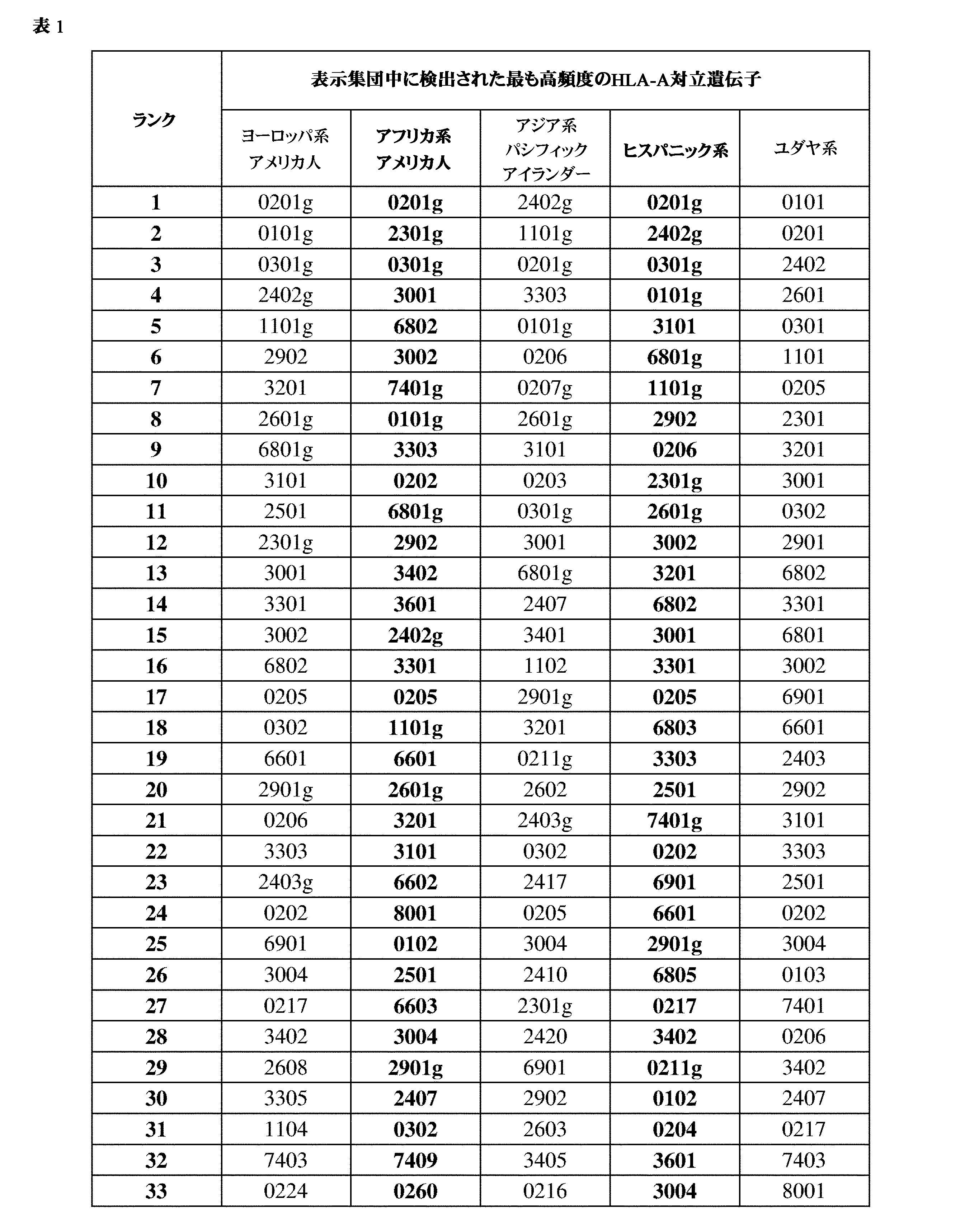
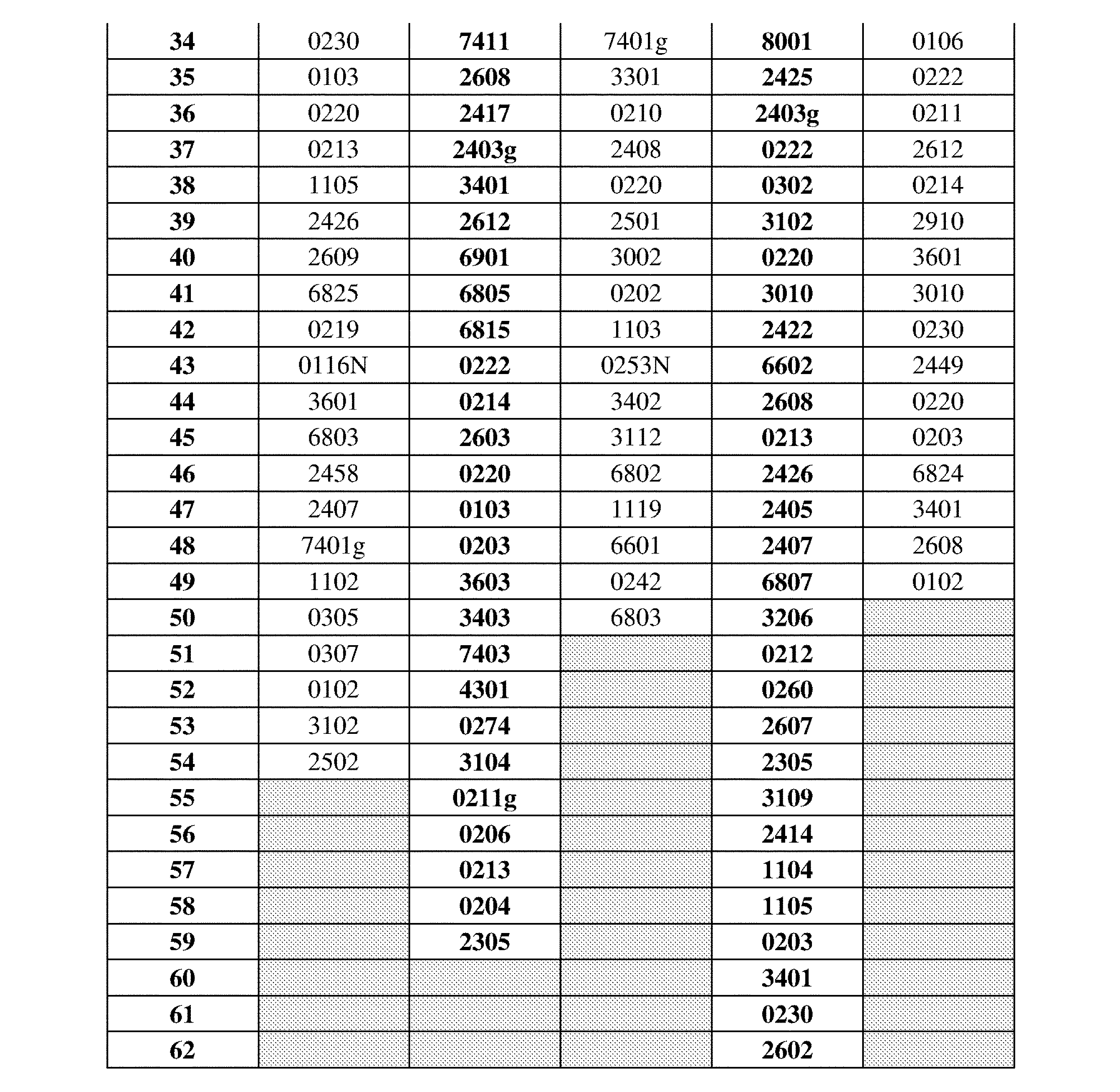
表2は、米国民およびユダヤ系集団において検出された最も頻度の高い高解像度HLA-B対立遺伝子を記載する。表に示される各系統(例えば、ヨーロッパ系アメリカ人、アフリカ系アメリカ人、アジア系[パシフィックアイランダーを含む]、ヒスパニック系[ラテンアメリカ人]、およびユダヤ系統の人)について、最も頻度の高い対立遺伝子が示され、各列に示す系統群におけるその発生頻度(以前の刊行物(Maiers et al.,2007,Human Immunology,68:779-788)からの高解像度頻度の最新版を掲載する全米骨髄バンクウェブサイト(The National Marrow Donor Program Website)(US):https://bioinformatics.bethematchclinical.orgから編集)に基づいてランク付けされる。ユダヤ系の高解像度HLA-A頻度は、以下:全米骨髄バンクウェブサイト(National Marrow Donor Program Website)(US)URL:bioinformatics.bethematchclinical.orgから得たものである。ユダヤ系集団についてのHLA-Bデータが、Hadassah Registry-Jerusalem,Israel(Klitz et al.,201,Tissue Antigens,76(6):442-58からのドナーサンプルから得られたものであることに留意されたい。使用されるアノテーション(例えば、HLA-Bについて0702gが示すのは、HLA-B*07:02と同じであり、これは、2010年のWHO Nomenclature Committee for Factors of the HLA Systemにより採用された新命名法に基づき、(HLA接頭辞)-遺伝子*対立遺伝子群/ファミリー:具体的なHLAタンパク質を示す)ことに留意されたい。例えば、B*0702gは、B*07:02となる。この表に示す名称に関して、コード領域内の同義DNA置換を示すのに用いられる分野、非コード領域の違い、ならびに発現の変化を示すのに用いられる接尾辞は示していない(さらに詳しい情報については次のウェブサイトを参照されたい:hla.alleles.org)。この表で、「g」の接尾辞が付いた対立遺伝子名は、刊行物「Maiers,M.,Gragert,L.,Klitz,W.High resolution HLA alleles and haplotypes in the US population.2007」の表1に定義される対立遺伝子群を指す。 Table 2 describes the most frequent high-resolution HLA-B alleles detected in American and Jewish populations. The most frequent allele for each lineage shown in the table (e.g., people of European American, African American, Asian [including Pacific Islander], Hispanic [Latin American], and Jewish descent) is shown and its frequency of occurrence in the phylogenetic groups indicated in each column (National Bone Marrow Bank, with the latest version of high-resolution frequencies from a previous publication (Maiers et al., 2007, Human Immunology, 68:779-788)) (Compiled from The National Marrow Donor Program Website (US): https://bioinformatics.bethematchclinical.org). High-resolution HLA-A frequencies for Jewish ancestry can be found at: National Marrow Donor Program Website (US) URL: bioinformatics. bethematchclinical. This is what I got from org. Note that HLA-B data for the Jewish population were obtained from donor samples from the Hadassah Registry-Jerusalem, Israel (Klitz et al., 201, Tissue Antigens, 76(6):442-58). The annotations used (for example, 0702g for HLA-B indicates the same as HLA-B*07:02, which was adopted by the WHO Nomenclature Committee for Factors of the HLA System in 2010). Note that based on the new nomenclature (HLA prefix)-gene*allele group/family: indicates the specific HLA protein). For example, B*0702g becomes B*07:02. For the names shown in this table, fields used to indicate synonymous DNA substitutions within coding regions, differences in non-coding regions, and suffixes used to indicate changes in expression are not shown (for more information (see the following website: hla.alleles.org). In this table, allele names with a "g" suffix are referred to in the publication Maiers, M., Gragert, L., Klitz, W. .High resolution HLA alleles and haplotypes in the US population.2007” refers to the allele group defined in Table 1.


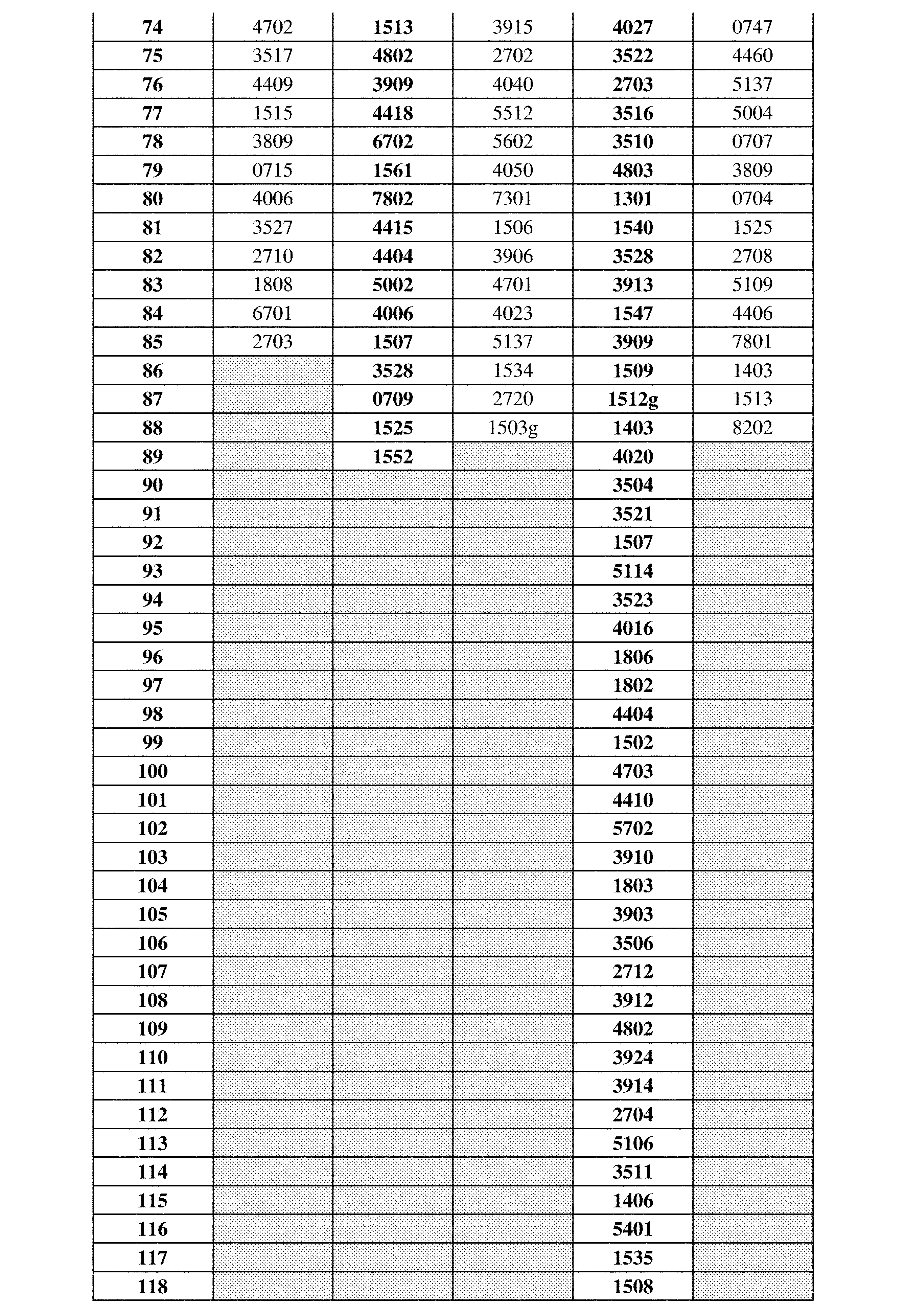
表3は、米国民において最も頻度の高い高解像度HLA-C対立遺伝子を記載する。表に示される各系統(例えば、ヨーロッパ系アメリカ人、アフリカ系アメリカ人、アジア系[パシフィックアイランダーを含む]、およびヒスパニック系[ラテンアメリカ人])について、最も頻度の高い対立遺伝子が示され、各列に示す系統群におけるその発生頻度(以前の刊行物(Maiers et al.,2007,Human Immunology,68:779-788)からの高解像度頻度の最新版を掲載する全米骨髄バンクウェブサイト(The National Marrow Donor Program Website)(US):bioinformatics.bethematchclinical.orgから編集)に基づいてランク付けされる。使用されるアノテーション(例えば、HLA-Cの場合の0701gは、HLA-C*07:01と同じであり、これは、2010年のWHO Nomenclature Committee for Factors of the HLA Systemにより採用された新命名法に基づき、(HLA接頭辞)-遺伝子*対立遺伝子群/ファミリー:具体的なHLAタンパク質を示す)ことに留意されたい。例えば、C*0701gは、C*07:01となる。この表に示す名称に関して、コード領域内の同義DNA置換を示すのに用いられる分野、非コード領域の違い、ならびに発現の変化を示すのに用いられる接尾辞は示していない(さらに詳しい情報については次のウェブサイトを参照されたい:hla.alleles.org)。この表で、「g」の接尾辞が付いた対立遺伝子名は、刊行物「Maiers,M.,Gragert,L.,Klitz,W.High resolution HLA alleles and haplotypes in the US population.2007」の表1に定義される対立遺伝子群を指す。接尾辞「N」は、発現の変化を示すのに用いられる(前述の命名法リンクを参照)。 Table 3 lists the most frequent high resolution HLA-C alleles in the US population. For each lineage shown in the table (e.g., European American, African American, Asian [including Pacific Islander], and Hispanic [Latin American]), the most frequent allele is shown and each The National Bone Marrow Bank website, which contains the latest version of high-resolution frequencies from a previous publication (Maiers et al., 2007, Human Immunology, 68:779-788), in the phylogenetic groups indicated in column Compiled from the Marrow Donor Program Website (US): bioinformatics.bethematchclinical.org). The annotation used (for example, 0701g for HLA-C is the same as HLA-C*07:01, which is the new nomenclature adopted by the WHO Nomenclature Committee for Factors of the HLA System in 2010) Note that based on (HLA prefix)-gene*allele group/family: indicates a specific HLA protein). For example, C*0701g becomes C*07:01. For the names shown in this table, fields used to indicate synonymous DNA substitutions within coding regions, differences in non-coding regions, and suffixes used to indicate changes in expression are not shown (for more information Please see the following website: hla.alleles.org). In this table, allele names with a "g" suffix are taken from the publication "Maiers, M., Gragert, L., Klitz, W. High resolution HLA alleles and haplotypes in the US population.2007". table Refers to the allele group defined in 1. The suffix "N" is used to indicate a change in expression (see nomenclature link above).
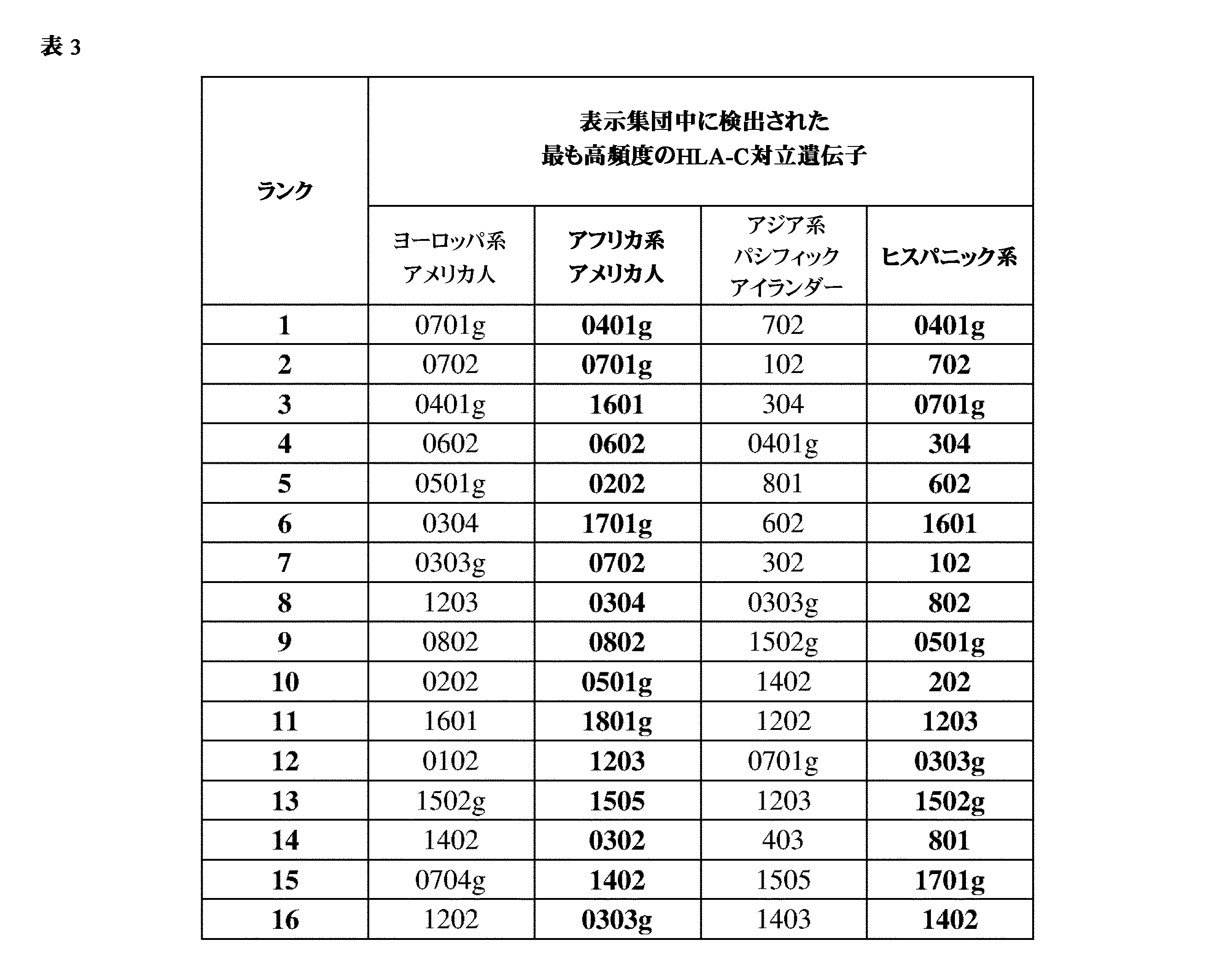
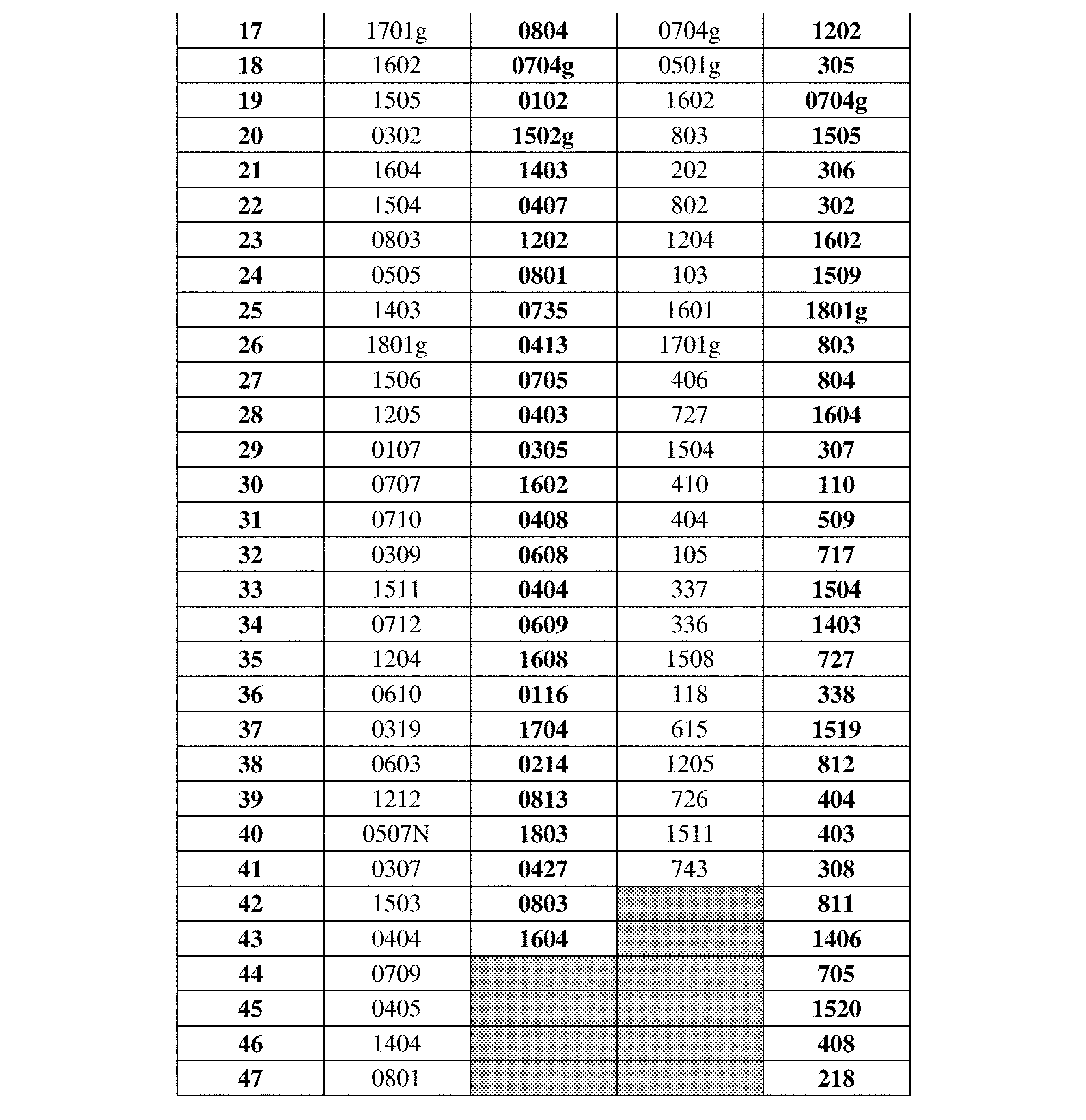
表4は、米国民およびユダヤ系集団において検出された最も頻度の高い高解像度HLA-DRB1対立遺伝子を記載する。表に示される各系統(例えば、ヨーロッパ系アメリカ人、アフリカ系アメリカ人、アジア系[パシフィックアイランダーを含む]、ヒスパニック系[ラテンアメリカ人]、およびユダヤ系統の人)について、最も頻度の高い対立遺伝子が示され、各列に示す系統群におけるその発生頻度(以前の刊行物[Maiers et al.,2007,Human Immunology,68:779-788からの高解像度頻度の最新版を掲載する全米骨髄バンクウェブサイト(The National Marrow Donor Program Website)(US):bioinformatics.bethematchclinical.orgから編集)に基づいてランク付けされる。ユダヤ系の高解像度HLA-DRB1頻度は、以下:全米骨髄バンクウェブサイト(National Marrow Donor Program Website)(US)URL:bioinformatics.bethematchclinical.orgから得たものである。ユダヤ系集団についてのHLA-DRB1データが、Hadassah Registry-Jerusalem,Israel(Klitz et al.,201,Tissue Antigens,76(6):442-58からのドナーサンプルから得られたものであることに留意されたい。使用されるアノテーション(例えば、HLA-DRB1の場合の1501は、HLA-DRB1*15:01と同じであり、これは、2010年のWHO Nomenclature Committee for Factors of the HLA Systemにより採用された新命名法に基づき、(HLA接頭辞)-遺伝子*対立遺伝子群/ファミリー:具体的なHLAタンパク質を示す)ことに留意されたい。例えば、DRB1*1501は、DRB1*15:01となる。この表に示す名称に関して、コード領域において同義DNA置換を示すのに用いられる分野、非コード領域の違い、ならびに発現の変化を示すのに用いられる接尾辞は示していない(さらに詳しい情報については次のウェブサイトを参照されたい:hla.alleles.org)。この表で、「g」の接尾辞が付いた対立遺伝子名は、刊行物「Maiers,M.,Gragert,L.,Klitz,W.High resolution HLA alleles and haplotypes in the US population.2007」の表1に定義される対立遺伝子を指す。 Table 4 describes the most frequent high-resolution HLA-DRB1 alleles detected in the American and Jewish populations. The most frequent allele for each lineage shown in the table (e.g., people of European American, African American, Asian [including Pacific Islander], Hispanic [Latin American], and Jewish descent) is shown and its frequency of occurrence in the phylogenetic groups indicated in each column (National Bone Marrow Bank Web, which provides the latest version of high-resolution frequencies from a previous publication [Maiers et al., 2007, Human Immunology, 68:779-788] (Compiled from The National Marrow Donor Program Website (US): bioinformatics.bethematchclinical.org). High-resolution HLA-DRB1 frequencies in Jewish ancestry can be found at: National Marrow Donor Program Website (US) URL: bioinformatics. bethematchclinical. This is what I got from org. Note that HLA-DRB1 data for the Jewish population were obtained from donor samples from the Hadassah Registry-Jerusalem, Israel (Klitz et al., 201, Tissue Antigens, 76(6):442-58 The annotation used (e.g. 1501 for HLA-DRB1 is the same as HLA-DRB1*15:01, which was adopted by the WHO Nomenclature Committee for Factors of the HLA System in 2010). Note that based on the new nomenclature, (HLA prefix) - gene * allele group/family: indicates a specific HLA protein). For example, DRB1*1501 becomes DRB1*15:01. For the names shown in the table, fields used to indicate synonymous DNA substitutions in coding regions, differences in non-coding regions, and suffixes used to indicate changes in expression are not shown (for more information see (see website: hla.alleles.org). In this table, allele names with a "g" suffix refer to the publication "Maiers, M., Gragert, L., Klitz, W. High HLA alleles and haplotypes in the US population.2007.

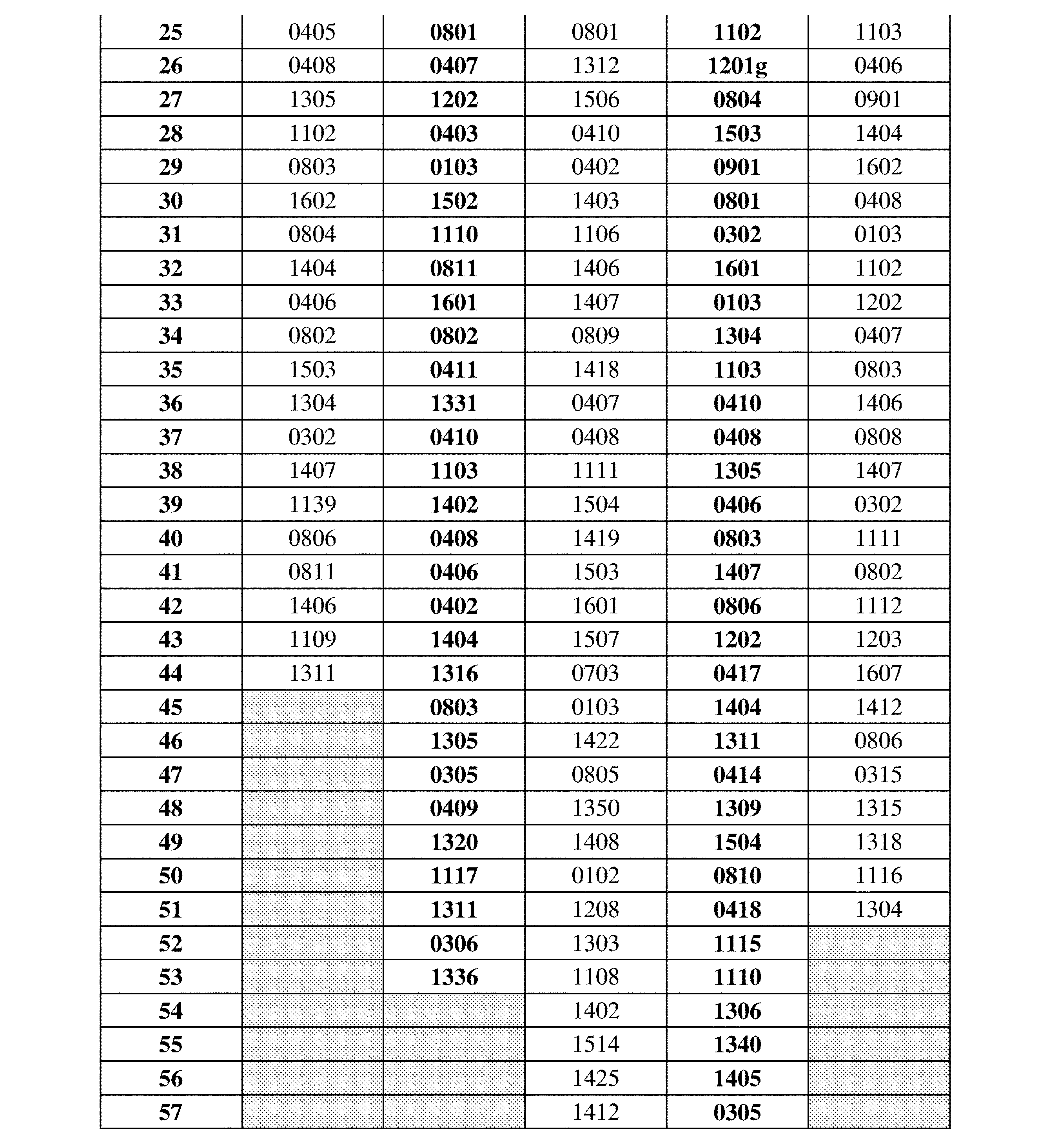
表5は、米国民において検出された最も頻度の高い高解像度HLA-DQB1対立遺伝子を記載する。表に示される各系統(例えば、ヨーロッパ系アメリカ人、アフリカ系アメリカ人、アジア系[パシフィックアイランダーを含む]、およびヒスパニック系[ラテンアメリカ人])について、最も頻度の高い対立遺伝子が示され、各列に示す系統群におけるその発生頻度(以前の刊行物(Maiers et al.,2007,Human Immunology,68:779-788)からの高解像度頻度の最新版を掲載する全米骨髄バンクウェブサイト(The National Marrow Donor Program Website)(US):bioinformatics.bethematchclinical.orgから編集)に基づいてランク付けされる。使用されるアノテーション(例えば、HLA-DQB1の場合の0201gは、HLA-DQB1*02:01と同じであり、これは、2010年のWHO Nomenclature Committee for Factors of the HLA Systemにより採用された新命名法に基づき、(HLA接頭辞)-遺伝子*対立遺伝子群/ファミリー:具体的なHLAタンパク質を示す)ことに留意されたい。例えば、DQB1*0201gは、DQB1*02:01となる。この表に示す名称に関して、コード領域内の同義DNA置換を示すのに用いられる分野、非コード領域の違い、ならびに発現の変化を示すのに用いられる接尾辞は示していない(さらに詳しい情報については次のウェブサイトを参照されたい:hla.alleles.org)。この表で、「g」の接尾辞が付いた対立遺伝子名は、刊行物「Maiers,M.,Gragert,L.,Klitz,W.High resolution HLA alleles and haplotypes in the US population.2007」の表1に定義される対立遺伝子群を指す。 Table 5 describes the most frequent high resolution HLA-DQB1 alleles detected in the US population. For each lineage shown in the table (e.g., European American, African American, Asian [including Pacific Islander], and Hispanic [Latin American]), the most frequent allele is shown and each The National Bone Marrow Bank website, which contains the latest version of its frequency of occurrence in the phylogenetic groups indicated in the column (from a previous publication (Maiers et al., 2007, Human Immunology, 68:779-788)) Compiled from the Marrow Donor Program Website (US): bioinformatics.bethematchclinical.org). The annotation used (for example, 0201g for HLA-DQB1 is the same as HLA-DQB1*02:01, which is the new nomenclature adopted by the WHO Nomenclature Committee for Factors of the HLA System in 2010) Note that based on (HLA prefix)-gene*allele group/family: indicates a specific HLA protein). For example, DQB1*0201g becomes DQB1*02:01. For the names shown in this table, fields used to indicate synonymous DNA substitutions within coding regions, differences in non-coding regions, and suffixes used to indicate changes in expression are not shown (for more information, see Please see the following website: hla.alleles.org). In this table, allele names with a "g" suffix are taken from the publication "Maiers, M., Gragert, L., Klitz, W. High resolution HLA alleles and haplotypes in the US population.2007". table Refers to the allele group defined in 1.
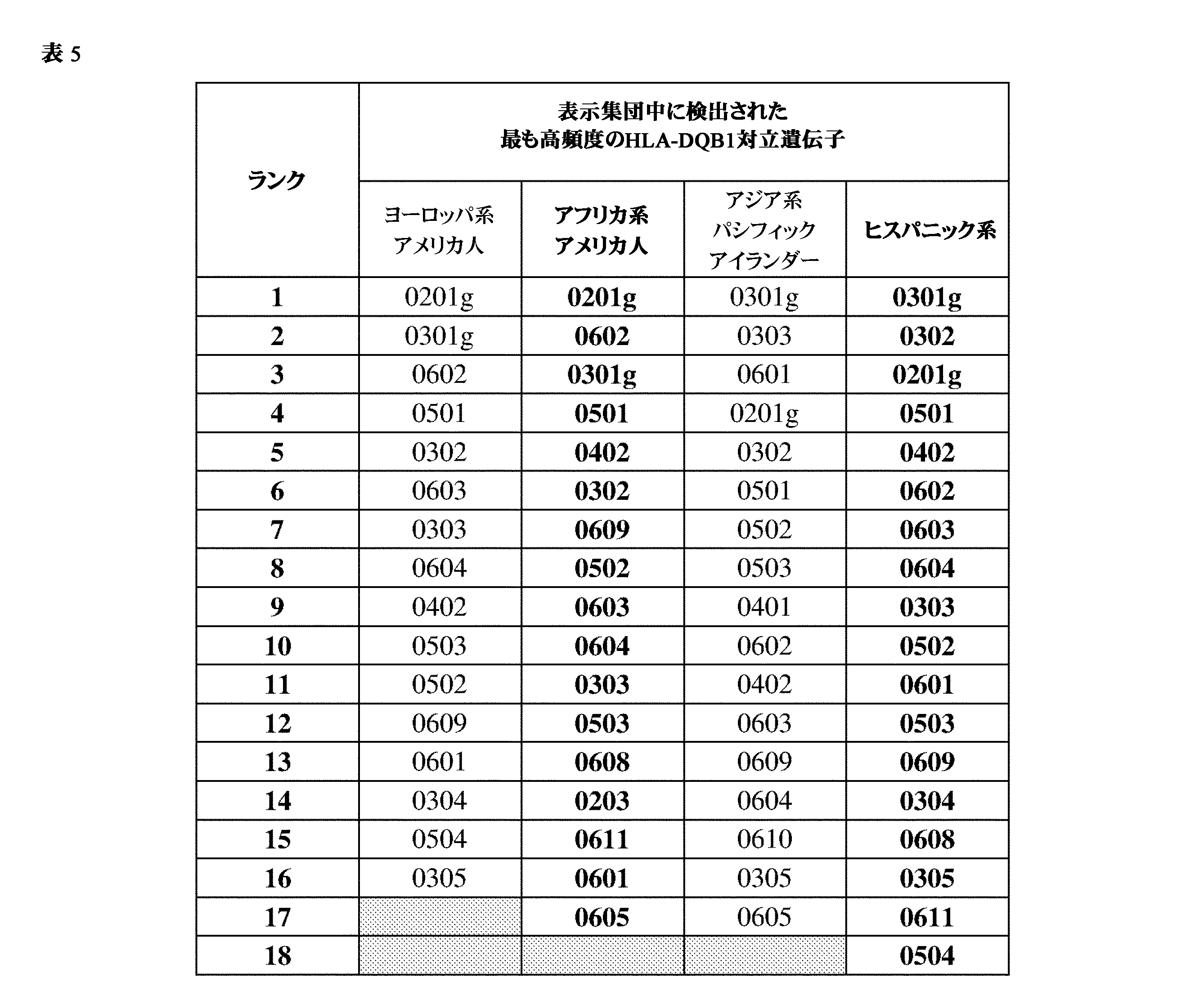
表6は、米国民およびユダヤ系集団において検出された最も頻度の高い高解像度HLA-A-Bハプロタイプを記載する。表に示される各系統(例えば、ヨーロッパ系アメリカ人、アフリカ系アメリカ人、アジア系[パシフィックアイランダーを含む]、ヒスパニック系[ラテンアメリカ人]、およびユダヤ系統の人)について、上位50の最も頻度の高いHLA-A-Bハプロタイプが示され、各列に示す系統群におけるその発生頻度(以前の刊行物[Maiers et al.,2007,Human Immunology,68:779-788からの高解像度頻度の最新版を掲載する全米骨髄バンクウェブサイト(The National Marrow Donor Program Website)(US):bioinformatics.bethematchclinical.orgから編集)に基づいてランク付けされる。ユダヤ系の高解像度HLA-A-Bハプロタイプ頻度は、以下:全米骨髄バンクウェブサイト(National Marrow Donor Program Website)(US)URL:bioinformatics.bethematchclinical.orgから得たものである。ユダヤ系集団についてのHLA-A-Bハプロタイプ頻度データが、Hadassah Registry-Jerusalem,Israel(Klitz et al.,201,Tissue Antigens,76(6):442-58)からのドナーサンプルから得られたものであることに留意されたい。使用されるアノテーション(例えば、HLA-Aの場合の0201gは、HLA-A*02:01と同じであり、これは、2010年のWHO Nomenclature Committee for Factors of the HLA Systemにより採用された新命名法に基づき、(HLA接頭辞)-遺伝子*対立遺伝子群/ファミリー:具体的なHLAタンパク質を示す)ことに留意されたい。例えば、A*0201gは、A*02:01となる。この表に示す名称に関して、コード領域内の同義DNA置換を示すのに用いられる分野、非コード領域の違い、ならびに発現の変化を示すのに用いられる接尾辞は示していない(さらに詳しい情報については次のウェブサイトを参照されたい:hla.alleles.org)。この表で、「g」の接尾辞が付いた対立遺伝子名は、刊行物「Maiers,M.,Gragert,L.,Klitz,W.High resolution HLA alleles and haplotypes in the US population.2007」の表1に定義される対立遺伝子群を指す。 Table 6 describes the most frequent high-resolution HLA-AB haplotypes detected in American and Jewish populations. For each lineage shown in the table (e.g., people of European American, African American, Asian [including Pacific Islander], Hispanic [Latino], and Jewish descent), the top 50 most frequent High HLA-A-B haplotypes are shown and their frequency of occurrence in the phylogenetic groups indicated in each column (updated version of high-resolution frequencies from previous publication [Maiers et al., 2007, Human Immunology, 68:779-788] Compiled from the National Marrow Donor Program Website (US): bioinformatics.bethematchclinical.org). High-resolution HLA-A-B haplotype frequencies for Jewish ancestry are available at: National Marrow Donor Program Website (US) URL: bioinformatics. bethematchclinical. This is what I got from org. HLA-A-B haplotype frequency data for Jewish populations were obtained from donor samples from the Hadassah Registry-Jerusalem, Israel (Klitz et al., 201, Tissue Antigens, 76(6):442-58). Please note that. The annotation used (for example, 0201g for HLA-A is the same as HLA-A*02:01, which is a new nomenclature adopted by the WHO Nomenclature Committee for Factors of the HLA System in 2010) Note that based on (HLA prefix)-gene*allele group/family: indicates a specific HLA protein). For example, A*0201g becomes A*02:01. For the names shown in this table, fields used to indicate synonymous DNA substitutions within coding regions, differences in non-coding regions, and suffixes used to indicate changes in expression are not shown (for more information Please see the following website: hla.alleles.org). In this table, allele names with a "g" suffix are taken from the publication "Maiers, M., Gragert, L., Klitz, W. High resolution HLA alleles and haplotypes in the US population.2007". table Refers to the allele group defined in 1.
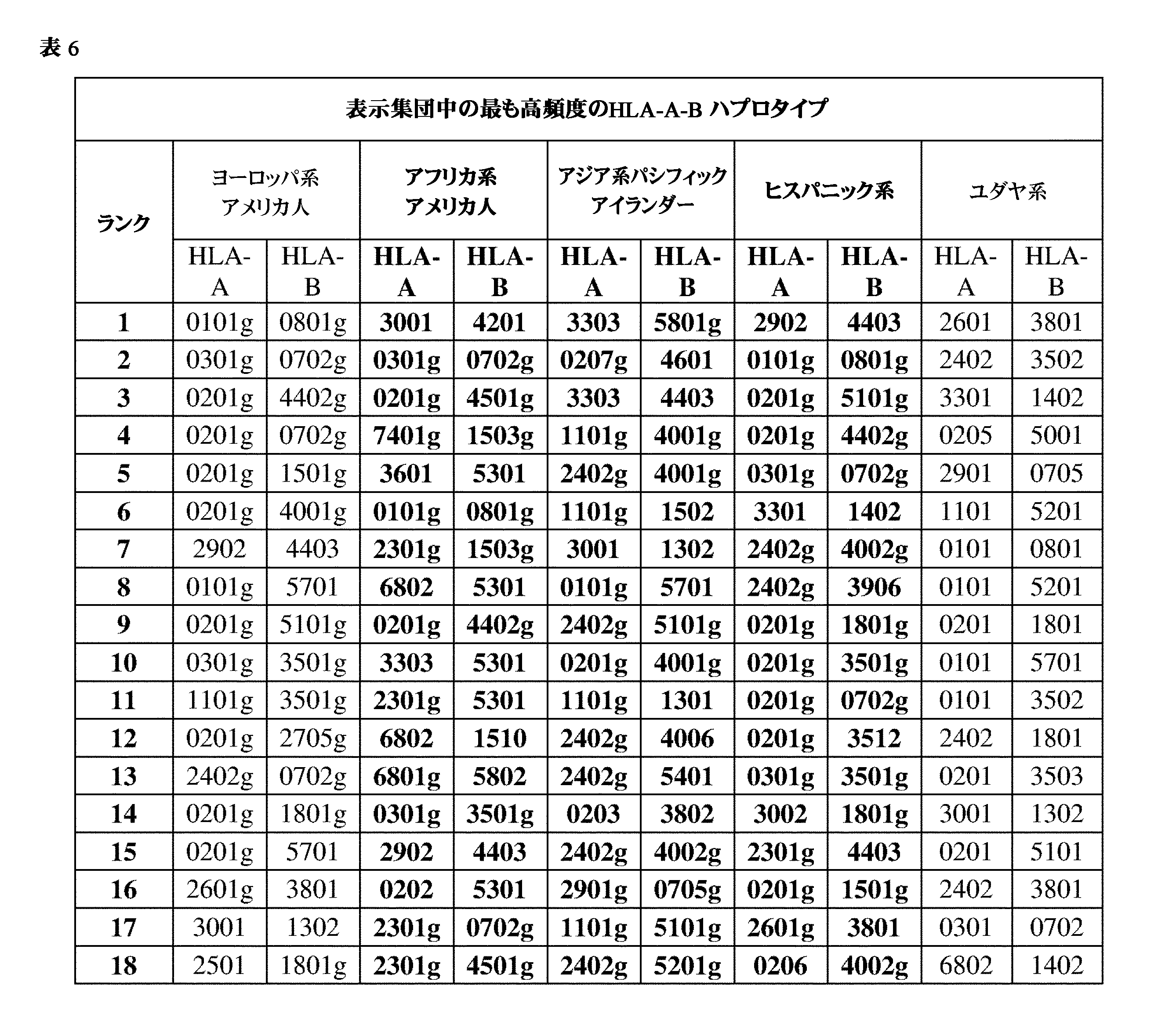
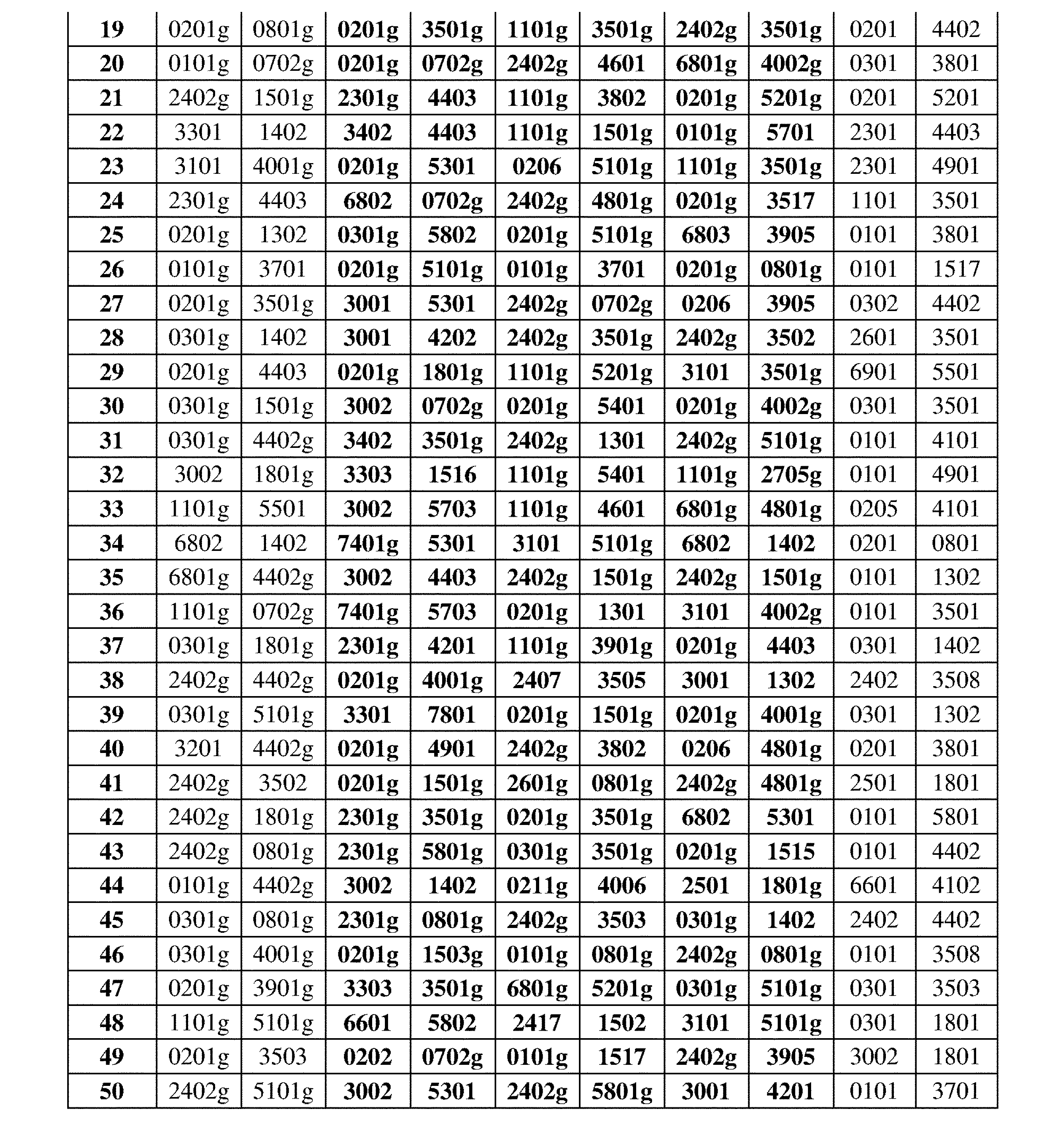
表7は、米国民およびユダヤ系集団において検出された最も頻度の高い高解像度HLA-A-B-DRB1ハプロタイプを記載する。表に示される各系統(例えば、ヨーロッパ系アメリカ人、アフリカ系アメリカ人、アジア系[パシフィックアイランダーを含む]、ヒスパニック系[ラテンアメリカ人]、およびユダヤ系統の人)について、上位50の最も頻度の高いHLA-A-B-DRB1ハプロタイプが示され、各列に示す系統群におけるその発生頻度(以前の刊行物[Maiers et al.,2007,Human Immunology,68:779-788からの高解像度頻度の最新版を掲載する全米骨髄バンクウェブサイト(The National Marrow Donor Program Website)(US):bioinformatics.bethematchclinical.orgから編集)に基づいてランク付けされる。ユダヤ系の高解像度HLA-A-B-DRB1ハプロタイプ頻度は、以下:全米骨髄バンクウェブサイト(National Marrow Donor Program Website)(US)URL:bioinformatics.bethematchclinical.orgから得たものである。ユダヤ系集団についてのHLA-A-B-DRB1ハプロタイプ頻度データが、Hadassah Registry-Jerusalem,Israel(Klitz et al.,201,Tissue Antigens,76(6):442-58からのドナーサンプルから得られたものであることに留意されたい。使用されるアノテーション(例えば、HLA-DRB1の場合の1501は、HLA-DRB1*15:01と同じであり、これは、2010年のWHO Nomenclature Committee for Factors of the HLA Systemにより採用された新命名法に基づき、(HLA接頭辞)-遺伝子*対立遺伝子群/ファミリー:具体的なHLAタンパク質を示す)ことに留意されたい。例えば、DRB1*1501は、DRB1*15:01となる。この表に示す名称に関して、コード領域内の同義DNA置換を示すのに用いられる分野、非コード領域の違い、ならびに発現の変化を示すのに用いられる接尾辞は示していない(さらに詳しい情報については次のウェブサイトを参照されたい:hla.alleles.org)。この表で、「g」の接尾辞が付いた対立遺伝子名は、刊行物「Maiers,M.,Gragert,L.,Klitz,W.High resolution HLA alleles and haplotypes in the US population.2007」の表1に定義される対立遺伝子群を指す。 Table 7 describes the most frequent high-resolution HLA-AB-DRB1 haplotypes detected in American and Jewish populations. For each lineage shown in the table (e.g., people of European American, African American, Asian [including Pacific Islander], Hispanic [Latino], and Jewish descent), the top 50 most frequent The high HLA-AB-DRB1 haplotypes are shown and their frequency of occurrence in the phylogenetic groups indicated in each column (high-resolution frequencies from a previous publication [Maiers et al., 2007, Human Immunology, 68:779-788] Compiled from the National Marrow Donor Program Website (US): bioinformatics.bethematchclinical.org, which lists the latest version. High-resolution HLA-AB-DRB1 haplotype frequencies for Jewish ancestry are available at: National Marrow Donor Program Website (US) URL: bioinformatics. bethematchclinical. This is what I got from org. HLA-AB-DRB1 haplotype frequency data for the Jewish population were obtained from donor samples from the Hadassah Registry-Jerusalem, Israel (Klitz et al., 201, Tissue Antigens, 76(6):442-58 Note that the annotation used (e.g. 1501 for HLA-DRB1 is the same as HLA-DRB1*15:01, which is in accordance with the 2010 WHO Nomenclature Committee for Factors of the Note that based on the new nomenclature adopted by the HLA System, (HLA prefix)-gene*allele group/family: indicates a specific HLA protein). For example, DRB1*1501 becomes DRB1*15. :01. Regarding the names shown in this table, fields used to indicate synonymous DNA substitutions within coding regions, differences in non-coding regions, and suffixes used to indicate changes in expression are not shown ( For further information please refer to the following website: hla.alleles.org). In this table, allele names with a "g" suffix are referred to in the publication Maiers, M., Gragert, L. ., Klitz, W. High resolution HLA alleles and haplotypes in the US population.2007.
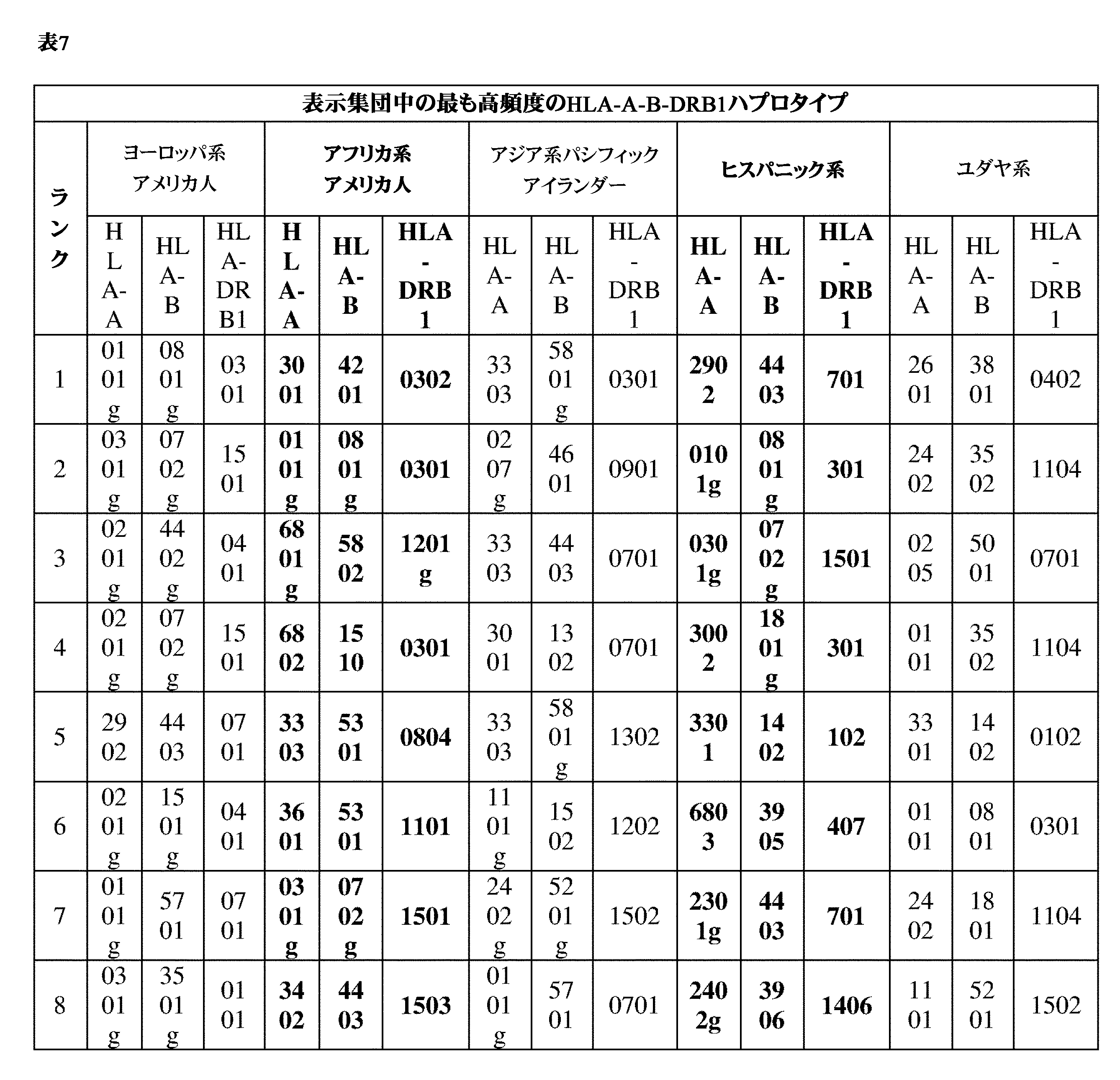
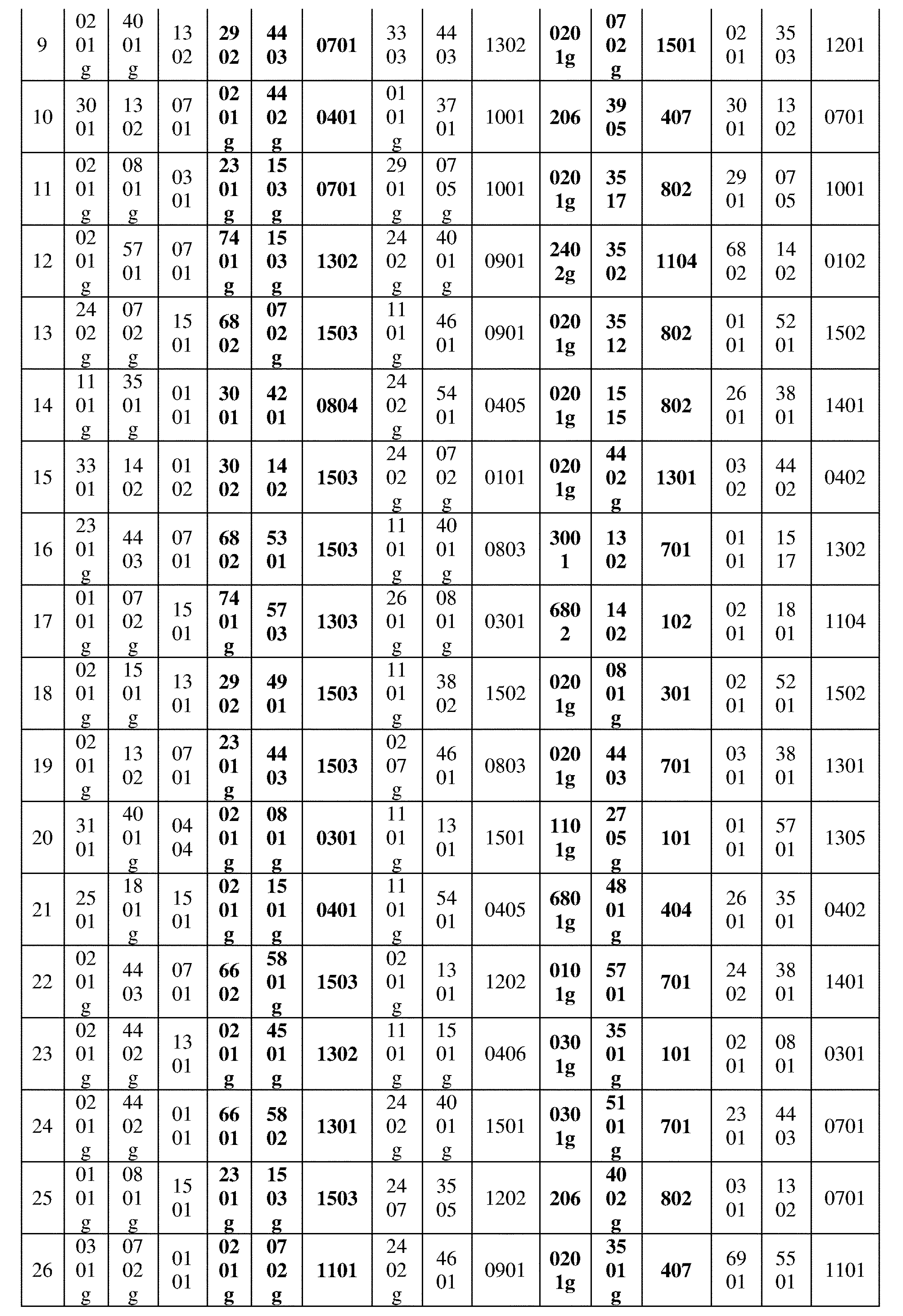
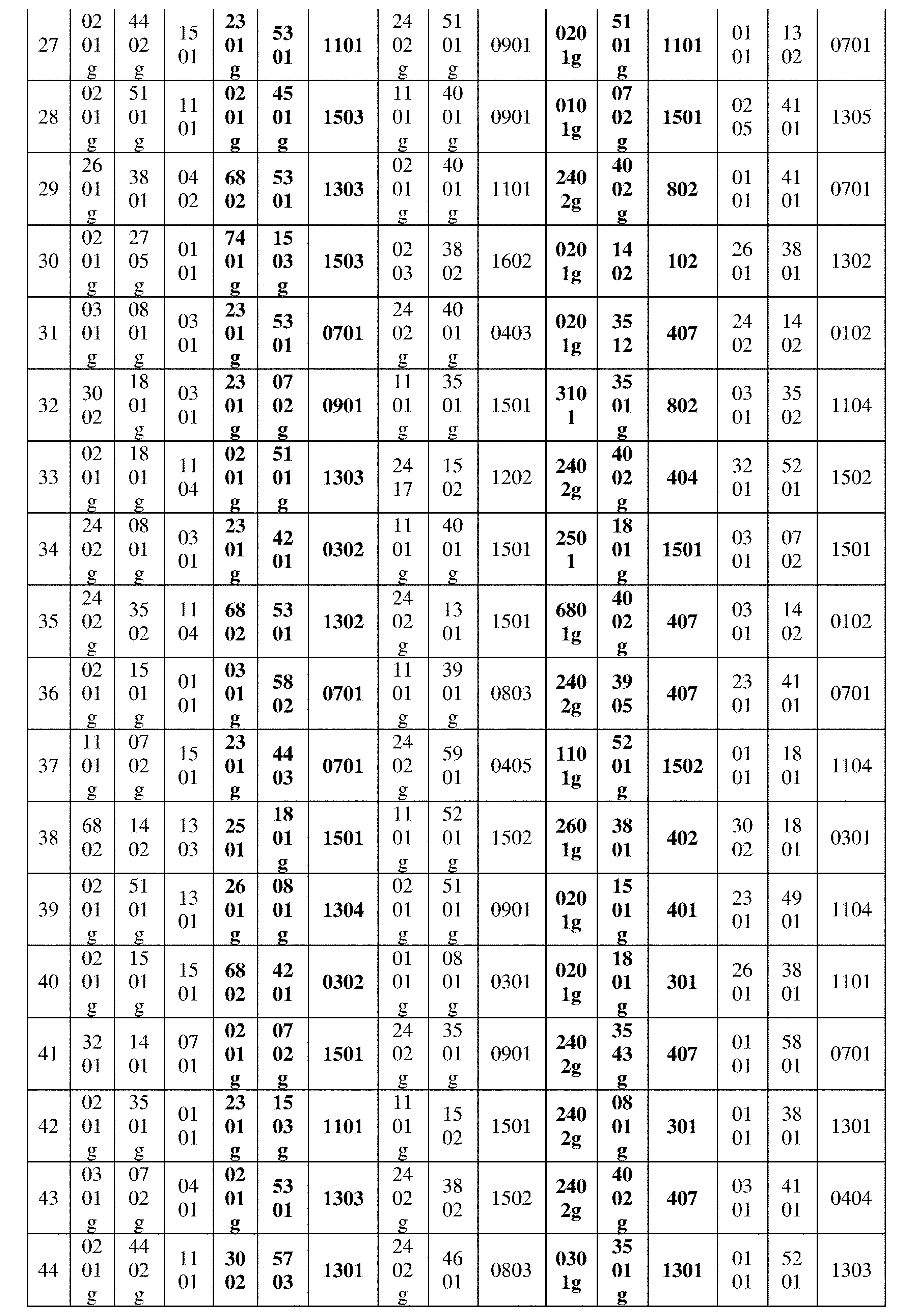

表8は、米国民において検出された最も頻度の高い高解像度HLA-A-C-Bハプロタイプを記載する。表に示される各系統(例えば、ヨーロッパ系アメリカ人、アフリカ系アメリカ人、アジア系[パシフィックアイランダーを含む]、およびヒスパニック系[ラテンアメリカ人])について、上位50の最も頻度の高いHLA-A-C-Bハプロタイプが示され、各列に示す系統群におけるその発生頻度(以前の刊行物(Maiers et al.,2007,Human Immunology,68:779-788)からの高解像度頻度の最新版を掲載する全米骨髄バンクウェブサイト(The National Marrow Donor Program Website)(US):bioinformatics.bethematchclinical.orgから編集)に基づいてランク付けされる。使用されるアノテーション(例えば、HLA-Aの場合の0201gは、HLA-A*02:01と同じであり、これは、2010年のWHO Nomenclature Committee for Factors of the HLA Systemにより採用された新命名法に基づき、(HLA接頭辞)-遺伝子*対立遺伝子群/ファミリー:具体的なHLAタンパク質を示す)ことに留意されたい。例えば、A*0201gは、A*02:01となる。この表に示す名称に関して、コード領域内の同義DNA置換を示すのに用いられる分野、非コード領域の違い、ならびに発現の変化を示すのに用いられる接尾辞は示していない(さらに詳しい情報については次のウェブサイトを参照されたい:hla.alleles.org)。この表で、「g」の接尾辞が付いた対立遺伝子名は、刊行物「Maiers,M.,Gragert,L.,Klitz,W.High resolution HLA alleles and haplotypes in the US population.2007」の表1に定義される対立遺伝子群を指す。 Table 8 describes the most frequent high-resolution HLA-ACB haplotypes detected in the US population. For each lineage shown in the table (e.g., European American, African American, Asian [including Pacific Islander], and Hispanic [Latin American]), the top 50 most frequent HLA-A- The C-B haplotype is shown and its frequency of occurrence in the phylogenetic group indicated in each column (updated version of high-resolution frequencies from a previous publication (Maiers et al., 2007, Human Immunology, 68:779-788)) Compiled from the National Marrow Donor Program Website (US): bioinformatics.bethematchclinical.org). The annotation used (for example, 0201g for HLA-A is the same as HLA-A*02:01, which is the new nomenclature adopted by the WHO Nomenclature Committee for Factors of the HLA System in 2010) Note that based on (HLA prefix)-gene*allele group/family: indicates a specific HLA protein). For example, A*0201g becomes A*02:01. For the names shown in this table, fields used to indicate synonymous DNA substitutions within coding regions, differences in non-coding regions, and suffixes used to indicate changes in expression are not shown (for more information, see Please see the following website: hla.alleles.org). In this table, allele names with a "g" suffix are taken from the publication "Maiers, M., Gragert, L., Klitz, W. High resolution HLA alleles and haplotypes in the US population.2007". table Refers to the allele group defined in 1.
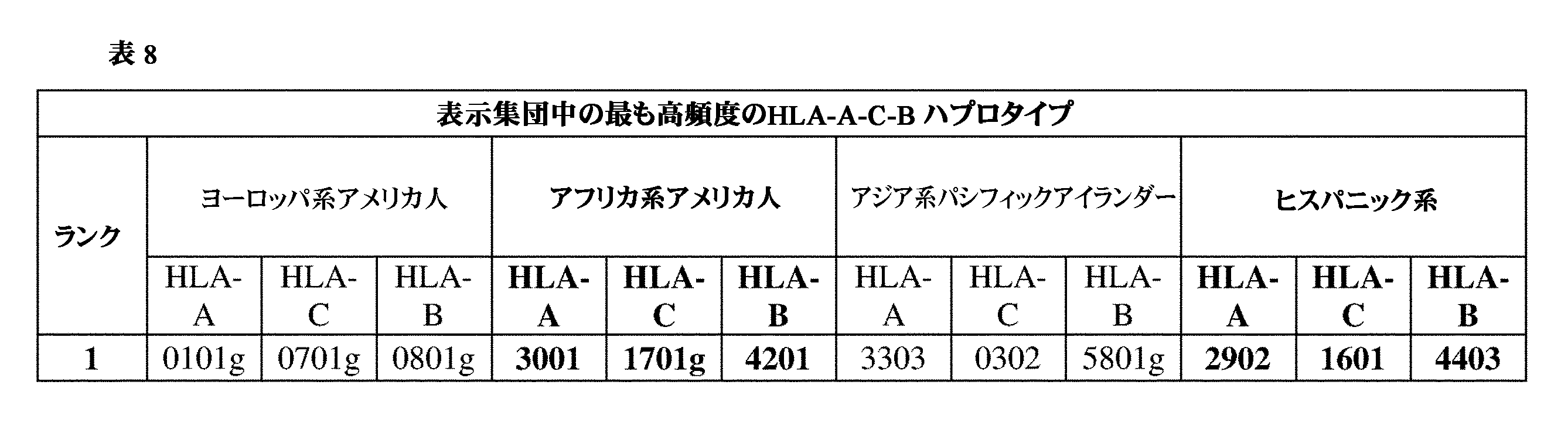


表9は、米国民において検出された最も頻度の高い高解像度HLA-A-B-DRB1-DQB1ハプロタイプを記載する。表に示される各系統(例えば、ヨーロッパ系アメリカ人、アフリカ系アメリカ人、アジア系[パシフィックアイランダーを含む]、およびヒスパニック系[ラテンアメリカ人])について、上位50の最も頻度の高いHLA-A-B-DRB1-DQB1ハプロタイプが示され、各列に示す系統群におけるその発生頻度(以前の刊行物(Maiers et al.,2007,Human Immunology,68:779-788)からの高解像度頻度の最新版を掲載する全米骨髄バンクウェブサイト(The National Marrow Donor Program Website)(US):bioinformatics.bethematchclinical.orgから編集)に基づいてランク付けされる。使用されるアノテーション(例えば、HLA-Aの場合の0201gは、HLA-A*02:01と同じであり、これは、2010年のWHO Nomenclature Committee for Factors of the HLA Systemにより採用された新命名法に基づき、(HLA接頭辞)-遺伝子*対立遺伝子群/ファミリー:具体的なHLAタンパク質を示す)ことに留意されたい。例えば、A*0201gは、A*02:01となる。この表に示す名称に関して、コード領域内の同義DNA置換を示すのに用いられる分野、非コード領域の違い、ならびに発現の変化を示すのに用いられる接尾辞は示していない(さらに詳しい情報については次のウェブサイトを参照されたい:hla.alleles.org)。この表で、「g」の接尾辞が付いた対立遺伝子名は、刊行物「Maiers,M.,Gragert,L.,Klitz,W.High resolution HLA alleles and haplotypes in the US population.2007」の表1に定義される対立遺伝子群を指す。 Table 9 describes the most frequent high-resolution HLA-AB-DRB1-DQB1 haplotypes detected in the US population. For each lineage shown in the table (e.g., European American, African American, Asian [including Pacific Islander], and Hispanic [Latin American]), the top 50 most frequent HLA-A- The B-DRB1-DQB1 haplotype is shown and its frequency of occurrence in the phylogenetic groups indicated in each column (updated version of high-resolution frequencies from a previous publication (Maiers et al., 2007, Human Immunology, 68:779-788) Compiled from the National Marrow Donor Program Website (US): bioinformatics.bethematchclinical.org). The annotation used (for example, 0201g for HLA-A is the same as HLA-A*02:01, which is a new nomenclature adopted by the WHO Nomenclature Committee for Factors of the HLA System in 2010) Note that based on (HLA prefix)-gene*allele group/family: indicates a specific HLA protein). For example, A*0201g becomes A*02:01. For the names shown in this table, fields used to indicate synonymous DNA substitutions within coding regions, differences in non-coding regions, and suffixes used to indicate changes in expression are not shown (for more information Please see the following website: hla.alleles.org). In this table, allele names with a "g" suffix are taken from the publication "Maiers, M., Gragert, L., Klitz, W. High resolution HLA alleles and haplotypes in the US population.2007". table Refers to the allele group defined in 1.


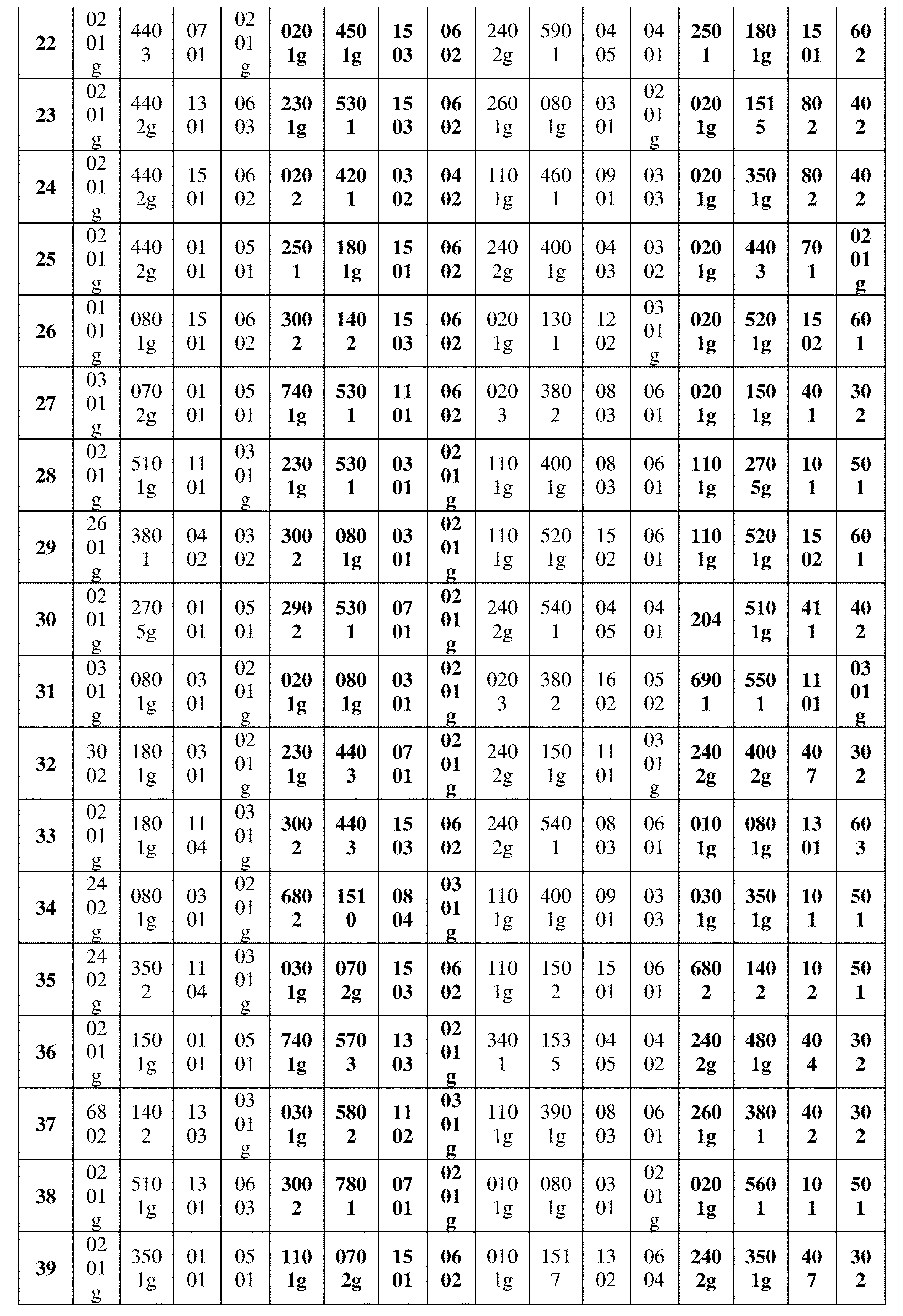
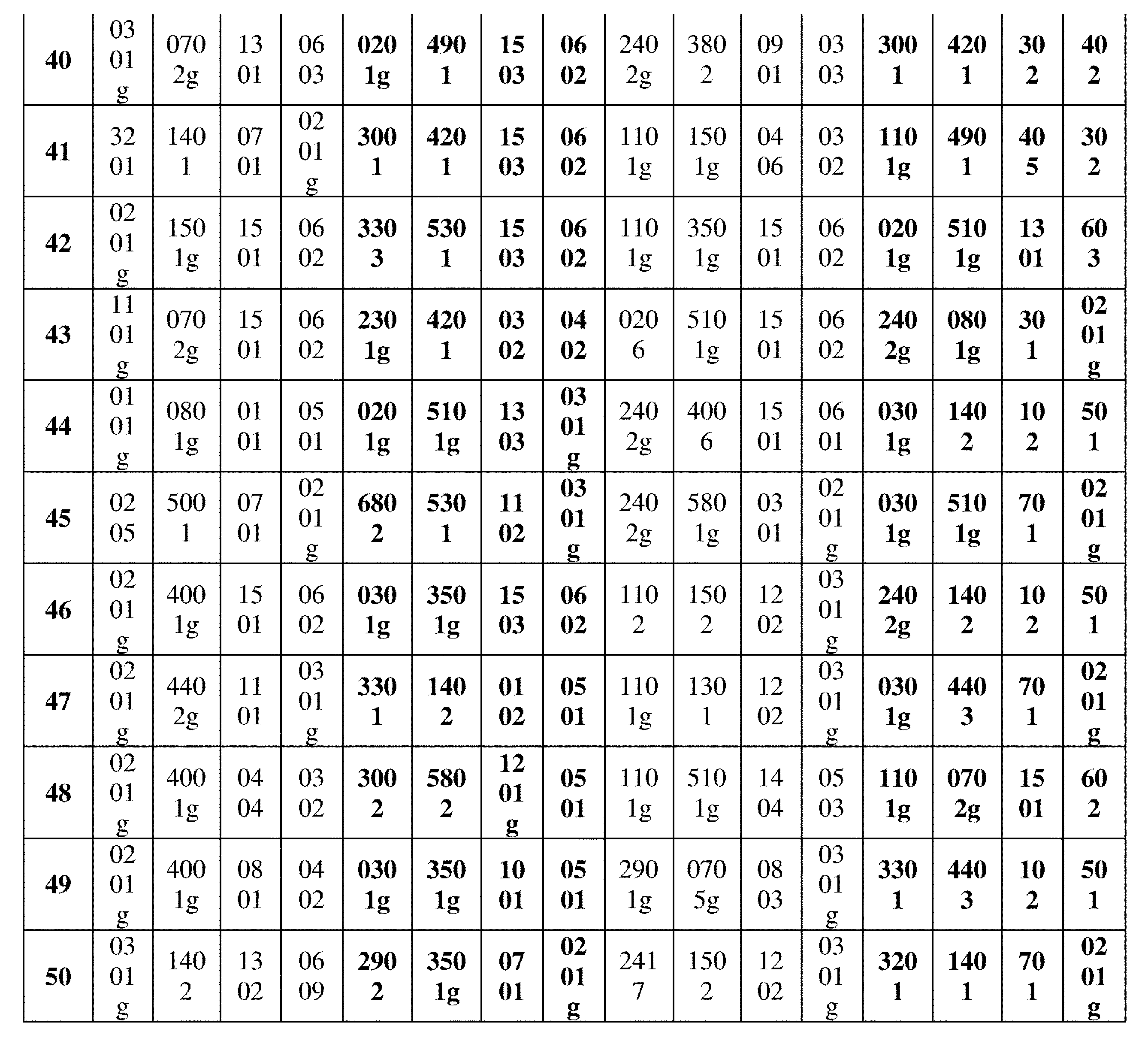
表10は、米国民における最も頻度の高い高解像度HLA-A-C-B-DRB1ハプロタイプを記載する。表に示される各系統(例えば、ヨーロッパ系アメリカ人、アフリカ系アメリカ人、アジア系[パシフィックアイランダーを含む]、およびヒスパニック系[ラテンアメリカ人])について、上位50の最も頻度の高いHLA-A-C-B-DRB1ハプロタイプが示され、各列に示す系統群におけるその発生頻度(以前の刊行物(Maiers et al.,2007,Human Immunology,68:779-788)からの高解像度頻度の最新版を掲載する全米骨髄バンクウェブサイト(The National Marrow Donor Program Website)(US):bioinformatics.bethematchclinical.orgから編集)に基づいてランク付けされる。使用されるアノテーション(例えば、HLA-Aの場合の0201gは、HLA-A*02:01と同じであり、これは、2010年のWHO Nomenclature Committee for Factors of the HLA Systemにより採用された新命名法に基づき、(HLA接頭辞)-遺伝子*対立遺伝子群/ファミリー:具体的なHLAタンパク質を示す)ことに留意されたい。例えば、A*0201gは、A*02:01となる。この表に示す名称に関して、コード領域内の同義DNA置換を示すのに用いられる分野、非コード領域の違い、ならびに発現の変化を示すのに用いられる接尾辞は示していない(さらに詳しい情報については次のウェブサイトを参照されたい:hla.alleles.org)。この表で、「g」の接尾辞が付いた対立遺伝子名は、刊行物「Maiers,M.,Gragert,L.,Klitz,W.High resolution HLA alleles and haplotypes in the US population.2007」の表1に定義される対立遺伝子群を指す。 Table 10 describes the most frequent high-resolution HLA-A-CB-DRB1 haplotypes in the US population. For each lineage shown in the table (e.g., European American, African American, Asian [including Pacific Islander], and Hispanic [Latin American]), the top 50 most frequent HLA-A- The C-B-DRB1 haplotype is shown and its frequency of occurrence in the phylogenetic group indicated in each column (updated version of high-resolution frequencies from a previous publication (Maiers et al., 2007, Human Immunology, 68:779-788) Compiled from the National Marrow Donor Program Website (US): bioinformatics.bethematchclinical.org). The annotation used (for example, 0201g for HLA-A is the same as HLA-A*02:01, which is a new nomenclature adopted by the WHO Nomenclature Committee for Factors of the HLA System in 2010) Note that based on (HLA prefix)-gene*allele group/family: indicates a specific HLA protein). For example, A*0201g becomes A*02:01. For the names shown in this table, fields used to indicate synonymous DNA substitutions within coding regions, differences in non-coding regions, and suffixes used to indicate changes in expression are not shown (for more information Please see the following website: hla.alleles.org). In this table, allele names with a "g" suffix are taken from the publication "Maiers, M., Gragert, L., Klitz, W. High resolution HLA alleles and haplotypes in the US population.2007". table Refers to the allele group defined in 1.
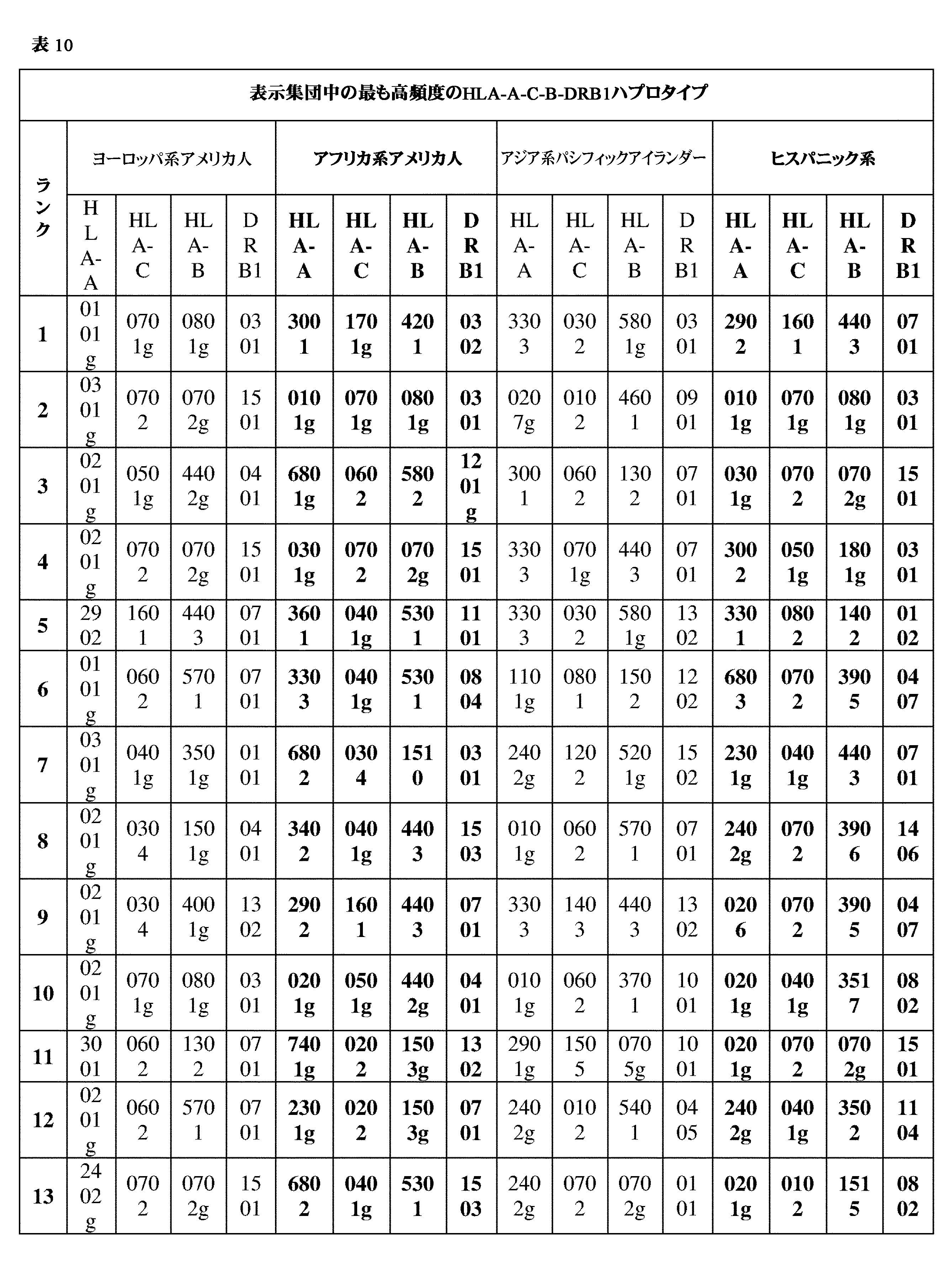

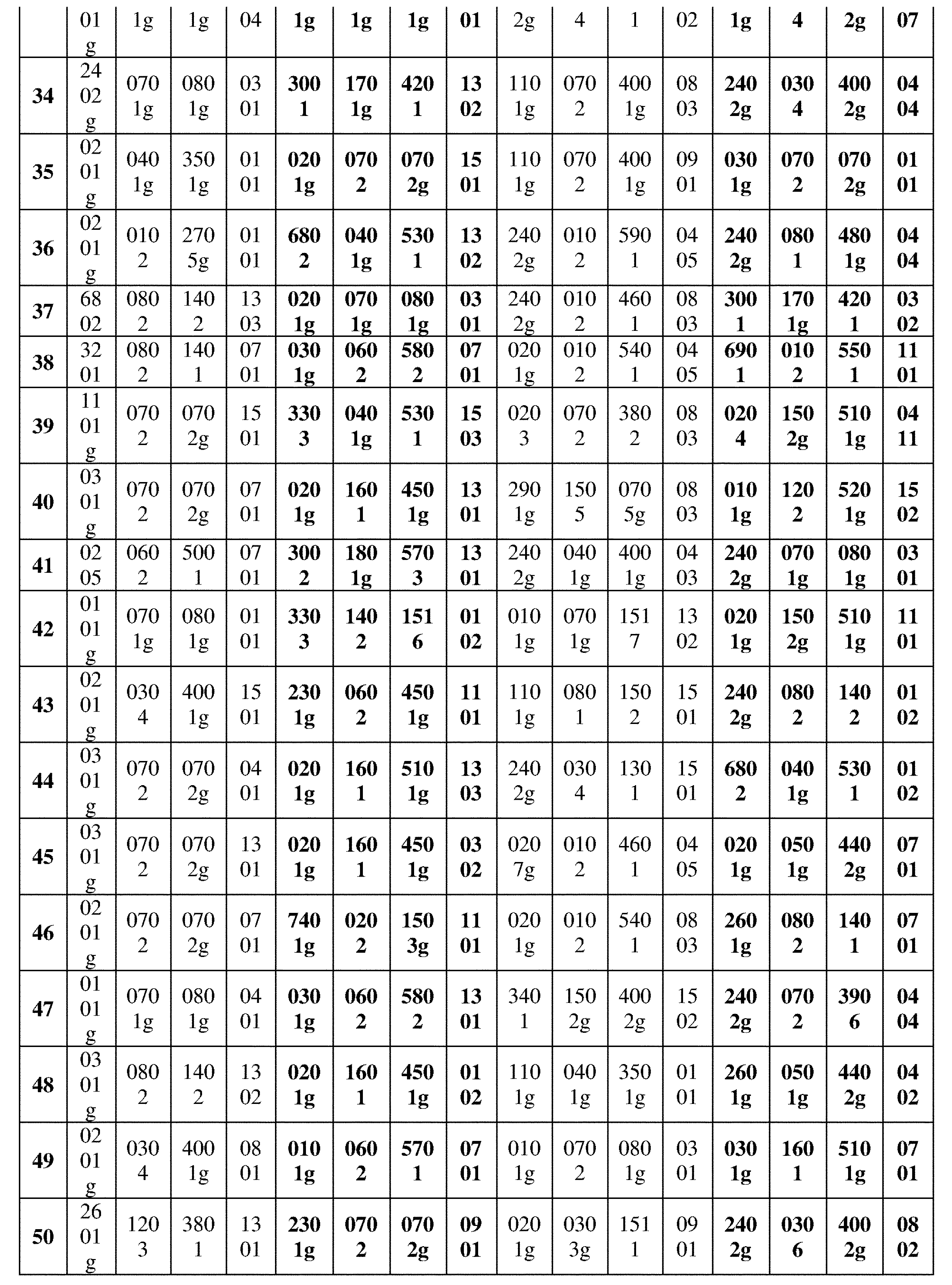
表11は、米国民における最も頻度の高い高解像度HLA-A-C-B-DRB1-DQB1ハプロタイプを記載する。表に示される各系統(例えば、ヨーロッパ系アメリカ人、アフリカ系アメリカ人、アジア系[パシフィックアイランダーを含む]、およびヒスパニック系[ラテンアメリカ人])について、上位50の最も頻度の高いHLA-A-C-B-DRB1-DQB1ハプロタイプが示され、各列に示す系統群におけるその発生頻度(以前の刊行物(Maiers et al.,2007,Human Immunology,68:779-788)からの高解像度頻度の最新版を掲載する全米骨髄バンクウェブサイト(The National Marrow Donor Program Website)(US):bioinformatics.bethematchclinical.orgから編集)に基づいてランク付けされる。使用されるアノテーション(例えば、HLA-Aの場合の0201gは、HLA-A*02:01と同じであり、これは、2010年のWHO Nomenclature Committee for Factors of the HLA Systemにより採用された新命名法に基づき、(HLA接頭辞)-遺伝子*対立遺伝子群/ファミリー:具体的なHLAタンパク質を示す)ことに留意されたい。例えば、A*0201gは、A*02:01となる。この表に示す名称に関して、コード領域内の同義DNA置換を示すのに用いられる分野、非コード領域の違い、ならびに発現の変化を示すのに用いられる接尾辞は示していない(さらに詳しい情報については次のウェブサイトを参照されたい:hla.alleles.org)。この表で、「g」の接尾辞が付いた対立遺伝子名は、刊行物「Maiers,M.,Gragert,L.,Klitz,W.High resolution HLA alleles and haplotypes in the US population.2007」の表1に定義される対立遺伝子群を指す。 Table 11 describes the most frequent high-resolution HLA-A-CB-DRB1-DQB1 haplotypes in the US population. For each lineage shown in the table (e.g., European American, African American, Asian [including Pacific Islander], and Hispanic [Latin American]), the top 50 most frequent HLA-A- The C-B-DRB1-DQB1 haplotype is shown and its frequency of occurrence in the phylogenetic groups indicated in each column (high-resolution frequencies from a previous publication (Maiers et al., 2007, Human Immunology, 68:779-788) Compiled from the National Marrow Donor Program Website (US): bioinformatics.bethematchclinical.org, which lists the latest version. The annotation used (for example, 0201g for HLA-A is the same as HLA-A*02:01, which is the new nomenclature adopted by the WHO Nomenclature Committee for Factors of the HLA System in 2010) Note that based on (HLA prefix)-gene*allele group/family: indicates a specific HLA protein). For example, A*0201g becomes A*02:01. For the names shown in this table, fields used to indicate synonymous DNA substitutions within coding regions, differences in non-coding regions, and suffixes used to indicate changes in expression are not shown (for more information, see Please see the following website: hla.alleles.org). In this table, allele names with a "g" suffix are taken from the publication "Maiers, M., Gragert, L., Klitz, W. High resolution HLA alleles and haplotypes in the US population.2007". table Refers to the allele group defined in 1.
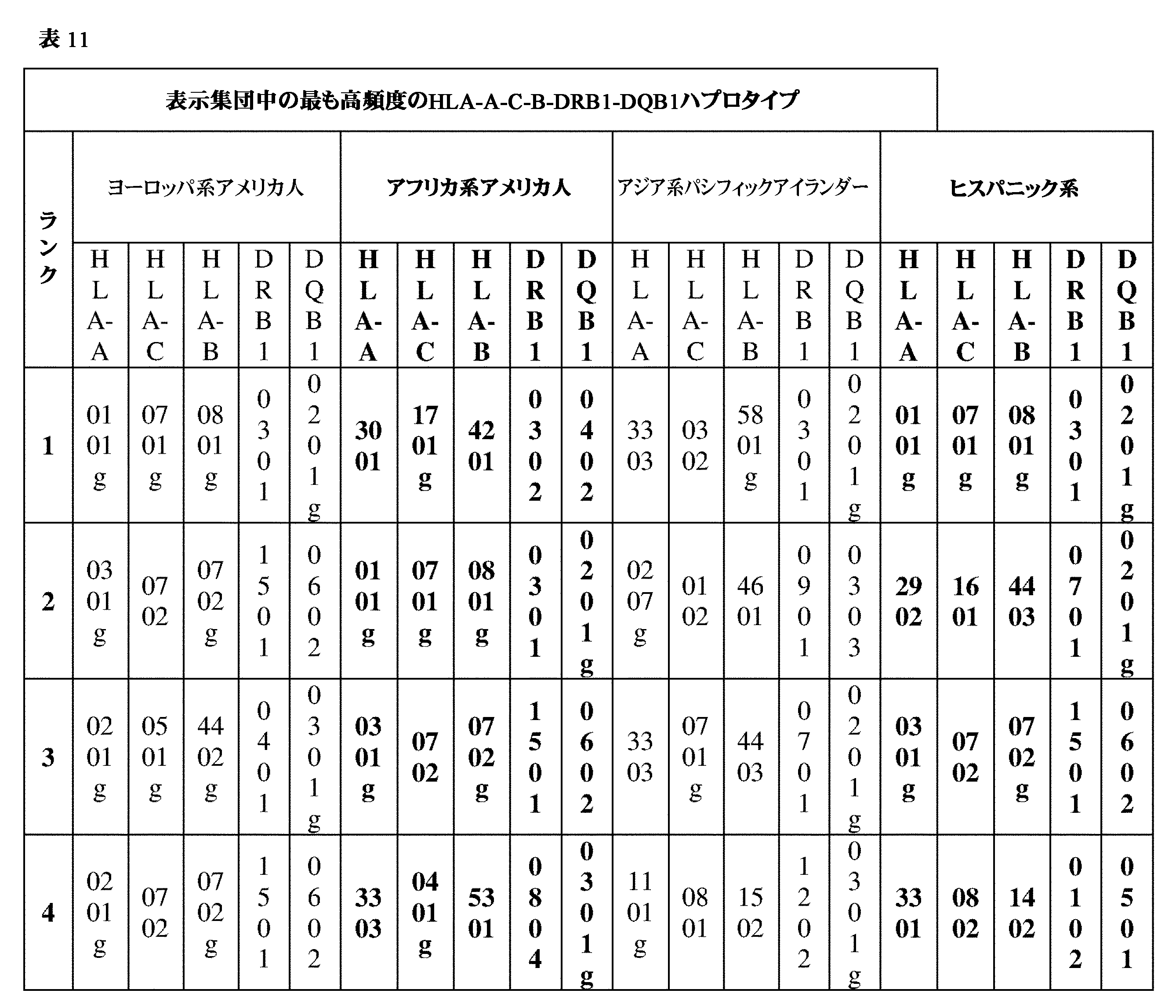
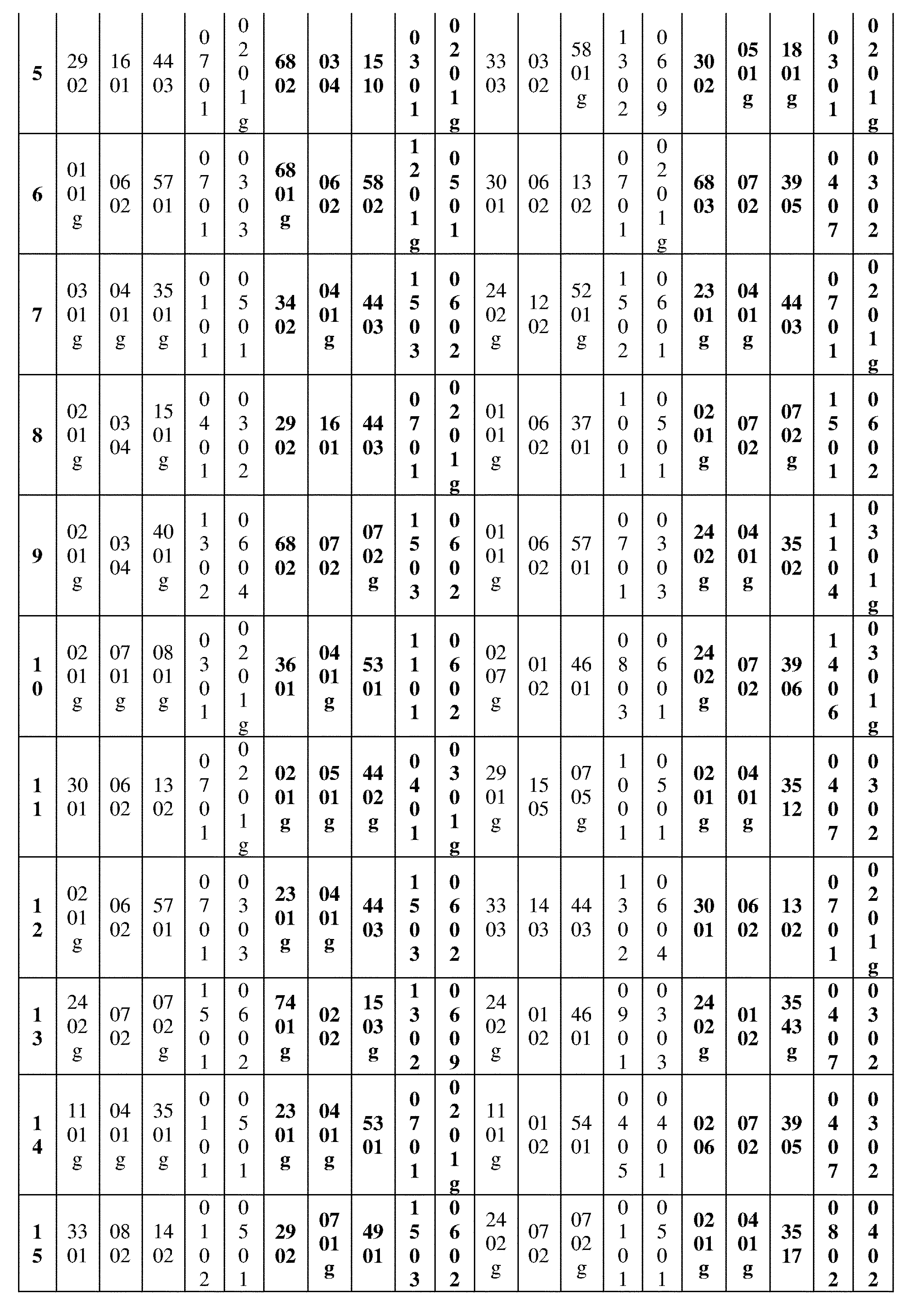
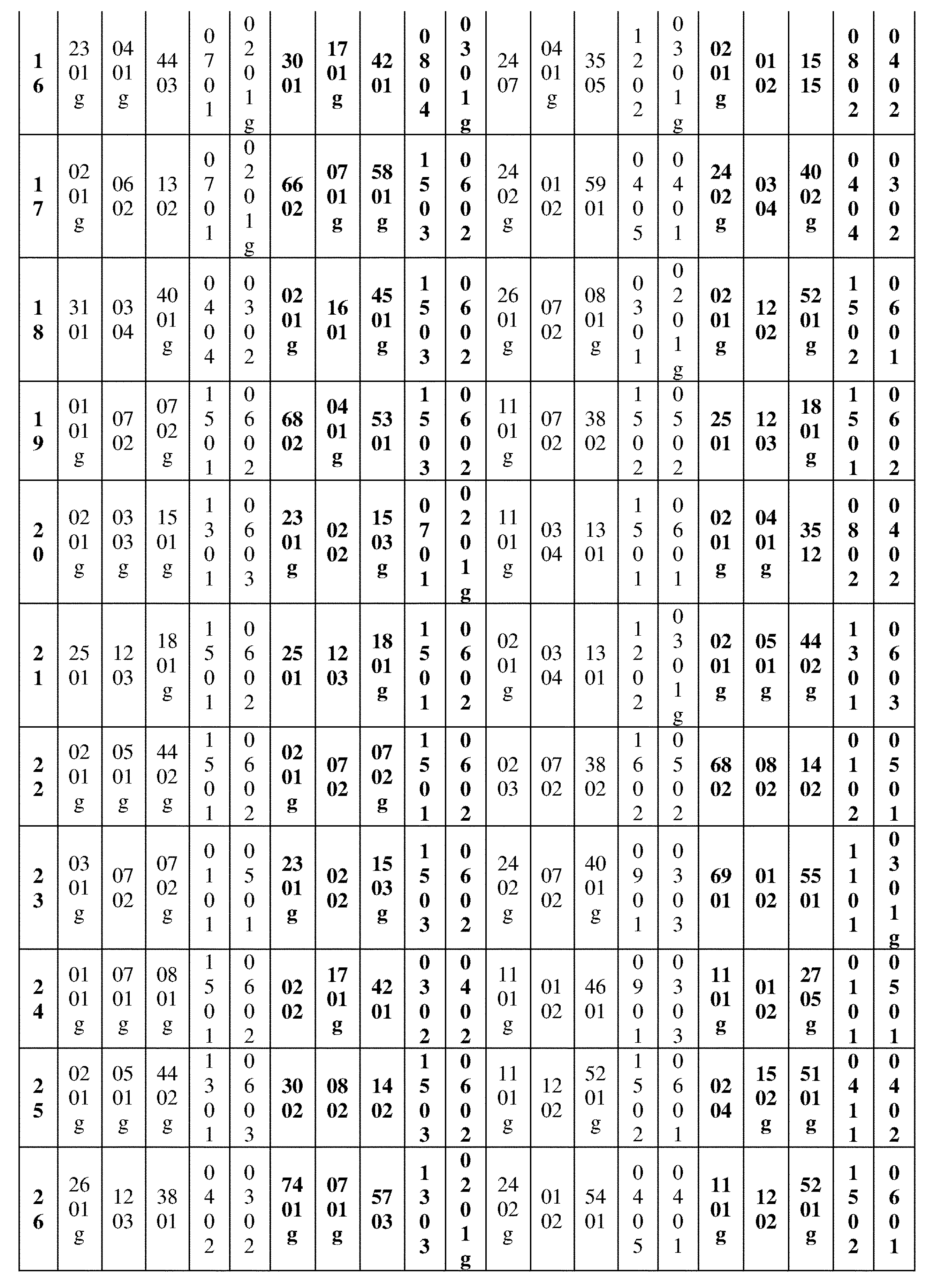
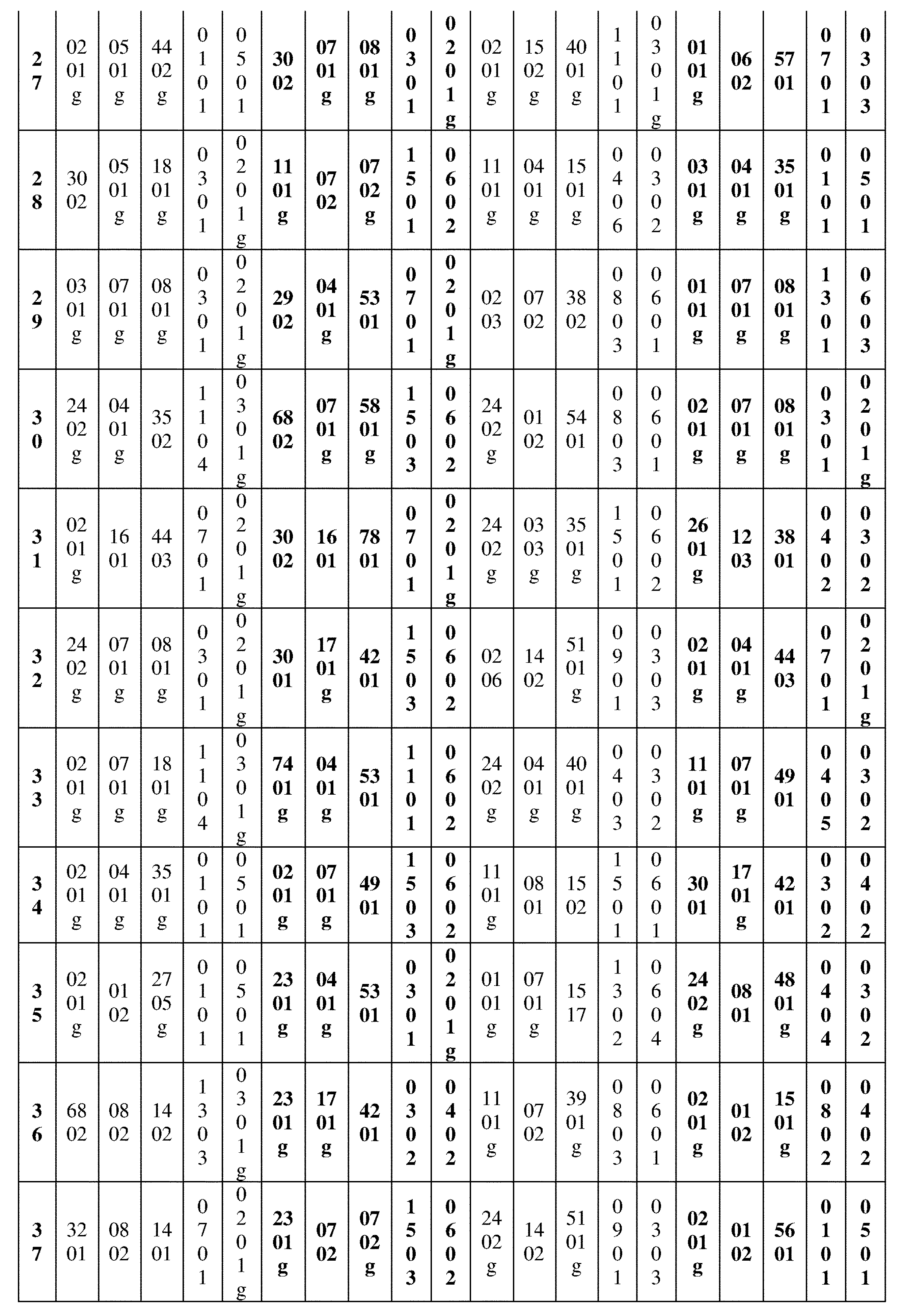

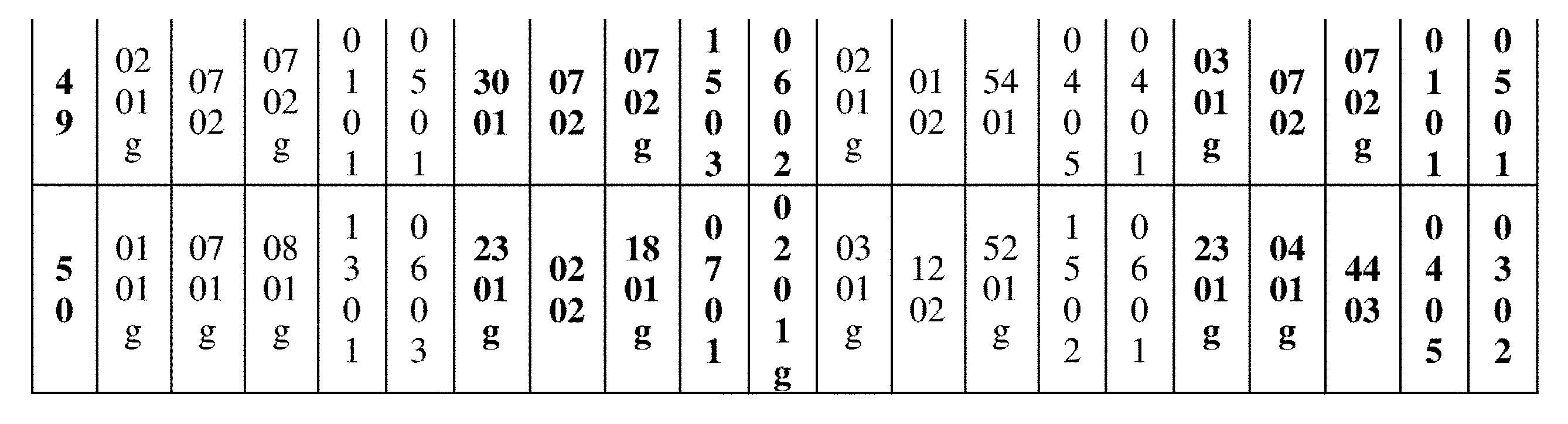
表12は、米国民およびユダヤ系集団における最も頻度の高い高解像度HLA-B-DRB1ハプロタイプを記載する。表に示される各系統(例えば、ヨーロッパ系アメリカ人、アフリカ系アメリカ人、アジア系[パシフィックアイランダーを含む]、ヒスパニック系[ラテンアメリカ人]、およびユダヤ系統の人)について、上位50の最も頻度の高いHLA-B-DRB1ハプロタイプが示され、各列に示す系統群におけるその発生頻度(以前の刊行物[Maiers et al.,2007,Human Immunology,68:779-788からの高解像度頻度の最新版を掲載する全米骨髄バンクウェブサイト(The National Marrow Donor Program Website)(US):bioinformatics.bethematchclinical.orgから編集)に基づいてランク付けされる。ユダヤ系の高解像度HLA-B-DRB1ハプロタイプ頻度は、以下:全米骨髄バンクウェブサイト(National Marrow Donor Program Website)(US)URL:bioinformatics.bethematchclinical.orgから得たものである。ユダヤ系集団についてのHLA-A-B-DRB1ハプロタイプ頻度データが、Hadassah Registry-Jerusalem,Israel(Klitz et al.,201,Tissue Antigens,76(6):442-58)からのドナーサンプルから得られたものであることに留意されたい。使用されるアノテーション(例えば、HLA-DRB1の場合の1501は、HLA-DRB1*15:01と同じであり、これは、2010年のWHO Nomenclature Committee for Factors of the HLA Systemにより採用された新命名法に基づき、(HLA接頭辞)-遺伝子*対立遺伝子群/ファミリー:具体的なHLAタンパク質を示す)ことに留意されたい。例えば、DRB1*1501は、DRB1*15:01となる。この表に示す名称に関して、コード領域内の同義DNA置換を示すのに用いられる分野、非コード領域の違い、ならびに発現の変化を示すのに用いられる接尾辞は示していない(さらに詳しい情報については次のウェブサイトを参照されたい:hla.alleles.org)。この表で、「g」の接尾辞が付いた対立遺伝子名は、刊行物「Maiers,M.,Gragert,L.,Klitz,W.High resolution HLA alleles and haplotypes in the US population.2007」の表1に定義される対立遺伝子群を指す。 Table 12 describes the most frequent high-resolution HLA-B-DRB1 haplotypes in American and Jewish populations. For each lineage shown in the table (e.g., people of European American, African American, Asian [including Pacific Islander], Hispanic [Latino], and Jewish descent), the top 50 most frequent High HLA-B-DRB1 haplotypes are shown and their frequency of occurrence in the phylogenetic groups indicated in each column (updated version of high-resolution frequencies from previous publication [Maiers et al., 2007, Human Immunology, 68:779-788] Compiled from the National Marrow Donor Program Website (US): bioinformatics.bethematchclinical.org). High-resolution HLA-B-DRB1 haplotype frequencies for Jewish ancestry are available at: National Marrow Donor Program Website (US) URL: bioinformatics. bethematchclinical. This is what I got from org. HLA-AB-DRB1 haplotype frequency data for Jewish populations were obtained from donor samples from the Hadassah Registry-Jerusalem, Israel (Klitz et al., 201, Tissue Antigens, 76(6):442-58). Please note that the The annotation used (for example, 1501 for HLA-DRB1 is the same as HLA-DRB1*15:01, which is a new nomenclature adopted by the WHO Nomenclature Committee for Factors of the HLA System in 2010. Note that based on (HLA prefix)-gene*allele group/family: indicates a specific HLA protein). For example, DRB1*1501 becomes DRB1*15:01. For the names shown in this table, fields used to indicate synonymous DNA substitutions within coding regions, differences in non-coding regions, and suffixes used to indicate changes in expression are not shown (for more information Please see the following website: hla.alleles.org). In this table, allele names with a "g" suffix are taken from the publication "Maiers, M., Gragert, L., Klitz, W. High resolution HLA alleles and haplotypes in the US population.2007". table Refers to the allele group defined in 1.
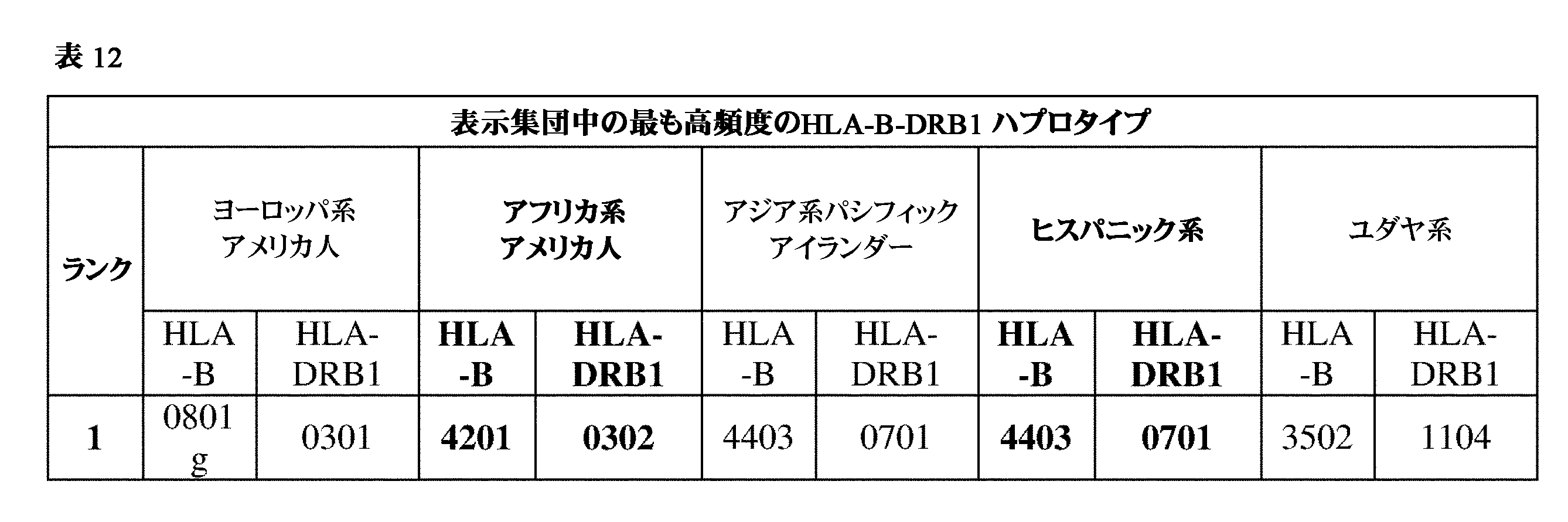

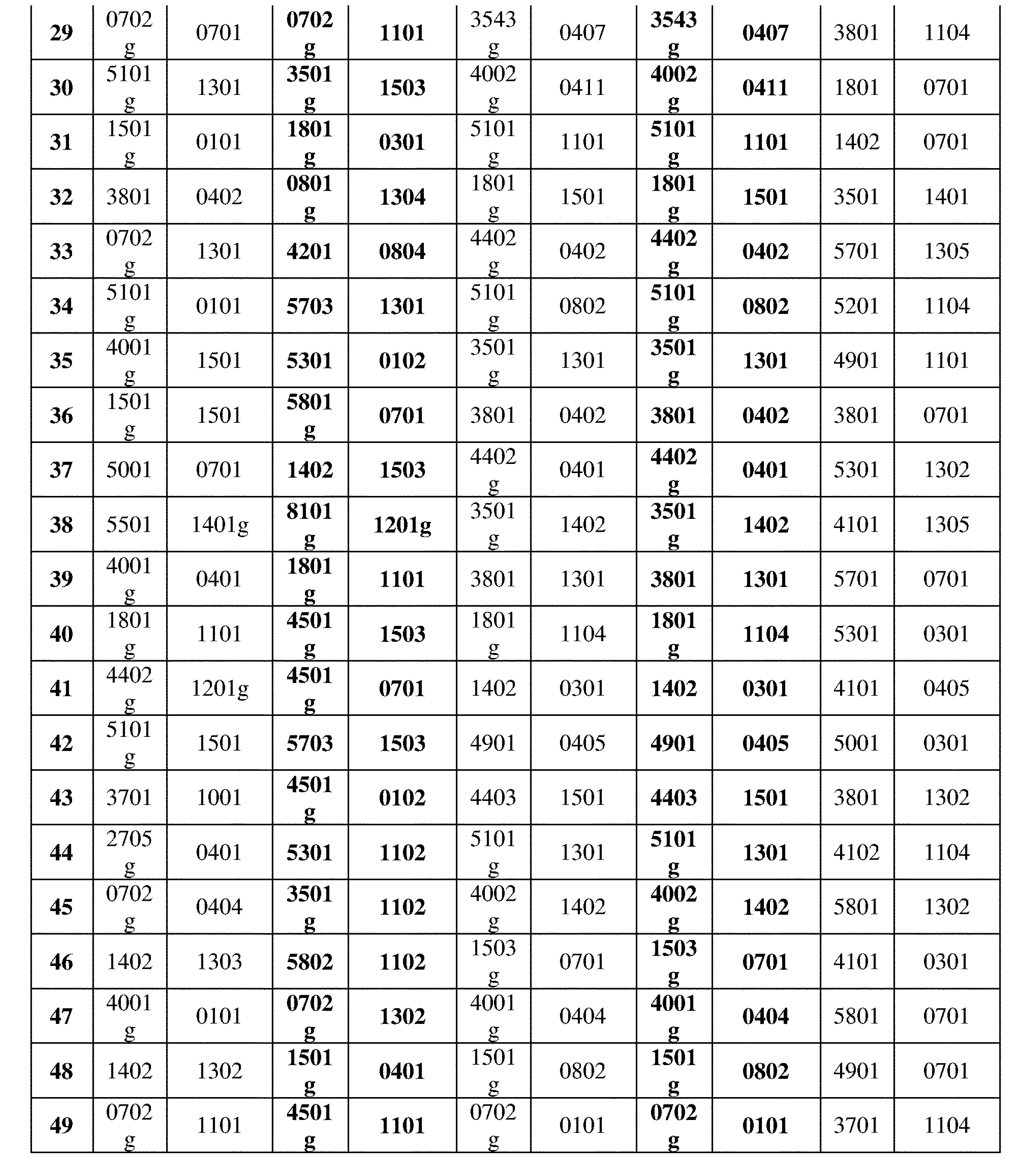
表13は、米国民における最も頻度の高い高解像度HLA-C-Bハプロタイプを記載する。表に示される各系統(例えば、ヨーロッパ系アメリカ人、アフリカ系アメリカ人、アジア系[パシフィックアイランダーを含む]、およびヒスパニック系[ラテンアメリカ人])について、上位50の最も頻度の高いHLA-C-Bハプロタイプが示され、各列に示す系統群におけるその発生頻度(以前の刊行物(Maiers et al.,2007,Human Immunology,68:779-788)からの高解像度頻度の最新版を掲載する全米骨髄バンクウェブサイト(The National Marrow Donor Program Website)(US):bioinformatics.bethematchclinical.orgから編集)に基づいてランク付けされる。使用されるアノテーション(例えば、HLA-Cの場合の0701gは、HLA-C*07:01と同じであり、これは、2010年のWHO Nomenclature Committee for Factors of the HLA Systemにより採用された新命名法に基づき、(HLA接頭辞)-遺伝子*対立遺伝子群/ファミリー:具体的なHLAタンパク質を示す)ことに留意されたい。例えば、C*0701gは、C*07:01となる。この表に示す名称に関して、コード領域内の同義DNA置換を示すのに用いられる分野、非コード領域の違い、ならびに発現の変化を示すのに用いられる接尾辞は示していない(さらに詳しい情報については次のウェブサイトを参照されたい:hla.alleles.org)。この表で、「g」の接尾辞が付いた対立遺伝子名は、刊行物「Maiers,M.,Gragert,L.,Klitz,W.High resolution HLA alleles and haplotypes in the US population.2007」の表1に定義される対立遺伝子群を指す。接尾辞「N」は、発現の変化を示すのに用いられる(前述の命名法リンクを参照)。 Table 13 describes the most frequent high-resolution HLA-CB haplotypes in the US population. For each lineage shown in the table (e.g., European American, African American, Asian [including Pacific Islander], and Hispanic [Latin American]), the top 50 most frequent HLA-C- B haplotypes are shown and their frequency of occurrence in the phylogenetic groups indicated in each column (from a previous publication (Maiers et al., 2007, Human Immunology, 68:779-788) Compiled from The National Marrow Donor Program Website (US): bioinformatics.bethematchclinical.org). The annotation used (for example, 0701g for HLA-C is the same as HLA-C*07:01, which is the new nomenclature adopted by the WHO Nomenclature Committee for Factors of the HLA System in 2010) Note that based on (HLA prefix)-gene*allele group/family: indicates a specific HLA protein). For example, C*0701g becomes C*07:01. For the names shown in this table, fields used to indicate synonymous DNA substitutions within coding regions, differences in non-coding regions, and suffixes used to indicate changes in expression are not shown (for more information, see Please see the following website: hla.alleles.org). In this table, allele names with a "g" suffix are taken from the publication "Maiers, M., Gragert, L., Klitz, W. High resolution HLA alleles and haplotypes in the US population.2007". table Refers to the allele group defined in 1. The suffix "N" is used to indicate a change in expression (see nomenclature link above).
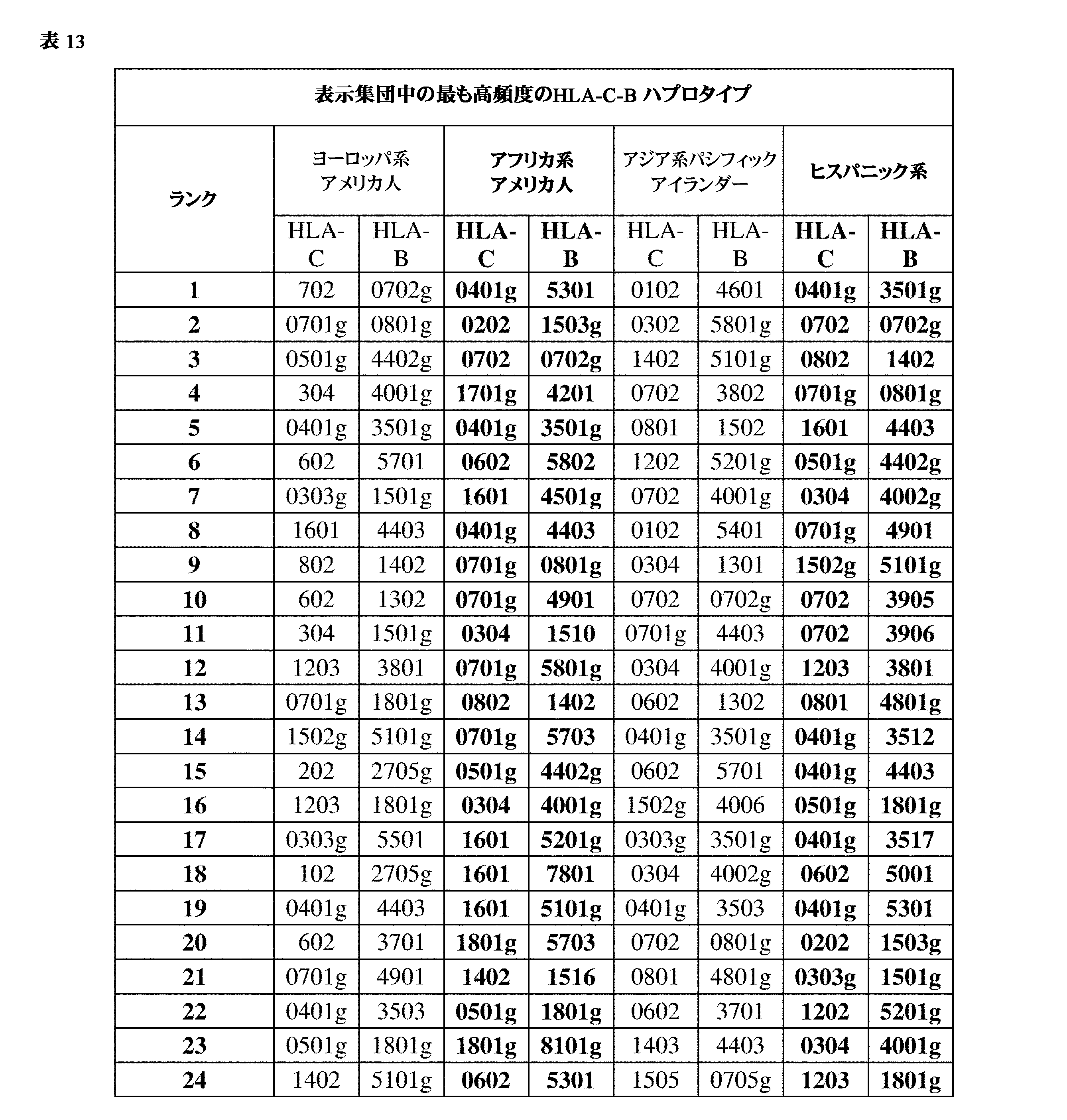
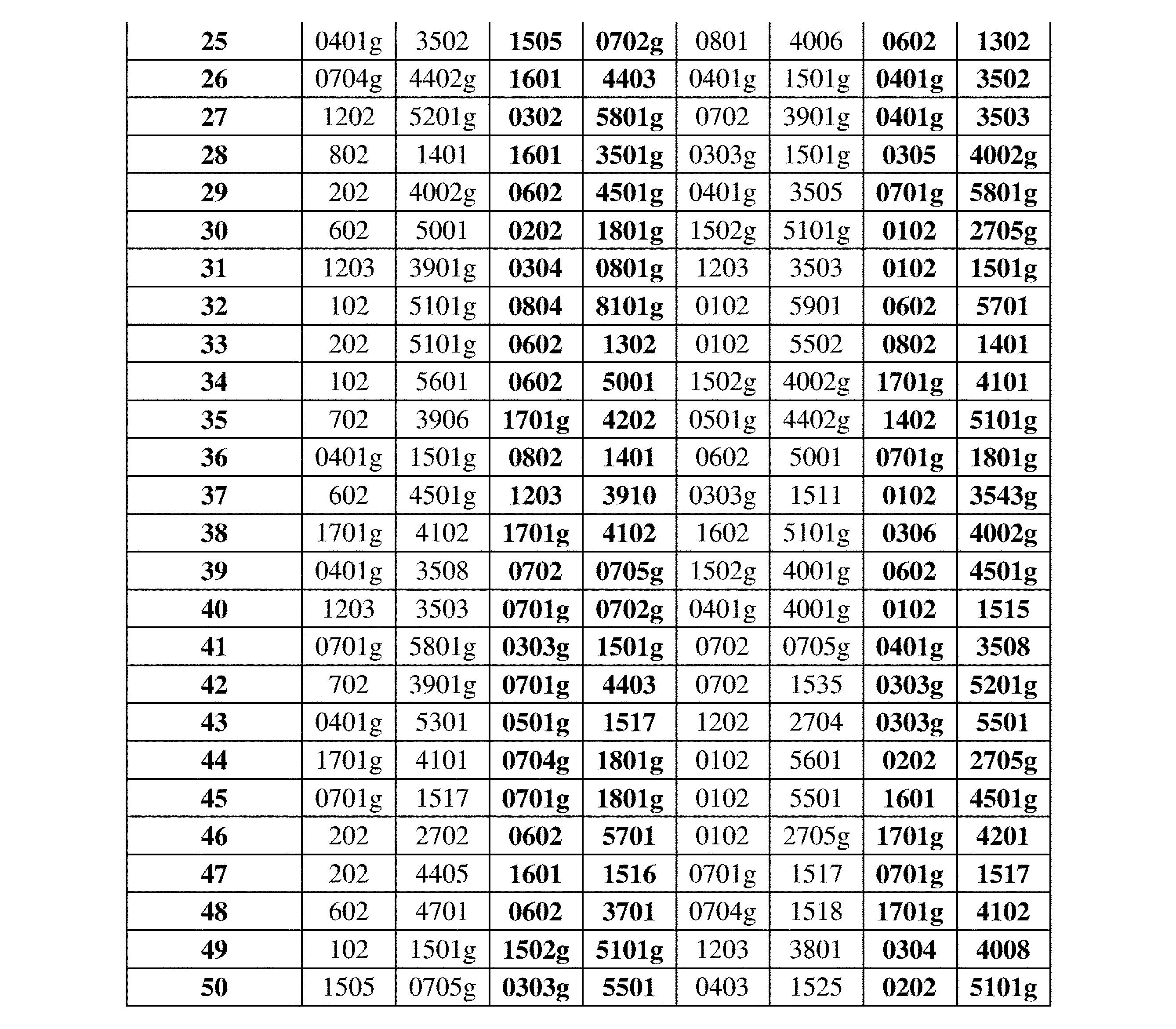
表14は、米国民における最も頻度の高い高解像度HLA-C-B-DRB1-DQB1ハプロタイプを記載する。表に示される各系統(例えば、ヨーロッパ系アメリカ人、アフリカ系アメリカ人、アジア系[パシフィックアイランダーを含む]、およびヒスパニック系[ラテンアメリカ人])について、上位50の最も頻度の高いHLA-C-B-DRB1-DQB1ハプロタイプが示され、各列に示す系統群におけるその発生頻度(以前の刊行物[Maiers et al.,2007,Human Immunology,68:779-788からの高解像度頻度の最新版を掲載する全米骨髄バンクウェブサイト(The National Marrow Donor Program Website)(US):bioinformatics.bethematchclinical.orgから編集)に基づいてランク付けされる。使用されるアノテーション(例えば、HLA-DRB1の場合の1501は、HLA-DRB1*15:01と同じであり、これは、2010年のWHO Nomenclature Committee for Factors of the HLA Systemにより採用された新命名法に基づき、(HLA接頭辞)-遺伝子*対立遺伝子群/ファミリー:具体的なHLAタンパク質を示す)ことに留意されたい。例えば、DRB1*1501は、DRB1*15:01となる。この表に示す名称に関して、コード領域内の同義DNA置換を示すのに用いられる分野、非コード領域の違い、ならびに発現の変化を示すのに用いられる接尾辞は示していない(さらに詳しい情報については次のウェブサイトを参照されたい:hla.alleles.org)。この表で、「g」の接尾辞が付いた対立遺伝子名は、刊行物「Maiers,M.,Gragert,L.,Klitz,W.High resolution HLA alleles and haplotypes in the US population.2007」の表1に定義される対立遺伝子群を指す。 Table 14 describes the most frequent high-resolution HLA-C-B-DRB1-DQB1 haplotypes in the US population. For each lineage shown in the table (e.g., European American, African American, Asian [including Pacific Islander], and Hispanic [Latin American]), the top 50 most frequent HLA-C- The B-DRB1-DQB1 haplotype is shown and its frequency of occurrence in the phylogenetic groups indicated in each column (updated version of high-resolution frequencies from a previous publication [Maiers et al., 2007, Human Immunology, 68:779-788] Compiled from the National Marrow Donor Program Website (US): bioinformatics.bethematchclinical.org). The annotation used (for example, 1501 for HLA-DRB1 is the same as HLA-DRB1*15:01, which is a new nomenclature adopted by the WHO Nomenclature Committee for Factors of the HLA System in 2010. Note that based on (HLA prefix)-gene*allele group/family: indicates a specific HLA protein). For example, DRB1*1501 becomes DRB1*15:01. For the names shown in this table, fields used to indicate synonymous DNA substitutions within coding regions, differences in non-coding regions, and suffixes used to indicate changes in expression are not shown (for more information Please see the following website: hla.alleles.org). In this table, allele names with a "g" suffix are taken from the publication "Maiers, M., Gragert, L., Klitz, W. High resolution HLA alleles and haplotypes in the US population.2007". table Refers to the allele group defined in 1.
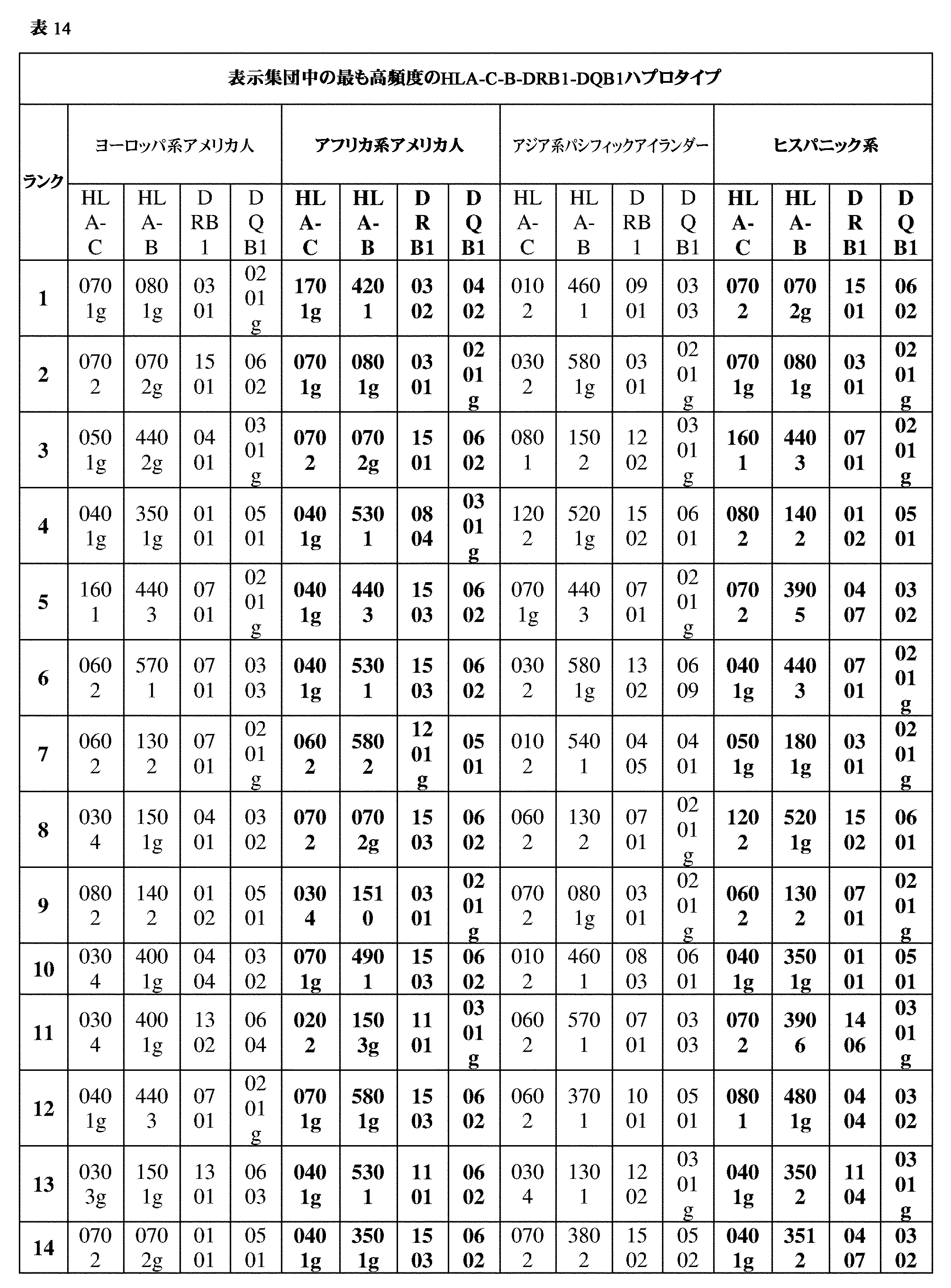
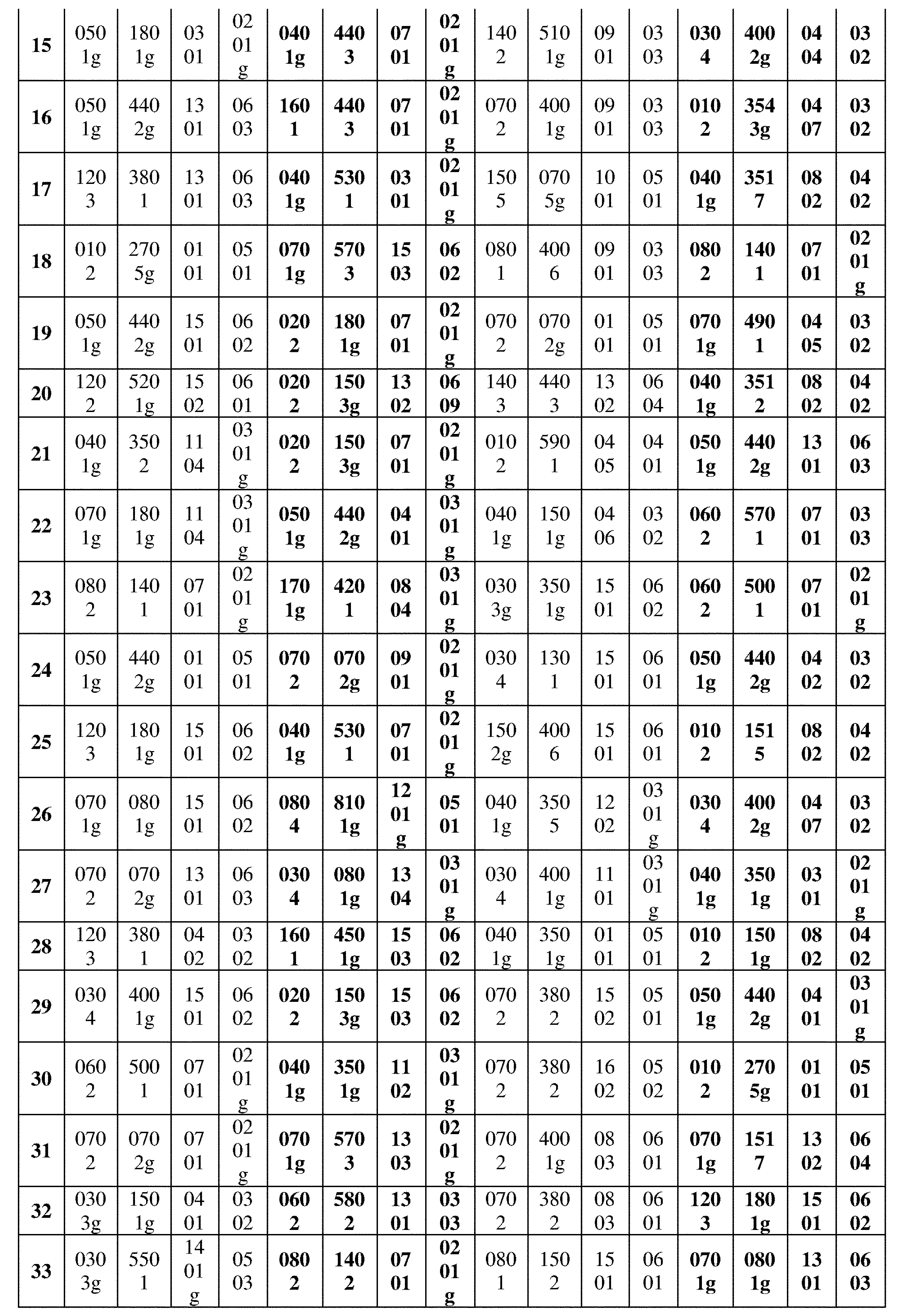
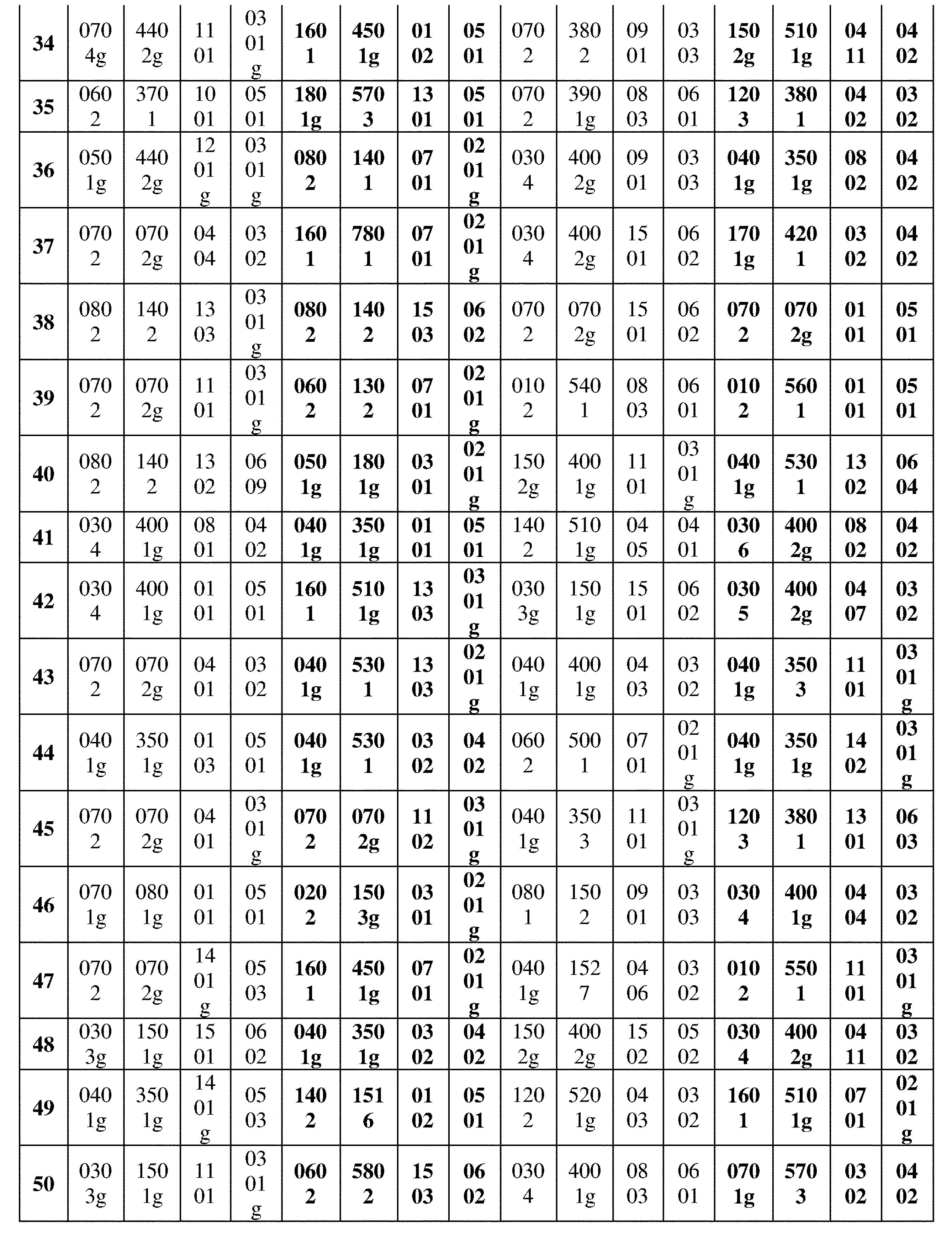
表15は、米国民における最も頻度の高い高解像度HLA-DRB1-DQB1ハプロタイプを記載する。表に示される各系統(例えば、ヨーロッパ系アメリカ人、アフリカ系アメリカ人、アジア系[パシフィックアイランダーを含む]、およびヒスパニック系[ラテンアメリカ人])について、上位50の最も頻度の高いHLA-C-B-DRB1-DQB1ハプロタイプが示され、各列に示す系統群におけるその発生頻度(以前の刊行物[Maiers et al.,2007,Human Immunology,68:779-788]からの高解像度頻度の最新版を掲載する全米骨髄バンクウェブサイト(The National Marrow Donor Program Website)(US):bioinformatics.bethematchclinical.orgから編集)に基づいてランク付けされる。使用されるアノテーション(例えば、HLA-DRB1の場合の1501は、HLA-DRB1*15:01と同じであり、これは、2010年のWHO Nomenclature Committee for Factors of the HLA Systemにより採用された新命名法に基づき、(HLA接頭辞)-遺伝子*対立遺伝子群/ファミリー:具体的なHLAタンパク質を示す)ことに留意されたい。例えば、DRB1*1501は、DRB1*15:01となる。この表に示す名称に関して、コード領域内の同義DNA置換を示すのに用いられる分野、非コード領域の違い、ならびに発現の変化を示すのに用いられる接尾辞は示していない(さらに詳しい情報については次のウェブサイトを参照されたい:hla.alleles.org)。この表で、「g」の接尾辞が付いた対立遺伝子名は、刊行物「Maiers,M.,Gragert,L.,Klitz,W.High resolution HLA alleles and haplotypes in the US population.2007」の表1に定義される対立遺伝子群を指す。 Table 15 describes the most frequent high-resolution HLA-DRB1-DQB1 haplotypes in the US population. For each lineage shown in the table (e.g., European American, African American, Asian [including Pacific Islander], and Hispanic [Latin American]), the top 50 most frequent HLA-C- The B-DRB1-DQB1 haplotype is shown and its frequency of occurrence in the phylogenetic groups indicated in each column (updated version of high-resolution frequencies from a previous publication [Maiers et al., 2007, Human Immunology, 68:779-788]) Compiled from the National Marrow Donor Program Website (US): bioinformatics.bethematchclinical.org). The annotation used (for example, 1501 for HLA-DRB1 is the same as HLA-DRB1*15:01, which is a new nomenclature adopted by the WHO Nomenclature Committee for Factors of the HLA System in 2010. Note that based on (HLA prefix)-gene*allele group/family: indicates a specific HLA protein). For example, DRB1*1501 becomes DRB1*15:01. For the names shown in this table, fields used to indicate synonymous DNA substitutions within coding regions, differences in non-coding regions, and suffixes used to indicate changes in expression are not shown (for more information, see Please see the following website: hla.alleles.org). In this table, allele names with a "g" suffix are taken from the publication "Maiers, M., Gragert, L., Klitz, W. High resolution HLA alleles and haplotypes in the US population.2007". table Refers to the allele group defined in 1.
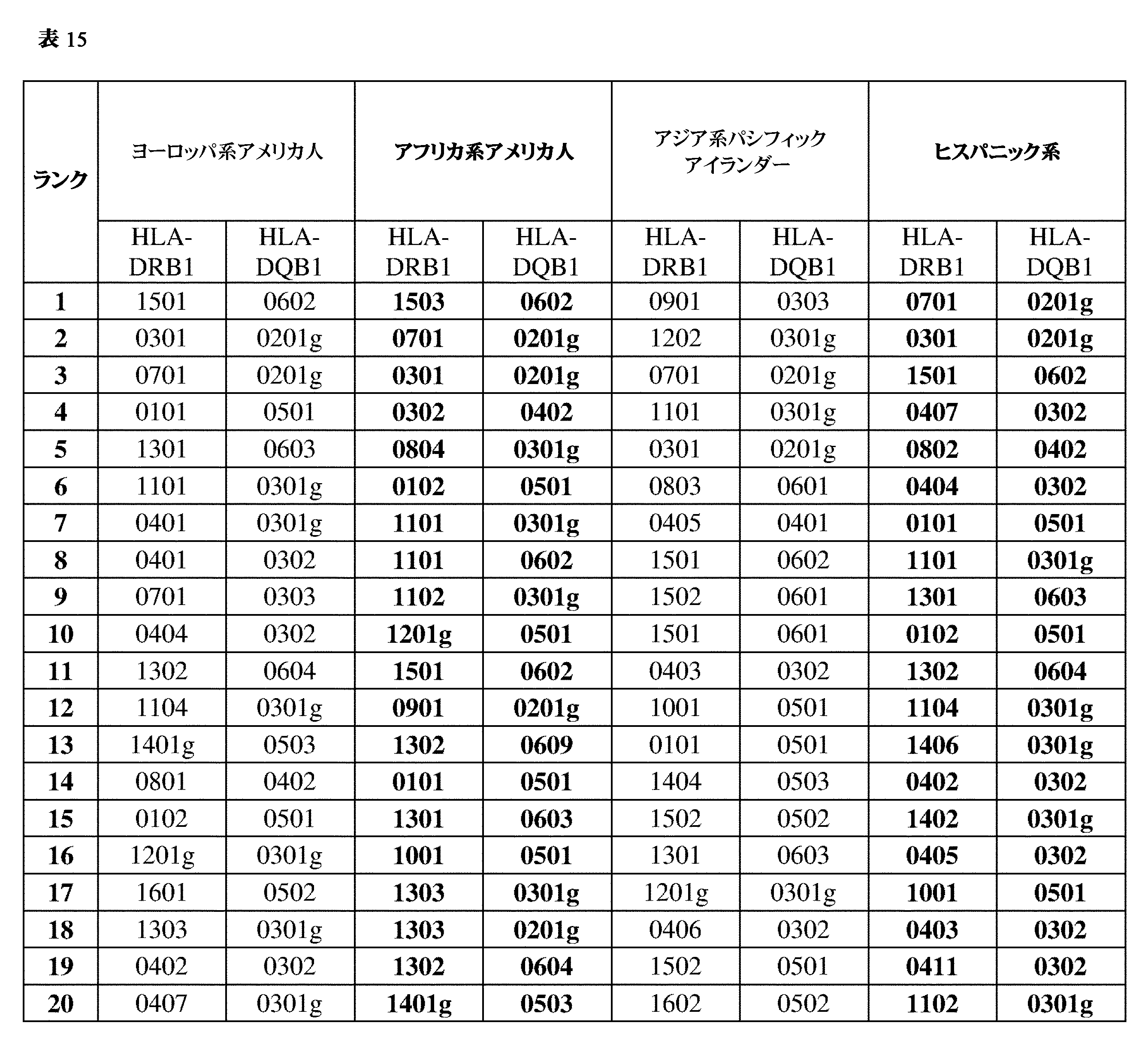
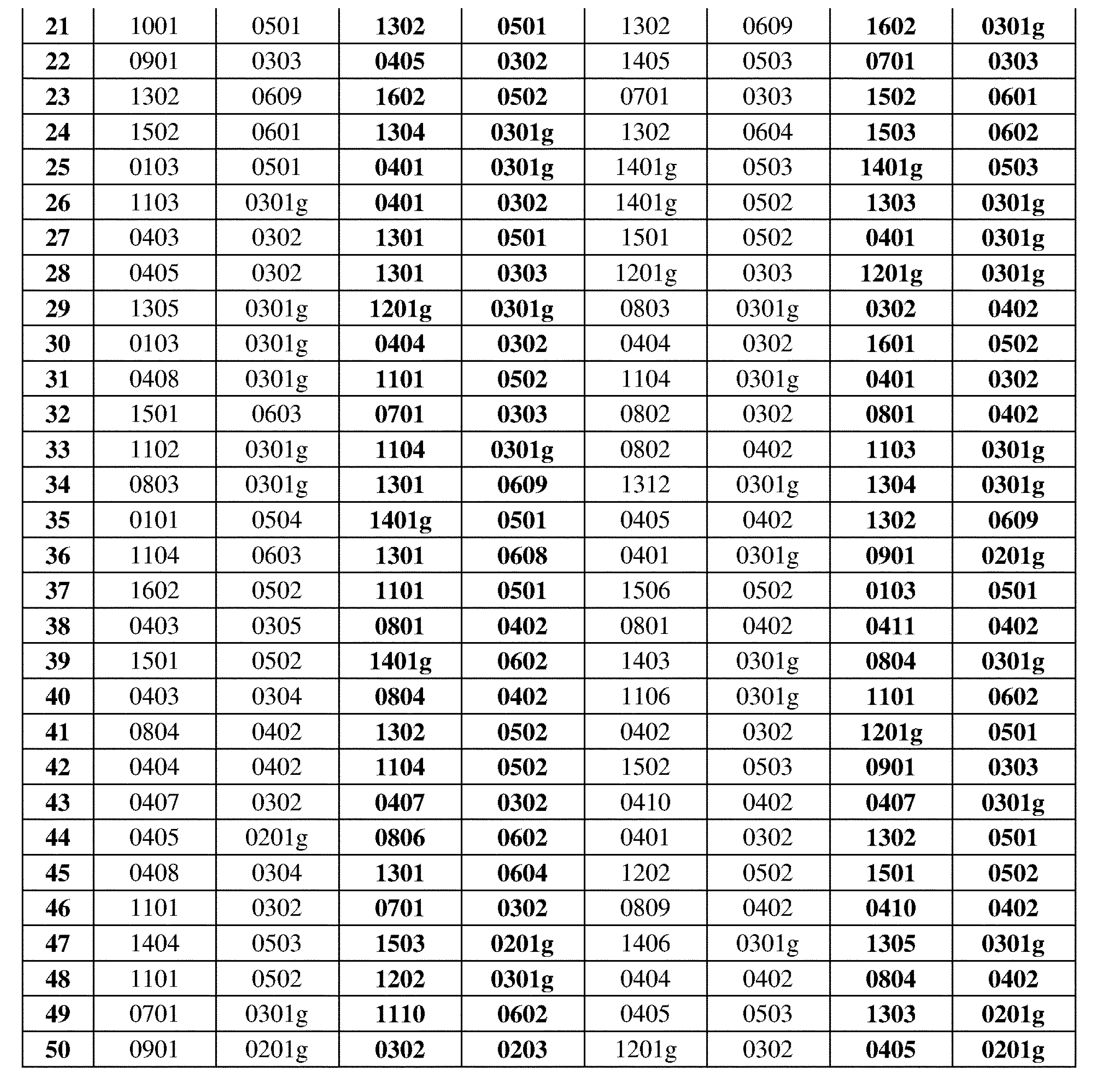
ドナー細胞移植を改善するための方法
本明細書に記載される方法、組成物、および細胞を用いて、例えば、生着を高める、GVHDおよび移植片拒絶を予防する、前処置および免疫抑制の必要性を低減する、またはこれらの組合せによって、移植の結果(例えば、造血幹細胞移植)を改善することができる。例えば、本明細書に記載される方法、組成物、および細胞は、GVHDおよび/もしくは移植片拒絶を予防または治療する治療法、例えば、1回療法または複数回投与療法を提供する。
Methods for Improving Donor Cell Transplantation Use the methods, compositions, and cells described herein to enhance engraftment, prevent GVHD and graft rejection, and require pretreatment and immunosuppression, for example. transplantation outcomes (eg, hematopoietic stem cell transplantation) can be improved by reducing the susceptibility to transplantation, or a combination thereof. For example, the methods, compositions, and cells described herein provide treatments for preventing or treating GVHD and/or graft rejection, such as single- or multiple-dose therapies.
一実施形態では、本療法は、対象、例えば、マッチする、もしくはマッチしない移植(例えばアロ-HSCT)後のレシピエントにおけるGVHDおよび/もしくは移植片拒絶の発生を予防、阻害、または低減する。別の実施形態では、本療法は、対象、例えば、マッチする、もしくはマッチしない移植(例えば、アロ-HSCT)後のレシピエントにおけるGVHDおよび/もしくは移植片拒絶の重症度を予防、阻害、または低減する。例えば、1つまたは複数のHLA遺伝子もしくは遺伝子座をノックアウトまたはノックダウンすることによる、1つまたは複数のドナーHLA対立遺伝子の不活性化、ならびに1つまたは複数のレシピエントマッチHLA対立遺伝子を、例えば、ノックインなどにより、ドナー細胞(例えば、本明細書に記載される細胞、例えば、HSPC)に供給することによって、対象、例えば、マッチする、部分的にマッチする、ハプロタイプが同一である、もしくはミスマッチの移植(例えば、アロ-HSCT)後のレシピエントにおけるGVHDおよび/もしくは移植片拒絶の発生または重症度を予防、阻害、または低減することができると考えられる。 In one embodiment, the therapy prevents, inhibits, or reduces the occurrence of GVHD and/or graft rejection in a subject, eg, a recipient after a matched or unmatched transplant (eg, allo-HSCT). In another embodiment, the therapy prevents, inhibits, or reduces the severity of GVHD and/or graft rejection in a subject, e.g., a recipient after a matched or unmatched transplant (e.g., allo-HSCT). do. Inactivation of one or more donor HLA alleles and one or more recipient-matched HLA alleles, e.g., by knocking out or knocking down one or more HLA genes or loci, e.g. a target, e.g., matched, partially matched, haploidentical, or mismatched, by supplying donor cells (e.g., cells described herein, e.g., HSPC), such as by knock-in, knock-in, etc. It is believed that the occurrence or severity of GVHD and/or graft rejection in a recipient after transplantation (eg, allo-HSCT) can be prevented, inhibited, or reduced.
一実施形態では、本療法は、対象、例えば、マッチもしくはミスマッチ移植(例えば、アロ-HSCT)後のレシピエントにおける骨髄破壊的前処置を予防、減少、またはその必要性をなくす、またはその強度を軽減する。 In one embodiment, the therapy prevents, reduces, or eliminates the need for, or reduces the intensity of, myeloablative conditioning in a subject, e.g., a recipient after a matched or mismatched transplant (e.g., allo-HSCT). Reduce.
一実施形態では、本療法は、対象、例えば、マッチする、もしくはマッチしないアロ-UCT後のレシピエントにおけるGVHDおよび/もしくは移植片拒絶の発生を予防、阻害、または軽減する。別の実施形態では、本療法は、対象、例えば、マッチする、もしくはマッチしないアロ-UCT後のレシピエントにおけるGVHDおよび/もしくは移植片拒絶の重症度を予防、阻害、または軽減する。一実施形態では、例えば、1つまたは複数のHLA遺伝子もしくは遺伝子座をノックアウトまたはノックダウンすることによる、1つまたは複数のドナーHLA対立遺伝子の不活性化、ならびに1つまたは複数のレシピエントマッチHLA対立遺伝子を、例えば、ノックインなどにより、ドナー細胞(例えば、本明細書に記載される細胞、例えば、HSPC)に供給することによって、対象、例えば、マッチする、部分的にマッチする、ハプロタイプが同一である、もしくはミスマッチアロ-UCT後のレシピエントにおけるGVHDおよび/もしくは移植片拒絶の発生または重症度を予防、阻害、または軽減することができると考えられる。 In one embodiment, the therapy prevents, inhibits, or reduces the occurrence of GVHD and/or graft rejection in a subject, eg, a recipient after matched or unmatched allo-UCT. In another embodiment, the therapy prevents, inhibits, or reduces the severity of GVHD and/or graft rejection in a subject, eg, a recipient after matched or unmatched allo-UCT. In one embodiment, inactivation of one or more donor HLA alleles, e.g., by knocking out or knocking down one or more HLA genes or loci, and one or more recipient-matched HLA alleles. By supplying an allele, e.g., by knock-in, to a donor cell (e.g., a cell described herein, e.g., an HSPC), a subject, e.g., a matched, partially matched, haplotype-identical or can prevent, inhibit, or reduce the occurrence or severity of GVHD and/or graft rejection in recipients after mismatched allo-UCT.
一実施形態では、対象、例えば、マッチもしくはミスマッチ移植(例えば、アロ-HSCT)後のレシピエントは、疾患、例えば、移植、例えば、HSCTから利益を受け得る疾患のために、治療を受けているか、または治療を受けたことがある。例示的な疾患として、限定はしないが、悪性疾患、異常ヘモグロビン症、血液疾患、免疫不全、リソソーム蓄積症、または遺伝性もしくは後天性血液疾患が挙げられる。一実施形態では、対象は、抗がん療法、例えば、化学療法または放射線療法を受けているか、または治療を受けたことがある。 In one embodiment, the subject, e.g., a recipient after a matched or mismatched transplant (e.g., allo-HSCT), is undergoing treatment for a disease, e.g., a disease that could benefit from the transplant, e.g., HSCT. , or have received treatment. Exemplary diseases include, but are not limited to, malignant diseases, hemoglobinopathies, hematological diseases, immunodeficiencies, lysosomal storage diseases, or inherited or acquired hematological diseases. In one embodiment, the subject is undergoing or has undergone anti-cancer therapy, such as chemotherapy or radiation therapy.
一実施形態では、本療法は、GVHDの尤度を低下させる。一実施形態では、対象は、移植(例えば、HSCT)の前にレシピエント対象が受ける、より少ない用量の移植前(例えば、HSCT前)前処置レジメンを受ける。一実施形態では、本明細書に記載される方法に従って改変された移植(例えば、HSCT)による治療は、移植後の免疫抑制(例えば、タクロリムス、プレドニゾロン、プレドニゾン、および/またはその他のステロイド、ATG、CTLA4-Ig、MMF、ラパマイシン)の必要性および/または強度を低減する。一実施形態では、本明細書に記載される方法に従って修飾された移植(例えば、HSCT)による治療は、移植前のレシピエント対象の前処置の排除、またはその部分的な軽減を可能にする。 In one embodiment, the therapy reduces the likelihood of GVHD. In one embodiment, the subject receives a lower dose of a pre-transplant (eg, pre-HSCT) conditioning regimen that a recipient subject would receive prior to transplant (eg, HSCT). In one embodiment, treatment with a transplant (e.g., HSCT) modified according to the methods described herein includes post-transplant immunosuppression (e.g., tacrolimus, prednisolone, prednisone, and/or other steroids, ATG, CTLA4-Ig, MMF, rapamycin). In one embodiment, treatment with a transplant (eg, HSCT) modified according to the methods described herein allows for the elimination, or partial reduction, of conditioning the recipient subject prior to transplantation.
一実施形態では、対象は、移植片(例えば、HSCT)で治療することができ、ドナー細胞は、レシピエントに対して延命効果を有することが期待される疾患を有する。一実施形態では、対象は、異常ヘモグロビン症、免疫不全、遺伝性もしくは後天性血液疾患、または悪性疾患を有する。一実施形態では、対象は、抗がん療法、例えば、化学療法または放射線療法を受けているか、または治療を受けたことがある。ドナー細胞(例えば、HSPC)が、レシピエント細胞に対して延命効果を有することが期待されると共に、疾患が、悪性疾患(例えば、IL2RG-SCID、IL7R-SCID、JAK3-SCID、またはファンコーニ貧血)ではないいずれかの疾患において、本明細書に記載される方法による治療は、移植前のレシピエントに対し、より低用量の前処置または前処置なしの使用を可能にする。一実施形態では、対象は、他の場合、例えば、以下のいずれかの状態:複数の共存症、重度の共存症、GVHDもしくは移植片拒絶の高いリスク、高齢、または進行中の感染症の存在のために、移植には不適格となり得る。 In one embodiment, a subject can be treated with a transplant (eg, HSCT) and the donor cells have a disease that is expected to have a survival benefit on the recipient. In one embodiment, the subject has a hemoglobinopathy, an immunodeficiency, an inherited or acquired blood disease, or a malignant disease. In one embodiment, the subject is undergoing or has undergone anti-cancer therapy, such as chemotherapy or radiation therapy. The donor cells (e.g. HSPC) are expected to have a survival effect on the recipient cells and the disease is malignant (e.g. IL2RG-SCID, IL7R-SCID, JAK3-SCID, or Fanconi anemia). ), treatment according to the methods described herein allows for the use of lower doses or no pretreatment in recipients prior to transplantation. In one embodiment, the subject otherwise has any of the following conditions, such as: multiple comorbidities, severe comorbidities, high risk of GVHD or graft rejection, advanced age, or the presence of an ongoing infection. may be ineligible for transplantation.
一実施形態では、対象は、血液悪性疾患の治療ために、移植片、例えば、HSCTを必要とする。一実施形態では、対象は、急性骨髄性白血病、急性リンパ性白血病、非ホジキンリンパ腫、ホジキンリンパ腫、慢性骨髄性白血病、慢性リンパ性白血病、慢性骨髄単球性白血病、または多発性骨髄腫を有する。 In one embodiment, the subject is in need of a transplant, eg, HSCT, for treatment of a hematological malignancy. In one embodiment, the subject has acute myeloid leukemia, acute lymphocytic leukemia, non-Hodgkin's lymphoma, Hodgkin's lymphoma, chronic myeloid leukemia, chronic lymphocytic leukemia, chronic myelomonocytic leukemia, or multiple myeloma.
一実施形態では、対象は、骨髄異形成症候群または骨髄増殖性腫瘍の治療のために、移植片、例えば、HSCTを必要とする。 In one embodiment, the subject is in need of a transplant, eg, HSCT, for treatment of myelodysplastic syndrome or myeloproliferative neoplasm.
一実施形態では、対象は、固形腫瘍の治療のために、移植片、例えば、HSCTを必要とする。一実施形態では、対象は、ユーイング肉腫、神経芽細胞腫およびグリオーマ、または線維形成性小細胞腫瘍を有する。 In one embodiment, the subject is in need of a transplant, eg, HSCT, for treatment of a solid tumor. In one embodiment, the subject has Ewing's sarcoma, neuroblastoma and glioma, or desmoplastic small cell tumor.
一実施形態では、対象は、非悪性病状の治療のために、移植片、例えば、HSCTを必要とする。一実施形態では、対象は、異常ヘモグロビン症、血液疾患、サラセミア(例えば、βサラセミアまたはαサラセミア)、鎌状赤血球症(SCD)、ファンコーニ貧血、再生不良性貧血、または先天性骨髄性ポルフィリン症を有する。 In one embodiment, the subject is in need of a transplant, eg, HSCT, for treatment of a non-malignant medical condition. In one embodiment, the subject has a hemoglobinopathy, a blood disorder, a thalassemia (e.g., beta thalassemia or alpha thalassemia), sickle cell disease (SCD), Fanconi anemia, aplastic anemia, or congenital myeloid porphyria. has.
一実施形態では、対象は、免疫不全の治療のために、移植片、例えば、HSCTを必要とする。一実施形態では、対象は、重症複合免疫不全(SCID)(例えば、オーメン(Omenn’s)症候群、RAG-1 SCID、IL2-RG SCID、CD3-SCID、ADA-SCID、もしくはJAK3-SCID)、無ガンマグロブリン血症、ウィスコット・オルドリッチ(Wiskott-Aldrich)症候群、高免疫グロブリンを伴うX連鎖免疫不全M、X連鎖ブルトン型無ガンマグロブリン血症、露出リンパ球症候群、軟骨毛髪形成不全症、チェディアック・東(Chediak-Higashi)症候群、慢性肉芽腫症、コストマン(Kostman’s)症候群、または白血病粘着不全症を有する。 In one embodiment, the subject is in need of a transplant, eg, HSCT, for treatment of an immunodeficiency. In one embodiment, the subject has severe combined immunodeficiency (SCID) (e.g., Omenn's syndrome, RAG-1 SCID, IL2-RG SCID, CD3-SCID, ADA-SCID, or JAK3-SCID), agammaglobulinemia, Wiskott-Aldrich syndrome, Have Chediak-Higashi syndrome, chronic granulomatosis, Kostman's syndrome, or leukemic adhesion deficiency.
一実施形態では、対象は、リソソーム蓄積症の治療のために、移植片、例えば、HSCTを必要とする。一実施形態では、対象は、αマンノシドーシス、副腎白質ジストロフィー、ゴーシェ病、グロボイド細胞白質ジストロフィー、異染性白質ジストロフィー、ムコ多糖症(全タイプ)、ニーマン・ピック(Niemann-Pick)病、またはウォルマン(Wolmans)病を有する。 In one embodiment, the subject is in need of a transplant, eg, HSCT, for treatment of a lysosomal storage disease. In one embodiment, the subject has alpha-mannosidosis, adrenoleukodystrophy, Gaucher disease, globoid cell leukodystrophy, metachromatic leukodystrophy, mucopolysaccharidoses (all types), Niemann-Pick disease, or He has Wolmans disease.
一実施形態では、対象は、以下:先天性角化不全症、家族性血球貪食性リンパ組織球症、血友病A型、乳児性大理石骨病、骨形成不全症、またはシュワッハマン・ダイアモンド(Shwachman-Diamond)症候群から選択される疾患の治療のために、移植片、例えば、HSCTを必要とする。 In one embodiment, the subject has: dyskeratosis congenita, familial hemophagocytic lymphohistiocytosis, hemophilia A, infantile osteopetrosis, osteogenesis imperfecta, or Schwachmann diamond ( For the treatment of diseases selected from Shwachman-Diamond syndrome, transplants, such as HSCT, are required.
一実施形態では、対象は、前処置を妨げる進行中の感染症または共存症を有する。一実施形態では、対象は、50歳を超える年齢であり、移植前の前処置を忍容できない。 In one embodiment, the subject has an ongoing infection or comorbidity that precludes pretreatment. In one embodiment, the subject is over 50 years of age and cannot tolerate pre-transplant conditioning.
一実施形態では、対象は、後天性血液免疫不全症HIV/AIDSを有する。一実施形態では、ドナー細胞は、例えば、Cas9分子/gRNA分子媒介性不活性化(例えば、ノックアウトもしくはノックダウン)により、不活性化された1つまたは複数のHIV副受容体を有する(例えば、CCR5もしくはCXCR4)。HLA修飾ドナー細胞における1つまたは複数のHIV副受容体の不活性化は、造血再構成後の細胞子孫のHIV感染を予防することができる。 In one embodiment, the subject has acquired hematological immunodeficiency HIV/AIDS. In one embodiment, the donor cell has one or more HIV coreceptors inactivated (e.g., by Cas9 molecule/gRNA molecule-mediated inactivation (e.g., knockout or knockdown)). CCR5 or CXCR4). Inactivation of one or more HIV coreceptors in HLA-modified donor cells can prevent HIV infection of cell progeny after hematopoietic reconstitution.
本明細書に記載される方法および組成物は、不適合性HLAを不活性化すると共に、レシピエントマッチHLAを供給して、ドナー細胞(例えば、アロ-HSPC)の移植後の潜在的病原体に対する免疫系の認識および防御における多様性および複雑性を維持するためのドナー細胞(例えば、HSPC)の修飾に重点を置く。本明細書に記載される方法および組成物はまた、GVHDをさらに予防すること(例えば、GVHDを被りやすい組織へのアロ反応性T細胞遊走を阻止するために、アロ-HSPCにおけるケモカイン受容体のノックアウトもしくは抑制)、生着を高め、ならびに/または血液性および非血液性双方の疾患を修正する(例えば、タンパク質置換療法のための分泌タンパク質をコードする遺伝子の導入、生着の向上および/または、万一悪性疾患の再発が将来起こる場合には、より高い用量の化学療法薬の支持のための化学療法耐性遺伝子をコードする遺伝子の導入)ことを目的として、ドナー細胞(例えば、アロ-HSPC)に対する追加的非HLA遺伝子修飾を含んでもよい。本明細書に記載される方法および組成物は、対象特異的HLA修飾が、対立遺伝子特異的(例えば、染色体6の1つのHLA遺伝子座での1コピー上での片アレル破壊)となり得るように、バイオインフォマティクスシステムを使用して、現在まで検出および報告されたHLA対立遺伝子に対する標的特異的gRNAを同定および評点する。 The methods and compositions described herein inactivate incompatible HLA while providing recipient-matched HLA to immunize donor cells (e.g., allo-HSPCs) against potential pathogens after transplantation. Emphasis is placed on modification of donor cells (eg, HSPCs) to maintain diversity and complexity in system recognition and defense. The methods and compositions described herein also inhibit chemokine receptor activation in allo-HSPCs to further prevent GVHD (e.g., block alloreactive T cell migration to GVHD-prone tissues). knockout or suppression), enhance engraftment, and/or correct both hematologic and non-hematologic diseases (e.g., introducing genes encoding secreted proteins for protein replacement therapy, improving engraftment and/or , donor cells (e.g., allo-HSPC) with the purpose of transfection of genes encoding chemoresistance genes for support of higher doses of chemotherapeutic drugs in the event that recurrence of the malignant disease occurs in the future. ) may include additional non-HLA genetic modifications. The methods and compositions described herein allow subject-specific HLA modifications to be allele-specific (e.g., monoallelic disruption on one copy at one HLA locus on chromosome 6). , a bioinformatics system is used to identify and score target-specific gRNAs for HLA alleles detected and reported to date.
遺伝子または遺伝子座を改変する方法
1つまたは複数の免疫原性遺伝子もしくは遺伝子座、例えば、HLA遺伝子もしくは遺伝子座、例えば、HLA対立遺伝子、ハプロタイプ、もしくは遺伝子座は、本明細書に記載される方法によって改変することができる。
Methods of Modifying Genes or Loci One or more immunogenic genes or loci, e.g., HLA genes or loci, e.g., HLA alleles, haplotypes, or loci, can be modified by the methods described herein. It can be modified by
移植のためのHLAマッチ細胞を作製するためのCRISPR/Cas9関連アプローチ
ヒト対象への移植のためのHLAマッチ細胞(例えば、本明細書に記載される細胞、例えば、CD34+HSPC)は、複数ステップ(例えば、2ステップ)プロセスにより、マッチしない、部分的にマッチする、またはハプロタイプが同一のドナー細胞(例えば、HPSC)から作製することができる。
CRISPR/Cas9-Related Approach for Generating HLA-Matched Cells for Transplantation HLA-matched cells (e.g., cells described herein, e.g., CD34 + HSPCs) for transplantation into human subjects can be generated in a multi-step process. The (eg, two-step) process can be generated from unmatched, partially matched, or haplotype-identical donor cells (eg, HPSCs).
一ステップでは、1つまたは複数のミスマッチHLA対立遺伝子、例えば、部分的にマッチするドナー細胞の発現を不活性化する。例えば、不活性化ステップは、次のステップの1つまたは複数を含み得る:1)ドナーとレシピエントの細胞において、例えば、MHC遺伝子座、例えば、HLA-A、-B、-Cおよび-DRB1遺伝子座などでの高解像度HLAタイピングの実施、2)ドナーに存在するが、レシピエント対象には存在しない標的遺伝子座もしくは遺伝子座(例えば、HLA-A)で1つまたは複数のミスマッチ対立遺伝子(例えば、HLA-A*0101)に特異的なgRNAのバイオインフォマティクスに基づくデザイン、階層化、およびスクリーニング、3)個別のミスマッチHLA対立遺伝子(例えば、HLA-A*0101)の発現の破壊(例えば、ノックアウトもしくはノックダウン)するためのCas9および標的特異的gRNAの送達、4)標的化遺伝子座での遺伝子破壊の検証、ならびに5)フローサイトメトリーおよびNK細胞溶解アッセイ(NK細胞は、HLAクラスI抗原を下方制御する細胞を認識し、細胞溶解を誘導する)による細胞表面でのHLA発現の消失の検証。 In one step, expression of one or more mismatched HLA alleles, eg, a partially matched donor cell, is inactivated. For example, the inactivation step may include one or more of the following steps: 1) In donor and recipient cells, e.g., MHC loci, e.g., HLA-A, -B, -C and -DRB1 2) one or more mismatched alleles (e.g., HLA-A) at the target locus or loci (e.g., HLA-A) that are present in the donor but not in the recipient subject; 3) bioinformatics-based design, stratification, and screening of gRNAs specific for HLA-A*0101); 3) disruption of expression of individual mismatched HLA alleles (e.g., HLA-A*0101); 4) verification of gene disruption at the targeted locus; and 5) flow cytometry and NK cell lysis assay (NK cells are isolated from HLA class I antigens). Verification of loss of HLA expression on the cell surface by recognizing cells that downregulate and induce cell lysis.
別のステップでは、1つまたは複数のマッチレシピエント対象HLA対立遺伝子をコードするDNA配列をドナー細胞に導入する。例えば、マッチレシピエントHLA対立遺伝子を導入するステップは、次のステップの1つまたは複数を含み得る:1)標的化遺伝子座のレシピエント対象特異的対立遺伝子(例えば、HLA-A遺伝子座の場合、対立遺伝子変異体HLA-A*301)をコードするレシピエント対象からのcDNAの作製、2)レシピエントの内在性プロモーター(例えば、HLA-Aプロモーター)が、発現の転写調節のためにレシピエント対象特異的HLA対立遺伝子(例えば、HLA-A*301)をコードするDNA配列の上流に位置するトランスジーン発現カセットのアセンブリー、3)ウイルスベクター(例えば、レンチウイルスベクター)もしくは非ウイルス送達系を用いた、ドナー細胞へのトランスジーン発現カセット(例えば、プロモーターおよびHLA対立遺伝子DNA)の送達。あるいは、一実施形態では、HLAレシピエント対象対立遺伝子特異的トランスジーン発現カセットは、「セーフ・ハーバー」遺伝子座(例えば、AAVS1、CCR5)または本来の遺伝子座(例えば、HLA-A)への組み込みを標的化するために、CRISPR/Cas9システムを用いてドナー細胞に送達してもよい。 In another step, DNA sequences encoding one or more matched recipient HLA alleles of interest are introduced into the donor cell. For example, introducing a matched recipient HLA allele can include one or more of the following steps: 1) a recipient subject-specific allele of a targeted locus (e.g., for the HLA-A locus) , 2) generation of a cDNA from a recipient subject encoding an allelic variant HLA-A*301); 3) assembly of a transgene expression cassette located upstream of a DNA sequence encoding a subject-specific HLA allele (e.g., HLA-A*301); 3) using a viral vector (e.g., a lentiviral vector) or a non-viral delivery system; delivery of the transgene expression cassette (eg, promoter and HLA allelic DNA) to donor cells. Alternatively, in one embodiment, the HLA recipient allele-specific transgene expression cassette is integrated into a "safe harbor" locus (e.g., AAVS1, CCR5) or a native locus (e.g., HLA-A). may be delivered to donor cells using the CRISPR/Cas9 system.
1つまたは複数のミスマッチドナーHLA対立遺伝子を不活性化するステップ、および1つまたは複数のマッチレシピエントHLA対立遺伝子を導入するステップは、任意の順序で実施することができる。一実施形態では、1つまたは複数のミスマッチドナーHLA対立遺伝子を不活性化するステップは、1つまたは複数のマッチレシピエントHLA対立遺伝子を導入するステップの前に実施される。別の実施形態では、1つまたは複数のミスマッチドナーHLA対立遺伝子を不活性化するステップは、1つまたは複数のマッチレシピエントHLA対立遺伝子を導入するステップの後に実施される。また別の実施形態では、1つまたは複数のミスマッチドナーHLA対立遺伝子を不活性化するステップは、1つまたは複数のマッチレシピエントHLA対立遺伝子を導入するステップと同時に実施される。 The steps of inactivating one or more mismatched donor HLA alleles and introducing one or more matched recipient HLA alleles can be performed in any order. In one embodiment, inactivating one or more mismatched donor HLA alleles is performed prior to introducing one or more matched recipient HLA alleles. In another embodiment, inactivating one or more mismatched donor HLA alleles is performed after introducing one or more matched recipient HLA alleles. In yet another embodiment, inactivating one or more mismatched donor HLA alleles is performed simultaneously with introducing one or more matched recipient HLA alleles.
遺伝子編集の前および後に、細胞寿命および細胞(例えば、HSPC)表現型および機能性の維持を促進すると共に、Cas9およびgRNA構成要素への曝露から細胞免疫応答を防御するために最適化された細胞培養条件下で、細胞を培地(例えば、HSPC支持培地)中で培養することができる(実施例を参照されたい)。細胞(例えば、HSPC)は、細胞(例えば、HSPC)維持を促進すると共に、分化を阻止するために最適化された条件下で拡大または培養することができる。最適化細胞培養条件については、本明細書で説明する。一実施形態では、細胞(例えば、HSPC)は、1つまたは複数のミスマッチドナーHLA対立遺伝子を不活性化する前に最適化条件下で拡大または培養する。一実施形態では、細胞(例えば、HSPC)は、1つまたは複数のミスマッチドナーHLA対立遺伝子を不活性化した後、最適化条件下で拡大または培養する。一実施形態では、細胞(例えば、HSPC)は、1つまたは複数のマッチレシピエントHLA対立遺伝子を導入する前に最適化条件下で拡大または培養する。一実施形態では、細胞(例えば、HSPC)は、1つまたは複数のマッチレシピエントHLA対立遺伝子を導入した後、最適化条件下で拡大または培養する。一実施形態では、細胞(HSPC)は、1つまたは複数のミスマッチドナーHLA対立遺伝子を不活性化した後で、かつ1つまたは複数のマッチレシピエントHLA対立遺伝子を導入する前に、最適化条件下で拡大または培養する。一実施形態では、細胞(HSPC)は、1つまたは複数のマッチレシピエントHLA対立遺伝子を導入した後で、1つまたは複数のミスマッチドナーHLA対立遺伝子を不活性化する前に最適化条件下で拡大または培養する。 Cells optimized to promote cell longevity and maintenance of cellular (e.g., HSPC) phenotype and functionality, as well as protect cellular immune responses from exposure to Cas9 and gRNA components, before and after gene editing. Under culture conditions, cells can be cultured in a medium (eg, HSPC support medium) (see Examples). Cells (eg, HSPCs) can be expanded or cultured under conditions optimized to promote cell (eg, HSPC) maintenance and prevent differentiation. Optimized cell culture conditions are described herein. In one embodiment, cells (eg, HSPCs) are expanded or cultured under optimized conditions prior to inactivating one or more mismatched donor HLA alleles. In one embodiment, cells (eg, HSPCs) are expanded or cultured under optimized conditions after inactivating one or more mismatched donor HLA alleles. In one embodiment, cells (eg, HSPCs) are expanded or cultured under optimized conditions prior to introduction of one or more matched recipient HLA alleles. In one embodiment, cells (eg, HSPCs) are expanded or cultured under optimized conditions after introduction of one or more matched recipient HLA alleles. In one embodiment, the cells (HSPCs) are subjected to optimized conditions after inactivating one or more mismatched donor HLA alleles and before introducing one or more matched recipient HLA alleles. Expand or culture under. In one embodiment, the cells (HSPCs) are under optimized conditions after introducing one or more matched recipient HLA alleles and before inactivating one or more mismatched donor HLA alleles. Expand or culture.
マッチしない遺伝子の不活性化およびマッチ遺伝子置換のプロセスは、特定のHLAが欠失した細胞のNK媒介性溶解を阻止し、HLA対立遺伝子発現の多様性を維持することにより、移植後の生体内免疫機能を保持すると共に(例えば、アロ-HSCT)、ドナーとレシピエントの対象細胞間のHLAマッチングレベルを高めることにより、GvHDの重症度および/または発生を低減することができる。 The process of unmatched gene inactivation and matched gene replacement prevents NK-mediated lysis of specific HLA-deleted cells and maintains the diversity of HLA allele expression, thereby improving in vivo post-transplantation. By preserving immune function (eg, allo-HSCT) and increasing the level of HLA matching between donor and recipient subject cells, the severity and/or occurrence of GvHD can be reduced.
gRNAのデザインおよびスクリーニング
現在まで記録されたHLA対立遺伝子変異体を含む一般に入手可能なデータセット(hla.alleles.org)を用いて、HLA-A、-B、-C、DRB1、-DRB3/4/5、および-DQB1遺伝子座について報告されている個別の対立遺伝子に高度に特異的なgRNA配列を含むデータベースが構築および確立され、これは、全ての対立遺伝子を、これらの個々の対立遺伝子が提示されるヒト対象の系統、人種、または民族バックグラウンドと相互参照する(Marsh,S.G.E.(2015),Nomenclature for factors of the HLA system,update March 2015.Tissue Antigens.doi:10.1111/tan.12581;Maiers M,et al.Hum.Immunol.2007;68(9):779-788)(対立遺伝子特異的gRNA例および詳細なデータベース設計については、「gRNA」および「実施例」のセクションを参照されたい)。下記の数の対立遺伝子変異体が、データベースに含まれた:HLA-A(3094対立遺伝子)、HLA-B(3865対立遺伝子)、HLA-C(2618)、HLA-DRB1(1719)、HLA-DR3/4/5(95)、HLA-DQB1(777対立遺伝子)。データベースを用いて、データベースに示される数千の対立遺伝子変異体のうちの1つに特異的なgRNAを選択することができる。さらに、本明細書に記載されるデータベースは、1つまたは複数のgRNAにより両アレル破壊を可能にする対立遺伝子特異性なしで、個別のHLA遺伝子座を標的化するgRNAを同定し、階層化することもできる。対立遺伝子変異体、gRNA、および系統を既存の臍帯血および骨髄ドナー登録と関連付けることによって、レシピエント対象でマッチするアロ-HSCTのために後に修飾することができる部分的にマッチするドナーを相互参照し、同定することができる。
gRNA Design and Screening Using a publicly available dataset (hla.alleles.org) containing HLA allelic variants recorded to date, HLA-A, -B, -C, DRB1, -DRB3/4 A database containing highly specific gRNA sequences for the individual alleles reported for the /5, and -DQB1 locus was constructed and established, which includes all alleles, and these individual alleles. Cross-reference with the strain, racial, or ethnic background of the human subject being presented (Marsh, S.G.E. (2015), Nomenclature for factors of the HLA system, update March 2015.Tissue Antigens.doi:10 .1111/tan.12581; Maiers M, et al. Hum. Immunol. 2007; 68(9):779-788) (For allele-specific gRNA examples and detailed database design, see “gRNA” and “Example section). The following number of allelic variants were included in the database: HLA-A (3094 alleles), HLA-B (3865 alleles), HLA-C (2618), HLA-DRB1 (1719), HLA- DR3/4/5 (95), HLA-DQB1 (777 alleles). The database can be used to select gRNAs specific for one of the thousands of allelic variants represented in the database. Furthermore, the database described herein identifies and stratifies gRNAs that target individual HLA loci without allelic specificity allowing biallelic disruption by one or more gRNAs. You can also do that. Cross-reference partially matched donors that can later be modified for matched allo-HSCT in recipient subjects by linking allelic variants, gRNAs, and lineages with existing cord blood and bone marrow donor registries and can be identified.
片アレルおよび両アレルHLA標的化
1遺伝子座の1対立遺伝子(母系もしくは父系のいずれか)が、ドナー細胞とレシピエント対象の間でマッチしない場合、対立遺伝子特異的gRNA分子をCRISPR-Cas9システムと一緒に用いて、対立遺伝子特異的遺伝子産物の発現をノックアウトまたはノックダウンすることができる。さらに、細胞ドナーとレシピエント対象がマッチしないか、またはハプロタイプが同一である場合、単一の染色体上の複数のHLA遺伝子座(例えば、HLA-A、-B、-C、および-DRB1)で個別の対立遺伝子の多重ノックアウトまたはノックダウンを、ドナー細胞中のミスマッチ(マッチしない)ハプロタイプを標的化する対立遺伝子特異的gRNA分子の共送達、続いてレシピエントマッチハプロタイプの供給によって、適用することができる。この多重ゲノム編集の例は、ドナーとレシピエント間のマッチングをそれぞれ3/6または4/8から6/6または8/8に増大し、これによって、ハプロタイプ同一のマッチドナー(例えば、染色体6の1コピーではHLA-A、-B、-C、-DRB1ミスマッチで、第2コピーは染色体6上でマッチ)を完全にマッチするドナーに変換し得る。しかし、1遺伝子座の双方の対立遺伝子(母系および父系)が、ドナーとレシピエントの間でミスマッチである(例えば、HLA-Aの両対立遺伝子)場合には、遺伝子特異的であるが、非対立遺伝子特異的gRNAを、遺伝子座の両アレル破壊のために、CRISPR/Cas9と一緒に用いることができる。いずれのシナリオでも、ノックアウトまたはノックダウンされる遺伝子をレシピエント特異的対立遺伝子で置換することにより、ドナーとレシピエント間のHLAマッチングを高めて、対象におけるHLA多様性を保持することができる。
Monoallelic and Biallelic HLA Targeting If one allele (either maternal or paternal) at a locus is not matched between donor cells and recipient subject, allele-specific gRNA molecules can be used with the CRISPR-Cas9 system. They can be used together to knock out or knock down expression of allele-specific gene products. Additionally, multiple HLA loci (e.g., HLA-A, -B, -C, and -DRB1) on a single chromosome may Multiplex knockout or knockdown of individual alleles can be applied by co-delivery of allele-specific gRNA molecules targeting mismatched haplotypes in donor cells, followed by provision of recipient-matched haplotypes. can. This example of multiplex genome editing increases the matching between donor and recipient from 3/6 or 4/8 to 6/6 or 8/8, respectively, thereby allowing haplotype-identical matched donors (
例えば、ドナー細胞におけるHLA-Aの両アレル破壊後に、2つのレシピエント特異的HLA-A対立遺伝子を、従来の非ウイルスまたはウイルス送達方法を用いて、トランスジーン発現カセット内の同種異系ドナー細胞に送達することができる。配列決定、修飾ドナー細胞およびレシピエント細胞の比較タイピング、ならびに発現および機能アッセイによってHLA置換が確認されたら、HLA編集ドナー細胞を造血再構成のためにレシピエントに移植することができ、対象は、移植対象のための医療の現行基準に従って治療される。あるいは、一実施形態では、ドナー細胞(例えば、HSPC)におけるミスマッチHLA対立遺伝子を標的化するKRABおよびDNMTと融合させたeiCas9を用いて、ミスマッチHLA対立遺伝子の発現を持続的に抑制することも可能である。 For example, after biallelic disruption of HLA-A in donor cells, two recipient-specific HLA-A alleles can be delivered to allogeneic donor cells within a transgene expression cassette using conventional non-viral or viral delivery methods. can be delivered to. Once the HLA replacement is confirmed by sequencing, comparative typing of modified donor and recipient cells, and expression and functional assays, the HLA-edited donor cells can be transplanted into the recipient for hematopoietic reconstitution, and the subject Treated according to current standards of medical care for transplant candidates. Alternatively, in one embodiment, eiCas9 fused to KRAB and DNMT targeting mismatched HLA alleles in donor cells (e.g., HSPCs) can be used to persistently suppress expression of mismatched HLA alleles. It is.
次に、富化、単離、または精製されたミスマッチHLA対立遺伝子が欠失した細胞集団(例えば、HSPC)を取得するために、1つまたは複数のミスマッチドナーHLA対立遺伝子が不活性化されるドナー細胞を選別することができる。 One or more mismatched donor HLA alleles are then inactivated to obtain an enriched, isolated, or purified mismatched HLA allele-depleted cell population (e.g., HSPCs). Donor cells can be sorted.
標的化HLA遺伝子座の対立遺伝子の不活性化の検証
1つまたは複数のHLA対立遺伝子がCRISPR/Cas9活性により不活性化されたことを検証するために、従来の方法(例えば、対立遺伝子特異的PCR、qRT-PCR、またはフローサイトメトリーの1つまたは複数)を用いて、標的化前および標的化後のドナー細胞を、対立遺伝子配列または対立遺伝子の発現の改変についてアッセイすることができる。一実施形態では、ゲノム編集を含むまたは含まないドナー細胞をNK細胞と一緒に共培養することができ、ドナー細胞に向けられた細胞傷害活性を定量して、HLA発現の下方制御を決定する。検証後に、不活性化された1つまたは複数のミスマッチドナーHLA対立遺伝子および/または導入された1つまたは複数のマッチレシピエントHLA対立遺伝子を有する細胞を未修飾細胞から、従来の選別方法により、富化、単離、または精製することができる。
Verification of allelic inactivation of targeted HLA loci To verify that one or more HLA alleles have been inactivated by CRISPR/Cas9 activity, conventional methods (e.g., allele-specific Pre-targeting and post-targeting donor cells can be assayed for alterations in allelic sequence or allelic expression using one or more of PCR, qRT-PCR, or flow cytometry). In one embodiment, donor cells with or without genome editing can be co-cultured with NK cells, and cytotoxic activity directed toward the donor cells is quantified to determine downregulation of HLA expression. After validation, cells with one or more mismatched donor HLA alleles inactivated and/or one or more matched recipient HLA alleles introduced are selected from unmodified cells by conventional methods. It can be enriched, isolated, or purified.
マッチレシピエントHLA対立遺伝子の導入
マッチレシピエントHLA対立遺伝子をコードする核酸を従来のウイルスまたは非ウイルス送達方法によりドナー細胞に導入することができる。一実施形態では、核酸は、cDNA、例えば、レシピエントmRNAから逆転写されたcDNAである。別の実施形態では、核酸は、ゲノムDNA配列である。一実施形態では、複数のマッチレシピエントHLA対立遺伝子をコードする核酸を導入する。一実施形態では、1つまたは複数のマッチレシピエントHLA対立遺伝子をそれぞれコードする複数の核酸を導入する。
Introduction of Matched Recipient HLA Alleles Nucleic acids encoding matched recipient HLA alleles can be introduced into donor cells by conventional viral or non-viral delivery methods. In one embodiment, the nucleic acid is cDNA, eg, cDNA reverse transcribed from recipient mRNA. In another embodiment, the nucleic acid is a genomic DNA sequence. In one embodiment, nucleic acids encoding multiple matched recipient HLA alleles are introduced. In one embodiment, a plurality of nucleic acids are introduced, each encoding one or more matched recipient HLA alleles.
一実施形態では、核酸は、ウイルスベクター(例えば、レンチウイルスベクター)または非ウイルス送達系(例えば、トランスポゾン)に挿入する。一実施形態では、核酸またはベクターは、導入されたHLA対立遺伝子を転写的に調節するために、HLA遺伝子の特定の内在性プロモーター(例えば、レシピエント遺伝子座からクローニングされた)を含む。 In one embodiment, the nucleic acid is inserted into a viral vector (eg, a lentiviral vector) or a non-viral delivery system (eg, a transposon). In one embodiment, the nucleic acid or vector contains a specific endogenous promoter for the HLA gene (eg, cloned from the recipient locus) to transcriptionally regulate the introduced HLA allele.
一実施形態では、レシピエントマッチHLA対立遺伝子をコードする核酸配列は、例えば、トランスジーン発現カセット内のHLA対立遺伝子配列近傍に配置されるレシピエント内在性HLAプロモーターと共に、レンチウイルスベクターに送達される。 In one embodiment, a nucleic acid sequence encoding a recipient-matched HLA allele is delivered into a lentiviral vector, e.g., with a recipient endogenous HLA promoter placed adjacent to the HLA allele sequence within a transgene expression cassette. .
一実施形態では、核酸は、SINレンチウイルス発現カセット中に挿入され、レンチウイルスベクター粒子内にパッケージされる。ドナー細胞は、レシピエントHLAトランスジーンを含むレンチウイルスベクターで形質導入することができる。形質導入細胞は、レシピエントHLA対立遺伝子特異的レンチウイルスベクターと接触していないドナー細胞と比較して、レシピエントHLA対立遺伝子の発現増大に基づいて選別することができる。あるいは、一実施形態では、レシピエントHLA対立遺伝子ドナーテンプレートは、セーフ・ハーバー遺伝子座(例えば、AAVS1もしくはCCR5)へのCas9媒介性標的化組み込み、または本来の遺伝子座(例えば、HLA-A)へのCas9媒介性遺伝子置換のために、Cas9およびgRNA分子を伴う代替方法(例えば、電気穿孔もしくは脂質形質移入)によって、ドナー細胞に共送達することができる。 In one embodiment, the nucleic acid is inserted into a SIN lentiviral expression cassette and packaged within a lentiviral vector particle. Donor cells can be transduced with a lentiviral vector containing the recipient HLA transgene. Transduced cells can be selected based on increased expression of recipient HLA alleles compared to donor cells that have not been contacted with recipient HLA allele-specific lentiviral vectors. Alternatively, in one embodiment, the recipient HLA allele donor template includes Cas9-mediated targeted integration into a safe harbor locus (e.g., AAVS1 or CCR5) or into a native locus (e.g., HLA-A). For Cas9-mediated gene replacement, Cas9 and gRNA molecules can be co-delivered to donor cells by alternative methods (eg, electroporation or lipid transfection).
あるいは、CRISPR-Cas9構成要素および標的特異的gRNA分子、ならびにレシピエントトランスジーン発現カセットをコードするIDLVを送達する、AAV(例えば、AAV6もしくはAAVDJ)または非ウイルスベクターをドナー細胞(例えば、HSPC)に送達することができる。 Alternatively, an AAV (e.g., AAV6 or AAVDJ) or non-viral vector that delivers a CRISPR-Cas9 component and a target-specific gRNA molecule, as well as an IDLV encoding a recipient transgene expression cassette, is introduced into donor cells (e.g., HSPCs). can be delivered.
ドナー細胞へのレシピエントマッチHLA対立遺伝子の導入は、必要に応じて、遺伝子座特異的PCR、DNA配列決定、またはqPCR(例えば、ゲノム当量当たりのプロウイルスコピー数を決定するための)、ならびにHLAの発現増大をアッセイする(例えば、mRNAおよびタンパク質レベルを検出する従来の方法に基づいて)ことにより、検証することができる。HLAの発現は、例えば、1つまたは複数のミスマッチドナーHLA対立遺伝子の不活性化の前または後、1つまたは複数のマッチレシピエントHLA対立遺伝子の導入前または後に、様々な時点でNK細胞溶解アッセイにより決定することもできる。ドナー細胞が、1つまたは複数の不活性化されたミスマッチドナーHLA対立遺伝子と、1つまたは複数の導入されたマッチレシピエントHLA対立遺伝子を有していれば、NK媒介性細胞溶解は、最小限からゼロとなる。HLA遺伝子編集の前後のドナー細胞のHLAタイピングを従来の方法(例えば、遺伝子座のPCR増幅およびDNA配列決定によって確認することができる。HLA修飾ドナー細胞は、遺伝子発現分析のためにqRT-PCRにより分析することもできる。 Introduction of recipient-matched HLA alleles into donor cells is optionally performed by locus-specific PCR, DNA sequencing, or qPCR (e.g., to determine proviral copy number per genome equivalent); This can be verified by assaying for increased expression of HLA (eg, based on conventional methods of detecting mRNA and protein levels). Expression of HLA is determined by NK cell lysis at various times, e.g., before or after inactivation of one or more mismatched donor HLA alleles, before or after introduction of one or more matched recipient HLA alleles. It can also be determined by assay. If the donor cells have one or more inactivated mismatched donor HLA alleles and one or more introduced matched recipient HLA alleles, NK-mediated cytolysis is minimal. from the limit to zero. HLA typing of donor cells before and after HLA gene editing can be confirmed by conventional methods (e.g., PCR amplification of the loci and DNA sequencing. HLA-modified donor cells can be confirmed by qRT-PCR for gene expression analysis. It can also be analyzed.
次に、従来の臨床プロトコルおよびレジメンを用いて、HLA適合、遺伝子編集ドナー細胞をレシピエント対象に移植することができる。例えば、そうでなければ好適なドナーを見出すことができない、全国骨髄および臍帯血幹細胞バンクで少数しか存在しない対象集団のために好適なドナーを生み出すことができる。 The HLA-matched, gene-edited donor cells can then be transplanted into a recipient subject using conventional clinical protocols and regimens. For example, suitable donors can be generated for underrepresented target populations in national bone marrow and cord blood stem cell banks where suitable donors cannot otherwise be found.
HLA遺伝子または遺伝子座を改変する方法
本明細書には、遺伝子または遺伝子座、例えば、HLA遺伝子または遺伝子座における標的位置(例えば、標的ノックアウト位置、標的ノックダウン位置、もしくは標的ノックイン位置)を改変する方法が開示される。標的位置の改変は、例えば、遺伝子における1つまたは複数の遺伝子座もしくは対立遺伝子変異体を改変することによって達成することができる。このアプローチでは、ミスマッチ対立遺伝子が1つまたは複数の特定の対立遺伝子変異体とマッチするように、これらの遺伝子を修飾する。例えば、ドナー細胞(例えば、HSPC)は、レシピエント対象に関連する1つまたは複数のHLA対立遺伝子とマッチするように修飾することができる。本明細書に記載される遺伝子の対立遺伝子変異体の改変は、ドナーとレシピエントの対象細胞間のHLAマッチングの程度を高める。本明細書に記載される方法は、あらゆる細胞型、例えば、本明細書に記載の細胞型で実施することができる。
Methods of modifying an HLA gene or locus. Methods herein include modifying a gene or locus, e.g., a target location (e.g., a target knockout location, a target knockdown location, or a target knockin location) in an HLA gene or locus. A method is disclosed. Modification of the target location can be accomplished, for example, by modifying one or more loci or allelic variants in the gene. In this approach, these genes are modified so that mismatched alleles match one or more specific allelic variants. For example, donor cells (eg, HSPCs) can be modified to match one or more HLA alleles associated with the recipient subject. Modifying allelic variants of the genes described herein increases the degree of HLA matching between donor and recipient subject cells. The methods described herein can be performed on any cell type, eg, the cell types described herein.
標的位置の改変は、例えば、以下:
(1)遺伝子のノックアウト:
(a)遺伝子中の1つまたは複数のヌクレオチドの挿入もしくは欠失(例えば、NHEJ媒介性挿入もしくは欠失)、または
(b)遺伝子の少なくとも一部を含む遺伝子配列の欠失(例えば、NHEJ媒介性欠失)、あるいは、
(2)遺伝子のプロモーター領域を標的化することによって、酵素的に不活性なCas9(eiCas9)分子またはeiCas9融合タンパク質(例えば、転写レプレッサー)により媒介される遺伝子のノックダウン、
(3)遺伝子へのノックイン(例えば、HDRによる)
によって達成することができる。
Modification of the target location can be done, for example, by:
(1) Gene knockout:
(a) insertion or deletion of one or more nucleotides in a gene (e.g., NHEJ-mediated insertion or deletion); or (b) deletion of a gene sequence comprising at least a portion of the gene (e.g., NHEJ-mediated insertion or deletion); sexual deficiency), or
(2) gene knockdown mediated by enzymatically inactive Cas9 (eiCas9) molecules or eiCas9 fusion proteins (e.g., transcriptional repressors) by targeting the promoter region of the gene;
(3) Knock-in to genes (e.g., by HDR)
This can be achieved by
全てのアプローチが、遺伝子の改変をもたらす。 All approaches result in genetic modification.
HLA遺伝子座へのインデルまたは欠失の導入によるHLA遺伝子座のノックアウト
一実施形態では、本方法は、遺伝子座、例えば、HLA遺伝子座、例えば、HLA遺伝子座のコード領域(例えば、HLA-A、HLA-B、HLA-C、HLA-DRB1、HLA-DR3/4/5、HLA-DQ、例えば、DQB1、もしくはHLA-DP)内での1つまたは複数のヌクレオチドの挿入または欠失を導入するステップを含む。本明細書に記載される通り、一実施形態では、本方法は、HLA遺伝子座、例えば、HLA遺伝子座のコード領域(例えば、HLA-A、HLA-B、HLA-C、HLA-DRB1、HLA-DR3/4/5、HLA-DQ、例えば、DQB1、もしくはHLA-DP)内での1つまたは複数の切断(例えば、一本鎖切断もしくは二本鎖切断)の導入を含む。切断のNHEJ媒介性修復によって、HLA遺伝子座、例えば、HLA遺伝子座のコード領域(例えば、HLA-A、HLA-B、HLA-C、HLA-DRB1、HLA-DR3/4/5、HLA-DQ、例えば、DQB1、もしくはHLA-DP)内でのインデルのNHEJ媒介性導入が可能になる。
Knocking out an HLA locus by introducing indels or deletions into the HLA locus In one embodiment, the method comprises a genetic locus, e.g., an HLA locus, e.g. Introducing one or more nucleotide insertions or deletions within HLA-B, HLA-C, HLA-DRB1, HLA-DR3/4/5, HLA-DQ, e.g., DQB1, or HLA-DP) Contains steps. As described herein, in one embodiment, the method comprises an HLA locus, e.g., a coding region of an HLA locus (e.g., HLA-A, HLA-B, HLA-C, HLA-DRB1, HLA - DR3/4/5, HLA-DQ, eg DQB1, or HLA-DP). NHEJ-mediated repair of breaks can repair HLA loci, e.g. , eg, DQB1, or HLA-DP).
一実施形態では、本方法は、HLA遺伝子座(例えば、HLA-A、HLA-B、HLA-C、HLA-DRB1、HLA-DR3/4/5、HLA-DQ、例えば、DQB1、もしくはHLA-DP)の少なくとも1部分(例えば、コード領域、例えば早期コード領域内の1部分、または非コード領域、例えばHLA遺伝子座の非コード配列、例えば、プロモーター、エンハンサー、イントロン、3’UTR、および/またはポリアデニル化シグナル内の1部分)を含むゲノム配列の欠失を導入するステップを含む。本明細書に記載される通り、一実施形態では、本方法は、HLA遺伝子座(例えば、HLA-A、HLA-B、HLA-C、HLA-DRB1、HLA-DR3/4/5、HLA-DQ、例えば、DQB1、もしくはHLA-DP)の1位置(例えば、コード領域、例えば早期コード領域内、または非コード領域、例えばHLA遺伝子座の非コード配列、例えば、プロモーター、エンハンサー、イントロン、3’UTR、および/またはポリアデニル化シグナル内)に対して(すなわち、隣接して)一方は5’側および他方は3’側の2つの二本鎖切断の導入を含む。一実施形態では、2つのgRNA、例えば、非分子(もしくはキメラ)またはモジュラーgRNA分子が、HLA遺伝子座(例えば、HLA-A、HLA-B、HLA-C、HLA-DRB1、HLA-DR3/4/5、HLA-DQ、例えば、DQB1、もしくはHLA-DP)の1位置(例えば、コード領域、例えば早期コード領域内、または非コード領域、例えばHLA遺伝子座の非コード配列、例えば、プロモーター、エンハンサー、イントロン、3’UTR、および/またはポリアデニル化シグナル内)の反対側に2つの二本鎖切断を配置するように、設計される。 In one embodiment, the method comprises detecting an HLA locus (e.g., HLA-A, HLA-B, HLA-C, HLA-DRB1, HLA-DR3/4/5, HLA-DQ, e.g., DQB1, or HLA- DP) (e.g., a coding region, e.g., a portion within an early coding region, or a non-coding region, e.g. a non-coding sequence of an HLA locus, e.g. a promoter, enhancer, intron, 3'UTR, and/or (a portion within the polyadenylation signal). As described herein, in one embodiment, the method provides a method for detecting HLA loci (e.g., HLA-A, HLA-B, HLA-C, HLA-DRB1, HLA-DR3/4/5, HLA-DRB1, HLA-DR3/4/5, HLA- DQ, e.g., DQB1, or HLA-DP) at one position (e.g., within a coding region, e.g. an early coding region, or a non-coding region, e.g. a non-coding sequence of the HLA locus, e.g. promoter, enhancer, intron, 3' UTR, and/or within the polyadenylation signal), including the introduction of two double-stranded breaks, one 5' and the other 3' to (ie, adjacent to). In one embodiment, two gRNA, e.g. /5, HLA-DQ, e.g. DQB1, or HLA-DP) at one position (e.g., within a coding region, e.g. early coding region, or a non-coding region, e.g. a non-coding sequence of the HLA locus, e.g. promoter, enhancer) , within the intron, 3'UTR, and/or polyadenylation signal).
一実施形態では、一本鎖切断は、HLA遺伝子座、例えば、HLA遺伝子座のコード領域(例えば、HLA-A、HLA-B、HLA-C、HLA-DRB1、HLA-DR3/4/5、HLA-DQ、例えば、DQB1、もしくはHLA-DP)内に導入される(例えば、1gRNA分子により配置される)。一実施形態では、単一gRNA分子(例えば、Cas9ニッカーゼと共に)を用いて、HLA遺伝子座内、例えば、HLA遺伝子座(例えば、HLA-A、HLA-B、HLA-C、HLA-DRB1、HLA-DR3/4/5、HLA-DQ、例えば、DQB1、もしくはHLA-DPのコード領域内、またはHLA遺伝子座内の1位置、例えば、HLA遺伝子座(例えば、HLA-A、HLA-B、HLA-C、HLA-DRB1、HLA-DR3/4/5、HLA-DQ、例えば、DQB1、もしくはHLA-DP)のコード領域の下流に、一本鎖切断を生成する。一実施形態では、切断は、例えば、Alu反復配列などの反復要素といった不要な標的染色体要素を回避するように配置される。 In one embodiment, the single-strand break is in the HLA locus, e.g., in the coding region of the HLA locus (e.g., HLA-A, HLA-B, HLA-C, HLA-DRB1, HLA-DR3/4/5, HLA-DQ, eg, DQB1, or HLA-DP) (eg, placed by a 1gRNA molecule). In one embodiment, a single gRNA molecule (e.g., with Cas9 nickase) is used to detect a protein within an HLA locus (e.g., HLA-A, HLA-B, HLA-C, HLA-DRB1, HLA - a position within the coding region of DR3/4/5, HLA-DQ, e.g. DQB1, or HLA-DP, or within the HLA locus, e.g. -C, HLA-DRB1, HLA-DR3/4/5, HLA-DQ, e.g., DQB1, or HLA-DP). In one embodiment, the cleavage is , for example, to avoid unnecessary target chromosomal elements such as repetitive elements such as Alu repeats.
一実施形態では、二本鎖切断は、HLA遺伝子座内、例えば、HLA遺伝子座(例えば、HLA-A、HLA-B、HLA-C、HLA-DRB1、HLA-DR3/4/5、HLA-DQ、例えば、DQB1、もしくはHLA-DP)のコード領域内に導入される(例えば、1gRNA分子により配置される)。一実施形態では、単一gRNA分子(例えば、Cas9ニッカーゼ以外のCas9ヌクレアーゼと共に)を用いて、HLA遺伝子座内、例えばHLA遺伝子座(例えば、HLA-A、HLA-B、HLA-C、HLA-DRB1、HLA-DR3/4/5、HLA-DQ、例えば、DQB1、もしくはHLA-DP)のコード領域内に二本鎖切断を生成し、例えば、gRNA分子は、二本鎖切断が、HLA遺伝子座内の1位置、例えば、HLA遺伝子座(例えば、HLA-A、HLA-B、HLA-C、HLA-DRB1、HLA-DR3/4/5、HLA-DQ、例えば、DQB1、もしくはHLA-DP)のコード領域の上流または下流のいずれかに位置するように設計される。一実施形態では、切断は、例えば、Alu反復配列などの反復要素といった不要な標的染色体要素を回避するように配置される。 In one embodiment, the double-strand break is within an HLA locus, e.g., HLA-A, HLA-B, HLA-C, HLA-DRB1, HLA-DR3/4/5, HLA- DQ, eg, DQB1, or HLA-DP) (eg, placed by a 1gRNA molecule). In one embodiment, a single gRNA molecule (e.g., with a Cas9 nuclease other than a Cas9 nickase) is used to detect a protein within an HLA locus (e.g., HLA-A, HLA-B, HLA-C, HLA- DRB1, HLA-DR3/4/5, HLA-DQ, e.g. DQB1, or HLA-DP), e.g. a position within a locus, e.g., an HLA locus (e.g., HLA-A, HLA-B, HLA-C, HLA-DRB1, HLA-DR3/4/5, HLA-DQ, e.g., DQB1, or HLA-DP ) is designed to be located either upstream or downstream of the coding region. In one embodiment, the cuts are positioned to avoid unnecessary target chromosomal elements, eg, repetitive elements such as Alu repeats.
一実施形態では、2つの一本鎖切断が、HLA遺伝子座(例えば、HLA-A、HLA-B、HLA-C、HLA-DRB1、HLA-DR3/4/5、HLA-DQ、例えば、DQB1、もしくはHLA-DP)内に導入される(例えば、2つのgRNA分子により配置される)。一実施形態では、2つのgRNA分子(例えば、1つまたは2つのCas9ニッカーゼと共に)を用いて、HLA遺伝子座(例えば、HLA-A、HLA-B、HLA-C、HLA-DRB1、HLA-DR3/4/5、HLA-DQ、例えば、DQB1、もしくはHLA-DP)内に2つの一本鎖切断を生成し、例えば、gRNA分子は、一本鎖切断の双方が、例えば、HLA遺伝子座(例えば、HLA-A、HLA-B、HLA-C、HLA-DRB1、HLA-DR3/4/5、HLA-DQ、例えば、DQB1、もしくはHLA-DP)の1位置(例えば、コード領域、例えば早期コード領域内、または非コード領域、例えばHLA遺伝子座の非コード配列、例えば、プロモーター、エンハンサー、イントロン、3’UTR、および/またはポリアデニル化シグナル内)の上流もしくは下流に位置するように設計される。別の実施形態では、2つのgRNA分子(例えば、2つのCas9ニッカーゼと共に)を用いて、HLA遺伝子座内、例えば、HLA遺伝子座(例えば、HLA-A、HLA-B、HLA-C、HLA-DRB1、HLA-DR3/4/5、HLA-DQ、例えば、DQB1、もしくはHLA-DP)のコード領域内に2つの一本鎖切断を生成し、例えば、gRNA分子は、一方の一本鎖切断が、HLA遺伝子座(例えば、HLA-A、HLA-B、HLA-C、HLA-DRB1、HLA-DR3/4/5、HLA-DQ、例えば、DQB1、もしくはHLA-DP)の1位置(例えば、コード領域、例えば早期コード領域内、または非コード領域、例えばHLA遺伝子座の非コード配列、例えば、プロモーター、エンハンサー、イントロン、3’UTR、および/またはポリアデニル化シグナル内)の上流に位置し、第2の一本鎖切断がその下流に位置するように設計される。一実施形態では、切断は、例えば、Alu反復配列などの反復要素といった不要な標的染色体要素を回避するように配置される。 In one embodiment, the two single-stranded breaks are at HLA loci (e.g., HLA-A, HLA-B, HLA-C, HLA-DRB1, HLA-DR3/4/5, HLA-DQ, e.g., DQB1 , or HLA-DP) (eg, arranged by two gRNA molecules). In one embodiment, two gRNA molecules (e.g., with one or two Cas9 nickases) are used to target HLA loci (e.g., HLA-A, HLA-B, HLA-C, HLA-DRB1, HLA-DR3). /4/5, generates two single-stranded breaks within the HLA-DQ, e.g., DQB1, or HLA-DP), and the gRNA molecule, e.g. For example, one position (e.g., in a coding region, e.g., early designed to be located within a coding region or upstream or downstream of a non-coding region, e.g., a non-coding sequence of an HLA locus (e.g., promoter, enhancer, intron, 3'UTR, and/or polyadenylation signal) . In another embodiment, two gRNA molecules (e.g., along with two Cas9 nickases) are used to detect a protein within an HLA locus (e.g., HLA-A, HLA-B, HLA-C, HLA- DRB1, HLA-DR3/4/5, HLA-DQ, e.g. DQB1, or HLA-DP), e.g. at one position (e.g., HLA-A, HLA-B, HLA-C, HLA-DRB1, HLA-DR3/4/5, HLA-DQ, DQB1, or HLA-DP) , located upstream of a coding region, e.g. within an early coding region, or a non-coding region, e.g. a non-coding sequence of an HLA locus, e.g. promoter, enhancer, intron, 3'UTR, and/or polyadenylation signal); A second single-stranded break is designed to be located downstream thereof. In one embodiment, the cuts are positioned to avoid unwanted target chromosomal elements, eg, repetitive elements such as Alu repeats.
一実施形態では、2つの二本鎖切断が、HLA遺伝子座(例えば、HLA-A、HLA-B、HLA-C、HLA-DRB1、HLA-DR3/4/5、HLA-DQ、例えば、DQB1、もしくはHLA-DP)内に導入される(例えば、2つのgRNA分子により配置される)。一実施形態では、2つのgRNA分子(例えば、Cas9ニッカーゼではない1つまたは2つのCas9ヌクレアーゼと共に)を用いて、HLA遺伝子座(例えば、HLA-A、HLA-B、HLA-C、HLA-DRB1、HLA-DR3/4/5、HLA-DQ、例えば、DQB1、もしくはHLA-DP)の1位置(例えば、コード領域、例えば早期コード領域内、または非コード領域内、例えばHLA遺伝子座の非コード配列、例えば、プロモーター、エンハンサー、イントロン、3’UTR、および/またはポリアデニル化シグナル内)とフランキングするように2つの二本鎖切断を生成し、例えば、gRNA分子は、一方の二本鎖切断が、HLA遺伝子座(例えば、HLA-A、HLA-B、HLA-C、HLA-DRB1、HLA-DR3/4/5、HLA-DQ、例えば、DQB1、もしくはHLA-DP)の1位置(例えば、コード領域、例えば早期コード領域内、または非コード領域内、例えばHLA遺伝子座の非コード配列、例えば、プロモーター、エンハンサー、イントロン、3’UTR、および/またはポリアデニル化シグナル内)の上流に位置し、第2の二本鎖切断がその下流に位置するように設計される。一実施形態では、切断は、例えば、Alu反復配列などの反復要素といった不要な標的染色体要素を回避するように配置される。 In one embodiment, the two double-strand breaks are at HLA loci (e.g., HLA-A, HLA-B, HLA-C, HLA-DRB1, HLA-DR3/4/5, HLA-DQ, e.g., DQB1 , or HLA-DP) (eg, arranged by two gRNA molecules). In one embodiment, two gRNA molecules (e.g., with one or two Cas9 nucleases that are not Cas9 nickases) are used to target HLA loci (e.g., HLA-A, HLA-B, HLA-C, HLA-DRB1). , HLA-DR3/4/5, HLA-DQ, e.g., DQB1, or HLA-DP) (e.g., within a coding region, e.g., an early coding region, or within a non-coding region, e.g. a non-coding HLA locus) (e.g., within promoters, enhancers, introns, 3'UTRs, and/or polyadenylation signals), e.g. at one position (e.g., HLA-A, HLA-B, HLA-C, HLA-DRB1, HLA-DR3/4/5, HLA-DQ, DQB1, or HLA-DP) , located upstream of a coding region, e.g. within an early coding region, or within a non-coding region, e.g. a non-coding sequence of an HLA locus, e.g. within a promoter, enhancer, intron, 3'UTR, and/or polyadenylation signal). , the second double-strand break is designed to be located downstream thereof. In one embodiment, the cuts are positioned to avoid unnecessary target chromosomal elements, eg, repetitive elements such as Alu repeats.
一実施形態では、1つの二本鎖切断と2つの一本鎖切断が、HLA遺伝子座(例えば、HLA-A、HLA-B、HLA-C、HLA-DRB1、HLA-DR3/4/5、HLA-DQ、例えば、DQB1、もしくはHLA-DP)内に導入される(例えば、3つのgRNA分子により配置される)。一実施形態では、3つのgRNA分子(例えば、Cas9ニッカーゼ以外の1つのCas9ヌクレアーゼおよび1つまたは2つのCas9ニッカーゼと共に)を用いて、HLA遺伝子座(例えば、HLA-A、HLA-B、HLA-C、HLA-DRB1、HLA-DR3/4/5、HLA-DQ、例えば、DQB1、もしくはHLA-DP)の1位置(例えば、コード領域、例えば早期コード領域内、または非コード領域、例えばHLA遺伝子座の非コード配列、例えば、プロモーター、エンハンサー、イントロン、3’UTR、および/またはポリアデニル化シグナル内)とフランキングするように1つの二本鎖切断と2つの一本鎖切断を生成し、例えば、gRNA分子は、二本鎖切断が、HLA遺伝子座(例えば、HLA-A、HLA-B、HLA-C、HLA-DRB1、HLA-DR3/4/5、HLA-DQ、例えば、DQB1、もしくはHLA-DP)の1位置(例えば、コード領域、例えば早期コード領域内、または非コード領域、例えばHLA遺伝子座の非コード配列、例えば、プロモーター、エンハンサー、イントロン、3’UTR、および/またはポリアデニル化シグナル内)の上流もしくは下流に位置し、2つの一本鎖切断が、その対向部位、例えば、HLA遺伝子座(例えば、HLA-A、HLA-B、HLA-C、HLA-DRB1、HLA-DR3/4/5、HLA-DQ、例えば、DQB1、もしくはHLA-DP)のコード領域内の位置の下流もしくは上流に位置するように設計される。一実施形態では、切断は、例えば、Alu反復配列などの反復要素といった不要な標的染色体要素を回避するように配置される。 In one embodiment, one double-stranded break and two single-stranded breaks occur at HLA loci (e.g., HLA-A, HLA-B, HLA-C, HLA-DRB1, HLA-DR3/4/5, HLA-DQ, eg, DQB1, or HLA-DP) (eg, arranged by three gRNA molecules). In one embodiment, three gRNA molecules (e.g., with one Cas9 nuclease other than Cas9 nickase and one or two Cas9 nickases) are used to target HLA loci (e.g., HLA-A, HLA-B, HLA- C, HLA-DRB1, HLA-DR3/4/5, HLA-DQ, e.g., DQB1, or HLA-DP) at one position (e.g., within a coding region, e.g. an early coding region, or in a non-coding region, e.g. an HLA gene Generate one double-stranded break and two single-stranded breaks to flank non-coding sequences of the locus, e.g. within promoters, enhancers, introns, 3'UTRs, and/or polyadenylation signals, e.g. , the gRNA molecule is such that the double-strand break occurs at an HLA locus (e.g., HLA-A, HLA-B, HLA-C, HLA-DRB1, HLA-DR3/4/5, HLA-DQ, e.g., DQB1, or HLA-DP) (e.g., within the coding region, e.g. early coding region, or in a non-coding region, e.g. non-coding sequences of the HLA locus, e.g. promoters, enhancers, introns, 3'UTRs, and/or polyadenylation two single-stranded breaks are located upstream or downstream of the HLA loci (e.g., HLA-A, HLA-B, HLA-C, HLA-DRB1, HLA-DR3 /4/5, HLA-DQ, eg, DQB1, or HLA-DP). In one embodiment, the cuts are positioned to avoid unwanted target chromosomal elements, eg, repetitive elements such as Alu repeats.
一実施形態では、4つの一本鎖切断が、HLA遺伝子座(例えば、HLA-A、HLA-B、HLA-C、HLA-DRB1、HLA-DR3/4/5、HLA-DQ、例えば、DQB1、もしくはHLA-DP)のコード領域内に導入される(例えば、4つのgRNA分子により配置される)。一実施形態では、4つのgRNA分子を(例えば、1つまたは複数のCas9ニッカーゼと共に用いて、HLA遺伝子座(例えば、HLA-A、HLA-B、HLA-C、HLA-DRB1、HLA-DR3/4/5、HLA-DQ、例えば、DQB1、もしくはHLA-DP)の1位置(例えば、コード領域、例えば早期コード領域内、または非コード領域内、例えばHLA遺伝子座の非コード配列、例えば、プロモーター、エンハンサー、イントロン、3’UTR、および/またはポリアデニル化シグナル内)とフランキングするように4つの一本鎖切断を生成し、例えば、gRNA分子は、第1および第2の一本鎖切断が、HLA遺伝子座のコード領域(例えば、HLA-A、HLA-B、HLA-C、HLA-DRB1、HLA-DR3/4/5、HLA-DQ、例えば、DQB1、もしくはHLA-DP)内の位置の上流に位置し、かつ第3および第4の一本鎖切断が、HLA遺伝子座のコード領域(例えば、HLA-A、HLA-B、HLA-C、HLA-DRB1、HLA-DR3/4/5、HLA-DQ、例えば、DQB1、もしくはHLA-DP)内の位置の下流に位置するように設計される。一実施形態では、切断は、例えば、Alu反復配列などの反復要素といった不要な標的染色体要素を回避するように配置される。 In one embodiment, the four single-stranded breaks are at HLA loci (e.g., HLA-A, HLA-B, HLA-C, HLA-DRB1, HLA-DR3/4/5, HLA-DQ, e.g., DQB1 , or HLA-DP) (eg, located by four gRNA molecules). In one embodiment, four gRNA molecules (e.g., with one or more Cas9 nickases) are used to target HLA loci (e.g., HLA-A, HLA-B, HLA-C, HLA-DRB1, HLA-DR3/ 4/5, HLA-DQ, e.g. DQB1, or HLA-DP) at one position (e.g., within a coding region, e.g. an early coding region, or within a non-coding region, e.g. a non-coding sequence of the HLA locus, e.g. a promoter , enhancers, introns, 3'UTRs, and/or polyadenylation signals), e.g. , a position within the coding region of an HLA locus (e.g., HLA-A, HLA-B, HLA-C, HLA-DRB1, HLA-DR3/4/5, HLA-DQ, e.g., DQB1, or HLA-DP). and the third and fourth single-strand breaks are located upstream of the coding region of the HLA locus (e.g., HLA-A, HLA-B, HLA-C, HLA-DRB1, HLA-DR3/4/ 5, HLA-DQ, e.g., DQB1, or HLA-DP). In one embodiment, the cleavage is directed to an unwanted target, e.g., a repetitive element, such as an Alu repeat. Arranged to avoid chromosomal elements.
一実施形態では、2つ以上(例えば、3つまたは4つ)のgRNA分子を1つのCas9分子と共に使用する。別の実施形態では、2つ以上の(例えば、3つまたは4つ)のgRNA分子を2つ以上のCas9分子と共に使用するとき、少なくとも1つのCas9分子は、他のCas9分子とは異なる種に由来する。例えば、2つのgRNA分子を2つのCas9分子と共に使用するとき、1つのCas9分子は、1つの種に由来してよく、他のCas9分子は、異なる種に由来してよい。所望されれば、双方のCas9種を用いて、一本鎖または二本鎖切断を生成する。 In one embodiment, two or more (eg, three or four) gRNA molecules are used with one Cas9 molecule. In another embodiment, when two or more (e.g., three or four) gRNA molecules are used with two or more Cas9 molecules, at least one Cas9 molecule is in a different species than the other Cas9 molecules. Originates from For example, when two gRNA molecules are used with two Cas9 molecules, one Cas9 molecule may be from one species and the other Cas9 molecule may be from a different species. If desired, both Cas9 species are used to generate single-stranded or double-stranded breaks.
酵素的に不活性なCas9(eiCas9)分子により媒介されるHLA対立遺伝子のノックダウン
標的化ノックダウンアプローチは、機能性遺伝子産物、例えば、機能性HLA遺伝子産物(例えば、HLA-A、HLA-B、HLA-C、HLA-DRB1、HLA-DR3/4/5、HLA-DQ、例えば、DQB1、もしくはHLA-DP)の発現を低減または排除する。本明細書に記載される通り、一実施形態では、標的化ノックダウンは、酵素的に不活性なCas9(eiCas9)分子または転写レプレッサードメインもしくはクロマチン修飾タンパク質と融合したeiCas9を標的化して、HLA遺伝子の転写を改変する、例えば、その転写を遮断、抑制、または低減することによって媒介される。
Knockdown of HLA Alleles Mediated by Enzymatically Inactive Cas9 (eiCas9) Molecules Targeted knockdown approaches target knockdown of functional HLA gene products, e.g. , HLA-C, HLA-DRB1, HLA-DR3/4/5, HLA-DQ, eg, DQB1, or HLA-DP). As described herein, in one embodiment, targeted knockdown targets an enzymatically inactive Cas9 (eiCas9) molecule or eiCas9 fused to a transcriptional repressor domain or chromatin modification protein to target HLA mediated by altering the transcription of a gene, eg, blocking, repressing, or reducing its transcription.
本明細書で論じられる方法および組成物を用いて、HLA遺伝子(例えば、HLA-A、HLA-B、HLA-C、HLA-DRB1、HLA-DR3/4/5、HLA-DQ、例えば、DQB1、もしくはHLA-DP)の発現を改変することもできる。一実施形態では、プロモーター領域を標的化して、HLA遺伝子の発現をノックダウンする。標的化ノックダウンアプローチは、機能性HLA遺伝子産物の発現を低減または排除する。本明細書に記載される通り、一実施形態では、標的化ノックダウンは、酵素的に不活性なCas9(eiCas9)分子または転写レプレッサードメインもしくはクロマチン修飾タンパク質と融合したeiCas9を標的化して、HLA遺伝子の転写を改変する、例えば、その転写を遮断、抑制、または低減することによって媒介される。 Using the methods and compositions discussed herein, HLA genes (e.g., HLA-A, HLA-B, HLA-C, HLA-DRB1, HLA-DR3/4/5, HLA-DQ, e.g., DQB1 , or HLA-DP). In one embodiment, the promoter region is targeted to knock down expression of the HLA gene. Targeted knockdown approaches reduce or eliminate expression of functional HLA gene products. As described herein, in one embodiment, targeted knockdown targets an enzymatically inactive Cas9 (eiCas9) molecule or eiCas9 fused to a transcriptional repressor domain or chromatin modification protein to target HLA mediated by altering the transcription of a gene, eg, blocking, repressing, or reducing its transcription.
一実施形態では、1つまたは複数のeiCas9を用いて、1つまたは複数の内在性転写因子の結合を遮断することもできる。別の実施形態では、eiCas9をクロマチン修飾タンパク質と融合させることができる。クロマチン状態を改変することによって、標的遺伝子の発現低下をもたらすことができる。1つまたは複数のクロマチン修飾タンパク質と融合した1つまたは複数のeiCas9を用いて、クロマチン状態を改変することができる。 In one embodiment, one or more eiCas9s can also be used to block binding of one or more endogenous transcription factors. In another embodiment, eiCas9 can be fused to a chromatin modifying protein. Altering the chromatin state can result in decreased expression of target genes. One or more eiCas9s fused to one or more chromatin modifying proteins can be used to alter chromatin state.
遺伝子配列をノックインする方法
本明細書には、遺伝子または遺伝子座、例えば、本明細書に記載の遺伝子または遺伝子座における標的位置(例えば、標的ノックイン位置)を改変する方法が開示される。一実施形態では、本方法は、標的化組み込みを含む。一実施形態では、本方法は、1つまたは複数のミスマッチHLA対立遺伝子が位置する本来の位置に1つまたは複数のマッチレシピエントHLA対立遺伝子を送達するステップを含む。一実施形態では、本方法は、「セーフ・ハーバー」遺伝子座に1つまたは複数のマッチレシピエントHLA対立遺伝子を挿入するステップを含む。一実施形態では、本方法は、遺伝子中の生体内選択のための化学療法耐性遺伝子を導入するステップをさらに含んでもよい。標的位置の改変は、例えば、遺伝子配列、例えば本明細書に記載の遺伝子配列(例えば、本明細書に記載の遺伝子の少なくとも1部分をコードするcDNA)を、例えばHDRにより、ノックインすることによって達成することができる。本明細書に記載の遺伝子配列のノックインは、レシピエントマッチHLA対立遺伝子の発現をもたらす。
Methods of Knocking In Genetic Sequences Disclosed herein are methods of modifying a target position (eg, a target knock-in position) in a gene or genetic locus, eg, a gene or genetic locus described herein. In one embodiment, the method includes targeted integration. In one embodiment, the method includes delivering one or more matched recipient HLA alleles to the original location where one or more mismatched HLA alleles are located. In one embodiment, the method includes inserting one or more matched recipient HLA alleles at a "safe harbor" locus. In one embodiment, the method may further include introducing a chemoresistance gene for in vivo selection in the gene. Modification of the target position is achieved, for example, by knocking in a gene sequence, e.g., a gene sequence described herein (e.g., a cDNA encoding at least a portion of a gene described herein), e.g., by HDR. can do. Knock-in of the gene sequences described herein results in expression of recipient-matched HLA alleles.
HLA遺伝子または遺伝子座の多重化改変
1つまたは複数の同じ細胞における2つ以上の遺伝子もしくは遺伝子座の改変は、本明細書では「多重化」と呼ぶ。多重化は、1つまたは複数の同じ細胞における少なくとも2つの遺伝子もしくは遺伝子座(例えば、HLA遺伝子もしくは遺伝子座)の修飾を構成する。2つ以上の遺伝子または遺伝子座(例えば、HLA-A、HLA-B、HLA-C、HLA-DRB1、HLA-DRB3/4/5、HLA-DQ、HLA-DP、MiHA、およびいずれか他のMHCクラスIもしくはクラスII遺伝子または遺伝子座)を改変のために標的化する場合、2つ以上の遺伝子または遺伝子座を順次もしくは同時に改変することができる。一実施形態では、HLA遺伝子または遺伝子座の改変は、別のHLA遺伝子または遺伝子座の改変前もしくは改変後に行う。一実施形態では、HLA遺伝子または遺伝子座の改変は、別のHLA遺伝子または遺伝子座の改変と同時に行う。一実施形態では、2つ以上のHLA遺伝子または遺伝子座(例えば、HLA-AおよびHLA-DRB1)は、2つの標的位置に関与するゲノム再編集(例えば、転位)を導入する確率を低下させるために、順次改変する。一実施形態では、改変は、片アレルである。別の実施形態では、改変は、両アレルである。一実施形態では、改変の効果は、相乗的である。HLA遺伝子または遺伝子座の多重改変は、移植(例えば、HSCT)を必要とする対象に好適なドナーを提供し、GVHDの重症度および発生率を低減する、より高い尤度を達成する。
Multiplex Modification of HLA Genes or Loci Modification of two or more genes or loci in the same cell or cells is referred to herein as "multiplexing." Multiplexing constitutes the modification of at least two genes or loci (eg, HLA genes or loci) in the same cell or cells. two or more genes or loci (e.g., HLA-A, HLA-B, HLA-C, HLA-DRB1, HLA-DRB3/4/5, HLA-DQ, HLA-DP, MiHA, and any other When targeting MHC class I or class II genes or loci for modification, two or more genes or loci can be modified sequentially or simultaneously. In one embodiment, modification of an HLA gene or locus occurs before or after modification of another HLA gene or locus. In one embodiment, modification of an HLA gene or locus is performed simultaneously with modification of another HLA gene or locus. In one embodiment, two or more HLA genes or loci (e.g., HLA-A and HLA-DRB1) reduce the probability of introducing genomic rearrangements (e.g., transpositions) involving two target locations. Changes will be made sequentially. In one embodiment, the modification is monoallelic. In another embodiment, the modification is biallelic. In one embodiment, the effects of the modifications are synergistic. Multiple modifications of HLA genes or loci provide suitable donors for subjects in need of transplantation (eg, HSCT) and achieve a higher likelihood of reducing the severity and incidence of GVHD.
標的細胞の最適化
本明細書に記載される細胞、例えば、標的細胞は、例えば、生体外もしくは生体内で、最適化または操作することができる。標的細胞の最適化または操作によって、CRISPR/Cas9媒介性遺伝子編集または調節の維持、拡大、持続、もしくは調節が可能になる。例えば、標的細胞、例えば造血幹/前駆細胞(HSPC)などの最適化または操作によって、細胞適合性、機能性、自己再生、もしくは増殖能力を保持するか、またはオートファジー、アポトーシス、壊死、もしくは細胞老化による細胞死を阻止することができる。
Optimization of Target Cells The cells described herein, eg, target cells, can be optimized or manipulated, eg, in vitro or in vivo. Optimization or manipulation of target cells allows maintenance, extension, persistence, or regulation of CRISPR/Cas9-mediated gene editing or regulation. For example, optimization or manipulation of target cells, such as hematopoietic stem/progenitor cells (HSPCs), to retain cytocompatibility, functionality, self-renewal, or proliferative capacity, or to induce autophagy, apoptosis, necrosis, or cellular It can prevent cell death due to aging.
標的細胞は、CRISPR/Cas構成要素、例えば、Cas9分子、gRNA分子、もしくは双方、ならびに任意選択的に、ドナーテンプレート核酸との接触前、接触中、もしくは接触後に最適化または操作することができる。一実施形態では、標的細胞は、CRISPR/Cas構成要素との接触前および接触中に最適化または操作することができる。一実施形態では、標的細胞は、CRISPR/Cas構成要素との接触中および接触後に最適化または操作することができる。一実施形態では、標的細胞は、CRISPR/Cas構成要素との接触前もしくは接触後に最適化または操作することができる。一実施形態では、標的細胞は、CRISPR/Cas構成要素との接触前、接触中もしくは接触後に最適化または操作することができる。 Target cells can be optimized or manipulated before, during, or after contact with CRISPR/Cas components, eg, Cas9 molecules, gRNA molecules, or both, and, optionally, donor template nucleic acids. In one embodiment, target cells can be optimized or manipulated before and during contact with the CRISPR/Cas component. In one embodiment, target cells can be optimized or manipulated during and after contact with the CRISPR/Cas component. In one embodiment, target cells can be optimized or manipulated before or after contacting with the CRISPR/Cas component. In one embodiment, target cells can be optimized or manipulated before, during or after contacting with the CRISPR/Cas component.
いくつかの異なる最適化または操作ステップを順次、例えば、CRISPR/Cas構成要素、例えば、Cas9分子、gRNA分子、またはその両方、および任意選択的に供与体テンプレート核酸との接触に対し特定の時間間隔で、適用することができる。また、いくつかの異なる最適化または操作ステップを同時に、例えば、CRISPR/Cas構成要素、例えば、Cas9分子、gRNA分子、またはその両方、および任意選択的に供与体テンプレート核酸との接触に対し特定の時間間隔で、適用することもできる。 Several different optimization or manipulation steps are performed sequentially, e.g., at specific time intervals for contacting a CRISPR/Cas component, e.g., a Cas9 molecule, a gRNA molecule, or both, and optionally a donor template nucleic acid. and can be applied. Alternatively, several different optimization or manipulation steps can be performed simultaneously, e.g., for contacting a CRISPR/Cas component, e.g., a Cas9 molecule, a gRNA molecule, or both, and optionally a donor template nucleic acid. It can also be applied at time intervals.
例えば、1つまたは複数のトランスジーンを含有するように、標的細胞を最適化または操作することができる。トランスジーンは、例えば、CRISPR/Cas関連機構によって、標的細胞のゲノム内の特定の遺伝子座に組み込むことができる。トランスジーンは、拡大および移植前に修飾細胞の富化および/または精製の調節を可能にし得るセイフティ・スイッチをもたらすことができる。また、一実施形態では、生着した細胞が十分に検出されない場合、トランスジーンは、修飾細胞の拡大を生体内で可能にし、あるいは、修飾細胞が機能不全であるか、または白血病性形質転換を被る場合には、修飾細胞の除去を生体内で可能にすると考えられる。また別の例として、標的細胞は、1つまたは複数のeiCas9分子と接触させる、例えば、転写レプレッサーまたはアクチベーターと融合させることにより、最適化または操作することができる。 For example, target cells can be optimized or engineered to contain one or more transgenes. Transgenes can be integrated into specific loci within the genome of target cells, for example, by CRISPR/Cas-related mechanisms. Transgenes can provide a safety switch that can allow for controlled enrichment and/or purification of modified cells prior to expansion and transplantation. Additionally, in one embodiment, the transgene enables expansion of the modified cells in vivo if not enough engrafted cells are detected, or if the modified cells are dysfunctional or exhibit leukemic transformation. In this case, it is thought that removal of the modified cells may be possible in vivo. As yet another example, target cells can be optimized or engineered by contacting with one or more eiCas9 molecules, eg, fusing with a transcriptional repressor or activator.
切断型細胞表面抗原の導入
細胞表面抗原または選択マーカーを発現する修飾標的細胞の精製は、CRISPR/Cas構成要素、例えば、Cas9分子、gRNA分子、またはその両方、および任意選択的に供与体テンプレート核酸が、細胞に、例えば、生体外で送達されたことを保証する手段を提供し得る。また、標的化細胞による細胞表面抗原の発現は、修飾標的細胞を生体内で追跡することも可能にする。
Introduction of truncated cell surface antigens Purification of modified target cells expressing cell surface antigens or selectable markers involves CRISPR/Cas components, e.g., Cas9 molecules, gRNA molecules, or both, and optionally donor template nucleic acids. may provide a means to ensure that the cell is delivered to the cell, eg, ex vivo. Expression of cell surface antigens by targeted cells also allows modified target cells to be tracked in vivo.
一実施形態では、標的細胞は、細胞表面抗原または選択マーカーをコードする遺伝子を含むか、またはこれと接触させる。一実施形態では、細胞表面抗原または選択マーカーは、切断型CD19(tCD19)である。別の実施形態では、細胞表面抗原または選択マーカーは、切断型CD20(tCD20)である。完全長細胞表面受容体CD19およびCD20は、Bリンパ球上に自然に発現される。CD19またはCD20の切断は、細胞質ドメインが除去されていることから、受容体を介した細胞内シグナル伝達を妨げる(Tey et al.,2007,Biol Blood Marrow Transplant,13(8):913-24)。CD19またはCD20の細胞外ドメインの発現は、細胞上での選別と、生体内で細胞の追跡を可能にし得る(例えば、遺伝子編集細胞の生着をモニターするために、採血し、抗ヒトCD19または抗ヒトCD20抗体で細胞を染色することにより)。一実施形態では、tCD19またはtCD20トランスジーンを供与体テンプレート核酸として送達する。一実施形態では、トランスジーンが組み込まれる領域からの標的ドメインと相補的な標的化ドメインを含む1つまたは複数のgRNA分子と標的細胞を接触させる。一実施形態では、tCD19またはtCD20トランスジーンは、ゲノム中に、例えばセーフ・ハーバー遺伝子座、例えばAAVS1セーフ・ハーバー遺伝子座に組み込まれる。切断型CD19またはCD20細胞表面抗原の導入もしくは同時導入(マルチプレックスゲノム編集)を用いて、ゲノム編集細胞を生体外で精製するか、またはゲノム編集細胞を生体内でモニターすることができる。 In one embodiment, the target cell contains or is contacted with a gene encoding a cell surface antigen or selectable marker. In one embodiment, the cell surface antigen or selectable marker is truncated CD19 (tCD19). In another embodiment, the cell surface antigen or selectable marker is truncated CD20 (tCD20). The full-length cell surface receptors CD19 and CD20 are naturally expressed on B lymphocytes. Cleavage of CD19 or CD20 prevents receptor-mediated intracellular signaling since the cytoplasmic domain is removed (Tey et al., 2007, Biol Blood Marrow Transplant, 13(8):913-24) . Expression of the extracellular domain of CD19 or CD20 may allow on-cell sorting and tracking of cells in vivo (e.g., to monitor engraftment of gene-edited cells, blood may be collected and treated with anti-human CD19 or by staining cells with anti-human CD20 antibody). In one embodiment, the tCD19 or tCD20 transgene is delivered as a donor template nucleic acid. In one embodiment, the target cell is contacted with one or more gRNA molecules that include a targeting domain that is complementary to a targeting domain from the region into which the transgene is integrated. In one embodiment, the tCD19 or tCD20 transgene is integrated into the genome, eg, at a safe harbor locus, eg, the AAVS1 safe harbor locus. Introduction or co-introduction of truncated CD19 or CD20 cell surface antigens (multiplex genome editing) can be used to purify genome-edited cells in vitro or to monitor genome-edited cells in vivo.
化学療法耐性トランスジーンまたは自殺遺伝子の導入
本明細書に記載される方法は、所望の特性を有する修飾標的細胞を選択もしくは拡大することができるか、または不要な特性(例えば、白血病性形質転換)を有する修飾標的細胞を排除することができるように、標的細胞の調節を生体内または生体外で可能にする。
Introduction of chemoresistance transgenes or suicide genes The methods described herein can select or expand modified target cells with desired or unwanted characteristics (e.g., leukemic transformation). modulation of target cells in vivo or in vitro, such that modified target cells with a specific target cell can be eliminated.
一実施形態では、標的細胞は、例えば、生体外もしくは生体内での所望の標的細胞の選択、または例えば、生体外もしくは生体内での不要な標的細胞の排除を可能にするセイフティ・スイッチを含むか、またはこれと接触させる。一実施形態では、セイフティ・スイッチは、自殺遺伝子および/または化学療法選択マーカーをコードする遺伝子を含有する。例えば、標的細胞は、下記の2つの構成要素を含むセイフティ・スイッチを含有することができる:1)ゲノム編集細胞を生体外で選別するために用いることができ、細胞を生体内で追跡するために用いることができ、さらに、リツキシマブ(抗CD20モノクローナル抗体療法薬)の患者への投与により生体内で白血病性形質転換が起こった場合に、細胞を排除するためにも用いることができる、切断型細胞表面抗原(tCD20)および誘導性自殺遺伝子;ならびに2)アルキル化化学療法薬(O6-ベンジルグアニン[O6BG]およびBCNU)による患者の治療時に、非編集細胞の除去によってゲノム編集細胞を生体内で選択し、これにより、ゲノム編集細胞を含む骨髄の生体内での再増殖を増大する、薬物誘導性化学療法耐性遺伝子(例えば、メチルグアニンメチルトランスフェラーゼのP140K変異型[P140K MGMT])。 In one embodiment, the target cells include a safety switch that allows selection of desired target cells, e.g. in vitro or in vivo, or elimination of unwanted target cells, e.g. in vitro or in vivo. or come into contact with it. In one embodiment, the safety switch contains a suicide gene and/or a gene encoding a chemotherapy selection marker. For example, target cells can contain a safety switch that includes two components: 1) a safety switch that can be used to sort genome-edited cells in vitro and to track cells in vivo; The truncated form can also be used to eliminate cells when leukemic transformation occurs in vivo due to administration of rituximab (anti-CD20 monoclonal antibody therapy) to patients. cell surface antigen (tCD20) and an inducible suicide gene; and 2) in vivo generation of genome-edited cells by removal of non-edited cells during patient treatment with alkylating chemotherapy drugs (O6-benzylguanine [O6BG] and BCNU). A drug-inducible chemotherapeutic resistance gene (e.g., P140K variant of methylguanine methyltransferase [P140K MGMT]) that selects for, thereby increasing in vivo repopulation of bone marrow containing genome-edited cells.
一実施形態では、標的細胞は、自殺遺伝子を含むか、またはこれと接触させる。一実施形態では、自殺遺伝子は、誘導性カスパーゼ-9(iCasp9)をコードする。一実施形態では、標的細胞は、二量体化の化学誘導剤、例えば、AP1903またはAP2018とさらに接触させる。理論による拘束は望まないが、カスパーゼ-9は、二量体化の化学誘導剤による治療時に、アポトーシスを誘導すると考えられる(Di Stasi et al.,2011,New Eng Journal Med,365:1673-1683)。別の実施形態では、自殺遺伝子は、切断型CD20(tCD20)をコードする。一実施形態では、標的細胞は、抗CD20抗体、例えば、リツキシマブとさらに接触させる。抗CD20抗体は、免疫応答を誘導して、CD20を発現する細胞死を引き起こすことができる(Redman et al.,2015,Mol Immunol,S0161-5890(15):00361-2)。 In one embodiment, the target cell contains or is contacted with a suicide gene. In one embodiment, the suicide gene encodes inducible caspase-9 (iCasp9). In one embodiment, the target cell is further contacted with a chemical inducer of dimerization, eg, AP1903 or AP2018. Without wishing to be bound by theory, it is believed that caspase-9 induces apoptosis upon treatment with chemical inducers of dimerization (Di Stasi et al., 2011, New Eng Journal Med, 365:1673-1683 ). In another embodiment, the suicide gene encodes truncated CD20 (tCD20). In one embodiment, the target cells are further contacted with an anti-CD20 antibody, eg, rituximab. Anti-CD20 antibodies can induce an immune response and cause death of cells expressing CD20 (Redman et al., 2015, Mol Immunol, S0161-5890(15):00361-2).
一実施形態では、標的細胞は、化学療法選択マーカーをコードする遺伝子を含むか、またはこれと接触させる。一実施形態では、化学療法選択マーカーは、メチルグアニンメチルトランスフェラーゼの変異型(例えば、メチルグアニンメチルトランスフェラーゼのP140K変異型)である。一実施形態では、標的細胞は、化学療法薬、例えば、O6BG/BCNUとさらに接触させる。O6BG/BCNU化学療法と組み合わせたメチルグアニンメチルトランスフェラーゼのP140K変異型の使用は、レンチウイルス形質導入による送達後に、骨髄中の遺伝子修飾造血幹/前駆細胞のレベルを増加する上で有効である(Gori et al.,2012,Cancer Gene Therapy,19(8):1523-9;Beard et al.,2010.J Clin Invest,120(7):2345-54)。 In one embodiment, the target cells contain or are contacted with a gene encoding a chemotherapeutic selection marker. In one embodiment, the chemotherapy selection marker is a variant of methylguanine methyltransferase (eg, the P140K variant of methylguanine methyltransferase). In one embodiment, the target cells are further contacted with a chemotherapeutic agent, eg, O6BG/BCNU. The use of the P140K variant of methylguanine methyltransferase in combination with O6BG/BCNU chemotherapy is effective in increasing the levels of genetically modified hematopoietic stem/progenitor cells in the bone marrow after delivery by lentiviral transduction (Gori et al., 2012, Cancer Gene Therapy, 19(8): 1523-9; Beard et al., 2010. J Clin Invest, 120(7): 2345-54).
一実施形態では、トランスジーンは、供与体テンプレート核酸上に提供されるか、または供与体テンプレート核酸として送達される。一実施形態では、トランスジーンが組み込まれる領域からの標的ドメインと相補的な標的化ドメインを含む1つまたは複数のgRNA分子と標的細胞を接触させる。一実施形態では、トランスジーンは、ゲノム中に、例えばセーフ・ハーバー遺伝子座、例えばAAVS1セーフ・ハーバー遺伝子座に組み込まれる。一実施形態では、トランスジーンは、tCD20-2A-P140K2シストロン性トランスジーンカセットを含む。 In one embodiment, the transgene is provided on or delivered as a donor template nucleic acid. In one embodiment, the target cell is contacted with one or more gRNA molecules that include a targeting domain that is complementary to a targeting domain from the region into which the transgene is integrated. In one embodiment, the transgene is integrated into the genome, eg, at a safe harbor locus, eg, the AAVS1 safe harbor locus. In one embodiment, the transgene comprises a tCD20-2A-P140K2 cistronic transgene cassette.
gRNA分子の修飾
ウイルス-宿主共進化の間に、mRNAのキャッピングを模倣するウイルスRNAキャッピングは進化して、ウイルスRNAが、細胞の自然免疫系からの検出を免れることを可能にした(Delcroy et al.,2012,Nature Reviews Microbiology 10:51-65)。幹細胞(例えば、HSPC)内のトール様受容体は、自然免疫応答、細胞老化、およびプログラム細胞死を引き起こし得る外来の一本鎖および二本鎖RNAの存在を感知する(Kajaste-Rudnitski and Naldini(2015)Human Gene Therapy 26:201-209)。初期実験の結果から、GFPmRNA単独で電気穿孔された細胞と比較して、非修飾(例えば、5’キャップもしくは3’ポリA-テールなしで合成されたgRNA)gRNA分子およびCas9mRNAと共に電気穿孔されたヒトHSPCは、細胞寿命、増殖能、または複能性の低減(例えば、赤血球分化能の喪失および歪んだ骨髄系分化能)を招くことが立証された。この課題に取り組むために、細胞の老化およびアポトーシスは、外来核酸の標的細胞感知および自然免疫応答の誘導、ならびにこれに続くプログラム細胞死の誘導および増殖および分化能の喪失によるものであった可能性があると仮定された。外来核酸に対する細胞の自然免疫応答を回避するために、mRNAを模倣するようにgRNA分子を修飾すること(例えば、5’キャップおよび3’ポリAテールの付加)によって、細胞における自然免疫応答、細胞におけるインターフェロン応答、細胞老化、または外来核酸の感知により起こるプログラム細胞死を阻止することができる。
Modifications of gRNA molecules During virus-host coevolution, viral RNA capping, which mimics mRNA capping, evolved, allowing viral RNA to escape detection from the cell's innate immune system (Delcroy et al. ., 2012, Nature Reviews Microbiology 10:51-65). Toll-like receptors within stem cells (e.g., HSPCs) sense the presence of foreign single- and double-stranded RNAs that can trigger innate immune responses, cellular senescence, and programmed cell death (Kajaste-Rudnitski and Naldini). 2015) Human Gene Therapy 26:201-209). Results from initial experiments showed that cells electroporated with unmodified (e.g., gRNA synthesized without a 5' cap or 3' poly A-tail) gRNA molecules and Cas9 mRNA compared to cells electroporated with GFP mRNA alone. It has been demonstrated that human HSPCs suffer from reduced cell lifespan, proliferative capacity, or multipotency (eg, loss of erythroid differentiation potential and skewed myeloid differentiation potential). To address this issue, we proposed that cellular senescence and apoptosis may be due to target cell sensing of foreign nucleic acids and induction of an innate immune response, and subsequent induction of programmed cell death and loss of proliferation and differentiation capacity. It was assumed that there is. To circumvent the cell's innate immune response to foreign nucleic acids, modifying the gRNA molecule to mimic mRNA (e.g., addition of a 5' cap and 3' polyA tail) can enhance the innate immune response in the cell. programmed cell death that occurs due to interferon responses in cells, cellular senescence, or sensing of foreign nucleic acids.
一実施形態では、標的細胞は、キャップおよびテール付加gRNA分子と接触させる。一実施形態では、標的細胞は、キャップおよびテール付加gRNA分子を含むCas9分子/gRNA分子複合体と接触させる。標的細胞をキャップおよびテール付加gRNA分子と接触させるステップは、修飾標的細胞の寿命を増加し、標的細胞の複能性、増殖能、もしくは生存能力を保持するか、または細胞老化もしくはプログラム細胞死を阻止することができる。 In one embodiment, target cells are contacted with capped and tailed gRNA molecules. In one embodiment, a target cell is contacted with a Cas9 molecule/gRNA molecule complex that includes a capped and tailed gRNA molecule. Contacting the target cell with the capped and tailed gRNA molecule increases the lifespan of the modified target cell, preserves multipotency, proliferative capacity, or viability of the target cell, or induces cellular senescence or programmed cell death. can be prevented.
疾患を治療または予防する方法
本明細書に記載される方法および組成物は、疾患、例えば、本明細書に記載の疾患を治療または予防する治療法、例えば、1回療法または複数回投与療法を提供する。一部の実施形態では、疾患を治療または予防する方法は、細胞、例えば、本明細書に記載される細胞を例えば、生体外または生体内で改変する。疾患に関連するあらゆる型の細胞を本明細書に記載の方法で改変することができる。例えば、細胞は、循環血球、動員血球、骨髄細胞、骨髄前駆細胞、リンパ球前駆細胞、造血幹/前駆細胞(HSPC)、複能性前駆細胞、系列特異的前駆細胞、内皮細胞、または間葉系間質細胞である。別の実施形態では、疾患を治療または予防する方法は、遺伝子、例えば、本明細書に記載される遺伝子を、例えばCRISPR/Cas媒介性遺伝子編集によって改変する。細胞または遺伝子の改変(例えば、修正、ノックアウト、ノックイン、ノックダウン、または活性化)は、疾患の発症前または疾患の発症後に実施することができる。本明細書に記載される方法により治療または予防することができる例示的な疾患として、限定はしないが、表16に列記する疾患が挙げられる。本明細書に記載される方法により改変することができる例示的な遺伝子として、限定はしないが、表16に列記する遺伝子が挙げられる。
Methods of Treating or Preventing Diseases The methods and compositions described herein provide therapeutic methods, e.g., single or multi-dose therapy, for treating or preventing diseases, e.g., the diseases described herein. provide. In some embodiments, the method of treating or preventing a disease modifies a cell, eg, a cell described herein, eg, in vitro or in vivo. Any type of cell associated with a disease can be modified with the methods described herein. For example, the cells may be circulating blood cells, mobilized blood cells, bone marrow cells, bone marrow progenitor cells, lymphoid progenitor cells, hematopoietic stem/progenitor cells (HSPCs), multipotent progenitor cells, lineage-specific progenitor cells, endothelial cells, or mesenchymal cells. These are interstitial cells. In another embodiment, a method of treating or preventing a disease modifies a gene, eg, a gene described herein, eg, by CRISPR/Cas-mediated gene editing. Cell or gene modification (eg, modification, knockout, knock-in, knockdown, or activation) can be performed before or after the onset of a disease. Exemplary diseases that can be treated or prevented by the methods described herein include, but are not limited to, the diseases listed in Table 16. Exemplary genes that can be modified by the methods described herein include, but are not limited to, the genes listed in Table 16.
一実施形態では、遺伝子は、CRISPR/Cas媒介方法、あるいは、Sleeping Beautyトランスポゾン、レンチウイルスベクター、もしくはアデノ関連ウイルスベクターをはじめとするいずれか他のノックインまたは遺伝子送達方法を用いて、幹細胞中のセーフ・ハーバー遺伝子座(例えば、AAVS1セーフ・ハーバー遺伝子座)、例えば、HSPCにノックインする。 In one embodiment, the gene is safely isolated in stem cells using CRISPR/Cas-mediated methods or any other knock-in or gene delivery method, including Sleeping Beauty transposons, lentiviral vectors, or adeno-associated viral vectors. - Knock in to the harbor locus (eg AAVS1 safe harbor locus), eg HSPC.
一実施形態では、遺伝子は、分泌された可溶性タンパク質をコードする。分泌された可溶性血液タンパク質をコードする遺伝子のノックインを用いて、表16に列記する疾患をはじめとする疾患、例えば、リソソーム蓄積症、グリコーゲン蓄積症、ムコ多糖症、またはタンパク質の分泌が疾患を改善するいずれかの疾患を治療または治癒することができる。 In one embodiment, the gene encodes a secreted soluble protein. Knock-ins of genes encoding secreted soluble blood proteins can be used to ameliorate diseases including those listed in Table 16, such as lysosomal storage diseases, glycogen storage diseases, mucopolysaccharidoses, or diseases in which protein secretion is can treat or cure any disease.
一実施形態では、疾患は、循環血液タンパク質の欠乏に関連する。例示的な疾患として、限定はしないが、血友病(例えば、血友病Aまたは血友病B)、A1AT欠乏症、またはライソゾーム酸性リパーゼ欠損症が挙げられる。欠乏に関連する分泌可溶性血液タンパク質をコードする遺伝子を導入することにより、タンパク質の循環血液レベルを高めることから、疾患を改善または治癒することができる。一実施形態では、疾患は、血友病、例えば、血友病Aまたは血友病Bである。一実施形態では、遺伝子は、凝固因子VIIIをコードするF8遺伝子である。一実施形態では、本方法は、F8遺伝子をノックインするステップを含み、これによって血友病Aを治療または治癒する。別の実施形態では、遺伝子は、凝固因子IXをコードするF9遺伝子である。一実施形態では、本方法は、F9遺伝子をノックインするステップを含み、これによって血友病Bを治療または治癒する。一実施形態では、疾患は、A1AT欠乏症である。一実施形態では、遺伝子は、α-1-抗トリプシンをコードする、特定遺伝子座、例えば、HLA-A、HLA-B、HLA-C、HLA-DRB1、HLA-DRB3/4/5、またはHLA-DQB1の対立遺伝子変異体の配列である。一実施形態では、本方法は、特定遺伝子座、例えば、HLA-A、HLA-B、HLA-C、HLA-DRB1、HLA-DRB3/4/5、またはHLA-DQB1の対立遺伝子変異体の配列をノックインするステップを含み、これによってA1AT欠乏症を治療または予防する。一実施形態では、疾患は、ライソゾーム酸性リパーゼ欠損症である。一実施形態では、遺伝子は、ライソゾーム酸性リパーゼをコードするLAL遺伝子であり、これによってライソゾーム酸性リパーゼ欠損症を治療または予防する。 In one embodiment, the disease is associated with a deficiency of circulating blood proteins. Exemplary diseases include, but are not limited to, hemophilia (eg, hemophilia A or hemophilia B), A1AT deficiency, or lysosomal acid lipase deficiency. By introducing genes encoding secreted soluble blood proteins associated with deficiencies, diseases can be ameliorated or cured by increasing circulating blood levels of the proteins. In one embodiment, the disease is hemophilia, eg, hemophilia A or hemophilia B. In one embodiment, the gene is the F8 gene encoding coagulation factor VIII. In one embodiment, the method comprises knocking in the F8 gene, thereby treating or curing hemophilia A. In another embodiment, the gene is the F9 gene encoding coagulation factor IX. In one embodiment, the method comprises knocking in the F9 gene, thereby treating or curing hemophilia B. In one embodiment, the disease is A1AT deficiency. In one embodiment, the gene encodes alpha-1-antitrypsin at a specific locus, e.g., HLA-A, HLA-B, HLA-C, HLA-DRB1, HLA-DRB3/4/5, or HLA - Sequences of allelic variants of DQB1. In one embodiment, the method comprises sequencing allelic variants of a particular locus, e.g., HLA-A, HLA-B, HLA-C, HLA-DRB1, HLA-DRB3/4/5, or HLA-DQB1. to treat or prevent A1AT deficiency. In one embodiment, the disease is lysosomal acid lipase deficiency. In one embodiment, the gene is the LAL gene encoding lysosomal acid lipase, thereby treating or preventing lysosomal acid lipase deficiency.
一実施形態では、疾患は、糖尿病である。一実施形態では、遺伝子は、分泌された可溶性血液タンパク質をコードする。例えばドラッガブル、誘導可能または選択可能なプロモーターの制御下で、分泌された可溶性血液タンパク質をコードする遺伝子のノックインにより、このタンパク質の循環血液レベルを高めることから、疾患を改善または治癒することができる。一実施形態では、遺伝子は、タンパク質インスリンをコードするINS遺伝子である。一実施形態では、遺伝子は、タンパク質グルカゴンをコードするGCG遺伝子である。一実施形態では、本方法は、例えばドラッガブル、誘導可能または選択可能なプロモーターの制御下で、INS遺伝子またはGCG遺伝子をノックインするステップを含み、これによって糖尿病を治療または予防する。 In one embodiment, the disease is diabetes. In one embodiment, the gene encodes a secreted soluble blood protein. Knock-in of a gene encoding a secreted soluble blood protein, for example under the control of a druggable, inducible or selectable promoter, can ameliorate or cure a disease by increasing circulating blood levels of this protein. In one embodiment, the gene is the INS gene encoding the protein insulin. In one embodiment, the gene is the GCG gene, which encodes the protein glucagon. In one embodiment, the method comprises knocking in the INS gene or the GCG gene, eg, under the control of a druggable, inducible or selectable promoter, thereby treating or preventing diabetes.
一実施形態では、疾患は、成長ホルモン欠乏症である。一実施形態では、遺伝子は、成長ホルモンをコードするGH遺伝子である。例えばドラッガブル、誘導可能または選択可能なプロモーターの制御下での、GH遺伝子のノックインにより、循環成長ホルモンレベルを高めることから、疾患を改善または治癒することができる。一実施形態では、本方法は、例えばドラッガブル、誘導可能または選択可能なプロモーターの制御下で、GH遺伝子をノックインするステップを含み、これによって成長ホルモン欠乏症を治療または予防する。 In one embodiment, the disease is growth hormone deficiency. In one embodiment, the gene is the GH gene, which encodes growth hormone. Knock-in of the GH gene, for example under the control of a druggable, inducible or selectable promoter, can improve or cure the disease by increasing circulating growth hormone levels. In one embodiment, the method comprises knocking in the GH gene, eg, under the control of a druggable, inducible or selectable promoter, thereby treating or preventing growth hormone deficiency.
一実施形態では、疾患は、がん、例えば、血液のがんである。一実施形態では、遺伝子は、がんにおいて過剰発現される遺伝子である。例えば転写レプレッサーに融合したeiCas9分子による遺伝子のノックダウンが、疾患を改善または治癒する。一実施形態では、遺伝子は、EGFR遺伝子である。一実施形態では、本方法は、EGFR遺伝子を活性化するステップを含み、これによって、がんの進行および転移を治療または予防する。 In one embodiment, the disease is cancer, eg, a blood cancer. In one embodiment, the gene is a gene that is overexpressed in cancer. For example, knockdown of the gene by an eiCas9 molecule fused to a transcriptional repressor ameliorates or cures the disease. In one embodiment, the gene is the EGFR gene. In one embodiment, the method comprises activating the EGFR gene, thereby treating or preventing cancer progression and metastasis.
一実施形態では、疾患は、遺伝性血液浮腫である。一実施形態では、遺伝子は、遺伝性血液浮腫において低発現される遺伝子である。例えば転写アクチベーターに融合したeiCas9分子による遺伝子の上方制御または活性化が、疾患を改善または治癒する。一実施形態では、遺伝子は、C1INH遺伝子である。一実施形態では、本方法は、C1INH遺伝子を活性化するステップを含み、これによって、血液浮腫を治療または予防する。 In one embodiment, the disease is hereditary hematoedema. In one embodiment, the gene is a gene that is underexpressed in hereditary hematoedema. Upregulation or activation of genes, for example by eiCas9 molecules fused to transcriptional activators, ameliorates or cures diseases. In one embodiment, the gene is the C1INH gene. In one embodiment, the method comprises activating the C1INH gene, thereby treating or preventing hematoedema.
一実施形態では、疾患は、フォン・ヴィレブランド病である。一実施形態では、遺伝子は、フォン・ヴィレブランド病において低発現される。一実施形態では、例えば転写アクチベーターに融合したeiCas9分子による遺伝子の上方制御または活性化が、疾患を改善または治癒する。一実施形態では、遺伝子は、VWF遺伝子である。一実施形態では、本方法は、VWF遺伝子を活性化するステップを含み、これによって、フォン・ヴィレブランド病を治療または予防する。 In one embodiment, the disease is von Willebrand disease. In one embodiment, the gene is underexpressed in von Willebrand disease. In one embodiment, upregulation or activation of a gene, eg, by an eiCas9 molecule fused to a transcriptional activator, ameliorates or cures the disease. In one embodiment, the gene is the VWF gene. In one embodiment, the method includes activating the VWF gene, thereby treating or preventing von Willebrand disease.
一実施形態では、疾患は、遺伝性または後天性貧血である。一実施形態では、遺伝子は、遺伝性または後天性貧血において低発現される遺伝子である。例えば転写アクチベーターに融合したeiCas9分子による、一時的な、遺伝子の上方制御または活性化が、疾患を改善または治癒する。一実施形態では、遺伝子は、EPO遺伝子である。一実施形態では、本方法は、EPO遺伝子を一時的に活性化するステップを含み、これによって、遺伝性または後天性貧血を治療または予防する。 In one embodiment, the disease is genetic or acquired anemia. In one embodiment, the gene is a gene that is underexpressed in inherited or acquired anemia. Temporary upregulation or activation of genes, for example by eiCas9 molecules fused to transcriptional activators, ameliorates or cures the disease. In one embodiment, the gene is the EPO gene. In one embodiment, the method comprises transiently activating the EPO gene, thereby treating or preventing inherited or acquired anemia.
一実施形態では、疾患は、好中球減少症である。一実施形態では、遺伝子は、好中球減少症において低発現される遺伝子である。例えば転写アクチベーターに融合したeiCas9分子による、一時的な、遺伝子の上方制御または活性化が、疾患を改善または治癒することができる。一実施形態では、遺伝子は、CSF2遺伝子である。一実施形態では、本方法は、CSF2遺伝子を一時的に活性化するステップを含み、これによって、好中球減少症を治療または予防する。 In one embodiment, the disease is neutropenia. In one embodiment, the gene is a gene that is underexpressed in neutropenia. Temporary upregulation or activation of genes, eg, by eiCas9 molecules fused to transcriptional activators, can ameliorate or cure diseases. In one embodiment, the gene is the CSF2 gene. In one embodiment, the method comprises transiently activating the CSF2 gene, thereby treating or preventing neutropenia.
一実施形態では、疾患は、成長障害である。一実施形態では、遺伝子は、成長障害において低発現される遺伝子である。例えば転写アクチベーターに融合したeiCas9分子による、一時的な、遺伝子の上方制御または活性化が、疾患を改善または治癒することができる。一実施形態では、遺伝子は、GH1である。一実施形態では、本方法は、GH1遺伝子を一時的に活性化するステップを含み、これによって、成長障害を治療または予防する。 In one embodiment, the disease is a growth disorder. In one embodiment, the gene is a gene that is underexpressed in growth disorders. Temporary upregulation or activation of genes, eg, by eiCas9 molecules fused to transcriptional activators, can ameliorate or cure diseases. In one embodiment, the gene is GH1. In one embodiment, the method comprises transiently activating the GH1 gene, thereby treating or preventing a growth disorder.
一実施形態では、疾患は、感染症、自己免疫疾患、炎症性疾患、リウマチ性疾患、または腫瘍性疾患である。一実施形態では、遺伝子は、サイトカイン、ケモカイン、インターロイキン、または炎症性タンパク質をコードする。例えば転写レプレッサーに融合したeiCas9分子(例えば、誘導性eiCas9分子)により、サイトカイン、ケモカイン、インターロイキン、または炎症性タンパク質をコードする遺伝子を一時的もしくは持続的に下方制御または阻害することによって、疾患が改善または治癒されることができる。一実施形態では、疾患は、血液のがんである。一実施形態では、遺伝子は、EPOR遺伝子である。一実施形態では、本方法は、EPOR遺伝子をノックダウンするステップを含み、これによって血液のがんを治療または予防する。一実施形態では、疾患は、関節リウマチである。一実施形態では、遺伝子は、TNF遺伝子である。一実施形態では、本方法は、TNF遺伝子をノックダウンするステップを含み、これによって関節リウマチを治療または予防する。一実施形態では、疾患は、炎症性疾患である。一実施形態では、遺伝子は、C5遺伝子である。一実施形態では、本方法は、C5遺伝子をノックダウンするステップを含み、これによって炎症性疾患を治療または予防する。 In one embodiment, the disease is an infectious disease, an autoimmune disease, an inflammatory disease, a rheumatic disease, or a neoplastic disease. In one embodiment, the gene encodes a cytokine, chemokine, interleukin, or inflammatory protein. disease by temporarily or persistently downregulating or inhibiting genes encoding cytokines, chemokines, interleukins, or inflammatory proteins, e.g., by eiCas9 molecules fused to transcriptional repressors (e.g., inducible eiCas9 molecules). can be improved or cured. In one embodiment, the disease is a blood cancer. In one embodiment, the gene is the EPOR gene. In one embodiment, the method comprises knocking down the EPOR gene, thereby treating or preventing blood cancer. In one embodiment, the disease is rheumatoid arthritis. In one embodiment, the gene is a TNF gene. In one embodiment, the method comprises knocking down the TNF gene, thereby treating or preventing rheumatoid arthritis. In one embodiment, the disease is an inflammatory disease. In one embodiment, the gene is the C5 gene. In one embodiment, the method comprises knocking down the C5 gene, thereby treating or preventing an inflammatory disease.
一実施形態では、疾患は、感染症、自己免疫疾患、炎症性疾患、リウマチ性疾患、または腫瘍性疾患である。一実施形態では、遺伝子は、サイトカイン、ケモカイン、インターロイキン、または炎症性タンパク質をコードする例えば転写アクチベーターに融合したeiCas9分子(例えば、誘導性eiCas9分子)により、サイトカイン、ケモカイン、インターロイキン、または炎症性タンパク質をコードする遺伝子を一時的もしくは持続的に上方制御または活性化することによって、疾患が改善または治癒されることができる。一実施形態では、疾患は、多発性硬化症である。一実施形態では、遺伝子は、IFNB1遺伝子である。一実施形態では、本方法は、IFNB1遺伝子を活性化するステップを含み、これによって多発性硬化症を治療または予防する。 In one embodiment, the disease is an infectious disease, an autoimmune disease, an inflammatory disease, a rheumatic disease, or a neoplastic disease. In one embodiment, the gene encodes a cytokine, chemokine, interleukin, or inflammatory protein by an eiCas9 molecule (e.g., an inducible eiCas9 molecule), e.g., fused to a transcriptional activator, encoding a cytokine, chemokine, interleukin, or inflammatory protein. By temporarily or sustainably upregulating or activating genes encoding sexual proteins, diseases can be ameliorated or cured. In one embodiment, the disease is multiple sclerosis. In one embodiment, the gene is the IFNB1 gene. In one embodiment, the method comprises activating the IFNB1 gene, thereby treating or preventing multiple sclerosis.
一実施形態では、疾患は、感染症、自己免疫疾患、炎症性疾患、リウマチ性疾患、または腫瘍性疾患である。一実施形態では、遺伝子は、サイトカイン、ケモカイン、インターロイキン、または炎症性タンパク質受容体をコードする。例えば、eaCas9分子による、サイトカイン、ケモカイン、インターロイキン、または炎症性タンパク質をコードする遺伝子のノックアウトが、疾患を改善または治癒する。一実施形態では、疾患は、HIVまたはAIDSである。一実施形態では、遺伝子はCCR5である。別の実施形態では、遺伝子は、CXCR4遺伝子である。一実施形態では、本方法は、CCR5遺伝子、CXCR4遺伝子、または両方のノックアウトを含み、これによってHIVまたはAIDSを治療または予防する。 In one embodiment, the disease is an infectious disease, an autoimmune disease, an inflammatory disease, a rheumatic disease, or a neoplastic disease. In one embodiment, the gene encodes a cytokine, chemokine, interleukin, or inflammatory protein receptor. For example, knockout of genes encoding cytokines, chemokines, interleukins, or inflammatory proteins with the eaCas9 molecule ameliorates or cures the disease. In one embodiment, the disease is HIV or AIDS. In one embodiment, the gene is CCR5. In another embodiment, the gene is the CXCR4 gene. In one embodiment, the method involves knocking out the CCR5 gene, the CXCR4 gene, or both, thereby treating or preventing HIV or AIDS.
一実施形態では、疾患は、発作または心筋梗塞である。一実施形態では、遺伝子は、可溶性血液タンパク質、例えば、組織プラスミノーゲンアクチベータまたは尿プラスミノーゲンアクチベータをコードする。例えば、転写に融合したeiCas9分子による、例えば、一時的な、遺伝子の上方制御または活性化が、疾患を改善または予防することができる、例えば、虚血を予防する、または血餅を溶解させる。一実施形態では、遺伝子は、PLAT遺伝子である。一実施形態では、本方法は、PLAT遺伝子を活性化するステップを含み、これによって発作または心筋梗塞を治療または予防する。 In one embodiment, the disease is stroke or myocardial infarction. In one embodiment, the gene encodes a soluble blood protein, such as tissue plasminogen activator or urine plasminogen activator. For example, upregulation or activation of genes, eg, transiently, by eiCas9 molecules fused to transcription can ameliorate or prevent disease, eg, prevent ischemia or lyse blood clots. In one embodiment, the gene is the PLAT gene. In one embodiment, the method comprises activating the PLAT gene, thereby treating or preventing stroke or myocardial infarction.
一実施形態では、疾患は、異常ヘモグロビン症である。一実施形態では、遺伝子は、異常ヘモグロビン症を引き起こす突然変異を含む。一実施形態では、遺伝子は、異常ヘモグロビン症を引き起こす突然変異を含まない。上記遺伝子のノックアウトまたは修正によって、疾患を改善または治癒することができると考えられる。一実施形態では、突然変異を含む遺伝子は、HBB、HBA1またはHBA2である。一実施形態では、本方法は、突然変異したHBB、HBA1またはHBA2遺伝子を修正するステップを含み、これによって鎌状赤血球症、αサラセミア、またはβサラセミアを治療または予防する。一実施形態では、遺伝子は、BCL11Aである。一実施形態では、本方法は、BCL11A遺伝子のノックアウトを含み、これによって鎌状赤血球症またはβサラセミアを治療または予防する。 In one embodiment, the disease is hemoglobinopathies. In one embodiment, the gene includes a mutation that causes hemoglobinopathies. In one embodiment, the gene does not contain a mutation that causes hemoglobinopathies. It is believed that the disease can be improved or cured by knocking out or modifying the above genes. In one embodiment, the gene containing the mutation is HBB, HBA1 or HBA2. In one embodiment, the method comprises correcting a mutated HBB, HBA1 or HBA2 gene, thereby treating or preventing sickle cell disease, alpha thalassemia, or beta thalassemia. In one embodiment, the gene is BCL11A. In one embodiment, the method comprises knocking out the BCL11A gene, thereby treating or preventing sickle cell disease or beta-thalassemia.
一実施形態では、疾患は、貧血である。一実施形態では、遺伝子は、例えば赤血球ピルビン酸キナーゼ欠乏による貧血、例えば、溶血性貧血を引き起こす突然変異を含む。上記遺伝子のノックインまたは修正により貧血を改善または治癒することができる。一実施形態では、遺伝子は、PKLRである。一実施形態では、本方法は、野生型PKLR遺伝子中のノックインを修正するステップまたは突然変異PKLR遺伝子を修正するステップを含み、これによって、貧血、例えば、溶血性貧血を治療または予防する。 In one embodiment, the disease is anemia. In one embodiment, the gene contains a mutation that causes anemia, eg, due to red blood cell pyruvate kinase deficiency, eg, hemolytic anemia. Anemia can be improved or cured by knocking in or modifying the above genes. In one embodiment, the gene is PKLR. In one embodiment, the method comprises correcting a knock-in in a wild-type PKLR gene or correcting a mutant PKLR gene, thereby treating or preventing anemia, such as hemolytic anemia.
一実施形態では、疾患は、凝固因子障害、例えば、血友病Aである。一実施形態では、遺伝子は、凝固因子障害を引き起こす突然変異を含む。上記遺伝子の修正が、凝固因子障害を改善または治癒することができる。一実施形態では、遺伝子は、F8である。一実施形態では、本方法は、突然変異F8遺伝子を修正するステップを含み、これによって血友病Aを治療または予防する。 In one embodiment, the disease is a coagulation factor disorder, eg, hemophilia A. In one embodiment, the gene contains a mutation that causes a clotting factor disorder. Modification of the above genes can improve or cure coagulation factor disorders. In one embodiment, the gene is F8. In one embodiment, the method comprises correcting the mutant F8 gene, thereby treating or preventing hemophilia A.
一実施形態では、疾患は、代謝障害、例えば、ムコ多糖症I型である。一実施形態では、遺伝子は、代謝障害を引き起こす突然変異を含む。上記遺伝子のノックインまたは修正によって代謝障害を改善または治癒することができる。一実施形態では、遺伝子は、IDUA遺伝子である。一実施形態では、本方法は、野生型IDUA遺伝子におけるノックインまたは突然変異IDUA遺伝子の修正を含み、これによってムコ多糖症I型を治療または予防する。 In one embodiment, the disease is a metabolic disorder, eg, mucopolysaccharidosis type I. In one embodiment, the gene contains a mutation that causes a metabolic disorder. Knockin or modification of the above genes can improve or cure metabolic disorders. In one embodiment, the gene is the IDUA gene. In one embodiment, the method comprises a knock-in in a wild-type IDUA gene or a modification of a mutant IDUA gene, thereby treating or preventing mucopolysaccharidosis type I.
一実施形態では、疾患は、免疫不全、例えば、X連鎖重症複合免疫不全症である。一実施形態では、遺伝子は、免疫不全を引き起こす突然変異を含む。上記遺伝子のノックインまたは修正によって、疾患を改善または治癒することができる。一実施形態では、遺伝子は、IL2RG遺伝子である。一実施形態では、本方法は、野生型IL2RG遺伝子のノックインまたは突然変異IL2RG遺伝子の修正を含み、これによってX連鎖重症複合免疫不全症を治療または予防する。 In one embodiment, the disease is an immunodeficiency, eg, X-linked severe combined immunodeficiency. In one embodiment, the gene contains a mutation that causes an immunodeficiency. Diseases can be improved or cured by knocking in or modifying the above genes. In one embodiment, the gene is the IL2RG gene. In one embodiment, the method comprises knocking in the wild-type IL2RG gene or correcting the mutant IL2RG gene to treat or prevent X-linked severe combined immunodeficiency.
一実施形態では、疾患は、骨髄性免疫不全、例えば、慢性肉芽腫性疾患である。一実施形態では、遺伝子は、骨髄性免疫不全を引き起こす突然変異を含む。上記遺伝子のノックインまたは修正によって、疾患を改善または治癒することができる。一実施形態では、遺伝子は、NCF1遺伝子である。一実施形態では、本方法は、野生型NCF1遺伝子のノックインまたは突然変異NCF1遺伝子の修正を含み、これによって慢性肉芽腫性疾患を治療または予防する。 In one embodiment, the disease is a myeloid immunodeficiency, eg, chronic granulomatous disease. In one embodiment, the gene contains a mutation that causes myeloid immunodeficiency. Diseases can be improved or cured by knocking in or modifying the above genes. In one embodiment, the gene is the NCF1 gene. In one embodiment, the method comprises knocking in the wild-type NCF1 gene or correcting the mutant NCF1 gene, thereby treating or preventing chronic granulomatous disease.
一実施形態では、疾患は、βリンパ系または免疫グロブリン欠損症、例えば、X連鎖無ガンマグロブリン血症である。一実施形態では、遺伝子は、βリンパ系または免疫グロブリン欠損症に関連する突然変異を含む。遺伝子のノックインまたは修正が、疾患を改善または治癒することができる。一実施形態では、遺伝子は、BTK遺伝子である。一実施形態では、本方法は、野生型BTK遺伝子のノックインまたは突然変異BTK遺伝子の修正を含み、これによってX連鎖無ガンマグロブリン血症を治療または予防する。 In one embodiment, the disease is a beta-lymphoid or immunoglobulin deficiency, such as X-linked agammaglobulinemia. In one embodiment, the gene includes a mutation associated with a beta-lymphoid or immunoglobulin deficiency. Gene knock-ins or modifications can ameliorate or cure diseases. In one embodiment, the gene is the BTK gene. In one embodiment, the method comprises knocking in a wild-type BTK gene or correcting a mutant BTK gene, thereby treating or preventing X-linked agammaglobulinemia.
一実施形態では、疾患は、血球減少症、例えば、先天性無巨核球性血小板減少症I型である。一実施形態では、遺伝子は、血球減少症に関連する突然変異を含む。上記遺伝子のノックインまたは修正により、疾患を改善または治癒することができる。一実施形態では、遺伝子は、MPL遺伝子である。一実施形態では、本方法は、野生型MPL遺伝子のノックインまたは突然変異MPL遺伝子の修正を含み、これによって先天性無巨核球性血小板減少症I型を治療または予防する。 In one embodiment, the disease is cytopenia, eg, congenital amegakaryocytic thrombocytopenia type I. In one embodiment, the gene includes a mutation associated with cytopenia. Knockin or modification of the above genes can improve or cure diseases. In one embodiment, the gene is the MPL gene. In one embodiment, the method comprises knocking in a wild-type MPL gene or modifying a mutant MPL gene to treat or prevent congenital amegakaryocytic thrombocytopenia type I.
一実施形態では、疾患は、代謝障害、酵素欠乏、輸送障害、または蓄積症、例えば、ムコ多糖症IIIA型である。一実施形態では、遺伝子は、代謝障害、酵素欠乏、輸送障害、または蓄積症に関連する突然変異を含む。上記遺伝子のノックインまたは修正によって、疾患を改善または治癒することができる。一実施形態では、遺伝子は、SGSH遺伝子である。一実施形態では、本方法は、野生型SGSH遺伝子のノックインまたは突然変異SGSH遺伝子の修正を含み、これによってムコ多糖症IIIA型を治療または予防する。 In one embodiment, the disease is a metabolic disorder, enzyme deficiency, transport disorder, or storage disease, such as mucopolysaccharidosis type IIIA. In one embodiment, the gene includes a mutation associated with a metabolic disorder, enzyme deficiency, transport disorder, or storage disease. Diseases can be improved or cured by knocking in or modifying the above genes. In one embodiment, the gene is the SGSH gene. In one embodiment, the method comprises knocking in a wild-type SGSH gene or correcting a mutant SGSH gene, thereby treating or preventing mucopolysaccharidosis type IIIA.
一実施形態では、疾患は、赤血球系疾患、例えば、原発性家族性先天性赤血球増加症である。一実施形態では、遺伝子は、赤血球系疾患に関連する突然変異を含む。上記遺伝子のノックインまたは修正によって、疾患を改善または治癒することができる。一実施形態では、遺伝子は、EPOR遺伝子である。一実施形態では、本方法は、一時的または持続的のいずれかで、EPOR遺伝子をノックダウンするステップを含み、これによって原発性家族性先天性赤血球増加症を治療または予防する。 In one embodiment, the disease is a erythroid disease, eg, primary familial congenital polycythemia. In one embodiment, the gene includes a mutation associated with a erythroid disease. Diseases can be improved or cured by knocking in or modifying the above genes. In one embodiment, the gene is the EPOR gene. In one embodiment, the method comprises knocking down the EPOR gene, either temporarily or permanently, thereby treating or preventing primary familial congenital polycythemia.
一実施形態では、疾患は、赤血球系疾患、例えば、原発性家族性先天性赤血球増加症である。一実施形態では、遺伝子は、赤血球系疾患に関連する突然変異を含む。上記遺伝子のノックインまたは修正によって、疾患を改善または治癒することができる。一実施形態では、遺伝子は、EPOR遺伝子である。一実施形態では、本方法は、EPOR遺伝子をノックアウトまたはノックダウンするステップを含み、これによって原発性家族性先天性赤血球増加症を治療または予防する。 In one embodiment, the disease is a erythroid disease, eg, primary familial congenital polycythemia. In one embodiment, the gene includes a mutation associated with a erythroid disease. Diseases can be improved or cured by knocking in or modifying the above genes. In one embodiment, the gene is the EPOR gene. In one embodiment, the method comprises knocking out or knocking down the EPOR gene, thereby treating or preventing primary familial congenital polycythemia.
表16は、本明細書に記載の方法によって治療または予防することができる例示的な疾患と、本明細書に記載の方法によって改変することができる例示的な遺伝子を記載する。 Table 16 describes exemplary diseases that can be treated or prevented by the methods described herein and exemplary genes that can be modified by the methods described herein.
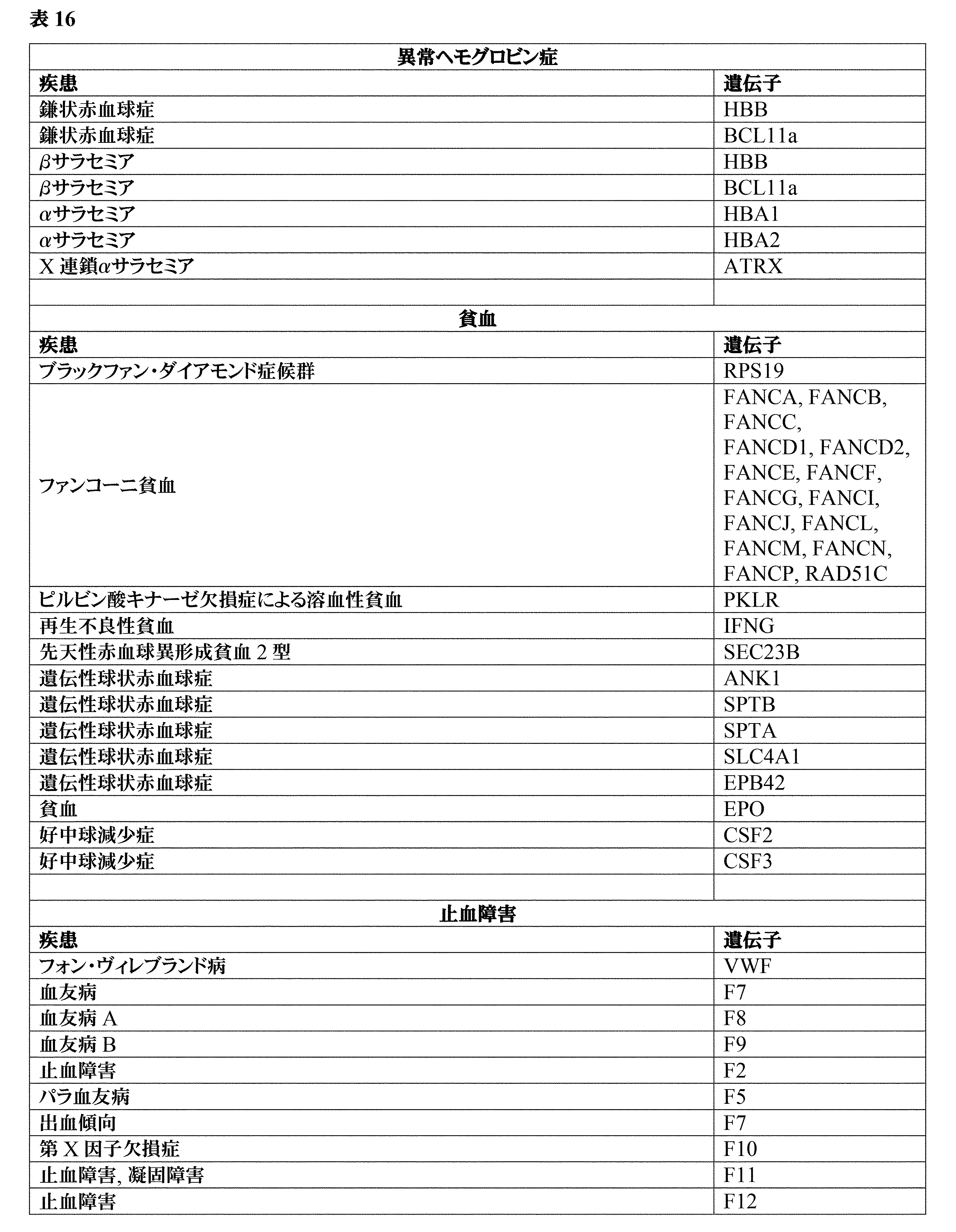
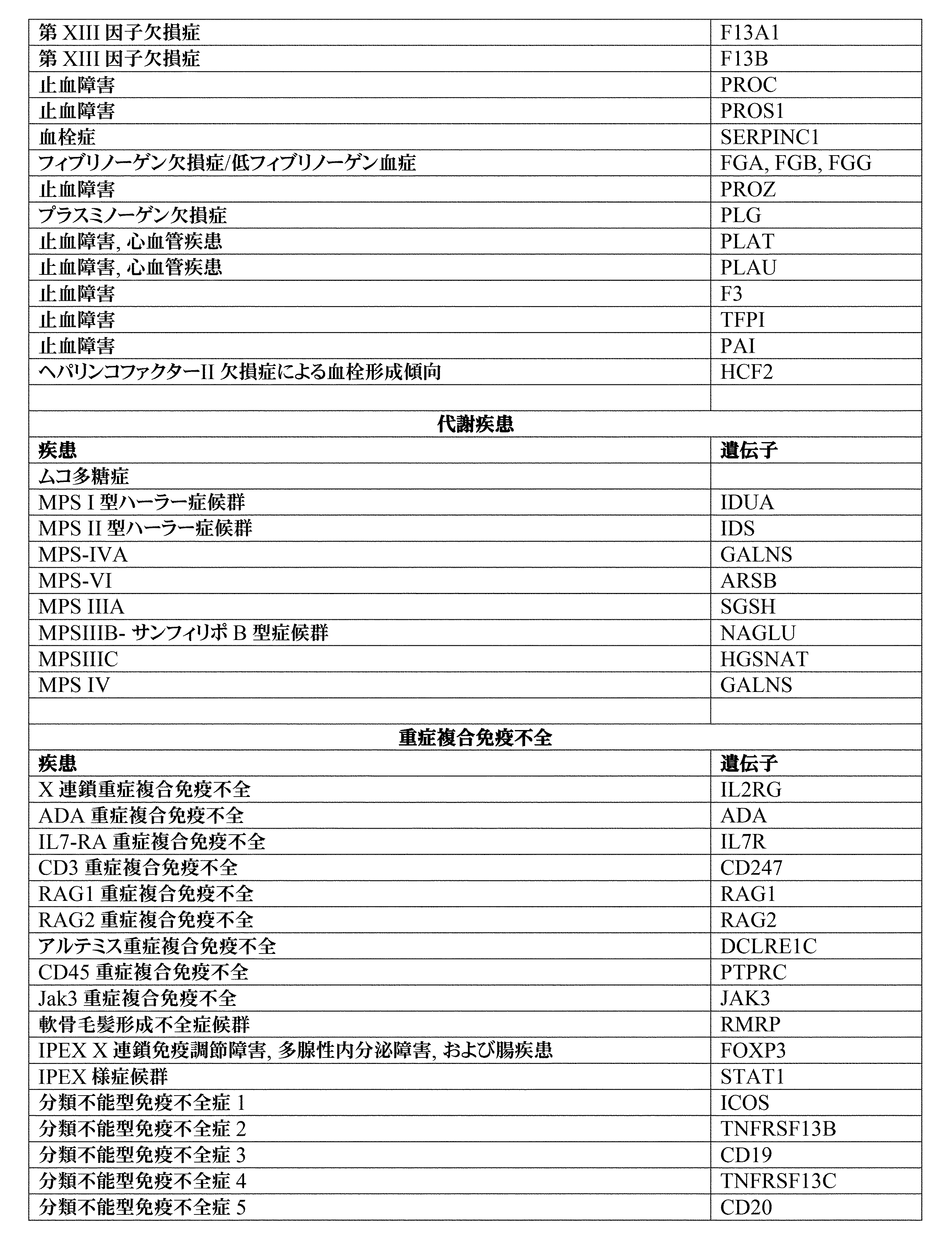


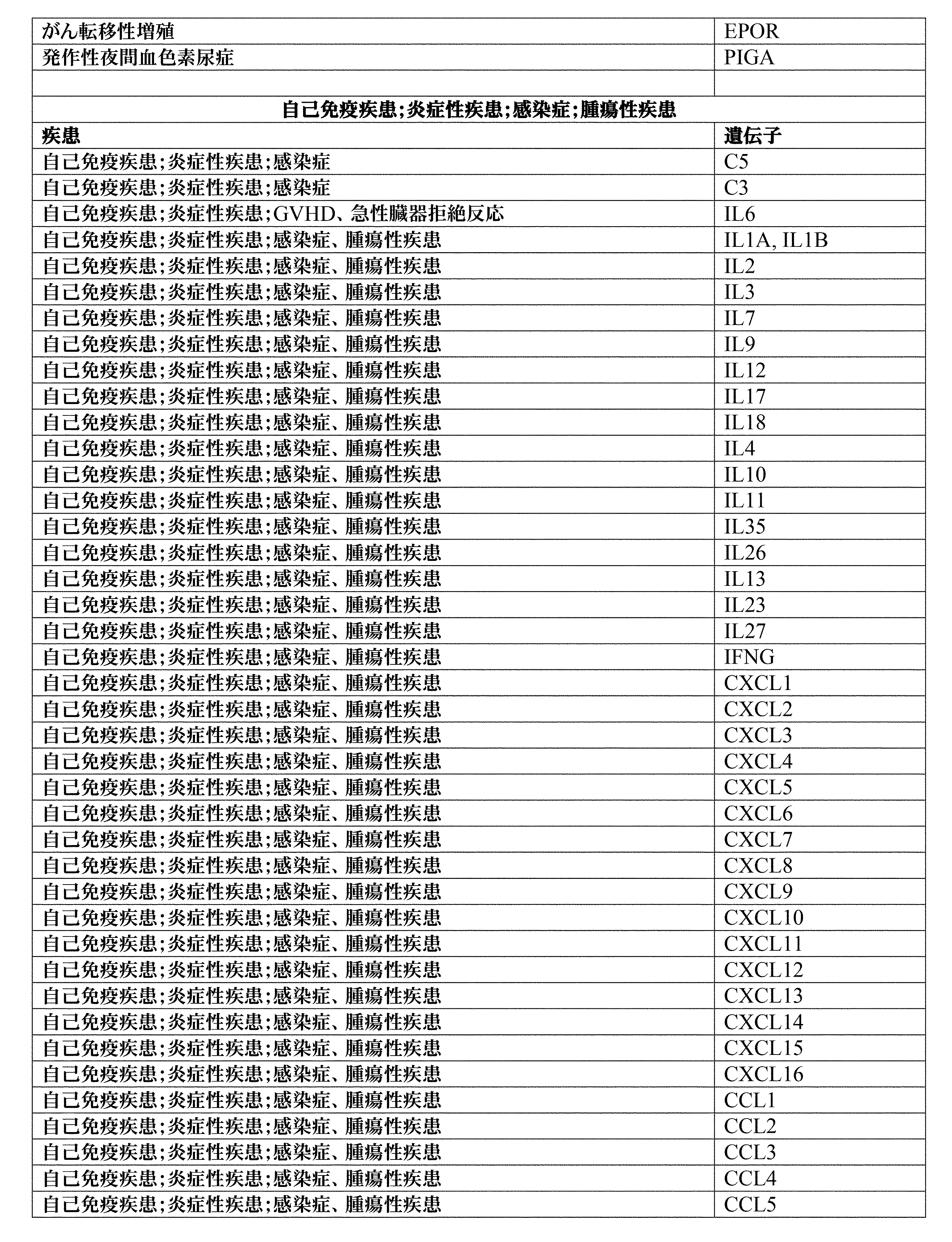
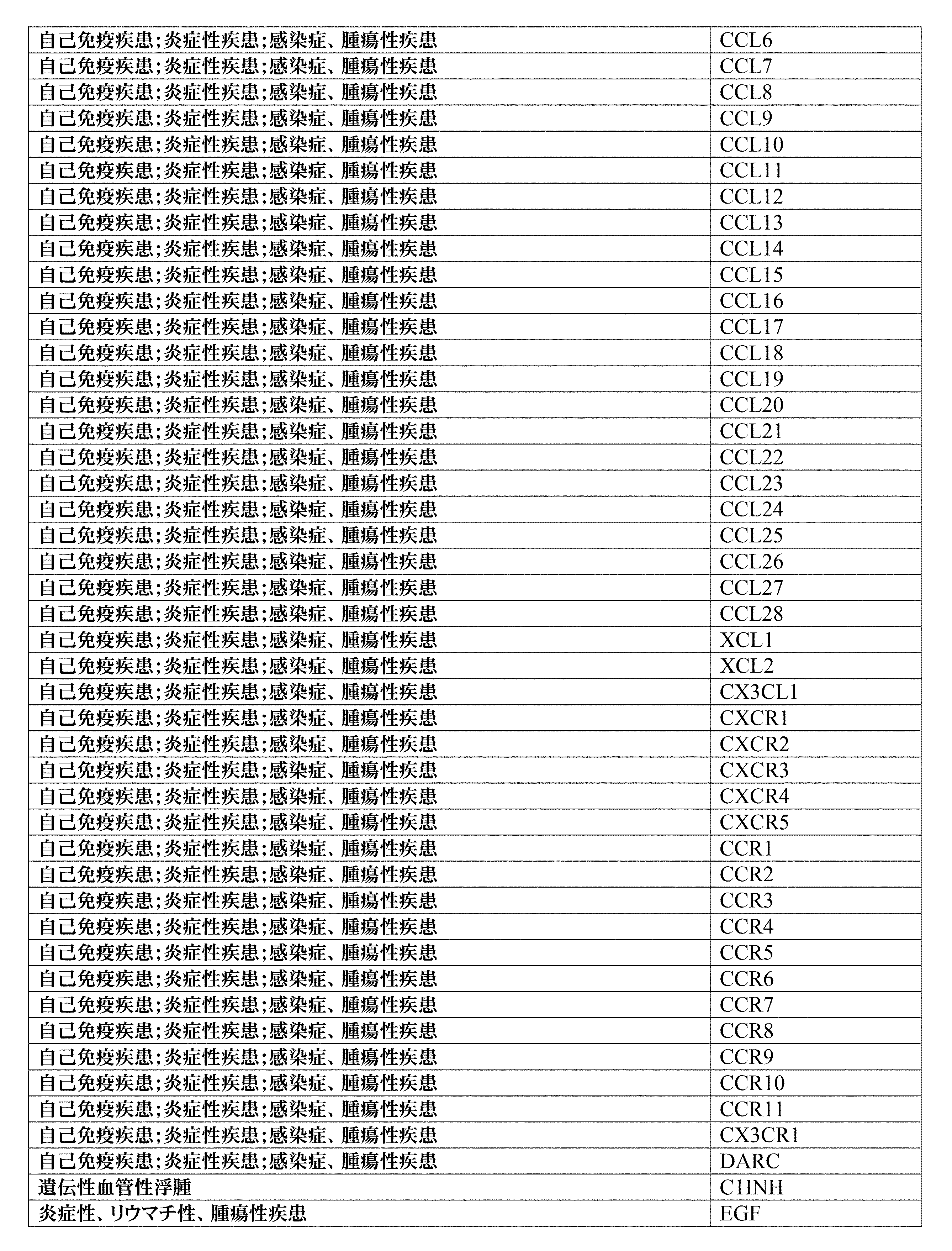
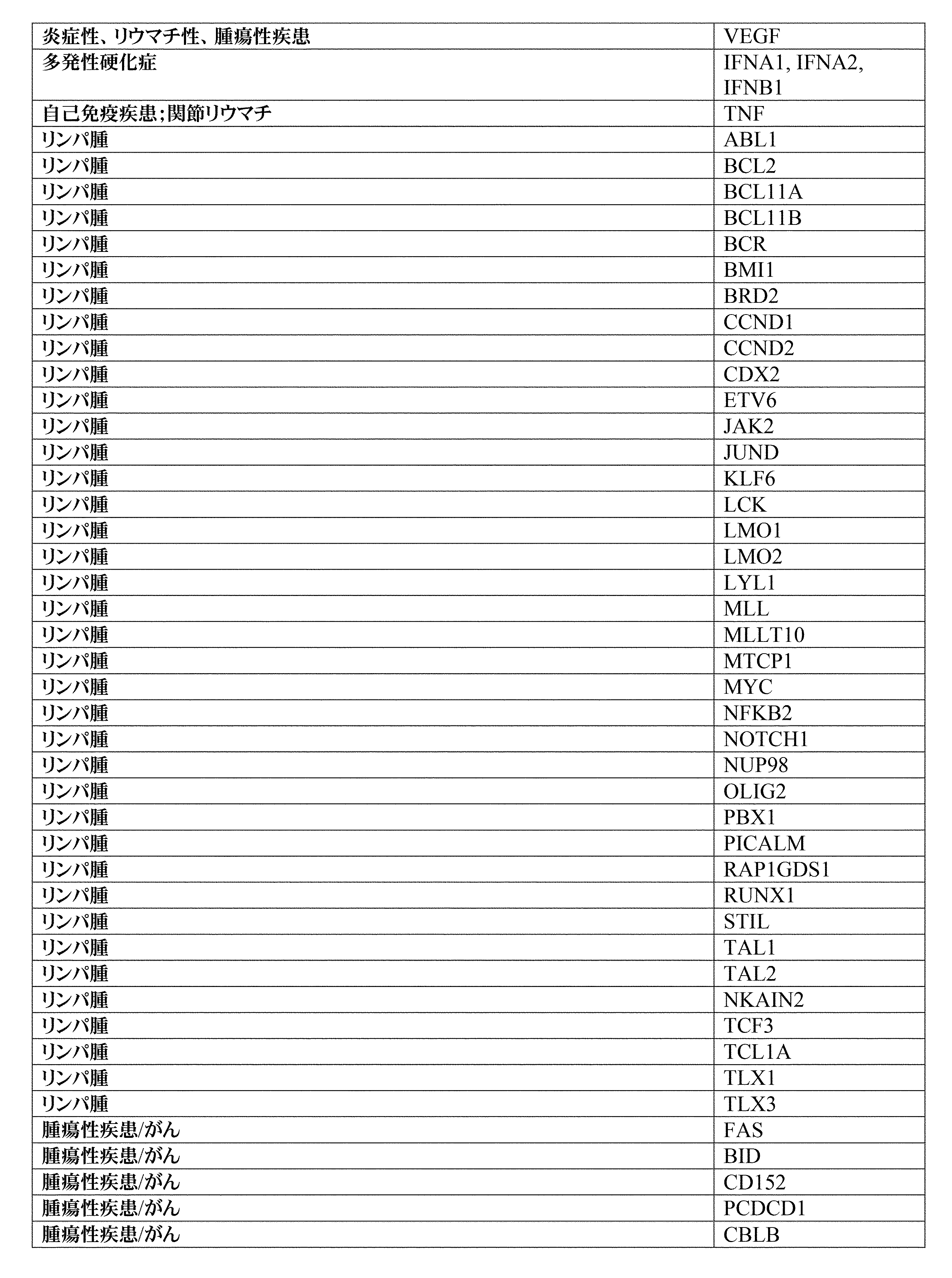
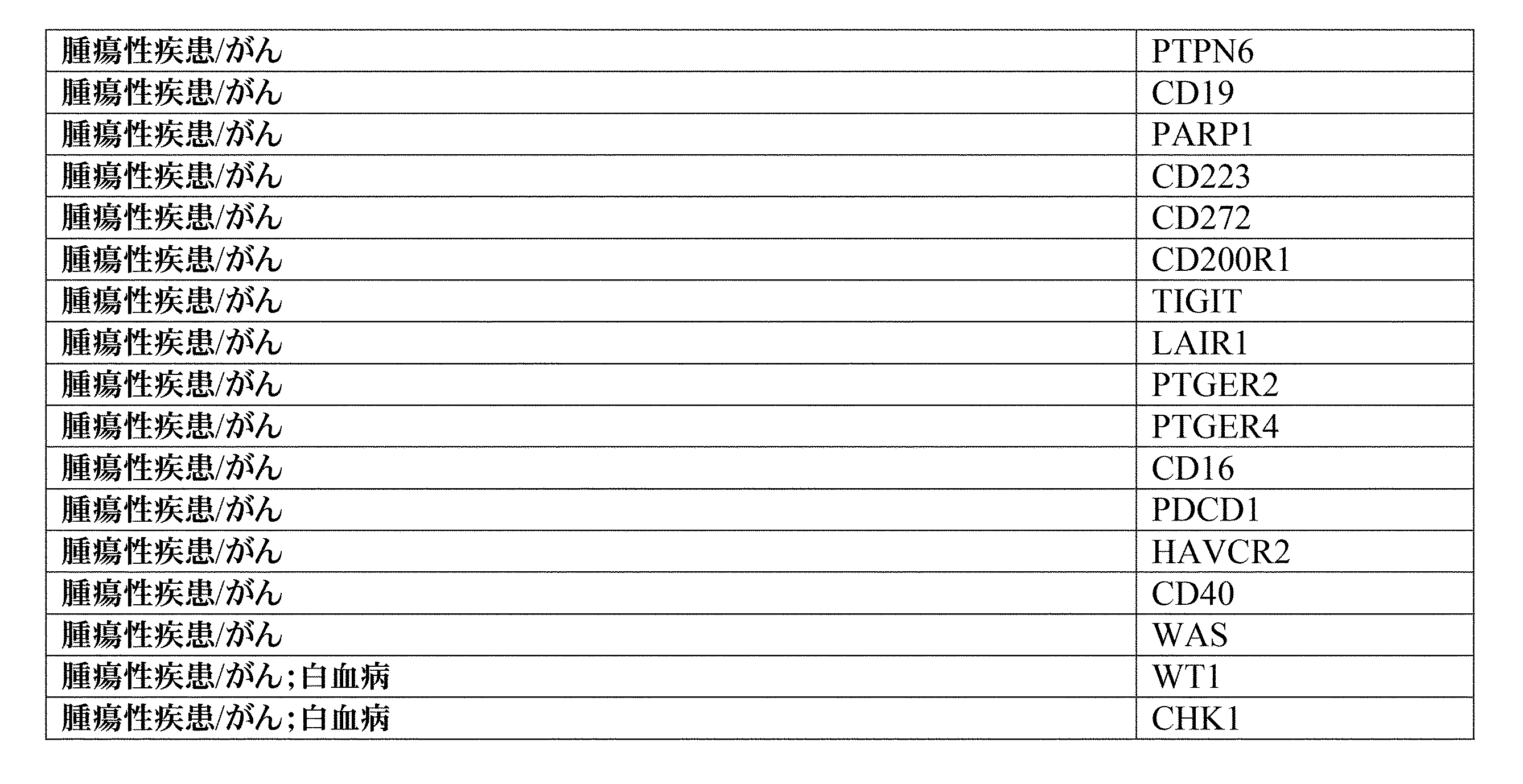
一実施形態では、治療は、疾患発症後の対象において開始される。一実施形態では、治療は、疾患の発症後であるが、例えば、疾患の進行を予防するために、疾患進行過程の早期に(例えば、特定症状の発生前に)対象において開始される。一実施形態では、本方法は、例えば、疾患の進行を遅らせるために、疾患の進行期に対象の治療を開始することを含む。 In one embodiment, treatment is initiated in the subject after disease onset. In one embodiment, treatment is initiated in the subject after the onset of the disease, but early in the disease process (eg, before the onset of certain symptoms), eg, to prevent progression of the disease. In one embodiment, the method includes initiating treatment of the subject at an advanced stage of the disease, eg, to slow progression of the disease.
一実施形態では、本方法は、本明細書に記載の疾患を有する対象を治療するために使用される。一実施形態では、本明細書に記載される方法は、本明細書に記載の疾患の発症または進行を予防するか、または遅らせるために使用される。 In one embodiment, the method is used to treat a subject with a disease described herein. In one embodiment, the methods described herein are used to prevent or slow the onset or progression of a disease described herein.
一実施形態では、本方法は、1つまたは複数の修飾細胞の生存に対する選択的有利性をもたらす。一実施形態では、標的細胞は、修飾されて、遺伝子ノックアウト、ノックイン、ノックダウンまたは修正を有する。修飾されない疾患細胞は、アポトーシスを被り得る。このように、一実施形態では、本明細書に記載の治療後に、修飾細胞は生存するが、非修飾細胞は死滅する。この選択的有利性は、少なくとも50%、例えば、少なくとも60%、70%、80%、90%、95%、99%、または100%の修飾細胞を含む細胞の最終的なコロニー形成を駆動することができる。 In one embodiment, the method provides a selective advantage for survival of one or more modified cells. In one embodiment, the target cell is modified to have a gene knockout, knock-in, knockdown or modification. Unmodified diseased cells can undergo apoptosis. Thus, in one embodiment, modified cells survive while unmodified cells die after treatment as described herein. This selective advantage drives eventual colony formation of cells containing at least 50%, e.g., at least 60%, 70%, 80%, 90%, 95%, 99%, or 100% modified cells. be able to.
一実施形態では、本方法は、遺伝子、例えば、本明細書に記載の遺伝子に突然変異を見出す遺伝子検査を受ける対象において治療を開始するステップを含む。 In one embodiment, the method includes initiating treatment in a subject undergoing genetic testing for mutations in a gene, eg, a gene described herein.
一実施形態では、本方法は、本明細書に記載の疾患についての検査結果が陽性である対象において治療を開始するステップを含む。 In one embodiment, the method includes initiating treatment in a subject who tests positive for a disease described herein.
一実施形態では、本方法は、疾患の症状もしくは兆候のいずれかを示す疾患の家族歴を有する、および/または疾患に関連する遺伝子に突然変異を有することが判明した対象において治療を開始するステップを含む。 In one embodiment, the method includes the step of initiating treatment in a subject who is found to have a family history of the disease and/or to have a mutation in a gene associated with the disease that exhibits any symptoms or signs of the disease. including.
一実施形態では、本方法は、疾患と一致するか、または疾患に関連する症状が現れた対象を治療するステップを含む。 In one embodiment, the method includes treating a subject who has developed symptoms consistent with or associated with the disease.
一実施形態では、本方法は、対象から細胞を単離するステップを含む。一実施形態では、細胞を生体外で改変した後、対象に戻す(例えば、移植する)。一実施形態では、対象は、細胞を単離した者と同じ対象である。別の実施形態では、対象は、細胞を単離した者とは異なる対象である。一実施形態では、オートロガス幹/前駆細胞を生体外で改変した後、対象に戻す。別の実施形態では、異種幹/前駆細胞を生体外で改変した後、対象に戻す。 In one embodiment, the method includes isolating cells from the subject. In one embodiment, the cells are modified ex vivo and then returned to the subject (eg, transplanted). In one embodiment, the subject is the same subject from whom the cells were isolated. In another embodiment, the subject is a different subject than the one from whom the cells were isolated. In one embodiment, autologous stem/progenitor cells are modified ex vivo and then returned to the subject. In another embodiment, the xenologous stem/progenitor cells are modified ex vivo and then returned to the subject.
一実施形態では、治療は、本明細書に記載の細胞へのgRNA分子、Cas9分子、および任意選択的に、供与体テンプレート核酸の送達を含む。一実施形態では、gRNA分子、Cas9分子、またはその両方、および任意選択的に供与体テンプレート核酸は、ウイルスベクター、例えば、AAVベクターまたはレンチウイルスベクター、例えばインテグラーゼ欠損型レンチウイルス(IDLV)によって送達される。別の実施形態では、gRNA分子およびCas9分子は、gRNA分子/Cas9分子リボ核タンパク質複合体として送達される。別の実施形態では、gRNA分子およびCas9分子は、RNAとして送達される。一実施形態では、テンプレート核酸は、標的遺伝子の少なくとも1つのエキソンを含む。一実施形態では、テンプレート核酸は、疾患に関連する突然変異を含まない。一実施形態では、テンプレート核酸は、プロモーター配列を含む。別の実施形態では、テンプレート核酸は、プロモーター配列を含まない。一実施形態では、テンプレート核酸は、スプライスドナーまたはアクセプターを含む。別の実施形態では、テンプレート核酸は、ポリアデニル化シグナルを含む。 In one embodiment, the treatment comprises delivery of a gRNA molecule, a Cas9 molecule, and, optionally, a donor template nucleic acid to a cell described herein. In one embodiment, the gRNA molecule, Cas9 molecule, or both, and optionally the donor template nucleic acid, are delivered by a viral vector, such as an AAV vector or a lentiviral vector, such as an integrase-deficient lentivirus (IDLV). be done. In another embodiment, the gRNA molecule and Cas9 molecule are delivered as a gRNA molecule/Cas9 molecule ribonucleoprotein complex. In another embodiment, the gRNA molecules and Cas9 molecules are delivered as RNA. In one embodiment, the template nucleic acid includes at least one exon of the target gene. In one embodiment, the template nucleic acid does not contain mutations associated with the disease. In one embodiment, the template nucleic acid includes a promoter sequence. In another embodiment, the template nucleic acid does not include a promoter sequence. In one embodiment, the template nucleic acid includes a splice donor or acceptor. In another embodiment, the template nucleic acid includes a polyadenylation signal.
移植のための修飾同種異系ドナーHSC
遺伝性血液遺伝疾患(例えば、鎌状赤血球症)または悪性疾患(例えば、白血病)を患う対象へのドナー同種異系HSCの移植は、レシピエント患者に置換機能性造血系を提供し得る。部分的にマッチするドナー候補と、移植片を必要とするレシピエント対象との間のHLAマッチングを増大するために、ドナー細胞が遺伝子修飾される場合。このシナリオでは、次善最適HLAマッチング(例えば、6遺伝子座のうち3である、ドナー候補とレシピエント対象間のマッチング)に基づいて、好適なドナーとして通常除外されるはずのドナー候補が、1つまたは複数のHLA遺伝子座の遺伝子編集後(例えば、3/6から4/6、5/6、または6/6までマッチングを増加)にドナーとして適格となり得る。しかし、1つまたは複数のHLA遺伝子座の1つまたは複数のHLA対立遺伝子の遺伝子編集は、ミスマッチを低減し得るため、HSC移植を必要とする患者に対するHSCドナーとして適格となるのに好適なレベルのHLAマッチングをもたらす(例えば、HLA遺伝子座で4/6、5/6、または6/6マッチング)。マッチングを高めるためのドナーHSCの遺伝子編集がなければ、レシピエントは、好適なドナーを得られなくなる(例えば、HLA遺伝子座で3/6マッチング)。治療を目的として、レシピエントについて部分的にマッチするドナー(例えば、3/6)を同定し、データベースに入力すると、これは、1つまたは複数のミスマッチHLA対立遺伝子の欠失を標的化するために使用することができるgRNAを出力する。遺伝子編集のための最善の戦略(最も低いオフターゲットプロフィール、最も高いオンターゲットプロフィールを有し、多重化の場合には、対向染色体での標的化対立遺伝子編集を促進するgRNA)、ならびに最も好適なドナー候補(例えば、HLAマッチ対立遺伝子で同型接合、miHAで最大のマッチング度、より近い系統バックグラウンド)が選択される。遺伝子編集の効率は、ドナーT細胞で試験される(末梢血T細胞と比較して供給が限定される、ドナーHSCの修飾前)。ドナーHSCは、マッチングを増加するように遺伝子編集された後、修飾HSCをレシピエント患者に移植することもできる。手短には、HSCをドナーから収集し、生体外でゲノム編集して、ミスマッチHLAを欠失または破壊した後、免疫磁気ビーズ戦略(例えば、CliniMACもしくはProdigy)を用いて選別することにより、HLA対立遺伝子陰性画分(例えば、陰性選択のための磁気ビーズに共役したHLA対立遺伝子特異的抗体を含む)を富化する。次に、レシピエントに対するミスマッチが低減したHSCを患者に注入する。しかし、1つの遺伝子座の2つの異なる対立遺伝子を編集する必要がある場合、もう1つの戦略は、HDRアプローチによる対立遺伝子置換である。HSC生着の後、HSCは、HSC子孫(例えば、血液系列、例えば、骨髄細胞、リンパ球、ミクログリア)が低いGVHDのリスクを有するように、血液系列を再構成することができる。
Modified allogeneic donor HSCs for transplantation
Transplantation of donor allogeneic HSCs into a subject suffering from an inherited hematogenetic disease (eg, sickle cell disease) or malignant disease (eg, leukemia) can provide a replacement functional hematopoietic system to the recipient patient. When donor cells are genetically modified to increase HLA matching between a partially matched donor candidate and a recipient subject in need of a graft. In this scenario, a donor candidate that would normally be excluded as a suitable donor based on suboptimal HLA matching (e.g., a match between donor candidate and recipient subject that is 3 out of 6 loci) is A person may be eligible as a donor after gene editing of one or more HLA loci (eg, increasing matching from 3/6 to 4/6, 5/6, or 6/6). However, gene editing of one or more HLA alleles at one or more HLA loci may reduce mismatches and therefore levels suitable to qualify as HSC donors for patients in need of HSC transplantation. (e.g., 4/6, 5/6, or 6/6 matching at HLA loci). Without gene editing of donor HSCs to enhance matching, the recipient will not be able to obtain a suitable donor (eg, 3/6 matching at HLA loci). For therapeutic purposes, a partially matched donor (e.g. 3/6) for the recipient is identified and entered into a database, which is used to target the deletion of one or more mismatched HLA alleles. Output gRNA that can be used for. The best strategy for gene editing (gRNA with lowest off-target profile, highest on-target profile and, in case of multiplexing, facilitates targeted allele editing on opposite chromosomes), as well as the most preferred Potential donors (eg, homozygous for HLA matched alleles, maximum match for miHA, closer pedigree background) are selected. The efficiency of gene editing will be tested on donor T cells (prior to modification of donor HSCs, which are in limited supply compared to peripheral blood T cells). Donor HSCs can also be gene edited to increase matching and then the modified HSCs can be transplanted into a recipient patient. Briefly, HSCs are harvested from donors, genome edited in vitro to delete or disrupt mismatched HLA, and HSCs are isolated by selection using immunomagnetic bead strategies (e.g., CliniMAC or Prodigy). Gene-negative fractions (eg, containing HLA allele-specific antibodies conjugated to magnetic beads for negative selection) are enriched. The HSCs with reduced mismatch to the recipient are then infused into the patient. However, if two different alleles of one locus need to be edited, another strategy is allele replacement by the HDR approach. After HSC engraftment, HSCs can reconstitute blood lineages such that HSC progeny (eg, blood lineages, eg, myeloid cells, lymphocytes, microglia) have a lower risk of GVHD.
HSC生着中の免疫再構成のためのリンパ球間橋としてのHLA修飾T細胞補充療法
同種異系HSC移植を受けている対象は、移植直後の期間に日和見感染のリスクがある。対象は、HSC移植の準備のために骨髄破壊的前処置レジメンを受けるが、これは、感染を予防する働きをするT細胞をさらに欠失させる。免疫再構成は、対象において数ヵ月を要し得る。この期間中、ドナー由来のHSCは、T細胞に分化し、胸腺に移動し、抗原に曝露されて、適応免疫を再構成し始める。
HLA-modified T-cell replacement therapy as a lymphocyte-to-lymphocyte bridge for immune reconstitution during HSC engraftment Subjects undergoing allogeneic HSC transplantation are at risk of opportunistic infections in the immediate post-transplant period. Subjects undergo a myeloablative conditioning regimen in preparation for HSC transplantation, which further depletes T cells that serve to prevent infection. Immune reconstitution can take several months in a subject. During this period, donor-derived HSCs differentiate into T cells, migrate to the thymus, are exposed to antigens, and begin to reconstitute adaptive immunity.
同種異系HSC移植を受けている対象において、移植直後の期間中に修飾T細胞補充療法を使用すれば、適応免疫リンパ球間橋をもたらすことができる。非悪性疾患の場合、ドナーのT細胞およびHSCは、本方法に従って修飾され、例えば、CRISPR/Cas9媒介性修飾に付されて、ドナーとレシピエント間でミスマッチであるHLA遺伝子座でのマッチングを高める。修飾、例えば、HLA遺伝子座でのCRISPR/Cas9媒介性修飾は、ドナーT細胞およびHSCをドナーオートロガス免疫系による潜在的拒絶に対して耐性にする。HLA遺伝子編集T細胞は、骨髄破壊的前処置の直後で、同種異系HSC移植の前に対象に投与されるか、またはHSC移植と一緒に共注入されるか、またはHSC移植後に投与される。これらのHLA遺伝子編集T細胞は、HLA修飾HSC移植片が生着する間、日和見感染に対する短期免疫を賦与する。リンパ球またはT細胞補充療法で用いられる修飾T細胞は、限定的な寿命を有し得る(約2週間から60日~1年)(Westera et al.,Blood 2013;122(13):2205-2212)。移植直後の期間中、これらの細胞は、対象に防御免疫を賦与することができる。移植を必要とする患者が、血液のがん(例えば、白血病、リンパ腫)、および移植片対宿主病(より高いGVHDのリスクは、より高いT細胞用量に関連する)を有する場合、免疫防御と、移植片対白血病効果(GVL)を均衡させるように、特定のHLA編集事象および補充T細胞の細胞用量を変更することができる(Montero et al.,Biol Blood Marrow Transplant.2006 Dec;12(12):1318-25)。本明細書に記載される方法は、HLA編集ドナーHSC細胞が、生体内でリンパ球生成を再構成するまで、適応免疫を維持すると共に、日和見感染を予防するために、1、2、3または複数回投与することができる。 In subjects undergoing allogeneic HSC transplantation, the use of modified T cell replacement therapy during the immediate post-transplant period can result in an adaptive immune lymphocyte bridge. For non-malignant diseases, donor T cells and HSCs are modified according to the present methods, e.g., subjected to CRISPR/Cas9-mediated modification to enhance matching at HLA loci that are mismatched between donor and recipient. . Modifications, such as CRISPR/Cas9-mediated modifications at HLA loci, render donor T cells and HSCs resistant to potential rejection by the donor autologous immune system. HLA gene-edited T cells are administered to the subject immediately after myeloablative conditioning and prior to allogeneic HSC transplantation, or co-infused with HSC transplantation, or administered after HSC transplantation. . These HLA gene-edited T cells confer short-term immunity against opportunistic infections during the engraftment of HLA-modified HSC grafts. Lymphocytes or modified T cells used in T cell replacement therapy can have a limited lifespan (approximately 2 weeks to 60 days to 1 year) (Westera et al., Blood 2013;122(13):2205- 2212). During the immediate post-transplant period, these cells can confer protective immunity to the subject. If the patient in need of a transplant has blood cancers (e.g., leukemia, lymphoma), and graft-versus-host disease (higher GVHD risk is associated with higher T-cell doses), immune protection and , specific HLA editing events and cell doses of recruited T cells can be altered to balance the graft versus leukemia effect (GVL) (Montero et al., Biol Blood Marrow Transplant. 2006 Dec; 12(12) ): 1318-25). The methods described herein can be used to maintain adaptive immunity and prevent opportunistic infections until HLA-edited donor HSC cells reconstitute lymphopoiesis in vivo. Multiple doses can be administered.
同種異系HSC移植を受けている対象において、移植直後の期間中にHLA修飾赤血球骨髄およびT細胞補充療法を使用すれば、骨髄および適応免疫リンパ球間橋をもたらすことができる。ドナーHSCは、本方法に従って修飾されて、生体外で赤血球骨髄およびリンパ球系前駆細胞に分化する。分化して、HLA編集された赤血球骨髄およびリンパ球は、骨髄破壊的前処置の直後で、かつ同種異系HSC移植の前に対象に投与されるか、またはHSC移植片と一緒に共注入されるか、またはHSC移植後に投与される。分化HLA修飾骨髄およびリンパ球は、一緒に投与されるか、または別々に投与され、例えば、修飾、HLA修飾赤血球骨髄系前駆細胞は、一投与レジメンで投与され、修飾、HLA修飾リンパ球系前駆細胞は、別の投与レジメンで投与される。HSC移植を受けた対象へのHLA修飾、分化骨髄およびリンパ球の投与は、HLAマッチ自然および適応免疫細胞の短期赤血球骨髄およびリンパ球間橋を賦与する。これらの細胞は、貧血に対する短期保護と、日和見感染に対する短期免疫を賦与する。これらの細胞は、限定的な寿命を有し得る。移植直後の期間中、これらの細胞は、対象の貧血を改善し、対象に防御免疫を賦与することができる。免疫防御と、移植片対宿主病(より高いGVHDのリスクは、より高いT細胞用量に関連する)を均衡させるように、こうした細胞の用量を変更することができる(Montero et al.,Biol Blood Marrow Transplant.2006 Dec;12(12):1318-25)。本明細書に記載される方法は、ドナーHSC細胞が、骨髄およびリンパ系列を再構成するまで、赤血球骨髄およびリンパ球数を維持するために、1、2、3または複数回投与することができる。 In subjects undergoing allogeneic HSC transplantation, the use of HLA-modified erythroid bone marrow and T cell replacement therapy during the immediate post-transplant period can result in a bridge between bone marrow and adaptive immune lymphocytes. Donor HSCs are modified according to the present methods to differentiate into erythroid myeloid and lymphoid progenitor cells in vitro. The differentiated, HLA-edited erythroid bone marrow and lymphocytes are administered to the subject immediately after myeloablative conditioning and prior to allogeneic HSC transplantation, or co-injected with the HSC graft. or administered after HSC transplantation. The differentiated HLA-modified bone marrow and lymphocytes may be administered together or separately, e.g., the differentiated, HLA-modified erythroid myeloid progenitor cells may be administered in one dosage regimen, and the differentiated, HLA-modified lymphoid progenitor cells may be administered in one dosage regimen. The cells are administered with separate dosing regimens. Administration of HLA-modified, differentiated myeloid and lymphocytes to subjects undergoing HSC transplantation confers short-term erythrocytic myeloid and lymphocyte bridges of HLA-matched innate and adaptive immune cells. These cells confer short-term protection against anemia and short-term immunity against opportunistic infections. These cells may have a limited lifespan. During the immediate post-transplant period, these cells can ameliorate the subject's anemia and provide the subject with protective immunity. Doses of these cells can be altered to balance immune protection with graft-versus-host disease (higher risk of GVHD is associated with higher T cell doses) (Montero et al., Biol Blood Marrow Transplant. 2006 Dec; 12(12):1318-25). The methods described herein can be administered 1, 2, 3, or multiple times to maintain erythroid myeloid and lymphocyte counts until the donor HSC cells reconstitute the myeloid and lymphoid lineages. .
対立遺伝子特異的遺伝子修飾を含む細胞が富化された治療組成物
角膜移植拒絶率を低減するためのドナー角膜における1、2もしくは3つのHLA-A、HLA-Bおよび/またはHLA-DRB1対立遺伝子の生体外破壊(例えば、ノックアウト)
角膜移植は、米国および世界中で一般的な処置である。毎年米国では、40,000人を超える患者が角膜移植を受けている。(Eye Bank Association of America 2014 Eye Banking Statistical Report.Available at http://www.restoresight.org/wp-content/uploads/2015/03/2014_Statistical_Report-FINAL.pdf.Accessed:June 16, 2015)。角膜移植は、角膜の混濁および視力障害を引き起こす角膜ジストロフィー、感染症および外傷について適用される。
Therapeutic Compositions Enriched with Cells Containing Allele-Specific Genetic Modifications One, Two or Three HLA-A, HLA-B and/or HLA-DRB1 Alleles in Donor Corneas to Reduce Corneal Transplant Rejection Rates in vitro disruption (e.g. knockout) of
Corneal transplantation is a common procedure in the United States and around the world. Over 40,000 patients undergo corneal transplants in the United States each year. (Eye Bank Association of America 2014 Eye Banking Statistical Report. Available at http://www.restoresight.org/wp-content/u loads/2015/03/2014_Statistical_Report-FINAL.pdf.Accessed: June 16, 2015). Corneal transplantation is indicated for corneal dystrophies, infections and trauma that cause corneal clouding and visual impairment.
角膜移植患者の約20%が、角膜拒絶を示し、米国では毎年約6,000~8,000人の患者が、角膜移植の拒絶を経験している(Dunn et al.,Cornea 33(10):1003-9 (2014))。拒絶事象を経験する患者は、一般に、移植不全を起こし、後の角膜移植を必要とする。 Approximately 20% of corneal transplant patients exhibit corneal rejection, and approximately 6,000 to 8,000 patients in the United States experience corneal transplant rejection each year (Dunn et al., Cornea 33(10) :1003-9 (2014)). Patients who experience rejection events commonly develop graft failure and require subsequent corneal transplantation.
角膜移植拒絶を予防するために、眼の免疫抑制など、現在検証中のアプローチがいくつかある。しかし、角膜移植拒絶率は、依然として高く、多くの場合、移植不全を伴う。 There are several approaches currently being tested to prevent corneal transplant rejection, including ocular immunosuppression. However, corneal transplant rejection rates remain high and are often accompanied by graft failure.
本開示は、角膜移植片拒絶を低減し、最終的に、角膜移植不全率を低下させるために、非マッチMHCクラスIおよびクラスII遺伝子、例えば、HLA-A、HLA-BおよびHLA-DRB1の発現を低減することを目標とする。角膜移植片拒絶のマウスモデルにおいて、MHCクラスI抗原の発現の低減が、移植片拒絶率を低下させることが立証されている(Kamiya et al.,Exp Eye Res.70(6):737-43 (2000))。本方法は、非マッチMHCクラスI遺伝子を破壊(例えば、ノックアウト)し、これによって、非マッチMHCクラスI抗原の発現を低減する。これによって、本方法は移植片拒絶率を低下させることになる。 The present disclosure describes the use of unmatched MHC class I and class II genes, such as HLA-A, HLA-B and HLA-DRB1, to reduce corneal graft rejection and ultimately reduce corneal graft failure rates. The goal is to reduce expression. In a murine model of corneal graft rejection, reduction of MHC class I antigen expression has been demonstrated to reduce graft rejection rates (Kamiya et al., Exp Eye Res. 70(6):737-43 (2000)). The method disrupts (eg, knocks out) unmatched MHC class I genes, thereby reducing expression of unmatched MHC class I antigens. Thereby, the method will reduce graft rejection rates.
本方法は、以下のようにして、ドナー角膜における1、2もしくは3つのHLA-A、HLA-BまたはHLA-DRB1対立遺伝子をノックアウトする。本方法は、本方法を用いて、角膜上皮細胞および間質細胞、例えば、角膜実質細胞をはじめとする角膜細胞を標的化する以外は、HSCにおいてHLA-A、HLA-BまたはHLA-DRB1対立遺伝子の破壊(例えば、ノックアウト)を標的化するために使用される方法と同じである。 The method knocks out one, two or three HLA-A, HLA-B or HLA-DRB1 alleles in the donor cornea as follows. The method uses the method to target corneal cells including corneal epithelial cells and stromal cells, e.g., keratocytes. It is the same method used to target disruption (eg, knockout) of genes.
単一のHLA対立遺伝子の破壊(例えば、ノックアウト)、例えば、単一のHLA-A、HLA-BまたはHLA-DRB1のKOは、3/6HLA対立遺伝子でレシピエントにドナーをマッチさせ、ここで、1/6ドナー対立遺伝子が発現されず、外来抗原認識に関して有効な4/6適合が達成される。単一対立遺伝子のKOは、ミスマッチHLA抗原の発現を低減し、角膜移植片拒絶のリスクを低下させることになる。 Disruption (e.g., knockout) of a single HLA allele, e.g., KO of a single HLA-A, HLA-B or HLA-DRB1, involves matching the donor to the recipient at the 3/6 HLA allele, where , the 1/6 donor allele is not expressed and an effective 4/6 match for foreign antigen recognition is achieved. Monoallelic KO will reduce expression of mismatched HLA antigens and reduce the risk of corneal graft rejection.
2つのHLA対立遺伝子の破壊(例えば、HLA-A対立遺伝子とHLA-B対立遺伝子、HLA-A対立遺伝子とHLA-DRB1対立遺伝子、またはHLA-B対立遺伝子とHLA-DRB1対立遺伝子のKO)は、3/6HLA対立遺伝子でレシピエントにドナーを適合させ、ここで、2/6ドナー対立遺伝子が発現されず、外来抗原認識に関して有効な5/6適合が達成される。2つの対立遺伝子のKOは、ミスマッチHLA抗原の発現を低減し、角膜移植片拒絶のリスクを低下させることになる。 Disruption of two HLA alleles (e.g., KO of an HLA-A allele and an HLA-B allele, an HLA-A allele and an HLA-DRB1 allele, or an HLA-B allele and an HLA-DRB1 allele) , matches the donor to the recipient with the 3/6 HLA allele, where the 2/6 donor allele is not expressed and an effective 5/6 match is achieved for foreign antigen recognition. KO of the two alleles will reduce the expression of mismatched HLA antigens and reduce the risk of corneal graft rejection.
3つのHLA対立遺伝子の破壊(例えば、ノックアウト)(例えば、HLA-A対立遺伝子、HLA-B対立遺伝子、およびHLA-DRB1対立遺伝子のKO)は、3/6HLA対立遺伝子でレシピエントにドナーをマッチさせ、ここで、3/6ドナー対立遺伝子が発現されず、外来抗原認識に関して有効な6/6適合が達成される。3つの対立遺伝子のKOは、ミスマッチHLA抗原の発現を低減し、角膜移植片拒絶のリスクを低下させることになる。 Disruption (e.g., knockout) of three HLA alleles (e.g., KO of HLA-A allele, HLA-B allele, and HLA-DRB1 allele) matches donor to recipient with 3/6 HLA alleles. , where the 3/6 donor allele is not expressed and an effective 6/6 match for foreign antigen recognition is achieved. KO of the three alleles will reduce the expression of mismatched HLA antigens and reduce the risk of corneal graft rejection.
特定のHLA対立遺伝子が、角膜移植において、より高い拒絶率に関連する場合、そのHLA対立遺伝子は、破壊(例えば、ノックアウト)のために標的化されることになる。 If a particular HLA allele is associated with higher rejection rates in corneal transplants, that HLA allele will be targeted for disruption (eg, knockout).
ノックアウトのために標的化されたHLA対立遺伝子は、実施例12:「HLA遺伝子型のマッチングを促進するためのHLA対立遺伝子のノックアウト」に見出されるものと同じである。例えば、HLA-遺伝子型: The HLA alleles targeted for knockout are the same as those found in Example 12: "Knockout of HLA Alleles to Facilitate HLA Genotype Matching". For example, HLA-genotype:

を有するドナー角膜は、ヨーロッパ系集団における最も一般的なHLAハプロタイプを有する。3つのHLA対立遺伝子、例えば、HLA-A*0301g、HLA-B*0702g、HLA-DRB1*1501のノックアウトは、ヨーロッパ系統の個体において最も一般的なHLAハプロタイプを発現する角膜組織を生成するであろう。この組織は、ヨーロッパ系集団の最も大きな割合とマッチする可能性が非常に高い。特定の集団について最も一般的なハプロタイプを有するドナー角膜組織におけるHLA対立遺伝子の同じ破壊戦略、例えば、ノックアウトは、実施例12に説明する通り、アフリカ系アメリカ人、ヒスパニック系、およびアジア系の角膜組織について最も一般的なHLAハプロタイプに適用することができる。 The donor cornea has the most common HLA haplotype in European populations. Knockout of three HLA alleles, e.g., HLA-A*0301g, HLA-B*0702g, HLA-DRB1*1501, should generate corneal tissue expressing the most common HLA haplotype in individuals of European descent. Dew. This organization is most likely to match the largest proportion of the European population. The same disruption strategy, e.g., knockout, of HLA alleles in donor corneal tissue with the most common haplotype for a particular population can be used in African American, Hispanic, and Asian corneal tissues, as described in Example 12. can be applied to the most common HLA haplotypes.
本方法は、ドナー角膜に生体外で適用することができる。角膜細胞は、HLA破壊(例えば、ノックアウト)のために生体外で修飾し、修飾後、ドナーに移植することができる。角膜修飾のために標的化される細胞型としては、角膜上皮細胞、例えば、基底細胞、翼細胞、表面細胞、角膜間質細胞、例えば、実質細胞、線維芽細胞、筋線維芽細胞が挙げられる。 The method can be applied ex vivo to donor corneas. Corneal cells can be modified in vitro for HLA disruption (eg, knockout) and transplanted into a donor after modification. Cell types targeted for corneal modification include corneal epithelial cells, such as basal cells, wing cells, superficial cells, corneal stromal cells, such as stromal cells, fibroblasts, myofibroblasts. .
より一般的には、本明細書に記載されるシステムおよび方法は、対立遺伝子特異的遺伝子修飾を有する細胞が富化された治療組成物(例えば、そうした細胞の精製組成物)の生産に有用である。対立遺伝子特異的遺伝子修飾を有する細胞の富化集団を生産する例示的な方法は、2つの大まかなステップを含み、最初に、同定可能な遺伝子産物、すなわち、直接または間接的のいずれかで、検出することができる遺伝子産物をコードする遺伝子の単一の対立遺伝子と結合し、任意選択的に切断もしくは突然変異させることができるCRISPR/Cas9システムに細胞の集団を暴露するか、それと接触させる、遺伝子編集ステップを含む。第2のステップは、遺伝子産物を発現するが、標的化対立遺伝子によりコードされた遺伝子産物の変異体は発現しない細胞を同定、収集および/または分離する(例えば、こうした細胞を「富化する」)ものである。これらのステップのいずれも、以下にさらに詳しく説明する。 More generally, the systems and methods described herein are useful for producing therapeutic compositions enriched for cells with allele-specific genetic modifications (e.g., purified compositions of such cells). be. An exemplary method of producing an enriched population of cells with allele-specific genetic modifications involves two broad steps: first, producing an identifiable gene product, i.e., either directly or indirectly; exposing or contacting the population of cells to a CRISPR/Cas9 system capable of binding and optionally truncating or mutating a single allele of a gene encoding a gene product that can be detected; Includes a gene editing step. The second step is to identify, collect, and/or isolate cells that express the gene product, but not the variant of the gene product encoded by the targeted allele (e.g., "enrich" such cells). ) is a thing. Both of these steps are discussed in more detail below.
まず、遺伝子編集ステップに関して、CRISPR/Cas9システムは、gRNA分子の標的化ドメイン中に、編集が望まれる対立遺伝子に特異的な標的配列と相補的な配列を組み込むことによって、遺伝子の単一の対立遺伝子と結合するように、設計され得る。標的化対立遺伝子の標的配列は、例えば、塩基対の違い、挿入、欠失、逆転、複製などによって、gRNA分子と非標的化対立遺伝子との結合を低減または阻止する任意の好適な様式で、非標的化対立遺伝子の配列とは相違し得る。細胞の集団は、富化ステップの生体外実施を促進するために、身体外部でCRISPR/Cas9システムに曝露させるのが好ましいが、必ずしも必要というわけではなく、治療に有用なあらゆる細胞型もしくは集団であってよく、例えば、血液もしくは骨髄などの組織からの操作されていないか、または最小限に操作された細胞画分、HSCなどの細胞の精製画分、またはインビトロで精製、処理および/もしくは拡大された集団であってよい。細胞は、それらが後に再導入される対象から採取してもよいし、あるいは、ドナーから採取してもよい。好適な細胞および細胞の集団は、以下の「標的細胞」で概略的に記載され、そうした細胞または集団にCRISPR/Cas9システムを投与する手段は、「送達、製剤化および投与経路」で概略的に説明される。 First, with respect to the gene editing step, the CRISPR/Cas9 system isolates a single allele of a gene by incorporating into the targeting domain of the gRNA molecule a target sequence and complementary sequences specific to the allele desired to be edited. It can be designed to bind to genes. The target sequence of the targeted allele can be modified in any suitable manner to reduce or prevent binding of the gRNA molecule to the non-targeted allele, e.g., by base pairing differences, insertions, deletions, inversions, duplications, etc. It may differ from the sequence of the non-targeted allele. Preferably, but not necessarily, the population of cells is exposed to the CRISPR/Cas9 system outside the body to facilitate in vitro implementation of the enrichment step, with any cell type or population useful for therapy. For example, unmanipulated or minimally manipulated cell fractions from tissues such as blood or bone marrow, purified fractions of cells such as HSCs, or purified, processed and/or expanded in vitro. It may be a group of people who have been Cells may be harvested from the subject into which they are later reintroduced, or they may be harvested from a donor. Suitable cells and populations of cells are described generally below in "Target Cells" and means of administering the CRISPR/Cas9 system to such cells or populations are described generally in "Delivery, Formulation and Routes of Administration". explained.
編集細胞の富化に関しては、これは、ほとんどの(しかし、全てではない)場合、同定可能な遺伝子産物の検出によって促進される。以下に示す例示的な実施形態では、同定可能な遺伝子産物は、細胞表面マーカーであるか、または細胞表面タンパク質複合体の一部を形成し、例えば、蛍光標識抗体および蛍光活性化細胞選別(FACS)を用いて、抗体検出により生存細胞中で同定することができる。これらのおよびその他のツールは、当技術分野において公知であり、BD Biosciences(San Jose,CA)、Abcam(Cambridge,UK)などをはじめとする様々な供給者により市販されている。 Regarding enrichment of edited cells, this is facilitated in most (but not all) cases by the detection of an identifiable gene product. In the exemplary embodiments set forth below, the identifiable gene product is a cell surface marker or forms part of a cell surface protein complex, such as fluorescently labeled antibodies and fluorescence-activated cell sorting (FACS). ) can be used to identify in living cells by antibody detection. These and other tools are known in the art and are commercially available from a variety of suppliers including BD Biosciences (San Jose, CA), Abcam (Cambridge, UK), and others.
HLA対立遺伝子、ならびにそれに対する抗体が入手可能であるか、または作製することができる細胞表面タンパク質をコードするその他の遺伝子産物の場合、例示的なFACSによる富化プロセスは、典型的に、対立遺伝子特異的編集プロセスに事前に付した細胞の集団を2つの蛍光抗体:遺伝子編集ステップで標的化された遺伝子の対立遺伝子によりコードされる同定可能な遺伝子産物の第1の変異体に特異的に標的化させた第1の蛍光抗体、および第1のステップで標的化されていない遺伝子の対立遺伝子によりコードされる同定可能な遺伝子産物の第2の変異体に結合する第2の蛍光抗体と接触させるステップを含む。第2の抗体は、第2の変異体に特異的であってもよいし、または第2の変異体および任意選択的に第1の変異体をはじめとする複数の変異体に対する広範な特異性を有してもよい。FACS選別の間、第1の抗体からの低もしくは無蛍光シグナルにより同定される、第1の変異体を発現しない細胞、ならびに第2抗体からの高シグナルにより同定される、第2の変異体を発現しない細胞についてゲートを設定した後、これらのゲートに入る細胞を収集して、対立遺伝子特異的遺伝子修飾を含む細胞の富化集団を形成する。 For HLA alleles, as well as other gene products encoding cell surface proteins for which antibodies are available or can be generated, the exemplary FACS enrichment process typically A population of cells previously subjected to a specific editing process is treated with two fluorescent antibodies: specifically targeted to a first variant of an identifiable gene product encoded by an allele of the gene targeted in the gene editing step. a second fluorescent antibody that binds to a second variant of an identifiable gene product encoded by an allele of the gene not targeted in the first step. Contains steps. The second antibody may be specific for the second variant or have broad specificity for a plurality of variants including the second variant and optionally the first variant. It may have. During FACS sorting, cells that do not express the first variant, identified by a low or no fluorescence signal from the first antibody, and a second variant, identified by a high signal from the second antibody, are selected. After setting gates for non-expressing cells, cells that fall into these gates are collected to form an enriched population of cells containing allele-specific genetic modifications.
FACSおよびその他のフローサイトメトリー検出方法に加えて、標的化および非標的化対立遺伝子の両方によりコードされる遺伝子産物の検出を可能にする方法であれば、任意の他の好適な検出方法を用いて、編集細胞を富化することができることに留意すべきである。非限定的な例として、共役磁気ビーズおよび直接顕微鏡操作のいずれを使用して、対立遺伝子特異的遺伝子修飾を含む細胞を富化してもよい。非標的化対立遺伝子の検出は、第2の非標的化対立遺伝子によりコードされる変異体に特異的であるか、またはより広範に遺伝子産物の複数もしくは全ての変異体を検出する試薬を用いて実施してもよい。これらの遺伝子産物を検出する上で有用な試薬として、標識もしくはタグ付き抗体、リガンド、アゴニスト、アンタゴニスト、アプタマー、ポリヌクレオチド、ポリペプチドなどが挙げられ、これらは、非標的化対立遺伝子によりコードされる遺伝子産物を発現する個別の細胞を同定および収集する上で十分な解像度で、集団内の細胞上もしくは細胞内で検出することができる。遺伝子産物を直接検出する代替方法として、遺伝子の標的化および非標的化対立遺伝子により促進もしくは阻害される物質または細胞状態を検出することが有用となり得る。 In addition to FACS and other flow cytometric detection methods, any other suitable detection method that allows detection of gene products encoded by both targeted and non-targeted alleles can be used. It should be noted that editing cells can be enriched for edited cells. As non-limiting examples, both conjugated magnetic beads and direct microscopy may be used to enrich for cells containing allele-specific genetic modifications. Detection of non-targeted alleles can be performed using reagents that are specific for the variant encoded by the second non-targeted allele or more broadly detect multiple or all variants of the gene product. May be implemented. Reagents useful in detecting these gene products include labeled or tagged antibodies, ligands, agonists, antagonists, aptamers, polynucleotides, polypeptides, etc., which are encoded by non-targeting alleles. It can be detected on or within cells within a population with sufficient resolution to identify and collect individual cells expressing the gene product. As an alternative to directly detecting gene products, it may be useful to detect substances or cellular conditions promoted or inhibited by targeted and non-targeted alleles of genes.
さらに、前述および本開示全体の実施例は、標的化対立遺伝子の欠失またはノックアウトに焦点を合わせているが、標的化対立遺伝子を第2の対立遺伝子に変えるものをはじめとする、他の編集戦略にも容易に適応可能であり、その場合、第2の対立遺伝子は、第1の検出抗体もしくは試薬(すなわち、非修飾、標的化対立遺伝子に特異的な抗体もしくは試薬)によっては検出されないが、遺伝子の良好に編集された対立遺伝子によりコードされる第2の変異体に結合する第2の抗体もしくは試薬によって検出されるものとする。 Additionally, while the examples foregoing and throughout this disclosure focus on deletion or knockout of targeted alleles, other edits, including those that change the targeted allele to a second allele, may be used. It is also readily adaptable to strategies in which the second allele is not detected by the first detection antibody or reagent (i.e., an unmodified, targeted allele-specific antibody or reagent), but , shall be detected by a second antibody or reagent that binds to a second variant encoded by the successfully edited allele of the gene.
I.ガイドRNA(gRNA)分子
gRNA分子は、この用語の本明細書の用法では、標的核酸へのgRNA分子/Cas9分子複合体の特異的ターゲティングまたはホーミングを促進する核酸である。gRNA分子は、本明細書では「キメラ」gRNA、もしくはモジュラー(2つ以上、典型的には2つの個別のRNA分子を含む)と呼ぶことがある単分子(単一のRNA分子を有する)であってよい。本明細書に提供されるgRNA分子は、特定の遺伝子座、例えば、HLA-A、HLA-B、HLA-C、HLA-DRB1、HLA-DRB3/4/5、もしくはHLA-DQB1の対立遺伝子変異体の配列内またはその付近の標的核酸配列と完全もしくは部分的に相補的な核酸配列を含むか、それから構成されるか、またはほぼ構成される標的化ドメインを含む。特定の実施形態では、gRNA分子は、例えば、第1の相補性ドメイン、結合ドメイン、第2の相補性ドメイン、隣接ドメイン、テールドメイン、および5’伸長ドメインをはじめとする1つまたは複数の追加ドメインをさらに含む。これらのドメインの各々については、以下にさらに詳しく述べる。特定の実施形態では、gRNA分子中の1つまたは複数のドメインは、例えば、S.ピオゲネス(S.pyogenes)、S.アウレウス(S.aureus)またはS.サーモフィルス(S.thermophilus)に由来する天然に存在する配列と同一の、またはそれと配列相同性を有するアミノ酸配列を含む。
I. Guide RNA (gRNA) Molecule A gRNA molecule, as the term is used herein, is a nucleic acid that facilitates the specific targeting or homing of a gRNA molecule/Cas9 molecule complex to a target nucleic acid. A gRNA molecule is a unimolecule (having a single RNA molecule), sometimes referred to herein as a "chimeric" gRNA, or modular (containing two or more, typically two individual RNA molecules). It's good to be there. The gRNA molecules provided herein may contain allelic variations at specific genetic loci, e.g., HLA-A, HLA-B, HLA-C, HLA-DRB1, HLA-DRB3/4/5, or HLA-DQB1. The targeting domain comprises, consists of, or consists essentially of a nucleic acid sequence that is completely or partially complementary to a target nucleic acid sequence within or near the target nucleic acid sequence. In certain embodiments, the gRNA molecule comprises one or more additional domains, including, for example, a first complementarity domain, a binding domain, a second complementarity domain, a flanking domain, a tail domain, and a 5' extension domain. Contains more domains. Each of these domains is discussed in more detail below. In certain embodiments, one or more domains in the gRNA molecule are, for example, S. S. pyogenes, S. pyogenes S. aureus or S. aureus. includes an amino acid sequence that is identical to, or has sequence homology to, a naturally occurring sequence derived from S. thermophilus.
いくつかの例示的なgRNA構造を図1A~1Iに示す。gRNAの活性形態の3次元形態、または鎖内もしくは鎖間相互作用に関して、高相補性の領域を図1A~1I中の二重鎖および本明細書に提供されるその他の描写に示す場合がある。図7は、配列番号42のgRNA配列を用いたgRNAドメイン命名法を示し、これは、tracrRNA由来領域内に1つのヘアピンループを含む。特定の実施形態では、gRNAは、この領域に2つ以上(例えば、2つ、3つ、またはそれ以上の)ヘアピンループを含んでもよい(例えば、図1H~1I)。 Some exemplary gRNA structures are shown in Figures 1A-1I. With respect to the three-dimensional morphology of the active form of the gRNA, or intrastrand or interstrand interactions, regions of high complementarity may be shown in the duplexes in FIGS. 1A-1I and other depictions provided herein. . Figure 7 shows gRNA domain nomenclature using the gRNA sequence of SEQ ID NO: 42, which contains one hairpin loop within the tracrRNA-derived region. In certain embodiments, the gRNA may include two or more (eg, two, three, or more) hairpin loops in this region (eg, FIGS. 1H-1I).
特定の実施形態では、単分子、またはキメラgRNAは、好ましくは5’から3’の方向に以下:特定の遺伝子座、例えば、HLA-A、HLA-B、HLA-C、HLA-DRB1、HLA-DRB3/4/5、もしくはHLA-DQB1の対立遺伝子変異体の配列内の標的ドメインと相補的な標的化ドメイン;第1の相補性ドメイン;結合ドメイン;第2の相補性ドメイン(第1の相補性ドメインと相補的である);隣接ドメイン;および任意選択的に、テールドメインを含む。 In certain embodiments, the unimolecular, or chimeric, gRNA preferably has the following in the 5' to 3' direction: a specific locus, e.g., HLA-A, HLA-B, HLA-C, HLA-DRB1, HLA - a targeting domain complementary to a targeting domain within the sequence of DRB3/4/5 or an allelic variant of HLA-DQB1; a first complementarity domain; a binding domain; a second complementarity domain (first complementary domains); adjacent domains; and, optionally, a tail domain.
特定の実施形態では、モジュラーgRNAは、好ましくは5’から3’の方向に以下:特定の遺伝子座、例えば、HLA-A、HLA-B、HLA-C、HLA-DRB1、HLA-DRB3/4/5、もしくはHLA-DQB1の対立遺伝子変異体の配列内の標的ドメインと相補的な標的化ドメイン;および第1の相補性ドメインを含む第1の鎖と;好ましくは5’から3’の方向に以下:任意選択的に、5’伸長ドメイン;第2の相補性ドメイン;隣接ドメイン;および任意選択的に、テールドメインを含む第2の鎖とを含む。 In certain embodiments, the modular gRNA preferably targets the following in the 5' to 3' direction: specific loci, e.g. HLA-A, HLA-B, HLA-C, HLA-DRB1, HLA-DRB3/4 /5, or a targeting domain complementary to a targeting domain within the sequence of an allelic variant of HLA-DQB1; and a first strand comprising a first complementary domain; preferably in the 5' to 3' direction. optionally comprises a 5' extension domain; a second complementarity domain; a flanking domain; and optionally a second strand comprising a tail domain.
標的化ドメイン
標的化ドメイン(あるいは、ガイド配列または相補性領域と呼ばれることもある)は、特定の遺伝子座、例えば、HLA-A、HLA-B、HLA-C、HLA-DRB1、HLA-DRB3/4/5、もしくはHLA-DQB1の対立遺伝子変異体の配列内もしくはその付近の核酸配列と相補的であるか、または部分的に相補的な核酸配列を含むか、これから構成されるか、またはほぼこれから構成される。標的化ドメインの全部もしくは一部が相補的であるか、または部分的に相補的である、特定の遺伝子座、例えば、HLA-A、HLA-B、HLA-C、HLA-DRB1、HLA-DRB3/4/5、もしくはHLA-DQB1の対立遺伝子変異体の配列内もしくはその付近の核酸配列は、本明細書では標的ドメインと呼ぶ。特定の実施形態では、標的ドメインは、標的位置を含む。他の実施形態では、標的位置は、標的ドメインの外部(すなわち、その上流もしくは下流)にある。
Targeting Domains Targeting domains (also sometimes referred to as guide sequences or regions of complementarity) target specific genetic loci, e.g., HLA-A, HLA-B, HLA-C, HLA-DRB1, HLA-DRB3/ 4/5, or comprises, consists of, or approximately comprises a nucleic acid sequence that is complementary or partially complementary to a nucleic acid sequence within or near the sequence of an allelic variant of HLA-DQB1. It will be constructed from now on. Certain genetic loci, such as HLA-A, HLA-B, HLA-C, HLA-DRB1, HLA-DRB3, to which all or part of the targeting domain is complementary or partially complementary. Nucleic acid sequences within or near the sequence of /4/5 or allelic variants of HLA-DQB1 are referred to herein as target domains. In certain embodiments, the targeting domain includes the target location. In other embodiments, the target location is external to (ie, upstream or downstream of) the targeting domain.
標的化ドメインを選択する方法は、当該技術分野で公知である(例えば、Fu 2014;Sternberg 2014を参照のこと)。本明細書に記載される方法、組成物、およびキットで使用するための好適な標的化ドメインの例として、配列番号219~361に記載されているものがある。 Methods for selecting targeting domains are known in the art (see, eg, Fu 2014; Sternberg 2014). Examples of suitable targeting domains for use in the methods, compositions, and kits described herein include those set forth in SEQ ID NOs: 219-361.
標的ドメインを含む標的核酸の鎖は、それが標的化ドメイン配列と相補的であるため、本明細書では「相補鎖」と呼ばれる。標的化ドメインは、gRNA分子の一部であることから、これは、チミン(T)ではなく、塩基ウラシル(U)を含み;反対に、gRNA分子をコードするいずれのDNA分子も、ウラシルではなく、チミンを含むことになる。標的化ドメイン/標的ドメインペアでは、標的化ドメイン中のウラシル塩基は、標的ドメイン中のアデニン塩基と対合することになる。特定の実施形態では、標的化ドメインと標的ドメイン同士の相補性の程度は、Cas9分子を標的核酸に標的化することを可能にするのに十分なものである。 The strand of a target nucleic acid that includes a targeting domain is referred to herein as a "complementary strand" because it is complementary to the targeting domain sequence. Since the targeting domain is part of a gRNA molecule, it contains the base uracil (U) and not thymine (T); conversely, any DNA molecule encoding a gRNA molecule contains the base uracil (U) and not thymine (T). , will contain thymine. In a targeting domain/target domain pair, the uracil base in the targeting domain will pair with the adenine base in the target domain. In certain embodiments, the degree of complementarity between the targeting domains is sufficient to allow targeting of the Cas9 molecule to the target nucleic acid.
特定の実施形態では、標的化ドメインは、コアドメインと任意選択の二次ドメインを含む。これらの実施形態のいくつかでは、コアドメインは、二次ドメインの3’側に位置し、これらの実施形態のいくつかでは、コアドメインは、標的化ドメインの3’側またはその付近に位置する。これらの実施形態のいくつかでは、コアドメインは、標的化ドメインの3’末端の約8~約13ヌクレオチドから構成されるか、またはほぼこれらから構成される。特定の実施形態では、コアドメインだけが、標的ドメインの対応部分と相補的であるか、またはそれと部分的に相補的であり、これらの実施形態のいくつかでは、コアドメインは、標的ドメインの対応部分と完全に相補的である。他の実施形態では、二次ドメインも、標的ドメインの一部と相補的であるか、またはそれと部分的に相補的である。特定の実施形態では、コアドメインは、標的ドメイン中のコアドメイン標的と相補的であるか、またはそれと部分的に相補的であるのに対し、二次ドメインは、標的ドメイン中の二次ドメイン標的と相補的であるか、またはそれと部分的に相補的である。特定の実施形態では、コアドメインと二次ドメインは、標的ドメインのそれぞれの対応部分と同程度の相補性を有する。他の実施形態では、コアドメインとその標的同士の相補性の程度および二次ドメインとその標的同士の相補性の程度は異なっていてもよい。これらの実施形態のいくつかでは、コアドメインは、二次ドメインよりその標的に対する相補性の程度が高いのに対し、他の実施形態では、二次ドメインの方が、コアドメインより相補性の程度が高い。 In certain embodiments, the targeting domain includes a core domain and optional secondary domains. In some of these embodiments, the core domain is located 3' to the secondary domain, and in some of these embodiments, the core domain is located at or near the 3' side of the targeting domain. . In some of these embodiments, the core domain consists of, or consists essentially of, about 8 to about 13 nucleotides at the 3' end of the targeting domain. In certain embodiments, only the core domain is complementary or partially complementary to the corresponding portion of the target domain, and in some of these embodiments, the core domain is complementary to the corresponding portion of the target domain. completely complementary to the part. In other embodiments, the secondary domain is also complementary or partially complementary to a portion of the target domain. In certain embodiments, the core domain is complementary or partially complementary to the core domain target in the targeting domain, whereas the secondary domain is complementary to the secondary domain target in the targeting domain. complementary to or partially complementary to. In certain embodiments, the core domain and secondary domains have the same degree of complementarity with their respective counterparts in the target domain. In other embodiments, the degree of complementarity between the core domain and its target and the degree of complementarity between the secondary domains and their targets may be different. In some of these embodiments, the core domain has a greater degree of complementarity to its target than the secondary domain, whereas in other embodiments the secondary domain has a greater degree of complementarity to its target than the core domain. is high.
特定の実施形態では、標的化ドメインおよび/または標的化ドメイン内のコアドメインは、3~100、5~100、10~100、または20~100ヌクレオチド長であり、これらの実施形態のいくつかでは、標的化ドメインまたはコアドメインは、3~15、3~20、5~20、10~20、15~20、5~50、または20~50ヌクレオチド長である。特定の実施形態では、標的化ドメインおよび/または標的化ドメイン内のコアドメインは、6、7、8、9、10、11、12、13、14、15、16、17、18、19、20、21、22、23、24、25、または26ヌクレオチド長である。特定の実施形態では、標的化ドメインおよび/または標的化ドメイン内のコアドメインは、6+/-2、7+/-2、8+/-2、9+/-2、10+/-2、10+/-4、10+/-5、11+/-2、12+/-2、13+/-2、14+/-2、15+/-2、または16+/-2、20+/-5、30+/-5、40+/-5、50+/-5、60+/-5、70+/-5、80+/-5、90+/-5、あるいは、100+/-5ヌクレオチド長である。 In certain embodiments, the targeting domain and/or the core domain within the targeting domain is 3-100, 5-100, 10-100, or 20-100 nucleotides in length; , the targeting domain or core domain is 3-15, 3-20, 5-20, 10-20, 15-20, 5-50, or 20-50 nucleotides in length. In certain embodiments, the targeting domain and/or core domain within the targeting domain is 6,7,8,9,10,11,12,13,14,15,16,17,18,19,20 , 21, 22, 23, 24, 25, or 26 nucleotides in length. In certain embodiments, the targeting domain and/or core domain within the targeting domain is 6+/-2, 7+/-2, 8+/-2, 9+/-2, 10+/-2, 10+/-4 , 10+/-5, 11+/-2, 12+/-2, 13+/-2, 14+/-2, 15+/-2, or 16+/-2, 20+/-5, 30+/-5, 40+/- 5, 50+/-5, 60+/-5, 70+/-5, 80+/-5, 90+/-5, or 100+/-5 nucleotides in length.
標的化ドメインがコアドメインを含む特定の実施形態では、コアドメインは、3~20ヌクレオチド長であり、これらの実施形態のいくつかでは、コアドメインは、5~15または8~13ヌクレオチド長である。標的化ドメインが二次ドメインを含む特定の実施形態では、二次ドメインは、0、1、2、3、4、5、6、7、8、9、10、11、12、13、14または15ヌクレオチド長である。標的化ドメインが、8~13ヌクレオチド長のコアドメインを含む特定の実施形態では、標的化ドメインは、26、25、24、23、22、21、20、19、18、17、または16ヌクレオチド長であり、二次ドメインは、13~18、12~17、11~16、10~15、9~14、8~13、7~12、6~11、5~10、4~9、または3~8ヌクレオチド長である。 In certain embodiments where the targeting domain comprises a core domain, the core domain is 3-20 nucleotides long, and in some of these embodiments the core domain is 5-15 or 8-13 nucleotides long. . In certain embodiments where the targeting domain comprises a secondary domain, the secondary domain is 0, 1, 2, 3, 4, 5, 6, 7, 8, 9, 10, 11, 12, 13, 14 or It is 15 nucleotides long. In certain embodiments, the targeting domain comprises a core domain that is 8-13 nucleotides long, the targeting domain is 26, 25, 24, 23, 22, 21, 20, 19, 18, 17, or 16 nucleotides long. and the secondary domains are 13-18, 12-17, 11-16, 10-15, 9-14, 8-13, 7-12, 6-11, 5-10, 4-9, or 3 ~8 nucleotides long.
特定の実施形態では、標的化ドメインは、標的ドメインと完全に相補的である。同様に、標的化ドメインがコアドメインおよび/または二次ドメインを含む場合、特定の実施形態では、コアドメインと二次ドメインの一方または両方が、標的ドメインの対応部分と完全に相補的である。他の実施形態では、標的化ドメインは、標的ドメインと部分的に相補的であり、標的化ドメインがコアドメインおよび/または二次ドメインを含むこれらの実施形態のいくつかでは、コアドメインと二次ドメインの一方または両方が、標的ドメインの対応部分と部分的に相補的である。これらの実施形態のいくつかでは、標的化ドメインの核酸配列、または標的化ドメイン内のコアドメインもしくは標的化ドメインは、標的ドメインまたは標的ドメインの対応部分と少なくとも80、85、90、または95%相補的である。特定の実施形態では、標的化ドメインおよび/または標的化ドメイン内のコアもしくは二次ドメインは、標的ドメインまたはその一部と相補的ではない1または複数個のヌクレオチドを含み、これらの実施形態のいくつかでは、標的化ドメインおよび/または標的化ドメイン内のコアもしくは二次ドメインは、標的ドメインと相補的ではない1、2、3、4、5、6、7、または8個のヌクレオチドを含む。特定の実施形態では、コアドメインは、標的ドメインの対応部分と相補的ではない1、2、3、4、または5個のヌクレオチドを含む。標的化ドメインが、標的ドメインと相補的ではない1または複数個のヌクレオチドを含む特定の実施形態では、前記非相補的ヌクレオチドの1または複数個は、標的化ドメインの5’または3’末端の5ヌクレオチド以内に位置する。これらの実施形態のいくつかでは、標的化ドメインは、標的ドメインと相補的ではないその5’末端、3’末端、またはその5’末端と3’末端の両方の5ヌクレオチド内に1、2、3、4、または5個のヌクレオチドを含む。標的化ドメインが、標的ドメインと相補的ではない2個以上のヌクレオチドを含む特定の実施形態では、前記非相補的ヌクレオチドの2個以上は、互いに隣接しており、これらの実施形態のいくつかでは、2個以上の連続した非相補的ヌクレオチドは、標的化ドメインの5’または3’末端の5ヌクレオチド以内に位置する。他の実施形態では、2個以上の連続した非相補的ヌクレオチドは、いずれも、標的化ドメインの5’および3’末端から6ヌクレオチド以上に位置する。 In certain embodiments, the targeting domain is fully complementary to the target domain. Similarly, if the targeting domain includes a core domain and/or a secondary domain, in certain embodiments, one or both of the core domain and the secondary domain is fully complementary to the corresponding portion of the targeting domain. In other embodiments, the targeting domain is partially complementary to the targeting domain, and in some of these embodiments, the targeting domain includes a core domain and/or a secondary domain. One or both of the domains is partially complementary to a corresponding portion of the target domain. In some of these embodiments, the nucleic acid sequence of the targeting domain, or the core domain or targeting domain within the targeting domain, is at least 80, 85, 90, or 95% complementary to the targeting domain or a corresponding portion of the targeting domain. It is true. In certain embodiments, the targeting domain and/or a core or secondary domain within the targeting domain comprises one or more nucleotides that are not complementary to the targeting domain or a portion thereof; In some cases, the targeting domain and/or the core or secondary domain within the targeting domain comprises 1, 2, 3, 4, 5, 6, 7, or 8 nucleotides that are not complementary to the targeting domain. In certain embodiments, the core domain comprises 1, 2, 3, 4, or 5 nucleotides that are not complementary to the corresponding portion of the target domain. In certain embodiments in which the targeting domain comprises one or more nucleotides that are not complementary to the targeting domain, one or more of the non-complementary nucleotides are at the 5' or 3' end of the targeting domain. Located within nucleotides. In some of these embodiments, the targeting domain has 1, 2, Contains 3, 4, or 5 nucleotides. In certain embodiments, the targeting domain comprises two or more nucleotides that are not complementary to the targeting domain, two or more of the non-complementary nucleotides are adjacent to each other, and in some of these embodiments, , two or more consecutive non-complementary nucleotides are located within 5 nucleotides of the 5' or 3' end of the targeting domain. In other embodiments, the two or more consecutive non-complementary nucleotides are both located 6 or more nucleotides from the 5' and 3' ends of the targeting domain.
特定の実施形態では、標的化ドメイン、コアドメイン、および/または二次ドメインは、修飾を一切含まない。他の実施形態では、標的化ドメイン、コアドメイン、および/もしくは二次ドメイン、またはそれらの中の1または複数個のヌクレオチドは、限定はしないが、以下に記載する修飾をはじめとする修飾を有する。特定の実施形態では、標的化ドメイン、コアドメイン、および/または二次ドメインの1または複数個のヌクレオチドは、2’修飾(例えば、リボース上の2’位の修飾)、例えば、2-アセチル化、例えば、2’メチル化を含んでよい。特定の実施形態では、標的化ドメインの骨格をホスホロチオエートで修飾することができる。特定の実施形態では、標的化ドメイン、コアドメイン、および/または二次ドメインの1つまたは複数のヌクレオチドに対する修飾は、標的化ドメインおよび/または標的化ドメインを含むgRNAを分解に対して低感受性にするか、または、より生体適合性、例えば低免疫原性にする。特定の実施形態では、標的化ドメインおよび/またはコアもしくは二次ドメインは、1、2、3、4、5、6、7、または8つ以上の修飾を含み、これらの実施形態のいくつかでは、標的化ドメインおよび/またはコアもしくは二次ドメインは、それぞれの5’末端の5ヌクレオチド以内に1、2、3、もしくは4つの修飾および/またはそれぞれの3’末端の5ヌクレオチド以内に1、2、3、もしくは4つの修飾を含む。特定の実施形態では、標的化ドメインおよび/またはコアもしくは二次ドメインは、2個以上の連続したヌクレオチドに修飾を含む。 In certain embodiments, the targeting domain, core domain, and/or secondary domains do not include any modifications. In other embodiments, the targeting domain, core domain, and/or secondary domain, or one or more nucleotides therein, have a modification including, but not limited to, the modifications described below. . In certain embodiments, one or more nucleotides of the targeting domain, core domain, and/or secondary domain are 2' modified (e.g., modification of the 2' position on the ribose), e.g., 2-acetylation. , for example, 2' methylation. In certain embodiments, the backbone of the targeting domain can be modified with phosphorothioate. In certain embodiments, the modification to one or more nucleotides of the targeting domain, core domain, and/or secondary domain renders the targeting domain and/or the gRNA comprising the targeting domain less susceptible to degradation. or more biocompatible, eg, less immunogenic. In certain embodiments, the targeting domain and/or the core or secondary domain comprises 1, 2, 3, 4, 5, 6, 7, or 8 or more modifications, and in some of these embodiments , the targeting domain and/or the core or secondary domain may have 1, 2, 3, or 4 modifications within 5 nucleotides of each 5' end and/or 1, 2 modifications within 5 nucleotides of each 3' end. , 3, or 4 modifications. In certain embodiments, the targeting domain and/or the core or secondary domain comprises a modification on two or more contiguous nucleotides.
標的化ドメインが、コアおよび二次ドメインを含む特定の実施形態では、コアおよび二次ドメインは、同じ数の修飾を含む。これらの実施形態のいくつかでは、いずれのドメインも修飾を含まない。他の実施形態では、コアドメインは、二次ドメインより多くの修飾を含むか、あるいは、その逆である。 In certain embodiments where the targeting domain includes a core and secondary domains, the core and secondary domains include the same number of modifications. In some of these embodiments, neither domain includes modifications. In other embodiments, the core domain contains more modifications than the secondary domains, or vice versa.
特定の実施形態では、コアまたは二次ドメイン内を含め、標的化ドメインにおける1または複数個のヌクレオチドに対する修飾は、標的化効率を妨げないように選択され、この効率は、以下に記載されるシステムを用いて、候補修飾を試験することにより、評価することができる。選択された長さ、配列、相補性の程度、または修飾の程度を備えた候補標的化ドメインを有するgRNAは、以下に記載されるシステムを用いて評価することができる。候補標的化ドメインは、選択した標的について機能性であることがわかっているgRNA分子/Cas9分子システム中に、単独で、または1つまたは複数のその他の候補変化と一緒に配置し、評価することができる。 In certain embodiments, modifications to one or more nucleotides in the targeting domain, including within the core or secondary domains, are selected so as not to interfere with targeting efficiency, which efficiency can be evaluated by testing candidate modifications using gRNAs having candidate targeting domains with selected lengths, sequences, degrees of complementarity, or degrees of modification can be evaluated using the system described below. Candidate targeting domains are placed and evaluated, alone or together with one or more other candidate changes, in a gRNA molecule/Cas9 molecule system that is known to be functional for the selected target. I can do it.
特定の実施形態では、修飾ヌクレオチドの全部が、標的ドメイン中に存在する対応ヌクレオチドと相補的であり、かつそれらとハイブリダイズすることができる。別の実施形態では、1、2、3、4、5、6、7、または8個以上のヌクレオチドが、標的ドメイン中に存在する対応ヌクレオチドと相補的であり、かつそれらとハイブリダイズすることができる。 In certain embodiments, all of the modified nucleotides are complementary to and capable of hybridizing with corresponding nucleotides present in the target domain. In another embodiment, 1, 2, 3, 4, 5, 6, 7, or 8 or more nucleotides are complementary to and capable of hybridizing with corresponding nucleotides present in the target domain. can.
第1および第2の相補性ドメイン
第1および第2の相補性(それぞれ、crRNA由来のヘアピン配列およびtracrRNA由来のヘアピン配列と呼ばれることもある)ドメインは、互いに完全または部分的に相補的である。特定の実施形態では、相補性の程度は、2つのドメインが少なくともいくつかの生理学的条件下で二本鎖領域を形成するのに十分である。特定の実施形態では、第1および第2の相補性ドメイン同士の相補性の程度は、gRNAの他の特性と共に、Cas9分子の標的核酸への標的化を可能にする上で十分である。第1および第2の相補性ドメインの例は、図1A~1Gに示す。
First and Second Complementarity Domains The first and second complementarity (sometimes referred to as crRNA-derived hairpin sequence and tracrRNA-derived hairpin sequence, respectively) domains are fully or partially complementary to each other. . In certain embodiments, the degree of complementarity is sufficient for the two domains to form a double-stranded region under at least some physiological conditions. In certain embodiments, the degree of complementarity between the first and second complementary domains, along with other properties of the gRNA, is sufficient to allow targeting of the Cas9 molecule to the target nucleic acid. Examples of first and second complementary domains are shown in FIGS. 1A-1G.
特定の実施形態では(例えば、図1A~1Bを参照)、第1および/または第2の相補性ドメインは、対応する相補性ドメインとの相補性が不足した1つまたは複数のヌクレオチドを含む。特定の実施形態では、第1および/または第2の相補性ドメインは、対応する相補性ドメインと相補的ではない1、2、3、4、5、または6個のヌクレオチドを含む。例えば、第2の相補性ドメインは、第1の相補性ドメイン中の対応ヌクレオチドと対合しない1、2、3、4、5、または6個のヌクレオチドを含み得る。いくつかの実施形態では、対応する相補性ドメインと相補的ではない第1または第2の相補性ドメイン上のヌクレオチドは、第1および第2の相補性ドメインの間に形成される二重鎖からループアウト(loop out)する。これらの実施形態のいくつかでは、不対ループアウトは、第2の相補性ドメイン上に位置し、これらの実施形態のいくつかでは、不対領域は、第2の相補性ドメインの5’末端から、1、2、3、4、5、または6番目のヌクレオチドで開始する。 In certain embodiments (see, eg, FIGS. 1A-1B), the first and/or second complementarity domain comprises one or more nucleotides that are deficient in complementarity with the corresponding complementarity domain. In certain embodiments, the first and/or second complementarity domain comprises 1, 2, 3, 4, 5, or 6 nucleotides that are not complementary to the corresponding complementarity domain. For example, the second complementarity domain can include 1, 2, 3, 4, 5, or 6 nucleotides that do not pair with corresponding nucleotides in the first complementarity domain. In some embodiments, the nucleotides on the first or second complementarity domain that are not complementary to the corresponding complementarity domain are isolated from the duplex formed between the first and second complementarity domains. Loop out. In some of these embodiments, the unpaired loopout is located on the second complementarity domain, and in some of these embodiments, the unpaired region is located on the 5' end of the second complementarity domain. starting at the 1st, 2nd, 3rd, 4th, 5th, or 6th nucleotide.
特定の実施形態では、第1の相補性ドメインは、5~30、5~25、7~25、5~24、5~23、7~22、5~22、5~21、5~20、7~18、7~15、9~16、または10~14ヌクレオチド長であり、これらの実施形態のいくつかでは、第1の相補性ドメインは、5、6、7、8、9、10、11、12、13、14、15、16、17、18、19、20、21、22、23、24、または25ヌクレオチド長である。特定の実施形態では、第2の相補性ドメインは、5~27、7~27、7~25、5~24、5~23、5~22、5~21、7~20、5~20、7~18、7~17、9~16、または10~14ヌクレオチド長であり、これらの実施形態のいくつかでは、第2の相補性ドメインは、5、6、7、8、9、10、11、12、13、14、16、17、18、19、20、21、22、23、24、25、または26ヌクレオチド長である。特定の実施形態では、第1および第2の相補性ドメインは、各々独立して、6+/-2、7+/-2、8+/-2、9+/-2、10+/-2、11+/-2、12+/-2、13+/-2、14+/-2、15+/-2、16+/-2、17+/-2、18+/-2、19+/-2、または20+/-2、21+/-2、22+/-2、23+/-2、または24+/-2ヌクレオチド長である。特定の実施形態では、第2の相補性ドメインは、第1の相補性ドメインよりも、例えば、2、3、4、5、または6個分長い。 In certain embodiments, the first complementarity domain is 5-30, 5-25, 7-25, 5-24, 5-23, 7-22, 5-22, 5-21, 5-20, 7-18, 7-15, 9-16, or 10-14 nucleotides in length; in some of these embodiments, the first complementarity domain is 5, 6, 7, 8, 9, 10, 11, 12, 13, 14, 15, 16, 17, 18, 19, 20, 21, 22, 23, 24, or 25 nucleotides in length. In certain embodiments, the second complementary domain is 5-27, 7-27, 7-25, 5-24, 5-23, 5-22, 5-21, 7-20, 5-20, 7-18, 7-17, 9-16, or 10-14 nucleotides in length; in some of these embodiments, the second complementarity domain is 5, 6, 7, 8, 9, 10, 11, 12, 13, 14, 16, 17, 18, 19, 20, 21, 22, 23, 24, 25, or 26 nucleotides in length. In certain embodiments, the first and second complementary domains are each independently 6+/-2, 7+/-2, 8+/-2, 9+/-2, 10+/-2, 11+/- 2, 12+/-2, 13+/-2, 14+/-2, 15+/-2, 16+/-2, 17+/-2, 18+/-2, 19+/-2, or 20+/-2, 21+/-2 -2, 22+/-2, 23+/-2, or 24+/-2 nucleotides in length. In certain embodiments, the second complementarity domain is, for example, 2, 3, 4, 5, or 6 domains longer than the first complementarity domain.
特定の実施形態では、第1および/または第2の相補性ドメインは、各々独立して、5’から3’方向に、5’サブドメイン、中心サブドメイン、および3’サブドメインである、3つのサブドメインを含む。特定の実施形態では、第1の相補性ドメインの5’サブドメインおよび3’サブドメインは、第2の相補性ドメインの3’サブドメインおよび5’サブドメインそれぞれ、と完全または部分的に相補的である。 In certain embodiments, the first and/or second complementary domains are each independently, in the 5' to 3' direction, a 5' subdomain, a central subdomain, and a 3' subdomain. Contains two subdomains. In certain embodiments, the 5' and 3' subdomains of the first complementarity domain are fully or partially complementary to the 3' and 5' subdomains, respectively, of the second complementarity domain. It is.
特定の実施形態では、第1の相補性ドメインの5’サブドメインは、4~9ヌクレオチド長であり、これらの実施形態のいくつかでは、5’サブドメインは、4、5、6、7、8または9ヌクレオチド長である。特定の実施形態では、第2の相補性ドメインの5’サブドメインは、3~25、4~22、4~18、または4~10ヌクレオチド長であり、これらの実施形態のいくつかでは、5’ドメインは、3、4、5、6、7、8、9、10、11、12、13、14、15、16、17、18、19、20、21、22、23、24、または25ヌクレオチド長である。特定の実施形態では、第1の相補性ドメインの中心サブドメインは、1、2、または3ヌクレオチド長である。特定の実施形態では、第2の相補性ドメインの中心サブドメインは、1、2、3、4、または5ヌクレオチド長である。特定の実施形態では、第1の相補性ドメインの3’サブドメインは、3~25、4~22、4~18、または4~10ヌクレオチド長であり、これらの実施形態のいくつかでは、3’サブドメインは、3、4、5、6、7、8、9、10、11、12、13、14、15、16、17、18、19、20、21、22、23、24、または25ヌクレオチド長である。特定の実施形態では、第2の相補性ドメインの3’サブドメインは、4~9、例えば、4、5、6、7、8または9ヌクレオチド長である。 In certain embodiments, the 5' subdomain of the first complementarity domain is 4 to 9 nucleotides in length, and in some of these embodiments the 5' subdomain is 4, 5, 6, 7, It is 8 or 9 nucleotides long. In certain embodiments, the 5' subdomain of the second complementarity domain is 3 to 25, 4 to 22, 4 to 18, or 4 to 10 nucleotides in length; 'The domain is 3, 4, 5, 6, 7, 8, 9, 10, 11, 12, 13, 14, 15, 16, 17, 18, 19, 20, 21, 22, 23, 24, or 25 It is the length of nucleotides. In certain embodiments, the central subdomain of the first complementarity domain is 1, 2, or 3 nucleotides long. In certain embodiments, the central subdomain of the second complementarity domain is 1, 2, 3, 4, or 5 nucleotides long. In certain embodiments, the 3' subdomain of the first complementarity domain is 3-25, 4-22, 4-18, or 4-10 nucleotides in length; 'Subdomains are 3, 4, 5, 6, 7, 8, 9, 10, 11, 12, 13, 14, 15, 16, 17, 18, 19, 20, 21, 22, 23, 24, or It is 25 nucleotides long. In certain embodiments, the 3' subdomain of the second complementarity domain is 4-9, eg, 4, 5, 6, 7, 8 or 9 nucleotides in length.
第1および/または第2の相補性ドメインは、天然起源のもしくは参照の第1および/または第2の相補性ドメインと相同性を共有するか、またはそれに由来し得る。これらの実施形態のいくつかでは、第1および/または第2の相補性ドメインは、天然起源のもしくは参照の第1および/または第2の相補性ドメインと、少なくとも50%、60%、70%、80%、85%、90%、もしくは95%の相同性を有するか、またはそれと1、2、3、4、5、もしくは6個以下のヌクレオチドが異なる。これらの実施形態のいくつかでは、第1および/または第2の相補性ドメインは、S.ピオゲネス(S.pyogenes)またはS.アウレウス(S.aureus)と、少なくとも50%、60%、70%、80%、85%、90%、もしくは95%の相同性を有し得る。 The first and/or second complementarity domain may share homology with or be derived from a naturally occurring or reference first and/or second complementarity domain. In some of these embodiments, the first and/or second complementarity domain is at least 50%, 60%, 70% of the naturally occurring or reference first and/or second complementarity domain. , 80%, 85%, 90%, or 95% homology, or differ by no more than 1, 2, 3, 4, 5, or 6 nucleotides. In some of these embodiments, the first and/or second complementarity domain is S. S. pyogenes or S. pyogenes It may have at least 50%, 60%, 70%, 80%, 85%, 90%, or 95% homology with S. aureus.
特定の実施形態では、第1および/または第2の相補性ドメインは、修飾を一切含まない。他の実施形態では、第1および/または第2の相補性ドメインもしくはそれらの中の1つまたは複数のヌクレオチドは、限定はしないが、以下に記載する修飾をはじめとする修飾を有する。特定の実施形態では、第1および/または第2の相補性ドメインの1つまたは複数のヌクレオチドは、2’修飾(例えば、リボース上の2’位の修飾)、例えば、2-アセチル化、例えば、2メチル化を含んでよい。特定の実施形態では、標的化ドメインの骨格をホスホロチオエートで修飾することができる。特定の実施形態では、第1および/または第2の相補性ドメインの1つまたは複数のヌクレオチドに対する修飾は、第1および/もしくは第2の相補性ドメインならびに/または第1および/もしくは第2の相補性を含むgRNAを、分解に対して低感受性にするか、または、より生体適合性、例えば低免疫原性にする。特定の実施形態では、第1および/または第2の相補性ドメインは、1、2、3、4、5、6、7、もしくは8つまたはそれ以上の修飾を含み、これらの実施形態のいくつかでは、第1および/または第2の相補性ドメインは、各々独立して、そのそれぞれの5’末端、3’末端、またはその5’末端および3’末端の両方の5ヌクレオチド以内に1、2、3、もしくは4つの修飾を含む。他の実施形態では、第1および/または第2の相補性ドメインは、各々独立して、そのそれぞれの5’末端、3’末端、またはその5’末端および3’末端の両方の5ヌクレオチド以内に修飾を一切含まない。特定の実施形態では、第1および第2の相補性ドメインの一方または両方は、2個以上の連続したヌクレオチドに修飾を含む。 In certain embodiments, the first and/or second complementarity domains do not include any modifications. In other embodiments, the first and/or second complementarity domains or one or more nucleotides therein have a modification including, but not limited to, the modifications described below. In certain embodiments, one or more nucleotides of the first and/or second complementarity domain are 2' modified (e.g., modification of the 2' position on the ribose), e.g., 2-acetylated, e.g. , 2 methylation. In certain embodiments, the backbone of the targeting domain can be modified with phosphorothioate. In certain embodiments, the modification to one or more nucleotides of the first and/or second complementarity domain comprises The gRNA containing the complementation is rendered less susceptible to degradation or more biocompatible, eg, less immunogenic. In certain embodiments, the first and/or second complementarity domain comprises 1, 2, 3, 4, 5, 6, 7, or 8 or more modifications; In some cases, the first and/or second complementary domains each independently have one, Contains 2, 3, or 4 modifications. In other embodiments, the first and/or second complementary domains are each independently within 5 nucleotides of their respective 5' ends, 3' ends, or both their 5' and 3' ends. does not contain any modifications. In certain embodiments, one or both of the first and second complementarity domains comprises a modification on two or more contiguous nucleotides.
特定の実施形態では、第1および/または第2の相補性ドメイン中の1つまたは複数のヌクレオチドに対する修飾は、標的化効率を妨げないように選択され、これは、以下に記載されるシステムを用いて、候補修飾を試験することにより、評価することができる。選択された長さ、配列、相補性の程度、または修飾の程度を有する候補第1または第2の相補性ドメインを有するgRNA分子は、以下に記載されるシステムを用いて評価することができる。候補相補性ドメインは、選択された標的について機能性であることがわかっているgRNA分子/Cas9分子システム中に、単独で、または1つまたは複数のその他の候補変化と一緒に配置し、評価することができる。 In certain embodiments, modifications to one or more nucleotides in the first and/or second complementarity domain are selected such that they do not interfere with targeting efficiency, which allows the system described below to Candidate modifications can be evaluated by testing them. gRNA molecules having a candidate first or second complementarity domain with a selected length, sequence, degree of complementarity, or degree of modification can be evaluated using the system described below. Candidate complementarity domains are placed and evaluated, alone or together with one or more other candidate changes, in a gRNA molecule/Cas9 molecule system that is known to be functional for the selected target. be able to.
特定の実施形態では、第1および第2の相補性ドメインによって形成される二重鎖領域は、例えば、6、7、8、9、10、11、12、13、14、15、16、17、18、19、20、21、または22塩基対長である(あらゆるループアウトまたは不対ヌクレオチドを除く)。 In certain embodiments, the duplex region formed by the first and second complementary domains is, for example, 6, 7, 8, 9, 10, 11, 12, 13, 14, 15, 16, 17 , 18, 19, 20, 21, or 22 base pairs in length (excluding any loopouts or unpaired nucleotides).
特定の実施形態では、第1および第2の相補性ドメインは、二重鎖化すると、11の対形成ヌクレオチドを含む(例えば、配列番号48のgRNAを参照のこと)。特定の実施形態では、第1および第2の相補性ドメインは、二重鎖化すると、15の対形成ヌクレオチドを含む(例えば、配列番号50のgRNAを参照のこと)。特定の実施形態では、第1および第2の相補性ドメインは、二重鎖化すると、16の対形成ヌクレオチドを含む(例えば、配列番号51のgRNAを参照のこと)。特定の実施形態では、第1および第2の相補性ドメインは、二重鎖化すると、21の対形成ヌクレオチドを含む(例えば、配列番号29のgRNAを参照のこと)。 In certain embodiments, the first and second complementary domains, when duplexed, comprise 11 paired nucleotides (see, eg, the gRNA of SEQ ID NO: 48). In certain embodiments, the first and second complementary domains, when duplexed, comprise 15 paired nucleotides (see, eg, the gRNA of SEQ ID NO: 50). In certain embodiments, the first and second complementary domains, when duplexed, comprise 16 paired nucleotides (see, eg, the gRNA of SEQ ID NO: 51). In certain embodiments, the first and second complementary domains, when duplexed, comprise 21 paired nucleotides (see, eg, the gRNA of SEQ ID NO: 29).
特定の実施形態では、1つまたは複数のヌクレオチドは、第1および第2の相補性ドメインの間で交換されて、ポリ-U配列が除去される。例えば、配列番号48のgRNAのヌクレオチド23と48またはヌクレオチド26と45が交換されて、それぞれ、配列番号49または31のgRNAを生成することができる。同様に、配列番号29のgRNAのヌクレオチド23と39は、ヌクレオチド50および68と交換されて、配列番号30のgRNAを生成することができる。
In certain embodiments, one or more nucleotides are exchanged between the first and second complementary domains to remove the poly-U sequence. For example,
連結ドメイン
単分子またはキメラgRNA中では、連結ドメインは、第1および第2の相補性ドメインの間に配置されて、これらを結合する働きをする。図1B~1Eは、結合ドメインの例を提供する。特定の実施形態では、連結ドメインの一部は、crRNA由来領域から、別の部分は、tracrRNA由来領域からのものである。
Linking Domain In a single molecule or chimeric gRNA, a linking domain is located between and serves to bind the first and second complementary domains. Figures 1B-1E provide examples of binding domains. In certain embodiments, a portion of the linking domain is from a crRNA-derived region and another portion is from a tracrRNA-derived region.
特定の実施形態では、連結ドメインは、第1および第2の相補性ドメインを共有結合する。特定の実施形態では、連結ドメインは、共有結合から構成されるか、またはこれを含む。他の実施形態では、連結ドメインは、第1および第2の相補性ドメインを非共有的に結合する。特定の実施形態では、連結ドメインは、10以下のヌクレオチド長、例えば、1、2、3、4、5、6、7、8、9、または10ヌクレオチド長である。他の実施形態では、連結ドメインは、10を超えるヌクレオチド長、例えば、11、12、13、14、15、16、17、18、19、20、21、22、23、24、もしくは25またはそれ以上のヌクレオチド長である。特定の実施形態では、連結ドメインは、2~50、2~40、2~30、2~20、2~10、2~5、10~100、10~90、10~80、10~70、10~60、10~50、10~40、10~30、10~20、10~15、20~100、20~90、20~80、20~70、20~60、20~50、20~40、20~30、または20~25ヌクレオチド長である。特定の実施形態では、連結ドメインは、10+/-5、20+/-5、30+/-5、30+/-10、40+/-5、40+/-10、50+/-5、50+/-10、60+/-5、60+/-10、70+/-5、70+/-10、80+/-5、80+/-10、90+/-5、90+/-10、100+/-5、または100+/-10ヌクレオチド長である。 In certain embodiments, the linking domain covalently links the first and second complementary domains. In certain embodiments, the linking domain consists of or includes covalent bonds. In other embodiments, the linking domain non-covalently binds the first and second complementary domains. In certain embodiments, the linking domain is 10 or fewer nucleotides in length, such as 1, 2, 3, 4, 5, 6, 7, 8, 9, or 10 nucleotides in length. In other embodiments, the linking domain is greater than 10 nucleotides in length, such as 11, 12, 13, 14, 15, 16, 17, 18, 19, 20, 21, 22, 23, 24, or 25 or more. The length of nucleotides is as follows. In certain embodiments, the linking domains are 2-50, 2-40, 2-30, 2-20, 2-10, 2-5, 10-100, 10-90, 10-80, 10-70, 10-60, 10-50, 10-40, 10-30, 10-20, 10-15, 20-100, 20-90, 20-80, 20-70, 20-60, 20-50, 20- 40, 20-30, or 20-25 nucleotides in length. In certain embodiments, the linking domains are 10+/-5, 20+/-5, 30+/-5, 30+/-10, 40+/-5, 40+/-10, 50+/-5, 50+/-10, 60+/-5, 60+/-10, 70+/-5, 70+/-10, 80+/-5, 80+/-10, 90+/-5, 90+/-10, 100+/-5, or 100+/-10 It is the length of nucleotides.
特定の実施形態では、連結ドメインは、天然起源の配列、例えば、第2の相補性ドメインの5’側にあるtracrRNAの配列と相同性を共有するか、またはそれに由来する。特定の実施形態では、結合ドメインは、本明細書に記載される結合ドメイン、例えば図1B~1Eの結合ドメインと少なくとも50%、60%、70%、80%、90%、もしくは95%の相同性を有するか、またはそれらと1、2、3、4、5、もしくは6個のヌクレオチドしか違わない。 In certain embodiments, the linking domain shares homology with, or is derived from, a naturally occurring sequence, eg, a sequence of tracrRNA that is 5' to the second complementarity domain. In certain embodiments, the binding domain is at least 50%, 60%, 70%, 80%, 90%, or 95% homologous to the binding domains described herein, e.g., the binding domains of FIGS. 1B-1E. or differ from them by no more than 1, 2, 3, 4, 5, or 6 nucleotides.
特定の実施形態では、連結ドメインは、修飾を一切含まない。他の実施形態では、連結ドメインまたはその中の1つまたは複数のヌクレオチドは、限定はしないが、以下に記載する修飾などの修飾を有する。特定の実施形態では、連結ドメインの1つまたは複数のヌクレオチドは、2’修飾(例えば、リボース上の2’位の修飾)、例えば、2-アセチル化、例えば、2’メチル化を含んでもよい。特定の実施形態では、連結ドメインの骨格をホスホロチオエートで修飾することができる。特定の実施形態では、連結ドメインの1つまたは複数のヌクレオチドに対する修飾は、連結ドメインおよび/または連結ドメインを含むgRNAを、分解に対して低感受性にするか、または、より生体適合性、例えば低免疫原性にする。特定の実施形態では、連結ドメインは、1、2、3、4、5、6、7、もしくは8つまたはそれ以上の修飾を含み、これらの実施形態のいくつかでは、連結ドメインは、その5’末端および/または3’末端から5ヌクレオチド以内に1、2、3、もしくは4つの修飾を含む。特定の実施形態では、連結ドメインは、2個以上の連続したヌクレオチドに修飾を含む。 In certain embodiments, the linking domain does not include any modifications. In other embodiments, the linking domain or one or more nucleotides therein has a modification such as, but not limited to, the modifications described below. In certain embodiments, one or more nucleotides of the linking domain may include a 2' modification (e.g., modification at the 2' position on the ribose), e.g., 2-acetylation, e.g., 2' methylation. . In certain embodiments, the backbone of the linking domain can be modified with a phosphorothioate. In certain embodiments, modifications to one or more nucleotides of the linking domain make the linking domain and/or the gRNA comprising the linking domain less susceptible to degradation or more biocompatible, e.g. Make it immunogenic. In certain embodiments, the linking domain comprises 1, 2, 3, 4, 5, 6, 7, or 8 or more modifications, and in some of these embodiments, the linking domain comprises 5 or more modifications. Contains 1, 2, 3, or 4 modifications within 5 nucleotides of the 'end and/or 3' end. In certain embodiments, the linking domain includes a modification on two or more consecutive nucleotides.
特定の実施形態では、連結ドメイン中の1つまたは複数のヌクレオチドに対する修飾は、標的化効率を妨げないように選択され、これは、以下に記載されるシステムを用いて候補修飾を試験することにより、評価することができる。選択された長さ、配列、相補性の程度、または修飾の程度を有する候補連結ドメインを有するgRNAは、以下に記載されるシステムで評価することができる。候補連結ドメインは、選択された標的について機能性であることがわかっているgRNA分子/Cas9分子システム中に、単独で、または1つまたは複数のその他の候補変化と一緒に配置し、評価することができる。 In certain embodiments, modifications to one or more nucleotides in the linking domain are selected such that they do not interfere with targeting efficiency, which can be determined by testing candidate modifications using the system described below. , can be evaluated. gRNAs with candidate linking domains having selected lengths, sequences, degrees of complementarity, or degrees of modification can be evaluated in the system described below. The candidate linking domain is placed and evaluated, alone or together with one or more other candidate changes, in a gRNA molecule/Cas9 molecule system that is known to be functional for the selected target. I can do it.
特定の実施形態では、連結ドメインは、典型的に、第1の相補性ドメインの3’末端、および/または第2の相補性ドメインの5’末端に隣接するか、またはそれから1、2、または3ヌクレオチド以内である、二重鎖領域を含む。これらの実施形態のいくつかでは、連結領域の二重鎖領域は、10+/-5、15+/-5、20+/-5、または30+/-5塩基対の長さである。特定の実施形態では、連結ドメインの二重鎖領域は、1、2、3、4、5、6、7、8、9、10、11、12、13、14、または15塩基対の長さである。特定の実施形態では、二重鎖領域を形成する配列は、完全に相補的である。他の実施形態では、二重鎖領域を形成する配列の一方または両方は、他方の二重鎖配列と相補的ではない1つまたは複数のヌクレオチド(例えば、1、2、3、4、5、6、7、または8ヌクレオチド)を含む。 In certain embodiments, the linking domain is typically adjacent to the 3' end of the first complementarity domain, and/or the 5' end of the second complementarity domain, or 1, 2, or Contains double-stranded regions that are no longer than 3 nucleotides. In some of these embodiments, the duplex region of the linking region is 10+/-5, 15+/-5, 20+/-5, or 30+/-5 base pairs in length. In certain embodiments, the duplex region of the linking domain is 1, 2, 3, 4, 5, 6, 7, 8, 9, 10, 11, 12, 13, 14, or 15 base pairs in length. It is. In certain embodiments, the sequences forming the duplex region are completely complementary. In other embodiments, one or both of the sequences forming the duplex region contain one or more nucleotides that are not complementary to the other duplex sequence (e.g., 1, 2, 3, 4, 5, 6, 7, or 8 nucleotides).
5’伸長ドメイン
一実施形態では、本明細書に開示されるモジュラーgRNAは、5’伸長ドメイン、すなわち、第2の相補性ドメインの5’側に1つまたは複数の追加ヌクレオチドを含む(例えば、図1Aを参照)。特定の実施形態では、5’伸長ドメインは、2~10以上、2~9、2~8、2~7、2~6、2~5、または2~4ヌクレオチド長であり、これらの実施形態のいくつかでは、5’伸長ドメインは、2、3、4、5、6、7、8、9、または10ヌクレオチド長以上である。
5' Extension Domain In one embodiment, the modular gRNAs disclosed herein include a 5' extension domain, i.e., one or more additional nucleotides 5' to the second complementarity domain (e.g., (see Figure 1A). In certain embodiments, the 5' extended domain is 2 to 10 or more, 2 to 9, 2 to 8, 2 to 7, 2 to 6, 2 to 5, or 2 to 4 nucleotides in length; In some of the 5' extended domains are 2, 3, 4, 5, 6, 7, 8, 9, or 10 nucleotides or more in length.
特定の実施形態では、5’伸長ドメインヌクレオチドは、例えば、セクションVIIIで提供されるタイプの修飾などの修飾を含まない。しかし、特定の実施形態では、5’伸長ドメインは、例えば、分解の影響を受けにくくする、または例えば、より低い免疫原性などより生体適合性にする修飾などの1つまたは複数の修飾を含む。一例として、5’伸長ドメインの骨格は、ホスホロチオエートで、または以下に記載のその他の修飾で、修飾され得る。特定の実施形態では、5’伸長ドメインのヌクレオチドは、例えば、2-アセチル化、例えば、2’メチル化、または以下に記載のその他の修飾などの2’修飾(例えば、リボース上の2’位置での修飾)を含み得る。 In certain embodiments, the 5' extension domain nucleotides do not include modifications, such as, for example, the types of modifications provided in Section VIII. However, in certain embodiments, the 5' extended domain comprises one or more modifications, e.g., modifications that make it less susceptible to degradation or more biocompatible, e.g., less immunogenic. . As an example, the backbone of the 5' extended domain can be modified with phosphorothioate or other modifications described below. In certain embodiments, the nucleotides of the 5' extended domain are modified (e.g., modified at the 2' position on the ribose), such as 2-acetylation, e.g., 2' methylation, or other modifications described below. modification).
特定の実施形態では、5’伸長ドメインは、1、2、3、4、5、6、7または8程度の数の修飾を含み得る。特定の実施形態では、5’伸長ドメインは、例えば、モジュラーgRNA分子中などのその5’末端の5ヌクレオチド以内に、1、2、3、または4程度の数の修飾を含む。特定の実施形態では、5’伸長ドメインは、例えば、モジュラーgRNA分子中などのその3’末端の5ヌクレオチド以内に、1、2、3、または4程度の数の修飾を含む。 In certain embodiments, the 5' extended domain may contain as many as 1, 2, 3, 4, 5, 6, 7 or 8 modifications. In certain embodiments, the 5' extended domain includes as many as 1, 2, 3, or 4 modifications within 5 nucleotides of its 5' end, such as in a modular gRNA molecule. In certain embodiments, the 5' extended domain includes as many as 1, 2, 3, or 4 modifications within 5 nucleotides of its 3' end, such as in a modular gRNA molecule.
特定の実施形態では、5’伸長ドメインは、例えば、5’伸長ドメインの5’末端の5ヌクレオチド以内にあり、5’伸長ドメインの3’末端の5ヌクレオチド以内にあり、または5’伸長ドメインの片方または双方の末端から5ヌクレオチドを超えて離れた2連続ヌクレオチドなどの2連続ヌクレオチドに、修飾を含む。特定の実施形態では、5’伸長ドメインの5’末端の5ヌクレオチド以内にあり、5’伸長ドメインの3’末端の5ヌクレオチド以内にあり、または5’伸長ドメインの片方または双方の末端から5ヌクレオチドを超えて離れた2連続ヌクレオチドは、修飾されていない。特定の実施形態では、5’伸長ドメインの5’末端の5ヌクレオチド以内にあり、5’伸長ドメインの3’末端の5ヌクレオチド以内にあり、または5’伸長ドメインの片方または双方の末端から5ヌクレオチドを超えて離れたクレオチドは、修飾されていない。 In certain embodiments, the 5' extension domain is, for example, within 5 nucleotides of the 5' end of the 5' extension domain, within 5 nucleotides of the 3' end of the 5' extension domain, or within 5 nucleotides of the 3' end of the 5' extension domain. Modifications include modifications on two consecutive nucleotides, such as two consecutive nucleotides separated by more than 5 nucleotides from one or both termini. In certain embodiments, within 5 nucleotides of the 5' end of the 5' extended domain, within 5 nucleotides of the 3' end of the 5' extended domain, or 5 nucleotides from one or both ends of the 5' extended domain. Two consecutive nucleotides separated by more than 1 are unmodified. In certain embodiments, within 5 nucleotides of the 5' end of the 5' extended domain, within 5 nucleotides of the 3' end of the 5' extended domain, or 5 nucleotides from one or both ends of the 5' extended domain. Cleotides further apart are unmodified.
5’伸長ドメイン中の修飾は、セクションIVに記載されるシステム中で候補修飾を試験することで評価されるgRNA分子効率を妨げないように、選択され得る。選択された長さ、配列、相補性程度、または修飾程度を有する候補5’伸長ドメインを有するgRNAは、以下に記載されるシステム中で評価され得る。候補5’伸長ドメインは、選択された標的について機能的であることが知られているgRNA分子/Cas9分子システム中に、単独で配置され、または1つまたは複数のその他の候補変化と共に配置されて、評価され得る。 Modifications in the 5' extension domain can be selected so as not to interfere with gRNA molecule efficiency, which is assessed by testing candidate modifications in the system described in Section IV. gRNAs with candidate 5' extension domains having a selected length, sequence, degree of complementarity, or degree of modification can be evaluated in the system described below. The candidate 5' extension domain is placed alone or with one or more other candidate changes in a gRNA molecule/Cas9 molecule system known to be functional for the selected target. , can be evaluated.
特定の実施形態では、5’伸長ドメインは、例えば、S.ピオゲネス(S.pyogenes)、S.アウレウス(S.aureus)、またはS.サーモフィルス(S.thermophilus)などの天然起源の5’伸長ドメインと、本明細書、例えば、図1A~1Gに記載される5’伸長ドメインなどの参照5’伸長ドメインと、少なくとも60、70、80、85、90または95%の相同性を有し、またはそれと1、2、3、4、5、または6個以下のヌクレオチドが異なる。 In certain embodiments, the 5' extended domain is, for example, S. S. pyogenes, S. pyogenes S. aureus, or S. aureus. 5' extended domains of natural origin, such as S. thermophilus, and reference 5' extended domains, such as the 5' extended domains described herein, e.g., in FIGS. 1A-1G; have 80, 85, 90 or 95% homology, or differ by no more than 1, 2, 3, 4, 5, or 6 nucleotides.
隣接ドメイン
図1A~1Gは、隣接ドメインの例を提供する。特定の実施形態では、隣接ドメインは、5~20ヌクレオチド長、例えば、5、6、7、8、9、10、11、12、13、14、15、16、17、18、19、20、21、22、23、24、25、または26ヌクレオチド長である。これらの実施形態のいくつかでは、隣接ドメインは、6+/-2、7+/-2、8+/-2、9+/-2、10+/-2、11+/-2、12+/-2、13+/-2、14+/-2、14+/-2、16+/-2、17+/-2、18+/-2、19+/-2、または20+/-2ヌクレオチド長である。特定の実施形態では、隣接ドメインは、5~20、7~18、9~16、または10~14ヌクレオチド長である。
Adjacent Domains FIGS. 1A-1G provide examples of adjacent domains. In certain embodiments, the flanking domains are 5-20 nucleotides in length, e.g., 5, 6, 7, 8, 9, 10, 11, 12, 13, 14, 15, 16, 17, 18, 19, 20, 21, 22, 23, 24, 25, or 26 nucleotides in length. In some of these embodiments, the adjacent domains are 6+/-2, 7+/-2, 8+/-2, 9+/-2, 10+/-2, 11+/-2, 12+/-2, 13+/-2. -2, 14+/-2, 14+/-2, 16+/-2, 17+/-2, 18+/-2, 19+/-2, or 20+/-2 nucleotides in length. In certain embodiments, the flanking domains are 5-20, 7-18, 9-16, or 10-14 nucleotides in length.
特定の実施形態では、隣接ドメインは、天然起源の隣接ドメインと相同性を共有するか、またはそれに由来し得る。これらの実施形態のいくつかでは、隣接ドメインは、本明細書に開示される隣接ドメイン、例えば、図1A~1Gに記載されるものを含む、S.ピオゲネス(S.pyogenes)、S.アウレウス(S.aureus)、またはS.サーモフィルス(S.thermophilus)などの天然起源の隣接ドメインと、少なくとも50%、60%、70%、80%、85%、90%、または95%の相同性を有するか、またはそれと1、2、3、4、5、または6個以下のヌクレオチドが異なる。 In certain embodiments, the flanking domains may share homology with or be derived from naturally occurring flanking domains. In some of these embodiments, the adjacent domains include the adjacent domains disclosed herein, such as those described in FIGS. 1A-1G. S. pyogenes, S. pyogenes S. aureus, or S. aureus. have at least 50%, 60%, 70%, 80%, 85%, 90%, or 95% homology with adjacent domains of natural origin, such as S. thermophilus; , differ by no more than 3, 4, 5, or 6 nucleotides.
特定の実施形態では、隣接ドメインは、修飾を一切含まない。他の実施形態では、隣接ドメインまたはその中の1つまたは複数のヌクレオチドは、限定はしないが、本明細書に記載される修飾などの修飾を含む。特定の実施形態では、隣接ドメインの1つまたは複数のヌクレオチドは、2’修飾(例えば、リボース上の2’位の修飾)、例えば、2-アセチル化、例えば、2’メチル化を含んでもよい。特定の実施形態では、隣接ドメインの骨格をホスホロチオエートで修飾することができる。特定の実施形態では、隣接ドメインの1つまたは複数のヌクレオチドに対する修飾は、隣接ドメインおよび/または隣接ドメインを含むgRNAを、分解に対して低感受性にするか、または、より生体適合性、例えば低免疫原性にする。特定の実施形態では、隣接ドメインは、1、2、3、4、5、6、7、または8つ以上の修飾を含み、これらの実施形態のいくつかでは、隣接ドメインは、その5’末端および/または3’末端から5ヌクレオチド以内に1、2、3、もしくは4つの修飾を含む。特定の実施形態では、隣接ドメインは、2個以上の連続したヌクレオチドに修飾を含む。 In certain embodiments, the adjacent domains do not include any modifications. In other embodiments, the adjacent domain or one or more nucleotides therein comprises a modification such as, but not limited to, the modifications described herein. In certain embodiments, one or more nucleotides of the flanking domain may include a 2' modification (e.g., modification at the 2' position on the ribose), e.g., 2-acetylation, e.g., 2' methylation. . In certain embodiments, the backbone of adjacent domains can be modified with phosphorothioates. In certain embodiments, modifications to one or more nucleotides of the flanking domain render the flanking domain and/or the gRNA comprising the flanking domain less susceptible to degradation or more biocompatible, e.g. Make it immunogenic. In certain embodiments, the flanking domain comprises 1, 2, 3, 4, 5, 6, 7, or 8 or more modifications, and in some of these embodiments, the flanking domain comprises 1, 2, 3, 4, 5, 6, 7, or 8 or more modifications; and/or contains 1, 2, 3, or 4 modifications within 5 nucleotides of the 3' end. In certain embodiments, adjacent domains include modifications on two or more consecutive nucleotides.
特定の実施形態では、隣接ドメイン中の1つまたは複数のヌクレオチドに対する修飾は、標的化効率を妨げないように選択され、これは、以下に記載されるシステムで候補修飾を試験することにより、評価することができる。選択された長さ、配列、相補性程度、または修飾程度を有する候補隣接ドメインを有するgRNAは、以下に記載されるシステムで評価することができる。候補隣接ドメインは、選択された標的について機能性であることがわかっているgRNA分子/Cas9分子システム中に、単独で、または1つまたは複数のその他の候補変化と一緒に配置し、評価することができる。 In certain embodiments, modifications to one or more nucleotides in the flanking domain are selected so as not to interfere with targeting efficiency, which can be evaluated by testing candidate modifications in the system described below. can do. gRNAs with candidate flanking domains having a selected length, sequence, degree of complementarity, or degree of modification can be evaluated in the system described below. Candidate flanking domains are placed and evaluated, alone or together with one or more other candidate changes, in a gRNA molecule/Cas9 molecule system that is known to be functional for the selected target. I can do it.
テールドメイン
多様なテールドメインが、本明細書に開示されるgRNA分子での使用に好適である。図1Aおよび図1C~1Gは、そのようなテールドメインの例を提供する。
Tail Domains A variety of tail domains are suitable for use in the gRNA molecules disclosed herein. Figures 1A and 1C-1G provide examples of such tail domains.
特定の実施形態では、テールドメインは、存在しない。他の実施形態では、テールドメインは、1~100ヌクレオチド長、例えば、1、2、3、4、5、6、7、8、9、10、20、30、40、50、60、70、80、90、または100ヌクレオチド長である。特定の実施形態では、テールドメインは、1~5、1~10、1~15、1~20、1~50、10~100、20~100、10~90、20~90、10~80、20~80、10~70、20~70、10~60、20~60、10~50、20~50、10~40、20~40、10~30、20~30、20~25、10~20、または10~15ヌクレオチド長である。特定の実施形態では、テールドメインは、5+/-5、10+/-5、20+/-5、25+/-10、30+/-10、30+/-5、40+/-10、40+/-5、50+/-10、50+/-5、60+/-10、60+/-5、70+/-10、70+/-5、80+/-10、80+/-5、90+/-10、90+/-5、100+/-10または100+/-5ヌクレオチド長である。 In certain embodiments, the tail domain is absent. In other embodiments, the tail domain is 1 to 100 nucleotides in length, such as 1, 2, 3, 4, 5, 6, 7, 8, 9, 10, 20, 30, 40, 50, 60, 70, 80, 90, or 100 nucleotides in length. In certain embodiments, the tail domain is 1-5, 1-10, 1-15, 1-20, 1-50, 10-100, 20-100, 10-90, 20-90, 10-80, 20-80, 10-70, 20-70, 10-60, 20-60, 10-50, 20-50, 10-40, 20-40, 10-30, 20-30, 20-25, 10- 20, or 10-15 nucleotides in length. In certain embodiments, the tail domain is 5+/-5, 10+/-5, 20+/-5, 25+/-10, 30+/-10, 30+/-5, 40+/-10, 40+/-5, 50+/-10, 50+/-5, 60+/-10, 60+/-5, 70+/-10, 70+/-5, 80+/-10, 80+/-5, 90+/-10, 90+/-5, 100+/-10 or 100+/-5 nucleotides in length.
特定の実施形態では、テールドメインは、天然起源のテールドメインもしくは天然起源のテールドメインの5’末端と相同性を共有するか、またはそれに由来し得る。これらの実施形態のいくつかでは、隣接ドメインは、本明細書に開示される天然起源のテールドメイン、例えば、図1Aおよび1C~1Gに記載されるものを含む、S.ピオゲネス(S.pyogenes)、S.アウレウス(S.aureus)、またはS.サーモフィルス(S.thermophilus)テールドメインと、少なくとも50%、60%、70%、80%、85%、90%、または95%の相同性を有するか、またはそれと1、2、3、4、5、または6個以下のヌクレオチドが異なる。 In certain embodiments, the tail domain may share homology with or be derived from a naturally occurring tail domain or the 5' end of a naturally occurring tail domain. In some of these embodiments, the flanking domains are S. cerevisiae, including the naturally occurring tail domains disclosed herein, such as those described in FIGS. 1A and 1C-1G. S. pyogenes, S. pyogenes S. aureus, or S. aureus. has at least 50%, 60%, 70%, 80%, 85%, 90%, or 95% homology to the S. thermophilus tail domain, or 1, 2, 3, 4, Different by no more than 5 or 6 nucleotides.
特定の実施形態では、テールドメインは、互いに相補的で、しかも、少なくともいくつかの生理学的条件下で二重鎖領域を形成する配列を含む。これらの実施形態のいくつかでは、テールドメインは、テール二重鎖領域を形成しうるテール二重鎖ドメインを含む。特定の実施形態では、テール二重鎖領域は、3、4、5、6、7、8、9、10、11、または12塩基対長である。特定の実施形態では、テールドメインは、二重鎖を形成しないテール二重鎖ドメインの3’側に一本鎖ドメインを含む。これらの実施形態のいくつかでは、一本鎖ドメインは、3~10ヌクレオチド長、例えば、3、4、5、6、7、8、9、10、または4~6ヌクレオチド長である。 In certain embodiments, the tail domain includes sequences that are complementary to each other and yet form a double-stranded region under at least some physiological conditions. In some of these embodiments, the tail domain includes a tail duplex domain that can form a tail duplex region. In certain embodiments, the tail duplex region is 3, 4, 5, 6, 7, 8, 9, 10, 11, or 12 base pairs long. In certain embodiments, the tail domain includes a single-stranded domain 3' to the tail duplex domain that does not form duplexes. In some of these embodiments, the single-stranded domain is 3-10 nucleotides in length, such as 3, 4, 5, 6, 7, 8, 9, 10, or 4-6 nucleotides in length.
特定の実施形態では、テールドメインは、修飾を一切含まない。他の実施形態では、テールドメインまたはその中の1つまたは複数のヌクレオチドは、限定はしないが、本明細書に記載される修飾などの修飾を含む。特定の実施形態では、テールドメインの1つまたは複数のヌクレオチドは、2’修飾(例えば、リボース上の2’位の修飾)、例えば、2-アセチル化、例えば、2’メチル化を含んでもよい。特定の実施形態では、テールドメインの骨格をホスホロチオエートで修飾することができる。特定の実施形態では、テールドメインの1つまたは複数のヌクレオチドに対する修飾は、テールドメインおよび/またはテールドメインを含むgRNAを、分解に対して低感受性にするか、または、より生体適合性、例えば低免疫原性にする。特定の実施形態では、テールドメインは、1、2、3、4、5、6、7、または8つ以上の修飾を含み、これらの実施形態のいくつかでは、テールドメインは、その5’末端および/または3’末端から5ヌクレオチド以内に1、2、3、もしくは4つの修飾を含む。特定の実施形態では、テールドメインは、2個以上の連続したヌクレオチドに修飾を含む。 In certain embodiments, the tail domain does not include any modifications. In other embodiments, the tail domain or one or more nucleotides therein comprises a modification such as, but not limited to, the modifications described herein. In certain embodiments, one or more nucleotides of the tail domain may include a 2' modification (e.g., modification at the 2' position on the ribose), e.g., 2-acetylation, e.g., 2' methylation. . In certain embodiments, the backbone of the tail domain can be modified with a phosphorothioate. In certain embodiments, modifications to one or more nucleotides of the tail domain make the tail domain and/or the gRNA comprising the tail domain less susceptible to degradation or more biocompatible, e.g. Make it immunogenic. In certain embodiments, the tail domain comprises 1, 2, 3, 4, 5, 6, 7, or 8 or more modifications, and in some of these embodiments, the tail domain comprises 1, 2, 3, 4, 5, 6, 7, or 8 or more modifications; and/or contains 1, 2, 3, or 4 modifications within 5 nucleotides of the 3' end. In certain embodiments, the tail domain includes modifications on two or more contiguous nucleotides.
特定の実施形態では、テールドメイン中の1つまたは複数のヌクレオチドに対する修飾は、標的化効率を妨げないように選択され、これは、以下に記載されるように候補修飾を試験することにより、評価することができる。選択された長さ、配列、相補性程度、または修飾程度を有する候補テールドメインを有するgRNAは、以下に記載されるシステムを用いて評価することができる。候補テールドメインは、選択された標的について機能性であることがわかっているgRNA分子/Cas9分子システム中に、単独で、または1つまたは複数のその他の候補変化と一緒に配置し、評価することができる。 In certain embodiments, modifications to one or more nucleotides in the tail domain are selected so as not to interfere with targeting efficiency, which can be evaluated by testing candidate modifications as described below. can do. gRNAs with candidate tail domains having a selected length, sequence, degree of complementarity, or degree of modification can be evaluated using the system described below. The candidate tail domain is placed and evaluated, alone or together with one or more other candidate changes, in a gRNA molecule/Cas9 molecule system that is known to be functional for the selected target. I can do it.
特定の実施形態では、テールドメインは、生体外または生体内転写法に関連する、3’末端のヌクレオチドを含む。gRNAの生体外転写のためにT7プロモーターが使用される場合、これらのヌクレオチドは、DNAテンプレートの3’末端の前に存在する、任意のヌクレオチドであってもよい。生体内転写のためにU6プロモーターが使用される場合、これらのヌクレオチドは、UUUUUU配列であってもよい。転写のためにH1プロモーターが使用される場合、これらのヌクレオチドは、UUUU配列であってもよい。交互の(alternate)pol-IIIプロモーターが利用される場合、これらのヌクレオチドは、例えば、pol-IIIプロモーターの終結シグナルに応じて様々な数のウラシル塩基であってもよいし、または交互の(alternate)塩基を含んでもよい。 In certain embodiments, the tail domain includes nucleotides at the 3' end that are relevant for in vitro or in vivo transcription methods. When a T7 promoter is used for in vitro transcription of gRNA, these nucleotides can be any nucleotides that are present before the 3' end of the DNA template. When the U6 promoter is used for in vivo transcription, these nucleotides may be the sequence UUUUUU. If the H1 promoter is used for transcription, these nucleotides may be the UUUU sequence. If an alternate pol-III promoter is utilized, these nucleotides may be, for example, a varying number of uracil bases depending on the termination signal of the pol-III promoter, or alternatively ) May contain a base.
特定の実施形態では、隣接およびテールドメインは、一緒に、配列番号32、33、34、35、36、または37に記載される配列を含むか、これから構成されるか、またはほぼこれから構成される。 In certain embodiments, the flanking and tail domains together comprise, consist of, or consist essentially of the sequence set forth in SEQ ID NO: 32, 33, 34, 35, 36, or 37. .
gRNAの生体内およびインビトロ転写
T7RNAポリメラーゼが、転写を開始するためにGを必要とすることを考慮すれば、T7プロモーターは、プロモーター下流のgRNA配列全体の転写を確実にするために、典型的にはその3’末端に2つのGを有する(例えば、





T7プロモーター配列および修飾T7プロモーター配列は、本明細書に記載される配列に限定されない。例えば、T7プロモーター配列(およびその修飾物)は、Registry of Standard Biological Partsの「Promoters/Catalog/T7」(http:// address:parts.igem.org/Promoters/Catalog/T7に位置する)に示される配列の少なくともいずれかであってよい。本開示は、本明細書で開示されるgRNAが、本明細書で記載される修飾T7プロモーター配列を含むDNAテンプレートからの生体外転写により生成され、ここで、3’末端のGの1つまたは複数が除去される(例えば、配列

例示的な単分子/キメラgRNA
特定の実施形態では、本明細書に開示される単分子またはキメラgRNAは、5’[標的化ドメイン]-[第1の相補性ドメイン]-[連結ドメイン]-[第2の相補性ドメイン]-[隣接ドメイン]-[テールドメイン]-3’の構造を有し、
式中、
標的化ドメインは、コアドメインおよび任意選択的に二次ドメインを含み、10~50ヌクレオチド長であり;
第1の相補性ドメインは、5~25ヌクレオチド長であり、特定の実施形態では、本明細書で開示される参照の第1の相補性ドメインと、少なくとも50、60、70、80、85、90、または95%の相同性を有し;
連結ドメインは、1~5ヌクレオチド長であり;
第2の相補性ドメインは、5~27ヌクレオチド長であり、特定の実施形態では、本明細書で開示される参照の第2の相補性ドメインと、少なくとも50、60、70、80、85、90、または95%の相同性を有し;
隣接ドメインは、5~20ヌクレオチド長であり、特定の実施形態では、本明細書で開示される参照隣接相補性ドメインと、少なくとも50、60、70、80、85、90、または95%の相同性を有し;
および
テールドメインは非存在であり、またはヌクレオチド配列は、1~50ヌクレオチド長であり、特定の実施形態では、本明細書で開示される参照テールドメインと、少なくとも50、60、70、80、85、90、または95%の相同性を有する。
Exemplary single molecule/chimeric gRNAs
In certain embodiments, the unimolecular or chimeric gRNAs disclosed herein have the following structure: 5' [targeting domain] - [first complementarity domain] - [linking domain] - [second complementarity domain] - [Adjacent domain] - [Tail domain] - 3' structure,
During the ceremony,
The targeting domain comprises a core domain and optionally secondary domains and is 10-50 nucleotides in length;
The first complementarity domain is between 5 and 25 nucleotides in length, and in certain embodiments is at least 50, 60, 70, 80, 85, having 90 or 95% homology;
the linking domain is 1-5 nucleotides long;
The second complementarity domain is between 5 and 27 nucleotides in length, and in certain embodiments is at least 50, 60, 70, 80, 85, having 90 or 95% homology;
The flanking domains are 5-20 nucleotides in length and, in certain embodiments, are at least 50, 60, 70, 80, 85, 90, or 95% homologous to the reference flanking complementary domains disclosed herein. have sex;
and the tail domain is absent, or the nucleotide sequence is 1 to 50 nucleotides in length, and in certain embodiments, at least 50, 60, 70, 80, 85 , 90, or 95% homology.
特定の実施形態では、本明細書に開示される単分子gRNAは、好ましくは、5’から3方向に以下;例えば、10~50ヌクレオチドを含む標的化ドメイン;例えば、15、16、17、18、19、20、21、22、23、24、25、または26ヌクレオチドなどを含む第1の相補性ドメイン;連結ドメイン;第2の相補性ドメイン;隣接ドメイン;およびテールドメインを含み、
式中、
(a)隣接およびテールドメインは、一緒になって、少なくとも15、18、20、25、30、31、35、40、45、49、50、もしくは53ヌクレオチドを含み;
(b)第2の相補性ドメインの最後のヌクレオチドの3’側に少なくとも15、18、20、25、30、31、35、40、45、49、50、もしくは53ヌクレオチドがあり;または
(c)第1の相補性ドメインのその対応するヌクレオチドと相補的な第2の相補性ドメインの最後のヌクレオチドの3’側に、少なくとも16、19、21、26、31、32、36、41、46、50、51、または54ヌクレオチドがある。
In certain embodiments, the unimolecular gRNAs disclosed herein preferably have a targeting domain comprising, in three directions from 5': for example, 10 to 50 nucleotides; for example, 15, 16, 17, 18 , 19, 20, 21, 22, 23, 24, 25, or 26 nucleotides, and the like; a linking domain; a second complementarity domain; a flanking domain; and a tail domain;
During the ceremony,
(a) the flanking and tail domains together comprise at least 15, 18, 20, 25, 30, 31, 35, 40, 45, 49, 50, or 53 nucleotides;
(b) there are at least 15, 18, 20, 25, 30, 31, 35, 40, 45, 49, 50, or 53 nucleotides 3' to the last nucleotide of the second complementarity domain; or (c ) at least 16, 19, 21, 26, 31, 32, 36, 41, 46 3' of the last nucleotide of the second complementarity domain that is complementary to its corresponding nucleotide of the first complementarity domain. , 50, 51, or 54 nucleotides.
特定の実施形態では、(a)、(b)、および/または(c)からの配列は、天然起源gRNAの対応する配列と、または本明細書に記載されるgRNAと、少なくとも50%、60%、70%、75%、80%、85%、90%、95%、または99%の相同性を有する。 In certain embodiments, the sequences from (a), (b), and/or (c) are at least 50%, 60% different from the corresponding sequences of naturally occurring gRNAs, or from the gRNAs described herein. %, 70%, 75%, 80%, 85%, 90%, 95%, or 99% homology.
特定の実施形態では、隣接およびテールドメインは、一緒になって、少なくとも15、18、20、25、30、31、35、40、45、49、50、または53ヌクレオチドを含む。 In certain embodiments, the flanking and tail domains together comprise at least 15, 18, 20, 25, 30, 31, 35, 40, 45, 49, 50, or 53 nucleotides.
特定の実施形態では、第2の相補性ドメインの最後のヌクレオチドの3’側に、少なくとも15、18、20、25、30、31、35、40、45、49、50、または53ヌクレオチドがある。 In certain embodiments, there are at least 15, 18, 20, 25, 30, 31, 35, 40, 45, 49, 50, or 53 nucleotides 3' to the last nucleotide of the second complementarity domain. .
特定の実施形態では、第1の相補性ドメインの対応するヌクレオチドと相補的な第2の相補性ドメインの最後のヌクレオチドの3’側に、少なくとも16、19、21、26、31、32、36、41、46、50、51、または54ヌクレオチドがある。 In certain embodiments, at least 16, 19, 21, 26, 31, 32, 36 3' of the last nucleotide of the second complementarity domain that is complementary to the corresponding nucleotide of the first complementarity domain. , 41, 46, 50, 51, or 54 nucleotides.
特定の実施形態では、標的化ドメインは、標的ドメインまたはその一部分と相補的であるか、もしくは部分的に相補的である、16、17、18、19、20、21、22、23、24、25、または26ヌクレオチド(例えば、16、17、18、19、20、21、22、23、24、25、または26連続ヌクレオチド)を含むか、それからなるか、またはほぼそれからなり、例えば、標的化ドメインは、16、17、18、19、20、21、22、23、24、25、または26ヌクレオチド長である。これらの実施形態のいくつかでは、標的化ドメインは、標的化ドメインの全長、標的ドメインの全長、または双方にわたって標的ドメインと相補的である。 In certain embodiments, the targeting domain is complementary or partially complementary to the targeting domain or a portion thereof, 16,17,18,19,20,21,22,23,24, comprising, consisting of, or consisting essentially of 25, or 26 nucleotides (e.g., 16, 17, 18, 19, 20, 21, 22, 23, 24, 25, or 26 consecutive nucleotides), e.g., targeting Domains are 16, 17, 18, 19, 20, 21, 22, 23, 24, 25, or 26 nucleotides long. In some of these embodiments, the targeting domain is complementary to the targeting domain over the entire length of the targeting domain, the entire length of the targeting domain, or both.
特定の実施形態では、本明細書に開示される単分子またはキメラのgRNA分子(標的化ドメイン、第1の相補性ドメイン、連結ドメイン、第2の相補性ドメイン、隣接ドメイン、および任意選択的に、テールドメインを含む)は、配列番号42に記載されるアミノ酸配列を含み、そこで、標的化ドメインは、20個のN(残基1~20)として列記されるが、それは、16~26ヌクレオチド長の範囲であってよく、その中で最後の6つの残基(残基97~102)は、U6プロモーターの終結シグナルを表すが、それは存在しなくても、またはより少数であってもよい。特定の実施形態では、単分子、またはキメラのgRNA分子は、S.ピオゲネス(S.pyogenes)gRNA分子である。 In certain embodiments, a single or chimeric gRNA molecule disclosed herein (including a targeting domain, a first complementarity domain, a linking domain, a second complementarity domain, a flanking domain, and optionally a , including the tail domain) comprises the amino acid sequence set forth in SEQ ID NO: 42, where the targeting domain is listed as 20 N (residues 1-20), which consists of 16-26 nucleotides. The last six residues (residues 97-102) represent the termination signal of the U6 promoter, but it may be absent or fewer. . In certain embodiments, the unimolecular, or chimeric, gRNA molecule is derived from S. S. pyogenes gRNA molecule.
特定の実施形態では、本明細書に開示される単分子またはキメラgRNA分子(標的化ドメイン、第1の相補性ドメイン、連結ドメイン、第2の相補性ドメイン、隣接ドメイン、および任意選択的に、テールドメインを含む)は、配列番号38に記載されるアミノ酸配列を含み、そこで、標的化ドメインは、20個のN(残基1~20)として列記されるが、それは、16~26ヌクレオチド長の範囲であってよく、その中で最後の6つの残基(残基97~102)は、U6プロモーターの終結シグナルを表すが、それは存在しなくてもよいし、またはより少数であってもよい。特定の実施形態では、単分子またはキメラgRNA分子は、S.アウレウス(S.aureus)gRNA分子である。 In certain embodiments, a single or chimeric gRNA molecule disclosed herein includes a targeting domain, a first complementarity domain, a linking domain, a second complementarity domain, flanking domains, and, optionally, (including the tail domain) comprises the amino acid sequence set forth in SEQ ID NO: 38, where the targeting domain is listed as 20 N (residues 1-20), which is 16-26 nucleotides long. , in which the last six residues (residues 97-102) represent the termination signal of the U6 promoter, but it may be absent or there may be fewer good. In certain embodiments, the unimolecular or chimeric gRNA molecules are derived from S. S. aureus gRNA molecule.
例示的なキメラgRNAの配列および構造も図1H~1Iに示す。 Exemplary chimeric gRNA sequences and structures are also shown in Figures 1H-1I.
例示的なモジュラーgRNA
特定の実施形態では、本明細書に開示されるモジュラーgRNAは、好ましくは、5’から3方向に以下;例えば、15、16、17、18、19、20、21、22、23、24、25、または26ヌクレオチドを含む標的化ドメイン;第1の相補性ドメインを含む第1鎖と;好ましくは、5’から3方向に以下:任意選択的に5’伸長ドメイン;第2の相補性ドメイン;隣接ドメイン;およびテールドメインを含む第2鎖とを含み、
式中、
(a)隣接およびテールドメインは、一緒になって、少なくとも15、18、20、25、30、31、35、40、45、49、50、もしくは53ヌクレオチドを含み;
(b)第2の相補性ドメインの最後のヌクレオチドの3’側に少なくとも15、18、20、25、30、31、35、40、45、49、50、もしくは53ヌクレオチドがあり;または
(c)第1の相補性ドメインのその対応するヌクレオチドと相補的な第2の相補性ドメインの最後のヌクレオチドの3’側に、少なくとも16、19、21、26、31、32、36、41、46、50、51、または54ヌクレオチドがある。
Exemplary modular gRNA
In certain embodiments, the modular gRNAs disclosed herein preferably have the following in three directions from 5'; a targeting domain comprising 25, or 26 nucleotides; a first strand comprising a first complementarity domain; preferably in the 5' to 3-direction: optionally a 5' extension domain; a second complementarity domain. ; an adjacent domain; and a second strand comprising a tail domain;
During the ceremony,
(a) the flanking and tail domains together comprise at least 15, 18, 20, 25, 30, 31, 35, 40, 45, 49, 50, or 53 nucleotides;
(b) there are at least 15, 18, 20, 25, 30, 31, 35, 40, 45, 49, 50, or 53 nucleotides 3' to the last nucleotide of the second complementarity domain; or (c ) at least 16, 19, 21, 26, 31, 32, 36, 41, 46 3' of the last nucleotide of the second complementarity domain that is complementary to its corresponding nucleotide of the first complementarity domain. , 50, 51, or 54 nucleotides.
特定の実施形態では、(a)、(b)、または(c)からの配列は、天然起源gRNAの対応する配列と、または本明細書に記載されるgRNAと、少なくとも60、75、80、85、90、95、または99%の相同性を有する。 In certain embodiments, the sequences from (a), (b), or (c) are at least 60, 75, 80, have 85, 90, 95, or 99% homology.
特定の実施形態では、隣接およびテールドメインは、一緒になって、少なくとも15、18、20、25、30、31、35、40、45、49、50、または53ヌクレオチドを含む。 In certain embodiments, the flanking and tail domains together comprise at least 15, 18, 20, 25, 30, 31, 35, 40, 45, 49, 50, or 53 nucleotides.
特定の実施形態では、第2の相補的ドメインの最後のヌクレオチドに対して3’に、少なくとも15、18、20、25、30、31、35、40、45、49、50、または53ヌクレオチドがある。
In certain embodiments, there are at least 15, 18, 20, 25, 30, 31, 35, 40, 45, 49, 50, or 53
特定の実施形態では、第1の相補的ドメインのその対応するヌクレオチドと相補的な第2の相補的ドメインの最後のヌクレオチドに対して3’に、少なくとも16、19、21、26、31、32、36、41、46、50、51、または54ヌクレオチドがある。特定の実施形態では、標的化ドメインは、標的ドメインとの相補性を有する、16、17、18、19、20、21、22、23、24、25または26ヌクレオチド(例えば、16、17、18、19、20、21、22、23、24、25または26連続ヌクレオチド)を含み、それを有し、またはそれからなり、例えば、標的化ドメインは、16、17、18、19、20、21、22、23、24、25または26ヌクレオチド長である。 In certain embodiments, at least 16, 19, 21, 26, 31, 32 3' to the last nucleotide of the second complementary domain that is complementary to its corresponding nucleotide of the first complementary domain. , 36, 41, 46, 50, 51, or 54 nucleotides. In certain embodiments, the targeting domain comprises 16, 17, 18, 19, 20, 21, 22, 23, 24, 25 or 26 nucleotides (e.g., 16, 17, 18 , 19, 20, 21, 22, 23, 24, 25 or 26 consecutive nucleotides), for example, the targeting domain comprises 16, 17, 18, 19, 20, 21, 22, 23, 24, 25 or 26 nucleotides in length.
特定の実施形態では、標的化ドメインは、標的ドメインまたはその一部分と相補的である、16、17、18、19、20、21、22、23、24、25、または26ヌクレオチド(例えば、16、17、18、19、20、21、22、23、24、25、または26連続ヌクレオチド)を含むか、それからなるか、またはほぼそれからなる。これらの実施形態のいくつかでは、標的化ドメインは、標的ドメインの全長、標的ドメインの全長、または双方にわたって標的ドメインと相補的である。 In certain embodiments, the targeting domain comprises 16, 17, 18, 19, 20, 21, 22, 23, 24, 25, or 26 nucleotides (e.g., 16, 25, or 26 nucleotides) that are complementary to the targeting domain or a portion thereof. (17, 18, 19, 20, 21, 22, 23, 24, 25, or 26 contiguous nucleotides), consisting of, or consisting essentially of, In some of these embodiments, the targeting domain is complementary to the targeting domain over the entire length of the targeting domain, the entire length of the targeting domain, or both.
特定の実施形態では、標的化ドメインは、標的ドメインと相補性を有する16ヌクレオチド(例えば、16連続ヌクレオチド)を含むか、それからなるか、またはほぼそれからなり、例えば、標的化ドメインは、16ヌクレオチド長である。これらの実施形態の特定の実施形態では、(a)隣接およびテールドメインは、一緒になって、少なくとも15、18、20、25、30、31、35、40、45、49、50、もしくは53ヌクレオチドを含み;(b)第2の相補性ドメインの最後のヌクレオチドの3’側に少なくとも15、18、20、25、30、31、35、40、45、49、50、もしくは53ヌクレオチドがあり;ならびに/または(c)第1の相補性ドメインのその対応するヌクレオチドと相補的な第2の相補性ドメインの最後のヌクレオチドの3’側に、少なくとも16、19、21、26、31、32、36、41、46、50、51、または54ヌクレオチドがある。 In certain embodiments, the targeting domain comprises, consists of, or consists essentially of 16 nucleotides (e.g., 16 contiguous nucleotides) having complementarity with the targeting domain, e.g., the targeting domain is 16 nucleotides long. It is. In certain of these embodiments, (a) the adjacent and tail domains together have at least 15, 18, 20, 25, 30, 31, 35, 40, 45, 49, 50, or 53 (b) at least 15, 18, 20, 25, 30, 31, 35, 40, 45, 49, 50, or 53 nucleotides 3' to the last nucleotide of the second complementarity domain; and/or (c) at least 16, 19, 21, 26, 31, 32 3' of the last nucleotide of the second complementarity domain that is complementary to its corresponding nucleotide of the first complementarity domain; , 36, 41, 46, 50, 51, or 54 nucleotides.
特定の実施形態では、標的化ドメインは、標的ドメインと相補性を有する17ヌクレオチド(例えば、17連続ヌクレオチド)を含むか、それからなるか、またはほぼそれからなり、例えば、標的化ドメインは、17ヌクレオチド長である。特定の実施形態では、(a)隣接およびテールドメインは、一緒になって、少なくとも15、18、20、25、30、31、35、40、45、49、50、もしくは53ヌクレオチドを含み;(b)第2の相補性ドメインの最後のヌクレオチドの3’側に少なくとも15、18、20、25、30、31、35、40、45、49、50、もしくは53ヌクレオチドがあり;ならびに/または(c)第1の相補性ドメインのその対応するヌクレオチドと相補的な第2の相補性ドメインの最後のヌクレオチドの3’側に、少なくとも16、19、21、26、31、32、36、41、46、50、51、または54ヌクレオチドがある。 In certain embodiments, the targeting domain comprises, consists of, or consists essentially of 17 nucleotides (e.g., 17 contiguous nucleotides) having complementarity with the targeting domain, e.g., the targeting domain is 17 nucleotides long. It is. In certain embodiments, (a) the flanking and tail domains together comprise at least 15, 18, 20, 25, 30, 31, 35, 40, 45, 49, 50, or 53 nucleotides; b) there are at least 15, 18, 20, 25, 30, 31, 35, 40, 45, 49, 50, or 53 nucleotides 3' to the last nucleotide of the second complementarity domain; and/or ( c) at least 16, 19, 21, 26, 31, 32, 36, 41, 3' to the last nucleotide of the second complementarity domain that is complementary to its corresponding nucleotide of the first complementarity domain; There are 46, 50, 51, or 54 nucleotides.
特定の実施形態では、標的化ドメインは、標的ドメインと相補性を有する18ヌクレオチド(例えば、18連続ヌクレオチド)を含むか、それからなるか、またはほぼそれからなり、例えば、標的化ドメインは、18ヌクレオチド長である。特定の実施形態では、(a)隣接およびテールドメインは、一緒になって、少なくとも15、18、20、25、30、31、35、40、45、49、50、もしくは53ヌクレオチドを含み;(b)第2の相補性ドメインの最後のヌクレオチドの3’側に少なくとも15、18、20、25、30、31、35、40、45、49、50、もしくは53ヌクレオチドがあり;ならびに/または(c)第1の相補性ドメインのその対応するヌクレオチドと相補的な第2の相補性ドメインの最後のヌクレオチドの3’側に、少なくとも16、19、21、26、31、32、36、41、46、50、51、または54ヌクレオチドがある。 In certain embodiments, the targeting domain comprises, consists of, or consists essentially of 18 nucleotides (e.g., 18 contiguous nucleotides) having complementarity with the targeting domain, e.g., the targeting domain is 18 nucleotides long. It is. In certain embodiments, (a) the flanking and tail domains together comprise at least 15, 18, 20, 25, 30, 31, 35, 40, 45, 49, 50, or 53 nucleotides; b) there are at least 15, 18, 20, 25, 30, 31, 35, 40, 45, 49, 50, or 53 nucleotides 3' to the last nucleotide of the second complementarity domain; and/or ( c) at least 16, 19, 21, 26, 31, 32, 36, 41, 3' to the last nucleotide of the second complementarity domain that is complementary to its corresponding nucleotide of the first complementarity domain; There are 46, 50, 51, or 54 nucleotides.
特定の実施形態では、標的化ドメインは、標的ドメインと相補性を有する19ヌクレオチド(例えば、19連続ヌクレオチド)を含むか、それからなるか、またはほぼそれからなり、例えば、標的化ドメインは、19ヌクレオチド長である。特定の実施形態では、(a)隣接およびテールドメインは、一緒になって、少なくとも15、18、20、25、30、31、35、40、45、49、50、もしくは53ヌクレオチドを含み;(b)第2の相補性ドメインの最後のヌクレオチドの3’側に少なくとも15、18、20、25、30、31、35、40、45、49、50、もしくは53ヌクレオチドがあり;ならびに/または(c)第1の相補性ドメインのその対応するヌクレオチドと相補的な第2の相補性ドメインの最後のヌクレオチドの3’側に、少なくとも16、19、21、26、31、32、36、41、46、50、51、または54ヌクレオチドがある。 In certain embodiments, the targeting domain comprises, consists of, or consists essentially of 19 nucleotides (e.g., 19 contiguous nucleotides) having complementarity with the targeting domain, e.g., the targeting domain is 19 nucleotides long. It is. In certain embodiments, (a) the flanking and tail domains together comprise at least 15, 18, 20, 25, 30, 31, 35, 40, 45, 49, 50, or 53 nucleotides; b) there are at least 15, 18, 20, 25, 30, 31, 35, 40, 45, 49, 50, or 53 nucleotides 3' to the last nucleotide of the second complementarity domain; and/or ( c) at least 16, 19, 21, 26, 31, 32, 36, 41, 3' to the last nucleotide of the second complementarity domain that is complementary to its corresponding nucleotide of the first complementarity domain; There are 46, 50, 51, or 54 nucleotides.
特定の実施形態では、標的化ドメインは、標的ドメインと相補性を有する20ヌクレオチド(例えば、20連続ヌクレオチド)を含むか、それからなるか、またはほぼそれからなり、例えば、標的化ドメインは、20ヌクレオチド長である。特定の実施形態では、(a)隣接およびテールドメインは、一緒になって、少なくとも15、18、20、25、30、31、35、40、45、49、50、もしくは53ヌクレオチドを含み;(b)第2の相補性ドメインの最後のヌクレオチドの3’側に少なくとも15、18、20、25、30、31、35、40、45、49、50、もしくは53ヌクレオチドがあり;ならびに/または(c)第1の相補性ドメインのその対応するヌクレオチドと相補的な第2の相補性ドメインの最後のヌクレオチドの3’側に、少なくとも16、19、21、26、31、32、36、41、46、50、51、または54ヌクレオチドがある。 In certain embodiments, the targeting domain comprises, consists of, or consists essentially of 20 nucleotides (e.g., 20 contiguous nucleotides) having complementarity with the targeting domain, e.g., the targeting domain is 20 nucleotides long. It is. In certain embodiments, (a) the flanking and tail domains together comprise at least 15, 18, 20, 25, 30, 31, 35, 40, 45, 49, 50, or 53 nucleotides; b) there are at least 15, 18, 20, 25, 30, 31, 35, 40, 45, 49, 50, or 53 nucleotides 3' to the last nucleotide of the second complementarity domain; and/or ( c) at least 16, 19, 21, 26, 31, 32, 36, 41, 3' of the last nucleotide of the second complementarity domain that is complementary to its corresponding nucleotide of the first complementarity domain; There are 46, 50, 51, or 54 nucleotides.
特定の実施形態では、標的化ドメインは、標的ドメインと相補性を有する21ヌクレオチド(例えば、21連続ヌクレオチド)を含むか、それからなるか、またはほぼそれからなり、例えば、標的化ドメインは、21ヌクレオチド長である。特定の実施形態では、(a)隣接およびテールドメインは、一緒になって、少なくとも15、18、20、25、30、31、35、40、45、49、50、もしくは53ヌクレオチドを含み;(b)第2の相補性ドメインの最後のヌクレオチドの3’側に少なくとも15、18、20、25、30、31、35、40、45、49、50、もしくは53ヌクレオチドがあり;ならびに/または(c)第1の相補性ドメインのその対応するヌクレオチドと相補的な第2の相補性ドメインの最後のヌクレオチドの3’側に、少なくとも16、19、21、26、31、32、36、41、46、50、51、または54ヌクレオチドがある。 In certain embodiments, the targeting domain comprises, consists of, or consists essentially of 21 nucleotides (e.g., 21 contiguous nucleotides) having complementarity with the targeting domain, e.g., the targeting domain is 21 nucleotides long. It is. In certain embodiments, (a) the flanking and tail domains together comprise at least 15, 18, 20, 25, 30, 31, 35, 40, 45, 49, 50, or 53 nucleotides; b) there are at least 15, 18, 20, 25, 30, 31, 35, 40, 45, 49, 50, or 53 nucleotides 3' to the last nucleotide of the second complementarity domain; and/or ( c) at least 16, 19, 21, 26, 31, 32, 36, 41, 3' to the last nucleotide of the second complementarity domain that is complementary to its corresponding nucleotide of the first complementarity domain; There are 46, 50, 51, or 54 nucleotides.
特定の実施形態では、標的化ドメインは、標的ドメインと相補性を有する22ヌクレオチド(例えば、22連続ヌクレオチド)を含むか、それからなるか、またはほぼそれからなり、例えば、標的化ドメインは、22ヌクレオチド長である。特定の実施形態では、(a)隣接およびテールドメインは、一緒になって、少なくとも15、18、20、25、30、31、35、40、45、49、50、もしくは53ヌクレオチドを含み;(b)第2の相補性ドメインの最後のヌクレオチドの3’側に少なくとも15、18、20、25、30、31、35、40、45、49、50、もしくは53ヌクレオチドがあり;ならびに/または(c)第1の相補性ドメインのその対応するヌクレオチドと相補的な第2の相補性ドメインの最後のヌクレオチドの3’側に、少なくとも16、19、21、26、31、32、36、41、46、50、51、または54ヌクレオチドがある。 In certain embodiments, the targeting domain comprises, consists of, or consists essentially of 22 nucleotides (e.g., 22 contiguous nucleotides) having complementarity with the targeting domain, e.g., the targeting domain is 22 nucleotides long. It is. In certain embodiments, (a) the flanking and tail domains together comprise at least 15, 18, 20, 25, 30, 31, 35, 40, 45, 49, 50, or 53 nucleotides; b) there are at least 15, 18, 20, 25, 30, 31, 35, 40, 45, 49, 50, or 53 nucleotides 3' to the last nucleotide of the second complementarity domain; and/or ( c) at least 16, 19, 21, 26, 31, 32, 36, 41, 3' to the last nucleotide of the second complementarity domain that is complementary to its corresponding nucleotide of the first complementarity domain; There are 46, 50, 51, or 54 nucleotides.
特定の実施形態では、標的化ドメインは、標的ドメインと相補性を有する23ヌクレオチド(例えば、23連続ヌクレオチド)を含むか、それからなるか、またはほぼそれからなり、例えば、標的化ドメインは、23ヌクレオチド長である。特定の実施形態では、(a)隣接およびテールドメインは、一緒になって、少なくとも15、18、20、25、30、31、35、40、45、49、50、もしくは53ヌクレオチドを含み;(b)第2の相補性ドメインの最後のヌクレオチドの3’側に少なくとも15、18、20、25、30、31、35、40、45、49、50、もしくは53ヌクレオチドがあり;ならびに/または(c)第1の相補性ドメインのその対応するヌクレオチドと相補的な第2の相補性ドメインの最後のヌクレオチドの3’側に、少なくとも16、19、21、26、31、32、36、41、46、50、51、または54ヌクレオチドがある。 In certain embodiments, the targeting domain comprises, consists of, or consists essentially of 23 nucleotides (e.g., 23 contiguous nucleotides) having complementarity with the targeting domain, e.g., the targeting domain is 23 nucleotides in length. It is. In certain embodiments, (a) the flanking and tail domains together comprise at least 15, 18, 20, 25, 30, 31, 35, 40, 45, 49, 50, or 53 nucleotides; b) there are at least 15, 18, 20, 25, 30, 31, 35, 40, 45, 49, 50, or 53 nucleotides 3' to the last nucleotide of the second complementarity domain; and/or ( c) at least 16, 19, 21, 26, 31, 32, 36, 41, 3' of the last nucleotide of the second complementarity domain that is complementary to its corresponding nucleotide of the first complementarity domain; There are 46, 50, 51, or 54 nucleotides.
特定の実施形態では、標的化ドメインは、標的ドメインと相補性を有する24ヌクレオチド(例えば、24連続ヌクレオチド)を含むか、それからなるか、またはほぼそれからなり、例えば、標的化ドメインは、24ヌクレオチド長である。特定の実施形態では、(a)隣接およびテールドメインは、一緒になって、少なくとも15、18、20、25、30、31、35、40、45、49、50、もしくは53ヌクレオチドを含み;(b)第2の相補性ドメインの最後のヌクレオチドの3’側に少なくとも15、18、20、25、30、31、35、40、45、49、50、もしくは53ヌクレオチドがあり;ならびに/または(c)第1の相補性ドメインのその対応するヌクレオチドと相補的な第2の相補性ドメインの最後のヌクレオチドの3’側に、少なくとも16、19、21、26、31、32、36、41、46、50、51、または54ヌクレオチドがある。 In certain embodiments, the targeting domain comprises, consists of, or consists essentially of 24 nucleotides (e.g., 24 contiguous nucleotides) having complementarity with the targeting domain, e.g., the targeting domain is 24 nucleotides in length. It is. In certain embodiments, (a) the flanking and tail domains together comprise at least 15, 18, 20, 25, 30, 31, 35, 40, 45, 49, 50, or 53 nucleotides; b) there are at least 15, 18, 20, 25, 30, 31, 35, 40, 45, 49, 50, or 53 nucleotides 3' to the last nucleotide of the second complementarity domain; and/or ( c) at least 16, 19, 21, 26, 31, 32, 36, 41, 3' of the last nucleotide of the second complementarity domain that is complementary to its corresponding nucleotide of the first complementarity domain; There are 46, 50, 51, or 54 nucleotides.
特定の実施形態では、標的化ドメインは、標的ドメインと相補性を有する25ヌクレオチド(例えば、25連続ヌクレオチド)を含むか、それからなるか、またはほぼそれからなり、例えば、標的化ドメインは、25ヌクレオチド長である。特定の実施形態では、(a)隣接およびテールドメインは、一緒になって、少なくとも15、18、20、25、30、31、35、40、45、49、50、もしくは53ヌクレオチドを含み;(b)第2の相補性ドメインの最後のヌクレオチドの3’側に少なくとも15、18、20、25、30、31、35、40、45、49、50、もしくは53ヌクレオチドがあり;ならびに/または(c)第1の相補性ドメインのその対応するヌクレオチドと相補的な第2の相補性ドメインの最後のヌクレオチドの3’側に、少なくとも16、19、21、26、31、32、36、41、46、50、51、または54ヌクレオチドがある。 In certain embodiments, the targeting domain comprises, consists of, or consists essentially of 25 nucleotides (e.g., 25 contiguous nucleotides) having complementarity with the targeting domain, e.g., the targeting domain is 25 nucleotides in length. It is. In certain embodiments, (a) the flanking and tail domains together comprise at least 15, 18, 20, 25, 30, 31, 35, 40, 45, 49, 50, or 53 nucleotides; b) there are at least 15, 18, 20, 25, 30, 31, 35, 40, 45, 49, 50, or 53 nucleotides 3' to the last nucleotide of the second complementarity domain; and/or ( c) at least 16, 19, 21, 26, 31, 32, 36, 41, 3' to the last nucleotide of the second complementarity domain that is complementary to its corresponding nucleotide of the first complementarity domain; There are 46, 50, 51, or 54 nucleotides.
特定の実施形態では、標的化ドメインは、標的ドメインと相補性を有する26ヌクレオチド(例えば、26連続ヌクレオチド)を含むか、それからなるか、またはほぼそれからなり、例えば、標的化ドメインは、26ヌクレオチド長である。特定の実施形態では、(a)隣接およびテールドメインは、一緒になって、少なくとも15、18、20、25、30、31、35、40、45、49、50、もしくは53ヌクレオチドを含み;(b)第2の相補性ドメインの最後のヌクレオチドの3’側に少なくとも15、18、20、25、30、31、35、40、45、49、50、もしくは53ヌクレオチドがあり;ならびに/または(c)第1の相補性ドメインのその対応するヌクレオチドと相補的な第2の相補性ドメインの最後のヌクレオチドの3’側に、少なくとも16、19、21、26、31、32、36、41、46、50、51、または54ヌクレオチドがある。 In certain embodiments, the targeting domain comprises, consists of, or consists essentially of 26 nucleotides (e.g., 26 contiguous nucleotides) having complementarity with the targeting domain, e.g., the targeting domain is 26 nucleotides long. It is. In certain embodiments, (a) the flanking and tail domains together comprise at least 15, 18, 20, 25, 30, 31, 35, 40, 45, 49, 50, or 53 nucleotides; b) there are at least 15, 18, 20, 25, 30, 31, 35, 40, 45, 49, 50, or 53 nucleotides 3' to the last nucleotide of the second complementarity domain; and/or ( c) at least 16, 19, 21, 26, 31, 32, 36, 41, 3' to the last nucleotide of the second complementarity domain that is complementary to its corresponding nucleotide of the first complementarity domain; There are 46, 50, 51, or 54 nucleotides.
gRNA送達
本明細書に提供される方法の特定の実施形態では、本方法は、本明細書に記載される1つまたは複数(例えば、2つ、3つ、もしくは4つ)のgRNA分子の送達を含む。これらの実施形態のいくつかでは、gRNA分子は、肝臓内注射、肝臓への実質内注射、肺への実質内注射、門脈への静脈内注射、静脈内注射、筋肉内注射、皮下注射、または吸入により送達される。
gRNA Delivery In certain embodiments of the methods provided herein, the methods include delivery of one or more (e.g., two, three, or four) gRNA molecules described herein. including. In some of these embodiments, the gRNA molecule is administered by intrahepatic injection, intraparenchymal injection into the liver, intraparenchymal injection into the lung, intravenous injection into the portal vein, intravenous injection, intramuscular injection, subcutaneous injection, or delivered by inhalation.
II.gRNAをデザインする方法
標的ドメインを選択し、デザインし、検証する方法をはじめとする、gRNAをデザインする方法が本明細書に記載される。例示的な標的化ドメインもまた、本明細書で提供される。本明細書で考察される標的化ドメインは、本明細書に記載されるgRNAに組み込むことができる。
II. Methods of Designing gRNAs Described herein are methods of designing gRNAs, including methods of selecting, designing, and validating target domains. Exemplary targeting domains are also provided herein. The targeting domains discussed herein can be incorporated into the gRNAs described herein.
標的配列の選択および検証、ならびにオフターゲット分析の方法は、例えば、以下Mali 2013 Science 339(6121):823-826;Hsu et al.,Nat Biotechnol,31(9):827-32;Fu et al.,2014 Nat Biotechnol,doi:10.1038/nbt.2808.PubMed PMID:24463574;Heigwer et al.,2014 Nat Methods 11(2):122-3.doi:10.1038/nmeth.2812.PubMed PMID:24481216;Bae et al.,2014 Bioinformatics PubMed PMID:24463181;Xiao A et al.,2014 Bioinformatics PubMed PMID:24389662に記載されている。 Methods for target sequence selection and validation and off-target analysis are described, for example, in Mali 2013 Science 339(6121):823-826; Hsu et al. , Nat Biotechnol, 31(9):827-32; Fu et al. , 2014 Nat Biotechnol, doi:10.1038/nbt. 2808. PubMed PMID: 24463574; Heigwer et al. , 2014 Nat Methods 11(2):122-3. doi:10.1038/nmeth. 2812. PubMed PMID: 24481216; Bae et al. , 2014 Bioinformatics PubMed PMID: 24463181; Xiao A et al. , 2014 Bioinformatics PubMed PMID: 24389662.
例えば、ソフトウェアツールを用いて、例えば、ゲノム全体にわたる総オフターゲット活性の最小化など、使用者の標的配列内のgRNAの選択を最適化することができる。オフターゲット活性は、切断以外であってもよい。S.ピオゲネス(S.pyogenes)Cas9を使用するそれぞれの可能なgRNA選択のために、上記ツールは、特定数(例えば、1、2、3、4、5、6、7、8、9、または10)以下のミスマッチ塩基対を含有するゲノム全域で、全てのオフターゲット配列(NAGまたはNGG PAMのどちらかに先行する)を同定することができる。各オフターゲット配列における切断効率は、例えば、実験的に誘導される重みづけスキームを使用して予測することができる。次に、考えられるgRNAが各々、その全予測オフターゲット切断に従って格付けされ;最高位のgRNAは、最大のオンターゲットと最小のオフターゲット切断を有する可能性が高いものを表す。例えば、CRISPR構築のための自動化された試薬デザイン、オンターゲットサーベイヤー(Surveyor)アッセイ用のプライマーデザイン、および次世代シーケンシングを介したオフターゲット切断のハイスループット検出と定量化のためのプライマーデザインなどのその他の機能もまた、ツールに包含され得る。候補gRNA分子は、当該技術分野で周知の方法によって、または本明細書のセクションIVに記載されるようにして、評価することができる。S.ピオゲネス(S.pyogenes)、S.アウレウス(S.aureus)、およびN.メニンジチディス(N.meningitidis)Cas9と共に使用されるガイドRNA(gRNA)が、DNA配列検索アルゴリズムを用いて同定された。ガイドRNAデザインは、公共ツールcas-offinderに基づく特定用途向けガイドRNA設計ソフトウェアを使用して実施された(参照:Cas-OFFinder:Cas9RNA誘導エンドヌクレアーゼの潜在的オフターゲット部位を検索する高速多用途アルゴリズム、Bioinformatics.2014 Feb 17.Bae S,Park J,Kim JS.PMID:24463181)。前記特定用途向けガイドRNA設計ソフトウェアは、それらの全ゲノムでのオフターゲット性向を計算した後に、ガイドをスコアする。典型的に、完全な一致から7つのミスマッチに至るマッチが、17~24の長さに至るガイドのために検討される。ひとたびオフターゲット部位が計算的に判定されたら、各ガイドについて集約スコアが計算されて、ウェブインタフェースを使用して、表形式の出力に要約された。PAM配列に隣接する可能なgRNA部位を同定するのに加えて、ソフトウェアはまた、選択されたgRNA部位と、1、2、3つ以上のヌクレオチドが異なる、全てのPAM隣接配列も同定する。各遺伝子のゲノムのDNA配列は、UCSCゲノムブラウザから得られ、配列は、公的に利用可能なRepeatMaskerプログラムを使用して、反復要素についてスクリーニングされる。RepeatMaskerは、反復要素および低複雑度領域について、供試DNA配列を検索する。結果は、所与のクエリー配列中に存在する反復の詳細な注釈である。
For example, software tools can be used to optimize the selection of gRNAs within one's target sequence, eg, minimizing total off-target activity across the genome. Off-target activity may be other than cleavage. S. For each possible gRNA selection using S. pyogenes Cas9, the tool selects a specific number (e.g., 1, 2, 3, 4, 5, 6, 7, 8, 9, or 10). All off-target sequences (preceding either the NAG or NGG PAM) can be identified throughout the genome containing the following mismatched base pairs: Cleavage efficiency at each off-target sequence can be predicted using, for example, an experimentally derived weighting scheme. Each possible gRNA is then ranked according to its total predicted off-target cleavage; the highest ranking gRNA represents those likely to have the most on-target and the least off-target cleavage. For example, automated reagent design for CRISPR construction, primer design for on-target Surveyor assays, and primer design for high-throughput detection and quantification of off-target cleavage via next generation sequencing. Other functionality may also be included in the tool. Candidate gRNA molecules can be evaluated by methods well known in the art or as described in Section IV herein. S. S. pyogenes, S. pyogenes S. aureus, and N. aureus. Guide RNA (gRNA) used with N. meningitidis Cas9 was identified using a DNA sequence search algorithm. Guide RNA design was performed using a purpose-built guide RNA design software based on the public tool cas-offinder (see: Cas-OFFinder: a fast versatile algorithm to search for potential off-target sites for Cas9 RNA-guided endonucleases). , Bioinformatics.2014
同定の後、gRNAが、特定の遺伝子座、例えば、HLA-A、HLA-B、HLA-C、HLA-DRB1、HLA-DRB3/4/5、もしくはHLA-DQB1の対立遺伝子変異体の配列を標的化する頻度に基づいてgRNAを分類した。「頻度」は、例えば、本明細書に記載されるデータベースに開示されているように、特定の遺伝子座、例えば、HLA-A、HLA-B、HLA-C、HLA-DRB1、HLA-DRB3/4/5、もしくはHLA-DQB1について、対立遺伝子変異体の総数に対して、gRNAが標的化する対立遺伝子変異体の数を指す。例えば、gRNAが、ある遺伝子座、例えば、HLA-A、HLA-B、HLA-C、HLA-DRB1、HLA-DRB3/4/5、もしくはHLA-DQB1の対立遺伝子変異体の全てを標的化する場合、gRNAは、100%の頻度で特定の遺伝子座の対立遺伝子変異体を標的化する。 After identification, the gRNA encodes the sequence of an allelic variant of a particular locus, e.g., HLA-A, HLA-B, HLA-C, HLA-DRB1, HLA-DRB3/4/5, or HLA-DQB1. gRNAs were classified based on their targeting frequency. “Frequency” refers to specific genetic loci, e.g., HLA-A, HLA-B, HLA-C, HLA-DRB1, HLA-DRB3/ 4/5, or for HLA-DQB1, refers to the number of allelic variants that the gRNA targets relative to the total number of allelic variants. For example, the gRNA targets all allelic variants of a given locus, e.g., HLA-A, HLA-B, HLA-C, HLA-DRB1, HLA-DRB3/4/5, or HLA-DQB1. In this case, the gRNA targets allelic variants of a particular locus with a frequency of 100%.
これに続いて、RNAは、標的部位に対するそれらの距離、それらの直交性または5’Gの存在に基づいて階層にランク付けされた(例えばS.ピオゲネス(S.pyogenes)の場合は、NGG PAM、S.アウレウス(S.aureus)の場合は、NNGRRN(配列番号203)(例えばNNGRRT(配列番号204)またはNNGRRV(配列番号205))PAM、およびN.メニンジチディス(N.meningtidis)の場合は、NNNNGATT(配列番号212)またはNNNNGCTT(配列番号213)PAMなどの妥当な(relevant)PAMを含有するヒトゲノム中の近いマッチの同定に基づく)。直交性は、標的配列に対する最小数のミスマッチを含有するヒトゲノム中の配列数を指す。「高レベルの直交性」または「良好な直交性」は、例えば、ヒトゲノム中に意図される標的以外の同一配列を有さず、または標的配列中に1つまたは2つのミスマッチを含有する任意の配列を有さない、20量体gRNAを指してもよい。良好な直交性がある標的化ドメインが選択されて、オフターゲットDNA切断が最小化される。 Following this, RNAs were ranked hierarchically based on their distance to the target site, their orthogonality or the presence of a 5'G (e.g. for S. pyogenes, NGG PAM , for S. aureus, NNGRRN (SEQ ID NO: 203) (e.g. NNGRRT (SEQ ID NO: 204) or NNGRRV (SEQ ID NO: 205)) PAM, and for N. meningtidis, Based on the identification of close matches in the human genome containing relevant PAMs such as NNNNGATT (SEQ ID NO: 212) or NNNNGCTT (SEQ ID NO: 213) PAMs). Orthogonality refers to the number of sequences in the human genome that contain the least number of mismatches to the target sequence. A "high level of orthogonality" or "good orthogonality" is defined as, for example, having no identical sequences other than the intended target in the human genome, or containing one or two mismatches in the target sequence. It may also refer to a 20-mer gRNA that has no sequence. Targeting domains with good orthogonality are selected to minimize off-target DNA cleavage.
一例として、S.ピオゲネス(S.pyogenes)およびN.メニンジチディス(N.meningitidis)標的について、17量体、または20量体gRNAがデザインされた。別の例として、S.アウレウス(S.aureus)標的については、18量体、19量体、20量体、21量体、22量体、23量体、および24量体gRNAがデザインされている。本明細書に開示される標的化ドメインは、17量体を含み得る。18以上のヌクレオチドの標的化ドメインは、17量体を含み得る。本明細書に開示される標的化ドメインは、18量体を含み得る。19以上のヌクレオチドの標的化ドメインは、18量体を含み得る。本明細書に開示される標的化ドメインは、19量体を含み得る。20以上のヌクレオチドの標的化ドメインは、19量体を含み得る。本明細書に開示される標的化ドメインは、20量体を含み得る。21以上のヌクレオチドの標的化ドメインは、20量体を含み得る。本明細書に開示される標的化ドメインは、21量体を含み得る。22以上のヌクレオチドの標的化ドメインは、21量体gRNAを含み得る。本明細書に開示される標的化ドメインは、22量体を含み得る。23以上のヌクレオチドの標的化ドメインは、22量体を含み得る。本明細書に開示される標的化ドメインは、23量体を含み得る。24以上のヌクレオチドの標的化ドメインは、23量体を含み得る。本明細書に開示される標的化ドメインは、24量体を含み得る。25以上のヌクレオチドの標的化ドメインは、24量体gRNAを含み得る。 As an example, S. S. pyogenes and N. pyogenes. 17-mer or 20-mer gRNAs were designed for N. meningitidis targets. As another example, S. For S. aureus targets, 18-mer, 19-mer, 20-mer, 21-mer, 22-mer, 23-mer, and 24-mer gRNAs have been designed. The targeting domains disclosed herein can include 17-mers. A targeting domain of 18 or more nucleotides may include a 17-mer. The targeting domains disclosed herein can include 18-mers. A targeting domain of 19 or more nucleotides may include an 18-mer. The targeting domains disclosed herein can include 19-mers. Targeting domains of 20 or more nucleotides can include 19-mers. The targeting domains disclosed herein can include 20-mers. A targeting domain of 21 or more nucleotides may include a 20-mer. The targeting domains disclosed herein can include 21-mers. A targeting domain of 22 or more nucleotides can include a 21-mer gRNA. The targeting domains disclosed herein can include 22-mers. Targeting domains of 23 or more nucleotides may include 22-mers. The targeting domains disclosed herein can include 23-mers. A targeting domain of 24 or more nucleotides may include a 23-mer. The targeting domains disclosed herein can include 24-mers. Targeting domains of 25 or more nucleotides can include 24-mer gRNAs.
一例として、S.ピオゲネス(S.pyogenes)、S.アウレウス(S.aureus)およびN.メニンジチディス(N.meningitidis)Cas9酵素を用いて使用するためにgRNAが設計された。S.ピオゲネス(S.pyogenes)についてgRNAが同定され、4つの階層にランク付けされた。階層1のgRNA分子のS.ピオゲネス(S.pyogenes)Cas9酵素と一緒に使用される標的化ドメインは、(1)標的部位(例えば、特定の遺伝子座、例えば、HLA-A、HLA-B、HLA-C、HLA-DRB1、HLA-DRB3/4/5、もしくはHLA-DQB1の対立遺伝子変異体配列のコード配列を標的化する)に対する距離、(2)高レベルの直交性、および(3)5’Gの存在に基づいて選択された。階層2のgRNA分子のS.ピオゲネス(S.pyogenes)Cas9酵素と一緒に使用される標的化ドメインは、(1)標的部位(例えば、特定の遺伝子座、例えば、HLA-A、HLA-B、HLA-C、HLA-DRB1、HLA-DRB3/4/5、もしくはHLA-DQB1の対立遺伝子変異体配列のコード配列を標的化する)に対する距離、および(2)高レベルの直交性に基づいて選択された。階層3のgRNA分子のS.ピオゲネス(S.pyogenes)Cas9酵素と一緒に使用される標的化ドメインは、(1)標的部位(例えば、特定の遺伝子座、例えば、HLA-A、HLA-B、HLA-C、HLA-DRB1、HLA-DRB3/4/5、もしくはHLA-DQB1の対立遺伝子変異体配列のコード配列を標的化する)に対する距離、および(2)5’Gの存在に基づいて選択された。階層4のgRNA分子のS.ピオゲネス(S.pyogenes)Cas9酵素と一緒に使用される標的化ドメインは、標的部位(例えば、特定の遺伝子座、例えば、HLA-A、HLA-B、HLA-C、HLA-DRB1、HLA-DRB3/4/5、もしくはHLA-DQB1の対立遺伝子変異体配列のコード配列を標的化する)に対する距離に基づいて選択された。
As an example, S. S. pyogenes, S. pyogenes S. aureus and N. aureus. A gRNA was designed for use with the N. meningitidis Cas9 enzyme. S. gRNAs were identified for S. pyogenes and ranked into four hierarchies. S. of
S.アウレウス(S.aureus)についてgRNAが同定され、妥当な(relevant)PAMが、NNGRRTまたはNNGRRVであるとき、5つの階層にランク付けされた。階層1のgRNA分子のS.アウレウス(S.aureus)Cas9酵素と一緒に使用される標的化ドメインは、(1)標的部位(例えば、特定の遺伝子座、例えば、HLA-A、HLA-B、HLA-C、HLA-DRB1、HLA-DRB3/4/5、もしくはHLA-DQB1の対立遺伝子変異体配列のコード配列を標的化する)に対する距離、(2)高レベルの直交性、(3)5’Gの存在、および(4)PAMがNNGRRTであることに基づいて選択された。階層2のgRNA分子のS.アウレウス(S.aureus)Cas9酵素と一緒に使用される標的化ドメインは、(1)標的部位(例えば、特定の遺伝子座、例えば、HLA-A、HLA-B、HLA-C、HLA-DRB1、HLA-DRB3/4/5、もしくはHLA-DQB1の対立遺伝子変異体配列のコード配列を標的化する)に対する距離、(2)高レベルの直交性、(3)PAMがNNGRRTであることに基づいて選択された。階層3のgRNA分子のS.アウレウス(S.aureus)Cas9酵素と一緒に使用される標的化ドメインは、(1)標的部位(例えば、特定の遺伝子座、例えば、HLA-A、HLA-B、HLA-C、HLA-DRB1、HLA-DRB3/4/5、もしくはHLA-DQB1の対立遺伝子変異体配列のコード配列を標的化する)に対する距離、(2)5’Gの存在、および(3)PAMがNNGRRTであることに基づいて選択された。階層4のgRNA分子のS.アウレウス(S.aureus)Cas9酵素と一緒に使用される標的化ドメインは、(1)標的部位(例えば、特定の遺伝子座、例えば、HLA-A、HLA-B、HLA-C、HLA-DRB1、HLA-DRB3/4/5、もしくはHLA-DQB1の対立遺伝子変異体配列のコード配列を標的化する)に対する距離および(2)PAMがNNGRRTであることに基づいて選択された。階層4のgRNA分子のS.アウレウス(S.aureus)Cas9酵素と一緒に使用される標的化ドメインは、(1)標的部位(例えば、特定の遺伝子座、例えば、HLA-A、HLA-B、HLA-C、HLA-DRB1、HLA-DRB3/4/5、もしくはHLA-DQB1の対立遺伝子変異体配列のコード配列を標的化する)に対する距離および(2)PAMがNNGRRVであることに基づいて選択された。
S. gRNAs were identified for S. aureus and ranked into a hierarchy of five when the relevant PAMs were NNGRRT or NNGRRV. S. of
N.メニンジチディス(N.meningitidis)についてgRNAが同定され、4つの階層にランク付けされた。N.メニンジチディス(N.meningitidis)についてgRNAが同定され、4つの階層にランク付けされた。階層1のgRNA分子のN.メニンジチディス(N.meningitidis)Cas9酵素と一緒に使用される標的化ドメインは、(1)標的部位(例えば、特定の遺伝子座、例えば、HLA-A、HLA-B、HLA-C、HLA-DRB1、HLA-DRB3/4/5、もしくはHLA-DQB1の対立遺伝子変異体配列のコード配列を標的化する)に対する距離、(2)高レベルの直交性、および(3)5’Gの存在に基づいて選択された。階層2のgRNA分子のN.メニンジチディス(N.meningitidis)Cas9酵素と一緒に使用される標的化ドメインは、(1)標的部位(例えば、特定の遺伝子座、例えば、HLA-A、HLA-B、HLA-C、HLA-DRB1、HLA-DRB3/4/5、もしくはHLA-DQB1の対立遺伝子変異体配列のコード配列を標的化する)に対する距離、および(2)高レベルの直交性に基づいて選択された。階層3のgRNA分子のN.メニンジチディス(N.meningitidis)Cas9酵素と一緒に使用される標的化ドメインは、(1)標的部位(例えば、特定の遺伝子座、例えば、HLA-A、HLA-B、HLA-C、HLA-DRB1、HLA-DRB3/4/5、もしくはHLA-DQB1の対立遺伝子変異体配列のコード配列を標的化する)に対する距離、および(2)5’Gの存在に基づいて選択された。階層4のgRNA分子のN.メニンジチディス(N.meningitidis)Cas9酵素と一緒に使用される標的化ドメインは、標的部位(例えば、特定の遺伝子座、例えば、HLA-A、HLA-B、HLA-C、HLA-DRB1、HLA-DRB3/4/5、もしくはHLA-DQB1の対立遺伝子変異体配列のコード配列を標的化する)に対する距離に基づいて選択された。
N. gRNAs were identified for N. meningitidis and ranked into four hierarchies. N. gRNAs were identified for N. meningitidis and ranked into four hierarchies. N of
一実施形態では、単一gRNA分子を用いて、Cas9ニッカーゼを標的化することにより、例えば、HLA-A、HLA-B、HLA-C、HLA-DRB1、HLA-DRB3/4/5、もしくはHLA-DQB1などの対立遺伝子変異体配列のコード配列に一本鎖切断を生成する。 In one embodiment, a single gRNA molecule is used to target Cas9 nickase, e.g., HLA-A, HLA-B, HLA-C, HLA-DRB1, HLA-DRB3/4/5, or HLA - Generating a single-strand break in the coding sequence of an allelic variant sequence such as DQB1.
一実施形態では、単一gRNA分子を用いて、Cas9ヌクレアーゼを標的化することにより、例えば、HLA-A、HLA-B、HLA-C、HLA-DRB1、HLA-DRB3/4/5、もしくはHLA-DQB1などの対立遺伝子変異体配列のコード配列に二本鎖切断を生成する。 In one embodiment, a single gRNA molecule is used to target Cas9 nuclease, e.g., HLA-A, HLA-B, HLA-C, HLA-DRB1, HLA-DRB3/4/5, or HLA - Generating a double-strand break in the coding sequence of an allelic variant sequence such as DQB1.
一実施形態では、二重標的化を用いて、例えば、HLA-A、HLA-B、HLA-C、HLA-DRB1、HLA-DRB3/4/5、もしくはHLA-DQB1などの対立遺伝子変異体配列のコード配列に2つの二本鎖切断を生成する。一実施形態では、2つのgRNAを用いて、例えば、HLA-A、HLA-B、HLA-C、HLA-DRB1、HLA-DRB3/4/5、もしくはHLA-DQB1などの対立遺伝子変異体配列のコード配列内の1位置の上流または下流いずれかを標的化する。一実施形態では、第1および第2のgRNAを用いて、2つのCas9ヌクレアーゼを標的化してフランキングさせ、例えば、第1のgRNAを用いて、例えば、HLA-A、HLA-B、HLA-C、HLA-DRB1、HLA-DRB3/4/5、もしくはHLA-DQB1などの対立遺伝子変異体配列のコード配列内の1位置の上流を標的化すると共に、第2のgRNAを用いてその下流を標的化する。 In one embodiment, dual targeting is used to target allelic variant sequences such as, for example, HLA-A, HLA-B, HLA-C, HLA-DRB1, HLA-DRB3/4/5, or HLA-DQB1. generates two double-strand breaks in the coding sequence of . In one embodiment, two gRNAs are used to detect allelic variant sequences such as, for example, HLA-A, HLA-B, HLA-C, HLA-DRB1, HLA-DRB3/4/5, or HLA-DQB1. Target either upstream or downstream of a position within the coding sequence. In one embodiment, a first and a second gRNA are used to target and flank two Cas9 nucleases, e.g., the first gRNA is used to target and flank two Cas9 nucleases, e.g. C, targeting one position upstream within the coding sequence of an allelic variant sequence such as HLA-DRB1, HLA-DRB3/4/5, or HLA-DQB1 and downstream using a second gRNA. Target.
一実施形態では、例えば、HLA-A、HLA-B、HLA-C、HLA-DRB1、HLA-DRB3/4/5、もしくはHLA-DQB1などの対立遺伝子変異体配列のゲノム配列を欠失させるために、二重標的化を用いて、1つの二本鎖切断と1ペアの一本鎖切断を生成する。一実施形態では、第1、第2および第3のgRNAを用いて、1つのCas9ヌクレアーゼと2つのCas9ニッカーゼを標的化してフランキングさせ、例えば、Cas9ヌクレアーゼと一緒に使用されることになる第1のgRNAを用いて、例えば、HLA-A、HLA-B、HLA-C、HLA-DRB1、HLA-DRB3/4/5、もしくはHLA-DQB1などの対立遺伝子変異体配列のコード配列内の1位置の上流または下流いずれかを標的化すると共に、Cas9ニッカーゼペアと一緒に使用されることになる第2および第3のgRNAを用いて、例えば、HLA-A、HLA-B、HLA-C、HLA-DRB1、HLA-DRB3/4/5、もしくはHLA-DQB1などの対立遺伝子変異体配列のコード配列内の上記位置の反対側を標的化する。 In one embodiment, for deleting a genomic sequence of an allelic variant sequence, such as, for example, HLA-A, HLA-B, HLA-C, HLA-DRB1, HLA-DRB3/4/5, or HLA-DQB1. Then, dual targeting is used to generate one double-stranded break and one pair of single-stranded breaks. In one embodiment, the first, second and third gRNAs are used to target and flank one Cas9 nuclease and two Cas9 nickases, e.g. 1 gRNA within the coding sequence of an allelic variant sequence such as, for example, HLA-A, HLA-B, HLA-C, HLA-DRB1, HLA-DRB3/4/5, or HLA-DQB1. With second and third gRNAs targeting either upstream or downstream positions and to be used with the Cas9 nickase pair, e.g., HLA-A, HLA-B, HLA-C, HLA - Targeting the opposite side of the above position within the coding sequence of an allelic variant sequence such as DRB1, HLA-DRB3/4/5 or HLA-DQB1.
一実施形態では、突然変異を含むゲノム配列を欠失させるために、4つのgRNA(例えば、2ペア)を用いて、4つのCas9ニッカーゼを標的化して4つの一本鎖切断を生成する場合、gRNAの第1ペアおよび第2ペアを用いて、4つのCas9ニッカーゼを標的化してフランキングさせ、例えば、gRNAの第1ペアを用いて、例えば、HLA-A、HLA-B、HLA-C、HLA-DRB1、HLA-DRB3/4/5、もしくはHLA-DQB1などの対立遺伝子変異体配列のコード配列内の1位置の上流を標的化すると共に、gRNAの第2ペアを用いて、例えば、HLA-A、HLA-B、HLA-C、HLA-DRB1、HLA-DRB3/4/5、もしくはHLA-DQB1などの対立遺伝子変異体配列のコード配列内の下流を標的化する。 In one embodiment, four gRNAs (e.g., two pairs) are used to target four Cas9 nickases to generate four single-stranded breaks to delete a genomic sequence containing a mutation; A first pair of gRNAs and a second pair of gRNAs are used to target and flank four Cas9 nickases, e.g., HLA-A, HLA-B, HLA-C, Targeting one position upstream within the coding sequence of an allelic variant sequence such as HLA-DRB1, HLA-DRB3/4/5, or HLA-DQB1 and using a second pair of gRNAs, e.g. Target downstream within the coding sequence of an allelic variant sequence such as -A, HLA-B, HLA-C, HLA-DRB1, HLA-DRB3/4/5, or HLA-DQB1.
単一gRNAヌクレアーゼ切断および二重gRNA対形成「ニッカーゼ」ストラテジーの双方で、gRNAが同定された。gRNAを選択する基準、およびそれに対してgRNAが使用され得るストラテジーの判定はいくつかの考察に基づく:
gRNA対は、DNA上で、PAM上が外側を向き、D10A Cas9ニッカーゼによる切断が、5’オーバーハングをもたらすような配向であるべきである。
gRNAs were identified with both single gRNA nuclease cleavage and double gRNA pairing "nickase" strategies. The criteria for selecting gRNAs, and the strategies for which they can be used, are based on several considerations:
The gRNA pair should be oriented on the DNA with the PAM facing outward and cleavage by the D10A Cas9 nickase resulting in a 5' overhang.
二重ニッカーゼ対による切断が、妥当な出現頻度で全介在配列の欠失をもたらすという仮説。しかし、それはまた、gRNAの1つのみの部位にインデル変異を頻繁にもたらすことになる。候補ペア構成要素は、1つのgRNAの部位にインデル変異を引き起こす場合と比較して、全配列をいかに効率的に除去するかについて試験され得る。 Hypothesis that cleavage by a double nickase pair results in deletion of all intervening sequences with reasonable frequency. However, it will also frequently result in indel mutations at only one site in the gRNA. Candidate pair members can be tested for how efficiently they remove the entire sequence compared to creating an indel mutation at a single gRNA site.
本明細書で考察される標的化ドメインは、本明細書に記載されるgRNAに組み込むことができる。 The targeting domains discussed herein can be incorporated into the gRNAs described herein.
III.Cas9分子
多様な生物種のCas9分子が、本明細書に記載される方法および組成物で使用され得る。S.ピオゲネス(S.pyogenes)およびS.アウレウス(S.aureus)Cas9分子が、本明細書の開示の多くの対象である一方で、本明細書で列挙されるその他の生物種からの、それに由来する、またはそのCas9タンパク質をベースとする、Cas9分子もまた使用され得る。これらは、例えば、アシドボラクス・アベナエ(Acidovorax avenae)、アクチノバチルス・プルロニューモニアエ(Actinobacillus pleuropneumoniae)、アクチノバチルス・サクシノゲネス(Actinobacillus succinogenes)、アクチノバチルス・スイス(Actinobacillus suis)、アクチノミセス属(Actinomyces)種、アリシクリフィルス・デニトリフィカンス(cycliphilus denitrificans)、アミノモナス・パウシボランス(Aminomonas paucivorans)、バチルス・セレウス(Bacillus cereus)、バチルス・スミシイ(Bacillus smithii)、バチルス・チューリンギエンシス(Bacillus thuringiensis)、バクテロイデス属(Bacteroides)種、ブラストピレルラ・マリナ(Blastopirellula marina)、ブラディリゾビウム属(Bradyrhizobium)種、ブレビバチルス・ラテロスポラス(Brevibacillus laterosporus)、カンピロバクター・コリ(Campylobacter coli)、カンピロバクター・ジェジュニ(Campylobacter jejuni)、カンピロバクター・ラリ(Campylobacter lari)、カンジダツス・プニセイスピリルム(Candidatus Puniceispirillum)、クロストリジウム・セルロリチカム(Clostridium cellulolyticum)、クロストリジウム・パーフリンゲンス(Clostridium perfringens)、コリネバクテリウム・アクコレンス(Corynebacterium accolens)、コリネバクテリウム・ジフテリア(Corynebacterium diphtheria)、コリネバクテリウム・マトルコチイ(Corynebacterium matruchotii)、ディノロセオバクター・シバエ(Dinoroseobacter shibae)、ユウバクテリウム・ドリクム(Eubacterium dolichum)、ガンマプロテオバクテリア綱(gammaproteobacterium)、グルコンアセトバクター・ジアゾトロフィクス(Gluconacetobacter diazotrophicus)、ヘモフィルス・パラインフルエンザエ(Haemophilus parainfluenzae)、ヘモフィルス・スプトラム(Haemophilus sputorum)、ヘリコバクター・カナデンシス(Helicobacter canadensis)、ヘリコバクター・シナエディ(Helicobacter cinaedi)、ヘリコバクター・ムステラエ(Helicobacter mustelae)、イリオバクター・ポリトロパス(Ilyobacter polytropus)、キンゲラ・キンガエ(Kingella kingae)、ラクトバチルス・クリスパータス(Lactobacillus crispatus)、リステリア・イバノビイ(Listeria ivanovii)、リステリア・モノサイトゲネス(Listeria monocytogenes)、リステリア科(Listeriaceae)細菌、メチロシスチス科(Methylocystis)種、メチロシナス・トリコスポリウム(Methylosinus trichosporium)、モビルンカス・ムリエリス(Mobiluncus mulieris)、ナイセリア・バシリフォルミス(Neisseria bacilliformis)、ナイセリア・シネレア(Neisseria cinerea)、ナイセリア・フラベッセンス(Neisseria flavescens)、ナイセリア・ラクタミカ(Neisseria lactamica)、ナイセリア属(Neisseria)種、ナイセリア・ワズワーシイ(Neisseria wadsworthii)、ニトロソモナス属(Nitrosomonas)種、パルビバクラム・ラバメンチボランス(Parvibaculum lavamentivorans)、パスツレラ・ムルトシダ(Pasteurella multocida)、ファスコラークトバクテリウム・スクシナテュテンス(Phascolarctobacterium succinatutens)、ラルストニア・シジジイ(Ralstonia syzygii)、ロドシュードモナス・パルストリス(Rhodopseudomonas palustris)、ロドブラム属(Rhodovulum)種、シモンシエラ・ムエレリ(Simonsiella muelleri)、スフィンゴモナス属(Sphingomonas)種、スポロラクトバチルス・ビネア(Sporolactobacillus vineae)、スタフィロコッカス・ルグドゥネンシス(Staphylococcus lugdunensis)、ストレプトコッカス属(Streptococcus)種、サブドリグラヌルム属(Subdoligranulum)種、チストレラ・モビリス(Tistrella mobilis)、トレポネーマ属(Treponema)種、またはベルミネフロバクター・エイセニア(Verminephrobacter eiseniae)からのCas9分子を含む。
III. Cas9 Molecules Cas9 molecules from a variety of biological species can be used in the methods and compositions described herein. S. S. pyogenes and S. pyogenes. While the S. aureus Cas9 molecule is the subject of much of the disclosure herein, S. aureus Cas9 proteins from, derived from, or based on other species listed herein may also be used. , Cas9 molecules can also be used. These are, for example, Acidovorax avenae, Actinobacillus pleuropneumoniae, Actinobacillus succinogenes. ), Actinobacillus suis, Actinomyces sp. , cycliphilus denitrificans, Aminomonas paucivorans, Bacillus cereus, Bacillus smithi ii), Bacillus thuringiensis, Bacteroides sp. (Bacteroides) species, Blastopirella marina, Bradyrhizobium species, Brevibacillus laterosporus, Campylobacter coli (C ampylobacter coli), Campylobacter jejuni, Campylobacter jejuni Campylobacter lari, Candidatus Puniceispirillum, Clostridium cellulolyticum, Clostridium perfringens m perfringens), Corynebacterium acolens, Corynebacterium diphtheriae (Corynebacterium diphtheria), Corynebacterium matruchotii, Dinoroseobacter shibae, Eubacterium doricum rium dolichum), gammaproteobacterium, Gluconacetobacter diazotro Gluconacetobacter diazotrophicus, Haemophilus parainfluenzae, Haemophilus sputorum, Helicobacter canadensis cobacter canadensis), Helicobacter cinaedi, Helicobacter mustelae, Iliobacter - Ilyobacter polytropus, Kingella kingae, Lactobacillus crispatus, Listeria ivanovii, Listeria monocyte Listeria monocytogenes, Listeriaceae bacteria, Methylocystis Family (Methylocystis) species, Methylosinus trichosporium, Mobiluncus mulieris, Neisseria bacilliformis , Neisseria cinerea, Neisseria flavescens, Neisseria lactamica, Neisseria sp., Neisseria wadsworthii, Nitrosomonas sp., Parviba culum lavamentivorans), Pasteurella multocida, Phascolarctobacterium succinatutens, Ralstonia syzygii, Rhodopseudomonas palustris, Rhodo Rhodovulum species, Simonsiella muelleri, Sphingomonas Sphingomonas sp., Sporolactobacillus vineae, Staphylococcus lugdunensis, Streptococcus sp. Subdoligranulum species, Tistrella mobilis ), Treponema species, or Verminephrobacter eiseniae.
Cas9ドメイン
2つの異なる天然細菌Cas9分子について、結晶構造が決定されている。非結合状態のS.ピオゲネス(S.pyogenes)Cas9の結晶構造が、Jinek et al.,Science,2014 Mar 14;343(6176):1247997に記載されている。単一のgRNAを有する複合体におけるS.ピオゲネス(S.pyogenes)Cas9の結晶構造は、Jiang et al.;Science.2015 Jun 26;348(6242):1477-81に開示されている。単一のgRNAとの複合体としてのS.ピオゲネス(S.pyogenes)Cas9の結晶構造(例えば、crRNAとtracrRNAの合成融合物)とその標的DNAは、Nishimasu et al.,Cell,2014 Feb 27;156(5):935-49;Anders et al.,Nature.2014 Sep 25;513(7519):569-73に記載されている。単一のガイドRNA(sgRNA)との複合体としてのS.アウレウス(S.aureus)Cas9の結晶構造とその二本鎖DNA標的は、Nishimasu et al.,Cell,2015 Aug 27;162(5):1113-26に開示されている。
Cas9 Domain Crystal structures have been determined for two different natural bacterial Cas9 molecules. S. in the unbound state. The crystal structure of S. pyogenes Cas9 was described by Jinek et al. , Science, 2014 Mar 14; 343 (6176): 1247997. S. in complexes with a single gRNA. The crystal structure of S. pyogenes Cas9 was described by Jiang et al. ;Science. 2015
天然Cas9分子は、認識(REC)ローブおよびヌクレアーゼ(NUC)ローブの2つのローブを含んでなり;その各々が、本明細書に記載されるドメインをさらに含む。Cas9ドメインは、Jinek et al.,Science,2014 Mar 14;343(6176):1247997;Jiang et al.;Science.2015 Jun 26;348(6242):1477-81;Nishimasu et al.,Cell,2014 Feb 27;156(5):935-49;Anders et al.,Nature.2014 Sep 25;513(7519):569-73;Nishimasu et al.,Cell,2015 Aug 27;162(5):1113-26に記載されている。本開示全体を通じて使用されるドメイン命名法および各ドメインに包含されるアミノ酸残基の番号付与は、以前記載されている通りである(Nishimasu et al.,Cell,2014 Feb 27;156(5):935-49)。アミノ酸残基の番号付与は、S.ピオゲネス(S.pyogenes)に由来するCas9を参照する。
The native Cas9 molecule comprises two lobes, a recognition (REC) lobe and a nuclease (NUC) lobe; each of which further comprises the domains described herein. The Cas9 domain was described by Jinek et al. , Science, 2014 Mar 14; 343 (6176): 1247997; Jiang et al. ;Science. 2015
RECローブは、アルギニンに富む架橋らせん(BH)、REC1ドメイン、およびREC2ドメインを含む。RECローブは、その他の既知のタンパク質と構造的類似性を有せず、それがCas9特異的機能ドメインであることが示唆される。BHドメインは、長いαらせんおよびアルギニンに富む領域であり、S.ピオゲネス(S.pyogenes)Cas9配列のアミノ酸60~93を含む。REC1ドメインは、例えば、gRNAまたはatracrRNAなどの反復:抗反復二本鎖の認識に重要であり、したがって標的配列を認識することでCas9活性に重要である。REC1ドメインは、S.ピオゲネス(S.pyogenes)Cas9配列のアミノ酸94~179および308~717に、2つのREC1モチーフを含む。これらの2つのREC1ドメインは、直鎖一次構造内ではREC2ドメインによって隔てられるが、三次構造に構築されてREC1ドメインを形成する。REC2ドメインまたはその部分はまた、反復:抗反復二本鎖の認識における役割を有してもよい。REC2ドメインは、S.ピオゲネス(S.pyogenes)Cas9配列のアミノ酸180~307を含む。 The REC lobe contains an arginine-rich bridge helix (BH), a REC1 domain, and a REC2 domain. The REC lobe has no structural similarity to other known proteins, suggesting that it is a Cas9-specific functional domain. The BH domain is a long α-helix and arginine-rich region that is associated with S. Contains amino acids 60-93 of the S. pyogenes Cas9 sequence. The REC1 domain is important for the recognition of repeat:anti-repeat duplexes, such as gRNA or atracrRNA, and thus for Cas9 activity by recognizing target sequences. The REC1 domain is S. The S. pyogenes Cas9 sequence contains two REC1 motifs at amino acids 94-179 and 308-717. These two REC1 domains are separated by the REC2 domain in the linear primary structure, but are assembled into a tertiary structure to form the REC1 domain. The REC2 domain or portion thereof may also have a role in repeat:anti-repeat duplex recognition. The REC2 domain is S. Contains amino acids 180-307 of the S. pyogenes Cas9 sequence.
NUCローブは、RuvCドメイン、HNHドメイン、およびPAM相互作用(PI)ドメインを含む。RuvCドメインは、レトロウイルスインテグラーゼスーパーファミリー構成要素との構造類似性を有して、例えば、標的核酸分子の非相補鎖などの一本鎖を切断する。RuvCドメインは、それぞれS.ピオゲネス(S.pyogenes)Cas9配列のアミノ酸1~59、718~769、および909~1098にある、3つの分割RuvCモチーフ(RuvCI、RuvCII、およびRuvCIII、当該技術分野で一般にRuvCIドメイン、またはN末端RuvCドメイン、RuvCIIドメイン、およびRuvCIIIドメインと称されることが多い)から構築される。REC1ドメインと同様に、3つのRuvCモチーフは、一次構造内ではその他のドメインによって直線的に隔離されるが、三次構造内では、3つのRuvCモチーフに構築されてRuvCドメインが形成する。HNHドメインは、HNHエンドヌクレアーゼとの構造的類似性を有し、例えば、標的核酸分子の相補鎖などの一本鎖を切断する。HNHドメインは、RuvCII~IIIモチーフの間にあり、S.ピオゲネス(S.pyogenes)Cas9配列のアミノ酸775~908を含む。PIドメインは、標的核酸分子のPAMと相互作用し、S.ピオゲネス(S.pyogenes)Cas9.配列のアミノ酸1099~1368を含む。 The NUC lobe contains a RuvC domain, a HNH domain, and a PAM-interacting (PI) domain. The RuvC domain has structural similarity to members of the retroviral integrase superfamily, eg, cleaving single strands, such as non-complementary strands, of a target nucleic acid molecule. The RuvC domains are respectively S. Three split RuvC motifs (RuvCI, RuvCII, and RuvCIII, commonly referred to in the art as the RuvCI domain, or the N-terminal RuvC domain, RuvCII domain, and RuvCIII domain). Similar to the REC1 domain, the three RuvC motifs are linearly separated by other domains in the primary structure, but in the tertiary structure, the three RuvC motifs are assembled to form the RuvC domain. HNH domains have structural similarity to HNH endonucleases and cleave single strands, such as the complementary strand of a target nucleic acid molecule. The HNH domain lies between the RuvCII-III motifs and is found in S. Contains amino acids 775-908 of the S. pyogenes Cas9 sequence. The PI domain interacts with the PAM of the target nucleic acid molecule, and the PI domain interacts with the PAM of the target nucleic acid molecule. S. pyogenes Cas9. Contains amino acids 1099-1368 of the sequence.
RuvC様ドメインおよびHNH様ドメイン
特定の実施形態では、Cas9分子またはCas9ポリペプチドは、HNH様ドメインおよびRuvC様ドメインを含み、これらの特定の実施形態では、切断活性は、RuvC様ドメインおよびHNH様ドメインに依存する。Cas9分子またはCas9ポリペプチドは、RuvC様ドメインおよびHNH様ドメインのドメインの1つまたは複数を含み得る。特定の実施形態では、Cas9分子またはCas9ポリペプチドは、例えば、以下に記載されるRuvC様ドメイン、および/または例えば、以下に記載されるHNH様ドメインなどのHNH様ドメインなどのRuvC様ドメインを含む。
RuvC-like and HNH-like domains In certain embodiments, the Cas9 molecule or Cas9 polypeptide comprises an HNH-like domain and a RuvC-like domain, and in these certain embodiments, the cleavage activity Depends on. A Cas9 molecule or polypeptide can include one or more of the following domains: a RuvC-like domain and a HNH-like domain. In certain embodiments, the Cas9 molecule or polypeptide comprises a RuvC-like domain, such as a RuvC-like domain, e.g., described below, and/or an HNH-like domain, e.g., a HNH-like domain, described below. .
RuvC様ドメイン
特定の実施形態では、RuvC様ドメインは、例えば、標的核酸分子の非相補鎖などの一本鎖を切断する。Cas9分子またはCas9ポリペプチドは、2つ以上のRuvC様ドメイン(例えば、1、2、3つ以上のRuvC様ドメイン)を含み得る。特定の実施形態では、RuvC様ドメインは、少なくとも5、6、7、8アミノ酸長であるが、20、19、18、17、16または15アミノ酸長以下である。特定の実施形態では、Cas9分子またはCas9ポリペプチドは、例えば、約15アミノ酸長などの約10~20個のアミノ酸のN末端RuvC様ドメインを含む。
RuvC-Like Domain In certain embodiments, the RuvC-like domain cleaves a single strand, eg, a non-complementary strand of a target nucleic acid molecule. A Cas9 molecule or polypeptide can include two or more RuvC-like domains (eg, one, two, three or more RuvC-like domains). In certain embodiments, the RuvC-like domain is at least 5, 6, 7, 8 amino acids long, but no more than 20, 19, 18, 17, 16 or 15 amino acids long. In certain embodiments, the Cas9 molecule or polypeptide comprises an N-terminal RuvC-like domain of about 10-20 amino acids, eg, about 15 amino acids in length.
N末端RuvC様ドメイン
いくつかの天然Cas9分子は、2つ以上のRuvC様ドメインを含み、切断はN末端RuvC様ドメインに依存する。したがって、Cas9分子またはCas9ポリペプチドは、N末端RuvC様ドメインを含み得る。代表的なN末端RuvC様ドメインは、以下に記載される。
N-terminal RuvC-like domain Some natural Cas9 molecules contain more than one RuvC-like domain, and cleavage is dependent on the N-terminal RuvC-like domain. Thus, a Cas9 molecule or polypeptide may include an N-terminal RuvC-like domain. Representative N-terminal RuvC-like domains are described below.
特定の実施形態では、Cas9分子またはCas9ポリペプチドは、式I、
D-X1-G-X2-X3-X4-X5-G-X6-X7-X8-X9(配列番号20)
のアミノ酸配列を含む、N末端RuvC様ドメインを含み、
式中、
X1は、I、V、M、L、およびTから選択され(例えば、I、V、およびLから選択され);
X2は、T、I、V、S、N、Y、E、およびLから選択され(例えば、T、V、およびIから選択され);
X3は、N、S、G、A、D、T、R、M、およびF(例えば、AまたはN)から選択され;
X4は、S、Y、N、およびF(例えば、S)から選択され;
X5は、V、I、L、C、T、およびFから選択され(例えば、V、I、およびLから選択され);
X6は、W、F、V、Y、S、およびL(例えば、W)から選択され;
X7は、A、S、C、V、およびGから選択され(例えば、AおよびSから選択され);
X8は、V、I、L、A、M、およびHから選択され(例えば、V、I、M、およびLから選択され);
X9は、任意のアミノ酸から選択され、または不在である(例えば、T、V、I、L、Δ、F、S、A、Y、M、およびRから選択され、または、例えば、T、V、I、L、およびΔから選択される)。
In certain embodiments, the Cas9 molecule or Cas9 polypeptide has formula I:
D-X 1 -G-X 2 -X 3 -X 4 -X 5 -G-X 6 -X 7 -X 8 -X 9 (SEQ ID NO: 20)
comprising an N-terminal RuvC-like domain comprising an amino acid sequence of
During the ceremony,
X 1 is selected from I, V, M, L, and T (e.g., selected from I, V, and L);
X 2 is selected from T, I, V, S, N, Y, E, and L (e.g., selected from T, V, and I);
X 3 is selected from N, S, G, A, D, T, R, M, and F (e.g., A or N);
X 4 is selected from S, Y, N, and F (e.g., S);
X 5 is selected from V, I, L, C, T, and F (e.g., selected from V, I, and L);
X 6 is selected from W, F, V, Y, S, and L (e.g., W);
X 7 is selected from A, S, C, V, and G (e.g., selected from A and S);
X 8 is selected from V, I, L, A, M, and H (e.g., selected from V, I, M, and L);
X 9 is selected from or absent from any amino acid (e.g., selected from T, V, I, L, Δ, F, S, A, Y, M, and R; or, e.g., T, selected from V, I, L, and Δ).
特定の実施形態では、N末端RuvC様ドメインは、配列番号20の配列と、1つ程度であるが、2、3、4、または5つ以下の残基が異なる。 In certain embodiments, the N-terminal RuvC-like domain differs from the sequence of SEQ ID NO: 20 by no more than one, but no more than 2, 3, 4, or 5 residues.
特定の実施形態では、N末端RuvC様ドメインは、切断能力がある。他の実施形態では、N末端RuvC様ドメインは、切断能力がない。 In certain embodiments, the N-terminal RuvC-like domain is cleavable. In other embodiments, the N-terminal RuvC-like domain is incapable of cleavage.
特定の実施形態では、Cas9分子またはCas9ポリペプチドは、式II:
D-X1-G-X2-X3-S-X5-G-X6-X7-X8-X9(配列番号21)
のアミノ酸配列を含む、N末端RuvC様ドメインを含み、
式中、
X1は、I、V、M、LおよびTから選択され(例えば、I、V、およびLから選択され);
X2は、T、I、V、S、N、Y、E、およびLから選択され(例えば、T、V、およびIから選択され);
X3は、N、S、G、A、D、T、R、M、およびF(例えば、AまたはN)から選択され;
X5は、V、I、L、C、T、およびFから選択され(例えば、V、IおよびLから選択され);
X6は、W、F、V、Y、SおよびL(例えば、W)から選択され;
X7は、A、S、C、VおよびGから選択され(例えば、AおよびSから選択され);
X8は、V、I、L、A、MおよびHから選択され(例えば、V、I、MおよびLから選択され);
X9は、任意のアミノ酸から選択されるか、または非存在である(例えば、T、V、I、L、Δ、F、S、A、Y、MおよびRから選択されるか、または例えば、T、V、I、L、およびΔから選択される)。
In certain embodiments, the Cas9 molecule or Cas9 polypeptide has the formula II:
D-X 1 -G-X 2 -X 3 -SX 5 -G-X 6 -X 7 -X 8 -X 9 (SEQ ID NO: 21)
comprising an N-terminal RuvC-like domain comprising an amino acid sequence of
During the ceremony,
X 1 is selected from I, V, M, L, and T (e.g., selected from I, V, and L);
X 2 is selected from T, I, V, S, N, Y, E, and L (e.g., selected from T, V, and I);
X 3 is selected from N, S, G, A, D, T, R, M, and F (e.g., A or N);
X 5 is selected from V, I, L, C, T, and F (e.g., selected from V, I and L);
X 6 is selected from W, F, V, Y, S and L (e.g. W);
X 7 is selected from A, S, C, V and G (e.g. selected from A and S);
X 8 is selected from V, I, L, A, M and H (e.g. selected from V, I, M and L);
X 9 is selected from any amino acid or is absent (e.g. selected from T, V, I, L, Δ, F, S, A, Y, M and R, or e.g. , T, V, I, L, and Δ).
特定の実施形態では、N末端RuvC様ドメインは、配列番号21の配列と、1つ程度であるが、2、3、4、または5つ以下の残基が異なる。 In certain embodiments, the N-terminal RuvC-like domain differs from the sequence of SEQ ID NO: 21 by no more than one, but no more than 2, 3, 4, or 5 residues.
特定の実施形態では、N末端RuvC様ドメインは、式III:
D-I-G-X2-X3-S-V-G-W-A-X8-X9(配列番号22)
のアミノ酸配列を含み、
式中、
X2は、T、I、V、S、N、Y、E、およびLから選択され(例えば、T、V、およびIから選択され);
X3は、N、S、G、A、D、T、R、M、およびF(例えば、AまたはN)から選択され;
X8は、V、I、L、A、MおよびHから選択され(例えば、V、I、MおよびLから選択され);
X9は、任意のアミノ酸から選択されるか、または非存在であり(例えば、T、V、I、L、Δ、F、S、A、Y、MおよびRから選択されるか、または例えば、T、V、I、L、およびΔから選択される)。
In certain embodiments, the N-terminal RuvC-like domain has the formula III:
D-I-G-X 2 -X 3 -S-V-G-W-A-X 8 -X 9 (SEQ ID NO: 22)
contains the amino acid sequence of
During the ceremony,
X 2 is selected from T, I, V, S, N, Y, E, and L (e.g., selected from T, V, and I);
X 3 is selected from N, S, G, A, D, T, R, M, and F (e.g., A or N);
X 8 is selected from V, I, L, A, M and H (e.g. selected from V, I, M and L);
X 9 is selected from any amino acid or is absent (e.g. selected from T, V, I, L, Δ, F, S, A, Y, M and R, or e.g. , T, V, I, L, and Δ).
特定の実施形態では、N末端RuvC様ドメインは、配列番号22の配列と、1つ程度であるが、2、3、4、または5つ以下の残基が異なる。 In certain embodiments, the N-terminal RuvC-like domain differs from the sequence of SEQ ID NO: 22 by no more than one, but no more than 2, 3, 4, or 5 residues.
特定の実施形態では、N末端RuvC様ドメインは、式IV:
D-I-G-T-N-S-V-G-W-A-V-X(配列番号23)
のアミノ酸配列を含んでなり、
式中、
Xは、非極性アルキルアミノ酸またはヒドロキシルアミノ酸であり、例えば、Xは、V、I、L、およびTから選択される(例えば、Cas9分子は、図2A~2Gに示されるN末端RuvC様ドメインを含み得る(Yとして示される))。
In certain embodiments, the N-terminal RuvC-like domain has the formula IV:
D-I-G-T-N-S-V-G-W-A-V-X (SEQ ID NO: 23)
comprising the amino acid sequence of
During the ceremony,
X is a nonpolar alkyl or hydroxyl amino acid, eg, X is selected from V, I, L, and T (e.g., Cas9 molecules include (denoted as Y)).
特定の実施形態では、N末端RuvC様ドメインは、配列番号23の配列と、1つ程度であるが、2、3、4、または5つ以下の残基が異なる。 In certain embodiments, the N-terminal RuvC-like domain differs from the sequence of SEQ ID NO: 23 by no more than one, but no more than 2, 3, 4, or 5 residues.
特定の実施形態では、N末端RuvC様ドメインは、例えば、図3A~3Bにおいて、本明細書で開示されるN末端RuvC様ドメインの配列と、1つ程度であるが、2、3、4、または5つ以下の残基が異なる。一実施形態では、図3A~3Bで同定された高度に保存された残基のうち、1つ、2つ、3つまたは全部が存在する。 In certain embodiments, the N-terminal RuvC-like domain has as many as two, three, four, or differ by five or fewer residues. In one embodiment, one, two, three or all of the highly conserved residues identified in Figures 3A-3B are present.
特定の実施形態では、N末端RuvC様ドメインは、例えば、図4A~4Bにおいて、本明細書で開示されるN末端RuvC様ドメインの配列と、1つ程度であるが、2、3、4、または5つ以下の残基が異なる。一実施形態では、図4A~4Bで同定された高度に保存された残基のうち、1つ、2つ、3つまたは全部が存在する。 In certain embodiments, the N-terminal RuvC-like domain has as many as two, three, four, or differ by five or fewer residues. In one embodiment, one, two, three or all of the highly conserved residues identified in Figures 4A-4B are present.
追加的RuvC様ドメイン
N末端RuvC様ドメインに加えて、Cas9分子またはCas9ポリペプチドは、1つまたは複数の追加的RuvC様ドメインを含み得る。特定の実施形態では、Cas9分子またはCas9ポリペプチドは、2つの追加的RuvC様ドメインを含み得る。好ましくは、追加的RuvC様ドメインは、例えば、15未満のアミノ酸長、例えば、5~10アミノ酸長、例えば、8アミノ酸長などの少なくとも5アミノ酸長である。
Additional RuvC-like Domains In addition to the N-terminal RuvC-like domain, a Cas9 molecule or Cas9 polypeptide may contain one or more additional RuvC-like domains. In certain embodiments, a Cas9 molecule or polypeptide may contain two additional RuvC-like domains. Preferably, the additional RuvC-like domain is at least 5 amino acids long, eg less than 15 amino acids long, eg 5-10 amino acids long, eg 8 amino acids long.
追加的RuvC様ドメインは、式V:
I-X1-X2-E-X3-A-R-E(配列番号15)
のアミノ酸配列を含んでよく、
式中、
X1は、VまたはHであり;
X2は、I、LまたはV(例えば、IまたはV)であり;
X3は、MまたはTである。
Additional RuvC-like domains have the formula V:
I-X 1 -X 2 -E-X 3 -ARE (SEQ ID NO: 15)
may contain the amino acid sequence of
During the ceremony,
X 1 is V or H;
X 2 is I, L or V (e.g. I or V);
X 3 is M or T.
特定の実施形態では、追加的RuvC様ドメインは、式VI:
I-V-X2-E-M-A-R-E(配列番号16)
のアミノ酸配列を含んでなり、
式中、
X2は、I、LまたはV(例えば、IまたはV)である(例えば、Cas9分子またはCas9ポリペプチドは、図2A~2Gに示される、追加的RuvC様ドメインを含み得る(Bとして示される))。
In certain embodiments, the additional RuvC-like domain has the formula VI:
IV-X 2 -E-M-A-RE (SEQ ID NO: 16)
comprising the amino acid sequence of
During the ceremony,
X 2 is I, L or V (e.g., I or V) (e.g., the Cas9 molecule or Cas9 polypeptide may include an additional RuvC-like domain, shown in FIGS. 2A-2G (denoted as B). )).
追加的RuvC様ドメインは、式VII:
H-H-A-X1-D-A-X2-X3(配列番号17)
のアミノ酸配列を含んでもよく、
式中、
X1は、HまたはLであり;
X2は、RまたはVであり;
X3は、EまたはVである。
Additional RuvC-like domains are of formula VII:
H-H-A-X 1 -DA-X 2 -X 3 (SEQ ID NO: 17)
may contain the amino acid sequence of
During the ceremony,
X 1 is H or L;
X 2 is R or V;
X 3 is E or V.
特定の実施形態では、追加的RuvC様ドメインは、
H-H-A-H-D-A-Y-L(配列番号18)
のアミノ酸配列を含む。
In certain embodiments, the additional RuvC-like domain is
H-H-A-HD-A-Y-L (SEQ ID NO: 18)
Contains the amino acid sequence of
特定の実施形態では、追加的RuvC様ドメインは、配列番号15~18の配列と、1つ程度であるが、2、3、4、または5つ以下の残基が異なる。 In certain embodiments, the additional RuvC-like domain differs from the sequences of SEQ ID NOs: 15-18 by no more than one, but no more than 2, 3, 4, or 5 residues.
いくつかの実施形態では、N末端RuvC様ドメインの側面に位置する配列は、式VIII:K-X1’-Y-X2’-X3’-X4’-Z-T-D-X9’-Y(配列番号:19)のアミノ酸配列を有し、
式中、
X1’は、KおよびPから選択され、
X2’はV、L、I、およびF(例えばV、I、およびL)から選択され;
X3’は、G、A、およびS(例えば、G)から選択され;
X4’はL、I、V、およびF(例えば、L)から選択され;
X9’は、D、E、N、およびQから選択され;
Zは、例えば、上述されるような、例えば、5~12アミノ酸を有するN末端RuvC様ドメインである。
In some embodiments, the sequences flanking the N-terminal RuvC-like domain have the formula VIII: K-X 1' -Y-X 2' -X 3' -X 4' -ZTD It has an amino acid sequence of 9' -Y (SEQ ID NO: 19),
During the ceremony,
X 1 ′ is selected from K and P;
X 2 ' is selected from V, L, I, and F (e.g., V, I, and L);
X 3 ' is selected from G, A, and S (e.g., G);
X 4 ′ is selected from L, I, V, and F (e.g., L);
X9 ' is selected from D, E, N, and Q;
Z is an N-terminal RuvC-like domain having, eg, 5 to 12 amino acids, eg, as described above.
HNH様ドメイン
一実施形態では、HNH様ドメインは、例えば、二本鎖核酸分子の相補鎖などの一本鎖相補的ドメインを切断する。特定の実施形態では、HNH様ドメインは、少なくとも15、20、または25アミノ酸長であるが、40、35または30以下のアミノ酸長であり、例えば、20~35アミノ酸長、例えば、25~30アミノ酸長である。代表的なHNH様ドメインは、以下に記載される。
HNH-Like Domain In one embodiment, the HNH-like domain cleaves a single-stranded complementary domain, eg, the complementary strand of a double-stranded nucleic acid molecule. In certain embodiments, the HNH-like domain is at least 15, 20, or 25 amino acids long, but no more than 40, 35, or 30 amino acids long, such as 20-35 amino acids long, such as 25-30 amino acids long. It is long. Representative HNH-like domains are described below.
一実施形態では、Cas9分子またはCas9ポリペプチドは、式IX:X1-X2-X3-H-X4-X5-P-X6-X7-X8-X9-X10-X11-X12-X13-X14-X15-N-X16-X17-X18-X19-X20-X21-X22-X23-N(配列番号25)のアミノ酸配列を有するHNH様ドメインを含み、
式中、
X1は、D、E、Q、およびN(例えば、DおよびE)から選択され;
X2は、L、I、R、Q、V、M、およびKから選択され;
X3は、DおよびEから選択され;
X4は、I、V、T、A、およびL(例えば、A、I、およびV)から選択され;
X5は、V、Y、I、L、F、およびW(例えば、V、I、およびL)から選択され;
X6は、Q、H、R、K、Y、I、L、F、およびWから選択され;
X7は、S、A、D、T、およびK(例えば、SおよびA)から選択され;
X8は、F、L、V、K、Y、M、I、R、A、E、D、およびQ(例えば、F)から選択され;
X9は、L、R、T、I、V、S、C、Y、K、F、およびGから選択され;
X10は、K、Q、Y、T、F、L、W、M、A、E、G、およびSから選択され;
X11は、D、S、N、R、L、およびT(例えば、D)から選択され;
X12は、D、N、およびSから選択され;
X13は、S、A、T、G、およびR(例えば、S)から選択され;
X14は、I、L、F、S、R、Y、Q、W、D、K、およびH(例えば、I、L、およびF)から選択され;
X15は、D、S、I、N、E、A、H、F、L、Q、M、G、Y、およびVから選択され;
X16は、K、L、R、M、T、およびF(例えば、L、R、およびK)から選択され;
X17は、V、L、I、A、およびTから選択され;
X18は、L、I、V、およびA(例えば、LおよびI)から選択され;
X19は、T、V、C、E、S、およびA(例えば、TおよびV)から選択され;
X20は、R、F、T、W、E、L、N、C、K、V、S、Q、I、Y、H、およびAから選択され;
X21は、S、P、R、K、N、A、H、Q、G、およびLから選択され;
X22は、D、G、T、N、S、K、A、I、E、L、Q、R、およびYから選択され;
X23は、K、V、A、E、Y、I、C、L、S、T、G、K、M、D、およびFから選択される。
In one embodiment , the Cas9 molecule or Cas9 polypeptide has the formula IX : Amino acid sequence of X11 - X12 - X13 - X14 - X15 -N- X16 - X17 - X18 - X19 - X20 - X21 - X22 - X23 -N (SEQ ID NO: 25) comprising an HNH-like domain having
During the ceremony,
X 1 is selected from D, E, Q, and N (e.g., D and E);
X 2 is selected from L, I, R, Q, V, M, and K;
X 3 is selected from D and E;
X 4 is selected from I, V, T, A, and L (e.g., A, I, and V);
X 5 is selected from V, Y, I, L, F, and W (e.g., V, I, and L);
X 6 is selected from Q, H, R, K, Y, I, L, F, and W;
X 7 is selected from S, A, D, T, and K (e.g., S and A);
X 8 is selected from F, L, V, K, Y, M, I, R, A, E, D, and Q (e.g., F);
X 9 is selected from L, R, T, I, V, S, C, Y, K, F, and G;
X 10 is selected from K, Q, Y, T, F, L, W, M, A, E, G, and S;
X 11 is selected from D, S, N, R, L, and T (e.g., D);
X 12 is selected from D, N, and S;
X 13 is selected from S, A, T, G, and R (e.g., S);
X 14 is selected from I, L, F, S, R, Y, Q, W, D, K, and H (e.g., I, L, and F);
X 15 is selected from D, S, I, N, E, A, H, F, L, Q, M, G, Y, and V;
X 16 is selected from K, L, R, M, T, and F (e.g., L, R, and K);
X 17 is selected from V, L, I, A, and T;
X 18 is selected from L, I, V, and A (e.g., L and I);
X 19 is selected from T, V, C, E, S, and A (e.g., T and V);
X 20 is selected from R, F, T, W, E, L, N, C, K, V, S, Q, I, Y, H, and A;
X 21 is selected from S, P, R, K, N, A, H, Q, G, and L;
X 22 is selected from D, G, T, N, S, K, A, I, E, L, Q, R, and Y;
X 23 is selected from K, V, A, E, Y, I, C, L, S, T, G, K, M, D, and F.
特定の実施形態では、HNH様ドメインは、配列番号25の配列と、少なくとも1つであるが、2、3、4、または5つ以下の残基が異なる。 In certain embodiments, the HNH-like domain differs from the sequence of SEQ ID NO: 25 by at least one, but no more than 2, 3, 4, or 5 residues.
特定の実施形態では、HNH様ドメインは、切断能力がある。特定の実施形態では、HNH様ドメインは、切断能力がない。 In certain embodiments, the HNH-like domain is cleavable. In certain embodiments, the HNH-like domain is incapable of cleavage.
特定の実施形態では、Cas9分子またはCas9ポリペプチドは、式X、
X1-X2-X3-H-X4-X5-P-X6-S-X8-X9-X10-D-D-S-X14-X15-N-K-V-L-X19-X20-X21-X22-X23-N(配列番号26)
のアミノ酸配列を含むHNH様ドメインを含み、
式中、
X1は、DおよびEから選択され;
X2は、L、I、R、Q、V、M、およびKから選択され;
X3は、DおよびEから選択され;
X4は、I、V、T、A、およびL(例えば、A、I、およびV)から選択され;
X5は、V、Y、I、L、F、およびW(例えば、V、I、およびL)から選択され;
X6は、Q、H、R、K、Y、I、L、F、およびWから選択され;
X8は、F、L、V、K、Y、M、I、R、A、E、D、およびQ(例えば、F)から選択され;
X9は、L、R、T、I、V、S、C、Y、K、F、およびGから選択され;
X10は、K、Q、Y、T、F、L、W、M、A、E、G、およびSから選択され;
X14は、I、L、F、S、R、Y、Q、W、D、K、およびH(例えば、I、L、およびF)から選択され;
X15は、D、S、I、N、E、A、H、F、L、Q、M、G、Y、およびVから選択され;
X19は、T、V、C、E、S、およびA(例えば、TおよびV)から選択され;
X20は、R、F、T、W、E、L、N、C、K、V、S、Q、I、Y、H、およびAから選択され;
X21は、S、P、R、K、N、A、H、Q、G、およびLから選択され;
X22は、D、G、T、N、S、K、A、I、E、L、Q、R、およびYから選択され;
X23は、K、V、A、E、Y、I、C、L、S、T、G、K、M、D、およびFから選択される。
In certain embodiments, the Cas9 molecule or Cas9 polypeptide has the formula
X 1 -X 2 -X 3 -H-X 4 -X 5 -P-X 6 -S-X 8 -X 9 -X 10 -D-D-S-X 14 -X 15 -N-K-V -L-X 19 -X 20 -X 21 -X 22 -X 23 -N (SEQ ID NO: 26)
comprising an HNH-like domain comprising the amino acid sequence of
During the ceremony,
X 1 is selected from D and E;
X 2 is selected from L, I, R, Q, V, M, and K;
X 3 is selected from D and E;
X 4 is selected from I, V, T, A, and L (e.g., A, I, and V);
X 5 is selected from V, Y, I, L, F, and W (e.g., V, I, and L);
X 6 is selected from Q, H, R, K, Y, I, L, F, and W;
X 8 is selected from F, L, V, K, Y, M, I, R, A, E, D, and Q (e.g., F);
X 9 is selected from L, R, T, I, V, S, C, Y, K, F, and G;
X 10 is selected from K, Q, Y, T, F, L, W, M, A, E, G, and S;
X 14 is selected from I, L, F, S, R, Y, Q, W, D, K, and H (e.g., I, L, and F);
X 15 is selected from D, S, I, N, E, A, H, F, L, Q, M, G, Y, and V;
X 19 is selected from T, V, C, E, S, and A (e.g., T and V);
X 20 is selected from R, F, T, W, E, L, N, C, K, V, S, Q, I, Y, H, and A;
X 21 is selected from S, P, R, K, N, A, H, Q, G, and L;
X 22 is selected from D, G, T, N, S, K, A, I, E, L, Q, R, and Y;
X 23 is selected from K, V, A, E, Y, I, C, L, S, T, G, K, M, D, and F.
特定の実施形態では、HNH様ドメインは、配列番号26の配列と、1、2、3、4、または5つの残基が異なる。 In certain embodiments, the HNH-like domain differs from the sequence of SEQ ID NO: 26 by 1, 2, 3, 4, or 5 residues.
特定の実施形態では、Cas9分子またはCas9ポリペプチドは、式XI、
X1-V-X3-H-I-V-P-X6-S-X8-X9-X10-D-D-S-X14-X15-N-K-V-L-T-X20-X21-X22-X23-N(配列番号27)のアミノ酸配列を含むHNH様ドメインを含む。
式中、
X1は、DおよびEから選択され;
X3は、DおよびEから選択され;
X6は、Q、H、R、K、Y、I、L、およびWから選択され;
X8は、F、L、V、K、Y、M、I、R、A、E、D、およびQ(例えば、F)から選択され;
X9は、L、R、T、I、V、S、C、Y、K、F、およびGから選択され;
X10は、K、Q、Y、T、F、L、W、M、A、E、G、およびSから選択され;
X14は、I、L、F、S、R、Y、Q、W、D、K、およびH(例えば、I、L、およびF)から選択され;
X15は、D、S、I、N、E、A、H、F、L、Q、M、G、Y、およびVから選択され;
X20は、R、F、T、W、E、L、N、C、K、V、S、Q、I、Y、H、およびAから選択され;
X21は、S、P、R、K、N、A、H、Q、G、およびLから選択され;
X22は、D、G、T、N、S、K、A、I、E、L、Q、R、およびYから選択され;
X23は、K、V、A、E、Y、I、C、L、S、T、G、K、M、D、およびFから選択される。
In certain embodiments, the Cas9 molecule or Cas9 polypeptide has the formula
X 1 -V-X 3 -H-I-V-P-X 6 -S-X 8 -X 9 -X 10 -D-D-SX 14 -X 15 -N-K-V-L- It contains an HNH-like domain comprising the amino acid sequence TX 20 -X 21 -X 22 -X 23 -N (SEQ ID NO: 27).
During the ceremony,
X 1 is selected from D and E;
X 3 is selected from D and E;
X 6 is selected from Q, H, R, K, Y, I, L, and W;
X 8 is selected from F, L, V, K, Y, M, I, R, A, E, D, and Q (e.g., F);
X 9 is selected from L, R, T, I, V, S, C, Y, K, F, and G;
X 10 is selected from K, Q, Y, T, F, L, W, M, A, E, G, and S;
X 14 is selected from I, L, F, S, R, Y, Q, W, D, K, and H (e.g., I, L, and F);
X 15 is selected from D, S, I, N, E, A, H, F, L, Q, M, G, Y, and V;
X 20 is selected from R, F, T, W, E, L, N, C, K, V, S, Q, I, Y, H, and A;
X 21 is selected from S, P, R, K, N, A, H, Q, G, and L;
X 22 is selected from D, G, T, N, S, K, A, I, E, L, Q, R, and Y;
X 23 is selected from K, V, A, E, Y, I, C, L, S, T, G, K, M, D, and F.
特定の実施形態では、HNH様ドメインは、配列番号27の配列と、1、2、3、4、または5つの残基が異なる。 In certain embodiments, the HNH-like domain differs from the sequence of SEQ ID NO: 27 by 1, 2, 3, 4, or 5 residues.
特定の実施形態では、Cas9分子またはCas9ポリペプチドは、式XII、D-X2-D-H-I-X5-P-Q-X7-F-X9-X10-D-X12-S-I-D-N-X16-V-L-X19-X20-S-X22-X23-N(配列番号28)
のアミノ酸配列を有するHNH様ドメインを含む。
式中、
X2は、IおよびVから選択され;
X5は、IおよびVから選択され;
X7は、AおよびSから選択され;
X9は、IおよびLから選択され;
X10は、KおよびTから選択され;
X12は、DおよびNから選択され;
X16は、R、K、およびLから選択され;X19は、TおよびVから選択され;
X20は、SおよびRから選択され;
X22は、K、D、およびAから選択され;
X23は、E、K、G、およびNから選択される(例えば、eaCas9分子またはeaCas9ポリペプチドは、本明細書に記載されるようなHNH様ドメインを含み得る)。
In certain embodiments , the Cas9 molecule or Cas9 polypeptide has the formula -SI-D-N-X 16 -VL-X 19 -X 20 -SX 22 -X 23 -N (SEQ ID NO: 28)
It contains an HNH-like domain with the amino acid sequence of
During the ceremony,
X 2 is selected from I and V;
X 5 is selected from I and V;
X 7 is selected from A and S;
X 9 is selected from I and L;
X 10 is selected from K and T;
X 12 is selected from D and N;
X 16 is selected from R, K, and L; X 19 is selected from T and V;
X 20 is selected from S and R;
X 22 is selected from K, D, and A;
X 23 is selected from E, K, G, and N (eg, the eaCas9 molecule or eaCas9 polypeptide can include a HNH-like domain as described herein).
一実施形態では、HNH様ドメインは、配列番号28の配列と、1つ程度であるが、2、3、4、または5つ以下の残基が異なる。 In one embodiment, the HNH-like domain differs from the sequence of SEQ ID NO: 28 by no more than one, but no more than 2, 3, 4, or 5 residues.
特定の実施形態では、Cas9分子またはCas9ポリペプチドは、式XIII、
L-Y-Y-L-Q-N-G-X1’-D-M-Y-X2’-X3’-X4’-X5’-L-D-I-X6’-X7’-L-S-X8’-Y-Z-N-R-X9’-K-X10’-D-X11’-V-P(配列番号24)
のアミノ酸配列を含む。
式中、
X1’は、KおよびRから選択され;
X2’は、VおよびTから選択され;
X3’は、GおよびDから選択され;
X4’は、E、Q、およびDから選択され;
X5’は、EおよびDから選択され;
X6’は、D、N、およびHから選択され;
X7’は、Y、R、およびNから選択され;
X8’は、Q、D、およびNから選択され;X9’は、GおよびEから選択され;
X10’は、SおよびGから選択され;
X11’は、DおよびNから選択され;および
Zは、例えば、上述されるようなHNH様ドメインである。
In certain embodiments, the Cas9 molecule or Cas9 polypeptide has the formula
L-Y-Y-L-Q-N-G-X 1 '-D-MY-X 2' -X 3' -X 4' -X 5' -L-DI-X 6'- X 7 ′ -LS-X 8 ′-Y-Z-NR-X 9 ′-K-X 10 ′-D-X 11 ′-VP (SEQ ID NO: 24)
Contains the amino acid sequence of
During the ceremony,
X 1 ′ is selected from K and R;
X 2 ′ is selected from V and T;
X 3 ' is selected from G and D;
X 4 ′ is selected from E, Q, and D;
X 5 ' is selected from E and D;
X 6 ' is selected from D, N, and H;
X7 ' is selected from Y, R, and N;
X 8 ′ is selected from Q, D, and N; X 9 ′ is selected from G and E;
X 10 ′ is selected from S and G;
X 11 ' is selected from D and N; and Z is a HNH-like domain, eg, as described above.
特定の実施形態では、Cas9分子またはCas9ポリペプチドは、配列番号24の配列と、1つ程度であるが、2、3、4、または5つ以下の残基が異なる、アミノ酸配列を含む。 In certain embodiments, the Cas9 molecule or polypeptide comprises an amino acid sequence that differs from the sequence of SEQ ID NO: 24 by no more than one, but no more than 2, 3, 4, or 5 residues.
特定の実施形態では、HNH様ドメインは、例えば、図5A~5Cなどの本明細書で開示されるHNH様ドメインの配列と、1つ程度であるが、2、3、4、または5つ以下の残基が異なる。特定の実施形態では、図5A~5Cで同定された高度に保存された残基のうち、片方または双方が存在する。 In certain embodiments, the HNH-like domain has as many as one but no more than two, three, four, or five sequences of HNH-like domains disclosed herein, such as in FIGS. 5A-5C, for example. The residues are different. In certain embodiments, one or both of the highly conserved residues identified in Figures 5A-5C are present.
特定の実施形態では、HNH様ドメインは、例えば、図6A~6Bなどの本明細書で開示されるHNH様ドメインの配列と、1つ程度であるが、2、3、4、または5つ以下の残基が異なる。一実施形態では、図6A~6Bで同定された高度に保存された残基のうと、1つ、2つ、または3つ全てが存在する。 In certain embodiments, the HNH-like domain has as many as one but no more than two, three, four, or five sequences of HNH-like domains disclosed herein, such as in FIGS. 6A-6B, for example. The residues are different. In one embodiment, one, two, or all three of the highly conserved residues identified in Figures 6A-6B are present.
分断Cas9分子および遺伝子編集システム
いくつかの実施形態では、国際公開第15/089427号および同第14/018423号パンフレット(その各々の全内容を参照により本明細書に明示的に組み込む)にさらに詳述されているように、Cas9融合分子は、分断Cas9分子を含む。分断Cas9分子については以下に簡単にまとめる。
Split Cas9 Molecules and Gene Editing Systems In some embodiments, further details can be found in WO 15/089427 and WO 14/018423, the entire contents of each of which are expressly incorporated herein by reference. As mentioned, Cas9 fusion molecules include split Cas9 molecules. The split Cas9 molecule is briefly summarized below.
一態様では、非天然または改変された誘導性CRISPR酵素、例えば、Cas9酵素が本明細書に開示され、これは、以下:誘導性二量体の第1半分に結合された第1のCRISPR酵素融合構築物と、誘導性二量体の第2半分に結合された第2のCRISPR酵素融合構築物を含んでなり、ここで、第1のCRISPR酵素融合構築物は、1つまたは複数の核局在化シグナルに作動可能に連結され、第2のCRISPR酵素融合構築物は、1つまたは複数の核輸出シグナルに作動可能に連結されており、ここで、誘導物質エネルギー源との接触によって、誘導性二量体の第1および第2半分が一緒にされ、誘導性二量体の第1および第2半分が一緒にされることによって、第1および第2CRISPR酵素融合構築物が機能性遺伝子編集システムを構成することが可能になる。 In one aspect, disclosed herein is a non-natural or modified inducible CRISPR enzyme, e.g., a Cas9 enzyme, which comprises: a first CRISPR enzyme bound to a first half of an inducible dimer; a fusion construct and a second CRISPR enzyme fusion construct bound to the second half of the inducible dimer, wherein the first CRISPR enzyme fusion construct has one or more nuclear localization a second CRISPR enzyme fusion construct is operably linked to one or more nuclear export signals, wherein the second CRISPR enzyme fusion construct is operably linked to one or more nuclear export signals, wherein the inducible dimerization The first and second halves of the body are brought together and the first and second halves of the inducible dimer are brought together so that the first and second CRISPR enzyme fusion constructs constitute a functional gene editing system. becomes possible.
別の態様では、誘導性遺伝子編集システムにおいて、誘導性二量体は、誘導性ヘテロ二量体であるか、またはこれを含むか、またはこれからほぼ構成されるか、またはこれから構成される。一態様では、誘導性遺伝子編集システムにおいて、誘導性ヘテロ二量体の第1半分または第1部分または第1断片は、FKBP、任意選択的にFKBP12であるか、またはこれを含むか、またはこれから構成されるか、またはこれからほぼ構成される。一態様では、誘導性遺伝子編集システムにおいて、誘導性ヘテロ二量体の第2半分または第2部分または第2断片は、FRBであるか、またはこれを含むか、またはこれから構成されるか、またはこれからほぼ構成される。一態様では、誘導性遺伝子編集システムにおいて、第1CRISPR酵素融合構築物の配列は、N’末端Cas9部分-FRB-NESであるか、またはこれを含むか、またはこれから構成されるか、またはこれからほぼ構成される。別の態様では、誘導性遺伝子編集システムにおいて、第1CRISPR酵素融合構築物の配列は、NES-N’末端Cas9部分-FRB-NESであるか、またはこれを含むか、またはこれから構成されるか、またはこれからほぼ構成される。一態様では、誘導性遺伝子編集システムにおいて、第2CRISPR酵素融合構築物の配列は、C末端Cas9部分-FKBP-NLSであるか、またはこれを含むか、またはこれからほぼ構成されるか、またはこれから構成される。別の態様では、誘導性遺伝子編集システムにおいて、第2CRISPR酵素融合構築物の配列は、NLS-C末端Cas9部分-FKBP-NLSであるか、またはこれを含むか、またはこれから構成されるか、またはこれからほぼ構成される。一態様では、誘導性遺伝子編集システムにおいて、Cas9部分を誘導性二量体の半分または部分または断片から隔てるリンカーがあってもよい。一態様では、誘導性遺伝子編集システムにおいて、誘導物質エネルギー源は、ラパマイシンであるか、またはこれを含むか、またはこれからほぼ構成されるか、またはこれから構成される。一態様では、誘導性遺伝子編集システムにおいて、誘導性二量体は、誘導性ホモ二量体である。一態様では、誘導性遺伝子編集システムにおいて、CRISPR酵素は、Cas9、例えば、SpCas9またはSaCas9である。遺伝子編集システムの一態様では、Cas9は、SpCas9に従って、またはSpCas9を参照にして、以下の分断点のいずれか1つで2つの部分に分断される:202A/203S間の分断位置;255F/256D間の分断位置;310E/311I間の分断位置;534R/535間の分断位置;572E/573C間の分断位置;713S/714G間の分断位置;1003L/104E間の分断位置;1G54G/1Q55E間の分断位置;1114N/1115S間の分断位置;1152K/1153S間の分断位置;1245K/1246G間の分断位置;または1098および1099間の分断位置。一態様では、誘導性遺伝子編集システムにおいて、1つまたは複数の機能性ドメインが、Cas9酵素の一方または両部分、例えば、転写アクチベーター、転写またはfok1ヌクレアーゼなどのヌクレアーゼを任意選択的に含む機能性ドメインと結合している。一態様では、誘導性遺伝子編集システムにおいて、機能性遺伝子編集システムは、標的配列と結合し、酵素は、不活性型Cas9(deadCas9)であり、これは、任意選択的に、少なくとも1つの突然変異を含まないCRISPR酵素と比較して、少なくとも97%もしくは100%低減したヌクレアーゼ活性(または3%以下、有利には0%)のヌクレアーゼ活性)を有する。一態様では、誘導性遺伝子編集システムにおいて、不活性型Cas9(CRISPR酵素)は、2つ以上の突然変異を含み、ここで、SpCas9タンパク質によって2つ以上のDIG、E762、H840、N854、N863、もしくはD986またはいずれかの対応するオーソログまたはSaCas9タンパク質に従うN580が突然変異しているか、あるいは、CRISPR酵素は、少なくとも1つの突然変異を含み、例えば、ここで、少なくともH840が突然変異している。本開示はさらに、本明細書に開示されるような誘導性遺伝子編集システムをコードするポリヌクレオチドを提供する。 In another aspect, in an inducible gene editing system, the inducible dimer is, comprises, consists essentially of, or consists of an inducible heterodimer. In one aspect, in the inducible gene editing system, the first half or first portion or first fragment of the inducible heterodimer is or comprises or consists of FKBP, optionally FKBP12. Constructed or about to be constituted. In one aspect, in the inducible gene editing system, the second half or portion or second fragment of the inducible heterodimer is, comprises, or consists of FRB; It will almost be constructed from now on. In one aspect, in an inducible gene editing system, the sequence of the first CRISPR enzyme fusion construct is, comprises, consists of, or consists essentially of an N'-terminal Cas9 moiety-FRB-NES. be done. In another aspect, in the inducible gene editing system, the sequence of the first CRISPR enzyme fusion construct is, comprises, or consists of NES-N′-terminal Cas9 portion-FRB-NES, or It will almost be constructed from now on. In one aspect, in an inducible gene editing system, the sequence of the second CRISPR enzyme fusion construct is, comprises, consists essentially of, or consists of a C-terminal Cas9 moiety-FKBP-NLS. Ru. In another aspect, in the inducible gene editing system, the sequence of the second CRISPR enzyme fusion construct is, comprises, consists of, or consists of NLS-C-terminal Cas9 portion-FKBP-NLS. Almost composed. In one aspect, in an inducible gene editing system, there may be a linker separating the Cas9 portion from the inducible dimer half or portion or fragment. In one aspect, in an inducible gene editing system, the inducer energy source is, includes, consists essentially of, or consists of rapamycin. In one aspect, in an inducible gene editing system, the inducible dimer is an inducible homodimer. In one aspect, in the inducible gene editing system, the CRISPR enzyme is Cas9, eg, SpCas9 or SaCas9. In one aspect of the gene editing system, Cas9 is split into two parts according to or with reference to SpCas9 at any one of the following split points: split position between 202A/203S; 255F/256D Separation position between; Separation position between 310E/311I; Separation position between 534R/535; Separation position between 572E/573C; Separation position between 713S/714G; Separation position between 1003L/104E; Separation position between 1G54G/1Q55E Separation position; Separation position between 1114N/1115S; Separation position between 1152K/1153S; Separation position between 1245K/1246G; or Separation position between 1098 and 1099. In one aspect, in an inducible gene editing system, the one or more functional domains optionally include one or both parts of a Cas9 enzyme, e.g., a transcriptional activator, a transcriptional or nuclease, such as the Fok1 nuclease. It is bound to the domain. In one aspect, in an inducible gene editing system, the functional gene editing system binds to the target sequence and the enzyme is inactive Cas9 (deadCas9), which optionally contains at least one mutation. has at least 97% or 100% reduced nuclease activity (or 3% or less, advantageously 0% nuclease activity) compared to a CRISPR enzyme without. In one aspect, in the inducible gene editing system, the inactive Cas9 (CRISPR enzyme) comprises two or more mutations, wherein the SpCas9 protein causes two or more DIG, E762, H840, N854, N863, or D986 or any corresponding ortholog or N580 according to the SaCas9 protein is mutated, or the CRISPR enzyme comprises at least one mutation, eg, where at least H840 is mutated. The disclosure further provides polynucleotides encoding inducible gene editing systems as disclosed herein.
さらに、本明細書において、誘導性二量体の第1半分または部分または断片と結合され、1つまたは複数の核局在化シグナルと作動可能に連結された第1CRISPR酵素融合構築物の送達のためのベクターも開示される。一態様では、本明細書には、誘導性二量体の第2半分または部分または断片と結合され、1つまたは複数の核輸出シグナルと作動可能に連結された第2CRISPR酵素融合構築物の送達のためのベクターも開示される。 Further herein, for the delivery of a first CRISPR enzyme fusion construct associated with a first half or portion or fragment of an inducible dimer and operably linked to one or more nuclear localization signals. Also disclosed are vectors. In one aspect, herein describes delivery of a second CRISPR enzyme fusion construct coupled to a second half or portion or fragment of an inducible dimer and operably linked to one or more nuclear export signals. Also disclosed are vectors for.
Cas9機能
特定の実施形態では、Cas9分子またはCas9ポリペプチドは、標的核酸分子を切断する能力がある。典型的に野性型Cas9分子は、標的核酸分子の双方の鎖を切断する。Cas9分子およびCas9ポリペプチドを遺伝子操作して、ヌクレアーゼ切断(またはその他の性質)を改変して、例えば、ニッカーゼである、または標的核酸を切断する能力を欠く、Cas9分子またはCas9ポリペプチドを提供し得る。標的核酸分子を切断する能力があるCas9分子またはCas9ポリペプチドは、本明細書でeaCas9分子(酵素的に活性なCas9)またはeaCas9ポリペプチドと称される。
Cas9 Function In certain embodiments, a Cas9 molecule or polypeptide is capable of cleaving a target nucleic acid molecule. Typically wild-type Cas9 molecules cleave both strands of the target nucleic acid molecule. Cas9 molecules and Cas9 polypeptides can be genetically engineered to alter nuclease cleavage (or other properties) to provide, for example, Cas9 molecules or polypeptides that are nickases or lack the ability to cleave target nucleic acids. obtain. A Cas9 molecule or Cas9 polypeptide capable of cleaving a target nucleic acid molecule is referred to herein as an eaCas9 molecule (enzymatically active Cas9) or eaCas9 polypeptide.
特定の実施形態では、eaCas9分子またはeaCas9ポリペプチドは、以下の機能の1つまたは複数を含む:
ニッカーゼ活性、すなわち、例えば、核酸分子の非相補鎖または相補鎖などの一本鎖を切断する能力;
特定の実施形態では2つのニッカーゼ活性の存在である、二本鎖ヌクレアーゼ活性、すなわち、二本鎖核酸の双方の鎖を切断して、二本鎖切断を生成する能力;
エンドヌクレアーゼ活性;
エキソヌクレアーゼ活性;および
ヘリカーゼ活性、すなわち、二本鎖核酸のらせん構造を巻き戻す能力。
In certain embodiments, the eaCas9 molecule or eaCas9 polypeptide includes one or more of the following functions:
nickase activity, i.e. the ability to cleave a single strand, e.g., a non-complementary or complementary strand of a nucleic acid molecule;
double-stranded nuclease activity, i.e., the ability to cleave both strands of a double-stranded nucleic acid to produce a double-stranded break, in certain embodiments the presence of two nickase activities;
endonuclease activity;
Exonuclease activity; and helicase activity, ie, the ability to unwind the helical structure of double-stranded nucleic acids.
特定の実施形態では、酵素的に活性またはeaCas9分子またはeaCas9ポリペプチドは、双方のDNA鎖を切断して、二本鎖切断をもたらす。特定の実施形態では、eaCas9分子またはeaCas9ポリペプチドは、例えば、それに対してgRNAがハイブリダイズする鎖、またはgRNAとハイブリダイズする鎖と相補的な鎖などの1本の鎖のみを切断する。一実施形態では、eaCas9分子またはeaCas9ポリペプチドは、HNHドメインに関連する切断活性を含む。一実施形態では、eaCas9分子またはeaCas9ポリペプチドは、RuvCドメインに関連する切断活性を含む。一実施形態では、eaCas9分子またはeaCas9ポリペプチドは、HNHドメインに関連する切断活性およびRuvCドメインに関連する切断活性を含む。一実施形態では、eaCas9分子またはeaCas9ポリペプチドは、活性のまたは切断能力があるHNHドメインと、不活性のまたは切断能力がないRuvCドメインとを含む一実施形態では、eaCas9分子またはeaCas9ポリペプチドは、不活性のまたは切断能力がないHNHドメインと、活性のまたは切断能力があるRuvCドメインとを含む。 In certain embodiments, the enzymatically active or eaCas9 molecule or eaCas9 polypeptide cleaves both DNA strands, resulting in a double-strand break. In certain embodiments, the eaCas9 molecule or eaCas9 polypeptide cleaves only one strand, eg, the strand to which the gRNA hybridizes, or the strand that is complementary to the strand to which the gRNA hybridizes. In one embodiment, the eaCas9 molecule or eaCas9 polypeptide includes cleavage activity associated with the HNH domain. In one embodiment, the eaCas9 molecule or eaCas9 polypeptide includes cleavage activity associated with the RuvC domain. In one embodiment, the eaCas9 molecule or eaCas9 polypeptide comprises a cleavage activity associated with the HNH domain and a cleavage activity associated with the RuvC domain. In one embodiment, the eaCas9 molecule or eaCas9 polypeptide comprises an active or cleavable HNH domain and an inactive or non-cleavable RuvC domain. In one embodiment, the eaCas9 molecule or eaCas9 polypeptide comprises: It contains an inactive or non-cleavable HNH domain and an active or cleavable RuvC domain.
標的化およびPAM
Cas9分子またはCas9ポリペプチドはgRNA分子と相互作用することができ、gRNA分子と協調して、標的ドメイン、および特定の実施形態では、aPAM配列を含む部位に局在する。
Targeting and PAM
A Cas9 molecule or Cas9 polypeptide can interact with a gRNA molecule and, in cooperation with the gRNA molecule, localizes to a target domain and, in certain embodiments, to a site that includes an aPAM sequence.
特定の実施形態では、標的核酸と相互作用して切断するeaCas9分子またはeaCas9ポリペプチドの能力は、PAM配列依存性である。PAM配列は、標的核酸中の配列である。一実施形態では、標的核酸の切断は、PAM配列の上流で起こる。異なる細菌種からのeaCas9分子は、異なる配列モチーフ(例えば、PAM配列)を認識し得る。一実施形態では、S.ピオゲネス(S.pyogenes)のeaCas9分子は、配列モチーフNGG,NAG、NGAを認識して、その配列から、例えば、3~5bpなどの1~10bp上流で、標的核酸配列の切断を誘導する(例えば、Mali 2013を参照されたい)。一実施形態では、S.サーモフィルス(S.thermophilus)のeaCas9分子は、配列モチーフNGGN(配列番号199)および/またはNNAGAAW(W=AまたはT)(配列番号200)を認識して、これらの配列の例えば、3~5bpなどの1~10bp上流で、標的核酸配列の切断を誘導する(例えば、Horvath 2010;Deveau 2008を参照されたい)。一実施形態では、S.ミュータンス(S.mutans)のeaCas9分子は、配列モチーフNGGおよび/またはNAAR(R=AまたはG)(配列番号201))を認識して、この配列の例えば、3~5bpなど1~10bp上流で、標的核酸配列切断を誘導する(例えば、Deveau 2008を参照されたい)。一実施形態では、S.アウレウス(S.aureus)のCas9分子は、配列モチーフNNGRR(R=AまたはG)(配列番号202)を認識して、例えば、その配列から3~5bp上流などの1~10bpの標的核酸配列の切断を誘導する。一実施形態では、S.アウレウス(S.aureus)のCas9分子は、配列モチーフNNGRRN(R=AまたはG)(配列番号203)を認識して、例えば、その配列から3~5bpなどの1~10bp上流の標的核酸配列の切断を誘導する。一実施形態では、S.アウレウス(S.aureus)のCas9分子は、配列モチーフNNGRRT(R=AまたはG)(配列番号204)を認識して、例えば、その配列から3~5bpなどの1~10bp上流の標的核酸配列の切断を誘導する。一実施形態では、S.アウレウス(S.aureus)のeaCas9分子は、配列モチーフNNGRRV(R=AまたはG)(配列番号205)を認識して、例えば、その配列から3~5bp上流などの1~10bp上流の標的核酸配列の切断を誘導する。Cas9分子が、PAM配列を認識する能力は、例えば、上記(Jinek 2012)に記載される形質転換アッセイを使用して判定され得る。前述の実施形態では、Nは、例えば、A、G、CまたはTのいずれかの任意のヌクレオチド残基であり得る。 In certain embodiments, the ability of an eaCas9 molecule or eaCas9 polypeptide to interact with and cleave a target nucleic acid is PAM sequence dependent. A PAM sequence is a sequence in a target nucleic acid. In one embodiment, cleavage of the target nucleic acid occurs upstream of the PAM sequence. eaCas9 molecules from different bacterial species may recognize different sequence motifs (eg, PAM sequences). In one embodiment, S. The S. pyogenes eaCas9 molecule recognizes the sequence motifs NGG, NAG, NGA and induces cleavage of the target nucleic acid sequence 1-10 bp, e.g. 3-5 bp, upstream from that sequence (e.g. , Mali 2013). In one embodiment, S. The S. thermophilus eaCas9 molecule recognizes the sequence motifs NGGN (SEQ ID NO: 199) and/or NNAGAAW (W=A or T) (SEQ ID NO: 200), e.g. 3-5 bp of these sequences. (see, eg, Horvath 2010; Deveau 2008), 1-10 bp upstream of the target nucleic acid sequence. In one embodiment, S. The S. mutans eaCas9 molecule recognizes the sequence motifs NGG and/or NAAR (R=A or G) (SEQ ID NO: 201)) and extends 1 to 10 bp, e.g. 3 to 5 bp, upstream of this sequence. (see, eg, Deveau 2008). In one embodiment, S. The S. aureus Cas9 molecule recognizes the sequence motif NNGRR (R=A or G) (SEQ ID NO: 202) and detects a target nucleic acid sequence of 1 to 10 bp, e.g., 3 to 5 bp upstream from that sequence. induce amputation. In one embodiment, S. The S. aureus Cas9 molecule recognizes the sequence motif NNGRRN (R=A or G) (SEQ ID NO: 203) and detects a target nucleic acid sequence 1-10 bp upstream, e.g., 3-5 bp from that sequence. induce amputation. In one embodiment, S. The S. aureus Cas9 molecule recognizes the sequence motif NNGRRT (R=A or G) (SEQ ID NO: 204) to target a target nucleic acid sequence 1-10 bp upstream, e.g., 3-5 bp from that sequence. induce amputation. In one embodiment, S. The S. aureus eaCas9 molecule recognizes the sequence motif NNGRRV (R=A or G) (SEQ ID NO: 205) and targets the target nucleic acid sequence 1-10 bp upstream, e.g., 3-5 bp upstream from that sequence. induces cleavage. The ability of Cas9 molecules to recognize PAM sequences can be determined using, for example, the transformation assay described above (Jinek 2012). In the aforementioned embodiments, N can be any nucleotide residue, eg, either A, G, C or T.
本明細書で考察されるように、Cas9分子は遺伝子操作されて、Cas9分子のPAM特異性が改変され得る。 As discussed herein, Cas9 molecules can be genetically engineered to alter their PAM specificity.
代表的な天然起源Cas9分子は、上述されている(例えば、Chylinski 2013を参照されたい)。このようなCas9分子としては、クラスター1細菌科、クラスター2細菌科、クラスター3細菌科、クラスター4細菌科、クラスター5細菌科、クラスター6細菌科、クラスター7細菌科、クラスター8細菌科、クラスター9細菌科、クラスター10細菌科、クラスター11細菌科、クラスター12細菌科、クラスター13細菌科、クラスター14細菌科、クラスター15細菌科、クラスター16細菌科、クラスター17細菌科、クラスター18細菌科、クラスター19細菌科、クラスター20細菌科、クラスター21細菌科、クラスター22細菌科、クラスター23細菌科、クラスター24細菌科、クラスター25細菌科、クラスター26細菌科、クラスター27細菌科、クラスター28細菌科、クラスター29細菌科、クラスター30細菌科、クラスター31細菌科、クラスター32細菌科、クラスター33細菌科、クラスター34細菌科、クラスター35細菌科、クラスター36細菌科、クラスター37細菌科、クラスター38細菌科、クラスター39細菌科、クラスター40細菌科、クラスター41細菌科、クラスター42細菌科、クラスター43細菌科、クラスター44細菌科、クラスター45細菌科、クラスター46細菌科、クラスター47細菌科、クラスター48細菌科、クラスター49細菌科、クラスター50細菌科、クラスター51細菌科、クラスター52細菌科、クラスター53細菌科、クラスター54細菌科、クラスター55細菌科、クラスター56細菌科、クラスター57細菌科、クラスター58細菌科、クラスター59細菌科、クラスター60細菌科、クラスター61細菌科、クラスター62細菌科、クラスター63細菌科、クラスター64細菌科、クラスター65細菌科、クラスター66細菌科、クラスター67細菌科、クラスター68細菌科、クラスター69細菌科、クラスター70細菌科、クラスター71細菌科、クラスター72細菌科、クラスター73細菌科、クラスター74細菌科、クラスター75細菌科、クラスター76細菌科、クラスター77細菌科、またはクラスター78細菌科のCas9分子が挙げられる。
Representative naturally occurring Cas9 molecules have been described above (see, eg, Chylinski 2013). Such Cas9 molecules include
代表的な天然起源Cas9分子としては、クラスター1細菌科のCas9分子が挙げられる。例としては、S.アウレウス(S.aureus)、S.ピオゲネス(S.pyogenes)(例えば、SF370、MGAS10270、MGAS10750、MGAS2096、MGAS315、MGAS5005、MGAS6180、MGAS9429、NZ131およびSSI-1株)、S.サーモフィルス(S.thermophilus)(例えば、LMD-9株)、S.シュードポルシヌス(S.pseudoporcinus)(例えば、SPIN 20026株)、S.ミュータンス(S.mutans)(例えば、UA159、NN2025株)、S.マカカエ(S.macacae)(例えば、NCTC11558株)、S.ガロリチカス(S.gallolyticus)(例えば、UCN34、ATCCBAA-2069株)、S.エクイヌス(S.equines)(例えば、ATCC9812、MGCS124株)、S.ディスガラクチアエ(S.dysdalactiae)(例えば、GGS124株)、S.ボビス(S.bovis)(例えば、ATCC700338株)、S.アンギノーサス(S.anginosus)(例えば、F0211株)、S.アガラクチアエ(S.agalactiae)(例えば、NEM316、A909株)、リステリア・モノサイトゲネス(Listeria monocytogenes)(例えば、F6854株)、リステリア・イノキュア(Listeria innocua)(L.イノキュア(L.innocua))、例えば、Clip11262株)、エンテロコッカス・イタリクス(Enterococcus italicus)(例えば、DSM 15952株)、またはエンテロコッカス・フェシウム(Enterococcus faecium)(例えば、1,231,408株)のCas9分子が挙げられる。
A typical naturally occurring Cas9 molecule includes the Cas9 molecule of
特定の実施形態では、Cas9分子またはCas9ポリペプチドは、
配列番号1、2、4~6、または12と、60%、65%、70%、75%、80%、85%、90%、95%、96%、97%、98%、または99%の相同性を有し;
比較すると、2、5、10、15、20、30、または40%以下のアミノ酸残基が異なり;
少なくとも1、2、5、10または20個のアミノ酸であるが、100、80、70、60、50、40または30個以下のアミノ酸が異なり;または
本明細書に記載される任意のCas9分子配列、または例えば、本明細書で列挙され、または生物種に由来するCas9分子などの天然Cas9分子配列と同一であるアミノ酸配列を含む(例えば、配列番号1~4あるいはChylinski 2013に記載される)。一実施形態では、Cas9分子またはCas9ポリペプチドは、以下の機能の1つまたは複数を含む:ニッカーゼ活性;二本鎖切断活性(例えば、エンドヌクレアーゼおよび/またはエキソヌクレアーゼ活性);ヘリカーゼ活性;またはgRNA分子と一緒に、標的核酸に局在する能力。
In certain embodiments, the Cas9 molecule or Cas9 polypeptide is
SEQ ID NO: 1, 2, 4-6, or 12 and 60%, 65%, 70%, 75%, 80%, 85%, 90%, 95%, 96%, 97%, 98%, or 99% has homology to;
By comparison, no more than 2, 5, 10, 15, 20, 30, or 40% of the amino acid residues differ;
differ by at least 1, 2, 5, 10 or 20 amino acids, but no more than 100, 80, 70, 60, 50, 40 or 30 amino acids; or any Cas9 molecule sequence described herein or, for example, comprises an amino acid sequence that is identical to a natural Cas9 molecule sequence, such as a Cas9 molecule listed herein or derived from a biological species (eg, SEQ ID NO: 1-4 or as described in Chylinski 2013). In one embodiment, the Cas9 molecule or Cas9 polypeptide comprises one or more of the following functions: nickase activity; double-strand cleavage activity (e.g., endonuclease and/or exonuclease activity); helicase activity; or gRNA The ability to localize with a molecule to a target nucleic acid.
特定の実施形態では、Cas9分子またはCas9ポリペプチドは、図2A~2Gのコンセンサス配列のアミノ酸配列のいずれかを含んでなり、その中では、「*」は、S.ピオゲネス(S.pyogenes)、S.サーモフィルス(S.thermophilus)、S.ミュータンス(S.mutans)、またはL.イノキュア(L.innocua)のCas9分子のアミノ酸配列中の対応する位置に存在する任意のアミノ酸を示し、「-」は、非存在を示す。一実施形態では、Cas9分子またはCas9ポリペプチドは、図2A~2Gで開示されるコンセンサス配列の配列と、少なくとも1個、但し2、3、4、5、6、7、8、9、または10個以下のアミノ酸残基が異なる。特定の実施形態では、Cas9分子またはCas9ポリペプチドは、配列番号2のアミノ酸配列を含む。他の実施形態では、Cas9分子またはCas9ポリペプチドは、配列番号2の配列と、少なくとも1個、但し2、3、4、5、6、7、8、9、または10個以下のアミノ酸残基が異なる。 In certain embodiments, the Cas9 molecule or polypeptide comprises any of the amino acid sequences of the consensus sequences of FIGS. 2A-2G, in which "*" represents S. S. pyogenes, S. pyogenes S. thermophilus, S. thermophilus S. mutans, or L. mutans. Indicates any amino acid present at the corresponding position in the amino acid sequence of the Cas9 molecule of L. innocua, and "-" indicates absence. In one embodiment, the Cas9 molecule or Cas9 polypeptide has at least one, but not more than 2, 3, 4, 5, 6, 7, 8, 9, or 10 sequences of the consensus sequences disclosed in FIGS. 2A-2G. They differ in up to three amino acid residues. In certain embodiments, the Cas9 molecule or Cas9 polypeptide comprises the amino acid sequence of SEQ ID NO:2. In other embodiments, the Cas9 molecule or polypeptide has the sequence of SEQ ID NO: 2 and at least one, but no more than 2, 3, 4, 5, 6, 7, 8, 9, or 10 amino acid residues. are different.
いくつかのCas9分子の配列の比較は、特定領域が保存されていることを示唆する。これらは、次のように同定される。
領域1(残基1~180、または領域1の場合は残基120~180)
領域2(残基360~480);
領域3(残基660~720);
領域4(残基817~900);および
領域5(残基900~960)。
Comparison of the sequences of several Cas9 molecules suggests that certain regions are conserved. These are identified as follows.
Region 1 (residues 1-180, or residues 120-180 for region 1)
Region 2 (residues 360-480);
Region 3 (residues 660-720);
region 4 (residues 817-900); and region 5 (residues 900-960).
一実施形態では、Cas9分子またはCas9ポリペプチドは、領域1~6を含み、十分な追加的Cas9分子配列と共に、例えば、本明細書に記載される少なくとも1つの活性を有するCas9分子などの生物活性分子を提供する。一実施形態では、領域1~6のそれぞれは、独立して、例えば、図2A~2Gからの配列などの本明細書に記載されるCas9分子またはCas9ポリペプチドの対応する残基と、50%、60%、70%、80%、85%、90%、95%、96%、97%、98%、または99%の相同性を有する。 In one embodiment, the Cas9 molecule or Cas9 polypeptide comprises regions 1-6 and, together with sufficient additional Cas9 molecule sequence, has biological activity, such as a Cas9 molecule that has at least one activity as described herein. Provide molecules. In one embodiment, each of regions 1-6 independently comprises 50% , 60%, 70%, 80%, 85%, 90%, 95%, 96%, 97%, 98%, or 99% homology.
一実施形態では、Cas9分子またはCas9ポリペプチドは、領域1と称されるアミノ酸配列を含んでなり:
S.ピオゲネス(S.pyogenes)のCas9のアミノ酸配列のアミノ酸1~180と、50%、60%、70%、80%、85%、90%、95%、96%、97%、98%または99%の相同性を有し(番号付与は図2のモチーフ配列に準拠する;図2A~2Gの4つのCas9配列中の残基の52%が保存されている);
S.ピオゲネス(S.pyogenes)、S.サーモフィルス(S.thermophilus)、S.ミュータンス(S.mutans)、またはリステリア・イノキュア(Listeria innocua)のCas9のアミノ酸配列のアミノ酸1~180と、少なくとも1、2、5、10または20個のアミノ酸、但し90、80、70、60、50、40または30個以下のアミノ酸が異なり;または
S.ピオゲネス(S.pyogenes)、S.サーモフィルス(S.thermophilus)、S.ミュータンス(S.mutans)、またはL.イノキュア(L.innocua)のCas9のアミノ酸配列のアミノ酸1~180と同一である。
In one embodiment, the Cas9 molecule or polypeptide comprises an amino acid sequence designated as region 1:
S. S. pyogenes, S. pyogenes S. thermophilus, S.
一実施形態では、Cas9分子またはCas9ポリペプチドは、領域1’と称されるアミノ酸配列を含んでなり、この領域は、
S.ピオゲネス(S.pyogenes)、S.サーモフィルス(S.thermophilus)、S.ミュータンス(S.mutans)、またはL.イノキュア(L.innocua)のCas9のアミノ酸配列のアミノ酸120~180と55%、60%、65%、70%、75%、80%、85%、90%、95%、96%、97%、98%または99%の相同性を有し(図2の4つのCas9配列中の残基の55%が保存されている);
S.ピオゲネス(S.pyogenes)、S.サーモフィルス(S.thermophilus)、S.ミュータンス(S.mutans)、または、L.イノキュア(L.innocua)のCas9のアミノ酸配列のアミノ酸120~180と、少なくとも1、2、または5個のアミノ酸、但し35、30、25、20または10個以下のアミノ酸が異なり;あるいは、
S.ピオゲネス(S.pyogenes)、S.サーモフィルス(S.thermophilus)、S.ミュータンス(S.mutans)、またはL.イノキュア(L.innocua)のCas9のアミノ酸配列の120~180と同一である。
In one embodiment, the Cas9 molecule or polypeptide comprises an amino acid sequence referred to as region 1';
S. S. pyogenes, S. pyogenes S. thermophilus, S. thermophilus S. mutans, or L. mutans. Amino acids 120 to 180 and 55%, 60%, 65%, 70%, 75%, 80%, 85%, 90%, 95%, 96%, 97% of the amino acid sequence of Cas9 of L. innocua, have 98% or 99% homology (55% of the residues in the four Cas9 sequences in Figure 2 are conserved);
S. S. pyogenes, S. pyogenes S. thermophilus, S. thermophilus S. mutans, or L. mutans. differs from amino acids 120 to 180 of the L. innocua Cas9 amino acid sequence by at least 1, 2, or 5 amino acids, but no more than 35, 30, 25, 20, or 10 amino acids; or
S. S. pyogenes, S. pyogenes S. thermophilus, S. thermophilus S. mutans, or L. mutans. It is identical to amino acid sequence 120 to 180 of Cas9 of L. innocua.
一実施形態では、Cas9分子またはCas9ポリペプチドは、領域2と称されるアミノ酸配列を含んでなり、この領域は、
S.ピオゲネス(S.pyogenes)、S.サーモフィルス(S.thermophilus)、S.ミュータンス(S.mutans)、またはL.イノキュア(L.innocua)のCas9のアミノ酸配列のアミノ酸360~480と50%、55%、60%、65%、70%、75%、80%、85%、90%、95%、96%、97%、98%または99%の相同性を有し(図2の4つのCas9配列中の残基の52%が保存されている);
S.ピオゲネス(S.pyogenes)、S.サーモフィルス(S.thermophilus)、S.ミュータンス(S.mutans)、または、L.イノキュア(L.innocua)のCas9のアミノ酸配列のアミノ酸360~480と、少なくとも1、2、または5個のアミノ酸、但し35、30、25、20または10個以下のアミノ酸が異なり;あるいは、
S.ピオゲネス(S.pyogenes)、S.サーモフィルス(S.thermophilus)、S.ミュータンス(S.mutans)、またはL.イノキュア(L.innocua)のCas9のアミノ酸配列の360~480と同一である。
In one embodiment, the Cas9 molecule or polypeptide comprises an amino acid sequence referred to as
S. S. pyogenes, S. pyogenes S. thermophilus, S. thermophilus S. mutans, or L. mutans. Amino acids 360-480 and 50%, 55%, 60%, 65%, 70%, 75%, 80%, 85%, 90%, 95%, 96% of the amino acid sequence of Cas9 of L. innocua, have 97%, 98% or 99% homology (52% of the residues in the four Cas9 sequences in Figure 2 are conserved);
S. S. pyogenes, S. pyogenes S. thermophilus, S. thermophilus S. mutans, or L. mutans. differs from amino acids 360 to 480 of the L. innocua Cas9 amino acid sequence by at least 1, 2, or 5 amino acids, but no more than 35, 30, 25, 20, or 10 amino acids; or
S. S. pyogenes, S. pyogenes S. thermophilus, S. thermophilus S. mutans, or L. mutans. It is identical to amino acid sequence 360 to 480 of Cas9 of L. innocua.
一実施形態では、Cas9分子またはCas9ポリペプチドは、領域3と称されるアミノ酸配列を含んでなり、この領域は、
S.ピオゲネス(S.pyogenes)、S.サーモフィルス(S.thermophilus)、S.ミュータンス(S.mutans)またはL.イノキュア(L.innocua)のCas9のアミノ酸配列のアミノ酸660~720と55%、60%、65%、70%、75%、80%、85%、90%、95%、96%、97%、98%または99%の相同性を有し(図2の4つのCas9配列中の残基の56%が保存されている);
S.ピオゲネス(S.pyogenes)、S.サーモフィルス(S.thermophilus)、S.ミュータンス(S.mutans)または、L.イノキュア(L.innocua)のCas9のアミノ酸配列のアミノ酸660~720と、少なくとも1、2、または5個のアミノ酸、但し35、30、25、20または10個以下のアミノ酸が異なり;あるいは、
S.ピオゲネス(S.pyogenes)、S.サーモフィルス(S.thermophilus)、S.ミュータンス(S.mutans)またはL.イノキュア(L.innocua)のCas9のアミノ酸配列のアミノ酸660~720と同一である。
In one embodiment, the Cas9 molecule or Cas9 polypeptide comprises an amino acid sequence designated as
S. S. pyogenes, S. pyogenes S. thermophilus, S. thermophilus S. mutans or L. mutans. Amino acids 660 to 720 and 55%, 60%, 65%, 70%, 75%, 80%, 85%, 90%, 95%, 96%, 97% of the amino acid sequence of Cas9 of L. innocua, have 98% or 99% homology (56% of the residues in the four Cas9 sequences in Figure 2 are conserved);
S. S. pyogenes, S. pyogenes S. thermophilus, S. thermophilus S. mutans or L. mutans. differs from amino acids 660-720 of the L. innocua Cas9 amino acid sequence by at least 1, 2, or 5 amino acids, but no more than 35, 30, 25, 20, or 10 amino acids; or
S. S. pyogenes, S. pyogenes S. thermophilus, S. thermophilus S. mutans or L. mutans. It is identical to amino acids 660 to 720 of the amino acid sequence of Cas9 of L. innocua.
一実施形態では、Cas9分子またはCas9ポリペプチドは、領域4と称されるアミノ酸配列を含んでなり、この領域は、
S.ピオゲネス(S.pyogenes)、S.サーモフィルス(S.thermophilus)、S.ミュータンス(S.mutans)、またはL.イノキュア(L.innocua)のCas9のアミノ酸配列のアミノ酸817~900と50%、55%、60%、65%、70%、75%、80%、85%、90%、95%、96%、97%、98%、または99%の相同性を有し(図2A~2Gの4つのCas9配列中の残基の55%が保存されている);
S.ピオゲネス(S.pyogenes)、S.サーモフィルス(S.thermophilus)、S.ミュータンス(S.mutans)、または、L.イノキュア(L.innocua)のCas9のアミノ酸配列のアミノ酸817~900と、少なくとも1、2、または5個のアミノ酸、但し35、30、25、20または10個以下のアミノ酸が異なり;あるいは、
S.ピオゲネス(S.pyogenes)、S.サーモフィルス(S.thermophilus)、S.ミュータンス(S.mutans)、またはL.イノキュア(L.innocua)のCas9のアミノ酸配列のアミノ酸817~900と同一である。
In one embodiment, the Cas9 molecule or Cas9 polypeptide comprises an amino acid sequence designated
S. S. pyogenes, S. pyogenes S. thermophilus, S. thermophilus S. mutans, or L. mutans. Amino acids 817 to 900 of the amino acid sequence of Cas9 of L. innocua and 50%, 55%, 60%, 65%, 70%, 75%, 80%, 85%, 90%, 95%, 96%, have 97%, 98%, or 99% homology (55% of the residues in the four Cas9 sequences in Figures 2A-2G are conserved);
S. S. pyogenes, S. pyogenes S. thermophilus, S. thermophilus S. mutans, or L. mutans. differs from amino acids 817-900 of the L. innocua Cas9 amino acid sequence by at least 1, 2, or 5 amino acids, but no more than 35, 30, 25, 20, or 10 amino acids; or
S. S. pyogenes, S. pyogenes S. thermophilus, S. thermophilus S. mutans, or L. mutans. It is identical to amino acids 817 to 900 of the amino acid sequence of Cas9 of L. innocua.
一実施形態では、Cas9分子またはCas9ポリペプチドは、領域5と称されるアミノ酸配列を含んでなり、この領域は、
S.ピオゲネス(S.pyogenes)、S.サーモフィルス(S.thermophilus)、S.ミュータンス(S.mutans)、またはL.イノキュア(L.innocua)のCas9のアミノ酸配列のアミノ酸900~960と50%、55%、60%、65%、70%、75%、80%、85%、90%、95%、96%、97%、98%または99%の相同性を有し(図2A~2Gの4つのCas9配列中の残基の60%が保存されている);
S.ピオゲネス(S.pyogenes)、S.サーモフィルス(S.thermophilus)、S.ミュータンス(S.mutans)、またはL.イノキュア(L.innocua)のCas9のアミノ酸配列のアミノ酸900~960と、少なくとも1、2、または5個のアミノ酸、但し35、30、25、20または10個以下のアミノ酸が異なり;あるいは、
S.ピオゲネス(S.pyogenes)、S.サーモフィルス(S.thermophilus)、S.ミュータンス(S.mutans)、またはL.イノキュア(L.innocua)のCas9のアミノ酸配列のアミノ酸900~960と同一である。
In one embodiment, the Cas9 molecule or polypeptide comprises an amino acid sequence designated
S. S. pyogenes, S. pyogenes S. thermophilus, S. thermophilus S. mutans, or L. mutans. Amino acids 900 to 960 of the amino acid sequence of Cas9 of L. innocua, 50%, 55%, 60%, 65%, 70%, 75%, 80%, 85%, 90%, 95%, 96%, have 97%, 98% or 99% homology (60% of the residues in the four Cas9 sequences in Figures 2A-2G are conserved);
S. S. pyogenes, S. pyogenes S. thermophilus, S. thermophilus S. mutans, or L. mutans. differs from amino acids 900 to 960 of the L. innocua Cas9 amino acid sequence by at least 1, 2, or 5 amino acids, but no more than 35, 30, 25, 20, or 10 amino acids; or
S. S. pyogenes, S. pyogenes S. thermophilus, S. thermophilus S. mutans, or L. mutans. It is identical to amino acids 900 to 960 of the amino acid sequence of Cas9 of L. innocua.
遺伝子操作または改変Cas9分子およびCas9ポリペプチド
本明細書に記載されるCas9分子およびCas9ポリペプチドは、ヌクレアーゼ活性(例えば、エンドヌクレアーゼおよび/またはエキソヌクレアーゼ活性);ヘリカーゼ活性;gRNA分子と機能的に結合する能力;および核酸上の部位を標的化する(またはそれに局在する)能力(例えば、PAM認識および特異性)をはじめとするいくつかの性質のいずれかを有し得る。特定の実施形態では、Cas9分子またはCas9ポリペプチドは、これらの性質の全てまたは一部を含み得る。典型的な実施形態では、Cas9分子またはCas9ポリペプチドは、gRNA分子と相互作用し、gRNA分子と協調して核酸中の部位に局在する能力を有する。例えば、PAM特異性、切断活性、またはヘリカーゼ活性などのその他機能は、Cas9分子およびCas9ポリペプチド中でより幅広く変動し得る。
Genetically Engineered or Modified Cas9 Molecules and Cas9 Polypeptides The Cas9 molecules and Cas9 polypeptides described herein have nuclease activity (e.g., endonuclease and/or exonuclease activity); helicase activity; and the ability to target (or localize to) a site on a nucleic acid (eg, PAM recognition and specificity). In certain embodiments, a Cas9 molecule or polypeptide may include all or some of these properties. In typical embodiments, the Cas9 molecule or polypeptide has the ability to interact with and coordinate with gRNA molecules to localize to a site in the nucleic acid. For example, PAM specificity, cleavage activity, or other functions such as helicase activity may vary more widely among Cas9 molecules and Cas9 polypeptides.
Cas9分子は、遺伝子操作Cas9分子および遺伝子操作Cas9ポリペプチドを含む(遺伝子操作は、この文脈の用法では、単にCas9分子またはCas9ポリペプチドが参照配列と異なることを意味して、プロセスまたは起源制限を暗示しない)。遺伝子操作Cas9分子またはCas9ポリペプチドは、例えば、(天然またはその他の標準Cas9分子と比較して)改変されたヌクレアーゼ活性、または改変されヘリカーゼ活性などの改変された酵素的性質を含み得る。本明細書で考察されるように、遺伝子操作Cas9分子またはCas9ポリペプチドは、ニッカーゼ活性(二本鎖ヌクレアーゼ活性との対比で)を有し得る。一実施形態では、遺伝子操作Cas9分子またはCas9ポリペプチドは、例えば、1つまたは複数のまたは任意のCas9活性に対する顕著な影響なしに、例えば、そのサイズを減少させるアミノ酸配列の欠失などの、そのサイズを変化させる改変を有し得る。一実施形態では、遺伝子操作Cas9分子またはCas9ポリペプチドは、PAM認識に影響を及ぼす改変を含み得る。例えば、遺伝子操作Cas9分子は、内在性野生型PIドメインによって認識されるもの以外のPAM配列を認識するように改変され得る。一実施形態では、Cas9分子またはCas9ポリペプチドは、天然Cas9分子と、配列が異なり得るが、1つまたは複数のCas9機能に顕著な改変を有しない。 Cas9 molecules include genetically engineered Cas9 molecules and genetically engineered Cas9 polypeptides (genetically engineered, as used in this context, simply means that the Cas9 molecule or Cas9 polypeptide differs from a reference sequence, without process or origin restrictions). not implied). A genetically engineered Cas9 molecule or Cas9 polypeptide may contain altered enzymatic properties, such as, for example, altered nuclease activity (as compared to a native or other standard Cas9 molecule), or altered helicase activity. As discussed herein, a genetically engineered Cas9 molecule or Cas9 polypeptide can have nickase activity (as opposed to double-stranded nuclease activity). In one embodiment, the genetically engineered Cas9 molecule or Cas9 polypeptide includes, e.g., deletion of one or more or more amino acid sequences of the Cas9 polypeptide that reduces its size without significant effect on any Cas9 activity. May have modifications that change size. In one embodiment, the genetically engineered Cas9 molecule or Cas9 polypeptide may include modifications that affect PAM recognition. For example, genetically engineered Cas9 molecules can be modified to recognize PAM sequences other than those recognized by the endogenous wild-type PI domain. In one embodiment, a Cas9 molecule or polypeptide may differ in sequence from a native Cas9 molecule, but does not have significant alterations in one or more Cas9 functions.
所望の性質があるCas9分子またはCas9ポリペプチドは、例えば、天然Cas9分子またはCas9ポリペプチドなどの親ポリペプチドの改変などの、いくつかの様式で生成されて、所望の性質を有する改変Cas9分子またはCas9ポリペプチドが提供され得る。例えば、例えば、天然または遺伝子操作Cas9分子などの親Cas9分子との1つまたは複数の変異または差異が導入され得る。このような変異および差異としては、置換(例えば、非必須アミノ酸の保存的置換または置換);挿入;または欠失が挙げられる。一実施形態では、Cas9分子またはCas9ポリペプチドは、例えば、親Cas9分子などの標準と比較して、少なくとも1、2、3、4、5、10、15、20、30、40または50の変異であるが、200、100、または80未満の変異などの1つまたは複数の変異または差異を含み得る。 Cas9 molecules or Cas9 polypeptides with desired properties can be produced in several ways, such as, for example, by modification of a parent polypeptide, such as a native Cas9 molecule or Cas9 polypeptide, to produce a modified Cas9 molecule or polypeptide with the desired properties. A Cas9 polypeptide can be provided. For example, one or more mutations or differences from a parent Cas9 molecule, such as a natural or genetically engineered Cas9 molecule, can be introduced. Such mutations and differences include substitutions (eg, conservative substitutions or substitutions of non-essential amino acids); insertions; or deletions. In one embodiment, the Cas9 molecule or Cas9 polypeptide has at least 1, 2, 3, 4, 5, 10, 15, 20, 30, 40 or 50 mutations compared to a standard, e.g., a parent Cas9 molecule. but may contain one or more mutations or differences, such as less than 200, 100, or 80 mutations.
特定の実施形態では、単数の変異または複数の変異は、例えば、本明細書に記載されるCas9活性などのCas9活性に対する実質的効果を有しない。他の実施形態では、単数の変異または複数の変異は、例えば、本明細書に記載されるCas9活性などのCas9活性に対する実質的効果を有する。 In certain embodiments, the mutation or mutations have no substantial effect on Cas9 activity, such as, for example, Cas9 activity described herein. In other embodiments, the mutation or mutations have a substantial effect on Cas9 activity, such as, for example, Cas9 activity as described herein.
非切断および修飾切断Cas9
一実施形態では、Cas9分子またはCas9ポリペプチドは、天然Cas9分子と異なる切断特性を含み、例えば、それは最も近い相同性を有する天然Cas9分子と異なる。例えば、Cas9分子またはCas9ポリペプチドは、S.ピオゲネス(S.pyogenes)Cas9分子などの天然Cas9分子と、例えば、次のように異なり得る:例えば、天然Cas9分子(例えば、S.ピオゲネス(S.pyogenes)のCas9分子)と比較して二本鎖核酸切断(エンドヌクレアーゼおよび/またはエキソヌクレアーゼ活性)の低下または増大を調節するその能力;例えば、天然Cas9分子(例えば、S.ピオゲネス(S.pyogenes)のCas9分子)と比較して、核酸分子の非相補鎖または核酸分子の相補鎖などの核酸の一本鎖切断(ニッカーゼ活性)の低下または増大を調節するその能力;または例えば、二本鎖または一本鎖核酸分子などの核酸分子を切断する能力が、除去され得る。
Uncleaved and modified cleaved Cas9
In one embodiment, the Cas9 molecule or Cas9 polypeptide comprises cleavage properties that differ from the native Cas9 molecule, eg, differ from the native Cas9 molecule with which it is closest homologous. For example, a Cas9 molecule or Cas9 polypeptide may be a S. A natural Cas9 molecule, such as a S. pyogenes Cas9 molecule, may differ, for example, by: its ability to modulate a reduction or increase in strand nucleic acid cleavage (endonuclease and/or exonuclease activity); e.g., compared to a natural Cas9 molecule (e.g., the S. pyogenes Cas9 molecule) its ability to modulate the reduction or increase in single-strand cleavage (nickase activity) of a nucleic acid, such as the non-complementary strand of a nucleic acid molecule or the complementary strand of a nucleic acid molecule; The ability to do so may be removed.
特定の実施形態では、eaCas9分子またはeaCas9ポリペプチドは、以下の機能の1つまたは複数を含む:N末端RuvC様ドメインに関連する切断活性;HNH様ドメインに関連する切断活性;HNHドメインに関連する切断活性およびN末端RuvC様ドメインに関連する切断活性。 In certain embodiments, the eaCas9 molecule or eaCas9 polypeptide comprises one or more of the following functions: a cleavage activity associated with an N-terminal RuvC-like domain; a cleavage activity associated with an HNH-like domain; Cleavage activity and cleavage activity associated with the N-terminal RuvC-like domain.
特定の実施形態では、eaCas9分子またはeaCas9ポリペプチドは、活性のまたは切断能力があるHNH様ドメイン(例えば、本明細書に記載されるHNH様ドメイン、例えば、配列番号24~28)と、不活性なまたは切断能力がないN末端RuvC様ドメインとを含む。代表的な不活性の、または切断能力がないN末端RuvC様ドメインは、N末端RuvC様ドメインにアスパラギン酸の突然変異を有してよく、例えば、図2A~2Gに開示されるコンセンサス配列の9位のアスパラギン酸、または配列番号2の10位のアスパラギン酸が、例えば、アラニンで置換され得る。一実施形態では、eaCas9分子またはeaCas9ポリペプチドは、N末端RuvC様ドメインにおいて野性型とは異なり、標的核酸を切断しないか、または例えば、本明細書に記載されるアッセイによる測定で、参照Cas9分子の切断活性の20、10、5、1もしくは.1%未満などの有意に低い効率で切断する。参照Cas9分子は、例えば、S.ピオゲネス(S.pyogenes)、S.アウレリウス(S.aureus)、またはS.サーモフィルス(S.thermophilus)のCas9分子のような、天然Cas9分子などの天然未修飾Cas9分子であってよい。一実施形態では、参照Cas9分子は、最も近い配列同一性または相同性を有する天然Cas9分子である。
In certain embodiments, the eaCas9 molecule or eaCas9 polypeptide comprises an active or cleavage-competent HNH-like domain (e.g., a HNH-like domain described herein, e.g., SEQ ID NOs: 24-28) and an inactive or an N-terminal RuvC-like domain with no cleavage ability. A representative inactive or incompetent N-terminal RuvC-like domain may have an aspartic acid mutation in the N-terminal RuvC-like domain, for example, 9 of the consensus sequence disclosed in Figures 2A-2G. Aspartic acid at
一実施形態では、eaCas9分子またはeaCas9ポリペプチドは、不活性の、または切断能力がないHNHドメインと、活性の、または切断能力があるN末端RuvC様ドメインとを含んでなる(例えば、配列番号15~23などの本明細書に記載されるRuvC様ドメイン)。代表的な不活性の、または切断能力がないHNH様ドメインは、以下の1つまたは複数に突然変異を有し得る:例えば、図2A~2Gに開示されるコンセンサス配列の位置856に示されるヒスチジンなどのHNH様ドメインのヒスチジンが、例えば、アラニンで置換されてよく;例えば、図2A~2Gに開示されるコンセンサス配列の位置870および/または図2A~2Gに開示されるコンセンサス配列の位置879に示されるアスパラギンなどのHNH様ドメイン内の1つまたは複数のアスパラギンが、例えば、アラニンで置換され得る。一実施形態では、eaCas9は、HNH様ドメインにおいて野性型とは異なり、標的核酸を切断しないか、または例えば、本明細書に記載されるアッセイによる測定で、参照Cas9分子の切断活性の20、10、5、1もしくは0.1%未満などの有意に低い効率で切断する。参照Cas9分子は、例えば、S.ピオゲネス(S.pyogenes)、S.アウレリウス(S.aureus)、またはS.サーモフィルス(S.thermophilus)のCas9分子のような、天然Cas9分子などの天然未修飾Cas9分子であり得る。一実施形態では、参照Cas9分子は、最も近い配列同一性または相同性を有する天然Cas9分子である。 In one embodiment, the eaCas9 molecule or eaCas9 polypeptide comprises an inactive or non-cleavable HNH domain and an active or cleavable N-terminal RuvC-like domain (e.g., SEQ ID NO: 15 RuvC-like domains described herein such as ~23). A representative inactive or incompetent HNH-like domain may have mutations in one or more of the following: for example, the histidine shown at position 856 of the consensus sequence disclosed in Figures 2A-2G. For example, the histidine of the HNH-like domain may be replaced with alanine; for example, at position 870 of the consensus sequence disclosed in Figures 2A-2G and/or at position 879 of the consensus sequence disclosed in Figures 2A-2G. One or more asparagines within the HNH-like domain, such as the asparagine shown, can be replaced with, for example, alanine. In one embodiment, eaCas9 differs from wild type in the HNH-like domain and does not cleave the target nucleic acid, or e.g. , 5, cut with significantly lower efficiency, such as less than 1 or 0.1%. Reference Cas9 molecules include, for example, S. S. pyogenes, S. pyogenes S. aureus, or S. aureus. It can be a natural unmodified Cas9 molecule, such as a natural Cas9 molecule, such as the S. thermophilus Cas9 molecule. In one embodiment, the reference Cas9 molecule is the native Cas9 molecule with the closest sequence identity or homology.
特定の実施形態では、代表的なCas9機能は、PAM特異性、切断活性、およびヘリカーゼ活性の9つまたは複数を含む。変異は、例えば、例えば、N末端RuvCドメインなどの1つまたは複数のRuvCドメイン;HNHドメイン;RuvCドメインおよびHNHドメイン外の領域に存在し得る。一実施形態では、変異は、RuvCドメインに存在する。一実施形態では、変異(s)は、HNHドメインに存在する。一実施形態では、変異は、RuvCドメインおよびHNHドメインの双方に存在する。 In certain embodiments, representative Cas9 functions include one or more of PAM specificity, cleavage activity, and helicase activity. Mutations may be present, for example, in one or more RuvC domains, such as the N-terminal RuvC domain; in the HNH domain; in regions outside the RuvC domain and the HNH domain. In one embodiment, the mutation is in the RuvC domain. In one embodiment, the mutation(s) is in the HNH domain. In one embodiment, the mutation is in both the RuvC domain and the HNH domain.
S.ピオゲネス(S.pyogenes)Cas9配列に関してRuvCドメインまたはHNHドメインに起きてもよい代表的変異としては、D10A、E762A、H840A、N854A、N863Aおよび/またはD986Aが挙げられる。S.アウレウス(S.aureus)Cas9配列に関してRuvCドメインに実施され得る例示的な突然変異として、N580Aがある(例えば、配列番号11を参照)。 S. Representative mutations that may occur in the RuvC or HNH domains with respect to the S. pyogenes Cas9 sequence include D10A, E762A, H840A, N854A, N863A and/or D986A. S. An exemplary mutation that can be made in the RuvC domain with respect to the S. aureus Cas9 sequence is N580A (see, eg, SEQ ID NO: 11).
例えば、置換などの特定の配列が、標的化活性、切断活性などの1つまたは複数の活性に影響を及ぼしてもよいかどうかは、例えば、変異が保存的であるかどうかを評価することで、評価または予測され得る。一実施形態では、Cas9分子の文脈で使用されるような「非必須」アミノ酸残基は、Cas9活性(例えば、切断活性)を無効化することなく、またはより好ましくは、実質的に改変することなく、例えば、eaCas9分子のような天然起源Cas9分子などのCas9分子の野生型配列から改変され得る残基である一方で、「必須」アミノ酸残基の変更は、実質的な活性(例えば、切断活性)喪失をもたらす。 For example, whether a particular sequence, such as a substitution, may affect one or more activities, such as targeting activity, cleavage activity, etc., can be determined by assessing, for example, whether the mutation is conservative. , can be evaluated or predicted. In one embodiment, "non-essential" amino acid residues, as used in the context of a Cas9 molecule, do not abrogate or, more preferably, substantially alter Cas9 activity (e.g., cleavage activity). Alteration of "essential" amino acid residues does not result in substantial activity (e.g., cleavage), whereas changes in "essential" amino acid residues are residues that can be modified from the wild-type sequence of a Cas9 molecule, such as a naturally occurring Cas9 molecule such as an eaCas9 molecule. activity) results in loss.
一実施形態では、Cas9分子は、天然Cas9分子と異なる切断特性を含み、例えば、それは最も近い相同性を有する天然Cas9分子と異なる。例えば、Cas9分子は、例えば、S.アウレウス(S.aureus)またはS.ピオゲネス(S.pyogenes)のCas9分子などの天然Cas9分子と、次のように異なり得る:例えば、天然Cas9分子(例えば、S.アウレウス(S.aureus)またはS.ピオゲネス(S.pyogenes)のCas9分子)と比較して二本鎖切断の切断(cleavage of a double stranded break)(エンドヌクレアーゼおよび/またはエキソヌクレアーゼ活性)の低下または増大を調節するその能力;例えば、天然Cas9分子(例えば、S.アウレウス(S.aureus)またはS.ピオゲネス(S.pyogenes)のCas9分子)と比較して、核酸分子の非相補鎖または核酸分子の相補鎖などの核酸の一本鎖切断(ニッカーゼ活性)の低下または増大を調節するその能力;または例えば、二本鎖または一本鎖核酸分子などの核酸分子を切断する能力が、除去され得る。特定の実施形態では、ニッカーゼは、配列番号10(D10A)または配列番号11(N580A)の配列を含むS.アウレウス(S.aureus)Cas9由来のニッカーゼである(Friedland 2015)。 In one embodiment, the Cas9 molecule includes cleavage properties that differ from the native Cas9 molecule, eg, it differs from the native Cas9 molecule with which it is closest homologous. For example, Cas9 molecules can be used, for example, in S. S. aureus or S. aureus. A natural Cas9 molecule, such as a S. pyogenes Cas9 molecule, may differ from a natural Cas9 molecule, such as a S. aureus or S. pyogenes Cas9 molecule. its ability to modulate a reduction or increase in cleavage of a double stranded break (endonuclease and/or exonuclease activity) compared to a natural Cas9 molecule (e.g. S. Reduced single-strand cleavage of nucleic acids (nickase activity), such as non-complementary strands of nucleic acid molecules or complementary strands of nucleic acid molecules, compared to S. aureus or S. pyogenes Cas9 molecules) or its ability to modulate expansion; or, for example, its ability to cleave nucleic acid molecules, such as double-stranded or single-stranded nucleic acid molecules, may be removed. In certain embodiments, the nickase is a S. It is a nickase derived from S. aureus Cas9 (Friedland 2015).
一実施形態では、改変Cas9分子は、以下の機能の1つまたは複数を含む、eaCas9分子である:RuvCドメインに関連する切断活性;HNHドメインに関連する切断活性;HNHドメインに関連する切断活性およびRuvCドメインに関連する切断活性。 In one embodiment, the modified Cas9 molecule is an eaCas9 molecule that includes one or more of the following functions: a cleavage activity associated with the RuvC domain; a cleavage activity associated with the HNH domain; a cleavage activity associated with the HNH domain; Cleavage activity associated with RuvC domain.
特定の実施形態では、改変Cas9分子またはCas9ポリペプチドは、以下:
図2A~2Gに開示されるコンセンサス配列の固定配列に対応する配列が、図2A~2Gで開示されるコンセンサス配列中の固定残基と1、2、3、4、5、10、15、または20%以下異なり;
図2A~2Gに開示されるコンセンサス配列中の「*」によって同定される残基に対応する配列が、例えば、S.ピオゲネス(S.pyogenes)、S.サーモフィルス(S.thermophilus)、S.ミュータンス(S.mutans)、または、L.イノキュア(L.innocua)Cas9分子などの天然Cas9分子の対応する配列からの「*」残基と、1、2、3、4、5、10、15、20、25、30、35、または40%以下異なる、配列を含んでなる。
In certain embodiments, the modified Cas9 molecule or Cas9 polypeptide:
The sequence corresponding to the fixed sequence of the consensus sequence disclosed in FIGS. 2A-2G is 1, 2, 3, 4, 5, 10, 15, or 1, 2, 3, 4, 5, 10, 15, or Different by less than 20%;
Sequences corresponding to the residues identified by "*" in the consensus sequences disclosed in FIGS. 2A to 2G are, for example, S. S. pyogenes, S. pyogenes S. thermophilus, S. thermophilus S. mutans, or L. mutans. 1, 2, 3, 4, 5, 10, 15, 20, 25, 30, 35, or 40 "*" residues from the corresponding sequence of a natural Cas9 molecule, such as the L. innocua Cas9 molecule. comprising sequences that differ by no more than %.
一実施形態では、改変Cas9分子またはCas9ポリペプチドは、図2A~2Gに開示されるS.ピオゲネス(S.pyogenes)Cas9のアミノ酸配列を含んでなる、eaCas9分子またはeaCas9ポリペプチドであり、1つまたは複数の残基(例えば、2、3、5、10、15、20、30、50、70、80、90、100、もしくは200アミノ酸残基)に、図2A~2Gに開示されるコンセンサス配列中の「*」によって表示される、S.ピオゲネス(S.pyogenes)の配列とは異なる、1つまたは複数のアミノ酸(例えば、置換)を有する。 In one embodiment, the modified Cas9 molecule or Cas9 polypeptide is the S. an eaCas9 molecule or eaCas9 polypeptide comprising the amino acid sequence of S. pyogenes Cas9, and one or more residues (e.g., 2, 3, 5, 10, 15, 20, 30, 50, 70, 80, 90, 100, or 200 amino acid residues), the S. have one or more amino acids (eg, substitutions) that differ from the sequence of S. pyogenes.
一実施形態では、改変Cas9分子またはCas9ポリペプチドは、図2A~2Gに開示されるS.サーモフィルス(S.thermophilus)Cas9のアミノ酸配列を含んでなる、eaCas9分子またはeaCas9ポリペプチドであり、1つまたは複数の残基(例えば、2、3、5、10、15、20、30、50、70、80、90、100、もしくは200アミノ酸残基)に、図2A~2Gに開示されるコンセンサス配列中の「*」によって表示される、S.サーモフィルス(S.thermophilus)の配列とは異なる、1つまたは複数のアミノ酸(例えば、置換)を有する。 In one embodiment, the modified Cas9 molecule or Cas9 polypeptide is the S. an eaCas9 molecule or eaCas9 polypeptide comprising the amino acid sequence of S. thermophilus Cas9, one or more residues (e.g., 2, 3, 5, 10, 15, 20, 30, 50 , 70, 80, 90, 100, or 200 amino acid residues) in the S. have one or more amino acids (eg, substitutions) that differ from the S. thermophilus sequence.
一実施形態では、改変Cas9分子またはCas9ポリペプチドは、図2A~2Gに開示されるS.ミュータンス(S.mutans)Cas9のアミノ酸配列を含んでなる、eaCas9分子またはeaCas9ポリペプチドであり、1つまたは複数の残基(例えば、2、3、5、10、15、20、30、50、70、80、90、100、もしくは200アミノ酸残基)に、図2A~2Gに開示されるコンセンサス配列中の「*」によって表示される、S.ミュータンス(S.mutans)の配列とは異なる、1つまたは複数のアミノ酸(例えば、置換)を有する。 In one embodiment, the modified Cas9 molecule or Cas9 polypeptide is the S. an eaCas9 molecule or eaCas9 polypeptide comprising the amino acid sequence of S. mutans Cas9, one or more residues (e.g., 2, 3, 5, 10, 15, 20, 30, 50 , 70, 80, 90, 100, or 200 amino acid residues) in the S. have one or more amino acids (eg, substitutions) that differ from the sequence of S. mutans.
一実施形態では、改変Cas9分子またはCas9ポリペプチドは、図2A~2Gに開示されるL.イノキュア(L.innocua)Cas9のアミノ酸配列を含んでなる、eaCas9分子またはeaCas9ポリペプチドであり、1つまたは複数の残基(例えば、2、3、5、10、15、20、30、50、70、80、90、100、もしくは200アミノ酸残基)に、図2A~2Gに開示されるコンセンサス配列中の「*」によって表示される、L.イノキュア(L.innocua)の配列とは異なる、1つまたは複数のアミノ酸(例えば、置換)を有する。 In one embodiment, the modified Cas9 molecule or Cas9 polypeptide is the L. an eaCas9 molecule or eaCas9 polypeptide comprising the amino acid sequence of L. innocua Cas9 and one or more residues (e.g., 2, 3, 5, 10, 15, 20, 30, 50, 70, 80, 90, 100, or 200 amino acid residues), the L. have one or more amino acids (eg, substitutions) that differ from the sequence of L. innocua.
特定の実施形態では、改変されたCas9分子またはCas9ポリペプチド、例えば、eaCas9分子またはeaCas9ポリペプチドは、例えば、2つ以上の異なるCas9分子、例えば、2つ以上の異なる種の天然起源のCas9分子の融合物であってよい。例えば、1つの生物種の天然Cas9分子断片が、第2の生物種のCas9分子断片に融合され得る。一例として、N末端RuvC様ドメインを含むS.ピオゲネス(S.pyogenes)Cas9分子の断片が、HNH様ドメインを含むS.ピオゲネス(S.pyogenes)以外の生物種(例えば、S.サーモフィルス(S.thermophilus)のCas9分子の断片に融合され得る。 In certain embodiments, the modified Cas9 molecules or polypeptides, e.g., eaCas9 molecules or eaCas9 polypeptides, are composed of two or more different Cas9 molecules, e.g., naturally occurring Cas9 molecules of two or more different species. It may be a fusion of For example, a native Cas9 molecular fragment of one biological species can be fused to a Cas9 molecular fragment of a second biological species. As an example, S. cerevisiae containing an N-terminal RuvC-like domain A fragment of the S. pyogenes Cas9 molecule contains an HNH-like domain. It may be fused to a fragment of the Cas9 molecule of a species other than S. pyogenes, such as S. thermophilus.
PAM認識が改変されたまたはPAM認識がないCas9
天然起源Cas9分子は、例えば、S.ピオゲネス(S.pyogenes)、S.サーモフィルス(S.thermophilus)、S.ミュータンス(S.mutans)、およびS.アウレウス(S.aureus)について、上に記載されるPAM認識配列などの特定のPAM配列を認識し得る。
Cas9 with altered or no PAM recognition
Naturally occurring Cas9 molecules include, for example, S. S. pyogenes, S. pyogenes S. thermophilus, S. thermophilus S. mutans, and S. mutans. For S. aureus, certain PAM sequences can be recognized, such as the PAM recognition sequences described above.
特定の実施形態では、Cas9分子またはCas9ポリペプチドは、天然Cas9分子と同一PAM特異性を有する。その他の実施形態では、Cas9分子またはCas9ポリペプチドは、それに最も近い配列相同性を有する天然Cas9分子に関連しないPAM特異性、または天然Cas9分子に関連しないPAM特異性を有する。例えば、天然Cas9分子は改変され得て、例えば、PAM認識が改変されて、例えば、Cas9分子またはCas9ポリペプチドが認識するPAM配列が改変されて、オフターゲット部位が減少されおよび/または特異性が改善され;またはPAM認識要求が排除される。特定の実施形態では、Cas9分子またはCas9ポリペプチドは、例えば、PAM認識配列の長さを増加する、および/またはCas9特異性を高レベルの同一性(例えば、gRNAとPAM配列同士の98%、99%もしくは100%のマッチ)まで向上させる、例えば、オフターゲット部位を減少させる、および/または特異性を増大するように、改変することができる。特定の実施形態では、PAM認識配列の長さは、少なくとも4、5、6、7、8、9、10または15アミノ酸長である。一実施形態では、Cas9特異性は、gRNAとPAM配列同士の少なくとも90%、95%、97%、98%、99%以上の相同性を要求する。異なるPAM配列を認識し、かつ/またはオフターゲット活性が低下したCas9分子またはCas9ポリペプチドは、指向性進化を使用して作製することができる。Cas9分子の指向性進化のために使用することができる例示的な方法およびシステムは、記載されている(例えば、Esvelt 2011を参照のこと)。候補Cas9分子は、例えば、以下に記載される方法によって評価され得る。 In certain embodiments, the Cas9 molecule or Cas9 polypeptide has the same PAM specificity as a native Cas9 molecule. In other embodiments, the Cas9 molecule or Cas9 polypeptide has a PAM specificity that is not related to the native Cas9 molecule with which it has the closest sequence homology, or a PAM specificity that is not related to the native Cas9 molecule. For example, a native Cas9 molecule can be modified, e.g., the PAM recognition is modified, e.g., the PAM sequence recognized by the Cas9 molecule or Cas9 polypeptide is modified to reduce off-target sites and/or increase specificity. improved; or PAM recognition requirements eliminated. In certain embodiments, the Cas9 molecule or polypeptide increases the length of the PAM recognition sequence, and/or increases Cas9 specificity to a high level of identity (e.g., 98% between the gRNA and PAM sequences, (99% or 100% match), eg, reduce off-target sites, and/or increase specificity. In certain embodiments, the length of the PAM recognition sequence is at least 4, 5, 6, 7, 8, 9, 10 or 15 amino acids in length. In one embodiment, Cas9 specificity requires at least 90%, 95%, 97%, 98%, 99% or more homology between the gRNA and PAM sequences. Cas9 molecules or polypeptides that recognize different PAM sequences and/or have reduced off-target activity can be created using directed evolution. Exemplary methods and systems that can be used for directed evolution of Cas9 molecules have been described (see, eg, Esvelt 2011). Candidate Cas9 molecules can be evaluated, for example, by the methods described below.
サイズ最適化Cas9
本明細書に記載される遺伝子操作Cas9分子および遺伝子操作Cas9ポリペプチドとしては、例えば、本質的に天然立体配座、Cas9ヌクレアーゼ活性、および/または標的核酸分子認識などの所望のCas9特性をなおも保つ一方で、分子サイズを低下させる欠失を含む、Cas9分子またはCas9ポリペプチドが挙げられる。本明細書で提供されるのは、1つまたは複数の欠失および任意選択的に1つまたは複数のリンカーを含む、Cas9分子またはCas9ポリペプチドであり、リンカーは、欠失側面に位置するアミノ酸残基間に配置される。参照Cas9分子中の適切な欠失を同定する方法、欠失およびリンカーがあるCas9分子を生成する方法、およびこのようなCas9分子を使用する方法は、この文献を検討することにより当業者には明らかであろう。
Size optimization Cas9
The genetically engineered Cas9 molecules and genetically engineered Cas9 polypeptides described herein still possess desired Cas9 properties, such as, for example, essentially the native conformation, Cas9 nuclease activity, and/or target nucleic acid molecule recognition. Examples include Cas9 molecules or polypeptides that contain deletions that reduce the size of the molecule while maintaining the size of the molecule. Provided herein are Cas9 molecules or Cas9 polypeptides that include one or more deletions and optionally one or more linkers, where the linkers are amino acids flanking the deletions. placed between residues. How to identify appropriate deletions in a reference Cas9 molecule, how to generate Cas9 molecules with deletions and linkers, and how to use such Cas9 molecules will be apparent to those skilled in the art by reviewing this literature. It should be obvious.
例えば、S.アウレウス(S.aureus)またはS.ピオゲネス(S.pyogenes)Cas9分子などの欠失があるCas9分子は、例えば、低下したアミノ酸数を有するなど、対応する天然Cas9分子よりも小型である。Cas9分子のより小さなサイズは、送達方法の融通性を増大させ、その結果ゲノム編集の有用性を高める。Cas9分子は、結果として生じる本明細書に記載されるCas9分子の活性に実質的に影響を及ぼさず、またはそれを低下させない、1つまたは複数の欠失を含み得る。本明細書に記載される欠失を含むCas9分子中で維持される機能としては、ニッカーゼ活性、すなわち、例えば、核酸分子の非相補鎖または相補鎖などの一本鎖を切断する能力;
ニッカーゼ活性、すなわち、例えば、核酸分子の非相補鎖または相補鎖などの一本鎖を切断する能力;二本鎖ヌクレアーゼ活性、すなわち、二本鎖核酸の双方の鎖を切断して、二本鎖切断を生成する能力で、一実施形態では、2つのニッカーゼ活性の存在である;エンドヌクレアーゼ活性;エキソヌクレアーゼ活性;ヘリカーゼ活性、すなわち、二本鎖核酸のらせん構造を巻き戻す能力;ならびに例えば、標的核酸またはgRNAなどの核酸分子の認識活性。
For example, S. S. aureus or S. aureus. Deleted Cas9 molecules, such as the S. pyogenes Cas9 molecule, are smaller than corresponding natural Cas9 molecules, eg, have a reduced number of amino acids. The smaller size of Cas9 molecules increases the flexibility of delivery methods and thus the utility of genome editing. A Cas9 molecule may contain one or more deletions that do not substantially affect or reduce the activity of the resulting Cas9 molecule described herein. Functions retained in Cas9 molecules containing the deletions described herein include nickase activity, i.e., the ability to cleave single strands, e.g., non-complementary or complementary strands of nucleic acid molecules;
Nickase activity, i.e. the ability to cleave a single strand, e.g. The ability to generate a cleavage, in one embodiment, the presence of two nickase activities; an endonuclease activity; an exonuclease activity; a helicase activity, i.e., the ability to unwind the helical structure of a double-stranded nucleic acid; and e.g. Recognition activity of nucleic acid molecules such as nucleic acids or gRNA.
本明細書に記載されるCas9分子の活性は、本明細書または当該技術分野で記載される、活性アッセイを使用して評価することができる。 The activity of the Cas9 molecules described herein can be assessed using activity assays as described herein or in the art.
欠失に適する領域を同定する
Cas9分子の欠失に適する領域は、多様な方法によって同定され得る。様々な細菌種に由来する天然オルソロガスCas9分子は、S.ピオゲネス(S.pyogenes)Cas9の結晶構造にモデル化され得て(Nishimasu 2014)、タンパク質の三次元立体構造と比較して、選択されたCas9オルソログ全域の保存レベルが調べられる。例えば、標的核酸分子および/またはgRNAとの境界面などのCas9活性に関与する領域から空間的に遠位に位置する、低保存または非保存領域は、Cas9活性に実質的に影響を及ぼさずまたは低下させない欠失の候補領域またはドメインに相当する。
Identifying Regions Suitable for Deletion Regions suitable for deletion of Cas9 molecules can be identified by a variety of methods. Naturally orthologous Cas9 molecules derived from various bacterial species have been found in S. The level of conservation across selected Cas9 orthologs is investigated compared to the three-dimensional conformation of the protein, which can be modeled on the crystal structure of S. pyogenes Cas9 (Nishimasu 2014). For example, less conserved or non-conserved regions located spatially distal to regions involved in Cas9 activity, such as interfaces with target nucleic acid molecules and/or gRNAs, do not substantially affect Cas9 activity or Represents a candidate region or domain for non-degrading deletion.
Cas9分子をコードする核酸
例えば、eaCas9分子またはeaCas9ポリペプチドなどのCas9分子またはCas9ポリペプチドをコードする核酸は、本明細書で提供される。代表的Cas9分子をコードする核酸またはCas9ポリペプチドは、上述されている(例えば、Cong 2013;Wang 2013;Mali 2013;Jinek 2012を参照されたい)。
Nucleic Acids Encoding Cas9 Molecules Nucleic acids encoding Cas9 molecules or Cas9 polypeptides, eg, eaCas9 molecules or eaCas9 polypeptides, are provided herein. Nucleic acids or Cas9 polypeptides encoding representative Cas9 molecules have been described above (see, eg, Cong 2013; Wang 2013; Mali 2013; Jinek 2012).
一実施形態では、Cas9分子またはCas9ポリペプチドをコードする核酸は、合成核酸配列であり得る。例えば、合成核酸分子は、例えば、本明細書に記載されるようにして、化学修飾され得る。一実施形態では、Cas9 mRNAは、(例えば、以下の全てなどの1つまたは複数の特性を有する:それは、キャッピングされ、ポリアデニル化され、5-メチルシチジンおよび/またはプソイドウリジンで置換される。 In one embodiment, the nucleic acid encoding the Cas9 molecule or Cas9 polypeptide can be a synthetic nucleic acid sequence. For example, synthetic nucleic acid molecules can be chemically modified, eg, as described herein. In one embodiment, the Cas9 mRNA has one or more properties, such as all of the following: it is capped, polyadenylated, and substituted with 5-methylcytidine and/or pseudouridine.
それに加えてまたは代案としては、合成核酸配列は、コドン最適化され得て、例えば、少なくとも1つの一般的でないコドンあまり一般的でないコドンは、一般的コドンによって置換されている。例えば、合成核酸は、例えば、本明細書に記載される哺乳類発現系内での発現のために最適化された、最適化メッセンジャーmRNAの合成を誘導し得る。 Additionally or alternatively, the synthetic nucleic acid sequence can be codon-optimized, eg, at least one less common codon has been replaced by a common codon. For example, a synthetic nucleic acid can direct the synthesis of an optimized messenger mRNA, eg, optimized for expression in the mammalian expression systems described herein.
さらに、または代案としては、aCas9分子またはCas9ポリペプチドをコードする核酸は、核局在化配列(NLS)を含んでもよい。核局在化配列は、当該技術分野で公知である。 Additionally, or alternatively, the aCas9 molecule or the nucleic acid encoding the Cas9 polypeptide may include a nuclear localization sequence (NLS). Nuclear localization sequences are known in the art.
S.ピオゲネス(S.pyogenes)のCas9分子をコードする例示的なコドン最適化核酸配列は、配列番号3に記載されている。S.ピオゲネス(S.pyogenes)Cas9分子の対応するアミノ酸配列は、配列番号2に記載されている。 S. An exemplary codon-optimized nucleic acid sequence encoding a S. pyogenes Cas9 molecule is set forth in SEQ ID NO:3. S. The corresponding amino acid sequence of the S. pyogenes Cas9 molecule is set forth in SEQ ID NO:2.
S.アウレウス(S.aureus)のCas9分子をコードする例示的なコドン最適化核酸配列は、配列番号7~9に記載されている。S.アウレウス(S.aureus)Cas9分子のアミノ酸配列は、配列番号6に記載される。 S. Exemplary codon-optimized nucleic acid sequences encoding S. aureus Cas9 molecules are set forth in SEQ ID NOs: 7-9. S. The amino acid sequence of the S. aureus Cas9 molecule is set forth in SEQ ID NO: 6.
N.メニンジチディス・アウレリウス(N.meningitidis aureus)のCas9分子をコードする例示的なコドン最適化核酸配列は、配列番号13に記載されている。N.メニンジチディス(N.meningitides)Cas9分子の対応するアミノ酸配列は、配列番号12に記載される。 N. An exemplary codon-optimized nucleic acid sequence encoding the N. meningitidis aureus Cas9 molecule is set forth in SEQ ID NO: 13. N. The corresponding amino acid sequence of the N. meningitides Cas9 molecule is set forth in SEQ ID NO: 12.
上記Cas9配列のいずれかが、C末端でペプチドまたはポリペプチドと融合する場合、停止コドンは除外されるものと理解される。 It is understood that when any of the above Cas9 sequences are fused to a peptide or polypeptide at the C-terminus, the stop codon is excluded.
その他のCas分子およびCasポリペプチド
本明細書で開示される方法を実施するために、様々なタイプのCas分子またはCasポリペプチドが使用され得る。いくつかの実施形態では、II型CasシステムのCas分子が使用される。その他の実施形態では、その他のCasシステムのCas分子が使用される。例えば、I型またはIII型Cas分子が使用されてもよい。代表的なCas分子(およびCasシステム)は、上述されている(例えば、Haft 2005およびMakarova 2011を参照されたい)。代表的なCas分子(およびCasシステム)は、表17にもまた示される。
Other Cas Molecules and Cas Polypeptides Various types of Cas molecules or Cas polypeptides can be used to practice the methods disclosed herein. In some embodiments, Cas molecules of the type II Cas system are used. In other embodiments, Cas molecules from other Cas systems are used. For example, type I or type III Cas molecules may be used. Representative Cas molecules (and Cas systems) have been described above (see, eg, Haft 2005 and Makarova 2011). Representative Cas molecules (and Cas systems) are also shown in Table 17.
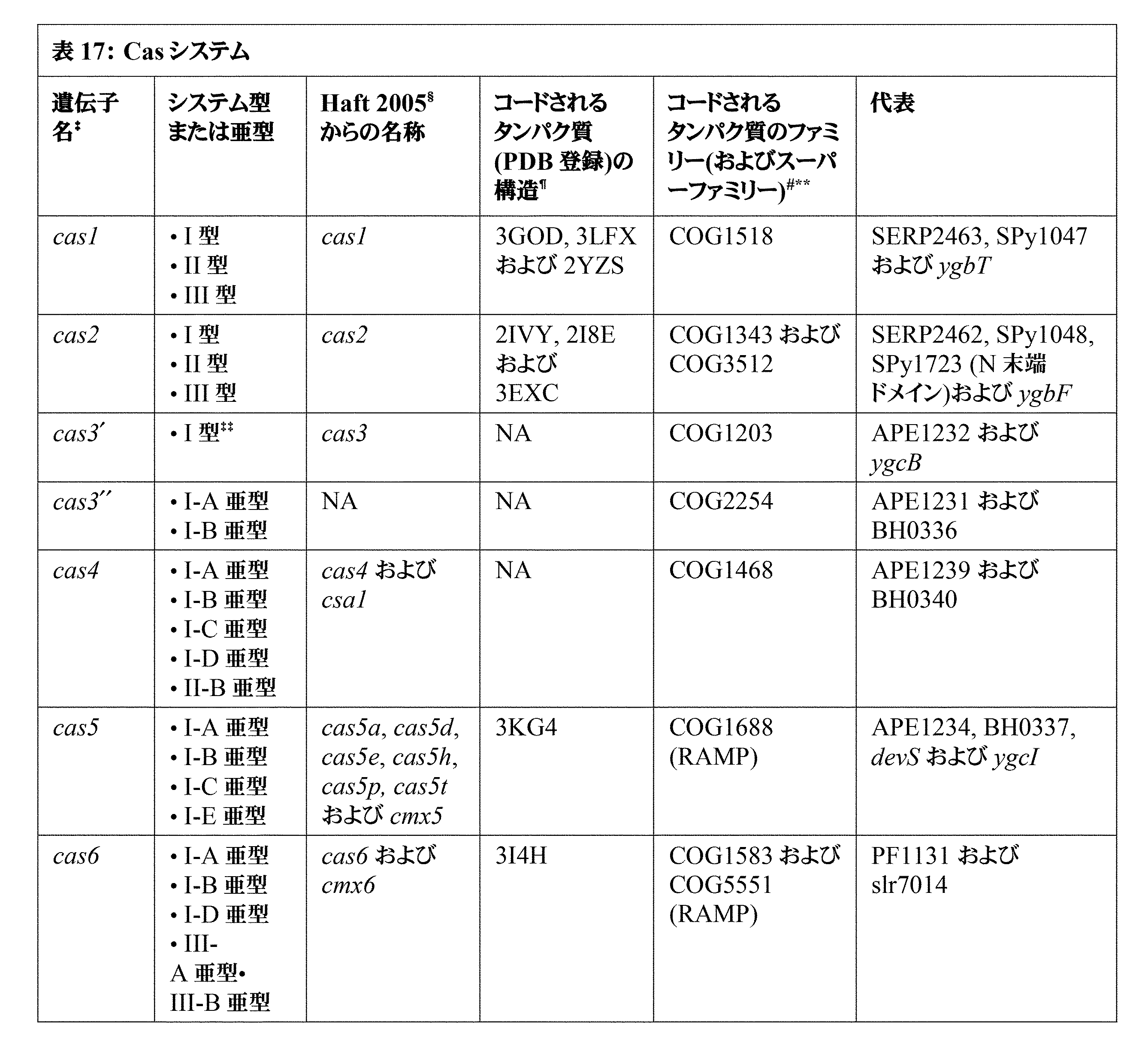

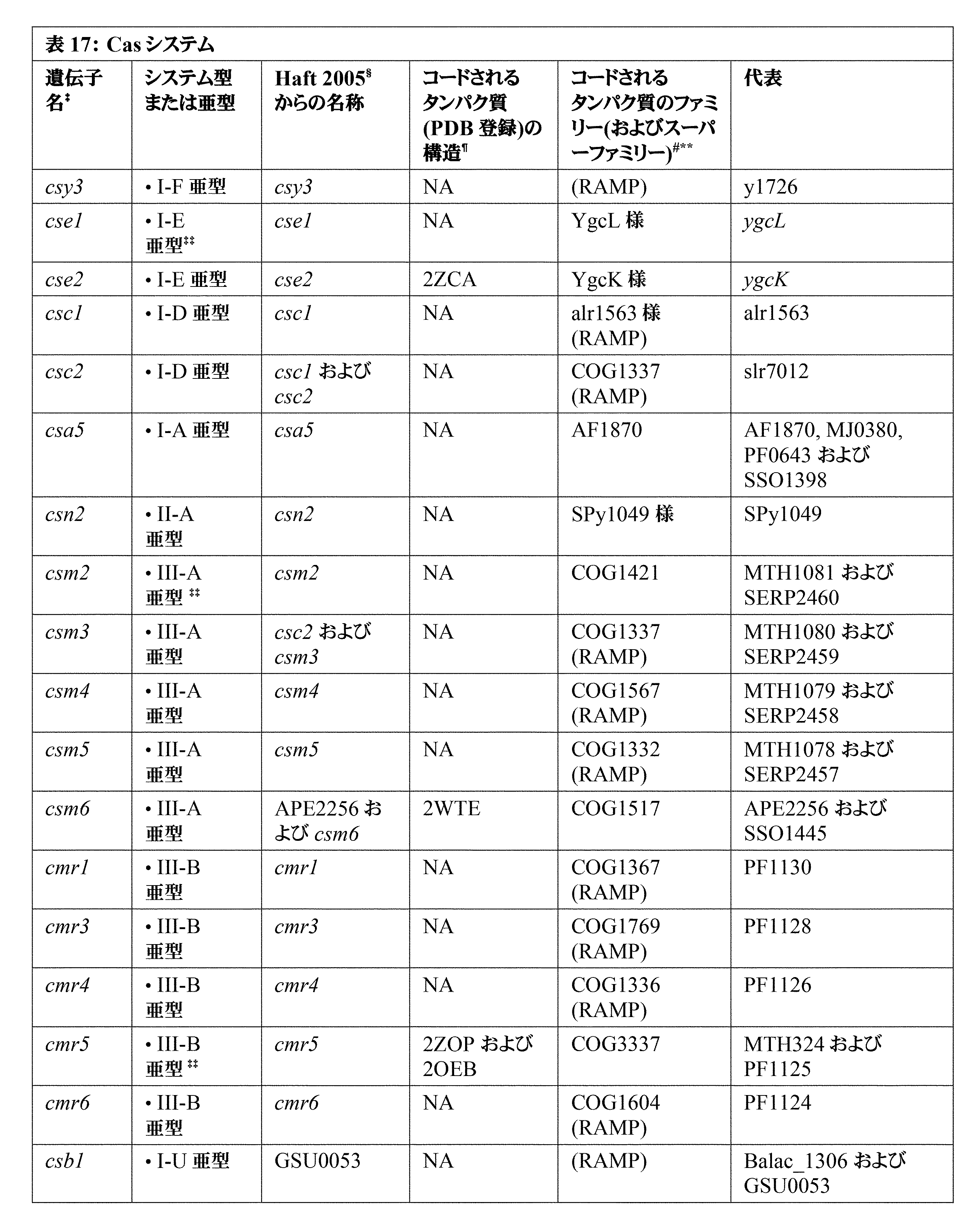
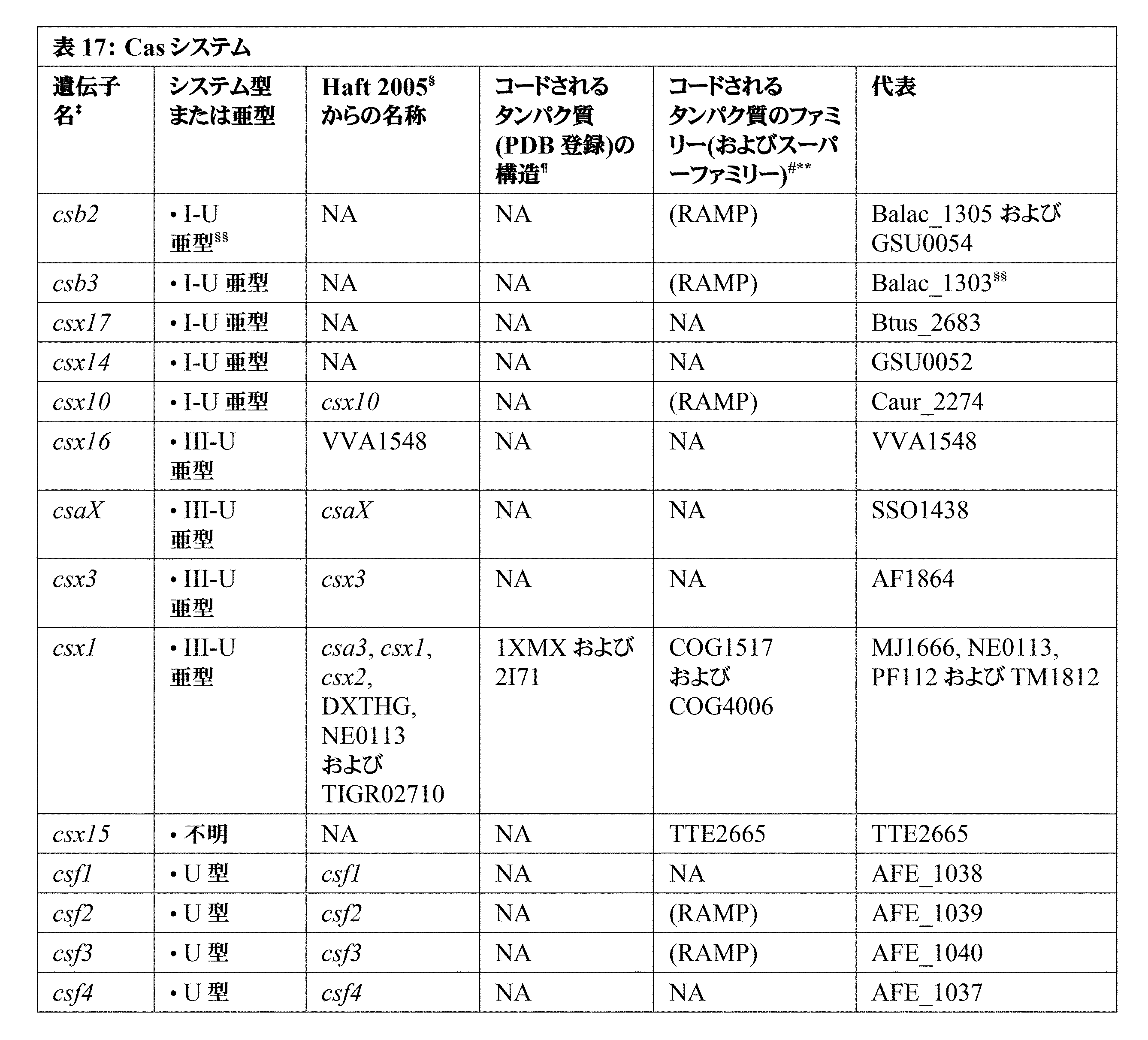
その他のヌクレアーゼ
本明細書に開示される教示内容を用いて当業者には理解されるように、gRNA分子を選択し、デザインするための本明細書に記載の方法およびデータベーススキーマは、Cpf1システム、転写アクチベーター様エフェクターヌクレアーゼ(TALEN)システム、およびジンクフィンガーヌクレアーゼ(ZFN)システムなどの他のシステムのために使用することもできる。例えば、Cpf1は、クラス2CRISPR-Casシステム(Zetsche et al.,2015,Cell 163,1-13を参照)の単一RNA誘導エンドヌクレアーゼである。転写アクチベーター様エフェクターヌクレアーゼ(TALEN)システムは、ザントモナス(Xanthomonas)種由来のTALEと制限エンドヌクレアーゼ、FokIの融合物である。TALEのアミノ酸反復配列を修飾することにより、当業者は標的DNAに特異的に結合して、TAL結合部位の間に切断を導入するように、TALENシステムをカスタマイズすることができる。同様に、ジンクフィンガーヌクレアーゼシステムは、DNA切断ドメインとしてFokIヌクレアーゼを使用し、特定のジンクフィンガーが、異なるヌクレオチドトリプレットを認識して、FokIヌクレアーゼを二量体化することにより、2つの異なるジンクフィンガー結合部位の間に二本鎖切断の導入を達成する。
Other nucleases As will be understood by those skilled in the art using the teachings disclosed herein, the methods and database schemas described herein for selecting and designing gRNA molecules can be applied to the Cpf1 system, It can also be used for other systems such as transcription activator-like effector nuclease (TALEN) systems, and zinc finger nuclease (ZFN) systems. For example, Cpf1 is a single RNA-guided endonuclease of the
IV.候補分子の機能解析
候補Cas9分子、候補gRNA分子、候補Cas9分子/gRNA分子複合体は、当該技術分野で周知の方法によって、または本明細書に記載されるように評価することができる。例えば、Cas9分子のエンドヌクレアーゼ活性を評価する代表的な方法は、例えば、Jinek et al.,SCIENCE 2012,337(6096):816-821に記載されている。
IV. Functional Analysis of Candidate Molecules Candidate Cas9 molecules, candidate gRNA molecules, candidate Cas9 molecule/gRNA molecule complexes can be evaluated by methods well known in the art or as described herein. For example, representative methods for assessing the endonuclease activity of Cas9 molecules are described, for example, by Jinek et al. , SCIENCE 2012, 337 (6096): 816-821.
結合および切断アッセイ:Cas9分子のエンドヌクレアーゼ活性を試験する
Cas9分子/gRNA分子複合体が、標的核酸を結合および切断する能力は、プラスミド切断アッセイで評価され得る。このアッセイでは、合成または生体外転写gRNA分子が、95℃に加熱して緩慢に室温に冷却することで、反応に先だってプレアニールされる。天然または制限消化直線化プラスミドDNA(300ng(約8nM))が、10mMのMgCl2存在下または不在下において、Cas9プラスミド切断緩衝液(20mMのHEPES pH7.5、150mMのKCl、0.5mMのDTT、0.1mMのEDTA)中の精製Cas9タンパク質分子(50~500nM)およびgRNA(50~500nM、1:1)と共に、37℃で60分間インキュベートされる。反応は、5×DNAローディングバッファー(30%グリセロール、1.2%SDS、250mMのEDTA)によって停止され、0.8または1%アガロースゲル電気泳動法によって分離され、臭化エチジウム染色によって視覚化される。得られた分解産物は、Cas9分子が、双方のDNA鎖を切断するか、または二本鎖の1本のみを切断するかどうかを示す。例えば、直鎖DNA生成物は、双方のDNA鎖の切断を示す。ニックの入った開環状生成物は、二本鎖の1本のみが切断されていることを示す。
Binding and Cleavage Assay: Testing the Endonuclease Activity of Cas9 Molecules The ability of Cas9 molecule/gRNA molecule complexes to bind and cleave target nucleic acids can be assessed in plasmid cleavage assays. In this assay, synthetic or in vitro transcribed gRNA molecules are preannealed prior to reaction by heating to 95°C and slow cooling to room temperature. Native or restriction-digested linearized plasmid DNA (300 ng (approximately 8 nM)) was prepared in Cas9 plasmid cleavage buffer (20 mM HEPES pH 7.5, 150 mM KCl, 0.5 mM DTT in the presence or absence of 10 mM MgCl2). , 0.1 mM EDTA) and gRNA (50-500 nM, 1:1) for 60 min at 37°C. Reactions were stopped with 5x DNA loading buffer (30% glycerol, 1.2% SDS, 250 mM EDTA), separated by 0.8 or 1% agarose gel electrophoresis, and visualized by ethidium bromide staining. Ru. The resulting degradation products indicate whether the Cas9 molecule cuts both DNA strands or only one of the duplexes. For example, a linear DNA product exhibits breaks in both DNA strands. A nicked ring-opened product indicates that only one of the duplexes has been cleaved.
代案としては、Cas9分子/gRNA分子複合体が、標的核酸に結合して切断する能力は、オリゴヌクレオチドDNA切断アッセイで評価され得る。このアッセイでは、DNAオリゴヌクレオチド(10pmol)が、1×T4ポリヌクレオチドキナーゼ反応緩衝液中の5単位のT4ポリヌクレオチドキナーゼおよび約3~6pmol(約20~40mCi)の[γ-32P]-ATPと、50μLの反応物中で37℃で30分間インキュベートすることで、放射性標識される。加熱不活性化(65℃で20分間)後、カラムに通して反応物が精製され、組み込まれていない標識が除去される。標識オリゴヌクレオチドと、等モル量の未標識相補的オリゴヌクレオチドとの95℃で3分間のアニーリングによって、二本鎖基質(100nM)が生成され、室温への緩慢な冷却がそれに続く。切断アッセイでは、95℃で30秒間加熱することでgRNA分子がアニールされ、室温への緩慢な冷却がそれに続く。Cas9(500nM最終濃度)が、切断アッセイ緩衝液(20mMのHEPES pH7.5、100mMのKCl、5mMのMgCl2、1mMのDTT、5%グリセロール)中のアニールされたgRNA分子(500nM)と共に、総容積9μlでプレインキュベートされる。1μlの標的DNA(10nM)の添加によって反応が開始され、37℃で1時間インキュベートされる。20μlのローディング色素(ホルムアミド中の5mMのEDTA、0.025%SDS、5%グリセロール)の添加によって反応物がクエンチされ、95℃で5分間加熱される。分解産物は、7M尿素を含有する12%変性ポリアクリルアミドゲル上で分離され、ホスホロイメージングによって視覚化される。得られた分解産物は、相補鎖、非相補鎖、またはその双方が切断されたかどうかを示す。 Alternatively, the ability of a Cas9 molecule/gRNA molecule complex to bind and cleave a target nucleic acid can be assessed in an oligonucleotide DNA cleavage assay. In this assay, DNA oligonucleotides (10 pmol) are combined with 5 units of T4 polynucleotide kinase and approximately 3-6 pmol (approximately 20-40 mCi) of [γ-32P]-ATP in 1× T4 polynucleotide kinase reaction buffer. , radiolabeled by incubating in a 50 μL reaction for 30 minutes at 37°C. After heat inactivation (20 minutes at 65° C.), the reaction is purified by passing through a column to remove unincorporated label. Double-stranded substrate (100 nM) is generated by annealing of labeled oligonucleotide and equimolar amounts of unlabeled complementary oligonucleotide at 95° C. for 3 minutes, followed by slow cooling to room temperature. In the cleavage assay, gRNA molecules are annealed by heating at 95° C. for 30 seconds, followed by slow cooling to room temperature. Cas9 (500 nM final concentration) was added to the total volume along with annealed gRNA molecules (500 nM) in cleavage assay buffer (20 mM HEPES pH 7.5, 100 mM KCl, 5 mM MgCl2, 1 mM DTT, 5% glycerol). Preincubate with 9 μl. The reaction is initiated by the addition of 1 μl of target DNA (10 nM) and incubated for 1 hour at 37°C. The reaction is quenched by the addition of 20 μl loading dye (5 mM EDTA, 0.025% SDS, 5% glycerol in formamide) and heated at 95° C. for 5 minutes. Degradation products are separated on a 12% denaturing polyacrylamide gel containing 7M urea and visualized by phosphoroimaging. The resulting degradation products indicate whether the complementary strand, non-complementary strand, or both have been cleaved.
これらのアッセイの片方または双方を使用して、候補gRNA分子または候補Cas9分子の適合性が評価され得る。 One or both of these assays can be used to assess the suitability of a candidate gRNA molecule or candidate Cas9 molecule.
結合アッセイ:Cas9分子の標的DNAへの結合を試験する
Cas9分子の標的DNAへの結合を評価する代表的な方法は、例えば、Jinek et.al.,Science 2012;337(6096):816-821に記載されている。
Binding Assay: Testing the Binding of Cas9 Molecules to Target DNA Representative methods for assessing the binding of Cas9 molecules to target DNA are described, for example, by Jinek et. al. , Science 2012; 337(6096): 816-821.
例えば、電気泳動移動度シフト解析では、脱イオン水中で各鎖(10nmol)を混合して、95℃で3分間加熱し、室温に緩慢に冷却することで、標的DNA二本鎖が形成される。全てのDNAは、1×TBEを含有する8%天然ゲル上で精製される。DNAバンドは、UVシャドーイングによって視覚化され、切除されて、ゲル小片をDEPC処理H2Oに浸漬することで溶出される。溶出されDNAは、エタノール沈殿されて、DEPC処理H2Oに溶解される。DNAサンプルは、[γ-32P]-ATPを使用して、T4ポリヌクレオチドキナーゼで37℃で30分間にわたり5’末端標識される。ポリヌクレオチドキナーゼは、65℃で20分間加熱変性され、カラムを使用して、組み込まれていない放射性標識が除去される。結合アッセイは、20mMのHEPES pH7.5、100mMのKCl、5mMのMgCl2、1mMのDTT、および10%グリセロールを含有する緩衝液中で、総容積10μlで実施される。Cas9タンパク質分子は、等モル量のプレアニールgRNA分子でプログラムされて、100pMから1μMに滴定される。放射性標識DNAが、20pMの最終濃度に添加される。サンプルは、37℃で1時間インキュベートされ、1×TBEおよび5mMのMgCl2を含有する8%天然ポリアクリルアミドゲル上で、4℃で分離される。ゲルは乾燥されて、DNAはホスホロイメージングによって視覚化される。 For example, in electrophoretic mobility shift analysis, target DNA duplexes are formed by mixing each strand (10 nmol) in deionized water, heating at 95°C for 3 minutes, and slowly cooling to room temperature. . All DNA is purified on 8% native gels containing 1x TBE. DNA bands are visualized by UV shadowing, excised, and eluted by soaking the gel pieces in DEPC-treated H 2 O. Eluted DNA is ethanol precipitated and dissolved in DEPC-treated H2O . DNA samples are 5'-end labeled using [γ-32P]-ATP with T4 polynucleotide kinase for 30 minutes at 37°C. Polynucleotide kinase is heat denatured at 65° C. for 20 minutes and unincorporated radiolabel is removed using a column. Binding assays are performed in a total volume of 10 μl in a buffer containing 20 mM HEPES pH 7.5, 100 mM KCl, 5 mM MgCl 2 , 1 mM DTT, and 10% glycerol. Cas9 protein molecules are programmed with equimolar amounts of pre-annealed gRNA molecules and titrated from 100 pM to 1 μM. Radiolabeled DNA is added to a final concentration of 20 pM. Samples are incubated for 1 h at 37 °C and separated at 4 °C on 8% native polyacrylamide gels containing 1x TBE and 5 mM MgCl2 . The gel is dried and the DNA is visualized by phosphorimaging.
Cas9/gRNA複合体の熱安定性を測定する技術
Cas9-gRNAリボ核タンパク質(RNP)複合体の熱安定性は、示差走査型蛍光定量法(DSF)およびその他の技術によって検知することができる。タンパク質の熱安定性は、例えば、gRNAなどの結合RNA分子の添加などの好ましい条件下で増大され得る。従って、Cas9/gRNA複合体の熱安定性に関する情報は、複合体が安定しているかどうかを決定する上で有用である。
Techniques for Measuring Thermal Stability of Cas9/gRNA Complexes Thermal stability of Cas9-gRNA ribonucleoprotein (RNP) complexes can be detected by differential scanning fluorimetry (DSF) and other techniques. The thermal stability of a protein can be increased under favorable conditions, eg, by the addition of a binding RNA molecule such as gRNA. Therefore, information regarding the thermal stability of the Cas9/gRNA complex is useful in determining whether the complex is stable.
示差走査型蛍光定量法(DSF)
DSFは、タンパク質の熱安定性を測定するために用いることができる技術である。このアッセイは、いくつかの方法で適用することができる。例示的なプロトコルとして、限定はしないが、RNP形成のための所望の溶液条件を判定するプロトコル(アッセイ1、以下を参照)、gRNA:Cas9タンパク質の最良の化学量論比を試験するプロトコル(アッセイ2、以下を参照)、Cas9分子、例えば、野生型もしくは突然変異型Cas9分子について有効なgRNA分子をスクリーニングするプロトコル(アッセイ3、以下を参照)、ならびに標的DNAの存在下でRNP形成を調べるプロトコル(アッセイ4)が挙げられる。
Differential scanning fluorimetry (DSF)
DSF is a technique that can be used to measure the thermal stability of proteins. This assay can be applied in several ways. Exemplary protocols include, but are not limited to, protocols for determining the desired solution conditions for RNP formation (
アッセイ1
RNP複合体を形成するための最良の溶液を判定するために、Cas9の2μM水溶液と10×SYPRO Orange(登録商標)(Life Techonologiesカタログ番号S-6650)が384ウェルプレート内に分注される。次に、様々なpHの溶液中で希釈された等モル量のgRNA、および塩が添加される。室温で10分間インキュベートし、2000rpmで遠心分離してあらゆる気泡を除去いた後、 Bio-Rad CFX Manager ソフトウェアと共に、Bio-Rad CFX384(商標)Real-Time System C1000 Touch(商標)サーマルサイクラーを使用して、10秒毎に1℃の温度増大で20℃から90℃への勾配が実行される。
To determine the best solution for forming RNP complexes, a 2 μM aqueous solution of Cas9 and 10× SYPRO Orange® (Life Technologies Cat. No. S-6650) are dispensed into 384-well plates. Equimolar amounts of gRNA diluted in solutions of varying pH and salt are then added. After incubating for 10 minutes at room temperature and centrifuging at 2000 rpm to remove any air bubbles, the cells were incubated using a Bio-Rad CFX384™ Real-Time System C1000 Touch™ thermal cycler with Bio-Rad CFX Manager software. , a gradient from 20°C to 90°C is performed with a temperature increase of 1°C every 10 seconds.
アッセイ2
第2のアッセイは、上記アッセイ1からの最適緩衝液中で、様々な濃度のgRNA分子と2uM Cas9を混合して、384ウェルプレート内で、室温で10分間インキュベートすることを含む。等容積の最適緩衝液と10×SYPRO Orange(登録商標)(Life Techonologiesカタログ番号S-6650)が添加され、プレートはMicroseal(登録商標)B粘着剤(MSB-1001)で密封される。あらゆる気泡を除去するための2000rpmでの遠心分離に続いて、Bio-Rad CFX Managerソフトウェアと共に、Bio-Rad CFX384(商標)Real-Time System C1000 Touch(商標)サーマルサイクラーを使用して、10秒毎に1℃の温度増大で20℃から90℃への勾配が実行される。
The second assay involves mixing various concentrations of gRNA molecules with 2 uM Cas9 in the optimal buffer from
アッセイ3
第3のアッセイでは、対象Cas9分子(例えば、Cas9タンパク質、例えば、Cas9変異タンパク質)を精製する。変異gRNA分子のライブラリーを合成し、20μMの濃度まで再懸濁させる。5×SYPRO Orange(登録商標)(Life Techonologiesカタログ番号S-6650)の存在下で予定緩衝液中に各々1μMの最終濃度で、Cas9分子をgRNA分子と一緒にインキュベートする。室温で10分間インキュベートしてから、2000rpmで2分間の遠心分離により気泡を全て除去した後、Bio-Rad CFX Managerソフトウェアと共に、Bio-Rad CFX384(商標)Real-Time System C1000 Touch(商標)サーマルサイクラーを使用して、10秒毎に1℃ずつ昇温しながら、20℃から90℃への勾配を実行する。
In the third assay, a Cas9 molecule of interest (eg, a Cas9 protein, eg, a Cas9 mutein) is purified. A library of mutant gRNA molecules is synthesized and resuspended to a concentration of 20 μM. Cas9 molecules are incubated with gRNA molecules at a final concentration of 1 μM each in the intended buffer in the presence of 5× SYPRO Orange® (Life Technologies Cat. No. S-6650). After incubating for 10 minutes at room temperature and removing any air bubbles by centrifugation for 2 minutes at 2000 rpm, the cells were incubated in a Bio-Rad CFX384™ Real-Time System C1000 Touch™ thermal cycler with Bio-Rad CFX Manager software. Perform a gradient from 20°C to 90°C using a 1°C increase in temperature every 10 seconds.
アッセイ4
第4のアッセイでは、次のサンプル:Cas9タンパク質単独、Cas9タンパク質とgRNA、Cas9タンパク質とgRNAおよび標的DNA、ならびにCas9タンパク質と標的DNAを用いて、DSF実験を実施する。構成要素を混合する順序は、反応溶液、Cas9タンパク質、gRNA、DNA、およびSYPRO Orangeの順である。反応溶液は、MgCl2の非存在または存在下で、10mM HEPES pH7.5、100mM NaClを含有する。2000rpmで2分間の遠心分離により気泡を全て除去した後、Bio-Rad CFX Managerソフトウェアと共に、Bio-Rad CFX384(商標)Real-Time System C1000 Touch(商標)サーマルサイクラーを使用して、10秒毎に1℃ずつ昇温しながら、20℃から90℃への勾配を実行する。
In the fourth assay, DSF experiments are performed using the following samples: Cas9 protein alone, Cas9 protein and gRNA, Cas9 protein and gRNA and target DNA, and Cas9 protein and target DNA. The order of mixing the components is: reaction solution, Cas9 protein, gRNA, DNA, and SYPRO Orange. The reaction solution contains 10mM HEPES pH 7.5, 100mM NaCl in the absence or presence of MgCl2. After removing any air bubbles by centrifugation for 2 min at 2000 rpm, samples were collected every 10 s using a Bio-Rad CFX384™ Real-Time System C1000 Touch™ thermal cycler with Bio-Rad CFX Manager software. A gradient from 20°C to 90°C is performed with 1°C increments.
V.ゲノム編集アプローチ
例えば、本明細書に記載される遺伝子などの遺伝子の突然変異は、本明細書で考察されるアプローチの1つを用いて修正することができる。一実施形態では、遺伝子中の突然変異は、細胞外供給テンプレート核酸を用いた相同組換え修復(HDR)により修正される(以下を参照)。別の実施形態では、遺伝子中の突然変異は、細胞外供給テンプレート核酸を用いずに、相同組換え修復(HDR)により修正される(以下を参照)。
V. Genome Editing Approaches Mutations in genes, such as those described herein, can be corrected using one of the approaches discussed herein. In one embodiment, mutations in genes are corrected by homologous recombination repair (HDR) using extracellularly supplied template nucleic acids (see below). In another embodiment, mutations in genes are corrected by homologous recombination repair (HDR) without the use of extracellularly supplied template nucleic acids (see below).
さらに、NHEJを用いた遺伝子の1つまたは両方の対立遺伝子の標的化破壊(例えば、ノックアウト)方法も本明細書に記載される。別の実施形態では、遺伝子の標的化ノックダウンのための方法が提供される(以下を参照)。 Additionally, methods for targeted disruption (eg, knockout) of one or both alleles of a gene using NHEJ are also described herein. In another embodiment, methods are provided for targeted knockdown of genes (see below).
HDR修復、HDR媒介性ノックインおよびテンプレート核酸
本明細書に記載されるように、ヌクレアーゼ誘導相同組換え修復(HDR)を使用して、ゲノム中の標的配列を改変し、突然変異を修正(例えば、修復もしくは編集)することができる。標的配列の改変は、細胞外供給ドナーテンプレートまたはテンプレート核酸を用いた相同組換え修復(HDR)によって起こる。例えば、供与体テンプレートまたはテンプレート核酸は、標的配列の改変を可能にする。プラスミド供与体は、相同組換えのためのテンプレートとして使用できると考えられる。さらに、一本鎖供与体テンプレートは、標的配列と供与体テンプレートとの間の相同組換え修復の代替(alternate)方法(例えば、一本鎖アニーリング)による標的配列の改変のためのテンプレートとして使用できることも考えられる。供与体テンプレートを用いて実施される標的配列の改変は、Cas9分子による切断に依存する。Cas9による切断は、二本鎖切断または2つの一本鎖切断を含み得る。本明細書に記載されるように、ヌクレアーゼ誘導相同組換え修復(HDR)を使用して、細胞外供給ドナーテンプレートまたはテンプレート核酸なしで、標的配列を改変し、ゲノム中の突然変異を修正(例えば、修復もしくは編集)することができる。標的配列の改変は、細胞外供給ドナー配列を用いた相同組換え修復(HDR)によって起こる。例えば、内在性ゲノム供与体配列は、標的配列の改変を可能にする。一実施形態では、内在性ゲノム供与体配列を、標的配列と同じ染色体上に位置させることが検討される。さらに、別の実施形態では、内在性ゲノム供与体配列は、標的配列とは異なる染色体上に位置させることが検討される。内在性ゲノム供与体配列による標的配列の改変は、Cas9分子による切断に依存する。Cas9による切断は、二本鎖切断または2つの一本鎖切断を含み得る。
HDR Repair, HDR-Mediated Knock-in and Template Nucleic Acids As described herein, nuclease-induced homologous recombination repair (HDR) is used to modify target sequences in the genome and correct mutations (e.g. (repair or edit). Modification of target sequences occurs by homologous recombination repair (HDR) using extracellularly supplied donor templates or template nucleic acids. For example, a donor template or template nucleic acid allows modification of the target sequence. It is contemplated that the plasmid donor can be used as a template for homologous recombination. Furthermore, the single-stranded donor template can be used as a template for modification of the target sequence by alternative methods of homologous recombination repair (e.g., single-stranded annealing) between the target sequence and the donor template. can also be considered. Target sequence modification performed using donor templates relies on cleavage by Cas9 molecules. Cleavage by Cas9 can include a double-stranded break or two single-stranded breaks. As described herein, nuclease-guided homologous recombination repair (HDR) is used to modify target sequences and correct mutations in the genome (e.g., without extracellularly supplied donor templates or template nucleic acids). , repair or edit). Modification of the target sequence occurs by homologous recombination repair (HDR) using extracellularly supplied donor sequences. For example, an endogenous genomic donor sequence allows modification of the target sequence. In one embodiment, it is contemplated that the endogenous genomic donor sequence is located on the same chromosome as the target sequence. Furthermore, in another embodiment, it is contemplated that the endogenous genomic donor sequence is located on a different chromosome than the target sequence. Modification of target sequences by endogenous genomic donor sequences relies on cleavage by Cas9 molecules. Cleavage by Cas9 can include a double-stranded break or two single-stranded breaks.
テンプレート核酸を用いた、もしくは内在性ゲノムドナー配列を用いたHDRにより修正することができる突然変異として点突然変異がある。一実施形態では、点突然変異は、1つの二本鎖切断または2つの一本鎖切断のいずれかによって修正することができる。一実施形態では、点突然変異は、以下のものによって修正することができる:(1)1つの二本鎖切断、(2)2つの一本鎖切断、(3)標的位置の両側でそれぞれ起こる切断を含む2つの二本鎖切断、(4)標的位置の両側で起こる二本鎖切断と2つの一本鎖切断を含む、1つの二本鎖切断と2つの二本鎖切断、(5)標的位置の両側でそれぞれ起こる1対の一本鎖切断を含む、4つの一本鎖切断、または(6)1つの一本鎖切断。 Mutations that can be corrected by HDR using a template nucleic acid or using an endogenous genomic donor sequence include point mutations. In one embodiment, a point mutation can be corrected by either one double-stranded break or two single-stranded breaks. In one embodiment, point mutations can be corrected by: (1) one double-stranded break, (2) two single-stranded breaks, (3) each occurring on either side of the target position. (4) one double-strand break and two double-strand breaks, including a double-strand break and two single-strand breaks that occur on either side of the target position; (5) four single-stranded breaks, including one pair of single-stranded breaks, each occurring on either side of the target position, or (6) one single-stranded break.
一本鎖テンプレート核酸が用いられる一実施形態では、標的位置は、代替HDRによって改変することができる。 In one embodiment where a single-stranded template nucleic acid is used, the target location can be modified by an alternative HDR.
標的位置の供与体テンプレートを用いて実施される改変は、Cas9分子による切断に依存する。Cas9による切断は、ニック、二本鎖切断、または2つの一本鎖切断、例えば、標的核酸の各鎖に1つずつを含み得る。標的核酸への切断の導入後、切断末端に切除が起こり、これによってDNA領域にオーバーラップする一本鎖が生じる。 Modifications performed with the donor template at the target location depend on cleavage by the Cas9 molecule. Cleavage by Cas9 can include a nick, a double-stranded break, or two single-stranded breaks, eg, one on each strand of the target nucleic acid. After introducing a cleavage into the target nucleic acid, excision occurs at the cut ends, resulting in a single strand that overlaps the DNA region.
標準HDRでは、標的核酸に対する相同配列を含む二本鎖供与体テンプレートを導入するが、これは、標的核酸に直接組み込むか、または標的核酸の配列を修正するためのテンプレートとして使用する。切断における切除後、修復は、様々な経路、例えば、ダブルホリデイジャンクションモデル(double Holliday junction model)(もしくは二本鎖切断修復、DSBR、経路)または合成依存性鎖アニーリング(SDSA)経路によって進行し得る。ダブルホリデイジャンクションモデルでは、供与体テンプレート中の相同配列に対する標的核酸の2つの一本鎖オーバーハングによる鎖浸潤が起こり、これによって、2つのホリデイジャンクションを含む中間体が形成される。これらのジャンクションは、新たなDNAが、浸潤鎖の末端から合成されているため、移動して、切除によって生じた間隙を充填する。新たに合成されたDNAの末端は、切除された末端と連結し、ジャンクションは分解されて、標的核酸の修正、例えば、対応する標的位置での供与体テンプレートの修正配列の組み込みが起こる。供与体テンプレート核酸との交差が、ジャンクションの分解時に起こり得る。SDSA経路では、唯一の一本鎖オーバーハングが供与体テンプレートを浸潤し、新たなDNAが浸潤鎖の末端から合成されて、切除によって生じた間隙を充填する。新たに合成されたDNAは、次に、残る一本鎖オーバーハングとアニールし、新たなDNAが合成されて間隙を充填した後、鎖が連結されて、修正DNA二重鎖を生成する。 Standard HDR introduces a double-stranded donor template containing sequences homologous to the target nucleic acid, which is either incorporated directly into the target nucleic acid or used as a template to modify the sequence of the target nucleic acid. After excision at the break, repair can proceed by various pathways, such as the double Holliday junction model (or double-strand break repair, DSBR, pathway) or the synthesis-dependent strand annealing (SDSA) pathway. . In the double Holliday junction model, strand invasion by two single-stranded overhangs of the target nucleic acid to homologous sequences in the donor template occurs, thereby forming an intermediate containing two Holliday junctions. These junctions migrate and fill the gap created by excision as new DNA is synthesized from the ends of the invading strands. The newly synthesized DNA ends join with the excised ends, and the junction is cleaved, resulting in modification of the target nucleic acid, eg, incorporation of modified sequences of the donor template at the corresponding target position. Crossover with the donor template nucleic acid can occur upon disassembly of the junction. In the SDSA pathway, a unique single-stranded overhang invades the donor template, and new DNA is synthesized from the end of the invaded strand to fill the gap created by excision. The newly synthesized DNA then anneals with the remaining single-stranded overhang, new DNA is synthesized to fill the gap, and then the strands are joined to produce a modified DNA duplex.
代替HDRでは、一本鎖供与体テンプレート、例えば、テンプレート核酸を導入する。所望の標的位置を改変するための標的核酸でのニック、一本鎖切断、または二本鎖切断は、例えば、本明細書に記載されるものなどのCas9分子によって媒介され、切断における切除が起こって、一本鎖オーバーハングが露出する。標的核酸の標的位置を修正または改変するためのテンプレート核酸の配列の組み込みは、典型的に、前述した通り、SDSA経路によって起こる。 Alternative HDR introduces a single-stranded donor template, eg, a template nucleic acid. Nicking, single-stranded breaks, or double-stranded breaks in a target nucleic acid to modify a desired target location are mediated, for example, by a Cas9 molecule such as those described herein, and the excision in the cleavage occurs. The single-stranded overhang is exposed. Incorporation of a sequence of a template nucleic acid to modify or alter a target position of a target nucleic acid typically occurs by the SDSA pathway, as described above.
HDR経路、例えば、標準HDRもしくはalt-HDRを促進する方法は、本明細書のセクションVIに記載される。 Methods of promoting HDR pathways, eg, standard HDR or alt-HDR, are described in Section VI herein.
テンプレート核酸についてのさらに詳細は、国際出願PCT/US2014/057905号の「テンプレート核酸(Template nucleic acids)」と題するセクションIVに記載されている。 Further details about template nucleic acids are provided in Section IV of International Application No. PCT/US2014/057905 entitled "Template Nucleic Acids".
テンプレート核酸を用いた、もしくは内在性ゲノムドナー配列を用いたHDRにより修正(例えば、改変)することができる、特定の遺伝子座、例えば、HLA-A、HLA-B、HLA-C、HLA-DRB1、HLA-DRB3/4/5、もしくはHLA-DQB1の対立遺伝子変異体配列の配列中の突然変異が含まれる。また、テンプレート核酸、例えば、本明細書に記載されるテンプレート核酸を用いたHDRによって、特定の遺伝子座、例えば、HLA-A、HLA-B、HLA-C、HLA-DRB1、HLA-DRB3/4/5、もしくはHLA-DQB1の対立遺伝子変異体配列の配列にA1AT配列を挿入することもできる。 Specific genetic loci, e.g., HLA-A, HLA-B, HLA-C, HLA-DRB1, that can be corrected (e.g., modified) by HDR using template nucleic acids or using endogenous genomic donor sequences. , HLA-DRB3/4/5, or HLA-DQB1 allelic variant sequences. HDR using a template nucleic acid, e.g., the template nucleic acids described herein, can also be used to target specific loci, e.g., HLA-A, HLA-B, HLA-C, HLA-DRB1, HLA-DRB3/4. The A1AT sequence can also be inserted into the sequence of /5 or an allelic variant sequence of HLA-DQB1.
二本鎖切断媒介性修復またはノックイン
一実施形態では、二本鎖切断は、HNH様ドメインに関連する切断活性と、RuvC様ドメイン、例えば、N末端RuvC様ドメインに関連する切断活性を有するCas9分子、例えば、野生型Cas9によって実施される。このような実施形態は、単一のgRNAを必要とする。
Double-stranded break-mediated repair or knock-in In one embodiment, the double-stranded break is a Cas9 molecule that has cleavage activity associated with the HNH-like domain and cleavage activity associated with the RuvC-like domain, e.g., the N-terminal RuvC-like domain. , for example, by wild-type Cas9. Such embodiments require a single gRNA.
一本鎖切断媒介性修復またはノックイン
いくつかの実施形態では、1つの一本鎖切断、またはニックは、ニッカーゼ活性を有するCas9分子、例えば、本明細書に記載されるようなCas9ニッカーゼによって実施される。ニック標的核酸は、alt-HDR用の基質となり得る。
Single-strand break-mediated repair or knock-in In some embodiments, one single-strand break, or nick, is performed by a Cas9 molecule with nickase activity, e.g., a Cas9 nickase as described herein. Ru. Nicked target nucleic acids can serve as substrates for alt-HDR.
他の実施形態では、2つの一本鎖切断、またはニックは、例えば、HNH様ドメインに関連する切断活性、またはN末端RuvC様ドメインに関連する切断活性などのニッカーゼ活性を有するCas9分子によって実施される。このような実施形態は、通常、2つのgRNAを、すなわち各一本鎖切断の配置に1つずつ必要とする。一実施形態では、ニッカーゼ活性を有するCas9分子は、gRNAがハイブリダイズする鎖を切断するが、gRNAがハイブリダイズする鎖と相補的な鎖は切断しない。一実施形態では、ニッカーゼ活性を有するCas9分子は、gRNAがハイブリダイズする鎖を切断しないが、その代わり、gRNAがハイブリダイズする鎖と相補的な鎖は切断する。 In other embodiments, the two single-stranded cleavages, or nicks, are performed by a Cas9 molecule with nickase activity, such as, for example, a cleavage activity associated with the HNH-like domain, or a cleavage activity associated with the N-terminal RuvC-like domain. Ru. Such embodiments typically require two gRNAs, one for each single-stranded break location. In one embodiment, a Cas9 molecule with nickase activity cleaves the strand to which the gRNA hybridizes, but not the strand complementary to the strand to which the gRNA hybridizes. In one embodiment, a Cas9 molecule with nickase activity does not cleave the strand to which the gRNA hybridizes, but instead cleaves the strand that is complementary to the strand to which the gRNA hybridizes.
一実施形態では、ニッカーゼは、不活性化されたRuvC活性を有するCas9分子、例えば、D10に突然変異を有するCas9分子、例えば、D10A突然変異などHNH活性を有する。D10Aは、RuvCを不活性化し;従って、Cas9ニッカーゼは、HNH活性(のみ)を有し、gRNAがハイブリダイズする鎖(例えば、その上にNGG PAMを有していない相補鎖)上で切断する。他の実施形態では、H840、例えばH840A、突然変異を有するCas9分子をニッカーゼとして用いることができる。H840Aは、HNHを不活性化し;従って、Cas9ニッカーゼは、RuvC活性(のみ)を有し、非相補鎖(例えば、NGG PAMを有し、その配列が、gRNAと同一である鎖)上で切断する。他の実施形態では、N863、例えば、N863A突然変異、突然変異を有するCas9分子をニッカーゼとして使用することができる。N863Aは、HNHを不活性化することから、Cas9ニッカーゼは、RuvC活性(のみ)を有し、非相補鎖(NGG PAMを有し、かつその配列がgRNAと同一である鎖)上で切断する。他の実施形態では、N580突然変異、例えば、N580A突然変異を有するCas9分子をニッカーゼとして使用することができる。N580Aは、HNHを不活性化することから、Cas9ニッカーゼは、RuvC活性(のみ)を有し、非相補鎖(NGG PAMを有し、かつその配列がgRNAと同一である鎖)上で切断する。ニッカーゼおよび2つのgRNAを用いて、2つの一本鎖ニックを配置する一実施形態では、1つのニックは、標的核酸の+鎖上にあり、1つのニックは、その-鎖上にある。PAMは、外側を向いてもよい。これらのgRNAは、gRNA同士が、約0~50、0~100、または0~200ヌクレオチドによって隔てられるように選択することができる。一実施形態では、2つのgRNAの標的化ドメインと相補的な標的配列の間にオーバーラップはない。一実施形態では、gRNAは、オーバーラップせずに、50、100、または200ヌクレオチド程によって隔てられている。一実施形態では、2つのgRNAの使用は、例えば、オフターゲット結合を低減することによって、特異性を増大することができる(Ran et al.,Cell 2013;154(6):1380-1389)。 In one embodiment, the nickase has HNH activity, such as a Cas9 molecule with inactivated RuvC activity, eg, a Cas9 molecule with a mutation in D10, eg, a D10A mutation. D10A inactivates RuvC; therefore, Cas9 nickase has HNH activity (only) and cleaves on the strand to which the gRNA hybridizes (e.g., the complementary strand that does not have the NGG PAM on it) . In other embodiments, a Cas9 molecule with a H840, eg, H840A, mutation can be used as a nickase. H840A inactivates HNH; therefore, the Cas9 nickase has RuvC activity (only) and cleaves on non-complementary strands (e.g. strands that have an NGG PAM and whose sequence is identical to the gRNA). do. In other embodiments, a Cas9 molecule with a mutation of N863, eg, the N863A mutation, can be used as a nickase. Since N863A inactivates HNH, Cas9 nickase has RuvC activity (only) and cleaves on non-complementary strands (strands that have NGG PAM and whose sequence is identical to gRNA). . In other embodiments, a Cas9 molecule with an N580 mutation, eg, an N580A mutation, can be used as a nickase. Since N580A inactivates HNH, Cas9 nickase has RuvC activity (only) and cleaves on non-complementary strands (strands that have NGG PAM and whose sequence is identical to gRNA). . In one embodiment where a nickase and two gRNAs are used to place two single-stranded nicks, one nick is on the + strand and one nick is on the - strand of the target nucleic acid. The PAM may face outward. These gRNAs can be selected such that the gRNAs are separated by about 0-50, 0-100, or 0-200 nucleotides. In one embodiment, there is no overlap between the targeting domains and complementary target sequences of the two gRNAs. In one embodiment, the gRNAs are separated by as many as 50, 100, or 200 nucleotides with no overlap. In one embodiment, the use of two gRNAs can increase specificity, eg, by reducing off-target binding (Ran et al., Cell 2013;154(6):1380-1389).
一実施形態では、単一のニックを用いて、HDR、例えば、alt-HDRを誘導することができる。本明細書では、単一のニックを用いて、所与の切断部位でのHRとNHEJの比を増加し得ることが検討される。一実施形態では、前記gRNAの標的化ドメインが相補的である標的核酸の鎖中に一本鎖切断を形成する。他の実施形態では、前記gRNAの標的化ドメインが相補的である鎖以外の標的核酸の鎖中に一本鎖切断を形成する。 In one embodiment, a single nick can be used to induce HDR, eg, alt-HDR. It is contemplated herein that a single nick can be used to increase the ratio of HR to NHEJ at a given cleavage site. In one embodiment, the gRNA targeting domain forms a single strand break in the complementary strand of the target nucleic acid. In other embodiments, the gRNA targeting domain forms a single-strand break in a strand of the target nucleic acid other than the complementary strand.
標的位置に対する二本鎖または一本鎖切断の配置
鎖の一方における二本鎖切断または一本鎖切断は、改変が所望の領域内で生じる、例えば、突然変異の修正が起こるように、標的位置に十分接近させるべきである。一実施形態では、距離は、50、100、200、300、350もしくは400ヌクレオチド以下である。標的位置が、末端切除中にエキソヌクレアーゼ媒介性除去を受ける領域内にあるように、切除は標的位置に十分接近させるべきであると考えられる。標的位置と切断の間の距離が大きすぎると、改変しようとする突然変異体または他の配列が末端切除に包含されず、従って、修正されない場合がある。というのは、供与体配列(細胞外供給供与体配列または内在性ゲノム供与体配列のいずれも)は、いくつかの実施形態では、末端切除領域内の配列を修正するためだけに使用されるからである。
Placement of a double-stranded or single-stranded break relative to the target position A double-stranded or single-stranded break on one of the strands is placed at the target position such that the alteration occurs within the desired region, e.g., mutational correction occurs. should be placed sufficiently close to. In one embodiment, the distance is 50, 100, 200, 300, 350 or 400 nucleotides or less. It is believed that the excision should be close enough to the target location so that it is within the region that undergoes exonuclease-mediated removal during terminal resection. If the distance between the target location and the cleavage is too large, the mutant or other sequence to be modified may not be included in the end resection and, therefore, may not be corrected. This is because the donor sequence (either an extracellularly supplied donor sequence or an endogenous genomic donor sequence) is used in some embodiments only to modify sequences within the truncated region. It is.
一実施形態では、標的化ドメインは、切断事象、例えば、二本鎖もしくは一本鎖切断が、改変しようとする領域、例えば、突然変異から1、2、3、4、5、10、15、20、25、30、35、40、45、50、60、70、80、90、100、150もしくは200ヌクレオチド以内に位置するように構成される。切断、例えば、二本鎖切断または一本鎖切断は、改変しようとする領域、例えば、突然変異の上流または下流に配置することができる。いくつかの実施形態では、切断は、改変しようとする領域、少なくとも2つの突然変異ヌクレオチドにより画定される領域内に配置される。いくつかの実施形態では、切断は、改変しようとする領域に直接隣接して、例えば、突然変異のすぐ上流または下流に位置する。 In one embodiment, the targeting domain is such that the cleavage event, e.g. a double-stranded or single-stranded break, is 1, 2, 3, 4, 5, 10, 15, Constructed to be located within 20, 25, 30, 35, 40, 45, 50, 60, 70, 80, 90, 100, 150 or 200 nucleotides. The cleavage, eg, a double-stranded cleavage or a single-stranded cleavage, can be placed upstream or downstream of the region to be modified, eg, a mutation. In some embodiments, the cleavage is placed within the region to be modified, a region defined by at least two mutated nucleotides. In some embodiments, the truncation is located directly adjacent to the region to be modified, eg, immediately upstream or downstream of the mutation.
一実施形態では、一本鎖切断には、下で考察されるように、第2のgRNA分子によって配置される追加的一本鎖切断が伴う。例えば、標的化ドメインは、例えば、2つの一本鎖切断などの切断事象が、標的位置の1、2、3、4、5、10、15、20、25、30、35、40、45、50、60、70、80、90、100、150または200ヌクレオチド内に位置するように構成される。一実施形態では、第1および第2のgRNA分子は、Cas9ニッカーゼを誘導すると、一本鎖切断が、前記第2のgRNAによって配置される互いに十分に近い追加的一本鎖切断を伴い、所望する領域の改変をもたらすように構成される。一実施形態では、第1および第2のgRNA分子は、例えば、Cas9がニッカーゼである場合、第2のgRNAによって配置される一本鎖切断が、前記第1のgRNA分子によって配置される切断の10、20、30、40、または50ヌクレオチド内であるように構成される。一実施形態では、2つのgRNA分子は、異なる鎖上の同一位置に、または互いに少数のヌクレオチド内に、切断を配置させるように設計されて、例えば、二本鎖切断を本質的に模倣する。 In one embodiment, the single-stranded cleavage is accompanied by an additional single-stranded cleavage placed by a second gRNA molecule, as discussed below. For example, the targeting domain may be such that the cleavage event, e.g. Constructed to be located within 50, 60, 70, 80, 90, 100, 150 or 200 nucleotides. In one embodiment, the first and second gRNA molecules are arranged such that upon inducing Cas9 nickase, the single-stranded cleavage is accompanied by additional single-stranded cleavages sufficiently close to each other that are placed by said second gRNA, as desired. is configured to effect modification of the area to which it is applied. In one embodiment, the first and second gRNA molecules are arranged such that the single-stranded cleavage placed by the second gRNA is longer than the cleavage placed by said first gRNA molecule, e.g., when Cas9 is a nickase. Constructed to be within 10, 20, 30, 40, or 50 nucleotides. In one embodiment, the two gRNA molecules are designed to place the breaks at the same position on different strands or within a few nucleotides of each other, eg, essentially mimicking a double-strand break.
HDR媒介性修正を誘導するために、gRNA(単分子(もしくはキメラ)またはモジュラーgRNA)およびCas9ヌクレアーゼが、二本鎖切断を誘導する一実施形態では、切断部位は、標的位置から0~200塩基対(例えば、0~175、0~150、0~125、0~100、0~75、0~50、0~25、25~200、25~175、25~150、25~125、25~100、25~75、25~50、50~200、50~175、50~150、50~125、50~100、50~75、75~200、75~175、75~150、75~125、75~100塩基対)離れている。一実施形態では、切断部位は、標的位置から0~100塩基対(例えば、0~75、0~50、0~25、25~100、25~75、25~50、50~100、50~75、または75~100塩基対)離れている。 In one embodiment in which gRNA (unimolecular (or chimeric) or modular gRNA) and Cas9 nuclease induce double-strand breaks to induce HDR-mediated modification, the cleavage site is between 0 and 200 bases from the target position. Pairs (for example, 0-175, 0-150, 0-125, 0-100, 0-75, 0-50, 0-25, 25-200, 25-175, 25-150, 25-125, 25- 100, 25-75, 25-50, 50-200, 50-175, 50-150, 50-125, 50-100, 50-75, 75-200, 75-175, 75-150, 75-125, 75-100 base pairs) apart. In one embodiment, the cleavage site is 0 to 100 base pairs from the target position (e.g., 0 to 75, 0 to 50, 0 to 25, 25 to 100, 25 to 75, 25 to 50, 50 to 100, 50 to 75, or 75-100 base pairs) apart.
複数の実施形態では、ニッカーゼを用いることでHDRを促進して、オーバーハングを含む切断を生成することができる。オーバーハングの一本鎖性質は、例えば、NHEJとは反対に、HDRによって切断を修復する細胞の可能性を増大することができる。特に、いくつかの実施形態では、第1のニッカーゼを第1の標的配列に標的化する第1のgRNAと、第1の標的配列とは反対側のDNA鎖上にあり、しかも第1のニックからずれている第2の標的配列に第2のニッカーゼを標的化する第2のgRNAとを選択することによって、HDRを促進する。 In embodiments, nickases can be used to promote HDR to generate cleavages that include overhangs. The single-stranded nature of the overhang can increase the likelihood of the cell repairing the break, for example, by HDR, as opposed to NHEJ. In particular, in some embodiments, a first gRNA that targets a first nickase to a first target sequence and a first gRNA that is on an opposite DNA strand from the first target sequence and that targets the first nickase. HDR is facilitated by selecting a second gRNA that targets a second nickase to a second target sequence that is offset from the target sequence.
一実施形態では、gRNA分子の標的化ドメインは、ヌクレオチドが改変されないように、予め選択したヌクレオチド、例えば、コード領域のヌクレオチドから十分遠くに、切断事象が位置するように設計される。一実施形態では、gRNA分子の標的化ドメインは、エキソン配列の改変または不要なスプライシング事象を回避するために、イントロン切断事象が、イントロン/エキソン境界または天然起源のスプライスシグナルから十分遠くに位置するように設計される。gRNA分子は、以下に記載するように、第1、第2、第3および/または第4のgRNA分子であってよい。 In one embodiment, the targeting domain of the gRNA molecule is designed such that the cleavage event is located far enough from a pre-selected nucleotide, eg, a coding region nucleotide, such that the nucleotide is not modified. In one embodiment, the targeting domain of the gRNA molecule is such that intron cleavage events are located sufficiently far from intron/exon boundaries or naturally occurring splice signals to avoid modification of exon sequences or unwanted splicing events. Designed to. The gRNA molecule may be a first, second, third and/or fourth gRNA molecule, as described below.
第1の切断および第2の切断同士の配置
一実施形態では、二本鎖切断は、下で考察されるように、第2のgRNA分子によって配置される追加的二本鎖切断を伴い得る。
Placement of First and Second Cuts In one embodiment, the double-stranded break may be accompanied by an additional double-stranded break placed by the second gRNA molecule, as discussed below.
一実施形態では、二本鎖切断は、第2のgRNA分子および第3のgRNA分子によって配置される2つの追加的二本鎖切断を伴い得る。 In one embodiment, the double-strand break may be accompanied by two additional double-strand breaks placed by the second gRNA molecule and the third gRNA molecule.
一実施形態では、第1および第2の一本鎖切断は、第3のgRNA分子および第4のgRNA分子によって配置される2つの追加的二本鎖切断を伴い得る。 In one embodiment, the first and second single-stranded breaks may be accompanied by two additional double-stranded breaks placed by a third gRNA molecule and a fourth gRNA molecule.
2つ以上のgRNAを用いて、標的核酸内に2つ以上の切断事象、例えば、二本鎖または一本鎖切断を配置する場合、同じまたは異なるCas9タンパク質によって2つ以上の切断事象を実施し得ることが検討される。例えば、2つのgRNAを用いて、2つの二本鎖切断を配置する場合、単一のCas9ヌクレアーゼを用いて、双方の二本鎖切断を生成することができる。2つ以上のgRNAを用いて、2つ以上の一本鎖切断(ニック)を配置する場合、単一のCas9ニッカーゼを用いて、2つ以上のニックを生成することができる。2つ以上のgRNAを用いて、少なくとも1つの二本鎖切断と少なくとも1つの一本鎖切断を配置する場合、2つのCas9タンパク質、例えば、1つのCas9ヌクレアーゼと1つのCas9ニッカーゼを用いることができる。2つ以上のCas9タンパク質を用いる場合、2つ以上のCas9タンパク質を順次送達することにより、標的核酸の所望の位置で、一本鎖切断に対して二本鎖の特異性を制御し得ることが検討される。 If more than one gRNA is used to place more than one cleavage event, e.g., a double-stranded or single-stranded break, within the target nucleic acid, the two or more cleavage events are carried out by the same or different Cas9 proteins. It will be considered to obtain. For example, if two gRNAs are used to place two double-strand breaks, a single Cas9 nuclease can be used to generate both double-strand breaks. If more than one gRNA is used to place more than one single-stranded break (nick), a single Cas9 nickase can be used to generate more than one nick. When using two or more gRNAs to place at least one double-stranded break and at least one single-stranded break, two Cas9 proteins can be used, e.g., one Cas9 nuclease and one Cas9 nickase. . When using two or more Cas9 proteins, it is possible to control the specificity of double-stranded versus single-stranded breaks at desired positions in the target nucleic acid by sequentially delivering two or more Cas9 proteins. Will be considered.
いくつかの実施形態では、第1のgRNA分子の標的化ドメインおよび第2のgRNA分子の標的化ドメインは、標的核酸分子の対向鎖と相補的である。いくつかの実施形態では、gRNA分子および第2のgRNA分子は、PAMが外側に向くように設計される。 In some embodiments, the targeting domain of the first gRNA molecule and the targeting domain of the second gRNA molecule are complementary to opposite strands of the target nucleic acid molecule. In some embodiments, the gRNA molecule and the second gRNA molecule are designed with the PAM facing outward.
特定の実施形態では、互いに予め選択した距離にある2つの位置のCas9媒介性切断を指令するように、2つのgRNAを選択する。複数の実施形態では、2つの切断点は、標的核酸の対向鎖上にある。いくつかの実施形態では、2つの切断点は、平滑末端切断を形成し、他の実施形態では、これらは、DNA末端が、1つまたは2つのオーバーハング(例えば、1つまたは複数の5’オーバーハングおよび/または1つまたは複数の3’オーバーハング)を含むようにずれている。複数の実施形態では、各切断事象は、ニックである。いくつかの実施形態では、ニックは、二本鎖切断機構により認識される切断を形成するように、互いに十分接近している(例えば、SSBr機構により認識されるのとは反対に)。複数の実施形態では、ニックは、それらが、HDRの基質であるオーバーハングを生成する、すなわち、切断の配置が、いくつかの切除を被ったDNA基質を模倣するように、十分離れている。例えば、いくつかの実施形態では、ニックは、プロセッシブ切除のための基質であるオーバーハングを生成するように隔てられている。いくつかの実施形態では、2つの切断は、互いに25~65ヌクレオチド以内で隔てられている。2つの切断は、例えば、互いに約25、30、35、40、45、50、55、60または65ヌクレオチドであってよい。2つの切断は、例えば、互いに少なくとも約25、30、35、40、45、50、55、60または65ヌクレオチドであってよい。2つの切断は、例えば、互いに多くとも約30、35、40、45、50、55、60または65ヌクレオチドであってよい。いくつかの実施形態では、2つの切断は、互いに約25~30、30~35、35~40、40~45、45~50、50~55、55~60、または60~65ヌクレオチドであってよい。 In certain embodiments, two gRNAs are selected to direct Cas9-mediated cleavage of two locations at a preselected distance from each other. In embodiments, the two breakpoints are on opposite strands of the target nucleic acid. In some embodiments, the two breakpoints form blunt-end cuts, and in other embodiments they are such that the DNA ends have one or two overhangs (e.g., one or more 5' overhang and/or one or more 3' overhangs). In embodiments, each cleavage event is a nick. In some embodiments, the nicks are close enough to each other to form a break that is recognized by the double-strand break mechanism (eg, as opposed to recognized by the SSBr mechanism). In embodiments, the nicks are far enough apart that they produce overhangs that are substrates for HDR, ie, the placement of the cuts mimics a DNA substrate that has undergone some excision. For example, in some embodiments, the nicks are separated to create an overhang that is a substrate for processive excision. In some embodiments, the two cuts are separated by no more than 25-65 nucleotides from each other. The two cuts may be, for example, about 25, 30, 35, 40, 45, 50, 55, 60 or 65 nucleotides from each other. The two cuts may be, for example, at least about 25, 30, 35, 40, 45, 50, 55, 60 or 65 nucleotides from each other. The two cuts may be, for example, at most about 30, 35, 40, 45, 50, 55, 60 or 65 nucleotides from each other. In some embodiments, the two cuts are about 25-30, 30-35, 35-40, 40-45, 45-50, 50-55, 55-60, or 60-65 nucleotides from each other. good.
いくつかの実施形態では、切除された切断を模倣する切断は、3’末端オーバーハング(例えば、DSBおよびニックによって生成され、ここで、ニックは3’オーバーハングを残す)、5’オーバーハング(例えば、DSBおよびニックによって生成され、ここで、ニックは5’オーバーハングを残す)、3’および5’オーバーハング(例えば、3つの切断によって生成される)、2つの3’オーバーハング(例えば、互いにずれている2つのニックによって生成される)、または2つの5’オーバーハング(例えば、互いにずれている2つのニックによって生成される)を含む。 In some embodiments, the cleavage that mimics the excised cleavage includes a 3' terminal overhang (e.g., generated by a DSB and a nick, where the nick leaves a 3' overhang), a 5' overhang ( For example, a DSB and a nick (where the nick leaves a 5' overhang), a 3' and 5' overhang (e.g., produced by three cuts), two 3' overhangs (e.g., (e.g., generated by two nicks that are offset from each other), or two 5' overhangs (e.g., generated by two nicks that are offset from each other).
Cas9ニッカーゼと複合体化する2つのgRNA(独立して、単分子(もしくはキメラ)またはモジュラーgRNA)が、HDR媒介性修正を誘導する目的で、2つの一本鎖切断を誘導する一実施形態では、より近傍のニックは、標的位置から互いに0~200塩基対(例えば、0~175、0~150、0~125、0~100、0~75、0~50、0~25、25~200、25~175、25~150、25~125、25~100、25~75、25~50、50~200、50~175、50~150、50~125、50~100、50~75、75~200、75~175、75~150、75~125、75~100塩基対)離れており、2つのニックは、理想的には互いに25~65塩基対(例えば、25~50、25~45、25~40、25~35、25~30、30~55、30~50、30~45、30~40、30~35、35~55、35~50、35~45、35~40、40~55、40~50、40~45塩基対、45~50塩基対、50~55塩基対、55~60塩基対、60~65塩基対)以内にあり、ならびに互いから100塩基対以下(例えば、互いから90、80、70、60、50、40、30、20、10、または5塩基対)離れている。一実施形態では、切断部位は、標的位置から0~100塩基対(例えば、0~75、0~50、0~25、25~100、25~75、25~50、50~100、50~75または75~100塩基対)離れている。 In one embodiment, two gRNAs (independently, single-molecule (or chimeric) or modular gRNAs) complexed with Cas9 nickase induce two single-strand breaks for the purpose of inducing HDR-mediated modification. , closer nicks are 0-200 base pairs from each other from the target position (e.g., 0-175, 0-150, 0-125, 0-100, 0-75, 0-50, 0-25, 25-200 , 25-175, 25-150, 25-125, 25-100, 25-75, 25-50, 50-200, 50-175, 50-150, 50-125, 50-100, 50-75, 75 ~200, 75-175, 75-150, 75-125, 75-100 base pairs) apart, and the two nicks are ideally 25-65 base pairs apart from each other (e.g., 25-50, 25-45 , 25-40, 25-35, 25-30, 30-55, 30-50, 30-45, 30-40, 30-35, 35-55, 35-50, 35-45, 35-40, 40 ~55, 40-50, 40-45 base pairs, 45-50 base pairs, 50-55 base pairs, 55-60 base pairs, 60-65 base pairs) and within 100 base pairs or less of each other (e.g. , 90, 80, 70, 60, 50, 40, 30, 20, 10, or 5 base pairs) apart from each other. In one embodiment, the cleavage site is 0 to 100 base pairs from the target position (e.g., 0 to 75, 0 to 50, 0 to 25, 25 to 100, 25 to 75, 25 to 50, 50 to 100, 50 to 75 or 75-100 base pairs) apart.
一実施形態では、2つのgRNA、例えば、独立して、単分子(もしくはキメラ)またはモジュラーgRNAは、標的位置の両側に二本鎖切断を配置するように設計される。代替の実施形態では、3つのgRNA、例えば、独立して、単分子(もしくはキメラ)またはモジュラーgRNAは、標的位置の両側に、二本鎖切断(すなわち、cas9ヌクレアーゼと1つのgRNAの複合体)と2つの一本鎖切断または対合一本鎖切断(すなわち、Cas9ニッカーゼと2つのgRNAの複合体)を配置するように設計される。別の実施形態では、4つのgRNA、例えば、独立して、単分子(もしくはキメラ)またはモジュラーgRNAは、標的位置の両側に2対の一本鎖切断(すなわち、Cas9ニッカーゼと2対の2つのgRNAの複合体)を生成するように設計される。二本鎖切断または1対において2つの一本鎖ニックの近い方は、理想的には標的位置の0~500塩基対以内(標的位置から、例えば、450、400、350、300、250、200、150、100、50または25bp以下)にある。ニッカーゼを使用する場合、1対の2つのニックは、複数の実施形態では、互いに25~65塩基対(例えば、25~55、25~50、25~45、25~40、25~35、25~30、50~55、45~55、40~55、35~55、30~55、30~50、35~50、40~50、45~50、35~45、40~45塩基対、45~50塩基対、50~55塩基対、55~60塩基対、または60~65塩基対)以内にあり、ならびに互いから100塩基対以下(例えば、90、80、70、60、50、40、30、20または10塩基対以下)離れている。 In one embodiment, two gRNAs, eg, independently, single (or chimeric) or modular gRNAs, are designed to place a double-strand break on either side of the target location. In an alternative embodiment, three gRNAs, e.g., independently, unimolecular (or chimeric) or modular gRNAs, have a double-stranded break (i.e., a complex of one gRNA with cas9 nuclease) on either side of the target location. and two single-strand breaks or paired single-strand breaks (i.e., a complex of Cas9 nickase and two gRNAs). In another embodiment, four gRNAs, e.g., independently, unimolecular (or chimeric) or modular gRNAs, have two pairs of single-stranded breaks (i.e., Cas9 nickase and two pairs of gRNA complexes). The closest of the two single-stranded nicks in a double-stranded break or pair is ideally within 0 to 500 base pairs of the target position (e.g., 450, 400, 350, 300, 250, 200 base pairs from the target position). , 150, 100, 50 or 25 bp). When using a nickase, the two nicks in a pair are, in embodiments, 25-65 base pairs from each other (e.g., 25-55, 25-50, 25-45, 25-40, 25-35, 25 ~30, 50-55, 45-55, 40-55, 35-55, 30-55, 30-50, 35-50, 40-50, 45-50, 35-45, 40-45 base pairs, 45 ~50 base pairs, 50-55 base pairs, 55-60 base pairs, or 60-65 base pairs) and no more than 100 base pairs from each other (e.g., 90, 80, 70, 60, 50, 40, 30, 20 or 10 base pairs or less) apart.
2つのgRNA分子を用いて、Cas9分子を切断に標的化する場合、Cas9分子の様々な組み合わせが考えられる。いくつかの実施形態では、第1のgRNAを用いて、第1のCas9分子を第1の標的位置に標的化し、第2のgRNAを用いて、第2のCas9分子を第2の標的位置に標的化する。いくつかの実施形態では、第1のCas9分子は、標的核酸の第1鎖にニックを生成し、第2のCas9分子は、対向鎖上にニックを生成し、これによって、二本鎖切断(例えば、平滑末端切断またはオーバーハングを含む切断)が生じる。 When targeting a Cas9 molecule for cleavage using two gRNA molecules, various combinations of Cas9 molecules are possible. In some embodiments, a first gRNA is used to target a first Cas9 molecule to a first target location and a second gRNA is used to target a second Cas9 molecule to a second target location. Target. In some embodiments, the first Cas9 molecule generates a nick on the first strand of the target nucleic acid and the second Cas9 molecule generates a nick on the opposite strand, thereby causing a double-strand break ( For example, blunt end truncations or truncations containing overhangs).
1つの一本鎖切断を一方の鎖に、また第2の一本鎖切断を対向鎖に標的化するために、ニッカーゼの様々な組み合わせを選択することができる。組み合わせを選択する際、1つの活性RuvC様ドメインを有するニッカーゼと、1つの活性HNHドメインを有するニッカーゼがあることを考慮に入れることができる。一実施形態では、RuvC様ドメインは、標的核酸分子の非相補的鎖を切断する。一実施形態では、HNH様ドメインは、一本鎖相補的ドメイン、例えば、二本鎖核酸分子の相補鎖を切断する。一般的に、双方のCas9分子は、同じ活性ドメインを有し(例えば、双方が活性RuvCドメインを有するか、または双方が活性HNHドメインを有する)、標的の対向鎖に2つの結合するgRNAを選択することになる。さらに詳細には、いくつかの実施形態では、第1のgRNAは、標的核酸の第1鎖と相補的であり、活性RuvC様ドメインを有するニッカーゼに結合して、第1のgRNAと非相補的な鎖、すなわち、標的核酸の第2鎖をニッカーゼに切断させ;第2のgRNAは、標的核酸の第2鎖と相補的であり、活性RuvC様ドメインを有するニッカーゼに結合して、第2のgRNAと非相補的な鎖、すなわち、標的核酸の第1鎖をニッカーゼに切断させる。反対に、いくつかの実施形態では、第1のgRNAは、標的核酸の第1鎖と相補的であり、活性HNHドメインを有するニッカーゼに結合して、第1のgRNAと相補的な鎖、すなわち、標的核酸の第1鎖をニッカーゼに切断させ;第2のgRNAは、標的核酸の第2鎖と相補的であり、活性HNHドメインを有するニッカーゼに結合して、第2のgRNAと相補的な鎖、すなわち、標的核酸の第2鎖をニッカーゼに切断させる。別の実施形態では、1つのCas9分子が活性RuvC様ドメインを有し、他方のCas9分子が活性HNHドメインを有する場合、双方のCas9分子のgRNAは、標的核酸の同じ鎖と相補的であり得るため、活性RuvC様ドメインを有するCas9分子は、非相補鎖を切断し、HNHドメインを有するCas9分子は、相補鎖を切断することになり、これによって二本鎖切断が生じる。 Various combinations of nickases can be selected to target one single-stranded break to one strand and a second single-stranded break to the opposite strand. When choosing a combination, it can be taken into account that there are nickases with one active RuvC-like domain and one nickase with one active HNH domain. In one embodiment, the RuvC-like domain cleaves the non-complementary strand of the target nucleic acid molecule. In one embodiment, the HNH-like domain cleaves a single-stranded complementary domain, eg, the complementary strand of a double-stranded nucleic acid molecule. Generally, both Cas9 molecules have the same active domain (e.g., both have an active RuvC domain, or both have an active HNH domain) and select two binding gRNAs on opposite strands of the target. I will do it. More particularly, in some embodiments, the first gRNA is complementary to the first strand of the target nucleic acid and binds to a nickase having an active RuvC-like domain to The second gRNA is complementary to the second strand of the target nucleic acid and binds to the nickase with an active RuvC-like domain to cleave the second gRNA, i.e., the second strand of the target nucleic acid. The strand non-complementary to gRNA, ie, the first strand of the target nucleic acid, is cleaved by nickase. Conversely, in some embodiments, the first gRNA is complementary to the first strand of the target nucleic acid and binds to a nickase having an active HNH domain to generate a strand complementary to the first gRNA, i.e. , the first strand of the target nucleic acid is cleaved by a nickase; a second gRNA is complementary to the second strand of the target nucleic acid and binds to the nickase with an active HNH domain to cleave the first strand of the target nucleic acid complementary to the second gRNA. strand, the second strand of the target nucleic acid, is cleaved by a nickase. In another embodiment, if one Cas9 molecule has an active RuvC-like domain and the other Cas9 molecule has an active HNH domain, the gRNAs of both Cas9 molecules may be complementary to the same strand of the target nucleic acid. Therefore, a Cas9 molecule with an active RuvC-like domain will cleave the non-complementary strand, and a Cas9 molecule with an HNH domain will cleave the complementary strand, resulting in a double-strand break.
供与体テンプレートの相同性アームの長さ
相同性アームは、例えば、切除された一本鎖オーバーハングが、供与体テンプレート内の相補的領域を見出すことができるように、末端切除が起こり得る領域と少なくとも同じくらい遠くまで延在すべきである。その全長は、プラスミドサイズまたはウイルスパッケージング限界などのパラメーターによって限定され得る。一実施形態では、相同性アームは、反復エレメント、例えば、Alu反復配列またはLINE反復配列中に延在しない。
Length of the homology arms of the donor template The homology arms are defined as regions where end resection can occur, e.g., so that excised single-stranded overhangs can find complementary regions within the donor template. It should extend at least as far. Its total length may be limited by parameters such as plasmid size or viral packaging limitations. In one embodiment, the homology arms do not extend into repetitive elements, such as Alu repeats or LINE repeats.
例示的な相同性アーム長さとしては、少なくとも50、100、250、500、750、1000、2000、3000、4000、または5000ヌクレオチドが挙げられる。いくつかの実施形態では、相同性アーム長さは、50~100、100~250、250~500、500~750、750~1000、1000~2000、2000~3000、3000~4000、または4000~5000ヌクレオチドである。 Exemplary homology arm lengths include at least 50, 100, 250, 500, 750, 1000, 2000, 3000, 4000, or 5000 nucleotides. In some embodiments, the homology arm length is 50-100, 100-250, 250-500, 500-750, 750-1000, 1000-2000, 2000-3000, 3000-4000, or 4000-5000. It is a nucleotide.
標的位置は、本明細書の用法では、Cas9分子依存的プロセスにより修飾される標的核酸(例えば、染色体)上の部位を指す。例えば、標的位置は、標的核酸の修飾Cas9分子切断および標的位置のテンプレート核酸指向性修飾、例えば、修正であり得る。一実施形態では、標的位置は、1つまたは複数のヌクレオチドが付加される標的核酸上の2つのヌクレオチド、例えば、隣接ヌクレオチド間の部位であってよい。標的位置は、テンプレート核酸により改変、例えば修正される1つまたは複数のヌクレオチドを含んでもよい。一実施形態では、標的位置は、標的配列(例えば、gRNAが結合する配列)内にある。一実施形態では、標的位置は、標的配列(例えば、gRNAが結合する配列)の上流または下流である。 Target location, as used herein, refers to a site on a target nucleic acid (eg, a chromosome) that is modified by a Cas9 molecule-dependent process. For example, the target location can be a modified Cas9 molecule cleavage of the target nucleic acid and a template nucleic acid directed modification, eg, modification, of the target location. In one embodiment, a target position may be a site between two nucleotides, eg, adjacent nucleotides, on a target nucleic acid to which one or more nucleotides are added. A target position may include one or more nucleotides that are altered, eg, modified, by a template nucleic acid. In one embodiment, the target location is within the target sequence (eg, the sequence to which the gRNA binds). In one embodiment, the target location is upstream or downstream of the target sequence (eg, the sequence to which the gRNA binds).
テンプレート核酸は、この用語が本明細書で使用される場合、標的位置の構造を改変するために、Cas9分子およびgRNA分子と一緒に使用することができる核酸配列を指す。一実施形態では、標準核酸は、典型的に、切断部位またはその付近で、テンプレート核酸の配列の一部もしくは全部を有するように、改変される。一実施形態では、テンプレート核酸は、一本鎖である。一実施形態では、テンプレート核酸は、二本鎖である。一実施形態では、テンプレート核酸は、DNA、例えば、二本鎖DNAである。他の実施形態では、テンプレート核酸は、一本鎖DNAである。一実施形態では、テンプレート核酸は、Cas9およびgRNAと同じベクター骨格、例えば、AAVゲノム、プラスミドDNA上にコードされる。一実施形態では、テンプレート核酸は、生体内でベクター骨格から切除され、例えば、これは、gRNA認識配列によりフランキングされる。一実施形態では、テンプレート核酸は、内在性ゲノム配列を含む。 Template nucleic acid, as the term is used herein, refers to a nucleic acid sequence that can be used in conjunction with a Cas9 molecule and a gRNA molecule to modify the structure of a target location. In one embodiment, the standard nucleic acid is modified to have some or all of the sequence of the template nucleic acid, typically at or near the cleavage site. In one embodiment, the template nucleic acid is single stranded. In one embodiment, the template nucleic acid is double-stranded. In one embodiment, the template nucleic acid is DNA, eg, double-stranded DNA. In other embodiments, the template nucleic acid is single-stranded DNA. In one embodiment, the template nucleic acid is encoded on the same vector backbone as Cas9 and gRNA, eg, AAV genome, plasmid DNA. In one embodiment, the template nucleic acid is excised from the vector backbone in vivo, eg, it is flanked by gRNA recognition sequences. In one embodiment, the template nucleic acid includes endogenous genomic sequences.
一実施形態では、テンプレート核酸は、相同組換え修復事象に参加することによって、標的位置の構造を改変する。一実施形態では、テンプレート核酸は、標的位置の配列を改変する。一実施形態では、テンプレート核酸は、標的核酸への修飾、または非天然塩基の組み込みをもたらす。 In one embodiment, the template nucleic acid modifies the structure of the target location by participating in a homologous recombination repair event. In one embodiment, the template nucleic acid modifies the sequence at the target location. In one embodiment, the template nucleic acid results in a modification or incorporation of a non-natural base to the target nucleic acid.
典型的に、テンプレート配列は、標的配列による切断媒介性または触媒組換えを受ける。一実施形態では、テンプレート核酸は、eaCas9媒介切断事象によって切断される標的配列上の1部位に対応する配列を含む。特定の実施形態では、テンプレート核酸は、第1のCas9媒介性事象で切断される標的配列上の第1部位と、第2のCas9媒介性事象で切断される標的配列上の第2部位の両方に対応する配列を含む。 Typically, the template sequence undergoes cleavage-mediated or catalytic recombination with the target sequence. In one embodiment, the template nucleic acid includes a sequence that corresponds to a site on the target sequence that is cleaved by an eaCas9-mediated cleavage event. In certain embodiments, the template nucleic acid comprises both a first site on the target sequence that is cleaved in a first Cas9-mediated event and a second site on the target sequence that is cleaved in a second Cas9-mediated event. Contains an array corresponding to .
一実施形態では、テンプレート核酸は、翻訳配列のコード配列に改変をもたらす配列、例えば、突然変異対立遺伝子を野生型対立遺伝子に形質転換する、野生型対立遺伝子を突然変異対立遺伝子に形質転換する、および/もしくは停止コドンの導入、アミノ酸残基の挿入、アミノ酸残基の欠失、またはナンセンス突然変異などの、例えば、タンパク質産物中の1アミノ酸の別のアミノ酸による置換をもたらす配列を含み得る。 In one embodiment, the template nucleic acid is a sequence that produces a modification in the coding sequence of the translated sequence, e.g., transforming a mutant allele into a wild-type allele, transforming a wild-type allele into a mutant allele, and/or sequences resulting in the substitution of one amino acid by another in the protein product, such as the introduction of a stop codon, the insertion of an amino acid residue, the deletion of an amino acid residue, or a nonsense mutation.
他の実施形態では、テンプレート核酸は、非コード配列の改変、例えば、エキソンあるいは5’もしくは3’非翻訳または非転写領域での改変をもたらす配列を含み得る。このような改変として、制御エレメント、例えば、プロモーター、エンハンサーの改変、およびシス作用もしくはトランス作用制御エレメントの改変が挙げられる。 In other embodiments, the template nucleic acid may include sequences that result in modifications of non-coding sequences, such as modifications in exons or 5' or 3' untranslated or untranscribed regions. Such modifications include modifications of regulatory elements, such as promoters, enhancers, and modifications of cis- or trans-acting control elements.
例えば、本明細書に記載される遺伝子などの遺伝子中の標的位置との相同性を有するテンプレート核酸を用いて、標的配列の構造を改変することができる。テンプレート配列を用いて、不要な構造、例えば、不要なまたは突然変異ヌクレオチドを改変することができる。 For example, a template nucleic acid that has homology to a target position in a gene, such as the genes described herein, can be used to modify the structure of a target sequence. The template sequence can be used to modify unwanted structures, eg, unnecessary or mutated nucleotides.
テンプレート核酸は、典型的に、以下の構成要素:
[5’相同性アーム]-[置換配列]-[3’相同性アーム]
を含む。
The template nucleic acid typically consists of the following components:
[5' homology arm] - [substitution sequence] - [3' homology arm]
including.
相同性アームは、染色体への組換え、従って、置換配列による、望ましくないエレメント、例えば、突然変異またはシグネチャの置換を提供する。一実施形態では、相同性アームは、最も遠位の切断部位とフランキングする。 The homology arms provide for recombination into the chromosome and thus the replacement of undesired elements, such as mutations or signatures, by replacement sequences. In one embodiment, the homology arms flank the most distal cleavage site.
一実施形態では、5’相同性アームの3’末端は、置換配列の5’末端に隣接する位置である。一実施形態では、5’相同性アームは、置換配列の5’末端から少なくとも10、20、30、40、50、100、200、300、400、500、600、700、800、900、1000、1500、2000、3000、4000、または5000ヌクレオチド5’側に延在し得る。 In one embodiment, the 3' end of the 5' homology arm is located adjacent to the 5' end of the replacement sequence. In one embodiment, the 5' homology arm is at least 10, 20, 30, 40, 50, 100, 200, 300, 400, 500, 600, 700, 800, 900, 1000, It may extend 1500, 2000, 3000, 4000, or 5000 nucleotides 5'.
一実施形態では、3’相同性アームの5’末端は、置換配列の3’末端に隣接する位置である。一実施形態では、3’相同性アームは、置換配列の3’末端から少なくとも10、20、30、40、50、100、200、300、400、500、600、700、800、900、1000、1500、2000、3000、4000、または5000ヌクレオチド3’側に延在し得る。 In one embodiment, the 5' end of the 3' homology arm is located adjacent to the 3' end of the replacement sequence. In one embodiment, the 3' homology arm is at least 10, 20, 30, 40, 50, 100, 200, 300, 400, 500, 600, 700, 800, 900, 1000, It may extend 1500, 2000, 3000, 4000, or 5000 nucleotides 3'.
一実施形態では、突然変異を修正するために、相同性アーム、例えば、5’および3’相同性アームは、各々、最も遠位のgRNA(例えば、突然変異の両側の1000塩基対(bp)の配列にフランキングする約1000bpの配列を含み得る。 In one embodiment, to correct a mutation, the homology arms, e.g., 5' and 3' homology arms, are each connected to the most distal gRNA (e.g., 1000 base pairs (bp) on either side of the mutation). The sequence may contain approximately 1000 bp of sequence flanking the sequences of .
本明細書では、特定の配列反復エレメント、例えば、Alu反復エレメントまたはLINEエレメントの含有を回避するために、一方または双方の相同性アームを短縮し得ることが考慮される。例えば、配列反復エレメントを回避するために、5’相同性アームを短縮してよい。他の実施形態では、配列反復エレメントを回避するために、3’相同性アームを短縮してもよい。いくつかの実施形態では、特定の配列反復エレメントの含有を回避するために、5’および3’相同性アームの双方を短縮してもよい。 It is contemplated herein that one or both homology arms may be shortened to avoid inclusion of certain sequence repeat elements, such as Alu repeat elements or LINE elements. For example, the 5' homology arms may be shortened to avoid sequence repeat elements. In other embodiments, the 3' homology arms may be shortened to avoid sequence repeat elements. In some embodiments, both the 5' and 3' homology arms may be shortened to avoid inclusion of certain sequence repeat elements.
本明細書では、突然変異を修正するためのテンプレート核酸は、一本鎖オリゴヌクレオチド、例えば、一本鎖オリゴデオキシヌクレオチド(ssODN)として使用するためにデザインされ得ることが検討される。ssODNを使用する場合、5’および3’相同性アームは、約200塩基対(bp)長、例えば、少なくとも25、50、75、100、125、150、175、または200塩基対長の範囲であってよい。オリゴヌクレオチド合成の改善が継続して実施されるため、より長い相同性アームもssODNに検討される。いくつかの実施形態では、より長い相同性アームは、化学合成以外の方法、例えば、長い二本鎖核酸を変性させた後、例えば、固体支持体に固定させた鎖特異的配列に対するアフィニティにより鎖の一方を精製することによって実施される。 It is contemplated herein that template nucleic acids for correcting mutations can be designed for use as single-stranded oligonucleotides, eg, single-stranded oligodeoxynucleotides (ssODN). When using an ssODN, the 5' and 3' homology arms are about 200 base pairs (bp) long, e.g., in a range of at least 25, 50, 75, 100, 125, 150, 175, or 200 base pairs long. It's good to be there. As improvements in oligonucleotide synthesis continue to be implemented, longer homology arms are also being considered for ssODNs. In some embodiments, longer homology arms are formed by methods other than chemical synthesis, e.g., after denaturing a long double-stranded nucleic acid, e.g., by affinity for a strand-specific sequence immobilized on a solid support. This is carried out by purifying one of the following.
いくつかの実施形態では、alt-HDRは、テンプレート核酸が、ニックの5’側に(すなわち、ニック鎖の5’方向に)延在する相同性を有するとき、より効率的に進行する。従って、いくつかの実施形態では、テンプレート核酸は、長い相同性アームと短い相同性アームを有し、ここで、長い方の相同性アームが、ニックの5’側にアニールすることができる。いくつかの実施形態では、ニックの5’側にアニールすることができるアームは、ニックから、または置換配列の5’もしくは3’末端から、少なくとも25、50、75、100、125、150、175、または200、300、400、500、600、700、800、900、1000、1500、2000、3000、4000、または5000ヌクレオチドである。いくつかの実施形態では、ニックの5’側にアニールすることができるアームは、ニックの3’側にアニールすることができるアームより、少なくとも10%、20%、30%、40%、または50%長い。いくつかの実施形態では、ニックの5’側にアニールすることができるアームは、ニックの3’側にアニールすることができるアームより、少なくとも2倍、3倍、4倍、または5倍長い。ssDNAテンプレートが、インタクトな鎖または切断鎖にアニールすることができるか否かに応じて、ニックの5’側にアニールする相同性アームは、それぞれssDNAテンプレートの5’末端またはssDNAテンプレートの3’末端に位置し得る。 In some embodiments, alt-HDR proceeds more efficiently when the template nucleic acid has homology that extends to the 5' side of the nick (ie, in the 5' direction of the nicked strand). Thus, in some embodiments, the template nucleic acid has a long homology arm and a short homology arm, where the longer homology arm can anneal to the 5' side of the nick. In some embodiments, the arm that can anneal to the 5' side of the nick is at least 25, 50, 75, 100, 125, 150, 175 from the nick or from the 5' or 3' end of the replacement sequence. , or 200, 300, 400, 500, 600, 700, 800, 900, 1000, 1500, 2000, 3000, 4000, or 5000 nucleotides. In some embodiments, the arms that can be annealed to the 5' side of the nick are at least 10%, 20%, 30%, 40%, or 50% more likely to be annealed to the 3' side of the nick. %long. In some embodiments, the arm that can be annealed to the 5' side of the nick is at least 2 times, 3 times, 4 times, or 5 times longer than the arm that can be annealed to the 3' side of the nick. Depending on whether the ssDNA template is capable of annealing to an intact strand or a broken strand, the homology arm that anneals to the 5' side of the nick can be attached to the 5' end of the ssDNA template or the 3' end of the ssDNA template, respectively. can be located in
同様に、いくつかの実施形態では、テンプレート核酸は、テンプレート核酸が、ニックの5’側に延在する相同性を有するように、5’相同性アーム、置換配列、および3’相同性アームを有する。例えば、5’相同性アームと3’相同性アームは、実質的に同じ長さであってよいが、置換配列は、ニックの3’側よりもニックの5’側で、より遠くに延在し得る。いくつかの実施形態では、置換配列は、ニックの3’末端よりもニックの5’末端側に、少なくとも10%、20%、30%、40%、50%、2倍、3倍、4倍、または5倍遠くに延在する。 Similarly, in some embodiments, the template nucleic acid includes a 5' homology arm, a replacement sequence, and a 3' homology arm such that the template nucleic acid has homology that extends to the 5' side of the nick. have For example, the 5' homology arm and the 3' homology arm may be substantially the same length, but the replacement sequence extends farther on the 5' side of the nick than on the 3' side of the nick. It is possible. In some embodiments, the replacement sequence is at least 10%, 20%, 30%, 40%, 50%, 2x, 3x, 4x closer to the 5' end of the nick than the 3' end of the nick. , or extend 5 times farther.
いくつかの実施形態では、alt-HDRは、テンプレート核酸がニックの中心に位置するとき、より効率的に進行する。従って、いくつかの実施形態では、テンプレート核酸は、ほぼ同じサイズである2つの相同性アームを有する。例えば、テンプレート核酸の第1の相同性アームは、テンプレート核酸の第2の相同性アームの10%、9%、8%、7%、6%、5%、4%、3%、2%、または1%以内の長さを有し得る。 In some embodiments, alt-HDR proceeds more efficiently when the template nucleic acid is located at the center of the nick. Thus, in some embodiments, a template nucleic acid has two homology arms that are approximately the same size. For example, the first homology arm of the template nucleic acid is 10%, 9%, 8%, 7%, 6%, 5%, 4%, 3%, 2%, or may have a length within 1%.
同様に、いくつかの実施形態では、テンプレート核酸は、テンプレート核酸が、ニックの両側でほぼ同じ距離だけ延在するように、5’相同性アーム、置換配列、および3’相同性アームを有する。例えば、相同性アームは、異なる長さを有してよいが、置換配列は、これを補償するように選択され得る。例えば、置換配列は、ニックの3’側よりもニックの5’側で、より遠く延在し得るが、ニックの5’側の相同性アームは、これを補償するために、ニックの3’側の相同性アームより短い。その逆も可能であり、例えば、置換配列は、ニックの5’側よりもニックの3’側で、より遠くに延在し得るが、ニックの3’側の相同性アームは、これを補償するために、ニックの5’側の相同性アームより短い。 Similarly, in some embodiments, the template nucleic acid has a 5' homology arm, a replacement sequence, and a 3' homology arm such that the template nucleic acid extends approximately the same distance on either side of the nick. For example, the homology arms may have different lengths, but replacement sequences may be chosen to compensate for this. For example, the replacement sequence may extend farther on the 5' side of the nick than on the 3' side of the nick, but the homology arm on the 5' side of the nick shorter than the side homology arm. The reverse is also possible, e.g. the replacement sequence may extend farther on the 3' side of the nick than on the 5' side of the nick, but the homology arm on the 3' side of the nick compensates for this. shorter than the homology arm on the 5′ side of the nick.
線状核酸テンプレート系の例示的な配置
一実施形態では、核酸テンプレート系は、二本鎖である。一実施形態では、核酸テンプレート系は、一本鎖である。一実施形態では、核酸テンプレート系は、一本鎖部分と二本鎖部分を含む。一実施形態では、テンプレート核酸は、ニックおよび/または置換配列の両側に、約50~100、例えば、55~95、60~90、65~85、または70~80塩基対の相同性を含む。一実施形態では、テンプレート核酸は、ニックもしくは置換配列の5’側、ニックもしくは置換配列の3’側、またはニックもしくは置換配列の5’および3’側の双方に約50、55、60、65、70、75、80、85、90、95、または100塩基対の相同性を含む。
Exemplary Arrangements for Linear Nucleic Acid Template Systems In one embodiment, the nucleic acid template system is double-stranded. In one embodiment, the nucleic acid template system is single stranded. In one embodiment, the nucleic acid template system includes a single-stranded portion and a double-stranded portion. In one embodiment, the template nucleic acid contains about 50-100, eg, 55-95, 60-90, 65-85, or 70-80 base pairs of homology on either side of the nick and/or replacement sequence. In one embodiment, the template nucleic acid has about 50, 55, 60, 65 , 70, 75, 80, 85, 90, 95, or 100 base pairs of homology.
一実施形態では、テンプレート核酸は、ニックおよび/または置換配列の3’側に約150~200塩基対、例えば、155~195、160~190、165~185、もしくは170~180塩基対の相同性を含む。一実施形態では、テンプレート核酸は、ニックまたは置換配列の3’側に約150、155、160、165、170、175、180、185、190、195、もしくは200塩基対の相同性を含む。一実施形態では、テンプレート核酸は、ニックまたは置換配列の5’側に約100、90、80、70、60、50、40、30、20、15、もしくは10塩基対未満の相同性を含む。 In one embodiment, the template nucleic acid has about 150-200 base pairs of homology 3' to the nick and/or replacement sequence, such as 155-195, 160-190, 165-185, or 170-180 base pairs. including. In one embodiment, the template nucleic acid includes about 150, 155, 160, 165, 170, 175, 180, 185, 190, 195, or 200 base pairs of homology 3' to the nick or replacement sequence. In one embodiment, the template nucleic acid contains less than about 100, 90, 80, 70, 60, 50, 40, 30, 20, 15, or 10 base pairs of homology 5' to the nick or replacement sequence.
一実施形態では、テンプレート核酸は、ニックおよび/または置換配列の5’側に約150~200塩基対、例えば、155~195、160~190、165~185、もしくは170~180塩基対の相同性を含む。一実施形態では、テンプレート核酸は、ニックまたは置換配列の5’側に約150、155、160、165、170、175、180、185、190、195、もしくは200塩基対の相同性を含む。一実施形態では、テンプレート核酸は、ニックまたは置換配列の3’側に約100、90、80、70、60、50、40、30、20、15、もしくは10塩基対未満の相同性を含む。 In one embodiment, the template nucleic acid has about 150-200 base pairs of homology 5' to the nick and/or replacement sequence, such as 155-195, 160-190, 165-185, or 170-180 base pairs. including. In one embodiment, the template nucleic acid includes about 150, 155, 160, 165, 170, 175, 180, 185, 190, 195, or 200 base pairs of homology 5' to the nick or replacement sequence. In one embodiment, the template nucleic acid contains less than about 100, 90, 80, 70, 60, 50, 40, 30, 20, 15, or 10 base pairs of homology 3' to the nick or replacement sequence.
例示的なテンプレート核酸
一実施形態では、テンプレート核酸は、一本鎖核酸である。別の実施形態では、テンプレート核酸は、二本鎖核酸である。いくつかの実施形態では、テンプレート核酸は、1つまたは複数のヌクレオチドのヌクレオチド配列を含み、これは、標的核酸に付加されるか、または標的核酸中の変化をテンプレートする。他の実施形態では、テンプレート核酸は、標的位置を改変するのに用いられ得るヌクレオチド配列を含む。他の実施形態では、テンプレート核酸は、例えば標的位置などの標的核酸の野生型配列に対応する、例えば1つまたは複数のヌクレオチドのヌクレオチド配列を含む。
Exemplary Template Nucleic Acid In one embodiment, the template nucleic acid is a single-stranded nucleic acid. In another embodiment, the template nucleic acid is a double-stranded nucleic acid. In some embodiments, a template nucleic acid comprises a nucleotide sequence of one or more nucleotides that is added to or templates a change in a target nucleic acid. In other embodiments, the template nucleic acid includes a nucleotide sequence that can be used to modify the target location. In other embodiments, the template nucleic acid comprises a nucleotide sequence, eg, one or more nucleotides, that corresponds to the wild-type sequence of the target nucleic acid, eg, the target position.
テンプレート核酸は、置換配列を含んでもよい。いくつかの実施形態では、テンプレート核酸は、5’相同性アームを含む。他の実施形態では、テンプレート核酸は、3’相同性アームを含む。 The template nucleic acid may include replacement sequences. In some embodiments, the template nucleic acid includes a 5' homology arm. In other embodiments, the template nucleic acid includes a 3' homology arm.
複数の実施形態では、テンプレート核酸は、直鎖二本鎖DNAである。長さは、例えば、約150~200塩基対、例えば、約150、160、170、180、190、または200塩基対であってよい。長さは、例えば、少なくとも150、160、170、180、190、または200塩基対であってよい。いくつかの実施形態では、長さは、150、160、170、180、190、または200塩基対以下である。いくつかの実施形態では、二本鎖テンプレート核酸は、約160、例えば、155~165、150~170、140~180、130~190、120~200、110~210、100~220、90~230、または80~240塩基対の長さを有する。 In embodiments, the template nucleic acid is linear double-stranded DNA. The length can be, for example, about 150-200 base pairs, such as about 150, 160, 170, 180, 190, or 200 base pairs. The length can be, for example, at least 150, 160, 170, 180, 190, or 200 base pairs. In some embodiments, the length is 150, 160, 170, 180, 190, or 200 base pairs or less. In some embodiments, the double-stranded template nucleic acid has a molecular weight of about 160, e.g. , or between 80 and 240 base pairs in length.
テンプレート核酸は、直鎖一本鎖DNAであり得る。複数の実施形態では、テンプレート核酸は、(i)標的核酸の切断鎖にアニールすることができる直鎖一本鎖DNA、(ii)標的核酸のインタクトな鎖にアニールすることができる直鎖一本鎖DNA、(iii)標的核酸の転写鎖にアニールすることができる直鎖一本鎖DNA、(iv)標的核酸の非転写鎖にアニールすることができる直鎖一本鎖DNA、またはこれらの2つ以上である。長さは、例えば、約150~200ヌクレオチド、例えば、約150、160、170、180、190、または200ヌクレオチドであってよい。長さは、例えば、少なくとも150、160、170、180、190、または200ヌクレオチドであってよい。いくつかの実施形態では、長さは、150、160、170、180、190、または200ヌクレオチド以下である。いくつかの実施形態では、一本鎖テンプレート核酸は、約160ヌクレオチド、例えば、約155~165、150~170、140~180、130~190、120~200、110~210、100~220、90~230、または80~240ヌクレオチドの長さを有する。 The template nucleic acid can be linear single-stranded DNA. In embodiments, the template nucleic acid is (i) a linear single-stranded DNA capable of annealing to the cleaved strand of the target nucleic acid; (ii) a linear single-stranded DNA capable of annealing to the intact strand of the target nucleic acid. (iii) linear single-stranded DNA capable of annealing to the transcribed strand of the target nucleic acid, (iv) linear single-stranded DNA capable of annealing to the non-transcribed strand of the target nucleic acid, or two thereof. More than one. The length can be, for example, about 150-200 nucleotides, such as about 150, 160, 170, 180, 190, or 200 nucleotides. The length can be, for example, at least 150, 160, 170, 180, 190, or 200 nucleotides. In some embodiments, the length is 150, 160, 170, 180, 190, or 200 nucleotides or less. In some embodiments, the single-stranded template nucleic acid has about 160 nucleotides, e.g., about 155-165, 150-170, 140-180, 130-190, 120-200, 110-210, 100-220, 90 ~230, or 80-240 nucleotides in length.
いくつかの実施形態では、テンプレート核酸は、環状二本鎖DNA、例えば、プラスミドである。いくつかの実施形態では、テンプレート核酸は、置換配列および/またはニックの両側に、約500~1000塩基対の相同性を含む。いくつかの実施形態では、テンプレート核酸は、ニックまたは置換配列の5’側、ニックまたは置換配列の3’側、あるいはニックまたは置換配列の5’および3’側の双方に、約300、400、500、600、700、800、900、1000、1500、または2000塩基対の相同性を含む。いくつかの実施形態では、テンプレート核酸は、ニックまたは置換配列の5’側、ニックまたは置換配列の3’側、あるいはニックまたは置換配列の5’および3’側の双方に、少なくとも300、400、500、600、700、800、900、1000、1500、または2000塩基対の相同性を含む。いくつかの実施形態では、テンプレート核酸は、ニックまたは置換配列の5’側、ニックまたは置換配列の3’側、あるいは、ニックまたは置換配列の5’および3’側の双方に、300、400、500、600、700、800、900、1000、1500、または2000塩基対以下の相同性を含む。 In some embodiments, the template nucleic acid is circular double-stranded DNA, such as a plasmid. In some embodiments, the template nucleic acid contains about 500-1000 base pairs of homology on either side of the replacement sequence and/or nick. In some embodiments, the template nucleic acid has about 300, 400, Contains 500, 600, 700, 800, 900, 1000, 1500, or 2000 base pairs of homology. In some embodiments, the template nucleic acid has at least 300, 400, Contains 500, 600, 700, 800, 900, 1000, 1500, or 2000 base pairs of homology. In some embodiments, the template nucleic acid has 300, 400, Contains no more than 500, 600, 700, 800, 900, 1000, 1500, or 2000 base pairs of homology.
いくつかの実施形態では、テンプレート核酸は、アデノウイルスベクター、例えば、AAVベクター、例えば、AAVキャプシドにパッケージングされることを可能にする長さおよび配列のssDNA分子である。ベクターは、例えば、5kb未満であってよく、キャプシド中へのパッケージングを促進するITR配列を含んでもよい。ベクターは、組み込み欠陥であってもよい。いくつかの実施形態では、テンプレート核酸は、置換配列および/またはニックの両側に、約150~1000ヌクレオチドの相同性を含む。いくつかの実施形態では、テンプレート核酸は、ニックまたは置換配列の5’側、ニックまたは置換配列の3’側、あるいはニックまたは置換配列の5’および3’側の双方に、約100、150、200、300、400、500、600、700、800、900、1000、1500、または2000ヌクレオチドを含む。いくつかの実施形態では、テンプレート核酸は、ニックまたは置換配列の5’側、ニックまたは置換配列の3’側、あるいはニックまたは置換配列の5’および3’側の双方に、少なくとも100、150、200、300、400、500、600、700、800、900、1000、1500、または2000ヌクレオチドを含む。いくつかの実施形態では、テンプレート核酸は、ニックまたは置換配列の5’側、ニックまたは置換配列の3’側、あるいはニックまたは置換配列の5’および3’側の双方に、多くとも100、150、200、300、400、500、600、700、800、900、1000、1500、または2000ヌクレオチドを含む。 In some embodiments, the template nucleic acid is an ssDNA molecule of a length and sequence that allows it to be packaged into an adenoviral vector, eg, an AAV vector, eg, an AAV capsid. The vector may be, for example, less than 5 kb and may contain ITR sequences to facilitate packaging into capsids. Vectors may be integration defective. In some embodiments, the template nucleic acid contains about 150-1000 nucleotides of homology on either side of the replacement sequence and/or nick. In some embodiments, the template nucleic acid has about 100, 150, Contains 200, 300, 400, 500, 600, 700, 800, 900, 1000, 1500, or 2000 nucleotides. In some embodiments, the template nucleic acid has at least 100, 150, Contains 200, 300, 400, 500, 600, 700, 800, 900, 1000, 1500, or 2000 nucleotides. In some embodiments, the template nucleic acid has at most 100,150 , 200, 300, 400, 500, 600, 700, 800, 900, 1000, 1500, or 2000 nucleotides.
いくつかの実施形態では、テンプレート核酸は、レンチウイルスベクター、例えば、IDLV(組み込み欠陥レンチウイルス)である。いくつかの実施形態では、テンプレート核酸は、置換配列および/またはニックの両側に、約500~1000塩基対の相同性を含む。いくつかの実施形態では、テンプレート核酸は、ニックまたは置換配列の5’側、ニックまたは置換配列の3’側、あるいはニックまたは置換配列の5’および3’側の双方に、約300、400、500、600、700、800、900、1000、1500、または2000塩基対の相同性を含む。いくつかの実施形態では、テンプレート核酸は、ニックまたは置換配列の5’側、ニックまたは置換配列の3’側、あるいはニックまたは置換配列の5’および3’側の双方に、少なくとも300、400、500、600、700、800、900、1000、1500、または2000塩基対の相同性を含む。いくつかの実施形態では、テンプレート核酸は、ニックまたは置換配列の5’側、ニックまたは置換配列の3’側、あるいは、ニックまたは置換配列の5’および3’側の双方に、300、400、500、600、700、800、900、1000、1500、または2000塩基対以下の相同性を含む。 In some embodiments, the template nucleic acid is a lentiviral vector, eg, IDLV (integration defective lentivirus). In some embodiments, the template nucleic acid contains about 500-1000 base pairs of homology on either side of the replacement sequence and/or nick. In some embodiments, the template nucleic acid has about 300, 400, Contains 500, 600, 700, 800, 900, 1000, 1500, or 2000 base pairs of homology. In some embodiments, the template nucleic acid has at least 300, 400, Contains 500, 600, 700, 800, 900, 1000, 1500, or 2000 base pairs of homology. In some embodiments, the template nucleic acid has 300, 400, Contains no more than 500, 600, 700, 800, 900, 1000, 1500, or 2000 base pairs of homology.
一実施形態では、テンプレート核酸は、Cas9がテンプレート核酸を認識してこれを切断するのを妨げる1つまたは複数の突然変異、例えば、サイレント突然変異を含む。テンプレート核酸は、改変しようとする細胞のゲノム中の対応する配列に対して例えば、少なくとも1、2、3、4、5、10、20、または30のサイレント突然変異を含んでもよい。複数の実施形態では、テンプレート核酸は、改変しようとする細胞のゲノム中の対応する配列に対して、多くとも2、3、4、5、10、20、30、または50のサイレント突然変異を含む。一実施形態では、cDNAは、Cas9がテンプレート核酸を認識してこれを切断するのを妨げる1つまたは複数の突然変異、例えば、サイレント突然変異を含む。テンプレート核酸は、改変しようとする細胞のゲノム中の対応する配列に対して、例えば、少なくとも1、2、3、4、5、10、20、または30のサイレント突然変異を含んでよい。複数の実施形態では、テンプレート核酸は、改変しようとする細胞のゲノム中の対応する配列に対して、多くとも2、3、4、5、10、20、30、または50のサイレント突然変異を含む。 In one embodiment, the template nucleic acid comprises one or more mutations, eg, silent mutations, that prevent Cas9 from recognizing and cleaving the template nucleic acid. The template nucleic acid may contain, for example, at least 1, 2, 3, 4, 5, 10, 20, or 30 silent mutations relative to the corresponding sequence in the genome of the cell to be modified. In embodiments, the template nucleic acid comprises at most 2, 3, 4, 5, 10, 20, 30, or 50 silent mutations relative to the corresponding sequence in the genome of the cell to be modified. . In one embodiment, the cDNA comprises one or more mutations, eg, a silent mutation, that prevent Cas9 from recognizing and cleaving the template nucleic acid. The template nucleic acid may contain, for example, at least 1, 2, 3, 4, 5, 10, 20, or 30 silent mutations relative to the corresponding sequence in the genome of the cell to be modified. In embodiments, the template nucleic acid comprises at most 2, 3, 4, 5, 10, 20, 30, or 50 silent mutations relative to the corresponding sequence in the genome of the cell to be modified. .
一実施形態では、テンプレート核酸は、相同組換え修復事象に参加することによって標的位置の構造を改変する。一実施形態では、テンプレート核酸は、標的位置の配列を改変する。一実施形態では、テンプレート核酸は、標的核酸への修飾または非天然塩基の組み込みをもたらす。 In one embodiment, the template nucleic acid modifies the structure of the target location by participating in a homologous recombination repair event. In one embodiment, the template nucleic acid modifies the sequence at the target location. In one embodiment, the template nucleic acid results in a modification or incorporation of a non-natural base into the target nucleic acid.
典型的に、テンプレート配列は、標的配列による切断媒介性または触媒による組換えを受ける。一実施形態では、テンプレート核酸は、eaCas9媒介性切断事象によって切断される標的配列上の1部位に対応する配列を含む。一実施形態では、テンプレート核酸は、第1のCas9媒介性事象で切断される標的配列上の第1部位と、第2のCas9媒介性事象で切断される標的配列上の第2部位の両方に対応する配列を含む。 Typically, the template sequence undergoes cleavage-mediated or catalyzed recombination with the target sequence. In one embodiment, the template nucleic acid includes a sequence that corresponds to a site on the target sequence that is cleaved by an eaCas9-mediated cleavage event. In one embodiment, the template nucleic acid is located at both a first site on the target sequence that is cleaved in the first Cas9-mediated event and a second site on the target sequence that is cleaved in the second Cas9-mediated event. Contains the corresponding array.
一実施形態では、テンプレート核酸は、翻訳配列のコード配列に改変をもたらす配列、例えば、突然変異対立遺伝子を野生型対立遺伝子に形質転換する、野生型対立遺伝子を突然変異対立遺伝子に形質転換する、および/もしくは停止コドンの導入、アミノ酸残基の挿入、アミノ酸残基の欠失、またはナンセンス突然変異などの、例えば、タンパク質産物中の1アミノ酸の別のアミノ酸による置換をもたらす配列を含み得る。 In one embodiment, the template nucleic acid is a sequence that produces a modification in the coding sequence of the translated sequence, e.g., transforms a mutant allele into a wild-type allele, transforms a wild-type allele into a mutant allele, and/or sequences resulting in the substitution of one amino acid by another in the protein product, such as the introduction of a stop codon, the insertion of an amino acid residue, the deletion of an amino acid residue, or a nonsense mutation.
他の実施形態では、テンプレート核酸は、非コード配列の改変、例えば、エキソンあるいは5’もしくは3’非翻訳または非転写領域に改変をもたらす配列を含み得る。このような改変として、制御エレメント、例えば、プロモーター、エンハンサーの改変、およびシス作用もしくはトランス作用制御エレメントの改変が挙げられる。標的位置の相同性を有するテンプレート核酸を用いて、標的配列の構造を改変することができる。テンプレート配列を用いて、不要な構造、例えば、不要なまたは突然変異ヌクレオチドを改変することができる。 In other embodiments, the template nucleic acid may include sequences that result in modifications of non-coding sequences, such as modifications to exons or 5' or 3' untranslated or untranscribed regions. Such modifications include modifications of regulatory elements, such as promoters, enhancers, and modifications of cis- or trans-acting control elements. Template nucleic acids with homology at target positions can be used to modify the structure of the target sequence. The template sequence can be used to modify unwanted structures, such as unwanted or mutated nucleotides.
下の表18は、例示的なテンプレート核酸を記載する。一実施形態では、テンプレート核酸は、表18の1列の5’相同性アームおよび3’相同性アームを含む。別の実施形態では、第1列からの5’相同性アームを表18の3’相同性アームと組み合わせることができる。各実施形態において、5’および3’相同性アームの組合せは、置換配列を含む。
Table 18 below describes exemplary template nucleic acids. In one embodiment, the template nucleic acid comprises a row of 5' homology arms and 3' homology arms of Table 18. In another embodiment, the 5' homology arms from
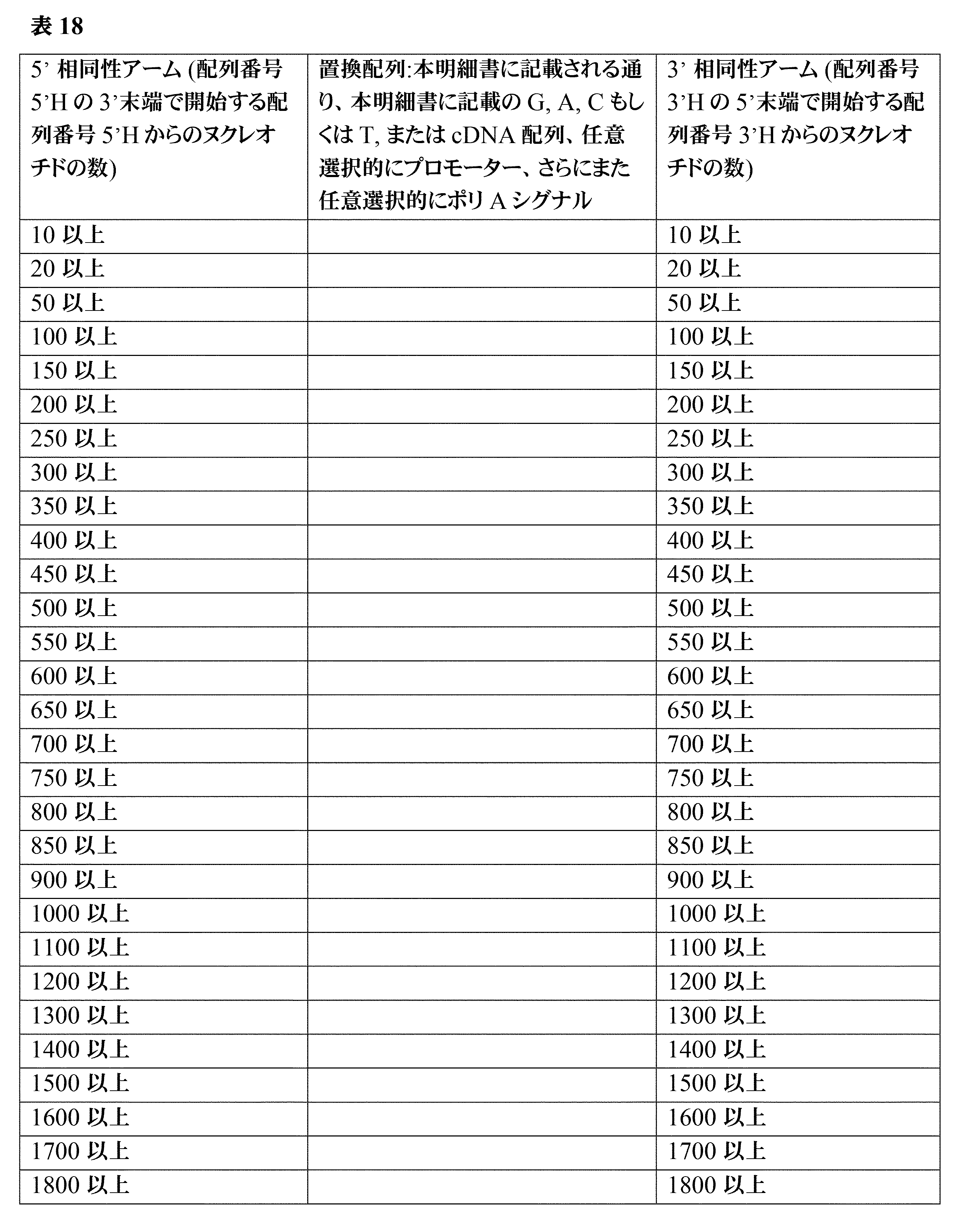
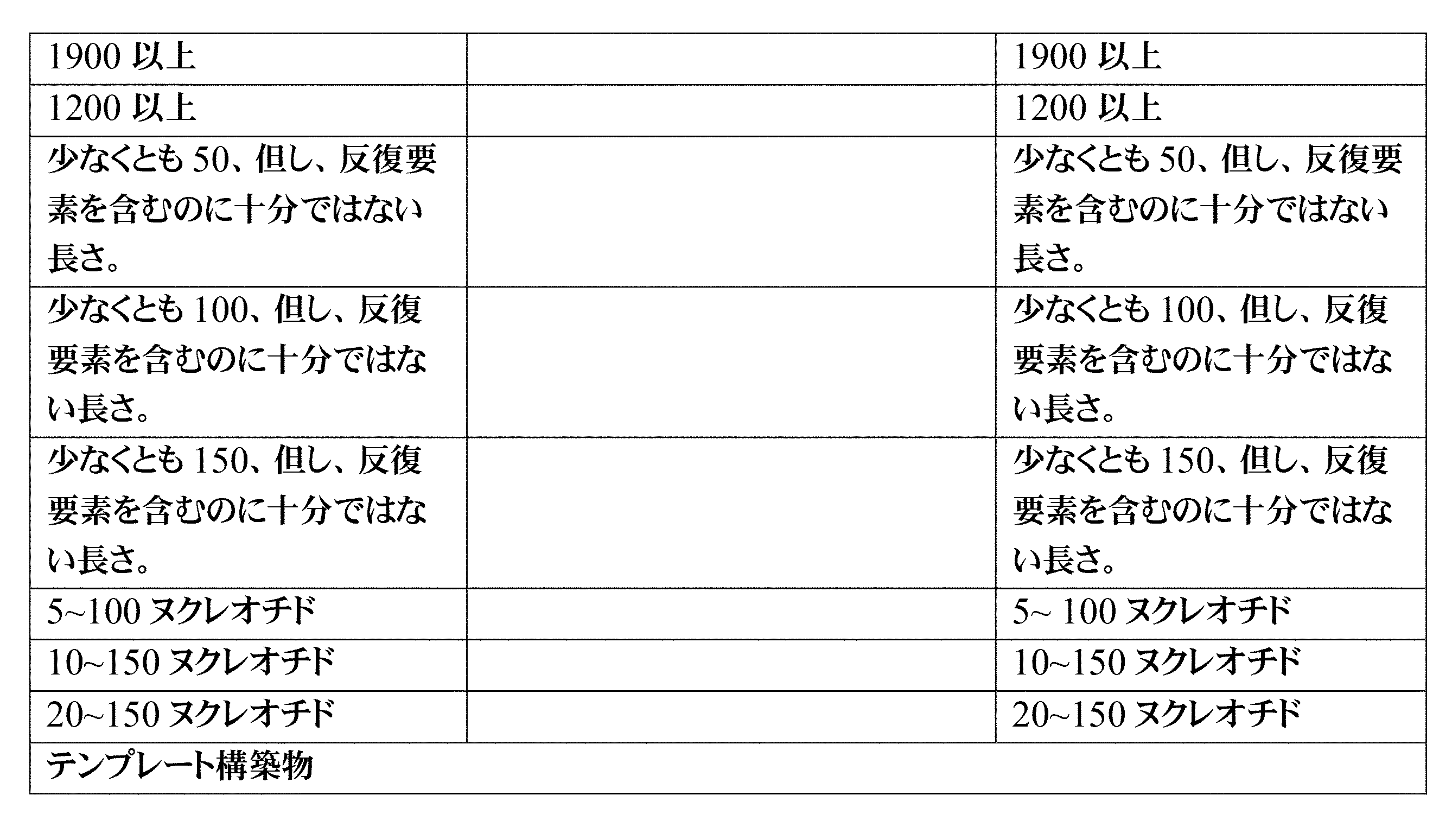
遺伝子ターゲッティングのためのNHEJアプローチ
本明細書に記載されるように、ヌクレアーゼ誘導非相同末端結合(NHEJ)を使用して、標的遺伝子特異的破壊(例えば、ノックアウト)を標的化することができる。ヌクレアーゼ誘導NHEJはまた、対象遺伝子中の配列を除去する(例えば、欠失させる)のにも使用することができる。
NHEJ Approach for Gene Targeting As described herein, nuclease-induced non-homologous end joining (NHEJ) can be used to target gene-specific disruption (e.g., knockout). Nuclease-induced NHEJ can also be used to remove (eg, delete) sequences in a gene of interest.
一実施形態では、本明細書に記載される方法に関連するゲノムの改変は、ヌクレアーゼ誘導NHEJと、NHEJ修復経路の誤りがちな性質とに依存すると考えられる。NHEJは、2つの末端を共に連結することで、DNA中の二本鎖切断を修復する;しかし、通常、元の配列は、それらが二本鎖切断によって形成された真にその通りの2つの適合性末端が、完璧にライゲートされた場合に限り、復元される。二本鎖切断のDNA末端は、しばしば酵素的プロセッシングの対象であり、末端の再結合に先だって、片方または双方の鎖に、ヌクレオチドの付加または除去がもたらされる。これは、NHEJ修復部位におけるDNA配列の挿入および/または欠失(インデル)変異の存在をもたらす。これらの変異の3分の2は、典型的に、読み枠を改変し、したがって、非機能性タンパク質が生じる。それに加えて、読み枠を維持するが、顕著な量の配列を挿入または欠失させる変異は、タンパク質の機能性を破壊し得る。タンパク質の重要な機能ドメインの変異は、重要でない領域の変異よりもおそらく許容性が低いので、これは遺伝子座依存性である。 In one embodiment, the genome modifications associated with the methods described herein are believed to rely on nuclease-induced NHEJ and the error-prone nature of the NHEJ repair pathway. NHEJ repairs double-strand breaks in DNA by ligating the two ends together; however, usually the original sequences are separated into two exactly as they were formed by the double-strand break. Compatible ends are restored only if they are perfectly ligated. The DNA ends of double-strand breaks are often subject to enzymatic processing, resulting in the addition or removal of nucleotides to one or both strands prior to rejoining the ends. This results in the presence of insertion and/or deletion (indel) mutations of DNA sequences at the NHEJ repair site. Two-thirds of these mutations typically alter the reading frame, thus resulting in a non-functional protein. In addition, mutations that maintain reading frame but insert or delete significant amounts of sequence can destroy protein functionality. This is locus dependent, since mutations in important functional domains of a protein are probably less tolerated than mutations in unimportant regions.
NHEJによって生成されるインデル変異は、自然界では予測不可能である;しかし、所与の切断部位では、おそらく小規模なマイクロホモロジー領域のために、特定のインデル配列が好まれ、母集団中で大きな比率を占める。欠失物の長さは、幅広く変動し得て;最も一般的には、1~50bpの範囲であるが、それらは100~200bpを超える範囲に達し得る。挿入物はより短い傾向があり、多くの場合、切断部位に隣接して取り囲む配列の短い重複を含む。しかし、大きな挿入物を得ることが可能であり、こうした場合、挿入配列は、ゲノムのその他の領域に、または細胞内に存在するプラスミドDNAにトレースされていることが多い。 Indel mutations generated by NHEJ are unpredictable in nature; however, at a given cleavage site, certain indel sequences are favored, likely due to small regions of microhomology, resulting in large account for the proportion. The length of deletions can vary widely; most commonly they range from 1 to 50 bp, but they can reach a range of more than 100 to 200 bp. Inserts tend to be shorter and often contain short duplications of sequence that flank and surround the cleavage site. However, it is possible to obtain large inserts, and in these cases the inserted sequences are often traced to other regions of the genome or to plasmid DNA present within the cell.
NHEJは、変異原性過程であるので、特定の最終配列の生成が要求されない限り、これは、小規模な配列モチーフ(例えば、長さ50ヌクレオチド以下のモチーフ)を欠失させるのにも使用することができる。二本鎖切断が、標的配列の近くで標的化される場合、NHEJ修復によって引き起こされる欠失変異は、不要のヌクレオチドに及ぶことから、それらを除去する。より大型のDNAセグメントの欠失の場合には、配列の両側に1つずつ2つの二本鎖切断を導入することにより、介在配列全体が除去され、末端同士の間にNHEJがもたらされ得る。このようにして、数百キロベースという大型のDNAセグメントを切断することができる。これらのアプローチの双方を使用して、特定のDNA配列が欠失され得る;しかし、NHEJの誤りがちな性質は、修復部位に依然としてインデル変異を生成し得る。
Since NHEJ is a mutagenic process, it can also be used to delete small sequence motifs (e.g.,
二本鎖切断eaCas9分子と、一本鎖、またはニッカーゼ、eaCas9分子との双方を本明細書に記載される方法および組成物で使用して、NHEJ媒介インデルが生成され得る。例えば、対象遺伝子の早期コード領域のようなコード領域などの遺伝子に標的化されるNHEJ媒介インデルを使用して、対象遺伝子がノックアウト(すなわち発現排除)され得る。例えば、対象遺伝子の早期コード領域は、コード配列の第1のエクソン内の、または開始コドンの500bp以内(例えば、500、450、400、350、300、250、200、150、100または50bp未満)の開始コドン直後の配列を含む。 Both double-stranded, cleaved eaCas9 molecules and single-stranded, or nickase, eaCas9 molecules can be used in the methods and compositions described herein to generate NHEJ-mediated indels. For example, a gene of interest can be knocked out (ie, expression eliminated) using NHEJ-mediated indels targeted to a gene, such as a coding region, such as an early coding region of the gene of interest. For example, the early coding region of the gene of interest is within the first exon of the coding sequence or within 500 bp (e.g., less than 500, 450, 400, 350, 300, 250, 200, 150, 100 or 50 bp) of the start codon. Contains the sequence immediately after the start codon.
標的位置に対する二本鎖または一本鎖切断の配置
NHEJ媒介インデルを誘導する目的で、gRNAおよびCas9ヌクレアーゼが二本鎖切断を生じる一実施形態では、例えば、単分子(またはキメラ)またはモジュラーgRNA分子などのgRNAが、1つの二本鎖切断を標的位置のヌクレオチド近傍に配置させるように構成される。一実施形態では、切断部位は、標的位置から0~30bp(例えば、標的位置から30、25、20、15、10、9、8、7、6、5、4、3、2または1bp未満)離れている。
Placement of double-stranded or single-stranded breaks relative to target locations In one embodiment, gRNA and Cas9 nucleases generate double-stranded breaks for the purpose of inducing NHEJ-mediated indels, e.g., in single-stranded (or chimeric) or modular gRNA molecules. gRNAs such as gRNAs are configured to place one double-stranded break near the nucleotide of the target position. In one embodiment, the cleavage site is 0 to 30 bp from the target location (e.g., less than 30, 25, 20, 15, 10, 9, 8, 7, 6, 5, 4, 3, 2, or 1 bp from the target location) is seperated.
NHEJ媒介インデルを誘導する目的でCas9ニッカーゼと複合体形成する2つのgRNAが、2つの一本鎖切断を誘導する一実施形態では、例えば、独立して、単分子(またはキメラ)またはモジュラーgRNAである2つのgRNAが、標的位置のヌクレオチドにNHEJ修復を提供するように、2つの一本鎖切断を配置させるように構成される。一実施形態では、gRNAは、切断を異なる鎖上の同一位置に、または互いに少数のヌクレオチド以内に、配置させるように構成されて、二本鎖切断が本質的に模倣される。特定の実施形態では、より近いニックは、標的位置から0~30bp(例えば、標的位置から30、25、20、15、10、9、8、7、6、5、4、3、2または1bp未満)離れており、2つのニックは、互いに25~55bp以内(例えば、25~50、25~45、25~40、25~35、25~30、50~55、45~55、40~55、35~55、30~55、30~50、35~50、40~50、45~50、35~45、または40~45bp)であり、互いに100bp以下(例えば、90、80、70、60、50、40、30、20または10bp以下)離れている。一実施形態では、gRNAは、一本鎖切断を標的位置のヌクレオチドのどちらかの側に配置させるように構成される。 In one embodiment, two gRNAs complexed with Cas9 nickase for the purpose of inducing NHEJ-mediated indels induce two single-stranded breaks, e.g., independently in single-molecule (or chimeric) or modular gRNAs. Two gRNAs are configured to place two single-stranded breaks to provide NHEJ repair to the nucleotide at the target location. In one embodiment, the gRNA is configured to place breaks at the same position on different strands, or within a few nucleotides of each other, essentially mimicking double-strand breaks. In certain embodiments, the closer nick is 0 to 30 bp from the target location (e.g., 30, 25, 20, 15, 10, 9, 8, 7, 6, 5, 4, 3, 2, or 1 bp from the target location). ) and the two nicks are within 25-55 bp of each other (e.g., 25-50, 25-45, 25-40, 25-35, 25-30, 50-55, 45-55, 40-55 , 35-55, 30-55, 30-50, 35-50, 40-50, 45-50, 35-45, or 40-45bp) and 100bp or less from each other (e.g., 90, 80, 70, 60 , 50, 40, 30, 20 or 10 bp) apart. In one embodiment, the gRNA is configured to place the single-stranded break on either side of the nucleotide at the target position.
二本鎖切断eaCas9分子と、一本鎖、またはニッカーゼ、eaCas9分子との双方を本明細書に記載される方法および組成物で使用して、標的位置の両側に切断が生成され得る。二本鎖または対形成一本鎖切断は、標的位置の両側に生成されて、2つの切断で核酸配列が除去されてもよい(例えば、2つの切断間の領域が欠失される)。一実施形態では、例えば、独立して、単分子(またはキメラ)またはモジュラーgRNAである2つのgRNAは、二本鎖切断を標的位置の両側に配置させるように構成される。代替の実施形態では、例えば、独立して、単分子(またはキメラ)またはモジュラーgRNAである3つのgRNAは、二本鎖切断(すなわち、1つのgRNAがcas9ヌクレアーゼと複合体形成する)と、2つの一本鎖切断または対の一本鎖切断(すなわち、2つのgRNAがCas9ニッカーゼと複合体形成する)とが、標的位置の両側に配置されるように構成される。別の実施形態では、例えば、独立して、単分子(またはキメラ)またはモジュラーgRNAである4つのgRNAは、2対の一本鎖切断(すなわち、2対の2つのgRNAがCas9ニッカーゼと複合体形成する)が、標的位置の両側に生じるように構成される。二本鎖切断、または対の2つの一本鎖ニックのより近い方は、理想的には、標的位置の0~500bp以内(例えば、標的位置から450、400、350、300、250、200、150、100、50または25bp以下)にある。ニッカーゼが使用される場合、対の2つのニックは、互いに25~55bp以内(例えば、25~50、25~45、25~40、25~35、25~30、50~55、45~55、40~55、35~55、30~55、30~50、35~50、40~50、45~50、35~45、または40~45bpの間)であり、互いに100bp以下(例えば、90、80、70、60、50、40、30、20または10bp以下)離れている。 Both double-stranded eaCas9 molecules and single-stranded, or nickase, eaCas9 molecules can be used in the methods and compositions described herein to generate cleavages on both sides of the target location. Double-stranded or paired single-stranded breaks may be generated on either side of the target location, such that the two cuts remove the nucleic acid sequence (eg, the region between the two cuts is deleted). In one embodiment, two gRNAs, eg, independently, single-molecule (or chimeric) or modular gRNAs, are configured to place double-stranded breaks on either side of the target location. In an alternative embodiment, for example, three gRNAs that are independently unimolecular (or chimeric) or modular gRNAs are combined with a double-stranded break (i.e., one gRNA complexed with a cas9 nuclease) and two Two single-stranded breaks or a pair of single-stranded breaks (ie, two gRNAs are complexed with Cas9 nickase) are configured to be placed on either side of the target location. In another embodiment, for example, four gRNAs that are independently single-stranded (or chimeric) or modular gRNAs are separated by two pairs of single-stranded breaks (i.e., two pairs of two gRNAs are complexed with a Cas9 nickase). ) are configured to occur on either side of the target location. The double-strand break, or the closer of the two single-stranded nicks of the pair, is ideally within 0-500 bp of the target position (e.g., 450, 400, 350, 300, 250, 200, 150, 100, 50 or 25 bp or less). If a nickase is used, the two nicks of the pair are within 25-55 bp of each other (e.g., 25-50, 25-45, 25-40, 25-35, 25-30, 50-55, 45-55, 40-55, 35-55, 30-55, 30-50, 35-50, 40-50, 45-50, 35-45, or 40-45 bp) and 100 bp or less from each other (e.g., 90, 80, 70, 60, 50, 40, 30, 20 or 10 bp) apart.
標的化ノックダウン
遺伝子をDNAレベルで変異させることで発現を恒久的に排除するCRISPR/Cas媒介遺伝子ノックアウトとは異なり、CRISPR/Casノックダウンは、人工転写因子の使用を通じて、一時的な遺伝子発現低下を可能にする。Cas9タンパク質の双方のDNA切断ドメインで重要な残基を変異させることは(例えば、D10AおよびH840A変異)、触媒能のないCas9(死滅Cas9またはdCas9分子としてもまた知られているeiCas9)の生成をもたらす。触媒能のないCas9はgRNAと複合体形成して、gRNAの標的化ドメインによって特定化されたDNA配列に局在するが、それは標的DNAを切断しない。dCas9と、例えば、転写抑制ドメインなどのエフェクタードメインとの融合は、gRNAによって特定化された任意のDNA部位へのエフェクターの動員を可能にする。酵素的に活性な(eiCas9)Cas9分子それ自体は、コード配列中の早期領域に動員された場合に、転写をブロックすることができるが、より堅固な抑制は、転写抑制ドメイン(例えばKRAB、SIDまたはERD)をCas9に融合させて、転写抑制ドメインを、標的ノックダウン位置、例えば、開始コドンの配列3’の1000塩基対または遺伝子の開始コドンのプロモーター領域5’の500塩基対内に動員することによって達成され得る。プロモーターのDNAseI高感受性領域(DHS)は、Cas9タンパク質にアクセスできる可能性が高く、また内在性転写因子のための部位を保有する可能性も高いので、これらの領域を標的化することで、恐らくより効率的な遺伝子抑制または活性化がもたらされ得る。特に遺伝子抑制については、内在性転写因子の結合部位をブロックすることで、遺伝子発現の下方制御を助けることが、本明細書で検討される。一実施形態では、1つまたは複数の内在性転写因子の結合をブロックするために、1つまたは複数のeiCas9分子を用いてもよい。別の実施形態では、eiCas9分子をクロマチン改変タンパク質に融合させてもよい。改変クロマチン状態は、標的遺伝子の発現低下をもたらし得る。クロマチン状態を改変するために、1つまたは複数のクロマチン改変タンパク質に融合した1つまたは複数のeiCas9分子を用いてもよい。
Targeted Knockdown Unlike CRISPR/Cas-mediated gene knockout, which permanently eliminates expression by mutating a gene at the DNA level, CRISPR/Cas knockdown temporarily reduces gene expression through the use of artificial transcription factors. enable. Mutating key residues in both DNA cleavage domains of the Cas9 protein (e.g., the D10A and H840A mutations) may result in the generation of catalytically incompetent Cas9 (eiCas9, also known as dead Cas9 or dCas9 molecules). bring. Catalytically incompetent Cas9 forms a complex with gRNA and localizes to DNA sequences specified by the gRNA's targeting domain, but it does not cleave the target DNA. Fusion of dCas9 with an effector domain, such as a transcriptional repression domain, allows recruitment of the effector to any DNA site specified by the gRNA. Enzymatically active (eiCas9) Cas9 molecules can themselves block transcription when recruited to early regions in the coding sequence, but more robust repression is achieved by transcriptional repression domains (e.g. KRAB, SID or ERD) to Cas9 to mobilize the transcriptional repression domain into the target knockdown location, e.g., within 1000 base pairs of the sequence 3' of the start codon or 500 base pairs of the promoter region 5' of the start codon of the gene. This can be achieved by The DNAseI-sensitive regions (DHS) of promoters are likely to be accessible to Cas9 proteins and likely harbor sites for endogenous transcription factors, so targeting these regions likely More efficient gene suppression or activation may result. Specifically for gene silencing, it is contemplated herein that blocking the binding sites of endogenous transcription factors helps down-regulate gene expression. In one embodiment, one or more eiCas9 molecules may be used to block binding of one or more endogenous transcription factors. In another embodiment, the eiCas9 molecule may be fused to a chromatin-modifying protein. Altered chromatin states can result in decreased expression of target genes. One or more eiCas9 molecules fused to one or more chromatin modifying proteins may be used to modify chromatin state.
一実施形態では、gRNA分子は、既知の転写応答要素(例えば、プロモーター、エンハンサーなど)に、既知の上流活性化配列(UAS)に、および/または標的DNAの発現を調節できることが疑われる未知のまたは既知の機能がある配列に、標的化され得る。 In one embodiment, the gRNA molecule is directed to known transcriptional response elements (e.g., promoters, enhancers, etc.), to known upstream activating sequences (UAS), and/or to unknown transcriptional response elements suspected of being able to modulate expression of the target DNA. or to sequences with known function.
CRISPR/Cas媒介遺伝子ノックダウンを使用して、望まれない対立遺伝子または転写物の発現を低下させ得る。本明細書で検討されるのは、遺伝子の恒久的な破壊が、理想的でない筋書きである。これらの筋書きでは、部位特異的抑制を使用して、発現が一時的に低下または排除されてもよい。ヌクレアーゼが任意のDNA配列を切断して変異を引き起こし得るのに対し、Casリプレッサーは、活発に転写される遺伝子のプロモーター領域に標的化された場合にのみ効果を有してもよいので、Casリプレッサーのオフターゲット効果が、Casヌクレアーゼのものよりも重篤性が低いこともまた本明細書で検討される。しかし、ヌクレアーゼ媒介ノックアウトが恒久的である一方で、抑制は、Casリプレッサーが細胞内に存在する場合に限り持続してもよい。リプレッサーがもはや存在しなくなると、内在性転写因子および遺伝子制御要素は、発現をその天然状態に復元する可能性が高い。 CRISPR/Cas-mediated gene knockdown can be used to reduce expression of unwanted alleles or transcripts. Considered herein are scenarios in which permanent disruption of a gene is not ideal. In these scenarios, site-specific inhibition may be used to temporarily reduce or eliminate expression. Whereas nucleases can cut any DNA sequence and cause mutations, Cas repressors may only have an effect when targeted to the promoter region of actively transcribed genes, so Cas It is also discussed herein that the off-target effects of repressors are less severe than those of Cas nucleases. However, while nuclease-mediated knockout is permanent, suppression may only last as long as the Cas repressor is present within the cell. Once the repressor is no longer present, endogenous transcription factors and genetic control elements are likely to restore expression to its native state.
一本鎖アニーリング
一本鎖アニーリング(SSA)は、標的核酸中に存在する2つの反復配列間の二本鎖切断を修復する、別のDNA修復プロセスである。SSA経路によって使用される反復配列は、一般に30ヌクレオチド長を超える。切断末端に切除が生じて、標的核酸の双方の鎖上の反復配列が示される。切除後、反復配列を含有する一本鎖オーバーハングをRPAタンパク質で被覆して、反復配列が、例えばそれ自体などと不適切にアニーリングするのを妨げる。RAD52は、オーバーハング上の反復配列のそれぞれと結合し、配列を整列させて、相補的反復配列のアニーリングを可能にする。アニーリング後、オーバーハングの一本鎖フラップは切断される。新しいDNA合成があらゆるギャップを充填し、ライゲーションがDNA二本鎖を回復させる。プロセッシングの結果として、2つの反復間のDNA配列が欠失する。欠失の長さは、使用される2つの反復の位置、および切除の経路または処理能力をはじめとする、多くの要素に左右され得る。
Single-Strand Annealing Single-strand annealing (SSA) is another DNA repair process that repairs double-strand breaks between two repeat sequences present in a target nucleic acid. The repetitive sequences used by the SSA pathway are generally greater than 30 nucleotides in length. Excision occurs at the cut ends to reveal repetitive sequences on both strands of the target nucleic acid. After excision, the single-stranded overhang containing the repetitive sequence is coated with RPA protein to prevent the repetitive sequence from inappropriately annealing, such as with itself. RAD52 binds to each of the repeat sequences on the overhang, aligning the sequences and allowing annealing of complementary repeat sequences. After annealing, the overhanging single-stranded flap is cleaved. New DNA synthesis fills in any gaps and ligation restores the DNA duplex. As a result of processing, the DNA sequence between the two repeats is deleted. The length of the deletion can depend on many factors, including the location of the two repeats used and the route or throughput of excision.
HDR経路とは対照的に、SSAは、標的核酸配列を改変または修正するのにテンプレート核酸を必要としない。それに代えて、相補的反復配列が使用される。 In contrast to the HDR pathway, SSA does not require a template nucleic acid to alter or modify the target nucleic acid sequence. Alternatively, complementary repeat sequences are used.
その他のDNA修復経路
SSBR(一本鎖切断修復)
ゲノム内の一本鎖切断(SSB)は、上で論じたDSB修復機序とは別個の機序であるSSBR経路によって修復される。SSBR経路は、SSB検出、DNA末端プロセッシング、DNAギャップ充填、およびDNAライゲーションの4つの主要な段階を有する。より詳細な説明は、Caldecott,Nature Reviews Genetics 9,619-631(August 2008)に記載され、概要は本明細書に記載される。
Other DNA repair pathways SSBR (single strand break repair)
Single-strand breaks (SSBs) within the genome are repaired by the SSBR pathway, a mechanism distinct from the DSB repair mechanisms discussed above. The SSBR pathway has four major steps: SSB detection, DNA end processing, DNA gap filling, and DNA ligation. A more detailed description is provided in Caldecott, Nature Reviews Genetics 9, 619-631 (August 2008), and a summary is provided herein.
SSBが形成する第1段階では、PARP1および/またはPARP2は、切断を認識して修復機構を動員する。DNA切断におけるPARP1の結合および活性は一過性であり、損傷におけるSSBrタンパク質複合体の巣状滞留または安定性を促進することで、SSBrを加速するようである。議論の余地はあるが、これらのSSBrタンパク質中で最重要であるのはXRCC1であり、これは、DNAの3’および5’末端のクリーニングに関与するタンパク質をはじめとする、SSBrプロセスの複数の酵素的構成要素と相互作用して、安定化し刺激する分子スキャフォールドとして機能する。例えば、XRCC1は、末端プロセッシングを促進するいくつかのタンパク質(DNAポリメラーゼβ、PNK、および3つのヌクレアーゼ、APE1、APTX、およびAPLF)と相互作用する。APE1は、エンドヌクレアーゼ活性を有する。APLFは、エンドヌクレアーゼおよび3’から5’方向エキソヌクレアーゼ機能を示す。APTXは、エンドヌクレアーゼおよび3’から5’方向エキソヌクレアーゼ活性を有する。 In the first step of SSB formation, PARP1 and/or PARP2 recognize the cleavage and recruit repair mechanisms. PARP1 binding and activity in DNA breaks is transient and appears to accelerate SSBr by promoting focal residence or stability of SSBr protein complexes at the lesion. Controversially, the most important of these SSBr proteins is XRCC1, which is responsible for multiple roles in the SSBr process, including proteins involved in cleaning the 3' and 5' ends of DNA. It functions as a molecular scaffold that interacts with, stabilizes and stimulates enzymatic components. For example, XRCC1 interacts with several proteins that promote end processing (DNA polymerase β, PNK, and three nucleases, APE1, APTX, and APLF). APE1 has endonuclease activity. APLF exhibits endonuclease and 3' to 5' exonuclease functions. APTX has endonuclease and 3' to 5' exonuclease activities.
全部ではないとしても大多数のSSBの3’および/または5’末端は損傷を受けているため、この末端プロセッシングはSSBRの重要な段階である。末端プロセッシングは、一般に、末端がライゲーションできるように、損傷を受けた3’末端をヒドロキシル化状態に回復させ、およびおよび/または損傷を受けた5’末端をリン酸部分に、回復させることを伴う。損傷を受けた3’末端をプロセスできる酵素としては、PNKP、APE1、およびTDP1が挙げられる。損傷を受けた5’末端をプロセスできる酵素としては、PNKP、DNAポリメラーゼβ、およびAPTXが挙げられる。LIG3(DNAリガーゼIII)はまた、末端プロセッシングにも関与する。ひとたび末端がクリーニングされたら、ギャップ充填が起こり得る。 This end processing is a critical step in SSBR, as the 3' and/or 5' ends of most, if not all, SSBs are damaged. End processing generally involves restoring a damaged 3' end to a hydroxylated state and/or restoring a damaged 5' end to a phosphate moiety so that the ends can be ligated. . Enzymes that can process damaged 3' ends include PNKP, APE1, and TDP1. Enzymes that can process damaged 5' ends include PNKP, DNA polymerase beta, and APTX. LIG3 (DNA ligase III) is also involved in end processing. Once the ends are cleaned, gap filling can occur.
DNAギャップ充填段階では、典型的に存在するタンパク質は、PARP1、DNAポリメラーゼβ、XRCC1、FEN1(フラップエンドヌクレアーゼ(endonculease)1)、DNAポリメラーゼδ/ε、PCNA、およびLIG1である。短いパッチ修復および長いパッチ修復の2つのギャップ充填様式がある。短いパッチ修復は、欠損している単一ヌクレオチドを挿入することを伴う。いくつかのSSBでは、「ギャップ充填」は、2つ以上のヌクレオチドを転置し続けるかもしれない(最高12塩基の転置が報告されている)。FEN1は、転置された5’残基を除去するエンドヌクレアーゼである。Polβをはじめとする複数のDNAポリメラーゼは、SSBの修復に関与し、DNAポリメラーゼの選択は、SSBの起源とタイプによって影響を受ける。 In the DNA gap filling stage, the proteins typically present are PARP1, DNA polymerase β, XRCC1, FEN1 (flap endonuclease 1), DNA polymerase δ/ε, PCNA, and LIG1. There are two gap filling modalities: short patch repair and long patch repair. Short patch repair involves inserting the missing single nucleotide. In some SSBs, "gap filling" may continue to transpose two or more nucleotides (transpositions of up to 12 bases have been reported). FEN1 is an endonuclease that removes transposed 5' residues. Multiple DNA polymerases, including Polβ, are involved in SSB repair, and the choice of DNA polymerase is influenced by the origin and type of SSB.
第4段階では、LIG1(リガーゼI)またはLIG3(リガーゼIII)などのDNAリガーゼが、末端の連結を触媒する。短いパッチ修復はリガーゼIIIを利用して、長いパッチ修復はリガーゼIを利用する。 In the fourth step, a DNA ligase such as LIG1 (ligase I) or LIG3 (ligase III) catalyzes the joining of the ends. Short patch repairs utilize Ligase III and long patch repairs utilize Ligase I.
時に、SSBRは、複製-共役する。この経路には、CtIP、MRN、ERCC1、およびFEN1の1つまたは複数が関与し得る。SSBRを促進してもよい追加的要素としては、aPARP、PARP1、PARP2、PARG、XRCC1、DNAポリメラーゼb、DNAポリメラーゼd、DNAポリメラーゼe、PCNA、LIG1、PNK、PNKP、APE1、APTX、APLF、TDP1、LIG3、FEN1、CtIP、MRN、およびERCC1が挙げられる。 Sometimes SSBRs are replication-coupled. This pathway may involve one or more of CtIP, MRN, ERCC1, and FEN1. Additional elements that may promote SSBR include aPARP, PARP1, PARP2, PARG, XRCC1, DNA polymerase b, DNA polymerase d, DNA polymerase e, PCNA, LIG1, PNK, PNKP, APE1, APTX, APLF, TDP1. , LIG3, FEN1, CtIP, MRN, and ERCC1.
MMR(ミスマッチ修復)
細胞は、MMR、BER、およびNERの3つの切除修復経路を包含する:切除修復経路は、典型的に、DNAの1本鎖上の損傷を認識して、次にエキソ/エンドヌクレアーゼが損傷を除去し、DNAポリメラーゼによって順次充填され、最終的にリガーゼによってシールされる、1~30ヌクレオチドのギャップを残すという共通の特徴を有する。より詳細な全体像は、Li,Cell Research(2008)18:85-98に記載され、概要は、本明細書で提供される。
MMR (mismatch repair)
Cells involve three excision repair pathways: MMR, BER, and NER; excision repair pathways typically recognize damage on a single strand of DNA and then exo/endonucleases repair the damage. They have the common feature of leaving a gap of 1 to 30 nucleotides that is removed, sequentially filled in by DNA polymerase, and finally sealed by ligase. A more detailed overview is provided in Li, Cell Research (2008) 18:85-98, and an overview is provided herein.
ミスマッチ修復(MMR)は、誤対合DNA塩基上で機能する。 Mismatch repair (MMR) operates on mismatched DNA bases.
MSH2/6またはMSH2/3複合体は、どちらもミスマッチ認識および修復開始に重要な役割を果たすATPアーゼ活性を有する。MSH2/6が、塩基-塩基ミスマッチを優先的に認識して、1または2ヌクレオチドの誤対合を同定する一方で、MSH2/3は、より大型のID誤対合を優先的に認識する。 Both MSH2/6 or MSH2/3 complexes have ATPase activity that plays an important role in mismatch recognition and repair initiation. MSH2/6 preferentially recognizes base-base mismatches and identifies one or two nucleotide mismatches, while MSH2/3 preferentially recognizes larger ID mismatches.
hMLH1は、hPMS2とヘテロ二量体化して、ATPアーゼ活性を有しMMRの複数の段階で重要であるhMutLαを形成する。これは、EXO1が関与する3’ニック誘導MMRにおいて重要な役割を果たす、PCNA/複製因子C(RFC)依存性エンドヌクレアーゼ活性を有する。(EXO1は、HRおよびMMRの双方に参加する。)これは、ミスマッチが誘発する切除の終了を制御する。リガーゼIは、この経路の関連リガーゼである。MMRを促進してもよい追加的要素としては、EXO1、MSH2、MSH3、MSH6、MLH1、PMS2、MLH3、DNA Pol d、RPA、HMGB1、RFC、およびDNAリガーゼIが挙げられる。 hMLH1 heterodimerizes with hPMS2 to form hMutLα, which has ATPase activity and is important in multiple steps of MMR. It has a PCNA/replication factor C (RFC)-dependent endonuclease activity that plays an important role in 3' nick-induced MMR involving EXO1. (EXO1 participates in both HR and MMR.) It controls termination of mismatch-induced excision. Ligase I is a related ligase in this pathway. Additional elements that may promote MMR include EXO1, MSH2, MSH3, MSH6, MLH1, PMS2, MLH3, DNA Pol d, RPA, HMGB1, RFC, and DNA Ligase I.
塩基切除修復(BER)
塩基切除修復(BER)経路は、細胞周期全体を通じて活性であり;それは、ゲノムからの小型非らせん歪み塩基損傷を除去する主な原因となる。対照的に、関連ヌクレオチド切除修復経路(次のセクションで考察される)は、嵩高いらせん歪み損傷を修復する。より詳細な説明は、Caldecott,Nature Reviews Genetics 9,619-631(August 2008)に記載され、概要は本明細書に記載される。
Base excision repair (BER)
The base excision repair (BER) pathway is active throughout the cell cycle; it is primarily responsible for removing small non-helical distorted base lesions from the genome. In contrast, related nucleotide excision repair pathways (discussed in the next section) repair bulky helical distortion lesions. A more detailed description is provided in Caldecott, Nature Reviews Genetics 9, 619-631 (August 2008), and a summary is provided herein.
DNA塩基損傷に際して、塩基切除修復(BER)が開始されて、プロセスは、5つの主要な段階に簡略化され得る:(a)損傷を受けたDNA塩基の除去;(b)後続の塩基部位の切開;(c)DNA末端のクリーンアップ;(d)修復ギャップ内への修正ヌクレオチド挿入;および(e)DNA骨格内の残りのニックのライゲーション。これらの最終段階は、SSBRと類似する。 Upon DNA base damage, base excision repair (BER) is initiated and the process can be simplified into five major steps: (a) removal of the damaged DNA base; (b) removal of the subsequent base site. (c) DNA end cleanup; (d) corrective nucleotide insertion into the repair gap; and (e) ligation of remaining nicks within the DNA backbone. These final stages are similar to SSBR.
第1段階では、損傷特異的DNAグリコシラーゼが、塩基を糖リン酸骨格に結合するNグリコシド連結の切断を通じて、損傷を受けた塩基を切除する。次に、関連リアーゼ活性があるAPエンドヌクレアーゼ-1(APE1)または二機能性DNAグリコシラーゼがリン酸ジエステル骨格を切開して、DNA一本鎖切断(SSB)を生じた。BERの第3段階は、DNA末端のクリーンアップを伴う。BERの第4段階は、新規相補的ヌクレオチドを修復ギャップ内に付加するPolβによって実施され、最終段階で、XRCC1/リガーゼIIIがDNA骨格内の残りのニックをシールする。これで、損傷を受けたDNA塩基の大部分(約80%)が修復される、短いパッチBER経路が完了する。しかし、段階3の5’末端が、末端プロセッシング活性に対して抵抗性であれば、Polβによる1個のヌクレオチド挿入に続いて、ポリメラーゼは複製的DNAポリメラーゼであるPolδ/εに切り替わり、次にそれは、DNA修復ギャップに約2~8個のヌクレオチドを付加する。これは、5’フラップ構造を作り出し、それは、処理能力要素である増殖性細胞核抗原(PCNA)に結合する、フラップエンドヌクレアーゼ-1(FEN-1)によって認識され切除される。次にDNAリガーゼIが、DNA骨格内の残りのニックをシールして、長いパッチBERを完了する。BER経路を促進してもよい追加的要素としては、DNAグリコシラーゼ、APE1、Polb、Pold、Pole、XRCC1、リガーゼIII、FEN-1、PCNA、RECQL4、WRN、MYH、PNKP、およびAPTXが挙げられる。
In the first step, damage-specific DNA glycosylase excises the damaged base through cleavage of the N-glycosidic linkage that connects the base to the sugar-phosphate backbone. AP endonuclease-1 (APE1) or a bifunctional DNA glycosylase with associated lyase activity then cleaved the phosphodiester backbone, producing DNA single-strand breaks (SSBs). The third step of BER involves cleaning up the DNA ends. The fourth step of BER is carried out by Polβ, which adds new complementary nucleotides into the repair gap, and in the final step, XRCC1/ligase III seals the remaining nicks in the DNA backbone. This completes the short patch BER pathway in which the majority (approximately 80%) of the damaged DNA bases are repaired. However, if the 5' end of
ヌクレオチド切除修復(NER)
ヌクレオチド切除修復(NER)は、DNAから嵩高いらせん歪み損傷を除去する重要な切除機序である。NERに関する加的な詳細は、Marteijn et al.,Nature Reviews Molecular Cell Biology 15,465-481(2014)にあり、概要は本明細書に記載される。広域経路NERは、2つのより小型の経路である、全ゲノムNER(GG-NER)と、転写と共役する修復NER(TC-NER)とを包含する。GG-NERおよびTC-NERは、DNA損傷を認識するために異なる要素を使用する。しかし、それらは、損傷切開、修復、およびライゲーションのための同一機構を利用する。
Nucleotide excision repair (NER)
Nucleotide excision repair (NER) is an important excision mechanism that removes bulky helical distortion lesions from DNA. Additional details regarding NER can be found in Marteijn et al. , Nature Reviews
ひとたび障害が認識されたら、細胞は、損傷を含有する短い一本鎖DNA断片を除去する。エンドヌクレアーゼXPF/ERCC1およびXPG(ERCC5によってコードされる)は、損傷のどちらかの側で損傷を受けた鎖を切断し、22~30ヌクレオチドの一本鎖ギャップを生成することで、損傷を除去する。次に、細胞は、DNAギャップ充填合成およびライゲーションを実行するこのプロセスに関与するのは、PCNA、RFC、DNA Polδ、DNA PolεまたはDNA Polκ、およびDNAリガーゼIまたはXRCC1/リガーゼIIIである。ライゲーションステップの実行のために、自己複製細胞が、DNA PolεおよびDNAリガーゼIを利用する傾向がある一方で、非自己複製細胞は、DNA Polδ、DNA Polκ、およびtheXRCC1/リガーゼIII複合体を利用する傾向がある。 Once a lesion is recognized, cells remove short single-stranded DNA fragments containing the lesion. The endonucleases XPF/ERCC1 and XPG (encoded by ERCC5) remove the lesion by cleaving the damaged strands on either side of the lesion, creating a single-stranded gap of 22-30 nucleotides. do. Cells then perform DNA gap-filling synthesis and ligation. Those involved in this process are PCNA, RFC, DNA Polδ, DNA Polε or DNA Polκ, and DNA Ligase I or XRCC1/Ligase III. To perform the ligation step, self-renewing cells tend to utilize DNA Pol ε and DNA ligase I, while non-self-renewing cells utilize DNA Pol δ, DNA Pol κ, and theXRCC1/ligase III complex. Tend.
NERは、XPA-G、POLH、XPF、ERCC1、XPA-G、およびLIG1の要素を伴い得る。転写共役NER(TC-NER)は、CSA、CSB、XPB、XPD、XPG、ERCC1、およびTTDAの要素を伴い得る。NER修復経路を促進してもよい追加的要素としては、XPA-G、POLH、XPF、ERCC1、XPA-G、LIG1、CSA、CSB、XPA、XPB、XPC、XPD、XPF、XPG、TTDA、UVSSA、USP7、CETN2、RAD23B、UV-DDB、CAK部分複合体、RPA、およびPCNAが挙げられる。 NER may involve elements of XPA-G, POLH, XPF, ERCC1, XPA-G, and LIG1. Transcription-coupled NER (TC-NER) may involve elements of CSA, CSB, XPB, XPD, XPG, ERCC1, and TTDA. Additional elements that may promote the NER repair pathway include: XPA-G, POLH, XPF, ERCC1, XPA-G, LIG1, CSA, CSB, XPA, XPB, XPC, XPD, XPF, XPG, TTDA, UVSSA , USP7, CETN2, RAD23B, UV-DDB, CAK subcomplex, RPA, and PCNA.
鎖間架橋(ICL)
ICL修復経路と称される専用経路が、鎖間架橋を修復する。異なるDNA鎖中の塩基間の鎖間架橋、または共有結合架橋が、複製または転写中に起こり得る。ICL修復は、具体的には、核酸分解活性、損傷乗り越え合成(TLS)、およびHDRである、複数の修復プロセスの協調を伴う。ヌクレアーゼが、架橋塩基のどちらかの側のICLを切除するように動員される一方で、TLSおよびHDRは、協調して切断された鎖を修復する。ICL修復は、以下の要素を伴い得る:例えば、XPFおよびRAD51Cなどのエンドヌクレアーゼ、RAD51などのエンドヌクレアーゼ、例えば、DNAポリメラーゼζおよびRev1などの損傷乗り越えポリメラーゼ、および例えば、FancJなどのファンコーニ貧血(FA)タンパク質。
Interchain crosslinking (ICL)
A dedicated pathway called the ICL repair pathway repairs interstrand crosslinks. Interstrand cross-links, or covalent cross-links, between bases in different DNA strands can occur during replication or transcription. ICL repair involves the coordination of multiple repair processes, specifically nucleolytic activity, translesion synthesis (TLS), and HDR. Nucleases are recruited to excise the ICL on either side of the bridging base, while TLS and HDR work together to repair the cut strands. ICL repair may involve the following elements: endonucleases such as XPF and RAD51C, endonucleases such as RAD51, lesion crossing polymerases such as DNA polymerase ζ and Rev1, and Fanconi anemia (e.g. FancJ) FA) Protein.
その他の経路
哺乳類には、いくつかのその他のDNA修復経路が存在する。
Other Pathways Several other DNA repair pathways exist in mammals.
損傷乗り越え合成(TLS)は、欠陥複製事象後に残される一本鎖切断の修復経路であり、例えば、DNA polζおよびRev1などの損傷乗り越えポリメラーゼが関与する。 Translesion synthesis (TLS) is a repair pathway for single-strand breaks left after a defective replication event and involves lesion-scaping polymerases such as DNA polζ and Rev1.
誤りのない複製後修復(PRR)は、欠陥複製事象後に残される一本鎖切断修復の別の経路である。 Precise post-replication repair (PRR) is another pathway for single-strand break repair left behind after a defective replication event.
VI.標的細胞
Cas9分子、gRNA分子(例えば、Cas9分子/gRNA分子複合体など)および任意選択的にドナーテンプレート核酸を使用して、例えば、多種多様な細胞内で標的核酸を編集するなど、細胞を操作することができる。
VI. Target cells Manipulating cells, e.g., editing target nucleic acids in a wide variety of cells using Cas9 molecules, gRNA molecules (e.g., Cas9 molecule/gRNA molecule complexes, etc.) and optionally donor template nucleic acids. can do.
一実施形態では、細胞は、標的遺伝子を編集することによって、例えば、標的遺伝子のノックアウトにより、操作される。別の実施形態では、細胞は、標的遺伝子を編集することによって、例えば、標的遺伝子中の変異を修正することにより、操作される。また別の実施形態では、細胞は、標的遺伝子の発現を調節することによって、例えば、標的遺伝子のノックダウンまたは活性化により、操作される。さらにまた別の実施形態では、細胞は、遺伝子を導入することによって、例えば、遺伝子、例えば、標的化された遺伝子座のノックインにより、操作される。一実施形態では、細胞は、生体外で操作される。別の実施形態では、細胞は、生体内で操作される。 In one embodiment, the cell is manipulated by editing the target gene, eg, by knocking out the target gene. In another embodiment, the cell is manipulated by editing the target gene, eg, by correcting a mutation in the target gene. In yet another embodiment, the cell is manipulated by modulating the expression of a target gene, eg, by knockdown or activation of the target gene. In yet another embodiment, the cell is manipulated by introducing a gene, eg, by knocking in a gene, eg, a targeted genetic locus. In one embodiment, the cells are manipulated ex vivo. In another embodiment, the cells are manipulated in vivo.
本明細書に記載されるCas9、gRNA、および任意選択的にドナーテンプレート核酸分子は、標的細胞に送達することができる。一実施形態では、標的細胞は、循環血球、例えば、網状赤血球、骨髄系前駆細胞、リンパ球系前駆細胞、造血幹/前駆細胞、または内皮細胞である。一実施形態では、標的細胞は、骨髄細胞(例えば、骨髄系前駆細胞、例えば、リンパ球系前駆細胞、例えば、赤血球系前駆細胞、例えば、造血幹/前駆細胞、例えば、内皮細胞、例えば、間葉系幹細胞)である。一実施形態では、標的細胞は、骨髄系前駆細胞(例えば、骨髄球性共通前駆細胞(CMP)または顆粒球マクロファージ前駆(GMP)細胞)である。一実施形態では、標的細胞は、リンパ球系前駆細胞、例えば、リンパ球系共通前駆細胞(CLP)である。一実施形態では、標的細胞は、赤血球系前駆細胞(例えば、巨核球・赤芽球前駆(MEP)細胞)である。一実施形態では、標的細胞は、造血幹/前駆細胞(例えば、長期造血幹/前駆細胞(LT-HSPC)、短期造血幹/前駆細胞(ST-HSPC)、複能性前駆(MPP)細胞、系列特異的前駆(LRP)細胞)である。一実施形態では、標的細胞は、CD34+細胞、CD34+CD90+細胞、CD34+CD38-細胞、CD34+CD90+CD49f+CD38-CD45RA-細胞、CD105+細胞、CD31+、またはCD133+細胞である。一実施形態では、標的細胞は、臍帯血CD34+HSPC、臍帯静脈内皮細胞、臍帯動脈内皮細胞、羊水CD34+細胞、羊水内皮細胞、胎盤内皮細胞または胎盤造血CD34+細胞である。一実施形態では、標的細胞は、動員末梢血造血CD34+細胞(動員剤、例えば、G-CSFまたはPlerixaforで患者が処置された後)である。一実施形態では、標的細胞は、末梢血内皮細胞である。 Cas9, gRNA, and optionally donor template nucleic acid molecules described herein can be delivered to target cells. In one embodiment, the target cells are circulating blood cells, such as reticulocytes, myeloid progenitor cells, lymphoid progenitor cells, hematopoietic stem/progenitor cells, or endothelial cells. In one embodiment, the target cells are myeloid cells (e.g. myeloid progenitor cells, e.g. lymphoid progenitor cells, e.g. erythroid progenitor cells, e.g. hematopoietic stem/progenitor cells, e.g. endothelial cells, e.g. leaf stem cells). In one embodiment, the target cell is a myeloid progenitor cell, such as a common myeloid progenitor (CMP) or a granulocytic macrophage progenitor (GMP) cell. In one embodiment, the target cell is a lymphoid progenitor cell, eg, a common lymphoid progenitor cell (CLP). In one embodiment, the target cells are erythroid progenitor cells (eg, megakaryocyte-erythroblast progenitor (MEP) cells). In one embodiment, the target cells are hematopoietic stem/progenitor cells (e.g., long-term hematopoietic stem/progenitor cells (LT-HSPC), short-term hematopoietic stem/progenitor cells (ST-HSPC), multipotent progenitor (MPP) cells, lineage-specific progenitor (LRP) cells). In one embodiment, the target cells are CD34 + cells, CD34 + CD90 + cells, CD34 + CD38 − cells, CD34 + CD90 + CD49f + CD38 − CD45RA − cells, CD105 + cells, CD31 + , or CD133 + cells. . In one embodiment, the target cells are cord blood CD34 + HSPCs, umbilical vein endothelial cells, umbilical artery endothelial cells, amniotic fluid CD34 + cells, amniotic fluid endothelial cells, placental endothelial cells or placental hematopoietic CD34 + cells. In one embodiment, the target cells are mobilized peripheral blood hematopoietic CD34 + cells (after the patient has been treated with a mobilizing agent, eg, G-CSF or Plerixafor). In one embodiment, the target cells are peripheral blood endothelial cells.
一実施形態では、標的細胞は、生体外で操作された後、対象に投与される。生体外操作のための標的細胞の起源としては、例えば、対象の血液、対象の臍帯血、または対象の骨髄が挙げられる。さらに、生体外操作のための標的細胞の起源として、例えば、異種ドナー血液、臍帯血、または骨髄も挙げられる。 In one embodiment, the target cells are manipulated ex vivo and then administered to the subject. Sources of target cells for in vitro manipulation include, for example, the subject's blood, the subject's umbilical cord blood, or the subject's bone marrow. Additionally, sources of target cells for in vitro manipulation include, for example, xenogeneic donor blood, umbilical cord blood, or bone marrow.
一実施形態では、骨髄系前駆細胞が対象から採取され、前述のように生体外で操作された後、この骨髄系前駆細胞は対象に戻される。一実施形態では、赤血球系前駆細胞が対象から採取され、前述のように生体外で操作された後、この赤血球系前駆細胞は対象に戻される。一実施形態では、リンパ球系前駆細胞が対象から採取され、前述のように生体外で操作された後、このリンパ球系前駆細胞は対象に戻される。一実施形態では、複能性前駆細胞が対象から採取され、前述のように生体外で操作された後、この造血幹細胞は対象に戻される。一実施形態では、造血幹/前駆細胞が対象から採取され、前述のように生体外で操作された後、この造血幹/前駆細胞は対象に戻される。一実施形態では、CD34+造血幹細胞が対象から採取され、前述のように生体外で操作された後、このCD34+造血幹/前駆細胞は対象に戻される。 In one embodiment, myeloid progenitor cells are harvested from the subject and, after being manipulated ex vivo as described above, the myeloid progenitor cells are returned to the subject. In one embodiment, after erythroid progenitor cells are harvested from a subject and manipulated ex vivo as described above, the erythroid progenitor cells are returned to the subject. In one embodiment, after lymphoid progenitor cells are harvested from the subject and manipulated ex vivo as described above, the lymphoid progenitor cells are returned to the subject. In one embodiment, after multipotent progenitor cells are harvested from a subject and manipulated ex vivo as described above, the hematopoietic stem cells are returned to the subject. In one embodiment, after hematopoietic stem/progenitor cells are harvested from a subject and manipulated ex vivo as described above, the hematopoietic stem/progenitor cells are returned to the subject. In one embodiment, after CD34 + hematopoietic stem cells are harvested from a subject and manipulated ex vivo as described above, the CD34 + hematopoietic stem/progenitor cells are returned to the subject.
好適な細胞としては、例えば、胚性幹細胞、人工多能性幹細胞、造血幹細胞、内皮細胞、血管内皮細胞、および間葉系幹細胞などの幹細胞が挙げられる。一実施形態では、細胞は、人工多能性幹(iPS)細胞またはiPS細胞由来の細胞、例えば、対象から作製されるiPS細胞であり、これらは、変異を誘導するために修飾されて、骨髄系前駆細胞、リンパ球系前駆細胞、赤血球系前駆細胞、複能性前駆細胞、または造血幹/前駆細胞などの臨床的に重要な細胞に分化される。また、好適な細胞には、造血幹細胞に分化される内皮細胞または羊膜細胞も含まれ得る。 Suitable cells include, for example, stem cells such as embryonic stem cells, induced pluripotent stem cells, hematopoietic stem cells, endothelial cells, vascular endothelial cells, and mesenchymal stem cells. In one embodiment, the cells are induced pluripotent stem (iPS) cells or iPS cell-derived cells, e.g., iPS cells generated from a subject, which are modified to induce mutations and are differentiated into clinically important cells such as lineage progenitor cells, lymphoid progenitor cells, erythroid progenitor cells, multipotent progenitor cells, or hematopoietic stem/progenitor cells. Suitable cells may also include endothelial cells or amniotic cells that are differentiated into hematopoietic stem cells.
一実施形態では、ウイルスベクターを用いて、標的細胞に形質導入する。一実施形態では、AAV(例えば、AAV6およびAAVDJ)を標的細胞に形質導入する。一実施形態では、レンチウイルスベクターまたは組み込み欠陥レンチウイルスベクターを用いて、標的細胞に形質導入する。一実施形態では、リボ核酸(例えば、gRNA分子およびCas9分子をコードするmRNA)を用いて、標的細胞を形質移入する。一実施形態では、タンパク質(例えば、Cas9分子)およびリボ核酸(例えば、gRNA分子)を用いて、標的細胞を形質移入する。一実施形態では、リボ核タンパク質複合体(例えば、Cas9分子/gRNA分子複合体)を用いて、標的細胞を形質移入する。一実施形態では、デオキシリボ核酸(例えば、gRNA分子、Cas9分子、または双方をコードするDNA)を用いて、標的細胞を形質移入する。 In one embodiment, a viral vector is used to transduce target cells. In one embodiment, target cells are transduced with AAV (eg, AAV6 and AAVDJ). In one embodiment, a lentiviral vector or an integration-defective lentiviral vector is used to transduce target cells. In one embodiment, target cells are transfected with ribonucleic acids (eg, gRNA molecules and mRNA encoding Cas9 molecules). In one embodiment, proteins (eg, Cas9 molecules) and ribonucleic acids (eg, gRNA molecules) are used to transfect target cells. In one embodiment, a ribonucleoprotein complex (eg, a Cas9 molecule/gRNA molecule complex) is used to transfect target cells. In one embodiment, a deoxyribonucleic acid (eg, DNA encoding a gRNA molecule, a Cas9 molecule, or both) is used to transfect target cells.
本明細書に記載される方法により生成される細胞は即座に使用してもよい。あるいは、細胞を凍結し(例えば、液体窒素で)、後の使用まで保存してもよい。細胞は、通常、10%ジメチルスルホキシド(DMSO)、50%血清、40%緩衝培地、またはそのような凍結温度で細胞を保存するために当該技術分野で一般に用いられている溶液などいずれか他の溶液中で凍結され、凍結培養細胞を解凍するために当該技術分野で公知の方法で解凍される。また、細胞は、長期保存のために熱安定化(例えば、4℃で)してもよい。 Cells produced by the methods described herein may be used immediately. Alternatively, cells may be frozen (eg, in liquid nitrogen) and stored until later use. Cells are typically stored in 10% dimethyl sulfoxide (DMSO), 50% serum, 40% buffered medium, or any other solution commonly used in the art to preserve cells at such freezing temperatures. The cells are frozen in solution and thawed using methods known in the art for thawing frozen cultured cells. Cells may also be heat stabilized (eg, at 4° C.) for long-term storage.
VII.送達、製剤化および投与経路
例えば、Cas9分子、gRNA分子(例えば、Cas9分子/gRNA分子複合体)などの構成要素、ならびに供与体テンプレート核酸、または3つ全ては、多様な形態で送達、製剤化、または投与することができ、例えば、表19および20を参照されたい。一実施形態では、1つのCas9分子と2つ以上(例えば、2、3、4、またはそれ以上)の異なるgRNA分子は、例えば、AAVベクターによって送達される。一実施形態では、Cas9分子をコードする配列と、2つ以上(例えば、2、3、4、またはそれ以上)の異なるgRNA分子をコードする配列は、同じ核酸分子、例えば、AAVベクター上に存在する。Cas9分子またはgRNA構成要素が送達され、DNAにコードされる場合、このDNAは、典型的に、発現を実施するための制御領域(例えば、プロモーターを含む)を含むであろう。Cas9分子配列に有用なプロモーターとしては、例えば、CMV、SFFV、EFS、EF-1a、PGK、CAG、およびCBHプロモーターが挙げられる。一実施形態では、プロモーターは、構成的プロモーターである。別の実施形態では、プロモーターは、組織特異的プロモーターである。gRNAの有用なプロモーターとしては、H1、EF-1a、U6、およびtRNAプロモーターが挙げられる。同様のまたは異なる強度を有するプロモーターを選択して、構成要素の発現を調整することができる。Cas9分子をコードする配列は、例えば、SV40NLSなどの核局在化シグナル(NLS)を含んでもよい。一実施形態では、Cas9分子をコードする配列は、少なくとも2つの核局在化シグナルを含む。一実施形態では、Cas9分子またはgRNA分子のプロモーターは、独立して、誘導性、組織特異的、または細胞特異的であってもよい。
VII. Delivery, Formulation and Administration Routes For example, components such as a Cas9 molecule, a gRNA molecule (e.g., a Cas9 molecule/gRNA molecule complex), and a donor template nucleic acid, or all three, can be delivered and formulated in a variety of forms. , or can be administered, eg, see Tables 19 and 20. In one embodiment, one Cas9 molecule and two or more (eg, 2, 3, 4, or more) different gRNA molecules are delivered, eg, by an AAV vector. In one embodiment, the sequence encoding the Cas9 molecule and the sequence encoding two or more (e.g., 2, 3, 4, or more) different gRNA molecules are present on the same nucleic acid molecule, e.g., an AAV vector. do. If the Cas9 molecule or gRNA component is delivered and encoded in DNA, this DNA will typically include control regions (eg, including a promoter) to effectuate expression. Promoters useful for Cas9 molecular sequences include, for example, the CMV, SFFV, EFS, EF-1a, PGK, CAG, and CBH promoters. In one embodiment, the promoter is a constitutive promoter. In another embodiment, the promoter is a tissue-specific promoter. Useful promoters for gRNA include H1, EF-1a, U6, and tRNA promoters. Promoters with similar or different strengths can be selected to modulate expression of the components. The sequence encoding the Cas9 molecule may include, for example, a nuclear localization signal (NLS), such as the SV40NLS. In one embodiment, the sequence encoding the Cas9 molecule includes at least two nuclear localization signals. In one embodiment, the promoter of the Cas9 molecule or gRNA molecule may be independently inducible, tissue-specific, or cell-specific.
表19に、構成要素を製剤化、送達、または投与する方法の例を記載する。 Table 19 provides examples of methods of formulating, delivering, or administering the components.
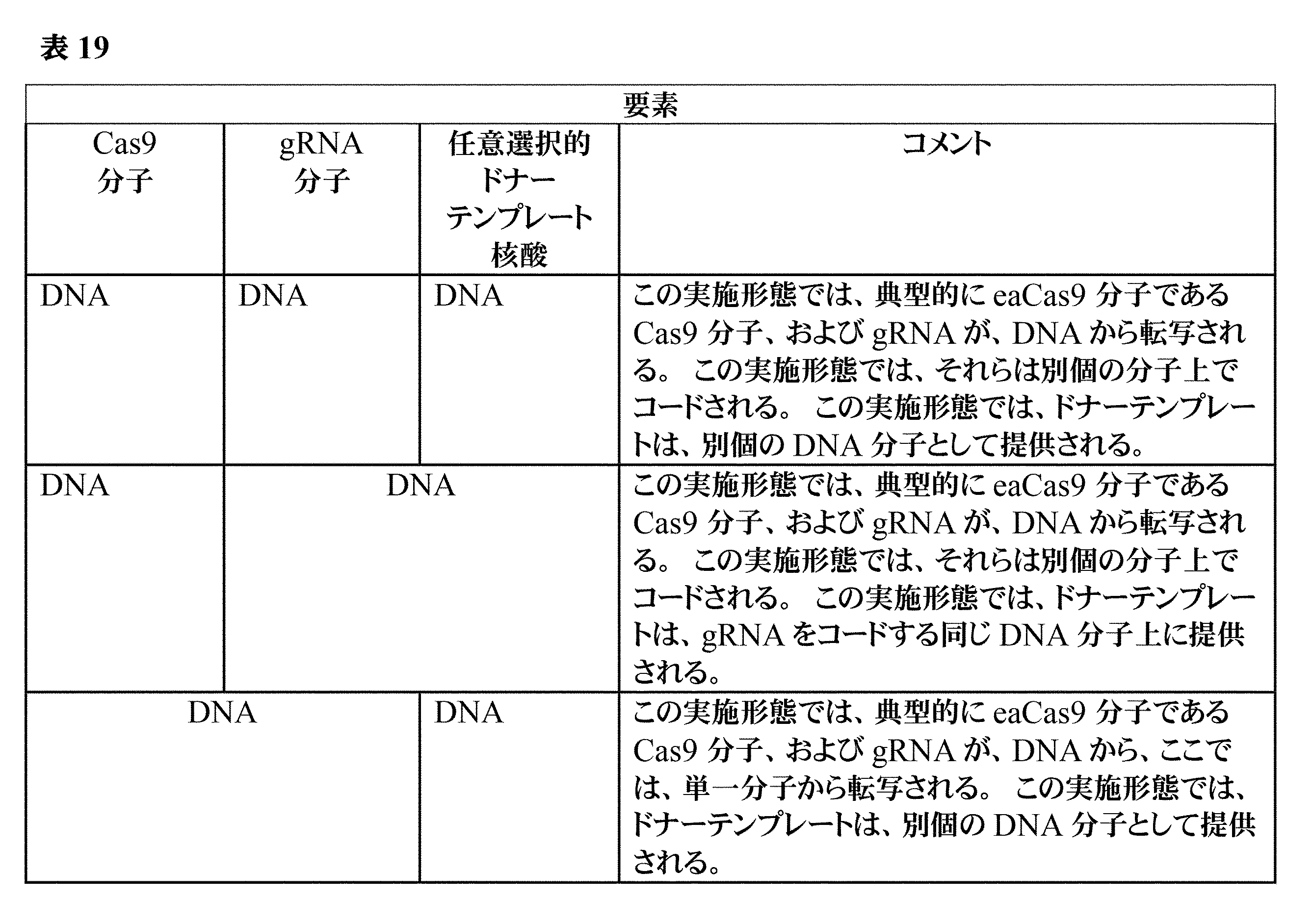

表20は、例えば、本明細書に記載されるようなCas9分子構成要素およびgRNA分子構成要素などのCasシステム構成要素の様々な送達方法を要約する。 Table 20 summarizes various methods of delivery of Cas system components such as, for example, Cas9 molecular components and gRNA molecular components as described herein.
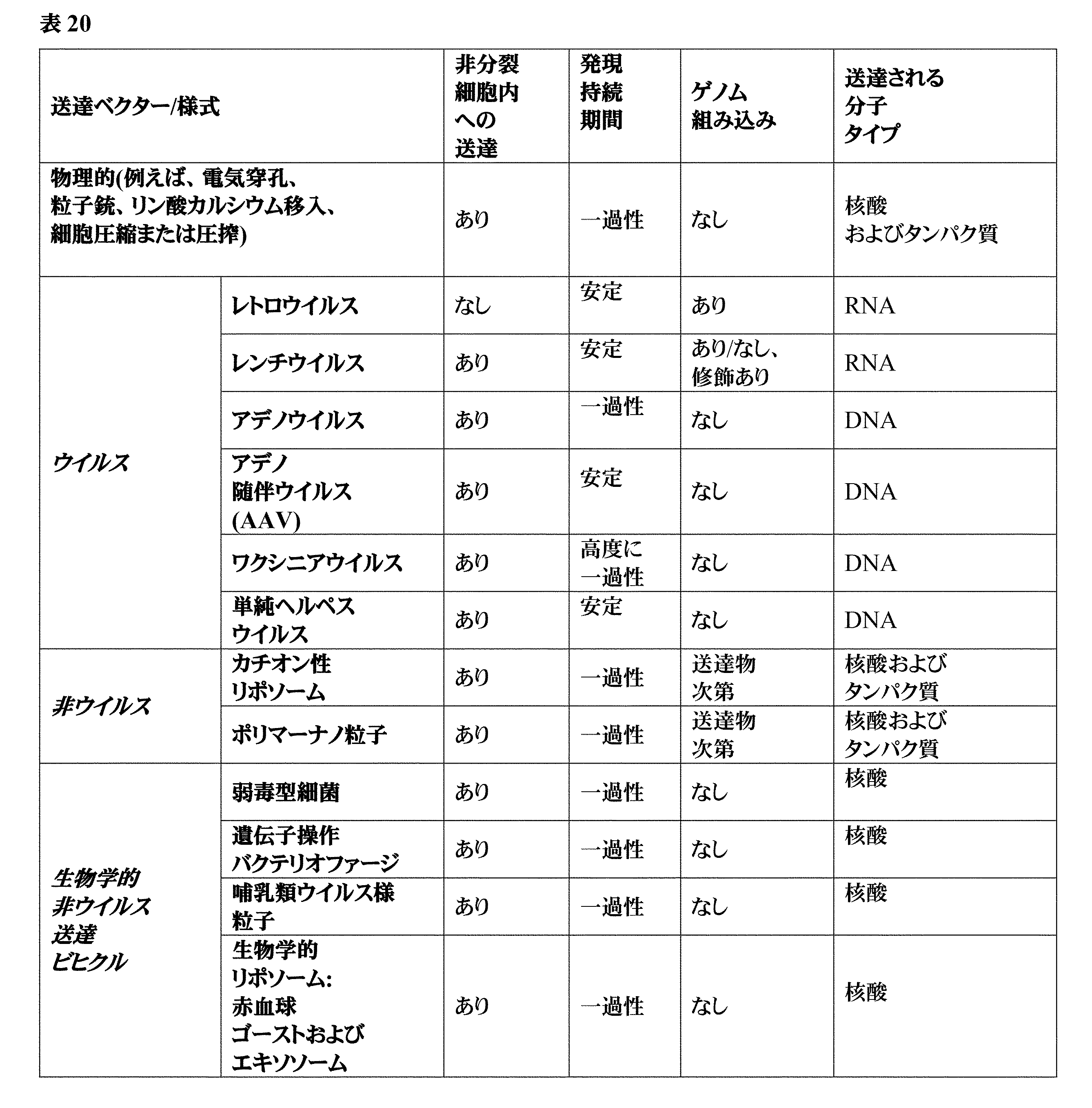
Cas9分子およびもしくは1つまたは複数のgRNA分子のDNAベースの送達
Cas9分子(例えば、eaCas9分子)、gRNA分子をコードする核酸、供与体テンプレート核酸、またはそれら(例えば、2つもしくは全て)の任意の組み合わせは、当該技術分野で周知の方法によって、または本明細書に記載されるようにして、対象に、または細胞内に送達することができる。例えば、Cas9をコードするおよび/またはgRNAをコードするDNA、ならびに供与体テンプレート核酸は、例えば、ベクター(例えば、ウイルスまたは非ウイルスベクター)、非ベクターベースの方法(例えば、裸のDNAまたはDNA複合体を使用して)、またはそれらの組み合わせによって、送達することができる。
DNA-based delivery of a Cas9 molecule and or one or more gRNA molecules A Cas9 molecule (e.g., an eaCas9 molecule), a nucleic acid encoding a gRNA molecule, a donor template nucleic acid, or any of them (e.g., two or all) The combination can be delivered to a subject or intracellularly by methods well known in the art or as described herein. For example, DNA encoding Cas9 and/or gRNA and donor template nucleic acids can be used, for example, in vectors (e.g., viral or non-viral vectors), non-vector-based methods (e.g., naked DNA or DNA complexes). ) or a combination thereof.
Cas9分子(例えば、eaCas9分子)および/またはgRNA分子をコードする核酸は、標的細胞(例えば、肝細胞)による取り込みを促進する分子(例えば、N-アセチルガラクトサミン)と共役させることができる。供与体テンプレート分子も、標的細胞(例えば、肝細胞)による取り込みを促進する分子(例えば、N-アセチルガラクトサミン)と共役させることができる。 Nucleic acids encoding Cas9 molecules (eg, eaCas9 molecules) and/or gRNA molecules can be conjugated with molecules (eg, N-acetylgalactosamine) that facilitate uptake by target cells (eg, hepatocytes). Donor template molecules can also be conjugated with molecules (eg, N-acetylgalactosamine) that facilitate uptake by target cells (eg, hepatocytes).
いくつかの実施形態では、Cas9および/またはgRNAをコードするDNAは、ベクター(例えば、ウイルスベクター/ウイルスまたはプラスミド)によって送達される。 In some embodiments, DNA encoding Cas9 and/or gRNA is delivered by a vector (eg, a viral vector/virus or a plasmid).
ベクターは、Cas9分子および/もしくはgRNA分子をコードする配列を含み得る。 The vector may contain sequences encoding Cas9 molecules and/or gRNA molecules.
ベクターはまた、例えば、Cas9分子配列と融合した、(例えば、核局在化、核小体局在化、またはミトコンドリア局在化のための)シグナルペプチドをコードする配列を含んでもよい。例えば、ベクターは、Cas9分子をコードする配列に融合された、核局在化配列(例えば、SV40からの)を含み得る。 The vector may also include, for example, a sequence encoding a signal peptide (eg, for nuclear, nucleolar, or mitochondrial localization) fused to the Cas9 molecule sequence. For example, a vector can include a nuclear localization sequence (eg, from SV40) fused to a sequence encoding a Cas9 molecule.
例えば、プロモーター、エンハンサー、イントロン、ポリアデニル化シグナル、コザックコンセンサス配列、内部リボソーム侵入部位(IRES)などの1つまたは複数の調節的/制御要素が、ベクターに包含され得る。いくつかの実施形態では、プロモーターは、RNAポリメラーゼII(例えば、CMVプロモーター)によって認識される。別の実施形態では、プロモーターは、RNAポリメラーゼIII(例えば、U6プロモーター)によって認識される。いくつかの実施形態では、プロモーターは、調節されるプロモーター(例えば、誘導性プロモーター)である。別の実施形態では、プロモーターは、構成的プロモーターである。いくつかの実施形態では、プロモーターは、組織特異的プロモーターである。いくつかの実施形態では、プロモーターは、ウイルスプロモーターである。他の実施形態では、プロモーターは、非ウイルスプロモーターである。 For example, one or more regulatory/control elements such as promoters, enhancers, introns, polyadenylation signals, Kozak consensus sequences, internal ribosome entry sites (IRES), etc. can be included in the vector. In some embodiments, the promoter is recognized by RNA polymerase II (eg, the CMV promoter). In another embodiment, the promoter is recognized by RNA polymerase III (eg, the U6 promoter). In some embodiments, the promoter is a regulated promoter (eg, an inducible promoter). In another embodiment, the promoter is a constitutive promoter. In some embodiments, the promoter is a tissue-specific promoter. In some embodiments, the promoter is a viral promoter. In other embodiments, the promoter is a non-viral promoter.
いくつかの実施形態では、ベクターは、ウイルスベクター(例えば、組換えウイルス生成のための)である。いくつかの実施形態では、ウイルスは、DNAウイルス(例えば、dsDNAまたはssDNAウイルス)である。他の実施形態では、ウイルスは、RNAウイルス(例えば、ssRNAウイルス)である。いくつかの実施形態では、ウイルスは、分裂細胞に感染する。他の実施形態では、ウイルスは、非分裂細胞に感染する。代表的なウイルスベクター/ウイルスとしては、例えば、レトロウイルス、レンチウイルス、アデノウイルス、アデノ随伴ウイルス(AAV)、ワクシニアウイルス、ポックスウイルス、および単純ヘルペスウイルスが挙げられる。 In some embodiments, the vector is a viral vector (eg, for recombinant virus production). In some embodiments, the virus is a DNA virus (eg, a dsDNA or ssDNA virus). In other embodiments, the virus is an RNA virus (eg, an ssRNA virus). In some embodiments, the virus infects dividing cells. In other embodiments, the virus infects non-dividing cells. Representative viral vectors/viruses include, for example, retroviruses, lentiviruses, adenoviruses, adeno-associated viruses (AAV), vaccinia viruses, poxviruses, and herpes simplex viruses.
いくつかの実施形態では、ウイルスは、分裂および非分裂細胞の双方に感染する。いくつかの実施形態では、ウイルスは、宿主ゲノムに組み込まれ得る。いくつかの実施形態では、ウイルスは、例えば、ヒトにおいて免疫低下を有するように改変される。他の実施形態では、ウイルスは、複製能力がある。別の実施形態では、ウイルスは複製欠陥であり、例えば、ビリオン複製および/またはパッケージングの追加的なラウンドに必要な遺伝子のための1つまたは複数のコード領域が、その他の遺伝子で置換されまたは欠失される。いくつかの実施形態では、ウイルスは、Cas9分子および/またはgRNA分子の一過性の発現を引き起こす。他の実施形態では、ウイルスは、Cas9分子および/またはgRNA分子の例えば、少なくとも1週間、2週間、1ヶ月間、2ヶ月間、3ヶ月間、6ヶ月間、9ヶ月間、1年間、2年間、または恒久的などの持続性の発現を引き起こす。ウイルスのパッケージング容量は、例えば、少なくとも約4kb~少なくとも約30kb、例えば、少なくとも約5kb、10kb、15kb、20kb、25kb、30kb、35kb、40kb、45kb、または50kbなどで変動してもよい。 In some embodiments, the virus infects both dividing and non-dividing cells. In some embodiments, the virus can integrate into the host genome. In some embodiments, the virus is modified to have immunocompromise, eg, in humans. In other embodiments, the virus is replication competent. In another embodiment, the virus is replication defective, e.g., one or more coding regions for genes required for additional rounds of virion replication and/or packaging have been replaced with other genes or Deleted. In some embodiments, the virus causes transient expression of Cas9 molecules and/or gRNA molecules. In other embodiments, the virus is a carrier of a Cas9 molecule and/or a gRNA molecule, e.g., for at least 1 week, 2 weeks, 1 month, 2 months, 3 months, 6 months, 9 months, 1 year, 2 Causes persistent manifestations, such as annual or permanent. The packaging capacity of the virus may vary, for example, from at least about 4 kb to at least about 30 kb, such as at least about 5 kb, 10 kb, 15 kb, 20 kb, 25 kb, 30 kb, 35 kb, 40 kb, 45 kb, or 50 kb.
一実施形態では、ウイルスベクターは、特定の細胞型または組織を認識する。例えば、ウイルスベクターは、異なる/代替ウイルスエンベロープ糖タンパク質でシュードタイプ化され;細胞型特異的受容体で改変され(例えば、ペプチドリガンド、一本鎖抗体、もしくは成長因子などの標的化リガンドを組み込むための1つまたは複数のウイルスエンベロープ糖タンパク質の遺伝子修飾);および/または一端がウイルス糖タンパク質を認識すると共に、他端が標的細胞表面の1部分(例えば、リガンド-受容体、モノクローナル抗体、アビジン-ビオチンおよび化学共役)を認識する二重特異性を有する分子架橋を有するように改変され得る。 In one embodiment, the viral vector recognizes a specific cell type or tissue. For example, viral vectors can be pseudotyped with different/alternative viral envelope glycoproteins; modified with cell type-specific receptors (e.g., to incorporate targeting ligands such as peptide ligands, single chain antibodies, or growth factors); (genetic modification of one or more viral envelope glycoproteins); and/or one end recognizes a viral glycoprotein and the other end recognizes a portion of the target cell surface (e.g., a ligand-receptor, monoclonal antibody, avidin- can be modified to have a molecular bridge with dual specificity that recognizes biotin and chemical conjugates).
代表的なウイルスベクター/ウイルスとしては、例えば、レトロウイルス、レンチウイルス、アデノウイルス、アデノ随伴ウイルス(AAV)、ワクシニアウイルス、ポックスウイルス、および単純ヘルペスウイルスが挙げられる。 Representative viral vectors/viruses include, for example, retroviruses, lentiviruses, adenoviruses, adeno-associated viruses (AAV), vaccinia viruses, poxviruses, and herpes simplex viruses.
代表的なウイルスベクター/ウイルスとしては、例えば、レトロウイルス、レンチウイルス、アデノウイルス、アデノ随伴ウイルス(AAV)、ワクシニアウイルス、ポックスウイルス、および単純ヘルペスウイルスが挙げられる。 Representative viral vectors/viruses include, for example, retroviruses, lentiviruses, adenoviruses, adeno-associated viruses (AAV), vaccinia viruses, poxviruses, and herpes simplex viruses.
一実施形態では、Cas9をコードする核酸配列および/またはgRNAをコードする核酸配列は、組換えレトロウイルスによって送達される。いくつかの実施形態では、レトロウイルス(例えば、モロニー(Moloney)マウス白血病ウイルス)は、例えば、宿主ゲノムへの組み込みを可能にするものなどの逆転写酵素を含む。いくつかの実施形態では、レトロウイルスは、複製能力がある。別の実施形態では、レトロウイルスは複製欠陥であり、例えば、ビリオン複製およびパッケージングの追加的なラウンドに必要な遺伝子のための1つまたは複数のコード領域が、その他の遺伝子で置換されるか、または欠失される。 In one embodiment, the Cas9-encoding nucleic acid sequence and/or the gRNA-encoding nucleic acid sequence is delivered by a recombinant retrovirus. In some embodiments, the retrovirus (eg, Moloney Murine Leukemia Virus) includes a reverse transcriptase, eg, one that allows integration into the host genome. In some embodiments, the retrovirus is replication competent. In another embodiment, the retrovirus is replication defective, e.g., one or more coding regions for genes required for additional rounds of virion replication and packaging are replaced with other genes. , or deleted.
いくつかの実施形態では、Cas9をコードする核酸配列および/またはgRNAをコードする核酸配列は、組換えレンチウイルスによって送達される。一実施形態では、供与体テンプレート核酸は、組換えレンチウイルスによって送達される。例えば、レトロウイルスは、例えば、ウイルス複製に必要な1つまたは複数の遺伝子を含まないなど、複製欠陥である。 In some embodiments, the Cas9-encoding nucleic acid sequence and/or the gRNA-encoding nucleic acid sequence is delivered by a recombinant lentivirus. In one embodiment, the donor template nucleic acid is delivered by a recombinant lentivirus. For example, retroviruses are replication defective, eg, do not contain one or more genes necessary for viral replication.
一実施形態では、Cas9をコードする核酸配列および/またはgRNAをコードする核酸配列は、組換えレンチウイルスによって送達される。一実施形態では、ドナーテンプレート核酸は、組換えレンチウイルスによって送達される。例えば、レンチウイルスは、例えば、ウイルス複製に必要な1つまたは複数の遺伝子を含まないなど、複製欠陥である。 In one embodiment, the Cas9-encoding nucleic acid sequence and/or the gRNA-encoding nucleic acid sequence is delivered by a recombinant lentivirus. In one embodiment, the donor template nucleic acid is delivered by a recombinant lentivirus. For example, lentiviruses are replication defective, eg, do not contain one or more genes necessary for viral replication.
一部の実施形態では、Cas9をコードする核酸配列および/またはgRNAをコードする核酸配列は、組換えアデノウイルスによって送達される。一実施形態では、ドナーテンプレート核酸は、組換えアデノウイルスによって送達される。一部の実施形態では、アデノウイルスは、ヒトにおける免疫を低下させるように改変される。 In some embodiments, the Cas9-encoding nucleic acid sequence and/or the gRNA-encoding nucleic acid sequence is delivered by a recombinant adenovirus. In one embodiment, the donor template nucleic acid is delivered by a recombinant adenovirus. In some embodiments, the adenovirus is modified to reduce immunity in humans.
一部の実施形態では、Cas9をコードする核酸配列および/またはgRNAをコードする核酸配列は、組換えAAVによって送達される。一実施形態では、供与体テンプレート核酸は、組換えAAVによって送達される。いくつかの実施形態では、AAVは、本明細書に記載されるような標的細胞などの宿主細胞のゲノムに、そのゲノムを組み込まない。いくつかの実施形態では、AAVは、そのゲノムを宿主細胞のゲノムに組み込み得る。いくつかの実施形態では、AAVは、例えば、共にアニールされて二本鎖DNAを形成する双方の鎖をパッケージするscAAVなどの、自己相補的アデノ随伴ウイルス(scAAV)である。 In some embodiments, the Cas9-encoding nucleic acid sequence and/or the gRNA-encoding nucleic acid sequence is delivered by recombinant AAV. In one embodiment, the donor template nucleic acid is delivered by recombinant AAV. In some embodiments, the AAV does not integrate its genome into the genome of a host cell, such as a target cell as described herein. In some embodiments, AAV is capable of integrating its genome into the host cell's genome. In some embodiments, the AAV is a self-complementary adeno-associated virus (scAAV), such as, for example, scAAV that packages both strands that are annealed together to form double-stranded DNA.
一実施形態では、本明細書に記載される方法で用いることができるAAVキャプシドは、血清型:AAV1、AAV2、AAV3、AAV4、AAV5、AAV6、AAV7、AAV8、AAV9、AAV.rh8、AAV.rh10、AAV.rh32/33、AAV.rh43、AAV.rh64R1、またはAAV7m8由来のキャプシド配列である。 In one embodiment, AAV capsids that can be used in the methods described herein include serotypes: AAV1, AAV2, AAV3, AAV4, AAV5, AAV6, AAV7, AAV8, AAV9, AAV. rh8, AAV. rh10, AAV. rh32/33, AAV. rh43, AAV. rh64R1, or AAV7m8-derived capsid sequence.
一実施形態では、Cas9をコードするDNAおよび/またはgRNAをコードするDNAは、例えば、血清型:AAV1、AAV2、AAV3、AAV4、AAV5、AAV6、AAV7、AAV8、AAV9、AAV.rh8、AAV.rh10、AAV.rh32/33、AAV.rh43、またはAAV.rh64R1由来のキャプシド配列と50%以上、例えば、60%以上、70%以上、80%以上、90%以上、または95%以上の配列相同性を有する、再改変AAVキャプシドで送達される。 In one embodiment, the DNA encoding Cas9 and/or the DNA encoding gRNA is, for example, serotypes: AAV1, AAV2, AAV3, AAV4, AAV5, AAV6, AAV7, AAV8, AAV9, AAV. rh8, AAV. rh10, AAV. rh32/33, AAV. rh43, or AAV. Delivered in a reengineered AAV capsid that has 50% or more, such as 60% or more, 70% or more, 80% or more, 90% or more, or 95% or more sequence homology with the rh64R1-derived capsid sequence.
一実施形態では、Cas9をコードするDNAおよび/またはgRNAをコードするDNAは、キメラAAVキャプシドによって送達される。一実施形態では、供与体テンプレート核酸は、キメラAAVキャプシドによって送達される。例示的なキメラAAVキャプシドとしては、限定はしないが、AAV9i1、AAV2i8、AAV-DJ、AAV2G9、AAV2i8G9、またはAAV8G9が挙げられる。 In one embodiment, DNA encoding Cas9 and/or DNA encoding gRNA is delivered by a chimeric AAV capsid. In one embodiment, the donor template nucleic acid is delivered by a chimeric AAV capsid. Exemplary chimeric AAV capsids include, but are not limited to, AAV9i1, AAV2i8, AAV-DJ, AAV2G9, AAV2i8G9, or AAV8G9.
一実施形態では、AAVは、例えば、共にアニールされて二本鎖DNAを形成する双方の鎖をパッケージするscAAVなどの、自己相補的アデノ随伴ウイルス(scAAV)である。 In one embodiment, the AAV is a self-complementary adeno-associated virus (scAAV), such as, for example, scAAV that packages both strands that are annealed together to form double-stranded DNA.
一実施形態では、Cas9をコードするDNAおよび/またはgRNAをコードするDNAは、例えば、本明細書に記載されるウイルスの1つまたは複数のハイブリッドなどのハイブリッドウイルスによって送達される。一実施形態では、ハイブリッドウイルスは、ボカウイルス(Bocavirus)、B19ウイルス、ブタAAV、ガチョウAAV、ネコAAV、イヌAAV、またはMVMと、AAV(例えば、任意のAAV血清型の)とのハイブリッドである。 In one embodiment, the DNA encoding Cas9 and/or the DNA encoding gRNA is delivered by a hybrid virus, eg, a hybrid of one or more of the viruses described herein. In one embodiment, the hybrid virus is a hybrid of Bocavirus, B19 virus, porcine AAV, goose AAV, feline AAV, canine AAV, or MVM and AAV (e.g., of any AAV serotype). .
パッケージング細胞が使用されて、標的細胞を感染させる能力があるウイルス粒子が形成される。このような細胞は、アデノウイルスをパッケージし得る293細胞、およびレトロウイルスをパッケージし得るψ2細胞またはPA317細胞が挙げられる。遺伝子治療で使用されるウイルスベクターは、通常は、核酸ベクターをウイルス粒子内にパッケージする産生細胞株によって生成される。ベクターは、典型的に、パッケージングと(妥当な場合)引き続く宿主または標的細胞への組み込みに必要な最小のウイルス配列を含有し、その他のウイルス配列は、例えばCas9などの発現されるタンパク質をコードする発現カセットによって置換される。例えば、遺伝子治療で使用されるAAVベクターは、典型的に、パッケージングおよび宿主または標的細胞内の遺伝子発現に必要なAAVゲノムからの逆方向末端反復(ITR)配列のみを有する。欠損しているウイルス機能は、「Triple Transfection Protocol」に記載されているように、パッケージング細胞株および/またはアデノウイルス由来のE2A、E4、およびVA遺伝子を含有するプラスミド、ならびにAAV由来のRepおよびCap遺伝子をコードするプラスミドによってトランスで供給することができる。この後、ウイルスDNAは、他のAAV遺伝子、すなわちrepおよびcapをコードするが、ITR配列が欠如しているヘルパープラスミドを含有する、細胞株内にパッケージされる。実施形態では、ウイルスDNAは、アデノウイルス由来のE1Aおよび/またはE1B遺伝子を含有するプロデューサー細胞株にパッケージされる。細胞株はまた、ヘルパーとしてのアデノウイルスに感染する。ヘルパーウイルス(例えば、アデノウイルスもしくはHSV)またはヘルパープラスミドは、AAVベクター複製と、ITRを有するヘルパープラスミドからのAAV遺伝子の発現を促進する。ヘルパープラスミドは、ITR配列の欠如のために、顕著な量でパッケージされない。アデノウイルスの混入は、例えば、それに対してアデノウイルスがAAVよりも感受性が高い、加熱処理によって低下させ得る。 Packaging cells are used to form viral particles capable of infecting target cells. Such cells include 293 cells, which can package adenoviruses, and ψ2 cells or PA317 cells, which can package retroviruses. Viral vectors used in gene therapy are usually produced by production cell lines that package the nucleic acid vector into viral particles. The vector typically contains the minimal viral sequences necessary for packaging and (if appropriate) subsequent integration into the host or target cell; other viral sequences encode the protein to be expressed, e.g. Cas9. is replaced by an expression cassette that For example, AAV vectors used in gene therapy typically have only the inverted terminal repeat (ITR) sequences from the AAV genome necessary for packaging and gene expression within the host or target cell. Defective viral functions can be detected using plasmids containing the E2A, E4, and VA genes from packaging cell lines and/or adenoviruses, and Rep and VA genes from AAV, as described in the Triple Transfection Protocol. It can be supplied in trans by a plasmid encoding the Cap gene. After this, the viral DNA is packaged into a cell line containing a helper plasmid encoding the other AAV genes, namely rep and cap, but lacking the ITR sequences. In embodiments, the viral DNA is packaged into a producer cell line containing E1A and/or E1B genes from an adenovirus. Cell lines are also infected with adenovirus as a helper. A helper virus (eg, adenovirus or HSV) or helper plasmid facilitates AAV vector replication and expression of AAV genes from the helper plasmid with ITRs. The helper plasmid is not packaged in significant quantities due to the lack of ITR sequences. Adenovirus contamination can be reduced, for example, by heat treatment, to which adenoviruses are more susceptible than AAV.
一実施形態では、ウイルスベクターは、レンチウイルスベクターである。一実施形態では、ウイルスベクターは、インテグラーゼ欠損型SINレンチウイルスである。一実施形態では、LVまたはIDLVをVSV-Gエンベロープでシュードタイプ化する。遺伝子療法用の分裂および非分裂細胞を効率的に形質導入するための自己不活性化(SIN)レンチウイルスベクター(LV)の使用は、例えば、Segal et al.,J Biol Chem.2004;279(15):14509-14519に記載されている。HIV-1ベースのレンチウイルスベクターは、約10kb一本鎖陽性センスRNAゲノムの2つのコピーを含む、複製能力のない包膜レトロウイルスである。様々なプラスミドの中からの構造タンパク質および酵素タンパク質をコードするウイルス遺伝子の分離、ならびにRNAゲノムからの特定のアクセサリー遺伝子の排除によって、レンチウイルスベクターは、形質導入細胞内で複製することができなくなる(Naldini et al.,Curr.Opin.Biotechnol.1998;9(5):457-463)。一実施形態では、パッケージングシグナルは、トランスジーン発現カセットをコードする輸送ベクター(例えば、レシピエント内存性HLAプロモーターにより調節されるレシピエントHLA対立遺伝子)に制限され、これによって、LV構造および酵素コード遺伝子のパッケージングを妨げる。ウイルスを産生するために、トランスジーンを含む輸送ベクターは、トランスジーン発現カセットとエンベロープタンパク質をパッケージするのに必要なウイルスタンパク質をコードする個別のプラスミドで共形質移入することができる。一実施形態では、ウイルスのトピズムを拡大するために、水胞性口炎ウイルス(Vesicular stomatitis virus)糖タンパク質-G[VSV-G])が使用されている。 In one embodiment, the viral vector is a lentiviral vector. In one embodiment, the viral vector is an integrase-deficient SIN lentivirus. In one embodiment, the LV or IDLV is pseudotyped with a VSV-G envelope. The use of self-inactivating (SIN) lentiviral vectors (LVs) to efficiently transduce dividing and non-dividing cells for gene therapy has been described, for example, by Segal et al. , J Biol Chem. 2004;279(15):14509-14519. HIV-1-based lentiviral vectors are replication-incompetent, enveloped retroviruses containing two copies of an approximately 10 kb single-stranded positive sense RNA genome. The separation of the viral genes encoding structural and enzymatic proteins among the various plasmids, as well as the exclusion of certain accessory genes from the RNA genome, renders the lentiviral vector incapable of replicating in the transduced cells ( Naldini et al., Curr. Opin. Biotechnol. 1998;9(5):457-463). In one embodiment, the packaging signal is restricted to a transport vector encoding the transgene expression cassette (e.g., a recipient HLA allele regulated by a recipient endogenous HLA promoter), thereby allowing the LV structure and enzyme encoding Prevents gene packaging. To produce the virus, the transgene-containing transport vector can be cotransfected with separate plasmids encoding the transgene expression cassette and the viral proteins necessary to package the envelope proteins. In one embodiment, Vesicular stomatitis virus glycoprotein-G [VSV-G]) is used to expand the topism of the virus.
一実施形態では、SINレンチウイルスベクターを用いて、トランスジーン(例えば、マッチHLA対立遺伝子)をドナーHSPCに輸送する。X連鎖副腎白質ジストロフィー、異染性白質ジストロフィー、およびウィスコット・オルドリッチ(Wiskott-Aldrich)症候群を治療するために、生体外で造血幹/前駆細胞(HSPC)を遺伝子修飾するために用いられる組換えレンチウイルスの組み込みの使用については、例えば、Cartier et al;Science. 2009 Nov 6;326(5954):818-23;Biffi et al.,Science.2013;341(6148):1233158-1233158;Aiuti et al,Science.2013;341(6148):1233151-1233151に記載されている。白血病および膠芽腫を治療することを目的とした、がん特異的キメラ抗原受容体(CAR)発現Tリンパ球生産のためのレンチウイルスベクターの臨床使用については、例えば、Maude et al,SL,N Engl J Med.2014;371(16):1507-1517;およびJohnson et al.,Science Translational Medicine.2015;7(275):275ra22-275ra22に記載されている。
In one embodiment, a SIN lentiviral vector is used to transport a transgene (eg, a matched HLA allele) into donor HSPCs. Recombinant used to genetically modify hematopoietic stem/progenitor cells (HSPCs) in vitro to treat X-linked adrenoleukodystrophy, metachromatic leukodystrophy, and Wiskott-Aldrich syndrome. For the use of lentiviral integration, see, eg, Cartier et al; Science. 2009
一実施形態では、インテグラーゼ欠損型レンチウイルス(IDLV)を用いて、例えば、本来のHLA遺伝子座またはセーフ・ハーバー遺伝子座中に、レシピエントマッチHLAトランスジーンの標的化組み込みおよび/もしくはノックインのために、トランスジーン(例えば、レシピエント同一HLA対立遺伝子)送達用のドナーCas9、gRNA、および/もしくはドナー修復テンプレートDNAを送達する。IDLVは、一次ヒト細胞に形質導入することができるが、遺伝子カーゴを宿主細胞ゲノムに組み込むことはできない。レンチウイルスベクターのパッケージ容量(約10kb)を考慮すると、IDLVは、相同組換え修復(HDR)によるゲノム編集戦略用のCas9、gRNA、およびドナー修復テンプレートを送達するための有用なツールである(Kumar et al,Human Gene Therapy.2001;12(15):1893-1905)。IDLVは、生体外および生体内での一次標的細胞の部位特異的修飾用のジンクフィンガーヌクレアーゼ(ZFN)、TALエフェクターヌクレアーゼ(TALEN)、メガヌクレアーゼ、およびドナー修復テンプレートを送達するために使用されている(Lombardo et al,A,Nature Biotechnology.2007;25(11):1298-1306;Joglekar et al,Mol Ther.2013;21(9):1705-1717;Holkers et al,Nucleic Acids Res.2013;41(5):e63;Riviere et al.Gene Ther.2014;21(5):529-532)。一実施形態では、細胞は、分裂細胞または高速分裂細胞である。別の実施形態では、細胞は、静止細胞または低速分裂細胞(例えば、長期HSPC、ニューロン、または肝細胞)である。 In one embodiment, integrase-deficient lentiviruses (IDLVs) are used for targeted integration and/or knock-in of recipient-matched HLA transgenes, e.g., into native HLA loci or safe harbor loci. to deliver donor Cas9, gRNA, and/or donor repair template DNA for transgene (eg, recipient identical HLA allele) delivery. Although IDLV is capable of transducing primary human cells, it is unable to integrate its gene cargo into the host cell genome. Considering the packaging capacity of lentiviral vectors (approximately 10 kb), IDLV is a useful tool to deliver Cas9, gRNA, and donor repair templates for genome editing strategies by homologous recombination repair (HDR) (Kumar et al, Human Gene Therapy. 2001;12(15):1893-1905). IDLVs have been used to deliver zinc finger nucleases (ZFNs), TAL effector nucleases (TALENs), meganucleases, and donor repair templates for site-specific modification of primary target cells in vitro and in vivo. (Lombardo et al, A, Nature Biotechnology. 2007; 25 (11): 1298-1306; Joglekar et al, Mol Ther. 2013; 21 (9): 1705-1717; Holkers et al, Nu cleic acids Res.2013;41 (5): e63; Riviere et al. Gene Ther. 2014; 21 (5): 529-532). In one embodiment, the cell is a dividing cell or a rapidly dividing cell. In another embodiment, the cells are quiescent or slowly dividing cells (eg, long-term HSPCs, neurons, or hepatocytes).
一実施形態では、ウイルスベクターは、細胞型および/または組織タイプ認識能力を有する。例えば、ウイルスベクターは、異なる/代案のウイルス外被糖タンパク質による偽型であり得て;細胞型特異的受容体によって改変され(例えば、ペプチドリガンド、一本鎖抗体、成長因子などの標的化リガンドに組み込むためのウイルス外被糖タンパク質の遺伝子修飾);および/または改変されて、一端がウイルス糖タンパク質を認識して、もう一方の末端が標的細胞表面部分を認識する、二重特異性がある分子ブリッジを有する(例えば、リガンド受容体、モノクローナル抗体、アビジン-ビオチン、および化学的結合)。 In one embodiment, the viral vector has cell type and/or tissue type recognition capabilities. For example, viral vectors can be pseudotyped with different/alternative viral coat glycoproteins; modified with cell type-specific receptors (e.g., targeting ligands such as peptide ligands, single chain antibodies, growth factors, etc.); (genetic modification of the viral coat glycoprotein to incorporate it into the virus); and/or modified to be bispecific, with one end recognizing the viral glycoprotein and the other end recognizing the target cell surface moiety. with molecular bridges (eg, ligand receptors, monoclonal antibodies, avidin-biotin, and chemical bonds).
一実施形態では、ウイルスベクターは、細胞型特異的発現を達成する。例えば、組織特異的プロモーターが構築されて、標的細胞のみで導入遺伝子(Cas9およびgRNA)の発現が制限され得る。ベクターの特異性はまた、導入遺伝子発現のマイクロRNA依存性調節によって媒介され得る。一実施形態では、ウイルスベクターは、ウイルスベクターと標的細胞膜との融合効率の増大を有する。例えば、融合能力がある赤血球凝集素(HA)などのが組み込みまれて、細胞内へのウイルス取り込みが増大され得る。一実施形態では、ウイルスベクターは、核局在化能力を有する。例えば、(細胞分裂中に)核エンベロープの分解を要し、したがって非分裂細胞に感染しない特定のウイルスは、ウイルスのマトリックスタンパク質に核局在化ペプチドを組み込むように改変され得て、それによって非増殖性細胞への形質導入が可能になる。 In one embodiment, the viral vector achieves cell type-specific expression. For example, tissue-specific promoters can be constructed to restrict expression of the transgene (Cas9 and gRNA) only in target cells. Vector specificity may also be mediated by microRNA-dependent regulation of transgene expression. In one embodiment, the viral vector has increased efficiency of fusion between the viral vector and the target cell membrane. For example, fusion-competent hemagglutinin (HA) can be incorporated to increase viral uptake into cells. In one embodiment, the viral vector has nuclear localization capability. For example, certain viruses that require disassembly of the nuclear envelope (during cell division) and therefore do not infect non-dividing cells can be modified to incorporate nuclear localization peptides into the viral matrix protein, thereby making them non-dividing. Transduction of proliferative cells becomes possible.
いくつかの実施形態では、Cas9をコードするDNAおよび/またはgRNAをコードするDNAは、(例えば、裸のDNAまたはDNA複合体を使用して)非ベクターベースの方法によって送達される。例えば、DNAは、例えば、有機修飾シリカまたはケイ酸塩(Ormosil)、電気穿孔、一過性細胞圧縮または圧搾(例えば、Lee,et al.,Nano Lett 12:6322-27に記載される通り)、遺伝子銃、ソノポレーション、マグネトフェクション、脂質媒介形質移入、デンドリマー、無機ナノ粒子、カルシウムリン酸塩、またはそれらの組み合わせによって送達され得る。 In some embodiments, DNA encoding Cas9 and/or DNA encoding gRNA is delivered by non-vector-based methods (eg, using naked DNA or DNA complexes). For example, DNA can be prepared by, for example, organically modified silica or silicates (Ormosil), electroporation, transient cell compaction or squeezing (eg, as described in Lee, et al., Nano Lett 12:6322-27). , gene gun, sonoporation, magnetofection, lipid-mediated transfection, dendrimers, inorganic nanoparticles, calcium phosphate, or combinations thereof.
一実施形態では、電気穿孔を通じた送達は、カートリッジ、チャンバーまたはキュベット内で、細胞をCas9および/またはgRNAをコードするDNAと混合し、規定の時間と振幅で1回または複数回の電気インパルスを適用するステップを含む。一実施形態では、電気穿孔を通じた送達は、カートリッジ、チャンバーまたはキュベットに混合物を供給する装置(例えばポンプ)と連結する容器内で、細胞がCas9および/またはgRNAをコードするDNAと混合され、カートリッジ、チャンバーまたはキュベット内では、規定の時間と振幅で1回または複数回の電気インパルスが適用され、その後、細胞が第2の容器に送達される、システムを使用して実施される。 In one embodiment, delivery through electroporation involves mixing cells with DNA encoding Cas9 and/or gRNA in a cartridge, chamber, or cuvette and applying one or more electrical impulses at a defined time and amplitude. Contains steps to apply. In one embodiment, delivery through electroporation is such that the cells are mixed with DNA encoding Cas9 and/or gRNA in a container that connects to a device (e.g., a pump) that supplies the mixture to the cartridge, chamber, or cuvette; , in a chamber or cuvette, one or more electrical impulses are applied at defined times and amplitudes, after which the cells are delivered to a second container.
いくつかの実施形態では、Cas9をコードするDNAおよび/またはgRNAをコードするDNAは、ベクターおよび非ベクターベースの方法の組み合わせによって送達される。一実施形態では、供与体テンプレート核酸は、ベクターと非ベクターベースの方法の組み合わせによって送達される。例えば、ビロソームは、不活性化ウイルス(例えば、HIVまたはインフルエンザウイルス)とリポソームを結合させ、これによって、例えば、呼吸上皮細胞中に、ウイルスまたはリポソーム法単独のいずれよりも効率的な遺伝子移入をもたらし得る。 In some embodiments, DNA encoding Cas9 and/or DNA encoding gRNA is delivered by a combination of vector and non-vector-based methods. In one embodiment, the donor template nucleic acid is delivered by a combination of vector and non-vector-based methods. For example, virosomes combine inactivated viruses (e.g., HIV or influenza viruses) with liposomes, thereby resulting in more efficient gene transfer than either viral or liposome methods alone, e.g., into respiratory epithelial cells. obtain.
一実施形態では、送達ビヒクルは、非ウイルスベクターである。一実施形態では、非ウイルスベクターは、無機ナノ粒子である。例示的な無機ナノ粒子としては、例えば、磁性ナノ粒子(例えば、Fe3MnO2)またはシリカが挙げられる。ナノ粒子の外面は、ペイロードの付着(例えば、コンジュゲーションまたは捕捉)を可能にする正荷電ポリマー(例えば、ポリエチレンイミン、ポリリジン、ポリセリン)にコンジュゲートされ得る。一実施形態では、非ウイルスベクターは、有機ナノ粒子である(例えば、ナノ粒子内のペイロードの捕捉)。代表的有機ナノ粒子としては、例えば、ポリエチレングリコール(PEG)で被覆された中性ヘルパー脂質、および脂質コーティングで被覆されたプロタミン核および酸複合体に加えて、カチオン性脂質を含有するSNALPリポソームが挙げられる。 In one embodiment, the delivery vehicle is a non-viral vector. In one embodiment, the non-viral vector is an inorganic nanoparticle. Exemplary inorganic nanoparticles include, for example, magnetic nanoparticles (eg, Fe 3 MnO 2 ) or silica. The external surface of the nanoparticle can be conjugated to a positively charged polymer (eg, polyethyleneimine, polylysine, polyserine) that allows attachment (eg, conjugation or entrapment) of the payload. In one embodiment, the non-viral vector is an organic nanoparticle (eg, trapping the payload within the nanoparticle). Typical organic nanoparticles include, for example, SNALP liposomes containing cationic lipids in addition to neutral helper lipids coated with polyethylene glycol (PEG) and protamine cores and acid complexes coated with a lipid coating. Can be mentioned.
遺伝子移入のための代表的脂質は、下で表21に示される。 Representative lipids for gene transfer are shown below in Table 21.
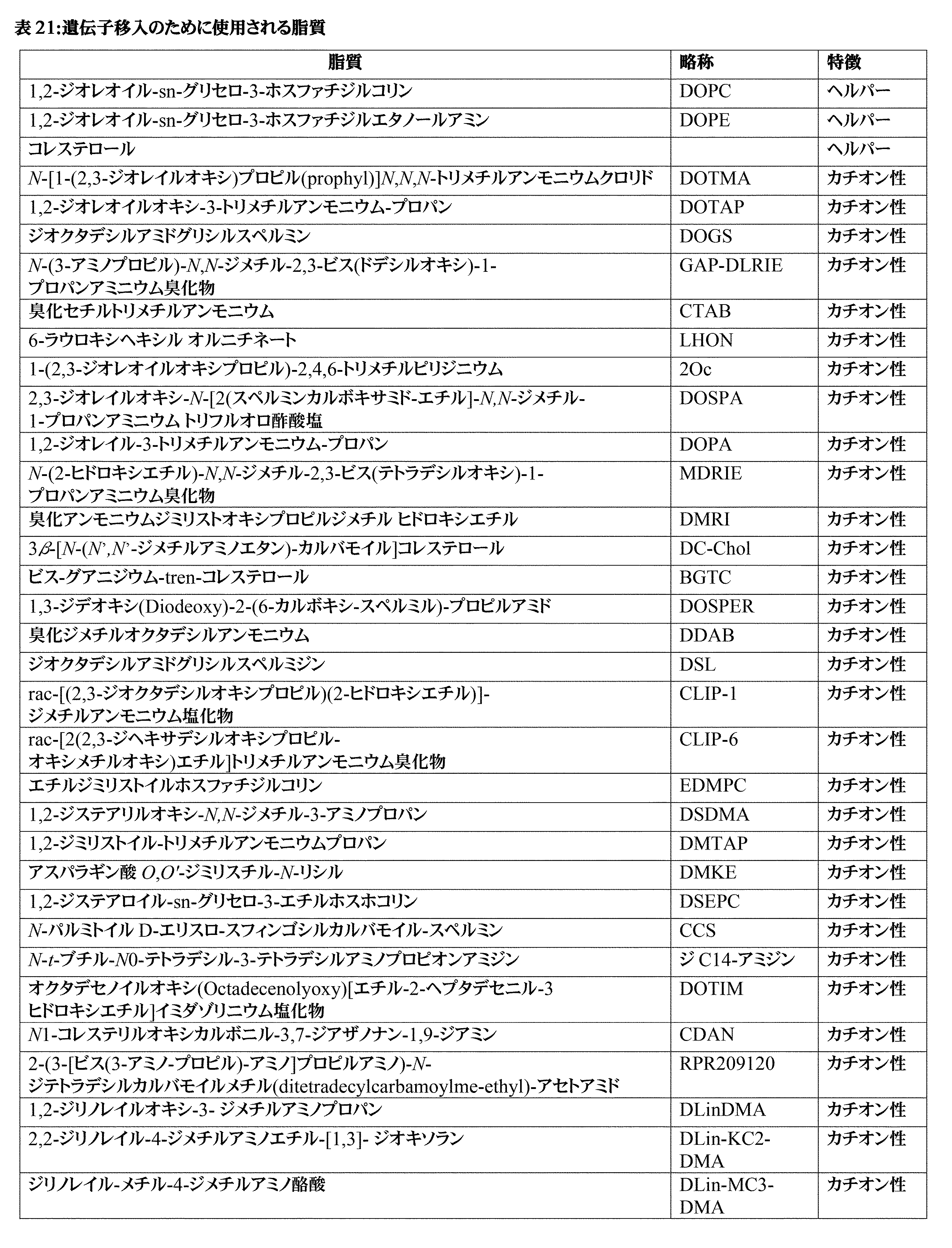
遺伝子移入のための代表的なポリマーは、下で表22に示される。 Representative polymers for gene transfer are shown below in Table 22.
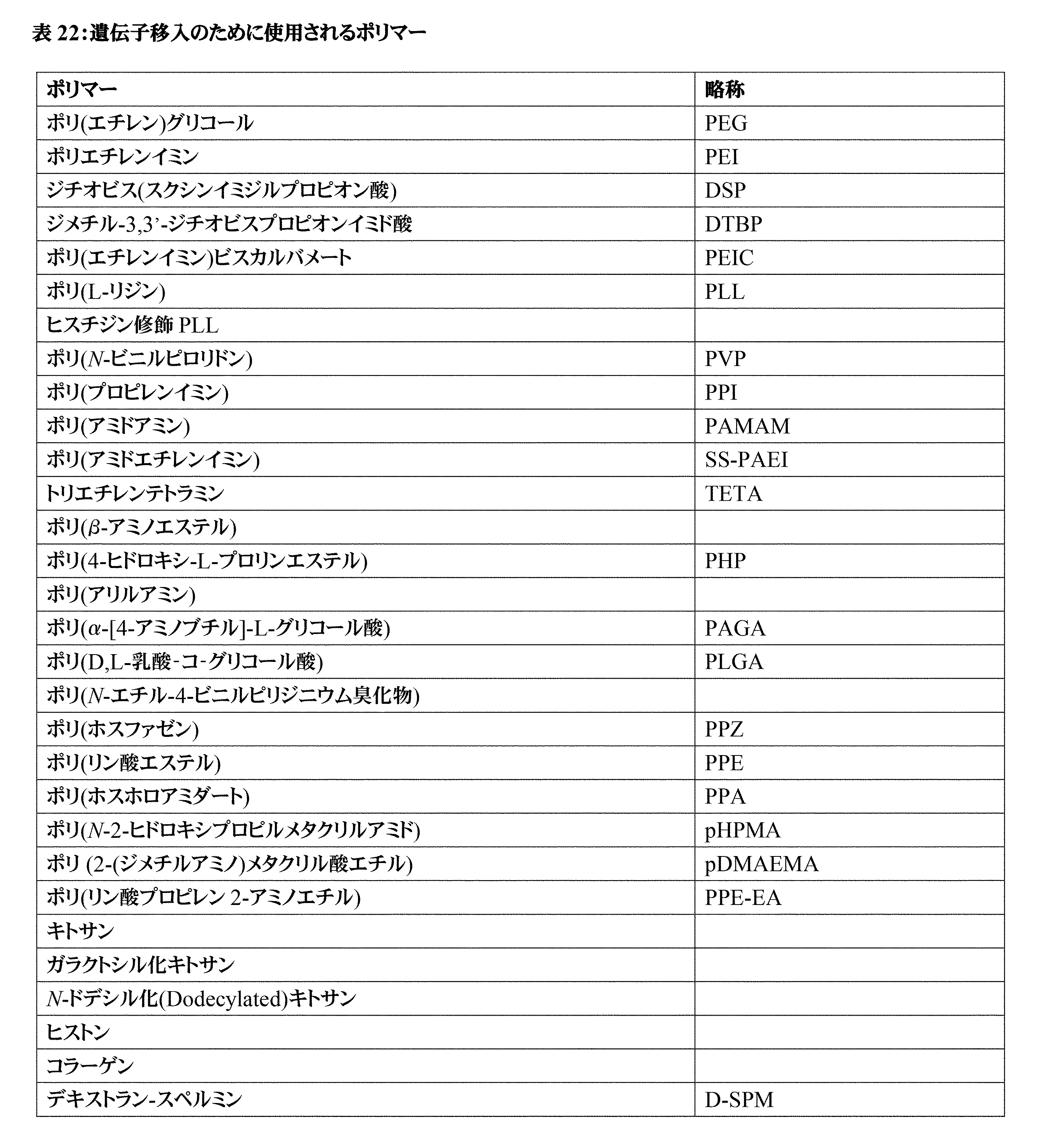
一実施形態では、ビヒクルは、標的化修飾を有して、例えば、細胞特異的抗原、モノクローナル抗体、一本鎖抗体、アプタマー、ポリマー、糖(N-アセチルガラクトースアミン(GalNac))、および細胞透過性ペプチドなどのナノ粒子およびリポソームの標的細胞アップデートが増大される。一実施形態では、ビヒクルは、融合性およびエンドソーム不安定化ペプチド/ポリマーを利用する。一実施形態では、ビヒクルは、酸誘発性立体構造変化を受ける(例えば、カーゴのエンドソーム漏出を加速するために)。一実施形態では、例えば、細胞区画内の放出のために、刺激切断可能ポリマーが使用される。例えば、還元性細胞環境内で切断されるジスルフィドベースのカチオン性ポリマーが、使用され得る。 In one embodiment, the vehicle has targeting modifications, such as cell-specific antigens, monoclonal antibodies, single chain antibodies, aptamers, polymers, sugars (N-acetylgalactoseamine (GalNac)), and cell-penetrating Targeted cell update of nanoparticles and liposomes such as sexual peptides is increased. In one embodiment, the vehicle utilizes fusogenic and endosome-destabilizing peptides/polymers. In one embodiment, the vehicle undergoes an acid-induced conformational change (eg, to accelerate endosomal leakage of cargo). In one embodiment, stimulated cleavable polymers are used, eg, for release within cellular compartments. For example, disulfide-based cationic polymers that are cleaved within a reducing cellular environment can be used.
一実施形態では、送達ビヒクルは、生物学的非ウイルス送達ビヒクルである。一実施形態では、ビヒクルは、弱毒型細菌(例えば、侵入性であるが弱毒化されて発病を予防して導入遺伝子を発現するように、天然にまたは人工的に改変されている(例えば、リステリア・モノサイトゲネス(Listeria monocytogenes)、特定のサルモネラ属(Salmonella)株、ビフィドバクテリウム・ロングム(Bifidobacterium longum)、および改変大腸菌(Escherichiacoli);栄養および組織特異的親和性を有して特定組織を標的化する細菌;修飾表面タンパク質を有して標的組織特異性を改変する細菌)である。一実施形態では、ビヒクルは、遺伝子修飾されたバクテリオファージである(例えば、改変ファージは、大きなパッケージング容量を有し、免疫原性がより低く、哺乳類プラスミド維持配列を含有して、組み込まれた標的化リガンドを有する)。一実施形態では、ビヒクルは、哺乳類ウイルス様粒子である。例えば、修飾ウイルス粒子が生成され得る(例えば、「空の」粒子精製と、それに続く、所望のカーゴがあるウイルスの生体外構築によって)。ビヒクルはまた改変されて、標的化リガンドが組み込まれ、標的組織特異性が改変され得る。一実施形態では、ビヒクルは、生物学的リポソームである。例えば、生物学的リポソームは、ヒト細胞(例えば、対象に由来する球状構造に分解された赤血球である赤血球ゴーストに由来するリン脂質ベースの粒子(例えば、組織標的化が、様々な組織または細胞特異的リガンドの付着によって達成され得る);またはエンドサイトーシス起源の分泌型エキソソーム-対象(すなわち、患者)由来膜結合ナノ小胞(30~100nm)(例えば、様々な細胞型から生成され得て、したがってリガンド標的化の必要なしに細胞に取り込まれ得る)である。 In one embodiment, the delivery vehicle is a biological, non-viral delivery vehicle. In one embodiment, the vehicle is an attenuated form of a bacterium (e.g., invasive but attenuated to prevent disease onset) that has been naturally or artificially modified to express the transgene (e.g., Listeria Listeria monocytogenes, certain Salmonella strains, Bifidobacterium longum, and modified Escherichia coli; The Targeting bacteria; bacteria that have modified surface proteins to alter target tissue specificity. In one embodiment, the vehicle is a genetically modified bacteriophage (e.g., the modified phage has a large packaging In one embodiment, the vehicle is a mammalian virus-like particle, e.g., a modified virus. Particles can be produced (e.g., by "empty" particle purification followed by in vitro construction of viruses with the desired cargo). Vehicles can also be modified to incorporate targeting ligands and target tissue specificity. In one embodiment, the vehicle is a biological liposome. For example, the biological liposome is derived from red blood cell ghosts, which are red blood cells broken down into spherical structures derived from human cells (e.g., a subject). phospholipid-based particles (e.g., tissue targeting can be achieved by attachment of various tissue- or cell-specific ligands); or secreted exosomes of endocytic origin - subject (i.e., patient)-derived membrane-bound nanoparticles; Vesicles (30-100 nm), which, for example, can be produced from a variety of cell types and thus taken up by cells without the need for ligand targeting.
一実施形態では、例えば、本明細書に記載されるCas9分子構成要素および/またはgRNA分子構成要素などの、Casシステムの構成要素以外の1つまたは複数の核酸分子(例えば、DNA分子)が送達される。一実施形態では、核酸分子は、Casシステムの構成要素の1つまたは複数と同時に、送達される。一実施形態では、核酸分子は、Casシステムの構成要素の1つまたは複数が送達される(例えば、約30分間、1時間、2時間、3時間、6時間、9時間、12時間、1日、2日間、3日間、1週間、2週間、または4週間未満)前または後に送達される。一実施形態では、核酸分子は、例えば、Cas9分子構成要素および/またはgRNA分子構成要素などのCasシステムの構成要素の1つまたは複数とは、異なる手段によって送達される。核酸分子は、本明細書に記載される送達方法のいずれかによって送達することができる。例えば、核酸分子は、例えば、組み込み欠陥レンチウイルスなどのウイルスベクターによって送達することができ、Cas9分子構成要素および/またはgRNA分子構成要素は、例えば、核酸(例えば、DNA)によって引き起こされる毒性を低減することができるように、電気穿孔によって送達することができる。一実施形態では、核酸分子は、例えば、本明細書に記載されるタンパク質などの治療タンパク質をコードする。一実施形態では、核酸分子は、本明細書RNA分子などのRNA分子をコードする。 In one embodiment, one or more nucleic acid molecules (e.g., DNA molecules) other than components of the Cas system, such as, for example, the Cas9 molecular components and/or gRNA molecular components described herein, are delivered. be done. In one embodiment, the nucleic acid molecule is delivered simultaneously with one or more of the components of the Cas system. In one embodiment, the nucleic acid molecule is delivered during one or more of the components of the Cas system (e.g., about 30 minutes, 1 hour, 2 hours, 3 hours, 6 hours, 9 hours, 12 hours, 1 day). , 2 days, 3 days, 1 week, 2 weeks, or less than 4 weeks) before or after. In one embodiment, the nucleic acid molecule is delivered by a different means than one or more of the components of the Cas system, such as, for example, the Cas9 molecule component and/or the gRNA molecule component. Nucleic acid molecules can be delivered by any of the delivery methods described herein. For example, the nucleic acid molecule can be delivered by a viral vector, e.g., an integration-defective lentivirus, and the Cas9 and/or gRNA molecular components reduce toxicity caused by, e.g., the nucleic acid (e.g., DNA). can be delivered by electroporation. In one embodiment, the nucleic acid molecule encodes a therapeutic protein, eg, a protein described herein. In one embodiment, the nucleic acid molecule encodes an RNA molecule, such as herein RNA molecules.
Cas9分子をコードするRNAの送達
Cas9分子(例えば、eaCas9分子またはeiCas9分子)をコードするRNAおよび/またはgRNA分子は、当該技術分野で周知の方法によって、または本明細書に記載される通りに、例えば、本明細書に記載される標的細胞などの細胞内に送達することができる。例えば、Cas9をコードするおよび/またはgRNAをコードするRNAは、例えば、マイクロインジェクション、電気穿孔、一過性細胞圧縮または圧搾(例えば、Lee,et al.,2012,Nano Lett 12:6322-27に記載される通り)、脂質媒介形質移入、ペプチド媒介送達、またはそれらの組み合わせによって送達され得る。Cas9をコードするおよび/またはgRNAをコードするRNAは、標的細胞(例えば、本明細書に記載される標的細胞)による取り込みを促進する分子)と共役させることができる。
Delivery of RNA Encoding Cas9 Molecules RNA and/or gRNA molecules encoding Cas9 molecules (e.g., eaCas9 molecules or eiCas9 molecules) can be delivered by methods well known in the art or as described herein. For example, it can be delivered intracellularly, such as the target cells described herein. For example, RNA encoding Cas9 and/or gRNA can be isolated by, for example, microinjection, electroporation, transient cell compaction or squeezing (e.g., Lee, et al., 2012, Nano Lett 12:6322-27). (as described), lipid-mediated transfection, peptide-mediated delivery, or a combination thereof. The RNA encoding Cas9 and/or gRNA can be conjugated to a molecule that facilitates uptake by a target cell (eg, a target cell described herein).
一実施形態では、電気穿孔を通じた送達は、カートリッジ、チャンバーまたはキュベット内で、ドナーテンプレート核酸分子と一緒に、もしくはそれなしで、細胞をCas9分子(例えば、eaCas9分子、eiCas9分子またはeiCas9融合物タンパク質)および/またはgRNA分子をコードするRNAと混合し、規定の時間および振幅で1回または複数回の電気インパルスを適用するステップを含んでなる。一実施形態では、電気穿孔を通じた送達は、カートリッジ、チャンバーまたはキュベットに混合物を供給する装置(例えばポンプ)と連結させた容器内で、ドナーテンプレート核酸分子と一緒に、もしくはそれなしで、細胞がCas9分子(例えば、eaCas9分子、eiCas9分子またはeiCas9融合物タンパク質)および/またはgRNA分子をコードするRNAと混合され、カートリッジ、チャンバーまたはキュベット内では、規定の時間および振幅で1回または複数回の電気インパルスが適用され、その後、細胞が第2の容器に送達される、システムを使用して実施される。Cas9をコードするRNAおよび/またはgRNAをコードするRNAは、標的細胞(例えば、本明細書に記載される標的細胞)による取り込みを促進する分子と共役させることができる。 In one embodiment, delivery through electroporation is to deliver cells with Cas9 molecules (e.g., eaCas9 molecules, eiCas9 molecules or eiCas9 fusion proteins) with or without donor template nucleic acid molecules in a cartridge, chamber or cuvette. ) and/or gRNA molecules with the encoding RNA and applying one or more electrical impulses at a defined time and amplitude. In one embodiment, delivery through electroporation involves the delivery of cells with or without donor template nucleic acid molecules in a container coupled to a device (e.g., a pump) that supplies the mixture to a cartridge, chamber, or cuvette. RNA encoding Cas9 molecules (e.g., eaCas9 molecules, eiCas9 molecules or eiCas9 fusion proteins) and/or gRNA molecules are mixed in a cartridge, chamber or cuvette and subjected to one or more rounds of electricity at a defined time and amplitude. It is carried out using a system in which an impulse is applied and the cells are then delivered to a second container. RNA encoding Cas9 and/or RNA encoding gRNA can be conjugated to molecules that facilitate uptake by target cells (eg, target cells described herein).
Cas9分子タンパク質の送達
Cas9分子(例えば、eaCas9分子またはeiCas9分子)は、当該技術分野で周知の方法によって、または本明細書に記載される通りに、細胞内に送達することができる。例えば、Cas9タンパク質分子は、例えば、マイクロインジェクション、電気穿孔、一過性細胞圧縮または圧搾(例えば、Lee,et al.2012;Nano Lett 12:6322-27に記載される通り)、脂質媒介形質移入、ペプチド媒介送達、またはそれらの組み合わせによって送達することができる。送達は、gRNAをコードするDNA、またはgRNAを伴い得る。Cas9タンパク質は、標的細胞(例えば、本明細書に記載される標的細胞)による取り込みを促進する分子と共役させることができる。
Delivery of Cas9 Molecule Proteins Cas9 molecules (eg, eaCas9 molecules or eiCas9 molecules) can be delivered into cells by methods well known in the art or as described herein. For example, Cas9 protein molecules can be produced by, for example, microinjection, electroporation, transient cell compaction or squeezing (e.g., as described in Lee, et al. 2012; Nano Lett 12:6322-27), lipid-mediated transfection. , peptide-mediated delivery, or a combination thereof. Delivery can involve DNA encoding gRNA, or gRNA. Cas9 proteins can be conjugated to molecules that facilitate uptake by target cells (eg, target cells described herein).
一実施形態では、電気穿孔を通じた送達は、カートリッジ、チャンバーまたはキュベット内で、ドナー核酸と一緒に、もしくはそれなしで、細胞をCas9分子(例えば、eaCas9分子、eiCas9分子またはeiCas9融合物タンパク質)および/またはgRNA分子と混合し、規定の時間および振幅で1回または複数回の電気インパルスを適用するステップを含んでなる。一実施形態では、電気穿孔を通じた送達は、カートリッジ、チャンバーまたはキュベットに混合物を供給する装置(例えば、ポンプ)と連結させた容器内で、ドナー核酸と一緒に、もしくはそれなしで、細胞がCas9分子(例えば、eaCas9分子、eiCas9分子またはeiCas9融合物タンパク質)および/またはgRNA分子と混合され、カートリッジ、チャンバーまたはキュベット内では、規定の時間および振幅で1回または複数回の電気インパルスが適用され、その後、細胞が第2の容器に送達される、システムを使用して実施される。Cas9をコードするRNAおよび/またはgRNAをコードするRNAは、標的細胞(例えば、本明細書に記載される標的細胞)による取り込みを促進する分子と共役させることができる。 In one embodiment, delivery through electroporation is to deliver cells with or without donor nucleic acids into Cas9 molecules (e.g., eaCas9 molecules, eiCas9 molecules or eiCas9 fusion proteins) and cells in a cartridge, chamber or cuvette. and/or mixing with gRNA molecules and applying one or more electrical impulses at defined times and amplitudes. In one embodiment, delivery through electroporation involves the delivery of cells with or without donor nucleic acid to Cas9 in a container coupled to a device (e.g., pump) that supplies the mixture to a cartridge, chamber, or cuvette. molecules (e.g., eaCas9 molecules, eiCas9 molecules or eiCas9 fusion proteins) and/or gRNA molecules, and in a cartridge, chamber or cuvette, one or more electrical impulses are applied at a defined time and amplitude; The system is then used to deliver the cells to a second container. RNA encoding Cas9 and/or RNA encoding gRNA can be conjugated to molecules that facilitate uptake by target cells (eg, target cells described herein).
Cas9タンパク質をgRNA分子と組み合わせて、当該技術分野で公知の方法により、もしくは本明細書に記載のように、対象に投与されるか、または細胞に送達されるリボ核タンパク質(RNP)複合体を形成することができる。Cas9/gRNA RNP複合体を細胞に直接送達すれば、核酸からの発現(例えば、Cas9およびgRNAをコードするプラスミドの形質移入)の必要がなくなる。これはまた、核酸送達から生じるDNAセグメントの不要な組み込み(例えば、Cas9およびgRNAをコードするプラスミドの形質移入)も排除した。従って、これは、迅速な作用、高速ターンオーバー、高いオンターゲット修飾率、低いオフターゲット効果および細胞に対する低い毒性を提供する代替送達アプローチである。これは、細胞を形質移入するのが難しい(例えば、一次および多能性幹細胞を形質移入するのが難しい)Cas9/gRNA複合体を送達するために使用することもできる。Cas9/gRNAリボ核タンパク質(RNP)複合体は、通常、投与前に形成される(すなわち、事前に形成される)。複数の(例えば、2つ以上の)Cas9/gRNAリボ核タンパク質(RNP)複合体が必要とされる場合、これらは、同時または順次送達(例えば、投与)することができる。一実施形態では、Cas9/gRNAリボ核タンパク質(RNP)複合体は、電気穿孔によって細胞に送達される。 The Cas9 protein is combined with a gRNA molecule to form a ribonucleoprotein (RNP) complex that is administered to a subject or delivered to a cell by methods known in the art or as described herein. can be formed. Direct delivery of Cas9/gRNA RNP complexes to cells obviates the need for expression from nucleic acids (eg, transfection of plasmids encoding Cas9 and gRNA). This also eliminated unnecessary integration of DNA segments resulting from nucleic acid delivery (eg, transfection of plasmids encoding Cas9 and gRNA). Therefore, this is an alternative delivery approach that offers rapid action, fast turnover, high on-target modification rates, low off-target effects and low toxicity to cells. It can also be used to deliver Cas9/gRNA complexes that are difficult to transfect cells (eg, difficult to transfect primary and pluripotent stem cells). The Cas9/gRNA ribonucleoprotein (RNP) complex is typically formed prior to administration (ie, preformed). If multiple (eg, two or more) Cas9/gRNA ribonucleoprotein (RNP) complexes are required, they can be delivered (eg, administered) simultaneously or sequentially. In one embodiment, Cas9/gRNA ribonucleoprotein (RNP) complexes are delivered to cells by electroporation.
投与経路
全身投与方法としては、経口および非経口経路が挙げられる。非経口経路として、例えば、静脈内、動脈内、筋肉内、皮内、皮下、鼻内、および腹腔内経路が挙げられる。全身投与される構成要素は、肝細胞、肝臓オーバル細胞、マクロファージまたは単球を標的化するように、修飾または製剤化することもできる。
Routes of Administration Methods of systemic administration include oral and parenteral routes. Parenteral routes include, for example, intravenous, intraarterial, intramuscular, intradermal, subcutaneous, intranasal, and intraperitoneal routes. Systemically administered components can also be modified or formulated to target hepatocytes, liver oval cells, macrophages or monocytes.
局所投与方法として、例えば、肝臓への実質内送達、肝臓内動脈注入および門脈への注入が挙げられる。一実施形態では、極めて少量の構成要素(全身アプローチと比較して)は、全身(例えば、静脈内)に投与する場合と比較して、局所(例えば、肝実質中に直接)投与すれば、効果を及ぼし得る。局所投与方法は、治療有効量の構成要素を全身投与する場合に起こり得る潜在的に毒性の副作用の発生を低減または排除することができる。 Local administration methods include, for example, intraparenchymal delivery to the liver, intrahepatic arterial injection, and portal vein injection. In one embodiment, a very small amount of the component (compared to a systemic approach) is administered locally (e.g., directly into the liver parenchyma) as compared to systemically (e.g., intravenously); can have an effect. Local administration methods can reduce or eliminate the occurrence of potentially toxic side effects that may occur when therapeutically effective amounts of the components are administered systemically.
投与は、定期的なボーラス(例えば、静脈内)として、または内部レザバーもしくは外部レザバー(例えば、静脈内バッグもしくは埋め込みポンプ)からの連続的注入として提供してもよい。構成要素は、例えば、肝臓に埋め込まれた徐放性薬物送達装置からの連続的放出によって局所投与してもよい。 Administration may be provided as periodic boluses (eg, intravenously) or as a continuous infusion from an internal or external reservoir (eg, an intravenous bag or implanted pump). The components may be administered locally, for example, by continuous release from a sustained release drug delivery device implanted in the liver.
さらに、構成要素は、長期間にわたる放出を可能にするように、製剤化してもよい。放出系は、生分解性材料、または組み込まれた構成要素を拡散によって放出する材料からなるマトリックスを含み得る。構成要素は、放出系内に均一または不均一に分布することができる。多様な放出系が有用であるが、適切な系の選択は、具体的な適用により要求される放出速度に応じて変わり得る。非分解性および分解性放出系の双方を用いることができる。好適な放出系として、ポリマーおよびポリマーマトリックス、非ポリマーマトリックス、または無機および有機賦形剤および希釈剤、例えば、限定はしないが、炭酸カルシウムおよび糖(例えば、トレハロース)などが挙げられる。放出系は、天然または合成のいずれであってもよい。しかしながら、一般的に、信頼性および再現性が高く、しかもより明確な放出プロフィールを生み出すことから、合成放出系が好ましい。放出系材料は、様々な分子量を有する構成要素が、上記材料を介した拡散、またはその分解により放出されるように選択することができる。 Additionally, the components may be formulated to allow release over an extended period of time. The release system may include a matrix of biodegradable materials or materials that release incorporated components by diffusion. The components can be uniformly or non-uniformly distributed within the delivery system. Although a variety of release systems are useful, the selection of the appropriate system may vary depending on the release rate required by the particular application. Both non-degradable and degradable release systems can be used. Suitable release systems include polymers and polymeric matrices, non-polymeric matrices, or inorganic and organic excipients and diluents such as, but not limited to, calcium carbonate and sugars (eg, trehalose). The release system can be either natural or synthetic. However, synthetic release systems are generally preferred as they are more reliable and reproducible and produce more defined release profiles. The release system material can be selected such that components with different molecular weights are released by diffusion through the material or by its decomposition.
代表的な合成生分解性ポリマーとして、例えば、以下のものが挙げられる:ポリ(アミノ酸)およびポリ(ペプチド)などのポリアミド;ポリ(乳酸)、ポリ(グリコール酸)、乳酸グリコール酸共重合体、およびポリ(カプロラクトン)などのポリエステル;ポリ(無水物);ポリオルトエステル;ポリカーボネート;ならびにこれらの化学誘導体(化学基、例えば、アルキル、アルキレンの置換、付加、ヒドロキシル化、酸化、および当業者により常用的に実施されるその他の修飾)、それらのコポリマーおよび混合物。代表的な合成非生分解性ポリマーとして、例えば、以下のものが挙げられる:ポリ(エチレンオキシド)、ポリ(エチレングリコール)、およびポリ(テトラメチレンオキシド)などのポリエーテル;メチル、エチル、その他のアリキル、ヒドロキシエチルメタクリレート、アクリル酸およびメタクリル酸などのビニルポリマー-ポリアクレートおよびポリメタクリレート、ならびにポリ(ビニルアルコール)、ポリ(ビニルピロリドン)、およびポリ(酢酸ビニル)などのその他;ポリ(ウレタン);アルキル、ヒドロキシアルキル、エーテル、エステル、ニトロセルロース、および様々な酢酸セルロースなどのセルロースおよびその誘導体;ポリシロキサン;ならびにこれらの任意の化学誘導体(化学基、例えば、アルキル、アルキレンの置換、付加、ヒドロキシル化、酸化、および当業者により常用的に実施されるその他の修飾)、それらのコポリマーおよび混合物。 Representative synthetic biodegradable polymers include, for example: polyamides such as poly(amino acids) and poly(peptides); poly(lactic acid), poly(glycolic acid), lactic acid-glycolic acid copolymers, and polyesters such as poly(caprolactone); poly(anhydrides); polyorthoesters; polycarbonates; other modifications carried out), copolymers and mixtures thereof. Representative synthetic non-biodegradable polymers include, for example: polyethers such as poly(ethylene oxide), poly(ethylene glycol), and poly(tetramethylene oxide); methyl, ethyl, and other alkyls. , vinyl polymers such as hydroxyethyl methacrylate, acrylic acid and methacrylic acid - polyacrylates and polymethacrylates, and others such as poly(vinyl alcohol), poly(vinylpyrrolidone), and poly(vinyl acetate); poly(urethane); alkyl cellulose and its derivatives, such as hydroxyalkyls, ethers, esters, nitrocellulose, and various cellulose acetates; polysiloxanes; and any chemical derivatives thereof (chemical groups such as alkyl, alkylene substitution, addition, hydroxylation, oxidation and other modifications routinely carried out by those skilled in the art), copolymers and mixtures thereof.
また、ポリ(ラクチド-コ-グリコリド)ミクロスフェアも使用することができる。典型的に、ミクロスフェアは、乳酸およびグリコール酸のポリマーからなり、中空のスフェアを形成するような構造をしている。スフェアは、直径が約15~30ミクロンであってよく、本明細書に記載される構成要素をロードすることができる。 Poly(lactide-co-glycolide) microspheres can also be used. Typically, microspheres are composed of polymers of lactic and glycolic acid and are structured to form hollow spheres. The spheres can be approximately 15-30 microns in diameter and can be loaded with components described herein.
構成要素の2モードまたは差次的送達
Casシステムの構成要素、例えば、Cas9分子構成要素およびgRNA分子構成要素の個別の送達、より具体的には、差次的モードによる構成要素の送達は、例えば、組織特異性および安全性を改善することによって、性能を高めることができる。
Bimodal or Differential Delivery of Components Separate delivery of the components of the Cas system, e.g., the Cas9 molecule component and the gRNA molecule component, more specifically delivery of the components by differential modes, e.g. , performance can be enhanced by improving tissue specificity and safety.
一実施形態では、Cas9分子およびgRNA分子は、異なるモード、または本明細書で差次的モードと呼ぶことがあるモードによって送達される。異なるまたは差次的モードは、本明細書の用法では、例えば、Cas9分子、gRNA分子、テンプレート核酸、またはペイロードなどの対象構成要素分子に、異なる薬力学または薬物動態特性を付与する送達モードを指す。例えば、これらの送達モードにより、例えば、選択したコンパートメント、組織、または臓器において、異なる組織分布、異なる半減期、または異なる時間的分布をもたらすことができる。 In one embodiment, the Cas9 molecule and the gRNA molecule are delivered by different modes, or sometimes referred to herein as differential modes. Different or differential modes, as used herein, refer to modes of delivery that impart different pharmacodynamic or pharmacokinetic properties to the component molecules of interest, such as, for example, a Cas9 molecule, a gRNA molecule, a template nucleic acid, or a payload. . For example, these modes of delivery can result in different tissue distributions, different half-lives, or different temporal distributions, eg, in selected compartments, tissues, or organs.
例えば、細胞、または細胞の子孫において持続する核酸ベクターによる送達、例えば自立複製または細胞核酸への挿入による送達など、いくつかの送達モードは、構成要素のより持続的発現および存在をもたらす。例として、例えば、アデノ関連ウイルスまたはレンチウイルスなどのウイルスによる送達がある。 Some modes of delivery result in more sustained expression and presence of the component, such as delivery by a nucleic acid vector that persists in the cell, or the progeny of the cell, eg, by autonomous replication or insertion into the cell's nucleic acid. Examples include delivery by viruses, such as adeno-associated viruses or lentiviruses.
例として、Cas9分子およびgRNA分子などの構成要素は、送達される構成要素の、身体、または特定のコンパートメント、組織もしくは臓器において達成される半減期または持続性に関して異なるモードによって送達することができる。Cas9分子構成要素は、身体、または特定のコンパートメントまたは組織もしくは臓器に対して、より低い持続性または曝露をもたらすモードによって送達することができる。 By way of example, components such as Cas9 molecules and gRNA molecules can be delivered by different modes with respect to the half-life or persistence achieved in the body, or particular compartment, tissue or organ of the delivered component. Cas9 molecular components can be delivered by modes that provide lower persistence or exposure to the body or to specific compartments or tissues or organs.
より一般的には、一実施形態では、第1の送達モードを用いて、第1の構成要素を送達し、第2の送達モードを用いて、第2の構成要素を送達する。第1の送達モードは、第1の薬力学的または薬物動態特性を付与する。第1の薬力学的特性は、例えば、身体、コンパートメント、組織もしくは臓器における、構成要素、または構成要素をコードする核酸の分布、持続性、または曝露であってよい。第2の送達モードは、第2の薬力学的または薬物動態特性を付与する。第2の薬力学的特性は、例えば、身体、コンパートメント、組織もしくは臓器における、構成要素、または構成要素をコードする核酸の分布、持続性、または曝露であってよい。 More generally, in one embodiment, a first delivery mode is used to deliver the first component and a second delivery mode is used to deliver the second component. The first mode of delivery imparts a first pharmacodynamic or pharmacokinetic property. The first pharmacodynamic property may be, for example, the distribution, persistence, or exposure of the component, or the nucleic acid encoding the component, in the body, compartment, tissue, or organ. The second mode of delivery imparts a second pharmacodynamic or pharmacokinetic property. The second pharmacodynamic property may be, for example, the distribution, persistence, or exposure of the component, or a nucleic acid encoding the component, in the body, compartment, tissue, or organ.
一実施形態では、例えば、分布、持続性、または曝露などの第1の薬力学的または薬物動態特性は、第2の薬力学的または薬物動態特性より限定されている。 In one embodiment, a first pharmacodynamic or pharmacokinetic property, such as distribution, persistence, or exposure, is more limited than a second pharmacodynamic or pharmacokinetic property.
一実施形態では、第1の送達モードは、例えば、分布、持続性、または曝露などの薬力学的または薬物動態特性を例えば、最小にするなど、最適化するように選択される。 In one embodiment, the first mode of delivery is selected to optimize, eg, minimize, pharmacodynamic or pharmacokinetic properties such as, eg, distribution, persistence, or exposure.
一実施形態では、第2の送達モードは、例えば、分布、持続性、または曝露などの薬力学的または薬物動態特性を例えば、最大にするなど、最適化するように、選択される。 In one embodiment, the second mode of delivery is selected to optimize, eg, maximize, pharmacodynamic or pharmacokinetic properties such as, eg, distribution, persistence, or exposure.
一実施形態では、第1の送達モードは、例えば、核酸、例えば、プラスミドもしくはウイルスベクター、例えば、AAVもしくはレンチウイルスなどの比較的持続的な要素の使用を含む。このようなベクターは比較的持続的であるため、それらから転写された産物も比較的持続的となる。 In one embodiment, the first mode of delivery involves the use of relatively persistent elements, such as nucleic acids, eg, plasmids or viral vectors, eg, AAV or lentiviruses. Since such vectors are relatively persistent, the products transcribed from them are also relatively persistent.
一実施形態では、第2の送達モードは、比較的一過性の要素、例えば、RNA分子またはタンパク質を含む。 In one embodiment, the second mode of delivery includes a relatively transient element, such as an RNA molecule or protein.
一実施形態では、第1の構成要素は、gRNAを含み、送達モードは、比較的持続的であり、例えば、gRNA分子は、プラスミドまたはウイルスベクター、例えば、AAVもしくはレンチウイルスから転写される。これらの遺伝子は、タンパク質産物をコードせず、gRNAは、単独で作用することができないため、これらの遺伝子の転写には生理学的結果がほとんどない。第2の構成要素であるCas9分子は、例えば、mRNAまたはタンパク質として、一過性様式で送達され、完全なCas9分子/gRNA分子複合体は、短い期間だけ存在し、活性である。 In one embodiment, the first component comprises gRNA and the mode of delivery is relatively sustained, eg, the gRNA molecule is transcribed from a plasmid or a viral vector, eg, AAV or lentivirus. Transcription of these genes has few physiological consequences because these genes do not encode protein products and gRNAs cannot act alone. The second component, the Cas9 molecule, is delivered in a transient manner, for example as mRNA or protein, and the complete Cas9 molecule/gRNA molecule complex is only present and active for a short period of time.
さらに、構成要素は、互いに補完して、安全性および組織特異性を高める異なる分子形態で、または異なる送達ベクターを用いて送達することができる。 Additionally, the components can be delivered in different molecular forms or using different delivery vectors to complement each other and increase safety and tissue specificity.
差次的送達モードの使用によって、性能、安全性および効率を高めることができ、例えば、最終的なオフターゲット修飾の可能性を低減することができる。細菌由来のCas酵素からのペプチドは、MHC分子による細胞の表面に展示されるため、低持続性モードによる、例えばCas9分子などの免疫原性構成要素の送達は免疫原性を低減し得る。二部送達システムは、これらの問題を軽減し得る。 The use of differential delivery modes can enhance performance, safety and efficiency, and can, for example, reduce the likelihood of eventual off-target modification. Since peptides from bacterially derived Cas enzymes are displayed on the surface of cells by MHC molecules, delivery of immunogenic components, such as, for example, Cas9 molecules, by a low persistence mode may reduce immunogenicity. A two-part delivery system may alleviate these problems.
差次的送達モードを用いて、異なっているが、オーバーラップする標的領域に構成要素を送達することができる。活性複合体の形成は、標的領域のオーバーラップの外側で最小にされる。従って、一実施形態では、例えば、gRNA分子などの第1の構成要素は、第1の空間的(例えば、組織など)分布をもたらす第1の送達モードによって送達される。例えば、Cas9分子などの第2の構成要素は、第2の空間的(例えば、組織など)分布をもたらす第2の送達モードによって送達される。一実施形態では、第1のモードは、リポソーム、例えばポリマーナノ粒子などのナノ粒子、および例えばウイルスベクターなどの核酸から選択される第1の要素を含む。第2のモードは、上記の群から選択される第2の要素を含む。一実施形態では、第1の送達モードは、例えば、細胞特異的受容体もしくは抗体などの第1の標的化要素を含み、第2の送達モードは、その要素を含まない。実施形態では、第2の送達モードは、例えば、第2の細胞特異的受容体もしくは第2の抗体などの第2の標的化要素を含む。 Differential delivery modes can be used to deliver components to different but overlapping target areas. Formation of active complexes is minimized outside the overlap of the target regions. Thus, in one embodiment, a first component, eg, a gRNA molecule, is delivered by a first mode of delivery that provides a first spatial (eg, tissue, etc.) distribution. For example, a second component, such as a Cas9 molecule, is delivered by a second delivery mode that provides a second spatial (eg, tissue, etc.) distribution. In one embodiment, the first mode comprises a first element selected from liposomes, nanoparticles such as polymeric nanoparticles, and nucleic acids such as viral vectors. The second mode includes a second element selected from the above group. In one embodiment, the first mode of delivery includes a first targeting element, such as a cell-specific receptor or antibody, and the second mode of delivery does not include that element. In embodiments, the second mode of delivery includes a second targeting element, such as, for example, a second cell-specific receptor or a second antibody.
Cas9分子をウイルス送達ベクター、リポソーム、またはポリマーナノ粒子で送達する場合、単一の組織を標的化することだけが望ましいと考えられるとき、複数の組織への送達および複数の組織での治療活性の可能性がある。二部送達系は、この課題を解決し、組織特異性を高めることができる。異なっているが、オーバーラップする組織屈性を有する別々の送達ビヒクル中にgRNA分子とCas9分子をパッケージする場合、双方のベクターによって標的化された組織には、完全に機能性の複合体だけが形成される。 When Cas9 molecules are delivered in viral delivery vectors, liposomes, or polymeric nanoparticles, targeting only a single tissue is considered desirable, while delivery to multiple tissues and therapeutic activity in multiple tissues is possible. there is a possibility. A two-part delivery system can overcome this problem and increase tissue specificity. When packaging gRNA and Cas9 molecules in separate delivery vehicles with different but overlapping tissue tropisms, only fully functional complexes are delivered to the tissues targeted by both vectors. It is formed.
生体外送達
いくつかの実施形態では、表19に記載される構成要素を細胞に導入した後、これらの細胞を対象に導入する。構成要素を導入する方法は、表20に記載される送達方法のいずれかを含み得る。
Ex Vivo Delivery In some embodiments, the components listed in Table 19 are introduced into cells before the cells are introduced into the subject. The method of introducing the component can include any of the delivery methods listed in Table 20.
VIII.修飾ヌクレオシド、ヌクレオチド、および核酸
修飾ヌクレオシドおよび修飾ヌクレオチドは、例えば、特にgRNAなどの核酸中に存在し得るが、例えば、mRNA、RNAi、またはsiRNAなどのその他の形態のRNAにもまた存在し得る。本明細書に記載される「ヌクレオシド」は、5つの炭素砂糖分子(ペントースまたはリボース)またはその誘導体と、1つの有機塩基、プリンまたはピリミジン、またはその誘導体とを含有する化合物と定義される。本明細書に記載される「ヌクレオチド」は、リン酸基をさらに含むヌクレオシドと定義される。
VIII. Modified Nucleosides, Nucleotides, and Nucleic Acids Modified nucleosides and nucleotides may be present, for example, in nucleic acids, particularly gRNA, but also in other forms of RNA, such as, for example, mRNA, RNAi, or siRNA. A "nucleoside" as described herein is defined as a compound containing a five carbon sugar molecule (pentose or ribose) or a derivative thereof and one organic base, a purine or pyrimidine, or a derivative thereof. A "nucleotide" as described herein is defined as a nucleoside that further includes a phosphate group.
修飾ヌクレオシドおよびヌクレオチドは、以下の1つまたは複数を含み得る:
(i)例えば、リン酸ジエステル骨格結合中の非結合リン酸酸素の片方または双方および/または結合リン酸酸素の1つまたは複数の置換などの改変;
(ii)例えば、リボース糖上の2’ヒドロキシルなどのリボース糖の構成要素の置換などの改変;
(iii)リン酸部分の「デホスホ」リンカーによる徹底的な置換;
(iv)天然起源核酸塩基の修飾または置換;
(v)リボースリン酸骨格の置換または修飾;
(vi)例えば、末端リン酸基の除去、修飾または置換または部分のコンジュゲーションなどのオリゴヌクレオチドの3’末端または5’末端の修飾;および
(vii)糖の修飾。
Modified nucleosides and nucleotides may include one or more of the following:
(i) modifications such as, for example, substitution of one or both of the unbound phosphate oxygens and/or one or more of the bound phosphate oxygens in the phosphodiester backbone linkages;
(ii) modifications such as substitution of constituents of the ribose sugar, such as the 2' hydroxyl on the ribose sugar;
(iii) exhaustive replacement of the phosphate moiety by a “dephospho” linker;
(iv) modification or substitution of naturally occurring nucleobases;
(v) substitution or modification of the ribose phosphate backbone;
(vi) modification of the 3' or 5' end of the oligonucleotide, such as, for example, removal of the terminal phosphate group, modification or substitution or conjugation of moieties; and (vii) modification of the sugar.
上に列挙される修飾を混合して、2、3、4つ以上の修飾を有し得る、修飾ヌクレオシドおよびヌクレオチドが提供され得る。例えば、修飾ヌクレオシドまたはヌクレオチドは、修飾糖および修飾核酸塩基を有し得る。一実施形態では、gRNAの各塩基は修飾され、例えば、全ての塩基が、例えば、全てホスホロチオエート基であるなど、修飾リン酸基を有する。一実施形態では、単分子またはモジュラーgRNA分子の全ての、または実質的に全てのリン酸基は、ホスホロチオエート基で置換される。 The modifications listed above can be mixed to provide modified nucleosides and nucleotides that can have two, three, four or more modifications. For example, a modified nucleoside or nucleotide can have a modified sugar and a modified nucleobase. In one embodiment, each base of the gRNA is modified, eg, all bases have a modified phosphate group, eg, all phosphorothioate groups. In one embodiment, all or substantially all phosphate groups of the unimolecular or modular gRNA molecule are replaced with phosphorothioate groups.
一実施形態では、例えば、本明細書に記載されるような修飾を有するヌクレオチドなどの修飾ヌクレオチドが、例えば、「修飾核酸」などの核酸に組み込まれ得る。一実施形態では、修飾核酸は、1、2、3つ以上の修飾ヌクレオチドを含む。一実施形態では、修飾核酸内の位置の少なくとも5%(例えば、少なくとも約5%、少なくとも約10%、少なくとも約15%、少なくとも約20%、少なくとも約25%、少なくとも約30%、少なくとも約35%、少なくとも約40%、少なくとも約45%、少なくとも約50%、少なくとも約55%、少なくとも約60%、少なくとも約65%、少なくとも約70%、少なくとも約75%、少なくとも約80%、少なくとも約85%、少なくとも約90%、少なくとも約95%、または約100%)は、修飾ヌクレオチドである。 In one embodiment, modified nucleotides, eg, nucleotides with modifications as described herein, can be incorporated into a nucleic acid, eg, a "modified nucleic acid." In one embodiment, the modified nucleic acid comprises one, two, three or more modified nucleotides. In one embodiment, at least 5% (e.g., at least about 5%, at least about 10%, at least about 15%, at least about 20%, at least about 25%, at least about 30%, at least about 35% of the positions within the modified nucleic acid) %, at least about 40%, at least about 45%, at least about 50%, at least about 55%, at least about 60%, at least about 65%, at least about 70%, at least about 75%, at least about 80%, at least about 85% %, at least about 90%, at least about 95%, or about 100%) are modified nucleotides.
未修飾核酸は、例えば、細胞ヌクレアーゼによって分解され易くあり得る。例えば、ヌクレアーゼは、核酸リン酸ジエステル結合を加水分解し得る。したがって、一態様では、本明細書に記載される修飾核酸は、1つまたは複数の修飾ヌクレオシドまたはヌクレオチドを含有し得て、例えば、ヌクレアーゼに安定性が導入される。 Unmodified nucleic acids can be susceptible to degradation by, for example, cellular nucleases. For example, a nuclease can hydrolyze nucleic acid phosphodiester bonds. Thus, in one aspect, the modified nucleic acids described herein may contain one or more modified nucleosides or nucleotides, eg, to introduce nuclease stability.
一実施形態では、本明細書に記載される修飾ヌクレオシド、修飾ヌクレオチド、および修飾核酸は、生体内および生体外双方の細胞集団内に導入されると、先天性免疫応答の低下を示し得る。「先天性免疫応答」という用語は、一般にウイルス性または細菌起源である、一本鎖核酸をはじめとする外来性核酸に対する細胞性応答を含み、それは、具体的にはインターフェロンであるサイトカインの発現と放出の誘導、および細胞死を内包する。一実施形態では、本明細書に記載される修飾ヌクレオシド、修飾ヌクレオチド、および修飾核酸は、主溝相互作用パートナーの核酸との結合を妨害し得る。一実施形態では、本明細書に記載される修飾ヌクレオシド、修飾ヌクレオチド、および修飾核酸は、生体内および生体外双方の細胞集団内に導入されると、先天性免疫応答の低下を示して、そしてまた主溝相互作用パートナーの核酸との結合も妨害し得る。 In one embodiment, the modified nucleosides, modified nucleotides, and modified nucleic acids described herein can exhibit reduced innate immune responses when introduced into cell populations both in vivo and in vitro. The term "innate immune response" includes the cellular response to foreign nucleic acids, including single-stranded nucleic acids, generally of viral or bacterial origin, and which includes the expression of cytokines, specifically interferons. Involves induction of release and cell death. In one embodiment, modified nucleosides, modified nucleotides, and modified nucleic acids described herein can interfere with binding of a major groove interacting partner to a nucleic acid. In one embodiment, the modified nucleosides, modified nucleotides, and modified nucleic acids described herein exhibit a reduction in innate immune responses when introduced into cell populations both in vivo and in vitro, and It may also interfere with the binding of major groove interacting partners to nucleic acids.
化学基の定義
本明細書の用法では、「アルキル」は、直鎖または分枝鎖の飽和炭化水素基を指すことが意図される。アルキル基の例としては、メチル(Me)、エチル(Et)、プロピル(例えば、n-プロピルおよびイソプロピル)、ブチル(例えば、n-ブチル、イソブチル、t-ブチル)、ペンチル(例えば、n-ペンチル、イソペンチル、ネオペンチル)などが挙げられる。アルキル基は、1~約20個、2~約20個、1~約12個、1~約8個、1~約6個、1~約4個、または1~約3個の炭素原子を含有し得る。
Chemical Group Definitions As used herein, "alkyl" is intended to refer to a straight or branched chain saturated hydrocarbon group. Examples of alkyl groups include methyl (Me), ethyl (Et), propyl (e.g. n-propyl and isopropyl), butyl (e.g. n-butyl, isobutyl, t-butyl), pentyl (e.g. n-pentyl , isopentyl, neopentyl), etc. Alkyl groups have 1 to about 20, 2 to about 20, 1 to about 12, 1 to about 8, 1 to about 6, 1 to about 4, or 1 to about 3 carbon atoms. May contain.
本明細書の用法では、「アリール」は、例えば、フェニル、ナフチル、アントラセニル、フェナントレニル、インダニル、インデニルなどの単環または多環(例えば、2、3または4つの融合環を有する)芳香族炭化水素を指す。一実施形態では、アリール基は、6~約20個の炭素原子を有する。 As used herein, "aryl" refers to a monocyclic or polycyclic (e.g., having 2, 3 or 4 fused rings) aromatic hydrocarbon, such as, for example, phenyl, naphthyl, anthracenyl, phenanthrenyl, indanyl, indenyl. refers to In one embodiment, an aryl group has 6 to about 20 carbon atoms.
本明細書の用法では、「アルケニル」は、少なくとも1つの二重結合を含有する脂肪族基を指す。 As used herein, "alkenyl" refers to an aliphatic group containing at least one double bond.
本明細書の用法では、「アルキニル」は、2~12個の炭素原子を含有し、1つまたは複数の三重結合を有することで特徴付けられる、直鎖または分枝炭化水素鎖を指す。アルキニル基の例としては、エチニル、プロパルギル、および3-ヘキシニルが挙げられるが、これに限定されるものではない。 As used herein, "alkynyl" refers to a straight or branched hydrocarbon chain containing 2 to 12 carbon atoms and characterized by having one or more triple bonds. Examples of alkynyl groups include, but are not limited to, ethynyl, propargyl, and 3-hexynyl.
本明細書の用法では、「アリールアルキル」または「アラルキル」は、アルキル水素原子がアリール基で置換された、アルキル部分を指す。アラルキルは、2つ以上の水素原子がアリール基で置換されている基を含む。「アリールアルキル」または「アラルキル」の例としては、ベンジル、2-フェニルエチル、3-フェニルプロピル、9-フルオレニル、ベンズヒドリル、およびトリチル基が挙げられる。 As used herein, "arylalkyl" or "aralkyl" refers to an alkyl moiety in which an alkyl hydrogen atom is replaced with an aryl group. Aralkyl includes groups in which two or more hydrogen atoms are replaced with aryl groups. Examples of "arylalkyl" or "aralkyl" include benzyl, 2-phenylethyl, 3-phenylpropyl, 9-fluorenyl, benzhydryl, and trityl groups.
本明細書の用法では、「シクロアルキル」は、3~12個の炭素を有する環式、二環式、三環式、または多環式非芳香族炭化水素基を指す。シクロアルキル部分の例としては、シクロプロピル、シクロペンチル、およびシクロヘキシルが挙げられるが、これに限定されるものではない。 As used herein, "cycloalkyl" refers to a cyclic, bicyclic, tricyclic, or polycyclic non-aromatic hydrocarbon group having 3 to 12 carbons. Examples of cycloalkyl moieties include, but are not limited to, cyclopropyl, cyclopentyl, and cyclohexyl.
本明細書の用法では、「ヘテロシクリル」は、複素環系の一価の基を指す。典型的なヘテロシクリルとしては、制限なしに、テトラヒドロフラニル、テトラヒドロチエニル、ピロリジニル、ピロリドニル、ピペリジニル、ピロリニル、ピペラジニル、ジオキサニル、ジオキソラニル、ジアゼピニル、オキサゼピニル、チアゼピニル、およびモルホリニルが挙げられる。 As used herein, "heterocyclyl" refers to a monovalent radical of a heterocyclic ring system. Typical heterocyclyls include, without limitation, tetrahydrofuranyl, tetrahydrothienyl, pyrrolidinyl, pyrrolidonyl, piperidinyl, pyrrolinyl, piperazinyl, dioxanyl, dioxolanyl, diazepinyl, oxazepinyl, thiazepinyl, and morpholinyl.
本明細書の用法では、「ヘテロアリール」は、複素環式芳香族環系の一価の基を指す。ヘテロアリール部分の例としては、イミダゾリル、オキサゾリル、チアゾリル、トリアゾリル、ピロリル、フラニル、インドリル、チオフェニルピラゾリル、ピリジニル、ピラジニル、ピリダジニル、ピリミジニル、インドリジニル、プリニル、ナフチリジニル、キノリル、およびプテリジニルが挙げられる、が、これに限定されるものではない。 As used herein, "heteroaryl" refers to a monovalent group of a heteroaromatic ring system. Examples of heteroaryl moieties include imidazolyl, oxazolyl, thiazolyl, triazolyl, pyrrolyl, furanyl, indolyl, thiophenylpyrazolyl, pyridinyl, pyrazinyl, pyridazinyl, pyrimidinyl, indolizinyl, purinyl, naphthyridinyl, quinolyl, and pteridinyl. It is not limited to this.
リン酸塩骨格修飾
リン酸基
一実施形態では、修飾ヌクレオチドのリン酸基は、異なる置換基による、1つまたは複数の酸素の置換によって修飾され得る。さらに、例えば、内修飾核酸に存在する修飾ヌクレオチドなどの修飾ヌクレオチドは、本明細書に記載されるような修飾リン酸塩による、未修飾リン酸部分の徹底的な置換を含み得る。一実施形態では、リン酸骨格の修飾は、非荷電リンカーまたは非相称の電荷分布がある荷電リンカーのどちらかをもたらす改変を含み得る。
Phosphate Backbone Modified Phosphate Groups In one embodiment, the phosphate group of a modified nucleotide may be modified by substitution of one or more oxygens with different substituents. Additionally, a modified nucleotide, such as a modified nucleotide present in an internally modified nucleic acid, may include exhaustive replacement of an unmodified phosphate moiety by a modified phosphate as described herein. In one embodiment, modifications of the phosphate backbone may include alterations that result in either an uncharged linker or a charged linker with an asymmetric charge distribution.
修飾リン酸基の例としては、ホスホロチオエート、ホスホロセレネート、ボラノリン酸、ボラノリン酸エステル、ホスホン酸水素、ホスホロアミデート、アルキルまたはアリールホスホネートおよびホスホトリエステルが挙げられる。一実施形態では、リン酸骨格部分中の非架橋リン酸酸素原子の1つが、以下の基のいずれかによって置換され得る:イオウ(S)、セレン(Se)、BR3(式中、Rは、例えば、水素、アルキル、またはアリールであり得る)、C(例えば、アルキル基、アリール基など)、H、NR2(式中、Rは、例えば、水素、アルキル、またはアリールであり得る)、またはOR(式中、Rは、例えば、アルキルまたはアリールであり得る)。未修飾リン酸基中の亜リン酸原子は、アキラルである。しかし、上の原子または原子群の1つによる非架橋酸素の1つの置換は、亜リン酸原子をキラルにし得て;すなわち、このようにして修飾されたリン酸基中の亜リン酸原子が、立体中心である。ステレオジェン亜リン酸原子は、「R」構造(本明細書のRp)または「S」構造(本明細書のSp)のどちらかを有し得る。 Examples of modified phosphate groups include phosphorothioates, phosphoroselenates, boranophosphoric acids, boranophosphates, hydrogen phosphonates, phosphoramidates, alkyl or aryl phosphonates, and phosphotriesters. In one embodiment, one of the non-bridging phosphate oxygen atoms in the phosphate backbone moiety may be replaced by any of the following groups: sulfur (S), selenium (Se), BR3 , where R is , for example, hydrogen, alkyl, or aryl), C (e.g., an alkyl group, aryl group, etc.), H, NR 2 (wherein R may be, for example, hydrogen, alkyl, or aryl), or OR, where R can be, for example, alkyl or aryl. The phosphorous atom in the unmodified phosphate group is achiral. However, substitution of one of the non-bridging oxygens by one of the above atoms or groups of atoms can make the phosphite atom chiral; i.e., the phosphorous atom in the phosphate group modified in this way , is a stereocenter. A stereogenic phosphorous atom can have either an "R" configuration (herein Rp) or an "S" configuration (herein Sp).
ホスホロジチオエートは、双方の非架橋酸素がイオウで置換されている。ホスホロジチオエートのリン中心はアキラルであり、それは、オリゴリボヌクレオチドジアステレオマーの形成を排除する。一実施形態では、非架橋酸素の片方または双方の修飾はまた、S、Se、B、C、H、N、およびOR(Rは、例えば、アルキルまたはアリールであり得る)から独立して選択される基による、非架橋酸素の置換も含み得る。 Phosphorodithioates have both non-bridging oxygens replaced with sulfur. The phosphorus center of the phosphorodithioate is achiral, which precludes the formation of oligoribonucleotide diastereomers. In one embodiment, the modification of one or both of the non-bridging oxygens is also independently selected from S, Se, B, C, H, N, and OR (R can be, for example, alkyl or aryl). may also include the substitution of non-bridging oxygens by groups.
リン酸塩リンカーはまた、窒素(架橋ホスホロアミデート)、イオウ(架橋ホスホロチオエート)、および炭素(架橋メチレンホスホネート)による、架橋酸素(すなわち、リン酸をヌクレオシドに連結する酸素)の置換によって修飾され得る。置換は、どちらかの連結酸素で、または双方の連結酸素で起こり得る。 Phosphate linkers are also modified by substitution of the bridging oxygen (i.e., the oxygen linking the phosphate to the nucleoside) by nitrogen (bridged phosphoroamidate), sulfur (bridged phosphorothioate), and carbon (bridged methylene phosphonate). obtain. Substitution can occur at either linking oxygen or at both linking oxygens.
リン酸基の置換
リン酸基は、リン非含有コネクターによって置換され得る。一実施形態では、荷電リン酸基は、中性部分によって置換され得る。
Substitution of Phosphate Groups Phosphate groups can be replaced by phosphorus-free connectors. In one embodiment, a charged phosphate group may be replaced by a neutral moiety.
リン酸基を置換し得る部分の例としては、制限なしに、例えば、メチルホスホネート、ヒドロキシルアミノ、シロキサン、炭酸塩、カルボキシメチル、カルバメート、アミド、チオエーテル、酸化エチレンリンカー、スルホネート、スルホンアミド、チオホルムアセタール、ホルムアセタール、オキシム、メチレンイミノ、メチレンメチルイミノ、メチレンヒドラゾ、メチレンジメチルヒドラゾ、およびメチレンオキシメチルイミノが挙げられる。 Examples of moieties that can replace phosphate groups include, without limitation, methylphosphonates, hydroxylamino, siloxanes, carbonates, carboxymethyl, carbamates, amides, thioethers, ethylene oxide linkers, sulfonates, sulfonamides, thioforms. Includes acetal, formacetal, oxime, methyleneimino, methylenemethylimino, methylenehydrazo, methylenedimethylhydrazo, and methyleneoxymethylimino.
リボリン酸骨格の置換
核酸を模倣し得るスキャフォールドもまた構築され得て、その中では、リン酸リンカーおよびリボース糖が、ヌクレアーゼ耐性ヌクレオシドまたはヌクレオチドサロゲートによって置換される。一実施形態では、核酸塩基は、サロゲート骨格によって係留され得る。例としては、制限なしに、モルホリノ、シクロブチル、ピロリジン、およびペプチド核酸(PNA)ヌクレオシドサロゲートが挙げられる。
Substitution of the Ribophosphate Backbone Scaffolds that can mimic nucleic acids can also be constructed in which the phosphate linker and ribose sugar are replaced by nuclease-resistant nucleosides or nucleotide surrogates. In one embodiment, the nucleobase may be tethered by a surrogate backbone. Examples include, without limitation, morpholino, cyclobutyl, pyrrolidine, and peptide nucleic acid (PNA) nucleoside surrogates.
糖修飾
修飾ヌクレオシドおよび修飾ヌクレオチドは、糖類に1つまたは複数の修飾を含み得る。例えば、2’ヒドロキシル基(OH)は、いくつかの異なる「オキシ」または「デオキシ」置換基で、修飾または置換され得る。一実施形態では、2’ヒドロキシル基の修飾は核酸の安定性を高め得るが、それは、ヒドロキシルが、もはや脱プロトン化して、2’-アルコキシドイオンを形成し得ないためである。2’-アルコキシドは、リンカーリン原子上の分子内求核攻撃によって、分解を触媒し得る。
Sugar Modifications Modified nucleosides and nucleotides may contain one or more modifications to the sugar. For example, the 2' hydroxyl group (OH) can be modified or substituted with a number of different "oxy" or "deoxy" substituents. In one embodiment, modification of the 2' hydroxyl group may increase the stability of the nucleic acid because the hydroxyl can no longer deprotonate to form a 2'-alkoxide ion. 2'-alkoxides can catalyze decomposition by intramolecular nucleophilic attack on the linker phosphorus atom.
「オキシ」-2’ヒドロキシル基修飾の例としては、アルコキシまたはアリールオキシ(OR、式中、「R」は、例えば、アルキル、シクロアルキル、アリール、アラルキル、ヘテロアリールまたは糖であり得る);ポリエチレングリコール(PEG)、O(CH2CH2O)nCH2CH2OR(式中、Rは、例えば、Hまたは任意選択的に置換されたアルキルであり得て、nは、0~20(例えば、0~4、0~8、0~10、0~16、1~4、1~8、1~10、1~16、1~20、2~4、2~8、2~10、2~16、2~20、4~8、4~10、4~16、および4~20)の整数であり得る)が挙げられる。一実施形態では、「オキシ」-2’ヒドロキシル基修飾は、「ロックド」核酸(LNA)を含み得て、その中では、2’ヒドロキシルが、例えば、C1~6アルキレンまたはC1~6ヘテロアルキレン架橋によって同一リボース糖の4’炭素に連結され得て、代表的な架橋としては、メチレン、プロピレン、エーテル、またはアミノ架橋;O-アミノ(式中、アミノは、例えば、NH2;アルキルアミノ、ジアルキルアミノ、ヘテロシクリル、アリールアミノ、ジアリールアミノ、ヘテロアリールアミノ、またはジヘテロアリールアミノ、エチレンジアミン、またはポリアミノであり得る)、およびアミノアルコキシ、O(CH2)n-アミノ、(式中、アミノは、例えば、NH2;アルキルアミノ、ジアルキルアミノ、ヘテロシクリル、アリールアミノ、ジアリールアミノ、ヘテロアリールアミノ、またはジヘテロアリールアミノ、エチレンジアミン、またはポリアミノであり得る)が挙げられる。一実施形態では、「オキシ」-2’ヒドロキシル基修飾としては、メトキシエチル基(MOE)、(OCH2CH2OCH3、例えば、PEG誘導体)が挙げられる。 Examples of "oxy"-2' hydroxyl group modifications include alkoxy or aryloxy (OR, where "R" can be, for example, alkyl, cycloalkyl, aryl, aralkyl, heteroaryl or sugar); polyethylene Glycol (PEG), O(CH 2 CH 2 O) n CH 2 CH 2 OR, where R can be, for example, H or optionally substituted alkyl, and n is from 0 to 20 ( For example, 0-4, 0-8, 0-10, 0-16, 1-4, 1-8, 1-10, 1-16, 1-20, 2-4, 2-8, 2-10, 2-16, 2-20, 4-8, 4-10, 4-16, and 4-20). In one embodiment, the "oxy"-2' hydroxyl group modification may include a "locked" nucleic acid (LNA) in which the 2' hydroxyl is, for example, C 1-6 alkylene or C 1-6 hetero Can be linked to the 4' carbon of the same ribose sugar by an alkylene bridge, typical bridges include methylene, propylene, ether, or amino bridges; O-amino (where amino is, for example, NH 2 ; alkylamino , dialkylamino, heterocyclyl, arylamino, diarylamino, heteroarylamino, or diheteroarylamino, ethylenediamine, or polyamino), and aminoalkoxy, O(CH 2 ) n -amino, where amino is , for example, NH 2 ; which can be alkylamino, dialkylamino, heterocyclyl, arylamino, diarylamino, heteroarylamino, or diheteroarylamino, ethylenediamine, or polyamino). In one embodiment, the "oxy"-2' hydroxyl group modification includes a methoxyethyl group (MOE), (OCH 2 CH 2 OCH 3 , eg, a PEG derivative).
「デオキシ」修飾としては、水素(すなわち、例えば、部分的dsRNAのオーバーハング部分のデオキシリボース糖);ハロ(例えば、ブロモ、クロロ、フルオロ、またはヨード);アミノ(式中、アミノは、例えば、NH2;アルキルアミノ、ジアルキルアミノ、ヘテロシクリル、アリールアミノ、ジアリールアミノ、ヘテロアリールアミノ、ジヘテロアリールアミノ、またはアミノ酸であり得る);NH(CH2CH2NH)nCH2CH2-アミノ(式中、アミノは、例えば、本明細書に記載されるようであり得る)、-NHC(O)R(式中、Rは、例えば、アルキル、シクロアルキル、アリール、アラルキル、ヘテロアリールまたは糖であり得る)、シアノ;メルカプト;アルキル-チオ-アルキル;チオアルコキシ;および本明細書に記載されるようなアミノで任意選択的に置換されてもよい、アルキル、シクロアルキル、アリール、アルケニル、およびアルキニルが挙げられる。 "Deoxy" modifications include hydrogen (i.e., e.g., a deoxyribose sugar on the overhang portion of a partial dsRNA); halo (e.g., bromo, chloro, fluoro, or iodo); amino (where amino is, e.g., NH 2 ; can be alkylamino, dialkylamino, heterocyclyl, arylamino, diarylamino, heteroarylamino, diheteroarylamino, or amino acid); NH(CH 2 CH 2 NH) n CH 2 CH 2 -amino (formula where R is, for example, alkyl, cycloalkyl, aryl, aralkyl, heteroaryl or sugar. mercapto; alkyl-thio-alkyl; thioalkoxy; and alkyl, cycloalkyl, aryl, alkenyl, and alkynyl optionally substituted with amino as described herein. Can be mentioned.
糖類は、リボース中の対応する炭素と逆の立体化学的配置を有する、1つまたは複数の炭素もまた含有し得る。したがって、修飾核酸としては、例えば、糖としてアラビノースを含有するヌクレオチドが挙げられる。ヌクレオチド「単量体」は、例えば、αヌクレオシドなど、糖の1’位にα結合を有し得る。修飾核酸としては、C-1’の核酸塩基を欠失している「脱塩基」糖もまた挙げられる。これらの脱塩基糖はまた、構成糖原子の1つまたは複数でさらに修飾され得る。修飾核酸はとしてはまた、例えばL-ヌクレオシドなどのL形態の1つまたは複数の糖も挙げられる。 The saccharide may also contain one or more carbons that have the opposite stereochemical configuration from the corresponding carbon in ribose. Therefore, modified nucleic acids include, for example, nucleotides containing arabinose as a sugar. A nucleotide "monomer" can have an alpha linkage at the 1' position of the sugar, such as, for example, an alpha nucleoside. Modified nucleic acids also include "abasic" sugars that lack the C-1' nucleobase. These abasic sugars may also be further modified at one or more of the constituent sugar atoms. Modified nucleic acids also include one or more sugars in the L form, eg, L-nucleosides.
一般に、RNAは、酸素を有する5員環である糖類リボースを含む。代表的な修飾ヌクレオシドおよび修飾ヌクレオチドとしては、制限なしに、リボース中の酸素の置換(例えば、イオウ(S)、セレン(Se)、または例えば、メチレンまたはエチレンなどのアルキレンによる);二重結合の付加(例えば、リボースをシクロペンテニルまたはシクロヘキセニルで置換する);リボース環縮小(例えば、シクロブタンまたはオキセタンの4員環を形成する);リボース環拡大(例えば、アンヒドロヘキシトール、アルトリトール、マンニトール、シクロヘキサニル、シクロヘキセニル、ホスホロアミダート骨格もまた有するモルホリノなどの追加的な炭素またはヘテロ原子を有する6または7員環を形成する)が挙げられる。一実施形態では、修飾ヌクレオチドとしては、多環形態(例えば、トリシクロ;および(例えば、リボースがリン酸ジエステル結合に付着するグリコール単位で置換されるR-GNAまたはS-GNAなどの)グリコール核酸(GNA)などの「アンロックド」形態、トレオース核酸(TNA、リボースがα-L-トレオフラノシル-(3’→2’)で置換される)が挙げられる。 Generally, RNA contains the sugar ribose, which is a five-membered ring with an oxygen. Representative modified nucleosides and modified nucleotides include, without limitation, substitution of oxygen in the ribose (e.g., by sulfur (S), selenium (Se), or alkylene, such as methylene or ethylene); addition (e.g., replacing ribose with cyclopentenyl or cyclohexenyl); ribose ring reduction (e.g., forming a four-membered ring of cyclobutane or oxetane); ribose ring expansion (e.g., anhydrohexitol, altritol, mannitol) , cyclohexanyl, cyclohexenyl, forming a 6- or 7-membered ring with an additional carbon or heteroatom such as morpholino which also has a phosphoramidate backbone). In one embodiment, modified nucleotides include polycyclic forms (e.g., tricyclo; GNA), threose nucleic acids (TNA, in which the ribose is replaced with α-L-threofuranosyl-(3'→2')).
核酸塩基上の修飾
修飾核酸に組み込まれ得る、本明細書に記載される修飾ヌクレオシドおよび修飾ヌクレオチドは、修飾核酸塩基を含み得る。核酸塩基の例としては、アデニン(A)、グアニン(G)、シトシン(C)、およびウラシル(U)が挙げられるが、これに限定されるものではない。これらの核酸塩基は、修飾または完全に置換されて、修飾核酸に組み込まれ得る、修飾ヌクレオシドおよび修飾ヌクレオチドを提供し得る。ヌクレオチドの核酸塩基は、プリン、ピリミジン、プリンまたはピリミジンアナログから独立して選択され得る。一実施形態では、核酸塩基としては、例えば、天然に存在する塩基の合成誘導体が挙げられる。
Modifications on Nucleobases The modified nucleosides and nucleotides described herein that may be incorporated into modified nucleic acids may include modified nucleobases. Examples of nucleobases include, but are not limited to, adenine (A), guanine (G), cytosine (C), and uracil (U). These nucleobases can be modified or fully substituted to provide modified nucleosides and nucleotides that can be incorporated into modified nucleic acids. Nucleotide nucleobases may be independently selected from purines, pyrimidines, purines or pyrimidine analogs. In one embodiment, nucleobases include, for example, synthetic derivatives of naturally occurring bases.
ウラシル
一実施形態では、修飾核酸塩基は、修飾ウラシルである。修飾ウラシルを有する代表的な核酸塩基およびヌクレオシドとしては、制限なしに、プソイドウリジン(ψ)、ピリジン-4-オンリボヌクレオシド、5-アザ-ウリジン、6-アザ-ウリジン、2-チオ-5-アザ-ウリジン、2-チオ-ウリジン(s2U)、4-チオ-ウリジン(s4U)、4-チオ-プソイドウリジン、2-チオ-プソイドウリジン、5-ヒドロキシ-ウリジン(ho5U)、5-アミノアリル-ウリジン、5-ハロ-ウリジン(例えば、5-ヨード-ウリジンまたは5-ブロモ-ウリジン)、3-メチル-ウリジン(m3U)、5-メトキシ-ウリジン(mo5U)、ウリジン5-オキシ酢酸(cmo5U)、ウリジン5-オキシ酢酸メチルエステル(mcmo5U)、5-カルボキシメチル-ウリジン(cm5U)、1-カルボキシメチル-プソイドウリジン、5-カルボキシヒドロキシメチル-ウリジン(chm5U)、5-カルボキシヒドロキシメチル-ウリジンメチルエステル(mchm5U)、5-メトキシカルボニルメチル-ウリジン(mcm5U)、5-メトキシカルボニルメチル-2-チオ-ウリジン(mcm5s2U)、5-アミノメチル-2-チオ-ウリジン(nm5s2U)、5-メチルアミノメチル-ウリジン(mnm5U)、5-メチルアミノメチル-2-チオ-ウリジン(mnm5s2U)、5-メチルアミノメチル-2-セレン含有-ウリジン(mnm5se2U)、5-カルバモイルメチル-ウリジン(ncm5U)、5-カルボキシメチルアミノメチル-ウリジン(cmnm5U)、5-カルボキシメチルアミノメチル-2-チオ-ウリジン(cmnm5s2U)、5-プロピニル-ウリジン、1-プロピニル-プソイドウリジン、5-タウリノメチル-ウリジン(τcm5U)、1-タウリノメチル-プソイドウリジン、5-タウリノメチル-2-チオ-ウリジン(τm5s2U)、1-タウリノメチル-4-チオ-プソイドウリジン、5-メチル-ウリジン(m5U、すなわち、核酸塩基デオキシチミジン(deoxythymine)を有する)、1-メチル-プソイドウリジン(m1ψ)、5-メチル-2-チオ-ウリジン(m5s2U)、1-メチル-4-チオ-プソイドウリジン(m1s4ψ)、4-チオ-1-メチル-プソイドウリジン、3-メチル-プソイドウリジン(m3ψ)、2-チオ-1-メチル-プソイドウリジン、1-メチル-1-デアザ-プソイドウリジン、2-チオ-1-メチル-1-デアザ-プソイドウリジン、ジヒドロウリジン(D)、ジヒドロプソイドウリジン、5,6-ジヒドロウリジン、5-メチル-ジヒドロウリジン(m5D)、2-チオ-ジヒドロウリジン、2-チオ-ジヒドロプソイドウリジン、2-メトキシ-ウリジン、2-メトキシ-4-チオ-ウリジン、4-メトキシ-プソイドウリジン、4-メトキシ-2-チオ-プソイドウリジン、N1-メチル-プソイドウリジン、3-(3-アミノ-3-カルボキシプロピル)ウリジン(acp3U)、1-メチル-3-(3-アミノ-3-カルボキシプロピル)プソイドウリジン(acp3ψ)、5-(イソペンテニルアミノメチル)ウリジン(inm5U)、5-(イソペンテニルアミノメチル)-2-チオ-ウリジン(inm5s2U)、α-チオ-ウリジン、2’-O-メチル-ウリジン(Um)、5,2’-O-ジメチル-ウリジン(m5Um)、2’-O-メチル-プソイドウリジン(ψm)、2-チオ-2’-O-メチル-ウリジン(s2Um)、5-メトキシカルボニルメチル-2’-O-メチル-ウリジン(mcm5Um)、5-カルバモイルメチル-2’-O-メチル-ウリジン(ncm5Um)、5-カルボキシメチルアミノメチル-2’-O-メチル-ウリジン(cmnm5Um)、3,2’-O-ジメチル-ウリジン(m3Um)、5-(イソペンテニルアミノメチル)-2’-O-メチル-ウリジン(inm5Um)、1-チオ-ウリジン、デオキシチミジン、2’-F-アラ-ウリジン、2’-F-ウリジン、2’-OH-アラ-ウリジン、5-(2-カルボメトキシビニル)ウリジン、5-[3-(1-E-プロペニルアミノ)ウリジン、ピラゾロ[3,4-d]ピリミジン、キサンチン、およびヒポキサンチンが挙げられる。
Uracil In one embodiment, the modified nucleobase is a modified uracil. Representative nucleobases and nucleosides with modified uracil include, without limitation, pseudouridine (ψ), pyridin-4-onribonucleoside, 5-aza-uridine, 6-aza-uridine, 2-thio-5-aza - uridine, 2-thio-uridine (s2U), 4-thio-uridine (s4U), 4-thio-pseudouridine, 2-thio-pseudouridine, 5-hydroxy-uridine (ho 5 U), 5-aminoallyl-uridine, 5-halo-uridine (e.g. 5-iodo-uridine or 5-bromo-uridine), 3-methyl-uridine (m 3 U), 5-methoxy-uridine (mo 5 U), uridine 5-oxyacetic acid (cmo 5 U), uridine 5-oxyacetic acid methyl ester (mcmo 5 U), 5-carboxymethyl-uridine (cm 5 U), 1-carboxymethyl-pseudouridine, 5-carboxyhydroxymethyl-uridine (chm 5 U), 5 -Carboxyhydroxymethyl-uridine methyl ester (mchm 5 U), 5-methoxycarbonylmethyl-uridine (mcm 5 U), 5-methoxycarbonylmethyl-2-thio-uridine (mcm 5 s2U), 5-aminomethyl-2 Contains -thio-uridine (nm 5 s2U), 5-methylaminomethyl-uridine (mnm 5 U), 5-methylaminomethyl-2-thio-uridine (mnm 5 s2U), and 5-methylaminomethyl-2-selenium. -uridine (mnm 5 se 2 U), 5-carbamoylmethyl-uridine (ncm 5 U), 5-carboxymethylaminomethyl-uridine (cmnm 5 U), 5-carboxymethylaminomethyl-2-thio-uridine (cmnm 5 s2U), 5-propynyl-uridine, 1-propynyl-pseudouridine, 5-taurinomethyl-uridine (τcm 5 U), 1-taurinomethyl-pseudouridine, 5-taurinomethyl-2-thio-uridine (τm 5 s2U), 1- Taurinomethyl-4-thio-pseudouridine, 5-methyl-uridine (with m 5 U, i.e., the nucleobase deoxythymine), 1-methyl-pseudouridine (m 1 ψ), 5-methyl-2-thio- Uridine (m 5 s2U), 1-methyl-4-thio-pseudouridine (m 1 s 4 ψ), 4-thio-1-methyl-pseudouridine, 3-methyl-pseudouridine (m 3 ψ), 2-thio-1 -Methyl-pseudouridine, 1-methyl-1-deaza-pseudouridine, 2-thio-1-methyl-1-deaza-pseudouridine, dihydrouridine (D), dihydropseuduridine, 5,6-dihydrouridine, 5-methyl -dihydrouridine (m 5 D), 2-thio-dihydrouridine, 2-thio-dihydropseudouridine, 2-methoxy-uridine, 2-methoxy-4-thio-uridine, 4-methoxy-pseudouridine, 4-methoxy -2-thio-pseudouridine, N1-methyl-pseudouridine, 3-(3-amino-3-carboxypropyl) uridine (acp 3 U), 1-methyl-3-(3-amino-3-carboxypropyl) pseudouridine ( acp 3 ψ), 5-(isopentenylaminomethyl)uridine (inm 5 U), 5-(isopentenylaminomethyl)-2-thio-uridine (inm 5 s2U), α-thio-uridine, 2'-O -Methyl-uridine (Um), 5,2'-O-dimethyl-uridine (m 5 Um), 2'-O-methyl-pseudouridine (ψm), 2-thio-2'-O-methyl-uridine (s2Um) ), 5-methoxycarbonylmethyl-2'-O-methyl-uridine (mcm 5 Um), 5-carbamoylmethyl-2'-O-methyl-uridine (ncm 5 Um), 5-carboxymethylaminomethyl-2' -O-methyl-uridine (cmnm 5 Um), 3,2'-O-dimethyl-uridine (m 3 Um), 5-(isopentenylaminomethyl)-2'-O-methyl-uridine (inm 5 Um) , 1-thio-uridine, deoxythymidine, 2'-F-ara-uridine, 2'-F-uridine, 2'-OH-ara-uridine, 5-(2-carbomethoxyvinyl)uridine, 5-[3 -(1-E-propenylamino)uridine, pyrazolo[3,4-d]pyrimidine, xanthine, and hypoxanthine.
シトシン
一実施形態では、修飾核酸塩基は、修飾シトシンである。修飾シトシンを有する代表的な核酸塩基およびヌクレオシドとしては、制限なしに、5-アザ-シチジン、6-アザ-シチジン、プソイドイソシチジン、3-メチル-シチジン(m3C)、N4-アセチル-シチジン(act)、5-ホルミル-シチジン(f5C)、N4-メチル-シチジン(m4C)、5-メチル-シチジン(m5C)、5-ハロ-シチジン(例えば、5-ヨード-シチジン)、5-ヒドロキシメチル-シチジン(hm5C)、1-メチル-プソイドイソシチジン、ピロロ-シチジン、ピロロ-プソイドイソシチジン、2-チオ-シチジン(s2C)、2-チオ-5-メチル-シチジン、4-チオ-プソイドイソシチジン、4-チオ-1-メチル-プソイドイソシチジン、4-チオ-1-メチル-1-デアザ-プソイドイソシチジン、1-メチル-1-デアザ-プソイドイソシチジン、ゼブラリン、5-アザ-ゼブラリン、5-メチル-ゼブラリン、5-アザ-2-チオ-ゼブラリン、2-チオ-ゼブラリン、2-メトキシ-シチジン、2-メトキシ-5-メチル-シチジン、4-メトキシ-プソイドイソシチジン、4-メトキシ-1-メチル-プソイドイソシチジン、リシジン(k2C)、α-チオ-シチジン、2’-O-メチル-シチジン(Cm)、5,2’-O-ジメチル-シチジン(m5Cm)、N4-アセチル-2’-O-メチル-シチジン(ac4Cm)、N4,2’-O-ジメチル-シチジン(m4Cm)、5-ホルミル-2’-O-メチル-シチジン(f5Cm)、N4,N4,2’-O-トリメチル-シチジン(m4
2Cm)、1-チオ-シチジン、2’-F-アラ-シチジン、2’-F-シチジン、および2’-OH-アラ-シチジンが挙げられる。
Cytosine In one embodiment, the modified nucleobase is a modified cytosine. Representative nucleobases and nucleosides with modified cytosines include, without limitation, 5-aza-cytidine, 6-aza-cytidine, pseudoisocytidine, 3-methyl-cytidine (m 3 C), N4-acetyl- Cytidine (act), 5-formyl-cytidine (f 5 C), N4-methyl-cytidine (m 4 C), 5-methyl-cytidine (m 5 C), 5-halo-cytidine (e.g. 5-iodo- cytidine), 5-hydroxymethyl-cytidine (hm 5 C), 1-methyl-pseudoisocytidine, pyrrolo-cytidine, pyrrolo-pseudoisocytidine, 2-thio-cytidine (s2C), 2-thio-5- Methyl-cytidine, 4-thio-pseudoisocytidine, 4-thio-1-methyl-pseudoisocytidine, 4-thio-1-methyl-1-deaza-pseudoisocytidine, 1-methyl-1-deaza -pseudoisocytidine, zebularine, 5-aza-zebularine, 5-methyl-zebularine, 5-aza-2-thio-zebularine, 2-thio-zebularine, 2-methoxy-cytidine, 2-methoxy-5-methyl- Cytidine, 4-methoxy-pseudoisocytidine, 4-methoxy-1-methyl-pseudoisocytidine, lysidine (k 2 C), α-thio-cytidine, 2'-O-methyl-cytidine (Cm), 5 , 2'-O-dimethyl-cytidine (m 5 Cm), N4-acetyl-2'-O-methyl-cytidine (ac 4 Cm), N4,2'-O-dimethyl-cytidine (m 4 Cm), 5 -Formyl-2'-O-methyl-cytidine (f 5 Cm), N4,N4,2'-O-trimethyl-cytidine (m 4 2 Cm), 1-thio-cytidine, 2'-F-ara-cytidine , 2'-F-cytidine, and 2'-OH-ara-cytidine.
アデニン
一実施形態では、修飾核酸塩基は、修飾アデニンである。修飾アデニンを有する代表的な核酸塩基およびヌクレオシドとしては、制限なしに、2-アミノ-プリン、2,6-ジアミノプリン、2-アミノ-6-ハロ-プリン(例えば、2-アミノ-6-クロロ-プリン)、6-ハロ-プリン(例えば、6-クロロ-プリン)、2-アミノ-6-メチル-プリン、8-アジド-アデノシン、7-デアザ-アデノシン、7-デアザ-8-アザ-アデノシン、7-デアザ-2-アミノ-プリン、7-デアザ-8-アザ-2-アミノ-プリン、7-デアザ-2,6-ジアミノプリン、7-デアザ-8-アザ-2,6-ジアミノプリン、1-メチル-アデノシン(m1A)、2-メチル-アデノシン(m2A)、N6-メチル-アデノシン(m6A)、2-メチルチオ-N6-メチル-アデノシン(ms2m6A)、N6-イソペンテニル-アデノシン(i6A)、2-メチルチオ-N6-イソペンテニル-アデノシン(ms2i6A)、N6-(シス-ヒドロキシイソペンテニル)アデノシン(io6A)、2-メチルチオ-N6-(シス-ヒドロキシイソペンテニル)アデノシン(ms2io6A)、N6-グリシジルカルバモイル(glycinylcarbamoyl)-アデノシン(g6A)、N6-スレオニルカルバモイル-アデノシン(t6A)、N6-メチル-N6-スレオニルカルバモイル-アデノシン(m6t6A)、2-メチルチオ-N6-スレオニルカルバモイル-アデノシン(ms2g6A)、N6,N6-ジメチル-アデノシン(m6
2A)、N6-ヒドロキシノルバリルカルバモイル-アデノシン(hn6A)、2-メチルチオ-N6-ヒドロキシノルバリルカルバモイル-アデノシン(ms2hn6A)、N6-アセチル-アデノシン(ac6A)、7-メチル-アデノシン、2-メチルチオ-アデノシン、2-メトキシ-アデノシン、α-チオ-アデノシン、2’-O-メチル-アデノシン(Am)、N6,2’-O-ジメチル-アデノシン(m6Am)、N6-メチル-2’-デオキシアデノシン、N6,N6,2’-O-トリメチル-アデノシン(m6
2Am)、1,2’-O-ジメチル-アデノシン(m1Am)、2’-O-リボシルアデノシン(リン酸塩)(Ar(p))、2-アミノ-N6-メチル-プリン、1-チオ-アデノシン、8-アジド-アデノシン、2’-F-アラ-アデノシン、2’-F-アデノシン、2’-OH-アラ-アデノシン、およびN6-(19-アミノ-ペンタオキサノンアデシル)-アデノシンが挙げられる。
Adenine In one embodiment, the modified nucleobase is a modified adenine. Representative nucleobases and nucleosides with modified adenine include, without limitation, 2-amino-purine, 2,6-diaminopurine, 2-amino-6-halo-purine (e.g., 2-amino-6-chloro -purine), 6-halo-purine (e.g. 6-chloro-purine), 2-amino-6-methyl-purine, 8-azido-adenosine, 7-deaza-adenosine, 7-deaza-8-aza-adenosine , 7-deaza-2-amino-purine, 7-deaza-8-aza-2-amino-purine, 7-deaza-2,6-diaminopurine, 7-deaza-8-aza-2,6-diaminopurine , 1-methyl-adenosine (m 1 A), 2-methyl-adenosine (m 2 A), N6-methyl-adenosine (m 6 A), 2-methylthio-N6-methyl-adenosine (ms2m 6 A), N6 -isopentenyl-adenosine (i 6 A), 2-methylthio-N6-isopentenyl-adenosine (ms 2 i 6 A), N6-(cis-hydroxyisopentenyl)adenosine (io 6 A), 2-methylthio-N6 -(cis-hydroxyisopentenyl)adenosine (ms2io 6 A), N6-glycinylcarbamoyl-adenosine (g 6 A), N6-threonylcarbamoyl-adenosine (t 6 A), N6-methyl-N6-thres Onylcarbamoyl-adenosine (m 6 t 6 A), 2-methylthio-N6-threonylcarbamoyl-adenosine (ms 2 g 6 A), N6,N6-dimethyl-adenosine (m 6 2 A), N6-hydroxynorvari carbamoyl-adenosine (hn 6 A), 2-methylthio-N6-hydroxynorvalylcarbamoyl-adenosine (ms2hn 6 A), N6-acetyl-adenosine (ac 6 A), 7-methyl-adenosine, 2-methylthio-adenosine, 2-methoxy-adenosine, α-thio-adenosine, 2'-O-methyl-adenosine (Am), N 6 ,2'-O-dimethyl-adenosine (m 6 Am), N 6 -methyl-2'-deoxy Adenosine, N6,N6,2'-O-trimethyl-adenosine (m 6 2 Am), 1,2'-O-dimethyl-adenosine (m 1 Am), 2'-O-ribosyladenosine (phosphate) ( Ar(p)), 2-amino-N6-methyl-purine, 1-thio-adenosine, 8-azido-adenosine, 2'-F-ara-adenosine, 2'-F-adenosine, 2'-OH-ara -adenosine, and N6-(19-amino-pentaoxanoneadecyl)-adenosine.
グアニン
一実施形態では、修飾核酸塩基は、修飾グアニンである。修飾グアニンを有する代表的な核酸塩基およびヌクレオシドとしては、制限なしに、イノシン(I)、1-メチル-イノシン(m1I)、ワイオシン(imG)、メチルワイオシン(mimG)、4-デメチル-ワイオシン(imG-14)、イソワイオシン(imG2)、ウィブトシン(yW)、ペルオキシウィブトシン(o2yW)、ヒドロキシウィブトシン(OHyW)、低修飾ヒドロキシウィブトシン(OHyW*)、7-デアザ-グアノシン、クエオシン(Q)、エポキシクエオシン(oQ)、ガラクトシル-クエオシン(galQ)、マンノシル-クエオシン(manQ)、7-シアノ-7-デアザ-グアノシン(preQ0)、7-アミノメチル-7-デアザ-グアノシン(preQ1)、アルカエオシン(G+)、7-デアザ-8-アザ-グアノシン、6-チオ-グアノシン、6-チオ-7-デアザ-グアノシン、6-チオ-7-デアザ-8-アザ-グアノシン、7-メチル-グアノシン(m7G)、6-チオ-7-メチル-グアノシン、7-メチル-イノシン、6-メトキシ-グアノシン、1-メチル-グアノシン(m’G)、N2-メチル-グアノシン(m2G)、N2,N2-ジメチル-グアノシン(m2
2G)、N2,7-ジメチル-グアノシン(m2,7G)、N2、N2,7-ジメチル-グアノシン(m2,2,7G)、8-オキソ-グアノシン、7-メチル-8-オキソ-グアノシン、1-メチル-6-チオ-グアノシン、N2-メチル-6-チオ-グアノシン、N2,N2-ジメチル-6-チオ-グアノシン、α-チオ-グアノシン、2’-O-メチル-グアノシン(Gm)、N2-メチル-2’-O-メチル-グアノシン(m2Gm)、N2,N2-ジメチル-2’-O-メチル-グアノシン(m2
2Gm)、1-メチル-2’-O-メチル-グアノシン(m’Gm)、N2,7-ジメチル-2’-O-メチル-グアノシン(m2,7Gm)、2’-O-メチル-イノシン(Im)、1,2’-O-ジメチル-イノシン(m’Im)、O6-フェニル-2’-デオキシイノシン、2’-O-リボシルグアノシン(リン酸塩)(Gr(p))、1-チオ-グアノシン、O6-メチル-グアノシン、O6-メチル-2’-デオキシグアノシン、2’-F-アラ-グアノシン、および2’-F-グアノシンが挙げられる。
Guanine In one embodiment, the modified nucleobase is a modified guanine. Representative nucleobases and nucleosides with modified guanine include, without limitation, inosine (I), 1-methyl-inosine (m 1 I), wyosine (imG), methyl-wyosine (mimG), 4-demethyl- Wyosin (imG-14), isoyosin (imG2), wibutocin (yW), peroxywibutocin (o 2 yW), hydroxywibutocin (OHyW), low modified hydroxywibutocin (OHyW * ), 7-deaza- Guanosine, queosine (Q), epoxyqueosine (oQ), galactosyl-queosine (galQ), mannosyl-queosine (manQ), 7-cyano-7-deaza-guanosine (preQ 0 ), 7-aminomethyl-7-deaza -guanosine (preQ 1 ), alkaeosin (G + ), 7-deaza-8-aza-guanosine, 6-thio-guanosine, 6-thio-7-deaza-guanosine, 6-thio-7-deaza-8- Aza-guanosine, 7-methyl-guanosine (m 7 G), 6-thio-7-methyl-guanosine, 7-methyl-inosine, 6-methoxy-guanosine, 1-methyl-guanosine (m'G), N2- Methyl-guanosine ( m2G ), N2, N2 -dimethyl-guanosine ( m22G ), N2,7-dimethyl-guanosine ( m2,7G ), N2,N2,7-dimethyl-guanosine ( m2 , 2,7G), 8-oxo-guanosine, 7-methyl-8-oxo-guanosine, 1-methyl-6-thio-guanosine, N2-methyl-6-thio-guanosine, N2,N2-dimethyl-6-thio -Guanosine, α-thio-guanosine, 2'-O-methyl-guanosine (Gm), N2-methyl-2'-O-methyl-guanosine (m 2 Gm), N2,N2-dimethyl-2'-O- Methyl-guanosine (m 2 2 Gm), 1-methyl-2'-O-methyl-guanosine (m'Gm), N2,7-dimethyl-2'-O-methyl-guanosine (m 2 ,7Gm), 2 '-O-methyl-inosine (Im), 1,2'-O-dimethyl-inosine (m'Im), O 6 -phenyl-2'-deoxyinosine, 2'-O-ribosylguanosine (phosphate) (Gr(p)), 1-thio-guanosine, O 6 -methyl-guanosine, O 6 -methyl-2'-deoxyguanosine, 2'-F-ara-guanosine, and 2'-F-guanosine. .
代表的修飾gRNA
いくつかの実施形態では、修飾核酸は修飾gRNAであり得る。本明細書に記載されるgRNAのいずれでも、このセクションに従って修飾され得るものと理解される。本明細書で考察されるように、一過性発現核酸または送達された核酸は、例えば、細胞ヌクレアーゼによる分解を被りやすい。従って、一態様では、本明細書に記載される修飾gRNAは、ヌクレアーゼに対する安定性を導入する1つまたは複数の修飾ヌクレオシドもしくはヌクレオチドを含んでもよい。本明細書に記載されるこれらの、またはその他の修飾gRNAは、特定の細胞型(例えば、T細胞などの循環細胞)について増強された安定性を呈示し、それが、認められる改善の原因ではないかと考えられる。
Representative modified gRNA
In some embodiments, a modified nucleic acid can be a modified gRNA. It is understood that any of the gRNAs described herein can be modified according to this section. As discussed herein, transiently expressed or delivered nucleic acids are susceptible to degradation by, for example, cellular nucleases. Thus, in one aspect, the modified gRNAs described herein may include one or more modified nucleosides or nucleotides that introduce stability against nucleases. These or other modified gRNAs described herein exhibit enhanced stability for certain cell types (e.g., circulating cells such as T cells), which may be responsible for the observed improvements. It is thought that there is.
例えば、本明細書で考察されるように、gRNAの5’末端が、真核細胞mRNAキャップ構造またはキャップアナログの含有により修飾されると、特定の細胞型(例えば、T細胞)における遺伝子の生体外編集の改善が認められた。本開示は、5’キャッピングgRNAで観察された改善が、その他の様式で修飾されたgRNAに拡張されて、同一タイプの構造的または機能的結果が達成され得るという認識を包含する(例えば、修飾ヌクレオシドまたはヌクレオチドの組み入れによって、または生体外転写gRNAが仔ウシ腸管アルカリホスファターゼなどのホスファターゼによる処理によって修飾され、5’三リン酸基が除去される場合など)。本明細書に記載される修飾gRNAは、ヌクレアーゼに対する安定性を導入する(例えば、修飾ヌクレオシドもしくはヌクレオチドおよび/または3’ポリAテールの含有により)1つまたは複数の修飾(例えば、修飾ヌクレオシドもしくはヌクレオチド)を含有してもよい。 For example, as discussed herein, when the 5' end of a gRNA is modified by the inclusion of a eukaryotic mRNA cap structure or a cap analog, the gene's biological potential in a particular cell type (e.g., T cells) Improvements in outside editing were recognized. The present disclosure encompasses the recognition that the improvements observed with 5'-capped gRNAs can be extended to gRNAs modified in other ways to achieve the same type of structural or functional results (e.g., modified (such as when the in vitro transcribed gRNA is modified by incorporation of nucleosides or nucleotides or by treatment with a phosphatase such as calf intestinal alkaline phosphatase to remove the 5' triphosphate group). The modified gRNAs described herein include one or more modifications (e.g., modified nucleosides or nucleotides) that introduce stability against nucleases (e.g., by the inclusion of a modified nucleoside or nucleotide and/or a 3' polyA tail). ) may also be included.
従って、一態様では、本明細書で考察される方法および組成物は、その5’末端またはその付近(例えば、それらの5’末端の1~10、1~5、または1~2ヌクレオチド以内)で修飾されているgRNAを用いることによって特定の細胞の遺伝子編集(例えば、生体外遺伝子編集)するための方法および組成物を提供する。いくつかの実施形態では、gRNA分子の5’末端は、5’三リン酸基が欠失している。いくつかの実施形態では、標的化ドメインの5’末端は、5’三リン酸基が欠失している。いくつかの実施形態では、gRNA分子の5’末端は、5’キャップを含む。いくつかの実施形態では、標的化ドメインの5’末端は、5’キャップを含む。いくつかの実施形態では、gRNA分子は、5’三リン酸基が欠失している。いくつかの実施形態では、gRNA分子は、標的化ドメインを含み、標的化ドメインの5’末端は、5’三リン酸基が欠失している。いくつかの実施形態では、gRNA分子は、5’キャップを含む。いくつかの実施形態では、gRNA分子は、標的化ドメインを含み、標的化ドメインの5’末端は、5’キャップを含む。 Thus, in one aspect, the methods and compositions contemplated herein are at or near their 5' ends (e.g., within 1-10, 1-5, or 1-2 nucleotides of their 5' ends). Provided are methods and compositions for gene editing (eg, in vitro gene editing) of specific cells by using gRNA modified with gRNA. In some embodiments, the 5' end of the gRNA molecule is missing a 5' triphosphate group. In some embodiments, the 5' end of the targeting domain is missing a 5' triphosphate group. In some embodiments, the 5' end of the gRNA molecule includes a 5' cap. In some embodiments, the 5' end of the targeting domain includes a 5' cap. In some embodiments, the gRNA molecule is missing the 5' triphosphate group. In some embodiments, the gRNA molecule includes a targeting domain, and the 5' end of the targeting domain is missing a 5' triphosphate group. In some embodiments, the gRNA molecule includes a 5' cap. In some embodiments, the gRNA molecule includes a targeting domain, and the 5' end of the targeting domain includes a 5' cap.
一実施形態では、gRNAの5’末端は、真核生物mRNAキャップ構造またはキャップアナログ(例えば、限定はしないが、G(5’)ppp(5’)Gキャップアナログ、m7G(5’)ppp(5’)Gキャップアナログ、または3’-O-Me-m7G(5’)ppp(5’)Gアンチリバースキャップアナログ(ARCA))の含有により修飾される。特定の実施形態では、5’キャップは、修飾グアニンヌクレオチドを含み、これは、5’-5’三リン酸結合を介してgRNA分子の残りと連結されている。いくつかの実施形態では、5’キャップは、2つの任意選択的に修飾されたグアニンヌクレオチドを含み、これらは、5’-5’三リン酸結合を介して連結されている。いくつかの実施形態では、gRNA分子の5’末端は、化学式: In one embodiment, the 5' end of the gRNA is a eukaryotic mRNA cap structure or cap analog, such as, but not limited to, G(5')ppp(5')G cap analog, m7G(5')ppp( modified by the inclusion of a 5') G cap analog, or a 3'-O-Me-m7G (5') ppp (5') G anti-reverse cap analog (ARCA)). In certain embodiments, the 5' cap comprises a modified guanine nucleotide, which is linked to the remainder of the gRNA molecule via a 5'-5' triphosphate bond. In some embodiments, the 5' cap comprises two optionally modified guanine nucleotides, which are linked via a 5'-5' triphosphate bond. In some embodiments, the 5' end of the gRNA molecule has the formula:
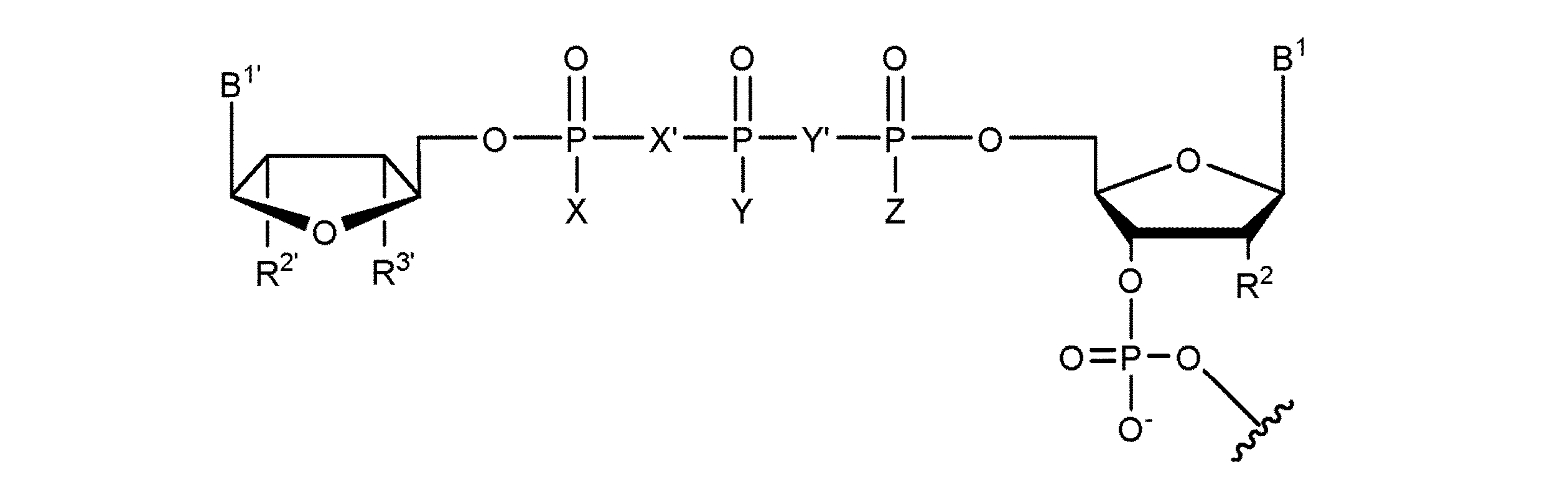
B1およびB1’の各々は、独立して
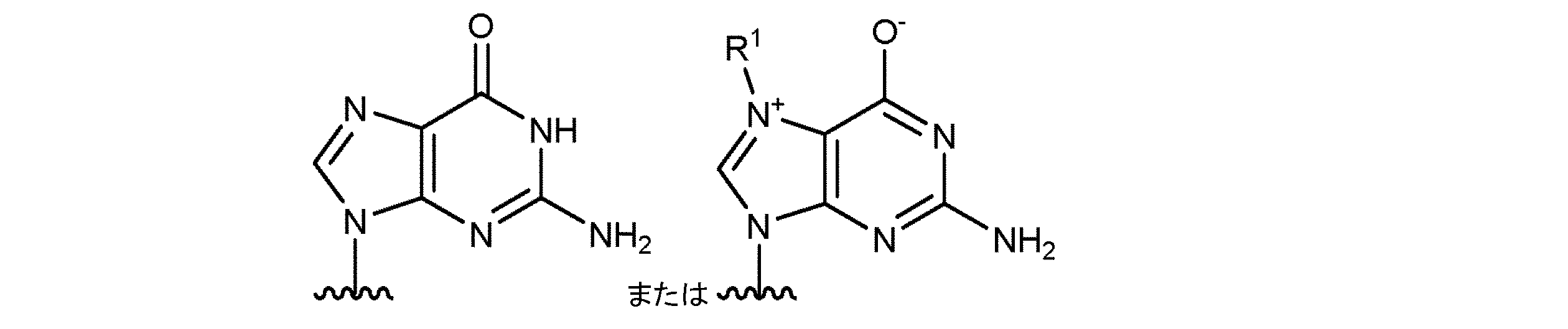
各R1は、独立して、任意選択的にフェニルもしくは6員ヘテロアリールにより置換されたC1~4アルキルであり;
R2、R2’、およびR3’の各々は、独立して、H、F、OH、もしくはO-C1~4アルキルであり;
X、YおよびZの各々は、独立して、OまたはSであり;
X’およびY’の各々は、独立して、OまたはCH2である)
を有する。
Each of B 1 and B 1' is independently
each R 1 is independently C 1-4 alkyl optionally substituted with phenyl or 6-membered heteroaryl;
Each of R 2 , R 2' , and R 3' is independently H, F, OH, or O-C 1-4 alkyl;
each of X, Y and Z is independently O or S;
each of X' and Y' is independently O or CH2 )
has.
一実施形態では、各R1は、独立して、-CH3、-CH2CH3、または-CH2C6H5である。 In one embodiment, each R 1 is independently -CH 3 , -CH 2 CH 3 , or -CH 2 C 6 H 5 .
一実施形態では、R1は、-CH3である。 In one embodiment, R 1 is -CH 3 .
一実施形態では、B1’は、

一実施形態では、R2、R2’、およびR3’の各々は、独立して、H、OH、またはO-CH3である。 In one embodiment, each of R 2 , R 2' , and R 3' is independently H, OH, or O-CH 3 .
一実施形態では、X、Y、およびZの各々は、Oである。 In one embodiment, each of X, Y, and Z is O.
一実施形態では、X’およびY’は、Oである。 In one embodiment, X' and Y' are O.
一実施形態では、gRNA分子の5’末端は、化学式:

一実施形態では、gRNA分子の5’末端は、化学式:
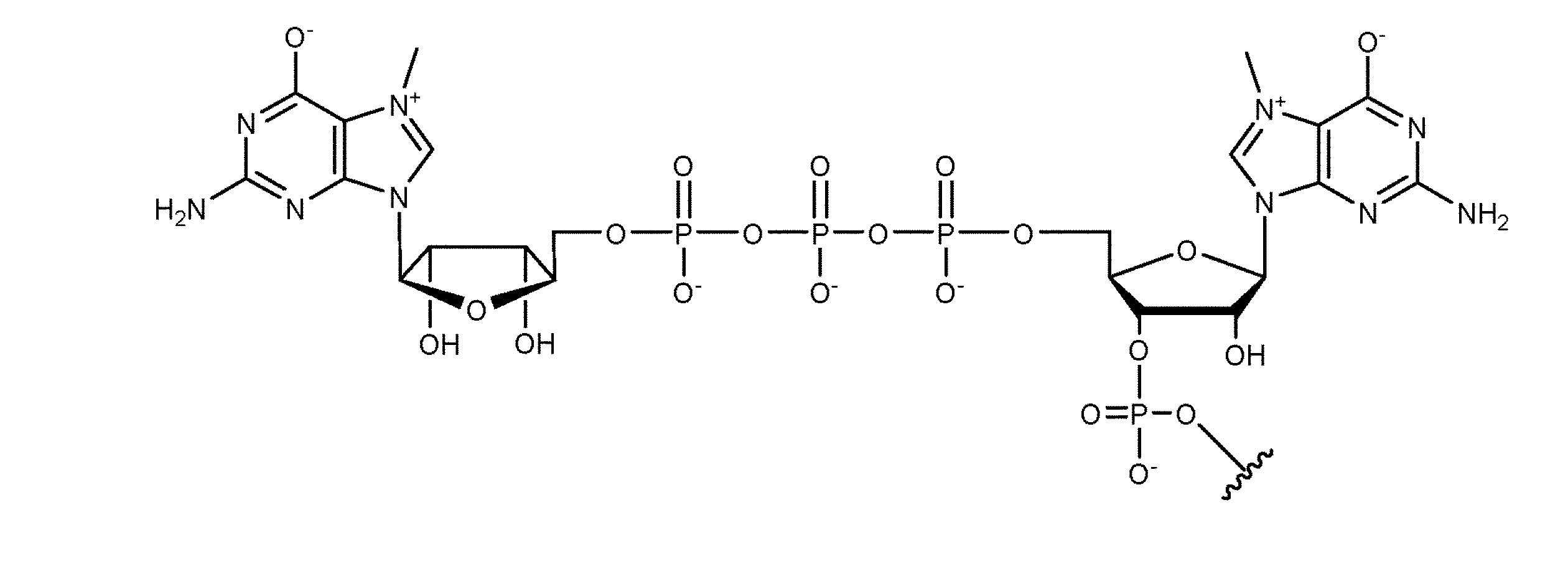
一実施形態では、gRNA分子の5’末端は、化学式:

一実施形態では、gRNA分子の5’末端は、化学式:
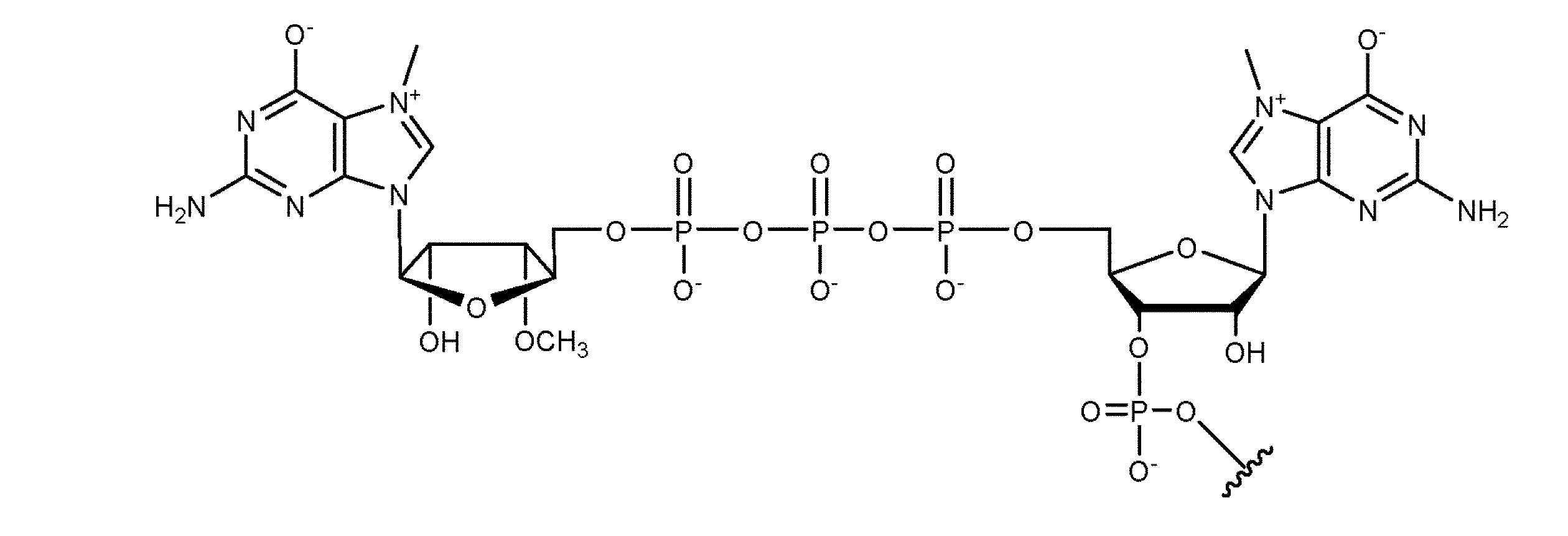
一実施形態では、Xは、Sであり、YおよびZは、Oである。 In one embodiment, X is S and Y and Z are O.
一実施形態では、Yは、Sであり、XおよびZは、Oである。 In one embodiment, Y is S and X and Z are O.
一実施形態では、Zは、Sであり、XおよびYは、Oである。 In one embodiment, Z is S and X and Y are O.
一実施形態では、ホスホロチオエートは、Spジアステレオマーである。 In one embodiment, the phosphorothioate is an Sp diastereomer.
一実施形態では、X’は、CH2であり、Y’は、Oである。 In one embodiment, X' is CH2 and Y' is O.
一実施形態では、X’は、Oであり、Y’は、CH2である。 In one embodiment, X' is O and Y' is CH2 .
一実施形態では、5’キャップは、任意選択的に修飾された5’-5’四リン酸結合を介して連結される、2つの任意選択的に修飾されたグアニンヌクレオチドを含む。 In one embodiment, the 5' cap comprises two optionally modified guanine nucleotides linked via an optionally modified 5'-5' tetraphosphate bond.
一実施形態では、gRNA分子の5’末端は、化学式:
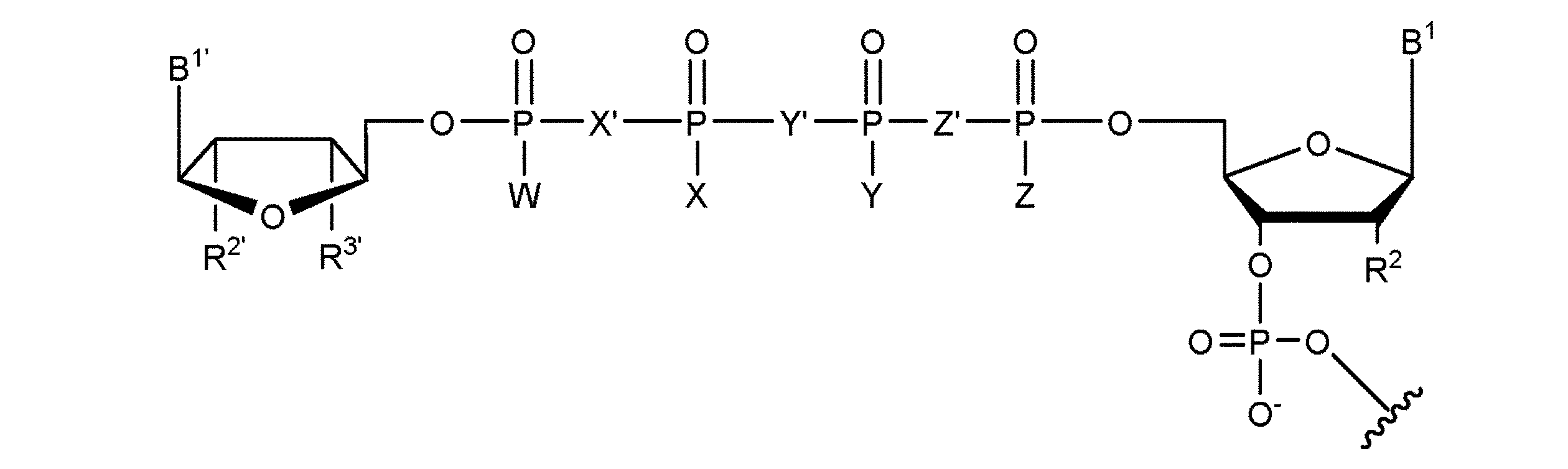
B1およびB1’の各々は、独立して

各R1は、独立して、任意選択的にフェニルもしくは6員ヘテロアリールにより置換されたC1~4アルキルであり;
R2、R2’、およびR3’の各々は、独立して、H、F、OH、もしくはO-C1~4アルキルであり;
W、X、Y、およびZの各々は、独立して、OまたはSであり;
X’、Y’、およびZ’の各々は、独立して、OまたはCH2である)
を有する。
In one embodiment, the 5' end of the gRNA molecule has the formula:
Each of B 1 and B 1' is independently
each R 1 is independently C 1-4 alkyl optionally substituted with phenyl or 6-membered heteroaryl;
Each of R 2 , R 2′ , and R 3′ is independently H, F, OH, or O-C 1-4 alkyl;
each of W, X, Y, and Z is independently O or S;
each of X', Y', and Z' is independently O or CH2 )
has.
一実施形態では、各R1は、独立して、-CH3、-CH2CH3、または-CH2C6H5である。 In one embodiment, each R 1 is independently -CH 3 , -CH 2 CH 3 , or -CH 2 C 6 H 5 .
一実施形態では、R1は、-CH3である。 In one embodiment, R 1 is -CH 3 .
一実施形態では、B1’は、

一実施形態では、R2、R2’、およびR3’の各々は、独立して、H、OH、またはO-CH3である。 In one embodiment, each of R 2 , R 2' , and R 3' is independently H, OH, or O-CH 3 .
一実施形態では、W、X、Y、およびZの各々は、Oである。 In one embodiment, each of W, X, Y, and Z is O.
一実施形態では、X’ Y’、およびZ’の各々は、Oである。 In one embodiment, each of X' Y' and Z' is O.
一実施形態では、X’は、CH2であり、Y’およびZ’は、Oである。 In one embodiment, X' is CH2 and Y' and Z' are O.
一実施形態では、Y’は、CH2であり、X’およびZ’は、Oである。 In one embodiment, Y' is CH2 and X' and Z' are O.
一実施形態では、Z’は、CH2であり、X’およびY’は、Oである。 In one embodiment, Z' is CH2 and X' and Y' are O.
一実施形態では、5’キャップは、任意選択的に修飾された5’-5’五リン酸結合を介して連結される、2つの任意選択的に修飾されたグアニンヌクレオチドを含む。 In one embodiment, the 5' cap comprises two optionally modified guanine nucleotides linked via an optionally modified 5'-5' pentaphosphate bond.
一実施形態では、gRNA分子の5’末端は、化学式:

B1およびB1’の各々は、独立して

各R1は、独立して、任意選択的にフェニルもしくは6員ヘテロアリールにより置換されたC1~4アルキルであり;
R2、R2’、およびR3’の各々は、独立して、H、F、OH、もしくはO-C1~4アルキルであり;
V、W、X、Y、およびZの各々は、独立して、OまたはSであり;
W’、X’、Y’、およびZ’の各々は、独立して、OまたはCH2である)
を有する。
In one embodiment, the 5' end of the gRNA molecule has the formula:
Each of B 1 and B 1' is independently
each R 1 is independently C 1-4 alkyl optionally substituted with phenyl or 6-membered heteroaryl;
Each of R 2 , R 2′ , and R 3′ is independently H, F, OH, or O-C 1-4 alkyl;
Each of V, W, X, Y, and Z is independently O or S;
each of W', X', Y', and Z' is independently O or CH2 )
has.
一実施形態では、各R1は、独立して、-CH3、-CH2CH3、または-CH2C6H5である。 In one embodiment, each R 1 is independently -CH 3 , -CH 2 CH 3 , or -CH 2 C 6 H 5 .
一実施形態では、R1は、-CH3である。 In one embodiment, R 1 is -CH 3 .
一実施形態では、B1’は、

一実施形態では、R2、R2’、およびR3’の各々は、独立して、H、OH、またはO-CH3である。 In one embodiment, each of R 2 , R 2' , and R 3' is independently H, OH, or O-CH 3 .
一実施形態では、V、W、X、Y、およびZの各々は、Oである。 In one embodiment, each of V, W, X, Y, and Z is O.
一実施形態では、W’、X’、Y’、およびZ’の各々は、Oである。 In one embodiment, each of W', X', Y', and Z' is O.
本明細書の用法では、用語「5’キャップ」は、伝統的なmRNA5’キャップ構造を含むが、これらのアナログも含むと理解すべきである。例えば、上に示される化学構造によって含まれる5’キャップ構造に加えて、例えば、メチレン-ビス(リン酸)部分を有する四リン酸アナログ(例えば、Rydzik,A M et al.,(2009)Org Biomol Chem7(22):4763-76を参照)、非架橋酸素のイオウによる置換を有するアナログ(例えば、Grudzien-Nogalska,E.et al,(2007)RNA 13(10):1745-1755を参照)、N7-ベンジル化ジヌクレオシド四リン酸アナログ(例えば、Grudzien,E.et al.,(2004)RNA 10(9):1479-1487を参照)、またはアンチリバースキャップアナログ(例えば、米国特許第7,074,596号明細書およびJemielity,J.et al.,(2003)RNA 9(9):1 108-1 122 およびStepinski,J.et al.,(2001)RNA 7(10):1486-1495を参照)を使用してもよい。本出願はさらに、OHまたはOMeの代わりにハロゲン基を含むキャップアナログ(例えば、米国特許第8,304,529号明細書を参照);少なくとも1つのホスホロチオエート(PS)結合を含むキャップアナログ(例えば、米国特許第8,153,773号明細書およびKowalska,J.et al.,(2008)RNA 14(6):1 1 19-1131を参照);および少なくとも1つのボラノホスフェートまたはホスホロチオエート結合を含むキャップアナログ(例えば、米国特許第8,519,110号明細書を参照);ならびにアルキニル誘導体化5’キャップアナログ(例えば、米国特許第8,969,545号明細書を参照)の使用も包含する。 As used herein, the term "5' cap" includes traditional mRNA 5' cap structures, but should be understood to also include analogs thereof. For example, in addition to the 5' cap structure contained by the chemical structure shown above, a tetraphosphate analog having, for example, a methylene-bis(phosphate) moiety (e.g., Rydzik, A M et al., (2009) Org. Biomol Chem7(22):4763-76), analogs with substitution of non-bridging oxygens by sulfur (see e.g. Grudzien-Nogalska, E. et al, (2007) RNA 13(10):1745-1755) , N7-benzylated dinucleoside tetraphosphate analogs (see, e.g., Grudzien, E. et al., (2004) RNA 10(9):1479-1487), or anti-reverse cap analogs (e.g., U.S. Pat. , 074,596 and Jemielity, J. et al., (2003) RNA 9(9):1 108-1 122 and Stepinski, J. et al., (2001) RNA 7(10):1486- 1495) may be used. The application further describes cap analogs containing a halogen group in place of OH or OMe (see, e.g., U.S. Pat. No. 8,304,529); cap analogs containing at least one phosphorothioate (PS) bond (e.g., 8,153,773 and Kowalska, J. et al., (2008) RNA 14(6):1 1 19-1131); and at least one boranophosphate or phosphorothioate bond. Also encompasses the use of cap analogs (see, e.g., U.S. Pat. No. 8,519,110); as well as alkynyl-derivatized 5' cap analogs (see, e.g., U.S. Pat. No. 8,969,545). .
通常、5’キャップは、gRNAの化学合成または生体外転写のどちらかの間に組み入れ得る。一実施形態では、5’キャップは使用されず、gRNA(例えば、生体外転写gRNA)が代わりにホスファターゼ(例えば、仔ウシ腸管アルカリホスファターゼ)による処理によって修飾され、5’三リン酸基が除去される。 Typically, the 5' cap can be incorporated during either chemical synthesis or in vitro transcription of the gRNA. In one embodiment, the 5' cap is not used and the gRNA (e.g., in vitro transcribed gRNA) is instead modified by treatment with a phosphatase (e.g., calf intestinal alkaline phosphatase) to remove the 5' triphosphate group. Ru.
本明細書で考察される方法および組成物は、3’ポリAテールを含むgRNAを用いることによって遺伝子編集するための方法および組成物も提供する。こうしたgRNAは、例えば、gRNA分子前駆体のインビトロ転写後に、ポリアデノシンポリメラーゼを用いてgRNA分子前駆体にポリAテールを付加することにより、調製することができる。例えば、一実施形態では、大腸菌(E.coli)ポリAポリメラーゼ(E-PAP)などのポリメラーゼを用いて、ポリAテールを酵素的に付加することができる。また、ポリAテールを含むgRNAは、DNAテンプレートからのインビトロ転写によっても調製され得る。一実施形態では、限定的長さのポリAテールがDNAテンプレート上にコードされて、RNAポリメラーゼ(T7RNAポリメラーゼなど)を介してgRNAと共に転写される。ポリAテールを含むgRNAは、RNAリガーゼまたはDNAリガーゼ(gRNA分子前駆体およびポリAオリゴヌクレオチドと相補的なスプリントDNAオリゴヌクレオチドを含むか、もしくは含まない)を用いたインビトロ転写後に、ポリAオリゴヌクレオチドをgRNA分子前駆体と連結させることによって調製することもできる。例えば、一実施形態では、限定的長さのポリAテールは、合成オリゴヌクレオチドとして合成され、gRNAの3’末端で、RNAリガーゼまたはDNAリガーゼ(ガイドRNAおよびポリAオリゴヌクレオチドに相補的なスプリントオリゴヌクレオチドを含むか、もしくは含まない)のいずれかと連結される。ポリAテールを含むgRNAは、1部または複数部として合成により調製することも可能であり、これらは、1つまたは複数のスプリントDNAオリゴヌクレオチドを含むか、もしくは含まないRNAリガーゼまたはDNAリガーゼのいずれかによって互いに連結される。 The methods and compositions discussed herein also provide methods and compositions for gene editing by using gRNAs that include a 3' poly A tail. Such gRNAs can be prepared, for example, by adding a polyA tail to a gRNA molecule precursor using polyadenosine polymerase after in vitro transcription of the gRNA molecule precursor. For example, in one embodiment, a polyA tail can be added enzymatically using a polymerase such as E. coli polyA polymerase (E-PAP). gRNAs containing polyA tails can also be prepared by in vitro transcription from DNA templates. In one embodiment, a polyA tail of limited length is encoded on a DNA template and co-transcribed with the gRNA via an RNA polymerase (such as T7 RNA polymerase). gRNAs containing polyA tails are synthesized from polyA oligonucleotides after in vitro transcription using RNA ligase or DNA ligase (with or without a gRNA molecule precursor and a splint DNA oligonucleotide complementary to the polyA oligonucleotide). It can also be prepared by linking a gRNA molecule precursor to a gRNA molecule precursor. For example, in one embodiment, a polyA tail of limited length is synthesized as a synthetic oligonucleotide, and at the 3' end of the gRNA, RNA ligase or DNA ligase (a splint oligonucleotide complementary to the guide RNA and polyA oligonucleotide) (with or without nucleotides). gRNAs containing polyA tails can also be prepared synthetically in one or more parts, which can be prepared using either RNA or DNA ligases with or without one or more splint DNA oligonucleotides. are connected to each other by
いくつかの実施形態では、ポリAテールは、50アデニンヌクレオチド未満、例えば、45アデニンヌクレオチド未満、40アデニンヌクレオチド未満、35アデニンヌクレオチド未満、30アデニンヌクレオチド未満、25アデニンヌクレオチド未満または20アデニンヌクレオチド未満を含む。いくつかの実施形態では、ポリAテールは、5~50アデニンヌクレオチド、例えば、5~40アデニンヌクレオチド、5~30アデニンヌクレオチド、10~50アデニンヌクレオチド、または15~25アデニンヌクレオチドを含む。いくつかの実施形態では、ポリAテールは、約20アデニンヌクレオチドを含む。 In some embodiments, the polyA tail comprises less than 50 adenine nucleotides, such as less than 45 adenine nucleotides, less than 40 adenine nucleotides, less than 35 adenine nucleotides, less than 30 adenine nucleotides, less than 25 adenine nucleotides, or less than 20 adenine nucleotides. . In some embodiments, the polyA tail comprises 5-50 adenine nucleotides, such as 5-40 adenine nucleotides, 5-30 adenine nucleotides, 10-50 adenine nucleotides, or 15-25 adenine nucleotides. In some embodiments, the polyA tail comprises about 20 adenine nucleotides.
さらに、本明細書で考察される方法および組成物は、本明細書に記載される1つまたは複数の修飾ヌクレオシドまたはヌクレオチドを含むgRNAを用いることにより、遺伝子編集(例えば、生体外遺伝子編集)のための方法および組成物も提供する。 Additionally, the methods and compositions discussed herein enable gene editing (e.g., in vitro gene editing) by using gRNAs that include one or more modified nucleosides or nucleotides described herein. Also provided are methods and compositions for.
このセクションで考察される例示的な修飾のいくつかは、gRNA配列内のどの位置に含有させてもよいが、いくつかの実施形態では、gRNAは、その5’末端またはその付近(例えば、その5’末端の1~10、1~5、もしくは1~2ヌクレオチド以内)に修飾を含む。いくつかの実施形態では、gRNAは、その3’末端またはその付近(例えば、その3’末端の1~10、1~5、もしくは1~2ヌクレオチド以内)に修飾を含む。いくつかの実施形態では、gRNAは、その5’末端またはその付近の修飾とその3’末端またはその付近の修飾の双方を含む。例えば、いくつかの実施形態では、gRNA分子(例えば、インビトロ転写gRNA)は、真核生物細胞に発現される遺伝子からの標的ドメインと相補的な標的化ドメインを含み、ここで、gRNA分子は、その5’末端で修飾され、3’末端ポリAテールを含む。gRNA分子は、例えば、5’三リン酸基が欠失してもよい(例えば、標的化ドメインの5’末端は、5’三リン酸基が欠失している)。一実施形態では、gRNA(例えば、インビトロ転写gRNA)は、5’三リン酸基を除去し、かつ本明細書で記載するような3’ポリAテールを含むように、ホスファターゼ(例えば、仔ウシ腸アルカリホスファターゼ)での処理により修飾される。あるいは、gRNA分子は、5’キャップを含んでもよい(例えば、標的化ドメインの5’末端は、5’キャップを含む)。一実施形態では、gRNA(例えば、インビトロ転写gRNA)は、本明細書に記載されるような5’キャップ構造またはキャップアナログと3’ポリAテールの双方を含む。いくつかの実施形態では、5’キャップは、5’-5’三リン酸結合を介してgRNA分子の残りと連結される修飾グアニンヌクレオチドを含む。いくつかの実施形態では、5’キャップは、任意選択的に修飾された5’-5’三リン酸結合を介して連結された、2つの任意選択的に修飾されたグアニンヌクレオチドを含む(例えば、前述されるように)。いくつかの実施形態では、ポリAテールは、5~50アデニンヌクレオチド、例えば、5~40アデニンヌクレオチド、5~30アデニンヌクレオチド、10~50アデニンヌクレオチド、15~25アデニンヌクレオチド、30アデニンヌクレオチド未満、25アデニンヌクレオチド未満、または約20アデニンヌクレオチドを含む。 Although some of the exemplary modifications discussed in this section may be contained at any position within the gRNA sequence, in some embodiments the gRNA is modified at or near its 5' end (e.g., its (within 1-10, 1-5, or 1-2 nucleotides of the 5' end). In some embodiments, the gRNA comprises a modification at or near its 3' end (eg, within 1-10, 1-5, or 1-2 nucleotides of its 3' end). In some embodiments, the gRNA includes both a modification at or near its 5' end and a modification at or near its 3' end. For example, in some embodiments, a gRNA molecule (e.g., an in vitro transcribed gRNA) comprises a targeting domain that is complementary to a targeting domain from a gene expressed in a eukaryotic cell, wherein the gRNA molecule is It is modified at its 5' end and contains a 3' terminal poly-A tail. The gRNA molecule may, for example, be devoid of a 5' triphosphate group (eg, the 5' end of the targeting domain is devoid of a 5' triphosphate group). In one embodiment, the gRNA (e.g., in vitro transcribed gRNA) is conjugated with a phosphatase (e.g., calf gRNA) to remove the 5' triphosphate group and include a 3' polyA tail as described herein. modified by treatment with intestinal alkaline phosphatase). Alternatively, the gRNA molecule may include a 5' cap (eg, the 5' end of the targeting domain includes a 5' cap). In one embodiment, the gRNA (eg, in vitro transcribed gRNA) includes both a 5' cap structure or cap analog and a 3' polyA tail as described herein. In some embodiments, the 5' cap comprises a modified guanine nucleotide linked to the remainder of the gRNA molecule via a 5'-5' triphosphate bond. In some embodiments, the 5' cap comprises two optionally modified guanine nucleotides linked via an optionally modified 5'-5' triphosphate linkage (e.g. , as described above). In some embodiments, the polyA tail has 5 to 50 adenine nucleotides, such as 5 to 40 adenine nucleotides, 5 to 30 adenine nucleotides, 10 to 50 adenine nucleotides, 15 to 25 adenine nucleotides, less than 30 adenine nucleotides, 25 Contains less than or about 20 adenine nucleotides.
さらに別の実施形態では、本開示は、真核生物細胞で発現される遺伝子からの標的ドメインと相補的な標的化ドメインを含むgRNA分子を提供し、ここで、gRNA分子は、30アデニンヌクレオチド未満(例えば、25アデニンヌクレオチド未満、15~25アデニンヌクレオチド、または約20アデニンヌクレオチド)を含む3’ポリAテールを含む。いくつかの実施形態では、これらのgRNA分子は、さらにその5’末端でも修飾される(例えば、gRNA分子は、本明細書に記載されるように、5’リン酸基を除去するためにホスファターゼでの処理により修飾されるか、または5’キャップを含有するように修飾される)。 In yet another embodiment, the present disclosure provides gRNA molecules comprising a targeting domain complementary to a targeting domain from a gene expressed in a eukaryotic cell, wherein the gRNA molecule comprises less than 30 adenine nucleotides. (eg, less than 25 adenine nucleotides, 15-25 adenine nucleotides, or about 20 adenine nucleotides). In some embodiments, these gRNA molecules are further modified at their 5' ends (e.g., gRNA molecules are treated with a phosphatase to remove the 5' phosphate group, as described herein). or modified to contain a 5' cap).
いくつかの実施形態では、gRNA分子は、3’末端Uリボースで修飾してもよい。例えば、Uリボースの2つの末端ヒドロキシル基が、アルデヒド基に酸化され得て、同時のリボース環の開環が、下に示される(下に示される)修飾ヌクレオシドをもたらす:


いくつかの実施形態では、gRNA分子は、例えば、本明細書に記載される修飾ヌクレオチドの1つまたは複数を組み込むことで、分解に対して安定化され得る、3’ヌクレオチドを含有してもよい。この実施形態では、例えば、ウリジンは、例えば、5-(2-アミノ)プロピルウリジン、および5-ブロモウリジンで、または本明細書に記載される修飾ウリジンのいずれかなどの修飾ウリジンで置換され得て;アデノシン、シチジンおよびグアノシンは、例えば、8-ブロモグアノシンなどの8位に修飾がある修飾アデノシン、シチジンまたはグアノシンによって、または本明細書に記載される修飾アデノシン、シチジンおよびグアノシンのいずれかによって置換され得る。
In some embodiments, gRNA molecules may contain 3' nucleotides that can be stabilized against degradation, e.g., by incorporating one or more of the modified nucleotides described herein. . In this embodiment, for example, uridine may be substituted with a modified uridine, such as, for example, 5-(2-amino)propyluridine, and 5-bromouridine, or any of the modified uridines described herein. adenosine, cytidine and guanosine are substituted by a modified adenosine, cytidine or guanosine with a modification at
いくつかの実施形態では、糖修飾リボヌクレオチドがgRNAに組み込まれ得て、例えば、2’OH基が、H、OR、R(式中、Rは、例えば、アルキル、シクロアルキル、アリール、アラルキル、ヘテロアリールまたは糖であり得る)、ハロ、SH、SR(式中、Rは、例えば、アルキル、シクロアルキル、アリール、アラルキル、ヘテロアリールまたは糖であり得る)、アミノ(式中、アミノは、例えば、NH2;アルキルアミノ、ジアルキルアミノ、ヘテロシクリルアミノ、アリールアミノ、ジアリールアミノ、ヘテロアリールアミノ、ジヘテロアリールアミノ、またはアミノ酸であり得る);またはシアノ(CN)から選択される基によって置換される。いくつかの実施形態では、リン酸骨格は、例えば、ホスホロチオエート(phosphothioate)基で、本明細書に記載されるように修飾され得る。いくつかの実施形態では、gRNAのヌクレオチドの1つまたは複数は、それぞれ独立して、2’-O-メチル、2’-O-メトキシエチルなどの2’-糖修飾;または例えば、2’-Fまたは2’-O-メチル、アデノシン(A)、2’-Fまたは2’-O-メチル、シチジン(C)、2’-Fまたは2’-O-メチル、ウリジン(U)、2’-Fまたは2’-O-メチル、チミジン(T)、2’-Fまたは2’-O-メチルをはじめとする2’-フルオロ修飾;グアノシン(G)、2’-O-メトキシエチル-5-メチルウリジン(Teo)、2’-O-メトキシエチルアデノシン(Aeo)、2’-O-メトキシエチル-5-メチルシチジン(m5Ceo)、および任意のそれらの組み合わせをはじめとするが、これに限定されるものではない、修飾または未修飾ヌクレオチドであり得る。 In some embodiments, sugar-modified ribonucleotides can be incorporated into the gRNA, such as when the 2'OH group is H, OR, R, where R is, for example, alkyl, cycloalkyl, aryl, aralkyl, heteroaryl or sugar), halo, SH, SR (wherein R may be, for example, alkyl, cycloalkyl, aryl, aralkyl, heteroaryl or sugar), amino (wherein amino may be, for example, , NH 2 ; which may be alkylamino, dialkylamino, heterocyclylamino, arylamino, diarylamino, heteroarylamino, diheteroarylamino, or an amino acid); or cyano (CN). In some embodiments, the phosphate backbone can be modified as described herein, eg, with a phosphorothioate group. In some embodiments, one or more of the nucleotides of the gRNA are each independently modified with a 2'-sugar, such as 2'-O-methyl, 2'-O-methoxyethyl; or, for example, 2'- F or 2'-O-methyl, adenosine (A), 2'-F or 2'-O-methyl, cytidine (C), 2'-F or 2'-O-methyl, uridine (U), 2' -F or 2'-O-methyl, thymidine (T), 2'-fluoro modifications including 2'-F or 2'-O-methyl; guanosine (G), 2'-O-methoxyethyl-5 - including, but not limited to, methyluridine (Teo), 2'-O-methoxyethyladenosine (Aeo), 2'-O-methoxyethyl-5-methylcytidine (m5Ceo), and any combination thereof It can be a modified or unmodified nucleotide that is not modified.
いくつかの実施形態では、gRNAとしては「ロックド」核酸(LNA)が挙げられ、その中では、2’OH基が、例えばC1~6アルキレンまたはC1~6ヘテロアルキレン架橋によって、同一リボース糖上の4’炭素と結合し得て代表的架橋としては、メチレン、プロピレン、エーテル、またはアミノ架橋;O-アミノ(アミノは、例えば、NH2;アルキルアミノ、ジアルキルアミノ、ヘテロシクリルアミノ、アリールアミノ、ジアリールアミノ、ヘテロアリールアミノ、またはジヘテロアリールアミノ、エチレンジアミン、またはポリアミノであり得る)、およびアミノアルコキシまたはO(CH2)n-アミノ(アミノは、例えば、NH2;アルキルアミノ、ジアルキルアミノ、ヘテロシクリルアミノ、アリールアミノ、ジアリールアミノ、ヘテロアリールアミノ、またはジヘテロアリールアミノ、エチレンジアミン、またはポリアミノであり得る)が挙げられる。 In some embodiments, gRNAs include "locked" nucleic acids (LNAs) in which the 2'OH group is linked on the same ribose sugar by, for example, a C1-6 alkylene or C1-6 heteroalkylene bridge. Representative bridges that can be attached to the 4' carbon include methylene, propylene, ether, or amino bridges; O-amino (amino is, for example, NH2 ; alkylamino, dialkylamino, heterocyclylamino, arylamino, diarylamino , heteroarylamino, or diheteroarylamino, ethylenediamine, or polyamino), and aminoalkoxy or O(CH 2 ) n -amino (amino can be, for example, NH 2 ; alkylamino, dialkylamino, heterocyclylamino, arylamino, diarylamino, heteroarylamino, or diheteroarylamino, ethylenediamine, or polyamino).
いくつかの実施形態では、gRNAとしては、多環である修飾ヌクレオチド(例えば、トリシクロ;およびグリコール核酸(GNA)などの「アンロックド」形態(例えば、リボースが、リン酸ジエステル結合に付着するグリコール単位によって置換される、R-GNAまたはS-GNA)、またはトレオース核酸(リボースが、α-L-トレオフラノシル-(3’→2’)で置換される、TNA)が挙げられる。 In some embodiments, gRNAs include modified nucleotides that are polycyclic (e.g., tricyclo; R-GNA or S-GNA), or threose nucleic acids (TNA, in which the ribose is replaced with α-L-threofuranosyl-(3'→2')).
一般に、gRNA分子としては、酸素を有する5員環である、糖類リボースが挙げられる。代表的な修飾gRNAsとしては、制限なしに、リボース中の酸素の置換(例えば、イオウ(S)、セレン(Se)、または例えば、メチレンまたはエチレンなどのアルキレンによる);二重結合付加(例えば、リボースをシクロペンテニルまたはシクロヘキセニルで置換する);リボース環縮小(例えば、シクロブタンまたはオキセタンの4員環を形成する);リボース環拡大(例えば、アンヒドロヘキシトール、アルトリトール、マンニトール、シクロヘキサニル、シクロヘキセニル、例えば、ホスホロアミダート骨格もまた有するモルホリノなどの追加的炭素またはヘテロ原子を有する6または7員環を形成する)が挙げられる。糖アナログ改変の大部分は2’位置に局在するが、4’位置をはじめとするその他の部位も修飾の対象となる。一実施形態では、gRNAは、4’-S、4’-Seまたは4’-C-アミノメチル-2’-O-Me修飾を含む。 Generally, gRNA molecules include the sugar ribose, which is a five-membered ring with an oxygen. Representative modified gRNAs include, without limitation, substitution of oxygen in the ribose (e.g., with sulfur (S), selenium (Se), or alkylene, such as methylene or ethylene); double bond additions (e.g., substituting ribose with cyclopentenyl or cyclohexenyl); ribose ring reduction (e.g., forming a four-membered ring of cyclobutane or oxetane); ribose ring expansion (e.g., anhydrohexitol, altritol, mannitol, cyclohexanyl); , cyclohexenyl, which forms a 6- or 7-membered ring with an additional carbon or heteroatom, such as, for example, morpholino, which also has a phosphoramidate skeleton). Although the majority of sugar analog modifications are localized to the 2' position, other sites are also subject to modification, including the 4' position. In one embodiment, the gRNA comprises a 4'-S, 4'-Se or 4'-C-aminomethyl-2'-O-Me modification.
いくつかの実施形態では、例えば、7-デアザ-アデノシンなどのデアザヌクレオチドが、gRNA分子に組み込まれ得る。いくつかの実施形態では、例えば、N6-メチルアデノシンなどのO-およびN-アルキル化ヌクレオチドが、gRNAに組み込まれ得る。いくつかの実施形態では、gRNA中の1つまたは複数のまたは全てのヌクレオチドが、デオキシリボヌクレオチドである。 In some embodiments, deaza nucleotides, such as, for example, 7-deaza-adenosine, can be incorporated into gRNA molecules. In some embodiments, O- and N-alkylated nucleotides, such as, for example, N6-methyladenosine, can be incorporated into the gRNA. In some embodiments, one or more or all nucleotides in the gRNA are deoxyribonucleotides.
miRNA結合部位
マイクロRNA(またはmiRNAs)は、天然細胞性19~25ヌクレオチド長の非コードRNAである。それらは、例えば、mRNAの3’UTRなどで、適切なmiRNA結合部位を有する核酸分子に結合し、遺伝子発現を下方制御する。下方制御は、核酸分子安定性の低下または翻訳阻害のどちらかである。例えば、Cas9をコードするmRNAなどの本明細書で開示されるRNA種は、例えば、その3’UTRなどに、miRNA結合部位を含み得る。miRNA結合部位は、選択された細胞型内の発現(expression is)の下方制御を促進するように選択され得る。一例として、肝臓に豊富なマイクロRNAであるmiR-122に対する結合部位の組み込みは、肝臓における対象遺伝子の発現を阻害し得る。
miRNA Binding Sites MicroRNAs (or miRNAs) are naturally cellular non-coding RNAs 19-25 nucleotides long. They bind to nucleic acid molecules with appropriate miRNA binding sites, such as in the 3'UTR of mRNA, and downregulate gene expression. Downregulation is either a decrease in nucleic acid molecule stability or an inhibition of translation. For example, an RNA species disclosed herein, such as an mRNA encoding Cas9, can include a miRNA binding site, such as in its 3'UTR. miRNA binding sites can be selected to promote downregulation of expression within selected cell types. As an example, incorporation of a binding site for miR-122, a microRNA abundant in the liver, can inhibit expression of a gene of interest in the liver.
IX.gRNA同定システムおよびデータベース
本明細書には、CRISPR/Cas9システムを用いて、対立遺伝子の編集用のgRNAを同定するためのシステム、方法およびコンピューター可読媒体が記載される。さらに、CRISPR/Cas9システムを用いて、対立遺伝子の編集用のgRNAを同定するデータベーススキーマを実行もしくは作成するためのシステム、方法およびコンピューター可読媒体が本明細書に記載される。gRNA同定システムは、ユーザー(例えば、医師もしくは医療専門家、臨床コーディネーター、医師、または対立遺伝子配列決定検査技師)が、特定の対立遺伝子を編集するのに好適なgRNAを同定することを可能にする。本明細書に記載されるように、ユーザーは、標的化移植片レシピエントと標的化移植片ドナー間の対立遺伝子マッチの数を増加するために、対立遺伝子を編集することを望む場合がある。gRNA同定システムは、レシピエント由来の対立遺伝子およびドナー候補由来の対立遺伝子に関するデータを受信し、入力からミスマッチ対立遺伝子を同定する。次に、gRNA同定システムは、データに問い合わせて、ドナー候補由来の対立遺伝子を編集するのに好適なgRNAのリストを作成する。1つまたは複数の基準に基づいてgRNAのリストをランク付けする。gRNA同定システムはまた、例えば、対立遺伝子、gRNA、ハプロタイプ、および系統情報に関するデータを保存する様々なテーブルを含むデータベーススキーマの実行も包含する。
IX. gRNA Identification Systems and Databases Described herein are systems, methods, and computer-readable media for identifying gRNAs for allele editing using the CRISPR/Cas9 system. Additionally, systems, methods, and computer-readable media are described herein for implementing or creating database schemas that identify gRNAs for allele editing using the CRISPR/Cas9 system. A gRNA identification system allows a user (e.g., a physician or medical professional, clinical coordinator, physician, or allele sequencing laboratory technician) to identify a suitable gRNA for editing a particular allele. . As described herein, a user may desire to edit alleles to increase the number of allele matches between targeted graft recipients and targeted graft donors. The gRNA identification system receives data regarding alleles from the recipient and from the potential donor and identifies mismatched alleles from the input. The gRNA identification system then interrogates the data to generate a list of gRNAs suitable for editing alleles from the donor candidate. Rank the list of gRNAs based on one or more criteria. The gRNA identification system also includes implementation of a database schema that includes various tables that store data regarding, for example, alleles, gRNAs, haplotypes, and phylogenetic information.
データベースは、現在まで記録された全てのHLA対立遺伝子変異体を保存するように構築される。これらのHLA対立遺伝子変異体の記録は、一般に入手可能であり、例えば、以下を参照されたい:(http://hla.alleles.org/alleles/index.html,Robinson J,Halliwell JA,Hayhurst JH,Flicek P,Parham P,Marsh SGE,The IPDおよびIMGT/HLA databases:allele variant databases,Nucleic Acids Research(2015)43:D423-431)。HLA対立遺伝子の記録が更新されると、データベースも更新され得る。このデータセットを用いて、MHC遺伝子座(HLA-A、-B、-C、DRB1、-DRB3/4/5、および-DQB1)の1つで存在し得る特定の単一対立遺伝子を標的化するgRNA配列が設計される。一般に入手可能なデータベース(全米骨髄バンク(National Marrow Donor Program):https://bioinformatics.bethematchclinical.org/HLA-Resources/Haplotype-Frequencies/High-Resolution-HLA-Alleles-and-Haplotypes-in-the-US-Population/;https://bioinformatics.bethematchclinical.org/HLA-Resources/Haplotype-Frequencies/Jewish-High-Resolution-Haplotype-Frequencies/)を用いて、データベースは、個々の対立遺伝子およびハプロタイプを、これらの個々の対立遺伝子が同定されるヒト対象の異なる系統バックグラウンド(すなわち、系統、人種、民族バックグラウンド)の人に共通して存在し、かつ特異的である対立遺伝子およびハプロタイプと相互参照する。一実施形態例では、データベースは、以下の数またはそれ以上の対立遺伝子変異体を含む(同定される変異体の数は、時間が経過するにつれ、新たな患者と共に増加するため;遺伝子座当たりの対立遺伝子変異体の現在の数は、MHC遺伝子座での高い多型度の一例を示すために列記される):HLA-A(3,094対立遺伝子)、HLA-B(3,865対立遺伝子)、HLA-C(2,618対立遺伝子)、HLA-DRB1(1,719対立遺伝子)、HLA-DRB3/4/5(95対立遺伝子)、HLA-DQB1(777対立遺伝子)。これらの対立遺伝子(ならびに、恐らく数の増加に伴いそれ以上の対立遺伝子)について、少なくとも106,234のgRNAがこのデータベースに含まれ得る。一実施形態例では、S.ピオゲネス(S.pyogenes)Cas9と一緒に用いられるgRNAの標的化ドメインの長さは、17または20ヌクレオチドである。一実施形態例では、S.アウレウス(S.aureus)Cas9と一緒に用いられるgRNAの標的化ドメインの長さは、20または24ヌクレオチドである。別の実施形態では、用いようとするgRNAの標的化ドメインの長さは、15、16、17、18、19、20、21、22、23、24、25、26、27、28、29、または30ヌクレオチドである。データベースには、ヨーロッパ系アメリカ人(例えば、白色人種)、アフリカ系アメリカ人、アジア系(パシフィックアイランダーを含む)、ヒスパニック系(例えば、ラテン系)集団およびユダヤ系統の人に検出される対立遺伝子頻度および共通のハプロタイプも含まれ得る。 A database is constructed to store all HLA allelic variants recorded to date. Records of these HLA allelic variants are publicly available, see for example: (http://hla.alleles.org/alleles/index.html, Robinson J, Halliwell JA, Hayhurst JH , Flicek P, Parham P, Marsh SGE, The IPD and IMGT/HLA databases: allele variant databases, Nucleic Acids Research (2015) 43:D423-431) . As HLA allele records are updated, the database may also be updated. Use this dataset to target specific single alleles that may be present at one of the MHC loci (HLA-A, -B, -C, DRB1, -DRB3/4/5, and -DQB1) A gRNA sequence is designed. Publicly available database (National Marrow Donor Program): https://bioinformatics.bethematchclinical.org/HLA-Resources/Haplotype-Frequency es/High-Resolution-HLA-Alleles-and-Haplotypes-in-the- US-Population/; https://bioinformatics.bethematchclinical.org/HLA-Resources/Haplotype-Frequencies/Jewish-High-Resolution -Haplotype-Frequencies/), the database stores individual alleles and haplotypes Cross-reference with alleles and haplotypes that are commonly present and specific in people of different lineage backgrounds (i.e., ancestry, race, ethnic background) in which individual alleles of the human subject are identified. . In one example embodiment, the database includes the following number or more allelic variants (as the number of identified variants increases over time and with new patients; The current numbers of allelic variants are listed to show an example of the high degree of polymorphism at MHC loci): HLA-A (3,094 alleles), HLA-B (3,865 alleles). ), HLA-C (2,618 alleles), HLA-DRB1 (1,719 alleles), HLA-DRB3/4/5 (95 alleles), HLA-DQB1 (777 alleles). At least 106,234 gRNAs may be included in this database for these alleles (and possibly more alleles as the number increases). In one example embodiment, S. The length of the targeting domain of the gRNA used with S. pyogenes Cas9 is 17 or 20 nucleotides. In one example embodiment, S. The length of the targeting domain of the gRNA used with S. aureus Cas9 is 20 or 24 nucleotides. In another embodiment, the length of the targeting domain of the gRNA to be used is 15, 16, 17, 18, 19, 20, 21, 22, 23, 24, 25, 26, 27, 28, 29, or 30 nucleotides. The database includes alleles found in European American (e.g., Caucasian), African American, Asian (including Pacific Islander), Hispanic (e.g., Latino) populations, and persons of Jewish descent. Frequencies and common haplotypes may also be included.
データベースを用いて、数千の対立遺伝子変異体(もしあれば)のうちの単一対立遺伝子に高度に特異的なgRNAを選択して、オフターゲット効果(対立遺伝子特異的gRNAが、ヒト染色体配列内の他のゲノム遺伝子座の他の対立遺伝子に誤って標的化する可能性があるかどうか)を見出すことができる。さらに、データベースは、同じgRNAによる両アレル破壊を支持し得る対立遺伝子特異性を含まない個別のHLA遺伝子座(例えば、HLA-A)を標的化するgRNAを同定することができる。一実施形態例では、ミスマッチ、部分的マッチ、もしくはハプロタイプ同一のHSPCドナーを相互参照して、同定するために、データベースからの対立遺伝子変異体、gRNA、および系統データを、一般に入手可能な全国および国際臍帯血および骨髄ドナー造血幹/前駆細胞バンクと関連付けることができる。ミスマッチ、部分的マッチ、もしくはハプロタイプ同一のHSPCドナー細胞は、CRISPR/Cas9技術により編集して、ドナー細胞が、疾患の治療のために同種異系HSPC移植を必要とするが、ミスマッチまたは部分的マッチドナー細胞を編集することなく、マッチするドナー細胞を同定することができないレシピエント対象と後にマッチするように、HLA遺伝子型を改変することができる。 Databases are used to select gRNAs that are highly specific for a single allele among the thousands of allelic variants (if any) and to detect off-target effects (allele-specific gRNAs can be found out whether there is a possibility of mistaken targeting to other alleles at other genomic loci within the genome. Additionally, the database can identify gRNAs that target distinct HLA loci (eg, HLA-A) without allelic specificity that could support biallelic disruption by the same gRNA. In one example embodiment, allelic variant, gRNA, and pedigree data from databases are used to cross-reference and identify mismatched, partially matched, or haplotype-identical HSPC donors. Can be associated with the International Cord Blood and Bone Marrow Donor Hematopoietic Stem/Progenitor Cell Bank. Mismatched, partially matched, or haplotype-identical HSPC donor cells can be edited by CRISPR/Cas9 technology to ensure that the donor cells require allogeneic HSPC transplantation for treatment of disease but are mismatched or partially matched. Without editing the donor cells, the HLA genotype can be modified to later match recipient subjects in which matching donor cells cannot be identified.
ユーザー(例えば、医師もしくは医療専門家、臨床コーディネーター、医師、または対立遺伝子配列決定検査技師)は、レシピエントの全ハプロタイプと関連する具体的な対立遺伝子変異体を同定するために、HLAタイピング、例えば、標的化移植片レシピエントのMHC遺伝子座の両HLAハプロタイプのDNA配列決定を提供する。公式または非公式の幹細胞ドナーデータベースから最も高いHLAマッチング度(両染色体コピー上でマッチする最多数の対立遺伝子)を有するドナー候補を検索するために、完全なHLAハプロタイプ情報を臍帯血および骨髄幹細胞バンクに入力してもよい。公式/非公式データベースから見出された移植片レシピエントとの最も高いマッチング度を有する利用可能なドナーに基づいて、ユーザーまたはシステムは、HLAマッチングのレベルを高めるために編集する必要がある対立遺伝子を決定することができる。一旦編集されたら、ドナー細胞は、同種異系HSCTの基準を満たす可能性があり、GVHD発生の尤度および/または重症度が低い。gRNA同定システムは、ユーザーが、ドナーのゲノムDNAに存在する他の対立遺伝子を標的化することなく、特定の対立遺伝子を編集することができるgRNAを見出すことを可能にする。gRNA同定システムは、対立遺伝子を編集するために使用することができるgRNAのリストを作成する。ユーザーは、リスト上の1つまたは複数のgRNAを用いて、マッチしない対立遺伝子を破壊またはノックアウトし、次に、マッチしない対立遺伝子をドナー細胞中のレシピエント特異的対立遺伝子でノックインまたは置換することができる。 A user (e.g., a physician or health care professional, clinical coordinator, physician, or allele sequencing laboratory technician) performs HLA typing, e.g. , provides DNA sequencing of both HLA haplotypes of MHC loci in targeted graft recipients. Complete HLA haplotype information is available in cord blood and bone marrow stem cell banks to search for donor candidates with the highest degree of HLA matching (highest number of matching alleles on both chromosome copies) from official or unofficial stem cell donor databases. You may also enter Based on the available donor with the highest degree of match to the graft recipient found from official/informal databases, the user or system determines the alleles that need to be edited to increase the level of HLA matching. can be determined. Once edited, the donor cells may meet the criteria for allogeneic HSCT, with a reduced likelihood and/or severity of GVHD development. The gRNA identification system allows users to find gRNAs that can edit a particular allele without targeting other alleles present in the donor's genomic DNA. The gRNA identification system generates a list of gRNAs that can be used to edit alleles. The user can use one or more gRNAs on the list to disrupt or knock out the unmatched allele, and then knock in or replace the unmatched allele with a recipient-specific allele in the donor cell. I can do it.
2つのドナー候補が類似レベルのMHCマッチング(例えば、4/6)を有し、ドナーとレシピエント間のマッチングを向上させる(例えば、5/6マッチまで)目的でミスマッチMHC対立遺伝子の修正のためにいずれを選択することもできる場合、ユーザーは、MHC制限された系統データベースにおいて最も一般的なマイナー組織適合性抗原(miHAg)を相互参照することができる。miHAgは、当該技術分野ではよく知られている。例えば、Spierings et al.,PLOS Genetics,3(6):1108-1119,2007;Spierings,Tissue Antigens,84:347-360,2014;およびSpierings et al.,Biol.Blood Marrow Transplant,19:1244-1253,2013)を参照されたい。ユーザーは、系統データベースを使用して、潜在的に「修正された」MHC抗原に制限されたmiHAg(例えば、ドナー細胞中に存在する「修正済」MHC受容体により制限され得るため、宿主対移植片拒絶を招き得るドナーmiHAg)を有する潜在的「修正済」MHCハプロタイプを相互参照することができる。これらのmiHAgは、系統群の間で存在の仕方が異なるため、系統群中でmiHAを有する2人のドナー候補を相互参照することによって、ユーザーは、より好適なドナーを修正および選択するために、より良いMHC対立遺伝子を選択することができる。この例では、ユーザーが、2つの対立遺伝子のうちの1つを修正のために選択する選択肢に直面する場合、ユーザーは、gRNA同定システムの系統データベースの情報を使用して、以下:1)移植片レシピエントの系統群に見出される最も一般的なMHC遺伝子座、および2)ドナー/レシピエントミスマッチMHC全体でMHC制限されていないmiHAに基づき、MHC修正のためにどちらのドナーを選択すべきかについて自己決定を下すことができる。これは、miHAでのドナーとレシピエント間の遺伝的相違も同種異系HSCTの結果に影響を与える点で重要である。予測されるマイナー組織適合性抗原ミスマッチ度は、特に非破壊的アロ-HSCTに関して、あまり好ましくない臨床結果と相関することがわかっている(Larsen et al.,Biol Blood Marrow Transplant(2010),16(10:1370-81)。従って、特定の系統群で共通するmiHAgに制限されるMHCハプロタイプを示す系統データベースを有する両方のドナーMHCハプロタイプを相互参照すれば、アロ-HSCTの結果をさらに向上させることができる。 Two donor candidates have similar levels of MHC matching (e.g. 4/6) and for correction of mismatched MHC alleles with the aim of improving the match between donor and recipient (e.g. up to a 5/6 match) The user can cross-reference the most common minor histocompatibility antigen (miHAg) in the MHC-restricted phylogenetic database. miHAg is well known in the art. For example, Spierings et al. , PLOS Genetics, 3(6):1108-1119, 2007; Spierings, Tissue Antigens, 84:347-360, 2014; and Spierings et al. , Biol. Blood Marrow Transplant, 19:1244-1253, 2013). Users can use phylogenetic databases to identify miHAg that is potentially restricted to "modified" MHC antigens (e.g., host vs. transplant, as it may be restricted by "modified" MHC receptors present in the donor cell). Potential “corrected” MHC haplotypes can be cross-referenced with donor miHAg (which may lead to single rejection). These miHAgs exist differently among phylogenetic groups, so by cross-referencing two donor candidates with miHA in a phylogenetic group, users can modify and select a more suitable donor. , better MHC alleles can be selected. In this example, when a user is faced with the option of selecting one of two alleles for correction, the user uses information in the gRNA identification system's phylogenetic database to: 1) transplant on which donor should be selected for MHC modification based on the most common MHC loci found in single recipient phylogenetic groups, and 2) MHC-unrestricted miHA across donor/recipient mismatched MHCs. Able to make self-determination. This is important in that genetic differences between donors and recipients in miHA also influence the outcome of allogeneic HSCT. Predicted minor histocompatibility antigen mismatches have been found to correlate with less favorable clinical outcomes, particularly for non-destructive allo-HSCT (Larsen et al., Biol Blood Marrow Transplant (2010), 16). 10:1370-81). Therefore, cross-referencing both donor MHC haplotypes with a phylogenetic database showing miHAg-restricted MHC haplotypes common in a particular phylogenetic group may further improve allo-HSCT results. I can do it.
現在まで記録されたHLA対立遺伝子変異体を含む一般に入手可能なデータセット(hla.alleles.org)を用いて、HLA-A、-B、-C、DRB1、-DRB3/4/5、および-DQB1遺伝子座について報告されている個別の対立遺伝子について設計されたgRNA配列、ならびにこれらの個別の対立遺伝子が提示されるヒト対象の系統に対する全ての対立遺伝子の相互参照を含むデータベースが構築および確立された(Marsh,S.G.E.(2015),Nomenclature for factors of the HLA system,updateMarch 2015.Tissue Antigens.doi:10.1111/tan.12581;Maiers M,et al.Hum.Immunol.2007;68(9):779-788)(対立遺伝子特異的gRNA例および詳細なデータベース設計については、「gRNA」および「実施例」のセクションを参照されたい)。下記の数の対立遺伝子変異体(例えば、現在まで発見された対立遺伝子の総数。追加の対立遺伝子が、新たな変異体が同定されるたびに追加され得る)が、データベースに含まれた:HLA-A(3,094対立遺伝子)、HLA-B(3,865対立遺伝子)、HLA-C(2,618対立遺伝子)、HLA-DRB1(1,719対立遺伝子)、HLA-DRB3/4/5(95対立遺伝子)、HLA-DQB1(777対立遺伝子)。データベースを用いて、データベースに示される数千の対立遺伝子変異体のうちの1つに特異的なgRNA(もしあれば)を選択することができる。さらに、本明細書に記載されるデータベースは、1つまたは複数のgRNAにより両アレル破壊を可能にする対立遺伝子特異性なしで、個別のHLA遺伝子座を標的化するgRNAを同定し、階層化することができる。対立遺伝子変異体、gRNA、および系統を既存の臍帯血および骨髄ドナー登録簿と関連付けることによって、レシピエント対象において十分にマッチしたアロ-HSCTを形成するために、後に修飾することができる部分的マッチドナーを相互参照し、同定することができる。 Using a publicly available dataset (hla.alleles.org) containing HLA allelic variants recorded to date, HLA-A, -B, -C, DRB1, -DRB3/4/5, and - A database containing gRNA sequences designed for the individual alleles reported for the DQB1 locus, as well as cross-references of all alleles to the human subject lines for which these individual alleles are represented, was constructed and established. (Marsh, S.G.E. (2015), Nomenclature for factors of the HLA system, updateMarch 2015.Tissue Antigens.doi:10.1111/tan.12581; Ma Iers M, et al. Hum. Immunol. 2007; 68(9):779-788) (see "gRNA" and "Examples" sections for allele-specific gRNA examples and detailed database design). The following number of allelic variants (e.g., total number of alleles discovered to date; additional alleles may be added as new variants are identified) were included in the database: HLA -A (3,094 alleles), HLA-B (3,865 alleles), HLA-C (2,618 alleles), HLA-DRB1 (1,719 alleles), HLA-DRB3/4/5 (95 alleles), HLA-DQB1 (777 alleles). The database can be used to select gRNAs (if any) that are specific for one of the thousands of allelic variants represented in the database. Furthermore, the database described herein identifies and stratifies gRNAs that target individual HLA loci without allelic specificity allowing biallelic disruption by one or more gRNAs. be able to. Partial matches that can later be modified to form well-matched allo-HSCTs in recipient subjects by linking allelic variants, gRNAs, and strains with existing cord blood and bone marrow donor registries. Donors can be cross-referenced and identified.
S.ピオゲネス(S.pyogenes)、S.アウレウス(S.aureus)、およびN.メニンジチディス(N.meningtidis)Cas9分子と共に使用されるガイドRNA(gRNA)は、DNA配列検索アルゴリズムを使用して同定することができる。ガイドRNA(gRNA)設計は、公共ツールcas-offinderに基づく、特定用途向けガイドRNA設計ソフトウェアを使用して実施される(Bae et al.(2014)Bioinformatics 30(10):1473-5)。特定用途向けgRNA設計ソフトウェアは、それらの全ゲノムでのオフターゲット性向を計算した後に、gRNAをスコアする。典型的には、完全なマッチから7つのミスマッチまでのマッチが、長さ17~24のガイドについて検討される。一旦オフターゲット部位が計算により決定されたら、各ガイドについて集約スコアが計算されて、ウェブインタフェースを使用して、表形式の出力に要約される。PAM配列に隣接するgRNA部位候補を同定するのに加えて、ソフトウェアはまた、各MHC遺伝子座のゲノム配列全体を通して、選択されたgRNA部位とは1、2、3つ以上のヌクレオチドが異なる、全てのPAM隣接配列も同定する。各遺伝子のゲノムDNA配列は、UCSCゲノムブラウザから取得し、配列は、一般に入手可能なRepeatMaskerプログラムを用いて、反復要素についてスクリーニングした。RepeatMaskerは、反復要素および低複雑度領域について、入力DNA配列を検索する。その結果は、所与のクエリー配列中に存在する反復の詳細なアノテーションである。 S. S. pyogenes, S. pyogenes S. aureus, and N. aureus. Guide RNAs (gRNAs) used with N. meningtidis Cas9 molecules can be identified using DNA sequence search algorithms. Guide RNA (gRNA) design is performed using an application-specific guide RNA design software based on the public tool cas-offinder (Bae et al. (2014) Bioinformatics 30(10):1473-5). Application-specific gRNA design software scores gRNAs after calculating their genome-wide off-target propensity. Typically, matches from perfect matches to seven mismatches are considered for guides of length 17-24. Once off-target sites are computationally determined, an aggregate score is calculated for each guide and summarized in a tabular output using a web interface. In addition to identifying candidate gRNA sites that flank PAM sequences, the software also identifies all potential gRNA sites that differ by 1, 2, or 3 or more nucleotides from the selected gRNA site throughout the genomic sequence of each MHC locus. Also identify the PAM flanking sequences of . Genomic DNA sequences for each gene were obtained from the UCSC Genome Browser and sequences were screened for repetitive elements using the publicly available RepeatMasker program. RepeatMasker searches input DNA sequences for repetitive elements and low complexity regions. The result is a detailed annotation of repeats present in a given query sequence.
遺伝子編集のための対象のMHC対立遺伝子を標的化するgRNAを同定した後、gRNAは、以下の基準:1)標的部位との距離、2)5’Gの存在、および3)直交性スコア、あるいは、関連する(relevant)PAM(例えば、S.ピオゲネス(S.pyogenes)の場合はNGGPAM、S.アウレウス(S.aureus)の場合は、NNGRRTまたはNNGRRV PAM、およびN.メニンジチディス(N.meningitidiss)の場合は、NNNNGATTまたはNNNNGCTT PAMなど)を含有するヒトゲノム中の近いマッチの同定に基づいて、さらに階層化される。直交性は、標的配列に対する最小数のミスマッチを含有するヒトゲノム中の配列数を指す。「高レベルの直交性」または「良好な直交性」は、例えば、ヒトゲノム中に意図される標的以外の同一配列を含まず、しかも標的配列中に1つまたは2つのミスマッチを含有する任意の配列を含まない、20量体gRNAを指してもよい。良好な直交性がある標的化ドメインを選択することによって、オフターゲットDNA切断を最小化する。 After identifying a gRNA that targets an MHC allele of interest for gene editing, the gRNA is determined according to the following criteria: 1) distance to the target site, 2) presence of a 5'G, and 3) orthogonality score. Alternatively, related PAMs (e.g., NGGPAM for S. pyogenes, NNGRRT or NNGRRV PAM for S. aureus, and N. meningitidis cases are further stratified based on the identification of close matches in the human genome containing NNNNGATT or NNNNGCTT PAMs). Orthogonality refers to the number of sequences in the human genome that contain the least number of mismatches to the target sequence. A "high level of orthogonality" or "good orthogonality" is, for example, any sequence that does not contain identical sequences other than the intended target in the human genome, yet contains one or two mismatches in the target sequence. It may also refer to a 20-mer gRNA that does not contain. Off-target DNA cleavage is minimized by choosing targeting domains with good orthogonality.
従って、本発明に記載されるgRNA同定システムの例示的な実施形態は、ユーザーが、例えば、6つのHLA遺伝子座の対立遺伝子などの他の対立遺伝子を標的化することがない単一対立遺伝子を標的化するgRNAを検索することを可能にする。さらに、gRNA同定システムを使用して、クエリー入力を特定の対立遺伝子識別子に変更することにより、特定の対立遺伝子を問い合わせることもできる。例示的な実施形態は、対立遺伝子を編集するためのgRNAを同定するシステムおよび方法を提供する。例示的な実施形態はまた、gRNA同定システムのデータベーススキーマをインプリメントするための非一時的コンピューター可読記憶媒体およびシステムも提供する。 Thus, exemplary embodiments of the gRNA identification system described in the present invention allow users to identify single alleles without targeting other alleles, such as alleles at six HLA loci. Allows searching for gRNAs to target. Additionally, gRNA identification systems can also be used to query for specific alleles by changing the query input to a specific allele identifier. Exemplary embodiments provide systems and methods for identifying gRNAs for allele editing. Exemplary embodiments also provide non-transitory computer-readable storage media and systems for implementing the database schema of the gRNA identification system.
非一時的コンピューター可読記憶媒体は、以下に記載されるデータベーススキーマをインプリメントするための処理装置による実行のための指示を保存する。データベーススキーマをインプリメントするシステムは、プロセッサー、および以下に記載されるデータベーススキーマを保存するメモリーを含む。非一時的コンピューター可読媒体は、処理装置による実行のための命令を保存し、ここで、命令の実行は、以下に記載されるデータベーススキーマに従い、処理装置にデータベースを作成させる。 A non-transitory computer-readable storage medium stores instructions for execution by a processing unit to implement the database schema described below. A system implementing the database schema includes a processor and memory that stores the database schema described below. The non-transitory computer-readable medium stores instructions for execution by a processing unit, where execution of the instructions causes the processing unit to create a database according to a database schema described below.
データベーススキーマは、主要なHLA対立遺伝子に関するデータを保存する対立遺伝子テーブルと、gRNAに関するデータを保存するgRNAテーブルを含む。データベーススキーマはさらに、対立遺伝子テーブルの記録とgRNAテーブルの記録のリレーションシップを保存する対立遺伝子-gRNA-リレーションテーブルも含み、ここで、対立遺伝子テーブルは、対立遺伝子-gRNA-リレーションテーブルと1対多のリレーションシップを有し、gRNAテーブルは、対立遺伝子-gRNA-リレーションテーブルと1対多のリレーションシップを有する。データベーススキーマはまた、ハプロタイプに関するデータを保存するハプロタイプテーブルも含み、ここで、対立遺伝子テーブルは、ハプロタイプテーブルと1対多のリレーションシップを有する。データベーススキーマはさらに、複数の系統内で発生するハプロタイプの頻度に関するデータを保存するハプロタイプ-頻度テーブルも含み、ここで、ハプロタイプテーブルは、ハプロタイプ-頻度テーブルと1対1のリレーションシップを有する。また、系統に関するデータを保存する系統テーブルもデータベーススキーマに含まれる。 The database schema includes an allele table that stores data regarding major HLA alleles and a gRNA table that stores data regarding gRNAs. The database schema further includes an allele-gRNA-relation table that stores relationships between records in the allele table and records in the gRNA table, where the allele table has a one-to-many relationship with the allele-gRNA-relation table. The gRNA table has a one-to-many relationship with the allele-gRNA-relationship table. The database schema also includes a haplotype table that stores data about haplotypes, where the allele table has a one-to-many relationship with the haplotype table. The database schema further includes a haplotype-frequency table that stores data regarding the frequency of haplotypes occurring within multiple lineages, where the haplotype table has a one-to-one relationship with the haplotype-frequency table. The database schema also includes a lineage table that stores data related to lineages.
データベーススキーマはまた、ハプロタイプ-頻度テーブルの記録と系統テーブルの記録のリレーションシップを記録する系統-ハプロタイプ-リレーションシップテーブルも含み、ここで、ハプロタイプ-頻度テーブルは、系統-ハプロタイプ-リレーションテーブルと1対多のリレーションシップを有し、系統テーブルは、系統-ハプロタイプ-リレーションテーブルと1対多のリレーションシップを有する。データベーススキーマはさらに、複数の系統内で発生する対立遺伝子の頻度に関するデータを保存する対立遺伝子-頻度テーブルも含み、ここで、対立遺伝子テーブルは、対立遺伝子頻度テーブルと1対1のリレーションシップを有する。データベーススキーマはまた、対立遺伝子頻度テーブルの記録と系統テーブルの記録のリレーションシップを記録する対立遺伝子-系統-リレーションテーブルも含み、ここで、対立遺伝子頻度テーブルは、対立遺伝子-系統-リレーションテーブルと1対多のリレーションシップを有し、系統テーブルは、対立遺伝子-系統-リレーションテーブルと1対多のリレーションシップを有する。 The database schema also includes a lineage-haplotype-relationship table that records the relationship between records in the haplotype-frequency table and records in the lineage table, where the haplotype-frequency table is paired with the lineage-haplotype-relationship table. The lineage table has a one-to-many relationship with the lineage-haplotype-relationship table. The database schema further includes an allele-frequency table that stores data regarding the frequencies of alleles occurring within multiple lineages, where the allele table has a one-to-one relationship with the allele frequency table. . The database schema also includes an allele-lineage-relationship table that records the relationship between records in the allele-frequency table and records in the lineage table, where the allele-frequency table is separated from the allele-lineage-relationship table by one. The pedigree table has a one-to-many relationship with the allele-strain relationship table.
データベースはまた、マイナー組織適合性抗原に関するデータを保存するマイナー抗原テーブル、およびマイナー組織適合性抗原に対するHLA制限に関する主要-マイナー-制限テーブルも含む。マイナー抗原テーブルは、主要-マイナー-制限テーブルと1対多のリレーションシップを有し、対立遺伝子テーブルは、主要-マイナー-制限テーブルと1対多のリレーションシップを有する。 The database also includes a minor antigen table that stores data regarding minor histocompatibility antigens, and a major-minor-restriction table regarding HLA restrictions to minor histocompatibility antigens. The minor antigen table has a one-to-many relationship with the major-minor-restriction table, and the allele table has a one-to-many relationship with the major-minor-restriction table.
対立遺伝子テーブルは、対立遺伝子idキー、対立遺伝子属性、遺伝子名属性、および対立遺伝子配列属性を含む。gRNAテーブルは、gRNAidキー、Cas変異体属性、gRNA配列(PAMを含む)属性、gRNA配列(PAMを含まない)属性、鎖属性、直交性スコア属性、およびオフターゲットリスト情報属性を含む。対立遺伝子-ガイド-リレーションテーブルは、リレーションidキー、対立遺伝子テーブルの対立遺伝子idキーに対応する対立遺伝子id属性、およびgRNAテーブルのgRNAidキーに対応するgRNAid属性を含んでもよい。ハプロタイプテーブルは、ハプロタイプidキー、HLA-A-対立遺伝子属性、HLA-B対立遺伝子属性、HLA-C対立遺伝子属性、HLA-DRB1遺伝子座属性、HLA-DRB3/DRB4/DRB5遺伝子座属性、およびHLA-DQB1対立遺伝子遺伝子座属性を含んでもよい。 The allele table includes an allele id key, an allele attribute, a gene name attribute, and an allele sequence attribute. The gRNA table includes a gRNAid key, a Cas variant attribute, a gRNA sequence (with PAM) attribute, a gRNA sequence (without PAM) attribute, a strand attribute, an orthogonality score attribute, and an off-target list information attribute. The allele-guide-relation table may include a relation id key, an allele id attribute corresponding to the allele id key of the allele table, and a gRNAid attribute corresponding to the gRNAid key of the gRNA table. The haplotype table contains the haplotype id key, HLA-A-allele attribute, HLA-B allele attribute, HLA-C allele attribute, HLA-DRB1 locus attribute, HLA-DRB3/DRB4/DRB5 locus attribute, and HLA-DRB3/DRB4/DRB5 locus attribute. - May include DQB1 allele locus attributes.
ハプロタイプ-頻度テーブルは、ハプロタイプ頻度idキー、ハプロタイプテーブルのハプロタイプidキーに対応するハプロタイプid属性、ヨーロッパ系統群におけるハプロタイプの発生頻度の属性、ヨーロッパ系統群におけるハプロタイプ発生のランクの属性、アフリカ系アメリカ人系統群におけるハプロタイプの発生頻度の属性、アフリカ系アメリカ人系統群におけるハプロタイプ発生のランクの属性、アジア系統群におけるハプロタイプの発生頻度の属性、アジア系統群におけるハプロタイプ発生のランクの属性、ヒスパニック系統群におけるハプロタイプの発生頻度の属性、ヒスパニック系統群におけるハプロタイプ発生のランクの属性、ユダヤ人系統群におけるハプロタイプの発生頻度の属性、およびユダヤ人系統群におけるハプロタイプ発生のランクの属性を含む。 The haplotype-frequency table includes a haplotype frequency id key, a haplotype id attribute corresponding to the haplotype id key in the haplotype table, an attribute for the frequency of haplotype occurrence in the European phylogenetic group, an attribute for the rank of haplotype occurrence in the European phylogenetic group, and an attribute for the rank of haplotype occurrence in the European phylogenetic group. Attribute of haplotype frequency in phylogenetic group, Attribute of rank of haplotype occurrence in African American phylogenetic group, Attribute of haplotype frequency of occurrence in Asian phylogenetic group, Attribute of rank of haplotype occurrence in Asian phylogenetic group, Attribute of rank of haplotype occurrence in Hispanic phylogenetic group Includes an attribute of haplotype frequency of occurrence, an attribute of rank of haplotype occurrence in Hispanic ancestry, an attribute of haplotype frequency of occurrence in Jewish ancestry, and an attribute of rank of haplotype occurrence in Jewish ancestry.
対立遺伝子-頻度テーブルは、対立遺伝子頻度idキー、対立遺伝子テーブルの対立遺伝子idキーに対応する対立遺伝子id属性、ヨーロッパ系統群における対立遺伝子の発生頻度の属性、ヨーロッパ系統群における対立遺伝子発生のランクの属性、アフリカ系アメリカ人系統群における対立遺伝子の発生頻度の属性、アフリカ系アメリカ人系統群における対立遺伝子発生のランクの属性、アジア系統群における対立遺伝子の発生頻度の属性、アジア系統群における対立遺伝子発生のランクの属性、ヒスパニック系統群における対立遺伝子の発生頻度の属性、ヒスパニック系統群における対立遺伝子発生のランクの属性、ユダヤ人系統群における対立遺伝子の発生頻度の属性、およびユダヤ人系統群における対立遺伝子発生のランクの属性を含んでもよい。 The allele-frequency table contains an allele frequency id key, an allele id attribute corresponding to the allele id key in the allele table, an attribute of the allele frequency in the European phylogenetic group, and a rank of allele occurrence in the European phylogenetic group. Attribute of allele frequency in African American phylogenetic group, Attribute of rank of allele occurrence in African American phylogenetic group, Attribute of allele frequency in Asian phylogenetic group, Conflict in Asian phylogenetic group Attributes of rank of gene occurrence; attributes of allele frequency in Hispanic ancestry; attributes of rank of allele occurrence in Hispanic ancestry; attributes of allele frequency in Jewish ancestry; It may also include an attribute of rank of allelic occurrence.
対立遺伝子-頻度テーブルは、対立遺伝子テーブルと依存リレーションシップを有し、対立遺伝子テーブルに完全に依存的である。ハプロタイプ-頻度テーブルは、ハプロタイプテーブルと依存リレーションシップを有し、ハプロタイプテーブルに完全に依存的である。 The allele-frequency table has a dependency relationship with the allele table and is completely dependent on the allele table. The haplotype-frequency table has a dependent relationship with the haplotype table and is completely dependent on the haplotype table.
1つまたは複数の対立遺伝子を編集するためのgRNAを同定するシステムは、プロセッサー、および実行されると、以下に記載される方法をプロセッサーにインプリメントさせる命令を保存するメモリーを含む。本方法は、1つまたは複数の対立遺伝子を編集するためのgRNAを同定するコンピューターシステムを用いて実施してもよい。 A system for identifying gRNAs for editing one or more alleles includes a processor and a memory that stores instructions that, when executed, cause the processor to implement the methods described below. The method may be performed using a computer system that identifies gRNAs for editing one or more alleles.
本方法は、以下:コンピューターシステムのインターフェースを介して、標的化移植片レシピエントの第1の複数の対立遺伝子の一覧、標的化移植片ドナーの第2の複数の対立遺伝子の一覧を受信するステップを含む。この方法は、続いて、第1および第2の複数の対立遺伝子の一覧を処理して、第1の複数の対立遺伝子と第2の複数の対立遺伝子との間で1つまたは複数のミスマッチ対立遺伝子を同定するステップ、次に、データベースに問い合わせて、1つまたは複数のgRNA分子が、第2の複数の対立遺伝子の1つまたは複数のミスマッチ対立遺伝子を編集するのに好適であるか否かを決定するステップを含む。データベースからの1つまたは複数のgRNAが、1つまたは複数のミスマッチ対立遺伝子を編集するのに好適であるという決定に応じて、好適であることが判明した1つまたは複数のgRNAを同定するgRNA分子のリストが作成される。gRNAのリストはランク付けされて、表示される。 The method includes the steps of: receiving, via an interface of a computer system, a list of a first plurality of alleles of a targeted graft recipient, a list of a second plurality of alleles of a targeted graft donor; including. The method then processes the list of first and second plurality of alleles to identify one or more mismatched alleles between the first plurality of alleles and the second plurality of alleles. identifying genes, then querying a database to determine whether the one or more gRNA molecules are suitable for editing one or more mismatched alleles of the second plurality of alleles; including the step of determining. gRNA identifying one or more gRNAs found to be suitable for editing one or more mismatched alleles in response to a determination that one or more gRNAs from a database are suitable for editing one or more mismatched alleles; A list of molecules is created. The list of gRNAs is ranked and displayed.
本方法はまた、第1の複数の対立遺伝子の各々についてDNA配列を表示するステップを含んでもよい。データベースは、ある人種群に発生する対立遺伝子の尤度を示す数をスコアする。本方法はまた、ある系統内の第1の複数の対立遺伝子の各々の発生頻度を表示するステップを含んでもよい。本方法は、第1の複数の対立遺伝子の各々とマイナー組織適合性抗原との間の制限リレーションシップを表示するステップをさらに含んでもよい。第1の複数の対立遺伝子が、標的化移植片レシピエントの母系遺伝性主要HLAハプロタイプで、第2の複数の対立遺伝子が、標的化移植片ドナーの母系遺伝性主要HLAハプロタイプであってもよい。第1の複数の対立遺伝子の一覧は、1つの対立遺伝子、2つの対立遺伝子、3つの対立遺伝子、4つの対立遺伝子、5つの対立遺伝子、6つの対立遺伝子、7つの対立遺伝子、または8つの対立遺伝子を含む。第2の複数の対立遺伝子の一覧は、1つの対立遺伝子、2つの対立遺伝子、3つの対立遺伝子、4つの対立遺伝子、5つの対立遺伝子、6つの対立遺伝子、7つの対立遺伝子、または8つの対立遺伝子を含む。 The method may also include displaying the DNA sequence for each of the first plurality of alleles. The database scores numbers that indicate the likelihood of an allele occurring in a given racial group. The method may also include displaying the frequency of occurrence of each of the first plurality of alleles within a lineage. The method may further include displaying a restrictive relationship between each of the first plurality of alleles and the minor histocompatibility antigen. The first plurality of alleles may be the maternally inherited predominant HLA haplotype of the targeted graft recipient and the second plurality of alleles may be the maternally inherited predominant HLA haplotype of the targeted graft donor. . The first list of multiple alleles may be 1 allele, 2 alleles, 3 alleles, 4 alleles, 5 alleles, 6 alleles, 7 alleles, or 8 alleles. Contains genes. The second list of multiple alleles is 1 allele, 2 alleles, 3 alleles, 4 alleles, 5 alleles, 6 alleles, 7 alleles, or 8 alleles. Contains genes.
gRNAのリストは、1つのミスマッチ対立遺伝子を編集するために1つのgRNAを同定し得る。gRNAのリストは、2つ以上のミスマッチ対立遺伝子を編集するために2つ以上のgRNAを同定し得る。gRNAのリストは、2つ以上のミスマッチ対立遺伝子を編集するために1つのgRNAを同定し得る。 The list of gRNAs can identify one gRNA to edit one mismatched allele. The list of gRNAs may identify more than one gRNA to edit more than one mismatched allele. The list of gRNAs can identify one gRNA to edit two or more mismatched alleles.
gRNAのリストからのgRNAは、標的化移植片ドナーの第2の複数の対立遺伝子からのミスマッチ対立遺伝子を編集して、第1の複数の対立遺伝子と第2の複数の対立遺伝子間でマッチする対立遺伝子の数を増加させることができる。gRNAのリストからのgRNAは、1つまたは複数のミスマッチ対立遺伝子を編集して、標的化移植片レシピエントに移植片対宿主病(GVHD)が発生する尤度を低減することができる。 gRNAs from the list of gRNAs are matched between the first plurality of alleles and the second plurality of alleles by editing mismatched alleles from the second plurality of alleles of the targeted graft donor. The number of alleles can be increased. A gRNA from the list of gRNAs can edit one or more mismatched alleles to reduce the likelihood that graft-versus-host disease (GVHD) will develop in the targeted graft recipient.
図24は、一実施例に従って、モジュール内にインプリメントされたgRNA同定システム2400を示すブロック図である。これらのモジュールは、図33に示す装置1010内にインプリメントすることもできる。モジュールは、入力モジュール2410、クエリーモジュール2420、ランク付けモジュール2430、およびデータベース管理モジュール2440を含み得る。モジュールは、様々な回路、回路系、および1つまたは複数のソフトウェア構成要素、プログラム、アプリケーション、または装置1010に含まれる1つまたは複数のプロセッサーにより実行されるように設計されたその他のコードベースもしくは命令ユニットを含み得る。他の実施形態では、モジュール2410、2420、2430、2440の1つまたは複数がサーバー1020内に含まれてもよく、モジュール2410、2420、2430、2440の残りは、装置1010内またはデータベース管理システム1040の一部として提供される。モジュール2410、2420、2430、および2440は、図24には個別のモジュールとして示されるが、モジュール2410、2420、2430、および2440が、図示されるよりも少ない、もしくは多いモジュールとしてインプリメントされ得ることは理解すべきである。モジュール2410、2420、2430、および2440のいずれも、装置3310、サーバー3320、データベース管理システム3340もしくはデータベース3350などのシステム3300(図33)に含まれる1つまたは複数の構成要素と連絡し得ることは理解すべきである。
FIG. 24 is a block diagram illustrating a
入力モジュール2410は、装置、例えば、装置3310に付属するインターフェースから受信される入力を管理し、解析するように、設計され得る。入力は、標的化移植片レシピエントの第1の対立遺伝子群の一覧と、標的化移植片ドナーの第2の対立遺伝子群の一覧とを含み得る。入力はまた、標的化移植片レシピエントおよび/または標的化移植片ドナーのハプロタイプに関する情報、標的化移植片レシピエントおよび/または標的化移植片ドナーの系統情報も含み得る。入力モジュール2410はまた、標的化移植片レシピエントと標的化移植片ドナー間の1つまたは複数のミスマッチ対立遺伝子を同定するように設計することもできる。
Input module 2410 may be designed to manage and analyze input received from an interface attached to a device, eg,
クエリーモジュール2420は、入力およびミスマッチ対立遺伝子を解析し、データベースに問い合わせて、データベース中の1つまたは複数のgRNAが、ミスマッチ対立遺伝子を編集するのに好適であるか否かを決定するように設計され得る。クエリーモジュール2420はまた、同定された1つまたは複数のミスマッチ対立遺伝子を編集するのに好適な、データベースからのgRNAのリスクを作成するように設計することもできる。 Query module 2420 is designed to analyze the input and mismatched alleles and query the database to determine whether one or more gRNAs in the database are suitable for editing the mismatched allele. can be done. Query module 2420 can also be designed to generate gRNA risks from the database suitable for editing one or more mismatched alleles identified.
ランク付けモジュール2430は、gRNAのリストを解析し、様々な基準に基づいてリストをランク付けするように設計され得る。例えば、gRNAのリスト中の個々のgRNAは、非標的化対立遺伝子に対するそれぞれのオフターゲット効果に基づいてランク付けされ得る。データベース管理モジュール2440は、対立遺伝子、ハプロタイプ、gRNA、系統、およびその他の情報を保存するデータベースにアクセスし、それを管理するように設計され得る。
図25は、一実施形態例に従って、対立遺伝子を編集するためのgRNAを同定する例示的な方法2500を示すフローチャートである。方法2500は、図24に示されるgRNA同定システム2400内のモジュールを用いて実施され得る。例示的な方法2500は、ステップ2502で、標的化移植片レシピエントの第1の対立遺伝子群の一覧を受信する入力モジュール2410から開始する。一実施形態例では、第1の対立遺伝子群は、標的化移植片レシピエントの母系遺伝性主要HLAハプロタイプ、または標的化移植片レシピエントの父系遺伝性主要HLAハプロタイプであってよい。ハプロタイプは、本明細書の用法では、異なるHLA遺伝子についての1つの対立遺伝子群を指す。
FIG. 25 is a flowchart illustrating an
ステップ2504で、入力モジュール2410は、標的化移植片ドナーの第2の対立遺伝子群の一覧を受信する。一実施例では、第2の対立遺伝子群は、HSCドナー候補を遺伝子編集するために標的化される、母系遺伝性主要HLAハプロタイプ(例えば、一方の染色体上にHLA-A/-B/-DRB1を含むMHC遺伝子座の群)、または父系遺伝性主要HLAハプロタイプ(例えば、他方の染色体上にHLA-A/-B/-DRB1を含むMHC遺伝子座の群)であってもよい。移植片レシピエントについて入力として受信される情報のタイプが、移植片ドナーについて入力として受け取られる情報のタイプを決定し、逆も同様である。
At
いくつかの実施形態では、入力モジュール2410は、移植片レシピエントおよびドナーの系統情報、移植片レシピエントおよびドナーの性別、および年齢情報に関する入力を受信する場合もある。 In some embodiments, input module 2410 may also receive input regarding graft recipient and donor lineage information, graft recipient and donor gender, and age information.
例示的な方法2500は、ステップ2506に進み、ここで、入力モジュール2410は、受信した入力を処理して、第1の対立遺伝子群と第2の対立遺伝子群同士の1つまたは複数のミスマッチ対立遺伝子を同定する。ミスマッチ対立遺伝子は、第1の対立遺伝子群と第2の対立遺伝子群からの対立遺伝子の各々の比較に基づいて同定することができる。ミスマッチ対立遺伝子は、本明細書の用法では、移植片レシピエントの対応する対立遺伝子とは異なる移植片ドナー由来の対立遺伝子を指す。いくつかの実施形態では、1つのミスマッチ対立遺伝子が存在し得る。他の実施形態では、複数のミスマッチ対立遺伝子が存在し得る。入力モジュール2410は、さらなる処理のために同定されたミスマッチ対立遺伝子の記録を保存し得る。
The
ステップ2508で、クエリーモジュール2420は、データベースに問い合わせて、データベースからのgRNAが、移植片ドナーの1つまたは複数のミスマッチ対立遺伝子を編集するのに好適であるか否かを決定する。一実施形態例では、以下に詳しく説明する図27A、27Bおよび27Cに関して記載されるデータベーススキーマ2700および2700’に従って、データベースをインプリメントすることができる。データベースは、対立遺伝子およびgRNAに関する情報を保存することができる。前述したように、gRNA同定システムは、ドナー対立遺伝子が、移植片レシピエントの対立遺伝子とマッチすることができるように、移植片ドナーの1つまたは複数の対立遺伝子を編集するのに好適なgRNAを同定するのを補助する。ステップ2510で、クエリーモジュール2420は、gRNAが、移植片ドナーの1つまたは複数のミスマッチ対立遺伝子を編集するのに好適であるか否かを決定する。gRNAが好適であれば、これは、ステップ2512で作成された好適なgRNAのリストに加えられる。データベースにより多くのgRNAがある(ステップ2514)場合、プロセスが反復され、データベースに、データベース中の各gRNAに関して問い合わせがなされて、ドナー対立遺伝子が、移植片レシピエントの対立遺伝子とマッチすることができるような移植片ドナーの1つまたは複数の対立遺伝子の編集に、gRNAが好適であるか否かが決定される。同定されるいずれの好適なgRNAも作成リストに加えられる。いくつかの実施形態では、ミスマッチドナー対立遺伝子を編集するために、複数のgRNAが利用可能である。他の実施形態では、ミスマッチドナー対立遺伝子を編集するために、1つまたは0のgRNAが利用可能である。一実施例では、2つ以上のミスマッチ対立遺伝子が存在する場合、クエリーモジュール2420は、最初に、ミスマッチ対立遺伝子の全てを編集することができるgRNAを同定する。次に、クエリーモジュール2420は、ミスマッチ対立遺伝子の少なくとも1つを編集することができるgRNAを同定する。このようにして、全てのミスマッチ対立遺伝子を編集するために複数のgRNAを必要とするのではなく、1つのgRNAを用いて全てのミスマッチ対立遺伝子を編集することができる場合、gRNA同定システム2400は、効率的なgRNAオプションをユーザーに提供することができる。全ての好適なgRNAが作成リストに加えられたら、ランク付けモジュール2430は、ステップ2516の特定の基準に基づいてgRNAのリストをランク付けする。例えば、gRNAは、それらのオフターゲット効果、またはオフターゲット効果がないこと、非標的化対立遺伝子に基づいてランク付けされ得る。ランク付けプロセスについては、図26を参照にして以下に詳しく説明する。
At
ステップ2518では、好適なgRNAのランク付けリストが、例えば、図33を参照に説明される画面表示装置3418などの表示装置を介してユーザーに表示される。一実施形態例では、レシピエントの対立遺伝子各々のDNA配列も表示される。別の実施形態例では、一系統内のレシピエントの対立遺伝子(第1の対立遺伝子群)の各々の発生頻度が表示される。別の例示的実施形態では、レシピエントのMHCおよびドナーのMHCにより制限されるmiHAgが表示される。
At
非限定的な例では、レシピエント(第1の対立遺伝子群)とドナー(第2の対立遺伝子群)の間に1つ(単一もしくは特異な)のミスマッチ対立遺伝子が存在し得る。この場合、gRNA同定システムは、1つのミスマッチ対立遺伝子を編集するために1つのgRNAを同定し得る。別の非限定的な例では、レシピエント(第1の対立遺伝子群)とドナー(第2の対立遺伝子群)の間に2つ以上のミスマッチ対立遺伝子が存在し得る。この場合、gRNA同定システムは、複数のミスマッチ対立遺伝子を編集するために複数のgRNAを同定し得る。この例では、ミスマッチ対立遺伝子は、連続的または不連続的のいずれでもよい。別の非限定的な例では、レシピエント(第1の対立遺伝子群)とドナー(第2の対立遺伝子群)の間に2つ以上のミスマッチ対立遺伝子が存在し得る。この場合、gRNA同定システムは、複数のミスマッチ対立遺伝子を編集するために1つ(単一もしくは特異な)のgRNAを同定し得る。この例では、ミスマッチ対立遺伝子は、連続的または不連続的のいずれでもよい。 In a non-limiting example, there may be one (single or unique) mismatched allele between the recipient (first allele group) and donor (second allele group). In this case, the gRNA identification system may identify one gRNA to edit one mismatched allele. In another non-limiting example, there may be two or more mismatched alleles between the recipient (first allele group) and donor (second allele group). In this case, the gRNA identification system may identify multiple gRNAs to edit multiple mismatched alleles. In this example, the mismatched alleles can be either contiguous or discontinuous. In another non-limiting example, there may be two or more mismatched alleles between the recipient (first allele group) and donor (second allele group). In this case, the gRNA identification system may identify one (single or unique) gRNA to edit multiple mismatched alleles. In this example, the mismatched alleles can be either contiguous or discontinuous.
図26は、例示的実施形態に従って、gRNAをランク付けするための例示的な方法を示すフローチャートである。方法2600は、ステップ2602で、ミスマッチ対立遺伝子を編集するのに好適な、同定されたgRNA候補(図25を参照にして説明した通り)を有するgRNA同定システム2400から開始する。ステップ2604では、ランク付けモジュール2430が、各gRNA候補についてデータベースからのミスマッチ、挿入/欠失(インデル)、クロマチン状態などに基づき事前に決定されたオフターゲットスコアを検索する。ステップ2606では、ランク付けモジュール2430は、ミスマッチ、挿入/欠失(インデル)、クロマチン情報などの検索されたオフターゲットスコアに基づいてgRNAをランク付けする。ランク付けされたgRNAのリストは、ステップ2608で、例えば、図34を参照に説明される画面表示装置3418などの表示装置を介してユーザーに表示される。
FIG. 26 is a flowchart illustrating an example method for ranking gRNAs, according to an example embodiment.
一例示的実施形態では、ランク付けモジュール2430は、データベースに保存されたgRNAの各々につて、ミスマッチ、挿入/欠失(インデル)、クロマチン情報などに基づいてオフターゲットスコアを決定する。このスコアは、gRNAに関連し、ランク付けプロセス中に検索できるように保存される。いくつかの実施形態では、オフターゲットスコアは、gRNA配列をヒトゲノムとアラインメントして、ヒトゲノムとgRNA配列同士のミスマッチを決定することによって取得される。
In one exemplary embodiment, ranking
例えば、gRNA同定システムを用いて、ゲノム全体の総オフターゲット活性を最小にするように、ユーザーの標的配列内のgRNAの選択を最適化することができる。一実施形態例では、オフターゲットスコアを決定するアルゴリズムは、ミスマッチの数の他に、Cas9により認識されるプロトスペーサー隣接モチーフ(PAM)配列の変更も可能にする。例えば、潜在的オフターゲット部位を決定するとき、Cas9により認識されるPAMの同義性が報告され得る。S.ピオゲネス(S.pyogenes)Cas9の場合、このアルゴリズム例は、最初に、対象のsgRNA配列および5’-NRG-3’PAM配列に対応する20-bp配列から構成される全ての23-bp DNA配列を収集する。次に、上記アルゴリズム例は、収集された配列をクエリー配列と比較して、20-bp sgRNA配列中のミスマッチ塩基の数を計数する。Bae S.,Park J & Kim J.-S.Cas-OFFinder:A fast and versatile algorithm that searches for potential off-target sites of Cas9 RNA-guided endonucleases.Bioinformatics 30,1473-1475(2014)を参照されたい。
For example, gRNA identification systems can be used to optimize the selection of gRNAs within a user's target sequence to minimize total off-target activity genome-wide. In one example embodiment, the algorithm for determining off-target scores allows for changes in the protospacer adjacent motif (PAM) sequence recognized by Cas9 in addition to the number of mismatches. For example, the synonymy of PAMs recognized by Cas9 can be reported when determining potential off-target sites. S. For S. pyogenes Cas9, this example algorithm first extracts all 23-bp DNA sequences consisting of the sgRNA sequence of interest and the 20-bp sequence corresponding to the 5'-NRG-3'PAM sequence. Collect. The example algorithm then compares the collected sequence to the query sequence and counts the number of mismatched bases in the 20-bp sgRNA sequence. Bae S. , Park J & Kim J. -S. Cas-OFFinder: A fast and versatile algorithm that searches for potential off-target sites of Cas9 RNA-guided endonucleases ..
別の実施形態では、オフターゲットスコアは、ヒトゲノムのクロマチン状態を考慮に入れて決定され得る。http://cheetah.bioch.virginia.edu/ AdliLab/CROP-IT/about.htmlを参照されたい。 In another embodiment, the off-target score may be determined taking into account the chromatin state of the human genome. http://cheetah. bioch. virginia. edu/AdliLab/CROP-IT/about. Please refer to html.
また別の実施形態では、考えられるCRISPRガイド(例えば、PAM配列:NGGが続く20ヌクレオチド)について配列を操作した後、選択されたゲノム全体を通じて考えられるオフターゲットマッチについて操作してもよい。例えば、オフターゲットスコアは、ミスマッチの総数、ミスマッチ絶対位置(PAM部位に接近するミスマッチの比較的高い妨害に対応するため)、およびミスマッチ同士の平均ペアワイズ距離(ガイドDNA相互作用を破壊する上での接近するミスマッチの立体作用を説明するため)を考慮に入れて計算してもよい。http://crispr.mit.edu/aboutを参照されたい。 In yet another embodiment, the sequence may be manipulated for possible CRISPR guides (eg, PAM sequence: 20 nucleotides followed by NGG) and then for possible off-target matches throughout the selected genome. For example, the off-target score is calculated based on the total number of mismatches, the absolute mismatch position (to accommodate the relatively high interference of mismatches approaching the PAM site), and the average pairwise distance between mismatches (to accommodate the relatively high interference of mismatches approaching the PAM site). (to account for the steric effects of approaching mismatches) may be taken into account in the calculation. http://crispr. mit. See edu/about.
別の例示的実施形態では、オフターゲットスコアを決定するプロセスは、Bowtie2(Johns Hopkins Universityにより提供される既存のゲノムインデキシングプログラム)を用いて、同定されたgRNA配列を残りの生物染色体DNAにマッピングすることによって特異性を検証する。gRNAを別の配列にマッピングすることができれば、これは、オフターゲットを有する。一実施形態例では、オフターゲットスコア計算は、配列の5’末端側の最初の6塩基のオフターゲットに許容されるミスマッチの数も考慮に入れてよい。また別の実施形態例では、オフターゲットスコア計算は、標的配列までの許容編集距離(すなわち、オフターゲットに許容されるミスマッチおよびインデルの数)も考慮に入れてよい。http://www.e-crisp.org/E-CRISP/aboutpage.htmlを参照されたい。 In another exemplary embodiment, the process of determining off-target scores involves mapping the identified gRNA sequences to the remaining organism's chromosomal DNA using Bowtie2, an existing genome indexing program provided by Johns Hopkins University. Verify specificity by If a gRNA can be mapped to another sequence, it has an off-target. In one example embodiment, the off-target score calculation may also take into account the number of mismatches allowed off-target in the first 6 bases on the 5' end of the sequence. In yet another example embodiment, the off-target score calculation may also take into account the allowed edit distance to the target sequence (ie, the number of mismatches and indels allowed off-target). http://www. e-crisp. org/E-CRISP/aboutpage. Please refer to html.
ユーザーは、本明細書に記載されるgRNA同定システムを使用して、造血幹細胞移植を必要とする将来のレシピエント患者に対して部分的HLAマッチドナーを評価することができる。ユーザーは、入手可能な骨髄および臍帯血データベースを用いて、部分的マッチドナー候補を同定するか、または移植片レシピエントに生物学的に近縁の個体をスクリーニングすることができる。ユーザーは、MHC遺伝子座でマッチする多数の対立遺伝子を有する数人のドナー候補から1人のドナーを選択することができる。異なる民族系統/起源の人は、miHAgの頻度が異なり、これは、MHC制限されるため、類似する民族系統/起源のドナーが好ましい。同じ系統内に数人のドナー候補がいる場合、ユーザーは、本明細書に記載されるgRNA同定システムを用いて、MHCの頻度を見つけることができ、ドナーmiHAgを配列決定して、最も類似するmiHAgプロフィール(例えば、10のmiHAg遺伝子座)を有するドナーを選択する。ドナーが、「修正」MHC(レシピエントMHCに従い)によって制限されるmiHAgを有する場合、このドナーを選択することはできない。 Users can use the gRNA identification system described herein to evaluate partially HLA-matched donors for future recipient patients in need of hematopoietic stem cell transplantation. Users can use available bone marrow and cord blood databases to identify partially matched donor candidates or to screen individuals who are biologically related to the graft recipient. A user can select one donor from several potential donors with multiple matching alleles at the MHC locus. People of different ethnic lineages/origins have different frequencies of miHAg, which is MHC restricted, so donors of similar ethnic lineages/origins are preferred. If there are several donor candidates within the same lineage, the user can use the gRNA identification system described herein to find the frequency of the MHC and sequence the donor miHAg to find the most similar Select a donor with a miHAg profile (eg, 10 miHAg loci). If the donor has miHAg restricted by the "modified" MHC (according to the recipient MHC), this donor cannot be selected.
図27Aは、一実施形態例に従って、gRNA同定システムのための例示的なデータベーススキーマ2700を示す。例示的なデータベーススキーマ2700は、対立遺伝子テーブル2705、gRNAテーブル2710、対立遺伝子-gRNA-リレーションテーブル2715、ハプロタイプテーブル2720、ハプロタイプ-頻度テーブル2725、系統テーブル2730、系統-ハプロタイプ-リレーションテーブル2735、対立遺伝子-頻度テーブル2740、および対立遺伝子-系統-リレーションテーブル2745を含む。いくつかの実施形態では、例示的なデータベーススキーマ2700はまた、マイナー抗原テーブル2750および主要-マイナー-制限テーブル2755も含む。例示的なデータベーススキーマ2700は、図27Aには、11のテーブルを含むものとして示されるが、データベーススキーマ2700は、これより少ないか、または多いテーブル数を含み得ることは理解すべきである。
FIG. 27A shows an
図27BおよびCは、一実施形態例に従って、gRNA同定システムのための例示的なデータベーススキーマ2700’を詳細に示す。例示的なデータベーススキーマ2700’は、MySQLを用いて示される。データベース内のテーブルの各々は、キーおよび1つまたは複数の属性を含む。例示的なデータベーススキーマ2700’は、対立遺伝子テーブル2705、gRNAテーブル2710、対立遺伝子-gRNA-リレーションテーブル2715、ハプロタイプテーブル2720、ハプロタイプ-頻度テーブル2725、系統テーブル2730、系統-ハプロタイプ-リレーションテーブル2735、対立遺伝子-頻度テーブル2740、および対立遺伝子-系統リレーション-テーブル2745を含む。いくつかの実施形態では、例示的なデータベーススキーマ2700はまた、マイナー抗原テーブル2750および主要-マイナー-制限テーブル2755も含む。例示的なデータベーススキーマ2700は、図27Bおよび27Cには、11のテーブルを含むものとして示されるが、データベーススキーマ2700は、これより少ないか、または多いテーブル数を含み得ることは理解すべきである。
27B and C detail an example database schema 2700' for a gRNA identification system, according to an example embodiment. An exemplary database schema 2700' is illustrated using MySQL. Each table in the database includes a key and one or more attributes. The exemplary database schema 2700' includes an allele table 2705, a gRNA table 2710, an allele-gRNA-relation table 2715, a haplotype table 2720, a haplotype-frequency table 2725, a lineage table 2730, a lineage-haplotype-relationship table 2735, and an allelic table. Includes a gene-frequency table 2740 and an allele-lineage relationship table 2745. In some embodiments, the
一実施形態例では、gRNA(ガイド)テーブルは、gRNA ID、プロトスペーサー隣接モチーフ(PAM)を含まないgRNA標的配列、PAMを含むgRNA標的配列、Cas変異体タイプ(一部のgRNAは、S.ピオゲネス(S.pyogenes)またはS.アウレウス(S.aureus)に特異的であり、これらのCas9変異体に特異的な標的化ドメイン長さを含む)、標的化gRNAが指令されて結合するゲノムDNA鎖(例えば、+もしくは-鎖)、直交性スコア(ヒトゲノムのオフターゲットヒットスコアの加重合計)、ならびにオフターゲット数(gRNAが、異なる数のミスマッチもしくはインデルを含む標的化遺伝子座として同定されない他のゲノム遺伝子座上で標的化またはヒットする回数)を含む。対立遺伝子テーブルの一例は、以下のカテゴリーおよび関連データを含む:対立遺伝子ID、対立遺伝子識別子(HLA命名法)、遺伝子(遺伝子座)名、および対立遺伝子配列。対立遺伝子-頻度テーブルの一例は、NBMPデータベース(National Marrow Donor Program:https://bioinformatics.bethematchclinical.org/HLA-Resources/Haplotype-Frequencies/High-Resolution-HLA-Alleles-and-Haplotypes-in-the-US-Population/;https://bioinformatics.bethematchclinical.org/HLA-Resources/Haplotype-Frequencies/Jewish-High-Resolution-Haplotype-Frequencies/)に注記されているように、ヨーロッパ系アメリカ人(白色人種)、アフリカ系アメリカ人、アジア系、ヒスパニック系、およびユダヤ系集団内の頻度記録ID、対立遺伝子識別子、頻度およびランクを含む。 In one example embodiment, the gRNA (guide) table includes: gRNA ID, gRNA target sequence without protospacer adjacent motif (PAM), gRNA target sequence with PAM, Cas variant type (some gRNAs are S. specific for S. pyogenes or S. aureus and containing a targeting domain length specific for these Cas9 variants), the genomic DNA to which the targeting gRNA is directed to bind. strand (e.g., + or - strand), orthogonality score (weighted sum of off-target hit scores for the human genome), and off-target number (gRNA is not identified as a targeted locus containing a different number of mismatches or indels). target or hit on a genomic locus). An example of an allele table includes the following categories and associated data: allele ID, allele identifier (HLA nomenclature), gene (locus) name, and allele sequence. An example of an allele-frequency table can be found in the NBMP database (National Marrow Donor Program: https://bioinformatics.bethematchclinical.org/HLA-Resources/Haplotype-Freq uences/High-Resolution-HLA-Alleles-and-Haplotypes-in-the -US-Population/;https://bioinformatics.bethematchclinical.org/HLA-Resources/Haplotype-Frequencies/Jewish-High-Resolution n-Haplotype-Frequencies/), European Americans (white people) Species), frequency records within African American, Asian, Hispanic, and Jewish populations, including ID, allele identifier, frequency, and rank.
対立遺伝子テーブル2705は、主要HLA対立遺伝子に関するデータを保存する。一実施形態例では、対立遺伝子テーブル2705は、一般に入手可能なHLA対立遺伝子データベース(http://hla.alleles.org/alleles/text_index.htmに見出される)からのデータを用いて構成される。いくつかの実施形態では、対立遺伝子テーブル2705は、HLA対立遺伝子の変異体の配列に関するデータを保存する。対立遺伝子テーブル2705は、対立遺伝子idキー、対立遺伝子属性、遺伝子名属性、および対立遺伝子配列属性を含む。 Allele table 2705 stores data regarding major HLA alleles. In one example embodiment, allele table 2705 is constructed using data from the publicly available HLA allele database (found at http://hla.alleles.org/alleles/text_index.htm). In some embodiments, allele table 2705 stores data regarding sequences of HLA allele variants. Allele table 2705 includes allele id keys, allele attributes, gene name attributes, and allele sequence attributes.
gRNAテーブル2710は、gRNAに関するデータを保存する。いくつかの実施形態では、gRNAは、前述したような対立遺伝子を編集するために設計される。一実施形態では、gRNAテーブル2710は、gRNAidキー、gRNAタイプ属性、プロトスペーサー隣接モチーフ(PAM)を含むgRNA配列、gRNA配列(PAMを含まない)属性、鎖属性、直交性スコア属性、およびオフターゲットリスト情報属性を含む。 gRNA table 2710 stores data regarding gRNAs. In some embodiments, gRNAs are designed to edit alleles as described above. In one embodiment, gRNA table 2710 includes gRNAid keys, gRNA type attributes, gRNA sequences with protospacer adjacent motif (PAM) attributes, gRNA sequence (without PAM) attributes, strand attributes, orthogonality score attributes, and off-target Contains list information attributes.
対立遺伝子-gRNA-リレーションテーブル2715は、対立遺伝子テーブル2705の記録とgRNAテーブル2710の記録との間のリレーションシップを保存する。例示的データベーススキーマ2700では、対立遺伝子テーブル2705は、対立遺伝子-gRNA-リレーションテーブル2715と1対多のリレーションシップを有する。gRNAテーブル2710は、対立遺伝子-gRNA-リレーションテーブル2715と1対多のリレーションシップを有する。一実施形態では、対立遺伝子-gRNA-リレーションテーブルは、リレーションidキー、対立遺伝子テーブルの対立遺伝子idキーに対応する対立遺伝子id属性、gRNAテーブルのgRNAidキーに対応するgRNAid属性を含む。
Allele-gRNA-relationship table 2715 stores relationships between records in allele table 2705 and records in gRNA table 2710. In
ハプロタイプテーブル2720は、ハプロタイプに関するデータを保存する。ハプロタイプは、片方の親から一緒に遺伝された遺伝子または対立遺伝子群である。対立遺伝子テーブル2705は、ハプロタイプテーブルと1対多のリレーションシップを有する。ハプロタイプテーブル2720は、ハプロタイプidキー、HLA-A対立遺伝子属性、HLA-B対立遺伝子属性、HLA-C対立遺伝子属性、HLA-DRB1遺伝子座属性、HLA-DRB3/DRB4/DRB5遺伝子座属性、HLA-DQB1対立遺伝子遺伝子座属性を含む。 Haplotype table 2720 stores data regarding haplotypes. A haplotype is a group of genes or alleles inherited together from one parent. The allele table 2705 has a one-to-many relationship with the haplotype table. The haplotype table 2720 includes haplotype id keys, HLA-A allele attributes, HLA-B allele attributes, HLA-C allele attributes, HLA-DRB1 locus attributes, HLA-DRB3/DRB4/DRB5 locus attributes, and HLA- Contains DQB1 allele locus attributes.
ハプロタイプ-頻度テーブル2725は、ある系統内で発生するハプロタイプの頻度に関するデータを保存する。ハプロタイプテーブル2720は、ハプロタイプ-頻度テーブル2725と1対1のリレーションシップを有する。一実施形態では、ハプロタイプ-頻度テーブル2725は、ハプロタイプ頻度idキー、ハプロタイプテーブル2720のハプロタイプidキーに対応するハプロタイプid属性、ヨーロッパ系統群内のハプロタイプの発生頻度の属性、およびヨーロッパ系統群内のハプロタイプ発生のランクの属性を含む。ハプロタイプ-頻度テーブル2725はまた、アフリカ系アメリカ人系統群内のハプロタイプの発生頻度の属性、アフリカ系アメリカ人系統群内のハプロタイプ発生のランクの属性、アジア系統群内のハプロタイプの発生頻度の属性、アジア系統群内のハプロタイプ発生のランクの属性、ヒスパニック系統群内のハプロタイプの発生頻度の属性、ヒスパニック系統群内のハプロタイプ発生のランクの属性、ユダヤ系統群内のハプロタイプの発生頻度の属性、およびユダヤ系統群内のハプロタイプ発生のランクの属性も含み得る。ハプロタイプ-頻度テーブル2725は、ハプロタイプテーブル2720と依存リレーションシップを有し、ハプロタイプテーブル2720に完全に依存的である。 Haplotype-frequency table 2725 stores data regarding the frequency of haplotypes occurring within a lineage. Haplotype table 2720 has a one-to-one relationship with haplotype-frequency table 2725. In one embodiment, the haplotype-frequency table 2725 includes a haplotype frequency id key, a haplotype id attribute that corresponds to the haplotype id key of the haplotype table 2720, an attribute of the frequency of occurrence of the haplotype within the European phylogenetic group, and a haplotype within the European phylogenetic group. Contains the rank attribute of the occurrence. The haplotype-frequency table 2725 also includes attributes of frequency of occurrence of haplotypes within African American phylogenetic groups, attributes of rank of occurrence of haplotypes within African American phylogenetic groups, attributes of frequency of occurrence of haplotypes within Asian phylogenetic groups, Attribute of rank of haplotype occurrence within Asian phylogenetic group, attribute of haplotype frequency of occurrence within Hispanic phylogenetic group, attribute of rank of haplotype occurrence within Jewish phylogenetic group, and attribute of haplotype frequency of occurrence within Jewish phylogenetic group. An attribute of the rank of haplotype occurrence within a phylogenetic group may also be included. Haplotype-frequency table 2725 has a dependent relationship with haplotype table 2720 and is completely dependent on haplotype table 2720.
系統テーブル2730は、複数の民族系統または起源に関するデータを保存する。一実施形態例では、系統テーブル2730は、ヨーロッパ系統群、アフリカ系アメリカ人系統群、アジア系統群、ヒスパニック系統群、およびユダヤ系統群に関するデータを保存する。系統起源テーブル2730は、系統idキー、および系統名属性を含む。 Lineage table 2730 stores data regarding multiple ethnic lineages or origins. In one example embodiment, pedigree table 2730 stores data regarding European ancestry, African American ancestry, Asian ancestry, Hispanic ancestry, and Jewish ancestry. Lineage origin table 2730 includes a lineage id key and a lineage name attribute.
系統-ハプロタイプ-リレーションテーブル2735は、ハプロタイプ-頻度テーブル2725の記録と系統テーブル2730の記録の間のリレーションシップを保存する。ハプロタイプ-頻度テーブル2725は、系統-ハプロタイプ-リレーションテーブル2735と1対多のリレーションシップを有する。系統テーブル2730は、系統-ハプロタイプ-リレーションテーブル2735と1対多のリレーションシップを有する。一実施形態では、系統-ハプロタイプ-リレーションテーブル2735は、idキー、系統テーブル2730の系統idキーに対応する系統id属性、およびハプロタイプ-頻度テーブル2725のハプロタイプidキーに対応するハプロタイプid属性を含む。 Lineage-haplotype-relationship table 2735 stores relationships between records in haplotype-frequency table 2725 and records in lineage table 2730. The haplotype-frequency table 2725 has a one-to-many relationship with the lineage-haplotype-relationship table 2735. The lineage table 2730 has a one-to-many relationship with the lineage-haplotype-relationship table 2735. In one embodiment, lineage-haplotype-relationship table 2735 includes an id key, a lineage id attribute that corresponds to the lineage id key of lineage table 2730, and a haplotype id attribute that corresponds to the haplotype id key of haplotype-frequency table 2725.
対立遺伝子-頻度テーブル2740は、ある系統内で発生する対立遺伝子の頻度に関するデータを保存する。対立遺伝子テーブル2705は、対立遺伝子頻度テーブルと1対1のリレーションシップを有する。一実施形態では、対立遺伝子-頻度テーブル2740は、対立遺伝子頻度idキー、対立遺伝子テーブルの対立遺伝子IDに対応する対立遺伝子属性、ヨーロッパ系統群内の対立遺伝子の発生頻度の属性、ヨーロッパ系統群内の対立遺伝子発生のランクの属性、アフリカ系アメリカ人系統群内の対立遺伝子の発生頻度の属性、アフリカ系アメリカ人系統群内の対立遺伝子発生のランクの属性、アジア系統群内の対立遺伝子の発生頻度の属性、アジア系統群内の対立遺伝子発生のランクの属性、ヒスパニック系統群内の対立遺伝子の発生頻度の属性、ヒスパニック系統群内の対立遺伝子発生のランクの属性、ユダヤ系統群内の対立遺伝子の発生頻度の属性、およびユダヤ系統群内の対立遺伝子発生のランクの属性を含む。対立遺伝子-頻度テーブル2740は、対立遺伝子テーブル2705と依存リレーションシップを有し、対立遺伝子テーブル2705に完全に依存的である。 Allele-frequency table 2740 stores data regarding the frequency of alleles occurring within a strain. The allele table 2705 has a one-to-one relationship with the allele frequency table. In one embodiment, the allele-frequency table 2740 includes an allele frequency id key, an allele attribute that corresponds to the allele ID in the allele table, an attribute for the frequency of occurrence of the allele within the European phylogenetic group, and an attribute for the frequency of occurrence of the allele within the European phylogenetic group. Attribute of rank of allele occurrence within African American phylogenetic group, Attribute of rank of allele occurrence within African American phylogenetic group, Attribute of rank of allele occurrence within African American phylogenetic group, Occurrence of allele within Asian phylogenetic group Attribute of frequency, attribute of rank of allele occurrence within Asian phylogenetic group, attribute of frequency of allele occurrence within Hispanic phylogenetic group, attribute of rank of allele occurrence within Hispanic phylogenetic group, allele within Jewish phylogenetic group and the rank of allele occurrence within the Jewish ancestry group. Allele-frequency table 2740 has a dependent relationship with allele table 2705 and is completely dependent on allele table 2705.
対立遺伝子-系統-リレーションテーブル2745は、対立遺伝子-頻度テーブル2740の記録と系統テーブル2730の記録の間のリレーションシップを保存する。対立遺伝子-頻度テーブル2740は、対立遺伝子-系統-リレーションテーブル2745と1対多のリレーションシップを有する。系統テーブル2730は、対立遺伝子-系統-リレーションテーブル2745と1対多のリレーションシップを有する。一実施形態では、対立遺伝子-系統-リレーションテーブル2745は、対立遺伝子-系統idキー、対立遺伝子-頻度テーブル2740の対立遺伝子idキーに対応する対立遺伝子id属性、および系統テーブル2730の系統idキーに対応する系統id属性を含む。 Allele-pedigree-relationship table 2745 stores relationships between records in allele-frequency table 2740 and records in pedigree table 2730. The allele-frequency table 2740 has a one-to-many relationship with the allele-lineage relationship table 2745. Lineage table 2730 has a one-to-many relationship with allele-lineage relationship table 2745. In one embodiment, the allele-lineage relationship table 2745 includes an allele-lineage id key, an allele id attribute corresponding to the allele id key in the allele-frequency table 2740, and a lineage id key in the lineage table 2730. Contains the corresponding lineage id attribute.
マイナー-抗原テーブル2750は、マイナー組織適合性抗原(miHAg)に関するデータを保存する。一実施形態では、マイナー-抗原テーブル2750は、miHAgidキー、miHAg名属性、miHAg遺伝子属性、染色体属性、免疫原性対立遺伝子属性、非免疫原性対立遺伝子属性、および免疫原性表現型属性を含む。 Minor-antigen table 2750 stores data regarding minor histocompatibility antigens (miHAg). In one embodiment, the minor-antigen table 2750 includes a miHAgid key, a miHAg name attribute, a miHAg gene attribute, a chromosomal attribute, an immunogenic allele attribute, a non-immunogenic allele attribute, and an immunogenic phenotype attribute. .
主要-マイナー-制限テーブル2755は、miHAgに対するHLA制限に関するデータを保存する。マイナー-抗原テーブル2750は、主要-マイナー-制限テーブル2755と1対多のリレーションシップを有する。対立遺伝子テーブル2705は、主要-マイナー-制限テーブル2755と1対多のリレーションシップを有する。一実施形態では、主要-マイナー-制限テーブル2755は、主要-マイナーidキー、対立遺伝子テーブル2705の対立遺伝子idキーに対応する主要id属性、およびマイナー-抗原テーブル2750のmiHAgidキーに対応するマイナーid属性を含む。 Major-Minor-Restrictions table 2755 stores data regarding HLA restrictions for miHAg. Minor-antigen table 2750 has a one-to-many relationship with major-minor-restriction table 2755. Allele table 2705 has a one-to-many relationship with major-minor-restriction table 2755. In one embodiment, the major-minor-restriction table 2755 includes a major-minor id key, a major id attribute that corresponds to the allele id key of the allele table 2705, and a minor id that corresponds to the miHAgid key of the minor-antigen table 2750. Contains attributes.
テーブル2705、2710、2715、2720、2725、2730、2735、2740、2745、2750および2755の各々は、特定のキーと特定の属性を有するものとして説明されるが、テーブルの各々が、異なるキーもしくは異なる数のキー、および/または異なる属性もしくは異なる属性の数を有するように設計され得ることは理解すべきである。 Although each of the tables 2705, 2710, 2715, 2720, 2725, 2730, 2735, 2740, 2745, 2750, and 2755 is described as having a particular key and particular attributes, each of the tables may have a different key or It should be understood that it may be designed to have a different number of keys and/or different or different numbers of attributes.
表1~12は、図27A、27B、27Cに関して説明されたデータベーススキーマ2700または2700’の1つまたは複数のテーブル、例えば、ハプロタイプテーブル2720および/またはハプロタイプ頻度テーブル2725に保存され得る例示的なデータを示す。
Tables 1-12 provide example data that may be stored in one or more tables of
図28Aは、一実施形態例に従って、gRNA同定システムに入力される例示的な対立遺伝子を示す。第1の対立遺伝子群、すなわち、標的化移植片レシピエントの対立遺伝子は、対立遺伝子2802であってよい。第2の対立遺伝子群、すなわち、標的化移植片ドナーの対立遺伝子は、対立遺伝子2804であってよい。図28Aからわかるように、対立遺伝子2802と対立遺伝子2804の間にミスマッチが存在し、これは、枠2805により示される。図示されるように、ドナー対立遺伝子A*02:01:01:01は、レシピエント対立遺伝子A*01:01:01:01とマッチしない。gRNA同定システムを用いて、レシピエント対立遺伝子にマッチするようにこれらのミスマッチドナー対立遺伝子を編集することができるgRNAを同定することができる。この入力/シナリオ例は、「単一対立遺伝子のノックアウト」と呼ばれることもある。前述のように、gRNA同定システムは、単一対立遺伝子をノックアウトするための1つのgRNAを同定することができる。
FIG. 28A shows exemplary alleles input into a gRNA identification system, according to one example embodiment. The first group of alleles, ie, the targeted graft recipient alleles, may be allele 2802. The second group of alleles, ie, targeted graft donor alleles, may be allele 2804. As can be seen in FIG. 28A, there is a mismatch between
図28Bは、一実施形態例に従って、gRNA同定システムに入力される例示的な対立遺伝子を示す。この実施例では、第1の対立遺伝子群、すなわち、レシピエントの対立遺伝子は、対立遺伝子2812であってよい。第2の対立遺伝子群、すなわち、標的化移植片ドナーの対立遺伝子は、対立遺伝子2814であってよい。図28Bからわかるように、対立遺伝子2802と対立遺伝子2804の間に複数のミスマッチが存在し、これは、枠2815、2817および2819により示される。図示されるように、ドナー対立遺伝子A*02:01:01:01-B*08:01:01:01-DRB1*03:01は、レシピエント対立遺伝子A*03:01:01:01-B*07:02:01-DRB1*15:01:01:01とマッチしない。gRNA同定システムを用いて、レシピエント対立遺伝子にマッチするようにこれらのミスマッチドナー対立遺伝子を編集することができるgRNAを同定することができる。この入力/シナリオ例は、「複数対立遺伝子のノックアウト」と呼ばれることもある。前述のように、gRNA同定システムは、複数の対立遺伝子をノックアウトするための単一のgRNAもしくは複数のgRNAを同定することができる。
FIG. 28B shows exemplary alleles input into a gRNA identification system, according to one example embodiment. In this example, the first allele group, ie, the recipient allele, may be allele 2812. The second group of alleles, ie, the targeted graft donor alleles, may be allele 2814. As can be seen in FIG. 28B, there are multiple mismatches between
図28Cは、一実施形態例に従って、gRNA同定システムに入力される例示的な対立遺伝子を示す。この実施例では、第1の対立遺伝子群、すなわち、レシピエントの対立遺伝子は、対立遺伝子2822であってよい。第2の対立遺伝子群、すなわち、標的化移植片ドナーの対立遺伝子は、対立遺伝子2824であってよい。図28Cからわかるように、対立遺伝子2802と対立遺伝子2804の間に複数のミスマッチが存在し、これは、枠2825および2827により示される。図示されるように、ドナー対立遺伝子A*02:01:01:01およびA*29:02:01:01は、レシピエント対立遺伝子A*01:01:01:01およびA*23:01:01とマッチしない。gRNA同定システムを用いて、レシピエント対立遺伝子にマッチするようにこれらのミスマッチドナー対立遺伝子を編集することができるgRNAを同定することができる。この入力/シナリオ例は、「両アレル破壊」と呼ばれることもある。前述のように、gRNA同定システム用いて、両アレル破壊のための単一gRNAもしくは複数のgRNAを同定することができる。
FIG. 28C shows exemplary alleles input into a gRNA identification system, according to one example embodiment. In this example, the first allele group, ie, the recipient allele, may be allele 2822. The second group of alleles, ie, the targeted graft donor alleles, may be allele 2824. As can be seen in FIG. 28C, there are multiple mismatches between
このようにして、gRNA同定システムは、単一のミスマッチ対立遺伝子(図28A)、複数の連続的ミスマッチ対立遺伝子(図28B)、または複数の不連続的ミスマッチ対立遺伝子(図28C)を有するドナー対立遺伝子およびレシピエント対立遺伝子を受信することができる。 In this way, the gRNA identification system can identify donor alleles with a single mismatched allele (Figure 28A), multiple contiguous mismatched alleles (Figure 28B), or multiple discrete mismatched alleles (Figure 28C). Gene and recipient allele can be received.
図29は、一実施形態例に従って、gRNA同定システムの例示的なクエリーまたは入力、ならびにgRNA同定システムの出力としての例示的なgRNAリスト2950を示す。前述したように、ユーザーは、ドナーの対立遺伝子群およびレシピエント/患者の対立遺伝子群をはじめとするクエリーを入力することができる。前述したように、gRNA同定システムは、ドナー対立遺伝子の1つまたは複数のミスマッチ対立遺伝子を編集するのに好適なgRNAのリストを出力する。図29に示すように、ユーザーが、クエリー2900を入力すると、gRNA同定システムは、出力としてgRNAリスト2950を作成する。クエリーに基づいて、gRNA同定システムは、遺伝子編集のために好適なgRNAを決定すると、ミスマッチドナー対立遺伝子を標的化して、ミスマッチ対立遺伝子を除外する。この実施例では、A*02:01:01:01およびA*29:02:01:01がドナーと患者との間のミスマッチ対立遺伝子であるため、gRNA同定システムは、これらを標的化し、対立遺伝子B*08:01:01、DRB1*03:01:01:01、B*44:03:01およびDRB1*07:01:01:01はドナーと患者との間で一致することから、これらを排除する。図29に示すように、オフターゲットスコア(2910)がgRNAの各々について表示され、これらのリストが、オフターゲットスコアに基づいてランク付けされる。また、gRNA配列(2905)も表示される。さらに、各gRNAと一緒に用いられるCas9分子のタイプが「タイプ」として表示される(2915)。「sa」は、S.アウレリウス(S.aureus)由来のCas9分子を指し、「spy」は、S.ピオゲネス(S.pyogenes)由来のCas9分子を指す。また、列記されるgRNAの各々が結合する鎖は、-鎖および+鎖としても表示される(2920)。
FIG. 29 illustrates an example query or input of a gRNA identification system and an
前述したように、gRNA同定システムは、ミスマッチ対立遺伝子を編集するのに好適なgRNAのリストに加えて、他の出力も提供し得る。図30は、一実施形態例に従って、gRNA同定システムの出力として対立遺伝子配列を示す例示的な表3000を示す。対立遺伝子配列は、レシピエントもしくはドナーまたは双方の1つまたは複数の対立遺伝子のものであってもよい。 As mentioned above, a gRNA identification system may provide other outputs in addition to a list of gRNAs suitable for editing mismatched alleles. FIG. 30 depicts an example table 3000 showing allele sequences as output of a gRNA identification system, according to an example embodiment. The allelic sequence may be of one or more alleles of the recipient or donor or both.
図31Aは、一実施形態例に従って、gRNA同定システムの出力としてハプロタイプ頻度を示す例示的な表3100を示す。ハプロタイプの発生頻度は、系統に基づいて示す。図31Bは、一実施形態例に従って、gRNA同定システムの出力として対立遺伝子頻度を示す例示的な表3150を示す。対立遺伝子の発生頻度は、系統に基づいて示す。図32は、gRNA同定システムの出力としての主要組織適合性複合体(MHC)を考慮したマイナー組織適合性抗原(miHAg)制限を示す例示的な表3200を示す。 FIG. 31A shows an example table 3100 showing haplotype frequencies as output of a gRNA identification system, according to an example embodiment. Frequencies of haplotypes are shown based on phylogeny. FIG. 31B shows an example table 3150 showing allele frequencies as output of a gRNA identification system, according to an example embodiment. Allele frequencies are indicated on a pedigree basis. FIG. 32 shows an exemplary table 3200 showing minor histocompatibility antigen (miHAg) restrictions considering major histocompatibility complex (MHC) as the output of a gRNA identification system.
データベースおよびgRNA同定システムの例示的な使用では、ユーザーは、ドナーの限定的なHLA遺伝子型情報と共にクエリーを入力してもよい。例えば、限定的なHLA遺伝子型情報は、対立遺伝子群および具体的なHLAタンパク質についての情報を含み得る。別の実施例では、限定的なHLA遺伝子型情報は、対立遺伝子群、具体的なHLAタンパク質、およびコード領域内の同義DNA置換についての情報を含み得る。限定的なHLA遺伝子型情報に、ユーザーは、非コード領域の相違を示す情報を含めない場合がある。 In an exemplary use of a database and gRNA identification system, a user may enter a query with limited HLA genotype information of the donor. For example, limited HLA genotype information may include information about allelic groups and specific HLA proteins. In another example, limited HLA genotypic information may include information about allelic groups, specific HLA proteins, and synonymous DNA substitutions within the coding region. In the limited HLA genotype information, the user may not include information indicating differences in non-coding regions.
こうした限定的なHLA遺伝子型情報がクエリーとしてデータベースに送られると、gRNA同定システムは、アラインメントなどのさらなる調査のために標的対立遺伝子の全サブタイプの配列を検索結果として提供し得る。別の実施形態では、gRNA同定システムは、特定のガイドについてオンターゲットもしくはオフターゲット部位を有する標的対立遺伝子のサブタイプの数またはパーセンテージを検索結果として提供する場合もあり、これは、このgRNAが、どれくらいドナーにおける未知の標的HLAサブタイプを編集する見込みがあるかを示し得る。また別の実施例では、gRNA同定システムは、特定のgRNAについてオンターゲットもしくはオフターゲット部位を有する、除外された対立遺伝子のサブタイプの数またはパーセンテージを検索結果として提供する場合もあり、これは、このgRNAが、どれくらいドナーにおける未知の除外HLAサブタイプにオフターゲット効果を有する見込みがあるかを示し得る。 When such limited HLA genotype information is sent as a query to a database, the gRNA identification system can provide the sequences of all subtypes of the target allele as search results for further investigation such as alignment. In another embodiment, the gRNA identification system may provide as a search result the number or percentage of target allele subtypes that have on-target or off-target sites for a particular guide, indicating that this gRNA It can indicate how likely it is to edit unknown target HLA subtypes in the donor. In yet another example, the gRNA identification system may provide as a search result the number or percentage of excluded allelic subtypes that have on-target or off-target sites for a particular gRNA, which may include: It may indicate how likely this gRNA is to have off-target effects on unknown excluded HLA subtypes in the donor.
図33は、一実施形態例に従って、gRNA同定システムをインプリメントするためのシステム3300を描写するネットワーク図を示す。システム3300は、ネットワーク3305、装置3310、サーバー3320、データベース管理システム3340、およびデータベース3350を含み得る。構成要素3310、3320、3340、および3350の各々は、ネットワーク3305と連絡している。
FIG. 33 shows a network diagram depicting a
一実施形態例では、ネットワーク3305の1つまたは複数の部分は、アドホックネットワーク(ad hoc network)、イントラネット、エクストラネット、バーチャル・プライベート・ネットワーク(VPN)、ローカル・エリア・ネットワーク(LAN)、無線LAN(WLAN)、ワイド・エリア・ネットワーク(WAN)、無線ワイド・エリア・ネットワーク(WWAN)、メトロポリタン・エリア・ネットワーク(MAN)、インターネットの1部分、公衆交換電話ネットワーク(Public Switched Telephone Network)(PSTN)の1部分、携帯電話ネットワーク、無線ネットワーク、WiFiネットワーク、WiMaxネットワーク、その他のあらゆるタイプのネットワーク、またはこうしたネットワークの2つ以上の組合せであってよい。
In an example embodiment, one or more portions of
装置3310は、限定はしないが、ワークステーション、コンピューター、汎用コンピューター、インターネットアプライアンス、携帯用デバイス、ワイアレスデバイス、ポータブルデバイス、ウェアラブルコンピューター、携帯もしくは移動電話、携帯型情報端末(PDA)、スマートフォン、タブレット、ウルトラブック、ネットブック、ラップトップ、デスクトップ、マルチプロセッサーシステム、マイクロプロセッサベースのもしくはプログラム可能な家庭用電化製品、ミニコンピューターなどを含み得る。装置3310は、図34に示すコンピューター3400に関して記載される1つまたは複数の構成要素を含んでよい。
装置3310は、有線または無線接続を介してネットワーク3305に接続され得る。装置3310は、限定はしないが、ウェブブラウザーアプリケーション、データベース管理システム、および本明細書に記載のgRNA同定システムなどの1つまたは複数のアプリケーションまたはソフトウェアシステムを含み得る。
一例示的実施形態では、装置3310は、本明細書に記載される全ての機能を実施することも可能である。他の実施形態では、gRNA同定システムは、装置3310に搭載されてもよく、サーバー3320が、本明細書に記載される機能を実施する。また別の実施形態では、装置3310は、一部の機能を実施することができ、サーバー3320が、本明細書に記載される他の機能を実施する。
In one exemplary embodiment,
サーバー3320、データベース管理システム3340、およびデータベース3350は、有線接続を介してネットワーク3305に接続されている。あるいは、サーバー3320、データベース管理システム3340、およびデータベース3350の1つまたは複数が、無線接続を介してネットワーク3305に接続されてもよい。サーバー3320は、ネットワーク3305を介して、装置3310、データベース管理システム3340、およびデータベース3350と連絡するように設計された1つまたは複数のコンピューターまたはプロセッサーを含む。サーバー3320は、装置3310によりアクセスされる1つまたは複数のアプリケーションもしくはウェブサイトを提供する、および/またはデータベース3350のコンテンツへのアクセスを促進する。データベース管理システム3340は、データベース3350へのアクセスを促進するように設計された1つまたは複数のコンピューターもしくはプロセッサーを含む。データベース3350は、装置3310またはサーバー3320による使用のためのデータおよび/または命令(もしくはコード)を保存するための1つまたは複数の記憶装置を含む。データベース3350はまた、図27A、27B、および27Cに関して説明したデータベーススキーマ2700または2700’に従って、データを保存し得る。データベース管理システム3340、データベース3350、および/またはサーバー3320は、互いにまたは装置3310から地理的に分散された1つまたは複数の位置に配置してもよい。あるいは、データベース3350をサーバー3320内に搭載してもよい。
図34は、本明細書に記載されるgRNA同定システム2400の例示的実施形態をインプリメントするために使用することができる例示的なコンピューター3400のブロック図である。コンピューター3400は、1つまたは複数のコンピューター実行可能命令または例示的な実施形態をインプリメントするためのソフトウェアを保存するための1つまたは複数の非一時的コンピューター可読媒体を含む。非一時的コンピューター可読媒体としては、限定はしないが、1または複数タイプのハードウエアメモリー、非一時的有形的表現媒体(例えば、1つまたは複数の磁気記憶ディスク、1つまたは複数の光ディスク、1つまたは複数のフラッシュドライブ)などを含み得る。例えば、コンピューター3400に組み込まれたメモリー3406は、コンピューター可読およびコンピューター実行可能命令、またはgRNA同定システム2400の例示的な実施形態をインプリメントするためのソフトウェアを保存し得る。コンピューター3400はまた、コンピューター可読およびコンピューター実行可能命令、またはメモリー3406に保存されたソフトウェア、ならびにシステムハードウエアを制御するための他のプログラムを実行するために、構成可能および/またはプログラム可能プロセッサー3402と付属コア3404、ならびに任意選択的に、1つまたは複数の追加的構成可能および/またはプログラム可能プロセッサー3402’と付属コア3404’も含む(例えば、複数のプロセッサー/コアを備えるコンピューターシステムの場合)。プロセッサー3402およびプロセッサー3402’は、各々、単一コアプロセッサーまたは複数のコア(3404および3404’)プロセッサーであってもよい。
FIG. 34 is a block diagram of an
コンピューター内のインフラストラクチャーおよびリソースが動的に共有され得るように、コンピューター3400に可視化を使用してもよい。複数のプロセッサーで実行中のプロセスに対処して、プロセスが、複数のコンピューターリソースではなく、ただ1つのコンピューターリソースを使用していることがわかるようにするために、ビジュアル・マシン3414を設置してもよい。
Visualization may be used in
メモリー3406は、DRAM、SRAM、EDO RAMなどのコンピューターシステムメモリーまたはランダムアクセスメモリーを含んでもよい。メモリー3406は、その他のタイプのメモリー、またはそれらの組合せを同様に含んでもよい。
ユーザーは、コンピューター・モニターなどの画面表示装置3418によって、コンピューター3400と相互作用することができ、画面表示装置は、例示的な実施形態に従って設置され得る1つまたは複数のグラフィカル・ユーザー・インターフェイス3422を表示することができる。コンピューター3400は、ユーザーからの入力を受信するための他のI/Oデバイス、例えば、キーボードもしくは任意の好適なマルチタッチインターフェース3408、ポインティング装置3410(例えば、マウス)、マイクロフォン3428、および/または画像取り込み装置3432(例えば、カメラもしくはスキャナー)を含んでもよい。マルチタッチインターフェース3408(例えば、キーボード、ピンパッド、スキャナー、タッチスクリーンなど)およびポインティング装置3410(例えば、マウス、スタイラスペンなど)は、画面表示装置3418に接続してもよい。コンピューター3400は、他の好適な通常のI/O周辺機器を含んでもよい。
A user may interact with
コンピューター3400は、コンピューター可読およびコンピューター実行可能命令および/または本明細書に記載のgRNA同定システム2400の例示的な実施形態をインプリメントするためのソフトウェアを保存するために、ハードドライブ、CD-ROM、またはその他のコンピューター可読媒体などの1つまたは複数の記憶装置3424も含み得る。例示的な記憶装置3424は、例示的な実施形態をインプリメントするのに必要な任意の好適な情報を保存するための1つまたは複数のデータベースをさらに含んでもよい。例えば、例示的な記憶装置3424は、システム2400およびデータベーススキーマ2700、2700’によって使用される情報、例えば、対立遺伝子配列、gRNA配列、ハプロタイプ、系統情報、miHAg情報、MHC情報オフターゲットスコア、および/またはその他の情報を保存するための1つまたは複数のデータベース3426を保存することができる。データベースは、任意の好適な時点で手動もしくは自動的に更新されて、データベース内の1つまたは複数のアイテムを追加、削除、および/または更新し得る。
コンピューター3400は、1つまたは複数のネットワーク装置3420を介して、1つまたは複数のネットワーク、例えば、ローカル・エリア・ネットワーク(LAN)、ワイド・エリア・ネットワーク(WAN)またはインターネットとインターフェース接続するように設計されたネットワークインターフェース3412を含むことができ、これは、多様な接続、限定はしないが、標準電話回線、LANもしくはWANリンク(例えば、802.11、T1、T3、56kb、X.25)、ブロードバンド接続(例えば、ISDN、フレーム・リレー、ATM)、無線接続、コントローラー・エリア・ネットワーク(CAN)、またはこれらのいずれかもしくは全部の組合せを通して行われる。例示的な実施形態では、コンピューター3400は、コンピューター3400とネットワーク間の無線連絡(例えば、ネットワークインターフェースを介した)を促進するために、1つまたは複数のアンテナ3430を含むことができる。ネットワークインターフェース3412は、搭載型ネットワークアダプター、ネットワークインターフェースカード、PCMCIAネットワークカード、カードバスネットワークアダプター、無線ネットワークアダプター、USBネットワークアダプター、モデムまたは、コミュニケーション可能で、かつ本明細書に記載の操作を実施することができる任意のタイプのネットワークにコンピューター3400をインターフェース接続するのに好適ないずれか他の装置を含んでもよい。さらに、コンピューター3400は、例えば、ワークステーション、デスクトップコンピューター、サーバー、ラップトップ、携帯型コンピューター、タブレットコンピューター(例えば、iPad(登録商標)タブレットコンピューター)、モバイルコンピューターもしくはコミュニケーション・デバイス(例えば、iPhone(登録商標)コミュニケーション・デバイス)、POS端末装置、企業内デバイス、またはコミュニケーション可能で、かつ本明細書に記載の操作を実施する上で十分なプロセッサー能力およびメモリー容量を有するその他の形態のコンピューターもしくは電気通信デバイスなど、あらゆるコンピューターシステムであってよい。
コンピューター3400は、例えば、Microsoft(登録商標)Windows(登録商標)操作システム、Unix(登録商標)およびLinux(登録商標)操作システムの様々なリリース、Macintoshコンピューター用MacOS(登録商標)のあらゆるバージョン、あらゆる組み込み操作システム、あらゆるリアルタイム操作システム、あらゆるオープンソース操作システム、あらゆる専有操作システム、または本明細書に記載のコンピューターで実行することができ、かつ本明細書に記載の操作を実施することができる任意の他の操作システムなど、あらゆる操作システム3416を実行し得る。例示的な実施形態では、操作システム3416は、ネイティブモードまたはエミュレートモードで実行し得る。例示的実施形態では、操作システム3416は、1つまたは複数のクラウドマシンインスタンスで実行し得る。
以下の説明は、当業者が、対立遺伝子に対するgRNAを同定するコンピューターシステム構成ならびに関連方法および製品を作製し、使用することを可能にするために呈示される。本明細書に記載されるデータベーススキーマは、CRISPR/Cas9分子と共に使用するgRNAを同定するために例示されるが、当業者には、本明細書に記載されるデータベーススキーマおよびgRNA同定方法を用いて、他のヌクレアーゼ(例えば、TALEN、Cpf1、およびジンクフィンガーヌクレアーゼ)と共に使用することができる配列を同定し、選択し得ることは容易に明らかであろう。これらの実施形態例に対する様々な変更が当業者には容易に明らかとなり、本明細書で定義される一般的原理は、本発明の精神および範囲を逸脱することなく、他の実施形態および用途に適用することができる。さらに、以下の説明において、説明の目的で多くの具体的事項が記載される。しかし、当業者であれば、本発明が、こうした具体的事項を使用しなくても実施され得ることは理解されよう。他の事例では、不必要な細部によって本発明の説明を不明瞭にしないために、公知の構造およびプロセスはブロック図で示される。従って、本開示は、示される実施形態に限定するのではなく、本明細書に開示される原理および特徴と一致する最も広い範囲と一致させることが意図される。 The following description is presented to enable any person skilled in the art to make and use computer system configurations and related methods and products for identifying gRNAs for alleles. Although the database schemas described herein are illustrative for identifying gRNAs for use with CRISPR/Cas9 molecules, those skilled in the art will be able to use the database schemas and gRNA identification methods described herein. It will be readily apparent that sequences can be identified and selected that can be used with other nucleases, such as TALEN, Cpf1, and zinc finger nucleases. Various modifications to these example embodiments will be readily apparent to those skilled in the art, and the general principles defined herein can be applied to other embodiments and applications without departing from the spirit and scope of the invention. Can be applied. Additionally, in the description that follows, many specifics are set forth for purposes of explanation. However, one of ordinary skill in the art will understand that the invention may be practiced without these specific details. In other instances, well-known structures and processes are shown in block diagrams in order not to obscure the description of the present invention in unnecessary detail. Therefore, this disclosure is not intended to be limited to the embodiments shown, but is to be accorded the widest scope consistent with the principles and features disclosed herein.
例示的実施形態の説明に際して、明瞭化のために特定の技術用語が使用される。説明を目的として、具体的用語は各々、類似の目的を達成するために類似の様式で作動するあらゆる技術的および機能的同等物を少なくとも含むことが意図される。さらに、特定の例示的実施形態が、複数のシステム要素を含むいくつかの事例では、デバイス構成要素または方法ステップ、それらの要素、構成要素もしくはステップは、単一の要素、構成要素もしくはステップに代えることも可能である。同様に、単一の要素、構成要素もしくはステップを、同じ目的を果たす複数の要素、構成要素もしくはステップに代えることもできる。さらに、例示的実施形態は、それらの特定の実施形態を参照にして図示および説明してきたが、当業者は、本発明の精神および範囲を逸脱することなく、形態および細部に様々な代用および改変を加えられることは理解されよう。さらにまた、他の実施形態、機能および利点も本発明の範囲内である。 In describing example embodiments, certain technical terminology is used for clarity. For purposes of explanation, each specific term is intended to include at least all technical and functional equivalents that operate in a similar manner to accomplish a similar purpose. Furthermore, in some instances where certain exemplary embodiments include multiple system elements, a device component or method step, such element, component or step may be substituted for a single element, component or step. It is also possible. Similarly, a single element, component or step may be substituted with multiple elements, components or steps serving the same purpose. Additionally, while the exemplary embodiments have been illustrated and described with reference to specific embodiments thereof, those skilled in the art will recognize that various substitutions and modifications in form and detail may be made without departing from the spirit and scope of the invention. It is understood that it is possible to add Furthermore, other embodiments, features, and advantages are within the scope of the invention.
説明の目的で例示的なフローチャートが提供され、これらは、方法の非限定的な例である。当業者であれば、例示的な方法が、例示的なフローチャートに示されるものより多いもしくは少ないステップを含み得ること、ならびに例示的なフローチャート中のステップは、例示的フローチャートに示される順序とは異なる順序で実施され得ることを認識されよう。 Exemplary flowcharts are provided for illustrative purposes and are non-limiting examples of methods. Those skilled in the art will appreciate that the example methods may include more or fewer steps than shown in the example flowcharts, and that the steps in the example flowcharts may be in a different order than shown in the example flowcharts. It will be appreciated that they may be performed in order.
以下の実施例は単なる例示であり、本発明の範囲または内容をどのようにも限定することは意図されない。 The following examples are merely illustrative and are not intended to limit the scope or content of the invention in any way.
実施例1:gRNAのクローニングおよび最初のスクリーニング
候補gRNAの適合性は、本実施例に記載されるように評価され得る。キメラgRNAについて記載されるが、アプローチはまた、モジュラーgRNAを評価するのにも使用され得る。
Example 1: Cloning and Initial Screening of gRNAs The suitability of candidate gRNAs can be evaluated as described in this example. Although described for chimeric gRNAs, the approach can also be used to evaluate modular gRNAs.
ベクターにgRNAをクローニングする
各gRNA毎に、1対の重複オリゴヌクレオチドが設計されて入手される。オリゴヌクレオチドは、アニールされて、長いキメラgRNAの上流U6プロモーターおよび残りの配列を含有する、消化ベクター骨格にライゲートされる。プラスミドは配列確認されて、十分な量の形質移入品質のDNAを生成するために準備される。交互の(Alternate)プロモーターを使用して、生体内転写(例えば、H1プロモーター)または生体外転写(例えば、T7プロモーター)が駆動されてもよい。
Cloning gRNA into a vector For each gRNA, a pair of overlapping oligonucleotides is designed and obtained. The oligonucleotides are annealed and ligated to the digested vector backbone containing the upstream U6 promoter and remaining sequences of the long chimeric gRNA. Plasmids are sequence verified and prepared to generate sufficient quantities of transfection quality DNA. Alternate promoters may be used to drive in vivo transcription (eg, the H1 promoter) or in vitro transcription (eg, the T7 promoter).
直鎖dsDNA分子中でgRNAをクローニングする(STITCHR)
各gRNA毎に、単一オリゴヌクレオチドが設計されて入手される。U6プロモーターおよびgRNAスキャフォールド(例えば、第1の相補的ドメイン;連結ドメイン;第2の相補的ドメイン;隣接ドメイン;およびテールドメインをはじめとする、crRNAおよびtracrRNAに由来する配列をはじめとする、標的化ドメイン以外の全てを含む)は、別々にPCR増幅されて、dsDNA分子として精製される。gRNA特異的オリゴヌクレオチドがPCR反応で使用されて、オリゴヌクレオチド中で特定化された標的化ドメインによって連結する、U6およびgRNAスキャフォールドを縫い合わせる。結果として生じるdsDNA分子(STITCHR生成物)は、形質移入のために精製される。交互の(Alternate)プロモーターを使用して、生体内転写(例えば、H1プロモーター)または生体外転写(例えば、T7プロモーター)が駆動されてもよい。任意のgRNAスキャフォールドを使用して、任意の細菌種に由来するCas9と適合性のgRNAが生成されてもよい。
Cloning gRNA in linear dsDNA molecules (STITCHR)
A single oligonucleotide is designed and obtained for each gRNA. Targets, including sequences derived from crRNA and tracrRNA, including the U6 promoter and gRNA scaffold (e.g., first complementary domain; linking domain; second complementary domain; flanking domain; and tail domain) (containing all but the conjugation domain) are separately PCR amplified and purified as dsDNA molecules. A gRNA-specific oligonucleotide is used in a PCR reaction to stitch together the U6 and gRNA scaffolds, linked by the targeting domain specified in the oligonucleotide. The resulting dsDNA molecules (STITCHR products) are purified for transfection. Alternate promoters may be used to drive in vivo transcription (eg, the H1 promoter) or in vitro transcription (eg, the T7 promoter). Any gRNA scaffold may be used to generate Cas9-compatible gRNA from any bacterial species.
最初のgRNAスクリーニング
試験される各gRNAは、プラスミド発現Cas9および小量のGFP発現プラスミドと共に、ヒト細胞に形質移入される。予備実験では、これらの細胞は、93T、K562またはU2OSなどの不死化ヒト細胞株であり得る。代案としては、初代ヒト細胞が使用されてもよい。この場合、細胞は、最終的な治療細胞標的(例えば、赤血球系細胞)に関連があってもよい。可能な治療標的細胞集団と類似した初代細胞の使用は、内在性クロマチンおよび遺伝子発現の文脈で、遺伝子標的化比率に関する重要な情報を提供してもよい。
Initial gRNA Screening Each gRNA to be tested is transfected into human cells along with plasmid-expressing Cas9 and a small amount of GFP-expressing plasmid. In preliminary experiments, these cells may be immortalized human cell lines such as 93T, K562 or U2OS. Alternatively, primary human cells may be used. In this case, the cells may be related to the ultimate therapeutic cell target (eg, erythroid cells). The use of primary cells similar to potential therapeutic target cell populations may provide important information regarding gene targeting rates in the context of endogenous chromatin and gene expression.
形質移入は、(リポフェクタミンまたはFugeneなどの)脂質移入を使用して、または(ロンザヌクレオフェクション(Lonza Nucleofection)(商標)などの)電気穿孔によって実施されてもよい。形質移入に続いて、GFP発現は、蛍光顕微鏡検査またはフローサイトメトリーのどちらかによって判定され、一貫した高レベルの形質移入が確認され得る。これらの予備形質移入は、異なるgRNAおよび異なる標的化アプローチ(17量体、20量体、ヌクレアーゼ、二重ニッカーゼなど)を含み、いずれのgRNA/gRNA組み合わせが最大活性を与えるかが判定され得る。 Transfection may be performed using lipid transfer (such as Lipofectamine or Fugene) or by electroporation (such as Lonza Nucleofection™). Following transfection, GFP expression can be determined by either fluorescence microscopy or flow cytometry to confirm consistently high levels of transfection. These pretransfections can include different gRNAs and different targeting approaches (17-mer, 20-mer, nuclease, dual nickase, etc.) to determine which gRNA/gRNA combination gives the greatest activity.
各gRNAの切断効率は、T7E1タイプアッセイまたは配列決定によって、標的遺伝子座におけるNHEJ誘導インデル形成を測定することで、評価されてもよい。代案としては、CelI/Surveyorヌクレアーゼなどのその他のミスマッチ感受性酵素もまた使用されてもよい。 The cleavage efficiency of each gRNA may be assessed by measuring NHEJ-induced indel formation at the target locus by T7E1 type assay or sequencing. Alternatively, other mismatch sensitive enzymes such as CeI/Surveyor nuclease may also be used.
T7E1アッセイでは、PCRアンプリコンは、およそ500~700bpであり、意図される切断部位は、アンプリコン中に非対称的に配置される。PCR産物の増幅、精製、およびサイズ検証に続いて、95℃に加熱して、次に、緩慢に冷却することで、DNAは変性され再ハイブリダイズされる。ハイブリダイズPCR産物は、次に、非完全にマッチするDNAを認識して切断する、T7エンドヌクレアーゼI(またはその他のミスマッチ感受性酵素)で消化される。最初のテンプレートDNA中にインデルが存在する場合、アンプリコンは変性されて再アニールされ、それは異なるインデルを有するDNA鎖のハイブリダイゼーションをもたらし、ひいては完全にはマッチしない二本鎖DNAをもたらす。消化産物は、ゲル電気泳動またはキャピラリー電気泳動法によって視覚化されてもよい。切断されたDNAの割合(切断および比切断密度で除した分解産物密度)を使用して、次の方程式を使用して、パーセントNHEJが推定されてもよい:%NHEJ=(1-(1-切断割合)1/2)。T7E1アッセイは、約2~5%NHEJに至るまで感受性である。 For the T7E1 assay, the PCR amplicon is approximately 500-700 bp and the intended cleavage site is asymmetrically positioned within the amplicon. Following amplification, purification, and size verification of the PCR products, the DNA is denatured and rehybridized by heating to 95°C and then slow cooling. The hybridized PCR product is then digested with T7 endonuclease I (or other mismatch-sensitive enzyme), which recognizes and cuts non-perfectly matched DNA. If indels are present in the initial template DNA, the amplicon is denatured and reannealed, which results in hybridization of DNA strands with different indels, thus resulting in double-stranded DNA that is not perfectly matched. Digestion products may be visualized by gel or capillary electrophoresis. Using the fraction of DNA cleaved (cleavage and degradation product density divided by the specific cleavage density), percent NHEJ may be estimated using the following equation: %NHEJ = (1-(1- Cutting ratio) 1/2 ). The T7E1 assay is sensitive down to approximately 2-5% NHEJ.
T7E1アッセイの代わりに、またはそれに加えて、配列決定が使用されてもよい。サンガー配列決定では、精製PCRアンプリコンがプラスミド骨格にクローン化され、形質転換されて、単一プライマーでミニプレップされて配列決定される。T7E1によってNHEJ比率を判定した後に、サンガー配列決定を使用して、インデルの正確な性質が判定されてもよい。 Sequencing may be used instead of or in addition to the T7E1 assay. In Sanger sequencing, purified PCR amplicons are cloned into a plasmid backbone, transformed, miniprepped with a single primer, and sequenced. After determining the NHEJ ratio by T7E1, Sanger sequencing may be used to determine the exact nature of the indel.
配列決定はまた、次世代配列決定技術を使用して実施されてもよい。次世代配列決定を使用する場合、アンプリコンは300~500bpであってもよく、意図される切断部位は非対称的に配置される。PCRに続いて、例えば、(例えば、Illumina MiSeq上の)ハイスループット配列決定で使用される次世代配列決定アダプターおよびバーコード(例えばIllumina多重アダプターおよびインデクス)が、アンプリコンの末端に付加されてもよい。この方法は、非常に低いNHEJ比率の検出を可能にする。 Sequencing may also be performed using next generation sequencing technology. When using next generation sequencing, the amplicon may be 300-500 bp and the intended cleavage site is asymmetrically positioned. Following PCR, next generation sequencing adapters and barcodes (e.g. Illumina multiplex adapters and indexes) used in high-throughput sequencing (e.g. on Illumina MiSeq) can be added to the ends of the amplicons. good. This method allows detection of very low NHEJ ratios.
実施例2:NHEJによる遺伝子標的化の評価
遺伝子標的化効率のさらなる評価のために、最初の試験で最大レベルのNHEJを誘導するgRNAが選択され得る。この場合、細胞は疾病対象に由来し、したがって関連変異を有する。
Example 2: Evaluation of gene targeting by NHEJ For further evaluation of gene targeting efficiency, gRNAs that induce the highest levels of NHEJ in initial tests can be selected. In this case, the cells are derived from a diseased subject and therefore have associated mutations.
形質移入に続いて(通常は形質移入の2~3日後)、ゲノムDNAが形質移入細胞の混合集団から単離されてもよく、PCRを使用して標的領域が増幅されてもよい。PCRに続いて、所望の変異体(標的遺伝子のノックアウトまたは標的配列モチーフの除去のどちらか)を生成する遺伝子標的化効率が、配列決定によって判定されてもよい。サンガー配列決定では、PCRアンプリコンは、500~700bp長であってもよい。次世代配列決定では、PCRアンプリコンは、300~500bp長であってもよい。遺伝子機能のノックアウトが目的である場合、配列決定を使用して、遺伝子機能を破壊することが予期されるフレームシフトまたは大規模な欠失または挿入をもたらすNHEJ誘導インデルを、対立遺伝子の何パーセントが受けたかが評価されてもよい。特定の配列モチーフの除去が目的であれば、配列決定を使用して、この配列に広がる対立遺伝子の何パーセントが、NHEJ誘導欠失を受けたかが評価されてもよい。 Following transfection (usually 2-3 days after transfection), genomic DNA may be isolated from the mixed population of transfected cells, and PCR may be used to amplify the target region. Following PCR, the efficiency of gene targeting to produce the desired variant (either knockout of the target gene or removal of the target sequence motif) may be determined by sequencing. For Sanger sequencing, PCR amplicons may be 500-700 bp long. For next generation sequencing, PCR amplicons may be 300-500 bp long. If knockout of gene function is the goal, sequencing can be used to determine what percentage of alleles contain NHEJ-induced indels that result in frameshifts or large deletions or insertions that are expected to disrupt gene function. You may be evaluated on how well you received it. If removal of a particular sequence motif is the goal, sequencing may be used to assess what percentage of alleles spanning this sequence have undergone NHEJ-induced deletion.
実施例3:HDRによる遺伝子標的化の評価
遺伝子標的化効率のさらなる評価のために、最初の試験で最大レベルのNHEJを誘導するgRNAを選択することができる。この場合、細胞は疾病対象に由来し、したがって関連変異を有する。
Example 3: Evaluation of gene targeting by HDR For further evaluation of gene targeting efficiency, gRNAs that induce the highest levels of NHEJ in the initial test can be selected. In this case, the cells are derived from a diseased subject and therefore have associated mutations.
形質移入に続いて(通常は形質移入の2~3日後)、形質移入細胞の混合集団からゲノムDNAを単離してもよく、PCRを使用して標的領域を増幅してもよい。PCRに続いて、遺伝子標的化効率を、いくつかの方法によって判定することができる。 Following transfection (usually 2-3 days after transfection), genomic DNA may be isolated from the mixed population of transfected cells, and PCR may be used to amplify the target region. Following PCR, gene targeting efficiency can be determined by several methods.
遺伝子標的化の頻度の決定は、細胞外から提供された供与体テンプレートまたは内在性ゲノム供与体配列を用いた相同組換え修復(HDR)を受け、したがって、所望の修正を組み込んでいる対立遺伝子のパーセンテージを測定することを含む。所望のHDR事象が、制限酵素部位を生成または破壊する場合、遺伝子標的化の頻度は、RFLPアッセイにより決定してもよい。制限部位が生成または破壊されない場合、配列決定を用いて、遺伝子標的化頻度を決定することもできる。RFLPアッセイを使用する場合、やはり配列決定を用いて、所望のHDR事象を確認し、他の変異が存在しないことを確実にすることも可能である。細胞外から提供される供与体テンプレートを使用する場合、プライマーの少なくとも1つを相同性アームに含まれる領域外側の内在性遺伝子配列内に配置し、これによって、細胞中にまだ存在する供与体テンプレートの増幅を防止する。したがって、供与体テンプレート内に存在する相同性アームの長さは、PCRアンプリコンの長さに作用し得る。PCRアンプリコンは、供与体領域全体(相同性アームの外側に位置する双方のプライマー)に広がるか、またはこれらのアンプリコンは、供与体領域の一部のみと、供与体および内在性DNA同士の単一結合とに広がる(1つの内部プライマーと1つの外部プライマー)。アンプリコンの広がりが、ドナー全体に満たない場合、2つの異なるPCRを用いて、5’および3’結合の双方を増幅し、配列決定すべきである。 Determination of the frequency of gene targeting determines whether alleles that undergo homologous recombination repair (HDR) using extracellularly provided donor templates or endogenous genomic donor sequences and thus incorporate the desired modification Including measuring percentages. If the desired HDR event creates or destroys a restriction enzyme site, the frequency of gene targeting may be determined by RFLP assay. Sequencing can also be used to determine gene targeting frequency if restriction sites are not created or destroyed. When using the RFLP assay, sequencing can also be used to confirm the desired HDR event and ensure that no other mutations are present. When using a donor template that is provided extracellularly, at least one of the primers is placed within the endogenous gene sequence outside the region contained in the homology arms, thereby ensuring that the donor template still present in the cell prevent the amplification of Therefore, the length of the homology arms present within the donor template can affect the length of the PCR amplicon. PCR amplicons can span the entire donor region (both primers located outside the homology arms), or these amplicons can span only a portion of the donor region and the region between the donor and endogenous DNA. Single binding and span (one internal primer and one external primer). If the amplicon spans less than the entire donor, two different PCRs should be used to amplify and sequence both the 5' and 3' linkages.
PCRアンプリコンが短い(600bp未満)場合、次世代配列決定を使用することが可能である。PCRの後、次世代配列決定アダプターおよびバーコード(例えば、Iluuminaマルチプレックスアダプターおよびインデックス)を、例えば、ハイスループット配列決定(例えば、Iluumina MiSeq上の)に使用するために、アンプリコンの末端に付加してもよい。この方法は、非常に低い遺伝子標的化率の検出を可能にする。 If the PCR amplicon is short (less than 600 bp), next generation sequencing can be used. After PCR, next-generation sequencing adapters and barcodes (e.g., Iluumina multiplex adapters and indexes) are added to the ends of the amplicons, e.g., for use in high-throughput sequencing (e.g., on Iluumina MiSeq). You may. This method allows detection of very low gene targeting rates.
PCRアンプリコンが次世代配列決定には長すぎる場合、サンガー(Sanger)配列決定を実施することができる。サンガー配列決定のためには、精製されたPCRアンプリコンをプラスミド骨格にクローニングし(例えば、LifeTechZero Blunt(登録商標)TOPO(登録商標)クローニングキットを用いてクローニングされたTOPO)、形質転換し、ミニプレップした後、配列決定する。 If the PCR amplicon is too long for next generation sequencing, Sanger sequencing can be performed. For Sanger sequencing, purified PCR amplicons are cloned into plasmid backbones (e.g., TOPO cloned using the LifeTech Zero Blunt® TOPO® Cloning Kit), transformed, and mini After prep, sequence.
前述した同じまたは類似のアッセイを用いて、内在性ゲノム供与体配列によるHDRを受け、従って、所望の修正を組み込んでいる対立遺伝子のパーセンテージを測定することができる。 The same or similar assays described above can be used to determine the percentage of alleles that undergo HDR with the endogenous genomic donor sequence and thus incorporate the desired modification.
実施例4:CCR5遺伝子座に標的化されたS.アウレウス(S.aureus)の試験
野生型CCR5遺伝子産物の発現を阻止するように遺伝子修飾されたオートロガスCD34+造血幹/前駆細胞(HSPC)は、通常、HIV感染を受けやすいHIVウイルスHSPC子孫(例えば、マクロファージおよびCD4Tリンパ球)の侵入を阻止する。臨床的に、CCR5ケモカイン受容体のコード配列に遺伝子変異を含むHSPCの移植は、HIV感染を長期間制御することが証明されている(Huetter.et al.,New England Journal Of Medicine,2009;360(7):692-698)。CRISPR/Cas9プラットフォームを用いたゲノム編集は、例えば、編集された遺伝子座での遺伝子発現の阻害をもたらし得る標的化切断部位にインデルを生成することによって、内在性遺伝子標的を正確に改変する。この実施例では、セクションII(gRNAをデザインする方法)に記載される基準に基づいて選択された11のS.アウレウス(S.aureus)Cas9gRNA(表23)を用いた遺伝子編集。
Example 4: S. cerevisiae targeted to the CCR5 locus. Autologous CD34 + hematopoietic stem/progenitor cells (HSPCs), which are genetically modified to block expression of the wild-type CCR5 gene product, are normally isolated from HIV virus HSPC progeny susceptible to HIV infection (e.g. , macrophages and CD4T lymphocytes). Clinically, transplantation of HSPCs containing genetic mutations in the coding sequence of the CCR5 chemokine receptor has been shown to provide long-term control of HIV infection (Huetter. et al., New England Journal Of Medicine, 2009; 360 (7):692-698). Genome editing using the CRISPR/Cas9 platform precisely alters endogenous gene targets, for example, by generating indels at targeted cleavage sites that can result in inhibition of gene expression at the edited locus. In this example, 11 S. Gene editing using S. aureus Cas9gRNA (Table 23).
ヒト293FT細胞(Life Technologies)は、S.アウレウス(S.aureus)Cas9をコードするプラスミドDNAと、U6プロモーターから標的細胞において転写される別のS.アウレウス(S.aureus)gRNAをコードするオリゴヌクレオチドで形質移入した(Lipofectamine(商標)、製造者の指示に従って)。形質移入に対して48および72時間の時点でゲノムDNAを単離し、CCR5遺伝子座PCRをgDNAで実施した後、T7E1エンドヌクレアーゼアッセイによりインデルを分析した。表示する数値は、2つの反復測定値の平均値+/-s.d.である(図8)。CCR5遺伝子座のインデルを検出するために、形質移入からのゲノムDNAサンプルから増幅したCCR5遺伝子座特異的PCR産物についてT7E1アッセイを実施した後、CCR5遺伝子座で検出されたインデルのパーセンテージを計算した。S.アウレウス(S.aureus)CCR5gRNAおよびS.アウレウス(S.aureus)Cas9プラスミドDNAと接触させた細胞において、最大40%のインデルが検出された。 Human 293FT cells (Life Technologies) were derived from S. Plasmid DNA encoding S. aureus Cas9 and another S. aureus transcribed in target cells from the U6 promoter. The cells were transfected with oligonucleotides encoding S. aureus gRNA (Lipofectamine™, according to the manufacturer's instructions). Genomic DNA was isolated at 48 and 72 hours post-transfection, and indels were analyzed by T7E1 endonuclease assay after CCR5 locus PCR was performed on gDNA. Values displayed are the average of two repeated measurements +/- s. d. (Figure 8). To detect indels at the CCR5 locus, we performed T7E1 assays on CCR5 locus-specific PCR products amplified from genomic DNA samples from transfections, and then calculated the percentage of indels detected at the CCR5 locus. S. S. aureus CCR5gRNA and S. aureus CCR5gRNA. Up to 40% indels were detected in cells contacted with S. aureus Cas9 plasmid DNA.
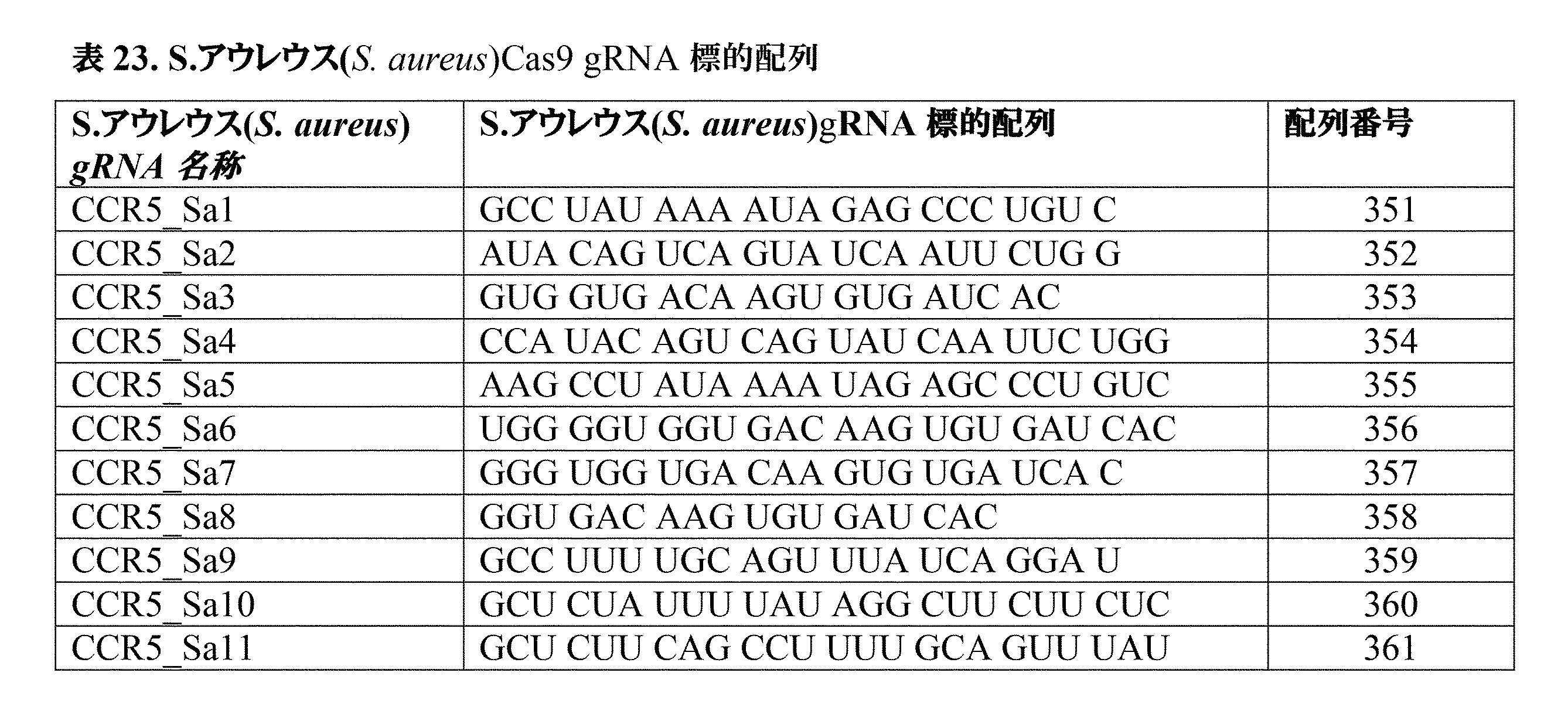
実施例5:5’キャップおよび3’ポリAテールの付加によるgRNAの修飾は、標的ゲノム遺伝子座でのゲノム編集を増加すると共に、CD34+細胞生存能力および生存期間を改善する
ウイルス-宿主共進化の間に、mRNAのキャッピングを模倣するウイルスRNAキャッピングは進化して、ウイルスRNAが、細胞の自然免疫系からの検出を免れることを可能にした(Delcroy et al.,2012,Nature Reviews Microbiology 10:51-65)。造血幹/前駆細胞中のトール様受容体は、自然免疫応答、細胞老化、およびプログラム細胞死を引き起こし得る外来の一本鎖および二本鎖RNAの存在を感知する(Kajaste-Rudnitski and Naldini,2015,Human Gene Therapy,26:201-209)。初期実験の結果から、GFPmRNA単独を用いて電気穿孔された細胞と比較して、非修飾標的特異的gRNAおよびCas9mRNAを用いて電気穿孔されたヒト造血幹/前駆細胞は、細胞寿命、増殖能、複能性の低減(例えば、赤血球分化能の喪失および歪んだ骨髄系分化)を招くことが立証された。この課題に取り組むために、細胞の老化およびアポトーシスは、外来核酸の標的細胞感知および自然免疫応答の誘導、さらにはこれに続くプログラム細胞死の誘導ならびに増殖能および分化能の喪失に起因すると仮定された。
Example 5: Modification of gRNAs by addition of a 5' cap and 3' poly-A tail increases genome editing at targeted genomic loci and improves CD34+ cell viability and survival. Virus-host coevolution. In the meantime, viral RNA capping, which mimics mRNA capping, has evolved, allowing viral RNA to evade detection from the cell's innate immune system (Delcroy et al., 2012, Nature Reviews Microbiology 10:51 -65). Toll-like receptors in hematopoietic stem/progenitor cells sense the presence of foreign single- and double-stranded RNAs that can trigger innate immune responses, cellular senescence, and programmed cell death (Kajaste-Rudnitski and Naldini, 2015 , Human Gene Therapy, 26:201-209). Results from initial experiments indicate that human hematopoietic stem/progenitor cells electroporated with unmodified target-specific gRNA and Cas9 mRNA have improved cell lifespan, proliferative capacity, It has been demonstrated that this results in reduced multipotency (eg, loss of erythroid differentiation potential and skewed myeloid differentiation). To address this challenge, cellular senescence and apoptosis are hypothesized to result from target cell sensing of foreign nucleic acids and induction of an innate immune response, followed by induction of programmed cell death and loss of proliferative and differentiation capacity. Ta.
造血/幹前駆細胞におけるゲノム編集の最適化のために、ならびにこの仮定を検証する目的で、動員末梢血および骨髄由来のヒトCD34+細胞を、5’キャップおよび3’ポリAテールの付加と共に、または付加なしで、インビトロ転写されたHBB(HBB-8gRNA;配列番号217)またはAAVS1(gRNA AAVS1-1;配列番号218)標的化gRNAと共送達されるS.ピオゲネス(S.pyogenes)Cas9mRNAで(Maxcyte装置を用いて)電気穿孔した。 For optimization of genome editing in hematopoietic/stem progenitor cells and to test this hypothesis, human CD34 + cells from mobilized peripheral blood and bone marrow were combined with addition of a 5' cap and a 3' polyA tail. or without addition, S. co-delivered with in vitro transcribed HBB (HBB-8gRNA; SEQ ID NO: 217) or AAVS1 (gRNA AAVS1-1; SEQ ID NO: 218) targeting gRNA. S. pyogenes Cas9 mRNA was electroporated (using a Maxcyte device).
図9~11に示すように、キャップおよびテール付加gRNAの電気穿孔は、ヒトCD34+細胞寿命および生存能力を高めた。CD34+細胞は、それぞれCas9mRNA(S.ピオゲネス(S.pyogenes)(Sp)またはS.アウレウス(S.aureus)(Sa)Cas9)と組み合わせた表示のキャップ/テールなしgRNAまたはキャップ/テール付加gRNAで電気穿孔した。対照サンプルは、GFPmRNA単独で電気穿孔された細胞または電気穿孔されていないが、表示の時間枠で培養した細胞を含む。 As shown in Figures 9-11, electroporation of capped and tailed gRNA enhanced human CD34 + cell longevity and viability. CD34+ cells were electromagnetized with the indicated cap/tailed gRNA or cap/tailed gRNA in combination with Cas9 mRNA (S. pyogenes (Sp) or S. aureus (Sa) Cas9), respectively. Perforated. Control samples include cells electroporated with GFP mRNA alone or cells that were not electroporated but cultured for the indicated time frames.
単一のキャップおよびテールなしHBBまたはAAVS1gRNAとそれぞれ組み合わせたCas9で電気穿孔したヒトCD34+細胞は、5’キャップおよび3’ポリAテールを含むようにインビトロで転写された同じgRNA配列で電気穿孔した細胞と比較して、培養中の3日にわたって低い増殖能を示した(図9)。Cas9mRNAと一緒に送達された他のキャップおよびテール付加gRNA(HBB(HBB-8gRNA;配列番号217)、AAVS1(AAVS1-1gRNA;配列番号218)、CXCR4(CXCR4-231gRNA;配列番号214)およびCCR5(CCR-U43gRNA;配列番号216)遺伝子座)に標的化されている)は、送達後3日にわたる生存CD34+細胞の総数の倍率増加の比較によって決定される通り、HSPC生存能力、増殖、または複能性にマイナスに影響を及ぼさなかった。重要なことには、GFPmRNAと接触させた細胞または非処理の細胞と比較して、キャップおよびテール付加gRNAおよびCas9mRNAと接触させたCD34+細胞の増殖能に差はなかった。Cas9mRNAおよびgRNAとの接触後72時間時点での細胞生存能力の分析(7-アミノアクチノマイシンDまたはヨウ化プロピジウムのいずれかとアネキシン(Annexin)V抗体の同時染色、それに続くフローサイトメトリー分析による)から、キャップおよびテール付加gRNAと接触した細胞は、培養中に拡大して、生存能力を維持したが、キャップおよびテールなしgRNAと接触させたHSCは、生存細胞数に減少を示すことが判明した(図10)。また、キャップおよびテール付加gRNAと接触した生存細胞(ヨウ化プロピジウム陰性)は、CD34細胞表面マーカーの発現も維持した(図11)。 Human CD34 + cells electroporated with Cas9 in combination with a single cap and untailed HBB or AAVS1 gRNA, respectively, were electroporated with the same gRNA sequence transcribed in vitro to contain a 5' cap and a 3' polyA tail. showed lower proliferative capacity over 3 days in culture compared to cells (Fig. 9). Other capped and tailed gRNAs delivered together with Cas9 mRNA (HBB (HBB-8gRNA; SEQ ID NO: 217), AAVS1 (AAVS1-1gRNA; SEQ ID NO: 218), CXCR4 (CXCR4-231gRNA; SEQ ID NO: 214) and CCR5 ( CCR- U43gRNA ; There was no negative impact on performance. Importantly, there was no difference in the proliferative capacity of CD34 + cells contacted with capped and tailed gRNA and Cas9 mRNA compared to cells contacted with GFP mRNA or untreated cells. Analysis of cell viability (by co-staining of Annexin V antibody with either 7-aminoactinomycin D or propidium iodide, followed by flow cytometry analysis) at 72 hours after contact with Cas9 mRNA and gRNA. , it was found that cells contacted with capped and tailed gRNA expanded and maintained viability in culture, whereas HSCs contacted with capped and untailed gRNA showed a decrease in viable cell numbers ( Figure 10). Viable cells (propidium iodide negative) contacted with capped and tailed gRNA also maintained expression of the CD34 cell surface marker (Figure 11).
図12、13、14A~14B、15Aおよび15Bに示すように、Cas9mRNAおよびキャップおよびテール付加gRNAの電気穿孔は、ヒトCD34+細胞における効率的な編集およびそれらの子孫を支持した。 As shown in Figures 12, 13, 14A-14B, 15A and 15B, electroporation of Cas9 mRNA and capped and tailed gRNA supported efficient editing in human CD34 + cells and their progeny.
改善された生存期間に加えて、キャップおよびテール付加AAVS1特異的gRNAと接触した標的細胞は、Cas9mRNAおよびキャップ/テールなしgRNAと接触した細胞と比較して、より高いオンターゲットゲノム編集率(%インデル)も示した(図12)。さらに、キャップ/テール付加gRNAを含むCas9mRNAと接触したCD34+細胞の子孫の方が、キャップ/テールなしgRNAを含むCas9mRNAと接触したCD34+細胞の子孫と比較して、より高いレベルの標的化編集が検出された(図12、CFC)。キャップ/テールなしgRNAの送達は、コロニー形成細胞(CFC)アッセイで決定される通り、CD34+細胞の生体外造血能も低下した。Cas9mRNAと一緒に、キャップおよびテールなしgRNAと接触した細胞は、総コロニー形成能(例えば、力価)の喪失およびコロニーサブタイプの多様性の減少(例えば、赤血球および前駆細胞能の喪失ならびに子孫における骨髄マクロファージ表現型への歪み)を示した(図13)。対照的に、キャップおよびテール付加gRNAと接触した細胞は、CD34+細胞から分化したコロニーの総数およびコロニー多様性(混合造血コロニー[GEMM]および赤血球コロニー[E]の検出)の双方に関してCFC能力を維持した。 In addition to improved survival, target cells contacted with capped and tailed AAVS1-specific gRNAs exhibited higher on-target genome editing rates (% indels) compared to cells contacted with Cas9 mRNA and non-capped/tailed gRNAs. ) was also shown (Figure 12). Furthermore, progeny of CD34 + cells contacted with Cas9 mRNA containing capped/tailed gRNAs exhibited higher levels of targeted editing compared to progeny of CD34 + cells contacted with Cas9 mRNA containing non-capped/tailed gRNAs. was detected (FIG. 12, CFC). Delivery of uncapped/tailed gRNA also reduced the in vitro hematopoietic capacity of CD34 + cells as determined by colony forming cell (CFC) assay. Cells contacted with the capped and untailed gRNA together with Cas9 mRNA show a loss of total colony-forming ability (e.g., titer) and a decrease in colony subtype diversity (e.g., loss of erythroid and progenitor cell ability and progeny). (Figure 13). In contrast, cells contacted with capped and tailed gRNAs maintained CFC competency, both in terms of total number of colonies differentiated from CD34+ cells and colony diversity (detection of mixed hematopoietic colonies [GEMM] and erythroid colonies [E]). did.
次に、キャップおよびテール付加HBB特異的gRNAをいずれかのCas9mRNAと共送達するか、またはCas9リボ核タンパク質(RNP)と複合体化した後、HSPCの特定の特徴を模倣することが明らかにされた赤白血病細胞株であるK562細胞に電気穿孔した。キャップおよびテール付加gRNAとCas9mRNAまたはRNPを共送達すると、HBB遺伝子座PCR産物のT7E1アッセイ分析によって決定される通り、HBB遺伝子座で高レベルのゲノム編集がもたらされた(図14A)。次に、3つの異なるキャップおよびテール付加gRNA(HBB、AAVS1、およびCXCR4遺伝子座を標的化する)をS.ピオゲネス(S.pyogenes)Cas9mRNAと一緒に、臍帯血(CB)から単離されたCD34+細胞に共送達した。この場合、様々な量のgRNA(2もしくは10μgのgRNAおよび10μgのS.ピオゲネス(S.pyogenes)Cas9mRNA)を細胞中に電気穿孔し、遺伝子座PCR産物のT7E1アッセイ分析により標的遺伝子座でのゲノム編集のパーセンテージを評価した。対照的に、Cas9mRNAと一緒にキャップおよびテールなしHBB gRNAで電気穿孔されたCB CD34+細胞からのゲノムDNAにはHBB遺伝子座に切断が検出されなかった。この結果は、Cas9mRNAとキャップおよびテール付加gRNAで電気穿孔されたCB CD34+細胞は、増殖能およびコロニー形成能を維持することを示した。5~20%のインデルが標的遺伝子座で検出され、Cas9mRNAと共送達されたキャップおよびテール付加gRNAの量は、標的化編集のパーセンテージに影響しなかった(図14B)。T7E1アッセイを実施した後の表示の遺伝子座特異的PCR産物の代表的なゲル画像は、電気穿孔(Maxcyte装置)によりS.ピオゲネス(S.pyogenes)Cas9mRNAと共送達されたキャップおよびテール付加遺伝子座特異的gRNA(AAVS1、HBB、およびCXCR4gRNA)の送達から72時間後のCB CD34+細胞の標的化遺伝子座に切断を示している(図15A)。重要なことには、Cas9mRNAまたはgRNAと接触しなかった細胞(すなわち、非処理対照)と比較して、S.ピオゲネス(S.pyogenes)Cas9mRNAと共送達されたキャップおよびテール付加AAVS1特異的gRNA、HBB特異的gRNA、もしくはCXCR4特異的gRNAで電気穿孔された細胞の生存能力に差はなかった。フローサイトメトリー分析により決定される通り、7-AADおよびアネキシンVについてのネガティブ染色法によって生存細胞が示される(フローサイトメトリープロットの左下部、図15B)。S.ピオゲネス(S.pyogenes)Cas9mRNAと共送達されたキャップおよびテール付加AAVS1特異的gRNA、HBB特異的gRNA、またはCXCR4特異的gRNAで電気穿孔されたCB CD34+細胞は、CFCアッセイにより決定される通り、生体外造血コロニー形成能を維持した。HBB特異的gRNAおよびCas9と接触した細胞についてのCFCアッセイにおける生体外造血能のグラフを図14Cに示す。 Next, capped and tailed HBB-specific gRNAs were shown to mimic specific characteristics of HSPCs after co-delivery with either Cas9 mRNA or complexed with Cas9 ribonucleoproteins (RNPs). K562 cells, an erythroleukemia cell line, were electroporated. Co-delivery of Cas9 mRNA or RNP with capped and tailed gRNA resulted in high levels of genome editing at the HBB locus, as determined by T7E1 assay analysis of HBB locus PCR products (FIG. 14A). Next, three different capped and tailed gRNAs (targeting the HBB, AAVS1, and CXCR4 loci) were injected into S. was co-delivered with S. pyogenes Cas9 mRNA to CD34 + cells isolated from umbilical cord blood (CB). In this case, various amounts of gRNA (2 or 10 μg gRNA and 10 μg S. pyogenes Cas9 mRNA) were electroporated into the cells and the genome at the target locus was detected by T7E1 assay analysis of the locus PCR products. The percentage of edits was evaluated. In contrast, no breaks at the HBB locus were detected in genomic DNA from CB CD34 + cells electroporated with uncapped and untailed HBB gRNA along with Cas9 mRNA. The results showed that CB CD34 + cells electroporated with Cas9 mRNA and capped and tailed gRNA maintained proliferative and colony-forming ability. 5-20% indels were detected at the target locus, and the amount of capped and tailed gRNA co-delivered with Cas9 mRNA did not affect the percentage of targeted editing (Figure 14B). Representative gel images of the locus-specific PCR products shown after performing the T7E1 assay were obtained by electroporation (Maxcyte equipment) from S. Figure 7 shows cleavage at targeted loci in CB CD34 + cells 72 hours after delivery of capped and tailed locus-specific gRNAs (AAVS1, HBB, and CXCR4 gRNAs) co-delivered with S. pyogenes Cas9 mRNA. (Figure 15A). Importantly, compared to cells that were not contacted with Cas9 mRNA or gRNA (i.e., untreated control), S. There was no difference in the viability of cells electroporated with capped and tailed AAVS1-specific, HBB-specific, or CXCR4-specific gRNA co-delivered with S. pyogenes Cas9 mRNA. Negative staining for 7-AAD and Annexin V shows viable cells as determined by flow cytometry analysis (bottom left of flow cytometry plot, Figure 15B). S. CB CD34 + cells electroporated with capped and tailed AAVS1-specific gRNA, HBB-specific gRNA, or CXCR4-specific gRNA co-delivered with S. pyogenes Cas9 mRNA, as determined by CFC assay. In vitro hematopoietic colony forming ability was maintained. A graph of in vitro hematopoietic potential in CFC assays for cells contacted with HBB-specific gRNA and Cas9 is shown in Figure 14C.
実施例6:ドナー細胞中の単一HLA-A対立遺伝子を破壊するためのCas9/gRNAの標的化と、レシピエント対立遺伝子によるHLA-A対立遺伝子の置換
この実施例では、アフリカ系アメリカ人レシピエント対象がHSCTを必要とする。レシピエントのHLAタイピングを従来の方法(例えば、DNA配列決定)により行った後、骨髄および臍帯血ドナー登録簿で利用可能なドナー遺伝子型と比較する。完全にマッチするドナーは、全米骨髄バンク(National Marrow Donor Program)登録簿、全米臍帯血バンク(National Cord Blood Program)登録簿、またはその他の幹細胞もしくは臍帯血バンク登録簿でも見出すことができない。しかし、部分的にマッチする臍帯血ヨーロッパ系アメリカ人(白色人種)ドナーが同定されており、その場合、アロ-UCTの要件を満たす臍帯血(CB)マッチングのために、遺伝子座の6対立遺伝子の5つが要求される(すなわち、HLA-A、HLA-B、HLA-DRB1)(図16A~16B)。ドナー候補とレシピエント間のマッチングのレベルを高める目的で、A*02:01:01対立遺伝子に特異的なCas9および1つまたは複数のgRNAを、その特定の対立遺伝子の標的化破壊(片アレル遺伝子編集)のために、ドナー臍帯血HSPCに送達する。1つまたは複数の恐らく修飾された(例えば、キャップ/テール付加)gRNAを、破壊しようとする特定のHLA-A対立遺伝子のために作製された上位階層gRNAから選択する(表24)。Cas9/gRNAで対立遺伝子を破壊した後、T7E1アッセイおよびDNA配列解析によって、対立遺伝子の破壊を確認する。HLA-Alo、例えば、HLA-A+/-、例えば、HLA-A*02:01:01:01陰性細胞(例えば、HLA-A*02:01:01:01片アレル破壊が成功している細胞)を選別により精製する。ミスマッチレシピエントHLA-A対立遺伝子(例えば、A*01:01:01:01)DNA配列(例えば、cDNA、図17A~17B)を作製し、レンチウイルスベクターにクローン化する。レシピエント細胞におけるこの対立遺伝子を調節する内在性プロモーター配列を配列決定し、さらに、A*01:01:01:01cDNA配列上流のレンチウイルスベクターにクローン化する。次に、このHLA-Aトランスジーン発現カセット(例えば、マッチHLA対立遺伝子を調節するHLAプロモーター)をレンチウイルスベクター粒子にパッケージする。選別されたドナーHLA-Alo、例えば、HLA-A+/-、例えば、HLA-A*02:01:01:01陰性細胞をレンチウイルスベクター粒子と接触させて、細胞中にA*01:01:01:01トランスジーン発現カセットを遺伝子移入する。次に、形質導入された細胞を、細胞表面上のHLA-Aの発現増大(形質導入されていないHLA-Alo細胞と比較して)に基づいて選別する。HLA-A片アレル遺伝子置換の後、HLA修飾臍帯血ドナーHSPCは、6HLA遺伝子座の6つがレシピエント対象とマッチする。マッチするドナー臍帯血HSPCを従来の臍帯血移植片臨床プロトコルに従って、レシピエント対象に移植する。
Example 6: Targeting Cas9/gRNA to disrupt a single HLA-A allele in donor cells and replace the HLA-A allele with the recipient allele. Entrant subject requires HSCT. HLA typing of the recipient is performed by conventional methods (eg, DNA sequencing) and then compared to donor genotypes available in bone marrow and cord blood donor registries. A perfect match donor cannot be found in the National Marrow Donor Program registry, the National Cord Blood Program registry, or any other stem cell or cord blood bank registry. However, partially matched cord blood European American (Caucasian) donors have been identified, in which case six alleles of the locus are needed for cord blood (CB) matching that meets the requirements of the allo-UCT. Five of the genes are required (ie, HLA-A, HLA-B, HLA-DRB1) (Figures 16A-16B). In order to increase the level of matching between donor candidates and recipients, Cas9 and one or more gRNAs specific for the A*02:01:01 allele can be used for targeted disruption of that particular allele (moniallelic gene editing) to donor cord blood HSPCs. One or more potentially modified (eg, capped/tailed) gRNAs are selected from the top hierarchy gRNAs generated for the particular HLA-A allele to be disrupted (Table 24). After allele disruption with Cas9/gRNA, allele disruption is confirmed by T7E1 assay and DNA sequence analysis. HLA-A lo , e.g., HLA-A +/- , e.g., HLA-A*02:01:01:01 negative cells (e.g., HLA-A*02:01:01:01 single allele destruction has been successful) cells) are purified by sorting. A mismatched recipient HLA-A allele (eg, A*01:01:01:01) DNA sequence (eg, cDNA, FIGS. 17A-17B) is generated and cloned into a lentiviral vector. The endogenous promoter sequence regulating this allele in recipient cells is sequenced and further cloned into a lentiviral vector upstream of the A*01:01:01:01 cDNA sequence. This HLA-A transgene expression cassette (eg, HLA promoter regulating matched HLA alleles) is then packaged into lentiviral vector particles. Selected donor HLA-A lo , eg, HLA-A +/− , eg, HLA-A*02:01:01:01 negative cells are contacted with lentiviral vector particles to induce A*01: in the cells. 01:01:01 Transfect the transgene expression cassette. Transduced cells are then selected based on increased expression of HLA-A on the cell surface (compared to non-transduced HLA-A lo cells). After HLA-A monoallelic gene replacement, HLA-modified cord blood donor HSPCs are matched to the recipient subject at six of the six HLA loci. Matched donor cord blood HSPCs are transplanted into recipient subjects according to conventional cord blood graft clinical protocols.
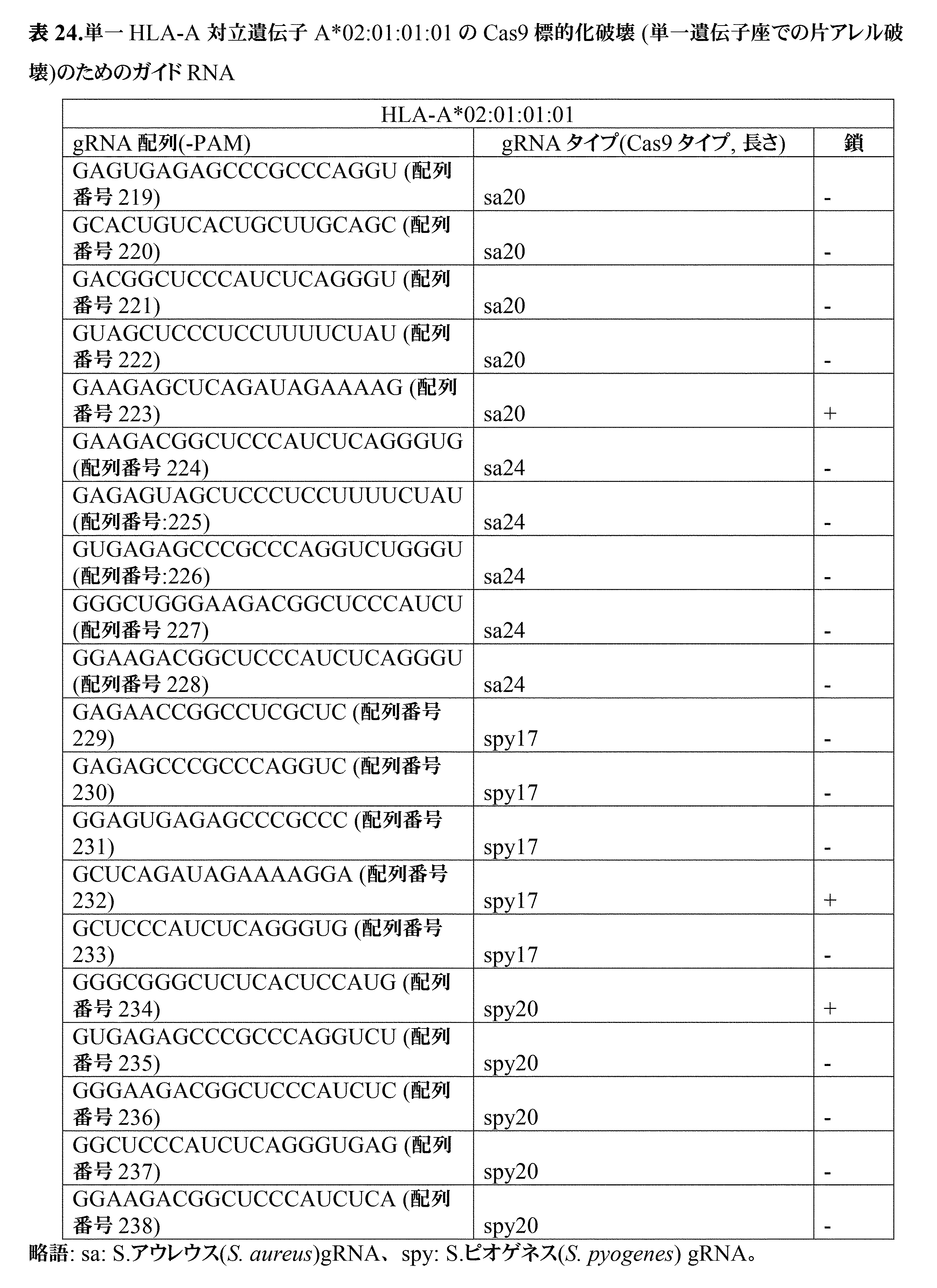
実施例7:ドナー細胞中のHLA-A遺伝子の両アレル破壊のためのCas9/gRNAの標的化と、レシピエント対象の同一HLA-A対立遺伝子による2つのドナーミスマッチHLA-A対立遺伝子の置換
この実施例では、ヒスパニック系(ラテンアメリカ人)レシピエント対象がHSCTを必要とする。レシピエントのHLAタイピングを従来の方法(例えば、DNA配列決定)により行った後、骨髄および臍帯血ドナー登録簿で利用可能なドナー遺伝子型と比較する。完全にマッチするドナーは、全米骨髄バンク(National Marrow Donor Program)登録簿、全米臍帯血バンク(National Cord Blood Program)登録簿、またはその他の幹細胞もしくは臍帯血バンク登録簿でも見出すことができない。しかし、部分的にマッチする臍帯血ヨーロッパ系アメリカ人(白色人種)ドナーが同定されており、その場合、アロ-UCTの要件を満たす臍帯血(CB)マッチングのために、遺伝子座の6対立遺伝子の4つが要求される(すなわち、HLA-A、HLA-B、HLA-DRB1)(図18A~18B)。ドナー候補とレシピエント間のマッチングのレベルを高める目的で、HLA-A遺伝子座を標的化する(例えば、ドナー細胞中の両方のHLA-A対立遺伝子に共通の配列を標的化する)Cas9および1つまたは複数のgRNAを、その遺伝子の標的化破壊(両アレル遺伝子編集)のために、ドナー臍帯血HSPCに送達する。1つまたは複数のgRNA(恐らく修飾されたgRNA、例えば、キャップ/テール付加)を、遺伝子座で破壊しようとするHLA-A対立遺伝子のために作製された上位階層gRNAから選択する(表25)。Cas9/gRNAによる遺伝子座の両アレル破壊後、T7E1アッセイおよびDNA配列解析によって、対立遺伝子の破壊を確認する。HLA-A-/-、例えば、HLA-A*02:01:01:01およびA*29:02:01:01陰性細胞(例えば、両アレル破壊が成功している細胞)を選別により精製する。初めドナー細胞中に存在しなかったレシピエント対象同一HLA-A対立遺伝子のDNA配列)(例えば、cDNA)(例えば、A*01:01:01:01およびA*23:01:01を作製し、レンチウイルスベクターにクローン化する。レシピエント対象細胞中のこれらの対立遺伝子を調節する内在性プロモーター配列を配列決定し、さらに、A*01:01:01:01およびA*23:01:01cDNA配列上流の1つまたは複数のレンチウイルスベクターに、対立遺伝子を調節する各々のプロモーター(対象細胞中のプロモーター/対立遺伝子組合せに対応する)を用いて、クローン化する。このHLA-Aトランスジーン発現カセットをレンチウイルスベクター粒子にパッケージする。選別されたドナーHLA-A-/-、例えば、HLA-A*02:01:01:01およびA*29:02:01:01陰性細胞(例えば、両アレル破壊が成功している細胞)をレンチウイルスベクター粒子と接触させて、レシピエント細胞中にA*01:01:01:01およびA*23:01:01トランスジーン発現カセットの両方を遺伝子移入する。次に、形質導入された細胞を、細胞表面上のHLA-Aの発現増大(形質導入されていないHLA-A-/-細胞と比較して)に基づいて選別する。HLA-A両アレル遺伝子置換の後、HLA修飾臍帯血ドナーHSPCは、6HLA遺伝子座の6つがレシピエント対象とマッチする。マッチしたドナー臍帯血HSPCを従来の臍帯血移植片臨床プロトコルに従って、レシピエント対象に移植する。
Example 7: Targeting Cas9/gRNA for biallelic disruption of the HLA-A gene in donor cells and replacement of two donor mismatched HLA-A alleles with the same HLA-A allele in the recipient subject. In an example, a Hispanic (Latino American) recipient subject requires HSCT. HLA typing of the recipient is performed by conventional methods (eg, DNA sequencing) and then compared to donor genotypes available in bone marrow and cord blood donor registries. A perfect match donor cannot be found in the National Marrow Donor Program registry, the National Cord Blood Program registry, or any other stem cell or cord blood bank registry. However, partially matched cord blood European American (Caucasian) donors have been identified, in which case six alleles of the locus are needed for cord blood (CB) matching that meets the requirements of the allo-UCT. Four of the genes are required (ie, HLA-A, HLA-B, HLA-DRB1) (Figures 18A-18B). Cas9 and 1 target HLA-A loci (e.g., target sequences common to both HLA-A alleles in donor cells) with the aim of increasing the level of matching between donor candidates and recipients. One or more gRNAs are delivered to donor cord blood HSPCs for targeted destruction of that gene (biallelic gene editing). One or more gRNAs (possibly modified gRNAs, e.g. cap/tailed) are selected from the upper hierarchy gRNAs created for the HLA-A allele to be disrupted at the locus (Table 25) . After biallelic disruption of the locus with Cas9/gRNA, allelic disruption is confirmed by T7E1 assay and DNA sequence analysis. HLA-A −/− , e.g., HLA-A*02:01:01:01 and A*29:02:01:01 negative cells (e.g., cells in which biallele disruption has been successful) are purified by selection. . DNA sequences (e.g., cDNA) (e.g., A*01:01:01:01 and A*23:01:01) of the same HLA-A allele of the recipient subject that were not originally present in the donor cells are generated. , cloned into a lentiviral vector. The endogenous promoter sequences regulating these alleles in the recipient subject cells were sequenced and the A*01:01:01:01 and A*23:01:01 cDNAs The sequence is cloned into one or more lentiviral vectors upstream of the HLA-A transgene, with each promoter regulating the allele (corresponding to the promoter/allele combination in the cells of interest). The cassette is packaged into lentiviral vector particles. Selected donor HLA-A −/− , e.g., HLA-A*02:01:01:01 and A*29:02:01:01 negative cells (e.g., both Cells with successful allele disruption) are contacted with lentiviral vector particles to introfect both the A*01:01:01:01 and A*23:01:01 transgene expression cassettes into recipient cells. Transduced cells are then selected based on increased expression of HLA-A on the cell surface (compared to non-transduced HLA-A −/− cells). After allelic gene replacement, HLA-modified cord blood donor HSPCs are matched to the recipient subject at six of the six HLA loci. The matched donor cord blood HSPCs are transplanted into the recipient subject according to conventional cord blood graft clinical protocols. .
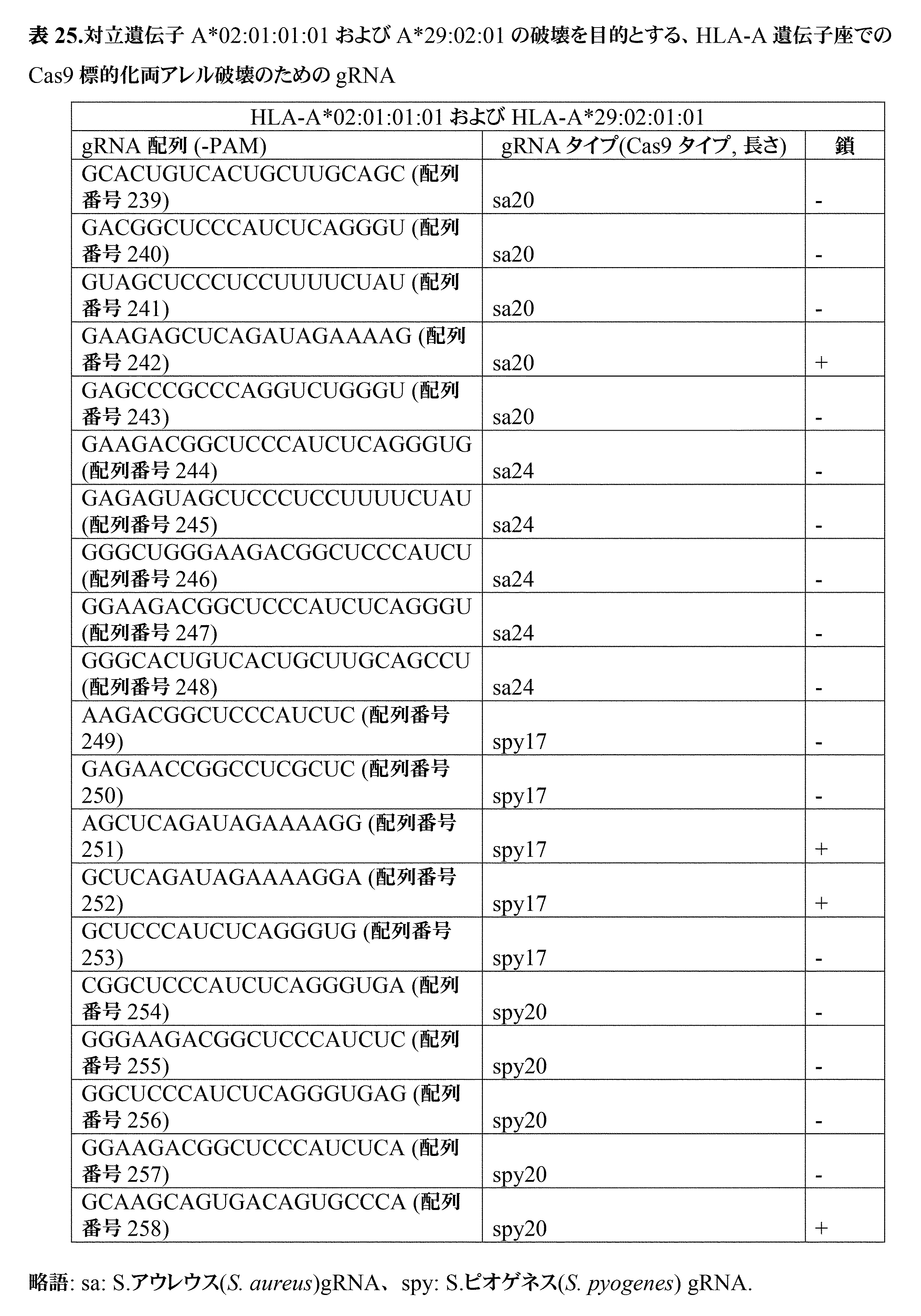
実施例8:ミスマッチHLAハプロタイプの破壊による多重ゲノム編集のためのCas9およびgRNAの標的化と、HLA-A、HLA-B、およびHLA-DRB1のそれぞれ1コピーの遺伝子置換
この実施例では、ヒスパニック系(ラテンアメリカ人)レシピエント対象がHSCTを必要とする。レシピエントのHLAタイピングを従来の方法(例えば、DNA配列決定)により行った後、骨髄および臍帯血ドナー登録簿で利用可能なドナー遺伝子型と比較する。完全にマッチするドナーは、全米骨髄バンク(National Marrow Donor Program)登録簿、全米臍帯血バンク(National Cord Blood Program)登録簿、またはその他の幹細胞もしくは臍帯血バンク登録簿でも見出すことができない。しかし、ハプロタイプ同一の臍帯血ヨーロッパ系アメリカ人(白色人種)ドナーが同定されており、その場合、アロ-UCTの要件を満たす臍帯血(CB)マッチングのために、遺伝子座(例えば、ハプロタイプ同一の)の6対立遺伝子の3つが要求される(すなわち、HLA-A、HLA-B、HLA-DRB1)(図18A~18B)。ドナー候補とレシピエント間のマッチングのレベルを高める目的で、ドナーHSPCにおいてマッチしないハプロタイプ中の対立遺伝子(例えば、A*02:01:01:01、B*08:01:01、およびDRB1*03:01:01)を標的化する、Cas9および複数のgRNA(例えば、恐らく修飾されたgRNA、例えば、キャップ/テール付加gRNA)を、複数の遺伝子座の標的化片アレル破壊(例えば、HLA-A、HLA-B、HLA-DRB1の多重遺伝子編集)のために、ドナー臍帯血HSPCに送達する。1つまたは複数の恐らく修飾されたgRNA(例えば、キャップ/テール付加)を、上記の特定の遺伝子座で破壊しようとするHLA-A、HLA-B、およびHLA-DRB1ドナー特異的対立遺伝子(レシピエントとマッチしない)のために作製された上位階層gRNAから選択する(表26)。Cas9/gRNAによる遺伝子座の標的化片アレル破壊後、T7E1アッセイおよびDNA配列解析によって、対立遺伝子の破壊を確認する。HLA-A+/-、例えば、HLA-A*02:01:01:01陰性;HLA-B+/-、例えば、B*08:01:01陰性;およびHLA-DRB1+/-、例えば、DRB1*03:01:01:01陰性細胞(例えば、3つの遺伝子座で片アレル破壊が成功している細胞)を選別により精製する。初めハプロタイプ同一ドナー細胞中に存在しなかったミスマッチレシピエント対象HLA-A対立遺伝子(例えば、A*03:01:01:01、B*07:02:01、DRB1*15:01:01:01)を配列決定してから、DNA配列(例えば、cDNA)は、レシピエント細胞中のこれらの対立遺伝子に隣接するDNAを配列決定することによって決定されたそれらの内在性プロモーター上流の1つまたは複数のレンチウイルスベクターにクローン化する。HLA-A、-B、および-DRB1トランスジーン発現カセットをレンチウイルスベクター粒子にパッケージする。選別されたドナーHLA-A+/-、HLA-B+/-、HLA-DRB1+/-細胞、例えば、(例えば、HLA-A、-B、-DRB1の多重片アレル破壊が成功している細胞)をレンチウイルスベクター粒子と接触させて、レシピエント細胞中にHLA-A、-B、および-DRB1トランスジーン発現カセットを遺伝子移入する。次に、形質導入された細胞を、細胞表面上のHLA-A、-B、および-DRB1の発現増大(形質導入されていないHLA-A+/-、HLA-B+/-、HLA-DRB1+/-細胞と比較して)に基づいて選別する。HLA-A、-B、および-DRB1遺伝子置換の後、HLA修飾臍帯血ドナーHSPCは、6HLA遺伝子座の6つがレシピエント対象とマッチする。マッチするドナー臍帯血HSPCを従来の臍帯血移植片臨床プロトコルに従って、レシピエント対象に移植する。
Example 8: Targeting Cas9 and gRNA for multiplex genome editing by disruption of mismatched HLA haplotypes and gene replacement of one copy each of HLA-A, HLA-B, and HLA-DRB1. (Latin American) Recipient subject requires HSCT. HLA typing of the recipient is performed by conventional methods (eg, DNA sequencing) and then compared to donor genotypes available in bone marrow and cord blood donor registries. A perfect match donor cannot be found in the National Marrow Donor Program registry, the National Cord Blood Program registry, or any other stem cell or cord blood bank registry. However, haplotype-identical cord blood European American (Caucasian) donors have been identified in which genetic loci (e.g., haplotype-identity ) are required (ie, HLA-A, HLA-B, HLA-DRB1) (FIGS. 18A-18B). Alleles in unmatched haplotypes (e.g., A*02:01:01:01, B*08:01:01, and DRB1*03 Cas9 and multiple gRNAs (e.g., possibly modified gRNAs, e.g., capped/tailed gRNAs) to target monoallelic disruption of multiple loci (e.g., HLA-A , HLA-B, HLA-DRB1) into donor cord blood HSPCs. HLA-A, HLA-B, and HLA-DRB1 donor-specific alleles (recipe (Table 26). After targeted monoallelic disruption of the locus with Cas9/gRNA, allelic disruption is confirmed by T7E1 assay and DNA sequence analysis. HLA-A +/- , e.g. HLA-A*02:01:01:01 negative; HLA-B +/- , e.g. B*08:01:01 negative; and HLA-DRB1 +/- , e.g. DRB1*03:01:01:01 negative cells (for example, cells in which one allele has been successfully disrupted at three gene loci) are purified by selection. mismatched recipient HLA-A alleles that were not initially present in the haplotype-identical donor cells (e.g., A*03:01:01:01, B*07:02:01, DRB1*15:01:01:01 ) and then the DNA sequence (e.g., cDNA) is sequenced from one or more of the endogenous promoters upstream of those alleles determined by sequencing the DNA flanking these alleles in the recipient cell. into a lentiviral vector. HLA-A, -B, and -DRB1 transgene expression cassettes are packaged into lentiviral vector particles. Selected donor HLA-A +/- , HLA-B +/- , HLA-DRB1 +/- cells, e.g. cells) with lentiviral vector particles to transfect the HLA-A, -B, and -DRB1 transgene expression cassettes into the recipient cells. The transduced cells were then treated with increased expression of HLA-A, -B, and -DRB1 on the cell surface (untransduced HLA-A +/- , HLA-B +/- , HLA-DRB1 +/− compared to cells). After HLA-A, -B, and -DRB1 gene replacement, HLA-modified cord blood donor HSPCs are matched to the recipient subject at six of the six HLA loci. Matched donor cord blood HSPCs are transplanted into recipient subjects according to conventional cord blood graft clinical protocols.
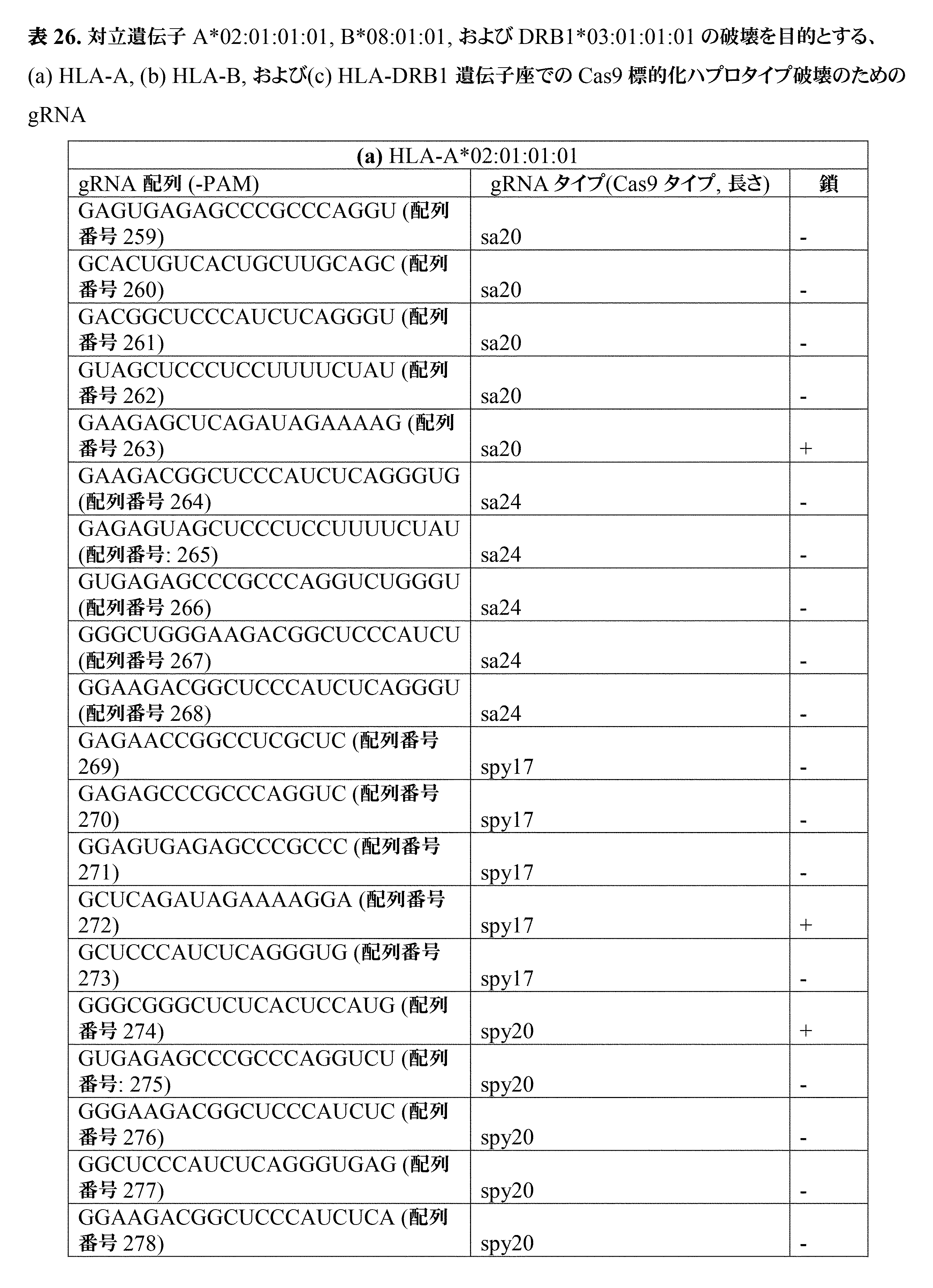
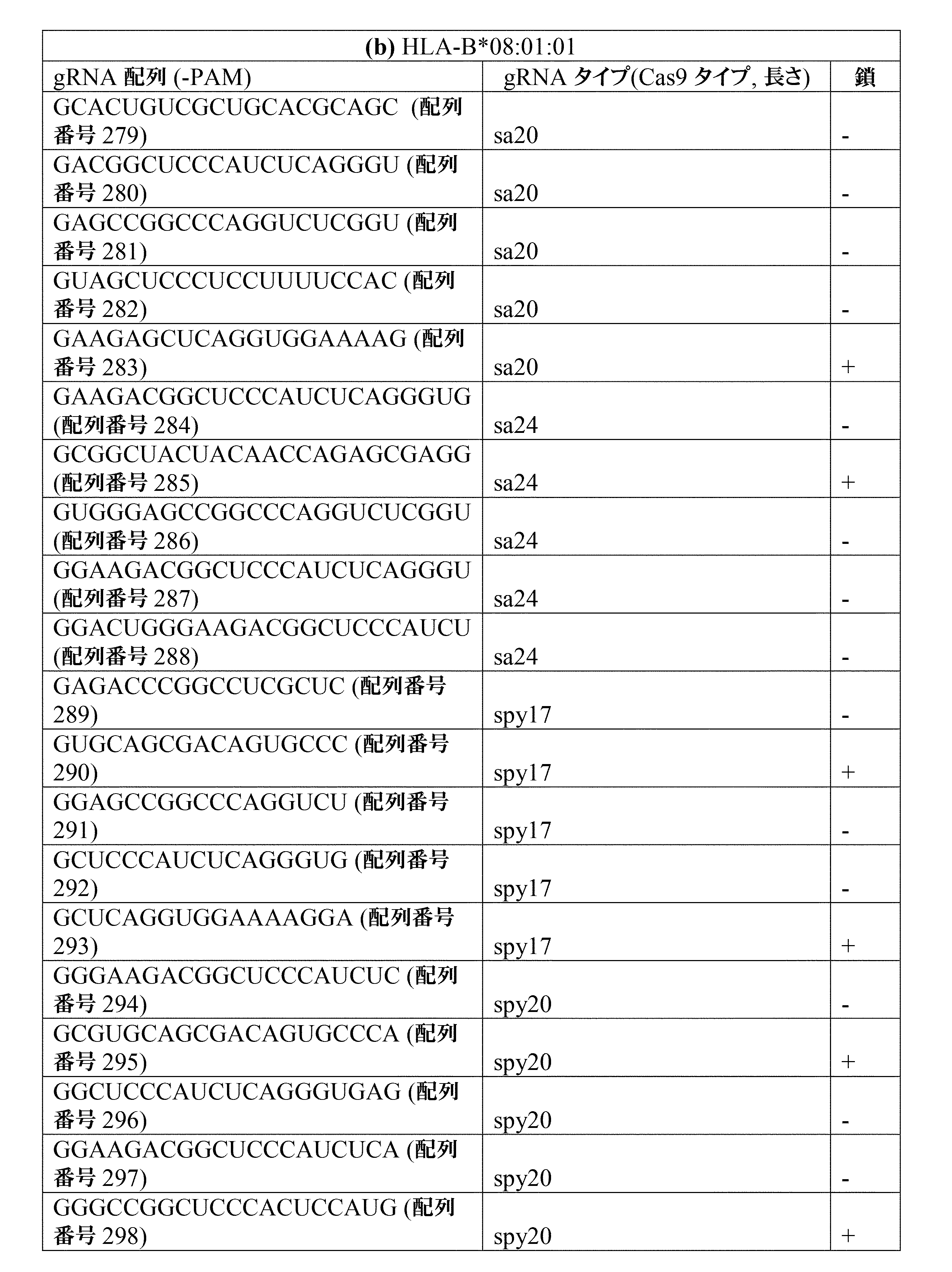
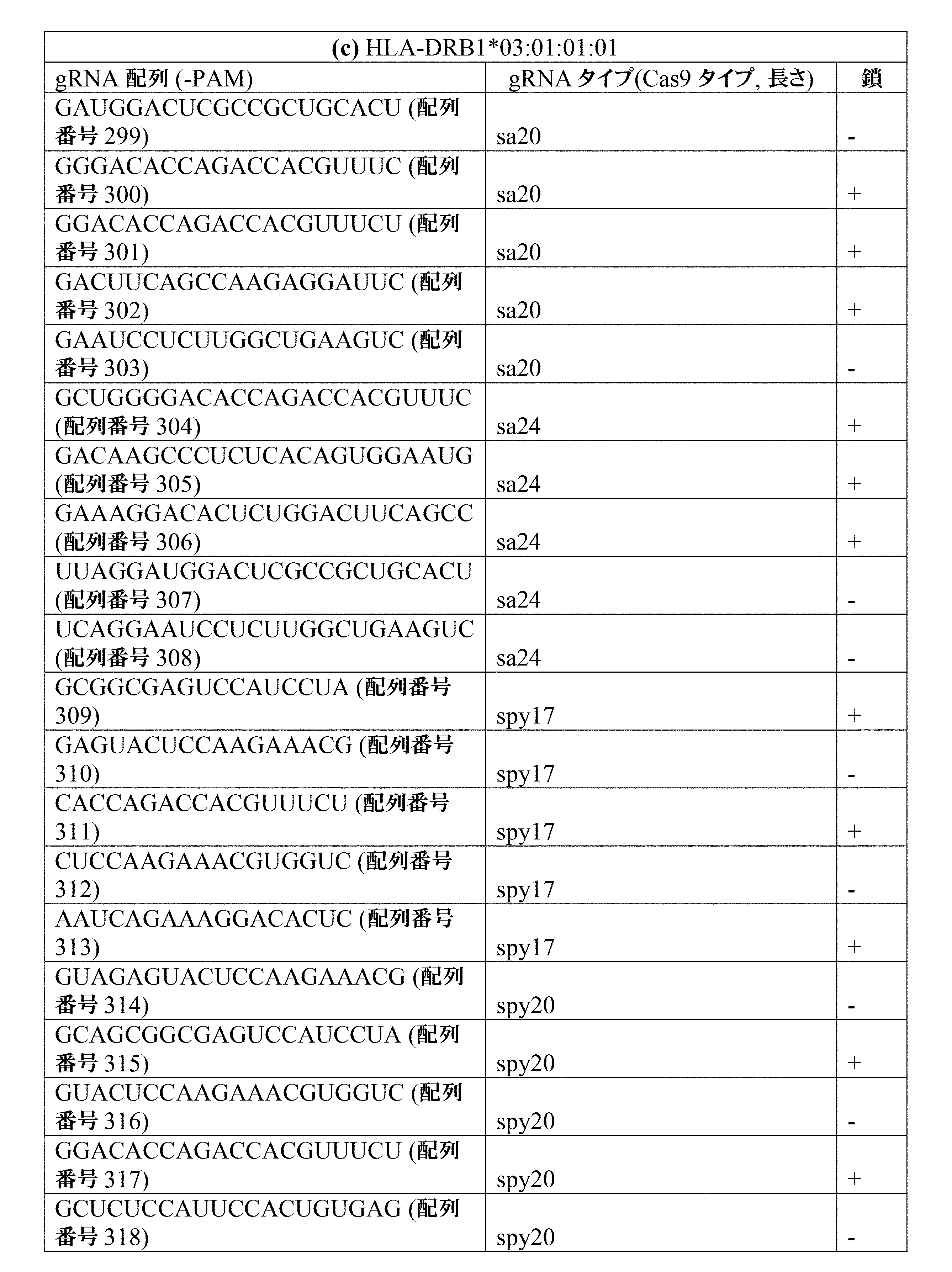
以下の実施例9~11では、ゲノムDNAの増幅、続いてDNA配列に基づくタイピングおよび/または配列特異的プライマー/プローブにより、数人のドナーからのヒト臍帯血単核細胞(MNC)をHLAタイピングした(Kashi Clinical Laboratories,Portland,OR)。3人のHSCドナー由来の一次ヒト細胞、臍帯血MNCを前述のようにHLAタイピングした後、HLA-A、HLA-BおよびHLA-DRB1対立遺伝子について4桁タイピング報告を作成した(表27)。最も高い対立遺伝子マッチング数に基づいて、サンプルを、部分的にマッチするドナーとレシピエントとしてペア形成した。各々の推定ドナーとレシピエントのペアについて、ミスマッチ対立遺伝子を同定して、こうした遺伝子座の編集によって、ドナー候補とレシピエント間の対立遺伝子ミスマッチ数を減らすようにした。データベースを用いて、対立遺伝子特異的様式で標的化遺伝子座の編集に使用するために適切なgRNAを検索した。HLAタイピングの8つの数字のうち4つ(4分野のうちの2つ)は、表示される対立遺伝子のいずれのサブタイプであってもよい(例えば、HLA-A02:01は、HLA-A02:01:01:01であり得る)。標的対立遺伝子の全サブタイプのオンターゲット部位にマッチするgRNAについて、データベースを検索した。同定されたgRNAが、ドナー細胞中の他のHLA対立遺伝子のどのサブタイプ(例えば、HLA-A、HLA-DRB1)も標的化しないように、検索を調整した。データベースはまた、同定されたgRNA各々に対するオンターゲット特異性を有する標的対立遺伝子のサブタイプの計数/パーセンテージも提供した。このプロセスでは、ユーザーが、同時に複数の対立遺伝子を表示する場合、データベースは、まず、全ての標的遺伝子座においてオンターゲット部位を有するgRNAを検索し、他の対立遺伝子にオンターゲット部位を有するgRNAは回避された。同定された適切なgRNAを取得した後、データベースはさらに、参照として使用される全てのドナー対立遺伝子のサブタイプの配列を提供する。前のステップで同定されたgRNAのオン/オフターゲット部位が、これらのドナー対立遺伝子サブタイプ配列に対して検索される。gRNA選択の最終ステップは、最初のステップからのデータ(標的対立遺伝子のサブタイプのより高い計数/パーセンテージ、除外対立遺伝子のより低いオフターゲット計数/パーセンテージ、全ゲノムの低いオフターゲット計数/パーセンテージ、など)に基づくgRNA選択を含む。 In Examples 9-11 below, we HLA-type human cord blood mononuclear cells (MNCs) from several donors by amplification of genomic DNA followed by DNA sequence-based typing and/or sequence-specific primers/probes. (Kashi Clinical Laboratories, Portland, OR). Primary human cells from three HSC donors, umbilical cord blood MNCs, were HLA typed as described above, followed by a four-digit typing report for HLA-A, HLA-B and HLA-DRB1 alleles (Table 27). Samples were paired as partially matched donors and recipients based on the highest number of allele matches. For each putative donor-recipient pair, mismatched alleles were identified, and these loci were edited to reduce the number of allelic mismatches between candidate donor and recipient. Databases were used to search for suitable gRNAs for use in editing targeted loci in an allele-specific manner. Four of the eight numbers (two of the four fields) in HLA typing can be any subtype of the displayed allele (e.g., HLA-A02:01 is HLA-A02: 01:01:01). Databases were searched for gRNAs matching on-target sites for all subtypes of the target allele. The search was tailored such that the identified gRNAs did not target any subtypes of other HLA alleles (eg, HLA-A, HLA-DRB1) in the donor cells. The database also provided counts/percentages of target allele subtypes with on-target specificity for each identified gRNA. In this process, when a user views multiple alleles at the same time, the database first searches for gRNAs with on-target sites at all target loci, and then searches for gRNAs with on-target sites at other alleles. Averted. After obtaining the identified appropriate gRNA, the database further provides the sequences of all donor allele subtypes to be used as a reference. The gRNA on/off target sites identified in the previous step are searched against these donor allele subtype sequences. The final step of gRNA selection is based on the data from the first step (higher counts/percentages of subtypes of target alleles, lower off-target counts/percentages of excluded alleles, lower off-target counts/percentages of the whole genome, etc.) )-based gRNA selection.
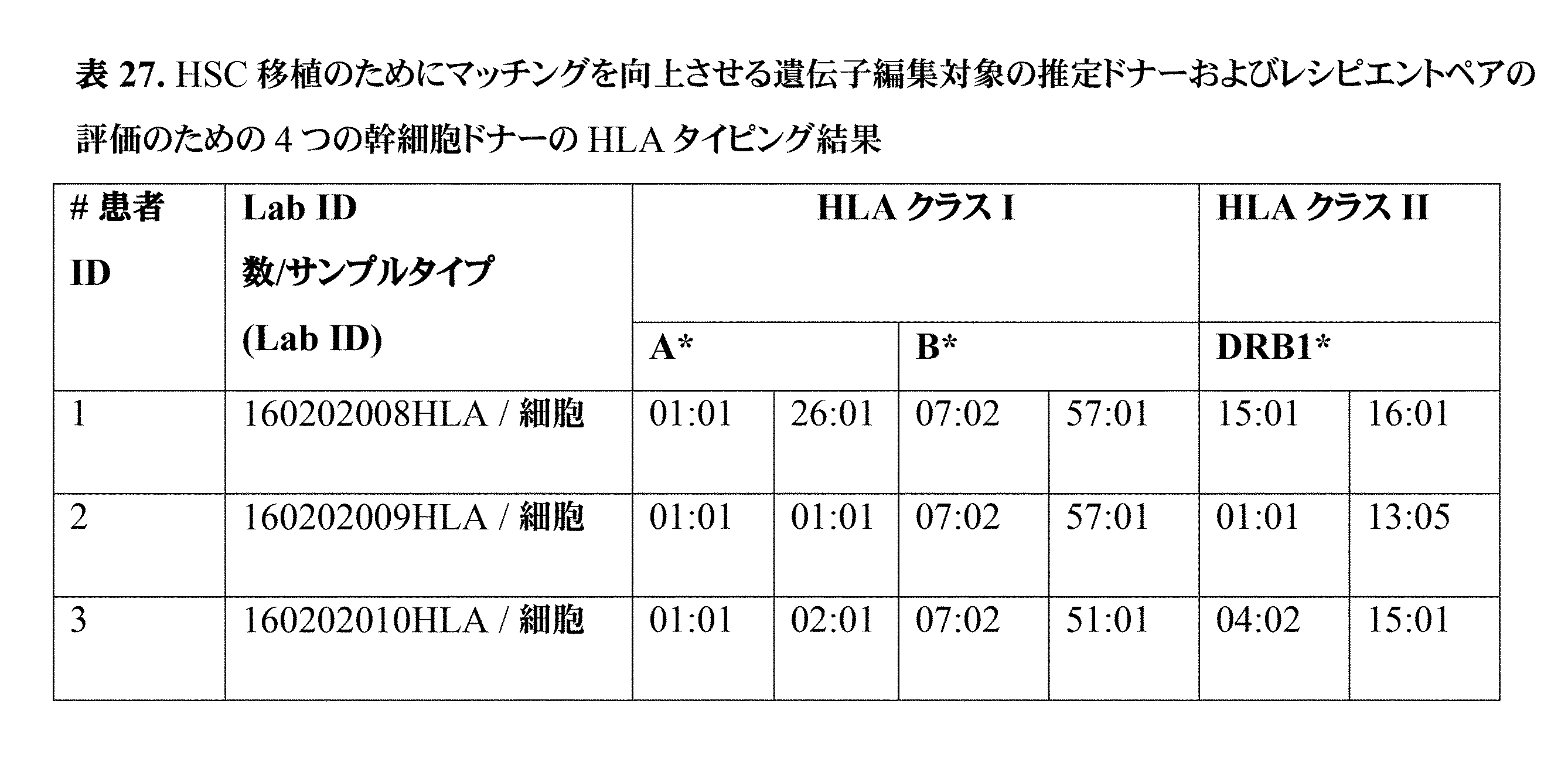
実施例9:一次ヒトT-リンパ球におけるミスマッチHLA-A対立遺伝子(HLA-A26:01)の破壊によるゲノム編集のためのCas9およびgRNAの標的化
レシピエントに対して6対立遺伝子でのHLAマッチングが不適レベル(3遺伝子座、3/6ミスマッチHLA対立遺伝子)であるドナー候補とのマッチングのレベルを高めるために、本明細書に記載のデータベースを用い、Cas9および特異的に同定されたgRNAを使用して、標的化対立遺伝子特異的遺伝子編集を実施した。その結果、ミスマッチドナー(表27、患者1)からの細胞同士のHLAマッチングのレベルが、遺伝子破壊(表28)によって、レシピエント患者候補(表27、患者2)への移入に好適となった(HLAミスマッチを2/6ミスマッチHLA対立遺伝子に低減することにより)。
Example 9: Targeting Cas9 and gRNA for genome editing by disruption of mismatched HLA-A allele (HLA-A26:01) in primary human T-lymphocytes HLA matching with 6 alleles to recipient To increase the level of matching with potential donors with unsuitable levels of HLA alleles (3 loci, 3/6 mismatched HLA alleles), Cas9 and specifically identified gRNAs can be synthesized using the database described herein. was used to perform targeted allele-specific gene editing. As a result, the level of HLA matching between cells from a mismatched donor (Table 27, Patient 1) became suitable for transfer to a potential recipient patient (Table 27, Patient 2) due to gene disruption (Table 28). (by reducing HLA mismatches to 2/6 mismatched HLA alleles).

患者1(ドナー)は、患者2(レシピエント)と、6タイプのHLA対立遺伝子(HLA-A、およびHLA-DRB1;表28)のうちの3つでミスマッチであった。HLA-A26:01の標的化破壊は、ドナー候補(患者1)とレシピエント(患者2)同士のHLAミスマッチを低減し得る。従って、ドナー中に存在する他のHLA対立遺伝子で予測される低いオフターゲット特異性と共に、対立遺伝子HLA-A26:01に対して予測される高いオンターゲット特異性を有するgRNAをデータベースから同定し、選択した(表29)。gRNAをPCRテンプレートからインビトロで転写した後、5’および3’末端修飾(例えば、5’ARCAキャップおよび3’ポリA[20A]テールなどの修飾)を有するように改変したが、これらの修飾は、上記タイプの一次血球において高い遺伝子編集度を維持しながら、修飾gRNA(RNP)と複合体化したCas9タンパク質による処理後にTリンパ球およびHSC生存能力を向上させることがこれまでに証明されている。 Patient 1 (donor) was mismatched to patient 2 (recipient) in three of the six types of HLA alleles (HLA-A, and HLA-DRB1; Table 28). Targeted disruption of HLA-A26:01 may reduce HLA mismatch between potential donor (Patient 1) and recipient (Patient 2). Therefore, gRNAs are identified from the database that have a high predicted on-target specificity for the allele HLA-A26:01, along with a low predicted off-target specificity for other HLA alleles present in the donor; selected (Table 29). gRNAs were transcribed in vitro from PCR templates and then modified to have 5' and 3' end modifications (e.g., modifications such as a 5'ARCA cap and a 3' polyA[20A] tail); these modifications , has previously been shown to improve T lymphocyte and HSC viability after treatment with Cas9 protein complexed with modified gRNAs (RNPs) while maintaining a high degree of gene editing in the above types of primary blood cells. .
ドナー細胞における対立遺伝子特異的遺伝子編集を評価するために、一次Tリンパ球(CD4+およびCD8+T細胞)を臍帯血(CB)単位から単離した後、表29に挙げるgRNAをこれらの細胞中でスクリーニングした。手短には、修飾HLA-A26:01対立遺伝子特異的gRNAをS.ピオゲネス(S.pyogenes)Cas9タンパク質と事前に複合体化して、ドナーTリンパ球に電気穿孔されたRNPを取得した(Amaxa Nucleofector)。RNP送達から3~4日後の細胞からゲノムDNAを単離し、HLA-A遺伝子座を抽出gDNAからPCR増幅した。T7E1エンドヌクレアーゼアッセイ分析を用いて、遺伝子編集を評価することによって、A*26:01の対立遺伝子特異的編集のために最も有効なgRNAを同定する(図19A~19B)。患者1からの一次ヒト造血細胞において、試験した他のgRNAと比較して、HLA-A26:01_2gRNAが最も高いレベルのオンターゲット活性を有した。要約すると、この実施例は、一次ヒト血球中のHLA遺伝子の対立遺伝子標的化遺伝子破壊を示す。
To assess allele-specific gene editing in donor cells, primary T lymphocytes (CD4 + and CD8 + T cells) were isolated from cord blood (CB) units, and then the gRNAs listed in Table 29 were injected into these cells. Screened inside. Briefly, modified HLA-A26:01 allele-specific gRNA was generated in S. RNPs were obtained pre-complexed with S. pyogenes Cas9 protein and electroporated into donor T lymphocytes (Amaxa Nucleofector). Genomic DNA was isolated from cells 3-4 days after RNP delivery, and the HLA-A locus was PCR amplified from the extracted gDNA. Gene editing is evaluated using T7E1 endonuclease assay analysis to identify the most effective gRNAs for allele-specific editing of A*26:01 (FIGS. 19A-19B). In primary human hematopoietic cells from
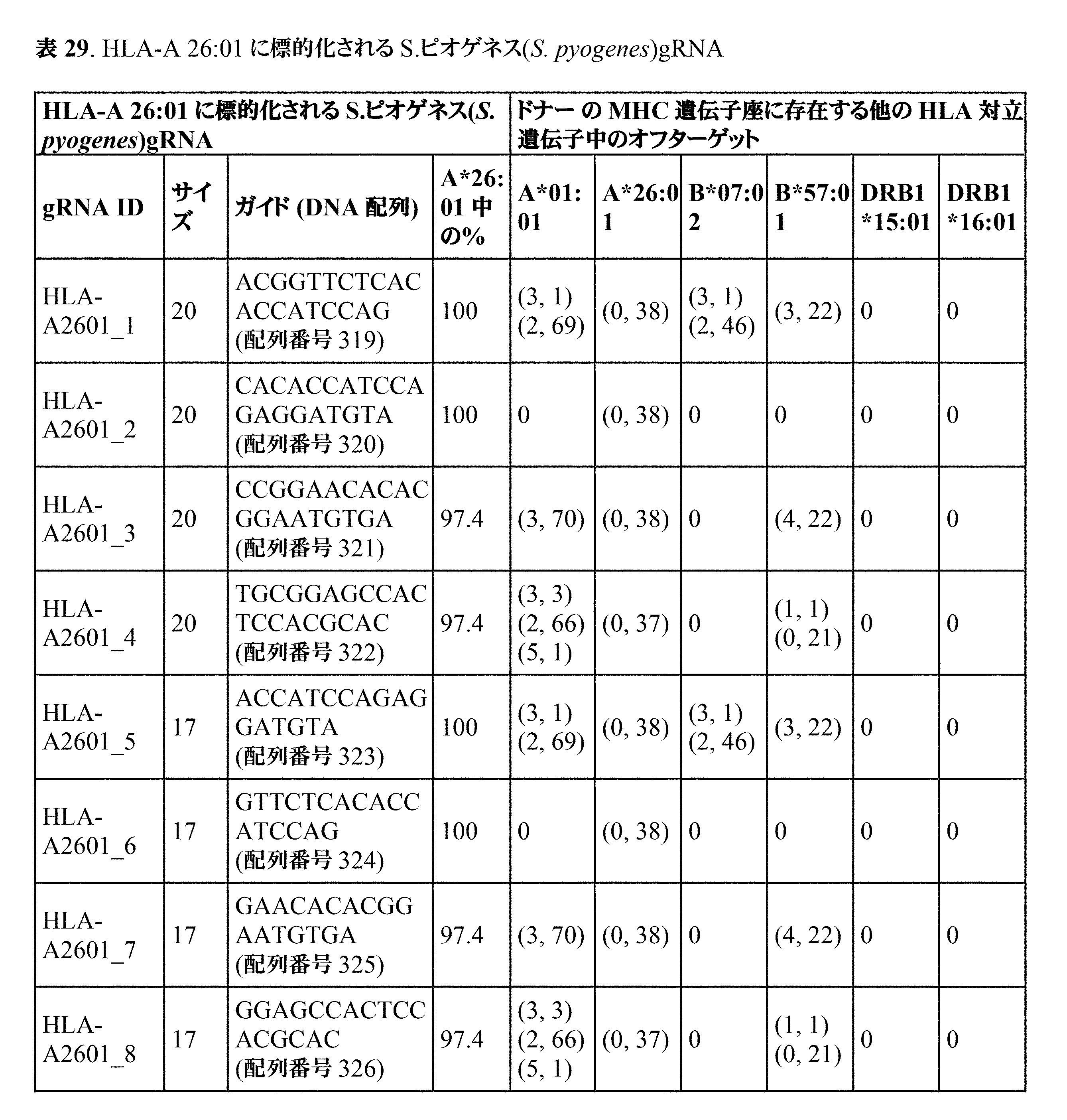
実施例10:一次ヒトT-リンパ球におけるミスマッチHLA-B対立遺伝子(HLA-B 51:01)の破壊による多重ゲノム編集のためのCas9およびgRNAの標的化
レシピエントに対して6対立遺伝子でのマッチングが不適レベル(3遺伝子座、4/6ミスマッチHLA対立遺伝子)であるドナー候補とのマッチングのレベルを高めるために、本明細書に記載のデータベースを用い、Cas9および特異的に同定されたgRNAを使用して、ミスマッチ対立遺伝子HLA-B 51:01およびHLA-DRB1 04:02の多重遺伝子破壊(表30)を実施した。その結果、ミスマッチドナー(表30、患者3)からの細胞同士のHLAマッチングのレベルが、レシピエント患者候補(表30、患者2)への移入に好適となった(HLAミスマッチを2/6ミスマッチHLA対立遺伝子に低減)。
Example 10: Targeting Cas9 and gRNA for multiplex genome editing by disruption of a mismatched HLA-B allele (HLA-B 51:01) in primary human T-lymphocytes. To increase the level of matching with donor candidates with unsuitable levels of matching (3 loci, 4/6 mismatched HLA alleles), use the database described herein to identify Cas9 and specifically identified gRNAs. Multiple gene disruption of the mismatched alleles HLA-B 51:01 and HLA-DRB1 04:02 (Table 30) was performed using As a result, the level of HLA matching between cells from the mismatched donor (Table 30, Patient 3) was suitable for transfer to the recipient patient candidate (Table 30, Patient 2) (HLA mismatched to 2/6 mismatched). reduced to HLA alleles).

患者3(ドナー)は、患者2(レシピエント)と、6タイプのHLA対立遺伝子(HLA-A、およびHLA-DRB1;表30)のうちの3つでミスマッチであった。HLA-B 51:01およびHLA-DRB1 04:02の標的化破壊は、ドナー候補(患者3)とレシピエント(患者2)間のHLAミスマッチを低減し得る。従って、ドナー中に存在する他のHLA対立遺伝子で予測される低いオフターゲット特異性(表30)と共に、対立遺伝子HLA-B 51:01およびHLA-DRB1 04:02に対して予測される高いオンターゲット特異性を有するgRNAをデータベースから同定し、選択した(表31および32)。gRNAをPCRテンプレートからインビトロで転写した後、5’および3’末端修飾(例えば、5’ARCAキャップおよび3’ポリA[20A]テールなどの修飾)を有するように改変したが、これらの修飾は、高度の遺伝子編集を維持しながら、修飾gRNA(RNP)と複合体化したCas9タンパク質による処理後にHSC生存能力を向上させることがこれまでに証明されている。 Patient 3 (donor) was mismatched to patient 2 (recipient) in 3 of the 6 types of HLA alleles (HLA-A, and HLA-DRB1; Table 30). Targeted disruption of HLA-B 51:01 and HLA-DRB1 04:02 may reduce HLA mismatch between donor candidate (patient 3) and recipient (patient 2). Therefore, the predicted high on-target for alleles HLA-B 51:01 and HLA-DRB1 04:02, along with the predicted low off-target specificity for other HLA alleles present in the donor (Table 30). gRNAs with target specificity were identified and selected from the database (Tables 31 and 32). gRNAs were transcribed in vitro from PCR templates and then modified to have 5' and 3' end modifications (e.g., modifications such as a 5'ARCA cap and a 3' polyA[20A] tail); these modifications , has previously been shown to improve HSC viability after treatment with Cas9 protein complexed with modified gRNAs (RNPs) while maintaining a high degree of gene editing.
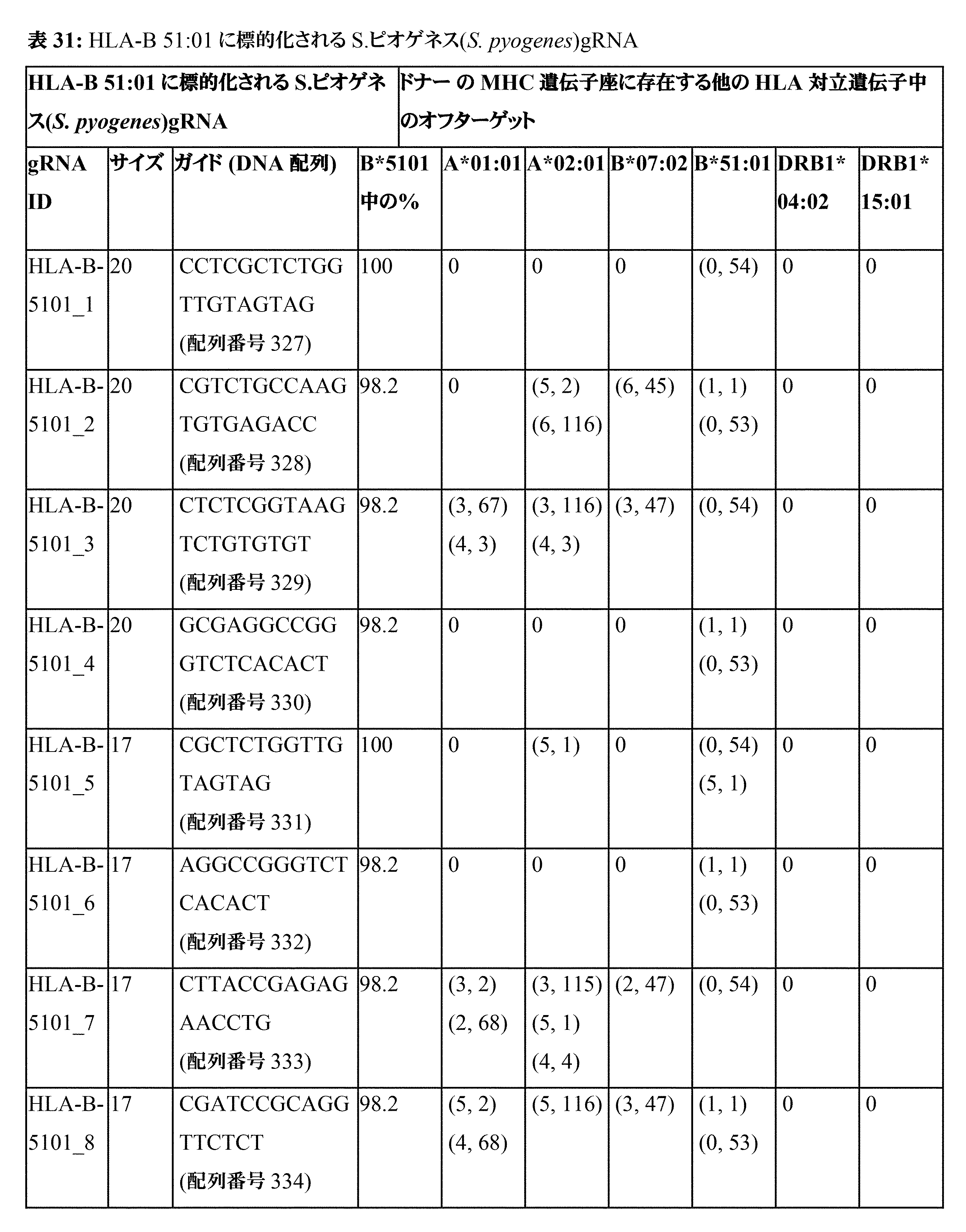
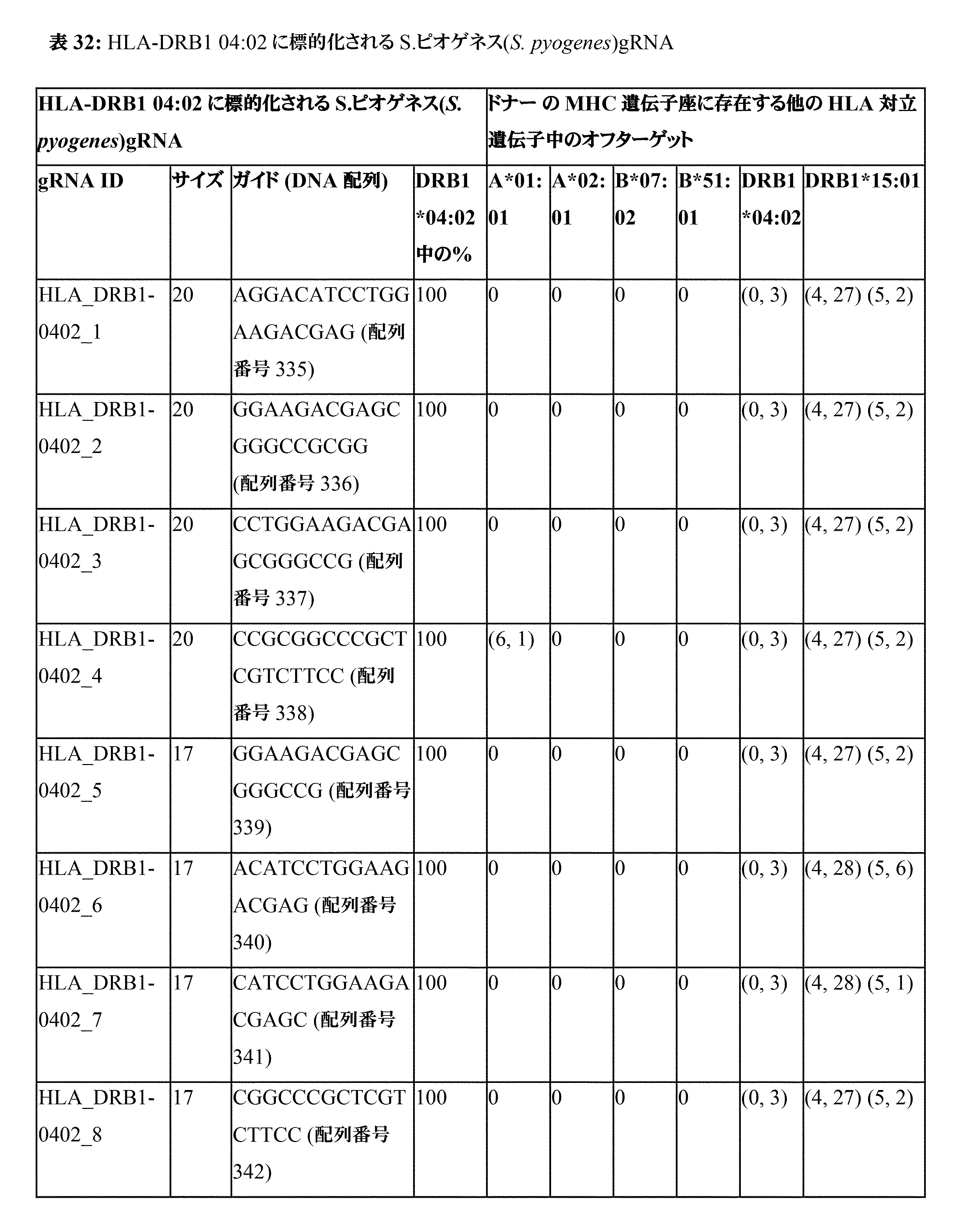
ドナー細胞における対立遺伝子特異的遺伝子編集を評価するために、一次Tリンパ球(CD4+T細胞)をCB単位から単離した後、表31および表32に列記するgRNAをこれらの細胞中でスクリーニングした。手短には、修飾HLA-B 51:01およびHLA-DRB1 04:02対立遺伝子特異的gRNA(表31および32)をS.ピオゲネス(S.pyogenes)Cas9タンパク質と事前に複合体化して、ドナーTリンパ球に電気穿孔されたRNPを取得した(Amaxa Nucleofector)。RNP送達から3~4日後の細胞からゲノムDNAを単離し、HLA-A遺伝子座を抽出gDNAからPCR増幅した。T7E1エンドヌクレアーゼアッセイ分析を用いて、遺伝子編集を評価することによって、B*51:01の対立遺伝子特異的編集で最も有効なgRNAを同定した(図20A)。Cas9RNPででされたT細胞が、編集後に高い生存能力(>80%)を示し、これらを培養して拡大した。遺伝子破壊の結果、細胞表面で低減したHLA-Bタンパク質発現(抗ヒトHLA-B-FITC)を定量するために、編集細胞は、フローサイトメトリー分析によっても評価した(図20Bおよび20C)。T7E1エンドヌクレアーゼを用いて決定される高レベルの遺伝子破壊を支持したgRNAも、HLA-Bの細胞表面発現の高いパーセンテージ減少または低下を示した。例えば、HLA-B 5101_1gRNAは、43%遺伝子破壊と、HLA-B発現の67%のノックダウンを支持した。HLA-B対立遺伝子特異的抗体およびMHCクラスI(AlexaFluor 647共役抗ヒトHLA-A、-B、-C、Biolegend Catalog # 311416)で共染色した細胞は、2つの画分:HLA-Blow/-およびMHCクラスI+である細胞と、HLA-B+/MHCクラスI+である細胞にさらに分けることができた。MHCクラスI細胞表面の相対発現における2つの集団のこの相違は、1つのHLA遺伝子の対立遺伝子特異的発現が欠如しているが、他の全てのクラスI細胞表面抗原は維持する細胞の精製集団を取得するためのFACSまたは免疫磁気選別による単離を支持する。同じ細胞において、修飾(キャップおよびテール付加)HLA-DRB1 04:02標的化gRNAをS.ピオゲネス(S.pyogenes)Cas9タンパク質(RNP)と複合体化し、細胞に電気穿孔して、MHCクラスII遺伝子の対立遺伝子特異的遺伝子破壊を評価した。これらの細胞から抽出したgDNAのT7E1分析から、一次ヒトTリンパ球においてDRB1 04:02の実質的な対立遺伝子特異的破壊が明らかにされた(図21)。要約すると、この実施例は、一次ヒト血球中の複数のHLA遺伝子の対立遺伝子特異的ノックダウンを示す。 To assess allele-specific gene editing in donor cells, primary T lymphocytes (CD4 + T cells) were isolated from CB units and then the gRNAs listed in Table 31 and Table 32 were screened in these cells. did. Briefly, modified HLA-B 51:01 and HLA-DRB1 04:02 allele-specific gRNAs (Tables 31 and 32) were injected into S. RNPs were obtained pre-complexed with S. pyogenes Cas9 protein and electroporated into donor T lymphocytes (Amaxa Nucleofector). Genomic DNA was isolated from cells 3-4 days after RNP delivery, and the HLA-A locus was PCR amplified from the extracted gDNA. Gene editing was evaluated using T7E1 endonuclease assay analysis to identify the most effective gRNA for allele-specific editing of B*51:01 (FIG. 20A). Cas9RNP-generated T cells showed high viability (>80%) after editing, and they were expanded in culture. Edited cells were also evaluated by flow cytometry analysis to quantify reduced HLA-B protein expression (anti-human HLA-B-FITC) at the cell surface as a result of gene disruption (Figures 20B and 20C). gRNAs that supported high levels of gene disruption as determined using T7E1 endonuclease also showed a high percentage reduction or reduction in cell surface expression of HLA-B. For example, HLA-B 5101_1gRNA supported 43% gene disruption and 67% knockdown of HLA-B expression. Cells co-stained with HLA-B allele-specific antibodies and MHC class I (AlexaFluor 647 conjugated anti-human HLA-A, -B, -C, Biolegend Catalog # 311416) were divided into two fractions: HLA-B low/ - and MHC class I + cells, and HLA-B + /MHC class I + cells. This difference between the two populations in the relative expression of MHC class I cell surfaces is due to the purified population of cells lacking allele-specific expression of one HLA gene but retaining all other class I cell surface antigens. We support isolation by FACS or immunomagnetic sorting to obtain. In the same cells, modified (capped and tailed) HLA-DRB1 04:02 targeting gRNA was transfected S.I. Allele-specific gene disruption of MHC class II genes was assessed by complexing with S. pyogenes Cas9 protein (RNP) and electroporating into cells. T7E1 analysis of gDNA extracted from these cells revealed substantial allele-specific disruption of DRB1 04:02 in primary human T lymphocytes (Figure 21). In summary, this example demonstrates allele-specific knockdown of multiple HLA genes in primary human blood cells.
実施例11:一次ヒトT-リンパ球およびHSCにおけるミスマッチHLA-A対立遺伝子(HLA-A 02:01)およびHLA-DRB1(04:02)の破壊による多重ゲノム編集のためのCas9およびgRNAの標的化
レシピエントに対して6対立遺伝子でのHLAマッチングが不適レベル(3遺伝子座、4/6ミスマッチHLA対立遺伝子)のドナー候補とのマッチングのレベルを高めるために、本明細書に記載のデータベースを用い、Cas9および特異的に同定されたgRNAを使用して、HLA-A 02:01およびHLA-DRB1 04:02のミスマッチ対立遺伝子の多重遺伝子破壊(表33)を実施した。その結果、ミスマッチドナー(表33、患者3)からの細胞同士のHLAマッチングのレベルが、レシピエント患者候補(表33、患者1)への移入に好適となった(HLAミスマッチを2/6ミスマッチHLA対立遺伝子に低減することにより)。
Example 11: Targeting Cas9 and gRNA for multiplex genome editing by disruption of mismatched HLA-A alleles (HLA-A 02:01) and HLA-DRB1 (04:02) in primary human T-lymphocytes and HSCs In order to increase the level of matching with donor candidates whose HLA matching at 6 alleles is inappropriate for the recipient (3 loci, 4/6 mismatched HLA alleles), the database described herein is used. Multiple gene disruption of HLA-A 02:01 and HLA-DRB1 04:02 mismatched alleles (Table 33) was performed using Cas9 and specifically identified gRNAs. As a result, the level of HLA matching between cells from the mismatched donor (Table 33, Patient 3) was suitable for transfer to the recipient patient candidate (Table 33, Patient 1) (HLA mismatched to 2/6 mismatched). by reducing HLA alleles).

患者3(ドナー)は、患者1(レシピエント)と、6タイプのHLA対立遺伝子(HLA-A、およびHLA-DRB1)のうちの4つでミスマッチであった。HLA-A 02:01およびHLA-DRB1 04:02の標的化破壊は、HSCドナー(患者3)とレシピエント(患者1)間のHLAミスマッチを低減し得る。従って、ドナー中に存在する他のHLA対立遺伝子で予測される低いオフターゲット特異性と共に、対立遺伝子HLA-A 02:01およびHLA-DRB1 04:02に対して予測される高いオンターゲット特異性を有するgRNAをデータベースから同定し、選択した(表34および32)。gRNAをPCRテンプレートからインビトロで転写した後、5’および3’末端修飾(例えば、5’ARCAキャップおよび3’ポリA[20A]テールなど)を有するように改変したが、これらの修飾は、高度の遺伝子編集を維持しながら、修飾gRNA(RNP)と複合体化したCas9タンパク質による処理後にHSC生存能力を向上させることがこれまでに証明されている。 Patient 3 (donor) was mismatched with patient 1 (recipient) in 4 of the 6 types of HLA alleles (HLA-A and HLA-DRB1). Targeted disruption of HLA-A 02:01 and HLA-DRB1 04:02 may reduce HLA mismatch between HSC donor (patient 3) and recipient (patient 1). Therefore, the high on-target specificity predicted for alleles HLA-A 02:01 and HLA-DRB1 04:02 along with the low off-target specificity predicted for other HLA alleles present in the donor. The gRNAs with the following were identified from the database and selected (Tables 34 and 32). gRNAs were transcribed in vitro from PCR templates and then modified to have 5' and 3' end modifications (e.g., 5'ARCA caps and 3' polyA[20A] tails), but these modifications are highly It has previously been shown to improve HSC viability after treatment with Cas9 protein complexed with modified gRNAs (RNPs) while preserving gene editing.

ドナー細胞における対立遺伝子特異的遺伝子編集を評価するために、一次Tリンパ球(CD4+T細胞)をCB単位から単離した後、表34に挙げるgRNAをこれらの細胞中でスクリーニングした。手短には、修飾HLA-A 02:01およびHLA-DRB1 04:02対立遺伝子特異的gRNAをS.ピオゲネス(S.pyogenes)Cas9タンパク質と事前に複合体化して、ドナーTリンパ球に電気穿孔されたRNPを取得した(Amaxa Nucleofector)。RNP送達から3~4日後の細胞からゲノムDNAを単離し、HLA-A遺伝子座を抽出gDNAからPCR増幅した。T7E1エンドヌクレアーゼアッセイ分析(図22A)、ならびにHLA-A2対立遺伝子特異的抗体(FITC共役および抗ヒトHLA-A2、Biolegend Catalog # 343303)を用いたフローサイトメトリー分析(図22B)により、遺伝子編集を評価することによって、A*02:0の対立遺伝子特異的編集で最も有効なgRNAを同定した。フローサイトメトリー分析から、生存ヒトT細胞の表面上のHLA-A2タンパク質発現の最大92%低減が明らかにされた(図22B)。これは、HLA-A遺伝子座を標的化するA*02:01対立遺伝子標的化gRNAが、HLA-A2対立遺伝子に対して特異的であることを示している。HLA-A2対立遺伝子特異的抗体およびMHCクラスI(AlexaFluor 647共役抗ヒトHLA-A、-B、-C、Biolegend Catalog # 311416)で共染色した細胞は、2つの画分:HLA-A2(対立遺伝子特異的遺伝子発現のノックダウン)およびMHCクラスI+である細胞と、HLA-A2+MHCクラスI+である細胞にさらに分けることができた。MHCクラスI細胞表面抗原の相対発現における2つの集団のこの相違は、1つのHLA遺伝子の対立遺伝子特異的発現が欠如しているが、他の全てのクラスI細胞表面抗原は維持する細胞の精製集団を取得するためのFACSまたは免疫磁気選別による単離を支持する(図23)。HLA-DRB1 04:02対立遺伝子を標的化するTリンパ球においてもオンターゲット対立遺伝子特異的編集を実施したところ、表21Cに示す同じ結果が得られた。HLA-A2対立遺伝子特異的抗体およびMHCクラスI(HLA-A、-B、-C)で共染色した細胞は、2つの画分:HLA-A2-およびMHCクラスI+である細胞と、HLA-A2+/MHCクラスI+である細胞にさらに分けることができた。MHCクラスI細胞表面の相対発現における2つの集団のこの相違は、1つのHLA遺伝子の対立遺伝子特異的発現が欠如しているが、他の全てのクラスI細胞表面抗原は維持する細胞の精製集団を取得するためのFACSまたは免疫磁気選別による単離を支持する。要約すると、この実施例は、一次ヒト血球中の複数のHLA遺伝子の対立遺伝子特異的ノックダウンを示す。 To assess allele-specific gene editing in donor cells, primary T lymphocytes (CD4 + T cells) were isolated from CB units and then the gRNAs listed in Table 34 were screened in these cells. Briefly, modified HLA-A 02:01 and HLA-DRB1 04:02 allele-specific gRNAs were introduced into S. RNPs were obtained pre-complexed with S. pyogenes Cas9 protein and electroporated into donor T lymphocytes (Amaxa Nucleofector). Genomic DNA was isolated from cells 3-4 days after RNP delivery, and the HLA-A locus was PCR amplified from the extracted gDNA. Gene editing was determined by T7E1 endonuclease assay analysis (Figure 22A) and flow cytometry analysis using HLA-A2 allele-specific antibodies (FITC-conjugated and anti-human HLA-A2, Biolegend Catalog #343303) (Figure 22B). By evaluation, we identified the most effective gRNAs for allele-specific editing of A*02:0. Flow cytometry analysis revealed up to 92% reduction in HLA-A2 protein expression on the surface of viable human T cells (Figure 22B). This indicates that the A*02:01 allele targeting gRNA that targets the HLA-A locus is specific for the HLA-A2 allele. Cells co-stained with HLA-A2 allele-specific antibodies and MHC class I (AlexaFluor 647-conjugated anti-human HLA-A, -B, -C, Biolegend Catalog # 311416) were divided into two fractions: HLA-A2 (allele (knockdown of gene-specific gene expression) and cells that were MHC class I + and cells that were HLA-A2 + MHC class I + . This difference between the two populations in the relative expression of MHC class I cell surface antigens is due to the purification of cells that lack allele-specific expression of one HLA gene but maintain all other class I cell surface antigens. We support isolation by FACS or immunomagnetic sorting to obtain populations (Figure 23). On-target allele-specific editing was also performed in T lymphocytes targeting the HLA-DRB1 04:02 allele and yielded the same results shown in Table 21C. Cells co-stained with HLA-A2 allele-specific antibodies and MHC class I (HLA-A, -B, -C) were divided into two fractions: cells that are HLA-A2 − and MHC class I + ; -A2 + /MHC class I + cells could be further divided. This difference between the two populations in the relative expression of MHC class I cell surface is due to the purified population of cells lacking allele-specific expression of one HLA gene but retaining all other class I cell surface antigens. We support isolation by FACS or immunomagnetic sorting to obtain. In summary, this example demonstrates allele-specific knockdown of multiple HLA genes in primary human blood cells.
実施例12:HLA遺伝子型のマッチングを促進するためのHLA対立遺伝子のノックアウト
移植されたHLA遺伝子ミスマッチ同種異系細胞(例えば、HSC)の拒絶の尤度を低減するために、移植を必要とするレシピエント対象を6つのHLA対立遺伝子(HLA-A、HLA-B、HLA-DRB1で各々2つずつの対立遺伝子)でHLAタイピングする(例えば、HLA-A、HLA-B、HLA-DRB1多型を決定する)。理想的には、6/6HLA対立遺伝子マッチは、移植後にGVHDを発生するリスクが低いことから、レシピエント遺伝子型は、同じ6/6HLA対立遺伝子を有するドナーとマッチする。6/6HLA対立遺伝子を有するドナーは利用可能ではない(例えば、骨髄もしくは臍帯血HSCドナー登録簿、または近縁の家族メンバーから)が、5/6、4/6、3/6もしくは2/6HLA対立遺伝子マッチを有する部分的にマッチするドナーが利用可能である場合、本明細書に記載の方法を用いて、部分的マッチドナーとレシピエント間のミスマッチを低減することができる。必要に応じて、本明細書に記載される遺伝子編集方法を用いて単一対立遺伝子または複数の対立遺伝子(2つ、3つ、4つ、5つ、もしくは6つの対立遺伝子)を破壊して、移植レシピエントにおけるGVHD発生のリスクおよび/または疾患の重症度を低減することができる。以下の実施例におけるドナーとレシピエント間のHLA遺伝子マッチングを記載する全ての事例において、分子はマッチ対立遺伝子の数を示し、分母は発現された対立遺伝子の数を示す。
Example 12: Knockout of HLA Alleles to Facilitate HLA Genotype Matching To reduce the likelihood of rejection of transplanted HLA gene-mismatched allogeneic cells (e.g., HSCs) requiring transplantation HLA type the recipient subject with six HLA alleles (two alleles each of HLA-A, HLA-B, and HLA-DRB1) (e.g., HLA-A, HLA-B, and HLA-DRB1 polymorphisms). ). Ideally, the recipient genotype is matched to a donor with the same 6/6 HLA allele, as a 6/6 HLA allele match has a lower risk of developing GVHD after transplantation. Donors with the 6/6 HLA allele are not available (e.g., from bone marrow or cord blood HSC donor registries, or from closely related family members), but the 5/6, 4/6, 3/6 or 2/6 HLA allele If a partially matched donor with an allelic match is available, the methods described herein can be used to reduce the mismatch between the partially matched donor and recipient. Optionally, a single allele or multiple alleles (2, 3, 4, 5, or 6 alleles) are disrupted using the gene editing methods described herein. , can reduce the risk of GVHD development and/or disease severity in transplant recipients. In all cases describing HLA gene matching between donor and recipient in the Examples below, the numerator indicates the number of matched alleles and the denominator indicates the number of expressed alleles.
本明細書に記載される方法を用いて、ドナー血球(例えば、HSCとT細胞)を修飾して、免疫適合性血球を作製することができる。例えば、本方法を用いて、ドナーHSCにおける1つ、2つもしくは3つのHLA対立遺伝子を破壊(例えば、ノックアウト)して、特定の集団に存在する頻度が最も高いHLA遺伝子型とマッチする細胞を作製することができる。例えば、北アメリカにおける4つの民族群に最も一般的な10のハプロタイプを表35~38に列記する(例えば、https://bioinformatics.bethematchclinical.org/hla-resources/haplotype-frequencies/;Burdett et al.,Hum.Immunol.64(10 Suppl):S6(2003)で入手可能な全米骨髄バンク(National Marrow Donor Program)HLAハプロタイプ頻度データを参照されたい)。 Using the methods described herein, donor blood cells (eg, HSCs and T cells) can be modified to generate immunocompatible blood cells. For example, the method can be used to disrupt (e.g., knock out) one, two, or three HLA alleles in donor HSCs to select cells that match the HLA genotype most frequently present in a particular population. It can be made. For example, the 10 most common haplotypes for the four ethnic groups in North America are listed in Tables 35-38 (e.g., https://bioinformatics.bethematchclinical.org/hla-resources/haplotype-frequencies/; Burd ett et al See National Marrow Donor Program HLA haplotype frequency data available at ., Hum. Immunol. 64 (10 Suppl): S6 (2003).
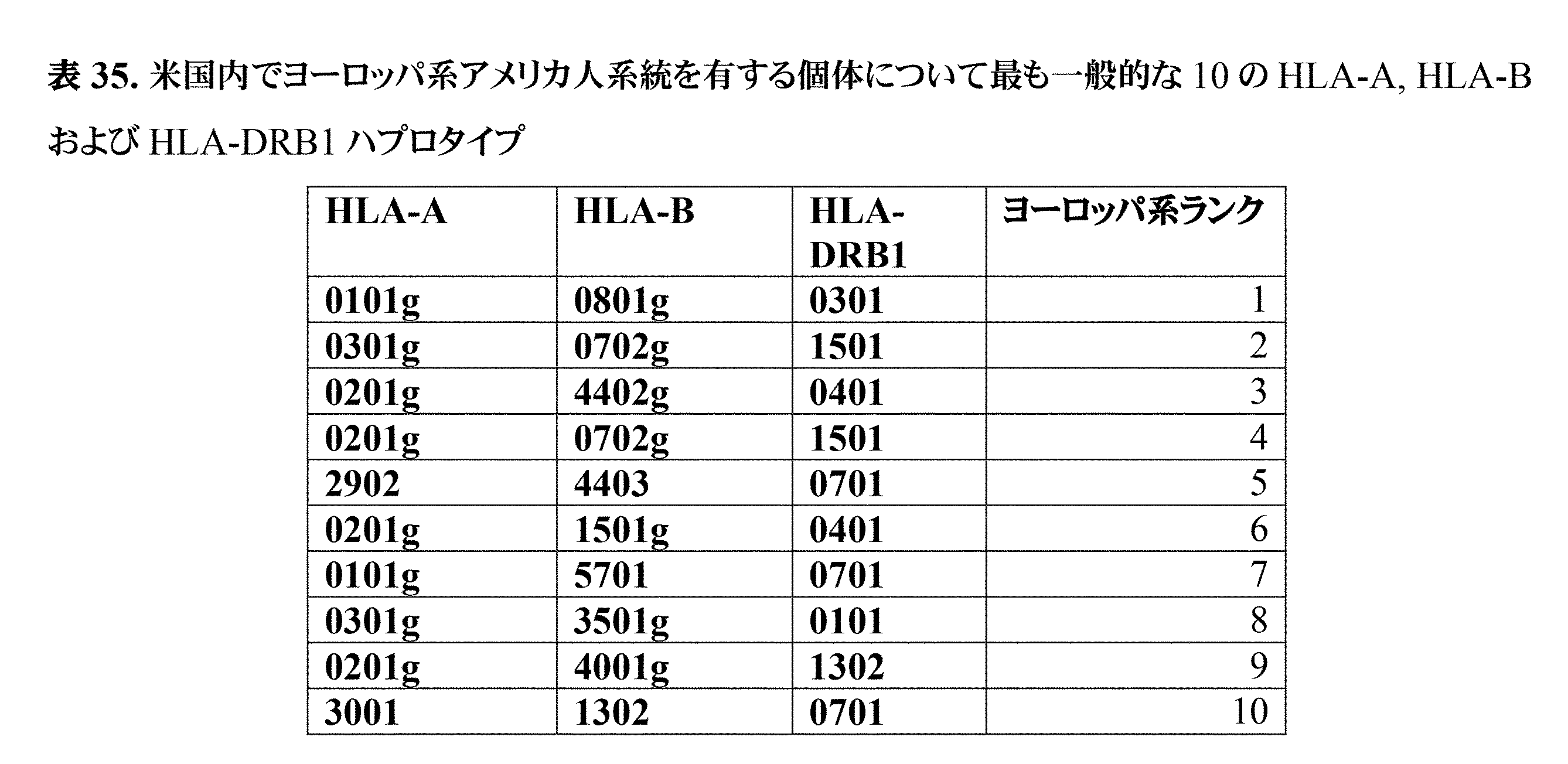

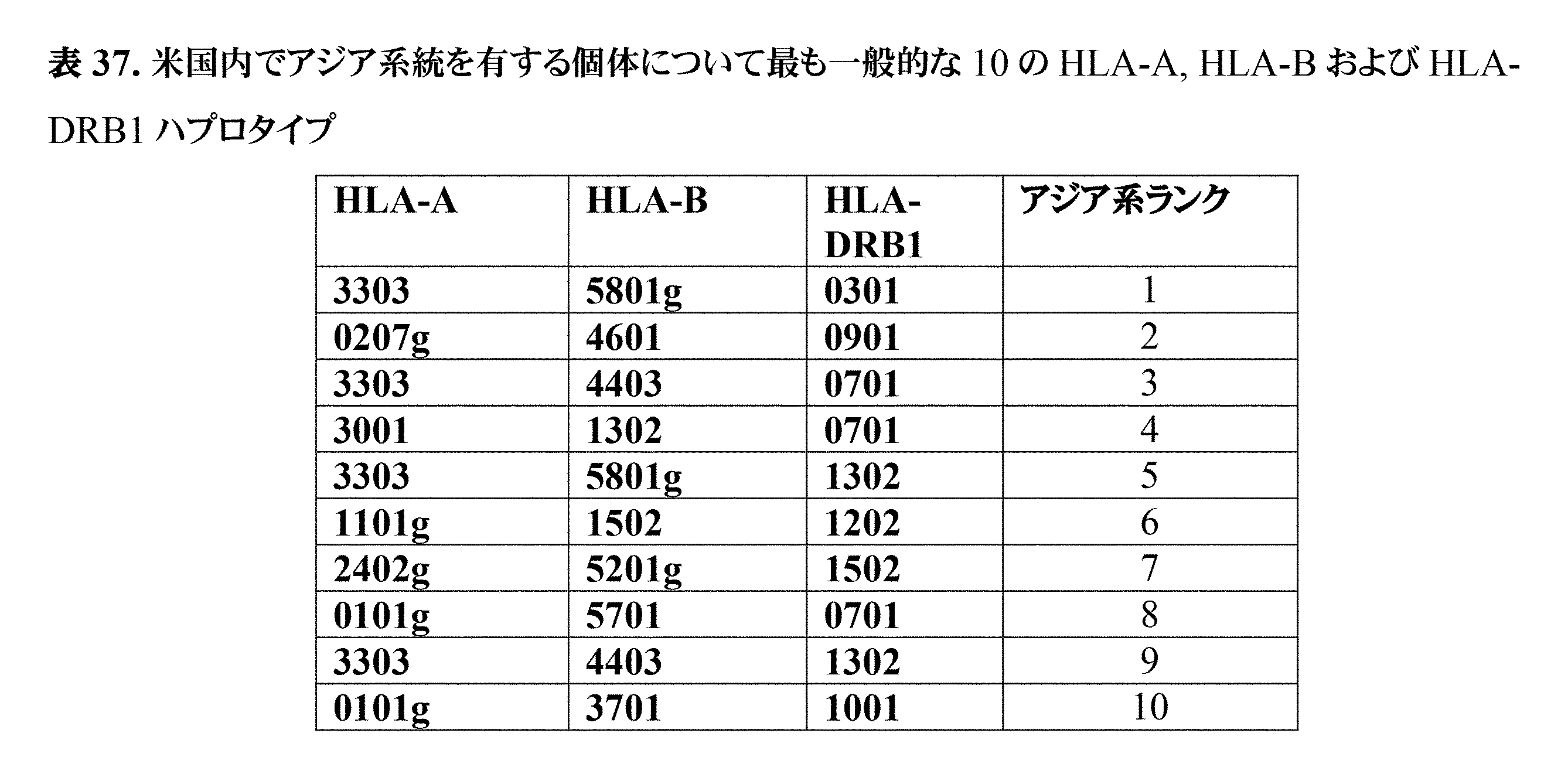

レシピエントに対して3/6HLA対立遺伝子マッチを有するドナーの場合、単一HLA対立遺伝子、2つのHLA対立遺伝子、または3つのHLA対立遺伝子を破壊することによって、HLAマッチング度を高める、例えば、HLAマッチングをそれぞれ4/6、5/6もしくは6/6対立遺伝子マッチまで高めることができる。 For donors with a 3/6 HLA allele match to the recipient, increasing the HLA match by disrupting a single HLA allele, two HLA alleles, or three HLA alleles, e.g. Matching can be increased to 4/6, 5/6 or 6/6 allele matches, respectively.
以下に示すように、本明細書に記載される方法は、レシピエントに対して3/6HLA対立遺伝子でマッチするいずれのドナー細胞にも適用することができる。例えば、ドナーとレシピエントが、以下に挙げるHLA遺伝子型(表39)を有しており、ここで、ドナーHLA遺伝子型が、2つの最も一般的なヨーロッパ系アメリカ人ハプロタイプを含み、かつレシピエントが、対立遺伝子1にハプロタイプマッチを、また対立遺伝子2にいずれかの非マッチハプロタイプを有する場合、本明細書に記載される方法を用い、以下によってHLAマッチング度を高めることができる:
(a)単一対立遺伝子(例えば、HLA-A*0301g、HLA-B*0702、HLA-DRB1*1501)の破壊(例えば、ノックアウト)による4/6マッチの生成。
(b)2つの対立遺伝子(例えば、HLA-A*0301gとHLA-B*0702、HLA-A*0301gとHLA-DRB1*1501、HLA-B*0702とHLA-DRB1*1501)の多重破壊(例えば、ノックアウト)による5/6マッチの生成。
(c)3つの対立遺伝子(例えば、HLA-A*0301g、HLA-B*0702、HLA-DRB1*1501)の多重破壊(例えば、ノックアウト)による6/6マッチの生成。
As shown below, the methods described herein can be applied to any donor cell that is 3/6 HLA allele matched to the recipient. For example, a donor and a recipient have the following HLA genotypes (Table 39), where the donor HLA genotype includes the two most common European American haplotypes, and the recipient has a haplotype match on
(a) Generation of 4/6 matches by disruption (eg, knockout) of a single allele (eg, HLA-A*0301g, HLA-B*0702, HLA-DRB1*1501).
(b) Multiple disruption of two alleles (e.g., HLA-A*0301g and HLA-B*0702, HLA-A*0301g and HLA-DRB1*1501, HLA-B*0702 and HLA-DRB1*1501) ( For example, generation of 5/6 matches by knockout).
(c) Generation of 6/6 matches by multiple disruption (eg, knockout) of three alleles (eg, HLA-A*0301g, HLA-B*0702, HLA-DRB1*1501).
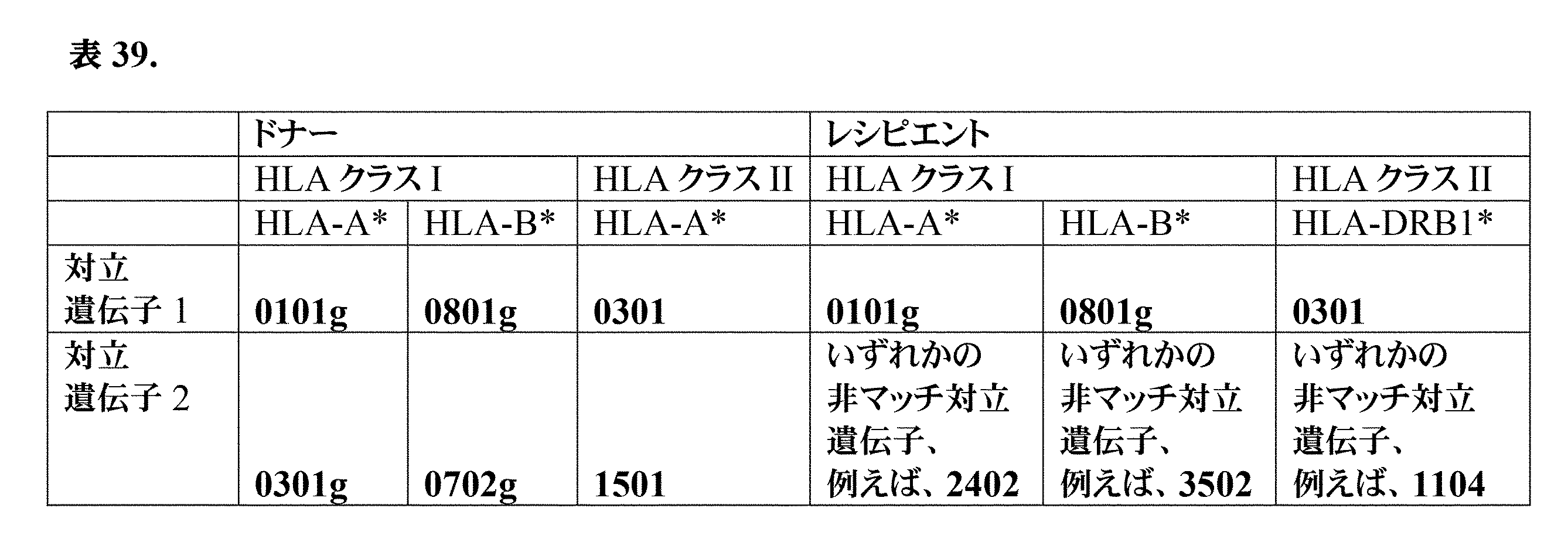
例えば、ドナーとレシピエントが、以下に挙げるHLA遺伝子型(表40)を有しており、ここで、ドナーHLA遺伝子型が、2つの最も一般的なアフリカ系アメリカ人ハプロタイプを含み、かつレシピエントが、対立遺伝子1にハプロタイプマッチを、また対立遺伝子2にいずれかの非マッチハプロタイプを有する場合、本明細書に記載される方法を用い、以下によってHLAマッチング度を高めることができる:
(a)単一対立遺伝子(例えば、HLA-A*0101g、HLA-B*0801gまたはHLA-DRB1*0301)の破壊(例えば、ノックアウト)による4/6HLAマッチの生成。
(b)2つの対立遺伝子(例えば、HLA-A*0101gとHLA-B*0801g、HLA-A*0101gとHLA-DRB1*0301、HLA-B*0801gとHLA-DRB1*0301)の多重破壊(例えば、ノックアウト)による5/6マッチの生成。
(c)3つの対立遺伝子(例えば、HLA-A*0101g、HLA-B*0801gおよびHLA-DRB1*0301)の多重破壊(例えば、ノックアウト)による6/6マッチの生成。
For example, a donor and a recipient have the following HLA genotypes (Table 40), where the donor HLA genotype includes the two most common African American haplotypes, and the recipient has a haplotype match on
(a) Generation of a 4/6 HLA match by disruption (eg, knockout) of a single allele (eg, HLA-A*0101g, HLA-B*0801g or HLA-DRB1*0301).
(b) Multiple disruption of two alleles (e.g., HLA-A*0101g and HLA-B*0801g, HLA-A*0101g and HLA-DRB1*0301, HLA-B*0801g and HLA-DRB1*0301) ( For example, generation of 5/6 matches by knockout).
(c) Generation of 6/6 matches by multiple disruption (eg, knockout) of three alleles (eg, HLA-A*0101g, HLA-B*0801g and HLA-DRB1*0301).
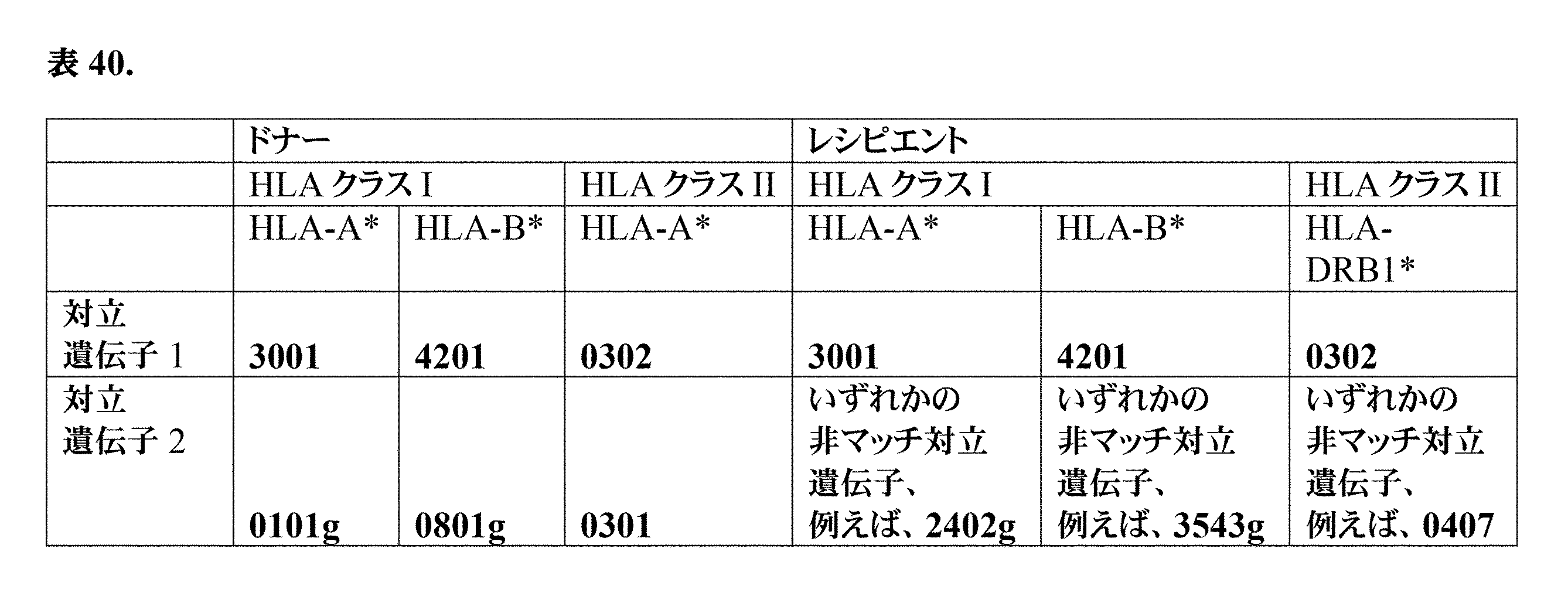
例えば、ドナーとレシピエントが、以下に挙げるHLA遺伝子型(表41)を有しており、ここで、ドナーHLA遺伝子型が、2つの最も一般的なアジア系ハプロタイプを含み、かつレシピエントが、対立遺伝子1にハプロタイプマッチを、また対立遺伝子2にいずれかの非マッチハプロタイプを有する場合、本明細書に記載される方法を用い、以下によってHLAマッチング度を高めることができる:
(a)単一対立遺伝子(例えば、HLA-A*0207g、HLA-B*4601またはHLA-DRB1*0901)の破壊(例えば、ノックアウト)による4/6HLAマッチの生成。
(b)2つの対立遺伝子(例えば、HLA-A*0207gとHLA-B*4601、HLA-A*0207gとHLA-DRB1*0901、HLA-B*4601とHLA-DRB1*0901)の多重破壊(例えば、ノックアウト)による5/6マッチの生成。
(c)3つの対立遺伝子(例えば、HLA-A*0207g、HLA-B*4601、およびHLA-DRB1*0901)の多重破壊(例えば、ノックアウト)による6/6マッチの生成。
For example, if the donor and recipient have the HLA genotypes listed below (Table 41), where the donor HLA genotype includes the two most common Asian haplotypes, and the recipient: If you have a haplotype match for
(a) Generation of a 4/6 HLA match by disruption (eg, knockout) of a single allele (eg, HLA-A*0207g, HLA-B*4601 or HLA-DRB1*0901).
(b) Multiple disruption of two alleles (e.g., HLA-A*0207g and HLA-B*4601, HLA-A*0207g and HLA-DRB1*0901, HLA-B*4601 and HLA-DRB1*0901) ( For example, generation of 5/6 matches by knockout).
(c) Generation of 6/6 matches by multiple disruption (eg, knockout) of three alleles (eg, HLA-A*0207g, HLA-B*4601, and HLA-DRB1*0901).
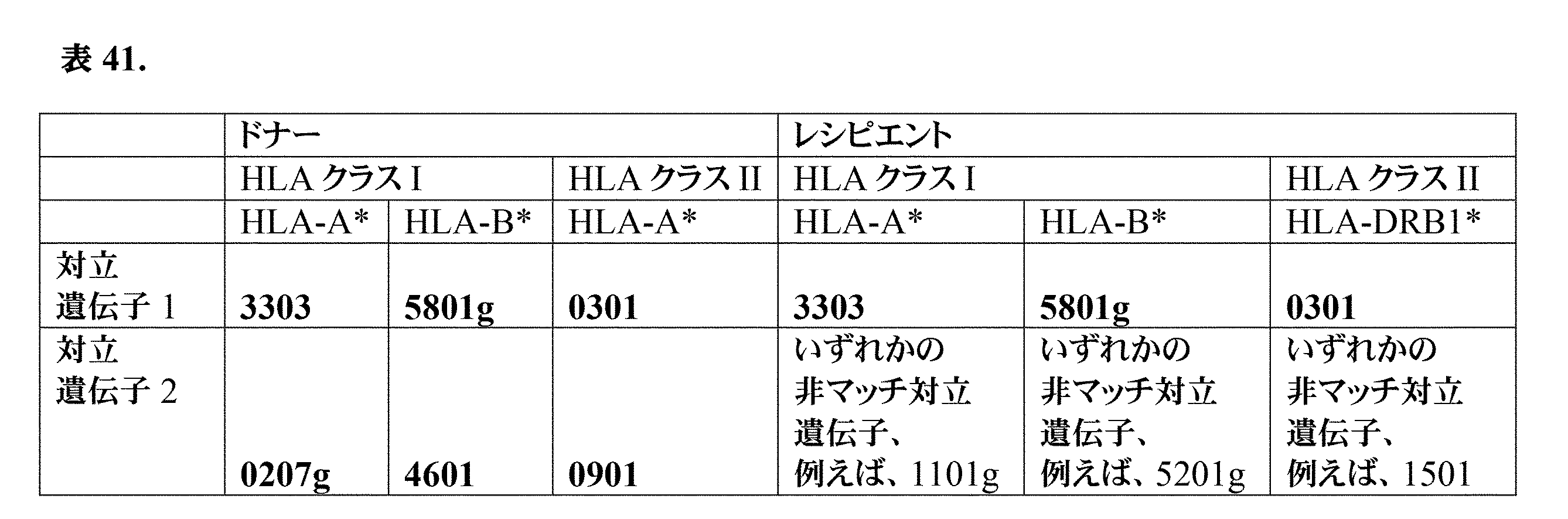
例えば、ドナーとレシピエントが、以下に挙げるHLA遺伝子型(表42)を有しており、ここで、ドナーHLA遺伝子型が、2つの最も一般的なヒスパニック系/ラテンアメリカ人ハプロタイプを含み、かつレシピエントが、対立遺伝子1にハプロタイプマッチを、また対立遺伝子2にいずれかの非マッチハプロタイプを有する場合、本明細書に記載される方法を用い、以下によってHLAマッチング度を高めることができる:
(a)単一対立遺伝子(例えば、HLA-A*0101g、HLA-B*0801gまたはHLA-DRB1*0301)の破壊(例えば、ノックアウト)による4/6HLAマッチの生成。
(b)2つの対立遺伝子(例えば、HLA-A*0101gとHLA-B*0801g、HLA-A*0101gとHLA-DRB1*0301、HLA-B*0801gとHLA-DRB1*0301)の多重破壊(例えば、ノックアウト)による5/6マッチの生成。
(c)3つの対立遺伝子(例えば、HLA-A*0207g、HLA-B*4601、およびHLA-DRB1*0301)の多重破壊(例えば、ノックアウト)による6/6マッチの生成。
For example, the donor and recipient have the following HLA genotypes (Table 42), where the donor HLA genotype includes the two most common Hispanic/Latino haplotypes, and If the recipient has a haplotype match for
(a) Generation of a 4/6 HLA match by disruption (eg, knockout) of a single allele (eg, HLA-A*0101g, HLA-B*0801g or HLA-DRB1*0301).
(b) Multiple disruption of two alleles (e.g., HLA-A*0101g and HLA-B*0801g, HLA-A*0101g and HLA-DRB1*0301, HLA-B*0801g and HLA-DRB1*0301) ( For example, generation of 5/6 matches by knockout).
(c) Generation of 6/6 matches by multiple disruption (eg, knockout) of three alleles (eg, HLA-A*0207g, HLA-B*4601, and HLA-DRB1*0301).

以下に示すように、本明細書に記載される方法は、レシピエントに対して4/6HLA対立遺伝子でマッチするいずれのドナー細胞にも適用することができる。例えば、ドナーとレシピエントが、以下に挙げるHLA遺伝子型(表43)を有しており、ここで、ドナーHLA遺伝子型が、2つの最も一般的なヒスパニック系/ラテンアメリカ人ハプロタイプを含み、かつレシピエントが、対立遺伝子1にハプロタイプマッチを、また対立遺伝子2(例えば、HLA-A)にいずれかの非マッチハプロタイプを有する場合、本明細書に記載される方法を用いて、以下によりHLAマッチング度を高めることができる:
(a)単一対立遺伝子(例えば、HLA-B*0801gまたはHLA-DRB1*0301)の破壊(例えば、ノックアウト)による5/6マッチの生成。
(b)2つの対立遺伝子(例えば、HLA-B*0801gとHLA-DRB1*0301)のT多重破壊(例えば、ノックアウト)による6/6マッチの生成。
As shown below, the methods described herein can be applied to any donor cell that is 4/6 HLA allele matched to the recipient. For example, the donor and recipient have the following HLA genotypes (Table 43), where the donor HLA genotype includes the two most common Hispanic/Latino haplotypes, and If the recipient has a haplotype match for
(a) Generation of 5/6 matches by disruption (eg, knockout) of a single allele (eg, HLA-B*0801g or HLA-DRB1*0301).
(b) Generation of 6/6 matches by T multiple disruption (eg, knockout) of two alleles (eg, HLA-B*0801g and HLA-DRB1*0301).

以下に示すように、本明細書に記載される方法は、レシピエントに対して5/6HLA対立遺伝子でマッチするいずれのドナー細胞にも適用することができる。例えば、ドナーとレシピエントが、以下に挙げるHLA遺伝子型(表44)を有しており、ここで、ドナーHLA遺伝子型が、2つの最も一般的なヒスパニック系/ラテンアメリカ人ハプロタイプを含み、かつレシピエントが、対立遺伝子1にハプロタイプマッチを、また対立遺伝子2の3つのHLA遺伝子座の2つでマッチするいずれかのハプロタイプを有する場合、本明細書に記載される方法を用い、以下によってHLAマッチング度を高めることができる:
(a)単一対立遺伝子(例えば、HLA-DRB1*0301)の破壊(例えば、ノックアウト)による6/6マッチの生成。
As shown below, the methods described herein can be applied to any donor cell that is 5/6 HLA allele matched to the recipient. For example, the donor and recipient have the following HLA genotypes (Table 44), where the donor HLA genotype includes the two most common Hispanic/Latino haplotypes, and If the recipient has a haplotype match for
(a) Generation of 6/6 matches by disruption (eg, knockout) of a single allele (eg, HLA-DRB1*0301).
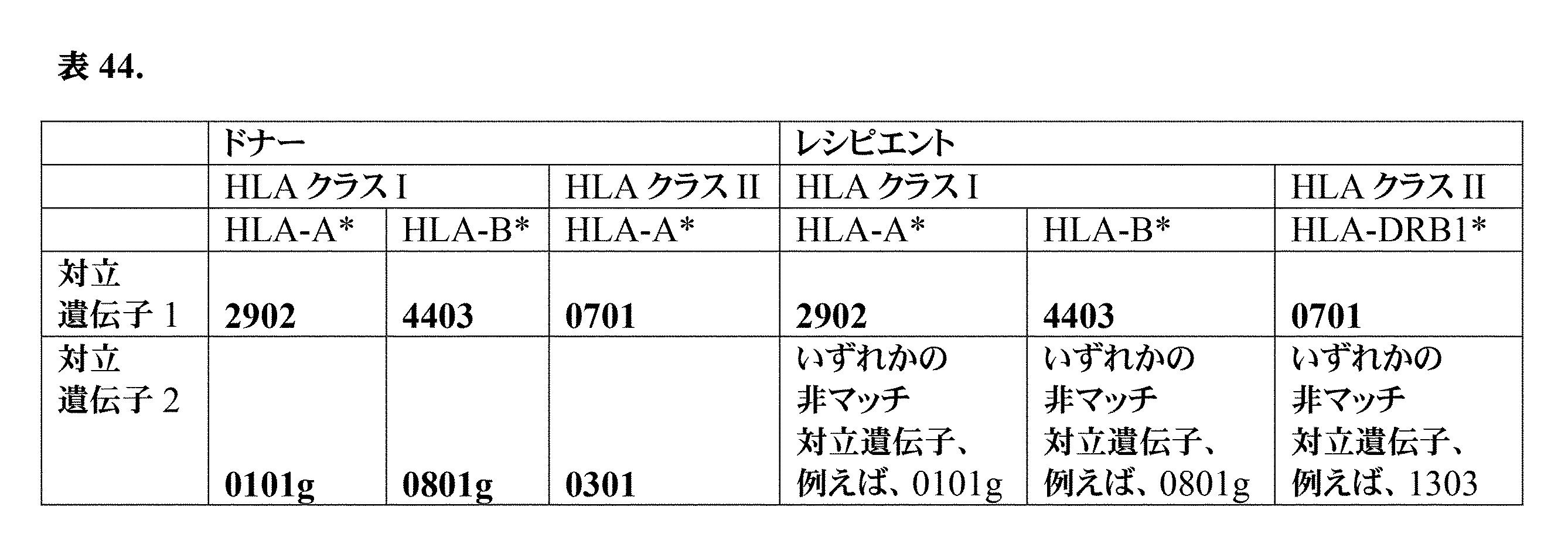
実施例16:マイノリティまたは少数集団において、マッチしない可能性が非常に高いHLA遺伝子座のマッチングを促進するすためのHLA対立遺伝子の遺伝子破壊(例えば、ノックアウト)
以下の記述および表は、ドナー組織またはHSCTを必要とするレシピエントで最も一般的にマッチしないHLAハプロタイプにおいて向上したHLAマッチを生成するための、ドナー細胞中の1、2もしくは3HLA遺伝子座のノックアウトを説明する。
Example 16: Genetic disruption (e.g., knockout) of HLA alleles to facilitate matching of HLA loci that are most likely to be unmatched in minority or underrepresented populations.
The following descriptions and tables demonstrate the knockout of 1, 2 or 3 HLA loci in donor cells to produce improved HLA matches in the most commonly unmatched HLA haplotypes in donor tissues or recipients requiring HSCT. Explain.
例えば、下記のHLAハプロタイプは、アジア系統の個体に一般的であり、全米骨髄バンク(United States National Marrow Donor Program)(NMDP)におけるその他全ての対象では稀である(表45)。従って、アジア系統および/または下記ハプロタイプのいずれかを有するレシピエントは、NMDP内で6/6HLAマッチを見出すことはできない。 For example, the HLA haplotypes listed below are common in individuals of Asian descent and rare in all other subjects in the United States National Marrow Donor Program (NMDP) (Table 45). Therefore, recipients with Asian ancestry and/or any of the haplotypes listed below will not find a 6/6 HLA match within NMDP.

例えば、下記のHLAハプロタイプは、アフリカ系アメリカ人系統の個体に共通し、全米骨髄バンク(United States National Marrow Donor Program)(NMDP)におけるその他全ての対象では稀である(表46)。従って、アフリカ系アメリカ人系統および/または下記ハプロタイプのいずれかを有するレシピエントは、NMDP内で6/6HLAマッチを見出すことはできない。 For example, the HLA haplotypes listed below are common in individuals of African American ancestry and rare in all other subjects in the United States National Marrow Donor Program (NMDP) (Table 46). Therefore, recipients with African American ancestry and/or any of the haplotypes listed below will not find a 6/6 HLA match within NMDP.
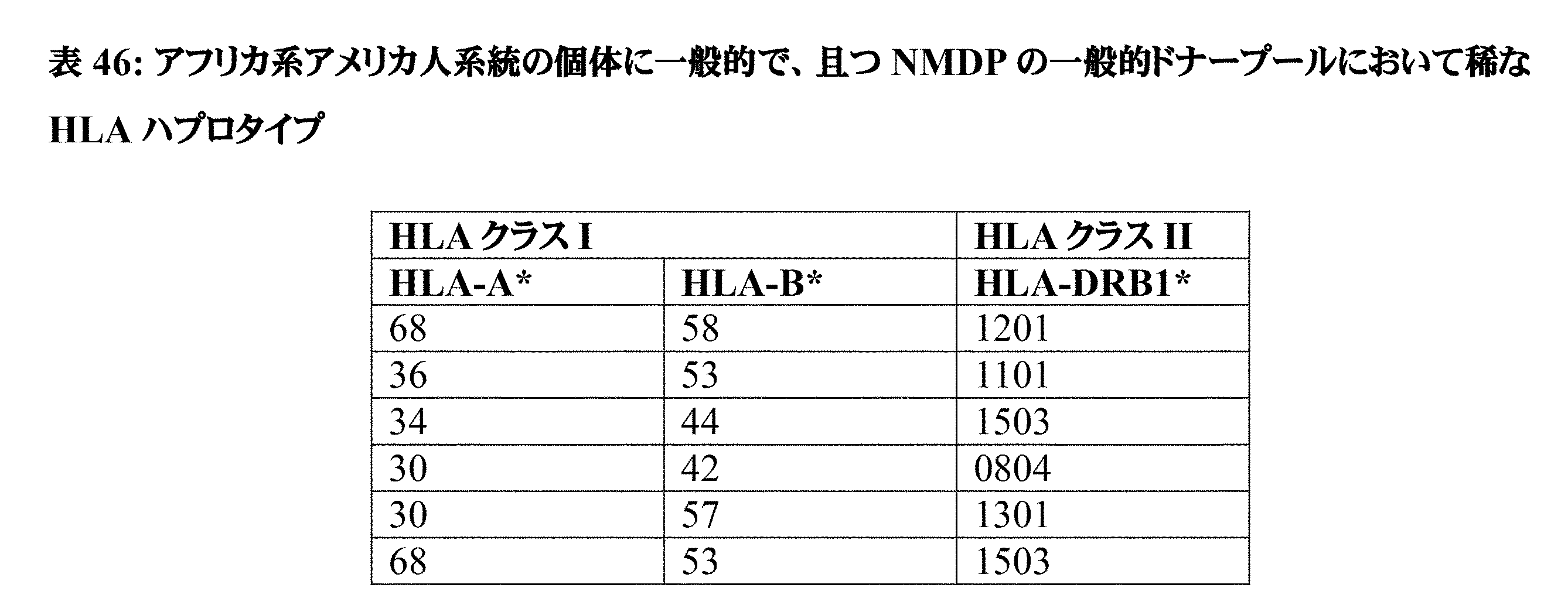
例えば、下記のHLAハプロタイプは、ヒスパニック系ラテンアメリカ人系統の個体に共通し、全米骨髄バンク(United States National Marrow Donor Program)(NMDP)におけるその他全ての対象では稀である(表47)。従って、ヒスパニック系ラテンアメリカ人系統および/または下記ハプロタイプのいずれかを有するレシピエントは、NMDP内で6/6マッチを見出すことはできない。 For example, the following HLA haplotypes are common in individuals of Hispanic-Latino American descent and rare in all other subjects in the United States National Marrow Donor Program (NMDP) (Table 47). Therefore, recipients with Hispanic-Latino ancestry and/or any of the haplotypes listed below will not find a 6/6 match within NMDP.

表45、46および47に列記されるHLAハプロタイプは、特定の集団内で共通であるが、ドナープール、特に、全米骨髄バンク(United States National Marrow Donor Program)(NMDP)の大部分を占める白色人種個体のドナープールでは、稀である。表56、57または58に列記されるハプロタイプを有するレシピエントは、NMDPにおいて6/6マッチを見出す可能性がより少ない。ドナー細胞中の1つ、2つもしくは3つのHLA対立遺伝子の破壊(例えば、ノックアウト)のために本明細書に記載の方法を用いて、特に表45、46および47に列記されるHLAハプロタイプを有するレシピエントをはじめとするレシピエントに対するHLAマッチングを向上させることができる。 The HLA haplotypes listed in Tables 45, 46, and 47 are common within certain populations, but especially among Caucasians, who make up the majority of the donor pool, the United States National Marrow Donor Program (NMDP). It is rare in the donor pool of species individuals. Recipients with haplotypes listed in Tables 56, 57 or 58 are less likely to find a 6/6 match in NMDP. Using the methods described herein for the disruption (e.g., knockout) of one, two or three HLA alleles in donor cells, specifically the HLA haplotypes listed in Tables 45, 46 and 47, HLA matching can be improved for recipients, including those with
表48~50は、最も一般的にマッチしないマイノリティハプロタイプ(例えば、表45、46および47に列記されるハプロタイプ)に適用することができるドナー細胞のための適切なHLA-遺伝子破壊(例えば、ノックアウト)の例を記載する。表48~50には、マイノリティ集団(ドナープールにおいて少数しか存在しないため、理想的な6/6HLAマッチが見出されないリスクがある)で最も一般的なハプロタイプの各々について、最も一般的なハプロタイプマッチが示され、ここで、ドナー細胞中の単一HLA遺伝子座の遺伝子破壊(例えば、ノックアウト)がHLAマッチングを向上させる。 Tables 48-50 list suitable HLA-gene disruptions (e.g., knock-out ). Tables 48-50 list the most common haplotype matches for each of the most common haplotypes in minority populations (which are underrepresented in the donor pool and therefore at risk of not finding an ideal 6/6 HLA match). have been shown, where genetic disruption (eg, knockout) of a single HLA locus in donor cells improves HLA matching.

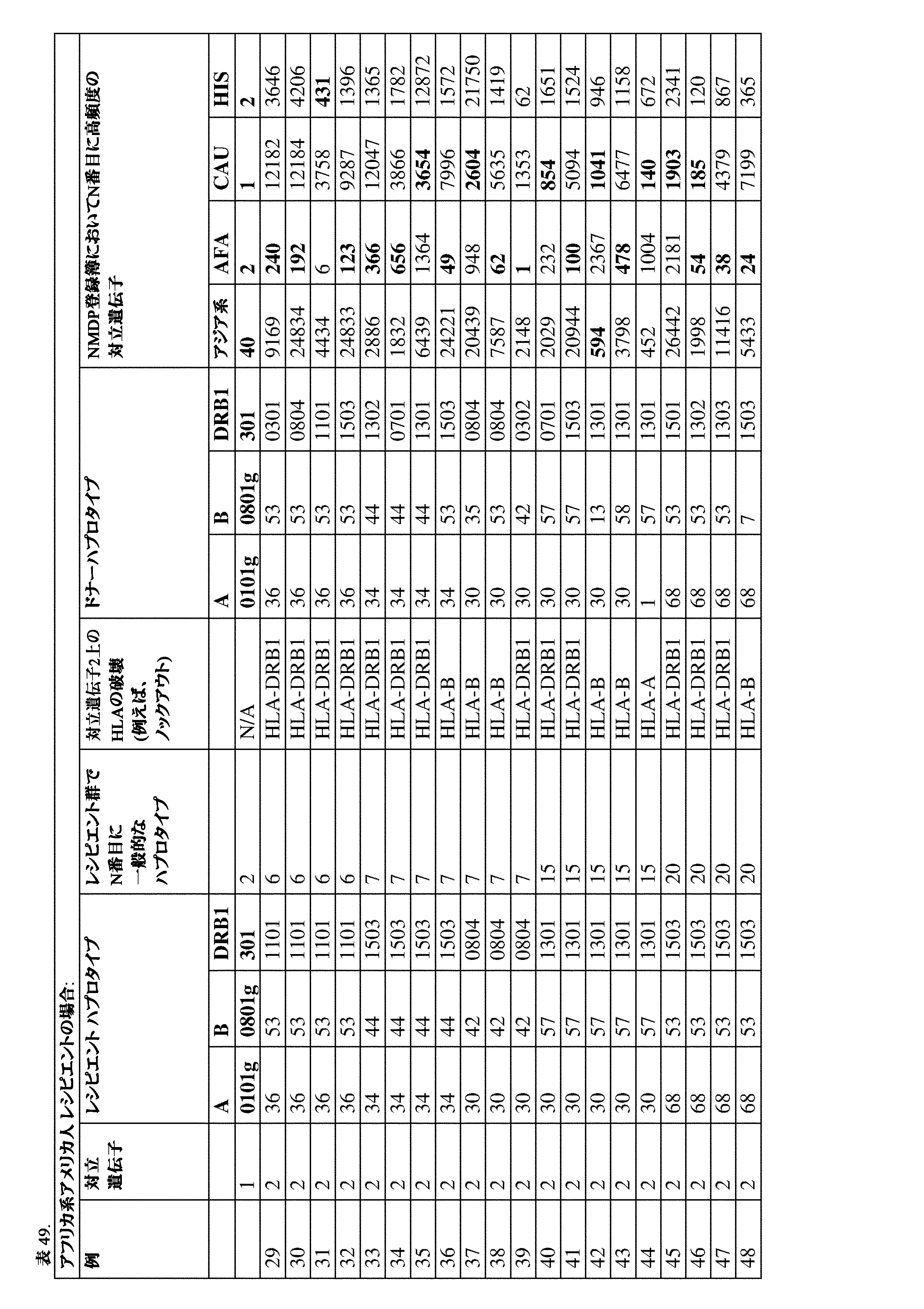
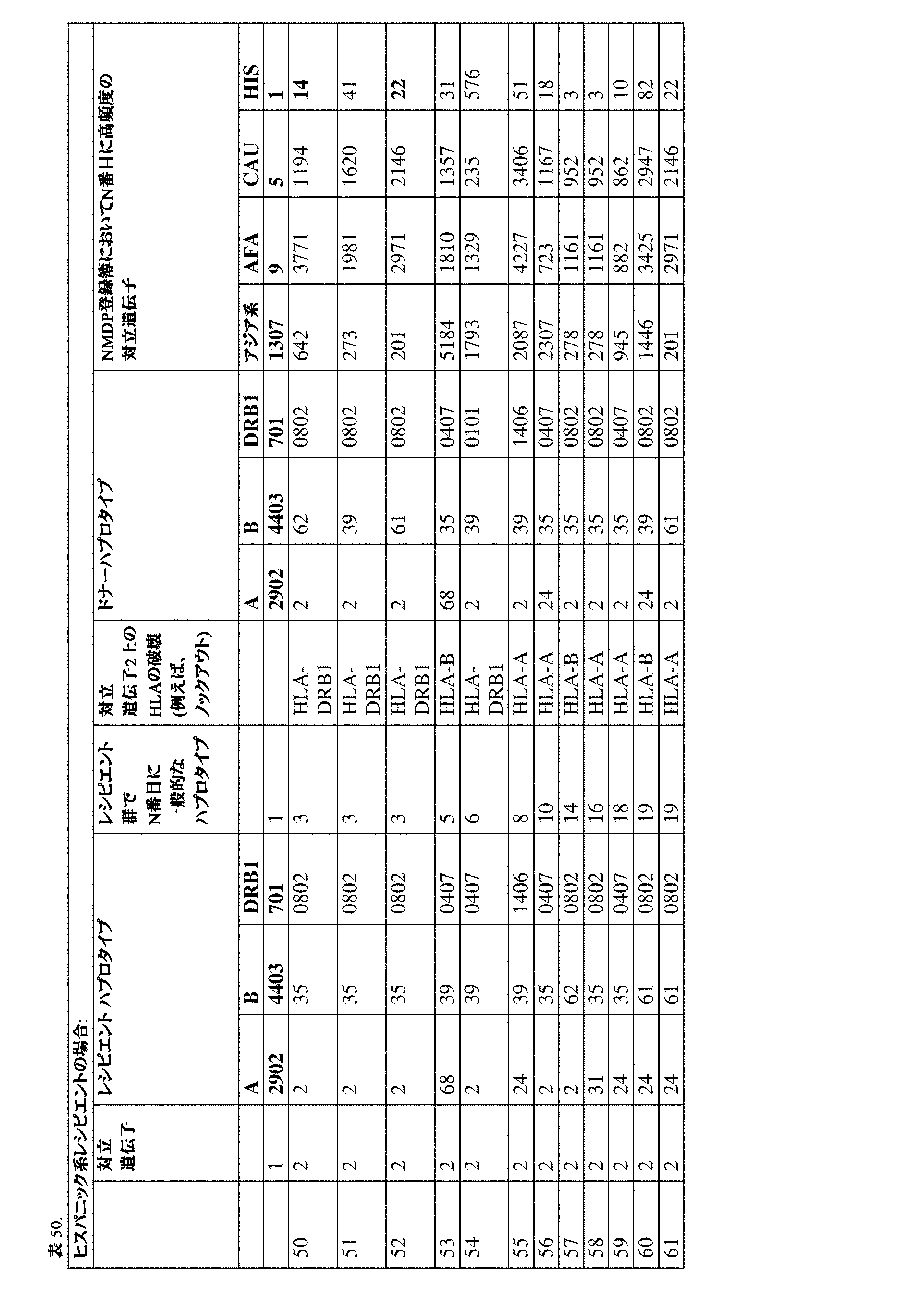
一般的に存在するハプロタイプを、例えば、1つ、2つ、もしくは3つのHLA対立遺伝子の破壊(例えば、ノックアウト)による修飾のために選択することによって、少数しか存在しないレシピエントとマッチする尤度が高められる。別のNMDPベースのデータベースを作成して、例えば、1つ、2つもしくは3つのHLA対立遺伝子の破壊(例えば、ノックアウト)による最も適切なHLA修飾の決定を容易にすることができ、これは、極めて多数のレシピエントへの移植に使用することができる。方法およびドナー細胞は、ドナー組織の利用可能性、レシピエントハプロタイプ、および特異的HLAノックアウトの予測効果に基づいて選択される。 The likelihood of matching a minority of recipients by selecting commonly occurring haplotypes for modification, e.g., by disruption (e.g., knockout) of one, two, or three HLA alleles. is enhanced. A separate NMDP-based database can be created to facilitate the determination of the most appropriate HLA modification, e.g., by disruption (e.g., knockout) of one, two or three HLA alleles, which It can be used for transplantation into a very large number of recipients. Methods and donor cells are selected based on donor tissue availability, recipient haplotype, and predicted efficacy of specific HLA knockouts.
例えば、遺伝子型HLA-A68、HLA-B53、HLA-DRB1-1503;HLA-A0101g、HLA-B0801g、HLA-DRB1*0301を有するアフリカ系アメリカ人レシピエントが、HSCTを必要とする場合、遺伝子型HLA-A68、HLA-B53、HLA-DRB1*1302;HLA-A0101g、HLA-B0801g、HLA-DRB1-0301を有する白色人種ドナーが利用可能であると考えられる。何故なら、これらのハプロタイプは、白色人種ドナープールにおいて、それぞれ、185番目および1番目に一般的なハプロタイプであるからである。本明細書に記載される方法を用いて、ドナー細胞中のミスマッチHLA-DRB1*1302対立遺伝子の遺伝子破壊(例えば、ノックアウト)によって、有効な6/6HLAマッチが生成されるであろう。あるいは、HLA-B遺伝子座での遺伝子破壊が望ましい(例えば、高い生存率または低いGVHD発生率のために)場合には、別のドナーを選択してもよい。遺伝子型HLA-A68、HLA-B7、HLA-DQ-1503;HLA-0101g、HLA-0801g、HLA-DQ-0301を有するドナーHSCにおける生体外HLA-B7遺伝子破壊(例えば、ノックアウト)は、これらのハプロタイプが、アフリカ系アメリカ人ドナープールにおいて、それぞれ、24番目および2番目に一般的なハプロタイプであるため、これらを使用してもよい。 For example, if an African American recipient with genotypes HLA-A68, HLA-B53, HLA-DRB1-1503; HLA-A0101g, HLA-B0801g, HLA-DRB1*0301 requires HSCT, Caucasian donors with HLA-A68, HLA-B53, HLA-DRB1*1302; HLA-A0101g, HLA-B0801g, HLA-DRB1-0301 are considered available. This is because these haplotypes are the 185th and 1st most common haplotypes, respectively, in the Caucasian donor pool. Using the methods described herein, genetic disruption (eg, knockout) of the mismatched HLA-DRB1*1302 allele in donor cells will generate an effective 6/6 HLA match. Alternatively, another donor may be selected if gene disruption at the HLA-B locus is desired (eg, for high survival rates or low GVHD incidence). In vitro HLA-B7 gene disruption (e.g., knockout) in donor HSCs with genotypes HLA-A68, HLA-B7, HLA-DQ-1503; The haplotypes may be used because they are the 24th and second most common haplotypes, respectively, in the African American donor pool.
NMDPデータベース、または任意の臓器ドナーデータベースから、共通のHLAハプロタイプを見出すこともでき、これらのハプロタイプを、1つまたは複数の遺伝子座(例えば、HLA-A、HLA-BもしくはHLA-DRB1)で破壊(例えば、ノックアウト)すれば、最大集団のためのマッチドナー細胞が得られるであろう。あるいは、NMDPデータベース、または任意の臓器ドナーデータベースから、共通のHLAハプロタイプを見出すこともでき、これらのハプロタイプを、単一遺伝子座(例えば、HLA-A、HLA-BもしくはHLA-DRB1)で破壊(例えば、ノックアウト)すれば、マッチするドナー組織もしくはHSCを見出す可能性が最も低いレシピエントのためのマッチドナー細胞が得られるであろう。 Common HLA haplotypes can also be found from the NMDP database, or any organ donor database, and these haplotypes can be disrupted at one or more loci (e.g., HLA-A, HLA-B or HLA-DRB1). (eg, knockout) will yield matched donor cells for the largest population. Alternatively, common HLA haplotypes can be found from the NMDP database, or any organ donor database, and these haplotypes can be disrupted (e.g. HLA-A, HLA-B or HLA-DRB1) at a single locus (e.g. HLA-A, HLA-B or HLA-DRB1). For example, a knockout) would provide matched donor tissue or matched donor cells for recipients who are least likely to find HSCs.
例えば、3/6HLA対立遺伝子でマッチを有することが判明しているレシピエントの場合、本明細書に記載される方法を用いて、以下のことができる:
(a)ドナー細胞の単一対立遺伝子(例えば、HLA-A、HLA-BもしくはHLA-DRB1)を破壊(例えば、ノックアウト)して、外来抗原認識に関して有効な4/6マッチのために)、3/6HLA対立遺伝子(1/6ドナー対立遺伝子は発現されない)でレシピエントに対するドナーのHLAマッチを生成する。単一HLAドナー対立遺伝子の破壊は、4/6マッチを有効に生成し、これは、レシピエントにおけるGVHDの発生リスクおよび/またはその重症度を低減し得る。
(b)ドナー細胞の2つの対立遺伝子(例えば、HLA-A対立遺伝子とHLA-B対立遺伝子、HLA-A対立遺伝子とHLA-DRB1対立遺伝子、もしくはHLA-B対立遺伝子とHLA-DRB1対立遺伝子)を破壊(例えば、ノックアウト)して、外来抗原認識に関して有効な5/6マッチのために、3/6HLA対立遺伝子(2/6ドナー対立遺伝子は発現されない)でレシピエントに対するドナーのHLAマッチを生成する。2つのHLAドナー対立遺伝子の破壊は、5/6マッチを有効に生成し、これは、レシピエントにおけるGVHDの発生リスクおよび/またはその重症度を低減し得る。
(c)ドナー細胞の3つの対立遺伝子(例えば、HLA-A対立遺伝子、HLA-B対立遺伝子、およびHLA-DRB1対立遺伝子)を破壊(例えば、ノックアウト)して、外来抗原認識に関して有効な6/6マッチのために、3/6HLA対立遺伝子(3/6ドナー対立遺伝子は発現されない)でレシピエントに対するドナーのHLAマッチを生成する。3つのHLAドナー対立遺伝子の破壊は、6/6マッチを有効に生成し、これは、レシピエントにおけるGVHDの発生リスクおよび/またはその重症度を低減し得る。
For example, for a recipient known to have a match at the 3/6 HLA allele, using the methods described herein, one can:
(a) disrupting (e.g., knocking out) a single allele (e.g., HLA-A, HLA-B or HLA-DRB1) in the donor cell for an effective 4/6 match for foreign antigen recognition); Generate a donor to recipient HLA match with the 3/6 HLA allele (1/6 donor allele is not expressed). Disruption of a single HLA donor allele effectively generates a 4/6 match, which may reduce the risk of developing GVHD and/or its severity in the recipient.
(b) two alleles of the donor cell (e.g., an HLA-A allele and an HLA-B allele, an HLA-A allele and an HLA-DRB1 allele, or an HLA-B allele and an HLA-DRB1 allele); disrupt (e.g., knock out) the donor to generate an HLA match of the donor to the recipient with the 3/6 HLA allele (the 2/6 donor allele is not expressed) for an effective 5/6 match for foreign antigen recognition. do. Disruption of two HLA donor alleles effectively generates a 5/6 match, which may reduce the risk of developing GVHD and/or its severity in the recipient.
(c) disrupting (e.g., knocking out) three alleles (e.g., HLA-A allele, HLA-B allele, and HLA-DRB1 allele) in the donor cell to produce an effective 6/3 allele with respect to foreign antigen recognition; For 6 matches, generate a donor to recipient HLA match with 3/6 HLA alleles (3/6 donor alleles are not expressed). Disruption of three HLA donor alleles effectively generates a 6/6 match, which may reduce the risk of developing GVHD and/or its severity in the recipient.
例えば、4/6HLA対立遺伝子でマッチを有することが判明しているレシピエントの場合、本明細書に記載される方法を用いて、以下のことができる:
(a)ドナー細胞の単一対立遺伝子(例えば、HLA-A、HLA-BもしくはHLA-DRB1)を破壊(例えば、ノックアウト)して、外来抗原認識に関して有効な5/6マッチのために)、4/6HLA対立遺伝子(1/6ドナー対立遺伝子は発現されない)でレシピエントに対するドナーのHLAマッチを生成する。単一HLAドナー対立遺伝子の破壊は、5/6マッチを有効に生成し、これは、レシピエントにおけるGVHDの発生リスクおよび/またはその重症度を低減し得る。
(b)ドナー細胞の2つの対立遺伝子(例えば、HLA-A対立遺伝子とHLA-B対立遺伝子、HLA-A対立遺伝子とHLA-DRB1対立遺伝子、もしくはHLA-B対立遺伝子とHLA-DRB1対立遺伝子)を破壊(例えば、ノックアウト)して、外来抗原認識に関して有効な6/6マッチのために、4/6HLA対立遺伝子(2/6ドナー対立遺伝子は発現されない)でレシピエントに対するドナーのHLAマッチを生成する。2つのHLAドナー対立遺伝子の破壊は、6/6マッチを有効に生成し、これは、レシピエントにおけるGVHDの発生リスクおよび/またはその重症度を低減し得る。
For example, for a recipient known to have a match at the 4/6 HLA allele, using the methods described herein, one can:
(a) disrupting (e.g., knocking out) a single allele (e.g., HLA-A, HLA-B or HLA-DRB1) in the donor cell for an effective 5/6 match for foreign antigen recognition); Generate a donor to recipient HLA match with the 4/6 HLA allele (1/6 donor allele is not expressed). Disruption of a single HLA donor allele effectively generates a 5/6 match, which may reduce the risk of developing GVHD and/or its severity in the recipient.
(b) two alleles of the donor cell (e.g., an HLA-A allele and an HLA-B allele, an HLA-A allele and an HLA-DRB1 allele, or an HLA-B allele and an HLA-DRB1 allele); (e.g., knockout) to generate an HLA match of the donor to the recipient with the 4/6 HLA allele (the 2/6 donor allele is not expressed) for an effective 6/6 match for foreign antigen recognition. do. Disruption of two HLA donor alleles effectively generates a 6/6 match, which may reduce the risk of developing GVHD and/or its severity in the recipient.
例えば、レシピエントが、遺伝子型HLA-A2 HLA-B46 HLA-DRB1 0901:HLA-A33 HLA-B44 HLA-DRB1*1302を有し、かつ遺伝子型HLA-A2 HLA-B62 HLA-DRB1 0901:HLA-A33 HLA-B58 HLA-DRB1*1302を有するドナーが見出された場合、ドナーとレシピエントの間で4/6HLA対立遺伝子がマッチする。ドナー細胞中のHLA-B62の破壊(例えば、ノックアウト)によって、4/6マッチ対立遺伝子、1つの非発現(ヌル)対立遺伝子、および1つのミスマッチ対立遺伝子が生成される。こうした状況において有効なHLAマッチは、5/6であり、これは、4/6HLAマッチと比較して、レシピエントにおけるGVHDの発生リスクおよび/またはその重症度を低減し得る。 For example, the recipient has the genotype HLA-A2 HLA-B46 HLA-DRB1 0901:HLA-A33 HLA-B44 HLA-DRB1*1302, and the genotype HLA-A2 HLA-B62 HLA-DRB1 0901:HLA- If a donor is found with A33 HLA-B58 HLA-DRB1*1302, there will be a 4/6 HLA allele match between donor and recipient. Disruption (eg, knockout) of HLA-B62 in donor cells produces 4/6 matched alleles, one non-expressing (null) allele, and one mismatched allele. An effective HLA match in these situations is 5/6, which may reduce the risk of developing GVHD and/or its severity in the recipient compared to a 4/6 HLA match.
例えば、5/6HLA対立遺伝子でマッチを有することが判明しているレシピエントの場合、本明細書に記載される方法を用いて、以下のことができる:
(c)ドナー細胞の単一対立遺伝子(例えば、HLA-A、HLA-BもしくはHLA-DRB1)を破壊(例えば、ノックアウト)して、外来抗原認識に関して有効な6/6マッチのために)、5/6HLA対立遺伝子(1/6ドナー対立遺伝子は発現されない)でレシピエントに対するドナーのHLAマッチを生成する。単一HLAドナー対立遺伝子の破壊は、6/6マッチを有効に生成し、これは、レシピエントにおけるGVHDの発生リスクおよび/またはその重症度を低減し得る。
For example, for a recipient known to have a match at the 5/6 HLA allele, using the methods described herein, one can:
(c) disrupting (e.g., knocking out) a single allele (e.g., HLA-A, HLA-B or HLA-DRB1) in the donor cell for an effective 6/6 match for foreign antigen recognition); Generate an HLA match of donor to recipient with 5/6 HLA alleles (1/6 donor allele is not expressed). Disruption of a single HLA donor allele effectively generates a 6/6 match, which may reduce the risk of developing GVHD and/or its severity in the recipient.
例えば、レシピエントが、ハプロタイプHLA-A2 HLA-B46 HLA-DR 0901:HLA-A33 HLA-B44 HLA-DR1302を有し、かつハプロタイプHLA-A2 HLA-B62 HLA-DR 0901:HLA-A33 HLA-B44 HLA-DR1302を有するドナーが見出された場合、ドナーとレシピエントの間で5/6HLA対立遺伝子がマッチする。ドナー細胞中のHLA-B62の破壊(例えば、ノックアウト)によって、5/6マッチ対立遺伝子と、1つの非発現(ヌル)対立遺伝子が生成される。こうした状況において有効なHLAマッチは、6/6であり、これは、5/6HLAマッチと比較して、レシピエントにおけるGVHDの発生リスクおよび/またはその重症度を低減し得る。 For example, if the recipient has haplotype HLA-A2 HLA-B46 HLA-DR 0901:HLA-A33 HLA-B44 HLA-DR1302, and haplotype HLA-A2 HLA-B62 HLA-DR 0901:HLA-A33 HLA-B44 If a donor with HLA-DR1302 is found, there will be a 5/6 HLA allele match between donor and recipient. Disruption (eg, knockout) of HLA-B62 in donor cells produces 5/6 matched alleles and one non-expressing (null) allele. An effective HLA match in these situations is 6/6, which may reduce the risk of developing GVHD and/or its severity in the recipient compared to a 5/6 HLA match.
例えば、遺伝子型HLA-A*3001 2、HLA-B*1302 46、HLA-DRB1*701 0901を有するアジア系レシピエントは、ドナー細胞中のHLA-B62の体外破壊(例えば、ノックアウト)後に、次の遺伝子型:HLA-A*3001 2、HLA-B*1302 62、HLA-DRB1*701 0901を有するドナーからのドナーHSC移植を受けることができる。ドナー細胞は、レシピエント遺伝子型HLA-A*3001 2、HLA-B*1302 46、HLA-DRB1*701 0901との有効な6/6マッチのために、遺伝子型HLA-A*3001 2、HLA-B*1302/-、HLA-DRB1*701 0901を有することになる。ハプロタイプHLA-A*3001、HLA-B*1302、HLA-DRB1*701を有するドナーHSCは、NMDPで利用可能な白色人種系統のハプロタイプの中で10番目に頻度の高いHLAハプロタイプである。ハプロタイプHLA-A2、HLA-B62、およびHLA-DRB1-0901を有するドナーHSCは、NMDPで利用可能な白色人種系統のハプロタイプの中で62番目に頻度の高いHLAハプロタイプである。従って、ドナー遺伝子型HLA-A*3001 2、HLA-B*1302 62、HLA-DRB1*701 0901のドナー遺伝子型が、レシピエントへの供与に利用可能であると考えられる。 For example, an Asian recipient with genotypes HLA-A*3001 2, HLA-B*1302 46, HLA-DRB1*701 0901, after in vitro disruption (e.g., knockout) of HLA-B62 in donor cells, Can receive donor HSC transplantation from a donor with genotype: HLA-A*3001 2, HLA-B*1302 62, HLA-DRB1*701 0901. Donor cells were genotyped HLA-A*3001 2, HLA-B*1302 46, HLA-DRB1*701 0901 for a valid 6/6 match with recipient genotype HLA-A*3001 2, HLA-B*1302 46, HLA-DRB1*701 0901. -B*1302/-, HLA-DRB1*701 0901. Donor HSCs with haplotypes HLA-A*3001, HLA-B*1302, HLA-DRB1*701 are the 10th most frequent HLA haplotype among the Caucasian lineage haplotypes available at NMDP. Donor HSCs with haplotypes HLA-A2, HLA-B62, and HLA-DRB1-0901 are the 62nd most frequent HLA haplotype among the Caucasian lineage haplotypes available at NMDP. Therefore, it is considered that donor genotypes HLA-A*3001 2, HLA-B*1302 62, and HLA-DRB1*701 0901 can be used for donation to recipients.
例えば、遺伝子型HLA-A*3001、HLA-B*1302、HLA-DRB1*701;HLA-A2、HLA-B46、HLA-DRB1-0901を有するアジア系レシピエントは、ドナー細胞中のHLA-Bの体外破壊(例えば、ノックアウト)後に、次の遺伝子型:HLA-A*3001、HLA-B*1302、HLA-DRB1*701;HLA-A2、HLA-B60、HLA-DRB1-0901を有するドナーからのドナーHSC移植を受けることができる。ドナー細胞は、レシピエント遺伝子型HLA-A*3001、HLA-B*1302、HLA-DRB1*701;HLA-A2、HLA-B46、HLA-DRB1-0901との有効な6/6マッチのために、遺伝子型A-A*3001、HLA-B*1302、HLA-DRB1*701;HLA-A2、HLA-B-、HLA-DRB1-0901を有することになる。ハプロタイプHLA-A*3001、HLA-B*1302、HLA-DRB1*701を有するドナーHSCは、NMDPで利用可能な白色人種系統のハプロタイプの中で10番目に頻度の高いHLAハプロタイプである。ハプロタイプHLA-A2、HLA-B60、およびHLA-DRB1-0901を有するドナーHSCは、NMDPで利用可能なアジア系統のハプロタイプの中で19番目に頻度の高いHLAハプロタイプである。従って、ドナー遺伝子型HLA-A*3001、HLA-B*1302、HLA-DRB1*701、HLA-B60、HLA-DRB1-0901のドナー遺伝子型が、レシピエントへの供与に利用可能であると考えられる。 For example, an Asian recipient with genotypes HLA-A*3001, HLA-B*1302, HLA-DRB1*701; HLA-A2, HLA-B46, HLA-DRB1-0901 may have HLA-B from a donor with the following genotypes: HLA-A*3001, HLA-B*1302, HLA-DRB1*701; HLA-A2, HLA-B60, HLA-DRB1-0901 after in vitro disruption (e.g., knockout) of can undergo donor HSC transplantation. Donor cells were selected for a valid 6/6 match with recipient genotype HLA-A*3001, HLA-B*1302, HLA-DRB1*701; HLA-A2, HLA-B46, HLA-DRB1-0901. , genotype AA*3001, HLA-B*1302, HLA-DRB1*701; HLA-A2, HLA-B-, HLA-DRB1-0901. Donor HSCs with haplotypes HLA-A*3001, HLA-B*1302, HLA-DRB1*701 are the 10th most frequent HLA haplotype among the Caucasian lineage haplotypes available at NMDP. Donor HSCs with haplotypes HLA-A2, HLA-B60, and HLA-DRB1-0901 are the 19th most frequent HLA haplotype among the Asian strain haplotypes available at NMDP. Therefore, we believe that donor genotypes HLA-A*3001, HLA-B*1302, HLA-DRB1*701, HLA-B60, and HLA-DRB1-0901 can be used for donation to recipients. It will be done.

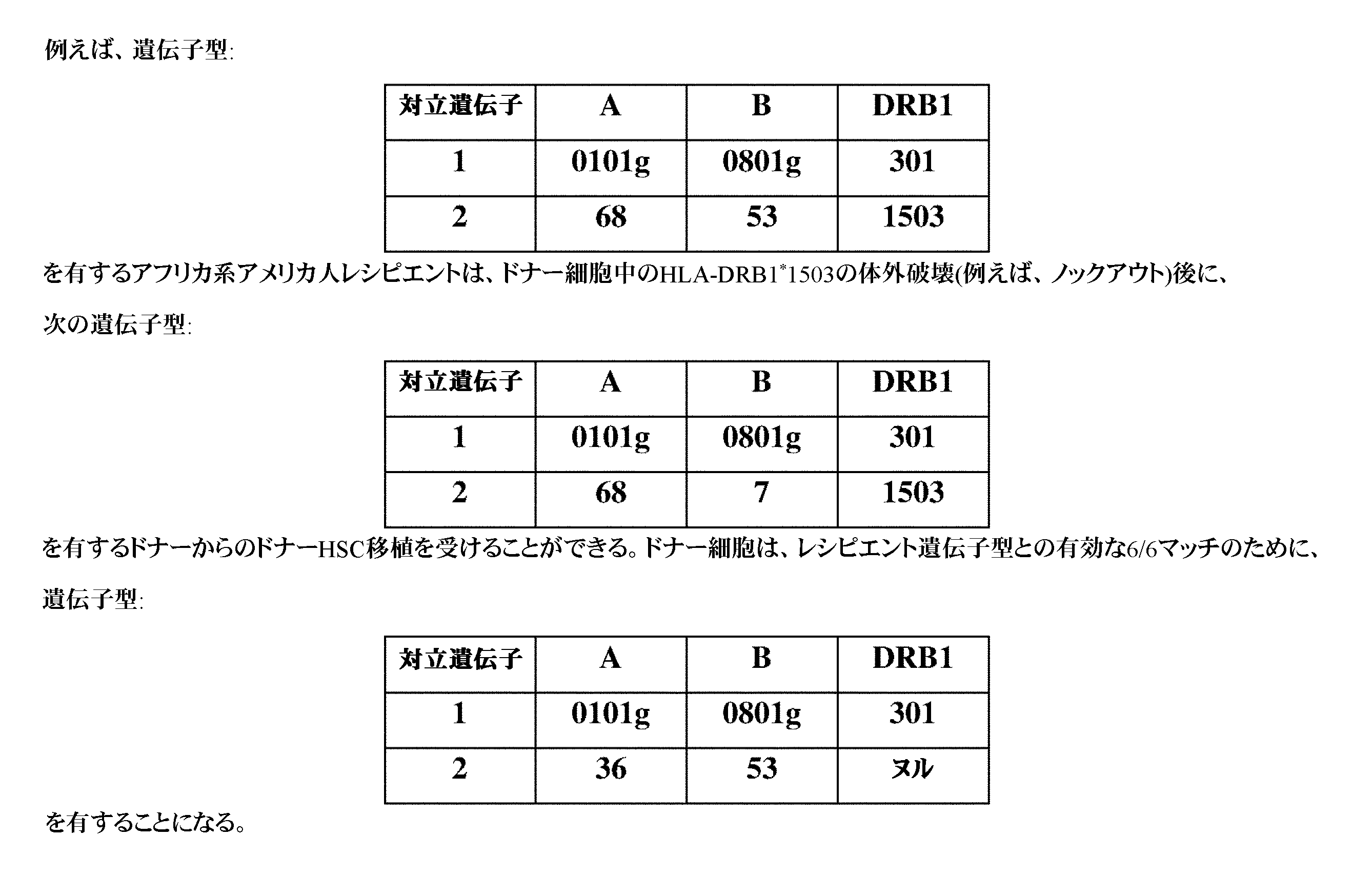

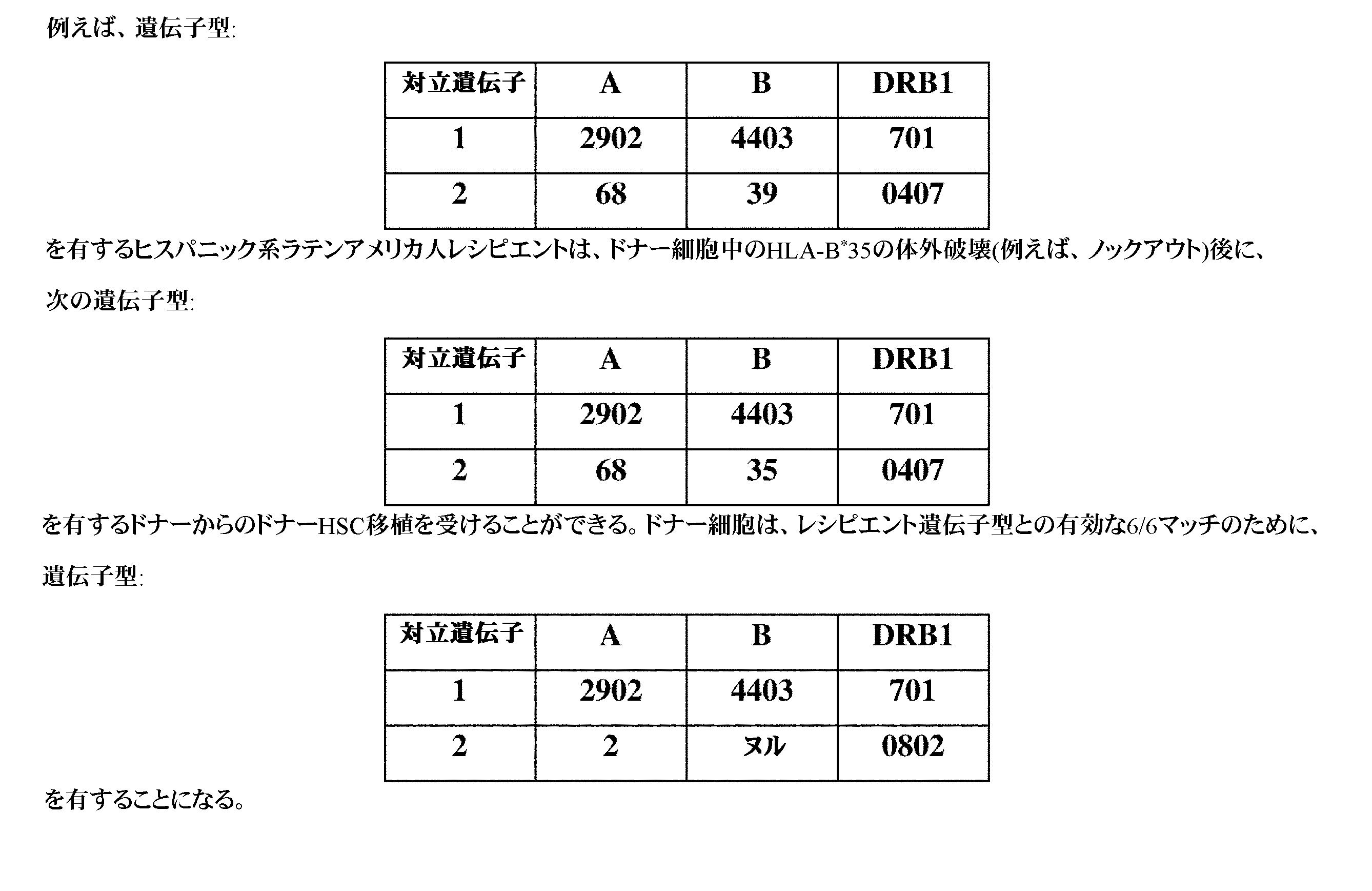
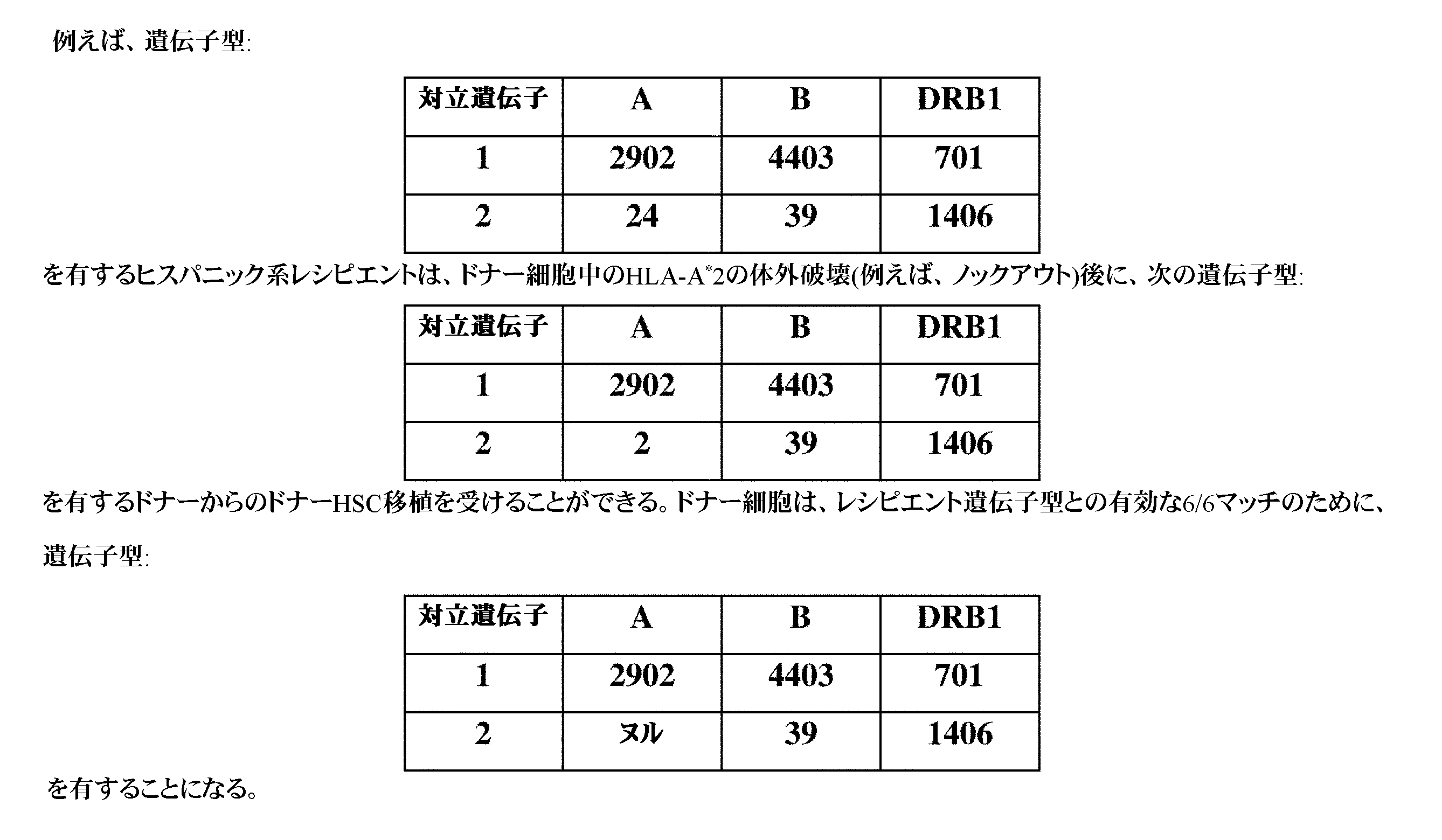
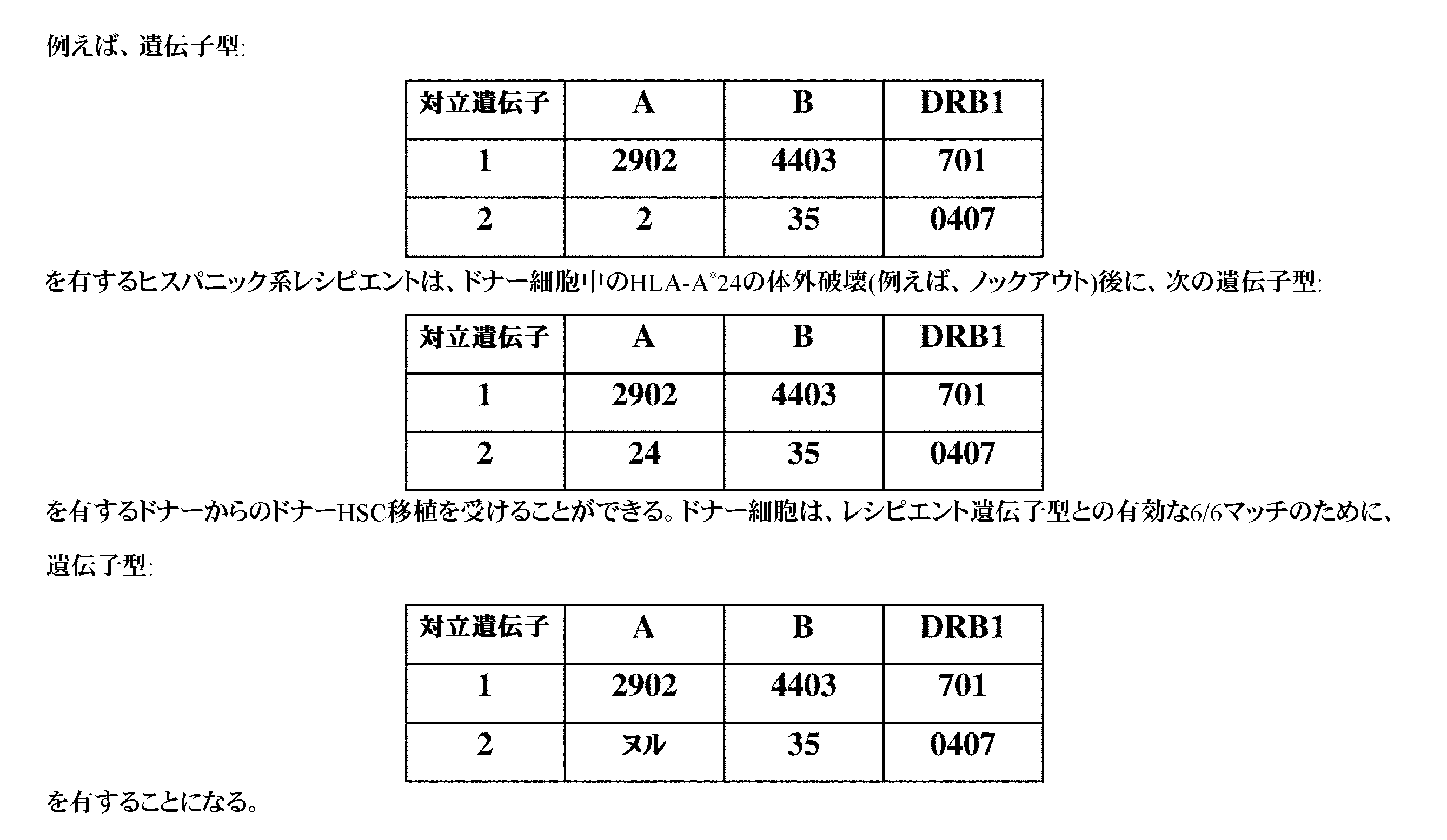

また、本明細書に記載される方法を用いて、いくつかの異なるドナー由来の細胞(例えば、HSC)において少なくとも1つ(例えば、1つ、2つ、3つ、4つ、5つもしくは6つ)のHLA対立遺伝子(例えば、HLA-A、HLA-BおよびHLA-DRB1対立遺伝子)を体外破壊(例えば、ノックアウト)し、ドナー細胞(遺伝子破壊前または破壊後)をプールして、特定のレシピエントに対する1つまたは複数のマッチHLA対立遺伝子(例えば、HLA-A-/common allele、HLA-B-/common allele、HLA-DR‐/common allele遺伝子型)を有するドナー細胞を生成することもできる。これらの細胞を最も一般的なHLA(例えば、HLA-A、HLA-BもしくはHLA-DR)遺伝子型のために作製して、1または複数のレシピエントに使用するために維持してもよい。 Also, using the methods described herein, at least one (e.g., one, two, three, four, five, or six HLA alleles (e.g., HLA-A, HLA-B, and HLA-DRB1 alleles) are disrupted (e.g., knocked out) in vitro and donor cells (before or after gene disruption) are pooled and Donor cells can also be generated with one or more matched HLA alleles (e.g., HLA-A −/common allele , HLA-B −/common allele , HLA-DR −/common allele genotype) to the recipient. can. These cells may be generated for the most common HLA (eg, HLA-A, HLA-B or HLA-DR) genotypes and maintained for use in one or more recipients.
当業者は、これらの方法を用いて、他のHLA遺伝子座(例えば、HLA-CおよびHLA-DQ)を破壊(例えば、ノックアウト)することもできることは容易に見極められよう。例えば、ドナーと8/10HLAマッチを有する特定のHLAハプロタイプを有するレシピエントの場合、近縁の非マッチドナー対立遺伝子をノックアウトして、ドナー-レシピエントマッチを実質的に9/10にすることができる。例えば、HLA-A、HLA-B、HLA-CおよびHLA-DRでハプロタイプがマッチするが、単一HLA-DQ対立遺伝子ではマッチしなかったドナー組織における単一HLA-DQ対立遺伝子の破壊(例えば、ノックアウト)を実施して、有効な9/10ハプロタイプマッチを生成することができ、ミスマッチHLA-DQ対立遺伝子は発現されないため、これは、ドナー-レシピエントHLAマッチを実質的に10/10にすることができる。 Those skilled in the art will readily appreciate that other HLA loci (eg, HLA-C and HLA-DQ) can also be disrupted (eg, knocked out) using these methods. For example, for a recipient with a particular HLA haplotype that has an 8/10 HLA match with the donor, the closely related unmatched donor allele can be knocked out to effectively bring the donor-recipient match to 9/10. can. For example, disruption of a single HLA-DQ allele in donor tissue that is haplotype matched for HLA-A, HLA-B, HLA-C, and HLA-DR, but not for a single HLA-DQ allele (e.g. , knockout) can be performed to generate a valid 9/10 haplotype match, which effectively reduces the donor-recipient HLA match to 10/10 since the mismatched HLA-DQ allele is not expressed. can do.
参照による援用
本明細書で言及される全ての出版物、特許、および特許出願は、あたかも個々の出版物、特許または特許出願が、具体的にそして個別に、参照により援用されると示されるかのように、その内容全体を参照により本明細書に援用する。矛盾する場合は、本明細書のあらゆる定義を含め、本出願が優先される。
Incorporation by Reference All publications, patents, and patent applications mentioned herein are indicated as if each individual publication, patent, or patent application was specifically and individually indicated to be incorporated by reference. , the entire contents of which are hereby incorporated by reference. In case of conflict, the present application, including any definitions herein, will control.
同等物
当業者は、単に通例の実験法を使用して、本明細書に記載される本発明の特定の実施形態の多くの同等物を認識し、または見極めることができるであろう。このような同等物は、以下の特許請求の範囲に包含されることが意図される。
Equivalents Those skilled in the art will recognize, or be able to ascertain using no more than routine experimentation, many equivalents to the specific embodiments of the invention described herein. Such equivalents are intended to be covered by the following claims.
Claims (19)
第1の対立遺伝子特異的gRNA分子およびCas9分子と前記血球を接触させて、これにより、前記HLA遺伝子の前記第1の対立遺伝子によりコードされるタンパク質の前記細胞表面発現を低減するステップ
を含み、
前記第1の対立遺伝子特異的gRNA分子が、前記HLA遺伝子中の標的ドメインと相補的である標的化ドメインを含み、
前記第1の対立遺伝子特異的gRNA分子および前記Cas9分子が、前記HLA遺伝子の前記第1の対立遺伝子と結合し、
前記第1の対立遺伝子特異的gRNA分子および前記Cas9分子が、HLA遺伝子の単一の対立遺伝子と結合し、
ここで、前記第1の対立遺伝子特異的gRNA分子は、世界保健機関により採用された命名法に基く対立遺伝子群、具体的なHLAタンパク質、およびコード領域内の同義DNA置換についてのHLA遺伝子型情報を含むデータセットを含むデータベーススキーマを用いて、特定の単一遺伝子を標的化するように設計されたものである、方法。 A method of reducing cell surface expression of a protein encoded by a first allele of a human leukocyte antigen (HLA) gene in blood cells, the method comprising:
contacting the blood cell with a first allele-specific gRNA molecule and a Cas9 molecule, thereby reducing the cell surface expression of a protein encoded by the first allele of the HLA gene;
the first allele-specific gRNA molecule comprises a targeting domain that is complementary to a targeting domain in the HLA gene;
the first allele-specific gRNA molecule and the Cas9 molecule bind to the first allele of the HLA gene;
the first allele-specific gRNA molecule and the Cas9 molecule bind to a single allele of an HLA gene;
wherein said first allele-specific gRNA molecule contains HLA genotype information about allele groups, specific HLA proteins, and synonymous DNA substitutions within the coding region according to the nomenclature adopted by the World Health Organization. A method is designed to target a specific single gene using a database schema comprising a dataset comprising:
対立遺伝子特異的gRNA分子およびCas9分子と血球の集団を接触させるステップ、ここで前記対立遺伝子特異的gRNA分子および前記Cas9分子が、同定可能なHLA遺伝子産物をコードするHLA遺伝子の変異体である単一の対立遺伝子と結合し、前記対立遺伝子特異的gRNA分子が、前記HLA遺伝子中の標的ドメインと相補的である標的化ドメインを含む;ならびに
前記同定可能なHLA遺伝子産物を発現するが、前記HLA遺伝子の変異体である前記単一の対立遺伝子は発現しない細胞を富化するステップ
を含み、
ここで、前記対立遺伝子特異的gRNA分子は、世界保健機関により採用された命名法に基く対立遺伝子群、具体的なHLAタンパク質、およびコード領域内の同義DNA置換についてのHLA遺伝子型情報を含むデータセットを含むデータベーススキーマを用いて、特定の単一遺伝子を標的化するように設計されたものである、方法。 A method of producing a composition comprising a population of cells having an allele-specific genetic modification, the method comprising:
contacting a population of blood cells with an allele-specific gRNA molecule and a Cas9 molecule, wherein the allele-specific gRNA molecule and the Cas9 molecule are mutants of an HLA gene encoding an identifiable HLA gene product; binding one allele, said allele-specific gRNA molecule comprising a targeting domain that is complementary to a targeting domain in said HLA gene; and expressing said identifiable HLA gene product; enriching for cells that do not express the single allele that is a variant of the gene ;
wherein the allele-specific gRNA molecule includes data containing HLA genotype information about allele groups, specific HLA proteins, and synonymous DNA substitutions within the coding region according to the nomenclature adopted by the World Health Organization. A method that is designed to target a specific single gene using a database schema that includes a set of genes .
コンピューターシステムのインターフェースを介して、第1の対象の内在性免疫原性遺伝子の第1の複数の対立遺伝子の一覧を受信するステップ;
前記コンピューターシステムのインターフェースを介して、第2の対象の内在性免疫原性遺伝子の第2の複数の対立遺伝子の一覧を受信するステップ;
前記第1および第2の複数の対立遺伝子の一覧を処理して、前記第1の複数の対立遺伝子と第2の複数の対立遺伝子との間で1つまたは複数のミスマッチ対立遺伝子を同定するステップ;
1つまたは複数のgRNA分子が、前記第2の複数の対立遺伝子の前記1つまたは複数のミスマッチ対立遺伝子を編集するのに好適であるか否かを決定するためにデータベースに問い合わせるステップ;
好適であることが判明した前記1つまたは複数のgRNA分子を同定するgRNA分子のリストを作成するステップ;
gRNA分子のリストをランク付けするステップ;ならびに
前記gRNA分子のランク付けリストを表示するステップ
を含む、請求項7に記載の方法。 Selecting the first allele-specific gRNA molecule using a database schema comprises:
receiving, via an interface of a computer system, a list of a first plurality of alleles of an endogenous immunogenic gene of a first subject;
receiving, via an interface of the computer system, a list of a second plurality of alleles of an endogenous immunogenic gene of a second subject;
processing the lists of the first and second plurality of alleles to identify one or more mismatched alleles between the first plurality of alleles and the second plurality of alleles; ;
querying a database to determine whether one or more gRNA molecules are suitable for editing the one or more mismatched alleles of the second plurality of alleles;
creating a list of gRNA molecules identifying said one or more gRNA molecules found to be suitable;
8. The method of claim 7, comprising: ranking a list of gRNA molecules; and displaying the ranked list of gRNA molecules.
(a)酵素的に活性なCas9(eaCas9)分子、ここで前記eaCas9分子が、内在性免疫原性遺伝子内に一本鎖切断または二本鎖切断を生成する;
(b)野生型Cas9;
(c)Cas9ニッカーゼ;
(d)不活性型Cas9(dCas9);
(e)分割型Cas9;
(f)誘導性Cas9;
(g)N末端RuvC様ドメイン切断活性を含むがHNH様ドメイン切断活性は有さないCas9分子;
(h)ストレプトコッカス・ピオゲネス(Streptococcus pyogenes)Cas9のアミノ酸位置N863に対応するアミノ酸位置にアミノ酸突然変異を含むCas9分子;
(i)HNH様ドメイン切断活性を含むがN末端RuvC様ドメイン切断活性を有さないCas9分子;および
(j)ストレプトコッカス・ピオゲネス(Streptococcus pyogenes)Cas9のアミノ酸位置D10に対応するアミノ酸位置にアミノ酸突然変異を含むCas9分子
からなる群から選択される、請求項1~8のいずれか1項に記載の方法。 The Cas9 molecule is
(a) an enzymatically active Cas9 (eaCas9) molecule, where the eaCas9 molecule generates a single-stranded break or a double-stranded break within an endogenous immunogenic gene;
(b) Wild type Cas9;
(c) Cas9 nickase;
(d) Inactive Cas9 (dCas9);
(e) Split type Cas9;
(f) inducible Cas9;
(g) a Cas9 molecule containing N-terminal RuvC-like domain cleavage activity but no HNH-like domain cleavage activity;
(h) a Cas9 molecule comprising an amino acid mutation at the amino acid position corresponding to amino acid position N863 of Streptococcus pyogenes Cas9;
(i) a Cas9 molecule containing HNH-like domain cleavage activity but not N-terminal RuvC-like domain cleavage activity; and (j) an amino acid mutation at the amino acid position corresponding to amino acid position D10 of Streptococcus pyogenes Cas9. The method according to any one of claims 1 to 8, selected from the group consisting of Cas9 molecules comprising.
(b)前記トランスジーンが、HLA遺伝子またはその断片である;あるいは
(c)前記トランスジーンが、HLA-A、HLA-B、HLA-C、HLA-DRB1、HLA-DRB3/4/5、HLA-DQ、およびHLA-DPからなる群から選択されるHLA遺伝子またはその断片である、請求項15に記載の方法。 (a) the transgene is a gene encoding an immune-identical human leukocyte antigen (HLA), a chemotherapy selection marker, a cell surface antigen, or a suicide gene;
(b) the transgene is an HLA gene or a fragment thereof; or (c) the transgene is an HLA gene or a fragment thereof; or (c) the transgene is an HLA gene or a fragment thereof; -DQ, and HLA-DP or a fragment thereof.
Priority Applications (2)
| Application Number | Priority Date | Filing Date | Title |
|---|---|---|---|
| JP2021123707A JP2021192607A (en) | 2015-06-09 | 2021-07-28 | CRISPR / CAS-related methods and compositions for improving transplantation |
| JP2023095826A JP2023123561A (en) | 2015-06-09 | 2023-06-09 | CRISPR/CAS-related methods and compositions for improving transplantation |
Applications Claiming Priority (5)
| Application Number | Priority Date | Filing Date | Title |
|---|---|---|---|
| US201562173321P | 2015-06-09 | 2015-06-09 | |
| US62/173,321 | 2015-06-09 | ||
| US201662294493P | 2016-02-12 | 2016-02-12 | |
| US62/294,493 | 2016-02-12 | ||
| PCT/US2016/036602 WO2016201047A1 (en) | 2015-06-09 | 2016-06-09 | Crispr/cas-related methods and compositions for improving transplantation |
Related Child Applications (1)
| Application Number | Title | Priority Date | Filing Date |
|---|---|---|---|
| JP2021123707A Division JP2021192607A (en) | 2015-06-09 | 2021-07-28 | CRISPR / CAS-related methods and compositions for improving transplantation |
Publications (3)
| Publication Number | Publication Date |
|---|---|
| JP2018523977A JP2018523977A (en) | 2018-08-30 |
| JP2018523977A5 JP2018523977A5 (en) | 2019-07-18 |
| JP7396783B2 true JP7396783B2 (en) | 2023-12-12 |
Family
ID=56236096
Family Applications (3)
| Application Number | Title | Priority Date | Filing Date |
|---|---|---|---|
| JP2017564333A Active JP7396783B2 (en) | 2015-06-09 | 2016-06-09 | CRISPR/CAS-related methods and compositions for improving implantation |
| JP2021123707A Withdrawn JP2021192607A (en) | 2015-06-09 | 2021-07-28 | CRISPR / CAS-related methods and compositions for improving transplantation |
| JP2023095826A Pending JP2023123561A (en) | 2015-06-09 | 2023-06-09 | CRISPR/CAS-related methods and compositions for improving transplantation |
Family Applications After (2)
| Application Number | Title | Priority Date | Filing Date |
|---|---|---|---|
| JP2021123707A Withdrawn JP2021192607A (en) | 2015-06-09 | 2021-07-28 | CRISPR / CAS-related methods and compositions for improving transplantation |
| JP2023095826A Pending JP2023123561A (en) | 2015-06-09 | 2023-06-09 | CRISPR/CAS-related methods and compositions for improving transplantation |
Country Status (7)
| Country | Link |
|---|---|
| US (2) | US11911415B2 (en) |
| EP (1) | EP3307887A1 (en) |
| JP (3) | JP7396783B2 (en) |
| KR (1) | KR102796744B1 (en) |
| CN (2) | CN108026526B (en) |
| AU (2) | AU2016276702B2 (en) |
| WO (1) | WO2016201047A1 (en) |
Families Citing this family (75)
| Publication number | Priority date | Publication date | Assignee | Title |
|---|---|---|---|---|
| US10323236B2 (en) | 2011-07-22 | 2019-06-18 | President And Fellows Of Harvard College | Evaluation and improvement of nuclease cleavage specificity |
| US20210137991A1 (en) * | 2013-02-08 | 2021-05-13 | Themba Inc. | Gene editing for autoimmune disorders |
| US9163284B2 (en) | 2013-08-09 | 2015-10-20 | President And Fellows Of Harvard College | Methods for identifying a target site of a Cas9 nuclease |
| US9359599B2 (en) | 2013-08-22 | 2016-06-07 | President And Fellows Of Harvard College | Engineered transcription activator-like effector (TALE) domains and uses thereof |
| US9526784B2 (en) | 2013-09-06 | 2016-12-27 | President And Fellows Of Harvard College | Delivery system for functional nucleases |
| US9340799B2 (en) | 2013-09-06 | 2016-05-17 | President And Fellows Of Harvard College | MRNA-sensing switchable gRNAs |
| US9322037B2 (en) | 2013-09-06 | 2016-04-26 | President And Fellows Of Harvard College | Cas9-FokI fusion proteins and uses thereof |
| US20150165054A1 (en) | 2013-12-12 | 2015-06-18 | President And Fellows Of Harvard College | Methods for correcting caspase-9 point mutations |
| US10077453B2 (en) | 2014-07-30 | 2018-09-18 | President And Fellows Of Harvard College | CAS9 proteins including ligand-dependent inteins |
| US11390884B2 (en) | 2015-05-11 | 2022-07-19 | Editas Medicine, Inc. | Optimized CRISPR/cas9 systems and methods for gene editing in stem cells |
| JP7396783B2 (en) | 2015-06-09 | 2023-12-12 | エディタス・メディシン、インコーポレイテッド | CRISPR/CAS-related methods and compositions for improving implantation |
| US10167457B2 (en) | 2015-10-23 | 2019-01-01 | President And Fellows Of Harvard College | Nucleobase editors and uses thereof |
| KR20250103795A (en) | 2016-08-03 | 2025-07-07 | 프레지던트 앤드 펠로우즈 오브 하바드 칼리지 | Adenosine nucleobase editors and uses thereof |
| EP3497214B1 (en) | 2016-08-09 | 2023-06-28 | President and Fellows of Harvard College | Programmable cas9-recombinase fusion proteins and uses thereof |
| WO2018039438A1 (en) | 2016-08-24 | 2018-03-01 | President And Fellows Of Harvard College | Incorporation of unnatural amino acids into proteins using base editing |
| AU2017342543B2 (en) | 2016-10-14 | 2024-06-27 | President And Fellows Of Harvard College | AAV delivery of nucleobase editors |
| JP7206214B2 (en) | 2016-12-13 | 2023-01-17 | シアトル チルドレンズ ホスピタル (ディービーエイ シアトル チルドレンズ リサーチ インスティテュート) | Methods for exogenous drug activation of chemo-inducible signaling complexes expressed in engineered cells in vitro and in vivo |
| US10745677B2 (en) | 2016-12-23 | 2020-08-18 | President And Fellows Of Harvard College | Editing of CCR5 receptor gene to protect against HIV infection |
| US12390514B2 (en) | 2017-03-09 | 2025-08-19 | President And Fellows Of Harvard College | Cancer vaccine |
| EP3592853A1 (en) | 2017-03-09 | 2020-01-15 | President and Fellows of Harvard College | Suppression of pain by gene editing |
| US11542496B2 (en) | 2017-03-10 | 2023-01-03 | President And Fellows Of Harvard College | Cytosine to guanine base editor |
| BR112019019655A2 (en) | 2017-03-23 | 2020-04-22 | Harvard College | nucleobase editors comprising nucleic acid programmable dna binding proteins |
| US11944643B2 (en) | 2017-03-31 | 2024-04-02 | Cellectis Sa | Universal anti-CD22 chimeric antigen receptor engineered immune cells |
| EP4400175A3 (en) * | 2017-04-28 | 2024-09-25 | The Regents of the University of Colorado, a body corporate | Methods of treating rheumatoid arthritis using rna-guided genome editing of hla gene |
| WO2018209320A1 (en) | 2017-05-12 | 2018-11-15 | President And Fellows Of Harvard College | Aptazyme-embedded guide rnas for use with crispr-cas9 in genome editing and transcriptional activation |
| CA3068604A1 (en) * | 2017-06-13 | 2018-12-20 | Fate Therapeutics, Inc. | Compositions and methods for inducing myeloid suppressive cells and use thereof |
| EP3641811B1 (en) * | 2017-06-21 | 2025-02-26 | ProKidney | Immunoprivileged bioactive renal cells for the treatment of kidney disease |
| WO2019002633A1 (en) | 2017-06-30 | 2019-01-03 | Cellectis | Cellular immunotherapy for repetitive administration |
| CN111094561B (en) | 2017-07-07 | 2024-03-12 | 株式会社图尔金 | Target-specific CRISPR variants |
| US11866726B2 (en) | 2017-07-14 | 2024-01-09 | Editas Medicine, Inc. | Systems and methods for targeted integration and genome editing and detection thereof using integrated priming sites |
| US11732274B2 (en) | 2017-07-28 | 2023-08-22 | President And Fellows Of Harvard College | Methods and compositions for evolving base editors using phage-assisted continuous evolution (PACE) |
| US12060566B2 (en) | 2017-08-22 | 2024-08-13 | The Regents Of The University Of California | Self-inactivating lentiviral vector comprising a FOXP3 expression cassette |
| US11319532B2 (en) | 2017-08-30 | 2022-05-03 | President And Fellows Of Harvard College | High efficiency base editors comprising Gam |
| AU2018352592C1 (en) | 2017-10-16 | 2025-09-25 | Beam Therapeutics, Inc. | Uses of adenosine base editors |
| US11912780B2 (en) * | 2017-10-25 | 2024-02-27 | Actinium Pharmaceuticals, Inc. | Anti-CD45-based conditioning methods and uses thereof in conjunction with gene-edited cell-based therapies |
| KR20200079312A (en) * | 2017-11-06 | 2020-07-02 | 에디타스 메디신, 인코포레이티드 | CRISPR-CAS9 editing method, composition and components of CBLB in T cells for immunotherapy |
| US12406749B2 (en) | 2017-12-15 | 2025-09-02 | The Broad Institute, Inc. | Systems and methods for predicting repair outcomes in genetic engineering |
| WO2019160077A1 (en) * | 2018-02-16 | 2019-08-22 | 国立大学法人京都大学 | Method for producing low-antigenic cell |
| CN110229814B (en) * | 2018-03-06 | 2025-11-14 | 中国科学院动物研究所 | Improved guide RNA |
| CN108330138B (en) * | 2018-03-29 | 2018-09-25 | 上海欣百诺生物科技有限公司 | A kind of external synthetic method and its kit of sgRNA |
| CN112041436A (en) * | 2018-04-27 | 2020-12-04 | 西雅图儿童医院(Dba西雅图儿童研究所) | Rapamycin resistant cells |
| US12157760B2 (en) | 2018-05-23 | 2024-12-03 | The Broad Institute, Inc. | Base editors and uses thereof |
| WO2019232253A1 (en) * | 2018-05-30 | 2019-12-05 | The Regents Of The University Of California | Gene editing of monogenic disorders in human hematopoietic stem cells -- correction of x-linked agammaglobulinemia (xla) |
| EP3802790A4 (en) * | 2018-06-07 | 2022-03-23 | The Brigham and Women's Hospital, Inc. | METHODS FOR GENERATION OF HEMATOPOIETIC STEM CELLS |
| WO2019239361A1 (en) * | 2018-06-14 | 2019-12-19 | Novartis Ag | Method for sequence insertion using crispr |
| US12522807B2 (en) | 2018-07-09 | 2026-01-13 | The Broad Institute, Inc. | RNA programmable epigenetic RNA modifiers and uses thereof |
| WO2020029171A1 (en) * | 2018-08-09 | 2020-02-13 | 深圳华大生命科学研究院 | Method for constructing antigen-presenting cell line without endogenous hla gene background, antigen-presenting cell line and use thereof |
| AU2019327449A1 (en) | 2018-08-28 | 2021-03-11 | Flagship Pioneering Innovations Vi, Llc | Methods and compositions for modulating a genome |
| EP4512890A3 (en) | 2018-08-28 | 2025-04-30 | Vor Biopharma, Inc. | Genetically engineered hermatopoietic stem cells and uses thereof |
| ES3023563T3 (en) | 2018-10-16 | 2025-06-02 | Blueallele Corp | Methods for targeted insertion of dna in genes |
| WO2020092453A1 (en) | 2018-10-29 | 2020-05-07 | The Broad Institute, Inc. | Nucleobase editors comprising geocas9 and uses thereof |
| EP3837379B1 (en) | 2018-12-12 | 2022-05-18 | Depixus | Method of nucleic acid enrichment using site-specific nucleases followed by capture |
| JP2022513490A (en) * | 2018-12-16 | 2022-02-08 | フィジーン、エルエルシー | Therapeutic use of gene-edited fibroblasts |
| US12351837B2 (en) | 2019-01-23 | 2025-07-08 | The Broad Institute, Inc. | Supernegatively charged proteins and uses thereof |
| CN114127285B (en) | 2019-03-19 | 2024-09-10 | 布罗德研究所股份有限公司 | Methods and compositions for editing nucleotide sequences |
| AU2020248097A1 (en) * | 2019-03-27 | 2021-11-18 | Research Institute At Nationwide Children's Hospital | Generation of chimeric antigen receptor (CAR)-primary NK cells for cancer immunotherapy using a combination of Cas9/RNP and AAV viruses |
| EP3956349A1 (en) | 2019-04-17 | 2022-02-23 | The Broad Institute, Inc. | Adenine base editors with reduced off-target effects |
| JP7345563B2 (en) * | 2019-04-26 | 2023-09-15 | ツールゲン インコーポレイテッド | Target-specific CRISPR variants |
| CN113825526A (en) * | 2019-05-06 | 2021-12-21 | 加利福尼亚大学董事会 | Non-HLA markers of transplant rejection |
| CN110564774B (en) * | 2019-08-23 | 2021-10-15 | 华南农业大学 | A method to improve the efficiency of site-directed modification of cellular genome by using modified ssODN |
| WO2021041971A1 (en) * | 2019-08-28 | 2021-03-04 | Vor Biopharma, Inc. | Compositions and methods for cll1 modification |
| AU2020350677A1 (en) * | 2019-09-17 | 2022-04-14 | Actinium Pharmaceuticals, Inc. | Radiolabeling of anti-CD45 immunoglobulin and methods of use thereof |
| US12435330B2 (en) | 2019-10-10 | 2025-10-07 | The Broad Institute, Inc. | Methods and compositions for prime editing RNA |
| KR20220140542A (en) * | 2020-02-07 | 2022-10-18 | 더 리전트 오브 더 유니버시티 오브 캘리포니아 | Methods and uses for bioengineered preparation of enucleated cells |
| WO2021163191A1 (en) * | 2020-02-10 | 2021-08-19 | Board Of Regents, The University Of Texas System | Methods for rapid cloning and expression of hla class i cells |
| KR20230053735A (en) | 2020-03-04 | 2023-04-21 | 플래그쉽 파이어니어링 이노베이션스 브이아이, 엘엘씨 | Improved methods and compositions for manipulation of genomes |
| DE112021002672T5 (en) | 2020-05-08 | 2023-04-13 | President And Fellows Of Harvard College | METHODS AND COMPOSITIONS FOR EDIT BOTH STRANDS SIMULTANEOUSLY OF A DOUBLE STRANDED NUCLEOTIDE TARGET SEQUENCE |
| CN113512767B (en) * | 2021-04-30 | 2022-09-23 | 天津诺禾致源生物信息科技有限公司 | Joint and kit for constructing small RNA library and construction method of small RNA library |
| JP2024517476A (en) | 2021-05-10 | 2024-04-22 | ザ リージェンツ オブ ザ ユニバーシティ オブ コロラド,ア ボディー コーポレイト | Pocket engineering of HLA alleles to treat autoimmunity |
| WO2023060059A2 (en) * | 2021-10-05 | 2023-04-13 | The Board Of Trustees Of The Leland Stanford Junior University | Treatment of polycythemia vera via cr1spr/aav6 genome editing |
| AU2023246279A1 (en) * | 2022-04-01 | 2024-11-14 | LogoMix, Inc. | Cell suitable for gene engineering, cell engineering and cellular medicine, and method for producing same |
| JP2025520388A (en) * | 2022-06-16 | 2025-07-03 | インテリア セラピューティクス,インコーポレイテッド | Compositions and methods for genome editing |
| CN118406681A (en) * | 2023-01-30 | 2024-07-30 | 南京北恒生物科技有限公司 | Compositions and methods for allogeneic transplantation |
| CN116694574B (en) * | 2023-07-31 | 2023-10-31 | 苏天生命科技(苏州)有限公司 | HLA-A and HLA-B co-knocked-out multiple blood lineage differentiation potential immortalized cell and manufacturing method thereof |
| WO2025195458A1 (en) * | 2024-03-20 | 2025-09-25 | Nanjing Legend Biotech Co., Ltd. | Methods for producing immune-compatible cells |
Citations (2)
| Publication number | Priority date | Publication date | Assignee | Title |
|---|---|---|---|---|
| WO2014165177A1 (en) | 2013-03-12 | 2014-10-09 | Sangamo Biosciences, Inc. | Methods and compositions for modification of hla |
| WO2014186585A2 (en) | 2013-05-15 | 2014-11-20 | Sangamo Biosciences, Inc. | Methods and compositions for treatment of a genetic condition |
Family Cites Families (197)
| Publication number | Priority date | Publication date | Assignee | Title |
|---|---|---|---|---|
| US7074596B2 (en) | 2002-03-25 | 2006-07-11 | Board Of Supervisors Of Louisiana State University And Agricultural And Mechanical College | Synthesis and use of anti-reverse mRNA cap analogues |
| DK2341149T3 (en) | 2005-08-26 | 2017-02-27 | Dupont Nutrition Biosci Aps | Use of CRISPR-associated genes (Cas) |
| WO2007047894A2 (en) * | 2005-10-20 | 2007-04-26 | Advanced Cell Technology, Inc. | Totipotent, nearly totipotent or pluripotent mammalian cells homozygous or hemizygous for one or more histocompatibility antigen genes |
| US20090156532A1 (en) * | 2006-01-24 | 2009-06-18 | The University Of Chicago | SNP BINDING SITE FOR microRNAs IN HLA-G |
| EP2049665A2 (en) | 2006-07-28 | 2009-04-22 | Applera Corporation | Dinucleotide mrna cap analogs |
| PT2167523E (en) | 2007-06-19 | 2014-09-22 | Univ Louisiana State | Synthesis and use of anti-reverse phosphorothioate analogs of the messenger rna cap |
| PL215513B1 (en) | 2008-06-06 | 2013-12-31 | Univ Warszawski | New borane phosphate analogs of dinucleotides, their application, RNA particle, method of obtaining RNA and method of obtaining peptides or protein |
| US8546553B2 (en) | 2008-07-25 | 2013-10-01 | University Of Georgia Research Foundation, Inc. | Prokaryotic RNAi-like system and methods of use |
| US8703489B2 (en) | 2008-08-22 | 2014-04-22 | Sangamo Biosciences, Inc. | Methods and compositions for targeted single-stranded cleavage and targeted integration |
| US20100076057A1 (en) | 2008-09-23 | 2010-03-25 | Northwestern University | TARGET DNA INTERFERENCE WITH crRNA |
| WO2010054108A2 (en) | 2008-11-06 | 2010-05-14 | University Of Georgia Research Foundation, Inc. | Cas6 polypeptides and methods of use |
| WO2013059475A1 (en) | 2011-10-18 | 2013-04-25 | Life Technologies Corporation | Alkynyl-derivatized cap analogs, preparation and uses thereof |
| GB201122458D0 (en) | 2011-12-30 | 2012-02-08 | Univ Wageningen | Modified cascade ribonucleoproteins and uses thereof |
| SG10201606959PA (en) | 2012-02-24 | 2016-09-29 | Hutchinson Fred Cancer Res | Compositions and methods for the treatment of hemoglobinopathies |
| US9637739B2 (en) | 2012-03-20 | 2017-05-02 | Vilnius University | RNA-directed DNA cleavage by the Cas9-crRNA complex |
| WO2013141680A1 (en) | 2012-03-20 | 2013-09-26 | Vilnius University | RNA-DIRECTED DNA CLEAVAGE BY THE Cas9-crRNA COMPLEX |
| PT3241902T (en) | 2012-05-25 | 2018-05-28 | Univ California | METHODS AND COMPOSITIONS FOR MODIFICATION OF TARGETED TARGET DNA BY RNA AND FOR MODULATION DIRECTED BY TRANSCRIPTION RNA |
| WO2013188638A2 (en) | 2012-06-15 | 2013-12-19 | The Regents Of The University Of California | Endoribonucleases and methods of use thereof |
| KR102530118B1 (en) | 2012-07-25 | 2023-05-08 | 더 브로드 인스티튜트, 인코퍼레이티드 | Inducible dna binding proteins and genome perturbation tools and applications thereof |
| WO2014022702A2 (en) | 2012-08-03 | 2014-02-06 | The Regents Of The University Of California | Methods and compositions for controlling gene expression by rna processing |
| WO2014065596A1 (en) | 2012-10-23 | 2014-05-01 | Toolgen Incorporated | Composition for cleaving a target dna comprising a guide rna specific for the target dna and cas protein-encoding nucleic acid or cas protein, and use thereof |
| WO2014085593A1 (en) | 2012-11-27 | 2014-06-05 | Children's Medical Center Corporation | Targeting bcl11a distal regulatory elements for fetal hemoglobin reinduction |
| US20160010154A1 (en) | 2012-11-30 | 2016-01-14 | The Parkinson's Institute | Screening assays for therapeutics for parkinson's disease |
| CN108715602A (en) | 2012-12-06 | 2018-10-30 | 西格马-奥尔德里奇有限责任公司 | Genomic modification based on CRISPR and regulation and control |
| WO2014093479A1 (en) | 2012-12-11 | 2014-06-19 | Montana State University | Crispr (clustered regularly interspaced short palindromic repeats) rna-guided control of gene regulation |
| ES2553782T3 (en) | 2012-12-12 | 2015-12-11 | The Broad Institute, Inc. | Systems engineering, methods and guide compositions optimized for sequence manipulation |
| EP4234696A3 (en) | 2012-12-12 | 2023-09-06 | The Broad Institute Inc. | Crispr-cas component systems, methods and compositions for sequence manipulation |
| KR20150105634A (en) | 2012-12-12 | 2015-09-17 | 더 브로드 인스티튜트, 인코퍼레이티드 | Engineering and optimization of improved systems, methods and enzyme compositions for sequence manipulation |
| EP2931899A1 (en) | 2012-12-12 | 2015-10-21 | The Broad Institute, Inc. | Functional genomics using crispr-cas systems, compositions, methods, knock out libraries and applications thereof |
| DK2784162T3 (en) | 2012-12-12 | 2015-07-13 | Broad Inst Inc | Design of systems, methods and optimized control manipulations for sequence manipulation |
| WO2014093655A2 (en) | 2012-12-12 | 2014-06-19 | The Broad Institute, Inc. | Engineering and optimization of systems, methods and compositions for sequence manipulation with functional domains |
| SG10201707569YA (en) | 2012-12-12 | 2017-10-30 | Broad Inst Inc | Delivery, Engineering and Optimization of Systems, Methods and Compositions for Sequence Manipulation and Therapeutic Applications |
| WO2014093694A1 (en) | 2012-12-12 | 2014-06-19 | The Broad Institute, Inc. | Crispr-cas nickase systems, methods and compositions for sequence manipulation in eukaryotes |
| EP3434776A1 (en) | 2012-12-12 | 2019-01-30 | The Broad Institute, Inc. | Methods, models, systems, and apparatus for identifying target sequences for cas enzymes or crispr-cas systems for target sequences and conveying results thereof |
| US8697359B1 (en) | 2012-12-12 | 2014-04-15 | The Broad Institute, Inc. | CRISPR-Cas systems and methods for altering expression of gene products |
| DK3553174T3 (en) | 2012-12-17 | 2025-08-04 | Harvard College | RNA-GUIDED MODIFICATION OF THE HUMAN GENOME |
| CN104995302B (en) | 2013-01-16 | 2021-08-31 | 爱默蕾大学 | CAS9-nucleic acid complexes and related uses |
| NZ712727A (en) | 2013-03-14 | 2017-05-26 | Caribou Biosciences Inc | Compositions and methods of nucleic acid-targeting nucleic acids |
| US20140273230A1 (en) | 2013-03-15 | 2014-09-18 | Sigma-Aldrich Co., Llc | Crispr-based genome modification and regulation |
| EP3744842A1 (en) | 2013-03-15 | 2020-12-02 | The General Hospital Corporation | Using truncated guide rnas (tru-grnas) to increase specificity for rna-guided genome editing |
| US10760064B2 (en) | 2013-03-15 | 2020-09-01 | The General Hospital Corporation | RNA-guided targeting of genetic and epigenomic regulatory proteins to specific genomic loci |
| US9234213B2 (en) | 2013-03-15 | 2016-01-12 | System Biosciences, Llc | Compositions and methods directed to CRISPR/Cas genomic engineering systems |
| US11332719B2 (en) | 2013-03-15 | 2022-05-17 | The Broad Institute, Inc. | Recombinant virus and preparations thereof |
| CN115261411A (en) | 2013-04-04 | 2022-11-01 | 哈佛学院校长同事会 | Therapeutic uses of genome editing with CRISPR/Cas systems |
| US20160040155A1 (en) | 2013-04-16 | 2016-02-11 | University Of Washington Through Its Center For Commercialization | Activating an alternative pathway for homology-directed repair to stimulate targeted gene correction and genome engineering |
| US9873907B2 (en) * | 2013-05-29 | 2018-01-23 | Agilent Technologies, Inc. | Method for fragmenting genomic DNA using CAS9 |
| WO2014191518A1 (en) | 2013-05-29 | 2014-12-04 | Cellectis | A method for producing precise dna cleavage using cas9 nickase activity |
| ES2883131T3 (en) | 2013-05-29 | 2021-12-07 | Cellectis | Methods for modifying T cells for immunotherapy using the RNA-guided CAS nuclease system |
| AU2014273085B2 (en) | 2013-05-29 | 2020-10-22 | Cellectis | New compact scaffold of Cas9 in the type II CRISPR system |
| US9267135B2 (en) | 2013-06-04 | 2016-02-23 | President And Fellows Of Harvard College | RNA-guided transcriptional regulation |
| MX385330B (en) | 2013-06-04 | 2025-03-18 | Harvard College | RIBONUCLEIC ACID-GUIDED TRANSCRIPTIONAL REGULATION. |
| ES2987399T3 (en) | 2013-06-05 | 2024-11-14 | Univ Duke | RNA-guided gene editing and gene regulation |
| WO2014204724A1 (en) | 2013-06-17 | 2014-12-24 | The Broad Institute Inc. | Delivery, engineering and optimization of tandem guide systems, methods and compositions for sequence manipulation |
| WO2014204727A1 (en) | 2013-06-17 | 2014-12-24 | The Broad Institute Inc. | Functional genomics using crispr-cas systems, compositions methods, screens and applications thereof |
| BR112015031611A2 (en) | 2013-06-17 | 2017-12-12 | Massachusetts Inst Technology | application, manipulation and optimization of systems, methods and compositions for targeting and modeling post-mitotic cell diseases and disorders |
| AU2014281031B2 (en) | 2013-06-17 | 2020-05-21 | Massachusetts Institute Of Technology | Delivery, use and therapeutic applications of the CRISPR-Cas systems and compositions for targeting disorders and diseases using viral components |
| WO2014204725A1 (en) | 2013-06-17 | 2014-12-24 | The Broad Institute Inc. | Optimized crispr-cas double nickase systems, methods and compositions for sequence manipulation |
| US10011850B2 (en) | 2013-06-21 | 2018-07-03 | The General Hospital Corporation | Using RNA-guided FokI Nucleases (RFNs) to increase specificity for RNA-Guided Genome Editing |
| WO2015006498A2 (en) | 2013-07-09 | 2015-01-15 | President And Fellows Of Harvard College | Therapeutic uses of genome editing with crispr/cas systems |
| AU2014287393B2 (en) | 2013-07-09 | 2020-10-22 | President And Fellows Of Harvard College | Multiplex RNA-guided genome engineering |
| CN110819658B (en) | 2013-07-10 | 2024-03-22 | 哈佛大学校长及研究员协会 | Orthogonal Cas9 proteins for RNA-guided gene regulation and editing |
| US9663782B2 (en) | 2013-07-19 | 2017-05-30 | Larix Bioscience Llc | Methods and compositions for producing double allele knock outs |
| US10563225B2 (en) | 2013-07-26 | 2020-02-18 | President And Fellows Of Harvard College | Genome engineering |
| WO2015021426A1 (en) | 2013-08-09 | 2015-02-12 | Sage Labs, Inc. | A crispr/cas system-based novel fusion protein and its application in genome editing |
| US9322037B2 (en) | 2013-09-06 | 2016-04-26 | President And Fellows Of Harvard College | Cas9-FokI fusion proteins and uses thereof |
| WO2015048577A2 (en) | 2013-09-27 | 2015-04-02 | Editas Medicine, Inc. | Crispr-related methods and compositions |
| CA2926078C (en) | 2013-10-17 | 2021-11-16 | Sangamo Biosciences, Inc. | Delivery methods and compositions for nuclease-mediated genome engineering in hematopoietic stem cells |
| CN116836957A (en) | 2013-10-17 | 2023-10-03 | 桑格摩生物科学股份有限公司 | Delivery methods and compositions for nuclease-mediated genome engineering |
| US9074199B1 (en) | 2013-11-19 | 2015-07-07 | President And Fellows Of Harvard College | Mutant Cas9 proteins |
| KR20160097327A (en) | 2013-12-12 | 2016-08-17 | 더 브로드 인스티튜트, 인코퍼레이티드 | Crispr-cas systems and methods for altering expression of gene products, structural information and inducible modular cas enzymes |
| MX2016007325A (en) | 2013-12-12 | 2017-07-19 | Broad Inst Inc | Compositions and methods of use of crispr-cas systems in nucleotide repeat disorders. |
| JP6793547B2 (en) | 2013-12-12 | 2020-12-02 | ザ・ブロード・インスティテュート・インコーポレイテッド | Optimization Function Systems, methods and compositions for sequence manipulation with the CRISPR-Cas system |
| WO2015103153A1 (en) | 2013-12-31 | 2015-07-09 | The Regents Of The University Of California | Cas9 crystals and methods of use thereof |
| DK3102673T3 (en) | 2014-02-03 | 2020-07-06 | Sangamo Therapeutics Inc | METHODS AND COMPOSITIONS FOR THE TREATMENT OF BETA-TALASSEMI |
| CA2943622A1 (en) | 2014-03-25 | 2015-10-01 | Editas Medicine Inc. | Crispr/cas-related methods and compositions for treating hiv infection and aids |
| WO2015148860A1 (en) | 2014-03-26 | 2015-10-01 | Editas Medicine, Inc. | Crispr/cas-related methods and compositions for treating beta-thalassemia |
| EP3981876A1 (en) | 2014-03-26 | 2022-04-13 | Editas Medicine, Inc. | Crispr/cas-related methods and compositions for treating sickle cell disease |
| CN106455542A (en) | 2014-03-26 | 2017-02-22 | 布里格姆及妇女医院股份有限公司 | Compositions and methods for ex vivo expansion of human hematopoietic stem/progenitor cells |
| JP2017513485A (en) | 2014-04-18 | 2017-06-01 | エディタス・メディシン,インコーポレイテッド | CRISPR-CAS related methods, compositions and components for cancer immunotherapy |
| BR112016025519A2 (en) | 2014-05-01 | 2018-01-16 | Univ Washington | in vivo genetic engineering with adenovirus vectors |
| EP3152221A4 (en) | 2014-05-20 | 2018-01-24 | Regents of the University of Minnesota | Method for editing a genetic sequence |
| US10653123B2 (en) | 2014-05-27 | 2020-05-19 | Dana-Farber Cancer Institute, Inc. | Methods and compositions for perturbing gene expression in hematopoietic stem cell lineages in vivo |
| EP3152319A4 (en) | 2014-06-05 | 2017-12-27 | Sangamo BioSciences, Inc. | Methods and compositions for nuclease design |
| WO2016014794A1 (en) | 2014-07-25 | 2016-01-28 | Sangamo Biosciences, Inc. | Methods and compositions for modulating nuclease-mediated genome engineering in hematopoietic stem cells |
| US10077453B2 (en) | 2014-07-30 | 2018-09-18 | President And Fellows Of Harvard College | CAS9 proteins including ligand-dependent inteins |
| US9616090B2 (en) | 2014-07-30 | 2017-04-11 | Sangamo Biosciences, Inc. | Gene correction of SCID-related genes in hematopoietic stem and progenitor cells |
| US10280402B2 (en) | 2014-08-06 | 2019-05-07 | College Of Medicine Pochon Cha University Industry-Academic Cooperation Foundation | Immune-compatible cells created by nuclease-mediated editing of genes encoding HLA |
| EP3180426B1 (en) | 2014-08-17 | 2019-12-25 | The Broad Institute, Inc. | Genome editing using cas9 nickases |
| HUE055583T2 (en) | 2014-09-16 | 2021-12-28 | Sangamo Therapeutics Inc | Methods and compositions for nuclease-mediated genome engineering and correction in hematopoietic stem cells |
| WO2016073433A1 (en) | 2014-11-06 | 2016-05-12 | E. I. Du Pont De Nemours And Company | Peptide-mediated delivery of rna-guided endonuclease into cells |
| ES2731437T3 (en) | 2014-11-21 | 2019-11-15 | Regeneron Pharma | Methods and compositions for directed genetic modification through the use of guide RNA pairs |
| WO2016094880A1 (en) | 2014-12-12 | 2016-06-16 | The Broad Institute Inc. | Delivery, use and therapeutic applications of crispr systems and compositions for genome editing as to hematopoietic stem cells (hscs) |
| WO2016106236A1 (en) | 2014-12-23 | 2016-06-30 | The Broad Institute Inc. | Rna-targeting system |
| EP3237615B2 (en) | 2014-12-24 | 2023-07-26 | The Broad Institute, Inc. | Crispr having or associated with destabilization domains |
| WO2016111546A2 (en) | 2015-01-06 | 2016-07-14 | 연세대학교 산학협력단 | Endonuclease targeting blood coagulation factor viii gene and composition for treating hemophilia comprising same |
| WO2016112242A1 (en) | 2015-01-08 | 2016-07-14 | President And Fellows Of Harvard College | Split cas9 proteins |
| US11208638B2 (en) | 2015-01-12 | 2021-12-28 | The Regents Of The University Of California | Heterodimeric Cas9 and methods of use thereof |
| HK1246690A1 (en) | 2015-01-21 | 2018-09-14 | Sangamo Therapeutics, Inc. | Methods and compositions for identification of highly specific nucleases |
| PL3250691T3 (en) | 2015-01-28 | 2023-11-27 | Caribou Biosciences, Inc. | Crispr hybrid dna/rna polynucleotides and methods of use |
| SG11201706059SA (en) | 2015-01-30 | 2017-08-30 | Univ California | Protein delivery in primary hematopoietic cells |
| WO2016124765A1 (en) | 2015-02-06 | 2016-08-11 | Cellectis | Primary hematopoietic cells genetically engineered by slow release of nucleic acids using nanoparticles |
| SG11201706766WA (en) | 2015-02-23 | 2017-09-28 | Crispr Therapeutics Ag | Materials and methods for treatment of hemoglobinopathies |
| WO2016135559A2 (en) | 2015-02-23 | 2016-09-01 | Crispr Therapeutics Ag | Materials and methods for treatment of human genetic diseases including hemoglobinopathies |
| WO2016141224A1 (en) | 2015-03-03 | 2016-09-09 | The General Hospital Corporation | Engineered crispr-cas9 nucleases with altered pam specificity |
| CN108124453B (en) | 2015-03-31 | 2022-04-05 | 爱克莱根科技公司 | Cas9 retroviral integrase and Cas9 recombinase system for targeted incorporation of DNA sequences into the genome of a cell or organism |
| US11214779B2 (en) | 2015-04-08 | 2022-01-04 | University of Pittsburgh—of the Commonwealth System of Higher Education | Activatable CRISPR/CAS9 for spatial and temporal control of genome editing |
| EP3284749B1 (en) | 2015-04-13 | 2024-08-14 | The University of Tokyo | Set of polypeptides exhibiting nuclease activity or nickase activity with dependence on light or in presence of drug or suppressing or activating expression of target gene |
| GB201506509D0 (en) | 2015-04-16 | 2015-06-03 | Univ Wageningen | Nuclease-mediated genome editing |
| EP3286571B1 (en) | 2015-04-24 | 2021-08-18 | Editas Medicine, Inc. | Evaluation of cas9 molecule/guide rna molecule complexes |
| EP3294873B2 (en) | 2015-05-08 | 2024-09-18 | The Children's Medical Center Corporation | Targeting bcl11a enhancer functional regions for fetal hemoglobin reinduction |
| CN106011104B (en) | 2015-05-21 | 2019-09-27 | 清华大学 | Method for gene editing and expression regulation using split Cas system |
| EP3303634B1 (en) | 2015-06-03 | 2023-08-30 | The Regents of The University of California | Cas9 variants and methods of use thereof |
| JP7396783B2 (en) | 2015-06-09 | 2023-12-12 | エディタス・メディシン、インコーポレイテッド | CRISPR/CAS-related methods and compositions for improving implantation |
| CA2989858A1 (en) | 2015-06-17 | 2016-12-22 | The Uab Research Foundation | Crispr/cas9 complex for introducing a functional polypeptide into cells of blood cell lineage |
| CA2989831A1 (en) | 2015-06-17 | 2016-12-22 | The Uab Research Foundation | Crispr/cas9 complex for genomic editing |
| US9790490B2 (en) | 2015-06-18 | 2017-10-17 | The Broad Institute Inc. | CRISPR enzymes and systems |
| AU2016279062A1 (en) | 2015-06-18 | 2019-03-28 | Omar O. Abudayyeh | Novel CRISPR enzymes and systems |
| US9957501B2 (en) | 2015-06-18 | 2018-05-01 | Sangamo Therapeutics, Inc. | Nuclease-mediated regulation of gene expression |
| CA2989830A1 (en) | 2015-06-18 | 2016-12-22 | The Broad Institute, Inc. | Crispr enzyme mutations reducing off-target effects |
| WO2016205759A1 (en) | 2015-06-18 | 2016-12-22 | The Broad Institute Inc. | Engineering and optimization of systems, methods, enzymes and guide scaffolds of cas9 orthologs and variants for sequence manipulation |
| WO2017015015A1 (en) | 2015-07-17 | 2017-01-26 | Emory University | Crispr-associated protein from francisella and uses related thereto |
| HK1257676A1 (en) | 2015-08-28 | 2019-10-25 | The General Hospital Corporation | Engineered crispr-cas9 nucleases |
| US9512446B1 (en) | 2015-08-28 | 2016-12-06 | The General Hospital Corporation | Engineered CRISPR-Cas9 nucleases |
| US9926546B2 (en) | 2015-08-28 | 2018-03-27 | The General Hospital Corporation | Engineered CRISPR-Cas9 nucleases |
| WO2017048969A1 (en) | 2015-09-17 | 2017-03-23 | The Regents Of The University Of California | Variant cas9 polypeptides comprising internal insertions |
| AU2016339053A1 (en) | 2015-09-24 | 2018-04-12 | Crispr Therapeutics Ag | Novel family of RNA-programmable endonucleases and their uses in genome editing and other applications |
| EP3362102A1 (en) | 2015-10-14 | 2018-08-22 | Life Technologies Corporation | Ribonucleoprotein transfection agents |
| AU2016340078A1 (en) | 2015-10-16 | 2018-04-12 | Temple University - Of The Commonwealth System Of Higher Education | Methods and compositions utilizing Cpf1 for RNA-guided gene editing |
| EP3365441A1 (en) | 2015-10-22 | 2018-08-29 | The Broad Institute Inc. | Type vi-b crispr enzymes and systems |
| US10167457B2 (en) | 2015-10-23 | 2019-01-01 | President And Fellows Of Harvard College | Nucleobase editors and uses thereof |
| EP3371306B8 (en) | 2015-11-04 | 2023-02-22 | Vertex Pharmaceuticals Incorporated | Materials and methods for treatment of hemoglobinopathies |
| US20170137845A1 (en) | 2015-11-13 | 2017-05-18 | Biogen | Methods and compositions for increasing rna activity in a cell |
| WO2017099494A1 (en) | 2015-12-08 | 2017-06-15 | 기초과학연구원 | Genome editing composition comprising cpf1, and use thereof |
| US11118194B2 (en) | 2015-12-18 | 2021-09-14 | The Regents Of The University Of California | Modified site-directed modifying polypeptides and methods of use thereof |
| SG11201805217XA (en) | 2015-12-28 | 2018-07-30 | Novartis Ag | Compositions and methods for the treatment of hemoglobinopathies |
| EP3405570A1 (en) | 2016-01-22 | 2018-11-28 | The Broad Institute, Inc. | Crystal structure of crispr cpf1 |
| WO2017131150A1 (en) | 2016-01-29 | 2017-08-03 | 国立大学法人東京大学 | Method for producing cas9-grna complex, method for introducing cas9-grna complex into cell nucleus, and method for modifying target gene in cell |
| WO2017136335A1 (en) | 2016-02-01 | 2017-08-10 | The Regents Of The University Of California | Self-inactivating endonuclease-encoding nucleic acids and methods of using the same |
| US20190038771A1 (en) | 2016-02-02 | 2019-02-07 | Crispr Therapeutics Ag | Materials and methods for treatment of severe combined immunodeficiency (scid) or omenn syndrome |
| US9896696B2 (en) | 2016-02-15 | 2018-02-20 | Benson Hill Biosystems, Inc. | Compositions and methods for modifying genomes |
| US20190112353A1 (en) | 2016-02-18 | 2019-04-18 | Crispr Therapeutics Ag | Materials and methods for treatment of severe combined immunodeficiency (scid) or omenn syndrome |
| WO2017155408A1 (en) | 2016-03-11 | 2017-09-14 | Erasmus University Medical Center Rotterdam | Improved crispr-cas9 genome editing tool |
| WO2017155407A1 (en) | 2016-03-11 | 2017-09-14 | Wageningen Universiteit | Improved crispr-cpf1 genome editing tool |
| AU2017235333B2 (en) | 2016-03-14 | 2023-08-24 | Editas Medicine, Inc. | CRISPR/CAS-related methods and compositions for treating beta hemoglobinopathies |
| WO2017161068A1 (en) | 2016-03-18 | 2017-09-21 | President And Fellows Of Harvard College | Mutant cas proteins |
| US12065667B2 (en) | 2016-04-16 | 2024-08-20 | Ohio State Innovation Foundation | Modified Cpf1 MRNA, modified guide RNA, and uses thereof |
| AU2017252023B2 (en) | 2016-04-18 | 2024-05-02 | Vertex Pharmaceuticals Incorporated | Materials and methods for treatment of hemoglobinopathies |
| KR20260004568A (en) | 2016-04-19 | 2026-01-08 | 더 브로드 인스티튜트, 인코퍼레이티드 | The novel CRISPR enzyme and system |
| CA3026110A1 (en) | 2016-04-19 | 2017-11-02 | The Broad Institute, Inc. | Novel crispr enzymes and systems |
| WO2017191503A1 (en) | 2016-05-05 | 2017-11-09 | Crispr Therapeutics Ag | Materials and methods for treatment of hemoglobinopathies |
| WO2017197238A1 (en) | 2016-05-12 | 2017-11-16 | President And Fellows Of Harvard College | Aav split cas9 genome editing and transcriptional regulation |
| WO2017219033A1 (en) | 2016-06-17 | 2017-12-21 | Montana State University | Bidirectional targeting for genome editing |
| AU2017283713B2 (en) | 2016-06-17 | 2021-04-08 | Massachusetts Institute Of Technology | Type VI CRISPR orthologs and systems |
| CA3018430A1 (en) | 2016-06-20 | 2017-12-28 | Pioneer Hi-Bred International, Inc. | Novel cas systems and methods of use |
| US10927383B2 (en) | 2016-06-30 | 2021-02-23 | Ethris Gmbh | Cas9 mRNAs |
| US11168313B2 (en) | 2016-07-26 | 2021-11-09 | The General Hospital Corporation | Variants of CRISPR from Prevotella and Francisella 1 (Cpf1) |
| WO2018031686A1 (en) | 2016-08-09 | 2018-02-15 | The Regents Of The University Of California | A device for massively parallel high throughput single cell electroporation and uses thereof |
| EP3500671B1 (en) | 2016-08-17 | 2024-07-10 | The Broad Institute, Inc. | Method of selecting target sequences for the design of guide rnas |
| EP3500670B1 (en) | 2016-08-17 | 2024-07-10 | The Broad Institute, Inc. | Method for selecting target sequences for guide rna of crispr systems |
| CA3035910A1 (en) | 2016-09-07 | 2018-03-15 | Flagship Pioneering, Inc. | Methods and compositions for modulating gene expression |
| KR102026421B1 (en) | 2016-09-13 | 2019-09-27 | 주식회사 툴젠 | Method of identifying base editing by cytosine deaminase in DNA |
| US12188059B2 (en) | 2016-09-13 | 2025-01-07 | The Broad Institute, Inc. | Proximity-dependent biotinylation and uses thereof |
| EP3516058A1 (en) | 2016-09-23 | 2019-07-31 | Casebia Therapeutics Limited Liability Partnership | Compositions and methods for gene editing |
| US20190203230A1 (en) | 2016-09-28 | 2019-07-04 | Novartis Ag | Porous membrane-based macromolecule delivery system |
| EP3497215B1 (en) | 2016-09-28 | 2024-01-10 | Cellivery Therapeutics, Inc. | Cell-permeable (cp)-cas9 recombinant protein and uses thereof |
| KR20190072548A (en) | 2016-09-30 | 2019-06-25 | 더 리젠츠 오브 더 유니버시티 오브 캘리포니아 | RNA-guided nucleic acid modification enzymes and methods for their use |
| CN110023494A (en) | 2016-09-30 | 2019-07-16 | 加利福尼亚大学董事会 | RNA-guided nucleic acid-modifying enzymes and methods of using the same |
| WO2018068053A2 (en) | 2016-10-07 | 2018-04-12 | Integrated Dna Technologies, Inc. | S. pyogenes cas9 mutant genes and polypeptides encoded by same |
| US11242542B2 (en) | 2016-10-07 | 2022-02-08 | Integrated Dna Technologies, Inc. | S. pyogenes Cas9 mutant genes and polypeptides encoded by same |
| WO2018071572A1 (en) | 2016-10-11 | 2018-04-19 | Stemgenics, Inc. | Nanoparticles functionalized with gene editing tools and related methods |
| IT201600102542A1 (en) | 2016-10-12 | 2018-04-12 | Univ Degli Studi Di Trento | Plasmid and lentiviral system containing a self-limiting Cas9 circuit that increases its safety. |
| KR20190067209A (en) | 2016-10-14 | 2019-06-14 | 더 제너럴 하스피탈 코포레이션 | The posteriorly regulated site-specific nuclease |
| AU2017342543B2 (en) | 2016-10-14 | 2024-06-27 | President And Fellows Of Harvard College | AAV delivery of nucleobase editors |
| WO2018074979A1 (en) | 2016-10-17 | 2018-04-26 | Nanyang Technological University | Truncated crispr-cas proteins for dna targeting |
| US11180778B2 (en) | 2016-11-11 | 2021-11-23 | The Regents Of The University Of California | Variant RNA-guided polypeptides and methods of use |
| JP2019535287A (en) | 2016-11-22 | 2019-12-12 | インテグレイテツド・デイー・エヌ・エイ・テクノロジーズ・インコーポレイテツド | CRISPR / CPF1 system and method |
| US11293022B2 (en) | 2016-12-12 | 2022-04-05 | Integrated Dna Technologies, Inc. | Genome editing enhancement |
| US11674128B2 (en) | 2016-12-12 | 2023-06-13 | Tsinghua University | Engineering of a minimal SaCas9 CRISPR/Cas system for gene editing and transcriptional regulation optimized by enhanced guide RNA |
| WO2018109101A1 (en) | 2016-12-14 | 2018-06-21 | Wageningen Universiteit | Thermostable cas9 nucleases |
| WO2018108272A1 (en) | 2016-12-14 | 2018-06-21 | Wageningen Universiteit | Thermostable cas9 nucleases |
| WO2018112451A1 (en) | 2016-12-16 | 2018-06-21 | The Rockefeller University | Compositions and methods using cas9 with enhanced spacer acquisition function |
| TW201839136A (en) | 2017-02-06 | 2018-11-01 | 瑞士商諾華公司 | Composition and method for treating hemochromatosis |
| IT201700016321A1 (en) | 2017-02-14 | 2018-08-14 | Univ Degli Studi Di Trento | HIGH-SPECIFICITY CAS9 MUTANTS AND THEIR APPLICATIONS. |
| US11111492B2 (en) | 2017-03-06 | 2021-09-07 | Florida State University Research Foundation, Inc. | Genome engineering methods using a cytosine-specific Cas9 |
| WO2018170184A1 (en) | 2017-03-14 | 2018-09-20 | Editas Medicine, Inc. | Systems and methods for the treatment of hemoglobinopathies |
| WO2018170015A1 (en) | 2017-03-14 | 2018-09-20 | The Regents Of The University Of California | Engineering crispr cas9 immune stealth |
| EP3601576A1 (en) | 2017-03-24 | 2020-02-05 | CureVac AG | Nucleic acids encoding crispr-associated proteins and uses thereof |
| CN108690845B (en) | 2017-04-10 | 2021-04-27 | 中国科学院动物研究所 | Genome editing systems and methods |
| US20200392533A1 (en) | 2017-04-11 | 2020-12-17 | President And Fellows Of Harvard College | In vivo gene editing of blood progenitors |
| US20180362590A1 (en) | 2017-04-14 | 2018-12-20 | Synthetic Genomics, Inc. | Polypeptides with type v crispr activity and uses thereof |
| EP3392339A1 (en) | 2017-04-18 | 2018-10-24 | Rheinisch-Westfälische Technische Hochschule (RWTH) Aachen | Improved genome editing in plant cells |
| WO2018195545A2 (en) | 2017-04-21 | 2018-10-25 | The General Hospital Corporation | Variants of cpf1 (cas12a) with altered pam specificity |
| US11667677B2 (en) | 2017-04-21 | 2023-06-06 | The General Hospital Corporation | Inducible, tunable, and multiplex human gene regulation using CRISPR-Cpf1 |
| EP3615665B1 (en) | 2017-04-24 | 2025-11-26 | International N&H Denmark ApS | Novel anti-crispr genes and proteins and methods of use |
| WO2018213351A1 (en) | 2017-05-16 | 2018-11-22 | The Regents Of The University Of California | Thermostable rna-guided endonucleases and methods of use thereof |
| EP3625338A4 (en) | 2017-05-19 | 2021-01-20 | Tsinghua University | ENGINEERING OF A SACAS9 MINIMUM CRISPR / CAS SYSTEM FOR GENE EDITING AND TRANSCRIPTIONAL REGULATION OPTIMIZED BY AN IMPROVED GUIDE RNA |
| WO2018218135A1 (en) | 2017-05-25 | 2018-11-29 | The Children's Medical Center Corporation | Bcl11a guide delivery |
-
2016
- 2016-06-09 JP JP2017564333A patent/JP7396783B2/en active Active
- 2016-06-09 CN CN201680046875.2A patent/CN108026526B/en active Active
- 2016-06-09 EP EP16732411.0A patent/EP3307887A1/en active Pending
- 2016-06-09 WO PCT/US2016/036602 patent/WO2016201047A1/en not_active Ceased
- 2016-06-09 KR KR1020187000658A patent/KR102796744B1/en active Active
- 2016-06-09 AU AU2016276702A patent/AU2016276702B2/en active Active
- 2016-06-09 CN CN202310425192.XA patent/CN116334142A/en active Pending
- 2016-06-09 US US15/579,633 patent/US11911415B2/en active Active
-
2021
- 2021-07-28 JP JP2021123707A patent/JP2021192607A/en not_active Withdrawn
-
2022
- 2022-10-28 AU AU2022259838A patent/AU2022259838A1/en not_active Abandoned
-
2023
- 2023-06-09 JP JP2023095826A patent/JP2023123561A/en active Pending
- 2023-12-19 US US18/544,946 patent/US20240252543A1/en active Pending
Patent Citations (2)
| Publication number | Priority date | Publication date | Assignee | Title |
|---|---|---|---|---|
| WO2014165177A1 (en) | 2013-03-12 | 2014-10-09 | Sangamo Biosciences, Inc. | Methods and compositions for modification of hla |
| WO2014186585A2 (en) | 2013-05-15 | 2014-11-20 | Sangamo Biosciences, Inc. | Methods and compositions for treatment of a genetic condition |
Non-Patent Citations (2)
| Title |
|---|
| Blood,2013年,vol.122,no.8,p.1341-1349 |
| 小川 公明, Major Histocompatibility Complex, 2016年, 23(3), pp.185-192 |
Also Published As
| Publication number | Publication date |
|---|---|
| US20240252543A1 (en) | 2024-08-01 |
| CN116334142A (en) | 2023-06-27 |
| US20180296603A1 (en) | 2018-10-18 |
| KR20180031671A (en) | 2018-03-28 |
| KR102796744B1 (en) | 2025-04-15 |
| WO2016201047A1 (en) | 2016-12-15 |
| HK1255296A1 (en) | 2019-08-16 |
| JP2021192607A (en) | 2021-12-23 |
| CN108026526A (en) | 2018-05-11 |
| US11911415B2 (en) | 2024-02-27 |
| CA2986262A1 (en) | 2016-12-15 |
| JP2023123561A (en) | 2023-09-05 |
| CN108026526B (en) | 2023-05-12 |
| AU2022259838A1 (en) | 2022-12-08 |
| WO2016201047A8 (en) | 2017-01-12 |
| JP2018523977A (en) | 2018-08-30 |
| AU2016276702B2 (en) | 2022-07-28 |
| EP3307887A1 (en) | 2018-04-18 |
| AU2016276702A1 (en) | 2017-12-14 |
Similar Documents
| Publication | Publication Date | Title |
|---|---|---|
| JP7396783B2 (en) | CRISPR/CAS-related methods and compositions for improving implantation | |
| US20230002760A1 (en) | Crispr/cas-related methods, compositions and components | |
| AU2021282533C1 (en) | Optimized crispr/cas9 systems and methods for gene editing in stem cells | |
| JP7525531B2 (en) | CRISPR-CAS Related Methods, Compositions and Components for Cancer Immunotherapy | |
| AU2016262521A1 (en) | CRISPR/CAS-related methods and compositions for treating HIV infection and AIDS | |
| AU2015236128A1 (en) | CRISPR/CAS-related methods and compositions for treating HIV infection and AIDS | |
| CA2986262C (en) | Crispr/cas-related methods and compositions for improving transplantation | |
| HK1255296B (en) | Crispr/cas-related methods and compositions for improving transplantation |
Legal Events
| Date | Code | Title | Description |
|---|---|---|---|
| A521 | Request for written amendment filed |
Free format text: JAPANESE INTERMEDIATE CODE: A523 Effective date: 20190610 |
|
| A621 | Written request for application examination |
Free format text: JAPANESE INTERMEDIATE CODE: A621 Effective date: 20190610 |
|
| A131 | Notification of reasons for refusal |
Free format text: JAPANESE INTERMEDIATE CODE: A131 Effective date: 20200720 |
|
| A601 | Written request for extension of time |
Free format text: JAPANESE INTERMEDIATE CODE: A601 Effective date: 20201015 |
|
| RD02 | Notification of acceptance of power of attorney |
Free format text: JAPANESE INTERMEDIATE CODE: A7422 Effective date: 20201015 |
|
| RD04 | Notification of resignation of power of attorney |
Free format text: JAPANESE INTERMEDIATE CODE: A7424 Effective date: 20201020 |
|
| A521 | Request for written amendment filed |
Free format text: JAPANESE INTERMEDIATE CODE: A821 Effective date: 20201015 |
|
| A521 | Request for written amendment filed |
Free format text: JAPANESE INTERMEDIATE CODE: A523 Effective date: 20210119 |
|
| A02 | Decision of refusal |
Free format text: JAPANESE INTERMEDIATE CODE: A02 Effective date: 20210329 |
|
| A521 | Request for written amendment filed |
Free format text: JAPANESE INTERMEDIATE CODE: A523 Effective date: 20210728 |
|
| C60 | Trial request (containing other claim documents, opposition documents) |
Free format text: JAPANESE INTERMEDIATE CODE: C60 Effective date: 20210728 |
|
| A911 | Transfer to examiner for re-examination before appeal (zenchi) |
Free format text: JAPANESE INTERMEDIATE CODE: A911 Effective date: 20210804 |
|
| C21 | Notice of transfer of a case for reconsideration by examiners before appeal proceedings |
Free format text: JAPANESE INTERMEDIATE CODE: C21 Effective date: 20210805 |
|
| A912 | Re-examination (zenchi) completed and case transferred to appeal board |
Free format text: JAPANESE INTERMEDIATE CODE: A912 Effective date: 20210917 |
|
| C211 | Notice of termination of reconsideration by examiners before appeal proceedings |
Free format text: JAPANESE INTERMEDIATE CODE: C211 Effective date: 20210922 |
|
| C22 | Notice of designation (change) of administrative judge |
Free format text: JAPANESE INTERMEDIATE CODE: C22 Effective date: 20220511 |
|
| C22 | Notice of designation (change) of administrative judge |
Free format text: JAPANESE INTERMEDIATE CODE: C22 Effective date: 20220805 |
|
| C13 | Notice of reasons for refusal |
Free format text: JAPANESE INTERMEDIATE CODE: C13 Effective date: 20221222 |
|
| A601 | Written request for extension of time |
Free format text: JAPANESE INTERMEDIATE CODE: A601 Effective date: 20230322 |
|
| C22 | Notice of designation (change) of administrative judge |
Free format text: JAPANESE INTERMEDIATE CODE: C22 Effective date: 20230405 |
|
| A521 | Request for written amendment filed |
Free format text: JAPANESE INTERMEDIATE CODE: A523 Effective date: 20230421 |
|
| A521 | Request for written amendment filed |
Free format text: JAPANESE INTERMEDIATE CODE: A523 Effective date: 20230929 |
|
| A61 | First payment of annual fees (during grant procedure) |
Free format text: JAPANESE INTERMEDIATE CODE: A61 Effective date: 20231130 |
|
| R150 | Certificate of patent or registration of utility model |
Ref document number: 7396783 Country of ref document: JP Free format text: JAPANESE INTERMEDIATE CODE: R150 |