KR20160097327A - Crispr-cas systems and methods for altering expression of gene products, structural information and inducible modular cas enzymes - Google Patents
Crispr-cas systems and methods for altering expression of gene products, structural information and inducible modular cas enzymes Download PDFInfo
- Publication number
- KR20160097327A KR20160097327A KR1020167018582A KR20167018582A KR20160097327A KR 20160097327 A KR20160097327 A KR 20160097327A KR 1020167018582 A KR1020167018582 A KR 1020167018582A KR 20167018582 A KR20167018582 A KR 20167018582A KR 20160097327 A KR20160097327 A KR 20160097327A
- Authority
- KR
- South Korea
- Prior art keywords
- crispr
- inductive
- sequence
- cas9
- cas system
- Prior art date
- Legal status (The legal status is an assumption and is not a legal conclusion. Google has not performed a legal analysis and makes no representation as to the accuracy of the status listed.)
- Withdrawn
Links
Images


Classifications
-
- C—CHEMISTRY; METALLURGY
- C12—BIOCHEMISTRY; BEER; SPIRITS; WINE; VINEGAR; MICROBIOLOGY; ENZYMOLOGY; MUTATION OR GENETIC ENGINEERING
- C12N—MICROORGANISMS OR ENZYMES; COMPOSITIONS THEREOF; PROPAGATING, PRESERVING, OR MAINTAINING MICROORGANISMS; MUTATION OR GENETIC ENGINEERING; CULTURE MEDIA
- C12N9/00—Enzymes; Proenzymes; Compositions thereof; Processes for preparing, activating, inhibiting, separating or purifying enzymes
- C12N9/14—Hydrolases (3)
- C12N9/16—Hydrolases (3) acting on ester bonds (3.1)
- C12N9/22—Ribonucleases [RNase]; Deoxyribonucleases [DNase]
-
- A—HUMAN NECESSITIES
- A61—MEDICAL OR VETERINARY SCIENCE; HYGIENE
- A61K—PREPARATIONS FOR MEDICAL, DENTAL OR TOILETRY PURPOSES
- A61K48/00—Medicinal preparations containing genetic material which is inserted into cells of the living body to treat genetic diseases; Gene therapy
-
- C—CHEMISTRY; METALLURGY
- C12—BIOCHEMISTRY; BEER; SPIRITS; WINE; VINEGAR; MICROBIOLOGY; ENZYMOLOGY; MUTATION OR GENETIC ENGINEERING
- C12N—MICROORGANISMS OR ENZYMES; COMPOSITIONS THEREOF; PROPAGATING, PRESERVING, OR MAINTAINING MICROORGANISMS; MUTATION OR GENETIC ENGINEERING; CULTURE MEDIA
- C12N15/00—Mutation or genetic engineering; DNA or RNA concerning genetic engineering, vectors, e.g. plasmids, or their isolation, preparation or purification; Use of hosts therefor
- C12N15/09—Recombinant DNA-technology
- C12N15/10—Processes for the isolation, preparation or purification of DNA or RNA
-
- C—CHEMISTRY; METALLURGY
- C12—BIOCHEMISTRY; BEER; SPIRITS; WINE; VINEGAR; MICROBIOLOGY; ENZYMOLOGY; MUTATION OR GENETIC ENGINEERING
- C12N—MICROORGANISMS OR ENZYMES; COMPOSITIONS THEREOF; PROPAGATING, PRESERVING, OR MAINTAINING MICROORGANISMS; MUTATION OR GENETIC ENGINEERING; CULTURE MEDIA
- C12N15/00—Mutation or genetic engineering; DNA or RNA concerning genetic engineering, vectors, e.g. plasmids, or their isolation, preparation or purification; Use of hosts therefor
- C12N15/09—Recombinant DNA-technology
- C12N15/63—Introduction of foreign genetic material using vectors; Vectors; Use of hosts therefor; Regulation of expression
-
- C—CHEMISTRY; METALLURGY
- C12—BIOCHEMISTRY; BEER; SPIRITS; WINE; VINEGAR; MICROBIOLOGY; ENZYMOLOGY; MUTATION OR GENETIC ENGINEERING
- C12N—MICROORGANISMS OR ENZYMES; COMPOSITIONS THEREOF; PROPAGATING, PRESERVING, OR MAINTAINING MICROORGANISMS; MUTATION OR GENETIC ENGINEERING; CULTURE MEDIA
- C12N15/00—Mutation or genetic engineering; DNA or RNA concerning genetic engineering, vectors, e.g. plasmids, or their isolation, preparation or purification; Use of hosts therefor
- C12N15/09—Recombinant DNA-technology
- C12N15/63—Introduction of foreign genetic material using vectors; Vectors; Use of hosts therefor; Regulation of expression
- C12N15/79—Vectors or expression systems specially adapted for eukaryotic hosts
-
- C—CHEMISTRY; METALLURGY
- C12—BIOCHEMISTRY; BEER; SPIRITS; WINE; VINEGAR; MICROBIOLOGY; ENZYMOLOGY; MUTATION OR GENETIC ENGINEERING
- C12N—MICROORGANISMS OR ENZYMES; COMPOSITIONS THEREOF; PROPAGATING, PRESERVING, OR MAINTAINING MICROORGANISMS; MUTATION OR GENETIC ENGINEERING; CULTURE MEDIA
- C12N15/00—Mutation or genetic engineering; DNA or RNA concerning genetic engineering, vectors, e.g. plasmids, or their isolation, preparation or purification; Use of hosts therefor
- C12N15/09—Recombinant DNA-technology
- C12N15/87—Introduction of foreign genetic material using processes not otherwise provided for, e.g. co-transformation
- C12N15/90—Stable introduction of foreign DNA into chromosome
-
- C—CHEMISTRY; METALLURGY
- C07—ORGANIC CHEMISTRY
- C07K—PEPTIDES
- C07K2319/00—Fusion polypeptide
- C07K2319/01—Fusion polypeptide containing a localisation/targetting motif
- C07K2319/09—Fusion polypeptide containing a localisation/targetting motif containing a nuclear localisation signal
-
- C—CHEMISTRY; METALLURGY
- C07—ORGANIC CHEMISTRY
- C07K—PEPTIDES
- C07K2319/00—Fusion polypeptide
- C07K2319/01—Fusion polypeptide containing a localisation/targetting motif
- C07K2319/095—Fusion polypeptide containing a localisation/targetting motif containing a nuclear export signal
-
- C—CHEMISTRY; METALLURGY
- C07—ORGANIC CHEMISTRY
- C07K—PEPTIDES
- C07K2319/00—Fusion polypeptide
- C07K2319/20—Fusion polypeptide containing a tag with affinity for a non-protein ligand
-
- C—CHEMISTRY; METALLURGY
- C07—ORGANIC CHEMISTRY
- C07K—PEPTIDES
- C07K2319/00—Fusion polypeptide
- C07K2319/70—Fusion polypeptide containing domain for protein-protein interaction
-
- C—CHEMISTRY; METALLURGY
- C12—BIOCHEMISTRY; BEER; SPIRITS; WINE; VINEGAR; MICROBIOLOGY; ENZYMOLOGY; MUTATION OR GENETIC ENGINEERING
- C12N—MICROORGANISMS OR ENZYMES; COMPOSITIONS THEREOF; PROPAGATING, PRESERVING, OR MAINTAINING MICROORGANISMS; MUTATION OR GENETIC ENGINEERING; CULTURE MEDIA
- C12N2310/00—Structure or type of the nucleic acid
- C12N2310/10—Type of nucleic acid
- C12N2310/20—Type of nucleic acid involving clustered regularly interspaced short palindromic repeats [CRISPR]
-
- C—CHEMISTRY; METALLURGY
- C12—BIOCHEMISTRY; BEER; SPIRITS; WINE; VINEGAR; MICROBIOLOGY; ENZYMOLOGY; MUTATION OR GENETIC ENGINEERING
- C12N—MICROORGANISMS OR ENZYMES; COMPOSITIONS THEREOF; PROPAGATING, PRESERVING, OR MAINTAINING MICROORGANISMS; MUTATION OR GENETIC ENGINEERING; CULTURE MEDIA
- C12N2310/00—Structure or type of the nucleic acid
- C12N2310/30—Chemical structure
- C12N2310/35—Nature of the modification
- C12N2310/351—Conjugate
- C12N2310/3519—Fusion with another nucleic acid
-
- C—CHEMISTRY; METALLURGY
- C12—BIOCHEMISTRY; BEER; SPIRITS; WINE; VINEGAR; MICROBIOLOGY; ENZYMOLOGY; MUTATION OR GENETIC ENGINEERING
- C12Q—MEASURING OR TESTING PROCESSES INVOLVING ENZYMES, NUCLEIC ACIDS OR MICROORGANISMS; COMPOSITIONS OR TEST PAPERS THEREFOR; PROCESSES OF PREPARING SUCH COMPOSITIONS; CONDITION-RESPONSIVE CONTROL IN MICROBIOLOGICAL OR ENZYMOLOGICAL PROCESSES
- C12Q2521/00—Reaction characterised by the enzymatic activity
- C12Q2521/10—Nucleotidyl transfering
- C12Q2521/101—DNA polymerase
-
- C—CHEMISTRY; METALLURGY
- C12—BIOCHEMISTRY; BEER; SPIRITS; WINE; VINEGAR; MICROBIOLOGY; ENZYMOLOGY; MUTATION OR GENETIC ENGINEERING
- C12Q—MEASURING OR TESTING PROCESSES INVOLVING ENZYMES, NUCLEIC ACIDS OR MICROORGANISMS; COMPOSITIONS OR TEST PAPERS THEREFOR; PROCESSES OF PREPARING SUCH COMPOSITIONS; CONDITION-RESPONSIVE CONTROL IN MICROBIOLOGICAL OR ENZYMOLOGICAL PROCESSES
- C12Q2522/00—Reaction characterised by the use of non-enzymatic proteins
- C12Q2522/10—Nucleic acid binding proteins
- C12Q2522/101—Single or double stranded nucleic acid binding proteins
Landscapes
- Health & Medical Sciences (AREA)
- Genetics & Genomics (AREA)
- Life Sciences & Earth Sciences (AREA)
- Engineering & Computer Science (AREA)
- Chemical & Material Sciences (AREA)
- Bioinformatics & Cheminformatics (AREA)
- Organic Chemistry (AREA)
- Zoology (AREA)
- Wood Science & Technology (AREA)
- Biotechnology (AREA)
- General Engineering & Computer Science (AREA)
- Biomedical Technology (AREA)
- Molecular Biology (AREA)
- General Health & Medical Sciences (AREA)
- Microbiology (AREA)
- Biochemistry (AREA)
- Plant Pathology (AREA)
- Biophysics (AREA)
- Physics & Mathematics (AREA)
- Medicinal Chemistry (AREA)
- Crystallography & Structural Chemistry (AREA)
- Mycology (AREA)
- Epidemiology (AREA)
- Animal Behavior & Ethology (AREA)
- Public Health (AREA)
- Veterinary Medicine (AREA)
- Pharmacology & Pharmacy (AREA)
- Micro-Organisms Or Cultivation Processes Thereof (AREA)
- Enzymes And Modification Thereof (AREA)
- Breeding Of Plants And Reproduction By Means Of Culturing (AREA)
- Peptides Or Proteins (AREA)
Abstract
본 발명은 표적 유전자 서열 및 관련 유전자 산물의 발현을 변경시키기 위한 시스템, 방법 및 조성물을 제공한다. CRISPR-Cas 시스템의 Cas 단백질에 대한 구조적 정보, CRISPR 복합체의 변형된 성분의 생성에서의 이러한 정보의 용도, CRISPR 복합체의 하나 이상의 성분 또는 변형된 성분을 인코딩하는 벡터 및 벡터 시스템의 용도, 및 그러한 벡터 및 성분의 설계 및 이용 방법이 제공된다. 또한, 진핵 세포에서의 CRISPR 복합체 형성의 유도 방법 및 CRISPR-Cas 시스템의 사용 방법이 제공된다. 특히, 본 발명은 최적화된 모듈형 CRISPR-Cas 효소 시스템의 조작을 이해한다.The present invention provides systems, methods and compositions for altering the expression of a target gene sequence and related gene products. The use of this information in the generation of a modified component of the CRISPR complex, the use of a vector and a vector system to encode one or more or a modified component of the CRISPR complex, And methods of designing and using the components are provided. Also provided are methods of inducing CRISPR complex formation in eukaryotic cells and methods of using the CRISPR-Cas system. In particular, the present invention understands the operation of an optimized modular CRISPR-Cas enzyme system.
Description
관련 출원 및 참조에 의한 포함Include by related application and reference
본 출원은 2013년 12월 12일에 출원된 미국 가출원 제61/915,267호, 2014년 2월 12일에 출원된 미국 가출원 제61/939,228호에 대하여 주장되는 우선권으로부터 우선권을 주장한다.This application claims priority from U.S. Provisional Application No. 61 / 915,267, filed December 12, 2013, and U.S. Provisional Application No. 61 / 939,228, filed February 12, 2014.
전술한 출원, 및 상기 출원에 또는 상기 출원의 절차 중에 인용된 모든 문헌("출원 인용 문헌") 및 상기 출원 인용 문헌에 인용되거나 참조된 모든 문헌, 및 본원에서 인용되거나 참조된 모든 문헌("본원 인용 문헌") 및 본원 인용 문헌에 인용되거나 참조된 모든 문헌은, 본원에 언급되거나 본원에 참고로 포함된 임의의 문헌에 언급된 임의의 제품에 대한 임의의 제조사의 지침서, 설명서, 제품 명세서 및 제품 시이트(sheet)와 함께, 본원에 참고로 포함되어 있으며, 그리고 본 발명의 실시에 사용될 수 있다. 더욱 구체적으로, 모든 참조된 문헌은 마치 각각의 개별 문헌을 참고로 포함하는 것으로 특정적으로 그리고 개별적으로 나타내는 것과 동일한 정도로 참고로 포함된다.And all documents cited or referenced in the above-cited documents, and all documents cited or referred to in this application ("the disclosure of which is hereby incorporated by reference herein in its entirety) Quot ;, and all references cited or referenced in the cited documents are incorporated herein by reference in their entirety for any manufacturer's instructions, manuals, product specifications, and product descriptions for any product mentioned or referred to in any document incorporated herein by reference. Together with a sheet, are incorporated herein by reference and can be used in the practice of the present invention. More specifically, all referenced documents are incorporated by reference to the same extent as if they were specifically and individually indicated to include each individual document as a reference.
본 발명은 일반적으로 클러스터링되고 규칙적으로 산재된 짧은 팔린드로믹 반복부(Clustered Regularly Interspaced Short Palindromic Repeats; CRISPR) 및 그의 성분과 관련된 벡터 시스템을 사용할 수 있는 게놈 변동(genomic perturbation) 또는 유전자-편집(gene-editing)과 같이 서열 표적화를 수반하는 유전자 발현의 조절을 위해 사용되는 시스템, 방법 및 조성물에 관한 것이다. 특히, 본 발명은 최적화된 모듈형 CRISPR-Cas 효소 시스템의 조작을 이해한다.The present invention relates generally to genomic perturbation or gene-editing techniques that can use a vector system associated with clustered regularly interspersed short palindromic repeats (CRISPR) and its components, methods and compositions used for the modulation of gene expression involving sequence targeting, such as expression, expression, In particular, the present invention understands the operation of an optimized modular CRISPR-Cas enzyme system.
연방 정부가 후원하는 연구에 대한 성명A statement of federal sponsored research
본 발명은 미국 국립 보건원(National Institutes of Health)에 의해 지급된 NIH 파이오니어 어워드(Pioneer Award) DP1MH100706 하에 정부 지원으로 수행되었다. 정부는 본 발명에 소정의 권리를 갖는다.The present invention was made with government support under the NIH Pioneer Award DP1MH100706 issued by the National Institutes of Health. The government has certain rights in the invention.
게놈 시퀀싱(sequencing) 기술 및 분석 방법의 최근의 진전에 의해, 다양한 생물학적 기능 및 질병(disease)과 관련된 유전적 요인을 분류하고 발견하는 능력이 상당히 촉진되었다. 개별 유전 요소의 선택적 변동을 가능하게 함으로써 원인이 되는 유전 변이의 체계적인 역의 조작을 가능하게 할 뿐 아니라, 합성 생물학, 생명공학 및 의학 응용을 진전시키기 위하여, 정밀한 게놈 표적화 기술이 필요하다. 게놈-편집 기술, 예를 들어, 디자이너 징크 핑거, 전사 활성화제-유사 이펙터(effector)(TALE) 또는 귀소 메가뉴클레아제(homing meganuclease)가 표적화된 게놈 변동을 생성하는데 이용 가능하지만, 가격이 알맞고, 설립하기 용이하며, 확대 가능하고, 진핵 게놈 내의 다수의 위치를 표적화하는데 부합되는 새로운 게놈 조작 기술이 필요하다.Recent advances in genomic sequencing techniques and methods of analysis have greatly facilitated the ability to classify and discover genetic factors associated with a variety of biological functions and diseases. Accurate genomic targeting techniques are needed to enable the systematic inversion of the causal genetic variation by enabling selective variability of individual genetic elements, as well as to advance synthetic biology, biotechnology, and medical applications. Genome-editing techniques such as, for example, designer zinc finger, transcription activator-like effector (TALE) or homing meganuclease are available to generate targeted genomic variations, New genome engineering techniques are needed that are easy to establish, extend, and are compatible with targeting multiple locations within the eukaryotic genome.
발명의 요약SUMMARY OF THE INVENTION
다수의 응용에서 대안의 강력한 서열 표적화 시스템 및 기술이 시급하게 필요하다. 본 발명은 이러한 요구를 다루며, 관련 이점을 제공한다. CRISPR/Cas 또는 CRISPR-Cas 시스템(두 용어 모두는 본 출원에서 상호교환 가능하게 사용된다)은 특정 서열을 표적화하기 위해 맞춤형 단백질의 생성을 필요로 하지 않고, 오히려, 단일의 Cas 효소가 짧은 RNA 분자에 의해 프로그램화되어, 특정 DNA 표적을 인식할 수 있으며, 다시 말하면, Cas 효소는 상기 짧은 RNA 분자를 사용하여 특정 DNA 표적에 동원될 수 있다. 게놈 시퀀싱(sequencing) 기술 및 분석 방법의 레퍼토리에 CRISPR-Cas 시스템을 부가하면, 상기 방법을 상당히 단순화시킬 수 있으며, 다양한 생물학적 기능 및 질병과 관련된 유전적 요인을 분류하고 발견하는 능력을 촉진시킬 수 있다. 유해 영향 없이 게놈 편집을 위해 효율적으로 CRISPR-Cas 시스템을 사용하기 위하여, 청구된 발명의 양태인 이들 게놈 조작 도구의 조작 및 최적화의 양태를 이해하는 것이 중요하다.There is an urgent need for an alternative powerful sequence targeting system and technology in many applications. The present invention addresses this need and provides related advantages. The CRISPR / Cas or CRISPR-Cas system (both terms are used interchangeably in this application) do not require the generation of tailored proteins to target specific sequences, but rather a single Cas enzyme catalyzes the formation of short RNA molecules To be able to recognize a particular DNA target, i. E. The Cas enzyme can be mobilized to a specific DNA target using the short RNA molecule. Adding the CRISPR-Cas system to the repertoire of genomic sequencing techniques and methods can greatly simplify the method and facilitate the ability to classify and discover genetic factors associated with a variety of biological functions and diseases . In order to efficiently use the CRISPR-Cas system for genome editing without deleterious effects, it is important to understand aspects of manipulation and optimization of these genomic manipulation tools that are aspects of the claimed invention.
일 양태에서, 본 발명은In an aspect,
유도성 이량체의 제1 절반에 부착된 제1 CRISPR 효소 융합 작제물 및A first CRISPR enzyme fusion construct attached to the first half of the inducible dimer and
유도성 이량체의 제2 절반에 부착된 제2 CRISPR 효소 융합 작제물을 포함하는 비-천연 발생 또는 조작된 유도성 CRISPR-Cas 시스템을 제공하며,Naturally occurring or engineered inductive CRISPR-Cas system comprising a second CRISPR enzyme fusion construct attached to the second half of the inducible dimer,
제1 CRISPR 효소 융합 작제물은 하나 이상의 핵 국소화 신호에 작동 가능하게 연결되며,The first CRISPR enzyme fusion construct is operably linked to one or more nuclear localization signals,
제2 CRISPR 효소 융합 작제물은 하나 이상의 핵 이출(export) 신호에 작동 가능하게 연결되고,The second CRISPR enzyme fusion construct is operably linked to one or more nuclear export signals,
유도물질 에너지원과의 접촉은 유도성 이량체의 제1 및 제2 절반을 결합시키며,Contact with the inductive energy source combines the first and second half of the inductive dimer,
유도성 이량체의 제1 및 제2 절반을 결합시키는 것은 제1 및 제2 CRISPR 효소 융합 작제물이 작용성 CRISPR-Cas 시스템을 구성하게 하고,The binding of the first and second half of the inductive dimer allows the first and second CRISPR enzyme fusion constructs to constitute a functional CRISPR-Cas system,
CRISPR-Cas 시스템은 세포 내의 관심 게놈 유전자좌 내의 표적 서열에 혼성화할 수 있는 가이드 서열을 포함하는 가이드 RNA(sgRNA)를 포함하며,The CRISPR-Cas system comprises a guide RNA (sgRNA) comprising a guiding sequence capable of hybridizing to a target sequence in a genomic locus of interest within a cell,
작용성 CRISPR-Cas 시스템은 표적 서열에 결합하고, 임의로, 게놈 유전자좌를 편집하여, 유전자 발현을 변경시킨다.The functional CRISPR-Cas system binds to the target sequence and, optionally, modifies the gene expression by editing the genomic locus.
본 발명의 일 양태에서, 유도성 CRISPR-Cas 시스템에서, 유도성 이량체는 유도성 이종이량체이거나, 그를 포함하거나, 본질적으로 그로 이루어지거나, 그로 이루어진다. 일 양태에서, 유도성 CRISPR-Cas 시스템에서, 유도성 이종이량체의 제1 절반 또는 제1 부분 또는 제1 단편은 FKBP, 임의로 FKBP12이거나, 그를 포함하거나, 그로 이루어지거나, 본질적으로 그로 이루어진다. 본 발명의 일 양태에서, 유도성 CRISPR-Cas 시스템에서, 유도성 이종이량체의 제2 절반 또는 제2 부분 또는 제2 단편은 FRB이거나, 그를 포함하거나, 그로 이루어지거나, 본질적으로 그로 이루어진다. 본 발명의 일 양태에서, 유도성 CRISPR-Cas 시스템에서, 제1 CRISPR 효소 융합 작제물의 배열은 N' 말단 Cas9 부분 - FRB - NES이거나, 그를 포함하거나, 그로 이루어지거나, 본질적으로 그로 이루어진다. 본 발명의 일 양태에서, 유도성 CRISPR-Cas 시스템에서, 제1 CRISPR 효소 융합 작제물의 배열은 NES - N' 말단 Cas9 부분 - FRB - NES이거나, 그를 포함하거나, 그로 이루어지거나, 본질적으로 그로 이루어진다. 본 발명의 일 양태에서, 유도성 CRISPR-Cas 시스템에서, 제2 CRISPR 효소 융합 작제물의 배열은 C' 말단 Cas9 부분 - FKBP - NLS이거나, 그를 포함하거나, 본질적으로 그로 이루어지거나, 그로 이루어진다. 일 양태에서, 본 발명은 유도성 CRISPR-Cas 시스템에서, 제2 CRISPR 효소 융합 작제물의 배열이 NLS - C' 말단 Cas9 부분 - FKBP - NLS이거나, 그를 포함하거나, 그로 이루어지거나, 본질적으로 그로 이루어지는 것을 제공한다. 일 양태에서, 유도성 CRISPR-Cas 시스템에서, Cas9 부분을 유도성 이량체의 절반 또는 부분 또는 단편으로부터 분리하는 링커가 존재할 수 있다. 일 양태에서, 유도성 CRISPR-Cas 시스템에서, 유도물질 에너지원은 라파마이신이거나, 그를 포함하거나, 본질적으로 그로 이루어지거나, 그로 이루어진다. 일 양태에서, 유도성 CRISPR-Cas 시스템에서, 유도성 이량체는 유도성 동종이량체이다. 일 양태에서, 유도성 CRISPR-Cas 시스템에서, CRISPR 효소는 Cas9, 예를 들어, SpCas9 또는 SaCas9이다. 일 양태에서, 유도성 CRISPR-Cas 시스템에서, Cas9는 SpCas9에 따라 또는 그를 참조하여 하기의 분할점 중 어느 하나에서 2개의 부분으로 분할된다: 202A/203S 사이의 분할 위치; 255F/256D 사이의 분할 위치; 310E/311I 사이의 분할 위치; 534R/535K 사이의 분할 위치; 572E/573C 사이의 분할 위치; 713S/714G 사이의 분할 위치; 1003L/1004E 사이의 분할 위치; 1054G/1055E 사이의 분할 위치; 1114N/1115S 사이의 분할 위치; 1152K/1153S 사이의 분할 위치; 1245K/1246G 사이의 분할 위치; 또는 1098 및 1099 사이의 분할 위치. 일 양태에서, 유도성 CRISPR-Cas 시스템에서, 하나 이상의 작용성 도메인은 Cas9 효소의 하나의 또는 둘 모두의 부분과 회합되며, 예를 들어, 작용성 도메인은 임의로 전사 활성화제, 전사 억제제 또는 뉴클레아제, 예를 들어, Fok1 뉴클레아제를 포함한다. 일 양태에서, 유도성 CRISPR-Cas 시스템에서, 작용성 CRISPR-Cas 시스템은 표적 서열에 결합하며, 효소는 적어도 하나의 돌연변이를 갖지 않는 CRISPR 효소와 비교하여, 임의로 적어도 97% 또는 100% 감소된 뉴클레아제 활성(또는 3% 이하 및 유리하게는 0% 뉴클레아제 활성)을 갖는 deadCas9이다. 일 양태에서, 유도성 CRISPR-Cas 시스템에서, deadCas9(CRISPR 효소)는 2개 이상의 돌연변이를 포함하며, 여기서, SpCas9 단백질 또는 임의의 상응하는 오솔로그(ortholog)에 따른 D10, E762, H840, N854, N863 또는 D986, 또는 SaCas9 단백질에 따른 N580 중 2개 이상이 돌연변이되거나, 또는 CRISPR 효소는 적어도 하나의 돌연변이를 포함하며, 예를 들어, 적어도 H840이 돌연변이된다. 본 발명은 추가로 본원에 논의된 바와 같은 유도성 CRISPR-Cas 시스템을 인코딩하는 폴리뉴클레오티드를 이해하며, 본 발명의 일 양태는 그를 제공한다.In one aspect of the invention, in an inductive CRISPR-Cas system, the inductive dimer is, or consists, consists essentially of, or consists of an inductive heterodimer. In one aspect, in an inductive CRISPR-Cas system, the first half or first or first fragment of the inductive heterodimer is FKBP, optionally FKBP12, comprises, consists of, or consists essentially of it. In one aspect of the invention, in an inductive CRISPR-Cas system, the second half or second or second fragment of the inductive heterodimer is FRB, comprises, consists of, or consists essentially of it. In one aspect of the invention, in the inductive CRISPR-Cas system, the arrangement of the first CRISPR enzyme fusion construct is, comprises, consists of, or consists essentially of, the N 'terminal Cas9 moiety - FRB-NES. In one aspect of the invention, in an inductive CRISPR-Cas system, the arrangement of the first CRISPR enzyme fusion construct is, comprises, consists of, consists essentially of, NES-N 'terminal Cas9 moiety - FRB-NES . In one aspect of the invention, in the inductive CRISPR-Cas system, the arrangement of the second CRISPR enzyme fusion construct is, consists, or consists of, the C 'terminal Cas9 moiety - FKBP - NLS. In one aspect, the invention provides a method of inhibiting the activity of a second CRISPR enzyme fusion construct in an inductive CRISPR-Cas system, wherein the sequence of the second CRISPR enzyme fusion construct is at the NLS-C'terminal Cas9 moiety-FKBP-NLS, comprises, ≪ / RTI > In one embodiment, in the inductive CRISPR-Cas system, there can be a linker that separates the Cas9 moiety from one half or part or fragment of the inducible dimer. In one aspect, in an inductive CRISPR-Cas system, the inductive energy source is rapamycin, comprises, consists essentially of, or consists of, rapamycin. In one embodiment, in an inductive CRISPR-Cas system, the inducible dimer is an inducible homodimer. In one embodiment, in an inductive CRISPR-Cas system, the CRISPR enzyme is Cas9, e.g., SpCas9 or SaCas9. In one aspect, in an inductive CRISPR-Cas system, Cas9 is divided into two parts according to SpCas9 or from any of the following splitting points with reference to it: a splitting position between 202A / 203S; A split position between 255F / 256D; 310E / 311I; 534R / 535K; 572E / 573C; 713S / 714G; Split position between 1003L / 1004E; 1054G / 1055E; 1114N / 1115S; 1152K / 1153S; Split position between 1245K / 1246G; Or a split position between 1098 and 1099. In one aspect, in the inductive CRISPR-Cas system, one or more functional domains are associated with one or both parts of the Cas9 enzyme, for example, the functional domain may optionally comprise a transcription activator, a transcription inhibitor or a nuclease For example, Fokl nuclease. In one aspect, in an inductive CRISPR-Cas system, the functional CRISPR-Cas system binds to a target sequence and the enzyme is optionally at least 97% or 100% reduced in comparison to a CRISPR enzyme that does not have at least one mutation (Or less than 3% and advantageously 0% nuclease activity). In one aspect, in an inductive CRISPR-Cas system, deadCas9 (CRISPR enzyme) comprises two or more mutations, wherein D10, E762, H840, N854, N863 or D986, or N580 according to the SaCas9 protein are mutated, or the CRISPR enzyme comprises at least one mutation, for example at least H840 is mutated. The present invention further contemplates polynucleotides encoding an inductive CRISPR-Cas system as discussed herein, one aspect of the invention provides for that.
CRISPR 효소의 돌연변이에 관하여, 효소가 SpCas9가 아닌 경우, 돌연변이는 SpCas9의 위치 10, 762, 840, 854, 863 및/또는 986에 상응하는 임의의 또는 모든 잔기에서 이루어질 수 있다(예를 들어, 표준 서열 비교 툴에 의해 확인될 수 있음). 특히, 임의의 또는 모든 하기의 돌연변이: D10A, E762A, H840A, N854A, N863A 및/또는 D986A가 SpCas9에서 바람직하며; 대체 아미노산 중 임의의 것에 대한 보존적 치환도 또한 예상된다. 일 양태에서, 본 발명은 본원에 논의된 임의의 또는 각각의 또는 모든 구현예에 관하여, CRISPR 효소가 적어도 하나 이상의, 또는 적어도 2개 이상의 돌연변이를 포함하며, 적어도 하나 이상의 돌연변이 또는 적어도 2개 이상의 돌연변이가 SpCas9 단백질에 따른 D10, E762, H840, N854, N863 또는 D986, 예를 들어, SpCas9에 따른 D10A, E762A, H840A, N854A, N863A 및/또는 D986A, 또는 SaCas9에 따른 N580, 예를 들어, SaCas9에 따른 N580A, 또는 오솔로그의 Cas9에서 Sp 또는 Sa로의 임의의 상응하는 돌연변이(들)에 대한 것이거나, CRISPR 효소가 적어도 하나의 돌연변이를 포함하고, 적어도 Sp Cas9에 따른 H840 또는 N863A, 또는 Sa Cas9에 따른 N580A가 돌연변이되고; 예를 들어, CRISPR 효소가 SpCas9 단백질에 따른 H840A, 또는 D10A 및 H840A, 또는 D10A 및 N863A, 또는 오솔로그의 Cas9에서 Sp 단백질 또는 Sa 단백질로의 임의의 상응하는 돌연변이(들)를 포함하는 것이 제공된다.With respect to the mutation of the CRISPR enzyme, if the enzyme is not SpCas9, the mutation can be made at any or all of the residues corresponding to
일 양태에서, 본 발명은 본원에 논의된 바에 따른, 유도성 이량체의 제1 절반 또는 부분 또는 단편에 부착되고, 하나 이상의 핵 국소화 신호에 작동 가능하게 연결된 제1 CRISPR 효소 융합 작제물의 전달을 위한 벡터를 제공한다. 일 양태에서, 본 발명은 유도성 이량체의 제2 절반 또는 부분 또는 단편에 부착되고, 하나 이상의 핵 이출 신호에 작동 가능하게 연결된 제2 CRISPR 효소 융합 작제물의 전달을 위한 벡터를 제공한다.In one aspect, the invention provides a method of inhibiting the delivery of a first CRISPR enzyme fusion construct attached to a first half or portion or fragment of an inductive dimer and operably linked to one or more nuclear localization signals, as discussed herein For example. In one aspect, the invention provides a vector for delivery of a second CRISPR enzyme fusion construct attached to a second half or portion or fragment of an inductive dimer and operably linked to one or more nuclear export signals.
일 양태에서, 본원에 논의된 바와 같은, 유도성 이량체의 제1 절반 또는 부분 또는 단편에 부착되고, 하나 이상의 핵 국소화 신호에 작동 가능하게 연결된 제1 CRISPR 효소 융합 작제물; 및 본원에 논의된 바와 같은, 유도성 이량체의 제2 절반 또는 부분 또는 단편에 부착되고, 하나 이상의 핵 이출 신호에 작동 가능하게 연결된 제2 CRISPR 효소 융합 작제물 둘 모두의 전달을 위한 벡터를 제공한다.In one aspect, a first CRISPR enzyme fusion construct attached to the first half or portion or fragment of the inductive dimer and operably linked to one or more nuclear localization signals, as discussed herein; And a vector for delivery of both a second CRISPR enzyme fusion construct attached to the second half or portion or fragment of the inductive dimer and operably linked to the at least one nuclear export signal, as discussed herein do.
일 양태에서, 벡터는 단일의 플라스미드 또는 발현 카세트일 수 있다.In one embodiment, the vector may be a single plasmid or expression cassette.
일 양태에서, 본 발명은 본원에 논의된 벡터 중 임의의 것으로 형질전환되거나, 또는 본원에 논의된 바와 같은 유도성 CRISPR-Cas 시스템을 발현하는 진핵 숙주 세포 또는 세포주를 제공한다.In one aspect, the invention provides an eukaryotic host cell or cell line transformed with any of the vectors discussed herein, or expressing an inductive CRISPR-Cas system as discussed herein.
일 양태에서, 본 발명은 본원에 논의된 벡터 중 임의의 것으로 형질전환되거나, 또는 본원에 논의된 유도성 CRISPR-Cas 시스템을 발현하는 트랜스제닉 유기체 또는 그의 자손을 제공한다. 일 양태에서, 본 발명은 본원에 논의된 바와 같은 유도성 CRISPR-Cas 시스템을 구성적으로 발현하는 모델 유기체를 제공한다.In one aspect, the invention provides a transgenic organism, or progeny thereof, that is transformed to any of the vectors discussed herein or that expresses the inductive CRISPR-Cas system discussed herein. In one aspect, the invention provides a model organism that constitutively expresses an inductive CRISPR-Cas system as discussed herein.
일 양태에서, 본 발명은In an aspect,
유도성 이종이량체의 제1 절반에 부착된 제1 CRISPR 효소 융합 작제물, 및A first CRISPR enzyme fusion construct attached to the first half of the inducible heterodimer, and
유도성 이종이량체의 제2 절반에 부착된 제2 CRISPR 효소 융합 작제물을 포함하는 비-천연 발생 또는 조작된 유도성 CRISPR-Cas 시스템을 제공하며,Naturally occurring or engineered inductive CRISPR-Cas system comprising a second CRISPR enzyme fusion construct attached to the second half of the inducible heterodimer,
제1 CRISPR 효소 융합 작제물은 하나 이상의 핵 국소화 신호에 작동 가능하게 연결되고,The first CRISPR enzyme fusion construct is operably linked to one or more nuclear localization signals,
제2 CRISPR 효소 융합 작제물은 핵 이출 신호에 작동 가능하게 연결되며,The second CRISPR enzyme fusion construct is operably linked to the nuclear export signal,
유도물질 에너지원과의 접촉은 유도성 이종이량체의 제1 및 제2 절반을 결합시키고,Contact with the inductive energy source combines the first and second half of the inducible heterodimer,
유도성 이종이량체의 제1 및 제2 절반을 결합시키는 것은 제1 및 제2 CRISPR 효소 융합 작제물이 작용성 CRISPR-Cas 시스템을 구성하게 하며,The binding of the first and second half of the inducible heterodimer allows the first and second CRISPR enzyme fusion constructs to constitute a functional CRISPR-Cas system,
CRISPR-Cas 시스템은 세포 내의 관심 게놈 유전자좌 내의 표적 서열에 혼성화할 수 있는 가이드 서열을 포함하는 가이드 RNA(sgRNA)를 포함하고,The CRISPR-Cas system comprises a guide RNA (sgRNA) comprising a guiding sequence capable of hybridizing to a target sequence in a genomic locus of interest within the cell,
작용성 CRISPR-Cas 시스템은 게놈 유전자좌를 편집하여, 유전자 발현을 변경시킨다.The functional CRISPR-Cas system edits the genomic locus, altering gene expression.
일 양태에서, 본 발명은 본원에 논의된 바와 같은 폴리뉴클레오티드 또는 본원에 논의된 벡터 중 임의의 것으로 대상체를 형질전환시키고, 유도물질 에너지원을 대상체에게 투여함으로써 유전자 편집을 유도하는 것을 포함하는 치료를 필요로 하는 대상체의 치료 방법을 제공한다. 본 발명은 의약, 예를 들어, 대상체를 치료하기 위한 또는 대상체의 그러한 치료 방법을 위한 그러한 의약의 제조에서의 그러한 폴리뉴클레오티드 또는 벡터의 용도를 이해한다. 일 양태에서, 상기 방법에서, 예를 들어, 수복 주형을 포함하는 벡터에 의해 전달되는 수복 주형도 또한 제공된다.In one aspect, the invention provides a method of treating a subject comprising transforming a subject with a polynucleotide as discussed herein or a vector as discussed herein, and inducing genetic editing by administering an inducer energy source to the subject, And provides a method of treating a subject in need thereof. The present invention understands medicaments, for example, the use of such polynucleotides or vectors in treating a subject or in the manufacture of such medicaments for such a method of treatment of the subject. In one embodiment, in the method, a repair mold delivered, for example, by a vector comprising a repair mold is also provided.
또한, 본 발명은 대상체를 본원에 논의된 폴리뉴클레오티드 또는 본원에 논의된 벡터 중 임의의 것으로 형질전환시킴으로써 전사 활성화 또는 억제를 유도하는 단계를 포함하는 치료를 필요로 하는 대상체의 치료 방법을 제공하며, 상기 폴리뉴클레오티드 또는 벡터는 촉매적 비활성 CRISPR 효소 및 본원에 논의된 바와 같은 하나 이상의 회합된 작용성 도메인을 인코딩하거나 포함하며; 상기 방법은 유도물질 에너지원을 대상체에게 투여하는 단계를 추가로 포함한다.The invention also provides a method of treating a subject in need of treatment comprising inducing transcriptional activation or inhibition by transforming the subject to any of the polynucleotides discussed herein or the vectors discussed herein, Wherein the polynucleotide or vector encodes or comprises a catalytically inactive CRISPR enzyme and one or more associated functional domains as discussed herein; The method further comprises the step of administering an inductive energy source to the subject.
따라서, 본 발명은 특히 동종이량체 및 이종이량체, dead Cas9 또는 예를 들어, 돌연변이를 통하여 본질적으로 뉴클레아제 활성을 갖지 않는 Cas9로서, 하나 이상의 NLS 및/또는 하나 이상의 NES가 존재하는 시스템 또는 복합체; 분할형 Cas9에 연결된 작용성 도메인(들); 치료 방법을 포함하는 방법 및 용도를 이해한다.Thus, the present invention is particularly directed to a system in which one or more NLS and / or one or more NES are present, such as caspase variants and heterodimers, dead Cas9 or Cas9, which does not inherently have nuclease activity through, for example, Complex; Functional domain (s) linked to cleaved Cas9; Understand methods and uses, including methods of treatment.
본원에서 CRISPR 효소, Cas 또는 Cas 단백질이 참조되는 경우, 이것이 본 발명의 분할형 Cas9를 포함하는 것이 이해될 것이다. 일 양태에서, 본 발명은 유전자 산물의 발현의 변경 또는 변형 방법을 제공한다. 상기 방법은 유전자 산물을 인코딩하는 DNA 분자를 함유하고 이를 발현하는 세포 내로 Cas 단백질 및 DNA 분자를 표적으로 하는 가이드 RNA를 포함하는 조작된, 비-천연 발생 CRISPR-Cas 시스템을 도입하는 단계로서, 그에 의해, 가이드 RNA가 유전자 산물을 인코딩하는 DNA 분자를 표적으로 하며, Cas 단백질이 유전자 산물을 인코딩하는 DNA 분자를 절단하고, 그에 의해, 유전자 산물의 발현이 변경되며; Cas 단백질 및 가이드 RNA가 함께 천연 발생하지 않는 단계를 포함할 수 있다. 본 발명은 tracr 서열에 융합된 가이드 서열을 포함하는 가이드 RNA를 이해한다. 본 발명은 추가로 진핵 세포에서의 발현을 위해 코돈 최적화된 Cas 단백질을 이해한다. 바람직한 구현예에서, 진핵 세포는 포유류 세포이며, 더욱 바람직한 구현예에서, 포유류 세포는 인간 세포이다. 본 발명의 추가의 구현예에서, 유전자 산물의 발현은 감소된다.When the CRISPR enzyme, Cas or Cas protein is referred to herein, it will be understood that this includes the segmented Cas9 of the present invention. In one aspect, the invention provides a method of modifying or altering the expression of a gene product. The method comprises the steps of introducing a engineered, non-naturally occurring CRISPR-Cas system comprising a guide RNA that contains a DNA molecule encoding a gene product and targets a Cas protein and a DNA molecule into a cell expressing the gene, Whereby the guide RNA targets a DNA molecule encoding the gene product, and the Cas protein cleaves the DNA molecule encoding the gene product, thereby altering the expression of the gene product; The Cas protein and the guide RNA may together comprise naturally occurring steps. The present invention understands a guide RNA comprising a guide sequence fused to a tracr sequence. The present invention further sees codon optimized Cas proteins for expression in eukaryotic cells. In a preferred embodiment, the eukaryotic cell is a mammalian cell, and in a more preferred embodiment, the mammalian cell is a human cell. In a further embodiment of the invention, the expression of the gene product is reduced.
일 양태에서, 본 발명은 Cas 단백질, 및 세포 내의 유전자 산물을 인코딩하는 DNA 분자를 표적으로 하는 가이드 RNA를 포함하는 조작된, 비-천연 발생 CRISPR-Cas 시스템을 제공하며, 그에 의해, 가이드 RNA가 유전자 산물을 인코딩하는 DNA 분자를 표적으로 하고, Cas 단백질이 유전자 산물을 인코딩하는 DNA 분자를 절단하며, 그에 의해, 유전자 산물의 발현은 변경되고; Cas 단백질 및 가이드 RNA는 천연적으로 함께 발생하지 않으며; 이것은 본 발명의 분할형 Cas9를 포함한다. 본 발명은 tracr 서열에 융합된 가이드 서열을 포함하는 가이드 RNA를 이해한다. 본 발명의 일 구현예에서, Cas 단백질은 II형 CRISPR-Cas 단백질이며, 바람직한 구현예에서, Cas 단백질은 Cas9 단백질이고; 이것은 본 발명의 분할형 Cas9를 포함한다. 본 발명은 추가로 진핵 세포에서의 발현을 위해 코돈 최적화된 Cas 단백질을 이해한다. 바람직한 구현예에서, 진핵 세포는 포유류 세포이며, 더욱 바람직한 구현예에서, 포유류 세포는 인간 세포이다. 본 발명의 추가의 구현예에서, 유전자 산물의 발현은 감소된다.In one aspect, the invention provides a engineered, non-naturally occurring CRISPR-Cas system comprising a Cas protein and a guide RNA that targets a DNA molecule encoding a gene product in a cell, Targeting a DNA molecule encoding a gene product, and the Cas protein cleaving a DNA molecule encoding the gene product, thereby altering the expression of the gene product; Cas protein and guide RNA are not naturally occurring together; This includes the split Cas9 of the present invention. The present invention understands a guide RNA comprising a guide sequence fused to a tracr sequence. In one embodiment of the invention, the Cas protein is a type II CRISPR-Cas protein, and in a preferred embodiment, the Cas protein is a Cas9 protein; This includes the split Cas9 of the present invention. The present invention further sees codon optimized Cas proteins for expression in eukaryotic cells. In a preferred embodiment, the eukaryotic cell is a mammalian cell, and in a more preferred embodiment, the mammalian cell is a human cell. In a further embodiment of the invention, the expression of the gene product is reduced.
다른 양태에서, 본 발명은 유전자 산물을 인코딩하는 DNA 분자를 표적으로 하는 CRISPR-Cas 시스템 가이드 RNA에 작동 가능하게 연결된 제1 조절 요소 및 Cas 단백질에 작동 가능하게 연결된 제2 조절 요소를 포함하는 하나 이상의 벡터를 포함하는 조작된, 비-천연 발생 벡터 시스템을 제공하며; 이것은 본 발명의 분할형 Cas9를 포함한다. 성분 (a) 및 (b)는 시스템의 동일하거나 상이한 벡터에 위치할 수 있다. 가이드 RNA는 세포 내의 유전자 산물을 인코딩하는 DNA 분자를 표적으로 하며, Cas 단백질은 유전자 산물을 인코딩하는 DNA 분자를 절단하고, 그에 의해, 유전자 산물의 발현이 변경되며; Cas 단백질 및 가이드 RNA는 함께 천연 발생하지 않는다. 본 발명은 tracr 서열에 융합된 가이드 서열을 포함하는 가이드 RNA를 이해한다. 본 발명의 일 구현예에서, Cas 단백질은 II형 CRISPR-Cas 단백질이며, 바람직한 구현예에서, Cas 단백질은 Cas9 단백질이고; 이것은 본 발명의 분할형 Cas9를 포함한다. 본 발명은 추가로 진핵 세포에서의 발현을 위해 코돈 최적화된 Cas 단백질을 이해한다. 바람직한 구현예에서, 진핵 세포는 포유류 세포이며, 더욱 바람직한 구현예에서, 포유류 세포는 인간 세포이다. 본 발명의 추가의 구현예에서, 유전자 산물의 발현이 감소된다.In another aspect, the invention provides a method for screening for one or more CRISPR-Cas system guide RNA comprising a first regulatory element operably linked to a CRISPR-Cas system guide RNA that targets a DNA molecule encoding a gene product and a second regulatory element operably linked to the Cas protein Non-naturally occurring vector system comprising a vector; This includes the split Cas9 of the present invention. Components (a) and (b) may be located in the same or different vectors of the system. The guide RNA targets a DNA molecule encoding a gene product in a cell, the Cas protein cleaves a DNA molecule encoding the gene product, thereby altering the expression of the gene product; Cas protein and guide RNA are not naturally occurring together. The present invention understands a guide RNA comprising a guide sequence fused to a tracr sequence. In one embodiment of the invention, the Cas protein is a type II CRISPR-Cas protein, and in a preferred embodiment, the Cas protein is a Cas9 protein; This includes the split Cas9 of the present invention. The present invention further sees codon optimized Cas proteins for expression in eukaryotic cells. In a preferred embodiment, the eukaryotic cell is a mammalian cell, and in a more preferred embodiment, the mammalian cell is a human cell. In a further embodiment of the invention, the expression of the gene product is reduced.
일 양태에서, 본 발명은 하나 이상의 벡터를 포함하는 벡터 시스템을 제공한다. 일부 구현예에서, 시스템은 (a) tracr 메이트(mate) 서열, 및 tracr 메이트 서열의 상류에 하나 이상의 가이드 서열을 삽입하기 위한 하나 이상의 삽입 부위에 작동 가능하게 연결된 제1 조절 요소로서, 가이드 서열은 발현되는 경우, 진핵 세포 내의 표적 서열로의 CRISPR 복합체의 서열-특이적 결합을 유도하고, CRISPR 복합체는 (1) 표적 서열에 혼성화되는 가이드 서열, 및 (2) tracr 서열에 혼성화되는 tracr 메이트 서열과 복합체화된 CRISPR 효소를 포함하는 제1 조절 요소; 및 (b) 핵 국소화 서열을 포함하는 CRISPR 효소를 인코딩하는 효소-코딩 서열에 작동 가능하게 연결된 제2 조절 요소를 포함하며; 성분 (a) 및 (b)는 시스템의 동일한 또는 상이한 벡터에 위치하며; 이것은 본 발명의 분할형 Cas9를 포함한다. 일부 구현예에서, 성분 (a)는 제1 조절 요소의 조절하에 tracr 메이트 서열의 하류의 tracr 서열을 더 포함한다. 일부 구현예에서, 성분 (a)는 제1 조절 요소에 작동 가능하게 연결된 2개 이상의 가이드 서열을 더 포함하며, 2개 이상의 가이드 서열의 각각은 발현되는 경우, 진핵 세포 내의 상이한 표적 서열로의 CRISPR 복합체의 서열 특이적 결합을 유도한다. 일부 구현예에서, 상기 시스템은 제3 조절 요소, 예를 들어, 중합효소 III 프로모터의 조절하에 tracr 서열을 포함한다. 일부 구현예에서, tracr 서열은 최적으로 정렬되는 경우, tracr 메이트 서열의 길이를 따라 적어도 50%, 60%, 70%, 80%, 90%, 95% 또는 99%의 서열 상보성을 나타낸다. 최적의 정렬의 결정은 해당 분야의 숙련자의 이해 범위 내에 있다. 예를 들어, 공개적이며 상업적으로 이용 가능한 정렬 알고리즘 및 프로그램, 예를 들어, 비제한적으로 ClustalW, matlab의 Smith-Waterman, Bowtie, Geneious, Biopython 및 SeqMan이 존재한다.In one aspect, the invention provides a vector system comprising one or more vectors. In some embodiments, the system comprises (a) a first regulatory element operatively linked to one or more insertion sites for insertion of one or more guide sequences upstream of a tracr mate sequence and a tracr mate sequence, Specific expression of the CRISPR complex into the target sequence in eukaryotic cells, and the CRISPR complex induces (1) a guide sequence that hybridizes to the target sequence, and (2) a tracr mate sequence that hybridizes to the tracr sequence A first regulatory element comprising a complexed CRISPR enzyme; And (b) a second regulatory element operably linked to an enzyme-encoding sequence encoding a CRISPR enzyme comprising a nuclear localization sequence; Components (a) and (b) are located in the same or different vector of the system; This includes the split Cas9 of the present invention. In some embodiments, component (a) further comprises a tracr sequence downstream of the tracrmate sequence under the control of the first regulatory element. In some embodiments, component (a) further comprises two or more guide sequences operably linked to a first regulatory element, wherein each of the two or more guide sequences, when expressed, is a CRISPR with a different target sequence in eukaryotic cells Specific binding of the complex. In some embodiments, the system comprises a tracr sequence under the control of a third regulatory element, e. G., A Polymerase III promoter. In some embodiments, the tracr sequence exhibits at least 50%, 60%, 70%, 80%, 90%, 95%, or 99% sequence complementarity along the length of the tracr mate sequence when aligned optimally. The determination of optimal alignment is within the scope of the skilled artisan in the art. For example, there are publicly and commercially available sorting algorithms and programs, such as, but not limited to, ClustalW, Smith-Waterman, Bowtie, Geneious, Biopython and SeqMan of matlab.
일부 구현예에서, CRISPR 복합체는 진핵 세포의 핵에서 검출 가능한 양으로 상기 CRISPR 복합체의 축적을 유도하기에 충분한 세기의 하나 이상의 핵 국소화 서열을 포함한다. 이론에 구속되지 않으면서, 핵 국소화 서열은 진핵생물에서 CRISPR 복합체 활성에 필요하지 않지만, 이러한 서열을 포함하여, 특히 핵 내의 핵산 분자를 표적화하는 것에 관하여 시스템의 활성을 증진시키는 것으로 여겨진다.In some embodiments, the CRISPR complex comprises one or more nuclear localization sequences of sufficient strength to induce accumulation of the CRISPR complex in a detectable amount in the nucleus of a eukaryotic cell. Without being bound by theory, it is believed that the nuclear localization sequence is not required for CRISPR complex activity in eukaryotes, but including such sequences, enhances the activity of the system, particularly with respect to targeting nucleic acid molecules in the nucleus.
일부 구현예에서, CRISPR 효소는 II형 CRISPR 시스템 효소이다. 일부 구현예에서, CRISPR 효소는 Cas9 효소이다. 일부 구현예에서, Cas9 효소는 스트렙토코커스 뉴모니애(S. pneumoniae), 스트렙토코커스 피오게네스(S. pyogenes) 또는 스트렙토코커스 써모필러스(S. thermophilus) Cas9이며, 이들 유기체로부터 유래된 돌연변이된 Cas9를 포함할 수 있다. 효소는 Cas9 상동체 또는 오솔로그일 수 있다. 일부 구현예에서, CRISPR 효소는 진핵 세포에서의 발현을 위해 코돈-최적화된다. 일부 구현예에서, CRISPR 효소는 표적 서열의 위치에서 1개 또는 2개 가닥의 절단을 유도한다. 일부 구현예에서, 제1 조절 요소는 중합효소 III 프로모터이다. 일부 구현예에서, 제2 조절 요소는 중합효소 II 프로모터이다. 일부 구현예에서, 가이드 서열은 적어도 15, 16, 17, 18, 19, 20, 25개 뉴클레오티드 또는 10 내지 30개 또는 15 내지 25개 또는 15 내지 20개 뉴클레오티드 길이이다.In some embodiments, the CRISPR enzyme is a type II CRISPR system enzyme. In some embodiments, the CRISPR enzyme is a Cas9 enzyme. In some embodiments, the Cas9 enzyme is S. pneumoniae, S. pyogenes, or S. thermophilus Cas9, and the mutated < RTI ID = 0.0 > Cas9. The enzyme may be a Cas9 homolog or an ortholog. In some embodiments, the CRISPR enzyme is codon-optimized for expression in eukaryotic cells. In some embodiments, the CRISPR enzyme induces cleavage of one or two strands at the position of the target sequence. In some embodiments, the first regulatory element is a Polymerase III promoter. In some embodiments, the second regulatory element is a Polymerase II promoter. In some embodiments, the guiding sequence is at least 15, 16, 17, 18, 19, 20, 25 nucleotides or 10-30 or 15-25 or 15-20 nucleotides in length.
일반적으로, 그리고 본 명세서에서, 용어 "벡터"는 그것이 연결된 다른 핵산을 수송할 수 있는 핵산 분자를 지칭한다. 벡터는 단일-가닥, 이중-가닥 또는 부분 이중-가닥인 핵산 분자; 하나 이상의 자유 말단을 포함하거나, 자유 말단을 포함하지 않는(예를 들어, 환형) 핵산 분자; DNA, RNA 또는 둘 모두를 포함하는 핵산 분자; 및 해당 분야에 알려져 있는 다른 종류의 폴리뉴클레오티드를 포함하나 이들에 한정되지 않는다. 하나의 유형의 벡터는 "플라스미드"이며, 이는 추가의 DNA 세그먼트가 예를 들어, 표준 분자 클로닝 기술에 의해 삽입될 수 있는 환형 이중 가닥 DNA 루프를 지칭한다. 다른 유형의 벡터는 바이러스 벡터이며, 여기서, 바이러스-유래 DNA 또는 RNA 서열은 바이러스(예를 들어, 레트로바이러스, 복제 결함 레트로바이러스, 아데노바이러스, 복제 결함 아데노바이러스 및 아데노-연관 바이러스)로의 패키징을 위해 벡터에 존재한다. 또한, 바이러스 벡터는 숙주 세포로의 트랜스펙션(transfection)을 위해 바이러스가 지니는 폴리뉴클레오티드도 포함한다. 특정 벡터(예를 들어, 박테리아 복제 원점을 갖는 박테리아 벡터 및 에피솜 포유류 벡터)는 그들이 도입되는 숙주 세포에서 자가 복제할 수 있다. 기타 벡터(예를 들어, 비-에피솜 포유류 벡터)는 숙주 세포로의 도입시에 숙주 세포의 게놈으로 통합되며, 그에 의해, 숙주 게놈과 함께 복제된다. 게다가, 특정 벡터는 그들이 작동 가능하게 연결된 유전자의 발현을 유도할 수 있다. 그러한 벡터는 본원에서 "발현 벡터"로 지칭된다. 재조합 DNA 기술에 유용한 통상적인 발현 벡터는 종종 플라스미드의 형태로 존재한다.Generally, and as used herein, the term "vector" refers to a nucleic acid molecule capable of transporting another nucleic acid to which it is linked. The vector is a single-stranded, double-stranded or partially double-stranded nucleic acid molecule; (E. G., Cyclic) nucleic acid molecules that contain one or more free ends or that do not contain free ends; Nucleic acid molecules comprising DNA, RNA or both; And other classes of polynucleotides known in the art. One type of vector is a "plasmid ", which refers to a circular double-stranded DNA loop into which additional DNA segments can be inserted, for example, by standard molecular cloning techniques. Another type of vector is a viral vector, wherein the viral-derived DNA or RNA sequence is used for packaging into viruses (e.g., retroviruses, replication defective retroviruses, adenoviruses, replication defective adenoviruses and adeno-associated viruses) Lt; / RTI > The viral vectors also include polynucleotides carried by the virus for transfection into host cells. Certain vectors (e. G., Bacterial vectors having an origin of bacterial replication and episomal mammalian vectors) can self replicate in the host cells into which they are introduced. Other vectors (e. G., Non-episomal mammalian vectors) are integrated into the genome of the host cell upon introduction into the host cell, thereby replicating with the host genome. In addition, certain vectors can induce expression of genes to which they are operably linked. Such a vector is referred to herein as an " expression vector. &Quot; Conventional expression vectors useful in recombinant DNA technology are often present in the form of plasmids.
재조합 발현 벡터는 숙주 세포에서의 핵산의 발현에 적절한 형태의 본 발명의 핵산을 포함할 수 있으며, 이는 재조합 발현 벡터가, 발현을 위해 사용될 숙주 세포에 기초하여 선택될 수 있는, 발현될 핵산 서열에 작동 가능하게 연결된 하나 이상의 조절 요소를 포함하는 것을 의미한다. 재조합 발현 벡터 내에서, "작동 가능하게 연결된"은 관심 뉴클레오티드 서열이 (예를 들어, 시험관내 전사/번역 시스템 내에서, 또는 벡터가 숙주 세포 내로 도입되는 경우 숙주 세포 내에서) 뉴클레오티드 서열의 발현을 가능하게 하는 방식으로 조절 요소(들)에 연결된 것을 의미하는 의도이다.The recombinant expression vector may comprise a nucleic acid of the present invention in a form suitable for expression of the nucleic acid in the host cell, such that the recombinant expression vector is capable of hybridizing to the nucleic acid sequence to be expressed, which may be selected based on the host cell to be used for expression Quot; means < / RTI > including one or more control elements operatively connected. Within a recombinant expression vector, "operably linked" means the expression of a nucleotide sequence of interest (e. G., In an in vitro transcription / translation system, or in a host cell if the vector is introduced into the host cell) (S) in such a manner as to enable the control element (s).
용어 "조절 요소"는 프로모터, 인핸서, 내부 리보솜 진입 부위(internal ribosomal entry site; IRES) 및 기타 발현 조절 요소(예를 들어, 전사 종결 신호, 예를 들어, 폴리아데닐화 신호 및 폴리-U 서열)를 포함하는 의도이다. 그러한 조절 요소는 예를 들어, 문헌[Goeddel, GENE EXPRESSION TECHNOLOGY: METHODS IN ENZYMOLOGY 185, Academic Press, San Diego, Calif. (1990)]에 기술되어 있다. 조절 요소는 많은 유형의 숙주 세포에서 뉴클레오티드 서열의 구성적 발현을 유도하는 조절 요소 및 특정 숙주 세포에서만 뉴클레오티드 서열의 발현을 유도하는 조절 요소(예를 들어, 조직-특이적 조절 서열)를 포함한다. 조직-특이적 프로모터는 요망되는 관심 조직, 예를 들어, 근육, 뉴런, 뼈, 피부, 혈액, 특정 기관(예를 들어, 간, 췌장) 또는 특정 세포 유형(예를 들어, 림프구)에서 주로 발현을 유도할 수 있다. 또한, 조절 요소는 시간-의존적 방식으로, 예를 들어, 세포-주기 의존적 또는 발생 단계-의존적 방식으로 발현을 유도할 수 있으며, 이는 또한 조직 또는 세포-유형에 특이적이거나 그렇지 않을 수 있다. 일부 구현예에서, 벡터는 하나 이상의 pol III 프로모터(예를 들어, 1, 2, 3, 4, 5개 또는 그 이상의 pol III 프로모터), 하나 이상의 pol II 프로모터(예를 들어, 1, 2, 3, 4, 5개 또는 그 이상의 pol II 프로모터), 하나 이상의 pol I 프로모터(예를 들어, 1, 2, 3, 4, 5개 또는 그 이상의 pol I 프로모터) 또는 그들의 조합을 포함한다. pol III 프로모터의 예에는 U6 및 H1 프로모터가 포함되나 이들에 한정되지 않는다. pol II 프로모터의 예에는 레트로바이러스 라우스 육종 바이러스(RSV) LTR 프로모터(임의로 RSV 인핸서가 존재), 사이토메갈로바이러스(CMV) 프로모터(임의로 CMV 인핸서가 존재)[예를 들어, 문헌(Boshart et al, Cell, 41:521-530 (1985)) 참조], SV40 프로모터, 디하이드로폴레이트 환원효소 프로모터, β-액틴 프로모터, 포스포글리세롤 키나제(PGK) 프로모터 및 EF1α 프로모터가 포함되나 이들에 한정되지 않는다. 또한, 용어 "조절 요소"에는 인핸서 요소, 예를 들어, WPRE; CMV 인핸서; HTLV-I의 LTR 내의 R-U5' 세그먼트(문헌[Mol. Cell. Biol., Vol. 8(1), p. 466-472, 1988]); SV40 인핸서; 및 토끼 β-글로빈의 엑손 2와 3 사이의 인트론 서열(문헌[Proc. Natl. Acad. Sci. USA., Vol. 78(3), p. 1527-31, 1981])이 포함된다. 발현 벡터의 설계가 형질전환될 숙주 세포의 선택, 요망되는 발현 수준 등과 같은 인자에 따라 달라질 수 있음이 해당 분야의 숙련자에 의해 인식될 것이다. 벡터를 숙주 세포로 도입하여, 그에 의해, 전사물, 본원에 기술된 바와 같은 핵산에 의해 인코딩된 융합 단백질 또는 펩티드를 포함하는 단백질 또는 펩티드(예를 들어, 클러스터링되고 규칙적으로 산재된 짧은 팔린드로믹 반복부(CRISPR) 전사물, 단백질, 효소, 그의 돌연변이체 형태, 그의 융합 단백질 등)를 생성할 수 있다.The term "regulatory element" encompasses promoters, enhancers, internal ribosomal entry sites (IRES) and other expression control elements (e.g., transcription termination signals such as polyadenylation signals and poly- . ≪ / RTI > Such regulatory elements are described, for example, in Goeddel, GENE EXPRESSION TECHNOLOGY: METHODS IN ENZYMOLOGY 185, Academic Press, San Diego, Calif. (1990). Regulatory elements include regulatory elements that induce constitutive expression of the nucleotide sequence in many types of host cells and regulatory elements (e. G., Tissue-specific regulatory sequences) that induce expression of the nucleotide sequence only in certain host cells. Tissue-specific promoters are expressed primarily in the desired tissue of interest, such as muscle, neuron, bone, skin, blood, particular organs (e.g. liver, pancreas) or certain cell types (e.g. lymphocytes) Lt; / RTI > In addition, the regulatory element may induce expression in a time-dependent manner, for example, in a cell-cycle dependent or developmental step-dependent manner, which may or may not be specific for tissue or cell-type. In some embodiments, the vector comprises one or more pol III promoters (e.g., 1, 2, 3, 4, 5 or more pol III promoters), one or more pol II promoters , 4, 5 or more pol II promoters), one or more pol I promoters (e.g., 1, 2, 3, 4, 5 or more pol I promoters), or combinations thereof. Examples of pol III promoters include, but are not limited to, U6 and H1 promoters. Examples of pol II promoters include the retroviral Rous sarcoma virus (RSV) LTR promoter (optionally present in the RSV enhancer), the cytomegalovirus (CMV) promoter (optionally in the presence of the CMV enhancer [see, for example, Boshart et al, Cell , 41: 521-530 (1985)), SV40 promoter, dihydrofolate reductase promoter,? -Actin promoter, phosphoglycerol kinase (PGK) promoter and EF1? Promoter. In addition, the term "regulatory element" includes enhancer elements, such as WPRE; CMV enhancer; Cells Biol., Vol. 8 (1), p. 466-472, 1988) in the LTR of HTLV-I; SV40 enhancer; And the intron sequence between the
유리한 벡터는 렌티바이러스 및 아데노-연관 바이러스를 포함하며, 또한, 그러한 벡터의 유형은 특정 세포 유형을 표적화하기 위해 선택될 수 있다.Advantageous vectors include lentiviruses and adeno-associated viruses, and the type of such vectors can be selected to target specific cell types.
일 양태에서, 본 발명은 (a) tracr 메이트 서열, 및 tracr 메이트 서열의 상류에 하나 이상의 가이드 서열을 삽입하기 위한 하나 이상의 삽입 부위에 작동 가능하게 연결된 제1 조절 요소로서, 가이드 서열은 발현되는 경우, 진핵 세포 내의 표적 서열로의 CRISPR 복합체의 서열-특이적 결합을 유도하고, CRISPR 복합체는 (1) 표적 서열에 혼성화되는 가이드 서열, 및 (2) tracr 서열에 혼성화되는 tracr 메이트 서열과 복합체화된 CRISPR 효소를 포함하는 제1 조절 요소; 및/또는 (b) 핵 국소화 서열을 포함하는 상기 CRISPR 효소를 인코딩하는 효소-코딩 서열에 작동 가능하게 연결된 제2 조절 요소를 포함하는 진핵 숙주 세포를 제공한다. 일부 구현예에서, 숙주 세포는 성분 (a) 및 (b)를 포함하며; 이것은 본 발명의 분할형 Cas9를 포함한다. 일부 구현예에서, 성분 (a), 성분 (b) 또는 성분 (a) 및 (b)는 숙주 진핵 세포의 게놈 내로 안정적으로 통합된다. 일부 구현예에서, 성분 (a)는 제1 조절 요소의 조절하에 tracr 메이트 서열의 하류의 tracr 서열을 더 포함한다. 일부 구현예에서, 성분 (a)는 제1 조절 요소에 작동 가능하게 연결된 2개 이상의 가이드 서열을 더 포함하며, 2개 이상의 가이드 서열의 각각은 발현되는 경우, 진핵 세포 내의 상이한 표적 서열로의 CRISPR 복합체의 서열 특이적 결합을 유도한다. 일부 구현예에서, 진핵 숙주 세포는 상기 tracr 서열에 작동 가능하게 연결된 제3 조절 요소, 예를 들어, 중합효소 III 프로모터를 더 포함한다. 일부 구현예에서, tracr 서열은 최적으로 정렬되는 경우 tracr 메이트 서열의 길이를 따라 적어도 50%, 60%, 70%, 80%, 90%, 95% 또는 99%의 서열 상보성을 나타낸다. 효소는 Cas9 상동체 또는 오솔로그일 수 있다. 일부 구현예에서, CRISPR 효소는 진핵 세포에서의 발현을 위해 코돈-최적화된다. 일부 구현예에서, CRISPR 효소는 표적 서열의 위치에서 1개 또는 2개의 가닥의 절단을 유도한다. 일부 구현예에서, CRISPR 효소는 DNA 가닥 절단 활성이 결여된다. 일부 구현예에서, 제1 조절 요소는 중합효소 III 프로모터이다. 일부 구현예에서, 제2 조절 요소는 중합효소 II 프로모터이다. 일부 구현예에서, 가이드 서열은 적어도 15, 16, 17, 18, 19, 20, 25개 뉴클레오티드 또는 10 내지 30개 또는 15 내지 25개 또는 15 내지 20개 뉴클레오티드 길이이다. 일 양태에서, 본 발명은 기술된 구현예 중 임의의 것에 따른 진핵 숙주 세포를 포함하는 비-인간 진핵 유기체; 바람직하게는 다세포 진핵 유기체를 제공한다. 다른 양태에서, 본 발명은 기술된 구현예 중 임의의 것에 따른 진핵 숙주 세포를 포함하는 진핵 유기체; 바람직하게는 다세포 진핵 유기체를 제공한다. 이들 양태의 일부 구현예에서 유기체는 동물; 예를 들어, 포유류일 수 있다. 또한, 유기체는 절지동물, 예를 들어, 곤충일 수 있다. 또한, 유기체는 식물일 수도 있다. 추가로, 유기체는 진균일 수 있다.(A) a first regulatory element operatively linked to one or more insertion sites for insertion of a tracr mate sequence and one or more guide sequences upstream of the tracrmate sequence, wherein the guide sequence is expressed Specific binding of a CRISPR complex to a target sequence in a eukaryotic cell and the CRISPR complex induces (1) a guiding sequence that hybridizes to the target sequence, and (2) a complex that hybridizes to the tracr mate sequence hybridized to the tracr sequence A first regulatory element comprising a CRISPR enzyme; And / or (b) a second regulatory element operably linked to an enzyme-encoding sequence encoding the CRISPR enzyme comprising a nuclear localization sequence. In some embodiments, the host cell comprises components (a) and (b); This includes the split Cas9 of the present invention. In some embodiments, component (a), component (b) or components (a) and (b) are stably integrated into the genome of the host eukaryotic cell. In some embodiments, component (a) further comprises a tracr sequence downstream of the tracrmate sequence under the control of the first regulatory element. In some embodiments, component (a) further comprises two or more guide sequences operably linked to a first regulatory element, wherein each of the two or more guide sequences, when expressed, is a CRISPR with a different target sequence in eukaryotic cells Specific binding of the complex. In some embodiments, the eukaryotic host cell further comprises a third regulatory element, e. G., A Polymerase III promoter, operably linked to the tracr sequence. In some embodiments, the tracr sequence exhibits at least 50%, 60%, 70%, 80%, 90%, 95% or 99% sequence complementarity along the length of the tracr mate sequence when aligned optimally. The enzyme may be a Cas9 homolog or an ortholog. In some embodiments, the CRISPR enzyme is codon-optimized for expression in eukaryotic cells. In some embodiments, the CRISPR enzyme induces cleavage of one or two strands at the position of the target sequence. In some embodiments, the CRISPR enzyme lacks DNA strand cleavage activity. In some embodiments, the first regulatory element is a Polymerase III promoter. In some embodiments, the second regulatory element is a Polymerase II promoter. In some embodiments, the guiding sequence is at least 15, 16, 17, 18, 19, 20, 25 nucleotides or 10-30 or 15-25 or 15-20 nucleotides in length. In one aspect, the invention features a non-human eukaryotic organism comprising a eukaryotic host cell according to any of the described embodiments; Preferably multicellular eukaryotic organisms. In another aspect, the invention provides an eukaryotic organism comprising an eukaryotic host cell according to any of the described embodiments; Preferably multicellular eukaryotic organisms. In some embodiments of these embodiments, the organism is an animal; For example, mammals. The organism may also be an arthropod, for example, an insect. The organism may also be a plant. Additionally, the organism may be a fungus.
일 양태에서, 본 발명은 본원에 기술된 성분 중 하나 이상을 포함하는 키트를 제공한다. 일부 구현예에서, 키트는 벡터 시스템 및 키트 사용 지침서를 포함한다. 일부 구현예에서, 벡터 시스템은 (a) tracr 메이트 서열, 및 tracr 메이트 서열의 상류에 하나 이상의 가이드 서열을 삽입하기 위한 하나 이상의 삽입 부위에 작동 가능하게 연결된 제1 조절 요소로서, 가이드 서열은 발현되는 경우, 진핵 세포 내의 표적 서열로의 CRISPR 복합체의 서열-특이적 결합을 유도하고, CRISPR 복합체는 (1) 표적 서열에 혼성화되는 가이드 서열, 및 (2) tracr 서열에 혼성화되는 tracr 메이트 서열과 복합체화된 CRISPR 효소를 포함하는 제1 조절 요소; 및/또는 (b) 핵 국소화 서열을 포함하는 CRISPR 효소를 인코딩하는 효소-코딩 서열에 작동 가능하게 연결된 제2 조절 요소를 포함하며, 유리하게는 이것은 본 발명의 분할형 Cas9를 포함한다. 일부 구현예에서, 키트는 시스템의 동일한 또는 상이한 벡터에 위치한 성분 (a) 및 (b)를 포함한다. 일부 구현예에서, 성분 (a)는 제1 조절 요소의 조절하에 tracr 메이트 서열의 하류의 tracr 서열을 더 포함한다. 일부 구현예에서, 성분 (a)는 제1 조절 요소에 작동 가능하게 연결된 2개 이상의 가이드 서열을 더 포함하며, 2개 이상의 가이드 서열의 각각은 발현되는 경우, 진핵 세포 내의 상이한 표적 서열로의 CRISPR 복합체의 서열 특이적 결합을 유도한다. 일부 구현예에서, 시스템은 tracr 서열에 작동 가능하게 연결된 제3 조절 요소, 예를 들어, 중합효소 III 프로모터를 더 포함한다. 일부 구현예에서, tracr 서열은 최적으로 정렬되는 경우 tracr 메이트 서열의 길이를 따라 적어도 50%, 60%, 70%, 80%, 90%, 95% 또는 99%의 서열 상보성을 나타낸다. 일부 구현예에서, CRISPR 효소는 진핵 세포의 핵에서 검출 가능한 양의 상기 CRISPR 효소의 축적을 유도하기에 충분한 세기의 하나 이상의 핵 국소화 서열을 포함한다. 일부 구현예에서, CRISPR 효소는 II형 CRISPR 시스템 효소이다. 일부 구현예에서, CRISPR 효소는 Cas9 효소이다. 일부 구현예에서, Cas9 효소는 스트렙토코커스 뉴모니애, 스트렙토코커스 피오게네스 또는 스트렙토코커스 써모필러스 Cas9이며, 이들 유기체로부터 유래된 돌연변이된 Cas9를 포함할 수 있다. 효소는 Cas9 상동체 또는 오솔로그일 수 있다. 일부 구현예에서, CRISPR 효소는 진핵 세포에서의 발현을 위해 코돈-최적화된다. 일부 구현예에서, CRISPR 효소는 표적 서열의 위치에서 1개 또는 2개의 가닥의 절단을 유도한다. 일부 구현예에서, CRISPR 효소는 DNA 가닥 절단 활성이 결여된다. 일부 구현예에서, 제1 조절 요소는 중합효소 III 프로모터이다. 일부 구현예에서, 제2 조절 요소는 중합효소 II 프로모터이다. 일부 구현예에서, 가이드 서열은 적어도 15, 16, 17, 18, 19, 20, 25개 뉴클레오티드 또는 10 내지 30개 또는 15 내지 25개 또는 15 내지 20개 뉴클레오티드 길이이다.In one aspect, the invention provides a kit comprising one or more of the components described herein. In some embodiments, the kit includes a vector system and kit usage guide. In some embodiments, the vector system comprises (a) a first regulatory element operatively linked to one or more insertion sites for inserting one or more guide sequences upstream of the tracr mate sequence and the tracr mate sequence, Specific binding of a CRISPR complex to a target sequence in a eukaryotic cell, the CRISPR complex comprising (1) a guiding sequence that hybridizes to a target sequence, and (2) a complex with a tracr mate sequence that hybridizes to a tracr sequence A first regulatory element comprising a CRISPR enzyme; And / or (b) a second regulatory element operably linked to an enzyme-encoding sequence encoding a CRISPR enzyme comprising a nuclear localization sequence, advantageously comprising a segmented Cas9 of the invention. In some embodiments, the kit comprises components (a) and (b) located in the same or different vectors of the system. In some embodiments, component (a) further comprises a tracr sequence downstream of the tracrmate sequence under the control of the first regulatory element. In some embodiments, component (a) further comprises two or more guide sequences operably linked to a first regulatory element, wherein each of the two or more guide sequences, when expressed, is a CRISPR with a different target sequence in eukaryotic cells Specific binding of the complex. In some embodiments, the system further comprises a third regulatory element operatively linked to the tracr sequence, for example, a polymerase III promoter. In some embodiments, the tracr sequence exhibits at least 50%, 60%, 70%, 80%, 90%, 95% or 99% sequence complementarity along the length of the tracr mate sequence when aligned optimally. In some embodiments, the CRISPR enzyme comprises one or more nuclear localization sequences of sufficient strength to induce accumulation of a detectable amount of the CRISPR enzyme in the nucleus of a eukaryotic cell. In some embodiments, the CRISPR enzyme is a type II CRISPR system enzyme. In some embodiments, the CRISPR enzyme is a Cas9 enzyme. In some embodiments, the Cas9 enzyme is Streptococcus pneumoniae, Streptococcus pyogenes or Streptococcus thermophilus Cas9, and may comprise mutated Cas9 from these organisms. The enzyme may be a Cas9 homolog or an ortholog. In some embodiments, the CRISPR enzyme is codon-optimized for expression in eukaryotic cells. In some embodiments, the CRISPR enzyme induces cleavage of one or two strands at the position of the target sequence. In some embodiments, the CRISPR enzyme lacks DNA strand cleavage activity. In some embodiments, the first regulatory element is a Polymerase III promoter. In some embodiments, the second regulatory element is a Polymerase II promoter. In some embodiments, the guiding sequence is at least 15, 16, 17, 18, 19, 20, 25 nucleotides or 10-30 or 15-25 or 15-20 nucleotides in length.
일 양태에서, 본 발명은 진핵 세포에서의 표적 폴리뉴클레오티드의 변경 방법을 제공한다. 일부 구현예에서, 상기 방법은 CRISPR 복합체가 표적 폴리뉴클레오티드에 결합하게 하여, 상기 표적 폴리뉴클레오티드의 절단을 초래하여, 그에 의해 표적 폴리뉴클레오티드를 변경시키는 단계를 포함하며, 여기서, CRISPR 복합체는 상기 표적 폴리뉴클레오티드 내의 표적 서열에 혼성화되는 가이드 서열과 복합체화된 CRISPR 효소를 포함하며, 상기 가이드 서열은 tracr 메이트 서열에 연결되며, tracr 메이트 서열은 차례로 tracr 서열에 혼성화된다. 일부 구현예에서, 상기 절단은 상기 CRISPR 효소에 의한, 표적 서열의 위치에서의 1개 또는 2개의 가닥의 절단을 포함하며; 이것은 본 발명의 분할형 Cas9를 포함한다. 일부 구현예에서, 상기 절단은 표적 유전자의 전사의 감소를 야기한다. 일부 구현예에서, 상기 방법은 외인성 주형 폴리뉴클레오티드와의 상동성 재조합에 의해 상기 절단된 표적 폴리뉴클레오티드를 수복하는 단계를 더 포함하며, 상기 수복은 상기 표적 폴리뉴클레오티드의 하나 이상의 뉴클레오티드의 삽입, 결실 또는 치환을 포함하는 돌연변이를 야기한다. 일부 구현예에서, 상기 돌연변이는 표적 서열을 포함하는 유전자로부터 발현되는 단백질의 하나 이상의 아미노산 변화를 야기한다. 일부 구현예에서, 상기 방법은 하나 이상의 벡터를 상기 진핵 세포로 전달하는 단계를 더 포함하며, 하나 이상의 벡터는 CRISPR 효소, tracr 메이트 서열에 연결된 가이드 서열 및 tracr 서열 중 하나 이상의 발현을 유도한다. 일부 구현예에서, 상기 벡터는 대상체 내의 진핵 세포로 전달된다. 일부 구현예에서, 상기 변경은 세포 배양물 중의 상기 진핵 세포에서 발생한다. 일부 구현예에서, 상기 방법은 상기 변경 전에 상기 진핵 세포를 대상체로부터 분리하는 단계를 더 포함한다. 일부 구현예에서, 상기 방법은 상기 진핵 세포 및/또는 그로부터 유래된 세포를 상기 대상체로 복귀시키는 단계를 더 포함한다.In one aspect, the invention provides a method of altering a target polynucleotide in a eukaryotic cell. In some embodiments, the method comprises the step of causing the CRISPR complex to bind to a target polynucleotide, resulting in cleavage of the target polynucleotide, thereby modifying the target polynucleotide, wherein the CRISPR complex comprises the target poly A CRISPR enzyme complexed with a guiding sequence that hybridizes to a target sequence in a nucleotide, wherein the guiding sequence is linked to a tracrmate sequence, and the tracrmate sequence is in turn hybridized to a tracr sequence. In some embodiments, the cleavage comprises cleavage of one or two strands at the position of the target sequence by the CRISPR enzyme; This includes the split Cas9 of the present invention. In some embodiments, the cleavage results in a decrease in the transcription of the target gene. In some embodiments, the method further comprises restoring the truncated target polynucleotide by homologous recombination with an exogenous template polynucleotide, wherein the repair comprises inserting, deletion or deletion of one or more nucleotides of the target polynucleotide Mutations that involve substitution. In some embodiments, the mutation results in one or more amino acid changes of the protein expressed from the gene comprising the target sequence. In some embodiments, the method further comprises delivering the at least one vector to the eukaryotic cell, wherein the at least one vector induces expression of at least one of a CRISPR enzyme, a guiding sequence linked to a tracr mate sequence, and a tracr sequence. In some embodiments, the vector is delivered to a eukaryotic cell in a subject. In some embodiments, the alteration occurs in the eukaryotic cell in a cell culture. In some embodiments, the method further comprises separating the eukaryotic cell from the subject prior to the modification. In some embodiments, the method further comprises returning the eukaryotic cell and / or cells derived therefrom to the subject.
일 양태에서, 본 발명은 진핵 세포에서의 폴리뉴클레오티드의 발현의 변경 방법을 제공한다. 일부 구현예에서, 상기 방법은 CRISPR 복합체가 폴리뉴클레오티드에 결합하게 하여, 상기 결합이 상기 폴리뉴클레오티드의 증가되거나 감소된 발현을 야기하도록 하는 단계를 포함하며; 여기서, CRISPR 복합체는 상기 폴리뉴클레오티드 내의 표적 서열에 혼성화되는 가이드 서열과 복합체화된 CRISPR 효소를 포함하고, 상기 가이드 서열은 tracr 메이트 서열에 연결되고, tracr 메이트 서열은 차례로 tracr 서열에 혼성화되며; 이것은 본 발명의 분할형 Cas9를 포함한다. 일부 구현예에서, 상기 방법은 하나 이상의 벡터를 상기 진핵 세포로 전달하는 단계를 더 포함하며, 여기서, 하나 이상의 벡터는 CRISPR 효소, tracr 메이트 서열에 연결된 가이드 서열 및 tracr 서열 중 하나 이상의 발현을 유도한다.In one aspect, the invention provides a method of altering the expression of a polynucleotide in a eukaryotic cell. In some embodiments, the method comprises the step of causing the CRISPR complex to bind to a polynucleotide such that the binding results in increased or decreased expression of the polynucleotide; Wherein the CRISPR complex comprises a CRISPR enzyme complexed with a guiding sequence that hybridizes to a target sequence in the polynucleotide, wherein the guiding sequence is linked to a tracrmate sequence, the tracrmate sequence is in turn hybridized to a tracr sequence; This includes the split Cas9 of the present invention. In some embodiments, the method further comprises delivering one or more vectors to the eukaryotic cell, wherein the one or more vectors induce expression of one or more of a CRISPR enzyme, a guided sequence linked to a tracr mate sequence, and a tracr sequence .
일 양태에서, 본 발명은 돌연변이된 질병 유전자를 포함하는 모델 진핵 세포의 생성 방법을 제공한다. 일부 구현예에서, 질병 유전자는 질병을 갖거나 질병이 발생할 위험의 증가와 관련된 임의의 유전자이다. 일부 구현예에서, 상기 방법은 (a) 하나 이상의 벡터를 진핵 세포로 도입하는 단계로서, 하나 이상의 벡터는 CRISPR 효소, tracr 메이트 서열에 연결된 가이드 서열 및 tracr 서열 중 하나 이상의 발현을 유도하는 단계; 및 (b) CRISPR 복합체가 표적 폴리뉴클레오티드에 결합하게 하여, 상기 질병 유전자 내의 표적 폴리뉴클레오티드의 절단을 야기하여, 그에 의해 돌연변이된 질병 유전자를 포함하는 모델 진핵 세포를 생성하는 단계로서, CRISPR 복합체가 (1) 표적 폴리뉴클레오티드 내의 표적 서열에 혼성화되는 가이드 서열, 및 (2) tracr 서열에 혼성화되는 tracr 메이트 서열과 복합체화되는 CRISPR 효소를 포함하는 단계를 포함하며; 이것은 본 발명의 분할형 Cas9를 포함한다. 일부 구현예에서, 상기 절단은 상기 CRISPR 효소에 의한, 표적 서열의 위치에서의 1개 또는 2개의 가닥의 절단을 포함한다. 일부 구현예에서, 상기 절단은 표적 유전자의 전사의 감소를 야기한다. 일부 구현예에서, 상기 방법은 외인성 주형 폴리뉴클레오티드와의 상동성 재조합에 의해 상기 절단된 표적 폴리뉴클레오티드를 수복하는 단계를 더 포함하며, 상기 수복은 상기 표적 폴리뉴클레오티드의 하나 이상의 뉴클레오티드의 삽입, 결실 또는 치환을 포함하는 돌연변이를 야기한다. 일부 구현예에서, 상기 돌연변이는 표적 서열을 포함하는 유전자로부터의 단백질 발현에서 하나 이상의 아미노산 변화를 야기한다.In one aspect, the invention provides a method of generating model eukaryotic cells comprising a mutated disease gene. In some embodiments, the disease gene is any gene that has disease or is associated with an increased risk of developing a disease. In some embodiments, the method comprises the steps of: (a) introducing one or more vectors into eukaryotic cells, wherein the one or more vectors induce expression of one or more of a CRISPR enzyme, a guide sequence linked to a tracr mate sequence, and a tracr sequence; And (b) causing the CRISPR complex to bind to the target polynucleotide, resulting in cleavage of the target polynucleotide in the disease gene, thereby producing a model eukaryotic cell comprising the mutated disease gene, wherein the CRISPR complex is ) A guiding sequence that hybridizes to a target sequence in a target polynucleotide, and (2) a CRISPR enzyme that is complexed with a tracr mate sequence that hybridizes to a tracr sequence; This includes the split Cas9 of the present invention. In some embodiments, the cleavage comprises cleavage of one or two strands at the position of the target sequence by the CRISPR enzyme. In some embodiments, the cleavage results in a decrease in the transcription of the target gene. In some embodiments, the method further comprises restoring the truncated target polynucleotide by homologous recombination with an exogenous template polynucleotide, wherein the repair comprises inserting, deletion or deletion of one or more nucleotides of the target polynucleotide Mutations that involve substitution. In some embodiments, the mutation causes one or more amino acid changes in protein expression from a gene comprising the target sequence.
일 양태에서, 본 발명은 질병 유전자와 관련된 세포 신호전달 사건을 조절하는 생물학적 활성 작용제의 개발 방법을 제공한다. 일부 구현예에서, 질병 유전자는 질병을 갖거나 질병이 발생할 위험의 증가와 관련된 임의의 유전자이다. 일부 구현예에서, 상기 방법은 (a) 시험 화합물을 기술된 구현예 중 임의의 것의 모델 세포와 접촉시키는 단계; 및 (b) 상기 질병 유전자의 상기 돌연변이와 관련된 세포 신호전달 사건의 감소 또는 증가를 나타내는 판독치의 변화를 검출하여, 그에 의해 상기 질병 유전자와 관련된 상기 세포 신호전달 사건을 조절하는 상기 생물학적 활성 작용제를 개발하는 단계를 포함한다.In one aspect, the invention provides a method of developing a biologically active agent that modulates a cellular signaling event associated with a disease gene. In some embodiments, the disease gene is any gene that has disease or is associated with an increased risk of developing a disease. In some embodiments, the method comprises: (a) contacting a test compound with a model cell of any of the described embodiments; And (b) detecting a change in a reading indicative of a decrease or increase in a cell signaling event associated with said mutation of said disease gene, thereby developing said biologically active agent to modulate said cellular signaling event associated with said disease gene .
일 양태에서, 본 발명은 tracr 메이트 서열의 상류에 가이드 서열을 포함하는 재조합 폴리뉴클레오티드를 제공하며, 가이드 서열은 발현되는 경우, 진핵 세포에 존재하는 상응하는 표적 서열로의 CRISPR 복합체의 서열-특이적 결합을 유도한다. 일부 구현예에서, 표적 서열은 진핵 세포에 존재하는 바이러스 서열이다. 일부 구현예에서, 표적 서열은 원암유전자(proto-oncogene) 또는 암유전자이다.In one aspect, the invention provides a recombinant polynucleotide comprising a guiding sequence upstream of a tracr mate sequence, wherein the guiding sequence, when expressed, is sequence-specific for the CRISPR complex with the corresponding target sequence present in the eukaryotic cell Lt; / RTI > In some embodiments, the target sequence is a viral sequence present in eukaryotic cells. In some embodiments, the target sequence is a proto-oncogene or cancer gene.
일 양태에서, 본 발명은 하나 이상의 돌연변이를 하나 이상의 세포(들) 내의 유전자에 도입함에 의한 하나 이상의 세포(들)의 선택 방법을 제공하며, 상기 방법은 하나 이상의 벡터를 세포(들)로 도입하는 단계로서, 하나 이상의 벡터가 CRISPR 효소, tracr 메이트 서열에 연결된 가이드 서열, tracr 서열 및 편집 주형 중 하나 이상의 발현을 유도하고; 편집 주형이 CRISPR 효소 절단을 없애는 하나 이상의 돌연변이를 포함하는 단계; 편집 주형과 선택될 세포(들) 내의 표적 폴리뉴클레오티드의 상동성 재조합을 가능하게 하는 단계; CRISPR 복합체가 표적 폴리뉴클레오티드에 결합되게 하여, 상기 유전자 내의 표적 폴리뉴클레오티드의 절단을 초래하는 단계로서, CRISPR 복합체는 (1) 표적 폴리뉴클레오티드 내의 표적 서열에 혼성화되는 가이드 서열 및 (2) tracr 서열에 혼성화되는 tracr 메이트 서열과 복합체화되는 CRISPR 효소를 포함하고, 표적 폴리뉴클레오티드로의 CRISPR 복합체의 결합이 세포사를 유도하여, 그에 의해 하나 이상의 돌연변이가 도입된 하나 이상의 세포(들)가 선택되게 하는 단계를 포함하며; 이것은 본 발명의 분할형 Cas9를 포함한다. 바람직한 구현예에서, CRISPR 효소는 Cas9이다. 본 발명의 다른 바람직한 구현예에서, 선택되는 세포는 진핵 세포일 수 있다. 본 발명의 양태는 선택 마커 또는 반대-선택 시스템을 포함할 수 있는 2-단계 과정을 필요로 하지 않고 특정 세포의 선택을 가능하게 한다.In one aspect, the invention provides a method of selecting one or more cell (s) by introducing one or more mutations into a gene (s) in one or more cell (s), the method comprising Wherein the at least one vector induces expression of at least one of a CRISPR enzyme, a guide sequence linked to a tracr mate sequence, a tracr sequence and an edit template; Wherein the editing template comprises one or more mutations that cleave the CRISPR enzyme cleavage; Enabling homologous recombination of the target polynucleotide within the cell (s) to be selected with the editing template; CRISPR complex to bind to a target polynucleotide resulting in cleavage of a target polynucleotide in the gene, wherein the CRISPR complex comprises (1) a guiding sequence that hybridizes to a target sequence in the target polynucleotide, and (2) Wherein the binding of the CRISPR complex to the target polynucleotide induces apoptosis whereby one or more cell (s) to which one or more mutations have been introduced is selected, comprising the CRISPR enzyme complexed with the tracrmate sequence ; This includes the split Cas9 of the present invention. In a preferred embodiment, the CRISPR enzyme is Cas9. In another preferred embodiment of the present invention, the selected cells may be eukaryotic cells. Embodiments of the invention enable the selection of specific cells without the need for a two-step process that may include a selection marker or an anti-selection system.
본원에 어구 "이것은 본 발명의 분할형 Cas9를 포함한다" 또는 유사 표현이 존재하며; 이것은 본원의 구현예에서 하나의 또는 상기 CRISPR 효소 또는 Cas9가 본원에 논의된 바와 같은 분할형 Cas9일 수 있음을 나타내는 것이다.As used herein, the phrase "includes the segmented Cas9 of the present invention" or similar expressions are present; This is an indication in this embodiment that one or the CRISPR enzyme or Cas9 may be a split Cas9 as discussed herein.
"결합 부위" 또는 "활성 부위"는 결합에 연루되는 화합물, 예를 들어, 핵산 분자에 결합할 수 있는 결합 공동 또는 영역 내의 부위(예를 들어, 원자, 아미노산 잔기의 작용기 또는 복수의 그러한 원자 및/또는 기)를 포함하거나 본질적으로 그로 이루어진다.Binding site "or" active site "refers to a compound that is involved in binding, for example, a binding cavity or site within a region that can bind a nucleic acid molecule (e.g., an atom, a functional group of an amino acid residue, / RTI > or < RTI ID = 0.0 > group). ≪ / RTI >
본원에 언급된 물질에서 CRISPR 효소 결정의 구조 정보는 sgRNA(또는 키메라 RNA) 및 표적 DNA와의 CRISPR 효소(예를 들어, Cas9) 상호작용의 조사를 가능하게 하여, CRISPR 효소의 모듈형 또는 다중-부분 성분을 조작 또는 변경 또는 생성하여, 새로운 작용성에 이르게 하거나 또는 전체 CRISPR-Cas 시스템의 작용성을 최적화시킨다. 또한, 모듈형 또는 다중-부분 CRISPR 효소는 추가로 최적화될 수 있는 유도성 CRISPR-Cas 시스템의 생성을 가능하게 한다. 유도성 CRISPR-Cas 시스템의 양태는 2013년 7월 21일에 출원되고, 2014년 1월 30일에 PCT 공개 WO2014018423A2호로 공개된, 발명의 명칭이 "INDUCIBLE DNA BINDING PROTEINS AND GENOME PERTURBATION TOOLS AND APPLICATIONS THEREOF"인 PCT 출원 PCT/US2013/051418호에 기재된 바와 같으며, 그의 내용은 그들 전문이 참조로 본원에 포함된다.The structural information of the CRISPR enzyme crystals in the materials mentioned herein permits investigation of the CRISPR enzyme (e.g., Cas9) interaction with the sgRNA (or chimeric RNA) and the target DNA so that the modular or multi-part of the CRISPR enzyme Manipulate, modify or create components to achieve new functionality or optimize the functionality of the entire CRISPR-Cas system. In addition, modular or multi-part CRISPR enzymes enable the generation of an inductive CRISPR-Cas system that can be further optimized. An aspect of the inductive CRISPR-Cas system is disclosed in PCT Publication No. WO2014018423A2 filed on July 21, 2013, and entitled " INDUCIBLE DNA BINDING PROTEINS AND GENOME PERTURBATION TOOLS AND APPLICATIONS THEREOF "filed on January 30, , PCT Application No. PCT / US2013 / 051418, the contents of which are incorporated herein by reference in their entirety.
일 양태에서, 본 발명은 유도성 이종이량체의 제1 절반에 부착된 제1 CRISPR 효소 융합 작제물 및 유도성 이종이량체의 제2 절반에 부착된 제2 CRISPR 효소 융합 작제물을 포함하는 비-천연 발생 또는 조작된 유도성 CRISPR-Cas 시스템을 포함하며, 제1 CRISPR 효소 융합 작제물은 하나 이상의 핵 국소화 신호에 작동 가능하게 연결되며, 제2 CRISPR 효소 융합 작제물은 핵 이출 신호에 작동 가능하게 연결되고, 유도물질 에너지원과의 접촉이 유도성 이종이량체의 제1 및 제2 절반을 결합시키며, 유도성 이종이량체의 제1 및 제2 절반을 결합시키는 것은 제1 및 제2 CRISPR 효소 융합 작제물이 작용성 CRISPR-Cas 시스템을 구성하게 하고, CRISPR-Cas 시스템은 세포 내의 관심 게놈 유전자좌 내의 표적 서열에 혼성화할 수 있는 가이드 서열을 포함하는 가이드 RNA(sgRNA)를 포함하며, 작용성 CRISPR-Cas 시스템은 게놈 유전자좌를 편집하여, 유전자 발현을 변경시킨다. 본 발명의 일 구현예에서, 유도성 이종이량체의 제1 절반은 FKBP12이고, 유도성 이종이량체의 제2 절반은 FRB이다. 본 발명의 다른 구현예에서, 유도물질 에너지원은 라파마이신이다. 본 발명의 바람직한 구현예에서, CRISPR 효소는 Cas9, 예를 들어, Sp Cas9이다.In one aspect, the present invention provides a kit comprising a first CRISPR enzyme fusion construct attached to the first half of the inductive heterodimer and a second CRISPR enzyme fusion construct attached to the second half of the inducible heterodimer, - a naturally occurring or engineered inductive CRISPR-Cas system, wherein the first CRISPR enzyme fusion construct is operably linked to one or more nuclear localization signals and the second CRISPR enzyme fusion construct is operable to the nuclear export signal Wherein the contacting with the inductive energy source combines the first and second half of the inducible heterodimer and the binding of the first and second half of the inductive heterodimer results in the first and second CRISPR Wherein the enzyme fusion constructs constitute a functional CRISPR-Cas system, and the CRISPR-Cas system comprises a guide RNA (sgRNA) comprising a guiding sequence capable of hybridizing to a target sequence in a genomic locus of interest within a cell, Soluble Cas-CRISPR system by editing the genomic locus, thereby changing the gene expression. In one embodiment of the invention, the first half of the inductive heterodimer is FKBP12 and the second half of the inductive heterodimer is FRB. In another embodiment of the invention, the inductor energy source is rapamycin. In a preferred embodiment of the invention, the CRISPR enzyme is Cas9, for example Sp Cas9.
따라서, 임의의 이전에 공지된 제품, 제품의 제조방법 또는 제품의 사용 방법을 본 발명 내에 포함하지 않는 것이 본 발명의 목적이므로 출원인은 권리를 보존하며 이로써 임의의 이전에 공지된 산물, 공정 또는 방법에 대한 권리 포기를 드러낸다. 본 발명은 USPTO(35 U.S.C. §112, 제1항) 또는 EPO(EPC의 83조)의 기재된 설명 및 실시가능요건을 충족하지 않는 임의의 제품, 공정 또는 제품의 제조 또는 제품의 사용 방법을 본 발명의 범위 내에 포함하는 것으로 의도되지 않는다는 것이 추가로 언급되므로 출원인은 권리를 보존하고 이로써 임의의 이전에 기재된 제품, 제품의 제조 방법 또는 제품의 사용 방법에 대한 권리 포기를 드러낸다.It is therefore an object of the present invention not to include any previously known products, methods of making products, or methods of use of the products, so that the applicant reserves the right and thereby ensures that any previously known products, processes or methods The right to give up. The present invention relates to the preparation of any product, process, or article of manufacture that does not meet the described requirements and operability requirements of the USPTO (35 USC § 112, paragraph 1) or EPO (article 83 of the EPC) , The applicant retains the rights and thereby reveals any waiver of any previously described product, method of manufacture of the product or method of use of the product.
본 개시내용 및 청구범위 및/또는 단락에서, "함유한다", "함유된", "함유하는" 등과 같은 용어가 미국 특허법에 귀속되는 의미를 가질 수 있고; 예를 들어, 그들은 "포함한다", "포함된", "포함하는" 등을 의미할 수 있으며; "본질적으로 이루어지는" 및 "본질적으로 이루어진다"와 같은 용어가 미국 특허법에 귀속되는 의미를 갖고, 예를 들어, 그들은 명백하게 열거되지 않는 요소를 허용하지만, 선행 기술에서 발견되거나 본 발명의 기본적인 또는 새로운 특징에 영향을 미치는 요소를 배제함이 주목된다. 53(c)조 EPC 및 28(b) 및 (c)항 EPC에 따르는 것이 본 발명의 실시에서 유리할 수 있다. 본원에서 어느 것도 가망성으로 해석되지 않는다.In this disclosure, and in the claims and / or paragraphs, terms such as "containing", "containing", "containing" and the like may have the meaning attributed to the United States Patent Act; For example, they may mean "including," "including," "including," and the like; Terms such as " consisting essentially of "and" consisting essentially "have the meaning attributed to U.S. Patents, for example, they allow elements that are not explicitly listed, And the factors affecting it are excluded. 53 (c) and EPCs 28 (b) and (c) may be advantageous in the practice of the present invention. Nothing herein is to be construed as a promise.
이들 및 다른 구현예가 개시되거나 하기의 상세한 설명으로부터 명백하고 그에 의해 포함된다.These and other implementations are disclosed or are apparent from and covered by the following detailed description.
본 발명의 신규한 특징은 특히 첨부된 청구범위에 개시되어 있다. 본 발명의 원리가 이용된 예시적인 구현예를 설명하는 하기의 상세한 설명을 참조함으로써 본 발명의 특징 및 이점을 더욱 잘 이해할 것이며, 첨부된 도면은 다음과 같다:
도 1a 내지 도 1d는 SpCas9-FRBP12 및 SpCas9-FRB 융합 단백질의 생성을 보여준다. (a) SpCas9가 분할되고 FKBP12(C-말단 단편) 또는 FRB(N-말단)에 융합될 11개의 위치(청색 삼각형)를 도시한 카툰. (b) FKBP12 및 FRP의 구조. 융합 부위는 황색 원으로 표시되어 있다. (c) 위치 #12로부터 생성된 SpCas9 융합 단백질의 대표적인 예시. (d) 11개의 FKBP12/FRB 융합의 정확한 위치를 요약한 표. 융합면 열의 처음의 수는 FKBP12가 상응하는 SpCas9 단편에 융합될 아미노산을 말한다. 두번째 수는 FRB가 상응하는 SpCas9 단편에 융합될 아미노산을 말한다.
도 2a 및 도 2b는 (A) PX330 및 pTB005 플라스미드에 대한 카툰을 보여준다. SpCas9-FKBP fu15 및 SpCas9-FRB fu15의 생성을 위한 대표적인 프라이머 결합 부위가 나타나 있다. (B) 최종 SpCas9-FKPB fu15 플라스미드 및 중간체 SpCas9-FRP fu15 플라스미드의 카툰. 최종 버전의 SpCas9-FRB 작제물은 N-말단에 NES를 갖는다.
도 3a 내지 도 3c는 NLS, 15개 아미노산 링커 및 20 bp 깁슨(Gibson) 상동성 측부에 대한 서열이 혼입된 PCR 프라이머의 표를 보여준다.
도 4a 내지 도 4c는 생성된 NLS 부재의 FRB-Cas9 융합 조각이 혼입된 프라이머의 표를 보여준다.
도 5a 내지 도 5c는 라파마이신 처리가 SpCas9-FRB/FKBP12 융합 단백질의 어셈블리를 유도하고, EMX1 유전자좌에서 삽입결실 형성을 야기하는 것을 보여준다. (a) SpCas9 융합 조각의 카툰. FPB 조각은 N-말단에 핵 이출 서열(NES)을 함유한다. FKBP 조각은 핵 국소화 서열(NLS)이 측부 배치된다. (b) 라파마이신 유도된 분할형 Cas9(상측) 및 비유도된 분할형 Cas9(하측)에 의해 매개되는 삽입결실 형성을 보여주는 대표적인 서베이어(SURVEYOR) 겔. (c) 유도된(청색) 대 비유도된(주황색) 분할형 Cas9에 의해 매개되는 삽입결실 형성의 정량화.
도 6a 내지 도 6g는 유도성 분할형-Cas9의 생성 및 최적화를 보여준다. (a) Cas9의 리본 표현. 삼각형은 분할형-4(녹색) 및 분할형-5(적색)에 대한 분할 위치를 나타낸다. (b) 유도성 분할형 Cas9 융합의 다이어그램. 인간 코돈-최적화된 스트렙토코커스 피오게네스 Cas9의 N- 및 C-말단 조각은 각각 FRB 및 FKBP 이량체화 도메인에 융합된다. (c 및 d) 분할형 Cas9 시스템을 최적화시키기 위한 전략. 라파마이신의 부재하에(c), Cas9(N)-FRB-NES 조각은 인간 PTK2 유래의 NES의 첨가로 인하여 세포질 내에 격립된다. Cas9(C)-FKBP 조각은 2개의 NLS를 함유하며, 핵 내로 능동 수송된다. 라파마이신의 존재하에(d), Cas9(N)-FRB-NES는 Cas9(C)-FKBP에 결합한다. 생성된 리어셈블된 Cas9의 NLS는 핵 이입 후에 표적화된 유전자좌로의 결합을 매개한다. (e) 라파마이신과 함께(좌측) 및 그것 없이(우측) 인간 EMX1 유전자좌에서의 분할형-4 및 -5 매개의 삽입결실에 대한 대표적인 서베이어 검정. 화살표는 예상되는 서베이어 단편을 나타낸다. Nd = 검출되지 않음. (f) U6 프로모터-유도 sgRNA, EFS 프로모터-유도 분할형 Cas9 조각 및 퓨로마이신 내성 유전자(puro)를 함유하는 렌티바이러스 분할형 Cas9 플라스미드의 개략도. 2A 자가-절단 펩티드(P2A)는 분할형 Cas9 조각 및 puro 둘 모두를 분리한다. (g) EMX1 유전자좌 및 4개의 주석이 있는 OT에서의 딥 시퀀싱(deep sequencing)에 의해 측정되는 삽입결실 빈도. 삽입결실을 형질도입 4주(야생형-Cas9; n=2 생물학적 반복검증) 또는 6주(분할형 Cas9; n=3 생물학적 반복검증) 후에 측정하였다(****p<0.0001). 라파마이신 처리를 12일 지속하였다. 모든 패널에서 평균 ± 표준오차.
도 7a 내지 도 7c는 분할형 dCas9-VP64 융합체를 사용한 유도성 전사 활성화를 보여준다. (a) 전사 활성화를 위해 사용되는 dCas9(N)-FRB-2xNES 및 dCas9(C)-FKBP-2xNLS-VP64 융합체의 개략도. 각각의 조각은 주석이 있는 점 돌연변이(D10A 또는 N863A)를 지니며, 이는 라파마이신-유도 어셈블리 시에 dead Cas9를 재구성한다. VP64 전사 활성화 도메인은 dCas9(C)-FKBP-2xNLS-VP64 조각의 C-말단에 융합된다. (b) 분할형-4(Split) 및 유전자마다 4개의 sgRNA가 트랜스펙션된 HEK293FT 세포에서 qPCR에 의해 측정된 ASCL1, MYOD1 및 IL1RN 유전자 발현. 발현을 전장 dead Cas9-VP64(전장)에 비하여(n=3 기술적 반복검증) 라파마이신과 함께 또는 그것 없이 세포에서 측정하였다(n=4 생물학적 반복검증). 트랜스펙션되지 않은 세포를 기준선으로 사용하였다. (c) 라파마이신 처리 후 2, 6, 12, 24 및 72시간에 qPCR에 의해 측정되는 HEK293FT에서의 ASCL1 발현 및 N2A 세포에서의 Neurog2 발현(각 시점에 대하여 n=3 생물학적 반복검증). 세포를 라파마이신으로 계속 처리하거나(남색 원), 2시간 동안만 처리하거나(하늘색 사각형) 또는 처리하지 않았다(주황색 삼각형). 트랜스펙션되지 않은 세포를 기준선으로 사용하였다. 모든 패널에서 평균 ± 표준오차.
도 8a 내지 도 8g는 Cas9가 분할될 수 있으며, Cas9-FRB/FKBP 융합 단백질이 라파마이신-유도성 리어셈블리를 나타내는 것을 보여준다. (a) 적색 및 녹색 화살표로 표시된 11개의 분할 위치와 함께 Cas9 일차 구조의 개략도. 적색 화살표는 루프 영역 내의 분할을 나타내며; 녹색 화살표는 비구조화 영역 내의 분할을 나타낸다. N-말단 내의 말단 아미노산(aa)의 위치. Cas9 분할은 분할 번호 하에 표시된다. BH=브리지 나선(bridge helix), PI=PAM 상호작용 도메인. (b) 유도성 분할형 Cas9 전략의 다이어그램. 인간 코돈-최적화 스트렙토코커스 피오게네스 Cas9의 N- 및 C-말단 조각은 각각 FRB 및 FKBP 이량체화 도메인에 융합된다. FRB 및 FKBP의 라파마이신-유도 이량체화가 작용성 전장 Cas9 뉴클레아제의 리어셈블리를 야기할 때까지 Cas9-FRB/FKBP 조각은 분리되고, 비활성이다. (c) 라파마이신 유도가 있는(상측) 및 그것이 없는(하측), 모든 11개의 Cas9 분할형에 대한 인간 EMX1 유전자좌에서의 분할형 Cas9-매개의 삽입결실에 대한 대표적인 서베이어 검정. 화살표는 예상되는 서베이어 단편을 나타낸다. (d) (c)의 정량화. 오차 막대는 2개의 개별 생물학적 반복검증의 5개의 기술적 반복검정으로부터의 SEM을 반영한다. (e) 이량체화 도메인이 결여된 N- 및 C-말단 Cas9 조각의 자동-어셈블리에 대하여 시험하기 위한 전략의 다이어그램. (f) 인간 EMX1 유전자좌에서의 자동-어셈블리 분할형-4 내지 -6 및 -11 매개의 삽입결실에 대한 대표적인 서베이어 검정. (g) (f)의 정량화. 오차 막대는 수행되는 2개의 생물학적 반복검정의 3개의 기술적 반복검증으로부터의 표준오차를 반영한다.
도 9a 및 도 9b는 분할형 Cas9를 포함하는 단일의 벡터 작제물을 보여준다(a). 분할형 Cas9는 라파마이신의 존재하에 야생형과 유사한 삽입결실 형성을 보였으나, 라파마이신의 부재하에 야생형보다 현저히 더 낮은 삽입결실 형성을 보였다(b).
본원의 도면은 오직 예시의 목적만을 위한 것이며, 본질적으로 축척으로 도시되지 않는다.The novel features of the invention are set forth with particularity in the appended claims. BRIEF DESCRIPTION OF THE DRAWINGS The features and advantages of the present invention will be better understood by reference to the following detailed description, which illustrates an exemplary implementation in which the principles of the invention are employed, the accompanying drawings in which:
Figure 1a to 1d show the production of SpCas9-FRBP12 and SpCas9-FRB fusion proteins. (a) Cartoon showing 11 positions (blue triangles) where SpCas9 is split and fused to FKBP12 (C-terminal fragment) or FRB (N-terminal). (b) Structure of FKBP12 and FRP. The fusion site is marked with a yellow circle. (c) Representative examples of SpCas9 fusion proteins generated from
Figures 2a and 2b show (A) cartons for PX330 and pTB005 plasmids. Representative primer binding sites for the production of SpCas9-FKBP fu15 and SpCas9-FRB fu15 are shown. (B) A cartoon of the final SpCas9-FKPB fu15 plasmid and the intermediate SpCas9-FRP fu15 plasmid. The final version of the SpCas9-FRB construct has an NES at the N-terminus.
Figure 3a to 3c are NLS, it shows a 15 amino acid linker and a 20 bp Gibson (Gibson) table of the PCR primer sequence is incorporated for the homologous side.
Figures 4a to 4c shows the table of the FRB-Cas9 fusion fragment of the resulting primer incorporated NLS member.
Figures 5a to 5c show that rapamycin treatment induces the assembly of SpCas9-FRB / FKBP12 fusion protein, and lead to the insertion in deletion formation EMX1 locus. (a) A cartoon of the SpCas9 fusion fragment. The FPB fragment contains a nucleus-export sequence (NES) at the N-terminus. The FKBP fragment is located side by side with the nuclear localization sequence (NLS). (b) Representative Surveyor gels showing insertion loss formation mediated by rapamycin-induced splittable Cas9 (upper) and non-split split Cas9 (lower). (c) Quantification of insertion loss formation mediated by induced (blue) versus unfed (orange) split Cas9.
Figures 6a through 6g show the generation and optimization of the inductive dividing -Cas9. (a) Ribbon representation of Cas9. The triangles represent the split positions for split type -4 (green) and split type -5 (red). (b) Diagram of inductive split-type Cas9 fusion. The N- and C-terminal fragments of the human codon-optimized Streptococcus pyogenes Cas9 are fused to the FRB and FKBP dimerization domains, respectively. (c and d) strategies for optimizing a split Cas9 system. In the absence of rapamycin (c), the Cas9 (N) -FRB-NES fragment is localized in the cytoplasm due to the addition of human PTK2-derived NES. The Cas9 (C) -FKBP fragment contains two NLSs and is actively transported into the nucleus. (D) Cas9 (N) -FRB-NES binds to Cas9 (C) -FKBP in the presence of rapamycin. The resulting NLS of the reassembled Cas9 mediates the binding to the targeted locus after nuclear transfer. (e) Representative surveillance assays for split-type -4 and -5 mediated insertion deletions in the human EMX1 locus with (left) and without (right) rapamycin. The arrows indicate the expected conveyor fragments. Nd = not detected. (f) Schematic representation of lentiviral cleaved Cas9 plasmid containing U6 promoter-derived sgRNA, EFS promoter-derived split Cas9 fragment and puromycin resistant gene (puro). 2A self-cleaving peptide (P2A) separates both cleaved Cas9 fragment and puro. (g) Insertional deletion frequency as measured by deep sequencing at the EMX1 locus and OT with 4 tins. Insertion deletion was measured after 4 weeks of transduction (wild-Casas; n = 2 biological repeatability) or 6 weeks (split Cas9; n = 3 biological repeatability) (**** p <0.0001). Rapamycin treatment lasted 12 days. Mean ± standard error in all panels.
Figures 7a-7c show the inducible transcription activation using a dividing dCas9-VP64 fusion. (a) Schematic of dCas9 (N) -FRB-2xNES and dCas9 (C) -FKBP-2xNLS-VP64 fusions used for transcriptional activation. Each fragment has a tin point mutation (D10A or N863A), which reconstructs dead Cas9 at the rapamycin-inducing assembly. The VP64 transcriptional activation domain is fused to the C-terminus of the dCas9 (C) -FKBP-2xNLS-VP64 fragment. (b) ASCL1, MYOD1 and IL1RN gene expression as measured by qPCR in HEK293FT cells transfected with splitted and 4 sgRNA per gene. Expression was measured in cells (n = 4 biological repeatability) with or without rapamycin compared to full-length dead Cas9-VP64 (whole field) (n = 3 technical repeat validation). Untransfected cells were used as baseline. (c) Expression of ASCL1 in HEK293FT as measured by qPCR at 2, 6, 12, 24 and 72 hours after treatment with rapamycin and Neurog2 expression in N2A cells (n = 3 biological repeatability test for each time point). Cells were either continuously treated with rapamycin (navy circle), treated only for 2 hours (light blue square) or not treated (orange triangle). Untransfected cells were used as baseline. Mean ± standard error in all panels.
Shows that represents the induced reassembly - Figures 8a through 8g are the Cas9 may be divided, Cas9-FRB / FKBP fusion protein is rapamycin. (a) Schematic of a Cas9 primary structure with eleven split positions indicated by red and green arrows. The red arrows indicate segmentation within the loop region; The green arrows indicate the partitioning within the unstructured area. The position of the terminal amino acid (aa) within the N-terminus. The Cas9 partition is indicated under the partition number. BH = bridge helix, PI = PAM interaction domain. (b) Diagram of inductive split-type Cas9 strategy. The N- and C-terminal fragments of human codon-optimized Streptococcus piegenees Cas9 are fused to the FRB and FKBP dimerization domains, respectively. The Cas9-FRB / FKBP fragment is isolated and inactive until the rapamycin-induced dimerization of FRB and FKBP causes reassembly of the functional full-length Cas9 nuclease. (c) Representative surveillance assays for split Cas9-mediated insertion deletion in the human EMX1 locus for all eleven Cas9 splitting variants with and without rapamycin induction (top). The arrows indicate the expected conveyor fragments. (d) Quantification of (c). The error bars reflect the SEM from the five technically iterative tests of the two individual biological repeat tests. (e) Diagram of strategy for testing for auto-assembly of N- and C-terminal Cas9 fragments lacking the dimerization domain. (f) Representative surveillance assays for auto-assembly split type -4 to -6 and -11 mediated insert deletion in human EMX1 loci. (g) Quantification of (f). The error bars reflect the standard error from the three technically iterative verifications of the two biological repeat assays performed.
Figures 9a and 9b show a single vector construct comprising a split Cas9 (a). Split-like Cas9 showed wild-type insertion deletion formation in the presence of rapamycin, but exhibited significantly lower insertion deletion formation in the absence of rapamycin than in wild type (b).
The drawings herein are for illustration purposes only and are not drawn to scale.
상세한 설명details
본 발명의 실시에 유용한 모든 것, 양 및 제형에 관한 것을 포함하여, 방법, 재료, 전달 비히클, 벡터, 입자, AAV 및 그의 제조 및 이용을 포함하는, CRISPR-Cas 시스템, 그의 성분, 및 그러한 성분의 전달에 대한 일반적 정보에 관하여, 다음에 대하여 참조가 이루어진다: 미국 특허 제8,697,359호, 제8,771,945호, 제8,795,965호, 제8,865,406호, 제8,871,445호, 제8,889,356호, 제8,889,418호 및 제8,895,308호; 미국 특허 공개 US 2014-0310830호(미국 출원 제14/105,031호), US 2014-0287938 A1호(미국 출원 제14/213,991호), US 2014-0273234 A1호(미국 출원 제14/293,674호), US2014-0273232 A1호(미국 출원 제14/290,575호), US 2014-0273231호(미국 출원 제14/259,420호), US 2014-0256046 A1호(미국 출원 제14/226,274호), US 2014-0248702 A1호(미국 출원 제14/258,458호), US 2014-0242700 A1호(미국 출원 제14/222,930호), US 2014-0242699 A1호(미국 출원 제14/183,512호), US 2014-0242664 A1호(미국 출원 제14/104,990호), US 2014-0234972 A1호(미국 출원 제14/183,471호), US 2014-0227787 A1호(미국 출원 제14/256,912호), US 2014-0189896 A1호(미국 출원 제14/105,035호), US 2014-0186958호(미국 출원 제14/105,017호), US 2014-0186919 A1호(미국 출원 제14/104,977호), US 2014-0186843 A1호(미국 출원 제14/104,900호), US 2014-0179770 A1호(미국 출원 제14/104,837호) 및 US 2014-0179006 A1호(미국 출원 제14/183,486호), US 2014-0170753호(미국 출원 제14/183,429호); 유럽 특허 출원 EP 2 771 468호(EP13818570.7호), EP 2 764 103호(EP13824232.6호) 및 EP 2 784 162호(EP14170383.5호); 및 PCT 특허 공개 WO 2014/093661호(PCT/US2013/074743호), WO 2014/093694호(PCT/US2013/074790호), WO 2014/093595호(PCT/US2013/074611호), WO 2014/093718호(PCT/US2013/074825호), WO 2014/093709호(PCT/US2013/074812호), WO 2014/093622호(PCT/US2013/074667호), WO 2014/093635호(PCT/US2013/074691호), WO 2014/093655호(PCT/US2013/074736호), WO 2014/093712호(PCT/US2013/074819호), WO2014/093701호(PCT/US2013/074800호) 및 WO2014/018423호(PCT/US2013/051418호). 또한, 각각 2013년 1월 30일; 2013년 3월 15일; 2013년 3월 28일; 2013년 4월 20일; 2013년 5월 6일 및 2013년 5월 28일에 출원된 미국 가출원 제61/758,468호; 제61/802,174호; 제61/806,375호; 제61/814,263호; 제61/819,803호 및 제61/828,130호에 대하여 참조가 이루어진다. 또한, 2013년 6월 17일에 출원된 미국 가출원 제61/836,123호에 대하여 참조가 이루어진다. 또한, 각각 2013년 6월 17일에 출원된 미국 가출원 제61/835,931호, 제61/835,936호, 제61/836,127호, 제61/836,101호, 제61/836,080호 및 제61/835,973호에 대하여 참조가 이루어진다. 추가로, 2013년 8월 5일에 출원된 미국 가출원 제61/862,468호 및 제61/862,355호; 2013년 8월 28일에 출원된 제61/871,301호; 2013년 9월 25일에 출원된 제61/960,777호 및 2013년 10월 28일에 출원된 제61/961,980호에 대하여 참조가 이루어진다. 각각 2014년 6월 10일, 6/10/14에 출원된 PCT 특허 출원 PCT/US2014/041803호, PCT/US2014/041800호, PCT/US2014/041809호, PCT/US2014/041804호 및 PCT/US2014/041806호; 2014년 6월 11일에 출원된 PCT/US2014/041808호; 및 2014년 10월 28일에 출원된 PCT/US2014/62558호 및 각각 2013년 12월 12일에 출원된 미국 가출원 제61/915,150호, 제61/915,301호, 제61/915,267호 및 제61/915,260호; 2013년 1월 29일 및 2013년 2월 25일에 출원된 제61/757,972호 및 제61/768,959호; 2013년 6월 17일에 출원된 제61/835,936호, 제61/836,127호, 제61/836,101호, 제61/836,080호, 제61/835,973호 및 제61/835,931호; 둘 모두 2014년 6월 11일에 출원된 제62/010,888호 및 제62/010,879호; 각각 2014년 6월 10일에 출원된 제62/010,329호 및 제62/010,441호; 및 각각 2014년 2월 12일에 출원된 제62/939,256호 및 제61/939,242호; 2014년 4월 15일에 출원된 제61/980,012호; 2014년 8월 17일에 출원된 제62/038,358호; 각각 2014년 9월 25일에 출원된 제62/054,490호, 제62/055,484호, 제62/055,460호 및 제62/055,487호; 및 2014년 10월 27일에 출원된 제62/069,243호에 대하여 추가로 참조가 이루어진다. 또한, 2014년 9월 25일에 출원된 미국 가출원 제62/055,484호, 제62/055,460호 및 제62/055,487호; 2014년 4월 15일에 출원된 미국 가출원 제61/980,012호; 및 2014년 2월 12일에 출원된 미국 가출원 제61/939,242호에 대하여 참조가 이루어진다. 특히 미국에 지정된 PCT 출원, 2014년 6월 10일에 출원된 출원 PCT/US14/41806호에 대하여 참조가 이루어진다. 2014년 1월 22일에 출원된 미국 가출원 제61/930,214호에 대하여 참조가 이루어진다. 각각 2013년 12월 12일에 출원된 미국 가출원 제61/915,251호; 제61/915,260호 및 제61/915,267호에 대하여 참조가 이루어진다. 2014년 4월 15일에 출원된 미국 가출원 USSN 61/980,012호에 대하여 참조가 이루어진다. 특히 미국에 지정된 PCT 출원, 2014년 6월 10일에 출원된 출원 PCT/US14/41806호에 대하여 참조가 이루어진다. 2014년 1월 22일에 출원된 미국 가출원 제61/930,214호에 대하여 참조가 이루어진다. 각각 2013년 12월 12일에 출원된 미국 가출원 제61/915,251호; 제61/915,260호 및 제61/915,267호에 대하여 참조가 이루어진다. 2014년 1월 22일에 출원된 미국 가출원 제61/930,214호에 대하여 참조가 이루어진다. 각각 2013년 12월 12일에 출원된 미국 가출원 제61/915,251호; 제61/915,260호 및 제61/915,267호에 대하여 참조가 이루어진다. 2014년 1월 22일에 출원된 미국 가출원 제61/930,214호에 대하여 참조가 이루어진다. 각각 2013년 12월 12일에 출원된 미국 가출원 제61/915,251호; 제61/915,260호 및 제61/915,267호에 대하여 참조가 이루어진다. 각각 2012년 12월 12일, 2013년 1월 2일, 2013년 3월 15일 및 2013년 6월 17일에 출원된, 발명의 명칭이 모두 SYSTEMS METHODS AND COMPOSITIONS FOR SEQUENCE MANIPULATION인 미국 가출원 제61/736,527호, 제61/748,427호, 제61/791,409호 및 제61/835,931호에 대하여 참조가 이루어진다. 또한, 각각 2013년 1월 29일 및 2013년 2월 25일에 출원된, 발명의 명칭이 SYSTEMS METHODS AND COMPOSITIONS FOR SEQUENCE MANIPULATION인 미국 가출원 제61/757,972호 및 제61/768,959호에 대하여 참조가 이루어진다. 또한, 각각 2013년 6월 17일에 출원된 미국 가출원 제61/835,936호, 제61/836,127호, 제61/836,101호, 제61/836,080호 및 제61/835,973호에 대하여 참조가 이루어진다. 이들 특허, 특허 공보 및 출원 각각, 및 거기에 또는 그들 절차 중에 인용된 모든 문헌("출원 인용 문헌") 및 상기 출원 인용 문헌에 인용되거나 참조된 모든 문헌은 상기 출원 인용 문헌에 또는 상기 출원 인용 문헌의 임의의 문헌 및 본원에 참조로서 포함된 임의의 문헌에서 언급된 임의의 제품에 대한 임의의 지침서, 설명서, 제품 명세서, 및 제품 시이트와 함께, 참조로서 본원에 포함되며, 본 발명의 실시에 이용될 수 있다. 모든 문헌(예를 들어, 이들 특허, 특허 공보 및 출원 및 출원 인용 문헌)은 각각의 개별적 문헌이 참조로서 포함하는 것이 구체적으로 그리고 개별적으로 표시된 것과 동일한 정도로 참조로서 본원에 포함된다.The CRISPR-Cas system, its components, and the components thereof, including all of the methods, materials, delivery vehicles, vectors, particles, AAV, and their manufacture and use, including all that are useful in the practice of the present invention, Reference is made to the following for general information on the delivery of a substance to a patient: US Pat. Nos. 8,697,359; 8,771,945; 8,795,965; 8,865,406; 8,871,445; 8,889,356; 8,889,418 and 8,895,308; U.S. Patent Application Publication No. US 2014-0310830 (US Application No. 14 / 105,031), US 2014-0287938 Al (US Application No. 14 / 213,991), US 2014-0273234 Al (US Application No. 14 / 293,674) U.S. Application Serial No. 14 / 290,575, U.S. Application Serial No. 14 / 259,420, US 2014-0256046 Al (U.S. Serial No. 14 / 226,274), US 2014-0248702 (U.S. Application Serial No. 14 / 183,512), US 2014-0242664 Al (U.S. Serial No. 14 / 258,458), US 2014-0242700 Al (U.S. Application No. 14 / 222,930), US 2014-0242699 Al (U. S. Serial No. 14 / 104,990), US 2014-0234972 Al (US Application No. 14 / 183,471), US 2014-0227787 Al (US Application No. 14 / 256,912), US 2014-0189896 Al US Application No. 14 / 105,035), US 2014-0186958 (US Application No. 14 / 105,017), US 2014-0186919 Al (US Application No. 14 / 104,977), US 2014-0186843 Al No. 104,900), US 2014-0179770 Al (US Application No. 14 / 104,837) and US 2014-0179006 A1 (US Application No. 14 / 183,486 ), US 2014-0170753 (U.S. Application No. 14 / No. 183 429); European
또한, CRISPR-Cas 시스템에 대한 일반적 정보와 관련하여, 하기가 언급되며(또한, 본원에 참조로 포함된다):In addition, with respect to general information about the CRISPR-Cas system, the following are also mentioned (and are also incorporated herein by reference):


DNA targeting specificity of RNA-guided Cas9 nucleases. Hsu, P., Scott, D., Weinstein, J., Ran, FA., Konermann, S., Agarwala, V., Li, Y., Fine, E., Wu, X., Shalem, O., Cradick, TJ., Marraffini, LA., Bao, G., & Zhang, F. Nat Biotechnol doi:10.1038/nbt.2647 (2013); DNA targeting specificity of RNA-guided Cas9 nucleases . Y., Fine, E., Wu, X., Shalem, O., K., K., Agarwala, V., Li, Y., Hsu, P., Scott, D., Weinstein, Cradick, TJ., Marraffini, LA., Bao, G., & Zhang, F. Nat. Biotechnology doi: 10.1038 / nbt. 2647 (2013);


그의 각각은 본원에 참조로 포함되고, 하기에 간단히 논의된다:Each of which is incorporated herein by reference and is briefly discussed below:


유도물질 에너지원은 간단히 유도물질 또는 이량체화 물질인 것으로 여겨질 수 있다. 용어 '유도물질 에너지원'은 일관성을 위해 본원의 도처에 사용된다. 유도물질 에너지원(또는 유도물질)은 Cas9를 재구성하는 작용을 한다. 일부 구현예에서, 유도물질 에너지원은 Cas9의 2개의 부분을 유도성 이량체의 2개의 절반의 작용을 통해 결합시킨다. 따라서, 유도성 이량체의 2개의 절반은 유도물질 에너지원의 존재하에 결합된다. 이량체의 2개의 절반은 유도물질 에너지원 없이 이량체로 형성(이량체화)되지 않을 것이다.The inductive energy source can be considered to be simply an inductive or a dimerization material. The term 'derived material energy source' is used throughout this document for consistency. The inductive energy source (or inducer) acts to reconstitute Cas9. In some embodiments, the inductively coupled energy source binds two portions of Cas9 through the action of two halves of the inductive dimer. Thus, two halves of the inductive dimer are combined in the presence of an inductive energy source. Two halves of the dimer will not form (dimerize) into a dimer without an inductor energy source.
따라서, 유도성 이량체의 2개의 절반은 유도물질 에너지원과 협력하여, 이량체를 이량체화한다. 이것은 차례로 Cas9의 제1 및 제2 부분을 결합시킴으로써 Cas9를 재구성한다.Thus, two halves of the inductive dimer, in cooperation with the inductive energy source, dimerize the dimer. Which in turn reconfigures Cas9 by combining the first and second portions of Cas9.
CRISPR 효소 융합 작제물은 각각 분할형 Cas9의 하나의 부분을 포함한다. 이들은 바람직하게는 링커, 예를 들어, 본원에 기재된 GlySer 링커를 통해 이량체의 2개의 절반 중 하나에 융합된다. 이량체의 2개의 절반은 함께 동종이량체를 형성하는 실질적으로 동일한 2개의 단량체이거나, 그들은 함께 이종이량체를 형성하는 상이한 단량체일 수 있다. 그와 같이, 2개의 단량체는 전체 이량체의 하나의 절반으로 여겨질 수 있다.The CRISPR enzyme fusion constructs each comprise one part of the spliced Cas9. They are preferably fused to one of the two halves of the dimer through a linker, e. G., The GlySer linker described herein. Two halves of the dimer may be two substantially identical monomers that together form a homodimer, or they may be different monomers that together form a heterodimer. As such, two monomers can be considered as one half of the entire dimer.
Cas9는 Cas9 효소의 2개의 부분이 실질적으로 작용성 Cas9를 포함하는 의미에서 분할된다. Cas9는 (표적 DNA 및 가이드와 복합체를 형성하는 경우) 게놈 편집 효소, 예를 들어, 닉카아제 또는 뉴클레아제(DNA의 둘 모두의 가닥 절단)로 작용하거나, 그것은 전형적으로 그의 촉매 도메인 내의 2개 이상의 돌연변이(H840 또는 N863과 조합된 D10, 특히, H840A 또는 N863A와 조합된 D10A는 Sp Cas9에서 가장 바람직하며, 오솔로그에 대하여 상응하는 돌연변이체가 적절할 것임)로 인하여, 본질적으로 촉매 활성이 거의 없거나 촉매 활성이 없는 DNA-결합 단백질인 deadCas9일 수 있다.Cas9 is divided in the sense that the two parts of the Cas9 enzyme are substantially comprised of functional Cas9. Cas9 acts as a genomic editing enzyme, e.g., nickase or nuclease (strand breaks of both DNA) (when it forms a complex with the target DNA and the guide), or it typically encodes two More than one mutation (D10 in combination with H840 or N863, especially D10A in combination with H840A or N863A, is the most preferred in Sp Cas9, and corresponding mutants for the OSLOG will be appropriate) Can be deadCas9, a DNA-binding protein with no catalytic activity.
분할형 Cas9의 2개의 부분은 분할형 Cas9의 N' 말단 부분 및 C' 말단 부분으로 여겨질 수 있다. 융합은 전형적으로 Cas9의 분할점에서 이루어진다. 다시 말하면, 분할형 Cas9의 N' 말단 부분의 C' 말단은 이량체 절반 중 하나에 융합되는 한편, C' 말단 부분의 N' 말단은 다른 이량체 절반에 융합된다.The two parts of the splittable Cas9 can be regarded as the N'-end and C'-end parts of the splittable Cas9. Fusion is typically done at the splitting point of Cas9. In other words, the C 'terminus of the N' terminus of the splittable Cas9 is fused to one of the dimer halves while the N 'terminus of the C' terminus is fused to the other dimer halves.
Cas9는 파단이 새로 생성되는 의미에서 분할될 필요는 없다. 분할점은 전형적으로 가상 환경에서 지정되며, 작제물로 클로닝된다. 분할형 Cas9의 2개의 부분, N' 말단 및 C' 말단 부분은 함께, 바람직하게는 야생형 아미노산(또는 그들을 인코딩하는 뉴클레오티드) 중 적어도 70% 이상, 바람직하게는 야생형 아미노산(또는 그들을 인코딩하는 뉴클레오티드) 중 적어도 80% 이상, 바람직하게는 적어도 90% 이상, 바람직하게는 적어도 95% 이상, 가장 바람직하게는 적어도 99% 이상을 포함하는 완전한 Cas9를 형성한다. 일부 트리밍이 가능할 수 있으며, 돌연변이체가 예상된다. 비-작용성 도메인, 예를 들어, Rec2 도메인이 완전히 제거될 수 있다. 중요한 것은 2개의 부분이 결합될 수 있으며, 요망되는 Cas9 기능이 복구 또는 재구성된다는 것이다.Cas9 does not have to be split in the sense that the fracture is newly created. Split points are typically specified in a virtual environment and cloned into constructs. The two parts, the N 'end and the C' end part of the splittable Cas9, together, preferably comprise at least 70%, preferably wild-type amino acids (or nucleotides encoding them) of the wild-type amino acids (or the nucleotides encoding them) At least 80%, preferably at least 90%, preferably at least 95%, most preferably at least 99%. Some trimming may be possible, and mutants are expected. The non-functional domain, e. G. Rec2 domain, can be completely removed. Importantly, the two parts can be combined and the desired Cas9 function restored or reconstructed.
이량체는 동종이량체 또는 이종이량체일 수 있다. 예가 본원에 제공된다.The dimer may be a homodimer or a heterodimer. An example is provided herein.
하나 이상의, 바람직하게는 2개의 NLS가 제1 CRISPR 효소 작제물에 작동 가능하게 연결되어 사용될 수 있다. 하나 이상의, 바람직하게는 2개의 NES가 제1 CRISPR 효소 작제물에 작동 가능하게 연결되어 사용될 수 있다. NLS 및/또는 NES는 바람직하게는 분할형 Cas9-이량체(즉, 절반 이량체) 융합체의 측부 배치되며, 즉, 하나의 NLS는 제1 CRISPR 효소 작제물의 N' 말단에 위치할 수 있으며, 하나의 NLS는 제1 CRISPR 효소 작제물의 N' 말단에 존재할 수 있다. 유사하게, 하나의 NES는 제2 CRISPR 효소 작제물의 N' 말단에 위치할 수 있으며, 하나의 NES는 제2 CRISPR 효소 작제물의 N' 말단에 존재할 수 있다. N' 또는 C' 말단이 참조되는 경우, 이들이 상응하는 뉴클레오티드 서열에서 5' 및 3' 말단에 상응하는 것이 인식될 것이다.More than one, preferably two, NLSs may be operably linked to the first CRISPR enzyme construct. More than one, preferably two, NES can be used operatively linked to the first CRISPR enzyme construct. The NLS and / or NES is preferably flanked by a segmented Cas9-dimer (i.e., half-dimer) fusions, i.e., one NLS may be located at the N ' end of the first CRISPR enzyme construct, One NLS may be present at the N ' end of the first CRISPR enzyme construct. Similarly, one NES may be located at the N 'terminus of the second CRISPR enzyme construct, and one NES may be at the N' terminus of the second CRISPR enzyme construct. If N 'or C' termini are referenced, it will be appreciated that they correspond to the 5 'and 3' termini in the corresponding nucleotide sequence.
제1 CRISPR 효소 작제물이 5'-NLS-(N' 말단 Cas9 부분)-링커-(이량체의 제1 절반)-NLS-3' 배열되는 것이 바람직한 배열이다. 제2 CRISPR 효소 작제물이 5'-NES--(이량체의 제2 절반)-링커-(C' 말단 Cas9 부분)-NES-3' 배열되는 것이 바람직한 배열이다. 적합한 프로모터는 바람직하게는 작제물의 각각의 상류에 존재한다. 2개의 작제물은 따로 또는 함께 전달될 수 있다.It is the preferred arrangement that the first CRISPR enzyme construct is 5'-NLS- (N 'terminal Cas9 moiety) - linker- (first half of dimer) -NLS-3' sequence. It is a preferred arrangement that the second CRISPR enzyme construct is arranged in the 5'-NES- (second half of the dimer) -linker- (C 'terminal Cas9 moiety) -NES-3' sequence. Suitable promoters are preferably present upstream of each of the constructs. The two constructs can be passed separately or together.
일부 구현예에서, 제2 CRISPR 효소 작제물에 작동 가능하게 연결된 NES(들) 중 하나 또는 모두는 NLS로 교환될 수 있다. 그러나, 이것은 전형적으로 바람직하지 않으며, 다른 구현예에서, 제2 CRISPR 효소 작제물에 작동 가능하게 연결된 국소화 신호는 하나 이상의 NES(들)이다.In some embodiments, one or both of the NES (s) operably linked to the second CRISPR enzyme construct may be exchanged for NLS. However, this is typically undesirable, and in other embodiments, the localization signal operatively linked to the second CRISPR enzyme construct is one or more NES (s).
또한, NES가 분할형 Cas9의 N' 말단 단편에 작동 가능하게 연결될 수 있으며, NLS가 분할형 Cas9의 C' 말단 단편에 작동 가능하게 연결될 수 있음이 인식될 것이다. 그러나, NLS가 분할형 Cas9의 N' 말단 단편에 작동 가능하게 연결되고, NES가 분할형 Cas9의 C' 말단 단편에 작동 가능하게 연결되는 배열이 바람직하다. It will also be appreciated that the NES can be operatively linked to the N 'terminal fragment of the spliced Cas9 and the NLS can be operatively linked to the C' terminal fragment of the spliced Cas9. However, an arrangement is preferred in which the NLS is operably linked to the N ' end segment of the segmented Cas9 and the NES is operably linked to the C ' end segment of the segmented Cas9.
NES는 적어도 유도물질 에너지원이 제공될 때까지(예를 들어, 적어도 에너지원이 유도물질에 제공되어 그의 기능을 수행할 때까지) 핵의 외측에 제2 CRISPR 효소 융합 작제물을 국소화시키는 작용을 한다. 유도물질의 존재는 세포질 내에서 2개의 CRISPR 효소 융합체의 이량체화를 자극하며, 이량체화된, 제1 및 제2 CRISPR 효소 융합체가 핵으로 국소화하는 것을 열역학적으로 가치있게 만든다. 이론에 제한되지 않고, 본 출원인들은 NES가 제2 CRISPR 효소를 세포질로(즉, 핵의 외측으로) 격리시키는 것으로 여긴다. 제1 CRISPR 효소에서 NLS는 그것을 핵으로 국소화시킨다. 둘 모두의 경우에, 본 출원인들은 NES 또는 NLS를 사용하여, 요망되는 방향으로 평형(핵 수송의 평형)을 이동시킨다. 이량체화는 전형적으로 핵의 외측에서 발생하며(매우 작은 분율이 핵에서 일어날 수 있음), 이량체화된 복합체에서 NLS는 핵 수송의 평형을 핵 국소화로 이동시켜, 이량체화되고 그에 따라 재구성된 Cas9는 핵으로 유입된다. 이를 보여주는 개략도는 도 6c 및 도 6d에 제공된다.The NES acts to localize the second CRISPR enzyme fusion construct outside the nucleus at least until an inductive energy source is provided (e.g., at least until the energy source is provided to the inductive material and performs its function) do. The presence of the inducer stimulates the dimerization of the two CRISPR enzyme fusions in the cytoplasm and makes it thermodynamically valuable to localize the dimerized first and second CRISPR enzyme fusions to the nucleus. Without wishing to be bound by theory, Applicants believe that the NES isolates the second CRISPR enzyme to the cytoplasm (i.e., outside the nucleus). In the first CRISPR enzyme, the NLS localizes it to the nucleus. In both cases, Applicants use NES or NLS to move the equilibrium (equilibrium of nuclear transport) in the desired direction. The dimerization typically occurs outside the nucleus (a very small fraction can occur in the nucleus), and in dimerized complexes, the NLS shifts the equilibrium of nuclear transport to nuclear localization, dimerizing and thus reconstituting Cas9 It enters the nucleus. Schematic views showing this are provided in Figs. 6C and 6D.
유리하게는, 본 출원인들은 분할형 Cas9에서 기능을 재구성할 수 있다. 일시적 트랜스펙션을 사용하여 유도물질 에너지원의 존재하에 백그라운드에서 발생하는 이량체화 및 개념을 입증하였다. CRISPR 효소의 개별 단편에서 활성이 관찰되지 않았다. 그 다음, 렌티바이러스 전달을 통한 안정적인 발현을 사용하여 이를 개발하였으며, 분할형 Cas9 방법이 사용될 수 있음을 보여준다.Advantageously, Applicants are able to reconstruct functionality in a split Cas9. Transient transfection was used to demonstrate the dimerization and concept that occurs in the background in the presence of an inductive material energy source. No activity was observed in the individual fragments of the CRISPR enzyme. We then developed this using stable expression through lentiviral delivery and show that the split Cas9 method can be used.
이러한 본 발명의 분할형 Cas9 방법은 그것이 Cas9 활성을 유도 가능하게 하여, 시간적 조절을 가능하게 하기 때문에 유리하다. 추가로, 상이한 국소화 서열(즉, 바람직한 대로 NES 및 NLS)을 사용하여 자동-어셈블되는 복합체로부터의 백그라운드 활성을 감소시킬 수 있다. 또한, 조직 특이적 프로모터, 예를 들어, 제1 및 제2 CRISPR 효소 융합 작제물의 각각을 위한 것을 조직-특이적 표적화를 위해 사용하여, 그에 따라 공간적 조절을 제공할 수 있다. 2가지 상이한 조직 특이적 프로모터를 사용하여 요구된다면 더욱 섬세한 정도의 조절을 발휘할 수 있다. 동일한 방법이 단계-특이적 프로모터에 관하여 사용될 수 있거나, 단계 및 조직 특이적 프로모터의 혼합물이 존재할 수 있으며, 여기서, 제1 및 제2 CRISPR 효소 융합 작제물 중 하나는 조직-특이적 프로모터의 조절하에 있는(즉, 그에 작동 가능하게 연결되거나 그를 포함하는) 한편, 제1 및 제2 CRISPR 효소 융합 작제물의 다른 것은 단계-특이적 프로모터의 조절하에 있다(즉, 그에 작동 가능하게 연결되거나 그를 포함한다).This split-type Cas9 method of the present invention is advantageous because it allows induction of Cas9 activity, allowing temporal regulation. In addition, background activity from the auto-assembled complexes can be reduced using different localization sequences (i.e., NES and NLS as desired). In addition, tissue-specific promoters, such as those for each of the first and second CRISPR enzyme fusion constructs, may be used for tissue-specific targeting, thereby providing spatial control. Two different tissue-specific promoters can be used to exert a finer degree of regulation if desired. The same method can be used for a step-specific promoter, or a mixture of step and tissue specific promoters can be present, wherein one of the first and second CRISPR enzyme fusion constructs can be used under the control of a tissue-specific promoter (I.e., operably linked to or comprising it), while another of the first and second CRISPR enzyme fusion constructs is under the control of a step-specific promoter (i. E., Operably linked to or comprising ).
유도성 CRISPR-Cas 시스템은 본원에 기재된 바와 같이, 예를 들어, 제1 CRISPR 효소 융합 작제물에 작동 가능하게 연결되는 하나 이상의 핵 국소화 서열(NLS)을 포함한다. 이들 핵 국소화 서열은 이상적으로 진핵 세포의 핵에서 검출 가능한 양의 상기 제1 CRISPR 효소 융합 작제물의 축적을 유도하기에 충분한 세기의 것이다. 이론에 제한되지 않고, 핵 국소화 서열이 진핵생물에서 CRISPR 복합체 활성에 필요하지 않으니, 그러한 서열의 포함이 특히, 핵 내의 핵산 분자의 표적화에 관하여 시스템의 활성을 증진시키며, 본 발명의 2-부분 시스템의 작동을 보조하는 것으로 여겨진다.The inductive CRISPR-Cas system comprises one or more nuclear localization sequences (NLS) operatively linked to, for example, a first CRISPR enzyme fusion construct, as described herein. These nuclear localization sequences are ideally sufficient to induce the accumulation of a detectable amount of the first CRISPR enzyme fusion construct in the nucleus of a eukaryotic cell. Without being bound by theory, it is believed that nuclear localization sequences are not required for CRISPR complex activity in eukaryotes, and the inclusion of such sequences enhances the activity of the system, particularly with respect to targeting of nucleic acid molecules in the nucleus, As shown in FIG.
동일하게, 제2 CRISPR 효소 융합 작제물은 핵 이출 서열(NES)에 작동 가능하게 연결된다. 실제로, 그것은 하나 이상의 핵 이출 서열에 연결될 수 있다. 다시 말하면, 제2 CRISPR 효소 융합 작제물과 함께 사용되는 이출 서열의 수는 바람직하게는 1개 또는 2개 또는 3개이다. 전형적으로, 2개가 바람직하지만, 1개가 충분하며, 그래서 일부 구현예에서 바람직하다. NLS 및 NES의 적합한 예가 해당 분야에 알려져 있다. 바람직한 예는 본원의 실시예에 사용되는 것들이다. 예를 들어, 인간 단백질 티로신 키나제 2인 바람직한 핵 이출 신호(NES); 및 (NLS)이다. 바람직한 신호는 종 특이적일 것이다.Likewise, the second CRISPR enzyme fusion construct is operably linked to a nuclear export sequence (NES). In practice, it can be linked to more than one nuclear export sequence. In other words, the number of export sequences used with the second CRISPR enzyme fusion construct is preferably one, two, or three. Typically, two are preferred, but one is sufficient, and so is preferred in some embodiments. Suitable examples of NLS and NES are known in the art. Preferred examples are those used in the examples herein. For example, the preferred nuclear export signal (NES), which is the human
FRB 및 FKBP 시스템이 사용되는 경우, FKBP는 바람직하게는 핵 국소화 서열(NLS)이 측부 배치된다. FRB 및 FKBP 시스템이 사용되는 경우, 바람직한 배열은 N' 말단 Cas9 - FRB - NES : C' 말단 Cas9-FKBP-NLS이다. 따라서, 제1 CRISPR 효소 융합 작제물은 C'말단 Cas9 부분을 포함할 것이며, 제2 CRISPR 효소 융합 작제물은 N'말단 Cas9 부분을 포함할 것이다.When FRB and FKBP systems are used, FKBP is preferably flanked by the nuclear localization sequence (NLS). When the FRB and FKBP systems are used, the preferred arrangement is the N 'terminus Cas9-FRB-NES: C' terminus Cas9-FKBP-NLS. Thus, the first CRISPR enzyme fusion construct will comprise the C 'terminal Cas9 moiety and the second CRISPR enzyme fusion construct will comprise the N' terminal Cas9 moiety.
본 발명에 대한 다른 유리한 양태는 그것이 신속하게 켜질 수 있는, 즉, 신속한 반응을 갖는 것이다. 이론에 제한되지 않고, Cas9 활성이 기존의(이미 존재하는) 융합 작제물의 이량체화를 통하여(유도물질 에너지원과의 접촉을 통하여) 새로운 융합 작제물의 발현(특히 번역)을 통한 것보다 더욱 신속하게 유도될 수 있는 것으로 여겨진다. 그와 같이, 제1 및 제2 CRISPR 효소 융합 작제물은 조기에, 즉, Cas9 활성이 필요하기 전에 표적 세포에서 발현될 수 있다. 그 다음, Cas9 활성은 시간적으로 조절된 다음, 유도물질 에너지원의 첨가를 통하여 신속하게 구성될 수 있으며, 이는 이상적으로, 예를 들어, 벡터에 의해 전달되는 Cas9의 발현(전사의 유도 포함)을 통한 것보다 더욱 신속하게 작용한다(이종이량체를 이량체화하고, 그에 의해 Cas9 활성을 제공한다).Another advantageous aspect of the present invention is that it can be turned on quickly, i.e., has a rapid response. Without wishing to be bound by theory, it is believed that
용어 Cas9 및 CRISPR 효소는 다르게 명백하지 않은 한, 본원에 상호교환 가능하게 사용된다. 그러나, CRISPR 효소는 바람직하게는 Cas9, 가장 바람직하게는 Sp(스트렙토코커스 피오게네스) Cas9 또는 그의 변이체 또는 유도체이다.The
실시예 2에서, 본 출원인들은 Cas9가 2개의 성분으로 분할될 수 있으며, 이는 다시 결합되는 경우 작용성 뉴클레아제를 재구성함을 입증한다. 라파마이신 감수성 이량체화 도메인을 사용하여, 출원인들은 Cas9-매개의 게놈 편집 및 전사 조절의 시간적 조절을 위하여 화학적으로 유도성 Cas9를 생성하였다. 다르게 말하면, 본 출원인들은 Cas9가 2개의 단편으로 분할됨으로써 화학적으로 유도 가능하게 될 수 있으며, 라파마이신-감수성 이량체화 도메인이 Cas9의 조절된 리어셈블리를 위해 사용될 수 있음을 입증하였다. 본 출원인들은 리어셈블된 Cas9를 사용하여 게놈 편집(뉴클레아제/닉카아제 활성을 통함) 및 전사 조절(DNA-결합 도메인, 소위 "dead Cas9"로서)을 매개할 수 있음을 보여준다.In Example 2, Applicants demonstrate that Cas9 can be divided into two components, which when reconstituted, reconstitutes functional nuclease. Using the rapamycin susceptible dimerization domain, Applicants have generated chemically inducible Cas9 for Cas9-mediated genome editing and temporal regulation of transcriptional regulation. In other words, Applicants have demonstrated that Cas9 can be made chemically inducible by cleavage into two fragments and that the rapamycin-sensitive dimerization domain can be used for the controlled reassembly of Cas9. Applicants have shown that using resisfied Cas9 can mediate genome editing (through nuclease / nick carase activity) and transcriptional regulation (DNA-binding domain, so-called "dead Cas9").
그와 같이, 라파마이신-감수성 이량체화 도메인의 사용이 바람직하다. Cas9의 리어셈블리가 바람직하다. 리어셈블리는 결합 활성의 복구에 의해 결정될 수 있다. Cas9가 닉카아제이거나 이중-가닥 파단을 유도하는 경우, 야생형에 비한 적합한 비교 백분율이 본원에 기재되어 있다.As such, the use of a rapamycin-sensitive dimerization domain is preferred. Reassembly of Cas9 is preferred. The reassembly can be determined by restoration of binding activity. When Cas9 is nickacase or induces double-strand breakage, suitable comparative percentages compared to wild type are described herein.
라파마이신 처리는 12일 지속된다. 이는 200 nM로 투여하였다. 이러한 시간적 및/또는 몰 투여량은 인간 배아 신장 293FT(HEK293FT) 세포주에 적절한 용량의 일 예이며, 이는 또한 다른 세포주에서도 사용될 수 있다. 이러한 수치는 생체내에서의 치료적 이용을 위해 예를 들어, ㎎/㎏으로 추정될 수 있다. 그러나, 또한, 라파마이신을 대상체에게 투여하기 위한 표준 투여량이 본원에서도 사용되는 것이 예상된다. "표준 투여량"이란, 라파마이신의 보통의 치료적 이용 또는 주요 적응증 하의 투여량을 의미한다(즉, 기관 거부를 예방하기 위한 용도를 위해 라파마이신이 투여되는 경우 사용되는 용량).Rapamycin treatment lasts 12 days. This was administered at 200 nM. Such a temporal and / or molar dose is an example of an appropriate dose for human embryonic kidney 293FT (HEK293FT) cell line, which may also be used in other cell lines. Such a value can be estimated, for example, in mg / kg for therapeutic use in vivo. However, it is also expected that standard doses for administering rapamycin to a subject will also be used herein. "Standard dose" means the usual therapeutic use of rapamycin or a dose under the main indication (i.e., the dose used when rapamycin is administered for use to prevent organ rejection).
도 8은 적색 및 녹색 화살표로 나타낸 11개의 분할 위치의 바람직한 예와 함께, Cas9 일차 구조의 개략도를 제공한다. 적색 화살표(번호 1 내지 4 및 10)는 루프 영역 내의 분할을 나타내는 한편, 녹색 화살표(번호 5 내지 9 및 11)는 비구조화 영역 내의 분할을 나타낸다. 고려되는 분할은 하기 논의된다.Figure 8 provides a schematic of a Cas9 primary structure, with a preferred example of eleven split positions indicated by red and green arrows. The red arrows (Nos. 1 to 4 and 10) indicate the division in the loop area while the green arrows (Nos. 5 to 9 and 11) indicate the division in the unstructured area. The partition considered is discussed below.
Cas9-FRB/FKBP 조각의 바람직한 배열은 FRB 및 FKBP의 라파마이신-유도된 이량체화가 작용성 전장 Cas9 뉴클레아제의 리어셈블리를 야기할 때까지 분리되고 비활성인 것이 주목할만하다. 따라서, 유도성 이종이량체의 제1 절반에 부착되는 제1 CRISPR 효소 융합 작제물이 유도성 이종이량체의 제1 절반에 부착되는 제2 CRISPR 효소 융합 작제물로부터 개별적으로 전달되고/거나 개별적으로 국소화되는 것이 바람직하다.It is noteworthy that the preferred arrangement of the Cas9-FRB / FKBP fragment is isolated and inactive until the rapamycin-induced dimerization of FRB and FKBP causes reassembly of the functional full-length Cas9 nuclease. Thus, a first CRISPR enzyme fusion construct attached to the first half of the inducible heterodimer is separately delivered from the second CRISPR enzyme fusion construct that is attached to the first half of the inducible heterodimer and / It is preferable to be localized.
Cas9(N)-FRB 단편을 핵-국소화 Cas9(C)-FKBP 단편과 이량체화할 가능성이 적은 세포질 내에 격리하기 위하여, 인간 단백질 티로신 키나제 2(Cas9(N)-FRB-NES)로부터 단일의 핵 이출 서열(NES)을 Cas9(N)-FRB에 사용하는 것이 바람직하다. 라파마이신의 존재하에, Cas9(N)-FRB-NES는 Cas9(C)-FKBP-2xNLS와 이량체화하여, 완전한 Cas9 단백질을 재구성하며, 이는 핵 수송의 균형을 핵 이입을 향해 이동시키고, DNA 표적화를 가능하게 한다(도 6c 및 도 6d).To isolate the Cas9 (N) -FRB fragment in a cytoplasm that is less likely to be dimerized with the nuclear-localized Cas9 (C) -FKBP fragment, a single nucleus from the human protein tyrosine kinase 2 (Cas9 (N) -FRB- It is preferable to use the export sequence (NES) for Cas9 (N) -FRB. In the presence of rapamycin, Cas9 (N) -FRB-NES dimerizes with Cas9 (C) -FKBP-2xNLS to reconstitute the complete Cas9 protein, which shifts the balance of nuclear transport toward nuclear transfer, (Figs. 6C and 6D).
높은 투여량의 Cas9는 가이드 가닥과 적은 미스매치를 나타내는 표적외(OT) 서열에서 삽입결실 빈도를 악화시킬 수 있다. 그러한 서열은 미스매치가 비-연속적이고/거나 가이드의 씨드 영역의 외측이면, 특히 민감하다. 따라서, Cas9 활성의 시간적 조절을 사용하여 장기간 발현 실험에서 투여량을 감소시킬 수 있으며, 이에 따라, 구성적으로 활성인 Cas9와 비교하여 감소된 표적외 삽입결실을 야기한다.High doses of Cas9 may exacerbate the frequency of insertion deletions in non-target (OT) sequences that exhibit less mismatch with the guide strand. Such sequences are particularly sensitive if the mismatch is non-continuous and / or outside the seed region of the guide. Thus, the temporal modulation of Cas9 activity can be used to reduce the dose in long-term expression experiments, thereby resulting in a reduced target deletion compared to the constitutively active Cas9.
바이러스 전달이 바람직하다. 특히, 렌티바이러스 또는 AAV 전달 벡터가 예상된다. 본 출원인들은 lentiCRISPR 플라스미드와 유사한 분할형-Cas9 렌티바이러스 작제물을 생성하였다. 분할된 조각은 AAV의 약 4.7kb 크기 제한에 맞도록 충분히 작아야 한다.Virus delivery is preferred. In particular, lentivirus or AAV delivery vectors are expected. Applicants have generated a splice-Cas9 lentivirus construct similar to the lentiCRISPR plasmid. The segmented pieces should be small enough to fit the approximately 4.7 kb size limit of the AAV.
본 출원인들의 데이터는 분할형 Cas9의 안정한, 낮은 카피 발현을 사용하여 표적-외 위치에서 유의미한 돌연변이 없이, 표적화된 유전자좌에서 상당한 삽입결실을 유도할 수 있음을 입증한다. 본 출원인들은 Cas9 단편(본원에 기재된 분할형 5에 기초한 2개의 부분)을 클로닝하였다.Our applicants' data demonstrate that using a stable, low copy expression of the spliced Cas9 can induce significant insertion deletions in the targeted locus without significant mutation at the target site. Applicants have cloned Cas9 fragments (two fragments based on
또한, dead Cas9도 청구될 수 있다. 이러한 deadCas9는 FRB 융합체(dCas9(N)-FRB-2xNES)에서 D10A 점 돌연변이 및 FKBP 융합체에서 N863A 점 돌연변이를 지니며, Cas9(C)-FKBP-2xNLS에 부가되는 VP64 전사활성화(transactivation) 도메인을 가졌다(dCas9(C)-FKBP-2xNLS-VP64)(도 7a). 이들 단편은 촉매적 비활성 Cas9-VP64 융합체(dCas9-VP64)를 재구성하였다. 라파마이신의 존재하에 VP64에 의해 전사 활성화를 유도하여, Cas9(C)-FKBP 융합체 및 Cas9(N)-FRB 융합체의 이량체화를 유도하였다. 다시 말하면, 본 출원인들은 분할형 dCas9-VP64의 유도 가능성을 시험하였고, 전사 활성화가 라파마이신의 존재하에 분할형 dCas9-VP64에 의해 유도되었음을 보여주었다. 그와 같이, 본 발명의 유도성 Cas9는 하나 이상의 작용성 도메인, 예를 들어, 전사 활성화제 또는 억제제 또는 뉴클레아제(예를 들어, Fok1)와 회합될 수 있다. 작용성 도메인은 분할형 Cas9의 하나의 부분에 결합되거나 그와 융합될 수 있다.Dead Cas9 may also be claimed. This deadCas9 has a D10A point mutation in FRB fusions (dCas9 (N) -FRB-2xNES) and a VP64 transactivation domain in addition to Cas9 (C) -FKBP-2xNLS with N863A point mutation in FKBP fusions (dCas9 (C) -FKBP-2xNLS-VP64) (Fig. 7A). These fragments reconstituted catalytically inactive Cas9-VP64 fusions (dCas9-VP64). Induced transcriptional activation by VP64 in the presence of rapamycin to induce dimerization of Cas9 (C) -FKBP fusions and Cas9 (N) -FRB fusions. In other words, Applicants tested the inducibility of splittable dCas9-VP64 and showed that the transcriptional activation was induced by splittable dCas9-VP64 in the presence of rapamycin. As such, the inductive Cas9 of the present invention can be associated with one or more functional domains, e.g., a transcription activator or an inhibitor or a nuclease (e. G., Fokl). The functional domain may bind to or fuse with one part of the spliced Cas9.
제1 CRISPR 효소 작제물이 5'-제1 국소화 신호-(N' 말단 Cas9 부분)-링커-(이량체의 제1 절반)-제1 국소화 신호-3'으로 배열되고, 제2 CRISPR 효소 작제물이 5'- 제2 국소화 신호--(이량체의 제2 절반)-링커-(C' 말단 Cas9 부분)-제2 국소화 신호-작용성 도메인-3'으로 배열되는 것이 바람직한 배열이다. 본원에서, 작용성 도메인은 제2 CRISPR 효소 작제물의 3' 말단에 배치된다. 대안적으로, 작용성 도메인은 제1 CRISPR 효소 작제물의 5' 말단에 배치될 수 있다. 하나 이상의 작용성 도메인이 3' 말단 또는 5' 말단에서 또는 둘 모두의 말단에서 사용될 수 있다. 적합한 프로모터는 바람직하게는 작제물의 각각의 상류이다. 2개의 작제물은 개별적으로 또는 함께 전달될 수 있다. 국소화 신호는 그들이 각각의 작제물에서 상호-혼합되지 않는 한, NLS 또는 NES일 수 있다.The first CRISPR enzyme construct is arranged in a 5'-first localization signal- (N'-terminal Cas9 portion) -linker- (first half of the dimer) -first localization signal -3 ' It is a preferred arrangement that the sacrifice is arranged in 5'-second localization signal- (second half of dimer) -linker- (C 'terminal Cas9 part) - second localization signal-functional domain -3'. In this application, the functional domain is located at the 3 ' end of the second CRISPR enzyme construct. Alternatively, the functional domain may be placed at the 5 ' end of the first CRISPR enzyme construct. One or more functional domains may be used at the 3 ' end or the 5 ' end or both ends. Suitable promoters are preferably upstream of each of the constructs. The two constructions can be delivered individually or together. The localization signals may be NLS or NES, unless they are inter-mixed in each construct.
일 양태에서, 본 발명은 Cas9(CRISPR 효소)가 적어도 하나의 돌연변이를 갖지 않는 CRISPR 효소와 비교하여, 적어도 97% 또는 100% 감소된 뉴클레아제 활성을 갖는 유도성 CRISPR-Cas 시스템을 제공한다. 일 양태에서, 본 발명은 CRISPR 효소가 둘 이상의 돌연변이를 포함하며, 여기서, SpCas9 단백질 또는 임의의 상응하는 오솔로그에 따른 D10, E762, H840, N854, N863 또는 D986, 또는 SaCas9 단백질에 따른 N580 중 둘 이상이 돌연변이되거나, 또는 CRISPR 효소가 적어도 하나의 돌연변이를 포함하며, 여기서, 적어도 H840이 돌연변이되는 임의의 상기 언급된 시스템을 제공한다. 일 양태에서, 본 발명은 CRISPR 효소가 SpCas9 단백질 또는 임의의 상응하는 오솔로그에 따른 D10A, E762A, H840A, N854A, N863A 또는 D986A, 또는 SaCas9 단백질에 따른 N580A를 포함하는 둘 이상의 돌연변이, 또는 H840A를 포함하는 적어도 하나의 돌연변이를 포함하는 본원에 언급된 시스템을 제공한다. 일 양태에서, 본 발명은 CRISPR 효소가 SpCas9 단백질 또는 임의의 상응하는 오솔로그에 따른 H840A, 또는 D10A 및 H840A, 또는 D10A 및 N863A를 포함하는 임의의 본원에 언급된 시스템을 제공한다. 일 양태에서, 본 발명은 CRISPR 효소가 SaCas9 단백질 또는 임의의 상응하는 오솔로그에 따른 N580A; 또는 SpCas9 단백질 또는 임의의 상응하는 오솔로그에 따른 D10A 및 SaCas9 단백질에 따른 N580A를 포함하는 임의의 본원에 언급된 시스템을 제공한다.In one aspect, the present invention provides an inductive CRISPR-Cas system wherein Cas9 (CRISPR enzyme) has at least 97% or 100% reduced nuclease activity compared to a CRISPR enzyme that does not have at least one mutation. In one aspect, the invention provides a method wherein the CRISPR enzyme comprises two or more mutations, wherein D10, E762, H840, N854, N863 or D986 according to the SpCas9 protein or any corresponding ortholog, or N580 according to the SaCas9 protein Or wherein the CRISPR enzyme comprises at least one mutation, wherein at least H840 is mutated. In one aspect, the invention encompasses a composition comprising two or more mutations, or H840A, wherein the CRISPR enzyme comprises D10A, E762A, H840A, N854A, N863A or D986A according to the SpCas9 protein or any of the corresponding orthologs, or N580A according to SaCas9 protein Wherein the at least one mutation is at least < RTI ID = 0.0 > mutated. ≪ / RTI > In one aspect, the invention provides any of the systems described herein wherein the CRISPR enzyme comprises H840A, or D10A and H840A, or D10A and N863A according to the SpCas9 protein or any of the corresponding orthologs. In one aspect, the invention provides a method wherein the CRISPR enzyme is selected from the group consisting of N580A according to the SaCas9 protein or any of the corresponding orthologs; Or a SpCas9 protein or D10A according to any of the corresponding orthologs and N580A according to the SaCas9 protein.
따라서, Cas9가 dead Cas9인 것도 또한 바람직하다. 이상적으로, 분할은 항상 촉매 도메인이 영향을 받지 않도록 이루어져야 한다. deadCas9에 있어서, 본 발명은 DNA 결합이 일어나지만, 절단 또는 닉카아제 활성이 나타나지 않는 것이 의도된다.Therefore, it is also preferable that Cas9 is dead Cas9. Ideally, splitting should always be done so that the catalytic domain is not affected. In deadCas9, it is contemplated that DNA binding occurs but no cleavage or nickcarase activity occurs in the present invention.
일 양태에서, 본 발명은 본원에 논의된 바와 같은 유도성 CRISPR-Cas 시스템을 제공하며, 여기서, 하나 이상의 작용성 도메인은 Cas9와 회합된다. 이러한 작용성 도메인은 분할형 Cas9의 하나의 부분 또는 둘 모두와 회합(즉, 그와 결합 또는 융합)될 수 있다. 분할형 Cas9의 2개의 부분의 각각과 회합된 것이 존재할 수 있다. 따라서, 이들은 전형적으로 제1 및/또는 제2 CRISPR 효소 융합 작제물의 부분으로서, 상기 작제물 내의 융합체로서 제공될 수 있다. 작용성 도메인은 전형적으로 본원에 논의된 바와 같이, 링커, 예를 들어, GlySer 링커를 통해 융합된다. 하나 이상의 작용성 도메인은 전사 활성화 도메인 또는 억제제 도메인일 수 있다. 그들이 상이한 도메인일 수 있지만, 모든 작용성 도메인이 활성화제 또는 억제제 중 어느 하나이며, 2개의 혼합물이 사용되지 않는 것이 바람직하다.In one aspect, the invention provides an inductive CRISPR-Cas system as discussed herein, wherein one or more functional domains are associated with Cas9. This functional domain can associate (i. E., Bind or fuse with) one or both of the spliced Cas9. There may be a combination of each of the two parts of the split Cas9. Thus, they may typically be provided as part of the first and / or second CRISPR enzyme fusion constructs, as fusions in the constructs. The functional domain is typically fused through a linker, e.g., a GlySer linker, as discussed herein. The at least one functional domain may be a transcriptional activation domain or an inhibitory domain. Although they may be different domains, it is preferred that all functional domains are either activators or inhibitors, and that no two mixtures are used.
전사 활성화 도메인은 VP64, p65, MyoD1, HSF1, RTA 또는 SET7/9를 포함할 수 있다.The transcriptional activation domain may include VP64, p65, MyoD1, HSF1, RTA or SET7 / 9.
일 양태에서, 본 발명은 본원에 논의된 바와 같은 유도성 CRISPR-Cas 시스템을 제공하며, Cas9와 회합된 하나 이상의 작용성 도메인은 전사 억제제 도메인이다.In one aspect, the invention provides an inductive CRISPR-Cas system as discussed herein, wherein at least one functional domain associated with Cas9 is a transcriptional repressor domain.
일 양태에서, 본 발명은 본원에 논의된 바와 같은 유도성 CRISPR-Cas 시스템을 제공하며, 전사 억제제 도메인은 KRAB 도메인이다.In one aspect, the invention provides an inductive CRISPR-Cas system as discussed herein, wherein the transcription inhibitor domain is a KRAB domain.
일 양태에서, 본 발명은 본원에 논의된 바와 같은 유도성 CRISPR-Cas 시스템을 제공하며, 전사 억제제 도메인은 NuE 도메인, NcoR 도메인, SID 도메인 또는 SID4X 도메인이다.In one aspect, the invention provides an inductive CRISPR-Cas system as discussed herein, wherein the transcription inhibitor domain is the NuE domain, the NcoR domain, the SID domain, or the SID4X domain.
일 양태에서, 본 발명은 본원에 논의된 바와 같은 유도성 CRISPR-Cas 시스템을 제공하며, 어댑터 단백질과 회합된 하나 이상의 작용성 도메인은 메틸라제 활성, 디메틸라제 활성, 전사 활성화 활성, 전사 억제 활성, 전사 방출 인자 활성, 히스톤 변형 활성, RNA 절단 활성, DNA 절단 활성, DNA 통합 활성 또는 핵산 결합 활성을 포함하는 하나 이상의 활성을 갖는다.In one aspect, the invention provides an inductive CRISPR-Cas system as discussed herein, wherein the at least one functional domain associated with the adapter protein is selected from the group consisting of a methylase activity, a dimyridase activity, a transcription activation activity, One or more activities including transcription factor activity, histone modification activity, RNA cleavage activity, DNA cleavage activity, DNA integration activity, or nucleic acid binding activity.
또한, 히스톤 변형 도메인이 일부 구현예에서 바람직하다. 예시적인 히스톤 변형 도메인은 하기 논의되어 있다. 전이효소(transposase) 도메인, HR(상동성 재조합) 기구 도메인, 재조합효소 도메인 및/또는 인테그라제(integrase) 도메인도 또한 본 발명의 작용성 도메인으로서 바람직하다. 일부 구현예에서, DNA 통합 활성은 HR 기구 도메인, 인테그라제 도메인, 재조합효소 도메인 및/또는 전이효소 도메인을 포함한다.Also, the histone modification domain is preferred in some embodiments. Exemplary histone modification domains are discussed below. Transposase domains, HR (homologous recombination) machinery domains, recombinase domains and / or integrase domains are also preferred as functional domains of the present invention. In some embodiments, the DNA integration activity comprises a HR machinery domain, an integrase domain, a recombinase domain, and / or a transferase enzyme domain.
일 양태에서, 본 발명은 본원에 논의된 바와 같은 유도성 CRISPR-Cas 시스템을 제공하며, DNA 절단 활성은 뉴클레아제에 기인한다.In one aspect, the invention provides an inductive CRISPR-Cas system as discussed herein, wherein the DNA cleavage activity is due to nuclease.
일 양태에서, 본 발명은 본원에 논의된 바와 같은 유도성 CRISPR-Cas 시스템을 제공하며, 뉴클레아제는 Fok1 뉴클레아제를 포함한다.In one aspect, the invention provides an inductive CRISPR-Cas system as discussed herein, wherein the nuclease comprises Fokl nuclease.
본 발명의 분할형 Cas9 시스템에서 바람직한 그러한 작용성 도메인의 용도도 또한 문헌[Konermann et al, ("Genome-scale transcriptional activation with an engineered CRISPR-Cas9 complex"Nature published 11 Dec 2014)]에 상세히 논의되어 있다. 본 발명의 시스템은 임의의 가이드와 함께 사용될 수 있지만, 최적화된 가이드가 일부 구현예에서 바람직하다. 상기 언급된 논문[Konermann Nature 11 Dec 2014]에 따른 가이드가 특히 바람직하다. 이들 가이드는 단백질-결합 RNA 부분(예를 들어, 압타머)이 테트라루프 및/또는 스템루프 2에 부가되거나 그를 대체하도록 변형된다. 이어서, RNA를 인식하고, 작용성 도메인, 예를 들어, 본원에 기재된 것들을 가이드에 동원하기 위하여 상응하는 RNA-결합 단백질 도메인이 청구된다. 이것은 주로 뉴클레아제, 예를 들어, Fok1을 통한 DNA 절단 또는 전사 활성화 또는 억제를 야기하는 deadCas9와 함께 사용하기 위한 것이다. deadCas9와 병용되는 그러한 가이드의 이용은 강력하며, 특히 Cas9 그 자체가 또한 본원에 논의된 바와 같이 그의 자체의 작용성 도메인과 회합된다면 강력하다. deadCas9(그 자체의 회합된 작용성 도메인 존재 또는 부재)가 본 발명에 따라 재구성하도록 유도되는 경우, 즉, 분할형 Cas9인 경우, 도구가 특히 유용하다.The use of such functional domains which are preferred in the split Cas9 system of the present invention is also discussed in detail in Konermann et al, (Genome-scale transcriptional activation with an engineered CRISPR-Cas9 complex, Nature published 11 Dec 2014) . The system of the present invention can be used with any guide, but an optimized guide is preferred in some implementations. A guide according to the above-mentioned paper [
또한, 본 발명에 사용하기에 바람직한 가이드 RNA(sgRNA)는 세포 내의 관심 게놈 유전자좌 내의 표적 서열에 혼성화할 수 있는 가이드 서열을 포함할 수 있으며, sgRNA의 적어도 하나의 루프는 하나 이상의 어댑터 단백질에 결합되는 별개의 RNA 서열(들)의 삽입에 의해 변형되고, 어댑터 단백질은 하나 이상의 작용성 도메인과 회합된다. CRISPR 효소는 바람직하게는 deadCas9이다. 그것은 CRISPR 효소가 적어도 하나의 돌연변이를 갖지 않는 CRISPR 효소의 뉴클레아제 활성의 5% 이하를 갖도록 적어도 하나의 돌연변이; 및/또는 적어도 하나 이상의 핵 국소화 서열을 포함할 수 있다. 또한, 세포 내의 관심 게놈 유전자좌 내의 표적 서열에 혼성화할 수 있는 가이드 서열을 포함하는 하나 이상의 가이드 RNA(sgRNA), 적어도 하나 이상의 핵 국소화 서열을 포함하는 CRISPR 효소를 포함하는 비-천연 발생 또는 조작된 조성물이 제공되며, CRISPR 효소는 CRISPR 효소가 적어도 하나의 돌연변이를 갖지 않는 CRISPR 효소의 뉴클레아제 활성의 5% 이하를 갖게 하는 적어도 하나의 돌연변이를 포함하고, 적어도 하나의 sgRNA의 적어도 하나의 루프는 하나 이상의 어댑터 단백질에 결합하는 별개의 RNA 서열(들)의 삽입에 의해 변형되며, 어댑터 단백질은 하나 이상의 작용성 도메인과 회합된다.Also, a preferred guide RNA (sgRNA) for use in the present invention may comprise a guide sequence capable of hybridizing to a target sequence in a genomic locus of interest within the cell, wherein at least one loop of the sgRNA is coupled to one or more adapter proteins Is modified by insertion of a separate RNA sequence (s), and the adapter protein is associated with one or more functional domains. The CRISPR enzyme is preferably deadCas9. At least one mutation such that the CRISPR enzyme has 5% or less of the nuclease activity of the CRISPR enzyme that does not have at least one mutation; And / or at least one nuclear localization sequence. Also provided are non-naturally occurring or engineered compositions comprising one or more guide RNA (sgRNA) comprising a guide sequence capable of hybridizing to a target sequence in a genomic locus of interest within the cell, a CRISPR enzyme comprising at least one nuclear localization sequence Wherein the CRISPR enzyme comprises at least one mutation wherein the CRISPR enzyme has 5% or less of the nuclease activity of the CRISPR enzyme that does not have at least one mutation, and at least one loop of at least one sgRNA is one The adapter protein is modified by insertion of a separate RNA sequence (s) that binds to the adapter protein, and the adapter protein is associated with one or more functional domains.
바람직하게는 하나 이상의 어댑터 단백질에 결합하는 별개의 RNA 서열(들)의 삽입에 의해 변형되는 sgRNA의 적어도 하나의 루프는 테트라루프 또는 스템-루프 2 중 하나 또는 둘 모두이다. 하나 이상의 어댑터 단백질에 결합하는 별개의 RNA 서열(들)의 삽입은 바람직하게는 하나의 어댑터 서열, 또는 동일하거나 상이한 어댑터 단백질(들)에 특이적인 둘 이상의 어댑터 서열이다. 어댑터 단백질은 바람직하게는 MS2, PP7, Qβ, F2, GA, fr, JP501, M12, R17, BZ13, JP34, JP500, KU1, M11, MX1, TW18, VK, SP, FI, ID2, NL95, TW19, AP205, φCb5, φCb8r, φCb12r, φCb23r, 7s, PRR1을 포함한다. 특히 분할형 dCas9를 안정적으로 발현하는 세포주는 유용할 수 있다.Preferably, at least one loop of the sgRNA that is modified by insertion of a separate RNA sequence (s) that binds to one or more adapter proteins is one or both of tetra-loop or stem-
본 출원인들은 Cas9가 2개의 별개의 단편으로 분할될 수 있으며, 이것이 화학적 유도를 사용하여 다시 결합되는 경우 작용성 전장 Cas9 뉴클레아제를 재구성하는 것을 입증하였다. 분할형 Cas9 구조는 다양한 응용에 유용할 것이다. 예를 들어, 분할형 Cas9는 각 단편을 상이한 조직 특이적 프로모터 하에 둠으로써 Cas9 활성을 교차 세포 집단에 제한하기 위한 유전적 전략을 가능하게 할 수 있다. 또한, 상이한 화학적으로 유도성 이량체화 도메인, 예를 들어, APA 및 지베렐린도 또한 사용될 수 있다.Applicants have demonstrated that Cas9 can be split into two distinct fragments, which when reconstituted using chemical induction, reconstitute the functional full-length Cas9 nuclease. The split-type Cas9 structure will be useful for a variety of applications. For example, splittable Cas9 can enable a genetic strategy to limit Cas9 activity to a cross-cell population by placing each fragment under a different tissue-specific promoter. In addition, different chemically inducible dimerization domains, such as APA and gibberellin, may also be used.
유도물질 에너지원은 바람직하게는 화학적 유도이다.The inductor energy source is preferably a chemical induction.
분할 자리 또는 위치는 Cas9 효소의 제1 부분이 제2 부분으로부터 분리되는 지점이다. 일부 구현예에서, 제1의 것은 아미노산 1에서 X까지를 포함하거나 그를 인코딩할 것인 한편, 제2 부분은 아미노산 X+1에서 말단까지를 포함하거나 그를 인코딩할 것이다. 이러한 예에서, 넘버링은 연속적이지만, 이것은 아미노산(또는 그들을 인코딩하는 뉴클레오티드)이 분할된 말단 중 어느 하나의 말단으로부터 트리밍될 수 있기 때문에, 항상 필요하지 않을 수 있되, 충분한 DNA 결합 활성 및 요구된다면, DNA 닉카아제 또는 절단 활성은 야생형 Cas9에 비하여 예를 들어, 적어도 40%, 50%, 60%, 70%, 80%, 90% 또는 95% 활성을 유지한다.The cleavage site or position is the point at which the first portion of the Cas9 enzyme is separated from the second portion. In some embodiments, the first will comprise or encode
본원에 제공되는 예시적인 넘버링은 야생형 단백질, 바람직하게는 야생형 SpCas9 단백질을 참조하여 이루어질 수 있다. 그러나, 야생형 SpCas9 단백질의 돌연변이체가 사용될 수 있는 것이 예상된다. 예를 들어, 결정 데이터 논문 그 자체에서, deadCas9를 사용하였으며, 이들은 일부 구현예에서, 바람직하며, 본원의 다른 곳의 논의를 참조한다. 또한, 예를 들어, 일부 N' 또는 C'말단 절두 또는 결실이 사용될 수 있기 때문에, 넘버링은 Sp Cas9 넘버링을 정확하게 따르지 않을 수 있지만, 이것은 표준 서열 정렬 도구를 사용하여 다루어질 수 있다. 오솔로그도 또한 서열 정렬 도구로서 바람직하다.Exemplary numbering provided herein can be made with reference to a wild-type protein, preferably a wild-type SpCas9 protein. However, it is expected that mutants of the wild-type SpCas9 protein can be used. For example, in the decision data article itself, deadCas9 was used, which is preferred in some implementations, and is discussed elsewhere herein. Also, since some N 'or C' end truncation or deletion may be used, for example, numbering may not accurately follow Sp Cas9 numbering, but this can be handled using standard sequence alignment tools. An ortholog is also preferred as a sequence alignment tool.
따라서, 분할 위치는 해당 분야의 통상의 기술을 사용하여, 예를 들어, 본원에 언급된 물질에 제공되는 결정 데이터에 기초하여 선택될 수 있다.Thus, the split position may be selected using conventional techniques in the art, for example, based on the determination data provided for the materials mentioned herein.
실시예 1 및 2에서, 본 출원인들은 SpCas9 내의 다수의 분할 위치를 조사하였으며, 그들 전부는 본 출원인들은 유도성 이량체화 도메인을 사용하여 Cas9를 재구성할 수 있었다는 점에서 작용을 하였다. 실시예 1에서, 다음을 도 1, 특히 도 1d에 나타내고 하기에 카피된 바와 같이 시도하였다:In Examples 1 and 2, Applicants have examined a number of cleavage sites in SpCas9, all of which act in the sense that Applicants were able to reconstitute Cas9 using an inductive dimerization domain. In Example 1, the following was tried as shown in Figure 1, in particular Figure 1d, and copied as follows:

잠재적인 분할면을 확인하는 것은 결정 구조의 도움으로 가장 간단히 행해진다. Sp 돌연변이체에 있어서, 예를 들어, 서열 정렬을 위한 상응하는 위치가 무엇인지 용이하게 명백해져야 한다. 비-Sp 효소에 있어서, 오솔로그와 의도되는 Cas9 사이에 상대적으로 높은 상동성 정도가 존재한다면, 오솔로그의 결정 구조를 사용할 수 있다.Identifying potential divisions is most simply done with the help of a crystal structure. For Sp mutants, for example, the corresponding positions for sequence alignment should be readily apparent. For non-Sp enzymes, if there is a relatively high degree of homology between the OSLOG and the intended Cas9, then the OSLOG crystal structure can be used.
이상적으로, 분할 위치는 영역 또는 루프 내에 위치해야 한다. 바람직하게는 분할 위치는 아미노산 서열의 중단이 구조적 특징부(예를 들어, 알파-헬릭스 또는 베타-시이트)의 부분적인 또는 완전한 파괴를 야기하지 않는 곳에서 발생한다. 비구조화 영역(이들 영역이 결정에서 "고착(frozen)"되기에 충분히 구조화되지 않기 때문에 결정 구조에서 보이지 않는 영역)은 종종 바람직한 선택사항이다. 본 발명의 실시예에서, 본 출원인들은 SpCas9의 표면상에 노출된 모든 비구조화 영역에서 분할을 만들었다. 비구조화 영역 또는 외측 루프 내의 위치는 정확히 상기 제공된 번호일 필요가 없을 수 있지만, 분할 위치가 여전히 외측 루프의 비구조화 영역 내에 있는 한, 루프의 크기에 따라, 상기 제공된 위치의 어느 하나의 측에서 예를 들어, 1, 2, 3, 4, 5, 6, 7, 8, 9 또는 심지어 10개의 아미노산이 달라질 수 있다.Ideally, the split position should be within an area or loop. Preferably, the cleavage site occurs where the interruption of the amino acid sequence does not cause partial or complete destruction of the structural features (e.g., alpha-helix or beta-sheet). Unstructured regions (regions that are not visible in the crystal structure because these regions are not sufficiently structured to "frozen" in the crystal) is often a desirable option. In an embodiment of the present invention, Applicants made a segmentation in all unstructured regions exposed on the surface of SpCas9. The position in the unstructured region or outer loop may not necessarily be exactly the number provided above, but may vary depending on the size of the loop, as long as the split position is still in the unstructured region of the outer loop, For example, 1, 2, 3, 4, 5, 6, 7, 8, 9 or even 10 amino acids may vary.
Rec 2 도메인의 외측 루프 내의 분할이 일부 구현예에서 바람직하다. 다른 구현예에서, Rec 1의 외측 루프 내의 분할이 바람직하다. 다른 구현예에서, PI의 외측 루프 내의 분할이 바람직하다. 다른 구현예에서, Rec 1의 비구조화 영역 내의 분할이 바람직하다. 다른 구현예에서, RuvC3의 비구조화 영역 내의 분할이 바람직하다. 다른 구현예에서, PI의 비구조화 영역 내의 분할이 바람직하다.Partitioning in the outer loop of the Rec2 domain is preferred in some implementations. In other implementations, partitioning in the outer loop of
본 출원인들은 바람직한 예로서, 그리고 지침으로서 제공되는 하기의 절차를 따랐다. 비구조화 영역이 결정 구조에서 나타나지 않기 때문에, 본 출원인들은 결정의 주변 아미노산 서열과 SpCas9의 일차 아미노산 서열을 교차-참조하였다. 각각의 비구조화 영역은 3 내지 10개의 아미노산으로 이루어지며, 이는 결정에서 나타나지 않았다. 따라서, 본 출원인들은 이들 아미노산 사이에서 분할을 만들었다. 비구조화 영역 내의 오직 6개의 분할만이 SpCas9에서 가능하였다. 더 많은 분할을 시험함으로써 본 출원인들이 작용하는 것을 찾을 기회를 더 많이 가질 것이라는 가정하에(큰 단백질을 사용한 분할이 조금이라도 작용할 것임은 초기에 회의적임). 더 많은 가능한 분할면을 포함하기 위하여, 본 출원인들은 비구조화 영역과 동일한 기준을 사용하여 Cas9의 외측에서 루프 내에 위치하는 분할을 포함시켰다. 상기 분할의 모두가 작용하였다는 것은 놀라운 것이었다.Applicants have followed the following procedure as a preferred example and as a guideline. As the unstructured region does not appear in the crystal structure, Applicants cross-referenced the surrounding amino acid sequence of the crystal and the primary amino acid sequence of SpCas9. Each unstructured region consists of 3 to 10 amino acids, which did not appear in the crystals. Thus, Applicants have made a division between these amino acids. Only six divisions within the unstructured region were possible in SpCas9. Assuming that the applicants will have more chances to find out what they are working on by testing more splits (early splicing is that splitting using large proteins will work at all). In order to include more possible dividing surfaces, Applicants have included a partition located within the loop outside Cas9 using the same criteria as the unstructured region. It was surprising that all of the above splits worked.
일부 구현예에서, 분할 위치는 Cas9의 외측 루프 내에 존재한다. 다른 바람직한 구현예에서, 분할 위치는 Cas9의 비구조화 영역 내에 존재한다. 비구조화 영역은 전형적으로 그 구조가 결정 패턴으로부터 용이하게 결정될 수 없는 고도로 유연한 외측 루프이다.In some implementations, the split position is within the outer loop of Cas9. In another preferred embodiment, the split position is within the unstructured region of Cas9. The unstructured region is typically a highly flexible outer loop whose structure can not be readily determined from the crystal pattern.
분할은 바람직하게는 상기 언급된 2개의 아미노산 사이, 예를 들어, 첫번째 줄에서 202A에 대한 C' 말단에서 발생한다. 상기 분할 중 임의의 것이 SpCas9에서, 또는, 상응하는 위치가 돌연변이체 SpCas9 또는 오솔로그에서 바람직하다. 일부 구현예에서, 분할 위치는 202A/203S 사이일 수 있다. 일부 구현예에서, 분할 위치는 255F/256D 사이일 수 있다. 일부 구현예에서, 분할 위치는 310E/311I 사이일 수 있다. 일부 구현예에서, 분할 위치는 534R/535K 사이일 수 있다. 일부 구현예에서, 분할 위치는 572E/573C 사이일 수 있다. 일부 구현예에서, 분할 위치는 713S/714G 사이일 수 있다. 일부 구현예에서, 분할 위치는 1003L/1004E 사이일 수 있다. 일부 구현예에서, 분할 위치는 1054G/1055E 사이일 수 있다. 일부 구현예에서, 분할 위치는 1114N/1115S 사이일 수 있다. 일부 구현예에서, 분할 위치는 1152K/1153S 사이일 수 있다. 일부 구현예에서, 분할 위치는 1245K/1246G 사이일 수 있다. 다른 바람직한 위치는 실시예 1에 언급된 바와 같이 1098과 1099 사이의 분할이다.The cleavage preferably occurs between the two amino acids mentioned above, for example at the C 'terminus to 202A in the first row. Any of the above splits are preferred in SpCas9, or the corresponding positions are in the mutant SpCas9 or Osol log. In some implementations, the split position may be between 202A / 203S. In some implementations, the split position may be between 255F / 256D. In some implementations, the split position may be between 310E / 311I. In some implementations, the split position may be between 534R / 535K. In some implementations, the split position may be between 572E / 573C. In some implementations, the split position may be between 713S / 714G. In some implementations, the split position may be between 1003L / 1004E. In some implementations, the split position may be between 1054G / 1055E. In some implementations, the split position may be between 1114N / 1115S. In some implementations, the split position may be between 1152K / 1153S. In some implementations, the split position may be between 1245K / 1246G. Another preferred position is a segment between 1098 and 1099 as mentioned in Example 1. [
일단 분할 위치가 확인되면, 적합한 작제물이 설계될 수 있다. 예를 들어, 그러한 하나의 작제물은 202A/203S 사이의 분할에 관하여 도 1c에 나타나 있다.Once the split position is identified, an appropriate construction can be designed. For example, one such construct is shown in FIG. 1C for partitioning between 202A / 203S.
전형적으로, NES는 분할된 아미노산의 제1 부분의 N' 말단(또는 그것을 인코딩하는 뉴클레오티드의 5' 말단)에 배치된다. 그러한 경우, NLS는 분할된 아미노산의 제2 부분의 C' 말단(또는 그것을 인코딩하는 뉴클레오티드의 3' 말단)에 배치된다. 이러한 방식으로, 제1 CRISPR 효소 융합 작제물은 하나 이상의 핵 이출 신호에 작동 가능하게 연결될 수 있으며, 제2 CRISPR 효소 융합 작제물은 핵 국소화 신호에 작동 가능하게 연결될 수 있다.Typically, the NES is placed at the N ' end (or the 5 ' end of the nucleotide encoding it) of the first portion of the segmented amino acid. In such cases, the NLS is located at the C 'end (or the 3' end of the nucleotide encoding it) of the second portion of the segmented amino acid. In this manner, the first CRISPR enzyme fusion construct can be operably linked to one or more nuclear export signals, and the second CRISPR enzyme fusion construct can be operably linked to the nuclear localization signal.
물론, 역위 배열이 제공될 수 있으며, NLS는 분할된 아미노산의 제1 부분의 N' 말단(또는 그것을 인코딩하는 뉴클레오티드의 5' 말단)에 배치된다. 그 경우, NES는 분할된 아미노산의 제2 부분의 C' 말단(또는 그것을 인코딩하는 뉴클레오티드의 3' 말단)에 배치된다. 따라서, 제1 CRISPR 효소 융합 작제물은 하나 이상의 핵 국소화 신호에 작동 가능하게 연결될 수 있으며, 제2 CRISPR 효소 융합 작제물은 핵 이출 신호에 작동 가능하게 연결될 수 있다.Of course, an inverted sequence may be provided and the NLS is located at the N 'terminus (or the 5' terminus of the nucleotide encoding it) of the first portion of the segmented amino acid. In that case, the NES is placed at the C 'end (or at the 3' end of the nucleotide encoding it) of the second portion of the amino acid segmented. Thus, the first CRISPR enzyme fusion construct may be operably linked to one or more nuclear localization signals, and the second CRISPR enzyme fusion construct may be operably linked to the nuclear export signal.
실시예 2는 상기의 것을 기반으로 하며, 유사한 위치를 사용한다. 이들은 하기에 기재되어 있으며, 상기 사용되는 것들과 유사하다. 또한, 도 2, 특히 도 2a 및 실시예 2를 참조한다.Example 2 is based on the above and uses similar positions. These are described below and are similar to those used above. Reference is also made to Fig. 2, particularly Figs. 2A and 2.

팩킹 목적을 위하여 2개의 부분(분할형의 어느 하나의 측)을 대략적으로 동일한 길이로 유지하는 것이 몇몇 이점이 있다는 점에서, 상기 분할 4, 5 및 6이 일 양태에서 유리하다. 예를 들어, 전사물이 대략 동일한 크기인 경우, 둘 모두의 조각 사이에서 화학량론을 유지하는 것이 더 쉬운 것으로 여겨진다.
실시예 2에서, 인간 코돈-최적화 스트렙토코커스 피오게네스 Cas9의 N- 및 C-말단 조각은 각각 FRB 및 FKBP 이량체화 도메인에 융합된다. 이러한 배열이 바람직하다. 그들은 전환될 수 있으며(즉, N' 말단이 FKBP에, C' 말단이 FRB에), 이러한 배열도 또한 작용하지만, 이러한 전환된 배열이 Cas9의 2개의 부분을 더 떨어뜨린다는 의견이 있다.In Example 2, the N- and C-terminal fragments of the human codon-optimized Streptococcus piegens Cas9 are fused to the FRB and FKBP dimerization domains, respectively. This arrangement is preferred. They are able to switch (ie, the N 'terminus to FKBP and the C' terminus to the FRB), but this arrangement also works, but there is an opinion that this divergent arrangement further destroys the two parts of Cas9.
링커, 예를 들어, (GGGGS)3이 이량체화 도메인으로부터 Cas9 단편을 분리하기 위하여 본원에서 바람직하게 사용된다. (GGGGS)3이 바람직한데, 그 이유는 그것이 상대적으로 긴 링커(15개 아미노산)이기 때문이다. 글리신 잔기는 가장 유연하며, 세린 잔기는 링커가 단백질의 외측에 존재할 기회를 증진시킨다. (GGGGS)6 (GGGGS)9 또는 (GGGGS)12가 바람직하게 대안으로 사용될 수 있다. 다른 바람직한 대안은 (GGGGS)1, (GGGGS)2, (GGGGS)4, (GGGGS)5, (GGGGS)7, (GGGGS)8, (GGGGS)10 또는 (GGGGS)11이다.A linker, such as (GGGGS) 3, is preferably used herein to separate the Cas9 fragment from the dimerization domain. (GGGGS) 3 is preferred because it is a relatively long linker (15 amino acids). The glycine residue is the most flexible, and the serine residue enhances the chance that the linker is outside the protein. (GGGGS) 6 (GGGGS) 9 or (GGGGS) 12 may preferably be used as an alternative. Another preferred alternative is (GGGGS) 1, (GGGGS) 2, (GGGGS) 4, (GGGGS) 5, (GGGGS) 7, (GGGGS) 8, (GGGGS) 10 or (GGGGS) 11.
예를 들어, 도 8은 N' 말단 Cas9 단편과 FRB 사이의 (GGGGS)3을 보여준다. 또한, 그것은 FKB와 C' 말단 Cas9 단편 사이의 것을 보여준다.For example, Figure 8 shows (GGGGS) 3 between the N 'terminal Cas9 fragment and the FRB. It also shows that it is between the FKB and the C 'terminal Cas9 fragment.
대안적인 링커가 이용 가능하지만, 매우 유연한 링커가 Cas9의 2개의 부분을 합쳐 Cas9 활성을 재구성할 최대의 기회를 가능하게 하도록 최적으로 작용하는 것으로 여겨진다. 하나의 대안은 뉴클레오플라스민(nucleoplasmin)의 NLS가 링커로 사용될 수 있다는 것이다.Although alternative linkers are available, it is believed that the highly flexible linker combines the two parts of Cas9 optimally to enable the greatest opportunity to reconstitute Cas9 activity. One alternative is that the NLS of nucleoplasmin can be used as a linker.
또한, 링커는 Cas9와 임의의 작용성 도메인 사이에 사용될 수 있다. 다시, (GGGGS)3 링커가 여기에 사용될 수 있거나(또는 그에 따라 6, 9 또는 12 반복 버전) 뉴클레오플라스민의 NLS가 Cas9와 작용성 도메인 사이의 링커로 사용될 수 있다.Linkers can also be used between Cas9 and any functional domain. Again, the NLS of the nucleoplasmin can be used as a linker between Cas9 and the functional domain, where a (GGGGS) 3 linker can be used (or 6, 9 or 12 repeats accordingly).
FRB/FKBP 시스템에 대한 대안이 예상된다. 예를 들어, ABA 및 지베렐린 시스템.An alternative to the FRB / FKBP system is expected. For example, ABA and gibberellin systems.
따라서, FKBP 과의 바람직한 예는 하기의 유도성 시스템 중 임의의 것이다. FK506의 존재하에 CalcineurinA(CNA)와 이량체화하는 FKBP; FKCsA의 존재하에 CyP-Fas와 이량체화하는 FKBP; 라파마이신의 존재하에 FRB와 이량체화하는 FKBP; 쿠메르마이신(coumermycin)의 존재하에 GryB와 이량체화하는 GyrB; 지베렐린의 존재하에 GID1과 이량체화하는 GAI; 또는 HaXS의 존재하에 HaloTag와 이량체화하는 Snap-tag.Thus, a preferred example of FKBP is any of the following inductive systems. FKBP dimerizing with Calcineurin A (CNA) in the presence of FK506; FKBP dimerizing with CyP-Fas in the presence of FKCsA; FKBP dimerizing with FRB in the presence of rapamycin; GyrB dimerizing with GryB in the presence of coumermycin; GAI which dimerizes with GID1 in the presence of gibberellin; Or a Snap-tag that dimerizes with HaloTag in the presence of HaXS.
FKBP 과 그 자체에서의 대안도 또한 바람직하다. 예를 들어, FKBP는 FK1012의 존재하에 동종-이량체화한다(즉, 하나의 FKBP는 다른 FKBP와 이량체화한다). 따라서,Alternatives to FKBP and itself are also desirable. For example, FKBP homo-dimerizes in the presence of FK1012 (i.e., one FKBP dimerizes with another FKBP). therefore,
유도성 동종이량체의 제1 절반에 부착된 제1 CRISPR 효소 융합 작제물 및A first CRISPR enzyme fusion construct attached to the first half of the inducible allogenic dimer and
유도성 동종이량체의 제2 절반에 부착된 제2 CRISPR 효소 융합 작제물을 포함하는 비-천연 발생 또는 조작된 유도성 CRISPR-Cas 시스템도 또한 제공되고,A non-naturally occurring or engineered inductive CRISPR-Cas system is also provided, comprising a second CRISPR enzyme fusion construct attached to the second half of the inducible allogenic dimer,
제1 CRISPR 효소 융합 작제물은 하나 이상의 핵 국소화 신호에 작동 가능하게 연결되며,The first CRISPR enzyme fusion construct is operably linked to one or more nuclear localization signals,
제2 CRISPR 효소 융합 작제물은 (임의로 하나 이상의) 핵 이출 신호(들)에 작동 가능하게 연결되고,The second CRISPR enzyme fusion construct is operably linked to (optionally, one or more) nuclear export signal (s)
유도물질 에너지원과의 접촉은 유도성 동종이량체의 제1 및 제2 절반을 결합시키며,Contact with the inductive energy source combines the first and second half of the inducible homodimer,
유도성 동종이량체의 제1 및 제2 절반을 결합시키는 것은 제1 및 제2 CRISPR 효소 융합 작제물이 작용성 CRISPR-Cas 시스템을 구성하게 하고,The binding of the first and second half of the inductive allotropic entity allows the first and second CRISPR enzyme fusion constructs to constitute a functional CRISPR-Cas system,
CRISPR-Cas 시스템은 세포 내의 관심 게놈 유전자좌 내의 표적 서열에 혼성화할 수 있는 가이드 서열을 포함하는 가이드 RNA(sgRNA)를 포함하며,The CRISPR-Cas system comprises a guide RNA (sgRNA) comprising a guiding sequence capable of hybridizing to a target sequence in a genomic locus of interest within a cell,
작용성 CRISPR-Cas 시스템은 표적 서열에 결합하고, 임의로 게놈 유전자좌를 편집하여, 유전자 발현을 변경시킨다.The functional CRISPR-Cas system binds to the target sequence and optionally modifies the genomic locus to alter gene expression.
일 구현예에서, 동종이량체는 바람직하게는 FKBP이고, 유도물질 에너지원은 바람직하게는 FK1012이다. 다른 구현예에서, 동종이량체는 바람직하게는 GryB이고, 유도물질 에너지원은 바람직하게는 쿠메르마이신이다. 다른 구현예에서, 동종이량체는 바람직하게는 ABA이며, 유도물질 에너지원은 바람직하게는 지베렐린이다.In one embodiment, the homodimer is preferably FKBP and the inductive energy source is preferably FK1012. In another embodiment, the homodimer is preferably GryB, and the inducer energy source is preferably coumermycin. In other embodiments, the homodimer is preferably ABA and the inductive energy source is preferably gibberellin.
다른 구현예에서, 이량체는 이종이량체이다. 이종이량체의 바람직한 예는 하기의 유도성 시스템 중 임의의 것이다: FK506의 존재하에 CalcineurinA(CNA)와 이량체화하는 FKBP; FKCsA의 존재하에 CyP-Fas와 이량체화하는 FKBP; 라파마이신의 존재하에, 쿠메르마이신의 존재하에 FRB와 이량체화하는 FKBP; 지베렐렌의 존재하에 GID1과 이량체화하는 GAI; 또는 HaXS의 존재하에 HaloTag와 이량체화하는 Snap-tag.In other embodiments, the dimer is a heterodimer. A preferred example of a heterodimer is any of the following inductive systems: FKBP dimerizing with Calcineurin A (CNA) in the presence of FK506; FKBP dimerizing with CyP-Fas in the presence of FKCsA; FKBP dimerizing with FRB in the presence of rapamycin in the presence of coumermycin; GAI which dimerizes with GID1 in the presence of gibberellene; Or a Snap-tag that dimerizes with HaloTag in the presence of HaXS.
본 출원인들은 FKBP/FRB를 사용하였는데, 그 이유는 그것이 널리 특성화되고, 둘 모두의 도메인이 패키징을 보조하기에 충분히 작기 때문이다(100개 미만의 아미노산). 또한, 라파마이신은 오랫 동안 사용되어 왔으며, 부작용이 널리 이해되어 있다. 큰 이량체화 도메인(300개 초과의 아미노산)도 또한 작용할 것이지만, Cas9 재구성을 가능하게 만들기 위하여 더 긴 링커를 필요로 할 수 있다.Applicants have used FKBP / FRB because it is widely characterized and both domains are small enough to aid packaging (less than 100 amino acids). In addition, rapamycin has been in use for a long time and its side effects are well understood. Large dimerization domains (over 300 amino acids) will also work, but longer linkers may be needed to make Cas9 reconstruction possible.
Paulmurugan 및 Gambhir(문헌[Cancer Res, August 15, 2005 65; 7413])은 FRB/FKBP/라파마이신 시스템에 대한 백그라운드를 논의하였다. 다른 유용한 논문은 Crabtree 등에 의한 논설(문헌[Chemistry & Biology 13, 99-107, Jan 2006])이다. 본 발명의 도 6b는 또한 작제물의 유용한 다이어그램 및 본 발명에 의해 예상되는 바와 같은 라파마이신의 존재하에 얻어진 발현 및 이량체화를 보여준다.Paulmurugan and Gambhir (Cancer Res, August 15, 2005 65; 7413) discussed the background for the FRB / FKBP / rapamycin system. Another useful article is an article by Crabtree et al. (Chemistry &
실시예 3에서, 단일의 벡터, 발현 카세트(플라스미드)를 도 9a에 나타낸 바와 같이 작제하였다. sgRNA는 U6 프로모터의 조절하에 있었다. 2가지 상이한 Cas9 분할을 사용하였다: 실시예 2로부터의 분할 4 및 5. 분할형 Cas9 작제물은 NLS가 측부 배치되고, GlySer 링커를 통하여 분할된 Cas9의 C 말단 부분에 융합된 FKBP가 있는 제1 CRISPR 효소 융합 작제물; 및 NES가 측부 배치되고, GlySer 링커를 통해 분할된 Cas9의 N 말단 부분과 융합된 FRB가 있는 제2 CRISPR 효소 융합 작제물에 기반하였다. 제1 및 제2 CRISPR 효소 융합 작제물을 분리하기 위하여, P2A를 사용하여, 전사시에 분할시켰다. 분할형 Cas9는 라파마이신의 존재하에서 야생형과 유사한 삽입결실 형성을 보였지만, 라파마이신의 부재하에서 야생형보다 현저히 더 낮은 삽입결실 형성을 보였다.In Example 3, a single vector, expression cassette (plasmid) was constructed as shown in Figure 9a. The sgRNA was under the control of the U6 promoter. Two different Cas9 splits were used:
따라서, 단일의 벡터가 제공된다. 벡터는Thus, a single vector is provided. The vector
유도성 이량체의 제1 절반에 부착된 제1 CRISPR 효소 융합 작제물 및A first CRISPR enzyme fusion construct attached to the first half of the inducible dimer and
유도성 이량체의 제2 절반에 부착된 제2 CRISPR 효소 융합 작제물을 포함하며,A second CRISPR enzyme fusion construct attached to the second half of the inductive dimer,
제1 CRISPR 효소 융합 작제물은 하나 이상의 핵 국소화 신호에 작동 가능하게 연결되며,The first CRISPR enzyme fusion construct is operably linked to one or more nuclear localization signals,
제2 CRISPR 효소 융합 작제물은 하나 이상의 핵 이출 신호(들)에 작동 가능하게 연결되고,The second CRISPR enzyme fusion construct is operably linked to one or more nuclear export signal (s)
유도물질 에너지원과의 접촉은 유도성 이종이량체의 제1 및 제2 절반을 결합시키며,Contact with an inductive energy source combines the first and second half of the inducible heterodimer,
유도성 이종이량체의 제1 및 제2 절반을 결합시키는 것은 제1 및 제2 CRISPR 효소 융합 작제물이 작용성 CRISPR-Cas 시스템을 구성하게 하고,The binding of the first and second half of the inducible heterodimer allows the first and second CRISPR enzyme fusion constructs to constitute a functional CRISPR-Cas system,
CRISPR-Cas 시스템은 세포 내의 관심 게놈 유전자좌 내의 표적 서열에 혼성화할 수 있는 가이드 서열을 포함하는 가이드 RNA(sgRNA)를 포함하며,The CRISPR-Cas system comprises a guide RNA (sgRNA) comprising a guiding sequence capable of hybridizing to a target sequence in a genomic locus of interest within a cell,
작용성 CRISPR-Cas 시스템은 표적 서열에 결합하고, 임의로 게놈 유전자좌를 편집하여, 유전자 발현을 변경시킨다. 이들 요소는 바람직하게는 단일의 작제물, 예를 들어, 발현 카세트 상에 제공된다.The functional CRISPR-Cas system binds to the target sequence and optionally modifies the genomic locus to alter gene expression. These elements are preferably provided on a single construct, e. G., An expression cassette.
제1 CRISPR 효소 융합 작제물은 바람직하게는 각 말단에 적어도 하나의 핵 국소화 신호가 측부 배치된다. 제2 CRISPR 효소 융합 작제물은 바람직하게는 각 말단에 적어도 하나의 핵 이출 신호가 측부 배치된다.The first CRISPR enzyme fusion construct is preferably flanked by at least one nuclear localization signal at each end. The second CRISPR enzyme fusion construct is preferably flanked by at least one nuclear export signal at each end.
또한, 시스템을 인코딩하는 폴리뉴클레오티드 또는 본 발명의 벡터 중 임의의 것으로 대상체를 형질전환시켜 유전자 편집을 유도하는 단계 및 유도물질 에너지원을 대상체에게 투여하는 단계를 포함하는 치료를 필요로 하는 대상체의 치료 방법이 제공된다. 적합한 수복 주형도 또한 제공될 수 있으며, 예를 들어, 상기 수복 주형을 포함하는 벡터에 의해 전달될 수 있다.Also provided is a method of treating a subject in need of treatment comprising transforming a subject by any of the polynucleotides encoding the system or the vectors of the invention to induce genetic editing and administering an inducing energy source to the subject Method is provided. Suitable repair molds may also be provided and delivered, for example, by a vector comprising the repair template.
또한, 본 발명의 시스템을 인코딩하는 폴리뉴클레오티드 또는 본 발명의 벡터 중 임의의 것으로 대상체를 형질전환시켜 전사 활성화 또는 억제를 유도하는 단계로서, 상기 폴리뉴클레오티드 또는 벡터가 촉매적 비활성 CRISPR 효소 및 하나 이상의 회합된 작용성 도메인을 인코딩하거나 그를 포함하는 단계를 포함하는, 치료를 필요로 하는 대상체의 치료 방법이 제공되며, 상기 방법은 유도물질 에너지원을 대상체에게 투여하는 단계를 추가로 포함한다.In addition, transfecting a subject with a polynucleotide encoding the system of the present invention or a vector of the invention to induce transcriptional activation or inhibition, wherein said polynucleotide or vector is a catalytically inactive CRISPR enzyme and at least one association There is provided a method of treating a subject in need of treatment comprising the step of encoding or including a functional domain of the subject, wherein the method further comprises the step of administering an inductive energy source to the subject.
상기 치료 방법에 사용하기 위한 본 발명의 시스템을 포함하는 조성물도 또한 제공된다. 또한, 그러한 치료 방법을 위한 약제의 제조에서의 본 발명의 시스템의 용도가 제공된다.Compositions comprising a system of the invention for use in the methods of treatment are also provided. Also provided is the use of the system of the invention in the manufacture of a medicament for such a therapeutic method.
본 발명의 시스템에 의해 치료가능한 질환의 예는 본원에 또는 본원에 언급된 문헌에 기재되어 있다.Examples of diseases treatable by the system of the present invention are described herein or in the literature referred to herein.
단일의 벡터는 전사물-분할 작용제, 예를 들어, P2A를 포함할 수 있다. P2A는 전사물을 2개로 분할하여, 제1 및 제2 CRISPR 효소 융합 작제물을 분리한다. 분할은 "리보솜 스키핑(ribosomal skipping)"으로 인한 것이다. 요컨대, 리보솜은 번역 동안 아미노산을 건너뛰고, 이는 단백질 쇄를 파단시키고, 2개의 개별 폴리펩티드/단백질을 야기한다. 또한, 단일의 벡터가 낮은 백그라운드 활성은 상관이 없지만, 높은 유도성 활성이 요망되는 응용에 유용하다.A single vector may include a trans-splitting agent, for example, P2A. P2A divides the transcript into two, separating the first and second CRISPR enzyme fusion constructs. Splitting is due to "ribosomal skipping ". In short, ribosomes skip amino acids during translation, which breaks the protein chain and causes two separate polypeptides / proteins. Also, a single vector is useful for applications where a low background activity is not relevant, but a high inductive activity is desired.
하나의 예는 클론 배아 줄기 세포주의 생성일 것이다. 보통의 절차는 야생형 Cas9 또는 Cas9 닉카아제를 인코딩하는 플라스미드로의 일시적인 트랜스펙션이다. 이들 플라스미드는 Cas9 분자를 생성하며, 이는 수일 동안 활성이 유지되며, 더 높은 표적외 활성의 기회를 갖는다. 분할형 Cas9에 대한 단일의 발현 벡터를 사용하는 것은 "높은" Cas9 활성을 더 짧은 시간창으로 제한한다(예를 들어, 1회 용량의 유도물질, 예를 들어, 라파마이신). 지속적(매일의) 유도물질(예를 들어, 라파마이신) 처리 없이, 단일 발현 분할형 Cas9 벡터의 활성은 낮으며, 원치않는 표적외 효과를 야기할 기회의 감소를 제시한다.One example would be the generation of clonal embryonic stem cell lines. The usual procedure is transient transfection into a plasmid encoding the wild-type Cas9 or Cas9 nickase. These plasmids produce Cas9 molecules, which remain active for several days and have a higher chance of target external activity. The use of a single expression vector for splittable Cas9 limits the "high" Cas9 activity to a shorter time window (e. G., One dose of inducers, e. G., Rapamycin). Without treatment of continuous (daily) inducers (e.g., rapamycin), the activity of the single expression spliced Cas9 vector is low, suggesting a reduction in the chance of causing unwanted target external effects.
유도된 Cas9 활성의 최대치가 일부 구현예에서 유리하며, 단일의 전달 벡터를 사용하여 가장 용이하게 야기될 수 있지만, 이중 벡터 시스템(분할형 Cas9의 하나의 절반을 전달하는 각각의 벡터)을 통한 것도 또한 가능하다. 최대치는 짧은 기간, 전형적으로 유도물질의 수명 동안 높은 활성일 수 있다.Although the maximum of the induced Cas9 activity is advantageous in some embodiments and can most easily be caused using a single transfer vector, it is also possible to use a double vector system (each vector carrying one half of the split Cas9) It is also possible. The maximum value may be high for a short period of time, typically during the lifetime of the inducer.
따라서, 본 발명의 시스템을 인코딩하는 폴리뉴클레오티드 또는 본 발명의 벡터 중 하나로 하나 이상의 배아 줄기 세포를 트랜스펙션시켜, 본 발명의 분할형 Cas9를 발현하는 단계 및 본 발명의 유도물질 에너지원을 하나 이상의 줄기 세포에 투여하거나 그와 접촉시켜, Cas9의 재구성을 유도하는 단계를 포함하는 클론 배아 줄기 세포주의 생성 방법이 제공된다. 수복 주형이 제공될 수 있다.Thus, transfecting one or more embryonic stem cells with a polynucleotide encoding the system of the present invention or one of the vectors of the invention can be used to express the inventive caspase < RTI ID = 0.0 > Cas9 & There is provided a method of producing a clonal embryonic stem cell line comprising administering to or contacting a stem cell to induce reconstitution of Cas9. A repair mold may be provided.
본원에 기재된 모든 방법과 같이, 적합한 sgRNA 또는 가이드가 요구될 것이 인식될 것이다.It will be appreciated that, like all methods described herein, suitable sgRNAs or guides are required.
작용성 도메인 등이 효소의 하나의 또는 다른 부분과 "회합"되는 경우, 이들은 전형적으로 융합체이다. 용어 "와 회합되는"은 하나의 분자가 다른 것에 대하여, 예를 들어, CRISPR 효소의 부분과 작용성 도메인 사이에 '회합되는' 방법에 관하여 본원에 사용된다. 그러한 단백질-단백질 상호작용의 경우에, 이러한 회합은 항체가 에피토프를 인식하는 방식의 인식에 관하여 생각될 수 있다. 대안적으로, 하나의 단백질은 2개의 융합을 통하여 다른 단백질과 회합될 수 있으며, 예를 들어, 하나의 서브유닛은 다른 서브유닛에 융합된다. 융합은 전형적으로, 예를 들어, 각각 단백질 또는 서브유닛을 인코딩하는 뉴클레오티드 서열이 같이 스플라이싱되는 것을 통하여, 하나의 아미노산 서열로의 다른 것의 아미노산 서열의 부가에 의해 발생된다. 대안적으로, 이것은 본질적으로 융합 단백질과 같이 2개의 분자 간의 결합 또는 직접적인 결합으로 생각될 수 있다. 임의의 사례에서, 융합 단백질은 2개의 관심 서브유닛 사이에(즉, 효소와 작용성 도메인 사이에, 또는 어댑터 단백질과 작용성 도메인 사이에) 링커를 포함할 수 있다. 따라서, 일부 구현예에서, CRISPR 효소의 부분은 그로의 결합에 의해 작용성 도메인과 회합된다. 다른 구현예에서, CRISPR 효소는 임의로 중간체 링커를 통해 2개가 함께 융합되기 때문에 작용성 도메인과 회합된다. 링커의 예는 본원에 논의된 GlySer 링커를 포함한다.Functional domains, etc., are "associated" with one or another portion of the enzyme, they are typically fusions. The term "associated with" is used herein to refer to a method in which one molecule is 'associated' with another, for example, between a portion of a CRISPR enzyme and a functional domain. In the case of such protein-protein interactions, this association can be conceived with regard to the recognition of the manner in which the antibody recognizes the epitope. Alternatively, one protein may associate with another protein through two fusions, for example, one subunit is fused to another. Fusion is typically caused by the addition of the amino acid sequence of another to one amino acid sequence, for example, through the splicing of the nucleotide sequence encoding each protein or subunit, respectively. Alternatively, it can be thought of as a linkage or direct bond between two molecules, such as essentially a fusion protein. In any case, the fusion protein may comprise a linker between two interest subunits (i.e., between the enzyme and the functional domain, or between the adapter protein and the functional domain). Thus, in some embodiments, a portion of the CRISPR enzyme is associated with a functional domain by binding to it. In another embodiment, the CRISPR enzymes are associated with a functional domain, since the two are optionally fused together via an intermediate linker. Examples of linkers include the GlySer linkers discussed herein.
유도물질의 다른 예는 광 및 호르몬을 포함한다. 광에 있어서, 유도성 이량체는 이종이량체일 수 있으며, 이량체의 제1 광-유도성 절반 및 이량체의 제2(및 상보성) 광-유도성 절반을 포함한다. 제1 및 제2 광-유도성 이량체 절반의 바람직한 예는 CIB1 및 CRY2 시스템이다. CIB1 도메인은 광-감수성 크립토크롬 2(CRY2)의 이종이량체 결합 파트너이다.Other examples of inducers include light and hormones. In light, an inductive dimer can be a heterodimer and comprises a first light-inducible half of the dimer and a second (and complementary) photo-inducible half of the dimer. Preferred examples of the first and second optically-inductive dimer halves are the CIB1 and CRY2 systems. The CIB1 domain is a heterodimeric binding partner of light-sensitive cryptochrome 2 (CRY2).
본 발명은 유도물질 에너지원이 열, 초음파, 전자기에너지 또는 화학물질일 수 있음을 이해한다. 본 발명의 바람직한 구현예에서, 유도물질 에너지원은 항생제, 소분자, 호르몬, 호르몬 유도체, 스테로이드 또는 스테로이드 유도체일 수 있다. 더욱 바람직한 구현예에서, 유도물질 에너지원은 아브시스산(ABA), 독시사이클린(DOX), 큐메이트(cumate), 라파마이신, 4-하이드록시타목시펜(4OHT), 에스트로겐 또는 엑디손일 수 있다. 본 발명은 적어도 하나의 전환이 항생제 기반의 유도성 시스템, 전자기 에너지 기반의 유도성 시스템, 소분자 기반의 유도성 시스템, 핵 수용체 기반의 유도성 시스템 및 호르몬 기반의 유도성 시스템으로 이루어진 군으로부터 선택될 수 있음을 제공한다. 더욱 바람직한 구현예에서, 적어도 하나의 전환은 테트라사이클린(Tet)/DOX 유도성 시스템, 광 유도성 시스템, ABA 유도성 시스템, 큐메이트 억제제/작동유전자 시스템, 4OHT/에스트로겐 유도성 시스템, 엑디손 기반의 유도성 시스템 및 FKBP12/FRAP(FKBP12-라파마이신 복합체) 유도성 시스템으로 이루어진 군으로부터 선택될 수 있다. 그러한 유도물질은 또한 본원 및 본원에 참조로 포함되는 PCT/US2013/051418호에 논의되어 있다.It is understood that the present invention can be an inductive energy source that is heat, ultrasonic, electromagnetic energy or chemical. In a preferred embodiment of the invention, the inductive energy source may be an antibiotic, small molecule, hormone, hormone derivative, steroid or steroid derivative. In a more preferred embodiment, the inductor energy source can be abscisic acid (ABA), doxycycline (DOX), cumate, rapamycin, 4-hydroxy tamoxifen (4OHT), estrogen or scandic. The present invention relates to a method of selecting at least one transition from the group consisting of an antibiotic-based inductive system, an electromagnetic energy based inductive system, a small molecule based inductive system, a nuclear receptor based inductive system and a hormone based inductive system . In a more preferred embodiment, at least one of the transitions is selected from the group consisting of a tetracycline (Tet) / DOX inducible system, a photoconductive system, an ABA inducible system, a quatemate inhibitor / operative gene system, a 4OHT / estrogen inducible system, And an FKBP12 / FRAP (FKBP12-rapamycin complex) inducible system. Such inducing materials are also discussed in PCT / US2013 / 051418, which is hereby incorporated herein by reference.
일반적으로, 야생형이든지, 닉카아제이든지, deadCas9이든지(회합된 작용성 도메인 존재 또는 부재), Cas9로 이루어질 수 있는 임의의 용도가 본 발명의 분할형 Cas9 방법을 사용하여 추구될 수 있다. 이익은 Cas9 활성의 유도성 성질을 유지한다.In general, any use that can consist of wild type, nick carase, deadCas9 (associated functional domain present or absent), Cas9 can be pursued using the split Cas9 method of the present invention. Profit maintains the inducible property of Cas9 activity.
추가의 예로서, GFP와 같은 형광 단백질과 분할형 Cas9 융합이 이루어질 수 있다. 이는 유도성 방식이지만 게놈 유전자좌의 영상화를 가능하게 할 것이다(문헌["Dynamic Imaging of Genomic Loci in Living Human Cells by an Optimized CRISPR/Cas System" Chen B et al. Cell 2013] 참조). 그와 같이, 일부 구현예에서, Cas9 부분 중 하나 이상은 형광 단백질, 예를 들어, GFP와 회합(특히, 그와 융합)될 수 있다.As a further example, fractional Cas9 fusion with a fluorescent protein such as GFP can be made. This is an inducible but will enable imaging of the genomic locus (cf. " Dynamic Imaging of Genomic Loci in Living Human Cells by an Optimized CRISPR / Cas System "Chen B et al. Cell 2013). As such, in some embodiments, one or more of the Cas9 moieties may associate (especially fused with) a fluorescent protein, e. G., GFP.
추가의 실험은 표적 상의 절단이 동일한 수준으로 존재하는 경우, 야생형(wt) 및 분할형 Cas9 간에 표적외 절단에서 차이가 존재하는지를 다룬다. 이를 행하기 위하여, 본 출원인들은 야생형 및 분할형 Cas9 플라스미드의 일시적 트랜스펙션을 사용하고, 상이한 시점에서 수집한다. 본 출원인들은 표적 상의 절단이 +/- 5% 이내인 일련의 시료를 찾아낸 후에 표적외 활성화를 찾았다. 본 출원인들은 가이드 없이, 야생형 또는 분할형 Cas9의 안정적인 발현을 갖는 세포주를 만들었다(렌티바이러스 사용). 항생제 선택 후에, 가이드는 개별 렌티바이러스를 사용하여 전달되며, 표적 상의/외의 절단을 측정하기 위하여 상이한 시점에 수집한다.Additional experiments address whether there is a difference in off-target cleavage between the wild-type (wt) and split-type Cas9 when the target cleavage is at the same level. To do this, Applicants use transient transfection of wild-type and splittable Cas9 plasmids and harvest at different time points. Applicants have sought out target activation after finding a series of samples within +/- 5% of target cleavage. Applicants have made cell lines with stable expression of wild-type or splittable Cas9 (without lentivirus) without a guide. After antibiotic selection, the guide is delivered using an individual lentivirus and collected at different time points to measure cleavage of the target / other.
유도성 전사를 위한 시스템에 관하여, 본 출원인들은 분할형-11을 사용하여 상이한 구조의 분할형 dCas9를 클로닝하였다. 분할형-11은 복합체가 덜 안정적이며 이에 따라 라파마이신 제거 후에 해리될 가능성이 더 큰 것으로 예상됨에 따라, 2개의 Cas9 단편 사이에 최소의 결합 표면을 갖는다. 이러한 방법은 더 적은 유도이지만 유도를 가졌고, 더 많은 백그라운드를 가졌으며, 유도는 또한 가역적이지 않았다.With respect to the system for inductive transcription, Applicants have cloned spliced dCas9 of different structure using segmented-11. Split-11 has a minimal binding surface between two Cas9 fragments, as the complex is less stable and is therefore expected to be more likely to dissociate after rapamycin removal. This method had less induction but induction, had more background, and induction was also not reversible.
본 출원인들은 불안정화 서열(PEST, 문헌["Use of mRNA- and protein-destabilizing elements to develop a highly responsive reporter system" Voon DC et al. Nucleic Acids Research 2005] 참조)을 FRB(N)Cas9-NES 단편 내로 도입하여, 더 빠른 분해를 용이하게 하고, 이에 따라 분할형 dCas9-VP64 복합체의 안정성을 감소시켰다. 그러한 불안정화 서열(PEST 포함)은 본 발명의 시스템에서 유리할 수 있다.Applicants have now published a novel method for the detection of a mutation in the FRB (N) Cas9-NES fragment (see PEST, "Use of mRNA- and protein-destabilizing elements to develop a highly responsive reporter system" Voon DC et al. Nucleic Acids Research 2005) To facilitate faster degradation, thereby reducing the stability of the split-type dCas9-VP64 complex. Such destabilizing sequences (including PEST) may be advantageous in the system of the present invention.
분할형 dCas9-VP64 및 MS2-p65-HSF1 + 가이드를 안정적으로 발현하는 세포주를 생성한다. PLX 내성 스크린은 비-가역적인, 시간조절 전사 활성화가 약물 스크린에서 유용할 수 있음을 나타낼 수 있다. 이러한 방법은 분할형 dCas9-VP64가 가역적이지 않은 경우에 유리할 수 있다.Resulting in cell lines stably expressing the splittable dCas9-VP64 and MS2-p65-HSF1 + guides. PLX resistant screens may indicate that non-reversible, timed transcriptional activation may be useful in drug screens. This method may be advantageous when the segmented dCas9-VP64 is not reversible.
일반적으로, CRISPR-Cas 또는 CRISPR 시스템은 전술한 문헌, 예를 들어, WO 2014/093622호(PCT/US2013/074667호)에 사용되는 바와 같으며, 집합적으로 Cas 유전자를 인코딩하는 서열, tracr(전사-활성화 CRISPR) 서열(예를 들어, tracrRNA 또는 활성 부분 tracrRNA), tracr-메이트 서열(내인성 CRISPR 시스템의 맥락에서 "직접 반복부" 및 tracrRNA-가공 부분 직접 반복부 포함), 가이드 서열(내인성 CRISPR 시스템의 맥락에서 "스페이서"로도 지칭) 또는 당해 용어가 본원에 사용되는 바와 같은 "RNA(들)"(예를 들어, 가이드 Cas9에 대한 RNA(들), 예를 들어, CRISPR RNA 및 전사활성화(tracr) RNA 또는 단일의 가이드 RNA(sgRNA)(키메라 RNA)) 또는 CRISPR 유전자좌로부터의 기타 서열 및 전사물을 포함하는 CRISPR-관련("Cas") 유전자의 발현에 수반되거나, 그의 활성을 유도하는 전사물 및 다른 요소를 지칭한다. 일반적으로, CRISPR 시스템은 표적 서열의 위치에서 CRISPR 복합체의 형성을 증진시키는 요소(내인성 CRISPR 시스템의 맥락에서 프로토스페이서로도 지칭)를 특징으로 한다. CRISPR 복합체의 형성의 맥락에서, "표적 서열"은 가이드 서열이 상보성을 갖도록 설계된 서열을 지칭하며, 여기서, 표적 서열과 가이드 서열 간의 혼성화는 CRISPR 복합체의 형성을 증진시킨다. 표적 서열은 임의의 폴리뉴클레오티드, 예를 들어, DNA 또는 RNA 폴리뉴클레오티드를 포함할 수 있다. 일부 구현예에서, 표적 서열은 세포의 핵 또는 세포질 내에 위치한다. 일부 구현예에서, 직접 반복부는 다음의 기준을 일부 또는 전부 만족하는 반복 모티프를 검색함으로써 가상 환경에서 확인될 수 있다: 1. II형 CRISPR 유전자좌의 측부 배치된 게놈 서열의 2 Kb 창에서 발견됨; 2. 20 내지 50 bp에 걸쳐 있음; 3. 20 내지 50 bp 이격되어 있음. 일부 구현예에서, 이들 기준 중 2개가 사용될 수 있으며, 예를 들어 1과 2, 2와 3, 또는 1과 3이 사용될 수 있다.Generally, the CRISPR-Cas or CRISPR system is as used in the above-mentioned documents, e.g. WO 2014/093622 (PCT / US2013 / 074667), collectively encoding the cas gene, tracr (Including transcriptionally activated CRISPR) sequences (e.g., tracrRNA or active portion tracrRNA), tracrmate sequences (including "direct repeats" and tracrRNA-processed portion direct repeats in the context of endogenous CRISPR systems), guiding sequences (endogenous CRISPR Or RNA (s) for the guide Cas9, such as CRISPR RNA and transcriptional activation (e. G., ≪ RTI ID = ("Cas") gene, which comprises the tracr RNA or a single guide RNA (sgRNA) (chimeric RNA) or other sequences and transcripts from the CRISPR locus, Objects and other elements. In general, the CRISPR system features a factor (also referred to as a prototype spacer in the context of the endogenous CRISPR system) that promotes the formation of the CRISPR complex at the location of the target sequence. In the context of the formation of a CRISPR complex, a "target sequence" refers to a sequence designed to have a complementary guiding sequence, wherein hybridization between the target sequence and the guiding sequence enhances the formation of the CRISPR complex. The target sequence may comprise any polynucleotide, e. G., DNA or RNA polynucleotides. In some embodiments, the target sequence is located within the nucleus or cytoplasm of the cell. In some embodiments, direct repeats can be identified in a virtual environment by searching for repeating motifs satisfying some or all of the following criteria: 1. Found in the 2 Kb window of the side-positioned genomic sequence of type II CRISPR locus; 2. spanning 20 to 50 bp; 3. 20 to 50 bp apart. In some implementations, two of these criteria may be used, for example, 1 and 2, 2 and 3, or 1 and 3 may be used.
일부 구현예에서, 3개 모두의 기준이 사용될 수 있다. 일부 구현예에서, CRISPR 복합체에서 tracr 서열이 하나 이상의 헤어핀을 가지며, 30개 이상의 뉴클레오티드 길이, 40개 이상의 뉴클레오티드 길이 또는 50개 이상의 뉴클레오티드 길이이고; 가이드 서열이 10 내지 30개 뉴클레오티드 길이이며, CRISPR/Cas 효소가 II형 Cas9 효소인 것이 바람직할 수 있다.In some implementations, all three criteria may be used. In some embodiments, the tracr sequence in the CRISPR complex has one or more hairpins, is at least 30 nucleotides in length, at least 40 nucleotides in length, or at least 50 nucleotides in length; It may be preferred that the guide sequence is 10 to 30 nucleotides in length and the CRISPR / Cas enzyme is a type Il Cas9 enzyme.
본 발명의 구현예에서, 용어 가이드 서열 및 가이드 RNA는 상기 언급된 문헌, 예를 들어, WO2014/093622호(PCT/US2013/074667호)에서 상호교환 가능하게 사용된다. 일반적으로, 가이드 서열은 표적 서열과 혼성화하고, 표적 서열로의 CRISPR 복합체의 서열-특이적 결합을 유도하기에 충분한, 표적 폴리뉴클레오티드 서열과의 상보성을 갖는 임의의 폴리뉴클레오티드 서열이다. 일부 구현예에서, 가이드 서열과 그의 상응하는 표적 서열 간의 상보성의 정도는 적절한 정렬 알고리즘을 사용하여 최적으로 정렬되는 경우, 약 50%, 60%, 75%, 80%, 85%, 90%, 95%, 97.5%, 99% 이상이다. 최적의 정렬은 서열을 정렬하기에 적절한 임의의 알고리즘의 사용으로 결정될 수 있으며, 그의 비제한적인 예는 스미스-워터만(Smith-Waterman) 알고리즘, 니들만-분쉬(Needleman-Wunsch) 알고리즘, 버로우즈-휠러 트랜스폼(Burrows-Wheeler Transform)에 기초한 알고리즘(예를 들어, 버로우즈 휠러 얼라이너(Burrows Wheeler Aligner)), ClustalW, Clustal X, BLAT, 노보얼라인(Novoalign)(노보크라프트 테크놀로지즈(Novocraft Technologies)(www.novocraft.com에서 이용 가능함), ELAND(일루미나(Illumina), 미국 캘리포니아주 샌 디에고), SOAP(soap.genomics.org.cn에서 이용 가능) 및 Maq(maq.sourceforge.net에서 이용 가능)를 포함한다. 일부 구현예에서, 가이드 서열은 약 5, 10, 11, 12, 13, 14, 15, 16, 17, 18, 19, 20, 21, 22, 23, 24, 25, 26, 27, 28, 29, 30, 35, 40, 45, 50, 75개 이상의 뉴클레오티드 길이이다. 일부 구현예에서, 가이드 서열은 약 75, 50, 45, 40, 35, 30, 25, 20, 15, 12개 이하의 뉴클레오티드 길이이다. 바람직하게는 가이드 서열은 10 내지 30개 뉴클레오티드 길이이다. 표적 서열로의 CRISPR 복합체의 서열-특이적 결합을 유도하는 가이드 서열의 능력은 임의의 적절한 검정에 의해 평가될 수 있다. 예를 들어, 시험되는 가이드 서열을 포함하는 CRISPR 복합체를 형성하기에 충분한 CRISPR 시스템의 성분은 예를 들어, CRISPR 서열의 성분을 인코딩하는 벡터로의 트랜스펙션에 의해서와 같이 상응하는 표적 서열을 갖는 숙주 세포로 제공될 수 있으며, 예를 들어, 본원에 기술된 바와 같은 서베이어 검정에 의해서와 같은 표적 서열 내의 우선적인 절단의 평가로 이어질 수 있다. 유사하게, 표적 폴리뉴클레오티드 서열의 절단은 표적 서열, 시험되는 가이드 서열 및 시험 가이드 서열과 상이한 대조군 가이드 서열을 포함하는 CRISPR 복합체의 성분을 제공하고, 표적 서열에서 시험 및 대조군 가이드 서열 반응 간의 결합 또는 절단 비율을 비교함으로써 시험관에서 평가될 수 있다. 다른 검정이 가능하며, 해당 분야의 숙련자에게 떠오를 것이다. 가이드 서열은 임의의 표적 서열을 표적화하도록 선택될 수 있다. 일부 구현예에서, 표적 서열은 세포의 게놈 내의 서열이다. 예시적인 표적 서열은 표적 게놈에서 독특한 것들을 포함한다. 예를 들어, 스트렙토코커스 피오게네스 Cas9에 대하여, 게놈 내의 독특한 표적 서열은 형태 MMMMMMMMNNNNNNNNNNNNXGG의 Cas9 표적 부위를 포함할 수 있으며, 여기서, NNNNNNNNNNNNXGG(N은 A, G, T 또는 C이며; X는 임의의 것일 수 있음)는 게놈 내에 단일의 존재를 갖는다. 게놈 내의 독특한 표적 서열은 형태 MMMMMMMMMNNNNNNNNNNNXGG의 스트렙토코커스 피오게네스 Cas9 표적 부위를 포함할 수 있으며, 여기서, NNNNNNNNNNNXGG(N은 A, G, T 또는 C이며; X는 임의의 것일 수 있음)는 게놈 내에 단일의 존재를 갖는다. 스트렙토코커스 써모필러스 CRISPR1 Cas9에 대하여, 게놈 내의 독특한 표적 서열은 형태 MMMMMMMMNNNNNNNNNNNNXXAGAAW의 Cas9 표적 부위를 포함할 수 있으며, 여기서, NNNNNNNNNNNNXXAGAAW(N은 A, G, T 또는 C이고; X는 임의의 것일 수 있으며; W는 A 또는 T임)는 게놈 내에 단일의 존재를 갖는다. 게놈 내의 독특한 표적 서열은 형태 MMMMMMMMMNNNNNNNNNNNXXAGAAW의 스트렙토코커스 써모필러스 CRISPR1 Cas9 표적 부위를 포함할 수 있으며, 여기서, NNNNNNNNNNNXXAGAAW(N은 A, G, T 또는 C이고; X는 임의의 것일 수 있으며; W는 A 또는 T임)는 게놈 내에 단일의 존재를 갖는다. 스트렙토코커스 피오게네스 Cas9에 대하여, 게놈 내의 독특한 표적 서열은 형태 MMMMMMMMNNNNNNNNNNNNXGGXG의 Cas9 표적 부위를 포함할 수 있으며, 여기서, NNNNNNNNNNNNXGGXG(N은 A, G, T 또는 C이고; X는 임의의 것일 수 있음)는 게놈 내에 단일의 존재를 갖는다. 게놈 내의 독특한 표적 서열은 형태 MMMMMMMMMNNNNNNNNNNNXGGXG의 스트렙토코커스 피오게네스 Cas9 표적 부위를 포함할 수 있으며, 여기서, NNNNNNNNNNNXGGXG(N은 A, G, T 또는 C이고; X는 임의의 것일 수 있음)는 게놈 내에 단일의 존재를 갖는다. 이들 서열 각각에서, "M"은 A, G, T 또는 C일 수 있으며, 서열을 독특한 것으로 확인하는데 고려될 필요는 없다. 일부 구현예에서, 가이드 서열은 가이드 서열 내의 2차 구조의 정도를 감소시키도록 선택된다. 일부 구현예에서, 가이드 서열의 뉴클레오티드의 약 75%, 50%, 40%, 30%, 25%, 20%, 15%, 10%, 5%, 1% 이하가 최적으로 폴딩되는 경우 자가-상보성 염기 쌍형성에 참여한다. 최적의 폴딩은 임의의 적합한 폴리뉴클레오티드 폴딩 알고리즘에 의해서 결정될 수 있다. 일부 프로그램은 최소 깁스 자유 에너지의 계산에 기초한다. 그러한 한 알고리즘의 예는 mFold로서, 문헌[Zuker and Stiegler (Nucleic Acids Res. 9 (1981), 133-148)]에서 설명되었다. 폴딩 알고리즘의 다른 예는 온라인 웹서버인 RNAfold인데, 이것은 중심 구조 예측 알고리즘을 사용하여, 비엔나 대학(University of Vienna)의 이론 화학 연구소(Institute for Theoretical Chemistry)에서 개발되었다(예를 들어, 문헌[A.R. Gruber et al., 2008, Cell 106(1): 23-24]; 및 문헌[PA Carr and GM Church, 2009, Nature Biotechnology 27(12): 1151-62] 참조). In an embodiment of the invention, the term guiding sequence and guide RNA are used interchangeably in the above-mentioned documents, e.g. WO2014 / 093622 (PCT / US2013 / 074667). Generally, the guiding sequence is any polynucleotide sequence that is complementary to the target polynucleotide sequence, which hybridizes to the target sequence and is sufficient to induce sequence-specific binding of the CRISPR complex to the target sequence. In some embodiments, the degree of complementarity between the guiding sequence and its corresponding target sequence is about 50%, 60%, 75%, 80%, 85%, 90%, 95% %, 97.5%, 99% or more. Optimal alignment can be determined by the use of any algorithm suitable for aligning the sequences, non-limiting examples of which include the Smith-Waterman algorithm, the Needleman-Wunsch algorithm, the Burrows- (E.g. Burrows Wheeler Aligner), ClustalW, Clustal X, BLAT, Novoalign (Novocraft Technologies, Inc.), and the like based on Burrows-Wheeler Transform (available at www.novocraft.com), ELAND (Illumina, San Diego, CA), SOAP (available at soap.genomics.org.cn), and Maq (available at maq.sourceforge.net) The guideline sequence may be about 5,10,11,12,13,14,15,16,17,18,19,20,21,22,23,24,25,26,27 , 28, 29, 30, 35, 40, 45, 50, 75 or more nucleotides in length. In some embodiments, The length of the nucleotide sequence is preferably 75, 50, 45, 40, 35, 30, 25, 20, 15, 12 or fewer nucleotides in length. Preferably, the guiding sequence is 10-30 nucleotides in length. For example, components of the CRISPR system that are sufficient to form a CRISPR complex comprising the guided sequences to be tested include, for example, the CRISPR sequence < RTI ID = 0.0 > Such as by transfection into a vector encoding the components of the target sequence, such as by a surveillance assay as described herein, for example, Similarly, the cleavage of the target polynucleotide sequence may result in an evaluation of the cleavage of the target polynucleotide sequence using a control sequence that differs from the target sequence, Can be evaluated in vitro by providing the components of the CRISPR complex containing the guide sequence and comparing the binding or cleavage rate between the test sequence and the control guideline sequence reaction in the target sequence. Other tests are possible and will come to the attention of those skilled in the art. The guiding sequence may be selected to target any target sequence. In some embodiments, the target sequence is a sequence within the genome of the cell. Exemplary target sequences include those unique to the target genome. For example, for Streptococcus pyogenes Cas9, a unique target sequence in the genome may comprise the Cas9 target site of the form MMMMMMMMNNNNNNNNNNNNXGG, where NNNNNNNNNNNNXGG where N is A, G, T, or C; May have a single presence in the genome. A unique target sequence in the genome may comprise a Streptococcus pyogenes Cas9 target site in the form MMMMMMMMMNNNNNNNNNNNNXGG wherein NNNNNNNNNNNNXGG wherein N is A, G, T, or C, and X may be any of the single . For Streptococcus thermophilus CRISPRl Cas9, the unique target sequence in the genome may comprise the Cas9 target site of the form MMMMMMMNNNNNNNNNNNNNXXAGAAW, where NNNNNNNNNNNNXXAGAAW where N is A, G, T or C; X can be any ; W is A or T) has a single presence in the genome. A unique target sequence in the genome may comprise a Streptococcus thermophilus CRISPRl Cas9 target site of the form MMMMMMMMMNNNNNNNNNNNXXAGAAW wherein N is NNNNNNNNNNNXXAGAAW wherein N is A, G, T or C, X may be any, W is A Or T) has a single presence in the genome. For Streptococcus pyogenes Cas9, a unique target sequence in the genome may comprise the Cas9 target site of the form MMMMMMMNNNNNNNNNNNNNXGGXG, where NNNNNNNNNNNNXGGXG (N is A, G, T or C; X may be any) Have a single presence in the genome. A unique target sequence in the genome may comprise a Streptococcus pyogenes Cas9 target site of the form MMMMMMMMMNNNNNNNNNNNNGGXG wherein NNNNNNNNNNNXGGXG wherein N is A, G, T or C; X may be any of the single . In each of these sequences, "M" may be A, G, T, or C, and need not be considered to identify the sequence as unique. In some embodiments, the guiding sequence is selected to reduce the degree of secondary structure in the guiding sequence. In some embodiments, about 75%, 50%, 40%, 30%, 25%, 20%, 15%, 10%, 5%, 1% or less of the nucleotides of the guide sequence are self- Participate in base pair formation. Optimal folding can be determined by any suitable polynucleotide folding algorithm. Some programs are based on calculations of minimum Gibbs free energy. An example of such an algorithm is described by mFold in Zuker and Stiegler (Nucleic Acids Res. 9 (1981), 133-148). Another example of a folding algorithm is RNAfold, an online web server, which was developed in the Institute for Theoretical Chemistry, University of Vienna, using a central structure prediction algorithm (see, for example, AR Gruber et al., 2008, Cell 106 (1): 23-24) and PA Carr and GM Church, 2009, Nature Biotechnology 27 (12): 1151-62).
일반적으로, tracr 메이트 서열은 다음 중 하나 이상을 증진시키기에 충분한, tracr 서열과의 상보성을 갖는 임의의 서열을 포함한다: (1) 상응하는 tracr 서열을 함유하는 세포에서 tracr 메이트 서열이 측부 배치된 가이드 서열의 절제; 및 (2) CRISPR 복합체가 tracr 서열에 혼성화되는 tracr 메이트 서열을 포함하는 표적 서열에서의 CRISPR 복합체의 형성. 일반적으로, 상보성의 정도는 2개의 서열 중 더 짧은 서열의 길이에 따른 tracr 메이트 서열과 tracr 서열의 최적의 정렬을 참조하여 이루어진다. 최적의 정렬은 임의의 적절한 정렬 알고리즘에 의해 결정될 수 있으며, tracr 서열 또는 tracr 메이트 서열 중 어느 하나에서의 자가-상보성과 같이 2차 구조를 추가로 설명할 수 있다. 일부 구현예에서, 2개 중 보다 짧은 것의 길이를 따른 tracr 서열과 tracr 메이트 서열 간의 상보성의 정도는 최적으로 정렬되는 경우, 약 25%, 30%, 40%, 50%, 60%, 70%, 80%, 90%, 95%, 97.5%, 99% 이상이다. 일부 구현예에서, tracr 서열은 약 5, 6, 7, 8, 9, 10, 11, 12, 13, 14, 15, 16, 17, 18, 19, 20, 25, 30, 40, 50개 이상의 뉴클레오티드 길이이다. 일부 구현예에서, tracr 서열 및 tracr 메이트 서열은 2개 간의 혼성화가 헤어핀과 같은 2차 구조를 갖는 전사물을 생성하도록 단일의 전사물 내에 함유된다. 본 발명의 일 구현예에서, 전사물 또는 전사된 폴리뉴클레오티드 서열은 적어도 2개 이상의 헤어핀을 갖는다. 바람직한 구현예에서, 전사물은 2, 3, 4 또는 5개의 헤어핀을 갖는다. 본 발명의 추가의 구현예에서, 전사물은 최대 5개의 헤어핀을 갖는다. 헤어핀 구조에서, 루프의 상류 및 마지막 "N"의 5' 서열의 부분은 tracr 메이트 서열에 상응하며, 루프의 3' 서열의 부분은 tracr 서열에 상응한다. 가이드 서열, tracr 메이트 서열 및 tracr 서열을 포함하는 단일의 폴리뉴클레오티드의 추가의 비제한적인 예는 하기와 같으며(5'에서 3'으로 표기), 여기서, "N"은 가이드 서열의 염기를 나타내고, 소문자의 제1 블록은 tracr 메이트 서열을 나타내며, 소문자의 제2 블록은 tracr 서열을 나타내고, 마지막 폴리-T 서열은 전사 종결자를 나타낸다: (1) NNNNNNNNNNNNNNNNNNNNgtttttgtactctcaagatttaGAAAtaaatcttgcagaagctacaaagataa ggcttcatgccgaaatcaacaccctgtcattttatggcagggtgttttcgttatttaaTTTTTT; (2) NNNNNNNNNNNNNNNNNNNNgtttttgtactctcaGAAAtgcagaagctacaaagataaggcttcatgccg aaatcaacaccctgtcattttatggcagggtgttttcgttatttaaTTTTTT; (3) NNNNNNNNNNNNNNNNNNNNgtttttgtactctcaGAAAtgcagaagctacaaagataaggcttcatgccg aaatcaacaccctgtcattttatggcagggtgtTTTTTT; (4) NNNNNNNNNNNNNNNNNNNNgttttagagctaGAAAtagcaagttaaaataaggctagtccgttatcaactt gaaaaagtggcaccgagtcggtgcTTTTTT; (5) NNNNNNNNNNNNNNNNNNNNgttttagagctaGAAATAGcaagttaaaataaggctagtccgttatcaac ttgaaaaagtgTTTTTTT; 및 (6) NNNNNNNNNNNNNNNNNNNNgttttagagctagAAATAGcaagttaaaataaggctagtccgttatcaTT TTTTTT. 일부 구현예에서, 서열 (1) 내지 (3)은 스트렙토코커스 써모필러스 CRISPR1 유래의 Cas9와 병용하여 사용된다. 일부 구현예에서, 서열 (4) 내지 (6)은 스트렙토코커스 피오게네스 유래의 Cas9와 병용하여 사용된다. 일부 구현예에서, tracr 서열은 tracr 메이트 서열을 포함하는 전사물과 별개의 전사물이다.In general, the tracr mate sequence comprises any sequence which is complementary to a tracr sequence sufficient to promote one or more of the following: (1) the tracrmate sequence is located side-by-side in cells containing the corresponding tracr sequence Resection of the guide sequence; And (2) formation of a CRISPR complex in a target sequence comprising a tracr mate sequence in which the CRISPR complex is hybridized to a tracr sequence. Generally, the degree of complementarity is achieved by reference to the optimal alignment of the tracr mate sequence and tracr sequence with the length of the shorter of the two sequences. Optimal alignment can be determined by any suitable alignment algorithm, and secondary structures such as self-complementarity in either the tracr sequence or the tracr mate sequence can be further described. In some embodiments, the degree of complementarity between the tracr sequence and the tracr mate sequence along the length of the shorter of the two is about 25%, 30%, 40%, 50%, 60%, 70% 80%, 90%, 95%, 97.5%, 99% or more. In some embodiments, the tracr sequence is about 5, 6, 7, 8, 9, 10, 11, 12, 13, 14, 15, 16, 17, 18, 19, 20, 25, 30, 40, Nucleotide length. In some embodiments, the tracr sequence and the tracr mate sequence are contained within a single transcript such that hybridization between the two produces transcripts having a secondary structure such as a hairpin. In one embodiment of the invention, the transcript or transcribed polynucleotide sequence has at least two hairpins. In a preferred embodiment, the transcript has 2, 3, 4 or 5 hairpins. In a further embodiment of the invention, the transfer has up to five hair fins. In the hairpin structure, the upstream portion of the loop and the portion of the 5 'sequence of the last "N" correspond to the tracr mate sequence, and the portion of the 3' sequence of the loop corresponds to the tracr sequence. A further non-limiting example of a single polynucleotide comprising a guiding sequence, a tracr mate sequence and a tracr sequence is as follows (denoted as 5 'to 3'), where "N" , The first block of lower case represents the tracr mate sequence, the second block of lower case represents the tracr sequence, and the last poly-T sequence represents the transcription terminator: (1) NNNNNNNNNNNNNNNNNNNNNNtttttgtactctcaagatttaGAAAtaaatcttgcagaagctacaaagataa ggcttcatgccgaaatcaacaccctgtcattttatggcagggtgttttcgttatttaaTTTTTT; (2) NNNNNNNNNNNNNNNNNNNNNgtttttgtactctcaGAAAtgcagaagctacaaagataaggcttcatgccg aaatcaacaccctgtcattttatggcagggtgttttcgttatttaaTTTTTT; (3) NNNNNNNNNNNNNNNNNNNNNgtttttgtactctcaGAAAtgcagaagctacaaagataaggcttcatgccg aaatcaacaccctgtcattttatggcagggtgtTTTTTT; (4) NNNNNNNNNNNNNNNNNNNNNNttttagagctaGAAAtagcaagttaaaataaggctagtccgttatcaactt gaaaaagtggcaccgagtcggtgcTTTTTT; (5) NNNNNNNNNNNNNNNNNNNNgttttagagctaGAAATAGcaagttaaaataaggctagtccgttatcaac ttgaaaaagtgTTTTTTT; And (6) NNNNNNNNNNNNNNNNNNNNNgttttagagctagAAATAGcaagttaaaataaggctagtccgttatcaTT TTTTTT. In some embodiments, sequences (1) to (3) are used in combination with Cas9 from Streptococcus thermophilus CRISPR1. In some embodiments, the sequences (4) to (6) are used in combination with Cas9 derived from Streptococcus pyogenes. In some embodiments, the tracr sequence is a transcript that is separate from the transcript that contains the tracr mate sequence.
일부 구현예에서, 후보 tracrRNA가 다음의 기준을 일부 또는 전부 만족하는 서열에 의해서 연속하여 예측될 수 있다: 1. 직접 반복부에 대한 서열 상동성(최대 18-bp 미스매치를 사용하여 Geneious에서 모티프 검색); 2. 전사 방향에서 예측된 Rho-독립적 전사 종결자의 존재; 및 3. tracr RNA와 직접 반복부 사이의 안정한 헤어핀 2차 구조. 일부 구현예에서, 이들 기준 중 2개가 사용될 수 있으며, 예를 들어 1과 2, 2와 3, 또는 1과 3이 사용될 수 있다. 일부 구현예에서, 3개의 기준이 모두 사용될 수 있다.In some embodiments, the candidate tracrRNA can be predicted consecutively by sequences satisfying some or all of the following criteria: 1. Sequence homology to direct repeats (up to 18-bp mismatches to motifs in Geneious Search); 2. Presence of Rho-independent transcription terminus predicted in transcriptional direction; And 3. a stable hairpin secondary structure between the tracr RNA and direct repeats. In some implementations, two of these criteria may be used, for example, 1 and 2, 2 and 3, or 1 and 3 may be used. In some implementations, all three criteria may be used.
일부 구현예에서, 키메라 합성 가이드 RNA(sgRNA) 설계는 직접 반복부와 tracr RNA 사이에 적어도 12 bp의 듀플렉스 구조를 혼입할 수 있다.In some embodiments, the chimeric synthesis guide RNA (sgRNA) design can incorporate a duplex structure of at least 12 bp between the direct repeats and the tracr RNA.
독성 및 표적외 효과의 최소화를 위해, 전달되는 CRISPR 효소 mRNA 및 가이드 RNA의 농도를 조절하는 것이 중요할 것이다. CRISPR 효소 mRNA 및 가이드 RNA의 최적의 농도는 세포 또는 비-인간 진핵 동물 모델에서 상이한 농도를 시험함으로써, 그리고 잠재적인 표적외 게놈 유전자좌에서의 변형 정도를 분석하는 딥 시퀀싱(deep sequencing)을 사용함으로써 결정될 수 있다. 예를 들어, 인간 게놈의 EMX1 유전자에서 5'-GAGTCCGAGCAGAAGAAGAA-3'을 표적화하는 가이드 서열에 대해, 딥 시퀀싱은 다음의 2개의 표적외 유전자좌, 즉 1: 5'-GAGTCCTAGCAGGAGAAGAA-3' 및 2: 5'-GAGTCTAAGCAGAAGAAGAA-3'에서 변형 수준을 평가하기 위해 사용될 수 있다. 표적 상의 변형의 가장 높은 수준을 제공하는 한편 표적외 변형의 수준을 최소화하는 농도가 생체내 전달을 위해 선택되어야 한다. 대안적으로, 독성 수준 및 표적외 효과를 최소화하기 위해, CRISPR 효소 닉카아제 mRNA(예를 들어 D10A 돌연변이를 지니는 스트렙토코커스 피오게네스 Cas9)는 관심 부위를 표적화하는 가이드 RNA의 쌍과 함께 전달될 수 있다. 2개의 가이드 RNA는 다음과 같이 이격될 필요가 있다. 독성 및 표적외 효과를 최소화하기 위한 가이드 서열 및 전략은 WO 2014/093622호(PCT/US2013/074667호)에서와 같을 수 있다.In order to minimize toxicity and extraneous effects, it may be important to regulate the concentration of the delivered CRISPR enzyme mRNA and guide RNA. Optimal concentrations of CRISPR enzyme mRNA and guide RNA are determined by testing different concentrations in a cellular or non-human eukaryotic animal model and by using deep sequencing to analyze the degree of deformation at potential non-target genomic loci . For example, for a guiding sequence targeting 5'-GAGTCCGAGCAGAAGAAGAA-3 'in the EMX1 gene of the human genome, dip sequencing involves the following two non-target loci: 1: 5'-GAGTCCTAGCAGGAGAAGAA-3' and 2: '-GAGTCTAAGCAGAAGAAGAA-3' can be used to evaluate the level of deformation. Concentrations that minimize the level of off-target deformation while providing the highest level of deformation on the target should be selected for in vivo delivery. Alternatively, in order to minimize toxic levels and extraneous effects, CRISPR enzymic nicker mRNA (e.g., Streptococcus piegens Cas9 carrying the D10A mutation) is delivered with a pair of guide RNAs targeting the region of interest . The two guide RNAs need to be spaced apart as follows. Guidance sequences and strategies for minimizing toxicity and extraneous effects may be the same as in WO 2014/093622 (PCT / US2013 / 074667).
CRISPR 시스템은 유리하게는 II형 CRISPR 시스템으로부터 유래된다. 일부 구현예에서, CRISPR 시스템의 하나 이상의 요소는 내인성 CRISPR 시스템을 포함하는 특정 유기체, 예를 들어, 스트렙토코커스 피오게네스로부터 유래된다. 본 발명의 바람직한 구현예에서, CRISPR 시스템은 II형 CRISPR 시스템이며, Cas 효소는 Cas9이고, 이는 DNA 절단을 촉매작용시킨다. Cas 단백질의 비제한적인 예는 Cas1, Cas1B, Cas2, Cas3, Cas4, Cas5, Cas6, Cas7, Cas8, Cas9(Csn1 및 Csx12로도 알려짐), Cas10, Csy1, Csy2, Csy3, Cse1, Cse2, Csc1, Csc2, Csa5, Csn2, Csm2, Csm3, Csm4, Csm5, Csm6, Cmr1, Cmr3, Cmr4, Cmr5, Cmr6, Csb1, Csb2, Csb3, Csx17, Csx14, Csx10, Csx16, CsaX, Csx3, Csx1, Csx15, Csf1, Csf2, Csf3, Csf4, 그의 상동체 또는 그의 변형된 버전을 포함한다.The CRISPR system is advantageously derived from a Type II CRISPR system. In some embodiments, one or more elements of the CRISPR system are derived from a particular organism, including the endogenous CRISPR system, e.g., Streptococcus pyogenes. In a preferred embodiment of the present invention, the CRISPR system is a Type II CRISPR system and the Cas enzyme is Cas9, which catalyzes DNA cleavage. Non-limiting examples of Cas proteins include Cas1, Cas1B, Cas2, Cas3, Cas4, Cas5, Cas6, Cas7, Cas8, Cas9 (also known as Csn1 and Csx12), Cas10, Csy1, Csy2, Csy3, Cse1, Cse2, Csc1, Csc2 , Csa5, Csn2, Csm2, Csm3, Csm4, Csm5, Csm6, Cmr1, Cmr3, Cmr4, Cmr5, Cmr6, Csb1, Csb2, Csb3, Csx17, Csx14, Csx10, Csx16, Csax, Csx3, Csx1, Csx15, , Csf3, Csf4, its homologues or modified versions thereof.
일부 구현예에서, 비변형 CRISPR 효소, 예를 들어, Cas9는 DNA 절단 활성을 갖는다. 일부 구현예에서, CRISPR 효소는 표적 서열 내 및/또는 표적 서열의 상보물 내와 같은 표적 서열의 위치에서 1개 또는 둘 모두의 가닥의 절단을 유도한다. 일부 구현예에서, CRISPR 효소는 표적 서열의 처음 또는 마지막 뉴클레오티드로부터 약 1, 2, 3, 4, 5, 6, 7, 8, 9, 10, 15, 20, 25, 50, 100, 200, 500개 이상의 염기쌍에서 1개 또는 둘 모두의 가닥의 절단을 유도한다. 일부 구현예에서, 벡터는 상응하는 야생형 효소에 대하여 돌연변이되어, 돌연변이된 CRISPR 효소에 표적 서열을 함유하는 표적 폴리뉴클레오티드의 1개 또는 둘 모두의 가닥의 절단 능력이 결여되게 한 CRISPR 효소를 인코딩한다. 예를 들어, 스트렙토코커스 피오게네스로부터의 Cas9의 RuvC I 촉매 도메인 내에서의 아스파르트산에서 알라닌으로의 치환(D10A)은 Cas9를 두 가닥 모두를 절단하는 뉴클레아제에서 닉카아제(단일 가닥 절단)로 전환시킨다. Cas9가 닉카아제가 되게 하는 돌연변이의 다른 예는 제한 없이, H840A, N854A 및 N863A를 포함한다. 추가의 예로서, Cas9의 2개 이상의 촉매 도메인(RuvC I, RuvC II 및 RuvC III 또는 HNH 도메인)을 돌연변이시켜, 모든 DNA 절단 활성이 실질적으로 결여된 돌연변이된 Cas9를 생성할 수 있다. 일부 구현예에서, D10A 돌연변이를 H840A, N854A 또는 N863A 돌연변이 중 하나 이상과 조합하여, 모든 DNA 절단 활성이 실질적으로 결여된 Cas9 효소를 생성한다. 일부 구현예에서, CRISPR 효소는 돌연변이된 효소의 DNA 절단 활성이 비-돌연변이 형태의 효소의 DNA 절단 활성의 약 25%, 10%, 5%, 1%, 0.1%, 0.01% 이하인 경우 모든 DNA 절단 활성이 실질적으로 결여된 것으로 여겨지며; 예는 돌연변이된 형태의 DNA 절단 활성이 0이거나, 비-돌연변이 형태에 비하여 무시해도 될 정도인 경우일 수 있다. 효소가 SpCas9가 아닌 경우, 돌연변이는 SpCas9의 위치 10, 762, 840, 854, 863 및/또는 986에 상응하는 임의의 또는 모든 잔기에서 이루어질 수 있다(이것은 예를 들어 표준 서열 비교 도구에 의해서 확인될 수 있다). 특히, 다음의 돌연변이 중 일부 또는 전부가 SpCas9에서 바람직하며: SpCas9에 관하여 D10A, E762A, H840A, N854A, N863A 및/또는 D986A; 및 다른 오솔로그에서의 유사한 또는 동일한 돌연변이, 예를 들어, SaCas9에서의 N580A; 대체 아미노산 중 임의의 것에 대한 보존적 치환도 예상된다. 다른 Cas9의 상응하는 위치에서의 동일한 돌연변이 (또는 이들 돌연변이의 보존적 치환)도 바람직하다. D10 및 H840이 SpCas9에서 특히 바람직하다. 그러나, 다른 Cas9에서도 SpCas9 D10 및 H840에 상응하는 잔기가 또한 바람직하다. SpCas9의 오솔로그가 본 발명의 실시에서 사용될 수 있다. Cas 효소는 이것이 II형 CRISPR 시스템으로부터의 다중의 뉴클레아제 도메인을 가진 가장 큰 뉴클레아제에 대한 상동성을 공유하는 일반적인 효소 부류를 말할 수 있음에 따라, 확인된 Cas9일 수 있다. 가장 바람직하게, Cas9 효소는 spCas9(스트렙토코커스 피오게네스 Cas9) 또는 saCas9(스타필로코커스 아우레우스(S. aureus) Cas9)로부터의 것이거나, 또는 그로부터 유래된다. "StCas9"는 스트렙토코커스 써모필러스로부터의 야생형 Cas9를 말하며, 이것의 단백질 서열은 수탁 번호 G3ECR1로서 스위스프로트(SwissProt) 데이터베이스에 제공된다. 유사하게, 스트렙토코커스 피오게네스 Cas9 또는 spCas9도 수탁 번호 Q99ZW2로서 스위스프로트에 포함된다. 본 출원인에 의하면, 유래된다는 것은 그 유래된 효소가 야생형 효소와 높은 정도의 서열 상동성을 가진다는 의미에 상당히 기초하지만, 그것이 본원에 기재된 바와 같이 몇몇 방식으로 돌연변이(변형)되었다는 것을 의미한다. 명백히 다르지 않다면, 용어 Cas 및 CRISPR 효소가 본원에 일반적으로 상호교환 가능하게 사용된다는 것이 인식될 것이다. 상기 언급된 대로, 본원에 사용된 잔기 넘버링의 다수는 스트렙토코커스 피오게네스에서 II형 CRISPR 유전자좌로부터의 Cas9 효소를 말한다. 그러나 본 발명은 SpCas9, SaCa9, St1Cas9 등과 같은 다른 미생물 종들로부터의 더 많은 Cas9를 포함한다는 것이 인식될 것이다. 스트렙토코커스 피오게네스로부터 유래된 Cas9 또는 임의의 밀접하게 관련된 Cas9에 의한 효소 작용은 표적 부위 서열에 이중 가닥 파단을 생성하며, 표적 부위 서열은 가이드 서열의 20개 뉴클레오티드와 혼성화하고, 표적 서열의 20개 뉴클레오티드 뒤에 프로토스페이서-인접 모티프(PAM) 서열(예는 NGG/NRG 또는 본원에 기재된 바와 같이 결정될 수 있는 PAM을 포함함)을 가진다. 위치-특이적 DNA 인식 및 절단에 대한 Cas9를 통한 CRISPR 활성은 가이드 서열, 가이드 서열과 부분적으로 혼성화하는 tracr 서열 및 PAM 서열에 의해서 한정된다. CRISPR 시스템의 더 많은 양태는 문헌[Karginov and Hannon, The CRISPR system: small RNA-guided defence in bacteria and archaea, Mole Cell 2010, January 15; 37(1): 7]에 기재되어 있다. 스트렙토코커스 피오게네스 SF370으로부터의 II형 CRISPR 유전자좌는 4개 유전자 Cas9, Cas1, Cas2 및 Csn1의 클러스터뿐만 아니라 2개의 비-코딩 RNA 요소, tracr RNA 및 비-반복 서열의 짧은 스트레치(스페이서, 각각 약 30bp)가 개재된 반복 서열(직접 반복부)의 특징적인 어레이를 함유한다. 이 시스템에서, 표적화된 DNA 이중-가닥 파단(DSB)이 순차적 4단계에서 생성된다. 먼저, 2개의 비-코딩 RNA, 예비-crRNA 어레이 및 tracr RNA가 CRISPR 유전자좌로부터 전사된다. 두 번째로, tracrRNA가 예비-crRNA의 직접 반복부와 혼성화하고, 이것은 이어서 개별 스페이서 서열을 함유하는 성숙 crRNA로 가공된다. 세 번째로, 성숙 crRNA:tracrRNA 복합체는 crRNA의 스페이서 영역과 프로토스페이서 DNA 간의 헤테로듀플렉스 형성을 통해 프로토스페이서와 상응하는 PAM으로 구성된 DNA 표적으로 Cas9를 지향시킨다. 마지막으로, Cas9는 PAM의 상류 표적 DNA의 절단을 매개하여 프로토스페이서 내에 DSB를 생성한다. 2개의 직접 반복부(DR)가 측부 배치된 단일 스페이서로 구성된 예비-crRNA 어레이도 용어 "tracr-메이트 서열"에 의해서 포함된다. 특정 구현예에서, Cas9는 구성적으로 존재하거나 유도 가능하게 존재하거나, 조건부로 존재하거나 투여되거나 전달될 수 있다. Cas9 최적화를 사용하여 기능을 증진시키거나 신규한 기능을 발생시킬 수 있으며, 키메라 Cas9 단백질을 생성할 수 있다. 그리고 Cas9는 총칭적인 DNA 결합 단백질로 사용될 수 있다.In some embodiments, the unmodified CRISPR enzyme, e. G. Cas9, has a DNA cleavage activity. In some embodiments, the CRISPR enzyme induces cleavage of one or both strands at the position of the target sequence, such as within the target sequence and / or within the complement of the target sequence. In some embodiments, the CRISPR enzyme is about 1, 2, 3, 4, 5, 6, 7, 8, 9, 10, 15, 20, 25, 50, 100, 200, 500 from the first or last nucleotide of the target sequence Leads to cleavage of one or both strands in more than one base pair. In some embodiments, the vector is mutated to the corresponding wild-type enzyme to encode a CRISPR enzyme that results in the loss of one or both strands of the target polynucleotide containing the target sequence in the mutated CRISPR enzyme. For example, the substitution of alanine from aspartic acid (D10A) in the RuvC I catalytic domain of Cas9 from Streptococcus piegenees resulted in the cleavage of Cas9 in both the nuclease which cleaves both strands, ). Other examples of mutations that cause Cas9 to become a nickacase include, without limitation, H840A, N854A and N863A. As a further example, two or more catalytic domains of Cas9 (RuvC I, RuvC II and RuvC III or HNH domain) can be mutated to generate mutated Cas9 substantially devoid of all DNA cleavage activity. In some embodiments, the D10A mutation is combined with one or more of the H840A, N854A, or N863A mutations to generate a Cas9 enzyme that is substantially free of all DNA cleavage activity. In some embodiments, the CRISPR enzyme inhibits all DNA cleavage when the DNA cleavage activity of the mutated enzyme is less than about 25%, 10%, 5%, 1%, 0.1%, or 0.01% of the DNA cleavage activity of the enzyme in non-mutant form The activity is considered to be substantially absent; An example may be that the mutated form of the DNA cleavage activity is zero or negligible compared to the non-mutant form. If the enzyme is not SpCas9, the mutation may be made at any or all of the residues corresponding to
일 양태에서, CRISPR 효소는 SpCas9 단백질 또는 임의의 상응하는 오솔로그에 따른 H840A, 또는 D10A 및 H840A, 또는 D10A 및 N863A를 포함한다. Sa에서의 N580은 Sp Cas9에서의 N863에 상응한다. 따라서, 일 양태에서, CRISPR 효소는 SaCas9 단백질 또는 임의의 상응하는 오솔로그에 따른 N580A; 또는 SpCas9 단백질 또는 임의의 상응하는 오솔로그에 따른 D10A 및 SaCas9 단백질에 따른 N580A를 포함한다.In one embodiment, the CRISPR enzyme comprises H840A, or D10A and H840A, or D10A and N863A according to the SpCas9 protein or any of the corresponding orthologs. N580 in Sa corresponds to N863 in Sp Cas9. Thus, in one embodiment, the CRISPR enzyme is N580A according to the SaCas9 protein or any of the corresponding orthologs; Or D10A according to SpCas9 protein or any corresponding ortholog and N580A according to SaCas9 protein.
통상적으로, 내인성 CRISPR 시스템의 맥락에서, CRISPR 복합체(표적 서열에 혼성화되고, 하나 이상의 Cas 단백질과 복합체화되는 가이드 서열을 포함)의 형성은 표적 서열 내의 또는 그 근처의(예를 들어, 그로부터 1, 2, 3, 4, 5, 6, 7, 8, 9, 10, 20, 50개 이상의 염기쌍 내의) 하나 또는 두 가닥 모두의 절단을 야기한다. 이론에 구속되지 않으면서, 야생형 tracr 서열의 전부 또는 그의 일부(예를 들어, 야생형 tracr 서열의 약 20, 26, 32, 45, 48, 54, 63, 67, 85개 이상의 뉴클레오티드)를 포함하거나 그로 이루어질 수 있는 tracr 서열은 또한, 가이드 서열에 작동 가능하게 연결된 tracr 메이트 서열의 전부 또는 일부로의 tracr 서열의 적어도 일부분에 따른 혼성화에 의해서와 같이 CRISPR 복합체의 일부를 형성할 수 있다.Typically, in the context of an endogenous CRISPR system, the formation of a CRISPR complex (including a guiding sequence that hybridizes to a target sequence and is complexed with one or more Cas proteins) is carried out (e. G. 2, 3, 4, 5, 6, 7, 8, 9, 10, 20, or more than 50 base pairs). Without being bound by theory, it is to be understood that all or a portion of the wild-type tracr sequence (including, for example, about 20, 26, 32, 45, 48, 54, 63, 67, 85 or more nucleotides of the wild-type tracr sequence) The tracr sequence that can be made can also form part of the CRISPR complex, such as by hybridization along at least a portion of the tracr sequence to all or part of the tracrmate sequence operably linked to the guide sequence.
코돈 최적화된 서열의 예는, 이러한 예에서, 진핵생물, 예를 들어, 인간(즉, 인간에서의 발현을 위해 최적화됨) 또는 본원에 논의된 바와 같은 다른 진핵생물, 동물 또는 포유류에서의 발현을 위해 최적화된 서열이며; 예를 들어, WO 2014/093622호(PCT/US2013/074667호)에서의 SaCas9 인간 코돈 최적화 서열을 참조한다. 이것이 바람직하지만, 다른 예들도 가능하며, 인간 이외의 숙주 종에 대한 코돈 최적화 또는 특정 기관에 대한 코돈 최적화가 공지되어 있다는 것이 인식될 것이다. 일부 구현예에서, CRISPR 효소를 인코딩하는 효소 코딩 서열이 진핵 세포와 같은 특정 세포에서의 발현에 대해 코돈 최적화된다. 진핵 세포는, 특정 유기체, 예를 들어, 제한은 아니지만, 인간 또는 본원에 논의된 바와 같은 비-인간 진핵생물 또는 동물 또는 포유류, 예를 들어, 마우스, 랫트, 토끼, 개, 가축 또는 비인간 포유류 또는 영장류를 포함하는 포유류의 것들이거나 또는 그로부터 유래될 수 있다. 일부 구현예에서, 인간이나 동물에 임의의 실질적인 의학적 이익 없이 그들을 고통스럽게 할 수 있는 인간의 생식계열 유전자 아이덴티티를 변형하기 위한 과정 및/또는 동물의 유전자 아이덴티티를 변형하기 위한 과정과 또한 이러한 과정으로부터 생긴 동물이 배제될 수 있다. 일반적으로, 코돈 최적화는 고유 아미노산 서열을 유지하면서, 고유 서열의 적어도 하나의 코돈(예를 들어, 약 1, 2, 3, 4, 5, 10, 15, 20, 25, 50개 이상의 코돈)을 숙주 세포의 유전자에 더욱 빈번하게 또는 가장 빈번하게 사용되는 코돈으로 대체함으로써, 관심 숙주 세포에서의 발현의 증진을 위해 핵산 서열을 변형시키는 과정을 지칭한다. 다양한 종은 특정 아미노산의 특정 코돈에 대하여 특정 편향을 나타낸다. 코돈 편향(유기체 간의 코돈 사용의 차이)은 종종 전령 RNA(mRNA)의 번역의 효율과 상호관련되며, 이는 차례로, 다른 것들 중에, 번역되는 코돈의 특성 및 특정 운반 RNA(tRNA) 분자의 이용 가능성에 좌우되는 것으로 여겨진다. 세포에서의 선택된 tRNA의 우세는 일반적으로 펩티드 합성에 가장 빈번하게 사용되는 코돈을 반영하는 것이다. 따라서, 유전자는 코돈 최적화에 기초하여 주어진 유기체에서의 최적의 유전자 발현을 위해 맞춤화될 수 있다. 코돈 사용 표는 예를 들어, "코돈 사용 데이터베이스"(www.kazusa.orjp/codon/에서 이용 가능함)에서 용이하게 이용 가능하며, 이들 표는 다수의 방식으로 적합하게 될 수 있다. 문헌[Nakamura, Y., et al. "Codon usage tabulated from the international DNA sequence databases: status for the year 2000" Nucl. Acids Res. 28:292 (2000)]을 참조한다. 특정 숙주 세포에서의 발현을 위해 특정 서열을 코돈 최적화시키는 컴퓨터 알고리즘도 또한 이용 가능하며, 예를 들어, 진 포르지(Gene Forge)(압타젠(Aptagen); 미국 펜실베니아주 야코부스)도 또한 이용 가능하다. 일부 구현예에서, CRISPR 효소를 인코딩하는 효소 내의 하나 이상의 코돈(예를 들어, 1, 2, 3, 4, 5, 10, 15, 20, 25, 50개 이상의 또는 모든 코돈)은 특정 아미노산에 대하여 가장 빈번하게 사용되는 코돈에 상응한다.Examples of codon optimized sequences include, in this example, expression in eukaryotes, e. G., Human (i. E., Optimized for expression in humans) or other eukaryotes, animals or mammals as discussed herein ≪ / RTI > See, for example, the SaCas9 human codon optimization sequence in WO 2014/093622 (PCT / US2013 / 074667). While this is preferred, other examples are possible, and it will be appreciated that codon optimization for non-human host species or codon optimization for certain organs is known. In some embodiments, the enzyme coding sequence encoding the CRISPR enzyme is codon optimized for expression in certain cells such as eukaryotic cells. Eukaryotic cells may be derived from a particular organism such as, but not limited to, a human or non-human eukaryotic organism or an animal or mammal such as a mouse, rat, rabbit, dog, And may be derived from or derived from mammals including primates. In some embodiments, there is provided a method for modifying a human germline gene identity that can make a human or an animal suffer from them without any substantial medical benefit, and / or for modifying an animal's gene identity, Animals can be excluded. Generally, codon optimization is performed using at least one codon (e. G., About 1, 2, 3, 4, 5, 10, 15, 20, 25, 50 or more codons) of the native sequence Refers to a process of transforming a nucleic acid sequence to enhance expression in a host cell of interest by replacing it with a codon used more frequently or most frequently in the gene of the host cell. A variety of species exhibit a specific bias towards a particular codon of a particular amino acid. The codon bias (the difference in codon usage between organisms) is often correlated with the efficiency of translation of messenger RNA (mRNA), which in turn, among other things, depends on the nature of the codon being translated and the availability of certain transport RNA (tRNA) It is believed to be influential. The dominance of the selected tRNA in the cell generally reflects the codons most frequently used in peptide synthesis. Thus, a gene can be tailored for optimal gene expression in a given organism based on codon optimization. The codon usage tables are readily available, for example, in the "codon usage database" (available at www.kazusa.orjp/codon/), and these tables may be adapted in a number of ways. Nakamura, Y., et al. "Codon usage tabulated from the international DNA sequence databases: status for the year 2000" Nucl. Acids Res. 28: 292 (2000). Computer algorithms that codon specific sequences for expression in particular host cells are also available, for example, Gene Forge (Aptagen; Jacobus, Pennsylvania, USA) is also available Do. In some embodiments, one or more codons (e.g., 1, 2, 3, 4, 5, 10, 15, 20, 25, 50 or more or all codons) in the enzyme encoding the CRISPR enzyme Corresponds to the most frequently used codon.
일부 구현예에서, 벡터는 하나 이상의 핵 국소화 서열(NLS), 예를 들어, 약 1, 2, 3, 4, 5, 6, 7, 8, 9, 10개 이상의 NLS를 포함하는 CRISPR 효소를 인코딩한다. 일부 구현예에서, CRISPR 효소는 아미노-말단에 또는 그 근처에 약 1, 2, 3, 4, 5, 6, 7, 8, 9, 10개 이상의 NLS, 카르복시-말단에 또는 그 근처에 약 1, 2, 3, 4, 5, 6, 7, 8, 9, 10개 이상의 NLS, 또는 이들의 조합(예를 들어, 아미노 말단에 0개 또는 적어도 하나 이상의 NLS 및 카르복시 말단에 0개 또는 하나 이상의 NLS)을 포함한다. 1개 초과의 NLS가 존재하는 경우, 각각은 단일의 NLS가 1개 초과의 카피로 존재하고/존재하거나 1개 이상의 카피로 존재하는 하나 이상의 다른 NLS와 병용될 수 있도록 다른 것들로부터 독립적으로 선택될 수 있다. 본 발명의 바람직한 구현예에서, CRISPR 효소는 최대 6개의 NLS를 포함한다. 일부 구현예에서, NLS는 NLS의 가장 가까운 아미노산이 N- 또는 C-말단으로부터 폴리펩티드 쇄를 따라 약 1, 2, 3, 4, 5, 10, 15, 20, 25, 30, 40, 50개 이상의 아미노산 내에 존재하는 경우 N- 또는 C-말단 근처에 있는 것으로 여겨진다. NLS의 비제한적인 예는 하기로부터 유래된 NLS 서열을 포함한다: 아미노산 서열 PKKKRKV를 갖는 SV40 바이러스 대형 T-항원의 NLS; 뉴클레오플라스민으로부터의 NLS(예를 들어, 서열 KRPAATKKAGQAKKKK를 갖는 뉴클레오플라스민 이분(bipartite) NLS); 아미노산 서열 PAAKRVKLD 또는 RQRRNELKRSP를 갖는 c-myc NLS; 서열 NQSSNFGPMKGGNFGGRSSGPYGGGGQYFAKPRNQGGY를 갖는 hRNPA1 M9 NLS; 임포틴-알파로부터의 IBB 도메인의 서열 RMRIZFKNKGKDTAELRRRRVEVSVELRKAKKDEQILKRRNV; 마이오마(myoma) T 단백질의 서열 VSRKRPRP 및 PPKKARED; 인간 p53의 서열 POPKKKPL; 마우스 c-abl IV의 서열 SALIKKKKKMAP; 인플루엔자 바이러스 NS1의 서열 DRLRR 및 PKQKKRK; 간염 바이러스 델타 항원의 서열 RKLKKKIKKL; 마우스 Mx1 단백질의 서열 REKKKFLKRR; 인간 폴리(ADP-리보스) 중합효소의 서열 KRKGDEVDGVDEVAKKKSKK; 및 스테로이드 호르몬 수용체(인간) 글루코코르티코이드의 서열 RKCLQAGMNLEARKTKK. 일반적으로, 하나 이상의 NLS는 진핵 세포의 핵에서 검출 가능한 양의 CRISPR 효소의 축적을 유도하기에 충분한 세기의 것이다. 일반적으로, 핵 국소화 활성의 세기는 CRISPR 효소 내의 NLS의 수, 사용되는 특정 NLS(들) 또는 이들 인자의 조합으로부터 유래할 수 있다. 핵에서의 축적의 검출은 임의의 적절한 기술에 의해 수행될 수 있다. 예를 들어, 검출 가능한 마커는 예를 들어, 핵의 위치를 검출하기 위한 수단(예를 들어, 핵에 특이적인 염색제, 예를 들어, DAPI)과 함께 세포 내의 위치가 가시화될 수 있도록 CRISPR 효소에 융합될 수 있다. 또한, 세포 핵을 세포로부터 분리할 수 있으며, 그 다음, 그의 내용물을 단백질을 검출하기 위한 임의의 적절한 과정, 예를 들어, 면역조직화학, 웨스턴 블롯 또는 효소 활성 검정에 의해 분석할 수 있다. 또한, 핵에서의 축적은 예를 들어, CRISPR 효소 또는 복합체에 노출되지 않거나, 하나 이상의 NLS가 결여된 CRISPR 효소에 노출된 대조군과 비교하여, 간접적으로, 예를 들어, CRISPR 복합체 형성의 영향에 대한 검정(예를 들어, 표적 서열에서의 DNA 절단 또는 돌연변이에 대한 검정, 또는 CRISPR 복합체 형성 및/또는 CRISPR 효소 활성에 의해 영향을 받는 변경된 유전자 발현 활성에 대한 검정)에 의해 결정될 수 있다.In some embodiments, the vector encodes a CRISPR enzyme comprising one or more nuclear localization sequences (NLS), for example, about 1, 2, 3, 4, 5, 6, 7, 8, do. In some embodiments, the CRISPR enzyme is at least about 1, 2, 3, 4, 5, 6, 7, 8, 9, at least 10 NLS at or near the amino- , 2, 3, 4, 5, 6, 7, 8, 9, 10 or more NLSs, or combinations thereof (e.g., zero or at least one NLS at the amino terminus and zero or more NLS). Where more than one NLS is present, each may be independently selected from others so that a single NLS is present in more than one copy and / or may be used in conjunction with one or more other NLSs present in more than one copy . In a preferred embodiment of the invention, the CRISPR enzyme comprises a maximum of six NLSs. In some embodiments, the NLS is selected such that the closest amino acid of the NLS is from about N-, or C- terminus, along the polypeptide chain at about 1, 2, 3, 4, 5, 10, 15, 20, 25, 30, Is considered to be near the N- or C-terminus when present in the amino acid. Non-limiting examples of NLS include NLS sequences derived from: SV40 virus with amino acid sequence PKKKRKV NLS of large T-antigen; An NLS from a nucleoplasmin (e.g., a nucleoplasmin bipartite NLS with the sequence KRPAATKKAGQAKKKK); C-myc NLS with amino acid sequence PAAKRVKLD or RQRRNELKRSP; HRNPA1 M9 NLS with sequence NQSSNFGPMKGGNFGGRSSGPYGGGGQYFAKPRNQGGY; The sequence of the IBB domain from IMPOTIN-ALPHA RMRIZFKNKGKDTAELRRRRVEVSVELRKAKKDEQILKRRNV; Sequences of myoma T protein VSRKRPRP and PPKKARED; Sequence of human p53 POPKKKPL; Sequence of mouse c-abl IV SALIKKKKKMAP; The sequences DRLRR and PKQKKRK of influenza virus NS1; The sequence of the hepatitis virus delta antigen RKLKKKIKKL; Sequence of mouse Mx1 protein REKKKFLKRR; Sequence of human poly (ADP-ribose) polymerase KRKGDEVDGVDEVAKKKSKK; And the sequence of the steroid hormone receptor (human) glucocorticoid RKCLQAGMNLEARKTKK. Generally, one or more NLS is of sufficient strength to induce accumulation of a detectable amount of CRISPR enzyme in the nucleus of a eukaryotic cell. In general, the intensity of nuclear localization activity may be derived from the number of NLSs in the CRISPR enzyme, the particular NLS (s) used, or a combination of these factors. Detection of accumulation in the nucleus can be performed by any suitable technique. For example, a detectable marker can be introduced into the CRISPR enzyme such that the position in the cell can be visualized, for example, with a means for detecting the position of the nucleus (e.g., a nuclear specific dye, e.g., DAPI) Can be fused. In addition, the cell nucleus can be isolated from the cell, and then its contents can be analyzed by any suitable process for detecting the protein, for example, immunohistochemistry, Western blot or enzyme activity assays. In addition, accumulation in the nucleus may be indirectly effected, for example, on the effect of CRISPR complex formation, for example, in comparison to a control that is not exposed to the CRISPR enzyme or complex, or to a CRISPR enzyme that has been exposed to one or more NLS- (E. G., Assay for DNA cleavage or mutation in the target sequence, or assay for altered gene expression activity influenced by CRISPR complex formation and / or CRISPR enzyme activity).
본 발명의 양태는 감소되는 유전자 산물의 발현 또는 유전자 산물을 인코딩하는 DNA 분자 내로 추가로 도입되는 주형 폴리뉴클레오티드 또는 2개의 5' 오버행이 재어닐링 및 라이게이션되게 함으로써 정밀하게 절단되는 개재 서열 또는 변경되는 유전자 산물의 활성 또는 작용 또는 증가되는 유전자 산물의 발현에 관한 것이다. 본 발명의 구현예에서, 유전자 산물은 단백질이다. 가이드 서열 사이에 8 bp 미만의 중첩(-8 bp 초과의 상쇄)을 갖는 5' 오버행을 생성하는 sgRNA 쌍만이 검출 가능한 삽입결실 형성을 매개할 수 있었다. 중요하게는, 이들 검정에서 사용되는 각각의 가이드는 야생형 Cas9와 쌍을 형성하는 경우 삽입결실을 효율적으로 유발할 수 있는데, 이는 가이드 쌍의 상대적 위치가 이중 닉킹 활성을 예측함에 있어 가장 중요한 파라미터임을 나타낸다. Cas9n 및 Cas9H840A가 DNA의 반대 가닥을 닉킹시키기 때문에, 주어진 sgRNA 쌍을 지니는 Cas9H840A로의 Cas9n의 치환은 오버행 유형의 역전을 초래할 것이나; 삽입결실 형성이 Cas9H840A를 사용하여 관찰되지 않으며, 이는 Cas9H840A가 모든 DNA 절단 활성이 실질적으로 결여된 CRISPR 효소임을 나타낸다(이는 돌연변이된 효소의 DNA 절단 활성이 효소의 비-돌연변이 형태의 DNA 절단 활성의 약 25%, 10%, 5%, 1%, 0.1%, 0.01% 이하인 경우이며; 그에 의해, 예는 돌연변이된 형태의 DNA 절단 활성이 0이거나 비-돌연변이된 형태와 비교하여 무시해도 될 정도인 경우, 예를 들어, 삽입결실 형성이 생화학적 또는 원핵 시스템과 대조적으로 진핵 시스템에서 Cas9H840A를 사용하여 관찰되지 않는 경우일 수 있음). 그럼에도 불구하고, Cas9n을 사용하여 5' 오버행을 생성할 sgRNA의 쌍은 대신에 원칙적으로 상응하는 3' 오버행 및 이중 닉킹을 생성하여야 한다. 따라서, Cas9n를 사용하여 3' 오버행의 생성을 야기하는 sgRNA 쌍은 다른 돌연변이된 Cas9와 함께 사용되어 5' 오버행 및 이중 닉킹을 생성할 수 있다. 따라서, 일부 구현예에서, 재조합 주형도 또한 제공된다. 재조합 주형은 개별 벡터에 포함되거나, 개별 폴리뉴클레오티드로서 제공되는 본원에 기술된 바와 같은 다른 벡터의 성분일 수 있다. 일부 구현예에서, 재조합 주형은 상동성 재조합에서, 예를 들어, CRISPR 복합체의 일부로서 CRISPR 효소에 의해 닉이 생기거나 절단되는 표적 서열 내 또는 그 근처에서 주형으로 소용되도록 설계된다. 주형 폴리뉴클레오티드는 임의의 적절한 길이, 예를 들어, 약 10, 15, 20, 25, 50, 75, 100, 150, 200, 500, 1000개 이상의 뉴클레오티드 길이의 것일 수 있다. 일부 구현예에서, 주형 폴리뉴클레오티드는 표적 서열을 포함하는 폴리뉴클레오티드의 부분에 상보적이다. 최적으로 정렬되는 경우, 주형 폴리뉴클레오티드는 표적 서열의 하나 이상의 뉴클레오티드(예를 들어, 약 1, 5, 10, 15, 20개 이상의 뉴클레오티드)와 중첩할 수 있다. 일부 구현예에서, 주형 서열 및 표적 서열을 포함하는 폴리뉴클레오티드가 최적으로 정렬되는 경우, 주형 폴리뉴클레오티드의 가장 가까운 뉴클레오티드는 표적 서열로부터 약 1, 5, 10, 15, 20, 25, 50, 75, 100, 200, 300, 400, 500, 1000, 5000, 10000개 이상의 뉴클레오티드 이내이다.Aspects of the present invention include expression of a reduced gene product or a template polynucleotide that is further introduced into a DNA molecule encoding a gene product or an intervening sequence that is precisely cleaved by allowing two 5 'overhangs to be reannealed and ligated, To the activity or action of a gene product or to the expression of an increased gene product. In an embodiment of the invention, the gene product is a protein. Only the sgRNA pairs that generate 5 'overhangs with less than 8 bp overlap (greater than -8 bp offset) between the guide sequences could mediate detectable insert deletion formation. Importantly, each of the guides used in these assays can effectively induce insertion deletion when pairing with wild type Cas9, indicating that the relative position of the guide pair is the most important parameter in predicting duplexing activity. Since Cas9n and Cas9H840A knock the opposite strand of DNA, substitution of Cas9n with Cas9H840A with a given sgRNA pair will result in the reversal of the overhang type; Insert deletion formation is not observed using Cas9H840A, indicating that Cas9H840A is a CRISPR enzyme that is substantially devoid of all DNA cleavage activity (indicating that the DNA cleavage activity of the mutated enzyme is about the same as that of the non-mutant form of the DNA cleavage activity of the
일부 구현예에서, CRISPR 시스템의 하나 이상의 요소의 발현을 유도하는 하나 이상의 벡터는 CRISPR 시스템의 요소의 발현이 하나 이상의 표적 부위에서 CRISPR 복합체의 형성을 유도하도록 숙주 세포 내로 도입된다. 예를 들어, Cas 효소, tracr-메이트 서열에 연결된 가이드 서열 및 tracr 서열은 각각 개별 벡터 상의 개별 조절 요소에 작동 가능하게 연결될 수 있다. 또는, CRISPR 시스템의 RNA(들)는 트랜스제닉 Cas9 동물 또는 포유류, 예를 들어, 구성적으로 또는 유도에 의해 또는 조건부로 Cas9를 발현하는 동물 또는 포유류; 또는 예를 들어, Cas9를 코딩하고, 생체내에서 Cas9를 발현하는 벡터 또는 벡터들의 동물 또는 포유류로의 이전의 투여의 방식에 의해 Cas9를 함유하는 숙주 세포를 갖거나 다르게 Cas9를 발현하는 동물 또는 포유류로 전달될 수 있다. 대안적으로, 동일하거나 상이한 조절 요소로부터 발현되는 요소 중 둘 이상은 단일의 벡터에서 조합될 수 있으며, 하나 이상의 추가의 벡터는 제1 벡터에 포함되지 않은 CRISPR 시스템의 임의의 성분을 제공한다. 단일의 벡터에서 조합되는 CRISPR 시스템 요소는 임의의 적절한 방향으로 배열될 수 있으며, 예를 들어, 하나의 요소는 제2 요소에 대하여 5'에(그의 "상류"에) 위치하거나 그에 대하여 3'에(그의 "하류"에) 위치한다. 하나의 요소의 코딩 서열은 제2 요소의 코딩 서열의 동일한 가닥 또는 마주하는 가닥에 위치할 수 있으며, 동일한 또는 반대 방향으로 배향될 수 있다. 일부 구현예에서, 단일의 프로모터는 CRISPR 효소를 인코딩하는 전사물 및 하나 이상의 인트론 서열 내에(예를 들어, 각각이 상이한 인트론 내에, 2개 이상이 적어도 하나의 인트론 내에 또는 전부가 단일의 인트론 내에) 매립된 가이드 서열, tracr 메이트 서열(임의로 가이드 서열에 작동 가능하게 연결), 및 tracr 서열 중 하나 이상의 발현을 유도한다. 일부 구현예에서, CRISPR 효소, 가이드 서열, tracr 메이트 서열 및 tracr 서열이 동일한 프로모터에 작동 가능하게 연결되고, 그로부터 발현된다. CRISPR 시스템의 하나 이상의 요소의 발현을 위한 전달 비히클, 벡터, 입자, 나노입자, 제형 및 그의 성분은 전술한 문헌, 예를 들어, WO 2014/093622호(PCT/US2013/074667호)에 사용된 바와 같다. 일부 구현예에서, 벡터는 하나 이상의 삽입 부위, 예를 들어, 제한 엔도뉴클레아제 인식 서열("클로닝 부위"로도 지칭)을 포함한다. 일부 구현예에서, 하나 이상의 삽입 부위(예를 들어, 약 1, 2, 3, 4, 5, 6, 7, 8, 9, 10개 이상의 삽입 부위)는 하나 이상의 벡터의 하나 이상의 서열 요소의 상류 및/또는 하류에 위치한다. 일부 구현예에서, 벡터는 tracr 메이트 서열의 상류에 있고, 임의로 tracr 메이트 서열에 작동 가능하게 연결된 조절 요소의 하류에 있는 삽입 부위를 포함하여, 삽입 부위로의 가이드 서열의 삽입 후에, 그리고 발현 시에, 가이드 서열이 진핵 세포 내의 표적 서열로의 CRISPR 복합체의 서열-특이적 결합을 유도하게 한다. 일부 구현예에서, 벡터는 2개 이상의 삽입 부위를 포함하며, 각각의 삽입 부위는 2개의 tracr 메이트 서열 사이에 위치하여, 각 부위에서 가이드 서열의 삽입을 가능하게 한다. 이러한 배열에서, 2개 이상의 가이드 서열은 단일의 가이드 서열의 2개 이상의 카피, 2개 이상의 상이한 가이드 서열 또는 이들의 조합을 포함할 수 있다. 다중의 상이한 가이드 서열이 사용되는 경우, 단일의 발현 작제물을 사용하여 세포 내의 다중의 상이한 상응하는 표적 서열에 CRISPR 활성을 표적화할 수 있다. 예를 들어, 단일의 벡터는 약 1, 2, 3, 4, 5, 6, 7, 8, 9, 10, 15, 20개 이상의 가이드 서열을 포함할 수 있다. 일부 구현예에서, 약 1, 2, 3, 4, 5, 6, 7, 8, 9, 10개 이상의 이러한 가이드-서열-함유 벡터가 제공될 수 있으며, 임의로 세포로 전달될 수 있다. 일부 구현예에서, 벡터는 CRISPR 효소, 예를 들어, Cas 단백질을 인코딩하는 효소-코딩 서열에 작동 가능하게 연결되는 조절 요소를 포함한다. CRISPR 효소 또는 CRISPR 효소 mRNA 또는 CRISPR 가이드 RNA 또는 RNA(들)는 개별적으로 전달될 수 있으며; 유리하게는 이들 중 적어도 하나는 나노입자 복합체를 통해 전달된다. CRISPR 효소 mRNA는 가이드 RNA 이전에 전달되어 CRISPR 효소가 발현될 시간을 제공할 수 있다. CRISPR 효소 mRNA는 가이드 RNA의 투여 전 1 내지 12시간(바람직하게는 약 2 내지 6시간)에 투여될 수 있다. 대안적으로, CRISPR 효소 mRNA 및 가이드 RNA는 함께 투여될 수 있다. 유리하게는, 가이드 RNA의 제2 부스터 용량은 CRISPR 효소 mRNA + 가이드 RNA의 초기 투여 후 1 내지 12시간(바람직하게는 약 2 내지 6시간)에 투여될 수 있다. CRISPR 효소 mRNA 및/또는 가이드 RNA의 추가 투여는 가장 효율적인 게놈 변형 수준을 달성하는데 유용할 수 있다.In some embodiments, one or more vectors that induce expression of one or more elements of a CRISPR system are introduced into host cells such that the expression of an element of the CRISPR system induces the formation of a CRISPR complex at one or more target sites. For example, the Cas enzyme, the guiding sequence linked to the tracrmate sequence, and the tracr sequence, respectively, can each be operatively linked to an individual regulatory element on a separate vector. Alternatively, the RNA (s) of the CRISPR system may be transgenic Cas9 animals or mammals, such as animals or mammals expressing Cas9, either constitutively or inducibly or conditionally; Or an animal or a mammal expressing Cas9, or a mammal expressing Cas9, for example, by encoding Cas9 and by expressing Cas9 in vivo or by way of previous administration of vectors into animals or mammals, Lt; / RTI > Alternatively, two or more of the elements expressed from the same or different regulatory elements may be combined in a single vector, and one or more additional vectors provide any component of the CRISPR system not included in the first vector. The CRISPR system elements that are combined in a single vector may be arranged in any appropriate direction, for example, one element may be located 5 '(at its "upstream") relative to the second element, or 3' (In his "downstream"). The coding sequence of one element may be located on the same or opposite strand of the coding sequence of the second element and may be oriented in the same or opposite direction. In some embodiments, the single promoter is a transcript that encodes the CRISPR enzyme and a transcript that encodes the transcript that encodes the transcript that encodes the CRISPR enzyme in one or more intron sequences (e. G., Within each of the different introns and within two or more of the introns) Induces expression of at least one of a buried guide sequence, a tracr mate sequence (optionally operably linked to a guide sequence), and a tracr sequence. In some embodiments, the CRISPR enzyme, the guide sequence, the tracr mate sequence, and the tracr sequence are operatively linked to and expressed from the same promoter. Delivery vehicles, vectors, particles, nanoparticles, formulations and components thereof for the expression of one or more elements of a CRISPR system can be used as described in the above-cited document, e.g., WO 2014/093622 (PCT / US2013 / 074667) same. In some embodiments, the vector comprises one or more insertion sites, for example, a restriction endonuclease recognition sequence (also referred to as a "cloning site"). In some embodiments, one or more insertion sites (e.g., about 1, 2, 3, 4, 5, 6, 7, 8, 9, 10 or more insertion sites) And / or downstream. In some embodiments, the vector is located upstream of the tracr mate sequence, optionally including an insertion site downstream of the regulatory element operably linked to the tracr mate sequence, after insertion of the guide sequence into the insertion site, , Leading to the sequence-specific binding of the CRISPR complex to the target sequence in eukaryotic cells. In some embodiments, the vector comprises two or more insertion sites, each insertion site being located between two tracrmate sequences, allowing insertion of the guide sequence at each site. In such an arrangement, the two or more guide sequences may comprise two or more copies of a single guide sequence, two or more different guide sequences, or a combination thereof. Where multiple different guiding sequences are used, a single expression construct can be used to target CRISPR activity to multiple, different, corresponding target sequences in the cell. For example, a single vector may comprise about 1, 2, 3, 4, 5, 6, 7, 8, 9, 10, 15, In some embodiments, about 1, 2, 3, 4, 5, 6, 7, 8, 9, 10 or more such guide-sequence-containing vectors may be provided and optionally delivered to the cells. In some embodiments, the vector comprises a CRISPR enzyme, for example, a regulatory element operably linked to an enzyme-encoding sequence encoding Cas protein. The CRISPR enzyme or CRISPR enzyme mRNA or CRISPR guide RNA or RNA (s) may be delivered separately; Advantageously, at least one of these is delivered through the nanoparticle complex. The CRISPR enzyme mRNA may be delivered prior to the guide RNA to provide time for the CRISPR enzyme to be expressed. The CRISPR enzyme mRNA may be administered 1 to 12 hours (preferably about 2 to 6 hours) before administration of the guide RNA. Alternatively, the CRISPR enzyme mRNA and the guide RNA may be administered together. Advantageously, the second booster capacity of the guide RNA can be administered between 1 and 12 hours (preferably between about 2 and 6 hours) after the initial administration of the CRISPR enzyme mRNA plus guide RNA. Additional administration of CRISPR enzyme mRNA and / or guide RNA may be useful in achieving the most efficient genomic modification level.
일 양태에서, 본 발명은 CRISPR 시스템의 하나 이상의 요소의 이용 방법을 제공한다. 본 발명의 CRISPR 복합체는 효율적인 표적 폴리뉴클레오티드의 변형 수단을 제공한다. 본 발명의 CRISPR 복합체는 다수의 세포 유형에서 표적 폴리뉴클레오티드를 변형시키는(예를 들어, 결실시키는, 삽입하는, 전위시키는, 불활성화시키는, 활성화시키는) 것을 포함하는 매우 다양한 유용성을 갖는다. 이와 같이, 본 발명의 CRISPR 복합체는 예를 들어, 유전자 치료법, 약물 스크리닝, 질병 진단 및 예후에서 넓은 스펙트럼의 응용을 갖는다. 예시적인 CRISPR 복합체는 표적 폴리뉴클레오티드 내의 표적 서열에 혼성화되는 가이드 서열과 복합체화되는 CRISPR 효소를 포함한다. 가이드 서열은 tracr 메이트 서열에 연결되며, tracr 메이트 서열은 차례로 tracr 서열에 혼성화된다. 일 구현예에서, 본 발명은 표적 폴리뉴클레오티드를 절단하는 방법을 제공한다. 상기 방법은 표적 폴리뉴클레오티드와 결합하여 상기 표적 폴리뉴클레오티드의 절단을 행하는 CRISPR 복합체를 사용하여 표적 폴리뉴클레오티드를 변형하는 것을 포함한다. 전형적으로, 본 발명의 CRISPR 복합체는 세포 내로 도입되는 경우 게놈 서열에 파단(예를 들어, 단일 가닥 또는 이중 가닥 파단)을 생성한다. 예를 들어, 상기 방법은 세포에서 질병 유전자를 절단하기 위하여 사용될 수 있다. CRISPR 복합체에 의해서 생성된 파단은 오류 유발 비-상동성 말단 연결(NHEJ) 경로 또는 고 충실도 상동성-유도 수복(HDR)과 같은 수복 과정에 의해서 수복될 수 있다. 이들 수복 과정 동안, 외인성 폴리뉴클레오티드 주형이 게놈 서열에 도입될 수 있다. 일부 방법에서, HDR 과정은 게놈 서열을 변형하기 위해서 사용된다. 예를 들어, 상류 서열과 하류 서열이 측부 배치된 통합될 서열을 포함하는 외인성 폴리뉴클레오티드 주형이 세포에 도입된다. 상류 서열과 하류 서열은 염색체 내의 통합 부위의 어느 측과 서열 유사성을 공유한다. 요망되는 경우, 공여자 폴리뉴클레오티드는 DNA, 예를 들어 DNA 플라스미드, 박테리아 인공 염색체(BAC), 효모 인공 염색체(YAC), 바이러스 벡터, DNA의 선형 조각, PCR 단편, 네이키드 핵산, 또는 리포좀 또는 폴록사머와 같은 전달 비히클과 복합체화된 핵산일 수 있다. 외인성 폴리뉴클레오티드 주형은 통합될 서열을 포함한다(예를 들어, 돌연변이된 유전자). 통합을 위한 서열은 세포에 대해 내인성 또는 외인성인 서열일 수 있다. 통합될 서열의 예들은 단백질을 인코딩하는 폴리뉴클레오티드 또는 비-코딩 RNA(예를 들어, 마이크로RNA)를 포함한다. 따라서, 통합을 위한 서열은 적절한 조절 서열 또는 서열들에 작동 가능하게 연결될 수 있다. 대안적으로, 통합될 서열은 조절 기능을 제공할 수 있다. 외인성 폴리뉴클레오티드 주형에서 상류 및 하류 서열은 관심 염색체 서열과 공여자 폴리뉴클레오티드 사이의 재조합을 촉진하도록 선택된다. 상류 서열은 통합을 위해 표적화된 부위의 상류 게놈 서열과 서열 유사성을 공유하는 핵산 서열이다. 유사하게, 하류 서열은 통합의 표적화된 부위의 하류 염색체 서열과 서열 유사성을 공유하는 핵산 서열이다. 외인성 폴리뉴클레오티드 주형의 상류 및 하류 서열은 표적화된 게놈 서열과 75%, 80%, 85%, 90%, 95%, 또는 100% 서열 동일성을 가질 수 있다. 바람직하게, 외인성 폴리뉴클레오티드 주형의 상류 및 하류 서열은 표적화된 게놈 서열과 약 95%, 96%, 97%, 98%, 99%, 또는 100% 서열 동일성을 가진다. 일부 방법에서, 외인성 폴리뉴클레오티드 주형의 상류 및 하류 서열은 표적화된 게놈 서열과 약 99% 또는 100% 서열 동일성을 가진다. 상류 또는 하류 서열은 약 20bp 내지 약 2500bp, 예를 들어, 약 50, 100, 200, 300, 400, 500, 600, 700, 800, 900, 1000, 1100, 1200, 1300, 1400, 1500, 1600, 1700, 1800, 1900, 2000, 2100, 2200, 2300, 2400, 또는 2500 bp를 포함할 수 있다. 일부 방법에서, 예시적인 상류 또는 하류 서열은 약 200 bp 내지 약 2000 bp, 약 600 bp 내지 약 1000 bp, 또는 더 구체적으로 약 700 bp 내지 약 1000 bp를 가진다. 일부 방법에서, 외인성 폴리뉴클레오티드 주형은 마커를 더 포함할 수 있다. 이러한 마커는 표적화된 통합의 스크리닝을 용이하게 할 수 있다. 적합한 마커의 예들은 제한 부위, 형광 단백질, 또는 선택성 마커를 포함한다. 본 발명의 외인성 폴리뉴클레오티드 주형은 재조합 기술을 사용하여 작제될 수 있다(예를 들어, 문헌[Sambrook et al., 2001] 및 문헌[Ausubel et al., 1996] 참조). 외인성 폴리뉴클레오티드 주형을 통합함으로써 표적 폴리뉴클레오티드를 변형하는 방법에서, 이중 가닥 파단이 CRISPR 복합체에 의해서 게놈 서열에 도입되며, 이 파단은 주형이 게놈에 통합되도록 외인성 폴리뉴클레오티드 주형의 상동성 재조합을 통해서 수복된다. 이중-가닥 파단의 존재는 주형의 통합을 촉진한다. 다른 구현예에서, 본 발명은 진핵 세포에서 폴리뉴클레오티드의 발현을 변형하는 방법을 제공한다. 상기 방법은 폴리뉴클레오티드에 결합하는 CRISPR 복합체를 사용하여 표적 폴리뉴클레오티드의 발현을 증가시키거나 감소시키는 단계를 포함한다. 일부 방법에서, 표적 폴리뉴클레오티드는 세포에서 발현의 변형을 행하기 위해 불활성화될 수 있다. 예를 들어, 세포에서 CRISPR 복합체와 표적 서열의 결합시, 표적 폴리뉴클레오티드가 불활성화되며, 이로써 서열이 전사되지 않거나, 코딩된 단백질이 생성되지 않거나, 또는 서열이 야생형 서열처럼 기능하지 않는다. 예를 들어, 단백질 또는 마이크로RNA 코딩 서열은 단백질 또는 마이크로RNA 또는 예비-마이크로RNA 전사물이 생성되지 않도록 불활성화될 수 있다. 일부 방법에서, 조절 서열이 더 이상 조절 서열로서 기능하지 않도록 불활성화될 수 있다. 본원에서 사용된 "조절 서열"은 전사, 번역 또는 핵산 서열의 접근성을 가져오는 임의의 핵산 서열을 말한다. 조절 서열의 예들은 프로모터, 전사 종결자, 및 인핸서를 포함하며 이들이 조절 서열이다. CRISPR 복합체의 표적 폴리뉴클레오티드는 진핵 세포에 내인성이거나 외인성인 임의의 폴리뉴클레오티드일 수 있다. 예를 들어, 표적 폴리뉴클레오티드는 진핵 세포의 핵에 존재하는 폴리뉴클레오티드일 수 있다. 표적 폴리뉴클레오티드는 유전자 산물(예를 들어, 단백질)을 코딩하는 서열 또는 비-코딩 서열(예를 들어, 조절 폴리뉴클레오티드 또는 정크(junk) DNA)일 수 있다. 표적 폴리뉴클레오티드의 예는 신호전달 생화학 경로와 관련된 서열, 예를 들어, 신호전달 생화학적 경로-관련 유전자 또는 폴리뉴클레오티드를 포함한다. 표적 폴리뉴클레오티드의 예는 질병 관련 유전자 또는 폴리뉴클레오티드를 포함한다. "질병-관련" 유전자 또는 폴리뉴클레오티드는 질병이 없는 대조군의 조직 또는 세포와 비교하여, 질병-발생 조직으로부터 유래된 세포에서 비정상적인 수준 또는 비정상적인 형태로 전사 또는 번역 산물을 생성하는 임의의 유전자 또는 폴리뉴클레오티드를 지칭한다. 그것은 비정상적으로 높은 수준으로 발현되는 유전자일 수 있으며; 그것은 비정상적으로 낮은 수준으로 발현되는 유전자일 수 있고, 여기서 변경된 발현은 질병의 발생 및/또는 진행과 관련이 있다. 또한, 질병-관련 유전자는 질병의 병인에 직접적인 원인이 있거나, 그에 원인이 있는 유전자(들)와 연관 불균형이 있는 돌연변이(들) 또는 유전적 변이를 갖는 유전자를 지칭한다. 전사 또는 번역된 산물은 공지된 것이거나 미공지된 것일 수 있으며, 정상 또는 비정상 수준으로 존재할 수 있다. CRISPR 복합체의 표적 폴리뉴클레오티드는 진핵 세포에 대해 내인성이거나 외인성인 임의의 폴리뉴클레오티드일 수 있다. 예를 들어, 표적 폴리뉴클레오티드는 진핵 세포의 핵에 존재하는 폴리뉴클레오티드일 수 있다. 표적 폴리뉴클레오티드는 유전자 산물(예를 들어, 단백질)을 코딩하는 서열 또는 비-코딩 서열(예를 들어, 조절 폴리뉴클레오티드 또는 정크 DNA)일 수 있다. 이론에 구속되지 않으면서, 표적 서열이 PAM(프로토스페이서 인접 모티프); 즉, CRISPR 복합체에 의해 인식되는 짧은 서열과 회합될 것으로 여겨진다. PAM에 대한 정밀한 서열 및 길이 요건은 사용되는 CRISPR 효소에 따라 달라지지만, PAM은 통상적으로 프로토스페이서(즉, 표적 서열)에 인접한 2 내지 5개 염기쌍 서열이다. PAM 서열의 예는 하기 실시예 섹션에 제공되어 있으며, 해당 분야의 숙련자는 주어진 CRISPR 효소와 함께 사용하기 위한 추가의 PAM 서열을 확인할 수 있을 것이다. 일부 구현예에서, 상기 방법은 CRISPR 복합체가 표적 폴리뉴클레오티드에 결합되게 하여, 상기 표적 폴리뉴클레오티드의 절단을 초래하여, 그에 의해 표적 폴리뉴클레오티드를 변형시키는 단계를 포함하며, CRISPR 복합체는 상기 폴리뉴클레오티드 내의 표적 서열과 혼성화된 가이드 서열과 복합체화된 CRISPR 효소를 포함하고, 상기 가이드 서열은 tracr 메이트 서열에 연결되고, 이어서 tracr 서열에 혼성화된다. 일 양태에서, 본 발명은 진핵 세포에서의 폴리뉴클레오티드의 발현의 변형 방법을 제공한다. 일부 구현예에서, 상기 방법은 CRISPR 복합체가 폴리뉴클레오티드에 결합되게 하여, 상기 결합이 상기 폴리뉴클레오티드의 증가된 또는 감소된 발현을 초래하게 하는 단계를 포함하며; 여기서 CRISPR 복합체는 상기 폴리뉴클레오티드 내의 표적 서열과 혼성화되는 가이드 서열과 복합체화되는 CRISPR 효소를 포함하고, 상기 가이드 서열은 tracr 메이트 서열과 연결되고, tracr 메이트 서열은 이어서 tracr 서열에 혼성화된다. 유사한 고려사항 및 조건이 표적 폴리뉴클레오티드를 변형하는 방법을 위해 상기 설명된 것과 같이 적용된다. 사실상, 이들 시료추출, 배양 및 재도입 선택사항은 본 발명의 전 양태에 적용된다. 일 양태에서, 본 발명은 진핵 세포에서 표적 폴리뉴클레오티드를 변형하는 방법을 제공하며, 이것은 생체내, 생체외 또는 시험관내에서 이루어질 수 있다. 일부 구현예에서, 상기 방법은 인간 또는 비인간 동물로부터 세포 또는 세포 집단을 시료추출하는 단계, 및 세포 또는 세포들을 변형하는 단계를 포함한다. 배양은 생체외에서 임의의 단계에서 일어날 수 있다. 세포 또는 세포들은 심지어 비인간 동물 또는 식물에 재도입될 수 있다. 재도입된 세포의 경우, 세포가 줄기 세포인 것이 특히 바람직하다.In one aspect, the invention provides a method of using one or more elements of a CRISPR system. The CRISPR complexes of the present invention provide efficient means for modifying target polynucleotides. The CRISPR complexes of the present invention have a wide variety of useful properties, including modifying (e.g., deleting, inserting, translating, inactivating, activating) target polynucleotides in a number of cell types. Thus, the CRISPR complexes of the present invention have broad spectrum applications, for example, in gene therapy, drug screening, disease diagnosis and prognosis. An exemplary CRISPR complex comprises a CRISPR enzyme complexed with a guiding sequence that hybridizes to a target sequence in a target polynucleotide. The guiding sequence is linked to the tracr mate sequence, and the tracr mate sequence is in turn hybridized to the tracr sequence. In one embodiment, the invention provides a method of cleaving a target polynucleotide. The method includes modifying a target polynucleotide using a CRISPR complex that binds to a target polynucleotide and cleaves the target polynucleotide. Typically, the CRISPR complexes of the invention produce breaks (e. G., Single stranded or double stranded strand breaks) in the genomic sequence when introduced into cells. For example, the method can be used to cleave a disease gene in a cell. Fractures generated by the CRISPR complex can be restored by a repair procedure such as an error-inducing non-homologous terminal junction (NHEJ) pathway or high fidelity homology-induced restoration (HDR). During these repair procedures, an exogenous polynucleotide template can be introduced into the genomic sequence. In some methods, the HDR process is used to modify the genomic sequence. For example, an exogenous polynucleotide template comprising an upstream sequence and a downstream sequence aligned side by side sequence is introduced into the cell. The upstream and downstream sequences share sequence similarity with either side of the integration site in the chromosome. If desired, the donor polynucleotide may be a DNA, such as a DNA plasmid, a bacterial artificial chromosome (BAC), a yeast artificial chromosome (YAC), a viral vector, a linear fragment of DNA, a PCR fragment, a naked nucleic acid, , ≪ / RTI > and the like. Exogenous polynucleotide templates include sequences to be integrated (e. G., Mutated genes). Sequences for integration may be sequences that are endogenous or exogenous to the cell. Examples of sequences to be integrated include polynucleotides or non-coding RNAs (e. G., MicroRNAs) encoding proteins. Thus, the sequences for integration may be operably linked to appropriate control sequences or sequences. Alternatively, the sequence to be integrated may provide a regulatory function. The upstream and downstream sequences in the exogenous polynucleotide template are selected to facilitate recombination between the chromosomal sequence of interest and the donor polynucleotide. The upstream sequence is a nucleic acid sequence that shares sequence similarity with the upstream genomic sequence of the targeted site for integration. Similarly, the downstream sequence is a nucleic acid sequence that shares sequence similarity with the downstream chromosomal sequence of the targeted region of integration. The upstream and downstream sequences of the exogenous polynucleotide template may have 75%, 80%, 85%, 90%, 95%, or 100% sequence identity with the targeted genomic sequence. Preferably, the upstream and downstream sequences of the exogenous polynucleotide template have about 95%, 96%, 97%, 98%, 99%, or 100% sequence identity with the targeted genomic sequence. In some methods, the upstream and downstream sequences of the exogenous polynucleotide template have about 99% or 100% sequence identity with the targeted genomic sequence. The upstream or downstream sequence may be from about 20 bp to about 2500 bp, such as about 50, 100, 200, 300, 400, 500, 600, 700, 800, 900, 1000, 1100, 1200, 1300, 1400, 1500, 1600, 1700, 1800, 1900, 2000, 2100, 2200, 2300, 2400, or 2500 bp. In some methods, exemplary upstream or downstream sequences have from about 200 bp to about 2000 bp, from about 600 bp to about 1000 bp, or, more specifically, from about 700 bp to about 1000 bp. In some methods, the exogenous polynucleotide template may further comprise a marker. Such markers can facilitate screening of targeted integration. Examples of suitable markers include restriction sites, fluorescent proteins, or selectable markers. Exogenous polynucleotide templates of the invention can be constructed using recombinant techniques (see, for example, Sambrook et al., 2001 and Ausubel et al., 1996). In a method of modifying a target polynucleotide by incorporating an exogenous polynucleotide template, double strand breaks are introduced into the genomic sequence by the CRISPR complex, which is recovered by homologous recombination of the exogenous polynucleotide template so that the template is integrated into the genome do. The presence of double-stranded fracture promotes the integration of the template. In another embodiment, the invention provides a method of modifying the expression of a polynucleotide in a eukaryotic cell. The method comprises increasing or decreasing the expression of a target polynucleotide using a CRISPR complex that binds to the polynucleotide. In some methods, the target polynucleotide can be inactivated to effect modification of expression in the cell. For example, upon binding of a target sequence to a CRISPR complex in a cell, the target polynucleotide is inactivated, whereby the sequence is not transcribed, the encoded protein is not produced, or the sequence does not function as a wild-type sequence. For example, a protein or microRNA coding sequence may be inactivated so that no protein or microRNA or pre-microRNA transcript is produced. In some methods, the regulatory sequence may be inactivated such that it no longer functions as a regulatory sequence. As used herein, "regulatory sequence" refers to any nucleic acid sequence that results in the accessibility of a transcription, translation or nucleic acid sequence. Examples of regulatory sequences include promoters, transcription terminators, and enhancers, which are regulatory sequences. The target polynucleotide of the CRISPR complex may be any polynucleotide that is endogenous or exogenous to eukaryotic cells. For example, the target polynucleotide may be a polynucleotide present in the nucleus of a eukaryotic cell. The target polynucleotide may be a sequence or non-coding sequence (e. G., A regulated polynucleotide or junk DNA) encoding a gene product (e. Examples of target polynucleotides include sequences associated with signaling biochemical pathways, e. G., Signal transduction biochemical pathway-related genes or polynucleotides. Examples of target polynucleotides include disease related genes or polynucleotides. A "disease-related" gene or polynucleotide may be any gene or polynucleotide that produces a transcription or translation product in an abnormal or abnormal form in a cell derived from a disease-causing tissue, as compared to a tissue or cell of a non- Quot; It may be an abnormally high level expressed gene; It may be a gene expressed at abnormally low levels, wherein the altered expression is associated with the development and / or progression of the disease. In addition, a disease-related gene refers to a gene that has a mutation (s) or genetic mutation that is directly causative of the pathogenesis of the disease, or has a disequilibrium associated with the gene (s) responsible for it. The transcription or translated product may be known or unknown, and may be present at normal or abnormal levels. The target polynucleotide of the CRISPR complex may be any polynucleotide that is endogenous or exogenous to eukaryotic cells. For example, the target polynucleotide may be a polynucleotide present in the nucleus of a eukaryotic cell. The target polynucleotide may be a sequence or non-coding sequence (e. G., A regulatory polynucleotide or junk DNA) that encodes a gene product (e. Without being bound by theory, it is believed that the target sequence is PAM (prospective spacer adjacent motif); That is, a short sequence recognized by the CRISPR complex. The precise sequence and length requirements for PAM depend on the CRISPR enzyme used, but PAM is typically 2 to 5 base pair sequences adjacent to the prototype spacer (i.e., the target sequence). Examples of PAM sequences are provided in the Examples section below, and those skilled in the art will be able to identify additional PAM sequences for use with a given CRISPR enzyme. In some embodiments, the method comprises binding a CRISPR complex to a target polynucleotide, resulting in cleavage of the target polynucleotide, thereby modifying the target polynucleotide, wherein the CRISPR complex is a target in the polynucleotide And a CRISPR enzyme complexed with the guiding sequence hybridized with the sequence, wherein the guiding sequence is linked to a tracr mate sequence and then to a tracr sequence. In one aspect, the invention provides a method of modifying the expression of a polynucleotide in a eukaryotic cell. In some embodiments, the method comprises binding a CRISPR complex to a polynucleotide such that the binding results in increased or decreased expression of the polynucleotide; Wherein the CRISPR complex comprises a CRISPR enzyme complexed with a guiding sequence that hybridizes to a target sequence in the polynucleotide, wherein the guiding sequence is linked to a tracrmate sequence, and the tracrmate sequence is then hybridized to a tracr sequence. Similar considerations and conditions are applied as described above for methods of modifying target polynucleotides. In effect, these sample extraction, incubation, and re-introduction options apply to all aspects of the present invention. In one aspect, the invention provides a method of modifying a target polynucleotide in eukaryotic cells, which can be in vivo, in vitro or in vitro. In some embodiments, the method comprises the steps of sampling a cell or cell population from a human or non-human animal, and transforming the cell or cells. Cultivation can occur at any stage in vitro. Cells or cells can even be reintroduced into non-human animals or plants. In the case of reintroduced cells, it is particularly preferred that the cells are stem cells.
실제로, 본 발명의 임의의 양태에서, CRISPR 복합체는 표적 서열과 혼성화된 가이드 서열과 복합체화된 CRISPR 효소를 포함할 수 있으며, 여기서 상기 가이드 서열은 tracr 메이트 서열에 연결될 수 있으며, tracr 메이트 서열은 이어서 tracr 서열에 혼성화될 수 있다.Indeed, in certain embodiments of the invention, the CRISPR complex may comprise a CRISPR enzyme complexed with a guiding sequence that hybridizes to a target sequence, wherein the guiding sequence may be linked to a tracr mate sequence, followed by a tracr mate sequence lt; / RTI > sequence.
본 발명은 CRISPR-Cas 시스템 및 그의 성분에 관한 서열 표적화를 수반하는 유전자 발현의 조절, 예컨대 게놈 변동 또는 유전자 편집을 위해 사용되는 시스템, 방법 및 조성물의 조작 및 최적화에 관한 것이다. 유리한 구현예에서, Cas 효소는 Cas9이다. 본 방법의 이점은 CRISPR 시스템이 표적외 결합 및 그 결과의 부작용을 최소화시키거나 회피한다는 점이다. 이는 표적 DNA에 대하여 고도의 서열 특이성을 갖도록 배열된 시스템을 사용하여 달성된다.The present invention relates to the manipulation and optimization of systems, methods and compositions used for modulation of gene expression, such as genomic variation or gene editing, involving sequence targeting with respect to the CRISPR-Cas system and its components. In an advantageous embodiment, the Cas enzyme is Cas9. An advantage of the present method is that the CRISPR system minimizes or avoids extraneous binding and side effects of the result. This is accomplished using a system arranged to have a high degree of sequence specificity for the target DNA.
일반적인 전달General delivery
바이러스 전달, 예를 들어, 플라스미드, 바이러스 전달: CRISPR 효소, 예를 들어 Cas9, 및/또는 임의의 본 발명의 RNA, 예를 들어 가이드 RNA는 임의의 적합한 벡터, 예를 들어, 플라스미드 또는 바이러스 벡터, 예를 들어, 아데노 연관 바이러스(AAV), 렌티바이러스, 아데노바이러스 또는 다른 바이러스 벡터 유형, 또는 그들의 조합을 사용하여 전달될 수 있다. Cas9 및 하나 이상의 가이드 RNA는 하나 이상의 벡터, 예를 들어, 플라스미드 또는 바이러스 벡터 내로 패키징될 수 있다. 일부 구현예에서, 벡터, 예를 들어, 플라스미드 또는 바이러스 벡터는, 예를 들어 근육내 주사에 의해 관심 조직에 전달되는 한편, 다른 때에, 전달은 정맥내, 경피, 비강내, 구강, 점막 또는 다른 전달 방법을 통한다. 그러한 전달은 단일 용량 또는 다회 용량을 통한 것일 수 있다. 해당 분야의 숙련자는 본원에서 전달될 실제 투여량이 다양한 인자, 예컨대 벡터 선택, 표적 세포, 유기체 또는 조직, 치료될 대상체의 일반적 질환, 추구되는 형질전환/변형 정도, 투여 경로, 투여 방식, 추구되는 형질전환/변형 유형 등에 따라서 크게 달라질 수 있다는 것을 이해한다.Viral delivery, e. G., Plasmid, viral delivery: CRISPR enzyme, e. G. Cas9, and / or any RNA of the invention, e. G. Guid RNA, can be introduced into any suitable vector, e. G. Plasmid or viral vector, For example, using adeno-associated virus (AAV), lentivirus, adenovirus or other viral vector types, or a combination thereof. Cas9 and one or more guide RNAs can be packaged into one or more vectors, e.g., plasmid or viral vectors. In some embodiments, the vector, e.g., a plasmid or viral vector, is delivered to the tissue of interest by, for example, intramuscular injection, while at other times the delivery is by intravenous, transdermal, intranasal, oral, Through the delivery method. Such delivery may be through a single dose or multiple doses. It will be apparent to those skilled in the art that the actual dosage to be delivered herein will depend upon a variety of factors, such as vector selection, target cell, organism or tissue, the general disease of the subject to be treated, the degree of transformation / The type of conversion / modification, and the like.
그러한 투여량은, 예를 들어 담체(물, 식염수, 에탄올, 글리세롤, 락토스, 수크로스, 인산칼슘, 젤라틴, 덱스트란, 한천, 펙틴, 땅콩유, 참깨유 등), 희석제, 약제학적으로 허용 가능한 담체(예를 들어, 인산염 완충 식염수), 약제학적으로 허용 가능한 부형제, 및/또는 해당 분야에 공지된 다른 화합물을 추가로 함유할 수 있다. 투여량은 하나 이상의 약제학적으로 허용 가능한 염, 예를 들어 무기산 염, 예컨대 염산염, 브롬화수소산염, 인산염, 황산염 등; 및 유기산의 염, 예컨대 아세트산염, 프로피온산염, 말론산염, 벤조산염 등을 추가로 함유할 수 있다. 추가적으로, 보조 물질, 예컨대 습윤제 또는 유화제, pH 완충 물질, 겔 또는 겔화 물질, 향미제, 착색제, 미소구체, 중합체, 현탁제 등은 또한 본원에 존재할 수 있다. 추가로, 특히 투여형이 재구성 가능한 형태라면 하나 이상의 다른 통상적인 약제학적 성분, 예컨대 보존제, 습윤제, 현탁화제, 계면활성제, 항산화제, 고화방지제, 충전제, 킬레이트제, 코팅제, 화학적 안정화제 등이 또한 존재할 수 있다. 적합한 예시적 성분은 미정질 셀룰로스, 카르복시메틸셀룰로스 나트륨, 폴리소르베이트 80, 페닐에틸 알코올, 클로로부탄올, 소르브산칼륨, 소르브산, 이산화황, 갈산프로필, 파라벤, 에틸 바닐린, 글리세린, 페놀, 파라클로로페놀, 젤라틴, 알부민 및 그들의 조합을 포함한다. 약제학적으로 허용 가능한 부형제의 철저한 논의는 본원에 참고로 포함되는 문헌[REMINGTON'S PHARMACEUTICAL SCIENCES (Mack Pub. Co., N.J. 1991)]에서 이용 가능하다.Such a dosage may be, for example, a carrier (water, saline, ethanol, glycerol, lactose, sucrose, calcium phosphate, gelatin, dextran, agar, pectin, peanut oil, sesame oil, etc.), diluent, (E. G., Phosphate buffered saline), a pharmaceutically acceptable excipient, and / or other compounds known in the art. The dosage may be one or more pharmaceutically acceptable salts, for example, inorganic acid salts such as hydrochloride, hydrobromide, phosphate, sulfate and the like; And salts of organic acids such as acetate, propionate, malonate, benzoate, and the like. In addition, auxiliary substances such as wetting or emulsifying agents, pH buffering substances, gels or gelling materials, flavoring agents, coloring agents, microspheres, polymers, suspending agents and the like may also be present herein. In addition, one or more other conventional pharmaceutical ingredients, such as preservatives, wetting agents, suspending agents, surfactants, antioxidants, antifoaming agents, fillers, chelating agents, coatings, chemical stabilizers, etc., Can exist. Suitable exemplary ingredients include, but are not limited to, microcrystalline cellulose, carboxymethylcellulose sodium,
본원의 구현예에서, 전달은 적어도 1 × 10⁵개 입자(또한 단위 입자로서 pu로 지칭됨)의 아데노바이러스 벡터를 함유하는 단일 부스터 용량에 있을 수 있는 아데노바이러스를 통한다. 본원의 구현예에서, 용량은 바람직하게는 적어도 약 1 × 10⁶개 입자(예를 들어, 약 1 × 10⁶ 내지 1 × 10¹²개 입자), 더 바람직하게는 적어도 약 1 × 10⁷개 입자, 더 바람직하게는 적어도 약 1 × 10⁸개 입자(예를 들어, 약 1 × 10⁸ 내지 1 × 10¹¹개 입자 또는 약 1 × 10⁸ 내지 1 × 10¹²개 입자), 및 가장 바람직하게는 적어도 약 1 × 100개 입자(예를 들어, 약 1 × 10⁹ 내지 1 × 10¹⁰개 입자 또는 약 1 × 10⁹ 내지 1 × 10¹²개 입자), 또는 심지어 적어도 약 1 × 10¹⁰개 입자(예를 들어, 약 1 × 10¹⁰ 내지 1 × 10¹²개 입자)의 아데노바이러스 벡터이다. 대안적으로, 용량은 1 × 10¹⁴개 이하의 입자, 바람직하게는 약 1 × 10¹³개 이하의 입자, 더더욱 바람직하게는 약 1 × 10¹²개 이하의 입자, 더더욱 바람직하게는 약 1 × 10¹¹개 이하의 입자, 가장 바람직하게는 약 1 × 10¹⁰개 이하의 입자(예를 들어, 약 1 × 10⁹개 이하의 입자)를 포함한다. 따라서, 용량은, 예를 들어 약 1 × 10⁶개 입자 단위(pu), 약 2 × 10⁶ pu, 약 4 × 10⁶ pu, 약 1 × 10⁷ pu, 약 2 × 10⁷ pu, 약 4 × 10⁷ pu, 약 1 × 10⁸ pu, 약 2 × 10⁸ pu, 약 4 × 10⁸ pu, 약 1 × 10⁹ pu, 약 2 × 10⁹ pu, 약 4 × 10⁹ pu, 약 1 × 10¹⁰ pu, 약 2 × 10¹⁰ pu, 약 4 × 10¹⁰ pu, 약 1 × 10¹¹ pu, 약 2 × 10¹¹ pu, 약 4 × 10¹¹ pu, 약 1 × 10¹² pu, 약 2 × 10¹² pu, 또는 약 4 × 10¹² pu의 아데노바이러스 벡터를 갖는 단일 용량의 아데노바이러스 벡터를 함유할 수 있다. 예를 들어, 본원에 참고로 포함되는 2013년 6월 4일 등록된 Nabel 등의 미국 특허 제8,454,972 B2호에서의 아데노바이러스 벡터, 및 이의 29 칼럼, 36 내지 58줄에서의 투여량을 참조한다. 본원의 구현예에서, 아데노바이러스는 다회 용량을 통해 전달된다.In embodiments herein, the transfer is through an adenovirus that may be in a single booster dose containing at least 1 x 10 5 particles (also referred to as pu as unit particles) adenoviral vector. In the present embodiment, the capacity is preferably at least about 1 × 10 6 more particles (e.g., about 1 × 10 6 to 1 × 10 12 more particles), more preferably at least about 1 × 10 7 more particles , More preferably at least about 1 x 10 8 particles (e.g., about 1 x 10 8 to 1 x 10 11 particles or about 1 x 10 8 to 1 x 10 12 particles), and most preferably, at least about 1 × 10 0 more particles (e.g., about 1 × 10 9 to 1 × 10 10 more particles, or about 1 × 10 9 to 1 × 10 12 more particles), or even at least about 1 × 10 10 pieces particles (E. G., From about 1 x 10 < 10 > to 1 x 10 < 12 > particles). Alternatively, the volume may be less than or equal to 1 x 10 14 particles, preferably less than or equal to about 1 x 10 13 particles, even more preferably less than or equal to about 1 x 10 12 particles, most preferably the particles of less than 11, includes about 1 × 10 particles of 10 or fewer (e. g., about less than 1 × 10 9 particles). Thus, the volume can be, for example, about 1 x 10 6 pu, about 2 x 10 6 pu, about 4 x 10 6 pu, about 1 x 10 7 pu, about 2 x 10 7 pu, about 4 × 10 7 pu, about 1 × 10 8 pu, about 2 × 10 8 pu, approximately 4 × 10 8 pu, about 1 × 10 9 pu, about 2 × 10 9 pu, about 4 × 10 9 pu, about 1 × 10 10 pu, about 2 × 10 10 pu, about 4 × 10 10 pu, about 1 × 10 11 pu, about 2 × 10 11 pu, about 4 × 10 11 pu, about 1 × 10 12 pu, about 2 × 10 12 pu, or about 4 x 10 12 pu of adenoviral vector. See, for example, the adenoviral vector in U.S. Patent No. 8,454,972 B2 of Nabel et al., Enumerated on June 4, 2013, and its 29th column, doses at lines 36-58, incorporated herein by reference. In an embodiment of the invention, the adenovirus is delivered through multiple doses.
본원의 구현예에서, 전달은 AAV를 통한다. 인간에 대한 AAV의 생체내 전달을 위한 치료적 유효량은 약 1 × 10¹⁰ 내지 약 1 × 10¹⁰개의 작용성 AAV/㎖(용액)을 함유하는 약 20 내지 약 50 ㎖의 범위의 식염수 용액인 것으로 여겨진다. 투여량은 임의의 부작용에 대해 치료적 이점의 균형을 맞추도록 조절될 수 있다. 본원의 구현예에서, AAV 용량은 일반적으로 약 1 × 10⁵ 내지 1 × 1050개 게놈 AAV, 약 1 × 10⁸개 내지 1 × 10²⁰개 게놈 AAV, 약 1 × 10¹⁰ 내지 약 1 × 10¹⁶개 게놈, 또는 약 1 × 10¹¹ 내지 약 1 × 10¹⁶개 게놈 AAV의 농도 범위이다. 인간 투여량은 약 1 × 10¹³개 게놈 AAV일 수 있다. 이러한 농도는 약 0.001 ㎖ 내지 약 100 ㎖, 약 0.05 내지 약 50 ㎖, 또는 약 10 내지 약 25 ㎖의 담체 용액에서 전달될 수 있다. 다른 유효한 투여량은 용량 반응 곡선을 확립하는 일상적 시도를 통해 해당 분야의 숙련자에 의해 용이하게 확립될 수 있다. 예를 들어, 2013년 3월 26일 등록된 Hajjar 등의 미국 특허 제8,404,658 B2호, 27 칼럼 45 내지 60줄을 참조한다.In an embodiment herein, the delivery is via the AAV. A therapeutically effective amount for in vivo delivery of AAV to a human is a saline solution in the range of about 20 to about 50 ml containing from about 1 x 10 10 to about 1 x 10 10 functional AAV / ml (solution) It is considered. The dosage can be adjusted to balance the therapeutic benefit for any side effect. In the present embodiment, AAV dose is generally about 1 × 10 5 to 1 × 10 50 dog genome AAV, about 1 × 10 8 one to 1 × 10 20 dog genome AAV, about 1 × 10 10 to about 1 × 10 16 genomes, or from about 1 x 10 11 to about 1 x 10 16 genomic AAV. The human dose may be about 1 x 10 < 13 > genomic AAV. This concentration may be delivered in a carrier solution from about 0.001 ml to about 100 ml, from about 0.05 to about 50 ml, or from about 10 to about 25 ml. Other effective dosages can be readily established by those skilled in the art through routine attempts to establish dose response curves. See, for example, U.S. Patent No. 8,404,658 B2, Hummer et al., Issued March 26, 2013, column 27, lines 45 to 60.
본원의 구현예에서, 전달은 플라스미드를 통한다. 이러한 플라스미드 조성물에서, 투여량은 반응을 유발하는데 충분한 양의 플라스미드여야한다. 예를 들어, 플라스미드 조성물 중의 플라스미드 DNA의 적합한 양은 70 ㎏의 개체당 약 0.1 내지 약 2 ㎎, 또는 약 1 ㎍ 내지 약 10 ㎍일 수 있다. 본 발명의 플라스미드는 일반적으로 (i) 프로모터; (ii) 상기 프로모터에 작동 가능하게 연결된 CRISPR 효소를 인코딩하는 서열; (iii) 선택 가능 마커 (iv) 복제 원점; 및 (v) (ii)에 작동 가능하게 연결되는 (ii)의 하류 전사 종결자를 포함할 것이다. 플라스미드는 또한 CRISPR 복합체의 RNA 성분을 인코딩할 수 있지만, 대신에 이들 중 하나 이상은 상이한 벡터상에서 인코딩될 수 있다.In an embodiment of the invention, the delivery is via a plasmid. In such a plasmid composition, the dose should be a plasmid in an amount sufficient to cause the reaction. For example, a suitable amount of plasmid DNA in the plasmid composition may be about 0.1 to about 2 mg per 70 kg, or about 1 to about 10 μg per individual. The plasmid of the present invention generally comprises (i) a promoter; (ii) a sequence encoding a CRISPR enzyme operably linked to the promoter; (iii) selectable marker (iv) origin of replication; And (ii) a downstream transfer terminator operatively connected to (v) (ii). The plasmid can also encode the RNA component of the CRISPR complex, but instead one or more of these can be encoded on different vectors.
본원의 용량은 평균 70 ㎏ 개체를 기준으로 한다. 투여 빈도는 해당 분야의 숙련된 의학적 또는 수의학적 실행자(예를 들어, 의사, 수의사) 또는 과학자의 영역 내이다. 또한, 실험에 사용된 마우스는 전형적으로 약 20 g이며, 마우스 실험으로부터 70 ㎏ 개체까지 증대될 수 있음이 주목된다.The dose is based on an average of 70 kg. The frequency of administration is within the sphere of a skilled medical or veterinary practitioner (e.g., a physician, a veterinarian) or a scientist in the field. It is also noted that the mice used in the experiment are typically about 20 g, which can be increased from mouse experiments to 70 kg individuals.
일부 구현예에서, 본 발명의 RNA 분자는 리포좀 또는 리포펙틴 제형 등으로 전달되며, 해당 분야의 숙련자에게 잘 공지된 방법에 의해 제조될 수 있다. 이러한 방법은, 예를 들어, 본원에 참고로 포함된 미국 특허 제5,593,972호, 제5,589,466호, 및 제5,580,859호에 기재되어 있다. 포유류 세포 내로의 siRNA의 향상 및 개선된 전달을 구체적으로 목표로 하는 전달 시스템이 개발되었고, (예를 들어, 문헌[Shen et al FEBS Let. 2003, 539:111-114]; 문헌[Xia et al., Nat. Biotech. 2002, 20:1006-1010]; 문헌[Reich et al., Mol. Vision. 2003, 9: 210-216]; 문헌[Sorensen et al., J. Mol. Biol. 2003, 327: 761-766]; 문헌[Lewis et al., Nat. Gen. 2002, 32: 107-108] 및 문헌[Simeoni et al., NAR 2003, 31, 11: 2717-2724] 참조) 본 발명에 적용될 수 있다. siRNA는 최근에 영장류에서 유전자 발현의 저해를 위해 성공적으로 사용되었다(예를 들어, 또한 본원에 적용될 수 있는 문헌[Tolentino et al., Retina 24(4):660] 참조).In some embodiments, the RNA molecules of the invention are delivered to liposomes or lipofectin formulations and the like, and can be prepared by methods well known to those skilled in the art. Such methods are described, for example, in U.S. Patent Nos. 5,593,972, 5,589,466, and 5,580,859, which are incorporated herein by reference. A delivery system specifically targeted for enhanced and improved delivery of siRNA into mammalian cells has been developed (see, for example, Shen et al FEBS Let. 2003, 539: 111-114; Xia et al 2003, 9: 210-216; Sorensen et al., J. MoI. Biol. 2003, < RTI ID = 0.0 > 327: 761-766; see Lewis et al., Nat. Gen. 2002, 32: 107-108 and Simeoni et al., NAR 2003, 31, 11: 2717-2724) Can be applied. siRNA has recently been successfully used for the inhibition of gene expression in primates (see, for example, Tolentino et al., Retina 24 (4): 660, which may also be applied herein).
실제로, RNA 전달은 생체내 전달의 유용한 방법이다. 리포좀 또는 나노입자를 사용하여 Cas9 및 gRNA(예를 들어, HR 수복 주형)를 세포 내로 전달할 수 있다. 따라서 Cas9와 같은 CRISPR 효소의 전달 및/또는 본 발명의 RNA의 전달은 RNA 형태로, 그리고 미세소포, 리포좀 또는 나노입자를 통해 이루어질 수 있다. 예를 들어, Cas9 mRNA 및 gRNA는 생체내 전달을 위해 리포좀 입자 내로 패키징될 수 있다. 라이프 테크놀로지즈(Life Technologies)로부터의 리포펙타민과 같은 리포좀 트랜스펙션 시약 및 시판 중인 다른 시약은 RNA 분자를 간에 효과적으로 전달할 수 있다.Indeed, RNA delivery is a useful method of in vivo delivery. Liposomes or nanoparticles can be used to deliver Cas9 and gRNA (e. G., HR repair template) into cells. Thus, the delivery of CRISPR enzymes such as Cas9 and / or the delivery of the RNA of the present invention can take place in the form of RNA, and through microvesicles, liposomes or nanoparticles. For example, Cas9 mRNA and gRNA can be packaged into liposome particles for in vivo delivery. Liposome transfection reagents such as lipofectamine from Life Technologies and other reagents on the market can effectively transfer RNA molecules to the liver.
RNA의 전달 수단은 또한 바람직하게는 나노입자(문헌[Cho, S., Goldberg, M., Son, S., Xu, Q., Yang, F., Mei, Y., Bogatyrev, S., Langer, R. and Anderson, D., Lipid-like nanoparticles for small interfering RNA delivery to endothelial cells, Advanced Functional Materials, 19: 3112-3118, 2010]) 또는 엑소좀(문헌[Schroeder, A., Levins, C., Cortez, C., Langer, R., and Anderson, D., Lipid-based nanotherapeutics for siRNA delivery, Journal of Internal Medicine, 267: 9-21, 2010, PMID: 20059641])을 통한 RNA의 전달을 포함한다. 사실, 엑소좀은 CRISPR 시스템과 조금 유사한 시스템인 전달 siRNA에서 특히 유용한 것으로 나타났다. 예를 들어, El-Andaloussi S, 등(문헌["Exosomes-mediated delivery of siRNA in vitro and in vivo." Nat Protoc. 2012 Dec;7(12):2112-26. doi: 10.1038/nprot.2012.131. Epub 2012 Nov 15.])은 엑소좀이 상이한 생물학적 장벽을 가로질러 약물을 전달하기 위한 촉망받는 도구가 되고 시험관내 및 생체내에서 siRNA의 전달을 위해 이용될 수 있는 방법을 기재한다. 그들의 접근법은 펩티드 리간드와 융합된 엑소좀 단백질을 포함하여, 발현 벡터의 트랜스펙션을 통해 표적화된 엑소좀을 생성하는 것이다. 이어서, 엑소좀은 트랜스펙션된 세포 상청액으로부터 정제 및 특성화된 다음, RNA는 엑소좀에 로딩된다. 본 발명에 따른 전달 또는 투여는 엑소좀을 사용하여, 특히 비제한적으로 뇌로 수행될 수 있다. 비타민 E(α-토코페롤)는 CRISPR Cas와 컨쥬게이트될 수 있고, 예를 들어 뇌에 짧은 간섭 RNA(siRNA)를 전달하기 위해 Uno 등(문헌[HUMAN GENE THERAPY 22:711-719 (June 2011)])에 의해 행해지는 것과 유사한 방식으로 고밀도 지단백질(HDL)과 함께 뇌에 전달될 수 있다. 마우스에 인산염 완충 식염수(PBS) 또는 유리 TocsiBACE 또는 Toc-siBACE/HDL이 충전되고, 뇌 주입 키트 3(Brain Infusion Kit 3)(알제트(Alzet))과 연결된 삼투 미니펌프(Osmotic minipump)(모델 1007D; 알제트, 미국 캘리포니아주 쿠퍼티노 소재)를 통해 주입하였다. 뇌 주입 캐뉼라를 등쪽의 제3 뇌실 내로의 주입을 위해 중앙에서 브레그마(bregma)보다 약 0.5 mm 뒤에 위치시켰다. Uno 등은 HDL과 함께 3 nmol만큼 적은 Toc-siRNA가 동일한 ICV 주입 방법에 의해 유사한 정도로 표적 감소를 유도할 수 있었다는 것을 발견하였다. α-토코페롤에 컨쥬게이트되고 뇌에 표적화된 HDL과 동시-투여되는 유사한 투여량의 CRISPR Cas가 본 발명에서 인간에 대해 고려될 수 있으며, 예를 들어, 뇌에 표적화된 약 3 nmol 내지 약 3 μmol의 CRISPR Cas가 고려될 수 있다. Zou 등(문헌[HUMAN GENE THERAPY 22:465-475 (April 2011)])은 랫트의 척수에서 생체내 유전자 침묵화를 위한 PKCγ를 표적화하는 짧은 헤어핀 RNA의 렌티바이러스-매개의 전달 방법을 기재한다. Zou 등은 척추강내 카테터에 의해 1 × 10⁹ 형질도입 단위(TU)/㎖의 역가를 갖는 재조합 렌티바이러스 약 10 ㎕를 투여하였다. 뇌에 표적화된 렌티바이러스 벡터에서 발현된 유사한 투여량의 CRISPR Cas가 본 발명에서 인간에 대해 고려될 수 있으며, 예를 들어, 1 × 10⁹ 형질도입 단위(TU)/㎖의 역가를 갖는 렌티바이러스에서 뇌에 표적화된 약 10 내지 50 ㎖의 CRISPR Cas가 고려될 수 있다.The means of delivery of RNA is also preferably a nanoparticle (Cho, S., Goldberg, M., Son, S., Xu, Q., Yang, F., Mei, Y., Bogatyrev, , R. and Anderson, D., Lipid-like nanoparticles for small interfering RNA delivery to endothelial cells, Advanced Functional Materials, 19: 3112-3118, 2010) or exosomes (Schroeder, A., Levins, , Cortez, C., Langer, R., and Anderson, D., Lipid-based nanotherapeutics for siRNA delivery, 267: 9-21, 2010, PMID: 20059641) do. In fact, exosomes were found to be particularly useful in delivery siRNA, a system somewhat similar to the CRISPR system. For example, El-Andaloussi S, et al. (Exosomes-mediated delivery of siRNA in vitro and in vivo., Nat Protoc. 2012 Dec; 7 (12): 2112-26, doi: 10.1038 / nprt. Epub 2012 Nov. 15) describe how exosomes can be a promising tool for delivering drugs across different biological barriers and can be used for delivery of siRNA in vitro and in vivo. Their approach involves the exosome protein fused with a peptide ligand to generate the targeted exosome through transfection of the expression vector. The exosomes are then purified and characterized from the transfected cell supernatant and then the RNA is loaded into the exosomes. The delivery or administration according to the present invention may be performed using the exosomes, particularly without limitation, in the brain. Vitamin E (alpha-tocopherol) can be conjugated to the CRISPR Cas and can be conjugated to the brain, for example, as described by Uno et al. (HUMAN GENE THERAPY 22: 711-719 (June 2011)) for delivery of short interfering RNA (siRNA) Can be delivered to the brain along with high density lipoprotein (HDL) in a manner analogous to that performed by the human body. Osmotic minipumps (Model 1007D), in which the mice were charged with phosphate buffered saline (PBS) or free TocsiBACE or Toc-siBACE / HDL and connected with Brain Infusion Kit 3 (Alzet) ; Aljet, Cupertino, CA). A brain injection cannula was placed approximately 0.5 mm behind the bregma at the center for injection into the dorsal third ventricle. Uno et al. Found that as little as 3 nmol of Toc-siRNA with HDL was able to induce a similar reduction in target by the same ICV infusion method. A similar dose of a CRISPR Cas conjugated to alpha -tocopherol and co-administered with brain-targeted HDL may be considered in the present invention for humans, for example, about 3 nmol to about 3 [mu] mol Of the CRISPR Cas can be considered. Zou et al. (HUMAN GENE THERAPY 22: 465-475 (April 2011)) describe lentivirus-mediated delivery of short hairpin RNAs targeting PKC gamma for in vivo gene silencing in rat spinal cord. Zou et al. Administered approximately 10 [mu] l of recombinant lentivirus with a titer of 1 x 10 9 transduction units (TU) / ml by an intraspinal catheter. A similar dose of a CRISPR Cas expressed in a lentiviral vector targeted to the brain can be considered for humans in the present invention, for example, a lentivirus with a titer of 1 x 10 9 transduction units (TU) / ml About 10 to 50 milliliters of CRISPR Cas targeted to the brain may be considered.
뇌로의 국소 전달에 관하여, 이는 다양한 방식으로 달성될 수 있다. 예를 들어, 물질은 예를 들어, 주사에 의해 선상체 내로 전달될 수 있다. 주사는 개두술을 통해 정위적으로 수행될 수 있다.With respect to local delivery to the brain, this can be accomplished in a variety of ways. For example, the material can be delivered into the rectum by injection, for example. The injection can be performed stereotactically through the craniotomy.
NHEJ 또는 HR 효율을 향상시키는 것은 또한 전달에 도움을 준다. NHEJ 효율은 Trex2와 같은 최종 가공 효소를 동시발현시킴으로써 향상되는 것이 바람직하다(문헌[Dumitrache et al. Genetics. 2011 August; 188(4): 787-797]). HR 효율은 Ku70 및 Ku86과 같은 NHEJ 기구를 일시적으로 저해함으로써 증가되는 것이 바람직하다. HR 효율은 또한 RecBCD, RecA와 같은 원핵 또는 진핵 상동성 재조합 효소를 동시발현시킴으로써 증가될 수 있다.Improving NHEJ or HR efficiency also helps delivery. NHEJ efficiency is preferably improved by co-expressing the final processing enzyme such as Trex2 (Dumitrache et al. Genetics. 2011 August; 188 (4): 787-797). HR efficiency is preferably increased by temporarily inhibiting NHEJ machinery such as Ku70 and Ku86. HR efficiency can also be increased by co-expressing prokaryotic or eukaryotic homologous recombinases such as RecBCD, RecA.
일반적인 패키징 및 프로모터Typical packaging and promoters
생체내에서 게놈 변형을 매개하기 위해 Cas9 코딩 핵산 분자, 예를 들어, DNA를 벡터, 예를 들어, 바이러스 벡터 내로 패키징하는 방법은 다음을 포함한다:Methods for packaging Cas9-encoding nucleic acid molecules, e. G., DNA, into vectors, e. G., Viral vectors, to mediate genomic modification in vivo include:
● NHEJ-매개 유전자 낙아웃을 달성하기 위한 것:● To achieve the NHEJ-mediated gene knockout:
● 단일 바이러스 벡터:Single virus vector:
● 2개 이상의 발현 카세트를 함유하는 벡터:A vector containing two or more expression cassettes:
● 프로모터-Cas9 코딩 핵산 분자 -종결자● Promoter - Cas9 coding nucleic acid molecule - terminator
● 프로모터-gRNA1-종결자● Promoter-gRNA1- terminator
● 프로모터-gRNA2-종결자● Promoter-gRNA2- terminator
● 프로모터-gRNA(N)-종결자(벡터의 크기 제한까지)• Promoter-gRNA (N) - terminator (up to the size limit of the vector)
● 이중 바이러스 벡터:Double virus vector:
● Cas9의 발현을 유도하기 위한 하나의 발현 카세트를 함유하는 벡터 1A
● 프로모터-Cas9 코딩 핵산 분자-종결자● Promoter - Cas9 coding nucleic acid molecule - terminator
● 하나 이상의 가이드RNA의 발현을 유도하기 위한 하나 이상의 발현 카세트를 함유하는 벡터 2A
● 프로모터-gRNA1-종결자● Promoter-gRNA1- terminator
● 프로모터-gRNA(N)-종결자(벡터의 크기 제한까지)• Promoter-gRNA (N) - terminator (up to the size limit of the vector)
● 상동성-유도 수복을 매개하는 것.• Homology - mediating inducible restorations.
● 상기 기재한 단일 및 이중 바이러스 벡터 접근법에 더하여, 추가적인 벡터를 사용하여 상동성-유도 수복 주형을 전달할 수 있다.In addition to the single and double viral vector approaches described above, additional vectors may be used to deliver the homologous-derived repair template.
Cas9 코딩 핵산 분자 발현을 유도하기 위해 사용되는 프로모터는 다음을 포함할 수 있다: AAV ITR은 프로모터로서 작용할 수 있다: 이는 추가적인 프로모터 요소(벡터 내 공간을 차지할 수 있음)에 대한 필요를 없애는데 유리하다. 추가의 비어 있는 공간은 추가적인 요소(gRNA 등)의 발현을 유도하는데 사용될 수 있다. 또한, ITR 활성은 상대적으로 더 약하고, 따라서 Cas9의 과발현에 기인하는 잠재적인 독성을 감소시키기 위해 사용될 수 있다. 편재하는 발현을 위해, 다음의 프로모터 중 임의의 것을 사용할 수 있다: CMV, CAG, CBh, PGK, SV40, 페리틴 중쇄 또는 경쇄 등. 뇌 또는 다른 CNS 발현을 위하여, 다음의 프로모터를 사용할 수 있다: 모든 뉴런에 대해 시냅신I(SynapsinI), 흥분성 뉴런에 대해 CaMKII알파, GABA성 뉴런에 대해 GAD67 또는 GAD65 또는 VGAT 등. 간 발현을 위해, 알부민 프로모터를 사용할 수 있다. 폐 발현을 위해, SP-B를 사용할 수 있다. 내피세포를 위해 ICAM을 사용할 수 있다. 조혈모세포를 위해 IFN베타 또는 CD45를 사용할 수 있다. 조골세포를 위해 OG-2를 사용할 수 있다.Promoters used to induce Cas9 coding nucleic acid molecule expression may include: AAV ITR can serve as a promoter: it is advantageous to eliminate the need for additional promoter elements (which can occupy space in the vector). Additional empty space can be used to induce the expression of additional elements (such as gRNA). In addition, ITR activity is relatively weak and can therefore be used to reduce the potential toxicity due to overexpression of Cas9. For ubiquitous expression, any of the following promoters can be used: CMV, CAG, CBh, PGK, SV40, the ferritin heavy or light chain, and the like. For brain or other CNS expression, the following promoters can be used: synapsin I for all neurons, CaMKII alpha for excitatory neurons, GAD67 or GAD65 or VGAT for GABA neurons. For liver expression, an albumin promoter may be used. For lung expression, SP-B can be used. ICAM can be used for endothelial cells. IFN beta or CD45 can be used for hematopoietic stem cells. OG-2 can be used for osteoblasts.
가이드 RNA를 유도하기 위해 사용되는 프로모터는 다음을 포함할 수 있다: U6 또는 H1과 같은 Pol III 프로모터. gRNA를 발현시키기 위한 Pol II 프로모터 및 인트론 카세트.Promoters used to derive the guide RNA may include: a Pol III promoter such as U6 or H1. Pol II promoter and intron cassette for expressing gRNA.
아데노Adeno 연관 바이러스( Associated virus ( AAVAAV ))
Cas9 및 하나 이상의 가이드 RNA는 아데노 연관 바이러스(AAV), 렌티바이러스, 아데노바이러스 또는 다른 플라스미드 또는 바이러스 벡터 유형을 사용하여, 특히, 예를 들어, 미국 특허 제8,454,972호(아데노바이러스에 대한 제형, 용량), 제8,404,658호(AAV에 대한 제형, 용량) 및 제5,846,946호(DNA 플라스미드에 대한 제형, 용량)로부터의 제형 및 용량, 및 렌티바이러스, AAV 및 아데노바이러스를 수반하는 임상 시험 및 임상 시험에 관한 간행물로부터의 제형 및 용량을 사용하여 전달될 수 있다. 예를 들어, AAV에 대해, 투여 경로, 제형 및 용량은 미국 특허 제8,454,972호에서와 같고, AAV를 수반하는 임상 시험에서와 같을 수 있다. 아데노바이러스에 대해, 투여 경로, 제형 및 용량은 미국 특허 제8,404,658호에서와 같을 수 있고 아데노바이러스를 수반하는 임상 시험에서와 같을 수 있다. 플라스미드 전달에 대해, 투여 경로, 제형 및 용량은 미국 특허 제5,846,946호에서와 같고, 플라스미드를 수반하는 임상 연구에서와 같을 수 있다. 용량은 평균 70 kg 개체(예를 들어, 성인 남성)를 기준으로 하거나 또는 이로 추정될 수 있고, 상이한 체중 및 종의 환자, 대상체, 포유류에 대해 조절될 수 있다. 투여 빈도는 환자 또는 대상체의 연령, 성별, 일반적 건강상태, 다른 질환 및 다루어질 특정 질환 또는 증상을 포함하는 보통의 인자에 따라서 의학적 또는 수의학적 실행자(예를 들어, 의사, 수의사)의 영역 내에 있다. 바이러스 벡터는 관심 조직 내에 주사될 수 있다. 세포 유형 특이적 게놈 변형을 위해, Cas9의 발현은 세포 유형 특이적 프로모터에 의해 유도될 수 있다. 예를 들어, 간 특이적 발현은 알부민 프로모터를 사용할 수 있고, 뉴런 특이적 발현(예를 들어, CNS 장애를 표적화하기 위함)은 시냅신 I 프로모터를 사용할 수 있다. 생체내 전달에 관하여, AAV는 몇가지 이유로 다른 바이러스 벡터에 비해 유리하다: 낮은 독성(이것은 면역 반응을 활성화시킬 수 있는 세포 입자의 초원심분리를 필요로 하지 않는 정제 방법 때문일 수 있다). Cas9 and one or more guide RNAs may be produced using adeno-associated virus (AAV), lentivirus, adenovirus or other plasmid or viral vector types, in particular, for example, in U.S. Patent No. 8,454,972 (formulation for adenovirus, , Publications relating to clinical and clinical trials involving lentivirus, AAV and adenovirus, formulations and doses from U.S. Pat. No. 8,404,658 (formulations for AAV, dosages) and 5,846,946 (formulations for DNA plasmids, dosages) / RTI > may be delivered using the formulation and dosage from < RTI ID = 0.0 > For example, for AAV, the route of administration, formulation and dosage are the same as in U.S. Patent No. 8,454,972 and may be the same as in clinical trials involving AAV. For adenovirus, the route of administration, formulation and dosage may be the same as in U.S. Patent No. 8,404,658 and may be the same as in clinical trials involving adenovirus. For plasmid delivery, the route of administration, formulation and dosage are the same as in U.S. Pat. No. 5,846,946 and may be the same as in a clinical study involving a plasmid. The dose may be based on or estimated from an average of 70 kg individuals (e.g., adult males) and may be adjusted for patients, subjects, and mammals of different body weights and species. The frequency of administration is within the realm of a medical or veterinary practitioner (e.g., a physician, veterinarian) depending on the age, sex, general health condition of the patient or subject, other conditions, and the usual factors including the particular disease or condition to be treated . The viral vector can be injected into the tissue of interest. For cell type specific genomic modification, the expression of Cas9 can be induced by a cell type specific promoter. For example, an albumin promoter can be used for liver-specific expression, and a synapsin I promoter can be used for neuron-specific expression (for example, to target CNS disorders). With respect to in vivo delivery, AAV is advantageous over other viral vectors for several reasons: low toxicity (this may be due to a purification method that does not require ultracentrifugation of cell particles capable of activating the immune response).
숙주 게놈 내로 통합하지 않기 때문에 삽입 돌연변이유발을 야기할 확률이 낮음.Because they do not integrate into the host genome, they are less likely to cause insertional mutagenesis.
AAV는 4.5 또는 4.75 Kb의 패키징 제한을 갖는다. 이는 Cas9뿐만 아니라 프로모터 및 전사 종결자가 모두 동일한 바이러스 벡터에 핏팅되어야 함을 의미한다. 4.5 또는 4.75 Kb보다 큰 작제물은 상당히 감소된 바이러스 생산을 야기할 것이다. SpCas9는 상당히 크며, 유전자 그 자체가 4.1 Kb가 넘는데, 이는 그것이 AAV 내로 패키징되는 것을 어렵게 만든다. 따라서 본 발명의 구현예는 더 짧은 Cas9의 상동체를 이용하는 것을 포함한다. 예를 들어:AAV has a packaging limit of 4.5 or 4.75 Kb. This implies that both Cas9 as well as the promoter and transcription terminator must be fused to the same viral vector. Constructs greater than 4.5 or 4.75 Kb will result in significantly reduced virus production. SpCas9 is quite large and the gene itself is over 4.1 Kb, making it difficult to package into AAV. Thus, embodiments of the present invention include using shorter Cas9 homologues. E.g:
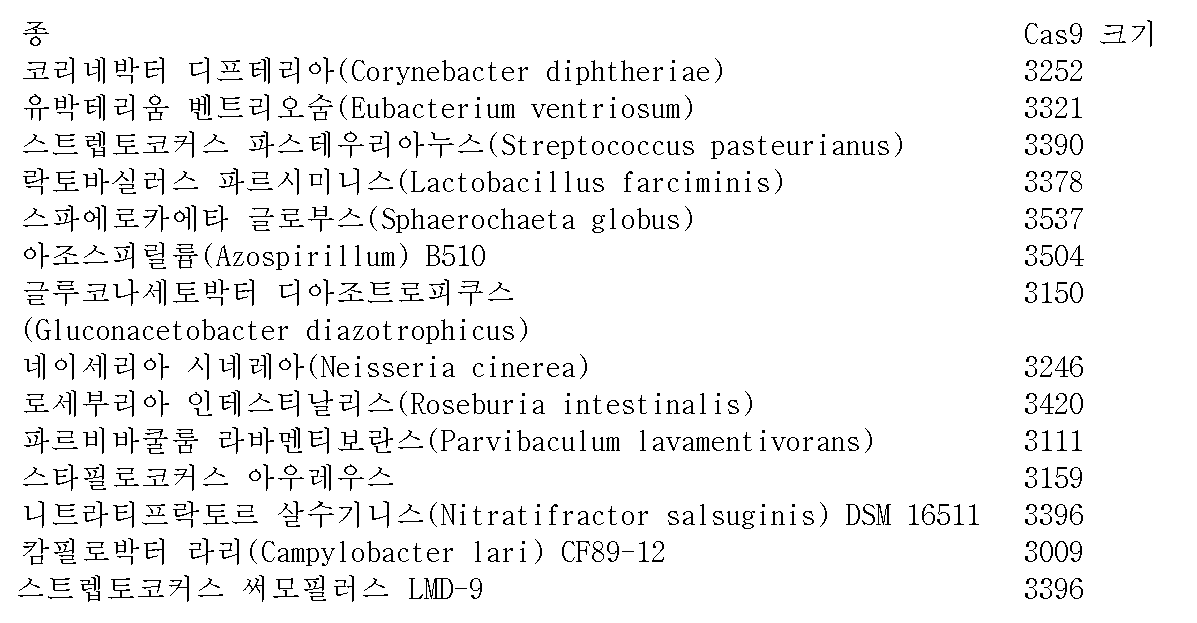
따라서 이들 종은 일반적으로 Cas9 종이 바람직하다.Therefore, these species are generally preferred for Cas9 species.
AAV에 관해서, AAV는 AAV1, AAV2, AAV5 또는 그들의 임의의 조합일 수 있다. 표적화될 세포에 관한 AAV의 AAV를 선택할 수 있으며; 예를 들어, 뇌 또는 뉴런 세포를 표적화하기 위하여 AAV 혈청형 1, 2, 5 또는 하이브리드 캡시드 AAV1, AAV2, AAV5 또는 그들의 임의의 조합을 선택할 수 있으며; 심장 조직을 표적화하기 위하여 AAV4를 선택할 수 있다. AAV8은 간으로의 전달에 유용하다. 본원의 프로모터 및 벡터는 개별적으로 바람직하다. 이들 세포에 관한 특정 AAV 혈청형의 표 작성(문헌[Grimm, D. et al, J. Virol. 82: 5887-5911 (2008)] 참조)은 하기와 같다:As for AAV, AAV can be AAV1, AAV2, AAV5 or any combination thereof. AAV of AAV can be selected for the cell to be targeted; For example,


렌티바이러스Lentivirus
렌티바이러스는 유사분열과 유사분열 후 세포 둘 다에서 그들의 유전자를 감염 및 발현시키는 능력을 갖는 복합 레트로바이러스이다. 가장 흔히 알려진 렌티바이러스는 광범위한 세포 유형을 표적화하기 위해 다른 바이러스의 외피 당단백질을 사용하는 인간 면역결핍 바이러스(HIV)이다.Lentiviruses are complex retroviruses that have the ability to infect and express their genes in both mitotic and mitotic cells. The most commonly known lentiviruses are human immunodeficiency virus (HIV), which uses envelope glycoproteins of different viruses to target a wide variety of cell types.
렌티바이러스는 다음과 같이 제조될 수 있다. (렌티바이러스 전달 플라스미드 백본을 함유하는) pCasES10의 클로닝 후에, 낮은 계대(p=5)에서 HEK293FT를 10% 우태아혈청이 있고 항생제가 없는 DMEM 중의 트랜스펙션 전날에 50% 컨플루언스(confluence)까지 T-75 플라스크에 씨딩하였다. 20시간 후에, 배지를 OptiMEM(무혈청) 배지로 바꾸고, 4시간 후에 트랜스펙션을 행하였다. 세포를 10 ㎍의 렌티바이러스 전달 플라스미드(pCasES10) 및 다음의 패키징 플라스미드: 5 ㎍의 pMD2.G(VSV-g 위형), 및 7.5 ㎍의 psPAX2(gag/pol/rev/tat)로 트랜스펙션시켰다. 양이온성 지질 전달제(50 ㎕ 리포펙타민(Lipofectamine) 2000 및 100 ㎕ 플러스(Plus) 시약)를 이용하여 4 ㎖ OptiMEM 중에서 트랜스펙션을 행하였다. 6시간 후, 배지를 10% 우태아혈청이 있는 무항생제 DMEM으로 바꾸었다. 이들 방법은 세포 배양 동안 혈청을 사용하지만, 무혈청 방법이 바람직하다.Lentiviruses can be prepared as follows. After cloning of pCasES10 (containing the lentivirus transfer plasmid backbone), HEK293FT at low passage (p = 5) was blocked with 50% confluence on the day before transfection in 10% fetal bovine serum and antibiotic- To a T-75 flask. After 20 hours, the medium was changed to OptiMEM (serum-free) medium, and transfection was carried out 4 hours later. Cells were transfected with 10 μg lentivirus transfer plasmid (pCasES10) and the following packaging plasmid: 5 μg pMD2.G (VSV-g stigmata) and 7.5 μg psPAX2 (gag / pol / rev / tat) . Transfection was performed in 4 ml OptiMEM using cationic lipid transfer agent (50 [mu] L Lipofectamine 2000 and 100 [mu] l Plus reagent). After 6 hours, the medium was replaced with non-antibiotic DMEM with 10% fetal bovine serum. These methods use serum during cell culture, but the serum-free method is preferred.
렌티바이러스는 다음과 같이 정제될 수 있다. 바이러스 상청액을 48시간 후에 수집하였다. 상청액을 먼저 데브리스(debris)를 없애고, 0.45 ㎛ 저 단백질 결합(PVDF) 필터를 통해 여과시켰다. 이어서, 그들을 24,000 rpm에서 2시간 동안 초원심분리기에서 회전시켰다. 바이러스 펠렛을 4℃에서 밤새 50 ㎕의 DMEM 중에서 재현탁화시켰다. 이어서 그들을 분주하고 즉시 -80℃에서 즉시 동결시켰다.Lentiviruses can be purified as follows. Virus supernatants were collected after 48 hours. The supernatant was first rid of debris and filtered through a 0.45 um low protein binding (PVDF) filter. They were then rotated in an ultracentrifuge at 24,000 rpm for 2 hours. Virus pellets were resuspended in 50 [mu] l DMEM overnight at 4 [deg.] C. They were then dispensed and immediately frozen at -80 ° C immediately.
다른 구현예에서, 말 감염성 빈혈 바이러스(equine infectious anemia virus: EIAV)에 기반한 최소 비영장류 렌티바이러스 벡터는 또한, 특히 눈 유전자 요법을 위해 고려된다(예를 들어, 문헌[Balagaan, J Gene Med 2006; 8: 275 - 285] 참조). 다른 구현예에서, RetinoStat®, 망(web) 형태의 노인성 황반변성의 치료를 위한 망막하 주사를 통해 전달되는 혈관신생억제 단백질 엔도스타틴 및 앤지오스타틴을 발현시키는 말 감염성 빈혈 바이러스-기반의 렌티바이러스 유전자 요법 벡터가 또한 고려되며(예를 들어, 문헌[Binley et al., HUMAN GENE THERAPY 23:980-991 (September 2012)]), 이러한 벡터는 본 발명의 CRISPR-Cas 시스템을 위해 변형될 수 있다.In other embodiments, a minimal non-primate lentivirus vector based on equine infectious anemia virus (EIAV) is also contemplated, particularly for eye gene therapy (see, for example, Balagaan, J Gene Med 2006; 8: 275-285). In another embodiment, RetinoStat® is a viral infectious anemia virus-based lentiviral gene therapy that expresses endostatin and angiostatin, an angiogenesis inhibiting protein delivered via subretinal injection for the treatment of senile AMD, Vectors are also contemplated (see, e.g., Binley et al., HUMAN GENE THERAPY 23: 980-991 (September 2012)), which vectors may be modified for the CRISPR-Cas system of the present invention.
다른 구현예에서, HIV tat/rev에 의해 공유되는 공통 엑손을 표적화하는 siRNA, 핵소체-국소화 TAR 데코이(decoy), 및 항-CCR5-특이적 해머헤드(hammerhead) 리보자임을 이용하는 자가-불활성화 렌티바이러스 벡터(예를 들어, 문헌[DiGiusto et al. (2010) Sci Transl Med 2:36ra43] 참조)가 본 발명의 CRISPR-Cas 시스템에 대해 사용되고/되거나 적합하게 될 수 있다. 최소 2.5 × 10⁶개 CD34+ 세포/킬로그램(환자의 체중)을 수집하고, 2 × 10⁶개 세포/㎖의 밀도에서 2 μmol/L-글루타민, 줄기 세포 인자(100 ng/㎖), Flt-3 리간드(Flt-3L)(100 ng/㎖), 및 트롬보포이에틴(10 ng/㎖)(셀제닉스(CellGenix))을 함유하는 X-VIVO 15 배지(론자(Lonza))에서 16 내지 20시간 동안 사전자극할 수 있다. 사전자극된 세포는 피브로넥틴(25 ㎎/㎠)으로 코팅된 75-㎠ 조직 배양 플라스크에서 16 내지 24 시간 동안 감염다중도 5로 렌티바이러스에 의해 형질도입될 수 있다(레트로넥틴(RetroNectin), 타카라 바이오 인코포레이티드(Takara Bio Inc.)).In other embodiments, a siRNA targeting common exons shared by HIV tat / rev, a nucleoside-localized TAR decoy, and a self-inactivating lentivirus using a anti-CCR5-specific hammerhead ribozyme Viral vectors (see, for example, DiGiusto et al. (2010) Sci Transl Med 2: 36ra43) may be used and / or adapted for the CRISPR-Cas system of the present invention. At least 2.5 x 10 6 CD34 + cells / kg (patient body weight) were collected and cultured at 2 × 10 6 cells / ml with 2 μmol / L-glutamine, stem cell factor (100 ng /
렌티바이러스 벡터는 파킨슨병의 치료에서와 같이 개시되었다, 예를 들어, 미국 특허 공개 제20120295960호 및 미국 특허 제7303910호 및 제7351585호를 참조한다. 렌티바이러스 벡터는 또한 안질환의 치료용으로 개시되었다, 예를 들어, 미국 특허 공개 제20060281180호, 제20090007284호, 제US20110117189호; 제US20090017543호; 제US20070054961호, 제US20100317109호를 참조한다. 렌티바이러스 벡터는 또한 뇌에 대한 전달용으로 개시되었다, 예를 들어, 미국 특허 공개 제US20110293571호; 제US20110293571호, 제US20040013648호, 제US20070025970호, 제US20090111106호 및 미국 특허 제US7259015호를 참조한다.Lentiviral vectors have been disclosed as in the treatment of Parkinson's disease, see, for example, U.S. Patent Publication No. 20120295960 and U.S. Patent Nos. 7303910 and 7351585. Lentiviral vectors have also been disclosed for the treatment of ocular diseases, for example, in US Patent Publication Nos. 20060281180, 20090007284, US20110117189; US20090017543; See US20070054961 and US20100317109. Lentiviral vectors have also been described for delivery to the brain, see, for example, U.S. Patent Publication No. US20110293571; See US20110293571, US20040013648, US20070025970, US20090111106 and US7259015.
RNA 전달RNA transfer
RNA 전달: CRISPR 효소, 예를 들어 Cas9, 및/또는 임의의 본 발명의 RNA, 예를 들어 가이드 RNA는 또한 RNA의 형태로 전달될 수 있다. Cas9 mRNA는 시험관내 전사를 사용하여 생성될 수 있다. 예를 들어, Cas9 mRNA는 다음의 요소를 함유하는 PCR 카세트를 사용하여 합성될 수 있다: 베타 글로빈-폴리A 테일(120개 이상의 아데닌의 스트링(string))로부터의 T7_프로모터-코작 서열(GCCACC)-Cas9-3' UTR. 카세트는 T7 중합효소에 의한 전사를 위해 사용될 수 있다. 가이드 RNA는 또한 T7_프로모터-GG-가이드 RNA 서열을 함유하는 카세트로부터의 시험관내 전사를 사용하여 전사될 수 있다.RNA delivery: CRISPR enzymes such as Cas9, and / or any of the inventive RNAs, such as guide RNA, can also be delivered in the form of RNA. Cas9 mRNA can be generated using in vitro transcription. For example, Cas9 mRNA can be synthesized using a PCR cassette containing the following elements: the T7 promoter from the beta globin-poly A tail (a string of more than 120 adenines) -coordinator sequence (GCCACC ) -Cas9-3 'UTR. Cassettes can be used for transcription by T7 polymerase. The guide RNA may also be transcribed using in vitro transcription from a cassette containing the T7 promoter-GG-guide RNA sequence.
발현을 향상시키고 가능한 독성을 감소시키기 위해, CRISPR 효소-코딩 서열 및/또는 가이드 RNA는 예를 들어, 슈도-U 또는 5-메틸-C를 사용하여 하나 이상의 변형된 뉴클레오시드를 포함하도록 변형될 수 있다.To improve expression and reduce possible toxicity, the CRISPR enzyme-encoding sequence and / or the guide RNA may be modified to include one or more modified nucleosides using, for example, pseudo-U or 5-methyl- .
mRNA 전달 방법은 현재 간 전달용으로 특히 촉망된다.The mRNA delivery method is currently particularly promising for liver delivery.
RNA 전달에 대한 많은 임상적 연구는 RNAi 또는 안티센스에 집중되어 있으나, 이들 시스템은 본 발명을 이행하기 위하여 RNA의 전달에 적합하게 될 수 있다. 따라서, RNAi 등에 대한 하기의 참고문헌을 확인해야 한다.Many clinical studies of RNA delivery have focused on RNAi or antisense, but these systems may be adapted for delivery of RNA to practice the present invention. Therefore, the following references for RNAi and the like should be identified.
나노입자Nanoparticle
CRISPR 효소 mRNA 및 가이드 RNA는 나노입자 또는 지질 외피를 사용하여 동시에 전달될 수 있다.The CRISPR enzyme mRNA and guide RNA can be delivered simultaneously using nanoparticles or a lipid envelope.
예를 들어, Su X, Fricke J, Kavanagh DG, Irvine DJ(문헌["In vitro and in vivo mRNA delivery using lipid-enveloped pH-responsive polymer nanoparticles" Mol Pharm. 2011 Jun 6;8(3):774-87. doi: 10.1021/mp100390w. Epub 2011 Apr 1])는 인지질 이중층 껍질에 의해 둘러싸인 폴리(β-아미노 에스테르)(PBAE) 코어를 지니는 생분해성 코어 껍질 구조의 나노입자를 기재한다. 이들은 생체내 mRNA 전달을 위해 개발되었다. pH-반응성 PBAE 성분은 엔도솜 파괴를 촉진하도록 선택되는 한편, 지질 표면층은 다가양이온 코어의 독성을 최소화하도록 선택되었다. 따라서 그러한 것은 본 발명의 RNA를 전달하는데 바람직하다.For example, Su X, Fricke J, Kavanagh DG, Irvine DJ (in vitro and in vivo mRNA delivery using lipid-enveloped pH-responsive polymer nanoparticles, Mol Pharm. 2011
일 구현예에서, 모두 뇌로의 펩티드의 구강 전달, 펩티드의 정맥내 전달 및 펩티드의 비강 전달에 적용될 수 있는 생접착성 중합체의 자가 어셈블링에 기반한 나노입자가 고려된다. 다른 구현예, 예컨대 소수성 약물의 구강 흡수 및 눈 전달이 또한 고려된다. 분자 외피 기술은 보호되고, 질환의 부위에 전달되는 조작된 중합체 외피를 수반한다(예를 들어, 문헌[Mazza, M. et al. ACSNano, 2013. 7(2): 1016-1026]; 문헌[Siew, A., et al. Mol Pharm, 2012. 9(1):14-28]; 문헌[Lalatsa, A., et al. J Contr Rel, 2012. 161(2):523-36]; 문헌[Lalatsa, A., et al., Mol Pharm, 2012. 9(6):1665-80]; 문헌[Lalatsa, A., et al. Mol Pharm, 2012. 9(6):1764-74]; 문헌[Garrett, N.L., et al. J Biophotonics, 2012. 5(5-6):458-68]; 문헌[Garrett, N.L., et al. J Raman Spect, 2012. 43(5):681-688]; 문헌[Ahmad, S., et al. J Royal Soc Interface 2010. 7:S423-33]; 문헌[Uchegbu, I.F. Expert Opin Drug Deliv, 2006. 3(5):629-40]; 문헌[Qu, X.,et al. Biomacromolecules, 2006. 7(12):3452-9] 및 문헌[Uchegbu, I.F., et al. Int J Pharm, 2001. 224:185-199] 참조). 표적 조직에 따라, 약 5 ㎎/kg의 단일 또는 다중 용량이 고려된다.In one embodiment, nanoparticles based on self-assembly of bioadhesive polymers that can be applied to oral delivery of peptides to the brain, intravenous delivery of peptides and nasal delivery of peptides are contemplated. Other embodiments, such as oral absorption of the hydrophobic drug and eye delivery, are also contemplated. The molecular envelope technique involves a manipulated polymeric envelope that is protected and delivered to the site of the disease (see, for example, Mazza, M. et al. ACSNano, 2013. 7 (2): 1016-1026) (Lalatsa, A., et al. J Contr Rel, 2012. 161 (2): 523-36); literature [Lalatsa, A., et al., Mol Pharm, 2012. 9 (6): 1764-74]; (Garrett, NL, et al. J Raman Spect, 2012. 43 (5): 681-688) ; U. Sgbu, IF Expert Opin Drug Deliv, 2006. 3 (5): 629-40); Qu, et al. X., et al. Biomacromolecules, 2006. 7 (12): 3452-9) and Uchegbu, IF, et al., Int J Pharm, 2001. 224: 185-199). Depending on the target tissue, a single or multiple dose of about 5 mg / kg is considered.
일 구현예에서, MIT의 댄 앤더슨 연구소(Dan Anderson's lab)에 의해 개발된 종양 성장을 중단시키기 위해 암 세포에 RNA를 전달할 수 있는 나노입자가 본 발명의 CRISPR Cas 시스템에 대해 사용되고/사용되거나 적합하게 될 수 있다. 특히, 앤더슨 연구소는 새로운 생체재료 및 나노제형의 합성, 정제, 특성화 및 제형화를 위한 완전히 자동화된 조합 시스템을 개발하였다. 예를 들어, 문헌[Alabi et al., Proc Natl Acad Sci U S A. 2013 Aug 6;110(32):12881-6]; 문헌[Zhang et al., Adv Mater. 2013 Sep 6;25(33):4641-5]; 문헌[Jiang et al., Nano Lett. 2013 Mar 13;13(3):1059-64]; 문헌[Karagiannis et al., ACS Nano. 2012 Oct 23;6(10):8484-7]; 문헌[Whitehead et al., ACS Nano. 2012 Aug 28;6(8):6922-9] 및 문헌[Lee et al., Nat Nanotechnol. 2012 Jun 3;7(6):389-93]을 참조한다.In one embodiment, nanoparticles capable of delivering RNA to cancer cells to stop tumor growth developed by MIT ' s Dan Anderson ' s lab are used / used or are suitable for the CRISPR Cas system of the present invention . In particular, the Anderson Institute has developed a fully automated combination system for synthesis, purification, characterization and formulation of new biomaterials and nanoparticles. See, for example, Alabi et al., Proc Natl Acad Sci U S A. 2013
미국 특허 출원 제20110293703호는 또한 본 발명의 CRISPR Cas 시스템을 전달하기 위해 적용될 수 있는 폴리뉴클레오티드의 투여에서 특히 유용한 리피도이드(lipidoid) 화합물에 관한 것이다. 일 양태에서, 아미노알코올 리피도이드 화합물은 작용제와 병용되어 세포 또는 대상체에게 전달되어 마이크로입자, 나노입자, 리포좀, 또는 미셀을 형성한다. 입자, 리포좀 또는 미셀에 의해 전달될 작용제는 기체, 액체 또는 고체의 형태일 수 있고, 작용제는 폴리뉴클레오티드, 단백질, 펩티드 또는 소분자일 수 있다. 미노알코올 리피도이드 화합물은 다른 아미노알코올 리피도이드 화합물, 중합체(합성 또는 천연), 계면활성제, 콜레스테롤, 탄수화물, 단백질, 지질 등과 조합되어 입자를 형성할 수 있다. 이어서 이들 입자는 임의로 약제학적 부형제와 조합되어 약제학적 조성물을 형성할 수 있다.U.S. Patent Application No. 20110293703 also relates to lipidoid compounds that are particularly useful in the administration of polynucleotides that may be applied to deliver the CRISPR Cas system of the present invention. In one embodiment, the aminoalcoholepidide compound is used in conjunction with an agonist to be delivered to a cell or a subject to form microparticles, nanoparticles, liposomes, or micelles. The agent to be delivered by the particle, liposome or micelle may be in the form of a gas, liquid or solid, and the agent may be a polynucleotide, a protein, a peptide or a small molecule. The minoalcoholipidoid compound can form particles in combination with other amino alcohol lipidoid compounds, polymers (synthetic or natural), surfactants, cholesterol, carbohydrates, proteins, lipids and the like. These particles may then optionally be combined with a pharmaceutical excipient to form a pharmaceutical composition.
미국 특허 공개 제20110293703호는 또한 아미노알코올 리피도이드 화합물의 제조 방법을 제공한다. 1 이상의 당량의 아민을 본 발명의 아미노알코올 리피도이드 화합물을 형성하기에 적합한 조건하에서 에폭시드-말단 화합물의 1 당량 이상과 반응되게 한다. 특정 구현예에서, 아민의 모든 아미노기는 에폭시드-말단 화합물과 완전히 반응되어 3차 아민을 형성한다. 다른 구현예에서, 아민의 모든 아미노기는 3차 아민을 형성하기 위하여 에폭시드-말단 화합물과 완전히 반응되지 않으며, 이에 의해 아미노알코올 리피도이드 화합물에서 1차 또는 2차 아민이 초래된다. 이들 1차 또는 2차 아민은 그대로 남아 있거나, 다른 친핵체, 예를 들어, 상이한 에폭시드-말단 화합물과 반응할 수 있다. 해당 분야의 숙련자에 의해 인식될 바와 같이, 아민을 과량 미만의 에폭시드-말단 화합물과 반응시키는 것은 다수의 테일을 지니는 복수의 상이한 아미노알코올 리피도이드 화합물을 초래할 것이다. 특정 아민은 2개의 에폭시드 유래 화합물 테일로 완전히 작용화될 수 있는 반면, 다른 분자는 에폭시드 유래 화합물 테일에 의해 완전히 작용화되지 않을 것이다. 예를 들어, 디아민 또는 폴리아민은 분자의 다양한 아미노 모이어티를 제거하는 1개, 2개, 3개 또는 4개의 에폭시드 유래 화합물 테일을 함유하여 1차, 2차 및 3차 아민을 야기할 수 있다. 특정 구현예에서, 모든 아미노기는 완전히 작용화되지 않는다. 특정 구현예에서, 2가지 동일 유형의 에폭시드 말단 화합물이 사용된다. 다른 구현예에서, 2개 이상의 상이한 에폭시드 말단 화합물이 사용된다. 아미노알코올 리피도이드 화합물의 합성은 용매와 함께 또는 용매 없이 수행되고, 합성은 30 내지 100℃, 바람직하게는 대략 50 내지 90℃ 범위의 고온에서 수행될 수 있다. 제조된 아미노알코올 리피도이드 화합물은 임의로 정제될 수 있다. 예를 들어, 아미노알코올 리피도이드 화합물의 혼합물을 정제하여, 특정 수의 에폭시드 유래 화합물 테일을 지니는 아미노알코올 리피도이드 화합물을 수득할 수 있다. 또는 혼합물을 정제하여 특정 입체 이성질체 또는 구조 이성질체를 수득할 수 있다. 아미노알코올 리피도이드 화합물은 또한 알킬 할로겐화물(예를 들어, 요오드화메틸) 또는 다른 알킬화제를 사용하여 알킬화될 수 있고/있거나 그들은 아실화될 수 있다.U.S. Patent Publication No. 20110293703 also provides a process for preparing an amino alcohol lipidoid compound. One or more equivalents of amine are reacted with at least one equivalent of an epoxide-terminated compound under conditions suitable to form the aminoalcoholepidide compounds of the present invention. In certain embodiments, all amino groups of the amine are fully reacted with the epoxide-terminated compound to form a tertiary amine. In another embodiment, all amino groups of the amine are not fully reacted with the epoxide-terminated compound to form a tertiary amine, thereby resulting in a primary or secondary amine in the amino alcohol lipidoid compound. These primary or secondary amines may remain or react with other nucleophiles, for example, different epoxide-terminated compounds. As will be appreciated by those skilled in the art, reacting an amine with less than an excess of an epoxide-terminated compound will result in a plurality of different aminoalcoholepidoid compounds having multiple tailings. Certain amines can be fully functionalized with the two epoxide derived compound tail while other molecules will not be fully functionalized with the epoxide derived compound tail. For example, a diamine or polyamine may contain primary, secondary, and tertiary amines containing one, two, three, or four epoxide-derived compound tail to remove the various amino moieties of the molecule . In certain embodiments, not all amino groups are fully functionalized. In certain embodiments, two identical types of epoxide end compounds are used. In another embodiment, two or more different epoxide end compounds are used. The synthesis of the aminoalcoholepidide compound is carried out with or without a solvent, and the synthesis can be carried out at a high temperature ranging from 30 to 100 캜, preferably from about 50 to 90 캜. The aminoalcohol lipidoid compound thus prepared may be optionally purified. For example, a mixture of amino alcohol lipidoid compounds may be purified to yield amino alcohol lipidoid compounds having a certain number of epoxide derived compound tail. Or the mixture can be purified to give the particular stereoisomer or conformational isomer. The aminoalcoholepidide compounds may also be alkylated using alkyl halides (e.g., methyl iodide) or other alkylating agents and / or they may be acylated.
미국 특허 공개 제20110293703호는 또한 본 발명의 방법에 의해 제조된 아미노알코올 리피도이드 화합물의 라이브러리를 제공한다. 이들 아미노알코올 리피도이드 화합물은 액체 핸들러(handler), 로봇, 마이크로타이터 플레이트, 컴퓨터 등을 수반하는 고처리량 기술을 사용하여 제조 및/또는 스크리닝될 수 있다. 특정 구현예에서, 아미노알코올 리피도이드 화합물을 폴리뉴클레오티드 또는 다른 작용제(예를 들어, 단백질, 펩티드, 소분자)를 세포에 트랜스펙션하는 그들의 능력에 대해 스크리닝한다.U.S. Patent Publication No. 20110293703 also provides a library of aminoalcoholepidide compounds prepared by the method of the present invention. These amino alcohol lipidoid compounds can be prepared and / or screened using high throughput techniques involving liquid handlers, robots, microtiter plates, computers, and the like. In certain embodiments, the amino alcohol lipidoid compounds are screened for their ability to transfect cells with polynucleotides or other agonists (e. G., Proteins, peptides, small molecules).
미국 특허 공개 제20130302401호는 조합 중합을 사용하여 제조된 폴리(베타-아미노 알코올)(PBAA)의 부류에 관한 것이다. 본 발명의 PBAA는 코팅(예컨대 의료장치 또는 이식물에 대한 필름 또는 다중층 필름의 코팅), 첨가제, 재료, 부형제, 비생물오손제(non-biofouling agent), 미세패터닝제 및 세포 캡슐화제로서 생명공학 및 생체의학 적용분야에서 사용될 수 있다. 표면 코팅으로서 사용될 때, 이들 PBAA는 그들의 화학적 구조에 따라서 시험관내와 생체내 둘 다에서 상이한 염증 수준을 유발하였다. 이러한 부류의 물질의 큰 화학적 다양성은 본 출원인들이 시험관내 대식세포 활성화를 저해하는 중합체 코팅을 확인하게 하였다. 더욱이, 이들 코팅은 카르복실화된 폴리스티렌 마이크로입자의 피하 이식 후에 염증 세포의 동원을 감소시키고, 섬유증을 감소시킨다. 이들 중합체를 사용하여 세포 캡슐화를 위한 고분자전해질 복합체 캡슐을 형성할 수 있다. 본 발명은 또한 미생물방지 코팅, DNA 또는 siRNA 전달, 및 줄기 세포 조직 조작과 같은 다수의 다른 생물학적 적용분야를 가질 수 있다. 미국 특허 공개 제20130302401호의 교시는 본 발명의 CRISPR Cas 시스템에 적용될 수 있다.U.S. Patent Publication No. 20130302401 relates to a class of poly (beta-amino alcohol) (PBAA) prepared using combinatorial polymerization. The PBAA of the present invention can be used in the form of a coating (e.g., coating of a film or multilayer film on a medical device or implant), additives, materials, excipients, non-biofouling agents, micropatterning agents, Engineering and biomedical applications. When used as surface coatings, these PBAAs caused different levels of inflammation both in vitro and in vivo, depending on their chemical structure. The large chemical diversity of this class of materials has allowed the applicants to identify polymer coatings that inhibit in vitro macrophage activation. Moreover, these coatings reduce the mobilization of inflammatory cells and reduce fibrosis after subcutaneous transplantation of carboxylated polystyrene microparticles. These polymers can be used to form polyelectrolyte complex capsules for cell encapsulation. The present invention may also have a number of other biological applications such as microbial coatings, DNA or siRNA delivery, and stem cell manipulation. The teachings of U.S. Patent Publication No. 20130302401 can be applied to the CRISPR Cas system of the present invention.
다른 구현예에서, 지질 나노입자(LNP)가 고려된다. 특히, 지질 나노입자에서 캡슐화되고, 인간으로 전달되는 항트렌스티레틴(antitransthyretin) 짧은 간섭 RNA(예를 들어, 문헌[Coelho et al., N Engl J Med 2013;369:819-29] 참조) 및 그러한 시스템은 본 발명의 CRISPR Cas 시스템에 적합하게 되고, 적용될 수 있다. 정맥내로 투여된 체중 kg 당 약 0.01 내지 약 1 ㎎의 용량이 고려된다. 주입 관련 반응의 위험을 감소시키기 위한 의약이 고려되며, 예컨대 덱사메타손, 아세탐피노펜, 디펜하이드라민 또는 세티리진 및 라니티딘이 고려된다. 5회 용량에 대한 4주마다 킬로그램 당 약 0.3 ㎎의 다회 용량이 또한 고려된다.In other embodiments, lipid nanoparticles (LNP) are contemplated. In particular, antitransthyretin short interfering RNA (see, for example, Coelho et al., N Engl J Med 2013; 369: 819-29) encapsulated in lipid nanoparticles and delivered to humans and Such a system may be adapted and applied to the CRISPR Cas system of the present invention. A dose of about 0.01 to about 1 mg per kg of body weight administered intravenously is contemplated. Medicaments for reducing the risk of infusion related reactions are contemplated, such as dexamethasone, acetaminophen, diphenhydramine or cetirizine and ranitidine. A multi-dose dose of about 0.3 mg per kilogram per 4 weeks for 5 doses is also considered.
LNP는 siRNA를 간에 전달함에 있어 고도로 효과적인 것으로 나타났으며(예를 들어, 문헌[Tabernero et al., Cancer Discovery, April 2013, Vol. 3, No. 4, pages 363-470] 참조), 이에 따라 CRISPR Cas를 인코딩하는 RNA를 간으로 전달하기 위해 고려된다. 2주마다 6 ㎎/kg의 LNP의 약 4회 용량의 투여량이 고려될 수 있다. Tabernero 등은 0.7 ㎎/kg으로 투여한 LNP의 처음 2 사이클 후에 종양 억제를 관찰하였고, 6 사이클의 마지막까지 환자는 림프절 전이의 완전한 억제 및 간 종양의 실질적 수축으로 부분적 반응을 달성하였음을 입증하였다. 관해가 남아 있는 이러한 환자에서 40회 용량 후에 완전한 반응을 수득하였고, 26개월에 걸쳐 용량을 제공받은 후에 치료를 완료하였다. VEGF 경로 저해제를 이용한 사전 요법 후에 진행한 신장, 폐 및 림프절을 포함하는 RCC 및 간외영역 질병을 지니는 2명의 환자는 대략 8 내지 12개월 동안 모든 부위에서 안정한 질병을 가졌고, PNET 및 간 전이를 지니는 환자는 안정한 질병과 함께 18개월(36회 용량) 동안 연장 연구를 계속되었다.LNP has been shown to be highly effective in delivering siRNA to the liver (see, for example, Tabernero et al., Cancer Discovery, April 2013, Vol. 3, No. 4, pages 363-470) It is considered to transfer RNA encoding the CRISPR Cas to the liver. Approximately four doses of the LNP at 6 mg / kg every two weeks may be considered. Tabernero et al. Observed tumor suppression after the first two cycles of LNP administered at 0.7 mg / kg and demonstrated that by the end of the 6th cycle, the patient achieved a partial response due to complete inhibition of lymph node metastasis and substantial contraction of the liver tumor. Complete response was obtained after 40 doses in these patients with remission, and treatment was completed after dosing over 26 months. Two patients with RCC and extrathoracic disease, including kidney, lung, and lymph nodes, who had been treated with VEGF pathway inhibitors, had stable disease at all sites for approximately 8 to 12 months, and patients with PNET and liver metastases Continued the extended study for 18 months (36 doses) with stable disease.
그러나, LNP의 전하를 고려하여야 한다. 양이온성 지질은 세포내 전달을 용이하게 하는 비이중층 구조를 유발하기 위해 음으로 하전된 지질과 조합되기 때문이다. 하전된 LNP는 정맥내 주사 후 순환으로부터 빠르게 제거되기 때문에, 7 미만의 pKa 값을 지니는 이온화 가능한 양이온성 지질을 개발하였다(예를 들어, 문헌[Rosin et al, Molecular Therapy, vol. 19, no. 12, pages 1286-2200, Dec. 2011] 참조). 음으로 하전된 중합체, 예컨대 RNA는 이온화 가능한 지질이 양전하를 나타내는 경우 낮은 pH 값(예를 들어, pH 4)에서 LNP에 로딩될 수 있다. 그러나, 생리적 pH 값에서, LNP는 더 긴 순환 시간과 양립가능한 낮은 표면 전하를 나타낸다. 이온화 가능한 양이온성 지질의 4개 종, 즉, 1,2-디리네오일-3-디메틸암모늄-프로판(DLinDAP), 1,2-디리놀레일옥시-3-N,N-디메틸아미노프로판(DLinDMA), 1,2-디리놀레일옥시-케토-N,N-디메틸-3-아미노프로판(DLinKDMA), 및 1,2-디리놀레일-4-(2-디메틸아미노에틸)-[1,3]-디옥솔란(DLinKC2-DMA)에 중점을 두었다. 이들 지질을 함유하는 LNP siRNA 시스템은 생체내 간세포에서 현저하게 상이한 유전자 침묵화 특성을 나타내는 것으로 나타났고, 효능은 인자 VII 유전자 침묵화 모델을 사용하는 시리즈 DLinKC2-DMA>DLinKDMA>DLinDMA>>DLinDAP에 따라 다르다(예를 들어, 문헌[Rosin et al, Molecular Therapy, vol. 19, no. 12, pages 1286-2200, Dec. 2011] 참조). 특히 DLinKC2-DMA을 함유하는 제형에 대하여, 1 ㎍/㎖의 투여량의 LNP 또는 LNP 중의 또는 그와 회합된 CRISPR Cas RNA가 고려될 수 있다.However, the charge of LNP should be considered. Because cationic lipids are combined with negatively charged lipids to induce a non-bi-layered structure that facilitates intracellular delivery. Since charged LNP is rapidly removed from the circulation after intravenous injection, an ionizable cationic lipid having a pKa value of less than 7 has been developed (see, for example, Rosin et al, Molecular Therapy, vol. 12, pages 1286-2200, Dec. 2011). A negatively charged polymer, such as RNA, can be loaded into the LNP at low pH values (e.g., pH 4) if the ionizable lipid exhibits positive charge. However, at physiological pH values, LNP exhibits low surface charge compatible with longer circulation times. 4 types of ionizable cationic lipids, namely, 1,2-dilinoleyl-3-dimethylammonium-propane (DLinDAP), 1,2-dirinoleyloxy-3-N, N-dimethylaminopropane ), 1,2-dirinoleyloxy-keto-N, N-dimethyl-3-aminopropane (DLinKDMA), and 1,2-dilinoleyl- 4- (2- dimethylaminoethyl) - [ ] -Dioxolane (DLinKC2-DMA). These lipid-containing LNP siRNA systems showed markedly different gene silencing characteristics in vivo in hepatocytes, and the efficacy was based on the series DLinKC2-DMA> DLinKDMA> DLinDMA >> DLinDAP using the factor VII gene silencing model (See, for example, Rosin et al, Molecular Therapy, vol. 19, no. 12, pages 1286-2200, Dec. 2011). Particularly for formulations containing DLinKC2-DMA, CRISPR Cas RNA in or associated with LNP or LNP at a dose of 1 mu g / ml can be considered.
LNP의 제조 및 CRISPR Cas 캡슐화가 사용될 수 있고/있거나 문헌[Rosin et al, Molecular Therapy, vol. 19, no. 12, pages 1286-2200, Dec. 2011]으로부터 적합하게 될 수 있다. 양이온성 지질 1,2-디리네오일-3-디메틸암모늄-프로판(DLinDAP), 1,2-디리놀레일옥시-3-N,N-디메틸아미노프로판(DLinDMA), 1,2-디리놀레일옥시케토-N,N-디메틸-3-아미노프로판(DLinK-DMA), 1,2-디리놀레일-4-(2-디메틸아미노에틸)-[1,3]-디옥솔란(DLinKC2-DMA), (3-o-[2″-(메톡시폴리에틸렌글리콜 2000) 숙시노일]-1,2-디미리스토일-sn-글리콜(PEG-S-DMG) 및 R-3-[(ω-메톡시-폴리(에틸렌 글리콜)2000) 카르바모일]-1,2-디미리스틸옥시프로필-3-아민(PEG-C-DOMG)은 테크미라 파마슈티컬즈(Tekmira Pharmaceuticals)(캐나다 밴쿠버에 소재)에 의해 제공될 수 있거나 합성될 수 있다. 콜레스테롤은 시그마(Sigma)(미국 미주리주 세인트루이스 소재)로부터 구입할 수 있다. 특정 CRISPR Cas RNA는 DLinDAP, DLinDMA, DLinK-DMA 및 DLinKC2-DMA(40:10:40:10 몰비의 양이온성 지질:DSPC:CHOL: PEGS-DMG 또는 PEG-C-DOMG)를 함유하는 LNP 내에 캡슐화될 수 있다. 필요하다면, 0.2% SP-DiOC18(캐나다 벌링턴 소재의 인비트로겐(Invitrogen))을 혼입시켜 세포 흡수, 세포내 전달 및 생체분포를 평가할 수 있다. 캡슐화는 10 mmol/ℓ의 최종 지질 농도로 양이온성 지질:DSPC:콜레스테롤:PEG-c-DOMG(40:10:40:10 몰비)로 이루어진 지질 혼합물을 에탄올 중에 용해함으로써 수행될 수 있다. 이러한 지질의 에탄올 용액을 50 mmol/ℓ 시트르산염, pH 4.0에 적가하여 다중 라멜라 소낭를 형성하여 30% 에탄올 vol/vol의 최종 농도를 생성할 수 있다. 압출기(캐나다 벤쿠버 소재의 노던 리피즈(Northern Lipids))를 사용하여 2개의 적층 80 nm 뉴클레포어(Nuclepore) 폴리카르보네이트 필터를 통해 다중 라멜라 소낭을 압출한 후 거대 라멜라 소낭이 형성될 수 있다. 30% 에탄올 vol/vol을 함유하는 50 mmol/ℓ 시트르산염, pH 4.0 중에 2 ㎎/㎖로 용해시킨 RNA를 압출된 사전형성된 거대 단일 라멜라 소낭에 적가하고, 0.06/1 wt/wt의 최종 RNA/지질 중량비로 일정하게 혼합하면서 30분 동안 31℃에서 인큐베이션함으로써 캡슐화를 달성할 수 있다. Spectra/Por 2 재생 셀룰로스 투석막을 사용하여 16시간 동안 인산염 완충 식염수(PBS), pH 7.4에 대해 투석함으로써 에탄올의 제거 및 제형 완충제의 중화를 수행하였다. NICOMP 370 입도 분석기, 소낭/강도 모드, 및 가우시안(Gaussian) 핏팅(미국 캘리포니아주 산타 바바라 소재의 니콤프 파티클 사이징(Nicomp Particle Sizing))을 사용하여 동적 광 산란에 의해 나노입자 크기 분포를 결정할 수 있다. 3개 모두의 LNP 시스템에 대한 입자 크기는 직경이 약 70 nm일 수 있다. VivaPureD MiniH 컬럼(사르토리우스 스테딤 바이오테크(Sartorius Stedim Biotech))을 사용하여 투석 전 및 후에 수집한 시료로부터 유리 RNA를 제거함으로써 RNA 캡슐화 효율을 결정할 수 있다. 캡슐화된 RNA는 용리된 나노입자로부터 추출되고, 260 nm에서 정량화될 수 있다. RNA 대 지질 비는 와코 케미컬즈 유에스에이(Wako Chemicals USA)(미국 버지니아주 리치몬드 소재)로부터의 콜레스테롤 E 효소 검정을 사용하여 소낭 내 콜레스테롤 함량의 측정에 의해 결정될 수 있다. LNP 및 PEG 지질의 본원의 논의와 함께, PEG화 리포좀 또는 LNP는 마찬가지로 CRISPR-Cas 시스템 또는 그의 성분의 전달에 적합하다.The preparation of LNP and CRISPR Cas encapsulation can be used and / or can be performed as described in Rosin et al., Molecular Therapy, vol. 19, no. 12, pages 1286-2200, Dec. 2011]. (DLinDAP), 1,2-dirinoleyloxy-3-N, N-dimethylaminopropane (DLinDMA), 1,2-dirinoleyl (DLinK-DMA), 1,2-dirinoleyl-4- (2-dimethylaminoethyl) - [1,3] -dioxolane (PEG-S-DMG) and R-3 - [([omega] -methoxypolyethyleneglycol 2000] succinoyl] -1,2-dimyristoyl- (PEG-C-DOMG) is commercially available from Tekmira Pharmaceuticals (Vancouver, Canada) and is commercially available from < RTI ID = 0.0 & Cholesterol may be purchased from Sigma (St. Louis, Mo.) Specific CRISPR Cas RNAs include DLinDAP, DLinDMA, DLinK-DMA and DLinKC2-DMA (40:10: 40: 10 molar ratio of cationic lipid: DSPC: CHOL: PEGS-DMG or PEG-C-DOMG) If necessary, cell uptake, intracellular delivery and biodistribution can be assessed by incorporating 0.2% SP-DiOC18 (Invitrogen, Burlington, Canada) Encapsulation is performed at a final lipid concentration of 10 mmol / The lipid ethanol solution of this lipid was dissolved in 50 mmol / l citric acid solution (50 mmol / l citric acid solution) in ethanol. The lipid mixture consisted of cationic lipid: DSPC: cholesterol: PEG-c-DOMG , pH 4.0, to form a multi-lamellar vesicle, yielding a final concentration of 30% ethanol vol / vol. Two stacks of 80 nm nuclei using an extruder (Northern Lipids, Vancouver, Canada) A large lamellar vesicle may be formed after extruding multiple lamellar vesicles through a Nuclepore polycarbonate filter. RNA dissolved in 50 mmol / l citrate, pH 4.0 at 2 mg / ml containing 30% ethanol vol / vol was added dropwise to the preformed large single laminar vesicle and the final RNA / Encapsulation can be achieved by incubating at 31 DEG C for 30 minutes with constant mixing in the lipid weight ratio. Removal of ethanol and neutralization of the formulation buffer were performed by dialysis against phosphate buffered saline (PBS), pH 7.4, using a Spectra /
거대 LNP의 제조는 문헌[Rosin et al, Molecular Therapy, vol. 19, no. 12, pages 1286-2200, Dec. 2011]으로부터 사용될 수 있고/있거나 이에 적합하게 될 수 있다. 지질 예비혼합 용액(20.4 ㎎/㎖ 총 지질 농도)은 50:10:38.5 몰비로 DLinKC2-DMA, DSPC 및 콜레스테롤을 함유하는 에탄올 중에서 제조될 수 있다. 아세트산나트륨은 0.75:1의 몰비(아세트산나트륨:DLinKC2-DMA)로 지질 예비혼합물에 첨가될 수 있다. 지질은 격렬한 교반과 함께 1.85 부피의 시트르산염 완충제(10 mmol/ℓ, pH 3.0)와 혼합물을 합함으로써 이후에 수화되어, 35% 에탄올을 함유하는 수성 완충제 중의 자발적 리포좀 형성을 초래할 수 있다. 리포좀 용액을 37℃에서 인큐베이션시켜 시간-의존적 입자 크기의 증가를 가능하게 할 수 있다. 분취물을 인큐베이션 동안 다양한 시간에 제거하여, 동적 광 산란에 의해 리포좀 크기의 변화를 조사할 수 있다(제타사이저 나노(Zetasizer Nano) ZS, 영국 우스터셔 소재의 몰번 인스트루먼츠(Malvern Instruments)). 일단 요망되는 입자 크기가 달성되면, 수성 PEG 지질 용액(원액 = 35%(vol/vol) 에탄올 중의 10 ㎎/㎖ PEG-DMG)을 리포좀 혼합물에 첨가하여 3.5%의 총 지질의 최종 PEG 몰 농도를 제공할 수 있다. PEG-지질의 첨가 시, 리포좀을 추가 성장을 효과적으로 켄칭시켜 그들의 크기를 해야 한다. 이어서, RNA를 대략 1:10(wt:wt)의 RNA 대 총 지질 비로 빈 리포좀에 첨가한 후에 37℃에서 30분 동안 인큐베이션시켜 로딩된 LNP를 형성할 수 있다. 혼합물을 후속적으로 PBS 중에 밤새 투석시키고, 0.45-㎛ 주사기 필터로 여과할 수 있다.The production of macro LNP is described in Rosin et al., Molecular Therapy, vol. 19, no. 12, pages 1286-2200, Dec. 2011] and / or may be adapted. The lipid premix solution (20.4 mg / ml total lipid concentration) can be prepared in ethanol containing DLinKC2-DMA, DSPC and cholesterol in a molar ratio of 50: 10: 38.5. Sodium acetate can be added to the lipid premix with a molar ratio of 0.75: 1 (sodium acetate: DLinKC2-DMA). Lipid can be subsequently hydrated by combining the mixture with 1.85 volumes of citrate buffer (10 mmol / l, pH 3.0) with vigorous stirring, resulting in spontaneous liposomal formation in aqueous buffer containing 35% ethanol. The liposome solution can be incubated at 37 DEG C to allow for an increase in time-dependent particle size. Aliquots can be removed at various times during incubation to investigate changes in liposome size by dynamic light scattering (Zetasizer Nano ZS, Malvern Instruments, Worcestershire, UK). Once the desired particle size is achieved, an aqueous PEG lipid solution (10 mg / ml PEG-DMG in ethanol = 35% (vol / vol) ethanol) is added to the liposome mixture to provide a final PEG molar concentration of 3.5% . Upon addition of the PEG-lipid, the liposomes must be sized to effectively quench further growth. The RNA can then be added to the empty liposomes at an approximate 1:10 (wt: wt) RNA to total lipid ratio and then incubated at 37 ° C for 30 minutes to form the loaded LNP. The mixture is subsequently dialyzed overnight in PBS and filtered through a 0.45-μm syringe filter.
구체 핵산(Spherical Nucleic Acid: SNA™) 작제물 및 다른 나노입자(특히 금 나노입자)는 또한 의도된 표적에 CRISPR/Cas 시스템을 전달하기 위한 수단으로서 고려된다. 유의한 데이터는 핵산 작용화된 금 나노입자에 기반한 아우라센스 테라퓨틱스(AuraSense Therapeutics)의 구체 핵산(SNA™) 작제물이 유용한 것을 보여준다.Spherical Nucleic Acid (SNA ™) constructs and other nanoparticles (particularly gold nanoparticles) are also considered as a means for delivering the CRISPR / Cas system to the intended target. Significant data show that the SNA ™ constructs of AuraSense Therapeutics based on nucleic acid-functionalized gold nanoparticles are useful.
본원의 교시와 함께 사용될 수 있는 문헌은 문헌[Cutler et al., J. Am. Chem. Soc. 2011 133:9254-9257], 문헌[Hao et al., Small. 2011 7:3158-3162], 문헌[Zhang et al., ACS Nano. 2011 5:6962-6970], 문헌[Cutler et al., J. Am. Chem. Soc. 2012 134:1376-1391], 문헌[Young et al., Nano Lett. 2012 12:3867-71], 문헌[Zheng et al., Proc. Natl. Acad. Sci. USA. 2012 109:11975-80], 문헌[Mirkin, Nanomedicine 2012 7:635-638], 문헌[Zhang et al., J. Am. Chem. Soc. 2012 134:16488-1691], 문헌[Weintraub, Nature 2013 495:S14-S16], 문헌[Choi et al., Proc. Natl. Acad. Sci. USA. 2013 110(19):7625-7630], 문헌[Jensen et al., Sci. Transl. Med. 5, 209ra152 (2013)] 및 문헌[Mirkin, et al., Small, 10:186-192]을 포함한다.Literature that can be used with the teaching of the present application can be found in Cutler et al., J. Am. Chem. Soc. 2011 133: 9254-9257, Hao et al., Small. 2011 7: 3158-3162, Zhang et al., ACS Nano. 2011 5: 6962-6970, Cutler et al., J. Am. Chem. Soc. 2012 134: 1376-1391, Young et al., Nano Lett. 2012 12: 3867-71), Zheng et al., Proc. Natl. Acad. Sci. USA. 2012 109: 11975-80), Mirkin, Nanomedicine 2012 7: 635-638, Zhang et al., J. Am. Chem. Soc. 2012 134: 16488-1691, Weintraub, Nature 2013 495: S14-S16, Choi et al., Proc. Natl. Acad. Sci. USA. 2013 110 (19): 7625-7630), Jensen et al., Sci. Transl. Med. 5,209,152 (2013) and Mirkin, et al., Small, 10: 186-192.
RNA를 지니는 자가 어셈블링 나노입자는, 폴리에틸렌 글리콜(PEG)의 원위 단부에 부착된 Arg-Gly-Asp(RGD) 펩티드 리간드로 PEG화된 폴리에틸렌이민(PEI)을 이용하여 작제될 수 있다. 이러한 시스템은 예를 들어, 인테그린을 발현하는 종양 신생혈관을 표적화하고, 혈관 내피 성장 인자 수용체-2(VEGF R2) 발현을 억제하는 siRNA를 전달하여, 그에 의해, 종양 혈관형성을 달성하기 위한 수단으로 사용된다(예를 들어, 문헌[Schiffelers et al., Nucleic Acids Research, 2004, Vol. 32, No. 19] 참조). 나노플렉스(nanoplex)를 동일한 부피의 양이온성 중합체 및 핵산의 수용액을 혼합함으로써 제조하여 2 내지 6의 범위에 걸쳐 인산염(핵산)에 대한 순 몰 과량의 이온화 가능한 질소(중합체)를 제공할 수 있다. 양이온성 중합체와 핵산 간의 정전기적 상호작용은 약 100 nm의 평균 입자 크기 분포를 갖는 폴리플렉스(polyplex)의 형성을 야기하며, 따라서 본원에서 나노플렉스로서 지칭된다. Schiffelers 등의 자가 어셈블링 나노입자에서의 전달을 위해 약 100 내지 200 ㎎의 CRISPR Cas의 투여량이 예상된다.Self-assembling nanoparticles bearing RNA can be constructed using PEGylated polyethyleneimine (PEI) as an Arg-Gly-Asp (RGD) peptide ligand attached to the distal end of polyethylene glycol (PEG) Such a system can be used, for example, as a means to target tumor angiogenesis expressing integrins and deliver siRNAs that inhibit vascular endothelial growth factor receptor-2 (VEGFR2) expression, thereby achieving tumor angiogenesis (See, for example, Schiffelers et al., Nucleic Acids Research, 2004, Vol. 32, No. 19). Nanoplex can be prepared by mixing an aqueous solution of an equal volume of a cationic polymer and a nucleic acid to provide a net molar excess of ionizable nitrogen (polymer) over a range of 2 to 6 phosphate (nucleic acid). The electrostatic interaction between the cationic polymer and the nucleic acid results in the formation of a polyplex with an average particle size distribution of about 100 nm and is therefore referred to herein as a nano-flex. Doses of about 100 to 200 mg of CRISPR Cas are expected for delivery in self-assemble nanoparticles such as Schiffelers.
Bartlett 등(문헌[PNAS, September 25, 2007,vol. 104, no. 39])의 나노플렉스는 또한 본 발명에 적용될 수 있다. Bartlett 등의 나노플렉스는 동일 부피의 양이온성 중합체 및 핵산의 수용액을 혼합함으로써 제조되어 2 내지 6의 범위에 걸쳐 인산염(핵산)에 대한 순 몰 과량의 이온화 가능한 질소(중합체)를 제공한다. 양이온성 중합체와 핵산 간의 정전기적 상호작용은 약 100 nm의 평균 입자 크기 분포를 지니는 폴리플렉스의 형성을 초래하였고, 따라서 본원에서 나노플렉스로서 지칭된다. Bartlett 등의 DOTA-siRNA를 다음과 같이 합성하였다: 1,4,7,10-테트라아자사이클로도데칸-1,4,7,10-테트라아세트산 모노(N-하이드록시숙신이미드 에스테르)(DOTA-NHS에스테르)는 마크로사이클릭스(Macrocyclics)(미국 텍사스주 달라스 소재)로부터 주문하였다. 탄산염 완충제(pH 9) 중의 100배 몰 과량의 DOTA-NHS-에스테르에 의한 아민 변형 RNA 센스 가닥을 마이크로원심분리 튜브에 첨가하였다. 내용물을 실온에서 4시간 동안 교반시킴으로써 반응시켰다. DOTA-RNA센스 컨쥬게이트를 에탄올 침전시키고, 수 중에 재현탁화하고, 미변형 안티센스 가닥에 어닐링시켜 DOTA-siRNA를 수득하였다. 모든 액체를 Chelex-100(미국 캘리포니아주 허큘러스 소재의 바이오-라드(Bio-Rad))으로 전처리하여 미량의 금속 오염물질을 제거하였다. Tf-표적화 및 비표적화 siRNA 나노입자를 사이클로덱스트린 함유 다가양이온을 사용함으로써 형성할 수 있다. 전형적으로, 나노입자를 전하비 3(+/-) 및 siRNA 농도 0.5 g/리터에서 수 중에서 형성하였다. 표적화된 나노입자의 표면상의 아다만탄-PEG 분자의 1%를 Tf로 변형시켰다(아다만탄-PEG-Tf). 나노입자를 주사용 5%(wt/vol) 글루코스 담체 용액 중에서 현탁화시켰다.Nanoflex of Bartlett et al. (PNAS, September 25, 2007, vol. 104, no. 39) can also be applied to the present invention. Nanoflexes such as Bartlett et al. Are prepared by mixing an aqueous solution of the same volume of cationic polymer and nucleic acid to provide a net molar excess of ionizable nitrogen (polymer) over the range of 2 to 6 phosphate (nucleic acid). The electrostatic interaction between the cationic polymer and the nucleic acid has resulted in the formation of polyplexes having an average particle size distribution of about 100 nm and are therefore referred to herein as nanoflexes. DOTA-siRNAs from Bartlett et al. Were synthesized as follows: 1,4,7,10-tetraazacyclododecane-1,4,7,10-tetraacetic acid mono (N-hydroxysuccinimide ester) (DOTA -NHS ester) was ordered from Macrocyclics (Dallas, Texas, USA). An amine modified RNA sense strand by a 100-fold molar excess of DOTA-NHS-ester in carbonate buffer (pH 9) was added to the microcentrifuge tube. The contents were reacted by stirring at room temperature for 4 hours. The DOTA-RNA sense conjugate was ethanol precipitated, resuspended in water, and annealed to the unmodified antisense strand to obtain DOTA-siRNA. All liquids were pretreated with Chelex-100 (Bio-Rad, Hercules, Calif.) To remove traces of metal contaminants. Tf-targeted and non-targeted siRNA nanoparticles can be formed by using cyclodextrin-containing multivalent cations. Typically, nanoparticles were formed in water at harvest 3 (+/-) and siRNA concentration 0.5 g / liter. 1% of the adamantane-PEG molecule on the surface of the targeted nanoparticles was modified with Tf (adamantane-PEG-Tf). The nanoparticles were suspended in a 5% (wt / vol) glucose carrier solution for injection.
Davis 등(문헌[Nature, Vol 464, 15 April 2010])은 표적화된 나노입자 전달 시스템(임상 시험 등록 번호 NCT00689065)을 사용하는 RNA 임상 시험을 수행한다. 표준 치료 요법에 난치성인 고형암을 지니는 환자에게 30분 정맥내 주입에 의해 21일 사이클 중 제1일, 제3일, 제8일 및 제10일에 표적화된 나노입자의 용량을 투여한다. 나노입자는 하기를 함유하는 합성 전달 시스템으로 이루어진다: (1) 선형, 사이클로덱스트린 기반 중합체(CDP), (2) 암 세포의 표면상의 TF 수용체(TFR)에 맞물리는 나노입자 외부에 나타나는 인간 트랜스페린 단백질(TF) 표적화 리간드, (3) 친수성 중합체(생물학적 유체 중에서 나노입자 안정성을 촉진하기 위해 사용되는 폴리에틸렌 글리콜(PEG)), 및 (4) RRM2의 발현을 감소시키도록 설계된 siRNA(임상에서 사용한 서열은 앞서 정의한 siR2B+5였음). TFR는 악성 세포에서 상향조절되는 것으로 알려져 있고, RRM2는 확립된 항암 표적이다. 이들 나노입자(CALAA-01로서 정의된 임상 형태)는 비인간 영장류에서의 다회 투여 연구에서 잘 용인되는 것으로 나타났다. 만성 골수성 백혈병을 지니는 단일 환자에게 리포좀 전달에 의해 siRNA가 투여되었지만, Davis 등의 임상 시험은 표적화된 전달 시스템을 이용하여 siRNA를 전신으로 전달하기 위한 그리고 고형암을 지니는 환자를 치료하기 위한 초기 인간 시험이다. 표적화된 전달 시스템이 인간 종양으로의 작용성 siRNA의 효과적인 전달을 제공할 수 있는지 여부를 확인하기 위해, Davis 등은 3개의 상이한 투여 코호트로부터의 3명 환자로부터의 생검을 조사하였고; 환자 A, B 및 C는 모두 전이성 흑색종을 가졌고, 각각 18, 24 및 30 ㎎ m-2 siRNA의 CALAA-01 용량을 받았다. 유사한 용량은 또한 본 발명의 CRISPR Cas 시스템을 위해 고려될 수 있다. 본 발명의 전달은 선형, 사이클로덱스트린 기반 중합체(CDP), 암세포의 표면상의 TF 수용체(TFR)에 맞물리는 나노입자 외부에 나타나는 인간 트랜스페린 단백질(TF) 표적화 리간드 및/또는 친수성 중합체(예를 들어, 생물학적 유체 중에서 나노입자 안정성을 촉진하기 위해 사용되는 폴리에틸렌 글리콜(PEG))를 함유하는 나노입자에 의해 달성될 수 있다.Davis et al. (Nature,
입자 전달 시스템 및/또는 제형:Particle delivery system and / or formulation:
여러 유형의 입자 전달 시스템 및/또는 제형이 다양한 스펙트럼의 생체의학 응용에 유용한 것으로 공지되어 있다. 일반적으로, 입자는 이의 운반 및 특성과 관련하여 완전한 단위로서 거동하는 작은 대상으로 규정된다. 입자는 직경에 따라 추가로 분류된다. 조립 입자는 2,500 내지 10,000 나노미터의 범위를 포함한다. 미세 입자는 100 내지 2,500 나노미터의 크기이다. 초미세 입자, 또는 나노입자는 일반적으로 크기가 1 내지 100 나노미터이다. 100-nm 한계의 근거는 벌크 물질로부터 입자를 구별하는 신규한 특성은 100 nm 아래의 결정적인 길이 규모에서 통상적으로 발생한다는 점이다.Various types of particle delivery systems and / or formulations are known to be useful for biomedical applications in a variety of spectra. In general, a particle is defined as a small object that behaves as a complete unit with respect to its transport and properties. Particles are further classified according to their diameter. The assembled particles include a range of 2,500 to 10,000 nanometers. The fine particles have a size of 100 to 2,500 nanometers. Ultrafine particles, or nanoparticles, are typically between 1 and 100 nanometers in size. The rationale for the 100-nm limit is that the novel properties of distinguishing particles from bulk materials typically occur at a critical length scale below 100 nm.
본원에서 사용되는 바와 같은, 입자 전달 시스템/제형은 본 발명에 따른 입자를 포함하는 임의의 생물학적 전달 시스템/제형으로 규정된다. 본 발명에 따른 입자는 100 미크론(㎛) 미만의 가장 큰 치수(예를 들어, 직경)를 갖는 임의의 엔티티(entity)이다. 일부 구현예에서, 본 발명의 입자는 10 ㎛ 미만의 가장 큰 치수를 갖는다. 일부 구현예에서, 본 발명의 입자는 2000 나노미터(nm) 미만의 가장 큰 치수를 갖는다. 일부 구현예에서, 본 발명의 입자는 1000 나노미터(nm) 미만의 가장 큰 치수를 갖는다. 일부 구현예에서, 본 발명의 입자는 900 nm, 800 nm, 700 nm, 600 nm, 500 nm, 400 nm, 300 nm, 200 nm, 또는 100 nm 미만의 가장 큰 치수를 갖는다. 통상적으로, 본 발명의 입자는 500 nm 이하의 가장 큰 치수(예를 들어, 직경)를 갖는다. 일부 구현예에서, 본 발명의 입자는 250 nm 이하의 가장 큰 치수(예를 들어, 직경)를 갖는다. 일부 구현예에서, 본 발명의 입자는 200 nm 이하의 가장 큰 치수(예를 들어, 직경)를 갖는다. 일부 구현예에서, 본 발명의 입자는 150 nm 이하의 가장 큰 치수(예를 들어, 직경)를 갖는다. 일부 구현예에서, 본 발명의 입자는 100 nm 이하의 가장 큰 치수(예를 들어, 직경)를 갖는다. 예를 들어, 50 nm 이하의 가장 큰 치수를 갖는 더 작은 입자가 본 발명의 일부 구현예에서 이용된다. 일부 구현예에서, 본 발명의 입자는 25 nm 내지 200 nm 범위의 가장 큰 치수를 갖는다.As used herein, a particle delivery system / formulation is defined as any biological delivery system / formulation including particles according to the present invention. Particles according to the present invention are any entity having the largest dimension (e.g., diameter) of less than 100 microns (占 퐉). In some embodiments, the particles of the present invention have the largest dimension of less than 10 [mu] m. In some embodiments, the particles of the present invention have the largest dimension less than 2000 nanometers (nm). In some embodiments, the particles of the present invention have the largest dimension of less than 1000 nanometers (nm). In some embodiments, the particles of the present invention have the largest dimensions of 900 nm, 800 nm, 700 nm, 600 nm, 500 nm, 400 nm, 300 nm, 200 nm, or less than 100 nm. Typically, the particles of the present invention have the largest dimension (e. G., Diameter) of 500 nm or less. In some embodiments, the particles of the present invention have the largest dimension (e. G., Diameter) of 250 nm or less. In some embodiments, the particles of the present invention have the largest dimension (e.g., diameter) of 200 nm or less. In some embodiments, the particles of the present invention have the largest dimension (e.g., diameter) of 150 nm or less. In some embodiments, the particles of the present invention have the largest dimension (e.g., diameter) of 100 nm or less. For example, smaller particles having the largest dimension of 50 nm or less are used in some embodiments of the present invention. In some embodiments, the particles of the present invention have the largest dimension in the range of 25 nm to 200 nm.
입자 특성화(예를 들어, 형태, 치수 등의 특성화를 포함함)는 다양한 상이한 기술을 이용하여 수행된다. 일반적인 기술은 전자 현미경검사법(TEM, SEM), 원자력 현미경검사법(AFM), 동적 광 산란(DLS), X-선 광전자 분광법(XPS), 분말 X-선 회절(XRD), 푸리에 변환 적외선 분광광도법(FTIR), 매트릭스-보조 레이저 탈착/이온화 비행시간형 질량분석기(MALDI-TOF), 자외선-가시 분광법, 이중 분극 간섭계 및 핵 자기 공명(NMR)이다. 특성화(치수 측정)는 본 발명의 임의의 시험관내, 생체외 및/또는 생체내 적용을 위한 전달을 위한 최적의 크기의 입자를 제공하기 위해 고유 입자(즉, 로딩 이전)에 대해 또는 카고(cargo)의 로딩 후(본원에서 카고는, 예를 들어, CRISPR-Cas 시스템의 하나 이상의 요소, 예를 들어, CRISPR 효소 또는 mRNA 또는 가이드 RNA, 또는 이들의 임의의 조합을 나타내고, 추가 담체 및/또는 부형제를 포함할 수 있음)에 이루어질 수 있다. 특정한 바람직한 구현예에서, 입자 치수(예를 들어, 직경) 특성화는 동적 레이저 산란(DLS)을 이용한 측정을 기초로 한다. 입자, 이들을 제조하고 이용하는 방법 및 이들의 측정과 관련하여 미국 특허 제8,709,843호; 미국 특허 제6,007,845호; 미국 특허 제5,855,913호; 미국 특허 제5,985,309호; 미국 특허 제5,543,158호; 및 2014년 5월 11일에 온라인에 공개된 공보(James E. Dahlman and Carmen Barnes et al. Nature Nanotechnology (2014), doi:10.1038/nnano.2014.84)가 언급된다.Particle characterization (including, for example, characterization of shapes, dimensions, etc.) is performed using a variety of different techniques. General techniques include electron microscopy (TEM, SEM), atomic force microscopy (AFM), dynamic light scattering (DLS), X-ray photoelectron spectroscopy (XPS), powder X-ray diffraction (XRD), Fourier transform infrared spectroscopy FTIR), matrix-assisted laser desorption / ionization time-of-flight mass spectrometry (MALDI-TOF), ultraviolet-visible spectroscopy, dual polarization interferometry and nuclear magnetic resonance (NMR). Characterization can be performed on the unique particles (i.e., prior to loading) or on the cargo (s) to provide optimal sized particles for delivery for any in vitro, ex vivo, and / ) (Cargo here refers to, for example, one or more elements of the CRISPR-Cas system, for example CRISPR enzyme or mRNA or guide RNA, or any combination thereof, and additional carrier and / or excipient And the like). In certain preferred embodiments, particle size (e.g., diameter) characterization is based on measurements using dynamic laser scattering (DLS). Particles, methods of making and using them, and the measurement thereof, U.S. Patent No. 8,709,843; U.S. Patent No. 6,007,845; U.S. Patent No. 5,855,913; U.S. Patent No. 5,985,309; U.S. Patent No. 5,543,158; And James E. Dahlman and Carmen Barnes et al., Nature Nanotechnology (2014), doi: 10.1038 / nnano.2014.84) published online on May 11, 2014.
본 발명의 범위 내의 입자 전달 시스템은 고체, 반고체, 에멀젼 또는 콜로이드 입자를 포함하나 이에 제한되지는 않는 임의의 형태로 제공될 수 있다. 예를 들어, 지질-기반 시스템, 리포좀, 미셀, 미세소포, 엑소좀, 또는 유전자총을 포함하나 이에 제한되지는 않는 본원에 기재된 전달 시스템 중 임의의 전달 시스템이 본 발명의 범위 내의 입자 전달 시스템으로서 제공될 수 있다.Particle delivery systems within the scope of the present invention may be provided in any form including, but not limited to, solid, semi-solid, emulsion or colloidal particles. Any delivery system of any of the delivery systems described herein including, but not limited to, lipid-based systems, liposomes, micelles, microvesicles, exosomes, or gene guns, for example, Can be provided.
나노입자Nanoparticle
본 발명과 관련하여, 나노입자 또는 지질 외피를 이용하여 CRISPR 복합체의 하나 이상의 성분, 예를 들어, CRISPR 효소 또는 mRNA 또는 가이드 RNA가 전달되는 것이 바람직하다. 다른 전달 시스템 또는 벡터가 본 발명의 나노입자 양태와 함께 이용될 수 있다.In the context of the present invention, it is preferred that one or more components of the CRISPR complex, such as a CRISPR enzyme or mRNA or guide RNA, are delivered using nanoparticles or a lipid envelope. Other delivery systems or vectors may be used with the nanoparticulate embodiments of the present invention.
일반적으로, "나노입자"는 1000 nm 미만의 직경을 갖는 임의의 입자를 나타낸다. 특정한 바람직한 구현예에서, 본 발명의 나노입자는 500 nm 이하의 가장 큰 치수(예를 들어, 직경)를 갖는다. 다른 바람직한 구현예에서, 본 발명의 나노입자는 25 nm 내지 200 nm 범위의 가장 큰 치수를 갖는다. 다른 바람직한 구현에에서, 본 발명의 나노입자는 100 nm 이하의 가장 큰 치수를 갖는다. 다른 바람직한 구현예에서, 본 발명의 나노입자는 35 nm 내지 60 nm 범위의 가장 큰 치수를 갖는다.In general, "nanoparticles" refer to any particle having a diameter of less than 1000 nm. In certain preferred embodiments, the nanoparticles of the present invention have the largest dimension (e.g., diameter) of 500 nm or less. In another preferred embodiment, the nanoparticles of the present invention have the largest dimension in the range of 25 nm to 200 nm. In another preferred embodiment, the nanoparticles of the present invention have the largest dimension of 100 nm or less. In another preferred embodiment, the nanoparticles of the present invention have the largest dimension in the range of 35 nm to 60 nm.
본 발명에 포함된 나노입자는 상이한 형태, 예를 들어, 고체 나노입자(예를 들어, 금속, 예를 들어, 은, 금, 철, 티타늄), 비-금속, 지질-기반 고체, 중합체), 나노입자의 현탁액, 또는 이들의 조합물로 제공될 수 있다. 금속, 유전체, 및 반도체 나노입자뿐만 아니라 하이브리드 구조(예를 들어, 코어-쉘 나노입자)가 제조될 수 있다. 반도체 물질로 제조된 나노입자는 또한 이들이 전자 에너지 수준의 양자화가 발생하기에 충분히 작은(통상적으로, 10 nm 이하) 경우 양자점으로 표지될 수 있다. 이러한 나노규모 입자는 약물 담체 또는 영상화 작용제로서 생물의학 응용에서 사용되며, 본 발명에서 유사한 목적을 위해 적합하게 될 수 있다.The nanoparticles included in the present invention may be of a different type, for example, solid nanoparticles (e.g., metals such as silver, gold, iron, titanium), non-metals, lipid- A suspension of nanoparticles, or a combination thereof. Metal, dielectric, and semiconductor nanoparticles as well as hybrid structures (e.g., core-shell nanoparticles) can be prepared. Nanoparticles made from semiconducting materials can also be labeled with quantum dots when they are small enough (typically 10 nm or less) for quantization of electron energy levels to occur. These nanoscale particles are used in biomedical applications as drug carriers or imaging agents and may be adapted for similar purposes in the present invention.
반고체 및 연성 나노입자가 제조되었고, 이들은 본 발명의 범위 내이다. 반고체 성질의 프로토타입 나노입자는 리포좀이다. 다양한 유형의 리포좀 나노입자가 항암 약물 및 백신을 위한 전달 시스템으로서 현재 임상적으로 사용된다. 절반이 친수성이고, 나머지 절반이 소수성인 나노입자는 야누스(Janus) 입자로 명명되며, 에멀젼을 안정화시키는데 특히 효과적이다. 이들은 물/오일 계면에서 자가-어셈블되며, 고체 계면활성제로 작용할 수 있다.Semi-solid and ductile nanoparticles have been prepared and are within the scope of the present invention. Semi-solid prototype nanoparticles are liposomes. Various types of liposomal nanoparticles are currently used clinically as delivery systems for anticancer drugs and vaccines. Nanoparticles whose half are hydrophilic and the other half hydrophobic are named Janus particles and are particularly effective at stabilizing emulsions. They are self-assembled at the water / oil interface and can act as solid surfactants.
참조로서 본원에 포함되는 미국 특허 제8,709,843호는 조직, 세포, 및 세포내 구획으로의 치료제 함유 입자의 표적화된 전달을 위한 약물 전달 시스템을 제공한다. 상기 발명은 계면활성제, 친수성 중합체 또는 지질에 컨쥬게이트된 중합체를 포함하는 표적화된 입자를 제공한다.U.S. Patent No. 8,709,843, which is incorporated herein by reference, provides a drug delivery system for targeted delivery of therapeutic agent-containing particles to tissues, cells, and subcellular compartments. The invention provides targeted particles comprising a surfactant, a hydrophilic polymer or a polymer conjugated to a lipid.
참조로서 본원에 포함되는 미국 특허 제6,007,845호는 다작용성 화합물과 하나 이상의 소수성 중합체 및 하나 이상의 친수성 중합체를 공유적으로 연결시킴으로써 형성된 멀티블록 공중합체의 코어를 갖고, 생물학적으로 활성인 물질을 함유하는 입자를 제공한다.U. S. Patent No. 6,007, 845, which is incorporated herein by reference, discloses a multi-block copolymer having a core of a multi-block copolymer formed by covalently linking a polyfunctional compound with at least one hydrophobic polymer and at least one hydrophilic polymer, Lt; / RTI >
참조로서 본원에 포함되는 미국 특허 제5,855,913호는 폐기관계로의 약물 전달을 위해 표면상에 계면활성제가 혼입된, 0.4 g/㎤ 미만의 탭 밀도(tap density)와 함께 5 ㎛ 내지 30 ㎛의 평균 직경을 갖는 공기역학적으로 가벼운 입자를 갖는 미립자 조성물을 제공한다.U.S. Pat. No. 5,855,913, which is incorporated herein by reference, discloses an aqueous solution of a surfactant mixed with a surfactant on the surface for drug delivery to the abolition area, with an average tap density of less than 0.4 g / A particulate composition having aerodynamically light particles having a diameter is provided.
참조로서 본원에 포함되는 미국 특허 제5,985,309호는 폐기관계로의 전달을 위한 계면활성제 및/또는 양으로 또는 음으로 하전된 치료제 또는 진단제 및 반대 전하로 하전된 분자의 친수성 또는 소수성 복합체가 혼입된 입자를 제공한다.U.S. Patent No. 5,985,309, which is incorporated herein by reference, discloses a surfactant and / or a positively charged or negatively charged therapeutic or diagnostic agent for delivery to a waste relationship and a hydrophilic or hydrophobic complex of a molecule charged with an oppositely charged Lt; / RTI >
참조로서 본원에 포함되는 미국 특허 제5,543,158호는 표면상에 폴리(알킬렌 글리콜) 모이어티 및 생물학적 활성 물질을 함유하는 생분해성 고체 코어를 갖는 생분해성 주사가능한 나노입자를 제공한다.U.S. Patent No. 5,543,158, which is incorporated herein by reference, provides biodegradable injectable nanoparticles having a biodegradable solid core containing a poly (alkylene glycol) moiety and a biologically active material on the surface.
참조로서 본원에 포함되는 WO2012135025호(US20120251560호로 또한 공개됨)에는 컨쥬게이트된 폴리에틸렌이민(PEI) 중합체 및 컨쥬게이트된 아자-마크로사이클(집합적으로, "컨쥬게이션된 리포머" 또는 "리포머"로 언급됨)이 기재되어 있다. 특정 구현예에서, 그러한 컨쥬게이트된 리포머가 단백질 발현의 변형을 포함하여 유전자 발현을 변형시키기 위한 시험관내, 생체외 및 생체내 게놈 변동을 달성하기 위해 CRISPR-Cas 시스템의 상황에서 이용될 수 있음이 계획될 수 있다.WO2012135025 (also disclosed in US20120251560), which is incorporated herein by reference, includes conjugated polyethyleneimine (PEI) polymers and conjugated aza-macrocycles (collectively referred to as "conjugated " or" ) Is described. In certain embodiments, such conjugated reporters can be used in the context of the CRISPR-Cas system to achieve in vitro, in vitro and in vivo genomic variations to modify gene expression, including modification of protein expression Can be planned.
일 구현예에서, 나노입자는 에폭시드-변형된 지질-중합체, 유리하게는 7C1일 수 있다(예를 들어, 문헌[James E. Dahlman and Carmen Barnes et al. Nature Nanotechnology (2014) published online 11 May 2014, doi:10.1038/nnano.2014.84] 참조). C71을 14:1의 몰비로 C15 에폭시드-말단 지질과 PEI600을 반응시킴으로써 합성하였고, 적어도 40일 동안 PBS 용액에서 안정적인 나노입자(35 내지 60 nm의 직경)를 생성시키기 위해 C14PEG2000과 함께 제형화하였다.In one embodiment, the nanoparticles can be an epoxide-modified lipid-polymer, advantageously 7C1 (see, for example, James E. Dahlman and Carmen Barnes et al. 2014, doi: 10.1038 / nnano.2014.84). C71 was synthesized by reacting C15 epoxide-terminated lipid with PEI600 in a molar ratio of 14: 1 and formulated with C14 PEG2000 to produce stable nanoparticles (35 to 60 nm in diameter) in PBS solution for at least 40 days .
폐, 심혈관 또는 신장 세포로 본 발명의 CRISPR-Cas 시스템을 전달하기 위해 에폭시드-변형된 지질-중합체가 이용될 수 있으나, 해당 분야의 숙련자는 다른 표적 기관으로 전달하기 위해 시스템을 적합하게 할 수 있다. 약 0.05 내지 약 0.6 ㎎/㎏ 범위의 투여량이 계획된다. 약 2 ㎎/㎏의 전체 투여량의 수일 또는 수주에 걸친 투여량이 또한 계획된다.Epoxide-modified lipid-polymers may be used to deliver the CRISPR-Cas system of the present invention to the lung, cardiovascular or kidney cells, but those skilled in the art can adapt the system to deliver to other target organs have. Dosages ranging from about 0.05 to about 0.6 mg / kg are contemplated. A total dose of about 2 mg / kg over a period of several days or weeks is also planned.
엑소좀Exosome
엑소좀은 뇌 및 다른 표적 기관에 RNA를 전달할 수 있는, 단백질 및 RNA를 수송하는 내인성 나노-소낭이다. 면역원성을 감소시키기 위해, Alvarez-Erviti 등(문헌[2011, Nat Biotechnol 29: 341])은 엑소좀 생성을 위해 자가 유래 수지상 세포를 사용하였다. 뉴런 특이적 RVG 펩티드에 융합된 엑소좀 막 단백질인 Lamp2b를 발현하도록 수지상 세포를 조작함으로써 뇌로의 표적화를 달성하였다. 정제된 엑소좀에 전기천공법에 의해 외인성 RNA를 로딩하였다. 정맥내로 주사한 RVG-표적화 엑소좀을 뇌 내의 뉴런, 미세아교세포, 희소돌기신경교에 GAPDH siRNA를 특이적으로 전달하여, 특이적 유전자 낙다운을 초래하였다. RVG 엑소좀에 대한 사전 노출은 낙다운을 약화시키지 않았고, 다른 조직에서의 비특이적 흡수는 관찰되지 않았다. 엑소좀 매개 siRNA 전달의 치료 잠재력은 알츠하이머 질환에서의 치료 표적인 BACE1의 강력한 mRNA(60%) 및 단백질(62%) 낙다운에 의해 입증되었다.Exosomes are endogenous nano-vesicles that transport proteins and RNA that can deliver RNA to the brain and other target organs. To reduce immunogenicity, Alvarez-Erviti et al. (2011, Nat Biotechnol 29: 341) used autologous dendritic cells to generate exosomes. Targeting to the brain was achieved by manipulating dendritic cells to express Lamp2b, an exosomal membrane protein fused to neuron-specific RVG peptides. The exogenous RNA was loaded into the purified exosome by electroporation. Intravenously injected RVG-targeted exosomes specifically transferred GAPDH siRNA to neurons, microglia, and rare proximal glia in the brain, resulting in a specific gene knockdown. Pre-exposure to RVG exosomes did not weaken knockdown, and no nonspecific uptake in other tissues was observed. The therapeutic potential of exosomal mediated siRNA delivery was demonstrated by the strong mRNA (60%) and protein (62%) depletion of BACE1, a therapeutic target in Alzheimer's disease.
면역학적으로 비활성인 엑소좀의 풀을 얻기 위해, Alvarez-Erviti 등은 상동성 주조직적합성 복합체(MHC) 단상형을 지니는 근친교배 C57BL/6 마우스로부터 골수를 수집하였다. 미성숙 수지상 세포가 MHC-II 및 CD86과 같은 T-세포 활성화제가 없는 다량의 엑소좀을 생성하기 때문에, Alvarez-Erviti 등은 7일 동안 과립구/대식세포-콜로니 자극 인자(GM-CSF)를 지니는 수지상 세포에 대해 선택하였다. 잘 확립된 초원심분리 프로토콜을 사용하여 다음날 배양 상청액으로부터 엑소좀을 정제하였다. 생성된 엑소좀은 물리적으로 균질하였고, 크기 분포는 나노입자 트래킹 분석(NTA) 및 전자 현미경에 의해 결정하여 직경 80 nm에서 최고였다. Alvarez-Erviti 등은 106개 세포당 6 내지 12 ㎍의 엑소좀(단백질 농도를 기준으로 측정)을 얻었다.To obtain immunologically inactive exosome pools, Alvarez-Erviti et al. Collected bone marrow from inbred C57BL / 6 mice with homologous main histocompatibility complex (MHC) single-phase forms. Because immature dendritic cells produce large amounts of exosomes without T-cell activators such as MHC-II and CD86, Alvarez-Erviti et al. Reported that dendritic cells with granulocyte / macrophage-colony stimulating factor (GM-CSF) Cells. The exosomes were purified from the culture supernatant on the next day using a well established ultracentrifugation protocol. The resulting exosomes were physically homogeneous and the size distribution was determined by nanoparticle tracking analysis (NTA) and electron microscopy and was best at 80 nm diameter. Alvarez-Erviti et al. Obtained 6 to 12 μg of exosomes (measured on protein concentration) per 10 6 cells.
다음에, Alvarez-Erviti 등은 나노규모 적용에 적합한 전기천공법 프로토콜을 사용하여 외인성 카고로의 변형된 엑소좀의 로딩 가능성을 조사하였다. 나노미터 규모에서 막 입자에 대한 전기천공법은 제대로 특성화되지 않기 때문에, 비특이적 Cy5-표지 RNA를 전기천공법 프로토콜의 경험적 최적화를 위해 사용하였다. 캡슐화된 RNA의 양을 엑소좀의 초원심분리 및 용해 후에 분석하였다. 400 V 및 125 μF에서의 전기천공법은 RNA의 가장 큰 보유를 초래하였고, 모든 후속 실험에 대해 사용하였다.Next, Alvarez-Erviti et al. Examined the possibility of loading modified exosomes into exogenous cargo using an electroporation protocol suitable for nanoscale applications. Nonspecific Cy5-labeled RNA was used for empirical optimization of the electroporation protocol because the electroporation method for membrane particles on the nanometer scale is not well characterized. The amount of encapsulated RNA was analyzed after ultracentrifugation and dissolution of exosomes. Electroporation at 400 V and 125 μF resulted in the largest retention of RNA and was used for all subsequent experiments.
Alvarez-Erviti 등은 150 ㎍의 RVG 엑소좀 중에 캡슐화된 150 ㎍의 각각의 BACE1 siRNA를 정상 C57BL/6 마우스에게 투여하고, 낙다운 효율을 4개의 대조군(미처리 마우스, RVG 엑소좀만을 주사한 마우스, 생체내 양이온성 리포좀 시약에 복합체화된 BACE1 siRNA를 주사한 마우스 및 RVG-9R, siRNA에 정전기적으로 결합된 9개의 D-아르기닌에 컨쥬게이트된 RVG 펩티드에 복합체화된 BACE1 siRNA를 주사한 마우스에 대하여 비교하였다. 투여 3일 후 피질 조직 시료를 분석하였고, siRNA-RVG-9R-처리 마우스와 siRNARVG 엑소좀 처리 마우스 둘 다에서 BACE1 mRNA 수준의 상당한 감소(66% [+ 또는 -] 15%, P < 0.001 및 61% [+ 또는 -] 13% 각각, P < 0.01)로부터 초래되는 상당한 단백질 낙다운(45%, P < 0.05, 대 62%, P < 0.01)을 관찰하였다. 게다가, 본 출원인들은 RVG-엑소좀 처리 동물에서 알츠하이머 병증에서의 아밀로이드 플라크의 주요 구성인 총 [베타]-아밀로이드 1 내지 42 수준에서 상당한 감소(55%, P < 0.05)를 입증하였다. 관찰한 감소는 BACE1 저해제의 정맥내 주사 후 정상 마우스에서 입증된 β-아밀로이드 1 내지 40 감소보다 더 컸다. Alvarez-Erviti 등은 BACE1 절단 산물에 대해 cDNA 말단의 5'-신속한 증폭(RACE)을 수행하였는데, 이는 siRNA에 의한 RNAi-매개 낙다운의 증거를 제공하였다.Alvarez-Erviti et al. Administered 150 [mu] g of each BACEl siRNA encapsulated in 150 [mu] g of RVG exosomes to normal C57BL / 6 mice and measured the knockdown efficiency in four control (untreated mice, mice injected with RVG exosomes alone, Mice inoculated with BACE1 siRNA complexed to a cationic liposomal reagent in vivo and RVG-9R, a mouse injected with BACE1 siRNA complexed with RVG peptide conjugated to 9 D-arginine electrostatically bound to siRNA Three days after dosing, cortical tissue samples were analyzed and a significant reduction in BACE1 mRNA levels (66% [+ or -] 15%, P (+) - (45%, P < 0.05, vs. 62%, P < 0.01) resulting from an increase in protein levels (<0.001 and 61% [+ or -] 13%, respectively, P <0.01). Amylose in Alzheimer's disease in RVG-exosomal treated animals (55%, P < 0.05) at the level of total beta-
최종적으로, Alvarez-Erviti 등은 IL-6, IP-10, TNFα 및 IFN-α 혈청 농도를 평가함으로써 RNA-RVG 엑소좀이 생체내 면역 반응을 유발하였는지 여부를 조사하였다. 엑소좀 처리 후에, 모든 사이토카인에서의 중요하지 않은 변화가 IL-6 분비를 잠재적으로 자극한 siRNA-RVG-9R과 대조적으로 siRNA-트랜스펙션 시약 처리와 유사하게 등록되었는데, 이는 엑소좀 처리의 면역학적 비활성 프로파일을 확인시켜준다. 엑소좀이 단지 20%의 siRNA를 캡슐화하는 것을 고려해 볼 때, RVG-엑소좀에 의한 전달은 비슷한 mRNA 낙다운으로서 RVG-9R 전달보다 더 효율적인 것으로 나타나며, 대응하는 면역 자극 수준 없이, 더 큰 단백질 낙다운이 5배 더 적은 siRNA에 의해 달성되었다. 이 실험은 신경변성 질병과 관련된 유전자의 장기간 침묵화에 잠재적으로 적합한 RVG-엑소좀 기법의 치료 잠재력을 입증하였다. Alvarez-Erviti 등의 엑소좀 전달 시스템은 치료 표적, 특히 신경변성 질병에 본 발명의 CRISPR-Cas 시스템을 전달하기 위해 적용될 수 있다. 약 100 내지 1000 ㎎의 RVG 엑소좀에서 캡슐화된 약 100 내지 1000 ㎎의 CRISPR Cas의 투여량은 본 발명을 위해 고려될 수 있다.Finally, Alvarez-Erviti et al. Assessed serum levels of IL-6, IP-10, TNFα and IFN-α to determine if RNA-RVG exosomes induced an in vivo immune response. After exosomal treatment, unimportant changes in all cytokines were registered, similar to siRNA-transfection reagent treatments, in contrast to siRNA-RVG-9R, which potentially stimulated IL-6 secretion, Identify the immunologically inactive profile. Considering that exosomes encapsulate only 20% of the siRNA, delivery by RVG-exosomes appears to be more efficient than RVG-9R delivery as a similar mRNA depression, and without a corresponding immunostimulatory level, Down was achieved by 5-fold less siRNA. This experiment demonstrated the therapeutic potential of the RVG-exosome technique potentially suitable for long-term silencing of genes associated with neurodegenerative diseases. An exosome delivery system such as Alvarez-Erviti can be applied to deliver the CRISPR-Cas system of the present invention to therapeutic targets, particularly neurodegenerative diseases. Dosages of about 100 to 1000 mg of CRISPR Cas encapsulated in about 100 to 1000 mg of RVG exosomes can be considered for the present invention.
El-Andaloussi 등(문헌[Nature Protocols 7,2112-2126(2012)])은 배양 세포로부터 유래된 엑소좀이 시험관내 및 생체내 RNA의 전달을 위해 이용될 수 있는 방법을 개시한다. 이 프로토콜은 펩티드 리간드와 융합된 엑소좀 단백질을 포함하는 발현 벡터의 트랜스펙션을 통한 표적화된 엑소좀의 생성을 처음으로 기재한다. 다음에, El-Andaloussi 등은 트랜스펙션 세포 상청액으로부터 엑소좀을 정제하고 특성화하는 방법을 설명한다. 다음에, El-Andaloussi 등은 RNA를 엑소좀에 로딩하기 위한 결정적인 단계를 상술한다. 최종적으로, El-Andaloussi 등은 마우스 뇌에서 시험관내 및 생체내 RNA를 효율적으로 전달하기 위해 엑소좀을 사용하는 방법을 약술한다. 엑소좀-매개 RNA 전달이 작용성 분석 및 영상에 의해 평가되는 예상된 결과의 예가 또한 제공된다. 전체 프로토콜은 약 3주가 걸린다. 본 발명에 따른 전달 또는 투여는 자가 유래 수지상 세포로부터 생성된 엑소좀을 사용하여 수행될 수 있다. 본원의 교시로부터, 이것은 본 발명의 실시에 사용될 수 있다.El-Andaloussi et al. (
다른 구현예에서, Wahlgren 등(문헌[Nucleic Acids Research, 2012, Vol. 40, No. 17 e130])의 혈장 엑소좀이 고려된다. 엑소좀은 수지상 세포(DC), B 세포, T 세포, 비만 세포, 상피 세포 및 종양 세포를 포함하는 다수의 세포 유형에 의해 생성된 나노 크기 소낭(30 내지 90 nm 크기)이다. 이들 소낭은 후기 엔도솜의 안쪽으로 향하는 출아에 의해 형성되며, 이어서 혈장막과 융합시 세포외 환경으로 방출된다. 엑소좀은 천연적으로 세포 간에 RNA를 운반하기 때문에, 이 특성은 유전자 요법에 유용할 수 있으며, 이러한 개시내용으로부터, 본 발명의 실시에 사용될 수 있다.In other embodiments, plasma exosomes of Wahlgren et al. (Nucleic Acids Research, 2012, Vol. 40, No. 17 e130) are contemplated. Exosomes are nanosized vesicles (30 to 90 nm in size) produced by a number of cell types including dendritic cells (DC), B cells, T cells, mast cells, epithelial cells and tumor cells. These follicles are formed by the ingrowth of the later endosomes toward the inside, followed by release to the extracellular environment upon fusion with the plasma membrane. Since exosomes naturally carry RNAs between cells, this property may be useful for gene therapy and, from this disclosure, can be used in the practice of the present invention.
혈장으로부터의 엑소좀은 20분 동안 900 g에서 버피 코트의 원심분리로 혈장을 단리시킨 다음에 세포 상청액을 수집하고 10분 동안 300 g에서 그리고 30분 동안 16 500 g에서 원심분리하여 세포를 제거한 후 0.22 mm 필터를 통해 여과시킴으로써 제조될 수 있다. 엑소좀을 120 000 g에서 70분 동안 초원심분리에 의해 펠렛화시킨다. siRNA의 엑소좀 내로의 화학적 트랜스펙션을 RNAi 인간/마우스 스타터 키트(Human/Mouse Starter Kit)(독일 힐덴 소재의 퀴아젠(Quiagen))에서 제조업자의 지침서에 따라 수행한다. siRNA를 2 mmol/㎖의 최종 농도로 100 ㎖ PBS에 첨가한다. HiPerFect 트랜스펙션 시약을 첨가한 후에, 혼합물을 실온에서 10분 동안 인큐베이션시킨다. 과량의 미셀을 제거하기 위해, 알데하이드/설페이트 라텍스 비드를 사용하여 엑소좀을 재단리시킨다. 엑소좀 내로의 CRISPR Cas의 화학적 트랜스펙션은 siRNA와 유사하게 수행될 수 있다. 엑소좀은 건강한 공여자의 말초혈액으로부터 단리된 림프구 및 단핵구와 동시배양될 수 있다. 따라서, CRISPR Cas를 함유하는 엑소좀은 인간의 단핵구 및 림프구에 도입될 수도 있고 인간에게 자가 조직으로 재도입될 수도 있는 것이 고려될 수 있다. 따라서, 본 발명에 따른 전달 또는 투여는 혈장 엑소좀을 사용하여 수행될 수 있다.Exosomes from plasma were obtained by isolating plasma from centrifugation of buffy coat at 900 g for 20 minutes, then collecting the supernatant and centrifuging at 1600 g for 30 minutes at 300 g for 10 minutes to remove cells And filtering through a 0.22 mm filter. The exosomes are pelleted by ultracentrifugation at 120 000 g for 70 minutes. Chemical transfection of siRNA into exosomes is performed according to the manufacturer's instructions in an RNAi Human / Mouse Starter Kit (Quiagen, Hilden, Germany). siRNA is added to 100 ml PBS at a final concentration of 2 mmol / ml. After addition of the HiPerFect transfection reagent, the mixture is incubated at room temperature for 10 minutes. To remove excess micelles, the exosomes are re-cut using aldehyde / sulfate latex beads. Chemical transfection of CRISPR Cas into exosomes can be performed similar to siRNA. Exosomes can be co-cultured with isolated lymphocytes and mononuclear cells from peripheral blood of healthy donors. Thus, it can be considered that exosomes containing CRISPR Cas may be introduced into human monocytes and lymphocytes and reintroduced into human tissues to human beings. Thus, the delivery or administration according to the invention can be carried out using plasma exosomes.
리포좀Liposome
본 발명에 따른 전달 또는 투여는 리포좀에 의해 수행될 수 있다. 리포좀은 내부 수성 구획을 둘러싸는 단일 또는 다중 라멜라 지질 이중층 및 상대적으로 불투과성인 외측 친지성 인지질 이중층으로 구성된 구체 소낭 구조이다. 리포좀은 그들이 생체적합성, 비독성이기 때문에 약물 전달 담체로서 상당한 관심을 얻었고, 친수성과 친지성 약물 분자를 둘 다 전달할 수 있으며, 혈장 효소에 의한 분해로부터 그들의 카고를 보호하고, 생물학적 막 및 혈액 뇌 장벽(BBB)을 가로질러 그들의 로드를 수송할 수 있다(예를 들어, 검토를 위해 문헌[Spuch and Navarro, Journal of Drug Delivery, vol. 2011, Article ID 469679, 12 pages, 2011. doi:10.1155/2011/469679] 참조).The delivery or administration according to the present invention can be carried out by liposomes. The liposomes are spherical structures composed of a single or multiple lamellar lipid bilayer surrounding the internal aqueous compartment and a relatively impermeable outer lipophilic phospholipid bilayer. Liposomes have gained considerable interest as drug delivery carriers because they are biocompatible and non-toxic, can transport both hydrophilic and lipophilic drug molecules, protect their cargo from degradation by plasma enzymes, (See, for example, Spuch and Navarro, Journal of Drug Delivery, vol. 2011,
리포좀은 몇몇 상이한 유형의 지질로부터 만들어질 수 있지만; 약물 담체로서 리포좀을 생성하는데 인지질이 가장 통상적으로 사용된다. 지질 필름이 수용액과 혼합될 때 리포좀 형성은 자발적이지만, 또한 균질화기, 초음파처리기 또는 압출 장치를 사용하는 것에 의한 진탕 형태로 힘을 적용함으로써 더 신속히 처리될 수 있다(예를 들어, 검토를 위해 문헌[Spuch and Navarro, Journal of Drug Delivery, vol. 2011, Article ID 469679, 12 pages, 2011. doi:10.1155/2011/469679] 참조).Liposomes can be made from several different types of lipids; Phospholipids are most commonly used to produce liposomes as drug carriers. Liposome formation is spontaneous when the lipid film is mixed with an aqueous solution, but can also be treated more quickly by applying force in the form of an agitation by using a homogenizer, an ultrasonic processor or an extruder (see, for example, [Spuch and Navarro, Journal of Drug Delivery, vol. 2011,
그들의 구조 및 특성을 변형시키기 위해 몇몇 다른 첨가제가 리포좀에 첨가될 수 있다. 예를 들어, 콜레스테롤 또는 스핑고미엘린을 리포좀 혼합물에 첨가하여 리포좀 구조를 안정화시키는 데 도움을 주고 리포좀 내부 카고의 누출을 방지할 수 있다. 추가로, 리포좀을 수소화된 난(egg) 포스파티딜콜린 또는 난 포스파티딜콜린, 콜레스테롤 및 디세틸 포스페이트로부터 제조하고, 그들의 평균 소낭 크기를 약 50 및 100 nm로 조절하였다. (예를 들어, 검토를 위해 문헌[Spuch and Navarro, Journal of Drug Delivery, vol. 2011, Article ID 469679, 12 pages, 2011. doi:10.1155/2011/469679] 참조).Several other additives may be added to the liposomes to modify their structure and properties. For example, cholesterol or sphingomyelin may be added to the liposome mixture to help stabilize the liposome structure and to prevent leakage of liposomal cargo. In addition, liposomes were prepared from hydrogenated egg phosphatidylcholine or phosphatidylcholine, cholesterol and dicetyl phosphate, and their average vesicle size was adjusted to about 50 and 100 nm. (See, for example, Spuch and Navarro, Journal of Drug Delivery, vol. 2011,
리포좀 제형은 주로 천연 인지질 및 지질, 예컨대 1,2-디스테아로릴-sn-글리세로-3-포스파티딜 콜린(DSPC), 스핑고미엘린, 난 포스파티딜콜린 및 모노시알로강글리오사이드로 구성될 수 있다. 이 제형은 인지질만으로 구성되기 때문에, 리포좀 제형은 다수의 난제와 마주치는데, 그 중 하나는 혈장 내 불안정성이다. 특이적으로 지질막의 조작에서 이들 난제를 극복하기 위한 몇몇 시도가 이루어졌다. 이들 시도 중 하나는 콜레스테롤의 조작에 집중되어 있다. 통상의 제형으로의 콜레스테롤의 첨가는 캡슐화된 생활성 화합물의 혈장 내로의 신속한 방출을 감소시키거나 또는 1,2-디올레오일-sn-글리세로-3-포스포에탄올아민(DOPE)은 안정성을 증가시킨다(예를 들어, 검토를 위해 문헌[Spuch and Navarro, Journal of Drug Delivery, vol. 2011, Article ID 469679, 12 pages, 2011. doi:10.1155/2011/469679] 참조).Liposomal formulations may consist predominantly of natural phospholipids and lipids such as 1,2-distearol-sn-glycero-3-phosphatidylcholine (DSPC), sphingomyelin, naphosphatidylcholine and monosialo-ganglioside. Because this formulation is composed entirely of phospholipids, liposomal formulations encounter many challenges, one of which is instability in plasma. Several attempts have been made to overcome these difficulties in the manipulation of lipid membranes specifically. One of these attempts is focused on the manipulation of cholesterol. Addition of cholesterol to a conventional formulation reduces the rapid release of the encapsulated bioactive compound into the plasma or 1,2-dioloyo-s-glycero-3-phosphoethanolamine (DOPE) (See, for example, Spuch and Navarro, Journal of Drug Delivery, vol. 2011,
특히 유리한 구현예에서, 트로이 목마 리포좀(또한 분자 트로이 목마로 알려져 있음)이 바람직하며, 프로토콜은 http://cshprotocols.cshlp.org/content/2010/4/pdb.prot5407.long에서 찾을 수 있다. 이들 입자는 혈관내 주사 후 전체 뇌로의 트랜스유전자의 전달을 가능하게 한다. 제한에 의해 구속되지 않고, 표면에 컨쥬게이트된 특이적 항체를 지니는 중성 지질 입자는 내포작용을 통해 혈액 뇌 장벽을 가로지르는 것으로 여겨진다. 본 출원인들은 혈관내 주사를 통해 뇌에 뉴클레아제의 CRISPR 과를 전달하기 위해 트로이 목마 리포좀을 이용하는 것을 가정하는데, 이는 배아 조작에 대한 필요 없이 전체 뇌 트랜스제닉 동물을 가능하게 할 것이다. 약 1 내지 5 g의 DNA 또는 RNA가 리포좀 내 생체내 투여를 위해 고려될 수 있다.In a particularly advantageous embodiment, Trojan liposomes (also known as molecular Trojans) are preferred, and protocols can be found at http://cshprotocols.cshlp.org/content/2010/4/pdb.prot5407.long. These particles enable delivery of the transgene to the entire brain after intravascular injection. Neutral lipid particles, unconstrained by restriction and carrying a specific antibody conjugated to their surface, are believed to cross the blood brain barrier through encapsulation. Applicants assume the use of Troellidum liposomes to deliver CRISPR and the nuclease of the brain via intravascular injection, which will enable whole brain transgenic animals without the need for embryo manipulation. About 1 to 5 g of DNA or RNA may be considered for in vivo administration in liposomes.
다른 구현예에서, CRISPR Cas 시스템은 안정한 핵산 지질 입자(SNALP)와 같은 리포좀에서 투여될 수 있다(예를 들어, 문헌[Morrissey et al., Nature Biotechnology, Vol. 23, No. 8, August 2005] 참조). SNALP에서 표적화된 특이적 CRISPR Cas의 약 1, 3 또는 5 ㎎/㎏/일의 매일의 정맥내 주사가 고려된다. 매일의 치료는 약 3일에 걸쳐 이루어질 수 있고, 이어서 약 5주 동안 주마다 이루어질 수 있다. 다른 구현예에서, 약 1 또는 2.5 ㎎/㎏의 용량에서 정맥내 주사에 의해 투여되는 특정 CRISPR Cas 캡슐화된 SNALP가 또한 고려된다(예를 들어, 문헌[Zimmerman et al., Nature Letters, Vol. 441, 4 May 2006] 참조). SNALP 제형은 지질 3-N-[(w메톡시폴리(에틸렌 글리콜) 2000) 카바모일]-1,2-디미리스틸옥시-프로필아민(PEG-C-DMA), 1,2-디리놀레일옥시-N,N-디메틸-3-아미노프로판(DLinDMA), 1,2-디스테아로일-sn-글리세로-3-포스포콜린(DSPC) 및 콜레스테롤을 2:40:10:48 몰 백분율 비로 함유할 수 있다(예를 들어, 문헌[Zimmerman et al., Nature Letters, Vol. 441, 4 May 2006] 참조).In another embodiment, the CRISPR Cas system can be administered in liposomes, such as stable nucleic acid lipid particles (SNALP) (see for example Morrissey et al., Nature Biotechnology, Vol. 23, No. 8, August 2005) Reference). A daily intravenous injection of about 1, 3 or 5 mg / kg / day of the specific CRISPR Cas targeted at the SNALP is contemplated. The daily treatment can take about 3 days, followed by about 5 weeks each week. In other embodiments, certain CRISPR Cas encapsulated SNALPs administered by intravenous injection at a dose of about 1 or 2.5 mg / kg are also contemplated (see, e.g., Zimmerman et al., Nature Letters, Vol. 441 , 4 May 2006]). The SNALP formulations are formulated with lipid 3-N - [(w methoxypoly (ethylene glycol) 2000) carbamoyl] -1,2-dimyristyloxy-propylamine (PEG- (DSPC) and cholesterol in a ratio of 2: 40: 10: 48 molar equivalents of oxy-N, N-dimethyl-3-aminopropane (DLinDMA), 1,2- distearoyl-sn- (See, for example, Zimmerman et al., Nature Letters, Vol. 441, May 4, 2006).
다른 구현예에서, 안정한 핵산 지질 입자(SNALP)는 고도로 혈관화된 HepG2-유래 간 종양에 대해 효과적인 전달 분자인 것으로 입증되었지만, 불량하게 혈관화된 HCT-116 유래 간 종양에 대해서는 그렇지 않다(예를 들어, 문헌[Li, Gene Therapy (2012) 19, 775-780] 참조). SNALP 리포좀은 25:1의 지질/siRNA 비 및 48/40/10/2 몰비의 콜레스테롤/D-Lin-DMA/DSPC/PEG-C-DMA를 사용하여 디스테아로일포스파티딜콜린(DSPC), 콜레스테롤 및 siRNA로 D-Lin-DMA 및 PEG-C-DMA를 제형화함으로써 제조될 수 있다. 얻어진 SNALP 리포좀은 크기가 약 80 내지 100 nm이다.In another embodiment, stable nucleic acid lipid particles (SNALPs) have been shown to be effective delivery molecules for highly vascularized HepG2-derived liver tumors, but not for poorly vascularized HCT-116 derived liver tumors For example, Li, Gene Therapy (2012) 19, 775-780). SNALP liposomes were prepared by dissolving dystearoylphosphatidylcholine (DSPC), cholesterol and cholesterol using a lipid / siRNA ratio of 25: 1 and a cholesterol / D-Lin-DMA / DSPC / PEG- can be prepared by formulating D-Lin-DMA and PEG-C-DMA as siRNA. The SNALP liposomes obtained are about 80-100 nm in size.
또 다른 구현예에서, SNALP는 합성 콜레스테롤(미국 미주리주 세인트루이스 소재의 시그마-알드리치(Sigma-Aldrich)), 디팔미토일포스파티딜콜린(미국 앨라배마주 앨러배스터 소재의 아반티 폴라 리피즈(Avanti Polar Lipids)), 3-N-[(w-메톡시 폴리(에틸렌 글리콜)2000)카바모일]-1,2-디미레스틸옥시프로필아민, 및 양이온성 1,2-디리놀레일옥시-3-N,N디메틸아미노프로판(예를 들어, 문헌[Geisbert et al., Lancet 2010; 375: 1896-905] 참조)를 포함할 수 있다. 예를 들어, 볼루스 정맥내 주입으로서 투여되는 용량당 약 2 ㎎/㎏의 총 CRISPR Cas의 투여량이 고려될 수 있다.In another embodiment, the SNALP is selected from the group consisting of synthetic cholesterol (Sigma-Aldrich, St. Louis, Mo.), dipalmitoylphosphatidylcholine (Avanti Polar Lipids, Alabaster, Alabama), 3 N - [(w-methoxypoly (ethylene glycol) 2000) carbamoyl] -1,2-dimyristyloxypropylamine, and
또 다른 구현예에서, SNALP는 합성 콜레스테롤(시그마-알드리치), 1,2-디스테아로일-sn-글리세로-3-포스포콜린(DSPC; 아반티 폴라 리피즈 인코포레이티드), PEG-cDMA, 및 1,2-디리놀레일옥시-3-(N;N-디메틸)아미노프로판(DLinDMA)(예를 들어, 문헌[Judge, J. Clin. Invest. 119:661-673 (2009)] 참조)을 포함할 수 있다. 생체내 연구를 위해 사용되는 제형은 약 9:1의 최종 지질/RNA 질량비를 포함할 수 있다.In another embodiment, the SNALP is selected from the group consisting of synthetic cholesterol (Sigma-Aldrich), 1,2-distearoyl-sn-glycero-3-phosphocholine (DSPC; Avanti Polaripies Inc.), PEG- cDMA, and 1,2-dirinoleyloxy-3- (N; N-dimethyl) aminopropane (DLinDMA) (for example, Judge, J. Clin. Invest. 119: 661-673 ). ≪ / RTI > Formulations used for in vivo studies may include a final lipid / RNA mass ratio of about 9: 1.
RNAi 나노의학의 안전성 프로파일은 알닐람 파마슈티컬즈(Alnylam Pharmaceuticals)의 Barros 및 Gollob에 의해 검토되었다(예를 들어, 문헌[Advanced Drug Delivery Reviews 64 (2012) 1730-1737] 참조). 안정한 핵산 지질 입자(SNALP)는 4가지 상이한 지질 - 낮은 pH에서 양이온성인 이온화 가능한 지질(DLinDMA), 중성 헬퍼 지질, 콜레스테롤 및 확산성 폴리에틸렌 글리콜(PEG)-지질로 구성된다. 입자는 직경이 대략 80 nm이고, 생리학적 pH에서 중성 전하이다. 제형화 동안, 이온화 가능한 지질은 입자 형성 동안 음이온성 RNA와 지질을 축합하는 작용을 한다. 점점 더 산성인 엔도좀 조건하에 양으로 하전될 때, 이온화 가능한 지질은 또한 RNA의 세포질 내로의 방출을 가능하게 하는 엔도좀 막과 SNALP의 융합을 매개한다. PEG-지질은 입자를 안정화시키고, 제형화 동안 응집을 감소시키며, 후속적으로 외부의 중성 친수성을 제공하며, 이는 약동학적 특성을 개선시킨다.The safety profile of RNAi nanomedicine has been reviewed by Barros and Gollob of Alnylam Pharmaceuticals (see, for example, Advanced Drug Delivery Reviews 64 (2012) 1730-1737). Stable nucleic acid lipid particles (SNALP) consist of four different lipid-cationic ionizable lipids (DLinDMA), neutral helper lipids, cholesterol and diffusible polyethylene glycol (PEG) -lipids at low pH. The particles are approximately 80 nm in diameter and are neutral charges at physiological pH. During formulation, ionizable lipids act to condense lipids with anionic RNA during particle formation. When positively charged under increasingly acidic endo conditions, ionizable lipids also mediate the fusion of SNALP with endosomal membranes, which allows release of RNA into the cytoplasm. PEG-lipids stabilize the particles, reduce aggregation during formulation, and subsequently provide external neutral hydrophilicity, which improves the pharmacokinetic properties.
지금까지, RNA가 있는 SNALP 제형을 사용하여 2가지 임상 프로그램을 개시하였다. 테크미라 파마슈티컬즈는 최근에 상승된 LDL 콜레스테롤을 지니는 성인 지원자에서 SNALP-ApoB의 I상 단일 용량 연구를 완료하였다. ApoB는 간 및 공장에서 대부분 발현되며, VLDL 및 LDL의 어셈블리 및 분비에 필수적이다. 17명의 대상체에 단일 용량의 SNALP-ApoB를 제공하였다(7가지 용량 수준에 걸친 용량 상승). 간 독성의 증거는 없었다(전임상 연구에 기반한 잠재적 용량 제한 독성으로서 예상). 가장 높은 용량에서 (둘 중) 한 명의 대상체는 면역계 자극과 일치되는 감기-유사 증상을 경험하였고, 시험을 끝내는 결정을 하였다.To date, two clinical programs have been disclosed using SNALP formulations with RNA. Techmira Pharmaceuticals recently completed a Phase I single dose study of SNALP-ApoB in adult volunteers with elevated LDL cholesterol. ApoB is mostly expressed in liver and plant and is essential for assembly and secretion of VLDL and LDL. Seventeen subjects received a single dose of SNALP-ApoB (increased capacity across seven dose levels). There was no evidence of hepatotoxicity (anticipated as potential dose limiting toxicity based on preclinical studies). At the highest dose (one of them), one subject experienced cold-like symptoms consistent with immune system stimulation and made a decision to end the test.
알닐람 파마슈티컬즈는 상기 기재한 SNALP 기법을 사용하고, TTR 아밀로이드증(ATTR)을 치료하기 위해 돌연변이체와 야생형 TTR 둘 다의 간세포 생성을 표적화하는 유사하게 진보된 ALN-TTR01을 갖는다. 3가지 ATTR 증후군이 기재되었다: 가족성 아밀로이드성 다발신경병증(FAP) 및 가족성 아밀로이드성 심근증(FAC) - 둘 다 TTR에서의 상염색체 우성 돌연변이에 의해 야기됨; 및 야생형 TTR에 의해 야기되는 노인 전신성 아밀로이드증(SSA). ALN-TTR01의 위약 조절, 단일 용량 상승 I상 시험을 ATTR을 지니는 환자에서 최근에 완료하였다. ALN-TTR01을 0.01 내지 1.0 ㎎/㎏(siRNA 기준)의 용량 범위 내에서 31명의 환자(연구 약물에 의한 23명 및 위약에 의한 8명)에 대한 15분 IV 주입으로서 투여하였다. 간 기능 시험에서 유의미한 증가 없이 치료는 잘 용인되었다. 주입 관련 반응은 0.4 ㎎/㎏ 이상에서 23명의 환자 중 3명에서 언급되었고; 모두 주입 속도의 늦춤에 반응하였으며, 모두 연구를 계속하였다. 1 ㎎/㎏의 가장 높은 용량에서 2명의 환자에서 혈청 사이토카인 IL-6, IP-10 및 IL-1ra의 최소 및 일시적 상승이 언급되었다(전임상 및 NHP 연구로부터 예상되는 바와 같음). 혈청 TTR의 저하, ALN-TTR01의 예상된 약동학적 효과가 1 ㎎/㎏에서 관찰되었다.Alnilam Pharmacists uses the SNALP technique described above and has a similarly advanced ALN-TTR01 that targets hepatocyte production of both mutant and wild-type TTRs to treat TTR amyloidosis (ATTR). Three ATTR syndromes have been described: familial amyloid polyneuropathy (FAP) and familial amyloid cardiomyopathy (FAC) - both caused by autosomal dominant mutations in TTR; And senile systemic amyloidosis (SSA) caused by wild-type TTR. Placebo-controlled, single dose, elevated phase I trials of ALN-TTR01 were recently completed in patients with ATTR. ALN-TTR01 was administered as a 15 min IV infusion in 31 patients (23 patients with study drug and 8 patients with placebo) within a dose range of 0.01 to 1.0 mg / kg (based on siRNA). Treatment was well tolerated without a significant increase in liver function tests. Injection-related reactions were noted in 3 out of 23 patients over 0.4 ㎎ / ㎏; All responded to the slowing of the infusion rate, all of which continued to be studied. Minimal and transient elevations of serum cytokines IL-6, IP-10 and IL-1ra were noted in two patients at the highest dose of 1 mg / kg (as expected from preclinical and NHP studies). Decreased serum TTR, the expected pharmacokinetic effect of ALN-TTR01 was observed at 1 mg / kg.
또 다른 구현예에서, SNALP는 양이온성 지질, DSPC, 콜레스테롤 및 PEG-지질을 예를 들어, 각각 40:10:40:10의 몰비로, 예를 들어, 에탄올 중에 용해시킴으로써 제조될 수 있다(문헌[Semple et al., Nature Niotechnology, Volume 28 Number 2 February 2010, pp. 172-177] 참조). 지질 혼합물을 혼합하면서, 각각 30%(vol/vol) 및 6.1 ㎎/㎖의 최종 에탄올 및 지질 농도로 수성 완충제(50 mM 시트르산염, pH 4)에 첨가하고, 2분 동안 22℃에서 평형화되게 한 후 압출시켰다. 수화된 지질을 동적 광 산란 분석에 의해 결정된 바와 같은 70 내지 90 nm의 소낭 직경이 수득될 때까지 리펙스 압출기(Lipex Extruder)(노던 리피즈(Northern Lipids))를 사용하여 22℃에서 2층 80 nm 기공 크기 필터(뉴클레오포어(Nuclepore))를 통해 압출하였다. 이는 일반적으로 1 내지 3회의 통과를 필요로 하였다. siRNA(30% 에탄올을 함유하는 50 mM 시트르산염, pH 4 수용액 중에 용해)를 혼합하면서 약 5 ㎖/분의 속도로 사전 평형화된(35℃) 소낭에 첨가하였다. 0.06(wt/wt)의 최종 표적 siRNA/지질 비에 도달한 후, 혼합물을 35℃에서 추가 30분 동안 인큐베이션시켜 소낭 재조직화 및 siRNA의 캡슐화를 가능하게 하였다. 이어서, 에탄올을 제거하고, 투석 또는 접선 유동 정용여과에 의해 외부 완충제를 PBS로 대체하였다(155 mM NaCl, 3 mM Na2HPO4, 1 mM KH2PO4, pH 7.5). siRNA를 조절된 계단식 희석 방법 과정을 사용하여 SNALP에서 캡슐화하였다. KC2-SNALP의 지질 성분은 57.1:7.1:34.3:1.4의 몰비로 사용한 DLin-KC2-DMA(양이온성 지질), 디팔미토일포스파티딜콜린(DPPC; 아반티 폴라 리피즈), 합성 콜레스테롤(시그마) 및 PEG-C-DMA였다. 로딩된 입자의 형성시에, SNALP를 PBS에 대해 투석하였고, 사용 전 0.2 μm 필터를 통해 멸균 여과시켰다. 평균 입자 크기는 75 내지 85 nm였고, siRNA의 90 내지 95%는 지질 입자 내에서 캡슐화되었다. 생체내 시험을 위해 사용한 제형 내 최종 siRNA/지질 비는 약 0.15(wt/wt)였다. 인자 VII siRNA를 함유하는 LNP-siRNA 시스템을 사용 직전에 멸균 PBS 중에서 적절한 농도로 희석시켰고, 제형을 총 10 ㎖/㎏의 부피로 옆 꼬리 정맥을 통해 정맥내로 투여하였다. 이러한 방법 및 이들 전달 시스템은 본 발명의 CRISPR Cas 시스템에 대해 추론될 수 있다.In another embodiment, the SNALP can be prepared by dissolving cationic lipids, DSPC, cholesterol and PEG-lipids, for example, in a molar ratio of 40:10:40:10, respectively, for example in ethanol [Semple et al., Nature < / RTI > Niotechnology, Volume 28 February 2, 2010, pp. 172-177). The lipid mixture was added to aqueous buffer (50 mM citrate, pH 4) at 30% (vol / vol) and 6.1 mg / ml final ethanol and lipid concentrations, respectively, while being mixed and allowed to equilibrate at 22 ° C for 2 minutes Followed by extrusion. The hydrated lipids were filtered through two layers of 80 < RTI ID = 0.0 > 80 < / RTI > at 22 C using a Lipex Extruder (Northern Lipids) until a vesicle diameter of 70-90 nm was obtained as determined by dynamic light scattering analysis nm pore size filter (Nuclepore). This generally required one to three passes. siRNA (50 mM citrate, 30% ethanol dissolved in aqueous solution of pH 4) was added to the pre-equilibrated (35 ° C) vial at a rate of about 5 ml / min while mixing. After reaching a final target siRNA / lipid ratio of 0.06 (wt / wt), the mixture was incubated at 35 ° C for an additional 30 minutes to allow follicular reorganization and encapsulation of the siRNA. The ethanol was then removed and the external buffer replaced with PBS (155 mM NaCl, 3 mM Na 2 HPO 4 , 1 mM KH 2 PO 4 , pH 7.5) by filtration for dialysis or tangential flow filtration. siRNA were encapsulated in SNALP using a controlled, step-wise dilution procedure. The lipid components of KC2-SNALP were DLin-KC2-DMA (cationic lipid), dipalmitoylphosphatidylcholine (DPPC; avantipolaripipi), synthetic cholesterol (sigma) and PEG- C-DMA. Upon formation of the loaded particles, SNALP was dialyzed against PBS and sterile filtered through a 0.2 μm filter before use. The average particle size was 75-85 nm, and 90-95% of the siRNAs were encapsulated in lipid particles. The final siRNA / lipid ratio in the formulation used for in vivo testing was about 0.15 (wt / wt). The LNP-siRNA system containing Factor VII siRNA was diluted to an appropriate concentration in sterile PBS immediately prior to use and the formulation was administered intravenously via the side-tail vein with a total volume of 10 ml / kg. These methods and these delivery systems can be deduced for the CRISPR Cas system of the present invention.
기타 지질Other lipids
기타 양이온성 지질, 예컨대 아미노 지질 2,2-디리놀레일-4-디메틸아미노에틸-[1,3]-디옥솔란(DLin-KC2-DMA)은 예를 들어, siRNA와 유사한 CRISPR Cas 또는 그의 성분 또는 그를 코딩하는 핵산 분자(들)를 캡슐화하기 위해 이용될 수 있으며(예를 들어, 문헌[Jayaraman, Angew. Chem. Int. Ed. 2012, 51, 8529 - 8533] 참조), 이런 이유로, 본 발명의 실시에 사용될 수 있다. 다음의 지질 조성물이 있는 사전 형성된 소낭이 고려될 수 있다: 대략 0.05(w/w)의 FVII siRNA/총 지질 비 및 각각 40/10/40/10의 몰비의 아미노 지질, 디스테아로일포스파티딜콜린(DSPC), 콜레스테롤 및 (R)-2,3-비스(옥타데실옥시) 프로필-1-(메톡시 폴리(에틸렌 글리콜)2000)프로필카바메이트(PEG-지질). 70 내지 90 nm의 범위의 좁은 입자 크기 분포 및 낮은 다분산지수 0.11±0.04(n=56)를 보장하기 위해, 입자를 CRISPR Cas RNA를 첨가하기 전에 80 nm 막을 통해 3회까지 압출시킬 수 있다. 매우 강력한 아미노 지질 16을 함유하는 입자가 사용될 수 있으며, 여기서, 4가지 지질 성분, 16, DSPC, 콜레스테롤 및 PEG-지질의 몰비(50/10/38.5/1.5)는 생체내 활성을 증진시키도록 추가로 최적화될 수 있다.Other cationic lipids such as the
Michael S D Kormann 등(문헌["Expression of therapeutic proteins after delivery of chemically modified mRNA in mice: Nature Biotechnology, Volume:29, Pages: 154-157 (2011)])은 RNA를 전달하기 위한 지질 외피의 사용을 기재한다. 지질 외피의 사용은 또한 본 발명에서 바람직하다.Michael SD Kormann et al. ("Expression of therapeutic proteins after delivery of chemically modified mRNA in mice: Nature Biotechnology, Volume: 29, Pages: 154-157 (2011)] describes the use of a lipid envelope to deliver RNA The use of a lipid envelope is also preferred in the present invention.
다른 구현예에서, 지질은 본 발명의 CRISPR Cas 시스템과 함께 제형화되어 지질 나노입자(LNP)를 형성할 수 있다. 지질은 DLin-KC2-DMA4, C12-200 및 공지질 디스테로일포스파티딜 콜린, 콜레스테롤 및 PEG-DMG를 포함하지만, 이들로 제한되지 않으며, 자발적 소낭 형성 절차를 사용하여 siRNA 대신 CRISPR Cas를 이용하여 제형화될 수 있다(예를 들어, 문헌[Novobrantseva, Molecular Therapy-Nucleic Acids (2012) 1, e4; doi:10.1038/mtna.2011.3] 참조). 성분 몰비는 약 50/10/38.5/1.5(DLin-KC2-DMA 또는 C12-200/디스테로일포스파티딜 콜린/콜레스테롤/PEG-DMG)일 수 있다. 최종 지질:siRNA 중량비는 DLin-KC2-DMA 및 C12-200 지질 나노입자(LNP)의 경우에 각각 약 12:1 및 9:1일 수 있다. 제형은 90% 초과의 포획 효율을 지니는 약 80 nm의 평균 입자 직경을 가질 수 있다. 3 ㎎/㎏ 용량이 고려될 수 있다.In other embodiments, lipids can be formulated with the CRISPR Cas system of the present invention to form lipid nanoparticles (LNPs). Lipids include, but are not limited to, DLin-KC2-DMA4, C12-200 and known di-distearoylphosphatidylcholine, cholesterol and PEG-DMG, and are formulated using a CRISPR Cas instead of siRNA, (See, for example, Novobrantseva, Molecular Therapy-Nucleic Acids (2012) 1, e4; doi: 10.1038 / mtna.2011.3). Component molar ratio may be about 50/10/38.5/1.5 (DLin-KC2-DMA or C12-200 / distyloylphosphatidylcholine / cholesterol / PEG-DMG). The final lipid: siRNA weight ratio can be about 12: 1 and 9: 1 for DLin-KC2-DMA and C12-200 lipid nanoparticles (LNP), respectively. The formulation may have an average particle diameter of about 80 nm with a capture efficiency of greater than 90%. A dose of 3 mg / kg may be considered.
테크미라는 LNP 및 LNP 제형의 다양한 양태와 관련된 미국 및 해외에서의 대략 95개의 특허 패밀리의 포트폴리오를 가지며(예를 들어, 미국 특허 제7,982,027호; 제7,799,565호; 제8,058,069호; 제8,283,333호; 제7,901,708호; 제7,745,651호; 제7,803,397호; 제8,101,741호; 제8,188,263호; 제7,915,399호; 제8,236,943호 및 제7,838,658호 및 유럽 특허 제1766035호; 제1519714호; 제1781593호 및 제1664316호 참조), 이들 모두는 본 발명에 대해 사용되고/사용되거나 적합하게 될 수 있다.Techmira has a portfolio of approximately 95 patent families in the United States and abroad related to various aspects of LNP and LNP formulations (see, for example, U.S. Patent Nos. 7,982,027, 7,799,565, 8,058,069, 8,283,333; 7,901,708, 7,745,651, 7,803,397, 8,101,741, 8,188,263, 7,915,399, 8,236,943 and 7,838,658, and European Patent Nos. 1766035, 1519714, 1781593 and 1664316, , All of which may be used / used or adapted for the present invention.
CRISPR Cas 시스템 또는 그의 성분 또는 그를 코딩하는 핵산 분자(들)는 단백질, 단백질 전구체, 또는 단백질 또는 단백질 전구체의 부분적으로 또는 완전히 가공된 형태를 인코딩할 수 있는 변형된 핵산 분자를 포함하는 조성물의 제형의 양태에 관한 미국 출원 공개 제20130252281호 및 제20130245107호 및 제20130244279호(모데르나 테라퓨틱스(Moderna Therapeutics) 출원)에서 추가로 기재된 것과 같은 PLGA 미소구체에서 캡슐화되어 전달될 수 있다. 제형은 몰비 50:10:38.5:1.5-3.0(양이온성 지질:융합생성 지질:콜레스테롤:PEG 지질)을 가질 수 있다. PEG 지질은 PEG-c-DOMG, PEG-DMG로부터 선택될 수 있지만, 이들로 제한되지 않는다. 융합생성 지질은 DSPC일 수 있다. 또한, Schrum 등의 미국 출원 공개 제20120251618호(Delivery and Formulation of Engineered Nucleic Acids)를 참조한다.The CRISPR Cas system or a component thereof or the nucleic acid molecule (s) encoding it can be a protein, a protein precursor, or a modified form of a composition comprising a modified nucleic acid molecule capable of encoding a partially or fully processed form of a protein or protein precursor And may be encapsulated and delivered in PLGA microspheres such as those described further in U.S. Patent Application Publication Nos. 20130252281 and 20130245107 and 20130244279 (Moderna Therapeutics) applications. The formulation may have a molar ratio of 50: 10: 38.5: 1.5-3.0 (cationic lipid: fusion-forming lipid: cholesterol: PEG lipid). PEG lipids may be selected from, but are not limited to, PEG-c-DOMG, PEG-DMG. The fusion producing lipid may be DSPC. See also Schrum et al., U.S. Application Publication No. 20120251618 (Delivery and Formulation of Engineered Nucleic Acids).
나노머 기술은 저분자량 소수성 약물, 펩티드 및 핵산 기반 치료제(플라스미드, siRNA, miRNA)를 포함하는 광범위한 치료제에 대한 생체이용성 난제를 다룬다. 기술이 명확한 이점을 입증한 특정 투여 경로는 경구 경로, 혈액 뇌 장벽을 가로지르는 수송, 고형 종양으로의 전달뿐만 아니라 눈으로의 전달을 포함한다. 예를 들어, 문헌[Mazza et al., 2013, ACS Nano. 2013 Feb 26;7(2):1016-26]; 문헌[Uchegbu and Siew, 2013, J Pharm Sci. 102(2):305-10] 및 문헌[Lalatsa et al., 2012, J Control Release. 2012 Jul 20;161(2):523-36]을 참조한다.Nanomer technology addresses bioavailability challenges for a wide range of therapeutic agents including low molecular weight hydrophobic drugs, peptides, and nucleic acid-based therapeutics (plasmids, siRNA, miRNA). Certain routes of administration that demonstrate clear advantages of the technique include oral route, transport across the blood brain barrier, delivery to the solid tumor as well as delivery to the eye. See, for example, Mazza et al., 2013, ACS Nano. 2013 Feb 26; 7 (2): 1016-26); Uchegbu and Siew, 2013, J Pharm Sci. 102 (2): 305-10) and Lalatsa et al., 2012, J Control Release. 2012
미국 특허 공개 제20050019923호는 생활성 분자, 예를 들어, 폴리뉴클레오티드 분자, 펩티드 및 폴리펩티드 및/또는 약제학적 작용제를 포유류 신체에 전달하기 위한 양이온성 덴드리머를 기재한다. 덴드리머는, 예를 들어 간, 비장, 폐, 신장 또는 심장(또는 심지어 뇌)으로의 생활성 분자의 전달을 표적화하는데 적합하다. 덴드리머는 단순한 분지형 단량체 단위로부터 단계적 방식으로 제조된 합성 3-차원 거대분자이며, 그의 특성 및 작용성은 용이하게 조절되고 달라질 수 있다. 덴드리머는 다작용성 코어에 대한(합성에 대한 확산적 접근), 또는 다작용성 코어를 향한(합성에 대한 수렴적 접근) 빌딩 블록의 반복된 부가로부터 합성되고, 빌딩 블록의 3차원 쉘의 각각의 첨가는 덴드리머의 더 고차 세대의 형성을 야기한다. 폴리프로필렌이민 덴드리머는 디아미노부탄 코어로부터 출발하며, 이것에 일차 아민으로의 아크릴로니트릴의 이중 마이클 첨가(Michael addition)에 의해 아미노기 수의 2배가 부가된 후, 니트릴이 수소화된다. 이는 아미노기의 배가를 초래한다. 폴리프로필렌이민 덴드리머는 100% 양성자화 가능한 질소 및 최대 64개의 말단 아미노기를 함유한다(5세대, DAB 64). 양성자화 가능한 기는 보통 중성 pH에서 양성자를 수용할 수 있는 아민기이다. 유전자 전달제로서 덴드리머의 용도는 컨쥬게이팅 단위로서 각각 아민/아미드 또는 N--P(O2)S의 혼합물과 함께 폴리아미도아민 및 인 함유 화합물의 용도에 크게 집중되어 있는데 유전자 전달을 위한 더 낮은 세대 폴리프로필렌이민 덴드리머의 용도에 대해 보고한 연구는 없었다. 폴리프로필렌이민 덴드리머는 또한 주위 아미노기에 의해 화학적으로 변형될 때 약물 전달을 위해 그리고 게스트 분자의 캡슐화를 위해 pH 감수성 조절 방출 시스템으로서 연구되었다. 세포독성 및 DNA와 폴리프로필렌이민 덴드리머의 상호작용뿐만 아니라 DAB 64의 트랜스펙션 효능이 또한 연구되었다.U.S. Patent Publication No. 20050019923 describes cationic dendrimers for delivering bioactive molecules, for example, polynucleotide molecules, peptides and polypeptides and / or pharmaceutical agents to the mammalian body. Dendrimers are suitable for targeting delivery of bioactive molecules to, for example, the liver, spleen, lung, kidney or heart (or even the brain). Dendrimers are synthetic three-dimensional macromolecules prepared in a stepwise fashion from simple, branched-type monomer units, and their properties and functionality can be easily controlled and varied. Dendrimers are synthesized from repeated additions of building blocks to multifunctional cores (diffuse approaches to synthesis) or towards multifunctional cores (convergent approaches to synthesis), and the addition of each of the three-dimensional shells of the building block Leads to the formation of higher order generations of dendrimers. Polypropyleneimine dendrimers originate from diaminobutane core, to which is added twice the number of amino groups by Michael addition of acrylonitrile to the primary amine, and then the nitrile is hydrogenated. This results in doubling of the amino group. Polypropylene imine dendrimers contain 100% protonatable nitrogen and up to 64 terminal amino groups (5th generation, DAB 64). Protonizable groups are usually amine groups that can accept protons at neutral pH. The use of dendrimers as gene transfer agent is a conjugated unit, each amine / amide or N - there is significantly concentrated in the P (O 2) polyamic not shown the use of an amine and a phosphorus-containing compound with a mixture of a lower S for gene transfer No studies have reported on the use of the generic polypropylene imine dendrimer. Polypropylene imine dendrimers have also been studied as pH sensitive controlled release systems for drug delivery and encapsulation of guest molecules when chemically modified by ambient amino groups. The cytotoxicity and transfection efficacy of DAB 64 as well as the interaction of DNA with polypropylene imine dendrimers have also been studied.
미국 특허 공개 제20050019923호는 이전의 보고와 상반되게 양이온성 덴드리머, 예컨대 폴리프로필렌이민 덴드리머가 유전물질과 같은 생활성 분자의 표적화된 전달에서 사용하기 위한 적합한 특성, 예컨대 특이적 표적화 및 낮은 독성을 나타낸다는 관찰에 기반한다. 추가로, 양이온성 덴드리머의 유도체는 또한 생활성 분자의 표적화된 전달을 위한 적합한 특성을 나타낸다. 또한, 미국 출원 공개 제20080267903호의 생활성 중합체를 참조하며, 이는 "양이온성 폴리아민 중합체 및 덴드리머 중합체를 포함하는 다양한 중합체가 항증식 활성을 갖는 것으로 나타나며, 따라서 신생물 및 종양과 같은 바람직하지 않은 세포 증식을 특징으로 하는 장애, 염증 장애(자가면역 장애를 포함), 건선 및 아테롬성 동맥경화증의 치료에 유용할 수 있음을 개시한다. 중합체는 단독으로 활성제로서 또는 다른 치료제, 예를 들어, 약물 분자 또는 유전자 전달을 위한 핵산을 위한 전달 비히클로서 사용될 수 있다. 이러한 경우에, 중합체 자체의 고유 항종양 활성은 전달될 작용제의 활성을 보완할 수 있다". 이들 특허 간행물의 개시내용은 CRISPR Cas 시스템(들) 또는 그의 성분(들) 또는 그를 코딩하는 핵산 분자(들)의 전달을 위한 본 발명의 교시와 함께 사용될 수 있다.U.S. Patent Publication No. 20050019923 discloses that cationic dendrimers, such as polypropyleneimine dendrimers, exhibit suitable properties, such as specific targeting and low toxicity, for use in targeted delivery of bioactive molecules such as genetic material, as opposed to previous reports Is based on observation. In addition, derivatives of cationic dendrimers also exhibit suitable properties for targeted delivery of bioactive molecules. Reference is also made to the bioactive polymers of U.S. Published Application 20080267903, which states that various polymers including cationic polyamine polymers and dendrimer polymers are shown to have antiproliferative activity and thus have the potential to inhibit undesirable cell proliferation such as neoplasia and tumors (Including autoimmune disorders), psoriasis and atherosclerosis. The polymer may be used alone as an active agent or in combination with other therapeutic agents, e. G., Drug molecules or genes In this case, the unique anti-tumor activity of the polymer itself can complement the activity of the agent to be delivered. &Quot; The disclosures of these patent publications may be used in conjunction with the teachings of the present invention for delivery of the CRISPR Cas system (s) or component (s) thereof or nucleic acid molecule (s) thereof.
초하전Early ship (Supercharged) 단백질(Supercharged) protein
초하전 단백질은 대단히 높은 양 또는 음의 이론적 순전하를 지니는 조작된 또는 천연적으로 발생하는 단백질의 부류이며, CRISPR Cas 시스템(들) 또는 그의 성분(들) 또는 그를 코딩하는 핵산 분자(들)의 전달에 사용될 수 있다. 초음성으로 하전된 단백질과 초양성으로 하전된 단백질은 둘 다 열적으로 또는 화학적으로 유도된 응집을 견뎌내는 현저한 능력을 나타낸다. 초양성으로 하전된 단백질은 또한 포유류 세포를 침투할 수 있다. 카고와 이들 단백질, 예를 들어, 플라스미드 DNA, RNA 또는 다른 단백질의 회합은 시험관내와 생체내 둘 다에서 포유류 세포 내로 이들 거대분자의 작용성 전달을 가능하게 할 수 있다. David Liu 연구소는 2007년에 초하전 단백질의 생성 및 특성화를 보고하였다(문헌[Lawrence et al., 2007, Journal of the American Chemical Society 129, 10110-10112]).A supercharged protein is a class of engineered or naturally occurring proteins with a very high positive or negative net charge and is a class of CRISPR Cas system (s) or component (s) thereof or nucleic acid molecule (s) Lt; / RTI > Both supersaturated and super positively charged proteins exhibit remarkable ability to withstand thermally or chemically induced aggregation. Super-positively charged proteins can also penetrate mammalian cells. The association of these proteins with cargo, for example, plasmid DNA, RNA or other proteins, may enable functional delivery of these macromolecules into mammalian cells both in vitro and in vivo. David Liu et al. Reported the production and characterization of superantial proteins in 2007 (Lawrence et al., 2007, Journal of the American Chemical Society 129, 10110-10112).
포유류 세포 내로의 RNA 및 플라스미드 DNA의 비바이러스 전달은 연구와 치료 응용 둘 다에 대해 가치있다(문헌[Akinc et al., 2010, Nat. Biotech. 26, 561-569]). 정제된 +36 GFP 단백질(또는 다른 초양성으로 하전된 단백질)은 적절한 무혈청 배지에서 RNA와 혼합되고, 세포에 첨가 전 복합체화되게 한다. 이 단계에서 혈청의 포함은 초하전 단백질-RNA 복합체의 형성을 저해하고, 치료 효능을 감소시킨다. 다음의 프로토콜은 다양한 세포주에 대해 효과적이 되는 것으로 관찰되었다(문헌[McNaughton et al., 2009, Proc. Natl. Acad. Sci. USA 106, 6111-6116]). 그러나, 단백질 및 RNA의 용량을 변화시키는 파일럿 실험은 특정 세포주에 대하여 절차를 최적화하도록 수행되어야 한다.Non-viral delivery of RNA and plasmid DNA into mammalian cells is valuable for both research and therapeutic applications (Akinc et al., 2010, Nat. Biotech. 26, 561-569). Purified +36 GFP protein (or other super-positively charged protein) is mixed with RNA in appropriate serum-free medium and allowed to complex into cells before addition. The inclusion of serum at this stage inhibits the formation of superantial protein-RNA complexes and reduces therapeutic efficacy. The following protocol has been observed to be effective against a variety of cell lines (McNaughton et al., 2009, Proc. Natl. Acad. Sci. USA 106, 6111-6116). However, pilot experiments that vary the capacity of proteins and RNA should be performed to optimize the procedure for a particular cell line.
(1) 치료 하루 전, 48-웰 플레이트에서 웰당 1 × 10⁵개 세포를 플레이팅.(1)
(2) 치료일에, 최종 농도 200 nM로 무혈청 배지에서 정제된 +36 GFP 단백질을 희석시킴. RNA를 50 nM의 최종 농도로 첨가함. 와류시켜 혼합하고 실온에서 10분 동안 인큐베이션시킴.(2) On the day of treatment, dilute the purified +36 GFP protein in serum-free medium to a final concentration of 200 nM. RNA was added to a final concentration of 50 nM. Vortexed and mixed and incubated at room temperature for 10 minutes.
(3) 인큐베이션 동안, 세포로부터 배지를 흡입하고, PBS로 1회 세척함.(3) During incubation, the medium is aspirated from the cells and washed once with PBS.
(4) +36 GFP 및 RNA의 인큐베이션 후에, 단백질-RNA 복합체를 세포에 첨가함.(4) After incubation of +36 GFP and RNA, the protein-RNA complex is added to the cells.
(5) 37℃에서 4시간 동안 복합체와 세포를 인큐베이션시킴.(5) Incubate the complexes and cells for 4 hours at 37 ° C.
(6) 인큐베이션 후에, 배지를 흡입하고, 20 U/㎖ 헤파린 PBS로 3회 세척. 활성에 대한 검정에 따라 추가 48시간 또는 그 이상 동안 혈청-함유 배지와 세포를 인큐베이션시킴.(6) After incubation, the medium was aspirated and washed 3 times with 20 U / ml heparin PBS. Incubate the cells with serum-containing medium for an additional 48 hours or more, depending on assay for activity.
(7) 세포를 면역블롯, qPCR, 표현형 분석 또는 다른 적절한 방법에 의해 분석함.(7) Cells were analyzed by immunoblot, qPCR, phenotypic analysis or other appropriate method.
David Liu 연구소는 다양한 세포에서 +36 GFP가 효과적인 플라스미드 전달 시약인 것으로 추가로 발견하였다. 플라스미드 DNA는 siRNA보다 더 큰 카고이기 때문에, 비례하여 더 많은 +36 GFP 단백질이 효과적으로 플라스미드와 복합체화하는데 필요로 한다. 효과적인 플라스미드 전달을 위해, 본 출원인들은 인플루엔자 바이러스 혈구응집소 단백질로부터 유래된 공지된 엔도좀 파괴 펩티드인 C-말단의 HA2 펩티드 태그를 보유하는 +36 GFP의 변이체를 개발하였다. 다음의 프로토콜은 다양한 세포에서 효과적이었지만, 상기와 같이 플라스미드 DNA 및 초하전 단백질 용량이 특정 세포주 및 전달 응용분야를 위해 최적화되는 것이 권고된다.David Liu further found that +36 GFP is an effective plasmid delivery reagent in a variety of cells. Because plasmid DNA is a larger cargo than siRNA, proportionally more +36 GFP protein is required to effectively complex the plasmid. For effective plasmid delivery, Applicants have developed a variant of +36 GFP that harbors a C-terminal HA2 peptide tag, a known endogenous pept peptide derived from influenza virus hemagglutinin protein. Although the following protocol was effective in various cells, it is recommended that plasmid DNA and superheterodyne protein capacity be optimized for specific cell lines and delivery applications as described above.
(1) 치료 하루 전, 48-웰 플레이트에서 1 × 10⁵개/웰을 플레이팅.(1) Plate 1x10 5 wells / well in 48-well plate one day prior to treatment.
(2) 치료일에, 최종 농도 2 mM로 무혈청 배지에서 정제된 þ36 GFP 단백질을 희석시킴. 1 ㎎의 플라스미드 DNA를 첨가. 와류시켜 혼합하고 실온에서 10분 동안 인큐베이션시킴.(2) On the day of treatment, dilute purified þ36 GFP protein in serum-free medium to a final concentration of 2 mM. 1 mg of plasmid DNA was added. Vortexed and mixed and incubated at room temperature for 10 minutes.
(3) 인큐베이션 동안, 세포로부터 배지를 흡입하고, PBS로 1회 세척함.(3) During incubation, the medium is aspirated from the cells and washed once with PBS.
(4) þ36 GFP 및 플라스미드 DNA의 인큐베이션 후에, 단백질-DNA 복합체를 세포에 온건하게 첨가함.(4) After incubation of 36 36 GFP and plasmid DNA, the protein-DNA complex is added to the cells moderately.
(5) 37℃에서 4시간 동안 복합체와 세포를 인큐베이션시킴.(5) Incubate the complexes and cells for 4 hours at 37 ° C.
(6) 인큐베이션 후에, 배지를 흡입하고, PBS로 세척. 혈청-함유 배지에서 세포를 인큐베이션시키고 추가 24 내지 48시간 동안 인큐베이션시킴.(6) After incubation, the medium is aspirated and washed with PBS. Incubate the cells in serum-containing medium and incubate for an additional 24-48 hours.
(7) 적절하다면 (예를 들어, 플라스미드-유도 유전자 발현에 의해) 플라스미드 전달을 분석함.(7) Analyze plasmid delivery if appropriate (e.g., by plasmid-induced gene expression).
또한, 예를 들어, 문헌[McNaughton et al., Proc. Natl. Acad. Sci. USA 106, 6111-6116 (2009)]; 문헌[Cronican et al., ACS Chemical Biology 5, 747-752 (2010)]; 문헌[Cronican et al., Chemistry & Biology 18, 833-838 (2011)]; 문헌[Thompson et al., Methods in Enzymology 503, 293-319 (2012)]; 문헌[Thompson, D.B., et al., Chemistry & Biology 19 (7), 831-843 (2012)]을 참조한다. 초하전된 단백질의 방법은 본 발명의 CRISPR Cas 시스템의 전달을 위해 사용되고/거나 그를 위해 적합하게 될 수 있다. Lui 박사 및 본원의 교시와 함께 본원의 문헌의 이들 시스템은 CRISPR Cas 시스템(들) 또는 그의 성분(들) 또는 그를 코딩하는 핵산 분자(들)의 전달에 사용될 수 있다.Also see, for example, McNaughton et al., Proc. Natl. Acad. Sci. USA 106, 6111-6116 (2009); Cronican et al.,
이식 가능한 장치Portable device
다른 구현예에서, CRISPR Cas 시스템 또는 그의 성분(들) 또는 그를 코딩하는 핵산 분자(들)의 전달을 위해 이식 가능한 장치가 또한 고려된다. 예를 들어, 미국 특허 공개 제20110195123호는 국소적으로 그리고 연장된 기간 동안 약물을 용리하는 이식 가능한 의료 장치를 개시하며, 이러한 장치의 몇가지 유형, 실행의 처리 방식 및 이식 방법을 포함하여 제공된다. 장치는 중합체 기질, 예를 들어 장치 몸체로서 사용되는 매트릭스, 및 약물, 및 일부 경우에 추가적인 스캐폴딩 재료, 예컨대 금속 또는 추가적인 중합체, 및 가시성 및 영상화를 향상시키는 재료를 포함한다. 이식 가능한 전달 장치는 국소적인, 그리고 연장된 기간에 걸친 방출을 제공하는데 유리할 수 있으며, 여기서, 약물은 예를 들어, 종양, 염증, 변성과 같은 병에 걸린 영역의 세포외 매트릭스(ECM)로 직접 방출되고, 증상 목표를 위해, 또는 손상된 평활근 세포에 또는 예방을 위해 방출된다. 한 종류의 약물은 상기 개시된 바와 같은 RNA이며, 이러한 시스템은 본 발명의 CRISPR Cas 시스템에 사용될 수 있고/있거나 적합하게 될 수 있다. 일부 구현예에서 이식 방식은 근접 요법 및 바늘 생검을 포함하는 다른 치료를 위해 오늘날 개발되고 사용되는 기존의 이식 절차이다. 이러한 경우에, 본 발명에서 기재된 새로운 이식물의 치수는 본래의 이식물과 유사하다. 전형적으로 소수의 장치는 동일한 치료 절차 동안 이식된다.In other embodiments, an implantable device is also contemplated for delivery of the CRISPR Cas system or component (s) thereof or nucleic acid molecule (s) thereof. For example, U.S. Patent Publication No. 20110195123 discloses an implantable medical device that elicits a drug locally and for an extended period of time, and is provided, including some types of such devices, the manner of administration and the method of implantation. The apparatus includes a polymer substrate, for example a matrix used as a device body, and a drug, and in some cases additional scaffolding materials such as metals or additional polymers, and materials for improving visibility and imaging. An implantable delivery device may be advantageous in providing localized and extended release, wherein the drug is administered directly to the extracellular matrix (ECM) of the diseased area, such as, for example, a tumor, inflammation, Released for symptomatic purposes, or to the injured smooth muscle cells or for prophylaxis. One class of drug is RNA as described above, and such a system can be used and / or adapted to the CRISPR Cas system of the present invention. In some embodiments, the grafting approach is an existing graft procedure developed and used today for other treatments, including proximal therapy and needle biopsy. In this case, the dimensions of the new implant described herein are similar to the original implant. Typically, a small number of devices are implanted during the same treatment procedure.
미국 특허 공개 제20110195123호에 기재되어 있는 바와 같이, 복강과 같은 강에 적용 가능한 시스템을 포함하는 약물 전달 이식 가능한 또는 삽입 가능한 시스템 및/또는 임의의 다른 유형의 투여가 제공되며, 여기서, 예를 들어 임의로 매트릭스일 수 있는 생체안정성 및/또는 분해가능한 및/또는 생체흡수성 중합체성 기질을 포함하는 약물 전달 시스템은 고정 또는 부착되지 않는다. 용어 "삽입"은 또한 이식을 포함하는 것으로 언급되어야 한다. 약물 전달 시스템은 바람직하게는 미국 특허 공개 제20110195123호에 기재되어 있는 바와 같은 "로더(Loder)"로서 실행된다.As disclosed in U.S. Patent Publication No. 20110195123, there is provided a drug delivery implantable or insertable system comprising a system applicable to abdominal cavity and / or any other type of administration, wherein, for example, Drug delivery systems comprising biostable and / or degradable and / or bioabsorbable polymeric substrates, which may optionally be matrix, are not fixed or attached. The term "insertion" should also be referred to as including implantation. The drug delivery system is preferably implemented as a "Loder " as described in U.S. Patent Publication No. 20110195123.
중합체 또는 복수의 중합체는 생체적합성이며, 조절된 속도로 작용제를 방출시킬 수 있는 작용제 및/또는 복수의 작용제를 혼입하며, 중합체성 기질, 예컨대 일부 구현예에서 매트릭스의 총 부피는, 임의로 및 바람직하게는 작용제의 치료 수준이 도달되게 하는 최대 부피 이하이다. 비제한적 예로서, 이러한 부피는 작용제 로드를 위한 부피에 의해 필요한 바와 같은 바람직하게는 0.1 ㎥ 내지 1000 ㎣ 범위 내에 있다. 로더는, 예를 들어 크기가 작용성에 의해 결정되는 장치, 예를 들어 제한 없이, 무릎 관절, 자궁내 또는 자궁경부 링 등과 함께 혼입될 때, 임의로 더 클 수 있다.The polymer or polymers are biocompatible and incorporate agents and / or agents capable of releasing the agent at a controlled rate, and the total volume of the matrix in the polymeric substrate, e.g., in some embodiments, is optionally and preferably Is below the maximum volume which allows the therapeutic level of the agent to be reached. By way of non-limiting example, this volume is preferably in the range of 0.1 m < 3 > to 1000 m < 3 >, as required by the volume for the agonist rod. The loader may optionally be larger, for example when the size is incorporated with an apparatus determined by functionality, such as, without limitation, a knee joint, intrauterine or cervical ring, and the like.
(조성물을 전달하기 위한) 약물 전달 시스템은 바람직하게는 일부 구현예에서 분해성 중합체를 사용하도록 설계되거나(주요 방출 메카니즘은 벌크 침식(bulk erosion)임); 또는 일부 구현예에서, 비분해성 또는 서서히 분해되는 중합체가 사용되며(주요 방출 메카니즘은 벌크 침식보다는 확산임), 따라서 외부는 막으로서 기능하고, 내부는 약물 저장소로서 기능하는데, 이는 연장된 기간(예를 들어 약 1주 내지 약 수개월) 동안 주변에 의해 실제로 영향받지 않는다. 상이한 방출 메카니즘을 지니는 상이한 중합체의 조합이 또한 임의로 사용될 수 있다. 표면에서 농도 기울기는 바람직하게는 총 약물 방출 기간의 상당한 기간 동안 효과적으로 일정하게 유지되고, 따라서 확산 속도는 효과적으로 일정하다("제로 방식" 확신으로 지칭됨). 용어 "일정한"은 더 낮은 치료적 유효성의 역치 초과로 바람직하게 유지되지만, 여전히 임의로 초기 버스트를 특징으로 하고/하거나 변동하는, 예를 들어 특정 정도로 증가 및 감소할 수 있는 확산 속도를 의미한다. 확산 속도는 바람직하게는 연장된 기간 동안 이렇게 유지되며, 치료적으로 효과적인 기간, 예를 들어 효과적인 침묵화 기간을 최적화하기 위해 특정 수준으로 일정한 것으로 고려될 수 있다.The drug delivery system (to deliver the composition) is preferably designed to use the degradable polymer in some embodiments (the major release mechanism is bulk erosion); Or in some embodiments, a non-degradable or slowly degradable polymer is used (the primary release mechanism is diffusion rather than bulk erosion), thus the exterior functions as a membrane and the interior functions as a drug reservoir, For about a week to about a few months). Combinations of different polymers having different emission mechanisms may also optionally be used. The concentration gradient at the surface is preferably kept effectively constant for a significant period of the total drug release period, and therefore the diffusion rate is effectively constant (referred to as "zero-way" assurance). The term "constant" means a diffusion rate that is preferably maintained at an excess of the threshold of lower therapeutic efficacy, but still optionally characterized and / or varies, e.g., to a certain degree. The diffusion rate is preferably maintained for an extended period of time, and may be considered constant at a certain level to optimize a therapeutically effective period, for example, an effective silencing period.
약물 전달 시스템은 임의로 및 바람직하게는 성질이 화학물질이든 대상체의 체내의 효소 및 다른 인자로부터의 공격에 기인하든, 분해로부터 뉴클레오티드 기반 치료제를 보호하도록 설계된다.The drug delivery system is designed to protect the nucleotide-based therapeutic from degradation, whether due to an attack from enzymes and other factors in the body of the subject, whether optionally and preferably chemically, of the subject.
미국 특허 공개 제20110195123호에 기재된 바와 같은 약물 전달 시스템은 장치의 이식 시 및/또는 이식 후에, 활성화 및/또는 가속화/감속화의 비침습적 및/또는 최소 침습적 방법에 의해 작동되는 감지 및/또는 활성화 기기와 임의로 연동되며, 예를 들어 임의로 제한되는 것은 아니지만, 열적인 가열 및 냉각, 레이저 빔 및 집속 초음파를 포함하는 초음파 및/또는 RF(무선주파수) 방법 또는 장치를 포함한다.A drug delivery system as described in U.S. Patent Publication No. 20110195123 may be used to detect and / or activate a device that is activated by non-invasive and / or minimally invasive methods of activation and / or acceleration / And optionally includes, but is not limited to, ultrasonic and / or RF (radio frequency) methods or devices including thermal heating and cooling, laser beams and focused ultrasound.
미국 특허 공개 제20110195123호의 일부 구현예에 따르면, 국소 전달을 위한 부위는 임의로 종양을 포함하는 세포의 고도 비정상 증식, 및 억제된 세포자멸사, 자가면역질환 상태를 포함하는 활성 및 또는 만성 염증 및 감염, 근육 및 신경 조직을 포함하는 변성 조직, 만성 통증, 변성 부위, 및 뼈 골절 위치 및 조직 재생의 향상을 위한 다른 상처 위치, 및 손상된 심근, 평활근 및 횡문근을 특징으로 하는 표적 부위를 포함할 수 있다.According to some embodiments of U. S. Patent Publication No. < RTI ID = 0.0 > 20110195123, < / RTI > the site for localized delivery may optionally include highly aberrant proliferation of cells comprising the tumor and inhibition of apoptosis, active and / or chronic inflammation, including autoimmune disease states, Degenerative tissues including muscle and nerve tissue, chronic pain, degenerative areas, and other wound locations for bone fracture location and tissue regeneration enhancement, and target sites characterized by injured myocardial, smooth muscle and rhabdomyes.
조성물의 이식을 위한 부위, 또는 표적 부위는 바람직하게는 표적화된 국소 전달에 충분히 작은 반경, 면적 및/또는 부피를 특징으로 한다. 예를 들어, 표적 부위는 임의로 약 0.1 ㎜ 내지 약 5 ㎝ 범위의 직경을 가진다.The site, or target site, for the implantation of the composition is preferably characterized by a radius, area and / or volume that is small enough for targeted local delivery. For example, the target site optionally has a diameter ranging from about 0.1 mm to about 5 cm.
표적 부위의 위치는 바람직하게는 최대 치료 효능에 대해 선택된다. 예를 들어, 약물 전달 시스템의 조성물(임의로 상기 기재한 바와 같은 이식을 위한 장치와 함께)은 임의로 및 바람직하게는 종양 환경 또는 이들의 관련된 혈액 공급 내에서 또는 이에 근접하여 이식된다.The location of the target site is preferably selected for maximum therapeutic efficacy. For example, a composition of a drug delivery system (optionally with an apparatus for implantation as described above) is optionally and preferably implanted within or near the tumor environment or the associated blood supply.
예를 들어 조성물은 (임의로 장치와 함께) 임의로 췌장, 전립선, 유방, 간 내에 또는 그에 근접하여, 니플을 통해, 혈관계 내 등에 이식된다.For example, the composition (optionally with the device) is optionally implanted in the pancreas, prostate, breast, in or near the liver, through the nipple, into the vascular system and the like.
표적 위치는 (임의로 체내의 임의의 부위가 로더를 이식하는데 적합할 수 있기 때문에 단지 비제한적 예로서): 1. 기저핵, 백질 및 회백질에서 파킨슨병 또는 알츠하이머병에서와 같은 변성 부위의 뇌; 2. 근위축성 측삭경화증(ALS)의 경우에서와 같은 척추; 3. HPV 감염을 예방하기 위한 자궁경부; 4. 활성 및 만성 염증 관절; 5. 건선의 경우에서와 같은 진피; 6. 진통 효과를 위한 교감 및 감각 신경 부위; 7. 골내이식; 8. 급성 및 만성 감염 부위; 9. 질내; 10. 내이--청각기관, 내이의 미로, 전정계; 11. 기관내; 12. 심장내; 관상동맥, 심외막; 13. 방광; 14. 담도계; 15. 신장, 간, 비장을 포함하지만, 이들로 제한되지 않는 실질세포; 16. 림프절; 17. 침샘; 18. 치과용 수지; 19. 관절내(관절 내로); 20. 안내; 21. 뇌조직; 22. 뇌실; 23. 복강을 포함하는 강(예를 들어, 제한되는 것은 아니지만, 난소암); 24. 식도내 및 25. 직장내로 이루어진 군으로부터 임의로 선택된다.The target position (as a non-limiting example, as it may be suitable for implanting any part of the body in the body, optionally): 1. Brain of a metamorphic region such as in Parkinson's disease or Alzheimer's disease in basal ganglia, white matter and gray matter; 2. Spine as in the case of amyotrophic lateral sclerosis (ALS); 3. cervix to prevent HPV infection; 4. active and chronic inflammatory joints; 5. Dermis as in the case of psoriasis; 6. Sympathetic and sensory nerve sites for analgesic effects; 7. Bone grafting; 8. Acute and chronic infections; 9. vagina; 10. Inner ear - auditory organ, inner ear maze, prefrontal cortex; 11. Within the institution; 12. In the heart; Coronary artery, epicardium; 13. Bladder; 14. Biliary system; 15. Substantial cells, including, but not limited to, kidney, liver, spleen; 16. Lymph nodes; 17. Salivary glands; 18. Dental resins; 19. Within the joint (into the joint); 20. Information; 21. Brain tissue; 22. Ventricle; 23. Steels containing peritoneal cavity (for example, but not limited to, ovarian cancer); 24. within the esophagus and 25. into the rectum.
임의로 시스템의 삽입(예를 들어, 조성물을 함유하는 장치)는 표적 부위의 및 이러한 부위 부근의, 국소 pH 및/또는 온도 및/또는 ECM 내 약물의 확산 및/또는 약물 역학에 영향을 미치는 다른 생물학적 인자에 영향을 미치도록 하는 표적 부위 및 해당 부위 부근에서 ECM에 대한 물질의 주사와 연관된다.Optionally, insertion of the system (e. G., Device containing the composition) can be accomplished by administering to the subject an effective amount of a compound of formula (I) that is capable of inhibiting the proliferation and / or pharmacokinetics of the drug in the local pH and / or temperature and / Which is associated with the injection of a substance to the ECM in the vicinity of the target site and the site to influence the factor.
임의로, 일부 구현예에 따르면, 상기 작용제의 방출은 삽입 전 및/또는 삽입 시 및/또는 삽입 후, 레이저빔, 조사, 열적 가열 및 냉각, 집속 초음파를 포함하는 초음파 및/또는 RF(무선주파수) 방법 또는 장치 및 화학적 활성화제를 포함하는 활성화 및/또는 가속화/감속화의 비침습적 및/또는 최소 침습적 및/또는 그 밖의 방법에 의해 작동되는 감지 및/또는 활성화 기기와 연관될 수 있었다.Optionally, according to some embodiments, the release of the agent is detected by ultrasonic and / or radio frequency (RF) radiation, including laser beam, irradiation, thermal heating and cooling, focused ultrasound, before and / Or activated and / or activated by non-invasive and / or minimally invasive and / or other methods of activation and / or acceleration / deceleration, including methods and devices and chemical activators.
미국 특허 공개 제20110195123호의 다른 구현예에 따르면, 약물은 바람직하게는, 예를 들어 이하에 기재되는 바와 같이 유방, 췌장, 뇌, 신장, 방광, 폐 및 전립선에서 국소화된 암 경우를 위한 RNA를 포함한다. RNAi로 예시되지만, 약물이 로더 기질, 예컨대 매트릭스와 함께 캡슐화될 수 있는 한, 다수 약물이 로더에서 캡슐화되어 적용 가능한 것으로 본 발명과 함께 사용될 수 있으며, 이러한 시스템이 본 발명의 CRISPR Cas 시스템을 전달하는데 사용되고/거나 그에 적합하게 될 수 있다.According to another embodiment of U.S. Patent Publication No. 20110195123, the drug preferably includes RNA for localized cancer cases in the breast, pancreas, brain, kidney, bladder, lung and prostate, as described below, for example do. Although exemplified by RNAi, a number of drugs can be used in conjunction with the present invention as encapsulated in a loader, as long as the drug can be encapsulated with a loader substrate, such as a matrix, and this system delivers the CRISPR Cas system of the present invention May be used and / or adapted thereto.
구체적 응용의 다른 예로서, 신경 및 근육 변성 질병은 비정상 유전자 발현에 기인하여 발생한다. RNA의 국소 전달은 이러한 비정상 유전자 발현을 방해하는 치료적 특성을 가질 수 있다. 작은 약물 및 거대분자를 포함하는 세포자멸사방지, 염증방지 및 변성방지 약물의 국소 전달은 또한 임의로 치료적일 수 있다. 이러한 경우에, 로더는 일정한 속도로 및/또는 별도로 이식되는 전용 장치를 통해 연장된 방출을 위해 적용된다. 이것 모두는 본 발명의 CRISPR Cas 시스템에 사용될 수 있고/있거나 적합하게 될 수 있다.As another example of specific application, neuronal and muscular degenerative diseases arise due to abnormal gene expression. Local delivery of RNA may have therapeutic properties that interfere with such abnormal gene expression. Local delivery of anti-apoptotic, anti-inflammatory and anti-metabolite drugs, including small drugs and macromolecules, may also be optionally therapeutic. In this case, the loader is applied for extended release at a constant rate and / or through a dedicated device that is separately implanted. All of which can be used and / or adapted to the CRISPR Cas system of the present invention.
구체적 응용의 또 다른 예로서, 정신과적 및 인지 장애가 유전자 변형자를 이용하여 치료된다. 유전자 낙다운은 치료적 선택사항이다. 중추 신경계 부위에 작용제를 국소적으로 전달하는 로더는 정신병, 양극성 질병, 신경성 장애 및 행동 병폐를 포함하지만, 이들로 제한되지 않는 정신과적 및 인지 장애에 대한 치료적 선택사항이다. 로더는 또한 특정 뇌 부위에 이식시 작은 약물 및 거대분자를 포함하는 약물을 국소적으로 전달할 수 있었다. 이것 모두는 본 발명의 CRISPR Cas 시스템에 사용될 수 있고/있거나 적합하게 될 수 있다.As another example of a specific application, psychiatric and cognitive disorders are treated using genetic modifications. Genetic knockdown is a therapeutic option. Loaders that deliver agonists locally to the central nervous system site are therapeutic options for psychiatric and cognitive disorders including, but not limited to, psychosis, bipolar disorder, neurological disorders and behavioral disorders. Loaders were also able to locally deliver small drugs and macromolecule-containing drugs when implanted in specific brain regions. All of which can be used and / or adapted to the CRISPR Cas system of the present invention.
구체적 응용의 다른 예로서, 국소 부위에서 선천성 및/또는 적응성 면역 매개체의 침묵화는 기관 이식 거부를 예방할 수 있다. 이식된 기관 및/또는 이식된 부위에 이식된 로더를 사용한 RNA 및 면역조절 시약의 국소 전달은 이식 기관에 대해 활성화된 CD8과 같은 면역 세포를 퇴치함으로써 국소 면역 억제를 제공한다. 이것 모두는 본 발명의 CRISPR Cas 시스템에 사용될 수 있고/있거나 적합하게 될 수 있다.As another example of a specific application, silencing of a congenital and / or adaptive immune mediator at the site of the locus can prevent rejection of the organ transplant. Local delivery of RNA and immunomodulatory reagents using transplanted organs and / or implants implanted in the implanted site provides local immunosuppression by eliminating immune cells such as CD8 activated against the grafting organ. All of which can be used and / or adapted to the CRISPR Cas system of the present invention.
구체적 응용의 다른 예로서, VEGF 및 안지오제닌 등을 포함하는 혈관 성장 인자는 신혈관형성에 필수적이다. 인자, 펩티드, 펩티드모방체의 국소 전달 또는 그들의 억제제의 억제는 중요한 치료적 양식이며; 억제제의 침묵화 및 로더를 사용한 혈관형성을 자극하는 인자, 펩티드, 거대분자 및 작은 약물의 국소 전달은 말초, 전신 및 심혈관 질병에 대하여 치료적이다.As another example of specific applications, vascular growth factors including VEGF and angiogenin are essential for neovascularization. Local delivery of agents, peptides, peptide mimetics, or inhibition of their inhibitors is an important therapeutic modality; Local delivery of factors, peptides, macromolecules and small drugs that stimulate angiogenesis using inhibitors and loaders is therapeutic for peripheral, systemic and cardiovascular diseases.
이식과 같은 삽입 방법은 임의로 다른 유형의 조직 이식을 위해 및/또는 삽입을 위해 및/또는 조직 시료추출을 위해 임의로 변형 없이 또는 대안적으로 임의로 이러한 방법에서 주요하지 않은 변형만을 사용하여 이전에 사용될 수 있다. 이러한 방법은 임의로 근접치료 방법, 생검, 초음파와 함께 및/또는 초음파 없이 내시경, 예컨대 ERCP, 뇌 조직 내로의 정위적 방법, 관절, 복부 기관, 방광벽 및 체강 내로의 복강경의 이식을 포함하는 복강경검사를 포함하지만, 이들로 제한되지 않는다.Insertion methods, such as implantation, may be used previously for any other type of tissue implantation and / or using insertions that are not essential for insertion and / or for tissue sample extraction, optionally without modification or alternatively, have. Such a method may optionally include laparoscopic examination, including biopsy, ultrasound and / or ultrasound-free endoscopy, such as ERCP, stereotaxic methods into brain tissue, transplantation of the laparoscope into the joints, abdominal organs, But are not limited to these.
환자-특이적 스크리닝 방법Patient-specific screening method
뉴클레오티드, 예를 들어, 트리뉴클레오티드 반복부를 표적으로 하는 CRISPR-Cas 시스템을 사용하여 그러한 반복부의 존재에 대하여 환자 또는 환자 시료를 스크리닝할 수 있다. 반복부는 CRISPR-Cas 시스템의 RNA의 표적일 수 있으며, CRISPR-Cas 시스템에 의한 그로의 결합이 존재한다면, 결합을 검출하여, 그러한 반복부가 존재하는 것을 나타낼 수 있다. 따라서, CRISPR-Cas 시스템을 사용하여 환자 또는 환자 시료를 반복부의 존재에 대하여 스크리닝할 수 있다. 그 다음, 환자에게 질환을 다루기 위한 적합한 화합물(들)을 투여할 수 있거나; 또는 그에 결합하고 삽입, 결실 또는 돌연변이를 야기하고, 질환을 완화시키는 CRISPR-Cas 시스템을 투여할 수 있다.A CRISPR-Cas system targeting nucleotides, e. G., A trinucleotide repeat, can be used to screen a patient or patient sample for the presence of such repeats. The repeat can be the target of the RNA of the CRISPR-Cas system, and if there is a binding to it by the CRISPR-Cas system, it can detect binding and indicate that such repeat is present. Thus, a CRISPR-Cas system can be used to screen a patient or patient sample for the presence of repeat moieties. The patient may then be administered the appropriate compound (s) for treating the disease; Or a CRISPR-Cas system that binds thereto and causes insertion, deletion, or mutation and alleviates the disease.
핵산, 아미노산 및 단백질, Nucleic acids, amino acids and proteins, 조적Mover 서열, 벡터 등 Sequence, vector, etc.
핵산, 아미노산 및 단백질: 본 발명은 표적 DNA 서열과 결합할 수 있는 핵산을 사용한다. 이것은 핵산이 단백질보다 생산하기 훨씬 더 용이하고 저렴하며, 상동성이 추구되는 스트레치의 길이에 따라 특이성이 변화될 수 있기 때문에 유익하다. 예를 들어, 다중 핑거의 복합체 3-D 배치는 필요하지 않다. 용어 "폴리뉴클레오티드", "뉴클레오티드", "뉴클레오티드 서열", "핵산" 및 "올리고뉴클레오티드"는 상호교환 가능하게 사용된다. 그것들은 임의의 길이의 뉴클레오티드, 데옥시리보뉴클레오티드 또는 리보뉴클레오티드 중 어느 하나, 또는 그의 유사체의 중합체 형태를 말한다. 폴리뉴클레오티드는 임의의 3차원 구조를 가질 수 있으며, 기지의 또는 미지의 임의의 기능을 수행할 수 있다. 다음은 폴리뉴클레오티드의 비제한적인 예이다: 유전자 또는 유전자 단편의 코딩 또는 비-코딩 영역, 연관 분석으로부터 정의된 유전자좌들(유전자좌), 엑손, 인트론, 전령 RNA(mRNA), 운반 RNA, 리보솜 RNA, 짧은 간섭 RNA(siRNA), 짧은 헤어핀 RNA(shRNA), 마이크로-RNA(miRNA), 리보자임, cDNA, 재조합 폴리뉴클레오티드, 분지형 폴리뉴클레오티드, 플라스미드, 벡터, 임의의 서열의 분리된 DNA, 임의의 서열의 분리된 RNA, 핵산 프로브 및 프라이머. 또한, 상기 용어는 합성 백본이 있는 핵산-유사 구조를 포함하며, 예를 들어, 문헌[Eckstein, 1991]; 문헌[Baserga et al., 1992]; 문헌[Milligan, 1993]; WO 97/03211호; WO 96/39154호; 문헌[Mata, 1997]; 문헌[Strauss-Soukup, 1997]; 및 문헌[Samstag, 1996]을 참조한다. 폴리뉴클레오티드는 하나 이상의 변형된 뉴클레오티드, 예를 들어, 메틸화 뉴클레오티드 및 뉴클레오티드 유사체를 포함할 수 있다. 뉴클레오티드 구조에 대한 변형이 존재한다면, 중합체의 어셈블리 전에 또는 후에 부여될 수 있다. 뉴클레오티드의 서열은 비뉴클레오티드 성분에 의해 단속될 수 있다. 폴리뉴클레오티드는 중합 후에, 예를 들어, 표지화 성분과의 컨쥬게이션에 의해 추가로 변형될 수 있다. 본원에 사용되는 바와 같이, 용어 "야생형"은 해당 분야의 숙련자에 의해 이해되는 해당 분야의 용어이며, 그것이 돌연변이체 또는 변이체로부터 구별되는 정도로 천연에서 발생하는 것과 같은 전형적인 형태의 유기체, 균주, 유전자 또는 특징을 의미한다. "야생형"은 기준선일 수 있다. 본원에 사용되는 바와 같이, 용어 "변이체"는 천연에서 발생하는 것에서 벗어난 패턴을 갖는 특질의 표현을 의미하는 것으로 이해해야 한다. 용어 "비-천연 발생" 또는 "조작된"은 상호교환 가능하게 사용되며, 인간의 손의 개입을 나타낸다. 상기 용어는 핵산 분자 또는 폴리펩티드에 대하여 언급되는 경우, 핵산 분자 또는 폴리펩티드에 그들이 천연에서 천연적으로 회합되어 있고, 천연에서 관찰되는 적어도 하나의 다른 성분이 적어도 실질적으로 없음을 의미한다. "상보성"은 통상의 왓슨-크릭(Watson-Crick) 염기 쌍형성 또는 기타 비-통상적 유형에 의해 다른 핵산 서열과 수소 결합(들)을 형성하는 핵산의 능력을 지칭한다. 상보성 백분율은 제2 핵산 서열과 수소 결합(예를 들어, 왓슨-크릭 염기 쌍형성)을 형성할 수 있는 핵산 분자 내의 잔기의 백분율을 나타낸다(예를 들어, 10개 중 5, 6, 7, 8, 9, 10개는 50%, 60%, 70%, 80%, 90% 및 100% 상보성임). "완전한 상보성"은 핵산 서열의 모든 연속 잔기가 동일한 수의 제2 핵산 서열 내의 연속 잔기와 수소 결합할 것임을 의미한다. 본원에 사용되는 바와 같이, "실질적인 상보성"은 8, 9, 10, 11, 12, 13, 14, 15, 16, 17, 18, 19, 20, 21, 22, 23, 24, 25, 30, 35, 40, 45, 50개 이상의 뉴클레오티드의 영역에 걸쳐 적어도 60%, 65%, 70%, 75%, 80%, 85%, 90%, 95%, 97%, 98%, 99% 또는 100%인 상보성 정도를 지칭하거나, 엄격한 조건 하에서 혼성화하는 2개의 핵산을 지칭한다. 본원에 사용되는 바와 같이, 혼성화를 위한 "엄격한 조건"은 표적 서열에 대하여 상보성을 갖는 핵산 서열이 대개 표적 서열과 혼성화하며, 비-표적 서열에는 실질적으로 혼성화하지 않는 조건을 지칭한다. 엄격한 조건은 일반적으로 서열-의존적이며, 다수의 요인에 따라 달라진다. 일반적으로, 서열이 길수록, 서열이 그의 표적 서열에 특이적으로 혼성화하는 온도가 더 높아진다. 엄격한 조건의 비제한적인 예는 문헌[Tijssen (1993), Laboratory Techniques In Biochemistry And Molecular Biology-Hybridization With Nucleic Acid Probes Part I, Second Chapter "Overview of principles of hybridization and the strategy of nucleic acid probe assay", Elsevier, N.Y.]에 상세히 기재되어 있다. 폴리뉴클레오티드 서열이 언급될 때, 상보성 또는 부분 상보성 서열도 생각된다. 이들은 바람직하게 높은 엄격성 조건하에 기준 서열에 혼성화할 수 있다. 일반적으로, 혼성화 비율을 최대화하기 위해서, 상대적으로 낮은 엄격성 혼성화 조건이 선택된다: 열 융점(Tm)보다 약 20 내지 25℃ 낮은 온도. Tm은 특정 표적 서열의 50%가 규정된 이온 세기와 pH에서 용액 중에서 완전히 상보성인 프로브와 혼성화하는 온도이다. 일반적으로, 혼성화된 서열의 적어도 약 85% 뉴클레오티드 상보성을 요구하기 위해서, 높은 엄격성 세척 조건은 Tm보다 약 5 내지 15℃ 낮도록 선택된다. 혼성화된 서열의 적어도 약 70% 뉴클레오티드 상보성을 요구하기 위해서, 중등의 엄격성 세척 조건은 Tm보다 약 15 내지 30℃ 낮도록 선택된다. 아주 관대한(매우 낮은 엄격성) 세척 조건은 Tm보다 50℃ 정도 낮을 수 있으며, 이것은 혼성화된 서열들 간에 높은 수준의 미스매칭을 허용한다. 해당 분야의 숙련자는 표적 서열과 프로브 서열 간 상동성의 특정 수준으로부터 검출 가능한 혼성화 신호의 결과에 영향을 미치기 위해서 혼성화 및 세척 단계에서 다른 물리화학적 변수들도 변경될 수 있다는 것을 인정할 것이다. 바람직한 높은 엄격성 조건은 42℃에서 50% 포름아미드, 5×SSC, 및 1% SDS 인큐베이션, 또는 65℃에서 5×SSC 및 1% SDS 인큐베이션과 65℃에서 0.2×SSC 및 0.1% SDS 세척을 포함한다. "혼성화"는 하나 이상의 폴리뉴클레오티드가 반응하여, 복합체를 형성하고, 이 복합체는 뉴클레오티드 잔기의 염기 사이의 수소 결합을 통해 안정화되는 반응을 지칭한다. 수소 결합은 왓슨 크릭 염기 쌍형성, 후그스타인(Hoogstein) 결합 또는 임의의 다른 서열 특이적 방식으로 발생할 수 있다. 복합체는 듀플렉스 구조를 형성하는 2개의 가닥, 다중 가닥 복합체를 형성하는 3개 이상의 가닥, 단일의 자가 혼성화 가닥 또는 이들의 임의의 조합을 포함할 수 있다. 혼성화 반응은 PCR의 개시 또는 효소에 의한 폴리뉴클레오티드의 절단과 같은 보다 광범위한 과정에서 하나의 단계를 이룰 수 있다. 주어진 서열과 혼성화할 수 있는 서열은 주어진 서열의 "상보물"로 지칭된다. 본원에서 사용된 용어 "게놈 유전자좌" 또는 "유전자좌"(복수의 유전자좌)는 염색체에서 유전자 또는 DNA 서열의 특정 위치이다. "유전자"는 유기체에서 활동하는 기능적 역할을 가진 RNA 사슬 또는 폴리펩티드를 인코딩하는 DNA 또는 RNA의 스트레치로서, 이에 따라, 살아있는 유기체에서 유전의 분자 단위를 말한다. 본 발명의 목적을 위해서, 유전자는 이러한 조절 서열이 코딩 서열 및/또는 전사된 서열에 인접하든 아니든 유전자 산물의 생성을 조절하는 영역을 포함하는 것으로 간주될 수 있다. 따라서, 반드시 제한되는 것은 아니지만, 유전자는 프로모터 서열, 종결자, 리보솜 결합 부위 및 내부 리보솜 진입 부위와 같은 번역 조절 서열, 인핸서, 사일런서, 인슐레이터, 경계 요소, 복제 원점, 매트릭스 부착 부위 및 유전자좌 조절 영역을 포함한다. 본원에서 사용된 "게놈 유전자좌의 발현" 또는 "유전자 발현"은 유전자로부터의 정보가 기능적 유전자 산물의 합성에서 사용되는 과정이다. 유전자 발현의 산물은 주로 단백질이지만, rRNA 유전자 또는 tRNA 유전자와 같은 비-단백질 코딩 유전자에서는 이 산물은 기능적 RNA이다. 유전자 발현 과정은 생존을 위한 기능적 산물들을 생성하기 위해서 모든 알려진 생명체, 즉 진핵생물(다세포 유기체 포함), 원핵생물(박테리아 및 고세균) 및 바이러스에 의해서 사용된다. 본원에서 사용된 유전자 또는 핵산의 "발현"은 세포 유전자 발현뿐만 아니라 클로닝 시스템 및 임의의 다른 맥락에서 핵산(들)의 전사 및 번역을 포괄한다. 본원에서 사용된 "발현"은 또한 폴리뉴클레오티드가 DNA 주형으로부터 (예컨대 mRNA 또는 다른 RNA 전사물로) 전사되는 과정 및/또는 전사된 mRNA가 이어서 펩티드, 폴리펩티드, 또는 단백질로 번역되는 과정을 말한다. 전사물 및 암호화된 폴리펩티드는 집합적으로 "유전자 산물"이라고 언급될 수 있다. 폴리뉴클레오티드가 게놈 DNA로부터 유래된다면, 발현은 진핵 세포에서 mRNA의 스플라이싱을 포함할 수 있다. 용어 "폴리펩티드", "펩티드" 및 "단백질"은 본원에서 임의의 길이의 아미노산의 중합체를 지칭하기 위해 상호교환 가능하게 사용된다. 중합체는 선형 또는 분지형일 수 있으며, 그것은 변형된 아미노산을 포함할 수 있고, 그것은 비-아미노산에 의해 단속될 수 있다. 또한, 상기 용어는 변형된 아미노산 중합체; 예를 들어, 이황화 결합 형성, 글리코실화, 지질화(lipidation), 아세틸화, 인산화 또는 임의의 기타 조작, 예를 들어, 표지화 성분과의 컨쥬게이션을 포함한다. 본원에 사용되는 바와 같이, 용어 "아미노산"은 글리신 및 D 또는 L 광학 이성질체 및 아미노산 유사체 및 펩티드모방체를 포함하는 천연 및/또는 비천연 또는 합성 아미노산을 포함한다. 본원에서 사용된 용어 "도메인" 또는 "단백질 도메인"은 단백질 사슬의 나머지 부분과 독립적으로 존재하며 기능할 수 있는 단백질 서열의 일부를 말한다. 본 발명의 양태들에서 설명된 대로, 서열 동일성은 서열 상동성과 관련된다. 상동성 비교는 눈으로, 또는 더 일반적으로는 쉽게 이용 가능한 서열 비교 프로그램의 도움으로 수행될 수 있다. 이들 상업적으로 이용 가능한 컴퓨터 프로그램은 둘 이상의 서열 사이의 상동성 백분율(%)을 계산할 수 있고, 또한 둘 이상의 아미노산 또는 핵산 서열에 의해서 공유된 서열 동일성을 계산할 수 있다. 일부 바람직한 구현예에서, 본원에 기재된 dTALE의 캡핑 영역은 본원에 제공된 캡핑 영역 아미노산 서열과 적어도 95% 동일하거나 동일성을 공유하는 서열을 가진다. 서열 상동성은 본 분야에 알려진 다수의 컴퓨터 프로그램, 예를 들어 BLAST 또는 FASTA 등의 임의의 것에 의해서 생성될 수 있다. 이러한 정렬을 수행하기 위한 적합한 컴퓨터 프로그램은 GCG 위스콘신 베스트핏(Wisconsin Bestfit) 패키지이다(University of Wisconsin, U.S.A; 문헌[Devereux et al., 1984, Nucleic Acids Research 12:387]). 서열 비교를 수행할 수 있는 다른 소프트웨어의 예들은, 제한은 아니지만, BLAST 패키지(상기 문헌[Ausubel et al., 1999] - 18장 참조), FASTA(문헌[Atschul et al., 1990, J. Mol. Biol., 403-410]) 및 GENEWORKS 비교 도구 일습을 포함한다. BLAST와 FASTA는 모두 오프라인과 온라인 검색을 위해 이용할 수 있다(상기 문헌[Ausubel et al., 1999], 페이지 7-58 내지 7-60 참조). 그러나, GCG 베스트핏 프로그램을 사용하는 것이 바람직하다. 서열 상동성 백분율(%)은 연속 서열에 걸쳐서 계산될 수 있는데, 즉 하나의 서열이 다른 서열과 정렬되고, 하나의 서열에서 각 아미노산 또는 뉴클레오티드가 다른 서열에서 상응하는 아미노산 또는 뉴클레오티드와 한번에 하나의 잔기씩 직접 비교된다. 이것은 "비갭"(ungapped) 정렬이라고 불린다. 통상적으로, 이러한 비갭 정렬은 상대적으로 짧은 수의 잔기에 걸쳐서만 수행된다. 이것은 매우 간단하고 일관된 방법이지만, 예를 들어 다른 동일한 쌍의 서열에서, 하나의 삽입 또는 결실이 이후의 아미노산 잔기를 정렬되지 않도록 할 수 있다는 것을 고려하지 않으므로, 전반적 정렬이 수행될 때는 잠재적으로 상동성%에 상당한 감소가 있게 된다. 결론적으로, 대부분의 서열 비교 방법은 전체 상동성 또는 동일성 점수에 과도한 패널티 부과 없이 가능한 삽입과 결실을 고려하는 최적 정렬을 생성하도록 설계된다. 이것은 국소 상동성 또는 동일성을 최대화하도록 시도하도록 서열 정렬에 "갭"을 삽입함으로써 달성된다. 그러나, 이런 더 복잡한 방법은 정렬에서 발생한 각 갭에 "갭 패널티"를 배정하며, 이로써 동일한 수의 동일한 아미노산에 대해, 가능한 적은 갭을 가진 서열 정렬 - 비교된 두 서열 간의 더 높은 관련성 반영 - 이 많은 갭을 가진 것보다 더 높은 점수를 달성할 수 있다. "친화성 갭 점수"가 통상적으로 사용되는데, 이것은 갭의 존재에는 상대적으로 높은 점수를 매기고, 갭의 각 연속 잔기에는 더 적은 패널티를 매긴다. 이것은 가장 흔히 사용되는 갭 점수배정 시스템이다. 높은 갭 패널티는 당연히 갭이 적을수록 최적화된 정렬을 생성할 수 있다. 대부분의 정렬 프로그램은 갭 패널티의 변형을 허용한다. 그러나, 서열 비교에 이러한 소프트웨어를 사용할 때 디폴트 값을 사용하는 것이 바람직하다. 예를 들어, GCG 위스콘신 베스트핏 패키지를 사용할 때, 아미노산 서열에 대한 디폴트 갭 패널티는 갭 에 대해 -12 및 각 연장에 대해 -4이다. 따라서, 최대 상동성%의 계산은 먼저 갭 패널티를 고려한 최적 정렬의 생성을 요구한다. 이러한 정렬을 수행하기 위한 적합한 컴퓨터 프로그램은 GCG 위스콘신 베스트핏 패키지이다(문헌[Devereux et al., 1984 Nuc. Acids Research 12 p387]). 서열 비교를 수행할 수 있는 다른 소프트웨어의 예들은, 제한은 아니지만, BLAST 패키지(문헌[Ausubel et al., 1999 Short Protocols in Molecular Biology, 4th Ed. Chapter 18] 참조), FASTA(문헌[Altschul et al., 1990 J. Mol. Biol. 403-410]) 및 GENEWORKS 비교 도구 일습을 포함한다. BLAST와 FASTA는 모두 오프라인과 온라인 검색으로 이용할 수 있다(문헌[Ausubel et al., 1999, Short Protocols in Molecular Biology, pages 7-58 to 7-60] 참조). 그러나, 일부 응용을 위해, GCG 베스트핏 프로그램을 사용하는 것이 바람직하다. BLAST 2 서열이라고 불리는 새로운 도구도 단백질 및 뉴클레오티드 서열을 비교하는데 이용할 수 있다(문헌[FEMS Microbiol Lett. 1999 174(2): 247-50]; 문헌[FEMS Microbiol Lett. 1999 177(1): 187-8] 및 National Institutes for Health 웹사이트에서 National Center for Biotechnology 웹사이트 참조). 최종 상동성%는 동일성에 관하여 측정될 수 있지만, 통상적으로 정렬 과정 자체는 모 아니면 도의 쌍 비교에 기초하지 않는다. 대신, 축척된 유사성 점수 행렬이 일반적으로 사용되는데, 이것은 화학적 유사성 또는 진화적 거리에 기초하여 각 쌍-방식 비교에 점수를 배정한다. 흔히 사용되는 이러한 행렬의 예는 BLOSUM62 행렬로서, 이것은 BLAST 프로그램 일습의 디폴트 행렬이다. GCG 위스콘신 프로그램은 일반적으로 공개된 디폴트 값이나 제공되는 경우에는 사용자 지정 기호 비교표(추가의 상세한 설명을 위해 사용자 매뉴얼 참조)를 사용한다. 일부 응용을 위하여, GCG 패키지에 대한 공개된 디폴트 값을 사용하거나, 또는 다른 소프트웨어의 경우에는 BLOSUM62와 같은 디폴트 행렬을 사용하는 것이 바람직하다. 대안적으로, 상동성 백분율은 CLUSTAL과 유사한 알고리즘에 기초한, DNASIS™(히타치 소프트웨어(Hitachi Software))의 다중 정렬 특징을 사용하여 계산될 수 있다(문헌[Higgins DG & Sharp PM (1988), Gene 73(1), 237-244]). 일단 소프트웨어가 최적 정렬을 생성하면, 상동성%, 바람직하게는 서열 동일성%를 계산하는 것이 가능하다. 이 소프트웨어는 통상적으로 서열 비교의 일부로서 이것을 행하고, 수치 결과를 생성한다. 서열은 또한 침묵성 변화를 야기하여 기능적으로 동등한 물질을 가져오는 아미노산 잔기의 결실, 삽입 또는 치환을 가질 수 있다. 아미노산 특성(예컨대 잔기의 극성, 전하, 용해성, 소수성, 친수성 및/또는 양친매성)의 유사성을 기초로 의도적인 아미노산 치환이 만들어질 수 있으며, 따라서 작용기에 있어서 아미노산을 함께 그룹화하는데 유용하다. 아미노산은 그것의 측쇄만의 특성에 기초하여 그룹화될 수 있다. 그러나, 돌연변이 데이터를 포함하는 것도 역시 더 유용하다. 이렇게 유도된 아미노산 세트는 구조적 이유로 보존될 수 있다. 이들 세트는 벤다이어그램의 형태로 설명될 수 있다(문헌[Livingstone C.D. and Barton G.J. (1993) "Protein sequence alignments: a strategy for the hierarchical analysis of residue conservation" Comput. Appl. Biosci. 9: 745-756])(문헌[Taylor W.R. (1986) "The classification of amino acid conservation" J. Theor. Biol. 119; 205-218]). 보존적 치환은, 예를 들어 일반적으로 용인된 벤다이어그램 아미노산 그룹화를 설명한 아래 표에 따라서 이루어질 수 있다.Nucleic acids, amino acids and proteins: The present invention uses nucleic acids capable of binding to a target DNA sequence. This is advantageous because the nucleic acid is much easier and cheaper to produce than the protein, and the specificity can be changed according to the length of the stretch in which the homology is sought. For example, complex 3-D placement of multiple fingers is not required. The terms "polynucleotide", "nucleotide", "nucleotide sequence", "nucleic acid" and "oligonucleotide" are used interchangeably. They refer to polymer forms of any of the nucleotides, deoxyribonucleotides or ribonucleotides of any length, or analogs thereof. Polynucleotides can have any three-dimensional structure and can perform any known or unknown function. The following are non-limiting examples of polynucleotides: coding or non-coding regions of a gene or gene fragment, loci (locus) defined from linkage analysis, exons, introns, messenger RNA (mRNA), transport RNA, ribosomal RNA, A short interfering RNA (siRNA), short hairpin RNA (shRNA), microRNA (miRNA), ribozyme, cDNA, recombinant polynucleotide, branched polynucleotide, plasmid, vector, isolated DNA of any sequence, Isolated RNA, nucleic acid probes and primers. The term also includes nucleic acid-like structures with synthetic backbones, such as Eckstein, 1991; Baserga et al., 1992; Milligan, 1993; WO 97/03211; WO 96/39154; Mata, 1997; Strauss-Soukup, 1997; And Samstag, 1996. A polynucleotide may comprise one or more modified nucleotides, e. G., Methylated nucleotides and nucleotide analogs. If modifications to the nucleotide structure are present, they may be imparted before or after assembly of the polymer. The sequence of the nucleotide can be interrupted by a non-nucleotide component. The polynucleotide can be further modified after polymerization, for example, by conjugation with a labeling component. As used herein, the term "wild type" is a term of the art which is understood by those skilled in the art and refers to a typical form of an organism, strain, gene or gene, such as occurs in nature, to the extent that it is distinguished from a mutant or variant . "Wild type" may be a reference line. As used herein, the term "variant" should be understood to mean the expression of a characteristic having a pattern deviating from that occurring in nature. The term "non-naturally occurring" or "engineered" is used interchangeably and refers to the intervention of the human hand. The term, when referred to a nucleic acid molecule or polypeptide, means that the nucleic acid molecule or polypeptide is associated with them naturally and naturally and is at least substantially free of at least one other component that is observed in nature. "Complementarity" refers to the ability of a nucleic acid to form hydrogen bond (s) with other nucleic acid sequences by conventional Watson-Crick base pairing or other non-conventional types. Percent complementarity refers to the percentage of residues in the nucleic acid molecule that can form a hydrogen bond (e.g., Watson-Creek base pairing) with the second nucleic acid sequence (e. G., 5, 6, 7, 8 , 9 and 10 are 50%, 60%, 70%, 80%, 90% and 100% complimentary). By "complete complementarity" is meant that all consecutive residues of the nucleic acid sequence will be hydrogen bonded to a consecutive residue in the same number of second nucleic acid sequences. As used herein, "substantial complementarity" refers to the number of nucleotides in the nucleotide sequence of the nucleotide sequence of SEQ ID NO: 8, 9, 10, 11, 12, 13, 14, 15, 16, 17, 18, 19, 20, 21, 22, 23, 24, 25, At least 60%, 65%, 70%, 75%, 80%, 85%, 90%, 95%, 97%, 98%, 99% or 100% sequence identity over 35, 40, 45, 50 or more nucleotide regions. Refers to the degree of complementarity, or refers to two nucleic acids that hybridize under stringent conditions. As used herein, "stringent conditions" for hybridization refers to conditions under which a nucleic acid sequence that is complementary to a target sequence will usually hybridise to the target sequence, and that will not hybridize substantially to the non-target sequence. Strict conditions are generally sequence-dependent and depend on a number of factors. Generally, the longer the sequence, the higher the temperature at which the sequence specifically hybridizes to its target sequence. Non-limiting examples of stringent conditions are described in Tijssen (1993), Laboratory Techniques In Biochemistry And Molecular Biology-Hybridization With Nucleic Acid Probes Part I, Second Chapter " , NY, which is incorporated herein by reference. When a polynucleotide sequence is mentioned, complementarity or partial complementarity sequences are also contemplated. They can preferably hybridize to the reference sequence under high stringency conditions. Generally, in order to maximize the hybridization rate, relatively low stringent hybridization conditions are selected: a temperature of about 20-25 [deg.] C below the thermal melting point (T m ). T m is the temperature at which 50% of a particular target sequence hybridizes with a probe that is fully complementary in solution at a defined ionic strength and pH. Generally, in order to require at least about 85% nucleotide complementarity of the hybridized sequence, the high stringency wash conditions are selected to be about 5-15 [deg.] C below the T m . To require at least about 70% nucleotide complementarity of the hybridized sequence, the moderate stringency wash conditions are selected to be about 15 to 30 캜 lower than the T m . Very generous (very low stringency) washing conditions can be as low as 50 ° C below the T m , which allows a high level of mismatch between the hybridized sequences. Those skilled in the art will recognize that other physicochemical parameters may also be altered in the hybridization and washing steps to affect the result of the hybridization signal detectable from a particular level of homology between the target and probe sequences. Preferred high stringency conditions include incubation with 50% formamide, 5X SSC, and 1% SDS at 42 ° C, or 5x SSC and 1% SDS incubation at 65 ° C and 0.2x SSC and 0.1% SDS at 65 ° C do. "Hybridization" refers to a reaction in which one or more polynucleotides react to form a complex, which complex is stabilized through a hydrogen bond between the bases of the nucleotide residues. Hydrogen bonds can occur in Watson-Crick base pairing, Hoogstein binding, or any other sequence-specific manner. The complex may comprise two strands forming a duplex structure, three or more strands forming a multi-stranded complex, a single self-hybridizing strand, or any combination thereof. The hybridization reaction can take one step in a broader process such as initiation of PCR or cleavage of a polynucleotide by an enzyme. Sequences that can hybridize with a given sequence are referred to as "complementary" The term "genomic locus" or "locus" (plural loci) as used herein is a specific position of a gene or DNA sequence in a chromosome. A "gene" is a stretch of DNA or RNA that encodes an RNA chain or polypeptide having a functional role in an organism, and thus refers to a molecular unit of genetic in a living organism. For purposes of the present invention, a gene may be considered to include a region that regulates the generation of a gene product, whether or not this regulatory sequence is adjacent to the coding sequence and / or the transcribed sequence. Thus, although not necessarily limited, the gene may comprise a translation control sequence such as a promoter sequence, a terminator, a ribosome binding site and an internal ribosome entry site, an enhancer, a silencer, an insulator, a border element, a replication origin, . As used herein, "expression of a genomic locus" or "gene expression" is a process in which information from a gene is used in the synthesis of a functional gene product. The product of gene expression is mainly a protein, but in a non-protein coding gene such as an rRNA gene or a tRNA gene, this product is a functional RNA. The gene expression process is used by all known organisms, including eukaryotes (including multicellular organisms), prokaryotes (bacteria and archaea), and viruses to produce functional products for survival. "Expression" of the gene or nucleic acid used herein encompasses transcription and translation of the nucleic acid (s) in the cloning system and in any other context as well as cellular gene expression. As used herein, "expression" also refers to the process by which a polynucleotide is transcribed from a DNA template (e. G., Into mRNA or other RNA transcript) and / or transcribed mRNA is subsequently translated into a peptide, polypeptide, or protein. Agents and encoded polypeptides can collectively be referred to as "gene products. &Quot; If the polynucleotide is derived from genomic DNA, expression may involve splicing of mRNA in eukaryotic cells. The terms "polypeptide", "peptide" and "protein" are used interchangeably herein to refer to polymers of amino acids of any length. The polymer may be linear or branched and it may comprise a modified amino acid, which may be interrupted by a non-amino acid. The term also includes modified amino acid polymers; For example, disulfide bond formation, glycosylation, lipidation, acetylation, phosphorylation, or any other manipulation, such as conjugation with a labeling moiety. As used herein, the term "amino acid" includes natural and / or non-natural or synthetic amino acids including glycine and D or L optical isomers and amino acid analogs and peptide mimetics. The term " domain "or" protein domain ", as used herein, refers to a portion of a protein sequence that is independent and functionable with the remainder of the protein chain. As described in aspects of the present invention, sequence identity is related to sequence homology. Homology comparison can be performed by eye, or more generally with the aid of a readily available sequence comparison program. These commercially available computer programs can calculate percent homology (%) between two or more sequences, and can also calculate sequence identity shared by two or more amino acids or nucleic acid sequences. In some preferred embodiments, the capping region of dTALE described herein has a sequence that shares at least 95% identity or identity with the capping region amino acid sequence provided herein. Sequence homology can be generated by any of a number of computer programs known in the art, such as BLAST or FASTA. A suitable computer program for performing this sorting is the GCG Wisconsin Bestfit package (University of Wisconsin, USA; Devereux et al., 1984, Nucleic Acids Research 12: 387). Examples of other software capable of performing sequence comparisons include, but are not limited to, the BLAST package (see Ausubel et al., 1999 - 18), FASTA (Atschul et al., 1990, J. Mol Biol., 403-410) and the GENEWORKS comparison tool routine. Both BLAST and FASTA are available for offline and online searching (see Ausubel et al., 1999, pages 7-58 to 7-60). However, it is preferable to use the GCG best fit program. The percentage of sequence homology (%) can be calculated over a continuous sequence, that is, one sequence is aligned with another sequence, and each amino acid or nucleotide in one sequence is replaced with a corresponding amino acid or nucleotide in one sequence Respectively. This is called "ungapped " alignment. Typically, such non-gap alignment is performed only over a relatively short number of residues. This is a very simple and consistent method, but it does not take into account, for example, that in one sequence of another identical pair, one insertion or deletion can prevent subsequent amino acid residues from being aligned so that potentially homologous There is a significant reduction in%. In conclusion, most sequence comparison methods are designed to produce optimal alignment taking into account possible insertion and deletion without excessive penalization of overall homology or identity scores. This is accomplished by inserting a "gap" into the sequence alignment to try to maximize local homology or identity. However, this more sophisticated method assigns a "gap penalty" to each gap generated in the alignment, so that for the same number of identical amino acids, a sequence alignment with as few gaps as possible - You can achieve a higher score than with a gap. An "affinity gap score" is commonly used, which gives a relatively high score for the presence of a gap and a less penalty for each successive residue of the gap. This is the most commonly used gap point allocation system. Higher gap penalties can, of course, produce an optimized alignment with fewer gaps. Most alignment programs allow variations of the gap penalty. However, it is desirable to use default values when using this software for sequence comparison. For example, when using the GCG Wisconsin Best Pit package, the default gap penalty for the amino acid sequence is -12 for the gap and -4 for each extension. Thus, the calculation of the maximum homology% first requires the creation of an optimal alignment taking into consideration the gap penalty. A suitable computer program for performing such an alignment is the GCG Wisconsin Best Fit package (Devereux et al., 1984 Nuc. Acids Research 12 p387). Examples of other software capable of performing sequence comparisons include, but are not limited to, the BLAST package (see Ausubel et al., 1999 Short Protocols in Molecular Biology, 4 th Ed. Chapter 18), FASTA al., 1990 J. Mol. Biol. 403-410) and GENEWORKS comparator tools. Both BLAST and FASTA are available both offline and online (Ausubel et al., 1999, Short Protocols in Molecular Biology, pages 7-58 to 7-60). However, for some applications, it is preferable to use the GCG best fit program. A new tool called

본 발명의 구현예는, 아미노산의 경우 유사한 것으로의 치환, 예컨대 염기성을 염기성으로, 산성을 산성으로, 극성을 극성으로 등등의 치환을 일으킬 수 있는 상동성 치환(치환 및 대체는 모두 본원에서 기존 아미노산 잔기 또는 뉴클레오티드의 대안적인 잔기 또는 뉴클레오티드로의 교환을 의미하도록 사용됨)을 포함할 수 있는 서열(폴리뉴클레오티드 또는 폴리펩티드 모두)을 포함한다. 비-상동성 치환, 즉 한 부류의 잔기로부터 다른 부류의 잔기로의 치환, 또는 대안적으로 오르니틴(이후 Z로 언급), 디아미노부티르산 오르니틴(이후 B로 언급), 노르류신 오르니틴(이후 O로 언급), 피리일알라닌, 티에닐알라닌, 나프틸알라닌 및 페닐글리신과 같은 비천연 아미노산의 포함을 수반하는 치환이 일어날 수 있다. 변이체 아미노산 서열은 글리신 또는 β-알라닌 잔기와 같은 아미노산 스페이서에 더하여 메틸, 에틸 또는 프로필기와 같은 알킬기를 포함하는 서열의 임의의 두 아미노산 잔기 사이에 삽입될 수 있는 적합한 스페이서 기를 포함할 수 있다. 펩토이드 형태로 하나 이상의 아미노산 잔기의 존재를 포함하는 추가의 형태의 변형도 해당 분야의 숙련자에게 잘 이해될 수 있다. 의심을 피하기 위해서, "펩토이드 형태"는 α-탄소 치환기가 α-탄소가 아니라 잔기의 질소 원자에 존재하는 변이체 아미노산 잔기를 말하기 위해서 사용된다. 펩토이드 형태로 펩티드를 제조하는 과정은 해당 분야에, 예를 들어 문헌[Simon RJ et al., PNAS (1992) 89(20), 9367-9371] 및 문헌[Horwell DC, Trends Biotechnol. (1995) 13(4), 132-134]에 공지되어 있다.Embodiments of the present invention are directed to substitutions that are analogous in the case of amino acids, such as homologous substitutions (substitutions and substitutions, both of which are basic, basic, acidic, polar, polar, (Either polynucleotides or polypeptides), which may comprise nucleotides, residues or nucleotides used to refer to alternative residues or to nucleotides). (Hereinafter referred to as Z), diaminobutyric acid ornithine (hereinafter referred to as B), norleucine ornithine (hereinafter referred to as " B "), Then referred to as O), substitution involving the inclusion of unnatural amino acids such as pyrylalanine, thienyl alanine, naphthyl alanine and phenyl glycine. Variant amino acid sequences may include suitable spacer groups that can be inserted between any two amino acid residues of a sequence comprising an alkyl group, such as a methyl, ethyl or propyl group, in addition to amino acid spacers such as glycine or beta -alanine residues. Additional forms of modification, including the presence of one or more amino acid residues in peptoid form, may be well understood by those skilled in the art. For the avoidance of doubt, the term " peptoid form "is used to refer to a variant amino acid residue in which the a-carbon substituent is present in the nitrogen atom of the moiety but not in the [alpha] -carbon. The process of preparing peptides in the form of peptide forms is described in the art, for example in Simon RJ et al., PNAS (1992) 89 (20), 9367-9371 and Horwell DC, Trends Biotechnol. (1995) 13 (4), 132-134.
본 발명의 목적을 위하여, 증폭은 타당한 충실도로 표적 서열을 복제할 수 있는 중합효소 및 프라이머를 사용하는 임의의 방법을 의미한다. 증폭은 천연 또는 재조합 DNA 중합효소, 예를 들어, TaqGold™, T7 DNA 중합효소, 에스케리키아 콜라이 DNA 중합효소의 클레나우(Klenow) 단편 및 역전사효소에 의해 수행될 수 있다. 바람직한 증폭 방법은 PCR이다.For purposes of the present invention, amplification refers to any method using primers and polymerases capable of replicating the target sequence with reasonable fidelity. The amplification can be performed by natural or recombinant DNA polymerase, for example, TaqGold (TM), T7 DNA polymerase, Klenow fragment of Escherichia coli DNA polymerase and reverse transcriptase. A preferred amplification method is PCR.
특정 양태에서, 본 발명은 벡터를 포함한다. 본원에서 사용된 "벡터"는 하나의 환경에서 다른 환경으로 엔티티의 전달을 허용하거나 용이하게 하는 도구이다. 그것은 레플리콘, 예컨대 플라스미드, 파지, 또는 코스미드이며, 여기에 다른 DNA 세그먼트가 삽입될 수 있고, 이로써 삽입된 세그먼트의 복제가 야기된다. 일반적으로, 벡터는 적절한 제어 요소와 회합되는 경우 복제 가능하다. 일반적으로, 용어 "벡터"는 그것이 결합되어 있는 다른 핵산을 수송할 수 있는 핵산 분자를 말한다. 벡터는, 제한은 아니지만, 단일 가닥, 이중 가닥, 또는 부분적으로 이중 가닥인 핵산 분자; 하나 이상의 자유 말단을 포함하는 핵산 분자, 자유 말단이 없는 핵산 분자(예를 들어, 원형); DNA, RNA 또는 둘 다 포함하는 핵산 분자; 및 해당 분야에 공지된 폴리뉴클레오티드의 다른 변종을 포함한다. 벡터의 하나의 종류는 "플라스미드"인데, 이것은 원형 이중 가닥 DNA 루프를 말하며, 여기에 예컨대 표준 분자 클로닝 기술에 의해서 추가의 DNA 세그먼트가 삽입될 수 있다. 벡터의 다른 종류는 바이러스 벡터이며, 바이러스-유래된 DNA 또는 RNA 서열이 바이러스(예를 들어, 레트로바이러스, 복제 결함 레트로바이러스, 아데노바이러스, 복제 결함 아데노바이러스, 및 아데노-관련 바이러스(AAV))로의 패키징을 위한 벡터에 존재한다. 바이러스 벡터는 또한 숙주 세포로의 트랜스펙션을 위한, 바이러스가 지니는 폴리뉴클레오티드를 포함한다. 특정 벡터는 그것이 도입된 숙주 세포에서 자율적 복제가 가능하다(예를 들어, 박테리아 복제 원점을 가진 박테리아 벡터 및 에피솜 포유류 벡터). 다른 벡터(예를 들어, 비-에피솜 포유류 벡터)는 숙주 세포에 도입시 숙주 세포의 게놈에 통합되며, 이로써 숙주 게놈과 함께 복제된다. 더욱이, 특정 벡터는 그것이 작동 가능하게 연결된 유전자의 발현을 유도할 수 있다. 이러한 벡터는 본원에서 "발현 벡터"라고 언급된다. 재조합 DNA 기술에서 활용되는 통상적인 발현 벡터는 주로 플라스미드의 형태이다.In certain embodiments, the invention comprises a vector. As used herein, a "vector" is a tool that allows or facilitates the transfer of an entity from one environment to another. It is a replicon, such as a plasmid, phage, or cosmid, into which another DNA segment can be inserted, thereby causing replication of the inserted segment. Generally, vectors are replicable when associated with appropriate control elements. Generally, the term "vector" refers to a nucleic acid molecule capable of transporting another nucleic acid to which it is associated. Vectors include, but are not limited to, single-stranded, double-stranded, or partially double-stranded nucleic acid molecules; Nucleic acid molecules comprising one or more free ends, nucleic acid molecules without free ends (e.g., circular); Nucleic acid molecules comprising DNA, RNA or both; And other variants of polynucleotides known in the art. One type of vector is a "plasmid ", which refers to a circular double-stranded DNA loop into which additional DNA segments can be inserted, e.g., by standard molecular cloning techniques. Another class of vectors is viral vectors, in which the virus-derived DNA or RNA sequence is transferred to a virus (e. G., Retrovirus, replication defective retrovirus, adenovirus, replication defective adenovirus, and adeno-associated virus It exists in the vector for packaging. Viral vectors also include polynucleotides carried by the virus for transfection into host cells. Certain vectors are capable of autonomous replication in host cells into which they are introduced (e. G. Bacterial vectors and episomal mammalian vectors with bacterial origin of replication). Other vectors (e. G., Non-episomal mammalian vectors) are integrated into the genome of the host cell upon introduction into the host cell, thereby replicating with the host genome. Moreover, a particular vector may induce expression of a gene to which it is operably linked. Such vectors are referred to herein as "expression vectors ". Conventional expression vectors utilized in recombinant DNA technology are predominantly in the form of plasmids.
재조합 발현 벡터는 숙주 세포에서 핵산의 발현에 적합한 형태로 본 발명의 핵산을 포함할 수 있는데, 이것은 재조합 발현 벡터가 하나 이상의 조절 요소를 포함하는 것을 의미하며, 하나 이상의 조절 요소는 발현에 사용될 숙주 세포에 기초하여 선택될 수 있고, 발현될 핵산 서열에 작동 가능하게 연결된다. 재조합 발현 벡터에서 "작동 가능하게 연결된"은 관심 뉴클레오티드 서열이 그 뉴클레오티드 서열의 발현을 허용하는 방식으로 조절 요소(들)에 연결된 것을 의미하고자 한다(예를 들어, 시험관내 전사/번역 시스템에서 또는 벡터가 숙주 세포에 도입되었을 때는 숙주 세포에서). 재조합 및 클로닝 방법과 관련하여, US 2004-0171156 A1호로 2004년 9월 2일자 공개된 미국 특허 출원 10/815,730호를 참조하며, 이것의 내용은 그 전체가 본원에 참고로 포함된다.The recombinant expression vector may comprise a nucleic acid of the invention in a form suitable for expression of the nucleic acid in the host cell, which means that the recombinant expression vector comprises one or more regulatory elements, and one or more regulatory elements may be a host cell , And is operably linked to the nucleic acid sequence to be expressed. "Operably linked" in a recombinant expression vector is intended to mean that the nucleotide sequence of interest is linked to the regulatory element (s) in such a manner as to permit expression of the nucleotide sequence (e. G., In an in vitro transcription / In the host cell when introduced into the host cell). With regard to recombinant and cloning methods, reference is made to U.S. Patent Application No. 10 / 815,730, which was published on September 2, 2004 in US 2004-0171156 A1, the contents of which are incorporated herein by reference in their entirety.
본 발명의 양태는 키메라 RNA 및 Cas9에 대한 비시스트로닉 벡터에 관한 것이다. 키메라 RNA 및 Cas9에 대한 비시스트로닉 발현 벡터가 바람직하다. 일반적으로 그리고 특히 이 구현예에서, Cas9는 바람직하게 CBh 프로모터에 의해서 유도된다. 키메라 RNA는 바람직하게 Pol III 프로모터, 예를 들어, U6 프로모터에 의해 유도된다. 이상적으로 2개가 조합된다. 키메라 가이드 RNA는 통상적으로 20 bp 가이드 서열(N)로 구성되며, 이것은 tracr 서열과 연결될 수 있다(아래 가닥의 첫 번째 "U"에서 전사체의 끝까지 이어진다). tracr 서열은 나타낸 대로 다양한 위치에서 절두될 수 있다. 가이드 서열과 tracr 서열은 tracr-메이트 서열에 의해서 분리되는데, tracr-메이트 서열은 GUUUUAGAGCUA일 수 있다. 이것 다음에는 나타낸 대로 루프 서열 GAAA가 올 수 있다. 이들은 모두 바람직한 예들이다. 본 출원인들은 서베이어 검정에 의해 인간 EMX1 및 PVALB 유전자좌에서 Cas9-매개의 삽입결실을 입증하였다. ChiRNA는 "+n" 표기로 나타내며, crRNA는 가이드 서열과 tracr 서열이 개별 전사물로서 발현되는 하이브리드 RNA를 말한다. 본 출원 전체에서, 키메라 RNA는 또한 단일의 가이드, 또는 합성 가이드 RNA(sgRNA)로 칭해질 수 있다. 이 루프는 바람직하게 GAAA이지만, 이 서열에만 제한되는 것은 아니며, 실제로 단지 4 bp 길이에만 제한되는 것도 아니다. 실제로, 헤어핀 구조에서 사용하기 위한 바람직한 루프 형성 서열은 4 뉴클레오티드 길이이고, 가장 바람직하게 서열 GAAA를 가진다. 그러나, 더 길거나 짧은 루프 서열도 사용될 수 있으며, 대안적인 서열도 사용될 수 있다. 서열은 바람직하게 뉴클레오티드 트리플렛(예를 들어, AAA), 및 추가의 뉴클레오티드(예를 들어, C 또는 G)를 포함한다. 루프 형성 서열의 예들은 CAAA 및 AAAG를 포함한다. 본원에 개시된 방법 중 임의의 것을 실시하는데 있어서, 적합한 벡터가, 제한은 아니지만 마이크로인젝션, 전기천공, 소노포레이션, 바이오리스틱스, 칼슘 포스페이트-매개 트랜스펙션, 양이온 트랜스펙션, 리포좀 트랜스펙션, 덴드리머 트랜스펙션, 열 충격 트랜스펙션, 뉴클레오펙션 트랜스펙션, 마그네토펙션, 리포펙션, 임페일펙션, 광학 트랜스펙션, 핵산의 전용 제제-증진 흡수, 및 리포좀, 면역리포좀, 비로솜 또는 인공 비리온을 통한 전달을 포함하는 해당 분야에 공지된 하나 이상의 방법을 통해서 세포 또는 배아에 도입될 수 있다. 일부 방법에서, 벡터는 마이크로인젝션에 의해서 배아에 도입된다. 벡터 또는 벡터들은 배아의 핵 또는 세포질에 마이크로인젝션될 수 있다. 일부 방법에서, 벡터 또는 벡터들은 뉴클레오펙션에 의해서 세포에 도입될 수 있다.An aspect of the invention relates to chimeric RNA and non-systolic vectors for Cas9. Chimeric RNA and a non-cystronic expression vector for Cas9 are preferred. Generally and particularly in this embodiment, Cas9 is preferably induced by the CBh promoter. The chimeric RNA is preferably derived by a Pol III promoter, such as the U6 promoter. Ideally, two are combined. The chimeric guide RNA typically consists of a 20 bp guide sequence (N), which can be linked to a tracr sequence (from the first "U" in the bottom strand to the end of the transcript). The tracr sequence can be truncated at various positions as shown. The guiding sequence and the tracr sequence are separated by the tracrmate sequence, which may be GUUUUAGAGCUA. This can be followed by the loop sequence GAAA as shown. These are all good examples. Applicants have demonstrated the Cas9-mediated insertion deletion in human EMX1 and PVALB loci by surveillance assays. ChiRNA is represented by the "+ n" designation, and a crRNA refers to a hybrid RNA in which a guide sequence and a tracr sequence are expressed as individual transcripts. Throughout this application, chimeric RNA can also be referred to as a single guide, or a synthetic guide RNA (sgRNA). This loop is preferably GAAA, but it is not limited to this sequence and is not actually limited to only 4 bp length. Indeed, the preferred loop-forming sequence for use in hairpin constructs is 4 nucleotides in length, most preferably having sequence GAAA. However, longer or shorter loop sequences may be used and alternative sequences may be used. The sequence preferably comprises a nucleotide triplet (e. G., AAA), and an additional nucleotide (e. G., C or G). Examples of loop-forming sequences include CAAA and AAAG. In practicing any of the methods disclosed herein, suitable vectors include, but are not limited to, microinjection, electroporation, sonoporation, biolistics, calcium phosphate-mediated transfection, cation transfection, liposome transfection, Dendrimer transfection, thermal shock transfection, nucleofection transfection, magnetization, lipofection, impairment, optical transfection, exclusive formulation-enhancing absorption of nucleic acids, and liposomes, immunoliposomes, Can be introduced into cells or embryos via one or more methods known in the art, including through artificial virion. In some methods, the vector is introduced into the embryo by microinjection. The vectors or vectors may be microinjected into the nucleus or cytoplasm of the embryo. In some methods, the vector or vectors may be introduced into the cell by nucleofection.
용어 "조절 요소"는 프로모터, 인핸서, 내부 리보솜 진입 부위(IRES), 및 다른 발현 조절 요소(예를 들어, 전사 종결 신호, 예컨대 폴리아데닐화 신호 및 폴리-U 서열)를 포함하는 것으로 의도된다. 이러한 조절 요소는, 예를 들어 문헌[Goeddel, GENE EXPRESSION TECHNOLOGY: METHODS IN ENZYMOLOGY 185, Academic Press, San Diego, Calif. (1990)]에 설명된다. 조절 요소는 많은 종류의 숙주 세포에서 뉴클레오티드 서열의 구성적 발현을 유도하는 것들과 특정 숙주 세포에서만 뉴클레오티드 서열의 발현을 유도하는 것들(예를 들어, 조직-특이적 조절 서열)을 포함한다. 조직-특이적 프로모터는 근육, 뉴런, 뼈, 피부, 혈액, 특정 장기(예를 들어, 간, 췌장)와 같은 요망되는 관심 조직, 또는 특정 세포 유형(예를 들어, 림프구)에서 주로 발현을 유도할 수 있다. 또한, 조절 요소는 시간-의존적 방식으로, 예컨대 세포-주기 의존적 또는 발생 단계 의존적 방식으로 발현을 유도할 수 있으며, 이것은 조직 특이적이거나 세포-유형 특이적일 수 있거나, 그렇지 않을 수도 있다. 일부 구현예에서, 벡터는 하나 이상의 pol III 프로모터(예를 들어, 1, 2, 3, 4, 5개 또는 그 이상의 pol III 프로모터), 하나 이상의 pol II 프로모터(예를 들어, 1, 2, 3, 4, 5개 또는 그 이상의 pol II 프로모터), 하나 이상의 pol I 프로모터(예를 들어, 1, 2, 3, 4, 5개 또는 그 이상의 pol I 프로모터), 또는 이들의 조합을 포함한다. pol III 프로모터의 예들은, 제한은 아니지만, U6 및 H1 프로모터를 포함한다. pol II 프로모터의 예들은, 제한은 아니지만, 레트로바이러스 라우스(Rous) 육종 바이러스(RSV) LTR 프로모터(임의로 RSV 인핸서와 함께), 사이토메갈로바이러스(CMV) 프로모터(임의로 CMV 인핸서와 함께)[예를 들어, 문헌[Boshart et al, Cell, 41:521-530 (1985)] 참조], SV40 프로모터, 디하이드로폴레이트 환원효소 프로모터, β-액틴 프로모터, 포스포글리세롤 키나제(PGK) 프로모터, 및 EF1α 프로모터를 포함한다. 또한, 용어 "조절 요소"에는 인핸서 요소, 예컨대 WPRE; CMV 인핸서; HTLV-I의 LTR에서 R-U5' 세그먼트(문헌[Mol. Cell. Biol., Vol. 8(1), p. 466-472, 1988]); SV40 인핸서; 및 토끼 β-글로빈의 엑손 2와 3 사이의 인트론 서열(문헌[Proc. Natl. Acad. Sci. USA., Vol. 78(3), p. 1527-31, 1981])도 포함된다. 발현 벡터의 설계는 형질전환될 숙주 세포의 선택, 요망되는 발현 수준 등과 같은 요인에 따라 달라질 수 있다는 것이 해당 분야의 숙련자에 의해서 인정될 것이다. 벡터는 숙주 세포에 도입될 수 있고, 이로써 본원에 설명된 대로 핵산에 의해서 인코딩되는 전사물, 융합 단백질 또는 펩티드를 포함하는 단백질 또는 펩티드가 생성될 수 있다(예를 들어, 클러스터링되고 규칙적으로 산재된 짧은 팔린드로믹 반복부(CRISPR) 전사물, 단백질, 효소, 이들의 돌연변이 형태, 이들의 융합 단백질 등). 조절 서열과 관련하여, 미국 특허 출원 10/491,026호를 참조하며, 이것의 내용은 그 전체가 여기 참고로 포함된다. 프로모터와 관련하여, PCT 공보 WO 2011/028929호 및 미국 출원 12/511,940호를 참조하며, 이들의 내용은 그 전체가 본원에 참고로 포함된다.The term "regulatory element" is intended to include promoters, enhancers, internal ribosome entry sites (IRES), and other expression control elements (eg, transcription termination signals such as polyadenylation signals and poly-U sequences). Such regulatory elements are described, for example, in Goeddel, GENE EXPRESSION TECHNOLOGY: METHODS IN ENZYMOLOGY 185, Academic Press, San Diego, Calif. (1990). Regulatory elements include those that induce constitutive expression of the nucleotide sequence in many kinds of host cells and those that induce expression of the nucleotide sequence only in certain host cells (e. G., Tissue-specific regulatory sequences). Tissue-specific promoters induce expression primarily in the desired tissue of interest, such as muscle, neuron, bone, skin, blood, certain organs (e.g. liver, pancreas), or certain cell types (e.g. lymphocytes) can do. In addition, the regulatory element may induce expression in a time-dependent manner, such as in a cell-cycle dependent or developmental step-wise manner, which may or may not be tissue-specific or cell-type specific. In some embodiments, the vector comprises one or more pol III promoters (e.g., 1, 2, 3, 4, 5 or more pol III promoters), one or more pol II promoters , 4, 5 or more pol II promoters), one or more pol I promoters (e.g., 1, 2, 3, 4, 5 or more pol I promoters), or combinations thereof. Examples of pol III promoters include, but are not limited to, U6 and Hl promoters. Examples of pol II promoters include, but are not limited to, the retroviral Rous sarcoma virus (RSV) LTR promoter (optionally with the RSV enhancer), the cytomegalovirus (CMV) promoter (optionally with the CMV enhancer) , The SV40 promoter, the dihydrofolate reductase promoter, the β-actin promoter, the phosphoglycerol kinase (PGK) promoter, and the EF1α promoter, as described in Boshart et al, Cell, 41: 521-530 . In addition, the term "regulatory element" includes enhancer elements such as WPRE; CMV enhancer; Cells Biol., Vol. 8 (1), p. 466-472, 1988) in the LTR of HTLV-I; SV40 enhancer; And the intron sequence between the
벡터는 원핵 또는 진핵 세포에서 CRISPR 전사물(예를 들어, 핵산 전사물, 단백질 또는 효소)의 발현을 위해 설계될 수 있다. 예를 들어, CRISPR 전사물은 박테리아 세포, 예를 들어, 에스케리키아 콜라이, 곤충 세포(배큘로바이러스 발현 벡터 사용), 효모 세포 또는 포유류 세포에서 발현될 수 있다. 적절한 숙주 세포는 문헌[Goeddel, GENE EXPRESSION TECHNOLOGY: METHODS IN ENZYMOLOGY 185, Academic Press, San Diego, Calif. (1990)]에 추가로 논의되어 있다. 대안적으로, 재조합 발현 벡터는 예를 들어, T7 프로모터 조절 서열 및 T7 중합효소를 사용하여 시험관내에서 전사되고 번역될 수 있다.The vector may be designed for the expression of CRISPR transcripts (e. G., Nucleic acid transcripts, proteins or enzymes) in prokaryotic or eukaryotic cells. For example, CRISPR transcripts can be expressed in bacterial cells, such as Escherichia coli, insect cells (using baculovirus expression vectors), yeast cells or mammalian cells. Suitable host cells are described in Goeddel, GENE EXPRESSION TECHNOLOGY: METHODS IN ENZYMOLOGY 185, Academic Press, San Diego, Calif. (1990). Alternatively, a recombinant expression vector can be transcribed and translated in vitro using, for example, the T7 promoter regulatory sequence and T7 polymerase.
벡터는 원핵생물, 또는 원핵 세포에 도입되고, 그에서 증식될 수 있다. 일부 구현예에서, 원핵생물은 진핵 세포로 도입될 벡터 또는 진핵 세포로 도입되는 벡터의 생성에서 중간체 벡터(예를 들어, 바이러스 벡터 패키징 시스템의 일부로서 플라스미드 증폭)로서 벡터의 카피를 증폭시키기 위해서 사용된다. 일부 구현예에서, 원핵생물은 벡터의 카피를 증폭시키고, 하나 이상의 핵산을 발현하기 위해, 예를 들어, 숙주 세포 또는 숙주 유기체로의 전달을 위한 하나 이상의 단백질의 공급원을 제공하기 위해 사용된다. 원핵생물에서의 단백질의 발현은 자주 융합 또는 비-융합 단백질 중 어느 하나의 발현을 유도하는 구성성 또는 유도성 프로모터를 함유하는 벡터를 사용하여 에스케리키아 콜라이에서 수행된다. 융합 벡터는 거기에 인코딩된 단백질에, 예를 들어, 재조합 단백질의 아미노 말단에 수많은 아미노산을 부가한다. 이러한 융합 벡터는 다음과 같은 하나 이상의 목적을 제공할 수 있다: (i) 재조합 단백질의 발현의 증가; (ii) 재조합 단백질의 용해도의 증가; 및 (iii) 친화성 정제에서 리간드로 작용함으로써 재조합 단백질의 정제의 보조. 종종, 융합 발현 벡터에서, 단백질분해 절단 부위는 융합 모이어티와 재조합 단백질의 연접부에 도입되어, 융합 단백질의 정제 이후에 융합 모이어티로부터 재조합 단백질의 분리를 가능하게 한다. 이러한 효소 및 그들의 동족 인식 서열은 인자 Xa, 트롬빈 및 엔테로키나아제를 포함한다. 예시적인 융합 발현 벡터는 pGEX(파마시아 바이오테크 인코포레이티드(Pharmacia Biotech Inc); 문헌[Smith and Johnson, 1988. Gene 67: 31-40]), pMAL(미국 매사추세츠주 비벌리 소재의 뉴 잉글랜드 바이오랩스(New England Biolabs)) 및 pRIT5(미국 뉴저지주 피스카타웨이 소재의 파마시아(Pharmacia))를 포함하며, 이는 각각 글루타티온 S-트랜스퍼라제(GST), 말토스 E 결합 단백질 또는 단백질 A를 표적 재조합 단백질에 융합시킨다. 적절한 유도성 비-융합 에스케리키아 콜라이 발현 벡터의 예는 pTrc(문헌[Amrann et al., (1988) Gene 69:301-315]) 및 pET 11d(문헌[Studier et al., GENE EXPRESSION TECHNOLOGY: METHODS IN ENZYMOLOGY 185, Academic Press, San Diego, Calif. (1990) 60-89])를 포함한다. 일부 구현예에서, 벡터는 효모 발현 벡터이다. 효모 사카로마이세스 세레비지애에서의 발현을 위한 벡터의 예에는 pYepSec1(문헌[Baldari, et al., 1987. EMBO J. 6: 229-234]), pMFa(문헌[Kuijan and Herskowitz, 1982. Cell 30: 933-943]), pJRY88(문헌[Schultz et al., 1987. Gene 54: 113-123]), pYES2(미국 캘리포니아주 샌 디에고 소재의 인비트로겐 코포레이션) 및 picZ(미국 캘리포니아주 샌 디에고 소재의 인비트로겐 코포레이션)가 포함된다. 일부 구현예에서, 벡터는 배큘로바이러스 발현 벡터를 사용하여 곤충 세포에서 단백질 발현을 유도한다. 배양된 곤충 세포(예를 들어, SF9 세포)에서 단백질의 발현에 이용 가능한 배큘로바이러스 벡터는 pAc 시리즈(문헌[Smith, et al., 1983. Mol. Cell. Biol. 3: 2156-2165]) 및 pVL 시리즈(문헌[Lucklow and Summers, 1989. Virology 170: 31-39])를 포함한다.The vector may be introduced into prokaryotes, or prokaryotes, and propagated therein. In some embodiments, the prokaryotic organism is used to amplify a copy of the vector as an intermediate vector (e. G. Plasmid amplification as part of a viral vector packaging system) in the generation of a vector to be introduced into eukaryotic cells or a vector introduced into eukaryotic cells do. In some embodiments, the prokaryotic organism is used to amplify a copy of the vector and to express one or more nucleic acids, for example, to provide a source of one or more proteins for delivery to a host cell or host organism. Expression of proteins in prokaryotes is often carried out in Escherichia coli using vectors containing constitutive or inducible promoters that induce expression of either fusion or non-fusion proteins. The fusion vector adds a number of amino acids to the encoded protein, e. G., The amino terminus of the recombinant protein therein. Such a fusion vector may provide one or more of the following objectives: (i) increased expression of the recombinant protein; (ii) increased solubility of the recombinant protein; And (iii) an aid in the purification of the recombinant protein by acting as a ligand in an affinity purification. Often, in a fusion expression vector, a proteolytic cleavage site is introduced at the junction of the fusion moiety and the recombinant protein, enabling the separation of the recombinant protein from the fusion moiety after purification of the fusion protein. Such enzymes and their cognate recognition sequences include Factor Xa, thrombin, and enterokinase. Exemplary fusion expression vectors include pGEX (Pharmacia Biotech Inc.; Smith and Johnson, 1988. Gene 67: 31-40), pMAL (New England BioLabs, Beverly, Mass. (New England Biolabs) and pRIT5 (Pharmacia, Piscataway, NJ), which contain glutathione S-transferase (GST), maltose E binding protein or protein A, respectively, to the target recombinant protein Fused. Examples of suitable inducible non-fusion Escherichia coli expression vectors include pTrc (Amrann et al., (1988) Gene 69: 301-315) and pET 11d (Studier et al., GENE EXPRESSION TECHNOLOGY: METHODS IN ENZYMOLOGY 185, Academic Press, San Diego, Calif. (1990) 60-89). In some embodiments, the vector is a yeast expression vector. Examples of vectors for expression in yeast Saccharomyces cerevisiae include pYepSec1 (Baldari, et al., 1987. EMBO J. 6: 229-234), pMFa (Kuijan and Herskowitz, 1982; (Schultz et al., 1987. Gene 54: 113-123), pYES2 (Invitrogen Corporation, San Diego, Calif.) And picZ (San Diego, CA, USA) Invitrogen Corporation). In some embodiments, the vector induces protein expression in insect cells using a baculovirus expression vector. Baculovirus vectors available for expression of the protein in cultured insect cells (e.g., SF9 cells) include the pAc series (Smith, et al., 1983. Mol. Cell. Biol. 3: 2156-2165) And pVL series (Lucklow and Summers, 1989. Virology 170: 31-39).
일부 구현예에서, 벡터는 포유류 발현 벡터를 사용하여 포유류 세포에서 하나 이상의 서열의 발현을 유도할 수 있다. 포유류 발현 벡터의 예는 pCDM8(문헌[Seed, 1987. Nature 329: 840]) 및 pMT2PC(문헌[Kaufman, et al., 1987. EMBO J. 6: 187-195])를 포함한다. 포유류 세포에서 사용되는 경우, 발현 벡터의 조절 기능은 통상적으로 하나 이상의 조절 요소에 의해 제공된다. 예를 들어, 통상적으로 사용되는 프로모터는 폴리오마, 아데노바이러스 2, 사이토메갈로바이러스, 유인원 바이러스 40 및 본원에 개시되고 당업계에 공지되어 있는 기타의 것으로부터 유래된다. 원핵 및 진핵 세포 둘 모두를 위한 다른 적절한 발현 시스템에 대하여, 예를 들어, 문헌[Sambrook, et al., MOLECULAR CLONING: A LABORATORY MANUAL. 2nd ed., Cold Spring Harbor Laboratory, Cold Spring Harbor Laboratory Press, Cold Spring Harbor, N.Y., 1989]의 16 및 17장을 참조한다.In some embodiments, the vector is capable of inducing expression of one or more sequences in a mammalian cell using the mammalian expression vector. Examples of mammalian expression vectors include pCDM8 (Seed, 1987. Nature 329: 840) and pMT2PC (Kaufman, et al., 1987. EMBO J. 6: 187-195). When used in mammalian cells, the regulatory function of the expression vector is typically provided by one or more regulatory elements. For example, commonly used promoters are derived from polyoma,
일부 구현예에서, 재조합 포유류 발현 벡터는 특정 세포 유형에서 우선적으로 핵산의 발현을 유도할 수 있다(예를 들어, 핵산을 발현하기 위하여 조직-특이적 조절 요소가 사용됨). 조직-특이적 조절 요소가 해당 분야에 공지되어 있다. 적절한 조직-특이적 프로모터의 비제한적인 예에는 알부민 프로모터(간-특이적; 문헌[Pinkert, et al., 1987. Genes Dev. 1: 268-277]), 림프-특이적 프로모터(문헌[Calame and Eaton, 1988. Adv. Immunol. 43: 235-275]), 특히, T 세포 수용체(문헌[Winoto and Baltimore, 1989. EMBO J. 8: 729-733]) 및 면역글로불린의 프로모터(문헌[Baneiji, et al., 1983. Cell 33: 729-740]; 문헌[Queen and Baltimore, 1983. Cell 33: 741-748]), 뉴런-특이적 프로모터(예를 들어, 신경섬유 프로모터; 문헌[Byrne and Ruddle, 1989. Proc. Natl. Acad. Sci. USA 86: 5473-5477]), 췌장-특이적 프로모터(문헌[Edlund, et al., 1985. Science 230: 912-916]) 및 유선-특이적 프로모터(예를 들어, 유장(milk whey) 프로모터; 미국 특허 제4,873,316호 및 유럽 출원 공개 제264,166호)가 포함된다. 발생-조절 프로모터, 예를 들어, 쥣과 hox 프로모터(문헌[Kessel and Gruss, 1990. Science 249: 374-379]) 및 α-태아단백질 프로모터(문헌[Campes and Tilghman, 1989. Genes Dev. 3: 537-546])도 또한 포함된다. 이들 원핵 및 진핵 벡터와 관련하여, 미국 특허 6,750,059호를 참조하며, 이것의 내용은 그 전체가 본원에 참고로 포함된다. 본 발명의 다른 구현예들은 바이러스 벡터의 사용에 관한 것일 수 있으며, 이것과 관련해서는 미국 특허 출원 13/092,085호를 참조하고, 이것의 내용은 그 전체가 본원에 참고로 포함된다. 조직-특이적 조절 요소는 해당 분야에 공지이며, 이것과 관련하여 미국 특허 7,776,321호를 참조하고, 이것의 내용은 그 전체가 본원에 참고로 포함된다. 일부 구현예에서, 조절 요소는 CRISPR 시스템의 하나 이상의 요소에 작동 가능하게 연결되어 CRISPR 시스템의 하나 이상의 요소의 발현을 유도한다. 일반적으로, SPIDR(스페이서 산재 직접 반복부)로도 공지되어 있는 CRISPR(클러스터링되고 규칙적으로 산재된 짧은 팔린드로믹 반복부)은 통상 특정 박테리아 종에 특이적인 DNA 유전자좌의 과를 구성한다. CRISPR 유전자좌는 에스케리키아 콜라이에서 인식되는 별개의 부류의 산재된 짧은 서열 반복부(SSR) 및 관련 유전자를 포함한다(문헌[Ishino et al., J. Bacteriol., 169:5429-5433 [1987]]; 및 문헌[Nakata et al., J. Bacteriol., 171:3553-3556 [1989]]). 유사한 산재된 SSR이 할로페락스 메디테라네이(Haloferax mediterranei), 스트렙토코커스 피오게네스, 아나바에나(Anabaena) 및 마이코박테리움 튜베르큘로시스(Mycobacterium tuberculosis)에서 확인되었다(문헌[Groenen et al., Mol. Microbiol., 10:1057-1065 [1993]]; 문헌[Hoe et al., Emerg. Infect. Dis., 5:254-263 [1999]]; 문헌[Masepohl et al., Biochim. Biophys. Acta 1307:26-30 [1996]]; 및 문헌[Mojica et al., Mol. Microbiol., 17:85-93 [1995]] 참조). CRISPR 유전자좌는 통상적으로 SRSR(규칙적으로 산재된 짧은 반복부(short regularly spaced repeat))로 명명된 반복부의 구조가 다른 SSR과 상이하다(문헌[Janssen et al., OMICS J. Integ. Biol., 6:23-33 [2002]]; 및 문헌[Mojica et al., Mol. Microbiol., 36:244-246 [2000]]). 일반적으로, 반복부는 실질적으로 고정된 길이를 갖는 독특한 개재 서열에 의해 규칙적으로 이격된 클러스터에 존재하는 짧은 요소이다(상기 문헌[Mojica et al., [2000]]). 반복 서열이 균주들 간에 고도로 보존되어 있지만, 산재된 반복부의 수와 스페이서 영역의 서열은 통상적으로 균주마다 상이하다(문헌[van Embden et al., J. Bacteriol., 182:2393-2401 [2000]]). CRISPR 유전자좌는 아에로피룸(Aeropyrum), 피로바쿨룸(Pyrobaculum), 술폴로부스(Sulfolobus), 아캐오글로부스(Archaeoglobus), 할로카르쿨라(Halocarcula), 메타노박테리움(Methanobacterium), 메타노코커스(Methanococcus), 메타노사르시나(Methanosarcina), 메타노피러스(Methanopyrus), 피로코커스(Pyrococcus), 피크로필러스(Picrophilus), 써모플라스마(Thermoplasma), 코리네박테리움(Corynebacterium), 마이코박테리움(Mycobacterium), 스트렙토마이세스(Streptomyces), 아퀴펙스(Aquifex), 포르피로모나스(Porphyromonas), 클로로비움(Chlorobium), 써머스(Thermus), 바실러스(Bacillus), 리스테리아(Listeria), 스타필로코커스(Staphylococcus), 클로스트리디움(Clostridium), 써모아나에로박터(Thermoanaerobacter), 마이코플라스마(Mycoplasma), 푸소박테리움(Fusobacterium), 아자쿠스(Azarcus), 크로모박테리움(Chromobacterium), 네이세리아(Neisseria), 니트로소모나스(Nitrosomonas), 디설포비브리오(Desulfovibrio), 게오박터(Geobacter), 믹소코커스(Myxococcus), 캄필로박터(Campylobacter), 볼리넬라(Wolinella), 아시네토박터(Acinetobacter), 에르위니아(Erwinia), 에스케리키아, 레지오넬라(Legionella), 메틸로코커스(Methylococcus), 파스퇴렐라(Pasteurella), 포토박테리움(Photobacterium), 살모넬라(Salmonella), 잔토모나스(Xanthomonas), 예르시니아(Yersinia), 트레포네마(Treponema) 및 써모토가(Thermotoga)를 포함하나 이들에 한정되지 않는 40개 초과의 원핵생물에서 확인되었다(예를 들어, 문헌[Jansen et al., Mol. Microbiol., 43:1565-1575 [2002]]; 및 문헌[Mojica et al., [2005]] 참조).In some embodiments, the recombinant mammalian expression vector is capable of preferentially inducing expression of the nucleic acid in a particular cell type (e.g., a tissue-specific regulatory element is used to express the nucleic acid). Tissue-specific regulatory elements are known in the art. Non-limiting examples of suitable tissue-specific promoters include the albumin promoter (liver-specific; Pinkert, et al., 1987. Genes Dev. 1: 268-277), lymph-specific promoters (Winoto and Baltimore, 1989. EMBO J. 8: 729-733) and immunoglobulin promoters (Baneiji et al., 1988. Adv. Immunol. 43: 235-275) , Neuron-specific promoters (e. g., nerve fiber promoters; Byrne and < RTI ID = 0.0 > Specific promoters (Edlund, et al., 1985. Science 230: 912-916) and mammary gland-specific promoters (Ruddle, 1989. Proc. Natl. Acad Sci. USA 86: 5473-5477) Promoters (e. G., Milk whey promoters; U.S. Patent No. 4,873,316 and European Application Publication No. 264,166). 3-fetoprotein promoters (Campes and Tilghman, 1989. Genes Dev. 3: 1) and the hox promoters (Kessel and Gruss, 1990. Science 249: 374-379) 537-546]). With respect to these prokaryotic and eukaryotic vectors, see U.S. Patent 6,750,059, the contents of which are incorporated herein by reference in their entirety. Other embodiments of the invention may relate to the use of viral vectors, see US patent application Ser. No. 13 / 092,085, the contents of which are incorporated herein by reference in its entirety. The tissue-specific regulatory elements are known in the art, see U.S. Patent No. 7,776,321, the contents of which are incorporated herein by reference in its entirety. In some embodiments, the regulatory element is operably linked to one or more elements of the CRISPR system to induce expression of one or more elements of the CRISPR system. In general, CRISPR (clustered, regularly scattered short palindromic repeats), also known as SPIDR (Spatial Repeater Direct Repeat), usually constitutes a branch of a DNA locus specific to a particular bacterial species. The CRISPR locus contains a distinct class of sporadic short sequence repeats (SSRs) and related genes recognized in Escherichia coli (Ishino et al., J. Bacteriol., 169: 5429-5433 [1987] And Nakata et al., J. Bacteriol., 171: 3553-3556 [1989]). Similar sporadic SSRs have been identified in Haloferax mediterranei, Streptococcus pyogenes, Anabaena and Mycobacterium tuberculosis (Groenen et al. , Mol. Microbiol., 10: 1057-1065 [1993]; Hoe et al., Emerg. Infect. Dis., 5: 254-263 [1999]; Masepohl et al., Biochim. Biophys Acta 1307: 26-30 [1996]; and Mojica et al., Mol. Microbiol., 17: 85-93 [1995]). CRISPR loci typically differ in the structure of the repeats termed SRSRs (short regularly spaced repeats) from other SSRs (Janssen et al., OMICS J. Integ. Biol., 6 : 23-33 [2002]; and Mojica et al., Mol. Microbiol., 36: 244-246 [2000]). Generally, repeats are short elements that are present in regularly spaced clusters by a unique intervening sequence with a substantially fixed length (Mojica et al., 2000). Although the repeat sequence is highly conserved amongst the strains, the number of interspersed repeats and the sequence of the spacer region are typically different for each strain (van Embden et al., J. Bacteriol., 182: 2393-2401 [2000] ]). The CRISPR locus may be selected from the group consisting of Aeropyrum, Pyrobaculum, Sulfolobus, Archaeoglobus, Halocarcula, Methanobacterium, For example, Methanococcus, Methanosarcina, Methanopyrus, Pyrococcus, Picrophilus, Thermoplasma, Corynebacterium, Mycobacterium, Streptomyces, Aquifex, Porphyromonas, Chlorobium, Thermus, Bacillus, Listeria, Staphylococcus, But are not limited to, Staphylococcus, Clostridium, Thermoanaerobacter, Mycoplasma, Fusobacterium, Azarcus, Chromobacterium, (Neisseria), nitroso But are not limited to, Nitrosomonas, Desulfovibrio, Geobacter, Myxococcus, Campylobacter, Wolinella, Acinetobacter, Erwinia, Such as Escherichia, Legionella, Methylococcus, Pasteurella, Photobacterium, Salmonella, Xanthomonas, Yersinia, And more than 40 prokaryotes, including but not limited to Treponema and Thermotoga (see, for example, Jansen et al., Mol. Microbiol., 43: 1565-1575 [2002]; And Mojica et al., [2005]).
일부 구현예에서, CRISPR 효소는 하나 이상의 이종 단백질 도메인(예를 들어, CRISPR 효소에 더하여 약 1, 2, 3, 4, 5, 6, 7, 8, 9, 10개 이상의 도메인)을 포함하는 융합 단백질의 부분이다. CRISPR 효소 융합 단백질은 임의의 추가의 단백질 서열 및 임의로 임의의 2개 도메인 사이의 링커 서열을 포함할 수 있다. CRISPR 효소에 융합될 수 있는 단백질 도메인의 예는 비제한적으로 에피토프 태그, 리포터 유전자 서열 및 하기의 활성 중 하나 이상을 갖는 단백질 도메인을 포함한다: 메틸라제 활성, 디메틸라제 활성, 전사 활성화 활성, 전사 억제 활성, 전사 방출 인자(transcription release factor) 활성, 히스톤 변형 활성, RNA 절단 활성 및 핵산 결합 활성. 에피토프 태그의 비제한적인 예는 히스티딘(His) 태그, V5 태그, FLAG 태그, 인플루엔자 헤마글루티닌(HA) 태그, Myc 태그, VSV-G 태그 및 티오레독신(Trx) 태그를 포함한다. 리포터 유전자의 예는 글루타티온-S-트랜스퍼라제(GST), 호스라디시(horseradish) 과산화효소(HRP), 클로람페니콜 아세틸트랜스퍼라제(CAT) 베타-갈락토시다제, 베타-글루쿠로니다제, 루시퍼라제, 녹색 형광 단백질(GFP), HcRed, DsRed, 청록색 형광 단백질(CFP), 황색 형광 단백질(YFP) 및 청색 형광 단백질(BFP)을 포함하는 자가형광 단백질을 포함하나 이들에 한정되지 않는다. CRISPR 효소는 DNA 분자에 결합하거나, 말토스 결합 단백질(MBP), S-태그, Lex A DNA 결합 도메인(DBD) 융합체, GAL4 DNA 결합 도메인 융합체 및 단순 포진 바이러스(HSV) BP16 단백질 융합체를 포함하나 이들에 한정되지 않는 다른 세포 분자에 결합하는 단백질 또는 단백질의 단편을 인코딩하는 유전자 서열에 융합될 수 있다. CRISPR 효소를 포함하는 융합 단백질의 부분을 형성할 수 있는 추가의 도메인은 본원에 참조로 포함되는 US20110059502호에 기술되어 있다. 일부 구현예에서, 태그가 부착된 CRISPR 효소를 사용하여 표적 서열의 위치를 확인한다.In some embodiments, the CRISPR enzyme is a fusion protein comprising at least one heterologous protein domain (eg, about 1, 2, 3, 4, 5, 6, 7, 8, 9, 10 or more domains in addition to the CRISPR enzyme) It is part of the protein. The CRISPR enzyme fusion protein may comprise any additional protein sequence and optionally a linker sequence between any two domains. Examples of protein domains that can be fused to CRISPR enzymes include, but are not limited to, epitope tags, reporter gene sequences, and protein domains having one or more of the following activities: methylase activity, dimerase activity, transcription activation activity, Activity, transcription release factor activity, histone modification activity, RNA cleavage activity and nucleic acid binding activity. Non-limiting examples of epitope tags include histidine (His) tags, V5 tags, FLAG tags, influenza hemagglutinin (HA) tags, Myc tags, VSV-G tags and thioredoxin (Trx) tags. Examples of reporter genes are glutathione-S-transferase (GST), horseradish peroxidase (HRP), chloramphenicol acetyltransferase (CAT) beta-galactosidase, beta-glucuronidase, But are not limited to, autophosphor proteins including green fluorescent protein (GFP), HcRed, DsRed, Cyan fluorescent protein (CFP), yellow fluorescent protein (YFP) and blue fluorescent protein (BFP). CRISPR enzymes include DNA molecule binding or maltose binding protein (MBP), S-tag, Lex A DNA binding domain (DBD) fusions, GAL4 DNA binding domain fusions and herpes simplex virus (HSV) BP16 protein fusions Lt; RTI ID = 0.0 > a < / RTI > fragment of a protein or protein that binds to other cellular molecules. Additional domains that can form part of a fusion protein comprising the CRISPR enzyme are described in US20110059502, which is incorporated herein by reference. In some embodiments, the tagged CRISPR enzyme is used to locate the target sequence.
일부 구현예에서, CRISPR 효소는 유도성 시스템의 성분을 형성할 수 있다. 이 시스템의 유도성 성질은 에너지 형태를 사용하여 유전자 편집이나 유전자 발현의 시공간적 제어를 허용할 것이다. 에너지 형태는, 제한은 아니지만, 전자기선, 소리 에너지, 화학 에너지 및 열 에너지를 포함할 수 있다. 유도성 시스템의 예들은 테트라사이클린 유도성 프로모터(Tet-On 또는 Tet-Off), 소 분자 2-하이브리드 전사 활성화 시스템(FKBP, ABA 등) 또는 광 유도성 시스템(피토크롬, LOV 도메인 또는 크립토크롬)을 포함한다. 일 구현예에서, CRISPR 효소는 서열-특이적 방식으로 전사 활성에 변화를 유도할 수 있는 광 유도성 전사 이펙터(LITE)의 일부일 수 있다. 광의 성분은 CRISPR 효소, 광-반응성 시토크롬 이종이량체(예를 들어, 아라비돕시스 탈리아나(Arabidopsis thaliana) 유래), 및 전사 활성화/억제 도메인을 포함할 수 있다. 유도성 DNA 결합 단백질의 추가의 예들과 이들의 사용을 위한 방법은 US 61/736465호 및 US 61/721,283호에 제공되며, 이들은 그 전체가 본원에 참고로 포함된다.In some embodiments, the CRISPR enzyme can form a component of an inductive system. The inductive nature of this system will allow for the spatio-temporal control of gene expression or gene expression using energy forms. The energy forms may include, but are not limited to, electron beam, sound energy, chemical energy, and thermal energy. Examples of inductive systems include a tetracycline inducible promoter (Tet-On or Tet-Off), a small molecule 2-hybrid transcription activation system (FKBP, ABA etc.), or a photoinduced system (phytochrome, LOV domain or cryptochrome) . In one embodiment, the CRISPR enzyme may be part of a photo-inducible transcriptional effector (LITE) capable of inducing a change in transcriptional activity in a sequence-specific manner. Components of light may include CRISPR enzymes, light-reactive cytochrome heterodimers (e.g., derived from Arabidopsis thaliana), and transcriptional activation / suppression domains. Additional examples of inducible DNA binding proteins and methods for their use are provided in US 61/736465 and US 61/721, 283, which are incorporated herein by reference in their entirety.
본 발명의 실시는 달리 나타내지 않는 한, 당업계의 기술 내에 있는 면역학, 생화학, 화학, 분자 생물학, 미생물학, 세포 생물학, 유전체학 및 재조합 DNA의 통상의 기술을 사용한다. 문헌[Sambrook, Fritsch and Maniatis, MOLECULAR CLONING: A LABORATORY MANUAL, 2nd edition (1989)]; 문헌[CURRENT PROTOCOLS IN MOLECULAR BIOLOGY (F. M. Ausubel, et al. eds., (1987))]; 시리즈 문헌[METHODS IN ENZYMOLOGY (Academic Press, Inc.): PCR 2: A PRACTICAL APPROACH (M.J. MacPherson, B.D. Hames and G.R. Taylor eds. (1995))], 문헌[Harlow and Lane, eds. (1988) ANTIBODIES, A LABORATORY MANUAL] 및 문헌[ANIMAL CELL CULTURE (R.I. Freshney, ed. (1987))]을 참조한다.The practice of the present invention employs conventional techniques of immunology, biochemistry, chemistry, molecular biology, microbiology, cell biology, genomics and recombinant DNA within the skill of the art, unless otherwise indicated. Sambrook, Fritsch and Maniatis, MOLECULAR CLONING: A LABORATORY MANUAL, 2nd edition (1989); CURRENT PROTOCOLS IN MOLECULAR BIOLOGY (F. M. Ausubel, et al. Eds., (1987)); (PREMITIC APPROACH (M.J. MacPherson, B.D. Hames and G.R. Taylor eds. (1995)), METHODS IN ENZYMOLOGY (Academic Press, Inc.): PCR 2: Harlow and Lane, eds. (1988) ANTIBODIES, A LABORATORY MANUAL] and ANIMAL CELL CULTURE (R. I. Freshney, ed. (1987)).
표적 변형Target transformation
일 양태에서, 본 발명은 진핵 세포에서 표적 폴리뉴클레오티드를 변형하는 방법을 제공하며, 이것은 생체내, 생체외 또는 시험관내에서 이루어질 수 있다. 일부 구현예에서, 방법은 인간 또는 비인간 동물로부터 세포 또는 세포 집단을 시료추출하는 단계, 및 세포 또는 세포들을 변형하는 단계를 포함한다. 배양은 생체외에서 임의의 단계에서 일어날 수 있다. 세포 또는 세포들은 심지어 비인간 동물 또는 식물에 재도입될 수 있다. 재도입된 세포의 경우, 세포가 줄기 세포인 것이 특히 바람직하다.In one aspect, the invention provides a method of modifying a target polynucleotide in eukaryotic cells, which can be in vivo, in vitro or in vitro. In some embodiments, the method comprises the steps of sampling a cell or cell population from a human or non-human animal, and modifying the cell or cells. Cultivation can occur at any stage in vitro. Cells or cells can even be reintroduced into non-human animals or plants. In the case of reintroduced cells, it is particularly preferred that the cells are stem cells.
일부 구현예에서, 방법은 CRISPR 복합체가 표적 폴리뉴클레오티드에 결합되게 하여, 상기 표적 폴리뉴클레오티드의 절단을 행함으로써 표적 폴리뉴클레오티드를 변형시키는 단계를 포함하고, 여기서 CRISPR 복합체는 상기 표적 폴리뉴클레오티드 내의 표적 서열과 혼성화되거나 혼성화 가능한 가이드 서열과 복합체화된 CRISPR 효소를 포함하며, 상기 가이드 서열은 tracr 메이트 서열에 연결되고, 이어서 tracr 메이트 서열은 tracr 서열과 혼성화된다.In some embodiments, the method comprises modifying a target polynucleotide by causing the CRISPR complex to bind to the target polynucleotide, wherein the CRISPR complex is cleaved of the target polynucleotide, wherein the CRISPR complex is capable of hybridizing to a target sequence in the target polynucleotide A CRISPR enzyme complexed with a hybridizing or hybridizing guide sequence, wherein the guide sequence is linked to a tracrmate sequence, and the tracrmate sequence is then hybridized with a tracr sequence.
일 양태에서, 본 발명은 진핵 세포에서 폴리뉴클레오티드의 발현을 변형하는 방법을 제공한다. 일부 구현예에서, 방법은 결합이 폴리뉴클레오티드의 증가된 또는 감소된 발현을 가져오도록 CRISPR 복합체가 폴리뉴클레오티드에 결합되게 하는 단계를 포함하며, 여기서 CRISPR 복합체는 상기 폴리뉴클레오티드 내의 표적 서열과 혼성화되거나 혼성화 가능한 가이드 서열과 복합체화된 CRISPR 효소를 포함하고, 상기 가이드 서열은 tracr 메이트 서열에 연결되고, 이어서 tracr 메이트 서열은 tracr 서열과 혼성화된다. 유사한 고려사항 및 조건이 표적 폴리뉴클레오티드를 변형하는 방법에 대해 상기 설명된 것과 같이 적용된다. 실제로 이들 시료추출, 배양 및 재도입 선택사항은 본 발명의 전 양태에 적용된다.In one aspect, the invention provides a method of modifying the expression of a polynucleotide in a eukaryotic cell. In some embodiments, the method comprises the step of causing the CRISPR complex to bind to the polynucleotide such that the binding results in increased or decreased expression of the polynucleotide, wherein the CRISPR complex is capable of hybridizing or hybridizing with a target sequence in the polynucleotide And a CRISPR enzyme complexed with a guide sequence, wherein the guide sequence is linked to a tracrmate sequence, and the tracrmate sequence is then hybridized with a tracr sequence. Similar considerations and conditions apply as described above for methods of modifying the target polynucleotide. Indeed, these sample extraction, incubation and re-introduction options apply to all aspects of the invention.
실제로, 본 발명의 임의의 양태에서, CRISPR 복합체는 표적 서열과 혼성화되거나 혼성화 가능한 가이드 서열과 복합체화된 CRISPR 효소를 포함할 수 있으며, 여기서 상기 가이드 서열은 tracr 메이트 서열에 연결되고, 이어서 tracr 메이트 서열은 tracr 서열과 혼성화될 수 있다. 유사한 고려사항 및 조건이 표적 폴리뉴클레오티드를 변형하는 방법에 대해 상기와 같이 적용된다.Indeed, in certain embodiments of the invention, the CRISPR complex may comprise a CRISPR enzyme complexed with a guiding sequence that is hybridizable or hybridizable to the target sequence, wherein the guiding sequence is linked to a tracr mate sequence, followed by a tracr mate sequence Can be hybridized with the tracr sequence. Similar considerations and conditions apply as described above for methods of modifying a target polynucleotide.
키트Kit
일 양태에서, 본 발명은 상기 방법 및 조성물에서 개시된 요소들 중 임의의 하나 이상을 함유하는 키트를 제공한다. 요소들은 개별적으로 또는 조합하여 제공될 수 있으며, 임의의 적합한 용기, 예컨대 바이알, 보틀 또는 튜브에 제공될 수 있다. 일부 구현예에서, 키트는 하나 이상의 언어로 된, 예를 들어 하나 초과의 언어로 된 설명서를 포함한다.In one aspect, the invention provides a kit containing any one or more of the elements disclosed in the methods and compositions. The elements may be provided individually or in combination and may be provided in any suitable container, such as a vial, bottle or tube. In some implementations, the kit includes instructions in one or more languages, e.g., in more than one language.
일부 구현예에서, 키트는 본원에 기술된 요소 중 하나 이상을 사용하는 과정에 사용하기 위한 하나 이상의 시약을 포함한다. 시약은 임의의 적절한 용기에 제공될 수 있다. 예를 들어, 키트는 하나 이상의 반응 또는 저장 완충제를 제공할 수 있다. 시약은 특정 검정에 사용가능한 형태 또는 사용 전에 하나 이상의 다른 성분의 첨가를 필요로 하는 형태(예를 들어, 농축물 또는 동결건조 형태)로 제공될 수 있다. 완충제는 탄산나트륨 완충제, 중탄산나트륨 완충제, 붕산염 완충제, 트리스(Tris) 완충제, MOPS 완충제, HEPES 완충제 및 그들의 조합을 포함하나 이들에 한정되지 않는 임의의 완충제일 수 있다. 일부 구현예에서, 완충제는 알칼리성이다. 일부 구현예에서, 완충제는 약 7 내지 약 10의 pH를 갖는다. 일부 구현예에서, 키트는 가이드 서열과 조절 요소를 작동 가능하게 연결하도록, 벡터에 삽입하기 위한 가이드 서열에 상응하는 하나 이상의 올리고뉴클레오티드를 포함한다. 일부 구현예에서, 키트는 상동성 재조합 주형 폴리뉴클레오티드를 포함한다. 일부 구현예에서, 키트는 본원에 설명된 벡터 중 하나 이상 및/또는 폴리뉴클레오티드 중 하나 이상을 포함한다. 키트는 유리하게 본 발명의 시스템의 모든 요소가 제공되게 할 수 있다.In some embodiments, the kit comprises one or more reagents for use in the process of using one or more of the elements described herein. The reagent may be provided in any suitable container. For example, the kit may provide one or more reaction or storage buffering agents. The reagent may be provided in a form usable for a particular assay or in a form requiring the addition of one or more other ingredients prior to use (e. G., A concentrate or lyophilized form). The buffer may be any buffering agent including, but not limited to, sodium carbonate buffer, sodium bicarbonate buffer, borate buffer, Tris buffer, MOPS buffer, HEPES buffer, and combinations thereof. In some embodiments, the buffer is alkaline. In some embodiments, the buffer has a pH from about 7 to about 10. In some embodiments, the kit comprises one or more oligonucleotides corresponding to a guiding sequence for insertion into a vector, operatively linking the guiding and regulatory elements. In some embodiments, the kit comprises a homologous recombinant parent polynucleotide. In some embodiments, the kit comprises one or more of the vectors described herein and / or one or more of the polynucleotides. The kit may advantageously provide all elements of the system of the present invention.
CRISPRCRISPR 효소 enzyme mRNAmRNA 및 가이드 RNA And guide RNA
CRISPR 효소 mRNA 및 가이드 RNA는 또한 별개로 전달될 수 있다. CRISPR 효소 mRNA를 가이드 RNA 전에 전달하여 CRISPR 효소가 발현될 시간을 제공할 수 있다. CRISPR 효소 mRNA는 가이드 RNA의 투여 전 1 내지 12시간(바람직하게는 약 2 내지 6시간)에 투여될 수 있다. 대안적으로, CRISPR 효소 mRNA 및 가이드 RNA는 함께 투여될 수 있다. 유리하게는, 가이드 RNA의 제2 부스터 용량은 CRISPR 효소 mRNA + 가이드 RNA의 초기 투여 후 1 내지 12시간(바람직하게는 약 2 내지 6시간)에 투여될 수 있다. CRISPR 효소 mRNA 및/또는 가이드 RNA의 추가 투여는 가장 효율적인 게놈 변형 수준을 달성하는데 유용할 수 있다. 독성 및 표적외 효과의 최소화를 위해, 전달되는 CRISPR 효소 mRNA 및 가이드 RNA의 농도를 조절하는 것은 중요할 것이다. 최적의 농도의 CRISPR 효소 mRNA 및 가이드 RNA는 세포 또는 동물 모델에서 상이한 농도를 시험함으로써, 그리고 잠재적인 표적외 게놈 유전자좌에서의 변형 정도를 분석하는 딥 시퀀싱(deep sequencing)을 사용함으로써 결정될 수 있다. 예를 들어, 인간 게놈의 EMX1 유전자에서 5'-GAGTCCGAGCAGAAGAAGAA-3'을 표적화하는 가이드 서열에 대해, 딥 시퀀싱을 사용하여, 다음의 2개의 표적외 유전자좌, 즉 1: 5'-GAGTCCTAGCAGGAGAAGAA-3' 및 2: 5'-GAGTCTAAGCAGAAGAAGAA-3'에서 변형 수준을 평가할 수 있다. 가장 높은 수준의 표적 상의 변형을 제공하는 한편 표적외 변형의 수준을 최소화하는 농도가 생체내 전달을 위해 선택되어야 한다.The CRISPR enzyme mRNA and guide RNA can also be delivered separately. The CRISPR enzyme mRNA can be delivered before the guide RNA to provide time for the CRISPR enzyme to be expressed. The CRISPR enzyme mRNA may be administered 1 to 12 hours (preferably about 2 to 6 hours) before administration of the guide RNA. Alternatively, the CRISPR enzyme mRNA and the guide RNA may be administered together. Advantageously, the second booster capacity of the guide RNA can be administered between 1 and 12 hours (preferably between about 2 and 6 hours) after the initial administration of the CRISPR enzyme mRNA plus guide RNA. Additional administration of CRISPR enzyme mRNA and / or guide RNA may be useful in achieving the most efficient genomic modification level. To minimize toxicity and extraneous effects, it may be important to control the concentration of the delivered CRISPR enzyme mRNA and guide RNA. Optimal concentrations of CRISPR enzyme mRNA and guide RNA can be determined by testing different concentrations in a cell or animal model and by using deep sequencing to analyze the degree of deformation at potential non-target genomic loci. For example, for a guiding sequence targeting 5'-GAGTCCGAGCAGAAGAAGAA-3 'in the EMX1 gene of the human genome, using dip sequencing, the following two non-target loci: 1: 5'-GAGTCCTAGCAGGAGAAGAA-3' 2: 5'-GAGTCTAAGCAGAAGAAGAA-3 '. Concentrations that minimize the level of off-target deformation while providing the highest level of target deformation must be selected for in vivo delivery.
CRISPR-Cas9의 결정화 및 결정 구조의 특성화: 본 발명의 결정은 뱃치(batch), 액체 브리지(liquid bridge), 투석, 증기 확산 및 현적법(hanging drop method)을 포함하는 단백질 결정학의 기술에 의해 수득될 수 있다. 일반적으로, 본 발명의 결정은 실질적으로 순수한 CRISPR-Cas9 및 그것이 결합하는 핵산 분자를 침전하는데 필요한 농도 바로 아래의 농도로 침전제를 함유하는 수성 완충제 중에 용해시킴으로써 성장한다. 물을 조절된 증발에 의해 제거하여 결정 성장이 중단될 때까지 유지되는 침전 조건을 생성한다.Crystallization of CRISPR-Cas9 and characterization of the crystal structure: Crystals of the present invention are obtained by a technique of protein crystallography, including batch, liquid bridge, dialysis, vapor diffusion and hanging drop method . In general, the crystals of the present invention grow by dissolving substantially pure CRISPR-Cas9 and the nucleic acid molecule to which it binds in an aqueous buffer containing precipitant at a concentration just below the concentration required to precipitate. The water is removed by controlled evaporation to produce a settling condition that is maintained until crystal growth ceases.
결정, 결정 구조 및 원자 구조 좌표의 이용: CRISPR 효소 결정 및 특히 그로부터 수득되는 원자 구조 좌표는 매우 다양한 용도를 갖는다. 결정 및 구조 좌표는 CRISPR-Cas9에 결합하는 화합물(핵산 분자) 및 특정 화합물(핵산 분자)에 결합할 수 있는 CRISPR-Cas9를 확인하는데 특히 유용하다. 따라서, 본원에 기재된 구조 좌표는 추가의 합성 또는 돌연변이 CRISPR-Cas9, Cas9, 닉카아제, 결합 도메인의 결정 구조의 결정에서 페이징(phasing) 모델로 사용될 수 있다. 본원에 언급된 물질에서와 같이 핵산 분자와 복합체화된 CRISPR-Cas9의 결정 구조의 제공은 해당 분야의 숙련자에게 CRISPR-Cas9의 작용 메카니즘에 대한 구체화된 식견을 제공한다. 이러한 식견은 예를 들어, 그에 작용기, 예를 들어, 억제제 또는 활성화제를 부착시킴으로써 변형된 CRISPR-Cas9를 설계하기 위한 수단을 제공한다. 작용기, 예를 들어, 억제제 또는 활성화제를 CRISPR-Cas9의 N 또는 C 말단에 부착할 수 있지만, 결정 구조는 N 말단이 모호하거나 숨겨져 있는 한편, C 말단은 작용기, 예를 들어, 억제제 또는 활성화제에 더욱 이용 가능한 것을 입증한다. 더욱이 결정 구조는 작용기, 예를 들어, 활성화제 또는 억제제의 부착에 적합한, 대략적으로 CRISPR-Cas9(스트렙토코커스 피오게네스) 잔기 534 내지 676 사이에 유연성 루프가 존재하는 것을 입증한다. 부착은 링커, 예를 들어, 유연성 글리신-세린(GlyGlyGlySer) 또는 (GGGS)3 또는 경성 알파-헬리컬 링커, 예를 들어, (Ala(GluAlaAlaAlaLys)Ala)를 통해 이루어질 수 있다. 유연성 루프에 더하여, 뉴클레아제 또는 H3 영역, H2 영역 및 헬리컬 영역도 또한 존재한다. "헬릭스" 또는 "헬리컬"은 알파-헬릭스를 포함하나 이에 제한되지 않는 해당 분야에 알려져 있는 헬릭스를 의미한다. 또한, 용어 헬릭스 또는 헬리컬은 또한 N-말단 턴(turn)과 함께 c-말단 헬리컬 요소를 나타내기 위해 사용될 수 있다.Use of Crystals, Crystal Structures and Atomic Structure Coordinates: CRISPR enzyme crystals and especially the atomic structure coordinates obtained therefrom have a wide variety of uses. Crystal and structure coordinates are particularly useful for identifying compounds that bind to CRISPR-Cas9 (nucleic acid molecules) and CRISPR-Cas9 that can bind to certain compounds (nucleic acid molecules). Thus, the structural coordinates described herein can be used as a phasing model in the determination of the crystal structure of additional synthetic or mutant CRISPR-Cas9, Cas9, nick carase, and binding domains. The provision of the crystal structure of CRISPR-Cas9 complexed with nucleic acid molecules as in the materials mentioned herein provides the skilled artisan with a detailed knowledge of the mechanism of action of CRISPR-Cas9. This insight provides a means for designing a modified CRISPR-Cas9, for example, by attaching a functional group, e. G., An inhibitor or activator thereto. A functional group, such as an inhibitor or activator, can be attached to the N or C terminus of CRISPR-Cas9, but the crystal structure may be ambiguous or hidden at the N terminus, while the C terminus may contain functional groups such as inhibitors or activators ≪ / RTI > Furthermore, the crystal structure demonstrates the presence of a flexible loop between approximately CRISPR-Cas9 (Streptococcus piegens) residues 534 to 676, suitable for attachment of functional groups, such as activators or inhibitors. Attachment may be via a linker, for example, a flexible GlyGlyGlySer or (GGGS) 3 or a rigid alpha-helical linker, for example (Ala (GluAlaAlaAlaLys) Ala). In addition to the flexibility loop, nuclease or H3 region, H2 region and helical region are also present. "Helix" or "helical" refers to a helix known in the art, including but not limited to Alpha-helix. In addition, the term helix or helical can also be used to denote a c-terminal helical element with an N-terminal turn.
핵산 분자와 복합체화된 CRISPR-Cas9의 결정 구조의 제공은 약물 또는 화합물 발견, CRISPR-Cas9에 결합할 수 있는 화합물에 대한 확인 및 설계를 위한 신규한 방법을 가능하게 하며, 이에 따라, 본 발명은 다세포 유기체, 예를 들어, 조류, 식물, 무척추동물, 어류, 양서류, 파충류, 조류, 포유류; 예를 들어, 재배 식물, 동물(예를 들어, 생산 동물, 예를 들어, 돼지, 소, 닭; 반려 동물, 예를 들어, 고양이, 개, 설치류(토끼, 게르빌루스쥐, 햄스터); 실험실 동물, 예를 들어, 마우스, 랫트) 및 인간의 질환 또는 질병의 진단, 치료 또는 예방에 유용한 도구를 제공한다. 따라서, 본 발명은 CRISPR-Cas9 복합체의 합리적인 컴퓨터 기반의 설계 방법을 수반한다. 이러한 합리적인 설계는 본원에 언급된 물질에서 일부 또는 모든(예를 들어, 구조의 적어도 2개 이상, 예를 들어, 적어도 5개, 유리하게는 적어도 10개, 더욱 유리하게는 적어도 50개, 더더욱 유리하게는 적어도 100개의 원자) 좌표에 의해 정의되는 바와 같은 CRISPR-Cas9 복합체의 구조를 제공하는 단계; 어떤 CRISPR-Cas9 복합체가 요망되는지에 관하여 요망되는 핵산 분자의 구조를 제공하는 단계; 및 본원에 언급된 물질에서 일부 또는 모든 좌표에 의해 정의되는 바와 같은 CRISPR-Cas9 복합체의 구조를 요망되는 핵산 분자에 핏팅시키는 단계로서, 상기 핏팅에서 상기 요망되는 핵산 분자가 요망되는 핵산 분자를 포함하는 CRISPR-Cas9 복합체(들)에 결합하도록 하는 본원에 언급된 물질에서의 일부 또는 모든 좌표에 의해 결정되는 바와 같은 CRISPR-Cas9 복합체의 추정의 변형(들)을 수득하는 것을 포함하는 단계를 포함할 수 있다. 상기 방법 또는 방법의 핏팅은 활성 부위 또는 결합 영역의 부근을 모델링하기 위하여 활성 부위 또는 결합 영역의 부근(예를 들어, 구조의 적어도 2개 이상, 예를 들어, 적어도 5개, 유리하게는 적어도 10개, 더욱 유리하게는 적어도 50개, 더더욱 유리하게는 적어도 100개 원자)에 존재하는 본원에 언급된 물질에서 일부 또는 모든 좌표에 의해 정의되는 바와 같은 CRISPR-Cas9 복합체의 관심 원자의 좌표를 사용할 수 있다. 이들 좌표를 사용하여, 이어서 요망되는 또는 후보 핵산 분자에 대하여 "가상 환경"에서 스크리닝되는 공간을 정의할 수 있다. 따라서, 본 발명은 CRISPR-Cas9 복합체의 합리적인 컴퓨터-기반의 설계 방법을 제공한다. 이러한 방법은 본원에 언급된 물질의 적어도 2개의 원자의 좌표("선택된 좌표")를 제공하는 단계; 후보 또는 요망되는 핵산 분자의 구조를 제공하는 단계; 및 후보물질의 구조를 선택된 좌표에 핏팅시키는 단계를 포함할 수 있다. 이러한 방식으로, 해당 분야의 숙련자는 또한 작용기 및 후보 또는 요망되는 핵산 분자를 핏팅시킬 수 있다. 예를 들어, 본원에 언급된 물질에서 일부 또는 모든(예를 들어, 구조의 적어도 2개 이상, 예를 들어, 적어도 5개, 유리하게는 적어도 10개, 더욱 유리하게는 적어도 50개, 더더욱 유리하게는 적어도 100개 원자) 좌표에 의해 정의되는 바와 같은 CRISPR-Cas9 복합체의 구조를 제공하는 단계; 어떤 CRISPR-Cas9 복합체가 요망되는지에 관하여 요망되는 핵산 분자의 구조를 제공하는 단계; 본원에 언급된 물질에서 일부 또는 모든 좌표에 의해 정의되는 바와 같은 CRISPR-Cas9 복합체의 구조를 요망되는 핵산 분자에 핏팅시키는 단계로서, 상기 핏팅에서 상기 요망되는 핵산 분자가 요망되는 핵산 분자를 포함하는 CRISPR-Cas9 복합체(들)에 결합하게 하는 본원에 언급된 물질에서의 일부 또는 모든 좌표에 의해 결정되는 바와 같은 CRISPR-Cas9 복합체의 추정의 변형(들)을 수득하는 것을 포함하는 단계; 추정의 핏팅된 CRISPR-Cas9-요망되는 핵산 분자 복합체(들)를 선택하고, 예를 들어, 작용기를 위치시키기 위한 위치(예를 들어, 유연성 루프 내의 위치) 및/또는 작용기를 위치시키기 위한 위치를 생성하기 위한 추정의 핏팅된 CRISPR-Cas9-요망되는 핵산 분자 복합체(들)의 추정의 변형에 관하여, 그러한 추정의 핏팅된 CRISPR-Cas9-요망되는 핵산 분자 복합체(들)를 작용기(예를 들어, 활성화제, 억제제)에 핏팅시키는 단계를 포함할 수 있다. 언급된 바와 같이, 본 발명은 활성 부위 또는 결합 영역의 부근에 존재하는 본원에 언급된 물질에서 좌표를 사용하여 실시될 수 있으며; 이에 따라, 본 발명의 방법은 CRISPR-Cas9 복합체의 관심 하위-도메인을 사용할 수 있다. 본 발명의 방법은 도메인 또는 하위-도메인의 좌표를 사용하여 실시될 수 있다. 상기 방법은 임의로 "가상 환경" 결과로부터 후보 또는 요망되는 핵산 분자 및/또는 CRISPR-Cas9 시스템을 합성하고, "웨트(wet)" 또는 실제 후보 또는 요망되는 핵산 분자에 결합된 "웨트" 또는 실제 CRISPR-Cas9 시스템에 연결된 "웨트" 또는 실제 작용기의 결합 및/또는 활성을 시험하는 단계를 포함할 수 있다. 상기 방법은 "가상 환경" 결과로부터 CRISPR-Cas9 시스템(작용기 포함)을 합성하고, 생체내에서 "웨트(wet)" 또는 실제 후보 또는 요망되는 핵산 분자에 결합된 "웨트" 또는 실제 CRISPR-Cas9 시스템에 연결된 "웨트" 또는 실제 작용기의 결합 및/또는 활성을 시험하는 단계, 예를 들어, "가상 환경" 결과로부터 작용기를 포함하는 "웨트" 또는 실제 CRISPR-Cas9 시스템을 요망되는 또는 후보 핵산 분자를 함유하는 세포와 접촉시키는 단계를 포함할 수 있다. 이들 방법은 요망되는 반응, 예를 들어, 증상 또는 질환 또는 질병의 감소에 대하여 세포 또는 세포를 함유하는 유기체를 관찰하는 단계를 포함할 수 있다. 후보 핵산 분자의 구조를 제공하는 단계는 핵산 분자 데이터, 예를 들어, 질환 또는 질병에 관한 그러한 데이터를 포함하는 데이터베이스를 컴퓨터에 의해 스크리닝함으로써 화합물을 선택하는 것을 포함할 수 있다. 후보 핵산 분자의 결합에 대한 3차원 기술어는 본원에 언급된 물질 유래의 CRISPR-Cas9 복합체 또는 그의 도메인 또는 영역의 구조 및 화학적 성질로부터 유래되는 기하학적 및 기능적 제약으로부터 유래될 수 있다. 사실상, 기술어는 CRISPR-Cas9가 후보 또는 요망되는 핵산 분자로 결합하기 위한 본원의 CRISPR-Cas9 복합체 결정 구조의 가상의 변형(들)의 유형일 수 있다. 그 다음, 기술어를 사용하여, 핵산 분자 데이터베이스의 정보를 얻어서, 추정적으로 우수한 기술어의 결합을 갖는 데이터베이스의 핵산 분자를 확인할 수 있다. 그 다음, 본원에서 "웨트" 단계는 추정적으로 우수한 결합을 갖는 핵산 분자 및 기술어를 사용하여 수행될 수 있다.The provision of the crystal structure of CRISPR-Cas9 complexed with the nucleic acid molecule makes possible a novel method for identifying and designing a compound capable of binding to CRISPR-Cas9 for drug or compound discovery, Multicellular organisms such as birds, plants, invertebrates, fish, amphibians, reptiles, birds, mammals; For example, cultivated plants, animals (e.g., producing animals such as pigs, cows, chickens, companion animals such as cats, dogs, rodents (rabbits, gerbils, hamsters) An animal, e.g., a mouse, a rat), and a tool useful for diagnosis, treatment, or prevention of a human disease or disease. Thus, the present invention involves a rational, computer-based design methodology of the CRISPR-Cas9 complex. Such a reasonable design may be achieved by some or all of the materials referred to herein (e. G., Having at least two, such as at least five, advantageously at least ten, more advantageously at least fifty, Providing a structure of a CRISPR-Cas9 complex as defined by the coordinates of at least 100 atoms to form a CRISPR-Cas9 complex; Providing the structure of the desired nucleic acid molecule as to what CRISPR-Cas9 complex is desired; And the structure of the CRISPR-Cas9 complex as defined by some or all of the coordinates in the materials referred to herein, to the desired nucleic acid molecule, wherein the desired nucleic acid molecule in the fitting comprises the desired nucleic acid molecule (S) of the CRISPR-Cas9 complex as determined by some or all of the coordinates in the materials referred to herein for binding to the CRISPR-Cas9 complex (s). have. The fit of the method or method may be performed in the vicinity of the active site or binding region (e. G., At least two or more, e. G., At least five, advantageously at least ten Coordinates of the atoms of interest of the CRISPR-Cas9 complex as defined by some or all of the coordinates in the materials referred to herein that are present in the atoms present in the molecule, more preferably at least 50, and more advantageously at least 100 atoms have. These coordinates can then be used to define the space to be screened in the "virtual environment" for the desired or candidate nucleic acid molecule. Thus, the present invention provides a rational, computer-based design method of the CRISPR-Cas9 complex. The method includes providing coordinates ("selected coordinates") of at least two atoms of a material referred to herein; Providing the structure of the candidate or desired nucleic acid molecule; And fitting the structure of the candidate material to the selected coordinates. In this manner, one skilled in the art can also fit functional groups and candidate or desired nucleic acid molecules. For example, some or all of the materials mentioned herein (e.g., at least two, such as at least five, advantageously at least ten, more advantageously at least fifty, more Providing a structure of a CRISPR-Cas9 complex as defined by the coordinates of at least 100 atoms to form a CRISPR-Cas9 complex; Providing the structure of the desired nucleic acid molecule as to what CRISPR-Cas9 complex is desired; Fit the structure of a CRISPR-Cas9 complex as defined by some or all of the coordinates in the material referred to herein to a desired nucleic acid molecule, wherein the desired nucleic acid molecule is a CRISPR comprising the desired nucleic acid molecule (S) of the CRISPR-Cas9 complex as determined by some or all of the coordinates in the material referred to herein to bind to the Co-9 complex (s); The estimated fit of the CRISPR-Cas9-desired nucleic acid molecule complex (s) is selected, for example, to determine the position (e.g., position in the flexible loop) for positioning the functional group and / Cas 9 - Fitted CRISPR-Cas9-desired nucleic acid molecule complex (s) of such an estimate, with respect to a variant of the estimate of the fitted CRISPR-Cas9-desired nucleic acid molecule complex (s) An activator, an inhibitor). As mentioned, the present invention may be practiced using coordinates in the materials mentioned herein that are in the vicinity of the active site or binding site; Accordingly, the method of the present invention can use the sub-domain of interest of the CRISPR-Cas9 complex. The method of the present invention may be practiced using the coordinates of the domain or sub-domain. The method optionally synthesizes the candidate or desired nucleic acid molecule and / or CRISPR-Cas9 system from the "virtual environment" result and produces a " wet "or" wet "or actual CRISPR Testing the binding and / or activity of "wet" or actual functional groups linked to the Cas9 system. The method comprises synthesizing a CRISPR-Cas9 system (including a functional group) from a "virtual environment" result and generating a "wet" or "wet" or actual CRISPR-Cas9 system coupled to the actual candidate or desired nucleic acid molecule in vivo Quot; wet "or actual CRISPR-Cas9 system comprising a functional group from the" virtual environment "results, for example, by testing the binding and / or activity of the & ≪ / RTI > These methods may include observing the cells or cells containing organisms for a desired response, for example, a reduction in symptoms or disease or disease. Providing the structure of the candidate nucleic acid molecule can include selecting the compound by screening the nucleic acid molecule data, e.g., a database containing such data relating to the disease or disease, by computer. The three-dimensional descriptors for the binding of the candidate nucleic acid molecule can be derived from geometric and functional constraints originating from the structural and chemical properties of the CRISPR-Cas9 complex or its domain or region from the materials mentioned herein. In fact, the descriptor may be of the type of a virtual variation (s) of the CRISPR-Cas9 complex crystal structure of the present invention for binding CRISPR-Cas9 as a candidate or desired nucleic acid molecule. The descriptor can then be used to obtain the information of the nucleic acid molecule database and identify nucleic acid molecules in the database with a presumably good combination of descriptors. The "wet" step may then be carried out using nucleic acid molecules and descriptors with presumably good binding.
"핏팅"은 자동 또는 반자동 수단에 의해, 후보물질의 적어도 하나의 원자와 CRISPR-Cas9 복합체의 적어도 하나의 원자 사이의 상호작용을 결정하고 그러한 상호작용이 안정적인 정도를 계산하는 것을 의미할 수 있다. 상호작용은 전하에 의해 야기되는 인력, 반발, 입체적 고려사항 등을 포함할 수 있다. "하위-도메인"은 2차 구조의 적어도 1개, 예를 들어, 1개, 2개, 3개 또는 4개의 완전한 요소(들)를 의미할 수 있다. CRISPR-Cas9의 특정 영역 또는 도메인은 본원에 언급된 물질에서 확인된 것들을 포함한다."Fitting" may mean, by automatic or semi-automatic means, determining the interaction between at least one atom of the CRISPR-Cas9 complex and at least one atom of the candidate material and calculating the degree of stability of such interaction. Interactions can include attraction, repulsion, steric considerations, etc. caused by the charge. A "sub-domain" may mean at least one, e.g., one, two, three or four complete element (s) of the secondary structure. Certain regions or domains of CRISPR-Cas9 include those identified in the materials referred to herein.
CRISPR-cas 9(스트렙토코커스 피오게네스 Cas9) 복합체의 3차원 구조의 결정은 예를 들어, 다양한 핵산 분자에 결합하게 하는 CRISPR-Cas9 시스템의 변형의 방식에 의한, 서로, CRISPR-Cas9(예를 들어, 기능의 자가-활성화 및/또는 자가-종결을 제공하는 유도성 시스템)와, 핵산 분자 (예를 들어, 작용기는 전사 억제제, 전사 활성화제, 뉴클레아제 도메인, DNA 메틸 트랜스퍼라제, 단백질 아세틸트랜스퍼라제, 단백질 디아세틸라제, 단백질 메틸트랜스퍼라제, 단백질 디아미나제, 단백질 키나제 및 단백질 포스파타제로 이루어진 군으로부터 선택될 수 있는 조절 또는 작용성 도메인일 수 있고; 일부 양태에서, 작용성 도메인은 후성적 조절제이고; 예를 들어, Zhang 등의 미국 특허 제8,507,272호를 참조하며, 그것 및 본원에 언급된 모든 문헌 및 모든 출원서에 언급된 문헌은 본원에 참조로 포함되는 것이 다시 언급됨)와 상호작용할 수 있는 다양한 작용기 중 임의의 하나 이상에 대한 그에 연결되는 CRISPR-Cas9 시스템의 변형의 방식에 의한, Cas9의 변형의 방식에 의한, 신규한 닉카아제의 방식에 의한 CRISPR-cas 9(예를 들어, 스트렙토코커스 피오게네스 Cas9)에 결합하는 신규한, 특정 핵산 분자의 설계, 및 신규한 CRISPR-Cas9 시스템의 설계를 위한 기반을 제공한다. 실제로, 여기서 CRISPR-Cas9(스트렙토코커스 피오게네스 Cas9) 결정 구조는 다수의 용도를 갖는다. 예를 들어, CRISPR-Cas9(스트렙토코커스 피오게네스 Cas9) 결정 구조의 3차원 구조를 인식하여, 컴퓨터 모델링 프로그램을 사용하여 CRISPR-Cas9 시스템(예를 들어, 스트렙토코커스 피오게네스 Cas9)의 가능한 또는 확인된 부위, 예를 들어, 결합 부위 또는 다른 구조적 또는 기능적 특징부와 상호작용하는 것으로 예상되는 상이한 분자를 설계하거나 확인할 수 있다. 잠재적으로 결합하는 화합물("결합제")은 도킹(docking) 프로그램을 사용하여 컴퓨터 모델링의 사용을 통해 시험될 수 있다. 도킹 프로그램, 예를 들어, GRAM, DOCK 또는 AUTODOCK(문헌[Walters et al. Drug Discovery Today, vol. 3, no. 4 (1998), 160-178] 및 문헌[Dunbrack et al. Folding and Design 2 (1997), 27-42] 참조)가 알려져 있다. 이러한 절차는 잠재적인 결합제의 형상 및 화학적 구조가 CRISPR-Cas9 시스템(예를 들어, 스트렙토코커스 피오게네스 Cas9)에 얼마나 잘 결합할 지를 확인하는 잠재적인 결합제의 컴퓨터 핏팅을 포함할 수 있다. CRISPR-Cas9 시스템(예를 들어, 스트렙토코커스 피오게네스 Cas9)의 활성 부위 또는 결합 부위의 컴퓨터-보조 수동 시험을 수행할 수 있다. 또한, 프로그램, 예를 들어, GRID(문헌[P. Goodford, J. Med. Chem, 1985, 28, 849-57])-분자와 다양한 작용기 간의 예상되는 상호작용 부위를 결정하는 프로그램-을 사용하여 활성 부위 또는 결합 부위를 분석하여, 결합 화합물의 부분 구조를 예측할 수 있다. 컴퓨터 프로그램을 사용하여 2개의 결합 파트너, 예를 들어, CRISPR-Cas9 시스템(예를 들어, 스트렙토코커스 피오게네스 Cas9) 및 후보 핵산 분자 또는 핵산 분자 및 후보 CRISPR-Cas9 시스템(예를 들어, 스트렙토코커스 피오게네스 Cas9)의 인력, 반발 또는 입체적 장애를 추정할 수 있으며; 여기서 CRISPR-Cas9 결정 구조(스트렙토코커스 피오게네스 Cas9)는 그러한 방법을 가능하게 한다. 일반적으로, 핏팅이 더 단단할수록, 입체 장애가 더 적고, 인력이 더 크며, 잠재적인 결합제가 더 강한데, 이는 이들 특성이 더 단단한 결합 상수와 일치하기 때문이다. 추가로, 후보 CRISPR-Cas9 시스템(예를 들어, 스트렙토코커스 피오게네스 Cas9)의 설계에서 특이성이 더 클수록, 그것이 표적외 분자와 상호작용하지 않을 가능성이 더 크다. 또한, "웨트" 방법은 본 발명에 의해 가능해진다. 예를 들어, 일 양태에서, 본 발명은 후보 CRISPR-Cas9 시스템(예를 들어, 스트렙토코커스 피오게네스 Cas9)에 결합하는 후보 CRISPR-Cas9 시스템(예를 들어, 스트렙토코커스 피오게네스 Cas9)의 결합제(예를 들어, 표적 핵산 분자)의 구조를 결정하기 위한 방법을 포함하며, 상기 방법은 (a) 본 발명에 따른 후보 CRISPR-Cas9 시스템(스트렙토코커스 피오게네스 Cas9)의 제1 결정 또는 후보 CRISPR-Cas9 시스템(예를 들어, 스트렙토코커스 피오게네스 Cas9)의 제2 결정을 제공하는 단계, (b) 제1 결정 또는 제2 결정을 상기 결합제와 복합체를 형성할 수 있는 조건하에서 접촉시키는 단계; 및 (c) 상기 후보(예를 들어, CRISPR-Cas9 시스템(예를 들어, 스트렙토코커스 피오게네스 Cas9) 또는 CRISPR-Cas9 시스템(스트렙토코커스 피오게네스 Cas9) 복합체의 구조를 결정하는 단계를 포함한다. 그러나, 제2 결정은 CRISPR-Cas9 시스템(예를 들어, 스트렙토코커스 피오게네스 Cas9인 것에 비하여 예를 들어, 스트렙토코커스 피오게네스 Cas9인 그러한 시스템의 Cas9로부터)의 최소의 변경으로 인하여 본질적으로 본원에 논의된 동일한 좌표를 가질 수 있으며, 여기서, "예를 들어, 스트렙토코커스 피오게네스 Cas9"는 Cas9가 Cas9이며, 스트렙토코커스 피오게네스의 것이거나 그로부터 유래되거나 또는 그의 오솔로그일 수 있음을 나타내며, 결정은 상이한 공간군에서 형성할 수 있다.The determination of the three-dimensional structure of the CRISPR-cas 9 (Streptococcus pyogenes Cas9) complex can be accomplished, for example, by the modification of the CRISPR-Cas9 system, which binds to various nucleic acid molecules, (E.g., an inductive system that provides for self-activation and / or self-termination of function) and nucleic acid molecules (e.g., functional groups include transcription inhibitors, transcription activators, nuclease domains, DNA methyltransferases, The functional domain may be a regulatory or functional domain, which may be selected from the group consisting of a transferase, a protein deacetylase, a protein methyltransferase, a protein diaminase, a protein kinase, and a protein phosphatase; in some embodiments, See, for example, U.S. Patent No. 8,507,272 to Zhang et al., And references cited therein and all references cited herein and all applications cited therein, By way of modification of the
본 발명은 추가로 "가상 환경" 방법 대신에 또는 그에 더하여, 결합 활성이 있는 화합물을 선택하기 위한 결합제(예를 들어, 표적 핵산 분자) 및 후보 CRISPR-Cas9 시스템(예를 들어, 스트렙토코커스 피오게네스 Cas9) 또는 후보 결합제(예를 들어, 표적 핵산 분자) 및 CRISPR-Cas9 시스템(예를 들어, 스트렙토코커스 피오게네스 Cas9), 또는 후보 결합제(예를 들어, 표적 핵산 분자) 및 후보 CRISPR-Cas9 시스템(예를 들어, 스트렙토코커스 피오게네스 Cas9)(하나 이상의 작용기(들)가 있거나 그것이 없는 전술한 CRISPR-Cas9 시스템(들))의 고효율 스크리닝을 포함하는 다른 "웨트" 방법을 포함한다. 결합 활성을 보이는 결합제 및 CRISPR-Cas9 시스템의 그들 쌍이 선택될 수 있으며, X-선 분석을 위하여 예를 들어, 동시-결정화에 의해 또는 침지에 의해, 본원의 구조를 갖는 CRISPR-Cas9 결정으로 추가로 결정화될 수 있다. 얻어진 X-선 구조를 다양한 목적을 위하여, 예를 들어, 중첩 영역에 대하여 본원에 언급된 물질의 것과 비교될 수 있다. 바람직한 핏팅 특성, 예를 들어, 결합제 및 본원의 CRISPR-Cas9 결정 구조 데이터의 쌍에 기초하여 예측되는 강력한 인력을 갖는 것들을 결정함으로써 가능한 결합제 및 CRISPR-Cas9 시스템의 쌍을 설계하거나, 확인하거나 선택하여, 이어서, 이들 가능한 쌍을 활성에 대한 "웨트" 방법에 의해 스크리닝할 수 있다. 결과적으로, 일 양태에서, 본 발명은 가능한 쌍을 수득하거나 합성하는 단계; 및 결합제(예를 들어, 표적 핵산 분자) 및 후보 CRISPR-Cas9 시스템(예를 들어, 스트렙토코커스 피오게네스 Cas9) 또는 후보 결합제(예를 들어, 표적 핵산 분자) 및 CRISPR-Cas9 시스템(예를 들어, 스트렙토코커스 피오게네스 Cas9), 또는 후보 결합제(예를 들어, 표적 핵산 분자) 및 후보 CRISPR-Cas9 시스템(예를 들어, 스트렙토코커스 피오게네스 Cas9)(하나 이상의 작용기(들)가 있거나 그것이 없는 전술한 CRISPR-Cas9 시스템(들))을 접촉시켜, 결합하는 능력을 결정하는 단계를 포함할 수 있다. 후자의 단계에서, 접촉은 유리하게는 기능을 결정하기 위한 조건하에 이루어진다. 그러한 검정을 수행하는 것 대신에 또는 그에 더하여, 본 발명은 상기 접촉으로부터 복합체(들)를 수득하거나 합성하는 단계 및 예를 들어, X-선 회절 또는 NMR 또는 다른 수단에 의해 복합체(들)를 분석하여, 결합하거나 상호작용하는 능력을 결정하는 단계를 포함할 수 있다. 그 다음, 결합에 대한 상세한 구조 정보가 수득될 수 있으며, 이러한 정보에 비추어, 후보 CRISPR-Cas9 시스템 또는 그의 성분의 구조 또는 작용성에 대하여 조정이 이루어질 수 있다. 이들 단계는 필요에 따라 반복되고 재-반복될 수 있다. 대안적으로 또는 추가로, 전술한 방법으로부터의 또는 전술한 방법에서의 잠재적인 CRISPR-Cas9 시스템은 제한 없이 유기체(비-인간 동물 및 인간 포함)로의 투여에 의한 것을 포함하여, 생체내에서 핵산 분자와 함께 존재하여, 요망되는 결과(예를 들어, 증상의 감소, 치료)가 그로부터 야기되는지를 포함하여, 작용을 확정하거나 확인할 수 있다.The present invention further provides, in lieu of or in addition to the "virtual environment" method, a binding agent (e.g., a target nucleic acid molecule) and a candidate CRISPR-Cas9 system (e.g., Streptococcus pyogenes Cas9) or candidate binders (e.g., target nucleic acid molecules) and CRISPR-Cas9 system (e.g., Streptococcus pieogenes Cas9) Wet "methods, including high-throughput screening of a system (e.g., Streptococcus pyogenes Cas9) (CRISPR-Cas9 system (s) described above with or without one or more functional group (s)). Couplers exhibiting binding activity and pairs of CRISPR-Cas9 systems can be selected and further analyzed for X-ray analysis by, for example, co-crystallization or by immersion, with CRISPR-Cas9 crystals having the structure herein Can be crystallized. The resulting X-ray structure can be compared for various purposes, for example, to those of the materials mentioned herein for the overlap region. By designing, identifying, or selecting a pair of possible binding agents and CRISPR-Cas9 systems by determining the desired fitting characteristics, for example those having a strong attractive force predicted based on a pair of binder and the CRISPR-Cas9 crystal structure data herein, These possible pairs can then be screened by the "wet" method for activity. Consequently, in one aspect, the invention provides a method comprising: obtaining or synthesizing a possible pair; And a candidate CRISPR-Cas9 system (e.g., Streptococcus piegens Cas9) or a candidate binder (e.g., a target nucleic acid molecule) and a CRISPR-Cas9 system (e. G., A target nucleic acid molecule) , Streptococcus fiorensis Cas9), or a candidate binding agent (e.g., a target nucleic acid molecule) and a candidate CRISPR-Cas9 system (e.g., Streptococcus piegens Cas9) (CRISPR-Cas9 system (s) described above) to determine the ability to bind. In the latter step, the contact is advantageously made under conditions for determining the function. Instead of or in addition to performing such assays, the present invention also includes the steps of obtaining or synthesizing the complex (s) from the contact and analyzing the complex (s) by, for example, X-ray diffraction or NMR or other means , And determining the ability to combine or interact. Detailed structural information about the bond can then be obtained, and in light of this information, adjustments can be made to the structure or functionality of the candidate CRISPR-Cas9 system or its components. These steps can be repeated and re-repeated as needed. Alternatively or additionally, the potential CRISPR-Cas9 system from the methods described above or in the methods described above may be used to produce nucleic acid molecules in vivo, including by administration to an organism (including non-human animals and humans) To determine or confirm the action, including whether the desired outcome (e. G., Reduction of symptoms, treatment) results therefrom.
본 발명은 추가로 본원에 언급된 물질의 구조 좌표를 사용함에 의한 미지의 구조의 CRISPR-cas 시스템 또는 복합체(들)의 3차원 구조의 결정 방법을 포함한다. 예를 들어, X-선 결정학 또는 NMR 분광 데이터가 미지의 결정 구조의 CRISPR-cas 시스템 또는 복합체에 대하여 제공된다면, 본원에 언급된 물질에서 정의된 바와 같은 CRISPR-Cas9 복합체의 구조를 사용하여, X-선 결정학의 경우의 상 모델링에 의한 것과 같은 그러한 기술에 의해 그 데이터를 해석하여 미지의 시스템 또는 복합체에 대한 유망한 구조를 제공할 수 있다. 따라서, 본 발명은 미지의 결정 구조를 갖는 CRISPR-cas 시스템 또는 복합체의 표현을 본원의 결정 구조의 CRISPR-cas(9) 시스템 및 복합체의 유사한 표현과 정렬시켜, 상동성 또는 유사성 영역(예를 들어, 상동성 또는 유사성 서열)을 매치시키는 단계; 상응하는 영역(예를 들어, 서열)의 본원에 언급된 물질에 정의된 바와 같은 구조에 기초하여 미지의 결정 구조의 CRISPR-cas 시스템 또는 복합체의 매치되는 상동성 또는 유사성 영역(예를 들어, 서열)의 구조를 모델링하는 단계; 및 상기 매치되는 상동성 영역의 구조를 실질적으로 보존하는 미지의 결정 구조에 대한 입체형태를 결정하는 단계(예를 들어, 바람직한 상호작용은 저 에너지 입체형태가 형성되도록 형성되어야 하는 것을 고려하여)를 포함할 수 있다. "상동성 영역"은 예를 들어, 아미노산에 관하여, 동일하거나 유사한, 예를 들어, 지방족, 방향족, 극성, 음으로 하전된 또는 양으로 하전된 화학적 측쇄 기인 2개의 서열에서의 아미노산 잔기를 설명한다. 핵산 분자에 관한 상동성 영역은 적어도 85% 또는 86% 또는 87% 또는 88% 또는 89% 또는 90% 또는 91% 또는 92% 또는 93% 또는 94% 또는 95% 또는 96% 또는 97% 또는 98% 또는 99%의 상동성 또는 동일성을 포함할 수 있다. 동일한 및 유사한 영역은 때때로 해당 분야의 숙련자에 의해 각각 "불변의" 및 "보존된"으로 기재된다. 유리하게는, 제1 및 제3 단계는 컴퓨터 모델링에 의해 수행된다. 상동성 모델링은 해당 분야의 숙련자에게 잘 알려져 있는 기술이다(예를 들어, 문헌[Greer, Science vol. 228 (1985) 1055, and Blundell et al. Eur J Biochem vol 172 (1988), 513] 참조). 본원에 언급된 물질에서 CRISPR-Cas9 결정 구조의 보존된 영역 및 미지의 결정 구조의 CRISPR-cas 시스템의 것들의 컴퓨터 표현은 미지의 결정 구조의 CRISPR-cas 시스템의 결정 구조의 예측 및 결정을 보조한다. 추가로, 가상 환경에서 CRISPR-Cas9 결정 구조를 사용하는 본 발명의 양태는 본원의 CRISPR-Cas9 결정 구조를 사용하여 예측되는 새로운 CRISPR-cas 결정 구조에 동등하게 적용될 수 있다. 이러한 방식으로, CRISPR-cas 결정 구조의 라이브러리가 수득될 수 있다. 이에 따라, 합리적인 CRISPR-cas 시스템 설계가 본 발명에 의해 제공된다. 예를 들어, 본원에 기재된 방법에 의해 CRISPR-cas 시스템 또는 복합체의 입체형태 또는 결정 구조를 결정하여, 결정 구조가 아직 알려져 있지 않은 다른 CRISPR-cas 시스템 또는 복합체의 입체형태 또는 결정 구조를 결정하기 위한 본원의 컴퓨터 기반의 방법에서 그러한 입체형태가 사용될 수 있다. 이들 결정 구조의 모두로부터의 데이터는 데이터베이스에 존재할 수 있으며, 본원의 방법은 라이브러리 내의 하나 이상의 결정 구조에 관하여 이루어지는 본원의 결정 구조 또는 그의 부분을 수반하는 본원의 비교에 의하여, 더욱 강력해질 수 있다. 본 발명은 추가로 CRISPR-cas 시스템 또는 복합체의 구조를 생성하고/거나 합리적인 설계를 수행하도록 의도되는 시스템, 예를 들어, 컴퓨터 시스템을 포함한다. 시스템은 본원에 언급된 물질에 따른 또는 예를 들어 모델링에 의하여 그들로부터 유래되는 원자 좌표 데이터를 포함할 수 있으며, 상기 데이터는 CRISPR-cas 시스템 또는 복합체 또는 그의 적어도 하나의 도메인 또는 하위-도메인의 3차원 구조, 또는 그에 대한 구조 인자 데이터를 정의하며, 상기 구조 인자 데이터는 본원에 언급된 물질의 원자 좌표 데이터로부터 유도 가능하다. 또한, 본 발명은 본원에 언급된 물질에 따른 또는 예를 들어, 상동성 모델링에 의해 그로부터 유래되는 원자 좌표 데이터가 있는 컴퓨터 판독 가능한 매체를 포함하며, 상기 데이터는 CRISPR-cas 시스템 또는 복합체 또는 그의 적어도 하나의 도메인 또는 하위-도메인의 3차원 구조, 또는 그에 대한 구조 인자 데이터를 정의하며, 상기 구조 인자 데이터는 본원에 언급된 물질의 원자 좌표 데이터로부터 유도 가능하다. "컴퓨터 판독 가능한 매체"는 컴퓨터에 의해 판독되고, 직접 접근될 수 있는 임의의 매체를 말하며, 자기 저장 매체; 광학 저장 매체; 전기 저장 매체; 클라우드 저장 및 이들 카테고리의 하이브리드를 포함하나 이들에 제한되지 않는다. 그러한 컴퓨터 판독 가능한 매체를 제공함으로써, 모델링 또는 다른 "가상 환경" 방법을 위하여 원자 좌표 데이터가 통상적으로 접근될 수 있다. 본 발명은 인터넷 또는 글로벌 통신/컴퓨터 네트워크를 통해, 예를 들어, 구독에 기초하여, 그러한 컴퓨터 판독 가능한 매체로의 접근을 제공함으로써 사업을 행하는 방법을 추가로 이해하거나; 또는 컴퓨터 시스템은 구독에 기초하여 사용자에게 접근가능할 수 있다. "컴퓨터 시스템"은 본 발명의 원자 좌표 데이터를 분석하기 위해 사용되는 하드웨어 수단, 소프트웨어 수단 및 데이터 저장 수단을 말한다. 본 발명의 컴퓨터 기반의 시스템의 최소한의 하드웨어 수단은 중앙 처리 장치(CPU), 입력 수단, 출력 수단 및 데이터 저장 수단을 포함할 수 있다. 바람직하게, 디스플레이 또는 모니터는 구조 데이터를 가시화하기 위해 제공된다. 본 발명은 추가로 예를 들어, 전기통신, 전화, 매스컴, 매스 미디어, 프레젠테이션(presentation), 인터넷, 이메일 등을 통한, 본원에 기재된 임의의 방법 또는 그의 단계에서 수득되는 정보 또는 본원에 기재된 임의의 정보의 전송 방법을 이해한다. 본 발명의 결정 구조를 분석하여, CRISPR-cas 시스템 또는 복합체의 푸리에(Fourier) 전기 밀도 맵(들)을 생성할 수 있으며; 유리하게는 3차원 구조는 본원에 언급된 물질에 따른 원자 좌표 데이터에 의해 정의되는 바와 같다. 푸리에 전기 밀도 맵은 X-선 회절 패턴에 기초하여 계산될 수 있다. 그 다음, 이들 맵을 사용하여 결합 또는 다른 상호작용의 양태를 결정할 수 있다. 전기 밀도 맵은 알려져 있는 프로그램, 예를 들어, CCP4 컴퓨터 패키지로부터의 것(문헌[Collaborative Computing Project, No. 4. The CCP4 Suite: Programs for Protein Crystallography, Acta Crystallographica, D50, 1994, 760-763])을 사용하여 계산될 수 있다. 맵 가시화 및 모델 구축을 위하여, 프로그램, 예를 들어, "QUANTA"(문헌[1994, San Diego, Calif.: Molecular Simulations, Jones et al., Acta Crystallography A47 (1991), 110-119])가 사용될 수 있다.The present invention further includes a method of determining the three-dimensional structure of the CRISPR-cas system or complex (s) of unknown structure by using the structural coordinates of the materials referred to herein. For example, if X-ray crystallography or NMR spectroscopic data is provided for a CRISPR-cas system or complex of unknown crystal structure, the structure of the CRISPR-Cas9 complex as defined in the material mentioned herein can be used to determine X Such data, such as by modeling in the case of linear crystallography, can be interpreted to provide a promising structure for an unknown system or complex. Thus, the present invention provides a method of aligning a representation of a CRISPR-cas system or complex with an unknown crystal structure with a similar representation of a CRISPR-cas (9) system and complex of the present crystal structure, , Homology or similarity sequence); Based on the structure as defined in the material mentioned herein, of the corresponding region (e. G., Sequence)) of the CRISPR-cas system or complex of unknown crystal structure (e. G., Sequence ≪ / RTI > And determining a stereostructure for an unknown crystal structure that substantially preserves the structure of the matched homology region (for example, considering that the desired interaction should be formed to form a low energy stereostructure) . "Homologous region" describes amino acid residues in two sequences that are the same or similar, for example, aliphatic, aromatic, polar, negatively charged or positively charged chemical side groups, relative to amino acids . The homologous region of the nucleic acid molecule is at least 85% or 86% or 87% or 88% or 89% or 90% or 91% or 92% or 93% or 94% or 95% or 96% or 97% or 98% Or 99% homology or identity. The same and similar regions are sometimes referred to by those skilled in the art as "constant" and "conserved ", respectively. Advantageously, the first and third steps are performed by computer modeling. Homology modeling is a technique well known to those skilled in the art (see for example Greer, Science vol. 228 (1985) 1055, and Blundell et al. Eur J Biochem vol 172 (1988), 513) . The conserved regions of the CRISPR-Cas9 crystal structures and the computer representations of those of the CRISPR-cas system of unknown crystal structures in the materials mentioned herein assist in the prediction and determination of the crystal structure of the CRISPR-cas system of the unknown crystal structure . In addition, aspects of the invention that use CRISPR-Cas9 crystal structures in a virtual environment can be equally applied to new CRISPR-cas crystal structures that are predicted using the CRISPR-Cas9 crystal structure herein. In this way, a library of CRISPR-cas crystal structures can be obtained. Accordingly, a reasonable CRISPR-cas system design is provided by the present invention. For example, the stereostructure or crystal structure of a CRISPR-cas system or complex may be determined by the methods described herein to determine the stereostructure or crystal structure of another CRISPR-cas system or complex where the crystal structure is not yet known Such stereolithography can be used in the present computer-based method. Data from all of these crystal structures can be present in the database and the method can be made more robust by comparison of the present invention involving the crystalline structure of the present invention or portions thereof made about one or more crystal structures in the library. The present invention further encompasses a system, e.g., a computer system, which is intended to generate the structure of a CRISPR-cas system or complex and / or to perform a reasonable design. The system may comprise atomic coordinate data derived from them, for example according to the materials mentioned herein or by modeling, for example, and the data may include at least one of the CRISPR-cas system or complex or at least one of its domains or sub- Dimension structure, or structure factor data therefor, the structure factor data being derivable from atomic coordinate data of the materials mentioned herein. The invention also encompasses a computer readable medium having atomic coordinate data derived therefrom or according to a material as referred to herein or by, for example, homology modeling, said data comprising a CRISPR-cas system or a complex or at least A three-dimensional structure of one domain or sub-domain, or structure factor data therefor, the structure factor data being derivable from atomic coordinate data of the materials mentioned herein. "Computer readable medium" refers to any medium that can be read and directly accessed by a computer, including magnetic storage media; Optical storage media; Electrical storage media; Cloud storage, and hybrids of these categories. By providing such a computer readable medium, atomic coordinate data can be typically accessed for modeling or other "virtual environment" methods. The invention further understands how to do business by providing access to such computer-readable media, e.g., via subscription, over the Internet or a global communications / computer network; Or the computer system may be accessible to the user based on the subscription. "Computer system" refers to hardware means, software means and data storage means used to analyze the atomic coordinate data of the present invention. The minimal hardware means of the computer-based system of the present invention may include a central processing unit (CPU), input means, output means and data storage means. Preferably, a display or monitor is provided for visualizing structural data. The present invention may further be embodied in the form of any information described in any of the methods described herein, or information obtained therefrom, such as via telecommunications, telephone, mass media, mass media, presentation, Understand how to transfer information. The crystal structure of the present invention can be analyzed to generate a Fourier electric density map (s) of a CRISPR-cas system or complex; Advantageously, the three-dimensional structure is as defined by atomic coordinate data according to the materials mentioned herein. The Fourier electric density map can be calculated based on the X-ray diffraction pattern. These maps can then be used to determine aspects of the combination or other interaction. The electrical density map is based on a known program, for example, from the CCP4 computer package (Collaborative Computing Project, No. 4. The CCP4 Suite: Programs for Protein Crystallography, Acta Crystallographica, D50, 1994, 760-763) ≪ / RTI > For map visualization and model building, a program, e.g., "QUANTA" (1994, San Diego, Calif .: Molecular Simulations, Jones et al., Acta Crystallography A47 (1991), 110-119) .
본원에 언급된 물질은 CRISPR-Cas9(스트렙토코커스 피오게네스)에 대한 원자 좌표 데이터를 제공하며, 각 원자를 독특한 수에 의해; 각 아미노산 잔기에 대한 화학적 요소 및 그의 위치(전기 밀도 맵 및 항체 서열 비교에 의해 결정되는 바와 같음), 요소가 위치되는 아미노산 잔기, 사슬 식별자, 잔기의 수, 각각의 원자의 결정학 축 원자 위치(옹스트롬 단위)에 관하여 정의되는 좌표(예를 들어, X, Y, Z), 각 위치에서의 원자의 점유, "B", 그의 원자 중심 주위의 원자의 이동을 설명하는 등방성 변위 파라미터(옹스트롬2 단위) 및 원자 번호를 열거한다.The materials referred to herein provide atomic coordinate data for CRISPR-Cas9 (Streptococcus pyogenes), wherein each atom is represented by a unique number; The chemical elements for each amino acid residue and its position (as determined by comparing the electrodensity map and antibody sequence), the amino acid residue at which the element is located, the chain identifier, the number of residues, the crystallographic axis atomic position of each atom Isotropic displacement parameter ( 2 angstroms) describing the coordinates (e.g., X, Y, Z) defined with respect to the atom, the occupancy of the atom at each position, And atomic numbers.
본 발명의 특정 구현예에서, CRISPR-Cas9 시스템의 또는 CRISPR-Cas9의 성분의 결정 구조의 입체형태 변이는 CRISPR-Cas 시스템 기능에 중요할 수 있는 뉴클레오티드(RNA 또는 DNA) 구조 영역에 비한 단백질 구조 영역의 유연성 또는 이동에 관한 중요한 결정적인 정보를 제공한다. 본 발명에서 CRISPR 효소로서 Cas9(예를 들어, 스트렙토코커스 피오게네스 Cas9)에 대하여 제공되는 구조 정보를 사용하여 CRISPR-Cas 시스템을 추가로 조작하고 최적화시킬 수 있으며, 이를 추론하여, 다른 CRISPR 효소 시스템에서도 구조-기능 관계, 특히 다른 II형 CRISPR 효소 또는 Cas9 오솔로그에서 구조-기능 관계의 정보를 얻을 수 있다. 본 발명의 일 양태는 2.4 Å 해상도에서 sgRNA 및 그의 표적 DNA와의 복합체에서의 스트렙토코커스 피오게네스 Cas9의 결정 구조에 관한 것이다. 상기 구조에 의해, 그들의 계면에서 양으로 하전된 홈 내에 sgRNA:DNA 듀플렉스를 수용하는 표적 인식 및 뉴클레아제 엽으로 구성된 2엽형(bilobed) 구조가 드러났다. 인식 엽은 sgRNA 및 DNA 결합에 필수적이며, 뉴클레아제 엽은 HNH 및 RuvC 뉴클레아제 도메인을 함유하며, 이는 표적 DNA의 각각 상보성 및 비상보성 가닥의 절단을 위해 적절하게 배치된다. 본원에 제공되는 이러한 고-해상도 구조 및 기능 분석은 Cas9에 의한 RNA-안내 DNA 표적화의 분자 메카니즘을 설명하며, 최적화된 CRISPR-Cas 시스템 및 그의 성분을 생성하기 위한 풍부한 정보를 제공한다.In certain embodiments of the present invention, the conformational variation of the crystal structure of the CRISPR-Cas9 system or of the CRISPR-Cas9 component may be related to the nucleotide (RNA or DNA) structural region, which may be critical for CRISPR- And provides crucial information about the flexibility or mobility of the device. In the present invention, it is possible to further manipulate and optimize the CRISPR-Cas system using the structural information provided for Cas9 (for example, Streptococcus pieogenes Cas9) as a CRISPR enzyme, , Structure-function relationships can be obtained, particularly in the case of other type II CRISPR enzymes or Cas9 orthologs. One aspect of the present invention relates to the crystal structure of Streptococcus pyogenes Cas9 in a complex with sgRNA and its target DNA at 2.4 A resolution. This structure revealed a bilobed structure consisting of target recognition and nuclease lobes that accommodated sgRNA: DNA duplexes in the positively charged groove at their interface. Recognition lobes are essential for sgRNA and DNA binding, and nuclease lobes contain the HNH and RuvC nucleases domains, which are suitably positioned for cleavage of each complementary and non-complementary strand of the target DNA. These high-resolution structural and functional assays provided herein describe the molecular mechanisms of RNA-guided DNA targeting by Cas9 and provide a wealth of information for generating optimized CRISPR-Cas systems and their components.
결정 구조는 Cas9에 의한 RNA-안내 DNA 표적화의 분자 메카니즘의 이해로의 일보를 제공할 수 있다. 본원의 구조 및 기능 분석은 Cas9-기반의 게놈 조절 기술의 합리적인 조작을 위한 유용한 스캐폴드를 제공하며, 표적 DNA 상의 PAM 서열의 Cas9-매개의 인식 또는 sgRNA:DNA 듀플렉스 사이의 미스매치 용인성에 관한 지침을 제공할 수 있다. 또한, 본 발명의 양태는 절두 돌연변이체에 관한 것이며, 예를 들어, 스트렙토코커스 피오게네스 Cas9 절두 돌연변이체는 생체내 및 치료적 응용을 위한 크기-제한 바이러스 벡터로의 Cas9의 패키징을 용이하게 할 수 있다. 유사하게, PAM 상호작용(PI) 도메인의 장래의 조작은 PAM 특이성의 프로그래밍을 가능하게 하고, 표적 부위 인식 충실도를 개선시키고, Cas9 게놈 조작 플랫폼의 다능성을 증가시킬 수 있다.The crystal structure can provide a glimpse into understanding the molecular mechanism of RNA-guided DNA targeting by Cas9. The structural and functional analysis of the present application provides useful scaffolds for rational manipulation of Cas9-based genomic regulatory techniques and provides guidance for Cas9-mediated recognition of PAM sequences on target DNA or mismatch tolerance between sgRNA: DNA duplex Can be provided. Also, embodiments of the invention relate to truncated mutants, for example, Streptococcus piegens Cas9 truncated mutants facilitate packaging of Cas9 into size-restricted viral vectors for in vivo and therapeutic applications . Similarly, future manipulations of the PAM interaction (PI) domain may enable programming of PAM specificity, improve target site awareness fidelity, and increase the versatility of the Cas9 genome manipulation platform.
본원에 제공되는 구조 정보는 CRISPR 효소의 모듈형 또는 다수-부분 성분의 조작 또는 변경 또는 생성을 허용하는 sgRNA(또는 키메라 RNA) 및 표적 DNA와의 CRISPR 효소(예를 들어, Cas9)의 상호작용의 질의를 가능하게 하여, 신규한 작용성에 도달하거나 전체 CRISPR-Cas 시스템의 작용성을 최적화시킨다. 모듈형 또는 다수-부분 CRISPR 효소, 예를 들어, SpCas9 융합 작제물은 추가로 최적화될 수 있는 유도성 CRISPR-Cas 시스템의 생성을 가능하게 한다. 유도성 CRISPR-Cas 시스템의 양태는 2013년 7월 21일에 출원되고, 2014년 1월 30일에 PCT 공개 WO2014018423A2호로 공개된 발명의 명칭이 "INDUCIBLE DNA BINDING PROTEINS AND GENOME PERTURBATION TOOLS AND APPLICATIONS THEREOF"인 PCT 출원 PCT/US2013/051418호에 기재되어 있으며, 그의 내용은 그의 전문이 본원에 참조로 포함된다.The structural information provided herein includes the query of the interaction of a CRISPR enzyme (e.g., Cas9) with an sgRNA (or chimeric RNA) and a target DNA that allows manipulation, alteration or generation of modular or multi-part components of the CRISPR enzyme To achieve novel functionality or to optimize the functionality of the entire CRISPR-Cas system. Modular or multi-part CRISPR enzymes, e. G., SpCas9 fusion constructs, enable the generation of an inductive CRISPR-Cas system that can be further optimized. An aspect of the inductive CRISPR-Cas system is disclosed in U.S. Patent Application No. PCT Publication No. WO2014018423A filed on July 21, 2013 and entitled " INDUCIBLE DNA BINDING PROTEINS AND GENOME PERTURBATION TOOLS AND APPLICATIONS THEREOF "filed on January 30, PCT Application No. PCT / US2013 / 051418, the contents of which are incorporated herein by reference in their entirety.
일 양태에서, 본 발명은 적어도 하나의 스위치를 포함할 수 있는 비-천연 발생 또는 조작된 CRISPR-Cas 시스템을 제공하며, 상기 CRISPR-Cas 시스템의 활성은 스위치에 관하여 적어도 하나의 유도물질 에너지원과의 접촉에 의해 조절된다. 본 발명의 일 구현예에서, 적어도 하나의 스위치 또는 상기 CRISPR-Cas 시스템의 활성에 관한 조절은 활성화되거나, 증진되거나, 종결되거나 억제될 수 있다. 적어도 하나의 유도물질 에너지원과의 접촉은 일차적 효과 및 이차적 효과를 초래할 수 있다. 일차적 효과는 핵 이입, 핵 이출, 제2 성분(예를 들어, 이펙터 분자)의 동원, (단백질, DNA 또는 RNA의) 입체형태 변화, 절단, 카고(예를 들어, 속박된(caged) 분자 또는 보조 인자)의 방출, 회합 또는 해리 중 하나 이상일 수 있다. 이차적 효과는 적어도 하나의 스위치 또는 상기 CRISPR-Cas 시스템의 활성에 관한 조절의 활성화, 증진, 종결 또는 억제 중 하나 이상일 수 있다. 일 구현예에서, 일차적 효과 및 이차적 효과는 캐스케이드로 발생할 수 있다.In one aspect, the present invention provides a non-naturally occurring or manipulated CRISPR-Cas system, which may include at least one switch, wherein the activity of the CRISPR-Cas system comprises at least one inductive energy source Lt; / RTI > In one embodiment of the invention, the regulation of the activity of the at least one switch or the CRISPR-Cas system can be activated, enhanced, terminated or suppressed. Contact with at least one inductive energy source can result in a primary effect and a secondary effect. The primary effect can be a nuclear transfer, a nuclear transfer, a mobilization of a second component (e.g., an effector molecule), a conformational change (of a protein, DNA or RNA), a cleavage, a cargo Co-factor, co-factor), association or dissociation. The secondary effect may be at least one of activation, enhancement, termination or inhibition of regulation of at least one switch or activity of the CRISPR-Cas system. In one embodiment, the primary and secondary effects can occur in a cascade.
본 발명의 다른 양태에서, CRISPR-Cas 시스템은 적어도 하나 이상의 핵 국소화 신호(NLS), 핵 이출 신호(NES), 작용성 도메인, 유연성 링커, 돌연변이, 결실, 변경 또는 절두를 추가로 포함할 수 있다. NLS, NES 또는 작용성 도메인 중 하나 이상은 조건에 따라 활성화되거나 비활성화될 수 있다. 다른 구현예에서, 돌연변이는 전사 인자 상동성 영역 내의 돌연변이, DNA 결합 도메인 내의 돌연변이(예를 들어, 염기성 헬릭스 루프 헬릭스의 염기성 잔기의 돌연변이), 내인성 NLS 내의 돌연변이 또는 내인성 NES 내의 돌연변이 중 하나 이상일 수 있다. 본 발명은 유도물질 에너지원이 열, 초음파, 전자기 에너지 또는 화학물질일 수 있음을 이해한다. 본 발명의 바람직한 구현예에서, 유도물질 에너지원은 항생제, 소분자, 호르몬, 호르몬 유도체, 스테로이드 또는 스테로이드 유도체일 수 있다. 더욱 바람직한 구현예에서, 유도물질 에너지원은 아브시스산(ABA), 독시사이클린(DOX), 큐메이트, 라파마이신, 4-하이드록시타목시펜(4OHT), 에스트로겐 또는 엑디손일 수 있다. 본 발명은 적어도 하나의 스위치가 항생제 기반의 유도성 시스템, 전자기 에너지 기반의 유도성 시스템, 소분자 기반의 유도성 시스템, 핵 수용체 기반의 유도성 시스템 및 호르몬 기반의 유도성 시스템으로 이루어진 군으로부터 선택될 수 있음을 제공한다. 더욱 바람직한 구현예에서, 적어도 하나의 스위치는 테트라사이클린(Tet)/DOX 유도성 시스템, 광 유도성 시스템, ABA 유도성 시스템, 큐메이트 억제제/오퍼레이터 시스템, 4OHT/에스트로겐 유도성 시스템, 엑디손 기반의 유도성 시스템 또는 FKBP12/FRAP(FKBP12-라파마이신 복합체) 유도성 시스템으로 이루어진 군으로부터 선택될 수 있다.In another aspect of the invention, the CRISPR-Cas system may further comprise at least one nuclear localization signal (NLS), a nuclear export signal (NES), a functional domain, a flexible linker, a mutation, deletion, alteration or truncation . One or more of the NLS, NES or functional domains may be activated or deactivated depending on the conditions. In other embodiments, the mutation can be at least one of a mutation in the transcription factor homology region, a mutation in the DNA binding domain (e. G., A mutation in a basic residue of a basic helix loop helix), a mutation in an endogenous NLS, or a mutation in an endogenous NES . It is understood that the present invention can be an inductive energy source that is heat, ultrasonic, electromagnetic energy or chemical. In a preferred embodiment of the invention, the inductive energy source may be an antibiotic, small molecule, hormone, hormone derivative, steroid or steroid derivative. In a more preferred embodiment, the inductor energy source can be abscisic acid (ABA), doxycycline (DOX), cumeate, rapamycin, 4-hydroxy tamoxifen (4OHT), estrogen or cadisone. The present invention relates to a method of selecting at least one switch from the group consisting of an antibiotic based inductive system, an electromagnetic energy based inductive system, a small molecule based inductive system, a nuclear receptor based inductive system and a hormone based inductive system . In a more preferred embodiment, the at least one switch comprises a tetracycline (Tet) / DOX inductive system, a photoconductive system, an ABA inductive system, a quatemate inhibitor / operator system, a 4OHT / estrogen inductive system, An inductive system or an FKBP12 / FRAP (FKBP12-rapamycin complex) induction system.
본 출원에 상세화된 바와 같은 조절의 양태는 적어도 하나 이상의 스위치(들)에 관한 것이다. 본원에 사용되는 용어 "스위치"는 협동 방식으로 생물학적 기능의 모든 양태, 예를 들어, 상기 기능의 활성화, 억제, 증진 또는 종결을 포함하는 변화에 영향을 미치도록 작용하는 시스템 또는 일련의 성분을 말한다. 일 양태에서, 용어 스위치는 유전자 조절 단백질의 기본 성분 및 이들 단백질이 인식하는 특정 DNA 서열을 포함하는 유전자 스위치를 포함한다. 일 양태에서, 스위치는 유전자 조절에 사용되는 유도성 및 억제성 시스템에 관한 것이다. 일반적으로, 유도성 시스템은 유전자 발현을 가능하게 하는 일부 분자(유도물질로 지칭)의 존재가 있지 않는 한, 작동이 안될 수 있다. 분자는 "발현을 유도"하는 것으로 지칭된다. 이것이 일어나는 방식은 조절 메카니즘 및 세포 유형의 차이에 좌우된다. 억제성 시스템은 유전자 발현을 억제하는 일부 분자(보조억제인자로 지칭)의 존재를 제외하고 작동된다. 분자는 "발현을 억제"하는 것으로 지칭된다. 이것이 일어나는 방식은 조절 메카니즘 및 세포 유형의 차이에 좌우된다. 본원에 사용되는 용어 "유도성"은 수반되는 분자적 메카니즘에 관련 없이 모든 양태의 스위치를 포함할 수 있다. 따라서, 본 발명에 의해 이해되는 바와 같은 스위치는 항생제 기반의 유도성 시스템, 전자기 에너지 기반의 유도성 시스템, 소분자 기반의 유도성 시스템, 핵 수용체 기반의 유도성 시스템 및 호르몬 기반의 유도성 시스템을 포함할 수 있으나, 이들에 한정되지 않는다. 바람직한 구현예에서, 스위치는 테트라사이클린(Tet)/DOX 유도성 시스템, 광 유도성 시스템, 아브시스산(ABA) 유도성 시스템, 큐메이트 억제제/오퍼레이터 시스템, 4OHT/에스트로겐 유도성 시스템, 엑디손-기반의 유도성 시스템 및 FKBP12/FRAP(FKBP12-라파마이신 복합체) 유도성 시스템일 수 있다.Aspects of adjustment as detailed in the present application are directed to at least one or more switch (s). The term "switch" as used herein refers to a system or series of components that act in a collaborative manner to affect all aspects of a biological function, for example, a change, including activation, inhibition, enhancement or termination of the function . In one embodiment, the term switch comprises a gene switch comprising a base component of a gene regulatory protein and a specific DNA sequence that these proteins recognize. In one aspect, the switch is directed to an inductive and inhibitory system used in gene regulation. In general, an inductive system may not work unless there is some molecule (referred to as an inducer) that enables gene expression. The molecule is referred to as "inducing expression ". The manner in which this occurs depends on the difference in regulatory mechanism and cell type. Inhibitory systems are activated except for the presence of some molecules that inhibit gene expression (referred to as secondary suppressor). The molecule is referred to as "inhibiting expression ". The manner in which this occurs depends on the difference in regulatory mechanism and cell type. The term "inducible" as used herein may include switches of any aspect without regard to the molecular mechanism involved. Thus, the switch as understood by the present invention includes an antibiotic-based inductive system, an electromagnetic energy-based inductive system, a small molecule-based inductive system, a nuclear receptor-based inductive system, and a hormone-based inductive system But are not limited to these. In a preferred embodiment, the switch is a tetracycline (Tet) / DOX inductive system, a photoconductive system, an abscisic acid (ABA) inductive system, a quatemate inhibitor / operator system, a 4OHT / estrogen inducible system, Based inductive system and FKBP12 / FRAP (FKBP12-rapamycin complex) inductive system.
CasLITE는 시간적으로, 그리고 공간적으로 정확한 방식으로 개별 내인성 유전자의 발현을 조절하거나 변경하도록 설계된다. CasLITE에서 사용되는 바와 같은 CRISPR-Cas 시스템은 관심 유전자의 프로모터 서열에 결합하여, 유전자 발현을 변경시키도록 설계될 수 있다. CRISPR 효소는 2개로 분할될 수 있으며, 여기서, 하나의 절반은 크립토크롬 이종이량체(크립토크롬-2 또는 CIB1)의 하나의 절반에 융합되는 한편, 나머지 크립토크롬 파트너는 CRISPR 효소의 다른 절반에 융합된다. 일부 양태에서, 전사 이펙터 도메인은 또한 CasLITE 시스템에 포함될 수 있다. 이펙터 도메인은 어느 하나의 활성화제, 예를 들어, VP16, VP64 또는 p65, 또는 억제제, 예를 들어, KRAB, EnR 또는 SID일 수 있다. LITE의 비자극 상태에서, 하나의 절반의 CRISPR 효소-크립토크롬2 단백질은 관심 유전자의 프로모터에 국소화되지만, CIB1-이펙터 단백질에 결합되지 않는다. 청색 스펙트럼 광을 사용한 LITE의 자극시에, 크립토크롬-2는 활성화되고, 입체형태 변화를 겪으며, 그의 결합 도메인을 드러낸다. CIB1은 차례로, 크립토크롬-2에 결합하여, 관심 유전자의 프로모터 영역으로의 CRISPR 효소의 제2 절반의 국소화를 초래하며, 게놈 편집을 개시하며, 이는 유전자 과발현 또는 침묵화를 야기할 수 있다. LITE의 양태는 문헌[Liu, H et al., Science, 2008] 및 문헌[Kennedy M et al., Nature Methods 2010]에 추가로 기재되어 있으며, 그의 내용은 본원에 그들 전문이 참조로 포함된다.CasLITE is designed to regulate or alter the expression of individual endogenous genes in a timely and spatially accurate manner. The CRISPR-Cas system as used in CasLITE can be designed to bind to the promoter sequence of the gene of interest and alter gene expression. The CRISPR enzyme can be split into two where one half is fused to one half of the cryptochrome heterodimer (cryptochrome-2 or CIB1) while the remaining cryptochrome partner is fused to the other half of the CRISPR enzyme do. In some embodiments, transcription effector domains may also be included in the CasLITE system. The effector domain may be any one activator, e.g., VP16, VP64 or p65, or an inhibitor such as KRAB, EnR or SID. In the unstimulated state of the LITE, one half of the CRISPR enzyme-
기능을 추가로 조절할 수 있는 활성화제 및 억제제 도메인은 종, 세기, 메카니즘, 기간, 크기 또는 임의의 수의 다른 파라미터에 기초하여 선택될 수 있다. 바람직한 이펙터 도메인은 전이효소 도메인, 인테그라제 도메인, 재조합효소 도메인, 레졸바제(resolvase) 도메인, 인버타제 도메인, 프로테아제 도메인, DNA 메틸트랜스퍼라제 도메인, DNA 디메틸라제 도메인, 히스톤 아세틸라제 도메인, 히스톤 디아세틸라제 도메인, 뉴클레아제 도메인, 억제제 도메인, 활성화제 도메인, 핵-국소화 신호 도메인, 전사-단백질 동원 도메인, 세포 흡수 활성 관련 도메인, 핵산 결합 도메인 또는 항체 제시 도메인을 포함하나 그들에 한정되지 않는다.The activator and inhibitor domains that may further regulate the function may be selected based on species, intensity, mechanism, duration, size or any other number of parameters. Preferred effector domains include, but are not limited to, transgene, integrase, recombinase, resolvase, invertase, protease, DNA methyltranslase, DNA dimetylase, But are not limited to, a domain, a nucleotide domain, an inhibitor domain, an activator domain, a nuclear-localization signal domain, a transcription-protein mobilization domain, a cell sorption activity-related domain, a nucleic acid binding domain or an antibody presentation domain.
또한, 화학적 유도성 시스템을 생성하기 위한 몇몇의 상이한 방식이 존재한다: 1. 아브시스산(ABA)에 의해 유도성 ABI-PYL 기반의 시스템(예를 들어, stke.sciencemag.org/cgi/content/abstract/sigtrans;4/164/rs2의 웹사이트 참조), 2. 라파마이신(또는 라파마이신에 기초한 관련 화학물질)에 의해 유도성 FKBP-FRB 기반의 시스템(예를 들어, nature.com/nmeth/journal/v2/n6/full/nmeth763.html의 웹사이트 참조), 3. 지베렐린(GA)에 의해 유도성 GID1-GAI 기반의 시스템(예를 들어, nature.com/nchembio/journal/v8/n5/full/nchembio.922.html의 웹사이트 참조).There are also several different ways to create a chemically inducible system: 1. Inductive ABI-PYL based systems (e.g., stke.sciencemag.org/cgi/content) by abscisic acid (ABA) 2. systems based on inducible FKBP-FRB by rapamycin (or related chemicals based on rapamycin) (see, for example, nature.com/nmeth (see the website of /journal/v2/n6/full/nmeth763.html), 3. Gibberellin (GA), an inductive GID1-GAI based system (e.g., nature.com/nchembio/journal/v8/n5 see the website of /full/nchembio.922.html).
본 발명에 의해 고려되는 다른 시스템은 하위-세포 국소화의 변화에 기초하여 화학적으로 유도성 시스템이다. 또한, 본 출원인들은 관심 게놈 유전자좌를 표적으로 하도록 조작된 유도성 CRISPR-Cas 시스템을 이해하며, Cas 효소는 2개의 융합 작제물로 분할되며, 이들은 화학물질 또는 에너지 감수성 단백질의 상이한 부분에 추가로 연결된다. 이러한 화학물질 또는 에너지 감수성 단백질은 화학물질 또는 에너지 감수성 단백질로의 화학물질의 결합 또는 에너지 전달시에 Cas 효소의 어느 하나의 절반의 하위-세포 국소화의 변화(즉, 세포질로부터 세포의 핵으로의 Cas 효소의 어느 하나의 절반의 수송)를 야기할 것이다. 그의 활성이 재구성된 CRISPR-Cas 시스템에 대한 기질의 결여로 인하여 격리되는 하나의 하위-세포 구획 또는 세포소기관으로부터 기질이 존재하는 다른 것으로의 융합 작제물의 이러한 수송은 성분이 결합되고, 기능적 활성이 재구성되게 할 것이며, 이어서, 그의 요망되는 기질(즉, 포유류 핵 내의 게놈 DNA)과 접촉되게 하고, 표적 유전자 발현의 활성화 또는 억제를 초래할 것이다.Another system contemplated by the present invention is a chemically inductive system based on changes in sub-cellular localization. Applicants also understand an inductive CRISPR-Cas system engineered to target the genomic locus of interest, wherein the Cas enzyme is divided into two fusion constructs, which are further connected to different parts of the chemical or energy-sensitive protein do. Such a chemical or energy-sensitive protein can be used to detect a change in the subcellular localization of one half of the Cas enzyme, that is, the Cas of the cytoplasm to the nucleus of the cell at binding or energy transfer of the chemical to the chemical or energy- Transport of one half of the enzyme). This transport of fusion constructs from one sub-cellular compartment or from an organelle to another where there is substrate is quarantined due to lack of substrate for the activity of the reconstituted CRISPR-Cas system, Will then be allowed to come into contact with its desired substrate (i.e., the genomic DNA in the mammalian nucleus), resulting in activation or inhibition of target gene expression.
다른 유도성 시스템이 고려되며, 예를 들어, 비제한적으로, 중금속에 의한 조절[문헌[Mayo KE et al., Cell 1982, 29:99-108]; 문헌[Searle PF et al., Mol Cell Biol 1985, 5:1480-1489] 및 문헌[Brinster RL et al., Nature (London) 1982, 296:39-42]], 스테로이드 호르몬[문헌[Hynes NE et al., Proc Natl Acad Sci USA 1981, 78:2038-2042]; 문헌[Klock G et al., Nature (London) 1987, 329:734-736] 및 문헌[Lee F et al., Nature (London) 1981, 294:228-232.]], 열 충격[문헌[Nouer L: Heat Shock Response. Boca Raton, FL: CRC; 1991]] 및 다른 시약이 개발되었다[문헌[Mullick A, Massie B: Transcription, translation and the control of gene expression. In Encyclopedia of Cell Technology Edited by: Speir RE. Wiley; 2000:1140-1164] 및 문헌[Fussenegger M, . Biotechnol Prog 2001, 17:1-51]]. 그러나 이들 유도성 포유류 프로모터가 가진 한계, 예를 들어, 유도물질(열 충격, 중금속, 글루코코르티코이드 등)의 다면발현 효과 및 "오프" 상태의 "누출(leakiness)"이 있다. 곤충 호르몬(엑티손)의 사용은 포유류 세포에서 세포 과정의 간섭을 감소시키기 위한 시도로 제안되었다[문헌[No D et al., Proc Natl Acad Sci USA 1996, 93:3346-3351]]. 다른 적합한 시스템은 유도물질로서 라파마이신을 사용하지만[문헌[Rivera VM et al., Nat Med 1996, 2:1028-1032]], 면역억제제로서의 라파마이신의 역할은 생체내에서 그의 이용에 대한 주요 제한이 되고, 이에 따라, 유전자 발현의 조절을 위하여 생물학적 비활성 화합물을 찾는 것이 필요하였다[문헌[Saez E et al., Proc Natl Acad Sci USA 2000, 97:14512-14517]].Other inductive systems are contemplated, including, but not limited to, regulation by heavy metals (Mayo KE et al., Cell 1982, 29: 99-108; Sterle PF et al., Mol Cell Biol 1985, 5: 1480-1489 and Brinster RL et al., Nature (London) 1982,296: 39-42], steroid hormones [Hynes NE et al., Proc Natl Acad Sci USA 1981, 78: 2038-2042); (Lee et al., Nature (London) 1981, 294: 228-232.)], Heat shock [Nouer et al., L: Heat Shock Response. Boca Raton, FL: CRC; 1991] and other reagents have been developed [Mullick A, Massie B: Transcription, translation and the control of gene expression. In Encyclopedia of Cell Technology Edited by: Speir RE. Wiley; 2000: 1140-1164 and Fussenegger M, et al. Biotechnol Prog 2001, 17: 1-51]. However, there are limitations of these inducible mammalian promoters, for example, the multiple expression effect of inducers (heat shock, heavy metals, glucocorticoids, etc.) and the "off" The use of insect hormones (actin) has been proposed as an attempt to reduce the interference of cellular processes in mammalian cells (No D et al., Proc Natl Acad Sci USA 1996, 93: 3346-3351). Another suitable system uses rapamycin as an inducing agent (Rivera VM et al., Nat Med 1996, 2: 1028-1032), the role of rapamycin as an immunosuppressive agent is limited by its major limitation on its use in vivo , And it was therefore necessary to find a biologically inactive compound for the modulation of gene expression (Saez E et al., Proc Natl Acad Sci USA 2000, 97: 14512-14517).
본 발명은 이제 하기의 비제한적인 실시예의 방식으로 추가로 기재될 것이다.The present invention will now be further described in the manner of the following non-limiting examples.
실시예Example
하기의 실시예는 본 발명의 다양한 구현예를 예시할 목적으로 제공되며, 어떠한 방식으로든 본 발명을 제한하고자 하지 않는다. 본원에 기술된 방법과 함께 본 발명의 실시예는 본원에서 바람직한 구현예를 대표하는 것이며, 예시적이고, 본 발명의 범주에 대한 제한으로 의도되지 않는다. 거기에서의 변화 및 다른 용도는 청구범위의 범주에 의해 정의되는 바와 같은 본 발명의 목적에 포함되며, 해당 분야의 숙련자에 의해서 수행될 것이다.The following examples are provided for the purpose of illustrating various embodiments of the invention and are not intended to limit the invention in any way. Embodiments of the present invention in conjunction with the methods described herein are representative of preferred embodiments herein and are illustrative and are not intended to be limiting to the scope of the present invention. Variations and other uses thereof are intended to be included within the scope of the present invention as defined by the scope of the claims and will be performed by those skilled in the art.
실시예Example 1: One: 스트렙토코커스Streptococcus 피오게네스Piogenes Cas9Cas9 결정 구조에 기초한 모듈형 또는 다수-부분 유도성 Modular or multi-part inductive based on crystal structure CRISPRCRISPR -- CasCas 시스템의 조작 Operation of the system
결정 구조 정보(각각 및 전부가 본원에 참조로 포함되는 2013년 12월 12일에 출원된 미국 가출원 제61/915,251호, 2014년 1월 22일에 출원된 제61/930,214호, 2014년 4월 15일에 출원된 제61/980,012호; 및 문헌[Nishimasu et al, "Crystal Structure of Cas9 in Complex with Guide RNA and Target DNA," Cell 156(5):935-949, DOI: http://dx.doi.org/10.1016/j.cell.2014.02.001 (2014)]에 기재된 바와 같음)는 유도성 CRISPR-Cas 시스템으로 혼입될 수 있는 모듈형 또는 다수-부분 CRISPR 효소를 절두시키고, 생성하기 위한 구조적 정보를 제공한다. 특히, 스트렙토코커스 피오게네스 Cas9(SpCas9)에 대한 구조적 정보가 제공되며, 이것은 다른 Cas9 오솔로그 또는 다른 II형 CRISPR 효소로 추론될 수 있다. 일련의 화학적-유도성 Cas9를 2-성분 시스템으로 작제하였으며, Cas9 단백질의 하나의 부분은 FKBP에 융합되고, 나머지는 FRB에 융합된다(예를 들어, FKBP-Cas9(아미노산 1 내지 1098), FRB-Cas(1099 내지 1368))(일련의 유력한 융합 작제물은 도 1로부터 결정될 수 있음). 화학물질 유도의 부재하에서, 2개의 유도성 Cas9 성분의 동시-트랜스펙션은 촉매 활성을 갖지 않지만, 성분의 기능적 어셈블리는 라파마이신[5 nM 내지 10 μM]을 사용하여 유도될 수 있다.Crystal structure information (U.S. Provisional Application No. 61 / 915,251, filed December 12, 2013, each of which is incorporated herein by reference in its entirety, 61 / 930,214 filed January 22, 2014, April 2014 Nos. 6 / 980,012, filed June 15, and Nishimasu et al, " Crystal Structure of Cas9 in Complex with Guide and Target DNA, "Cell 156 (5): 935-949, DOI: (as described in < RTI ID = 0.0 > C. < / RTI > 10.1016 / j.cell.2014.02.001 (2014)) are used to truncate and generate modular or multi-part CRISPR enzymes that can be incorporated into an inductive CRISPR- Provide structural information. In particular, structural information on Streptococcus pyogenes Cas9 (SpCas9) is provided, which can be inferred as another Cas9 or other type II CRISPR enzyme. One series of Cas9 proteins are fused to FKBP and the remainder are fused to FRB (for example, FKBP-Cas9 (
SpCas9 융합 작제물을 깁슨 어셈블리에 의해 생성하였다. 약술하면, SpCas9, FKBP 및 FRB 단편을 PCR 증폭에 의해 생성하였다. 도 2에 나타낸 바와 같이, PX330으로부터의 코돈 최적화된 SpCas9를 SpCas9에 대한 주형으로 사용하였으며, pTB005를 FKBP 및 FRB에 대한 주형으로 사용하였다. NLS에 대한 서열, 15개 아미노산 링커 및 20 bp 깁슨 상동성 측에 대한 서열을 PCR 프라이머에 혼입시켰다(도 3). SpCas9 PCR 단편 및 FKBP 또는 FRB PCR 단편을 깁슨 어셈블리 시약에서 1시간 동안 벡터 백본과 인큐베이션시켰다. 벡터 백본을 Age1 및 EcoR1으로 절단된 PX330으로부터 제조하고, Fast-AP(모든 효소는 써모 사이언티픽(Thermo Scientific)으로부터의 것)로 처리하였다(도 2).A SpCas9 fusion construct was generated by the Gibson assembly. Briefly, SpCas9, FKBP and FRB fragments were generated by PCR amplification. As shown in Figure 2, the codon optimized SpCas9 from PX330 was used as a template for SpCas9, and pTB005 was used as a template for FKBP and FRB. Sequences for the NLS, 15 amino acid linkers and 20 bp Gibson homology side were incorporated into the PCR primers (Figure 3). The SpCas9 PCR fragment and the FKBP or FRB PCR fragment were incubated with the vector backbone for 1 hour in Gibson assembly reagent. The vector backbone was prepared from PX330 digested with Age1 and EcoR1 and treated with Fast-AP (all enzymes from Thermo Scientific) (FIG. 2).
NLS 부재 FRB-Cas9 융합 조각을 NLS 서열이 프라이머에 혼입되지 않은 것을 제외하고, 상기 기재된 바와 같이 생성하였다(도 4). NES-FRB-Cas9 융합 조각을 깁슨 어셈블리에 의해 생성하였다. 약술하면, NES 울트라머(도 4)를 어닐링시키고, 깁슨 어셈블리 시약에서 1시간 동안 Age1 절단된 NLS 부재 FRB-Cas9 융합 플라스미드와 인큐베이션시켰다.The NLS member FRB-Cas9 fusion fragment was generated as described above except that the NLS sequence was not incorporated into the primer (Figure 4). The NES-FRB-Cas9 fusion fragment was generated by the Gibson assembly. When briefly described, the NES ultramar (FIG. 4) was annealed and incubated with the NLS member FRB-Cas9 fusion plasmid for
시퀀싱된 확인된 클론을 HEK293FT 세포로의 트랜스펙션을 위해 사용하였다: HEK 세포를 100 ng의 각각의 SpCas9-FKBP 및 SPCas9-FRB 및 100 ng의 EMX1을 표적으로 하는 sgRNA 가이드로 트랜스펙션시켰다. SpCas9 어셈블리의 유도를 위하여, 세포를 트랜스펙션 직후에 1 ㎛ 라파마이신으로 처리하고, 신규한 라파마이신을 24시간마다 첨가하였다. 트랜스펙션된 미처리 세포를 대조군으로 사용하였다. 세포를 트랜스펙션 후 72시간에 수집하고, 표적화된 EMX1 유전자좌에서의 삽입결실 형성을 서베이어 검정에 의해 평가하였다(도 5).Sequenced confirmed clones were used for transfection into HEK293FT cells: HEK cells were transfected with an sgRNA guide targeting 100 ng of each of SpCas9-FKBP and SPCas9-FRB and 100 ng of EMX1. For induction of SpCas9 assembly, cells were treated with 1 mu m rapamycin immediately after transfection and new rapamycin added every 24 hours. Transfected untreated cells were used as controls. Cells were harvested at 72 hours post transfection and insert deletion formation in the targeted EMXl locus was assessed by a surveyor assay (Figure 5).
실시예Example 2: 조건적 게놈 편집 및 전사 조절을 위한 분할형 2: Split type for conditional genome editing and transcription control Cas9Cas9 구조 rescue
CRISPR-Cas는 미생물 적응 면역계이며, 이는 외래 DNA에 대하여 보호를 제공한다1. RNA-안내된 엔도뉴클레아제 Cas9를 포유류 세포 및 동물 모델에서의 게놈 편집을 위한 도구로서 적합화시켰다2. 키메라 단일-가이드 RNA(sgRNA)를 사용하여3, Cas9를 사용하여 포유류 세포에서 효율적인 게놈 편집을 용이하게 할 수 있다4 ,5. 또한, 촉매적 비활성 Cas를 사용하는 전략은 이펙터 단백질을 게놈 표적에 지향시켜6 -9, 전사 조절을 달성할 수 있다. 본원에서, 본 출원인들은 Cas9가 조절된 재조립을 위하여 2개의 단편으로 분할되고, 라파마이신 감수성 이량체화 도메인을 사용하여 화학적으로 유도 가능하게 되어, 게놈 편집 및 전사 조절을 매개할 수 있음을 입증한다.CRISPR-Cas is a microbial adaptive immune system, which provides protection against foreign DNA 1 . The RNA-guided endonuclease Cas9 was adapted as a tool for genome editing in mammalian cell and animal models 2 . Using chimeric single-guide RNA (sgRNA) 3 , Cas9 can facilitate efficient genome editing in mammalian cells 4 , 5 . In addition, strategies using a catalytically inactive Cas can direct 6 -9 , transcriptional regulation by directing the effector protein to the genomic target. Here, Applicants have demonstrated that Cas9 is split into two fragments for regulated reassembly and is chemically inducible using the rapamycin susceptible dimerization domain, mediating genomic editing and transcriptional regulation .
분할형 Cas9 시스템을 개발하기 위하여, 본 출원인들은 sgRNA 및 상보성 표적 DNA와의 복합체에서의 Cas9의 결정 구조에 기초하여 11개의 유력한 분할 부위를 확인하였다10. 5개의 부위가 비구조화 영역에 위치하며, 6개의 부위가 단백질 표면상의 루프에 위치한다(도 6a 및 도 8a). 얻어진 C- 및 N-말단 Cas9 단편을 각각 라파마이신의 포유류 표적(mTOR)의 FK506 결합 단백질 12(FKBP) 및 FKBP 라파마이신 결합(FRB) 도메인11에 융합시켰다(도 8b 및 도 6b). 본 출원인들은 이전에 입증된 sgRNA를 사용하여 인간 배아 신장 293FT(HEK293FT) 세포에서 EMX1 유전자좌를 표적으로 함으로써 모든 11개의 분할형-Cas9 세트를 시험하였다4. 서베이어 뉴클레아제 검정을 사용하여, 본 출원인들은 라파마이신으로 처리된 세포에서 모든 분할형-Cas9 세트에 의해 매개되는 삽입/결실(삽입결실) 돌연변이를 검출할 수 있었다. 또한, 중등의 수준의 삽입결실도 또한 라파마이신의 부재하에 검출될 수 있었다(도 8c 내지 도 8d). 관찰되는 백그라운드 활성은 개별의 분할된 조각의 잔류 뉴클레아제 활성 때문이 아니었는데, 이는 그들의 대응부가 없는 조각 중 어느 것도 서베이어를 사용하여 검출 가능한 수준의 삽입결실을 보이지 않았기 때문이다(데이터 미도시). 이량체화 도메인이 결여된 작은 세트의 분할형-Cas9를 사용하여, 본 출원인들은 Cas9 분할 단편이 세포에서 자가-조립될 수 있는 것을 관찰하였으며(도 8e 내지 도 8g), 이는 관찰되는 백그라운드 활성을 설명하였다.To develop a split-type Cas9 system, Applicants have identified 11 potential splitting sites based on the crystal structure of Cas9 in the complex of sgRNA and complementary target DNA 10 . Five sites are located in the unstructured region, and six sites are located in the loop on the protein surface (Figs. 6A and 8A). The resulting C- and N-terminal Cas9 fragments were fused to the FK506 binding protein 12 (FKBP) and FKBP rapamycin binding (FRB) domain 11 of the mammalian target (mTOR) of rapamycin, respectively (FIGS. 8B and 6B). The applicants are using the sgRNA demonstrated previously were tested every 11 dividing -Cas9 set by the target locus in the human embryonic kidney EMX1 293FT (HEK293FT) cells 4. Using the Surveillance Nuclease Assay, Applicants were able to detect insert / deletion (insert deletion) mutations mediated by all split-Cas9 sets in rapamycin treated cells. In addition, intermediate levels of insertion deletion could also be detected in the absence of rapamycin (Figures 8c-8d). The background activity observed was not due to the residual nuclease activity of the individual segmented pieces because none of the pieces without their counterparts showed a detectable level of insertion loss using a surgeon (data not shown) . Using a small set of split-Cas9 lacking the dimerization domain, Applicants observed that the Cas9 segmented fragment could be self-assembled in the cells (Figures 8e-8g), illustrating the background activity observed Respectively.
분할형-Cas9 시스템에서 백그라운드 활성이 Cas9의 자발적인 자가-어셈블리에 기인한다는 것을 확립한 후에, 본 출원인들은 공간적으로 각각의 Cas9 단편을 분리하여 유지하는 것이 백그라운드 활성을 감소시킬 수 있다는 가설을 세웠다12. 핵-국소화된 Cas9(C)-FKBP 단편과 이량체화할 가능성이 더 적은 세포질 내에, Cas9(N)-FRB 단편을 격리시키기 위하여, 본 출원인들은 Cas9(N)-FRB 상의 2개의 핵 국소화 서열(NLS)을 인간 단백질 티로신 키나제 2 유래의 단일의 핵 이출 서열(NES)로 대체하였다13(Cas9(N)-FRB-NES). 라파마이신의 존재하에서, Cas9(N)-FRB-NES는 Cas9(C)-FKBP-2xNLS와 이량체화되어, 완전한 Cas9 단백질을 재구성하며, 이는 핵 수송의 균형을 핵 이입을 향해 이동시키고, DNA 표적화를 가능하게 한다(도 6c 내지 도 6d). 본 출원인들은 높은 수준의 활성을 나타내는(도 8d) 분할형-4 및 분할형-5를 사용하여 이러한 전략을 시험하였으며(도 6a), 단일의 NES가 백그라운드 활성을 서베이어 검정의 검출 한계 미만으로 감소시키기에 충분한 것을 발견하였다(도 6e). 본 출원인들의 데이터는 라파마이신 활성화된 이량체화와 병용되는 세포 내측으로의 Cas9-FRB/FKBP 분할형 단편의 공간적 격리가 Cas9 뉴클레아제의 유도성 활성화를 가능하게 하는 것을 보여준다.In the dividing system -Cas9 background activity is spontaneous self Cas9 - after establishing that due to the assembly, the Applicant will be maintained by spatially separating each fragment Cas9 hypothesized that can reduce the background activity 12. To isolate the Cas9 (N) -FRB fragments in the cytoplasm less likely to be dimerized with nuclear-localized Cas9 (C) -FKBP fragments, Applicants have identified two nuclear localization sequences on Cas9 (N) NLS) to (replaced with NES) 13 (Cas9 (N) a single nucleus exported sequence of human
고 용량의 Cas9는 가이드 가닥에 소수의 미스매치를 나타내는 표적외(OT) 서열에서 삽입결실 빈도를 가중시킬 수 있다14. 미스매치가 비-연속적이고/거나 가이드의 씨드 영역의 외측이면, 그러한 서열은 특히 민감하다4 , 14, 15. 시간이 지남에 따라, OT 부위에서의 삽입결실의 축적은 구성적으로 발현되는 Cas9와 함께 관찰된다16. 본 출원인들은 Cas9 활성의 시간적 조절을 사용하여 장기간 발현 실험에서 투여량을 감소시킬 수 있고, 이에 따라, 구성적으로 활성인 Cas9에 비하여 감소된 표적외 삽입결질을 초래하는 것을 이해한다. 그 목적을 위하여, 본 출원인들은 분할형-5에 대한 lentiCRISPR 플라스미드16와 유사한 분할형-Cas9 렌티바이러스 작제물을 생성하였다(렌티 분할형-Cas9 분할형-5에 대한 LSC-5)(도 6f). 둘 모두의 분할된 조각 및 퓨로마이신 내성 유전자(puro)는 신장 인자 1α 짧은(EFS) 프로모터의 조절하에 존재한다. HEK293FT 세포를 0.3 이하의 MOI로 형질도입하고, 5일 동안 퓨로마이신을 사용하여 선택하였다.Cas9 a high capacity can be inserted in the frequency weighting the deletion target outer (OT) sequence that indicates a small number of mismatches in the strand guide 14. Such sequences are particularly sensitive if the mismatch is non-continuous and / or outside the seed region of the guide 4 , 14, 15 . Over time, the accumulation of the insertion deletion at the OT region is observed with Cas9 that expressed a 16. Applicants understand that the temporal modulation of Cas9 activity can be used to reduce the dose in long-term expression experiments and thus result in a reduced target insert composition relative to constitutively active Cas9. For that purpose, Applicants have produced a splittable-Cas9 lentivirus construct similar to lentiCRISPR plasmid 16 for splittable -5 (LSC-5 for lentiviral-Casas splittable-5) (Figure 6f) . Both fragmented and puromycin resistant genes (puro) are present under the control of the
야생형-Cas9 형질도입된 HEK293FT 세포를 형질도입 후 4주에 딥 시퀀싱에 의해 분석하는 한편, LSC-5 형질도입된 세포를 6주 후에 분석하여, 200 nM 라파마이신으로의 12일의 연속 처리를 설명하였다(도 6g). 야생형-Cas9 및 이전에-입증된 EMX1-표적화 sgRNA4 둘 모두를 지니는 렌티바이러스가 형질도입된 세포에서, 본 출원인들은 표적 상의 부위에서 약 95%의 삽입결실 및 4개의 입증된 표적-외 부위(OT-1 내지 4)에서 돌연변이를 검출하였다17. 비교하여, LSC-5가 형질도입된 세포에서의 표적 상 삽입결실 빈도는 12일의 라파마이신 처리 후에 약 43%였다. 미처리 세포에서, EMX1 표적 상의 삽입결실에서, LSC-5와 대조군 시료 간에 유의미한 차이를 검출할 수 없었다. 추가로, OT 삽입결실에서 유의미한 증가를 라파마이신 처리와 관계없이, LSC-5가 형질도입된 세포에서 검출할 수 없었다(일원분산분석, p>0.9999). 이들 데이터는 분할형 Cas9의 안정적인 저 카피의 발현을 사용하여 표적외 부위에서 유의미한 돌연변이 없이 표적화된 유전자좌에서 상당한 삽입결실을 유도할 수 있음을 입증한다.Wild-Cas9 transduced HEK293FT cells were analyzed by dip sequencing at 4 weeks after transduction, while LSC-5 transduced cells were analyzed after 6 weeks to demonstrate a 12-day continuous treatment with 200 nM rapamycin (Fig. 6G). In cells transduced with lentiviruses bearing both wild-Cas9 and previously-proven EMXl-targeted sgRNAs 4 , Applicants have identified about 95% insertion deletions and 4 proven target-outside regions was detected mutations in OT-1 to 4) 17. In comparison, the frequency of insertion loss of target phase in cells transduced with LSC-5 was about 43% after 12 days of rapamycin treatment. In untreated cells, no significant difference could be detected between the LSC-5 and control samples in the insertion deletion of the EMX1 target. In addition, a significant increase in OT insertion deletion was not detectable in LSC-5 transduced cells, regardless of treatment with rapamycin (one-way ANOVA, p> 0.9999). These data demonstrate that stable low copy expression of the spliced Cas9 can be used to induce significant insertion deletions in the targeted locus without significant mutations in the off-target region.
또한, Cas9의 뉴클레아제 활성은 DNA 결합 능력을 방해하지 않고 비활성이 될 수 있다. 얻어진 촉매적으로 사멸된 Cas9(dCas9)를 사용하여, 전사활성화(transactivation) 도메인을 표적화된 유전자좌로 수송할 수 있다7. 본 출원인들은 분할형-Cas9 구조를 dCas9에 적용하여 유도성 전사 활성화를 매개할 수 있음을 보여주려고 하였다. 이러한 목적을 위하여, 본 출원인들은 FRB 융합체(dCas9(N)-FRB-2xNES) 내에 D10A 점 돌연변이 및 FKBP 융합체 내의 N863A 점 돌연변이를 지니는 분할형-4 단편을 클로닝하였으며, VP64 전사활성화 도메인을 Cas9(C)-FKBP-2xNLS에 부가하였다(dCas9(C)-FKBP-2xNLS-VP64)(도 7a). 이들 단편은 촉매적 비활성 Cas9-VP64 융합체(dCas9-VP64)를 재구성할 것이다.In addition, the nuclease activity of Cas9 can be inactive without interfering with DNA binding ability. Can, through a Cas9 (dCas9) apoptosis resulting in catalytically, to transport to a locus targeting the transcriptional activation (transactivation) domain 7. Applicants have attempted to demonstrate that splitting-Cas9 structures can be applied to dCas9 to mediate inducible transcriptional activation. For this purpose, Applicants cloned a segmented type-4 fragment having the D10A point mutation and the N863A point mutation in the FKBP fusions in the FRB fusion (dCas9 (N) -FRB-2xNES) and cloned the VP64 transcription activation domain into Cas9 ) -FKBP-2xNLS (dCas9 (C) -FKBP-2xNLS-VP64) (Fig. 7A). These fragments will reconstitute catalytically inactive Cas9-VP64 fusions (dCas9-VP64).
본 출원인들은 유전자마다 4개의 이전에 입증된 sgRNA7를 사용하여 HEK293FT 세포에서 ASCL1, MYOD1 또는 IL1RN 전사를 활성화시킴으로써 분할형 dCas9-VP64의 유도성을 시험하였다. 세포를 트랜스펙션 후 24시간에 라파마이신으로 처리하고, 트랜스펙션 후 48시간에 RNA에 대하여 수집될 때까지 200 nM 라파마이신에서 유지하였다. 비트랜스펙션된 HEK293FT에 비한 mRNA 수준의 유의미한 증가가 모든 3개의 유전자에 대한 정량적 리얼-타임 PCR(qPCR)을 사용하여 검출될 수 있었다(일원분산분석, ASCL1 p<0.0001, MYOD1 p<0.0001, IL1RN p<0.0001)(도 7b). 백그라운드 활성은 라파마이신 유도된 세포에 비하여 낮았고(+라파마이신/-라파마이신 비, ASCL1 = 77, MYOD1 = 29, IL1RN = 649), 비트랜스펙션된 세포에 비하여 유의미하지 않았다(일원분산분석, p>0.99). 따라서, 전사 활성화를 라파마이신의 존재하에 분할형 dCas9-VP64에 의해 유도하였다.The present Applicants have tested the induction of dividing dCas9-VP64 by using the sgRNA 7 demonstrate the four previous per gene enable ASCL1, MYOD1 or IL1RN HEK293FT transfer in cells. Cells were treated with
전사 활성화가 라파마이신의 제거시에 가역적인지를 시험하기 위하여, 본 출원인들은 HEK293FT 세포에서 ASCL1 발현 및 N2A 세포에서 Neurog2를 활성화시켰다(도 7c). 세포를 트랜스펙션 후 24시간에 라파마이신으로 처리하였다. 라파마이신을 2시간 후에 중단시키거나 지속적인 유도를 위하여 24시간마다 대체하였다. 세포를 라파마이신 처리 후 2, 6, 12, 24 및 72시간에 수집하고, mRNA 수준을 qPCR에 의해 분석하였다. ASCL1 및 Neurog2 수준은 전체 연구 동안 증가되었으며, 지속적인 라파마이신 처리 및 2시간 처리 간에 유의미한 차이가 없었다(상관 계수, ASCL1 = 1, Neurog2 = 1).To test whether transcriptional activation is reversible upon elimination of rapamycin, Applicants activated ASCL1 in HEK293FT cells and Neurog2 in N2A cells (FIG. 7C). Cells were treated with
본 출원인들은 Cas9가 2개의 별개의 단편으로 분할될 수 있음을 입증하였으며, 이는 화학적 유도를 사용하여 다시 결합되는 경우 작용성 전장 Cas9 뉴클레아제를 재구성한다. 분할형 Cas9 구조는 다양한 응용에 유용하다. 예를 들어, 분할형 Cas9는 각 단편을 상이한 조직 특이적 프로모터 하에 둠으로써 Cas9 활성을 교차 세포 집단에 제한하기 위한 유전적 전략을 가능하게 한다. 또한, 상이한 화학적 유도성 이량체화 도메인, 예를 들어, APA18 및 지베렐린19을 사용하여 또한 상이한 조절 도메인에 융합된 유도성 Cas9의 어레이를 생성하여, 합성 전사 네트워크를 작제할 수 있다.Applicants have demonstrated that Cas9 can be split into two distinct fragments, which when reconstituted with a chemical induction, reassemble the functional full-length Cas9 nuclease. The split-type Cas9 structure is useful for various applications. For example, splittable Cas9 allows a genetic strategy to limit Cas9 activity to a cross-cell population by placing each fragment under a different tissue-specific promoter. In addition, a different chemically inductive dimerization domain, such as APA 18 and gibberellin 19 , can also be used to generate an array of inductive Cas9 fused to different regulatory domains to create a synthetic transcriptional network.
재료 및 방법Materials and methods
분할형-Split type - Cas9의Cas9's 설계 및 Design and 작제Construction
개별 분할형-Cas9 플라스미드를 깁슨 어셈블리 클로닝20(뉴 잉글랜드 바이오랩스(New England Biolabs)로부터의 깁슨 마스터 믹스(Gibson master mix))에 의해 생성하였다. 약술하면, 개별 분할형-Cas9 조각을 PX330으로부터 PCR 증폭시키고, FKBP/FRB 조각을 gBlock 유전자 단편(인테그레이티드 디엔에이 테크놀로지즈(Integrated DNA Technologies))에서 증폭하였다. 깁슨 상동성, 글리신-세린 링커, P2A, NLS 및/또는 NES 서열을 하기와 같은 프라이머를 사용하여 PCR에 의해 도입하였다:The individual split-Cas9 plasmids were generated by Gibson assembly cloning 20 (Gibson master mix from New England Biolabs). In brief, individual segmented-Cas9 fragments were PCR amplified from PX330 and fragments of FKBP / FRB were amplified with gBlock gene fragments (Integrated DNA Technologies). Gibson homology, glycine-serine linker, P2A, NLS and / or NES sequences were introduced by PCR using primers such as:


LSC-5를 PCR 주형으로서 이전에 생성된 분할형-Cas9 조각을 사용하여 깁슨 어셈블리에 의해 생성하였다. 전사활성화 분할형 dCas9-VP64를 PCR 주형으로서 D10A, N863A 돌연변이체 Cas9를 사용하여 생성하고, 깁슨 상동성을 갖는 VP64를 gBlock 유전자 단편(인테그레이티드 디엔에이 테크놀로지즈)으로서 구입하였다.LSC-5 was generated by Gibson assembly using the previously generated split-Cas9 fragment as PCR template. Transcriptionally activated spliced dCas9-VP64 was generated using D10A as the PCR template and Cas86 as the N863A mutant, and VP64 having Gibson homology was purchased as the gBlock gene fragment (INTEGRATED DYE TECHNOLOGIES).
세포 배양, Cell culture, 트랜스펙션Transfection 및 And 라파마이신Rapamycin 처리 process
인간 배아 신장 293FT(HEK293FT) 세포주(라이프 테크놀로지즈(Life Technologies)) 및 마우스 Neuro 2a(N2a) 세포주(시그마 알드리치)를 5% CO2 인큐베이션과 함께 37℃에서 10% FBS(하이클론(HyClone)), 2 mM GlutaMAX(라이프 테크놀로지즈), 100 U/㎖ 페니실린, 및 100 ㎍/㎖ 스트렙토마이신이 보충된 둘베코 변형 이글 배지(Dulbecco's modified Eagle's Medium)(DMEM)에서 유지시켰다. HEK293FT 세포를 트랜스펙션 24시간 전에 24-웰 플레이트(코닝(Corning)) 상에 씨딩하였다. 세포를 제조업체의 권장 프로토콜에 따라 80% 내지 90% 컨플루언시에서 Lipofectamine 2000(라이프 테크놀로지즈)을 사용하여 트랜스펙션시켰다. 24-웰 플레이트의 각 웰에 대하여, 총 500 ng의 DNA를 사용하였다. 분할형-Cas9 트랜스펙션을 위하여, 200 ng의 FKBP-Cas9 및 200 ng의 FRB-Cas9 + 100 ng의 U6-sgRNA PCR 산물을 사용하였다. 야생형-Cas9에 있어서, 200 ng의 PX330 및 200 ng의 pUC19 + 100 ng의 U6-sgRNA PCR 산물이었다. 전사 활성화를 위하여, 200 ng의 FKBP-Cas9 및 200 ng의 FRB-Cas9 + 4개의 가이드를 지니는 플라스미드 각각에 대하여 25 ng을 트랜스펙션시켰다.Human embryonic kidney 293FT (HEK293FT) cells (Life Technologies (Life Technologies)), and mouse Neuro 2a (N2a)
분할형-Cas9 이량체화를 200 nM 라파마이신(아브캄(Abcam))으로 유도하였다. 달리 언급되지 않는 한, 라파마이신 함유 배지를 24시간마다 200 nM 라파마이신을 함유하는 신선한 배지로 교체하였다.Split-Cas9 dimerization was induced with 200 nM rapamycin (Abcam). Unless otherwise stated, rapamycin containing medium was replaced every 24 hours with fresh medium containing 200 nM rapamycin.
게놈 변형에 대한 서베이어 뉴클레아제 검정Surveyor Nuclease Assay for Genome Transformation
HEK293FT 세포를 상기 기재된 바와 같이 DNA로 트랜스펙션시켰다. 세포를 게놈 DNA 추출 전에 트랜스펙션 후 72 시간 동안 37℃에서 인큐베이션하였다. 게놈 DNA를 제조업체의 프로토콜에 따라 QuickExtract DNA 추출 용액(에피센터(Epicentre))을 사용하여 추출하였다. 간단히, 펠렛화된 세포를 QuickExtract 용액에 재현탁시키고, 15분 동안 65℃, 15분 동안 68℃, 및 10분 동안 98℃에서 인큐베이션하였다. 각각의 유전자에 대한 CRISPR 표적 부위에 측부 배치된 게놈 영역을 하기와 같은 표적 부위 및 프라미어를 사용하여 PCR 증폭시켰다:HEK293FT cells were transfected with DNA as described above. Cells were incubated at 37 [deg.] C for 72 hours after transfection before genomic DNA extraction. Genomic DNA was extracted using a QuickExtract DNA extraction solution (Epicenter) according to the manufacturer's protocol. Briefly, the pelleted cells were resuspended in QuickExtract solution and incubated at 65 [deg.] C for 15 min, 68 [deg.] C for 15 min, and 98 [deg.] C for 10 min. The genomic region flanked on the CRISPR target site for each gene was PCR amplified using the following target sites and primers:
서베이어 검정 및 차세대 시퀀싱을 위한 앰플리콘을 생성하기 위해 사용되는 프라이머Primers used to generate ampicrons for surveillance assays and next-generation sequencing

산물을 제조처의 프로토콜에 따라 퀴아퀵 스핀 컬럼(QiaQuick Spin Column)(퀴아젠(Qiagen))을 사용하여 정제하였다. 정제된 PCR 산물 총 200 ng을 1 ㎕의 10× Taq DNA 중합효소 PCR 완충제(엔자이머틱스(Enzymatics)) 및 10 ㎕의 최종 부피까지 초순수와 혼합하고, 재-어닐링 과정을 겪게 하여, 헤테로듀플렉스 형성을 가능하게 하였다: 95℃에서 10분, -2℃/초의 경사로 95℃에서 85℃, -0.25℃/초로 85℃에서 25℃ 및 25℃에서 1분 유지. 재-어닐링 후에, 산물을 제조처의 권고된 프로토콜에 따라 서베이어 뉴클레아제 및 서베이어 인핸서 S(트랜스게노믹스(Transgenomics))로 처리하고, 4 내지 20% 노벡스(Novex) TBE 폴리아크릴아미드 겔(라이프 테크놀로지즈)에서 분석하였다. 겔을 SYBR 골드(Gold) DNA 염료(라이프 테크놀로지즈)로 30분 동안 염색하고, Gel Doc 겔 영상화 시스템(바이오-라드(Bio-rad))으로 영상화시켰다. 정량화는 상대적인 밴드 세기에 기초하였다. 삽입결실 백분율을 식, 100 × (1 - (1 - (b + c)/(a + b + c))1/2)에 의해 결정하였으며, 여기서, a는 분해되지 않은 PCR 산물의 통합 세기이며, b 및 c는 각 절단 산물의 통합 세기이다.The product was purified using QiaQuick Spin Column (Qiagen) according to the manufacturer's protocol. A total of 200 ng of purified PCR product was mixed with 1 쨉 l of 10 x Taq DNA polymerase PCR buffer (Enzymatics) and ultrapure water to a final volume of 10 쨉 l and subjected to a re-annealing procedure to obtain a heteroduplex At 95 ° C for 10 minutes, at -2 ° C / sec ramps at 95 ° C and 85 ° C, at -0.25 ° C / sec, at 85 ° C and 25 ° C and 1 minute at 25 ° C. After re-annealing, the product was treated with a Surveillant Nuclease and a Surveyor Enhancer S (Transgenomics) according to the manufacturer's recommended protocol and incubated with 4 to 20% Novex TBE polyacrylamide gel (Life Technology). The gel was stained with SYBR Gold DNA dye (Life Technologies) for 30 minutes and imaged with a Gel Doc gel imaging system (Bio-rad). Quantification was based on relative band strength. The percent insertion loss was determined by the
표적화Targeting 특이성을 평가하기 위한 딥 시퀀싱 Deep sequencing to assess specificity
24-웰 플레이트에 플레이팅된 HEK 293FT 세포를 게놈 DNA 추출 72시간 전에 Cas9 플라스미드 DNA 및 sgRNA PCR 카세트로 트랜스펙션시켰다. EMX1에 대한 CRISPR 표적 부위의 측부 배치된 게놈 영역 또는 표적외를 하기와 같은 프라이머를 사용하여 융합 PCR 방법에 의해 증폭시켜, 일루미나(Illumina) P5 어댑터 및 독특한 시료-특이적 바코드를 표적 앰플리콘14에 부착시켰다:HEK 293FT cells plated in 24-well plates were transfected with Cas9 plasmid DNA and
Cas9 결합을 유도하기 위해 사용되는 가이드.A guide used to induce Cas9 binding.

PCR 산물을 제조처의 권고된 프로토콜에 따라 QiaQuick 스핀 컬럼(퀴아젠)을 사용하여 겔 추출에 의해 정제하였다. 바코드가 부착되고, 정제된 DNA 시료를 Quant-iT 피코그린(PicoGreen) dsDNA 검정 키트 또는 Qubit 2.0 플루오로미터(Fluorometer)(라이프 테크놀로지즈)에 의해 정량화시키고, 등몰비로 풀링하였다. 그 다음, 시퀀싱 라이브러리를 일루미나 MiSeq 퍼스널 시퀀서(Personal Sequencer)(라이프 테크놀로지즈)를 사용하여 시퀀싱하였다.The PCR product was purified by gel extraction using a QiaQuick spin column (quiagen) according to the manufacturer's recommended protocol. Bar codes were attached and the purified DNA samples were quantified by Quant-iT PicoGreen dsDNA assay kit or Qubit 2.0 Fluorometer (Life Technologies) and pooled at an equimolar ratio. The sequencing library was then sequenced using an Illumina MiSeq Personal Sequencer (Life Technologies).
시퀀싱 데이터 분석 및 삽입결실 검출.Sequencing data analysis and insert deletion detection.
MiSeq 판독물을 평균 프레드(Phred) 품질(Q 스코어)이 적어도 30이면서 바코드 및 앰플리콘 정방향 프라이머에 서열이 완전히 매치해야 하는 조건의 요구에 의해 필터링하였다. 표적 상 유전자 좌 및 표적외 유전자 좌로부터 얻어진 판독물을, 파이썬 디플립 모듈(Python difflib module)에서 구현되는 바와 같이, 표적 위치의 상류 및 하류 30개 뉴클레오티드를 포함하는 유전자 좌 서열(총 80 bp)에 대한 랫클리프-오버쉘프(Rarcliff-Obershelp) 스트링 비교에 의해 분석하였다. 얻어진 편집 조작을 분석하였으며, 판독물은 만일 삽입 또는 결실 조작이 확인되었다면 삽입결실로서 계수되었다. 만일 표적 영역 정렬의 일부가 MiSeq 판독물 그 자체에 포함되지 않거나, 또는 만일 5개 초과의 염기가 호출되지 않는다면, 분석된 표적 영역들을 제외하였다.MiSeq readings were filtered by the requirement that the sequences should be perfectly matched to the bar code and ampicillin forward primers with an average Phred quality (Q score) of at least 30. The reads obtained from the target loci and non-target loci were amplified by PCR using the locus of the locus (total 80 bp) comprising 30 nucleotides upstream and downstream of the target site, as implemented in the Python difflib module, (Rarcliff-Obershelp) string comparison to the < RTI ID = 0.0 > The resulting editing operation was analyzed and the readings were counted as insertion deletions if insertions or deletion manipulations were identified. If a portion of the target region alignment is not included in the MiSeq readout itself, or if more than five bases are not called, the analyzed target regions are excluded.
상대적 유전자 발현의 Relative gene expression pPCRpPCR 분석. analysis.
RNA를 제조처의 지침에 따라 RNeasy 키트(퀴아젠)를 사용하여 추출하고, 시료마다 1 ㎍의 RNA를 qScript(퀀타 바이오시스템즈(Quanta Biosystems))를 사용하여 역전사시켰다. 상대적 mRNA 수준을 표적화된 유전자에 특이적인 택맨(TaqMan) 프로브 및 내인성 대조군으로서 GAPDH(라이프 테크놀로지즈)를 사용하여 역전사 및 정량적 PCR(qPCR)에 의해 측정하였으며, 택맨 프로브 ID는 하기와 같다:RNA was extracted using an RNeasy kit (quiagen) according to the manufacturer's instructions, and 1 ug of RNA per sample was reverse-transcribed using qScript (Quanta Biosystems). Relative mRNA levels were measured by reverse transcription and quantitative PCR (qPCR) using a TaqMan probe specific for the targeted gene and GAPDH (Life Technologies) as an endogenous control, and the taxane probe ID is as follows:
택맨 프로브 IDTakman probe ID
유전자gene IDID
ASCL1 Hs00269932_mlASCL1 Hs00269932_ml
MYOD1 Hs02330075_glMYOD1 Hs02330075_gl
NEUROG2 Mm00437603_glNEUROG2 Mm00437603_gl
IL1RN Hs00893626_mlIL1RN Hs00893626_ml
ΔΔCt 분석을 사용하여, 200 nM 라파마이신으로 처리된 비트랜스펙션된 세포에 비한 배수-변화를 수득하였다. 결과는 본원에 논의된 바와 같이 도 6, 7 및 8에 나타나 있다.Using the [Delta] [Delta] Ct assay, a multi-fold change relative to the bitranslated cells treated with 200 nM rapamycin was obtained. The results are shown in Figures 6, 7 and 8 as discussed herein.
실시예 2를 위한 참고문헌References for Example 2


실시예Example 3 3 sgRNAsgRNA 및 분할형 And split type Cas9의Cas9's 전달을 위한 단일 발현 벡터 Single expression vector for delivery
방법: 벡터를 도 9a에 나타낸 바와 같이 작제하였다. sgRNA는 U6 프로모터의 조절하에 있었다. 2개의 상이한 Cas9 분할형을 사용하였다: 실시예 2로부터의 분할형 4 및 5. 분할형 Cas9 작제물은 다음에 기초하였다: GlySer 링커를 통해 분할형 Cas9의 C 말단 부분에 융합된 FKBP가 있는, NLS가 측부 배치된 제1 CRISPR 효소 융합 작제물; 및 GlySer 링커를 통해 분할형 Cas9의 N 말단 부분, NES가 측부 배치된 제2 CRISPR 효소 융합 작제물. 제1 및 제2 CRISPR 효소 융합 작제물을 분리하기 위하여, P2A를 사용하여, 전사시에 분할시켰다. 분할은 "리보솜 스키핑"에 기인한다. 요컨대, 리보솜은 번역 동안 아미노산을 건너뛰고, 이는 단백질 쇄를 파단시키고, 2개의 개별 단백질을 야기한다. 다른 특징은 폴리A 테일 및 원형 플라스미드(발현 카세트)를 포함하였다. 벡터를 EMX1을 표적화하는 가이드(실시예 2에서 사용되는 것과 동일한 가이드)를 사용하여 HEK293FT 세포에서 시험하였다. 24개 웰마다 500 ng의 단일의 발현 벡터를 트랜스펙션시켰다. 라파마이신을 약 72시간 동안 처리하였다(24시간마다 신선한 라파마이신). 삽입결실을 딥 시퀀싱에 의해 검출하였다.Method: The vector was constructed as shown in FIG. 9A. The sgRNA was under the control of the U6 promoter. Two different Cas9 splitting variants were used:
결과: 꽤 높은 백그라운드가 관찰되었으나, 이러한 방법이 장점을 갖는 것이 명백하다. 도 9b의 좌측의 3개의 컬럼은 라파마이신을 사용한 것이며, 우측의 3개의 컬럼은 라파마이신을 사용하지 않은 것이다. 라파마이신의 존재 대 부재하에 예상될 것과 같이 야생형 효소 간의 차이가 거의 없었지만, 라파마이신의 존재 또는 부재하의 2개의 분할형 Cas9(분할형4 및 분할형5)에 대한 결과 간에는 현저한 차이가 있었다. 분할형 Cas9는 라파마이신의 존재하에 야생형과 유사한 삽입결실 형성을 보였지만, 라파마이신의 부재하에 야생형보다 현저히 더 낮은 삽입결실 형성을 보였다.Results: A fairly high background was observed, but it is clear that this method has advantages. The three columns on the left side of Figure 9b are using rapamycin and the three columns on the right are not using rapamycin. There was little difference between the wild type enzymes as would be expected in the absence of rapamycin, but there was a significant difference between the results for two split Cas9 (split 4 and split 5) in the presence or absence of rapamycin. Split-like Cas9 showed wild-type insert deletion formation in the presence of rapamycin, but showed significantly less insert deletion formation in the absence of rapamycin than the wild type.
일반 참고문헌:General Reference:


* * ** * *
본 발명의 바람직한 구현예가 본원에 제시되고 기재되었으나, 상기 구현예는 단지 예로 제공된 것이 해당 분야의 숙련자에게 명백할 것이다. 본 발명을 벗어나지 않고 다수의 변동, 변화, 및 치환이 해당 분야의 숙련자에 의해 이제 발생될 것이다. 본원에 기재된 본 발명의 구현예에 대한 다양한 대안이 본 발명의 실시에서 이용될 수 있음이 이해되어야 한다. 하기의 청구범위가 본 발명의 범위를 한정하며, 이들 청구범위 및 그들의 등가물의 범주 내의 방법 및 구조가 그에 의해 포괄되는 것으로 의도된다.While preferred embodiments of the present invention have been shown and described herein, it will be apparent to those skilled in the art that those embodiments are provided by way of example only. Numerous variations, changes, and substitutions without departing from the invention will now occur to those skilled in the art. It should be understood that various alternatives to the embodiments of the invention described herein may be utilized in the practice of the invention. It is intended that the following claims define the scope of the invention and that methods and structures within the scope of these claims and their equivalents be covered thereby.
SEQUENCE LISTING <110> THE BROAD INSTITUTE INC. MASSACHUSETTS INSTITUTE OF TECHNOLOGY <120> CRISPR-CAS SYSTEMS AND METHODS FOR ALTERING EXPRESSION OF GENE PRODUCTS, STRUCTURAL INFORMATION AND INDUCIBLE MODULAR CAS ENZYMES <130> 47627.99.2051 <140> PCT/US2014/070068 <141> 2014-12-12 <150> 61/939,228 <151> 2014-02-12 <150> 61/915,267 <151> 2013-12-12 <160> 163 <170> PatentIn version 3.5 <210> 1 <211> 15 <212> PRT <213> Artificial Sequence <220> <221> source <223> /note="Description of Artificial Sequence: Synthetic peptide" <400> 1 Gly Gly Gly Gly Ser Gly Gly Gly Gly Ser Gly Gly Gly Gly Ser 1 5 10 15 <210> 2 <211> 30 <212> PRT <213> Artificial Sequence <220> <221> source <223> /note="Description of Artificial Sequence: Synthetic polypeptide" <400> 2 Gly Gly Gly Gly Ser Gly Gly Gly Gly Ser Gly Gly Gly Gly Ser Gly 1 5 10 15 Gly Gly Gly Ser Gly Gly Gly Gly Ser Gly Gly Gly Gly Ser 20 25 30 <210> 3 <211> 45 <212> PRT <213> Artificial Sequence <220> <221> source <223> /note="Description of Artificial Sequence: Synthetic polypeptide" <400> 3 Gly Gly Gly Gly Ser Gly Gly Gly Gly Ser Gly Gly Gly Gly Ser Gly 1 5 10 15 Gly Gly Gly Ser Gly Gly Gly Gly Ser Gly Gly Gly Gly Ser Gly Gly 20 25 30 Gly Gly Ser Gly Gly Gly Gly Ser Gly Gly Gly Gly Ser 35 40 45 <210> 4 <211> 60 <212> PRT <213> Artificial Sequence <220> <221> source <223> /note="Description of Artificial Sequence: Synthetic polypeptide" <400> 4 Gly Gly Gly Gly Ser Gly Gly Gly Gly Ser Gly Gly Gly Gly Ser Gly 1 5 10 15 Gly Gly Gly Ser Gly Gly Gly Gly Ser Gly Gly Gly Gly Ser Gly Gly 20 25 30 Gly Gly Ser Gly Gly Gly Gly Ser Gly Gly Gly Gly Ser Gly Gly Gly 35 40 45 Gly Ser Gly Gly Gly Gly Ser Gly Gly Gly Gly Ser 50 55 60 <210> 5 <211> 5 <212> PRT <213> Artificial Sequence <220> <221> source <223> /note="Description of Artificial Sequence: Synthetic peptide" <400> 5 Gly Gly Gly Gly Ser 1 5 <210> 6 <211> 10 <212> PRT <213> Artificial Sequence <220> <221> source <223> /note="Description of Artificial Sequence: Synthetic peptide" <400> 6 Gly Gly Gly Gly Ser Gly Gly Gly Gly Ser 1 5 10 <210> 7 <211> 20 <212> PRT <213> Artificial Sequence <220> <221> source <223> /note="Description of Artificial Sequence: Synthetic peptide" <400> 7 Gly Gly Gly Gly Ser Gly Gly Gly Gly Ser Gly Gly Gly Gly Ser Gly 1 5 10 15 Gly Gly Gly Ser 20 <210> 8 <211> 25 <212> PRT <213> Artificial Sequence <220> <221> source <223> /note="Description of Artificial Sequence: Synthetic peptide" <400> 8 Gly Gly Gly Gly Ser Gly Gly Gly Gly Ser Gly Gly Gly Gly Ser Gly 1 5 10 15 Gly Gly Gly Ser Gly Gly Gly Gly Ser 20 25 <210> 9 <211> 35 <212> PRT <213> Artificial Sequence <220> <221> source <223> /note="Description of Artificial Sequence: Synthetic polypeptide" <400> 9 Gly Gly Gly Gly Ser Gly Gly Gly Gly Ser Gly Gly Gly Gly Ser Gly 1 5 10 15 Gly Gly Gly Ser Gly Gly Gly Gly Ser Gly Gly Gly Gly Ser Gly Gly 20 25 30 Gly Gly Ser 35 <210> 10 <211> 40 <212> PRT <213> Artificial Sequence <220> <221> source <223> /note="Description of Artificial Sequence: Synthetic polypeptide" <400> 10 Gly Gly Gly Gly Ser Gly Gly Gly Gly Ser Gly Gly Gly Gly Ser Gly 1 5 10 15 Gly Gly Gly Ser Gly Gly Gly Gly Ser Gly Gly Gly Gly Ser Gly Gly 20 25 30 Gly Gly Ser Gly Gly Gly Gly Ser 35 40 <210> 11 <211> 50 <212> PRT <213> Artificial Sequence <220> <221> source <223> /note="Description of Artificial Sequence: Synthetic polypeptide" <400> 11 Gly Gly Gly Gly Ser Gly Gly Gly Gly Ser Gly Gly Gly Gly Ser Gly 1 5 10 15 Gly Gly Gly Ser Gly Gly Gly Gly Ser Gly Gly Gly Gly Ser Gly Gly 20 25 30 Gly Gly Ser Gly Gly Gly Gly Ser Gly Gly Gly Gly Ser Gly Gly Gly 35 40 45 Gly Ser 50 <210> 12 <211> 55 <212> PRT <213> Artificial Sequence <220> <221> source <223> /note="Description of Artificial Sequence: Synthetic polypeptide" <400> 12 Gly Gly Gly Gly Ser Gly Gly Gly Gly Ser Gly Gly Gly Gly Ser Gly 1 5 10 15 Gly Gly Gly Ser Gly Gly Gly Gly Ser Gly Gly Gly Gly Ser Gly Gly 20 25 30 Gly Gly Ser Gly Gly Gly Gly Ser Gly Gly Gly Gly Ser Gly Gly Gly 35 40 45 Gly Ser Gly Gly Gly Gly Ser 50 55 <210> 13 <211> 23 <212> DNA <213> Artificial Sequence <220> <221> source <223> /note="Description of Artificial Sequence: Synthetic oligonucleotide" <220> <221> modified_base <222> (1)..(20) <223> a, c, t or g <220> <221> modified_base <222> (21)..(21) <223> a, c, t, g, unknown or other <400> 13 nnnnnnnnnn nnnnnnnnnn ngg 23 <210> 14 <211> 15 <212> DNA <213> Artificial Sequence <220> <221> source <223> /note="Description of Artificial Sequence: Synthetic oligonucleotide" <220> <221> modified_base <222> (1)..(12) <223> a, c, t or g <220> <221> modified_base <222> (13)..(13) <223> a, c, t, g, unknown or other <400> 14 nnnnnnnnnn nnngg 15 <210> 15 <211> 23 <212> DNA <213> Artificial Sequence <220> <221> source <223> /note="Description of Artificial Sequence: Synthetic oligonucleotide" <220> <221> modified_base <222> (1)..(20) <223> a, c, t or g <220> <221> modified_base <222> (21)..(21) <223> a, c, t, g, unknown or other <400> 15 nnnnnnnnnn nnnnnnnnnn ngg 23 <210> 16 <211> 14 <212> DNA <213> Artificial Sequence <220> <221> source <223> /note="Description of Artificial Sequence: Synthetic oligonucleotide" <220> <221> modified_base <222> (1)..(11) <223> a, c, t or g <220> <221> modified_base <222> (12)..(12) <223> a, c, t, g, unknown or other <400> 16 nnnnnnnnnn nngg 14 <210> 17 <211> 27 <212> DNA <213> Artificial Sequence <220> <221> source <223> /note="Description of Artificial Sequence: Synthetic oligonucleotide" <220> <221> modified_base <222> (1)..(20) <223> a, c, t or g <220> <221> modified_base <222> (21)..(22) <223> a, c, t, g, unknown or other <400> 17 nnnnnnnnnn nnnnnnnnnn nnagaaw 27 <210> 18 <211> 19 <212> DNA <213> Artificial Sequence <220> <221> source <223> /note="Description of Artificial Sequence: Synthetic oligonucleotide" <220> <221> modified_base <222> (1)..(12) <223> a, c, t or g <220> <221> modified_base <222> (13)..(14) <223> a, c, t, g, unknown or other <400> 18 nnnnnnnnnn nnnnagaaw 19 <210> 19 <211> 27 <212> DNA <213> Artificial Sequence <220> <221> source <223> /note="Description of Artificial Sequence: Synthetic oligonucleotide" <220> <221> modified_base <222> (1)..(20) <223> a, c, t or g <220> <221> modified_base <222> (21)..(22) <223> a, c, t, g, unknown or other <400> 19 nnnnnnnnnn nnnnnnnnnn nnagaaw 27 <210> 20 <211> 18 <212> DNA <213> Artificial Sequence <220> <221> source <223> /note="Description of Artificial Sequence: Synthetic oligonucleotide" <220> <221> modified_base <222> (1)..(11) <223> a, c, t or g <220> <221> modified_base <222> (12)..(13) <223> a, c, t, g, unknown or other <400> 20 nnnnnnnnnn nnnagaaw 18 <210> 21 <211> 25 <212> DNA <213> Artificial Sequence <220> <221> source <223> /note="Description of Artificial Sequence: Synthetic oligonucleotide" <220> <221> modified_base <222> (1)..(20) <223> a, c, t or g <220> <221> modified_base <222> (21)..(21) <223> a, c, t, g, unknown or other <220> <221> modified_base <222> (24)..(24) <223> a, c, t, g, unknown or other <400> 21 nnnnnnnnnn nnnnnnnnnn nggng 25 <210> 22 <211> 17 <212> DNA <213> Artificial Sequence <220> <221> source <223> /note="Description of Artificial Sequence: Synthetic oligonucleotide" <220> <221> modified_base <222> (1)..(12) <223> a, c, t or g <220> <221> modified_base <222> (13)..(13) <223> a, c, t, g, unknown or other <220> <221> modified_base <222> (16)..(16) <223> a, c, t, g, unknown or other <400> 22 nnnnnnnnnn nnnggng 17 <210> 23 <211> 25 <212> DNA <213> Artificial Sequence <220> <221> source <223> /note="Description of Artificial Sequence: Synthetic oligonucleotide" <220> <221> modified_base <222> (1)..(20) <223> a, c, t or g <220> <221> modified_base <222> (21)..(21) <223> a, c, t, g, unknown or other <220> <221> modified_base <222> (24)..(24) <223> a, c, t, g, unknown or other <400> 23 nnnnnnnnnn nnnnnnnnnn nggng 25 <210> 24 <211> 16 <212> DNA <213> Artificial Sequence <220> <221> source <223> /note="Description of Artificial Sequence: Synthetic oligonucleotide" <220> <221> modified_base <222> (1)..(11) <223> a, c, t or g <220> <221> modified_base <222> (12)..(12) <223> a, c, t, g, unknown or other <220> <221> modified_base <222> (15)..(15) <223> a, c, t, g, unknown or other <400> 24 nnnnnnnnnn nnggng 16 <210> 25 <211> 136 <212> DNA <213> Artificial Sequence <220> <221> source <223> /note="Description of Artificial Sequence: Synthetic polynucleotide" <220> <221> modified_base <222> (1)..(20) <223> a, c, t, g, unknown or other <400> 25 nnnnnnnnnn nnnnnnnnnn gtttttgtac tctcaagatt tagaaataaa tcttgcagaa 60 gctacaaaga taaggcttca tgccgaaatc aacaccctgt cattttatgg cagggtgttt 120 tcgttattta attttt 136 <210> 26 <211> 123 <212> DNA <213> Artificial Sequence <220> <221> source <223> /note="Description of Artificial Sequence: Synthetic polynucleotide" <220> <221> modified_base <222> (1)..(20) <223> a, c, t, g, unknown or other <400> 26 nnnnnnnnnn nnnnnnnnnn gtttttgtac tctcagaaat gcagaagcta caaagataag 60 gcttcatgcc gaaatcaaca ccctgtcatt ttatggcagg gtgttttcgt tatttaattt 120 ttt 123 <210> 27 <211> 110 <212> DNA <213> Artificial Sequence <220> <221> source <223> /note="Description of Artificial Sequence: Synthetic polynucleotide" <220> <221> modified_base <222> (1)..(20) <223> a, c, t, g, unknown or other <400> 27 nnnnnnnnnn nnnnnnnnnn gtttttgtac tctcagaaat gcagaagcta caaagataag 60 gcttcatgcc gaaatcaaca ccctgtcatt ttatggcagg gtgttttttt 110 <210> 28 <211> 102 <212> DNA <213> Artificial Sequence <220> <221> source <223> /note="Description of Artificial Sequence: Synthetic polynucleotide" <220> <221> modified_base <222> (1)..(20) <223> a, c, t, g, unknown or other <400> 28 nnnnnnnnnn nnnnnnnnnn gttttagagc tagaaatagc aagttaaaat aaggctagtc 60 cgttatcaac ttgaaaaagt ggcaccgagt cggtgctttt tt 102 <210> 29 <211> 88 <212> DNA <213> Artificial Sequence <220> <221> source <223> /note="Description of Artificial Sequence: Synthetic oligonucleotide" <220> <221> modified_base <222> (1)..(20) <223> a, c, t, g, unknown or other <400> 29 nnnnnnnnnn nnnnnnnnnn gttttagagc tagaaatagc aagttaaaat aaggctagtc 60 cgttatcaac ttgaaaaagt gttttttt 88 <210> 30 <211> 76 <212> DNA <213> Artificial Sequence <220> <221> source <223> /note="Description of Artificial Sequence: Synthetic oligonucleotide" <220> <221> modified_base <222> (1)..(20) <223> a, c, t, g, unknown or other <400> 30 nnnnnnnnnn nnnnnnnnnn gttttagagc tagaaatagc aagttaaaat aaggctagtc 60 cgttatcatt tttttt 76 <210> 31 <211> 20 <212> DNA <213> Artificial Sequence <220> <221> source <223> /note="Description of Artificial Sequence: Synthetic oligonucleotide" <400> 31 gagtccgagc agaagaagaa 20 <210> 32 <211> 20 <212> DNA <213> Artificial Sequence <220> <221> source <223> /note="Description of Artificial Sequence: Synthetic oligonucleotide" <400> 32 gagtcctagc aggagaagaa 20 <210> 33 <211> 20 <212> DNA <213> Artificial Sequence <220> <221> source <223> /note="Description of Artificial Sequence: Synthetic oligonucleotide" <400> 33 gagtctaagc agaagaagaa 20 <210> 34 <211> 7 <212> PRT <213> Artificial Sequence <220> <221> source <223> /note="Description of Artificial Sequence: Synthetic peptide" <400> 34 Pro Lys Lys Lys Arg Lys Val 1 5 <210> 35 <211> 16 <212> PRT <213> Artificial Sequence <220> <221> source <223> /note="Description of Artificial Sequence: Synthetic peptide" <400> 35 Lys Arg Pro Ala Ala Thr Lys Lys Ala Gly Gln Ala Lys Lys Lys Lys 1 5 10 15 <210> 36 <211> 9 <212> PRT <213> Artificial Sequence <220> <221> source <223> /note="Description of Artificial Sequence: Synthetic peptide" <400> 36 Pro Ala Ala Lys Arg Val Lys Leu Asp 1 5 <210> 37 <211> 11 <212> PRT <213> Artificial Sequence <220> <221> source <223> /note="Description of Artificial Sequence: Synthetic peptide" <400> 37 Arg Gln Arg Arg Asn Glu Leu Lys Arg Ser Pro 1 5 10 <210> 38 <211> 38 <212> PRT <213> Artificial Sequence <220> <221> source <223> /note="Description of Artificial Sequence: Synthetic polypeptide" <400> 38 Asn Gln Ser Ser Asn Phe Gly Pro Met Lys Gly Gly Asn Phe Gly Gly 1 5 10 15 Arg Ser Ser Gly Pro Tyr Gly Gly Gly Gly Gln Tyr Phe Ala Lys Pro 20 25 30 Arg Asn Gln Gly Gly Tyr 35 <210> 39 <211> 42 <212> PRT <213> Artificial Sequence <220> <221> source <223> /note="Description of Artificial Sequence: Synthetic polypeptide" <400> 39 Arg Met Arg Ile Glx Phe Lys Asn Lys Gly Lys Asp Thr Ala Glu Leu 1 5 10 15 Arg Arg Arg Arg Val Glu Val Ser Val Glu Leu Arg Lys Ala Lys Lys 20 25 30 Asp Glu Gln Ile Leu Lys Arg Arg Asn Val 35 40 <210> 40 <211> 8 <212> PRT <213> Artificial Sequence <220> <221> source <223> /note="Description of Artificial Sequence: Synthetic peptide" <400> 40 Val Ser Arg Lys Arg Pro Arg Pro 1 5 <210> 41 <211> 8 <212> PRT <213> Artificial Sequence <220> <221> source <223> /note="Description of Artificial Sequence: Synthetic peptide" <400> 41 Pro Pro Lys Lys Ala Arg Glu Asp 1 5 <210> 42 <211> 8 <212> PRT <213> Artificial Sequence <220> <221> source <223> /note="Description of Artificial Sequence: Synthetic peptide" <400> 42 Pro Gln Pro Lys Lys Lys Pro Leu 1 5 <210> 43 <211> 12 <212> PRT <213> Artificial Sequence <220> <221> source <223> /note="Description of Artificial Sequence: Synthetic peptide" <400> 43 Ser Ala Leu Ile Lys Lys Lys Lys Lys Met Ala Pro 1 5 10 <210> 44 <211> 5 <212> PRT <213> Artificial Sequence <220> <221> source <223> /note="Description of Artificial Sequence: Synthetic peptide" <400> 44 Asp Arg Leu Arg Arg 1 5 <210> 45 <211> 7 <212> PRT <213> Artificial Sequence <220> <221> source <223> /note="Description of Artificial Sequence: Synthetic peptide" <400> 45 Pro Lys Gln Lys Lys Arg Lys 1 5 <210> 46 <211> 10 <212> PRT <213> Artificial Sequence <220> <221> source <223> /note="Description of Artificial Sequence: Synthetic peptide" <400> 46 Arg Lys Leu Lys Lys Lys Ile Lys Lys Leu 1 5 10 <210> 47 <211> 10 <212> PRT <213> Artificial Sequence <220> <221> source <223> /note="Description of Artificial Sequence: Synthetic peptide" <400> 47 Arg Glu Lys Lys Lys Phe Leu Lys Arg Arg 1 5 10 <210> 48 <211> 20 <212> PRT <213> Artificial Sequence <220> <221> source <223> /note="Description of Artificial Sequence: Synthetic peptide" <400> 48 Lys Arg Lys Gly Asp Glu Val Asp Gly Val Asp Glu Val Ala Lys Lys 1 5 10 15 Lys Ser Lys Lys 20 <210> 49 <211> 17 <212> PRT <213> Artificial Sequence <220> <221> source <223> /note="Description of Artificial Sequence: Synthetic peptide" <400> 49 Arg Lys Cys Leu Gln Ala Gly Met Asn Leu Glu Ala Arg Lys Thr Lys 1 5 10 15 Lys <210> 50 <211> 68 <212> DNA <213> Artificial Sequence <220> <221> source <223> /note="Description of Artificial Sequence: Synthetic oligonucleotide" <400> 50 aaaaaaaaaa aaaaaaaaaa aaaaaaaaaa aaaaaaaaaa aaaaaaaaaa aaaaaaaaaa 60 aaaaaaaa 68 <210> 51 <211> 12 <212> RNA <213> Artificial Sequence <220> <221> source <223> /note="Description of Artificial Sequence: Synthetic oligonucleotide" <400> 51 guuuuagagc ua 12 <210> 52 <211> 4 <212> PRT <213> Artificial Sequence <220> <221> source <223> /note="Description of Artificial Sequence: Synthetic peptide" <400> 52 Gly Gly Gly Ser 1 <210> 53 <211> 12 <212> PRT <213> Artificial Sequence <220> <221> source <223> /note="Description of Artificial Sequence: Synthetic peptide" <400> 53 Gly Gly Gly Ser Gly Gly Gly Ser Gly Gly Gly Ser 1 5 10 <210> 54 <211> 7 <212> PRT <213> Artificial Sequence <220> <221> source <223> /note="Description of Artificial Sequence: Synthetic peptide" <400> 54 Ala Glu Ala Ala Ala Lys Ala 1 5 <210> 55 <211> 85 <212> DNA <213> Artificial Sequence <220> <221> source <223> /note="Description of Artificial Sequence: Synthetic primer" <400> 55 aggccctcgt gccacatctc cgagccaccg ccacccgagc caccgccacc cgagccaccg 60 ccaccggcgt tgatggggtt ttcct 85 <210> 56 <211> 85 <212> DNA <213> Artificial Sequence <220> <221> source <223> /note="Description of Artificial Sequence: Synthetic primer" <400> 56 aggccctcgt gccacatctc cgagccaccg ccacccgagc caccgccacc cgagccaccg 60 ccaccgaagt tgctcttgaa gttgg 85 <210> 57 <211> 85 <212> DNA <213> Artificial Sequence <220> <221> source <223> /note="Description of Artificial Sequence: Synthetic primer" <400> 57 aggccctcgt gccacatctc cgagccaccg ccacccgagc caccgccacc cgagccaccg 60 ccaccctcgg tgttcactct cagga 85 <210> 58 <211> 85 <212> DNA <213> Artificial Sequence <220> <221> source <223> /note="Description of Artificial Sequence: Synthetic primer" <400> 58 aggccctcgt gccacatctc cgagccaccg ccacccgagc caccgccacc cgagccaccg 60 ccacctctca ttccctcggt cacgt 85 <210> 59 <211> 87 <212> DNA <213> Artificial Sequence <220> <221> source <223> /note="Description of Artificial Sequence: Synthetic primer" <400> 59 aggccctcgt gccacatctc cgagccaccg ccacccgagc caccgccacc cgagccaccg 60 ccaccctcga ttttcttgaa gtagtcc 87 <210> 60 <211> 85 <212> DNA <213> Artificial Sequence <220> <221> source <223> /note="Description of Artificial Sequence: Synthetic primer" <400> 60 aggccctcgt gccacatctc cgagccaccg ccacccgagc caccgccacc cgagccaccg 60 ccaccggaca cctgggcttt ctgga 85 <210> 61 <211> 85 <212> DNA <213> Artificial Sequence <220> <221> source <223> /note="Description of Artificial Sequence: Synthetic primer" <400> 61 aggccctcgt gccacatctc cgagccaccg ccacccgagc caccgccacc cgagccaccg 60 ccacccagct tagggtactt tttga 85 <210> 62 <211> 85 <212> DNA <213> Artificial Sequence <220> <221> source <223> /note="Description of Artificial Sequence: Synthetic primer" <400> 62 aggccctcgt gccacatctc cgagccaccg ccacccgagc caccgccacc cgagccaccg 60 ccaccgccgt tggccagggt aatct 85 <210> 63 <211> 85 <212> DNA <213> Artificial Sequence <220> <221> source <223> /note="Description of Artificial Sequence: Synthetic primer" <400> 63 aggccctcgt gccacatctc cgagccaccg ccacccgagc caccgccacc cgagccaccg 60 ccaccgttcc tcttgggcag gatag 85 <210> 64 <211> 87 <212> DNA <213> Artificial Sequence <220> <221> source <223> /note="Description of Artificial Sequence: Synthetic primer" <400> 64 aggccctcgt gccacatctc cgagccaccg ccacccgagc caccgccacc cgagccaccg 60 ccacccttgc ccttttccac tttggcc 87 <210> 65 <211> 85 <212> DNA <213> Artificial Sequence <220> <221> source <223> /note="Description of Artificial Sequence: Synthetic primer" <400> 65 aggccctcgt gccacatctc cgagccaccg ccacccgagc caccgccacc cgagccaccg 60 ccacccttca gcttctcata gtggc 85 <210> 66 <211> 85 <212> DNA <213> Artificial Sequence <220> <221> source <223> /note="Description of Artificial Sequence: Synthetic primer" <400> 66 tggagctgct gaagctggag ggtggcggtg gctcgggtgg cggtggctcg ggtggcggtg 60 gctcgagcgg cgtggacgcc aaggc 85 <210> 67 <211> 85 <212> DNA <213> Artificial Sequence <220> <221> source <223> /note="Description of Artificial Sequence: Synthetic primer" <400> 67 tggagctgct gaagctggag ggtggcggtg gctcgggtgg cggtggctcg ggtggcggtg 60 gctcggacct ggccgaggat gccaa 85 <210> 68 <211> 85 <212> DNA <213> Artificial Sequence <220> <221> source <223> /note="Description of Artificial Sequence: Synthetic primer" <400> 68 tggagctgct gaagctggag ggtggcggtg gctcgggtgg cggtggctcg ggtggcggtg 60 gctcgatcac caaggccccc ctgag 85 <210> 69 <211> 85 <212> DNA <213> Artificial Sequence <220> <221> source <223> /note="Description of Artificial Sequence: Synthetic primer" <400> 69 tggagctgct gaagctggag ggtggcggtg gctcgggtgg cggtggctcg ggtggcggtg 60 gctcgaagcc cgccttcctg agcgg 85 <210> 70 <211> 85 <212> DNA <213> Artificial Sequence <220> <221> source <223> /note="Description of Artificial Sequence: Synthetic primer" <400> 70 tggagctgct gaagctggag ggtggcggtg gctcgggtgg cggtggctcg ggtggcggtg 60 gctcgtgctt cgactccgtg gaaat 85 <210> 71 <211> 85 <212> DNA <213> Artificial Sequence <220> <221> source <223> /note="Description of Artificial Sequence: Synthetic primer" <400> 71 tggagctgct gaagctggag ggtggcggtg gctcgggtgg cggtggctcg ggtggcggtg 60 gctcgggcca gggcgatagc ctgca 85 <210> 72 <211> 85 <212> DNA <213> Artificial Sequence <220> <221> source <223> /note="Description of Artificial Sequence: Synthetic primer" <400> 72 tggagctgct gaagctggag ggtggcggtg gctcgggtgg cggtggctcg ggtggcggtg 60 gctcggaaag cgagttcgtg tacgg 85 <210> 73 <211> 85 <212> DNA <213> Artificial Sequence <220> <221> source <223> /note="Description of Artificial Sequence: Synthetic primer" <400> 73 tggagctgct gaagctggag ggtggcggtg gctcgggtgg cggtggctcg ggtggcggtg 60 gctcggagat ccggaagcgg cctct 85 <210> 74 <211> 85 <212> DNA <213> Artificial Sequence <220> <221> source <223> /note="Description of Artificial Sequence: Synthetic primer" <400> 74 tggagctgct gaagctggag ggtggcggtg gctcgggtgg cggtggctcg ggtggcggtg 60 gctcgagcga taagctgatc gccag 85 <210> 75 <211> 86 <212> DNA <213> Artificial Sequence <220> <221> source <223> /note="Description of Artificial Sequence: Synthetic primer" <400> 75 tggagctgct gaagctggag ggtggcggtg gctcgggtgg cggtggctcg ggtggcggtg 60 gctcgtccaa gaaactgaag agtgtg 86 <210> 76 <211> 85 <212> DNA <213> Artificial Sequence <220> <221> source <223> /note="Description of Artificial Sequence: Synthetic primer" <400> 76 tggagctgct gaagctggag ggtggcggtg gctcgggtgg cggtggctcg ggtggcggtg 60 gctcgggctc ccccgaggat aatga 85 <210> 77 <211> 53 <212> DNA <213> Artificial Sequence <220> <221> source <223> /note="Description of Artificial Sequence: Synthetic primer" <400> 77 atcacttttt ttcaggttgg accggtgcca ccatggcccc aaagaagaag cgg 53 <210> 78 <211> 20 <212> DNA <213> Artificial Sequence <220> <221> source <223> /note="Description of Artificial Sequence: Synthetic primer" <400> 78 ctagagctcg ctgatcagcc 20 <210> 79 <211> 20 <212> DNA <213> Artificial Sequence <220> <221> source <223> /note="Description of Artificial Sequence: Synthetic primer" <400> 79 gagatgtggc acgagggcct 20 <210> 80 <211> 97 <212> DNA <213> Artificial Sequence <220> <221> source <223> /note="Description of Artificial Sequence: Synthetic primer" <400> 80 ggctgatcag cgagctctag gaattcttac tttttctttt ttgcctggcc ggcctttttc 60 gtggccgccg gccttttctg cttgctgatt cttctga 97 <210> 81 <211> 97 <212> DNA <213> Artificial Sequence <220> <221> source <223> /note="Description of Artificial Sequence: Synthetic primer" <400> 81 atcacttttt ttcaggttgg accggtatgg ccccaaagaa gaagcggaag gtcggtatcc 60 acggagtccc agcagccggc gtgcaggtgg agaccat 97 <210> 82 <211> 20 <212> DNA <213> Artificial Sequence <220> <221> source <223> /note="Description of Artificial Sequence: Synthetic primer" <400> 82 ctccagcttc agcagctcca 20 <210> 83 <211> 53 <212> DNA <213> Artificial Sequence <220> <221> source <223> /note="Description of Artificial Sequence: Synthetic primer" <400> 83 atcacttttt ttcaggttgg accggtgcca tggacaagaa gtacagcatc ggc 53 <210> 84 <211> 73 <212> DNA <213> Artificial Sequence <220> <221> source <223> /note="Description of Artificial Sequence: Synthetic primer" <400> 84 ggctgatcag cgagctctag gaattcttag aggattaagc tagctaaatc tagctgcttg 60 ctgattcttc tga 73 <210> 85 <211> 20 <212> DNA <213> Artificial Sequence <220> <221> source <223> /note="Description of Artificial Sequence: Synthetic primer" <400> 85 ccatcccctt ctgtgaatgt 20 <210> 86 <211> 20 <212> DNA <213> Artificial Sequence <220> <221> source <223> /note="Description of Artificial Sequence: Synthetic primer" <400> 86 ggagattgga gacacggaga 20 <210> 87 <211> 21 <212> DNA <213> Artificial Sequence <220> <221> source <223> /note="Description of Artificial Sequence: Synthetic primer" <400> 87 ggaggacaaa gtacaaacgg c 21 <210> 88 <211> 20 <212> DNA <213> Artificial Sequence <220> <221> source <223> /note="Description of Artificial Sequence: Synthetic primer" <400> 88 atcgatgtcc tccccattgg 20 <210> 89 <211> 20 <212> DNA <213> Artificial Sequence <220> <221> source <223> /note="Description of Artificial Sequence: Synthetic primer" <400> 89 tgggagagag accccttctt 20 <210> 90 <211> 24 <212> DNA <213> Artificial Sequence <220> <221> source <223> /note="Description of Artificial Sequence: Synthetic primer" <400> 90 tcctgctctc acttagactt tctc 24 <210> 91 <211> 21 <212> DNA <213> Artificial Sequence <220> <221> source <223> /note="Description of Artificial Sequence: Synthetic primer" <400> 91 gacattcctc ctgagggaaa a 21 <210> 92 <211> 27 <212> DNA <213> Artificial Sequence <220> <221> source <223> /note="Description of Artificial Sequence: Synthetic primer" <400> 92 gataaaatgt attccttctc accattc 27 <210> 93 <211> 21 <212> DNA <213> Artificial Sequence <220> <221> source <223> /note="Description of Artificial Sequence: Synthetic primer" <400> 93 ccagactcag taaagcctgg a 21 <210> 94 <211> 20 <212> DNA <213> Artificial Sequence <220> <221> source <223> /note="Description of Artificial Sequence: Synthetic primer" <400> 94 tggccccagt ctctcttcta 20 <210> 95 <211> 20 <212> DNA <213> Artificial Sequence <220> <221> source <223> /note="Description of Artificial Sequence: Synthetic primer" <400> 95 cacggccttt gcaaatagag 20 <210> 96 <211> 21 <212> DNA <213> Artificial Sequence <220> <221> source <223> /note="Description of Artificial Sequence: Synthetic primer" <400> 96 catgacttgg cctttgtagg a 21 <210> 97 <211> 20 <212> DNA <213> Artificial Sequence <220> <221> source <223> /note="Description of Artificial Sequence: Synthetic primer" <400> 97 gagtccgagc agaagaagaa 20 <210> 98 <211> 20 <212> DNA <213> Artificial Sequence <220> <221> source <223> /note="Description of Artificial Sequence: Synthetic primer" <400> 98 gcagccgctc gctgcagcag 20 <210> 99 <211> 20 <212> DNA <213> Artificial Sequence <220> <221> source <223> /note="Description of Artificial Sequence: Synthetic primer" <400> 99 atggagagtt tgcaaggagc 20 <210> 100 <211> 20 <212> DNA <213> Artificial Sequence <220> <221> source <223> /note="Description of Artificial Sequence: Synthetic primer" <400> 100 ggctgggtgt cccattgaaa 20 <210> 101 <211> 20 <212> DNA <213> Artificial Sequence <220> <221> source <223> /note="Description of Artificial Sequence: Synthetic primer" <400> 101 tgtttattca gccgggagtc 20 <210> 102 <211> 20 <212> DNA <213> Artificial Sequence <220> <221> source <223> /note="Description of Artificial Sequence: Synthetic primer" <400> 102 gggcccctgc ggccaccccg 20 <210> 103 <211> 20 <212> DNA <213> Artificial Sequence <220> <221> source <223> /note="Description of Artificial Sequence: Synthetic primer" <400> 103 gaggtttgga aagggcgtgc 20 <210> 104 <211> 20 <212> DNA <213> Artificial Sequence <220> <221> source <223> /note="Description of Artificial Sequence: Synthetic primer" <400> 104 gcctgggctc cggggcgttt 20 <210> 105 <211> 20 <212> DNA <213> Artificial Sequence <220> <221> source <223> /note="Description of Artificial Sequence: Synthetic primer" <400> 105 cctccctccc tgcccggtag 20 <210> 106 <211> 20 <212> DNA <213> Artificial Sequence <220> <221> source <223> /note="Description of Artificial Sequence: Synthetic primer" <400> 106 ttgtactctc tgaggtgctc 20 <210> 107 <211> 20 <212> DNA <213> Artificial Sequence <220> <221> source <223> /note="Description of Artificial Sequence: Synthetic primer" <400> 107 tacgcagata agaaccagtt 20 <210> 108 <211> 20 <212> DNA <213> Artificial Sequence <220> <221> source <223> /note="Description of Artificial Sequence: Synthetic primer" <400> 108 gcatcaagtc agccatcagc 20 <210> 109 <211> 20 <212> DNA <213> Artificial Sequence <220> <221> source <223> /note="Description of Artificial Sequence: Synthetic primer" <400> 109 tgagtcaccc tcctggaaac 20 <210> 110 <211> 20 <212> DNA <213> Artificial Sequence <220> <221> source <223> /note="Description of Artificial Sequence: Synthetic primer" <400> 110 tggttcagtg gctgcgtgtc 20 <210> 111 <211> 20 <212> DNA <213> Artificial Sequence <220> <221> source <223> /note="Description of Artificial Sequence: Synthetic primer" <400> 111 atacgatgaa aagaataagc 20 <210> 112 <211> 20 <212> DNA <213> Artificial Sequence <220> <221> source <223> /note="Description of Artificial Sequence: Synthetic primer" <400> 112 gggggagagg gactaaagaa 20 <210> 113 <211> 20 <212> DNA <213> Artificial Sequence <220> <221> source <223> /note="Description of Artificial Sequence: Synthetic primer" <400> 113 cggctttaac tggagtgcct 20 <210> 114 <211> 85 <212> DNA <213> Artificial Sequence <220> <221> source <223> /note="Description of Artificial Sequence: Synthetic primer" <400> 114 aggccctcgt gccacatctc cgagccaccg ccacccgagc caccgccacc cgagccaccg 60 ccaccggcgt tgatggggtt ttcct 85 <210> 115 <211> 85 <212> DNA <213> Artificial Sequence <220> <221> source <223> /note="Description of Artificial Sequence: Synthetic primer" <400> 115 aggccctcgt gccacatctc cgagccaccg ccacccgagc caccgccacc cgagccaccg 60 ccaccgaagt tgctcttgaa gttgg 85 <210> 116 <211> 85 <212> DNA <213> Artificial Sequence <220> <221> source <223> /note="Description of Artificial Sequence: Synthetic primer" <400> 116 aggccctcgt gccacatctc cgagccaccg ccacccgagc caccgccacc cgagccaccg 60 ccaccctcgg tgttcactct cagga 85 <210> 117 <211> 85 <212> DNA <213> Artificial Sequence <220> <221> source <223> /note="Description of Artificial Sequence: Synthetic primer" <400> 117 aggccctcgt gccacatctc cgagccaccg ccacccgagc caccgccacc cgagccaccg 60 ccacctctca ttccctcggt cacgt 85 <210> 118 <211> 87 <212> DNA <213> Artificial Sequence <220> <221> source <223> /note="Description of Artificial Sequence: Synthetic primer" <400> 118 aggccctcgt gccacatctc cgagccaccg ccacccgagc caccgccacc cgagccaccg 60 ccaccctcga ttttcttgaa gtagtcc 87 <210> 119 <211> 85 <212> DNA <213> Artificial Sequence <220> <221> source <223> /note="Description of Artificial Sequence: Synthetic primer" <400> 119 aggccctcgt gccacatctc cgagccaccg ccacccgagc caccgccacc cgagccaccg 60 ccaccggaca cctgggcttt ctgga 85 <210> 120 <211> 85 <212> DNA <213> Artificial Sequence <220> <221> source <223> /note="Description of Artificial Sequence: Synthetic primer" <400> 120 aggccctcgt gccacatctc cgagccaccg ccacccgagc caccgccacc cgagccaccg 60 ccacccagct tagggtactt tttga 85 <210> 121 <211> 85 <212> DNA <213> Artificial Sequence <220> <221> source <223> /note="Description of Artificial Sequence: Synthetic primer" <400> 121 aggccctcgt gccacatctc cgagccaccg ccacccgagc caccgccacc cgagccaccg 60 ccaccgccgt tggccagggt aatct 85 <210> 122 <211> 85 <212> DNA <213> Artificial Sequence <220> <221> source <223> /note="Description of Artificial Sequence: Synthetic primer" <400> 122 aggccctcgt gccacatctc cgagccaccg ccacccgagc caccgccacc cgagccaccg 60 ccaccgttcc tcttgggcag gatag 85 <210> 123 <211> 87 <212> DNA <213> Artificial Sequence <220> <221> source <223> /note="Description of Artificial Sequence: Synthetic primer" <400> 123 aggccctcgt gccacatctc cgagccaccg ccacccgagc caccgccacc cgagccaccg 60 ccacccttgc ccttttccac tttggcc 87 <210> 124 <211> 85 <212> DNA <213> Artificial Sequence <220> <221> source <223> /note="Description of Artificial Sequence: Synthetic primer" <400> 124 aggccctcgt gccacatctc cgagccaccg ccacccgagc caccgccacc cgagccaccg 60 ccacccttca gcttctcata gtggc 85 <210> 125 <211> 85 <212> DNA <213> Artificial Sequence <220> <221> source <223> /note="Description of Artificial Sequence: Synthetic primer" <400> 125 tggagctgct gaagctggag ggtggcggtg gctcgggtgg cggtggctcg ggtggcggtg 60 gctcgagcgg cgtggacgcc aaggc 85 <210> 126 <211> 85 <212> DNA <213> Artificial Sequence <220> <221> source <223> /note="Description of Artificial Sequence: Synthetic primer" <400> 126 tggagctgct gaagctggag ggtggcggtg gctcgggtgg cggtggctcg ggtggcggtg 60 gctcggacct ggccgaggat gccaa 85 <210> 127 <211> 85 <212> DNA <213> Artificial Sequence <220> <221> source <223> /note="Description of Artificial Sequence: Synthetic primer" <400> 127 tggagctgct gaagctggag ggtggcggtg gctcgggtgg cggtggctcg ggtggcggtg 60 gctcgatcac caaggccccc ctgag 85 <210> 128 <211> 85 <212> DNA <213> Artificial Sequence <220> <221> source <223> /note="Description of Artificial Sequence: Synthetic primer" <400> 128 tggagctgct gaagctggag ggtggcggtg gctcgggtgg cggtggctcg ggtggcggtg 60 gctcgaagcc cgccttcctg agcgg 85 <210> 129 <211> 85 <212> DNA <213> Artificial Sequence <220> <221> source <223> /note="Description of Artificial Sequence: Synthetic primer" <400> 129 tggagctgct gaagctggag ggtggcggtg gctcgggtgg cggtggctcg ggtggcggtg 60 gctcgtgctt cgactccgtg gaaat 85 <210> 130 <211> 85 <212> DNA <213> Artificial Sequence <220> <221> source <223> /note="Description of Artificial Sequence: Synthetic primer" <400> 130 tggagctgct gaagctggag ggtggcggtg gctcgggtgg cggtggctcg ggtggcggtg 60 gctcgggcca gggcgatagc ctgca 85 <210> 131 <211> 85 <212> DNA <213> Artificial Sequence <220> <221> source <223> /note="Description of Artificial Sequence: Synthetic primer" <400> 131 tggagctgct gaagctggag ggtggcggtg gctcgggtgg cggtggctcg ggtggcggtg 60 gctcggaaag cgagttcgtg tacgg 85 <210> 132 <211> 85 <212> DNA <213> Artificial Sequence <220> <221> source <223> /note="Description of Artificial Sequence: Synthetic primer" <400> 132 tggagctgct gaagctggag ggtggcggtg gctcgggtgg cggtggctcg ggtggcggtg 60 gctcggagat ccggaagcgg cctct 85 <210> 133 <211> 85 <212> DNA <213> Artificial Sequence <220> <221> source <223> /note="Description of Artificial Sequence: Synthetic primer" <400> 133 tggagctgct gaagctggag ggtggcggtg gctcgggtgg cggtggctcg ggtggcggtg 60 gctcgagcga taagctgatc gccag 85 <210> 134 <211> 86 <212> DNA <213> Artificial Sequence <220> <221> source <223> /note="Description of Artificial Sequence: Synthetic primer" <400> 134 tggagctgct gaagctggag ggtggcggtg gctcgggtgg cggtggctcg ggtggcggtg 60 gctcgtccaa gaaactgaag agtgtg 86 <210> 135 <211> 85 <212> DNA <213> Artificial Sequence <220> <221> source <223> /note="Description of Artificial Sequence: Synthetic primer" <400> 135 tggagctgct gaagctggag ggtggcggtg gctcgggtgg cggtggctcg ggtggcggtg 60 gctcgggctc ccccgaggat aatga 85 <210> 136 <211> 53 <212> DNA <213> Artificial Sequence <220> <221> source <223> /note="Description of Artificial Sequence: Synthetic primer" <400> 136 atcacttttt ttcaggttgg accggtgcca ccatggcccc aaagaagaag cgg 53 <210> 137 <211> 20 <212> DNA <213> Artificial Sequence <220> <221> source <223> /note="Description of Artificial Sequence: Synthetic primer" <400> 137 ctagagctcg ctgatcagcc 20 <210> 138 <211> 20 <212> DNA <213> Artificial Sequence <220> <221> source <223> /note="Description of Artificial Sequence: Synthetic primer" <400> 138 gagatgtggc acgagggcct 20 <210> 139 <211> 97 <212> DNA <213> Artificial Sequence <220> <221> source <223> /note="Description of Artificial Sequence: Synthetic primer" <400> 139 ggctgatcag cgagctctag ctttttcttt tttgcctggc cggccttttt cgtggccgcc 60 ggccttttga attcttactg cttgctgatt cttctga 97 <210> 140 <211> 97 <212> DNA <213> Artificial Sequence <220> <221> source <223> /note="Description of Artificial Sequence: Synthetic primer" <400> 140 atcacttttt ttcaggttgg accggtatgg ccccaaagaa gaagcggaag gtcggtatcc 60 acggagtccc agcagccggc gtgcaggtgg agaccat 97 <210> 141 <211> 20 <212> DNA <213> Artificial Sequence <220> <221> source <223> /note="Description of Artificial Sequence: Synthetic primer" <400> 141 ctccagcttc agcagctcca 20 <210> 142 <211> 85 <212> DNA <213> Artificial Sequence <220> <221> source <223> /note="Description of Artificial Sequence: Synthetic primer" <400> 142 aggccctcgt gccacatctc cgagccaccg ccacccgagc caccgccacc cgagccaccg 60 ccaccggcgt tgatggggtt ttcct 85 <210> 143 <211> 85 <212> DNA <213> Artificial Sequence <220> <221> source <223> /note="Description of Artificial Sequence: Synthetic primer" <400> 143 aggccctcgt gccacatctc cgagccaccg ccacccgagc caccgccacc cgagccaccg 60 ccaccgaagt tgctcttgaa gttgg 85 <210> 144 <211> 85 <212> DNA <213> Artificial Sequence <220> <221> source <223> /note="Description of Artificial Sequence: Synthetic primer" <400> 144 aggccctcgt gccacatctc cgagccaccg ccacccgagc caccgccacc cgagccaccg 60 ccaccctcgg tgttcactct cagga 85 <210> 145 <211> 85 <212> DNA <213> Artificial Sequence <220> <221> source <223> /note="Description of Artificial Sequence: Synthetic primer" <400> 145 aggccctcgt gccacatctc cgagccaccg ccacccgagc caccgccacc cgagccaccg 60 ccacctctca ttccctcggt cacgt 85 <210> 146 <211> 87 <212> DNA <213> Artificial Sequence <220> <221> source <223> /note="Description of Artificial Sequence: Synthetic primer" <400> 146 aggccctcgt gccacatctc cgagccaccg ccacccgagc caccgccacc cgagccaccg 60 ccaccctcga ttttcttgaa gtagtcc 87 <210> 147 <211> 85 <212> DNA <213> Artificial Sequence <220> <221> source <223> /note="Description of Artificial Sequence: Synthetic primer" <400> 147 aggccctcgt gccacatctc cgagccaccg ccacccgagc caccgccacc cgagccaccg 60 ccaccggaca cctgggcttt ctgga 85 <210> 148 <211> 85 <212> DNA <213> Artificial Sequence <220> <221> source <223> /note="Description of Artificial Sequence: Synthetic primer" <400> 148 aggccctcgt gccacatctc cgagccaccg ccacccgagc caccgccacc cgagccaccg 60 ccacccagct tagggtactt tttga 85 <210> 149 <211> 85 <212> DNA <213> Artificial Sequence <220> <221> source <223> /note="Description of Artificial Sequence: Synthetic primer" <400> 149 aggccctcgt gccacatctc cgagccaccg ccacccgagc caccgccacc cgagccaccg 60 ccaccgccgt tggccagggt aatct 85 <210> 150 <211> 85 <212> DNA <213> Artificial Sequence <220> <221> source <223> /note="Description of Artificial Sequence: Synthetic primer" <400> 150 aggccctcgt gccacatctc cgagccaccg ccacccgagc caccgccacc cgagccaccg 60 ccaccgttcc tcttgggcag gatag 85 <210> 151 <211> 87 <212> DNA <213> Artificial Sequence <220> <221> source <223> /note="Description of Artificial Sequence: Synthetic primer" <400> 151 aggccctcgt gccacatctc cgagccaccg ccacccgagc caccgccacc cgagccaccg 60 ccacccttgc ccttttccac tttggcc 87 <210> 152 <211> 85 <212> DNA <213> Artificial Sequence <220> <221> source <223> /note="Description of Artificial Sequence: Synthetic primer" <400> 152 aggccctcgt gccacatctc cgagccaccg ccacccgagc caccgccacc cgagccaccg 60 ccacccttca gcttctcata gtggc 85 <210> 153 <211> 53 <212> DNA <213> Artificial Sequence <220> <221> source <223> /note="Description of Artificial Sequence: Synthetic primer" <400> 153 atcacttttt ttcaggttgg accggtgcca tggacaagaa gtacagcatc ggc 53 <210> 154 <211> 49 <212> DNA <213> Artificial Sequence <220> <221> source <223> /note="Description of Artificial Sequence: Synthetic primer" <400> 154 ggctgatcag cgagctctag gaattcttac tgcttgctga ttcttctga 49 <210> 155 <211> 20 <212> DNA <213> Artificial Sequence <220> <221> source <223> /note="Description of Artificial Sequence: Synthetic primer" <400> 155 gagatgtggc acgagggcct 20 <210> 156 <211> 88 <212> DNA <213> Artificial Sequence <220> <221> source <223> /note="Description of Artificial Sequence: Synthetic primer" <400> 156 atcacttttt ttcaggttgg accggtgcca ccatgctata ccccgagcgt ctacgtcgta 60 tcttgactga caagaagtac agcatcgg 88 <210> 157 <211> 88 <212> DNA <213> Artificial Sequence <220> <221> source <223> /note="Description of Artificial Sequence: Synthetic primer" <400> 157 atcacttttt ttcaggttgg accggtgcca ccatgctaca gctacccccc ctagagcgtc 60 tcactctaga caagaagtac agcatcgg 88 <210> 158 <211> 79 <212> DNA <213> Artificial Sequence <220> <221> source <223> /note="Description of Artificial Sequence: Synthetic primer" <400> 158 atcacttttt ttcaggttgg accggtgcca ccatgctaga tttagctagc ttaatcctcg 60 acaagaagta cagcatcgg 79 <210> 159 <211> 88 <212> DNA <213> Artificial Sequence <220> <221> source <223> /note="Description of Artificial Sequence: Synthetic primer" <400> 159 atcacttttt ttcaggttgg accggtgcca ccatgagtct tcaaaaaaag ttagaggaat 60 tagaactaga caagaagtac agcatcgg 88 <210> 160 <211> 88 <212> DNA <213> Artificial Sequence <220> <221> source <223> /note="Description of Artificial Sequence: Synthetic primer" <400> 160 ccgatgctgt acttcttgtc agtcaagata cgacgtagac gctcggggta tagcatggtg 60 gcaccggtcc aacctgaaaa aaagtgat 88 <210> 161 <211> 88 <212> DNA <213> Artificial Sequence <220> <221> source <223> /note="Description of Artificial Sequence: Synthetic primer" <400> 161 ccgatgctgt acttcttgtc tagagtgaga cgctctaggg ggggtagctg tagcatggtg 60 gcaccggtcc aacctgaaaa aaagtgat 88 <210> 162 <211> 79 <212> DNA <213> Artificial Sequence <220> <221> source <223> /note="Description of Artificial Sequence: Synthetic primer" <400> 162 ccgatgctgt acttcttgtc gaggattaag ctagctaaat ctagcatggt ggcaccggtc 60 caacctgaaa aaaagtgat 79 <210> 163 <211> 88 <212> DNA <213> Artificial Sequence <220> <221> source <223> /note="Description of Artificial Sequence: Synthetic primer" <400> 163 ccgatgctgt acttcttgtc tagttctaat tcctctaact ttttttgaag actcatggtg 60 gcaccggtcc aacctgaaaa aaagtgat 88 SEQUENCE LISTING <110> THE BROAD INSTITUTE INC. MASSACHUSETTS INSTITUTE OF TECHNOLOGY <120> CRISPR-CAS SYSTEMS AND METHODS FOR ALTERING EXPRESSION OF GENE PRODUCTS, STRUCTURAL INFORMATION AND INDUCIBLE MODULAR CAS ENZYMES <130> 47627.99.2051 <140> PCT / US2014 / 070068 <141> 2014-12-12 <150> 61 / 939,228 <151> 2014-02-12 <150> 61 / 915,267 <151> 2013-12-12 <160> 163 <170> PatentIn version 3.5 <210> 1 <211> 15 <212> PRT <213> Artificial Sequence <220> <221> source <223> / note = "Description of Artificial Sequence: Synthetic peptide " <400> 1 Gly Gly Gly Gly Ser Gly Gly Gly Gly Ser Gly Gly Gly Gly Ser 1 5 10 15 <210> 2 <211> 30 <212> PRT <213> Artificial Sequence <220> <221> source <223> / note = "Description of Artificial Sequence: Synthetic polypeptide " <400> 2 Gly Gly Gly Gly Ser Gly Gly Gly Gly Ser Gly Gly Gly Gly Gly Ser Gly 1 5 10 15 Gly Gly Gly Gly Gly Gly Gly Gly Ser Gly Gly Gly Gly Gly Ser 20 25 30 <210> 3 <211> 45 <212> PRT <213> Artificial Sequence <220> <221> source <223> / note = "Description of Artificial Sequence: Synthetic polypeptide " <400> 3 Gly Gly Gly Gly Ser Gly Gly Gly Gly Ser Gly Gly Gly Gly Gly Ser Gly 1 5 10 15 Gly Gly Gly Ser Gly Gly Gly Gly Ser Gly Gly Gly Gly Ser Gly Gly 20 25 30 Gly Gly Ser Gly Gly Gly Gly Ser Gly Gly Gly Gly Ser 35 40 45 <210> 4 <211> 60 <212> PRT <213> Artificial Sequence <220> <221> source <223> / note = "Description of Artificial Sequence: Synthetic polypeptide " <400> 4 Gly Gly Gly Gly Ser Gly Gly Gly Gly Ser Gly Gly Gly Gly Gly Ser Gly 1 5 10 15 Gly Gly Gly Ser Gly Gly Gly Gly Ser Gly Gly Gly Gly Ser Gly Gly 20 25 30 Gly Gly Ser Gly Gly Gly Gly Ser Gly Gly Gly Gly Gly Ser Gly Gly Gly 35 40 45 Gly Ser Gly Gly Gly Gly Ser Gly Gly Gly Gly Ser 50 55 60 <210> 5 <211> 5 <212> PRT <213> Artificial Sequence <220> <221> source <223> / note = "Description of Artificial Sequence: Synthetic peptide " <400> 5 Gly Gly Gly Gly Ser 1 5 <210> 6 <211> 10 <212> PRT <213> Artificial Sequence <220> <221> source <223> / note = "Description of Artificial Sequence: Synthetic peptide " <400> 6 Gly Gly Gly Gly Ser Gly Gly Gly Gly Ser 1 5 10 <210> 7 <211> 20 <212> PRT <213> Artificial Sequence <220> <221> source <223> / note = "Description of Artificial Sequence: Synthetic peptide " <400> 7 Gly Gly Gly Gly Ser Gly Gly Gly Gly Ser Gly Gly Gly Gly Gly Ser Gly 1 5 10 15 Gly Gly Gly Ser 20 <210> 8 <211> 25 <212> PRT <213> Artificial Sequence <220> <221> source <223> / note = "Description of Artificial Sequence: Synthetic peptide " <400> 8 Gly Gly Gly Gly Ser Gly Gly Gly Gly Ser Gly Gly Gly Gly Gly Ser Gly 1 5 10 15 Gly Gly Gly Ser Gly Gly Gly Gly Ser 20 25 <210> 9 <211> 35 <212> PRT <213> Artificial Sequence <220> <221> source <223> / note = "Description of Artificial Sequence: Synthetic polypeptide " <400> 9 Gly Gly Gly Gly Ser Gly Gly Gly Gly Ser Gly Gly Gly Gly Gly Ser Gly 1 5 10 15 Gly Gly Gly Ser Gly Gly Gly Gly Ser Gly Gly Gly Gly Ser Gly Gly 20 25 30 Gly Gly Ser 35 <210> 10 <211> 40 <212> PRT <213> Artificial Sequence <220> <221> source <223> / note = "Description of Artificial Sequence: Synthetic polypeptide " <400> 10 Gly Gly Gly Gly Ser Gly Gly Gly Gly Ser Gly Gly Gly Gly Gly Ser Gly 1 5 10 15 Gly Gly Gly Ser Gly Gly Gly Gly Ser Gly Gly Gly Gly Ser Gly Gly 20 25 30 Gly Gly Ser Gly Gly Gly Gly Ser 35 40 <210> 11 <211> 50 <212> PRT <213> Artificial Sequence <220> <221> source <223> / note = "Description of Artificial Sequence: Synthetic polypeptide " <400> 11 Gly Gly Gly Gly Ser Gly Gly Gly Gly Ser Gly Gly Gly Gly Gly Ser Gly 1 5 10 15 Gly Gly Gly Ser Gly Gly Gly Gly Ser Gly Gly Gly Gly Ser Gly Gly 20 25 30 Gly Gly Ser Gly Gly Gly Gly Ser Gly Gly Gly Gly Gly Ser Gly Gly Gly 35 40 45 Gly Ser 50 <210> 12 <211> 55 <212> PRT <213> Artificial Sequence <220> <221> source <223> / note = "Description of Artificial Sequence: Synthetic polypeptide " <400> 12 Gly Gly Gly Gly Ser Gly Gly Gly Gly Ser Gly Gly Gly Gly Gly Ser Gly 1 5 10 15 Gly Gly Gly Ser Gly Gly Gly Gly Ser Gly Gly Gly Gly Ser Gly Gly 20 25 30 Gly Gly Ser Gly Gly Gly Gly Ser Gly Gly Gly Gly Gly Ser Gly Gly Gly 35 40 45 Gly Ser Gly Gly Gly Gly Ser 50 55 <210> 13 <211> 23 <212> DNA <213> Artificial Sequence <220> <221> source <223> / note = "Description of Artificial Sequence: Synthetic oligonucleotide " <220> <221> modified_base <222> (1) <223> a, c, t or g <220> <221> modified_base ≪ 222 > (21) <223> a, c, t, g, unknown or other <400> 13 nnnnnnnnnnn nnnnnnnnnn ngg 23 <210> 14 <211> 15 <212> DNA <213> Artificial Sequence <220> <221> source <223> / note = "Description of Artificial Sequence: Synthetic oligonucleotide " <220> <221> modified_base <222> (1) <223> a, c, t or g <220> <221> modified_base ≪ 222 > (13) <223> a, c, t, g, unknown or other <400> 14 nnnnnnnnnnnnnngg 15 <210> 15 <211> 23 <212> DNA <213> Artificial Sequence <220> <221> source <223> / note = "Description of Artificial Sequence: Synthetic oligonucleotide " <220> <221> modified_base <222> (1) <223> a, c, t or g <220> <221> modified_base ≪ 222 > (21) <223> a, c, t, g, unknown or other <400> 15 nnnnnnnnnnn nnnnnnnnnn ngg 23 <210> 16 <211> 14 <212> DNA <213> Artificial Sequence <220> <221> source <223> / note = "Description of Artificial Sequence: Synthetic oligonucleotide " <220> <221> modified_base <222> (1) <223> a, c, t or g <220> <221> modified_base (12). (12) <223> a, c, t, g, unknown or other <400> 16 nnnnnnnnnnnngg 14 <210> 17 <211> 27 <212> DNA <213> Artificial Sequence <220> <221> source <223> / note = "Description of Artificial Sequence: Synthetic oligonucleotide " <220> <221> modified_base <222> (1) <223> a, c, t or g <220> <221> modified_base ≪ 222 > (21) <223> a, c, t, g, unknown or other <400> 17 nnnnnnnnnnnnnnnnnnnnn nnagaaw 27 <210> 18 <211> 19 <212> DNA <213> Artificial Sequence <220> <221> source <223> / note = "Description of Artificial Sequence: Synthetic oligonucleotide " <220> <221> modified_base <222> (1) <223> a, c, t or g <220> <221> modified_base ≪ 222 > (13) <223> a, c, t, g, unknown or other <400> 18 nnnnnnnnnn nnnnagaaw 19 <210> 19 <211> 27 <212> DNA <213> Artificial Sequence <220> <221> source <223> / note = "Description of Artificial Sequence: Synthetic oligonucleotide " <220> <221> modified_base <222> (1) <223> a, c, t or g <220> <221> modified_base ≪ 222 > (21) <223> a, c, t, g, unknown or other <400> 19 nnnnnnnnnnnnnnnnnnnnn nnagaaw 27 <210> 20 <211> 18 <212> DNA <213> Artificial Sequence <220> <221> source <223> / note = "Description of Artificial Sequence: Synthetic oligonucleotide " <220> <221> modified_base <222> (1) <223> a, c, t or g <220> <221> modified_base ≪ 222 > (12) <223> a, c, t, g, unknown or other <400> 20 nnnnnnnnnn nnnagaaw 18 <210> 21 <211> 25 <212> DNA <213> Artificial Sequence <220> <221> source <223> / note = "Description of Artificial Sequence: Synthetic oligonucleotide " <220> <221> modified_base <222> (1) <223> a, c, t or g <220> <221> modified_base ≪ 222 > (21) <223> a, c, t, g, unknown or other <220> <221> modified_base ≪ 222 > (24) <223> a, c, t, g, unknown or other <400> 21 nnnnnnnnnnn nnnnnnnnnn nggng 25 <210> 22 <211> 17 <212> DNA <213> Artificial Sequence <220> <221> source <223> / note = "Description of Artificial Sequence: Synthetic oligonucleotide " <220> <221> modified_base <222> (1) <223> a, c, t or g <220> <221> modified_base ≪ 222 > (13) <223> a, c, t, g, unknown or other <220> <221> modified_base ≪ 222 > (16) <223> a, c, t, g, unknown or other <400> 22 nnnnnnnnnn nnnggng 17 <210> 23 <211> 25 <212> DNA <213> Artificial Sequence <220> <221> source <223> / note = "Description of Artificial Sequence: Synthetic oligonucleotide " <220> <221> modified_base <222> (1) <223> a, c, t or g <220> <221> modified_base ≪ 222 > (21) <223> a, c, t, g, unknown or other <220> <221> modified_base ≪ 222 > (24) <223> a, c, t, g, unknown or other <400> 23 nnnnnnnnnnn nnnnnnnnnn nggng 25 <210> 24 <211> 16 <212> DNA <213> Artificial Sequence <220> <221> source <223> / note = "Description of Artificial Sequence: Synthetic oligonucleotide " <220> <221> modified_base <222> (1) <223> a, c, t or g <220> <221> modified_base (12). (12) <223> a, c, t, g, unknown or other <220> <221> modified_base ≪ 222 > (15) <223> a, c, t, g, unknown or other <400> 24 nnnnnnnnnn nnggng 16 <210> 25 <211> 136 <212> DNA <213> Artificial Sequence <220> <221> source <223> / note = "Description of Artificial Sequence: Synthetic polynucleotide " <220> <221> modified_base <222> (1) <223> a, c, t, g, unknown or other <400> 25 nnnnnnnnnn nnnnnnnnnn gtttttgtac tctcaagatt tagaaataaa tcttgcagaa 60 gctacaaaga taaggcttca tgccgaaatc aacaccctgt cattttatgg cagggtgttt 120 tcgttattta attttt 136 <210> 26 <211> 123 <212> DNA <213> Artificial Sequence <220> <221> source <223> / note = "Description of Artificial Sequence: Synthetic polynucleotide " <220> <221> modified_base <222> (1) <223> a, c, t, g, unknown or other <400> 26 gt; gcttcatgcc gaaatcaaca ccctgtcatt ttatggcagg gtgttttcgt tatttaattt 120 ttt 123 <210> 27 <211> 110 <212> DNA <213> Artificial Sequence <220> <221> source <223> / note = "Description of Artificial Sequence: Synthetic polynucleotide " <220> <221> modified_base <222> (1) <223> a, c, t, g, unknown or other <400> 27 gt; gcttcatgcc gaaatcaaca ccctgtcatt ttatggcagg gtgttttttt 110 <210> 28 <211> 102 <212> DNA <213> Artificial Sequence <220> <221> source <223> / note = "Description of Artificial Sequence: Synthetic polynucleotide " <220> <221> modified_base <222> (1) <223> a, c, t, g, unknown or other <400> 28 gt; cgttatcaac ttgaaaaagt ggcaccgagt cggtgctttt tt 102 <210> 29 <211> 88 <212> DNA <213> Artificial Sequence <220> <221> source <223> / note = "Description of Artificial Sequence: Synthetic oligonucleotide " <220> <221> modified_base <222> (1) <223> a, c, t, g, unknown or other <400> 29 gt; cgttatcaac ttgaaaaagt gttttttt 88 <210> 30 <211> 76 <212> DNA <213> Artificial Sequence <220> <221> source <223> / note = "Description of Artificial Sequence: Synthetic oligonucleotide " <220> <221> modified_base <222> (1) <223> a, c, t, g, unknown or other <400> 30 gt; cgttatcatt tttttt 76 <210> 31 <211> 20 <212> DNA <213> Artificial Sequence <220> <221> source <223> / note = "Description of Artificial Sequence: Synthetic oligonucleotide " <400> 31 gagtccgagc agaagaagaa 20 <210> 32 <211> 20 <212> DNA <213> Artificial Sequence <220> <221> source <223> / note = "Description of Artificial Sequence: Synthetic oligonucleotide " <400> 32 gagtcctagc aggagaagaa 20 <210> 33 <211> 20 <212> DNA <213> Artificial Sequence <220> <221> source <223> / note = "Description of Artificial Sequence: Synthetic oligonucleotide " <400> 33 gagtctaagc agaagaagaa 20 <210> 34 <211> 7 <212> PRT <213> Artificial Sequence <220> <221> source <223> / note = "Description of Artificial Sequence: Synthetic peptide " <400> 34 Pro Lys Lys Lys Arg Lys Val 1 5 <210> 35 <211> 16 <212> PRT <213> Artificial Sequence <220> <221> source <223> / note = "Description of Artificial Sequence: Synthetic peptide " <400> 35 Lys Arg Pro Ala Ala Thr Lys Lys Ala Gly Gln Ala Lys Lys Lys Lys 1 5 10 15 <210> 36 <211> 9 <212> PRT <213> Artificial Sequence <220> <221> source <223> / note = "Description of Artificial Sequence: Synthetic peptide " <400> 36 Pro Ala Ala Lys Arg Val Lys Leu Asp 1 5 <210> 37 <211> 11 <212> PRT <213> Artificial Sequence <220> <221> source <223> / note = "Description of Artificial Sequence: Synthetic peptide " <400> 37 Arg Gln Arg Arg Asn Glu Leu Lys Arg Ser Pro 1 5 10 <210> 38 <211> 38 <212> PRT <213> Artificial Sequence <220> <221> source <223> / note = "Description of Artificial Sequence: Synthetic polypeptide " <400> 38 Asn Gln Ser Ser Asn Phe Gly Pro Met Lys Gly Gly Asn Phe Gly Gly 1 5 10 15 Arg Ser Ser Gly Pro Tyr Gly Gly Gly Gly Gln Tyr Phe Ala Lys Pro 20 25 30 Arg Asn Gln Gly Gly Tyr 35 <210> 39 <211> 42 <212> PRT <213> Artificial Sequence <220> <221> source <223> / note = "Description of Artificial Sequence: Synthetic polypeptide " <400> 39 Arg Met Arg Ile Glx Phe Lys Asn Lys Gly Lys Asp Thr Ala Glu Leu 1 5 10 15 Arg Arg Arg Val Glu Val Ser Val Glu Leu Arg Lys Ala Lys Lys 20 25 30 Asp Glu Gln Ile Leu Lys Arg Arg Asn Val 35 40 <210> 40 <211> 8 <212> PRT <213> Artificial Sequence <220> <221> source <223> / note = "Description of Artificial Sequence: Synthetic peptide " <400> 40 Val Ser Arg Lys Arg Pro Arg Pro 1 5 <210> 41 <211> 8 <212> PRT <213> Artificial Sequence <220> <221> source <223> / note = "Description of Artificial Sequence: Synthetic peptide " <400> 41 Pro Pro Lys Lys Ala Arg Glu Asp 1 5 <210> 42 <211> 8 <212> PRT <213> Artificial Sequence <220> <221> source <223> / note = "Description of Artificial Sequence: Synthetic peptide " <400> 42 Pro Gln Pro Lys Lys Lys Pro Leu 1 5 <210> 43 <211> 12 <212> PRT <213> Artificial Sequence <220> <221> source <223> / note = "Description of Artificial Sequence: Synthetic peptide " <400> 43 Ser Ala Leu Ile Lys Lys Lys Lys Lys Lys Met Ala Pro 1 5 10 <210> 44 <211> 5 <212> PRT <213> Artificial Sequence <220> <221> source <223> / note = "Description of Artificial Sequence: Synthetic peptide " <400> 44 Asp Arg Leu Arg Arg 1 5 <210> 45 <211> 7 <212> PRT <213> Artificial Sequence <220> <221> source <223> / note = "Description of Artificial Sequence: Synthetic peptide " <400> 45 Pro Lys Gln Lys Lys Arg Lys 1 5 <210> 46 <211> 10 <212> PRT <213> Artificial Sequence <220> <221> source <223> / note = "Description of Artificial Sequence: Synthetic peptide " <400> 46 Arg Lys Leu Lys Lys Lys Ile Lys Lys Leu 1 5 10 <210> 47 <211> 10 <212> PRT <213> Artificial Sequence <220> <221> source <223> / note = "Description of Artificial Sequence: Synthetic peptide " <400> 47 Arg Glu Lys Lys Lys Phe Leu Lys Arg Arg 1 5 10 <210> 48 <211> 20 <212> PRT <213> Artificial Sequence <220> <221> source <223> / note = "Description of Artificial Sequence: Synthetic peptide " <400> 48 Lys Arg Lys Gly Asp Glu Val Asp Gly Val Asp Glu Val Ala Lys Lys 1 5 10 15 Lys Ser Lys Lys 20 <210> 49 <211> 17 <212> PRT <213> Artificial Sequence <220> <221> source <223> / note = "Description of Artificial Sequence: Synthetic peptide " <400> 49 Arg Lys Cys Leu Gln Ala Gly Met Asn Leu Glu Ala Arg Lys Thr Lys 1 5 10 15 Lys <210> 50 <211> 68 <212> DNA <213> Artificial Sequence <220> <221> source <223> / note = "Description of Artificial Sequence: Synthetic oligonucleotide " <400> 50 aaaaaaaaaa aaaaaaaaaa aaaaaaaaaa aaaaaaaaaa aaaaaaaaaa aaaaaaaaaa 60 aaaaaaaa 68 <210> 51 <211> 12 <212> RNA <213> Artificial Sequence <220> <221> source <223> / note = "Description of Artificial Sequence: Synthetic oligonucleotide " <400> 51 guuuuagagc ua 12 <210> 52 <211> 4 <212> PRT <213> Artificial Sequence <220> <221> source <223> / note = "Description of Artificial Sequence: Synthetic peptide " <400> 52 Gly Gly Gly Ser One <210> 53 <211> 12 <212> PRT <213> Artificial Sequence <220> <221> source <223> / note = "Description of Artificial Sequence: Synthetic peptide " <400> 53 Gly Gly Gly Ser Gly Gly Gly Gly Ser Gly Gly Gly Ser 1 5 10 <210> 54 <211> 7 <212> PRT <213> Artificial Sequence <220> <221> source <223> / note = "Description of Artificial Sequence: Synthetic peptide " <400> 54 Ala Glu Ala Ala Ala Lys Ala 1 5 <210> 55 <211> 85 <212> DNA <213> Artificial Sequence <220> <221> source <223> / note = "Description of Artificial Sequence: Synthetic primer " <400> 55 aggccctcgt gccacatctc cgagccaccg ccacccgagc caccgccacc cgagccaccg 60 ccaccggcgt tgatggggtt ttcct 85 <210> 56 <211> 85 <212> DNA <213> Artificial Sequence <220> <221> source <223> / note = "Description of Artificial Sequence: Synthetic primer " <400> 56 aggccctcgt gccacatctc cgagccaccg ccacccgagc caccgccacc cgagccaccg 60 ccaccgaagt tgctcttgaa gttgg 85 <210> 57 <211> 85 <212> DNA <213> Artificial Sequence <220> <221> source <223> / note = "Description of Artificial Sequence: Synthetic primer " <400> 57 aggccctcgt gccacatctc cgagccaccg ccacccgagc caccgccacc cgagccaccg 60 ccaccctcgg tgttcactct cagga 85 <210> 58 <211> 85 <212> DNA <213> Artificial Sequence <220> <221> source <223> / note = "Description of Artificial Sequence: Synthetic primer " <400> 58 aggccctcgt gccacatctc cgagccaccg ccacccgagc caccgccacc cgagccaccg 60 ccacctctca ttccctcggt cacgt 85 <210> 59 <211> 87 <212> DNA <213> Artificial Sequence <220> <221> source <223> / note = "Description of Artificial Sequence: Synthetic primer " <400> 59 aggccctcgt gccacatctc cgagccaccg ccacccgagc caccgccacc cgagccaccg 60 ccaccctcga ttttcttgaa gtagtcc 87 <210> 60 <211> 85 <212> DNA <213> Artificial Sequence <220> <221> source <223> / note = "Description of Artificial Sequence: Synthetic primer " <400> 60 aggccctcgt gccacatctc cgagccaccg ccacccgagc caccgccacc cgagccaccg 60 ccaccggaca cctgggcttt ctgga 85 <210> 61 <211> 85 <212> DNA <213> Artificial Sequence <220> <221> source <223> / note = "Description of Artificial Sequence: Synthetic primer " <400> 61 aggccctcgt gccacatctc cgagccaccg ccacccgagc caccgccacc cgagccaccg 60 ccacccagct tagggtactt tttga 85 <210> 62 <211> 85 <212> DNA <213> Artificial Sequence <220> <221> source <223> / note = "Description of Artificial Sequence: Synthetic primer " <400> 62 aggccctcgt gccacatctc cgagccaccg ccacccgagc caccgccacc cgagccaccg 60 ccaccgccgt tggccagggt aatct 85 <210> 63 <211> 85 <212> DNA <213> Artificial Sequence <220> <221> source <223> / note = "Description of Artificial Sequence: Synthetic primer " <400> 63 aggccctcgt gccacatctc cgagccaccg ccacccgagc caccgccacc cgagccaccg 60 ccaccgttcc tcttgggcag gatag 85 <210> 64 <211> 87 <212> DNA <213> Artificial Sequence <220> <221> source <223> / note = "Description of Artificial Sequence: Synthetic primer " <400> 64 aggccctcgt gccacatctc cgagccaccg ccacccgagc caccgccacc cgagccaccg 60 ccacccttgc ccttttccac tttggcc 87 <210> 65 <211> 85 <212> DNA <213> Artificial Sequence <220> <221> source <223> / note = "Description of Artificial Sequence: Synthetic primer " <400> 65 aggccctcgt gccacatctc cgagccaccg ccacccgagc caccgccacc cgagccaccg 60 ccacccttca gcttctcata gtggc 85 <210> 66 <211> 85 <212> DNA <213> Artificial Sequence <220> <221> source <223> / note = "Description of Artificial Sequence: Synthetic primer " <400> 66 tggagctgct gaagctggag ggtggcggtg gctcgggtgg cggtggctcg ggtggcggtg 60 gctcgagcgg cgtggacgcc aaggc 85 <210> 67 <211> 85 <212> DNA <213> Artificial Sequence <220> <221> source <223> / note = "Description of Artificial Sequence: Synthetic primer " <400> 67 tggagctgct gaagctggag ggtggcggtg gctcgggtgg cggtggctcg ggtggcggtg 60 gctcggacct ggccgaggat gccaa 85 <210> 68 <211> 85 <212> DNA <213> Artificial Sequence <220> <221> source <223> / note = "Description of Artificial Sequence: Synthetic primer " <400> 68 tggagctgct gaagctggag ggtggcggtg gctcgggtgg cggtggctcg ggtggcggtg 60 gctcgatcac caaggccccc ctgag 85 <210> 69 <211> 85 <212> DNA <213> Artificial Sequence <220> <221> source <223> / note = "Description of Artificial Sequence: Synthetic primer " <400> 69 tggagctgct gaagctggag ggtggcggtg gctcgggtgg cggtggctcg ggtggcggtg 60 gctcgaagcc cgccttcctg agcgg 85 <210> 70 <211> 85 <212> DNA <213> Artificial Sequence <220> <221> source <223> / note = "Description of Artificial Sequence: Synthetic primer " <400> 70 tggagctgct gaagctggag ggtggcggtg gctcgggtgg cggtggctcg ggtggcggtg 60 gctcgtgctt cgactccgtg gaaat 85 <210> 71 <211> 85 <212> DNA <213> Artificial Sequence <220> <221> source <223> / note = "Description of Artificial Sequence: Synthetic primer " <400> 71 tggagctgct gaagctggag ggtggcggtg gctcgggtgg cggtggctcg ggtggcggtg 60 gctcgggcca gggcgatagc ctgca 85 <210> 72 <211> 85 <212> DNA <213> Artificial Sequence <220> <221> source <223> / note = "Description of Artificial Sequence: Synthetic primer " <400> 72 tggagctgct gaagctggag ggtggcggtg gctcgggtgg cggtggctcg ggtggcggtg 60 gctcggaaag cgagttcgtg tacgg 85 <210> 73 <211> 85 <212> DNA <213> Artificial Sequence <220> <221> source <223> / note = "Description of Artificial Sequence: Synthetic primer " <400> 73 tggagctgct gaagctggag ggtggcggtg gctcgggtgg cggtggctcg ggtggcggtg 60 gctcggagat ccggaagcgg cctct 85 <210> 74 <211> 85 <212> DNA <213> Artificial Sequence <220> <221> source <223> / note = "Description of Artificial Sequence: Synthetic primer " <400> 74 tggagctgct gaagctggag ggtggcggtg gctcgggtgg cggtggctcg ggtggcggtg 60 gctcgagcga taagctgatc gccag 85 <210> 75 <211> 86 <212> DNA <213> Artificial Sequence <220> <221> source <223> / note = "Description of Artificial Sequence: Synthetic primer " <400> 75 tggagctgct gaagctggag ggtggcggtg gctcgggtgg cggtggctcg ggtggcggtg 60 gctcgtccaa gaaactgaag agtgtg 86 <210> 76 <211> 85 <212> DNA <213> Artificial Sequence <220> <221> source <223> / note = "Description of Artificial Sequence: Synthetic primer " <400> 76 tggagctgct gaagctggag ggtggcggtg gctcgggtgg cggtggctcg ggtggcggtg 60 gctcgggctc ccccgaggat aatga 85 <210> 77 <211> 53 <212> DNA <213> Artificial Sequence <220> <221> source <223> / note = "Description of Artificial Sequence: Synthetic primer " <400> 77 atcacttttt ttcaggttgg accggtgcca ccatggcccc aaagaagaag cgg 53 <210> 78 <211> 20 <212> DNA <213> Artificial Sequence <220> <221> source <223> / note = "Description of Artificial Sequence: Synthetic primer " <400> 78 ctagagctcg ctgatcagcc 20 <210> 79 <211> 20 <212> DNA <213> Artificial Sequence <220> <221> source <223> / note = "Description of Artificial Sequence: Synthetic primer " <400> 79 gagatgtggc acgagggcct 20 <210> 80 <211> 97 <212> DNA <213> Artificial Sequence <220> <221> source <223> / note = "Description of Artificial Sequence: Synthetic primer " <400> 80 ggctgatcag cgagctctag gaattcttac tttttctttt ttgcctggcc ggcctttttc 60 gtggccgccg gccttttctg cttgctgatt cttctga 97 <210> 81 <211> 97 <212> DNA <213> Artificial Sequence <220> <221> source <223> / note = "Description of Artificial Sequence: Synthetic primer " <400> 81 atcacttttt ttcaggttgg accggtatgg ccccaaagaa gaagcggaag gtcggtatcc 60 acggagtccc agcagccggc gtgcaggtgg agaccat 97 <210> 82 <211> 20 <212> DNA <213> Artificial Sequence <220> <221> source <223> / note = "Description of Artificial Sequence: Synthetic primer " <400> 82 ctccagcttc agcagctcca 20 <210> 83 <211> 53 <212> DNA <213> Artificial Sequence <220> <221> source <223> / note = "Description of Artificial Sequence: Synthetic primer " <400> 83 atcacttttt ttcaggttgg accggtgcca tggacaagaa gtacagcatc ggc 53 <210> 84 <211> 73 <212> DNA <213> Artificial Sequence <220> <221> source <223> / note = "Description of Artificial Sequence: Synthetic primer " <400> 84 ggctgatcag cgagctctag gaattcttag aggattaagc tagctaaatc tagctgcttg 60 ctgattcttc tga 73 <210> 85 <211> 20 <212> DNA <213> Artificial Sequence <220> <221> source <223> / note = "Description of Artificial Sequence: Synthetic primer " <400> 85 ccatcccctt ctgtgaatgt 20 <210> 86 <211> 20 <212> DNA <213> Artificial Sequence <220> <221> source <223> / note = "Description of Artificial Sequence: Synthetic primer " <400> 86 ggagattgga gacacggaga 20 <210> 87 <211> 21 <212> DNA <213> Artificial Sequence <220> <221> source <223> / note = "Description of Artificial Sequence: Synthetic primer " <400> 87 ggaggacaaa gtacaaacgg c 21 <210> 88 <211> 20 <212> DNA <213> Artificial Sequence <220> <221> source <223> / note = "Description of Artificial Sequence: Synthetic primer " <400> 88 atcgatgtcc tccccattgg 20 <210> 89 <211> 20 <212> DNA <213> Artificial Sequence <220> <221> source <223> / note = "Description of Artificial Sequence: Synthetic primer " <400> 89 tgggagagag accccttctt 20 <210> 90 <211> 24 <212> DNA <213> Artificial Sequence <220> <221> source <223> / note = "Description of Artificial Sequence: Synthetic primer " <400> 90 tcctgctctc acttagactt tctc 24 <210> 91 <211> 21 <212> DNA <213> Artificial Sequence <220> <221> source <223> / note = "Description of Artificial Sequence: Synthetic primer " <400> 91 gacattcctc ctgagggaaa a 21 <210> 92 <211> 27 <212> DNA <213> Artificial Sequence <220> <221> source <223> / note = "Description of Artificial Sequence: Synthetic primer " <400> 92 gataaaatgt attccttctc accattc 27 <210> 93 <211> 21 <212> DNA <213> Artificial Sequence <220> <221> source <223> / note = "Description of Artificial Sequence: Synthetic primer " <400> 93 ccagactcag taaagcctgg a 21 <210> 94 <211> 20 <212> DNA <213> Artificial Sequence <220> <221> source <223> / note = "Description of Artificial Sequence: Synthetic primer " <400> 94 tggccccagt ctctcttcta 20 <210> 95 <211> 20 <212> DNA <213> Artificial Sequence <220> <221> source <223> / note = "Description of Artificial Sequence: Synthetic primer " <400> 95 cacggccttt gcaaatagag 20 <210> 96 <211> 21 <212> DNA <213> Artificial Sequence <220> <221> source <223> / note = "Description of Artificial Sequence: Synthetic primer " <400> 96 catgacttgg cctttgtagg a 21 <210> 97 <211> 20 <212> DNA <213> Artificial Sequence <220> <221> source <223> / note = "Description of Artificial Sequence: Synthetic primer " <400> 97 gagtccgagc agaagaagaa 20 <210> 98 <211> 20 <212> DNA <213> Artificial Sequence <220> <221> source <223> / note = "Description of Artificial Sequence: Synthetic primer " <400> 98 gcagccgctc gctgcagcag 20 <210> 99 <211> 20 <212> DNA <213> Artificial Sequence <220> <221> source <223> / note = "Description of Artificial Sequence: Synthetic primer " <400> 99 atggagagtt tgcaaggagc 20 <210> 100 <211> 20 <212> DNA <213> Artificial Sequence <220> <221> source <223> / note = "Description of Artificial Sequence: Synthetic primer " <400> 100 ggctgggtgt cccattgaaa 20 <210> 101 <211> 20 <212> DNA <213> Artificial Sequence <220> <221> source <223> / note = "Description of Artificial Sequence: Synthetic primer " <400> 101 tgtttattca gccgggagtc 20 <210> 102 <211> 20 <212> DNA <213> Artificial Sequence <220> <221> source <223> / note = "Description of Artificial Sequence: Synthetic primer " <400> 102 gggcccctgc ggccaccccg 20 <210> 103 <211> 20 <212> DNA <213> Artificial Sequence <220> <221> source <223> / note = "Description of Artificial Sequence: Synthetic primer " <400> 103 gaggtttgga aagggcgtgc 20 <210> 104 <211> 20 <212> DNA <213> Artificial Sequence <220> <221> source <223> / note = "Description of Artificial Sequence: Synthetic primer " <400> 104 gcctgggctc cggggcgttt 20 <210> 105 <211> 20 <212> DNA <213> Artificial Sequence <220> <221> source <223> / note = "Description of Artificial Sequence: Synthetic primer " <400> 105 cctccctccc tgcccggtag 20 <210> 106 <211> 20 <212> DNA <213> Artificial Sequence <220> <221> source <223> / note = "Description of Artificial Sequence: Synthetic primer " <400> 106 ttgtactctc tgaggtgctc 20 <210> 107 <211> 20 <212> DNA <213> Artificial Sequence <220> <221> source <223> / note = "Description of Artificial Sequence: Synthetic primer " <400> 107 tacgcagata agaaccagtt 20 <210> 108 <211> 20 <212> DNA <213> Artificial Sequence <220> <221> source <223> / note = "Description of Artificial Sequence: Synthetic primer " <400> 108 gcatcaagtc agccatcagc 20 <210> 109 <211> 20 <212> DNA <213> Artificial Sequence <220> <221> source <223> / note = "Description of Artificial Sequence: Synthetic primer " <400> 109 tgagtcaccc tcctggaaac 20 <210> 110 <211> 20 <212> DNA <213> Artificial Sequence <220> <221> source <223> / note = "Description of Artificial Sequence: Synthetic primer " <400> 110 tggttcagtg gctgcgtgtc 20 <210> 111 <211> 20 <212> DNA <213> Artificial Sequence <220> <221> source <223> / note = "Description of Artificial Sequence: Synthetic primer " <400> 111 atacgatgaa aagaataagc 20 <210> 112 <211> 20 <212> DNA <213> Artificial Sequence <220> <221> source <223> / note = "Description of Artificial Sequence: Synthetic primer " <400> 112 gggggagagg gactaaagaa 20 <210> 113 <211> 20 <212> DNA <213> Artificial Sequence <220> <221> source <223> / note = "Description of Artificial Sequence: Synthetic primer " <400> 113 cggctttaac tggagtgcct 20 <210> 114 <211> 85 <212> DNA <213> Artificial Sequence <220> <221> source <223> / note = "Description of Artificial Sequence: Synthetic primer " <400> 114 aggccctcgt gccacatctc cgagccaccg ccacccgagc caccgccacc cgagccaccg 60 ccaccggcgt tgatggggtt ttcct 85 <210> 115 <211> 85 <212> DNA <213> Artificial Sequence <220> <221> source <223> / note = "Description of Artificial Sequence: Synthetic primer " <400> 115 aggccctcgt gccacatctc cgagccaccg ccacccgagc caccgccacc cgagccaccg 60 ccaccgaagt tgctcttgaa gttgg 85 <210> 116 <211> 85 <212> DNA <213> Artificial Sequence <220> <221> source <223> / note = "Description of Artificial Sequence: Synthetic primer " <400> 116 aggccctcgt gccacatctc cgagccaccg ccacccgagc caccgccacc cgagccaccg 60 ccaccctcgg tgttcactct cagga 85 <210> 117 <211> 85 <212> DNA <213> Artificial Sequence <220> <221> source <223> / note = "Description of Artificial Sequence: Synthetic primer " <400> 117 aggccctcgt gccacatctc cgagccaccg ccacccgagc caccgccacc cgagccaccg 60 ccacctctca ttccctcggt cacgt 85 <210> 118 <211> 87 <212> DNA <213> Artificial Sequence <220> <221> source <223> / note = "Description of Artificial Sequence: Synthetic primer " <400> 118 aggccctcgt gccacatctc cgagccaccg ccacccgagc caccgccacc cgagccaccg 60 ccaccctcga ttttcttgaa gtagtcc 87 <210> 119 <211> 85 <212> DNA <213> Artificial Sequence <220> <221> source <223> / note = "Description of Artificial Sequence: Synthetic primer " <400> 119 aggccctcgt gccacatctc cgagccaccg ccacccgagc caccgccacc cgagccaccg 60 ccaccggaca cctgggcttt ctgga 85 <210> 120 <211> 85 <212> DNA <213> Artificial Sequence <220> <221> source <223> / note = "Description of Artificial Sequence: Synthetic primer " <400> 120 aggccctcgt gccacatctc cgagccaccg ccacccgagc caccgccacc cgagccaccg 60 ccacccagct tagggtactt tttga 85 <210> 121 <211> 85 <212> DNA <213> Artificial Sequence <220> <221> source <223> / note = "Description of Artificial Sequence: Synthetic primer " <400> 121 aggccctcgt gccacatctc cgagccaccg ccacccgagc caccgccacc cgagccaccg 60 ccaccgccgt tggccagggt aatct 85 <210> 122 <211> 85 <212> DNA <213> Artificial Sequence <220> <221> source <223> / note = "Description of Artificial Sequence: Synthetic primer " <400> 122 aggccctcgt gccacatctc cgagccaccg ccacccgagc caccgccacc cgagccaccg 60 ccaccgttcc tcttgggcag gatag 85 <210> 123 <211> 87 <212> DNA <213> Artificial Sequence <220> <221> source <223> / note = "Description of Artificial Sequence: Synthetic primer " <400> 123 aggccctcgt gccacatctc cgagccaccg ccacccgagc caccgccacc cgagccaccg 60 ccacccttgc ccttttccac tttggcc 87 <210> 124 <211> 85 <212> DNA <213> Artificial Sequence <220> <221> source <223> / note = "Description of Artificial Sequence: Synthetic primer " <400> 124 aggccctcgt gccacatctc cgagccaccg ccacccgagc caccgccacc cgagccaccg 60 ccacccttca gcttctcata gtggc 85 <210> 125 <211> 85 <212> DNA <213> Artificial Sequence <220> <221> source <223> / note = "Description of Artificial Sequence: Synthetic primer " <400> 125 tggagctgct gaagctggag ggtggcggtg gctcgggtgg cggtggctcg ggtggcggtg 60 gctcgagcgg cgtggacgcc aaggc 85 <210> 126 <211> 85 <212> DNA <213> Artificial Sequence <220> <221> source <223> / note = "Description of Artificial Sequence: Synthetic primer " <400> 126 tggagctgct gaagctggag ggtggcggtg gctcgggtgg cggtggctcg ggtggcggtg 60 gctcggacct ggccgaggat gccaa 85 <210> 127 <211> 85 <212> DNA <213> Artificial Sequence <220> <221> source <223> / note = "Description of Artificial Sequence: Synthetic primer " <400> 127 tggagctgct gaagctggag ggtggcggtg gctcgggtgg cggtggctcg ggtggcggtg 60 gctcgatcac caaggccccc ctgag 85 <210> 128 <211> 85 <212> DNA <213> Artificial Sequence <220> <221> source <223> / note = "Description of Artificial Sequence: Synthetic primer " <400> 128 tggagctgct gaagctggag ggtggcggtg gctcgggtgg cggtggctcg ggtggcggtg 60 gctcgaagcc cgccttcctg agcgg 85 <210> 129 <211> 85 <212> DNA <213> Artificial Sequence <220> <221> source <223> / note = "Description of Artificial Sequence: Synthetic primer " <400> 129 tggagctgct gaagctggag ggtggcggtg gctcgggtgg cggtggctcg ggtggcggtg 60 gctcgtgctt cgactccgtg gaaat 85 <210> 130 <211> 85 <212> DNA <213> Artificial Sequence <220> <221> source <223> / note = "Description of Artificial Sequence: Synthetic primer " <400> 130 tggagctgct gaagctggag ggtggcggtg gctcgggtgg cggtggctcg ggtggcggtg 60 gctcgggcca gggcgatagc ctgca 85 <210> 131 <211> 85 <212> DNA <213> Artificial Sequence <220> <221> source <223> / note = "Description of Artificial Sequence: Synthetic primer " <400> 131 tggagctgct gaagctggag ggtggcggtg gctcgggtgg cggtggctcg ggtggcggtg 60 gctcggaaag cgagttcgtg tacgg 85 <210> 132 <211> 85 <212> DNA <213> Artificial Sequence <220> <221> source <223> / note = "Description of Artificial Sequence: Synthetic primer " <400> 132 tggagctgct gaagctggag ggtggcggtg gctcgggtgg cggtggctcg ggtggcggtg 60 gctcggagat ccggaagcgg cctct 85 <210> 133 <211> 85 <212> DNA <213> Artificial Sequence <220> <221> source <223> / note = "Description of Artificial Sequence: Synthetic primer " <400> 133 tggagctgct gaagctggag ggtggcggtg gctcgggtgg cggtggctcg ggtggcggtg 60 gctcgagcga taagctgatc gccag 85 <210> 134 <211> 86 <212> DNA <213> Artificial Sequence <220> <221> source <223> / note = "Description of Artificial Sequence: Synthetic primer " <400> 134 tggagctgct gaagctggag ggtggcggtg gctcgggtgg cggtggctcg ggtggcggtg 60 gctcgtccaa gaaactgaag agtgtg 86 <210> 135 <211> 85 <212> DNA <213> Artificial Sequence <220> <221> source <223> / note = "Description of Artificial Sequence: Synthetic primer " <400> 135 tggagctgct gaagctggag ggtggcggtg gctcgggtgg cggtggctcg ggtggcggtg 60 gctcgggctc ccccgaggat aatga 85 <210> 136 <211> 53 <212> DNA <213> Artificial Sequence <220> <221> source <223> / note = "Description of Artificial Sequence: Synthetic primer " <400> 136 atcacttttt ttcaggttgg accggtgcca ccatggcccc aaagaagaag cgg 53 <210> 137 <211> 20 <212> DNA <213> Artificial Sequence <220> <221> source <223> / note = "Description of Artificial Sequence: Synthetic primer " <400> 137 ctagagctcg ctgatcagcc 20 <210> 138 <211> 20 <212> DNA <213> Artificial Sequence <220> <221> source <223> / note = "Description of Artificial Sequence: Synthetic primer " <400> 138 gagatgtggc acgagggcct 20 <210> 139 <211> 97 <212> DNA <213> Artificial Sequence <220> <221> source <223> / note = "Description of Artificial Sequence: Synthetic primer " <400> 139 ggctgatcag cgagctctag ctttttcttt tttgcctggc cggccttttt cgtggccgcc 60 ggccttttga attcttactg cttgctgatt cttctga 97 <210> 140 <211> 97 <212> DNA <213> Artificial Sequence <220> <221> source <223> / note = "Description of Artificial Sequence: Synthetic primer " <400> 140 atcacttttt ttcaggttgg accggtatgg ccccaaagaa gaagcggaag gtcggtatcc 60 acggagtccc agcagccggc gtgcaggtgg agaccat 97 <210> 141 <211> 20 <212> DNA <213> Artificial Sequence <220> <221> source <223> / note = "Description of Artificial Sequence: Synthetic primer " <400> 141 ctccagcttc agcagctcca 20 <210> 142 <211> 85 <212> DNA <213> Artificial Sequence <220> <221> source <223> / note = "Description of Artificial Sequence: Synthetic primer " <400> 142 aggccctcgt gccacatctc cgagccaccg ccacccgagc caccgccacc cgagccaccg 60 ccaccggcgt tgatggggtt ttcct 85 <210> 143 <211> 85 <212> DNA <213> Artificial Sequence <220> <221> source <223> / note = "Description of Artificial Sequence: Synthetic primer " <400> 143 aggccctcgt gccacatctc cgagccaccg ccacccgagc caccgccacc cgagccaccg 60 ccaccgaagt tgctcttgaa gttgg 85 <210> 144 <211> 85 <212> DNA <213> Artificial Sequence <220> <221> source <223> / note = "Description of Artificial Sequence: Synthetic primer " <400> 144 aggccctcgt gccacatctc cgagccaccg ccacccgagc caccgccacc cgagccaccg 60 ccaccctcgg tgttcactct cagga 85 <210> 145 <211> 85 <212> DNA <213> Artificial Sequence <220> <221> source <223> / note = "Description of Artificial Sequence: Synthetic primer " <400> 145 aggccctcgt gccacatctc cgagccaccg ccacccgagc caccgccacc cgagccaccg 60 ccacctctca ttccctcggt cacgt 85 <210> 146 <211> 87 <212> DNA <213> Artificial Sequence <220> <221> source <223> / note = "Description of Artificial Sequence: Synthetic primer " <400> 146 aggccctcgt gccacatctc cgagccaccg ccacccgagc caccgccacc cgagccaccg 60 ccaccctcga ttttcttgaa gtagtcc 87 <210> 147 <211> 85 <212> DNA <213> Artificial Sequence <220> <221> source <223> / note = "Description of Artificial Sequence: Synthetic primer " <400> 147 aggccctcgt gccacatctc cgagccaccg ccacccgagc caccgccacc cgagccaccg 60 ccaccggaca cctgggcttt ctgga 85 <210> 148 <211> 85 <212> DNA <213> Artificial Sequence <220> <221> source <223> / note = "Description of Artificial Sequence: Synthetic primer " <400> 148 aggccctcgt gccacatctc cgagccaccg ccacccgagc caccgccacc cgagccaccg 60 ccacccagct tagggtactt tttga 85 <210> 149 <211> 85 <212> DNA <213> Artificial Sequence <220> <221> source <223> / note = "Description of Artificial Sequence: Synthetic primer " <400> 149 aggccctcgt gccacatctc cgagccaccg ccacccgagc caccgccacc cgagccaccg 60 ccaccgccgt tggccagggt aatct 85 <210> 150 <211> 85 <212> DNA <213> Artificial Sequence <220> <221> source <223> / note = "Description of Artificial Sequence: Synthetic primer " <400> 150 aggccctcgt gccacatctc cgagccaccg ccacccgagc caccgccacc cgagccaccg 60 ccaccgttcc tcttgggcag gatag 85 <210> 151 <211> 87 <212> DNA <213> Artificial Sequence <220> <221> source <223> / note = "Description of Artificial Sequence: Synthetic primer " <400> 151 aggccctcgt gccacatctc cgagccaccg ccacccgagc caccgccacc cgagccaccg 60 ccacccttgc ccttttccac tttggcc 87 <210> 152 <211> 85 <212> DNA <213> Artificial Sequence <220> <221> source <223> / note = "Description of Artificial Sequence: Synthetic primer " <400> 152 aggccctcgt gccacatctc cgagccaccg ccacccgagc caccgccacc cgagccaccg 60 ccacccttca gcttctcata gtggc 85 <210> 153 <211> 53 <212> DNA <213> Artificial Sequence <220> <221> source <223> / note = "Description of Artificial Sequence: Synthetic primer " <400> 153 atcacttttt ttcaggttgg accggtgcca tggacaagaa gtacagcatc ggc 53 <210> 154 <211> 49 <212> DNA <213> Artificial Sequence <220> <221> source <223> / note = "Description of Artificial Sequence: Synthetic primer " <400> 154 ggctgatcag cgagctctag gaattcttac tgcttgctga ttcttctga 49 <210> 155 <211> 20 <212> DNA <213> Artificial Sequence <220> <221> source <223> / note = "Description of Artificial Sequence: Synthetic primer " <400> 155 gagatgtggc acgagggcct 20 <210> 156 <211> 88 <212> DNA <213> Artificial Sequence <220> <221> source <223> / note = "Description of Artificial Sequence: Synthetic primer " <400> 156 atcacttttt ttcaggttgg accggtgcca ccatgctata ccccgagcgt ctacgtcgta 60 tcttgactga caagaagtac agcatcgg 88 <210> 157 <211> 88 <212> DNA <213> Artificial Sequence <220> <221> source <223> / note = "Description of Artificial Sequence: Synthetic primer " <400> 157 atcacttttt ttcaggttgg accggtgcca ccatgctaca gctacccccc ctagagcgtc 60 tcactctaga caagaagtac agcatcgg 88 <210> 158 <211> 79 <212> DNA <213> Artificial Sequence <220> <221> source <223> / note = "Description of Artificial Sequence: Synthetic primer " <400> 158 atcacttttt ttcaggttgg accggtgcca ccatgctaga tttagctagc ttaatcctcg 60 acaagaagta cagcatcgg 79 <210> 159 <211> 88 <212> DNA <213> Artificial Sequence <220> <221> source <223> / note = "Description of Artificial Sequence: Synthetic primer " <400> 159 atcacttttt ttcaggttgg accggtgcca ccatgagtct tcaaaaaaag ttagaggaat 60 tagaactaga caagaagtac agcatcgg 88 <210> 160 <211> 88 <212> DNA <213> Artificial Sequence <220> <221> source <223> / note = "Description of Artificial Sequence: Synthetic primer " <400> 160 ccgatgctgt acttcttgtc agtcaagata cgacgtagac gctcggggta tagcatggtg 60 gcaccggtcc aacctgaaaa aaagtgat 88 <210> 161 <211> 88 <212> DNA <213> Artificial Sequence <220> <221> source <223> / note = "Description of Artificial Sequence: Synthetic primer " <400> 161 ccgatgctgt acttcttgtc tagagtgaga cgctctaggg ggggtagctg tagcatggtg 60 gcaccggtcc aacctgaaaa aaagtgat 88 <210> 162 <211> 79 <212> DNA <213> Artificial Sequence <220> <221> source <223> / note = "Description of Artificial Sequence: Synthetic primer " <400> 162 ccgatgctgt acttcttgtc gaggattaag ctagctaaat ctagcatggt ggcaccggtc 60 caacctgaaa aaaagtgat 79 <210> 163 <211> 88 <212> DNA <213> Artificial Sequence <220> <221> source <223> / note = "Description of Artificial Sequence: Synthetic primer " <400> 163 ccgatgctgt acttcttgtc tagttctaat tcctctaact ttttttgaag actcatggtg 60 gcaccggtcc aacctgaaaa aaagtgat 88
Claims (29)
유도성 이량체의 제2 절반에 부착된 제2 CRISPR 효소 융합 작제물을 포함하는 비-천연 발생 또는 조작된 유도성 CRISPR-Cas 시스템으로서,
상기 제1 CRISPR 효소 융합 작제물이 하나 이상의 핵 국소화 신호에 작동 가능하게 연결되며,
상기 제2 CRISPR 효소 융합 작제물이 하나 이상의 핵 이출(export) 신호에 작동 가능하게 연결되고,
유도물질 에너지원과의 접촉이 상기 유도성 이량체의 제1 및 제2 절반을 결합시키며,
상기 유도성 이량체의 제1 및 제2 절반을 결합시키는 것은 상기 제1 및 제2 CRISPR 효소 융합 작제물이 작용성 CRISPR-Cas 시스템을 구성하게 하고,
상기 CRISPR-Cas 시스템이 세포 내의 관심 게놈 유전자좌 내의 표적 서열에 혼성화할 수 있는 가이드 서열을 포함하는 가이드 RNA(sgRNA)를 포함하며,
상기 작용성 CRISPR-Cas 시스템이 상기 표적 서열에 결합하고, 임의로, 게놈 유전자좌를 편집하여, 유전자 발현을 변경시키는 비-천연 발생 또는 조작된 유도성 CRISPR-Cas 시스템.A first CRISPR enzyme fusion construct attached to the first half of the inducible dimer and
A non-naturally occurring or engineered inductive CRISPR-Cas system comprising a second CRISPR enzyme fusion construct attached to the second half of the inducible dimer,
Wherein the first CRISPR enzyme fusion construct is operably linked to one or more nuclear localization signals,
Wherein the second CRISPR enzyme fusion construct is operably linked to one or more nuclear export signals,
Contacting the first and second halves of the inductively dimer,
Coupling the first and second half of the inductive dimer allows the first and second CRISPR enzyme fusion constructs to constitute a functional CRISPR-Cas system,
Wherein the CRISPR-Cas system comprises a guide RNA (sgRNA) comprising a guiding sequence capable of hybridizing to a target sequence in a genomic locus of interest in a cell,
A non-naturally occurring or engineered inductive CRISPR-Cas system in which the functional CRISPR-Cas system binds to the target sequence and, optionally, complements the genomic locus to alter gene expression.
제1항 내지 제18항 중 어느 한 항에 따른 유도성 이량체의 제2 절반에 부착되고, 하나 이상의 핵 이출 신호에 작동 가능하게 연결된 제2 CRISPR 효소 융합 작제물 둘 모두의 전달을 위한 벡터.A first CRISPR enzyme fusion construct attached to the first half of the inductive dimer according to any one of claims 1 to 18 and operably linked to one or more nuclear localization signals; And
18. A vector for delivery of both a second CRISPR enzyme fusion construct attached to a second half of an inductive dimer according to any one of claims 1 to 18 and operably linked to one or more nuclear export signals.
유도성 이종이량체의 제2 절반에 부착된 제2 CRISPR 효소 융합 작제물을 포함하는 비-천연 발생 또는 조작된 유도성 CRISPR-Cas 시스템으로서,
상기 제1 CRISPR 효소 융합 작제물이 하나 이상의 핵 국소화 신호에 작동 가능하게 연결되고,
상기 제2 CRISPR 효소 융합 작제물이 핵 이출 신호에 작동 가능하게 연결되며,
유도물질 에너지원과의 접촉이 상기 유도성 이종이량체의 제1 및 제2 절반을 결합시키고,
상기 유도성 이종이량체의 제1 및 제2 절반을 결합시키는 것은 상기 제1 및 제2 CRISPR 효소 융합 작제물이 작용성 CRISPR-Cas 시스템을 구성하게 하며,
상기 CRISPR-Cas 시스템이 세포 내의 관심 게놈 유전자좌 내의 표적 서열에 혼성화할 수 있는 가이드 서열을 포함하는 가이드 RNA(sgRNA)를 포함하고,
상기 작용성 CRISPR-Cas 시스템이 상기 게놈 유전자좌를 편집하여, 유전자 발현을 변경시키는 비-천연 발생 또는 조작된 유도성 CRISPR-Cas 시스템.A first CRISPR enzyme fusion construct attached to the first half of the inducible heterodimer, and
A non-naturally occurring or engineered inductive CRISPR-Cas system comprising a second CRISPR enzyme fusion construct attached to the second half of the inducible heterodimer,
Wherein said first CRISPR enzyme fusion construct is operably linked to one or more nuclear localization signals,
Wherein said second CRISPR enzyme fusion construct is operably linked to a nuclear export signal,
Contacting with an inductive energy source combines the first and second half of the inductive heterodimer,
The binding of the first and second half of the inductively heterodimer allows the first and second CRISPR enzyme fusion constructs to constitute a functional CRISPR-Cas system,
Wherein the CRISPR-Cas system comprises a guide RNA (sgRNA) comprising a guiding sequence capable of hybridizing to a target sequence in a genomic locus of interest in a cell,
A non-naturally occurring or engineered inductive CRISPR-Cas system wherein said functional CRISPR-Cas system edits said genomic locus to alter gene expression.
Applications Claiming Priority (5)
| Application Number | Priority Date | Filing Date | Title |
|---|---|---|---|
| US201361915267P | 2013-12-12 | 2013-12-12 | |
| US61/915,267 | 2013-12-12 | ||
| US201461939228P | 2014-02-12 | 2014-02-12 | |
| US61/939,228 | 2014-02-12 | ||
| PCT/US2014/070068 WO2015089427A1 (en) | 2013-12-12 | 2014-12-12 | Crispr-cas systems and methods for altering expression of gene products, structural information and inducible modular cas enzymes |
Publications (1)
| Publication Number | Publication Date |
|---|---|
| KR20160097327A true KR20160097327A (en) | 2016-08-17 |
Family
ID=52394329
Family Applications (1)
| Application Number | Title | Priority Date | Filing Date |
|---|---|---|---|
| KR1020167018582A Withdrawn KR20160097327A (en) | 2013-12-12 | 2014-12-12 | Crispr-cas systems and methods for altering expression of gene products, structural information and inducible modular cas enzymes |
Country Status (8)
| Country | Link |
|---|---|
| US (2) | US10377998B2 (en) |
| EP (1) | EP3080260B1 (en) |
| JP (1) | JP2017503485A (en) |
| KR (1) | KR20160097327A (en) |
| CN (1) | CN105899657A (en) |
| AU (1) | AU2014361834B2 (en) |
| CA (1) | CA2932439A1 (en) |
| WO (1) | WO2015089427A1 (en) |
Cited By (1)
| Publication number | Priority date | Publication date | Assignee | Title |
|---|---|---|---|---|
| WO2019231149A1 (en) * | 2018-05-30 | 2019-12-05 | 한국생명공학연구원 | Kit for selecting host cell transformed with target gene by using crispri system and use thereof |
Families Citing this family (260)
| Publication number | Priority date | Publication date | Assignee | Title |
|---|---|---|---|---|
| US10323236B2 (en) | 2011-07-22 | 2019-06-18 | President And Fellows Of Harvard College | Evaluation and improvement of nuclease cleavage specificity |
| US9458450B2 (en) | 2012-03-15 | 2016-10-04 | Flodesign Sonics, Inc. | Acoustophoretic separation technology using multi-dimensional standing waves |
| US10704021B2 (en) | 2012-03-15 | 2020-07-07 | Flodesign Sonics, Inc. | Acoustic perfusion devices |
| US9950282B2 (en) | 2012-03-15 | 2018-04-24 | Flodesign Sonics, Inc. | Electronic configuration and control for acoustic standing wave generation |
| US10967298B2 (en) | 2012-03-15 | 2021-04-06 | Flodesign Sonics, Inc. | Driver and control for variable impedence load |
| WO2013163628A2 (en) | 2012-04-27 | 2013-10-31 | Duke University | Genetic correction of mutated genes |
| KR102530118B1 (en) * | 2012-07-25 | 2023-05-08 | 더 브로드 인스티튜트, 인코퍼레이티드 | Inducible dna binding proteins and genome perturbation tools and applications thereof |
| EP3434776A1 (en) | 2012-12-12 | 2019-01-30 | The Broad Institute, Inc. | Methods, models, systems, and apparatus for identifying target sequences for cas enzymes or crispr-cas systems for target sequences and conveying results thereof |
| SG10201707569YA (en) | 2012-12-12 | 2017-10-30 | Broad Inst Inc | Delivery, Engineering and Optimization of Systems, Methods and Compositions for Sequence Manipulation and Therapeutic Applications |
| EP2931899A1 (en) | 2012-12-12 | 2015-10-21 | The Broad Institute, Inc. | Functional genomics using crispr-cas systems, compositions, methods, knock out libraries and applications thereof |
| NZ712727A (en) | 2013-03-14 | 2017-05-26 | Caribou Biosciences Inc | Compositions and methods of nucleic acid-targeting nucleic acids |
| US9828582B2 (en) | 2013-03-19 | 2017-11-28 | Duke University | Compositions and methods for the induction and tuning of gene expression |
| HRP20181648T1 (en) | 2013-04-16 | 2019-01-25 | Regeneron Pharmaceuticals, Inc. | TARGET GENOMIC TARGET MODIFICATION |
| WO2014204727A1 (en) | 2013-06-17 | 2014-12-24 | The Broad Institute Inc. | Functional genomics using crispr-cas systems, compositions methods, screens and applications thereof |
| WO2014204725A1 (en) | 2013-06-17 | 2014-12-24 | The Broad Institute Inc. | Optimized crispr-cas double nickase systems, methods and compositions for sequence manipulation |
| WO2014204724A1 (en) | 2013-06-17 | 2014-12-24 | The Broad Institute Inc. | Delivery, engineering and optimization of tandem guide systems, methods and compositions for sequence manipulation |
| AU2014281031B2 (en) | 2013-06-17 | 2020-05-21 | Massachusetts Institute Of Technology | Delivery, use and therapeutic applications of the CRISPR-Cas systems and compositions for targeting disorders and diseases using viral components |
| JP6738728B2 (en) | 2013-06-17 | 2020-08-19 | ザ・ブロード・インスティテュート・インコーポレイテッド | Delivery and use of CRISPR-Cas systems, vectors and compositions for liver targeting and therapy |
| US9163284B2 (en) | 2013-08-09 | 2015-10-20 | President And Fellows Of Harvard College | Methods for identifying a target site of a Cas9 nuclease |
| US9359599B2 (en) | 2013-08-22 | 2016-06-07 | President And Fellows Of Harvard College | Engineered transcription activator-like effector (TALE) domains and uses thereof |
| US9340799B2 (en) | 2013-09-06 | 2016-05-17 | President And Fellows Of Harvard College | MRNA-sensing switchable gRNAs |
| US9322037B2 (en) | 2013-09-06 | 2016-04-26 | President And Fellows Of Harvard College | Cas9-FokI fusion proteins and uses thereof |
| US9526784B2 (en) | 2013-09-06 | 2016-12-27 | President And Fellows Of Harvard College | Delivery system for functional nucleases |
| WO2015070083A1 (en) | 2013-11-07 | 2015-05-14 | Editas Medicine,Inc. | CRISPR-RELATED METHODS AND COMPOSITIONS WITH GOVERNING gRNAS |
| MX388127B (en) | 2013-12-11 | 2025-03-19 | Regeneron Pharma | METHODS AND COMPOSITIONS FOR THE TARGETED MODIFICATION OF A GENOME. |
| JP2017527256A (en) | 2013-12-12 | 2017-09-21 | ザ・ブロード・インスティテュート・インコーポレイテッド | Delivery, use and therapeutic applications of CRISPR-Cas systems and compositions for HBV and viral diseases and disorders |
| WO2015089473A1 (en) | 2013-12-12 | 2015-06-18 | The Broad Institute Inc. | Engineering of systems, methods and optimized guide compositions with new architectures for sequence manipulation |
| MX374529B (en) | 2013-12-12 | 2025-03-06 | Broad Inst Inc | SUPPLY, USE AND THERAPEUTIC APPLICATIONS OF CRISPR-CAS SYSTEMS AND COMPOSITIONS FOR GENOME EDITING. |
| JP6793547B2 (en) | 2013-12-12 | 2020-12-02 | ザ・ブロード・インスティテュート・インコーポレイテッド | Optimization Function Systems, methods and compositions for sequence manipulation with the CRISPR-Cas system |
| WO2015089364A1 (en) | 2013-12-12 | 2015-06-18 | The Broad Institute Inc. | Crystal structure of a crispr-cas system, and uses thereof |
| MX2016007325A (en) | 2013-12-12 | 2017-07-19 | Broad Inst Inc | Compositions and methods of use of crispr-cas systems in nucleotide repeat disorders. |
| US20150165054A1 (en) | 2013-12-12 | 2015-06-18 | President And Fellows Of Harvard College | Methods for correcting caspase-9 point mutations |
| CN105939767B (en) | 2014-01-08 | 2018-04-06 | 弗洛设计声能学公司 | Sound electrophoretic apparatus with alliteration electrophoresis chamber |
| WO2015191693A2 (en) | 2014-06-10 | 2015-12-17 | Massachusetts Institute Of Technology | Method for gene editing |
| US10077453B2 (en) | 2014-07-30 | 2018-09-18 | President And Fellows Of Harvard College | CAS9 proteins including ligand-dependent inteins |
| EP3204496A1 (en) | 2014-10-10 | 2017-08-16 | Editas Medicine, Inc. | Compositions and methods for promoting homology directed repair |
| WO2016073990A2 (en) | 2014-11-07 | 2016-05-12 | Editas Medicine, Inc. | Methods for improving crispr/cas-mediated genome-editing |
| KR20160059994A (en) * | 2014-11-19 | 2016-05-27 | 기초과학연구원 | A method for regulation of gene expression by expressing Cas9 protein from the two independent vector |
| ES2731437T3 (en) | 2014-11-21 | 2019-11-15 | Regeneron Pharma | Methods and compositions for directed genetic modification through the use of guide RNA pairs |
| EP3224381B1 (en) | 2014-11-25 | 2019-09-04 | The Brigham and Women's Hospital, Inc. | Method of identifying a person having a predisposition to or afflicted with a cardiometabolic disease |
| KR102763527B1 (en) | 2014-12-03 | 2025-02-05 | 애질런트 테크놀로지스, 인크. | Guide rna with chemical modifications |
| EP3985115A1 (en) | 2014-12-12 | 2022-04-20 | The Broad Institute, Inc. | Protected guide rnas (pgrnas) |
| WO2016094874A1 (en) | 2014-12-12 | 2016-06-16 | The Broad Institute Inc. | Escorted and functionalized guides for crispr-cas systems |
| EP3230452B1 (en) | 2014-12-12 | 2025-06-11 | The Broad Institute, Inc. | Dead guides for crispr transcription factors |
| EP3234192B1 (en) | 2014-12-19 | 2021-07-14 | The Broad Institute, Inc. | Unbiased identification of double-strand breaks and genomic rearrangement by genome-wide insert capture sequencing |
| WO2016106236A1 (en) | 2014-12-23 | 2016-06-30 | The Broad Institute Inc. | Rna-targeting system |
| EP3237615B2 (en) | 2014-12-24 | 2023-07-26 | The Broad Institute, Inc. | Crispr having or associated with destabilization domains |
| WO2016108926A1 (en) | 2014-12-30 | 2016-07-07 | The Broad Institute Inc. | Crispr mediated in vivo modeling and genetic screening of tumor growth and metastasis |
| US11208638B2 (en) | 2015-01-12 | 2021-12-28 | The Regents Of The University Of California | Heterodimeric Cas9 and methods of use thereof |
| US10676726B2 (en) | 2015-02-09 | 2020-06-09 | Duke University | Compositions and methods for epigenome editing |
| ES2884838T3 (en) | 2015-04-06 | 2021-12-13 | Univ Leland Stanford Junior | Chemically modified guide RNA for CRISPR / CAS-mediated gene regulation |
| US11708572B2 (en) | 2015-04-29 | 2023-07-25 | Flodesign Sonics, Inc. | Acoustic cell separation techniques and processes |
| US11377651B2 (en) | 2016-10-19 | 2022-07-05 | Flodesign Sonics, Inc. | Cell therapy processes utilizing acoustophoresis |
| US11021699B2 (en) | 2015-04-29 | 2021-06-01 | FioDesign Sonics, Inc. | Separation using angled acoustic waves |
| US11390884B2 (en) | 2015-05-11 | 2022-07-19 | Editas Medicine, Inc. | Optimized CRISPR/cas9 systems and methods for gene editing in stem cells |
| CN106011104B (en) * | 2015-05-21 | 2019-09-27 | 清华大学 | Method for gene editing and expression regulation using split Cas system |
| JP7396783B2 (en) | 2015-06-09 | 2023-12-12 | エディタス・メディシン、インコーポレイテッド | CRISPR/CAS-related methods and compositions for improving implantation |
| AU2016279062A1 (en) | 2015-06-18 | 2019-03-28 | Omar O. Abudayyeh | Novel CRISPR enzymes and systems |
| WO2016205759A1 (en) | 2015-06-18 | 2016-12-22 | The Broad Institute Inc. | Engineering and optimization of systems, methods, enzymes and guide scaffolds of cas9 orthologs and variants for sequence manipulation |
| CA2989830A1 (en) | 2015-06-18 | 2016-12-22 | The Broad Institute, Inc. | Crispr enzyme mutations reducing off-target effects |
| CA3012631A1 (en) | 2015-06-18 | 2016-12-22 | The Broad Institute Inc. | Novel crispr enzymes and systems |
| AU2016285724A1 (en) | 2015-06-29 | 2017-11-16 | Ionis Pharmaceuticals, Inc. | Modified CRISPR RNA and modified single CRISPR RNA and uses thereof |
| US11459540B2 (en) | 2015-07-28 | 2022-10-04 | Flodesign Sonics, Inc. | Expanded bed affinity selection |
| US11474085B2 (en) | 2015-07-28 | 2022-10-18 | Flodesign Sonics, Inc. | Expanded bed affinity selection |
| WO2017027810A2 (en) | 2015-08-12 | 2017-02-16 | The General Hospital Corporation | Compositions and methods that promote hypoxia or the hypoxia response for treatment and prevention of mitochondrial dysfunction and oxidative stress disorders |
| US11667911B2 (en) | 2015-09-24 | 2023-06-06 | Editas Medicine, Inc. | Use of exonucleases to improve CRISPR/CAS-mediated genome editing |
| CN105177038B (en) * | 2015-09-29 | 2018-08-24 | 中国科学院遗传与发育生物学研究所 | A kind of CRISPR/Cas9 systems of efficient fixed point editor Plant Genome |
| EP4089175A1 (en) | 2015-10-13 | 2022-11-16 | Duke University | Genome engineering with type i crispr systems in eukaryotic cells |
| EP3365441A1 (en) | 2015-10-22 | 2018-08-29 | The Broad Institute Inc. | Type vi-b crispr enzymes and systems |
| US10167457B2 (en) | 2015-10-23 | 2019-01-01 | President And Fellows Of Harvard College | Nucleobase editors and uses thereof |
| WO2017075265A1 (en) | 2015-10-28 | 2017-05-04 | The Broad Institute, Inc. | Multiplex analysis of single cell constituents |
| US11261435B2 (en) | 2015-11-05 | 2022-03-01 | Agency For Science, Technology And Research | Chemical-inducible genome engineering technology |
| US11001622B2 (en) | 2015-11-19 | 2021-05-11 | The Brigham And Women's Hospital, Inc. | Method of treating autoimmune disease with lymphocyte antigen CD5-like (CD5L) protein |
| EA201891317A3 (en) | 2015-11-30 | 2019-04-30 | Дьюк Юниверсити | THERAPEUTIC TARGETS FOR CORRECTION OF HUMAN DISTROPHIN GENE BY EDITING GENES AND METHODS OF THEIR APPLICATION |
| EP3420093B1 (en) * | 2016-02-26 | 2022-11-23 | Cellectis | Micelle based system nuclease encapsulation for in-vivo gene editing |
| EP3219799A1 (en) | 2016-03-17 | 2017-09-20 | IMBA-Institut für Molekulare Biotechnologie GmbH | Conditional crispr sgrna expression |
| EP3433363A1 (en) | 2016-03-25 | 2019-01-30 | Editas Medicine, Inc. | Genome editing systems comprising repair-modulating enzyme molecules and methods of their use |
| WO2017180694A1 (en) | 2016-04-13 | 2017-10-19 | Editas Medicine, Inc. | Cas9 fusion molecules gene editing systems, and methods of use thereof |
| US20190127713A1 (en) | 2016-04-13 | 2019-05-02 | Duke University | Crispr/cas9-based repressors for silencing gene targets in vivo and methods of use |
| EP4495235A3 (en) | 2016-04-13 | 2025-05-21 | Editas Medicine, Inc. | Grna fusion molecules, gene editing systems, and methods of use thereof |
| US11214789B2 (en) | 2016-05-03 | 2022-01-04 | Flodesign Sonics, Inc. | Concentration and washing of particles with acoustics |
| US11085035B2 (en) | 2016-05-03 | 2021-08-10 | Flodesign Sonics, Inc. | Therapeutic cell washing, concentration, and separation utilizing acoustophoresis |
| KR20250057139A (en) | 2016-05-27 | 2025-04-28 | 더 보드 오브 트러스티즈 오브 더 유니버시티 오브 일리노이 | Transgenic plants with increased photosynthesis efficiency and growth |
| US10767175B2 (en) | 2016-06-08 | 2020-09-08 | Agilent Technologies, Inc. | High specificity genome editing using chemically modified guide RNAs |
| JP7490211B2 (en) | 2016-07-19 | 2024-05-27 | デューク ユニバーシティ | Therapeutic Applications of CPF1-Based Genome Editing |
| KR20250103795A (en) | 2016-08-03 | 2025-07-07 | 프레지던트 앤드 펠로우즈 오브 하바드 칼리지 | Adenosine nucleobase editors and uses thereof |
| US11078481B1 (en) | 2016-08-03 | 2021-08-03 | KSQ Therapeutics, Inc. | Methods for screening for cancer targets |
| EP3497214B1 (en) | 2016-08-09 | 2023-06-28 | President and Fellows of Harvard College | Programmable cas9-recombinase fusion proteins and uses thereof |
| EP3500671B1 (en) | 2016-08-17 | 2024-07-10 | The Broad Institute, Inc. | Method of selecting target sequences for the design of guide rnas |
| EP3500967A1 (en) | 2016-08-17 | 2019-06-26 | The Broad Institute, Inc. | Methods for identifying class 2 crispr-cas systems |
| EP3500670B1 (en) | 2016-08-17 | 2024-07-10 | The Broad Institute, Inc. | Method for selecting target sequences for guide rna of crispr systems |
| WO2018039438A1 (en) | 2016-08-24 | 2018-03-01 | President And Fellows Of Harvard College | Incorporation of unnatural amino acids into proteins using base editing |
| US11078483B1 (en) | 2016-09-02 | 2021-08-03 | KSQ Therapeutics, Inc. | Methods for measuring and improving CRISPR reagent function |
| WO2018064208A1 (en) | 2016-09-28 | 2018-04-05 | The Broad Institute, Inc. | Systematic screening and mapping of regulatory elements in non-coding genomic regions, methods, compositions, and applications thereof |
| US12447213B2 (en) | 2016-10-07 | 2025-10-21 | The Broad Institute, Inc. | Modulation of novel immune checkpoint targets |
| AU2017342543B2 (en) | 2016-10-14 | 2024-06-27 | President And Fellows Of Harvard College | AAV delivery of nucleobase editors |
| WO2018075830A1 (en) | 2016-10-19 | 2018-04-26 | Flodesign Sonics, Inc. | Affinity cell extraction by acoustics |
| US12227578B2 (en) | 2016-11-11 | 2025-02-18 | The Broad Institute, Inc. | Modulation of intestinal epithelial cell differentiation, maintenance and/or function through T cell action |
| CN108148872A (en) * | 2016-12-13 | 2018-06-12 | 广东赤萌医疗科技有限公司 | A kind of dead SaCas9-Fok1 systems and its construction method and application |
| EP3555297A1 (en) | 2016-12-19 | 2019-10-23 | Editas Medicine, Inc. | Assessing nuclease cleavage |
| US10745677B2 (en) | 2016-12-23 | 2020-08-18 | President And Fellows Of Harvard College | Editing of CCR5 receptor gene to protect against HIV infection |
| WO2018129368A2 (en) | 2017-01-06 | 2018-07-12 | Editas Medicine, Inc. | Methods of assessing nuclease cleavage |
| TW201839136A (en) | 2017-02-06 | 2018-11-01 | 瑞士商諾華公司 | Composition and method for treating hemochromatosis |
| JP7011327B2 (en) * | 2017-02-15 | 2022-02-10 | 国立研究開発法人農業・食品産業技術総合研究機構 | Genome-editing plant production method using plant virus vector |
| US12390514B2 (en) | 2017-03-09 | 2025-08-19 | President And Fellows Of Harvard College | Cancer vaccine |
| EP3592853A1 (en) | 2017-03-09 | 2020-01-15 | President and Fellows of Harvard College | Suppression of pain by gene editing |
| US11542496B2 (en) | 2017-03-10 | 2023-01-03 | President And Fellows Of Harvard College | Cytosine to guanine base editor |
| CN110959039B (en) | 2017-03-15 | 2025-03-14 | 博德研究所 | Novel Cas13B orthologs CRISPR enzymes and systems |
| WO2018170515A1 (en) | 2017-03-17 | 2018-09-20 | The Broad Institute, Inc. | Methods for identifying and modulating co-occurant cellular phenotypes |
| BR112019019655A2 (en) | 2017-03-23 | 2020-04-22 | Harvard College | nucleobase editors comprising nucleic acid programmable dna binding proteins |
| US12161694B2 (en) | 2017-03-24 | 2024-12-10 | The Broad Institute, Inc. | Methods and compositions for regulating innate lymphoid cell inflammatory responses |
| US11963966B2 (en) | 2017-03-31 | 2024-04-23 | Dana-Farber Cancer Institute, Inc. | Compositions and methods for treating ovarian tumors |
| CN118995694A (en) * | 2017-04-12 | 2024-11-22 | 博德研究所 | Novel VI CRISPR ortholog and system |
| WO2018191520A1 (en) | 2017-04-12 | 2018-10-18 | The Broad Institute, Inc. | Respiratory and sweat gland ionocytes |
| WO2018191553A1 (en) | 2017-04-12 | 2018-10-18 | Massachusetts Eye And Ear Infirmary | Tumor signature for metastasis, compositions of matter methods of use thereof |
| EP3612232A1 (en) | 2017-04-21 | 2020-02-26 | The Broad Institute, Inc. | Targeted delivery to beta cells |
| US11499151B2 (en) | 2017-04-28 | 2022-11-15 | Editas Medicine, Inc. | Methods and systems for analyzing guide RNA molecules |
| US20200407737A1 (en) * | 2017-05-03 | 2020-12-31 | KWS SAAT SE & Co. KGaA | Use of crispr-cas endonucleases for plant genome engineering |
| US11591601B2 (en) | 2017-05-05 | 2023-02-28 | The Broad Institute, Inc. | Methods for identification and modification of lncRNA associated with target genotypes and phenotypes |
| US12226479B2 (en) | 2017-05-11 | 2025-02-18 | The General Hospital Corporation | Methods and compositions of use of CD8+ tumor infiltrating lymphocyte subtypes and gene signatures thereof |
| WO2018209320A1 (en) | 2017-05-12 | 2018-11-15 | President And Fellows Of Harvard College | Aptazyme-embedded guide rnas for use with crispr-cas9 in genome editing and transcriptional activation |
| WO2018213726A1 (en) | 2017-05-18 | 2018-11-22 | The Broad Institute, Inc. | Systems, methods, and compositions for targeted nucleic acid editing |
| AU2018270088B2 (en) | 2017-05-18 | 2024-05-16 | Massachusetts Institute Of Technology | Systems, methods, and compositions for targeted nucleic acid editing |
| CA3102054A1 (en) | 2017-06-05 | 2018-12-13 | Fred Hutchinson Cancer Research Center | Genomic safe harbors for genetic therapies in human stem cells and engineered nanoparticles to provide targeted genetic therapies |
| KR102746733B1 (en) | 2017-06-09 | 2024-12-24 | 에디타스 메디신, 인코포레이티드 | Engineered CAS9 nuclease |
| US11897953B2 (en) | 2017-06-14 | 2024-02-13 | The Broad Institute, Inc. | Compositions and methods targeting complement component 3 for inhibiting tumor growth |
| EP3638792A1 (en) | 2017-06-14 | 2020-04-22 | Wisconsin Alumni Research Foundation | Modified guide rnas, crispr-ribonucleotprotein complexes and methods of use |
| AU2018290843B2 (en) | 2017-06-26 | 2025-04-24 | Massachusetts Institute Of Technology | CRISPR/Cas-adenine deaminase based compositions, systems, and methods for targeted nucleic acid editing |
| WO2019005853A2 (en) * | 2017-06-26 | 2019-01-03 | Arizona Board Of Regents On Behalf Of Arizona State University | Crispr-based synthetic gene circuits as next generation gene therapy of inner ear |
| WO2019005856A1 (en) * | 2017-06-26 | 2019-01-03 | Arizona Board Of Regents On Behalf Of Arizona State University | Crispr logic circuits for safer and controllable gene therapies |
| CN111094561B (en) * | 2017-07-07 | 2024-03-12 | 株式会社图尔金 | Target-specific CRISPR variants |
| US11866726B2 (en) | 2017-07-14 | 2024-01-09 | Editas Medicine, Inc. | Systems and methods for targeted integration and genome editing and detection thereof using integrated priming sites |
| US12049643B2 (en) | 2017-07-14 | 2024-07-30 | The Broad Institute, Inc. | Methods and compositions for modulating cytotoxic lymphocyte activity |
| EP3654993A4 (en) | 2017-07-17 | 2021-08-25 | The Broad Institute, Inc. | CELL ATLAS OF HEALTHY HUMAN COLUMN AND HUMAN COLUMN WITH COLITIS ULCEROSA |
| US11732274B2 (en) | 2017-07-28 | 2023-08-22 | President And Fellows Of Harvard College | Methods and compositions for evolving base editors using phage-assisted continuous evolution (PACE) |
| US11319532B2 (en) | 2017-08-30 | 2022-05-03 | President And Fellows Of Harvard College | High efficiency base editors comprising Gam |
| WO2019060746A1 (en) * | 2017-09-21 | 2019-03-28 | The Broad Institute, Inc. | Systems, methods, and compositions for targeted nucleic acid editing |
| US10933027B1 (en) * | 2017-09-25 | 2021-03-02 | National Technology & Engineering Solutions Of Sandia, Llc | Expanded pore particles and delivery methods thereof |
| US20200255828A1 (en) | 2017-10-04 | 2020-08-13 | The Broad Institute, Inc. | Methods and compositions for altering function and structure of chromatin loops and/or domains |
| AU2018352592C1 (en) | 2017-10-16 | 2025-09-25 | Beam Therapeutics, Inc. | Uses of adenosine base editors |
| CN111479916B (en) | 2017-10-20 | 2024-10-22 | 弗莱德哈钦森癌症中心 | Systems and methods for generating B cells genetically modified to express selected antibodies |
| US12221720B2 (en) | 2017-11-13 | 2025-02-11 | The Broad Institute, Inc. | Methods for determining spatial and temporal gene expression dynamics during adult neurogenesis in single cells |
| WO2019094955A1 (en) | 2017-11-13 | 2019-05-16 | The Broad Institute, Inc. | Methods and compositions for targeting developmental and oncogenic programs in h3k27m gliomas |
| BR112020010036A2 (en) * | 2017-11-22 | 2020-10-20 | National University Corporation Kobe University | complex, nucleic acid, and, method for altering a target site of a double-stranded DNA from a bacterium, or regulating an expression of a gene encoded by a double-stranded DNA near the site. |
| US11332736B2 (en) | 2017-12-07 | 2022-05-17 | The Broad Institute, Inc. | Methods and compositions for multiplexing single cell and single nuclei sequencing |
| CN114900773A (en) | 2017-12-14 | 2022-08-12 | 弗洛设计声能学公司 | Acoustophoretic system, method for operating acoustophoretic system, and method for controlling acoustic transducer and acoustic system |
| US12406749B2 (en) | 2017-12-15 | 2025-09-02 | The Broad Institute, Inc. | Systems and methods for predicting repair outcomes in genetic engineering |
| CN109971763A (en) * | 2017-12-28 | 2019-07-05 | 未名生物农业集团有限公司 | Florescence control gene C MP1 and relevant carrier and its application |
| US11994512B2 (en) | 2018-01-04 | 2024-05-28 | Massachusetts Institute Of Technology | Single-cell genomic methods to generate ex vivo cell systems that recapitulate in vivo biology with improved fidelity |
| EP3740580A4 (en) | 2018-01-19 | 2021-10-20 | Duke University | GENOMIC ENGINEERING WITH CRISPR-CAS SYSTEMS IN EUKARYOTES |
| KR102839528B1 (en) * | 2018-01-23 | 2025-07-29 | 기초과학연구원 | Extended single guide RNA and uses thereof |
| US12359220B2 (en) | 2018-01-29 | 2025-07-15 | The Regents Of The University Of California | Guided magnetic nanostructures for targeted and high-throughput intracellular delivery |
| US20200405884A1 (en) * | 2018-03-09 | 2020-12-31 | Board Of Regents, The University Of Texas System | Crispr-nanoparticles and methods of use in brain disorders |
| WO2019204585A1 (en) | 2018-04-19 | 2019-10-24 | Massachusetts Institute Of Technology | Single-stranded break detection in double-stranded dna |
| HUE059223T2 (en) | 2018-04-24 | 2022-10-28 | Kws Saat Se & Co Kgaa | Plants with improved digestibility and marker haplotypes |
| US11957695B2 (en) | 2018-04-26 | 2024-04-16 | The Broad Institute, Inc. | Methods and compositions targeting glucocorticoid signaling for modulating immune responses |
| CN108588128A (en) * | 2018-04-26 | 2018-09-28 | 南昌大学 | A kind of construction method of high efficiency soybean CRISPR/Cas9 systems and application |
| US12281301B2 (en) | 2018-04-27 | 2025-04-22 | The Broad Institute, Inc. | Sequencing-based proteomics |
| US20210386829A1 (en) | 2018-05-04 | 2021-12-16 | The Broad Institute, Inc. | Compositions and methods for modulating cgrp signaling to regulate innate lymphoid cell inflammatory responses |
| US12378549B2 (en) * | 2018-05-11 | 2025-08-05 | UNIVERSITé LAVAL | CRISPR-cas9 system and uses thereof |
| US12157760B2 (en) | 2018-05-23 | 2024-12-03 | The Broad Institute, Inc. | Base editors and uses thereof |
| WO2019232542A2 (en) | 2018-06-01 | 2019-12-05 | Massachusetts Institute Of Technology | Methods and compositions for detecting and modulating microenvironment gene signatures from the csf of metastasis patients |
| US12036240B2 (en) | 2018-06-14 | 2024-07-16 | The Broad Institute, Inc. | Compositions and methods targeting complement component 3 for inhibiting tumor growth |
| KR20210040943A (en) | 2018-06-26 | 2021-04-14 | 매사추세츠 인스티튜트 오브 테크놀로지 | CRISPR effector system-based amplification method, system, and diagnosis |
| US20210147915A1 (en) | 2018-06-26 | 2021-05-20 | The Broad Institute, Inc. | Crispr/cas and transposase based amplification compositions, systems and methods |
| WO2020006423A1 (en) | 2018-06-29 | 2020-01-02 | Editas Medicine, Inc. | Synthetic guide molecules, compositions and methods relating thereto |
| US12522807B2 (en) | 2018-07-09 | 2026-01-13 | The Broad Institute, Inc. | RNA programmable epigenetic RNA modifiers and uses thereof |
| KR20210056329A (en) | 2018-08-07 | 2021-05-18 | 더 브로드 인스티튜트, 인코퍼레이티드 | New CAS12B enzyme and system |
| WO2020041387A1 (en) | 2018-08-20 | 2020-02-27 | The Brigham And Women's Hospital, Inc. | Degradation domain modifications for spatio-temporal control of rna-guided nucleases |
| WO2020041380A1 (en) | 2018-08-20 | 2020-02-27 | The Broad Institute, Inc. | Methods and compositions for optochemical control of crispr-cas9 |
| US20210317479A1 (en) | 2018-09-06 | 2021-10-14 | The Broad Institute, Inc. | Nucleic acid assemblies for use in targeted delivery |
| WO2020056170A1 (en) | 2018-09-12 | 2020-03-19 | Fred Hutchinson Cancer Research Center | Reducing cd33 expression to selectively protect therapeutic cells |
| CA3113095A1 (en) | 2018-09-18 | 2020-03-26 | Vnv Newco Inc. | Arc-based capsids and uses thereof |
| EP3853363A4 (en) * | 2018-09-19 | 2022-12-14 | The University of Hong Kong | Improved high-throughput combinatorial genetic modification system and optimized cas9 enzyme variants |
| JP2022512660A (en) * | 2018-10-11 | 2022-02-07 | ザ ボード オブ トラスティーズ オブ ザ レランド スタンフォード ジュニア ユニバーシティー | Systems and methods for the spatial composition of compartments |
| WO2020077236A1 (en) | 2018-10-12 | 2020-04-16 | The Broad Institute, Inc. | Method for extracting nuclei or whole cells from formalin-fixed paraffin-embedded tissues |
| WO2020081730A2 (en) | 2018-10-16 | 2020-04-23 | Massachusetts Institute Of Technology | Methods and compositions for modulating microenvironment |
| WO2020092453A1 (en) | 2018-10-29 | 2020-05-07 | The Broad Institute, Inc. | Nucleobase editors comprising geocas9 and uses thereof |
| US11739320B2 (en) | 2018-11-05 | 2023-08-29 | Wisconsin Alumni Research Foundation | Gene correction of Pompe disease and other autosomal recessive disorders via RNA-guided nucleases |
| US12402610B2 (en) | 2018-11-09 | 2025-09-02 | The Broad Institute, Inc. | Methods and compositions for modulating innate lymphoid cell pathogenic effectors |
| US12165743B2 (en) | 2018-11-09 | 2024-12-10 | The Broad Institute, Inc. | Compressed sensing for screening and tissue imaging |
| SG11202105121WA (en) * | 2018-11-15 | 2021-06-29 | Univ China Agricultural | Crispr-cas12j enzyme and system |
| US12264323B2 (en) | 2018-12-17 | 2025-04-01 | The Broad Institute, Inc. | CRISPR CPF1 direct repeat variants |
| WO2020131586A2 (en) | 2018-12-17 | 2020-06-25 | The Broad Institute, Inc. | Methods for identifying neoantigens |
| CA3124110A1 (en) | 2018-12-17 | 2020-06-25 | The Broad Institute, Inc. | Crispr-associated transposase systems and methods of use thereof |
| US11739156B2 (en) | 2019-01-06 | 2023-08-29 | The Broad Institute, Inc. Massachusetts Institute of Technology | Methods and compositions for overcoming immunosuppression |
| US12351837B2 (en) | 2019-01-23 | 2025-07-08 | The Broad Institute, Inc. | Supernegatively charged proteins and uses thereof |
| WO2020181102A1 (en) | 2019-03-07 | 2020-09-10 | The Regents Of The University Of California | Crispr-cas effector polypeptides and methods of use thereof |
| AU2020239050A1 (en) | 2019-03-11 | 2021-11-04 | Vivasor, Inc. | Improved process for integration of DNA constructs using RNA-guided endonucleases |
| WO2020191102A1 (en) | 2019-03-18 | 2020-09-24 | The Broad Institute, Inc. | Type vii crispr proteins and systems |
| CN114127285B (en) | 2019-03-19 | 2024-09-10 | 布罗德研究所股份有限公司 | Methods and compositions for editing nucleotide sequences |
| EP3956349A1 (en) | 2019-04-17 | 2022-02-23 | The Broad Institute, Inc. | Adenine base editors with reduced off-target effects |
| WO2020229533A1 (en) | 2019-05-13 | 2020-11-19 | KWS SAAT SE & Co. KGaA | Drought tolerance in corn |
| US20220220469A1 (en) | 2019-05-20 | 2022-07-14 | The Broad Institute, Inc. | Non-class i multi-component nucleic acid targeting systems |
| AR118995A1 (en) | 2019-05-25 | 2021-11-17 | Kws Saat Se & Co Kgaa | HAPLOID INDUCTION ENHANCER |
| WO2020243661A1 (en) | 2019-05-31 | 2020-12-03 | The Broad Institute, Inc. | Methods for treating metabolic disorders by targeting adcy5 |
| SG11202111943UA (en) | 2019-07-02 | 2021-11-29 | Hutchinson Fred Cancer Res | Recombinant ad35 vectors and related gene therapy improvements |
| EP3772542A1 (en) | 2019-08-07 | 2021-02-10 | KWS SAAT SE & Co. KGaA | Modifying genetic variation in crops by modulating the pachytene checkpoint protein 2 |
| CN110577972B (en) * | 2019-08-08 | 2022-10-11 | 复旦大学 | CRISPR/Sa-ShaCas9 gene editing system and application thereof |
| EP3783104A1 (en) * | 2019-08-20 | 2021-02-24 | Kemijski Institut | Coiled-coil mediated tethering of crispr-cas and exonucleases for enhanced genome editing |
| WO2021041922A1 (en) | 2019-08-30 | 2021-03-04 | The Broad Institute, Inc. | Crispr-associated mu transposase systems |
| US12297426B2 (en) | 2019-10-01 | 2025-05-13 | The Broad Institute, Inc. | DNA damage response signature guided rational design of CRISPR-based systems and therapies |
| US11981922B2 (en) | 2019-10-03 | 2024-05-14 | Dana-Farber Cancer Institute, Inc. | Methods and compositions for the modulation of cell interactions and signaling in the tumor microenvironment |
| US12435330B2 (en) | 2019-10-10 | 2025-10-07 | The Broad Institute, Inc. | Methods and compositions for prime editing RNA |
| WO2021074367A1 (en) | 2019-10-17 | 2021-04-22 | KWS SAAT SE & Co. KGaA | Enhanced disease resistance of crops by downregulation of repressor genes |
| US20230082584A1 (en) * | 2020-03-31 | 2023-03-16 | The Regents Of The University Of California | Compositions and methods for identifying host cell target proteins for treating rna virus infections |
| US11433121B1 (en) | 2020-04-03 | 2022-09-06 | National Technology & Engineering Solutions Of Sandia, Llc | Lipid composition for the delivery of therapeutic cargos |
| DE112021002672T5 (en) | 2020-05-08 | 2023-04-13 | President And Fellows Of Harvard College | METHODS AND COMPOSITIONS FOR EDIT BOTH STRANDS SIMULTANEOUSLY OF A DOUBLE STRANDED NUCLEOTIDE TARGET SEQUENCE |
| PE20230080A1 (en) | 2020-05-29 | 2023-01-11 | Kws Saat Se And Co Kgaa | INDUCTION OF HAPLOIDS IN PLANTS |
| US11572565B2 (en) | 2020-07-21 | 2023-02-07 | Trustees Of Boston University | Inducible control of gene expression |
| CN112575035B (en) * | 2020-12-09 | 2022-11-29 | 贵州医科大学 | Carrier system for inducing apoptosis |
| US20240102007A1 (en) | 2021-06-01 | 2024-03-28 | Arbor Biotechnologies, Inc. | Gene editing systems comprising a crispr nuclease and uses thereof |
| WO2023282710A1 (en) * | 2021-07-08 | 2023-01-12 | 한국과학기술원 | Rna expression regulation or editing method through activity control of cas13 protein |
| US20230167487A2 (en) | 2021-07-12 | 2023-06-01 | Labsimply, Inc. | Crispr cascade assay |
| CA3227103A1 (en) | 2021-07-30 | 2023-02-02 | Matthew P. GEMBERLING | Compositions and methods for modulating expression of frataxin (fxn) |
| EP4377460A1 (en) | 2021-07-30 | 2024-06-05 | Tune Therapeutics, Inc. | Compositions and methods for modulating expression of methyl-cpg binding protein 2 (mecp2) |
| AR126622A1 (en) | 2021-07-30 | 2023-10-25 | Kws Saat Se & Co Kgaa | PLANTS WITH IMPROVED DIGESTIBILITY AND MARKER HAPLOTYPES |
| CN115910222A (en) * | 2021-08-19 | 2023-04-04 | 北京望石智慧科技有限公司 | A method and system for molecular modeling and property prediction based on electron density |
| US11884915B2 (en) | 2021-09-10 | 2024-01-30 | Agilent Technologies, Inc. | Guide RNAs with chemical modification for prime editing |
| IL312452A (en) | 2021-11-01 | 2024-06-01 | Tome Biosciences Inc | Single construct platform for simultaneous delivery of gene editing machinery and nucleic acid cargo |
| WO2023114090A2 (en) | 2021-12-13 | 2023-06-22 | Labsimply, Inc. | Signal boost cascade assay |
| US11820983B2 (en) | 2021-12-13 | 2023-11-21 | Labsimply, Inc. | Tuning cascade assay kinetics via molecular design |
| WO2023122764A1 (en) | 2021-12-22 | 2023-06-29 | Tome Biosciences, Inc. | Co-delivery of a gene editor construct and a donor template |
| WO2023137472A2 (en) | 2022-01-14 | 2023-07-20 | Tune Therapeutics, Inc. | Compositions, systems, and methods for programming t cell phenotypes through targeted gene repression |
| CA3247928A1 (en) | 2022-01-14 | 2023-07-20 | Tune Therapeutics, Inc. | Compositions, systems, and methods for programming t cell phenotypes through targeted gene activation |
| KR20240161175A (en) * | 2022-03-18 | 2024-11-12 | 옵시디안 테라퓨틱스, 인크. | Small drug-responsive domains for modulating function/abundance and delivery of polypeptide payloads |
| WO2023205744A1 (en) | 2022-04-20 | 2023-10-26 | Tome Biosciences, Inc. | Programmable gene insertion compositions |
| WO2023215831A1 (en) | 2022-05-04 | 2023-11-09 | Tome Biosciences, Inc. | Guide rna compositions for programmable gene insertion |
| WO2023225670A2 (en) | 2022-05-20 | 2023-11-23 | Tome Biosciences, Inc. | Ex vivo programmable gene insertion |
| IL317874A (en) | 2022-06-24 | 2025-02-01 | Tune Therapeutics Inc | Compositions, systems, and methods for reducing low-density lipoprotein through targeted gene repression |
| WO2024015881A2 (en) | 2022-07-12 | 2024-01-18 | Tune Therapeutics, Inc. | Compositions, systems, and methods for targeted transcriptional activation |
| WO2024020587A2 (en) | 2022-07-22 | 2024-01-25 | Tome Biosciences, Inc. | Pleiopluripotent stem cell programmable gene insertion |
| AU2023325407A1 (en) | 2022-08-19 | 2025-02-20 | Tune Therapeutics, Inc. | Compositions, systems, and methods for regulation of hepatitis b virus through targeted gene repression |
| US20250386788A1 (en) | 2022-08-26 | 2025-12-25 | KWS SAAT SE & Co. KGaA | Use of paired genes in hybrid breeding |
| JP2025531268A (en) | 2022-09-19 | 2025-09-19 | チューン セラピューティクス インコーポレイテッド | Compositions, systems, and methods for modulating T cell function |
| US11982677B2 (en) | 2022-10-02 | 2024-05-14 | Vedabio, Inc. | Dimerization screening assays |
| WO2024081156A1 (en) | 2022-10-14 | 2024-04-18 | Vedabio, Inc. | Detection of nucleic acid and non-nucleic acid target molecules |
| WO2024096790A1 (en) * | 2022-10-31 | 2024-05-10 | Soledits Ab | Modular crispr system |
| WO2024138194A1 (en) | 2022-12-22 | 2024-06-27 | Tome Biosciences, Inc. | Platforms, compositions, and methods for in vivo programmable gene insertion |
| WO2024253707A2 (en) | 2023-01-07 | 2024-12-12 | Vedabio, Inc. | Engineered nucleic acid-guided nucleases |
| US12060602B2 (en) | 2023-01-10 | 2024-08-13 | Vedabio, Inc. | Sample splitting for multiplexed detection of nucleic acids without amplification |
| WO2024163678A2 (en) | 2023-02-01 | 2024-08-08 | Tune Therapeutics, Inc. | Fusion proteins and systems for targeted activation of frataxin (fxn) and related methods |
| WO2024163683A2 (en) | 2023-02-01 | 2024-08-08 | Tune Therapeutics, Inc. | Systems, compositions, and methods for modulating expression of methyl-cpg binding protein 2 (mecp2) and x-inactive specific transcript (xist) |
| WO2024173645A1 (en) | 2023-02-15 | 2024-08-22 | Arbor Biotechnologies, Inc. | Gene editing method for inhibiting aberrant splicing in stathmin 2 (stmn2) transcript |
| WO2024234006A1 (en) | 2023-05-11 | 2024-11-14 | Tome Biosciences, Inc. | Systems, compositions, and methods for targeting liver sinusodial endothelial cells (lsecs) |
| WO2024236547A1 (en) | 2023-05-18 | 2024-11-21 | Inceptor Bio, Llc | Modified phagocytic cells expressing chimeric antigen receptors comprising a herpes virus entry mediator (hvem) co-stimulatory domain and uses thereof |
| WO2025029840A1 (en) | 2023-07-31 | 2025-02-06 | Tune Therapeutics, Inc. | Compositions and methods for multiplexed activation and repression of t cell gene expression |
| WO2025029835A1 (en) | 2023-07-31 | 2025-02-06 | Tune Therapeutics, Inc. | Compositions and methods for modulating il-2 gene expression |
| WO2025038494A1 (en) | 2023-08-11 | 2025-02-20 | Tune Therapeutics, Inc. | Compositions, systems, and methods for lymphoid cell differentiation using targeted gene activation |
| WO2025046513A1 (en) | 2023-08-29 | 2025-03-06 | Inceptor Bio, Llc | Methods of manufacturing myeloid-derived cells from hematopoietic stem cells and compositions and uses thereof |
| WO2025050069A1 (en) | 2023-09-01 | 2025-03-06 | Tome Biosciences, Inc. | Programmable gene insertion using engineered integration enzymes |
| WO2025059073A1 (en) | 2023-09-11 | 2025-03-20 | Tune Therapeutics, Inc. | Epigenetic editing methods and systems for differentiating stem cells |
| WO2025171210A1 (en) | 2024-02-09 | 2025-08-14 | Arbor Biotechnologies, Inc. | Compositions and methods for gene editing via homology-mediated end joining |
| EP4677108A1 (en) | 2024-04-22 | 2026-01-14 | Basecamp Research Ltd | Method and compositions for detecting off-target editing |
| WO2025224182A2 (en) | 2024-04-23 | 2025-10-30 | Basecamp Research Ltd | Single construct platform for simultaneous delivery of gene editing machinery and nucleic acid cargo |
| WO2025260068A1 (en) | 2024-06-14 | 2025-12-18 | Tune Therapeutics, Inc. | Lipid nanoparticle formulation for delivery of nucleic acids to cells |
| WO2026015647A1 (en) | 2024-07-09 | 2026-01-15 | Tune Therapeutics, Inc. | Compositions, systems, and methods for cell differentiation using targeted gene activation of dll4 and/or vcam1 |
| WO2026015832A2 (en) | 2024-07-12 | 2026-01-15 | Arbor Biotechnologies, Inc. | Reverse transcriptases and gene editing systems comprising such |
| WO2026015829A2 (en) | 2024-07-12 | 2026-01-15 | Arbor Biotechnologies, Inc. | Small reverse transcriptases and gene editing systems comprising such |
| CN120082577B (en) * | 2025-03-20 | 2026-01-30 | 广州医科大学 | A method for controlling sgRNA intracellular localization and regulating gene expression |
Family Cites Families (34)
| Publication number | Priority date | Publication date | Assignee | Title |
|---|---|---|---|---|
| US7150982B2 (en) | 1991-09-09 | 2006-12-19 | Third Wave Technologies, Inc. | RNA detection assays |
| US7539579B2 (en) | 2002-04-09 | 2009-05-26 | Beattie Kenneth L | Oligonucleotide probes for genosensor chips |
| WO2005070948A1 (en) | 2004-01-23 | 2005-08-04 | Intronn, Inc. | Correction of alpha-1-antitrypsin genetic defects using spliceosome mediated rna trans splicing |
| US7892224B2 (en) | 2005-06-01 | 2011-02-22 | Brainlab Ag | Inverse catheter planning |
| WO2007106690A2 (en) | 2006-03-15 | 2007-09-20 | Siemens Healthcare Diagnostics Inc. | Degenerate nucleobase analogs |
| DK2126130T3 (en) | 2007-03-02 | 2015-06-29 | Dupont Nutrition Biosci Aps | CULTURES WITH IMPROVED phage resistance |
| US8546553B2 (en) | 2008-07-25 | 2013-10-01 | University Of Georgia Research Foundation, Inc. | Prokaryotic RNAi-like system and methods of use |
| US20100076057A1 (en) | 2008-09-23 | 2010-03-25 | Northwestern University | TARGET DNA INTERFERENCE WITH crRNA |
| WO2010054108A2 (en) | 2008-11-06 | 2010-05-14 | University Of Georgia Research Foundation, Inc. | Cas6 polypeptides and methods of use |
| US20110016540A1 (en) | 2008-12-04 | 2011-01-20 | Sigma-Aldrich Co. | Genome editing of genes associated with trinucleotide repeat expansion disorders in animals |
| US20110239315A1 (en) | 2009-01-12 | 2011-09-29 | Ulla Bonas | Modular dna-binding domains and methods of use |
| US10087431B2 (en) | 2010-03-10 | 2018-10-02 | The Regents Of The University Of California | Methods of generating nucleic acid fragments |
| BR112012028805A2 (en) | 2010-05-10 | 2019-09-24 | The Regents Of The Univ Of California E Nereus Pharmaceuticals Inc | endoribonuclease compositions and methods of use thereof. |
| EP2571512B1 (en) | 2010-05-17 | 2017-08-23 | Sangamo BioSciences, Inc. | Novel dna-binding proteins and uses thereof |
| US9081737B2 (en) | 2010-08-02 | 2015-07-14 | Integrated Dna Technologies, Inc. | Methods for predicting stability and melting temperatures of nucleic acid duplexes |
| US20140113376A1 (en) * | 2011-06-01 | 2014-04-24 | Rotem Sorek | Compositions and methods for downregulating prokaryotic genes |
| EP2591770B1 (en) | 2011-11-14 | 2016-03-16 | Silenseed Ltd | Compositions for siRNA delivery and methods of manufacturing and using same |
| US8450107B1 (en) | 2011-11-30 | 2013-05-28 | The Broad Institute Inc. | Nucleotide-specific recognition sequences for designer TAL effectors |
| GB201122458D0 (en) | 2011-12-30 | 2012-02-08 | Univ Wageningen | Modified cascade ribonucleoproteins and uses thereof |
| RU2639277C2 (en) | 2012-02-29 | 2017-12-20 | Сангамо Байосайенсиз, Инк. | Methods and compositions for huntington disease treatment |
| US9637739B2 (en) | 2012-03-20 | 2017-05-02 | Vilnius University | RNA-directed DNA cleavage by the Cas9-crRNA complex |
| WO2013141680A1 (en) | 2012-03-20 | 2013-09-26 | Vilnius University | RNA-DIRECTED DNA CLEAVAGE BY THE Cas9-crRNA COMPLEX |
| PT3241902T (en) | 2012-05-25 | 2018-05-28 | Univ California | METHODS AND COMPOSITIONS FOR MODIFICATION OF TARGETED TARGET DNA BY RNA AND FOR MODULATION DIRECTED BY TRANSCRIPTION RNA |
| WO2014065596A1 (en) | 2012-10-23 | 2014-05-01 | Toolgen Incorporated | Composition for cleaving a target dna comprising a guide rna specific for the target dna and cas protein-encoding nucleic acid or cas protein, and use thereof |
| CN108715602A (en) | 2012-12-06 | 2018-10-30 | 西格马-奥尔德里奇有限责任公司 | Genomic modification based on CRISPR and regulation and control |
| WO2014093479A1 (en) | 2012-12-11 | 2014-06-19 | Montana State University | Crispr (clustered regularly interspaced short palindromic repeats) rna-guided control of gene regulation |
| KR20150105634A (en) * | 2012-12-12 | 2015-09-17 | 더 브로드 인스티튜트, 인코퍼레이티드 | Engineering and optimization of improved systems, methods and enzyme compositions for sequence manipulation |
| ES2553782T3 (en) | 2012-12-12 | 2015-12-11 | The Broad Institute, Inc. | Systems engineering, methods and guide compositions optimized for sequence manipulation |
| US8697359B1 (en) | 2012-12-12 | 2014-04-15 | The Broad Institute, Inc. | CRISPR-Cas systems and methods for altering expression of gene products |
| SG10201707569YA (en) | 2012-12-12 | 2017-10-30 | Broad Inst Inc | Delivery, Engineering and Optimization of Systems, Methods and Compositions for Sequence Manipulation and Therapeutic Applications |
| DK3553174T3 (en) | 2012-12-17 | 2025-08-04 | Harvard College | RNA-GUIDED MODIFICATION OF THE HUMAN GENOME |
| AU2014273085B2 (en) * | 2013-05-29 | 2020-10-22 | Cellectis | New compact scaffold of Cas9 in the type II CRISPR system |
| EP3004337B1 (en) * | 2013-05-29 | 2017-08-02 | Cellectis | Methods for engineering t cells for immunotherapy by using rna-guided cas nuclease system |
| AU2014281031B2 (en) | 2013-06-17 | 2020-05-21 | Massachusetts Institute Of Technology | Delivery, use and therapeutic applications of the CRISPR-Cas systems and compositions for targeting disorders and diseases using viral components |
-
2014
- 2014-12-12 KR KR1020167018582A patent/KR20160097327A/en not_active Withdrawn
- 2014-12-12 AU AU2014361834A patent/AU2014361834B2/en active Active
- 2014-12-12 WO PCT/US2014/070068 patent/WO2015089427A1/en not_active Ceased
- 2014-12-12 EP EP14828596.8A patent/EP3080260B1/en active Active
- 2014-12-12 CA CA2932439A patent/CA2932439A1/en not_active Abandoned
- 2014-12-12 CN CN201480067753.2A patent/CN105899657A/en active Pending
- 2014-12-12 JP JP2016539224A patent/JP2017503485A/en active Pending
-
2016
- 2016-06-10 US US15/179,353 patent/US10377998B2/en active Active
-
2019
- 2019-07-01 US US16/459,174 patent/US11149259B2/en active Active
Cited By (2)
| Publication number | Priority date | Publication date | Assignee | Title |
|---|---|---|---|---|
| WO2019231149A1 (en) * | 2018-05-30 | 2019-12-05 | 한국생명공학연구원 | Kit for selecting host cell transformed with target gene by using crispri system and use thereof |
| KR20190136155A (en) * | 2018-05-30 | 2019-12-10 | 한국생명공학연구원 | Kit for Selecting Host Cells Transformed with Target Gene using Clustered Regularly Interspaced Short Palindromic Repeats Interference System and Uses Thereof |
Also Published As
| Publication number | Publication date |
|---|---|
| JP2017503485A (en) | 2017-02-02 |
| US20190330605A1 (en) | 2019-10-31 |
| WO2015089427A1 (en) | 2015-06-18 |
| CN105899657A (en) | 2016-08-24 |
| AU2014361834A1 (en) | 2016-06-16 |
| CA2932439A1 (en) | 2015-06-18 |
| US10377998B2 (en) | 2019-08-13 |
| EP3080260B1 (en) | 2019-03-06 |
| US20180066242A1 (en) | 2018-03-08 |
| US11149259B2 (en) | 2021-10-19 |
| AU2014361834B2 (en) | 2020-10-22 |
| EP3080260A1 (en) | 2016-10-19 |
| AU2014361834A8 (en) | 2016-07-07 |
Similar Documents
| Publication | Publication Date | Title |
|---|---|---|
| US12168789B2 (en) | Engineering and optimization of systems, methods, enzymes and guide scaffolds of CAS9 orthologs and variants for sequence manipulation | |
| US11149259B2 (en) | CRISPR-Cas systems and methods for altering expression of gene products, structural information and inducible modular Cas enzymes | |
| US12421506B2 (en) | Engineering of systems, methods and optimized guide compositions with new architectures for sequence manipulation | |
| JP7709487B2 (en) | Crystal structure of CRISPRCPF1 | |
| AU2015101792A4 (en) | Engineering of systems, methods and optimized enzyme and guide scaffolds for sequence manipulation | |
| US11001829B2 (en) | Functional screening with optimized functional CRISPR-Cas systems | |
| US12215326B2 (en) | RNA-targeting system | |
| JP6712948B2 (en) | Compositions and methods of using the CRISPR-cas system in nucleotide repeat disorders | |
| US20170349914A1 (en) | DELIVERY, USE AND THERAPEUTIC APPLICATIONS OF CRISPR SYSTEMS AND COMPOSITIONS FOR GENOME EDITING AS TO HEMATOPOIETIC STEM CELLS (HSCs) | |
| EP3237615A1 (en) | Crispr having or associated with destabilization domains |
Legal Events
| Date | Code | Title | Description |
|---|---|---|---|
| PA0105 | International application |
Patent event date: 20160711 Patent event code: PA01051R01D Comment text: International Patent Application |
|
| PG1501 | Laying open of application | ||
| PC1203 | Withdrawal of no request for examination | ||
| WITN | Application deemed withdrawn, e.g. because no request for examination was filed or no examination fee was paid |