CN110997728A - Binary base editor (BBE) structure and type II-CAS9 zinc finger editing - Google Patents
Binary base editor (BBE) structure and type II-CAS9 zinc finger editing Download PDFInfo
- Publication number
- CN110997728A CN110997728A CN201880048952.7A CN201880048952A CN110997728A CN 110997728 A CN110997728 A CN 110997728A CN 201880048952 A CN201880048952 A CN 201880048952A CN 110997728 A CN110997728 A CN 110997728A
- Authority
- CN
- China
- Prior art keywords
- fusion protein
- nucleic acid
- cas9
- cell
- protein
- Prior art date
- Legal status (The legal status is an assumption and is not a legal conclusion. Google has not performed a legal analysis and makes no representation as to the accuracy of the status listed.)
- Pending
Links
Images


Classifications
-
- C—CHEMISTRY; METALLURGY
- C12—BIOCHEMISTRY; BEER; SPIRITS; WINE; VINEGAR; MICROBIOLOGY; ENZYMOLOGY; MUTATION OR GENETIC ENGINEERING
- C12N—MICROORGANISMS OR ENZYMES; COMPOSITIONS THEREOF; PROPAGATING, PRESERVING, OR MAINTAINING MICROORGANISMS; MUTATION OR GENETIC ENGINEERING; CULTURE MEDIA
- C12N9/00—Enzymes; Proenzymes; Compositions thereof; Processes for preparing, activating, inhibiting, separating or purifying enzymes
- C12N9/14—Hydrolases (3)
- C12N9/78—Hydrolases (3) acting on carbon to nitrogen bonds other than peptide bonds (3.5)
-
- C—CHEMISTRY; METALLURGY
- C07—ORGANIC CHEMISTRY
- C07K—PEPTIDES
- C07K14/00—Peptides having more than 20 amino acids; Gastrins; Somatostatins; Melanotropins; Derivatives thereof
- C07K14/435—Peptides having more than 20 amino acids; Gastrins; Somatostatins; Melanotropins; Derivatives thereof from animals; from humans
-
- C—CHEMISTRY; METALLURGY
- C07—ORGANIC CHEMISTRY
- C07K—PEPTIDES
- C07K14/00—Peptides having more than 20 amino acids; Gastrins; Somatostatins; Melanotropins; Derivatives thereof
- C07K14/435—Peptides having more than 20 amino acids; Gastrins; Somatostatins; Melanotropins; Derivatives thereof from animals; from humans
- C07K14/46—Peptides having more than 20 amino acids; Gastrins; Somatostatins; Melanotropins; Derivatives thereof from animals; from humans from vertebrates
- C07K14/47—Peptides having more than 20 amino acids; Gastrins; Somatostatins; Melanotropins; Derivatives thereof from animals; from humans from vertebrates from mammals
- C07K14/4701—Peptides having more than 20 amino acids; Gastrins; Somatostatins; Melanotropins; Derivatives thereof from animals; from humans from vertebrates from mammals not used
- C07K14/4702—Regulators; Modulating activity
- C07K14/4703—Inhibitors; Suppressors
-
- C—CHEMISTRY; METALLURGY
- C12—BIOCHEMISTRY; BEER; SPIRITS; WINE; VINEGAR; MICROBIOLOGY; ENZYMOLOGY; MUTATION OR GENETIC ENGINEERING
- C12N—MICROORGANISMS OR ENZYMES; COMPOSITIONS THEREOF; PROPAGATING, PRESERVING, OR MAINTAINING MICROORGANISMS; MUTATION OR GENETIC ENGINEERING; CULTURE MEDIA
- C12N15/00—Mutation or genetic engineering; DNA or RNA concerning genetic engineering, vectors, e.g. plasmids, or their isolation, preparation or purification; Use of hosts therefor
- C12N15/09—Recombinant DNA-technology
- C12N15/10—Processes for the isolation, preparation or purification of DNA or RNA
-
- C—CHEMISTRY; METALLURGY
- C12—BIOCHEMISTRY; BEER; SPIRITS; WINE; VINEGAR; MICROBIOLOGY; ENZYMOLOGY; MUTATION OR GENETIC ENGINEERING
- C12N—MICROORGANISMS OR ENZYMES; COMPOSITIONS THEREOF; PROPAGATING, PRESERVING, OR MAINTAINING MICROORGANISMS; MUTATION OR GENETIC ENGINEERING; CULTURE MEDIA
- C12N15/00—Mutation or genetic engineering; DNA or RNA concerning genetic engineering, vectors, e.g. plasmids, or their isolation, preparation or purification; Use of hosts therefor
- C12N15/09—Recombinant DNA-technology
- C12N15/10—Processes for the isolation, preparation or purification of DNA or RNA
- C12N15/102—Mutagenizing nucleic acids
-
- C—CHEMISTRY; METALLURGY
- C12—BIOCHEMISTRY; BEER; SPIRITS; WINE; VINEGAR; MICROBIOLOGY; ENZYMOLOGY; MUTATION OR GENETIC ENGINEERING
- C12N—MICROORGANISMS OR ENZYMES; COMPOSITIONS THEREOF; PROPAGATING, PRESERVING, OR MAINTAINING MICROORGANISMS; MUTATION OR GENETIC ENGINEERING; CULTURE MEDIA
- C12N15/00—Mutation or genetic engineering; DNA or RNA concerning genetic engineering, vectors, e.g. plasmids, or their isolation, preparation or purification; Use of hosts therefor
- C12N15/09—Recombinant DNA-technology
- C12N15/63—Introduction of foreign genetic material using vectors; Vectors; Use of hosts therefor; Regulation of expression
-
- C—CHEMISTRY; METALLURGY
- C12—BIOCHEMISTRY; BEER; SPIRITS; WINE; VINEGAR; MICROBIOLOGY; ENZYMOLOGY; MUTATION OR GENETIC ENGINEERING
- C12N—MICROORGANISMS OR ENZYMES; COMPOSITIONS THEREOF; PROPAGATING, PRESERVING, OR MAINTAINING MICROORGANISMS; MUTATION OR GENETIC ENGINEERING; CULTURE MEDIA
- C12N15/00—Mutation or genetic engineering; DNA or RNA concerning genetic engineering, vectors, e.g. plasmids, or their isolation, preparation or purification; Use of hosts therefor
- C12N15/09—Recombinant DNA-technology
- C12N15/87—Introduction of foreign genetic material using processes not otherwise provided for, e.g. co-transformation
- C12N15/90—Stable introduction of foreign DNA into chromosome
-
- C—CHEMISTRY; METALLURGY
- C12—BIOCHEMISTRY; BEER; SPIRITS; WINE; VINEGAR; MICROBIOLOGY; ENZYMOLOGY; MUTATION OR GENETIC ENGINEERING
- C12N—MICROORGANISMS OR ENZYMES; COMPOSITIONS THEREOF; PROPAGATING, PRESERVING, OR MAINTAINING MICROORGANISMS; MUTATION OR GENETIC ENGINEERING; CULTURE MEDIA
- C12N5/00—Undifferentiated human, animal or plant cells, e.g. cell lines; Tissues; Cultivation or maintenance thereof; Culture media therefor
- C12N5/06—Animal cells or tissues; Human cells or tissues
- C12N5/0602—Vertebrate cells
- C12N5/0634—Cells from the blood or the immune system
- C12N5/0647—Haematopoietic stem cells; Uncommitted or multipotent progenitors
-
- C—CHEMISTRY; METALLURGY
- C12—BIOCHEMISTRY; BEER; SPIRITS; WINE; VINEGAR; MICROBIOLOGY; ENZYMOLOGY; MUTATION OR GENETIC ENGINEERING
- C12N—MICROORGANISMS OR ENZYMES; COMPOSITIONS THEREOF; PROPAGATING, PRESERVING, OR MAINTAINING MICROORGANISMS; MUTATION OR GENETIC ENGINEERING; CULTURE MEDIA
- C12N9/00—Enzymes; Proenzymes; Compositions thereof; Processes for preparing, activating, inhibiting, separating or purifying enzymes
- C12N9/14—Hydrolases (3)
- C12N9/16—Hydrolases (3) acting on ester bonds (3.1)
- C12N9/22—Ribonucleases [RNase]; Deoxyribonucleases [DNase]
-
- C—CHEMISTRY; METALLURGY
- C07—ORGANIC CHEMISTRY
- C07K—PEPTIDES
- C07K2319/00—Fusion polypeptide
- C07K2319/70—Fusion polypeptide containing domain for protein-protein interaction
-
- C—CHEMISTRY; METALLURGY
- C07—ORGANIC CHEMISTRY
- C07K—PEPTIDES
- C07K2319/00—Fusion polypeptide
- C07K2319/80—Fusion polypeptide containing a DNA binding domain, e.g. Lacl or Tet-repressor
-
- C—CHEMISTRY; METALLURGY
- C07—ORGANIC CHEMISTRY
- C07K—PEPTIDES
- C07K2319/00—Fusion polypeptide
- C07K2319/80—Fusion polypeptide containing a DNA binding domain, e.g. Lacl or Tet-repressor
- C07K2319/81—Fusion polypeptide containing a DNA binding domain, e.g. Lacl or Tet-repressor containing a Zn-finger domain for DNA binding
-
- C—CHEMISTRY; METALLURGY
- C12—BIOCHEMISTRY; BEER; SPIRITS; WINE; VINEGAR; MICROBIOLOGY; ENZYMOLOGY; MUTATION OR GENETIC ENGINEERING
- C12N—MICROORGANISMS OR ENZYMES; COMPOSITIONS THEREOF; PROPAGATING, PRESERVING, OR MAINTAINING MICROORGANISMS; MUTATION OR GENETIC ENGINEERING; CULTURE MEDIA
- C12N2310/00—Structure or type of the nucleic acid
- C12N2310/10—Type of nucleic acid
- C12N2310/20—Type of nucleic acid involving clustered regularly interspaced short palindromic repeats [CRISPR]
-
- C—CHEMISTRY; METALLURGY
- C12—BIOCHEMISTRY; BEER; SPIRITS; WINE; VINEGAR; MICROBIOLOGY; ENZYMOLOGY; MUTATION OR GENETIC ENGINEERING
- C12Y—ENZYMES
- C12Y305/00—Hydrolases acting on carbon-nitrogen bonds, other than peptide bonds (3.5)
- C12Y305/04—Hydrolases acting on carbon-nitrogen bonds, other than peptide bonds (3.5) in cyclic amidines (3.5.4)
- C12Y305/04001—Cytosine deaminase (3.5.4.1)
Landscapes
- Health & Medical Sciences (AREA)
- Life Sciences & Earth Sciences (AREA)
- Genetics & Genomics (AREA)
- Chemical & Material Sciences (AREA)
- Engineering & Computer Science (AREA)
- Organic Chemistry (AREA)
- Zoology (AREA)
- Wood Science & Technology (AREA)
- Bioinformatics & Cheminformatics (AREA)
- Biomedical Technology (AREA)
- Biotechnology (AREA)
- General Engineering & Computer Science (AREA)
- Molecular Biology (AREA)
- Biochemistry (AREA)
- General Health & Medical Sciences (AREA)
- Microbiology (AREA)
- Biophysics (AREA)
- Physics & Mathematics (AREA)
- Plant Pathology (AREA)
- Medicinal Chemistry (AREA)
- Crystallography & Structural Chemistry (AREA)
- Hematology (AREA)
- Toxicology (AREA)
- Gastroenterology & Hepatology (AREA)
- Proteomics, Peptides & Aminoacids (AREA)
- Mycology (AREA)
- Developmental Biology & Embryology (AREA)
- Immunology (AREA)
- Cell Biology (AREA)
- Enzymes And Modification Thereof (AREA)
- Peptides Or Proteins (AREA)
- Micro-Organisms Or Cultivation Processes Thereof (AREA)
- Medicines That Contain Protein Lipid Enzymes And Other Medicines (AREA)
- Medicines Containing Material From Animals Or Micro-Organisms (AREA)
Abstract
Provided herein are fusion proteins for a binary cytosine base editor system comprising: (i) a first fusion protein containing a non-R-loop forming programmable DNA-binding domain, preferably a transcription activator-like effector (TALE) or zinc finger array (ZF), optionally with a linker therebetween, fused to a deaminase or an activating portion thereof, or (ii) a second fusion protein containing an R-loop forming Cas9 protein, optionally with a linker therebetween, fused to a Uracil Glycosylase Inhibitor (UGI), said R-loop forming Cas9 protein lacking nuclease activity or being a nickase, but interacting with a guide RNA and a target DNA. In addition, methods of targetedly deaminating one or more selected cytosines in a nucleic acid are provided.
Description
Priority declaration
The present application claims U.S. patent application serial No.62/511,296, filed on 25/5/2017; U.S. patent application serial No.62/541,544 filed on 4.8.2017; and us patent application serial No.62/622,676 filed on 26.1.2018. The entire contents of the foregoing are incorporated herein by reference.
Federally sponsored research or development
The invention was made with U.S. government support under grant number GM118158 awarded by the national institutes of health. The U.S. government has certain rights in this invention.
Technical Field
Described herein are methods and compositions for improving the genome-wide specificity of targeted base editing technologies.
Background
The Base Editing (BE) technique is based on the fusion of a DNA-binding domain, such as catalytically inactive or nicking Cas9(dCas9 or nCas9), with a cytidine or adenine deaminase and Uracil Glycosylase Inhibitor (UGI). These fusion proteins allow R-loop formation and cytosine or adenine deamination at specific genomic loci incorporating targeted substitutions (C/G → T/A or A/T → G/C)1–4. Accurate and efficient correction of single nucleotide variants can yield substantial therapeutic benefits, particularly current methods of Double Strand Break (DSB) -based donor template integration through homology-mediated repair (HDR) are inefficient and not feasible in post-mitotic cells5. Since deaminase for cytosine-to-thymine conversion requires ssDNA substrate, nCas 9-mediated R-loop formation, which renders the nCas9 non-target strand single-stranded, is a key factor in the success of BE targeting1。
Disclosure of Invention
The CRISPR base editor platform (BE) possesses the unique ability to generate precise, user-defined genome editing events without the need for donor DNA molecules. A Base Editor (BE) comprising a single-stranded nickelogenic CRISPR-Cas9(nCas9) protein fused to a cytidine deaminase domain and a Uracil Glycosylase Inhibitor (UGI) (e.g., BE3) effectively induces cytosine to thymine (C-to-T) base transitions in a site-specific manner, as determined by a CRISPR guide RNA (gRNA) spacer sequence1. As with all genome editing agents, it is crucial that the ability of BE to produce off-target mutations is first determined and then reduced before use in therapeutic drugs, thereby limiting its potential to produce deleterious and irreversible gene-encoded side effects. Here, we describe bipartite be (bbe) that relies on the use of a proximal targeting DNA binding domain for normal operation. Unlike previously described BE's which contain both deamination and R-ring forming devices in a monomeric unit (machinery), we describe a system in which these two key functions are separated into two proteins and these two proteins must work together to stimulate robust deamination. To this end, we fused an engineered Zinc Finger (ZF) to a deaminase (ZF-deaminase) and targeted it near the nCas9-UGI binding site, thereby reconstituting the complete function of BE around nearby targeted DNA sequences and stimulating robust DNA modification. Since the effective activity of the bipartite enzyme depends on the specific proximity binding of two separate DNA binding domains, it should be reduced byThe ability of its components to function robustly in genomic DNA at any of its off-target binding sites increases the specificity of base editing as long as no adjacent binding of the two components occurs at that site. Spatially separating nCas9 from the deaminase domain should also reduce synergistically induced indel formation adjacent to or at the targeted base editing site, thereby enhancing overall product purity and off-target indel formation.
Although some Cas9 orthologs and variants may be deficient for CRISPR-mediated DNA binding and genome or base editing (e.g., PAM interaction-deficient (PID) mutations or II-C type Cas914-16) We note that rescuing their DNA targeting ability by fusing them to a proximally targeted engineered DNA binding domain such as ZF or TALE may allow it to form the basis for BE with better specificity characteristics than those described in the literature. Fusion proteins for a binary (bipartite) cytosine base editor system are thus provided herein, comprising (i) a first fusion protein comprising a non-R-loop forming programmable DNA binding domain (non-R-loop-forming DNA binding domain) fused to a deaminase or an activating portion thereof, preferably a transcription activator-like effector (TALE) or zinc finger array (ZF), optionally with a linker therebetween, or (ii) a second fusion protein, it contains an R-ring forming Cas9 protein fused to a Uracil Glycosylase Inhibitor (UGI), optionally with a linker in between, which R-ring forming Cas9 protein lacks nuclease activity or is a nickase, but can interact with guide RNA and target DNA.
In some embodiments, the first fusion protein comprises a polypeptide-like 1(apolipoprotein B mRNA-editing enzyme, catalytic polypeptide-like 1, APOBEC1), APOBEC2, APOBEC3A, APOBEC3B, APOBEC3C, APOBEC3D/E, APOBEC3F, APOBEC3G, APOBEC3H, APOBEC 4; activation-induced cytidine deaminase (AICDA), cytosine deaminase 1(CDA1), and CDA2, as well as tRNA-acting Cytosine Deaminase (CDAT).
In some embodiments, the second fusion protein comprises a SpCas9 nickase or an inactive nuclease, or an inactive Cpf1(dCpf1) protein with mutations at D10, E762, D839, H983, or D986 and H840 or N863. In some embodiments, the mutation is one or both of D10A or D10N, or H840A/H840N/H840Y.
In some embodiments, the DNA binding domain comprises a zinc finger DNA binding array.
Also described herein are monomeric fusion proteins comprising (i) a first portion containing a deaminase or activating portion thereof, (ii) a second portion containing a Cas9 protein, said Cas9 protein lacking nuclease activity or being a nickase and being interactive with a guide RNA but insufficient to bind to a target DNA or form an R-loop to enhance genome editing or a base event, (iii) a third portion containing a DNA binding domain selected from the group consisting of a zinc finger and a TALE, and optionally (iv) a fourth portion containing a uracil DNA glycosylase inhibitor (UGI), optionally with a peptide linker between some or all of the first, second, third, or fourth portions, and wherein domains (i) - (iv) can be in any order.
Further, provided herein are fusion proteins comprising (i) a first portion comprising a deaminase or activating portion thereof, (II) a second portion comprising a Cas9 protein, said Cas9 protein lacking nuclease activity or being a nickase and being interactive with a guide RNA but insufficient to bind target DNA or form an R-loop to enhance genome editing or a base event, such as a type II-C Cas9 ortholog or similar defect, and (iii) a third portion comprising a DNA binding domain selected from zinc fingers and TALEs, optionally with a peptide linker between some or all of the first, second, or third portions, and wherein domains (i) - (iii) can be in any order.
In some embodiments, the first portion comprises a polypeptide selected from the group consisting of apolipoprotein B mRNA editing enzyme catalytic polypeptide-like 1(APOBEC1), APOBEC2, APOBEC3A, APOBEC3B, APOBEC3C, APOBEC3D/E, APOBEC3F, APOBEC3G, APOBEC3H, APOBEC 4; activation-induced cytidine deaminase (AICDA), cytosine deaminase 1(CDA1), and CDA2, as well as tRNA-acting Cytosine Deaminase (CDAT).
In some embodiments, the second portion comprises a SpCas9 nuclease with mutations at D10, E762, D839, H983, or D986 and H840 or N863, or a type II-C Cas9 ortholog. In some embodiments, the mutation is one or both of D10A or D10N, or H840A/H840N/H840Y.
In some embodiments, the second portion comprises PlCas9, ClCas9, or NcCas 9; or SpCas9, SaCas9, or CjCas9 with a mutation to the PAM Interaction Domain (PID), e.g., as shown in table 2.
In some embodiments, the DNA binding domain comprises a zinc finger DNA binding array.
Also provided herein are compositions comprising a purified fusion protein described herein, optionally further comprising a guide RNA that interacts with the Cas9 portion (port) of the fusion protein. In some embodiments, the composition comprises one or more Ribonucleoprotein (RNP) complexes.
Further, provided herein are nucleic acids encoding the fusion proteins described herein, vectors containing the nucleic acids, and isolated host cells comprising and/or expressing the fusion proteins.
Also provided are compositions containing nucleic acids encoding the fusion proteins described herein.
In addition, methods are provided for targeted deamination of one or more selected cytosines in a nucleic acid. The method includes contacting a nucleic acid with a fusion protein described herein, and a guide RNA (grna) that interacts with the Cas9 portion of the fusion protein and binds to a portion of the nucleic acid that contains or is adjacent to a selected cytosine (e.g., within 1,2, 5, 10, 15, or 20 nt). In some embodiments, the nucleic acid is in a cell, preferably a eukaryotic cell.
Also provided herein are methods for targeted deamination of nucleic acids in cells. The method comprises expressing in, or contacting a cell: the fusion proteins described herein, and a guide RNA (grna) that interacts with the Cas9 portion of the fusion protein and binds to a portion of the nucleic acid that contains or is adjacent to a selected cytosine (e.g., within 1,2, 5, 10, 15, or 20 nt).
In some embodiments, the fusion protein is delivered as RNP, or as mRNA or plasmid containing a sequence encoding the fusion protein.
Also provided herein are Ribonucleoprotein (RNP) complexes comprising the variant SpCas9 described herein and a guide RNA targeting a PAM sequence targeted by a dyad deaminase fusion protein containing Cas 9.
Also provided herein are methods for targeted deamination of a selected cytosine in a nucleic acid, or improving the specificity of targeted deamination, comprising contacting the nucleic acid with one or more of the fusion proteins or base editing systems described herein. In some embodiments, the fusion protein is delivered as RNP, or as mRNA or plasmid containing a sequence encoding the fusion protein described herein.
Also provided herein are methods of deaminating a selected cytosine in a nucleic acid, comprising contacting the nucleic acid with a fusion protein or base editing system described herein.
In addition, provided herein are compositions comprising a purified fusion protein or base editing system as described herein.
Further, provided herein are nucleic acids encoding the fusion proteins or base editing systems described herein, as well as vectors comprising these nucleic acids, and host cells, e.g., stem cells, e.g., hematopoietic stem cells, comprising these nucleic acids.
Unless defined otherwise, all technical and scientific terms used herein have the same meaning as commonly understood by one of ordinary skill in the art to which this invention belongs. Methods and materials for use in the present invention are described herein; other suitable methods and materials known in the art may also be used. The materials, methods, and examples are illustrative only and not intended to be limiting. All publications, patent applications, patents, sequences and database entries and other references mentioned herein are incorporated by reference in their entirety. In case of conflict, the present specification, including definitions, will control.
Other features and advantages of the invention will be apparent from the following detailed description and drawings, and from the claims.
Drawings
FIG. 1 Cas9 PID mutant or II-C Cas9 as chimeric BE technology with ZF. The 6-finger zinc finger array and UGI were fused to the C-terminus of nCas9 and any wild-type or engineered deaminase domain was fused to the N-terminus of nCas 9. The ZF binding sequence is directly adjacent to the gRNA target site. In this model, binding of ZFs is a prerequisite for R-loop formation by nCas9, greatly reducing the number of possible off-target sites adjacent to the ZF binding site that could form an R-loop. Similar strategies using TALEs instead of ZFs are also described herein.
Figure 2.II-C type Cas9 illustrates increased binding and nuclease activity at its target site in human cells when fused to a 3-finger ZF. In this assay, the chromosomally integrated EGFP gene was used as a reporter gene for binding (by steric hindrance of transcription) or nuclease activity (by NHEJ-mediated small insertions and deletions in the coding sequence). Transient transfection of plasmids expressing various Cas9 orthologs and grnas with homology to EGFP reporter 20-or 23-nucleotides resulted in disruption or inhibition of EGFP, resulting in EGFP-negative cells when tested by flow cytometry. In all cases, addition of ZF fusion partner increased EGFP disruption rate of Cas9 orthologs tested. In particular, the addition of ZF fusion partner to PlCas9 increased the EGFP disruption activity of this ortholog from background levels to 85%.
FIG. 3 is a schematic diagram of the binary base editing structure. The nicked Cas9(nCas9) targets the deamination site via a guide rna (grna). R-loop formation thereafter produces ssDNA editing windows on the DNA strand not bound by nCas9 (deaminated strand). The zinc finger-deaminase complex targets dsDNA near the R-loop formed. The target cytosine within the editing window is deaminated. The nicked Cas9 induces a Single Strand Break (SSB) in the genomic DNA (the non-deaminated strand), thereby attracting, for example, DNA repair proteins involved in the mismatch repair (MMR) pathway. As the edited target cytosine is converted to uracil and the deaminated chain serves as a template for the nicked (undeaminated) chain, repair is biased towards the expected cytosine to thymine transition.
Fig. 4 overlapping cytosine-to-thymine (C-to-T) conversions at gRNA 5 and gRNA2 target sites under different experimental conditions using hA3A fusions. Conventional hA3A-BE (hA3A-nCas9-UGI) was used as a positive control. A Binary Base Editor (BBE) with a zinc finger-deaminase complex bound 5' to the Cas9 target site showed efficient base editing at the corresponding target site. Compared to the targeted BBE, only hA3A-ZF-UGI or BBE near the target site showed no or greatly reduced replacement rate. 1-2 are shown in SEQ ID NOs.
FIG. 5 compares overlapping C-to-T transitions at the gRNA2 target site under the rAPOBEC 1-fusion. Conventional rAPOBEC1-BE (BE3) was used as a positive control. A Binary Base Editor (BBE) with a zinc finger-deaminase complex bound 5' to the Cas9 target site shows efficient base editing at the target site. In contrast to the targeted BBE, only rAPOBEC1-ZF-UGI showed no base editing activity. SEQ ID NO 3 is shown.
FIG. 6 compares overlapping cytosine-to-thymine conversion at the target site of gRNA 4 under hA 3A-fusions. In contrast to the previous experiments, the zinc finger-deaminase complex was oriented antiparallel to nCas9, binding 3' of the gRNA 4 target site. Thus, the N-terminal deaminase (hA3A) faces the 3 'end of the non-target strand (ssDNA deaminase strand), which results in a shift of C-to-T editing to the 3' end and outside the typical BE1-4 editing window. Showing spatial control of the base editing window by differential orientation/localization of the ZF-deaminase component. SEQ ID NO 6 is shown.
7A-7D. the base-dichotomy editor can confer enhanced product purity by adding UGI flanking the editing window and spatially separating the nicking domain and deaminase. (7A) The "product impurity" of a conventional cytosine to thymine base edit is shown, consisting of a cytosine to purine (R) byproduct and an indel. (7B) BBEs containing a dual, bipartite UGI show greatly reduced cytosine-to-purine (R) by-products in all cytidines of the EGFP gRNA2 target site, compared to conventional deaminase-nCas 9-UGI fusions (e.g., BE3 or hA3A-nCas 9-UGI). (7C) The overlap of a single base across the gRNA2 site showed the associated deletion frequency. Both hA3A and rAPOBEC1 dyad base editors significantly reduced the deletion frequency to control levels. (7D) Data in C are depicted as a distribution plot of deletion frequency across the target site and +/-25bp flanking sites.
Detailed Description
Among the most effective BE configurations described to date, the cytidine Deaminase (DA) domain and the uracil glycosylase inhibitor (UGI; a bacteriophage small protein that inhibits the host cell Uracil DNA Glycosylase (UDG), which is responsible for excision of uracil from the genome)1,4) Both fused to nCas9 (derived from Streptococcus pyogenes Cas9(SpCas9) or Staphylococcus aureus (Staphylococcus aureus) Cas9(SaCas 9)). nCas9 forms an R-loop at a target site defined by its guide rna (grna) and adjacent pre-spacer sequence adjacent motif (PAM) recognition, leaving a non-target strand of about 4-8 nucleotides exposed as single-stranded dna (ssdna) near the PAM distal end of the R-loop. The ssDNA region is a template that can be deaminated by a ssDNA-specific DA domain to produce a guanosine: uracil (G: U) mismatch and defines an editing window. nCas9 nicks the non-deaminated strand of DNA, and by directing the cell to repair nick damage using the deaminated strand as a template, the G: U mismatch switch is biased towards the adenine: thymine (A: T) base pair. To date, the DA domains described in these fusion proteins are rat APOBEC1(rAPO1), activation-induced cytidine deaminase (AID) derived from lamprey (known as cda (pmcda)), human AID (hAID), or an hAID hyperactive form lacking nuclear export signals1-2,5-7. The BE technology was established mainly using SpCas9 protein against its nCas9 domain (nspsca 9), however, although we refer herein to nCas9, unless specifically indicated, any Cas 9-like nickase or catalytically inactive Cas9 can generally BE used based on any orthologues of Cas9 protein (including the relevant Cpf1 enzymes).
An important consideration for the use of BE in a therapeutic setting is to assess its genome-wide off-target mutagenesis ability and to modify the technology to minimize or ideally eliminate the risk of stimulating deleterious off-target mutations. Here we describe technical improvements to BE that can BE used to reduce or eliminate unwanted potential BE mutagenesis.
Zinc finger/Cas 9 fusion proteins to limit off-target binding and deamination
Although the fusion of RNA-guided nucleases (e.g., nCas9, see table 1 for a non-detailed list of exemplary possible fusion orthologs) with cytidine or adenine deaminases (BEs) has proven to BE an effective tool, the major safety issues associated with this technology focus on the possibility of accidental deamination of DNA. Despite the lack of unbiased whole-genome detection of Cas 9-independent deaminase activity of single-stranded dna (ssdna), recently published data suggest that off-target base editing occurs at the known off-target binding site of Cas96,7. Since this type of off-target involves targeting and binding of nucleases, the use of high fidelity Cas9 variants, as opposed to cleavage-related off-targets, can be limited in this case.
Importantly, depending on the particular gRNA sequence, Cas9 gRNA targeting can often withstand off-target binding events to varying degrees, which can serve as an important source for the development of off-target BE mutagenesis8. Although efforts to engineer Streptococcus pyogenes (S.pyogenes) Cas9(SpCas9) to increase its specificity as a nuclease have been successful, as high fidelity SpCas9(HF-Cas9)9Or eSPcas910The specific advantages of these engineering agents may not translate into an environment where Cas9 primarily serves as the same targeting platform as BE. It is generally believed that the thermodynamic parameters of Cas9 binding and Cas9 cleavage differ significantly as evidenced by the observation that very short grnas (-12-14 nts) are sufficient to target catalytically inactive SpCas 9-based transcription factor fusions to alter gene expression11While cleavage of DNA by SpCas9 requires 17 nucleotides or more of gRNA12. Thus, engineering the nSpCas9 domain of BE to simply include an engineered HF-SpCas9 mutation may not eliminate the nSpCas9 domain of BE to initiate an off-target deamination eventThe ability of the mobile terminal.
One strategy to reduce off-target deamination events is to restrict nCas9 binding and R-loop formation to gRNA sites that are directly adjacent to transcription activator-like effector (TALE) or zinc finger array (ZE) binding sites (fig. 3) for which homologous TALE or ZF has been incorporated into the BE structure. Several groups have described "traditional" double-strand break-inducing genome editing agents that use additional engineered DNA binding domains in addition to what is generally considered necessary to increase the overall specificity of the fusion protein13,14. It should be noted that when ZFs and grnas are targeted to adjacent genomic sequences, fusions between knock-down versions of SpCas9 and 6 finger ZF domains were shown to increase the specificity of SpCas 9-mediated genome editing14. Described herein are improved BE techniques using non-R-loop forming DNA binding domains, such as TALEs or ZFs, to limit the number and extent of transient R-loops, thereby exposing ssDNA to deamination of BE throughout the genome. This strategy increases the number of bases specified, including those specified by grnas in addition to the bases specified by TALE or ZF domains (e.g., addition of 3-means ZF domains specifies-9-10 more bases than nCas9 alone).
To this end, TALE domain arrays or ZF arrays are fused to the N-or C-terminus of Cas9 protein, which Cas9 protein is unable to bind efficiently to its gRNA-specified target sequence in human cells (see table 2 for a list of proteins that can be used for these fusion proteins). Mutations to the PAM Interaction Domain (PID) of the II-a Cas9 proteins SpCas9 or SaCas9 were sufficient to prevent these proteins from functioning effectively in human cells without a second DNA binding domain fusion partner14,15(see Table 2 for a list of PID mutations). II-C Cas9 orthologs are a class of evolutionarily distinct Cas9 enzymes that do not have the ability to unwind double-stranded DNA16. Some of these Cas9 orthologs were unable to cleave genomic sites in human cells when co-expressed with their homologous grnas; however, we have found that the added affinity of the ZF fusion partners allows these Cas9 orthologs to bind and cleave the genomic site with high activity (fig. 2). In this arrangement, UGI is fused to ZFThe opposite end of nCas9 is either co-expressed with the ZF-Cas9 fusion using a self-cleaving peptide such as a 2A element, or translated independently from an internal ribosomal entry site. This strategy can also be used with TALE DNA binding domains in place of ZFs. In any configuration, such a configuration can BE used to enhance BE fidelity by extending the functional DNA binding site designated by the targeting complex.
Bisection Base Editor (BBE) architecture limits off-target deamination, enhances product purity, and spatially controllable base editing window
A binary BE (bbe) platform comprising a non-R-circular forming DNA-binding domain (e.g., ZF or TALE) fused to a deaminase domain and an R-circular forming Cas9 component (catalytically inactive dCas9 or nicked nCas9 or similar inactive Cas9 ortholog) as shown in fig. 3 targeted to adjacent sequences and can BE used to enhance BE specificity. In this configuration, binding of deaminase-containing proteins requires proximal binding of the R-loop forming protein to function effectively, since deaminases used for base editing (specifically, any deaminase domain listed in table 2 can be considered, or any other enzymatic domain that can chemically mutate DNA bases) are primarily effective against ssDNA exposed during R-loop formation. This configuration can be used to increase specificity by effectively extending the total number of DNA bases that need to be bound by the complex to mutate the DNA, since each off-target binding of the ZF-or TALE-deaminase or R-loop forming component should itself have a reduced ability to mutate the DNA. Although it still includes a fully intact deaminase, compared to standard BE, off-target binding of zinc finger-deaminase proteins has a significantly reduced ability to generate mutations due to the lack of the ability of ZF-deaminase to generate stable R-loops to expose ssDNA. Meanwhile, since the dCas9 or nCas9 molecules lack a deaminase domain, their off-target binding itself does not have the ability to stimulate unwanted deamination events, so it can be considered enzymatically inert and can only induce low-level off-target mutations by its ability to make single-stranded nicks in DNA or by exposing ssDNA to other nuclear factors as a byproduct of R-ring formation.
Second, while the nCas9 (with or without UGI) component of the BBE can bind to a putative off-target site and form a nick in this configuration, it cannot itself stimulate off-target base editing due to its lack of a deaminase domain. As a highly modular system, targeted deamination can be tightly controlled by co-expression/application of various nicking-producing or catalytically inactive Cas9 variants (see table 1 for possible orthologs), e.g. using different PAM preferences. In summary, genomic co-localization ("AND gate") results from two independently expressed distinct proteins that minimize the risk of off-target. Each "half" of this Binary Base Editing (BBE) system is necessary to direct deaminase-mediated mutagenesis at a target site of interest, reducing the likelihood of off-target deamination and resulting in mutations at nCas9 off-target sites throughout the genome by limiting deaminase localization to a site adjacent to nCas 9-mediated R-loop formation.
In summary, the BBE platform provides highly optimized product concentrations at constant or potentially enhanced target cytosine to thymine editing efficiency, with the advantages of enhanced editing window control and the prospect of reducing whole genome Cas 9-related off-target deamination.
DNA binding domains
The present fusion proteins can include 1,2, or more DNA binding domains, such as zinc finger nucleases, transcription activator effectors (TALEs), and Clustered Regularly Interspaced Short Palindromic Repeats (CRISPR) Cas RNA-guided nucleases (RGNs).
CRISPR-Cas nuclease
Although we refer herein to nCas9 and dCas9, any R-ring forming Cas 9-like enzyme with no or only nickase activity, such as any ortholog of Cas9 protein (including related Cpf1 enzymes) may be used generally for BBE systems unless specifically indicated.
Table 1: exemplary Cas9 ortholog List
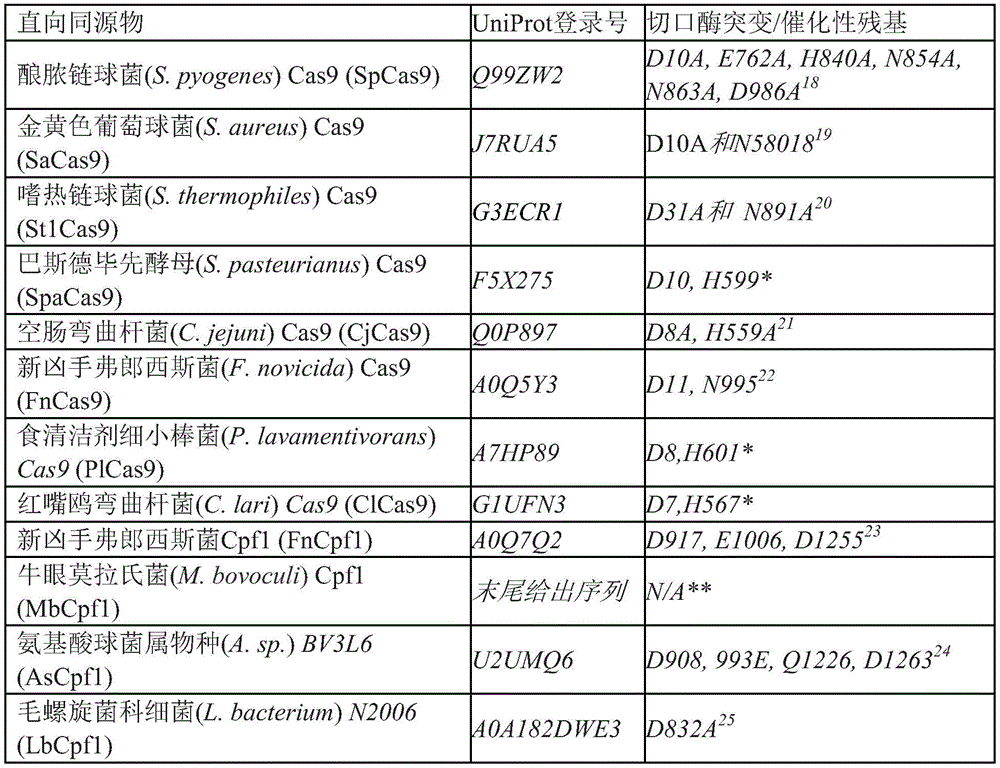
Prediction based on UniRule annotation on UniProt database.
May be determined based on sequence alignment with other Cpf1 orthologs
These orthologs, and mutants and variants thereof, known in the art, may be used in any of the fusion proteins described herein. See, for example, WO 2017/040348 (which describes specifically increased SaCas9 and SpCas9 variants) and WO2016/141224 (which describes PAM-specific altered SaCas9 and SpCas9 variants).
Cas9 nuclease from Streptococcus pyogenes (hereinafter abbreviated Cas9) may be engineered with guide RNAs (gRNAs), such as single guide RNAs or simple base pair complementarity guides between 17-20 nucleotides of a crRNA/tracrRNA pair (pair) et al and the complementary strand of the target genomic DNA sequence immediately adjacent to the prepro region sequence adjacent motif (PAM), such as PAM of the matching sequence NGG or NAG (Shen et al, Cell Res (2013); Dicalo et al, Nucleic Acids Res (2013); Jiang et al, Nat Biotech 31, 233-. Engineered CRISPR 1(CRISPR from Prevotella and Francisella 1, Cpf1) nucleases from the genera Prevotella and Francisella may also be used, e.g., as Zetsche et al, Cell 163,759-771 (2015); schunder et al, Int J Med Microbiol 303,51-60 (2013); makarova et al, Nat Rev Microbiol 13,722-736 (2015); fagerlund et al, genomeBiol 16,251 (2015). Unlike SpCas9, Cpf1 requires only a single 42nt crRNA with 23nt at the 3' end of nucleotides complementary to the pre-spacer sequence of the target DNA sequence (Zetsche et al, 2015). In addition, SpCas9 recognizes the NGG PAM sequence present at 3 'of the pre-compartment, whereas aspcf 1 and LbCp1 recognize the TTTN PAM present at 5' of the pre-compartment (supra).
In some embodiments, the systems of the invention utilize a wild-type or variant Cas9 protein from streptococcus pyogenes or staphylococcus aureus or a wild-type Cpf1 protein from the aminoacetococcus species BV3L6 or lachnospira ND2006, as encoded in bacteria or codon optimized for expression in mammalian cells and/or modified in its PAM recognition specificity and/or its whole genome specificity. A number of variations have been described; see, for example, WO 2016/141224; PCT/US 2016/049147; kleinstimer et al, Nat Biotechnol.2016 Aug; 869-74 parts of (34) (8); tsai and Joung, Nat Rev Genet.2016 May; 17, (5) 300-12; kleinstimer et al, Nature.2016 Jan 28; 529(7587) 490-5; shmakov et al, Mol cell.2015 Nov 5; 60, (3) 385-97; kleinstimer et al, Nat Biotechnol.2015 Dec; 1293-1298; dahlman et al, NatBiotechnol.2015 Nov; 33, (11) 1159-61; kleinstimer et al, Nature.2015 Jul 23; 523(7561) 481-5; wyvekens et al, Hum Gene ther.2015 Jul; 26(7) 425-31; hwang et al, Methods Mol biol.2015; 1311: 317-34; osborn et al, Hum Gene ther.2015Feb; 26, (2) 114-26; konermann et al, Nature.2015Jan 29; 517(7536) 583-8; fu et al, methods enzymol.2014; 546: 21-45; and Tsai et al, Nat Biotechnol.2014 Jun; 32(6):569-76. The guide RNA is expressed with Cas9 or Cpf1 or is present in the cell. Either or both of the guide RNA or nuclease may be transiently or stably expressed in the cell, or introduced as a purified protein or nucleic acid.
Table 2 shows potential Cas9 orthologs that can be used as chimeric proteins with ZFs or TALEs. PlCas9, ClCas9, and NcCas9 were unable to bind their target sites efficiently in eukaryotic cells, while CjCas9 had a large amount of activity at its target site, requiring PAM interacting domain mutations to knock down its ability to bind its site efficiently. Nickase mutation residues represent the position of the enzyme required for catalytic activity of a conserved RuvC nuclease domain, or predicted based on alignment with the CjCas9 sequence lacking structural information.
TABLE 2 Cas9 orthologs
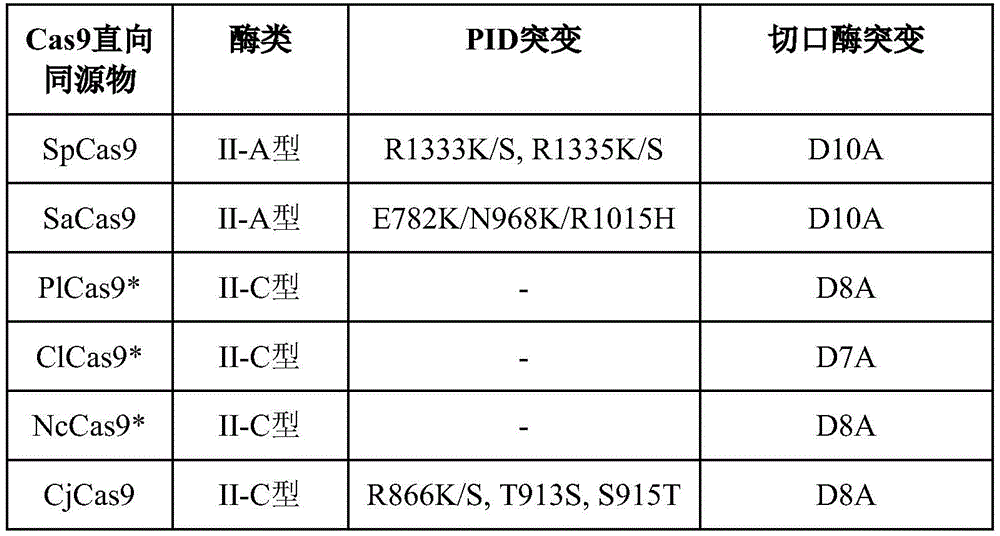
Indicates proteins lacking sufficient structural information. The entire positional information refers to the wild-type protein sequence obtained from uniport.
In some embodiments, Cas9 further comprises one or more mutations that reduce the nuclease activity of Cas 9; for example, for SpCas9, mutations at D10A or H840A (which produce single-stranded nickases).
In some embodiments, the SpCas9 variant further comprises a mutation that disrupts the nuclease activity of Cas9 at one of the following amino acid positions: d10, E762, D839, H983, or D986 and H840 or N863, for example D10A/D10N and H840A/H840N/H840Y, to render the nuclease part of the protein catalytically inactive; substitutions at these positions may be alanine (as they are in Nishimasu et al, Cell 156, 935-949 (2014)) or other residues, for example glutamine, asparagine, tyrosine, serine or aspartic acid, for example E762Q, H983N, H983Y, D986N, N863D, N863S or N863H (see WO 2014/152432).
In some embodiments, the fusion protein comprises one or more Uracil Glycosylase Inhibitor (UGI) protein sequences; an exemplary UGI sequence is as follows:
TNLSDIIEKETGKQLVIQESILMLPEEVEEVIGNKPESDILVHTAYDESTDENVMLLTSDAPEYKPWALVIQDSNGENKIKML (SEQ ID NO: 7; Uniprot: P14739). Typically, the UGI is at the C-terminus, but can also be at the N-terminus, or between the components of the fusion proteins described herein. Linkers known in the art may be used.
TAL effector repeat arrays
TAL effectors of plant pathogen bacteria in the genus Xanthomonas (Xanthomonas) play an important role in disease or triggering defense by binding host DNA and activating effector-specific host genes. Specificity depends on the variable number of effectors which are incomplete, usually about 33-35 amino acid repeats. Polymorphisms occur predominantly at repeat positions 12 and 13, which are referred to herein as Repeat Variable Diresidues (RVDs). The RVDs of TAL effectors correspond to nucleotides in their target site in a direct, linear fashion, one RVD to each nucleotide, with some degeneracy and no apparent proximity dependence. In some embodiments, the polymorphic region conferring nucleotide specificity may be represented as a three-residue or triplet.
Each DNA binding repeat may comprise a RVD that determines base pair recognition in the target DNA sequence, wherein each DNA binding repeat is responsible for recognizing one base pair in the target DNA sequence. In some embodiments, RVDs may include one or more of the following: identifying the HA of C; identifying ND of C; identifying HI of C; (ii) identifies the HN of G; identifying the NA of G; SN identifying G or A; YG for identifying T; and an NK that recognizes G, and one or more of: identifying HD of C; identifying the NG of T; identifying NI of A; NN of G or A is identified; NS recognizing A or C or G or T; identifying N of C or T, wherein N represents a notch in the second position of the RVD; HG identifying T; identifying H of T, wherein H represents a notch in the second position of the RVD; and IG that recognizes T.
TALE proteins can be used in research and biotechnology as targeted chimeric nucleases that can facilitate homologous recombination in genome engineering (e.g., adding or enhancing traits in plants that are useful for biofuels or biorenewable materials). These proteins may also be used, for example, as transcription factors, and in particular for therapeutic applications requiring very high levels of specificity, such as therapeutic drugs against pathogens (e.g., viruses), and the like, as non-limiting examples.
Methods for generating engineered TALE arrays are well known in the art, see, for example, the rapid ligation-based automatable solid phase high throughput (FLASH) system described in USSN 61/610,212 and Reyon et al, Nature Biotechnology 30, 460-465 (2012); and the methods described in the following documents: bogdannove and Voytas, Science333, 1843-; bogdannove et al, Curr Opin Plant biol13,394-401 (2010); scholze and Boch, j.curr Opin Microbiol (2011); boch et al, Science 326, 1509-; moscou and bogdanive, Science 326,1501 (2009); miller et al, Nat Biotechnol29, 143-148 (2011); morbitzer et al, T.Proc Natl Acad Sci U S A107, 21617-; morbitzer et al, Nucleic Acids Res 39,5790-5799 (2011); zhang et al, Nat Biotechnol29,149-153 (2011); geissler et al, PLoS ONE 6, e19509 (2011); weber et al, PLoS ONE 6, e19722 (2011); christian et al, Genetics 186,757-761 (2010); li et al, Nucleic acids sRs 39,359-372 (2011); mahfuuz et al, Proc Natl Acad Sci U S A108, 2623-2628 (2011); mussolino et al, Nucleic Acids Res (2011); li et al, Nucleic Acids Res 39,6315-6325 (2011); cerak et al, Nucleic Acids Res 39, e82 (2011); wood et al, sciences 333,307 (2011); hockemeye et al Nat Biotechnol29, 731-734 (2011); tesson et al, NatBiotechnol 29, 695-one 696 (2011); sander et al, Nat Biotechnol29, 697-698 (2011); huang et al, Nat Biotechnol29, 699-700 (2011); and Zhang et al, Nat Biotechnol29, 149-; the entire contents of said documents are hereby incorporated by reference.
Also suitable for use in the methods of the invention are megatals, which are fusions of meganucleases (meganucleases) with TAL effectors; see, for example, Boissel et al, Nucl. acids Res.42(4):2591-2601 (2014); boissel and Scharenberg, Methods Mol biol.2015; 1239:171-96.
Zinc finger
Zinc finger proteins are DNA binding proteins containing one or more zinc fingers which are independently folded zinc-containing microdomains whose Structure is well known in the art and defined in, for example, Miller et al, 1985, EMBO J.,4: 1609; Berg,1988, Proc. Natl. Acad. Sci. USA,85: 99; Lee et al, 1989, science.245: 635; and Klug,1993, Gene,135:83 the crystal Structure of the zinc finger protein Zif268 and its variants which bind to DNA shows a semi-conserved pattern of interaction in which three amino acids from the α -zinc finger helix usually come into contact with three adjacent base pairs or "subsites" in DNA (Pavletich et al, 1991, Science,252: 809; Elrod-Erickson et al, 1998, Structure,6: 451). thus, the crystal Structure of the zinc finger, the zinc finger domain can be linked in a modular fashion to each other in a sequence to achieve the specific transcription of the three base pairs of the zinc finger sequences together (Klug-zinc finger sequences, e.g. 3: 135) in a sequence (1993).
Various studies have shown that the DNA binding characteristics of individual zinc fingers can be engineered by randomizing amino acids involved in DNA binding at the α -helix position and using selection methods such as phage display etc. to identify desired variants capable of binding to target DNA target sites (Rebar et al, 1994, Science,263: 671; Choo et al, 1994proc.natl.acad.sci.usa,91: 11163; Jamieson et al, 1994, Biochemistry 33: 5689; Wu et al, 1995proc.natl.acad.sci.usa,92 zinc finger 344.) such recombinant proteins can be fused to functional domains such as transcriptional activators, transcriptional repressors, methylation domains and nucleases to modulate Gene expression, alter DNA methylation and introduce targeting alterations into the genomes of model organisms, plants and human cells (Carroll,2008, Gene 14615: 3-the 68; cath, the mol, 2008. mol. 16: 2964, cell., 2933: 1200).
One existing method of engineering zinc finger arrays, known as "modular assembly", calls for simply joining together pre-selected zinc finger modules into an array (Segal et al, 2003, Biochemistry,42: 2137-48; Beerli et al, 2002, nat. Biotechnol.,20:135- & 141; Mandell et al, 2006, Nucleic Acids Res.,34: W516-523; Carroll et al, 2006, nat. Protoc.1: 1329-41; Liu et al, 2002, J. biol. chem.,277: 3850-56; Bae et al, 2003, nat. Biotechnol.,21:275- & 280; Wright et al, 2006, nat. Protoco., 1: 1637-52). While simple enough to be practiced by any researcher, recent reports have demonstrated a high failure rate of this approach, particularly in the context of zinc finger nucleases (Ramirez et al, 2008, nat. methods,5: 374-375; Kim et al, 2009, Genome res.19:1279-88), limited to the very large number of zinc finger proteins that typically need to be constructed and targeted against any given target gene based on cellular assays (Kim et al, 2009, Genome res.19: 1279-88).
Combinatorial selection-based methods of identifying zinc finger arrays from randomized libraries have been demonstrated to have higher success rates than modular assembly methods (Maeder et al, 2008, mol. cell,31: 294-. In a preferred embodiment, zinc finger arrays are generated as described in or as described in WO 2011/017293 and WO 2004/099366. Other suitable zinc fingers DBDs are described in U.S. patent nos. 6,511,808, 6,013,453, 6,007,988, and 6,503,717 and U.S. patent application 2002/0160940.
Binary base editor
In some embodiments, the base editor is a fusion of a DNA binding domain with a deaminase or active portion thereof that modifies cytosine DNA bases, such as a cytidine deaminase from the apolipoprotein B mRNA editing enzyme catalytic polypeptide-like (APOBEC) family of deaminases, including APOBEC1, APOBEC2, APOBEC3A, APOBEC3B, APOBEC3C, APOBEC3D/E, APOBEC3F, APOBEC3G, APOBEC3H, APOBEC4 (see, e.g., Yang et al, J Genetgenomics.2017Sep 20; 44(9): 423-; for example, activation-induced cytidine deaminase (AICDA) and the like, cytosine deaminase 1(CDA1) and CDA2, and Cytosine Deaminase (CDAT) that acts on tRNA. Table 2 below provides exemplary sequences; other sequences may also be used.
TABLE 2
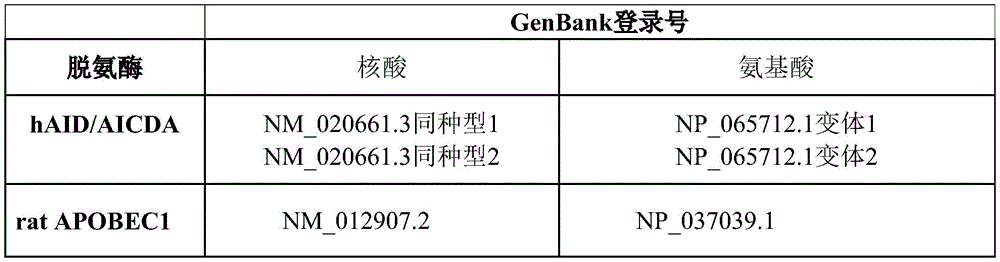
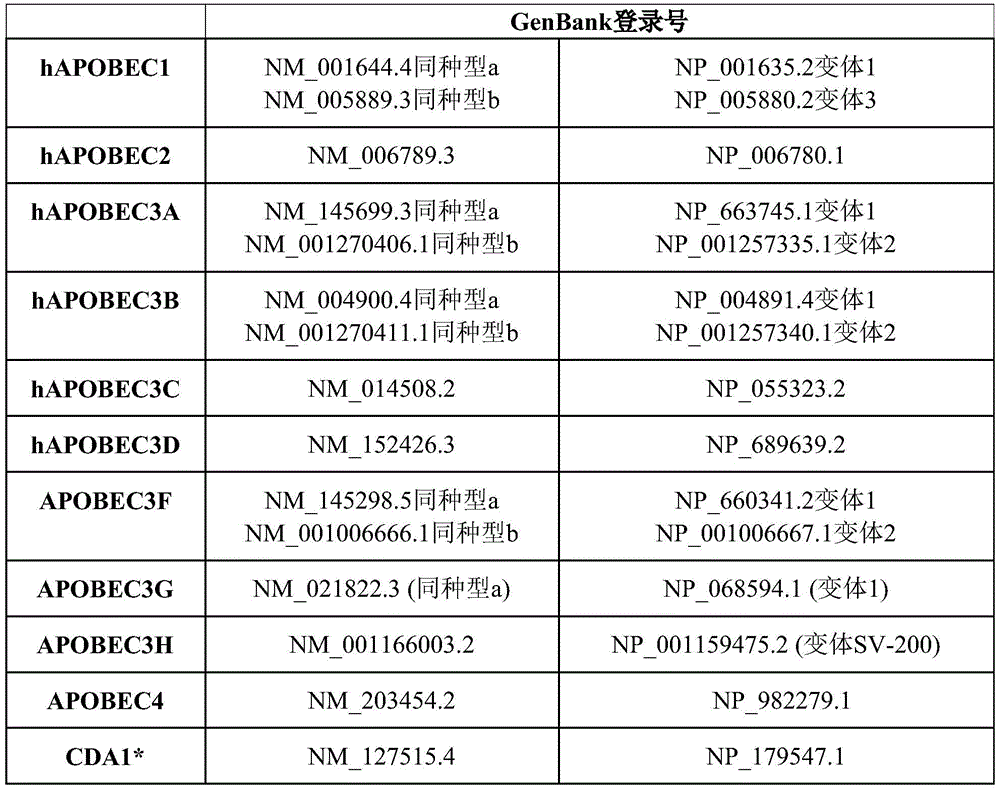
From Saccharomyces cerevisiae S288C
Variants
In some embodiments, a component of a fusion protein is at least 80% identical, e.g., at least 85%, 90%, 95%, 97%, or 99% identical, to an amino acid sequence of an exemplary sequence (e.g., as provided herein), e.g., differs at up to 5%, 10%, 15%, or 20% of the residues of the exemplary sequence, e.g., has conservative mutations in addition to those described herein. In preferred embodiments, the variant retains the desired activity of the parent, e.g., nickase activity or nuclease-free activity in the case of a Cas9 variant or fragment, and/or the ability to interact with a guide RNA and/or a target DNA in the case of a deaminase variant or an activated portion thereof, or deaminase activity.
To determine the percent identity of two nucleic acid sequences, the sequences are aligned for optimal comparison purposes (e.g., gaps can be introduced in one or both of the first and second amino acid or nucleic acid sequences for optimal comparisonA good alignment, or non-homologous sequences may be omitted for comparison purposes). The length of a reference sequence aligned for comparison purposes is at least 80%, and in some embodiments at least 90% or 100% of the length of the reference sequence. The nucleotides at the corresponding amino acid positions or nucleotide positions are then compared. When a position in a first sequence is occupied by the same nucleotide as the corresponding position in a second sequence, then the molecules are identical at that position (as used herein, nucleic acid "identity" is equivalent to nucleic acid "homology"). The percent identity between two sequences is a function of the number of positions at which the sequences share identity, taking into account the number of gaps that need to be introduced for optimal alignment of the two sequences and the length of each gap. The percent identity between two polypeptide or nucleic acid sequences is determined in a variety of ways within the skill in the art, e.g., using publicly available computer software such as Smith Waterman Alignment (Smith, T.F., and M.S.Waterman (1981) J Mol Biol 147: 195-7); has been incorporated into GeneMatcher PlusTM"BestFit" in Schwarz and Dayhof (1979) Atlas of Protein Sequence and Structure, Dayhof, M.O. eds, p. 353-358 (Smith and Waterman, advanced sin Applied Matchemics, 482-489 (1981)); BLAST programs (basic local alignment search tools; (Altschul, S.F., W.Gish et al, (1990) J Mol Biol 215:403-10), BLAST-2, BLAST-P, BLAST-N, BLAST-X, WU-BLAST-2, ALIGN-2, CLUSTAL, or Megalign (DNASTAR)) software in addition, one skilled in the art can determine suitable parameters for measuring alignments, including any algorithm needed to achieve maximum alignment over the full length of the sequences being compared.
For the purposes of the present invention, comparison of sequences and percent identity between two sequences can be determined using a Blossum 62 scoring matrix of gap penalty 12, gap extension penalty 4, and frameshifting gap penalty 5.
Conservative substitutions typically include substitutions within the following groups: glycine, alanine; valine, isoleucine, leucine; aspartic acid, glutamic acid, asparagine, glutamine; serine, threonine; lysine, arginine; and phenylalanine, tyrosine.
Also provided herein are isolated nucleic acids encoding a binary deaminase fusion protein; a vector comprising an isolated nucleic acid, optionally operably linked to one or more regulatory domains to express a variant protein; and host cells, e.g., mammalian host cells, comprising the nucleic acid and optionally expressing the variant protein. In some embodiments, the host cell is a stem cell, e.g., a hematopoietic stem cell.
The binary deaminase fusion proteins described herein can be used to alter the genome of a cell. The methods generally include expressing or contacting the fusion protein in a cell; in versions using one or two Cas9, the methods include the use of guide RNAs having regions complementary to selected portions of the cell genome. Methods for selectively altering the genome of a cell are known in the art, see, e.g., US8,993,233; US 20140186958; US 9,023,649; WO/2014/099744; WO 2014/089290; WO 2014/144592; WO 144288; WO 2014/204578; WO 2014/152432; WO 2115/099850; US8,697,359; US 20160024529; US 20160024524; US 20160024523; US 20160024510; US 20160017366; US 20160017301; US 20150376652; US 20150356239; US 20150315576; US 20150291965; US 20150252358; US 20150247150; US 20150232883; US 20150232882; US 20150203872; US 20150191744; US 20150184139; US 20150176064; US 20150167000; US 20150166969; US 20150159175; US 20150159174; US 20150093473; US 20150079681; US 20150067922; US 20150056629; US 20150044772; US 20150024500; US 20150024499; US 20150020223; (ii) a US 20140356867; US 20140295557; US 20140273235; US 20140273226; US 20140273037; US 20140189896; US 20140113376; US 20140093941; US 20130330778; US 20130288251; US 20120088676; US 20110300538; US 20110236530; US 20110217739; US 20110002889; US 20100076057; US 20110189776; US 20110223638; US 20130130248; US 20150050699; US 20150071899; US 20150050699; (ii) a US 20150045546; US 20150031134; US 20150024500; US 20140377868; US 20140357530; US 20140349400; US 20140335620; US 20140335063; US 20140315985; US 20140310830; US 20140310828; US 20140309487; US 20140304853; US 20140298547; US 20140295556; US 20140294773; US 20140287938; US 20140273234; US 20140273232; US 20140273231; US 20140273230; US 20140271987; US 20140256046; US 20140248702; US 20140242702; US 20140242700; US 20140242699; US 20140242664; US 20140234972; US 20140227787; US 20140212869; US 20140201857; US 20140199767; US 20140189896; US 20140186958; US 20140186919; US 20140186843; US 20140179770; US 20140179006; US 20140170753; WO/2008/108989; WO/2010/054108; WO/2012/164565; WO/2013/098244; WO/2013/176772; US 20150071899; makarova et al, "Evolution and classification of the CRISPR-Cas systems"9(6) Nature reviews microbiology 467-477(1-23) (6 months 2011); wiedenheft et al, "RNA-guided genetic systems in bacteria and archaea"482 Nature 331-338 (16/2/2012); gasiunas et al, "Cas9-crRNA ribonuclear protein complexes specific DNAclearance for adaptive immunity in bacteria"109(39) Proceedings of the national academy of Sciences USA E2579-E2586 (9/4/2012); jinek et al, "A Programmmableul-RNA-Guided DNA Endonuclease in Adaptive Bacterial Immunity"337 Science816-821 (8/17/2012); carroll, "A CRISPR Approach to Gene Targeting"20(9) Molecular Therapy 1658-1660 (9/2012); U.S. application No. 61/652,086 filed on 5/25/2012; Al-Attar et Al, Cluster Regulated Interactive Short Palindromic Repeats (CRISPRs) The Hall of an endogenous antibiotic feedback genes, Biol chem. (2011) Vol.392, No. 4, pp.277-289; hale et al, essential features and Rational Design of CRISPR RNAs, which is the same Function With the Cas RAMMODULe Complex to clean RNAs, Molecular Cell, (2012) Vol 45, No 3, 292-.
In some embodiments, the fusion protein comprises a linker between a DNA-binding domain (e.g., ZFN, TALE, or nCas9) and a BE domain. Linkers that can be used in these fusion proteins (or between fusion proteins in tandem) can comprise any sequence that does not interfere with the function of the fusion protein. In preferred embodiments, the linker is short, e.g., 2-20 amino acids, and is generally flexible (i.e., comprises high degrees of freedom of amino acids, e.g., glycine, alanine, and serine). In some embodiments, the linker comprises one or more units consisting of GGGS (SEQ ID NO:8) or GGGGS (SEQ ID NO:9), e.g., two, three, four, or more repeats of a GGGS (SEQ ID NO:8) or GGGGS (SEQ ID NO:9) unit. Other linker sequences may also be used.
In some embodiments, the fusion protein comprises a cell penetrating peptide sequence that facilitates delivery into an intracellular space, e.g., an HIV-derived TAT peptide, a permeatin (penetratin), a transporter (transportan), or an hCT-derived cell penetrating peptide, see, e.g., Caron et al, (2001) Mol ther.3(3): 310-8; langel, Cell-Pennetratingpeptides: Processes and Applications (CRC Press, Boca Raton FL 2002); El-Andaloussi et al, (2005) Curr Pharm Des.11(28): 3597-611; and Deshayes et al, (2005) CellMol Life Sci.62(16): 1839-49.
Cell Penetrating Peptides (CPPs) are short peptides that facilitate the movement of a wide variety of biomolecules across the cell membrane into the cytoplasm or other organelles, such as mitochondria and the nucleus. Examples of molecules that may be delivered by a CPP include therapeutic drugs, plasmid DNA, oligonucleotides, siRNA, Peptide Nucleic Acids (PNA), proteins, peptides, nanoparticles, and liposomes. CPPs are typically 30 amino acids or less, derived from naturally or non-naturally occurring proteins or chimeric sequences, contain a high relative abundance of positively charged amino acids, such as lysine or arginine, or an alternating pattern of polar and non-polar amino acids. CPPs commonly used in the art include Tat (Frankel et al, (1988) cell.55: 1189-1193; Vives et al, (1997) J.biol.chem.272:16010-16017), penetratin (Derossi et al, (1994) J.biol.chem.269:10444-10450), poly-arginine peptide sequence (Wender et al, (2000) Proc.Natl.Acad.Sci.USA97: 13003-13008; Futaki et al, (2001) J.biol.chem.276:5836-5840) and transportan (Pooga et al, (1998) Nat.Biotechnol.16: 857-861).
CPPs may be attached to their cargo by covalent or non-covalent strategies. Methods for covalently linking a CPP and its cargo are known in the art, such as chemical cross-linking (Stetsenko et al, (2000) J.Org.chem.65: 4900-4909; Gait et al, (2003) cell.mol.Life.Sci.60:844-853) or cloning of fusion proteins (Nagahara et al, (1998) nat. Med.4: 1449-1453). Non-covalent coupling between cargo and short amphiphilic CPPs comprising polar and non-polar domains is established by electrostatic and hydrophobic interactions.
CPPs have been utilized in the art to deliver potentially therapeutic biomolecules to cells. Examples include polyarginine linked cyclosporine for immunosuppression (Rothbard et al, (2000) Nature Medicine 6(11):1253-1257), CPP linked siRNA against cyclin B1 for inhibiting tumor formation, known as MPG (Crombez et al, (2007) Biochem Soc. Trans.35:44-46), CPP linked tumor suppressor p53 peptide to reduce cancer cell growth (Takenobu et al, (2002) mol. cancer ther.1(12): 1043-1049; Snyder et al, (2004) PLoSpbiol.2: E36), and dominant negative form of Ras fused to Tat or phosphoinositide 3 kinase (PI3K) to treat asthma (Myou et al, (2003) J. Immunol.171: 4399-4405).
CPPs have been utilized in the art to transport contrast agents into cells for imaging and biosensing applications. For example, Green Fluorescent Protein (GFP) attached to Tat has been used to label cancer cells (Shokolenko et al, (2005) DNA Repair 4(4): 511-. Tat conjugated to quantum dots has been used successfully to cross the blood-brain barrier to visualize the rat brain (Santra et al, (2005) chem. commun.3144-3146). CPP has also been used in combination with magnetic resonance imaging techniques for cell imaging (Liu et al, (2006) biochem. and Biophys. Res. Comm.347(1): 133-140). See also Ramsey and Flynn, Pharmacol Ther.2015Jul 22.pii: S0163-7258(15) 00141-2.
Alternatively or additionally, the fusion protein may comprise a nuclear localization sequence, for example, SV40 large T antigen NLS (PKKKRRV (SEQ ID NO:10)) and nucleoplasmin NLS (KRPAATKKAGQAKKKK (SEQ ID NO: 11)). Other NLS are known in the art; see, for example, Cokol et al, EMBO rep.2000nov 15; 1(5) 411-415; freitas and Cunha, Curr genomics.2009Dec; 10(8):550-557.
In some embodiments, the fusion protein includes a portion with high affinity for a ligand, such as a GST sequence, FLAG sequence, or a hexa-histidine sequence. Such affinity tags may facilitate purification of the recombinant fusion protein.
For methods in which a fusion protein is delivered to a cell, the fusion protein can be produced using any method known in the art, e.g., by in vitro translation, or expressed from a nucleic acid encoding the fusion protein in a suitable host cell; many methods of producing proteins are known in the art. For example, the protein can be produced in and purified from yeast, E.coli, insect cell lines, plants, transgenic animals, or cultured mammalian cells; see, for example, Palomares et al, "Production of Recombinant Proteins: Challenges and Solutions," Methods mol biol.2004; 267:15-52. Furthermore, the fusion protein may be linked to a moiety that facilitates transfer into a cell, e.g., a lipid nanoparticle, optionally using a linker that is cleaved once the protein is inside the cell. See, for example, lafutinine et al, Int J pharm.2015 Aug 13; 494(1):180-194.
Expression system
In order to use the fusion proteins described herein, it may be desirable to express these variants from the nucleic acids encoding them. This can be done in a number of ways. For example, the nucleic acid encoding the fusion can be cloned into an intermediate vector for transformation into a prokaryotic or eukaryotic cell for replication and/or expression. The intermediate vector is typically a prokaryotic vector, e.g., a plasmid, or a shuttle vector, or an insect vector, for the preservation or manipulation of nucleic acids encoding the fusion for the production of the fusion protein. The nucleic acid encoding the fusion protein can also be cloned into an expression vector for administration to a plant cell, an animal cell, preferably a mammalian cell or a human cell, a fungal cell, a bacterial cell or a protozoan cell.
To obtain expression, the sequence encoding the fusion protein is typically subcloned into an expression vector containing a promoter to direct transcription. Suitable bacterial and eukaryotic promoters are well known in the art, for example, in Sambrook et al, Molecular Cloning, A Laboratory Manual (3d ed.2001); kriegler, Gene Transfer and expression A Laboratory Manual (1990); and Current Protocols in Molecular Biology (Ausubel et al, 2010). Bacterial expression systems for the expression of engineered proteins are available, for example, from Escherichia coli, Bacillus species (Bacillus sp.) and Salmonella (Salmonella) (Palva et al, 1983, Gene22: 229-235). Kits for such expression systems are commercially available. Eukaryotic expression systems for mammalian cells, yeast and insect cells are well known in the art and are also commercially available.
The promoter used to direct expression of the nucleic acid depends on the particular application. For example, strong constitutive promoters are commonly used for expression and purification of fusion proteins. In contrast, when the fusion protein is to be administered in vivo for gene regulation, constitutive or inducible promoters may be used, depending on the specific application of the fusion protein. Furthermore, preferred promoters for the administration of the fusion protein may be weak promoters, such as HSV TK or promoters with similar activity. Promoters may also comprise elements that respond to trans-activation, such as hypoxia response elements, Gal4 response elements, lac repressor response elements, and small molecule control systems, such as tetracycline regulated systems and RU-486 systems (see, e.g., Gossen and Bujard,1992, Proc. Natl. Acad. Sci. USA,89: 5547; Oligino et al, 1998, Gene ther.,5: 491-496; Wang et al, 1997, Gene ther.,4: 432-441; Neering et al, 1996, Blood,88: 1147-55; and Rendahl et al, 1998, Nat. Biotechnol.,16: 757-761).
In addition to a promoter, an expression vector typically contains a transcription unit or expression cassette that contains all the other elements required for expression of a nucleic acid in a prokaryotic or eukaryotic host cell. Thus, a typical expression cassette contains a promoter operably linked, for example, to the nucleic acid sequence encoding the fusion protein, and any signals required, for example, for efficient polyadenylation of the transcript, transcriptional termination, ribosome binding site, or translational termination. Additional elements of the expression cassette may include, for example, enhancers and heterospliced intron signals.
The particular expression vector used to transport the genetic information into the cell is selected for the intended use of the fusion protein, e.g., expression in plants, animals, bacteria, fungi, protozoa, etc. Standard bacterial expression vectors include plasmids such as pBR 322-based plasmids, pSKF, pET23D, and commercially available tag fusion expression systems such as GST and LacZ.
Expression vectors containing regulatory elements from eukaryotic viruses are often used in eukaryotic expression vectors, for example, SV40 vectors, papillomavirus vectors, and vectors from Epstein-Barr virus. Other exemplary eukaryotic vectors include pMSG, pAV009/A +, pMTO10/A +, pMAMneo-5, baculovirus pDSVE, and any other vector that allows protein expression under the direction of the SV40 early promoter, the SV40 late promoter, the metallothionein promoter, the murine mammary tumor virus promoter, the rous sarcoma virus promoter, the polyhedrin promoter, or other promoters that show expression efficiency in eukaryotic cells.
Vectors for expression of the fusion proteins may comprise an RNA Pol III promoter to drive expression of the guide RNA, e.g., H1, U6, or 7SK promoters. These human promoters allow the expression of the fusion protein in mammalian cells after plasmid transfection.
Some expression systems have markers for selection of stably transfected cell lines, such as thymidine kinase, hygromycin B phosphotransferase, and dihydrofolate reductase. High-yield expression systems are also suitable, for example, using baculovirus vectors in insect cells, and gRNA coding sequences under the direction of the polyhedrin promoter or other strong baculovirus promoter.
The elements typically included in the expression vector also include replicons that function in E.coli, genes encoding antibiotic resistance to allow selection of bacteria harboring the recombinant plasmid, unique restriction sites in non-critical regions of the plasmid to allow insertion of the recombination sequences.
Bacterial, mammalian, yeast or insect cell lines expressing large amounts of Protein are generated using standard transfection Methods and subsequently purified using standard techniques (see, e.g., Colley et al, 1989, J.biol. chem.,264: 17619-22; Guide to Protein Purification, cited by Methods in Enzymology, Vol. 182 (Deutscher, 1990)). Transformation of eukaryotic and prokaryotic cells is carried out according to standard techniques (see, for example, Morrison,1977, J.Bacteriol.132: 349-351; Clark-Curtiss and Curtiss, Methods in Enzymology 101:347-362(Wud et al, 1983).
Any known method of introducing an exogenous nucleotide sequence into a host cell may be used. These methods include the introduction of cloned genomic DNA, cDNA, synthetic DNA or other foreign genetic material into host cells using calcium phosphate transfection, polybrene, protoplast fusion, electroporation, nuclear transfection, liposome, microinjection, naked DNA, plasmid vector, viral vectors (both episomal and integrated), and any other well-known methods (see, e.g., Sambrook et al, supra). It is only necessary that the particular genetic engineering method used be capable of successfully introducing at least one gene into a host cell that can express the fusion protein.
Alternatively, the methods may comprise delivering the fusion protein and guide RNA together, e.g., as a complex. For example, the fusion protein and gRNA can be overexpressed and purified in a host cell, then complexed with a guide RNA (e.g., in a test tube) to form Ribonucleoproteins (RNPs), and delivered to the cell. In some embodiments, the fusion protein may be expressed in bacteria and purified therefrom by using a bacterial expression plasmid. For example, the His-tagged fusion protein can be expressed in bacterial cells and subsequently purified using nickel affinity chromatography. The use of RNPs circumvents the necessity to deliver nuclease-encoding plasmid DNA in the form of nuclease or guide-encoding plasmid DNA or mRNA. RNP delivery may also improve specificity, presumably because of the short half-life of RNPs and the absence of sustained expression of nucleases and guides (as would be obtained from plasmids). For example, RNPs can be delivered to cells in vivo or in vitro using lipid-mediated transfection or electroporation. For example, see Liang et al, "Rapid and high effective cellular engineering viaCas9 protein transformation," Journal of biotechnology 208(2015): 44-53; zuris, John A. et al, "functional-mediated delivery of proteins enzymes in a video and in a video," Nature biological technology 33.1(2015): 73-80; kim et al, "high affinity RNA-guided Genome editing in human cells via delivery of purified Cas9 ribonuclear proteins," Genome research 24.6(2014): 1012-1019.
The invention also includes vectors and cells comprising vectors, e.g., for use in the methods described herein, as well as kits comprising the proteins and nucleic acids described herein.
Examples
The invention is further described in the following examples, which do not limit the scope of the invention described in the claims.
Materials and methods
The following materials and methods were used in the examples herein.
Molecular cloning
An expression plasmid was constructed by the following method: the desired DNA sequences were selectively amplified using PCR methods to have clearly overlapping ends and assembled in the desired order in the pCAG expression vector using isothermal assembly (or "Gibson assembly", NEB). PCR was performed using Q5 or Phusion polymerase (NEB). Cas9 gRNA was cloned under the control of the U6 promoter using pUC 19-based entry vector BPK1520 (via a BsmBI cassette).
Guide RNA and zinc finger target sites
EGFP targeting zinc fingers using:
ZF 11-1(223L), target site gGTCGGGGTAg (SEQ ID NO:12)
ZF 13-6(292L), target site aGAAGATGGTg (SEQ ID NO:13)
Cas9 guide RNA2 pre-spacer sequence (PAM):
AGCACTGCACGCCGTAGGTC(AGG)(SEQ ID NO:14)
cas9 directs RNA 4 pre-spacer sequence (PAM):
CATGCCCGAAGGCTACGTCC(AGG)(SEQ ID NO:15)
cas9 guide RNA 5 pre-spacer sequence (PAM):
CTGGACGTAGCCTTCGGGCA(TGG)(SEQ ID NO:16)
cell culture and transfection
For the BBE experiments, HEK293 cell lines with integrated EGFP reporter integrated therein were cultured using media consisting of advanced Duchen's modified Medium (Gibco) supplemented with 10% FBS (Gibco), 1% 10,000U/ml penicillin-streptomycin solution (Gibco), and 1% Glutamax (Gibco). Cells were passaged every 3-4 days to maintain population active growth and avoid hypoxic conditions. By plating 24 well TC-treated plates with 1X10⁵Cells were transfected with transfection quality DNA (Qiagen, bulk or miniprep) containing 800 ng of the desired protein/gRNA using TransIT-293 reagent according to the manufacturer's protocol (Mirus Bio). gDNA was harvested 3 days after transfection using DNAdvance kit (Agencourt). 5% CO at 37 ℃ in DMEM supplemented with 10% heat-inactivated fetal calf serum, 2mM GlutaMax, penicillin and streptomycin2U2os. EGFP cells and HEK293T cells containing a single stably integrated copy of the EGFP-PEST reporter gene were cultured.
Medium for U2OS. EGFP cells supplemented with 400. mu.g ml-1Geneticin (Geneticin). Cell line identity was verified by STR Analysis (ATCC) and cells were periodically checked for mycoplasma contamination. U2OS. EGFP cells were transfected with 750ng of BE-expressing plasmid and 250ng of gRNA-expressing plasmid using DN-100 program and SE cell line kit on a Lonza 4-D Nucleofector according to the manufacturer's recommendations. 48 hours after transfection, disruption of the EGFP gene was evaluated using a flow cytometer.
High throughput amplicon sequencing
The genomic DNA of the target site is amplified using gene-specific DNA primers flanking the desired target sequence. Illumina TruSeq adaptors were added to the ends of the amplicons by PCR or NEBNext Ultra II kit (NEB) and molecularly indexed with NEBNext Dual Index Primers (NEB). Samples were incorporated into the library and sequenced on an Illumina MiSeq machine using miseargent Micro Kit v2 (Illumina). Sequencing results were analyzed using a batch version of the software crispreso (CRISPResso. rocks).
Related protein sequences
N-nCas9(D10A) -SGGS linker-UGI-SV 40NLS-C MDKKYSIGLAIGTNSVGWAVITDEYKVPSKKFKVLGNTDRHSIKKNLIGALLFDSGETAEATRLKRTARRRYTRRKNRICYLQEIFSNEMAKVDDSFFHRLEESFLVEEDKKHERHPIFGNIVDEVAYHEKYPTIYHLRKKLVDSTDKADLRLIYLALAHMIKFRGHFLIEGDLNPDNSDVDKLFIQLVQTYNQLFEENPINASGVDAKAILSARLSKSRRLENLIAQLPGEKKNGLFGNLIALSLGLTPNFKSNFDLAEDAKLQLSKDTYDDDLDNLLAQIGDQYADLFLAAKNLSDAILLSDILRVNTEITKAPLSASMIKRYDEHHQDLTLLKALVRQQLPEKYKEIFFDQSKNGYAGYIDGGASQEEFYKFIKPILEKMDGTEELLVKLNREDLLRKQRTFDNGSIPHQIHLGELHAILRRQEDFYPFLKDNREKIEKILTFRIPYYVGPLARGNSRFAWMTRKSEETITPWNFEEVVDKGASAQSFIERMTNFDKNLPNEKVLPKHSLLYEYFTVYNELTKVKYVTEGMRKPAFLSGEQKKAIVDLLFKTNRKVTVKQLKEDYFKKIECFDSVEISGVEDRFNASLGTYHDLLKIIKDKDFLDNEENEDILEDIVLTLTLFEDREMIEERLKTYAHLFDDKVMKQLKRRRYTGWGRLSRKLINGIRDKQSGKTILDFLKSDGFANRNFMQLIHDDSLTFKEDIQKAQVSGQGDSLHEHIANLAGSPAIKKGILQTVKVVDELVKVMGRHKPENIVIEMARENQTTQKGQKNSRERMKRIEEGIKELGSQILKEHPVENTQLQNEKLYLYYLQNGRDMYVDQELDINRLSDYDVDHIVPQSFLKDDSIDNKVLTRSDKNRGKSDNVPSEEVVKKMKNYWRQLLNAKLITQRKFDNLTKAERGGLSELDKAGFIKRQLVETRQITKHVAQILDSRMNTKYDENDKLIREVKVITLKSKLVSDFRKDFQFYKVREINNYHHAHDAYLNAVVGTALIKKYPKLESEFVYGDYKVYDVRKMIAKSEQEIGKATAKYFFYSNIMNFFKTEITLANGEIRKRPLIETNGETGEIVWDKGRDFATVRKVLSMPQVNIVKKTEVQTGGFSKESILPKRNSDKLIARKKDWDPKKYGGFDSPTVAYSVLVVAKVEKGKSKKLKSVKELLGITIMERSSFEKNPIDFLEAKGYKEVKKDLIIKLPKYSLFELENGRKRMLASAGELQKGNELALPSKYVNFLYLASHYEKLKGSPEDNEQKQLFVEQHKHYLDEIIEQISEFSKRVILADANLDKVLSAYNKHRDKPIREQAENIIHLFTLTNLGAPAAFKYFDTTIDRKRYTSTKEVLDATLIHQSITGLYETRIDLSQLGGDSGGSTNLSDIIEKETGKQLVIQESILMLPEEVEEVIGNKPESDILVHTAYDESTDENVMLLTSDAPEYKPWALVIQDSNGENKIKMLSGGSPKKKRKV (SEQ ID NO:17)
N-hAPOBEC3A-8AA linker-ZF-LRGS linker-UGI-SGGS linker-SV 40 NLS-CMEASPASGPRHLMDPHIFTSNFNNGIGRHKYLVVERLDTSVKMQHRGFLHNQAKNKNCGFYGRHAELDLVPSLQLDPAQIYRVTWFSWGCAGEFLQQQQQRLRLRLFAARYDPLYLPLYLCALQLMTHALQAMTHVSIMTYLDEFLDGFVDHQPGCPFQPQPWDLGGLWDLQHDRALQNLGQGNGGLGAGGREGPRSTGRSTGRSTGRSTGRSTGRSTGRSTGRSTGRSTGRSTGRSTGRSTGRSTGRSTGRSTGREGRPGERPGERPGEXXXFLXFLXFLXXQCXXCMXXXXXFLXXXFLXFLXFLXFLXFLXGCXXXFLXXXFLXXGQXGQXLVGENKGENKGESTKMENGQXLVSETGXFLXQESPESTGLVSKL
N-rAPOBEC1-XTEN-8AA linker-ZF-LRGS linker-UGI-SGGS linker-SV 40 NLS-CMSSETGPVAVDPTLRRRIEPHEFEVFFDPRELRKETCLLYEINWGGRHSIWTSQNTNKHVEVNFIEKFTTERYFCPNTRCSIFLSPCGECSRAITEFLSRFLSRHVTLTLIFTLIARLYHHADPRQGLRDLISSGVTGWYCGYCGYPWRYCNFYSPSNPPRYPWVRXXHLWVRELLVELVLYLLCLCLPCLCLPCLQPQPQPQPQLTFLLTFLQSQALQQQRQPHQPHQPHTHPHTHPHTHLSPHTHLSTPSGSEGTSEGCGEVGGETGGETGGETGTSTSQPRCTPHXLFCTXLFCTXFLXFLEXPGLSPEXXFLEXPKEFXFLEXPKEFXFLEXPKEFLEVXFLEXPKEFLEVPKIFLVPENKPENKPENKPEXFLXFLXLPXLPXLPXFLIGQFLEXPGGELFPKEFXFLXLTGELFPKEFLEVXFLXFLXFLXFLEXPGQFLXFLXFLXFLXLTGELFTCFLXFLXFLXFLXFLEXPGGELFTCFLXFLXFLXFL
Staphylococcus aureus (s.aureus) Cas9
MKRNYILGLDIGITSVGYGIIDYETRDVIDAGVRLFKEANVENNEGRRSKRGARRLKRRRRHRIQRVKKLLFDYNLLTDHSELSGINPYEARVKGLSQKLSEEEFSAALLHLAKRRGVHNVNEVEEDTGNELSTKEQISRNSKALEEKYVAELQLERLKKDGEVRGSINRFKTSDYVKEAKQLLKVQKAYHQLDQSFIDTYIDLLETRRTYYEGPGEGSPFGWKDIKEWYEMLMGHCTYFPEELRSVKYAYNADLYNALNDLNNLVITRDENEKLEYYEKFQIIENVFKQKKKPTLKQIAKEILVNEEDIKGYRVTSTGKPEFTNLKVYHDIKDITARKEIIENAELLDQIAKILTIYQSSEDIQEELTNLNSELTQEEIEQISNLKGYTGTHNLSLKAINLILDELWHTNDNQIAIFNRLKLVPKKVDLSQQKEIPTTLVDDFILSPVVKRSFIQSIKVINAIIKKYGLPNDIIIELAREKNSKDAQKMINEMQKRNRQTNERIEEIIRTTGKENAKYLIEKIKLHDMQEGKCLYSLEAIPLEDLLNNPFNYEVDHIIPRSVSFDNSFNNKVLVKQEENSKKGNRTPFQYLSSSDSKISYETFKKHILNLAKGKGRISKTKKEYLLEERDINRFSVQKDFINRNLVDTRYATRGLMNLLRSYFRVNNLDVKVKSINGGFTSFLRRKWKFKKERNKGYKHHAEDALIIANADFIFKEWKKLDKAKKVMENQMFEEKQAESMPEIETEQEYKEIFITPHQIKHIKDFKDYKYSHRVDKKPNRELINDTLYSTRKDDKGNTLIVNNLNGLYDKDNDKLKKLINKSPEKLLMYHHDPQTYQKLKLIMEQYGDEKNPLYKYYEETGNYLTKYSKKDNGPVIKKIKYYGNKLNAHLDITDDYPNSRNKVVKLSLKPYRFDVYLDNGVYKFVTVKNLDVIKKENYYEVNSKCYEEAKKLKKISNQAEFIASFYNNDLIKINGELYRVIGVNNDLLNRIEVNMIDITYREYLENMNDKRPPRIIKTIASKTQSIKKYSTDILGNLYEVKSKKHPQIIKKG(SEQID NO:20)
Campylobacter jejuni (c.jejuni) Cas9
MARILAFDIGISSIGWAFSENDELKDCGVRIFTKVENPKTGESLALPRRLARSARKRLARRKARLNHLKHLIANEFKLNYEDYQSFDESLAKAYKGSLISPYELRFRALNELLSKQDFARVILHIAKRRGYDDIKNSDDKEKGAILKAIKQNEEKLANYQSVGEYLYKEYFQKFKENSKEFTNVRNKKESYERCIAQSFLKDELKLIFKKQREFGFSFSKKFEEEVLSVAFYKRALKDFSHLVGNCSFFTDEKRAPKNSPLAFMFVALTRIINLLNNLKNTEGILYTKDDLNALLNEVLKNGTLTYKQTKKLLGLSDDYEFKGEKGTYFIEFKKYKEFIKALGEHNLSQDDLNEIAKDITLIKDEIKLKKALAKYDLNQNQIDSLSKLEFKDHLNISFKALKLVTPLMLEGKKYDEACNELNLKVAINEDKKDFLPAFNETYYKDEVTNPVVLRAIKEYRKVLNALLKKYGKVHKINIELAREVGKNHSQRAKIEKEQNENYKAKKDAELECEKLGLKINSKNILKLRLFKEQKEFCAYSGEKIKISDLQDEKMLEIDHIYPYSRSFDDSYMNKVLVFTKQNQEKLNQTPFEAFGNDSAKWQKIEVLAKNLPTKKQKRILDKNYKDKEQKNFKDRNLNDTRYIARLVLNYTKDYLDFLPLSDDENTKLNDTQKGSKVHVEAKSGMLTSALRHTWGFSAKDRNNHLHHAIDAVIIAYANNSIVKAFSDFKKEQESNSAELYAKKISELDYKNKRKFFEPFSGFRQKVLDKIDEIFVSKPERKKPSGALHEETFRKEEEFYQSYGGKEGVLKALELGKIRKVNGKIVKNGDMFRVDIFKHKKTNKFYAVPIYTMDFALKVLPNKAVARSKKGEIKDWILMDENYEFCFSLYKDSLILIQTKDMQEPEFVYYNAFTSSTVSLIVSKHDNKFETLSKNQKILFKNANEKEVIAKSIGIQNLKVFEKYIVSALGEVTKAEFRQREDFKK(SEQ ID NO:21)
Corynebacteria tenuis (P.lavamentivorans) Cas9
MERIFGFDIGTTSIGFSVIDYSSTQSAGNIQRLGVRIFPEARDPDGTPLNQQRRQKRMMRRQLRRRRIRRKALNETLHEAGFLPAYGSADWPVVMADEPYELRRRGLEEGLSAYEFGRAIYHLAQHRHFKGRELEESDTPDPDVDDEKEAANERAATLKALKNEQTTLGAWLARRPPSDRKRGIHAHRNVVAEEFERLWEVQSKFHPALKSEEMRARISDTIFAQRPVFWRKNTLGECRFMPGEPLCPKGSWLSQQRRMLEKLNNLAIAGGNARPLDAEERDAILSKLQQQASMSWPGVRSALKALYKQRGEPGAEKSLKFNLELGGESKLLGNALEAKLADMFGPDWPAHPRKQEIRHAVHERLWAADYGETPDKKRVIILSEKDRKAHREAAANSFVADFGITGEQAAQLQALKLPTGWEPYSIPALNLFLAELEKGERFGALVNGPDWEGWRRTNFPHRNQPTGEILDKLPSPASKEERERISQLRNPTVVRTQNELRKVVNNLIGLYGKPDRIRIEVGRDVGKSKREREEIQSGIRRNEKQRKKATEDLIKNGIANPSRDDVEKWILWKEGQERCPYTGDQIGFNALFREGRYEVEHIWPRSRSFDNSPRNKTLCRKDVNIEKGNRMPFEAFGHDEDRWSAIQIRLQGMVSAKGGTGMSPGKVKRFLAKTMPEDFAARQLNDTRYAAKQILAQLKRLWPDMGPEAPVKVEAVTGQVTAQLRKLWTLNNILADDGEKTRADHRHHAIDALTVACTHPGMTNKLSRYWQLRDDPRAEKPALTPPWDTIRADAEKAVSEIVVSHRVRKKVSGPLHKETTYGDTGTDIKTKSGTYRQFVTRKKIESLSKGELDEIRDPRIKEIVAAHVAGRGGDPKKAFPPYPCVSPGGPEIRKVRLTSKQQLNLMAQTGNGYADLGSNHHIAIYRLPDGKADFEIVSLFDASRRLAQRNPIVQRTRADGASFVMSLAAGEAIMIPEGSKKGIWIVQGVWASGQVVLERDTDADHSTTTRPMPNPILKDDAKKVSIDPIGRVRPSND(SEQ ID NO:22)
Neisseria grisei (n.cinerea) Cas9
MAAFKPNPMNYILGLDIGIASVGWAIVEIDEEENPIRLIDLGVRVFERAEVPKTGDSLAAARRLARSVRRLTRRRAHRLLRARRLLKREGVLQAADFDENGLIKSLPNTPWQLRAAALDRKLTPLEWSAVLLHLIKHRGYLSQRKNEGETADKELGALLKGVADNTHALQTGDFRTPAELALNKFEKESGHIRNQRGDYSHTFNRKDLQAELNLLFEKQKEFGNPHVSDGLKEGIETLLMTQRPALSGDAVQKMLGHCTFEPTEPKAAKNTYTAERFVWLTKLNNLRILEQGSERPLTDTERATLMDEPYRKSKLTYAQARKLLDLDDTAFFKGLRYGKDNAEASTLMEMKAYHAISRALEKEGLKDKKSPLNLSPELQDEIGTAFSLFKTDEDITGRLKDRVQPEILEALLKHISFDKFVQISLKALRRIVPLMEQGNRYDEACTEIYGDHYGKKNTEEKIYLPPIPADEIRNPVVLRALSQARKVINGVVRRYGSPARIHIETAREVGKSFKDRKEIEKRQEENRKDREKSAAKFREYFPNFVGEPKSKDILKLRLYEQQHGKCLYSGKEINLGRLNEKGYVEIDHALPFSRTWDDSFNNKVLALGSENQNKGNQTPYEYFNGKDNSREWQEFKARVETSRFPRSKKQRILLQKFDEDGFKERNLNDTRYINRFLCQFVADHMLLTGKGKRRVFASNGQITNLLRGFWGLRKVRAENDRHHALDAVVVACSTIAMQQKITRFVRYKEMNAFDGKTIDKETGEVLHQKAHFPQPWEFFAQEVMIRVFGKPDGKPEFEEADTPEKLRTLLAEKLSSRPEAVHKYVTPLFISRAPNRKMSGQGHMETVKSAKRLDEGISVLRVPLTQLKLKDLEKMVNREREPKLYEALKARLEAHKDDPAKAFAEPFYKYDKAGNRTQQVKAVRVEQVQKTGVWVHNHNGIADNATIVRVDVFEKGGKYYLVPIYSWQVAKGILPDRAVVQGKDEEDWTVMDDSFEFKFVLYANDLIKLTAKKNEFLGYFVSLNRATGAIDIRTHDTDSTKGKNGIFQSVGVKTALSFQKYQIDELGKEIRPCRLKKRPPVR(SEQ ID NO:23)
hAID
MDSLLMNRRKFLYQFKNVRWAKGRRETYLCYVVKRRDSATSFSLDFGYLRNKNGCHVELLFLRYISDWDLDPGRCYRVTWFTSWSPCYDCARHVADFLRGNPNLSLRIFTARLYFCEDRKAEPEGLRRLHRAGVQIAIMTFKDYFYCWNTFVENHERTFKAWEGLHENSVRLSRQLRRILLPLYEVDDLRDAFRTLGL(SEQ ID NO:24)
hAIdv lytic variants lacking N-terminal RNA-binding region
MDPHIFTSNFNNGIGRHKTYLCYEVERLDSATSFSLDFGYLRNKNGCHVELLFLRYISDWDLDPGRCYRVTWFTSWSPCYDCARHVADFLRGNPNLSLRIFTARLYFCEDRKAEPEGLRRLHRAGVQIAIMTFKDYFYCWNTFVENHERTFKAWEGLHENSVRLSRQLRRILLPLYEVDDLRDAFRTLGL(SEQ ID NO:25)
hAIdv soluble variants lacking N-terminal RNA-binding regions and C-terminal structurally defective regions
MDPHIFTSNFNNGIGRHKTYLCYEVERLDSATSFSLDFGYLRNKNGCHVELLFLRYISDWDLDPGRCYRVTWFTSWSPCYDCARHVADFLRGNPNLSLRIFTARLYFCEDRKAEPEGLRRLHRAGVQIAIMTFKDYFYCWNTFVENHERTFKAWEGLHENSVRLSRQLRRILLPL(SEQ ID NO:26)
rAPOBEC1
MSSETGPVAVDPTLRRRIEPHEFEVFFDPRELRKETCLLYEINWGGRHSIWRHTSQNTNKHVEVNFIEKFTTERYFCPNTRCSITWFLSWSPCGECSRAITEFLSRYPHVTLFIYIARLYHHADPRNRQGLRDLISSGVTIQIMTEQESGYCWRNFVNYSPSNEAHWPRYPHLWVRLYVLELYCIILGLPPCLNILRRKQPQLTFFTIALQSCHYQRLPPHILWATGLK(SEQ ID NO:27)
mAPOBEC3
MGPFCLGCSHRKCYSPIRNLISQETFKFHFKNLGYAKGRKDTFLCYEVTRKDCDSPVSLHHGVFKNKDNIHAEICFLYWFHDKVLKVLSPREEFKITWYMSWSPCFECAEQIVRFLATHHNLSLDIFSSRLYNVQDPETQQNLCRLVQEGAQVAAMDLYEFKKCWKKFVDNGGRRFRPWKRLLTNFRYQDSKLQEILRRMDPLSEEEFYSQFYNQRVKHLCYYHRMKPYLCYQLEQFNGQAPLKGCLLSEKGKQHAEILFLDKIRSMELSQVTITCYLTWSPCPNCAWQLAAFKRDRPDLILHIYTSRLYFHWKRPFQKGLCSLWQSGILVDVMDLPQFTDCWTNFVNPKRPFRPWKGLEIISRRTQRRLRRIKESWGLQDLVNDFGNLQLGPPMSN(SEQ ID NO:28)
mAPOBEC3 catalytic domain
MGPFCLGCSHRKCYSPIRNLISQETFKFHFKNLGYAKGRKDTFLCYEVTRKDCDSPVSLHHGVFKNKDNIHAEICFLYWFHDKVLKVLSPREEFKITWYMSWSPCFECAEQIVRFLATHHNLSLDIFSSRLYNVQDPETQQNLCRLVQEGAQVAAMDLYEFKKCWKKFVDNGGRRFRPWKRLLTNFRYQDSKLQEILRR(SEQ ID NO:29)
hAPOBEC3A
MEASPASGPRHLMDPHIFTSNFNNGIGRHKTYLCYEVERLDNGTSVKMDQHRGFLHNQAKNLLCGFYGRHAELRFLDLVPSLQLDPAQIYRVTWFISWSPCFSWGCAGEVRAFLQENTHVRLRIFAARIYDYDPLYKEALQMLRDAGAQVSIMTYDEFKHCWDTFVDHQGCPFQPWDGLDEHSQALSGRLRAILQNQGN(SEQ ID NO:30)
hAPOBEC3G
MKPHFRNTVERMYRDTFSYNFYNRPILSRRNTVWLCYEVKTKGPSRPPLDAKIFRGQVYSELKYHPEMRFFHWFSKWRKLHRDQEYEVTWYISWSPCTKCTRDMATFLAEDPKVTLTIFVARLYYFWDPDYQEALRSLCQKRDGPRATMKIMNYDEFQHCWSKFVYSQRELFEPWNNLPKYYILLHIMLGEILRHSMDPPTFTFNFNNEPWVRGRHETYLCYEVERMHNDTWVLLNQRRGFLCNQAPHKHGFLEGRHAELCFLDVIPFWKLDLDQDYRVTCFTSWSPCFSCAQEMAKFISKNKHVSLCIFTARIYDDQGRCQEGLRTLAEAGAKISIMTYSEFKHCWDTFVDHQGCPFQPWDGLDEHSQDLSGRLRAILQNQEN(SEQ ID NO:31)
hAPOBEC3G catalytic domain
PPTFTFNFNNEPWVRGRHETYLCYEVERMHNDTWVLLNQRRGFLCNQAPHKHGFLEGRHAELCFLDVIPFWKLDLDQDYRVTCFTSWSPCFSCAQEMAKFISKNKHVSLCIFTARIYDDQGRCQEGLRTLAEAGAKISIMTYSEFKHCWDTFVDHQGCPFQPWDGLDEHSQDLSGRLRAILQNQEN(SEQ ID NO:32)
hAPOBEC3H
MALLTAETFRLQFNNKRRLRRPYYPRKALLCYQLTPQNGSTPTRGYFENKKKCHAEICFINEIKSMGLDETQCYQVTCYLTWSPCSSCAWELVDFIKAHDHLNLGIFASRLYYHWCKPQQKGLRLLCGSQVPVEVMGFPKFADCWENFVDHEKPLSFNPYKMLEELDKNSRAIKRRLERIKIPGVRAQGRYMDILCDAEV(SEQ ID NO:33)
hAPOBEC3F
MKPHFRNTVERMYRDTFSYNFYNRPILSRRNTVWLCYEVKTKGPSRPRLDAKIFRGQVYSQPEHHAEMCFLSWFCGNQLPAYKCFQITWFVSWTPCPDCVAKLAEFLAEHPNVTLTISAARLYYYWERDYRRALCRLSQAGARVKIMDDEEFAYCWENFVYSEGQPFMPWYKFDDNYAFLHRTLKEILRNPMEAMYPHIFYFHFKNLRKAYGRNESWLCFTMEVVKHHSPVSWKRGVFRNQVDPETHCHAERCFLSWFCDDILSPNTNYEVTWYTSWSPCPECAGEVAEFLARHSNVNLTIFTARLYYFWDTDYQEGLRSLSQEGASVEIMGYKDFKYCWENFVYNDDEPFKPWKGLKYNFLFLDSKLQEILE(SEQ ID NO:34)
hAPOBEC3F catalytic domain
KEILRNPMEAMYPHIFYFHFKNLRKAYGRNESWLCFTMEVVKHHSPVSWKRGVFRNQVDPETHCHAERCFLSWFCDDILSPNTNYEVTWYTSWSPCPECAGEVAEFLARHSNVNLTIFTARLYYFWDTDYQEGLRSLSQEGASVEIMGYKDFKYCWENFVYNDDEPFKPWKGLKYNFLFLDSKLQEILE(SEQ ID NO:35)
Campylobacter gull (c.lai) Cas9
MRILGFDIGINSIGWAFVENDELKDCGVRIFTKAENPKNKESLALPRRNARSSRRRLKRRKARLIAIKRILAKELKLNYKDYVAADGELPKAYEGSLASVYELRYKALTQNLETKDLARVILHIAKHRGYMNKNEKKSNDAKKGKILSALKNNALKLENYQSVGEYFYKEFFQKYKKNTKNFIKIRNTKDNYNNCVLSSDLEKELKLILEKQKEFGYNYSEDFINEILKVAFFQRPLKDFSHLVGACTFFEEEKRACKNSYSAWEFVALTKIINEIKSLEKISGEIVPTQTINEVLNLILDKGSITYKKFRSCINLHESISFKSLKYDKENAENAKLIDFRKLVEFKKALGVHSLSRQELDQISTHITLIKDNVKLKTVLEKYNLSNEQINNLLEIEFNDYINLSFKALGMILPLMREGKRYDEACEIANLKPKTVDEKKDFLPAFCDSIFAHELSNPVVNRAISEYRKVLNALLKKYGKVHKIHLELARDVGLSKKAREKIEKEQKENQAVNAWALKECENIGLKASAKNILKLKLWKEQKEICIYSGNKISIEHLKDEKALEVDHIYPYSRSFDDSFINKVLVFTKENQEKLNKTPFEAFGKNIEKWSKIQTLAQNLPYKKKNKILDENFKDKQQEDFISRNLNDTRYIATLIAKYTKEYLNFLLLSENENANLKSGEKGSKIHVQTISGMLTSVLRHTWGFDKKDRNNHLHHALDAIIVAYSTNSIIKAFSDFRKNQELLKARFYAKELTSDNYKHQVKFFEPFKSFREKILSKIDEIFVSKPPRKRARRALHKDTFHSENKIIDKCSYNSKEGLQIALSCGRVRKIGTKYVENDTIVRVDIFKKQNKFYAIPIYAMDFALGILPNKIVITGKDKNNNPKQWQTIDESYEFCFSLYKNDLILLQKKNMQEPEFAYYNDFSISTSSICVEKHDNKFENLTSNQKLLFSNAKEGSVKVESLGIQNLKVFEKYIITPLGDKIKADFQPRENISLKTSKKYGLR(SEQ ID NO:36)
Example 1
We generated a BBE consisting of an rAPOBEC1(WT) -ZF or hAPOBEC3A (WT) -ZF fusion and a contiguous sequence-targeted nCas 9-uracil DNA glycosylase inhibitor (UGI). The nCas9-UGI structure mimics the standard BE3 structure, which is known to BE an important part of a functional BE protein. Since there is evidence that the use of a second UGI improves product purity, we fused the UGI to ZF (via LRGS linker) and nCas9 (same linker as conventional BE3) C-terminus17。
In addition, the physical separation of the deaminase domain from nCas9 and the fusion of UGI with the two components of the binary base editor appear to result in low synergistic targeting side effects of conventional base editors, such as insertions/deletions (indels) or unwanted substitutions (cytosine to purine, e.g., C-to-G or C-to-a), often referred to as "product impurities". This attribute may arise due to stronger inhibition of the UDG enzyme by UGI, which is known to contribute to the product purity of BE.
Both rAPOBEC1 and hAPOBEC3A BBE can stimulate efficient base editing at a similar or greater rate than the monomeric BE counterpart (in the form of deaminase-nCas 9-UGI) when targeting adjacent sites 6-8 base pairs apart from each other in the integrated EGFP reporter in HEK293 cells (fig. 4-6). The effect is consistent and works with multiple different ZF or grnas regardless of the orientation of the two components relative to each other. When the ZF-deaminase fusion is targeted upstream (towards the 5' end) of the nCas9 site, the BBE mutated cytosines are in a similar "editing window" and have a similar distribution as those described for conventional BEs (fig. 4 and 5). When the ZF-deaminase is located 8 base pairs downstream of the nCas9 site, the BBE has a wider editing window shifted to the 3' end of the gRNA target site, indicating that the editing window can be controlled by the programmed proximity of the "half" of the deaminase-containing bipartite. This flexibility of the editing window increases the binary base editing loop (biparti)te base editingcircling (fig. 6). It is envisioned or even possible that heretofore untested spatial orientation and spacing of the BBE would reveal more interesting and useful properties of the BBE. ZFs used in these experiments were initially constructed using the OPEN method and subsequently described as highly active DNA binding proteins. Unexpectedly, the use of dual UGI approach reduced the editing amount of cytosine-to-guanine and cytosine-to-adenine at the target sites (fig. 7A and 7B)8. Most importantly, however, and not due to the second UGI alone, we found that use of BBE significantly reduced indel formation (fig. 7C and 7D), thus demonstrating that BBE can represent a base editing approach with significantly lower product impurities and improved off-target performance.
Reference to the literature
1.Komor AC,Kim B,Packer MS,Zuris JA,Liu DR.Programmable editing of atarget base in genomic DNA without double-stranded DNA cleavage.Nature.2016;533.doi:10.1038/nature17946.
2.Gaudelli NM,Komor AC,Rees HA,et al.Programmable base editing of A·T to G·C in genomic DNA without DNA cleavage.Nature.2017:1-27.doi:10.1038/nature24644.
3.Yang L,Briggs AW,Chew WL,et al.Engineering and optimising deaminasefusions for genome editing.Nat Commun.2016;7(May):13330.doi:10.1038/ncomms13330.
4.Nishida K,Arazoe T,Yachie N,et al.Targeted nucleotide editing usinghybrid prokaryotic and vertebrate adaptive immune systems.Science(80-).2016.doi:10.1126/science.aaf8729.
5.Hess GT,Tycko J,Yao D,Bassik MC.Methods and Applications of CRISPR-Mediated Base Editing in Eukaryotic Genomes.Mol Cell.2017;68:26-43.doi:10.1016/j.molcel.2017.09.029.
6.Kim D,Lim K,Kim S-T,et al.Genome-wide target specificities ofCRISPR RNA-guided programmable deaminases.Nat Biotechnol.2017;35(5):475-480.doi:10.1038/nbt.3852.
7.Rees HA,Komor AC,Yeh W-H,et al.Improving the DNA specificity andapplicability of base editing through protein engineering and proteindelivery.Nat Commun.2017.doi:10.1038/ncomms15790.
8.Kim,Daesik,Kayeong Lim,Sang-Tae Kim,Sun-Heui Yoon,Kyoungmi Kim,Seuk-Min Ryu,and Jin-Soo Kim."Genome-wide Target Specificities of CRISPR RNA-guided Programmable Deaminases."Nature Biotechnology(2017).
9.Kleinstiver,Benjamin P.,Vikram Pattanayak,Michelle S.Prew,ShengdarQ.Tsai,Nhu T.Nguyen,Zongli Zheng,and J.Keith Joung."High-fidelity CRISPR–Cas9Nucleases with No Detectable Genome-wide Off-target Effects."Nature 529.7587(2016):490-95.
10.Slaymaker,I.M.,L.Gao,B.Zetsche,D.A.Scott,W.X.Yan,and F.Zhang."Rationally Engineered Cas9 Nucleases with Improved Specificity."Science351.6268(2015):84-88.
11.Dahlman,James E.,Omar O.Abudayyeh,Julia Joung,JonathanS.Gootenberg,Feng Zhang,and Silvana Konermann."Orthogonal Gene Knockout andActivation with a Catalytically Active Cas9 Nuclease."Nature Biotechnology33.11(2015):1159-161.
12.Fu,Yanfang,et al."Improving CRISPR-Cas nuclease specificity usingtruncated guide RNAs."Nature biotechnology 32.3(2014):279-284.
13.Boissel,S.,J.Jarjour,A.Astrakhan,A.Adey,A.Gouble,P.Duchateau,J.Shendure,B.L.Stoddard,M.T.Certo,D.Baker,and A.M.Scharenberg."MegaTALs:ARare-cleaving Nuclease Architecture forTherapeutic Genome Engineering."Nucleic Acids Research 42.4(2013):2591-601.
14.Bolukbasi,Mehmet Fatih,Ankit Gupta,Sarah Oikemus,Alan G.Derr,Manuel Garber,Michael H.Brodsky,Lihua Julie Zhu,and Scot A.Wolfe."DNA-binding-domain Fusions Enhance the Targeting Range and Precision of Cas9."Nature Methods 12.12(2015):1150-156.
15.Kleinstiver,Benjamin P.,et al."Broadening the targeting range ofStaphylococcus aureus CRISPR-Cas9 by modifying PAM recognition."Naturebiotechnology(2015).
16.Ma,Enbo,et al."Single-stranded DNA cleavage by divergent CRISPR-Cas9 enzymes."Molecular cell 60.3(2015):398-407.
17.Komor AC,Zhao KT,Packer MS,et al.Improved base excision repairinhibition and bacteriophage Mu Gam protein yields C:G-to-T:A base editorswith higher efficiency and product purity.Sci Adv.2017;(August):1-10.
18.CA2915837A1
19.Friedland,Ari E.,et al.“Characterization of Staphylococcus AureusCas9:a Smaller Cas9 for All-in-One Adeno-Associated Virus Delivery and PairedNickase Applications.”Genome Biology,vol.16,no.1,2015,doi:10.1186/s13059-015-0817-8.
20.Gasiunas,G.,et al.“Cas9-CrRNA Ribonucleoprotein Complex MediatesSpecific DNA Cleavage for Adaptive Immunity in Bacteria.”Proceedings of theNational Academy of Sciences,vol.109,no.39,Apr.2012,doi:10.1073/pnas.1208507109.
21.Yamada,Mari,et al.“Crystal Structure of the Minimal Cas9 fromCampylobacter Jejuni Reveals the Molecular Diversity in the CRISPR-Cas9Systems.”Molecular Cell,vol.65,no.6,2017,doi:10.1016/j.molcel.2017.02.007.
22.Zetsche,Bernd,et al.“Cpf1 Is a Single RNA-Guided Endonuclease of aClass 2 CRISPR-Cas System.”Cell,vol.163,no.3,2015,pp.759–771.,doi:10.1016/j.cell.2015.09.038.
23.Hirano,H.,et al.“Crystal Structure of Francisella Novicida Cas9RHA in Complex with GRNA and Target DNA(TGG PAM).”Feb.2016,doi:10.2210/pdb5b2q/pdb.
24.Yamano,T.,et al.“Crystal Structure of Acidaminococcus Sp.Cpf1 inComplex with CrRNA and Target DNA.”Apr.2016,doi:10.2210/pd
25.Tang,Xu,et al.“A CRISPR–Cpf1 System for Efficient Genome Editingand Transcriptional Repression in Plants.”Nature Plants,vol.3,no.7,2017,p.17103.,doi:10.1038/nplants.2017.103.
Other embodiments
It is to be understood that while the invention has been described in conjunction with the detailed description thereof, the foregoing description is intended to illustrate and not limit the scope of the invention, which is defined by the scope of the appended claims. Other aspects, advantages, and modifications are within the scope of the following claims.
Claims (40)
Applications Claiming Priority (7)
| Application Number | Priority Date | Filing Date | Title |
|---|---|---|---|
| US201762511296P | 2017-05-25 | 2017-05-25 | |
| US62/511,296 | 2017-05-25 | ||
| US201762541544P | 2017-08-04 | 2017-08-04 | |
| US62/541,544 | 2017-08-04 | ||
| US201862622676P | 2018-01-26 | 2018-01-26 | |
| US62/622,676 | 2018-01-26 | ||
| PCT/US2018/034742 WO2018218206A1 (en) | 2017-05-25 | 2018-05-25 | Bipartite base editor (bbe) architectures and type-ii-c-cas9 zinc finger editing |
Publications (1)
| Publication Number | Publication Date |
|---|---|
| CN110997728A true CN110997728A (en) | 2020-04-10 |
Family
ID=64397083
Family Applications (3)
| Application Number | Title | Priority Date | Filing Date |
|---|---|---|---|
| CN201880048952.7A Pending CN110997728A (en) | 2017-05-25 | 2018-05-25 | Binary base editor (BBE) structure and type II-CAS9 zinc finger editing |
| CN201880045766.8A Pending CN111093714A (en) | 2017-05-25 | 2018-05-25 | Deamination using a split deaminase to restrict unwanted off-target base editors |
| CN201880048366.2A Active CN110959040B (en) | 2017-05-25 | 2018-05-25 | Base editors with improved precision and specificity |
Family Applications After (2)
| Application Number | Title | Priority Date | Filing Date |
|---|---|---|---|
| CN201880045766.8A Pending CN111093714A (en) | 2017-05-25 | 2018-05-25 | Deamination using a split deaminase to restrict unwanted off-target base editors |
| CN201880048366.2A Active CN110959040B (en) | 2017-05-25 | 2018-05-25 | Base editors with improved precision and specificity |
Country Status (7)
| Country | Link |
|---|---|
| US (4) | US11326157B2 (en) |
| EP (3) | EP3630970A4 (en) |
| JP (5) | JP7324713B2 (en) |
| CN (3) | CN110997728A (en) |
| AU (4) | AU2018272067B2 (en) |
| CA (3) | CA3063449A1 (en) |
| WO (3) | WO2018218188A2 (en) |
Cited By (4)
| Publication number | Priority date | Publication date | Assignee | Title |
|---|---|---|---|---|
| CN112867792A (en) * | 2018-08-23 | 2021-05-28 | 桑格摩生物治疗股份有限公司 | Engineered target-specific base editor |
| WO2023217280A1 (en) * | 2022-05-13 | 2023-11-16 | Huidagene Therapeutics Co., Ltd. | Programmable adenine base editor and uses thereof |
| WO2023216415A1 (en) * | 2022-05-10 | 2023-11-16 | 中山大学 | Base editing system based on bimolecular deaminase complementation, and use thereof |
| WO2024140538A1 (en) * | 2022-12-30 | 2024-07-04 | Peking University | Nucleobase editor systems and methods of use thereof |
Families Citing this family (82)
| Publication number | Priority date | Publication date | Assignee | Title |
|---|---|---|---|---|
| US10323236B2 (en) | 2011-07-22 | 2019-06-18 | President And Fellows Of Harvard College | Evaluation and improvement of nuclease cleavage specificity |
| US9163284B2 (en) | 2013-08-09 | 2015-10-20 | President And Fellows Of Harvard College | Methods for identifying a target site of a Cas9 nuclease |
| US9359599B2 (en) | 2013-08-22 | 2016-06-07 | President And Fellows Of Harvard College | Engineered transcription activator-like effector (TALE) domains and uses thereof |
| US9322037B2 (en) | 2013-09-06 | 2016-04-26 | President And Fellows Of Harvard College | Cas9-FokI fusion proteins and uses thereof |
| US9526784B2 (en) | 2013-09-06 | 2016-12-27 | President And Fellows Of Harvard College | Delivery system for functional nucleases |
| US9340799B2 (en) | 2013-09-06 | 2016-05-17 | President And Fellows Of Harvard College | MRNA-sensing switchable gRNAs |
| US20150165054A1 (en) | 2013-12-12 | 2015-06-18 | President And Fellows Of Harvard College | Methods for correcting caspase-9 point mutations |
| WO2015200378A1 (en) | 2014-06-23 | 2015-12-30 | The General Hospital Corporation | Genomewide unbiased identification of dsbs evaluated by sequencing (guide-seq) |
| US10077453B2 (en) | 2014-07-30 | 2018-09-18 | President And Fellows Of Harvard College | CAS9 proteins including ligand-dependent inteins |
| CA3168241A1 (en) | 2015-07-15 | 2017-01-19 | Rutgers. The State University of New Jersey | Nuclease-independent targeted gene editing platform and uses thereof |
| CA3000816A1 (en) | 2015-09-11 | 2017-03-16 | The General Hospital Corporation | Full interrogation of nuclease dsbs and sequencing (find-seq) |
| US10167457B2 (en) | 2015-10-23 | 2019-01-01 | President And Fellows Of Harvard College | Nucleobase editors and uses thereof |
| KR20250103795A (en) | 2016-08-03 | 2025-07-07 | 프레지던트 앤드 펠로우즈 오브 하바드 칼리지 | Adenosine nucleobase editors and uses thereof |
| EP3497214B1 (en) | 2016-08-09 | 2023-06-28 | President and Fellows of Harvard College | Programmable cas9-recombinase fusion proteins and uses thereof |
| WO2018039438A1 (en) | 2016-08-24 | 2018-03-01 | President And Fellows Of Harvard College | Incorporation of unnatural amino acids into proteins using base editing |
| AU2017342543B2 (en) | 2016-10-14 | 2024-06-27 | President And Fellows Of Harvard College | AAV delivery of nucleobase editors |
| US10745677B2 (en) | 2016-12-23 | 2020-08-18 | President And Fellows Of Harvard College | Editing of CCR5 receptor gene to protect against HIV infection |
| WO2018129129A1 (en) | 2017-01-05 | 2018-07-12 | Rutgers, The State University Of New Jersey | Targeted gene editing platform independent of dna double strand break and uses thereof |
| EP3592853A1 (en) | 2017-03-09 | 2020-01-15 | President and Fellows of Harvard College | Suppression of pain by gene editing |
| US12390514B2 (en) | 2017-03-09 | 2025-08-19 | President And Fellows Of Harvard College | Cancer vaccine |
| US11542496B2 (en) | 2017-03-10 | 2023-01-03 | President And Fellows Of Harvard College | Cytosine to guanine base editor |
| BR112019019655A2 (en) | 2017-03-23 | 2020-04-22 | Harvard College | nucleobase editors comprising nucleic acid programmable dna binding proteins |
| WO2018209320A1 (en) | 2017-05-12 | 2018-11-15 | President And Fellows Of Harvard College | Aptazyme-embedded guide rnas for use with crispr-cas9 in genome editing and transcriptional activation |
| CN110997728A (en) | 2017-05-25 | 2020-04-10 | 通用医疗公司 | Binary base editor (BBE) structure and type II-CAS9 zinc finger editing |
| US11732274B2 (en) | 2017-07-28 | 2023-08-22 | President And Fellows Of Harvard College | Methods and compositions for evolving base editors using phage-assisted continuous evolution (PACE) |
| JP7581046B2 (en) | 2017-08-23 | 2024-11-12 | ザ ジェネラル ホスピタル コーポレイション | Engineered CRISPR-Cas9 nucleases with altered PAM specificity |
| US11319532B2 (en) | 2017-08-30 | 2022-05-03 | President And Fellows Of Harvard College | High efficiency base editors comprising Gam |
| EP3694993A4 (en) | 2017-10-11 | 2021-10-13 | The General Hospital Corporation | METHOD OF DETECTING A SITE-SPECIFIC AND UNDESIRED GENOMIC DESAMINATION INDUCED BY BASE EDITING TECHNOLOGIES |
| AU2018352592C1 (en) | 2017-10-16 | 2025-09-25 | Beam Therapeutics, Inc. | Uses of adenosine base editors |
| US12406749B2 (en) | 2017-12-15 | 2025-09-02 | The Broad Institute, Inc. | Systems and methods for predicting repair outcomes in genetic engineering |
| CN111788232A (en) * | 2018-02-23 | 2020-10-16 | 上海科技大学 | Fusion proteins for base editing |
| EP3781585A4 (en) | 2018-04-17 | 2022-01-26 | The General Hospital Corporation | SENSITIVE IN VITRO ASSAYS FOR SUBSTRATE AND SITE PREFERENCES OF NUCLEIC ACID BINDERS, MODIFIERS AND CLEAVATORS |
| JP7642531B2 (en) | 2018-05-11 | 2025-03-10 | ビーム セラピューティクス インク. | Methods for replacing pathogenic amino acids using a programmable base editor system |
| US12157760B2 (en) | 2018-05-23 | 2024-12-03 | The Broad Institute, Inc. | Base editors and uses thereof |
| US12522807B2 (en) | 2018-07-09 | 2026-01-13 | The Broad Institute, Inc. | RNA programmable epigenetic RNA modifiers and uses thereof |
| AU2019327449A1 (en) | 2018-08-28 | 2021-03-11 | Flagship Pioneering Innovations Vi, Llc | Methods and compositions for modulating a genome |
| EP3850088A4 (en) | 2018-09-07 | 2023-07-19 | Beam Therapeutics, Inc. | COMPOSITIONS AND METHODS FOR IMPROVED BASE TREATMENT |
| KR20210055733A (en) | 2018-09-07 | 2021-05-17 | 빔 테라퓨틱스, 인크. | Compositions and methods for delivering nucleobase editing systems |
| WO2020092453A1 (en) | 2018-10-29 | 2020-05-07 | The Broad Institute, Inc. | Nucleobase editors comprising geocas9 and uses thereof |
| US12351837B2 (en) | 2019-01-23 | 2025-07-08 | The Broad Institute, Inc. | Supernegatively charged proteins and uses thereof |
| CN114072509B (en) * | 2019-01-31 | 2025-04-15 | 比姆医疗股份有限公司 | Nucleobase editor with reduced off-target deamination reaction and method for modifying nucleobase target sequence using the same |
| CN116656676A (en) * | 2019-02-02 | 2023-08-29 | 上海科技大学 | A pair of auxiliary guide RNA/guide RNA for editing human PCSK9 nucleic acid sequence |
| EP3921417A4 (en) | 2019-02-04 | 2022-11-09 | The General Hospital Corporation | ADENINE DNA BASE EDITOR VARIANTS WITH REDUCED OFF-TARGET RNA EDITING |
| CN110804628B (en) * | 2019-02-28 | 2023-05-12 | 中国科学院脑科学与智能技术卓越创新中心 | High-specificity off-target-free single-base gene editing tool |
| CN114127285B (en) | 2019-03-19 | 2024-09-10 | 布罗德研究所股份有限公司 | Methods and compositions for editing nucleotide sequences |
| EP3956349A1 (en) | 2019-04-17 | 2022-02-23 | The Broad Institute, Inc. | Adenine base editors with reduced off-target effects |
| CN112048497B (en) * | 2019-06-06 | 2023-11-03 | 辉大(上海)生物科技有限公司 | Novel single-base editing technology and application thereof |
| US20220259617A1 (en) | 2019-06-13 | 2022-08-18 | The General Hospital Corporation | Engineered human-endogenous virus-like particles and methods of use thereof for delivery to cells |
| CA3147783A1 (en) * | 2019-08-12 | 2021-02-18 | Tyson D. BOWEN | Rna-guided nucleases and active fragments and variants thereof and methods of use |
| WO2021046155A1 (en) | 2019-09-03 | 2021-03-11 | Voyager Therapeutics, Inc. | Vectorized editing of nucleic acids to correct overt mutations |
| WO2021055459A1 (en) * | 2019-09-17 | 2021-03-25 | Rutgers, The State University Of New Jersey | Highly efficient dna base editors mediated by rna-aptamer recruitment for targeted genome modification and uses thereof |
| CN110564752B (en) * | 2019-09-30 | 2021-07-16 | 北京市农林科学院 | Application of differential surrogate technology in enrichment of C·T base substitution cells |
| US12435330B2 (en) | 2019-10-10 | 2025-10-07 | The Broad Institute, Inc. | Methods and compositions for prime editing RNA |
| CN112725348B (en) * | 2019-10-28 | 2022-04-01 | 安徽省农业科学院水稻研究所 | Gene and method for improving single-base editing efficiency of rice and application of gene |
| WO2021113611A1 (en) * | 2019-12-06 | 2021-06-10 | The General Hospital Corporation | Split deaminase base editors |
| CA3165802A1 (en) * | 2020-01-25 | 2021-07-29 | The Trustees Of The University Of Pennsylvania | Compositions for small molecule control of precise base editing of target nucleic acids and methods of use thereof |
| WO2021155065A1 (en) * | 2020-01-28 | 2021-08-05 | The Broad Institute, Inc. | Base editors, compositions, and methods for modifying the mitochondrial genome |
| EP4097233A4 (en) * | 2020-01-31 | 2024-02-28 | University of Massachusetts | A cas9-pdbd base editor platform with improved targeting range and specificity |
| AU2021218811A1 (en) * | 2020-02-13 | 2022-09-01 | Beam Therapeutics Inc. | Compositions and methods for engraftment of base edited cells |
| WO2021163492A1 (en) | 2020-02-14 | 2021-08-19 | Ohio State Innovation Foundation | Nucleobase editors and methods of use thereof |
| KR20230053735A (en) | 2020-03-04 | 2023-04-21 | 플래그쉽 파이어니어링 이노베이션스 브이아이, 엘엘씨 | Improved methods and compositions for manipulation of genomes |
| CA3174615A1 (en) * | 2020-03-04 | 2021-09-10 | Suzhou Qi Biodesign Biotechnology Company Limited | Improved cytosine base editing system |
| WO2021175289A1 (en) * | 2020-03-04 | 2021-09-10 | 中国科学院遗传与发育生物学研究所 | Multiplex genome editing method and system |
| DE112021002672T5 (en) | 2020-05-08 | 2023-04-13 | President And Fellows Of Harvard College | METHODS AND COMPOSITIONS FOR EDIT BOTH STRANDS SIMULTANEOUSLY OF A DOUBLE STRANDED NUCLEOTIDE TARGET SEQUENCE |
| GB202010348D0 (en) | 2020-07-06 | 2020-08-19 | Univ Wageningen | Base editing tools |
| IL300001A (en) | 2020-07-24 | 2023-03-01 | Massachusetts Gen Hospital | Improved virus-like particles and methods of using them for administration to cells |
| AU2021338062A1 (en) * | 2020-09-04 | 2023-05-04 | Hiroshima University | Method for editing target dna, method for producing cell having edited target dna, and dna edition system for use in said methods |
| CA3194019A1 (en) * | 2020-09-04 | 2022-03-10 | National University Corporation Kobe University | Miniaturized cytidine deaminase-containing complex for modifying double-stranded dna |
| WO2022067122A1 (en) * | 2020-09-25 | 2022-03-31 | Sangamo Therapeutics, Inc. | Zinc finger fusion proteins for nucleobase editing |
| KR102399035B1 (en) * | 2020-10-21 | 2022-05-17 | 성균관대학교산학협력단 | Vector expressing cytosine base editor without off-target effect without reduction of on-target efficiency in industrial strains and uses thereof |
| US12123006B2 (en) * | 2021-05-18 | 2024-10-22 | Shanghaitech University | Base editing tool and use thereof |
| US20240327859A1 (en) * | 2021-07-02 | 2024-10-03 | University Of Maryland, College Park | Cytidine deaminases and methods of genome editing using the same |
| CN113774085B (en) * | 2021-08-20 | 2023-08-15 | 中国科学院广州生物医药与健康研究院 | Single base editing tool TaC9-ABE and application thereof |
| WO2023050169A1 (en) * | 2021-09-29 | 2023-04-06 | 深圳先进技术研究院 | Method for achieving tag-to-taa conversion on genome with high throughput |
| WO2023122722A1 (en) * | 2021-12-22 | 2023-06-29 | Sangamo Therapeutics, Inc. | Novel zinc finger fusion proteins for nucleobase editing |
| JP2023131616A (en) * | 2022-03-09 | 2023-09-22 | 国立大学法人広島大学 | DNA editing system, method for editing target DNA using the same, and method for producing cells with edited target DNA |
| CN114774399B (en) * | 2022-03-25 | 2024-01-30 | 武汉大学 | Method for artificially modifying single-base resolution positioning analysis of 5-hydroxymethylcytosine modification in deaminase-assisted DNA |
| CN121065143A (en) * | 2022-12-15 | 2025-12-05 | 中国科学院遗传与发育生物学研究所 | A base editor and its application |
| EP4688814A1 (en) * | 2023-04-27 | 2026-02-11 | University of Massachusetts | Cas-embedded cytidine deaminase ribonucleoprotein complexes having improved base editing specificity and efficiency |
| CN117659210A (en) * | 2023-11-30 | 2024-03-08 | 华南农业大学 | A recombinant fusion protein used as a plant double base editor and its application |
| CN119431603A (en) * | 2024-10-09 | 2025-02-14 | 中山大学 | Fusion protein and application thereof |
| CN119505015B (en) * | 2024-11-15 | 2025-10-17 | 北京大学 | Fusion protein and application method thereof |
Citations (2)
| Publication number | Priority date | Publication date | Assignee | Title |
|---|---|---|---|---|
| CN105745221A (en) * | 2013-09-06 | 2016-07-06 | 哈佛大学的校长及成员们 | Delivery system for functional nucleases |
| US20170121693A1 (en) * | 2015-10-23 | 2017-05-04 | President And Fellows Of Harvard College | Nucleobase editors and uses thereof |
Family Cites Families (98)
| Publication number | Priority date | Publication date | Assignee | Title |
|---|---|---|---|---|
| EP0781331B1 (en) | 1994-08-20 | 2008-09-03 | Gendaq Limited | Improvements in or relating to binding proteins for recognition of dna |
| US6294330B1 (en) | 1997-01-31 | 2001-09-25 | Odyssey Pharmaceuticals Inc. | Protein fragment complementation assays for the detection of biological or drug interactions |
| US6534261B1 (en) | 1999-01-12 | 2003-03-18 | Sangamo Biosciences, Inc. | Regulation of endogenous gene expression in cells using zinc finger proteins |
| CA2394850C (en) | 1999-12-06 | 2012-02-07 | Sangamo Biosciences, Inc. | Methods of using randomized libraries of zinc finger proteins for the identification of gene function |
| US6511808B2 (en) | 2000-04-28 | 2003-01-28 | Sangamo Biosciences, Inc. | Methods for designing exogenous regulatory molecules |
| AU2003304086A1 (en) | 2002-10-23 | 2004-11-26 | Massachussetts Institute Of Technlogy | Context sensitive parallel optimization of zinc finger dna binding domains |
| DK2341149T3 (en) | 2005-08-26 | 2017-02-27 | Dupont Nutrition Biosci Aps | Use of CRISPR-associated genes (Cas) |
| EP2059122B1 (en) | 2006-08-28 | 2012-06-20 | University of Rochester | Methods and compositions related to apobec-1 expression |
| DK2126130T3 (en) | 2007-03-02 | 2015-06-29 | Dupont Nutrition Biosci Aps | CULTURES WITH IMPROVED phage resistance |
| FR2925918A1 (en) | 2007-12-28 | 2009-07-03 | Pasteur Institut | Typing or subtyping Salmonella bacteria comprises determining the variable sequence composition of a nucleic acid fragment amplified from the CRISPR1 and/or CRISPR2 locus |
| US8546553B2 (en) | 2008-07-25 | 2013-10-01 | University Of Georgia Research Foundation, Inc. | Prokaryotic RNAi-like system and methods of use |
| US20100076057A1 (en) | 2008-09-23 | 2010-03-25 | Northwestern University | TARGET DNA INTERFERENCE WITH crRNA |
| WO2010054108A2 (en) | 2008-11-06 | 2010-05-14 | University Of Georgia Research Foundation, Inc. | Cas6 polypeptides and methods of use |
| RU2570562C2 (en) | 2008-11-07 | 2015-12-10 | ДюПон НЬЮТРИШН БАЙОСАЙЕНСИЗ АпС | Bifidobacteria crispr sequences |
| PT2367938E (en) | 2008-12-12 | 2014-09-05 | Dupont Nutrition Biosci Aps | Genetic cluster of strains of streptococcus thermophilus having unique rheological properties for dairy fermentation |
| WO2010132092A2 (en) * | 2009-05-12 | 2010-11-18 | The Scripps Research Institute | Cytidine deaminase fusions and related methods |
| US20120178647A1 (en) | 2009-08-03 | 2012-07-12 | The General Hospital Corporation | Engineering of zinc finger arrays by context-dependent assembly |
| US20110104787A1 (en) * | 2009-11-05 | 2011-05-05 | President And Fellows Of Harvard College | Fusion Peptides That Bind to and Modify Target Nucleic Acid Sequences |
| US10087431B2 (en) | 2010-03-10 | 2018-10-02 | The Regents Of The University Of California | Methods of generating nucleic acid fragments |
| BR112012028805A2 (en) | 2010-05-10 | 2019-09-24 | The Regents Of The Univ Of California E Nereus Pharmaceuticals Inc | endoribonuclease compositions and methods of use thereof. |
| CN103261213A (en) | 2010-10-20 | 2013-08-21 | 杜邦营养生物科学有限公司 | Lactococcus crispr-as sequences |
| US20140113376A1 (en) | 2011-06-01 | 2014-04-24 | Rotem Sorek | Compositions and methods for downregulating prokaryotic genes |
| GB201122458D0 (en) | 2011-12-30 | 2012-02-08 | Univ Wageningen | Modified cascade ribonucleoproteins and uses thereof |
| SG10201606959PA (en) | 2012-02-24 | 2016-09-29 | Hutchinson Fred Cancer Res | Compositions and methods for the treatment of hemoglobinopathies |
| US9637739B2 (en) | 2012-03-20 | 2017-05-02 | Vilnius University | RNA-directed DNA cleavage by the Cas9-crRNA complex |
| PT3241902T (en) | 2012-05-25 | 2018-05-28 | Univ California | METHODS AND COMPOSITIONS FOR MODIFICATION OF TARGETED TARGET DNA BY RNA AND FOR MODULATION DIRECTED BY TRANSCRIPTION RNA |
| WO2013188037A2 (en) | 2012-06-11 | 2013-12-19 | Agilent Technologies, Inc | Method of adaptor-dimer subtraction using a crispr cas6 protein |
| EP2674501A1 (en) | 2012-06-14 | 2013-12-18 | Agence nationale de sécurité sanitaire de l'alimentation,de l'environnement et du travail | Method for detecting and identifying enterohemorrhagic Escherichia coli |
| US9258704B2 (en) | 2012-06-27 | 2016-02-09 | Advanced Messaging Technologies, Inc. | Facilitating network login |
| WO2014071235A1 (en) | 2012-11-01 | 2014-05-08 | Massachusetts Institute Of Technology | Genetic device for the controlled destruction of dna |
| CN108715602A (en) | 2012-12-06 | 2018-10-30 | 西格马-奥尔德里奇有限责任公司 | Genomic modification based on CRISPR and regulation and control |
| KR20150105634A (en) | 2012-12-12 | 2015-09-17 | 더 브로드 인스티튜트, 인코퍼레이티드 | Engineering and optimization of improved systems, methods and enzyme compositions for sequence manipulation |
| WO2014093655A2 (en) | 2012-12-12 | 2014-06-19 | The Broad Institute, Inc. | Engineering and optimization of systems, methods and compositions for sequence manipulation with functional domains |
| EP2931899A1 (en) | 2012-12-12 | 2015-10-21 | The Broad Institute, Inc. | Functional genomics using crispr-cas systems, compositions, methods, knock out libraries and applications thereof |
| WO2014093694A1 (en) | 2012-12-12 | 2014-06-19 | The Broad Institute, Inc. | Crispr-cas nickase systems, methods and compositions for sequence manipulation in eukaryotes |
| EP3434776A1 (en) | 2012-12-12 | 2019-01-30 | The Broad Institute, Inc. | Methods, models, systems, and apparatus for identifying target sequences for cas enzymes or crispr-cas systems for target sequences and conveying results thereof |
| EP4234696A3 (en) | 2012-12-12 | 2023-09-06 | The Broad Institute Inc. | Crispr-cas component systems, methods and compositions for sequence manipulation |
| US8697359B1 (en) | 2012-12-12 | 2014-04-15 | The Broad Institute, Inc. | CRISPR-Cas systems and methods for altering expression of gene products |
| SG10201707569YA (en) | 2012-12-12 | 2017-10-30 | Broad Inst Inc | Delivery, Engineering and Optimization of Systems, Methods and Compositions for Sequence Manipulation and Therapeutic Applications |
| DK2784162T3 (en) | 2012-12-12 | 2015-07-13 | Broad Inst Inc | Design of systems, methods and optimized control manipulations for sequence manipulation |
| ES2553782T3 (en) | 2012-12-12 | 2015-12-11 | The Broad Institute, Inc. | Systems engineering, methods and guide compositions optimized for sequence manipulation |
| JP6473419B2 (en) | 2012-12-13 | 2019-02-20 | ダウ アグロサイエンシィズ エルエルシー | DNA detection method for site-specific nuclease activity |
| DK3553174T3 (en) | 2012-12-17 | 2025-08-04 | Harvard College | RNA-GUIDED MODIFICATION OF THE HUMAN GENOME |
| NZ629569A (en) | 2013-01-14 | 2018-07-27 | Recombinetics Inc | Hornless livestock |
| US20140212869A1 (en) | 2013-01-25 | 2014-07-31 | Agilent Technologies, Inc. | Nucleic Acid Proximity Assay Involving the Formation of a Three-way junction |
| US10660943B2 (en) | 2013-02-07 | 2020-05-26 | The Rockefeller University | Sequence specific antimicrobials |
| JP6491113B2 (en) | 2013-02-25 | 2019-03-27 | サンガモ セラピューティクス, インコーポレイテッド | Methods and compositions for enhancing nuclease-mediated gene disruption |
| EP2922393B2 (en) | 2013-02-27 | 2022-12-28 | Helmholtz Zentrum München - Deutsches Forschungszentrum für Gesundheit und Umwelt (GmbH) | Gene editing in the oocyte by cas9 nucleases |
| US10612043B2 (en) | 2013-03-09 | 2020-04-07 | Agilent Technologies, Inc. | Methods of in vivo engineering of large sequences using multiple CRISPR/cas selections of recombineering events |
| NZ712727A (en) | 2013-03-14 | 2017-05-26 | Caribou Biosciences Inc | Compositions and methods of nucleic acid-targeting nucleic acids |
| HK1214306A1 (en) | 2013-03-15 | 2016-07-22 | Regents Of The University Of Minnesota | Engineering plant genomes using crispr/cas systems |
| EP3744842A1 (en) | 2013-03-15 | 2020-12-02 | The General Hospital Corporation | Using truncated guide rnas (tru-grnas) to increase specificity for rna-guided genome editing |
| US11332719B2 (en) | 2013-03-15 | 2022-05-17 | The Broad Institute, Inc. | Recombinant virus and preparations thereof |
| US10760064B2 (en) | 2013-03-15 | 2020-09-01 | The General Hospital Corporation | RNA-guided targeting of genetic and epigenomic regulatory proteins to specific genomic loci |
| US9234213B2 (en) | 2013-03-15 | 2016-01-12 | System Biosciences, Llc | Compositions and methods directed to CRISPR/Cas genomic engineering systems |
| US20140273230A1 (en) | 2013-03-15 | 2014-09-18 | Sigma-Aldrich Co., Llc | Crispr-based genome modification and regulation |
| US20140349400A1 (en) | 2013-03-15 | 2014-11-27 | Massachusetts Institute Of Technology | Programmable Modification of DNA |
| KR102223568B1 (en) | 2013-04-05 | 2021-03-04 | 다우 아그로사이언시즈 엘엘씨 | Methods and compositions for integration of an exogenous sequence within the genome of plants |
| US20150056629A1 (en) | 2013-04-14 | 2015-02-26 | Katriona Guthrie-Honea | Compositions, systems, and methods for detecting a DNA sequence |
| HRP20181648T1 (en) | 2013-04-16 | 2019-01-25 | Regeneron Pharmaceuticals, Inc. | TARGET GENOMIC TARGET MODIFICATION |
| CA2910427C (en) | 2013-05-10 | 2024-02-20 | Sangamo Biosciences, Inc. | Delivery methods and compositions for nuclease-mediated genome engineering |
| US9873907B2 (en) | 2013-05-29 | 2018-01-23 | Agilent Technologies, Inc. | Method for fragmenting genomic DNA using CAS9 |
| US20150067922A1 (en) | 2013-05-30 | 2015-03-05 | The Penn State Research Foundation | Gene targeting and genetic modification of plants via rna-guided genome editing |
| WO2014204725A1 (en) | 2013-06-17 | 2014-12-24 | The Broad Institute Inc. | Optimized crispr-cas double nickase systems, methods and compositions for sequence manipulation |
| US10011850B2 (en) | 2013-06-21 | 2018-07-03 | The General Hospital Corporation | Using RNA-guided FokI Nucleases (RFNs) to increase specificity for RNA-Guided Genome Editing |
| US9663782B2 (en) | 2013-07-19 | 2017-05-30 | Larix Bioscience Llc | Methods and compositions for producing double allele knock outs |
| WO2015021426A1 (en) | 2013-08-09 | 2015-02-12 | Sage Labs, Inc. | A crispr/cas system-based novel fusion protein and its application in genome editing |
| CA2922428A1 (en) | 2013-08-29 | 2015-03-05 | Temple University Of The Commonwealth System Of Higher Education | Methods and compositions for rna-guided treatment of hiv infection |
| US9322037B2 (en) | 2013-09-06 | 2016-04-26 | President And Fellows Of Harvard College | Cas9-FokI fusion proteins and uses thereof |
| CA2926078C (en) | 2013-10-17 | 2021-11-16 | Sangamo Biosciences, Inc. | Delivery methods and compositions for nuclease-mediated genome engineering in hematopoietic stem cells |
| MX388127B (en) | 2013-12-11 | 2025-03-19 | Regeneron Pharma | METHODS AND COMPOSITIONS FOR THE TARGETED MODIFICATION OF A GENOME. |
| JP2017501149A (en) | 2013-12-12 | 2017-01-12 | ザ・ブロード・インスティテュート・インコーポレイテッド | Delivery, use and therapeutic applications of CRISPR-CAS systems and compositions for targeting disorders and diseases using particle delivery components |
| US20150191744A1 (en) | 2013-12-17 | 2015-07-09 | University Of Massachusetts | Cas9 effector-mediated regulation of transcription, differentiation and gene editing/labeling |
| KR20160102056A (en) | 2013-12-26 | 2016-08-26 | 더 제너럴 하스피탈 코포레이션 | Multiplex guide rnas |
| US9938521B2 (en) | 2014-03-10 | 2018-04-10 | Editas Medicine, Inc. | CRISPR/CAS-related methods and compositions for treating leber's congenital amaurosis 10 (LCA10) |
| EP3180426B1 (en) * | 2014-08-17 | 2019-12-25 | The Broad Institute, Inc. | Genome editing using cas9 nickases |
| US10190106B2 (en) | 2014-12-22 | 2019-01-29 | Univesity Of Massachusetts | Cas9-DNA targeting unit chimeras |
| US20170369855A1 (en) * | 2014-12-24 | 2017-12-28 | Dana-Farber Cancer Institute, Inc. | Systems and methods for genome modification and regulation |
| WO2016112242A1 (en) | 2015-01-08 | 2016-07-14 | President And Fellows Of Harvard College | Split cas9 proteins |
| WO2016141224A1 (en) | 2015-03-03 | 2016-09-09 | The General Hospital Corporation | Engineered crispr-cas9 nucleases with altered pam specificity |
| US20180291372A1 (en) * | 2015-05-14 | 2018-10-11 | Massachusetts Institute Of Technology | Self-targeting genome editing system |
| CA3168241A1 (en) * | 2015-07-15 | 2017-01-19 | Rutgers. The State University of New Jersey | Nuclease-independent targeted gene editing platform and uses thereof |
| HK1257676A1 (en) | 2015-08-28 | 2019-10-25 | The General Hospital Corporation | Engineered crispr-cas9 nucleases |
| US9926546B2 (en) * | 2015-08-28 | 2018-03-27 | The General Hospital Corporation | Engineered CRISPR-Cas9 nucleases |
| US20190093128A1 (en) * | 2016-03-31 | 2019-03-28 | The Regents Of The University Of California | Methods for genome editing in zygotes |
| CA3026110A1 (en) * | 2016-04-19 | 2017-11-02 | The Broad Institute, Inc. | Novel crispr enzymes and systems |
| KR20250103795A (en) | 2016-08-03 | 2025-07-07 | 프레지던트 앤드 펠로우즈 오브 하바드 칼리지 | Adenosine nucleobase editors and uses thereof |
| EP3500670B1 (en) * | 2016-08-17 | 2024-07-10 | The Broad Institute, Inc. | Method for selecting target sequences for guide rna of crispr systems |
| US11542496B2 (en) * | 2017-03-10 | 2023-01-03 | President And Fellows Of Harvard College | Cytosine to guanine base editor |
| BR112019019655A2 (en) | 2017-03-23 | 2020-04-22 | Harvard College | nucleobase editors comprising nucleic acid programmable dna binding proteins |
| WO2018195545A2 (en) | 2017-04-21 | 2018-10-25 | The General Hospital Corporation | Variants of cpf1 (cas12a) with altered pam specificity |
| CN110997728A (en) | 2017-05-25 | 2020-04-10 | 通用医疗公司 | Binary base editor (BBE) structure and type II-CAS9 zinc finger editing |
| JP7581046B2 (en) | 2017-08-23 | 2024-11-12 | ザ ジェネラル ホスピタル コーポレイション | Engineered CRISPR-Cas9 nucleases with altered PAM specificity |
| US20210395730A1 (en) | 2018-10-10 | 2021-12-23 | The General Hospital Corporation | Selective Curbing of Unwanted RNA Editing (SECURE) DNA Base Editor Variants |
| EP3921417A4 (en) | 2019-02-04 | 2022-11-09 | The General Hospital Corporation | ADENINE DNA BASE EDITOR VARIANTS WITH REDUCED OFF-TARGET RNA EDITING |
| EP4021945A4 (en) | 2019-08-30 | 2023-11-15 | The General Hospital Corporation | COMBINATORY ADENINE AND CYTOSINE DNA BASE EDITORS |
| EP4022053A4 (en) | 2019-08-30 | 2023-05-31 | The General Hospital Corporation | DNA BASE EDITORS WITH C-TO-G TRANSVERSION |
| WO2021113611A1 (en) | 2019-12-06 | 2021-06-10 | The General Hospital Corporation | Split deaminase base editors |
-
2018
- 2018-05-25 CN CN201880048952.7A patent/CN110997728A/en active Pending
- 2018-05-25 AU AU2018272067A patent/AU2018272067B2/en active Active
- 2018-05-25 US US16/615,559 patent/US11326157B2/en active Active
- 2018-05-25 WO PCT/US2018/034719 patent/WO2018218188A2/en not_active Ceased
- 2018-05-25 CA CA3063449A patent/CA3063449A1/en active Pending
- 2018-05-25 CN CN201880045766.8A patent/CN111093714A/en active Pending
- 2018-05-25 AU AU2018273986A patent/AU2018273986A1/en not_active Abandoned
- 2018-05-25 CN CN201880048366.2A patent/CN110959040B/en active Active
- 2018-05-25 WO PCT/US2018/034742 patent/WO2018218206A1/en not_active Ceased
- 2018-05-25 JP JP2019564906A patent/JP7324713B2/en active Active
- 2018-05-25 CA CA3064828A patent/CA3064828A1/en active Pending
- 2018-05-25 JP JP2019564864A patent/JP2020521451A/en active Pending
- 2018-05-25 EP EP18806459.6A patent/EP3630970A4/en active Pending
- 2018-05-25 WO PCT/US2018/034687 patent/WO2018218166A1/en not_active Ceased
- 2018-05-25 US US16/616,014 patent/US20200140842A1/en not_active Abandoned
- 2018-05-25 US US16/615,538 patent/US20200172895A1/en not_active Abandoned
- 2018-05-25 CA CA3063733A patent/CA3063733A1/en active Pending
- 2018-05-25 EP EP18805050.4A patent/EP3630198A4/en not_active Withdrawn
- 2018-05-25 AU AU2018273968A patent/AU2018273968A1/en not_active Abandoned
- 2018-05-25 EP EP18806041.2A patent/EP3630849A4/en not_active Withdrawn
- 2018-05-25 JP JP2019564519A patent/JP2020521446A/en active Pending
-
2022
- 2022-05-09 US US17/739,418 patent/US20220275356A1/en active Pending
-
2023
- 2023-05-12 JP JP2023079369A patent/JP2023113672A/en active Pending
- 2023-07-07 JP JP2023111873A patent/JP2023126956A/en active Pending
-
2024
- 2024-10-11 AU AU2024227270A patent/AU2024227270A1/en active Pending
Patent Citations (2)
| Publication number | Priority date | Publication date | Assignee | Title |
|---|---|---|---|---|
| CN105745221A (en) * | 2013-09-06 | 2016-07-06 | 哈佛大学的校长及成员们 | Delivery system for functional nucleases |
| US20170121693A1 (en) * | 2015-10-23 | 2017-05-04 | President And Fellows Of Harvard College | Nucleobase editors and uses thereof |
Non-Patent Citations (2)
| Title |
|---|
| ALEXIS C. KOMOR ET AL.: "Programmable editing of a target base in genomic DNA without double-stranded DNA cleavage" * |
| MEHMET FATIH BOLUKBASI ET AL.: "DNA-binding-domain fusions enhance the targeting range and precision of Cas9" * |
Cited By (4)
| Publication number | Priority date | Publication date | Assignee | Title |
|---|---|---|---|---|
| CN112867792A (en) * | 2018-08-23 | 2021-05-28 | 桑格摩生物治疗股份有限公司 | Engineered target-specific base editor |
| WO2023216415A1 (en) * | 2022-05-10 | 2023-11-16 | 中山大学 | Base editing system based on bimolecular deaminase complementation, and use thereof |
| WO2023217280A1 (en) * | 2022-05-13 | 2023-11-16 | Huidagene Therapeutics Co., Ltd. | Programmable adenine base editor and uses thereof |
| WO2024140538A1 (en) * | 2022-12-30 | 2024-07-04 | Peking University | Nucleobase editor systems and methods of use thereof |
Also Published As
| Publication number | Publication date |
|---|---|
| JP2020521451A (en) | 2020-07-27 |
| AU2018272067B2 (en) | 2024-07-18 |
| US20200140842A1 (en) | 2020-05-07 |
| WO2018218188A2 (en) | 2018-11-29 |
| EP3630849A1 (en) | 2020-04-08 |
| AU2018273986A1 (en) | 2019-12-12 |
| JP2023126956A (en) | 2023-09-12 |
| JP2020521446A (en) | 2020-07-27 |
| WO2018218166A1 (en) | 2018-11-29 |
| CA3064828A1 (en) | 2018-11-29 |
| CN110959040A (en) | 2020-04-03 |
| US20200172895A1 (en) | 2020-06-04 |
| WO2018218206A1 (en) | 2018-11-29 |
| WO2018218188A3 (en) | 2019-01-03 |
| JP2020521454A (en) | 2020-07-27 |
| EP3630198A4 (en) | 2021-04-21 |
| JP7324713B2 (en) | 2023-08-10 |
| CA3063733A1 (en) | 2018-11-29 |
| AU2024227270A1 (en) | 2024-10-31 |
| US20200172885A1 (en) | 2020-06-04 |
| EP3630970A2 (en) | 2020-04-08 |
| EP3630849A4 (en) | 2021-01-13 |
| EP3630970A4 (en) | 2020-12-30 |
| US11326157B2 (en) | 2022-05-10 |
| JP2023113672A (en) | 2023-08-16 |
| CN110959040B (en) | 2024-11-12 |
| CN111093714A (en) | 2020-05-01 |
| US20220275356A1 (en) | 2022-09-01 |
| AU2018272067A1 (en) | 2019-11-28 |
| EP3630198A1 (en) | 2020-04-08 |
| CA3063449A1 (en) | 2018-11-29 |
| AU2018273968A1 (en) | 2019-11-28 |
Similar Documents
| Publication | Publication Date | Title |
|---|---|---|
| CN110997728A (en) | Binary base editor (BBE) structure and type II-CAS9 zinc finger editing | |
| US11946040B2 (en) | Adenine DNA base editor variants with reduced off-target RNA editing | |
| US11913014B2 (en) | S. pyogenes Cas9 mutant genes and polypeptides encoded by same | |
| KR102662249B1 (en) | Epigenetically regulated site-specific nucleases | |
| EP4021945A2 (en) | Combinatorial adenine and cytosine dna base editors | |
| US20210292795A1 (en) | Methods for increasing efficiency of nuclease-induced homology-directed repair | |
| JP2023002712A (en) | S. pyogenes CAS9 mutant gene and polypeptide encoded thereby | |
| EP4022053A1 (en) | C-to-g transversion dna base editors | |
| WO2021032108A1 (en) | Base editing systems for achieving c to a and c to g base mutation and application thereof | |
| US20230024833A1 (en) | Split deaminase base editors | |
| BASE | Adenine Dna Base Editor Variants With Reduced Off-target Rna Editing |
Legal Events
| Date | Code | Title | Description |
|---|---|---|---|
| PB01 | Publication | ||
| PB01 | Publication | ||
| SE01 | Entry into force of request for substantive examination | ||
| SE01 | Entry into force of request for substantive examination |