CN103261213A - Lactococcus crispr-as sequences - Google Patents
Lactococcus crispr-as sequences Download PDFInfo
- Publication number
- CN103261213A CN103261213A CN2011800487182A CN201180048718A CN103261213A CN 103261213 A CN103261213 A CN 103261213A CN 2011800487182 A CN2011800487182 A CN 2011800487182A CN 201180048718 A CN201180048718 A CN 201180048718A CN 103261213 A CN103261213 A CN 103261213A
- Authority
- CN
- China
- Prior art keywords
- crispr
- phage
- sequence
- lactococcus
- seq
- Prior art date
- Legal status (The legal status is an assumption and is not a legal conclusion. Google has not performed a legal analysis and makes no representation as to the accuracy of the status listed.)
- Pending
Links
- 241000194036 Lactococcus Species 0.000 title claims abstract description 135
- 125000006850 spacer group Chemical group 0.000 claims abstract description 305
- 150000007523 nucleic acids Chemical class 0.000 claims abstract description 146
- 108020004707 nucleic acids Proteins 0.000 claims abstract description 103
- 102000039446 nucleic acids Human genes 0.000 claims abstract description 103
- 108091033409 CRISPR Proteins 0.000 claims abstract description 57
- 238000010354 CRISPR gene editing Methods 0.000 claims abstract description 35
- 238000000034 method Methods 0.000 claims description 197
- 230000001580 bacterial effect Effects 0.000 claims description 151
- 241000894006 Bacteria Species 0.000 claims description 128
- 241000194035 Lactococcus lactis Species 0.000 claims description 83
- 239000000047 product Substances 0.000 claims description 80
- 239000007858 starting material Substances 0.000 claims description 74
- 239000013612 plasmid Substances 0.000 claims description 72
- 235000014897 Streptococcus lactis Nutrition 0.000 claims description 71
- JVTAAEKCZFNVCJ-UHFFFAOYSA-N lactic acid Chemical compound CC(O)C(O)=O JVTAAEKCZFNVCJ-UHFFFAOYSA-N 0.000 claims description 64
- 108020004414 DNA Proteins 0.000 claims description 55
- 239000002773 nucleotide Substances 0.000 claims description 52
- 125000003729 nucleotide group Chemical group 0.000 claims description 49
- 239000000203 mixture Substances 0.000 claims description 48
- 108091093088 Amplicon Proteins 0.000 claims description 40
- 235000014655 lactic acid Nutrition 0.000 claims description 32
- 239000004310 lactic acid Substances 0.000 claims description 32
- 235000013305 food Nutrition 0.000 claims description 31
- 230000035772 mutation Effects 0.000 claims description 26
- 230000003321 amplification Effects 0.000 claims description 24
- 230000000295 complement effect Effects 0.000 claims description 24
- 238000009396 hybridization Methods 0.000 claims description 24
- 238000003199 nucleic acid amplification method Methods 0.000 claims description 24
- 238000001514 detection method Methods 0.000 claims description 21
- 241000894007 species Species 0.000 claims description 21
- 239000000523 sample Substances 0.000 claims description 17
- 238000004113 cell culture Methods 0.000 claims description 15
- 241000194041 Lactococcus lactis subsp. lactis Species 0.000 claims description 14
- 235000015872 dietary supplement Nutrition 0.000 claims description 13
- 235000014969 Streptococcus diacetilactis Nutrition 0.000 claims description 12
- 241000192001 Pediococcus Species 0.000 claims description 11
- 241000194017 Streptococcus Species 0.000 claims description 11
- 238000013518 transcription Methods 0.000 claims description 11
- 230000035897 transcription Effects 0.000 claims description 11
- 241000186660 Lactobacillus Species 0.000 claims description 10
- 230000036541 health Effects 0.000 claims description 10
- 241000251468 Actinopterygii Species 0.000 claims description 8
- 241000194033 Enterococcus Species 0.000 claims description 8
- 241000760369 Lactococcus chungangensis Species 0.000 claims description 8
- 241000371451 Lactococcus fujiensis Species 0.000 claims description 8
- 241000194038 Lactococcus plantarum Species 0.000 claims description 8
- 241000186429 Propionibacterium Species 0.000 claims description 8
- 241000186146 Brevibacterium Species 0.000 claims description 7
- 206010034133 Pathogen resistance Diseases 0.000 claims description 6
- 230000008859 change Effects 0.000 claims description 6
- 238000012986 modification Methods 0.000 claims description 6
- 230000004048 modification Effects 0.000 claims description 6
- 241000194037 Lactococcus raffinolactis Species 0.000 claims description 5
- 239000006041 probiotic Substances 0.000 claims description 5
- 230000000529 probiotic effect Effects 0.000 claims description 5
- 235000018291 probiotics Nutrition 0.000 claims description 5
- 235000014101 wine Nutrition 0.000 claims description 5
- 241000193830 Bacillus <bacterium> Species 0.000 claims description 4
- 102000016928 DNA-directed DNA polymerase Human genes 0.000 claims description 4
- 108010014303 DNA-directed DNA polymerase Proteins 0.000 claims description 4
- 230000001105 regulatory effect Effects 0.000 claims description 4
- 230000001276 controlling effect Effects 0.000 claims description 3
- 238000011081 inoculation Methods 0.000 claims description 3
- 238000012360 testing method Methods 0.000 claims description 3
- 108060008682 Tumor Necrosis Factor Proteins 0.000 claims 10
- 241001478240 Coccus Species 0.000 claims 2
- 102000003390 tumor necrosis factor Human genes 0.000 claims 2
- 238000000926 separation method Methods 0.000 claims 1
- 210000004027 cell Anatomy 0.000 description 134
- 239000013615 primer Substances 0.000 description 79
- 108090000623 proteins and genes Proteins 0.000 description 73
- 108091028043 Nucleic acid sequence Proteins 0.000 description 42
- 102000004169 proteins and genes Human genes 0.000 description 29
- 235000018102 proteins Nutrition 0.000 description 28
- 239000013598 vector Substances 0.000 description 28
- 238000003752 polymerase chain reaction Methods 0.000 description 27
- 238000000855 fermentation Methods 0.000 description 26
- 230000004151 fermentation Effects 0.000 description 26
- 101100180304 Arabidopsis thaliana ISS1 gene Proteins 0.000 description 24
- 101100519257 Saccharomyces cerevisiae (strain ATCC 204508 / S288c) PDR17 gene Proteins 0.000 description 24
- 101100042407 Saccharomyces cerevisiae (strain ATCC 204508 / S288c) SFB2 gene Proteins 0.000 description 24
- 238000003491 array Methods 0.000 description 24
- 238000004519 manufacturing process Methods 0.000 description 22
- 238000003780 insertion Methods 0.000 description 20
- 230000037431 insertion Effects 0.000 description 20
- 238000012546 transfer Methods 0.000 description 17
- 235000013365 dairy product Nutrition 0.000 description 16
- 241000194034 Lactococcus lactis subsp. cremoris Species 0.000 description 15
- 238000010453 CRISPR/Cas method Methods 0.000 description 14
- 208000015181 infectious disease Diseases 0.000 description 14
- 241000194020 Streptococcus thermophilus Species 0.000 description 13
- 150000001413 amino acids Chemical group 0.000 description 13
- 238000004458 analytical method Methods 0.000 description 13
- 235000014962 Streptococcus cremoris Nutrition 0.000 description 11
- 230000002068 genetic effect Effects 0.000 description 11
- 230000001965 increasing effect Effects 0.000 description 11
- 239000002609 medium Substances 0.000 description 11
- 238000012163 sequencing technique Methods 0.000 description 11
- 230000001404 mediated effect Effects 0.000 description 10
- 108091081062 Repeated sequence (DNA) Proteins 0.000 description 9
- 235000013351 cheese Nutrition 0.000 description 9
- 239000012634 fragment Substances 0.000 description 9
- 230000036039 immunity Effects 0.000 description 9
- 244000199885 Lactobacillus bulgaricus Species 0.000 description 8
- 235000013960 Lactobacillus bulgaricus Nutrition 0.000 description 8
- 241000192132 Leuconostoc Species 0.000 description 8
- 235000013618 yogurt Nutrition 0.000 description 8
- 241000186000 Bifidobacterium Species 0.000 description 7
- 241000196324 Embryophyta Species 0.000 description 7
- 240000002605 Lactobacillus helveticus Species 0.000 description 7
- 235000013967 Lactobacillus helveticus Nutrition 0.000 description 7
- 101150000705 cas1 gene Proteins 0.000 description 7
- 230000001747 exhibiting effect Effects 0.000 description 7
- 230000006870 function Effects 0.000 description 7
- 229940054346 lactobacillus helveticus Drugs 0.000 description 7
- 230000007246 mechanism Effects 0.000 description 7
- 101150081840 relE gene Proteins 0.000 description 7
- 230000035945 sensitivity Effects 0.000 description 7
- 101100487689 Haemophilus influenzae (strain ATCC 51907 / DSM 11121 / KW20 / Rd) yafQ gene Proteins 0.000 description 6
- 240000001046 Lactobacillus acidophilus Species 0.000 description 6
- 235000013956 Lactobacillus acidophilus Nutrition 0.000 description 6
- 101100468239 Methanocaldococcus jannaschii (strain ATCC 43067 / DSM 2661 / JAL-1 / JCM 10045 / NBRC 100440) relE3 gene Proteins 0.000 description 6
- 238000007792 addition Methods 0.000 description 6
- 230000003115 biocidal effect Effects 0.000 description 6
- 238000006243 chemical reaction Methods 0.000 description 6
- 230000021615 conjugation Effects 0.000 description 6
- 239000002537 cosmetic Substances 0.000 description 6
- 238000012217 deletion Methods 0.000 description 6
- 230000037430 deletion Effects 0.000 description 6
- 238000002474 experimental method Methods 0.000 description 6
- 229940039695 lactobacillus acidophilus Drugs 0.000 description 6
- 239000003550 marker Substances 0.000 description 6
- 230000036961 partial effect Effects 0.000 description 6
- 230000010076 replication Effects 0.000 description 6
- 230000009466 transformation Effects 0.000 description 6
- 241001515965 unidentified phage Species 0.000 description 6
- 238000001712 DNA sequencing Methods 0.000 description 5
- 244000199866 Lactobacillus casei Species 0.000 description 5
- 235000013958 Lactobacillus casei Nutrition 0.000 description 5
- 241000202223 Oenococcus Species 0.000 description 5
- 238000012408 PCR amplification Methods 0.000 description 5
- 108020004511 Recombinant DNA Proteins 0.000 description 5
- 239000003242 anti bacterial agent Substances 0.000 description 5
- 235000012041 food component Nutrition 0.000 description 5
- 239000005417 food ingredient Substances 0.000 description 5
- 238000002744 homologous recombination Methods 0.000 description 5
- 230000006801 homologous recombination Effects 0.000 description 5
- 229940017800 lactobacillus casei Drugs 0.000 description 5
- 230000004083 survival effect Effects 0.000 description 5
- 108091032973 (ribonucleotides)n+m Proteins 0.000 description 4
- 241000901050 Bifidobacterium animalis subsp. lactis Species 0.000 description 4
- ULGZDMOVFRHVEP-RWJQBGPGSA-N Erythromycin Chemical compound O([C@@H]1[C@@H](C)C(=O)O[C@@H]([C@@]([C@H](O)[C@@H](C)C(=O)[C@H](C)C[C@@](C)(O)[C@H](O[C@H]2[C@@H]([C@H](C[C@@H](C)O2)N(C)C)O)[C@H]1C)(C)O)CC)[C@H]1C[C@@](C)(OC)[C@@H](O)[C@H](C)O1 ULGZDMOVFRHVEP-RWJQBGPGSA-N 0.000 description 4
- 101100438439 Escherichia coli (strain K12) ygbT gene Proteins 0.000 description 4
- ZHNUHDYFZUAESO-UHFFFAOYSA-N Formamide Chemical compound NC=O ZHNUHDYFZUAESO-UHFFFAOYSA-N 0.000 description 4
- 241001627205 Leuconostoc sp. Species 0.000 description 4
- 108091034117 Oligonucleotide Proteins 0.000 description 4
- 101100329497 Thermoproteus tenax (strain ATCC 35583 / DSM 2078 / JCM 9277 / NBRC 100435 / Kra 1) cas2 gene Proteins 0.000 description 4
- 229940009289 bifidobacterium lactis Drugs 0.000 description 4
- 230000015572 biosynthetic process Effects 0.000 description 4
- 238000011161 development Methods 0.000 description 4
- 235000019688 fish Nutrition 0.000 description 4
- 239000000796 flavoring agent Substances 0.000 description 4
- 235000019634 flavors Nutrition 0.000 description 4
- 235000013376 functional food Nutrition 0.000 description 4
- 230000001939 inductive effect Effects 0.000 description 4
- 238000002955 isolation Methods 0.000 description 4
- 229940039696 lactobacillus Drugs 0.000 description 4
- 230000013011 mating Effects 0.000 description 4
- 230000000813 microbial effect Effects 0.000 description 4
- 244000005700 microbiome Species 0.000 description 4
- 230000001131 transforming effect Effects 0.000 description 4
- QTBSBXVTEAMEQO-UHFFFAOYSA-N Acetic acid Chemical compound CC(O)=O QTBSBXVTEAMEQO-UHFFFAOYSA-N 0.000 description 3
- 241000588724 Escherichia coli Species 0.000 description 3
- 108091092195 Intron Proteins 0.000 description 3
- 240000006024 Lactobacillus plantarum Species 0.000 description 3
- 235000013965 Lactobacillus plantarum Nutrition 0.000 description 3
- 241001465754 Metazoa Species 0.000 description 3
- 108060004795 Methyltransferase Proteins 0.000 description 3
- 108091005461 Nucleic proteins Proteins 0.000 description 3
- 108700026244 Open Reading Frames Proteins 0.000 description 3
- 241001646398 Pseudomonas chlororaphis Species 0.000 description 3
- 241000700605 Viruses Species 0.000 description 3
- JLCPHMBAVCMARE-UHFFFAOYSA-N [3-[[3-[[3-[[3-[[3-[[3-[[3-[[3-[[3-[[3-[[3-[[5-(2-amino-6-oxo-1H-purin-9-yl)-3-[[3-[[3-[[3-[[3-[[3-[[5-(2-amino-6-oxo-1H-purin-9-yl)-3-[[5-(2-amino-6-oxo-1H-purin-9-yl)-3-hydroxyoxolan-2-yl]methoxy-hydroxyphosphoryl]oxyoxolan-2-yl]methoxy-hydroxyphosphoryl]oxy-5-(5-methyl-2,4-dioxopyrimidin-1-yl)oxolan-2-yl]methoxy-hydroxyphosphoryl]oxy-5-(6-aminopurin-9-yl)oxolan-2-yl]methoxy-hydroxyphosphoryl]oxy-5-(6-aminopurin-9-yl)oxolan-2-yl]methoxy-hydroxyphosphoryl]oxy-5-(6-aminopurin-9-yl)oxolan-2-yl]methoxy-hydroxyphosphoryl]oxy-5-(6-aminopurin-9-yl)oxolan-2-yl]methoxy-hydroxyphosphoryl]oxyoxolan-2-yl]methoxy-hydroxyphosphoryl]oxy-5-(5-methyl-2,4-dioxopyrimidin-1-yl)oxolan-2-yl]methoxy-hydroxyphosphoryl]oxy-5-(4-amino-2-oxopyrimidin-1-yl)oxolan-2-yl]methoxy-hydroxyphosphoryl]oxy-5-(5-methyl-2,4-dioxopyrimidin-1-yl)oxolan-2-yl]methoxy-hydroxyphosphoryl]oxy-5-(5-methyl-2,4-dioxopyrimidin-1-yl)oxolan-2-yl]methoxy-hydroxyphosphoryl]oxy-5-(6-aminopurin-9-yl)oxolan-2-yl]methoxy-hydroxyphosphoryl]oxy-5-(6-aminopurin-9-yl)oxolan-2-yl]methoxy-hydroxyphosphoryl]oxy-5-(4-amino-2-oxopyrimidin-1-yl)oxolan-2-yl]methoxy-hydroxyphosphoryl]oxy-5-(4-amino-2-oxopyrimidin-1-yl)oxolan-2-yl]methoxy-hydroxyphosphoryl]oxy-5-(4-amino-2-oxopyrimidin-1-yl)oxolan-2-yl]methoxy-hydroxyphosphoryl]oxy-5-(6-aminopurin-9-yl)oxolan-2-yl]methoxy-hydroxyphosphoryl]oxy-5-(4-amino-2-oxopyrimidin-1-yl)oxolan-2-yl]methyl [5-(6-aminopurin-9-yl)-2-(hydroxymethyl)oxolan-3-yl] hydrogen phosphate Polymers Cc1cn(C2CC(OP(O)(=O)OCC3OC(CC3OP(O)(=O)OCC3OC(CC3O)n3cnc4c3nc(N)[nH]c4=O)n3cnc4c3nc(N)[nH]c4=O)C(COP(O)(=O)OC3CC(OC3COP(O)(=O)OC3CC(OC3COP(O)(=O)OC3CC(OC3COP(O)(=O)OC3CC(OC3COP(O)(=O)OC3CC(OC3COP(O)(=O)OC3CC(OC3COP(O)(=O)OC3CC(OC3COP(O)(=O)OC3CC(OC3COP(O)(=O)OC3CC(OC3COP(O)(=O)OC3CC(OC3COP(O)(=O)OC3CC(OC3COP(O)(=O)OC3CC(OC3COP(O)(=O)OC3CC(OC3COP(O)(=O)OC3CC(OC3COP(O)(=O)OC3CC(OC3COP(O)(=O)OC3CC(OC3COP(O)(=O)OC3CC(OC3CO)n3cnc4c(N)ncnc34)n3ccc(N)nc3=O)n3cnc4c(N)ncnc34)n3ccc(N)nc3=O)n3ccc(N)nc3=O)n3ccc(N)nc3=O)n3cnc4c(N)ncnc34)n3cnc4c(N)ncnc34)n3cc(C)c(=O)[nH]c3=O)n3cc(C)c(=O)[nH]c3=O)n3ccc(N)nc3=O)n3cc(C)c(=O)[nH]c3=O)n3cnc4c3nc(N)[nH]c4=O)n3cnc4c(N)ncnc34)n3cnc4c(N)ncnc34)n3cnc4c(N)ncnc34)n3cnc4c(N)ncnc34)O2)c(=O)[nH]c1=O JLCPHMBAVCMARE-UHFFFAOYSA-N 0.000 description 3
- 238000009825 accumulation Methods 0.000 description 3
- 230000035508 accumulation Effects 0.000 description 3
- 229940088710 antibiotic agent Drugs 0.000 description 3
- 238000003556 assay Methods 0.000 description 3
- 230000000443 biocontrol Effects 0.000 description 3
- 235000015155 buttermilk Nutrition 0.000 description 3
- 235000013339 cereals Nutrition 0.000 description 3
- 210000000349 chromosome Anatomy 0.000 description 3
- 239000012141 concentrate Substances 0.000 description 3
- 108091036078 conserved sequence Proteins 0.000 description 3
- 230000008260 defense mechanism Effects 0.000 description 3
- 238000013461 design Methods 0.000 description 3
- 238000009826 distribution Methods 0.000 description 3
- 230000000694 effects Effects 0.000 description 3
- 235000021001 fermented dairy product Nutrition 0.000 description 3
- 235000021107 fermented food Nutrition 0.000 description 3
- 238000009472 formulation Methods 0.000 description 3
- 238000007429 general method Methods 0.000 description 3
- 230000002458 infectious effect Effects 0.000 description 3
- 229940072205 lactobacillus plantarum Drugs 0.000 description 3
- 235000013622 meat product Nutrition 0.000 description 3
- 235000013336 milk Nutrition 0.000 description 3
- 239000008267 milk Substances 0.000 description 3
- 210000004080 milk Anatomy 0.000 description 3
- 238000002703 mutagenesis Methods 0.000 description 3
- 231100000350 mutagenesis Toxicity 0.000 description 3
- 230000020477 pH reduction Effects 0.000 description 3
- 244000052769 pathogen Species 0.000 description 3
- 239000000843 powder Substances 0.000 description 3
- 238000002360 preparation method Methods 0.000 description 3
- 230000002829 reductive effect Effects 0.000 description 3
- 230000003252 repetitive effect Effects 0.000 description 3
- 230000008261 resistance mechanism Effects 0.000 description 3
- 230000004044 response Effects 0.000 description 3
- 239000007787 solid Substances 0.000 description 3
- 238000003786 synthesis reaction Methods 0.000 description 3
- 238000011144 upstream manufacturing Methods 0.000 description 3
- 241000451942 Abutilon sonneratianum Species 0.000 description 2
- 241000589158 Agrobacterium Species 0.000 description 2
- 241000203069 Archaea Species 0.000 description 2
- IJGRMHOSHXDMSA-UHFFFAOYSA-N Atomic nitrogen Chemical compound N#N IJGRMHOSHXDMSA-UHFFFAOYSA-N 0.000 description 2
- 241000588807 Bordetella Species 0.000 description 2
- 108091079001 CRISPR RNA Proteins 0.000 description 2
- 108010040467 CRISPR-Associated Proteins Proteins 0.000 description 2
- 108091026890 Coding region Proteins 0.000 description 2
- 241000702192 Escherichia virus P2 Species 0.000 description 2
- 240000001929 Lactobacillus brevis Species 0.000 description 2
- 235000013957 Lactobacillus brevis Nutrition 0.000 description 2
- 241000118321 Lactococcus lactis subsp. tructae Species 0.000 description 2
- 241000724188 Lactococcus phage Species 0.000 description 2
- GUBGYTABKSRVRQ-QKKXKWKRSA-N Lactose Natural products OC[C@H]1O[C@@H](O[C@H]2[C@H](O)[C@@H](O)C(O)O[C@@H]2CO)[C@H](O)[C@@H](O)[C@H]1O GUBGYTABKSRVRQ-QKKXKWKRSA-N 0.000 description 2
- 238000010222 PCR analysis Methods 0.000 description 2
- FAPWRFPIFSIZLT-UHFFFAOYSA-M Sodium chloride Chemical compound [Na+].[Cl-] FAPWRFPIFSIZLT-UHFFFAOYSA-M 0.000 description 2
- 101100273269 Thermus thermophilus (strain ATCC 27634 / DSM 579 / HB8) cse3 gene Proteins 0.000 description 2
- 108010046377 Whey Proteins Proteins 0.000 description 2
- 102000007544 Whey Proteins Human genes 0.000 description 2
- 239000002253 acid Substances 0.000 description 2
- 230000000692 anti-sense effect Effects 0.000 description 2
- 238000013459 approach Methods 0.000 description 2
- 235000015173 baked goods and baking mixes Nutrition 0.000 description 2
- 230000005540 biological transmission Effects 0.000 description 2
- 235000014121 butter Nutrition 0.000 description 2
- 101150106467 cas6 gene Proteins 0.000 description 2
- 238000005119 centrifugation Methods 0.000 description 2
- 238000012512 characterization method Methods 0.000 description 2
- 239000003795 chemical substances by application Substances 0.000 description 2
- 230000002759 chromosomal effect Effects 0.000 description 2
- 238000007796 conventional method Methods 0.000 description 2
- 235000015142 cultured sour cream Nutrition 0.000 description 2
- 230000007123 defense Effects 0.000 description 2
- 239000003085 diluting agent Substances 0.000 description 2
- XBDQKXXYIPTUBI-UHFFFAOYSA-N dimethylselenoniopropionate Natural products CCC(O)=O XBDQKXXYIPTUBI-UHFFFAOYSA-N 0.000 description 2
- 238000006073 displacement reaction Methods 0.000 description 2
- 238000004520 electroporation Methods 0.000 description 2
- 229960003276 erythromycin Drugs 0.000 description 2
- 235000015203 fruit juice Nutrition 0.000 description 2
- 230000004927 fusion Effects 0.000 description 2
- 238000010353 genetic engineering Methods 0.000 description 2
- 239000001963 growth medium Substances 0.000 description 2
- 210000000987 immune system Anatomy 0.000 description 2
- 238000012405 in silico analysis Methods 0.000 description 2
- 239000004615 ingredient Substances 0.000 description 2
- 230000010354 integration Effects 0.000 description 2
- 238000011901 isothermal amplification Methods 0.000 description 2
- 239000008101 lactose Substances 0.000 description 2
- 239000000463 material Substances 0.000 description 2
- 230000004060 metabolic process Effects 0.000 description 2
- BDAGIHXWWSANSR-UHFFFAOYSA-N methanoic acid Natural products OC=O BDAGIHXWWSANSR-UHFFFAOYSA-N 0.000 description 2
- 235000020124 milk-based beverage Nutrition 0.000 description 2
- 235000016709 nutrition Nutrition 0.000 description 2
- 239000008188 pellet Substances 0.000 description 2
- 239000008194 pharmaceutical composition Substances 0.000 description 2
- 239000000825 pharmaceutical preparation Substances 0.000 description 2
- 229940127557 pharmaceutical product Drugs 0.000 description 2
- 108091033319 polynucleotide Chemical group 0.000 description 2
- 102000040430 polynucleotide Human genes 0.000 description 2
- 239000002157 polynucleotide Chemical group 0.000 description 2
- 229920001184 polypeptide Polymers 0.000 description 2
- 244000144977 poultry Species 0.000 description 2
- 235000013594 poultry meat Nutrition 0.000 description 2
- 235000013613 poultry product Nutrition 0.000 description 2
- 108090000765 processed proteins & peptides Proteins 0.000 description 2
- 102000004196 processed proteins & peptides Human genes 0.000 description 2
- 230000000644 propagated effect Effects 0.000 description 2
- 238000012552 review Methods 0.000 description 2
- 230000008685 targeting Effects 0.000 description 2
- 230000001225 therapeutic effect Effects 0.000 description 2
- 238000010361 transduction Methods 0.000 description 2
- 230000026683 transduction Effects 0.000 description 2
- 238000001890 transfection Methods 0.000 description 2
- 230000017105 transposition Effects 0.000 description 2
- MYPYJXKWCTUITO-UHFFFAOYSA-N vancomycin Natural products O1C(C(=C2)Cl)=CC=C2C(O)C(C(NC(C2=CC(O)=CC(O)=C2C=2C(O)=CC=C3C=2)C(O)=O)=O)NC(=O)C3NC(=O)C2NC(=O)C(CC(N)=O)NC(=O)C(NC(=O)C(CC(C)C)NC)C(O)C(C=C3Cl)=CC=C3OC3=CC2=CC1=C3OC1OC(CO)C(O)C(O)C1OC1CC(C)(N)C(O)C(C)O1 MYPYJXKWCTUITO-UHFFFAOYSA-N 0.000 description 2
- 235000013311 vegetables Nutrition 0.000 description 2
- 230000001018 virulence Effects 0.000 description 2
- 239000000304 virulence factor Substances 0.000 description 2
- 230000007923 virulence factor Effects 0.000 description 2
- XLYOFNOQVPJJNP-UHFFFAOYSA-N water Substances O XLYOFNOQVPJJNP-UHFFFAOYSA-N 0.000 description 2
- 235000008924 yoghurt drink Nutrition 0.000 description 2
- 102000040650 (ribonucleotides)n+m Human genes 0.000 description 1
- OSWFIVFLDKOXQC-UHFFFAOYSA-N 4-(3-methoxyphenyl)aniline Chemical compound COC1=CC=CC(C=2C=CC(N)=CC=2)=C1 OSWFIVFLDKOXQC-UHFFFAOYSA-N 0.000 description 1
- 241000192542 Anabaena Species 0.000 description 1
- 108020005544 Antisense RNA Proteins 0.000 description 1
- 241000972773 Aulopiformes Species 0.000 description 1
- 235000007319 Avena orientalis Nutrition 0.000 description 1
- 244000075850 Avena orientalis Species 0.000 description 1
- 108091032955 Bacterial small RNA Proteins 0.000 description 1
- 241000606660 Bartonella Species 0.000 description 1
- 241000589968 Borrelia Species 0.000 description 1
- 240000007124 Brassica oleracea Species 0.000 description 1
- 235000003899 Brassica oleracea var acephala Nutrition 0.000 description 1
- 235000011301 Brassica oleracea var capitata Nutrition 0.000 description 1
- 235000001169 Brassica oleracea var oleracea Nutrition 0.000 description 1
- 241000206605 Brochothrix Species 0.000 description 1
- 241000589562 Brucella Species 0.000 description 1
- 101150075629 CSM2 gene Proteins 0.000 description 1
- 101150017047 CSM3 gene Proteins 0.000 description 1
- 241000589876 Campylobacter Species 0.000 description 1
- 235000002566 Capsicum Nutrition 0.000 description 1
- OKTJSMMVPCPJKN-UHFFFAOYSA-N Carbon Chemical compound [C] OKTJSMMVPCPJKN-UHFFFAOYSA-N 0.000 description 1
- 241000193403 Clostridium Species 0.000 description 1
- 108020004705 Codon Proteins 0.000 description 1
- 108091027551 Cointegrate Proteins 0.000 description 1
- 241000701520 Corticoviridae Species 0.000 description 1
- 241000186216 Corynebacterium Species 0.000 description 1
- 241000238424 Crustacea Species 0.000 description 1
- 240000008067 Cucumis sativus Species 0.000 description 1
- 235000009849 Cucumis sativus Nutrition 0.000 description 1
- 241000702221 Cystoviridae Species 0.000 description 1
- 108010044289 DNA Restriction-Modification Enzymes Proteins 0.000 description 1
- 102000006465 DNA Restriction-Modification Enzymes Human genes 0.000 description 1
- 239000003155 DNA primer Substances 0.000 description 1
- 244000000626 Daucus carota Species 0.000 description 1
- 235000002767 Daucus carota Nutrition 0.000 description 1
- 229920001353 Dextrin Polymers 0.000 description 1
- 239000004375 Dextrin Substances 0.000 description 1
- 108090000204 Dipeptidase 1 Proteins 0.000 description 1
- 244000148064 Enicostema verticillatum Species 0.000 description 1
- 241000588914 Enterobacter Species 0.000 description 1
- 241000588698 Erwinia Species 0.000 description 1
- 241000588722 Escherichia Species 0.000 description 1
- 241001646716 Escherichia coli K-12 Species 0.000 description 1
- 101100377706 Escherichia phage T5 A2.2 gene Proteins 0.000 description 1
- 241000206602 Eukaryota Species 0.000 description 1
- 241000589601 Francisella Species 0.000 description 1
- 241000187809 Frankia Species 0.000 description 1
- 108020005004 Guide RNA Proteins 0.000 description 1
- 241000204988 Haloferax mediterranei Species 0.000 description 1
- 241000589989 Helicobacter Species 0.000 description 1
- 108010006464 Hemolysin Proteins Proteins 0.000 description 1
- 101700012268 Holin Proteins 0.000 description 1
- 241000282412 Homo Species 0.000 description 1
- 240000005979 Hordeum vulgare Species 0.000 description 1
- 235000007340 Hordeum vulgare Nutrition 0.000 description 1
- 241000702394 Inoviridae Species 0.000 description 1
- 241000588748 Klebsiella Species 0.000 description 1
- KDXKERNSBIXSRK-YFKPBYRVSA-N L-lysine Chemical compound NCCCC[C@H](N)C(O)=O KDXKERNSBIXSRK-YFKPBYRVSA-N 0.000 description 1
- 241001134659 Lactobacillus curvatus Species 0.000 description 1
- 241000186673 Lactobacillus delbrueckii Species 0.000 description 1
- 241000186612 Lactobacillus sakei Species 0.000 description 1
- 241000194040 Lactococcus garvieae Species 0.000 description 1
- 244000063988 Lactococcus lactis subsp cremoris NZ9000 Species 0.000 description 1
- 235000012521 Lactococcus lactis subsp cremoris NZ9000 Nutrition 0.000 description 1
- 235000013471 Lactococcus lactis subsp hordniae Nutrition 0.000 description 1
- 235000009191 Lactococcus lactis subsp lactis Il1403 Nutrition 0.000 description 1
- 244000019614 Lactococcus lactis subsp lactis KF147 Species 0.000 description 1
- 235000001745 Lactococcus lactis subsp lactis KF147 Nutrition 0.000 description 1
- 235000001252 Lactococcus lactis subsp lactis bv diacetylactis Nutrition 0.000 description 1
- 241001017508 Lactococcus lactis subsp. cremoris MG1363 Species 0.000 description 1
- 241001183079 Lactococcus lactis subsp. hordniae Species 0.000 description 1
- 241000432051 Lactococcus lactis subsp. lactis Il1403 Species 0.000 description 1
- 241000168725 Lactococcus lactis subsp. lactis bv. diacetylactis Species 0.000 description 1
- 241001156326 Lactococcus phage 4268 Species 0.000 description 1
- 241000194039 Lactococcus piscium Species 0.000 description 1
- 241000589248 Legionella Species 0.000 description 1
- 208000007764 Legionnaires' Disease Diseases 0.000 description 1
- 241000192130 Leuconostoc mesenteroides Species 0.000 description 1
- 241000714210 Leviviridae Species 0.000 description 1
- 241000186781 Listeria Species 0.000 description 1
- 235000007688 Lycopersicon esculentum Nutrition 0.000 description 1
- 208000016604 Lyme disease Diseases 0.000 description 1
- 101710126949 Lysin Proteins 0.000 description 1
- KDXKERNSBIXSRK-UHFFFAOYSA-N Lysine Natural products NCCCCC(N)C(O)=O KDXKERNSBIXSRK-UHFFFAOYSA-N 0.000 description 1
- 240000002129 Malva sylvestris Species 0.000 description 1
- 235000006770 Malva sylvestris Nutrition 0.000 description 1
- 241000192041 Micrococcus Species 0.000 description 1
- 241000702318 Microviridae Species 0.000 description 1
- 206010027626 Milia Diseases 0.000 description 1
- 241000186359 Mycobacterium Species 0.000 description 1
- 241000187479 Mycobacterium tuberculosis Species 0.000 description 1
- 241000701553 Myoviridae Species 0.000 description 1
- 241000588653 Neisseria Species 0.000 description 1
- 108091092724 Noncoding DNA Proteins 0.000 description 1
- 240000007594 Oryza sativa Species 0.000 description 1
- 235000007164 Oryza sativa Nutrition 0.000 description 1
- 241000191996 Pediococcus pentosaceus Species 0.000 description 1
- 241000758706 Piperaceae Species 0.000 description 1
- 241000702072 Podoviridae Species 0.000 description 1
- 241000588769 Proteus <enterobacteria> Species 0.000 description 1
- 241000588768 Providencia Species 0.000 description 1
- 241000589516 Pseudomonas Species 0.000 description 1
- 108010066717 Q beta Replicase Proteins 0.000 description 1
- 238000012228 RNA interference-mediated gene silencing Methods 0.000 description 1
- MUPFEKGTMRGPLJ-RMMQSMQOSA-N Raffinose Natural products O(C[C@H]1[C@@H](O)[C@H](O)[C@@H](O)[C@@H](O[C@@]2(CO)[C@H](O)[C@@H](O)[C@@H](CO)O2)O1)[C@@H]1[C@H](O)[C@@H](O)[C@@H](O)[C@@H](CO)O1 MUPFEKGTMRGPLJ-RMMQSMQOSA-N 0.000 description 1
- 108091028664 Ribonucleotide Proteins 0.000 description 1
- 241000606701 Rickettsia Species 0.000 description 1
- 241000607142 Salmonella Species 0.000 description 1
- 241000209056 Secale Species 0.000 description 1
- 235000007238 Secale cereale Nutrition 0.000 description 1
- 108091081021 Sense strand Proteins 0.000 description 1
- 238000012300 Sequence Analysis Methods 0.000 description 1
- 241000607720 Serratia Species 0.000 description 1
- 241000863430 Shewanella Species 0.000 description 1
- 241000607768 Shigella Species 0.000 description 1
- 241000702202 Siphoviridae Species 0.000 description 1
- 240000003768 Solanum lycopersicum Species 0.000 description 1
- 241000191940 Staphylococcus Species 0.000 description 1
- 241000191963 Staphylococcus epidermidis Species 0.000 description 1
- 241001134656 Staphylococcus lugdunensis Species 0.000 description 1
- 241001234013 Staphylococcus vitulinus Species 0.000 description 1
- 241000191973 Staphylococcus xylosus Species 0.000 description 1
- 241000193996 Streptococcus pyogenes Species 0.000 description 1
- 101710172711 Structural protein Proteins 0.000 description 1
- 241000701521 Tectiviridae Species 0.000 description 1
- 239000004098 Tetracycline Substances 0.000 description 1
- 244000299461 Theobroma cacao Species 0.000 description 1
- 235000009470 Theobroma cacao Nutrition 0.000 description 1
- 101100059152 Thermococcus onnurineus (strain NA1) csm1 gene Proteins 0.000 description 1
- 241000589886 Treponema Species 0.000 description 1
- 235000021307 Triticum Nutrition 0.000 description 1
- 244000098338 Triticum aestivum Species 0.000 description 1
- MUPFEKGTMRGPLJ-UHFFFAOYSA-N UNPD196149 Natural products OC1C(O)C(CO)OC1(CO)OC1C(O)C(O)C(O)C(COC2C(C(O)C(O)C(CO)O2)O)O1 MUPFEKGTMRGPLJ-UHFFFAOYSA-N 0.000 description 1
- 108010059993 Vancomycin Proteins 0.000 description 1
- 241000607598 Vibrio Species 0.000 description 1
- 239000005862 Whey Substances 0.000 description 1
- 241000607734 Yersinia <bacteria> Species 0.000 description 1
- 240000008042 Zea mays Species 0.000 description 1
- 235000005824 Zea mays ssp. parviglumis Nutrition 0.000 description 1
- 235000002017 Zea mays subsp mays Nutrition 0.000 description 1
- 235000011054 acetic acid Nutrition 0.000 description 1
- 150000007513 acids Chemical class 0.000 description 1
- 230000009471 action Effects 0.000 description 1
- 230000008649 adaptation response Effects 0.000 description 1
- 230000003044 adaptive effect Effects 0.000 description 1
- 230000002411 adverse Effects 0.000 description 1
- 239000011543 agarose gel Substances 0.000 description 1
- 238000000246 agarose gel electrophoresis Methods 0.000 description 1
- 230000008485 antagonism Effects 0.000 description 1
- 230000000844 anti-bacterial effect Effects 0.000 description 1
- 230000001188 anti-phage Effects 0.000 description 1
- 230000000840 anti-viral effect Effects 0.000 description 1
- 239000004599 antimicrobial Substances 0.000 description 1
- 230000004888 barrier function Effects 0.000 description 1
- 235000015278 beef Nutrition 0.000 description 1
- 230000009286 beneficial effect Effects 0.000 description 1
- 102000006635 beta-lactamase Human genes 0.000 description 1
- 239000012681 biocontrol agent Substances 0.000 description 1
- 230000008827 biological function Effects 0.000 description 1
- 238000011138 biotechnological process Methods 0.000 description 1
- 230000000903 blocking effect Effects 0.000 description 1
- 239000001506 calcium phosphate Substances 0.000 description 1
- 229910000389 calcium phosphate Inorganic materials 0.000 description 1
- 235000011010 calcium phosphates Nutrition 0.000 description 1
- 244000309466 calf Species 0.000 description 1
- 239000002775 capsule Substances 0.000 description 1
- 229910052799 carbon Inorganic materials 0.000 description 1
- 125000003178 carboxy group Chemical group [H]OC(*)=O 0.000 description 1
- 101150090505 cas10 gene Proteins 0.000 description 1
- 210000000170 cell membrane Anatomy 0.000 description 1
- 230000001413 cellular effect Effects 0.000 description 1
- 210000003850 cellular structure Anatomy 0.000 description 1
- 239000003153 chemical reaction reagent Substances 0.000 description 1
- 239000013611 chromosomal DNA Substances 0.000 description 1
- 238000003776 cleavage reaction Methods 0.000 description 1
- 239000003184 complementary RNA Substances 0.000 description 1
- 238000004590 computer program Methods 0.000 description 1
- 235000009508 confectionery Nutrition 0.000 description 1
- 239000000356 contaminant Substances 0.000 description 1
- 235000005822 corn Nutrition 0.000 description 1
- 101150088639 csm4 gene Proteins 0.000 description 1
- 101150022488 csm5 gene Proteins 0.000 description 1
- 101150064365 csm6 gene Proteins 0.000 description 1
- 235000015140 cultured milk Nutrition 0.000 description 1
- 230000009089 cytolysis Effects 0.000 description 1
- 230000003247 decreasing effect Effects 0.000 description 1
- 239000005547 deoxyribonucleotide Substances 0.000 description 1
- 125000002637 deoxyribonucleotide group Chemical group 0.000 description 1
- 229960000633 dextran sulfate Drugs 0.000 description 1
- 239000003814 drug Substances 0.000 description 1
- 235000013399 edible fruits Nutrition 0.000 description 1
- 235000013601 eggs Nutrition 0.000 description 1
- 230000008030 elimination Effects 0.000 description 1
- 238000003379 elimination reaction Methods 0.000 description 1
- 238000004945 emulsification Methods 0.000 description 1
- 238000004880 explosion Methods 0.000 description 1
- 235000021105 fermented cheese Nutrition 0.000 description 1
- 238000001914 filtration Methods 0.000 description 1
- 235000013332 fish product Nutrition 0.000 description 1
- 235000019253 formic acid Nutrition 0.000 description 1
- 238000001502 gel electrophoresis Methods 0.000 description 1
- 230000009368 gene silencing by RNA Effects 0.000 description 1
- 235000003869 genetically modified organism Nutrition 0.000 description 1
- 238000010362 genome editing Methods 0.000 description 1
- 239000008187 granular material Substances 0.000 description 1
- 235000019674 grape juice Nutrition 0.000 description 1
- 235000011617 hard cheese Nutrition 0.000 description 1
- 230000008821 health effect Effects 0.000 description 1
- 239000003228 hemolysin Substances 0.000 description 1
- 238000010348 incorporation Methods 0.000 description 1
- 238000011534 incubation Methods 0.000 description 1
- -1 inemalins Proteins 0.000 description 1
- 238000001802 infusion Methods 0.000 description 1
- 239000003112 inhibitor Substances 0.000 description 1
- 230000002401 inhibitory effect Effects 0.000 description 1
- 230000000977 initiatory effect Effects 0.000 description 1
- 239000002054 inoculum Substances 0.000 description 1
- 229910052500 inorganic mineral Inorganic materials 0.000 description 1
- 230000009545 invasion Effects 0.000 description 1
- 235000015141 kefir Nutrition 0.000 description 1
- 235000015138 kumis Nutrition 0.000 description 1
- 238000011005 laboratory method Methods 0.000 description 1
- 238000007834 ligase chain reaction Methods 0.000 description 1
- 238000001638 lipofection Methods 0.000 description 1
- 239000007788 liquid Substances 0.000 description 1
- 244000144972 livestock Species 0.000 description 1
- 239000008176 lyophilized powder Substances 0.000 description 1
- 238000012423 maintenance Methods 0.000 description 1
- 238000004949 mass spectrometry Methods 0.000 description 1
- 238000005259 measurement Methods 0.000 description 1
- 235000013372 meat Nutrition 0.000 description 1
- 238000002844 melting Methods 0.000 description 1
- 230000008018 melting Effects 0.000 description 1
- 238000002493 microarray Methods 0.000 description 1
- 244000000010 microbial pathogen Species 0.000 description 1
- 238000000520 microinjection Methods 0.000 description 1
- 239000002480 mineral oil Substances 0.000 description 1
- 235000010446 mineral oil Nutrition 0.000 description 1
- 238000002156 mixing Methods 0.000 description 1
- 238000012544 monitoring process Methods 0.000 description 1
- 230000037125 natural defense Effects 0.000 description 1
- 229910052757 nitrogen Inorganic materials 0.000 description 1
- 239000003921 oil Substances 0.000 description 1
- 235000019198 oils Nutrition 0.000 description 1
- 229940046166 oligodeoxynucleotide Drugs 0.000 description 1
- 238000004806 packaging method and process Methods 0.000 description 1
- 244000045947 parasite Species 0.000 description 1
- 235000021116 parmesan Nutrition 0.000 description 1
- 235000015927 pasta Nutrition 0.000 description 1
- 230000001717 pathogenic effect Effects 0.000 description 1
- 230000035515 penetration Effects 0.000 description 1
- 239000000546 pharmaceutical excipient Substances 0.000 description 1
- 230000000144 pharmacologic effect Effects 0.000 description 1
- 230000001766 physiological effect Effects 0.000 description 1
- 239000006187 pill Substances 0.000 description 1
- 230000027086 plasmid maintenance Effects 0.000 description 1
- 235000015277 pork Nutrition 0.000 description 1
- 239000002244 precipitate Substances 0.000 description 1
- 239000002243 precursor Substances 0.000 description 1
- 125000002924 primary amino group Chemical group [H]N([H])* 0.000 description 1
- 239000002987 primer (paints) Substances 0.000 description 1
- 230000008569 process Effects 0.000 description 1
- 238000012545 processing Methods 0.000 description 1
- 239000013587 production medium Substances 0.000 description 1
- 230000000750 progressive effect Effects 0.000 description 1
- 230000035755 proliferation Effects 0.000 description 1
- 230000002035 prolonged effect Effects 0.000 description 1
- 235000019260 propionic acid Nutrition 0.000 description 1
- 210000001938 protoplast Anatomy 0.000 description 1
- IUVKMZGDUIUOCP-BTNSXGMBSA-N quinbolone Chemical compound O([C@H]1CC[C@H]2[C@H]3[C@@H]([C@]4(C=CC(=O)C=C4CC3)C)CC[C@@]21C)C1=CCCC1 IUVKMZGDUIUOCP-BTNSXGMBSA-N 0.000 description 1
- MUPFEKGTMRGPLJ-ZQSKZDJDSA-N raffinose Chemical compound O[C@H]1[C@H](O)[C@@H](CO)O[C@@]1(CO)O[C@@H]1[C@H](O)[C@@H](O)[C@H](O)[C@@H](CO[C@@H]2[C@@H]([C@@H](O)[C@@H](O)[C@@H](CO)O2)O)O1 MUPFEKGTMRGPLJ-ZQSKZDJDSA-N 0.000 description 1
- 230000009467 reduction Effects 0.000 description 1
- 108091035233 repetitive DNA sequence Proteins 0.000 description 1
- 102000053632 repetitive DNA sequence Human genes 0.000 description 1
- 239000002336 ribonucleotide Substances 0.000 description 1
- 125000002652 ribonucleotide group Chemical group 0.000 description 1
- 235000009566 rice Nutrition 0.000 description 1
- 235000019515 salmon Nutrition 0.000 description 1
- 238000011012 sanitization Methods 0.000 description 1
- 230000007017 scission Effects 0.000 description 1
- 235000014102 seafood Nutrition 0.000 description 1
- 239000011780 sodium chloride Substances 0.000 description 1
- 239000001509 sodium citrate Substances 0.000 description 1
- 239000001488 sodium phosphate Substances 0.000 description 1
- 229910000162 sodium phosphate Inorganic materials 0.000 description 1
- 238000000638 solvent extraction Methods 0.000 description 1
- 238000001179 sorption measurement Methods 0.000 description 1
- 230000002269 spontaneous effect Effects 0.000 description 1
- 230000006641 stabilisation Effects 0.000 description 1
- 238000011105 stabilization Methods 0.000 description 1
- 238000010561 standard procedure Methods 0.000 description 1
- 238000003860 storage Methods 0.000 description 1
- 238000013337 sub-cultivation Methods 0.000 description 1
- 239000000126 substance Substances 0.000 description 1
- 238000006467 substitution reaction Methods 0.000 description 1
- 235000000346 sugar Nutrition 0.000 description 1
- 150000008163 sugars Chemical class 0.000 description 1
- 239000003826 tablet Substances 0.000 description 1
- 235000013616 tea Nutrition 0.000 description 1
- 101150061166 tetR gene Proteins 0.000 description 1
- 229960002180 tetracycline Drugs 0.000 description 1
- 229930101283 tetracycline Natural products 0.000 description 1
- 235000019364 tetracycline Nutrition 0.000 description 1
- 150000003522 tetracyclines Chemical class 0.000 description 1
- 238000002560 therapeutic procedure Methods 0.000 description 1
- 239000003053 toxin Substances 0.000 description 1
- 231100000765 toxin Toxicity 0.000 description 1
- 108700012359 toxins Proteins 0.000 description 1
- 230000002103 transcriptional effect Effects 0.000 description 1
- 238000011282 treatment Methods 0.000 description 1
- QORWJWZARLRLPR-UHFFFAOYSA-H tricalcium bis(phosphate) Chemical compound [Ca+2].[Ca+2].[Ca+2].[O-]P([O-])([O-])=O.[O-]P([O-])([O-])=O QORWJWZARLRLPR-UHFFFAOYSA-H 0.000 description 1
- HRXKRNGNAMMEHJ-UHFFFAOYSA-K trisodium citrate Chemical compound [Na+].[Na+].[Na+].[O-]C(=O)CC(O)(CC([O-])=O)C([O-])=O HRXKRNGNAMMEHJ-UHFFFAOYSA-K 0.000 description 1
- 229940038773 trisodium citrate Drugs 0.000 description 1
- RYFMWSXOAZQYPI-UHFFFAOYSA-K trisodium phosphate Chemical compound [Na+].[Na+].[Na+].[O-]P([O-])([O-])=O RYFMWSXOAZQYPI-UHFFFAOYSA-K 0.000 description 1
- 241001148471 unidentified anaerobic bacterium Species 0.000 description 1
- 241001624918 unidentified bacterium Species 0.000 description 1
- 101150108686 vanR gene Proteins 0.000 description 1
- 229960003165 vancomycin Drugs 0.000 description 1
- MYPYJXKWCTUITO-LYRMYLQWSA-N vancomycin Chemical compound O([C@@H]1[C@@H](O)[C@H](O)[C@@H](CO)O[C@H]1OC1=C2C=C3C=C1OC1=CC=C(C=C1Cl)[C@@H](O)[C@H](C(N[C@@H](CC(N)=O)C(=O)N[C@H]3C(=O)N[C@H]1C(=O)N[C@H](C(N[C@@H](C3=CC(O)=CC(O)=C3C=3C(O)=CC=C1C=3)C(O)=O)=O)[C@H](O)C1=CC=C(C(=C1)Cl)O2)=O)NC(=O)[C@@H](CC(C)C)NC)[C@H]1C[C@](C)(N)[C@H](O)[C@H](C)O1 MYPYJXKWCTUITO-LYRMYLQWSA-N 0.000 description 1
- 235000015112 vegetable and seed oil Nutrition 0.000 description 1
- 239000008158 vegetable oil Substances 0.000 description 1
- 230000005727 virus proliferation Effects 0.000 description 1
- 235000021119 whey protein Nutrition 0.000 description 1
Images


Classifications
-
- C—CHEMISTRY; METALLURGY
- C12—BIOCHEMISTRY; BEER; SPIRITS; WINE; VINEGAR; MICROBIOLOGY; ENZYMOLOGY; MUTATION OR GENETIC ENGINEERING
- C12N—MICROORGANISMS OR ENZYMES; COMPOSITIONS THEREOF; PROPAGATING, PRESERVING, OR MAINTAINING MICROORGANISMS; MUTATION OR GENETIC ENGINEERING; CULTURE MEDIA
- C12N15/00—Mutation or genetic engineering; DNA or RNA concerning genetic engineering, vectors, e.g. plasmids, or their isolation, preparation or purification; Use of hosts therefor
- C12N15/09—Recombinant DNA-technology
- C12N15/63—Introduction of foreign genetic material using vectors; Vectors; Use of hosts therefor; Regulation of expression
- C12N15/74—Vectors or expression systems specially adapted for prokaryotic hosts other than E. coli, e.g. Lactobacillus, Micromonospora
- C12N15/746—Vectors or expression systems specially adapted for prokaryotic hosts other than E. coli, e.g. Lactobacillus, Micromonospora for lactic acid bacteria (Streptococcus; Lactococcus; Lactobacillus; Pediococcus; Enterococcus; Leuconostoc; Propionibacterium; Bifidobacterium; Sporolactobacillus)
-
- C—CHEMISTRY; METALLURGY
- C07—ORGANIC CHEMISTRY
- C07K—PEPTIDES
- C07K14/00—Peptides having more than 20 amino acids; Gastrins; Somatostatins; Melanotropins; Derivatives thereof
- C07K14/195—Peptides having more than 20 amino acids; Gastrins; Somatostatins; Melanotropins; Derivatives thereof from bacteria
-
- C—CHEMISTRY; METALLURGY
- C12—BIOCHEMISTRY; BEER; SPIRITS; WINE; VINEGAR; MICROBIOLOGY; ENZYMOLOGY; MUTATION OR GENETIC ENGINEERING
- C12N—MICROORGANISMS OR ENZYMES; COMPOSITIONS THEREOF; PROPAGATING, PRESERVING, OR MAINTAINING MICROORGANISMS; MUTATION OR GENETIC ENGINEERING; CULTURE MEDIA
- C12N15/00—Mutation or genetic engineering; DNA or RNA concerning genetic engineering, vectors, e.g. plasmids, or their isolation, preparation or purification; Use of hosts therefor
- C12N15/09—Recombinant DNA-technology
- C12N15/63—Introduction of foreign genetic material using vectors; Vectors; Use of hosts therefor; Regulation of expression
- C12N15/74—Vectors or expression systems specially adapted for prokaryotic hosts other than E. coli, e.g. Lactobacillus, Micromonospora
Landscapes
- Health & Medical Sciences (AREA)
- Genetics & Genomics (AREA)
- Chemical & Material Sciences (AREA)
- Life Sciences & Earth Sciences (AREA)
- Organic Chemistry (AREA)
- Engineering & Computer Science (AREA)
- Wood Science & Technology (AREA)
- Biomedical Technology (AREA)
- Biotechnology (AREA)
- General Engineering & Computer Science (AREA)
- Zoology (AREA)
- Bioinformatics & Cheminformatics (AREA)
- Biophysics (AREA)
- Molecular Biology (AREA)
- Biochemistry (AREA)
- General Health & Medical Sciences (AREA)
- Microbiology (AREA)
- Plant Pathology (AREA)
- Physics & Mathematics (AREA)
- Gastroenterology & Hepatology (AREA)
- Medicinal Chemistry (AREA)
- Proteomics, Peptides & Aminoacids (AREA)
- Micro-Organisms Or Cultivation Processes Thereof (AREA)
- Measuring Or Testing Involving Enzymes Or Micro-Organisms (AREA)
- General Preparation And Processing Of Foods (AREA)
- Saccharide Compounds (AREA)
Abstract
本发明涉及包含乳球菌CRISPR重复序列区和/或乳球菌CRISPR间隔区的核酸。The present invention relates to nucleic acids comprising a Lactococcus CRISPR repeat region and/or a Lactococcus CRISPR spacer region.
Description
要求优先权claim priority
本申请要求2010年10月20日提交的美国专利申请第61/394,976号和2010年10月21日提交的美国专利申请第61/405,317号的优先权,所述专利申请各自以引用方式并入本文。This application claims priority to U.S. Patent Application No. 61/394,976, filed October 20, 2010, and U.S. Patent Application No. 61/405,317, filed October 21, 2010, each of which is incorporated by reference This article.
技术领域technical field
本发明涉及乳球菌属(Lactococcus)的CRISPR-Cas基因座以及这些序列的用途,所述乳球菌尤其是Lactococcus chungangensis、Lactococcusfujiensis、格氏乳球菌(Lactococcus garvieae)、乳酸乳球菌(Lactococcuslactis)、乳酸乳球菌乳脂亚种(Lactococcus lactis subsp.cremoris)、乳酸乳球菌霍氏亚种(Lactococcus lactis subsp.hordniae)、乳酸乳球菌乳酸亚种(Lactococcus lactis subsp.lactis)、乳酸乳球菌tructae亚种(Lactococcus lactissubsp.tructae)、鱼乳球菌(Lactococcus piscium)、植物乳球菌(Lactococcusplantarum)、棉子糖乳球菌(Lactococcus raffinolactis)。The present invention relates to the CRISPR-Cas loci of Lactococcus, in particular Lactococcus chungangensis, Lactococcus fujiensis, Lactococcus garvieae, Lactococcus lactis, Lactococcus lactis, and the use of these sequences, and the use of these sequences Lactococcus lactis subsp.cremoris, Lactococcus lactis subsp.hordniae, Lactococcus lactis subsp.lactis, Lactococcus lactis tructae subsp. .tructae), Lactococcus piscium, Lactococcus plantarum, Lactococcus raffinolactis.
背景技术Background technique
CRISPR(成簇规律性间隔短回文重复序列(Clustered RegularlyInterspaced Short Palindromic Repeats)是许多细菌和古细菌的基因组中存在的独特DNA基因座(即成列或成簇的重复DNA序列)(最近综述参见例如Horvath和Barrangou,2010;Karginov和Hannon,2010)。CRISPR (Clustered Regularly Interspaced Short Palindromic Repeats) are unique DNA loci (i.e. rows or clusters of repetitive DNA sequences) present in the genomes of many bacteria and archaea (for a recent review see eg Horvath and Barrangou, 2010; Karginov and Hannon, 2010).
最近已证实,CRISPR序列可以作为一种“免疫系统”发挥作用,这种免疫系统帮助细菌自身防御噬菌体感染(参见例如Barrangou等人,2007);Deveau等人,2008;Horvath等人,2008)。已经鉴定了乳酸细菌的基因组中至少八个不同的CRISPR基因座(参见Horvath等人,2009)。It has recently been demonstrated that CRISPR sequences can function as an "immune system" that helps bacteria defend themselves against phage infection (see, for example, Barrangou et al., 2007; Deveau et al., 2008; Horvath et al., 2008). At least eight distinct CRISPR loci have been identified in the genomes of lactic acid bacteria (see Horvath et al., 2009).
此外,已证实可以通过将CRISPR序列引入细菌基因组中修饰细菌中的噬菌体抗性。例如,从嗜热链球菌(Streptococcus.thermophilus)菌株中去除或者添加特定CRISPR序列产生修饰的噬菌体抗性表型(参见例如Barrangou等人,2007;Deveau等人,2008)。2007年3月1日公布的国际公布第WO2007/025097A2号(其以引用方式并入本文)尤其公开了CRISPR基因座调节细菌菌株对外源核酸(例如噬菌体感染)的抗性的用途。Furthermore, it has been demonstrated that phage resistance in bacteria can be modified by introducing CRISPR sequences into the bacterial genome. For example, removal or addition of specific CRISPR sequences from Streptococcus. thermophilus strains produces a modified phage-resistant phenotype (see eg Barrangou et al., 2007; Deveau et al., 2008). International Publication No. WO2007/025097A2 published March 1, 2007, which is incorporated herein by reference, discloses, inter alia, the use of CRISPR loci to modulate the resistance of bacterial strains to exogenous nucleic acids, such as phage infection.
CRISPR阵列的结构包括多个短的重复性序列(称为“重复序列”)。重复序列成簇出现,并且已经在单个CRISPR阵列中鉴定最多到249个重复序列(参见例如Horvath和Barrangou,2010)并且这些重复序列通常有规律地由称为“间隔区”的独特间插序列间隔开来。通常,CRISPR重复序列在长度方面是约24至47bp并且是部分回文的(Horvath和Barrangou,2010)。重复序列通常以成簇的重复单元(每个基因组至多到约20个或者更多个簇)排列(Horvath和Barrangou,2010)。间隔区位于两个重复序列之间,并且通常每个间隔区具有长度约21-72bp的独特序列(Horvath和Barrangou,2010)。许多间隔区与已知的噬菌体序列相同或者具有高度相似性。已经证实将来自特定噬菌体的间隔区序列插入细菌CRISPR中可以赋予对这种噬菌体的抗性(参见例如Barrangou等人,2007)。The structure of a CRISPR array includes multiple short repetitive sequences (called "repeats"). Repeats occur in clusters and up to 249 repeats have been identified in a single CRISPR array (see e.g. Horvath and Barrangou, 2010) and these repeats are often regularly spaced by unique intervening sequences called "spacers" open. Typically, CRISPR repeats are approximately 24 to 47 bp in length and are partially palindromic (Horvath and Barrangou, 2010). Repeats are often arranged in clusters of repeat units (up to about 20 or more clusters per genome) (Horvath and Barrangou, 2010). Spacers are located between the two repeats and typically each spacer has a unique sequence of approximately 21–72 bp in length (Horvath and Barrangou, 2010). Many spacers are identical or have high similarity to known phage sequences. Insertion of a spacer sequence from a specific phage into bacterial CRISPR has been shown to confer resistance against this phage (see eg Barrangou et al., 2007).
除了重复序列和间隔区,CRISPR阵列还可以包括前导序列和常常一组的两个至六个相关cas基因。通常,前导序列是直接邻接第一重复序列5'末端的最多550bp的富含AT的序列(Horvath和Barrangou,2010)。新的重复序列-间隔区单元几乎总是在前导序列和第一重复序列之间添加到CRISPR阵列(参见例如Horvath和Barrangou,2010)。但是,已经发现,获得噬菌体抗性也可以与添加新的间隔区并同时从CRISPR前导序列中缺失间隔区相关地发生(参见例如Deveau等人,2008)。In addition to repeats and spacers, a CRISPR array can also include a leader sequence and often a set of two to six associated cas genes. Typically, the leader sequence is an AT-rich sequence of up to 550 bp immediately adjacent to the 5′ end of the first repeat (Horvath and Barrangou, 2010). New repeat-spacer units are almost always added to the CRISPR array between the leader and the first repeat (see for example Horvath and Barrangou, 2010). However, it has been found that the acquisition of phage resistance can also occur in association with the addition of a new spacer with simultaneous deletion of the spacer from the CRISPR leader sequence (see for example Deveau et al., 2008).
据认为,由相关cas基因所编码的蛋白质充当细菌“免疫系统”,所述免疫系统赋予针对噬菌体的抗性。已经提出,重复序列-间隔区序列的阵列转录成长RNA,并且重复序列采取Cas蛋白识别并加工以形成小RNA的二级结构,所述小RNA通过类似RNA干扰的机制起作用(参见Karginov和Hannon,2010)。Brouns等人(2008)已经报道,大肠杆菌(Escherichia coli)K12CRISPR-Cas系统中的五种Cas蛋白(CasA、CasB、CasC、CasD和CasE)的复合物(称为“级联”)切割每个重复序列中的CRISPR RNA前体并保留含有病毒衍生序列的切割产物。提出在Cas3解旋酶的帮助下,这些成熟的CRISPR RNA则充当使得该级联能够干扰病毒增殖的小型引导RNA(参见例如Brouns等人,2008)。The proteins encoded by the associated cas genes are thought to serve as the bacterial "immune system" that confers resistance against phages. It has been proposed that arrays of repeat-spacer sequences are transcribed into long RNAs, and that the repeats are recognized and processed by Cas proteins to form the secondary structure of small RNAs that function by an RNA interference-like mechanism (see Karginov and Hannon , 2010). Brouns et al. (2008) have reported that a complex of five Cas proteins (CasA, CasB, CasC, CasD, and CasE) in the Escherichia coli K12 CRISPR-Cas system (called "cascade") cleaves each CRISPR RNA precursors in repeat sequences and retain cleavage products containing virus-derived sequences. It is proposed that with the help of the Cas3 helicase, these mature CRISPR RNAs then act as small guide RNAs that enable this cascade to interfere with viral proliferation (see eg Brouns et al., 2008).
CRISPR序列是细菌中最快速进化的基因组结构之一。由于这一点以及它们的序列相对简单(即重复序列-间隔区-重复序列),CRISPR序列提供了用于检测、分型和跟踪特定细菌菌株的理想基因组系统。已经例如在2006年9月7日公布的美国公布申请第2006/01990190A1号中公开了使用CRISPR序列来检测、分型和跟踪细菌菌株的方法,所述申请因而以引用方式并入本文。CRISPR sequences are among the most rapidly evolving genomic structures in bacteria. Because of this, and the relative simplicity of their sequences (i.e., repeat-spacer-repeat), CRISPR sequences provide an ideal genomic system for detecting, typing, and tracking specific bacterial strains. Methods for detecting, typing and tracking bacterial strains using CRISPR sequences have been disclosed, for example, in US Published Application No. 2006/01990190A1 published September 7, 2006, which is hereby incorporated herein by reference.
CRISPR阵列还提供十分便利、耐用、自然和容易检测的基因组标识(tagging)系统,所述系统不影响所标识宿主的其他生理特性。例如已经在2008年5月29日公布的美国公布申请第2008/0124725A1号中公开了使用已知噬菌体在细菌菌株中诱导CRISPR标识(例如添加重复序列-间隔区单元)的方法,所述申请因而以引用方式并入本文。CRISPR arrays also provide a very convenient, durable, natural and easily detectable genomic tagging system that does not affect other physiological properties of the tagged host. Methods of inducing CRISPR signatures (e.g., adding repeat-spacer units) in bacterial strains using known phages have been disclosed, for example, in U.S. Published Application No. 2008/0124725A1 published on May 29, 2008, which thus Incorporated herein by reference.
附图说明Description of drawings
图1显示在供体乳酸乳球菌DGCC7167+pGhost9::ISS1和无质粒受体IL1403-S4之间接合交配之后,1403-S4转接合子A、B、C、D、E、F、G、H、I、J、L和K的质粒图。分离株KLM是来自供体K和无质粒受体LM2345之间接合交配的转接合子。Figure 1 shows 1403-S4 transconjugates A, B, C, D, E, F, G, H after conjugative mating between donor Lactococcus lactis DGCC7167+pGhost9::ISS1 and plasmid-free recipient IL1403-S4 , Plasmid maps of I, J, L and K. Isolate KLM is a transconjugate from a conjugative mating between donor K and plasmid-free recipient LM2345.
图2显示62,862个核苷酸的自我可转移的编码噬菌体抗性的共整合质粒pDCD537KLM(小图A)和定居CRISPR-Cas基因座(小图B)的图谱。在小图B中CRISPR-Cas阵列上方所显示的箭头表示因转座诱变实验而定位到基因座上的每个独特ISS1插入的位置。小箭头
图3显示重复序列-间隔区-重复序列构建体的合成,其中所述构建体设计成将乳球菌CRISPR间隔区s4交换到pDCD537G6阵列中。最终构建体RS4R含有在侧翼分布有两个重复序列的s4间隔区,所述s4间隔区在任一端上具有足够序列以促进交换同源重组。Figure 3 shows the synthesis of repeat-spacer-repeat constructs designed to exchange the Lactococcus CRISPR spacer s4 into the pDCD537G6 array. The final construct, RS4R, contained an s4 spacer flanked by two repeats with sufficient sequence on either end to facilitate crossover homologous recombination.
图4显示被发现含有CRISPR阵列的乳酸乳球菌菌株的可变间隔区组分(content)。Figure 4 shows the variable spacer content of Lactococcus lactis strains found to contain CRISPR arrays.
发明内容Contents of the invention
本发明基于发明人极其出乎意料的发现,即乳酸乳球菌乳脂亚种(Lactococcus lactis subsp.cremoris)DGCC7167(可作为丹尼斯克公司(Danisco A/S,丹麦哥本哈根K区Langebrogade1)的CHOOZITTM起子培养物的一部分获得)包含CRISPR阵列。在本发明人鉴定到这个CRISPR区之前,五个乳酸乳球菌菌株的基因组已测序,并且既没有鉴定到CRISPR基因座,也没有鉴定到cas基因。这些菌株是乳酸乳球菌乳脂亚种菌株MG1363(登录号AM406671)、乳酸乳球菌乳脂亚种菌株NZ9000(登录号CP002094)、乳酸乳球菌乳脂亚种菌株SK11(登录号CP000425(染色体)、CP000426(质粒1)、CP000427(质粒2)、CP000428(质粒3)、CP000429(质粒4)、CP000430(质粒5))、乳酸乳球菌乳酸亚种菌株IL1403(登录号AE005176)和乳酸乳球菌乳酸亚种菌株KF147(登录号CP001834(染色体)、CP001835(质粒pKF147A))。随后,第六个菌株被测序;乳酸乳球菌乳酸亚种CV56(登录号CP002365(染色体)、CP002366(质粒A)、CP002367(质粒B)、CP002368(质粒C)、CP002369(质粒D)、CP2370(质粒E))。此外,在归类为属于乳酸乳球菌的4076个GenBank条目(截至2011年10月11日)当中未能检测到CRISPR/cas序列。The present invention is based on the inventor 's extremely unexpected discovery that Lactococcus lactis subsp. Obtained as part of an object) containing a CRISPR array. Before the inventors identified this CRISPR region, the genomes of five L. lactis strains had been sequenced and neither the CRISPR locus nor the cas gene had been identified. These strains are L. lactis subsp. cremoris strain MG1363 (accession number AM406671), Lactococcus lactis subsp. cremoris strain NZ9000 (accession number CP002094), Lactococcus lactis subsp. 1), CP000427 (plasmid 2), CP000428 (plasmid 3), CP000429 (plasmid 4), CP000430 (plasmid 5), Lactococcus lactis subsp. lactis strain IL1403 (accession number AE005176) and Lactococcus lactis subsp. lactis strain KF147 (Accession numbers CP001834 (chromosomal), CP001835 (plasmid pKF147A)). Subsequently, a sixth strain was sequenced; Lactococcus lactis subsp. Plasmid E)). Furthermore, no CRISPR/cas sequences were detected in 4076 GenBank entries (as of October 11, 2011) classified as belonging to Lactococcus lactis.
因此,这导致技术人员认为在乳酸乳球菌中可能不存在CRISPR/Cas系统。此外,基于全球观察结果(Mojica等人,2005;Makarova等人,2006;Horvath等人,2008;Shah等人,2009;Horvath和Barrangou,2010;Stern等人,2010)和具体的实验(Marraffini和Sontheimer,2008;Marraffini和Sontheimer,2010;Garneau等人,2010),公知且接受的是CRISPR-Cas基因座是对质粒有活性的,这可能导致质粒丢失。因为大多数工业上有意义的性状是乳酸乳球菌(一个其中质粒多样、频繁出现且数量多的物种)中质粒编码的,所以技术人员本来认为因为CRISPR-Cas基因座和质粒维持之间的拮抗性,乳酸乳球菌可能是一个缺乏CRISPR-Cas基因座的物种。同样非常出乎意料的是,在乳酸乳球菌中能够天然传播至不携带CRISPR/Cas的细菌的乳球菌天然接合质粒上鉴定到CRISPR/Cas基因座。Therefore, this led the skilled person to think that the CRISPR/Cas system might not exist in Lactococcus lactis. Furthermore, based on global observations (Mojica et al., 2005; Makarova et al., 2006; Horvath et al., 2008; Shah et al., 2009; Horvath and Barrangou, 2010; Stern et al., 2010) and specific experiments (Marraffini and Sontheimer, 2008; Marraffini and Sontheimer, 2010; Garneau et al., 2010), it is well known and accepted that CRISPR-Cas loci are active on plasmids, which may lead to plasmid loss. Because most industrially meaningful traits are plasmid-encoded in Lactococcus lactis (a species in which plasmids are diverse, frequent, and abundant), the skilled person would have thought that the antagonism between the CRISPR-Cas locus and plasmid maintenance Sexually, Lactococcus lactis may be a species lacking the CRISPR-Cas locus. Also very unexpected was the identification of a CRISPR/Cas locus on a Lactococcus native conjugative plasmid capable of natural transmission to bacteria that do not carry CRISPR/Cas in Lactococcus lactis.
另外,乳酸乳球菌是拥有最多数量的不同噬菌体抗性机制(限制-修饰系统、顿挫感染系统等)的乳酸细菌(LAB)之一(Sturino和Klaenhammer,2004)。In addition, Lactococcus lactis is one of the lactic acid bacteria (LAB) with the largest number of different phage resistance mechanisms (restriction-modification systems, thwarted infection systems, etc.) (Sturino and Klaenhammer, 2004).
因此,根据本发明的第一方面,提供了包含乳球菌CRISPR重复序列区和/或乳球菌CRISPR间隔区和/或乳球菌CRISPR cas基因的核酸。Therefore, according to a first aspect of the present invention there is provided a nucleic acid comprising a Lactococcus CRISPR repeat region and/or a Lactococcus CRISPR spacer and/or a Lactococcus CRISPR cas gene.
根据本发明的第二方面,提供了包含以下核酸序列的核酸:According to a second aspect of the present invention, a nucleic acid comprising the following nucleic acid sequence is provided:
a)由SEQ ID No:24或者与SEQ ID No:24具有至少70%、75%、80%、85%、90%、95%、97%、98%、99%同一性的序列或者能够在严格条件下与SEQ ID No:24杂交的序列组成的核酸序列;和/或a) sequence consisting of SEQ ID No: 24 or having at least 70%, 75%, 80%, 85%, 90%, 95%, 97%, 98%, 99% identity with SEQ ID No: 24 or capable of A nucleic acid sequence consisting of a sequence that hybridizes to SEQ ID No: 24 under stringent conditions; and/or
b)至少一个选自SEQ ID No:25至60或者与SEQ ID No:25至60中任一者具有至少70%、75%、80%、85%、90%、95%、97%、98%、99%同一性的序列或者能够在严格条件下与SEQ ID No:25至60中任一者杂交的序列的核酸序列;和/或b) at least one selected from SEQ ID No: 25 to 60 or having at least 70%, 75%, 80%, 85%, 90%, 95%, 97%, 98% of any one of SEQ ID No: 25 to 60 The sequence of %, 99% identity or the nucleic acid sequence of the sequence capable of hybridizing with any one of SEQ ID No:25 to 60 under stringent conditions; and/or
c)至少一个选自SEQ ID No:2、3、5、7、9、11、13、15、17和/或21或者与SEQ ID No:2、3、5、7、9、11、13、15、17和/或21中任一者具有至少70%、75%、80%、85%、90%、95%、97%、98%、99%同一性的序列或者能够在严格条件下与SEQ ID No:2、3、5、7、9、11、13、15、17和/或21中任一者杂交的序列的核酸序列。c) at least one selected from SEQ ID No:2,3,5,7,9,11,13,15,17 and/or 21 or with SEQ ID No:2,3,5,7,9,11,13 , 15, 17 and/or 21 have at least 70%, 75%, 80%, 85%, 90%, 95%, 97%, 98%, 99% identical sequence or can be under stringent conditions A nucleic acid sequence of a sequence that hybridizes to any one of SEQ ID Nos: 2, 3, 5, 7, 9, 11, 13, 15, 17 and/or 21.
根据本发明的第三方面,提供了包含本发明第一或者第二方面的核酸序列的载体(例如质粒)。According to the third aspect of the present invention, there is provided a vector (such as a plasmid) comprising the nucleic acid sequence of the first or second aspect of the present invention.
根据本发明的第四方面,提供了包含第一或者第二方面的核酸或者第三方面的载体、具有改变的噬菌体抗性的宿主细胞。According to a fourth aspect of the present invention there is provided a host cell comprising the nucleic acid of the first or second aspect or the vector of the third aspect, with altered phage resistance.
根据本发明的第五方面,提供了制备具有改变的噬菌体抗性的变异细菌菌株的方法,所述方法包括:According to a fifth aspect of the present invention, there is provided a method for preparing a mutant bacterial strain with changed phage resistance, the method comprising:
(a)用包含乳球菌CRISPR间隔区序列的核酸或者用包含根据第一或者第二方面的核酸序列(任选还包含选择标志)的载体(例如质粒)转化细菌;(a) transform bacteria with a nucleic acid comprising a lactococcal CRISPR spacer sequence or with a vector (such as a plasmid) comprising a nucleic acid sequence (optionally also comprising a selectable marker) according to the first or second aspect;
(b)使所述转化细菌与噬菌体接触;和(b) contacting the transformed bacteria with a phage; and
(c)分离表现出改变的对所述噬菌体的抗性的转化细菌。(c) isolating transformed bacteria exhibiting altered resistance to said phage.
根据第六方面,提供了用根据第五方面的方法获得的变异细菌菌株。According to a sixth aspect, there is provided a mutant bacterial strain obtained by the method according to the fifth aspect.
根据本发明的第七方面,提供了对乳球菌进行菌株分型的方法,所述方法包括:According to a seventh aspect of the present invention, there is provided a method for strain typing of Lactococcus, the method comprising:
(a)使用至少一个引物对扩增来自目的菌株的基因组DNA,其中所述基因组DNA包含CRISPR阵列的序列的至少一部分;(a) using at least one primer pair to amplify genomic DNA from the strain of interest, wherein the genomic DNA comprises at least a portion of the sequence of the CRISPR array;
(b)检测步骤(a)中产生的扩增子,由此,所述检测的扩增子指示菌株类型,(b) detecting the amplicon produced in step (a), whereby said detected amplicon is indicative of the strain type,
其中引物对的每个引物与CRISPR阵列的重复序列的至少一部分互补,由此,所产生的扩增子包含至少一个位于CRISPR阵列中的间隔区序列,并且其中CRISPR阵列的重复序列对应于SEQ ID NO:24。wherein each primer of the primer pair is complementary to at least a portion of a repeat sequence of the CRISPR array, whereby the amplicon produced comprises at least one spacer sequence located in the CRISPR array, and wherein the repeat sequence of the CRISPR array corresponds to SEQ ID NO: 24.
根据本发明的第八方面,提供了菌株分型试剂盒的方法,其包括:According to an eighth aspect of the present invention, a method for a strain typing kit is provided, comprising:
(a)装有扩增混合物的容器,所述扩增混合物包含DNA聚合酶、扩增缓冲液和至少一个引物对,其中所述引物对的每个引物与基因组DNA的一部分互补,从而所述引物对扩增选自SEQ ID No:24-60中至少一者的CRISPR阵列的重复序列或者间隔区序列的至少一部分;和(a) a container containing an amplification mixture comprising a DNA polymerase, an amplification buffer, and at least one primer pair, wherein each primer of the primer pair is complementary to a portion of genomic DNA such that the The pair of primers amplifies at least a portion of a repeat or spacer sequence selected from at least one of SEQ ID Nos: 24-60 of the CRISPR array; and
(b)装有检测混合物的容器,所述检测混合物包含能够在严格条件下与由所述引物对扩增的所述CRISPR阵列的至少一部分杂交的探针。(b) a container containing a detection mixture comprising probes capable of hybridizing under stringent conditions to at least a portion of the CRISPR array amplified by the primer pair.
根据本发明的第九方面,提供了一种标识乳球菌菌株的方法,所述方法包括:According to a ninth aspect of the present invention, there is provided a method for identifying Lactococcus strains, the method comprising:
(a)使亲本乳球菌菌株暴露于噬菌体;(a) exposing the parental Lactococcus strain to phage;
(b)选择噬菌体不敏感性突变体;(b) selection of phage insensitive mutants;
(c)比较来自所述亲本菌株和所述噬菌体不敏感性突变菌株的CRISPR阵列序列或者其部分;由此,所述噬菌体不敏感性突变体的所述CRISPR阵列序列中存在额外的重复序列-间隔区单元表示所述菌株被标识。(c) comparing the CRISPR array sequence, or portion thereof, from said parental strain and said phage-insensitive mutant strain; whereby an additional repeat sequence is present in said CRISPR array sequence of said phage-insensitive mutant— A spacer unit indicates that the strain is identified.
在第十方面,提供了一种标识细菌菌株的方法,所述方法包括以下步骤:In a tenth aspect, there is provided a method of identifying bacterial strains, the method comprising the steps of:
(a)用包含乳球菌CRISPR间隔区序列的核酸或者用包含根据第一或者第二方面的核酸序列(任选还包含选择标志)的载体(例如质粒)转化细菌;和(a) transform bacteria with a nucleic acid comprising a lactococcal CRISPR spacer sequence or with a vector (such as a plasmid) comprising a nucleic acid sequence according to the first or second aspect (optionally also comprising a selectable marker); and
(b)分离表现出改变的对所述噬菌体的抗性的转化细菌,或者(b) isolating transformed bacteria exhibiting altered resistance to said phage, or
(c)分离含有乳球菌CRISPR间隔区序列的转化细菌。(c) Isolation of transformed bacteria containing the Lactococcus CRISPR spacer sequence.
在第十一方面,提供了包含本文所述的核酸序列或者本文所述的载体或者本文所述的乳球菌CRISPR阵列的变异细菌(优选地乳球菌)细胞。In an eleventh aspect, there is provided a mutant bacterial (preferably Lactococcus) cell comprising a nucleic acid sequence as described herein or a vector as described herein or a Lactococcus CRISPR array as described herein.
在第十二方面,提供了细胞、乳球菌CRISPR间隔区或者乳球菌CRISPR重复序列或者乳球菌CRISPR阵列或者包含乳球菌CRISPR间隔区或者乳球菌CRISPR重复序列或者乳球菌CRISPR阵列的载体(例如质粒)的用途,用于调节细胞(例如细菌细胞,优选乳球菌细胞)对靶核酸或者其转录产物的抗性。In a twelfth aspect there is provided a cell, a Lactococcus CRISPR spacer or a Lactococcus CRISPR repeat or a Lactococcus CRISPR array or a vector (e.g. a plasmid) comprising a Lactococcus CRISPR spacer or a Lactococcus CRISPR repeat or a Lactococcus CRISPR array Use for regulating the resistance of a cell (such as a bacterial cell, preferably a lactococcal cell) to a target nucleic acid or a transcription product thereof.
在第十三方面,提供了包含变异细菌细胞(合适地为乳球菌细胞)的细胞培养物,所述变异细菌细胞包含乳球菌CRISPR间隔区或者乳球菌CRISPR重复序列或者乳球菌CRISPR阵列或者包含乳球菌CRISPR间隔区或者乳球菌CRISPR重复序列或者乳球菌CRISPR阵列的载体(例如质粒)。In a thirteenth aspect there is provided a cell culture comprising a variant bacterial cell, suitably a lactococcal cell, comprising a lactococcal CRISPR spacer or a lactococcal CRISPR repeat or a lactococcal CRISPR array or comprising a lactococcal Coccal CRISPR spacers or Lactococcus CRISPR repeats or Lactococcus CRISPR array vectors (eg plasmids).
在第十四方面,提供了包含变异细菌细胞(合适地为乳球菌细胞)的细菌培养物(如起子培养物(starter culture)、益生菌培养物、饮食补充剂培养物或者其他有用的培养物),所述变异细菌细胞包含乳球菌CRISPR间隔区或者乳球菌CRISPR重复序列或者乳球菌CRISPR阵列。In a fourteenth aspect there is provided a bacterial culture (such as a starter culture, a probiotic culture, a dietary supplement culture or other useful culture) comprising mutant bacterial cells, suitably lactococcal cells ), the mutant bacterial cell comprises a Lactococcus CRISPR spacer or a Lactococcus CRISPR repeat sequence or a Lactococcus CRISPR array.
在第十五方面,提供了包含本文所述的细胞培养物或者细菌培养物(如起子培养物、益生菌培养物或者饮食补充剂培养物)的产品(如食品或者饲料产品或者个人护理产品或者健康护理产品或者兽医产品或者饮食补充剂)。In a fifteenth aspect, there is provided a product (such as a food or feed product or a personal care product or health care products or veterinary products or dietary supplements).
在第十六方面,提供了制备产品(如食品或者饲料产品或者个人护理产品或者健康护理产品或者兽医产品或者饮食补充剂)的方法,所述方法包括使用本文所述的变异细菌细胞、细胞培养物或者培养物。In a sixteenth aspect, there is provided a method of preparing a product (such as a food or feed product or a personal care product or a health care product or a veterinary product or a dietary supplement), said method comprising using a mutant bacterial cell, cell culture as described herein species or cultures.
在第十七方面,提供了已通过本文所述的方法获得或者可通过本文所述的方法获得的产品(如食品或者饲料产品或者个人护理产品或者健康护理产品或者兽医产品或者饮食补充剂)。In a seventeenth aspect there is provided a product (eg food or feed product or personal care product or health care product or veterinary product or dietary supplement) obtained or obtainable by a method described herein.
在第十八方面,提供了其中已掺入了本文所述的一个或者多个核苷酸序列或者本文所述的载体或者CRISPR阵列的宿主细胞。In an eighteenth aspect, there is provided a host cell into which one or more nucleotide sequences described herein or a vector or CRISPR array described herein have been incorporated.
在第十九方面,提供了用于产生逃避CRISPR的(CRISPR-escape)噬菌体突变体的方法,所述方法包括:(a)获得至少一个亲本噬菌体和包含至少一个CRISPR基因座的抗噬菌体乳球菌细菌菌株,其中该CRISPR基因座包含与至少一个亲本噬菌体的基因组中的至少一个原间隔区(protospacer)具有至少约95%同一性的核酸序列;(b)使至少一个亲本噬菌体在产生至少一个噬菌体变体的条件下暴露于抗噬菌体乳球菌细菌菌株;和(c)选择至少一个噬菌体变体,其中所述至少一个噬菌体变体表现出感染这种抗噬菌体乳球菌细菌菌株的能力并且是逃避CRISPR的噬菌体突变体。In a nineteenth aspect, there is provided a method for generating a CRISPR-evading (CRISPR-escape) phage mutant, the method comprising: (a) obtaining at least one parental phage and a phage-resistant Lactococcus comprising at least one CRISPR locus A bacterial strain, wherein the CRISPR locus comprises a nucleic acid sequence with at least about 95% identity to at least one protospacer in the genome of at least one parental phage; (b) causing at least one parental phage to produce at least one phage and (c) selecting at least one phage variant, wherein said at least one phage variant exhibits the ability to infect such a phage-resistant Lactococcus bacterial strain and is CRISPR-resistant phage mutants.
在第二十方面,提供了使用本文所述的方法获得的逃避CRISPR的噬菌体突变体。In a twentieth aspect, there is provided a CRISPR-evading phage mutant obtained using the methods described herein.
在第二十一方面,提供了一种控制产品中细菌(优选乳球菌)群体的方法,所述方法包括使包含至少一个逃避CRISPR的噬菌体突变体的组合物暴露于发酵培养基,其中所述发酵培养基含有不需要的细菌的至少一个群体,所述暴露处于减少所述不需要的细菌的所述群体的条件下,并且所述发酵培养基用来产生这种产品。In a twenty-first aspect there is provided a method of controlling a population of bacteria, preferably Lactococcus, in a product, the method comprising exposing to a fermentation medium a composition comprising at least one CRISPR-evading phage mutant, wherein said The fermentation medium contains at least one population of undesired bacteria, said exposure is under conditions that reduce said population of said undesired bacteria, and said fermentation medium is used to produce this product.
具体实施方式Detailed ways
根据本发明的第一方面,提供了包含乳球菌CRISPR重复序列区和/或乳球菌CRISPR间隔区和/或乳球菌CRISPRcas基因的核酸。According to a first aspect of the present invention there is provided a nucleic acid comprising a Lactococcus CRISPR repeat region and/or a Lactococcus CRISPR spacer and/or a Lactococcus CRISPRcas gene.
在一个实施方案中,该核酸可以包含可从乳酸乳球菌获得(优选已从乳酸乳球菌获得)的乳球菌CRISPR间隔区或者重复序列或者乳球菌CRISPRcas基因。In one embodiment, the nucleic acid may comprise a Lactococcus CRISPR spacer or repeat sequence obtainable from, preferably already obtained from, Lactococcus lactis or a Lactococcus CRISPRcas gene.
在另一个实施方案中,该核酸可以包含从乳酸乳球菌乳酸亚种或者乳酸乳球菌乳脂亚种可获得(优选地从其中获得)的乳球菌CRISPR间隔区或者重复序列或者乳球菌CRISPRcas基因。In another embodiment, the nucleic acid may comprise a Lactococcus CRISPR spacer or repeat or a Lactococcus CRISPRcas gene obtainable from, preferably obtained from, Lactococcus lactis subsp. lactis or Lactococcus lactis subsp. cremoris.
在另一个实施方案中,该核酸可以包含从乳酸乳球菌乳酸亚种菌株DGCC7285、DGCC7296、DGCC7519、DGCC6237或者DGCC7341或者乳酸乳球菌乳脂亚种菌株DGCC7167可获得(优选地从其中获得)的乳球菌CRISPR间隔区或者重复序列或者乳球菌CRISPRcas基因。In another embodiment, the nucleic acid may comprise Lactococcus CRISPR obtainable from (preferably obtained from) Lactococcus lactis subsp. Spacer or repeat sequence or Lactococcus CRISPRcas gene.
在一个优选的实施方案中,乳球菌CRISPR间隔区选自SEQ ID No:25至60或者与SEQ ID No:25至60中任一者具有至少70%、75%、80%、85%、90%、95%、97%、98%、99%同一性的序列或者能够在严格条件下与SEQ ID No:25至60中任一者杂交的序列。In a preferred embodiment, the Lactococcus CRISPR spacer is selected from SEQ ID No: 25 to 60 or has at least 70%, 75%, 80%, 85%, 90% of any one of SEQ ID No: 25 to 60 %, 95%, 97%, 98%, 99% identical sequences or sequences capable of hybridizing to any one of SEQ ID Nos: 25 to 60 under stringent conditions.
在又一个优选的实施方案中,乳球菌CRISPR重复序列区包含SEQ IDNo:24或者与SEQ ID No:24具有至少70%、75%、80%、85%、90%、95%、97%、98%、99%同一性的序列或者能够在严格条件下与SEQ ID No:24杂交的序列,或者由所述序列组成。In yet another preferred embodiment, the Lactococcus CRISPR repeat region comprises SEQ ID No: 24 or at least 70%, 75%, 80%, 85%, 90%, 95%, 97%, A sequence of 98%, 99% identity or a sequence capable of hybridizing to SEQ ID No: 24 under stringent conditions, or consists of said sequence.
根据本发明的第二方面,提供了包含以下核酸序列的核酸:According to a second aspect of the present invention, a nucleic acid comprising the following nucleic acid sequence is provided:
a)SEQ ID No:24所示的核酸序列,或者与SEQ ID No:24具有至少70%、75%、80%、85%、90%、95%、97%、98%、99%同一性的序列,或者能够在严格条件下与SEQ ID No:24杂交的序列;和/或a) The nucleic acid sequence shown in SEQ ID No: 24, or having at least 70%, 75%, 80%, 85%, 90%, 95%, 97%, 98%, 99% identity with SEQ ID No: 24 A sequence, or a sequence capable of hybridizing to SEQ ID No: 24 under stringent conditions; and/or
b)至少一个选自SEQ ID No:25至60或者与SEQ ID No:25至60中任一者具有至少70%、75%、80%、85%、90%、95%、97%、98%、99%同一性的序列或者能够在严格条件下与SEQ ID No:25至60中任一者杂交的序列的核酸序列;和/或b) at least one selected from SEQ ID No: 25 to 60 or having at least 70%, 75%, 80%, 85%, 90%, 95%, 97%, 98% of any one of SEQ ID No: 25 to 60 The sequence of %, 99% identity or the nucleic acid sequence of the sequence capable of hybridizing with any one of SEQ ID No:25 to 60 under stringent conditions; and/or
c)至少一个选自SEQ ID No:2、3、5、7、9、11、13、15、17和/或21或者与SEQ ID No:2、3、5、7、9、11、13、15、17和/或21中任一者具有至少70%、75%、80%、85%、90%、95%、97%、98%、99%同一性的序列或者能够在严格条件下与SEQ ID No:2、3、5、7、9、11、13、15、17和/或21中任一者杂交的序列的核酸序列。c) at least one selected from SEQ ID No:2,3,5,7,9,11,13,15,17 and/or 21 or with SEQ ID No:2,3,5,7,9,11,13 , 15, 17 and/or 21 have at least 70%, 75%, 80%, 85%, 90%, 95%, 97%, 98%, 99% identical sequence or can be under stringent conditions A nucleic acid sequence of a sequence that hybridizes to any one of SEQ ID Nos: 2, 3, 5, 7, 9, 11, 13, 15, 17 and/or 21.
优选地,根据第一或者第二方面的核酸还包含SEQ ID NO:22或者其包含至少10、15、20、30、40、50、60、70、80、90、100、120、140、160、180或者200个核苷酸的部分。Preferably, the nucleic acid according to the first or second aspect further comprises SEQ ID NO: 22 or it comprises at least 10, 15, 20, 30, 40, 50, 60, 70, 80, 90, 100, 120, 140, 160 , 180 or 200 nucleotide segments.
优选地,根据第一或者第二方面的核酸还包含至少一个选自SEQ IDNo:2、3、5、7、9、11、13、15、17和/或21或者与SEQ ID No:2、3、5、7、9、11、13、15、17和/或21中任一者具有至少70%、75%、80%、85%、90%、95%、97%、98%、99%同一性的序列或者能够在严格条件下与SEQ ID No:2、3、5、7、9、11、13、15、17和/或21中任一者杂交的序列的核酸序列。Preferably, the nucleic acid according to the first or second aspect also comprises at least one selected from SEQ ID No: 2, 3, 5, 7, 9, 11, 13, 15, 17 and/or 21 or with SEQ ID No: 2, Any of 3, 5, 7, 9, 11, 13, 15, 17 and/or 21 has at least 70%, 75%, 80%, 85%, 90%, 95%, 97%, 98%, 99% The sequence of % identity or can be under stringent conditions with SEQ ID No:2,3,5,7,9,11,13,15,17 and/or the nucleic acid sequence of the sequence of any hybridization in 21.
在一个实施方案中,CRISPR重复序列可以与至少一个cas基因一起使用,从而形成功能对。In one embodiment, a CRISPR repeat sequence can be used with at least one cas gene to form a functional pair.
在一个方面,优选地,本发明的核酸序列为分离的形式。术语“分离的”意指该核酸序列至少基本上不含在自然界中与该核酸序列天然结合并且如同自然界中存在那样的至少一种其他成分。本发明的核酸序列可以以基本上不含一种或多种污染物的形式提供,所述污染物可能原本与该核酸序列结合。因而,例如,它可以基本上不含一种或者多种潜在污染性多肽和/或核酸分子。In one aspect, preferably, the nucleic acid sequences of the invention are in isolated form. The term "isolated" means that the nucleic acid sequence is at least substantially free of at least one other component with which it is naturally associated in nature and as it occurs in nature. A nucleic acid sequence of the invention may be provided substantially free of one or more contaminants that might otherwise be associated with the nucleic acid sequence. Thus, for example, it may be substantially free of one or more potentially contaminating polypeptides and/or nucleic acid molecules.
根据本发明的第三方面,提供了包含根据第一或者第二方面的核酸序列的载体(例如质粒)。According to a third aspect of the present invention, there is provided a vector (such as a plasmid) comprising the nucleic acid sequence according to the first or second aspect.
在本发明的一个实施方案中,该载体包含在能够向不携带CRISPR/Cas的细菌天然传播的乳球菌天然接合质粒上的CRISPR/Cas基因座。In one embodiment of the invention, the vector comprises the CRISPR/Cas locus on a Lactococcus native conjugative plasmid capable of natural transmission to bacteria not carrying CRISPR/Cas.
在第二实施方案中,该载体可以为转座元件的形式。In a second embodiment, the vector may be in the form of a transposable element.
根据本发明第四方面,提供了包含根据第一方面的核酸或者第三方面的载体、具有改变的噬菌体抗性的宿主细胞。According to a fourth aspect of the present invention there is provided a host cell comprising the nucleic acid according to the first aspect or the vector of the third aspect with altered phage resistance.
在一个实施方案中,宿主细胞是重组的。In one embodiment, the host cell is recombinant.
在一个优选的实施方案中,所述宿主细胞是细菌细胞。更优选地,所述细菌细胞是乳酸细菌细胞。在一个实施方案中,乳酸细菌细胞可以选自双歧杆菌属(Bifidobacterium)物种、短杆菌属(Brevibacterium)物种、丙酸杆菌属(Propionibacterium)物种、乳球菌属(Lactococcus)物种、链球菌属(Streptococcus)物种、乳杆菌属(Lactobacillus)物种,包括肠球菌属(Enterococcus)物种、片球菌属(Pediococcus)物种、明串珠菌属(Leuconostoc)物种和酒球菌属(Oenococcus)物种。合适的物种包括但不限于乳酸乳球菌(包括乳酸乳球菌乳酸亚种和乳酸乳球菌乳脂亚种、乳酸乳球菌乳脂亚种)、明串珠菌属物种(Leuconostoc sp.)、乳酸乳球菌乳酸亚种生物变型、嗜热链球菌(Streptococcus thermophilus)、德氏乳杆菌保加利亚亚种(Lactobacillus delbrueckii subsp.bulgaricus)和瑞士乳杆菌(Lactobacillushelveticus)、乳双歧杆菌(Bifidobacterium lactis)、嗜酸乳杆菌(Lactobacillusacidophilus)、干酪乳杆菌(Lactobacillus casei)。In a preferred embodiment, said host cell is a bacterial cell. More preferably, the bacterial cells are lactic acid bacterial cells. In one embodiment, the lactic acid bacteria cells may be selected from the group consisting of Bifidobacterium species, Brevibacterium species, Propionibacterium species, Lactococcus species, Streptococcus ( Streptococcus species, Lactobacillus species, including Enterococcus species, Pediococcus species, Leuconostoc species and Oenococcus species. Suitable species include, but are not limited to, L. lactis (including L. lactis subsp. lactis and L. lactis subsp. cremoris, L. lactis subsp. cremoris), Leuconostoc sp., L. lactis subsp. Streptococcus thermophilus, Lactobacillus delbrueckii subsp.bulgaricus and Lactobacillus helveticus, Bifidobacterium lactis, Lactobacillus acidophilus ), Lactobacillus casei.
甚至更优选地,乳酸细菌细胞是乳球菌细胞,最优选地为Lactococcuschungangensis、Lactococcus fujiensis、格氏乳球菌、乳酸乳球菌、乳酸乳球菌乳脂亚种、乳酸乳球菌霍氏亚种、乳酸乳球菌乳酸亚种、乳酸乳球菌tructae亚种、鱼乳球菌、植物乳球菌、棉子糖乳球菌细胞。Even more preferably, the lactic acid bacterial cells are Lactococcus cells, most preferably Lactococcus chungangensis, Lactococcus fujiensis, Lactococcus gasseri, Lactococcus lactis, Lactococcus lactis subsp. subspecies, Lactococcus lactis subspecies tructae, Lactococcus fish, Lactococcus plantarum, Lactococcus raffinosus cells.
在最优选的实施方案中,该细胞是乳酸乳球菌细胞。In a most preferred embodiment, the cells are Lactococcus lactis cells.
根据本发明的第五方面,提供了制备具有改变的噬菌体抗性的变异细菌菌株的方法,所述方法包括:According to a fifth aspect of the present invention, there is provided a method for preparing a mutant bacterial strain with changed phage resistance, the method comprising:
(a)用包含乳球菌CRISPR间隔区序列序列的核酸或者用包含根据第一或者第二方面的核酸序列(任选还包含选择标志)的载体(例如质粒)转化细菌;(a) transform bacteria with a nucleic acid comprising a lactococcal CRISPR spacer sequence sequence or with a vector (such as a plasmid) comprising a nucleic acid sequence (optionally also comprising a selectable marker) according to the first or second aspect;
(b)使所述转化细菌与噬菌体接触;和(b) contacting the transformed bacteria with a phage; and
(c)分离表现出改变的对所述噬菌体的抗性的转化细菌。(c) isolating transformed bacteria exhibiting altered resistance to said phage.
应当理解,在一些实施方案中,重组细菌菌株具有增加的噬菌体抗性(例如完全抗性),而在其他实施方案中,噬菌体抗性下降(例如对噬菌体感染无抗性)。It is understood that in some embodiments, recombinant bacterial strains have increased phage resistance (eg, complete resistance), while in other embodiments, phage resistance has decreased (eg, no resistance to phage infection).
在一个实施方案中,乳球菌CRISPR间隔区选自SEQ ID No:25至60或者与SEQ ID No:25至60中任一者具有至少70%、75%、80%、85%、90%、95%、97%、98%、99%同一性的序列或者能够在严格条件下与SEQID No:25至60中任一者杂交的序列中至少一者。In one embodiment, the Lactococcus CRISPR spacer is selected from SEQ ID No: 25 to 60 or at least 70%, 75%, 80%, 85%, 90%, At least one of 95%, 97%, 98%, 99% identical sequences or sequences capable of hybridizing to any one of SEQID Nos: 25 to 60 under stringent conditions.
在又一个实施方案中,该核酸包含重复序列-间隔区单元序列,其中该重复序列包含SEQ ID No:24或者与SEQ ID No:24具有至少70%、75%、80%、85%、90%、95%、97%、98%、99%同一性的序列或者能够在严格条件下与SEQ ID No:24杂交的序列或者由所述序列组成,并且间隔区序列选自SEQ ID No:25至60或者与SEQ ID No:25至60中任一者具有至少70%、75%、80%、85%、90%、95%、97%、98%、99%同一性的序列或者能够在严格条件下与SEQ ID No:25至60中任一者杂交的序列中至少一者。In yet another embodiment, the nucleic acid comprises a repeat-spacer unit sequence, wherein the repeat comprises SEQ ID No: 24 or has at least 70%, 75%, 80%, 85%, 90% of SEQ ID No: 24 %, 95%, 97%, 98%, 99% identical sequences or sequences capable of hybridizing to SEQ ID No: 24 under stringent conditions or consisting of said sequences, and the spacer sequence is selected from SEQ ID No: 25 to 60 or a sequence having at least 70%, 75%, 80%, 85%, 90%, 95%, 97%, 98%, 99% identity with any of SEQ ID Nos: 25 to 60 or capable of At least one of the sequences that hybridizes to any one of SEQ ID Nos: 25 to 60 under stringent conditions.
在又一个实施方案中,该核酸包含SEQ ID NO:22或者其包含至少10、15、20、30、40、50、60、70、80、90、100、120、140、160、180或者200个核苷酸的部分。In yet another embodiment, the nucleic acid comprises SEQ ID NO: 22 or it comprises at least 10, 15, 20, 30, 40, 50, 60, 70, 80, 90, 100, 120, 140, 160, 180 or 200 part of a nucleotide.
在还又一个实施方案中,该核酸还包含至少一个选自SEQ ID No:2、3、5、7、9、11、13、15、17、19和/或21的cas基因。In yet another embodiment, the nucleic acid further comprises at least one cas gene selected from SEQ ID No: 2, 3, 5, 7, 9, 11, 13, 15, 17, 19 and/or 21.
优选地,该细菌菌株是乳酸细菌菌株,更优选地为乳球菌菌株,最优选地为Lactococcus chungangensis、Lactococcus fujiensis、格氏乳球菌、乳酸乳球菌、乳酸乳球菌乳脂亚种、乳酸乳球菌霍氏亚种、乳酸乳球菌乳酸亚种、乳酸乳球菌tructae亚种、鱼乳球菌、植物乳球菌、棉子糖乳球菌菌株。Preferably, the bacterial strain is a lactic acid bacterial strain, more preferably a Lactococcus strain, most preferably Lactococcus chungangensis, Lactococcus fujiensis, Lactococcus gasseri, Lactococcus lactis, Lactococcus lactis subsp. cremoris, Lactococcus hallii subspecies, Lactococcus lactis subsp. lactis, Lactococcus lactis subsp. tructae, Lactococcus fish, Lactococcus plantarum, Lactococcus raffinosus strains.
在最优选的实施方案中,该细胞是乳酸乳球菌细胞。In a most preferred embodiment, the cells are Lactococcus lactis cells.
根据第六方面,提供了用根据第五方面的方法获得的变异细菌菌株。According to a sixth aspect, there is provided a mutant bacterial strain obtained by the method according to the fifth aspect.
根据本发明的第七方面,提供了对乳球菌进行菌株分型、菌株检测和/或菌株跟踪的方法,所述方法包括:According to a seventh aspect of the present invention, there is provided a method for strain typing, strain detection and/or strain tracking of Lactococcus, the method comprising:
(a)使用至少一个引物对扩增来自目的菌株的基因组DNA,其中所述基因组DNA包含CRISPR阵列的序列的至少一部分;(a) using at least one primer pair to amplify genomic DNA from the strain of interest, wherein the genomic DNA comprises at least a portion of the sequence of the CRISPR array;
(b)检测步骤(a)中产生的扩增子,由此,所述检测的扩增子指示菌株类型,(b) detecting the amplicon produced in step (a), whereby said detected amplicon is indicative of the strain type,
其中引物对的每个引物与CRISPR阵列的重复序列的至少一部分互补,由此,所产生的扩增子包含至少一个位于CRISPR阵列中的间隔区序列,并且其中CRISPR阵列的重复序列对应于SEQ ID NO:24。wherein each primer of the primer pair is complementary to at least a portion of a repeat sequence of the CRISPR array, whereby the amplicon produced comprises at least one spacer sequence located in the CRISPR array, and wherein the repeat sequence of the CRISPR array corresponds to SEQ ID NO: 24.
在这种方法的一些实施方案中,用选自以下的方法实施检测扩增子:通过凝胶电泳(例如琼脂糖凝胶)或者质谱分析测量相对大小;与已知序列的探针(例如微阵列上的固定化探针)杂交;以及测序(例如测定扩增子的部分或者完全序列)。在这种方法的一些实施方案中,引物对的每个引物与CRISPR阵列的序列的至少一部分互补。在一些实施方案中,引物对的一个引物与第一重复序列互补,而引物对的另一个引物与CRISPR阵列的末端重复序列互补,由此,所产生的扩增子包含CRISPR阵列的全部或者CRISPR阵列的每个重复序列和间隔区的至少一部分。In some embodiments of this method, detection of amplicons is performed by a method selected from: measurement of relative size by gel electrophoresis (e.g., agarose gel) or mass spectrometry; hybridization of immobilized probes on arrays); and sequencing (eg, partial or complete sequencing of amplicons). In some embodiments of this method, each primer of the primer pair is complementary to at least a portion of the sequence of the CRISPR array. In some embodiments, one primer of the primer pair is complementary to the first repeat and the other primer of the pair is complementary to the terminal repeat of the CRISPR array, whereby the resulting amplicon comprises all of the CRISPR array or the CRISPR At least a portion of each repeat and spacer of the array.
在用于菌株分型、菌株检测和/或菌株跟踪的方法的一些实施方案中,引物对的每个引物与基因组DNA的一部分互补,从而该引物对扩增CRISPR阵列的至少一部分。通常,基因组DNA的所述各个部分将包含紧邻CRISPR阵列序列的序列和/或作为CRISPR阵列序列之部分的序列。在所述方法的一些实施方案中,引物对的每个引物与CRISPR阵列的重复序列的至少一部分互补,由此,扩增产生了包含CRISPR阵列的至少一个间隔区序列的扩增子。在所述方法的一些实施方案中,选定引物对序列,其中每个引物与CRISPR阵列重复序列的不同末端(即,5'或者3')的至少一部分互补,由此,扩增产生多个扩增子,所述扩增子具有位于CRISPR阵列的重复序列之间的多个间隔区的序列。在这种实施方案中,通过测序或者与多个与间隔区序列互补的探针杂交来检测多个扩增子。在这种方法的一个实施方案中,使多个扩增子与多个固定化探针(例如微阵列)杂交,由此,检测到的多个间隔区序列指示特定的目的菌株。In some embodiments of the methods for strain typing, strain detection, and/or strain tracking, each primer of the primer pair is complementary to a portion of genomic DNA such that the primer pair amplifies at least a portion of the CRISPR array. Typically, the respective portions of genomic DNA will comprise sequences that are immediately adjacent to and/or are part of the CRISPR array sequences. In some embodiments of the methods, each primer of the primer pair is complementary to at least a portion of a repeat sequence of the CRISPR array, whereby amplification produces an amplicon comprising at least one spacer sequence of the CRISPR array. In some embodiments of the methods, primer pair sequences are selected, wherein each primer is complementary to at least a portion of a different end (i.e., 5' or 3') of the CRISPR array repeat sequence, whereby amplification produces multiple An amplicon having a sequence of a plurality of spacers located between repeat sequences of the CRISPR array. In such embodiments, multiple amplicons are detected by sequencing or hybridization to multiple probes that are complementary to the sequence of the spacer. In one embodiment of this method, multiple amplicons are hybridized to multiple immobilized probes (eg, a microarray), whereby multiple spacer sequences detected are indicative of a particular strain of interest.
在这种方法的其他实施方案中,引物对的每个引物与CRISPR阵列的间隔区序列的至少一部分互补,而在一些实施方案中,引物对的每个引物与不同的间隔区序列的至少一部分互补,由此,所产生的扩增子包含至少一个位于两个间隔区序列之间的重复序列。在这种方法的一些实施方案中,引物对的一个引物与邻近CRISPR阵列的第一重复序列的间隔区序列互补。在一些实施方案中,引物对的一个引物与邻近CRISPR阵列的第一重复序列的间隔区序列互补,而引物对的另一个引物与邻近CRISPR阵列的末端重复序列的间隔区序列互补,由此,所产生的扩增子包含CRISPR阵列中的每个间隔区的全部或者至少一部分。In other embodiments of this method, each primer of the primer pair is complementary to at least a portion of a spacer sequence of the CRISPR array, and in some embodiments, each primer of the primer pair is complementary to at least a portion of a different spacer sequence Complementary, whereby the resulting amplicon comprises at least one repeat sequence located between two spacer sequences. In some embodiments of this method, one primer of the primer pair is complementary to a spacer sequence adjacent to the first repeat of the CRISPR array. In some embodiments, one primer of the primer pair is complementary to a spacer sequence adjacent to the first repeat of the CRISPR array and the other primer of the primer pair is complementary to a spacer sequence adjacent to the terminal repeat of the CRISPR array, whereby, The resulting amplicons comprise all or at least a portion of each spacer in the CRISPR array.
更优选地,CRISPR阵列包含至少两个间隔区序列,并且引物对的每个引物与不同间隔区序列的至少一部分互补,由此,所产生的扩增子包含至少一个位于这两个间隔区序列之间的重复序列。More preferably, the CRISPR array comprises at least two spacer sequences, and each primer of the primer pair is complementary to at least a portion of a different spacer sequence, whereby the amplicon produced comprises at least one spacer sequence located between the two spacer sequences. between repeated sequences.
在一个实施方案中,引物对的一个引物与邻近CRISPR阵列的第一重复序列的间隔区序列互补。In one embodiment, one primer of the primer pair is complementary to a spacer sequence adjacent to the first repeat of the CRISPR array.
在一个优选的实施方案中,CRISPR阵列包含SEQ ID NO:22或者其包含至少10、15、20、30、40、50、60、70、80、90、100、120、140、160、180或者200个核苷酸的部分。In a preferred embodiment, the CRISPR array comprises SEQ ID NO: 22 or it comprises at least 10, 15, 20, 30, 40, 50, 60, 70, 80, 90, 100, 120, 140, 160, 180 or 200 nucleotide sections.
更优选地,通过与固定化探针杂交来检测扩增子。More preferably, amplicons are detected by hybridization to immobilized probes.
根据本发明的第八方面,提供了菌株分型试剂盒的方法,其包括:According to an eighth aspect of the present invention, a method for a strain typing kit is provided, comprising:
(a)装有扩增混合物的容器,所述扩增混合物包含DNA聚合酶、扩增缓冲液和至少一个引物对,其中所述引物对的每个引物与基因组DNA的一部分互补,从而该引物对扩增选自SEQ ID No:24-60中至少一者的CRISPR阵列的重复序列或者间隔区序列的至少一部分;和(a) a container containing an amplification mixture comprising a DNA polymerase, an amplification buffer, and at least one primer pair, wherein each primer of the primer pair is complementary to a portion of genomic DNA such that the primer For amplifying at least a portion of the repeat sequence or spacer sequence of the CRISPR array selected from at least one of SEQ ID Nos: 24-60; and
(b)装有检测混合物的容器,所述检测混合物包含能够在严格条件下与引物对所扩增的CRISPR阵列的至少一部分杂交的探针。(b) a container containing a detection mixture comprising probes capable of hybridizing under stringent conditions to at least a portion of the CRISPR array amplified by the primer pair.
根据本发明的第九方面,提供了一种标识乳球菌菌株的方法,所述方法包括:According to a ninth aspect of the present invention, there is provided a method for identifying Lactococcus strains, the method comprising:
(a)使亲本乳球菌菌株暴露于噬菌体;(a) exposing the parental Lactococcus strain to phage;
(b)选择噬菌体不敏感性突变体;(b) selection of phage insensitive mutants;
(c)比较来自所述亲本菌株和所述噬菌体不敏感性突变菌株的CRISPR阵列序列或者其部分;由此,所述噬菌体不敏感性突变体的所述CRISPR阵列序列中存在额外的重复序列-间隔区单元表示所述菌株被标识。(c) comparing the CRISPR array sequence, or portion thereof, from said parental strain and said phage-insensitive mutant strain; whereby an additional repeat sequence is present in said CRISPR array sequence of said phage-insensitive mutant— A spacer unit indicates that the strain is identified.
在一个可选的实施方案中,提供了一种标识乳球菌菌株的方法,所述方法包括以下步骤:In an optional embodiment, a method of identifying Lactococcus strains is provided, the method comprising the steps of:
(a)使包含CRISPR阵列的至少一部分的亲本乳球菌菌株暴露于至少一个核酸序列,以产生包含至少一个噬菌体抗性菌株的乳球菌混合物,所述噬菌体抗性菌株包含修饰的CRISPR阵列;(a) exposing a parent Lactococcus strain comprising at least a portion of a CRISPR array to at least one nucleic acid sequence to produce a mixture of Lactococci comprising at least one phage-resistant strain comprising a modified CRISPR array;
(b)从所述细菌混合物选择所述噬菌体抗性菌株;(b) selecting said phage-resistant strain from said mixture of bacteria;
(c)从步骤(b)中选择的所述噬菌体抗性菌株当中选择在所述修饰的CRISPR阵列中包含额外核酸片段的所述噬菌体抗性菌株,由此,存在所述噬菌体不敏感性突变体的修饰的CRISPR阵列序列表示所述菌株被标识;和(c) selecting, from among said phage-resistant strains selected in step (b), said phage-resistant strain comprising an additional nucleic acid fragment in said modified CRISPR array, whereby said phage-insensitive mutation is present The modified CRISPR array sequence of the body indicates that the strain is identified; and
(d)分离所述标识的菌株,其中所述菌株在所述被修饰的CRISPR阵列中包含额外的核酸片段。(d) isolating said identified strain, wherein said strain comprises additional nucleic acid segments within said modified CRISPR array.
在另一个可选的实施方案中,提供了一种标识细菌菌株的方法,所述方法包括以下步骤:In another optional embodiment, there is provided a method of identifying bacterial strains, said method comprising the steps of:
(a)用包含乳球菌CRISPR间隔区序列的核酸转化细菌;和(a) transforming bacteria with a nucleic acid comprising a Lactococcus CRISPR spacer sequence; and
(b)分离表现出改变的对该噬菌体的抗性的转化细菌,或者(b) isolating transformed bacteria exhibiting altered resistance to the phage, or
(c)分离含有该乳球菌CRISPR间隔区序列的转化细菌。(c) isolating transformed bacteria containing the Lactococcus CRISPR spacer sequence.
合适地,待标记的细菌菌株可以不天然地包含CRISPR阵列。Suitably, the bacterial strain to be marked may not naturally contain a CRISPR array.
合适地,细菌菌株可以是乳球菌菌株。Suitably, the bacterial strain may be a Lactococcus strain.
应当理解,CRISPR阵列包含SEQ ID NO:22或者其包含至少10、15、20、30、40、50、60、70、80、90、100、120、140、160、180或者200个核苷酸的部分。It is understood that the CRISPR array comprises SEQ ID NO: 22 or it comprises at least 10, 15, 20, 30, 40, 50, 60, 70, 80, 90, 100, 120, 140, 160, 180 or 200 nucleotides part.
在又一个方面,本发明提供一种分离的核酸,其编码乳酸乳球菌CRISPR阵列的csm/cas基因。在一些实施方案中,乳酸乳球菌CRISPR阵列的csm/cas基因编码选自SEQ ID No:4、6、8、10、12、14、16、18和20的氨基酸序列或者与其具有至少70%、75%、80%、85%、90%、95%、97%、98%或者99%同一性的序列。In yet another aspect, the invention provides an isolated nucleic acid encoding a csm/cas gene of a Lactococcus lactis CRISPR array. In some embodiments, the csm/cas gene encoding of the Lactococcus lactis CRISPR array is selected from the amino acid sequence of SEQ ID No: 4, 6, 8, 10, 12, 14, 16, 18 and 20 or at least 70% thereof, Sequences that are 75%, 80%, 85%, 90%, 95%, 97%, 98%, or 99% identical.
在一些实施方案中,本发明提供一种分离的核酸,其包含具有两个或者多个csm/cas基因的核酸序列,其中所述csm/cas基因编码两个或者多个选自SEQ ID No:4、6、8、10、12、14、16、18和20的氨基酸序列或者与其具有至少70%、75%、80%、85%、90%、95%、97%、98%或者99%同一性的序列。在一个实施方案中,分离的核酸包含乳酸乳球菌CRISPR阵列的至少2个csm/cas基因,合适地至少3个、至少4个、至少5个、至少6个、至少7个或者全部8个csm/cas基因。In some embodiments, the invention provides a kind of isolated nucleic acid, it comprises the nucleotide sequence with two or more csm/cas gene, wherein said csm/cas gene encodes two or more are selected from SEQ ID No: 4, 6, 8, 10, 12, 14, 16, 18 and 20 amino acid sequences or at least 70%, 75%, 80%, 85%, 90%, 95%, 97%, 98% or 99% therewith identical sequence. In one embodiment, the isolated nucleic acid comprises at least 2 csm/cas genes of the L. lactis CRISPR array, suitably at least 3, at least 4, at least 5, at least 6, at least 7 or all 8 csm /cas gene.
在第十一方面,提供了包含本文所述的核酸序列或者本文所述的载体或者本文所述的乳球菌CRISPR间隔区的变异细菌(优选地乳球菌)细胞。In an eleventh aspect, there is provided a mutant bacterial (preferably Lactococcus) cell comprising a nucleic acid sequence as described herein or a vector as described herein or a Lactococcus CRISPR spacer as described herein.
在第十二方面,提供了细胞、乳球菌CRISPR间隔区或者乳球菌CRISPR重复序列或者乳球菌CRISPR阵列的用途,用于调节细胞(例如细菌细胞,优选地乳球菌细胞)对靶核酸或者其转录产物的抗性。In a twelfth aspect, there is provided use of a cell, a Lactococcus CRISPR spacer or a Lactococcus CRISPR repeat or a Lactococcus CRISPR array, for modulating the transcription of a target nucleic acid or its transcription by a cell, such as a bacterial cell, preferably a Lactococcus cell product resistance.
第十三方面,提供了包含变异细菌细胞(合适地为乳球菌细胞)的细胞培养物,所述变异细菌细胞具有乳球菌CRISPR间隔区或者乳球菌CRISPR重复序列或者乳球菌CRISPR阵列或者本文所述的载体。In a thirteenth aspect, there is provided a cell culture comprising a mutant bacterial cell, suitably a lactococcal cell, having a lactococcal CRISPR spacer or a lactococcal CRISPR repeat or a lactococcal CRISPR array or as described herein Carrier.
在第十四方面,提供了包含变异细菌细胞(合适地为乳球菌细胞)的细菌培养物(如起子培养物、益生菌培养物、饮食补充剂培养物或者其他有用的培养物),所述细菌培养物具有乳球菌CRISPR间隔区或者乳球菌CRISPR重复序列或者乳球菌CRISPR阵列或者本文所述的载体。In a fourteenth aspect, bacterial cultures (such as starter cultures, probiotic cultures, dietary supplement cultures or other useful cultures) comprising mutant bacterial cells (suitably lactococcal cells) are provided, said The bacterial culture has a Lactococcus CRISPR spacer or a Lactococcus CRISPR repeat or a Lactococcus CRISPR array or a vector as described herein.
在第十五方面,提供了包含本文所述的细胞培养物或者细菌培养物(如起子培养物、益生菌培养物或者饮食补充剂培养物)的产品(如食品或者饲料产品或者个人护理产品或者健康护理产品或者兽医产品或者饮食补充剂)。In a fifteenth aspect, there is provided a product (such as a food or feed product or a personal care product or health care products or veterinary products or dietary supplements).
在第十六方面,提供了制备产品(如食品或者饲料产品或者个人护理产品或者健康护理产品或者兽医产品或者饮食补充剂)的方法,所述方法包括使用本文所述的变异细菌细胞、宿主细胞、细胞培养物或者培养物。在一些实施方案中,该产品用本发明的变异细菌细胞、宿主细胞、细胞培养物或者培养物接种。在一些实施方案中,该产品由本发明的变异细菌细胞、宿主细胞、细胞培养物或者培养物发酵。In a sixteenth aspect, there is provided a method of preparing a product (such as a food or feed product or a personal care product or a health care product or a veterinary product or a dietary supplement), said method comprising using a mutant bacterial cell, host cell as described herein , cell culture or culture. In some embodiments, the product is inoculated with a variant bacterial cell, host cell, cell culture or culture of the invention. In some embodiments, the product is fermented by a variant bacterial cell, host cell, cell culture or culture of the invention.
在第十七方面,提供了通过本文所述的方法获得或者可获得的产品(如食品或者饲料产品或者个人护理产品或者健康护理产品或者兽医产品或者饮食补充剂)。In a seventeenth aspect there is provided a product (such as a food or feed product or a personal care product or a health care product or a veterinary product or a dietary supplement) obtained or obtainable by a method as described herein.
在第十八方面,提供了其中已掺入了本文所述的一个或者多个核苷酸序列或者本文所述的载体或者本文所述的CRISPR阵列的宿主细胞。In an eighteenth aspect, there is provided a host cell into which has been incorporated one or more nucleotide sequences described herein, or a vector described herein, or a CRISPR array described herein.
在第十九方面,提供了用于产生逃避CRISPR的(CRISPR-escape)噬菌体突变体的方法,所述方法包括:(a)获得至少一个亲本噬菌体和包含至少一个CRISPR基因座的抗噬菌体乳球菌细菌菌株,其中该CRISPR基因座包含与至少一个亲本噬菌体的基因组中的至少一个原间隔区具有至少约95%同一性的核酸序列;(b)使至少一个亲本噬菌体在产生至少一个噬菌体变体的条件下暴露于抗噬菌体乳球菌细菌菌株;和(c)选择至少一个噬菌体变体,其中所述至少一个噬菌体变体表现出感染这种抗噬菌体乳球菌细菌菌株的能力并且是逃避CRISPR的噬菌体突变体。In a nineteenth aspect, there is provided a method for generating a CRISPR-evading (CRISPR-escape) phage mutant, the method comprising: (a) obtaining at least one parental phage and a phage-resistant Lactococcus comprising at least one CRISPR locus A bacterial strain, wherein the CRISPR locus comprises a nucleic acid sequence at least about 95% identical to at least one protospacer in the genome of at least one parental phage; (b) causing at least one parental phage to produce at least one phage variant conditionally exposed to a phage-resistant Lactococcus bacterial strain; and (c) selecting at least one phage variant, wherein said at least one phage variant exhibits the ability to infect such a phage-resistant Lactococcus bacterial strain and is a phage mutation that escapes CRISPR body.
在一些实施方案中,抗噬菌体乳球菌细菌菌株是使用本文所述的方法获得的抗噬菌体变异菌株。In some embodiments, the phage-resistant Lactococcus bacterial strain is a phage-resistant variant strain obtained using the methods described herein.
在一些实施方案中,所述方法还包括步骤:将噬菌体变体中至少一个原间隔区序列的至少一部分和位于所述至少一个原间隔区序列附近的CRISPR基序与亲本噬菌体的至少一个原间隔区序列和CRISPR基序进行比较。In some embodiments, the method further comprises the step of aligning at least a portion of at least one protospacer sequence and a CRISPR motif located adjacent to said at least one protospacer sequence in a phage variant with at least one protospacer sequence of a parental phage Region sequences and CRISPR motifs were compared.
在又另外的实施方案中,所述方法还包括选择能感染抗噬菌体乳球菌细菌菌株的变异噬菌体的步骤,其中所述变异噬菌体包括逃避CRISPR的噬菌体突变体,且其中所述逃避CRISPR的噬菌体突变体在其至少一个原间隔区序列中和/或在其CRISPR基序中包含至少一个突变。In yet another embodiment, the method further comprises the step of selecting a mutant phage capable of infecting a phage-resistant Lactococcus bacterial strain, wherein the mutant phage comprises a CRISPR-evading phage mutant, and wherein the CRISPR-evading phage mutant The body comprises at least one mutation in at least one of its protospacer sequences and/or in its CRISPR motif.
在又另外的实施方案中,将所述方法使用所述逃避CRISPR的噬菌体突变体和不同的包含至少一个CRISPR基因座的CRISPR抗噬菌体细菌(合适地为乳球菌)菌株反复地重复一次或者多次,其中所述CRISPR基因座包含与逃避CRISPR的噬菌体突变体的基因组中的至少一个原间隔区序列具有至少约95%同一性的核酸序列。In yet further embodiments, the method is iteratively repeated one or more times using the CRISPR-evading phage mutant and a different strain of CRISPR-resistant phage bacteria (suitably Lactococcus) comprising at least one CRISPR locus , wherein the CRISPR locus comprises a nucleic acid sequence at least about 95% identical to at least one protospacer sequence in the genome of a CRISPR-evading phage mutant.
在另外的实施方案中,至少一种噬菌体选自以下病毒科:覆盖噬菌体科(Corticoviridae)、囊状噬菌体科(Cystoviridae)、丝杆状噬菌体科(Inoviridae)、光滑噬菌体科(Leviviridae)、微小噬菌体科(Microviridae)、肌尾噬菌体科(Myoviridae)、短尾噬菌体科(Podoviridae)、长尾噬体科(Siphoviridae)和复层噬菌体科(Tectiviridae)。在一些优选的实施方案中,抗噬菌体细菌菌株选自埃希氏菌属(Escherichia)、志贺氏菌属(Shigella)、沙门氏菌属(Salmonella)、欧文氏菌属(Erwinia)、耶尔森氏菌属(Yersinia)、芽孢杆菌属(Bacillus)、弧菌属(Vibrio)、军团菌属(Legionella)、假单胞菌属(Pseudomonas)、奈瑟菌属(Neisseria)、包特氏菌属(Bordetella)、螺杆菌属(Helicobacter)、李斯特菌属(Listeria)、农杆菌属(Agrobacterium)、葡萄球菌属(Staphylococcus)、肠球菌属(Enterococcus)、梭菌属(Clostridium)、弯曲菌属(Camplyobacter)、棒状杆菌属(Corynebacterium)、分枝杆菌属(Mycobacterium)、密螺旋体属(Treponema)、包柔氏螺旋体属(Borrelia)、弗朗西斯菌属(Francisella)、布鲁氏菌属(Brucella)、克雷伯氏菌属(Klebsiella)、弗兰克氏菌属(Frankia)、巴尔通体属(Bartonella)、立克次体属(Rickettsia)、希瓦氏菌属(Shewanella)、沙雷氏菌属(Serratia)、肠杆菌属(Enterobacter)、变形菌属(Proteus)、普罗威登斯菌属(Providencia)、环丝菌属(Brochothrix)、双歧杆菌属(Bifidobacterium)、短杆菌属(Brevibacterium)、丙酸杆菌属(Propionibacterium)、乳球菌属(Lactococcus)、乳杆菌属(Lactobacillus)、片球菌属(Pediococcus)、明串珠菌属(Leuconostoc)、链球菌属(Streptococcus)和酒球菌属(Oenococcus)。In further embodiments, at least one phage is selected from the following virus families: Corticoviridae, Cystoviridae, Inoviridae, Leviviridae, Microphages Microviridae, Myoviridae, Podoviridae, Siphoviridae and Tectiviridae. In some preferred embodiments, the phage-resistant bacterial strain is selected from the group consisting of Escherichia, Shigella, Salmonella, Erwinia, Yersinia Yersinia, Bacillus, Vibrio, Legionella, Pseudomonas, Neisseria, Bordetella ( Bordetella), Helicobacter, Listeria, Agrobacterium, Staphylococcus, Enterococcus, Clostridium, Campylobacter ( Camplyobacter), Corynebacterium, Mycobacterium, Treponema, Borrelia, Francisella, Brucella, Klebsiella, Frankia, Bartonella, Rickettsia, Shewanella, Serratia ), Enterobacter, Proteus, Providencia, Brochothrix, Bifidobacterium, Brevibacterium, C Propionibacterium, Lactococcus, Lactobacillus, Pediococcus, Leuconostoc, Streptococcus and Oenococcus.
在第二十方面,提供了使用本文所述的方法获得的逃避CRISPR的噬菌体突变体。In a twentieth aspect, there is provided a CRISPR-evading phage mutant obtained using the methods described herein.
在一些实施方案中,逃避CRISPR的噬菌体突变体包含在至少两个原间隔区序列和/或在CRISPR间隔区中存在的两个或者多个突变。In some embodiments, a CRISPR-evading phage mutant comprises two or more mutations present in at least two protospacer sequences and/or in a CRISPR spacer.
本发明还提供逃避CRISPR的噬菌体突变体,其中所述逃避CRISPR的噬菌体突变体的基因组经遗传工程改造而在至少一个原间隔区和/或CRISPR基序中包含突变。The present invention also provides a CRISPR-evading phage mutant, wherein the genome of the CRISPR-evading phage mutant is genetically engineered to comprise mutations in at least one protospacer and/or CRISPR motif.
在一些实施方案中,在逃避CRISPR的噬菌体突变体中突变至少一个CRISPR基序,而在一些另选的实施方案中,在逃避CRISPR的噬菌体突变体中缺失至少一个CRISPR基序。本发明还提供包含至少一个逃避CRISPR的噬菌体突变体的组合物。In some embodiments, at least one CRISPR motif is mutated in the CRISPR-evading phage mutant, and in some alternative embodiments, at least one CRISPR motif is deleted in the CRISPR-evading phage mutant. The invention also provides compositions comprising at least one CRISPR-evading phage mutant.
本发明还提供控制产品中细菌(优选乳球菌)群体的方法,所述方法包括使包含至少一个逃避CRISPR的噬菌体突变体的组合物暴露于发酵培养基,其中所述发酵培养基含有不需要的细菌的至少一个群体,所述暴露处于减少所述不需要的细菌的所述群体的条件下,并且所述发酵培养基用来产生所述产品。The present invention also provides a method of controlling bacterial (preferably Lactococcus) populations in a product, the method comprising exposing a composition comprising at least one CRISPR-evading phage mutant to a fermentation medium, wherein the fermentation medium contains unwanted at least one population of bacteria, said exposure is under conditions that reduce said population of said unwanted bacteria, and said fermentation medium is used to produce said product.
在一些实施方案中,产品选自食品、饲料、化妆品、个人护理产品、健康护理产品、兽医产品和饮食补充剂。在一些另外的实施方案中,将所述方法重复至少一次,并轮流使用不同的组合物和/或包含不同的逃避CRISPR的噬菌体突变体的组合物。In some embodiments, the product is selected from food, feed, cosmetics, personal care products, health care products, veterinary products, and dietary supplements. In some additional embodiments, the method is repeated at least once, alternating with different compositions and/or compositions comprising different CRISPR-evading phage mutants.
对于技术人员将显而易见的是,本发明的重复序列或者间隔区序列可以与现有技术已知的重复序列或者间隔区序列(例如在WO2998/08989或者WO2010/054154中描述)组合使用,以提供具有改变的噬菌体抗性的变异细菌菌株。It will be apparent to the skilled person that the repeat or spacer sequences of the present invention may be used in combination with repeat or spacer sequences known from the prior art (for example as described in WO2998/08989 or WO2010/054154) to provide Mutant bacterial strains with altered phage resistance.
还将显而易见的是,针对一个方面或者实施方案描述的任何优选特征可以视为同等地适用于本文描述的任何其他方面或者实施方案。It will also be apparent that any preferred feature described with respect to one aspect or embodiment may be considered equally applicable to any other aspect or embodiment described herein.
本文提到的所有专利和出版物,包括这些专利和出版物内公开的所有序列在内,都明确地以引用方式并入本文。除非本文中另外定义,否则本文所用的所有技术和科学术语均具有本发明所属领域的普通技术人员通常所理解的相同含义(参见例如Singleton和Sainsbury,2006;以及Hale和Margham,1991,所述两份文献均为技术人员提供本文所用的许多术语的一般词典)。与本文所述的各个实施方案相似或者等同的任何方法和材料均可以用于本发明的实施或者试验。All patents and publications mentioned herein, including all sequences disclosed within such patents and publications, are expressly incorporated herein by reference. Unless otherwise defined herein, all technical and scientific terms used herein have the same meaning as commonly understood by one of ordinary skill in the art to which this invention belongs (see, e.g., Singleton and Sainsbury, 2006; and Hale and Margham, 1991, both of which Both documents provide the skilled person with a general dictionary of many of the terms used herein). Any methods and materials similar or equivalent to those described herein for each embodiment can be used in the practice or testing of the present invention.
意图的是,本说明书中公开的每个最大(或者最小)数值界限包括每个较小(或者较高)数值界限,犹如这些较小(或者较高)数值界限在本文中明确写明。此外,意图的是,本说明书中公开的每个数值范围包括落入这个较宽的数值范围内的每个较窄的数值范围,犹如这些较窄的数值范围都在本文中明确写明。It is intended that every maximum (or minimum) numerical limitation disclosed in this specification includes every lower (or higher) numerical limitation, as if such lower (or higher) numerical limitations were expressly written herein. Moreover, it is intended that every numerical range disclosed herein will include every narrower numerical range that falls within such broader numerical range, as if such narrower numerical ranges were all expressly written herein.
如本文中更详细地描述,CRISPR基因座通常由几个被可变序列段(称为间隔区)隔开的非毗连的同向重复序列组成,并且往往邻近cas基因(CRISPR相关)。对间隔区进行计算机(in silico)分析已经揭示与外源元件(包括噬菌体序列和质粒序列)的序列同源性(参见例如Bolotin等人,2005;Mojica等人,2005;Pourcel等人,2005)。仅基于计算机分析,已提出了提示CRISPR和cas基因作用的几个假设,所述假设包括通过基于RNA干扰的机制提供对外来遗传元件的免疫性(Makarova等人,2006)。随后,在生物学上证明了CRISPR和cas基因起到抵抗外来核酸的微生物防御机制的作用(Barrangou等人,2007;Marraffini和Sontheimer,2008;Garneau等人,2010)。As described in more detail herein, CRISPR loci typically consist of several non-contiguous direct repeats separated by variable sequence segments (called spacers), and are often adjacent to cas genes (CRISPR-associated). In silico analysis of spacers has revealed sequence homology to foreign elements, including phage sequences and plasmid sequences (see e.g. Bolotin et al., 2005; Mojica et al., 2005; Pourcel et al., 2005) . Based solely on in silico analysis, several hypotheses suggesting a role for CRISPR and cas genes have been proposed, including conferring immunity to foreign genetic elements through RNA interference-based mechanisms (Makarova et al., 2006). Subsequently, it was biologically demonstrated that CRISPR and cas genes function as microbial defense mechanisms against foreign nucleic acids (Barrangou et al., 2007; Marraffini and Sontheimer, 2008; Garneau et al., 2010).
行业内目前使用的使细菌培养物的噬菌体感染和所致失败减至最低的策略包括:(i)使用混合的起子培养物;和(ii)使用具有不同的噬菌体易感谱的交替菌株(即菌株轮换)。传统上,乳品行业中使用的起子培养物是各种乳酸细菌菌株的混合物。混合起子培养物的复杂组成确保提供一定程度的对噬菌体攻击的抗性。但是,混合菌株培养物的反复传代培养导致各种菌株的分布的不可预测性变化,并最终常常导致不需要的菌株占优势。这反过来可以导致增加的噬菌体攻击易感性和发酵失败风险。Strategies currently used in the industry to minimize phage infection and resulting failure of bacterial cultures include: (i) using mixed starter cultures; and (ii) using alternating strains with different phage susceptibility profiles (i.e. strain rotation). Traditionally, starter cultures used in the dairy industry are mixtures of various strains of lactic acid bacteria. The complex composition of mixed starter cultures ensured to provide a certain degree of resistance to phage attack. However, repeated subcultivation of mixed strain cultures results in unpredictable changes in the distribution of the various strains and eventually often leads to a dominance of unwanted strains. This in turn can lead to increased susceptibility to phage attack and risk of fermentation failure.
轮换对不同噬菌体敏感的选定细菌菌株是目前用来限制噬菌体发展的另一方法。但是,既困难又麻烦的是,鉴定和选择足够数量的具有不同噬菌体类型谱的菌株以提供有效且可靠的轮换方案。另外,菌株的连续使用要求仔细监测新的感染性噬菌体和需要快速地用抗性细菌菌株替换受感染菌株。在使用前很早制备大量生产用起子培养物的生产工厂中,这种快速反应通常是不可能的。因此,已作出几种尝试以改进供行业中使用的培养物的抗性。Rotation of selected bacterial strains susceptible to different phages is another method currently used to limit phage development. However, it is both difficult and cumbersome to identify and select a sufficient number of strains with diverse phage type profiles to provide an efficient and reliable rotation scheme. Additionally, the continuous use of strains requires careful monitoring of new infectious phages and the need for rapid replacement of infected strains with resistant bacterial strains. Such a rapid response is usually not possible in production plants where large quantities of starter cultures for production are prepared well before use. Therefore, several attempts have been made to improve the resistance of the cultures for use in industry.
另外,虽然有用的是具有经标记以便可能确定其来源的起子培养物,但未曾这样做过。的确,虽然使用重组DNA技术将合成的寡核苷酸插入菌株中以将其标识(tag)或者标记(label)是可行的,但是标记的菌株会被视为是遗传修饰生物,从而可能在商业应用中面临监管问题。因此,本领域需要适于将可能用于鉴定和/或跟踪细菌的独特序列引入细菌中的自然方法和组合物。Also, while it would be useful to have starter cultures tagged to possibly determine their origin, this has not been done. Indeed, while it is feasible to tag or label strains using recombinant DNA techniques to insert synthetic oligonucleotides into strains, tagged strains would be considered genetically modified organisms and thus may be commercially There are regulatory issues in the application. Therefore, there is a need in the art for natural methods and compositions suitable for introducing into bacteria unique sequences that may be used to identify and/or track bacteria.
可论证地,噬菌体是这个星球上最丰富的生物实体(参见Breitbart和Rohwer,2005)。它们的广泛分布和丰度对于微生物生态和细菌基因组进化具有重要影响(Chibani-Chennoufi等人,2004)。因此,细菌已经形成多种自然防御机制,所述自然防御机制靶向噬菌体生活史的不同步骤,值得注意地是阻断吸附、防止DNA注入、限制DNA进入和顿挫感染系统。这些抗病毒屏障也可以被工程化和操纵以更好地控制噬菌体群体(参见例如Chibani-Chennoufi等人,2004;Sturino和Klaenhammer,2006)。Phages are arguably the most abundant biological entity on the planet (see Breitbart and Rohwer, 2005). Their widespread distribution and abundance have important implications for microbial ecology and bacterial genome evolution (Chibani-Chennoufi et al., 2004). Thus, bacteria have developed a variety of natural defense mechanisms that target different steps of the phage life cycle, notably blocking adsorption, preventing DNA infusion, restricting DNA entry and thwarting the infection system. These antiviral barriers can also be engineered and manipulated to better control phage populations (see eg Chibani-Chennoufi et al., 2004; Sturino and Klaenhammer, 2006).
众多的细菌已经由人类选择并广泛用于发酵和生物技术工艺。遗憾的是,工业应用中使用的驯化细菌往往易受噬菌体攻击,包括那些广泛用作乳品培养物的属和种(Brussow,2001)。因此,本行业已经基于菌株多样性、噬菌体不敏感性突变体和携带抗噬菌体机制的质粒设计出各种策略以抗击噬菌体。Numerous bacteria have been selected by humans and are widely used in fermentation and biotechnological processes. Unfortunately, domesticated bacteria used in industrial applications are often vulnerable to phage attack, including those genera and species widely used as dairy cultures (Brussow, 2001). Therefore, the industry has devised various strategies to combat phages based on strain diversity, phage-insensitive mutants, and plasmids carrying anti-phage mechanisms.
定义definition
如本文所用,单数名词包括复数指代,除非上下文另外清楚说明。因此,例如,对“宿主细胞”的称谓包括这类宿主细胞的多个。As used herein, singular nouns include plural referents unless the context clearly dictates otherwise. Thus, for example, reference to "a host cell" includes a plurality of such host cells.
如本文所用,短语“至少”与一列数值或者术语组合使用时,意在适用于该列中的每个数值或者术语。例如,短语“至少85%、90%、95%和99%序列同一性”用来表示至少85%、至少90%、至少95%和/或至少99%序列同一性。As used herein, the phrase "at least" when used in conjunction with a list of values or terms, is intended to apply to each value or term in that list. For example, the phrase "at least 85%, 90%, 95% and 99% sequence identity" is used to mean at least 85%, at least 90%, at least 95% and/or at least 99% sequence identity.
如本文所用,术语“包含”及其同源词以它们的“包括在内”的意义使用;即,等同于术语“包括”及其相应的同源词。As used herein, the term "comprising" and its cognates are used in their "included" sense; ie, equivalent to the term "comprising" and its corresponding cognates.
除非另外指明,否则分别地,核酸以5'至3'取向从左向右书写;氨基酸序列以氨基向羧基取向从左向右书写。Unless otherwise indicated, nucleic acids are written left to right in 5' to 3' orientation; amino acid sequences are written left to right in amino to carboxy orientation, respectively.
本文提供的标题并非对本发明的各个方面或者实施方案的限制,这些方面或者实施方案可以通过参考作为一个整体的本说明书来获得。因此,下面就要定义的术语通过将说明书作为一个整体来参考会得到更完全的定义。The headings provided herein are not limitations of the various aspects or embodiments of the invention which can be obtained by reference to this specification as a whole. Accordingly, the terms defined below are more fully defined by reference to the Specification as a whole.
如本文所用,当描述蛋白质和编码它们的基因时,用于基因的术语通常写成斜体。用于蛋白质的术语通常不写成斜体并且首字母通常大写。As used herein, when describing proteins and the genes that encode them, the terms used for genes are usually written in italics. Terms used for proteins are usually not italicized and the first letter is usually capitalized.
如本文所用,“核酸”指核苷酸或者多核苷酸序列和它们的片段或者部分,也指基因组来源或者合成来源的、可以是双链或者单链的DNA和RNA,无论代表有义链还是反义链。术语核酸和分离核酸用来指移除了与其天然结合的至少一个其他成分的核酸。As used herein, "nucleic acid" refers to nucleotide or polynucleotide sequences and fragments or portions thereof, and also to DNA and RNA of genomic or synthetic origin, which may be double-stranded or single-stranded, whether representing the sense strand or antisense strand. The terms nucleic acid and isolated nucleic acid are used to refer to a nucleic acid from which at least one other component with which it is naturally associated has been removed.
如本文所用,“衍自”涵盖“来源于”、“获自”或者“分离自”。As used herein, "derived from" encompasses "derived from", "obtained from" or "isolated from".
如本文所用,“细菌”指任何作为单细胞存在或者以单细胞的簇或者聚集体存在的原核微生物。As used herein, "bacteria" refers to any prokaryotic microorganism that exists as a single cell or in clusters or aggregates of single cells.
如本文所用,术语“CRISPR阵列”指这样的DNA区段,其包括所有的CRISPR重复序列和间隔区,始于第一CRISPR重复序列的第一核苷酸,止于终末(末端)CRISPR重复序列的最末核苷酸。通常,CRISPR阵列中的每个间隔区序列位于两个重复序列之间,并且因此,一个基因座包括的重复序列比间隔序列多一个。在一个实施方案中,CRISPR阵列也可以包括CRISPR前导序列和/或一组两个至六个相关cas基因。As used herein, the term "CRISPR array" refers to a segment of DNA that includes all CRISPR repeats and spacers, starting at the first nucleotide of the first CRISPR repeat and ending at the terminal (terminal) CRISPR repeat The last nucleotide of the sequence. Typically, each spacer sequence in a CRISPR array is located between two repeats, and thus, a locus includes one more repeat than the spacer. In one embodiment, a CRISPR array can also include a CRISPR leader sequence and/or a set of two to six associated cas genes.
如本文所用,术语“CRISPR重复序列”、“重复序列”具有如本领域中所用的常规含义,即,多个短的同向重复序列,所述序列在给定的CRISPR阵列内部表现极少的序列变化或者无序列变化。As used herein, the terms "CRISPR repeat sequence", "repeat sequence" have their conventional meaning as used in the art, i.e., a plurality of short direct repeat sequences that exhibit minimal expression within a given CRISPR array. Sequence change or no sequence change.
如本文所用,“CRISPR间隔区”、“间隔区序列”或者“间隔区”指位于CRISPR阵列的重复序列之间的非重复性序列。As used herein, "CRISPR spacer", "spacer sequence" or "spacer" refers to a non-repetitive sequence located between repetitive sequences of a CRISPR array.
在本发明的一些实施方案中,“间隔区”指侧翼分布有两个重复序列的核酸区段。CRISPR间隔区序列经常与天然噬菌体或者质粒序列具有显著的同源性。通常,间隔区位于两个相同或者几乎相同的重复序列之间。因此,经常通过对位于两个CRISPR重复序列之间的DNA区段的序列分析来鉴定间隔区。In some embodiments of the invention, "spacer" refers to a nucleic acid segment flanked by two repeat sequences. CRISPR spacer sequences often share significant homology to native phage or plasmid sequences. Typically, a spacer is located between two identical or nearly identical repeat sequences. Therefore, spacers are often identified by sequence analysis of the segment of DNA located between two CRISPR repeats.
如本文所用,术语“重复序列-间隔区”指与至少一个重复序列结合的间隔区序列。As used herein, the term "repeat-spacer" refers to a spacer sequence combined with at least one repeat sequence.
如本文所用,术语“csm/cas基因”具有本领域中所用的常规含义,即指一个或者多个与CRISPR阵列连接、结合、接近或者在其附近的基因。应当理解,csm与cas是同义的并且在本文中可互换地使用。Haft等人(2005;另参见Brouns等人,2008)对Cas蛋白家族进行全面综述。As used herein, the term "csm/cas gene" has the conventional meaning used in the art, ie, refers to one or more genes that are linked to, bound to, near or in the vicinity of a CRISPR array. It should be understood that csm and cas are synonymous and are used interchangeably herein. Haft et al. (2005; see also Brouns et al., 2008) for a comprehensive review of the Cas protein family.
如本文所用,“CRISPR前导序列”、“前导序列”指直接位于CRISPR阵列的5'末端上游的非编码序列。通常,CRISPR前导序列位于CRISPR阵列中的第一重复序列的第一核苷酸和最末cas基因的终止密码子之间。As used herein, "CRISPR leader sequence", "leader sequence" refers to the non-coding sequence located directly upstream of the 5' end of the CRISPR array. Typically, the CRISPR leader sequence is located between the first nucleotide of the first repeat in the CRISPR array and the stop codon of the last cas gene.
如本文所用,“CRISPR非转录尾区”指直接位于CRISPR阵列的3'末端下游的非编码序列,即正好在终末CRISPR重复序列的最末核苷酸之后。这个终末CRISPR重复序列也称为“末端重复序列”。As used herein, "CRISPR non-transcribed trailer" refers to the non-coding sequence located immediately downstream of the 3' end of the CRISPR array, ie, just after the last nucleotide of the terminal CRISPR repeat sequence. This terminal CRISPR repeat is also known as the "terminal repeat".
如本文所用,术语“噬菌体”具有本领域中所理解的常规含义,即选择性感染一种或者多种细菌的病毒。As used herein, the term "phage" has its conventional meaning as understood in the art, namely a virus that selectively infects one or more bacteria.
如本文所用,术语“标识(tagged)的细菌”和“标记(labelled)的细菌”可互换地用来指这样的细菌,这些细菌已暴露于噬菌体并且其中一个或者多个CRISPR基因座或者其部分已以如此方式被修饰,从而所述细菌抵抗这种噬菌体。如本文中更详细地描述,在一些实施方案中,标识的细菌暴露于多于一种噬菌体(例如反复、依次或者同时暴露),从而多于一个基因组修饰在CRISPR基因座内以如此方式积累,从而该细菌变得对它已经暴露的每种噬菌体均不敏感。如本文所用,术语“标识的细菌”和“标记的细菌”可互换地用来指这样的细菌,该细菌已获得了CRISPR基因座和/或cas基因,其中该CRISPR/Cas基因座可赋予或者可不赋予该细菌对噬菌体的抗性。As used herein, the terms "tagged bacteria" and "labelled bacteria" are used interchangeably to refer to bacteria that have been exposed to phage and in which one or more CRISPR loci or other Parts have been modified in such a way that the bacteria are resistant to this phage. As described in more detail herein, in some embodiments, the identified bacteria are exposed to more than one phage (e.g., repeatedly, sequentially, or simultaneously) such that more than one genomic modification accumulates within the CRISPR locus in such a manner that The bacterium thus becomes insensitive to every phage it has been exposed to. As used herein, the terms "marked bacteria" and "marked bacteria" are used interchangeably to refer to bacteria that have acquired a CRISPR locus and/or a cas gene, wherein the CRISPR/Cas locus can confer Alternatively, the bacteria may not be conferred resistance to phage.
如本文所用,术语“标识的细菌”和“被标记的细菌”可互换地用来指细菌,所述细菌已经获得CRISPR基因座或者CRISPR阵列和/或cas基因并且其中所述CRISPR/Cas基因座可以赋予或者可以不赋予所述细菌对噬菌体的抗性。As used herein, the terms "marked bacterium" and "tagged bacterium" are used interchangeably to refer to a bacterium that has acquired a CRISPR locus or a CRISPR array and/or cas gene and wherein the CRISPR/Cas gene A locus may or may not confer resistance to the bacteriophage on the bacterium.
如本文所用,在细胞对核酸抵抗的情形下使用的术语“改变的”或者“改变”可以指抑制、减少、降低、诱导、赋予、恢复、升高、增加或者另外影响细胞对靶核酸的抗性。As used herein, the term "altered" or "alter" used in the context of cellular resistance to a nucleic acid may refer to inhibiting, reducing, lowering, inducing, conferring, restoring, raising, increasing or otherwise affecting a cell's resistance to a target nucleic acid. sex.
如本文所用,术语“对靶核酸的抗性”意指针对包含或者产生靶核酸或者其转录产物的任何实体(例如细胞、噬菌体、质粒、“裸”DNA)所赋予的抗性。实体的类型不限于有生命的实体如细胞和噬菌体,反而还包括无生命的实体例如质粒或者转座元件。因此,在一些实施方案中,本发明的CRISPR序列可以提供针对含有氨基酸的任何实体和甚至包含靶核酸的游离或者“裸”核酸序列的抗性。抗性可以就抗性细胞的存活方面或者就防止进入性核酸的维持和/或存活(例如防止靶核酸复制和/或转录和/或表达)方面度量。抗性不意在表示必定排除外来DNA进入抗性细胞(即穿透细胞膜)。此外,术语“抗性”不意在暗示细胞100%抵抗靶核酸或者其转录产物,但是包括耐受这种靶核酸或者其转录产物的细胞。在一些实施方案中,术语抗性意指100%抵抗。As used herein, the term "resistance to a target nucleic acid" means the resistance conferred against any entity (eg, cell, phage, plasmid, "naked" DNA) that contains or produces a target nucleic acid or a transcription product thereof. The types of entities are not limited to living entities such as cells and phages, but also include non-living entities such as plasmids or transposable elements. Thus, in some embodiments, the CRISPR sequences of the invention may confer resistance against any entity comprising amino acids and even free or "naked" nucleic acid sequences comprising the target nucleic acid. Resistance can be measured in terms of the survival of resistant cells or in terms of preventing the maintenance and/or survival of the entering nucleic acid (eg preventing the replication and/or transcription and/or expression of the target nucleic acid). Resistance is not intended to imply that entry of foreign DNA into resistant cells (ie penetration of the cell membrane) is necessarily excluded. Furthermore, the term "resistance" is not intended to imply that cells are 100% resistant to a target nucleic acid or a transcript thereof, but includes cells that are tolerant to such a target nucleic acid or a transcript thereof. In some embodiments, the term resistant means 100% resistance.
如本文所用,“扩增”指产生核酸序列的额外拷贝。扩增在CRISPR序列的许多应用中使用(参见例如Mojica等人,2005;和Pourcel等人,2005),包括本文公开的实施方案在内(例如菌株检测、分型、跟踪和标识)。在本发明的实施方案中,扩增通常使用本领域技术人员公知的聚合酶链反应(“PCR”)方法实施。另外,其他扩增方法,包括但不限于连接酶链式反应(“LCR”)和等温扩增方法,用于本发明中。公知的用于本发明的等温扩增方法包括但不限于链置换扩增(SDA)、Q-β-复制酶、基于核酸的序列扩增(NASBA)和自持序列复制。As used herein, "amplification" refers to the production of additional copies of a nucleic acid sequence. Amplification is used in many applications of CRISPR sequences (see, eg, Mojica et al., 2005; and Pourcel et al., 2005), including the embodiments disclosed herein (eg, strain detection, typing, tracking, and identification). In embodiments of the invention, amplification is typically performed using polymerase chain reaction ("PCR") methods well known to those skilled in the art. In addition, other amplification methods, including but not limited to ligase chain reaction ("LCR") and isothermal amplification methods, find use in the present invention. Well-known isothermal amplification methods for use in the present invention include, but are not limited to, strand displacement amplification (SDA), Q-β-replicase, nucleic acid-based sequence amplification (NASBA), and self-sustained sequence replication.
在本发明的一些其他优选的实施方案中,通过将本发明的CRISPR阵列或者其部分测序而比较来自亲本细菌和标记的细菌的CRISPR阵列或者其部分,通过对CRISPR阵列或者其部分进行扩增然后测序而比较来自亲本细菌和标记的细菌的CRISPR阵列或者其部分。在一些实施方案中,比较CRISPR阵列的一个末端,而在其他实施方案中,同时比较该基因座的5'端和3'端。在一些优选的实施方案中,比较CRISPR阵列的一个末端(例如5'端)。在又其他实施方案中,比较CRISPR阵列的3'端的至少终末CRISPR重复序列和/或CRISPR阵列的3'端的至少终末CRISPR间隔区(例如终末CRISPR间隔区核心)和/或CRISPR阵列的5'端的至少第一CRISPR重复序列和/或CRISPR阵列的5'端的至少第一CRISPR间隔区(例如第一CRISPR间隔区核心)。在一些优选的实施方案中,比较CRISPR阵列的5'端的至少第一CRISPR重复序列和/或CRISPR阵列的5'端的至少第一CRISPR间隔区(例如第一CRISPR间隔区核心)。在一些另外优选的实施方案中,比较CRISPR阵列的3'端的至少终末CRISPR间隔区(例如终末CRISPR间隔区核心)和/或CRISPR阵列的5'端的至少第一CRISPR间隔区(例如第一CRISPR间隔区核心)。在一些另外优选的实施方案中,比较CRISPR基因座的5'端的至少第一CRISPR间隔区(例如第一CRISPR间隔区核心)。In some other preferred embodiments of the invention, the CRISPR array or part thereof from the parental bacterium and the tagged bacterium are compared by sequencing the CRISPR array or part thereof of the invention, by amplifying the CRISPR array or part thereof and then Sequencing to compare the CRISPR array or parts thereof from the parental bacterium and the tagged bacterium. In some embodiments, one end of the CRISPR array is compared, while in other embodiments, both the 5' and 3' ends of the locus are compared. In some preferred embodiments, one end (eg, the 5' end) of the CRISPR array is compared. In yet other embodiments, at least the terminal CRISPR repeat at the 3' end of the CRISPR array and/or at least the terminal CRISPR spacer at the 3' end of the CRISPR array (e.g., the terminal CRISPR spacer core) and/or the CRISPR array are compared. At least a first CRISPR repeat at the 5' end and/or at least a first CRISPR spacer at the 5' end of the CRISPR array (eg a first CRISPR spacer core). In some preferred embodiments, at least the first CRISPR repeat at the 5' end of the CRISPR array and/or at least the first CRISPR spacer (eg, the first CRISPR spacer core) at the 5' end of the CRISPR array is compared. In some additional preferred embodiments, at least the final CRISPR spacer (e.g., the terminal CRISPR spacer core) of the 3' end of the CRISPR array and/or at least the first CRISPR spacer (e.g., the first CRISPR spacer core). In some additional preferred embodiments, at least the first CRISPR spacer (eg, the first CRISPR spacer core) of the 5' end of the CRISPR locus is compared.
在一些实施方案中,CRISPR基因座包含DNA,而在其他实施方案中,CRISPR基因座包含RNA。在一些实施方案中,核酸是基因组来源的,而在其他实施方案中,核酸是合成或者重组来源的。在一些实施方案中,CRISPR基因座是双链的,而在其他实施方案中,它们是单链的,无论代表有义链还是反义链或者其组合。在一些实施方案中,CRISPR基因座通过使用本文所述的重组DNA技术(例如重组DNA)来制备。In some embodiments, the CRISPR loci comprise DNA, while in other embodiments, the CRISPR loci comprise RNA. In some embodiments, nucleic acids are of genomic origin, while in other embodiments, nucleic acids are of synthetic or recombinant origin. In some embodiments, the CRISPR loci are double-stranded, while in other embodiments they are single-stranded, whether representing the sense or antisense strand or a combination thereof. In some embodiments, a CRISPR locus is made using recombinant DNA techniques (eg, recombinant DNA) described herein.
本发明还提供产生CRISPR变体的方法。将这些变体使用本领域已知的任何合适方法表达、分离、克隆和/或测序。在一些特别优选的实施方案中,CRISPR变体是噬菌体抗性突变菌株,其具有带额外间隔区的修饰的CRISPR阵列。在一些另外的实施方案中,这些变体用作靶用于检测/鉴定目的或者用于工程改造对核酸分子的抗性。在其他的实施方案中,这些变体用于开发生物控制剂。The invention also provides methods of generating CRISPR variants. These variants are expressed, isolated, cloned and/or sequenced using any suitable method known in the art. In some particularly preferred embodiments, the CRISPR variant is a phage resistant mutant strain having a modified CRISPR array with an additional spacer. In some additional embodiments, these variants are used as targets for detection/identification purposes or for engineering resistance to nucleic acid molecules. In other embodiments, these variants are used to develop biological control agents.
如本文所用,“引物”指这样的寡核苷酸,其是天然存在的(例如来自纯化的限制酶切消化物)或者合成产生的,当置于其中诱导与核酸链(例如扩增子)互补的引物延伸产物合成的条件下(即,在合适的温度、pH并在核苷酸和诱导剂如DNA聚合酶存在下)时能够充当合成起始点(例如用于扩增)。PCR引物可以由核糖核苷酸、脱氧核糖核苷酸或者它们的合成类似物组成,并且通常是至少约10个核苷酸长度,并且最常见地是至少约20个核苷酸长度。用于设计和进行PCR的方法是本领域公知的,包括但不限于采用以下引物的方法:配对引物、套式引物、单特异性引物、简并引物、基因特异性引物、载体特异性引物、部分错配的引物等。As used herein, "primer" refers to an oligonucleotide, either naturally occurring (e.g., from a purified restriction digest) or synthetically produced, which, when placed therein, induces binding to a nucleic acid strand (e.g., an amplicon). Complementary primer extension product synthesis conditions (ie, at appropriate temperature, pH and in the presence of nucleotides and an inducing agent such as DNA polymerase) can serve as a synthetic initiation point (eg, for amplification). PCR primers can be composed of ribonucleotides, deoxyribonucleotides, or synthetic analogs thereof, and are usually at least about 10 nucleotides in length, and most commonly at least about 20 nucleotides in length. Methods for designing and performing PCR are well known in the art and include, but are not limited to, methods employing the following primers: paired primers, nested primers, single-specific primers, degenerate primers, gene-specific primers, vector-specific primers, partially mismatched primers, etc.
在本发明的各个实施方案中,在PCR中使用成对的引物以扩增CRISPR阵列的全部或者一部分。在一些实施方案中,引物可以是单链的,例如用于扩增中效率最大化,但是在其他实施方案中,引物可以是双链的。在一些实施方案中,引物可以是寡脱氧核苷酸。通常,引物必须是长得足以在诱导剂存在下引发延伸产物合成的寡核苷酸。在本发明的实施方案中使用的引物的选定长度将取决于一些因素,包括温度、引物来源和具体应用。In various embodiments of the invention, pairs of primers are used in PCR to amplify all or a portion of the CRISPR array. In some embodiments, primers may be single stranded, eg, for maximizing efficiency in amplification, but in other embodiments, primers may be double stranded. In some embodiments, primers may be oligodeoxynucleotides. In general, primers must be oligonucleotides long enough to prime the synthesis of extension products in the presence of an inducing agent. The selected length of primers used in embodiments of the invention will depend on several factors including temperature, source of primer, and specific application.
如本文所用,当指细菌菌株时,术语变体指这样的菌株,其是具有修饰的CRISPR阵列的抗噬菌体细菌菌株,所述修饰的CRISPR阵列包含至少一个额外的间隔区。应当理解,术语变体涵盖重组细菌菌株。当指经修饰以引入本发明核酸序列或者引入乳球菌CRISPR间隔区或者乳球菌CRISPR重复序列或者乳球菌CRISPR阵列的细菌菌株时,使用术语“变体”,其中所述细菌菌株在修饰之前不包含所述核酸序列或者不包含所述乳球菌CRISPR间隔区或者所述乳球菌CRISPR重复序列或者所述乳球菌CRISPR阵列。As used herein, when referring to a bacterial strain, the term variant refers to a strain that is a phage-resistant bacterial strain having a modified CRISPR array comprising at least one additional spacer. It should be understood that the term variant encompasses recombinant bacterial strains. The term "variant" is used when referring to a bacterial strain that has been modified to introduce a nucleic acid sequence of the invention or to introduce a Lactococcus CRISPR spacer or a Lactococcus CRISPR repeat or a Lactococcus CRISPR array, wherein said bacterial strain prior to modification does not contain Said nucleic acid sequence either does not comprise said Lactococcus CRISPR spacer or said Lactococcus CRISPR repeat sequence or said Lactococcus CRISPR array.
如本文所用,用于指细胞、核酸或者蛋白质时,“重组”是指通过使用载体(例如质粒)引入(天然或者异源的)核酸或者蛋白质加以修饰的细胞、核酸或者蛋白质,或衍自经如此修饰的细胞。因此,“重组细菌菌株”指已经通过使用载体(例如质粒)引入核酸(例如CRISPR间隔区序列)或者蛋白质加以修饰的细菌菌株。As used herein, "recombinant" when used in reference to a cell, nucleic acid or protein refers to a cell, nucleic acid or protein that has been modified by the introduction of a (natural or heterologous) nucleic acid or protein using a vector such as a plasmid, or derived from a cells so modified. Thus, a "recombinant bacterial strain" refers to a bacterial strain that has been modified by the introduction of nucleic acids (eg CRISPR spacer sequences) or proteins using vectors (eg plasmids).
如本文所用,术语“载体”指可以向其中插入另一个核酸分子(例如CRISPR重复序列-间隔区单元序列)并且可以引入细胞内并在细胞内部复制的任何核酸分子。因此,该术语指能够用来在不同宿主细胞之间转移遗传物质的任何核酸构建体(以及如有必要的话,任何相关的递送系统)。许多原核载体是市售用于供产生重组细菌菌株的。选择适当的载体处于本领域技术人员的知识范围内。应当理解,术语载体可以涵盖噬菌体。在一些实施方案中,载体可以是质粒。As used herein, the term "vector" refers to any nucleic acid molecule into which another nucleic acid molecule (eg, a CRISPR repeat-spacer unit sequence) can be inserted and which can be introduced into and replicated within a cell. Thus, the term refers to any nucleic acid construct (and, if necessary, any associated delivery system) that can be used to transfer genetic material between different host cells. A number of prokaryotic vectors are commercially available for the production of recombinant bacterial strains. Selection of appropriate vectors is within the knowledge of those skilled in the art. It should be understood that the term vector may encompass bacteriophage. In some embodiments, a vector may be a plasmid.
如本文所用,术语“质粒”指可以用作载体以将DNA引入细胞中的环形双链(ds)DNA构建体。质粒在许多细菌和一些真核生物中充当染色体外自我复制遗传元件。在一些实施方案中,一个或者多个质粒可以整合至向其中引入质粒的宿主细胞的基因组中。As used herein, the term "plasmid" refers to a circular double-stranded (ds) DNA construct that can be used as a vector to introduce DNA into a cell. Plasmids serve as extrachromosomal self-replicating genetic elements in many bacteria and some eukaryotes. In some embodiments, one or more plasmids can integrate into the genome of the host cell into which the plasmids are introduced.
如本文所用,“宿主”、“宿主细胞”或者“宿主菌株”指细胞,所述细胞可以复制和/或达被引入该细胞中的DNA。在一些实施方案中,宿主细胞是乳酸细菌,如选自以下的细菌细胞:双歧杆菌属物种、短杆菌属物种、丙酸杆菌属物种、乳球菌属物种、链球菌属物种、乳杆菌属物种,包括肠球菌属物种、片球菌属物种、明串珠菌属物种和酒球菌属物种。合适的物种包括但不限于乳酸乳球菌(包括乳酸乳球菌乳酸亚种和乳酸乳球菌乳脂亚种、乳酸乳球菌乳脂亚种)、明串珠菌属物种(Leuconostoc sp.)、乳酸乳球菌乳酸亚种生物变型、嗜热链球菌(Streptococcus thermophilus)、德氏乳杆菌保加利亚亚种(Lactobacillus delbrueckii subsp.bulgaricus)和瑞士乳杆菌(Lactobacillus helveticus)、乳双歧杆菌(Bifidobacterium lactis)、嗜酸乳杆菌(Lactobacillus acidophilus)、干酪乳杆菌(Lactobacillus casei)。在本发明的一些实施方案中,宿主细胞是乳球菌细胞,优选地是Lactococcuschungangensis、Lactococcus fujiensis、格氏乳球菌、乳酸乳球菌、乳酸乳球菌乳脂亚种、乳酸乳球菌霍氏亚种、乳酸乳球菌乳酸亚种、乳酸乳球菌tructae亚种、鱼乳球菌、植物乳球菌、棉子糖乳球菌。As used herein, "host," "host cell," or "host strain" refers to a cell that can replicate and/or reproduce DNA introduced into the cell. In some embodiments, the host cell is a lactic acid bacterium, such as a bacterial cell selected from the group consisting of Bifidobacterium spp., Brevibacterium spp., Propionibacterium spp., Lactococcus spp., Streptococcus spp., Lactobacillus spp. Species, including Enterococcus spp., Pediococcus spp., Leuconostoc spp., and Oenococcus spp. Suitable species include, but are not limited to, L. lactis (including L. lactis subsp. lactis and L. lactis subsp. cremoris, L. lactis subsp. cremoris), Leuconostoc sp., L. lactis subsp. Streptococcus thermophilus, Lactobacillus delbrueckii subsp.bulgaricus and Lactobacillus helveticus, Bifidobacterium lactis, Lactobacillus acidophilus ( Lactobacillus acidophilus), Lactobacillus casei (Lactobacillus casei). In some embodiments of the invention, the host cell is a Lactococcus cell, preferably Lactococcus chungangensis, Lactococcus fujiensis, Lactococcus gasseri, Lactococcus lactis, Lactococcus lactis subsp. Lactococcus subsp. lactis, Lactococcus lactis subsp. tructae, Lactococcus fish, Lactococcus plantarum, Lactococcus raffinose.
在一个最优选的实施方案中,细胞是乳酸乳球菌细胞。In a most preferred embodiment, the cells are Lactococcus lactis cells.
如本文所用,术语“相应的亲本菌株”指从中衍生重组菌株的菌株(例如来源菌株和/或野生型菌株)。在一些实施方案中,相应的亲本菌株可以是本身已经过工程改造或者修饰的菌株。As used herein, the term "corresponding parental strain" refers to the strain from which the recombinant strain is derived (eg source strain and/or wild-type strain). In some embodiments, the corresponding parental strain may be a strain that has itself been engineered or modified.
如本文所用,“同源序列”指当为了比较而进行最佳比对时,与主题核苷酸或者氨基酸序列具有至少约60%、至少约70%、至少约80%、至少约85%、至少约88%、至少约90%、至少约92%、至少约94%、至少约95%、至少约96%、至少约97%、至少约98%、至少约99%或者甚至更高的序列同一性的核苷酸或者多肽序列。在一些实施方案中,同源序列具有约80%至100%序列同一性,在一些实施方案中,约90%至100%序列同一性,并且在一些实施方案中,约95%至100%序列同一性。As used herein, "homologous sequence" refers to a sequence that, when optimally aligned for comparison, shares at least about 60%, at least about 70%, at least about 80%, at least about 85%, at least about 88%, at least about 90%, at least about 92%, at least about 94%, at least about 95%, at least about 96%, at least about 97%, at least about 98%, at least about 99%, or even higher identical nucleotide or polypeptide sequences. In some embodiments, homologous sequences have about 80% to 100% sequence identity, in some embodiments, about 90% to 100% sequence identity, and in some embodiments, about 95% to 100% sequence identity identity.
术语“同源物”或者“同源序列”意指与主题序列具有某种同源性的实体。如本文所用,术语“同源性”可以等同于“同一性”或者“相似性”。The term "homologue" or "homologous sequence" means an entity that shares some homology to the subject sequence. As used herein, the term "homology" can be equated to "identity" or "similarity".
可以使用本领域已知的标准技术确定序列相似性(参见例如Smith和Waterman;1981;Needleman和Wunsch,1970;Pearson和Lipman,1988;威斯康星遗传学软件包(Wisconsin Genetics Software Package,威斯康星州麦迪逊市遗传学计算机组(Genetics Computer Group,Madison,WI))中的程序如GAP、BESTFIT、FASTA和TFASTA;以及Devereux等人,1984])。用于确定序列同源性的有用算法包括:PILEUP和BLAST(Altschul等人,1990);以及Karlin和Altschul1993)。PILEUP使用Feng和Doolittle(1987)的累进比对方法的简化版。该方法与Higgins和Sharp(1989)描述的方法相似。有用的PILEUP参数包括默认空位权重3.00、默认空位长度权重0.10以及加权末端空位。Sequence similarity can be determined using standard techniques known in the art (see, e.g., Smith and Waterman; 1981; Needleman and Wunsch, 1970; Pearson and Lipman, 1988; Wisconsin Genetics Software Package, Madison, WI). Genetics Computer Group (Madison, WI) programs such as GAP, BESTFIT, FASTA, and TFASTA; and Devereux et al., 1984]). Useful algorithms for determining sequence homology include: PILEUP and BLAST (Altschul et al., 1990); and Karlin and Altschul 1993). PILEUP uses a simplified version of the progressive alignment method of Feng and Doolittle (1987). The method is similar to that described by Higgins and Sharp (1989). Useful PILEUP parameters include default gap weight 3.00, default gap length weight 0.10, and weighted end gaps.
特别有用的BLAST程序是WU-BLAST-2程序(参见Altschul和Gish,1996)。WU-BLAST-2使用几个搜索参数,其中大多数参数设置为默认值。可调整的参数用以下值设置:重叠跨度=1、重叠分数=0.125、字阈值(T)=1 1。HSP S和HSP S2参数是动态值,并且由该程序本身根据具体序列的组成和据以搜索目的序列的具体数据库的组成而确立。然而,可以调整所述值以提高灵敏度。氨基酸序列同一性百分比值由匹配性相同残基数目除以比对区域中“较长”序列的残基总数目来确定。该“较长”序列是在比对区域中具有最多实际残基的序列(忽略为了使比对得分最大化而由WU-Blast-2引入的空位)。A particularly useful BLAST program is the WU-BLAST-2 program (see Altschul and Gish, 1996). WU-BLAST-2 uses several search parameters, most of which are set to default values. The adjustable parameters were set with the following values: Overlap Span = 1, Overlap Score = 0.125, Word Threshold (T) = 1. The HSP S and HSP S2 parameters are dynamic values and are established by the program itself according to the composition of the specific sequence and the composition of the specific database against which the sequence of interest is searched. However, the values can be adjusted to increase sensitivity. Percent amino acid sequence identity values are determined by dividing the number of matching identical residues by the total number of residues in the "longer" sequence in the aligned region. The "longer" sequence is the one with the most actual residues in the aligned region (gaps introduced by WU-Blast-2 to maximize the alignment score are ignored).
合适地,序列的同一性或者相似性程度是在至少5个毗连氨基酸或者核苷酸上确定,在至少10个毗连氨基酸或者核苷酸上、在至少15个毗连氨基酸或者核苷酸上、在至少20个毗连氨基酸或者核苷酸上、在至少30个毗连氨基酸或者核苷酸上、在至少40个毗连氨基酸或者核苷酸上、在至少50个毗连氨基酸或者核苷酸上或者在至少60个毗连氨基酸或者核苷酸上确定。Suitably, the degree of sequence identity or similarity is determined over at least 5 contiguous amino acids or nucleotides, over at least 10 contiguous amino acids or nucleotides, over at least 15 contiguous amino acids or nucleotides, at least At least 20 contiguous amino acids or nucleotides, at least 30 contiguous amino acids or nucleotides, at least 40 contiguous amino acids or nucleotides, at least 50 contiguous amino acids or nucleotides, or at least 60 identified on contiguous amino acids or nucleotides.
合适地,使用本文教导的序列的全长,确定同一性或者相似性的程度。Suitably, the full length of the sequences taught herein is used to determine the degree of identity or similarity.
如本文所用,术语“杂交”指某核酸链与另一条链通过链间互补(例如Watson-Crick)碱基配对作用结合的过程。As used herein, the term "hybridization" refers to the process by which a nucleic acid strand joins with another strand through interstrand complementary (eg, Watson-Crick) base pairing.
如本文所用,“选择性可杂交的”指这样的两个核酸,它们具有能在中等至高严格性杂交和洗涤条件下互相特异性杂交的序列。杂交条件基于核酸结合复合物或探针的解链温度(Tm)。例如,“最大严格性”通常在约Tm-5℃(探针的Tm以下5℃)出现;“高严格性”在所述Tm以下约5-10℃出现;“中等严格性”在探针的Tm以下约10℃下出现;“低严格性”在所述Tm以下约20-25℃出现。在功能上,最大严格性条件可以用来鉴定与杂交探针具有严格同一性或者近乎严格的同一性的序列;而中等或者低严格性杂交可以用来鉴定或者检测多核苷酸序列同源物。As used herein, "selectively hybridizable" refers to two nucleic acids having sequences that are capable of specifically hybridizing to each other under moderate to high stringency hybridization and wash conditions. Hybridization conditions are based on the melting temperature (Tm) of the nucleic acid binding complex or probe. For example, "maximum stringency" typically occurs at about Tm-5°C (5°C below the Tm of the probe); "high stringency" occurs at about 5-10°C below said Tm; "low stringency" occurs at about 20-25°C below the Tm. Functionally, maximum stringency conditions can be used to identify sequences with strict identity or near strict identity to a hybridization probe; whereas medium or low stringency hybridization can be used to identify or detect polynucleotide sequence homologues.
中等和高严格性杂交条件是本领域所熟知的。高严格性条件的例子包括在约42℃下在50%甲酰胺、5X SSC、5X Denhardt′s溶液、0.5%SDS和100μg/ml变性的载体DNA中杂交,随后在室温下在2X SSC和0.5%SDS中洗涤两次并于42℃在0.1X SSC和0.5%SDS中再洗涤两次。中等严格性条件的例子包括在包含20%甲酰胺、5x SSC(150mM NaCl、15mM柠檬酸三钠)、50mM磷酸钠(pH7.6)、5x Denhardt's溶液、10%硫酸葡聚糖和20mg/ml变性的经剪切的鲑精DNA的溶液中于37℃下温育过夜,然后在1x SSC中于约37-50℃下洗涤过滤器。本领域技术人员知道如何按需调整温度、离子强度等以适应诸如探针长度等因素。Moderate and high stringency hybridization conditions are well known in the art. Examples of high stringency conditions include hybridization at about 42°C in 50% formamide, 5X SSC, 5X Denhardt's solution, 0.5% SDS, and 100 μg/ml denatured carrier DNA, followed by hybridization at room temperature in 2X SSC and 0.5 %SDS and two more washes in 0.1X SSC and 0.5% SDS at 42°C. Examples of medium stringency conditions include a medium containing 20% formamide, 5x SSC (150mM NaCl, 15mM trisodium citrate), 50mM sodium phosphate (pH 7.6), 5x Denhardt's solution, 10% dextran sulfate, and 20mg/ml A solution of denatured, sheared salmon sperm DNA was incubated overnight at 37°C, then the filter was washed in 1x SSC at approximately 37-50°C. Those skilled in the art know how to adjust temperature, ionic strength, etc. as necessary to accommodate factors such as probe length.
如本文所用,术语“引入”在“将核酸序列引入细胞中”的情形中使用时,指适于将所述核酸序列转移入该细胞的任何方法,所述方法包括但不限于接合、转化(包括电穿孔)、核微量注射、转染(例如脂转染介导的和DEAE-Dextrin介导的转染)、与磷酸钙DNA沉淀物一起温育、用包被DNA的微抛射体高速轰击、农杆菌介导的转化、转导、天然或者人工感受态和原生质体融合。As used herein, the term "introducing" when used in the context of "introducing a nucleic acid sequence into a cell" refers to any method suitable for transferring the nucleic acid sequence into the cell, including but not limited to conjugation, transformation ( including electroporation), nuclear microinjection, transfection (e.g., lipofection-mediated and DEAE-Dextrin-mediated transfection), incubation with calcium phosphate DNA precipitates, high-velocity bombardment with DNA-coated microprojectiles , Agrobacterium-mediated transformation, transduction, natural or artificial competent and protoplast fusion.
如本文所用,术语“转化”指将包含CRISPR/Cas区或者其部分的核酸引入细胞中的任何合适手段。此类方法包括但不限于天然感受态或者使用化学或者机械(电穿孔)手段的诱导感受态。这个术语还包括接合和转导,其中所述接合是一种特定的天然DNA交换方法,要求细胞与细胞发生物理接触,所述转导是通过噬菌体感染引入DNA,而噬菌体感染也是一种天然的DNA交换方法。这个定义内还包括使用包含CRISPR/Cas区或者其部分的转座元件。As used herein, the term "transformation" refers to any suitable means of introducing a nucleic acid comprising a CRISPR/Cas region, or a portion thereof, into a cell. Such methods include, but are not limited to, natural competence or induced competence using chemical or mechanical (electroporation) means. The term also includes conjugation, a specific natural method of DNA exchange requiring physical cell-to-cell contact, and transduction, the introduction of DNA by phage infection, which is also a natural DNA exchange method. Also included within this definition is the use of transposable elements comprising CRISPR/Cas regions or parts thereof.
在本发明的各个实施方案中,将包含CRISPR阵列序列或者其至少一部分的外源核酸(例如构建体或者载体)引入细菌菌株的细胞中。用核酸转化细菌细胞,从而导致整合入基因组中(例如通过同源重组)的方法在本领域中充分记载,例如参见Sambrook等人(1989)以及Ausubel等人(1995)。转化的细胞可以在公知用于在细菌中复制和/或表达整合的核酸序列的条件下培养。In various embodiments of the invention, an exogenous nucleic acid (eg, a construct or vector) comprising a CRISPR array sequence, or at least a portion thereof, is introduced into cells of a bacterial strain. Methods for transforming bacterial cells with nucleic acids leading to integration into the genome (eg by homologous recombination) are well documented in the art, see eg Sambrook et al. (1989) and Ausubel et al. (1995). Transformed cells can be cultured under conditions known for replication and/or expression of the integrated nucleic acid sequence in bacteria.
如本文所用,“进入序列”指正在被引入宿主细胞中的DNA序列。进入序列可以是DNA构建体,可以是CRISPR序列,可以编码一种或者多种目的蛋白(例如天然蛋白的重组版本),并且可以包括侧翼序列,如在目的蛋白周围的启动子或者终止子。如本文所用,“侧翼序列”或者“侧翼区”指位于所讨论的序列上游或者下游的任何序列(例如,任何间隔区以重复序列作为侧翼序列)。在一些实施方案中,侧翼序列仅在单侧(3'或者5')上存在,而在其他实施方案中,它存在于所拱卫序列的每一侧上。As used herein, "entry sequence" refers to a DNA sequence that is being introduced into a host cell. The incoming sequence can be a DNA construct, can be a CRISPR sequence, can encode one or more proteins of interest (eg, a recombinant version of a native protein), and can include flanking sequences, such as a promoter or terminator around the protein of interest. As used herein, "flanking sequence" or "flanking region" refers to any sequence upstream or downstream of the sequence in question (eg, any spacer flanked by repeat sequences). In some embodiments, the flanking sequence is present on only one side (3' or 5'), while in other embodiments it is present on each side of the guarded sequence.
如本文所用,术语“整合的”用于指核酸序列时意指掺入宿主细胞的染色体DNA中。在本发明的一个实施方案中,将某个细菌种固有的重组CRISPR间隔区序列在质粒中插入,用于转化在其内源CRISPR基因座基因组中不具有这种间隔区的细菌细胞,并且这种间隔区整合至转化细胞的基因组DNA中。As used herein, the term "integrated" when used in reference to a nucleic acid sequence means incorporated into the chromosomal DNA of a host cell. In one embodiment of the invention, a recombinant CRISPR spacer sequence inherent to a bacterial species is inserted into a plasmid for transformation of bacterial cells that do not have such a spacer in their genome at the endogenous CRISPR locus, and this The species spacer is integrated into the genomic DNA of the transformed cells.
功能性组合functional combination
在一些实施方案中,给定的乳球菌cas基因或者蛋白质或者给定的一组乳球菌cas基因总是与特定CRISPR基因座内的给定的乳球菌重复序列相结合。因此,在一些实施方案中,cas基因或者蛋白质和重复序列形成功能对。In some embodiments, a given Lactococcus cas gene or protein or a given set of Lactococcus cas genes always associate with a given Lactococcus repeat within a particular CRISPR locus. Thus, in some embodiments, the cas gene or protein and the repeat sequence form a functional pair.
因此,可以使用一个或者多个乳球菌cas基因或者蛋白质和一个或者多个、优选两个或者多个乳球菌CRISPR重复序列的特定组合,以使CRISPR间隔区赋予针对细胞(例如受体细胞)中靶核酸或者其转录产物的抗性。Thus, specific combinations of one or more Lactococcal cas genes or proteins and one or more, preferably two or more Lactococcal CRISPR repeat sequences can be used to confer a CRISPR spacer targeting to a cell (such as a recipient cell). Resistance to the target nucleic acid or its transcript.
在本文所述的乳球菌CRISPR重复序列-cas基因或者蛋白质组合的情形中,术语“功能性”意指该组合与这样的CRISPR间隔区一起使用时能够赋予针对靶核酸或者其转录产物的抗性,其中CRISPR间隔区的至少一部分与靶核酸或者其转录产物对齐或者同源。In the context of the Lactococcus CRISPR repeat-cas gene or protein combination described herein, the term "functional" means that the combination, when used together with such a CRISPR spacer, is capable of conferring resistance against the target nucleic acid or its transcript , wherein at least a portion of the CRISPR spacer is aligned or homologous to the target nucleic acid or a transcript thereof.
如本文所用,术语“功能性CRISPR重复序列-cas组合”和“功能性CRISPR重复序列-cas基因组合”包括其中cas为乳球菌cas基因或者乳球菌Cas蛋白的功能性组合。As used herein, the terms "functional CRISPR repeat-cas combination" and "functional CRISPR repeat-cas gene combination" include functional combinations wherein cas is a Lactococcus cas gene or a Lactococcus Cas protein.
合适地,一个或者多个乳球菌cas基因或者蛋白质和/或该一个或者多个、优选两个或者多个乳球菌CRISPR重复序列来自或可衍自(优选地衍生自)相同细胞(例如相同的受体细胞)。Suitably, one or more Lactococcus cas genes or proteins and/or the one or more, preferably two or more Lactococcus CRISPR repeat sequences are or can be derived (preferably derived) from the same cell (e.g. the same recipient cells).
本发明的一般方法和实施方案General Methods and Embodiments of the Invention
在一些方面,本发明依赖遗传工程和分子生物学领域中使用的常规技术和方法。以下资源包含对根据本发明使用的一般方法的描述:Sambrook等人(1989),Kreigler(1990)以及Ausubel等人(1995)。这些一般参考文献提供本领域技术人员已知的定义和方法。但是,并不意在将本发明局限于所描述的任何具体方法、方案和试剂,因为它们是可变的。In some aspects, the invention relies on conventional techniques and methods used in the fields of genetic engineering and molecular biology. The following sources contain descriptions of general methods used in accordance with the present invention: Sambrook et al. (1989), Kreigler (1990) and Ausubel et al. (1995). These general references provide definitions and methods known to those skilled in the art. However, there is no intention to limit the invention to any particular methodology, protocols and reagents described, as these may vary.
用于鉴定CRISPR基因座的各种方法是本领域已知的。例如,Jansen等人(2002)描述了基于计算机的方法,其中使用美国伊利诺伊州阿贡国家实验室(Argonne National Laboratory,Argonne,III,USA)数学与计算机科学部(Mathematics and Computer Science Division)的服务器中的PATSCAN程序对核苷酸序列进行CRISPR基序搜索(参见例如Jansen等人,2002;Jansen等人,2002)。可以用来鉴定CRISPR基序的一个示例性算法是p1=a...be...dpi c...dpi c...dpi,其中a和b是重复序列的尺寸下限和上限,p1和c和d是间隔区序列的尺寸下限和上限。a、b、c和d的值可以以约5bp的增量在约15至约70bp范围内变动。在一些实施方案中,CRISPR基因座是用dotplots(Dotter、Sonnhammer和Durbin,1995)和其他计算机程序鉴定。(例如CRISPRFinder,Grissa等人,2007;CRISPR Recognition Tool,Bland等人,2007;PILER-CR,Edgar,2007)。Various methods for identifying CRISPR loci are known in the art. For example, Jansen et al. (2002) describe a computer-based method using the servers of the Mathematics and Computer Science Division at Argonne National Laboratory, Argonne, III, USA The PATSCAN program in performs CRISPR motif searches on nucleotide sequences (see eg Jansen et al., 2002; Jansen et al., 2002). An exemplary algorithm that can be used to identify CRISPR motifs is p1=a...be...dpi c...dpi c...dpi, where a and b are the lower and upper size limits of the repeat sequence, and p1 and c and d are the lower and upper size limit of the spacer sequence. The values of a, b, c, and d can be varied in the range of about 15 to about 70 bp in increments of about 5 bp. In some embodiments, CRISPR loci are identified using dotplots (Dotter, Sonnhammer, and Durbin, 1995) and other computer programs. (eg CRISPRFinder, Grissa et al., 2007; CRISPR Recognition Tool, Bland et al., 2007; PILER-CR, Edgar, 2007).
本领域已知的任何合适方法可用于分析序列相似性。例如,可以使用本领域已知的NCBI BLAST与微生物基因组数据库和GenBank进行分析。另外,数据库(例如GenBank或者JGI基因组网站)中包括核苷酸序列,包括本文中提供的那些核苷酸序列。本文所用的“上游”意指朝5'方向,“下游”意指朝3'方向。Any suitable method known in the art can be used to analyze sequence similarity. For example, analysis can be performed using NCBI BLAST with microbial genome databases and GenBank known in the art. Additionally, nucleotide sequences, including those provided herein, are included in databases such as GenBank or the JGI Genome website. As used herein, "upstream" means toward the 5' direction, and "downstream" means toward the 3' direction.
在另外的实施方案中,本发明的方法采用扩增程序(参见例如Mojica等人,2005;以及Pourcel等人,2005)。所需的DNA区域的扩增可以通过本领域已知的任何方法完成,包括聚合酶链反应(PCR)。“扩增”指产生核酸序列的额外拷贝。这通常使用本领域公知的PCR技术实施。聚合酶链反应(“PCR”)是本领域技术人员公知的。在本发明中,设计寡核苷酸引物用于PCR反应以扩增CRISPR阵列的全部或者一部分。In additional embodiments, the methods of the invention employ amplification procedures (see eg Mojica et al., 2005; and Pourcel et al., 2005). Amplification of the desired region of DNA can be accomplished by any method known in the art, including polymerase chain reaction (PCR). "Amplification" refers to the production of additional copies of a nucleic acid sequence. This is typically performed using PCR techniques well known in the art. Polymerase chain reaction ("PCR") is well known to those skilled in the art. In the present invention, oligonucleotide primers are designed for PCR reactions to amplify all or part of the CRISPR array.
CRISPR阵列是独特的一类散在短重复序列(SSR),首先在大肠杆菌(E.coli)中确认(Ishino等人,1987;以及Nakata等人,1989)。已经在地中海富盐菌(Haloferax mediterranei)、化脓性链球菌(Streptococcus pyogenes)、鱼腥藻属(Anabaena)和结核分枝杆菌(Mycobacterium tuberculosis)中鉴定到类似的散在SSR(Groenen等人,1993;Hoe等人,1999;Masepohl等人,1996;Mojica等人,1995)。CRISPR基因座与其他SSR差别在于重复序列的结构,其重复序列已被称为短规则间隔重复序列(SRSR)(Jansen等人,2002;以及Mojica等人,2000)。这些重复序列是成簇出现的短元件,它们总是由具有恒定长度的独特间插序列有规则地间隔(Mojica等人,2000)。虽然重复序列在菌株之间高度保守,但散在重复序列的数目和间隔区的序列在菌株与菌株间不同(van Embden等人,2000)。CRISPR arrays are a unique class of interspersed short repeats (SSRs) first identified in Escherichia coli (E. coli) (Ishino et al., 1987; and Nakata et al., 1989). Similar sporadic SSRs have been identified in Haloferax mediterranei, Streptococcus pyogenes, Anabaena and Mycobacterium tuberculosis (Groenen et al., 1993; Hoe et al., 1999; Masepohl et al., 1996; Mojica et al., 1995). CRISPR loci differ from other SSRs by the structure of the repeats, which have been termed short regularly spaced repeats (SRSRs) (Jansen et al., 2002; and Mojica et al., 2000). These repeats are short elements occurring in clusters that are always regularly spaced by unique intervening sequences of constant length (Mojica et al., 2000). While repeats are highly conserved among strains, the number of interspersed repeats and the sequence of spacers vary from strain to strain (van Embden et al., 2000).
CRISPR基因座由通常为23-47bp的短且高度保守的部分回文DNA重复序列组成,所述部分回文DNA重复序列含有至多到11bp的内部和末端反向重复序列。已报道这些重复序列出现1至375次。虽然已检测到分离的元件,但它们通常以被21-72bp的独特间插序列间隔的重复单元的簇(每个基因组有至多到约20个或者更多个)排列。到目前为止,已经在单个染色体内找到至多到20个独特CRISPR基因座。CRISPR loci consist of short and highly conserved partially palindromic DNA repeats, typically 23-47 bp, containing internal and terminal inverted repeats up to 11 bp. These repeats have been reported to occur 1 to 375 times. Although isolated elements have been detected, they are usually arranged in clusters (up to about 20 or more per genome) of repeat units separated by unique intervening sequences of 21-72 bp. So far, up to 20 unique CRISPR loci have been found within a single chromosome.
CRISPR通常在给定的基因组内是同质的,它们大多数是相同的。但是,在例如古细菌中存在异质性的例子(Mojica等人,2000)。CRISPRs are generally homogeneous within a given genome, most of them are identical. However, there are examples of heterogeneity in, for example, Archaea (Mojica et al., 2000).
虽然CRISPR基因座的生物功能未知,但已经提出一些假设。例如,已提出它们可能参与染色体对细胞结构的附着,或者参与染色体复制和复制子分隔(Jansen等人,2002;Jansen等人,2002;以及Pourcel等人,2005)。Mojica等人(2005])提出假设认为,CRISPR可能参与赋予针对外来DNA的特异性免疫性,而Pourcel等人(2005)提出假设认为,CRISPR是能够吸收外来DNA片段作为防御机制的一部分的结构。Bolotin等人(2005)提出,CRISPR间隔区元件是染色体外元件的过往入侵的踪迹,并提出假设认为它们通过编码反义RNA为细胞提供针对噬菌体感染的免疫性,更通常地是针对外来DNA表达的免疫性。Bolotin等人(2005)也提出,cas基因是CRISPR形成所必需的。但是,并不意在使本发明局限于任何具体机制、功能、理论或者作用方式。Although the biological functions of CRISPR loci are unknown, several hypotheses have been proposed. For example, it has been proposed that they may be involved in the attachment of chromosomes to cellular structures, or in chromosome replication and replicon partitioning (Jansen et al., 2002; Jansen et al., 2002; and Pourcel et al., 2005). Mojica et al. (2005]) hypothesized that CRISPR might be involved in conferring specific immunity against foreign DNA, while Pourcel et al. (2005) hypothesized that CRISPR is a structure capable of absorbing foreign DNA fragments as part of a defense mechanism. Bolotin et al. (2005) proposed that CRISPR spacer elements are traces of past invasion of extrachromosomal elements and hypothesized that they confer immunity to cells against phage infection by encoding antisense RNA, and more generally against foreign DNA expression immunity. Bolotin et al. (2005) also suggested that cas genes are required for CRISPR formation. However, there is no intention to limit the invention to any particular mechanism, function, theory or mode of action.
噬菌体抗性菌株和起子培养物的开发Development of phage-resistant strains and starter cultures
重要的是,本发明提供用于开发噬菌体抗性菌株和起子培养物的方法和组合物。在一些实施方案中,将亲本菌株“A”暴露于噬菌体“P”,并选择噬菌体抗性变体(变体“A1.0”)。对A1.0进行分析(例如通过PCR和/或DNA测序进行分析)以确认插入的额外间隔区在CRISPR阵列内的存在。然后测定额外间隔区(间隔区Sp1.0)的核苷酸序列。通常,间隔区Sp1.0是来自噬菌体P的尺寸大约30个核苷酸的片段,并且赋予针对噬菌体P和相关噬菌体的抗性(“相关噬菌体”是那些在其基因组中含有该间隔区的序列的噬菌体,并且它们构成噬菌体家族)。Importantly, the present invention provides methods and compositions for developing phage resistant strains and starter cultures. In some embodiments, parental strain "A" is exposed to phage "P" and a phage-resistant variant (variant "A1.0") is selected for. A1.0 is analyzed (eg, by PCR and/or DNA sequencing) to confirm the presence of the inserted additional spacer within the CRISPR array. The nucleotide sequence of the additional spacer (spacer Sp1.0) was then determined. Typically, the spacer Sp1.0 is a fragment approximately 30 nucleotides in size from phage P and confers resistance against phage P and related phages ("related phages" are those containing this spacer sequence in their genome phages, and they constitute the phage family).
独立于第一次噬菌体暴露,将相同的亲本菌株A暴露于相同的噬菌体P,并选择第二噬菌体抗性变体(变体A2.0)。选择变体A2.0以便也具有在CRISPR阵列内插入的额外间隔区(间隔区Sp2.0),但所述间隔区Sp2.0的序列与间隔区Sp1.0的序列不同。通常,间隔区Sp2.0是来自噬菌体P的尺寸大约30个核苷酸的片段,并且赋予针对噬菌体P和相关噬菌体的抗性。类似地,在一些实施方案中,通过将相同的菌株A暴露于相同的噬菌体P,产生变体A3.0至变体Ax.0。选择所有的“A”变体,以便也具有在CRISPR阵列内插入的额外间隔区(间隔区Sp3.0至Spx.0),但所有的“Sp”间隔区的序列彼此相同。通常,“Sp”间隔区是来自噬菌体P的尺寸大约30个核苷酸的片段,并且均赋予针对噬菌体P和相关噬菌体的抗性。Independently of the first phage exposure, the same parental strain A was exposed to the same phage P, and a second phage-resistant variant (variant A2.0) was selected. Variant A2.0 was chosen to also have an additional spacer (Spacer Sp2.0) inserted within the CRISPR array, but the sequence of the spacer Sp2.0 was different from that of the spacer Sp1.0. Typically, spacer Sp2.0 is a fragment approximately 30 nucleotides in size from phage P and confers resistance against phage P and related phages. Similarly, in some embodiments, by exposing the same strain A to the same phage P, variant A3.0 to variant Ax.0 are generated. All "A" variants were chosen to also have an extra spacer (spacer Sp3.0 to Spx.0) inserted within the CRISPR array, but all "Sp" spacers were identical in sequence to each other. Typically, the "Sp" spacer is a fragment approximately 30 nucleotides in size from phage P, and both confer resistance against phage P and related phages.
虽然这些变体是有用的,但它们在它们的抗性范围方面是有限的。因此,在一些实施方案中,有利的是开发第二水平的噬菌体抗性菌株。的确,有利的是通过提高和扩大这些噬菌体抗性变体对噬菌体的抗性来进一步开发它们。通常,可以估计,抗性水平将大约为噬菌体基因组内对应于该间隔区的序列内出现的单突变的抗性水平(即大约E-04至E-06)。因此,在CRISPR阵列内积累不同间隔区的噬菌体抗性菌株对于在其基因组内含有这些间隔区的序列的噬菌体具有提高的抗性水平(即,因为多个单突变需要在噬菌体基因组内出现)。While these variants are useful, they are limited in their range of resistance. Therefore, in some embodiments, it is advantageous to develop a second level of phage-resistant strains. Indeed, it would be advantageous to further develop these phage-resistant variants by increasing and extending their resistance to phage. Generally, it can be estimated that the level of resistance will be approximately that of a single mutation occurring within the phage genome within the sequence corresponding to the spacer (ie approximately E-04 to E-06). Thus, phage-resistant strains that accumulate different spacers within the CRISPR array have increased levels of resistance to phages that contain the sequences of these spacers within their genomes (i.e., because multiple single mutations need to occur within the phage genome).
在一些实施方案中,通过将变体A1.0暴露于噬菌体P而分离突变的噬菌体,产生了第二水平的变体。通常,这种突变的噬菌体(噬菌体P1.0)在其基因组中含有间隔区Sp1.0的序列的区域内具有突变(缺失、点突变等)。变体A1.0对噬菌体P1.0敏感。于是,使变体A1.0暴露于噬菌体P1.0并选择噬菌体抗性变体(变体A1.1)。A1.1也如此选择,从而它具有在CRISPR阵列内插入的额外间隔区(间隔区Sp1.1),但间隔区Sp1.1的序列与间隔区Sp1.0、Sp2.0至Spx.0的序列不同。通常,间隔区Sp1.1是来自噬菌体P1.0的尺寸大约30个核苷酸的片段,并且将赋予针对噬菌体P1.0和相关噬菌体的抗性。变体A1.1抵抗噬菌体P1.0,并且优选地对噬菌体P具有提高的抗性,原因在于间隔区Sp1.0和Sp1.1的积累。In some embodiments, a second level of variant is generated by isolating mutated phage by exposing variant A1.0 to phage P. Usually, such a mutated phage (phage P1.0) has a mutation (deletion, point mutation, etc.) in a region of its genome containing the sequence of the spacer Sp1.0. Variant A1.0 is sensitive to phage P1.0. Thus, variant A1.0 was exposed to phage P1.0 and a phage resistant variant (variant A1.1) was selected. A1.1 is also chosen so that it has an additional spacer inserted within the CRISPR array (spacer Sp1.1), but the sequence of spacer Sp1.1 is identical to that of spacers Sp1.0, Sp2.0 to Spx.0 The sequence is different. Typically, spacer Sp1.1 is a fragment approximately 30 nucleotides in size from phage P1.0 and will confer resistance against phage P1.0 and related phages. Variant A1.1 is resistant to phage P1.0 and preferably has increased resistance to phage P due to the accumulation of spacers Sp1.0 and Sp1.1.
在额外的实施方案中,通过使变体A1.1暴露于噬菌体P1.0产生新突变的噬菌体(噬菌体P1.1)。于是,一旦变体A1.1暴露于噬菌体P1.1,则获得含有一个新的额外间隔区(Sp1.2)的新变体A1.2。这种间隔区赋予针对噬菌体P1.1的抗性,并且优选地提高针对噬菌体P1.0和P的抗性(即,归因于间隔区Sp1.0、Sp1.1、Sp1.2的积累)。在又额外的实施方案中,不同的间隔区(例如2、3或者4个)在菌株A至变体A1然后在变体A1.1然后在变体A1.2等等内部反复积累,以获得高度抵抗噬菌体的变体(变体A1.n)。在其他的实施方案中,可以在相同菌株至变体A2然后在变体A2.1然后在变体A2.2等等中积累额外的不同间隔区,以平行产生菌株A的高度抵抗噬菌体的另一变体(变体A2.n)。相同的策略可用于变体A3.0至Ax.0。In additional embodiments, a new mutant phage (phage P1.1) is generated by exposing variant A1.1 to phage P1.0. Thus, upon exposure of variant A1.1 to phage P1.1, a new variant A1.2 containing a new extra spacer (Sp1.2) was obtained. This spacer confers resistance against phage P1.1 and preferably increases resistance against phage P1.0 and P (i.e. due to accumulation of spacers Sp1.0, Sp1.1, Sp1.2) . In yet additional embodiments different spacers (e.g. 2, 3 or 4) are repeatedly accumulated within strain A to variant A1 then variant A1.1 then variant A1.2 and so on to obtain A variant that is highly resistant to phages (variant A1.n). In other embodiments, additional different spacers can be accumulated in the same strain up to variant A2 and then in variant A2.1 and then in variant A2.2 and so on to generate in parallel another highly phage-resistant phage resistant strain of strain A. A variant (variant A2.n). The same strategy can be used for variants A3.0 to Ax.0.
在一些实施方案中,提供抵抗多于一个噬菌体家族的菌株。已经证实乳球菌CRISPR组分(content)赋予如间隔区组分所指导的针对至少三个乳球菌噬菌体类型的抗性。由于给定的菌株可能对多于一个噬菌体家族敏感,因此在一些实施方案中,需要通过在源于其他噬菌体家族的CRISPR阵列内引入额外的间隔区来增大该菌株针对多个噬菌体家族的抗性。例如,噬菌体P、Q和R是来自能够感染菌株A的三个噬菌体家族的代表性噬菌体。使用以上和本文概述的方法,产生了抵抗所有三个噬菌体家族的变体。在一些实施方案中,使用噬菌体P来产生抵抗噬菌体P的变体A1p(含有间隔区Sp1)。然后,使变体A1p暴露于噬菌体Q并选择噬菌体抗性变体(变体A1pq)。变体A1pq具有在CRISPR阵列内插入的一个额外间隔区(Sq1)。通常,间隔区Sq1是来自噬菌体Q的尺寸大约30个核苷酸的片段,并且赋予针对噬菌体Q和相关噬菌体的抗性。变体A1pq同时抵抗P和Q噬菌体。接着,使变体A1pq暴露于噬菌体R并选择噬菌体抗性变体(变体A1pqr)。变体A1pqr具有在CRISPR阵列内插入的第三个额外间隔区(Sr1)。通常,Sr1是来自噬菌体R的尺寸大约30个核苷酸的片段,并且也赋予针对噬菌体R和相关噬菌体的抗性。变体A1pqr抵抗所有三种噬菌体。在一些特别优选的实施方案中,该变体还抵抗相关噬菌体。In some embodiments, strains resistant to more than one phage family are provided. The Lactococcus CRISPR content has been shown to confer resistance against at least three Lactococcus phage types as directed by the spacer components. Since a given strain may be sensitive to more than one phage family, in some embodiments it is desirable to increase the resistance of the strain against multiple phage families by introducing additional spacers within the CRISPR array derived from other phage families. sex. For example, phages P, Q, and R are representative phages from three phage families capable of infecting strain A. Using the methods outlined above and herein, variants resistant to all three phage families were generated. In some embodiments, phage P is used to generate the phage P-resistant variant A1 p (containing the spacer Sp1 ). Then, variant A1p was exposed to phage Q and a phage-resistant variant (variant A1pq ) was selected. Variant A1 pq has an additional spacer (Sq1 ) inserted within the CRISPR array. Typically, spacer Sq1 is a fragment approximately 30 nucleotides in size from phage Q and confers resistance against phage Q and related phages. Variant A1 pq is resistant to both P and Q phages. Next, variant A1 pq was exposed to phage R and a phage resistant variant (variant A1 pqr ) was selected. Variant A1 pqr has a third additional spacer (Srl) inserted within the CRISPR array. Typically, Sr1 is a fragment approximately 30 nucleotides in size from phage R and also confers resistance against phage R and related phages. Variant A1 pqr is resistant to all three phages. In some particularly preferred embodiments, the variant is also resistant to related phages.
在另外的实施方案中,将以上各方法组合使用以产生提高的和扩大的噬菌体抗性。在一些特别优选的实施方案中,这些变体对多个噬菌体家族具有高度抗性。在其他的实施方案中,产生了抵抗在特定工厂和/或发酵罐中造成问题的特定噬菌体或者噬菌体家族的菌株。In additional embodiments, the above methods are used in combination to generate increased and expanded phage resistance. In some particularly preferred embodiments, these variants are highly resistant to multiple phage families. In other embodiments, strains are generated that are resistant to specific phages or families of phages that cause problems in specific plants and/or fermenters.
在一些实施方案中,含有CRISPR-Cas基因座的菌株充当CRISPR-Cas的来源以转移到噬菌体敏感性亲本菌株“A”。如果在CRISPR中存在针对受体菌株的同源噬菌体“P”具有足够同一性的一个或者多个间隔区,则向变异菌株A1.0赋予噬菌体抗性。虽然这些变体是有用的,但它们在它们的抗性范围方面是有限的。因此,在一些实施方案中,可以通过添加一个或者多个间隔区直接修饰CRISPR,其中所述间隔区专门设计成与靶噬菌体或者噬菌体家族具有同一性,因此赋予针对特定噬菌体或者噬菌体家族的抗性。这样,可以通过插入靶向特定噬菌体和/或噬菌体家族的额外间隔区来进一步指导CRISPR-Cas,以便通过提高和扩大它们对噬菌体的抗性来开发出噬菌体抗性变体。通常,可以估计的是,抗性水平将大约为噬菌体基因组内对应于该间隔区的序列内出现的单突变的抗性水平(即大约E-04至E-06)。因此,已经工程改造成以便在CRISPR基因座内含有不同间隔区的噬菌体抗性菌株对于在其基因组内含有这些间隔区的序列的噬菌体具有提高的抗性水平(即,因为多个单突变需要在噬菌体基因组内出现)。在一些实施方案中,通过使变体A1.0暴露于噬菌体P并分离突变的噬菌体,产生了第二水平的变体。通常,这种突变的噬菌体(噬菌体P1.0)在其基因组中含有间隔区Sp1.0的序列的区域内具有突变(缺失、点突变等)。变体A1.0对噬菌体P1.0敏感。然后可以设计针对噬菌体P1.0的合成间隔区,要么直接靶向间隔区Sp1.0(间隔区Sp1.1),要么靶向另一区域(间隔区Sp2.0),其在插入CRISPR中时可以指导针对噬菌体P.1.0的抗性。In some embodiments, the strain containing the CRISPR-Cas locus serves as a source of CRISPR-Cas for transfer to the phage-sensitive parental strain "A". Phage resistance is conferred to the variant strain A1.0 if one or more spacers with sufficient identity to the cognate phage "P" of the recipient strain are present in the CRISPR. While these variants are useful, they are limited in their range of resistance. Thus, in some embodiments, CRISPR can be directly modified by adding one or more spacers specifically designed to share identity with the target phage or phage family, thus conferring resistance against a particular phage or phage family . In this way, CRISPR-Cas can be further directed by inserting additional spacers targeting specific phages and/or phage families in order to develop phage-resistant variants by improving and expanding their resistance to phages. Generally, it can be estimated that the level of resistance will be approximately that of a single mutation occurring within the phage genome within the sequence corresponding to the spacer (ie approximately E-04 to E-06). Thus, phage-resistant strains that have been engineered to contain different spacers within the CRISPR locus have increased levels of resistance to phage that contain the sequences of these spacers within their genomes (i.e., because multiple single mutations are required in occur within the phage genome). In some embodiments, a second level of variant is produced by exposing variant A1.0 to phage P and isolating the mutated phage. Usually, such a mutated phage (phage P1.0) has a mutation (deletion, point mutation, etc.) in a region of its genome containing the sequence of the spacer Sp1.0. Variant A1.0 is sensitive to phage P1.0. Synthetic spacers against phage P1.0 can then be designed to either target the spacer Sp1.0 directly (Spacer Sp1.1) or another region (Spacer Sp2.0), which when inserted into the CRISPR Resistance against phage P.1.0 can be directed.
在一些实施方案中,提供抵抗多于一个噬菌体家族的菌株。已经证实乳球菌CRISPR组分(content)赋予如间隔区组分所指导的针对至少三个乳球菌噬菌体类型的抗性。由于给定的菌株可能对多于一个噬菌体家族敏感,因此在一些实施方案中,需要通过在源于其他噬菌体家族的CRISPR基因座内引入额外的间隔区来增大该菌株针对多个噬菌体家族的抗性。例如,噬菌体P、Q和R是来自能够感染菌株A的三个噬菌体家族的代表性噬菌体。使用以上和本文概述的方法,产生了抵抗所有三个噬菌体家族的变体。可以合成针对噬菌体P、Q和R专门设计的间隔区并且将它们插入CRISPR中以指导噬菌体抗性。In some embodiments, strains resistant to more than one phage family are provided. The Lactococcus CRISPR content has been shown to confer resistance against at least three Lactococcus phage types as directed by the spacer components. Since a given strain may be sensitive to more than one phage family, in some embodiments it is desirable to increase the sensitivity of the strain against multiple phage families by introducing additional spacers within CRISPR loci derived from other phage families. resistance. For example, phages P, Q, and R are representative phages from three phage families capable of infecting strain A. Using the methods outlined above and herein, variants resistant to all three phage families were generated. Spacers designed specifically for phage P, Q and R can be synthesized and inserted into CRISPR to direct phage resistance.
CRISPR介导的免疫性和抗噬菌体菌株的应用CRISPR-mediated immunity and application of resistant phage strains
有利地,一个或者多个CRISPR基因座、两个或者多个CRISPR重复序列、一个或者多个cas基因或者蛋白质和/或一个或者多个CRISPR间隔区在遗传工程中的应用,提供了产生在生物技术行业中许多应用内部使用的细胞的抗性或者敏感变体的手段。Advantageously, the use of one or more CRISPR loci, two or more CRISPR repeats, one or more cas genes or proteins and/or one or more CRISPR spacers in genetic engineering provides the ability to generate Means for resistant or sensitive variants of cells used in-house for many applications in the technical industry.
如下文更详细讨论,噬菌体是细菌的可以在发酵期间形成的天然寄生物。一旦遭噬菌体感染,则细菌被杀死,这损害发酵过程。在乳品发酵中,这些噬菌体感染往往具有重大经济影响,范围从发酵产物的质量降低直到产物完全损失。As discussed in more detail below, bacteriophages are natural parasites of bacteria that can form during fermentation. Once infected by phage, the bacteria are killed, which impairs the fermentation process. In dairy fermentations, these phage infections often have major economic impacts ranging from a reduction in the quality of the fermentation product to complete loss of the product.
为克服噬菌体问题,起子培养物公司已经开发了各种策略。传统的起子培养物程序已经依赖于噬菌体防御轮换策略(PDRS)以便使噬菌体攻击所致的失败最小化(参见例如Klaenhammer,1984;Lawrence等人,1976;以及Whitehead和Hunter,1947)。这些策略依赖于可能呈现不同噬菌体敏感性谱(即不同溶菌型)的多个遗传上不相关的菌株。当使用某个确定的菌株情况下在发酵过程中出现噬菌体时,则换用理想地具有不同溶菌型(即对噬菌体具有不同的敏感性模式)的菌株来进行发酵。然而,历史已证明难以鉴定到足够数目的不同溶菌型以成功地利用这些策略。实际上,许多具有工业意义的菌株呈现稀有的功能性状(例如快速酸化、组织化(texturing)、产生风味和/或产生抗细菌剂的乳酸乳球菌)。另外,并非所有的菌株都呈现适宜的性状以被作为起子培养物生产。此外,由于它们的稀有性并且乳品厂规模的扩大,这些菌株频繁使用。To overcome the phage problem, starter culture companies have developed various strategies. Traditional starter culture programs have relied on the phage defense rotation strategy (PDRS) in order to minimize failure by phage challenge (see eg Klaenhammer, 1984; Lawrence et al., 1976; and Whitehead and Hunter, 1947). These strategies rely on multiple genetically unrelated strains that may present different profiles of phage susceptibility (i.e., different lysotypes). When phages appear during fermentation with a certain strain, the fermentation is performed with a strain ideally of a different lysotype (ie, with a different sensitivity pattern to phages). However, history has proven difficult to identify a sufficient number of different lysotypes to successfully utilize these strategies. Indeed, many strains of industrial interest exhibit rare functional traits (such as rapid acidification, texturing, flavor production and/or production of antibacterial Lactococcus lactis). Additionally, not all strains exhibit suitable traits to be produced as starter cultures. Furthermore, due to their rarity and the increasing size of dairy plants, these strains are frequently used.
传统的起子培养物轮换策略存在另外的问题。虽然一些菌株在引入时不遭受现有噬菌体攻击,但由于噬菌体突变、修饰和积累,往往最终出现攻击新引入菌株的噬菌体(参见例如Heap和Lawrence,1976;Limsowtin和Terzaghi,1976;Pearce,1978;以及Sanders和Klaenhammer,1980)。而且,在许多情况中,复杂菌株轮换的寿命和起子活性是不可预测的,并经常导致早期失败(参见例如Limsowtin等人,1978;以及Thunell等人,1981)。此外,涉及许多菌株的延长的轮换增加污染工厂的噬菌体的水平和多样性(参见例如Heap和Lawrence,1981;Lawrence等人,1978;以及Thunell等人,1981)。Additional problems exist with traditional starter culture rotation strategies. Although some strains are not challenged by existing phages upon introduction, phages that attack newly introduced strains often end up emerging due to phage mutation, modification and accumulation (see e.g. Heap and Lawrence, 1976; Limsowtin and Terzaghi, 1976; Pearce, 1978; and Sanders and Klaenhammer, 1980). Also, in many cases the longevity and starter activity of complex strain rotations is unpredictable and often leads to early failure (see eg Limsowtin et al., 1978; and Thunell et al., 1981). Furthermore, prolonged rotations involving many strains increase the level and diversity of phages contaminating plants (see eg Heap and Lawrence, 1981; Lawrence et al., 1978; and Thunell et al., 1981).
为了对抗噬菌体增殖,传统的起子培养物程序已经依赖于使用呈现相同或者相似的技术功能性但不同噬菌体敏感性的菌株。各菌株轮换使用以进行成功的发酵。这些程序传统上依赖于多个遗传上不相关的菌株,所述菌株因此呈现不同的噬菌体敏感性谱(溶菌型)。可选的方法(参见例如美国专利5,593,885)利用这样的起子培养物程序,它们基于使用呈现不同噬菌体敏感性的同基因菌株组,而不是呈现不同溶菌型的遗传上不相关的菌株。如本文所用的术语“同基因菌株组”定义这样的菌株,它们从染色体角度来说是相同的,但各自差别在于存在源自质粒的一种或者多种噬菌体抗性机制。在这种起子培养物轮换程序中,在使用某个确定菌株的发酵过程期间出现噬菌体时,则换用理想地具有不同溶菌型(即具有不同的对噬菌体的敏感性谱)的菌株来进行发酵。由于这个不同的溶菌型,第二菌株不受环境中蛰伏的噬菌体影响。蛰伏噬菌体群体的大部分然后通过连续的发酵和清洁消毒而被洗掉,并在第一菌株再次用于发酵时被根除,如果系统按预定运行的话。To combat phage proliferation, traditional starter culture procedures have relied on the use of strains that exhibit the same or similar technical functionality but differ in phage sensitivity. The strains are rotated for successful fermentations. These procedures have traditionally relied on multiple genetically unrelated strains, which therefore present distinct profiles of phage susceptibility (lysotypes). Alternative approaches (see eg US Pat. No. 5,593,885) utilize starter culture procedures based on the use of groups of isogenic strains exhibiting different phage sensitivities, rather than genetically unrelated strains exhibiting different lysotypes. The term "group of isogenic strains" as used herein defines strains that are chromosomally identical but each differ in the presence of one or more phage resistance mechanisms derived from a plasmid. In this starter culture rotation program, when phages appear during fermentation with a defined strain, the fermentation is performed with a strain ideally of a different lysotype (i.e. with a different susceptibility profile to phages) . Due to this different lysotype, the second strain was not affected by dormant phages in the environment. The majority of the dormant phage population is then washed out by successive fermentations and sanitization, and eradicated when the first strain is used again for fermentation, if the system is functioning as intended.
本发明提供适于解决发酵工业中这些问题的改进的方法和组合物。实际上,本发明通过选择适于满足噬菌体防御轮换策略的菌株,提供用于发酵工业特别是乳品工业的方法和组合物。另外,本发明提供适于定制菌株的方法和组合物,所述菌株具有适应于特定噬菌体环境的溶菌型。具体地讲,本发明提供适于指导给定菌株进化成各种溶菌型以便产生出彼此差别仅在于其噬菌体敏感性谱(溶菌型)的菌株的方法和组合物。如本文所述,这种溶菌型差异随CRISPR-cas系统而变化。在一些优选的实施方案中,通过“调节”噬菌体抗性获得不同的溶菌型。在一些特别优选的实施方案中,虽然溶菌型不同,但这个类型的菌株具有相同的代谢(例如碳、氮等的代谢),从而具有相同的功能性(例如酸化、风味、组织(texture)等)。这提供用于扩大起子轮换的构建的手段。另外,噬菌体抗性菌株的工业可加工性是相同的(例如营养需求、对加工操作的抗性等),从而减少了开发特定生产工艺的需要。实际上,本发明提供适于使噬菌体攻击所致的发酵失败最小化的方法和组合物。在一些实施方案中,提供通过联合多个差别在于其溶菌型的噬菌体抗性菌株来生产够高度抵抗噬菌体的起子培养物的方法和组合物。在一些另选的实施方案中,提供用于产生具有严格相同的工业功能性以便在轮换乳品发酵中使用的起子培养物的方法和组合物。在另外的实施方案中,提供适于通过防止乳品工厂中频繁噬菌体攻击、通过引入新细菌菌株替代现有起子的方法和组合物,其中所述的新细菌菌株抵抗参与菌这些噬菌体攻击的噬菌体。在一些实施方案中,将这些方法和组合物反复使用,以抵抗相续发生的噬菌体攻击。The present invention provides improved methods and compositions suitable for solving these problems in the fermentation industry. Indeed, the present invention provides methods and compositions for use in the fermentation industry, in particular the dairy industry, by selecting strains suitable for fulfilling the phage defense rotation strategy. In addition, the present invention provides methods and compositions adapted to tailor strains having a lysotype adapted to a particular phage environment. In particular, the present invention provides methods and compositions suitable for directing the evolution of a given strain into various lysotypes in order to produce strains that differ from each other only in their phage susceptibility profiles (lysotypes). As described herein, this lysotype difference varies with the CRISPR-cas system. In some preferred embodiments, different lysotypes are obtained by "modulating" phage resistance. In some particularly preferred embodiments, although the lysotype is different, strains of this type have the same metabolism (e.g. metabolism of carbon, nitrogen, etc.) and thus have the same functional properties (e.g. acidification, flavor, texture, etc. ). This provides a means for expanding the build of the driver rotation. Additionally, the industrial processability of phage-resistant strains is the same (e.g. nutritional requirements, resistance to processing operations, etc.), reducing the need to develop specific production processes. Indeed, the present invention provides methods and compositions suitable for minimizing fermentation failures due to phage challenge. In some embodiments, methods and compositions are provided for producing starter cultures that are highly resistant to phages by combining multiple phage-resistant strains that differ in their lysotypes. In some alternative embodiments, methods and compositions are provided for producing starter cultures with exactly the same industrial functionality for use in alternate dairy fermentations. In further embodiments, methods and compositions suitable for replacing existing starters by preventing frequent phage attacks in dairy plants by introducing new bacterial strains resistant to phages participating in these phage attacks are provided. In some embodiments, the methods and compositions are used iteratively against successive phage challenges.
在一些另外的实施方案中,起子培养物是混合的细菌培养物。在一些特别优选的实施方案中,起子包含等量的多个(即至少2个)差别仅在于它们的CRISPR和它们对噬菌体的敏感性的噬菌体抗性变体。在一些实施方案中,这些变体属第一水平的噬菌体抗性变体(例如变体A1.0加A2.0,如上所述)。在一些优选的实施方案中,变体选自第二水平的噬菌体抗性变体(例如变体A1.4加A2.4,如上所述)。在一些特别优选的实施方案中,变体选自第三水平的噬菌体抗性变体。在这种混合的细菌培养物中,当其中一个变体遭受给定的噬菌体攻击时,其他变体由于其不同的噬菌体敏感性而不受该噬菌体攻击,并且发酵没有不利地遭受影响。In some additional embodiments, the starter culture is a mixed bacterial culture. In some particularly preferred embodiments, the starter comprises an equal number of multiple (ie at least 2) phage resistant variants differing only in their CRISPR and their sensitivity to phage. In some embodiments, the variants are of the first level of phage resistance variants (eg, variants A1.0 plus A2.0, as described above). In some preferred embodiments, the variant is selected from a second level of phage resistant variants (eg variants A1.4 plus A2.4, as described above). In some particularly preferred embodiments, the variant is selected from a third level of phage-resistant variants. In such mixed bacterial cultures, when one of the variants was challenged by a given phage, the other variants were not challenged by that phage due to their different phage sensitivities, and fermentation was not adversely affected.
在一些另外的实施方案中,使用主起子和备份起子。主起子由单一菌株组成。在一些实施方案中,这个菌株属第一水平的噬菌体抗性变体,而在其他优选的实施方案中,该菌株属第二水平,在还其他更优选的实施方案中,该菌株属第三水平。在一些优选的实施方案中,备份起子基于从相同亲本菌株独立获得的噬菌体抗性变体。这种第二噬菌体抗性变体与其他变体差别在于其CRISPR并且属第一水平的噬菌体抗性变体,而在其他优选的实施方案中,该菌株属第二水平,在还其他更优选的实施方案中,该菌株属第三水平。例如,在一些实施方案中,主起子由变体A1.4构成,而备份起子由菌株A2.4构成。在用主起子发酵过程期间首次出现噬菌体时,将这个起子弃去并用备份起子替换。在一些更优选的实施方案中,还制备第三起子作为备份起子,其将用作该备份起子的备份。在一些优选的实施方案中,这些起子各自由多个噬菌体抗性变体构成。In some additional embodiments, a primary screwdriver and a backup screwdriver are used. The master starter consists of a single strain. In some embodiments, this strain belongs to the first level of phage-resistant variants, while in other preferred embodiments, the strain belongs to the second level, and in still other more preferred embodiments, the strain belongs to the third level. level. In some preferred embodiments, backup starters are based on independently obtained phage-resistant variants from the same parental strain. This second phage resistant variant differs from the other variants by its CRISPR and is a first level phage resistant variant, while in other preferred embodiments the strain is a second level, in still other more preferred In some embodiments, the strain belongs to the third level. For example, in some embodiments, the primary starter is comprised of variant A1.4 and the backup starter is comprised of strain A2.4. When phage first appeared during the fermentation process with the main starter, this starter was discarded and replaced with a backup starter. In some more preferred embodiments, a third driver is also prepared as a backup driver, which will serve as a backup for the backup driver. In some preferred embodiments, each of these promoters consists of a plurality of phage-resistant variants.
在其他的实施方案中,本发明提供适于轮换策略的方法和组合物。在一些实施方案中,以循环的方式使用各起子,而不是弃去往往遭噬菌体攻击的起子,即便观察到噬菌体攻击。这个策略限制要开发的起子的数目。在一些特别优选的实施方案中,各个起子各自是由多个噬菌体抗性菌株而不是单一菌株构成。这提高针对新出现噬菌体的稳健性(robustness)。在其他的实施方案中,提供定制的起子。在一些优选的实施方案中,产生噬菌体抗性变体以特异性抵抗给定的发酵厂或者设施中存在的噬菌体。In other embodiments, the present invention provides methods and compositions suitable for rotation strategies. In some embodiments, each starter is used in a circular fashion, rather than discarding starters that tend to be challenged by phage, even if phage challenge is observed. This strategy limits the number of drivers to be developed. In some particularly preferred embodiments, each starter is comprised of multiple phage-resistant strains rather than a single strain. This increases robustness against emerging phages. In other embodiments, custom-made drivers are provided. In some preferred embodiments, phage resistant variants are generated to specifically resist the phage present in a given fermenter or facility.
合适地,变异细菌细胞或者宿主细菌细胞可以选自乳酸细菌的种、双歧杆菌属物种、短杆菌属物种、丙酸杆菌属物种、乳球菌属物种、链球菌属物种、乳杆菌属物种,包括肠球菌属物种、片球菌属物种、明串珠菌属物种和酒球菌属物种。Suitably, the variant bacterial cell or host bacterial cell may be selected from the group consisting of lactic acid bacteria species, Bifidobacterium species, Brevibacterium species, Propionibacterium species, Lactococcus species, Streptococcus species, Lactobacillus species, These include Enterococcus spp., Pediococcus spp., Leuconostoc spp. and Oenococcus spp.
合适的种包括但不限于乳酸乳球菌(包括乳酸乳球菌乳酸亚种和乳酸乳球菌乳脂亚种、乳酸乳球菌乳脂亚种)、明串珠菌属物种(Leuconostocsp.)、乳酸乳球菌乳酸亚种生物变型、嗜热链球菌(Streptococcusthermophilus)、德氏乳杆菌保加利亚亚种(Lactobacillus delbrueckiisubsp.bulgaricus)和瑞士乳杆菌(Lactobacillus helveticus)、乳双歧杆菌(Bifidobacterium lactis)、嗜酸乳杆菌(Lactobacillus acidophilus)、干酪乳杆菌(Lactobacillus casei)。Suitable species include, but are not limited to, Lactococcus lactis (including Lactococcus lactis subsp. lactis and Lactococcus lactis subsp. cremoris, Lactococcus lactis subsp. cremoris), Leuconostoc sp. Biomorphs, Streptococcus thermophilus, Lactobacillus delbrueckii subsp.bulgaricus and Lactobacillus helveticus, Bifidobacterium lactis, Lactobacillus acidophilus , Lactobacillus casei.
其中抗性待调节的细胞可以是用于发酵肉类(包括牛肉、猪肉和禽肉)的细菌细胞,包括但不限于乳酸细菌、啤酒片球菌(Pediococcuscerevisiae)、植物乳杆菌(Lactobacillus plantarum)、短乳杆菌(Lactobacillusbrevis)、微球菌属(Micrococcus)物种、清酒乳杆菌(Lactobacillus sakei)、弯曲乳杆菌(Lactobacillus curvatus)、戊糖片球菌(Pediococcus pentosaceus)、木糖葡萄球菌(Staphylococcus xylosus)和小牛葡萄球菌(Staphylococcus vitulinus)以及它们的混合物(《食品生物技术》(Food Biotechnology),538-39(D.Knorr编辑,1987);C.Pederson,《发酵食品的微生物学》(Microbiologyof Fermented Foods),210-34(第2版,1979);US2,225,783)。The cells in which the resistance is to be adjusted can be bacterial cells used for fermenting meat (including beef, pork and poultry), including but not limited to lactic acid bacteria, Pediococcus cerevisiae, Lactobacillus plantarum, short Lactobacillus brevis, Micrococcus species, Lactobacillus sakei, Lactobacillus curvatus, Pediococcus pentosaceus, Staphylococcus xylosus and calf Staphylococcus vitulinus and their mixtures (Food Biotechnology, 538-39 (ed. D. Knorr, 1987); C. Pederson, Microbiology of Fermented Foods, pp. 210-34 (2nd Edition, 1979); US 2,225,783).
其中抗性待调节的细胞可以是用于发酵植物(包括胡萝卜、黄瓜、番茄、胡椒和卷心菜)的细菌细胞,包括但不限于植物乳杆菌、短乳杆菌、肠膜明串珠菌(Leuconostoc mesenteroides)、戊糖片球菌以及它们的混合物(《食品生物技术》(Food Biotechnology),540(D.Knorr编辑,1987);C.Pederson,《发酵食品的微生物学》(Microbiology of Fermented Foods),153-209(第2版,1979);US3,024,116;US3,403,032;US3,932,674和US3,897,307)。The cells in which resistance is to be modulated may be bacterial cells used to ferment plants including carrots, cucumbers, tomatoes, peppers and cabbages, including but not limited to Lactobacillus plantarum, Lactobacillus brevis, Leuconostoc mesenteroides , Pediococcus pentosaceae, and their mixtures (Food Biotechnology, 540 (ed. D. Knorr, 1987); C. Pederson, Microbiology of Fermented Foods, 153- 209 (2nd ed., 1979); US 3,024,116; US 3,403,032; US 3,932,674 and US 3,897,307).
其中抗性待调节的细胞可以是用于发酵从谷类(小麦、黑麦、大米、燕麦、大麦和玉米)形成的面团的细菌细胞。The cells in which the resistance is to be modulated may be bacterial cells used to ferment doughs formed from cereals (wheat, rye, rice, oats, barley and corn).
其中抗性待调节的细胞可以是用于生产酒的细菌细胞。通常,这通过发酵果汁(是葡萄汁)来完成。The cells in which the resistance is to be modulated may be bacterial cells used for the production of wine. Typically, this is done by fermenting the fruit juice (which is grape juice).
其中抗性待调节的细胞可以是用于发酵乳以生产干酪的细菌细胞,如德氏乳杆菌保加利亚亚种、瑞士乳杆菌、嗜热链球菌、乳酸乳球菌乳酸亚种、乳酸乳球菌乳脂亚种、乳酸乳球菌乳酸亚种双乙酰生物变型(Lactococcus lactis subsp.lactis biovar diacetylactis)、双歧杆菌属和肠球菌属以及它们的混合物(《食品生物技术》(Food Biotechnology),530(D.Knorr编辑,1987);C.Pederson,《发酵食品的微生物学》(Microbiologyof Fermented Foods),135-51(第2版,1979)。The cells in which the resistance is to be adjusted can be bacterial cells used for fermenting milk to produce cheese, such as Lactobacillus delbrueckii subsp. bulgaricus, Lactobacillus helveticus, Streptococcus thermophilus, Lactococcus lactis subsp. Lactococcus lactis subsp. lactis biovar diacetylactis, Bifidobacterium and Enterococcus and their mixtures (Food Biotechnology, 530 (D. Knorr ed., 1987); C. Pederson, Microbiology of Fermented Foods, 135-51 (2nd ed., 1979).
其中抗性待调节的细胞可以是用于发酵蛋的细菌细胞,如戊糖片球菌、植物乳杆菌以及它们的混合物(《食品生物技术》(FoodBiotechnology),538-39(D.Knorr编辑,1987))。Wherein the resistance to be regulated cells can be bacterial cells used for fermented eggs, such as Pediococcus pentosaceae, Lactobacillus plantarum and their mixtures ("Food Biotechnology" (FoodBiotechnology), 538-39 (D.Knorr edited, 1987 )).
其中抗性待调节的细胞可以是用于化妆品或者药品组合物中的细菌。这种组合物可以包含本发明的细胞培养物和/或标记的细菌。因此,本发明的标记细菌和/或细胞培养物可以在化妆品中或者在药品中或者在治疗中相容。因此,在一个实施方案中,本发明提供包含本发明的变异细菌细胞或者本发明的细胞培养物或者本发明的宿主细胞并任选包含药物可接受的稀释剂或者赋形剂的药物组合物。The cells in which the resistance is to be modulated may be bacteria used in cosmetic or pharmaceutical compositions. Such compositions may comprise cell cultures and/or labeled bacteria of the invention. Thus, the labeled bacteria and/or cell cultures according to the invention may be compatible in cosmetics or in pharmaceuticals or in therapy. Accordingly, in one embodiment, the present invention provides a pharmaceutical composition comprising a mutant bacterial cell of the invention or a cell culture of the invention or a host cell of the invention and optionally a pharmaceutically acceptable diluent or excipient.
在一个实施方案中,变异细菌或者宿主细胞在转化后5至24小时之间收获(例如从生产培养基分离)。In one embodiment, the mutant bacteria or host cells are harvested (eg, isolated from the production medium) between 5 and 24 hours after transformation.
在一个实施方案中,变异细菌或者宿主细胞例如通过离心进行浓缩。In one embodiment, the mutant bacteria or host cells are concentrated, eg, by centrifugation.
在一个实施方案中,将变异细菌或者宿主细胞或者细胞培养物或者细菌培养物贮藏。合适地,可将它们在4℃下贮藏。合适地,可将它们以液体、冷冻或者冻干形式贮藏。In one embodiment, the mutated bacteria or host cells or cell cultures or bacterial cultures are stored. Suitably, they may be stored at 4°C. Suitably, they may be stored in liquid, frozen or lyophilized form.
在一个实施方案中,可以将变异细菌或者宿主细胞或者细胞培养物或者细菌培养物包装。包装优选地适合于分配和贮藏变异细菌或者宿主细胞或者细胞培养物或者细菌培养物。In one embodiment, the variant bacteria or host cells or cell culture or bacterial culture can be packaged. The packaging is preferably suitable for distribution and storage of the mutated bacteria or host cells or cell cultures or bacterial cultures.
使用乳酸乳球菌CRISPR序列工程化改变的对核酸的抗性Engineering altered resistance to nucleic acids using Lactococcus lactis CRISPR sequences
已经证实CRISPR基因座在原核生物中提供对进入核酸的抗性。例如,已证实CRISPR阵列中的特定间隔区序列在嗜热链球菌菌株中赋予或者修饰针对特定噬菌体的抗性(参见例如Barrangou等人,2007)。已公开的在嗜热链球菌菌株中工程化改变的对噬菌体的抗性的一般方法,可以用来在其他具有CRISPR基因座的细菌菌株中工程化改变的抗性。CRISPR loci have been shown to confer resistance to incoming nucleic acids in prokaryotes. For example, specific spacer sequences in CRISPR arrays have been shown to confer or modify resistance to specific phages in S. thermophilus strains (see eg Barrangou et al., 2007). The general methods published for engineering altered resistance to phages in S. thermophilus strains can be used to engineer altered resistance in other bacterial strains with CRISPR loci.
在例如Russell和Klaenhammer(2001)以及2007年3月1日公布的PCT公开号WO2007/025097A2(将所述文献因而以引用方式并入本文)中,公开了通过在细菌中存在的内源CRISPR基因座中添加、缺失和/或修饰序列来改变细菌对外源核酸(例如噬菌体)的抗性的方法。这些方法可以用于本发明的实施方案中。In, for example, Russell and Klaenhammer (2001) and PCT Publication No. WO2007/025097A2 published March 1, 2007, which is hereby incorporated by reference herein, it is disclosed that the presence of endogenous CRISPR genes in bacteria Methods of adding, deleting and/or modifying sequences in loci to alter bacterial resistance to foreign nucleic acids such as phages. These methods can be used in embodiments of the present invention.
通常,赋予CRISPR相关的对靶核酸(或者其表达产物)的抗性所要求的最小基因组结构,是至少一个cas基因(或者一种Cas蛋白)和至少两个在间隔区侧翼的CRISPR重复序列。因此,在一些实施方案中,本发明提供改变(例如赋予或者提高)细胞对靶核酸或者其转录产物的抗性的方法,其中所述方法包括:(a)制备包含至少一个cas基因和至少两个CRISPR重复序列以及CRISPR间隔区的核酸,其中所述CRISPR间隔区序列与靶核酸序列(例如对该生物的功能或者存活必需的保守序列)同源;和(b)用所述核酸转化细胞,由此,使得转化的细胞抵抗所述靶核酸或者其转录产物。在一些实施方案中,该方法还包括(c)使转化的细胞与靶核酸接触;和(d)分离表现出对靶核酸的抗性改变的转化细胞。Typically, the minimal genomic structure required to confer CRISPR-associated resistance to a target nucleic acid (or its expression product) is at least one cas gene (or a Cas protein) and at least two CRISPR repeats flanking a spacer. Accordingly, in some embodiments, the present invention provides a method of altering (eg conferring or increasing) a cell's resistance to a target nucleic acid or a transcript thereof, wherein the method comprises: (a) preparing a cas gene comprising at least one cas gene and at least two A nucleic acid of a CRISPR repeat sequence and a CRISPR spacer, wherein the CRISPR spacer sequence is homologous to a target nucleic acid sequence (e.g., a conserved sequence essential for the function or survival of the organism); and (b) transforming a cell with the nucleic acid, Thereby, the transformed cell is rendered resistant to the target nucleic acid or its transcription product. In some embodiments, the method further comprises (c) contacting the transformed cell with the target nucleic acid; and (d) isolating the transformed cell exhibiting an altered resistance to the target nucleic acid.
用包含CRISPR序列的核酸转化细菌细胞,从而转化导致通过例如同源重组整合至基因组(染色体或者天然质粒)中的方法是本领域中充分记载的,例如参见Sambrook等人(1989)和Ausubel等人,《分子生物学实验手册》(Current Protocols in Molecular Biology)(1995)。转化的细胞可以在用于细菌中复制和/或表达整合或者质粒编码的核酸序列的公知条件下培养。Methods for transforming bacterial cells with nucleic acids comprising CRISPR sequences such that transformation leads to integration into the genome (chromosomal or native plasmid) by, for example, homologous recombination are well documented in the art, see for example Sambrook et al. (1989) and Ausubel et al. , Current Protocols in Molecular Biology (1995). Transformed cells can be cultured under known conditions for replication and/or expression of integrated or plasmid-encoded nucleic acid sequences in bacteria.
在这种方法的一些实施方案中,事先已鉴定了与生物对该靶核酸或者其转录产物的抗性相关的CRISPR间隔区。在这种情况下,可以使用已知的间隔区序列实施该方法。在本发明的一些实施方案中,间隔区序列选自由SEQ ID No:25–60组成的乳酸乳球菌间隔区。In some embodiments of this method, the CRISPR spacer associated with the resistance of the organism to the target nucleic acid or a transcript thereof has been previously identified. In this case, the method can be carried out using known spacer sequences. In some embodiments of the invention, the spacer sequence is selected from a Lactococcus lactis spacer consisting of SEQ ID Nos: 25-60.
在基因组已经包含CRISPR阵列和相关cas基因的原核生物中,可以通过修饰现有的CRISPR序列改变CRISPR相关抗性。在已知抗性相关的CRISPR间隔区的序列的实施方案中,可以将生物中现有的CRISPR间隔区的序列修饰,从而它与抗性相关的CRISPR间隔区同源或者相同。或者,可以在现有CRISPR阵列中插入具有抗性相关CRISPR间隔区序列的重复序列-间隔区单元,从而改变生物的抗性。在需要降低抗性的其他实施方案中,可以修饰或者从现有CRISPR阵列中缺失已知的抗性相关CRISPR间隔区(作为重复序列-间隔区单元),从而降低或者完全消除生物对靶核酸的抗性。In prokaryotes whose genomes already contain CRISPR arrays and associated cas genes, CRISPR-associated resistance can be altered by modifying existing CRISPR sequences. In embodiments where the sequence of the resistance-associated CRISPR spacer is known, the sequence of an existing CRISPR spacer in the organism can be modified such that it is homologous or identical to the resistance-associated CRISPR spacer. Alternatively, repeat-spacer units with resistance-associated CRISPR spacer sequences can be inserted into existing CRISPR arrays, thereby altering the resistance of an organism. In other embodiments where reduced resistance is desired, known resistance-associated CRISPR spacers (as repeat-spacer units) can be modified or deleted from existing CRISPR arrays to reduce or completely eliminate the organism's ability to target nucleic acids. resistance.
乳酸乳球菌基因座包含噬菌体抗性所要求的典型CRISPR元件,包括相关的csm/cas基因、保守重复序列和显示与已知噬菌体序列的同源性的间隔区序列在内。The L. lactis locus contains typical CRISPR elements required for phage resistance, including associated csm/cas genes, conserved repeats, and spacer sequences showing homology to known phage sequences.
对DGCC7167CRISPR间隔区序列实施的同源性分析鉴定到与已知噬菌体序列具有显著同源性的多个间隔区(表3)。Homology analysis performed on the DGCC7167 CRISPR spacer sequence identified multiple spacers with significant homology to known phage sequences (Table 3).
基于CRISPR间隔区的噬菌体序列同源性,在本发明的一些实施方案中,可以在本文所述的细菌菌株中工程化改变的噬菌体抗性的方法中使用这些同源间隔区序列。Based on the phage sequence homology of CRISPR spacers, in some embodiments of the invention, these homologous spacer sequences can be used in the methods of engineering altered phage resistance in the bacterial strains described herein.
本文所公开的乳酸乳球菌CRISPR基因座序列提供可以在其他细菌菌株中工程化改变的抗性的方法中使用的重复序列和间隔区序列来源。例如,关于乳酸乳球菌CRISPR阵列的知识提供了用于工程化乳酸乳球菌和其他乳球菌的必需CRISPR阵列“平台”。例如,来自具有已知的CRISPR相关抗性特征的其他生物的CRISPR间隔可以在乳酸乳球菌CRISPR阵列中插入或者以另外方式工程化。The L. lactis CRISPR locus sequences disclosed herein provide a source of repeat and spacer sequences that can be used in methods of engineering altered resistance in other bacterial strains. For example, knowledge about Lactococcus lactis CRISPR arrays provides the requisite CRISPR array "platform" for engineering Lactococcus lactis and other lactococci. For example, CRISPR spacers from other organisms with known CRISPR-associated resistance traits can be inserted or otherwise engineered in the Lactococcus lactis CRISPR array.
在一个实施方案中,可以按照上述方法使用乳酸乳球菌基因座及其相关csm/cas基因的序列来改变乳酸乳球菌菌株中对进入核酸的抗性,尤其针对噬菌体攻击的保护作用。在一些实施方案中,通过将CRISPR间隔区引入(即使用重组DNA技术插入)到细菌基因组的CRISPR阵列中来在细菌中工程化改变的噬菌体抗性,其中该CRISPR间隔区具有选自SEQ ID No:25–60的序列。In one embodiment, the L. lactis loci and their associated csm/cas gene sequences can be used as described above to alter resistance to incoming nucleic acids in L. lactis strains, particularly protection against phage challenge. In some embodiments, altered phage resistance is engineered in bacteria by introducing (i.e., inserting using recombinant DNA techniques) a CRISPR spacer with a CRISPR spacer selected from the group consisting of SEQ ID No. :25–60 sequence.
在本文公开的各种方法的一些实施方案中,在具有CRISPR阵列的细菌菌株中通过将CRISPR重复序列-间隔区单元引入细菌基因组的CRISPR阵列中工程化改变的噬菌体抗性。在一个这样的实施方案中,重复序列-间隔区单元包含与SEQ ID NO:24或者与SEQ ID No:24具有至少70%、75%、80%、85%、90%、95%、97%、98%或者99%同一性的序列或者在高严格性下与SEQ ID No:24中至少一者杂交的序列相对应的重复序列和选自以下的间隔区序:SEQ ID No:25–60或者与SEQ ID No:25–60中至少一者具有至少70%、75%、80%、85%、90%、95%、97%、98%或者99%同一性的序列或者在高严格性下与SEQ ID No:25–60中至少一者杂交的序列。In some embodiments of the various methods disclosed herein, altered phage resistance is engineered in a bacterial strain having a CRISPR array by introducing a CRISPR repeat-spacer unit into the CRISPR array of the bacterial genome. In one such embodiment, the repeat-spacer unit comprises at least 70%, 75%, 80%, 85%, 90%, 95%, 97% of SEQ ID NO: 24 or with SEQ ID No: 24 , a sequence of 98% or 99% identity or a repeat sequence corresponding to a sequence that hybridizes to at least one of SEQ ID No: 24 under high stringency and a spacer sequence selected from the group consisting of: SEQ ID No: 25-60 Or a sequence having at least 70%, 75%, 80%, 85%, 90%, 95%, 97%, 98% or 99% identity to at least one of SEQ ID Nos: 25-60 or at high stringency Below are sequences that hybridize to at least one of SEQ ID Nos: 25-60.
在上述方法的一些实施方案中,引入细菌的现有CRISPR阵列中的乳酸乳球菌CRISPR间隔区序列包含与需要抵抗的噬菌体的靶核酸序列具有至少50%同一性或者至少60%同一性或者至少63%同一性的序列。在一些实施方案中,靶核酸序列在噬菌体中是保守的,并且在一些实施方案中,包含对于噬菌体存活必需的序列。In some embodiments of the above methods, the Lactococcus lactis CRISPR spacer sequence introduced into the existing CRISPR array of the bacterium comprises at least 50% identity or at least 60% identity or at least 63% identity to the target nucleic acid sequence of the phage in need of resistance. Sequences with % identity. In some embodiments, the target nucleic acid sequence is conserved among phages and, in some embodiments, comprises sequences essential for phage survival.
在一些实施方案中,乳酸乳球菌CRISPR间隔区序列的一部分可以是与需要抵抗的噬菌体的靶核酸序列具有至少70%同一性或者至少80%同一性或者至少90%同一性或者至少100%同一性的序列。在一些实施方案中,靶核酸序列在噬菌体中是保守的,并且在一些实施方案中,包含对于噬菌体存活必需的序列。In some embodiments, a portion of the Lactococcus lactis CRISPR spacer sequence may be at least 70% identical, or at least 80% identical, or at least 90% identical, or at least 100% identical to the target nucleic acid sequence of the phage in need of resistance the sequence of. In some embodiments, the target nucleic acid sequence is conserved among phages and, in some embodiments, comprises sequences essential for phage survival.
在本文公开的用于改变细胞中抗性的方法的各种实施方案中,在需要改变的抗性的细胞中工程化CRISPR阵列可以包括但不限于添加(例如插入)、缺失(例如除去)或者修饰(例如突变)该细胞中CRISPR间隔区的序列,从而该细胞的CRISPR阵列与具有已知的CRISPR相关抗性的生物(例如乳酸乳球菌细胞)的至少一个CRISPR间隔区具有同源性(例如在工程化后提高的同源性)。这种工程化可以产生以往对靶核酸或者其转录产物基本上敏感的细胞基本上抵抗所述靶核酸或者其转录产物。In various embodiments of the methods disclosed herein for altering resistance in cells, engineering a CRISPR array in a cell in need of altered resistance may include, but is not limited to, additions (e.g., insertions), deletions (e.g., removals), or modifying (e.g., mutating) the sequence of the CRISPR spacer in the cell such that the cell's CRISPR array has homology (e.g., Homology increased after engineering). Such engineering can result in cells that were previously substantially sensitive to a target nucleic acid or a transcript thereof being substantially resistant to the target nucleic acid or a transcript thereof.
在一些实施方案中,本发明提供用改变细胞对靶核酸的抗性的方法,其所述细胞包含CRISPR阵列和相关csm/cas基因,所述方法包括:(a)在抵抗所述靶核酸的生物中鉴定一个或者多个抗性相关CRISPR间隔区;和(b)修饰该细胞的CRISPR阵列中的至少一个间隔区的序列,从而它的序列与该抗性相关CRISPR间隔区的序列同源或者相同。在本发明的实施方案中,实施这种方法,其中抵抗靶核酸的生物是一种乳球菌(例如乳酸乳球菌),且抗性相关CRISPR间隔区选自具有SEQ ID No:25–60的CRISPR间隔区。In some embodiments, the present invention provides a method for altering the resistance of a cell comprising a CRISPR array and associated csm/cas genes to a target nucleic acid, said method comprising: (a) resisting said target nucleic acid identifying one or more resistance-associated CRISPR spacers in an organism; and (b) modifying the sequence of at least one spacer in the CRISPR array of the cell such that its sequence is homologous to the sequence of the resistance-associated CRISPR spacer or same. In an embodiment of the invention, the method is practiced wherein the organism resistant to the target nucleic acid is a lactococcus (e.g. Lactococcus lactis) and the resistance-associated CRISPR spacer is selected from CRISPRs having SEQ ID Nos: 25-60 spacer.
在一些实施方案中,所述方法提供降低或者减少包含至少一个或者多个csm/cas基因或者蛋白质以及一个或者多个、优选两个或者多个CRISPR重复序列的细胞对靶核酸或者其转录产物的抗性。根据这个实施方案,这种方法包括以下步骤:(a)鉴定基本上抵抗所述靶核酸或者其转录产物的生物中的一个或者多个CRISPR间隔区;和(b)修饰该细胞中的一个或者多个CRISPR间隔区的序列,从而所述CRISPR间隔区对该生物中的CRISPR间隔区具有减少程度的同源性。In some embodiments, the method provides for reducing or reducing the ability of cells comprising at least one or more csm/cas genes or proteins and one or more, preferably two or more CRISPR repeats, to target nucleic acids or transcripts thereof. resistance. According to this embodiment, the method comprises the steps of: (a) identifying one or more CRISPR spacers in an organism that are substantially resistant to said target nucleic acid or a transcript thereof; and (b) modifying one or more of the cells in the cell The sequence of a plurality of CRISPR spacers such that the CRISPR spacers have a reduced degree of homology to CRISPR spacers in the organism.
本文所公开的用于工程化改变的对靶核酸的抗性的方法的各种实施方案可以用于多种应用中:(i)工程化对噬菌体的抗性;(ii)工程化对质粒转移的抗性;(iii)工程化对可移动遗传元件的抗性;(iv)工程化对抗生素耐药性基因的抗性;(v)工程化对编码毒力因子的基因的抗性;和(vii)工程化对新序列的抗性。本文所公开的各种乳酸乳球菌CRISPR基因座序列和相关的重复序列和间隔区序列,提供了用于在乳酸乳球菌和具有相关CRISPR基因座的相关乳球菌中工程化改变的抗性的平台。Various embodiments of the methods disclosed herein for engineering resistance to target nucleic acids can be used in a variety of applications: (i) engineering resistance to phage; (ii) engineering resistance to plasmid transfer (iii) engineered resistance to mobile genetic elements; (iv) engineered resistance to antibiotic resistance genes; (v) engineered resistance to genes encoding virulence factors; and (vii) Engineering resistance to new sequences. The various Lactococcus lactis CRISPR locus sequences and associated repeat and spacer sequences disclosed herein provide a platform for engineering altered resistance in Lactococcus lactis and related Lactococci with associated CRISPR loci .
通常,在用于改变对噬菌体的抗性的实施方案中,在细菌细胞的CRISPR阵列内添加衍自噬菌体DNA的特定CRISPR间隔区,从而提供针对这个特定噬菌体的抗性并防止噬菌体攻击。另外,可以靶向噬菌体基因组(宿主特异性蛋白)内提供特定噬菌体-宿主识别或者在噬菌体DNA内部高度保守的特定区域,如来自解旋酶或者引发酶基因的序列、头和尾结构蛋白或者具有保守结构域的蛋白质(例如解旋酶、穴蛋白、溶素以及其他)或者各种重要的噬菌体基因当中的保守序列。因此,有关特定噬菌体序列的知识可以用来修饰现有的CRISPR间隔区以改变对这些特定噬菌体的抗性。Typically, in embodiments for altering resistance to phage, a specific CRISPR spacer derived from phage DNA is added within the CRISPR array of the bacterial cell, thereby providing resistance to this specific phage and preventing phage attack. In addition, specific regions within the phage genome (host-specific proteins) that provide specific phage-host recognition or are highly conserved within phage DNA can be targeted, such as sequences from helicase or elicitase genes, head and tail structural proteins, or proteins with Proteins with conserved domains (such as helicase, holin, lysin, and others) or conserved sequences among various important phage genes. Thus, knowledge about specific phage sequences can be used to modify existing CRISPR spacers to alter resistance to these specific phages.
在一些实施方案中,在细菌菌株中工程化改变的对噬菌体转移的抗性可以按照本文所公开的方法实施。在现有的CRISPR阵列内添加衍自质粒DNA的特定CRISPR间隔区,从而提供针对这种特定质粒的抗性,因而防止外来DNA转移至该菌株的细胞中。在一些实施方案中,选择靶质粒DNA内的特定区域如质粒的复制起点内的序列供添加到CRISPR阵列,以提供针对该质粒DNA的免疫力。In some embodiments, engineered resistance to phage transfer in bacterial strains can be performed according to the methods disclosed herein. The addition of a specific CRISPR spacer derived from plasmid DNA within the existing CRISPR array provides resistance against this specific plasmid, thus preventing the transfer of foreign DNA into cells of the strain. In some embodiments, specific regions within the target plasmid DNA, such as sequences within the plasmid's origin of replication, are selected for addition to the CRISPR array to provide immunity against that plasmid DNA.
在一些实施方案中,以相同的方式实施用于改变对可移动遗传元件的抗性的方法。可以在细菌菌株的现有CRISPR阵列内添加衍自可移动遗传元件DNA的CRISPR间隔区,从而提供对可移动遗传元件如转座元件和插入序列的抗性。这种工程化的抗性可以防止外来DNA的转移和工程化细菌菌株中的遗传漂变。具体而言,可以靶向转座子和插入序列内的特定区域,从而提供对可移动遗传元件的免疫力。例如,靶可以包括接合转座子(Tn916,Clewell等人,1991)、II类转座子(Tn501,Stanisich等人,1977)或者插入序列(IS26,Mollet等人,1981)。In some embodiments, methods for altering resistance to mobile genetic elements are performed in the same manner. CRISPR spacers derived from mobile genetic element DNA can be added within the existing CRISPR arrays of bacterial strains, thus providing resistance to mobile genetic elements such as transposable elements and insertion sequences. This engineered resistance prevents the transfer of foreign DNA and genetic drift in engineered bacterial strains. Specifically, specific regions within transposons and insertions can be targeted to provide immunity to mobile genetic elements. For example, targets may include conjugative transposons (Tn916, Clewell et al., 1991), class II transposons (Tn501, Stanisich et al., 1977), or insertion sequences (IS26, Mollet et al., 1981).
在一些实施方案中,通过在现有细菌菌株的CRISPR阵列内添加衍自抗生素耐药性编码基因的CRISPR间隔区,实施用于改变对抗生素耐药性基因的抗性的方法。这种改变的抗性可以防止赋予抗生素耐药性的基因转移到细菌宿主中,从而减少获得抗生素标志物的风险。例如,靶可以包括赋予万古霉素耐药性的vanR基因,或者赋予四环素耐药性的tetR基因,或者靶向β-内酰胺酶的抑制剂。In some embodiments, the method for altering resistance to an antibiotic resistance gene is performed by adding a CRISPR spacer derived from an antibiotic resistance-encoding gene within the CRISPR array of an existing bacterial strain. This altered resistance prevents the transfer of genes that confer antibiotic resistance into bacterial hosts, thereby reducing the risk of acquiring antibiotic markers. For example, targets may include the vanR gene, which confers vancomycin resistance, or the tetR gene, which confers tetracycline resistance, or targets inhibitors of beta-lactamase.
在一些实施方案中,可以在细菌CRISPR阵列内添加衍自编码毒力因子的基因的CRISPR间隔区序列,从而提供对赋予毒力的基因转移入细菌中的抗性。例如,可以靶向通常在微生物病原体中贡献毒力的因子,如毒素、内化素(intemalin)和溶血素。In some embodiments, CRISPR spacer sequences derived from genes encoding virulence factors can be added within bacterial CRISPR arrays, thereby providing resistance to transfer of virulence-conferring genes into bacteria. For example, factors that normally contribute to virulence in microbial pathogens, such as toxins, inemalins, and hemolysins, can be targeted.
在一些实施方案中,可以从头合成新的间隔区序列、工程化并整合到选定的细菌宿主内的CRISPR阵列中,从而提供对感染性DNA分子中存在的特定相同和新序列的抗性。In some embodiments, novel spacer sequences can be synthesized de novo, engineered, and integrated into CRISPR arrays within selected bacterial hosts, thereby conferring resistance to specific identical and novel sequences present in infectious DNA molecules.
使用乳酸乳球菌CRISPR序列进行菌株检测、菌株分型和/或菌株跟踪Strain Detection, Strain Typing and/or Strain Tracking Using Lactococcus lactis CRISPR-Seq
在本发明的一些实施方案中,可以将CRISPR阵列序列和这些序列的部分(例如重复序列、间隔区及其组合)用于对存在它们的细菌进行检测、跟踪和/或分型。可以在本发明实施方案中使用的采用CRISPR序列进行菌株检测、分型和跟踪的方法,在例如2006年9月7日公布的美国公布申请2006/01990190A1中公开,所述申请因而以引用方式并入本文。In some embodiments of the invention, CRISPR array sequences and portions of these sequences (eg, repeats, spacers, and combinations thereof) can be used to detect, track, and/or type bacteria in which they are present. Methods for strain detection, typing, and tracking using CRISPR sequences that can be used in embodiments of the present invention are disclosed, for example, in U.S. Published Application 2006/01990190A1, published September 7, 2006, which is hereby incorporated by reference and into this article.
本文所公开的CRISPR阵列已在乳酸乳球菌乳脂亚种DGCC7167中鉴定到。The CRISPR array disclosed herein has been identified in Lactococcus lactis subsp. cremoris DGCC7167.
在一些实施方案中,通过扩增某菌株中已确定可区分该菌株的CRISPR阵列序列的一部分,检测该菌株和/或将它与另一菌株区别开(即分型)。用于扩增细菌中特定基因组序列的方法是本领域公知的(例如PCR、LCR、等温方法)。通常,使用本领域已知的任何合适方法,对来自已知来源细菌(例如亲本细菌)和未知细菌的CRISPR阵列或者其部分进行扩增和/或测序。将测定的序列和/或测定的扩增子(例如基于大小)比较以确定它们是否相同或者不同。In some embodiments, a strain is detected and/or distinguished from another strain (ie, typed) by amplifying a portion of the CRISPR array sequence in the strain that has been determined to distinguish the strain. Methods for amplifying specific genomic sequences in bacteria are well known in the art (eg PCR, LCR, isothermal methods). In general, CRISPR arrays, or portions thereof, from bacteria of known origin (eg, parental bacteria) and unknown bacteria are amplified and/or sequenced using any suitable method known in the art. The determined sequences and/or the determined amplicons (eg, based on size) are compared to determine whether they are the same or different.
在本发明方法的一些实施方案中,来自来源(或者已知)细菌和未知细菌(例如试验样品)的CRISPR阵列或者其部分是通过扩增该CRISPR阵列或者其部分并比较扩增子的特征(例如对扩增子大小的琼脂糖凝胶电泳分析)来进行比较。在本发明方法的其他实施方案中,来自已知来源细菌和未知来源细菌的CRISPR阵列或者其部分是通过对来自每种细菌的CRISPR阵列或者其部分进行测序并比较序列来进行比较。In some embodiments of the methods of the invention, the CRISPR array, or portion thereof, from a source (or known) bacterium and an unknown bacterium (e.g., a test sample) is obtained by amplifying the CRISPR array, or portion thereof, and comparing the characteristics of the amplicons ( For example, agarose gel electrophoresis analysis of amplicon size) for comparison. In other embodiments of the methods of the invention, the CRISPR arrays, or portions thereof, from bacteria of known origin and bacteria of unknown origin are compared by sequencing the CRISPR arrays, or portions thereof, from each bacterium and comparing the sequences.
在本发明方法的一些实施方案中,菌株检测、分型和/或跟踪通过包括以下步骤的方法实施:(a)使用至少一个引物对从目的菌株扩增基因组DNA,其中该基因组DNA包含CRISPR阵列的序列的至少一部分;和(b)检测步骤(a)中产生的扩增子,由此,所述检测的扩增子指示菌株类型。在一些实施方案中,引物对的每个引物与CRISPR阵列的序列的至少一部分互补。In some embodiments of the methods of the invention, strain detection, typing and/or tracking is performed by a method comprising the steps of: (a) amplifying genomic DNA from a strain of interest using at least one primer pair, wherein the genomic DNA comprises a CRISPR array and (b) detecting the amplicon produced in step (a), whereby said detected amplicon is indicative of the strain type. In some embodiments, each primer of the primer pair is complementary to at least a portion of the sequence of the CRISPR array.
通常,使用PCR来扩增从目的菌株获得的基因组DNA。使用本文所公开的CRISPR序列或者已公布的细菌基因组中存在的序列,直截了当地确定区别性CRISPR序列(例如,在重复序列或者间隔区的数目上不同)并设计出可以用来扩增含有这些序列的区域的PCR引物对。Typically, PCR is used to amplify genomic DNA obtained from the strain of interest. Using the CRISPR sequences disclosed herein or those present in published bacterial genomes, it is straightforward to identify distinctive CRISPR sequences (e.g., differing in the number of repeats or spacers) and design a gene that can be used to amplify cells containing these sequences. PCR primer pairs for the region.
在一些实施方案中,通过对CRISPR阵列或者其部分扩增然后测序来比较细菌。例如,基因座的5'和3'末端二者均可以进行扩增和/或测序并进行比较。In some embodiments, bacteria are compared by amplifying and then sequencing a CRISPR array or portion thereof. For example, both the 5' and 3' ends of a locus can be amplified and/or sequenced and compared.
在一些实施方案中,比较CRISPR阵列的一端(例如5'端)。在其他实施方案中,比较CRISPR阵列的3'端的至少终末CRISPR重复序列,和/或CRISPR阵列的3'端的至少终末CRISPR间隔区,和/或CRISPR阵列的5'端的至少第一CRISPR重复序列,和/或CRISPR阵列的5'端的至少第一CRISPR间隔区(例如第一CRISPR间隔区核心)。在一些实施方案中,比较CRISPR阵列的5'端的至少第一CRISPR重复序列和/或CRISPR阵列的5'端的至少第一CRISPR间隔区(例如第一CRISPR间隔区核心)。在一些另外的实施方案中,比较CRISPR阵列的3'端的至少终末CRISPR间隔区(例如终末CRISPR间隔区核心)和/或CRISPR阵列的5'端的至少第一CRISPR间隔区(例如第一CRISPR间隔区核心)。在一些另外的实施方案中,比较CRISPR阵列的5'端的至少第一CRISPR间隔区(例如第一CRISPR间隔区核心)。In some embodiments, one end (eg, the 5' end) of the CRISPR arrays is compared. In other embodiments, at least the last CRISPR repeat at the 3' end of the CRISPR array, and/or at least the last CRISPR spacer at the 3' end of the CRISPR array, and/or at least the first CRISPR repeat at the 5' end of the CRISPR array are compared sequence, and/or at least the first CRISPR spacer (eg, the first CRISPR spacer core) at the 5' end of the CRISPR array. In some embodiments, at least the first CRISPR repeat at the 5' end of the CRISPR array and/or at least the first CRISPR spacer (eg, the first CRISPR spacer core) at the 5' end of the CRISPR array are compared. In some additional embodiments, at least the terminal CRISPR spacer (e.g., the terminal CRISPR spacer core) at the 3' end of the CRISPR array and/or at least the first CRISPR spacer (e.g., the first CRISPR spacer core) at the 5' end of the CRISPR array are compared. spacer core). In some additional embodiments, at least the first CRISPR spacer (eg, the first CRISPR spacer core) of the 5' end of the CRISPR array is compared.
在菌株检测、分型和/或跟踪的一个实施方案中,区别性CRISPR特征是CRISPR阵列中存在的重复序列-间隔区单元的数目。也就是说,一个菌株可以具有12个重复序列和11个间隔区,并且另一个菌株可以仅具有8个重复序列和7个间隔区。扩增这两个菌株的CRISPR区将产生尺寸差异巨大的PCR扩增子。检测这个扩增子并确定它的尺寸和它与另一菌株存在多大差别,这提供菌株分型的一个实施方案。In one embodiment of strain detection, typing and/or tracking, the distinguishing CRISPR characteristic is the number of repeat-spacer units present in the CRISPR array. That is, one strain may have 12 repeats and 11 spacers, and another strain may have only 8 repeats and 7 spacers. Amplification of the CRISPR regions of these two strains will generate PCR amplicons with large differences in size. Detecting this amplicon and determining its size and how different it is from another strain provides one embodiment of strain typing.
由于CRISPR基因座通常是通过将新的重复序列-间隔区单元添加到CRISPR阵列的重复序列-间隔区部分的5'端而进化的,因此在一些实施方案中,用于对新进化的菌株进行检测或者分型的方法包括产生包含CRISPR前导序列的3'端的扩增子。因此,在一些实施方案中,菌株分型方法包括使用被设计与包含CRISPR前导序列的3'端的序列杂交的引物。在一个实施方案中,该引物与包含CRISPR前导序列的3'端和第一重复序列的5'端的序列杂交。Since CRISPR loci are typically evolved by adding new repeat-spacer units to the 5' end of the repeat-spacer portion of the CRISPR array, in some embodiments, a method is used to screen newly evolved strains. The method of detecting or typing involves generating an amplicon comprising the 3' end of the CRISPR leader sequence. Accordingly, in some embodiments, the method of strain typing comprises the use of primers designed to hybridize to a sequence comprising the 3' end of the CRISPR leader sequence. In one embodiment, the primer hybridizes to a sequence comprising the 3' end of the CRISPR leader sequence and the 5' end of the first repeat sequence.
在一个实施方案中,可以通过随时间推移扩增菌株的样品来跟踪菌株的变化。快速进化的CRISPR序列的变化将表现为所检测的扩增子的尺寸的变化。例如,如果新的重复序列对添加到CRISPR区的5'端,这将导致针对菌株所检测的最大扩增子的尺寸增加。In one embodiment, changes in a strain can be tracked by amplifying samples of the strain over time. Changes in rapidly evolving CRISPR sequences will manifest as changes in the size of the detected amplicons. For example, if a new repeat pair is added to the 5' end of the CRISPR region, this will result in an increase in the size of the largest amplicon detected for the strain.
在一个实施方案中,这种菌株检测、分型和/或跟踪方法可以用来检测人造的CRISPR变化,例如通过将新的间隔区引入现有CRISPR阵列中工程化噬菌体抗性。因此,设想到,菌株检测、分型和/或跟踪方法可以用来监测本文所公开的菌株标识实施方案。例如,在乳球菌菌株暴露于噬菌体后用CRISPR间隔区标识的情况中,可以通过上述的菌株检测、分型和/或跟踪方法监测新的重复序列-间隔区单元的掺入。In one embodiment, this method of strain detection, typing and/or tracking can be used to detect man-made CRISPR changes, such as engineering phage resistance by introducing new spacers into existing CRISPR arrays. Accordingly, it is contemplated that strain detection, typing and/or tracking methods may be used to monitor the strain identification embodiments disclosed herein. For example, in the case of a Lactococcus strain tagged with a CRISPR spacer after exposure to phage, the incorporation of new repeat-spacer units can be monitored by the methods described above for strain detection, typing and/or tracking.
通常,在本发明的菌株检测、分型和跟踪实施方案中,使用与来自两个乳酸乳球菌菌株的基因组样品中存在的CRISPR阵列序列的区域互补的扩增子来产生PCR扩增子。从这两个样品的扩增子中检测到的差异(基于扩增子的序列和/或尺寸的差异确定)指示来自这两个菌株的CRISPR基因座中存在的重复序列-间隔区单元的数目差异。在发现这两个乳球菌样品相同的情况中,可以得出结论:它们是相同的类型。在这两个样品包括某菌株的档案样品和在该乳酸乳球菌菌株已在工业过程中经历许多代之后所制备的样品的情况中,这二者之间的比较跟踪了该菌株是否已经由于噬菌体暴露或者其他处理而发生变化。在一个样品为亲本菌株而另一个为暴露于噬菌体之后的相同亲本菌株的情况中,比较可以确认该菌株是否已用CRISPR间隔区标识。Typically, in strain detection, typing and tracking embodiments of the invention, PCR amplicons are generated using amplicons complementary to regions of the CRISPR array sequences present in genomic samples from two Lactococcus lactis strains. Differences detected in the amplicons from these two samples (determined based on differences in the sequence and/or size of the amplicons) indicate the number of repeat-spacer units present in the CRISPR locus from the two strains difference. In the case where the two samples of Lactococcus were found to be identical, it could be concluded that they were of the same type. Where the two samples include an archival sample of a strain and a sample prepared after the Lactococcus lactis strain has been in an industrial process for many generations, the comparison between the two tracks whether the strain has Changes due to exposure or other treatments. Where one sample is a parental strain and the other is the same parental strain after exposure to phage, the comparison can confirm whether the strain has been tagged with a CRISPR spacer.
使用乳酸乳球菌CRISPR序列对菌株进行标识Identification of strains using Lactococcus lactis CRISPR sequences
在一些实施方案中,本发明提供使用CRISPR阵列序列或者这些序列的部分(例如重复序列、间隔区或者其组合)标识细菌菌株的方法。可用于本发明实施方案的用CRISPR序列标识菌株的方法在例如2008年5月29日公布的美国公布申请2008/0124725A1中公开,所述申请因而以引用方式并入本文。In some embodiments, the invention provides methods of using CRISPR array sequences or portions of these sequences (eg, repeats, spacers, or combinations thereof) to identify bacterial strains. Methods for identifying strains with CRISPR sequences useful in embodiments of the present invention are disclosed, for example, in US Published Application 2008/0124725A1, published May 29, 2008, which is hereby incorporated herein by reference.
通常,在菌株标识实施方案中,使待标识的细菌菌株暴露于噬菌体,并且这种感染诱导CRISPR序列(例如重复序列-间隔区单元)添加到该细菌菌株中的CRISPR阵列。这种添加的重复序列-间隔区充当该细菌菌株的遗传标识(即标志序列),所述遗传标识可以使用上文在菌株分型、检测和跟踪情形中所描述的任何公知方法(例如PCR、测序、固定化探针杂交)检测。Typically, in strain identification embodiments, the bacterial strain to be identified is exposed to phage, and this infection induces the addition of CRISPR sequences (eg, repeat-spacer units) to the CRISPR array in the bacterial strain. This added repeat-spacer serves as the genetic identity (i.e. marker sequence) of the bacterial strain which can be identified using any of the known methods described above in the context of strain typing, detection and tracking (e.g. PCR, Sequencing, immobilized probe hybridization) detection.
因此,在一些实施方案中,本发明提供一种标识乳球菌菌株的方法,该方法包括:使包含CRISPR阵列的至少一部分的相应亲本菌株的细胞暴露于至少一个外源核酸序列,从而产生具有CRISPR阵列的标识的细菌细胞,所述细菌细胞包含比相应的亲本菌株细胞至少多一个的重复序列-间隔区单元。Accordingly, in some embodiments, the present invention provides a method of identifying a Lactococcus strain comprising: exposing cells of a corresponding parental strain comprising at least a portion of a CRISPR array to at least one exogenous nucleic acid sequence, thereby producing a An array of identified bacterial cells comprising at least one more repeat-spacer unit than cells of a corresponding parental strain.
在一些实施方案中,本发明提供标识细菌菌株的方法,该方法包括:(a)使亲本细菌菌株暴露于噬菌体;(b)选择噬菌体不敏感性突变体;(c)比较来自亲本菌株和噬菌体不敏感性突变菌株的CRISPR阵列或者其部分;和(d)选择在CRISPR阵列中包含亲本细菌菌株中所不存在的额外重复序列-间隔区单元的标识细菌菌株。In some embodiments, the invention provides methods of identifying bacterial strains comprising: (a) exposing a parental bacterial strain to phage; (b) selecting phage-insensitive mutants; (c) comparing A CRISPR array of insensitive mutant strains, or a portion thereof; and (d) selection of marker bacterial strains comprising an additional repeat-spacer unit not present in the parental bacterial strain in the CRISPR array.
在另选的实施方案中,本发明提供使用本领域已知的重组DNA技术而不是暴露于噬菌体来对细菌菌株的CRISPR阵列进行标识的方法。例如,在一些实施方案中,产生合成的寡核苷酸并将它们用来转化亲本细菌以产生CRISPR标识的细菌。In alternative embodiments, the present invention provides methods for tagging the CRISPR arrays of bacterial strains using recombinant DNA techniques known in the art, rather than exposure to phage. For example, in some embodiments, synthetic oligonucleotides are produced and used to transform parental bacteria to produce CRISPR-tagged bacteria.
本文所公开的乳酸乳球菌CRISPR阵列序列提供可以在用于标识其他细菌菌株的方法中使用的重复序列和间隔区序列来源。另外,本文所公开的CRISPR阵列序列提供可以用来自其他来源的间隔区标识的靶CRISPR阵列。例如,来自其他生物的CRISPR间隔区可以在乳酸乳球菌CRISPR阵列中插入或者以别的方式工程化。本文所公开的有关CRISPR阵列序列的知识因此提供用于识别菌株是否已被标识的背景情况。The L. lactis CRISPR array sequences disclosed herein provide a source of repeat and spacer sequences that can be used in methods for identifying other bacterial strains. In addition, the CRISPR array sequences disclosed herein provide target CRISPR arrays that can be tagged with spacers from other sources. For example, CRISPR spacers from other organisms can be inserted or otherwise engineered in the Lactococcus lactis CRISPR array. Knowledge of CRISPR array sequences disclosed herein thus provides context for identifying whether a strain has been identified.
因此,在一些实施方案中,本发明提供标识的细菌菌株,其中该菌株不是乳酸乳球菌并且包含CRISPR基因座,所述基因座包含选自SEQ IDNo:25–60的乳酸乳球菌CRISPR间隔区序列。Accordingly, in some embodiments, the invention provides an identified bacterial strain, wherein the strain is not Lactococcus lactis and comprises a CRISPR locus comprising a Lactococcus lactis CRISPR spacer sequence selected from SEQ ID Nos: 25-60 .
生物控制噬菌体biological control phage
本发明还提供用于开发噬菌体作为生物控制剂的方法和组合物。如本文所指出,通过将衍自噬菌体的序列(间隔区)引入活性CRISPR-Cas基因座中,细菌可以变得抵抗噬菌体攻击。噬菌体可以通过在对应于该间隔区的基因组序列或者对应于给定的CRISPR-Cas系统的CRISPR基序识别序列内的突变来逃避这个抗性。通过反复几轮的噬菌体攻击以产生宿主菌株CRISPR介导噬菌体抗性衍生株并分离逃避噬菌体的突变体,本发明提供了已经在CRISPR靶序列和/或推定的指导间隔区插入的CRISPR识别位点内被改变的噬菌体。此外,本发明提供已经如此合成地设计。从而已经消除给定CRISPR-Cas系统的CRISPR基序序列的噬菌体。这些“改变的噬菌体”,作为混合物(cocktail)应用或者在“顺序轮换方案”中应用,减少靶细菌通过CRISPR-Cas系统修改抗性的能力。的确,本发明提供一组多样性的用作生物控制剂的烈性噬菌体。在特别优选的实施方案中,这种多样性被靶向于CRISPR指导的噬菌体抗性机制,从而宿主生物(通过CRISPR)针对噬菌体攻击而快速进化的能力严重降低或者消除。多样性噬菌体无论作为混合物或以顺序轮换的施用均进一步减少宿主生物修改或者进化由CRISPR指导的噬菌体抗性的可能性。The invention also provides methods and compositions for the development of bacteriophages as biological control agents. As noted herein, bacteria can become resistant to phage attack by introducing phage-derived sequences (spacers) into active CRISPR-Cas loci. Phage can escape this resistance by mutations within the genomic sequence corresponding to the spacer or the CRISPR motif recognition sequence corresponding to a given CRISPR-Cas system. By iterative rounds of phage challenge to generate CRISPR-mediated phage-resistant derivatives of host strains and isolation of phage-evading mutants, the present invention provides CRISPR recognition sites that have been inserted at the CRISPR target sequence and/or putative guide spacer Phages that have been altered. Furthermore, the present invention provides designs that have been so synthesized. The phages of the CRISPR motif sequence of a given CRISPR-Cas system have thus been eliminated. These "altered phages", applied as a cocktail or in a "sequential rotation scheme", reduce the ability of target bacteria to modify resistance through the CRISPR-Cas system. Indeed, the present invention provides a diverse set of virulent phages useful as biological control agents. In particularly preferred embodiments, this diversity is targeted to CRISPR-directed phage resistance mechanisms, whereby the ability of the host organism (via CRISPR) to rapidly evolve in response to phage attack is severely reduced or eliminated. Administration of diverse phage, whether as a mixture or in sequential rotation, further reduces the possibility of host organism modification or evolution of CRISPR-directed phage resistance.
噬菌体是天然抗微生物剂,其已作为抗生素的替代性治疗剂得到广泛研究。由于多抗生素耐药性病原体的疯传,最近已重新燃起这个兴趣。与对抗生素一样,细菌已经发展出多种克服噬菌体攻击的机制。本发明提供涉及乳球菌CRISPR-Cas用于介导噬菌体抗性以产生多样性噬菌体群体、以产生无CRISPR基序序列的合成噬菌体的方法和组合物,以及用于施用这种会降低靶生物发展对其的抗性的能力的噬菌体的方法。Phages are natural antimicrobial agents that have been extensively studied as therapeutic alternatives to antibiotics. This interest has recently been rekindled due to the explosion of multi-antibiotic resistant pathogens. As with antibiotics, bacteria have developed a variety of mechanisms to overcome phage attack. The present invention provides methods and compositions involving Lactococcus CRISPR-Cas for mediating phage resistance to generate diverse phage populations, to generate synthetic phage without CRISPR motif sequences, and for administering such phages that would reduce the development of target organisms. A phage approach to its ability to resist.
如本文所详述,已在很多种生物中描述了CRISPR-Cas系统,所述生物包括病原体属的例子。当噬菌体感染时,可以发现逃避裂解的细菌在CRISPR阵列内含有新的间隔区序列。这种新的间隔区通常具有作为给定CRISPR阵列特征的确定长度,并衍自它赋予抗性的攻击性噬菌体基因组。由于单个间隔区所赋予的抗性水平常常是不完全的,因此噬菌体可以逃避该机制。对“逃避噬菌体(escape-phage)”的分析表明,基因组在存在于抗性宿主变体的对应间隔区序列中或者接近该序列处发生突变。此外,“逃避噬菌体”对衍生它们的CRISPR介导宿主变体具有完全毒力。As detailed herein, CRISPR-Cas systems have been described in a wide variety of organisms, including examples of pathogen genera. When phage infected, bacteria that escaped lysis could be found to contain novel spacer sequences within the CRISPR array. This new spacer usually has a defined length that is characteristic of a given CRISPR array and is derived from the genome of the attacking phage to which it confers resistance. Since the level of resistance conferred by a single spacer is often incomplete, phages can escape this mechanism. Analysis of "escape-phages" revealed genome mutations at or near corresponding spacer sequences present in resistant host variants. Furthermore, "escape phages" were fully virulent to the CRISPR-mediated host variants from which they were derived.
治疗性噬菌体的一个使其与传统抗生素区别的独特方面,是能够与受感染的细菌一起以指数方式增殖的能力。虽然这从药理学角度来看可以是有利的,但它也提供了独特的机会,让噬菌体针对被靶向的细菌对噬菌体攻击的适应性应答发生进化。A unique aspect of therapeutic phages that sets them apart from conventional antibiotics is their ability to multiply exponentially with infected bacteria. While this can be advantageous from a pharmacological standpoint, it also presents a unique opportunity for phages to evolve adaptive responses to phage challenge in response to targeted bacteria.
细菌已经发展出几种对抗烈性噬菌体的防御机制。如本文所指出,CRISPR-Cas基因座在赋予细菌噬菌体抗性中起到作用。在噬菌体感染后,分析存活的细菌发现,一些分离株具有在其内在CRISPR基因座内插入的新间隔区元件,其序列与相应的噬菌体基因组中存在的序列相同。当用噬菌体攻击时,这些第一代CRISPR介导噬菌体抗性变体产生噬菌斑;发现其中的噬菌体对亲本株和衍生株均具有完全感染性。分析这些“CRISPR逃避”噬菌体表明,它们的基因组在对应于噬菌体抗性变体所携带的CRISPR间隔区的序列中突变,或者在据认为指导间隔区插入并且经鉴定为给定Cas-CRISPR系统的特异性CRISPR基序的邻近序列中突变。因此,“CRISPR逃避”噬菌体潜在地比亲本变体和第一代变体更具毒力,因为这个噬菌体能够同时感染亲本菌株和第一代CRISPR变体。Bacteria have developed several defense mechanisms against virulent phages. As noted herein, the CRISPR-Cas locus plays a role in conferring bacteriophage resistance. Following phage infection, analysis of surviving bacteria revealed that some isolates had inserted within their internal CRISPR locus new spacer elements with sequences identical to those present in the corresponding phage genomes. These first-generation CRISPR-mediated phage-resistant variants produced plaques when challenged with phage; the phage in them were found to be fully infectious to both the parental and derivative strains. Analysis of these "CRISPR-evading" phages revealed that their genomes were mutated in sequences corresponding to the CRISPR spacers carried by the phage-resistant variants, or at insertions thought to guide the spacer and identified for a given Cas-CRISPR system. Mutations in sequences adjacent to specific CRISPR motifs. Thus, the "CRISPR-evading" phage was potentially more virulent than the parental variant and the first-generation variant because this phage was able to infect both the parental strain and the first-generation CRISPR variant.
如上文指出,已经在几个属/种的细菌(包括已知的病原体和腐败微生物的例子)中鉴定到CRISPR基因座。也如本文所述,本发明提供用于组合使用乳球菌CRISPR阵列与Cas蛋白以赋予针对侵入性外来DNA尤其噬菌体的“免疫力”的方法和组合物。也如本文所述,携带含有与噬菌体基因组内的相应序列相同的间隔区(即“原间隔区”)的“活性”CRISPR-Cas基因座的细菌菌株赋予该细菌菌株针对该噬菌体的抗性。在一些优选的实施方案中,生物控制噬菌体的基因组序列是已知的。在一些特别优选的方法中,对分离的靶微生物检查CRISPR基因座的存在。在一些优选的实施方案中,可以使用采用针对位于靶微生物CRISPR基因座侧翼的保守序列的特异性引物的PCR。在一些优选的实施方案中,将扩增产物测序并且与生物控制噬菌体的基因组序列比较。在一些优选的实施方案中,CRISPR噬菌体抗性变体的产生和间隔区/原间隔区的分析提供鉴定特异性CRISPR基序的手段。一旦鉴定,则序列信息用来设计并且合成无这种乳球菌CRISPR基序的噬菌体。因此,所得的噬菌体对CRSPR-Cas介导的抗性不敏感。在这些评估中,缺乏与噬菌体基因组具有相似性的间隔区表示靶微生物(优选乳球菌细菌)对生物控制噬菌体的易感性。因此,生物控制噬菌体作为生物控制剂具有更高程度的毒力和功效。As noted above, CRISPR loci have been identified in several genera/species of bacteria, including examples of known pathogens and spoilage microorganisms. Also as described herein, the present invention provides methods and compositions for using Lactococcus CRISPR arrays in combination with Cas proteins to confer "immunity" against invasive foreign DNA, particularly phages. As also described herein, a bacterial strain carrying an "active" CRISPR-Cas locus containing a spacer (i.e., a "protospacer") identical to the corresponding sequence within the phage genome confers resistance to the bacterial strain against the phage. In some preferred embodiments, the genome sequence of the biocontrol phage is known. In some particularly preferred methods, isolated target microorganisms are checked for the presence of CRISPR loci. In some preferred embodiments, PCR employing specific primers for conserved sequences flanking the target microbial CRISPR locus can be used. In some preferred embodiments, the amplified products are sequenced and compared to the genome sequence of the biological control phage. In some preferred embodiments, generation of CRISPR phage-resistant variants and analysis of spacers/protospacers provides a means to identify specific CRISPR motifs. Once identified, the sequence information was used to design and synthesize phage without this Lactococcus CRISPR motif. Therefore, the resulting phages are insensitive to CRSPR-Cas-mediated resistance. In these assessments, the lack of a spacer with similarity to the phage genome indicates the susceptibility of the target microorganism (preferably Lactococcus bacteria) to the biocontrol phage. Therefore, biocontrol phages have a higher degree of virulence and efficacy as biocontrol agents.
本发明提供适合在食品、饲料、医疗和兽医工业中使用以产生具有更宽宿主范围的噬菌体的方法和组合物,以及对乳球菌细菌进行更有效生物控制的应用方法。本发明提供手段以便产生足够数量的改变的噬菌体(对应于CRISPR)以明显降低天然细菌进化出有效的CRISPR介导抗性的能力。本发明还提供经如此设计从而显著降低天然细菌进化速率的应用/施用方法。The present invention provides methods and compositions suitable for use in the food, feed, medical and veterinary industries to generate bacteriophages with a broader host range, and methods of application for more effective biological control of Lactococcus bacteria. The present invention provides means to generate sufficient numbers of altered phage (corresponding to CRISPR) to significantly reduce the ability of native bacteria to evolve effective CRISPR-mediated resistance. The present invention also provides methods of use/administration so designed to significantly reduce the rate of natural bacterial evolution.
起子培养物starter culture
起子培养物在食品工业中广泛用于制造发酵制品,包括乳制品(如酸乳和干酪)、肉制品、焙烤制品、酒和蔬菜制品。Starter cultures are widely used in the food industry to make fermented products, including dairy products (such as yogurt and cheese), meat products, bakery products, wine and vegetable products.
在许多发酵乳、干酪和黄油制品的制造中使用的起子培养物包括通常分类为乳酸细菌的细菌的培养物。这种细菌起子培养物通过执行多种功能而赋予各种奶制品特定的特征。Starter cultures used in the manufacture of many fermented milk, cheese and butter products include cultures of bacteria generally classified as lactic acid bacteria. This bacterial starter culture imparts specific characteristics to various dairy products by performing multiple functions.
商业非浓缩细菌培养物在行业中被称为“母培养物”,并其在生产场所如奶品厂增殖后添加到可食原料(如奶)用于发酵。在生产场所增殖以供接种到可食原料中的起子培养物称为“生产用起子”。Commercial non-concentrated bacterial cultures are referred to in the industry as "mother cultures" and are added to edible ingredients such as milk for fermentation after they have been multiplied at a production site such as a dairy. Starter cultures propagated at the production site for inoculation into edible materials are referred to as "production starters".
适用于本发明的起子培养物可以包括在食品、化妆品或者药品工业中有用的任何生物。Starter cultures suitable for use in the present invention may include any organism useful in the food, cosmetic or pharmaceutical industries.
例如,起子培养物可以适用于乳制品工业。在如制品工业中使用时,起子培养物可以选自乳酸细菌物种、双歧杆菌属物种、短杆菌属物种、丙酸杆菌属物种。乳酸细菌群的合适起子培养物包括乳球菌属物种、链球菌属物种、乳杆菌属物种(包括嗜酸乳杆菌)、肠球菌属物种、片球菌属物种、明串珠菌属物种和酒球菌属物种的常用菌株。For example, starter cultures can be adapted for use in the dairy industry. When used eg in the product industry, the starter culture may be selected from lactic acid bacteria species, Bifidobacterium species, Brevibacterium species, Propionibacterium species. Suitable starter cultures for lactic acid bacterial groups include Lactococcus spp., Streptococcus spp., Lactobacillus spp. (including Lactobacillus acidophilus), Enterococcus spp., Pediococcus spp., Leuconostoc spp., and Oenococcus spp. Common strains of species.
乳酸细菌的培养物常常用于制造发酵乳制品如酪乳、酸乳或者酸奶油,和用于制造黄油和干酪例如Brie或者Harvati。乳球菌属物种包括广泛使用的乳酸乳球菌,包括乳酸乳球菌乳酸亚种和乳酸乳球菌乳脂亚种。Cultures of lactic acid bacteria are often used in the manufacture of fermented dairy products such as buttermilk, yoghurt or sour cream, and in the manufacture of butter and cheese such as Brie or Harvati. Lactococcus species include the widely used Lactococcus lactis, including Lactococcus lactis subsp. lactis and Lactococcus lactis subsp. cremoris.
其他乳酸细菌物种包括明串珠菌属物种、嗜热链球菌、德氏乳杆菌保加利亚亚种和瑞士乳杆菌。另外,益生菌株如乳球菌属物种包括广泛使用的乳酸乳球菌,包括乳酸乳球菌乳酸亚种和乳酸乳球菌乳脂亚种。乳酸细菌的中温培养物常常用于制造发酵乳制品如酪乳、酸乳或者酸奶油,和用于制造黄油和干酪例如Brie或者Harvati。其他乳球菌属物种包括乳酸乳球菌乳脂亚种、乳酸乳球菌、明串珠菌属物种、乳酸乳球菌乳酸亚种生物变型、嗜热链球菌、德氏乳杆菌保加利亚亚种和瑞士乳杆菌。另外,可以在所述制造过程期间添加益生菌株如乳双歧杆菌、嗜酸乳杆菌、干酪乳杆菌以增强风味或者促进健康。Other lactic acid bacterial species include Leuconostoc species, Streptococcus thermophilus, Lactobacillus delbrueckii subsp. bulgaricus, and Lactobacillus helveticus. Additionally, probiotic strains such as Lactococcus spp. include the widely used Lactococcus lactis, including Lactococcus lactis subsp. lactis and Lactococcus lactis subsp. cremoris. Mesophilic cultures of lactic acid bacteria are often used in the manufacture of fermented dairy products such as buttermilk, yoghurt or sour cream, and in the manufacture of butter and cheeses such as Brie or Harvati. Other Lactococcus species include Lactococcus lactis subsp. cremoris, Lactococcus lactis, Leuconostoc sp., Lactococcus lactis subsp. lactis biovar, Streptococcus thermophilus, Lactobacillus delbrueckii subsp. bulgaricus, and Lactobacillus helveticus. Additionally, probiotic strains such as Bifidobacterium lactis, Lactobacillus acidophilus, Lactobacillus casei may be added during the manufacturing process to enhance flavor or to promote health.
常用于制造切达干酪(cheddar)和蒙特里杰克干酪(Monterey Jack cheese)的乳酸细菌培养物包括嗜热链球菌、乳酸乳球菌乳酸亚种和乳酸乳球菌乳脂亚种或者它们的组合。Lactic acid bacterial cultures commonly used to make cheddar and Monterey Jack cheese include Streptococcus thermophilus, Lactococcus lactis subsp. lactis, and Lactococcus lactis subsp. cremoris, or combinations thereof.
常用于制造意大利干酪如帕斯特-费拉特干酪(Pasta filata)或者巴尔马干酪(parmesan)的乳酸细菌嗜热培养物包括嗜热链球菌和德氏乳杆菌保加利亚亚种。可以在制造过程期间添加其他的乳杆菌属物种种(如瑞士乳杆菌)以获得所需的风味。Thermophilic cultures of lactic acid bacteria commonly used to make Italian cheeses such as Pasta filata or Parmesan include Streptococcus thermophilus and Lactobacillus delbrueckii subsp. bulgaricus. Other Lactobacillus species such as Lactobacillus helveticus can be added during the manufacturing process to obtain the desired flavor.
有利地,起子培养物生物可以包括以上乳酸细菌菌株之一或者任何其他起子培养物菌株的基因修饰菌株(根据本文所述的方法制备),或者由所述基因修饰菌株组成。Advantageously, the starter culture organism may comprise or consist of a genetically modified strain (prepared according to the method described herein) of one of the above lactic acid bacteria strains or of any other starter culture strain.
选择用于本发明起子培养物的生物将取决于待制备和处理的产品的具体类型。因此,例如,对于干酪和黄油制造,广泛使用乳球菌属物种、明串珠菌属物种和乳杆菌属物种的中温培养物,而对于酸乳和其他发酵乳制品,通常使用链球菌属物种和乳杆菌属物种的嗜热菌株。The organism chosen for use in the starter culture of the present invention will depend on the particular type of product to be prepared and processed. Thus, for example, for cheese and butter manufacture, mesophilic cultures of Lactococcus spp., Leuconostoc spp. and Lactobacillus spp. are widely used, while for yogurt and other fermented dairy products Streptococcus spp. and milk A thermophilic strain of Bacillus species.
起子培养物甚至可以是干燥的起子培养物。The starter culture may even be a dried starter culture.
起子培养物可以是浓缩的起子培养物。The starter culture may be a concentrated starter culture.
起子培养物可以是在直接接种中使用的浓缩起子培养物。The starter culture may be a concentrated starter culture used in direct inoculation.
起子培养物可以是冷冻的起子培养物。The starter culture may be a frozen starter culture.
起子培养物可以由一种细菌菌株即纯培养物组成。在这个情况中,细菌起子培养物的基本上全部或者至少一大部分通常将包含相同的细菌。A starter culture may consist of one bacterial strain, ie a pure culture. In this case, substantially all, or at least a large portion, of the bacterial starter culture will generally contain the same bacteria.
在替代形式中,起子培养物可以包含几种细菌菌株,即确定的混合培养物。In an alternative form, the starter culture may contain several strains of bacteria, ie a defined mixed culture.
乳酸细菌Lactic acid bacteria
特别适合在本发明中使用的起子培养物尤其干燥起子培养物包含乳酸细菌。Particularly suitable starter cultures for use in the present invention, especially dry starter cultures, comprise lactic acid bacteria.
如本文所用,术语“乳酸细菌”指革兰氏阳性的微需氧或者厌氧细菌,其发酵糖类同时产酸,包括乳酸(主产的酸)、乙酸、甲酸和丙酸。工业上最有用的乳酸细菌存在于乳球菌属物种如乳酸乳球菌、乳杆菌属物种、双歧杆菌属物种、链球菌属物种、明串珠菌属物种、片球菌属物种和丙酸杆菌属物种当中。As used herein, the term "lactic acid bacteria" refers to Gram-positive microaerophilic or anaerobic bacteria that ferment sugars while producing acids, including lactic acid (the predominant acid), acetic acid, formic acid, and propionic acid. The most industrially useful lactic acid bacteria are found in Lactococcus species such as Lactococcus lactis, Lactobacillus species, Bifidobacterium species, Streptococcus species, Leuconostoc species, Pediococcus species and Propionibacterium species among.
本发明的起子培养物可以包含一个或者多个乳酸细菌物种,如乳酸乳球菌、德氏乳杆菌保加利亚亚种和嗜热链球菌或者它们的组合。The starter culture of the present invention may comprise one or more species of lactic acid bacteria such as Lactococcus lactis, Lactobacillus delbrueckii subsp. bulgaricus and Streptococcus thermophilus or combinations thereof.
乳酸细菌起子培养物通常在食品工业中作为包含一个或者多个物种的混合菌株培养物使用。对于多种混合菌株培养物,如包含德氏乳杆菌保加利亚亚种和嗜热链球菌的菌株的酸乳起子培养物,在各个种之间存在共生关系,其中与单一菌株乳酸细菌的培养物相比,乳酸的产量较大(Rajagopal等人,1990)。Lactic acid bacteria starter cultures are commonly used in the food industry as mixed strain cultures containing one or more species. For cultures of multiple mixed strains, such as yoghurt starter cultures containing strains of Lactobacillus delbrueckii subsp. Compared with , the production of lactic acid is greater (Rajagopal et al., 1990).
制备起子培养物Prepare starter cultures
可以通过本领域公知的技术如美国专利US4,621,058中公开的那些技术制备起子培养物。举例说,可以通过以下方式制备起子培养物:将接种物例如细菌引入生长培养基以产生接种的培养基,并且使接种的培养基成熟以产生起子培养物。Starter cultures can be prepared by techniques well known in the art, such as those disclosed in US Pat. No. 4,621,058. For example, a starter culture can be prepared by introducing an inoculum, such as bacteria, into a growth medium to produce an inoculated medium, and maturing the inoculated medium to produce a starter culture.
制备干燥的起子培养物Prepare dry starter cultures
可以通过本领域公知的技术如美国专利US4,423,079和US4,140,800中公开的那些技术制备干燥的起子培养物。Dried starter cultures can be prepared by techniques well known in the art, such as those disclosed in US Pat. Nos. 4,423,079 and 4,140,800.
用于本发明中的干燥的起子培养物可以为固体制剂的形式。固体制剂的例子包括但不限于片剂、丸剂、胶囊剂、粉剂、颗粒剂和散剂,它们可以是可湿性的、喷雾干燥的、冷冻干燥的或者冻干的。The dried starter culture used in the present invention may be in the form of a solid preparation. Examples of solid formulations include, but are not limited to, tablets, pills, capsules, powders, granules, and powders, which may be wettable, spray-dried, freeze-dried, or lyophilized.
用于本发明中的干燥的起子培养物可以为深冷丸形式或者冻干粉形式。深冻丸或者冻干粉形式的干燥的起子培养物可以根据本领域已知的方法制备。The dried starter culture used in the present invention can be in the form of deep cold pellets or freeze-dried powder. Dried starter cultures in the form of frozen pellets or lyophilized powders can be prepared according to methods known in the art.
用于本发明中的起子培养物可以为浓缩物的形式,其包含实质上高浓度的一种或者多种细菌。合适地,浓缩物可以用水稀释或者重悬于水或者其他合适稀释剂(例如适当的生长培养基或者矿物质或者植物油)中,以供在本发明中使用。本发明的浓缩物形式的干燥起子培养物可以按照本领域已知的方法来制备,例如通过离心、过滤或者这类技术的组合来制备。The starter culture used in the present invention may be in the form of a concentrate comprising a substantially high concentration of one or more bacteria. Suitably, the concentrate may be diluted with water or resuspended in water or other suitable diluent such as a suitable growth medium or mineral or vegetable oil for use in the present invention. The dried starter culture in the form of a concentrate of the invention may be prepared according to methods known in the art, for example by centrifugation, filtration or a combination of such techniques.
产品product
本发明的合适产品包括但不限于食料、美容制品或者药物制品。Suitable products of the invention include, but are not limited to, food, cosmetic or pharmaceutical products.
根据本发明设想了从培养物制备或者包含培养物的任何产品。这些产品包括但不限于水果、豆类、饲料作物和蔬菜(包括衍生产品)、谷类和谷类衍生产品、乳品和乳品衍生产品、肉产品、禽产品、海产品、美容产品和药物制品。Any product prepared from or comprising a culture is contemplated in accordance with the invention. These products include, but are not limited to, fruit, pulses, feed crops and vegetables (including derivatives), grains and grain-derived products, dairy and dairy-derived products, meat products, poultry products, seafood, cosmetic products and pharmaceutical products.
术语“食品”以广义使用,包括饲料、食料、食品成分、食品补充物和功能食品。The term "foodstuff" is used in a broad sense, including feedstuffs, foodstuffs, food ingredients, food supplements and functional foods.
如本文所用,术语“食品成分”包括作为食品或者可以添加到食品的配制物,并且包括可以在需要例如酸化或者乳化的多种产品中以低水平使用的配制物。As used herein, the term "food ingredient" includes formulations that are food or that can be added to food, and include formulations that can be used at low levels in a variety of products that require, for example, acidification or emulsification.
如本文所用,术语“功能食品”意指不仅能够提供营养作用和/或味觉满足,而且能够向消费者传递其他有益效果的食品。虽然功能食品没有法定定义,但这个领域中大部分利益方都承认存在以具有特定健康效果来经销的食品。As used herein, the term "functional food" means a food that not only provides nutritional effects and/or taste satisfaction, but also delivers other beneficial effects to consumers. Although there is no statutory definition of functional food, most stakeholders in this field recognize that there are foods that are marketed as having specific health effects.
术语“食品”涵盖人类食品以及动物食品(即饲料)。在一个优选的方面,食品用于人类消费。The term "food" covers human food as well as animal food (ie feed). In a preferred aspect, the food product is for human consumption.
本文所述的细胞可以是或者可添加到食品成分、食品补充物或者功能食品。The cells described herein may be or may be added to food ingredients, food supplements or functional foods.
取决于用途和/或应用模式和/或施用模式,食物可以为溶液的形式或作为固体。Depending on the use and/or mode of application and/or administration, the food may be in the form of a solution or as a solid.
本文所述的细胞可以用于制备食品,如以下一者或者多者:糖果产品、乳产品、肉产品、禽产品、鱼产品和焙烤产品。The cells described herein may be used in the preparation of food products such as one or more of: confectionery products, dairy products, meat products, poultry products, fish products and bakery products.
举例说,细菌可以用作以下食品的成分:果汁或者包含乳清蛋白的饮料、健康茶类、可可饮料、乳饮料和乳酸细菌饮料、酸乳、饮用酸乳和酒。For example, bacteria can be used as ingredients in the following foods: fruit juices or drinks containing whey protein, health teas, cocoa drinks, milk drinks and lactic acid bacteria drinks, yogurt, drinking yogurt and wine.
还提供制备食品的方法,该方法包括将本发明的细胞与食品成分(如食品的原料)混合。这种用于制备食品的方法也是本发明的另一方面。Also provided is a method of preparing a food, the method comprising mixing the cells of the invention with a food ingredient, such as a food ingredient. This method for preparing a food product is also a further aspect of the invention.
合适地,本文所述的食品是乳产品。更优选地,本文所述的乳产品是以下一者或者多者:酸乳、干酪(如酸凝乳干酪、硬干酪、半硬干酪、松软干酪)、酪乳、酸奶酪(quark)、酸奶油、酸乳酒(kefir)、基于发酵乳清的饮料、乳酒(koumiss)、乳饮料和酸乳饮料。Suitably, the food product described herein is a dairy product. More preferably, the dairy product described herein is one or more of the following: yoghurt, cheese (such as curd cheese, hard cheese, semi-hard cheese, cottage cheese), buttermilk, quark, yoghurt Oils, kefir, drinks based on fermented whey, koumiss, milk drinks and yogurt drinks.
如本文所用,术语饲料包括未加工的和加工的植物物质和非植物物质。饲料可以是适合动物消费的任何饲料,包括例如牲畜(动物)饲料,例如禽饲料、鱼饲料或者甲壳类饲料。As used herein, the term feed includes raw and processed plant matter and non-plant matter. The feed may be any feed suitable for animal consumption, including for example livestock (animal) feed such as poultry feed, fish feed or crustacean feed.
实施例1Example 1
分离和鉴定乳酸乳球菌中质粒编码的新CRISPR-Cas。 Isolation and Characterization of a Plasmid-Encoded Novel CRISPR-Cas in Lactococcus lactis .
已鉴定出乳酸乳球菌乳脂亚种DGCC7167含有至少7个(可能9个)天然质粒。将DGCC7167用抗生素(Em=红霉素)耐药性编码载体pGhost9::ISS1进行电穿孔处理,并且使用它作为供体用于与无质粒的菌株(IL1403-S4)接合交配,然后使用标准的实验室技术选择Em抗性的转移。对Em抗性转接合子筛选噬菌体抗性。选择到一个代表性的噬菌体抗性分离株(命名为K)。分离株K含有多个质粒(图1)并表现出对至少四个不同的噬菌体类型(bIL67、bIL170、949和P335,表1)的抗性。对四个不同的噬菌体类型的从头(de novo)抗性表明,该表型可能不是自发突变的结果,而是通过一个或者多个来自DGCC7167的质粒的接合转移获得的。Lactococcus lactis subsp. cremoris DGCC7167 has been identified to contain at least seven (possibly nine) native plasmids. DGCC7167 was electroporated with the antibiotic (Em = erythromycin) resistance encoding vector pGhost9::ISS1 and used as a donor for conjugal mating with a plasmid-free strain (IL1403-S4), followed by standard Laboratory techniques select for transfer of Em resistance. Em-resistant transconjugates were screened for phage resistance. Select to a representative phage-resistant isolate (designated K). Isolate K contained multiple plasmids (Fig. 1) and exhibited resistance to at least four different phage types (bIL67, bIL170, 949 and P335, Table 1). De novo resistance to four different phage types suggests that this phenotype may not be the result of spontaneous mutation, but rather acquired by conjugative transfer of one or more plasmids from DGCC7167.
为确定多个质粒中哪个质粒(如果有的话)编码噬菌体抗性,使用分离株K作为接合供体用于将Em抗性转移到另一无质粒的菌株LM2345。对Em抗性转接合子筛选对同源噬菌体p2(936型)的噬菌体抗性。分离到一个代表性的噬菌体抗性转接合子(命名为KLM)。菌株KLM含有命名为pDCD537KLM的单一质粒,所述质粒经纯化并提交DNA测序。To determine which of the multiple plasmids, if any, encoded phage resistance, isolate K was used as a conjugation donor for the transfer of Em resistance to another plasmid-free strain, LM2345. Em-resistant transconjugates were screened for phage resistance to the homologous phage p2 (type 936). A representative phage-resistant transconjugate (named KLM) was isolated. Strain KLM contained a single plasmid designated pDCD537KLM which was purified and submitted for DNA sequencing.
pDCD537KLM的完整序列鉴定出62,862个核苷酸的质粒,其含有(参见序列表和表2):1)独特的CRISPR阵列(SEQ ID NO22);2)九个接近CRISPR阵列的基因;其中八个经证实与csm/cas基因具有显著相似性(SEQ ID NO3、5、7、9、11、13、15和17),第九个与relE具有相似性(SEQ ID NO19);3)衍自质粒pMRC01的接合功能(Dougherty等人,1998);4)插入的pGhost9::ISS1(测序确定了插入事件的精确位点和性质);5)十个包括ISS1的插入序列(来自pGhost9::ISS1的2个拷贝,加上3个额外的IS905(1)、IS981(1)、IS1216(1)、IS1297(1)、IS712A(1)。pDCD537KLM和CRISPR-Cas基因座的质粒图在图2A中显示。The complete sequence of pDCD537KLM identified a 62,862 nucleotide plasmid containing (see Sequence Listing and Table 2): 1) a unique CRISPR array (SEQ ID NO22); 2) nine genes close to the CRISPR array; eight of them Proven to have significant similarity to csm/cas genes (SEQ ID NO3, 5, 7, 9, 11, 13, 15 and 17), the ninth similarity to relE (SEQ ID NO19); 3) derived from a plasmid The conjugative function of pMRC01 (Dougherty et al., 1998); 4) the inserted pGhost9::ISS1 (sequencing determined the precise site and nature of the insertion event); 5) the ten inserts including ISS1 (from pGhost9::
实施例2Example 2
噬菌体抗性在p537KLM上编码Phage resistance is encoded on p537KLM
为证实噬菌体抗性在质粒pDCD537KLM上编码,将分离株KLM作为Em抗性的接合供体用于无质粒的受体LM2301和1403-S4。分离这两个受体的Em抗性转接合子,发现含有与pDCD537KLM大小相同的单一质粒。全部转接合子均抵抗它们的同源噬菌体(表3)。PCR分析证实了在每个转接合子中存在CRISPR阵列和cas1基因。To confirm that phage resistance is encoded on plasmid pDCD537KLM, isolate KLM was used as a conjugative donor for Em resistance to plasmid-free recipients LM2301 and 1403-S4. Em resistant transconjugates for these two recipients were isolated and found to contain a single plasmid of the same size as pDCD537KLM. All transconjugates were resistant to their cognate phage (Table 3). PCR analysis confirmed the presence of the CRISPR array and the cas1 gene in each transconjugate.
通过将菌株KLM进行质粒消除,提供了噬菌体抗性在pDCD537KLM上编码的进一步证据。使KLM在Em和噬菌体选择作用不存在下于37℃增殖。在六次连续转移后,分离Em敏感变体并且筛选噬菌体抗性表型。发现噬菌体敏感变体已经丢失pDCD537KLM。PCR分析证实了CRISPR阵列、cas1基因和pGhost9::ISS1的丢失。发现在相同实验中分离的Em抗性、噬菌体抗性菌落保留pDCD537KLM。Further evidence that phage resistance is encoded on pDCD537KLM was provided by subjecting strain KLM to plasmid elimination. KLM were propagated at 37°C in the absence of Em and phage selection. After six serial transfers, Em-sensitive variants were isolated and screened for phage-resistant phenotypes. A phage sensitive variant was found to have lost pDCD537KLM. PCR analysis confirmed the loss of the CRISPR array, cas1 gene and pGhost9::ISS1. Em-resistant, phage-resistant colonies isolated in the same experiment were found to retain pDCD537KLM.
实施例3Example 3
p537KLM CRISPR-Cas系统的分析Analysis of the p537KLM CRISPR-Cas system
质粒p537KLM的CRISPR阵列含有十六个由序列5’-AAATACAACCGCTCCTCGATAAAAGGGGACGAGAAC–3’(SEQ ID NO24)限定的36核苷酸重复序列。Blast分析确定截至2011年10月10日,该重复序列在GenBank中不存在。最接近相关相似性(closest relevantsimilarity)被鉴定为36个核苷酸中有18个与在路邓葡萄球菌(Staphylococcuslugdunensis)(登录号N920143)中和在来自表皮葡萄球菌(Staphylococcusepidermidus)分离株(VCU037contig00025[登录号AFTY01000003]和VCU045contig00062[登录号AFEI01000033])的两个全基因组鸟枪序列中存在的CRISPR重复序列匹配。The CRISPR array of plasmid p537KLM contains sixteen 36-nucleotide repeats defined by the sequence 5'-AAATACAACCGCTCCTCGATAAAAGGGGACGAGAAC-3' (SEQ ID NO 24). Blast analysis determined that this repeat sequence was absent from GenBank as of October 10, 2011. The closest relevant similarity was identified with 18 out of 36 nucleotides in Staphylococcus lugdunensis (accession number N920143) and in isolates from Staphylococcus epidermidis (VCU037contig00025[ Accession numbers AFTY01000003] and VCU045contig00062 [Accession number AFEI01000033]) matched the CRISPR repeats present in the two genome-wide shotgun sequences.
这些CRISPR重复序列由十五个长度在33至39bp范围内的间隔区(SEQ ID NO25-39)间隔。对间隔区的BLAST分析揭示与乳球菌噬菌体序列的显著相似性(表4)。具体而言,发现以下间隔区与乳球菌噬菌体具有部分同一性:i)间隔区s2(SEQ ID NO38):噬菌体P008,936型;ii)间隔区s3(SEQ ID NO37)和s4(SEQ ID NO36):936型噬菌体,包括噬菌体p2;iii)s3也显示与噬菌体4268的部分同一性;iv)间隔区s5(SEQ ID NO35)、s8(SEQ ID NO32)、s10(SEQ ID NO30)和s13(SEQ ID NO27):噬菌体949。基于目前对CRISPR-Cas介导干扰外来DNA的认识(Horvath和Barrangou,2010;Karginov和Hannon,2010),这些结果使乳球菌CRISPR阵列中特定间隔区的存在与噬菌体抗性表型强烈相关。These CRISPR repeats are separated by fifteen spacers (SEQ ID NOs 25-39) ranging in length from 33 to 39 bp. BLAST analysis of the spacer revealed significant similarity to the lactococcal phage sequence (Table 4). Specifically, the following spacers were found to share partial identity with lactococcal phage: i) spacer s2 (SEQ ID NO 38): phage P008, type 936; ii) spacers s3 (SEQ ID NO 37) and s4 (SEQ ID NO 36 ): phage type 936, including phage p2; iii) s3 also shows partial identity with phage 4268; iv) spacers s5 (SEQ ID NO35), s8 (SEQ ID NO32), s10 (SEQ ID NO30) and s13 ( SEQ ID NO27): phage 949. Based on the current understanding of CRISPR-Cas-mediated interference with foreign DNA (Horvath and Barrangou, 2010; Karginov and Hannon, 2010), these results strongly correlate the presence of specific spacers in Lactococcus CRISPR arrays with phage-resistant phenotypes.
紧靠在CRISPR阵列侧翼的是作为CRISPR遗传基因座特征的两个区域;潜在地构成前导序列区的150bp非编码DNA(SEQ ID NO21)和一簇九个可读框(ORF)(使用原核生物GeneMark测定)。对这些ORF的BLAST分析鉴定到与CRISPR相关蛋白的显著相似性(表5)。基于Makarova等人(2011),将八个连续基因鉴定为cas10、csm2、csm3、csm4、csm5、csm6、cas6和cas1。发现该系列中的最末ORF(相邻于前导序列)含有属于pfam05016质粒稳定系统蛋白的保守结构域,并且命名为relE。质粒pDCD537KLM总共含有八个CRISPR相关基因加上relE,其构成推定的操纵子,所述操纵子邻近于150核苷酸前导序列所隔开的CRISPR阵列。基于Makarova等人(2011),乳球菌CRISPR-Cas为III-A型系统。Immediately flanking the CRISPR array are two regions that characterize the CRISPR genetic locus; 150 bp of non-coding DNA (SEQ ID NO 21 ) potentially constituting the leader sequence region and a cluster of nine open reading frames (ORFs) (using prokaryotic GeneMark assay). BLAST analysis of these ORFs identified significant similarities to CRISPR-associated proteins (Table 5). Eight consecutive genes were identified as cas10, csm2, csm3, csm4, csm5, csm6, cas6 and cas1 based on Makarova et al. (2011). The last ORF in the series (adjacent to the leader sequence) was found to contain a conserved domain belonging to the pfam05016 plasmid stabilization system protein and was named relE. Plasmid pDCD537KLM contains a total of eight CRISPR-associated genes plus relE, which constitutes a putative operon adjacent to the CRISPR array separated by a 150 nucleotide leader sequence. Lactococcus CRISPR-Cas is a type III-A system based on Makarova et al. (2011).
实施例4Example 4
“食品级”乳球菌接合CRISPR-Cas质粒的分离。 Isolation of "food-grade" Lactococcus conjugative CRISPR-Cas plasmids .
将乳酸乳球菌DGCC7167作为供体用于将乳糖(Lac)发酵能力接合转移到无质粒的受体LM2302。通过PCR测试Lac发酵转接合子寻找CRISPR阵列的存在。随后对含CRISPR的分离株筛选对噬菌体p2的抗性。分离到一个代表性的噬菌体抗性分离株(命名为2302LP)。2302LP含有单一质粒(命名为pDCD537LP),所述质粒经证实含有与pDCD537KLM/pDCD537CC相同的CRISPR阵列和csm/cas基因。使2302LP在乳糖不存在下于37℃增殖,产生Lac阴性(不发酵乳糖)变体(命名为2302LN),所述变体经测试抵抗噬菌体p2。2302LN含有单一质粒(命名为pDCD537LN),所述质粒经证实含有与pDCD537KLM/pDCD537CC相同的CRISPR阵列和csm/cas基因。Lactococcus lactis DGCC7167 was used as a donor for conjugative transfer of lactose (Lac) fermenting capacity to a plasmid-free recipient, LM2302. Lac fermented transconjugates were tested by PCR for the presence of the CRISPR array. CRISPR-containing isolates were subsequently screened for resistance to phage p2. A representative phage-resistant isolate (designated 2302LP) was isolated. 2302LP contains a single plasmid (designated pDCD537LP) that was confirmed to contain the same CRISPR array and csm/cas genes as pDCD537KLM/pDCD537CC. Propagation of 2302LP in the absence of lactose at 37°C resulted in a Lac-negative (lactose-nonfermenting) variant (designated 2302LN) that was tested against phage p2. 2302LN contained a single plasmid (designated pDCD537LN), the The plasmid was confirmed to contain the same CRISPR array and csm/cas genes as pDCD537KLM/pDCD537CC.
将pDCD537LN从2302LN接合转移到无质粒的受体LM2345和IL1403中,选择对噬菌体的抗性时,证明它的完全功能性。对于LM2345(抵抗噬菌体p2)和IL1403(抵抗噬菌体bIL170),均获得噬菌体抗性转接合子。通过PCR扩增CRISPR阵列和cas1,证实IL1403转接合子中存在pDCD537LN,并且除bIL170之外,还抵抗噬菌体949。Conjugal transfer of pDCD537LN from 2302LN into plasmid-free recipients LM2345 and IL1403 demonstrated its full functionality when selected for resistance to phage. Phage-resistant transconjugates were obtained for both LM2345 (resistance to phage p2) and IL1403 (resistance to phage bIL170). PCR amplification of the CRISPR array and cas1 confirmed the presence of pDCD537LN in IL1403 transconjugates and, in addition to bIL170, resistance to phage 949.
实施例5Example 5
Cas蛋白为噬菌体抗性所必需Cas proteins are required for phage resistance
将菌株1403LN(IL1403+pDCD537LN)用编码Em抗性的载体pGhost9::ISS1进行电穿孔处理,并作为供体用来在接合交配实验中将Em抗性转移到无质粒的受体LM2345。已证实插入序列ISS1在乳球菌中随机插入(Dinsmore等人,1993;Maguin等人,1996)。Em抗性的接合转移要求pGhost9::ISS1插入可自传递质粒pDCD537LN中,所述插入由插入序列ISS1促进。对Em抗性转接合子测试噬菌体抗性表型,并选择噬菌体敏感性分离株用于进一步表征。跨过每个噬菌体敏感性转接合子的csm/cas操纵子的PCR扩增鉴定出至少一个独特ISS1插入九个csm/cas中的八个和relE基因中(图3B)。在cas6中没有发现插入。在所有的情况中,ISS1插入均导致失去噬菌体抗性,这表明csm/cas基因参与噬菌体抗性。Strain 1403LN (IL1403+pDCD537LN) was electroporated with the vector pGhost9::ISS1 encoding Em resistance and used as a donor to transfer Em resistance to the plasmid-free recipient LM2345 in a conjugative mating experiment. The insertion sequence ISS1 has been shown to insert randomly in lactococci (Dinsmore et al., 1993; Maguin et al., 1996). Conjugative transfer of Em resistance requires insertion of pGhost9::ISS1 into the self-transmissible plasmid pDCD537LN, which insertion is facilitated by the insertion sequence ISS1. Em resistant transconjugates were tested for phage resistance phenotype and phage sensitive isolates were selected for further characterization. PCR amplification across the csm/cas operons of each phage-sensitive transconjugate identified at least one unique ISS1 insertion in eight of the nine csm/cas and relE genes (Fig. 3B). No insertions were found in cas6. In all cases, ISS1 insertion resulted in loss of phage resistance, suggesting that csm/cas genes are involved in phage resistance.
实施例6Example 6
噬菌体抗性是由CRISPR间隔区指导Phage resistance is directed by a CRISPR spacer
在嗜热链球菌中,当CRISPR阵列遭破坏时,由下游(相对于转录方向)置换间隔区指导的噬菌体抗性丧失(Barrangou等人,2007)。CRISPR阵列的转录据认为是从前导序列区开始,转录邻近的间隔区(最近获得的)并按5’至3’方向沿阵列的长度进行。从转座子诱变实验,发现Em抗性转接合子(命名为2345F8-2)对噬菌体p2敏感。对CRISPR的检查确定,ISS1已经插入pDCD537LN阵列内的间隔区s9中(图3B)。在乳球菌CRISPR阵列中,间隔区s4和s3与噬菌体p2具有部分同一性,并且位于从间隔区s9转录的预期方向的下游。ISS1向间隔区s9中的插入打断CRISPR阵列,从而破坏包括s4和s3的下游间隔区的表达。在ISS1插入间隔区s9之后丧失对噬菌体p2的抗性表明,间隔区s4和/或s3参与对噬菌体p2的抗性。In S. thermophilus, phage resistance directed by the downstream (relative to transcriptional direction) displacement of the spacer is lost when the CRISPR array is disrupted (Barrangou et al., 2007). Transcription of CRISPR arrays is thought to start from the leader region, transcribe the adjacent spacer (recently obtained) and proceed along the length of the array in a 5' to 3' direction. From the transposon mutagenesis experiments, it was found that the Em-resistant transconjugate (named 2345F8-2) was sensitive to phage p2. Examination of CRISPR determined that ISS1 had inserted into the spacer s9 within the pDCD537LN array (Fig. 3B). In the Lactococcus CRISPR array, spacers s4 and s3 share partial identity with phage p2 and are downstream of the expected direction of transcription from spacer s9. Insertion of ISS1 into the spacer s9 disrupts the CRISPR array, disrupting the expression of downstream spacers including s4 and s3. Loss of resistance to phage P2 following ISS1 insertion into spacer S9 suggests that spacer S4 and/or S3 are involved in resistance to phage P2.
随后,将2345F8-2作为接合供体用于将pDCD537LN的ISS1::s9插入变体转移到对噬菌体949敏感的菌株1403-S4中。在pDCD537LN CRISPR阵列内,四个间隔区s13、s10、s8和s5表现出与噬菌体949具有部分同一性,因此猜测它们指导对噬菌体949的噬菌体抗性表型。ISS1向间隔区s9中的插入置换了间隔区s8和s5,但是间隔区S13和s10保持相对于该序列的预期转录方向处在适当的背景(context)。1403-S4的Em抗性转接合子经证实含有插入的ISS1::s9的pDCD537LN,测出其对噬菌体949具有抗性,表明间隔区s13和/或s10指导对噬菌体949的抗性(表6)。Subsequently, 2345F8-2 was used as a conjugation donor to transfer the ISS1::s9 insertion variant of pDCD537LN into phage 949-susceptible strain 1403-S4. Within the pDCD537LN CRISPR array, four spacers, s13, s10, s8, and s5, showed partial identity to phage 949 and were thus hypothesized to direct the phage resistance phenotype to phage 949. Insertion of ISS1 into spacer s9 displaces spacers s8 and s5, but spacers S13 and s10 remain in proper context with respect to the expected direction of transcription of the sequence. The Em-resistant transconjugate of 1403-S4 was confirmed to contain pDCD537LN with inserted ISS1::s9, which was tested to be resistant to phage 949, indicating that the spacer s13 and/or s10 direct the resistance to phage 949 (Table 6 ).
间隔区s4与噬菌体bIL170具有部分同一性,并且如上所指示,由ISS1插入间隔区s9置换。携带插入的ISS1::s9的pDCD537LN的1403-S4转接合子对bIL170敏感,表明间隔区s4指导对噬菌体bIL170的抗性。Spacer s4 has partial identity to phage bIL170 and was replaced by ISS1 insertion spacer s9 as indicated above. The 1403-S4 transconjugate of pDCD537LN carrying the inserted ISS1::s9 was sensitive to bIL170, suggesting that the spacer s4 directs resistance to phage bIL170.
在又另一个实施例中,从转座诱变实验分离Em抗性、噬菌体p2敏感的转接合子(命名为2345G6E)。2345G6E携带pDCD537LN::pGhost9::ISS1共整合子(cointegrate)(命名为pDCD537G6E),其中发现所述共整合子在CRISPR阵列内具有缺失,所述缺失导致恰好丧失间隔区s2至s9(图3B)。与间隔区s3和s4(与噬菌体p2有同一性)的丧失相称的是,菌株2345G6E对噬菌体p2敏感。然后将pDCD537G6E接合转移到1403-S4中。Em抗性转接合子(命名为1403-S4G6E,经证实含有pDCD537G6E)经测试抵抗噬菌体949(如由间隔区s10和s13指导)但对噬菌体bIL170敏感(间隔区s4),证实CRISPR-cas系统具有功能性并且对于噬菌体抗性而言,依赖于特定间隔区的存在。In yet another embodiment, an Em-resistant, phage p2-sensitive transconjugate (designated 2345G6E) was isolated from a transposition mutagenesis experiment. 2345G6E carries a pDCD537LN::pGhost9::ISS1 cointegrate (designated pDCD537G6E) which was found to have a deletion within the CRISPR array that resulted in the loss of exactly the spacer s2 to s9 (Figure 3B) . Commensurate with the loss of spacers s3 and s4 (identity to phage p2), strain 2345G6E is sensitive to phage p2. pDCD537G6E was then conjugatively transferred into 1403-S4. The Em-resistant transconjugate (designated 1403-S4G6E, confirmed to contain pDCD537G6E) was tested against phage 949 (as directed by spacers s10 and s13) but sensitive to phage bIL170 (spacer s4), confirming that the CRISPR-cas system has Functionality and, for phage resistance, depend on the presence of specific spacers.
乳球菌CRISPR间隔区指导噬菌体抗性的进一步证据来自对“逃避”噬菌体的分析。如在嗜热链球菌中所证明,发现逃避CRISPR-Cas免疫力的噬菌体在相应的噬菌体基因组序列(原间隔区)或者PAM(原间隔区邻近基序)内具有突变(Barrangou等人,2007,Deveau等人,2007)。在一个例子中,将pDCD537KLM接合转移到工业用起子菌株DGCC7192中,所述菌株对与乳球菌噬菌体4268同源的噬菌体M5949和M5952敏感(Trotter等人,2006)。出乎意料的是,测出携带pDCD537KLM的DGCC7192转接合子抵抗噬菌体M5949和M5952。对35核苷酸间隔区s3的检查鉴定到存在于噬菌体4268的基因组中的22核苷酸连续序列(Trotter等人,2006)。在噬菌体M5949和M5952中证实相同的序列同一性,表明间隔区s3指导针对这些噬菌体的抗性。从DGCC7192+pDCD537KLM的标准噬菌斑测定中分离出M5949和M5952的逃避噬菌体。对各个逃避噬菌体基因组的s3原间隔区和侧翼DNA的测序发现在对应于间隔区s3的原间隔区内部的单核苷酸突变(表7),证实s3参与噬菌体抗性。Further evidence that the Lactococcus CRISPR spacer directs phage resistance comes from the analysis of 'evading' phages. As demonstrated in Streptococcus thermophilus, phages evading CRISPR-Cas immunity were found to have mutations within the corresponding phage genome sequence (protospacer) or PAM (protospacer adjacent motif) (Barrangou et al., 2007, Deveau et al., 2007). In one example, pDCD537KLM was conjugatively transferred into an industrial starter strain DGCC7192, which is sensitive to phages M5949 and M5952 homologous to Lactococcus phage 4268 (Trotter et al., 2006). Unexpectedly, the DGCC7192 transconjugate carrying pDCD537KLM was tested to be resistant to phages M5949 and M5952. Examination of the 35-nucleotide spacer s3 identified a 22-nucleotide contiguous sequence present in the genome of phage 4268 (Trotter et al., 2006). The same sequence identity was demonstrated in phages M5949 and M5952, indicating that the spacer s3 directs resistance against these phages. Evading phages of M5949 and M5952 were isolated from standard plaque assays of DGCC7192+pDCD537KLM. Sequencing of the s3 protospacer and flanking DNA of each escaped phage genome revealed a single nucleotide mutation within the protospacer corresponding to the spacer s3 (Table 7), confirming the involvement of s3 in phage resistance.
另外,使用噬菌体抗性作为选择标志,将质粒pDCD537LN接合转移到DGCC7192中。分离出对噬菌体M5952抵抗的转接合子,每出发受体(exit recipient)大约5E-05个。选择一个代表性转接合子,并且通过对CRISPR阵列和cas1基因进行PCR证实含有pDCD537LN。在采用噬菌体M5952的标准噬菌斑测定中,观察到逃避噬菌体为大约1E-06pfu/ml。对另外73个逃避噬菌体进行了表征,发现在每个噬菌体的相应s3原间隔区序列内具有单核苷酸突变(表7)。Additionally, plasmid pDCD537LN was conjugatively transferred into DGCC7192 using phage resistance as a selectable marker. Transconjugates resistant to phage M5952 were isolated approximately 5E-05 per exit recipient. A representative transconjugate was selected and confirmed to contain pDCD537LN by PCR on the CRISPR array and cas1 gene. In a standard plaque assay with phage M5952, approximately 1E-06 pfu/ml of evading phage was observed. An additional 73 escaped phages were characterized and each was found to have a single nucleotide mutation within the corresponding S3 protospacer sequence (Table 7).
实施例7Example 7
乳球菌CRISPR间隔区工程化Lactococcus CRISPR spacer engineering
为确定是否可以有意地指导乳球菌CRISPR以赋予针对特定噬菌体的抗性,对这种阵列进行工程化以用新间隔区替换现有的一套间隔区。选择来自质粒pDCD537G6E的截短的CRISPR阵列作为出发平台,因为由间隔区s3和s4指导的针对p2和bIL170的噬菌体抗性丧失因间隔区s2至s9的缺失导致。在制备时,首先使pDCD537G6E消除pGhost9::ISS1编码的Em抗性。使1403-S4G6E在红霉素不存在下于37℃进行连续增殖。分离出Em敏感性变体(命名为1403-S4G6),其含有基于质粒分析明显小于pDCD537G6E的单一质粒(命名为pDCD537G6)。To determine whether Lactococcus CRISPR could be intentionally directed to confer resistance against specific phages, this array was engineered to replace the existing set of spacers with new spacers. A truncated CRISPR array from plasmid pDCD537G6E was chosen as a starting platform because the loss of phage resistance against p2 and bIL170 directed by spacers s3 and s4 resulted from the deletion of spacers s2 to s9. In preparation, pDCD537G6E was first depleted of the Em resistance encoded by pGhost9::ISS1. 1403-S4G6E was subjected to continuous propagation at 37°C in the absence of erythromycin. An Em-sensitive variant (designated 1403-S4G6) containing a single plasmid (designated pDCD537G6) significantly smaller than pDCD537G6E based on plasmid analysis was isolated.
合成由以下组成的CRISPR阵列:单个拷贝的间隔区s4,其在两个末端侧接的单个乳球菌CRISPR重复序列,其具有衍自pDCD537KLMCRISPR-Cas基因座的额外序列用于同源重组。A CRISPR array consisting of a single copy of the spacer s4 flanked at both ends by a single Lactococcus CRISPR repeat with additional sequences derived from the pDCD537KLMCRISPR-Cas locus for homologous recombination was synthesized.
使用来自1403-S4G6的质粒DNA作为模板,在一个反应中使用引物组CR-F1S4R,而在另一个反应中使用引物组S4F和IS1194,来扩增两个独特PCR引物。随后这两种PCR产物在使用引物CR-F1和IS1194的另一个PCR反应中用作模板,以产生从基因cas1的3’端横跨直至IS1194片段的RS4R构建体(图3)。Plasmid DNA from 1403-S4G6 was used as template to amplify two unique PCR primers using the primer set CR-F1S4R in one reaction and the primer set S4F and IS1194 in the other reaction. These two PCR products were then used as templates in another PCR reaction using primers CR-F1 and IS1194 to generate an RS4R construct spanning from the 3' end of the gene cas1 up to the IS1194 fragment (Fig. 3).
将RS4R构建体亚克隆到Invitrogen pCR2.1-TOPO系统中,产生质粒pTOPOS4。将SpeI消化的pTOPOS4克隆到大肠杆菌JM109中经类似消化的pGhost9(Em抗性)中,产生pRS4R融合质粒,其结构通过DNA测序证实。然后将pRS4R电穿孔至1403-S4G6中,将Em抗性转化体用作pRS4S至无质粒受体LM2345的接合供体(通过自传递性pDCD537G6促进接合)。发现Em抗性转接合子,其随后测出呈噬菌体p2抗性阳性,含有大质粒;推定为同源重组产生的pDCD537G6::pRS4R共整合子。使用引物cas1F和一个在间隔区s4内设计的引物,对Em抗性、噬菌体抗性转接合子进行PCR扩增,产生了大小预期用单个s4间隔区RS4R构建体替换pDCD537G6阵列的扩增子。DNA测序证实这种替换。这个结果,与同时获得针对噬菌体p2的抗性偶联,说明可以将乳球菌CRISPR工程化以赋予针对特定噬菌体的抗性。The RS4R construct was subcloned into the Invitrogen pCR2.1-TOPO system, resulting in plasmid pTOPOS4. SpeI-digested pTOPOS4 was cloned into similarly digested pGhost9 (Em-resistant) in E. coli JM109 to generate the pRS4R fusion plasmid, the structure of which was confirmed by DNA sequencing. pRS4R was then electroporated into 1403-S4G6, and Em-resistant transformants were used as conjugation donors of pRS4S to plasmid-free recipient LM2345 (conjugation facilitated by autotransmissive pDCD537G6). Em resistant transconjugates were found, which subsequently tested positive for phage p2 resistance, containing large plasmids; putative pDCD537G6::pRS4R co-integrates generated by homologous recombination. PCR amplification of Em-resistant, phage-resistant transconjugates using primer cas1F and a primer designed within the spacer s4 generated amplicons of the size expected to replace the pDCD537G6 array with a single s4 spacer RS4R construct. DNA sequencing confirmed this substitution. This result, coupled with the simultaneous acquisition of resistance against phage p2, suggests that Lactococci can be CRISPR engineered to confer resistance against specific phages.
实施例8Example 8
其他乳球菌菌株中乳球菌CRISPR-Cas的鉴定。Identification of Lactococcus CRISPR-Cas in other Lactococcus strains.
对来自丹尼斯克全球培养物保藏中心(Danisco Global Culture Collection)的菌株筛选乳球菌CRISPR阵列的存在。用靶向重复序列和用于检测CRISPR阵列的引物组RLa-F5和RLa-R6以及用于检测tcas1的引物组cas1F和cas1R扩增总基因组DNA。通过PCR扩增对产生PCR产物的菌株检验额外csm/cas基因的存在。检查了来自收集物的超过200个菌株,其中五个菌株经证实含有CRISPR阵列和一整套pDCD537KLM csm/cas基因。使用引物组CR-F1和CR-R1对relE基因测序,并且发现与pDCD537KLM中的relE具有大于99%同一性。有趣的是,使用引物对CR-F2和CR-R3对CRISPR阵列的PCR扩增产不同大小的扩增子,这显示间隔区组分多样性。DNA测序表明,每个阵列含有与长度和序列与pDCD537KLM中存在的重复序列相同的重复序列。如通过可变扩增子大小预测,间隔区组分在数量和序列上与pDCD537KLM阵列相比不同(图4)。cas1和relE的存在提示六个CRISPR/Cas基因座中每一个的共同祖先,但是,间隔区组分的多样性表明对外来基因的暴露不定,如主动适应性系统所预期那样。对前导序列、所提议的“活性获得”末端处间隔区的检查鉴定了共同间隔区组分的例子。菌株DGCC7519和7296的末端间隔区与DGCC7167的倒数第二个间隔区相同,不过没有其他间隔区是共同的。菌株DGCC7167和7285也共享相同的末端间隔区;同样没有其他间隔区是共同的。这些研究结果提示,每个菌株通过与含有相应间隔区DNA的外来侵入性遗传元件最近接触而获得这种间隔区。之前已观察到在遗传上不同的菌株中获得相同的间隔区(Horvath等人,2008)。Strains from the Danisco Global Culture Collection were screened for the presence of the Lactococcus CRISPR array. Total genomic DNA was amplified with targeted repeats and primer sets RLa-F5 and RLa-R6 for detection of CRISPR arrays and primer sets cas1F and cas1R for detection of tcas1. The strains producing PCR products were checked for the presence of additional csm/cas genes by PCR amplification. Over 200 strains from the collection were examined, five of which were confirmed to contain the CRISPR array and the complete set of pDCD537KLM csm/cas genes. The relE gene was sequenced using the primer set CR-F1 and CR-R1 and was found to be greater than 99% identical to the relE in pDCD537KLM. Interestingly, PCR amplification of the CRISPR array using the primer pair CR-F2 and CR-R3 yielded amplicons of different sizes, indicating diversity in spacer components. DNA sequencing showed that each array contained repeats identical in length and sequence to those present in pDCD537KLM. As predicted by the variable amplicon size, the spacer components differed in number and sequence compared to the pDCD537KLM array (Fig. 4). The presence of cas1 and relE suggested a common ancestry for each of the six CRISPR/Cas loci, however, the diversity of spacer components suggested variable exposure to foreign genes, as expected for an actively adaptive system. Examination of the leader sequence, the spacer at the end of the proposed "activity acquisition" identified examples of common spacer components. The terminal spacers of strains DGCC7519 and 7296 are identical to the penultimate spacer of DGCC7167, although no other spacers are in common. Strains DGCC7167 and 7285 also share the same terminal spacer; again no other spacers are in common. These findings suggest that each strain acquired this spacer through recent contact with a foreign invasive genetic element containing the corresponding spacer DNA. The acquisition of the same spacer in genetically distinct strains has been observed previously (Horvath et al., 2008).
表1. Table 1 .
1403-S4和1403-S4转接合子A、B、C、D、E、F、G、H、I、J、L和 K的噬菌斑形成(plaquing)效率。 Plaquing efficiency of 1403-S4 and 1403-S4 transconjugates A, B, C, D, E, F, G, H, I, J, L and K.
表2:乳酸乳球菌CRISPR序列的列表。 Table 2: List of L. lactis CRISPR sequences .

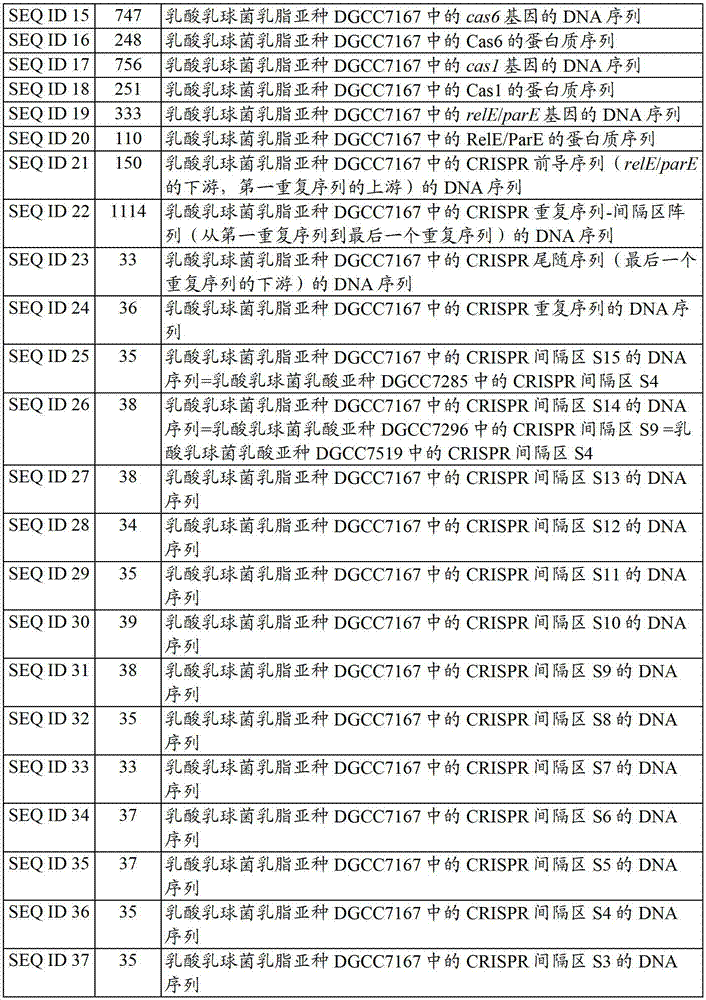


表3table 3
无质粒的接合受体(1403-S4和LM2301)及其各自的含有Plasmid-free conjugated receptors (1403-S4 and LM2301) and their respective CRISPR/Cas质粒pDCD537KLM的转接合子的噬菌体抗性表型。Phage-resistant phenotype of transconjugates of the CRISPR/Cas plasmid pDCD537KLM.
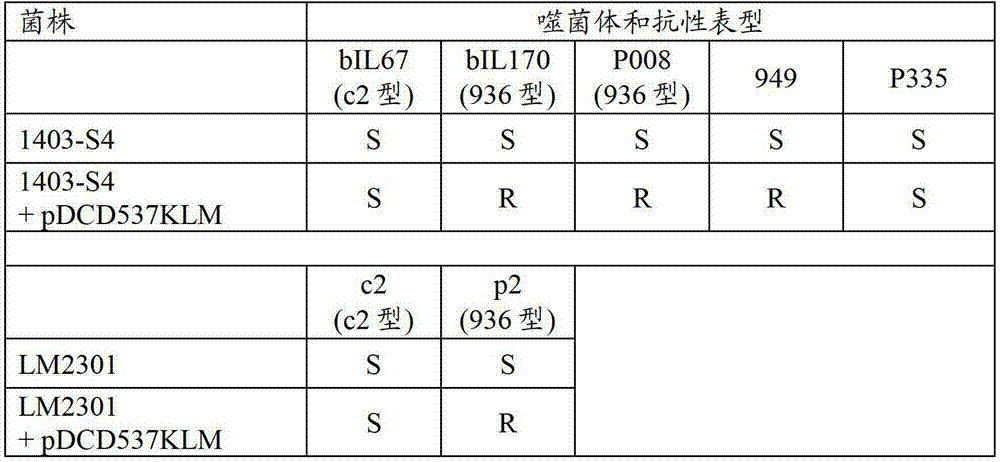
S=敏感S = Sensitive
R=抗性R=Resistance
表4Table 4
含有CRISPR/Cas的质粒pDCD537KLM中的间隔区序列的BLAST搜 索命中结果。 BLAST search hits for the spacer sequence in the CRISPR/Cas-containing plasmid pDCD537KLM .
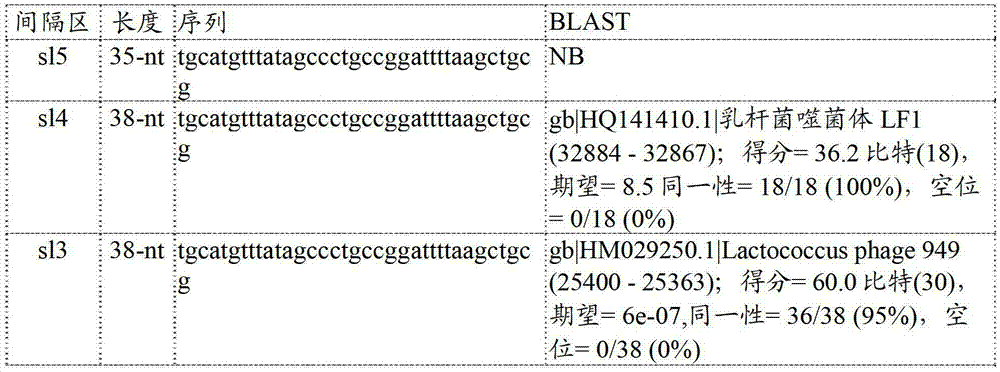


表5table 5
含CRISPR/Cas的质粒pDCD537KLM中的CRISPR相关蛋白的 BLAST搜索命中结果。 BLAST search hits for CRISPR-associated proteins in the CRISPR/Cas-containing plasmid pDCD537KLM .

表6Table 6
携带质粒的宿主菌株的噬菌体抗性表型比较Phage resistance phenotype comparison of plasmid-carrying host strains

S=敏感S = Sensitive
R=抗性R=Resistance
*ISS1插入间隔区s9中置换间隔区s10–s15,相对于预期的CRISPR阵列转录方向。*ISS1 inserts into spacer S9 displacing spacers S10–S15, relative to the expected orientation of CRISPR array transcription.
表7Table 7
与乳球菌噬菌体4268具有同一性的间隔区s3及野生型噬菌体Spacer s3 with identity to lactococcal phage 4268 and wild-type phage M5949、M5952和相应CRISPR逃避噬菌体(m=突变)的相应原间隔区的of M5949, M5952, and the corresponding protospacer of the corresponding CRISPR-evading phage (m=mutation) 22核苷酸核心序列的比较。突变的核苷酸以粗体和下划线表示。Comparison of 22 nucleotide core sequences. Mutated nucleotides are bolded and underlined.
表8Table 8
用于PCR和序列反应的引物序列的列表List of primer sequences used for PCR and sequence reactions

参考文献references
Altschul,S.F.和W.Gish,W.,1996,局部比对统计学(Local alignmentstatistics.),《酶学方法》(Methods Enzymol.),266:460-480。Altschul, S.F. and W. Gish, W., 1996, Local alignment statistics., Methods Enzymol., 266:460-480.
Altschul,S.F.,W.Gish,W.Miller,E.W.Myers和D.J.Lipman,1990,基本局部比对搜索工具(A basic local alignment search tool),《分子生物学杂志》(J.Mol.Biol.),215,403-410。Altschul, S.F., W.Gish, W.Miller, E.W.Myers, and D.J. Lipman, 1990, A basic local alignment search tool, J.Mol.Biol., 215, 403-410.
Anderson,D.G.和L.L.McKay,1984,与乳酸链球菌ML3中细胞聚集和高频接合转移相关的重组质粒的遗传学和物理学表征(genetic and physicalcharacterization of recombinant plasmids associated with cell aggregation andhigh-frequency conjugal transfer in Streptococcus lactis ML3),《细菌学杂志》(J.Bacteriol.),158:954-962。Anderson, D.G. and L.L.McKay, 1984, Genetic and physical characterization of recombinant plasmids associated with cell aggregation and high-frequency conjugal transfer in Streptococcus lactis ML3 Streptococcus lactis ML3), J. Bacteriol., 158:954-962.
Ausubel,F.M.,R.Brent,R.E.Kingston,D.D.Moore,J.G.Seidman,J.A.Smith和K.Struhl(编辑),1995,《分子生物学实验手册》(CurrentProtocols in Molecular Biology),纽约约翰·威利父子出版公司(John Wiley &Sons,New York).Ausubel, F.M., R. Brent, R.E. Kingston, D.D. Moore, J.G. Seidman, J.A. Smith and K. Struhl (eds.), 1995, Current Protocols in Molecular Biology, John Wiley & Sons, New York Company (John Wiley & Sons, New York).
Barrangou,R.,C.Fremaux,H.Deveau,M.Richards,P.Boyaval,S.Moineau,D.A.Romero和P.Horvath,2007,CRISPR提供原核生物中针对病毒的获得性抗性(CRISPR provides acquired resistance against viruses inprokaryotes),《科学》(Science),315:1709–1712.Barrangou, R., C. Fremaux, H. Deveau, M. Richards, P. Boyaval, S. Moineau, D.A. Romero and P. Horvath, 2007, CRISPR provides acquired resistance against viruses in prokaryotes (CRISPR provides acquired resistance against viruses inprokaryotes), Science, 315:1709–1712.
Bland,C.,T.L.Ramsey,F.Sabree,M.Lowe,K.Brown,N.C.Kyrpides和P.Hugenholtz,2007,CRISPR识别工具(CRT):一种用于自动检测成簇规则间隔回文重复序列的工具(CRISPR Recognition Tool(CRT):a tool forautomatic detection of clustered regularly interspaced palindromic repeats),《BMC生物信息学》(BMC Bioinformatics),8:209Bland, C., T.L. Ramsey, F. Sabree, M. Lowe, K. Brown, N.C. Kyrpides, and P. Hugenholtz, 2007, The CRISPR Recognition Tool (CRT): A Method for Automatic Detection of Clustered Regularly Interspaced Palindromic Repeats (CRISPR Recognition Tool (CRT): a tool for automatic detection of clustered regularly interspaced palindromic repeats), "BMC Bioinformatics", 8:209
Bolotin,A.,B.Quinquis,A.Sorokin和S.D.Ehrlich,2005,成簇规则性间隔短回文重复序列(CRISPRs)具有染色体外来源的间隔区(Clusteredregularly interspaced short palindrome repeats(CRISPRs)have spacers ofextrachromosomal origin),Microbiol.151:2551–2561.Bolotin, A., B. Quinquis, A. Sorokin and S.D. Ehrlich, 2005, Clustered regularly interspaced short palindrome repeats (CRISPRs) have spaces of extrachromosomal origin), Microbiol.151:2551–2561.
Breitbart,M.和F.Rowher,2005,这里有病毒,那里有病毒,到处都是同样的病毒?(Here a virus,there a virus,everywhere the same virus?),《微生物学进展》(Trends Microbiol.),13:278-284.Breitbart, M. and F. Rowher, 2005, A virus here, a virus there, the same virus everywhere? (Here a virus, there a virus, everywhere the same virus?), "Progress in Microbiology" (Trends Microbiol.), 13:278-284.
Brouns,S.J.J.,M.M.Jore,M.Lundgren,E.R.Westra,R.J.H.Slijkhuis,A.P.L.Snijders,M.J.Dickman,K.S.Makarova,E.V.Koonin,J.van der Oost,2008,小CRISPR RNA指导原核生物中的抗病毒防御(Small CRISPR RNAsguide antiviral defense in prokaryotes),《科学》(Science),321:960-964.Brouns, S.J.J., M.M.Jore, M.Lundgren, E.R.Westra, R.J.H.Slijkhuis, A.P.L.Snijders, M.J.Dickman, K.S.Makarova, E.V.Koonin, J.van der Oost, 2008, Small CRISPR RNA guides antiviral defense in prokaryotes (Small CRISPR RNAsguide antiviral defense in prokaryotes), Science, 321:960-964.
Brüssow,H.,2001,乳品细菌的噬菌体(Phages of dairy bacteria),《微生物学年度评论》(Ann.Rev.Microbiol.),55:283-303.Brüssow, H., 2001, Phages of dairy bacteria, Ann.Rev.Microbiol., 55:283-303.
Chibani-Chennoufi,S.,A.Bruttin,M.-L.Dillmann和H.Brüssow,2004,噬菌体-宿主相互作用:生态学观点(Phage-host interaction:an ecologicalperspective),《细菌学杂志》(J.Bacteriol.),186:3677–3686.Chibani-Chennoufi, S., A.Bruttin, M.-L.Dillmann and H.Brüssow, 2004, Phage-host interaction: an ecological perspective (Phage-host interaction: an ecological perspective), "Journal of Bacteriology" (J .Bacteriol.), 186:3677–3686.
Chopin,A.,M.-C.Chopin,A.Moillo-Batt和P.Langella,1984,乳酸链球菌中由两个质粒决定的限制和修饰系统(Two plasmid-determined restrictionand modification systems in Streptococcus lactis),《质粒》(Plasmid),11:260–263.Chopin, A., M.-C. Chopin, A. Moillo-Batt and P. Langella, 1984, Two plasmid-determined restriction and modification systems in Streptococcus lactis , Plasmid, 11:260–263.
Crutz-Le Coq,A.-M.,B.Cesselin,J.Commissaire.和J.Anba,2002,乳球菌噬菌体bIL170的序列分析:乳品中结构蛋白和HNH核酸内切酶探究(Sequence analysis of the lactoccal bacteriophage bIL170:insights into structuralproteins and HNH endonucleases in dairy),Crutz-Le Coq, A.-M., B. Cesselin, J. Commissaire. and J. Anba, 2002, Sequence analysis of the lactococcal bacteriophage bIL170: Sequence analysis of the structural proteins and HNH endonucleases in milk lactoccal bacteriophage bIL170: insights into structural proteins and HNH endonucleases in dairy),
《噬菌体微生物学》(Phages.Microbiol.148:985-1001。Phages Microbiology (Phages. Microbiol. 148:985-1001.
Clewell,D.B.,S.E.Flannagan,L.O.Zitzow,Y.A.Su,P.He,E.Senghas和K.E.Weaver,1991,接合转座子Tn916的性质(Properties of conjugativetransposon Tn916),第39-44页,引自G.M.Dunny,P.Patrick和L.L.Cleary(编辑),《链球菌、乳球菌和肠球菌的遗传学和分子生物学》(Geneticsand molecular biology of streptococci,lactococci,and enterococci.),美国微生物学会,美国华盛顿特区(American Society for Microbiology,Washington,D.C)。Clewell, D.B., S.E. Flannagan, L.O. Zitzow, Y.A.Su, P.He, E. Senghas and K.E. Weaver, 1991, Properties of conjugative transposon Tn916, pp. 39-44, cited by G.M. Dunny , P. Patrick and L.L. Cleary (eds.), Genetics and molecular biology of streptococci, lactococci, and enterococci. American Society for Microbiology, Washington, DC, USA ( American Society for Microbiology, Washington, D.C).
Deveau,H.,R.Barrangou,J.E.Garneau,J.Labonte,C.Fremaux,P.Boyaval,D.A.Romero,P.Horvath和S.Moineau,2008,噬菌体对嗜热链球菌中CRISPR编码的抗性的应答(Phage response to CRISPR-encodedresistance in Streptococcus thermophilus),《细菌学杂志》(J.Bacteriol.),190,1390–1400。Deveau, H., R. Barrangou, J.E. Garneau, J. Labonte, C. Fremaux, P. Boyaval, D.A. Romero, P. Horvath, and S. Moineau, 2008, phage resistance to CRISPR-encoded in Streptococcus thermophilus Response (Phage response to CRISPR-encoded resistance in Streptococcus thermophilus), J. Bacteriol., 190, 1390–1400.
Devereux,J.,P.Haeberli和O.Smithies,1984,针对VAX的完整一套序列分析程序(A comprehensive set of sequence analysis programs for theVAX),《核酸研究》(Nuc.Acids Res.),12:387-395。Devereux, J., P.Haeberli and O.Smithies, 1984, A comprehensive set of sequence analysis programs for the VAX, Nuc. Acids Res., 12: 387-395.
Dinsmore,P.K.,D.A.Romero和T.R.Klaenhammer,1993,乳酸乳球菌乳酸亚种中由IS946介导的插入诱变(Insertional mutagenesis inLactococcus lactis subsp.lactis mediated by IS946),《欧洲微生物学会联合会微生物学快报》(FEMS Microbiol.Lett.),107:43–48。Dinsmore, P.K., D.A. Romero and T.R. Klaenhammer, 1993, Insertional mutagenesis in Lactococcus lactis subsp. lactis mediated by IS946 (Insertional mutagenesis in Lactococcus lactis subsp. lactis mediated by IS946), European Federation of Microbiological Societies Microbiology Letters (FEMS Microbiol. Lett.), 107:43–48.
Dougherty,B.A.,C.Hill,J.F.Weidman,D.R.Richardson,J.C.Venter和R.P.Ross,1998,来自乳酸乳球菌DPC3147的60kb接合型产细菌素质粒pMRC01的序列和分析(Sequence and analysis of the60kb conjugative,bacteriocin-producing plasmid pMRC01from Lactococcus lactis DPC3147),《分子微生物学》(Mol.Microbiol.29:1029–1038。Dougherty, B.A., C.Hill, J.F.Weidman, D.R.Richardson, J.C.Venter and R.P.Ross, 1998, Sequence and analysis of the 60kb conjugative, bacteriocin- producing plasmamid pMRC01 from Lactococcus lactis DPC3147), Molecular Microbiology (Mol. Microbiol. 29:1029–1038.
Edgar,R.C.,2007,PILER-CR:CRISPR重复序列的快速和准确鉴定(PILER-CR:fast and accurate identification of CRISPR repeats),《BMC生物信息学》(BMC Bioinformatics),8:18。Edgar, R.C., 2007, PILER-CR: Fast and accurate identification of CRISPR repeats, BMC Bioinformatics, 8:18.
Feng,D.F.和R.F.Doolittle,1987,累进序列比对作为校正系统树的先决条件(Progressive sequence alignment as a prerequisite to correct phylogenetictrees),《分子进化杂志》(J.Mol.Evol.),25:351-360。Feng, D.F. and R.F.Doolittle, 1987, Progressive sequence alignment as a prerequisite to correct phylogenetic trees, J.Mol.Evol., 25:351- 360.
Garneau,J.E.,M.
Grissa,I.,G.Vergnaud和Pourcel,C.,2007,展示CRISPR和产生间隔区及重复序列词典的CRISPRdb数据库和工具(The CRISPRdb database andtools to display CRISPRs and to generate dictionaries of spacers and repeats),《BMC生物信息学》(BMC Bioinformatics),8,172。Grissa, I., G.Vergnaud and Pourcel, C., 2007, CRISPRdb database and tools to display CRISPRs and to generate dictionaries of spacers and repeats (The CRISPRdb database and tools to display CRISPRs and to generate dictionaries of spacers and repeats), " BMC Bioinformatics, 8, 172.
Groenen,P.M.,A.E.Bunschoten,D.van Soolingen和J.D.van Embden,1993,结核分枝杆菌的同向重复序列簇中的DNA多态性的性质:应用于通过新的分型方法进行菌株区分(Nature of DNA polymorphism in the directrepeat cluster of Mycobacterium tuberculosis;application for straindifferentiation by a novel typing method),《分子微生物学》(Mol.Microbiol.10,1057–1065。Groenen, P.M., A.E. Bunschoten, D. van Soolingen and J.D. van Embden, 1993, Nature of DNA polymorphisms in direct repeat clusters of Mycobacterium tuberculosis: application to strain differentiation by new typing methods (Nature of DNA polymorphism in the direct repeat cluster of Mycobacterium tuberculosis; application for strain differentiation by a novel typing method), Molecular Microbiology (Mol. Microbiol. 10, 1057–1065.
Haft,D.H.,J.Selengut,E.F.Mongodin和K.E.Nelson,K.E.,2005,原核生物基因组中存在一批45个CRISPR相关(Cas)蛋白家族和多个CRISPR/Cas亚型(A guild of45CRISPR-associated(Cas)protein families andmultiple CRISPR/Cas subtypes exist in prokaryotic genomes),《PloS计算生物学》(PloS Comput.Biol.),1:474-483。Haft, D.H., J. Selengut, E.F. Mongodin and K.E. Nelson, K.E., 2005, A guild of 45 CRISPR-associated (Cas) protein families and multiple CRISPR/Cas isoforms exist in prokaryotic genomes (A guild of 45 CRISPR-associated (Cas) ) protein families and multiple CRISPR/Cas subtypes exist in prokaryotic genomes), PloS Comput.Biol., 1:474-483.
Hale,W.G.和J.P.Margham,1991,《Harper Collins生物学词典》(TheHarper Collins Dictionary of Biology),纽约Harper Perennial出版社(HarperPerennial,New York)。Hale, W.G. and J.P. Margham, 1991, The Harper Collins Dictionary of Biology, Harper Perennial, New York.
Heap,H.A.和R.C.Lawrence,1976,干酪制造用起子菌株的选择(Theselection of starter strains for cheese making),《新西兰乳业科学技术杂志》(N.Z.J.Dariy Sci.Technol.),11:16-53。Heap, H.A. and R.C. Lawrence, 1976, The selection of starter strains for cheese making, N.Z.J.Dariy Sci.Technol., 11:16-53.
Heap H.A和R.C.Lawrence,1981,起子菌株对商业干酪工厂中的噬菌体感染水平的贡献(The contribution of starter strains to the level of phageinfection in a commercial cheese factory),《新西兰乳业科学技术杂志》(N.Z.J.Dairy Sci.Technol.),12:213-218。Heap H.A and R.C. Lawrence, 1981, The contribution of starter strains to the level of phage infection in a commercial cheese factory, N.Z.J.Dairy Sci . Technol.), 12:213-218.
Higgins,D.G.和P.M.Sharp,1989,在微计算机上快速和灵敏的多序列比对(Fast and sensitive multiple sequence alignments on a microcomputer),《计算机在生物科学中的应用》(Comput Appl Biosci.),5:151-153。Higgins, D.G. and P.M.Sharp, 1989, Fast and sensitive multiple sequence alignments on a microcomputer, Comput Appl Biosci., 5 :151-153.
Hoe,N.,K.Nakashima,D.Grigsby,X.Pan,S.J.Dou,S.Naidich,M.Garcia,E.Kahn,D.Bergmire-Sweat和J.M.Musser,1999,链球菌菌株M1血清型A群的快速分子遗传学亚分型(Rapid molecular genetic subtyping of serotype M1group A Streptococcus strains),《新发传染病杂志》(Emerg.Infect.Dis.),5,254–263。Hoe, N., K. Nakashima, D. Grigsby, X. Pan, S.J. Dou, S. Naidich, M. Garcia, E. Kahn, D. Bergmire-Sweat, and J.M. Musser, 1999, Streptococcus strain M1 serotype A Rapid molecular genetic subtyping of serotype M1group A Streptococcus strains, Emerg. Infect. Dis., 5, 254–263.
Horvath,P.和R.Barrangou,2010,CRISPR/Cas,细菌和古细菌的免疫系统(CRISPR/Cas,the immune system of bacteria and archaea),《科学》(Science),327:167-170。Horvath, P. and R. Barrangou, 2010, CRISPR/Cas, the immune system of bacteria and archaea, Science, 327:167-170.
Horvath,P.,A.-C.
Horvath,P.,D.A.Romero,A.-C.
Ishino,Y.,H.Shinagawa,K.Makino,M.Amemura,A.Nakata,1987,负责大肠杆菌中碱性磷酸酶同工酶转化的iap基因的核苷酸序列,以及基因产物的鉴定(Nucleotide sequence of the iap gene,responsible for alkalinephosphatase isozyme conversion in Escherichia coli,and identification of thegene product),《细菌学杂志》(J.Bacteriol.),169,5429–5433。Ishino, Y., H.Shinagawa, K.Makino, M.Amemura, A.Nakata, 1987, Nucleotide sequence of the iap gene responsible for alkaline phosphatase isozyme conversion in Escherichia coli, and identification of the gene product ( Nucleotide sequence of the iap gene, responsible for alkaline phosphatase isozyme conversion in Escherichia coli, and identification of the gene product), "Journal of Bacteriology" (J.Bacteriol.), 169, 5429–5433.
Jansen,R.,J.D.van Embden,W.Gaastra和L.M.Schouls,2002,原核生物之间重复序列新家族的鉴定(Identification of a novel family of sequencerepeats among prokaryotes),《组学》(OMICS),6:23–33。Jansen, R., J.D. van Embden, W. Gaastra and L.M. Schouls, 2002, Identification of a novel family of sequence repeats among prokaryotes, OMICS, 6: 23–33.
Jansen,R.,J.D.Embden,W.Gaastra和L.M.Schouls,2002,与原核生物中DNA重复序列有关的基因的鉴定(Identification of genes that are associatedwith DNA repeats in prokaryotes),《分子微生物学》(Mol.Microbiol.),43:1565-1575。Jansen, R., J.D.Embden, W.Gaastra and L.M.Schouls, 2002, Identification of genes that are associated with DNA repeats in prokaryotes (Identification of genes that are associated with DNA repeats in prokaryotes), "Molecular Microbiology" (Mol. Microbiol.), 43:1565-1575.
Karginov,F.V.和G.J.Hannon,2010,CRISPR系统:细菌和古细菌中由小RNA指导的防御(The CRISPR system:small RNA-guided defense inbacteria and Archaea),《分子细胞》(Molec.Cell),37:7-19。Karginov, F.V. and G.J. Hannon, 2010, CRISPR system: small RNA-guided defense in bacteria and Archaea (The CRISPR system: small RNA-guided defense inbacteria and Archaea), "Molec. Cell", 37: 7-19.
Karlin,S.和S F Altschul,1993,分子序列中多个高评分区段的应用和统计(Applications and statistics for multiple high-scoring segments in molecularsequences),《美国科学院院刊》(Proc.Nat.Acad.Sci.),90:5873-5877。Karlin, S. and S F Altschul, 1993, Applications and statistics for multiple high-scoring segments in molecular sequences, Proc. Nat. Acad .Sci.), 90:5873-5877.
Klaenhammer,T.R.,1984,噬菌体与乳酸链球菌的相互作用(Interaction of bacteriophages with lactic streptococci.),载于《应用微生物学进展》(Advances in Applied Microbiology),A.I.Laskin编辑,第30卷,第1-29页,纽约学术出版社(Academic Press,New York)。Klaenhammer, T.R., 1984, Interaction of bacteriophages with lactic streptococci., in Advances in Applied Microbiology, edited by A.I. Laskin, Vol. 30, No. 1- 29 pp., Academic Press, New York.
Krieger,M.,1990,基因转移和表达实验手册(Gene transfer andexpression,a laboratory manual),纽约Stockton出版社。Krieger, M., 1990, Gene transfer and expression, a laboratory manual, New York Stockton Press.
Lawrence,R.C.,H.A.Heap,G.Limsowtin和A.W.Jarvis,1978,切达干酪起子:目前有关噬菌体特征和菌株选择的知识和实践(Cheddar cheesestarters:current knowledge and practices of phage characteristics and strainselection),《乳品科学杂志》(J.Dairy Sci.),61:1181-1191。Lawrence, R.C., H.A. Heap, G. Limsowtin, and A.W. Jarvis, 1978, Cheddar cheese starters: current knowledge and practices of phage characteristics and strain selection, Dairy Science Journal (J. Dairy Sci.), 61:1181-1191.
Lawrence,R.C.,T.D.Thomas和B E.Terzaghi,1976,干酪起子(Cheesestarters),《乳品科学研究》(J.Dairy Res.),43:141-193。Lawrence, R.C., T.D. Thomas and B E. Terzaghi, 1976, Cheesestarters, J. Dairy Res., 43:141-193.
Limsowtin,G.K.Y.,H.A.Heap和R.C.Lawrence,1978,乳酸链球菌的菌株的异质性(Heterogeneity among strains of lactic streptococci),《新西兰乳业科学技术杂志》(N.Z.J.Dairy Sci.Technol.),13:1-8。Limsowtin, G.K.Y., H.A. Heap and R.C. Lawrence, 1978, Heterogeneity among strains of lactic streptococci, N.Z.J. Dairy Sci.Technol., 13:1- 8.
Limsowtin,G.K.Y.和B.E.Terzaghi,1976,噬菌体抗性突变体:它们的选择和在干酪工厂中的应用(Phage resistant mutants:their selection and usein cheese factories),《新西兰乳业科学技术杂志》(N.Z.J.Dairy Sci.Technol.),11:251-256。Limsowtin, G.K.Y. and B.E. Terzaghi, 1976, Phage resistant mutants: their selection and use in cheese factories, N.Z.J.Dairy Sci. Technol.), 11:251-256.
Lukashin A.和M.Borodovsky,1988,用于原核生物的GeneMark.hmm(版本2.8),GeneMark.hmm:新的基因发现方案(GeneMark.hmm forProkaryotes(Version2.8),GeneMark.hmm:new solutions for gene finding),《核酸研究》(Nuc.Acid Res.),26:1107-1115。Lukashin A. and M. Borodovsky, 1988, GeneMark.hmm for Prokaryotes (Version 2.8), GeneMark.hmm: New Gene Discovery Solutions (GeneMark.hmm for Prokaryotes (Version 2.8), GeneMark.hmm: new solutions for gene finding), Nuc. Acid Res., 26:1107-1115.
Maguin,E.,H.Prévost,S.D.Ehrlich和A.Gruss,1996,乳球菌和其他革兰氏阳性细菌中的有效插入诱变(Efficient insertional mutagenesis inlactococci and other Gram-positive bacteria.),《细菌学杂志》(J.Bacteriol.),178:931-935。Maguin, E., H. Prévost, S.D. Ehrlich and A. Gruss, 1996, Efficient insertional mutagenesis inlactococci and other Gram-positive bacteria., Bacteriology J. Bacteriol., 178:931-935.
Makarova,K.S.,Grishin NV,Shabalina SA,Wolf YI,Koonin EV,2006,原核生物中推定的基于RNA干扰的免疫系统:预测的酶机构、与真核生物RNAi的功能类似性和假设的作用机制的计算分析(A putative RNA-interference-based immune system in prokaryotes:computational analysis of thepredicted enzymatic machinery,functional analogies with eukaryotic RNAi,andhypothetical mechanisms of action),Biol.Direct,1,7。Makarova, K.S., Grishin NV, Shabalina SA, Wolf YI, Koonin EV, 2006, Putative RNA interference-based immune system in prokaryotes: prediction of enzymatic machinery, functional similarity to eukaryotic RNAi, and hypothesized mechanism of action Computational analysis (A putative RNA-interference-based immune system in prokaryotes: computational analysis of the predicted enzymatic machinery, functional analogies with eukaryotic RNAi, and hypothetical mechanisms of action), Biol.Direct, 1,7.
Makarova,K.S.,,D.H.Haft,R.Barrangou,S.J.J.Brouns,E.Charpentier,P.Horvath,S.Moineau,F.J.M.Mojica,Y.I.Wolf,A.F.Yakunin,J.van der Oost和E.V.Koonin,2011,CRISPR–Cas系统的进化和分类(Evolution andclassification of the CRISPR–Cas systems),《自然评论:微生物学》(Nat.Rev.Microbiol.9:467-477Makarova, K.S.,, D.H. Haft, R. Barrangou, S.J.J. Brouns, E. Charpentier, P. Horvath, S. Moineau, F.J.M. Mojica, Y.I. Wolf, A.F. Yakunin, J. van der Oost and E.V. Koonin, 2011, CRISPR–Cas Evolution and classification of the CRISPR–Cas systems, Nature Reviews: Microbiology (Nat.Rev.Microbiol.9:467-477
Marraffini,L.A.和E.J.Sontheimer,2008,CRISPR干扰限制葡萄球菌中通过靶向DNA进行的水平基因转移(CRISPR interference limits horizontalgene transfer in staphylococci by targeting DNA),《科学》(Science),322:1843-1845。Marraffini, L.A. and E.J. Sontheimer, 2008, CRISPR interference limits horizontal gene transfer in staphylococci by targeting DNA, Science, 322:1843-1845.
Marraffini,L.A.和E.J.Sontheimer,2010,CRISPR RNA指导的免疫中自我与非自我辨别(Self versus non-self discrimination during CRISPR RNA-directed immunity),《自然》(Nature),463:568-571。Marraffini, L.A. and E.J. Sontheimer, 2010, Self versus non-self discrimination during CRISPR RNA-directed immunity, Nature, 463:568-571.
Masepohl,B.,K.Gorlitz和H.Bohme,1996,丝状蓝细菌Anabaena sp.PCC7120中的长串联重复单位(LTRR)序列(Long tandemly repeated repetitive(LTRR)sequences in the filamentous cyanobacterium Anabaena sp.PCC7120),《生物化学与生物物理学学报》(Biochim.Biophys.Acta),1307,26–30。Masepohl, B., K.Gorlitz and H.Bohme, 1996, Long tandemly repeated repetitive (LTRR) sequences in the filamentous cyanobacterium Anabaena sp.PCC7120 (Long tandemly repeated repetitive (LTRR) sequences in the filamentous cyanobacterium Anabaena sp.PCC7120 ), Biochim.Biophys.Acta, 1307, 26–30.
McKay,L.L.,K.A.Baldwin和P.M.Walsh,1980,N群链球菌中的遗传信息的接合转移(Conjugal transfer of genetic information in group Nstreptococci.),Appl.Environ.Microbiol.40:84-91。McKay, L.L., K.A. Baldwin and P.M. Walsh, 1980, Conjugal transfer of genetic information in group Nstreptococci., Appl. Environ. Microbiol. 40:84-91.
Mojica,F.J.,C.
Mojica,F.J.M.,C.
Mojica,F.J.,C.Ferrer,G.Juez和F.Rodriguez-Valera,1995,短串联重复序列的长段存在于古细菌地中海富盐菌(Archaea Haloferax mediterranei)和沃氏富盐菌(Haloferax volcanii)的最大复制子中并可能参与复制子分割(Long stretches of short tandem repeats are present in the largest replicons of theArchaea Haloferax mediterranei and Haloferax volcanii and could be involved inreplicon partitioning),《分子微生物学》(Mol.Microbiol.17,85–93。Mojica, F.J., C.Ferrer, G.Juez and F.Rodriguez-Valera, 1995, Long segments of short tandem repeats present in the archaea Haloferax mediterranei and Haloferax volcanii Long stretches of short tandem repeats are present in the largest replicas of the Archaea Haloferax mediterranei and Haloferax volcanii and could be involved inreplicon partitioning, Molecular Microbiology (Mol. Microbiol.17 ,85–93.
Mollet,B.,S.Iida,J.Shepherd和W.Arber,1981,新原核生物可移动遗传元件IS26的核苷酸序列(Nucleotide sequence of IS26,a new prokaryoticmobile genetic element),《核酸研究》(Nuc.Acids Res.11:6319-6330。Mollet, B., S.Iida, J.Shepherd and W.Arber, 1981, Nucleotide sequence of IS26, a new prokaryotic mobile genetic element, Nucleic Acid Research ( Nuc. Acids Res. 11:6319-6330.
Nakata,A.,Amemura,M.和Makino,K.,1989,大肠杆菌K-12染色体中具有重复序列的不寻常核苷酸排列(Unusual nucleotide arrangement withrepeated sequences in the Escherichia coli K-12chromosome),《细菌学杂志》(J.Bacteriol.),171,3553–3556。Nakata, A., Amemura, M. and Makino, K., 1989, Unusual nucleotide arrangement with repeated sequences in the Escherichia coli K-12 chromosome in the Escherichia coli K-12 chromosome, " J. Bacteriol., 171, 3553–3556.
Needleman S.B.和C.D.Wunsch,1970,适用于搜索两种蛋白质的氨基酸序列的相似性的通用方法(A general method applicable to the search forsimilarities in the amino acid sequence of two proteins),《分子生物学杂志》(J.Mol.Biol.),48:443-453。Needleman S.B. and C.D.Wunsch, 1970, A general method applicable to the search for similarities in the amino acid sequence of two proteins (A general method applicable to the search for similarities in the amino acid sequence of two proteins), "Journal of Molecular Biology" (J Mol. Biol.), 48:443-453.
Pearce,L.E.,1978,宿主控制的修饰对乳酸链球菌噬菌体的复制速率的作用(The effect of host-controlled modification on the replication rate of alactic streptococcal bacteriophage),《新西兰乳业科学技术杂志》(N.Z.J.Dairy Sci.Technol.),13:166-171。Pearce, L.E., 1978, The effect of host-controlled modification on the replication rate of alactic streptococcal bacteriophage, N.Z.J.Dairy Sci. Technol.), 13:166-171.
Pearson,W.R.和D.J.Lipman,1988,用于生物序列比较的改进工具(Improved tools for biological sequence comparison),《美国科学院院刊》(Proc.Natl.Acad.Sci USA),85:2444-2448。Pearson, W.R. and D.J. Lipman, 1988, Improved tools for biological sequence comparison, Proc. Natl. Acad. Sci USA, 85:2444-2448.
Pourcel,C.,G.Salvignol和G.Vergnaud,2005,鼠疫耶尔森氏菌(Yersinia pestis)中的CRISPR元件通过优先摄取噬菌体DNA获得新的重复序列,为进化研究提供额外的工具(CRISPR elements in Yersinia pestisacquire new repeats by preferential uptake of bacteriophage DNA,and provideadditional tools for evolutionary studies),Microbiol.151:653-663。Pourcel, C., G. Salvignol and G. Vergnaud, 2005, CRISPR elements in Yersinia pestis acquire novel repeats through preferential uptake of phage DNA, providing additional tools for evolution studies (CRISPR elements in Yersinia pestis acquire new repeats by preferential uptake of bacteriophage DNA, and provide additional tools for evolutionary studies), Microbiol. 151:653-663.
Rajagopal,S.N.和W.E.Sandine,1990,脱脂乳中嗜热链球菌和保加利亚乳杆菌的关联性生长和蛋白水解(Associative growth and proteolysis ofStreptococcus thermophilus and Lactobacillus bulgaricus in skim milk),《乳品科学杂志》(J.Dairy Sci.),73:894-899。Rajagopal, S.N. and W.E. Sandine, 1990, Associative growth and proteolysis of Streptococcus thermophilus and Lactobacillus bulgaricus in skim milk, J. Dairy Sci.), 73:894-899.
Russell,W.M.和T.R.Klaenhammer,2001,通过同源重组向嗜酸乳杆菌和格氏乳杆菌中定向整合的有效系统(Efficient system for directedintegration into the Lactobacillus acidophilus and Lactobacillus gasserichromosomes via homologous recombination),Appl.Envir.Microbiol.67:4361-4364。Russell, W.M. and T.R.Klaenhammer, 2001, Efficient system for directed integration into the Lactobacillus acidophilus and Lactobacillus gasserichromosomes via homologous recombination via homologous recombination, Appl. Envir. Microbiol. 67:4361-4364.
Sambrook,J.,E.Fritsch和T.Maniatis,1989,《分子克隆实验指南》(Molecular Cloning:A Laboratory Manual),第2版,冷泉港实验室,纽约。Sambrook, J., E. Fritsch and T. Maniatis, 1989, Molecular Cloning: A Laboratory Manual, 2nd ed., Cold Spring Harbor Laboratory, New York.
Sanders,M.E.和T.R.Klaenhammer,1980,N群链球菌中的限制和修饰:热对修饰的溶解性噬菌体发育的影响(Restriction and modification inGroup N streptococci:effect of heat on development of modified lyticbacteriophage),Appl.Environ.Microbiol.40:500-506Sanders, M.E. and T.R. Klaenhammer, 1980, Restriction and modification in Group N streptococci: effect of heat on development of modified lytic bacteriophage, Appl. Environ .Microbiol.40:500-506
Shah,S.A.,Hansen,N.R.,Garrett,R.A.,2009,Crenarchaealacidothermophiles的病毒和质粒中CRISPR间隔区匹配的分布以及对其抑制机制的意义(Distributions of CRISPR spacer matches in viruses and plasmids ofcrenarchaeal acidothermophiles and implications for their inhibitorymechanism),《生物化学学会会报》(Biochem.Soc.Trans.),37:23-28。Shah, S.A., Hansen, N.R., Garrett, R.A., 2009, Distributions of CRISPR spacer matches in viruses and plasmids of crenarchaeal acidothermophiles and plasmids and their implications for the mechanism of inhibition ), "Proceedings of the Biochemical Society" (Biochem.Soc.Trans.), 37:23-28.
Singleton,P.和D.Sainsbury,2006,《微生物学和分子生物学词典》(Dictionary of Microbiology and Molecular Biology),第3版,纽约约翰·威利父子出版公司(John Wiley and Sons,New York)。Singleton, P. and D. Sainsbury, 2006, Dictionary of Microbiology and Molecular Biology, 3rd ed., John Wiley and Sons, New York .
Smith,T.F.和M.S.Waterman,1981,生物序列的比较(Comparison ofbiosequences),《应用数学进展》(Adv.Appl.Math.2:482-489。Smith, T.F. and M.S. Waterman, 1981, Comparison of biosequences, Advances in Applied Mathematics (Adv.Appl.Math.2:482-489.
Sonnhammer,E.L.L.和R.Durbin,1995,适于基因组DNA和蛋白质序列分析的具有动态阈值控制的点-矩阵程序(A dot-matrix program withdynamic threshold control suited for genomic DNA and protein sequenceanalysis),《基因》(Gene),167:GC1-10。Sonnhammer, E.L.L. and R.Durbin, 1995, A dot-matrix program with dynamic threshold control suited for genomic DNA and protein sequence analysis (A dot-matrix program with dynamic threshold control suited for genomic DNA and protein sequence analysis), "Gene" ( Gene), 167:GC1-10.
Stanisich,V.A.,P.M.Bennet和M.H.Richmond,1977,出现在绿脓杆菌(Pseudomonas aeruginosa)中的非接合质粒上的编码对汞离子的抗性的易位单元的表征(Characterization of a translocation unit encoding resistance tomercuric ions that occurs on a nonconjugative plasmid in Pseudomonasaeruginosa),《细菌学杂志》(J.Bacteriol.),129:1227-1233Stanisich, V.A., P.M.Bennet and M.H.Richmond, 1977, Characterization of a translocation unit encoding resistance tomercuric occurring on a non-conjugative plasmid in Pseudomonas aeruginosa ions that occur on a nonconjugative plasmamid in Pseudomonasaeruginosa), "Journal of Bacteriology" (J.Bacteriol.), 129:1227-1233
Stern,A.L.,Keren,O.Wurtzel,G.Amitai和R.Sorek,2010,借助CRISPR的自我靶向:基因调节还是自免疫?(Self-targeting by CRISPR:gene regulation or autoimmunity?),《遗传学进展》(Trends Genet.),26:335–340。Stern, A.L., Keren, O. Wurtzel, G. Amitai, and R.Sorek, 2010, Self-targeting via CRISPR: gene regulation or autoimmunity? (Self-targeting by CRISPR: gene regulation or autoimmunity?), Trends Genet., 26:335–340.
Sturino,J.M.和T.R.Klaenhammer,2004,乳酸细菌的噬菌体防御系统和策略(Bacteriophage defense systems and strategies for lactic acid bacteria),《应用微生物学进展》(Adv.appl.Microbiol.),56:331-378。Sturino, J.M. and T.R. Klaenhammer, 2004, Bacteriophage defense systems and strategies for lactic acid bacteria, Adv.appl.Microbiol., 56:331-378.
Sturino,J.M.和T.R.Klaenhammer,2006,生物加工中的工程化噬菌体防御系统(Engineered bacteriophage-defence systems in bioprocessing),《自然评论:微生物学》(Nat.Rev.Microbiol.),4:395-404。Sturino, J.M. and T.R. Klaenhammer, 2006, Engineered bacteriophage-defence systems in bioprocessing, Nat. Rev. Microbiol., 4:395-404.
Thunell,R.K.,W.E.Sandine和F.W.Bodyfelt,1981,用于切达干酪制造的噬菌体不敏感性多菌株起子方案(Phage-insensitive,multiple-strain starterapproach to cheddar cheese making),《乳品科学杂志》(J.Dairy Sci.),64:2270-2277。Thunell, R.K., W.E. Sandine and F.W. Bodyfelt, 1981, Phage-insensitive, multiple-strain starter approach to cheddar cheese making, Journal of Dairy Science (J. Dairy Sci.), 64:2270-2277.
Trotter,M.,O.McAuliffe,M.Callanan,R.Edwards’G.F.Fitzgerald,A.Coffey和R.P.Ross,2006,对乳酸乳球菌的专性溶解性噬菌体4268的基因组的分析提供了对其适应性质的认识(Genome analysis of the obligately lyticbacteriophage4268of Lactococcus lactis provides insight into its adaptablenature),《基因》(gene),366:189–199。Trotter, M., O. McAuliffe, M. Callanan, R. Edwards' G.F. Fitzgerald, A. Coffey and R.P. Ross, 2006, Analysis of the genome of the obligate lytic phage 4268 of Lactococcus lactis provides insights into its adaptive properties (Genome analysis of the obligately lyticbacteriophage4268of Lactococcus lactis provides insight into its adaptable nature), "Gene", 366:189–199.
van Embden,J.D.A,T.van Gorkom,K.Kremer,R.Jansen,B.A.M.vander Zeijst和L.M.Schouls,2000,结核分枝杆菌复合菌的同向重复基因座的遗传变异和进化起源(Genetic variation and evolutionary origin of the directrepeat locus of Mycobacterium tuberculosis complex bacteria),《细菌学杂志》(J.Bacteriol.),182:2393-2401。van Embden, J.D.A, T. van Gorkom, K. Kremer, R. Jansen, B.A.M. van der Zeijst, and L.M. Schouls, 2000, Genetic variation and evolutionary origin of direct repeat loci in Mycobacterium tuberculosis complex origin of the direct repeat locus of Mycobacterium tuberculosis complex bacteria), "Journal of Bacteriology" (J.Bacteriol.), 182:2393-2401.
Whitehead,H.R.和G.J E.Hunter,1947,干酪制造中的噬菌体:来自农场设备的感染(Bacteriophage in cheese manufacture:contamination fromfarm equipment),《乳品科学研究》(J.Dairy Res.),15:112-119。Whitehead, H.R. and G.J E. Hunter, 1947, Bacteriophage in cheese manufacture: contamination from farm equipment, J. Dairy Res., 15:112- 119.


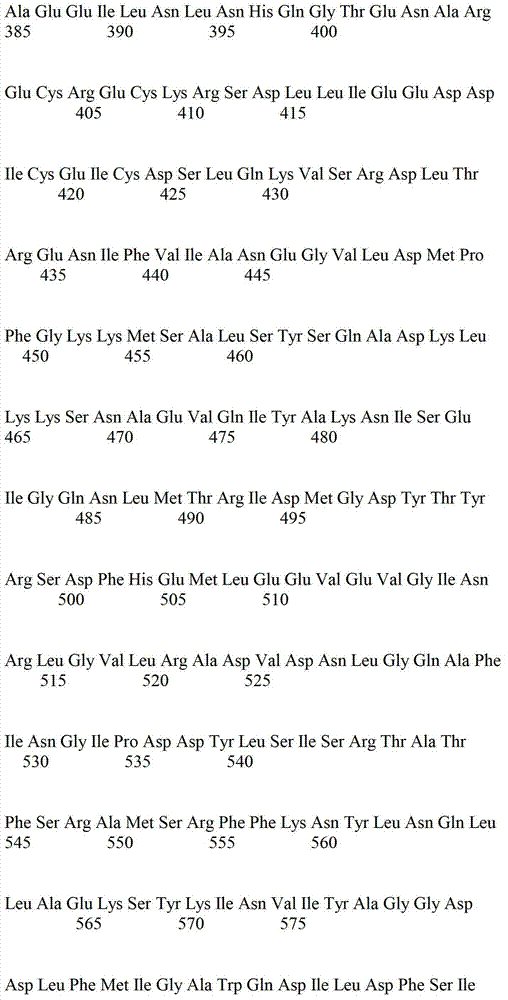


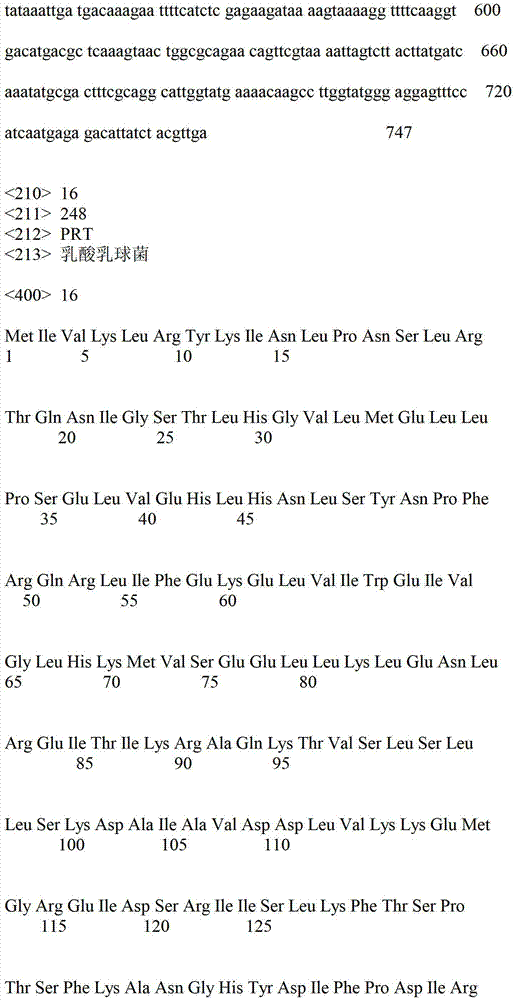

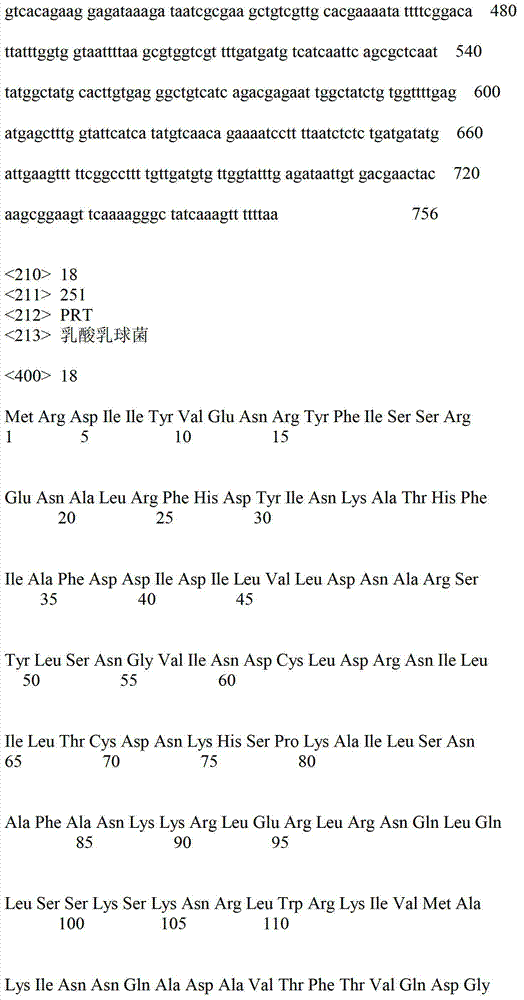


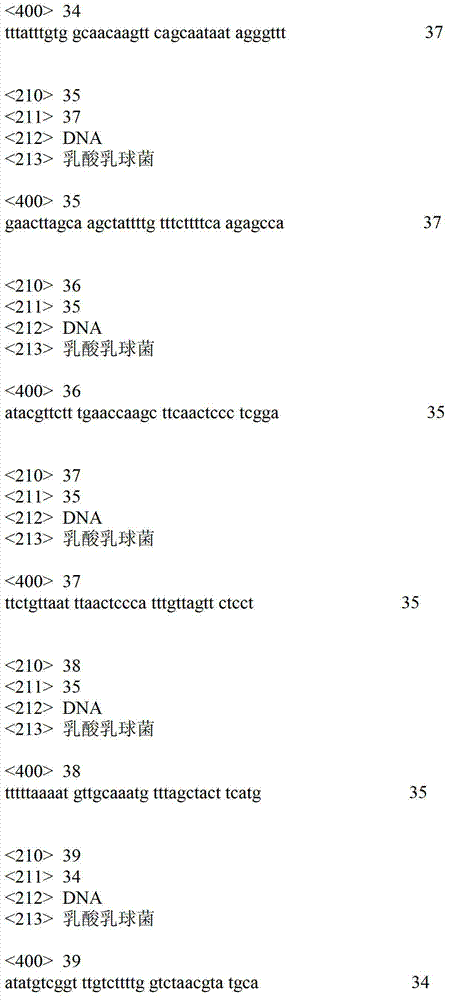


Claims (52)
Applications Claiming Priority (5)
| Application Number | Priority Date | Filing Date | Title |
|---|---|---|---|
| US39497610P | 2010-10-20 | 2010-10-20 | |
| US61/394,976 | 2010-10-20 | ||
| US40531710P | 2010-10-21 | 2010-10-21 | |
| US61/405,317 | 2010-10-21 | ||
| PCT/US2011/057102 WO2012054726A1 (en) | 2010-10-20 | 2011-10-20 | Lactococcus crispr-cas sequences |
Publications (1)
| Publication Number | Publication Date |
|---|---|
| CN103261213A true CN103261213A (en) | 2013-08-21 |
Family
ID=44863288
Family Applications (1)
| Application Number | Title | Priority Date | Filing Date |
|---|---|---|---|
| CN2011800487182A Pending CN103261213A (en) | 2010-10-20 | 2011-10-20 | Lactococcus crispr-as sequences |
Country Status (11)
| Country | Link |
|---|---|
| US (1) | US9951341B2 (en) |
| EP (1) | EP2630156B1 (en) |
| CN (1) | CN103261213A (en) |
| AU (1) | AU2011316980A1 (en) |
| BR (1) | BR112013009583A2 (en) |
| CA (1) | CA2814810A1 (en) |
| DK (1) | DK2630156T3 (en) |
| EA (1) | EA201390586A1 (en) |
| MX (1) | MX2013004338A (en) |
| NZ (1) | NZ607870A (en) |
| WO (1) | WO2012054726A1 (en) |
Cited By (7)
| Publication number | Priority date | Publication date | Assignee | Title |
|---|---|---|---|---|
| RU2737537C2 (en) * | 2015-06-18 | 2020-12-01 | Те Брод Инститьют Инк. | Novel enzymes and crispr systems |
| US11053482B2 (en) | 2015-04-16 | 2021-07-06 | Wageningen Universiteit | Vector systems for nuclease-mediated genome editing |
| US11091798B2 (en) | 2015-06-18 | 2021-08-17 | The Broad Institute, Inc. | CRISPR enzymes and systems |
| US11286478B2 (en) | 2016-04-19 | 2022-03-29 | The Broad Institute, Inc. | Cpf1 complexes with reduced indel activity |
| RU2792654C2 (en) * | 2015-06-18 | 2023-03-22 | Те Брод Инститьют Инк. | New enzymes and crispr systems |
| US12110490B2 (en) | 2015-12-18 | 2024-10-08 | The Broad Institute, Inc. | CRISPR enzymes and systems |
| US12410416B2 (en) | 2016-04-19 | 2025-09-09 | The Broad Institute, Inc. | CRISPR enzymes and systems with modified pam specificity |
Families Citing this family (80)
| Publication number | Priority date | Publication date | Assignee | Title |
|---|---|---|---|---|
| DK2341149T3 (en) | 2005-08-26 | 2017-02-27 | Dupont Nutrition Biosci Aps | Use of CRISPR-associated genes (Cas) |
| ES2590925T3 (en) | 2006-05-19 | 2016-11-24 | Dupont Nutrition Biosciences Aps | Marked microorganisms and marking methods |
| US10323236B2 (en) | 2011-07-22 | 2019-06-18 | President And Fellows Of Harvard College | Evaluation and improvement of nuclease cleavage specificity |
| GB201122458D0 (en) | 2011-12-30 | 2012-02-08 | Univ Wageningen | Modified cascade ribonucleoproteins and uses thereof |
| PT3241902T (en) | 2012-05-25 | 2018-05-28 | Univ California | METHODS AND COMPOSITIONS FOR MODIFICATION OF TARGETED TARGET DNA BY RNA AND FOR MODULATION DIRECTED BY TRANSCRIPTION RNA |
| CN108715602A (en) | 2012-12-06 | 2018-10-30 | 西格马-奥尔德里奇有限责任公司 | Genomic modification based on CRISPR and regulation and control |
| NZ712727A (en) | 2013-03-14 | 2017-05-26 | Caribou Biosciences Inc | Compositions and methods of nucleic acid-targeting nucleic acids |
| US9234213B2 (en) | 2013-03-15 | 2016-01-12 | System Biosciences, Llc | Compositions and methods directed to CRISPR/Cas genomic engineering systems |
| US10760064B2 (en) | 2013-03-15 | 2020-09-01 | The General Hospital Corporation | RNA-guided targeting of genetic and epigenomic regulatory proteins to specific genomic loci |
| EP3744842A1 (en) | 2013-03-15 | 2020-12-02 | The General Hospital Corporation | Using truncated guide rnas (tru-grnas) to increase specificity for rna-guided genome editing |
| CN115261411A (en) | 2013-04-04 | 2022-11-01 | 哈佛学院校长同事会 | Therapeutic uses of genome editing with CRISPR/Cas systems |
| US9902973B2 (en) | 2013-04-11 | 2018-02-27 | Caribou Biosciences, Inc. | Methods of modifying a target nucleic acid with an argonaute |
| US10011850B2 (en) | 2013-06-21 | 2018-07-03 | The General Hospital Corporation | Using RNA-guided FokI Nucleases (RFNs) to increase specificity for RNA-Guided Genome Editing |
| WO2015006498A2 (en) | 2013-07-09 | 2015-01-15 | President And Fellows Of Harvard College | Therapeutic uses of genome editing with crispr/cas systems |
| US9163284B2 (en) | 2013-08-09 | 2015-10-20 | President And Fellows Of Harvard College | Methods for identifying a target site of a Cas9 nuclease |
| US9359599B2 (en) | 2013-08-22 | 2016-06-07 | President And Fellows Of Harvard College | Engineered transcription activator-like effector (TALE) domains and uses thereof |
| US9322037B2 (en) | 2013-09-06 | 2016-04-26 | President And Fellows Of Harvard College | Cas9-FokI fusion proteins and uses thereof |
| US9526784B2 (en) | 2013-09-06 | 2016-12-27 | President And Fellows Of Harvard College | Delivery system for functional nucleases |
| US9340799B2 (en) | 2013-09-06 | 2016-05-17 | President And Fellows Of Harvard College | MRNA-sensing switchable gRNAs |
| EP3842528A1 (en) | 2013-09-18 | 2021-06-30 | Kymab Limited | Methods, cells and organisms |
| US10584358B2 (en) | 2013-10-30 | 2020-03-10 | North Carolina State University | Compositions and methods related to a type-II CRISPR-Cas system in Lactobacillus buchneri |
| WO2015069682A2 (en) * | 2013-11-05 | 2015-05-14 | President And Fellows Of Harvard College | Precise microbiota engineering at the cellular level |
| WO2015070083A1 (en) | 2013-11-07 | 2015-05-14 | Editas Medicine,Inc. | CRISPR-RELATED METHODS AND COMPOSITIONS WITH GOVERNING gRNAS |
| US20150165054A1 (en) | 2013-12-12 | 2015-06-18 | President And Fellows Of Harvard College | Methods for correcting caspase-9 point mutations |
| US10787654B2 (en) | 2014-01-24 | 2020-09-29 | North Carolina State University | Methods and compositions for sequence guiding Cas9 targeting |
| US20170173086A1 (en) | 2014-03-25 | 2017-06-22 | Ginkgo Bioworks, Inc. | Methods and Genetic Systems for Cell Engineering |
| US11439712B2 (en) | 2014-04-08 | 2022-09-13 | North Carolina State University | Methods and compositions for RNA-directed repression of transcription using CRISPR-associated genes |
| US10077453B2 (en) | 2014-07-30 | 2018-09-18 | President And Fellows Of Harvard College | CAS9 proteins including ligand-dependent inteins |
| EP3186375A4 (en) | 2014-08-28 | 2019-03-13 | North Carolina State University | NEW CAS9 PROTEINS AND GUIDING ELEMENTS FOR DNA TARGETING AND THE GENOME EDITION |
| US12180263B2 (en) | 2014-11-06 | 2024-12-31 | President And Fellows Of Harvard College | Cells lacking B2M surface expression and methods for allogeneic administration of such cells |
| EP4545082A3 (en) | 2015-05-06 | 2025-07-02 | SNIPR Technologies Limited | Altering microbial populations & modifying microbiota |
| CA2988854A1 (en) | 2015-05-08 | 2016-11-17 | President And Fellows Of Harvard College | Universal donor stem cells and related methods |
| KR20220139447A (en) | 2015-05-29 | 2022-10-14 | 노쓰 캐롤라이나 스테이트 유니버시티 | Methods for screening bacteria, archaea, algae, and yeast using crispr nucleic acids |
| US11155823B2 (en) | 2015-06-15 | 2021-10-26 | North Carolina State University | Methods and compositions for efficient delivery of nucleic acids and RNA-based antimicrobials |
| US9926546B2 (en) | 2015-08-28 | 2018-03-27 | The General Hospital Corporation | Engineered CRISPR-Cas9 nucleases |
| HK1257676A1 (en) | 2015-08-28 | 2019-10-25 | The General Hospital Corporation | Engineered crispr-cas9 nucleases |
| US9512446B1 (en) | 2015-08-28 | 2016-12-06 | The General Hospital Corporation | Engineered CRISPR-Cas9 nucleases |
| US11286480B2 (en) | 2015-09-28 | 2022-03-29 | North Carolina State University | Methods and compositions for sequence specific antimicrobials |
| US10167457B2 (en) | 2015-10-23 | 2019-01-01 | President And Fellows Of Harvard College | Nucleobase editors and uses thereof |
| WO2017112620A1 (en) | 2015-12-22 | 2017-06-29 | North Carolina State University | Methods and compositions for delivery of crispr based antimicrobials |
| KR20180136435A (en) | 2016-01-27 | 2018-12-24 | 온코루스, 인크. | Tumor-like viral vectors and uses thereof |
| EP3219799A1 (en) | 2016-03-17 | 2017-09-20 | IMBA-Institut für Molekulare Biotechnologie GmbH | Conditional crispr sgrna expression |
| KR20250103795A (en) | 2016-08-03 | 2025-07-07 | 프레지던트 앤드 펠로우즈 오브 하바드 칼리지 | Adenosine nucleobase editors and uses thereof |
| US11078481B1 (en) | 2016-08-03 | 2021-08-03 | KSQ Therapeutics, Inc. | Methods for screening for cancer targets |
| EP3497214B1 (en) | 2016-08-09 | 2023-06-28 | President and Fellows of Harvard College | Programmable cas9-recombinase fusion proteins and uses thereof |
| WO2018039438A1 (en) | 2016-08-24 | 2018-03-01 | President And Fellows Of Harvard College | Incorporation of unnatural amino acids into proteins using base editing |
| US11078483B1 (en) | 2016-09-02 | 2021-08-03 | KSQ Therapeutics, Inc. | Methods for measuring and improving CRISPR reagent function |
| AU2017342543B2 (en) | 2016-10-14 | 2024-06-27 | President And Fellows Of Harvard College | AAV delivery of nucleobase editors |
| US10745677B2 (en) | 2016-12-23 | 2020-08-18 | President And Fellows Of Harvard College | Editing of CCR5 receptor gene to protect against HIV infection |
| EP3592853A1 (en) | 2017-03-09 | 2020-01-15 | President and Fellows of Harvard College | Suppression of pain by gene editing |
| US12390514B2 (en) | 2017-03-09 | 2025-08-19 | President And Fellows Of Harvard College | Cancer vaccine |
| US11542496B2 (en) | 2017-03-10 | 2023-01-03 | President And Fellows Of Harvard College | Cytosine to guanine base editor |
| BR112019019655A2 (en) | 2017-03-23 | 2020-04-22 | Harvard College | nucleobase editors comprising nucleic acid programmable dna binding proteins |
| WO2018195545A2 (en) | 2017-04-21 | 2018-10-25 | The General Hospital Corporation | Variants of cpf1 (cas12a) with altered pam specificity |
| WO2018209320A1 (en) | 2017-05-12 | 2018-11-15 | President And Fellows Of Harvard College | Aptazyme-embedded guide rnas for use with crispr-cas9 in genome editing and transcriptional activation |
| CN110997728A (en) | 2017-05-25 | 2020-04-10 | 通用医疗公司 | Binary base editor (BBE) structure and type II-CAS9 zinc finger editing |
| WO2019023483A1 (en) | 2017-07-26 | 2019-01-31 | Oncorus, Inc. | Oncolytic viral vectors and uses thereof |
| US11732274B2 (en) | 2017-07-28 | 2023-08-22 | President And Fellows Of Harvard College | Methods and compositions for evolving base editors using phage-assisted continuous evolution (PACE) |
| US11319532B2 (en) | 2017-08-30 | 2022-05-03 | President And Fellows Of Harvard College | High efficiency base editors comprising Gam |
| AU2018352592C1 (en) | 2017-10-16 | 2025-09-25 | Beam Therapeutics, Inc. | Uses of adenosine base editors |
| US12406749B2 (en) | 2017-12-15 | 2025-09-02 | The Broad Institute, Inc. | Systems and methods for predicting repair outcomes in genetic engineering |
| US12157760B2 (en) | 2018-05-23 | 2024-12-03 | The Broad Institute, Inc. | Base editors and uses thereof |
| US12522807B2 (en) | 2018-07-09 | 2026-01-13 | The Broad Institute, Inc. | RNA programmable epigenetic RNA modifiers and uses thereof |
| US10711267B2 (en) | 2018-10-01 | 2020-07-14 | North Carolina State University | Recombinant type I CRISPR-Cas system |
| US12264313B2 (en) | 2018-10-01 | 2025-04-01 | North Carolina State University | Recombinant type I CRISPR-Cas system and uses thereof for genome modification and alteration of expression |
| WO2020072254A1 (en) | 2018-10-01 | 2020-04-09 | North Carolina State University | Recombinant type i crispr-cas system and uses thereof for killing target cells |
| WO2020072253A1 (en) | 2018-10-01 | 2020-04-09 | North Carolina State University | Recombinant type i crispr-cas system and uses thereof for screening for variant cells |
| WO2020092453A1 (en) | 2018-10-29 | 2020-05-07 | The Broad Institute, Inc. | Nucleobase editors comprising geocas9 and uses thereof |
| US12351837B2 (en) | 2019-01-23 | 2025-07-08 | The Broad Institute, Inc. | Supernegatively charged proteins and uses thereof |
| EP3921417A4 (en) | 2019-02-04 | 2022-11-09 | The General Hospital Corporation | ADENINE DNA BASE EDITOR VARIANTS WITH REDUCED OFF-TARGET RNA EDITING |
| CN114127285B (en) | 2019-03-19 | 2024-09-10 | 布罗德研究所股份有限公司 | Methods and compositions for editing nucleotide sequences |
| EP3956349A1 (en) | 2019-04-17 | 2022-02-23 | The Broad Institute, Inc. | Adenine base editors with reduced off-target effects |
| US12435330B2 (en) | 2019-10-10 | 2025-10-07 | The Broad Institute, Inc. | Methods and compositions for prime editing RNA |
| DE112021002672T5 (en) | 2020-05-08 | 2023-04-13 | President And Fellows Of Harvard College | METHODS AND COMPOSITIONS FOR EDIT BOTH STRANDS SIMULTANEOUSLY OF A DOUBLE STRANDED NUCLEOTIDE TARGET SEQUENCE |
| WO2022173531A1 (en) | 2021-02-10 | 2022-08-18 | Oncorus, Inc. | Compounds, compositions, and methods of using thereof |
| US20240360429A1 (en) * | 2021-08-12 | 2024-10-31 | International N&H Denmark Aps | Compositions and methods for controlling adaptive immunity in bacteria |
| US20230279442A1 (en) | 2021-12-15 | 2023-09-07 | Versitech Limited | Engineered cas9-nucleases and method of use thereof |
| CN115287244B (en) * | 2022-06-28 | 2023-07-25 | 北部湾大学 | Fish-derived Streptococcus agalactiae internalin gene LRR domain knockout mutant strain and its preparation method and application |
| GB202209518D0 (en) | 2022-06-29 | 2022-08-10 | Snipr Biome Aps | Treating & preventing E coli infections |
| WO2026006542A2 (en) | 2024-06-26 | 2026-01-02 | Yale University | Compositions and methods for crispr/cas9 based reactivation of human angelman syndrome |
Citations (3)
| Publication number | Priority date | Publication date | Assignee | Title |
|---|---|---|---|---|
| WO2006073445A2 (en) * | 2004-04-28 | 2006-07-13 | Danisco A/S | Detection and typing of bacterial strains |
| CN101688241A (en) * | 2007-03-02 | 2010-03-31 | 丹尼斯克有限公司 | Cultures with improved phage resistance |
| WO2010054154A2 (en) * | 2008-11-07 | 2010-05-14 | Danisco A/S | Bifidobacteria crispr sequences |
Family Cites Families (13)
| Publication number | Priority date | Publication date | Assignee | Title |
|---|---|---|---|---|
| US2225783A (en) | 1939-04-07 | 1940-12-24 | Lloyd B Jensen | Sausage treatment |
| US3024116A (en) | 1959-02-24 | 1962-03-06 | Libby Mcneill And Libby | Food processing |
| US3403032A (en) | 1967-10-04 | 1968-09-24 | Agriculture Usa | Pure culture fermentation process for pickled cucumbers |
| US3897307A (en) | 1974-10-23 | 1975-07-29 | Hansens Lab Inc | Stabilized dry cultures of lactic acid-producing bacteria |
| US3932674A (en) | 1974-11-29 | 1976-01-13 | The United States Of America | Controlled bulk vegetable fermentation |
| US4140800A (en) | 1977-06-13 | 1979-02-20 | Leo Kline | Freeze-dried natural sour dough starter |
| US4423079A (en) | 1980-07-14 | 1983-12-27 | Leo Kline | Growth promoting compositions for Lactobacillus sanfrancisco and method of preparation |
| US4621058A (en) | 1983-04-11 | 1986-11-04 | Mid-America Dairymen, Inc. | Method of preparing cheese starter media |
| NZ239639A (en) | 1990-09-05 | 1993-05-26 | Univ North Carolina State | Phage resistant fermentations using a bacterial culture of isogenic strains carrying different phage defense mechanisms |
| US5474796A (en) * | 1991-09-04 | 1995-12-12 | Protogene Laboratories, Inc. | Method and apparatus for conducting an array of chemical reactions on a support surface |
| US7727555B2 (en) | 2005-03-02 | 2010-06-01 | Boston Scientific Scimed, Inc. | Particles |
| DK2341149T3 (en) | 2005-08-26 | 2017-02-27 | Dupont Nutrition Biosci Aps | Use of CRISPR-associated genes (Cas) |
| ES2590925T3 (en) | 2006-05-19 | 2016-11-24 | Dupont Nutrition Biosciences Aps | Marked microorganisms and marking methods |
-
2011
- 2011-10-20 CN CN2011800487182A patent/CN103261213A/en active Pending
- 2011-10-20 MX MX2013004338A patent/MX2013004338A/en unknown
- 2011-10-20 US US13/880,391 patent/US9951341B2/en active Active
- 2011-10-20 EP EP11775892.0A patent/EP2630156B1/en active Active
- 2011-10-20 DK DK11775892.0T patent/DK2630156T3/en active
- 2011-10-20 NZ NZ607870A patent/NZ607870A/en not_active IP Right Cessation
- 2011-10-20 CA CA2814810A patent/CA2814810A1/en not_active Abandoned
- 2011-10-20 WO PCT/US2011/057102 patent/WO2012054726A1/en not_active Ceased
- 2011-10-20 AU AU2011316980A patent/AU2011316980A1/en not_active Abandoned
- 2011-10-20 BR BR112013009583A patent/BR112013009583A2/en not_active IP Right Cessation
- 2011-10-20 EA EA201390586A patent/EA201390586A1/en unknown
Patent Citations (3)
| Publication number | Priority date | Publication date | Assignee | Title |
|---|---|---|---|---|
| WO2006073445A2 (en) * | 2004-04-28 | 2006-07-13 | Danisco A/S | Detection and typing of bacterial strains |
| CN101688241A (en) * | 2007-03-02 | 2010-03-31 | 丹尼斯克有限公司 | Cultures with improved phage resistance |
| WO2010054154A2 (en) * | 2008-11-07 | 2010-05-14 | Danisco A/S | Bifidobacteria crispr sequences |
Non-Patent Citations (1)
| Title |
|---|
| DANISCO: "CHOOZITTM Alp D Lyo 100 DCU", 《PRODUCT DESCRIPTION》 * |
Cited By (19)
| Publication number | Priority date | Publication date | Assignee | Title |
|---|---|---|---|---|
| US11479761B2 (en) | 2015-04-16 | 2022-10-25 | Wageningen Universiteit | Nuclease-mediated genome editing |
| US11053482B2 (en) | 2015-04-16 | 2021-07-06 | Wageningen Universiteit | Vector systems for nuclease-mediated genome editing |
| US12534715B2 (en) | 2015-04-16 | 2026-01-27 | Wageningen Universiteit | Nucleic acids for nuclease-mediated genome editing |
| US11760985B2 (en) | 2015-04-16 | 2023-09-19 | Wageningen Universiteit | CRISPR-Cas complex |
| US11773432B2 (en) | 2015-06-18 | 2023-10-03 | The Broad Institute Inc. | CRISPR enzymes and systems |
| US12371737B2 (en) | 2015-06-18 | 2025-07-29 | The Broad Institute, Inc. | CRISPR enzymes and systems |
| US11634755B2 (en) | 2015-06-18 | 2023-04-25 | The Broad Institute, Inc. | Crispr enzymes and systems |
| US11091798B2 (en) | 2015-06-18 | 2021-08-17 | The Broad Institute, Inc. | CRISPR enzymes and systems |
| RU2737537C2 (en) * | 2015-06-18 | 2020-12-01 | Те Брод Инститьют Инк. | Novel enzymes and crispr systems |
| US11781172B2 (en) | 2015-06-18 | 2023-10-10 | The Broad Institute, Inc. | Crispr enzymes and systems |
| US12091709B2 (en) | 2015-06-18 | 2024-09-17 | The Broad Institute, Inc. | Crispr enzymes and systems |
| RU2792654C2 (en) * | 2015-06-18 | 2023-03-22 | Те Брод Инститьют Инк. | New enzymes and crispr systems |
| RU2832308C2 (en) * | 2015-06-18 | 2024-12-23 | Те Брод Инститьют Инк. | Crispr new enzymes and systems |
| US12264359B2 (en) | 2015-06-18 | 2025-04-01 | The Broad Institute, Inc. | CRISPR enzymes and systems |
| US12410468B2 (en) | 2015-06-18 | 2025-09-09 | The Broad Institute, Inc. | CRISPR enzymes and systems |
| US12110490B2 (en) | 2015-12-18 | 2024-10-08 | The Broad Institute, Inc. | CRISPR enzymes and systems |
| US12410416B2 (en) | 2016-04-19 | 2025-09-09 | The Broad Institute, Inc. | CRISPR enzymes and systems with modified pam specificity |
| US12344838B2 (en) | 2016-04-19 | 2025-07-01 | The Broad Institute, Inc. | CPF1 complexes with reduced indel activity |
| US11286478B2 (en) | 2016-04-19 | 2022-03-29 | The Broad Institute, Inc. | Cpf1 complexes with reduced indel activity |
Also Published As
| Publication number | Publication date |
|---|---|
| AU2011316980A1 (en) | 2013-04-18 |
| EP2630156B1 (en) | 2018-08-22 |
| BR112013009583A2 (en) | 2017-05-30 |
| WO2012054726A1 (en) | 2012-04-26 |
| US9951341B2 (en) | 2018-04-24 |
| EP2630156A1 (en) | 2013-08-28 |
| US20130288251A1 (en) | 2013-10-31 |
| CA2814810A1 (en) | 2012-04-26 |
| NZ607870A (en) | 2015-09-25 |
| EA201390586A1 (en) | 2014-11-28 |
| DK2630156T3 (en) | 2018-12-17 |
| MX2013004338A (en) | 2013-05-20 |
Similar Documents
| Publication | Publication Date | Title |
|---|---|---|
| US9951341B2 (en) | Lactococcus CRISPR-Cas sequences | |
| EP2018441B1 (en) | Tagged microorganisms and methods of tagging | |
| DK2860267T3 (en) | CULTURES WITH IMPROVED PROFESS RESISTANCE | |
| US20250221424A1 (en) | Lactic acid bacterium with a reduction of sensitivity to cos-type bacteriophages | |
| Ravin et al. | Effective plasmid pX3 transduction in Lactobacillus delbrueckii by bacteriophage LL-H | |
| EP4384536A1 (en) | Compositions and methods for controlling adaptive immunity in bacteria | |
| Ishlimova et al. | Genetic diversity of bacteriophages highly specific for Streptococcus thermophilus strain LBB. A | |
| AU2013234432B2 (en) | Cultures with improved phage resistance | |
| O’Sullivan | 10 Genetics of Dairy Starter Cultures | |
| Shareck | Isolation and characterization of a cryptic plasmid from Lactobacillus plantarum | |
| Şanlıbaba | Bacteriophage-host interactions in lactococci | |
| HK1142930B (en) | Cultures with improved phage resistance |
Legal Events
| Date | Code | Title | Description |
|---|---|---|---|
| C06 | Publication | ||
| PB01 | Publication | ||
| C10 | Entry into substantive examination | ||
| SE01 | Entry into force of request for substantive examination | ||
| C12 | Rejection of a patent application after its publication | ||
| RJ01 | Rejection of invention patent application after publication |
Application publication date: 20130821 |