JP2004529636A - CD19-specific redirected immune cells - Google Patents
CD19-specific redirected immune cells Download PDFInfo
- Publication number
- JP2004529636A JP2004529636A JP2002576287A JP2002576287A JP2004529636A JP 2004529636 A JP2004529636 A JP 2004529636A JP 2002576287 A JP2002576287 A JP 2002576287A JP 2002576287 A JP2002576287 A JP 2002576287A JP 2004529636 A JP2004529636 A JP 2004529636A
- Authority
- JP
- Japan
- Prior art keywords
- cell
- cells
- specific
- receptor
- chimeric
- Prior art date
- Legal status (The legal status is an assumption and is not a legal conclusion. Google has not performed a legal analysis and makes no representation as to the accuracy of the status listed.)
- Granted
Links
Images


Classifications
-
- A—HUMAN NECESSITIES
- A61—MEDICAL OR VETERINARY SCIENCE; HYGIENE
- A61K—PREPARATIONS FOR MEDICAL, DENTAL OR TOILETRY PURPOSES
- A61K35/00—Medicinal preparations containing materials or reaction products thereof with undetermined constitution
- A61K35/12—Materials from mammals; Compositions comprising non-specified tissues or cells; Compositions comprising non-embryonic stem cells; Genetically modified cells
- A61K35/28—Bone marrow; Haematopoietic stem cells; Mesenchymal stem cells of any origin, e.g. adipose-derived stem cells
-
- A—HUMAN NECESSITIES
- A61—MEDICAL OR VETERINARY SCIENCE; HYGIENE
- A61K—PREPARATIONS FOR MEDICAL, DENTAL OR TOILETRY PURPOSES
- A61K38/00—Medicinal preparations containing peptides
- A61K38/16—Peptides having more than 20 amino acids; Gastrins; Somatostatins; Melanotropins; Derivatives thereof
- A61K38/17—Peptides having more than 20 amino acids; Gastrins; Somatostatins; Melanotropins; Derivatives thereof from animals; from humans
- A61K38/19—Cytokines; Lymphokines; Interferons
- A61K38/20—Interleukins [IL]
- A61K38/2013—IL-2
-
- A—HUMAN NECESSITIES
- A61—MEDICAL OR VETERINARY SCIENCE; HYGIENE
- A61K—PREPARATIONS FOR MEDICAL, DENTAL OR TOILETRY PURPOSES
- A61K40/00—Cellular immunotherapy
- A61K40/10—Cellular immunotherapy characterised by the cell type used
- A61K40/11—T-cells, e.g. tumour infiltrating lymphocytes [TIL] or regulatory T [Treg] cells; Lymphokine-activated killer [LAK] cells
-
- A—HUMAN NECESSITIES
- A61—MEDICAL OR VETERINARY SCIENCE; HYGIENE
- A61K—PREPARATIONS FOR MEDICAL, DENTAL OR TOILETRY PURPOSES
- A61K40/00—Cellular immunotherapy
- A61K40/20—Cellular immunotherapy characterised by the effect or the function of the cells
- A61K40/22—Immunosuppressive or immunotolerising
-
- A—HUMAN NECESSITIES
- A61—MEDICAL OR VETERINARY SCIENCE; HYGIENE
- A61K—PREPARATIONS FOR MEDICAL, DENTAL OR TOILETRY PURPOSES
- A61K40/00—Cellular immunotherapy
- A61K40/30—Cellular immunotherapy characterised by the recombinant expression of specific molecules in the cells of the immune system
- A61K40/31—Chimeric antigen receptors [CAR]
-
- A—HUMAN NECESSITIES
- A61—MEDICAL OR VETERINARY SCIENCE; HYGIENE
- A61K—PREPARATIONS FOR MEDICAL, DENTAL OR TOILETRY PURPOSES
- A61K40/00—Cellular immunotherapy
- A61K40/40—Cellular immunotherapy characterised by antigens that are targeted or presented by cells of the immune system
- A61K40/41—Vertebrate antigens
- A61K40/418—Antigens related to induction of tolerance to non-self
-
- A—HUMAN NECESSITIES
- A61—MEDICAL OR VETERINARY SCIENCE; HYGIENE
- A61K—PREPARATIONS FOR MEDICAL, DENTAL OR TOILETRY PURPOSES
- A61K40/00—Cellular immunotherapy
- A61K40/40—Cellular immunotherapy characterised by antigens that are targeted or presented by cells of the immune system
- A61K40/41—Vertebrate antigens
- A61K40/42—Cancer antigens
- A61K40/4202—Receptors, cell surface antigens or cell surface determinants
- A61K40/421—Immunoglobulin superfamily
- A61K40/4211—CD19 or B4
-
- A—HUMAN NECESSITIES
- A61—MEDICAL OR VETERINARY SCIENCE; HYGIENE
- A61P—SPECIFIC THERAPEUTIC ACTIVITY OF CHEMICAL COMPOUNDS OR MEDICINAL PREPARATIONS
- A61P35/00—Antineoplastic agents
-
- A—HUMAN NECESSITIES
- A61—MEDICAL OR VETERINARY SCIENCE; HYGIENE
- A61P—SPECIFIC THERAPEUTIC ACTIVITY OF CHEMICAL COMPOUNDS OR MEDICINAL PREPARATIONS
- A61P35/00—Antineoplastic agents
- A61P35/02—Antineoplastic agents specific for leukemia
-
- A—HUMAN NECESSITIES
- A61—MEDICAL OR VETERINARY SCIENCE; HYGIENE
- A61P—SPECIFIC THERAPEUTIC ACTIVITY OF CHEMICAL COMPOUNDS OR MEDICINAL PREPARATIONS
- A61P37/00—Drugs for immunological or allergic disorders
- A61P37/02—Immunomodulators
-
- A—HUMAN NECESSITIES
- A61—MEDICAL OR VETERINARY SCIENCE; HYGIENE
- A61P—SPECIFIC THERAPEUTIC ACTIVITY OF CHEMICAL COMPOUNDS OR MEDICINAL PREPARATIONS
- A61P37/00—Drugs for immunological or allergic disorders
- A61P37/02—Immunomodulators
- A61P37/06—Immunosuppressants, e.g. drugs for graft rejection
-
- C—CHEMISTRY; METALLURGY
- C07—ORGANIC CHEMISTRY
- C07K—PEPTIDES
- C07K14/00—Peptides having more than 20 amino acids; Gastrins; Somatostatins; Melanotropins; Derivatives thereof
- C07K14/435—Peptides having more than 20 amino acids; Gastrins; Somatostatins; Melanotropins; Derivatives thereof from animals; from humans
- C07K14/705—Receptors; Cell surface antigens; Cell surface determinants
- C07K14/70503—Immunoglobulin superfamily
-
- C—CHEMISTRY; METALLURGY
- C07—ORGANIC CHEMISTRY
- C07K—PEPTIDES
- C07K16/00—Immunoglobulins [IGs], e.g. monoclonal or polyclonal antibodies
- C07K16/18—Immunoglobulins [IGs], e.g. monoclonal or polyclonal antibodies against material from animals or humans
- C07K16/28—Immunoglobulins [IGs], e.g. monoclonal or polyclonal antibodies against material from animals or humans against receptors, cell surface antigens or cell surface determinants
- C07K16/2803—Immunoglobulins [IGs], e.g. monoclonal or polyclonal antibodies against material from animals or humans against receptors, cell surface antigens or cell surface determinants against the immunoglobulin superfamily
-
- C—CHEMISTRY; METALLURGY
- C12—BIOCHEMISTRY; BEER; SPIRITS; WINE; VINEGAR; MICROBIOLOGY; ENZYMOLOGY; MUTATION OR GENETIC ENGINEERING
- C12N—MICROORGANISMS OR ENZYMES; COMPOSITIONS THEREOF; PROPAGATING, PRESERVING, OR MAINTAINING MICROORGANISMS; MUTATION OR GENETIC ENGINEERING; CULTURE MEDIA
- C12N5/00—Undifferentiated human, animal or plant cells, e.g. cell lines; Tissues; Cultivation or maintenance thereof; Culture media therefor
- C12N5/06—Animal cells or tissues; Human cells or tissues
- C12N5/0602—Vertebrate cells
- C12N5/0634—Cells from the blood or the immune system
- C12N5/0636—T lymphocytes
-
- A—HUMAN NECESSITIES
- A61—MEDICAL OR VETERINARY SCIENCE; HYGIENE
- A61K—PREPARATIONS FOR MEDICAL, DENTAL OR TOILETRY PURPOSES
- A61K39/00—Medicinal preparations containing antigens or antibodies
- A61K2039/57—Medicinal preparations containing antigens or antibodies characterised by the type of response, e.g. Th1, Th2
-
- A—HUMAN NECESSITIES
- A61—MEDICAL OR VETERINARY SCIENCE; HYGIENE
- A61K—PREPARATIONS FOR MEDICAL, DENTAL OR TOILETRY PURPOSES
- A61K2239/00—Indexing codes associated with cellular immunotherapy of group A61K40/00
- A61K2239/31—Indexing codes associated with cellular immunotherapy of group A61K40/00 characterized by the route of administration
-
- A—HUMAN NECESSITIES
- A61—MEDICAL OR VETERINARY SCIENCE; HYGIENE
- A61K—PREPARATIONS FOR MEDICAL, DENTAL OR TOILETRY PURPOSES
- A61K2239/00—Indexing codes associated with cellular immunotherapy of group A61K40/00
- A61K2239/38—Indexing codes associated with cellular immunotherapy of group A61K40/00 characterised by the dose, timing or administration schedule
-
- A—HUMAN NECESSITIES
- A61—MEDICAL OR VETERINARY SCIENCE; HYGIENE
- A61K—PREPARATIONS FOR MEDICAL, DENTAL OR TOILETRY PURPOSES
- A61K2239/00—Indexing codes associated with cellular immunotherapy of group A61K40/00
- A61K2239/46—Indexing codes associated with cellular immunotherapy of group A61K40/00 characterised by the cancer treated
- A61K2239/48—Blood cells, e.g. leukemia or lymphoma
-
- C—CHEMISTRY; METALLURGY
- C07—ORGANIC CHEMISTRY
- C07K—PEPTIDES
- C07K2317/00—Immunoglobulins specific features
- C07K2317/50—Immunoglobulins specific features characterized by immunoglobulin fragments
- C07K2317/52—Constant or Fc region; Isotype
-
- C—CHEMISTRY; METALLURGY
- C07—ORGANIC CHEMISTRY
- C07K—PEPTIDES
- C07K2317/00—Immunoglobulins specific features
- C07K2317/60—Immunoglobulins specific features characterized by non-natural combinations of immunoglobulin fragments
- C07K2317/62—Immunoglobulins specific features characterized by non-natural combinations of immunoglobulin fragments comprising only variable region components
- C07K2317/622—Single chain antibody (scFv)
-
- C—CHEMISTRY; METALLURGY
- C07—ORGANIC CHEMISTRY
- C07K—PEPTIDES
- C07K2319/00—Fusion polypeptide
-
- C—CHEMISTRY; METALLURGY
- C12—BIOCHEMISTRY; BEER; SPIRITS; WINE; VINEGAR; MICROBIOLOGY; ENZYMOLOGY; MUTATION OR GENETIC ENGINEERING
- C12N—MICROORGANISMS OR ENZYMES; COMPOSITIONS THEREOF; PROPAGATING, PRESERVING, OR MAINTAINING MICROORGANISMS; MUTATION OR GENETIC ENGINEERING; CULTURE MEDIA
- C12N2501/00—Active agents used in cell culture processes, e.g. differentation
- C12N2501/20—Cytokines; Chemokines
- C12N2501/23—Interleukins [IL]
-
- C—CHEMISTRY; METALLURGY
- C12—BIOCHEMISTRY; BEER; SPIRITS; WINE; VINEGAR; MICROBIOLOGY; ENZYMOLOGY; MUTATION OR GENETIC ENGINEERING
- C12N—MICROORGANISMS OR ENZYMES; COMPOSITIONS THEREOF; PROPAGATING, PRESERVING, OR MAINTAINING MICROORGANISMS; MUTATION OR GENETIC ENGINEERING; CULTURE MEDIA
- C12N2501/00—Active agents used in cell culture processes, e.g. differentation
- C12N2501/50—Cell markers; Cell surface determinants
- C12N2501/515—CD3, T-cell receptor complex
Landscapes
- Health & Medical Sciences (AREA)
- Life Sciences & Earth Sciences (AREA)
- Immunology (AREA)
- Chemical & Material Sciences (AREA)
- General Health & Medical Sciences (AREA)
- Public Health (AREA)
- Veterinary Medicine (AREA)
- Animal Behavior & Ethology (AREA)
- Organic Chemistry (AREA)
- Engineering & Computer Science (AREA)
- Epidemiology (AREA)
- Medicinal Chemistry (AREA)
- Zoology (AREA)
- Bioinformatics & Cheminformatics (AREA)
- Genetics & Genomics (AREA)
- Cell Biology (AREA)
- Biomedical Technology (AREA)
- Pharmacology & Pharmacy (AREA)
- Proteomics, Peptides & Aminoacids (AREA)
- Biochemistry (AREA)
- Biotechnology (AREA)
- Hematology (AREA)
- Gastroenterology & Hepatology (AREA)
- General Chemical & Material Sciences (AREA)
- Nuclear Medicine, Radiotherapy & Molecular Imaging (AREA)
- Molecular Biology (AREA)
- Biophysics (AREA)
- Wood Science & Technology (AREA)
- Developmental Biology & Embryology (AREA)
- Chemical Kinetics & Catalysis (AREA)
- Virology (AREA)
- Microbiology (AREA)
- Toxicology (AREA)
- General Engineering & Computer Science (AREA)
- Oncology (AREA)
- Transplantation (AREA)
- Medicines Containing Material From Animals Or Micro-Organisms (AREA)
- Micro-Organisms Or Cultivation Processes Thereof (AREA)
- Peptides Or Proteins (AREA)
- Medicines Containing Antibodies Or Antigens For Use As Internal Diagnostic Agents (AREA)
Abstract
CD19に対して特異的な受容体を含む細胞外ドメイン、細胞内シグナリングドメイン、および膜貫通ドメインをもつ細胞表面タンパク質を発現する、遺伝子工学的に作製されたCD19特異的再指向免疫細胞。CD19+悪性疾患の細胞免疫療法および有害なB細胞機能を阻害するための、本発明細胞の使用。1態様において、免疫細胞はT細胞であり、細胞表面タンパク質は一本鎖scFvFc:ζ受容体であり、ここでscFvはCD19に対する一本鎖モノクローナル抗体のVHおよびVL鎖を表わし、FcはIgG1の定常部の少なくとも一部を表わし、ζはヒトCD3のゼータ鎖の細胞内シグナリングドメインを表わす。細胞外ドメインscFvFcおよび細胞内ドメインζは、膜貫通ドメイン、たとえばCD4の膜貫通ドメインにより連結されている。この受容体をコードする裸のDNAを用いるエレクトロポレーションにより、キメラT細胞受容体を発現する再指向T細胞を作製する方法。Genetically engineered CD19-specific redirected immune cells that express cell surface proteins with extracellular, intracellular signaling, and transmembrane domains that contain receptors specific for CD19. Use of the cells of the invention for inhibiting cellular immunotherapy and adverse B cell function of CD19 + malignancies. In one embodiment, the immune cell is a T cell and the cell surface protein is a single-chain scFvFc: ζ receptor, where scFv represents the VH and VL chains of a single-chain monoclonal antibody to CD19, and Fc represents at least a portion of the constant region of IgG 1, the ζ represents the intracellular signaling domain of the zeta chain of human CD3. The extracellular domain scFvFc and the intracellular domain ζ are linked by a transmembrane domain, for example, a transmembrane domain of CD4. A method for producing redirected T cells expressing a chimeric T cell receptor by electroporation using naked DNA encoding this receptor.
Description
【発明の開示】
【0001】
関連出願の引照
[0001] 本出願は、米国仮特許出願No.60/246,117(2000年11月7日)に基づく優先権を主張し、その開示内容を本明細書に援用する。
【0002】
発明の背景
[0002] 本発明は、遺伝子工学的に作製された再指向(redirected)免疫細胞の分野、ならびにB細胞性悪性疾患、B細胞性リンパ増殖症候群およびB細胞仲介自己免疫疾患の細胞免疫療法の分野に関する。本発明の背景を説明するために、または実施に関する詳細をさらに示すために本明細書で用いる刊行物その他の資料を本明細書に援用する。
【0003】
[0003] 米国で実施されている造血幹細胞(HSC)移植処置全体のほぼ半数は、血液性悪性疾患の処置のためのものである[1]。HSC移植成功に対する初期の障害の大部分は、療法関連の毒性を緩和するための、かつ日和見感染および移植片対宿主疾患(GVHD)を抑制するための処置様式が不適切なことによるものであった[2−5]。この10年間にわたって支持療法措置が改善されるのに伴って、この患者集団の予後改善に対する主な障害として移植後疾患再発が出現した[6−10]。最強の治療方式を免疫学的な移植片対腫瘍反応性と組み合わせても微小残留疾患を根絶できないのが、同種(allogeneic)移植における処置失敗のメカニズムである;一方、自家移植の場合、移植幹細胞に腫瘍が混在することも移植後再発をもたらす可能性がある[11]。移植後早期に微小残留疾患をターゲティングするのが、骨髄除去治療方式で達成された腫瘍細胞減少を増強し、かつトランスフェクションした悪性細胞を自家移植幹細胞によりin vivoパージするための1方策である。幹細胞レスキュー直後に微小残留疾患をターゲティングする治療様式の有用性は、毒性スペクトルが限定されていることと、その治療様式の抗腫瘍作用機序(1以上)に対して残留腫瘍細胞が感受性であることの両方に依存する。持続性微小残留疾患の排除の成功は、現在の骨髄除去治療方式を用いた血液性悪性疾患に対する移植の予後に大きな影響をもつだけでなく、これらの治療方式の程度を抑え、それに付随する毒性を低下させるきっかけにもなる。
【0004】
[0004] 化学療法で処置したbcr−abl陽性急性リンパ芽球性白血病(ALL)患者の予後は不良であり、適切なドナーが得られる場合、同種移植が多くの患者にとって治癒のための選択となっている。たとえばCity of Hopeでは、bcr−abl陽性ALL患者76人をHLA一致ドナーからの同種骨髄移植(BMT)により治療した。これらの患者のうち26人は第1緩解期にあり、35人は第1緩解期後に移植を受けた。第1緩解期に移植を受けた患者については、無疾患生存2年間の確率は68%、再発率は10%であった;これに対し第1緩解期後に移植を受けた患者については、無疾患生存率および再発率はそれぞれ36%および38%であった[12]。血液および骨髄のbcr−abl転写体についての移植後ポリメラーゼ連鎖反応(PCR)スクリーニングは、その後の顕性再発の発現について高リスクをもつ移植レシピエントを早期に同定するための分子スクリーニング手段としての評価が現在行われている[13,14]。BMT後に検出可能なp190転写体が検出された患者は、PCR陰性患者より6.7倍高い顕性再発発現率を示した。これらの患者における陽性信号から形態学的再発までの中間時間は80〜90日であった。移植後再発のきわめて早い時期に患者を同定すると、腫瘍負荷が低く、サルベージ療法を最も実施しやすいと思われるときに療法介入を行う好機が得られる。
【0005】
[0005] 免疫学の分野における最近の進歩は、免疫系調節の分子的基礎の多くを明らかにし、腫瘍免疫療法を含めた免疫系操作療法のための新たなきっかけを提供した。同種移植後の残留腫瘍細胞を免疫仲介により根絶できる可能性を支持する証拠は、同系(syngeneic)移植体とT細胞枯渇していない一致同胞(sibling)移植体との再発率の違いを比較することにより推察される。同系ドナーから骨髄移植を受けた慢性期の慢性骨髄性白血病(CML−CP)、第1完全緩解期(1stCR)の急性骨髄性白血病、および1stCRの急性リンパ芽球性白血病の患者は、3年目のアクチュアリアル(保険計理)再発確率がそれぞれ45%、49%および41%であった;これに対し、同一疾患についてT細胞枯渇していないHLA同一同胞からの移植骨髄のレシピエントの再発率は、それぞれ12%、20%および24%であった[15−17]。同種骨髄移植後の再発率低下は、急性および/または慢性GVHDを発症している患者で最も著しかった。現在、増強GVHDの毒性を伴うことなく移植後再発率を低下させるために、移植片対白血病(GVL)応答を選択的に増強する方式の開発に努力が向けられている。
【0006】
[0006] ドナーとレシピエントの間で異なる多型遺伝子によりコードされる副組織適合性抗原に特異的なドナーMHC制限CD8+およびCD4+α/β+T細胞が急性GVHDおよびGVLの主要なメディエーターであることが、動物モデルにおける研究で確立された[18−21]。最近、同種BMT後に再発した慢性期CMLの患者はドナーリンパ球注入(DLI)がGVL効果の促進に有効な患者集団であると同定された[22,23]。DLI細胞量0.25〜12.3×108個/kgの単核細胞で約75%の完全応答率が達成される[24]。ドナーリンパ球注入の抗腫瘍効果はCMLに対する細胞免疫療法の有効性を強く示すが、DLIの臨床的利点はすべての形態の血液性悪性疾患に一般化されるわけではない。再発性ALLはDLIに対する応答性がはるかに低く、CR(完全緩解)率20%未満である;腫瘍応答がみられる場合、一般に有意のGVHD罹患および死亡を伴う[25]。DLIの治療係数を高めるために、GVHD毒性があってもこの手法が許容されるように、自殺遺伝子を発現させるドナーリンパ球の遺伝子修飾がドナーリンパ球をin vivo除去しうる方法として現在されつつある[26,27]。あるいは、ドナー抗原特異的T細胞応答の引き金となる造血発現が制限された副組織適合性抗原(mHA)をコードする遺伝子を同定する試みがなされている。これらのmHAについて特異的なドナー由来クローンの単離、ex vivo発現、および再注入は、同種骨髄移植後GVLを選択的に増強する効力をもつ[28−30]。
【0007】
[0007] トランスフォームしていないB細胞および悪性B細胞は、それらの系列コミットメントおよび成熟段階を規定する一連の細胞表面分子を発現する。これらは最初にネズミモノクローナル抗体により同定され、より最近になって分子遺伝学的手法で同定された。これらの細胞表面分子の幾つかの発現は、B細胞およびそれらの悪性カウンターパートに著しく限定される。CD20は、抗CD20モノクローナル抗体を用いるB細胞性リンパ腫免疫療法のための臨床的に有用な細胞表面ターゲットである。この33kDaのタンパク質は、カルシウムイオンチャンネルとして機能するその能力と一致する構造特性をもち、正常なプレB細胞および成熟B細胞上に発現するが、造血幹細胞にも血漿細胞にも発現しない[31−33]。CD20は細胞表面を調節せず、細胞表面から離脱することもない[34]。抗CD20モノクローナル抗体によるCD20架橋はリンパ腫細胞のアポトーシスの引き金となりうることがin vitro試験で証明された[35,36]。再発性濾胞性リンパ腫患者においてキメラ抗CD20モノクローナル抗体IDEC−C2B8(Rituximab)の抗腫瘍活性を評価する臨床試験で、処置した患者のほぼ半数に腫瘍応答がみられると報告された;ただし臨床効果は通常は一過性である[37−40]。正常CD20+B細胞が持続的に除去されるにもかかわらず、Rituximab投与患者はB細胞リンパ球減少による合併症を発現しなかった[41]。131I結合および90Y結合−抗CD20抗体を用いる放射免疫療法も再発性/難治性重症性非ホジキンリンパ腫患者において有望な臨床効果を示したが、放射線による造血毒性が著しく、しばしば幹細胞支持療法が必要であった[42]。
【0008】
[0008] CD20と異なり、CD19は初期コミットメント幹細胞からB系列まですべてのヒトB細胞上に発現し、最終的に血漿細胞に分化するまで持続する[43]。CD19はI型膜貫通タンパク質であり、補体2(CD21)、TAPA−1およびLeu13抗原と結合してB細胞信号伝達複合体を形成する。この複合体はB細胞増殖の調節に関与する[44]。CD19は細胞表面から離脱しないが、インターナリゼーションは行う[45]。したがって、細胞毒性薬剤を悪性B細胞の細胞内コンパートメントへ特異的に送達する方法として、毒素分子と結合したモノクローナル抗体でCD19をターゲティングすることが現在検討されている[46−48]。ブロックしたリシン(ricin)およびアメリカヤマゴボウ抗ウイルスタンパク質(PAP)に結合した抗CD19抗体は、ex vivo骨髄パージ処置した場合、およびCD19+白血病細胞を接種したNOD−SCID動物に投与した場合の両方において、特異性および白血病細胞致死効力を著しく高める[49]。in vitro白血病前駆細胞アッセイ法により、自己再生能をもつ小割合の白血病芽細胞はそれらの細胞表面にCD19を発現するという証拠が得られた。この結論は、白血病前駆活性はCD19陽性細胞を選別採取した新鮮な骨髄試料にのみみられ、CD19陰性細胞集団にはみられないという所見から得られた[50]。さらに、再発白血病骨髄検体をB43−PAP処理すると前駆細胞活性が除かれたが、無関係な特異性をもつPAP結合抗体はそのような活性をもたなかった[51]。現在、高リスク−プレB ALL患者においてCD19特異的免疫毒素B43−PAP全身投与のI/II相臨床試験が行われている[52]。
【0009】
[0009] 臨床試験でモノクローナル抗CD20抗体療法および抗CD19抗体療法の抗腫瘍効果がみられるにもかかわらず、これらの患者の再発率が高いことは、すべての腫瘍細胞を除去するには現在の抗体ベース免疫療法の能力に限界があることを強く示す[53]。これに対し腫瘍特異的T細胞の養子移入は、動物モデルおよび少数の臨床例において完全な腫瘍根絶をもたらすことができる[54,55]。移入したT細胞が腫瘍ターゲットを直接認識して溶解する能力によりサイトカインが産生され、これらが抗原非特異的抗腫瘍エフェクター細胞を漸増および活性化し、これらの細胞が腫瘍塊中へ移動し、腫瘍認識に伴って増殖する;これらはすべて、T細胞による免疫学的な腫瘍クリアランスに寄与する[56]。最近では発現−クローニング法で、T細胞が応答するヒト腫瘍により発現する増加している遺伝子を遺伝学的に同定して単離できるようになった[57,58]。現在まで、悪性B細胞が幅広く発現しかつT細胞応答の引き金となる、白血病およびリンパ腫に特異的な抗原は同定されていない。したがって、前臨床試験および臨床試験は、CD20またはCD19の結合部位と細胞表面CD3複合体エピトープに対する結合部位とからなる二特異的抗体の構築により、腫瘍をターゲティングする抗体とT細胞エフェクター機序を組み合わせることに向けられた。そのような二特異的抗体は、活性T細胞を白血病とリンパ腫のターゲットに同時局在させ、in vitroでターゲット細胞を溶解することができる[59−61]。しかしそのような二特異的抗体のin vivo抗腫瘍活性には、動物モデルにおいても臨床試験でも限界があった[62]。in vitro活性とin vivo効果の相違は、持続性かつ機能性の細胞免疫応答が得られるようにT細胞と腫瘍細胞を可溶性リンカーにより結合させることに伴う障害から生じる、抗体免疫療法における本来の限界を反映すると思われる[63]。
【0010】
[00010] 抗原特異的CTLクローンをヒトに養子移入する方法の安全性は、最初に、ドナー由来のCMV特異的T細胞を投与された骨髄移植患者において試験された[56]。以前の研究で、同種骨髄移植(BMT)に伴う内因性CMV特異的T細胞応答の再構成は重篤なCMV疾患の発症からの保護と相関することが証明されていた[64]。BMTに伴う欠損CMV免疫を再構成するために、CD8+CMV特異的CTLクローンをCMV血清陽性HLA一致同胞ドナーから作製し、拡張させ(expand)、CMV疾患を発症するリスクのある同胞BMTレシピエントに注入する。14人の患者をこれらのCMV特異的CTLクローンにより、最大細胞量109個/m2まで用量を漸増しながら週1回ずつ4回処置して、付随する毒性はみられなかった[65]。T細胞クローンを養子移入したレシピエントから得た末梢血試料を、移入細胞のin vivo持続性について評価した。それぞれのCTLクローン逐次注入の後、回収可能なCMV特異的CTL活性が増大し、最終注入後、少なくとも12週間は持続した。しかし、CD4+ヘルパーの同時応答のないCD8+クローンの長期持続性はみられなかった。CMVウイルス血症またはCMV疾患を発症した患者はなかった。これらの結果は、ex vivo拡張したCMV特異的CTLクローンはBMTレシピエントに安全に移入でき、in vivoでCMV疾患の発症から保護しうる機能性エフェクター細胞として持続できることを証明する。
【0011】
[00011] 骨髄移植の合併症(特に骨髄からT細胞が枯渇している場合)は、EBV関連リンパ増殖性疾患の発症である[66]。この急速に進行するEBVトランスフォームB細胞増殖は免疫芽性リンパ腫に類似し、潜在ウイルスを宿している個体または移植骨髄と共にウイルスを接種された免疫ナイーブ個体におけるEBV特異的T細胞免疫欠損により起きる。Rooneyらによる臨床試験で、ex vivo拡張したドナー由来EBV特異的T細胞系の養子移入はこの合併症を発症するリスクの高い患者を保護し、かつ臨床顕性EBVトランスフォームB細胞の根絶を仲介しうることが証明された[54]。4×10⁷〜1.2×10⁸個/m2の細胞量で処置した小児41人に著しい毒性はみられなかった。
【0012】
[00012] 臨床試験に用いるT細胞の遺伝子修飾を利用して、in vivoトラッキングのための細胞をマークし、T細胞に新規機能特性を付与した。レトロウイルスベクターが、比較的高いトランスダクション効率およびT細胞に対する低いin vitro毒性のため、この目的に最も広く用いられた[67]。しかしこれらのベクターは臨床用材料として調製するのには時間がかかり、かつ高価であり、複製コンピテントウイルス変異体が存在しないことを綿密にスクリーニングしなければならない[68]。RooneyらはEBV反応性T細胞系をNeoR遺伝子でトランスダクションし、このマーカー遺伝子に特異的なPCRにより細胞のin vivo持続性評価を容易にした[69]。Riddellらは、HIV特異的免疫を増強するためにHIV血清陽性個体においてHIV特異的CD8+CTLクローンを用いた養子移入によるI相試験を実施した[70]。これらのクローンをレトロウイルスベクターtgLS+HyTKでトランスダクションした。これはハイグロマイシンホスホトランスフェラーゼおよびヘルペスウイルスチミジンキナーゼ(HSV−TK)を含む二官能性融合タンパク質の合成を指令し、これによりハイグロマイシンによるin vitro選択とガンシクロビルによる移入細胞の効果的in vivo除去が可能になる。HIV感染患者6人を一連の増加する4種類の細胞量の注入により処置して、毒性がみられなかった:最大細胞量5×10⁹個/m2[70]。
【0013】
[00013] ウイルス性の遺伝子療法ベクターの代わりに、Nabelらは抗HIV遺伝子の発現カセットをコードするプラスミドDNAをI相臨床試験に用いた。遺伝子銃を用いる粒子衝突法により、プラスミドDNAをT細胞に導入した[71]。遺伝子修飾したT細胞を拡張させ、HIV感染被験者に再注入した。この試験でウイルス以外の遺伝子修飾法を初代ヒトT細胞に使用できることは証明されたが、この方法の限界の1つはT細胞におけるプラスミドのエピソーム増殖である。染色体に組み込まれた移入DNAと異なり、プラスミドDNAのエピソーム増殖は、細胞複製に伴う移入遺伝子材料の喪失、および反復ランダム染色体組込み事象というリスクをもつ。
【0014】
[00014] T細胞抗原受容体複合体ゼータ鎖(ζ)の細胞内シグナリングドメインに融合した細胞外一本鎖抗体(scFvFc)からなる工学的に作製されたキメラ抗原受容体は、T細胞内で発現するとモノクローナル抗体の特異性に基づいて抗原認識を再指向する能力をもつ[72]。腫瘍細胞表面エピトープに対するターゲット特異性をもつscFvFc:ζ受容体の設計は、移入療法に用いる抗腫瘍免疫エフェクター細胞を作製するための概念として魅力的な方法であり、既存の抗腫瘍免疫に依存しない。これらの受容体は抗原をMHC非依存様式で結合するという点で”万能”であり、したがって1つの構築体を用いて抗原陽性腫瘍の患者集団を処置できる。ヒト腫瘍をターゲティングするための構築体が幾つか文献に記載され、これにはHer2/Neu、CEA、ERRB−2、CD44v6、および腎細胞癌において選択的に発現するエピトープに対する特異性をもつ受容体が含まれる[73−77]。これらのエピトープはすべて、キメラT細胞受容体によるscFv結合が可能な細胞表面部分であるという共通の特性をもつ。CD4+およびCD8+T細胞エフェクター機能は両方ともこれらの受容体が引き金となりうることがin vitro試験で証明された。さらに動物モデルにより、養子移入したscFvFc:ζ発現T細胞が定着腫瘍を根絶する能力が証明された[78]。腫瘍特異的scFvFc:ζ受容体を発現する初代ヒトT細胞の機能がin vitroで評価された;これらの細胞は腫瘍ターゲットを特異的に溶解し、IL−2、TNF、IFN−γおよびGM−CSFを含めた一連の前炎症性サイトカインを分泌する[79]。養子移入療法I相予備試験が、HIV感染個体においてHIV gp120に特異的な自家scFvFc:ζ発現T細胞を用いて、また乳腺癌および結腸直腸腺癌を含めた多様な腺癌に発現するTAG−72に対する特異性をもつ自家scFvFc:ζ発現T細胞を用いて現在行われている。
【0015】
[00015] City of Hopeの研究者らは、CD20+B細胞性悪性疾患をターゲティングするためにCD20特異的scFvFc:ζ受容体構築体を工学的に作製した[80]。単一コピーの再配列していない染色体組込みベクターDNAを含み、CD20特異的scFvFc:z∂受容体を発現するCD8+CTLクローンを健康な個体およびリンパ腫患者から単離して拡張できることが、前臨床実験室試験で証明された[81]。これを達成するために、CMV極/初期プロモーターの転写制御下にあるキメラ受容体配列およびSV40初期プロモーターの転写制御下にあるNeoR遺伝子を含む精製した線状プラスミドDNAを、細胞およびDNAの短時間電流曝露(エレクトロポレーションと呼ばれる方法)により活性ヒト末梢血単核細胞に導入した[82]。FHCRCでFDA承認臨床試験に現在用いている選択、クローニングおよび拡張の方法を利用して、CD20特異的細胞溶解活性をもつ遺伝子修飾CD8+CTLクローンを、健康な志願者6人それぞれから15回の別個のエレクトロポレーション操作で作製した[81]。これらのクローンは、ヒトCD20+リンパ腫細胞系のパネルと共存培養すると増殖し、ターゲット細胞を特異的に溶解し、刺激されてサイトカインを産生する。
【0016】
[00016] B細胞性悪性疾患およびB細胞仲介自己免疫疾患を処置するために、他の再指向性免疫細胞、好ましい態様においては再指向T細胞を開発することが望まれている。
発明の概要
[00017] 1態様において本発明は、細胞内シグナリングドメイン、膜貫通ドメイン(TM)およびCD19特異的細胞外ドメインをもつCD19特異的キメラT細胞受容体(本明細書において”CD19R”と呼ぶ)を細胞表面膜上に発現および保有する、遺伝子工学的に作製されたT細胞(本明細書において同様に”CD19特異的T細胞”と呼ぶ)を提供する。本発明は、CD19特異的キメラT細胞受容体、これらの受容体をコードするDNA構築体、およびこれらの構築体を発現に適正な配向で含むプラスミド発現ベクターをも提供する。
【0017】
[00018] 第2態様において本発明は、哺乳動物においてCD19+悪性疾患を処置する方法であって、CD19特異的T細胞を療法有効量で哺乳動物に注入することを含む方法を提供する。1態様においては、CD8+CD19特異的T細胞を、好ましくはCD4+CD19特異的T細胞と共に投与する。第2態様においては、CD4+CD19特異的T細胞を、好ましくは本発明のCD19特異的キメラ受容体を発現しないCD8+細胞毒性リンパ球と共に、所望によりCD8+CD19特異的再指向T細胞と組み合わせて哺乳動物に投与する。
【0018】
[00019] 他の態様において本発明は、哺乳動物において有害なB細胞機能を阻害する方法であって、哺乳動物にCD19特異的再指向T細胞を療法有効量で投与することを含む方法を提供する。これらの有害なB細胞機能には、B細胞仲介自己免疫疾患(たとえば狼瘡または慢性関節リウマチ)、およびある抗原に対するあらゆる不都合な特異的免疫応答を含めることができる。
【0019】
[00020] 他の態様において本発明は、CD19特異的再指向T細胞を作製および拡張する方法であって、CD19特異的キメラ受容体をコードするDNA構築体を含む発現ベクターでT細胞をトランスフェクションし、次いで細胞をCD19+細胞、組換えCD19、または該受容体に対する抗体で刺激して細胞を増殖させることを含む方法を提供する。1態様においては、再指向T細胞をエレクトロポレーションにより作製する。第2態様においては、ウイルスベクターを用いて再指向T細胞を作製する。
【0020】
[00021] 他の態様において本発明は、細胞内シグナリングドメイン、膜貫通ドメイン(TM)およびCD19特異的細胞外ドメインをもつCD19特異的キメラ免疫受容体を細胞表面膜上に発現および保有するナチュラルキラー(NK)細胞を目標とする方法を提供する。
【0021】
[00022] 他の態様において本発明は、細胞内シグナリングドメイン、膜貫通ドメイン(TM)およびCD19特異的細胞外ドメインをもつCD19特異的キメラ免疫受容体を細胞表面膜上に発現および保有するマクロファージ細胞を目標とする方法を提供する。
【0022】
[00023] 他の態様において本発明は、細胞内シグナリングドメイン、膜貫通ドメイン(TM)およびCD19特異的細胞外ドメインをもつCD19特異的キメラ免疫受容体を細胞表面膜上に発現および保有する好中球を目標とする方法を提供する。
【0023】
[00024] 他の態様において本発明は、細胞内シグナリングドメイン、膜貫通ドメイン(TM)およびCD19特異的細胞外ドメインをもつCD19特異的キメラ免疫受容体を細胞表面膜上に発現および保有する幹細胞を目標とする方法を提供する。
【0024】
[00025] 他の態様において本発明は、細胞内シグナリングドメイン、膜貫通ドメインおよびCD19特異的細胞外ドメインをもつCD19特異的キメラT細胞受容体を提供する。
[00026] 1態様において、本発明のCD19特異的キメラT細胞受容体はscFvFc:ζを含み、ここでscFvFcは細胞外ドメインを表わし、scFvはCD19に対する一本鎖モノクローナル抗体のVHおよびVL鎖を表わし、FcはIgG1の定常部の少なくとも一部を表わし、ζはヒトCD3のゼータ鎖の細胞内シグナリングドメインを表わす。
【0025】
[00027] 他の態様において、本発明のCD19特異的キメラT細胞受容体はscFvFc細胞外ドメインおよびζ細胞内ドメインを含み、これらがヒトCD4の膜貫通ドメインにより連結されている。
【0026】
[00028] 他の態様において、本発明のCD19特異的キメラT細胞受容体はSEQ ID NO:2のアミノ酸23〜634を含む。
[00029] 他の態様において本発明は、本発明のキメラT細胞受容体をコードするDNA構築体を発現に適正な配向で含むプラスミド発現ベクターを提供する。
【0027】
発明の詳細な記述
[00036] 本発明は、遺伝子工学的に作製された再指向T細胞、ならびにB細胞性悪性疾患、エプスタイン・バーウイルス関連リンパ増殖性障害およびB細胞仲介自己免疫疾患の細胞免疫療法のためのそれらの使用に関する。
【0028】
[00037] 1態様において本発明は、細胞内シグナリングドメイン、膜貫通ドメインおよびCD19特異的細胞外ドメインをもつCD19特異的キメラT細胞受容体を細胞表面膜上に発現および保有する、遺伝子工学的に作製されたT細胞(本明細書においてはCD19特異的T細胞と呼ぶ)を提供する。細胞外ドメインは、CD19特異的受容体を含む。本発明の各T細胞は、CD4+/CD8−、CD4−/CD8+、CD4−/CD8−、またはCD4+/CD8+であってよい。T細胞は、CD4+/CD8−とCD4−/CD8+細胞の混合集団、または単一クローン集団であってもよい。本発明のCD4+T細胞は、in vitroでCD19+リンパ腫細胞と共存培養した際にIL−2を産生する。本発明のCD8+T細胞は、in vitroでターゲット細胞と共存培養した際にCD19+ヒトリンパ腫ターゲット細胞を溶解する。本発明はさらに、CD19特異的キメラT細胞受容体、該受容体をコードするDNA構築体、および該構築体を発現に適正な配向で含むプラスミド発現ベクターを提供する。
【0029】
[00038] 好ましい態様において、CD19特異的再指向T細胞は、CD19特異的キメラ受容体scFvFc:ζを発現し、ここでscFvはCD19に対する一本鎖モノクローナル抗体のVHおよびVL鎖を表わし、FcはIgG1の定常部の少なくとも一部を表わし、ζはヒトCD3のゼータ鎖の細胞内シグナリングドメインを表わす。細胞外ドメインscFvFcと細胞内ドメインζは、膜貫通ドメイン、たとえばヒトCD4の膜貫通ドメインにより連結されている。他の態様において、ヒトFc定常部は他の抗体種、たとえばIgG4により供給されてもよい。
【0030】
[00039] 具体的な好ましい態様において、全長scFvFc:ζ cDNA(SEQ ID NO.1または”CD19R:ゼータ”と表示する)は、ヒトGM−CSF受容体アルファ鎖リーダーペプチド、FMC63 VH、Gly−Serリンカー、FMC63 VL、ヒトIgG4Fc、ヒトCD4 TM、およびヒト細胞質ゼータ鎖を含む。”キメラTCR”は、T細胞が発現する受容体であって、細胞内シグナリングドメイン、膜貫通ドメインおよび細胞外ドメインを含み、細胞外ドメインがHLA非制限様式で抗原(普通はT細胞受容体がそのような様式で結合しない抗原)を特異的に結合しうるものを意味する。T細胞を適正な条件下で抗原により刺激すると、細胞の増殖(拡張)および/またはサイトカイン(たとえばIL−2)の産生および/または細胞溶解が起きる。
【0031】
[00040] 他の態様において本発明は、哺乳動物においてCD19+悪性疾患、リンパ増殖性疾患、または一部がB細胞により仲介される自己免疫疾患を処置する方法であって、CD19特異的再指向T細胞を療法有効量で哺乳動物に投与することを含む方法を提供する。本発明のこの観点の1態様においては、療法有効量のCD8+CD19特異的再指向T細胞を哺乳動物に投与する。CD8+T細胞は、好ましくはCD4+CD19特異的再指向T細胞と共に投与される。本発明のこの観点の第2態様においては、療法有効量のCD4+CD19特異的再指向T細胞を哺乳動物に投与する。CD4+CD19特異的再指向T細胞は、好ましくは本発明のCD19特異的キメラ受容体を発現するCD8+細胞毒性リンパ球と共に投与される。
【0032】
[00041] 他の態様において本発明は、細胞内シグナリングドメイン、膜貫通ドメインおよびCD19特異的細胞外ドメインをもつCD19特異的キメラT細胞受容体をそれらの表面膜上に発現する、遺伝子工学的に作製された幹細胞を提供する。
【0033】
[00042] 他の態様において本発明は、細胞内シグナリングドメイン、膜貫通ドメインおよびCD19特異的細胞外ドメインをもつCD19特異的キメラT細胞受容体をそれらの表面膜上に発現する、遺伝子工学的に作製されたナチュラルキラー(NK)細胞を提供する。
【0034】
[00043] さらに他の態様において本発明は、細胞内シグナリングドメイン、膜貫通ドメインおよびCD19特異的細胞外ドメインをもつCD19特異的キメラT細胞受容体をそれらの表面膜上に発現する、遺伝子工学的に作製されたマクロファージを提供する。
【0035】
[00044] 他の態様において本発明は、哺乳動物において有害なB細胞機能を阻害する方法であって、哺乳動物にCD19特異的再指向T細胞を療法有効量で投与することを含む方法を提供する。有害なB細胞機能には、B細胞仲介自己免疫疾患(たとえば狼瘡または慢性関節リウマチ)、およびある抗原に対するあらゆる不都合な特異的免疫応答を含めることができる。たとえば、いずれかの免疫応答が外来物質(たとえばモノクローナル抗体またはDNAまたはウイルスまたは細胞)の有効性を低下させる場合には、外来物質を投与する前に、免疫抑制方法でCD19特異的再指向T細胞を投与することができる。
【0036】
[00045] 他の態様において本発明は、CD19特異的再指向T細胞を作製および拡張する方法であって、CD19特異的キメラ受容体をコードするDNA構築体を含む発現ベクターでT細胞をトランスフェクションし、次いで細胞をCD19+細胞、組換えCD19、または該受容体に対する抗体で刺激して細胞を増殖させることを含む方法を提供する。本発明のこの態様によれば、この方法は好ましくは裸のDNAのエレクトロポレーションによりT細胞を安定にトランスフェクションおよび再指向する。あるいは、ヘテロロガス遺伝子をもつウイルスベクターを用いて遺伝子をT細胞に導入する。裸のDNAを用いると、再指向T細胞の作製に必要な時間を著しく短縮できる。”裸のDNA”は、発現に適正な配向でプラスミド発現ベクター中に含まれるキメラT細胞受容体(TCR)をコードするDNAを意味する。本発明のエレクトロポレーション法により、キメラTCR(cTCR)をそれらの表面に発現および保有する安定なトランスフェクタントが得られる。
【0037】
[00046] 好ましい態様において、T細胞は初代ヒトT細胞、たとえばヒト末梢血単核細胞(PBMC)である。これらは従来プラスミドベクターのエレクトロポレーション法では安定に移入できないと考えられていた。好ましい条件には、内毒素を枯渇させたDNAの使用、およびT細胞のマイトジェン刺激後、約3日以内のエレクトロポレーションが含まれる。トランスフェクション後、トランスフェクタントをクローニングし、単一の組み込まれた再配列していないプラスミドの存在およびキメラ受容体の発現を示すクローンをex vivoで拡張させる。拡張のために選択するクローンは、好ましくはCD8+であり、ターゲット抗原を発現するリンパ腫ターゲット細胞を特異的に認識して溶解する能力を示す。このクローンをIL−2、好ましくはcTCRに特異的な他の刺激物質で刺激することにより拡張する。
【0038】
[00047] 他の態様においては、不死化/トランスフォームした細胞、たとえばT細胞腫瘍系TALL101においてT細胞を発現させる。
[00048] 本明細書には主に特異的scFvFc:ζ構築体ならびにSEQ ID NO:1および2の受容体に関して本発明を記載するが、本発明はこの特定の構築体および受容体に限定されない。Nicholsonらが発表したCD19特異的ネズミIgG1モノクローナル抗体のVHおよびVL配列に基づいて、PCRによりscFv配列をde novo構築した[83]。scFv部は、H鎖とL鎖を互いに保持するための種々の方法を用いて任意数の異なるCD19結合ドメイン(最小ペプチド結合ドメインから、ファージライブラリー由来の構造性CD19結合ドメイン、抗体様ドメインにまで及ぶ)で置き換えることができる。配列様式はディアボディー(diabody)のような多量体であってもよい。分泌形の抗体は多量体を構成する。T細胞受容体バリアントも多量体である可能性がある。多量体は、L鎖とH鎖の可変部が交差対合して、Wintersがディアボディーと呼んだものになることにより生じる可能性が最も高い。
【0039】
[00049] 構築体のヒンジ部は、完全欠失から、第1システイン保持、セリンではなくプロリンの置換、第1システインまでのトランケートに及ぶ、多様な別形態をもつことができる。Fc部を欠失してもよいが、受容体は膜から伸びているのが好ましいことを示唆するデータがある。安定で二量体形成するいかなるタンパク質もこの目的に使用できる。1つだけのFcドメイン、たとえばCH2またはCH3ドメインのいずれかを用いることもできる。
【0040】
[00050] CD4膜貫通ドメインの別形態には、膜貫通CD3ゼータドメインもしくはシステイン変異CD3ゼータドメイン、または他の膜貫通シグナリングタンパク質(たとえばCD16およびCD8)に由来する他の膜貫通ドメインが含まれる。CD3ゼータ細胞内ドメインを活性化のために採用した。本発明のキメラ受容体の細胞内シグナリングドメインは、キメラ受容体を挿入した免疫細胞の正常なエフェクター機能のうち少なくとも1つの活性化に関与する。”エフェクター機能”は、分化した細胞の特殊機能を表わす。たとえばT細胞のエフェクター機能は、細胞溶解活性、またはサイトカインの分泌を含むヘルパー活性である。したがって用語”細胞内シグナリングドメイン”は、エフェクター機能シグナルを伝達し、細胞に特殊機能を行うように指令するタンパク質部分を表わす。通常は細胞内シグナリングドメイン全体を用いるが、多くの場合、鎖全体を用いる必要はないであろう。細胞内シグナリングドメインのトランケート部分がエフェクター機能シグナルをなお伝達する限り、そのようなトランケート部分を利用できれば無傷鎖の代わりに使用できる。したがって細胞内シグナリングドメインという用語には、エフェクター機能シグナルを伝達するのに十分な、細胞内シグナリングドメインのいかなるトランケート部分も含まれるものとする。例には、T細胞受容体のゼータ鎖またはそのいずれかの相同体(たとえばイータ、デルタ、ガンマまたはイプシロン)、MB1鎖、B29、FcRIIIおよびFcRIなどが含まれる。活性化タンパク質ファミリーの他のメンバーの細胞内シグナリング部分、たとえばFcγRIIIおよびFcεRIを使用できる。これら別形態の膜貫通ドメインおよび細胞内ドメインを用いるcTCRの説明については、Gross et al.[84]、Stancovski et al.[73]、Moritz et al.[75]、Hwu et al.[85]、Weijtens et al.[79]、およびHenkele et al.[76]参照。
【0041】
再指向 T 細胞を用いる細胞免疫療法
[00051] ヒトの疾患に療法介入する手段として抗原特異的T細胞を単離および拡張する方法が臨床試験で確証されている[86,65,87]。初期の試験では、サイトメガロウイルスコード抗原に特異的なCD8+細胞溶解性T細胞(CTL)クローンを欠損ウイルス免疫再構成手段として同種骨髄移植に際して用いる養子移入T細胞療法の有用性を評価し、T細胞の単離、クローニング、拡張および再注入の原理と方法を決定した[86]。移植後EBV関連リンパ増殖性疾患の抑制にも同様な方法がとられた。EBV特異的なドナー由来T細胞は、この合併症の高リスク患者を保護し、かつ免疫芽B細胞性リンパ腫に似た臨床顕性疾患を根絶する能力をもつ[87]。これらの試験は、養子移入したex vivo拡張T細胞が抗原特異的エフェクター機能を最少の毒性で仲介しうることを明らかに証明するものであり、それに対する免疫をT細胞ドナーが定着している特定のウイルスコード抗原をターゲティングすることによって容易になった。
【0042】
[00052] ヒト悪性疾患治療様式としての養子移入T細胞療法の適用は、T細胞応答の引き金となりうる分子決定された腫瘍抗原が少なく、これらのT細胞を腫瘍保有宿主から単離するのが困難であることによって制限されていた。このため、自家抗腫瘍エフェクター細胞を用いる初期の細胞免疫療法試験は、抗原非特異的エフェクター細胞、たとえばリンホカイン活性化されたキラー(LAK)細胞に依存していた;これは有効性が限られ、毒性が著しかった[88,89]。注入エフェクター細胞の腫瘍特異性を増強するために、IL−2拡張した腫瘍浸潤性リンパ球(TIL)が評価された[90]。TIL注入に対する応答は散発性であった;その原因の一部は、推定不可能な抗腫瘍特異性をもつ不均一な細胞集団が拡張されたためである。しかし黒色腫および腎細胞癌の患者はTIL注入後に場合によっては著しい腫瘍退縮を示し、腫瘍特異的MHC制限T細胞クローンがこれらの患者から単離された。最近、腫瘍抗原をコードする遺伝子を同定するための発現クローニング技術が開発され、これにより、宿主抗腫瘍免疫を開始または増強するための組換えDNAベースワクチン方式、および癌患者由来の腫瘍特異的T細胞を形成するためのin vitro培養系の開発が促進された[91]。黒色腫の治療のために自家チロシナーゼ特異的CTLを用いる臨床試験が現在行われている。
【0043】
[00053] 血液原性悪性疾患がT細胞療法の対象として含まれることは、同種BMTに際してみられた移植片対白血病(GVL)作用の所見、およびドナーバフィーコートの注入が抗白血病効果をもちうることに基づいて証明されている[92]。現在では、移植骨髄中に存在するT細胞が移植片対宿主疾患に関与する宿主副組織適合性抗原(mHA)に対する応答を高めることが明らかであり、mHAサブセットの組織発現が限定されていることに基づいて、GVHDに対するものと異なるGVLに対するT細胞特異性がありうるという証拠が増えている[93]。それにもかかわらず、悪性B細胞がCTLを認識して溶解しやすいことは十分に報告されている[94,95]。B細胞性リンパ腫をMHC制限CTLでターゲティングする試みは、腫瘍特異的抗原としてのリンパ腫クローンイディオタイプに向けられた。免疫グロブリン可変部に対するCTL応答を形成しうること、またリンパ腫細胞がT細胞認識のためにこれらの決定因子をプロセシングおよび提示することが、ネズミモデルで証明された[96,97]。これらの抗原は潜在的に腫瘍特異性であるが、それらは患者特異性でもあり、このため大規模適用が困難である。
【0044】
[00054] 工学的に作製した受容体構築体を用いる遺伝子修飾に基づいて、T細胞に目的とする抗原特異性を付与するのは、魅力的な方法である。これにより抗原特異的T細胞を癌患者から採取する必要性が回避され、抗原認識部分のタイプに応じて内因性T細胞受容体が利用できない腫瘍細胞表面エピトープをターゲティングできるからである。TCR−CD3複合体の各成分のシグナリング機能を決定する研究で、CD3複合体ゼータ鎖の細胞内ドメインと抗体により架橋しうる細胞外ドメインとが結合したキメラ分子はT細胞ハイブリドーマにおいて生化学的事象および機能活性化事象の引き金となりうることが明らかになった[98]。タンパク質工学における最近の進歩で、フレキシブルペプチドリンカーにより結合した抗体可変部からなり、親抗体の特異性を再現する、一本鎖分子を組み立てる方法が得られた[99,100]。細胞外scFvおよび細胞内ゼータドメインからなるキメラ一本鎖抗体が、抗体のターゲットエピトープを発現する腫瘍細胞に対してT細胞特異性を再指向する能力について、現在幾つかのグループが報告している;受容体特異性には、HER2/Neu、および特性解明がより不十分な腎細胞および卵巣癌上のエピトープが含まれていた[72,73,75,79,84,85]。イディオタイプを発現するリンパ腫細胞表面免疫グロブリンをそのリガンドとして認識するイディオタイプ特異的scFvキメラTCRが報告された[101]。この方法は、低親和性のMHC制限TCR複合体を、単離CD3複合体メンバーに結合した高親和性のMHC非制限分子と交換するものであるが、これらの受容体は初代ヒトT細胞においてT細胞エフェクター機能を確かに活性化し、その後アネルギーまたはアポトーシスを明らかに誘導することはない[79]。scFv:ζトランスフェクションしたCTLを用いたネズミモデル系は、細胞とIL−2の両方を投与した場合に初めて腫瘍の排除がin vivoで起きることを証明する;これは、キメラ受容体によるシグナリングがエフェクター機能の活性化のほかT細胞再循環に十分なことを示唆する[76]。
【0045】
[00055] キメラ受容体再指向T細胞エフェクター機能が10年にわたって文献に記載されているが、癌療法のためのこの方法の臨床適用は始まったばかりである。遺伝子修飾したT細胞を再注入に十分な数にまでex vivo拡張することが、臨床試験実施のための主な障害である。十分な数の細胞を得るのが困難なだけでなく、ex vivo拡張後にエフェクター機能が保持されることはこの文献にはルーティンには記載されていない。
【0046】
CD19 特異的再指向 T 細胞を用いる CD19 + 悪性疾患の処置
[00056] 本発明は、CD19特異的再指向T細胞を用いるB細胞性悪性疾患細胞表面エピトープのターゲティングである。B細胞はT細胞に対する免疫刺激性抗原提示細胞として作用しうるので、悪性B細胞は再指向T細胞に対する卓越したターゲットである[102]。CD19+B細胞性悪性疾患細胞と共存培養した場合、CD19特異的scFvFc:ζ発現ジャーカットクローンによるサイトカイン産生には、プロフェッショナル抗原提示細胞を培養に添加する必要がなく、あるいは副刺激シグナルをホルバールエステルPMAにより薬理学的に送達する必要がない。T細胞におけるCD19R:ゼータキメラ免疫受容体の機能は、まずこのscFvFc:ζ構築体を初代ヒトT細胞クローンにおいて発現させることにより評価された。クローンはヒトCD19+白血病細胞およびリンパ腫細胞と共存培養すると特異的にサイトカイン(IFN−γ、TNF−α、およびgm−CSF)を分泌する。CD19特異的クローンによるサイトカイン産生は、培養に抗CD19特異的抗体HIB19を添加することにより一部遮断できる。抗CD20抗体Leu−16はサイトカイン産生を遮断せず、これにより腫瘍細胞表面のCD19に対するCD19R:ゼータキメラ免疫受容体の特異性が証明される。CD19R:ゼータ+CD8+CTLクローンは、標準4時間クロム放出アッセイにおいてヒトCD19+白血病細胞系およびリンパ腫細胞系に対する高レベルの細胞溶解活性を示し、CD19エピトープを含まない他の腫瘍系を殺さない。これらの前臨床試験は、HLA一致同種骨髄移植後に再発する患者におけるドナー由来CD19R:ゼータ発現T細胞クローンを用いる養子移入療法の抗腫瘍効果を支持する。
【0047】
[00057] 本発明者らは、CD19特異的再指向CD8+CTLクローンをOKT3およびIL−2でルーティンに拡張すると約6週間にわたって109個を超える細胞が生成すること、およびクロム放出機能アッセイデータが示すようにこれらのクローンは拡張後にそれらのエフェクター機能を保持することを見出した。プラスミド/scFvFc:ζ系は撹乱されたプラスミド配列をもつトランスフェクタントを生成する可能性があるという本発明者らの所見から、トランスフェクタントをクローニングし、単一の再配列していない組込みプラスミドの存在、キメラ受容体の発現、ならびにCD19+リンパ腫ターゲット細胞を特異的に認識および溶解する能力が立証されたクローンを拡張するのが望ましいことが強く示される。
【0048】
[00058] CD19は腫瘍特異性ではない。細胞にこの特異性を養子移入すると、CD19を発現するトランスフォームしていないB細胞サブセットを殺すと期待される。CD19は造血幹細胞または成熟血漿細胞により発現しないが、この交差反応性は化学療法および/または放射線療法を受けている患者の体液免疫不全を増悪させる可能性がある。T細胞に自殺遺伝子、たとえばヘルペスウイルスチミジンキナーゼ遺伝子を付与すると、養子移入後に移入細胞を薬理学的用量のガンシクロビルによりin vivo除去することができる;これは移入細胞の持続時間またはin vivo残存を制限する方策である[27]。
【0049】
[00059] 本発明のCD19特異的キメラ受容体発現T細胞を用いて、CD19+B細胞性悪性疾患およびB細胞仲介自己免疫疾患(たとえば急性リンパ芽球性白血病を含む)の患者を処置できる。白血病に対する自家移植後にみられる高い再発率は、移植後に養子移入CD19特異的再指向T細胞の養子移入でin vivo処置してCD19+白血病幹細胞をパージすることにより、低下させることができる。CD19特異的再指向T細胞を用いて、難治性または反復性疾患を伴うリンパ腫患者を処置できる。骨髄除去化学療法および幹細胞レスキュー後に、腫瘍負荷と正常CD19+細胞負荷が正反対の場合、およびscFvFc:ζタンパク質に対する免疫応答力が低下している場合、CD19+再指向T細胞を投与できる。
【0050】
[00060] 体表面積1平方メートル当たり約106〜1012個(個/m2)またはそれを超える療法有効量のCD8+CD19特異的再指向T細胞を注入することにより、患者を処置できる。目的応答を達成するまで、患者が耐えうる限りの回数、注入を繰り返す。適切な注入量および注入計画は患者ごとに異なるであろうが、その患者の担当医が判定できる。一般に109個/m2の初回量を注入し、1010個/m2またはそれを超える量まで漸増する。IL−2を共投与して注入細胞を注入後拡張することができる。IL−2の量は約103〜106単位/体重kgであってよい。その代わりにまたはそのほかに、scFvFc:ζ発現CD4+TH1クローンを共投与して、移入したscFvFc:ζ発現CD8+T細胞の生育およびin vivo拡張を最適化できる。
【0051】
[00061] 投与計画はDr.Rosenbergの報文[88−90]に基づくか、あるいは交互連続注入方式を採用できる。CD19特異的再指向T細胞は、CD8+細胞を支持し、かつCD19+ターゲット細胞に対する遅延型過敏反応を開始/増強する方策として投与できる。
【0052】
[00062] キメラ免疫受容体が食細胞、たとえば好中球およびNK細胞によるターゲット特異的細胞溶解を活性化しうることは知られている(103)。したがって本発明は、好中球、マクロファージおよびNK細胞を含めた非特異的免疫細胞中へ移入するためにキメラT細胞受容体DNAを用いることも考慮する。さらに、本発明は、幹細胞移植処置前に幹細胞をトランスフェクションするためにキメラT細胞受容体DNAを用いることも考慮する。
【0053】
[00063] 別途指示しない限り、本発明の実施には、当業者に自明の化学、分子生物学、微生物学、組換えDNA、遺伝学、免疫学、細胞生物学、細胞培養およびトランスジェニック生物学の一般的方法を用いる(たとえば104−121)。
【0054】
実施例
[00064] 本発明を以下の実施例によりさらに詳細に説明する。これらは説明のために提示するものであり、本発明を限定するためのものではない。当技術分野で周知の標準法または下記に具体的に記載する方法を採用する。
【0055】
実施例1
FMC63 V H および V L 配列を含む scFvFc :ζ cDNA の構築
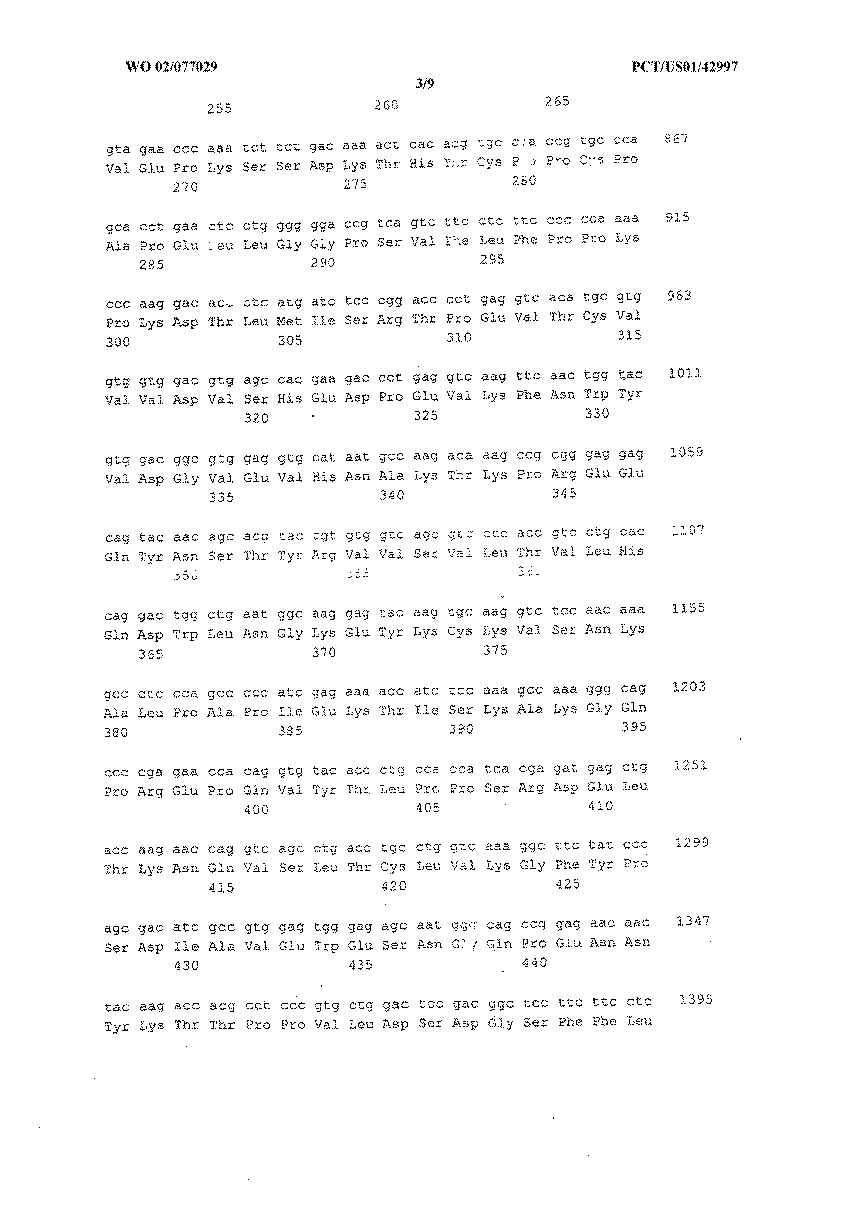
[00065] Nicholsonらが発表したCD19特異的ネズミIgG1モノクローナル抗体のVHおよびVL配列に基づいて、scFv配列をPCRによりde novo構築した[83]。CD19R:ゼータと表示する全長scFvFc:ζ cDNAをPCRスプライスオーバーラップ延長により構築した。これは、ヒトGM−CSF受容体アルファ鎖リーダーペプチド、FMC63 VH、Gly−Serリンカー、FMC63 VL、ヒトIgG1Fc、ヒトCD4 TM、およびヒト細胞質ゼータ鎖からなる。この構築体のヌクレオチド配列および得られるアミノ酸配列を一緒に図1A〜1Cに、または別個にそれぞれSEQ ID NO1および2に示す。
【0056】
[00066] このCD19特異的scFvFc:ζ受容体タンパク質を初代ヒトT細胞において発現させる。このCD19特異的scFvFc:ζ構築体が無傷のキメラタンパク質として発現しうるかを判定するために、CD19Rを含む実施例1のプラスミドでT細胞をトランスフェクションした。直線状プラスミドを最適条件下でエレクトロポレーションし、培地へのハイグロマイシン添加によって安定なトランスフェクタントを選択した。図3には、本発明の発現ベクター中のCD19R受容体でトランスフェクションしたT細胞のウェスタンブロット分析結果を示す。当技術分野で既知の方法を用いて、偽トランスフェクタント(CD19Rを含まないpMGプラスミドを含有する細胞:MTH7B9)、CD19RでトランスフェクションしたT細胞(SG1D12)および抗CD20キメラ受容体でトランスフェクションしたT細胞(AR2H6)からの全細胞溶解物を調べた。GAM−APはアルカリホスファターゼ結合ヤギ抗マウスIgGである。これはウェスタンブロットの第2工程検出試薬であり、化学発光を生じる。抗ゼータ抗体プローブを用いた全細胞溶解物のウェスタンブロットは、キメラ受容体でトランスフェクションした細胞では内因性ゼータフラグメントと予想した無傷66kDaキメラ受容体タンパク質の両方が発現するが、本発明のDNA構築体を含まないプラスミドでトランスフェクションした細胞では両方は発現しないことを示す。抗ネズミFabおよび抗ヒトFc特異的抗体によるフローサイトメトリー分析で、T細胞トランスフェクタントの細胞表面におけるCD19R:ゼータscFvFc:ζ発現がさらに確認された。
【0057】
実施例2
FMC63 キメラ免疫受容体を発現する T 細胞の CD19 特異的再指向エフェクター機能
2(A)−キメラT細胞によるサイトカイン産生:
[00067] 図4については、T細胞におけるCD19R:ゼータキメラ免疫受容体の機能を、まず初代ヒトT細胞クローンにおいてこのscFvFc:ζ構築体を発現させることにより評価した。クローンはヒトCD19+白血病細胞およびリンパ腫細胞と共存培養すると特異的にサイトカイン(IFN−γ、TNF−α、およびgm−CSF)を分泌する。当技術分野で周知であり、本明細書にさらに詳細に記載した方法により、CD19R:ゼータキメラ免疫受容体を発現するキメラT細胞クローンを単離した。組換えCD19R:ゼータキメラ免疫受容体を発現する種々のT細胞クローンをCD19白血病細胞系と共にインキュベートした結果を図4に示す。1873−CRLは、ATCCから購入したヒトCD19+/CD20−ALL細胞系である。DHL−4は、ヒトCD19+/CD20+リンパ腫細胞系である。Ionaは、Sigmaから購入したイオノマイシンである。この化学物質はカルシウムイオノホアである。PMAはホルバール−12−ミリステート−13アセテート(Sigma)である。Iono+PMAをT細胞に添加すると、それらをサイトカイン産生について最大活性化する。これらの化学物質と共にインキュベートしたT細胞の上清を、最大サイトカイン産生の陽性対照として用いる。106個の応答T細胞を指示した刺激物質と共に添加することにより、サイトカインアッセイを実施する(刺激物質が腫瘍細胞である場合、それを24ウェル当たり2×105個添加し、8Kradに照射する)。最終体積2mlになるまでウェルに培地を補充し、72時間インキュベートした時点で無細胞上清を収穫し、R+Dキットを製造業者の指示に従って用いる特異的ELISAによりアッセイする。
【0058】
[00068] CD19特異的クローンによるサイトカイン産生は、培養に抗CD19特異的抗体HIB19を添加することにより一部遮断できる。抗CD20抗体Leu−16はサイトカイン産生を遮断せず、これにより腫瘍細胞表面CD19に対するCD19R:ゼータキメラ免疫受容体の特異性が証明される。
【0059】
[00069] 図5には、T細胞クローンSG1D12を図示した種々の細胞系(それらのうちのあるものはCD19抗原を発現する)と共にインキュベートした結果を示す。このグラフは、IFN−γに特異的な抗体を用いたELISAの結果を表わす。これらの結果は、キメラ受容体を発現するT細胞がCD19保有細胞の存在下でIFN−γを放出することを証明する。
【0060】
(2B)−キメラT細胞の抗原特異的細胞溶解活性:
[00070] 図6には、5種類のキメラT細胞クローン(C11;C12;E8;F1およびF3)についてクロム放出アッセイの結果を示す。CD19R:ゼータ+CD8+CTLクローンは、標準4時間クロム放出アッセイにおいてヒトCD19+白血病細胞系およびリンパ腫細胞系SUPB15、JM−1および1873に対する高レベルの細胞溶解活性を示し、CD19エピトープを含まない他の腫瘍系を殺さない。これらの前臨床試験は、HLA一致同種骨髄移植後に再発する患者におけるドナー由来CD19R:ゼータ発現T細胞クローンを用いる養子移入療法の安全性および抗腫瘍効果を調べる臨床試験の開始を支持する。
【0061】
実施例3
療法用 T 細胞クローンの作製および特性解明
[00071] 投与したすべてのT細胞が、再配列していない染色体組込みプラスミドDNAを含むTCRα/β+CD4−CD8+scFvFc:ζ+T細胞クローンである。T細胞は移植細胞レシピエントのHLA一致骨髄ドナーの末梢血から単離される。CD8+T細胞クローンを健康な骨髄ドナーから単離し、遺伝子修飾し、拡張するために用いた材料および方法を、実施例4〜8に詳述する。CD19R:ゼータscFvFc:ζキメラ免疫受容体およびHyTKを発現するように遺伝子修飾したT細胞クローンを、下記について選択する:
a.TCRα/β+、CD4−、CD8+表面表現型:フローサイトメトリーにより判定;
b.単一コピーの染色体組込みプラスミドベクターDNAの存在:サザンブロットにより証明;
c.scFvFc:ζ遺伝子生成物の発現:ウェスタンブロットにより検出;
d.ヒトCD19+細胞系の特異的溶解:4時間クロム放出アッセイにおいて;
e.in vitro増殖の内因性IL−2依存;
f.マイコプラズマ、真菌、細菌の殺菌性、および内毒素レベル<5EU/ml;
g.ガンシクロビルに対するクローンのin vitro感受性。
【0062】
実施例4
健康な骨髄ドナーから療法用 CD8 + T 細胞クローンを単離し、遺伝子修飾し、拡張するための材料および方法
1.培地および培地補充材料
[00072] 試験に用いた培地には、全細胞培養のためのRPMI 1640 HEPES(Irvin Scientific、カリフォルニア州アービン)が含まれる。全培地は0.5リットルのボトルで購入され、ヒトにおける養子移入免疫療法試験に関する現行のFDAガイドラインに適合する。培地への補充材料には、L−グルタミン(BioWhittaker、メリーランド州ウォーカースビル)、および56℃で30分間不活性化したウシ胎仔血清(Hyclone、ユタ州ローガン)が含まれる。すべての試薬をCRB−3008へ送って検査し、その試薬に応じて適宜−20℃または4℃に保存する。
【0063】
2.OKT3
[00073] Orthoclone OKT3(Ortho)1mg/mlをCity of Hope Pharmacyから購入し、無菌凍結バイアルに分注し、被験者T細胞拡張のために融解するまでCRB−3008において−20℃に保存する。
【0064】
3.インターロイキン2
[00074] 医薬用組換えヒトインターロイキン−2(rhIL−2)(Proleukin)は、0.67mgの凍結乾燥IL−2を入れたバイアル中で供給され、1.5×10⁶IU/タンパク質mgの比活性をもつ。この凍結乾燥組換えIL−2を注入のために無菌水で再生し、5×104単位/mlの濃度に希釈する。IL−2を無菌バイアルに分注し、CRB−3008において−20℃に保存する。患者に直接投与するためのrhIL−2を標準法により調合する。
【0065】
4.プラスミドDNA
[00075] CD19特異的scFvFc:ζ cDNAおよびHyTK cDNA構築体を含むプラスミドCD19R/HyTK−pMGをGLP条件下で作製する。アンプルに医薬用水40μl中の無菌プラスミドDNA 100μgを入れる。ベクターDNAをCRB−3008において−70℃に保存する。
【0066】
5.ハイグロマイシン
[00076] 哺乳動物用抗生物質ハイグロマイシンを用いて、HyTK遺伝子を発現する遺伝子修飾T細胞を選択する。市販のハイグロマイシン(Invitrogen、カリフォルニア州サンディエゴ)を有効薬物100mg/mlの無菌溶液として調製し、CRB−3008において4℃に保存する。
【0067】
6.EBV誘導B細胞系
[00077] リンパ芽球様細胞系(LCL)はT細胞拡張に必要なフィーダー細胞であり、この目的でFDA承認の臨床養子移入療法試験に用いられている。サイクロスポリンAの存在下でのPBMCとB95−8細胞系(American Type Culture Collections)上清の共存培養により、健康なドナーからTM−LCLと表示するEBV誘導B細胞系を樹立した。この細胞系は現在、Fred Hutchinson Cancer Research Center(FHCRC)およびCity of Hope National Medical Center(COHNMC)の研究者らにより照射フィーダー細胞として用いられている。この細胞系は、臍帯血トランスフォーメーションアッセイにより外来微生物およびEBV産生について陰性と判定された。TM−LCLの作業用原液をDr.GreenbergおよびDr.Riddellから移送された後、CRB−3008において凍結保存しておいた。これらの原液を融解し、細菌、真菌およびマイコプラズマの無菌性について再試験した。TM−LCLフィーダー細胞をT細胞との共存培養前に8,000cGyに照射する。
【0068】
7.フィーダーPBMC
[00078] 被験者の骨髄から白血球搬出法により単離し、採集バッグに入れてCRB−3008へ移した末梢血単核細胞(PBMC)を、自家フィーダー細胞として用いる。T細胞培養の樹立に必要な量より過剰のドナー白血球搬出生成物由来PBMCを、CRB−3008液体窒素タンク内で50×106〜100×106個の単核細胞を入れたアンプル中に凍結保存する。
【0069】
実施例5
CD19 特異的 scFvFc :ζ受容体および HyTK を発現するように遺伝子修飾した CD8 + CTL クローンの作製
1.末梢血リンパ球−採集および分離
[00079] City of Hope National Medical Centerにおいて、被験者の指定骨髄ドナーから白血球搬出法により末梢血単核細胞(PBMC)を得る。単核細胞は、ヘパリン添加全血から臨床用Ficoll(Pharmacia、スウェーデン、ウプサラ)上での遠心により分離される。PBMCを無菌リン酸緩衝生理食塩水(Irvin Scientific)中で2回洗浄し、RPMI、10%熱不活性化FCS、および4mM L−グルタミンからなる培地に懸濁する。
【0070】
2.PBMCの活性化
[00080] 培地にOrthoclone OKT3(30ng/ml)を添加することにより、患者のPBMC中に存在するT細胞をポリクローナル活性化する。次いで細胞培養物を被験者の指定インキュベーターにおいて通気T75組織培養フラスコ中でインキュベートする。培養開始の24時間後、25U/mlのrhIL−2を添加する。
【0071】
3.活性化PBMCの遺伝子修飾
[00081] 培養開始の3日後、PBMCを収穫し、遠心分離し、低張エレクトロポレーション緩衝液(Eppendorf)に20×106個/mlで再懸濁する。25μgのプラスミドDNAを400μlの細胞懸濁液と一緒に無菌0.2cmエレクトロポレーションキュベットに添加する。各キュベットにMultipolator(Eppendorf)から発する250V/40μsの電気パルスを1回付与し、次いで室温で10分間インキュベートする。室温インキュベーション後、細胞をキュベットから収穫し、プールし、25U/mlのrhIL−2を含有する無フェノールレッド培地に再懸濁する。フラスコを患者の指定組織培養インキュベーターに入れる。エレクトロポレーションの3日後、ハイグロマイシンを0.2mg/mlの最終濃度で細胞に添加する。エレクトロポレーションしたPBMCを、48時間ごとに培地およびIL−2を補充しながら合計14日間培養する。
【0072】
4.ハイグロマイシン耐性T細胞のクローニング
[00082] エレクトロポレーションしたOKT3活性化患者PBMC由来のハイグロマイシン耐性CD8+CTLのクローニングを、培養14日目に開始する。FabおよびFcに対する抗体ならびに/またはプロテインA−FITC標識を用いて当技術分野で周知の方法により、FvFc生成物を発現する細胞を陽性選択する。エレクトロポレーションした細胞をFabおよびFcに対する抗体またはプロテインA−FITCと共にインキュベートした後、FvFcを発現する細胞を免疫遺伝学用ビーズもしくはカラムまたは蛍光活性化細胞ソーティング法により単離する。生育可能な患者PBMCを、30ng/mlのOKT3および50U/mlのrhIL−2を含有する体積200mlの培地中で、100×106個の凍結保存照射フィーダーPBMCおよび20×106個の照射TM−LCLの混合物に添加する。このマスターミックスを10個の96ウェルクローニングプレートに接種する。各ウェルに0.2mlを入れる。蒸発による損失を減らすためにプレートをアルミニウム箔に包み、患者の指定組織培養インキュベーターに入れる。培養19日目にハイグロマイシンを0.2mg/mlの最終濃度で各ウェルに添加する。30日目にウェルを倒立顕微鏡で細胞の増殖について視覚検査し、陽性ウェルを再刺激のためにマークする。
【0073】
5.CD19再指向細胞毒性をもつハイグロマイシン耐性クローンの拡張
[00083] スクリーニングクロム放出アッセイにより細胞増殖および細胞溶解活性を示す各クローニングウェルの内容物を個別に、25mlの組織培養培地中に50×106個の照射PBMC、10×106個の照射LCLおよび30ng/mlのOKT3を含有するT25フラスコに移す。再刺激後、1、3、5、7、9、11および13日目に、フラスコに50U/mlのrhIL−2および15mlの新鮮な培地を入れる。刺激サイクルの5日目には、フラスコにハイグロマイシン0.2mg/mlをも補充する。細胞接種後14日目に、細胞を収穫し、計数し、50mlの組織培養培地中に150×106個の照射PBMC、30×106個の照射TM−LCLおよび30ng/mlのOKT3を含有するT75フラスコ中で再刺激する。前記に概説したように、フラスコの培養物にrhIL−2およびハイグロマイシンを添加する。
【0074】
6.ハイグロマイシン耐性CTLクローンの特性解明
a.細胞表面表現型
[00084] 療法用に拡張するために選択したCTLを、CRB−3006に収容したFACSCaliburでFITC結合モノクローナル抗体WT/31(αβTCR)、Leu 2a(CD8)、およびOKT4(CD4)を用いる免疫蛍光により分析して、クローンの目的表現型(αβTCR+、CD4−、およびCD8+)を確認する。臨床用クローンの選択基準には、イソタイプ対照FITC結合抗体と比較してTCRαβ+、CD4−、CD8+が均一であることが含まれる。
【0075】
b.プラスミドの染色体組込み
[00085] サザンブロットによりプラスミドベクターの単一部位染色体組込みを確認する。遺伝子修飾したT細胞クローンに由来するDNAを、そのプラスミドベクターに特異的なDNAプローブでスクリーニングする。ハイグロマイシン特異的DNAプローブは、CD19R/HyTK−pMGから単離した420塩基対のMscI/NaeI制限フラグメントである。プローブDNAをランダムプライマー標識キット(Boehringer Mannheim、インディアナ州インディアナポリス)で32P標識する。T細胞ゲノムDNAを標準法により単離する。10μgのT細胞クローン由来ゲノムDNAを37℃で一夜、40単位のXbaIおよびHindIIIにより消化し、次いで0.85%アガロースゲル上での電気泳動により分離する。次いでDNAをアルカリ毛管トランスファー法によりナイロンフィルター(BioRad、カリフォルニア州ハーキュレス)に移す。10μg/mlのサケ精子DNA(Sigma)を含有する0.5M Na2PO4、pH7.2、7%SDS中、65℃で一夜、フィルターをHyTK特異的32P標識プローブとハイブリダイズさせる。次いでフィルターを40mM Na2PO4、pH7.2、1%SDS中、65℃で4回洗浄し、次いでホスホイマージャー(Molecular Dynamics、カリフォルニア州サニーベール)により視覚化する。クローン選択基準は、ハイグロマイシンプローブによる単一のユニークバンドである。
【0076】
c.CD19特異的scFvFc:ζ受容体の発現
[00086] CD19R scFvFc:ζ受容体の発現は、キメラ受容体タンパク質を抗ゼータ抗体で検出するウェスタンブロット法により判定される。1錠/10mlの完全プロテアーゼ阻害薬カクテル(Boehringer Mannheim)を含有する1mlのRIPA緩衝液(PBS、1%NP40、0.5%デオキシコール酸ナトリウム、0.1%SDS)中で2×10⁷個の洗浄細胞を溶解することにより、トランスフェクションしたT細胞クローンの全細胞溶解物を調製する。氷上で80分のインキュベーション後、アリコートの全細胞溶解物遠心上清を収穫し、等体積の装填用緩衝液中で還元条件下に煮沸し、次いでプレキャスト12%アクリルアミドゲル(BioRad)上でSDS−PAGE電気泳動する。ニトロセルロースに移した後、0.07gm/mlの脱脂粉乳を含有するブロット溶液で2時間、膜をブロックする。膜をT−TBS(トリス緩衝生理食塩水pH8.0中の.05%Tween 20)中で洗浄し、次いで濃度1μg/mlの一次マウス抗ヒトCD3ζモノクローナル抗体8D3(Pharmingen、カリフォルニア州サンディエゴ)と共に2時間インキュベートする。T−TBS中でさらに4回洗浄した後、アルカリホスファターゼ結合ヤギ抗マウスIgG二次抗体の1:500希釈液と共に1時間、膜をインキュベートする。展開の前に膜をT−TBS中ですすぎ、次いで製造業者の指示に従って30mlの”AKP”溶液(Promega、ワイオミング州マディソン)で展開する。クローン選択基準は66kDaのキメラゼータバンドの存在である。
【0077】
d.CD19+白血病細胞に対する細胞溶解特異性、およびレシピエント線維芽細胞活性に対する細胞溶解活性欠如
[00087] CD19R scFvFc:ζ受容体を発現するCD8+細胞毒性T細胞クローンは、このキメラ受容体と細胞表面ターゲットエピトープがHLA非制限様式で相互作用することにより、ヒトCD19+白血病ターゲット細胞を認識して溶解する。ターゲット細胞CD19発現およびクラスI MHC非依存性認識のための要件は、数種類のαβTCR+、CD8+、CD4−、CD19R+CTLクローンを、MHC不適合ヒト白血病細胞系(SupB15、JM−1および1873CRL)ならびにCD19−系K562(CD19陰性、NK感受性ターゲット)およびレシピエント線維芽細胞のパネルに対してアッセイすることにより確認された。OKT3で刺激した12〜14日後、T細胞エフェクターをアッセイする。エフェクターを収穫し、洗浄し、アッセイ培地に再懸濁する;2.5×10⁵、1.25×10⁵、0.25×10⁵、および0.05×10⁵個のエフェクターを5×10³個のターゲット細胞と共にV底マイクロタイタープレート(Costar、メリーランド州ケンブリッジ)に三重接種し、37℃に4時間おく。遠心およびインキュベーション後、100μLアリコートの無細胞上清を収穫して計数する。特異的細胞溶解率%を下記に従って計算する:
【0078】
実施例6
T 細胞培養の微生物学的探査
[00089] 凍結保存前にT細胞培養からのアリコートの培地をU.S.P.および真菌培養によりスクリーニングする(段階I無菌試験)。明かな汚染を伴う培養物を直ちに廃棄する。再注入のためのT細胞拡張物は、使用の48時間前にU.S.P.および真菌培養を実施する(段階II無菌試験)。マイコプラズマ汚染を検出するためには、凍結保存前にアリコートをGen−Probe試験キット(カリフォルニア州サンディエゴ)によりアッセイし(段階I)、マイコプラズマ汚染を伴う培養物を廃棄する。再注入の49時間以内に、培養物を前記に詳述したように再スクリーニングする(段階II)。再注入当日、細胞を洗浄する前に、各バッグについてグラム染色を実施して明かな汚染を排除し、洗浄済み細胞生成物について内毒素レベルをLALにより測定する。内毒素負荷<5EU/kgの内毒素負荷は許容される。記録保管用検体が必要な場合は、洗浄済みT細胞クローンも凍結保存する。
【0079】
実施例7
再注入用クローンのリリースのための品質管理基準
[00090] T細胞を再注入のためにリリースする前に表1に述べた基準を満たさなければならない。
【0080】
【表1】
実施例8
T 細胞の in vivo 持続性に関する定量 PCR
[00091] 循環中におけるscFvFc:ζ+CD8+CTLクローンのin vivo持続時間は、最近開発されたTaqMan蛍光原5’ヌクレアーゼ反応を用いる定量PCR(Q−PCR)により測定される。Q−PCR分析は、各T細胞の注入前ならびに注入後+1および+7日目に得た被験PBMCから抽出したゲノムDNAについての細胞および分子相関コアにより行われる。3回目の注入後も、PBMCを+14、+21、+51日目(幹細胞レスキュー後、+100日目)にサンプリングする。+100日目に検出可能な遺伝子修飾T細胞を示す被験者があれば、その信号を検出できなくなるまでその患者を月1回再評価するように手配する。Riddellらが発表したデータにより、細胞量5×10⁹個/m2を注入した後1日目に養子移入T細胞が1〜3個/PBMC 100個の頻度で被験者の末梢血中に検出されることが判明した;したがってこの試験の細胞量は容易に検出できる信号を生じるであろう(70)。Qiagen QiAmpキットを用いてPBMCからDNAを抽出する。scFvFc:ζ遺伝子の検出に用いるプライマーは下記のものであり:
【0081】
【化1】
【0082】
【化2】
【0083】
【化3】
【0084】
【化4】
【0085】
実施例9
パイロット I 相試験
1.病期判定基準および患者の適性
a.病期判定基準
試験参加前
免疫組織病理学的に確認されたCD19+ALL
分子的に確認されたPh+ALL(コホート2)
骨髄吸引および生検
腰椎穿刺
CTスキャン 胸部/腹部/骨盤
試験参加後
ドナー白血球搬出
線維芽細胞系樹立のための被験者皮膚生検
b.患者の適性
患者採用基準
HLA一致近親ドナー骨髄移植後の再発CD19+ALL(コホート1)
HLA一致同種骨髄移植が指示されるPh+CD19+ALL病歴(コホート2)
年齢12カ月以上、65歳以下の男性または女性被験者
同意近親ドナーHLA−HLA−Aおよび−Bについて患者と表現型同一、かつDRB1対立遺伝子について同一。クラスI抗原について血清学的に、およびクラスII抗原についてDNAタイピングにより評価して、最小限度の適合
下記により測定して臓器機能が適切な患者:
心臓:無症状、または症状があれば安静時左心室駆出分画が≧50%もしくはCOHに関する正常範囲内でなければならない
肝臓:SGOTが正常範囲の5倍以内、かつ総ビリルビンが正常範囲の5倍未満
腎臓:血清クレアチニンが正常範囲の1.5倍以内、またはクレアチニンクリアランスが60ml/分
肺:DLCOが予測値の>45%(ヘモグロビンについて補正)またはCOHに関する正常範囲内
適切な行動状態70%(Karnofsky年齢>18歳、Lansky年齢≦18歳)
患者およびドナーからのCOHガイドラインに従った書面によるインフォームドコンセント;ドナー、および患者、または患者と親/法定後見人(年齢≧7歳)から得る
期待余命>8週間、かつ治験責任者の判断に基づいて、移植操作およびT細胞再注入のリスクを著しく高めると思われる併存する医学的/精神的問題がない
移植後にAppendix Cに概説したように試験のための末梢血試料を患者から採取できる
患者除外基準
事前の自家もしくは同種骨髄移植またはPBSC移植(コホート2)
事前の照射処置のため全身照射線量要求を完了できない患者(コホート2)
妊娠または授乳中の女性患者
HIV血清検査陽性
コンディショニング前2週間以内に抗真菌薬、抗菌薬または抗ウイルス薬による静脈内処置が必要な活動性感染症;コアグラーゼ陰性ブドウ球菌系感染症を除く(コホート2)
プロトコルの基本要素および/またはこのI相試験参加の損益を理解できない(≧7歳の小児、および親/法定後見人;コンセント署名前に配布するアンケートにおける行動により判断)
ドナーの選定
PBMC採集のために白血球搬出を受ける意志がある
2.治験の設計および用量漸増の規則
[00092] パイロットI相試験はオープンラベル、非ランダム化試験である。この試験においては、BMT後にそのPh+CD19+ALLが再発した患者(コホート1)、または移植後にそのPh+CD19+ALLが分子性再発した患者に、ドナー由来CD19R+HyTK+CD8+CTLクローンを注入する。このT細胞クローンは、患者のHLA一致近親骨髄ドナーから得た白血球搬出生成物より作製される。コホート2に登録した患者に関しては、治験参加者が確実なbcr−abl陽性PCR結果に基づいて分子性再発と診断される時点まで、クローンを凍結保存する。各コホートの治験参加者それぞれに、クローンが得られ次第、2週間隔で連続3回の漸増細胞量のT細胞注入を開始する(一般にコホート2では分子性再発診断後14日目までに、コホート1ではクローンの用意ができ次第)。GVHD予防/治療のための免疫抑制投薬を受けている被験者は、まずコルチコステロイドを漸減してもT細胞投与開始前にはもはやグレード2より高い急性GVHDがない状態にある。初回細胞量は1×109個/m2、2回目は5×109個/m2、3回目は5×109個/m2(IL−2と共に)である。T細胞注入による著しい毒性がなく、グレード2以下のGVHDである患者には、低用量の皮下rhIL−2を14日間、3回目のT細胞と共に投与する。患者を初回注入の前、および注入後2カ月間は週1回評価し、その後さらに6カ月間は患者を月1回評価する。治験期間中の特定の時点で末梢血を採取して、移入CTLクローンのin vivo持続性、ならびに抗scFvFc:ζおよびHyTK免疫応答の誘導をアッセイする。抗腫瘍応答は、それらの白血病特異的マーカーまたはbcr−ablについての系統的Q−PCRによる分子性腫瘍負荷の変化により、ならびにALLについての標準的な形態学的検査、フローサイトメトリー試験およびキメリズム試験により評価される。患者の主治医である血液病専門医または小児癌科医は、治験期間中およびその後不定期間にわたって、患者の治験関連面以外の医療を行う。
【0086】
3.治療計画
a.CD19R:ゼータ+CD8+T細胞クローンの投与スケジュール
[00093] I相パイロット試験では、CD19R scFvFc:ζキメラ免疫受容体および選択/自殺遺伝子HyTKを発現するように遺伝子修飾したドナー由来CD8+CTLクローンの静脈注入の安全性および毒性を判定する。連続3回の漸増細胞量の注入(表2)を2週間隔で行い、移植後分子性再発を示す参加者を調べる。T細胞注入を、入手でき次第(コホート1)、または分子性白血病再発証明後に(コホート2)開始する。ただし、治験参加者はステロイドを漸減しても、もはやグレード2より高い急性移植片対宿主疾患がない。移入CTLのin vivo持続を支持するために、3回目のT細胞注入後、低用量のIL−2を皮下投与する。IL−2投与は、T細胞クローン養子移入の24時間後に開始し、14日間続ける(下記を参照)。ただし、最初の2回のT細胞投与に伴うグレード3〜4毒性がみられず、かつ急性GVHDがグレード2以下の場合である。
【0087】
【表2】
【0088】
[00095] 再発が検出された時点でCD20+細胞が循環中のリンパ球の10%を超えるB細胞engraftmentを伴う被験者には、初回T細胞注入の1週間前に1回量(250mg/m2)のRituximab(キメラ抗CD20抗体)を投与する。
【0089】
[00096] 注入当日、CRB−3008で拡張させたT細胞クローンを、細胞洗浄および濃縮のためCS−3000血液分離装置により標準法で無菌的に処理する。処理した細胞を、臨床再注入に適したバッグ中で、2%ヒト血清アルブミンを含有する100mlの0.9%NaClに再懸濁する。
【0090】
[00097] 被験者をT細胞注入のためにCOHNMCのGCRCに入院させ、注入後23時間以上たって毒性がみられなければ退院させる。それ以外の場合、外来患者としては被験者に有意のリスクを与えると思われる注入関連毒性が除かれるまで患者を病院に留めておく。
【0091】
[00098] 利用できれば中心ラインからT細胞を30分間にわたって静脈内注入する。できない場合は年齢に応じたサイズの静脈カテーテルを末梢静脈に挿入する。細胞の捕獲を避けるために、静脈チューブにはフィルターがない。注入期間中、注入バッグを5分ごとに穏やかに混合する。
【0092】
[00099] 医師またはその代理人が注入に際して同席し、注入後2時間はすぐに連絡のつく状態にする。患者の入院中は看護観察および管理を採用する。
[000100] 注入前から開始して少なくとも連続2時間または読みが被験者の注入前ベースラインに戻るまで、被験者の酸素飽和度を継続パルス酸素濃度測定により測定する。
【0093】
[000101] 移植関連毒性がみられた被験者は、これらの毒性が除かれるまで注入スケジュールを遅らせる。T細胞注入を遅らせる根拠となる具体的毒性には下記のものが含まれる:
(a)肺:95%を超える飽和度を維持するために酸素補給が必要であるか、あるいは胸部X線撮影で進行性のX線像異常がみられる;(b)心臓:医療処置で抑制できない新たな心臓不整脈。昇圧薬による支持を必要とする低血圧;(c)活動性感染症:0日目の48時間以内に血液培養が細菌、真菌またはウイルス陽性;(d)肝臓:正常限界の5倍を超える血清総ビリルビンまたはトランスアミナーゼ;(e)腎臓:血清クレアチニン>2.0、または患者が透析を必要とする場合;(f)神経性:0日目以前1週間以内の痙攣活動、または臨床的に検出できる脳障害もしくは新たな局所性神経障害;(g)血液性:臨床顕性の出血性体質または溶血。
【0094】
[000102] 3回目のT細胞投与後にbcr−abl Q−PCRに基づく抗腫瘍応答を示すが、持続性の残存疾患を伴う患者には、追加量の細胞(1回当たり5×10⁹個/m2、14日間隔で)をIL−2(5×105U/m2、12時間ごとに)と共に投与してもよい。ただしグレード3以上の毒性を示したことがない場合である。
【0095】
b.インターロイキン−2投与
[000103] 標準調剤ガイドラインにより皮下(s.c.)注入用に再懸濁した組換えヒトIL−2(rHuIL−2、Proleukin、Chiron、カリフォルニア州エマースビル)を、治験参加者に投与する;ただし(1)細胞投与レベルI〜IIでグレード3〜4の毒性を示したことがく、かつ(2)免疫抑制投薬を中止してもGVHDがグレード2を超えない。養子移入T細胞療法を受けた黒色腫患者にIL−2を皮下投与したシアトルでの以前の経験に基づいて、IL−2の投与量は3回目のT細胞再注入日から開始して5×10⁵U/m2を12時間ごとに14日間である。
【0096】
c.毒性および合併症の管理
[000104] LAK、TILおよびT細胞クローンの注入に伴ってみられる軽度の一過性症状の管理は下記に従う。(1)すべての患者に経口アセトアミノフェン15mg/kg(最大量650mg)および静脈内ジフェンヒドラミン1mg/kg(最大量50mg)を前投薬する。(2)発熱、悪寒、および体温上昇>101°Fは臨床指示に従ったタイレノール追加、破綻(breakthrough)発熱は経口イブプロフェン10mg/kg(最大量400mg)、悪寒は静脈内デメロール1mg/kg(最大量50mg)により管理する。これらの措置に抵抗性の発熱には、他の方法、たとえば冷却ブランケットを用いる。発熱または悪寒を示した被験者すべてについて培養用採血を行う。担当医の意見で敗血症と思われる非アレルギー患者には、静脈内セフトリアキソン(ceftriaxone)50mg/kg(最大量2g)を投与する;臨床指示に従って他の選択抗生物質を用いる。(3)頭痛はアセトアミノフェンにより管理する。(4)吐き気および嘔吐は、静脈内ジフェンヒドラミン1mg/kg(最大量50mg)により治療する。(5)一過性低血圧はまず静脈内輸液投与により管理するが、持続性低血圧を伴う患者は根治医療処置のために集中治療室へ移す必要がある。(6)低酸素血症は酸素補給により管理する。
【0097】
[000105] グレード3または4の治療関連毒性がみられる場合、患者にガンシクロビルを投与する。ガンシクロビルを1日当たり10mg/kgで12時間ごとに分割して非経口投与する。14日間のコースを処方するが、その期間で症状の消散が達成されない場合は延長してもよい。症状の発現時に入院していない患者すべてを、ガンシクロビル治療の最初の72時間は監視のために入院させる。72時間以内に症状がガンシクロビルに応答しない場合、他の免疫抑制薬(コルチコステロイドおよびサイクロスポリンが含まれるが、これらに限定されない)を主治験担当者の裁量で追加する。
【0098】
d.併用療法
[000106] 治験療法を受けている患者のすべての標準支持療法措置を患者のCity of Hope小児癌科医の裁量で採用する。治験参加後に発症した活動感染症を標準治療法に従って処置する。下記の薬剤は治験中に使用できない:全身用コルチコステロイド(T細胞療法毒性の管理に関して概説したものを除く)、免疫療法(たとえばインターフェロン、ワクチン、他の細胞製剤)、ペントキシフィリン、または他の治験薬)、ガンシクロビルまたはガンシクロビル誘導体(致命的でないヘルペスウイルス感染症に対して)。
【0099】
4.毒性監視および投与量調節
a.監視すべき毒性
[000107] パイロットI相試験に関する毒性基準は、NCI Common Toxicity Criteria(CTC)毒性に関する2.0版およびAdverse Event Reportingによる。CTC2.0版のコピーはCTEPホームページ(http://ctep.info.nih.gov/l)からダウンロードできる。総ビリルビン、ALTおよびASTの血清測定以外のすべてのCTCガイドラインを毒性評価に適用する。化学療法を最近受けた癌患者ではビリルビンおよび肝トランスアミナーゼの長期間にわたる上昇が頻繁にみられたので、グレード1毒性はT細胞注入前ベースラインからそのベースラインレベルの2.5倍までの上昇とする。グレード2肝毒性はT細胞注入前ベースラインから>2.5〜5倍の上昇、グレード3毒性はベースラインから>5〜20倍の上昇、グレード4は>20倍の上昇である。治験中または具体的なCTC指定のない追跡期間中に治験参加者が報告したいかなる毒性も、下記の尺度で等級付けする:グレード0−無毒性;グレード1−軽度の毒性、通常は一過性、特別な処置を必要とせず、一般に通常の日常活動に支障はない;グレード2−中等度の毒性、簡単な治療措置で改善する可能性がある、通常の活動に支障がある;グレード3−重篤な毒性、療法介入を必要とし、通常の活動を妨げる、入院を要する場合または要しない場合がある;グレード4−致命的な毒性、入院を要する。
【0100】
b.投与量調節基準
[000108] 投与量レベルIで患者がグレード2の毒性を発現した場合、その患者の2回目の細胞量をT細胞量レベルIに留める。2回目の注入でみられた最大毒性がグレード2に限られる場合のみ、3回目の最終細胞量を投与する。2回目の細胞投与で初めてグレード2の毒性が起きた場合、3回目の細胞投与に伴う皮下IL−2を投与しない。
【0101】
c.治験処置から患者を除外する基準
[000109] 患者がグレード3以上の毒性またはグレード3以上のGVHDを発現した場合、IL−2を投与している場合はそれを停止する。IL−2を投与していない患者には、グレード3以上の毒性が発現した時点で前記に概説したガンシクロビル処置を開始する。IL−2を投与している患者については、その発現した毒性がIL−2停止後48時間以内にグレード2以下に軽減しない場合、ガンシクロビル処置を開始する。グレード3のIL−2注入部位毒性はIL−2停止の指標であり、T細胞除去の指標ではない。グレード3以上のGVHDを伴う患者には、ガンシクロビル投与のほかにGVHDに対する免疫抑制を開始する。T細胞除去のためにガンシクロビルを必要とする患者すべてを、それ以上の細胞投与を行わずにプロトコルに従って監視する。重篤な毒性をより迅速に消散することを指示すべきであれば、主治験担当者の裁量でコルチコステロイドおよび/または他の免疫抑制薬をガンシクロビルに加える。
【0102】
d.治験参加者の早期中止
[000110] 治験プロトコルを完了しない治験参加者は、治験を早期に中止したとみなされる。早期中止の理由(たとえば自発脱退、毒性、死亡)を症例報告書式に記録する。中止の時点で最終治験評価を完了する。早期中止理由の可能性には下記のものが含まれる:(a)致命的感染症の発症;(b)続行するにはその患者の病状が重すぎるという主治験担当者の判断;(c)治験療法および/または病院予約に対する患者/家族のノンコンプライアンス;(d)妊娠;(e)自発脱退−−患者またはその親/法定代理人は、いかなる時点で治験から脱退し、または脱退させても、不利益を受けることはない;(f)他の医療、放射線療法または外科的介入を必要とする、有意かつ急激な神経芽細胞腫進行;(g)治験療法に関連する可能性または蓋然性があると判断されるグレード3または4の毒性;ならびに(h)T細胞の遺伝子修飾、クローニングおよび拡張操作に技術的困難が生じ、すべての品質管理基準を満たす臨床細胞量の調製が妨げられた。
【0103】
e.治験終結
[000111] 投与量レベルIでグレード4以上の毒性が最初の2人の患者にみられた場合、またはプロトコルのいかなる時点でも被験者におけるグレード4毒性の発現率が50%を超えた場合、治験を中止する。最後のT細胞注入から30日以後の腫瘍の進行による死亡は、グレードV毒性と計数せず、有害事象としても計数しない。主治験担当者、IRB、または食品医薬品庁が治験を終結させることができる。
【0104】
5.治験パラメーターおよびカレンダー(表3)
【0105】
【表3】
[000112] 疾病再発に関する患者の評価と同時に、サルベージ化学療法の開始前に実施。具体的試験/操作には下記のものが含まれる:
−CD19+急性リンパ芽球性白血病の診断を確認するために、病理検体を再検討する
−Ph陽性の分子的確認を再検討する
−病歴による採用/不採用基準を確認する
−有望な治験参加者(年齢7歳以上)および親/法定代理人に対する指導説明を行い、指導後評価を実施する
−参加について患者およびドナーからインフォームドコンセントを得る
−EBVおよびHIV血清検査試料を得る
−コホート1のPh−患者については、白血病クローンPCRアンプリマー作製のために血液/骨髄試料をDr.Radich(FHCRC)へ送る
−前記に概説した病期判定試験を行う
−線維芽細胞系を樹立するために、同意を得た治験参加者から皮膚生検試料を得る。
【0106】
(b)T細胞培養の開始のための末梢血単核細胞の単離
[000113] 同意した採用/不採用基準を満たすHLA一致近親ドナーに、City of Hope Donor/Apheresis Centerで白血球搬出処置を施す。白血球搬出物をCRB−3008へ送ってT細胞培養を開始する。
【0107】
(c)−7〜−1日目:T細胞注入前の病期再判定
−前記に従って病期再判定試験を実施する
−CD20+B細胞が循環単核細胞の10%を超える場合、Rituximabを投与する
(d)0日目:T細胞注入直前の評価
−医学的状態の再検討およびシステムの再検討
−理学的検査、生命徴候、体重、身長、体表面積
−併存する投薬および移入のリスト
−Karnofsky/Lansky動作状態(表4参照)
−全血球計数(CBC)、分別血球計数、血小板計数
−Chem 18
−プロトコル別試験用の血液(表3参照)
【0108】
【表4】
注入前:
−中間病歴および理学的検査
−実験室試験用の採血(表3参照)
注入中:
−0時点および注入中15分ごとの生命徴候、連続パルス酸素飽和度測定
T細胞注入後:
−1時間ごとに12時間の生命徴候
−T細胞注入後2時間は酸素飽和度を監視する。注入開始前、注入直後、および注入後2時間目の数値を記録する。さらに、数値が90%より低下した場合、患者が注入前の室内空気ベースライン飽和度に回復するまで15分ごとに数値を記録する。
【0109】
−標準医療により事象を措置する
退院前:
−中間病歴および理学的検査
−実験室試験用の採血(表3参照)
(f)+1、+7、+15、+21、+29、+35、+42、+56、+70、+100日目
−中間病歴および理学的検査
−全血球計数、分別血球計数、血小板計数用の採血、およびChem 18
−3cc/kg(患者体重)のヘパリン添加(保存剤無添加ヘパリン10U/10ml)血液を、PCRによる末梢血リンパ球のベクターDNA直接アッセイのためにCRB−3002へ送る。
【0110】
(g)骨髄吸引および生検:−7〜0、+56、+100日目
(h)T細胞移入後に治験参加者が試験を休んだ場合、最終T細胞投与後28日目および56日目に骨髄評価の病期再判定を行う。
【0111】
6.評価基準および終末点の定義
(a)評価基準
[000114] 各臨床評価に際して得たI相データを表3に概説する。下記の毒性および有害事象判定を行う:(a)症状および毒性を前記に従って評価する;(b)理学的検査および血液の化学的/血液学的検査の結果;ならびに(c)有害事象の報告。
【0112】
(b)疾病状態
[000115] 表3に概説した各疾病評価に際して、測定可能な疾病の判定を下記に従って記録する:(1)白血病特異的アンプリマーまたはbcr−ablのQ−PCR、ならびに(2)+56および+100日目に骨髄試験を評価し、応答を標準ALL基準により等級付けする(表5参照)。
【0113】
【表5】
[000116] 試験期間中に増悪したと思われる徴候、症状または疾病はいずれも、治験薬剤との関連に関係なく有害事象である。試験薬剤によるものであるか否かにかかわらず、治験担当者が観察した、または患者が報告した、治験中に起きた有害事象をすべて症例報告書式に記録し、FDAの要求に応じて報告する。これには、説明、開始日および消散日、持続時間、最大重症度、治験薬剤または疑われる他の薬剤との関連の評価、行った行為と結果が含まれる。治験中に生じた毒性を、Common Toxicity Criteria(CTC)2.0版(前記)に示された基準に基づく0〜4尺度に従って採点する。治験薬剤との関連または関係を下記のように等級付けする:1=無関係、2=無関係と思われる、3=可能性がある、4=おそらく関係がある、および5=確実に関係がある。
【0114】
[000117] 療法中または完了後に起きる重篤な有害事象を、下記のいずれかとして定義する:(a)原因に関係なく、治験薬剤投与の30日以内に起きた患者の死亡;(b)致命的事象;(c)処置および監視期間中の治験関連毒性による入院の継続または追加入院の必要性;(d)治験開始後にもうけた子孫の先天性異常;(e)治験中に生じた毒性による著しい医療処置の必要性;ならびに(f)注入細胞の過剰投与。
【0115】
[000118] 致命的事象は、治験担当者の見解で、発生した有害事象のため患者が直ちに死の危険性に陥るものと定義される。これには、より重篤な形で起きたとすれば死亡の原因となったであろう有害事象は含まれない。上記の基準のうち少なくとも1つに適合しない有害事象はすべて重篤ではないと定義される。事象の原因評価は事象の重篤性評価には関係ない。
【0116】
[000119] 予想外の有害事象は下記のものである:(a)養子移入T細胞療法に関してこれまで報告されていないもの、ならびに(b)症状および病態生理学的には既知の毒性と関係があるが、重篤性または特異性がより大きいため異なる。
【0117】
[000120] 問題の有害反応の原因を説明するために、適宜な臨床、診断および検査室測定を実施し、結果を報告しなければならない。養子移入に関係すると考えられる異常を解明するすべての試験を、原因が判定されるまで、または正常値への回復が起きるまで、適宜な間隔で繰り返す。
【0118】
8.統計学的考察
[000121] HLA一致同種BMT後CD19+ALL再発を伴う治験参加者に再指向−前B ALLターゲティングのために投与した、CD19特異的キメラ免疫受容体およびHyTKを発現するように遺伝子修飾したCD8+細胞毒性T細胞のI相試験の考察事項は下記のとおりである。(a)採用時に得た人口統計および背景の特徴を一覧表にまとめる。(b)療法中にみられた毒性のタイプおよびグレードを投与レベルごとにまとめる。(c)治験担当者が認めたすべての有害事象を罹患身体系に従って表にまとめる。(d)記述統計学を用いて、臨床検査パラメーターのベースラインからの変化をまとめる。(e)T細胞療法の開始時に測定可能な腫瘍を伴う患者については、ALL応答基準(表5)により応答を階層化する。(f)Kaplan−Meierプロダクト限定法を用いて生存率を推定する。(G)記述した統計値すべてについて95%信頼区間を計算する。
【0119】
[000122] 本発明の方法および組成物を多様な態様で採用できるが、そのうちわずかを本明細書に開示したにすぎないことは理解されるであろう。本発明から逸脱しない他の態様があることは当業者に自明であろう。したがって、記載した態様は説明であって、限定と解すべきではない。
【0120】
【表6−1】
【図面の簡単な説明】
【0121】
【図1A】図1Aは、本発明のCD19:ゼータキメラ免疫受容体SEQ ID NO.1の二本鎖DNA配列およびアミノ酸配列を示し、このキメラ免疫受容体中にあるDNAセグメント源を示す。
【図1B】図1Bは、本発明のCD19:ゼータキメラ免疫受容体SEQ ID NO.1の二本鎖DNA配列およびアミノ酸配列を示し、このキメラ免疫受容体中にあるDNAセグメント源を示す。
【図1C】図1Cは、本発明のCD19:ゼータキメラ免疫受容体SEQ ID NO.1の二本鎖DNA配列およびアミノ酸配列を示し、このキメラ免疫受容体中にあるDNAセグメント源を示す。
【図2】プラスミドpMG−CD19R/HyTKの模式図を示す。
【図3】CD19R/scFvFc:ζキメラ受容体の発現を証明するウェスタンブロット分析を示す。
【図4】CD19R/scFvFc:ζキメラ受容体を発現するT細胞の抗原特異的細胞溶解活性を示すグラフである。
【図5】CD19を発現する種々の細胞系の存在下でインキュベートしたCD19R/scFvFc:ζキメラ受容体発現T細胞によるインターロイキン−γの産生を示すグラフである。
【図6】図6A〜Eは、CD19R/scFvFc:ζキメラ受容体再指向T細胞クローンの抗原特異的細胞溶解活性を示すグラフである。DISCLOSURE OF THE INVENTION
[0001]
Reference of related application
[0001] This application filed US Provisional Patent Application No. No. 60 / 246,117 (November 7, 2000), the disclosure of which is incorporated herein by reference.
[0002]
Background of the Invention
[0002] The present invention relates to the field of genetically engineered redirected immune cells and the field of cell immunotherapy for B cell malignancies, B cell lymphoproliferative syndrome and B cell mediated autoimmune diseases. About. Publications and other materials used herein to explain the background of the invention or to provide further details on the practice are incorporated herein by reference.
[0003]
[0003] Nearly half of all hematopoietic stem cell (HSC) transplant procedures performed in the United States are for the treatment of hematologic malignancies [1]. Much of the initial barrier to successful HSC transplantation is due to inadequate treatment modalities to reduce therapy-related toxicity and to control opportunistic infections and graft-versus-host disease (GVHD). [2-5]. As supportive care measures have improved over the last decade, post-transplant disease recurrence has emerged as a major obstacle to improving the prognosis in this patient population [6-10]. The inability to eradicate microresidual disease, even when the strongest treatment modalities are combined with immunological graft-versus-tumor reactivity, is a mechanism of treatment failure in allogeneic transplantation; Mixed tumors can also lead to recurrence after transplantation [11]. Targeting microresidual disease early after transplantation is one strategy to enhance tumor cell reduction achieved with myeloablation therapy and to purge transfected malignant cells with autologous stem cells in vivo. Therapeutic modalities that target minimal residual disease immediately after stem cell rescue include the limited toxicity spectrum and the sensitivity of the residual tumor cells to the anti-tumor mechanism (s) of the modality It depends on both. The successful elimination of persistent microresidual disease not only has a profound effect on the prognosis of transplantation for hematologic malignancies using current myeloablation therapies, but also reduces the magnitude of these treatments and the associated toxicity Can also be a factor in lowering
[0004]
[0004] The prognosis of bcr-abl-positive acute lymphoblastic leukemia (ALL) patients treated with chemotherapy is poor, and if appropriate donors are available, allogeneic transplantation is a cure and choice for many patients. Has become. For example, in the City of Hope, 76 patients with bcr-abl-positive ALL were treated with allogeneic bone marrow transplantation (BMT) from HLA-matched donors. Twenty-six of these patients were in the first remission, and 35 received transplants after the first remission. For patients who received a transplant during the first remission, the probability of disease-free survival for 2 years was 68% and the recurrence rate was 10%; Disease survival and recurrence rates were 36% and 38%, respectively [12]. Post-transplant polymerase chain reaction (PCR) screening for blood and bone marrow bcr-abl transcripts is evaluated as a molecular screening tool to early identify transplant recipients at high risk for the development of subsequent overt relapse Is currently underway [13, 14]. Patients with detectable p190 transcripts after BMT showed a 6.7-fold higher incidence of overt relapse than PCR negative patients. The median time between a positive signal and morphological recurrence in these patients was 80-90 days. Identifying patients very early after recurrence after transplantation provides an opportunity for therapeutic intervention when the tumor burden is low and salvage therapy is likely to be most likely.
[0005]
[0005] Recent advances in the field of immunology have revealed much of the molecular basis of immune system regulation and have provided new avenues for engineered immune system therapy, including tumor immunotherapy. Evidence supporting the possibility of immune-mediated eradication of residual tumor cells after allograft compares the difference in recurrence rates between syngeneic and non-T cell depleted sibling transplants Inferred by: Chronic myeloid leukemia (CML-CP) in the chronic phase of receiving a bone marrow transplant from a syngeneic donor, first complete remission (1stCR) acute myeloid leukemia, and 1stPatients with CR acute lymphoblastic leukemia had a recurrence probability of actuarial at
[0006]
[0006] Donor MHC-restricted CD8 specific for minor histocompatibility antigens encoded by polymorphic genes that differ between donor and recipient+And CD4+α / β+Studies in animal models have established that T cells are major mediators of acute GVHD and GVL [18-21]. Recently, patients with chronic phase CML who have relapsed after allogeneic BMT have been identified as a patient population for whom donor lymphocyte infusion (DLI) is effective in promoting the GVL effect [22,23]. DLI cell volume 0.25 to 12.3 x 10⁸Approximately 75% complete response is achieved with single cells / kg mononuclear cells [24]. Although the antitumor effects of donor lymphocyte infusion strongly indicate the efficacy of cell immunotherapy for CML, the clinical benefits of DLI are not generalized to all forms of hematologic malignancies. Recurrent ALL is much less responsive to DLI and has a CR (complete remission) rate of less than 20%; any tumor response is generally associated with significant GVHD morbidity and mortality [25]. In order to increase the therapeutic index of DLI, gene modification of donor lymphocytes expressing suicide genes is now being considered as a method that can eliminate donor lymphocytes in vivo, so that this method is acceptable even in the presence of GVHD toxicity. There are [26, 27]. Alternatively, attempts have been made to identify a gene encoding a minor histocompatibility antigen (mHA) with restricted hematopoietic expression that triggers a donor antigen-specific T cell response. Isolation, ex vivo expression, and reinfusion of donor-derived clones specific for these mHAs has the potential to selectively enhance GVL after allogeneic bone marrow transplantation [28-30].
[0007]
[0007] Untransformed and malignant B cells express a series of cell surface molecules that define their lineage commitment and maturation stage. These were first identified by murine monoclonal antibodies and more recently by molecular genetic techniques. Expression of some of these cell surface molecules is significantly restricted to B cells and their malignant counterpart. CD20 is a clinically useful cell surface target for B-cell lymphoma immunotherapy with anti-CD20 monoclonal antibodies. This 33 kDa protein has structural properties consistent with its ability to function as a calcium ion channel and is expressed on normal pre-B cells and mature B cells, but not on hematopoietic stem cells or plasma cells [31- 33]. CD20 does not regulate the cell surface and does not detach from the cell surface [34]. In vitro studies have shown that CD20 cross-linking by anti-CD20 monoclonal antibodies can trigger apoptosis of lymphoma cells [35, 36]. A clinical trial evaluating the antitumor activity of the chimeric anti-CD20 monoclonal antibody IDEC-C2B8 (Rituximab) in patients with recurrent follicular lymphoma reported that almost half of the treated patients had a tumor response; It is usually transient [37-40]. Normal CD20+Despite persistent B-cell depletion, patients treated with Rituximab did not develop complications due to B-cell lymphopenia [41].131I bond and90Radioimmunotherapy with Y-linked anti-CD20 antibody has also shown promising clinical effects in patients with relapsed / refractory severe non-Hodgkin's lymphoma, but has significant hematopoietic toxicity from radiation, often requiring stem cell support therapy [ 42].
[0008]
[0008] Unlike CD20, CD19 is expressed on all human B cells, from early commitment stem cells to the B lineage, and persists until finally differentiated into plasma cells [43]. CD19 is a type I transmembrane protein that binds complement 2 (CD21), TAPA-1 and Leu13 antigens to form a B cell signaling complex. This complex is involved in regulating B cell proliferation [44]. CD19 does not detach from the cell surface, but does internalize [45]. Thus, targeting CD19 with a monoclonal antibody conjugated to a toxin molecule is currently being studied as a method of specifically delivering cytotoxic agents to the intracellular compartment of malignant B cells [46-48]. Anti-CD19 antibodies conjugated to blocked ricin and pokeweed anti-viral protein (PAP) were ex vivo bone marrow purged and CD19+It significantly enhances specificity and leukemia cell killing potency both when administered to NOD-SCID animals inoculated with leukemic cells [49]. The in vitro leukemia progenitor cell assay provided evidence that a small proportion of leukemic blasts capable of self-renewal expressed CD19 on their cell surface. This conclusion came from the finding that leukemia progenitor activity was found only in fresh bone marrow samples from which CD19-positive cells were sorted, but not in the CD19-negative cell population [50]. In addition, B43-PAP treatment of relapsed leukemia bone marrow specimens eliminated progenitor cell activity, whereas PAP-conjugated antibodies with irrelevant specificity did not have such activity [51]. Currently, phase I / II clinical trials of systemic administration of CD19-specific immunotoxin B43-PAP in high-risk pre-B ALL patients are underway [52].
[0009]
[0009] Despite the anti-tumor effects of monoclonal anti-CD20 and anti-CD19 antibody therapies in clinical trials, the high recurrence rate in these patients indicates that the current need to remove all tumor cells It strongly demonstrates the limitations of antibody-based immunotherapy [53]. In contrast, adoptive transfer of tumor-specific T cells can result in complete tumor eradication in animal models and a small number of clinical cases [54,55]. The ability of the transferred T cells to directly recognize and lyse tumor targets produces cytokines, which recruit and activate non-antigen-specific anti-tumor effector cells, which migrate into the tumor mass and recognize tumors. All contribute to immunological tumor clearance by T cells [56]. More recently, expression-cloning techniques have enabled the genetic identification and isolation of increasing genes expressed by human tumors to which T cells respond [57,58]. To date, no leukemia and lymphoma specific antigens have been identified that are widely expressed by malignant B cells and trigger T cell responses. Thus, preclinical and clinical trials combine tumor-targeting antibodies with T-cell effector mechanisms by constructing bispecific antibodies consisting of a binding site for CD20 or CD19 and a binding site for a cell surface CD3 complex epitope Turned to that. Such bispecific antibodies can co-localize activated T cells to leukemia and lymphoma targets and lyse target cells in vitro [59-61]. However, the in vivo antitumor activity of such bispecific antibodies has been limited both in animal models and in clinical trials [62]. Differences between in vitro activity and in vivo effects are inherent limitations in antibody immunotherapy due to the obstacles associated with linking T cells and tumor cells with soluble linkers to achieve a sustained and functional cellular immune response [63].
[0010]
[00010] The safety of adoptive transfer of antigen-specific CTL clones to humans was first tested in bone marrow transplant patients who received CMV-specific T cells from donors [56]. Previous studies have demonstrated that reconstitution of endogenous CMV-specific T cell responses associated with allogeneic bone marrow transplantation (BMT) correlates with protection from the development of severe CMV disease [64]. CD8 to reconstitute defective CMV immunity associated with BMT+CMV-specific CTL clones are generated from CMV seropositive HLA-matched sibling donors, expanded and injected into sibling BMT recipients at risk of developing CMV disease. Fourteen patients were treated with these CMV-specific CTL clones for9Pieces / mTwoTreatment was performed four times weekly, with increasing doses up to, with no associated toxicity [65]. Peripheral blood samples from recipients adoptively transferred with the T cell clone were evaluated for the in vivo persistence of the transferred cells. After each successive injection of CTL clones, the recoverable CMV-specific CTL activity increased and persisted for at least 12 weeks after the last injection. But CD4+CD8 without simultaneous helper response+No long-term persistence of the clone was observed. No patients developed CMV viremia or CMV disease. These results demonstrate that ex vivo expanded CMV-specific CTL clones can be safely transferred to BMT recipients and persist as functional effector cells that can protect against the development of CMV disease in vivo.
[0011]
[00011] A complication of bone marrow transplantation, particularly when bone marrow is depleted of T cells, is the development of EBV-related lymphoproliferative disorders [66]. This rapidly advancing EBV transform B cell proliferation is similar to immunoblastic lymphoma and is caused by EBV-specific T cell immune deficiency in immunized naive individuals harboring the latent virus or inoculated with the virus along with transplanted bone marrow . In a clinical study by Rooney et al., Adoptive transfer of ex vivo expanded donor-derived EBV-specific T cell lines protects patients at high risk of developing this complication and mediates eradication of clinically manifest EBV transform B cells [54]. 4 × 10⁷~ 1.2 × 10⁸Pieces / mTwoNo significant toxicity was observed in 41 children treated with the same cell mass.
[0012]
[00012] Utilizing genetic modification of T cells used in clinical trials, we have marked cells for in vivo tracking and conferred new functional properties on T cells. Retroviral vectors have been most widely used for this purpose because of their relatively high transduction efficiency and low in vitro toxicity to T cells [67]. However, these vectors are time-consuming and expensive to prepare as clinical material, and must be carefully screened for the absence of replication competent virus mutants [68]. Rooney et al. Transduced an EBV-reactive T cell line with the NeoR gene and facilitated in vivo persistence assessment of cells by PCR specific for this marker gene [69]. Riddell and colleagues report that HIV-specific CD8+A phase I study by adoptive transfer using a CTL clone was performed [70]. These clones were retroviral vector tgLS+Transduced with HyTK. It directs the synthesis of bifunctional fusion proteins, including hygromycin phosphotransferase and herpesvirus thymidine kinase (HSV-TK), allowing for in vitro selection with hygromycin and effective in vivo removal of transfected cells with ganciclovir become. Six HIV-infected patients were treated with a series of four increasing cell mass infusions without toxicity: maximal cell mass of 5x10⁹Pieces / mTwo[70].
[0013]
[00013] Instead of a viral gene therapy vector, Nabel et al. Used plasmid DNA encoding an anti-HIV gene expression cassette in phase I clinical trials. Plasmid DNA was introduced into T cells by the particle bombardment method using a gene gun [71]. The genetically modified T cells were expanded and re-infused into HIV infected subjects. Although this test demonstrated that non-viral genetic modification methods could be used on primary human T cells, one of the limitations of this method is the episomal propagation of plasmids in T cells. Unlike chromosomally integrated transferred DNA, episomal propagation of plasmid DNA carries the risk of loss of transferred genetic material with cell replication and repeated random chromosomal integration events.
[0014]
[00014] An engineered chimeric antigen receptor consisting of an extracellular single-chain antibody (scFvFc) fused to the intracellular signaling domain of the zeta chain (ζ) of the T cell antigen receptor complex When expressed, it has the ability to redirect antigen recognition based on the specificity of the monoclonal antibody [72]. Designing scFvFc: ζ Receptors with Target Specificity for Tumor Cell Surface Epitopes Is an Attractive Concept for Generating Antitumor Immune Effector Cells for Transfer Therapy and Does Not Rely on Existing Antitumor Immunity . These receptors are "universal" in that they bind antigen in an MHC-independent manner, and thus one construct can be used to treat a patient population with antigen-positive tumors. Several constructs for targeting human tumors have been described in the literature, including receptors with specificity for Her2 / Neu, CEA, ERRB-2, CD44v6 and epitopes selectively expressed on renal cell carcinoma [73-77]. All of these epitopes have the common property of being a cell surface portion capable of binding scFv by the chimeric T cell receptor. CD4+And CD8+In vitro studies have demonstrated that both T cell effector functions can trigger these receptors. In addition, animal models have demonstrated the ability of adoptively transferred scFvFc: ζ expressing T cells to eradicate established tumors [78]. Tumor-specific scFvFc: The function of primary human T cells expressing the ζ receptor was evaluated in vitro; these cells specifically lyse tumor targets and produce IL-2, TNF, IFN-γ and GM- Secretes a range of proinflammatory cytokines, including CSF [79]. Adoptive transfer phase I pilot studies have demonstrated that autologous scFvFc: ζexpressing T cells are specific for HIV gp120 in HIV-infected individuals and that TAG- is expressed in a variety of adenocarcinomas, including breast and colorectal adenocarcinomas. Currently performed using autologous scFvFc: ζ expressing T cells with specificity for 72.
[0015]
[00015] City of Hope researchers engineered a CD20-specific scFvFc: ζ receptor construct to target CD20 + B-cell malignancies [80]. Preclinical laboratory tests show that CD8 + CTL clones containing a single copy of unrearranged chromosomal integration vector DNA and expressing the CD20-specific scFvFc: z∂ receptor can be isolated and expanded from healthy individuals and lymphoma patients [81]. To achieve this, purified linear plasmid DNA containing the chimeric receptor sequence under the transcriptional control of the CMV pole / early promoter and the NeoR gene under the transcriptional control of the SV40 early promoter, was transferred to cells and DNA for a short time. They were introduced into activated human peripheral blood mononuclear cells by current exposure (a method called electroporation) [82]. Using the selection, cloning, and expansion methods currently used for FDA-approved clinical trials at the FHCRC, genetically modified CD8 + CTL clones with CD20-specific cytolytic activity were isolated from 15 healthy volunteers in 15 separate It was prepared by electroporation [81]. These clones proliferate when co-cultured with a panel of human CD20 + lymphoma cell lines, specifically lyse target cells and are stimulated to produce cytokines.
[0016]
[00016] It is desirable to develop other redirected immune cells, and in preferred embodiments redirected T cells, to treat B cell malignancies and B cell mediated autoimmune diseases.
Summary of the Invention
[00017] In one embodiment, the present invention provides a CD19-specific chimeric T cell receptor (referred to herein as "CD19R") having an intracellular signaling domain, a transmembrane domain (TM), and a CD19-specific extracellular domain. Genetically engineered T cells (also referred to herein as "CD19-specific T cells") that are expressed and carried on a cell surface membrane are provided. The present invention also provides CD19-specific chimeric T cell receptors, DNA constructs encoding these receptors, and plasmid expression vectors containing these constructs in an appropriate orientation for expression.
[0017]
[00018] In a second aspect, the invention provides CD19 in a mammal.+Provided is a method of treating a malignancy, comprising injecting a mammal with a therapeutically effective amount of CD19-specific T cells. In one embodiment, CD8+CD19-specific T cells, preferably CD4+Administered with CD19-specific T cells. In a second embodiment, CD4+CD19-specific T cells, preferably CD8 that does not express the CD19-specific chimeric receptor of the invention+CD8, optionally with cytotoxic lymphocytes+Administered to mammals in combination with CD19-specific redirected T cells.
[0018]
[00019] In another aspect, the invention provides a method of inhibiting deleterious B cell function in a mammal, comprising administering to the mammal a therapeutically effective amount of CD19-specific redirected T cells. I do. These deleterious B cell functions can include B cell mediated autoimmune diseases (eg, lupus or rheumatoid arthritis), and any adverse specific immune response to certain antigens.
[0019]
[00020] In another embodiment, the invention is directed to a method of making and expanding CD19-specific redirected T cells, comprising transfecting the T cells with an expression vector comprising a DNA construct encoding a CD19-specific chimeric receptor. Cells and then CD19+Methods are provided that comprise stimulating cells, recombinant CD19, or antibodies to the receptor to proliferate the cells. In one embodiment, redirected T cells are generated by electroporation. In the second embodiment, redirected T cells are produced using a viral vector.
[0020]
[00021] In another embodiment, the invention is directed to a natural killer that expresses and carries on a cell surface membrane a CD19-specific chimeric immunoreceptor having an intracellular signaling domain, a transmembrane domain (TM) and a CD19-specific extracellular domain. (NK) Provides a method for targeting cells.
[0021]
[00022] In another aspect, the invention provides a macrophage cell that expresses and carries on a cell surface membrane a CD19-specific chimeric immunoreceptor having an intracellular signaling domain, a transmembrane domain (TM) and a CD19-specific extracellular domain. Provide a way to target.
[0022]
[00023] In another aspect, the invention relates to a method for expressing and retaining a CD19-specific chimeric immunoreceptor having an intracellular signaling domain, a transmembrane domain (TM) and a CD19-specific extracellular domain on a cell surface membrane. Provide a way to target the sphere.
[0023]
[00024] In another embodiment, the present invention provides a stem cell that expresses and carries on a cell surface membrane a CD19-specific chimeric immune receptor having an intracellular signaling domain, a transmembrane domain (TM) and a CD19-specific extracellular domain. Provide a targeted method.
[0024]
[00025] In another aspect, the invention provides a CD19-specific chimeric T cell receptor having an intracellular signaling domain, a transmembrane domain, and a CD19-specific extracellular domain.
[00026] In one embodiment, the CD19-specific chimeric T cell receptor of the invention comprises scFvFc: ζ, where scFvFc represents the extracellular domain and scFv is the V of a single-chain monoclonal antibody to CD19.HAnd VLRepresents the chain, Fc is IgG1Represents the at least part of the constant region, and ζ represents the intracellular signaling domain of the zeta chain of human CD3.
[0025]
[00027] In another embodiment, the CD19-specific chimeric T cell receptor of the present invention comprises a scFvFc extracellular domain and a zeta intracellular domain, which are linked by the transmembrane domain of human CD4.
[0026]
[00028] In another embodiment, the CD19-specific chimeric T cell receptor of the present invention comprises amino acids 23-634 of SEQ ID NO: 2.
[00029] In another aspect, the present invention provides a plasmid expression vector comprising a DNA construct encoding a chimeric T cell receptor of the present invention in an appropriate orientation for expression.
[0027]
Detailed description of the invention
[00036] The present invention provides genetically engineered redirected T cells and their use for cellular immunotherapy of B-cell malignancies, Epstein-Barr virus-associated lymphoproliferative disorders and B-cell mediated autoimmune diseases. About the use of
[0028]
[00037] In one embodiment, the present invention provides a genetically engineered method for expressing and retaining a CD19-specific chimeric T cell receptor having an intracellular signaling domain, a transmembrane domain and a CD19-specific extracellular domain on a cell surface membrane. Provided T cells (referred to herein as CD19-specific T cells) are provided. The extracellular domain contains the CD19-specific receptor. Each T cell of the present invention has CD4+/ CD8−, CD4−/ CD8+, CD4−/ CD8−, Or CD4+/ CD8+It may be. T cells are CD4+/ CD8−And CD4−/ CD8+It may be a mixed population of cells or a single clonal population. CD4 of the present invention+T cells are CD19 in vitro+Produces IL-2 when co-cultured with lymphoma cells. CD8 of the present invention+T cells are converted to CD19 when co-cultured with target cells in vitro.+Lyse human lymphoma target cells. The present invention further provides a CD19-specific chimeric T cell receptor, a DNA construct encoding the receptor, and a plasmid expression vector comprising the construct in an appropriate orientation for expression.
[0029]
[00038] In a preferred embodiment, the CD19-specific redirected T cells express the CD19-specific chimeric receptor scFvFc: ζ, wherein the scFv is the V of a single-chain monoclonal antibody against CD19.HAnd VLRepresents the chain, Fc is IgG1Represents at least a part of the constant region, and ζ represents the intracellular signaling domain of the zeta chain of human CD3. The extracellular domain scFvFc and the intracellular domain ζ are linked by a transmembrane domain, for example, a transmembrane domain of human CD4. In other embodiments, the human Fc constant region is other antibody species, such as IgGFourMay be supplied by
[0030]
[00039] In a specific preferred embodiment, the full length scFvFc: ζ cDNA (designated SEQ ID NO. 1 or “CD19R: zeta”) is a human GM-CSF receptor alpha chain leader peptide, FMC63V.H, Gly-Ser linker, FMC63 VL, Human IgGFourIncludes Fc, human CD4 ™, and human cytoplasmic zeta chain. A "chimeric TCR" is a receptor expressed by T cells that contains an intracellular signaling domain, a transmembrane domain, and an extracellular domain, where the extracellular domain is an antigen (usually a T cell receptor Antigen that does not bind in such a manner). Stimulation of T cells with an antigen under appropriate conditions results in cell proliferation (expansion) and / or production of cytokines (eg, IL-2) and / or cell lysis.
[0031]
[00040] In another embodiment, the present invention provides a method for treating CD19 in a mammal.+A method of treating a malignant disease, a lymphoproliferative disease, or an autoimmune disease in part mediated by B cells, comprising administering to a mammal a therapeutically effective amount of CD19-specific redirected T cells. I will provide a. In one embodiment of this aspect of the invention, the therapeutically effective amount of CD8+CD19-specific redirected T cells are administered to the mammal. CD8+T cells are preferably CD4+Administered with CD19-specific redirected T cells. In a second aspect of this aspect of the invention, the therapeutically effective amount of CD4+CD19-specific redirected T cells are administered to the mammal. CD4+The CD19-specific redirected T cells are preferably CD8 expressing a CD19-specific chimeric receptor of the invention.+Administered with cytotoxic lymphocytes.
[0032]
[00041] In other embodiments, the invention provides genetically engineered expression of CD19-specific chimeric T cell receptors having an intracellular signaling domain, a transmembrane domain and a CD19-specific extracellular domain on their surface membrane. The generated stem cells are provided.
[0033]
[00042] In other embodiments, the invention provides genetically engineered expression of CD19-specific chimeric T-cell receptors having an intracellular signaling domain, a transmembrane domain and a CD19-specific extracellular domain on their surface membrane. The produced natural killer (NK) cells are provided.
[0034]
[00043] In yet another embodiment, the present invention relates to a genetically engineered expression of a CD19-specific chimeric T cell receptor having an intracellular signaling domain, a transmembrane domain and a CD19-specific extracellular domain on their surface membrane. Is provided.
[0035]
[00044] In another embodiment, the invention provides a method of inhibiting deleterious B cell function in a mammal, comprising administering to the mammal a therapeutically effective amount of CD19-specific redirected T cells. I do. Adverse B cell function can include B cell mediated autoimmune diseases (eg, lupus or rheumatoid arthritis), and any adverse specific immune response to certain antigens. For example, if any immune response reduces the effectiveness of a foreign substance (eg, a monoclonal antibody or DNA or a virus or a cell), the CD19-specific redirected T cells may be immunosuppressed before administering the foreign substance. Can be administered.
[0036]
[00045] In another embodiment, the invention is a method of making and expanding CD19-specific redirected T cells, comprising transfecting a T cell with an expression vector comprising a DNA construct encoding a CD19-specific chimeric receptor. Cells and then CD19+Methods are provided that comprise stimulating cells, recombinant CD19, or antibodies to the receptor to proliferate the cells. According to this aspect of the invention, the method stably transfects and redirects T cells, preferably by electroporation of naked DNA. Alternatively, the gene is introduced into T cells using a viral vector having a heterologous gene. The use of naked DNA can significantly reduce the time required to generate redirected T cells. "Naked DNA" means DNA encoding a chimeric T cell receptor (TCR) contained in a plasmid expression vector in an appropriate orientation for expression. The electroporation method of the present invention results in stable transfectants that express and carry chimeric TCRs (cTCRs) on their surface.
[0037]
[00046] In a preferred embodiment, the T cells are primary human T cells, such as human peripheral blood mononuclear cells (PBMC). Conventionally, it has been considered that these cannot be stably transferred by the electroporation method of a plasmid vector. Preferred conditions include the use of endotoxin-depleted DNA and electroporation within about 3 days after mitogenic stimulation of T cells. Following transfection, the transfectants are cloned and clones ex vivo are expanded that exhibit the presence of a single integrated, unrearranged plasmid and expression of the chimeric receptor. The clone selected for expansion is preferably CD8+And shows the ability to specifically recognize and lyse lymphoma target cells that express the target antigen. This clone is expanded by stimulating it with another stimulant specific for IL-2, preferably cTCR.
[0038]
[00047] In other embodiments, T cells are expressed in immortalized / transformed cells, such as the T cell tumor line TALL101.
[00048] Although the invention is described herein primarily with reference to specific scFvFc: ζ constructs and the receptors of SEQ ID NOs: 1 and 2, the invention is not limited to this particular construct and receptor. . V of CD19-specific murine IgG1 monoclonal antibody published by Nicholson et al.HAnd VLBased on the sequence, scFv sequences were constructed de novo by PCR [83]. The scFv portion can be formed from any number of different CD19 binding domains (from a minimal peptide binding domain to a structural CD19 binding domain from a phage library, an antibody-like domain) using various methods to hold the H and L chains together. Up to). The sequence format may be a multimer such as a diabody. Secreted forms of the antibodies form multimers. T cell receptor variants may also be multimeric. Multimers are most likely to occur when the variable regions of the light and heavy chains cross-pair to form what Winters calls a diabody.
[0039]
[00049] The hinge portion of the construct can have a variety of alternatives, ranging from a complete deletion, retaining the first cysteine, substituting proline instead of serine, and truncating to the first cysteine. There are data suggesting that the Fc portion may be deleted, but that the receptor preferably extends from the membrane. Any protein that is stable and dimerizes can be used for this purpose. Only one Fc domain, eg
[0040]
[00050] Alternative forms of the CD4 transmembrane domain include the transmembrane CD3 zeta domain or the cysteine mutant CD3 zeta domain, or other transmembrane domains derived from other transmembrane signaling proteins (eg, CD16 and CD8). The CD3 zeta intracellular domain was employed for activation. The intracellular signaling domain of the chimeric receptor of the present invention is involved in the activation of at least one of the normal effector functions of immune cells into which the chimeric receptor has been inserted. "Effector function" refers to a specialized function of a differentiated cell. For example, the effector function of a T cell is cytolytic activity, or helper activity, including secretion of cytokines. Thus, the term "intracellular signaling domain" refers to that portion of a protein that transduces effector function signals and directs cells to perform special functions. Usually, the entire intracellular signaling domain will be used, but in many cases it will not be necessary to use the entire chain. As long as the truncated portion of the intracellular signaling domain still transmits the effector function signal, such a truncated portion could be used instead of the intact chain if available. Thus, the term intracellular signaling domain is intended to include any truncated portion of the intracellular signaling domain that is sufficient to transmit an effector function signal. Examples include the zeta chain of the T cell receptor or any homologue thereof (eg, eta, delta, gamma or epsilon), MB1 chain, B29, FcRIII and FcRI. The intracellular signaling portions of other members of the activating protein family, such as FcγRIII and FcεRI, can be used. For a description of cTCR using these alternative forms of transmembrane and intracellular domains, see Gross et al. [84], Stancovski et al. [73], Moritz et al. [75], Hwu et al. [85], Weijtens et al. [79], and Henkele et al. See [76].
[0041]
Reorientation T Cellular immunotherapy using cells
[00051] Clinical trials have validated methods for isolating and expanding antigen-specific T cells as a means of therapeutic intervention in human disease [86, 65, 87]. In early studies, CD8 specific for cytomegalovirus-encoded antigen+To evaluate the usefulness of adoptive transfer T cell therapy using cytolytic T cell (CTL) clones as a means of virus reconstitution for deficient virus in allogeneic bone marrow transplantation, and the principles and methods of T cell isolation, cloning, expansion and reinfusion [86]. A similar approach was taken to control EBV-associated lymphoproliferative disease after transplantation. EBV-specific donor-derived T cells have the ability to protect patients at high risk for this complication and eradicate clinical manifestations similar to immunoblast B-cell lymphoma [87]. These studies clearly demonstrate that adoptively transferred ex vivo expanded T cells can mediate antigen-specific effector functions with minimal toxicity, and identify the immunity against which T cell donors have become established. Targeting virus-coded antigens.
[0042]
[00052] The application of adoptive transfer T cell therapy as a treatment modality for human malignancies has few molecularly determined tumor antigens that can trigger T cell responses, making it difficult to isolate these T cells from tumor-bearing hosts Was restricted by Because of this, early cellular immunotherapy studies with autologous anti-tumor effector cells relied on antigen-nonspecific effector cells, such as lymphokine-activated killer (LAK) cells; The toxicity was significant [88, 89]. To enhance tumor specificity of injected effector cells, IL-2 expanded tumor infiltrating lymphocytes (TIL) were evaluated [90]. The response to TIL injection was sporadic; in part, due to the expansion of a heterogeneous population of cells with unpredictable antitumor specificity. However, patients with melanoma and renal cell carcinoma sometimes showed significant tumor regression after TIL injection, and tumor-specific MHC restricted T cell clones were isolated from these patients. Recently, expression cloning techniques have been developed to identify genes encoding tumor antigens, which allow recombinant DNA-based vaccine formats to initiate or enhance host anti-tumor immunity, and tumor-specific T from cancer patients. The development of in vitro culture systems for forming cells has been promoted [91]. Clinical trials using autologous tyrosinase-specific CTL for the treatment of melanoma are currently underway.
[0043]
[00053] The inclusion of hematogenous malignancies as targets for T-cell therapy suggests that graft-versus-leukemia (GVL) effects seen during allogeneic BMT and that donor buffy coat infusion may have anti-leukemic effects [92]. It is now clear that T cells present in transplanted bone marrow enhance responses to host accessory histocompatibility complex (mHA) involved in graft-versus-host disease, limiting tissue expression of mHA subsets There is increasing evidence that T cell specificity for GVL may be different from that for GVHD [93]. Nevertheless, it is well documented that malignant B cells are more likely to recognize and lyse CTL [94,95]. Attempts to target B-cell lymphoma with MHC-restricted CTL have been directed to the lymphoma clonal idiotype as a tumor-specific antigen. It has been demonstrated in murine models that they can form a CTL response to immunoglobulin variables and that lymphoma cells process and present these determinants for T cell recognition [96,97]. Although these antigens are potentially tumor-specific, they are also patient-specific, which makes large-scale applications difficult.
[0044]
[00054] Providing T cells with the desired antigen specificity based on genetic modification using engineered receptor constructs is an attractive method. This avoids the need to collect antigen-specific T cells from cancer patients, and allows targeting of tumor cell surface epitopes where endogenous T cell receptors are unavailable depending on the type of antigen recognition moiety. In a study to determine the signaling function of each component of the TCR-CD3 complex, a chimeric molecule in which the intracellular domain of the zeta chain of the CD3 complex and an extracellular domain that can be cross-linked by an antibody were linked to a biochemical event And a function activation event could be triggered [98]. Recent advances in protein engineering have provided a method for assembling single-chain molecules consisting of antibody variable regions linked by a flexible peptide linker and reproducing the specificity of the parent antibody [99,100]. Several groups now report the ability of a chimeric single-chain antibody consisting of an extracellular scFv and an intracellular zeta domain to redirect T cell specificity to tumor cells that express the antibody's target epitope Receptor specificities included HER2 / Neu and poorly characterized epitopes on renal cell and ovarian cancer [72, 73, 75, 79, 84, 85]. An idiotype-specific scFv chimeric TCR that recognizes idiotype expressing lymphoma cell surface immunoglobulin as its ligand has been reported [101]. This method replaces the low-affinity MHC-restricted TCR complex with a high-affinity MHC-unrestricted molecule bound to an isolated CD3 complex member, but these receptors remain in primary human T cells. It does activate T cell effector function and does not apparently induce anergy or apoptosis [79]. The murine model system using scFv: ζ transfected CTLs demonstrates that tumor elimination occurs in vivo only when both cells and IL-2 are administered; It suggests that it may be sufficient for activation of effector functions as well as T cell recirculation [76].
[0045]
[00055] Although chimeric receptor redirecting T cell effector function has been described in the literature for over a decade, clinical application of this method for cancer therapy is just beginning. Ex vivo expansion of genetically modified T cells to a number sufficient for reinfusion is a major obstacle to conducting clinical trials. Not only is it difficult to obtain a sufficient number of cells, but also the effector function is retained after ex vivo expansion, which is not routinely described in this document.
[0046]
CD19 Specific redirection T Using cells CD19 + Treatment of malignant diseases
[00056] The present invention is the targeting of B-cell malignant disease cell surface epitopes using CD19-specific redirected T cells. Malignant B cells are an excellent target for redirected T cells because B cells can act as immunostimulatory antigen presenting cells for T cells [102]. CD19+When co-cultured with B-cell malignant cells, CD19-specific scFvFc: ζ cytokine production by Jurkat clones does not require the addition of professional antigen-presenting cells to the culture, or the co-stimulatory signal is a holval ester PMA There is no need for pharmacological delivery. The function of the CD19R: zeta chimeric immunoreceptor on T cells was evaluated by first expressing this scFvFc: ζ construct in a primary human T cell clone. The clone is human CD19+When co-cultured with leukemia cells and lymphoma cells, they secrete cytokines (IFN-γ, TNF-α, and gm-CSF) specifically. Cytokine production by CD19-specific clones can be partially blocked by adding the anti-CD19-specific antibody HIB19 to the culture. The anti-CD20 antibody Leu-16 does not block cytokine production, demonstrating the specificity of the CD19R: zeta chimeric immunoreceptor for CD19 on tumor cell surfaces. CD19R: Zeta+CD8+The CTL clone is human CD19 in a standard 4 hour chromium release assay.+Shows high levels of cytolytic activity against leukemic and lymphoma cell lines and does not kill other tumor lines that do not contain the CD19 epitope. These preclinical studies support the antitumor effects of adoptive transfer therapy using donor-derived CD19R: zeta-expressing T cell clones in patients who relapse after HLA-matched allogeneic bone marrow transplantation.
[0047]
[00057] We have identified CD19-specific redirected CD8.+The routine expansion of CTL clones with OKT3 and IL-2 resulted in 109We found that more than one cell was generated and that these clones retained their effector function after expansion, as indicated by chromium release function assay data. Plasmid / scFvFc: transfectants have been cloned and have not been single rearranged, based on our observation that the system may produce transfectants with perturbed plasmid sequences. Presence of integration plasmid, expression of chimeric receptor, and CD19+It is strongly indicated that it is desirable to expand clones that have demonstrated the ability to specifically recognize and lyse lymphoma target cells.
[0048]
[00058] CD19 is not tumor-specific. Adoptive transfer of this specificity to cells is expected to kill untransformed B cell subsets that express CD19. Although CD19 is not expressed by hematopoietic stem cells or mature plasma cells, this cross-reactivity may exacerbate humoral immunodeficiency in patients undergoing chemotherapy and / or radiation therapy. Providing T cells with a suicide gene, such as the herpesvirus thymidine kinase gene, allows the transferred cells to be removed in vivo with a pharmacological dose of ganciclovir after adoptive transfer; this limits the duration or survival of the transferred cells in vivo. [27].
[0049]
[00059] Using the CD19-specific chimeric receptor-expressing T cells of the present invention, CD19+Patients with B-cell malignancies and B-cell mediated autoimmune diseases (including, for example, acute lymphoblastic leukemia) can be treated. The high recurrence rate seen after autologous transplantation for leukemia was due to the adoptive transfer of CD19-specific redirected T cells after transplantation to CD19 after in vivo treatment with adoptive transfer of T cells.+Purification of leukemic stem cells can be reduced. CD19-specific redirected T cells can be used to treat lymphoma patients with refractory or recurrent disease. Tumor burden and normal CD19 after bone marrow ablation chemotherapy and stem cell rescue+CD19 when the cell load is the opposite and when the immune response to the scFvFc: ζ protein is reduced+Redirected T cells can be administered.
[0050]
[00060] About 10 per square meter of body surface area6~Ten12Pieces (pieces / mTwo) Or more therapeutically effective amount of CD8+Patients can be treated by injecting CD19-specific redirected T cells. Repeat the infusion as many times as the patient can tolerate until the desired response is achieved. Appropriate infusion doses and schedules will vary from patient to patient, but can be determined by the patient's physician. Generally 109Pieces / mTwoInject the first dose of 10TenPieces / mTwoOr gradually increase to an amount exceeding it. IL-2 can be co-administered to expand the injected cells after injection. The amount of IL-2 is about 10Three~Ten6It may be unit / kg body weight. Alternatively or additionally, scFvFc: ζexpressing CD4+TH1Clones were co-administered and transferred scFvFc: ζexpressing CD8+T cell growth and in vivo expansion can be optimized.
[0051]
[00061] The dosing regimen is Dr. It can be based on Rosenberg's report [88-90] or can employ an alternating continuous injection scheme. CD19-specific redirected T cells are CD8+Supports cells and CD19+It can be administered as a strategy to initiate / enhance a delayed type hypersensitivity reaction to target cells.
[0052]
[00062] It is known that chimeric immune receptors can activate target-specific cytolysis by phagocytes, such as neutrophils and NK cells (103). Thus, the present invention also contemplates using chimeric T cell receptor DNA to transfer into non-specific immune cells, including neutrophils, macrophages and NK cells. In addition, the present invention contemplates using chimeric T cell receptor DNA to transfect stem cells prior to a stem cell transplant procedure.
[0053]
[00063] Unless otherwise indicated, the practice of the present invention will involve chemical, molecular biology, microbiology, recombinant DNA, genetics, immunology, cell biology, cell culture and transgenic biology, which will be obvious to those of skill in the art. (For example, 104-121).
[0054]
Example
[00064] The present invention is further described in detail by the following examples. These are provided for explanation and are not intended to limit the invention. Standard methods well known in the art or those specifically described below are employed.
[0055]
Example 1
FMC63 V H and V L Contains an array scFvFc : Ζ cDNA Building
[00065] CD19-specific murine IgG1 monoclonal antibody V, published by Nicholson et al.HAnd VLBased on the sequence, scFv sequences were constructed de novo by PCR [83]. CD19R: full length scFvFc: ζ cDNA denoted zeta was constructed by PCR splice overlap extension. This is the human GM-CSF receptor alpha chain leader peptide, FMC63VH, Gly-Ser linker, FMC63 VL, Human IgG1Consists of Fc, human CD4 ™, and human cytoplasmic zeta chain. The nucleotide sequence and resulting amino acid sequence of this construct are shown together in FIGS. 1A-1C or separately in
[0056]
[00066] The CD19-specific scFvFc: ζ receptor protein is expressed in primary human T cells. To determine whether this CD19-specific scFvFc: ζ construct could be expressed as an intact chimeric protein, T cells were transfected with the plasmid of Example 1 containing CD19R. The linear plasmid was electroporated under optimal conditions and stable transfectants were selected by adding hygromycin to the medium. FIG. 3 shows the results of Western blot analysis of T cells transfected with the CD19R receptor in the expression vector of the present invention. Mock transfectants (cells containing pMG plasmid without CD19R: MTH7B9), T cells transfected with CD19R (SG1D12) and transfected with anti-CD20 chimeric receptor using methods known in the art. Whole cell lysates from isolated T cells (AR2H6) were examined. GAM-AP is an alkaline phosphatase-conjugated goat anti-mouse IgG. This is the second step detection reagent of the western blot, which produces chemiluminescence. Western blots of whole cell lysates using an anti-zeta antibody probe show that cells transfected with the chimeric receptor express both the endogenous zeta fragment and the expected intact 66 kDa chimeric receptor protein, whereas the DNA constructs of the present invention Both cells are not expressed in cells transfected with the plasmid without the body. Flow cytometric analysis with anti-murine Fab and anti-human Fc specific antibodies further confirmed CD19R: zeta scFvFc: ζ expression on the cell surface of T cell transfectants.
[0057]
Example 2
FMC63 Express chimeric immune receptor T Cellular CD19 Specific redirection effector function
2 (A)-cytokine production by chimeric T cells:
[00067] For FIG. 4, the function of the CD19R: zeta chimeric immunoreceptor on T cells was evaluated by first expressing this scFvFc: ζ construct in a primary human T cell clone. The clone is human CD19+When co-cultured with leukemia cells and lymphoma cells, they secrete cytokines (IFN-γ, TNF-α, and gm-CSF) specifically. Chimeric T cell clones expressing the CD19R: Zeta chimeric immunoreceptor were isolated by methods well known in the art and described in further detail herein. The results of incubation of various T cell clones expressing the recombinant CD19R: Zeta chimeric immunoreceptor with the CD19 leukemia cell line are shown in FIG. 1873-CRL is a human CD19 + / CD20-ALL cell line purchased from ATCC. DHL-4 is a human CD19 + / CD20 + lymphoma cell line. Iona is ionomycin purchased from Sigma. This chemical is a calcium ionophore. PMA is Holvar-12-myristate-13 acetate (Sigma). Adding Iono + PMA to T cells maximizes them for cytokine production. Supernatants of T cells incubated with these chemicals are used as a positive control for maximal cytokine production. Ten6A cytokine assay is performed by adding the responder T cells together with the indicated stimulator (if the stimulator is a tumor cell, it is added to 2 × 10 4 per well)FiveAnd irradiate 8Krad). The wells are replenished with medium to a final volume of 2 ml, and cell-free supernatants are harvested at the end of the 72 hour incubation and assayed by specific ELISA using the R + D kit according to the manufacturer's instructions.
[0058]
[00068] Cytokine production by CD19-specific clones can be partially blocked by adding the anti-CD19-specific antibody HIB19 to the culture. The anti-CD20 antibody Leu-16 does not block cytokine production, demonstrating the specificity of the CD19R: zeta chimeric immunoreceptor for tumor cell surface CD19.
[0059]
[00069] FIG. 5 shows the results of incubating the T cell clone SG1D12 with the various cell lines illustrated, some of which express the CD19 antigen. This graph shows the results of ELISA using an antibody specific for IFN-γ. These results demonstrate that T cells expressing the chimeric receptor release IFN-γ in the presence of CD19-bearing cells.
[0060]
(2B)-antigen-specific cytolytic activity of chimeric T cells:
[00070] FIG. 6 shows the results of a chromium release assay for five chimeric T cell clones (C11; C12; E8; F1 and F3). CD19R: Zeta+CD8+The CTL clone is human CD19 in a standard 4 hour chromium release assay.+Shows high levels of cytolytic activity against leukemia and lymphoma cell lines SUPB15, JM-1 and 1873 and does not kill other tumor lines that do not contain the CD19 epitope. These preclinical studies support the initiation of clinical trials examining the safety and antitumor efficacy of adoptive transfer therapy using donor-derived CD19R: zeta-expressing T cell clones in patients who relapse after HLA-matched allogeneic bone marrow transplantation.
[0061]
Example 3
For therapy T Production and characterization of cell clones
[00071] All T cells administered contain a TCRα / β containing unrearranged chromosomal integration plasmid DNA+CD4−CD8+scFvFc: ζ+It is a T cell clone. T cells are isolated from the peripheral blood of an HLA-matched bone marrow donor of the transplant cell recipient. CD8+Materials and methods used to isolate, genetically modify and expand T cell clones from healthy bone marrow donors are detailed in Examples 4-8. CD19R: zeta scFvFc: ζ T cell clones genetically modified to express chimeric immune receptor and HyTK are selected for:
a. TCRα / β+, CD4−, CD8+Surface phenotype: determined by flow cytometry;
b. Presence of single copy chromosomal integration plasmid vector DNA: evidenced by Southern blot;
c. scFvFc: ζ gene product expression: detected by Western blot;
d. Human CD19+Specific lysis of cell lines: in a 4 hour chromium release assay;
e. endogenous IL-2 dependence of in vitro growth;
f. Mycoplasma, fungal, bacterial bactericidal, and endotoxin levels <5 EU / ml;
g. In vitro sensitivity of clones to ganciclovir.
[0062]
Example 4
For therapy from healthy bone marrow donors CD8 + T Materials and methods for isolating, genetically modifying and expanding cell clones
1. Media and media supplements
[00072] The media used for the test includes RPMI 1640 HEPES (Irvin Scientific, Irvine, CA) for whole cell culture. All media is purchased in 0.5 liter bottles and meets current FDA guidelines for adoptive transfer immunotherapy studies in humans. Media supplements include L-glutamine (BioWhittaker, Walkersville, MD) and fetal calf serum (Hyclone, Logan, UT) inactivated at 56 ° C for 30 minutes. All reagents are sent to CRB-3008 for testing and stored at -20 ° C or 4 ° C as appropriate for that reagent.
[0063]
2. OKT3
[00073] Orthoclone OKT3 (Ortho) 1 mg / ml is purchased from City of Hope Pharmacy, dispensed into sterile frozen vials and stored at -20 ° C in CRB-3008 until thawed for subject T cell expansion.
[0064]
3.
[00074] Pharmaceutical recombinant human interleukin-2 (rhIL-2) (Proleukin) was supplied in vials containing 0.67 mg of lyophilized IL-2, 1.5 x 10⁶It has a specific activity of IU / mg protein. The lyophilized recombinant IL-2 was regenerated with sterile water for injection and 5x10FourDilute to a concentration of units / ml. Dispense IL-2 into sterile vials and store at -20 ° C in CRB-3008. RhIL-2 for direct administration to patients is prepared by standard methods.
[0065]
Four. Plasmid DNA
[00075] Plasmid CD19R / HyTK-pMG containing CD19-specific scFvFc: ζ cDNA and HyTK cDNA construct is generated under GLP conditions. An ampoule contains 100 μg of sterile plasmid DNA in 40 μl of medicinal water. Store the vector DNA in CRB-3008 at -70 ° C.
[0066]
Five. Hygromycin
[00076] Genetically modified T cells that express the HyTK gene are selected using the mammalian antibiotic hygromycin. Commercially available hygromycin (Invitrogen, San Diego, Calif.) Is prepared as a sterile solution of 100 mg / ml of active drug and stored at 4 ° C. in CRB-3008.
[0067]
6. EBV-derived B cell line
[00077] The lymphoblastoid cell line (LCL) is a feeder cell required for T cell expansion and has been used in FDA-approved clinical adoptive transfer studies for this purpose. An EBV-derived B cell line, designated TM-LCL, was established from healthy donors by co-culture of PBMC and B95-8 cell line (American Type Culture Collections) supernatant in the presence of cyclosporin A. This cell line is currently used by researchers at the Fred Hutchinson Cancer Research Center (FHCRC) and the City of Hope National Medical Center (COHNMC) as irradiated feeder cells. This cell line was tested negative for foreign microorganisms and EBV production by a cord blood transformation assay. The working stock solution of TM-LCL was dr. Greenberg and Dr. After transfer from Riddell, they were cryopreserved in CRB-3008. These stock solutions were thawed and retested for sterility of bacteria, fungi and mycoplasmas. The TM-LCL feeder cells are irradiated at 8,000 cGy before co-culture with T cells.
[0068]
7. Feeder PBMC
[00078] Peripheral blood mononuclear cells (PBMC) isolated from the bone marrow of a subject by the leukocyte export method, placed in a collection bag, and transferred to CRB-3008 are used as autologous feeder cells. PBMC from donor leukocyte export product in excess of that required to establish a T cell culture was transferred to a CRB-3008 liquid nitrogen tank at 50 × 106~ 100 × 106Cryopreserved in ampoules containing individual mononuclear cells.
[0069]
Example 5
CD19 Specific scFvFc : Ζ receptor and HyTK Was genetically modified to express CD8 + CTL Creating clones
1. Peripheral blood lymphocytes-collection and separation
[00079] At the City of Hope National Medical Center, peripheral blood mononuclear cells (PBMC) are obtained from a designated bone marrow donor of a subject by leukocyte export. Mononuclear cells are separated from heparinized whole blood by centrifugation on clinical Ficoll (Pharmacia, Uppsala, Sweden). PBMCs are washed twice in sterile phosphate buffered saline (Irvin Scientific) and suspended in a medium consisting of RPMI, 10% heat-inactivated FCS, and 4 mM L-glutamine.
[0070]
2. Activation of PBMC
[00080] By adding Orthoclone OKT3 (30 ng / ml) to the medium, the T cells present in the PBMC of the patient are polyclonal activated. The cell culture is then incubated in a ventilated T75 tissue culture flask in the subject's designated incubator. 24 hours after the start of culture, 25 U / ml rhIL-2 is added.
[0071]
3. Gene modification of activated PBMC
[00081] Three days after the start of culture, PBMCs are harvested, centrifuged, and placed in hypotonic electroporation buffer (Eppendorf) at 20 × 10 5.6Resuspend at pcs / ml. Add 25 μg of plasmid DNA along with 400 μl of cell suspension to a sterile 0.2 cm electroporation cuvette. Each cuvette is given a single 250 V / 40 μs electric pulse from a Multipolator (Eppendorf) and then incubated for 10 minutes at room temperature. After room temperature incubation, cells are harvested from cuvettes, pooled and resuspended in phenol-free red medium containing 25 U / ml rhIL-2. Place the flask in the patient's designated tissue culture incubator. Three days after electroporation, hygromycin is added to the cells at a final concentration of 0.2 mg / ml. The electroporated PBMCs are cultured for a total of 14 days, supplemented with medium and IL-2 every 48 hours.
[0072]
Four. Cloning of hygromycin-resistant T cells
[00082] Electroporated hygromycin-resistant CD8 from OKT3-activated patient PBMC+Cloning of the CTL is started on
[0073]
Five. Expansion of hygromycin-resistant clones with CD19 redirecting cytotoxicity
[00083] The contents of each cloning well showing cell growth and cytolytic activity by screening chromium release assays were individually transferred to 50 x 10 5 in 25 ml tissue culture medium.6Irradiated PBMC, 10 × 106Transfer to a T25 flask containing the irradiated LCL and 30 ng / ml OKT3. On
[0074]
6. Characterization of hygromycin resistant CTL clone
a. Cell surface phenotype
[00084] CTLs selected for expansion for therapy are identified by immunofluorescence using FITC-conjugated monoclonal antibodies WT / 31 (αβTCR), Leu 2a (CD8), and OKT4 (CD4) on a FACSCalibur housed in CRB-3006. Analyze the cloned phenotype (αβTCR+, CD4−, And CD8+). Selection criteria for clinical clones included TCRαβ compared to an isotype control FITC-conjugated antibody.+, CD4−, CD8+Is uniform.
[0075]
b. Plasmid chromosomal integration
[00085] Southern blot confirms single site chromosomal integration of plasmid vector. DNA derived from the genetically modified T cell clone is screened with a DNA probe specific for the plasmid vector. The hygromycin-specific DNA probe is a 420 base pair MscI / NaeI restriction fragment isolated from CD19R / HyTK-pMG. Probe DNA with random primer labeling kit (Boehringer Mannheim, Indianapolis, IN)32P label. T cell genomic DNA is isolated by standard methods. 10 μg of genomic DNA from the T cell clone is digested overnight at 37 ° C. with 40 units of XbaI and HindIII and then separated by electrophoresis on a 0.85% agarose gel. The DNA is then transferred to a nylon filter (BioRad, Hercules, CA) by the alkaline capillary transfer method. 0.5 M Na containing 10 μg / ml salmon sperm DNA (Sigma)TwoPOFourHyTK-specific filters in 65% C, overnight at pH 7.2, 7% SDS32Hybridize with P-labeled probe. Then filter the 40 mM NaTwoPOFourWash four times at 65 ° C. in 1% SDS, pH 7.2, then visualize by Phosphormerger (Molecular Dynamics, Sunnyvale, Calif.). Clone selection criteria is a single unique band with the hygromycin probe.
[0076]
c. CD19-specific scFvFc: ζ receptor expression
[00086] Expression of the CD19R scFvFc: ζ receptor is determined by Western blotting, wherein the chimeric receptor protein is detected with an anti-zeta antibody. 2 × 10 5 in 1 ml of RIPA buffer (PBS, 1% NP40, 0.5% sodium deoxycholate, 0.1% SDS) containing 1 tablet / 10 ml of complete protease inhibitor cocktail (Boehringer Mannheim)7A whole cell lysate of the transfected T cell clone is prepared by lysing the washed cells. After 80 minutes incubation on ice, an aliquot of the whole cell lysate centrifugal supernatant is harvested, boiled under reducing conditions in an equal volume of loading buffer, and then SDS-preformed on a precast 12% acrylamide gel (BioRad). Perform PAGE electrophoresis. After transfer to nitrocellulose, the membrane is blocked for 2 hours with a blot solution containing 0.07 gm / ml skim milk powder. The membrane was washed in T-TBS (0.05% Tween 20 in Tris-buffered saline pH 8.0) and then washed with primary mouse anti-human CD3ζ monoclonal antibody 8D3 (Pharmingen, San Diego, Calif.) At a concentration of 1 μg / ml. Incubate for hours. After washing four more times in T-TBS, the membrane is incubated for 1 hour with a 1: 500 dilution of alkaline phosphatase-conjugated goat anti-mouse IgG secondary antibody. Prior to development, the membrane is rinsed in T-TBS and then developed with 30 ml of "AKP" solution (Promega, Madison, WY) according to the manufacturer's instructions. Clone selection criteria is the presence of a 66 kDa chimeric zeta band.
[0077]
d. CD19+Cytolytic specificity for leukemic cells and lack of cytolytic activity for recipient fibroblast activity
[00087] CD19R scFvFc: CD8 expressing ζ receptor+Cytotoxic T cell clones show that this chimeric receptor interacts with a cell surface target epitope in an HLA-unrestricted manner to+Recognizes and lyses leukemia target cells. Requirements for target cell CD19 expression and class I MHC-independent recognition include several αβ TCRs+, CD8+, CD4−, CD19R+The CTL clone was cloned into MHC-mismatched human leukemia cell lines (SupB15, JM-1 and 1873CRL) and CD19−It was confirmed by assaying against line K562 (CD19 negative, NK sensitive target) and a panel of recipient fibroblasts. T cell effectors are assayed 12-14 days after stimulation with OKT3. Harvest, wash and resuspend effector in assay medium; 2.5 × 10Five, 1.25 × 10Five, 0.25 × 10Five, And 0.05 × 10Five5 × 10 effectorsThreeV-bottom microtiter plates (Costar, Cambridge, MD) are inoculated in triplicate with individual target cells and kept at 37 ° C for 4 hours. After centrifugation and incubation, a 100 μL aliquot of the cell-free supernatant is harvested and counted. The percent specific cell lysis is calculated as follows:
[0078]
Example 6
T Microbiological exploration of cell culture
[00089] Aliquots of medium from T cell cultures were added to U.S.A. S. P. And by fungal culture (stage I sterility test). Immediately discard cultures with obvious contamination. T cell expansions for reinfusion were given 48 hours prior to use. S. P. And perform a fungal culture (Stage II sterility test). To detect mycoplasma contamination, aliquots are assayed with a Gen-Probe test kit (San Diego, CA) before cryopreservation (Stage I) and the culture with mycoplasma contamination is discarded. Within 49 hours of reinfusion, the culture is rescreened as detailed above (Step II). On the day of reinfusion, before washing the cells, a gram stain is performed on each bag to eliminate any obvious contamination, and endotoxin levels are measured by LAL on the washed cell products. Endotoxin loads of <5 EU / kg are acceptable. If archival specimens are required, the washed T cell clones should also be stored frozen.
[0079]
Example 7
Quality control criteria for release of reinjection clones
[00090] The criteria set forth in Table 1 must be met before T cells are released for reinfusion.
[0080]
[Table 1]
Example 8
T Cellular in vivo Quantification of sustainability PCR
[00091] circulating scFvFc: ζ+CD8+The in vivo duration of the CTL clone is measured by quantitative PCR (Q-PCR) using the recently developed TaqMan fluorogenic 5 'nuclease reaction. Q-PCR analysis is performed by cell and molecular correlation cores on genomic DNA extracted from test PBMCs obtained before and at +1 and +7 days after injection of each T cell. After the third injection, PBMCs are sampled on days +14, +21, +51 (+100 days after stem cell rescue). If any subject has detectable genetically modified T cells on day +100, arrange to reevaluate the patient monthly until the signal can no longer be detected. According to data published by Riddell et al., The cell volume was 5 × 10⁹Pieces /
[0081]
Embedded image
[0082]
Embedded image
[0083]
Embedded image
[0084]
Embedded image
[0085]
Example 9
pilot I Phase test
1. Staging criteria and patient suitability
a. Staging criteria
Before participating in the exam
CD19 confirmed immunohistopathologically+ALL
Ph confirmed molecularly+ALL (Cohort 2)
Bone marrow aspiration and biopsy
Lumbar puncture
CT scan chest / abdomen / pelvis
After participating in the exam
Donor leukocyte export
Subject skin biopsy for establishment of fibroblast cell line
b. Patient aptitude
Patient recruitment criteria
Relapsed CD19 after HLA-matched relative donor bone marrow transplantation+ALL (Cohort 1)
Ph indicated for HLA-matched allogeneic bone marrow transplantation+CD19+ALL medical history (Cohort 2)
Male or female subjects aged 12 months or older and 65 or younger
Phenotypically identical to patient for consenting relatives HLA-HLA-A and -B and identical for DRB1 allele. Minimal fit, assessed serologically for class I antigens and by DNA typing for class II antigens
Patients with appropriate organ function as measured by:
Heart: Asymptomatic or, if present, resting left ventricular ejection fraction must be ≥50% or within normal range for COH
Liver: SGOT within 5 times normal range and total bilirubin less than 5 times normal range
Kidney: Serum creatinine within 1.5 times normal range or creatinine clearance 60ml / min
Lung: DLCO> 45% of predicted (corrected for hemoglobin) or within normal range for COH
Appropriate behavioral status 70% (Karnofsky age> 18 years, Lansky age ≤ 18 years)
Written informed consent according to COH guidelines from patients and donors; obtained from donor and patient or patient and parent / legal guardian (age ≥ 7 years)
Life expectancy> 8 weeks and, at the discretion of the investigator, no concomitant medical / mental issues that may significantly increase the risk of transplantation procedures and T cell reinfusion
Peripheral blood samples can be obtained from patients for testing as outlined in Appendix C after transplantation
Patient exclusion criteria
Prior autologous or allogeneic bone marrow transplantation or PBSC transplantation (Cohort 2)
Patients unable to complete whole-body radiation dose requirements due to prior radiation treatment (Cohort 2)
Pregnant or lactating female patients
HIV serum test positive
Active infections requiring intravenous antifungal, antibacterial, or antiviral treatment within 2 weeks before conditioning; excluding coagulase-negative staphylococcal infections (Cohort 2)
I do not understand the basic elements of the protocol and / or the gains and losses of participating in this Phase I study (≥7 years old children and parents / legal guardians; determined by actions in questionnaires distributed before consent signing)
Donor selection
Willing to receive leukocyte export for PBMC collection
2. Trial Design and Dose Escalation Rules
[00092] The pilot phase I study is an open-label, non-randomized study. In this test, the Ph+CD19+Patients with relapsed ALL (cohort 1) or their Ph after transplant+CD19+Donor-derived CD19R in patients with ALL with molecular relapse+HyTK+CD8+Inject the CTL clone. This T cell clone is generated from a leukapheresis product obtained from a patient's HLA-matched relative bone marrow donor. For patients enrolled in
[0086]
3. Treatment plan
a. CD19R: Zeta+CD8+Administration schedule of T cell clone
[00093] In a Phase I pilot study, a CD19R scFvFc: ζ chimeric immune receptor and CD8 from a donor genetically modified to express the selection / suicide gene HyTK.+To determine the safety and toxicity of intravenous infusion of CTL clone. Three consecutive infusions of increasing cell volume (Table 2) are given at two-week intervals, and participants exhibiting post-transplant molecular recurrence are examined. T cell infusions begin as soon as available (Cohort 1) or after evidence of molecular leukemia recurrence (Cohort 2). However, study participants no longer have acute graft-versus-host disease higher than
[0087]
[Table 2]
[0088]
[00095] CD20 when recurrence is detected+Subjects with a B cell engraftment where the cells exceed 10% of circulating lymphocytes have a single dose (250 mg / m2) one week prior to the first T cell infusion.Two) Rituximab (chimeric anti-CD20 antibody) is administered.
[0089]
[00096] On the day of injection, T cell clones expanded with CRB-3008 are aseptically processed by the CS-3000 blood separator for standard cell washing and enrichment. The treated cells are resuspended in 100 ml of 0.9% NaCl containing 2% human serum albumin in a bag suitable for clinical reinfusion.
[0090]
[00097] Subjects are admitted to the GCRC at COHNMC for T cell infusion and discharged if no toxicity is observed at least 23 hours after infusion. Otherwise, keep the patient in the hospital until the infusion-related toxicity, which would pose a significant risk to the subject as an outpatient, is eliminated.
[0091]
[00098] Inject T cells intravenously over 30 minutes from the central line, if available. If not, insert a venous catheter of appropriate age into the peripheral vein. There is no filter in the venous tube to avoid cell capture. Gently mix the infusion bag every 5 minutes during the infusion period.
[0092]
[00099] A physician or his / her representative will be present at the time of infusion, and be informed immediately for 2 hours after infusion. Adopt nursing observation and management during patient admission.
[000100] The subject's oximetry is measured by continuous pulse oximetry beginning at least two consecutive hours before infusion and until the reading returns to the subject's pre-infusion baseline.
[0093]
[000101] Subjects with transplant-related toxicity delay the infusion schedule until these toxicities are eliminated. Specific toxicities that may delay T cell infusion include the following:
(A) Lungs: need supplemental oxygen to maintain> 95% saturation, or have progressive radiographic abnormalities on chest x-ray; (b) Heart: suppressed with medical procedures A new cardiac arrhythmia that cannot be made. Hypotension requiring vasopressor support; (c) Active infections: Bacterial, fungal or virus-positive blood culture within 48 hours on
[0094]
[000102] Patients that show an anti-tumor response based on bcr-abl Q-PCR after a third dose of T cells, but with persistent residual disease, receive an additional amount of cells (5 x 10⁹Pieces / mTwo, At 14 day intervals) with IL-2 (5 × 10FiveU / mTwo, Every 12 hours). However, this is the case where no toxicity of
[0095]
b. Interleukin-2 administration
[000103] Recombinant human IL-2 (rHuIL-2, Proleukin, Chiron, Emersville, CA) resuspended for subcutaneous (sc) injection according to standard dispensing guidelines is administered to study participants; (1) Grade 3-4 toxicity at cell administration levels I-II, and (2) GVHD does not exceed
[0096]
c. Toxicity and complication management
[000104] The management of mild transient symptoms associated with infusion of LAK, TIL and T cell clones is as follows. (1) All patients are premedicated with
[0097]
[000105] Administer ganciclovir to patients with
[0098]
d. Combination therapy
[000106] All standard supportive care measures for patients undergoing investigational therapy will be adopted at the discretion of the patient's City of Hope pediatric oncologist. Active infections that develop after study participation are treated according to standard therapy. The following drugs during the trialI can not use it: Systemic corticosteroids (except those outlined for the management of T-cell therapy toxicity), immunotherapy (eg, interferons, vaccines, other cell products), pentoxifylline, or other investigational drugs), ganciclovir or ganciclovir derivatives (For non-lethal herpesvirus infections).
[0099]
Four. Toxicity monitoring and dose adjustment
a. Toxicity to monitor
[000107] Toxicity criteria for pilot phase I studies are from NCI Common Toxicity Criteria (CTC) Toxicity Version 2.0 and Adverse Event Reporting. A copy of the CTC 2.0 version can be downloaded from the CTEP homepage (http://ctep.info.nih.gov/l). All CTC guidelines except serum total bilirubin, ALT and AST measurements apply to toxicity assessment. Because of the frequent prolonged rise in bilirubin and hepatic transaminase in cancer patients who have recently received chemotherapy,
[0100]
b. Dose adjustment criteria
[000108] If a patient develops
[0101]
c. Criteria for excluding patients from study treatment
[000109] If the patient develops
[0102]
d. Early termination of study participants
[000110] Study participants who do not complete the study protocol are considered to have discontinued the study early. Record the reason for early termination (eg, withdrawal, toxicity, death) in the case report form. Complete the final study evaluation at the time of discontinuation. Possible reasons for premature discontinuation include: (a) the development of a fatal infection; (b) the judgment of the principal investigator that the patient is too ill to continue; (c) Patient / family non-compliance with study therapy and / or hospital appointment; (d) pregnancy; (e) spontaneous withdrawal--patient or parent / legal representative at any time withdraws or withdraws from trial (F) Significant and rapid neuroblastoma progression requiring other medical, radiotherapy, or surgical intervention; (g) Possibility or probability associated with investigational therapy Deemed
[0103]
e. End of clinical trial
[000111] If the first two patients show
[0104]
Five. Study parameters and calendar (Table 3)
[0105]
[Table 3]
[000112] Performed prior to initiating salvage chemotherapy, concurrent with patient evaluation for disease recurrence. Specific tests / operations include:
−CD19+Review pathological specimens to confirm diagnosis of acute lymphoblastic leukemia
Review molecular confirmation of Ph positivity
-Check recruitment / rejection criteria based on medical history
-Provide guidance to promising clinical trial participants (
-Obtain informed consent from patients and donors for participation
-Obtain EBV and HIV serum test samples
−Ph of
Perform the staging test outlined above.
-Obtain skin biopsy samples from consenting study participants to establish a fibroblast cell line.
[0106]
(B) Isolation of peripheral blood mononuclear cells for initiation of T cell culture
[000113] HLA-matched relatives who meet the agreed recruitment / rejection criteria are subjected to leukapheresis at the City of Hope Donor / Apheresis Center. The leukocyte export is sent to CRB-3008 to initiate T cell culture.
[0107]
(C) Day -7 to -1: Restage the stage before T cell injection
-Conduct a restage test as described above
−CD20+Administer Rituximab if B cells exceed 10% of circulating mononuclear cells
(D) Day 0: Evaluation immediately before T cell injection
-Medical condition review and system review
-Physical examination, vital signs, weight, height, body surface area
-List of concurrent medications and transfers
-Karnofsky / Lansky operating status (see Table 4)
-Complete blood count (CBC), differential blood count, platelet count
−
-Blood for testing by protocol (see Table 3)
[0108]
[Table 4]
Before injection:
-Intermediate medical history and physical examination
-Blood sampling for laboratory tests (see Table 3)
During injection:
Vital signs at
After T cell injection:
-12 hour vital signs every hour
-
[0109]
-Treat events with standard medical care
Before discharge:
-Intermediate medical history and physical examination
-Blood sampling for laboratory tests (see Table 3)
(F) +1, +7, +15, +21, +29, +35, +42, +56, +70, +100 days
-Intermediate medical history and physical examination
-Blood collection for whole blood count, differential blood count, platelet count, and
-3 cc / kg (patient weight) of heparin-supplemented (10 U / 10 ml of heparin without preservatives) blood is sent to CRB-3002 for direct DNA vector assay of peripheral blood lymphocytes by PCR.
[0110]
(G) Bone marrow aspiration and biopsy: -7-0, +56, +100 days
(H) If study participants abandon the study after T cell transfer, restage the bone marrow assessment on days 28 and 56 after the last T cell administration.
[0111]
6. Definition of evaluation criteria and endpoints
(A) Evaluation criteria
[000114] Table 3 summarizes the Phase I data obtained during each clinical evaluation. The following toxicity and adverse event determinations are made: (a) Assess symptoms and toxicity as described above; (b) Results of physical and blood chemistry / hematology tests; and (c) Report adverse events.
[0112]
(B) Disease state
[000115] For each disease assessment outlined in Table 3, the determination of measurable disease is recorded as follows: (1) Leukemia-specific amplimer or bcr-abl Q-PCR, and (2) days +56 and +100. The bone marrow test will be evaluated and the response will be graded according to the standard ALL criteria (see Table 5).
[0113]
[Table 5]
[000116] Any sign, symptom, or illness that appears to have worsened during the course of the study is an adverse event, regardless of study drug association. Record any adverse events that occurred during the study, whether observed by the investigator or reported by the patient, whether due to study drug or not, in a case report form and reported as required by the FDA . This includes description, start and resolution dates, duration, maximum severity, assessment of the association with the study drug or other suspected drug, actions taken and results. Toxicity arising during the trial is scored according to a 0-4 scale based on the criteria set forth in Common Toxicity Criteria (CTC) version 2.0 (supra). The association or relationship to the study drug is graded as follows: 1 = unrelated, 2 = unrelated, 3 = possible, 4 = probably relevant, and 5 = certainly relevant.
[0114]
[000117] Serious adverse events that occur during or after therapy are defined as any of the following: (a) death of patient, regardless of cause, within 30 days of study drug administration; (b) fatal (C) the need for continued or additional hospitalization due to trial-related toxicity during the treatment and monitoring period; (d) birth defects in offspring after the start of the trial; (e) due to toxicity that occurred during the trial. Need for significant medical treatment; and (f) overdose of the injected cells.
[0115]
[000118] A fatal event is defined, in the investigator's view, as an immediate risk of death for a patient due to an adverse event that has occurred. This does not include adverse events that would have caused death if they had occurred in a more severe form. All adverse events that do not meet at least one of the above criteria are defined as not serious. Event cause assessment is not related to event severity assessment.
[0116]
[000119] Unexpected adverse events are: (a) not previously reported for adoptive transfer T-cell therapy, and (b) associated with known toxicity in terms of symptoms and pathophysiology But differ due to greater severity or specificity.
[0117]
[000120] Appropriate clinical, diagnostic and laboratory measurements must be performed and results reported to explain the cause of the adverse reaction in question. All tests elucidating abnormalities thought to be related to adoptive transfer are repeated at appropriate intervals until the cause is determined or a return to normal occurs.
[0118]
8. Statistical considerations
[000121] CD19 after HLA-matched allogeneic BMT+Redirecting Study Participants with ALL Recurrence-CD8 Genetically Modified to Express CD19-Specific Chimeric Immunoreceptor and HyTK Administered for Pre-B ALL Targeting+Considerations for phase I testing of cytotoxic T cells are as follows. (A) Summarize the demographic and background characteristics obtained at the time of recruitment. (B) Summarize the type and grade of toxicity seen during therapy by dose level. (C) Tabulate all adverse events observed by the investigator according to the affected body system. (D) Summarize changes in laboratory parameters from baseline using descriptive statistics. (E) For patients with a measurable tumor at the start of T cell therapy, stratify the response by the ALL response criteria (Table 5). (F) Estimate the survival rate using the Kaplan-Meier product limitation method. (G) Calculate 95% confidence intervals for all stated statistics.
[0119]
[000122] It will be appreciated that the methods and compositions of the present invention can be employed in a variety of ways, only a few of which have been disclosed herein. It will be apparent to one skilled in the art that there are other embodiments that do not depart from the invention. Accordingly, the described embodiments are illustrative and should not be construed as limiting.
[0120]
[Table 6-1]
[Brief description of the drawings]
[0121]
FIG. 1A shows the CD19: Zeta chimeric immunoreceptor SEQ ID NO. 1 shows the double-stranded DNA sequence and amino acid sequence of one, and indicates the source of the DNA segment in this chimeric immune receptor.
FIG. 1B shows the CD19: Zeta chimeric immunoreceptor of the present invention SEQ ID NO. 1 shows the double-stranded DNA sequence and amino acid sequence of one, and indicates the source of the DNA segment in this chimeric immune receptor.
FIG. 1C shows the CD19: Zeta chimeric immune receptor SEQ ID NO. 1 shows the double-stranded DNA sequence and amino acid sequence of one, and indicates the source of the DNA segment in this chimeric immune receptor.
FIG. 2 shows a schematic diagram of plasmid pMG-CD19R / HyTK.
FIG. 3 shows a Western blot analysis demonstrating the expression of the CD19R / scFvFc: ζ chimeric receptor.
FIG. 4 is a graph showing the antigen-specific cytolytic activity of T cells expressing CD19R / scFvFc: ζ chimeric receptor.
FIG. 5 is a graph showing interleukin-γ production by CD19R / scFvFc: ζ chimeric receptor expressing T cells incubated in the presence of various cell lines expressing CD19.
FIGS. 6A-E are graphs showing antigen-specific cytolytic activity of CD19R / scFvFc: ζ chimeric receptor redirected T cell clones.
Claims (39)
a)(1)CD3のゼータ、イータ、デルタ、ガンマまたはイプシロン鎖、(2)MB1鎖、(3)B29、(4)FcγRIIIおよび(5)FcεRIよりなる群から選択される細胞内シグナリングドメインの群から選択される細胞内シグナリングドメイン;
b)少なくとも1つの膜貫通ドメイン;ならびに
c)CD19特異的受容体を含む少なくとも1つの細胞外ドメイン
からなる、遺伝子工学的に作製されたCD19特異的T細胞。Expresses and carries a CD19-specific chimeric receptor on a cell surface membrane, wherein the chimeric receptor is
a) of an intracellular signaling domain selected from the group consisting of (1) zeta, eta, delta, gamma or epsilon chains of CD3, (2) MB1 chains, (3) B29, (4) FcγRIII and (5) FcεRI. An intracellular signaling domain selected from the group;
b) at least one transmembrane domain;
c) A genetically engineered CD19-specific T cell consisting of at least one extracellular domain containing a CD19-specific receptor.
a)(1)CD3のゼータ、イータ、デルタ、ガンマまたはイプシロン鎖、(2)MB1鎖、(3)B29、(4)FcγRIIIおよび(5)FcεRIよりなる群から選択される細胞内シグナリングドメインの群から選択される細胞内シグナリングドメイン;
b)少なくとも1つの膜貫通ドメイン;ならびに
c)CD19特異的受容体を含む少なくとも1つの細胞外ドメイン。A CD19-specific chimeric T cell receptor comprising:
a) of an intracellular signaling domain selected from the group consisting of (1) zeta, eta, delta, gamma or epsilon chains of CD3, (2) MB1 chains, (3) B29, (4) FcγRIII and (5) FcεRI. An intracellular signaling domain selected from the group;
b) at least one transmembrane domain;
c) at least one extracellular domain containing a CD19 specific receptor.
Applications Claiming Priority (3)
| Application Number | Priority Date | Filing Date | Title |
|---|---|---|---|
| US24611700P | 2000-11-07 | 2000-11-07 | |
| US60/246,117 | 2000-11-07 | ||
| PCT/US2001/042997 WO2002077029A2 (en) | 2000-11-07 | 2001-11-07 | Cd19-specific redirected immune cells |
Related Child Applications (1)
| Application Number | Title | Priority Date | Filing Date |
|---|---|---|---|
| JP2010167105A Division JP2011004749A (en) | 2000-11-07 | 2010-07-26 | Cd19-specific re-directed immune cell |
Publications (3)
| Publication Number | Publication Date |
|---|---|
| JP2004529636A true JP2004529636A (en) | 2004-09-30 |
| JP2004529636A5 JP2004529636A5 (en) | 2005-12-22 |
| JP5312721B2 JP5312721B2 (en) | 2013-10-09 |
Family
ID=22929366
Family Applications (2)
| Application Number | Title | Priority Date | Filing Date |
|---|---|---|---|
| JP2002576287A Expired - Fee Related JP5312721B2 (en) | 2000-11-07 | 2001-11-07 | CD19-specific redirecting immune cells |
| JP2010167105A Pending JP2011004749A (en) | 2000-11-07 | 2010-07-26 | Cd19-specific re-directed immune cell |
Family Applications After (1)
| Application Number | Title | Priority Date | Filing Date |
|---|---|---|---|
| JP2010167105A Pending JP2011004749A (en) | 2000-11-07 | 2010-07-26 | Cd19-specific re-directed immune cell |
Country Status (8)
| Country | Link |
|---|---|
| US (1) | US7446179B2 (en) |
| EP (1) | EP1334188B1 (en) |
| JP (2) | JP5312721B2 (en) |
| AT (1) | ATE338124T1 (en) |
| AU (1) | AU2001297703B2 (en) |
| CA (1) | CA2425862C (en) |
| DE (1) | DE60122765D1 (en) |
| WO (1) | WO2002077029A2 (en) |
Cited By (20)
| Publication number | Priority date | Publication date | Assignee | Title |
|---|---|---|---|---|
| JP2012518404A (en) * | 2009-02-23 | 2012-08-16 | グレンマーク・ファーマシューティカルズ・エスエー | Humanized antibodies that bind to CD19 and uses thereof |
| JP2014507118A (en) * | 2010-12-09 | 2014-03-27 | ザ トラスティーズ オブ ザ ユニバーシティ オブ ペンシルバニア | Use of chimeric antigen receptor modified T cells for the treatment of cancer |
| JP2016507499A (en) * | 2012-12-20 | 2016-03-10 | アントフロゲネシス コーポレーション | Chimeric antigen receptor |
| JP2016538854A (en) * | 2013-11-21 | 2016-12-15 | ユーシーエル ビジネス ピーエルシー | cell |
| JP2017506513A (en) * | 2014-02-14 | 2017-03-09 | ボード・オブ・リージエンツ,ザ・ユニバーシテイ・オブ・テキサス・システム | Chimeric antigen receptor and method for producing the same |
| JP2018521667A (en) * | 2015-07-28 | 2018-08-09 | ザ トラスティーズ オブ ザ ユニバーシティ オブ ペンシルバニア | Modified monocytes / macrophages expressing chimeric antigen receptors and uses thereof |
| JP2019503200A (en) * | 2015-10-30 | 2019-02-07 | アレタ・バイオセラピューティクス・インコーポレイテッドAleta Biotherapeutics Inc. | Compositions and methods for the treatment of cancer |
| US10221245B2 (en) | 2013-03-16 | 2019-03-05 | Novartis Ag | Treatment of cancer using humanized anti-CD19 chimeric antigen receptor |
| US10253086B2 (en) | 2015-04-08 | 2019-04-09 | Novartis Ag | CD20 therapies, CD22 therapies, and combination therapies with a CD19 chimeric antigen receptor (CAR)-expressing cell |
| US10357514B2 (en) | 2014-04-07 | 2019-07-23 | The Trustees Of The University Of Pennsylvania | Treatment of cancer using anti-CD19 Chimeric Antigen Receptor |
| JP2019536452A (en) * | 2016-11-22 | 2019-12-19 | ティーシーアール2 セラピューティクス インク. | Compositions and methods for reprogramming TCRs using fusion proteins |
| US10525083B2 (en) | 2016-10-07 | 2020-01-07 | Novartis Ag | Nucleic acid molecules encoding chimeric antigen receptors comprising a CD20 binding domain |
| JP2020022508A (en) * | 2014-12-24 | 2020-02-13 | ユーシーエル ビジネス リミテッド | cell |
| US10967005B2 (en) | 2013-03-15 | 2021-04-06 | Celgene Corporation | Modified T lymphocytes comprising a BAFF antibody-inducible caspase and methods of apoptosis |
| US11059904B2 (en) | 2015-10-30 | 2021-07-13 | Aleta Biotherapeutics Inc. | Compositions and methods for tumor transduction |
| US11312939B2 (en) | 2020-06-04 | 2022-04-26 | Carisma Therapeutics Inc. | Constructs for chimeric antigen receptors |
| JP2022541016A (en) * | 2019-07-17 | 2022-09-21 | ナショナル ユニヴァーシティー オブ シンガポール | Functional binder synthesized and secreted by immune cells |
| US11786582B2 (en) | 2013-05-14 | 2023-10-17 | Board Of Regents, The University Of Texas System | Human application of engineered chimeric antigen receptor (CAR) T-cells |
| US11965012B2 (en) | 2015-05-18 | 2024-04-23 | TCR2 Therapeutics Inc. | Compositions and methods for TCR reprogramming using fusion proteins |
| JP7627123B2 (en) | 2014-09-17 | 2025-02-07 | ノバルティス アーゲー | Targeting cytotoxic cells with chimeric receptors for adoptive immunotherapy |
Families Citing this family (342)
| Publication number | Priority date | Publication date | Assignee | Title |
|---|---|---|---|---|
| RU2135696C1 (en) * | 1998-01-22 | 1999-08-27 | Читинский государственный технический университет | Method for protecting engineering structures from deformations caused by cryo-solar fluctuating shifting of ground matter |
| US20130266551A1 (en) | 2003-11-05 | 2013-10-10 | St. Jude Children's Research Hospital, Inc. | Chimeric receptors with 4-1bb stimulatory signaling domain |
| US7435596B2 (en) | 2004-11-04 | 2008-10-14 | St. Jude Children's Research Hospital, Inc. | Modified cell line and method for expansion of NK cell |
| US7994298B2 (en) | 2004-09-24 | 2011-08-09 | Trustees Of Dartmouth College | Chimeric NK receptor and methods for treating cancer |
| ES2766123T3 (en) | 2004-12-10 | 2020-06-11 | Peter Maccallum Cancer Inst | Methods and compositions for adoptive immunotherapy |
| US20070036773A1 (en) * | 2005-08-09 | 2007-02-15 | City Of Hope | Generation and application of universal T cells for B-ALL |
| JP5259423B2 (en) * | 2006-02-01 | 2013-08-07 | セファロン・オーストラリア・ピーティーワイ・リミテッド | Domain antibody construct |
| EP2066349B1 (en) | 2006-09-08 | 2012-03-28 | MedImmune, LLC | Humanized anti-cd19 antibodies and their use in treatment of tumors, transplantation and autoimmune diseases |
| US9249423B2 (en) | 2007-02-02 | 2016-02-02 | Yale University | Method of de-differentiating and re-differentiating somatic cells using RNA |
| US8859229B2 (en) * | 2007-02-02 | 2014-10-14 | Yale University | Transient transfection with RNA |
| US10155038B2 (en) | 2007-02-02 | 2018-12-18 | Yale University | Cells prepared by transient transfection and methods of use thereof |
| PT2211904T (en) | 2007-10-19 | 2016-11-02 | Seattle Genetics Inc | Cd19 binding agents and uses thereof |
| WO2009091826A2 (en) * | 2008-01-14 | 2009-07-23 | The Board Of Regents Of The University Of Texas System | Compositions and methods related to a human cd19-specific chimeric antigen receptor (h-car) |
| EP2279253B1 (en) | 2008-04-09 | 2016-11-16 | Maxcyte, Inc. | Engineering and delivery of therapeutic compositions of freshly isolated cells |
| TW201008580A (en) | 2008-06-03 | 2010-03-01 | Abbott Lab | Dual variable domain immunoglobulin and uses thereof |
| WO2011059836A2 (en) | 2009-10-29 | 2011-05-19 | Trustees Of Dartmouth College | T cell receptor-deficient t cell compositions |
| US9273283B2 (en) | 2009-10-29 | 2016-03-01 | The Trustees Of Dartmouth College | Method of producing T cell receptor-deficient T cells expressing a chimeric receptor |
| US12492376B2 (en) | 2009-10-29 | 2025-12-09 | The Trustees Of Dartmouth College | T-cell receptor-deficient T cell compositions |
| WO2011056894A2 (en) * | 2009-11-03 | 2011-05-12 | Jensen Michael C | TRUNCATED EPIDERIMAL GROWTH FACTOR RECEPTOR (EGFRt) FOR TRANSDUCED T CELL SELECTION |
| WO2012001073A2 (en) * | 2010-07-01 | 2012-01-05 | Glaxo Group Limited | Improved method for selecting high producing cell lines |
| WO2012012695A2 (en) | 2010-07-23 | 2012-01-26 | Fred Hutchinson Cancer Research Center | A method for the treatment of obesity |
| PE20131412A1 (en) | 2010-08-03 | 2014-01-19 | Abbvie Inc | IMMUNOGLOBULINS WITH DUAL VARIABLE DOMAIN AND USES OF THE SAME |
| EP2608803A4 (en) | 2010-08-26 | 2014-01-15 | Abbvie Inc | Dual variable domain immunoglobulins and uses thereof |
| CN106074601A (en) | 2011-03-23 | 2016-11-09 | 弗雷德哈钦森癌症研究中心 | Method and composition for cellular immunotherapy |
| JP6400470B2 (en) | 2011-05-16 | 2018-10-03 | ジェネロン(シャンハイ)コーポレイション リミテッド | Multispecific Fab fusion proteins and methods of use |
| WO2013033626A2 (en) | 2011-08-31 | 2013-03-07 | Trustees Of Dartmouth College | Nkp30 receptor targeted therapeutics |
| IN2014CN02906A (en) * | 2011-10-20 | 2015-07-03 | Us Health | |
| UY34558A (en) | 2011-12-30 | 2013-07-31 | Abbvie Inc | DUAL SPECIFIC UNION PROTEINS DIRECTED AGAINST IL-13 AND / OR IL-17 |
| WO2013169691A1 (en) | 2012-05-07 | 2013-11-14 | Trustees Of Dartmouth College | Anti-b7-h6 antibody, fusion proteins, and methods of using the same |
| ES2842102T3 (en) * | 2012-08-20 | 2021-07-12 | Hutchinson Fred Cancer Res | Method and compositions for cellular immunotherapy |
| KR20190096459A (en) | 2012-11-01 | 2019-08-19 | 애브비 인코포레이티드 | Anti-vegf/dll4 dual variable domain immunoglobulins and uses thereof |
| WO2014100615A1 (en) | 2012-12-20 | 2014-06-26 | Purdue Research Foundation | Chimeric antigen receptor-expressing t cells as anti-cancer therapeutics |
| KR102332790B1 (en) | 2013-02-15 | 2021-12-01 | 더 리젠츠 오브 더 유니버시티 오브 캘리포니아 | Chimeric Antigen Receptor and Methods of Use Thereof |
| KR102685501B1 (en) | 2013-02-20 | 2024-07-17 | 노파르티스 아게 | Treatment of cancer using humanized anti-egfrviii chimeric antigen receptor |
| EP2958942B1 (en) | 2013-02-20 | 2020-06-03 | Novartis AG | Effective targeting of primary human leukemia using anti-cd123 chimeric antigen receptor engineered t cells |
| EP3623380B1 (en) | 2013-03-15 | 2025-10-22 | Novartis AG | Targeting cytotoxic cells with chimeric receptors for adoptive immunotherapy |
| BR112015023797A2 (en) | 2013-03-15 | 2017-10-24 | Abbvie Inc | dual specificity binding proteins directed against il-1b and / or il-17 |
| RS63798B1 (en) * | 2013-05-13 | 2022-12-30 | Cellectis | Cd19 specific chimeric antigen receptor and uses thereof |
| JP6779785B2 (en) | 2013-12-19 | 2020-11-04 | ノバルティス アーゲー | Human mesothelin chimeric antigen receptor and its use |
| WO2015090229A1 (en) | 2013-12-20 | 2015-06-25 | Novartis Ag | Regulatable chimeric antigen receptor |
| EP4303229A3 (en) | 2014-01-21 | 2024-04-17 | Novartis AG | Enhanced antigen presenting ability of car t cells by co-introduction of costimulatory molecules |
| PH12016502010B1 (en) | 2014-04-10 | 2023-08-16 | Seattle Childrens Hospital Dba Seattle Childrens Res Inst | Drug related transgene expression |
| CN113046321A (en) | 2014-04-23 | 2021-06-29 | 朱诺治疗学股份有限公司 | Methods of isolating, culturing and genetically engineering immune cell populations for adoptive therapy |
| KR102211120B1 (en) | 2014-05-15 | 2021-02-03 | 내셔널 유니버시티 오브 싱가포르 | Modified natural killer cells and uses thereof |
| CA2954414A1 (en) | 2014-07-15 | 2016-01-21 | Juno Therapeutics, Inc. | Engineered cells for adoptive cell therapy |
| EP3172237A2 (en) | 2014-07-21 | 2017-05-31 | Novartis AG | Treatment of cancer using humanized anti-bcma chimeric antigen receptor |
| TWI718992B (en) | 2014-07-21 | 2021-02-21 | 瑞士商諾華公司 | Treatment of cancer using a cll-1 chimeric antigen receptor |
| WO2016014553A1 (en) | 2014-07-21 | 2016-01-28 | Novartis Ag | Sortase synthesized chimeric antigen receptors |
| BR112017001242A2 (en) | 2014-07-21 | 2017-12-05 | Novartis Ag | cancer treatment using a cd33 chimeric antigen receptor |
| TW202140557A (en) | 2014-08-19 | 2021-11-01 | 瑞士商諾華公司 | Treatment of cancer using a cd123 chimeric antigen receptor |
| TWI751102B (en) | 2014-08-28 | 2022-01-01 | 美商奇諾治療有限公司 | Antibodies and chimeric antigen receptors specific for cd19 |
| ES2688035T3 (en) | 2014-08-29 | 2018-10-30 | Gemoab Monoclonals Gmbh | Universal antigen receptor that expresses immune cells for addressing multiple multiple antigens, procedure for manufacturing it and using it for the treatment of cancer, infections and autoimmune diseases |
| CN106973568B (en) | 2014-10-08 | 2021-07-23 | 诺华股份有限公司 | Biomarkers for predicting therapeutic responsiveness to chimeric antigen receptor therapy and uses thereof |
| HRP20191839T1 (en) | 2014-10-09 | 2020-01-24 | Yamaguchi University | CAR EXPRESSION VECTOR AND T STATIONS EXPRESSING CAR |
| CA2964941A1 (en) | 2014-10-20 | 2016-04-28 | Juno Therapeutics, Inc. | Methods and compositions for dosing in adoptive cell therapy |
| EP3757206B1 (en) | 2014-11-05 | 2024-04-10 | Juno Therapeutics, Inc. | Methods for transduction and cell processing |
| ES2941897T3 (en) | 2014-11-12 | 2023-05-26 | Seagen Inc | Compounds that interact with glycans and procedures for use |
| US9879087B2 (en) | 2014-11-12 | 2018-01-30 | Siamab Therapeutics, Inc. | Glycan-interacting compounds and methods of use |
| US11266739B2 (en) | 2014-12-03 | 2022-03-08 | Juno Therapeutics, Inc. | Methods and compositions for adoptive cell therapy |
| US10093733B2 (en) | 2014-12-11 | 2018-10-09 | Abbvie Inc. | LRP-8 binding dual variable domain immunoglobulin proteins |
| WO2016100232A1 (en) | 2014-12-15 | 2016-06-23 | The Regents Of The University Of California | Bispecific or-gate chimeric antigen receptor responsive to cd19 and cd20 |
| IL253149B2 (en) | 2014-12-29 | 2023-11-01 | Novartis Ag | Methods for preparing cells expressing a chimeric receptor antigen |
| MA41346A (en) | 2015-01-12 | 2017-11-21 | Juno Therapeutics Inc | POST-TRANSCRIPTIONAL REGULATORY ELEMENTS OF MODIFIED HEPATITIS |
| US11459390B2 (en) | 2015-01-16 | 2022-10-04 | Novartis Ag | Phosphoglycerate kinase 1 (PGK) promoters and methods of use for expressing chimeric antigen receptor |
| CA2973964A1 (en) | 2015-01-16 | 2016-07-21 | Juno Therapeutics, Inc. | Antibodies and chimeric antigen receptors specific for ror1 |
| ES2869972T3 (en) | 2015-01-26 | 2021-10-26 | Cellectis | MAb-Targeted Chimeric Antigen Receptor Systems for Sorting / Depleting Genomanipulated Immune Cells |
| WO2016126608A1 (en) | 2015-02-02 | 2016-08-11 | Novartis Ag | Car-expressing cells against multiple tumor antigens and uses thereof |
| US20170151281A1 (en) | 2015-02-19 | 2017-06-01 | Batu Biologics, Inc. | Chimeric antigen receptor dendritic cell (car-dc) for treatment of cancer |
| KR102624023B1 (en) | 2015-02-24 | 2024-01-11 | 더 리젠츠 오브 더 유니버시티 오브 캘리포니아 | Binding-triggered transcription switches and methods of using them |
| WO2016166568A1 (en) | 2015-04-16 | 2016-10-20 | Juno Therapeutics Gmbh | Methods, kits and apparatus for expanding a population of cells |
| JP7114457B2 (en) | 2015-04-17 | 2022-08-08 | ザ トラスティーズ オブ ザ ユニバーシティ オブ ペンシルバニア | Methods for Improving Efficacy and Growth of Chimeric Antigen Receptor-Expressing Cells |
| EP3286211A1 (en) | 2015-04-23 | 2018-02-28 | Novartis AG | Treatment of cancer using chimeric antigen receptor and protein kinase a blocker |
| WO2016196388A1 (en) | 2015-05-29 | 2016-12-08 | Juno Therapeutics, Inc. | Composition and methods for regulating inhibitory interactions in genetically engineered cells |
| TW201710286A (en) | 2015-06-15 | 2017-03-16 | 艾伯維有限公司 | Binding proteins against VEGF, PDGF, and/or their receptors |
| MA42895A (en) | 2015-07-15 | 2018-05-23 | Juno Therapeutics Inc | MODIFIED CELLS FOR ADOPTIVE CELL THERAPY |
| AU2016297014B2 (en) | 2015-07-21 | 2021-06-17 | Novartis Ag | Methods for improving the efficacy and expansion of immune cells |
| HK1256130A1 (en) | 2015-07-21 | 2019-09-13 | City Of Hope | T cells for expression of chimeric antigen receptors and other receptors |
| CA2994829A1 (en) | 2015-08-07 | 2017-02-16 | Seattle Children's Hospital (dba Seattle Children's Research Institute) | Bispecific car t-cells for solid tumor targeting |
| WO2017027392A1 (en) | 2015-08-07 | 2017-02-16 | Novartis Ag | Treatment of cancer using chimeric cd3 receptor proteins |
| US11747346B2 (en) | 2015-09-03 | 2023-09-05 | Novartis Ag | Biomarkers predictive of cytokine release syndrome |
| MA44909A (en) | 2015-09-15 | 2018-07-25 | Acerta Pharma Bv | THERAPEUTIC ASSOCIATION OF A CD19 INHIBITOR AND A BTK INHIBITOR |
| US11142565B2 (en) | 2015-09-24 | 2021-10-12 | Abvitro Llc | Broadly neutralizing anti-HIV-1 antibodies that bind to an N-glycan epitope on the envelope |
| JP7341661B2 (en) | 2015-09-25 | 2023-09-11 | アブビトロ, エルエルシー | High-throughput process for T cell receptor target identification of natively paired T cell receptor sequences |
| MA45489A (en) | 2015-10-22 | 2018-08-29 | Juno Therapeutics Gmbh | CELL CULTURE PROCESSES, ASSOCIATED KITS AND APPARATUS |
| MA45488A (en) | 2015-10-22 | 2018-08-29 | Juno Therapeutics Gmbh | CELL CULTURE PROCESSES, KITS AND APPARATUS |
| RU2761555C2 (en) | 2015-10-22 | 2021-12-09 | Джуно Терапьютикс Гмбх | Methods, sets, means and devices for transduction |
| SG10201913245UA (en) | 2015-10-23 | 2020-02-27 | Eureka Therapeutics Inc | Antibody/t-cell receptor chimeric constructs and uses thereof |
| MA44314A (en) | 2015-11-05 | 2018-09-12 | Juno Therapeutics Inc | CHEMERICAL RECEPTORS CONTAINING TRAF-INDUCING DOMAINS, AND ASSOCIATED COMPOSITIONS AND METHODS |
| WO2017079703A1 (en) | 2015-11-05 | 2017-05-11 | Juno Therapeutics, Inc. | Vectors and genetically engineered immune cells expressing metabolic pathway modulators and uses in adoptive cell therapy |
| SG11201803213XA (en) | 2015-11-12 | 2018-05-30 | Siamab Therapeutics Inc | Glycan-interacting compounds and methods of use |
| EP4212166A1 (en) | 2015-12-03 | 2023-07-19 | Juno Therapeutics, Inc. | Compositions and methods for reducing immune responses against cell therapies |
| CN116041538A (en) | 2015-12-03 | 2023-05-02 | 朱诺治疗学股份有限公司 | Modified chimeric receptors and related compositions and methods |
| MX2018006767A (en) | 2015-12-04 | 2019-03-14 | Novartis Ag | COMPOSITIONS AND METHODS FOR IMMUNOLOGICAL ONCOLOGY. |
| EP3384294B1 (en) | 2015-12-04 | 2021-10-13 | Juno Therapeutics, Inc. | Methods and compositions related to toxicity associated with cell therapy |
| US11413340B2 (en) | 2015-12-22 | 2022-08-16 | Novartis Ag | Mesothelin chimeric antigen receptor (CAR) and antibody against PD-L1 inhibitor for combined use in anticancer therapy |
| CA3004491A1 (en) | 2016-01-08 | 2017-07-13 | The Regents Of The University Of California | Conditionally active heterodimeric polypeptides and methods of use thereof |
| CN109154005A (en) | 2016-02-23 | 2019-01-04 | 免疫设计股份有限公司 | Multigenome retroviral vector formulations and methods and systems for producing and using the same |
| CA3017776A1 (en) | 2016-03-15 | 2017-09-21 | Generon (Shanghai) Corporation Ltd. | Multispecific fab fusion proteins and use thereof |
| US20190287013A1 (en) | 2016-03-16 | 2019-09-19 | Juno Therapeutics, Inc. | Methods for determining dosing of a therapeutic agent and related treatments |
| EP3430549A1 (en) | 2016-03-16 | 2019-01-23 | Juno Therapeutics, Inc. | Methods for adaptive design of a treatment regimen and related treatments |
| BR112018069251A2 (en) | 2016-03-22 | 2019-01-22 | Seattle Children's Hospital (dba Seattle Children's Research Institute) | early intervention methods to prevent or improve toxicity |
| US11549099B2 (en) | 2016-03-23 | 2023-01-10 | Novartis Ag | Cell secreted minibodies and uses thereof |
| WO2017177063A1 (en) | 2016-04-06 | 2017-10-12 | The United States Of America As Represented By The Secretary Of The Department Of Health And Human Services | Use of heterodimeric il-15 in adoptive cell transfer |
| EP3439675A4 (en) | 2016-04-08 | 2019-12-18 | Purdue Research Foundation | METHODS AND COMPOSITIONS FOR T CAR LYMPHOCYTE THERAPY |
| WO2017180587A2 (en) | 2016-04-11 | 2017-10-19 | Obsidian Therapeutics, Inc. | Regulated biocircuit systems |
| WO2017193107A2 (en) | 2016-05-06 | 2017-11-09 | Juno Therapeutics, Inc. | Genetically engineered cells and methods of making the same |
| MX388294B (en) | 2016-05-27 | 2025-03-19 | Aadigen Llc | PEPTIDES AND NANOPARTICLES FOR INTRACELLULAR DELIVERY OF GENOME EDITING MOLECULES. |
| CN107446051B9 (en) * | 2016-05-31 | 2019-02-22 | 上海恒润达生生物科技有限公司 | Chimeric antigen receptor targeting CD19 and uses thereof |
| WO2017210689A1 (en) | 2016-06-03 | 2017-12-07 | Memorial Sloan-Kettering Cancer Center | Adoptive cell therapies as early treatment options |
| MA45341A (en) | 2016-06-06 | 2019-04-10 | Hutchinson Fred Cancer Res | METHODS FOR TREATING B-LYMPHOCYTE MALIGNITIES USING ADOPTIVE CELL THERAPY |
| MA45491A (en) | 2016-06-27 | 2019-05-01 | Juno Therapeutics Inc | CMH-E RESTRICTED EPITOPES, BINDING MOLECULES AND RELATED METHODS AND USES |
| CA3028002A1 (en) | 2016-06-27 | 2018-01-04 | Juno Therapeutics, Inc. | Method of identifying peptide epitopes, molecules that bind such epitopes and related uses |
| CN109804089A (en) | 2016-07-29 | 2019-05-24 | 朱诺治疗学股份有限公司 | For assessing the present or absent method of duplicating virus |
| US12304935B2 (en) | 2016-07-29 | 2025-05-20 | Juno Therapeutics, Inc. | Immunomodulatory polypeptides and related compositions and methods |
| BR112019001327A2 (en) | 2016-07-29 | 2019-04-30 | Juno Therapeutics Inc | anti-idiotypic antibodies and related methods |
| WO2018049261A1 (en) | 2016-09-09 | 2018-03-15 | Icellhealth Consulting Llc | Oncolytic virus expressing immune checkpoint modulators |
| MA46194A (en) | 2016-09-12 | 2019-07-17 | Juno Therapeutics Inc | INFUSION BIOREACTOR POCKET SETS |
| WO2018063985A1 (en) | 2016-09-28 | 2018-04-05 | Atossa Genetics Inc. | Methods of adoptive cell therapy |
| EP3519433A1 (en) | 2016-10-03 | 2019-08-07 | Juno Therapeutics, Inc. | Hpv-specific binding molecules |
| WO2018071873A2 (en) | 2016-10-13 | 2018-04-19 | Juno Therapeutics, Inc. | Immunotherapy methods and compositions involving tryptophan metabolic pathway modulators |
| CN109983027A (en) | 2016-10-20 | 2019-07-05 | 细胞基因公司 | Heterodimerizable chimeric antigen receptors based on CEREBLON |
| MA46716A (en) | 2016-11-03 | 2019-09-11 | Juno Therapeutics Inc | CELL THERAPY AND MICROGLIA INHIBITOR POLYTHERAPY |
| JP2019532997A (en) | 2016-11-03 | 2019-11-14 | ジュノー セラピューティクス インコーポレイテッド | Combination therapy with T cell therapy and BTK inhibitor |
| CA3043356A1 (en) | 2016-11-09 | 2018-05-17 | Musc Foundation For Research Development | Cd38-nad+ regulated metabolic axis in anti-tumor immunotherapy |
| EP3541847A4 (en) | 2016-11-17 | 2020-07-08 | Seattle Genetics, Inc. | GLYCAN INTERACTING COMPOUNDS AND METHOD FOR USE |
| WO2018102761A1 (en) | 2016-12-02 | 2018-06-07 | City Of Hope | Methods for manufacturing and expanding t cells expressing chimeric antigen receptors and other receptors |
| US20190358262A1 (en) | 2016-12-03 | 2019-11-28 | Juno Therapeutics, Inc. | Methods for modulation of car-t cells |
| MA46963A (en) | 2016-12-03 | 2019-10-09 | Juno Therapeutics Inc | METHODS FOR DETERMINING THE DOSAGE OF CAR-T CELLS |
| MX2019006288A (en) | 2016-12-03 | 2020-10-01 | Juno Therapeutics Inc | Methods and compositions for use of therapeutic t cells in combination with kinase inhibitors. |
| WO2018106732A1 (en) | 2016-12-05 | 2018-06-14 | Juno Therapeutics, Inc. | Production of engineered cells for adoptive cell therapy |
| US20180100016A1 (en) * | 2016-12-22 | 2018-04-12 | Xiaotong Song | Use of car-modified human natural killer cells to treat cancer |
| MX2019008227A (en) | 2017-01-10 | 2020-08-17 | Juno Therapeutics Inc | EPIGENETIC ANALYSIS OF CELL THERAPY AND RELATED METHODS. |
| MX2019008538A (en) | 2017-01-20 | 2019-11-05 | Juno Therapeutics Gmbh | Cell surface conjugates and related cell compositions and methods. |
| EP4043485A1 (en) | 2017-01-26 | 2022-08-17 | Novartis AG | Cd28 compositions and methods for chimeric antigen receptor therapy |
| CN110612119B (en) | 2017-02-07 | 2024-10-29 | 西雅图儿童医院(Dba西雅图儿童研究所) | Phosphatidylether (PLE) CAR T cell tumor targeting (CTCT) agents |
| BR112019017120A8 (en) | 2017-02-17 | 2023-05-02 | Hutchinson Fred Cancer Res | COMBINATION THERAPIES FOR TREATMENT OF CANCER AND BCMA-RELATED AUTOIMMUNE DISORDERS |
| EP4353818A3 (en) | 2017-02-27 | 2024-06-19 | Juno Therapeutics, Inc. | Compositions, articles of manufacture and methods related to dosing in cell therapy |
| US11850262B2 (en) | 2017-02-28 | 2023-12-26 | Purdue Research Foundation | Compositions and methods for CAR T cell therapy |
| MX2019010202A (en) | 2017-03-03 | 2019-10-02 | Seattle Genetics Inc | Glycan-interacting compounds and methods of use. |
| KR102771581B1 (en) | 2017-03-14 | 2025-02-25 | 주노 쎄러퓨티크스 인코퍼레이티드 | Cryogenic storage method |
| BR112019018124A2 (en) | 2017-03-22 | 2020-04-07 | Intellia Therapeutics Inc | compositions and methods for immunooncology |
| US11896616B2 (en) | 2017-03-27 | 2024-02-13 | National University Of Singapore | Stimulatory cell lines for ex vivo expansion and activation of natural killer cells |
| KR20240057444A (en) | 2017-03-27 | 2024-05-02 | 내셔널 유니버시티 오브 싱가포르 | Truncated nkg2d chimeric receptors and uses thereof in natural killer cell immunotherapy |
| JP7284707B2 (en) | 2017-04-07 | 2023-05-31 | ジュノー セラピューティクス インコーポレイテッド | Engineered Cells Expressing Prostate-Specific Membrane Antigen (PSMA) or Modified Forms Thereof and Related Methods |
| MX2019012189A (en) | 2017-04-14 | 2020-12-10 | Juno Therapeutics Inc | Methods for assessing cell surface glycosylation. |
| MX2019011897A (en) | 2017-04-18 | 2019-11-28 | Fujifilm Cellular Dynamics Inc | Antigen-specific immune effector cells. |
| US11344578B2 (en) | 2017-04-19 | 2022-05-31 | Board Of Regents, The University Of Texas System | Immune cells expressing engineered antigen receptors |
| SG10201913656TA (en) | 2017-04-26 | 2020-03-30 | Eureka Therapeutics Inc | Cells expressing chimeric activating receptors and chimeric stimulating receptors and uses thereof |
| JP7339160B2 (en) | 2017-04-27 | 2023-09-05 | ジュノ セラピューティクス ゲーエムベーハー | Oligomeric particle reagents and methods of use thereof |
| WO2018204427A1 (en) | 2017-05-01 | 2018-11-08 | Juno Therapeutics, Inc. | Combination of a cell therapy and an immunomodulatory compound |
| CN107226867B (en) * | 2017-07-25 | 2018-02-06 | 重庆精准生物技术有限公司 | The Chimeric antigen receptor of anti human CD 19 antigen and its application |
| SG11201910127XA (en) * | 2017-05-02 | 2019-11-28 | Chongqing Prec Biotech Company Limited | Chimeric antigen receptor against human cd19 antigen and its application |
| US11166985B2 (en) | 2017-05-12 | 2021-11-09 | Crispr Therapeutics Ag | Materials and methods for engineering cells and uses thereof in immuno-oncology |
| MY201573A (en) | 2017-05-12 | 2024-03-02 | Crispr Therapeutics Ag | Materials and methods for engineering cells and uses thereof in immuno-oncology |
| CN111225675B (en) | 2017-06-02 | 2024-05-03 | 朱诺治疗学股份有限公司 | Articles and methods of treatment using adoptive cell therapy |
| AU2018275891B2 (en) | 2017-06-02 | 2025-02-27 | Juno Therapeutics, Inc. | Articles of manufacture and methods related to toxicity associated with cell therapy |
| CN114058590B (en) | 2017-06-20 | 2024-08-06 | 居里研究所 | SUV39H1-deficient immune cells |
| KR20200019231A (en) | 2017-06-22 | 2020-02-21 | 보드 오브 리전츠, 더 유니버시티 오브 텍사스 시스템 | Method for producing regulatory immune cells and uses thereof |
| CN111050545A (en) | 2017-06-29 | 2020-04-21 | 朱诺治疗学股份有限公司 | A mouse model for assessing immunotherapy-related toxicity |
| WO2019002633A1 (en) | 2017-06-30 | 2019-01-03 | Cellectis | Cellular immunotherapy for repetitive administration |
| KR20200064060A (en) | 2017-07-29 | 2020-06-05 | 주노 쎄러퓨티크스 인코퍼레이티드 | Reagent for cell amplification expressing a recombinant receptor |
| ES2959953T3 (en) | 2017-08-09 | 2024-02-29 | Juno Therapeutics Inc | Methods for producing genetically modified cellular compositions and related compositions |
| JP2020530294A (en) | 2017-08-09 | 2020-10-22 | ジュノー セラピューティクス インコーポレイテッド | Methods and compositions for preparing genetically engineered cells |
| CN111163803B (en) | 2017-08-11 | 2025-05-09 | 希望之城公司 | Oncolytic viruses expressing CAR T cell targets and uses thereof |
| MA50057A (en) | 2017-09-01 | 2020-07-08 | Juno Therapeutics Inc | GENE EXPRESSION AND ASSESSMENT OF A RISK OF DEVELOPING TOXICITY FOLLOWING CELL THERAPY |
| WO2019051335A1 (en) | 2017-09-07 | 2019-03-14 | Juno Therapeutics, Inc. | Methods of identifying cellular attributes related to outcomes associated with cell therapy |
| CN109517820B (en) | 2017-09-20 | 2021-09-24 | 北京宇繁生物科技有限公司 | A gRNA targeting HPK1 and an HPK1 gene editing method |
| EP3692063A1 (en) | 2017-10-03 | 2020-08-12 | Juno Therapeutics, Inc. | Hpv-specific binding molecules |
| WO2019075385A1 (en) | 2017-10-12 | 2019-04-18 | Board Of Regents, The University Of Texas System | T cell receptors for immunotherapy |
| JP7585034B2 (en) | 2017-10-18 | 2024-11-18 | ノバルティス アーゲー | Compositions and methods for selective protein degradation |
| US11564946B2 (en) | 2017-11-01 | 2023-01-31 | Juno Therapeutics, Inc. | Methods associated with tumor burden for assessing response to a cell therapy |
| WO2019089982A1 (en) | 2017-11-01 | 2019-05-09 | Juno Therapeutics, Inc. | Method of assessing activity of recombinant antigen receptors |
| US20210254000A1 (en) | 2017-11-01 | 2021-08-19 | Juno Therapeutics, Inc. | Process for producing a t cell composition |
| PT3703750T (en) | 2017-11-01 | 2025-01-17 | Memorial Sloan Kettering Cancer Center | Chimeric antigen receptors specific for b-cell maturation antigen and encoding polynucleotides |
| EP3704230B1 (en) | 2017-11-01 | 2024-10-23 | Juno Therapeutics, Inc. | Process for generating therapeutic compositions of engineered cells |
| CN111527209B (en) | 2017-11-01 | 2024-11-12 | 爱迪塔斯医药股份有限公司 | Methods, compositions and components for CRISPR-CAS9 editing of TGFBR2 in T cells for immunotherapy |
| WO2019089858A2 (en) | 2017-11-01 | 2019-05-09 | Juno Therapeutics, Inc. | Methods of assessing or monitoring a response to a cell therapy |
| CN111511370A (en) | 2017-11-01 | 2020-08-07 | 朱诺治疗学股份有限公司 | Antibodies and chimeric antigen receptors specific for B cell maturation antigens |
| KR20200079312A (en) | 2017-11-06 | 2020-07-02 | 에디타스 메디신, 인코포레이티드 | CRISPR-CAS9 editing method, composition and components of CBLB in T cells for immunotherapy |
| MA50564A (en) | 2017-11-06 | 2020-09-16 | Hutchinson Fred Cancer Res | COMBINATION OF CELL THERAPY AND A GAMMA SECRETASE INHIBITOR |
| EP3707246B1 (en) | 2017-11-07 | 2023-06-07 | City of Hope | Treatment of cns lymphoma and systemic lymphoma with intracerebroventricularly administered cd19 car |
| CN111556789A (en) | 2017-11-10 | 2020-08-18 | 朱诺治疗学股份有限公司 | Closed System Cryogenic Vessels |
| CA3083118A1 (en) | 2017-11-22 | 2019-05-31 | Iovance Biotherapeutics, Inc. | Expansion of peripheral blood lymphocytes (pbls) from peripheral blood |
| US20210198372A1 (en) | 2017-12-01 | 2021-07-01 | Juno Therapeutics, Inc. | Methods for dosing and for modulation of genetically engineered cells |
| AU2018379094B2 (en) | 2017-12-08 | 2025-09-25 | Juno Therapeutics, Inc. | Phenotypic markers for cell therapy and related methods |
| BR112020011215A2 (en) | 2017-12-08 | 2020-11-17 | Juno Therapeutics Inc | process for producing a modified t-cell composition |
| MX2020005907A (en) | 2017-12-08 | 2020-10-19 | Juno Therapeutics Inc | Serum-free media formulation for culturing cells and methods of use thereof. |
| CN112204048A (en) | 2017-12-15 | 2021-01-08 | 朱诺治疗学股份有限公司 | Anti-CCT5 binding molecules and methods of use |
| US12539308B2 (en) | 2018-01-08 | 2026-02-03 | The Trustees Of The University Of Pennsylvania | Immune-enhancing RNAs for combination with chimeric antigen receptor therapy |
| WO2019139972A1 (en) | 2018-01-09 | 2019-07-18 | Board Of Regents, The University Of Texas System | T cell receptors for immunotherapy |
| US11311576B2 (en) | 2018-01-22 | 2022-04-26 | Seattle Children's Hospital | Methods of use for CAR T cells |
| CN111918972A (en) | 2018-01-31 | 2020-11-10 | 朱诺治疗学股份有限公司 | Methods and reagents for assessing the presence or absence of replication-competent virus |
| MA54118A (en) | 2018-01-31 | 2021-09-15 | Celgene Corp | MULTIPLE THERAPY USING ADOPTIVE CELL THERAPY AND A CHECKPOINT INHIBITOR |
| EP3749695A4 (en) | 2018-02-06 | 2021-12-29 | Seattle Children's Hospital (DBA Seattle Children's Research Institute) | Fluorescein-specific cars exhibiting optimal t cell function against fl-ple labelled tumors |
| SG11202007156QA (en) | 2018-02-09 | 2020-08-28 | Nat Univ Singapore | Activating chimeric receptors and uses thereof in natural killer cell immunotherapy |
| JP7273421B2 (en) | 2018-02-21 | 2023-05-15 | ボード オブ リージェンツ,ザ ユニバーシティ オブ テキサス システム | Methods and uses thereof for activation and expansion of natural killer cells |
| AU2019225174B2 (en) | 2018-02-23 | 2025-11-20 | Endocyte, Inc. | Sequencing method for CAR T cell therapy |
| EP3762012A1 (en) | 2018-03-09 | 2021-01-13 | Ospedale San Raffaele S.r.l. | Il-1 antagonist and toxicity induced by cell therapy |
| SG11202008976YA (en) | 2018-04-02 | 2020-10-29 | Nat Univ Singapore | Neutralization of human cytokines with membrane-bound anti-cytokine non-signaling binders expressed in immune cells |
| BR112020020245A2 (en) | 2018-04-05 | 2021-04-06 | Editas Medicine, Inc. | METHODS OF PRODUCING CELLS EXPRESSING A RECOMBINANT RECEIVER AND RELATED COMPOSITIONS |
| MX2020010460A (en) | 2018-04-05 | 2021-01-29 | Juno Therapeutics Inc | T-CELL RECEPTORS, AND ENGINEERED CELLS EXPRESSING THEM. |
| CA3096202A1 (en) | 2018-04-06 | 2019-10-10 | The Regents Of The University Of California | Methods of treating egfrviii expressing glioblastomas |
| EP3773633A4 (en) | 2018-04-06 | 2022-01-26 | The Regents of The University of California | GLIOBLASTOMA TREATMENT METHODS |
| US20210121466A1 (en) | 2018-05-03 | 2021-04-29 | Juno Therapeutics, Inc. | Combination therapy of a chimeric antigen receptor (car) t cell therapy and a kinase inhibitor |
| CN112105420A (en) | 2018-05-11 | 2020-12-18 | 克里斯珀医疗股份公司 | Methods and compositions for treating cancer |
| EP3806962A1 (en) | 2018-06-13 | 2021-04-21 | Novartis AG | Bcma chimeric antigen receptors and uses thereof |
| JPWO2020017479A1 (en) | 2018-07-17 | 2021-08-02 | ノイルイミューン・バイオテック株式会社 | CAR containing anti-GPC3 single chain antibody |
| AU2019316647A1 (en) | 2018-08-09 | 2021-02-25 | Juno Therapeutics, Inc. | Methods for assessing integrated nucleic acids |
| EP3833742A2 (en) | 2018-08-09 | 2021-06-16 | Juno Therapeutics, Inc. | Processes for generating engineered cells and compositions thereof |
| WO2020044239A1 (en) | 2018-08-29 | 2020-03-05 | National University Of Singapore | A method to specifically stimulate survival and expansion of genetically-modified immune cells |
| CN112867735B (en) | 2018-09-07 | 2025-05-09 | 埃泰美德(香港)有限公司 | Bispecific antigen binding proteins and uses thereof |
| US12366580B2 (en) | 2018-09-11 | 2025-07-22 | Juno Therapeutics, Inc. | Methods for mass spectrometry analysis of engineered cell compositions |
| AU2019370705B2 (en) | 2018-10-31 | 2026-01-22 | Juno Therapeutics Gmbh | Methods for selection and stimulation of cells and apparatus for same |
| EP3873943A2 (en) | 2018-11-01 | 2021-09-08 | Juno Therapeutics, Inc. | Methods for treatment using chimeric antigen receptors specific for b-cell maturation antigen |
| CN113272018A (en) | 2018-11-06 | 2021-08-17 | 朱诺治疗学股份有限公司 | Method for producing genetically engineered T cells |
| IL282886B2 (en) | 2018-11-08 | 2025-07-01 | Juno Therapeutics Inc | Methods and combinations for treatment and t cell modulation |
| AU2019381827A1 (en) | 2018-11-16 | 2021-06-10 | Juno Therapeutics, Inc. | Methods of dosing engineered T cells for the treatment of B cell malignancies |
| CN113286813A (en) | 2018-11-19 | 2021-08-20 | 得克萨斯大学体系董事会 | Modular polycistronic vectors for CAR and TCR transduction |
| KR20210096638A (en) | 2018-11-28 | 2021-08-05 | 보드 오브 리전츠, 더 유니버시티 오브 텍사스 시스템 | Multiplex Genome Editing of Immune Cells to Enhance Function and Resistance to Inhibitory Environments |
| EP4471129A3 (en) | 2018-11-29 | 2025-02-19 | Board of Regents, The University of Texas System | Methods for ex vivo expansion of natural killer cells and use thereof |
| EP3886894B1 (en) | 2018-11-30 | 2024-03-13 | Juno Therapeutics, Inc. | Methods for dosing and treatment of b cell malignancies in adoptive cell therapy |
| WO2020113194A2 (en) | 2018-11-30 | 2020-06-04 | Juno Therapeutics, Inc. | Methods for treatment using adoptive cell therapy |
| MX2021009087A (en) | 2019-01-29 | 2021-09-08 | Juno Therapeutics Inc | Antibodies and chimeric antigen receptors specific for receptor tyrosine kinase like orphan receptor 1 (ror1). |
| WO2020180733A1 (en) | 2019-03-01 | 2020-09-10 | Iovance Biotherapeutics, Inc. | Expansion of tumor infiltrating lymphocytes from liquid tumors and therapeutic uses thereof |
| CA3131533A1 (en) | 2019-03-05 | 2020-09-10 | Nkarta, Inc. | Cd19-directed chimeric antigen receptors and uses thereof in immunotherapy |
| US20220145252A1 (en) | 2019-03-29 | 2022-05-12 | City Of Hope | Methods for manufacturing t cells expressing of chimeric antigen receptors and other receptors |
| CN113677664B (en) | 2019-04-12 | 2025-04-04 | C4医药公司 | Tricyclic degradants of IKAROS and AIOLOS |
| EP3962535A1 (en) | 2019-04-30 | 2022-03-09 | CRISPR Therapeutics AG | Allogeneic cell therapy of b cell malignancies using genetically engineered t cells targeting cd19 |
| US11026973B2 (en) | 2019-04-30 | 2021-06-08 | Myeloid Therapeutics, Inc. | Engineered phagocytic receptor compositions and methods of use thereof |
| US20220184131A1 (en) | 2019-05-01 | 2022-06-16 | Juno Therapeutics, Inc. | Cells expressing a recombinant receptor from a modified tgfbr2 locus, related polynucleotides and methods |
| BR112021021200A2 (en) | 2019-05-01 | 2021-12-21 | Juno Therapeutics Inc | Cells expressing a chimeric receptor from a modified cd247 locus, related polynucleotides, and methods |
| CA3139965A1 (en) | 2019-06-07 | 2020-12-10 | Ivie AIFUWA | Automated t cell culture |
| KR20220034782A (en) | 2019-06-12 | 2022-03-18 | 주노 쎄러퓨티크스 인코퍼레이티드 | Combination therapy of cell-mediated cytotoxicity therapy and pro-survival BLC2 family protein inhibitors |
| BR112022001148A2 (en) | 2019-07-23 | 2022-03-15 | Inst Nat Sante Rech Med | Modified immune cells, pharmaceutical composition, kit, use of a modified immune cell and product invention |
| KR20220066892A (en) | 2019-08-22 | 2022-05-24 | 주노 쎄러퓨티크스 인코퍼레이티드 | Combination therapy of T cell therapy and Zest homologue 2 enhancer (EH2) inhibitor and related methods |
| CN114600172A (en) | 2019-08-30 | 2022-06-07 | 朱诺治疗学股份有限公司 | Machine learning methods for classifying cells |
| BR112022003790A2 (en) | 2019-09-02 | 2022-05-31 | Inst Nat Sante Rech Med | Method for selecting a tumor neoantigenic peptide, tumor neoantigenic peptide, isolated tumor neoantigenic peptide, population of autologous dendritic cells, vaccine or immunogenic composition, antibodies, method of producing an antibody, t-cell receptor, polynucleotide, vector, immune cell, cell t, neoantigenic peptide and immune cell population |
| GB2628935B (en) | 2019-09-03 | 2025-03-05 | Myeloid Therapeutics Inc | Methods and compositions for genomic integration |
| CA3153700A1 (en) | 2019-09-09 | 2021-03-18 | Scribe Therapeutics Inc. | Compositions and methods for use in immunotherapy |
| US20220401539A1 (en) | 2019-10-22 | 2022-12-22 | Institut Curie | Immunotherapy Targeting Tumor Neoantigenic Peptides |
| CN114929360A (en) | 2019-10-30 | 2022-08-19 | 朱诺治疗学有限公司 | Cell selection and/or stimulation devices and methods of use |
| US20220387492A1 (en) * | 2019-11-06 | 2022-12-08 | Kite Pharma, Inc. | Chimeric antigen receptor t cell therapy |
| KR20220122615A (en) | 2019-11-07 | 2022-09-02 | 주노 쎄러퓨티크스 인코퍼레이티드 | T cell therapy and (S)-3-[4-(4-morpholin-4-ylmethyl-benzyloxy)-1-oxo-1,3-dihydro-isoindol-2-yl]-piperidine -Combination of 2,6-dione |
| CA3163104A1 (en) | 2019-11-26 | 2021-06-03 | Novartis Ag | Chimeric antigen receptors and uses thereof |
| KR20220104217A (en) | 2019-11-26 | 2022-07-26 | 노파르티스 아게 | CD19 and CD22 chimeric antigen receptors and uses thereof |
| US20230192869A1 (en) | 2019-12-06 | 2023-06-22 | Juno Therapeutics, Inc. | Anti-idiotypic antibodies to gprc5d-targeted binding domains and related compositions and methods |
| JP2023504740A (en) | 2019-12-06 | 2023-02-06 | ジュノー セラピューティクス インコーポレイテッド | Anti-idiotypic antibodies against BCMA target binding domains and related compositions and methods |
| MX2022006715A (en) | 2019-12-06 | 2022-09-23 | Juno Therapeutics Inc | Methods related to toxicity and response associated with cell therapy for treating b cell malignancies. |
| US10980836B1 (en) | 2019-12-11 | 2021-04-20 | Myeloid Therapeutics, Inc. | Therapeutic cell compositions and methods of manufacturing and use thereof |
| US20230071910A1 (en) | 2020-01-24 | 2023-03-09 | Juno Therapeutics, Inc. | Methods for dosing and treatment of follicular lymphoma and marginal zone lymphoma in adoptive cell therapy |
| EP4097218A1 (en) | 2020-01-28 | 2022-12-07 | Juno Therapeutics, Inc. | Methods for t cell transduction |
| EP4103204A1 (en) | 2020-02-12 | 2022-12-21 | Juno Therapeutics, Inc. | Cd19-directed chimeric antigen receptor t cell compositions and methods and uses thereof |
| CN115361955A (en) | 2020-02-12 | 2022-11-18 | 朱诺治疗学股份有限公司 | Chimeric antigen receptor T cell compositions directed against BCMA and methods and uses thereof |
| US20230106973A1 (en) | 2020-02-17 | 2023-04-06 | Board Of Regents, The University Of Texas System | Methods for expansion of tumor infiltrating lymphocytes and use thereof |
| KR20220150353A (en) | 2020-03-05 | 2022-11-10 | 네오티엑스 테라퓨틱스 엘티디. | Methods and compositions for treating cancer using immune cells |
| CN113402612A (en) | 2020-03-17 | 2021-09-17 | 西比曼生物科技(香港)有限公司 | Combined chimeric antigen receptor targeting CD19 and CD20 and application thereof |
| CN115916223A (en) | 2020-04-10 | 2023-04-04 | 朱诺治疗学股份有限公司 | Methods and uses related to cell therapy engineered with chimeric antigen receptors targeting B cell maturation antigens |
| US20230212243A1 (en) | 2020-05-12 | 2023-07-06 | Institut Curie | Neoantigenic Epitopes Associated with SF3B1 Mutations |
| CN115803824A (en) | 2020-05-13 | 2023-03-14 | 朱诺治疗学股份有限公司 | Methods of identifying features associated with clinical response and uses thereof |
| CN115835873A (en) | 2020-05-13 | 2023-03-21 | 朱诺治疗学股份有限公司 | Method for producing donor batch cells expressing recombinant receptors |
| EP4153301A2 (en) | 2020-05-21 | 2023-03-29 | Board of Regents, The University of Texas System | T cell receptors with vgll1 specificity and uses thereof |
| CN116234558A (en) | 2020-06-26 | 2023-06-06 | 朱诺治疗学有限公司 | Engineered T cells, related polynucleotides and methods for conditionally expressing recombinant receptors |
| WO2022023576A1 (en) | 2020-07-30 | 2022-02-03 | Institut Curie | Immune cells defective for socs1 |
| EP4192868A1 (en) | 2020-08-05 | 2023-06-14 | Juno Therapeutics, Inc. | Anti-idiotypic antibodies to ror1-targeted binding domains and related compositions and methods |
| WO2022036458A1 (en) | 2020-08-21 | 2022-02-24 | 12343096 Canada Inc. | Modular assembly receptors and uses thereof |
| WO2022087458A1 (en) | 2020-10-23 | 2022-04-28 | Asher Biotherapeutics, Inc. | Fusions with cd8 antigen binding molecules for modulating immune cell function |
| WO2022098905A2 (en) | 2020-11-04 | 2022-05-12 | Myeloid Therapeutics, Inc. | Engineered chimeric fusion protein compositions and methods of use thereof |
| WO2022097750A1 (en) | 2020-11-09 | 2022-05-12 | 国立大学法人東海国立大学機構 | Chimeric antigen receptor |
| WO2022104109A1 (en) | 2020-11-13 | 2022-05-19 | Catamaran Bio, Inc. | Genetically modified natural killer cells and methods of use thereof |
| MX2023006395A (en) | 2020-12-03 | 2023-06-15 | Century Therapeutics Inc | GENETICALLY DESIGNED CELLS AND USES OF THESE. |
| US11661459B2 (en) | 2020-12-03 | 2023-05-30 | Century Therapeutics, Inc. | Artificial cell death polypeptide for chimeric antigen receptor and uses thereof |
| WO2022133030A1 (en) | 2020-12-16 | 2022-06-23 | Juno Therapeutics, Inc. | Combination therapy of a cell therapy and a bcl2 inhibitor |
| AU2021409801B2 (en) | 2020-12-21 | 2026-01-08 | Allogene Therapeutics, Inc. | Protease-activating cd45-gate car |
| WO2022147481A1 (en) | 2020-12-30 | 2022-07-07 | Ansun Biopharma Inc. | Combination therapy of an oncolytic virus delivering a foreign antigen and an engineered immune cell expressing a chimeric receptor targeting the foreign antigen |
| WO2022150731A1 (en) | 2021-01-11 | 2022-07-14 | Sana Biotechnology, Inc. | Use of cd8-targeted viral vectors |
| CA3204417A1 (en) | 2021-01-29 | 2022-08-04 | Allogene Therapeutics, Inc. | Knockdown or knockout of one or more of tap2, nlrc5, ?2m, trac, rfx5, rfxap and rfxank to mitigate t cell recognition of allogeneic cell products |
| KR20230165771A (en) | 2021-03-03 | 2023-12-05 | 주노 쎄러퓨티크스 인코퍼레이티드 | Combination of T cell therapy and DGK inhibitor |
| IL305810A (en) | 2021-03-11 | 2023-11-01 | Mnemo Therapeutics | Neoantigenic peptides from cancer |
| KR20230172047A (en) | 2021-03-11 | 2023-12-21 | 므네모 테라퓨틱스 | Tumor neoantigen peptides and uses thereof |
| AU2022232196A1 (en) | 2021-03-11 | 2023-09-21 | INSERM (Institut National de la Santé et de la Recherche Médicale) | Transmembrane neoantigenic peptides |
| AU2022237618A1 (en) | 2021-03-17 | 2023-10-12 | Create Medicines, Inc. | Engineered chimeric fusion protein compositions and methods of use thereof |
| CN117321417A (en) | 2021-03-22 | 2023-12-29 | 朱诺治疗学股份有限公司 | Methods for determining the efficacy of therapeutic cell compositions |
| US20250354978A1 (en) | 2021-03-22 | 2025-11-20 | Juno Therapeutics, Inc. | Method to assess potency of viral vector particles |
| JP2024513054A (en) | 2021-03-29 | 2024-03-21 | ジュノー セラピューティクス インコーポレイテッド | Combination of CAR T cell therapy and immunomodulatory compounds for the treatment of lymphoma |
| WO2022212400A1 (en) | 2021-03-29 | 2022-10-06 | Juno Therapeutics, Inc. | Methods for dosing and treatment with a combination of a checkpoint inhibitor therapy and a car t cell therapy |
| JP2024514942A (en) | 2021-04-22 | 2024-04-03 | ベイラー カレッジ オブ メディスン | Methods for engineering immune cells with reduced anti-contaminant activity |
| KR20240018454A (en) | 2021-05-06 | 2024-02-13 | 주노 테라퓨틱스 게엠베하 | Methods for stimulating and transducing T cells |
| JP2024518100A (en) | 2021-05-11 | 2024-04-24 | マイエロイド・セラピューティクス,インコーポレーテッド | Methods and compositions for genomic integration |
| TW202321457A (en) | 2021-08-04 | 2023-06-01 | 美商薩那生物科技公司 | Use of cd4-targeted viral vectors |
| US20250114452A1 (en) | 2021-08-04 | 2025-04-10 | The Regents Of The University Of Colorado, A Body Corporate | Lat activating chimeric antigen receptor t cells and methods of use thereof |
| CN114015674B (en) | 2021-11-02 | 2024-08-30 | 辉大(上海)生物科技有限公司 | CRISPR-Cas12i system |
| WO2023105000A1 (en) | 2021-12-09 | 2023-06-15 | Zygosity Limited | Vector |
| TW202342498A (en) | 2021-12-17 | 2023-11-01 | 美商薩那生物科技公司 | Modified paramyxoviridae fusion glycoproteins |
| TW202342757A (en) | 2021-12-17 | 2023-11-01 | 美商薩那生物科技公司 | Modified paramyxoviridae attachment glycoproteins |
| JP2025501272A (en) | 2021-12-28 | 2025-01-17 | ムネモ・セラピューティクス | Immune cells with inactivated SUV39H1 and modified TCR |
| WO2023139269A1 (en) | 2022-01-21 | 2023-07-27 | Mnemo Therapeutics | Modulation of suv39h1 expression by rnas |
| US20250101379A1 (en) | 2022-01-28 | 2025-03-27 | Juno Therapeutics, Inc. | Methods of manufacturing cellular compositions |
| WO2023150518A1 (en) | 2022-02-01 | 2023-08-10 | Sana Biotechnology, Inc. | Cd3-targeted lentiviral vectors and uses thereof |
| WO2023178348A1 (en) | 2022-03-18 | 2023-09-21 | The Regents Of The University Of Colorado, A Body Corporate | Genetically engineered t-cell co-receptors and methods of use thereof |
| EP4499134A1 (en) | 2022-03-24 | 2025-02-05 | Institut Curie | Immunotherapy targeting tumor transposable element derived neoantigenic peptides in glioblastoma |
| WO2023193015A1 (en) | 2022-04-01 | 2023-10-05 | Sana Biotechnology, Inc. | Cytokine receptor agonist and viral vector combination therapies |
| WO2023196921A1 (en) | 2022-04-06 | 2023-10-12 | The Regents Of The University Of Colorado, A Body Corporate | Granzyme expressing t cells and methods of use |
| US20250304913A1 (en) | 2022-04-06 | 2025-10-02 | The Regents Of The University Of Colorado, A Body Corporate | Chimeric antigen receptor t cells and methods of use thereof |
| US20250235478A1 (en) | 2022-04-28 | 2025-07-24 | Musc Foundation For Research Development | Chimeric antigen receptor modified regulatory t cells for treating cancer |
| WO2023213969A1 (en) | 2022-05-05 | 2023-11-09 | Juno Therapeutics Gmbh | Viral-binding protein and related reagents, articles, and methods of use |
| WO2023220655A1 (en) | 2022-05-11 | 2023-11-16 | Celgene Corporation | Methods to overcome drug resistance by re-sensitizing cancer cells to treatment with a prior therapy via treatment with a t cell therapy |
| EP4279085A1 (en) | 2022-05-20 | 2023-11-22 | Mnemo Therapeutics | Compositions and methods for treating a refractory or relapsed cancer or a chronic infectious disease |
| EP4534680A1 (en) | 2022-05-25 | 2025-04-09 | National University Corporation Tokai National Higher Education And Research System | Polynucleotide |
| EP4532695A1 (en) | 2022-05-25 | 2025-04-09 | Celgene Corporation | Methods of manufacturing t cell therapies |
| JP2025521543A (en) | 2022-06-22 | 2025-07-10 | ジュノー セラピューティクス インコーポレイテッド | Treatment methods for second line therapy of CD19-targeted CAR T cells |
| WO2024006960A1 (en) | 2022-06-29 | 2024-01-04 | Juno Therapeutics, Inc. | Lipid nanoparticles for delivery of nucleic acids |
| EP4562134A1 (en) | 2022-07-29 | 2025-06-04 | Allogene Therapeutics, Inc. | Engineered cells with reduced gene expression to mitigate immune cell recognition |
| AU2023329484A1 (en) | 2022-08-26 | 2025-02-20 | Juno Therapeutics, Inc. | Antibodies and chimeric antigen receptors specific for delta-like ligand 3 (dll3) |
| KR20250061756A (en) | 2022-09-08 | 2025-05-08 | 주노 쎄러퓨티크스 인코퍼레이티드 | Combination of T cell therapy and continuous or intermittent DGK inhibitor administration |
| WO2024062138A1 (en) | 2022-09-23 | 2024-03-28 | Mnemo Therapeutics | Immune cells comprising a modified suv39h1 gene |
| EP4602174A1 (en) | 2022-10-13 | 2025-08-20 | Sana Biotechnology, Inc. | Viral particles targeting hematopoietic stem cells |
| WO2024098024A1 (en) | 2022-11-04 | 2024-05-10 | Iovance Biotherapeutics, Inc. | Expansion of tumor infiltrating lymphocytes from liquid tumors and therapeutic uses thereof |
| EP4615960A1 (en) | 2022-11-09 | 2025-09-17 | C3S2 GmbH | Methods for manufacturing engineered immune cells |
| KR20250121074A (en) | 2022-12-09 | 2025-08-11 | 주노 쎄러퓨티크스 인코퍼레이티드 | A machine learning method for predicting cell phenotypes using holographic imaging. |
| EP4658675A1 (en) | 2023-02-03 | 2025-12-10 | C3S2 GmbH | Methods for non-viral manufacturing of engineered immune cells |
| WO2024182516A1 (en) | 2023-02-28 | 2024-09-06 | Juno Therapeutics, Inc. | Cell therapy for treating systemic autoimmune diseases |
| CN120641113A (en) | 2023-03-31 | 2025-09-12 | 西比曼生物科技集团 | Bispecific chimeric antigen receptor targeting CD20 and BCMA |
| WO2024220598A2 (en) | 2023-04-18 | 2024-10-24 | Sana Biotechnology, Inc. | Lentiviral vectors with two or more genomes |
| WO2024220560A1 (en) | 2023-04-18 | 2024-10-24 | Sana Biotechnology, Inc. | Engineered protein g fusogens and related lipid particles and methods thereof |
| WO2024220574A1 (en) | 2023-04-18 | 2024-10-24 | Sana Biotechnology, Inc. | Universal protein g fusogens and adapter systems thereof and related lipid particles and uses |
| CN121311765A (en) | 2023-04-18 | 2026-01-09 | 朱诺治疗学股份有限公司 | Cytotoxicity assays for evaluating the potency of therapeutic cell compositions |
| WO2024226858A1 (en) | 2023-04-26 | 2024-10-31 | Juno Therapeutics, Inc. | Methods for viral vector manufacturing |
| CN121464348A (en) | 2023-05-23 | 2026-02-03 | 朱诺治疗学股份有限公司 | T cell activation markers and methods for assessing T cell activation |
| WO2025054202A1 (en) | 2023-09-05 | 2025-03-13 | Sana Biotechnology, Inc. | Method of screening a sample comprising a transgene with a unique barcode |
| WO2025052001A1 (en) | 2023-09-07 | 2025-03-13 | Mnemo Therapeutics | Methods and compositions for improving immune response |
| EP4520334A1 (en) | 2023-09-07 | 2025-03-12 | Mnemo Therapeutics | Methods and compositions for improving immune response |
| WO2025082603A1 (en) | 2023-10-18 | 2025-04-24 | Institut Curie | Engineered immune cells overexpressing cd74 molecule |
| WO2025096560A1 (en) | 2023-10-30 | 2025-05-08 | Allogene Therapeutics, Inc. | Engineered cells |
| WO2025096975A1 (en) | 2023-11-02 | 2025-05-08 | The Regents Of The University Of Colorado, A Body Corporate | Compositions and methods of enhancing immune cell therapies by runx2 modulation |
| WO2025147545A1 (en) | 2024-01-03 | 2025-07-10 | Juno Therapeutics, Inc. | Lipid nanoparticles for delivery of nucleic acids and related methods and uses |
| WO2025151838A1 (en) | 2024-01-12 | 2025-07-17 | Sana Biotechnology, Inc. | Safety switches to control in vitro and in vivo proliferation of cell therapy products |
| WO2025163107A1 (en) | 2024-02-01 | 2025-08-07 | Institut Gustave Roussy | Immune cells defective for znf217 and uses thereof |
| WO2025184421A1 (en) | 2024-02-28 | 2025-09-04 | Juno Therapeutics, Inc. | Chimeric antigen receptors and antibodies specific for delta-like ligand 3 (dll3) and related methods |
| US20250345431A1 (en) | 2024-05-10 | 2025-11-13 | Juno Therapeutics, Inc. | Genetically engineered t cells expressing a cd19 chimeric antigen receptor (car) and uses thereof for allogeneic cell therapy |
| WO2025233867A1 (en) | 2024-05-10 | 2025-11-13 | Adaptam Therapeutics, S.L. | Anti-siglec-9 antibodies and uses thereof |
| WO2026020055A2 (en) | 2024-07-18 | 2026-01-22 | Juno Therapeutics, Inc. | Methods for assessing exosomes in a cell composition and related uses |
| WO2026025092A1 (en) | 2024-07-26 | 2026-01-29 | Juno Therapeutics, Inc. | Synthetic promoters for t cell expression |
Citations (3)
| Publication number | Priority date | Publication date | Assignee | Title |
|---|---|---|---|---|
| JPH09310645A (en) * | 1996-05-21 | 1997-12-02 | Hitoshi Karino | Heteropoly acid catalyst |
| WO1999054440A1 (en) * | 1998-04-21 | 1999-10-28 | Micromet Gesellschaft Für Biomedizinische Forschung Mbh | CD19xCD3 SPECIFIC POLYPEPTIDES AND USES THEREOF |
| WO2000023573A2 (en) * | 1998-10-20 | 2000-04-27 | City Of Hope | Cd20-specific redirected t cells and their use in cellular immunotherapy of cd20+ malignancies |
Family Cites Families (6)
| Publication number | Priority date | Publication date | Assignee | Title |
|---|---|---|---|---|
| KR100246529B1 (en) * | 1990-12-14 | 2000-04-01 | 스티븐 에이. 서윈. 엠.디. | Chimeric Chains for Receptor-Related Signal Transduction Pathways |
| ATE139900T1 (en) | 1992-11-13 | 1996-07-15 | Idec Pharma Corp | THERAPEUTIC USE OF CHIMERIC AND LABELED ANTIBODIES AGAINST HUMAN B LYMPHOCYTE RESTRICTED DIFFERENTIATION ANTIGEN FOR THE TREATMENT OF B CELL LYMPHOMA |
| US5712149A (en) * | 1995-02-03 | 1998-01-27 | Cell Genesys, Inc. | Chimeric receptor molecules for delivery of co-stimulatory signals |
| GB9526131D0 (en) | 1995-12-21 | 1996-02-21 | Celltech Therapeutics Ltd | Recombinant chimeric receptors |
| WO1998041613A1 (en) | 1997-03-14 | 1998-09-24 | Otten Gillis R | Targeted cytolysis of cancer cells |
| IL127142A0 (en) * | 1998-11-19 | 1999-09-22 | Yeda Res & Dev | Immune cells having predefined biological specificity |
-
2001
- 2001-11-07 CA CA2425862A patent/CA2425862C/en not_active Expired - Lifetime
- 2001-11-07 AT AT01273518T patent/ATE338124T1/en not_active IP Right Cessation
- 2001-11-07 US US10/416,011 patent/US7446179B2/en not_active Expired - Lifetime
- 2001-11-07 DE DE60122765T patent/DE60122765D1/en not_active Expired - Lifetime
- 2001-11-07 AU AU2001297703A patent/AU2001297703B2/en not_active Expired
- 2001-11-07 JP JP2002576287A patent/JP5312721B2/en not_active Expired - Fee Related
- 2001-11-07 WO PCT/US2001/042997 patent/WO2002077029A2/en not_active Ceased
- 2001-11-07 EP EP01273518A patent/EP1334188B1/en not_active Expired - Lifetime
-
2010
- 2010-07-26 JP JP2010167105A patent/JP2011004749A/en active Pending
Patent Citations (3)
| Publication number | Priority date | Publication date | Assignee | Title |
|---|---|---|---|---|
| JPH09310645A (en) * | 1996-05-21 | 1997-12-02 | Hitoshi Karino | Heteropoly acid catalyst |
| WO1999054440A1 (en) * | 1998-04-21 | 1999-10-28 | Micromet Gesellschaft Für Biomedizinische Forschung Mbh | CD19xCD3 SPECIFIC POLYPEPTIDES AND USES THEREOF |
| WO2000023573A2 (en) * | 1998-10-20 | 2000-04-27 | City Of Hope | Cd20-specific redirected t cells and their use in cellular immunotherapy of cd20+ malignancies |
Non-Patent Citations (4)
| Title |
|---|
| BIOL BLOOD MARROW TRANSPLANT. 1998;4(2):75-83., JPN7008006746, ISSN: 0001123808 * |
| BLOOD. 2000 MAR 15;95(6):2098-103, JPN6008044438, ISSN: 0001123810 * |
| INT J CANCER. 1998 AUG 31;77(5):763-72., JPN7008006748, ISSN: 0001123811 * |
| J IMMUNOL. 2000 JUL 15;165(2):888-95, JPN6008044437, ISSN: 0001123809 * |
Cited By (59)
| Publication number | Priority date | Publication date | Assignee | Title |
|---|---|---|---|---|
| JP2012518404A (en) * | 2009-02-23 | 2012-08-16 | グレンマーク・ファーマシューティカルズ・エスエー | Humanized antibodies that bind to CD19 and uses thereof |
| JP2018029595A (en) * | 2010-12-09 | 2018-03-01 | ザ トラスティーズ オブ ザ ユニバーシティ オブ ペン | Use of chimeric antigen receptor modified T cells for the treatment of cancer |
| JP2018029594A (en) * | 2010-12-09 | 2018-03-01 | ザ トラスティーズ オブ ザ ユニバーシティ オブ ペン | Use of chimeric antigen receptor modified T cells for the treatment of cancer |
| JP2016174607A (en) * | 2010-12-09 | 2016-10-06 | ザ トラスティーズ オブ ザ ユニバーシティ オブ ペン | Use of chimeric antigen receptor modified T cells for the treatment of cancer |
| US9464140B2 (en) | 2010-12-09 | 2016-10-11 | The Trustees Of The University Of Pennsylvania | Compositions and methods for treatment of cancer |
| US9481728B2 (en) | 2010-12-09 | 2016-11-01 | The Trustees Of The University Of Pennsylvania | Compositions and methods for treatment of cancer |
| US9499629B2 (en) | 2010-12-09 | 2016-11-22 | The Trustees Of The University Of Pennsylvania | Use of chimeric antigen receptor-modified T-cells to treat cancer |
| US9518123B2 (en) | 2010-12-09 | 2016-12-13 | The Trustees Of The University Of Pennsylvania | Compositions and methods for treatment of cancer |
| JP2024056708A (en) * | 2010-12-09 | 2024-04-23 | ザ トラスティーズ オブ ザ ユニバーシティ オブ ペンシルバニア | Use of chimeric antigen receptor modified T cells to treat cancer |
| JP2022002516A (en) * | 2010-12-09 | 2022-01-11 | ザ トラスティーズ オブ ザ ユニバーシティ オブ ペンシルバニア | Use of chimeric antigen receptor-modified T cells to treat cancer |
| US9540445B2 (en) | 2010-12-09 | 2017-01-10 | The Trustees Of The University Of Pennsylvania | Compositions and methods for treatment of cancer |
| JP7426361B2 (en) | 2010-12-09 | 2024-02-01 | ザ トラスティーズ オブ ザ ユニバーシティ オブ ペンシルバニア | Use of chimeric antigen receptor engineered T cells to treat cancer |
| JP2020022456A (en) * | 2010-12-09 | 2020-02-13 | ザ トラスティーズ オブ ザ ユニバーシティ オブ ペンシルバニア | Use of chimeric antigen receptor-modified t cells to treat cancer |
| JP2014507118A (en) * | 2010-12-09 | 2014-03-27 | ザ トラスティーズ オブ ザ ユニバーシティ オブ ペンシルバニア | Use of chimeric antigen receptor modified T cells for the treatment of cancer |
| JP2018172388A (en) * | 2012-12-20 | 2018-11-08 | アントフロゲネシス コーポレーション | Chimeric antigen receptors |
| JP2016507499A (en) * | 2012-12-20 | 2016-03-10 | アントフロゲネシス コーポレーション | Chimeric antigen receptor |
| US11130820B2 (en) | 2012-12-20 | 2021-09-28 | Celgene Corporation | Chimeric antigen receptors |
| US11806365B2 (en) | 2013-03-15 | 2023-11-07 | Celgene Corporation | Modified T lymphocytes comprising a CD52 antibody-inducible caspase and methods of apoptosis |
| US10967005B2 (en) | 2013-03-15 | 2021-04-06 | Celgene Corporation | Modified T lymphocytes comprising a BAFF antibody-inducible caspase and methods of apoptosis |
| US10927184B2 (en) | 2013-03-16 | 2021-02-23 | Novartis Ag | Treatment of cancer using humanized anti-CD19 chimeric antigen receptor |
| US10221245B2 (en) | 2013-03-16 | 2019-03-05 | Novartis Ag | Treatment of cancer using humanized anti-CD19 chimeric antigen receptor |
| US11786582B2 (en) | 2013-05-14 | 2023-10-17 | Board Of Regents, The University Of Texas System | Human application of engineered chimeric antigen receptor (CAR) T-cells |
| JP2016538854A (en) * | 2013-11-21 | 2016-12-15 | ユーシーエル ビジネス ピーエルシー | cell |
| JP2017506513A (en) * | 2014-02-14 | 2017-03-09 | ボード・オブ・リージエンツ,ザ・ユニバーシテイ・オブ・テキサス・システム | Chimeric antigen receptor and method for producing the same |
| JP2020058380A (en) * | 2014-02-14 | 2020-04-16 | ボード・オブ・リージエンツ,ザ・ユニバーシテイ・オブ・テキサス・システム | Chimeric antigen receptor and method for producing the same |
| US12065490B2 (en) | 2014-02-14 | 2024-08-20 | Board Of Regents, The University Of Texas System | Chimeric antigen receptors and methods of making |
| US10357514B2 (en) | 2014-04-07 | 2019-07-23 | The Trustees Of The University Of Pennsylvania | Treatment of cancer using anti-CD19 Chimeric Antigen Receptor |
| JP7627123B2 (en) | 2014-09-17 | 2025-02-07 | ノバルティス アーゲー | Targeting cytotoxic cells with chimeric receptors for adoptive immunotherapy |
| JP2020022508A (en) * | 2014-12-24 | 2020-02-13 | ユーシーエル ビジネス リミテッド | cell |
| US10253086B2 (en) | 2015-04-08 | 2019-04-09 | Novartis Ag | CD20 therapies, CD22 therapies, and combination therapies with a CD19 chimeric antigen receptor (CAR)-expressing cell |
| US12344657B2 (en) | 2015-04-08 | 2025-07-01 | Novartis Ag | CD20 therapies, CD22 therapies, and combination therapies with a CD19 chimeric antigen receptor (CAR)-expressing cell |
| US11149076B2 (en) | 2015-04-08 | 2021-10-19 | Novartis Ag | CD20 therapies, CD22 therapies, and combination therapies with a CD19 chimeric antigen receptor (CAR)-expressing cell |
| US11965012B2 (en) | 2015-05-18 | 2024-04-23 | TCR2 Therapeutics Inc. | Compositions and methods for TCR reprogramming using fusion proteins |
| JP2018521667A (en) * | 2015-07-28 | 2018-08-09 | ザ トラスティーズ オブ ザ ユニバーシティ オブ ペンシルバニア | Modified monocytes / macrophages expressing chimeric antigen receptors and uses thereof |
| CN115747168A (en) * | 2015-07-28 | 2023-03-07 | 宾夕法尼亚大学董事会 | Modified monocytes/macrophages expressing chimeric antigen receptors and uses thereof |
| US11319358B2 (en) | 2015-07-28 | 2022-05-03 | The Trustees Of The University Of Pennsylvania | Modified monocytes/macrophage expressing chimeric antigen receptors and uses thereof |
| US11325963B2 (en) | 2015-07-28 | 2022-05-10 | The Trustees Of The University Of Pennsylvania | Modified monocytes/macrophage expressing chimeric antigen receptors and uses thereof |
| US11332511B2 (en) | 2015-07-28 | 2022-05-17 | The Trustees Of The University Of Pennsylvania | Modified monocytes/macrophage expressing chimeric antigen receptors and uses thereof |
| US11359002B2 (en) | 2015-07-28 | 2022-06-14 | The Trustees Of The University Of Pennsylvania | Modified monocytes/macrophage expressing chimeric antigen receptors and uses thereof |
| US11407805B2 (en) | 2015-07-28 | 2022-08-09 | The Trustees Of The University Of Pennsylvania | Modified monocytes/macrophage expressing chimeric antigen receptors and uses thereof |
| US11306134B2 (en) | 2015-07-28 | 2022-04-19 | The Trustees Of The University Of Pennsylvania | Modified monocytes/macrophage expressing chimeric antigen receptors and uses thereof |
| JP7032304B2 (en) | 2015-07-28 | 2022-03-08 | ザ トラスティーズ オブ ザ ユニバーシティ オブ ペンシルバニア | Modified monocytes / macrophages expressing chimeric antigen receptors and their use |
| US11498954B2 (en) | 2015-07-28 | 2022-11-15 | The Trustees Of The University Of Pennsylvania | Modified monocytes/macrophage expressing chimeric antigen receptors and uses thereof |
| US11306133B2 (en) | 2015-07-28 | 2022-04-19 | The Trustees Of The University Of Pennsylvania | Modified monocytes/macrophage expressing chimeric antigen receptors and uses thereof |
| JP2023090882A (en) * | 2015-07-28 | 2023-06-29 | ザ トラスティーズ オブ ザ ユニバーシティ オブ ペンシルバニア | Modified monocytes/macrophages expressing chimeric antigen receptors and uses thereof |
| US11059904B2 (en) | 2015-10-30 | 2021-07-13 | Aleta Biotherapeutics Inc. | Compositions and methods for tumor transduction |
| JP2019503200A (en) * | 2015-10-30 | 2019-02-07 | アレタ・バイオセラピューティクス・インコーポレイテッドAleta Biotherapeutics Inc. | Compositions and methods for the treatment of cancer |
| JP7115982B2 (en) | 2015-10-30 | 2022-08-09 | アレタ・バイオセラピューティクス・インコーポレイテッド | Compositions and methods for treating cancer |
| USRE49847E1 (en) | 2016-10-07 | 2024-02-27 | Novartis Ag | Nucleic acid molecules encoding chimeric antigen receptors comprising a CD20 binding domain |
| US11872249B2 (en) | 2016-10-07 | 2024-01-16 | Novartis Ag | Method of treating cancer by administering immune effector cells expressing a chimeric antigen receptor comprising a CD20 binding domain |
| US11026976B2 (en) | 2016-10-07 | 2021-06-08 | Novartis Ag | Nucleic acid molecules encoding chimeric antigen receptors comprising a CD20 binding domain |
| US10525083B2 (en) | 2016-10-07 | 2020-01-07 | Novartis Ag | Nucleic acid molecules encoding chimeric antigen receptors comprising a CD20 binding domain |
| US11851491B2 (en) | 2016-11-22 | 2023-12-26 | TCR2 Therapeutics Inc. | Compositions and methods for TCR reprogramming using fusion proteins |
| JP7291396B2 (en) | 2016-11-22 | 2023-06-15 | ティーシーアール2 セラピューティクス インク. | Compositions and methods for TCR reprogramming using fusion proteins |
| JP2019536452A (en) * | 2016-11-22 | 2019-12-19 | ティーシーアール2 セラピューティクス インク. | Compositions and methods for reprogramming TCRs using fusion proteins |
| JP2022541016A (en) * | 2019-07-17 | 2022-09-21 | ナショナル ユニヴァーシティー オブ シンガポール | Functional binder synthesized and secreted by immune cells |
| JP7702143B2 (en) | 2019-07-17 | 2025-07-03 | ナショナル ユニヴァーシティー オブ シンガポール | Functional binders synthesized and secreted by immune cells |
| US11739297B2 (en) | 2020-06-04 | 2023-08-29 | Carisma Therapeutics Inc. | Method of increasing tumor killing activity of macrophages or monocytes comprising chimeric antigen receptor |
| US11312939B2 (en) | 2020-06-04 | 2022-04-26 | Carisma Therapeutics Inc. | Constructs for chimeric antigen receptors |
Also Published As
| Publication number | Publication date |
|---|---|
| US7446179B2 (en) | 2008-11-04 |
| WO2002077029A3 (en) | 2003-05-30 |
| WO2002077029A2 (en) | 2002-10-03 |
| JP5312721B2 (en) | 2013-10-09 |
| AU2001297703B2 (en) | 2006-10-19 |
| ATE338124T1 (en) | 2006-09-15 |
| DE60122765D1 (en) | 2006-10-12 |
| CA2425862A1 (en) | 2002-10-03 |
| EP1334188A2 (en) | 2003-08-13 |
| EP1334188B1 (en) | 2006-08-30 |
| US20040126363A1 (en) | 2004-07-01 |
| JP2011004749A (en) | 2011-01-13 |
| CA2425862C (en) | 2013-01-22 |
Similar Documents
| Publication | Publication Date | Title |
|---|---|---|
| JP5312721B2 (en) | CD19-specific redirecting immune cells | |
| US20250034217A1 (en) | Nucleic acid constructs for co-expression of chimeric antigen receptor and transcription factor, cells containing and therapeutic use thereof | |
| US11992503B2 (en) | Prostate-specific membrane antigen cars and methods of use thereof | |
| US20230355673A1 (en) | Chimeric antigen receptors targeting tim-1 | |
| KR102618231B1 (en) | Modified pluripotent stem cells, and methods of making and using | |
| KR102652827B1 (en) | Cd33 specific chimeric antigen receptors | |
| US7070995B2 (en) | CE7-specific redirected immune cells | |
| AU2001297703A1 (en) | CD19-specific redirected immune cells | |
| CN117427091A (en) | Compositions and methods for administration in adoptive cell therapy | |
| WO2019170147A1 (en) | Method and composition for treating tumors | |
| US20210060070A1 (en) | Adoptive cell therapy and methods of dosing thereof | |
| JP7262568B2 (en) | Methods for treating tumors using immune effector cells | |
| US20230108300A1 (en) | Compositions and methods of t cell receptor vb family member targeting for the treatment of t cell associated disease | |
| EP4093767A1 (en) | Bi-specific chimeric antigen receptor t cells targeting cd83 and interleukin 6 receptor |
Legal Events
| Date | Code | Title | Description |
|---|---|---|---|
| A521 | Request for written amendment filed |
Free format text: JAPANESE INTERMEDIATE CODE: A523 Effective date: 20041027 |
|
| A621 | Written request for application examination |
Free format text: JAPANESE INTERMEDIATE CODE: A621 Effective date: 20041027 |
|
| A131 | Notification of reasons for refusal |
Free format text: JAPANESE INTERMEDIATE CODE: A131 Effective date: 20080829 |
|
| A521 | Request for written amendment filed |
Free format text: JAPANESE INTERMEDIATE CODE: A523 Effective date: 20081201 |
|
| A521 | Request for written amendment filed |
Free format text: JAPANESE INTERMEDIATE CODE: A821 Effective date: 20081201 |
|
| A02 | Decision of refusal |
Free format text: JAPANESE INTERMEDIATE CODE: A02 Effective date: 20100325 |
|
| A61 | First payment of annual fees (during grant procedure) |
Free format text: JAPANESE INTERMEDIATE CODE: A61 Effective date: 20130703 |
|
| R150 | Certificate of patent or registration of utility model |
Ref document number: 5312721 Country of ref document: JP Free format text: JAPANESE INTERMEDIATE CODE: R150 |
|
| R250 | Receipt of annual fees |
Free format text: JAPANESE INTERMEDIATE CODE: R250 |
|
| R250 | Receipt of annual fees |
Free format text: JAPANESE INTERMEDIATE CODE: R250 |
|
| R250 | Receipt of annual fees |
Free format text: JAPANESE INTERMEDIATE CODE: R250 |
|
| R250 | Receipt of annual fees |
Free format text: JAPANESE INTERMEDIATE CODE: R250 |
|
| R250 | Receipt of annual fees |
Free format text: JAPANESE INTERMEDIATE CODE: R250 |
|
| LAPS | Cancellation because of no payment of annual fees |