JP2024518100A - Methods and compositions for genomic integration - Google Patents
Methods and compositions for genomic integration Download PDFInfo
- Publication number
- JP2024518100A JP2024518100A JP2023570260A JP2023570260A JP2024518100A JP 2024518100 A JP2024518100 A JP 2024518100A JP 2023570260 A JP2023570260 A JP 2023570260A JP 2023570260 A JP2023570260 A JP 2023570260A JP 2024518100 A JP2024518100 A JP 2024518100A
- Authority
- JP
- Japan
- Prior art keywords
- sequence
- cell
- genome
- pharmaceutical composition
- mrna
- Prior art date
- Legal status (The legal status is an assumption and is not a legal conclusion. Google has not performed a legal analysis and makes no representation as to the accuracy of the status listed.)
- Pending
Links
Classifications
-
- C—CHEMISTRY; METALLURGY
- C12—BIOCHEMISTRY; BEER; SPIRITS; WINE; VINEGAR; MICROBIOLOGY; ENZYMOLOGY; MUTATION OR GENETIC ENGINEERING
- C12N—MICROORGANISMS OR ENZYMES; COMPOSITIONS THEREOF; PROPAGATING, PRESERVING, OR MAINTAINING MICROORGANISMS; MUTATION OR GENETIC ENGINEERING; CULTURE MEDIA
- C12N15/00—Mutation or genetic engineering; DNA or RNA concerning genetic engineering, vectors, e.g. plasmids, or their isolation, preparation or purification; Use of hosts therefor
- C12N15/09—Recombinant DNA-technology
- C12N15/63—Introduction of foreign genetic material using vectors; Vectors; Use of hosts therefor; Regulation of expression
- C12N15/79—Vectors or expression systems specially adapted for eukaryotic hosts
- C12N15/85—Vectors or expression systems specially adapted for eukaryotic hosts for animal cells
-
- A—HUMAN NECESSITIES
- A61—MEDICAL OR VETERINARY SCIENCE; HYGIENE
- A61K—PREPARATIONS FOR MEDICAL, DENTAL OR TOILETRY PURPOSES
- A61K48/00—Medicinal preparations containing genetic material which is inserted into cells of the living body to treat genetic diseases; Gene therapy
- A61K48/005—Medicinal preparations containing genetic material which is inserted into cells of the living body to treat genetic diseases; Gene therapy characterised by an aspect of the 'active' part of the composition delivered, i.e. the nucleic acid delivered
-
- A—HUMAN NECESSITIES
- A61—MEDICAL OR VETERINARY SCIENCE; HYGIENE
- A61K—PREPARATIONS FOR MEDICAL, DENTAL OR TOILETRY PURPOSES
- A61K31/00—Medicinal preparations containing organic active ingredients
- A61K31/70—Carbohydrates; Sugars; Derivatives thereof
- A61K31/7088—Compounds having three or more nucleosides or nucleotides
- A61K31/713—Double-stranded nucleic acids or oligonucleotides
-
- A—HUMAN NECESSITIES
- A61—MEDICAL OR VETERINARY SCIENCE; HYGIENE
- A61P—SPECIFIC THERAPEUTIC ACTIVITY OF CHEMICAL COMPOUNDS OR MEDICINAL PREPARATIONS
- A61P31/00—Antiinfectives, i.e. antibiotics, antiseptics, chemotherapeutics
-
- A—HUMAN NECESSITIES
- A61—MEDICAL OR VETERINARY SCIENCE; HYGIENE
- A61P—SPECIFIC THERAPEUTIC ACTIVITY OF CHEMICAL COMPOUNDS OR MEDICINAL PREPARATIONS
- A61P35/00—Antineoplastic agents
-
- C—CHEMISTRY; METALLURGY
- C07—ORGANIC CHEMISTRY
- C07K—PEPTIDES
- C07K14/00—Peptides having more than 20 amino acids; Gastrins; Somatostatins; Melanotropins; Derivatives thereof
- C07K14/435—Peptides having more than 20 amino acids; Gastrins; Somatostatins; Melanotropins; Derivatives thereof from animals; from humans
- C07K14/705—Receptors; Cell surface antigens; Cell surface determinants
- C07K14/70503—Immunoglobulin superfamily
- C07K14/7051—T-cell receptor (TcR)-CD3 complex
-
- C—CHEMISTRY; METALLURGY
- C12—BIOCHEMISTRY; BEER; SPIRITS; WINE; VINEGAR; MICROBIOLOGY; ENZYMOLOGY; MUTATION OR GENETIC ENGINEERING
- C12N—MICROORGANISMS OR ENZYMES; COMPOSITIONS THEREOF; PROPAGATING, PRESERVING, OR MAINTAINING MICROORGANISMS; MUTATION OR GENETIC ENGINEERING; CULTURE MEDIA
- C12N15/00—Mutation or genetic engineering; DNA or RNA concerning genetic engineering, vectors, e.g. plasmids, or their isolation, preparation or purification; Use of hosts therefor
- C12N15/09—Recombinant DNA-technology
- C12N15/87—Introduction of foreign genetic material using processes not otherwise provided for, e.g. co-transformation
- C12N15/90—Stable introduction of foreign DNA into chromosome
-
- A—HUMAN NECESSITIES
- A61—MEDICAL OR VETERINARY SCIENCE; HYGIENE
- A61K—PREPARATIONS FOR MEDICAL, DENTAL OR TOILETRY PURPOSES
- A61K38/00—Medicinal preparations containing peptides
-
- C—CHEMISTRY; METALLURGY
- C07—ORGANIC CHEMISTRY
- C07K—PEPTIDES
- C07K2319/00—Fusion polypeptide
- C07K2319/01—Fusion polypeptide containing a localisation/targetting motif
- C07K2319/03—Fusion polypeptide containing a localisation/targetting motif containing a transmembrane segment
-
- C—CHEMISTRY; METALLURGY
- C07—ORGANIC CHEMISTRY
- C07K—PEPTIDES
- C07K2319/00—Fusion polypeptide
- C07K2319/01—Fusion polypeptide containing a localisation/targetting motif
- C07K2319/09—Fusion polypeptide containing a localisation/targetting motif containing a nuclear localisation signal
-
- C—CHEMISTRY; METALLURGY
- C07—ORGANIC CHEMISTRY
- C07K—PEPTIDES
- C07K2319/00—Fusion polypeptide
- C07K2319/30—Non-immunoglobulin-derived peptide or protein having an immunoglobulin constant or Fc region, or a fragment thereof, attached thereto
-
- C—CHEMISTRY; METALLURGY
- C07—ORGANIC CHEMISTRY
- C07K—PEPTIDES
- C07K2319/00—Fusion polypeptide
- C07K2319/33—Fusion polypeptide fusions for targeting to specific cell types, e.g. tissue specific targeting, targeting of a bacterial subspecies
-
- C—CHEMISTRY; METALLURGY
- C12—BIOCHEMISTRY; BEER; SPIRITS; WINE; VINEGAR; MICROBIOLOGY; ENZYMOLOGY; MUTATION OR GENETIC ENGINEERING
- C12N—MICROORGANISMS OR ENZYMES; COMPOSITIONS THEREOF; PROPAGATING, PRESERVING, OR MAINTAINING MICROORGANISMS; MUTATION OR GENETIC ENGINEERING; CULTURE MEDIA
- C12N2310/00—Structure or type of the nucleic acid
- C12N2310/10—Type of nucleic acid
- C12N2310/20—Type of nucleic acid involving clustered regularly interspaced short palindromic repeats [CRISPR]
-
- C—CHEMISTRY; METALLURGY
- C12—BIOCHEMISTRY; BEER; SPIRITS; WINE; VINEGAR; MICROBIOLOGY; ENZYMOLOGY; MUTATION OR GENETIC ENGINEERING
- C12N—MICROORGANISMS OR ENZYMES; COMPOSITIONS THEREOF; PROPAGATING, PRESERVING, OR MAINTAINING MICROORGANISMS; MUTATION OR GENETIC ENGINEERING; CULTURE MEDIA
- C12N2800/00—Nucleic acids vectors
- C12N2800/80—Vectors containing sites for inducing double-stranded breaks, e.g. meganuclease restriction sites
-
- C—CHEMISTRY; METALLURGY
- C12—BIOCHEMISTRY; BEER; SPIRITS; WINE; VINEGAR; MICROBIOLOGY; ENZYMOLOGY; MUTATION OR GENETIC ENGINEERING
- C12N—MICROORGANISMS OR ENZYMES; COMPOSITIONS THEREOF; PROPAGATING, PRESERVING, OR MAINTAINING MICROORGANISMS; MUTATION OR GENETIC ENGINEERING; CULTURE MEDIA
- C12N2800/00—Nucleic acids vectors
- C12N2800/90—Vectors containing a transposable element
-
- C—CHEMISTRY; METALLURGY
- C12—BIOCHEMISTRY; BEER; SPIRITS; WINE; VINEGAR; MICROBIOLOGY; ENZYMOLOGY; MUTATION OR GENETIC ENGINEERING
- C12N—MICROORGANISMS OR ENZYMES; COMPOSITIONS THEREOF; PROPAGATING, PRESERVING, OR MAINTAINING MICROORGANISMS; MUTATION OR GENETIC ENGINEERING; CULTURE MEDIA
- C12N2830/00—Vector systems having a special element relevant for transcription
- C12N2830/48—Vector systems having a special element relevant for transcription regulating transport or export of RNA, e.g. RRE, PRE, WPRE, CTE
-
- C—CHEMISTRY; METALLURGY
- C12—BIOCHEMISTRY; BEER; SPIRITS; WINE; VINEGAR; MICROBIOLOGY; ENZYMOLOGY; MUTATION OR GENETIC ENGINEERING
- C12N—MICROORGANISMS OR ENZYMES; COMPOSITIONS THEREOF; PROPAGATING, PRESERVING, OR MAINTAINING MICROORGANISMS; MUTATION OR GENETIC ENGINEERING; CULTURE MEDIA
- C12N2830/00—Vector systems having a special element relevant for transcription
- C12N2830/50—Vector systems having a special element relevant for transcription regulating RNA stability, not being an intron, e.g. poly A signal
-
- C—CHEMISTRY; METALLURGY
- C12—BIOCHEMISTRY; BEER; SPIRITS; WINE; VINEGAR; MICROBIOLOGY; ENZYMOLOGY; MUTATION OR GENETIC ENGINEERING
- C12N—MICROORGANISMS OR ENZYMES; COMPOSITIONS THEREOF; PROPAGATING, PRESERVING, OR MAINTAINING MICROORGANISMS; MUTATION OR GENETIC ENGINEERING; CULTURE MEDIA
- C12N2840/00—Vectors comprising a special translation-regulating system
- C12N2840/20—Vectors comprising a special translation-regulating system translation of more than one cistron
- C12N2840/203—Vectors comprising a special translation-regulating system translation of more than one cistron having an IRES
Landscapes
- Health & Medical Sciences (AREA)
- Life Sciences & Earth Sciences (AREA)
- Genetics & Genomics (AREA)
- Engineering & Computer Science (AREA)
- Chemical & Material Sciences (AREA)
- Organic Chemistry (AREA)
- Biotechnology (AREA)
- Zoology (AREA)
- Bioinformatics & Cheminformatics (AREA)
- Biomedical Technology (AREA)
- Wood Science & Technology (AREA)
- General Engineering & Computer Science (AREA)
- Molecular Biology (AREA)
- General Health & Medical Sciences (AREA)
- Biochemistry (AREA)
- Biophysics (AREA)
- Plant Pathology (AREA)
- Microbiology (AREA)
- Physics & Mathematics (AREA)
- Medicinal Chemistry (AREA)
- Pharmacology & Pharmacy (AREA)
- Animal Behavior & Ethology (AREA)
- Public Health (AREA)
- Veterinary Medicine (AREA)
- Mycology (AREA)
- Epidemiology (AREA)
- Immunology (AREA)
- Chemical Kinetics & Catalysis (AREA)
- General Chemical & Material Sciences (AREA)
- Nuclear Medicine, Radiotherapy & Molecular Imaging (AREA)
- Proteomics, Peptides & Aminoacids (AREA)
- Gastroenterology & Hepatology (AREA)
- Cell Biology (AREA)
- Toxicology (AREA)
- Oncology (AREA)
- Communicable Diseases (AREA)
- Micro-Organisms Or Cultivation Processes Thereof (AREA)
- Medicines That Contain Protein Lipid Enzymes And Other Medicines (AREA)
- Measuring Or Testing Involving Enzymes Or Micro-Organisms (AREA)
- Pharmaceuticals Containing Other Organic And Inorganic Compounds (AREA)
Abstract

標的ゲノムと、目的の導入遺伝子の細胞のゲノムへの安定した組込みとをモジュレートするための方法および組成物が開示される。
【選択図】図1A
Methods and compositions are disclosed for modulating a target genome and the stable integration of a transgene of interest into the genome of a cell.
[Selected Figure] Figure 1A
Description
相互参照
[0001]本出願は、2021年5月11日に出願された、米国仮出願第63/187,117号、2021年10月12日に出願された米国仮出願第63/254,791号および2021年11月2日に出願された米国仮出願第63/274,907号の利益を主張し、それぞれは、全体が参照によって本明細書に組み入れられる。
Cross References
[0001] This application claims the benefit of U.S. Provisional Application No. 63/187,117, filed May 11, 2021, U.S. Provisional Application No. 63/254,791, filed October 12, 2021, and U.S. Provisional Application No. 63/274,907, filed November 2, 2021, each of which is incorporated by reference in its entirety.
[0002]細胞療法は、処置することが困難な疾患、例えば、がん、持続的感染症、および他の形態の処置に抵抗性を示すある特定の疾患に対処するために急速に発展している分野である。細胞療法は多くの場合、体内の欠陥を是正するために、ex vivoにおいて改変されて生物に投与される細胞を利用する。細胞のゲノムの操作のための効果的かつ信頼性の高いシステムは、改変細胞が生物へ投与される場合、改変細胞は長期有効性を伴って最適に機能するという点で、極めて重要である。同様に、遺伝子操作の信頼性の高いメカニズムは、遺伝子療法の成功の基礎を形成する。しかしながら、核酸カーゴ(例えば大きなカーゴ)を治療上安全かつ効果的に送達するための方法には重度の欠陥が存在する。ウイルス送達メカニズムは、大きな核酸カーゴを細胞に送達するために頻繁に使用されるが、安全性に関する問題と関連付けられており、一部の細胞型では使用してカーゴを発現させることができない。加えて、細胞を繰返しの遺伝子操作に供することは、細胞の健康状態に影響を及ぼす、細胞周期の変更を誘導する、および細胞を治療用途に不適切なものにするおそれがある。治療目的のための外来導入遺伝子材料の有効な送達および安定化のために、この領域の進歩は絶えず探究されている。 [0002] Cell therapy is a rapidly developing field to address difficult-to-treat diseases, such as cancer, persistent infections, and certain diseases that are resistant to other forms of treatment. Cell therapy often utilizes cells that are modified ex vivo and administered to an organism to correct defects within the body. An effective and reliable system for engineering the genome of a cell is crucial in that the modified cells function optimally with long-term efficacy when administered to an organism. Similarly, a reliable mechanism of genetic engineering forms the basis for successful gene therapy. However, there are severe deficiencies in methods for therapeutically safe and effective delivery of nucleic acid cargoes (e.g., large cargoes). Viral delivery mechanisms are frequently used to deliver large nucleic acid cargoes to cells, but are associated with safety concerns and cannot be used to express the cargo in some cell types. In addition, subjecting cells to repeated genetic engineering may affect the health of the cells, induce cell cycle alterations, and render the cells unsuitable for therapeutic use. Advances in this area are constantly sought for the effective delivery and stabilization of foreign transgene material for therapeutic purposes.
[0003]1つもしくは複数のポリ核酸、または1つもしくは複数のポリ核酸をコードする少なくとも1つのベクターの治療有効量を含む医薬組成物であって、1つまたは複数のポリ核酸が:ポリペプチドをコードする配列を含む可動遺伝因子、および挿入配列であって、外来治療用ポリペプチドをコードする配列の逆相補鎖である配列を含む挿入配列を含み、可動遺伝因子の配列によってコードされるポリペプチドが、細胞のゲノムへの挿入配列の組込みを促進し;医薬組成物がヒト対象に実質的に非免疫原性である、医薬組成物が本明細書において提供される。 [0003] Provided herein is a pharmaceutical composition comprising a therapeutically effective amount of one or more polynucleic acids, or at least one vector encoding one or more polynucleic acids, wherein the one or more polynucleic acids comprise: a mobile genetic element comprising a sequence encoding a polypeptide, and an insert sequence, the insert sequence comprising a sequence that is a reverse complement of a sequence encoding an exogenous therapeutic polypeptide, wherein the polypeptide encoded by the sequence of the mobile genetic element promotes integration of the insert sequence into the genome of a cell; and the pharmaceutical composition is substantially non-immunogenic in a human subject.
[0004]一部の実施形態では、可動遺伝因子の配列によってコードされるポリペプチドは、1つまたは複数の長鎖散在反復配列(LINE)ポリペプチドを含み、1つまたは複数のLINEポリペプチドは:ヒトORF1pまたはそれらの機能的断片、およびヒトORF2pまたはそれらの機能的断片を含む。 [0004] In some embodiments, the polypeptide encoded by the sequence of the mobile genetic element comprises one or more long interspersed element (LINE) polypeptides, the one or more LINE polypeptides comprising: human ORF1p or a functional fragment thereof, and human ORF2p or a functional fragment thereof.
[0005]一部の実施形態では、挿入配列は、ヒト細胞のゲノムに安定に組み込む、および/またはレトロ転移する。 [0005] In some embodiments, the insertion sequence stably integrates and/or retrotransfers into the genome of the human cell.
[0006]一部の実施形態では、ヒト細胞は、T細胞、B細胞、骨髄細胞、単球、マクロファージおよび樹状細胞からなる群から選択される免疫細胞である。 [0006] In some embodiments, the human cell is an immune cell selected from the group consisting of a T cell, a B cell, a myeloid cell, a monocyte, a macrophage, and a dendritic cell.
[0007]一部の実施形態では、挿入配列は、(i)1つまたは複数ポリ核酸によってコードされるエンドヌクレアーゼによる標的部位のDNA鎖の切断によって、(ii)標的をプライマーとする逆転写(TPRT)を介して、または(iii)ゲノムのDNA標的部位への挿入配列の逆スプライシングを介して、ゲノムに組み込まれる。一部の実施形態では、挿入配列は、ヒトORF2pのエンドヌクレアーゼドメインの特異性を使用して、ポリT部位においてゲノムに組み込まれる。一部の実施形態では、ポリT部位は配列TTTTTAを含む。一部の実施形態では、1つまたは複数のポリ核酸は、ゲノム中の標的部位に相補的な相同性アームを含む。一部の実施形態では、挿入配列は:(a)リボソームRNA座位ではない座位においてゲノムに組み込まれる;(b)ゲノムの遺伝子もしくは遺伝子の調節領域に組み込まれ、それによって遺伝子を破壊するかもしくは遺伝子の発現を下方制御する;(c)ゲノムの遺伝子もしくは遺伝子の調節領域に組み込まれ、それによって遺伝子の発現を上方制御する;または(d)ゲノムに組み込まれ、ゲノムの遺伝子を置き換える。一部の実施形態では、医薬組成物は、(i)1つもしくは複数のsiRNAおよび/または(ii)RNAガイド配列もしくはRNAガイド配列をコードするポリ核酸をさらに含み、RNAガイド配列はゲノムのDNA標的部位を標的とし、挿入配列はゲノムのDNA標的部位においてゲノムに組み込まれる。一部の実施形態では、1つまたは複数のポリ核酸は、3kbから20kbの全長を有する。一部の実施形態では、1つまたは複数のポリ核酸は、1つもしくは複数のポリリボ核酸、1つもしくは複数のRNAまたは1つもしくは複数のmRNAを含む。一部の実施形態では、外来治療用ポリペプチドは、リガンド、抗体、受容体、酵素、輸送タンパク質、構造タンパク質、ホルモン、収縮タンパク質、貯蔵タンパク質および転写因子からなる群から選択される。一部の実施形態では、外来治療用ポリペプチドは、キメラ抗原受容体(CAR)およびT細胞受容体(TCR)からなる群から選択される受容体である。一部の実施形態では、1つまたは複数のポリ核酸は、プロモーター配列、5’UTR配列、3’UTR配列およびポリA配列を含む第1の発現カセットを含み:プロモーター配列は5’UTR配列の上流にあり、5’UTR配列は、ポリペプチドをコードする可動遺伝因子の配列の上流にあり、3’UTR配列は挿入配列の下流にあり;3’UTRはポリA配列の上流にあり;5’UTR配列、3’UTR配列またはポリA配列は、ヒトORF2pまたはそれらの機能的断片のための結合部位を含む。一部の実施形態では、挿入配列は、プロモーター配列の逆相補鎖である配列、5’UTR配列の逆相補鎖である配列、3’UTR配列の逆相補鎖である配列およびポリA配列の逆相補鎖である配列を含む第2の発現カセットを含み:(i)プロモーター配列の逆相補鎖である配列は、5’UTR配列の逆相補鎖である配列の下流にあり(ii)5’UTR配列の逆相補鎖である配列は、外来治療用ポリペプチドをコードする配列の逆相補鎖である配列の下流にあり、(iii)3’UTR配列の逆相補鎖である配列は、外来治療用ポリペプチドをコードする配列の逆相補鎖である配列の上流にあり、(iv)ポリA配列の逆相補鎖である配列は、3’UTR配列の逆相補鎖である配列の上流にあり、ポリペプチドをコードする可動遺伝子(mobile genetic)の配列の下流にある。一部の実施形態では、第1の発現カセットのプロモーター配列は、第2の発現カセットのプロモーター配列とは異なる。一部の実施形態では、1つまたは複数のLINEポリペプチドは、ヒトORF1pまたはそれらの機能的断片を含む第1のLINEポリペプチドおよびヒトORF2pまたはそれらの機能的断片を含む第2のLINEポリペプチドを含み、第1のLINEポリペプチドおよび第2のLINEポリペプチドは異なるオープンリーディングフレーム(ORF)から翻訳される。一部の実施形態では、1つまたは複数のポリ核酸は、ヒトORF1pまたはそれらの機能的断片をコードする第1のポリ核酸分子およびヒトORF2pまたはそれらの機能的断片をコードする第2のポリ核酸分子を含む。一部の実施形態では、1つまたは複数のポリ核酸は、5’UTR配列および3’UTR配列を含み、5’UTRは、LINE-1由来の5’UTRもしくはACUCCUCCCCAUCCUCUCCCUCUGUCCCUCUGUCCCUCUGACCCUGCACUGUCCCAGCACCと少なくとも80%の配列同一性を有する配列を含む;および/または3’UTRは、LINE-1由来の3’UTRもしくはCAGGACACAGCCUUGGAUCAGGACAGAGACUUGGGGGCCAUCCUGCCCCUCCAACCCGACAUGUGUACCUCAGCUUUUUCCCUCACUUGCAUCAAUAAAGCUUCUGUGUUUGGAACAGと少なくとも80%の配列同一性を有する配列を含む。一部の実施形態では、外来治療用ポリペプチドをコードする配列は、イントロンを含まない。一部の実施形態では、可動遺伝因子の配列によってコードされるポリペプチドは、C末端核局在化シグナル(NLS)、N末端NLSまたはその両方を含む。一部の実施形態では、外来ポリペプチドをコードする配列は、ORF1pもしくはそれらの機能的断片をコードする配列とインフレームではなく、かつ/またはORF2pもしくはそれらの機能的断片をコードする配列とインフレームではない。一部の実施形態では、1つまたは複数のポリ核酸は、ヌクレアーゼドメイン、ORF2pに由来しないヌクレアーゼドメイン、メガTALヌクレアーゼドメイン、TALENドメイン、Cas9ドメイン、Cas6ドメイン、Cas7ドメイン、Cas8ドメイン、R2レトロエレメント由来のジンクフィンガー結合ドメインまたは反復配列に結合するDNA結合ドメインをコードする配列を含む。一部の実施形態では、1つまたは複数のポリ核酸は、ヌクレアーゼドメインをコードする配列を含み、ヌクレアーゼドメインは、ヌクレアーゼ活性を有しない、または変異を有しないヌクレアーゼドメインと比較してヌクレアーゼドメインの活性を低下させる変異を含む。一部の実施形態では、ORF2pもしくはそれらの機能的断片は、エンドヌクレアーゼ活性を欠いている、またはS228PおよびY1180Aからなる群から選択される変異を含む、ならびに/またはORF1pもしくは機能的断片はK3R変異を含む。一部の実施形態では、挿入配列は、2つ以上の外来治療用ポリペプチドをコードする配列の逆相補鎖である配列を含む。一部の実施形態では、1つまたは複数のポリ核酸は、1つまたは複数のポリリボ核酸を含み、外来治療用ポリペプチドは、キメラ抗原受容体(CAR)およびT細胞受容体(TCR)からなる群から選択される受容体であり、医薬組成物は、ヒト対象への全身投与のために製剤化される。一部の実施形態では、1つまたは複数のポリ核酸は、(i)脂質ナノ粒子および重合体ナノ粒子からなる群から選択されるナノ粒子に製剤化されるか;ならびに/または(ii)グリコシル化RNA、環状RNAおよび自己複製RNAからなる群から選択される1つまたは複数のポリ核酸を含む。 [0007] In some embodiments, the insert is integrated into the genome by (i) cleavage of the DNA strand at the target site by an endonuclease encoded by one or more polynucleic acids, (ii) via target-primed reverse transcription (TPRT), or (iii) via reverse splicing of the insert into the DNA target site of the genome. In some embodiments, the insert is integrated into the genome at a polyT site using the specificity of the endonuclease domain of human ORF2p. In some embodiments, the polyT site comprises the sequence TTTTTA. In some embodiments, the one or more polynucleic acids comprise homology arms complementary to the target site in the genome. In some embodiments, the insert: (a) is integrated into the genome at a locus that is not a ribosomal RNA locus; (b) is integrated into a gene or a regulatory region of a gene in the genome, thereby disrupting the gene or downregulating expression of the gene; (c) is integrated into a gene or a regulatory region of a gene in the genome, thereby upregulating expression of the gene; or (d) is integrated into the genome and replaces a gene in the genome. In some embodiments, the pharmaceutical composition further comprises (i) one or more siRNAs and/or (ii) an RNA guide sequence or a polynucleic acid encoding the RNA guide sequence, where the RNA guide sequence targets a DNA target site in the genome and the insertion sequence is integrated into the genome at the DNA target site in the genome. In some embodiments, the one or more polynucleic acids have a total length of 3 kb to 20 kb. In some embodiments, the one or more polynucleic acids include one or more polyribonucleic acids, one or more RNAs, or one or more mRNAs. In some embodiments, the exogenous therapeutic polypeptide is selected from the group consisting of a ligand, an antibody, a receptor, an enzyme, a transport protein, a structural protein, a hormone, a contractile protein, a storage protein, and a transcription factor. In some embodiments, the exogenous therapeutic polypeptide is a receptor selected from the group consisting of a chimeric antigen receptor (CAR) and a T cell receptor (TCR). In some embodiments, the one or more polynucleic acids comprise a first expression cassette comprising a promoter sequence, a 5'UTR sequence, a 3'UTR sequence and a polyA sequence: the promoter sequence is upstream of the 5'UTR sequence, the 5'UTR sequence is upstream of a sequence of a mobile genetic element encoding a polypeptide, and the 3'UTR sequence is downstream of the insertion sequence; the 3'UTR is upstream of the polyA sequence; and the 5'UTR sequence, the 3'UTR sequence or the polyA sequence comprises a binding site for human ORF2p or a functional fragment thereof. In some embodiments, the insert sequence comprises a second expression cassette comprising a sequence that is the reverse complement of the promoter sequence, a sequence that is the reverse complement of the 5'UTR sequence, a sequence that is the reverse complement of the 3'UTR sequence, and a sequence that is the reverse complement of the polyA sequence: (i) the sequence that is the reverse complement of the promoter sequence is downstream of the sequence that is the reverse complement of the 5'UTR sequence, (ii) the sequence that is the reverse complement of the 5'UTR sequence is downstream of the sequence that is the reverse complement of the sequence encoding the exogenous therapeutic polypeptide, (iii) the sequence that is the reverse complement of the 3'UTR sequence is upstream of the sequence that is the reverse complement of the sequence encoding the exogenous therapeutic polypeptide, and (iv) the sequence that is the reverse complement of the polyA sequence is upstream of the sequence that is the reverse complement of the 3'UTR sequence and downstream of the sequence of a mobile genetic encoding a polypeptide. In some embodiments, the promoter sequence of the first expression cassette is different from the promoter sequence of the second expression cassette. In some embodiments, the one or more LINE polypeptides comprise a first LINE polypeptide comprising human ORF1p or a functional fragment thereof and a second LINE polypeptide comprising human ORF2p or a functional fragment thereof, wherein the first LINE polypeptide and the second LINE polypeptide are translated from different open reading frames (ORFs). In some embodiments, the one or more polynucleic acids comprise a first polynucleic acid molecule encoding human ORF1p or a functional fragment thereof and a second polynucleic acid molecule encoding human ORF2p or a functional fragment thereof. In some embodiments, the one or more polynucleic acids comprise a 5'UTR sequence and a 3'UTR sequence, wherein the 5'UTR comprises a sequence having at least 80% sequence identity to the 5'UTR from LINE-1 or ACUCCUCCCCCAUCCUCUCCUCUCCCUCUGUCCCUCUGUCCCUCUGACCCUGCACUGUCCCAGCACC; and/or a 3'UTR sequence having at least 80% sequence identity to the 5'UTR from LINE-1 or ACUCCUCCCCCAUCCUCUCCUCUCUCCCUCUGUCCCUCUGACCCUGCACUGUCCCAGCACC; The UTR comprises a 3'UTR from LINE-1 or a sequence having at least 80% sequence identity to CAGGACACAGCCUUGGAUCAGGACAGAGACUUGGGGGGCCAUCCUGCCCUCCAACCCGACAUGUGUACCUCAGCUUUUUCCCCUCACUUGCAUCAAUAAAGCUUCUGUGUUUGGAACAG. In some embodiments, the sequence encoding the foreign therapeutic polypeptide does not contain an intron. In some embodiments, the polypeptide encoded by the sequence of the mobile genetic element comprises a C-terminal nuclear localization signal (NLS), an N-terminal NLS, or both. In some embodiments, the sequence encoding the foreign polypeptide is not in frame with the sequence encoding ORF1p or a functional fragment thereof and/or is not in frame with the sequence encoding ORF2p or a functional fragment thereof. In some embodiments, one or more polynucleic acids comprise a sequence encoding a nuclease domain, a nuclease domain not derived from ORF2p, a megaTAL nuclease domain, a TALEN domain, a Cas9 domain, a Cas6 domain, a Cas7 domain, a Cas8 domain, a zinc finger binding domain derived from an R2 retroelement, or a DNA binding domain that binds to a repeat sequence.In some embodiments, one or more polynucleic acids comprise a sequence encoding a nuclease domain, and the nuclease domain does not have nuclease activity or comprises a mutation that reduces the activity of the nuclease domain compared to a nuclease domain that does not have the mutation.In some embodiments, ORF2p or a functional fragment thereof lacks endonuclease activity or comprises a mutation selected from the group consisting of S228P and Y1180A, and/or ORF1p or a functional fragment thereof comprises a K3R mutation.In some embodiments, the insertion sequence comprises a sequence that is the reverse complement of a sequence that encodes two or more exogenous therapeutic polypeptides. In some embodiments, the one or more polynucleic acids comprise one or more polyribonucleic acids, the exogenous therapeutic polypeptide is a receptor selected from the group consisting of a chimeric antigen receptor (CAR) and a T cell receptor (TCR), and the pharmaceutical composition is formulated for systemic administration to a human subject. In some embodiments, the one or more polynucleic acids are (i) formulated into nanoparticles selected from the group consisting of lipid nanoparticles and polymeric nanoparticles; and/or (ii) comprise one or more polynucleic acids selected from the group consisting of glycosylated RNA, circular RNA, and self-replicating RNA.
[0008]方法が、(i)本明細書に記載される医薬組成物をヒト対象に投与するステップを含む、処置を必要とするヒト対象における疾患もしくは状態を処置する方法;または(ii)組成物をヒト細胞の集団にex vivoで接触させるステップ、それによりヒト細胞のex vivoで修飾された集団を形成するステップを含むヒト細胞の集団をex vivoで修飾する方法であり、組成物が1つもしくは複数のポリ核酸または1つもしくは複数のポリ核酸をコードする少なくとも1つのベクターを含み、1つまたは複数のポリ核酸が:ポリペプチドをコードする配列を含む可動遺伝因子;および外来治療用ポリペプチドをコードする配列の逆相補鎖である、挿入配列を含む、方法であって、ヒト細胞のex vivoで修飾された集団が、ヒト対象に実質的に非免疫原性である、方法が本明細書において提供される。一部の実施形態では、1つまたは複数のポリ核酸は、(i)ゲノムへの挿入配列の部位特異的組込みのためのインテグラーゼまたはその断片をコードする配列、および(ii)インテグラーゼによって作動可能であるインテグラーゼゲノムランディング部位(landing site)配列であって、ゲノムランディング配列が4個より多くの連続したヌクレオチド長である、配列をさらに含む。一部の実施形態では、ORF2およびインテグラーゼは、別個のポリヌクレオチド上にある。一部の実施形態では、ORF2およびインテグラーゼは、単一ポリヌクレオチド上にある。一部の実施形態では、インテグラーゼは、細胞のゲノムに組み込まれない。一部の実施形態では、インテグラーゼは、変異されたまたは短縮された組換えタンパク質である。一部の実施形態では、インテグラーゼによって作動可能であるインテグラーゼゲノムランディング配列は、20ヌクレオチド長超、または30ヌクレオチド長超である。一部の実施形態では、挿入配列は、インテグラーゼによって作動可能な付着部位を含む。一部の実施形態では、インテグラーゼゲノムランディング部位は、ガイドRNAおよびCasシステムを使用してゲノムに挿入される。一部の実施形態では、ガイドRNA、Casシステムおよびゲノムランディング配列は、LINE-1-ORFをコードする配列および挿入配列を含むポリヌクレオチドとは別個のポリヌクレオチドにある。一部の実施形態では、1つまたは複数のORFポリヌクレオチド配列は変異を含む。哺乳動物細胞のゲノムへの異種ゲノム挿入配列の部位特異的組込みのための方法であって、方法は:(i)細胞に(a)異種挿入配列と会合する1つまたは複数のヒトレトロトランスポゾンエレメントをコードする配列を含むポリヌクレオチド、ならびに(b)ガイドRNA、RNAガイドインテグラーゼまたはその断片をコードする配列、およびインテグラーゼによって作動可能なランディング配列を含むポリヌクレオチドを導入するステップ;(ii)ゲノムの部位への異種挿入配列の組込みを検証するステップを含む。 [0008] Provided herein is a method for (i) treating a disease or condition in a human subject in need of treatment, comprising administering to the human subject a pharmaceutical composition described herein; or (ii) modifying a population of human cells ex vivo, comprising contacting a population of human cells ex vivo with the composition, thereby forming an ex vivo modified population of human cells, wherein the composition comprises one or more polynucleic acids or at least one vector encoding one or more polynucleic acids, wherein the one or more polynucleic acids comprise: a mobile genetic element comprising a sequence encoding a polypeptide; and an insertion sequence that is the reverse complement of a sequence encoding an exogenous therapeutic polypeptide, wherein the ex vivo modified population of human cells is substantially non-immunogenic in the human subject. In some embodiments, the one or more polynucleic acids further comprise (i) a sequence encoding an integrase or a fragment thereof for site-specific integration of the insertion sequence into the genome, and (ii) an integrase genomic landing site sequence operable by the integrase, where the genomic landing site is more than four contiguous nucleotides in length. In some embodiments, the ORF2 and the integrase are on separate polynucleotides. In some embodiments, the ORF2 and the integrase are on a single polynucleotide. In some embodiments, the integrase is not integrated into the genome of the cell. In some embodiments, the integrase is a mutated or truncated recombination protein. In some embodiments, the integrase genomic landing sequence operable by the integrase is more than 20 nucleotides in length, or more than 30 nucleotides in length. In some embodiments, the insertion sequence comprises an attachment site operable by the integrase. In some embodiments, the integrase genomic landing site is inserted into the genome using a guide RNA and a Cas system. In some embodiments, the guide RNA, the Cas system and the genomic landing site are on separate polynucleotides from the polynucleotides comprising the sequence encoding the LINE-1-ORF and the insertion sequence. In some embodiments, one or more ORF polynucleotide sequences include mutations.A method for site-specific integration of a heterologous genomic insert into the genome of a mammalian cell, the method comprising: (i) introducing into the cell (a) a polynucleotide comprising a sequence encoding one or more human retrotransposon elements associated with the heterologous insert, and (b) a polynucleotide comprising a guide RNA, a sequence encoding an RNA-guided integrase or a fragment thereof, and a landing sequence operable by the integrase; (ii) verifying integration of the heterologous insert into the site of the genome.
[0009]LINEレトロトランスポゾンシステムを使用する異種ゲノム挿入断片の部位特異的組込みのための方法であって、LINEレトロトランスポゾンシステムが10個より多くの連続したヌクレオチド長のゲノムランディング配列を認識できるインテグラーゼタンパク質の断片を組み入れるように修飾され、LINEレトロトランスポゾンシステムが、異種ゲノム挿入断片をインテグラーゼタンパク質の断片によって認識されるゲノムランディング配列に組み込む、方法が本明細書において提供される。一部の実施形態では、方法は、4個より多くの連続したヌクレオチド長のゲノムランディング配列をゲノムに組み入れるステップをさらに含む。一部の実施形態では、ゲノムランディング配列をゲノムに組み入れるステップは、RNAガイドCRISPR-Casシステムによって実施される。一部の実施形態では、RNAガイドCRISPR-Casシステムは、4個より多くの連続したヌクレオチド長の配列を特定のゲノム部位に組み入れることが可能な編集機能を有する。一部の実施形態では、RNAガイドCRISPR-Casシステムは、ガイドRNAの配列と配列相同性を有するゲノム内の特定の位置にORF-mRNA結合配列を組み入れる。一部の実施形態では、挿入断片は、約10キロベースまたは10キロベース超である。一部の実施形態では、ポリヌクレオチドはmRNAである。 [0009] Provided herein is a method for site-specific integration of a heterologous genomic insert using a LINE retrotransposon system, the LINE retrotransposon system being modified to incorporate a fragment of an integrase protein capable of recognizing a genomic landing sequence of more than 10 contiguous nucleotides in length, and the LINE retrotransposon system integrating the heterologous genomic insert into the genomic landing sequence recognized by the fragment of the integrase protein. In some embodiments, the method further comprises integrating into the genome a genomic landing sequence of more than four contiguous nucleotides in length. In some embodiments, the integrating into the genome the genomic landing sequence is performed by an RNA-guided CRISPR-Cas system. In some embodiments, the RNA-guided CRISPR-Cas system has an editing function capable of integrating into a specific genomic site a sequence of more than four contiguous nucleotides in length. In some embodiments, the RNA-guided CRISPR-Cas system integrates an ORF-mRNA binding sequence into a specific location in the genome that has sequence homology to the sequence of the guide RNA. In some embodiments, the insert is about 10 kilobases or more than 10 kilobases. In some embodiments, the polynucleotide is an mRNA.
[0010]標的細胞のゲノムDNAに挿入配列を安定に組み込む方法であって:組成物を標的細胞に接触させるステップであり、組成物がポリ核酸を含み、ポリ核酸が:挿入配列であり、外来ポリペプチドをコードする配列の逆相補鎖である配列を含む挿入配列、およびポリペプチドをコードする配列を含む可動遺伝因子であり、可動遺伝因子の配列によってコードされるポリペプチドがゲノムDNAへの挿入配列の組込みを促進する可動遺伝因子を含む、接触させるステップ;標的細胞のゲノムDNAに挿入配列を安定に組み込むステップ;ならびに標的細胞において外来ポリペプチドを発現させるステップであり、標的細胞がヒト肝細胞である、発現させるステップを含む、方法が本明細書において提供される。一部の実施形態では、ヒト肝細胞は、初代細胞である。一部の実施形態では、ヒト肝細胞は、培養された肝細胞株に由来する。一部の実施形態では、組み入れるステップは、ヒト肝細胞のために最適な条件下での電気穿孔を含む。一部の実施形態では、方法は、組入れ後にヒト肝細胞を約2時間、約3時間、約4時間、約5時間、約6時間、約8時間、約10時間または約24時間in vitroで培養するステップをさらに含む。一部の実施形態では、方法は、外来ポリペプチドを発現するヒト肝細胞をそれを必要とするヒト対象に導入するステップをさらに含む。一部の実施形態では、組入れ後10日目にヒト肝細胞の少なくとも2%は外来ポリペプチドを発現する。 [0010] Provided herein is a method of stably integrating an insertion sequence into the genomic DNA of a target cell, the method comprising: contacting the target cell with a composition, the composition comprising a polynucleic acid, the polynucleic acid comprising: an insertion sequence, the insertion sequence comprising a sequence that is a reverse complement of a sequence encoding a foreign polypeptide, and a mobile genetic element comprising a sequence encoding a polypeptide, the mobile genetic element comprising a sequence encoding a polypeptide, the polypeptide encoded by the sequence of the mobile genetic element promoting integration of the insertion sequence into the genomic DNA; stably integrating the insertion sequence into the genomic DNA of the target cell; and expressing the foreign polypeptide in the target cell, the target cell being a human hepatocyte. In some embodiments, the human hepatocyte is a primary cell. In some embodiments, the human hepatocyte is derived from a cultured hepatocyte cell line. In some embodiments, the incorporating step comprises electroporation under optimal conditions for the human hepatocyte. In some embodiments, the method further comprises culturing the human hepatocyte in vitro for about 2 hours, about 3 hours, about 4 hours, about 5 hours, about 6 hours, about 8 hours, about 10 hours, or about 24 hours after the incorporating step. In some embodiments, the method further comprises introducing human hepatocytes expressing the foreign polypeptide into a human subject in need thereof. In some embodiments, at least 2% of the human hepatocytes express the foreign polypeptide 10 days after incorporation.
[0011]標的細胞のゲノムDNAに挿入配列を安定に組み込む方法であって:組成物を標的細胞に接触させるステップであり、組成物がポリ核酸を含み、ポリ核酸が:挿入配列であり、外来ポリペプチドをコードする配列の逆相補鎖である配列を含む挿入配列、およびポリペプチドをコードする配列を含む可動遺伝因子であり、可動遺伝因子の配列によってコードされるポリペプチドがゲノムDNAへの挿入配列の組込みを促進する可動遺伝因子を含む、接触させるステップ;標的細胞のゲノムDNAに挿入配列を安定に組み込むステップ;ならびに標的細胞において外来ポリペプチドを発現させるステップであり、標的細胞がヒト心筋細胞である、発現させるステップを含む、方法が本明細書において提供される。一部の実施形態では、ヒト心筋細胞は、初代細胞である。一部の実施形態では、ヒト心筋細胞は、培養された心筋細胞株に由来する。一部の実施形態では、組み入れるステップは、ヒト心筋細胞のために最適な条件下での電気穿孔を含む。一部の実施形態では、方法は、組入れ後に心筋細胞を約2時間、約3時間、約4時間、約5時間、約6時間、約8時間、約10時間または最長24時間in vitroで培養するステップをさらに含む。一部の実施形態では、方法は、外来ポリペプチドを発現するヒト心筋細胞をそれを必要とするヒト対象に導入するステップをさらに含む。一部の実施形態では、組入れ後10日目にヒト心筋細胞の少なくとも2%は外来ポリペプチドを発現する。 [0011] Provided herein is a method of stably integrating an insertion sequence into the genomic DNA of a target cell, comprising: contacting the target cell with a composition, the composition comprising a polynucleic acid, the polynucleic acid comprising: an insertion sequence, the insertion sequence comprising a sequence that is a reverse complement of a sequence encoding a foreign polypeptide, and a mobile genetic element comprising a sequence encoding a polypeptide, the mobile genetic element comprising a sequence encoding a polypeptide, the polypeptide encoded by the sequence of the mobile genetic element promoting integration of the insertion sequence into the genomic DNA; stably integrating the insertion sequence into the genomic DNA of the target cell; and expressing the foreign polypeptide in the target cell, the target cell being a human cardiomyocyte. In some embodiments, the human cardiomyocyte is a primary cell. In some embodiments, the human cardiomyocyte is derived from a cultured cardiomyocyte line. In some embodiments, the incorporating step comprises electroporation under optimal conditions for human cardiomyocytes. In some embodiments, the method further comprises culturing the cardiomyocytes in vitro for about 2 hours, about 3 hours, about 4 hours, about 5 hours, about 6 hours, about 8 hours, about 10 hours, or up to 24 hours after the incorporation. In some embodiments, the method further comprises introducing human cardiomyocytes expressing the foreign polypeptide into a human subject in need thereof. In some embodiments, at least 2% of the human cardiomyocytes express the foreign polypeptide 10 days after incorporation.
[0012]標的細胞のゲノムDNAに挿入配列を安定に組み込む方法であって:組成物を標的細胞に接触させるステップであり、組成物がポリ核酸を含み、ポリ核酸が:挿入配列であり、外来ポリペプチドをコードする配列の逆相補鎖である配列を含む挿入配列、およびポリペプチドをコードする配列を含む可動遺伝因子であり、可動遺伝因子の配列によってコードされるポリペプチドがゲノムDNAへの挿入配列の組込みを促進する可動遺伝因子を含む、接触させるステップ;標的細胞のゲノムDNAに挿入配列を安定に組み込むステップ;ならびに標的細胞において外来ポリペプチドを発現させるステップであり、標的細胞がヒト網膜色素上皮細胞である、発現させるステップを含む、方法が本明細書において提供される。一部の実施形態では、ヒト網膜色素上皮細胞は、初代細胞である。一部の実施形態では、ヒト網膜色素上皮細胞は、培養された網膜色素上皮細胞株に由来する。一部の実施形態では、組み入れるステップは、ヒト網膜色素上皮細胞のために最適な条件下での電気穿孔を含む。一部の実施形態では、方法は、組入れ後にヒト網膜色素上皮細胞を約2時間、約3時間、約4時間、約5時間、約6時間、約8時間、約10時間または最長24時間in vitroで培養するステップをさらに含む。一部の実施形態では、方法は、外来ポリペプチドを発現するヒト網膜色素上皮細胞をそれを必要とするヒト対象に導入するステップをさらに含む。一部の実施形態では、組入れ後10日目にヒト網膜色素上皮細胞の少なくとも2%は外来ポリペプチドを発現する。 [0012] Provided herein is a method of stably integrating an insertion sequence into the genomic DNA of a target cell, the method comprising: contacting the target cell with a composition, the composition comprising a polynucleic acid, the polynucleic acid comprising: an insertion sequence, the insertion sequence comprising a sequence that is a reverse complement of a sequence encoding a foreign polypeptide, and a mobile genetic element comprising a sequence encoding a polypeptide, the mobile genetic element comprising a sequence encoding a polypeptide, the polypeptide encoded by the sequence of the mobile genetic element promoting integration of the insertion sequence into the genomic DNA; stably integrating the insertion sequence into the genomic DNA of the target cell; and expressing the foreign polypeptide in the target cell, the target cell being a human retinal pigment epithelial cell. In some embodiments, the human retinal pigment epithelial cell is a primary cell. In some embodiments, the human retinal pigment epithelial cell is derived from a cultured retinal pigment epithelial cell line. In some embodiments, the incorporating step comprises electroporation under conditions optimal for human retinal pigment epithelial cells. In some embodiments, the method further comprises culturing the human retinal pigment epithelial cells in vitro for about 2 hours, about 3 hours, about 4 hours, about 5 hours, about 6 hours, about 8 hours, about 10 hours, or up to 24 hours after incorporation. In some embodiments, the method further comprises introducing the human retinal pigment epithelial cells expressing the exogenous polypeptide into a human subject in need thereof. In some embodiments, at least 2% of the human retinal pigment epithelial cells express the exogenous polypeptide 10 days after incorporation.
[0013]標的細胞のゲノムDNAに挿入配列を安定に組み込む方法であって:組成物を標的細胞に接触させるステップであり、組成物がポリ核酸を含み、ポリ核酸が:挿入配列であり、外来ポリペプチドをコードする配列の逆相補鎖である配列を含む挿入配列、およびポリペプチドをコードする配列を含む可動遺伝因子であり、可動遺伝因子の配列によってコードされるポリペプチドがゲノムDNAへの挿入配列の組込みを促進する可動遺伝因子を含む、接触させるステップ;標的細胞のゲノムDNAに挿入配列を安定に組み込むステップ;ならびに標的細胞において外来ポリペプチドを発現させるステップであり、標的細胞がヒト神経細胞である、発現させるステップを含む、方法が本明細書において提供される。一部の実施形態では、ヒト神経細胞は、初代細胞である。一部の実施形態では、ヒト神経細胞は、培養された神経細胞株に由来する。一部の実施形態では、組み入れるステップは、ヒト神経細胞のために最適な条件下での電気穿孔を含む。一部の実施形態では、方法は、組入れ後に神経細胞を約2時間、約3時間、約4時間、約5時間、約6時間、約8時間、約10時間または最長約24時間in vitroで培養するステップをさらに含む。一部の実施形態では、方法は、外来ポリペプチドを発現するヒト神経細胞をヒトに導入するステップをさらに含む。一部の実施形態では、組入れ後10日目にヒト神経細胞の少なくとも2%は外来ポリペプチドを発現する。一部の実施形態では、挿入配列はヒト挿入配列である。一部の実施形態では、外来ポリペプチドは外来治療用ポリペプチドである。一部の実施形態では、外来ポリペプチドは外来ヒトポリペプチドである。一部の実施形態では、可動遺伝因子の配列によってコードされるポリペプチドは、標的をプライマーとする逆転写(TPRT)を介してゲノムDNAへの挿入配列の組込みを促進する。一部の実施形態では、ポリ核酸はmRNAまたはmRNA分子である。一部の実施形態では、可動遺伝因子は、ヒトLINE-1レトロトランスポゾンエレメントを含む。一部の実施形態では、ORF2pは、非ヒト種から選択される。一部の実施形態では、非ヒト種から選択されたORF2pは、レトロ転移効率および/または翻訳効率を増強するようにさらに修飾される。一部の実施形態では、細胞は、免疫細胞、肝細胞、心筋細胞、網膜色素上皮細胞またはニューロンである。一部の実施形態では、ORF2pは核局在化配列(NLS)を含む。一部の実施形態では、ORF2pは、同じであるか、または異なる少なくとも2つのNLSを含む。一部の実施形態では、NLSは、ORF1p、ORF2pまたはその両方をコードする配列のN末端側にある。一部の実施形態では、NLSは、ORF1p、ORF2pまたはその両方をコードする配列のC末端側にある。一部の実施形態では、NLSはSV40に由来する。一部の実施形態では、NLSはヌクレオプラスミンに由来する。一部の実施形態では、少なくとも2つのNLSの第1のNLSは、SV40に由来し、少なくとも2つのNLSの第2のNLSは、ヌクレオプラスミンに由来する。一部の実施形態では、少なくとも2つのNLSの第1のおよび第2のNLSは、SV40に由来する。一部の実施形態では、少なくとも2つのNLSの第1のおよび第2のNLSは、ヌクレオプラスミンに由来する。一部の実施形態では、少なくとも2つの各NLSは同じである。 [0013] Provided herein is a method of stably integrating an insert sequence into the genomic DNA of a target cell, the method comprising: contacting the target cell with a composition, the composition comprising a polynucleic acid, the polynucleic acid comprising: an insert sequence, the insert sequence comprising a sequence that is a reverse complement of a sequence encoding a foreign polypeptide, and a mobile genetic element comprising a sequence encoding a polypeptide, the mobile genetic element comprising a sequence encoding a polypeptide, the polypeptide encoded by the sequence of the mobile genetic element promoting integration of the insert sequence into the genomic DNA; stably integrating the insert sequence into the genomic DNA of the target cell; and expressing the foreign polypeptide in the target cell, the target cell being a human neuronal cell. In some embodiments, the human neuronal cell is a primary cell. In some embodiments, the human neuronal cell is derived from a cultured neuronal cell line. In some embodiments, the incorporating step comprises electroporation under optimal conditions for human neuronal cells. In some embodiments, the method further comprises culturing the neuronal cell in vitro for about 2 hours, about 3 hours, about 4 hours, about 5 hours, about 6 hours, about 8 hours, about 10 hours, or up to about 24 hours after the incorporating step. In some embodiments, the method further comprises introducing into the human a human neuronal cell expressing the foreign polypeptide. In some embodiments, at least 2% of the human neuronal cells express the foreign polypeptide 10 days after incorporation. In some embodiments, the insert sequence is a human insert sequence. In some embodiments, the foreign polypeptide is a foreign therapeutic polypeptide. In some embodiments, the foreign polypeptide is a foreign human polypeptide. In some embodiments, the polypeptide encoded by the sequence of the mobile genetic element facilitates integration of the insert sequence into genomic DNA via target-primed reverse transcription (TPRT). In some embodiments, the polynucleic acid is an mRNA or an mRNA molecule. In some embodiments, the mobile genetic element comprises a human LINE-1 retrotransposon element. In some embodiments, the ORF2p is selected from a non-human species. In some embodiments, the ORF2p selected from a non-human species is further modified to enhance retrotransposition and/or translation efficiency. In some embodiments, the cell is an immune cell, a hepatocyte, a cardiomyocyte, a retinal pigment epithelial cell, or a neuron. In some embodiments, the ORF2p comprises a nuclear localization sequence (NLS). In some embodiments, ORF2p comprises at least two NLSs that are the same or different. In some embodiments, the NLS is N-terminal to the sequence encoding ORF1p, ORF2p, or both. In some embodiments, the NLS is C-terminal to the sequence encoding ORF1p, ORF2p, or both. In some embodiments, the NLS is derived from SV40. In some embodiments, the NLS is derived from nucleoplasmin. In some embodiments, a first NLS of the at least two NLSs is derived from SV40 and a second NLS of the at least two NLSs is derived from nucleoplasmin. In some embodiments, the first and second NLS of the at least two NLSs are derived from SV40. In some embodiments, the first and second NLS of the at least two NLSs are derived from nucleoplasmin. In some embodiments, each of the at least two NLSs is the same.
参照による組入れ
[0014]本明細書で言及される全ての刊行物、特許、および特許出願は、個々の各刊行物、特許、または特許出願が参照によって組み入れられることが具体的かつ個別的に指示される場合と同じ程度に、参照によって本明細書に組み入れられる。参照によって組み入れられる刊行物および特許または特許出願が本明細書に含まれる開示と矛盾する範囲においては、本明細書があらゆるそのような矛盾する材料に取って代わるおよび/または優先することが意図される。
INCORPORATION BY REFERENCE
[0014] All publications, patents, and patent applications mentioned in this specification are incorporated herein by reference to the same extent as if each individual publication, patent, or patent application was specifically and individually indicated to be incorporated by reference. To the extent that the publications and patents or patent applications incorporated by reference conflict with the disclosure contained herein, it is intended that the present specification supersede and/or take precedence over any such conflicting material.
[0015]本発明の新規な特色は、添付の特許請求の範囲において詳細に記載される。本発明の特色および利点に関するより良好な理解は、本発明の原理が利用される例示的な実施形態を記載する以下の詳細な説明および添付の図面(さらに本明細書の「図」)を参照することによって取得されるだろう。 [0015] The novel features of the present invention are set forth with particularity in the appended claims. A better understanding of the features and advantages of the present invention will be obtained by reference to the following detailed description that sets forth illustrative embodiments in which the principles of the invention are utilized and the accompanying drawings (also referred to herein as "Figures").
[00117]本発明は、部分的には、ポリヌクレオチドが遺伝子カーゴ(例えば大きな遺伝子カーゴ)の細胞のゲノムへの移入および組込みを遂行するように設計および開発され得るという刺激的な発見に起因する。一部の実施形態では、ポリヌクレオチドは、(i)安定した発現のための遺伝子材料、および(ii)安全かつ有効な非ウイルス性手段による遺伝子材料の細胞への安定した組込みを可能にする自己組込みゲノム組込み機構を含む。さらに、遺伝子材料はリボソーム座位以外の座位に組み込まれ得る、遺伝子材料は部位特異的に組み込まれ得る、および/または組み込まれた遺伝子材料は細胞の天然のサイレンシング機構を惹起することなく発現すると考えられる。 [00117] The present invention arises, in part, from the exciting discovery that polynucleotides can be designed and developed to effect the transfer and integration of genetic cargo (e.g., large genetic cargo) into the genome of a cell. In some embodiments, the polynucleotide comprises (i) genetic material for stable expression, and (ii) a self-integrating genomic integration mechanism that allows for stable integration of the genetic material into a cell by safe and effective non-viral means. Furthermore, it is believed that the genetic material may be integrated at a locus other than the ribosomal locus, the genetic material may be integrated site-specifically, and/or the integrated genetic material is expressed without eliciting the cell's natural silencing mechanisms.
[00118]クラスター化され規則的に間隔の空いた短い回文繰返し配列(CRISPR)は、分子生物学分野に大きな変革をもたらし、また強力な遺伝子編集に発展した。これは、相同組換え修復(HDR)を利用し、ゲノム部位に導かれ得る。CRISPR/Cas9は天然に存在するRNAガイドエンドヌクレアーゼである。CRISPR/Cas9システムは、部位特異的遺伝子編集および他の適用に対する大きな期待を実証しているが、その有効性に影響を与える、対処しなければならないいくつかの因子が、とりわけin vivoヒト遺伝子療法のために使用する場合に存在する。これらの因子としては、標的DNA部位選択、sgRNA設計、オフターゲット切断、HDRのNHEJに対する発生率/効率、Cas9活性、および送達方法が挙げられる。送達は、依然として、in vivo適用のためのCRISPRの使用に対する大きな障壁となっている。ジンクフィンガーヌクレアーゼZFNは、Cys2-His2ジンクフィンガータンパク質(ZFP)とFokIエンドヌクレアーゼに由来する非特異的DNA制限酵素との融合タンパク質である。ZFPに関する難題としては、所望の配列の高親和性結合のためのZFPの設計および改変が挙げられ、これは重要である。また、全ての配列がZFP結合に利用可能であるわけではないため、部位選択は限定的である。別の重要な難題はオフターゲット切断である。転写活性化因子様エフェクターヌクレアーゼ(TALEN)は、TALEとFokIヌクレアーゼとで構成される融合タンパク質である。オフターゲット切断が懸念事項として残るが、TALENは、ある並列比較研究において、ZFNよりも特異的で細胞毒性が低いことが示されている。しかしながら、TALENは実質的により大きく、TALENのみをコードするcDNAは3kbである。このことは、送達ビヒクルカーゴサイズの限定のために、1対のTALENの送達を1対のZFNよりも困難なものにする。さらに、TALENの一部のウイルスベクターへのパッケージングおよび送達は、TALEN配列における高レベルの反復のために問題となる場合がある。変異型Cas9システムである不活性dCas9とFokIヌクレアーゼ二量体との融合タンパク質は、特異性を向上させ、オフターゲット切断を減少し、潜在的な標的部位の数は、PAMおよび他のsgRNA設計の制約のために、より少ない。 [00118] Clustered regularly interspaced short palindromic repeats (CRISPR) have revolutionized the field of molecular biology and have been developed into a powerful gene editing tool. It utilizes homology-directed repair (HDR) and can be guided to genomic sites. CRISPR/Cas9 is a naturally occurring RNA-guided endonuclease. Although the CRISPR/Cas9 system has demonstrated great promise for site-specific gene editing and other applications, there are several factors that affect its efficacy that must be addressed, especially when used for in vivo human gene therapy. These factors include target DNA site selection, sgRNA design, off-target cleavage, incidence/efficiency of HDR to NHEJ, Cas9 activity, and delivery method. Delivery remains a major barrier to the use of CRISPR for in vivo applications. Zinc finger nuclease ZFN is a fusion protein of Cys2-His2 zinc finger protein (ZFP) and non-specific DNA restriction enzyme derived from FokI endonuclease. Challenges for ZFP include designing and engineering ZFP for high affinity binding of desired sequence, which is important. Also, site selection is limited because not all sequences are available for ZFP binding. Another important challenge is off-target cleavage. Transcription activator-like effector nuclease (TALEN) is a fusion protein composed of TALE and FokI nuclease. Although off-target cleavage remains a concern, TALEN has been shown to be more specific and less cytotoxic than ZFN in a side-by-side comparison study. However, TALEN is substantially larger, with the cDNA encoding only TALEN being 3 kb. This makes the delivery of a pair of TALEN more difficult than a pair of ZFN due to the limited size of the delivery vehicle cargo. Furthermore, packaging and delivery of TALENs into some viral vectors can be problematic due to high levels of repetition in the TALEN sequence. A mutant Cas9 system, a fusion protein of inactive dCas9 and a FokI nuclease dimer, improves specificity and reduces off-target cleavage, and the number of potential target sites is smaller due to PAM and other sgRNA design constraints.
[00119]本発明は、遺伝子療法を含む療法を動物およびヒトに提供するための、トランスポゾンに基づくベクターを含む新たな効果的かつ効率的な組成物を提供することによって、上に記載した課題に対処する。本発明は、療法を動物およびヒトに提供するためのこれらの組成物を使用する方法を提供する。これらのトランスポゾンに基づくベクターは、投与後にレシピエントに所望の効果をもたらすのに有用な医薬の調製において使用することができる。遺伝子療法には、これに限定されないが、トランスポゾンに基づくベクターを使用する、外来遺伝子等の遺伝子の動物への導入が含まれる。これらの遺伝子は、レシピエントにおいて、核酸、例えばRNAの産生をコードすること、またはタンパク質およびペプチドの産生をコードすること等の多様な機能を果たすことができる。本発明は、目的の遺伝子、プロモーター、挿入配列、ポリA、および任意の調節配列を含むポリヌクレオチド配列の効率的な組入れを容易にすることができる。本発明は、ヒトLINE-1エレメントがヒト細胞および他の動物種の細胞においてレトロ転移可能であり、遺伝子カーゴの細胞のゲノムへの効率的な送達および組込みを達成するために様々に操作することができるという知見に基づく。そのようなLINE-1エレメントは、遺伝子障害の診断および処置における用途ならびにがんにおける用途を含むがこれらに限定されない、ヒトおよび動物遺伝学における多様な用途を有する。本発明のLINE-1エレメントは、様々な疾患の様々な表現型効果の処置にも有用である。例えば、LINE-1エレメントは、抗腫瘍性遺伝子産物をコードするDNAのがん細胞への移入のために使用され得る。本発明のLINE-1エレメントの他の使用は、本明細書を読むことで当業者に明らかになるだろう。 [00119] The present invention addresses the above-mentioned problems by providing new effective and efficient compositions, including transposon-based vectors, for providing therapy, including gene therapy, to animals and humans. The present invention provides methods of using these compositions for providing therapy to animals and humans. These transposon-based vectors can be used in the preparation of medicines useful for producing a desired effect in a recipient after administration. Gene therapy includes the introduction of genes, such as foreign genes, into animals using transposon-based vectors. These genes can perform a variety of functions in the recipient, such as encoding the production of nucleic acids, e.g., RNA, or encoding the production of proteins and peptides. The present invention can facilitate the efficient incorporation of polynucleotide sequences, including genes of interest, promoters, insertion sequences, polyA, and any regulatory sequences. The present invention is based on the discovery that human LINE-1 elements are retrotransposable in human cells and cells of other animal species, and can be variously engineered to achieve efficient delivery and integration of genetic cargo into the genome of cells. Such LINE-1 elements have a variety of uses in human and animal genetics, including, but not limited to, uses in the diagnosis and treatment of genetic disorders and in cancer. The LINE-1 elements of the present invention are also useful for treating various phenotypic effects of various diseases. For example, the LINE-1 elements can be used to transfer DNA encoding anti-tumor gene products into cancer cells. Other uses of the LINE-1 elements of the present invention will be apparent to those of skill in the art upon reading this specification.
[00120]一般に、ヒトLINE-1エレメントは、内部プロモーターを有する5’UTR、2つの非重複リーディングフレーム(ORF1およびORF2)、200bpの3’UTR、ならびに3’ポリA尾部を含む。LINE-1レトロトランスポゾンはLINE-1 ORF2 N末端にエンドヌクレアーゼドメインを含むこともできる。LINE-1がエンドヌクレアーゼをコードするという知見は、このエレメントが自律的にレトロ転移可能であることを実証する。LINE-1は、LINE-1の逆転写および組込みを媒介する非重複機能性ドメインを含有するモジュールタンパク質である。一部の実施形態では、LINE-1エンドヌクレアーゼ自体の配列特異性は変更可能であるか、またはLINE-1エンドヌクレアーゼは別の部位特異的エンドヌクレアーゼと置き換えることができる。 [00120] In general, human LINE-1 elements contain a 5' UTR with an internal promoter, two non-overlapping reading frames (ORF1 and ORF2), a 200 bp 3' UTR, and a 3' poly A tail. LINE-1 retrotransposons can also contain an endonuclease domain at the LINE-1 ORF2 N-terminus. The finding that LINE-1 encodes an endonuclease demonstrates that this element is autonomously capable of retrotransposition. LINE-1 is a modular protein that contains non-overlapping functional domains that mediate LINE-1 reverse transcription and integration. In some embodiments, the sequence specificity of the LINE-1 endonuclease itself can be altered or the LINE-1 endonuclease can be replaced with another site-specific endonuclease.
[00121]LINE-1レトロトランスポゾンは、レトロトランスポゾンを、実質的な長さ(最大1kb、または1kb超、例えば、5、6、7、8、9もしくは10kb超)の異種または同種核酸配列の細胞のゲノムへの挿入に好適なものとする他の核酸エレメントを含むように、および/またはそれと連続となるように、組換えDNA技術を使用して操作することができる。LINE-1レトロトランスポゾンは、異種または同種核酸の核酸配列の細胞のゲノムへの挿入が部位特異的となるような同じ種類の技術を使用して操作することもできる(そのようなDNAが挿入される部位は公知である)。あるいは、LINE-1レトロトランスポゾンは、DNAの挿入部位が無作為となるように操作してもよい。レトロトランスポゾンは、所望のDNA配列の、通常では転写が行われないDNAの領域への挿入であって、DNA配列が細胞における遺伝子の正常な発現を妨げないように発現する、挿入を実現するように操作することもできる。一部の実施形態では、組込みまたはレトロ転移はトランス配向においてなされる。一部の実施形態では、組込みまたはレトロ転移はシス配向において行われる。 [00121] LINE-1 retrotransposons can be engineered using recombinant DNA techniques to include and/or be contiguous with other nucleic acid elements that make the retrotransposon suitable for insertion of heterologous or homologous nucleic acid sequences of substantial length (up to 1 kb, or more than 1 kb, e.g., more than 5, 6, 7, 8, 9, or 10 kb) into the genome of a cell. LINE-1 retrotransposons can also be engineered using the same types of techniques such that insertion of the heterologous or homologous nucleic acid nucleic acid sequence into the genome of a cell is site-specific (the site at which such DNA is inserted is known). Alternatively, LINE-1 retrotransposons may be engineered such that the site of insertion of the DNA is random. Retrotransposons can also be engineered to provide for insertion of a desired DNA sequence into a region of DNA that is not normally transcribed, such that the DNA sequence is expressed in a manner that does not interfere with normal expression of genes in the cell. In some embodiments, integration or retrotransposition is in the trans orientation. In some embodiments, integration or retrotransposition is in the cis orientation.
[00122]LINE-1はヒト細胞に本来備わっているため、構築物は、ヒト細胞に配置される場合、免疫系によって非自己として拒絶されないはずである。加えて、LINE-1レトロ組込みのメカニズムは、遺伝子の1コピーのみが任意の特異的染色体位置に組み込まれることを保証する。したがって、コピー数制御が系に内蔵されている。対照的に、通常のプラスミドを使用する遺伝子移入手順は、コピー数に関する制御をほとんどまたは全くもたらさず、多くの場合、同じゲノム位置にタンデムに組み込まれる複雑な数々のDNA分子を生じる。 [00122] Because LINE-1 is native to human cells, the construct should not be rejected by the immune system as non-self when placed in human cells. In addition, the mechanism of LINE-1 retrointegration ensures that only one copy of the gene is integrated at any specific chromosomal location; therefore, copy number control is built into the system. In contrast, gene transfer procedures using conventional plasmids provide little or no control over copy number and often result in a complex array of DNA molecules integrated in tandem at the same genomic location.
[00123]全ての用語は、当業者によって理解され得るのと同様に理解されると意図される。別段の定義がない限り、本明細書で使用する全ての技術用語および科学用語は、本開示が属する技術分野の当業者によって一般的に理解されるものと同じ意味を有する。 [00123] All terms are intended to be understood as they would be understood by one of ordinary skill in the art. Unless otherwise defined, all technical and scientific terms used herein have the same meaning as commonly understood by one of ordinary skill in the art to which this disclosure belongs.
[00124]本明細書で使用する節の見出しは、整理を目的としたものに過ぎず、記載される主題を限定するものと解釈されるべきではない。 [00124] The section headings used herein are for organizational purposes only and should not be construed as limiting the subject matter described.
[00125]本明細書で使用する場合、単数形の「1つの(a)」、「1つの(an)」、および「その(the)」は、文脈上別段の指示が明確にない限り、複数形も含むことが意図される。 [00125] As used herein, the singular forms "a," "an," and "the" are intended to include the plural forms as well, unless the context clearly indicates otherwise.
[00126]本出願において、「または」の使用は、別段の記述がない限り、「および/または」を意味する。「および/または」および「それらの任意の組合せ」という用語、ならびにそれらの文法上の同義語は、本明細書で使用する場合、交換可能に使用することができる。これらの用語は、任意の組合せが具体的に企図されることを伝達することができる。単に例示的な目的として、以下の語句「A、B、および/またはC」または「A、B、C、またはそれらの任意の組合せ」は、「Aのみ、Bのみ、Cのみ、AとB、BとC、AとC、およびAとBとC」を意味することができる。「または」という用語は、選言的な使用への言及が文脈上明確にない限り、連言的にも選言的にも使用することができる。 [00126] In this application, the use of "or" means "and/or" unless otherwise stated. The terms "and/or" and "any combination thereof," as well as their grammatical equivalents, can be used interchangeably as used herein. These terms can convey that any combination is specifically contemplated. For illustrative purposes only, the following phrases "A, B, and/or C" or "A, B, C, or any combination thereof" can mean "A only, B only, C only, A and B, B and C, A and C, and A, B and C." The term "or" can be used conjunctively or disjunctively, unless the context clearly indicates a reference to disjunctive use.
[00127]「約」または「およそ」という用語は、当業者によって決定される特定の値の許容誤差範囲内であることを意味することができ、部分的には、その値が測定または決定される方法、すなわち測定系の制限に依存する。例えば、「約」は、当技術分野の慣例通りに、1以内または1を超える標準偏差を意味し得る。あるいは、「約」は、所与の値の最大20%、最大10%、最大5%、または最大1%の範囲を意味し得る。あるいは、特に生物学的システムまたはプロセスに関して、この用語は、ある値の5倍以内、より好ましくは2倍以内であることを意味し得る。特定の値が本出願および特許請求の範囲に記載される場合、別段の記述がない限り、特定の値の許容誤差範囲内であることを意味する「約」という用語が想定されるべきである。 [00127] The term "about" or "approximately" can mean within an acceptable error range of a particular value as determined by one of ordinary skill in the art, depending in part on the limitations of the method by which the value is measured or determined, i.e., the measurement system. For example, "about" can mean within 1 or more than 1 standard deviation, as is customary in the art. Alternatively, "about" can mean within a range of up to 20%, up to 10%, up to 5%, or up to 1% of a given value. Alternatively, particularly with respect to biological systems or processes, the term can mean within 5-fold, and more preferably within 2-fold, of a value. When particular values are described in this application and claims, unless otherwise stated, the term "about" meaning within an acceptable error range of the particular value should be assumed.
[00128]本明細書および特許請求の範囲で使用する場合、「含む(comprising)」(ならびに含む(comprising)の任意の語形、例えば「含む(comprise)」および「含む(comprises)」)、「有する(having)」(ならびに有する(having)の任意の語形、例えば「有する(have)」および「有する(has)」)、「含む(including)」(ならびに含む(including)の任意の語形、例えば「含む(includes)」および「含む(include)」)、または「含有する(containing)」(ならびに含有する(containing)の任意の語形、例えば「含有する(contains)」および「含有する(contain)」)という単語は、非排他的または非限定的であり、追加の記載されていない要素も方法ステップも排除しない。本明細書で論じられる任意の実施形態が本開示の任意の方法または組成物に関して実施することができ、逆もまた同様であることが企図される。さらに、本開示の組成物は本開示の方法を達成するために使用することができる。 [00128] As used in this specification and the claims, the words "comprising" (and any form of comprising, e.g., "comprise" and "comprises"), "having" (and any form of having, e.g., "have" and "has"), "including" (and any form of including, e.g., "includes" and "include"), or "containing" (and any form of containing, e.g., "contains" and "contain") are non-exclusive or open-ended and do not exclude additional, unrecited elements or method steps. It is contemplated that any embodiment discussed herein can be implemented with respect to any method or composition of the present disclosure, and vice versa. Additionally, the compositions of the present disclosure can be used to achieve the methods of the present disclosure.
[00129]本明細書での「一部の実施形態」、「ある実施形態」、「一実施形態」、または「他の実施形態」への言及は、実施形態と共に記載される特定の特色、構造、または特徴が本開示の少なくとも一部の実施形態に含まれるが、必ずしも全ての実施形態に含まれるわけではないことを意味する。本開示の理解を容易にするために、いくつかの用語および語句が以下に定義される。 [00129] References herein to "some embodiments," "an embodiment," "one embodiment," or "other embodiments" mean that a particular feature, structure, or characteristic described in connection with an embodiment is included in at least some, but not necessarily all, embodiments of the present disclosure. To facilitate understanding of the present disclosure, certain terms and phrases are defined below.
[00130]本開示の様々な特色は、単一の実施形態の文脈において記載することができるが、別個に記載することも、任意の好適な組合せで記載することもできる。反対に、本開示は、説明を明確にするために、本明細書において、別個の実施形態の文脈において記載することができるが、単一の実施形態に実装することもできる。 [00130] Various features of the present disclosure may be described in the context of a single embodiment, but may also be described separately or in any suitable combination. Conversely, the present disclosure may be described herein, for clarity of explanation, in the context of separate embodiments, but may also be implemented in a single embodiment.
[00131]本開示の出願は、細胞における外来核酸の発現に関する方法および組成物を包含するが、これらに限定されない。一部の実施形態では、外来核酸は、骨髄細胞等の細胞のゲノムへの安定した組込みのために構成される。一部の実施形態では、外来核酸の安定した組込みはゲノム内の特異的標的においてなされ得る。一部の実施形態では、外来核酸は1つまたは複数のコード配列を含む。一部の実施形態では、外来核酸は、免疫受容体をコードする核酸配列を含む1つまたは複数のコーディングを含み得る。一部の実施形態では、本開示は、免疫応答機能に関連する膜貫通型受容体(例えば貪食受容体または合成キメラ抗原受容体)をコードする核酸のヒトマクロファージまたは樹状細胞または好適な骨髄細胞または骨髄前駆細胞への安定した組入れのための方法および組成物を提供する。外来核酸とは、細胞に内在的にすでに存在し得る配列を含むか否かにかかわらず、細胞に元来存在せず、細胞外から付加される核酸を指すことができる。外来核酸はDNAまたはRNA分子であり得る。外来核酸は導入遺伝子をコードする配列を含み得る。外来核酸は組換え受容体またはキメラ抗原受容体(CAR)等の組換えタンパク質をコードし得る。外来核酸は、外来核酸が細胞内に送達される文脈では「遺伝子カーゴ」と称される場合がある。遺伝子カーゴはDNAまたはRNAであり得る。遺伝子材料は一般に、化学的(CaCl2媒介トランスフェクション)または物理的(電気穿孔)または生物学的(例えばウイルス感染もしくは形質導入)手段のいずれかを使用する数種類の異なる公知の技法によって、ex vivoにおいて細胞内に送達することができる。 [00131] The present disclosure application includes, but is not limited to, methods and compositions related to the expression of foreign nucleic acids in cells. In some embodiments, the foreign nucleic acid is configured for stable integration into the genome of a cell, such as a bone marrow cell. In some embodiments, the stable integration of the foreign nucleic acid can be at a specific target within the genome. In some embodiments, the foreign nucleic acid includes one or more coding sequences. In some embodiments, the foreign nucleic acid can include one or more coding sequences including a nucleic acid sequence encoding an immune receptor. In some embodiments, the present disclosure provides methods and compositions for the stable incorporation of a nucleic acid encoding a transmembrane receptor associated with an immune response function (e.g., a phagocytic receptor or a synthetic chimeric antigen receptor) into human macrophages or dendritic cells or suitable bone marrow or bone marrow progenitor cells. Foreign nucleic acid can refer to a nucleic acid that is not naturally present in a cell and is added from outside the cell, whether or not it includes a sequence that may already be endogenously present in the cell. Foreign nucleic acid can be a DNA or RNA molecule. Foreign nucleic acid can include a sequence encoding a transgene. Foreign nucleic acid can encode a recombinant receptor or a recombinant protein such as a chimeric antigen receptor (CAR). Foreign nucleic acids may be referred to as "genetic cargo" in the context in which the foreign nucleic acid is delivered into a cell. The genetic cargo may be DNA or RNA. Genetic material can generally be delivered into cells ex vivo by several different known techniques using either chemical ( CaCl2- mediated transfection) or physical (electroporation) or biological (e.g. viral infection or transduction) means.
[00132]遺伝子材料の細胞への安定した非ウイルス性移入および組込みのための組成物および方法が本明細書において提供される。一態様では、遺伝子材料は自己組込みポリヌクレオチドである。遺伝子材料は細胞のゲノムに安定に組み込むことができる。細胞はヒト細胞であり得る。方法は、遺伝子材料の細胞のゲノムへの安全かつ信頼性の高い組込みのために設計される。 [00132] Provided herein are compositions and methods for stable, non-viral transfer and integration of genetic material into cells. In one embodiment, the genetic material is a self-integrating polynucleotide. The genetic material can be stably integrated into the genome of the cell. The cell can be a human cell. The methods are designed for safe and reliable integration of the genetic material into the genome of the cell.
[00133]1つもしくは複数のポリ核酸、または1つもしくは複数のポリ核酸をコードする少なくとも1つのベクターの治療有効量を含む医薬組成物であって、1つまたは複数ポリ核酸が:(a)ポリペプチドをコードする配列を含む可動遺伝因子、および(b)挿入配列であって、外来治療用ポリペプチドをコードする配列の逆相補鎖である配列を含む挿入配列を含み、可動遺伝因子の配列によってコードされるポリペプチドが、細胞のゲノムへの挿入配列の組込みを促進し;医薬組成物がヒト対象に実質的に非免疫原性である、医薬組成物が本明細書において提供される。 [00133] Provided herein is a pharmaceutical composition comprising a therapeutically effective amount of one or more polynucleic acids, or at least one vector encoding one or more polynucleic acids, wherein the one or more polynucleic acids comprise: (a) a mobile genetic element comprising a sequence encoding a polypeptide, and (b) an insert sequence comprising a sequence that is a reverse complement of a sequence encoding an exogenous therapeutic polypeptide, wherein the polypeptide encoded by the sequence of the mobile genetic element promotes integration of the insert sequence into the genome of a cell; and the pharmaceutical composition is substantially non-immunogenic in a human subject.
[00134]一部の実施形態では、可動遺伝因子の配列によってコードされるポリペプチドは、1つまたは複数の長鎖散在反復配列(LINE)ポリペプチドを含み、1つまたは複数のLINEポリペプチドは:(i)ヒトORF1pまたはそれらの機能的断片、および(ii)ヒトORF2pまたはそれらの機能的断片を含む。 [00134] In some embodiments, the polypeptide encoded by the sequence of the mobile genetic element comprises one or more long interspersed element (LINE) polypeptides, the one or more LINE polypeptides comprising: (i) human ORF1p or a functional fragment thereof, and (ii) human ORF2p or a functional fragment thereof.
[00135]一部の実施形態では、挿入配列は、ヒト細胞のゲノムに安定に組み込む、および/またはレトロ転移する。 [00135] In some embodiments, the insertion sequence stably integrates and/or retrotransposes into the genome of the human cell.
[00136]一部の実施形態では、ヒト細胞は、T細胞、B細胞、骨髄細胞、単球、マクロファージおよび樹状細胞からなる群から選択される免疫細胞である。 [00136] In some embodiments, the human cell is an immune cell selected from the group consisting of a T cell, a B cell, a myeloid cell, a monocyte, a macrophage, and a dendritic cell.
[00137]一部の実施形態では、挿入配列は、(i)1つまたは複数ポリ核酸によってコードされるエンドヌクレアーゼによる標的部位のDNA鎖の切断によって、(ii)標的をプライマーとする逆転写(TPRT)を介して、または(iii)ゲノムのDNA標的部位への挿入配列の逆スプライシングを介して、ゲノムに組み込まれる。 [00137] In some embodiments, the insertion sequence is integrated into the genome by (i) cleavage of the DNA strand at the target site by an endonuclease encoded by one or more polynucleic acids, (ii) via target-primed reverse transcription (TPRT), or (iii) via reverse splicing of the insertion sequence into the DNA target site in the genome.
[00138]一部の実施形態では、挿入配列は、ヒトORF2pのエンドヌクレアーゼドメインの特異性を使用して、ポリT部位においてゲノムに組み込まれる。 [00138] In some embodiments, the insertion sequence is integrated into the genome at a polyT site using the specificity of the endonuclease domain of human ORF2p.
[00139]一部の実施形態では、ポリT部位は配列TTTTTAを含む。 [00139] In some embodiments, the poly-T site comprises the sequence TTTTTA.
[00140]一部の実施形態では、1つまたは複数のポリ核酸は、ゲノム中の標的部位に相補的な相同性アームを含む。 [00140] In some embodiments, one or more polynucleic acids include homology arms that are complementary to a target site in the genome.
[00141]一部の実施形態では、挿入配列は:(a)リボソーム座位ではない座位においてゲノムに組み込まれる;(b)ゲノムの遺伝子もしくは遺伝子の調節領域に組み込まれ、それによって遺伝子を破壊するかもしくは遺伝子の発現を下方制御する;(c)ゲノムの遺伝子もしくは遺伝子の調節領域に組み込まれ、それによって遺伝子の発現を上方制御する;または(d)ゲノムに組み込まれ、ゲノムの遺伝子を置き換える。 [00141] In some embodiments, the insertion sequence: (a) is integrated into the genome at a locus that is not a ribosomal locus; (b) is integrated into a gene or a regulatory region of a gene in the genome, thereby disrupting the gene or downregulating expression of the gene; (c) is integrated into a gene or a regulatory region of a gene in the genome, thereby upregulating expression of the gene; or (d) is integrated into the genome and replaces a gene in the genome.
[00142]一部の実施形態では、医薬組成物は、(i)1つもしくは複数のsiRNAおよび/または(ii)RNAガイド配列もしくはRNAガイド配列をコードするポリ核酸をさらに含み、RNAガイド配列はゲノムのDNA標的部位を標的とし、挿入配列はゲノムのDNA標的部位においてゲノムに組み込まれる。 [00142] In some embodiments, the pharmaceutical composition further comprises (i) one or more siRNAs and/or (ii) an RNA guide sequence or a polynucleic acid encoding an RNA guide sequence, where the RNA guide sequence targets a DNA target site in the genome and the insertion sequence is integrated into the genome at the DNA target site in the genome.
[00143]一部の実施形態では、1つまたは複数の遺伝子は、本明細書において提供される方法でノックダウンされる。一部の実施形態では、1つまたは複数のsiRNAは、本明細書において記載される組成物または方法において用いられる。例えば、1つまたは複数の遺伝子は、LINE-1を阻害し得る経路をモジュレートすることを介して等、組込みを増強するためにノックダウンされ得る。一部の実施形態では、ノックダウンされる1つまたは複数の遺伝子としては、ADAR1、ADAR2(ADAR1B)、APOBEC3C、BRCA1、let-7 miRNA、RNaseL、TASHOR(HUSH複合体)および/またはRAD51が挙げられる。例えば、RNaseLのノックダウンは、LINE-1から転写されるmRNA等のmRNAの分解を阻害するか、または妨げることによって組込みを増強するために使用され得る。例えば、ADAR1、ADAR2(ADAR1B)および/またはBRCA1のノックダウンは、L1 RNP集合のためにORF2pがポリA尾部にシス結合することを阻害することからADAR1、ADAR2(ADAR1B)および/またはBRCA1を阻害するか、または妨げることによって組込みを増強するために使用され得る。例えば、let-7 miRNAのノックダウンは、ORF2p. let-7 miRNAの翻訳等の翻訳を阻害することからlet-7 miRNAを阻害するかまたは妨げることによって組込みを増強するために使用され得る。例えば、RAD51および/またはBRCA1のノックダウンは、切断されたDNAのRAD51および/またはBRCA1による修復を阻害するかまたは妨げることによって組込みを増強するために使用され得る。 [00143] In some embodiments, one or more genes are knocked down in the methods provided herein. In some embodiments, one or more siRNAs are used in the compositions or methods described herein. For example, one or more genes can be knocked down to enhance integration, such as through modulating a pathway that can inhibit LINE-1. In some embodiments, the one or more genes knocked down include ADAR1, ADAR2 (ADAR1B), APOBEC3C, BRCA1, let-7 miRNA, RNaseL, TASHOR (HUSH complex), and/or RAD51. For example, knocking down RNaseL can be used to enhance integration by inhibiting or preventing the degradation of mRNA, such as mRNA transcribed from LINE-1. For example, knockdown of ADAR1, ADAR2 (ADAR1B) and/or BRCA1 can be used to enhance integration by inhibiting or preventing ADAR1, ADAR2 (ADAR1B) and/or BRCA1 from inhibiting cis-binding of ORF2p to the polyA tail for L1 RNP assembly. For example, knockdown of let-7 miRNA can be used to enhance integration by inhibiting or preventing let-7 miRNA from inhibiting translation, such as translation of ORF2p. knockdown of RAD51 and/or BRCA1 can be used to enhance integration by inhibiting or preventing repair of broken DNA by RAD51 and/or BRCA1.
[00144]一部の実施形態では、1つまたは複数のポリ核酸は、3kbから20kbの全長を有する。 [00144] In some embodiments, the one or more polynucleic acids have a total length of between 3 kb and 20 kb.
[00145]一部の実施形態では、1つまたは複数のポリ核酸は、1つもしくは複数のポリリボ核酸、1つもしくは複数のRNAまたは1つもしくは複数のmRNAを含む。 [00145] In some embodiments, the one or more polynucleic acids include one or more polyribonucleic acids, one or more RNAs, or one or more mRNAs.
[00146]一部の実施形態では、外来治療用ポリペプチドは、リガンド、抗体、受容体、酵素、輸送タンパク質、構造タンパク質、ホルモン、収縮タンパク質、貯蔵タンパク質および転写因子からなる群から選択される。 [00146] In some embodiments, the exogenous therapeutic polypeptide is selected from the group consisting of a ligand, an antibody, a receptor, an enzyme, a transport protein, a structural protein, a hormone, a contractile protein, a storage protein, and a transcription factor.
[00147]一部の実施形態では、外来治療用ポリペプチドは、キメラ抗原受容体(CAR)およびT細胞受容体(TCR)からなる群から選択される受容体である。 [00147] In some embodiments, the exogenous therapeutic polypeptide is a receptor selected from the group consisting of a chimeric antigen receptor (CAR) and a T cell receptor (TCR).
[00148]一部の実施形態では、1つまたは複数のポリ核酸は、プロモーター配列、5’UTR配列、3’UTR配列およびポリA配列を含む第1の発現カセットを含み:(i)プロモーター配列は5’UTR配列の上流にあり、(ii)5’UTR配列は、ポリペプチドをコードする可動遺伝因子の配列の上流にあり、(iii)3’UTR配列は挿入配列の下流にあり;(iv)3’UTRはポリA配列の上流にあり;5’UTR配列、3’UTR配列またはポリA配列は、ヒトORF2pまたはそれらの機能的断片のための結合部位を含む。 [00148] In some embodiments, the one or more polynucleic acids include a first expression cassette comprising a promoter sequence, a 5'UTR sequence, a 3'UTR sequence, and a polyA sequence: (i) the promoter sequence is upstream of the 5'UTR sequence, (ii) the 5'UTR sequence is upstream of a sequence of a mobile genetic element encoding a polypeptide, (iii) the 3'UTR sequence is downstream of the insertion sequence; (iv) the 3'UTR is upstream of the polyA sequence; the 5'UTR sequence, the 3'UTR sequence, or the polyA sequence comprises a binding site for human ORF2p or a functional fragment thereof.
[00149]一部の実施形態では、挿入配列は、プロモーター配列の逆相補鎖である配列、5’UTR配列の逆相補鎖である配列、3’UTR配列の逆相補鎖である配列およびポリA配列の逆相補鎖である配列を含む第2の発現カセットを含み:(i)プロモーター配列の逆相補鎖である配列は、5’UTR配列の逆相補鎖である配列の下流にあり、(ii)5’UTR配列の逆相補鎖である配列は、外来治療用ポリペプチドをコードする配列の逆相補鎖である配列の下流にあり、(iii)3’UTR配列の逆相補鎖である配列は、外来治療用ポリペプチドをコードする配列の逆相補鎖である配列の上流にあり、(iv)ポリA配列の逆相補鎖である配列は、3’UTR配列の逆相補鎖である配列の上流にあり、ポリペプチドをコードする可動遺伝子の配列の下流にある。 [00149] In some embodiments, the insert sequence comprises a second expression cassette comprising a sequence that is the reverse complement of a promoter sequence, a sequence that is the reverse complement of a 5'UTR sequence, a sequence that is the reverse complement of a 3'UTR sequence, and a sequence that is the reverse complement of a polyA sequence: (i) the sequence that is the reverse complement of the promoter sequence is downstream of the sequence that is the reverse complement of the 5'UTR sequence, (ii) the sequence that is the reverse complement of the 5'UTR sequence is downstream of the sequence that is the reverse complement of a sequence that encodes a foreign therapeutic polypeptide, (iii) the sequence that is the reverse complement of the 3'UTR sequence is upstream of the sequence that is the reverse complement of a sequence that encodes a foreign therapeutic polypeptide, and (iv) the sequence that is the reverse complement of the polyA sequence is upstream of the sequence that is the reverse complement of the 3'UTR sequence and downstream of the sequence of a mobile gene that encodes a polypeptide.
[00150]一部の実施形態では、第1の発現カセットのプロモーター配列は、第2の発現カセットのプロモーター配列とは異なる。 [00150] In some embodiments, the promoter sequence of the first expression cassette is different from the promoter sequence of the second expression cassette.
[00151]一部の実施形態では、1つまたは複数のLINEポリペプチドは、ヒトORF1pまたはそれらの機能的断片を含む第1のLINEポリペプチドおよびヒトORF2pまたはそれらの機能的断片を含む第2のLINEポリペプチドを含み、第1のLINEポリペプチドおよび第2のLINEポリペプチドは異なるオープンリーディングフレーム(ORF)から翻訳される。 [00151] In some embodiments, the one or more LINE polypeptides include a first LINE polypeptide comprising human ORF1p or a functional fragment thereof and a second LINE polypeptide comprising human ORF2p or a functional fragment thereof, wherein the first LINE polypeptide and the second LINE polypeptide are translated from different open reading frames (ORFs).
[00152]一部の実施形態では、1つまたは複数のポリ核酸は、ヒトORF1pまたはそれらの機能的断片をコードする第1のポリ核酸分子およびヒトORF2pまたはそれらの機能的断片をコードする第2のポリ核酸分子を含む。 [00152] In some embodiments, the one or more polynucleic acids include a first polynucleic acid molecule encoding human ORF1p or a functional fragment thereof and a second polynucleic acid molecule encoding human ORF2p or a functional fragment thereof.
[00153]一部の実施形態では、1つまたは複数のポリ核酸は、5’UTR配列および3’UTR配列を含み、(a)5’UTRは、LINE-1由来の5’UTRもしくはACUCCUCCCCAUCCUCUCCCUCUGUCCCUCUGUCCCUCUGACCCUGCACUGUCCCAGCACCと少なくとも80%の配列同一性を有する配列を含む;および/または(b)3’UTRは、LINE-1由来の3’UTRもしくはCAGGACACAGCCUUGGAUCAGGACAGAGACUUGGGGGCCAUCCUGCCCCUCCAACCCGACAUGUGUACCUCAGCUUUUUCCCUCACUUGCAUCAAUAAAGCUUCUGUGUUUGGAACAGと少なくとも80%の配列同一性を有する配列を含む。 [00153] In some embodiments, the one or more polynucleic acids comprise a 5'UTR sequence and a 3'UTR sequence, wherein (a) the 5'UTR comprises a sequence having at least 80% sequence identity to a 5'UTR from LINE-1 or ACUCCUCCCCCAUCCUCUCCUCCCUCUGUCCCUCUGUCCCUCUGACCCUGCACUGUCCCAGCACC; and/or (b) the 3'UTR contains a sequence having at least 80% sequence identity with the 3'UTR derived from LINE-1 or CAGGACACAGCCUUGGAUCAGGACAGAGACUUGGGGGGCCAUCCUGCCCCCUCCAACCCGACAUGUGUACCUCAGCUUUUUCCCCUCACUUGCAUCAAAAAGCUUCUGUGUUUGGAACAG.
[00154]一部の実施形態では、外来治療用ポリペプチドをコードする配列は、イントロンを含まない。 [00154] In some embodiments, the sequence encoding the exogenous therapeutic polypeptide does not contain introns.
[00155]一部の実施形態では、可動遺伝因子の配列によってコードされるポリペプチドは、C末端核局在化シグナル(NLS)、N末端NLSまたはその両方を含む。 [00155] In some embodiments, the polypeptide encoded by the sequence of the mobile genetic element includes a C-terminal nuclear localization signal (NLS), an N-terminal NLS, or both.
[00156]一部の実施形態では、外来ポリペプチドをコードする配列は、ORF1pもしくはそれらの機能的断片をコードする配列とインフレームではなく、かつ/またはORF2pもしくはそれらの機能的断片をコードする配列とインフレームではない。 [00156] In some embodiments, the sequence encoding the foreign polypeptide is not in frame with the sequence encoding ORF1p or a functional fragment thereof and/or is not in frame with the sequence encoding ORF2p or a functional fragment thereof.
[00157]一部の実施形態では、1つまたは複数のポリ核酸は、ヌクレアーゼドメイン、ORF2pに由来しないヌクレアーゼドメイン、メガTALヌクレアーゼドメイン、TALENドメイン、Cas9ドメイン、Cas6ドメイン、Cas7ドメイン、Cas8ドメイン、R2レトロエレメント由来のジンクフィンガー結合ドメインまたは反復配列に結合するDNA結合ドメインをコードする配列を含む。 [00157] In some embodiments, one or more polynucleic acids include a sequence encoding a nuclease domain, a nuclease domain not derived from ORF2p, a megaTAL nuclease domain, a TALEN domain, a Cas9 domain, a Cas6 domain, a Cas7 domain, a Cas8 domain, a zinc finger binding domain derived from an R2 retroelement, or a DNA binding domain that binds to a repeat sequence.
[00158]一部の実施形態では、1つまたは複数のポリ核酸は、ヌクレアーゼドメインをコードする配列を含み、ヌクレアーゼドメインは、ヌクレアーゼ活性を有しない、または変異を有しないヌクレアーゼドメインと比較してヌクレアーゼドメインの活性を低下させる変異を含む。 [00158] In some embodiments, one or more polynucleic acids comprise a sequence encoding a nuclease domain, and the nuclease domain comprises a mutation that reduces the activity of the nuclease domain compared to a nuclease domain that does not have nuclease activity or does not have the mutation.
[00159]一部の実施形態では、ORF2pもしくはそれらの機能的断片は、ヌクレアーゼ活性を欠いている、もしくはS228PおよびY1180Aからなる群から選択される変異を含む、ならびに/またはORF1pもしくは機能的断片はK3R変異を含む。 [00159] In some embodiments, ORF2p or a functional fragment thereof lacks nuclease activity or contains a mutation selected from the group consisting of S228P and Y1180A, and/or ORF1p or a functional fragment thereof contains a K3R mutation.
[00160]一部の実施形態では、挿入配列は、2つ以上の外来治療用ポリペプチドをコードする配列の逆相補鎖である配列を含む。 [00160] In some embodiments, the insert sequence includes a sequence that is the reverse complement of a sequence encoding two or more exogenous therapeutic polypeptides.
[00161]一部の実施形態では、1つまたは複数のポリ核酸は、1つまたは複数のポリリボ核酸を含み、外来治療用ポリペプチドは、キメラ抗原受容体(CAR)およびT細胞受容体(TCR)からなる群から選択される受容体であり、医薬組成物は、ヒト対象への全身投与のために製剤化される。 [00161] In some embodiments, the one or more polynucleic acids comprise one or more polyribonucleic acids, the exogenous therapeutic polypeptide is a receptor selected from the group consisting of a chimeric antigen receptor (CAR) and a T cell receptor (TCR), and the pharmaceutical composition is formulated for systemic administration to a human subject.
[00162]一部の実施形態では、1つまたは複数のポリ核酸は、(i)脂質ナノ粒子および重合体ナノ粒子からなる群から選択されるナノ粒子に製剤化されるか;ならびに/または(ii)グリコシル化RNA、環状RNAおよび自己複製RNAからなる群から選択される1つまたは複数のポリ核酸を含む。 [00162] In some embodiments, the one or more polynucleic acids are (i) formulated in a nanoparticle selected from the group consisting of lipid nanoparticles and polymeric nanoparticles; and/or (ii) comprise one or more polynucleic acids selected from the group consisting of glycosylated RNA, circular RNA, and self-replicating RNA.
[00163]処置を必要とするヒト対象における疾患または状態を処置する方法であって、ヒト対象に本明細書に記載される医薬組成物を投与するステップを含む、方法も本明細書において提供される。 [00163] Also provided herein is a method of treating a disease or condition in a human subject in need thereof, the method comprising administering to the human subject a pharmaceutical composition described herein.
[00164]組成物をヒト細胞の集団にex vivoで接触させるステップ、それによりヒト細胞のex vivoで修飾された集団を形成するステップを含むヒト細胞の集団をex vivoで修飾する方法であって、組成物が1つもしくは複数のポリ核酸または1つもしくは複数のポリ核酸をコードする少なくとも1つのベクターを含み、1つまたは複数のポリ核酸が:(a)ポリペプチドをコードする配列を含む可動遺伝因子;および(b)外来治療用ポリペプチドをコードする配列の逆相補鎖である、挿入配列を含む、方法であり、ヒト細胞のex vivoで修飾された集団が、ヒト対象に実質的に非免疫原性である、方法も本明細書において提供される。 [00164] Also provided herein is a method of ex vivo modifying a population of human cells comprising contacting a composition ex vivo with a population of human cells, thereby forming an ex vivo modified population of human cells, wherein the composition comprises one or more polynucleic acids or at least one vector encoding one or more polynucleic acids, the one or more polynucleic acids comprising: (a) a mobile genetic element comprising a sequence encoding a polypeptide; and (b) an insertion sequence that is the reverse complement of a sequence encoding an exogenous therapeutic polypeptide, wherein the ex vivo modified population of human cells is substantially non-immunogenic in a human subject.
[00165]一態様では、遺伝子材料の細胞のゲノムへの組込みを可能にする組成物および方法であって、組み込むことのできる遺伝子材料がサイズに関して具体的に制限されない、組成物および方法が本明細書において提供される。一部の態様では、本明細書に記載される方法は、遺伝子「カーゴ」の細胞のゲノムへの、1ステップの単一ポリヌクレオチド媒介送達および組込みを提供する。遺伝子材料は、コード配列、例えば、導入遺伝子、ペプチド、組換えタンパク質、もしくは抗体、またはそれらの断片をコードする配列を含むことができ、ここで、方法および組成物は、コード配列によってコードされる転写産物の安定した発現を保証する。遺伝子材料は、非コード配列、例えば調節RNA配列、例えば、調節低分子干渉RNA(siRNA)、マイクロRNA(miRNA)、長鎖非コードRNA(lncRNA)、またはプロモーターおよび/もしくはエンハンサー等の1つもしくは複数の転写調節因子を含むことができ、これらに限定されないが、構造に関係する生体分子、例えばリボソームRNA(rRNA)、転移RNA(tRNA)、もしくはそれらの断片、またはそれらの組合せも含むことができる。 [00165] In one aspect, compositions and methods are provided herein that allow for the integration of genetic material into the genome of a cell, where the genetic material that can be integrated is not specifically limited in terms of size. In some aspects, the methods described herein provide for a one-step, single polynucleotide-mediated delivery and integration of a genetic "cargo" into the genome of a cell. The genetic material can include coding sequences, e.g., sequences encoding a transgene, a peptide, a recombinant protein, or an antibody, or fragments thereof, where the methods and compositions ensure stable expression of the transcript encoded by the coding sequence. The genetic material can include non-coding sequences, e.g., regulatory RNA sequences, e.g., regulatory small interfering RNA (siRNA), microRNA (miRNA), long non-coding RNA (lncRNA), or one or more transcriptional regulators, such as promoters and/or enhancers, and can also include, but are not limited to, structurally related biomolecules, e.g., ribosomal RNA (rRNA), transfer RNA (tRNA), or fragments thereof, or combinations thereof.
[00166]別の態様では、移入の安全性と有効性の両方を保証する非ウイルス性送達を介した、サイズに関して具体的に制限されることのない遺伝子材料の細胞のゲノムへの部位特異的組込みのための方法および組成物が本明細書において提供される。提供される方法および組成物は、治療薬、例えば、ポリヌクレオチドであって、遺伝子材料と、該ポリヌクレオチドまたは該ポリヌクレオチドをコードするmRNAが移入される細胞への移入および該細胞のゲノムへの安定した組込みを可能にする機構とを含む、ポリヌクレオチドを含む治療薬を開発するのに特に有用であり得る。一部の実施形態では、治療薬は、本明細書に記載される方法および組成物を使用して細胞のゲノムに安定に組み込まれたポリヌクレオチドを含む細胞であり得る。 [00166] In another aspect, methods and compositions are provided herein for site-specific integration of genetic material into the genome of a cell, without specific size limitations, via non-viral delivery that ensures both safety and efficacy of the transfer. The methods and compositions provided may be particularly useful for developing therapeutic agents, such as therapeutic agents comprising a polynucleotide, comprising genetic material and a mechanism that allows the transfer of the polynucleotide or mRNA encoding the polynucleotide into the transferred cell and stable integration into the genome of the cell. In some embodiments, the therapeutic agent may be a cell comprising a polynucleotide that has been stably integrated into the genome of the cell using the methods and compositions described herein.
[00167]一態様では、本開示は、細胞への安定した遺伝子移入のための組成物および方法を提供する。一部の実施形態では、組成物および方法は免疫細胞への安定した遺伝子移入のためのものである。場合によっては、免疫細胞は骨髄細胞である。場合によっては、本明細書に記載される方法は、免疫療法のための骨髄細胞の開発に関する。 [00167] In one aspect, the disclosure provides compositions and methods for stable gene transfer into cells. In some embodiments, the compositions and methods are for stable gene transfer into immune cells. In some cases, the immune cells are bone marrow cells. In some cases, the methods described herein relate to the development of bone marrow cells for immunotherapy.
[00168]処置を必要とする対象において疾患を処置する方法であって、対象に医薬組成物を投与するステップを含み:医薬組成物が、L1レトロトランスポゾンをコードする配列に作動可能に連結された、遺伝子またはその断片をコードするポリシストロニックmRNA配列を含み;遺伝子またはその断片が長さ少なくとも10.1kbである、方法が本明細書において提供される。 [00168] Provided herein is a method of treating a disease in a subject in need thereof, comprising administering to the subject a pharmaceutical composition, wherein the pharmaceutical composition comprises a polycistronic mRNA sequence encoding a gene or a fragment thereof operably linked to a sequence encoding an L1 retrotransposon; and the gene or fragment thereof is at least 10.1 kb in length.
[00169]細胞のゲノムに核酸配列を組み込むための方法であって、L1レトロトランスポゾンをコードする配列に作動可能に連結された、遺伝子またはその断片をコードするポリシストロニックmRNA配列を含む組成物に細胞を接触させるステップを含み;遺伝子またはその断片が長さ少なくとも10.1kbである、方法が本明細書において提供される。一部の実施形態では、遺伝子またはその断片(例えば、ペイロード)は、長さ少なくとも約10.2kb、10.3kb、10.4kb、10.5kb、10.6kb、10.7kb、10.8kb、10.9kb、11kb、12kb、13kb、14kb、15kb、16kb、17kb、18kb、19kb、20kbまたはそれよりも長い。 [00169] Provided herein is a method for integrating a nucleic acid sequence into the genome of a cell, comprising contacting the cell with a composition comprising a polycistronic mRNA sequence encoding a gene or a fragment thereof operably linked to a sequence encoding an L1 retrotransposon; the gene or fragment thereof is at least 10.1 kb in length. In some embodiments, the gene or fragment thereof (e.g., payload) is at least about 10.2 kb, 10.3 kb, 10.4 kb, 10.5 kb, 10.6 kb, 10.7 kb, 10.8 kb, 10.9 kb, 11 kb, 12 kb, 13 kb, 14 kb, 15 kb, 16 kb, 17 kb, 18 kb, 19 kb, 20 kb or more in length.
[00170]細胞のゲノムに核酸配列を組み込むための方法であって、L1レトロトランスポゾンをコードする配列に作動可能に連結された、遺伝子またはその断片をコードするポリシストロニックmRNA配列を含む組成物に細胞を接触させるステップを含み;遺伝子またはその断片がABCA4、MY07A、CEP290、CDH23、EYS、USH2a、GPR98、ALMS1、GDE、OTOFおよびF8からなる群から選択される、方法が本明細書において提供される。 [00170] Provided herein is a method for integrating a nucleic acid sequence into the genome of a cell, comprising contacting the cell with a composition comprising a polycistronic mRNA sequence encoding a gene or fragment thereof operably linked to a sequence encoding an L1 retrotransposon; the gene or fragment thereof is selected from the group consisting of ABCA4, MY07A, CEP290, CDH23, EYS, USH2a, GPR98, ALMS1, GDE, OTOF and F8.
[00171]細胞において組換え核酸によってコードされたタンパク質を発現する方法であって、L1レトロトランスポゾンをコードする配列に作動可能に連結された、遺伝子またはその断片をコードするポリシストロニックmRNA配列を含む組成物に細胞を接触させるステップによって細胞のゲノムに核酸配列を組み込むステップ;および遺伝子またはその断片によってコードされるタンパク質を発現するステップであって、タンパク質の発現が(a)の30日後より後に検出可能である、発現させるステップを含む、方法が本明細書において提供される。 [00171] Provided herein is a method of expressing a protein encoded by a recombinant nucleic acid in a cell, the method comprising: integrating a nucleic acid sequence into the genome of the cell by contacting the cell with a composition comprising a polycistronic mRNA sequence encoding a gene or a fragment thereof operably linked to a sequence encoding an L1 retrotransposon; and expressing a protein encoded by the gene or a fragment thereof, wherein expression of the protein is detectable more than 30 days after (a).
[00172]本明細書に記載される方法の一実施形態では、疾患は遺伝性疾患である。 [00172] In one embodiment of the methods described herein, the disease is a genetic disease.
[00173]対象においてシュタルガルト病、LCA10、USH1D、DFNB12、網膜色素変性症(RP)USH2A、USH2C、アルストレーム症候群、糖原病III型、非症候性難聴、血友病Aまたはレーバー先天黒内障を処置する方法であって:(i)対象に、ヒトL1トランスポゾンに作動可能に連結された好適な遺伝子もしくはその断片をコードするmRNAを導入するステップ、または(ii)対象に、ヒトL1トランスポゾンに作動可能に連結された好適な遺伝子またはその断片をコードするmRNAを含む細胞の集団を導入するステップを含む、方法が本明細書において提供される。 [00173] Provided herein is a method of treating Stargardt disease, LCA10, USH1D, DFNB12, retinitis pigmentosa (RP) USH2A, USH2C, Alström syndrome, glycogen storage disease type III, nonsyndromic hearing loss, hemophilia A, or Leber congenital amaurosis in a subject, the method comprising: (i) introducing into the subject an mRNA encoding a suitable gene or a fragment thereof operably linked to a human L1 transposon, or (ii) introducing into the subject a population of cells comprising an mRNA encoding a suitable gene or a fragment thereof operably linked to a human L1 transposon.
[00174]本明細書に記載される方法の一実施形態では、方法は、処置を必要とする対象におけるシュタルガルト病を処置するステップを含み、ここで、mRNAはABCA4遺伝子またはその断片をコードする。 [00174] In one embodiment of the methods described herein, the method includes treating Stargardt's disease in a subject in need of treatment, where the mRNA encodes the ABCA4 gene or a fragment thereof.
[00175]本明細書に記載される方法の一実施形態では、方法は、処置を必要とする対象におけるアッシャー症候群1b型(アッシャー1b)疾患を処置するステップを含み、ここで、mRNAはMY07A遺伝子またはその断片をコードする。 [00175] In one embodiment of the methods described herein, the method includes treating Usher syndrome type 1b (Usher 1b) disease in a subject in need of treatment, wherein the mRNA encodes the MY07A gene or a fragment thereof.
[00176]本明細書に記載される方法の一実施形態では、方法は、処置を必要とする対象におけるレーバー先天黒内障(LCA)10型疾患を処置するステップを含み、ここで、mRNAはCEP290遺伝子またはその断片をコードする。 [00176] In one embodiment of the methods described herein, the method includes treating Leber congenital amaurosis (LCA) type 10 disease in a subject in need of treatment, wherein the mRNA encodes the CEP290 gene or a fragment thereof.
[00177]本明細書に記載される方法の一実施形態では、方法は、処置を必要とする対象におけるアッシャー症候群(User Syndrome)1D型(USH1D)非症候性難聴または聴力損失USH1D、DFN12疾患を処置するステップを含み、ここでmRNAはCDH23遺伝子またはその断片をコードする。 [00177] In one embodiment of the methods described herein, the method includes treating Usher Syndrome Type 1D (USH1D) nonsyndromic hearing loss or hearing loss USH1D, DFN12 disease in a subject in need of treatment, wherein the mRNA encodes the CDH23 gene or a fragment thereof.
[00178]本明細書に記載される方法の一実施形態では、方法は、処置を必要とする対象における網膜色素変性症(RP)を処置するステップを含み、ここでmRNAはEYS遺伝子またはその断片をコードする。 [00178] In one embodiment of the methods described herein, the method includes treating retinitis pigmentosa (RP) in a subject in need of treatment, where the mRNA encodes the EYS gene or a fragment thereof.
[00179]本明細書に記載される方法の一実施形態では、方法はアッシャー症候群(User Syndrome)2A型(USH2A)を処置するステップを含み、ここでmRNAはUSH2a遺伝子またはその断片をコードする。 [00179] In one embodiment of the methods described herein, the method includes treating Usher Syndrome type 2A (USH2A), where the mRNA encodes the USH2a gene or a fragment thereof.
[00180]本明細書に記載される方法の一実施形態では、方法はアッシャー症候群(User Syndrome)2C型(USH2C)を処置するステップを含み、ここでmRNAはGPR98遺伝子またはその断片をコードする。 [00180] In one embodiment of the methods described herein, the method includes treating User Syndrome type 2C (USH2C), where the mRNA encodes the GPR98 gene or a fragment thereof.
[00181]本明細書に記載される方法の一実施形態では、方法はアルストレーム症候群を処置するステップを含み、ここでmRNAはALMS1遺伝子またはその断片をコードする。 [00181] In one embodiment of the methods described herein, the method includes treating Alström syndrome, where the mRNA encodes the ALMS1 gene or a fragment thereof.
[00182]本明細書に記載される方法の一実施形態では、方法は糖原病III型を処置することを含み、ここでmRNAはGDE遺伝子またはその断片をコードする。 [00182] In one embodiment of the methods described herein, the method includes treating glycogen storage disease type III, wherein the mRNA encodes a GDE gene or a fragment thereof.
[00183]本明細書に記載される方法の一実施形態では、方法は非症候性難聴または聴力損失を処置するステップを含み、ここでmRNAはOTOF遺伝子またはその断片をコードする。 [00183] In one embodiment of the methods described herein, the method includes treating nonsyndromic hearing loss or hearing impairment, wherein the mRNA encodes an OTOF gene or a fragment thereof.
[00184]本明細書に記載される方法の一実施形態では、方法は血友病Aを処置するステップを含み、mRNAは第VIII因子(F8)遺伝子またはその断片をコードする。 [00184] In one embodiment of the methods described herein, the method includes treating hemophilia A, and the mRNA encodes a factor VIII (F8) gene or a fragment thereof.
[00185]細胞のゲノム核酸配列の標的化置換えのための方法であって:(A)1つまたは複数の変異を含む核酸配列を細胞のゲノムから切除するための標的化切除機構を含む第1のタンパク質複合体をコードするポリヌクレオチド配列を細胞に導入するステップ;ならびに(B)第2のタンパク質複合体をコードする組換えmRNAであり、:(i)1つまたは複数の変異を含有しない(A)において切除された核酸配列を含む核酸配列、および(ii)独立したプロモーターの影響下でL1レトロトランスポゾンORF2タンパク質をコードする配列を含む組換えmRNAを含む方法が本明細書において提供される。 [00185] Provided herein is a method for targeted replacement of a genomic nucleic acid sequence of a cell, comprising: (A) introducing into the cell a polynucleotide sequence encoding a first protein complex comprising a targeted excision mechanism for excising a nucleic acid sequence comprising one or more mutations from the genome of the cell; and (B) a recombinant mRNA encoding a second protein complex, the recombinant mRNA comprising: (i) a nucleic acid sequence comprising the nucleic acid sequence excised in (A) that does not contain the one or more mutations, and (ii) a sequence encoding an L1 retrotransposon ORF2 protein under the influence of an independent promoter.
[00186]本明細書に記載される方法の一実施形態では、1つまたは複数の変異を含む核酸配列は、細胞の遺伝子の病原性バリアントを含む。 [00186] In one embodiment of the methods described herein, the nucleic acid sequence containing one or more mutations comprises a pathogenic variant of a gene of the cell.
[00187]本明細書に記載される方法の一実施形態では、1つまたは複数の変異を含有しない核酸配列を含む(B)における核酸配列は、ORF2配列に作動可能に連結される。 [00187] In one embodiment of the methods described herein, the nucleic acid sequence in (B) that includes a nucleic acid sequence that does not contain one or more mutations is operably linked to an ORF2 sequence.
[00188]本明細書に記載される方法の一実施形態では、方法は、切除部位に複数のチミジン残基を含む配列を導入するステップをさらに含む。 [00188] In one embodiment of the methods described herein, the method further comprises introducing a sequence comprising a plurality of thymidine residues at the excision site.
[00189]一部の実施形態では、配列を導入するステップは、少なくとも4つのチミジン残基を導入するステップを含む。 [00189] In some embodiments, the step of introducing the sequence includes introducing at least four thymidine residues.
[00190]本明細書に記載される方法の一実施形態では、標的化切除機構は配列ガイド部位特異的切除エンドヌクレアーゼを含む。 [00190] In one embodiment of the methods described herein, the targeted excision mechanism comprises a sequence-guided site-specific excision endonuclease.
[00191]本明細書に記載される方法の一実施形態では、標的化切除機構はCRISPR-Casシステムを含む。 [00191] In one embodiment of the methods described herein, the targeted excision mechanism comprises a CRISPR-Cas system.
[00192]一部の実施形態では、標的化切除機構は修飾組換えLINE 1(L1)エンドヌクレアーゼである。 [00192] In some embodiments, the targeted excision machinery is a modified recombinant LINE 1 (L1) endonuclease.
[00193]一部の実施形態では、複数のチミジン残基を含む配列を導入することは、切除部位でのプライム編集による塩基伸長を含む。 [00193] In some embodiments, introducing a sequence that includes multiple thymidine residues includes prime-editing base extension at the excision site.
[00194]一部の実施形態では、L1レトロトランスポゾンORF2タンパク質をコードするmRNA配列は、L1レトロトランスポゾンORF1タンパク質をコードする配列をさらに含む。 [00194] In some embodiments, the mRNA sequence encoding the L1 retrotransposon ORF2 protein further comprises a sequence encoding the L1 retrotransposon ORF1 protein.
[00195]一部の実施形態では、mRNAは誘導性プロモーターについての配列を含む。 [00195] In some embodiments, the mRNA includes a sequence for an inducible promoter.
[00196]本明細書に記載される方法の一実施形態では、切除配列は1000塩基よりも長い。 [00196] In one embodiment of the methods described herein, the excision sequence is longer than 1000 bases.
[00197]本明細書に記載される方法の一実施形態では、切除配列は6kbよりも長い。 [00197] In one embodiment of the methods described herein, the excision sequence is longer than 6 kb.
[00198]本明細書に記載される方法の一実施形態では、切除配列は約10kbである。 [00198] In one embodiment of the methods described herein, the excision sequence is about 10 kb.
[00199]一部の実施形態では、細胞はリンパ球である。一部の実施形態では、細胞は骨髄細胞である。一部の実施形態では、細胞は上皮細胞である。一部の実施形態では、細胞はがん細胞である。 [00199] In some embodiments, the cell is a lymphocyte. In some embodiments, the cell is a bone marrow cell. In some embodiments, the cell is an epithelial cell. In some embodiments, the cell is a cancer cell.
[00200]一部の実施形態では、核酸配列はATP結合カセット(ABC)トランスポーター遺伝子、(ABCA4)遺伝子またはその断片をコードする。 [00200] In some embodiments, the nucleic acid sequence encodes an ATP-binding cassette (ABC) transporter gene, (ABCA4) gene, or a fragment thereof.
[00201]一部の実施形態では、核酸配列は、MY07A、CEP290、CDH23、EYS、USH2a、GPR98、ALMS1、GDE、OTOFまたはF8遺伝子またはその断片をコードする。 [00201] In some embodiments, the nucleic acid sequence encodes a MY07A, CEP290, CDH23, EYS, USH2a, GPR98, ALMS1, GDE, OTOF, or F8 gene or a fragment thereof.
[00202]一部の実施形態では、導入することはex vivoで細胞に導入することを含む。一部の実施形態では、導入することは電気穿孔を含む。一部の実施形態では、導入することはin vivoで細胞に導入することを含む。一部の実施形態では、1つまたは複数の変異を含有しない配列を含む核酸配列の発現は、細胞への導入後少なくとも35日間検出可能である。一部の実施形態では、対象に導入することは、全身性のmRNAの直接投与を含む。 [00202] In some embodiments, introducing comprises introducing into a cell ex vivo. In some embodiments, introducing comprises electroporation. In some embodiments, introducing comprises introducing into a cell in vivo. In some embodiments, expression of the nucleic acid sequence comprising a sequence that does not contain the one or more mutations is detectable for at least 35 days after introduction into the cell. In some embodiments, introducing into the subject comprises direct administration of systemic mRNA.
[00203]一部の実施形態では、対象に導入することは、mRNAの局所投与を含む。 [00203] In some embodiments, introducing into the subject includes local administration of the mRNA.
[00204]一部の実施形態では、mRNA配列は、細胞を標的とする部分を含む。 [00204] In some embodiments, the mRNA sequence includes a portion that targets a cell.
[00205]一部の実施形態では、細胞を標的とする部分はアプタマーである。 [00205] In some embodiments, the cell-targeting moiety is an aptamer.
[00206]一部の実施形態では、対象に導入することは、対象の網膜にmRNAを導入することを含む。 [00206] In some embodiments, introducing into the subject includes introducing mRNA into the retina of the subject.
[00207]細胞のゲノムに核酸配列を組み込む方法であって、細胞に組換えmRNAまたはmRNAをコードするベクターを導入するステップを含み、ここでmRNAが:(a)挿入配列であり、(i)外来配列もしくは(ii)外来配列の逆相補鎖である配列を含む挿入配列;(b)5’UTR配列および5’UTR配列の下流の3’UTR配列を含み;5’UTR配列または3’UTR配列がヒトORFタンパク質のための結合部位を含み、挿入配列が細胞のゲノムに組み込まれ、挿入配列がABCA4、MY07A、CEP290、CDH23、EYS、USH2a、GPR98、ALMS1、GDE、OTOFおよびF8からなる群から選択される遺伝子である、方法が本明細書において提供される。 [00207] Provided herein is a method of integrating a nucleic acid sequence into the genome of a cell, comprising introducing into the cell a recombinant mRNA or a vector encoding the mRNA, wherein the mRNA: (a) is an insert sequence, the insert sequence comprising (i) a foreign sequence or (ii) a sequence that is the reverse complement of the foreign sequence; (b) a 5'UTR sequence and a 3'UTR sequence downstream of the 5'UTR sequence; the 5'UTR sequence or the 3'UTR sequence comprises a binding site for a human ORF protein, the insert sequence is integrated into the genome of the cell, and the insert sequence is a gene selected from the group consisting of ABCA4, MY07A, CEP290, CDH23, EYS, USH2a, GPR98, ALMS1, GDE, OTOF and F8.
[00208]一部の実施形態では、5’UTR配列または3’UTR配列は、ヒトORF2pのための結合部位を含む。 [00208] In some embodiments, the 5'UTR sequence or the 3'UTR sequence includes a binding site for human ORF2p.
[00209]免疫細胞のゲノムに核酸配列を組み込む方法であって、組換えmRNAまたはmRNAをコードするベクターを導入するステップを含み、ここでmRNAが:(a)挿入配列であり、(i)外来配列もしくは(ii)外来配列の逆相補鎖である配列を含む挿入配列;(b)5’UTR配列および5’UTR配列の下流の3’UTR配列を含み;5’UTR配列または3’UTR配列がエンドヌクレアーゼ結合部位および/または逆転写酵素結合部位を含み、挿入配列が免疫細胞のゲノムに組み込まれ、挿入配列がABCA4、MY07A、CEP290、CDH23、EYS、USH2a、GPR98、ALMS1、GDE、OTOFおよびF8からなる群から選択される遺伝子である、方法が本明細書において提供される。 [00209] Provided herein is a method of integrating a nucleic acid sequence into the genome of an immune cell, comprising the step of introducing a recombinant mRNA or a vector encoding the mRNA, wherein the mRNA: (a) is an insert sequence, the insert sequence comprising (i) a foreign sequence or (ii) a sequence that is the reverse complement of the foreign sequence; (b) a 5'UTR sequence and a 3'UTR sequence downstream of the 5'UTR sequence; the 5'UTR sequence or the 3'UTR sequence comprises an endonuclease binding site and/or a reverse transcriptase binding site, the insert sequence is integrated into the genome of the immune cell, and the insert sequence is a gene selected from the group consisting of ABCA4, MY07A, CEP290, CDH23, EYS, USH2a, GPR98, ALMS1, GDE, OTOF and F8.
[00210]細胞のゲノムに核酸配列を組み込む方法であって、組換えmRNAまたはmRNAをコードするベクターを導入するステップを含み、ここでmRNAが:(a)挿入配列であり、(i)外来配列もしくは(ii)外来配列の逆相補鎖である配列を含む挿入配列;(b)5’UTR配列、5’UTR配列の下流のヒトレトロトランスポゾンの配列、およびヒトレトロトランスポゾンの配列の下流の3’UTR配列を含み;5’UTR配列または3’UTR配列がエンドヌクレアーゼ結合部位および/または逆転写酵素結合部位を含み、ヒトレトロトランスポゾンの配列が2つのORFを含有する単一RNAから翻訳される2つのタンパク質をコードし、挿入配列が細胞のゲノムに組み込まれ、挿入配列がABCA4、MY07A、CEP290、CDH23、EYS、USH2a、GPR98、ALMS1、GDE、OTOFおよびF8からなる群から選択される遺伝子である、方法が本明細書において提供される。 [00210] Provided herein is a method of integrating a nucleic acid sequence into the genome of a cell, comprising the step of introducing a recombinant mRNA or a vector encoding the mRNA, wherein the mRNA: (a) is an insert sequence, the insert sequence comprising (i) a foreign sequence or (ii) a sequence that is the reverse complement of the foreign sequence; (b) a 5'UTR sequence, a sequence of a human retrotransposon downstream of the 5'UTR sequence, and a 3'UTR sequence downstream of the sequence of the human retrotransposon; the 5'UTR sequence or the 3'UTR sequence comprises an endonuclease binding site and/or a reverse transcriptase binding site, the sequence of the human retrotransposon encodes two proteins that are translated from a single RNA containing two ORFs, the insert sequence is integrated into the genome of the cell, and the insert sequence is a gene selected from the group consisting of ABCA4, MY07A, CEP290, CDH23, EYS, USH2a, GPR98, ALMS1, GDE, OTOF, and F8.
[00211]一部の実施形態では、5’UTR配列または3’UTR配列はORF2p結合部位を含む。一部の実施形態では、ORF2p結合部位は3’UTR配列中のポリA配列である。 [00211] In some embodiments, the 5'UTR sequence or the 3'UTR sequence comprises an ORF2p binding site. In some embodiments, the ORF2p binding site is a polyA sequence in the 3'UTR sequence.
[00212]一部の実施形態では、mRNAは、ヒトレトロトランスポゾンの配列を含む。一部の実施形態では、ヒトレトロトランスポゾンの配列は5’UTR配列の下流にある。 [00212] In some embodiments, the mRNA comprises a sequence of a human retrotransposon. In some embodiments, the sequence of the human retrotransposon is downstream of the 5'UTR sequence.
[00213]一部の実施形態では、ヒトレトロトランスポゾンの配列は3’UTR配列の上流にある。一部の実施形態では、ヒトレトロトランスポゾンの配列は、2つのORFを含有する単一RNAから翻訳される2つのタンパク質をコードする。一部の実施形態では、2つのORFは非重複ORFである。 [00213] In some embodiments, the sequence of the human retrotransposon is upstream of the 3'UTR sequence. In some embodiments, the sequence of the human retrotransposon encodes two proteins that are translated from a single RNA that contains two ORFs. In some embodiments, the two ORFs are non-overlapping ORFs.
[00214]一部の実施形態では、ヒトレトロトランスポゾンの配列は非LTRレトロトランスポゾンの配列を含む。一部の実施形態では、ヒトレトロトランスポゾンの配列はLINE-1レトロトランスポゾンを含む。一部の実施形態では、LINE-1レトロトランスポゾンはヒトLINE-1レトロトランスポゾンである。一部の実施形態では、ヒトレトロトランスポゾンの配列は、エンドヌクレアーゼおよび/または逆転写酵素をコードする配列を含む。 [00214] In some embodiments, the sequence of the human retrotransposon comprises a sequence of a non-LTR retrotransposon. In some embodiments, the sequence of the human retrotransposon comprises a LINE-1 retrotransposon. In some embodiments, the LINE-1 retrotransposon is a human LINE-1 retrotransposon. In some embodiments, the sequence of the human retrotransposon comprises a sequence encoding an endonuclease and/or a reverse transcriptase.
[00215]一部の実施形態では、エンドヌクレアーゼおよび/または逆転写酵素はORF2pである。 [00215] In some embodiments, the endonuclease and/or reverse transcriptase is ORF2p.
[00216]一部の実施形態では、逆転写酵素はグループIIイントロン逆転写酵素ドメインである。 [00216] In some embodiments, the reverse transcriptase is a group II intron reverse transcriptase domain.
[00217]一部の実施形態では、エンドヌクレアーゼおよび/または逆転写酵素は、ミンククジラエンドヌクレアーゼおよび/または逆転写酵素である。 [00217] In some embodiments, the endonuclease and/or reverse transcriptase is a minke whale endonuclease and/or reverse transcriptase.
[00218]一部の実施形態では、ヒトレトロトランスポゾンの配列はORF2pをコードする配列を含む。一部の実施形態では、挿入配列は、ORF2pのエンドヌクレアーゼドメインの特異性を使用して、ポリT部位においてゲノムに組み込まれる。一部の実施形態では、ポリT部位は配列TTTTTAを含む。一部の実施形態では、レトロトランスポゾンは、核内保留配列と融合したORF1pおよび/またはORF2pを含む。一部の実施形態では、核内保留配列はAlu配列である。一部の実施形態では、ORF1pおよび/またはORF2pはMS2コートタンパク質と融合する。一部の実施形態では、5’UTR配列または3’UTR配列は少なくとも1つ、2つ、3つ、またはそれよりも多くのMS2ヘアピン配列を含む。 [00218] In some embodiments, the sequence of the human retrotransposon comprises a sequence encoding ORF2p. In some embodiments, the insertion sequence is integrated into the genome at a poly-T site using the specificity of the endonuclease domain of ORF2p. In some embodiments, the poly-T site comprises the sequence TTTTTA. In some embodiments, the retrotransposon comprises ORF1p and/or ORF2p fused to a nuclear retention sequence. In some embodiments, the nuclear retention sequence is an Alu sequence. In some embodiments, ORF1p and/or ORF2p are fused to an MS2 coat protein. In some embodiments, the 5'UTR sequence or the 3'UTR sequence comprises at least one, two, three, or more MS2 hairpin sequences.
[00219]組換えmRNAまたはmRNAをコードするベクターを含む組成物であって、mRNAが、(i)ヒトLINE-1トランスポゾン5’UTR配列、(ii)ヒトLINE-1トランスポゾン5’UTR配列の下流にあるORF1pをコードする配列、(iii)ORF1pをコードする配列の下流にあるORF間リンカー配列、(iv)ORF間リンカー配列の下流にあるORF2pをコードする配列、および(v)ORF2pをコードする配列の下流にあるヒトLINE-1トランスポゾンに由来する3’UTR配列を含むヒトLINE-1トランスポゾン配列を含み、3’UTR配列が挿入配列を含み、挿入配列が、外来ポリペプチドをコードする配列の逆相補鎖または外来調節エレメントをコードする配列の逆相補鎖であり、挿入配列が、ABCA4、MY07A、CEP290、CDH23、EYS、USH2a、GPR98、ALMS1、GDE、OTOFおよびF8からなる群から選択される遺伝子である、組成物が本明細書において提供される。 [00219] A composition comprising a recombinant mRNA or a vector encoding an mRNA, wherein the mRNA comprises (i) a human LINE-1 transposon 5'UTR sequence, (ii) a sequence encoding ORF1p downstream of the human LINE-1 transposon 5'UTR sequence, (iii) an inter-ORF linker sequence downstream of the sequence encoding ORF1p, (iv) a sequence encoding ORF2p downstream of the inter-ORF linker sequence, and (v) a human LINE downstream of the sequence encoding ORF2p. Provided herein is a composition comprising a human LINE-1 transposon sequence including a 3'UTR sequence derived from the LINE-1 transposon, the 3'UTR sequence comprising an insertion sequence, the insertion sequence being the reverse complement of a sequence encoding a foreign polypeptide or the reverse complement of a sequence encoding a foreign regulatory element, and the insertion sequence being a gene selected from the group consisting of ABCA4, MY07A, CEP290, CDH23, EYS, USH2a, GPR98, ALMS1, GDE, OTOF, and F8.
[00220](a)長鎖散在反復配列(LINE)ポリペプチドであって、ヒトORF1pおよびヒトORF2pを含む、LINEポリペプチドと、(b)外来ポリペプチドをコードする配列の逆相補鎖または外来調節エレメントをコードする配列の逆相補鎖である、挿入配列とをコードするヌクレオチド配列を含む核酸を含む組成物であって、実質的に非免疫原性であり、挿入配列が、ABCA4、MY07A、CEP290、CDH23、EYS、USH2a、GPR98、ALMS1、GDE、OTOFおよびF8からなる群から選択される遺伝子である、組成物が本明細書において提供される。 [00220] Provided herein is a composition comprising a nucleic acid comprising a nucleotide sequence encoding (a) a long interspersed nuclear element (LINE) polypeptide, the LINE polypeptide comprising human ORF1p and human ORF2p, and (b) an insert sequence that is the reverse complement of a sequence encoding a foreign polypeptide or the reverse complement of a sequence encoding a foreign regulatory element, the composition being substantially non-immunogenic, and the insert sequence being a gene selected from the group consisting of ABCA4, MY07A, CEP290, CDH23, EYS, USH2a, GPR98, ALMS1, GDE, OTOF, and F8.
[00221]貪食細胞を使用する免疫療法は、改変された骨髄細胞、例えば、がん細胞等の疾患細胞または感染細胞を攻撃および殺傷するマクロファージまたは他の貪食細胞を作製および使用することを伴う。改変された骨髄細胞、例えばマクロファージおよび他の貪食細胞は、骨髄細胞に、組換え核酸技術を介して、標的、例えば標的細胞、例えばがん細胞の表面の特異的抗原に結合するように設計される標的化抗原結合細胞外ドメインを含む改変タンパク質、例えばキメラ抗原受容体をコードする合成組換え核酸を組み入れることによって調製される。改変キメラ受容体と、標的の抗原、例えばがん抗原(または同様に、疾患標的)との結合は、標的の貪食を開始する。これは2つの要素を有する作用を惹起する、すなわち、1.貪食細胞による標的の飲込みおよび溶解が標的を破壊し、免疫防御の最前線としてそれを排除する、2.標的由来の抗原が、骨髄細胞のファゴリソソームにおいて消化され、骨髄細胞の表面に提示され、このことが、次いで、T細胞の活性化および免疫応答のさらなる活性化、ならびに免疫学的記憶の発生を引き起こす。キメラ受容体は、それが組み入れられ、発現する骨髄細胞の貪食および免疫活性化の増強のために改変される。本開示のキメラ抗原受容体は、本明細書において、キメラ融合タンパク質、CFP、貪食受容体(PR)融合タンパク質(PFP)、または貪食のためのキメラ抗原受容体(CAR-P)と様々に称されるが、各用語は組換えキメラおよび/または融合受容体タンパク質の概念を対象とする。一部の実施形態では、非受容体タンパク質をコードする遺伝子もまた、典型的にはキメラ抗原受容体機能の増大のために、骨髄細胞において共発現する。要約すると、骨髄細胞の疾患標的に対する貪食および/または免疫応答を増大するように設計される様々な改変受容体および非受容体組換えタンパク質、ならびに改変受容体または非受容体組換えタンパク質をコードする組換え核酸を作出するおよび組み入れるための方法および組成物であって、結果として免疫療法のための改変骨髄細胞を作出するのに好適となるような、方法および組成物が本明細書において企図される。 [00221] Immunotherapy using phagocytes involves the creation and use of modified bone marrow cells, e.g., macrophages or other phagocytes that attack and kill diseased or infected cells, such as cancer cells. Modified bone marrow cells, e.g., macrophages and other phagocytes, are prepared by incorporating into bone marrow cells, via recombinant nucleic acid technology, a modified protein, e.g., a chimeric antigen receptor, that includes a targeted antigen-binding extracellular domain designed to bind to a specific antigen on the surface of a target, e.g., a target cell, e.g., a cancer cell. Binding of the modified chimeric receptor to an antigen of the target, e.g., a cancer antigen (or similarly, a disease target), initiates phagocytosis of the target. This initiates a two-fold action: 1. Engulfment and lysis of the target by the phagocyte destroys the target and eliminates it as a first line of immune defense; 2. Antigens from the target are digested in the phagolysosomes of the bone marrow cells and presented on the surface of the bone marrow cells, which then triggers activation of T cells and further activation of the immune response, as well as the generation of immunological memory. The chimeric receptor is modified for enhanced phagocytosis and immune activation of the myeloid cells in which it is incorporated and expressed. The chimeric antigen receptor of the present disclosure is variously referred to herein as a chimeric fusion protein, CFP, phagocytic receptor (PR) fusion protein (PFP), or chimeric antigen receptor for phagocytosis (CAR-P), with each term covering the concept of a recombinant chimeric and/or fusion receptor protein. In some embodiments, a gene encoding a non-receptor protein is also co-expressed in the myeloid cells, typically for increased chimeric antigen receptor function. In summary, contemplated herein are various modified receptor and non-receptor recombinant proteins designed to increase the phagocytosis and/or immune response of myeloid cells to disease targets, as well as methods and compositions for creating and incorporating recombinant nucleic acids encoding modified receptor or non-receptor recombinant proteins, which result in modified myeloid cells suitable for immunotherapy.
[00222]一態様では、本開示は、細胞への安定した遺伝子移入のための組成物および方法であって、細胞が任意の体細胞であり得る、組成物および方法を提供する。一部の実施形態では、組成物および方法は、細胞特異的または組織特異的送達のために設計される。場合によっては、本明細書に記載される方法は、例えばタンパク質補充療法のために、機能性タンパク質またはその断片を供給して、in vivoにおいて存在しないかまたは欠陥を有する(変異した)タンパク質を補正することに関する。 [00222] In one aspect, the disclosure provides compositions and methods for stable gene transfer into cells, where the cells can be any somatic cell. In some embodiments, the compositions and methods are designed for cell-specific or tissue-specific delivery. In some cases, the methods described herein relate to providing a functional protein or fragment thereof to correct a missing or defective (mutated) protein in vivo, e.g., for protein replacement therapy.
[00223]組換え核酸の細胞への組入れは、最新技術において利用可能な1つまたは複数の遺伝子移入技法によって遂行することができる。しかしながら、外来遺伝子(例えば核酸)エレメントのゲノムへの治療目的での組入れは、依然としていくつかの難題に直面している。安定した組込みを安全かつ信頼できる方法で達成すること、および効率的かつ長期の発現はそのうちの一部である。カーゴ核酸配列のゲノム組込みを目的とした大半の首尾よい遺伝子移入系はウイルス送達メカニズムに依存するが、これは安全性および有効性に関する固有の問題をいくつか有する。長い核酸配列の送達および組込みは、現行の遺伝子編集システムによって達成することはできない。 [00223] The introduction of recombinant nucleic acids into cells can be accomplished by one or more gene transfer techniques available in the state of the art. However, the therapeutic introduction of foreign genetic (e.g., nucleic acid) elements into genomes still faces several challenges. Achieving stable integration in a safe and reliable manner, and efficient and long-term expression are some of them. Most successful gene transfer systems aimed at genome integration of cargo nucleic acid sequences rely on viral delivery mechanisms, which have several inherent issues regarding safety and efficacy. The delivery and integration of long nucleic acid sequences cannot be achieved by current gene editing systems.
[00224]これまでのところ、導入遺伝子の安定した長期遺伝子移入および発現のために改変骨髄細胞を作製および使用することはほとんど注目されていない。例えば、細胞療法のためのex vivoでの分化哺乳動物細胞への遺伝子移入は、ウイルス性遺伝子移入メカニズムを介して遂行することができる。しかしながら、ウイルス遺伝子移入ベクターの使用には、経時的な導入遺伝子サイレンシングに関する望ましくない可能性、他の遺伝子(例えば癌遺伝子)の関連する望ましくない活性化を伴うゲノムの転写活性部位への優先的な組込み、および遺伝毒性を含む、いくつかの戦略上の欠点が伴う。安全性に関する問題に加えて、組込みウイルスを製造すること、保存すること、および取り扱うことに関する費用と非効率的な努力との増加は、多くの場合、治療適用におけるウイルスベクターを媒介する遺伝子修飾細胞の大規模での使用の妨げとなる。ウイルスベクターに伴う、安全性ならびにベクター生産の費用および規模に関するこれらの存続する懸念事項は、効果的な療法のための代替法を必要とする。 [00224] Thus far, little attention has been paid to generating and using modified bone marrow cells for stable long-term gene transfer and expression of transgenes. For example, ex vivo gene transfer into differentiated mammalian cells for cell therapy can be accomplished via viral gene transfer mechanisms. However, the use of viral gene transfer vectors entails several strategic drawbacks, including the undesirable potential for transgene silencing over time, preferential integration into transcriptionally active sites of the genome with associated undesirable activation of other genes (e.g., oncogenes), and genotoxicity. In addition to safety concerns, the increasing costs and inefficient efforts of producing, storing, and handling integrated viruses often impede the large-scale use of viral vector-mediated genetically modified cells in therapeutic applications. These continuing concerns about safety and the cost and scale of vector production with viral vectors necessitate alternative methods for effective therapy.
[00225]導入遺伝子の、免疫療法のために使用される細胞のゲノムへの組込みは、その組込みが安定であり、療法中の送達のために必要とされる細胞の数がより少ないという点で好都合となり得る。他方、導入遺伝子を非分裂細胞に組み込むことは、細胞の健康状態および機能、ならびにin vivoにおける細胞の最終的な寿命に影響を及ぼすという点で難題となる可能性があり、したがって治療としての全体的な有用性に影響を及ぼす。一部の実施形態では、免疫療法のための骨髄細胞を生成するための、本明細書に記載される方法は、これらに限定されないが、例えば、修飾するための骨髄細胞を選択するステップ;組換え核酸を骨髄細胞に組み入れるための方法および組成物;組換え核酸の発現を増強するための方法および組成物;ベクターを選択および修飾するための方法および組成物;in vivoにおける骨髄細胞による組換え核酸の取込みおよび組入れのため、したがって療法のための骨髄細胞を生成するための、in vivo投与に好適な組換え核酸を調製する方法を伴ういくつかのステップおよび組成物の累積的産物であり得る。一部の態様では、本明細書に記載される様々な発明の1つまたは複数の実施形態は互いに移転可能であり、当業者がそれらの実施形態を、過度の実験を必要とすることなく、代替手段において、組合せにおいて、または交換可能に使用することが予期される。開示される要素のそのような変形形態の全ては本明細書において企図され、完全に包含される。 [00225] Integration of a transgene into the genome of a cell used for immunotherapy can be advantageous in that the integration is stable and fewer cells are required for delivery during therapy. On the other hand, integration of a transgene into a non-dividing cell can be challenging in that it affects the health and function of the cell, as well as the ultimate lifespan of the cell in vivo, thus affecting its overall usefulness as a therapy. In some embodiments, the methods described herein for generating bone marrow cells for immunotherapy can be the cumulative product of several steps and compositions, including, but not limited to, steps of selecting bone marrow cells for modification; methods and compositions for incorporating recombinant nucleic acids into bone marrow cells; methods and compositions for enhancing expression of recombinant nucleic acids; methods and compositions for selecting and modifying vectors; methods for preparing recombinant nucleic acids suitable for in vivo administration, for uptake and incorporation of recombinant nucleic acids by bone marrow cells in vivo, thus generating bone marrow cells for therapy. In some aspects, one or more embodiments of the various inventions described herein are transferable with one another, and it is anticipated that one of ordinary skill in the art will use the embodiments in the alternative, in combination, or interchangeably without undue experimentation. All such variations of the disclosed elements are contemplated and fully encompassed herein.
[00226]一態様では、トランスポゾン、または転移因子(TE)は、本明細書において、目的の導入遺伝子をコードする異種、合成、または組換え核酸を骨髄細胞に組み入れる手段として検討される。トランスポゾン、または転移因子とは、トランスポザーゼとして公知の酵素の使用によって遺伝子材料の断片をゲノムに転移する能力を有する遺伝因子である。哺乳動物ゲノムは多数の転移因子(TE)由来配列を含有し、我々のゲノムの最大70%はTE由来配列である(de Koningら、2011;Richardsonら、2015)。これらの因子は遺伝子材料を細胞のゲノムに導入するために活用され得る。TE因子は、ゲノム内の遺伝子材料を「ジャンプする」としばしば表現される移動が可能である。TEは一般に、可逆的に不活性で、エピジェネティックにサイレンシングされた形態で真核ゲノムに存在する。本開示では、導入遺伝子のマクロファージおよび他の貪食細胞への効率的かつ安定した組込みのための方法および組成物。方法は、トランスポザーゼおよび転移因子mRNAコードトランスポザーゼの使用に基づく。一部の実施形態では、長鎖散在性反復配列1(L1)RNAは、導入遺伝子の細胞(例えばマクロファージまたは貪食細胞への安定した組込みおよび/またはレトロ転移のために使用される。 [00226] In one aspect, transposons, or transposable elements (TEs), are contemplated herein as a means of incorporating heterologous, synthetic, or recombinant nucleic acids encoding a transgene of interest into bone marrow cells. Transposons, or transposable elements, are genetic elements that have the ability to transfer pieces of genetic material into a genome through the use of enzymes known as transposases. Mammalian genomes contain numerous transposable element (TE) derived sequences, with up to 70% of our genome being TE derived sequences (de Koning et al., 2011; Richardson et al., 2015). These elements can be exploited to introduce genetic material into the genome of a cell. TE elements are capable of movement, often described as "jumping" genetic material within the genome. TEs generally exist in eukaryotic genomes in a reversibly inactive, epigenetically silenced form. In the present disclosure, methods and compositions for efficient and stable integration of transgenes into macrophages and other phagocytic cells. The method is based on the use of a transposase and a transposable element mRNA encoding the transposase. In some embodiments, long interspersed repeat 1 (L1) RNA is used for stable integration and/or retrotransposition of a transgene into a cell (e.g., a macrophage or phagocyte).
[00227]レトロトランスポゾンに媒介される、外来核酸配列の細胞のゲノムへの安定した組込みのための方法が本明細書において企図される。方法は、レトロトランスポゾンの無作為ゲノム組込み機構を、有害作用を生じることなく、細胞に対して利用することができる。本明細書に記載される方法は、外来核酸配列の細胞への頑健かつ用途の広い組入れであって、結果として外来核酸がゲノム内の安全な座位に組み入れられ、細胞の固有の防御メカニズムによってサイレンシングされることなく発現するような、組入れのために使用することができる。本明細書に記載される方法は、約1kb、約2kb、約3kb、約4kb、約5kb、約6kb、約7kb 約8kb、約9kb、約10kb、またはそれよりも大きいサイズの外来核酸を組み入れるために使用することができる。一部の実施形態では、外来核酸はリボソーム座位内に組み入れられない。一部の実施形態では、外来核酸はROSA26座位内にも別のセーフハーバー座位内にも組み入れられない。一部の実施形態では、本明細書に記載される方法および組成物は、外来核酸配列を細胞のゲノム内の任意の位置に組み入れることができる。さらに、外来核酸配列を細胞のゲノム内の所定の特異的部位に有害作用を生じることなく組み入れるために開発されるレトロ転移系が本明細書において企図される。開示される方法および組成物は、外来核酸の細胞への、高い正確性を有する高度に特異的な組入れのためにレトロトランスポゾンを改変するいくつかのメカニズムを組み入れる。この目的のために選択されるレトロトランスポゾンはヒトレトロトランスポゾンであり得る。 [00227] Methods for retrotransposon-mediated stable integration of foreign nucleic acid sequences into the genome of a cell are contemplated herein. The methods can exploit the random genome integration mechanism of retrotransposons to cells without causing adverse effects. The methods described herein can be used for robust and versatile integration of foreign nucleic acid sequences into cells, resulting in integration of the foreign nucleic acid into a safe locus in the genome and expression without being silenced by the cell's inherent defense mechanisms. The methods described herein can be used to integrate foreign nucleic acids of about 1 kb, about 2 kb, about 3 kb, about 4 kb, about 5 kb, about 6 kb, about 7 kb, about 8 kb, about 9 kb, about 10 kb, or larger in size. In some embodiments, the foreign nucleic acid is not integrated into a ribosomal locus. In some embodiments, the foreign nucleic acid is not integrated into the ROSA26 locus or another safe harbor locus. In some embodiments, the methods and compositions described herein can integrate foreign nucleic acid sequences into any location in the genome of a cell. Additionally, retrotransposition systems are contemplated herein that are developed to integrate foreign nucleic acid sequences into a specific, predefined site within a cell's genome without causing adverse effects. The disclosed methods and compositions incorporate several mechanisms to engineer retrotransposons for highly specific integration of foreign nucleic acids into cells with high fidelity. The retrotransposon selected for this purpose can be a human retrotransposon.
[00228]本明細書に記載される方法および組成物は、細胞のゲノムを操作するための分子系および分子メカニズムにおける顕著なブレークスルーである。外来核酸配列の大きな断片(少なくとも100核酸塩基超、少なくとも1kb超、少なくとも2kb超、少なくとも3kb超等)を、rDNAでも、リボソーム座位でも、ROSA26座位等の指定されるセーフハーバー座位でもないゲノムの非保存領域に非ウイルス的に送達し安定に組み込むことに対してヒトレトロトランスポゾン系を活用する方法がここで初めて示される。 [00228] The methods and compositions described herein are a significant breakthrough in molecular systems and mechanisms for manipulating the genome of a cell. It is shown here for the first time how to utilize the human retrotransposon system for non-viral delivery and stable integration of large fragments of foreign nucleic acid sequences (at least 100 nucleobases, at least 1 kb, at least 2 kb, at least 3 kb, etc.) into non-conserved regions of the genome that are not rDNA, ribosomal loci, or designated safe harbor loci such as the ROSA26 locus.
[00229]一部の実施形態では、レトロ転移性系は、非内在性核酸をゲノムに安定に組み入れ、発現させるために使用され、ここで、非内在性核酸は核酸配列内にレトロ転移因子を含む。一部の実施形態では、細胞の内在性レトロ転移性系(例えばタンパク質および酵素)は、非内在性核酸を細胞において安定に発現させるために使用される。一部の実施形態では、細胞の内在性レトロ転移性系(例えばタンパク質および酵素、例えばLINE-1レトロ転移系)は、使用されるが、非内在性核酸を細胞において安定に発現させるために、レトロ転移性系の1つまたは複数の成分をさらに発現してもよい。 [00229] In some embodiments, a retrotransposition system is used to stably integrate and express a non-endogenous nucleic acid into the genome, where the non-endogenous nucleic acid includes a retrotransposition element within the nucleic acid sequence. In some embodiments, the cell's endogenous retrotransposition system (e.g., proteins and enzymes) is used to stably express the non-endogenous nucleic acid in the cell. In some embodiments, the cell's endogenous retrotransposition system (e.g., proteins and enzymes, e.g., the LINE-1 retrotransposition system) is used, but one or more components of the retrotransposition system may be further expressed to stably express the non-endogenous nucleic acid in the cell.
[00230]一部の実施形態では、合成核酸であって、導入遺伝子をコードし、ゲノム組込みおよび/またはレトロ転移のための1つまたは複数の成分をコードする、合成核酸が本明細書において提供される。 [00230] In some embodiments, provided herein is a synthetic nucleic acid that encodes a transgene and encodes one or more components for genomic integration and/or retrotransposition.
[00231]一態様では、核酸配列を細胞のゲノムに組み込む方法であって、組換えmRNAまたはmRNAをコードするベクターを細胞に導入するステップを含み、mRNAが、外来配列、または外来配列の逆相補鎖である配列を含む挿入配列;5’UTR配列および5’UTR配列の下流にある3’UTR配列であって、5’UTR配列または3’UTR配列がヒトORFタンパク質のための結合部位を含む、5’UTR配列および3’UTR配列を含み、挿入配列が細胞のゲノムに組み込まれる、方法が本明細書において提供される。一部の実施形態では、5’UTR配列または3’UTR配列はヒトORF2pのための結合部位を含む。 [00231] In one aspect, provided herein is a method of integrating a nucleic acid sequence into the genome of a cell, comprising introducing a recombinant mRNA or a vector encoding the mRNA into the cell, wherein the mRNA comprises an insert sequence comprising a foreign sequence, or a sequence that is a reverse complement of the foreign sequence; a 5'UTR sequence and a 3'UTR sequence downstream of the 5'UTR sequence, wherein the 5'UTR sequence or the 3'UTR sequence comprises a binding site for a human ORF protein, and the insert sequence is integrated into the genome of the cell. In some embodiments, the 5'UTR sequence or the 3'UTR sequence comprises a binding site for human ORF2p.
[00232]一態様では、核酸配列を免疫細胞のゲノムに組み込むための方法であって、組換えmRNAまたはmRNAをコードするベクターを導入するステップを含み、mRNAが、挿入配列であって、(i)外来配列または(ii)外来配列の逆相補鎖である配列を含む、挿入配列;5’UTR配列および5’UTR配列の下流にある3’UTR配列であって、5’UTR配列または3’UTR配列がエンドヌクレアーゼ結合部位および/または逆転写酵素結合部位を含む、5’UTR配列および3’UTR配列を含み、導入遺伝子配列が免疫細胞のゲノムに組み込まれる、方法が本明細書において提供される。 [00232] In one aspect, provided herein is a method for integrating a nucleic acid sequence into the genome of an immune cell, comprising introducing a recombinant mRNA or a vector encoding the mRNA, wherein the mRNA comprises an insertion sequence, the insertion sequence comprising (i) a foreign sequence or (ii) a sequence that is the reverse complement of the foreign sequence; a 5'UTR sequence and a 3'UTR sequence downstream of the 5'UTR sequence, the 5'UTR sequence or the 3'UTR sequence comprising an endonuclease binding site and/or a reverse transcriptase binding site, and wherein the transgene sequence is integrated into the genome of the immune cell.
[00233]一態様では、核酸配列を細胞のゲノムに組み込むための方法であって、組換えmRNAまたはmRNAをコードするベクターを導入するステップを含み、mRNAが、挿入配列であって、(i)外来配列または(ii)外来配列の逆相補鎖である配列を含む、挿入配列;5’UTR配列、5’UTR配列の下流にあるヒトレトロトランスポゾンの配列、およびヒトレトロトランスポゾンの配列の下流にある3’UTR配列であって、5’UTR配列または3’UTR配列がエンドヌクレアーゼ結合部位および/または逆転写酵素結合部位を含む、5’UTR配列、ヒトレトロトランスポゾンの配列、および3’UTR配列を含み、ヒトレトロトランスポゾンの配列が、2つのORFを含有する単一RNAから翻訳される2つのタンパク質をコードし、挿入配列が細胞のゲノムに組み込まれる、方法が本明細書において提供される。 [00233] In one aspect, provided herein is a method for integrating a nucleic acid sequence into the genome of a cell, comprising the step of introducing a recombinant mRNA or a vector encoding the mRNA, wherein the mRNA comprises an insertion sequence, the insertion sequence comprising (i) a foreign sequence or (ii) a sequence that is the reverse complement of the foreign sequence; a 5'UTR sequence, a sequence of a human retrotransposon downstream of the 5'UTR sequence, and a 3'UTR sequence downstream of the human retrotransposon sequence, the 5'UTR sequence or the 3'UTR sequence comprising an endonuclease binding site and/or a reverse transcriptase binding site, the human retrotransposon sequence encoding two proteins that are translated from a single RNA containing two ORFs, and the insertion sequence is integrated into the genome of the cell.
[00234]一部の実施形態では、5’UTR配列または3’UTR配列はORF2p結合部位を含む。一部の実施形態では、ORF2p結合部位は3’UTR配列におけるポリA配列である。 [00234] In some embodiments, the 5'UTR sequence or the 3'UTR sequence comprises an ORF2p binding site. In some embodiments, the ORF2p binding site is a polyA sequence in the 3'UTR sequence.
[00235]一部の実施形態では、mRNAはヒトレトロトランスポゾンの配列を含む。一部の実施形態では、ヒトレトロトランスポゾンの配列は5’UTR配列の下流にある。一部の実施形態では、ヒトレトロトランスポゾンの配列は3’UTR配列の上流にある。一部の実施形態では、細胞のゲノムに移入され、組み入れられることが所望されるポリヌクレオチド配列(例えば挿入断片)は、組換え核酸構築物におけるORF1をコードする配列の3’側の部位に挿入される。一部の実施形態では、細胞のゲノムに移入され、組み入れられることが所望されるポリヌクレオチド配列は、組換え核酸構築物におけるORF2をコードする配列の3’側の部位に挿入される。一部の実施形態では、細胞のゲノムに移入され、組み入れられることが所望される配列は、ORF1もしくはORF2、またはその両方の3’UTR内に挿入される。一部の実施形態では、細胞のゲノムに移入され、組み入れられることが所望される配列であるポリヌクレオチド配列は、組換え核酸構築物におけるORF2のポリA尾部の上流に挿入される。 [00235] In some embodiments, the mRNA comprises a sequence of a human retrotransposon. In some embodiments, the sequence of the human retrotransposon is downstream of the 5'UTR sequence. In some embodiments, the sequence of the human retrotransposon is upstream of the 3'UTR sequence. In some embodiments, the polynucleotide sequence (e.g., an insert) that is desired to be transferred and integrated into the genome of the cell is inserted into a site 3' to the sequence encoding ORF1 in the recombinant nucleic acid construct. In some embodiments, the polynucleotide sequence that is desired to be transferred and integrated into the genome of the cell is inserted into a site 3' to the sequence encoding ORF2 in the recombinant nucleic acid construct. In some embodiments, the sequence that is desired to be transferred and integrated into the genome of the cell is inserted into the 3'UTR of ORF1 or ORF2, or both. In some embodiments, the polynucleotide sequence that is the sequence that is desired to be transferred and integrated into the genome of the cell is inserted into the recombinant nucleic acid construct upstream of the polyA tail of ORF2.
[00236]一部の実施形態では、ヒトレトロトランスポゾンの配列は、2つのORFを含有する単一RNAから翻訳される2つのタンパク質をコードする。一部の実施形態では、2つのORFは非重複ORFである。一部の実施形態では、2つのORFはORF1およびORF2である。一部の実施形態では、ORF1はORF1pをコードし、ORF2はORF2pをコードする。 [00236] In some embodiments, the sequence of the human retrotransposon encodes two proteins that are translated from a single RNA that contains two ORFs. In some embodiments, the two ORFs are non-overlapping ORFs. In some embodiments, the two ORFs are ORF1 and ORF2. In some embodiments, ORF1 encodes ORF1p and ORF2 encodes ORF2p.
[00237]一部の実施形態では、ヒトレトロトランスポゾンの配列は非LTRレトロトランスポゾンの配列を含む。一部の実施形態では、ヒトレトロトランスポゾンの配列はLINE-1レトロトランスポゾンを含む。一部の実施形態では、LINE-1レトロトランスポゾンはヒトLINE-1レトロトランスポゾンである。一部の実施形態では、ヒトレトロトランスポゾンの配列は、エンドヌクレアーゼおよび/または逆転写酵素をコードする配列を含む。一部の実施形態では、エンドヌクレアーゼおよび/または逆転写酵素はORF2pである。一部の実施形態では、逆転写酵素はグループIIイントロン逆転写酵素ドメインである。一部の実施形態では、エンドヌクレアーゼおよび/または逆転写酵素はミンククジラエンドヌクレアーゼおよび/または逆転写酵素である。一部の実施形態では、ヒトレトロトランスポゾンの配列はORF2pをコードする配列を含む。一部の実施形態では、挿入配列は、ORF2pのエンドヌクレアーゼドメインの特異性を使用して、ポリT部位においてゲノムに組み込まれる。一部の実施形態では、ポリT部位は配列TTTTTAを含む。 [00237] In some embodiments, the sequence of the human retrotransposon comprises a sequence of a non-LTR retrotransposon. In some embodiments, the sequence of the human retrotransposon comprises a LINE-1 retrotransposon. In some embodiments, the LINE-1 retrotransposon is a human LINE-1 retrotransposon. In some embodiments, the sequence of the human retrotransposon comprises a sequence encoding an endonuclease and/or a reverse transcriptase. In some embodiments, the endonuclease and/or reverse transcriptase is ORF2p. In some embodiments, the reverse transcriptase is a group II intron reverse transcriptase domain. In some embodiments, the endonuclease and/or reverse transcriptase is a minke whale endonuclease and/or reverse transcriptase. In some embodiments, the sequence of the human retrotransposon comprises a sequence encoding ORF2p. In some embodiments, the insertion sequence is integrated into the genome at a poly-T site using the specificity of the endonuclease domain of ORF2p. In some embodiments, the poly-T site comprises the sequence TTTTTA.
[00238]一部の実施形態では、mRNAを含むポリヌクレオチド構築物であって、mRNAがヒトレトロトランスポゾンをコードする配列を含み、(i)ヒトレトロトランスポゾンの配列がORF1pをコードする配列を含むか、(ii)mRNAがORF1pをコードする配列を含まないか、または(iii)mRNAが、相補遺伝子由来の5’UTR配列を有する、ORF1pをコードする配列の置換配列を含む、ポリヌクレオチド構築物が本明細書において提供される。一部の実施形態では、mRNAは、ORF1pをコードする第1のmRNA分子とエンドヌクレアーゼおよび/または逆転写酵素をコードする第2のmRNA分子とを含む。一部の実施形態では、mRNAは、ORF1pをコードする第1の配列とエンドヌクレアーゼおよび/または逆転写酵素をコードする第2の配列とを含むmRNA分子である。一部の実施形態では、ORF1pをコードする第1の配列とエンドヌクレアーゼおよび/または逆転写酵素をコードする第2の配列とはリンカー配列によって分離される。 [00238] In some embodiments, polynucleotide constructs are provided herein that include an mRNA, the mRNA including a sequence encoding a human retrotransposon, and (i) the sequence of the human retrotransposon includes a sequence encoding ORF1p, (ii) the mRNA does not include a sequence encoding ORF1p, or (iii) the mRNA includes a replacement sequence of the sequence encoding ORF1p with a 5'UTR sequence from a complementary gene. In some embodiments, the mRNA includes a first mRNA molecule encoding ORF1p and a second mRNA molecule encoding an endonuclease and/or a reverse transcriptase. In some embodiments, the mRNA is an mRNA molecule that includes a first sequence encoding ORF1p and a second sequence encoding an endonuclease and/or a reverse transcriptase. In some embodiments, the first sequence encoding ORF1p and the second sequence encoding an endonuclease and/or a reverse transcriptase are separated by a linker sequence.
[00239]一部の実施形態では、リンカー配列は内部リボソーム進入配列(IRES)を含む。一部の実施形態では、IRESはCVB3またはEV71由来のIRESである。一部の実施形態では、リンカー配列は自己切断ペプチド配列をコードする。一部の実施形態では、リンカー配列はT2A、E2A、またはP2A配列をコードする。 [00239] In some embodiments, the linker sequence comprises an internal ribosome entry sequence (IRES). In some embodiments, the IRES is an IRES from CVB3 or EV71. In some embodiments, the linker sequence encodes a self-cleaving peptide sequence. In some embodiments, the linker sequence encodes a T2A, E2A, or P2A sequence.
[00240]一部の実施形態では、ヒトレトロトランスポゾンの配列は、追加のタンパク質配列と融合したORF1pをコードする配列および/または追加のタンパク質配列と融合したORF2pをコードする配列を含む。一部の実施形態では、ORF1pおよび/またはORF2pは核内保留配列と融合する。一部の実施形態では、核内保留配列はAlu配列である。一部の実施形態では、ORF1pおよび/またはORF2pはMS2コートタンパク質と融合する。一部の実施形態では、5’UTR配列または3’UTR配列は少なくとも1つ、2つ、3つ、またはそれよりも多くのMS2ヘアピン配列を含む。一部の実施形態では、5’UTR配列または3’UTR配列は、mRNAのポリA尾部とエンドヌクレアーゼおよび/または逆転写酵素との相互作用を促進または増強する配列を含む。一部の実施形態では、5’UTR配列または3’UTR配列は、ポリA結合タンパク質(例えばPABP)とエンドヌクレアーゼおよび/または逆転写酵素との相互作用を促進または増強する配列を含む。一部の実施形態では、5’UTR配列または3’UTR配列は、エンドヌクレアーゼおよび/または逆転写酵素の上記mRNAに対する特異性を、細胞によって発現される別のmRNAと比べて向上させる配列を含む。一部の実施形態では、5’UTR配列または3’UTR配列はAluエレメント配列を含む。 [00240] In some embodiments, the sequence of the human retrotransposon includes a sequence encoding ORF1p fused to an additional protein sequence and/or a sequence encoding ORF2p fused to an additional protein sequence. In some embodiments, ORF1p and/or ORF2p are fused to a nuclear retention sequence. In some embodiments, the nuclear retention sequence is an Alu sequence. In some embodiments, ORF1p and/or ORF2p are fused to an MS2 coat protein. In some embodiments, the 5'UTR or 3'UTR sequence includes at least one, two, three, or more MS2 hairpin sequences. In some embodiments, the 5'UTR or 3'UTR sequence includes a sequence that promotes or enhances the interaction of the polyA tail of the mRNA with an endonuclease and/or reverse transcriptase. In some embodiments, the 5'UTR or 3'UTR sequence includes a sequence that promotes or enhances the interaction of a polyA binding protein (e.g., PABP) with an endonuclease and/or reverse transcriptase. In some embodiments, the 5'UTR sequence or the 3'UTR sequence includes a sequence that enhances the specificity of an endonuclease and/or a reverse transcriptase for the mRNA relative to other mRNAs expressed by the cell. In some embodiments, the 5'UTR sequence or the 3'UTR sequence includes an Alu element sequence.
[00241]一部の実施形態では、ORF1pをコードする第1の配列とエンドヌクレアーゼおよび/または逆転写酵素をコードする第2の配列とは同じプロモーターを有する。一部の実施形態では、挿入配列は、ORF1pをコードする第1の配列のプロモーターと異なるプロモーターを有する。一部の実施形態では、挿入配列は、エンドヌクレアーゼおよび/または逆転写酵素をコードする第2の配列のプロモーターと異なるプロモーターを有する。一部の実施形態では、ORF1pをコードする第1の配列ならびに/またはエンドヌクレアーゼおよび/もしくは逆転写酵素をコードする第2の配列は、誘導性プロモーター、CMVプロモーターまたは転写開始部位、T7プロモーターまたは転写開始部位、EF1aプロモーターまたは転写開始部位、およびそれらの組合せからなる群から選択されるプロモーターまたは転写開始部位を有する。一部の実施形態では、挿入配列は、誘導性プロモーター、CMVプロモーターまたは転写開始部位、T7プロモーターまたは転写開始部位、EF1aプロモーターまたは転写開始部位、およびそれらの組合せからなる群から選択されるプロモーターまたは転写開始部位を有する。 [00241] In some embodiments, the first sequence encoding ORF1p and the second sequence encoding an endonuclease and/or reverse transcriptase have the same promoter. In some embodiments, the insert sequence has a promoter different from that of the first sequence encoding ORF1p. In some embodiments, the insert sequence has a promoter different from that of the second sequence encoding an endonuclease and/or reverse transcriptase. In some embodiments, the first sequence encoding ORF1p and/or the second sequence encoding an endonuclease and/or reverse transcriptase have a promoter or transcription start site selected from the group consisting of an inducible promoter, a CMV promoter or transcription start site, a T7 promoter or transcription start site, an EF1a promoter or transcription start site, and combinations thereof. In some embodiments, the insert sequence has a promoter or transcription start site selected from the group consisting of an inducible promoter, a CMV promoter or transcription start site, a T7 promoter or transcription start site, an EF1a promoter or transcription start site, and combinations thereof.
[00242]一部の実施形態では、ORF1pをコードする第1の配列とエンドヌクレアーゼおよび/または逆転写酵素をコードする第2の配列とは、ヒト細胞における発現に対してコドン最適化される。 [00242] In some embodiments, the first sequence encoding ORF1p and the second sequence encoding the endonuclease and/or reverse transcriptase are codon-optimized for expression in a human cell.
[00243]一部の実施形態では、mRNAはWPREエレメントを含む。一部の実施形態では、mRNAは選択マーカーを含む。一部の実施形態では、mRNAは親和性タグをコードする配列を含む。一部の実施形態では、親和性タグはエンドヌクレアーゼおよび/または逆転写酵素をコードする配列と連結する。 [00243] In some embodiments, the mRNA comprises a WPRE element. In some embodiments, the mRNA comprises a selectable marker. In some embodiments, the mRNA comprises a sequence encoding an affinity tag. In some embodiments, the affinity tag is linked to a sequence encoding an endonuclease and/or a reverse transcriptase.
[00244]一部の実施形態では、3’UTRはポリA配列を含むか、またはポリA配列はin vitroにおいてmRNAに付加される。一部の実施形態では、ポリA配列はエンドヌクレアーゼおよび/または逆転写酵素をコードする配列の下流にある。一部の実施形態では、挿入配列はポリA配列の上流にある。 [00244] In some embodiments, the 3'UTR comprises a polyA sequence or a polyA sequence is added to the mRNA in vitro. In some embodiments, the polyA sequence is downstream of the sequence encoding the endonuclease and/or reverse transcriptase. In some embodiments, the insertion sequence is upstream of the polyA sequence.
[00245]一部の実施形態では、3’UTR配列は挿入配列を含む。一部の実施形態では、挿入配列は、外来ポリペプチドをコードする配列の逆相補鎖である配列を含む。一部の実施形態では、挿入配列はポリアデニル化部位を含む。一部の実施形態では、挿入配列はSV40ポリアデニル化部位を含む。一部の実施形態では、挿入配列は、外来ポリペプチドをコードする配列の逆相補鎖である配列の上流にポリアデニル化部位を含む。一部の実施形態では、挿入配列は、リボソーム座位ではない座位においてゲノムに組み込まれる。一部の実施形態では、挿入配列は、rDNA座位ではない座位においてゲノムに組み込まれる。一部の実施形態では、挿入配列は遺伝子または遺伝子の調節領域に組み込まれ、それによって遺伝子を破壊するかまたは遺伝子の発現を下方制御する。一部の実施形態では、挿入配列は遺伝子または遺伝子の調節領域に組み込まれ、それによって遺伝子の発現を上方制御する。一部の実施形態では、挿入配列はゲノムに組み込まれ、遺伝子を置き換える。一部の実施形態では、挿入配列はゲノムに安定に組み込まれる。一部の実施形態では、挿入配列はゲノムにレトロ転移する。一部の実施形態では、挿入配列は、mRNAによってコードされるエンドヌクレアーゼによる標的部位のDNA鎖の切断によってゲノムに組み込まれる。一部の実施形態では、挿入配列は、標的をプライマーとする逆転写(TPRT:target-primed reverse transcription)を介してゲノムに組み込まれる。一部の実施形態では、挿入配列は、mRNAのゲノムのDNA標的部位への逆スプライシングを介してゲノムに組み込まれる。 [00245] In some embodiments, the 3'UTR sequence comprises an insertion sequence. In some embodiments, the insertion sequence comprises a sequence that is the reverse complement of the sequence encoding the foreign polypeptide. In some embodiments, the insertion sequence comprises a polyadenylation site. In some embodiments, the insertion sequence comprises an SV40 polyadenylation site. In some embodiments, the insertion sequence comprises a polyadenylation site upstream of the sequence that is the reverse complement of the sequence encoding the foreign polypeptide. In some embodiments, the insertion sequence is integrated into the genome at a locus that is not a ribosomal locus. In some embodiments, the insertion sequence is integrated into the genome at a locus that is not an rDNA locus. In some embodiments, the insertion sequence is integrated into a gene or a regulatory region of a gene, thereby disrupting the gene or downregulating expression of the gene. In some embodiments, the insertion sequence is integrated into a gene or a regulatory region of a gene, thereby upregulating expression of the gene. In some embodiments, the insertion sequence is integrated into the genome and replaces the gene. In some embodiments, the insertion sequence is stably integrated into the genome. In some embodiments, the insertion sequence is retrotransposed into the genome. In some embodiments, the insertion sequence is integrated into the genome by cleavage of the DNA strand at the target site by an endonuclease encoded by the mRNA. In some embodiments, the insertion sequence is integrated into the genome via target-primed reverse transcription (TPRT). In some embodiments, the insertion sequence is integrated into the genome via reverse splicing of the mRNA to a DNA target site in the genome.
[00246]一部の実施形態では、細胞は免疫細胞である。一部の実施形態では、免疫細胞はT細胞またはB細胞である。一部の実施形態では、免疫細胞は骨髄細胞である。一部の実施形態では、免疫細胞は、単球、マクロファージ、樹状細胞、樹状前駆細胞、およびマクロファージ前駆細胞からなる群から選択される。 [00246] In some embodiments, the cell is an immune cell. In some embodiments, the immune cell is a T cell or a B cell. In some embodiments, the immune cell is a bone marrow cell. In some embodiments, the immune cell is selected from the group consisting of a monocyte, a macrophage, a dendritic cell, a dendritic precursor cell, and a macrophage precursor cell.
[00247]一部の実施形態では、mRNAは自己組込みmRNAである。一部の実施形態では、方法は細胞にmRNAを導入するステップを含む。一部の実施形態では、方法は、細胞にmRNAをコードするベクターを導入するステップを含む。一部の実施形態では、方法は、mRNAまたはmRNAをコードするベクターを細胞にex vivoにおいて導入するステップを含む。一部の実施形態では、方法は細胞をヒト対象に投与するステップをさらに含む。一部の実施形態では、方法は、mRNAまたはmRNAをコードするベクターをヒト対象に投与するステップを含む。一部の実施形態では、免疫応答はヒト対象において誘発されない。一部の実施形態では、mRNAまたはベクターは実質的に非免疫原性である。 [00247] In some embodiments, the mRNA is a self-integrating mRNA. In some embodiments, the method includes introducing the mRNA into a cell. In some embodiments, the method includes introducing a vector encoding the mRNA into a cell. In some embodiments, the method includes introducing the mRNA or a vector encoding the mRNA into a cell ex vivo. In some embodiments, the method further includes administering the cell to a human subject. In some embodiments, the method includes administering the mRNA or a vector encoding the mRNA to a human subject. In some embodiments, an immune response is not elicited in the human subject. In some embodiments, the mRNA or vector is substantially non-immunogenic.
[00248]一部の実施形態では、ベクターはプラスミドまたはウイルスベクターである。一部の実施形態では、ベクターは非LTRレトロトランスポゾンを含む。一部の実施形態では、ベクターはヒトL1エレメントを含む。一部の実施形態では、ベクターはL1レトロトランスポゾンORF1遺伝子を含む。一部の実施形態では、ベクターはL1レトロトランスポゾンORF2遺伝子を含む。一部の実施形態では、ベクターはL1レトロトランスポゾンを含む。一部の実施形態では、ヒトLINE 1レトロ転移エレメントをコードする配列を含むmRNA、およびmRNAを含む細胞のゲノムにレトロ転移し、組み込まれ得る核酸配列を含むペイロードが本明細書において提供される。一部の実施形態では、生きている細胞、例えば、ヒト細胞に送達され得るmRNAであって、ヒトLINE 1レトロ転移エレメントをコードする配列、および細胞のゲノムにレトロ転移し、組み込まれ得る核酸配列を含むペイロードを含む、mRNAが本明細書において提供される。一部の実施形態では、ヒトLINE 1レトロ転移エレメントをコードする配列は、L1レトロトランスポゾンORF1配列またはその断片を含む。一部の実施形態では、ヒトLINE 1レトロ転移エレメントをコードする配列は、L1レトロトランスポゾンORF2配列またはその断片を含む。一部の実施形態では、ヒトLINE 1レトロ転移エレメントをコードする配列は、L1レトロトランスポゾンORF1配列またはその断片、およびL1レトロトランスポゾンORF2配列またはその断片、およびレトロ転移によって細胞のゲノムに組み込まれる異種配列である核酸「ペイロード」配列を含む(例えば、図1Bを参照のこと)。 [00248] In some embodiments, the vector is a plasmid or a viral vector. In some embodiments, the vector comprises a non-LTR retrotransposon. In some embodiments, the vector comprises a human L1 element. In some embodiments, the vector comprises an L1 retrotransposon ORF1 gene. In some embodiments, the vector comprises an L1 retrotransposon ORF2 gene. In some embodiments, the vector comprises an L1 retrotransposon. In some embodiments, provided herein is an mRNA comprising a sequence encoding a human LINE 1 retrotransposable element, and a payload comprising a nucleic acid sequence capable of retrotransposing and integrating into the genome of a cell comprising the mRNA. In some embodiments, provided herein is an mRNA capable of being delivered to a living cell, e.g., a human cell, comprising a sequence encoding a human LINE 1 retrotransposable element, and a payload comprising a nucleic acid sequence capable of retrotransposing and integrating into the genome of the cell. In some embodiments, the sequence encoding the human LINE 1 retrotransposable element comprises an L1 retrotransposon ORF1 sequence or a fragment thereof. In some embodiments, the sequence encoding the human LINE 1 retrotransposable element comprises an L1 retrotransposon ORF2 sequence or a fragment thereof. In some embodiments, the sequence encoding the human LINE 1 retrotransposable element includes an L1 retrotransposon ORF1 sequence or a fragment thereof, and an L1 retrotransposon ORF2 sequence or a fragment thereof, and a nucleic acid "payload" sequence that is a heterologous sequence that is integrated into the genome of a cell by retrotransposition (see, e.g., FIG. 1B).
[00249]一部の実施形態では、mRNAは少なくとも約1、1.1、1.2、1.3、1.4、1.5、1.6、1.7、1.8、1.9、2、2.1、2.2、2.3、2.4、2.5、2.6、2.7、2.8、2.9または3キロベースである。一部の実施形態では、mRNAは最大で約2.5、2.6、2.7、2.8、2.9、3、3.1、3.2、3.3、3.4、3.5、3.6、3.7、3.8、3.9、4、4.1、4.2、4.3、4.4、4.5、4.6、4.7、4.8、4.9または5キロベースである。一部の実施形態では、mRNAは少なくとも約5.1、5.2、5.3、5.4、5.5、5.6、5.7、5.8、5.9または6キロベースである。一部の実施形態では、mRNAは少なくとも約6.1、6.2、6.3、6.4、6.5、6.6、6.7、6.8、6.9または7キロベースである。一部の実施形態では、mRNAは少なくとも約7.1、7.2、7.3、7.4、7.5、7.6、7.7、7.8、7.9または8キロベースである。一部の実施形態では、mRNAは少なくとも約8.1、8.2、8.3、8.4、8.5、8.6、8.7、8.8、8.9または9キロベースである。一部の実施形態では、mRNAは少なくとも約9.1、9.2、9.3、9.4、9.5、9.6、9.7、9.8、9.9または10キロベースである。 [00249] In some embodiments, the mRNA is at least about 1, 1.1, 1.2, 1.3, 1.4, 1.5, 1.6, 1.7, 1.8, 1.9, 2, 2.1, 2.2, 2.3, 2.4, 2.5, 2.6, 2.7, 2.8, 2.9, or 3 kilobases. In some embodiments, the mRNA is at most about 2.5, 2.6, 2.7, 2.8, 2.9, 3, 3.1, 3.2, 3.3, 3.4, 3.5, 3.6, 3.7, 3.8, 3.9, 4, 4.1, 4.2, 4.3, 4.4, 4.5, 4.6, 4.7, 4.8, 4.9, or 5 kilobases. In some embodiments, the mRNA is at least about 5.1, 5.2, 5.3, 5.4, 5.5, 5.6, 5.7, 5.8, 5.9, or 6 kilobases. In some embodiments, the mRNA is at least about 6.1, 6.2, 6.3, 6.4, 6.5, 6.6, 6.7, 6.8, 6.9, or 7 kilobases. In some embodiments, the mRNA is at least about 7.1, 7.2, 7.3, 7.4, 7.5, 7.6, 7.7, 7.8, 7.9, or 8 kilobases. In some embodiments, the mRNA is at least about 8.1, 8.2, 8.3, 8.4, 8.5, 8.6, 8.7, 8.8, 8.9, or 9 kilobases. In some embodiments, the mRNA is at least about 9.1, 9.2, 9.3, 9.4, 9.5, 9.6, 9.7, 9.8, 9.9, or 10 kilobases.
[00250]一部の実施形態では、mRNAはmRNAの分解を阻害または防止する配列を含む。一部の実施形態では、mRNAの分解を阻害または防止する配列は、エキソヌクレアーゼまたはRNAseによるmRNAの分解を阻害または防止する。一部の実施形態では、mRNAの分解を阻害または防止する配列は、G4構造、シュードノット、または三重鎖配列である。一部の実施形態では、mRNAの分解を阻害するか、または防止する配列は、フラビウイルスRNA由来のエキソリボヌクレアーゼ耐性RNA構造またはKSV由来のENEエレメントである。一部の実施形態では、mRNAの分解を阻害または防止する配列は、デアデニラーゼによるmRNAの分解を阻害または防止する。一部の実施形態では、mRNAの分解を阻害または防止する配列は、mRNAのポリA尾部の内部または末端に非アデノシンヌクレオチドを含む。一部の実施形態では、mRNAの分解を阻害または防止する配列はmRNAの安定性を向上させる。一部の実施形態では、外来配列は外来ポリペプチドをコードする配列を含む。一部の実施形態では、外来ポリペプチドをコードする配列は、エンドヌクレアーゼおよび/または逆転写酵素をコードする配列とインフレームではない。一部の実施形態では、外来ポリペプチドをコードする配列は、エンドヌクレアーゼおよび/または逆転写酵素をコードする配列とインフレームではない。一部の実施形態では、外来配列はイントロンを含まない。一部の実施形態では、外来配列は、酵素、受容体、輸送タンパク質、構造タンパク質、ホルモン、抗体、収縮タンパク質、および貯蔵タンパク質からなる群から選択される外来ポリペプチドをコードする配列を含む。一部の実施形態では、外来配列は、キメラ抗原受容体(CAR)、リガンド、抗体、受容体、および酵素からなる群から選択される外来ポリペプチドをコードする配列を含む。一部の実施形態では、外来配列は調節配列を含む。一部の実施形態では、調節配列はシス作用性調節配列を含む。一部の実施形態では、調節配列は、エンハンサー、サイレンサー、プロモーター、または応答エレメントからなる群から選択されるシス作用性調節配列を含む。一部の実施形態では、調節配列はトランス作用性調節配列を含む。一部の実施形態では、調節配列は、転写因子をコードするトランス作用性調節配列を含む。 [00250] In some embodiments, the mRNA comprises a sequence that inhibits or prevents degradation of the mRNA. In some embodiments, the sequence that inhibits or prevents degradation of the mRNA inhibits or prevents degradation of the mRNA by exonucleases or RNAses. In some embodiments, the sequence that inhibits or prevents degradation of the mRNA is a G4 structure, a pseudoknot, or a triplex sequence. In some embodiments, the sequence that inhibits or prevents degradation of the mRNA is an exoribonuclease-resistant RNA structure from a flavivirus RNA or an ENE element from KSV. In some embodiments, the sequence that inhibits or prevents degradation of the mRNA inhibits or prevents degradation of the mRNA by deadenylases. In some embodiments, the sequence that inhibits or prevents degradation of the mRNA comprises non-adenosine nucleotides within or at the end of the polyA tail of the mRNA. In some embodiments, the sequence that inhibits or prevents degradation of the mRNA increases the stability of the mRNA. In some embodiments, the foreign sequence comprises a sequence that encodes a foreign polypeptide. In some embodiments, the sequence encoding the foreign polypeptide is not in frame with a sequence encoding an endonuclease and/or a reverse transcriptase. In some embodiments, the sequence encoding the foreign polypeptide is not in frame with a sequence encoding an endonuclease and/or a reverse transcriptase. In some embodiments, the foreign sequence does not contain an intron. In some embodiments, the foreign sequence comprises a sequence encoding a foreign polypeptide selected from the group consisting of an enzyme, a receptor, a transport protein, a structural protein, a hormone, an antibody, a contractile protein, and a storage protein. In some embodiments, the foreign sequence comprises a sequence encoding a foreign polypeptide selected from the group consisting of a chimeric antigen receptor (CAR), a ligand, an antibody, a receptor, and an enzyme. In some embodiments, the foreign sequence comprises a regulatory sequence. In some embodiments, the regulatory sequence comprises a cis-acting regulatory sequence. In some embodiments, the regulatory sequence comprises a cis-acting regulatory sequence selected from the group consisting of an enhancer, a silencer, a promoter, or a response element. In some embodiments, the regulatory sequence comprises a trans-acting regulatory sequence. In some embodiments, the regulatory sequence comprises a trans-acting regulatory sequence encoding a transcription factor.
[00251]一部の実施形態では、挿入配列の組込みは細胞の健康状態に悪影響を及ぼさない。一部の実施形態では、エンドヌクレアーゼ、逆転写酵素、またはその両方は、挿入配列の部位特異的組込みが可能である。 [00251] In some embodiments, integration of the insertion sequence does not adversely affect the health of the cell. In some embodiments, the endonuclease, reverse transcriptase, or both are capable of site-specific integration of the insertion sequence.
[00252]一部の実施形態では、本明細書で使用されるレトロトランスポゾンシステムは、正確な部位特異的組込みのためにさらに改変される。一部の実施形態では、本明細書で使用されるレトロトランスポゾンシステムは、特異性を向上させるためにCRISPR-Casシステムと組み合わされる。一部の実施形態では、ORFポリペプチド結合配列、例えばTTTTTAは、細胞のゲノム配列に特異的な改変部位であり得る。 [00252] In some embodiments, the retrotransposon systems used herein are further modified for precise site-specific integration. In some embodiments, the retrotransposon systems used herein are combined with a CRISPR-Cas system to improve specificity. In some embodiments, the ORF polypeptide binding sequence, e.g., TTTTTA, can be a modification site specific to the genomic sequence of the cell.
[00253]一部の実施形態では、mRNAは、追加のヌクレアーゼドメインまたはORF2に由来しないヌクレアーゼドメインをコードする配列を含む。一部の実施形態では、mRNAは、メガTALヌクレアーゼドメイン、TALENドメイン、Cas9ドメイン、R2レトロエレメント由来のジンクフィンガー結合ドメイン、またはAAV由来のRep78等の反復配列に結合するDNA結合ドメインをコードする配列を含む。一部の実施形態では、エンドヌクレアーゼは、エンドヌクレアーゼの活性を、変異を有しないエンドヌクレアーゼと比較して低下させる変異を含む。一部の実施形態では、エンドヌクレアーゼはORF2pエンドヌクレアーゼであり、変異はS228Pである。一部の実施形態では、mRNAは、逆転写酵素の正確性および/またはプロセシング能を向上させるドメインをコードする配列を含む。一部の実施形態では、逆転写酵素は、ORF2以外のレトロエレメント由来の逆転写酵素、またはORF2pの逆転写酵素と比較してより高い正確性および/もしくはプロセシング能を有する逆転写酵素である。一部の実施形態では、逆転写酵素はグループIIイントロン逆転写酵素である。一部の実施形態では、グループIIイントロン逆転写酵素は、グループIIAイントロン逆転写酵素、グループIIBイントロン逆転写酵素、またはグループIICイントロン逆転写酵素である。一部の実施形態では、グループIIイントロン逆転写酵素はTGIRT-IIまたはTGIRT-IIIである。 [00253] In some embodiments, the mRNA comprises a sequence encoding an additional nuclease domain or a nuclease domain not derived from ORF2. In some embodiments, the mRNA comprises a sequence encoding a DNA binding domain that binds to a repeat sequence, such as a megaTAL nuclease domain, a TALEN domain, a Cas9 domain, a zinc finger binding domain derived from an R2 retroelement, or Rep78 derived from AAV. In some embodiments, the endonuclease comprises a mutation that reduces the activity of the endonuclease compared to an endonuclease that does not have the mutation. In some embodiments, the endonuclease is an ORF2p endonuclease, and the mutation is S228P. In some embodiments, the mRNA comprises a sequence encoding a domain that improves the accuracy and/or processivity of the reverse transcriptase. In some embodiments, the reverse transcriptase is a reverse transcriptase derived from a retroelement other than ORF2, or a reverse transcriptase that has higher accuracy and/or processivity compared to the reverse transcriptase of ORF2p. In some embodiments, the reverse transcriptase is a group II intron reverse transcriptase. In some embodiments, the group II intron reverse transcriptase is a group IIA intron reverse transcriptase, a group IIB intron reverse transcriptase, or a group IIC intron reverse transcriptase. In some embodiments, the group II intron reverse transcriptase is TGIRT-II or TGIRT-III.
[00254]一部の実施形態では、mRNAは、Aluエレメントおよび/またはリボソーム結合アプタマーを含む配列を含む。一部の実施形態では、mRNAは、DNA結合ドメインを含むポリペプチドをコードする配列を含む。一部の実施形態では、3’UTR配列はウイルス3’UTRまたはベータ-グロビン3’UTRに由来する。 [00254] In some embodiments, the mRNA comprises a sequence that includes an Alu element and/or a ribosome-binding aptamer. In some embodiments, the mRNA comprises a sequence that encodes a polypeptide that includes a DNA-binding domain. In some embodiments, the 3'UTR sequence is derived from a viral 3'UTR or a beta-globin 3'UTR.
[00255]一態様では、組換えmRNAまたはmRNAをコードするベクターを含む組成物であって、mRNAが、ヒトLINE-1トランスポゾン5’UTR配列、ヒトLINE-1トランスポゾン5’UTR配列の下流にあるORF1pをコードする配列、ORF1pをコードする配列の下流にあるORF間リンカー配列、ORF間リンカー配列の下流にあるORF2pをコードする配列、およびORF2pをコードする配列の下流にあるヒトLINE-1トランスポゾンに由来する3’UTR配列を含むヒトLINE-1トランスポゾン配列を含み、3’UTR配列が挿入配列を含み、挿入配列が、外来ポリペプチドをコードする配列の逆相補鎖または外来調節エレメントをコードする配列の逆相補鎖である、組成物が本明細書において提供される。 [00255] In one aspect, provided herein is a composition comprising a recombinant mRNA or a vector encoding an mRNA, wherein the mRNA comprises a human LINE-1 transposon sequence comprising a human LINE-1 transposon 5'UTR sequence, a sequence encoding ORF1p downstream of the human LINE-1 transposon 5'UTR sequence, an inter-ORF linker sequence downstream of the sequence encoding ORF1p, a sequence encoding ORF2p downstream of the inter-ORF linker sequence, and a 3'UTR sequence derived from the human LINE-1 transposon downstream of the sequence encoding ORF2p, wherein the 3'UTR sequence comprises an insertion sequence, and the insertion sequence is the reverse complement of a sequence encoding a foreign polypeptide or the reverse complement of a sequence encoding a foreign regulatory element.
[00256]一部の実施形態では、挿入配列は、細胞に導入される場合、細胞のゲノムに組み込まれる。一部の実施形態では、挿入配列は状態または疾患と関連する遺伝子に組み込まれ、それによって遺伝子を破壊するかまたは遺伝子の発現を下方制御する。一部の実施形態では、挿入配列は遺伝子に組み込まれ、それによって遺伝子の発現を上方制御する。一部の実施形態では、組換えmRNAまたはmRNAをコードするベクターは単離または精製される。 [00256] In some embodiments, the insertion sequence, when introduced into a cell, is integrated into the genome of the cell. In some embodiments, the insertion sequence is integrated into a gene associated with a condition or disease, thereby disrupting the gene or downregulating expression of the gene. In some embodiments, the insertion sequence is integrated into a gene, thereby upregulating expression of the gene. In some embodiments, the recombinant mRNA or vector encoding the mRNA is isolated or purified.
[00257]一態様では、(a)長鎖散在反復配列(LINE)ポリペプチドであって、ヒトORF1pおよびヒトORF2pを含む、LINEポリペプチドと、(b)挿入配列であって、外来ポリペプチドをコードする配列の逆相補鎖または外来調節エレメントをコードする配列の逆相補鎖である、挿入配列とをコードするヌクレオチド配列を含む核酸を含む組成物であって、実質的に非免疫原性である、組成物が本明細書において提供される。一部の実施形態では、挿入配列の組込みは細胞の健康状態に悪影響を及ぼさない。 [00257] In one aspect, provided herein is a composition comprising a nucleic acid comprising a nucleotide sequence encoding (a) a long interspersed nuclear element (LINE) polypeptide, the LINE polypeptide comprising human ORF1p and human ORF2p, and (b) an insertion sequence, the insertion sequence being the reverse complement of a sequence encoding a foreign polypeptide or the reverse complement of a sequence encoding a foreign regulatory element, the composition being substantially non-immunogenic. In some embodiments, integration of the insertion sequence does not adversely affect the health of the cell.
[00258]一部の実施形態では、組成物はヒトORF1pおよびヒトORF2pタンパク質を含む。一部の実施形態では、組成物は、核酸と複合体を形成したヒトORF1pおよびヒトORF2pを含むリボ核タンパク質(RNP)を含む。一部の実施形態では、核酸はmRNAである。 [00258] In some embodiments, the composition comprises human ORF1p and human ORF2p proteins. In some embodiments, the composition comprises a ribonucleoprotein (RNP) comprising human ORF1p and human ORF2p complexed with a nucleic acid. In some embodiments, the nucleic acid is an mRNA.
[00259]一態様では、本明細書に記載される組成物を含む細胞を含む組成物が本明細書において提供される。一部の実施形態では、細胞は免疫細胞である。一部の実施形態では、免疫細胞はT細胞またはB細胞である。一部の実施形態では、免疫細胞は骨髄細胞である。一部の実施形態では、免疫細胞は、単球、マクロファージ、樹状細胞、樹状前駆細胞、およびマクロファージ前駆細胞からなる群から選択される。一部の実施形態では、挿入配列は外来ポリペプチドをコードする配列の逆相補鎖であり、外来ポリペプチドはキメラ抗原受容体(CAR)である。 [00259] In one aspect, provided herein is a composition comprising a cell comprising a composition described herein. In some embodiments, the cell is an immune cell. In some embodiments, the immune cell is a T cell or a B cell. In some embodiments, the immune cell is a bone marrow cell. In some embodiments, the immune cell is selected from the group consisting of a monocyte, a macrophage, a dendritic cell, a dendritic precursor cell, and a macrophage precursor cell. In some embodiments, the insertion sequence is the reverse complement of a sequence encoding a foreign polypeptide, and the foreign polypeptide is a chimeric antigen receptor (CAR).
[00260]一態様では、本明細書に記載される組成物と、薬学的に許容される賦形剤とを含む医薬組成物が本明細書において提供される。一部の実施形態では、医薬組成物は遺伝子療法における使用のためのものである。一部の実施形態では、医薬組成物は、疾患または状態を処置するための医薬の製造における使用のためのものである。一部の実施形態では、医薬組成物は、疾患または状態を処置することにおける使用のためのものである。一態様では、対象における疾患を処置する方法であって、疾患または状態を有する対象に本明細書に記載される医薬組成物を投与するステップを含む、方法が本明細書において提供される。一部の実施形態では、方法は、対象におけるタンパク質または機能性RNAの量または活性を増加する。一部の実施形態では、対象は不十分な量または活性のタンパク質または機能性RNAを有する。一部の実施形態では、不十分な量または活性のタンパク質または機能性RNAは、疾患もしくは状態と関連するかまたは疾患もしくは状態を引き起こす。 [00260] In one aspect, provided herein is a pharmaceutical composition comprising a composition described herein and a pharma- ceutically acceptable excipient. In some embodiments, the pharmaceutical composition is for use in gene therapy. In some embodiments, the pharmaceutical composition is for use in the manufacture of a medicament for treating a disease or condition. In some embodiments, the pharmaceutical composition is for use in treating a disease or condition. In one aspect, provided herein is a method of treating a disease in a subject, comprising administering to a subject having the disease or condition a pharmaceutical composition described herein. In some embodiments, the method increases the amount or activity of a protein or functional RNA in the subject. In some embodiments, the subject has an insufficient amount or activity of the protein or functional RNA. In some embodiments, the insufficient amount or activity of the protein or functional RNA is associated with or causes the disease or condition.
[00261]一部の実施形態では、方法は、ヒトサイレンシングハブ(HUSH)複合体を阻害する薬剤、FAM208Aを阻害する薬剤、またはTRIM28を阻害する薬剤を投与するステップをさらに含む。一部の実施形態では、ヒトサイレンシングハブ(HUSH)複合体を阻害する薬剤は、ペリフィリン、TASOR、および/またはMPP8を阻害する薬剤である。一部の実施形態では、ヒトサイレンシングハブ(HUSH)複合体を阻害する薬剤はHUSH複合体の集合を阻害する。一部の実施形態では、薬剤はファンコニ貧血複合体を阻害する。一部の実施形態では、薬剤はFANCD2-FANC1ヘテロ二量体モノユビキチン化を阻害する。一部の実施形態では、薬剤はFANCD2-FANC1ヘテロ二量体形成を阻害する。一部の実施形態では、薬剤はファンコニ貧血(FA)コア複合体を阻害する。FAコア複合体は、例えば化学療法誘導DNA鎖間架橋におけるファンコニ貧血DNA損傷修復経路の成分である。FAコア複合体は、2コピーのFANCLというRINGフィンガーサブユニットに隣接する、FANCBサブユニットおよび100kDaのFA関連タンパク質(FAAP100)サブユニットの2つの主要な二量体を含む。これらの2つのヘテロ三量体は、残りの5つのサブユニットを集合する足場として作用し、伸長した非対称構造をもたらす。足場の不安定化は、複合体全体を破壊し、非機能性FA経路を生じ得る。FAコア複合体を阻害することができる薬剤の例としては、ボルテゾミブ、ならびにクルクミン類似体のEF24および4H-TTDが挙げられる。 [00261] In some embodiments, the method further comprises administering an agent that inhibits the human silencing hub (HUSH) complex, an agent that inhibits FAM208A, or an agent that inhibits TRIM28. In some embodiments, the agent that inhibits the human silencing hub (HUSH) complex is an agent that inhibits periphilin, TASOR, and/or MPP8. In some embodiments, the agent that inhibits the human silencing hub (HUSH) complex inhibits HUSH complex assembly. In some embodiments, the agent inhibits the Fanconi anemia complex. In some embodiments, the agent inhibits FANCD2-FANC1 heterodimer monoubiquitination. In some embodiments, the agent inhibits FANCD2-FANC1 heterodimer formation. In some embodiments, the agent inhibits the Fanconi anemia (FA) core complex. The FA core complex is a component of the Fanconi anemia DNA damage repair pathway, for example, in chemotherapy-induced DNA interstrand crosslinks. The FA core complex contains two major dimers of the FANCB and 100 kDa FA-associated protein (FAAP100) subunits, flanked by two copies of the FANCL RING finger subunit. These two heterotrimers act as a scaffold to assemble the remaining five subunits, resulting in an extended, asymmetric structure. Destabilization of the scaffold can disrupt the entire complex, resulting in a non-functional FA pathway. Examples of agents that can inhibit the FA core complex include bortezomib, and the curcumin analogs EF24 and 4H-TTD.
[00262]したがって、本発明の目的は、遺伝子療法を動物に提供するのに有用な新規なトランスポゾンに基づくベクターを提供することである。本発明の目的は、遺伝子療法を動物またはヒトに提供するのに有用な医薬の調製における使用のための新規なトランスポゾンに基づくベクターを提供することである。本発明の別の目的は、細胞における所望のタンパク質またはペプチドの産生をコードする新規なトランスポゾンに基づくベクターを提供することである。本発明のさらに別の目的は、細胞における所望の核酸の産生をコードする新規なトランスポゾンに基づくベクターを提供することである。本発明のさらなる目的は、選択された遺伝子の標的を動物の特定の細胞または組織に定めるステップを含む、トランスポゾンに基づくDNAまたはRNA構築物の細胞および組織特異的組入れのための方法を提供することである。本発明のさらに別の目的は、トランスポザーゼによる選択された遺伝子の安定した組入れを増強する細胞特異的プロモーターを有するDNAまたはRNA構築物を設計するステップ、および選択された遺伝子を細胞において発現させるステップを含む、トランスポゾンに基づくDNAまたはRNA構築物の細胞および組織特異的発現のための方法を提供することである。本発明の目的は、トランスポゾンに基づくベクターの生殖細胞系列投与による、数世代にわたる遺伝子療法を提供することである。本発明の別の目的は、トランスポゾンに基づくベクターの非生殖細胞系列投与による、動物における遺伝子療法を提供することである。本発明の別の目的は、トランスポゾンに基づくベクターの投与による、動物における遺伝子療法であって、動物が所望のタンパク質、ペプチド、または核酸を産生する、遺伝子療法を提供することである。本発明のさらに別の目的は、トランスポゾンに基づくベクターの投与による、動物における遺伝子療法であって、動物が標的細胞の受容体によって認識される所望のタンパク質またはペプチドを産生する、遺伝子療法を提供することである。本発明のさらに別の目的は、トランスポゾンに基づくベクターの投与による、動物における遺伝子療法であって、所望の融合タンパク質または融合ペプチドであり、その一部が、融合タンパク質または融合ペプチドの他のタンパク質またはペプチド成分を細胞に送達して生物学的応答を誘導するために、標的細胞の受容体によって認識される、融合タンパク質または融合ペプチドを動物が産生する、遺伝子療法を提供することである。本発明のさらに別の目的は、所望のタンパク質、ペプチド、または核酸を産生する目的の遺伝子の組織特異的組入れおよび発現を容易にする、組織特異的プロモーターおよび目的の遺伝子を含むトランスポゾンに基づくベクターの投与による、動物の遺伝子療法のための方法を提供することである。本発明の別の目的は、所望のタンパク質、ペプチド、または核酸を産生する目的の遺伝子の細胞特異的組入れおよび発現を容易にする、細胞特異的プロモーターおよび目的の遺伝子を含むトランスポゾンに基づくベクターの投与による、動物の遺伝子療法のための方法を提供することである。本発明のさらに別の目的は、所望のタンパク質、ペプチド、または核酸を産生する目的の遺伝子の細胞特異的組入れおよび発現を容易にする、細胞特異的プロモーターおよび目的の遺伝子を含むトランスポゾンに基づくベクターの投与による、動物の遺伝子療法のための方法であって、所望のタンパク質、ペプチド、または核酸が動物において所望の生物学的効果を有する、方法を提供することである。 [00262] Accordingly, it is an object of the present invention to provide novel transposon-based vectors useful for providing gene therapy to animals. It is an object of the present invention to provide novel transposon-based vectors for use in the preparation of medicaments useful for providing gene therapy to animals or humans. Another object of the present invention is to provide novel transposon-based vectors that code for the production of a desired protein or peptide in a cell. Yet another object of the present invention is to provide novel transposon-based vectors that code for the production of a desired nucleic acid in a cell. A further object of the present invention is to provide a method for cell- and tissue-specific integration of transposon-based DNA or RNA constructs, comprising the step of targeting a selected gene to a particular cell or tissue of an animal. Yet another object of the present invention is to provide a method for cell- and tissue-specific expression of transposon-based DNA or RNA constructs, comprising the step of designing a DNA or RNA construct with a cell-specific promoter that enhances stable integration of a selected gene by a transposase, and expressing the selected gene in the cell. It is an object of the present invention to provide multigenerational gene therapy by germline administration of a transposon-based vector. Another object of the present invention is to provide gene therapy in animals by non-germline administration of transposon-based vectors. Another object of the present invention is to provide gene therapy in animals by administration of transposon-based vectors, where the animal produces a desired protein, peptide, or nucleic acid. Yet another object of the present invention is to provide gene therapy in animals by administration of transposon-based vectors, where the animal produces a desired protein or peptide that is recognized by a receptor on a target cell. Yet another object of the present invention is to provide gene therapy in animals by administration of transposon-based vectors, where the animal produces a desired fusion protein or peptide, a portion of which is recognized by a receptor on a target cell to deliver other protein or peptide components of the fusion protein or peptide to the cell to induce a biological response. Yet another object of the present invention is to provide a method for gene therapy in animals by administration of transposon-based vectors that include a tissue-specific promoter and a gene of interest that facilitates tissue-specific incorporation and expression of the gene of interest that produces the desired protein, peptide, or nucleic acid. Another object of the present invention is to provide a method for gene therapy of an animal by administration of a transposon-based vector comprising a cell-specific promoter and a gene of interest, which facilitates cell-specific incorporation and expression of the gene of interest to produce a desired protein, peptide, or nucleic acid. Yet another object of the present invention is to provide a method for gene therapy of an animal by administration of a transposon-based vector comprising a cell-specific promoter and a gene of interest, which facilitates cell-specific incorporation and expression of the gene of interest to produce a desired protein, peptide, or nucleic acid, wherein the desired protein, peptide, or nucleic acid has a desired biological effect in the animal.
[00263]一態様では、1つまたは複数のタンパク質をコードする核酸配列を含む1つまたは複数の核酸の、細胞、例えば骨髄細胞内への送達および安定した組入れのための方法および組成物であって、安定した組入れが非ウイルス性メカニズムを介してなされ得る、方法および組成物が本明細書において提供される。一部の実施形態では、核酸組成物の骨髄細胞への送達は非ウイルス性メカニズムを介してなされる。一部の実施形態では、核酸の送達はプラスミド媒介送達をさらに回避し得る。「プラスミド」とは、本明細書で使用する場合、非ウイルス発現ベクター、例えば、遺伝子および/または遺伝子の発現のために必要な調節エレメントをコードする核酸分子を指す。「ウイルスベクター」とは、本明細書で使用する場合、別の核酸を細胞に輸送することができるウイルス由来核酸を指す。ウイルスベクターは、適切な環境に存在する場合、ベクターによって保有される1つまたは複数の遺伝子によってコードされる1つまたは複数のタンパク質の発現を導くことができる。ウイルスベクターの例としては、これらに限定されないが、レトロウイルス、アデノウイルス、レンチウイルス、およびアデノ随伴ウイルスベクターが挙げられる。 [00263] In one aspect, provided herein are methods and compositions for the delivery and stable incorporation into cells, e.g., bone marrow cells, of one or more nucleic acids, including nucleic acid sequences encoding one or more proteins, where the stable incorporation can be via a non-viral mechanism. In some embodiments, the delivery of the nucleic acid composition into the bone marrow cells is via a non-viral mechanism. In some embodiments, the delivery of the nucleic acid can further avoid plasmid-mediated delivery. "Plasmid" as used herein refers to a non-viral expression vector, e.g., a nucleic acid molecule that encodes a gene and/or regulatory elements necessary for the expression of a gene. "Viral vector" as used herein refers to a virus-derived nucleic acid that can transport another nucleic acid into a cell. A viral vector, when present in the appropriate environment, can direct the expression of one or more proteins encoded by one or more genes carried by the vector. Examples of viral vectors include, but are not limited to, retrovirus, adenovirus, lentivirus, and adeno-associated virus vectors.
[00264]一部の実施形態では、組成物を骨髄細胞等の細胞内に送達する方法であって、組成物が1つまたは複数のタンパク質をコードする1つまたは複数の核酸配列を含み、1つまたは複数の核酸配列がRNAである、方法が本明細書において提供される。一部の実施形態では、RNAはmRNAである。一部の実施形態では、1つまたは複数の核酸配列を含む1つまたは複数のmRNAが送達される。一部の実施形態では、1つまたは複数のmRNAは少なくとも1つの修飾ヌクレオチドを含み得る。「ヌクレオチド」という用語は、本明細書で使用する場合、塩基-糖-リン酸の組合せを指す。ヌクレオチドは合成ヌクレオチドを含み得る。ヌクレオチドは合成ヌクレオチド類似体を含み得る。ヌクレオチドは核酸配列(例えばデオキシリボ核酸(DNA)およびリボ核酸(RNA))の単量体単位であり得る。ヌクレオチドという用語には、リボヌクレオシド三リン酸であるアデノシン三リン酸(ATP)、ウリジン三リン酸(UTP)、シトシン三リン酸(CTP)、グアノシン三リン酸(GTP)、およびデオキシリボヌクレオシド三リン酸、例えば、dATP、dCTP、dITP、dUTP、dGTP、またはそれらの誘導体が含まれ得る。そのような誘導体としては、例えば、[aS]dATP、7-デアザ-dGTP、および7-デアザ-dATP、ならびにそれらを含有する核酸分子にヌクレアーゼ耐性を付与するヌクレオチド誘導体を挙げることができる。ヌクレオチドという用語は、本明細書で使用する場合、ジデオキシリボヌクレオシド三リン酸(ddNTP)およびその誘導体を指すことができる。ジデオキシリボヌクレオシド三リン酸の例示的な例としては、これらに限定されないが、ddATP、ddCTP、ddGTP、ddITP、およびddTTPを挙げることができる。ヌクレオチドは、標識されなくても、周知の技法によって検出可能に標識されてもよい。標識は量子ドットを用いて実行することもできる。検出可能な標識としては、例えば、放射性同位体、蛍光標識、化学発光標識、生物発光標識、および酵素標識を挙げることができる。ヌクレオチドの蛍光標識としては、これらに限定されないが、フルオレセイン、5-カルボキシフルオレセイン(FAM)、2’7’-ジメトキシ-4’5-ジクロロ-6-カルボキシフルオレセイン(JOE)、ローダミン、6-カルボキシローダミン(R6G)、N,N,NcN’-テトラメチル-6-カルボキシローダミン(TAMRA)、6-カルボキシ-X-ローダミン(ROX)、4-(4’ジメチルアミノフェニルアゾ)安息香酸(DABCYL)、カスケードブルー、オレゴングリーン、テキサスレッド、シアニン、および5-(2’-アミノエチル)アミノナフタレン-1-スルホン酸(EDANS)を挙げることができる。蛍光標識ヌクレオチドの具体例としては、Perkin Elmer、Foster City、Calif.から入手可能な[R6G]dUTP、[TAMRA]dUTP、[R110]dCTP、[R6G]dCTP、[TAMRA]dCTP、[JOE]ddATP、[R6G]ddATP、[FAM]ddCTP、[R110]ddCTP、[TAN1RA]ddGTP、[ROX]ddTTP、[dR6G]ddATP、[dR110]ddCTP、[dTAMRA]ddGTP、および[dROX]ddTTP、Amersham、Arlington Heights、Ill.から入手可能なFluoroLinkデオキシヌクレオチド、FluoroLink Cy3-dCTP、FluoroLink Cy5-dCTP、FluoroLink Fluor X-dCTP、FluoroLink Cy3-dUTP、およびFluoroLink Cy5-dUTP;Boehringer Mannheim、Indianapolis、Ind.から入手可能なフルオレセイン-15-dATP、フルオレセイン-12-dUTP、テトラメチル-ローダミン(rodamine)-6-dUTP、TR770-9-dATP、フルオレセイン-12-ddUTP、フルオレセイン-12-UTP、およびフルオレセイン-15-2’-dATP;ならびにMolecular Probes、Eugene、Oreg.から入手可能な染色体標識ヌクレオチドであるBODIPY-FL-14-UTP、BODIPY-FL-4-UTP、BODIPY-TMR-14-UTP、BODIPY-TMR-14-dUTP、BODIPY-TR-14-UTP、BODIPY-TR-14-dUTP、カスケードブルー-7-UTP、カスケードブルー-7-dUTP、フルオレセイン-12-UTP、フルオレセイン-12-dUTP、オレゴングリーン488-5-dUTP、ローダミングリーン-5-UTP、ローダミングリーン-5-dUTP、テトラメチルローダミン-6-UTP、テトラメチルローダミン-6-dUTP、テキサスレッド-5-UTP、テキサスレッド-5-dUTP、およびテキサスレッド-12-dUTPを挙げることができる。ヌクレオチドはまた、化学修飾によって標識するかまたは目印を付すことができる。化学修飾単一ヌクレオチドはビオチン-dNTPであり得る。ビオチン化dNTPの一部の非限定的な例としては、ビオチン-dATP(例えば、bio-N6-ddATP、ビオチン-14-dATP)、ビオチン-dCTP(例えば、ビオチン-11-cICTP、ビオチン-14-dCTP)、およびビオチン-dUTP(例えば、ビオチン-11-dUTP、ビオチン-1.6-dUTP、ビオチン-20-dUTP)を挙げることができる。 [00264] In some embodiments, provided herein is a method of delivering a composition into a cell, such as a bone marrow cell, where the composition comprises one or more nucleic acid sequences encoding one or more proteins, and the one or more nucleic acid sequences are RNA. In some embodiments, the RNA is mRNA. In some embodiments, one or more mRNAs are delivered that comprise one or more nucleic acid sequences. In some embodiments, the one or more mRNAs may comprise at least one modified nucleotide. The term "nucleotide" as used herein refers to a base-sugar-phosphate combination. Nucleotides may include synthetic nucleotides. Nucleotides may include synthetic nucleotide analogs. Nucleotides may be monomeric units of nucleic acid sequences (e.g., deoxyribonucleic acid (DNA) and ribonucleic acid (RNA)). The term nucleotide may include the ribonucleoside triphosphates adenosine triphosphate (ATP), uridine triphosphate (UTP), cytosine triphosphate (CTP), guanosine triphosphate (GTP), and deoxyribonucleoside triphosphates, such as dATP, dCTP, dITP, dUTP, dGTP, or derivatives thereof. Such derivatives may include, for example, [aS]dATP, 7-deaza-dGTP, and 7-deaza-dATP, as well as nucleotide derivatives that confer nuclease resistance to nucleic acid molecules containing them. The term nucleotide, as used herein, may refer to dideoxyribonucleoside triphosphates (ddNTPs) and derivatives thereof. Illustrative examples of dideoxyribonucleoside triphosphates may include, but are not limited to, ddATP, ddCTP, ddGTP, ddITP, and ddTTP. Nucleotides may be unlabeled or detectably labeled by well-known techniques. Labeling may also be performed with quantum dots. Detectable labels may include, for example, radioisotopes, fluorescent labels, chemiluminescent labels, bioluminescent labels, and enzyme labels. Fluorescent labels for nucleotides may include, but are not limited to, fluorescein, 5-carboxyfluorescein (FAM), 2'7'-dimethoxy-4'5-dichloro-6-carboxyfluorescein (JOE), rhodamine, 6-carboxyrhodamine (R6G), N,N,NcN'-tetramethyl-6-carboxyrhodamine (TAMRA), 6-carboxy-X-rhodamine (ROX), 4-(4'dimethylaminophenylazo)benzoic acid (DABCYL), Cascade Blue, Oregon Green, Texas Red, cyanine, and 5-(2'-aminoethyl)aminonaphthalene-1-sulfonic acid (EDANS). Specific examples of fluorescently labeled nucleotides include [R6G]dUTP, [TAMRA]dUTP, [R110]dCTP, [R6G]dCTP, [TAMRA]dCTP, [JOE]ddATP, [R6G]ddATP, [FAM]ddCTP, [R110]ddCTP, [TAN1RA]ddGTP, [ROX]ddTTP, [dR6G]ddATP, [dR110]ddCTP, [dTAMRA]ddGTP, and [dROX]ddTTP available from Perkin Elmer, Foster City, Calif., Amersham, Arlington Heights, Ill. FluoroLink deoxynucleotides, FluoroLink Cy3-dCTP, FluoroLink Cy5-dCTP, FluoroLink Fluor X-dCTP, FluoroLink Cy3-dUTP, and FluoroLink Cy5-dUTP, available from Boehringer Mannheim, Indianapolis, Ind.; Fluorescein-15-dATP, fluorescein-12-dUTP, tetramethyl-rhodamine-6-dUTP, TR770-9-dATP, fluorescein-12-ddUTP, fluorescein-12-UTP, and fluorescein-15-2'-dATP available from Molecular Probes, Eugene, Oreg. Examples of chromosomal labeling nucleotides include BODIPY-FL-14-UTP, BODIPY-FL-4-UTP, BODIPY-TMR-14-UTP, BODIPY-TMR-14-dUTP, BODIPY-TR-14-UTP, BODIPY-TR-14-dUTP, Cascade Blue-7-UTP, Cascade Blue-7-dUTP, Fluorescein-12-UTP, Fluorescein-12-dUTP, Oregon Green 488-5-dUTP, Rhodamine Green-5-UTP, Rhodamine Green-5-dUTP, Tetramethylrhodamine-6-UTP, Tetramethylrhodamine-6-dUTP, Texas Red-5-UTP, Texas Red-5-dUTP, and Texas Red-12-dUTP, all of which are available from Polymorphisms. Nucleotides can also be labeled or tagged by chemical modification. The chemically modified single nucleotide can be biotin-dNTP. Some non-limiting examples of biotinylated dNTPs include biotin-dATP (e.g., bio-N6-ddATP, biotin-14-dATP), biotin-dCTP (e.g., biotin-11-cICTP, biotin-14-dCTP), and biotin-dUTP (e.g., biotin-11-dUTP, biotin-1.6-dUTP, biotin-20-dUTP).
[00265]「ポリヌクレオチド」、「オリゴヌクレオチド」、および「核酸」という用語は、交換可能に使用されて、一本鎖形態、二本鎖形態、または多本鎖形態のいずれかの、デオキシリボヌクレオチドもしくはリボヌクレオチドのいずれかまたはその類似体の任意の長さのヌクレオチドの重合体形態を指す。ポリヌクレオチドは細胞に対して外来性であっても内在性であってもよい。ポリヌクレオチドは無細胞環境に存在してもよい。ポリヌクレオチドは遺伝子またはその断片であり得る。ポリヌクレオチドはDNAであり得る。ポリヌクレオチドはRNAであり得る。ポリヌクレオチドは、任意の三次元構造を有することができ、既知または未知の任意の機能を実施し得る。ポリヌクレオチドは1つまたは複数の類似体(例えば変更された骨格、糖、または核酸塩基)を含み得る。存在する場合、ヌクレオチド構造に対する修飾は、重合体の集合の前に付与しても後に付与してもよい。修飾ヌクレオチドまたは類似体の一部の非限定的な例としては、シュードウリジン、5-ブロモウラシル、5-メチルシトシン、ペプチド核酸、ゼノ核酸、モルホリノ、ロックド核酸、グリコール核酸、トレオース核酸、ジデオキシヌクレオチド、コルジセピン、7-デアザ-GTP、フルオロフォア(florophore)(例えば糖と連結するローダミンまたはフルオレセイン)、チオール含有ヌクレオチド、ビオチン連結ヌクレオチド、蛍光塩基類似体、CpGアイランド、メチル-7-グアノシン、メチル化ヌクレオチド、イノシン、チオウリジン、シュードウリジン(pseudourdine)、ジヒドロウリジン、キューオシン、およびワイオシンが挙げられる。ポリヌクレオチドの非限定的な例としては、遺伝子または遺伝子断片のコードまたは非コード領域、連結解析から定義される座位、エクソン、イントロン、メッセンジャーRNA(mRNA)、転移RNA(tRNA)、リボソームRNA(rRNA)、短鎖干渉RNA(siRNA)、短鎖ヘアピンRNA(shRNA)、マイクロRNA(miRNA)、リボザイム、eDNA、組換えポリヌクレオチド、分岐ポリヌクレオチド、プラスミド、ベクター、任意の配列の単離されたDNA、任意の配列の単離されたRNA、無細胞DNA(cfDNA)および無細胞RNA(cfRNA)を含む無細胞ポリヌクレオチド、核酸プローブ、ならびにプライマーが挙げられる。ヌクレオチドの配列は非ヌクレオチド成分によって隔てられていてもよい。 [00265] The terms "polynucleotide," "oligonucleotide," and "nucleic acid" are used interchangeably to refer to a polymeric form of nucleotides of any length, either deoxyribonucleotides or ribonucleotides, or their analogs, in either single-stranded, double-stranded, or multiple-stranded form. A polynucleotide may be exogenous or endogenous to a cell. A polynucleotide may be present in a cell-free environment. A polynucleotide may be a gene or a fragment thereof. A polynucleotide may be DNA. A polynucleotide may be RNA. A polynucleotide may have any three-dimensional structure and may perform any function, known or unknown. A polynucleotide may contain one or more analogs (e.g., altered backbones, sugars, or nucleobases). Modifications to the nucleotide structure, if present, may be imparted before or after assembly of the polymer. Some non-limiting examples of modified nucleotides or analogs include pseudouridine, 5-bromouracil, 5-methylcytosine, peptide nucleic acid, xenonucleic acid, morpholino, locked nucleic acid, glycol nucleic acid, threose nucleic acid, dideoxynucleotides, cordycepin, 7-deaza-GTP, fluorophores (e.g., rhodamine or fluorescein linked to the sugar), thiol-containing nucleotides, biotin-linked nucleotides, fluorescent base analogs, CpG islands, methyl-7-guanosine, methylated nucleotides, inosine, thiouridine, pseudourdine, dihydrouridine, queousine, and wyosine. Non-limiting examples of polynucleotides include coding or non-coding regions of a gene or gene fragment, loci defined from linkage analysis, exons, introns, messenger RNA (mRNA), transfer RNA (tRNA), ribosomal RNA (rRNA), short interfering RNA (siRNA), short hairpin RNA (shRNA), microRNA (miRNA), ribozymes, eDNA, recombinant polynucleotides, branched polynucleotides, plasmids, vectors, isolated DNA of any sequence, isolated RNA of any sequence, cell-free polynucleotides including cell-free DNA (cfDNA) and cell-free RNA (cfRNA), nucleic acid probes, and primers. The sequence of nucleotides may be separated by non-nucleotide components.
[00266]一部の実施形態では、核酸組成物は、ヒトマクロファージまたは樹状細胞または好適な骨髄細胞または骨髄前駆細胞に入る、免疫応答機能に関連する膜貫通型受容体(例えば貪食受容体または合成キメラ抗原受容体)をコードする少なくとも1つのmRNAを含む1つまたは複数のmRNAを含み得る。一部の実施形態では、核酸組成物は、1つまたは複数のmRNA、および核酸の骨髄細胞または骨髄細胞前駆細胞等の造血起源の細胞への送達のための1種または複数種の脂質を含む。一部の実施形態では、1種または複数種の脂質はリポソーム複合体を形成し得る。 [00266] In some embodiments, the nucleic acid composition may include one or more mRNAs, including at least one mRNA encoding a transmembrane receptor associated with an immune response function (e.g., a phagocytic receptor or a synthetic chimeric antigen receptor) that enters human macrophages or dendritic cells or suitable bone marrow or bone marrow progenitor cells. In some embodiments, the nucleic acid composition includes one or more mRNAs and one or more lipids for delivery of the nucleic acid to cells of hematopoietic origin, such as bone marrow cells or bone marrow progenitor cells. In some embodiments, the one or more lipids may form a liposome complex.
[00267]本明細書で使用される、本明細書に記載される組成物は、細胞内への送達のために使用することができる。細胞は、1つまたは複数の細胞を有するいかなる生物を起源としてもよい。一部の非限定的な例としては、原核細胞、真核細胞、細菌細胞、古細菌細胞、単細胞真核生物の細胞、原生動物細胞、植物由来の細胞(例えば、植物作物、果実、野菜、穀物、ダイズ、コーン、トウモロコシ、コムギ、種子、トマト、イネ、キャッサバ、サトウキビ、カボチャ、乾草、ジャガイモ、綿、アサ、タバコ、被子植物、球果植物、裸子植物、シダ類、ヒカゲノカズラ類、ツノゴケ類、苔類、蘚類由来の細胞)、藻類細胞(例えば、Botryococcus braunii、Chlamydomonas reinhardtii、Nannochloropsis gaditana、Chlorella pyrenoidosa、Sargassum patens C.Agardh等)、海藻(例えばケルプ)、真菌細胞(例えば、酵母細胞、キノコ由来の細胞)、動物細胞、無脊椎動物(例えば、ミバエ、刺胞動物、棘皮動物、線虫等)由来の細胞、脊椎動物(例えば、魚類、両生類、爬虫類、鳥類、哺乳動物)由来の細胞、哺乳動物(例えば、ブタ、ウシ、ヤギ、ヒツジ、げっ歯類、ラット、マウス、非ヒト霊長類、ヒト等)由来の細胞等が挙げられる。場合により、細胞は天然生物を起源としなくてもよい(例えば、細胞は合成により作製されてもよく、人工細胞と称される場合がある)。一部の実施形態では、本明細書で言及される細胞は哺乳動物細胞である。一部の実施形態では、細胞はヒト細胞である。本明細書に記載される方法および組成物は、遺伝子材料を細胞、より具体的にはヒト細胞に組み入れることに関し、ここで、ヒト細胞はいかなるヒト細胞であってもよい。本明細書で使用する場合、ヒト細胞は、任意の起源の細胞、例えば、体細胞、ニューロン、線維芽細胞、筋細胞、上皮細胞、心細胞、または造血細胞であり得る。本明細書に記載される方法および組成物はまた、トランスフェクトするのが困難なヒト細胞に外来核酸を組み入れることに適用可能であり、有用であり得る。方法は、単純であり、一度好適な外来核酸構築物が設計および開発された後は、普遍的に適用可能である。本明細書に記載される方法および組成物は、外来核酸を細胞にex vivoにおいて組み入れることに適用可能である。一部の実施形態では、組成物は生物への全身投与に対して適用可能である場合があり、ここで、組成物中の核酸材料は、細胞によってin vivoにおいて取り込まれ得、その後細胞にin vivoにおいて組み入れられる。 [00267] As used herein, the compositions described herein can be used for delivery into a cell. The cell may originate from any organism having one or more cells. Some non-limiting examples include prokaryotic cells, eukaryotic cells, bacterial cells, archaeal cells, cells of unicellular eukaryotes, protozoan cells, cells from plants (e.g., cells from plant crops, fruits, vegetables, grains, soybeans, corn, maize, wheat, seeds, tomatoes, rice, cassava, sugarcane, pumpkin, hay, potatoes, cotton, hemp, tobacco, angiosperms, conifers, gymnosperms, ferns, club mosses, hornworts, mosses, and mosses), algae cells (e.g., Botryococcus braunii, Chlamydomonas reinhardtii, Nannochloropsis gaditana, Chlorella pyrenoidosa, Sargassum patens, and the like). C. Agardh, etc.), seaweed (e.g. kelp), fungal cells (e.g. yeast cells, cells from mushrooms), animal cells, cells from invertebrates (e.g. fruit flies, cnidarians, echinoderms, nematodes, etc.), cells from vertebrates (e.g. fish, amphibians, reptiles, birds, mammals), cells from mammals (e.g. pigs, cows, goats, sheep, rodents, rats, mice, non-human primates, humans, etc.). In some cases, the cells may not originate from a natural organism (e.g., the cells may be synthetically produced and may be referred to as artificial cells). In some embodiments, the cells referred to herein are mammalian cells. In some embodiments, the cells are human cells. The methods and compositions described herein relate to incorporating genetic material into cells, more specifically human cells, where the human cells may be any human cell. As used herein, a human cell may be a cell of any origin, e.g., a somatic cell, a neuron, a fibroblast, a muscle cell, an epithelial cell, a cardiac cell, or a hematopoietic cell. The methods and compositions described herein may also be applicable and useful for introducing foreign nucleic acids into difficult to transfect human cells. The methods are simple and universally applicable once a suitable foreign nucleic acid construct has been designed and developed. The methods and compositions described herein are applicable for introducing foreign nucleic acids into cells ex vivo. In some embodiments, the compositions may be applicable for systemic administration to an organism, where the nucleic acid material in the composition may be taken up by cells in vivo and then incorporated into the cells in vivo.
[00268]一部の実施形態では、本明細書に記載される方法および組成物は、外来核酸をヒト造血細胞、例えば造血起源のヒト細胞、例えばヒト骨髄細胞または骨髄細胞前駆体に組み入れることを対象とし得る。しかしながら、本明細書に記載される方法および組成物は、あらゆる生物細胞において使用することも、最低限の修飾を施してあらゆる生物細胞における使用に好適とすることもできる。したがって、細胞とは、生きている生物の基本的な構造的、機能的、および/または生物学的単位である任意の細胞を指すことができる。 [00268] In some embodiments, the methods and compositions described herein may be directed to incorporating an exogenous nucleic acid into a human hematopoietic cell, e.g., a human cell of hematopoietic origin, e.g., a human bone marrow cell or a bone marrow cell precursor. However, the methods and compositions described herein may be used in any biological cell or may be suitable for use in any biological cell with minimal modification. Thus, a cell may refer to any cell that is the basic structural, functional, and/or biological unit of a living organism.
[00269]一態様では、1つまたは複数の核酸の細胞のゲノムへの安定した組入れのための転移因子を利用するための方法および組成物であって、細胞が造血細胞の1種、例えば骨髄細胞である、方法および組成物が本明細書において提供される。一部の実施形態では、1つまたは複数の核酸は、免疫応答における役割を有する膜貫通型受容体タンパク質をコードする少なくとも1つの核酸配列を含む。一部の実施形態では、方法および組成物は、1つまたは複数の核酸配列を骨髄細胞に組み入れるためのレトロ転移因子を使用することを対象とする。核酸組成物は1つまたは複数の核配列、例えば遺伝子を含むことができ、ここで、遺伝子は導入遺伝子である。「遺伝子」という用語は、本明細書で使用する場合、核酸(例えばゲノムDNAおよびcDNA等のDNA)、ならびにRNA転写物をコードすることに関与する、核酸の対応するヌクレオチド配列を指す。本明細書でゲノムDNAに関連して使用する場合、この用語には、介在性非コード領域および調節領域が含まれ、5’および3’末端が含まれ得る。一部の使用では、この用語は、5’および3’非翻訳領域(5’UTRおよび3’UTR)、エクソン、ならびにイントロンを含む転写配列を包含する。一部の遺伝子では、転写領域はポリペプチドをコードする「オープンリーディングフレーム」を含有し得る。この用語の一部の使用では、「遺伝子」は、ポリペプチドをコードするために必要なコード配列(例えば、「オープンリーディングフレーム」または「コード領域」)のみを含む。場合によっては、遺伝子は、ポリペプチド、例えばリボソームRNA遺伝子(rRNA)および転移RNA(tRNA)遺伝子をコードしない。場合によっては、「遺伝子」という用語には、転写配列が含まれるだけではなく、さらに、上流および下流調節領域、エンハンサー、ならびにプロモーターを含む非転写領域も含まれる。遺伝子は、生物のゲノムの天然の位置に存在する「内在性遺伝子」または自然遺伝子を指してもよい。遺伝子は「外来遺伝子」または非自然遺伝子を指してもよい。非自然遺伝子とは、通常では宿主生物に見出されず、遺伝子移入によって宿主生物に導入される遺伝子を指すことができる。非自然遺伝子はまた、生物のゲノムの天然の位置に存在しない遺伝子を指してもよい。非自然遺伝子はまた、変異、挿入、および/または欠失を含む天然に存在する核酸またはポリペプチド配列(例えば非自然配列)を指してもよい。 [00269] In one aspect, methods and compositions are provided herein for utilizing a transposable element for stable integration of one or more nucleic acids into the genome of a cell, where the cell is a type of hematopoietic cell, e.g., a bone marrow cell. In some embodiments, the one or more nucleic acids include at least one nucleic acid sequence encoding a transmembrane receptor protein that has a role in the immune response. In some embodiments, the methods and compositions are directed to using a retrotransposable element for integration of one or more nucleic acid sequences into a bone marrow cell. The nucleic acid composition can include one or more nuclear sequences, e.g., genes, where the genes are transgenes. The term "gene" as used herein refers to a nucleic acid (e.g., DNA, such as genomic DNA and cDNA), as well as the corresponding nucleotide sequence of the nucleic acid that is responsible for encoding an RNA transcript. As used herein in connection with genomic DNA, the term includes intervening non-coding and regulatory regions, and may include the 5' and 3' ends. In some uses, the term encompasses the transcribed sequence, including the 5' and 3' untranslated regions (5'UTR and 3'UTR), exons, and introns. In some genes, the transcribed region may contain an "open reading frame" that encodes a polypeptide. In some uses of the term, a "gene" includes only the coding sequences (e.g., "open reading frame" or "coding region") necessary to encode a polypeptide. In some cases, a gene does not encode a polypeptide, such as a ribosomal RNA gene (rRNA) and a transfer RNA (tRNA) gene. In some cases, the term "gene" not only includes the transcribed sequence, but also includes non-transcribed regions, including upstream and downstream regulatory regions, enhancers, and promoters. A gene may refer to an "endogenous gene" or natural gene that is present in the genome of an organism in its natural location. A gene may refer to a "foreign gene" or non-native gene. A non-native gene can refer to a gene that is not normally found in a host organism and that is introduced into a host organism by gene transfer. A non-native gene may also refer to a gene that is not present in the genome of an organism in its natural location. A non-native gene may also refer to a naturally occurring nucleic acid or polypeptide sequence (e.g., a non-native sequence) that includes mutations, insertions, and/or deletions.
[00270]「導入遺伝子」という用語は、本明細書では時折レシピエント細胞と称される場合がある細胞に導入される任意の核酸分子を指す。導入遺伝子を受容した後に結果として得られる細胞はトランスジェニック細胞に分類することができる。導入遺伝子は、トランスジェニック生物または細胞に対して部分的または完全に異種(すなわち非自己)である遺伝子を含んでも、その生物または細胞の内在性遺伝子と同種の遺伝子であってもよい。場合によっては、導入遺伝子には、ポリペプチドもしくはタンパク質をコードする遺伝子、阻害性ポリヌクレオチドに転写されるポリヌクレオチド、または転写されない(例えば、転写を駆動するプロモーター等の発現制御エレメントを欠く)ポリヌクレオチド等の任意のポリヌクレオチドが含まれる。転写物およびコードされるポリペプチドはまとめて「遺伝子産物」と称される場合がある。ポリヌクレオチドがゲノムDNAに由来する場合、発現には真核細胞におけるmRNAのスプライシングが含まれ得る。発現に関連する「上方制御された」とは、ポリヌクレオチド(例えばmRNA等のRNA)および/またはポリペプチド配列の発現レベルの、野生型状態における発現レベルと比べた増加を指し、「下方制御された」とは、ポリヌクレオチド(例えばmRNA等のRNA)および/またはポリペプチド配列の発現レベルの、野生型状態における発現と比べた減少を指す。トランスフェクトされた遺伝子の発現は、細胞において一過性または安定に行われ得る。「一過性発現」の間、トランスフェクトされた遺伝子は細胞分裂中の娘細胞に移入されない。この遺伝子の発現は、トランスフェクト細胞に制限されるため、経時的に失われる。対照的に、トランスフェクトされた遺伝子の安定した発現は、遺伝子がトランスフェクト細胞に選択上の利点を付与する別の遺伝子と同時トランスフェクトされる場合に行われ得る。そのような選択上の利点は、細胞に提示されるある特定の毒素に対する耐性であり得る。トランスフェクトされた遺伝子が発現する必要がある場合、本出願はコドン最適化配列の使用を想定する。コドン最適化配列の一例は、真核生物、例えばヒトにおける発現に対して最適化された(すなわちヒトにおける発現に対して最適化された)か、または別の真核生物、動物、もしくは哺乳動物に対して最適化された配列であり得る。ヒト以外の宿主種に対するコドン最適化、または特定の臓器に対するコドン最適化は公知である。一部の実施形態では、タンパク質をコードするコード配列は、特定の細胞、例えば真核細胞における発現に対してコドン最適化され得る。真核細胞は、特定の生物、例えば植物または哺乳動物、例えば、これらに限定されないが、ヒト、あるいは本明細書で論じられる非ヒト真核生物または動物または哺乳動物、例えば、マウス、ラット、ウサギ、イヌ、家畜、または非ヒト哺乳動物もしくは霊長類の細胞であっても、それらの特定の生物に由来してもよい。コドン最適化とは、目的の宿主細胞における発現の増強のために、自然配列の少なくとも1つのコドン(例えば、約1、2、3、4、5、10、15、20、25、50、もしくは約1、2、3、4、5、10、15、20、25、50超、またはそれよりも多くのコドン)を、その宿主細胞の遺伝子においてより頻繁にまたは最も頻繁に使用されるコドンと置き換えることによって、自然アミノ酸配列を維持すると同時に核酸配列を修飾するプロセスを指す。様々な種は、特定のアミノ酸のある特定のコドンへの特定の偏りを呈する。コドンバイアス(生物間におけるコドン使用頻度の差)は、多くの場合、メッセンジャーRNA(mRNA)の翻訳の効率と相関し、その効率は、とりわけ、翻訳されるコドンの特性および特定の転移RNA(tRNA)分子のアベイラビリティに依存すると考えられる。選択されるtRNAの細胞における優位性は、一般に、ペプチド合成において最も頻繁に使用されるコドンを反映し得る。したがって、遺伝子は、コドン最適化に基づいて、所与の生物における最適な遺伝子発現のために調整することができる。コドン使用頻度表は、例えば、www.kazusa.orjp/codon/で利用可能な「コドン使用頻度データベース」において容易に利用可能であり、これらの表はいくつかの点で改変してもよい。特定の配列を特定の宿主細胞における発現に対してコドン最適化するためのコンピュータアルゴリズムもまた利用可能であり、例えばGene Forge(Aptagen、Jacobus、PA)もまた利用可能である。 [00270] The term "transgene" refers to any nucleic acid molecule that is introduced into a cell, which may sometimes be referred to herein as a recipient cell. The resulting cell after receiving the transgene may be classified as a transgenic cell. The transgene may include a gene that is partially or completely heterologous (i.e., non-self) to the transgenic organism or cell, or may be homologous to an endogenous gene of the organism or cell. In some cases, the transgene includes any polynucleotide, such as a gene that encodes a polypeptide or protein, a polynucleotide that is transcribed into an inhibitory polynucleotide, or a polynucleotide that is not transcribed (e.g., lacking an expression control element such as a promoter to drive transcription). The transcript and the encoded polypeptide may be collectively referred to as a "gene product." If the polynucleotide is derived from genomic DNA, expression may include splicing of the mRNA in eukaryotic cells. "Upregulated" in relation to expression refers to an increase in the expression level of a polynucleotide (e.g., RNA such as mRNA) and/or a polypeptide sequence compared to the expression level in a wild-type state, and "downregulated" refers to a decrease in the expression level of a polynucleotide (e.g., RNA such as mRNA) and/or a polypeptide sequence compared to the expression level in a wild-type state. Expression of a transfected gene can be transient or stable in a cell. During "transient expression", the transfected gene is not transferred to daughter cells during cell division. Expression of the gene is lost over time because it is restricted to the transfected cell. In contrast, stable expression of a transfected gene can be achieved when the gene is co-transfected with another gene that confers a selective advantage to the transfected cell. Such a selective advantage can be resistance to a certain toxin presented to the cell. When the transfected gene needs to be expressed, the present application envisages the use of codon-optimized sequences. An example of a codon-optimized sequence may be a sequence optimized for expression in a eukaryote, such as a human (i.e., optimized for expression in a human), or optimized for another eukaryote, animal, or mammal. Codon optimization for host species other than humans, or for a specific organ, is known. In some embodiments, a coding sequence encoding a protein may be codon-optimized for expression in a specific cell, such as a eukaryotic cell. The eukaryotic cell may be or be derived from a specific organism, such as a plant or mammal, such as, but not limited to, a human, or a non-human eukaryote or animal or mammal discussed herein, such as a mouse, rat, rabbit, dog, livestock, or a non-human mammal or primate. Codon optimization refers to the process of modifying a nucleic acid sequence while maintaining the natural amino acid sequence by replacing at least one codon (e.g., about 1, 2, 3, 4, 5, 10, 15, 20, 25, 50, or more than about 1, 2, 3, 4, 5, 10, 15, 20, 25, 50, or more) of the natural sequence with a codon that is more frequently or most frequently used in the genes of the host cell for enhanced expression in the host cell of interest. Different species exhibit a certain bias toward certain codons for certain amino acids. Codon bias (differences in codon usage between organisms) often correlates with the efficiency of translation of messenger RNA (mRNA), which is believed to depend, among other things, on the properties of the codon being translated and the availability of certain transfer RNA (tRNA) molecules. The dominance of the selected tRNA in a cell may generally reflect the codon that is most frequently used in peptide synthesis. Thus, genes can be adjusted for optimal gene expression in a given organism based on codon optimization. Codon usage tables are readily available, for example in the "Codon Usage Database" available at www.kazusa.orjp/codon/, and these tables may be modified in some respects. Computer algorithms for codon-optimizing a particular sequence for expression in a particular host cell are also available, for example Gene Forge (Aptagen, Jacobus, PA).
[00271]「マルチシストロニック転写物」とは、本明細書で使用する場合、2つ以上のタンパク質コード領域またはシストロンを含有するmRNA分子を指す。2つのコード領域を含むmRNAは「バイシストロニック転写物」と表される。「5’近位」コード領域またはシストロンとは、翻訳開始コドン(通例AUG)がマルチシストロニックmRNA分子の5’末端に最も近接しているコード領域である。「5’遠位」コード領域またはシストロンとは、翻訳開始コドン(通例AUG)がmRNAの5’末端に最も近接している開始コドンではないコード領域またはシストロンである。 [00271] "Multicistronic transcript" as used herein refers to an mRNA molecule that contains two or more protein coding regions or cistrons. An mRNA that contains two coding regions is designated a "bicistronic transcript." A "5' proximal" coding region or cistron is the coding region whose translation initiation codon (usually AUG) is closest to the 5' end of the multicistronic mRNA molecule. A "5' distal" coding region or cistron is the coding region or cistron whose translation initiation codon (usually AUG) is not the initiation codon that is closest to the 5' end of the mRNA.
[00272]「トランスフェクション」または「トランスフェクトされた」という用語は、非ウイルスまたはウイルスに基づく方法による核酸の細胞への導入を指す。核酸分子は、完全なタンパク質またはその機能性部分をコードする遺伝子配列であり得る。例えば、Sambrookら、1989、Molecular Cloning: A Laboratory Manual、18.1~18.88を参照のこと。 [00272] The term "transfection" or "transfected" refers to the introduction of a nucleic acid into a cell by non-viral or viral-based methods. The nucleic acid molecule can be a genetic sequence encoding a complete protein or a functional portion thereof. See, e.g., Sambrook et al., 1989, Molecular Cloning: A Laboratory Manual, 18.1-18.88.
[00273]「プロモーター」という用語は、本明細書で使用する場合、細胞においてコード配列の転写を駆動することができるポリヌクレオチド配列を指す。したがって、本開示のポリヌクレオチド構築物において使用されるプロモーターには、遺伝子の転写のタイミングおよび/または速度を調節またはモジュレートすることに関与するシス作用性転写制御エレメントおよび調節配列が含まれる。例えば、プロモーターは、転写調節に関与する、エンハンサー、プロモーター、転写終結因子、複製起点、染色体組込み配列、5’および3’非翻訳領域、またはイントロン配列を含む、シス作用性転写制御エレメントであり得る。これらのシス作用性配列は、典型的には、遺伝子転写を実行する(オン/オフを切り換える、調節する、モジュレートする等)タンパク質または他の生体分子と相互作用する。「構成的プロモーター」は、ほぼ全ての組織型において転写を開始することができるプロモーターであり、「組織特異的プロモーター」は、1種または数種類の特定の組織型においてのみ転写を開始する。「誘導性プロモーター」は、特定の環境条件、発生条件、または薬物もしくは化学条件下でのみ転写を開始するプロモーターである。例示的な誘導性プロモーターは、ドキシサイクリンまたはテトラサイクリン誘導性プロモーターであり得る。テトラサイクリン調節プロモーターは、tet-onシステムおよびtet-offシステムと呼ばれるテトラサイクリン誘導性またはテトラサイクリン抑制性のいずれであってもよい。tet調節システムは2つの成分、すなわち、テトラサイクリン制御性調節因子(トランス活性化因子とも称される)(tTAまたはrtTA)と、下流cDNAの発現を制御するtTA/rtTA依存性プロモーターとに、テトラサイクリン依存的に依存する。tTAとは、大腸菌(Escherichia coli)のTn10テトラサイクリン耐性オペロンのリプレッサーと単純ヘルペスウイルスのタンパク質16(VP16)のカルボキシル末端部分とを含有する融合タンパク質である。tTA依存性プロモーターは、tetオペレーター(tetO)配列(一連の7つの同種オペレーター配列)と融合した最小RNAポリメラーゼIIプロモーターからなる。この融合体は、真核細胞においてtetリプレッサーを強力な転写活性化因子に変換する。テトラサイクリンまたはその誘導体(例えばドキシサイクリン)の非存在下では、tTAはtetO配列に結合し、tTA依存性プロモーターの転写活性化を可能にする。しかしながら、ドキシサイクリンの存在下では、tTAはその標的と相互作用することができず、転写は行われない。tTAを使用するtetシステムは、テトラサイクリンまたはドキシサイクリンが転写の下方制御を可能にするため、tet-OFFと称される。対照的に、tet-ONシステムでは、rtTAと称されるtTAの変異型が、無作為変異誘発を使用して単離されている。tTAと対照的に、rtTAはドキシサイクリンの非存在下において機能性ではなく、トランス活性化のためにリガンドの存在を必要とする。「エクソン」という用語は、成熟mRNA転写物に連続配列をもたらすことがバイオインフォマティクスにより予測されるおよび/または実験的に確認される、ゲノムDNAに見出される核酸配列を指す。「イントロン」という用語は、発現するタンパク質の一部または全部をコードしないことがバイオインフォマティクスにより予測されるおよび/または実験的に確認される、内在条件では、RNA(例えばmRNA前駆体)分子に転写されるが、RNAがタンパク質に翻訳される前に内在性RNA(例えばmRNA前駆体)からスプライシングされる、ゲノムDNAに存在する配列を指す。 [00273] The term "promoter" as used herein refers to a polynucleotide sequence capable of driving transcription of a coding sequence in a cell. Thus, promoters used in the polynucleotide constructs of the present disclosure include cis-acting transcriptional control elements and regulatory sequences involved in regulating or modulating the timing and/or rate of transcription of a gene. For example, a promoter can be a cis-acting transcriptional control element including an enhancer, promoter, transcription terminator, origin of replication, chromosomal integration sequence, 5' and 3' untranslated region, or intron sequence involved in transcriptional regulation. These cis-acting sequences typically interact with proteins or other biomolecules that execute (switch on/off, regulate, modulate, etc.) gene transcription. A "constitutive promoter" is a promoter that can initiate transcription in nearly all tissue types, and a "tissue-specific promoter" initiates transcription only in one or a few specific tissue types. An "inducible promoter" is a promoter that initiates transcription only under specific environmental, developmental, or drug or chemical conditions. Exemplary inducible promoters can be doxycycline or tetracycline inducible promoters. Tetracycline-regulated promoters can be either tetracycline-inducible or tetracycline-repressible, referred to as the tet-on and tet-off systems. The tet-regulated system relies on two components, a tetracycline-controlled regulator (also called a transactivator) (tTA or rtTA) and a tTA/rtTA-dependent promoter that controls the expression of downstream cDNA in a tetracycline-dependent manner. tTA is a fusion protein that contains the repressor of the Tn10 tetracycline resistance operon of Escherichia coli and the carboxyl-terminal portion of protein 16 (VP16) of herpes simplex virus. The tTA-dependent promoter consists of a minimal RNA polymerase II promoter fused to a tet operator (tetO) sequence (a series of seven homologous operator sequences). This fusion converts the tet repressor into a strong transcriptional activator in eukaryotic cells. In the absence of tetracycline or its derivatives (e.g., doxycycline), tTA binds to tetO sequences, allowing transcriptional activation of tTA-dependent promoters. However, in the presence of doxycycline, tTA is unable to interact with its target and transcription does not occur. The tet system using tTA is termed tet-OFF, as tetracycline or doxycycline allows downregulation of transcription. In contrast, in the tet-ON system, a mutant form of tTA, termed rtTA, has been isolated using random mutagenesis. In contrast to tTA, rtTA is not functional in the absence of doxycycline and requires the presence of a ligand for transactivation. The term "exon" refers to a nucleic acid sequence found in genomic DNA that is bioinformatically predicted and/or experimentally confirmed to provide a contiguous sequence in the mature mRNA transcript. The term "intron" refers to a sequence present in genomic DNA that is bioinformatically predicted and/or experimentally confirmed not to code for all or part of an expressed protein, that is transcribed into an RNA (e.g., pre-mRNA) molecule under endogenous conditions, but that is spliced out of the endogenous RNA (e.g., pre-mRNA) before the RNA is translated into a protein.
[00274]「スプライス受容部位」という用語は、mRNA前駆体のスプライシング中の受容部位であることがバイオインフォマティクスにより予測されるおよび/または実験的に確認される、ゲノムDNAに存在する配列を指し、同定されているおよび同定されていない、天然のおよび人工的に得られるかまたは得ることができるスプライス受容部位を含むことができる。 [00274] The term "splice acceptor site" refers to a sequence present in genomic DNA that is bioinformatically predicted and/or experimentally confirmed to be an acceptor site during splicing of a pre-mRNA, and can include identified and unidentified, naturally occurring and artificially derived or obtainable splice acceptor sites.
[00275]「内部リボソーム進入部位」または「IRES」とは、5’末端/キャップ非依存性の翻訳の開始を可能にし、それによって単一メッセンジャーRNA(mRNA)分子から2つのタンパク質を発現する可能性を高めるヌクレオチド配列を指す。IRESは一般的に、キャップのないゲノムを有するプラス鎖RNAウイルスの5’UTRに位置する。単一mRNA分子から2つのタンパク質を発現させる別の手段は、それらのタンパク質のコード配列の間への2Aペプチド(様)配列の挿入によるものである。2Aペプチド(様)配列は、「リボソームスキッピング」、「ストップ・ゴー(stop-go)」翻訳、および「ストップ・キャリーオン(stop carry-on)」翻訳と様々に称されるプロセスによって、一次翻訳産物の自己プロセシングを媒介する。2Aペプチド(様)配列は、ピコルナウイルス科、フラビウイルス科、テトラウイルス科、ジシストロウイルス科、レオウイルス科、およびトティウイルス科を含む様々な群のプラス鎖および二本鎖RNAウイルスに存在する。 [00275] "Internal ribosome entry site" or "IRES" refers to a nucleotide sequence that allows for 5' end/cap-independent initiation of translation, thereby increasing the possibility of expressing two proteins from a single messenger RNA (mRNA) molecule. IRES are commonly located in the 5'UTR of positive-stranded RNA viruses with uncapped genomes. Another means of expressing two proteins from a single mRNA molecule is by insertion of a 2A peptide(-like) sequence between the coding sequences of those proteins. 2A peptide(-like) sequences mediate self-processing of the primary translation product by a process variously referred to as "ribosome skipping," "stop-go" translation, and "stop carry-on" translation. 2A peptide(-like) sequences are present in various groups of positive-stranded and double-stranded RNA viruses, including Picornaviridae, Flaviviridae, Tetraviridae, Dicistroviridae, Reoviridae, and Totiviridae.
[00276]「2Aペプチド」という用語は、真核細胞における翻訳中のポリペプチドの「切断」を媒介する18~22アミノ酸(AA)長のウイルスオリゴペプチドのクラスを指す。「2A」という名称はウイルスゲノムの特定の領域を指し、一般に、種々のウイルス2Aが、それらが得られたウイルスにちなんで命名されている。最初に発見された2AはF2A(口蹄疫ウイルス)であり、その後E2A(馬鼻炎Aウイルス)、P2A(豚テシオウイルス-1 2A)、およびT2A(トセアアシグナ(thosea asigna)ウイルス2A)もまた同定された。2A媒介「自己切断」のメカニズムは、2A配列のC末端におけるグリシル-プロリルペプチド結合の形成をリボソームスキップしていると考えられる。2Aペプチド(様)配列は、「リボソームスキッピング」、「ストップ・ゴー」翻訳、および「ストップ・キャリーオン」翻訳と様々に称されるプロセスによって、一次翻訳産物の自己プロセシングを媒介する。2Aペプチド(様)配列は、ピコルナウイルス科、フラビウイルス科、テトラウイルス科、ジシストロウイルス科、レオウイルス科、およびトティウイルス科を含む様々な群のプラス鎖および二本鎖RNAウイルスに存在する。 [00276] The term "2A peptide" refers to a class of viral oligopeptides, 18-22 amino acids (AA) long, that mediate "cleavage" of polypeptides during translation in eukaryotic cells. The "2A" designation refers to a specific region of the viral genome, and the various viral 2As are generally named after the viruses from which they are derived. The first 2A discovered was F2A (foot-and-mouth disease virus), and subsequently E2A (equine rhinitis A virus), P2A (porcine teschovirus-1 2A), and T2A (thosea asigna virus 2A) were also identified. The mechanism of 2A-mediated "self-cleavage" is thought to be ribosomal skipping formation of a glycyl-prolyl peptide bond at the C-terminus of the 2A sequence. 2A peptide(-like) sequences mediate self-processing of the primary translation product by a process variously termed "ribosomal skipping," "stop-go" translation, and "stop-carry-on" translation. 2A peptide (like) sequences are present in various groups of positive-stranded and double-stranded RNA viruses, including Picornaviridae, Flaviviridae, Tetraviridae, Dicistroviridae, Reoviridae, and Totiviridae.
[00277]本明細書で使用する場合、「作動可能に連結した」という用語は、2つ以上のセグメント、例えば核酸セグメントまたはポリペプチドセグメントの間の機能的関係を指す。典型的には、この用語は転写調節配列の転写配列に対する機能的関係を指す。 [00277] As used herein, the term "operably linked" refers to a functional relationship between two or more segments, e.g., nucleic acid segments or polypeptide segments. Typically, the term refers to the functional relationship of a transcriptional regulatory sequence to a transcriptional sequence.
[00278]「終結配列」という用語は、宿主細胞のポリメラーゼによって認識され、転写の終結をもたらす核酸配列を指す。終結配列は、天然または合成遺伝子の3’末端において、上流のオープンリーディングフレームのmRNA転写またはmRNA転写とリボソーム翻訳の両方の終結を実現するDNAの配列である。原核生物終結配列は一般的に、2回転対称を有するGCに富む領域と、それに続くATに富む配列とを含む。一般的に使用される終結配列はT7終結配列である。バクテリオファージラムダに由来するTINT3、TL13、TL2、TR1、TR2、およびT6S終結シグナル、ならびに大腸菌のtrp遺伝子等の細菌遺伝子に由来する終結シグナルを含む多様な終結配列が当技術分野で公知であり、本発明の核酸構築物において用いることができる。 [00278] The term "termination sequence" refers to a nucleic acid sequence that is recognized by a host cell polymerase and results in the termination of transcription. A termination sequence is a sequence of DNA at the 3' end of a natural or synthetic gene that provides for the termination of mRNA transcription or both mRNA transcription and ribosomal translation of an upstream open reading frame. Prokaryotic termination sequences generally contain a GC-rich region with 2-fold symmetry followed by an AT-rich sequence. A commonly used termination sequence is the T7 termination sequence. A variety of termination sequences are known in the art and can be used in the nucleic acid constructs of the invention, including the TINT3, TL13, TL2, TR1, TR2, and T6S termination signals from bacteriophage lambda, as well as termination signals from bacterial genes such as the trp gene of E. coli.
[00279]「ポリアデニル化配列」という用語(「ポリA部位」または「ポリA配列」とも称される)は、新生RNA転写物の終結とポリアデニル化の両方を導くDNA配列を指す。ポリA尾部を欠く転写物は典型的には不安定で急速に分解されるため、組換え転写物の効率的なポリアデニル化が望ましい。発現ベクターにおいて利用されるポリAシグナルは「異種」であっても「内在性」であってもよい。内在性ポリAシグナルは、ゲノムにおける所与の遺伝子のコード領域の3’末端に天然に見出されるシグナルである。異種ポリAシグナルは、ある遺伝子から単離され、別の遺伝子、例えばタンパク質のコード配列の3’側に配置されるシグナルである。一般的に使用される異種ポリAシグナルはSV40ポリAシグナルである。SV40ポリAシグナルは、237bpのBamHI/BclI制限断片に含有され、終結とポリアデニル化の両方を導き、多数のベクターがSV40ポリAシグナルを含有する。別の一般的に使用される異種ポリAシグナルは、ウシ成長ホルモン(BGH)遺伝子に由来し、BGHポリAシグナルもまた、いくつかの市販のベクターにおいて利用可能である。単純ヘルペスウイルスチミジンキナーゼ(HSV tk)遺伝子由来のポリAシグナルもまた、いくつかの商業的な発現ベクターにおいてポリAシグナルとして使用される。ポリアデニル化シグナルは、細胞核内から細胞質基質へのRNAの輸送を容易にし、そのようなRNAの細胞半減期を増加する。ポリアデニル化シグナルはmRNAの3’末端に存在する。 [00279] The term "polyadenylation sequence" (also referred to as "poly A site" or "poly A sequence") refers to a DNA sequence that directs both termination and polyadenylation of the nascent RNA transcript. Efficient polyadenylation of recombinant transcripts is desirable because transcripts lacking a poly A tail are typically unstable and rapidly degraded. The poly A signal utilized in an expression vector may be "heterologous" or "endogenous." An endogenous poly A signal is one that is naturally found at the 3' end of the coding region of a given gene in the genome. A heterologous poly A signal is one that is isolated from one gene and placed 3' to the coding sequence of another gene, e.g., a protein. A commonly used heterologous poly A signal is the SV40 poly A signal. The SV40 poly A signal is contained in a 237 bp BamHI/BclI restriction fragment and directs both termination and polyadenylation, and many vectors contain the SV40 poly A signal. Another commonly used heterologous polyA signal is derived from the bovine growth hormone (BGH) gene, and the BGH polyA signal is also available in some commercially available vectors. The polyA signal derived from the herpes simplex virus thymidine kinase (HSV tk) gene is also used as the polyA signal in some commercial expression vectors. Polyadenylation signals facilitate the transport of RNA from the cell nucleus to the cytosol, increasing the cellular half-life of such RNA. Polyadenylation signals are present at the 3' end of mRNA.
[00280]「相補鎖(complement)」、「相補鎖(complements)」、「相補的」、および「相補性」という用語は、本明細書で使用する場合、所与の配列に相補的であり、ハイブリダイズ可能な配列を指す。場合によっては、所与の核酸とハイブリダイズする配列は、所与の領域にわたる塩基の配列が、例えば、A-T、A-U、G-C、およびG-U塩基対が形成されるように結合パートナーの配列と相補的に結合することができる場合、所与の分子の「相補鎖」または「逆相補鎖」と称される。一般に、第2の配列にハイブリダイズ可能な第1の配列は、第2の配列に特異的または選択的にハイブリダイズ可能であり、その結果、第2の配列または第2の配列のセットへのハイブリダイゼーションは、ハイブリダイゼーション反応中の非標的配列とのハイブリダイゼーションよりも好ましくなる(例えば、当技術分野で一般的に使用されるストリンジェントな条件等の所与の一連の条件下で熱力学的により安定となる)。典型的には、ハイブリダイズ可能な配列は、それぞれの長さの全部または一部にわたって、ある程度の配列相補性、例えば少なくとも25%、30%、35%、40%、45%、50%、55%、60%、65%、70%、75%、80%、85%、90%、91%、92%、93%、94%、95%、96%、97%、98%、99%、および100%の配列相補性を含む25%~100%の間の相補性を共有する。例えば相補性パーセント評価することを目的とした配列同一性は、Needleman-Wunschアルゴリズム(例えば、www.ebi.ac.uk/Tools/psa/embossneedle/nucleotide.htmlにおいて利用可能なEMBOSS Needleアライナーを参照のこと)、BLASTアルゴリズム(例えば、blast.ncbi.nlm.nih.gov/Blast.cgiにおいて利用可能な、任意選択で初期設定のBLASTアラインメントツールを参照のこと)、またはSmith-Watermanアルゴリズム(例えば、www.ebi.ac.ukaools/psa/emboss_water/nucleotide.htmlにおいて利用可能な、任意選択で初期設定のEMBOSS Waterアライナーを参照のこと)を含むがこれらに限定されない任意の好適なアラインメントアルゴリズムによって測定することができる。最適なアラインメントは、初期パラメータを含む、選択されたアルゴリズムの任意の好適なパラメータを使用して評価することができる。 [00280] The terms "complement," "complements," "complementary," and "complementarity," as used herein, refer to a sequence that is complementary to and capable of hybridizing to a given sequence. In some cases, a sequence that hybridizes to a given nucleic acid is referred to as the "complement" or "reverse complement" of a given molecule if the sequence of bases over a given region can bind complementarily with the sequence of the binding partner such that, for example, A-T, A-U, G-C, and G-U base pairs are formed. Generally, a first sequence hybridizable to a second sequence is specifically or selectively hybridizable to the second sequence such that hybridization to the second sequence or set of second sequences is more favorable (e.g., more thermodynamically stable under a given set of conditions, such as stringent conditions commonly used in the art) than hybridization to non-target sequences during a hybridization reaction. Typically, hybridizable sequences share some degree of sequence complementarity, e.g., between 25% and 100%, including at least 25%, 30%, 35%, 40%, 45%, 50%, 55%, 60%, 65%, 70%, 75%, 80%, 85%, 90%, 91%, 92%, 93%, 94%, 95%, 96%, 97%, 98%, 99%, and 100% sequence complementarity, over all or a portion of their respective lengths. For example, sequence identity for purposes of assessing percent complementarity may be determined using the Needleman-Wunsch algorithm (see, e.g., the EMBOSS Needle aligner available at www.ebi.ac.uk/Tools/psa/embossneedle/nucleotide.html), the BLAST algorithm (see, e.g., the BLAST alignment tool available at blast.ncbi.nlm.nih.gov/Blast.cgi, optionally with default settings), or the Smith-Waterman algorithm (see, e.g., the EMBOSS Needle aligner available at www.ebi.ac.uk/Tools/psa/embossneedle/nucleotide.html, optionally with default settings). The alignment can be measured by any suitable alignment algorithm, including, but not limited to, the Waters aligner. Optimal alignment can be assessed using any suitable parameters of the selected algorithm, including the initial parameters.
[00281]相補性は完璧であっても実質的/十分であってもよい。2つの核酸の間の完璧な相補性とは、2つの核酸が、どの塩基もワトソン・クリック対合によって相補的な塩基に結合している二重鎖を形成し得ることを意味することができる。実質的または十分な相補性とは、一方の鎖における配列が対向する鎖における配列に完全および/または完璧には相補的ではないが、2本の鎖の塩基間に、一連のハイブリダイゼーション条件(例えば塩濃度および温度)において安定なハイブリッド複合体を形成するのに十分な結合が生じることを意味することができる。そのような条件は、配列と標準的な数学的計算とを使用してハイブリダイズした鎖の融解温度(Tm)を予測することによって、または慣例的な方法を使用することによるTmの経験的決定によって予測することができる。 [00281] Complementarity can be perfect or substantial/sufficient. Perfect complementarity between two nucleic acids can mean that the two nucleic acids can form a duplex in which every base is bound to a complementary base by Watson-Crick pairing. Substantial or sufficient complementarity can mean that the sequence in one strand is not completely and/or perfectly complementary to the sequence in the opposing strand, but that sufficient binding occurs between the bases of the two strands to form a stable hybrid complex under a set of hybridization conditions (e.g., salt concentration and temperature). Such conditions can be predicted by predicting the melting temperature ( Tm ) of the hybridized strands using the sequences and standard mathematical calculations, or by empirical determination of Tm using routine methods.
[00282]「トランスポゾン」とは、本明細書で使用する場合、「ジャンピング遺伝子」としても公知の、ゲノム内で位置を変えることができる染色体内のセグメントである。2つの異なるクラスのトランスポゾン、すなわち、RNA中間体および「コピー・アンド・ペースト」メカニズムを介して移動するクラス1またはレトロトランスポゾンと、切出し組込みまたは「カット・アンド・ペースト」メカニズムを介して移動するクラスIIまたはDNAトランスポゾンとが存在する(Ivics Nat Methods 2009)。細菌、下等真核生物(例えば酵母)、および無脊椎動物トランスポゾンは、大部分が種特異的であり、脊椎動物細胞におけるDNAの効率的な転移のために使用することができないと考えられる。「Sleeping Beauty」(Ivics Cell 1997)は、魚類由来の不活性TEの配列シャッフリングによって人工的に再構築された最初の活性トランスポゾンであった。これは、ヒト細胞を含む脊椎動物細胞への転移によるDNA組込みを首尾よく達成することを可能にした。Sleeping Beautyは、トランスポゾンのTcl/マリナーファミリーに属するクラスII DNAトランスポゾンである(Ni Genomics Proteomics 2008)。他方、さらなる機能性トランスポゾンが、ショウジョウバエ(Drosophila)、カエル、およびさらにはヒトゲノムを含む異なる種から同定または再構築されており、その全ては、脊椎動物およびさらにはヒト宿主細胞ゲノムへのDNA転移を可能にすることが示されている。これらのトランスポゾンのそれぞれは、転移効率、発現の安定性、遺伝子ペイロード能等に関する利点および欠点を有する。作出されている例示的なクラスIIトランスポザーゼとしては、Sleeping Beauty、PiggyBac、Frog Prince、Himarl、Passport、Minos、hAT、Toll、Tol2、AciDs、PIF、Harbinger、Harbinger3-DR、およびHsmarlが挙げられる。 [00282] "Transposons," as used herein, are segments in chromosomes that can change position within a genome, also known as "jumping genes." There are two distinct classes of transposons: class 1 or retrotransposons, which move via an RNA intermediate and a "copy-and-paste" mechanism, and class II or DNA transposons, which move via excision integration or a "cut-and-paste" mechanism (Ivics Nat Methods 2009). Bacterial, lower eukaryotic (e.g., yeast), and invertebrate transposons are largely species-specific and are thought to be unable to be used for efficient transfer of DNA in vertebrate cells. "Sleeping Beauty" (Ivics Cell 1997) was the first active transposon artificially reconstructed by sequence shuffling of an inactive TE from fish. This allowed DNA integration by transfer to be successfully achieved in vertebrate cells, including human cells. Sleeping Beauty is a class II DNA transposon belonging to the Tcl/Mariner family of transposons (Ni Genomics Proteomics 2008). On the other hand, additional functional transposons have been identified or reconstructed from different species, including Drosophila, frog, and even human genomes, all of which have been shown to allow DNA transfer into vertebrate and even human host cell genomes. Each of these transposons has advantages and disadvantages in terms of transfer efficiency, stability of expression, gene payload capacity, etc. Exemplary class II transposases that have been created include Sleeping Beauty, PiggyBac, Frog Prince, Himarl, Passport, Minos, hAT, Toll, Tol2, AciDs, PIF, Harbinger, Harbinger3-DR, and Hsmarl.
[00283]「異種」には、本明細書で使用する場合、挿入される細胞に天然に見出され得ないDNAおよびRNA等の分子が含まれる。例えば、マウスまたは細菌DNAがヒト細胞のゲノムに挿入される場合、そのようなDNAは本明細書において異種DNAと称される。対照的に、「同種」という用語は、本明細書で使用する場合、挿入される細胞に天然に見出されるDNAおよびRNA等の分子を表す。例えば、マウスDNAのマウス細胞のゲノムへの挿入は、同種DNAの細胞への挿入を構成する。後者の場合、同種DNAが、それが天然に見出される細胞ゲノムの部位に挿入されることは必要ではなく、むしろ、同種DNAは、それが天然に見出される部位以外の部位に挿入され、それによって挿入された部位に遺伝子の変更(変異)を起こしてもよい。 [00283] "Heterologous," as used herein, includes molecules such as DNA and RNA that may not be naturally found in the cell into which it is inserted. For example, when mouse or bacterial DNA is inserted into the genome of a human cell, such DNA is referred to herein as heterologous DNA. In contrast, the term "homologous," as used herein, refers to molecules such as DNA and RNA that are naturally found in the cell into which it is inserted. For example, the insertion of mouse DNA into the genome of a mouse cell constitutes the insertion of homologous DNA into the cell. In the latter case, it is not necessary that the homologous DNA be inserted into the site of the cell genome in which it is naturally found; rather, the homologous DNA may be inserted into a site other than the site in which it is naturally found, thereby causing a genetic alteration (mutation) at the site into which it is inserted.
[00284]「トランスポザーゼ」とは、トランスポゾン末端含有組成物(例えば、トランスポゾン、トランスポゾン末端)と機能性複合体を形成することができ、in vitroトランスポゾン反応に関してインキュベートされる二本鎖DNAへのトランスポゾン末端含有組成物の挿入または転移を触媒する酵素である。「トランスポゾン末端」という用語は、in vitro転移反応において機能性であるトランスポザーゼまたはインテグラーゼ酵素と複合体を形成するのに必要なヌクレオチド配列(「トランスポゾン末端配列」)を含有する二本鎖DNAを意味する。 [00284] A "transposase" is an enzyme that can form a functional complex with a transposon end-containing composition (e.g., a transposon, a transposon end) and catalyze the insertion or transposition of the transposon end-containing composition into double-stranded DNA that is incubated for an in vitro transposon reaction. The term "transposon end" refers to double-stranded DNA that contains the necessary nucleotide sequences ("transposon end sequences") to form a complex with a transposase or integrase enzyme that is functional in an in vitro transposition reaction.
[00285]トランスポゾン末端は、トランスポゾン末端を認識し、それに結合するトランスポザーゼまたはインテグラーゼと、複合体またはシナプス複合体またはトランスポゾン複合体またはトランスポゾン組成物を形成し、それらの複合体は、in vitro転移反応において共にインキュベートされる標的DNAにトランスポゾン末端を挿入または転移することができる。トランスポゾン末端は、移入トランスポゾン末端配列または移入鎖と、非移入トランスポゾン末端配列または非移入鎖とからなる2つの相補的な配列を呈する。例えば、in vitro転移反応において活性である高活性Tn5トランスポザーゼと複合体を形成するあるトランスポゾン末端は、以下のような移入トランスポゾン末端配列:5’AGATGTGTATAAGAGACAG3’を呈する移入鎖と、以下のような「非移入トランスポゾン末端配列」:(5’CTGTCTCTTATACACATCT3’を呈する非移入鎖とを含む。移入鎖の3’末端はin vitro転移反応において標的DNAと結合するかまたは標的DNAに移入される。移入トランスポゾン末端配列に相補的なトランスポゾン末端配列を呈する非移入鎖は、in vitro転移反応において標的DNAと結合せず、標的DNAに移入されもしない。 [00285] The transposon ends form complexes or synaptic complexes or transposon complexes or transposon compositions with transposases or integrases that recognize and bind to the transposon ends, and the complexes can insert or transfer the transposon ends into target DNA that is incubated with them in an in vitro transposition reaction. The transposon ends exhibit two complementary sequences consisting of an imported transposon end sequence or imported strand and a non-imported transposon end sequence or non-imported strand. For example, certain transposon ends that form a complex with a hyperactive Tn5 transposase that is active in an in vitro transposition reaction include an imported strand that exhibits the imported transposon end sequence: 5'AGATGTGTATAAGAGACAG 3', and a non-imported strand that exhibits a "non-imported transposon end sequence": 5'CTGTCTCTTATACACATCT 3'. The 3' end of the imported strand binds to or is transferred into the target DNA in an in vitro transposition reaction. The non-imported strand that exhibits a transposon end sequence that is complementary to the imported transposon end sequence does not bind to or is not transferred into the target DNA in an in vitro transposition reaction.
[00286]一部の実施形態では、移入鎖と非移入鎖とは共有結合する。例えば、一部の実施形態では、移入および非移入鎖配列は、例えばヘアピン配置の単一オリゴヌクレオチドにおいて提供される。したがって、非移入鎖の自由末端は転移反応によって標的DNAと直接結合することはないが、非移入鎖は、ヘアピン構造のループによって移入鎖と連結するため、DNA断片と間接的に結合するようになる。本明細書で使用する場合、「切断ドメイン」とは、薬剤、例えば、酵素による切断に感受性の核酸配列を指す。 [00286] In some embodiments, the import and non-import strands are covalently linked. For example, in some embodiments, the import and non-import strand sequences are provided in a single oligonucleotide, e.g., in a hairpin configuration. Thus, the free end of the non-import strand does not directly bind to the target DNA by the transfer reaction, but the non-import strand becomes indirectly bound to the DNA fragment because it is linked to the import strand by the loop of the hairpin structure. As used herein, "cleavage domain" refers to a nucleic acid sequence that is susceptible to cleavage by an agent, e.g., an enzyme.
[00287]「制限部位ドメイン」とは、制限エンドヌクレアーゼを使用する切断を容易にすることを目的とした配列を呈するタグドメインを意味する。例えば、一部の実施形態では、制限部位ドメインは2つのタグが付いた直鎖状ssDNA断片を生成するために使用される。一部の実施形態では、制限部位ドメインは、適合性二本鎖5’末端が鋳型依存性DNAリガーゼを使用して別のDNA分子にライゲーションすることができるように、適合性二本鎖5’末端をタグドメインに生成するために使用される。一部の実施形態では、タグにおける制限部位ドメインは、標的DNAに仮に存在するとしてもまれにしか存在しない制限部位(例えば、NotIまたはAscI等の低頻度切断制限エンドヌクレアーゼのための制限部位)の配列を呈する。 [00287] "Restriction site domain" refers to a tag domain that exhibits a sequence intended to facilitate cleavage using a restriction endonuclease. For example, in some embodiments, a restriction site domain is used to generate two tagged linear ssDNA fragments. In some embodiments, a restriction site domain is used to generate a compatible double-stranded 5' end in the tag domain such that the compatible double-stranded 5' end can be ligated to another DNA molecule using a template-dependent DNA ligase. In some embodiments, the restriction site domain in the tag exhibits the sequence of a restriction site that is rarely, if at all, present in the target DNA (e.g., a restriction site for a rare-cutting restriction endonuclease such as NotI or AscI).
[00288]本明細書で使用する場合、「組換え核酸分子」という用語は、組換えDNA分子または組換えRNA分子を指す。組換え核酸分子は、本来の起源が異なる、天然では結合して一緒になることがない核酸分子の結合体を含有する任意の核酸分子である。組換えRNA分子には、組換えDNA分子から転写されたRNA分子が含まれる。組換え核酸は実験室において合成され得る。組換え核酸は、酵素制限消化、ライゲーション、およびDNAクローニング等の、DNAの酵素修飾を使用することによる組換えDNA技術を使用することによって調製することができる。組換えDNAはin vitroにおいて転写されてメッセンジャーRNA(mRNA)を生成することができ、組換えmRNAは細胞にトランスフェクトするために単離、精製、および使用することができる。組換え核酸は、タンパク質またはポリペプチドをコードし得る。組換え核酸は、好適な条件下では、生きている細胞に組み入れることができ、生きている細胞内で発現することができる。本明細書で使用する場合、核酸の「発現」とは、通例、核酸の転写および/または翻訳を指す。核酸発現の産物は、通例タンパク質であるが、mRNAであってもよい。組換え核酸を組み入れた細胞における、組換え核酸によってコードされたmRNAの検出は、核酸が細胞において「発現する」という明らかな証拠と考えられる。核酸を細胞に挿入するかまたは組み入れるプロセスは、形質転換、トランスフェクション、または形質導入を介してなされ得る。形質転換とは、細菌細胞による非自己核酸の取込みのプロセスである。このプロセスは、プラスミドDNAの増幅、タンパク質産生、および他の適用のために改変される。形質転換は、細胞外DNAを環境から取り込むコンピテント細菌細胞に組換えプラスミドDNAを導入する。一部の細菌種は、ある特定の環境条件下で天然にコンピテントであるが、コンピテンスは実験室設定において人工的に誘導される。トランスフェクションは、DNA、RNA、または抗体等の低分子の真核細胞への強制的な導入である。単に状況を複雑にしただけであるが、「トランスフェクション」は、バクテリオファージの細菌細胞への導入も指す。「感染」がヒトまたは動物の野生型ウイルスへの天然の感染を指すのに対し、「形質導入」は、大半の場合、組換えウイルスベクター粒子の標的細胞への導入を説明するために使用される。 [00288] As used herein, the term "recombinant nucleic acid molecule" refers to a recombinant DNA molecule or a recombinant RNA molecule. A recombinant nucleic acid molecule is any nucleic acid molecule that contains a combination of nucleic acid molecules that are of different original origin and do not naturally combine together. A recombinant RNA molecule includes an RNA molecule transcribed from a recombinant DNA molecule. Recombinant nucleic acids can be synthesized in a laboratory. Recombinant nucleic acids can be prepared by using recombinant DNA techniques by using enzymatic modification of DNA, such as enzyme restriction digestion, ligation, and DNA cloning. Recombinant DNA can be transcribed in vitro to produce messenger RNA (mRNA), which can be isolated, purified, and used to transfect cells. Recombinant nucleic acids can code for proteins or polypeptides. Recombinant nucleic acids can be incorporated into and expressed in living cells under suitable conditions. As used herein, "expression" of a nucleic acid typically refers to transcription and/or translation of the nucleic acid. The product of nucleic acid expression is typically a protein, but may also be mRNA. Detection of mRNA encoded by a recombinant nucleic acid in a cell that has incorporated the recombinant nucleic acid is considered clear evidence that the nucleic acid is "expressed" in the cell. The process of inserting or incorporating a nucleic acid into a cell can be through transformation, transfection, or transduction. Transformation is the process of uptake of non-self nucleic acid by bacterial cells. This process is modified for amplification of plasmid DNA, protein production, and other applications. Transformation introduces recombinant plasmid DNA into competent bacterial cells that take up extracellular DNA from the environment. Some bacterial species are naturally competent under certain environmental conditions, but competence is artificially induced in laboratory settings. Transfection is the forced introduction of small molecules such as DNA, RNA, or antibodies into eukaryotic cells. Just to complicate things, "transfection" also refers to the introduction of bacteriophages into bacterial cells. While "infection" refers to the natural infection of humans or animals with wild-type viruses, "transduction" is used in most cases to describe the introduction of recombinant viral vector particles into target cells.
[00289]「ステムループ」配列とは、ハイブリダイズしてステムを形成するのに十分な自己相補性を有する核酸配列(例えばRNA配列)と、ループ状に膨らむ非相補性の領域とを指す。ステムは、ミスマッチまたはバルジを含み得る。 [00289] A "stem-loop" sequence refers to a nucleic acid sequence (e.g., an RNA sequence) that has sufficient self-complementarity to hybridize to form a stem and a region of non-complementarity that bulges into a loop. The stem may contain mismatches or bulges.
[00290]「ベクター」という用語は、異種核酸を輸送することまたは異種核酸の発現を媒介することができる核酸分子を指す。「ベクター配列」とは、本明細書で使用する場合、少なくとも1つの複製起点と少なくとも1つの選択マーカー遺伝子とを含む核酸の配列を指す。作動的に連結する遺伝子および/または核酸配列の発現を導くことができるベクターは、本明細書では「発現ベクター」と称される。 [00290] The term "vector" refers to a nucleic acid molecule capable of transporting or mediating the expression of heterologous nucleic acid. "Vector sequence" as used herein refers to a sequence of nucleic acid that includes at least one origin of replication and at least one selectable marker gene. A vector capable of directing the expression of genes and/or nucleic acid sequences to which it is operatively linked is referred to herein as an "expression vector."
[00291]プラスミドとは、「ベクター」という用語によって包含される属の1種である。一般に、有用な発現ベクターは多くの場合「プラスミド」の形態で存在し、「プラスミド」とは、ベクター形態において染色体に結合せず、典型的にはコードされるDNAの安定または一過性発現のための構成要素を含む、環状二本鎖DNA分子を指す。本明細書に開示される方法において使用することができる他の発現ベクターとしては、これらに限定されないが、プラスミド、エピソーム、細菌人工染色体、酵母人工染色体、バクテリオファージ、またはウイルスベクターが挙げられ、そのようなベクターは、宿主のゲノムに組み込むかまたは細胞において自律的に複製することができる。ベクターはDNAまたはRNAベクターであり得る。同等の機能を果たす、当業者によって公知の他の形態の発現ベクター、例えば、自己複製染色体外ベクターまたは宿主ゲノムに組み込むことができるベクターもまた使用することができる。例示的なベクターは、自律的複製が可能な、および/または連結する核酸の発現が可能なベクターである。セーフハーバー座位とは、追加の外来または異種核酸配列が挿入可能であり、宿主ゲノムが挿入された遺伝子材料を収容することができる、ゲノム内の領域である。例示的なセーフハーバー部位としては、これらに限定されないが、AAVS1部位、GGTA1部位、CMAH部位、B4GALNT2部位、B2M部位、ROSA26部位、COLA1部位、およびTIGRE部位が挙げられる。例えば、本開示に記載される異種核酸は、細胞のゲノムの1つまたは複数の部位に組み込むことができ、ここで、1つまたは複数の位置は、AAVS1部位、GGTA1部位、CMAH部位、B4GALNT2部位、B2M部位、ROSA26部位、COLA1部位、およびTIGRE部位からなる群から選択される。一部の実施形態では、導入遺伝子を含む核酸カーゴはR2D座位に送達され得る。 [00291] A plasmid is a species of the genus encompassed by the term "vector". In general, useful expression vectors often exist in the form of "plasmids", which refers to circular double-stranded DNA molecules that are not bound to a chromosome in vector form and typically contain components for stable or transient expression of the encoded DNA. Other expression vectors that can be used in the methods disclosed herein include, but are not limited to, plasmids, episomes, bacterial artificial chromosomes, yeast artificial chromosomes, bacteriophages, or viral vectors, which can integrate into the genome of the host or replicate autonomously in the cell. The vectors can be DNA or RNA vectors. Other forms of expression vectors known by those skilled in the art that perform equivalent functions can also be used, such as self-replicating extrachromosomal vectors or vectors that can integrate into the host genome. Exemplary vectors are vectors capable of autonomous replication and/or expression of the nucleic acid to which they are linked. A safe harbor locus is a region in a genome into which additional foreign or heterologous nucleic acid sequences can be inserted and into which the host genome can accommodate the inserted genetic material. Exemplary safe harbor sites include, but are not limited to, AAVS1, GGTA1, CMAH, B4GALNT2, B2M, ROSA26, COLA1, and TIGRE sites. For example, the heterologous nucleic acid described in this disclosure can be integrated into one or more sites in the genome of a cell, where the one or more positions are selected from the group consisting of AAVS1, GGTA1, CMAH, B4GALNT2, B2M, ROSA26, COLA1, and TIGRE sites. In some embodiments, the nucleic acid cargo comprising the transgene can be delivered to the R2D locus.
[00292]一部の実施形態では、導入遺伝子を含む核酸カーゴは、遺伝子間または遺伝子内領域においてゲノムに送達され得る。一部の実施形態では、導入遺伝子を含む核酸カーゴは、内在性活性遺伝子から5’または3’側に0.1kb、0.25kb、0.5kb、0.75、kb、1kb、2kb、3kb、4kb、5kb、7.5kb、10kb、15kb、20kb、25kb、50、75kb、または100kb以内においてゲノムに組み込まれる。一部の実施形態では、導入遺伝子を含む核酸カーゴは、内在性プロモーターまたはエンハンサーから5’または3’側に0.1kb、0.25kb、0.5kb、0.75、kb、1kb、2kb、3kb、4kb、5kb、7.5kb、10kb、15kb、20kb、25kb、50、75kb、または100kb以内においてゲノムに組み込まれる。一部の実施形態では、導入遺伝子を含む核酸カーゴは、50~50,000塩基対、例えば、50~40,000bpの間、500~30,000bpの間 500~20,000bpの間、100~15,000bpの間、500~10,000bpの間、50~10,000bpの間、50~5,000bpの間である。一部の実施形態では、導入遺伝子を含む核酸カーゴは、1,000、1,300、1500、2,000、3,000、4,000、5,000、または7,500ヌクレオチド長未満である。 [00292] In some embodiments, the nucleic acid cargo containing the transgene can be delivered to the genome in an intergenic or intragenic region. In some embodiments, the nucleic acid cargo containing the transgene is integrated into the genome within 0.1 kb, 0.25 kb, 0.5 kb, 0.75, kb, 1 kb, 2 kb, 3 kb, 4 kb, 5 kb, 7.5 kb, 10 kb, 15 kb, 20 kb, 25 kb, 50, 75 kb, or 100 kb 5' or 3' of the endogenous active gene. In some embodiments, the nucleic acid cargo comprising the transgene is integrated into the genome within 0.1 kb, 0.25 kb, 0.5 kb, 0.75, kb, 1 kb, 2 kb, 3 kb, 4 kb, 5 kb, 7.5 kb, 10 kb, 15 kb, 20 kb, 25 kb, 50, 75 kb, or 100 kb 5' or 3' of the endogenous promoter or enhancer. In some embodiments, the nucleic acid cargo comprising the transgene is between 50 and 50,000 base pairs, e.g., between 50 and 40,000 bp, between 500 and 30,000 bp, between 500 and 20,000 bp, between 100 and 15,000 bp, between 500 and 10,000 bp, between 50 and 10,000 bp, between 50 and 5,000 bp. In some embodiments, the nucleic acid cargo containing the transgene is less than 1,000, 1,300, 1500, 2,000, 3,000, 4,000, 5,000, or 7,500 nucleotides in length.
L1および非L1レトロトランスポゾン系
[00293]レトロトランスポゾンは、固有のゲノムを再組織化することに対する活性な関与因子である転移因子を含有することができる。大まかに述べると、レトロトランスポゾンとは、RNAに転写され、タンパク質に翻訳され、自身をDNAに逆転写する能力を有するDNA配列を指すことができる。およそ45%のヒトゲノムは転移事象に起因する配列で構成される。レトロ転移は、標的部位欠失を生じるか、または5’および3’形質導入と称されるプロセスによって非レトロトランスポゾンDNAをゲノムに付加することがある。非相同レトロトランスポゾン間での組換えは、遺伝子配列の欠失、重複、または再編成を引き起こす。進行中のレトロ転移は、新規なスプライス部位、ポリアデニル化シグナル、およびプロモーターを生成することができ、そのため新たな転写モジュールを構築する。
L1 and non-L1 retrotransposon systems
[00293] Retrotransposons can contain transposable elements that are active participants in reorganizing the native genome. Broadly speaking, retrotransposons can refer to DNA sequences that have the ability to be transcribed into RNA, translated into protein, and reverse transcribe themselves into DNA. Approximately 45% of the human genome is composed of sequences resulting from transposition events. Retrotransposition can result in target site deletions or add non-retrotransposon DNA to the genome through a process called 5' and 3' transduction. Recombination between non-homologous retrotransposons causes deletion, duplication, or rearrangement of gene sequences. Ongoing retrotransposition can generate new splice sites, polyadenylation signals, and promoters, thus building new transcriptional modules.
[00294]一般に、レトロトランスポゾンは2つのクラス、すなわち、レトロウイルス様LTRレトロトランスポゾンと、ヒトL1エレメント、アカパンカビ(Neurospora)TADエレメント(Kinsey、1990、Genetics 126:317~326)、ショウジョウバエ由来のI因子(Buchetonら、1984、Cell 38:153~163)、およびカイコ(Bombyx mori)由来のR2Bm(Luanら、1993、Cell 72:595~605)等の非LTRエレメントとに群分けすることができる。これら2種類のレトロトランスポゾンは、構造的に異なり、また、根本的に異なるメカニズムを使用してレトロ転移する。LINEコードポリペプチドの例示的かつ非限定的な例は、GenBank受託番号AAC51261、AAC51262、AAC51263、AAC51264、AAC51265、AAC51266、AAC51267、AAC51268、AAC51269、AAC51270、AAC51271、AAC51272、AAC51273、AAC51274、AAC51275、AAC51276、AAC51277、AAC51278、およびAAC51279に見出される。 [00294] In general, retrotransposons can be grouped into two classes: retrovirus-like LTR retrotransposons and non-LTR elements such as human L1 elements, Neurospora TAD elements (Kinsey, 1990, Genetics 126:317-326), I elements from Drosophila (Buchton et al., 1984, Cell 38:153-163), and R2Bm from the silkworm Bombyx mori (Luan et al., 1993, Cell 72:595-605). These two types of retrotransposons are structurally distinct and use fundamentally different mechanisms to retrotranspose. Illustrative, non-limiting examples of LINE-encoded polypeptides are found in GenBank Accession Nos. AAC51261, AAC51262, AAC51263, AAC51264, AAC51265, AAC51266, AAC51267, AAC51268, AAC51269, AAC51270, AAC51271, AAC51272, AAC51273, AAC51274, AAC51275, AAC51276, AAC51277, AAC51278, and AAC51279.
[00295]LINE-1に着目して本開示に記載される系に発展させるという決定は、少なくとも一部が以下に例示されるいくつかの理由によるものである:(a)LINE-1(またはL1)エレメントは、この逆転写および組込みプロセスを完了するための全ての機構を単独でコードするため、自律的である、(b)L1エレメントは、ゲノムの帰化エレメント(naturalized element)と考えることができるほどヒトゲノムに豊富に存在する、(c)L1レトロトランスポゾンは、細胞中を浮遊する他のmRNAと比較して高度な特異性で自身のmRNAをレトロ転移する。 [00295] The decision to focus on LINE-1 and develop the system described in this disclosure was driven by several reasons, including at least in part: (a) LINE-1 (or L1) elements are autonomous, since they solely encode all the machinery to complete this reverse transcription and integration process; (b) L1 elements are so abundant in the human genome that they can be considered naturalized elements of the genome; and (c) L1 retrotransposons retrotranspose their own mRNA with a high degree of specificity compared to other mRNAs floating around in the cell.
[00296]L1は、不可欠だが不確かな機能を有する40kDaのオープンリーディングフレーム-1 RNA結合タンパク質(ORF1p)と、エンドヌクレアーゼおよび逆転写酵素(RT)活性を有する150kDaのORF2タンパク質とをコードする6kbのバイシストロニックRNAを発現する。L1レトロ転移は、L1の転写、そのRNAの細胞質への輸送、バイシストロニックRNAの翻訳、リボ核タンパク質(RNP)粒子の形成、その核への再移行、および組込み部位における標的をプライマーとする逆転写を伴う複合的なプロセスである。L1と相互作用する数種類の転写因子が同定されている。転写されたL1 RNAは、RNPを、転写物から翻訳されるタンパク質とシスに形成する。L1は、L1 RNAのポリA配列がアニールし、逆転写酵素(RT)活性を刺激して、L1 cDNAを作製する5’-TTTT-3’におけるORF2p切断による標的部位プライマー逆転写(TPRT)によってゲノムDNAに組み込まれる。 [00296] L1 expresses a 6 kb bicistronic RNA that encodes a 40 kDa open reading frame-1 RNA-binding protein (ORF1p) with essential but uncertain functions, and a 150 kDa ORF2 protein with endonuclease and reverse transcriptase (RT) activities. L1 retrotransposition is a complex process involving transcription of L1, transport of the RNA to the cytoplasm, translation of the bicistronic RNA, formation of ribonucleoprotein (RNP) particles, their retranslocation to the nucleus, and target-primed reverse transcription at the integration site. Several transcription factors that interact with L1 have been identified. The transcribed L1 RNA forms RNPs in cis with the proteins that are translated from the transcripts. L1 is incorporated into genomic DNA by target site primer reverse transcription (TPRT) with ORF2p cleavage at 5'-TTTT-3', where the polyA sequence of L1 RNA anneals and stimulates reverse transcriptase (RT) activity to create L1 cDNA.
[00297]ゲノムの他の可動因子はレトロ転移のためにL1 ORFを「ハイジャック」することができる。例えば、Aluエレメントは、非自律性レトロトランスポゾンで、組み込まれるためにトランス因子を獲得する短鎖散在反復配列(SINE)のクラスに属するような可動DNAエレメントである。AluエレメントおよびSINE-1エレメントは、L1リボ核タンパク質とトランスに会合して、ORF1pおよびORF2pによってレトロ転移することもできる。L1 RNAとある程度類似して、Aluエレメントは、多くの場合A尾部と称される長いA連鎖で終了し、分岐した二量体構造を二等分するより小さなAに富む領域(AAによって示される)も有する。Aluエレメントは、RNAポリメラーゼIIIプロモーターの内部成分(例えば、一般的にAボックスおよびBボックスプロモーターと称される)を有する可能性が高いが、RNAポリメラーゼIIIの終結因子をコードしない。Aluエレメントは、Aluエレメントから様々な距離下流にあるTヌクレオチドの区間を利用して、転写を終結することができる。典型的なAlu転写物は、A尾部を含むAlu全体を包含し、各座位に特有の3’領域を有する。Alu RNAは単量体単位ごとに別個の構造にフォールディングする。RNAは、7SL RNA SRP9および14ヘテロ二量体、ならびにポリA結合タンパク質(PABP)と結合することが示されている。AluのポリA尾部は、ゲノムのTに富む(TTTT)領域をプライミングし、ORF2pを誘引してプライマー領域に結合し、ORF2pのエンドヌクレアーゼ活性を介してTに富む領域において切断する。Tに富む領域は、Aluエレメントの3’A尾部領域と結合したORF2pによって逆転写をプライミングする。このことはAluエレメントの本体のcDNAコピーを作出する。ニックが未知のメカニズムによって第2鎖に生じ、第2鎖合成がプライミングされる。次いで、新たなAluエレメントが第1のニックと第2のニックとの間のDNA配列の複製である短いダイレクトリピートに隣接する。Aluエレメントは、遺伝子に富む領域に対する選好性のために、RNA分子内に非常に広く存在する。全長Alu(約300bp)は、シグナル認識粒子RNA 7SLに由来し、Aに富むリンカーを間に有する2つの類似した単量体、5’単量体に存在するAおよびBボックス、ならびに伸長した尾部(最大100bp長)をもたらす前述のポリアデニル化シグナルを欠くポリA尾部からなる。Aluは、AおよびBボックス内の内部プロモーターを使用するRNAポリメラーゼIIIによって転写することができるが、ORFを含有せず、したがってタンパク質産物をコードしない。 [00297] Other mobile elements of the genome can "hijack" the L1 ORF for retrotransposition. For example, Alu elements are mobile DNA elements that belong to the class of short interspersed elements (SINEs) that are non-autonomous retrotransposons and acquire trans factors for integration. Alu elements and SINE-1 elements can also associate in trans with the L1 ribonucleoprotein and be retrotransposed by ORF1p and ORF2p. With some similarity to L1 RNA, Alu elements end with a long stretch of A, often referred to as the A tail, and also have a smaller A-rich region (indicated by AA) that bisects the branched dimeric structure. Alu elements are likely to have internal components of RNA polymerase III promoters (e.g., commonly referred to as A-box and B-box promoters), but do not encode RNA polymerase III termination factors. Alu elements can utilize a stretch of T nucleotides, located at various distances downstream from the Alu element, to terminate transcription. A typical Alu transcript encompasses the entire Alu, including the A tail, with a 3' region unique to each locus. Alu RNA folds into a separate structure for each monomeric unit. RNA has been shown to bind to 7SL RNA SRP9 and 14 heterodimers, as well as polyA binding protein (PABP). The polyA tail of Alu primes a T-rich (TTTT) region of the genome, attracting ORF2p to bind to the primer region and cleaving in the T-rich region via the endonuclease activity of ORF2p. The T-rich region primes reverse transcription by ORF2p bound to the 3'A tail region of the Alu element. This creates a cDNA copy of the body of the Alu element. A nick occurs in the second strand by an unknown mechanism, priming second strand synthesis. The new Alu element is then flanked by short direct repeats that are copies of the DNA sequence between the first and second nicks. Alu elements are very widespread in RNA molecules due to their preference for gene-rich regions. Full-length Alu (approximately 300 bp) is derived from the signal recognition particle RNA 7SL and consists of two similar monomers with an A-rich linker between them, A and B boxes present in the 5' monomer, and a polyA tail lacking the aforementioned polyadenylation signal resulting in an extended tail (up to 100 bp long). Alu can be transcribed by RNA polymerase III using internal promoters in the A and B boxes, but does not contain an ORF and therefore does not code for a protein product.
[00298]他の非L1トランスポゾンとしてはSVAおよびHERV-Kが挙げられる。全長SVA(SINE-VNTR-Alu)エレメント(約2~3kb)は、CCCTCTリピート配列、2つのAlu様配列、VNTR、env(エンベロープ)遺伝子を有するSINE-R領域、HERV-K10の3’LTR、ならびにポリアデニル化シグナルおよびそれに続くポリA尾部を含有する合成単位である。SVAエレメントが内部プロモーターを保有するか否かは未知であるが、SVAはRNAポリメラーゼIIによって転写される可能性が最も高い。 [00298] Other non-L1 transposons include SVA and HERV-K. The full-length SVA (SINE-VNTR-Alu) element (approximately 2-3 kb) is a synthetic unit that contains the CCCTCT repeat sequence, two Alu-like sequences, a VNTR, a SINE-R region with the env (envelope) gene, the 3'LTR of HERV-K10, and a polyadenylation signal followed by a polyA tail. It is not known whether the SVA element possesses an internal promoter, but SVA is most likely transcribed by RNA polymerase II.
[00299]全長HERV-Kエレメント(約9~10kb)は、内在性レトロウイルス配列の古代の遺物で構成され、3つのレトロウイルスORF、すなわち、(1)レトロウイルスカプシドの構造タンパク質をコードするgag、(2)酵素、すなわちプロテアーゼ、RT、およびインテグラーゼをコードするpol-pro、ならびに(3)水平伝播を可能にするタンパク質をコードするenvを挟む2つの隣接LTR領域を含む。HERV-KのLTRは、RNAポリメラーゼIIの転写制御下にあると考えられる内部両方向性プロモーターを含有する。 [00299] The full-length HERV-K element (approximately 9-10 kb) is composed of ancient relics of endogenous retroviral sequences and contains two flanking LTR regions flanking three retroviral ORFs: (1) gag, which encodes the structural proteins of the retroviral capsid; (2) pol-pro, which encodes the enzymes protease, RT, and integrase; and (3) env, which encodes proteins that enable horizontal transfer. The HERV-K LTR contains an internal bidirectional promoter that is believed to be under the transcriptional control of RNA polymerase II.
[00300]L1レトロ転移およびRNA結合は、ポリA尾部またはその付近で行われ得る。3’UTRは、ORF1タンパク質(ORF1p)のストリンジェント型LINE RNAの認識における役割を果たす。ストリンジェント型LINEは3’UTRの末端に位置するステムループ構造を含有することができる。トランスポゾン3’末端cDNAと標的DNAとの接合、およびORF2タンパク質(ORF2p)内のL1 RNAの特異的位置付けからなる分岐分子は、in vitroにおけるL1レトロ転移の初期段階中に検出された。L1およびAluによって共有される二次または三次RNA構造は、場合によりポリA尾部と共に、ORF2による認識およびその結合を担う可能性が高い。一部の実施形態では、ポリA配列の下流に位置するステムループ構造は切断強度と相関する。 [00300] L1 retrotransposition and RNA binding may occur at or near the polyA tail. The 3'UTR plays a role in the recognition of stringent LINE RNA of ORF1 protein (ORF1p). The stringent LINE may contain a stem-loop structure located at the end of the 3'UTR. Branched molecules consisting of the junction of the transposon 3' end cDNA with the target DNA and the specific positioning of L1 RNA within the ORF2 protein (ORF2p) were detected during the early stages of L1 retrotransposition in vitro. Secondary or tertiary RNA structures shared by L1 and Alu, possibly together with the polyA tail, are likely responsible for the recognition and binding by ORF2. In some embodiments, the stem-loop structure located downstream of the polyA sequence correlates with the cleavage strength.
[00301]L1組込みを制限または解消するメカニズムもまた、ゲノムの遺伝子完全性および安定性を維持するために進化してきた。非相同末端結合修復タンパク質、例えば、XRCC1、Ku70、およびDNA-PKは、挿入時に組み込まれたL1の解消に関連する。加えて、細胞は、シトシンデアミナーゼのAPOBEC3ファミリー、アデノシンデアミナーゼADAR1、クロマチンリモデリング因子、および雄性生殖細胞系列において機能する転写後遺伝子サイレンシングのためのpiRNA経路のメンバーを含む、無制限なレトロ転移に対抗するいくつかのタンパク質を進化させている。 [00301] Mechanisms that limit or resolve L1 integration have also evolved to maintain the genetic integrity and stability of the genome. Non-homologous end joining repair proteins, such as XRCC1, Ku70, and DNA-PK, are involved in the resolution of integrated L1 upon insertion. In addition, cells have evolved several proteins that counteract unrestrained retrotransposition, including the APOBEC3 family of cytosine deaminases, the adenosine deaminase ADAR1, chromatin remodeling factors, and members of the piRNA pathway for post-transcriptional gene silencing that functions in the male germline.
I.コードタンパク質の安定した発現に関与する核酸構築物を含む組成物および方法
[00302]骨髄細胞等の細胞における発現のための1つまたは複数のタンパク質をコードする組換え核酸が本明細書において提供される。一実施形態では、組換え核酸は、組換え核酸によってコードされる1つまたは複数のタンパク質またはポリペプチドの安定した発現のために設計される。一部の実施形態では、安定した発現は、組換え核酸の細胞のゲノム内への組入れによって達成される。
I. Compositions and methods involving nucleic acid constructs involved in stable expression of encoded proteins
[00302] Provided herein is a recombinant nucleic acid that encodes one or more proteins for expression in a cell, such as a bone marrow cell. In one embodiment, the recombinant nucleic acid is designed for stable expression of one or more proteins or polypeptides encoded by the recombinant nucleic acid. In some embodiments, stable expression is achieved by integration of the recombinant nucleic acid into the genome of the cell.
[00303]本明細書に記載される組成物および方法は、組換え核酸が、タンパク質またはポリペプチド成分として翻訳されるのではなく、調節核酸となり得るオリゴヌクレオチド、例えば阻害因子としてのオリゴヌクレオチド産物、例えば活性化因子としてのオリゴヌクレオチドをコードし得る1つまたは複数の配列を含み得る産物を設計するために利用することができるということは、当業者であれば容易に理解することができる。 [00303] One of skill in the art can readily appreciate that the compositions and methods described herein can be utilized to design products in which a recombinant nucleic acid is not translated as a protein or polypeptide component, but can include one or more sequences that can code for an oligonucleotide that can be a regulatory nucleic acid, e.g., an oligonucleotide product as an inhibitor, e.g., an oligonucleotide product as an activator.
[00304]一態様では、目的の遺伝子と、非内在性核酸を細胞に安定に組み入れるための1つまたは複数のレトロ転移因子とをコードする核酸配列を含む合成核酸を含む組成物が本明細書において提供される。一部の実施形態では、細胞は造血細胞である。一部の実施形態では、細胞は骨髄細胞である。一部の実施形態では、細胞は前駆細胞である。一部の実施形態では、細胞は未分化である。一部の実施形態では、細胞はさらなる分化能を有する。一部の実施形態では、細胞は幹細胞ではない。 [00304] In one aspect, provided herein is a composition comprising a synthetic nucleic acid comprising a nucleic acid sequence encoding a gene of interest and one or more retrotransposable elements for stably integrating a non-endogenous nucleic acid into a cell. In some embodiments, the cell is a hematopoietic cell. In some embodiments, the cell is a bone marrow cell. In some embodiments, the cell is a progenitor cell. In some embodiments, the cell is undifferentiated. In some embodiments, the cell has the potential for further differentiation. In some embodiments, the cell is not a stem cell.
A.LINE/Aluレトロトランスポゾン構築物
[00305]一部の実施形態では、本開示は、非内在性核酸をゲノムに安定に組み入れ、発現させるためのレトロ転移性系であって、非内在性核酸が核酸配列内にレトロ転移因子を含む、レトロ転移性系を利用することができる。一部の実施形態では、本開示は、非内在性核酸を細胞において安定に発現させるために細胞の内在性レトロ転移性系(例えばタンパク質および酵素)を利用することができる。一部の実施形態では、本開示は、細胞の内在性レトロ転移性系(例えばタンパク質および酵素、例えばLINE1レトロ転移系)を利用することができるが、非内在性核酸を細胞において安定に発現させるために、レトロ転移性系の1つまたは複数の成分をさらに発現させてもよい。
A. LINE/Alu retrotransposon constructs
[00305] In some embodiments, the present disclosure can utilize a retrotransposition system for stably integrating and expressing a non-endogenous nucleic acid into a genome, where the non-endogenous nucleic acid comprises a retrotransposition element in the nucleic acid sequence. In some embodiments, the present disclosure can utilize a cell's endogenous retrotransposition system (e.g., proteins and enzymes) for stably expressing a non-endogenous nucleic acid in the cell. In some embodiments, the present disclosure can utilize a cell's endogenous retrotransposition system (e.g., proteins and enzymes, e.g., the LINE1 retrotransposition system), but can further express one or more components of the retrotransposition system for stably expressing a non-endogenous nucleic acid in the cell.
[00306]一部の実施形態では、合成核酸であって、導入遺伝子をコードし、レトロ転移のための1つまたは複数の成分をコードする、合成核酸が本明細書において提供される。本明細書に記載される合成核酸は、交換可能に、核酸構築物、導入遺伝子、または外来核酸と称される。 [00306] In some embodiments, provided herein is a synthetic nucleic acid that encodes a transgene and encodes one or more components for retrotransposition. The synthetic nucleic acids described herein are referred to interchangeably as nucleic acid constructs, transgenes, or foreign nucleic acids.
[00307]一態様では、核酸配列を細胞のゲノムに組み込む方法であって、組換えmRNAまたはmRNAをコードするベクターを細胞に導入するステップを含み、mRNAが、外来配列、または外来配列の逆相補鎖である配列を含む挿入配列;5’UTR配列および5’UTR配列の下流にある3’UTR配列であって、5’UTR配列または3’UTR配列がヒトORFタンパク質のための結合部位を含む、5’UTR配列および3’UTR配列を含み、挿入配列が細胞のゲノムに組み込まれる、方法が本明細書において提供される。 [00307] In one aspect, provided herein is a method of integrating a nucleic acid sequence into the genome of a cell, comprising introducing a recombinant mRNA or a vector encoding the mRNA into a cell, wherein the mRNA comprises an insert sequence comprising a foreign sequence, or a sequence that is a reverse complement of the foreign sequence; a 5'UTR sequence and a 3'UTR sequence downstream of the 5'UTR sequence, wherein the 5'UTR sequence or the 3'UTR sequence comprises a binding site for a human ORF protein, and wherein the insert sequence is integrated into the genome of the cell.
[00308]一部の実施形態では、5’UTR配列または3’UTR配列はヒトORF2pのための結合部位を含む。 [00308] In some embodiments, the 5'UTR sequence or the 3'UTR sequence includes a binding site for human ORF2p.
[00309]一態様では、核酸配列を免疫細胞のゲノムに組み込むための方法であって、組換えmRNAまたはmRNAをコードするベクターを導入するステップを含み、mRNAが、挿入配列であって、(i)外来配列または(ii)外来配列の逆相補鎖である配列を含む、挿入配列;5’UTR配列および5’UTR配列の下流にある3’UTR配列であって、5’UTR配列または3’UTR配列がエンドヌクレアーゼ結合部位および/または逆転写酵素結合部位を含む、5’UTR配列および3’UTR配列を含み、導入遺伝子配列が免疫細胞のゲノムに組み込まれる、方法が本明細書において提供される。 [00309] In one aspect, provided herein is a method for integrating a nucleic acid sequence into the genome of an immune cell, comprising introducing a recombinant mRNA or a vector encoding the mRNA, wherein the mRNA comprises an insertion sequence, the insertion sequence comprising (i) a foreign sequence or (ii) a sequence that is the reverse complement of the foreign sequence; a 5'UTR sequence and a 3'UTR sequence downstream of the 5'UTR sequence, the 5'UTR sequence or the 3'UTR sequence comprising an endonuclease binding site and/or a reverse transcriptase binding site, and wherein the transgene sequence is integrated into the genome of the immune cell.
[00310]一態様では、核酸配列を細胞のゲノムに組み込むための方法であって、組換えmRNAまたはmRNAをコードするベクターを導入するステップを含み、mRNAが、挿入配列であって、(i)外来配列または(ii)外来配列の逆相補鎖である配列を含む、挿入配列;5’UTR配列、5’UTR配列の下流にあるヒトレトロトランスポゾンの配列、およびヒトレトロトランスポゾンの配列の下流にある3’UTR配列であって、5’UTR配列または3’UTR配列がエンドヌクレアーゼ結合部位および/または逆転写酵素結合部位を含む、5’UTR配列、ヒトレトロトランスポゾンの配列、および3’UTR配列を含み、ヒトレトロトランスポゾンの配列が、2つのORFを含有する単一RNAから翻訳される2つのタンパク質をコードし、挿入配列が細胞のゲノムに組み込まれる、方法が本明細書において提供される。 [00310] In one aspect, provided herein is a method for integrating a nucleic acid sequence into the genome of a cell, comprising the step of introducing a recombinant mRNA or a vector encoding the mRNA, wherein the mRNA comprises an insertion sequence, the insertion sequence comprising (i) a foreign sequence or (ii) a sequence that is a reverse complement of the foreign sequence; a 5'UTR sequence, a sequence of a human retrotransposon downstream of the 5'UTR sequence, and a 3'UTR sequence downstream of the human retrotransposon sequence, the 5'UTR sequence or the 3'UTR sequence comprising an endonuclease binding site and/or a reverse transcriptase binding site, the human retrotransposon sequence encoding two proteins that are translated from a single RNA containing two ORFs, and the insertion sequence is integrated into the genome of the cell.
[00311]一部の実施形態では、5’UTR配列または3’UTR配列はORF2p結合部位を含む。一部の実施形態では、ORF2p結合部位は3’UTR配列におけるポリA配列である。 [00311] In some embodiments, the 5'UTR sequence or the 3'UTR sequence comprises an ORF2p binding site. In some embodiments, the ORF2p binding site is a polyA sequence in the 3'UTR sequence.
[00312]一部の実施形態では、mRNAはヒトレトロトランスポゾンの配列を含む。一部の実施形態では、ヒトレトロトランスポゾンの配列は5’UTR配列の下流にある。一部の実施形態では、ヒトレトロトランスポゾンの配列は3’UTR配列の上流にある。 [00312] In some embodiments, the mRNA comprises a sequence of a human retrotransposon. In some embodiments, the sequence of the human retrotransposon is downstream of the 5'UTR sequence. In some embodiments, the sequence of the human retrotransposon is upstream of the 3'UTR sequence.
[00313]一部の実施形態では、ヒトレトロトランスポゾンの配列は、2つのORFを含有する単一RNAから翻訳される2つのタンパク質をコードする。一部の実施形態では、2つのORFは非重複ORFである。一部の実施形態では、2つのORFはORF1およびORF2である。一部の実施形態では、ORF1はORF1pをコードし、ORF2はORF2pをコードする。 [00313] In some embodiments, the sequence of the human retrotransposon encodes two proteins that are translated from a single RNA that contains two ORFs. In some embodiments, the two ORFs are non-overlapping ORFs. In some embodiments, the two ORFs are ORF1 and ORF2. In some embodiments, ORF1 encodes ORF1p and ORF2 encodes ORF2p.
[00314]一部の実施形態では、ヒトレトロトランスポゾンの配列は非LTRレトロトランスポゾンの配列を含む。一部の実施形態では、ヒトレトロトランスポゾンの配列はLINE-1レトロトランスポゾンを含む。一部の実施形態では、LINE-1レトロトランスポゾンはヒトLINE-1レトロトランスポゾンである。一部の実施形態では、ヒトレトロトランスポゾンの配列は、エンドヌクレアーゼおよび/または逆転写酵素をコードする配列を含む。一部の実施形態では、エンドヌクレアーゼおよび/または逆転写酵素はORF2pである。一部の実施形態では、逆転写酵素はグループIIイントロン逆転写酵素ドメインである。一部の実施形態では、エンドヌクレアーゼおよび/または逆転写酵素はミンククジラエンドヌクレアーゼおよび/または逆転写酵素である。一部の実施形態では、ヒトレトロトランスポゾンの配列はORF2pをコードする配列を含む。一部の実施形態では、挿入配列は、ORF2pのエンドヌクレアーゼドメインの特異性を使用して、ポリT部位においてゲノムに組み込まれる。一部の実施形態では、ポリT部位は配列TTTTTAを含む。 [00314] In some embodiments, the sequence of the human retrotransposon comprises a sequence of a non-LTR retrotransposon. In some embodiments, the sequence of the human retrotransposon comprises a LINE-1 retrotransposon. In some embodiments, the LINE-1 retrotransposon is a human LINE-1 retrotransposon. In some embodiments, the sequence of the human retrotransposon comprises a sequence encoding an endonuclease and/or a reverse transcriptase. In some embodiments, the endonuclease and/or reverse transcriptase is ORF2p. In some embodiments, the reverse transcriptase is a group II intron reverse transcriptase domain. In some embodiments, the endonuclease and/or reverse transcriptase is a minke whale endonuclease and/or reverse transcriptase. In some embodiments, the sequence of the human retrotransposon comprises a sequence encoding ORF2p. In some embodiments, the insertion sequence is integrated into the genome at a poly-T site using the specificity of the endonuclease domain of ORF2p. In some embodiments, the poly-T site comprises the sequence TTTTTA.
[00315]一部の実施形態では、(i)ヒトレトロトランスポゾンの配列がORF1pをコードする配列を含むか、(ii)mRNAがORF1pをコードする配列を含まないか、または(iii)mRNAが、相補遺伝子由来の5’UTR配列を有する、ORF1pをコードする配列の置換配列を含む。一部の実施形態では、mRNAは、ORF1pをコードする第1のmRNA分子とエンドヌクレアーゼおよび/または逆転写酵素をコードする第2のmRNA分子とを含む。一部の実施形態では、mRNAは、ORF1pをコードする第1の配列とエンドヌクレアーゼおよび/または逆転写酵素をコードする第2の配列とを含むmRNA分子である。一部の実施形態では、ORF1pをコードする第1の配列とエンドヌクレアーゼおよび/または逆転写酵素をコードする第2の配列とはリンカー配列によって分離される。 [00315] In some embodiments, (i) the sequence of the human retrotransposon includes a sequence encoding ORF1p, (ii) the mRNA does not include a sequence encoding ORF1p, or (iii) the mRNA includes a replacement sequence of the sequence encoding ORF1p with a 5'UTR sequence from a complementary gene. In some embodiments, the mRNA includes a first mRNA molecule encoding ORF1p and a second mRNA molecule encoding an endonuclease and/or a reverse transcriptase. In some embodiments, the mRNA is an mRNA molecule including a first sequence encoding ORF1p and a second sequence encoding an endonuclease and/or a reverse transcriptase. In some embodiments, the first sequence encoding ORF1p and the second sequence encoding an endonuclease and/or a reverse transcriptase are separated by a linker sequence.
[00316]一部の実施形態では、リンカー配列は内部リボソーム進入配列(IRES)を含む。一部の実施形態では、IRESはCVB3またはEV71由来のIRESである。一部の実施形態では、リンカー配列は自己切断ペプチド配列をコードする。一部の実施形態では、リンカー配列はT2A、E2A、またはP2A配列をコードする。 [00316] In some embodiments, the linker sequence comprises an internal ribosome entry sequence (IRES). In some embodiments, the IRES is an IRES from CVB3 or EV71. In some embodiments, the linker sequence encodes a self-cleaving peptide sequence. In some embodiments, the linker sequence encodes a T2A, E2A, or P2A sequence.
[00317]一部の実施形態では、ヒトレトロトランスポゾンの配列は、追加のタンパク質配列と融合したORF1pをコードする配列および/または追加のタンパク質配列と融合したORF2pをコードする配列を含む。一部の実施形態では、ORF1pおよび/またはORF2pは核内保留配列と融合する。一部の実施形態では、核内保留配列はAlu配列である。一部の実施形態では、ORF1pおよび/またはORF2pはMS2コートタンパク質と融合する。一部の実施形態では、5’UTR配列または3’UTR配列は少なくとも1つ、2つ、3つ、またはそれよりも多くのMS2ヘアピン配列を含む。一部の実施形態では、5’UTR配列または3’UTR配列は、mRNAのポリA尾部とエンドヌクレアーゼおよび/または逆転写酵素との相互作用を促進または増強する配列を含む。一部の実施形態では、5’UTR配列または3’UTR配列は、ポリA結合タンパク質(PABP)とエンドヌクレアーゼおよび/または逆転写酵素との相互作用を促進または増強する配列を含む。一部の実施形態では、5’UTR配列または3’UTR配列は、エンドヌクレアーゼおよび/または逆転写酵素の上記mRNAに対する特異性を、細胞によって発現される別のmRNAと比べて向上させる配列を含む。一部の実施形態では、5’UTR配列または3’UTR配列はAluエレメント配列を含む。 [00317] In some embodiments, the sequence of the human retrotransposon comprises a sequence encoding ORF1p fused to an additional protein sequence and/or a sequence encoding ORF2p fused to an additional protein sequence. In some embodiments, ORF1p and/or ORF2p are fused to a nuclear retention sequence. In some embodiments, the nuclear retention sequence is an Alu sequence. In some embodiments, ORF1p and/or ORF2p are fused to an MS2 coat protein. In some embodiments, the 5'UTR or 3'UTR sequence comprises at least one, two, three, or more MS2 hairpin sequences. In some embodiments, the 5'UTR or 3'UTR sequence comprises a sequence that promotes or enhances the interaction of the polyA tail of the mRNA with an endonuclease and/or reverse transcriptase. In some embodiments, the 5'UTR or 3'UTR sequence comprises a sequence that promotes or enhances the interaction of polyA binding protein (PABP) with an endonuclease and/or reverse transcriptase. In some embodiments, the 5'UTR sequence or the 3'UTR sequence includes a sequence that enhances the specificity of an endonuclease and/or a reverse transcriptase for the mRNA relative to other mRNAs expressed by the cell. In some embodiments, the 5'UTR sequence or the 3'UTR sequence includes an Alu element sequence.
[00318]一部の実施形態では、ORF1pをコードする第1の配列とエンドヌクレアーゼおよび/または逆転写酵素をコードする第2の配列とは同じプロモーターを有する。一部の実施形態では、挿入配列は、ORF1pをコードする第1の配列のプロモーターと異なるプロモーターを有する。一部の実施形態では、挿入配列は、エンドヌクレアーゼおよび/または逆転写酵素をコードする第2の配列のプロモーターと異なるプロモーターを有する。一部の実施形態では、ORF1pをコードする第1の配列ならびに/またはエンドヌクレアーゼおよび/もしくは逆転写酵素をコードする第2の配列は、誘導性プロモーター、CMVプロモーターまたは転写開始部位、T7プロモーターまたは転写開始部位、EF1aプロモーターまたは転写開始部位、およびそれらの組合せからなる群から選択されるプロモーターまたは転写開始部位を有する。一部の実施形態では、挿入配列は、誘導性プロモーター、CMVプロモーターまたは転写開始部位、T7プロモーターまたは転写開始部位、EF1aプロモーターまたは転写開始部位、およびそれらの組合せからなる群から選択されるプロモーターまたは転写開始部位を有する。 [00318] In some embodiments, the first sequence encoding ORF1p and the second sequence encoding an endonuclease and/or reverse transcriptase have the same promoter. In some embodiments, the insert sequence has a promoter different from that of the first sequence encoding ORF1p. In some embodiments, the insert sequence has a promoter different from that of the second sequence encoding an endonuclease and/or reverse transcriptase. In some embodiments, the first sequence encoding ORF1p and/or the second sequence encoding an endonuclease and/or reverse transcriptase have a promoter or transcription start site selected from the group consisting of an inducible promoter, a CMV promoter or transcription start site, a T7 promoter or transcription start site, an EF1a promoter or transcription start site, and combinations thereof. In some embodiments, the insert sequence has a promoter or transcription start site selected from the group consisting of an inducible promoter, a CMV promoter or transcription start site, a T7 promoter or transcription start site, an EF1a promoter or transcription start site, and combinations thereof.
[00319]一部の実施形態では、ORF1pをコードする第1の配列とエンドヌクレアーゼおよび/または逆転写酵素をコードする第2の配列とは、ヒト細胞における発現に対してコドン最適化される。 [00319] In some embodiments, the first sequence encoding ORF1p and the second sequence encoding the endonuclease and/or reverse transcriptase are codon-optimized for expression in a human cell.
[00320]一部の実施形態では、mRNAはWPREエレメントを含む。一部の実施形態では、mRNAは選択マーカーを含む。一部の実施形態では、mRNAは親和性タグをコードする配列を含む。一部の実施形態では、親和性タグはエンドヌクレアーゼおよび/または逆転写酵素をコードする配列と連結する。 [00320] In some embodiments, the mRNA comprises a WPRE element. In some embodiments, the mRNA comprises a selectable marker. In some embodiments, the mRNA comprises a sequence encoding an affinity tag. In some embodiments, the affinity tag is linked to a sequence encoding an endonuclease and/or a reverse transcriptase.
[00321]一部の実施形態では、3’UTRはポリA配列を含むか、またはポリA配列はin vitroにおいてmRNAに付加される。一部の実施形態では、ポリA配列はエンドヌクレアーゼおよび/または逆転写酵素をコードする配列の下流にある。一部の実施形態では、挿入配列はポリA配列の上流にある。 [00321] In some embodiments, the 3'UTR comprises a polyA sequence or a polyA sequence is added to the mRNA in vitro. In some embodiments, the polyA sequence is downstream of the sequence encoding the endonuclease and/or reverse transcriptase. In some embodiments, the insertion sequence is upstream of the polyA sequence.
[00322]一部の実施形態では、3’UTR配列は挿入配列を含む。一部の実施形態では、挿入配列は、外来ポリペプチドをコードする配列の逆相補鎖である配列を含む。一部の実施形態では、挿入配列はポリアデニル化部位を含む。一部の実施形態では、挿入配列はSV40ポリアデニル化部位を含む。一部の実施形態では、挿入配列は、外来ポリペプチドをコードする配列の逆相補鎖である配列の上流にポリアデニル化部位を含む。一部の実施形態では、挿入配列は、リボソーム座位ではない座位においてゲノムに組み込まれる。一部の実施形態では、挿入配列は遺伝子または遺伝子の調節領域に組み込まれ、それによって遺伝子を破壊するかまたは遺伝子の発現を下方制御する。一部の実施形態では、挿入配列は遺伝子または遺伝子の調節領域に組み込まれ、それによって遺伝子の発現を上方制御する。一部の実施形態では、挿入配列はゲノムに組み込まれ、遺伝子を置き換える。一部の実施形態では、挿入配列はゲノムに安定に組み込まれる。一部の実施形態では、挿入配列はゲノムにレトロ転移する。一部の実施形態では、挿入配列は、mRNAによってコードされるエンドヌクレアーゼによる標的部位のDNA鎖の切断によってゲノムに組み込まれる。一部の実施形態では、挿入配列は、標的をプライマーとする逆転写(TPRT)を介してゲノムに組み込まれる。一部の実施形態では、挿入配列は、mRNAのゲノムのDNA標的部位への逆スプライシングを介してゲノムに組み込まれる。 [00322] In some embodiments, the 3'UTR sequence comprises an insertion sequence. In some embodiments, the insertion sequence comprises a sequence that is the reverse complement of the sequence encoding the foreign polypeptide. In some embodiments, the insertion sequence comprises a polyadenylation site. In some embodiments, the insertion sequence comprises an SV40 polyadenylation site. In some embodiments, the insertion sequence comprises a polyadenylation site upstream of the sequence that is the reverse complement of the sequence encoding the foreign polypeptide. In some embodiments, the insertion sequence is integrated into the genome at a locus that is not a ribosomal locus. In some embodiments, the insertion sequence is integrated into a gene or a regulatory region of a gene, thereby disrupting the gene or downregulating expression of the gene. In some embodiments, the insertion sequence is integrated into a gene or a regulatory region of a gene, thereby upregulating expression of the gene. In some embodiments, the insertion sequence is integrated into the genome and replaces the gene. In some embodiments, the insertion sequence is stably integrated into the genome. In some embodiments, the insertion sequence is retrotransposed into the genome. In some embodiments, the insertion sequence is integrated into the genome by cleavage of the DNA strand at the target site by an endonuclease encoded by the mRNA. In some embodiments, the insertion sequence is integrated into the genome via target-primed reverse transcription (TPRT). In some embodiments, the insertion sequence is integrated into the genome via reverse splicing of the mRNA into a DNA target site in the genome.
[00323]一部の実施形態では、細胞は免疫細胞である。一部の実施形態では、免疫細胞はT細胞またはB細胞である。一部の実施形態では、免疫細胞は骨髄細胞である。一部の実施形態では、免疫細胞は、単球、マクロファージ、樹状細胞、樹状前駆細胞、およびマクロファージ前駆細胞からなる群から選択される。 [00323] In some embodiments, the cell is an immune cell. In some embodiments, the immune cell is a T cell or a B cell. In some embodiments, the immune cell is a bone marrow cell. In some embodiments, the immune cell is selected from the group consisting of a monocyte, a macrophage, a dendritic cell, a dendritic precursor cell, and a macrophage precursor cell.
[00324]一部の実施形態では、mRNAは自己組込みmRNAである。一部の実施形態では、方法は細胞にmRNAを導入するステップを含む。一部の実施形態では、方法は、細胞にmRNAをコードするベクターを導入するステップを含む。一部の実施形態では、方法は、mRNAまたはmRNAをコードするベクターを細胞にex vivoにおいて導入するステップを含む。一部の実施形態では、方法は細胞をヒト対象に投与するステップをさらに含む。一部の実施形態では、方法は、mRNAまたはmRNAをコードするベクターをヒト対象に投与するステップを含む。一部の実施形態では、免疫応答はヒト対象において誘発されない。一部の実施形態では、mRNAまたはベクターは実質的に非免疫原性である。 [00324] In some embodiments, the mRNA is a self-integrating mRNA. In some embodiments, the method includes introducing the mRNA into a cell. In some embodiments, the method includes introducing a vector encoding the mRNA into a cell. In some embodiments, the method includes introducing the mRNA or a vector encoding the mRNA into a cell ex vivo. In some embodiments, the method further includes administering the cell to a human subject. In some embodiments, the method includes administering the mRNA or a vector encoding the mRNA to a human subject. In some embodiments, an immune response is not elicited in the human subject. In some embodiments, the mRNA or vector is substantially non-immunogenic.
[00325]一部の実施形態では、ベクターはプラスミドまたはウイルスベクターである。一部の実施形態では、ベクターは非LTRレトロトランスポゾンを含む。一部の実施形態では、ベクターはヒトL1エレメントを含む。一部の実施形態では、ベクターはL1レトロトランスポゾンORF1遺伝子を含む。一部の実施形態では、ベクターはL1レトロトランスポゾンORF2遺伝子を含む。一部の実施形態では、ベクターはL1レトロトランスポゾンを含む。 [00325] In some embodiments, the vector is a plasmid or a viral vector. In some embodiments, the vector comprises a non-LTR retrotransposon. In some embodiments, the vector comprises a human L1 element. In some embodiments, the vector comprises an L1 retrotransposon ORF1 gene. In some embodiments, the vector comprises an L1 retrotransposon ORF2 gene. In some embodiments, the vector comprises an L1 retrotransposon.
[00326]一部の実施形態では、mRNAは少なくとも約1、1.1、1.2、1.3、1.4、1.5、1.6、1.7、1.8、1.9、2、2.1、2.2、2.3、2.4、2.5、2.6、2.7、2.8、2.9、または3キロベースである。一部の実施形態では、mRNAは最大で約2.5、2.6、2.7、2.8、2.9、3、3.1、3.2、3.3、3.4、3.5、3.6、3.7、3.8、3.9、4、4.1、4.2、4.3、4.4、4.5、4.6、4.7、4.8、4.9、または5キロベースである。 [00326] In some embodiments, the mRNA is at least about 1, 1.1, 1.2, 1.3, 1.4, 1.5, 1.6, 1.7, 1.8, 1.9, 2, 2.1, 2.2, 2.3, 2.4, 2.5, 2.6, 2.7, 2.8, 2.9, or 3 kilobases. In some embodiments, the mRNA is at most about 2.5, 2.6, 2.7, 2.8, 2.9, 3, 3.1, 3.2, 3.3, 3.4, 3.5, 3.6, 3.7, 3.8, 3.9, 4, 4.1, 4.2, 4.3, 4.4, 4.5, 4.6, 4.7, 4.8, 4.9, or 5 kilobases.
[00327]一部の実施形態では、mRNAは、少なくとも約1、1.1、1.2、1.3、1.4、1.5、1.6、1.7、1.8、1.9、2、2.1、2.2、2.3、2.4、2.5、2.6、2.7、2.8、2.9または3キロベースであるペイロードを含む。一部の実施形態では、mRNAは、最大約2.5、2.6、2.7、2.8、2.9、3、3.1、3.2、3.3、3.4、3.5、3.6、3.7、3.8、3.9、4、4.1、4.2、4.3、4.4、4.5、4.6、4.7、4.8、4.9または5キロベースである。一部の実施形態では、mRNAは、少なくとも約5.1、5.2、5.3、5.4、5.5、5.6、5.7、5.8、5.9または6キロベースである。一部の実施形態では、mRNAは、少なくとも約6.1、6.2、6.3、6.4、6.5、6.6、6.7、6.8、6.9または7キロベースである。一部の実施形態では、mRNAは、少なくとも約7.1、7.2、7.3、7.4、7.5、7.6、7.7、7.8、7.9または8キロベースである。一部の実施形態では、mRNAは、少なくとも約8.1、8.2、8.3、8.4、8.5、8.6、8.7、8.8、8.9または9キロベースである。一部の実施形態では、mRNAは、少なくとも約9.1、9.2、9.3、9.4、9.5、9.6、9.7、9.8、9.9または10キロベースである。一部の実施形態では、mRNAは、少なくとも約10.1、10.2、10.3、10.4、10.5、10.6、10.7、10.8、10.9または11キロベースである。一部の実施形態では、mRNAは、少なくとも約11.1、11.2、11.3、11.4、11.5、11.6、11.7、11.8、11.9または12キロベースである。一部の実施形態では、mRNAは、約6.8kBのペイロード、例えば、ABCA4遺伝子産物をコードする配列を含む。一部の実施形態では、mRNAは、約6.7kBのペイロード、例えば、MY07A遺伝子産物をコードする配列を含む。一部の実施形態では、mRNAは、約7.5kBのペイロード、例えば、CEP290遺伝子産物をコードする配列を含む。一部の実施形態では、mRNAは、約10.1kBのペイロード、例えば、CDH23遺伝子産物をコードする配列を含む。一部の実施形態では、mRNAは、約9.4kBのペイロード、例えば、EYS遺伝子産物をコードする配列を含む。一部の実施形態では、mRNAは、約15.6kBのペイロード、例えば、USH2a遺伝子産物をコードする配列を含む。一部の実施形態では、mRNAは、約12.5kBのペイロード、例えば、ALMS1遺伝子産物をコードする配列を含む。一部の実施形態では、mRNAは、約4.6kBのペイロード、例えば、GDE遺伝子産物をコードする配列を含む。一部の実施形態では、mRNAは、約6kBのペイロード、例えば、OTOF遺伝子産物をコードする配列を含む。一部の実施形態では、mRNAは、約7.1kBのペイロード、例えば、F8遺伝子産物をコードする配列を含む。 [00327] In some embodiments, the mRNA comprises a payload that is at least about 1, 1.1, 1.2, 1.3, 1.4, 1.5, 1.6, 1.7, 1.8, 1.9, 2, 2.1, 2.2, 2.3, 2.4, 2.5, 2.6, 2.7, 2.8, 2.9, or 3 kilobases. In some embodiments, the mRNA is up to about 2.5, 2.6, 2.7, 2.8, 2.9, 3, 3.1, 3.2, 3.3, 3.4, 3.5, 3.6, 3.7, 3.8, 3.9, 4, 4.1, 4.2, 4.3, 4.4, 4.5, 4.6, 4.7, 4.8, 4.9, or 5 kilobases. In some embodiments, the mRNA is at least about 5.1, 5.2, 5.3, 5.4, 5.5, 5.6, 5.7, 5.8, 5.9 or 6 kilobases. In some embodiments, the mRNA is at least about 6.1, 6.2, 6.3, 6.4, 6.5, 6.6, 6.7, 6.8, 6.9 or 7 kilobases. In some embodiments, the mRNA is at least about 7.1, 7.2, 7.3, 7.4, 7.5, 7.6, 7.7, 7.8, 7.9 or 8 kilobases. In some embodiments, the mRNA is at least about 8.1, 8.2, 8.3, 8.4, 8.5, 8.6, 8.7, 8.8, 8.9 or 9 kilobases. In some embodiments, the mRNA is at least about 9.1, 9.2, 9.3, 9.4, 9.5, 9.6, 9.7, 9.8, 9.9 or 10 kilobases. In some embodiments, the mRNA is at least about 10.1, 10.2, 10.3, 10.4, 10.5, 10.6, 10.7, 10.8, 10.9, or 11 kilobases. In some embodiments, the mRNA is at least about 11.1, 11.2, 11.3, 11.4, 11.5, 11.6, 11.7, 11.8, 11.9, or 12 kilobases. In some embodiments, the mRNA comprises a payload of about 6.8 kB, e.g., a sequence encoding an ABCA4 gene product. In some embodiments, the mRNA comprises a payload of about 6.7 kB, e.g., a sequence encoding an MY07A gene product. In some embodiments, the mRNA comprises a payload of about 7.5 kB, e.g., a sequence encoding a CEP290 gene product. In some embodiments, the mRNA comprises a payload of about 10.1 kB, e.g., a sequence encoding a CDH23 gene product. In some embodiments, the mRNA comprises a payload of about 9.4 kB, e.g., a sequence encoding an EYS gene product. In some embodiments, the mRNA comprises a payload of about 15.6 kB, e.g., a sequence encoding a USH2a gene product. In some embodiments, the mRNA comprises a payload of about 12.5 kB, e.g., a sequence encoding an ALMS1 gene product. In some embodiments, the mRNA comprises a payload of about 4.6 kB, e.g., a sequence encoding a GDE gene product. In some embodiments, the mRNA comprises a payload of about 6 kB, e.g., a sequence encoding an OTOF gene product. In some embodiments, the mRNA comprises a payload of about 7.1 kB, e.g., a sequence encoding an F8 gene product.
[00328]レトロ転移を使用するゲノムへの核酸の組込み方法を使用することの利点の1つは、いかなる他の既存の方法を使用するよりもさらに長い核酸カーゴを送達するために本明細書に記載される通り設計され得ることである。例えば、レンチウイルスおよびアデノ随伴ウイルス(AAV)遺伝子送達法は、4kBより大きい核酸カーゴを送達することを期待されない。加えて、レンチウイルス送達は、挿入変異および他の毒性の危険を伴う。AAV媒介送達は、未解明の肝臓およびCNSの毒性を伴う。一方、本明細書に記載されるmRNAを使用するレトロ転移媒介法(レトロ-T)は迅速、安全であり、これらのウイルス法よりも複雑でない。 [00328] One advantage of using a method of integrating nucleic acids into the genome using retrotransposition is that it can be designed as described herein to deliver much longer nucleic acid cargoes than using any other existing method. For example, lentivirus and adeno-associated virus (AAV) gene delivery methods are not expected to deliver nucleic acid cargoes larger than 4 kB. In addition, lentivirus delivery carries the risk of insertional mutagenesis and other toxicities. AAV-mediated delivery carries unexplained liver and CNS toxicity. On the other hand, the retrotransposition-mediated method using mRNA (retro-T) described herein is rapid, safe, and less complicated than these viral methods.
[00329]一部の実施形態では、mRNAはmRNAの分解を阻害または防止する配列を含む。一部の実施形態では、mRNAの分解を阻害または防止する配列は、エキソヌクレアーゼまたはRNAseによるmRNAの分解を阻害または防止する。一部の実施形態では、mRNAの分解を阻害または防止する配列は、G4構造、シュードノット、または三重鎖配列である。一部の実施形態では、mRNAの分解を阻害または防止する配列は、フラビウイルスRNA由来のエキソリボヌクレアーゼ耐性RNA構造またはKSV由来のENEエレメントである。一部の実施形態では、mRNAの分解を阻害または防止する配列は、デアデニラーゼによるmRNAの分解を阻害または防止する。一部の実施形態では、mRNAの分解を阻害または防止する配列は、mRNAのポリA尾部の内部または末端に非アデノシンヌクレオチドを含む。一部の実施形態では、mRNAの分解を阻害または防止する配列はmRNAの安定性を向上させる。一部の実施形態では、外来配列は外来ポリペプチドをコードする配列を含む。一部の実施形態では、外来ポリペプチドをコードする配列は、エンドヌクレアーゼおよび/または逆転写酵素をコードする配列とインフレームではない。一部の実施形態では、外来ポリペプチドをコードする配列は、エンドヌクレアーゼおよび/または逆転写酵素をコードする配列とインフレームではない。一部の実施形態では、外来配列はイントロンを含まない。一部の実施形態では、外来配列は、酵素、受容体、輸送タンパク質、構造タンパク質、ホルモン、抗体、収縮タンパク質、および貯蔵タンパク質からなる群から選択される外来ポリペプチドをコードする配列を含む。一部の実施形態では、外来配列は、キメラ抗原受容体(CAR)、リガンド、抗体、受容体、および酵素からなる群から選択される外来ポリペプチドをコードする配列を含む。一部の実施形態では、外来配列は調節配列を含む。一部の実施形態では、調節配列はシス作用性調節配列を含む。一部の実施形態では、調節配列は、エンハンサー、サイレンサー、プロモーター、または応答エレメントからなる群から選択されるシス作用性調節配列を含む。一部の実施形態では、調節配列はトランス作用性調節配列を含む。一部の実施形態では、調節配列は、転写因子をコードするトランス作用性調節配列を含む。 [00329] In some embodiments, the mRNA comprises a sequence that inhibits or prevents degradation of the mRNA. In some embodiments, the sequence that inhibits or prevents degradation of the mRNA inhibits or prevents degradation of the mRNA by exonucleases or RNAses. In some embodiments, the sequence that inhibits or prevents degradation of the mRNA is a G4 structure, a pseudoknot, or a triplex sequence. In some embodiments, the sequence that inhibits or prevents degradation of the mRNA is an exoribonuclease-resistant RNA structure from a flavivirus RNA or an ENE element from KSV. In some embodiments, the sequence that inhibits or prevents degradation of the mRNA inhibits or prevents degradation of the mRNA by deadenylases. In some embodiments, the sequence that inhibits or prevents degradation of the mRNA comprises non-adenosine nucleotides within or at the end of the polyA tail of the mRNA. In some embodiments, the sequence that inhibits or prevents degradation of the mRNA increases the stability of the mRNA. In some embodiments, the foreign sequence comprises a sequence that encodes a foreign polypeptide. In some embodiments, the sequence encoding the foreign polypeptide is not in frame with a sequence encoding an endonuclease and/or a reverse transcriptase. In some embodiments, the sequence encoding the foreign polypeptide is not in frame with a sequence encoding an endonuclease and/or a reverse transcriptase. In some embodiments, the foreign sequence does not contain an intron. In some embodiments, the foreign sequence comprises a sequence encoding a foreign polypeptide selected from the group consisting of an enzyme, a receptor, a transport protein, a structural protein, a hormone, an antibody, a contractile protein, and a storage protein. In some embodiments, the foreign sequence comprises a sequence encoding a foreign polypeptide selected from the group consisting of a chimeric antigen receptor (CAR), a ligand, an antibody, a receptor, and an enzyme. In some embodiments, the foreign sequence comprises a regulatory sequence. In some embodiments, the regulatory sequence comprises a cis-acting regulatory sequence. In some embodiments, the regulatory sequence comprises a cis-acting regulatory sequence selected from the group consisting of an enhancer, a silencer, a promoter, or a response element. In some embodiments, the regulatory sequence comprises a trans-acting regulatory sequence. In some embodiments, the regulatory sequence comprises a trans-acting regulatory sequence encoding a transcription factor.
[00330]一部の実施形態では、挿入配列の組込みは細胞の健康状態に悪影響を及ぼさない。一部の実施形態では、エンドヌクレアーゼ、逆転写酵素、またはその両方は、挿入配列の部位特異的組込みが可能である。 [00330] In some embodiments, integration of the insertion sequence does not adversely affect the health of the cell. In some embodiments, the endonuclease, reverse transcriptase, or both are capable of site-specific integration of the insertion sequence.
[00331]一部の実施形態では、mRNAは、追加のヌクレアーゼドメインまたはORF2に由来しないヌクレアーゼドメインをコードする配列を含む。一部の実施形態では、mRNAは、メガTALヌクレアーゼドメイン、TALENドメイン、Cas9ドメイン、R2レトロエレメント由来のジンクフィンガー結合ドメイン、またはAAV由来のRep78等の反復配列に結合するDNA結合ドメインをコードする配列を含む。一部の実施形態では、エンドヌクレアーゼは、エンドヌクレアーゼの活性を、変異を有しないエンドヌクレアーゼと比較して低下させる変異を含む。一部の実施形態では、エンドヌクレアーゼはORF2pエンドヌクレアーゼであり、変異はS228Pである。一部の実施形態では、mRNAは、逆転写酵素の正確性および/またはプロセシング能を向上させるドメインをコードする配列を含む。一部の実施形態では、逆転写酵素は、ORF2以外のレトロエレメント由来の逆転写酵素、またはORF2pの逆転写酵素と比較してより高い正確性および/もしくはプロセシング能を有する逆転写酵素である。一部の実施形態では、逆転写酵素はグループIIイントロン逆転写酵素である。一部の実施形態では、グループIIイントロン逆転写酵素は、グループIIAイントロン逆転写酵素、グループIIBイントロン逆転写酵素、またはグループIICイントロン逆転写酵素である。一部の実施形態では、グループIIイントロン逆転写酵素はTGIRT-IIまたはTGIRT-IIIである。 [00331] In some embodiments, the mRNA comprises a sequence encoding an additional nuclease domain or a nuclease domain not derived from ORF2. In some embodiments, the mRNA comprises a sequence encoding a DNA binding domain that binds to a repeat sequence, such as a megaTAL nuclease domain, a TALEN domain, a Cas9 domain, a zinc finger binding domain derived from an R2 retroelement, or Rep78 derived from AAV. In some embodiments, the endonuclease comprises a mutation that reduces the activity of the endonuclease compared to an endonuclease that does not have the mutation. In some embodiments, the endonuclease is an ORF2p endonuclease, and the mutation is S228P. In some embodiments, the mRNA comprises a sequence encoding a domain that improves the accuracy and/or processivity of the reverse transcriptase. In some embodiments, the reverse transcriptase is a reverse transcriptase derived from a retroelement other than ORF2, or a reverse transcriptase that has higher accuracy and/or processivity compared to the reverse transcriptase of ORF2p. In some embodiments, the reverse transcriptase is a group II intron reverse transcriptase. In some embodiments, the group II intron reverse transcriptase is a group IIA intron reverse transcriptase, a group IIB intron reverse transcriptase, or a group IIC intron reverse transcriptase. In some embodiments, the group II intron reverse transcriptase is TGIRT-II or TGIRT-III.
[00332]一部の実施形態では、mRNAは、Aluエレメントおよび/またはリボソーム結合アプタマーを含む配列を含む。一部の実施形態では、mRNAは、DNA結合ドメインを含むポリペプチドをコードする配列を含む。一部の実施形態では、3’UTR配列はウイルス3’UTRまたはベータ-グロビン3’UTRに由来する。 [00332] In some embodiments, the mRNA comprises a sequence that includes an Alu element and/or a ribosome-binding aptamer. In some embodiments, the mRNA comprises a sequence that encodes a polypeptide that includes a DNA-binding domain. In some embodiments, the 3'UTR sequence is derived from a viral 3'UTR or a beta-globin 3'UTR.
[00333]一態様では、組換えmRNAまたはmRNAをコードするベクターを含む組成物であって、mRNAが、ヒトLINE-1トランスポゾン5’UTR配列、ヒトLINE-1トランスポゾン5’UTR配列の下流にあるORF1pをコードする配列、ORF1pをコードする配列の下流にあるORF間リンカー配列、ORF間リンカー配列の下流にあるORF2pをコードする配列、およびORF2pをコードする配列の下流にあるヒトLINE-1トランスポゾンに由来する3’UTR配列を含むヒトLINE-1トランスポゾン配列を含み;3’UTR配列が挿入配列を含み、挿入配列が、外来ポリペプチドをコードする配列の逆相補鎖または外来調節エレメントをコードする配列の逆相補鎖である、組成物が本明細書において提供される。 [00333] In one aspect, provided herein is a composition comprising a recombinant mRNA or a vector encoding an mRNA, wherein the mRNA comprises a human LINE-1 transposon sequence comprising a human LINE-1 transposon 5'UTR sequence, a sequence encoding ORF1p downstream of the human LINE-1 transposon 5'UTR sequence, an inter-ORF linker sequence downstream of the sequence encoding ORF1p, a sequence encoding ORF2p downstream of the inter-ORF linker sequence, and a 3'UTR sequence derived from the human LINE-1 transposon downstream of the sequence encoding ORF2p; the 3'UTR sequence comprises an insertion sequence, and the insertion sequence is the reverse complement of a sequence encoding a foreign polypeptide or the reverse complement of a sequence encoding a foreign regulatory element.
[00334]一部の実施形態では、挿入配列は、細胞に導入される場合、細胞のゲノムに組み込まれる。一部の実施形態では、挿入配列は状態または疾患と関連する遺伝子に組み込まれ、それによって遺伝子を破壊するかまたは遺伝子の発現を下方制御する。一部の実施形態では、挿入配列は遺伝子に組み込まれ、それによって遺伝子の発現を上方制御する。一部の実施形態では、組換えmRNAまたはmRNAをコードするベクターは単離または精製される。 [00334] In some embodiments, the insertion sequence, when introduced into a cell, is integrated into the genome of the cell. In some embodiments, the insertion sequence is integrated into a gene associated with a condition or disease, thereby disrupting the gene or downregulating expression of the gene. In some embodiments, the insertion sequence is integrated into a gene, thereby upregulating expression of the gene. In some embodiments, the recombinant mRNA or vector encoding the mRNA is isolated or purified.
[00335]一態様では、(a)長鎖散在反復配列(LINE)ポリペプチドであって、ヒトORF1pおよびヒトORF2pを含む、LINEポリペプチドと、(b)挿入配列であって、外来ポリペプチドをコードする配列の逆相補鎖または外来調節エレメントをコードする配列の逆相補鎖である、挿入配列とをコードするヌクレオチド配列を含む核酸を含む組成物であって、実質的に非免疫原性である、組成物が本明細書において提供される。 [00335] In one aspect, provided herein is a composition comprising a nucleic acid comprising a nucleotide sequence encoding (a) a long interspersed nuclear element (LINE) polypeptide, the LINE polypeptide comprising human ORF1p and human ORF2p, and (b) an insertion sequence, the insertion sequence being the reverse complement of a sequence encoding a foreign polypeptide or the reverse complement of a sequence encoding a foreign regulatory element, the composition being substantially non-immunogenic.
[00336]一部の実施形態では、組成物はヒトORF1pおよびヒトORF2pタンパク質を含む。一部の実施形態では、組成物は、核酸と複合体を形成したヒトORF1pおよびヒトORF2pを含むリボ核タンパク質(RNP)を含む。一部の実施形態では、核酸はmRNAである。 [00336] In some embodiments, the composition comprises human ORF1p and human ORF2p proteins. In some embodiments, the composition comprises a ribonucleoprotein (RNP) comprising human ORF1p and human ORF2p complexed with a nucleic acid. In some embodiments, the nucleic acid is an mRNA.
[00337]一態様では、本明細書に記載される組成物を含む細胞を含む組成物が本明細書において提供される。一部の実施形態では、細胞は免疫細胞である。一部の実施形態では、免疫細胞はT細胞またはB細胞である。一部の実施形態では、免疫細胞は骨髄細胞である。一部の実施形態では、免疫細胞は、単球、マクロファージ、樹状細胞、樹状前駆細胞、およびマクロファージ前駆細胞からなる群から選択される。一部の実施形態では、挿入配列は外来ポリペプチドをコードする配列の逆相補鎖であり、外来ポリペプチドはキメラ抗原受容体(CAR)である。 [00337] In one aspect, provided herein is a composition comprising a cell comprising a composition described herein. In some embodiments, the cell is an immune cell. In some embodiments, the immune cell is a T cell or a B cell. In some embodiments, the immune cell is a bone marrow cell. In some embodiments, the immune cell is selected from the group consisting of a monocyte, a macrophage, a dendritic cell, a dendritic precursor cell, and a macrophage precursor cell. In some embodiments, the insertion sequence is the reverse complement of a sequence encoding a foreign polypeptide, and the foreign polypeptide is a chimeric antigen receptor (CAR).
[00338]一態様では、本明細書に記載される組成物と、薬学的に許容される賦形剤とを含む医薬組成物が本明細書において提供される。一部の実施形態では、医薬組成物は遺伝子療法における使用のためのものである。一部の実施形態では、医薬組成物は、疾患または状態を処置するための医薬の製造における使用のためのものである。一部の実施形態では、医薬組成物は、疾患または状態を処置することにおける使用のためのものである。一態様では、対象における疾患を処置する方法であって、疾患または状態を有する対象に本明細書に記載される医薬組成物を投与するステップを含む、方法が本明細書において提供される。一部の実施形態では、方法は、対象におけるタンパク質または機能性RNAの量または活性を増加する。一部の実施形態では、対象は不十分な量または活性のタンパク質または機能性RNAを有する。一部の実施形態では、不十分な量または活性のタンパク質または機能性RNAは、疾患もしくは状態と関連するかまたは疾患もしくは状態を引き起こす。 [00338] In one aspect, provided herein is a pharmaceutical composition comprising a composition described herein and a pharma- ceutically acceptable excipient. In some embodiments, the pharmaceutical composition is for use in gene therapy. In some embodiments, the pharmaceutical composition is for use in the manufacture of a medicament for treating a disease or condition. In some embodiments, the pharmaceutical composition is for use in treating a disease or condition. In one aspect, provided herein is a method of treating a disease in a subject, comprising administering to a subject having the disease or condition a pharmaceutical composition described herein. In some embodiments, the method increases the amount or activity of a protein or functional RNA in the subject. In some embodiments, the subject has an insufficient amount or activity of the protein or functional RNA. In some embodiments, the insufficient amount or activity of the protein or functional RNA is associated with or causes the disease or condition.
[00339]一部の実施形態では、方法は、ヒトサイレンシングハブ(HUSH)複合体を阻害する薬剤、FAM208Aを阻害する薬剤、またはTRIM28を阻害する薬剤を投与するステップをさらに含む。一部の実施形態では、ヒトサイレンシングハブ(HUSH)複合体を阻害する薬剤は、ペリフィリン、TASOR、および/またはMPP8を阻害する薬剤である。一部の実施形態では、ヒトサイレンシングハブ(HUSH)複合体を阻害する薬剤はHUSH複合体の集合を阻害する。 [00339] In some embodiments, the method further comprises administering an agent that inhibits the human silencing hub (HUSH) complex, an agent that inhibits FAM208A, or an agent that inhibits TRIM28. In some embodiments, the agent that inhibits the human silencing hub (HUSH) complex is an agent that inhibits periphilin, TASOR, and/or MPP8. In some embodiments, the agent that inhibits the human silencing hub (HUSH) complex inhibits assembly of the HUSH complex.
[00340]一部の実施形態では、薬剤はファンコニ貧血複合体を阻害する。一部の実施形態では、薬剤はFANCD2-FANC1ヘテロ二量体モノユビキチン化を阻害する。一部の実施形態では、薬剤はFANCD2-FANC1ヘテロ二量体形成を阻害する。一部の実施形態では、薬剤はファンコニ貧血(FA)コア複合体を阻害する。FAコア複合体は、例えば化学療法誘導DNA鎖間架橋におけるファンコニ貧血DNA損傷修復経路の成分である。FAコア複合体は、2コピーのFANCLというRINGフィンガーサブユニットに隣接する、FANCBサブユニットおよび100kDaのFA関連タンパク質(FAAP100)サブユニットの2つの主要な二量体を含む。これらの2つのヘテロ三量体は、残りの5つのサブユニットを集合する足場として作用し、伸長した非対称構造をもたらす。足場の不安定化は、複合体全体を破壊し、非機能性FA経路を生じ得る。FAコア複合体を阻害することができる薬剤の例としては、ボルテゾミブ、ならびにクルクミン類似体のEF24および4H-TTDが挙げられる。 [00340] In some embodiments, the agent inhibits the Fanconi anemia complex. In some embodiments, the agent inhibits FANCD2-FANC1 heterodimer monoubiquitination. In some embodiments, the agent inhibits FANCD2-FANC1 heterodimer formation. In some embodiments, the agent inhibits the Fanconi anemia (FA) core complex. The FA core complex is a component of the Fanconi anemia DNA damage repair pathway, for example, in chemotherapy-induced DNA interstrand crosslinks. The FA core complex contains two major dimers of the FANCB subunit and the 100 kDa FA-associated protein (FAAP100) subunit, flanked by two copies of the FANCL RING finger subunit. These two heterotrimers act as a scaffold to assemble the remaining five subunits, resulting in an extended, asymmetric structure. Destabilization of the scaffold can disrupt the entire complex, resulting in a non-functional FA pathway. Examples of drugs that can inhibit the FA core complex include bortezomib, and the curcumin analogs EF24 and 4H-TTD.
[00341]一部の実施形態では、挿入される配列は組織特異的エレメントの制御下に配置することができ、その結果、挿入DNA全体は、組織特異的エレメントが活性である細胞においてのみ機能性となる。 [00341] In some embodiments, the inserted sequence can be placed under the control of tissue-specific elements, such that the entire inserted DNA is functional only in cells in which the tissue-specific elements are active.
[00342]一態様では、異種核酸配列の細胞のゲノムへのレトロ転移を引き起こす配列に隣接する目的の異種核酸または遺伝子(例えば、導入遺伝子、調節配列、例えば、干渉核酸、siRNA、miRNAに関する配列)を細胞に導入することによる、細胞への安定した遺伝子移入のための方法および組成物が本明細書において提供される。一部の実施形態では、異種核酸は、本文書において、説明のために挿入断片と称され、挿入断片は、本明細書に記載される構築物の所期の設計によって逆転写されて細胞のゲノムに挿入され得る核酸配列である。一部の実施形態では、異種核酸は、本文書において、説明のためにカーゴまたはカーゴ配列とも称される。カーゴはゲノムに挿入される異種核酸の配列を含むことができる。一部の実施形態では、細胞は哺乳動物細胞であり得る。哺乳動物細胞は上皮、中皮、または内皮起源であり得る。一部の実施形態では、細胞は幹細胞であり得る。一部の実施形態では、細胞は前駆細胞であり得る。一部の実施形態では、細胞は最終分化している細胞であり得る。一部の実施形態では、細胞は、筋細胞、心細胞、上皮細胞、造血細胞、粘膜細胞、表皮細胞、扁平細胞、軟骨細胞、骨細胞、または哺乳動物起源の任意の細胞であり得る。一部の実施形態では、細胞は造血系統の細胞である。一部の実施形態では、細胞は骨髄系統の細胞、または貪食細胞、例えば、単球、マクロファージ、樹状細胞、または骨髄前駆細胞である。一部の実施形態では、導入遺伝子をコードする核酸はmRNAである。 [00342] In one aspect, methods and compositions are provided herein for stable gene transfer into a cell by introducing into the cell a heterologous nucleic acid or gene of interest (e.g., a transgene, a regulatory sequence, e.g., a sequence for an interfering nucleic acid, siRNA, miRNA) adjacent to a sequence that causes retrotransposition of the heterologous nucleic acid sequence into the genome of the cell. In some embodiments, the heterologous nucleic acid is descriptively referred to herein as an insert, and the insert is a nucleic acid sequence that can be reverse transcribed and inserted into the genome of the cell by the intended design of the construct described herein. In some embodiments, the heterologous nucleic acid is descriptively referred to herein as a cargo or cargo sequence. The cargo can include the sequence of the heterologous nucleic acid that is inserted into the genome. In some embodiments, the cell can be a mammalian cell. The mammalian cell can be of epithelial, mesothelial, or endothelial origin. In some embodiments, the cell can be a stem cell. In some embodiments, the cell can be a progenitor cell. In some embodiments, the cell can be a terminally differentiated cell. In some embodiments, the cell may be a muscle cell, a cardiac cell, an epithelial cell, a hematopoietic cell, a mucosal cell, an epidermal cell, a squamous cell, a chondrocyte, a bone cell, or any cell of mammalian origin. In some embodiments, the cell is a cell of the hematopoietic lineage. In some embodiments, the cell is a cell of the myeloid lineage, or a phagocyte cell, e.g., a monocyte, a macrophage, a dendritic cell, or a myeloid progenitor cell. In some embodiments, the nucleic acid encoding the transgene is an mRNA.
[00343]一部の実施形態では、レトロ転移因子は非LTRレトロトランスポゾンに由来してもよい。 [00343] In some embodiments, the retrotransposable element may be derived from a non-LTR retrotransposon.
[00344]核酸配列を細胞のゲノムに組み込む方法であって、組換えmRNAまたはmRNAをコードするベクターを細胞に導入するステップを含み、mRNAが挿入配列を含み、挿入配列が細胞のゲノムに組み込まれる、方法が本明細書において提供される。一部の実施形態では、挿入配列は、(i)外来配列、または(ii)外来配列の逆相補鎖である配列;5’UTR配列および5’UTR配列の下流にある3’UTR配列であって、5’UTR配列または3’UTR配列がヒトORFタンパク質のための結合部位を含む、5’UTR配列および3’UTR配列を含む。一部の実施形態では、ORFタンパク質はヒトLINE1 ORF2タンパク質である。一部の実施形態では、ORFタンパク質は非ヒトORFタンパク質である。一部の実施形態では、ORFタンパク質は、キメラタンパク質、組換えタンパク質、または改変タンパク質である。 [00344] Provided herein is a method of integrating a nucleic acid sequence into the genome of a cell, comprising introducing a recombinant mRNA or a vector encoding the mRNA into the cell, wherein the mRNA comprises an insertion sequence, and wherein the insertion sequence is integrated into the genome of the cell. In some embodiments, the insertion sequence comprises (i) a foreign sequence, or (ii) a sequence that is a reverse complement of the foreign sequence; a 5'UTR sequence and a 3'UTR sequence downstream of the 5'UTR sequence, wherein the 5'UTR sequence or the 3'UTR sequence comprises a binding site for a human ORF protein. In some embodiments, the ORF protein is a human LINE1 ORF2 protein. In some embodiments, the ORF protein is a non-human ORF protein. In some embodiments, the ORF protein is a chimeric protein, a recombinant protein, or a modified protein.
[00345]核酸配列を免疫細胞のゲノムに組み込むための方法であって、組換えmRNAまたはmRNAをコードするベクターを導入するステップを含み、mRNAが、(a)挿入配列であって、(i)外来配列または(ii)外来配列の逆相補鎖である配列を含む、挿入配列;(b)5’UTR配列および5’UTR配列の下流にある3’UTR配列であって、5’UTR配列または3’UTR配列がエンドヌクレアーゼ結合部位および逆転写酵素結合部位を含む、5’UTR配列および3’UTR配列を含み、導入遺伝子配列が免疫細胞のゲノムに組み込まれる、方法が本明細書において提供される。 [00345] Provided herein is a method for integrating a nucleic acid sequence into the genome of an immune cell, comprising the step of introducing a recombinant mRNA or a vector encoding the mRNA, wherein the mRNA comprises: (a) an insert sequence, the insert sequence comprising (i) a foreign sequence or (ii) a sequence that is the reverse complement of the foreign sequence; (b) a 5'UTR sequence and a 3'UTR sequence downstream of the 5'UTR sequence, the 5'UTR sequence or the 3'UTR sequence comprising an endonuclease binding site and a reverse transcriptase binding site, and wherein the transgene sequence is integrated into the genome of the immune cell.
[00346]一部の実施形態では、RNA組込みまたは転移を媒介する構造エレメントは、合成構築物にコードされてもよく、目的の異種遺伝子を細胞に送達すると期待される。一部の実施形態では、合成構築物は、目的の異種遺伝子と、目的の異種遺伝子のゲノムへの組込みまたはレトロ転移を引き起こす構造エレメントとをコードする核酸を含むことができる。一部の実施形態では、組込みまたはレトロ転移を引き起こす構造エレメントとしては、5’L1 RNA領域および3’L1領域を挙げることができ、後者はプライミングのためのポリA3’領域を含む。一部の実施形態では、5’L1 RNA領域は1つまたは複数のステムループ領域を含み得る。一部の実施形態では、L1 3’領域は1つまたは複数のステムループ領域を含み得る。一部の実施形態では、5’および3’L1領域は、目的の異種遺伝子(導入遺伝子)をコードする核酸配列に隣接するように構築される。一部の実施形態では、構造エレメントは、リボソーム結合部位であるAボックスおよびBボックスエレメントを含むヘアピンループ構造を含むL1またはAlu RNA由来の領域を含み得る。一部の実施形態では、合成核酸はL1-Taプロモーターを含み得る。 [00346] In some embodiments, structural elements that mediate RNA integration or transfer may be encoded in a synthetic construct, which is expected to deliver a heterologous gene of interest to a cell. In some embodiments, the synthetic construct may include a nucleic acid encoding a heterologous gene of interest and a structural element that causes integration or retrotransposition of the heterologous gene of interest into the genome. In some embodiments, the structural elements that cause integration or retrotransposition may include a 5'L1 RNA region and a 3'L1 region, the latter of which includes a polyA 3' region for priming. In some embodiments, the 5'L1 RNA region may include one or more stem-loop regions. In some embodiments, the L1 3' region may include one or more stem-loop regions. In some embodiments, the 5' and 3'L1 regions are constructed to flank a nucleic acid sequence that encodes a heterologous gene of interest (transgene). In some embodiments, the structural element may include a region derived from L1 or Alu RNA that includes a hairpin loop structure that includes A box and B box elements that are ribosome binding sites. In some embodiments, the synthetic nucleic acid may include an L1-Ta promoter.
[00347]ORF2pによる2種類のLINE RNA認識-厳密および緩慢-が存在し得る。厳密型では、RTは自身の3’UTR尾部を認識し、緩慢型では、RTはポリA尾部以外のいかなる特異的認識も必要としない。厳密型および緩慢型への分類は、一部のLINE/SINE対が同じ3’末端を共有するという観察から生じた。厳密型に関して、実験研究は3’UTRステムループがレトロ転移を促進することを示した。LINEレトロ転移配列の5’UTRは3つの保存ステムループ領域を含有することが示されている。 [00347] There can be two types of LINE RNA recognition by ORF2p - strict and slow. In the strict type, RT recognizes its own 3'UTR tail, and in the slow type, RT does not require any specific recognition other than the polyA tail. The classification into strict and slow types arose from the observation that some LINE/SINE pairs share the same 3' end. With regard to the strict type, experimental studies have shown that the 3'UTR stem loop promotes retrotransposition. The 5'UTR of LINE retrotransposition sequences has been shown to contain three conserved stem-loop regions.
[00348]一部の実施形態では、導入遺伝子または目的の転写物は5’および3’末端においてL1またはAlu配列由来の転移因子に隣接し得る。一部の実施形態では、レトロトランスポゾンの5’領域はAlu配列を含む。一部の実施形態では、レトロトランスポゾンの3’領域はAlu配列を含む。一部の実施形態では、レトロトランスポゾンの5’領域はL1配列を含む。一部の実施形態では、レトロトランスポゾンの3’領域はL1配列を含む。一部の実施形態では、導入遺伝子または目的の転写物はSVAトランスポゾン配列に隣接する。 [00348] In some embodiments, the transgene or transcript of interest may be flanked at the 5' and 3' ends by transposable elements derived from L1 or Alu sequences. In some embodiments, the 5' region of the retrotransposon comprises an Alu sequence. In some embodiments, the 3' region of the retrotransposon comprises an Alu sequence. In some embodiments, the 5' region of the retrotransposon comprises an L1 sequence. In some embodiments, the 3' region of the retrotransposon comprises an L1 sequence. In some embodiments, the transgene or transcript of interest is flanked by SVA transposon sequences.
[00349]一部の実施形態では、目的の転写物は、ORF2pのための結合領域と3’ポリAプライミング領域とをコードするL1またはAlu配列を含み得る。一部の実施形態では、目的の導入遺伝子をコードする異種核酸は、ORF1pのための結合領域と3’ポリAプライミング領域とをコードするL1またはAlu配列に隣接し得る。3’領域は1つまたは複数のステムループ構造を含み得る。一部の実施形態では、目的の転写物はシス組込みまたはレトロ転移のために構造化される。一部の実施形態では、目的の転写物はトランス組込みまたはレトロ転移のために構造化される。 [00349] In some embodiments, the transcript of interest may include an L1 or Alu sequence encoding a binding region for ORF2p and a 3' polyA priming region. In some embodiments, the heterologous nucleic acid encoding the transgene of interest may be flanked by an L1 or Alu sequence encoding a binding region for ORF1p and a 3' polyA priming region. The 3' region may include one or more stem-loop structures. In some embodiments, the transcript of interest is structured for cis integration or retrotransposition. In some embodiments, the transcript of interest is structured for trans integration or retrotransposition.
[00350]一部の実施形態では、レトロトランスポゾンはヒトレトロトランスポゾンである。ヒトレトロトランスポゾンの配列は、エンドヌクレアーゼおよび/または逆転写酵素をコードする配列を含むことができる。ヒトレトロトランスポゾンの配列は、2つの非重複ORFを含有する単一RNAから翻訳される2つのタンパク質をコードすることができる。一部の実施形態では、2つのORFはORF1およびORF2である。 [00350] In some embodiments, the retrotransposon is a human retrotransposon. The sequence of the human retrotransposon can include sequences encoding an endonuclease and/or a reverse transcriptase. The sequence of the human retrotransposon can encode two proteins that are translated from a single RNA that contains two non-overlapping ORFs. In some embodiments, the two ORFs are ORF1 and ORF2.
[00351]したがって、導入遺伝子をコードする異種核酸を骨髄細胞等の細胞のゲノムに安定に組み込むための方法であって、導入遺伝子;レトロトランスポゾンの5’領域を含む、導入遺伝子をコードする領域に隣接する1つまたは複数の5’核酸配列;およびレトロトランスポゾンの3’領域を含む、導入遺伝子をコードする領域に隣接する1つまたは複数の3’核酸配列をコードする核酸を細胞に導入するステップを含み、レトロトランスポゾンの3’領域が、ゲノムDNAプライミング配列およびLINEトランスポザーゼ結合配列を含み、それぞれのエンドヌクレアーゼおよび逆転写酵素(RT)活性を有する、方法が本明細書において提供される。 [00351] Thus, provided herein is a method for stably integrating a heterologous nucleic acid encoding a transgene into the genome of a cell, such as a bone marrow cell, comprising the steps of introducing into the cell a nucleic acid encoding the transgene; one or more 5' nucleic acid sequences adjacent to the region encoding the transgene, including a 5' region of a retrotransposon; and one or more 3' nucleic acid sequences adjacent to the region encoding the transgene, including a 3' region of a retrotransposon, wherein the 3' region of the retrotransposon comprises a genomic DNA priming sequence and a LINE transposase binding sequence, and has respective endonuclease and reverse transcriptase (RT) activities.
[00352]核酸配列を細胞のゲノムに組み込むための方法であって、組換えmRNAまたはmRNAをコードするベクターを導入するステップを含み、mRNAが、挿入配列であって、(i)外来配列または(ii)外来配列の逆相補鎖である配列を含む、挿入配列;(b)5’UTR配列、5’UTR配列の下流にあるヒトレトロトランスポゾンの配列、およびヒトレトロトランスポゾンの配列の下流にある3’UTR配列であって、5’UTR配列または3’UTR配列がエンドヌクレアーゼ結合部位および逆転写酵素結合部位を含む、5’UTR配列、ヒトレトロトランスポゾンの配列、および3’UTR配列を含み、ヒトレトロトランスポゾンの配列が、2つのORFを含有する単一RNAから翻訳される2つのタンパク質をコードし、挿入配列が細胞のゲノムに組み込まれる、方法が本明細書において提供される。 [00352] Provided herein is a method for integrating a nucleic acid sequence into the genome of a cell, comprising the step of introducing a recombinant mRNA or a vector encoding the mRNA, wherein the mRNA comprises an insertion sequence, the insertion sequence comprising (i) a foreign sequence or (ii) a sequence that is the reverse complement of the foreign sequence; (b) a 5'UTR sequence, a sequence of a human retrotransposon downstream of the 5'UTR sequence, and a 3'UTR sequence downstream of the human retrotransposon sequence, the 5'UTR sequence or the 3'UTR sequence comprising an endonuclease binding site and a reverse transcriptase binding site, the human retrotransposon sequence encoding two proteins that are translated from a single RNA containing two ORFs, and the insertion sequence is integrated into the genome of the cell.
[00353]一部の実施形態では、方法は、挿入配列を細胞のゲノムに送達し、組み込むために単一核酸分子を使用するステップを含む。単一核酸分子はプラスミドベクターであり得る。単一核酸はDNAまたはRNA分子であり得る。単一核酸はmRNAであり得る。 [00353] In some embodiments, the method includes using a single nucleic acid molecule to deliver and integrate the insert sequence into the genome of the cell. The single nucleic acid molecule can be a plasmid vector. The single nucleic acid can be a DNA or RNA molecule. The single nucleic acid can be an mRNA.
[00354]一部の実施形態では、方法は、ヒトレトロトランスポゾンと異種核酸配列とを含む1つまたは複数のポリヌクレオチドを細胞に導入するステップを含む。一部の実施形態では、1つまたは複数のポリヌクレオチドは、(i)ORF1pをコードする第1の核酸分子、(ii)ORF2pとカーゴをコードする配列とをコードする第2の核酸分子を含む。一部の実施形態では、第1の核酸および第2の核酸はmRNAである。一部の実施形態では、第1の核酸および第2の核酸は、例えば別個のプラスミドベクターにコードされるDNAである。 [00354] In some embodiments, the method includes introducing into the cell one or more polynucleotides comprising a human retrotransposon and a heterologous nucleic acid sequence. In some embodiments, the one or more polynucleotides include (i) a first nucleic acid molecule encoding ORF1p, and (ii) a second nucleic acid molecule encoding ORF2p and a cargo-encoding sequence. In some embodiments, the first nucleic acid and the second nucleic acid are mRNA. In some embodiments, the first nucleic acid and the second nucleic acid are DNA, e.g., encoded on separate plasmid vectors.
[00355]細胞のゲノムに挿入される配列を含む自己組込みポリヌクレオチドが本明細書において提供され、挿入断片は、裸の自己組込みポリヌクレオチドによってゲノムに安定に組み込まれる。一部の実施形態では、ポリヌクレオチドはRNAである。一部の実施形態では、ポリヌクレオチドはmRNAである。一部の実施形態では、ポリヌクレオチドは修飾を有するmRNAである。一部の実施形態では、修飾は細胞内環境におけるRNAseからの保護を保証する。一部の実施形態では、修飾には、置換修飾ヌクレオチド、例えば、5-メチルシチジン、シュードウリジン、または2-チオウリジンが含まれる。 [00355] Provided herein is a self-integrating polynucleotide comprising a sequence to be inserted into the genome of a cell, where the insert is stably integrated into the genome by the naked self-integrating polynucleotide. In some embodiments, the polynucleotide is RNA. In some embodiments, the polynucleotide is mRNA. In some embodiments, the polynucleotide is mRNA with a modification. In some embodiments, the modification ensures protection from RNAses in the intracellular environment. In some embodiments, the modification includes a substituted modified nucleotide, e.g., 5-methylcytidine, pseudouridine, or 2-thiouridine.
[00356]一部の実施形態では、単一ポリヌクレオチドが挿入(またはカーゴ)核酸の送達およびゲノム組込みのために使用される。一部の実施形態では、単一ポリヌクレオチドはバイシストロニックである。一部の実施形態では、単一ポリヌクレオチドはトリシストロニックである。一部の実施形態では、単一ポリヌクレオチドはマルチシストロニックである。一部の実施形態では、2つ以上のポリヌクレオチド分子が挿入(またはカーゴ)核酸の送達およびゲノム組込みのために使用される。 [00356] In some embodiments, a single polynucleotide is used for delivery and genomic integration of the insert (or cargo) nucleic acid. In some embodiments, the single polynucleotide is bicistronic. In some embodiments, the single polynucleotide is tricistronic. In some embodiments, the single polynucleotide is multicistronic. In some embodiments, two or more polynucleotide molecules are used for delivery and genomic integration of the insert (or cargo) nucleic acid.
[00357]一部の実施形態では、レトロ転移遺伝因子であって、(i)細胞のゲノムに挿入される導入遺伝子または非コード配列をコードする異種核酸(挿入断片)、(ii)1つまたは複数のレトロトランスポゾンORFコード配列をコードする核配列、(iii)挿入される導入遺伝子または非コード配列をコードする異種核酸がUTR配列内に含まれるような、ORFコード配列の1つまたは複数のUTR領域を含み、レトロトランスポゾンORFコード配列の3’領域がゲノムDNAプライミング配列を含む、レトロ転移遺伝因子が生成され得る。 [00357] In some embodiments, a retrotransposable genetic element may be generated that includes: (i) a heterologous nucleic acid (insert) encoding a transgene or non-coding sequence to be inserted into the genome of a cell; (ii) a nuclear sequence encoding one or more retrotransposon ORF coding sequences; (iii) one or more UTR regions of the ORF coding sequence such that the heterologous nucleic acid encoding the transgene or non-coding sequence to be inserted is contained within the UTR sequence, and the 3' region of the retrotransposon ORF coding sequence includes a genomic DNA priming sequence.
[00358]一部の実施形態では、レトロ転移遺伝因子は、導入遺伝子をゲノムDNAに安定に組み込むために細胞に導入され得る。一部の実施形態では、レトロ転移遺伝因子は、(a)レトロトランスポゾンタンパク質コード配列および3’UTR、ならびに(b)細胞のゲノム内に挿入される(例えば、組み込まれる)異種核酸を含む配列を含む。レトロトランスポゾンタンパク質コード配列および3’UTRは、異種核酸配列を細胞のゲノム内に送達するのに完全かつ十分な単位であり、レトロ転移因子、例えば、エンドヌクレアーゼ、逆転写酵素、エンドヌクレアーゼによって切断される領域においてゲノムDNAに結合し、それをプライミングして、異種核酸を逆転写して組み入れることを開始するための3’UTRにおける配列を含み得る。 [00358] In some embodiments, a retrotransposable genetic element can be introduced into a cell to stably integrate a transgene into genomic DNA. In some embodiments, the retrotransposable genetic element includes (a) a retrotransposon protein coding sequence and a 3'UTR, and (b) a sequence that includes a heterologous nucleic acid to be inserted (e.g., integrated) into the genome of the cell. The retrotransposon protein coding sequence and the 3'UTR are a complete and sufficient unit to deliver a heterologous nucleic acid sequence into the genome of the cell, and may include a sequence in the 3'UTR to bind to and prime the genomic DNA at the region cut by the retrotransposable element, e.g., an endonuclease, a reverse transcriptase, to begin reverse transcribing and integrating the heterologous nucleic acid.
[00359]一部の実施形態では、挿入断片のコード配列は、1つまたは複数のORFのコード配列に対して順配向である。一部の実施形態では、挿入断片のコード配列は、1つまたは複数のORFのコード配列に対して逆配向である。挿入断片のコード配列と1つまたは複数のORFのコード配列とは、5’UTR、3’UTR、プロモーター、エンハンサー等を含む別々の調節エレメントを含んでもよい。一部の実施形態では、挿入断片の3’UTRまたは5’UTRは1つまたは複数のORFのコード配列を含んでもよく、同様に、挿入断片のコード配列は1つまたは複数のORFのコード配列3’UTR内に位置してもよい。 [00359] In some embodiments, the coding sequence of the insert is in forward orientation relative to the coding sequence of the ORF(s). In some embodiments, the coding sequence of the insert is in reverse orientation relative to the coding sequence of the ORF(s). The coding sequence of the insert and the coding sequence of the ORF(s) may comprise separate regulatory elements including 5'UTR, 3'UTR, promoters, enhancers, etc. In some embodiments, the 3'UTR or 5'UTR of the insert may comprise the coding sequence of the ORF(s), and similarly, the coding sequence of the insert may be located within the 3'UTR of the coding sequence of the ORF(s).
[00360]一部の実施形態では、レトロ転移遺伝因子であって、(a)挿入配列であって、(i)外来配列、外来配列の逆相補鎖である配列を含む、挿入配列;5’UTR配列および5’UTR配列の下流にある3’UTR配列であって、5’UTR配列または3’UTR配列がヒトORFタンパク質のための結合部位を含む、5’UTR配列および3’UTR配列を含む、レトロ転移遺伝因子が生成され得る。 [00360] In some embodiments, a retrotransposable genetic element may be generated that includes: (a) an insertion sequence, the insertion sequence including (i) a foreign sequence, a sequence that is a reverse complement of the foreign sequence; a 5'UTR sequence and a 3'UTR sequence downstream of the 5'UTR sequence, the 5'UTR sequence or the 3'UTR sequence including a binding site for a human ORF protein.
[00361]一部の実施形態では、レトロトランスポゾンはSINEまたはLINEエレメントを含み得る。一部の実施形態では、レトロトランスポゾンはAluエレメント等のSINEまたはLINEステムループ構造を含む。 [00361] In some embodiments, the retrotransposon may contain a SINE or LINE element. In some embodiments, the retrotransposon contains a SINE or LINE stem-loop structure, such as an Alu element.
[00362]一部の実施形態では、レトロトランスポゾンはLINE-1(L1)レトロトランスポゾンである。一部の実施形態では、レトロトランスポゾンはヒトLINE-1である。ヒトLINE-1配列はヒトゲノムに豊富に存在する。合計でおよそ13,224のヒトL1が存在し、そのうちの480が活性であり、約3.6%を占める。したがって、ヒトL1タンパク質はヒトにおいて良好な忍容性を示し、非免疫原性である。さらに、ヒトにおける無作為な転移の厳格な調節は、無作為なトランスポザーゼ活性が本明細書に記載されるL1系の導入によって惹起されないことを保証する。加えて、本明細書で設計されるレトロ転移可能な構築物は、挿入配列の標的化および特異的組入れを含み得る。一部の実施形態では、レトロ転移遺伝因子は、ゲノム不安定性をもたらす無作為な組込みが開始されないように注意を払うと同時にヒト細胞において活発に広く存在するサイレンシング機構を克服することが意図された設計を含み得る。 [00362] In some embodiments, the retrotransposon is a LINE-1 (L1) retrotransposon. In some embodiments, the retrotransposon is human LINE-1. Human LINE-1 sequences are abundant in the human genome. There are approximately 13,224 human L1s in total, of which 480 are active, accounting for approximately 3.6%. Thus, human L1 proteins are well tolerated in humans and are non-immunogenic. Furthermore, the tight regulation of random transposition in humans ensures that random transposase activity is not elicited by the introduction of the L1 system described herein. In addition, the retrotransposable constructs designed herein may include targeted and specific integration of insertion sequences. In some embodiments, the retrotransposable genetic elements may include designs intended to overcome silencing mechanisms that are active and widespread in human cells while at the same time taking care not to initiate random integrations that result in genomic instability.
[00363]したがって、レトロ転移可能な構築物は、ヒトLINE-1 ORF1タンパク質およびヒトLINE-1 ORF2タンパク質をコードする配列を含み得る。一部の実施形態では、構築物は、MGKKQNRKTGNSKTQSASPPPKERSSSPATEQSWMENDFDELREEGFRRSNYSELREDIQTKGKEVENFEKNLEECITRITNTEKCLKELMELKTKARELREECRSLRSRCDQLEERVSAMEDEMNEMKREGKFREKRIKRNEQSLQEIWDYVKRPNLRLIGVPESDVENGTKLENTLQDIIQENFPNLARQANVQIQEIQRTPQRYSSRRATPRHIIVRFTKVEMKEKMLRAAREKGRVTLKGKPIRLTVDLSAETLQARREWGPIFNILKEKNFQPRISYPAKLSFISEGEIKYFIDKQMLRDFVTTRPALKELLKEALNMERNNRYQPLQNHAKMと少なくとも80%、少なくとも81%、少なくとも82%、少なくとも83%、少なくとも84%、少なくとも85%、少なくとも86%、少なくとも87%、少なくとも88%、少なくとも89%、少なくとも90%、少なくとも91%、少なくとも92%、少なくとも93%、少なくとも94%、少なくとも95%、少なくとも96%、少なくとも97%、少なくとも98%、少なくとも99%、または100%の配列同一性を有するORF1pタンパク質をコードする核酸配列を含む。一部の実施形態では、構築物は、atgggcaagaagcaaaatcgcaagacggggaattccaagacacaatccgctagcccaccacctaaagagcgttctagctcccctgctactgagcagtcctggatggaaaacgacttcgatgaactccgggaagagggatttaggcgatccaactattcagaactccgcgaagatatccagacaaaggggaaggaagtcgagaatttcgagaagaacctcgaggagtgcatcacccgtatcacaaacactgagaaatgtctcaaagaactcatggaacttaagacaaaagccagggagcttcgagaggagtgtcggagtctgagatccaggtgtgaccagctcgaggagcgcgtgagcgcgatggaagacgagatgaacgagatgaaaagagagggcaaattcagggagaagcgcattaagaggaacgaacagagtctgcaggagatttgggattacgtcaagaggcctaacctgcggttgatcggcgtccccgagagcgacgtagaaaacgggactaaactggagaatacacttcaagacatcattcaagaaaattttccaaacctggctcggcaagctaatgtgcaaatccaagagatccaacgcacaccccagcggtatagctctcggcgtgccacccctaggcatattatcgtgcgctttactaaggtggagatgaaagagaagatgctgcgagccgctcgggaaaagggaagggtgactttgaagggcaaacctattcggctgacggttgaccttagcgccgagacactccaggcacgccgggaatggggccccatctttaatatcctgaaggagaagaacttccagccacgaatctcttaccctgcaaagttgagttttatctccgagggtgagattaagtatttcatcgataaacagatgctgcgagacttcgtgacaactcgcccagctctcaaggaactgctcaaagaggctcttaatatggagcgcaataatagatatcaacccttgcagaaccacgcaaagatgtgaと少なくとも80%、少なくとも81%、少なくとも82%、少なくとも83%、少なくとも84%、少なくとも85%、少なくとも86%、少なくとも87%、少なくとも88%、少なくとも89%、少なくとも90%、少なくとも91%、少なくとも92%、少なくとも93%、少なくとも94%、少なくとも95%、少なくとも96%、少なくとも97%、少なくとも98%、少なくとも99%、または100%の配列同一性を有する核酸配列を含む。 [00363] Thus, a retrotransposable construct may include sequences encoding human LINE-1 ORF1 and human LINE-1 ORF2 proteins. In some embodiments, the construct may include sequences encoding human LINE-1 ORF1 and ORF2 proteins. KREGKFREKRIKRNEQSLQEIWDYVKRPNLRLIGVPESDVENGTKLENTLQDIIQENFPNLARQANVQIQEIQRTPQRYSSRRATPRHIIVRFFTKVEMKKMLRAAREKGRVTLKGKPIRLTVDLSAETLQARREWGPIFNILK EKNFQPRISYPAKLSFISEGEIKYFIDKQMLRDFVTTRPALKELLKEALNMERNNRYQPLQNHAKM. In some embodiments, the construct comprises atgggcaagaagcaaaatcgcaagacggggaattccaagacacaatccgctagcccaccaccctaaagagcgttctagctccccctgctactgagcagtcctggatggaaaacgacttcgatgaactccgggaagagggat ttaggcgatccaactattcagaactccgcgaagatatccagacaaagggggaaggaagtcgagaatttcgagaagaacctcgaggagtgcatcacccgtatcacaaacactgagaaatgtctcaaagaactcatggaacttaagacaaaagccagg gagcttcgagaggagtgtcggagtctgagatccaggtgtgaccagctcgaggagcgcgtgagcgcgatggagaacgagatgaacgagatgaaaagaggggcaaattcagggagaagcgcattaagaggaacgaacagagtctgcaggagatttg ggattacgtcaagaggcctaacctgcggttgatcggcgtccccgagagcgacgtagagaaaacgggactaaactggagaatacacttcaagacatcattcaagaaaatttttccaaacctggctcggcaagctaatgtgcaaatccaagagatccaac gcacaccccagcggtatagctctcggcgtgccacccctaggcatattatcgtgcgctttactaaggtggagatgaaagagaagatgctgcgagccgctcgggaaaagggaagggtgactttgaagggcaaacctattcggctgacggttgacctt agcgccgagacactccaggcacgccgggaatggggcccccatctttaatatcctgaaggagaagaacttccagccacgaatctcttaccctgcaaagttgagttttatctccgagggtgagattaagtatttcatcgataaacagatgctgcgaga The nucleic acid sequence has at least 80%, at least 81%, at least 82%, at least 83%, at least 84%, at least 85%, at least 86%, at least 87%, at least 88%, at least 89%, at least 90%, at least 91%, at least 92%, at least 93%, at least 94%, at least 95%, at least 96%, at least 97%, at least 98%, at least 99%, or 100% sequence identity with cttcgtgacaactcgcccagctctcaaggaactgctcaaagaggctcttaatatggagcgcaataatatagatatcaacccttgcagaaccacgcaaagatgtga.
[00364]一部の実施形態では、構築物は、MTGSNSHITILTLNINGLNSAIKRHRLASWIKSQDPSVCCIQETHLTCRDTHRLKIKGWRKIYQANGKQKKAGVAILVSDKTDFKPTKIKRDKEGHYIMVKGSIQQEELTILNIYAPNTGAPRFIKQVLSDLQRDLDSHTLIMGDFNTPLSTLDRSTRQKVNKDTQELNSALHQADLIDIYRTLHPKSTEYTFFSAPHHTYSKIDHIVGSKALLSKCKRTEIITNYLSDHSAIKLELRIKNLTQSRSTTWKLNNLLLNDYWVHNEMKAEIKMFFETNENKDTTYQNLWDAFKAVCRGKFIALNAYKRKQERSKIDTLTSQLKELEKQEQTHSKASRRQEITKIRAELKEIETQKTLQKINESRSWFFERINKIDRPLARLIKKKREKNQIDTIKNDKGDITTDPTEIQTTIREYYKHLYANKLENLEEMDTFLDTYTLPRLNQEEVESLNRPITGSEIVAIINSLPTKKSPGPDGFTAEFYQRYMEELVPFLLKLFQSIEKEGILPNSFYEASIILIPKPGRDTTKKENFRPISLMNIDAKILNKILANRIQQHIKKLIHHDQVGFIPGMQGWFNIRKSINVIQHINRAKDKNHMIISIDAEKAFDKIQQPFMLKTLNKLGIDGTYFKIIRAIYDKPTANIILNGQKLEAFPLKTGTRQGCPLSPLLFNIVLEVLARAIRQEKEIKGIQLGKEEVKLSLFADDMIVYLENPIVSAQNLLKLISNFSKVSGYKINVQKSQAFLYTNNRQTESQIMGELPFVIASKRIKYLGIQLTRDVKDLFKENYKPLLKEIKEDTNKWKNIPCSWVGRINIVKMAILPKVIYRFNAIPIKLPMTFFTELEKTTLKFIWNQKRARIAKSILSQKNKAGGITLPDFKLYYKATVTKTAWYWYQNRDIDQWNRTEPSEIMPHIYNYLIFDKPEKNKQWGKDSLFNKWCWENWLAICRKLKLDPFLTPYTKINSRWIKDLNVKPKTIKTLEENLGITIQDIGVGKDFMSKTPKAMATKDKIDKWDLIKLKSFCTAKETTIRVNRQPTTWEKIFATYSSDKGLISRIYNELKQIYKKKTNNPIKKWAKDMNRHFSKEDIYAAKKHMKKCSSSLAIREMQIKTTMRYHLTPVRMAIIKKSGNNRCWRGCGEIGTLLHCWWDCKLVQPLWKSVWRFLRDLELEIPFDPAIPLLGIYPNEYKSCCYKDTCTRMFIAALFTIAKTWNQPKCPTMIDWIKKMWHIYTMEYYAAIKNDEFISFVGTWMKLETIILSKLSQEQKTKHRIFSLIGGNと少なくとも80%、少なくとも81%、少なくとも82%、少なくとも83%、少なくとも84%、少なくとも85%、少なくとも86%、少なくとも87%、少なくとも88%、少なくとも89%、少なくとも90%、少なくとも91%、少なくとも92%、少なくとも93%、少なくとも94%、少なくとも95%、少なくとも96%、少なくとも97%、少なくとも98%、少なくとも99%または100%配列同一性を有するORF2pタンパク質をコードする核酸配列を含む。
一部の実施形態では、構築物は、atgaccggctctaactcacatatcaccatccttacacttaacattaacggcctcaactcagctatcaagcgccatcggctggccagctggatcaaatcacaggatccaagcgtttgttgcatccaagagacccacctgacctgtagagatactcaccgcctcaagatcaagggatggcgaaagatttatcaggcgaacggtaagcagaagaaagccggagtcgcaattctggtctcagacaagacggatttcaagcccaccaaaattaagcgtgataaggaaggtcactatattatggtgaaaggcagcatacagcaggaagaacttaccatattgaacatctacgcgccaaacaccggcgcacctcgctttatcaaacaggtcctgtccgatctgcagcgagatctggattctcatacgttgattatgggtgatttcaatacaccattgagcaccctggatcgcagcaccaggcaaaaggtaaataaagacacgcaagagctcaatagcgcactgcatcaggcagatctcattgatatttatcgcactcttcatcctaagagtaccgagtacacattcttcagcgccccacatcatacatactcaaagatcgatcatatcgtcggctcaaaggctctgctgtcaaagtgcaagcgcacagagataattacaaattacctgtcagatcatagcgcgatcaagctcgagctgagaatcaagaacctgacccagagccggagtaccacttggaagcttaataacctgctgctcaacgattattgggtccacaatgagatgaaggcagagattaaaatgttcttcgaaacaaatgagaataaggatactacctatcaaaacctttgggatgcctttaaggccgtctgcagaggcaagttcatcgccctcaacgcctataaaagaaaacaagagagatctaagatcgatactctcacctctcagctgaaggagttggagaaacaggaacagacccactccaaggcgtcaagacggcaggagatcacaaagattcgcgccgagttgaaagagatcgaaacccaaaagactcttcagaaaattaacgagtctcgtagttggttcttcgagcggattaataagatagacagacctctggcacgactgattaagaagaagcgcgaaaagaaccagattgataccatcaagaacgacaagggcgacatcactactgacccgaccgagatccagaccactattcgggagtattataagcatttgtatgctaacaagcttgagaacctggaagagatggacacttttctggatacctatactctgccacggcttaatcaagaggaagtcgagtccctcaaccgcccaattacaggaagcgagattgtggccataattaactccctgccgacaaagaaatctcctggtccggacgggtttacagctgagttttatcaacggtatatggaagagcttgtaccgtttctgctcaagctctttcagtctatagaaaaggaaggcatcttgcccaattccttctacgaagcttctataatacttattcccaaaccaggacgcgataccacaaagaaggaaaacttccggcccattagtctcatgaatatcgacgctaaaatattgaacaagattctcgccaacagaatccaacaacatattaagaaattgatacatcacgaccaggtggggtttatacctggcatgcagggctggtttaacatccggaagagtattaacgtcattcaacacattaatagagctaaggataagaatcatatgatcatctctatagacgcggaaaaggcattcgataagattcagcagccatttatgctcaagactctgaacaaactcggcatcgacggaacatattttaagattattcgcgcaatttacgataagccgactgctaacattatccttaacggccaaaagctcgaggcctttccgctcaagactggaacccgccaaggctgtcccctctccccgcttttgtttaatattgtactcgaggtgctggctagggctattcgtcaagagaaagagattaaagggatacagctcgggaaggaagaggtcaagctttccttgttcgccgatgatatgattgtgtacctggagaatcctattgtgtctgctcagaaccttcttaaacttatttctaactttagcaaggtcagcggctataagattaacgtccagaaatctcaggcctttctgtacacaaataatcgacagaccgaatcccagataatgggtgagcttccgtttgtcatagccagcaaaaggataaagtatctcggaatccagctgacacgagacgttaaagatttgtttaaggaaaattacaagcctctcctgaaagagattaaggaagatactaataagtggaagaatatcccctgttcatgggttggcagaatcaacatagtgaagatggcaatacttcctaaagtgatatatcgctttaacgccatcccaattaaactgcctatgaccttctttacggagctcgagaaaacaacccttaaatttatatggaatcaaaagagagcaagaatagcgaagtccatcttgagccagaagaataaggccggtgggattactttgcctgattttaagttgtattataaagccacagtaactaagacagcctggtattggtatcagaatagagacatcgaccagtggaatcggaccgaaccatcagagataatgccccacatctataattaccttatattcgataagccagaaaagaataaacagtggggcaaagacagcctcttcaacaagtggtgttgggagaattggctggccatatgccggaaactcaagctcgacccctttcttacaccctacactaaaatcaacagtaggtggatcaaggacttgaatgtcaagccaaagactataaagacactggaagagaatcttgggatcacaatacaagatataggcgtcggcaaagattttatgtcaaagacgcccaaggccatggccactaaggataagattgataagtgggaccttattaagctcaaaagcttctgtactgccaaggagaccacgatcagagttaataggcagcccactacatgggaaaagattttcgccacttattcatcagataaggggttgataagcagaatatataacgagctgaagcagatctacaagaagaaaacgaataatcccatcaagaagtgggcaaaagatatgaacaggcattttagcaaagaggatatctacgccgcgaagaagcatatgaagaagtgtagttcaagcttggccattcgtgagatgcagattaagacgaccatgcgataccaccttaccccagtgaggatggcaattatcaagaaatctggcaataatagatgttggcggggctgtggcgagattggcaccctgctccattgctggtgggattgcaagctggtgcagccgctttggaaatcagtctggcgctttctgagggacctcgagcttgagattcccttcgatcccgcaattcccttgctcggaatctatcctaacgaatacaagagctgttgttacaaggatacgtgtacccggatgttcatcgcggccttgtttacgatagctaagacgtggaatcagcctaagtgccccacaatgatcgattggatcaagaaaatgtggcatatttataccatggagtattacgcagcaattaagaatgacgaatttatttccttcgttgggacctggatgaagctggagactattattctgagcaagctgtctcaggagcaaaagacaaagcatagaatcttctctctcattggtggtaactaaと少なくとも80%、少なくとも81%、少なくとも82%、少なくとも83%、少なくとも84%、少なくとも85%、少なくとも86%、少なくとも87%、少なくとも88%、少なくとも89%、少なくとも90%、少なくとも91%、少なくとも92%、少なくとも93%、少なくとも94%、少なくとも95%、少なくとも96%、少なくとも97%、少なくとも98%、少なくとも99%または100%配列同一性を有する核酸配列を含む。
[00364] In some embodiments, the construct is MTGSNSHITITLTLNINGLNSAIKRHRLASWIKSQDPSVCCIQETHLTCRDTHRLKIKGWRKIYQANGKQKKAGVAILVSDKTDFKPTKIKRDKEGHYIMVKGSIQQEELTILNIYAPNTGAPRFIKQVLSDLQRDLDSHTLIMGDFNTPLSTLDRSTRQKVNKDTQE LNSALHQADLIDIYRTLHPKSTEYTFSAPHHTYSKIDHIVGSKALLSKCKRTEIITNYLSDHSAIKLELRIKNLTQSRSTTWKLNNLLLNDYWVHNEMKAEIKMFFETNENKDTTYQNLWDAFKAVCRGKFIALNAYKRKQERSKIDTLTSQLKELEKQEQTHSKASRRQEITKIRAELKEIETQKTLQ KINESRSWFFERINKIDRPLARLIKKKREKNQIDTIKNDKGDITTDPTEIQTTIREYYKHLYANKLENLEEMDTFLDTYTLPRLNQEEVESLNRPITGSEIVAIINSLPTKKSPGPDGFTAEFYQRYMEELVPFLKLFQSIEKEGILPNSFYEASIILIPKPGRDTTKKENFRPISLMNIDAKILNKI LANRIQQHIKKLIHHDQVGFIPGMQGWFNIRKSINVIQHINRAKDKNHMIISIDAEKAFDKIQQPFMLKTLNKLGIDGTYFKIIRAIYDKPTANIILNGQKLEAFPLKTGTRQGCPLSPLLFNIVLEVLARAIRQEKEIKGIQLGKEEVKLSLFADDMIVYLENPIVSAQNLLKLISNFSKVSGYKINVQ KSQAFLYTNNRQTESQIMGELPFVIASKRIKYLGIQLTRDVKDLFKENYKPLLKEIKEDTNKWKNIPCSWVGRINIVKMAILPKVIYRFNAIPIKLPMTFFTELEKTTLKFIWNQKRARIAKSILSQKNKAGGITLPDFKLYYKATVTKTAWYWYQNRDIDQWNRTEPSEIMPHIYNYLIFDKPEKNKQ WGKDSLFNKWCWENWLAICRKLKLDPFLTPYTKINSRWIKDLNVKPKTIKTLEENLGITIQDIGVGKDFMSKTPKAMATKDKIDKWDLIKLKSFCTAKETTIRVNRQPTTWEKIFATYSSDKGLISRIYNELKQIYKKKTNNPIKKWAKDMNRHFSKEDIYAAKKHMKKCSSLAIREMQIKTTMRYHLT PVRMAIKKSGNNRCWRGCGEIGTLLHCWWDCKLVQPLWKSVWRFLRDLELEIPFDPAIPLLGIYPNEYKSCCYKDTCTRMFIAALFTIAKTWNQPKCPTMIDWIKKMWHIYTMEYYAAIKNDEFISFVGTWMKLETIILSKLSQEQKTKHRIFSLIGGN and at least 80%, at least 81%, at least 82%, The present invention includes nucleic acid sequences encoding ORF2p proteins having at least 83%, at least 84%, at least 85%, at least 86%, at least 87%, at least 88%, at least 89%, at least 90%, at least 91%, at least 92%, at least 93%, at least 94%, at least 95%, at least 96%, at least 97%, at least 98%, at least 99% or 100% sequence identity thereto.
In some embodiments, the construct is atgaccggctctaactcacatatcaccatccttacacttaacattaacggcctcaactcagctatcaagcgccatcggctggccagctggatcaaatcacaggatccaagcgtttgttgcatccaagagacccacctgacctgtagagatactcaccgcctcaagatcaaggggatggcgaaagattattatcaggcgaacggtaagcagaagaaagccggagtcgcaattctggtctca gacaagacggatttcaagcccaccaaaattaagcgtgataaggaaggtcactatattatggtgaaaggcagcatacagcaggaagaacttaccatattgaacatctacgcgccaaacaccggcgcacctcgctttatcaaacagtcctgtccgatctgcagcgagatctggattctcatacgttgattatgggtgatttcaatacaccattgagcaccctggatcgcagcaccaggcaaaaggtaaataaag acacgcaagagctcaatagcgcactgcatcaggcagatctcattgatattttatcgcactcttcatcctaagagtaccgagtacacattcttcagcgcccccacatcatacatactcaaagatcgatcatatcgtcggctcaaaggctctgctgtcaaagtgcaagcgcacagagataattacaaattacctgtcagatcatgcgcgatcaagctcgagctcgagctgagaatcaagacctgacccagccggagtac cacttggagaagcttaataacctgctgctcaacgattattgggtccacaatgagatgaaggcagagattaaaatgttcttcgaaacaaatgagaataaggatactacctatcaaaacctttgggatgccttttaaggccgtctgcagaggcaagttcatcgccctcaacgcctataaaagaaaacaagagatctaagatcgatactctcacctctcagctgaaggagttggagaaacaggaacacccactcc aaggcgtcaagacggcaggagatcacaaagattcgcgccgagttgaaagatcgaaaccccaaaagactcttcagaaaatttaacgagtctcgtagttggttcttcgagcgggattaataagatagacagacctctggcacgactgattaagaagaagcgcgaaaagaaccagattgataccatcaagaacgacaagggcgacatcactactgacccgaccgagatccagaccactattcgggagtattataagc atttgtatgct aacaagcttgagaacctggagaagatggacactttttctggatacctatactctgccacggcttaatcaagaggaagtcgagtccctcaaccgcccaattacaggaagcgagattgtggccatattaactccctgccgacaaagaaatctcctggtccggacggggtttacagctgagttttatcaacggtatggaagagcttgtaccgtttctgctcaagctcttagaaaaa ggaaggcatcttgcccaattccttctacgaagcttctatatacttattcccaaaccaggacgcgataccacaaagaaggaaaacttccggcccattagtctcatgaatatcgacgctaaaatattgaacaagaattctcgccaacagaatcccaacaacatattaagaaattgatacatcacgaccaggtggggttttatacctggcatgcagggctggttttaaccatccggaagagtattaacgtcattcaacac attaatagctaaggataagaatcatgatcatctctatagacgcggaaaaggcattcgataagattcagcagccatttatgctcaagactctgaacaaactcggcatcgacggaacatattttaagattattcgcgcaatttacgataagccgactgctaacattatcccttaacggccaaaagctcgaggccttttccgctcaagactggaacccgccaaggctgtccccctctcccccgctttttgttttaata ttgtactcgaggtgctggctaggggctattcgtcaagagaaagagattaaagggatacagctcgggaaggaagaggtcaagctttccttgttcgccgatgatatgattgtgtacctggagaatcctattgtgtctgctcagaaccttcttaaacttttatttctaacttttagcaaggtcagcggctataagattaacgtccagaaatctcaggccttttctgtacacacaaataatcgacaccgaatcccagataat gggtgagcttccgtttgtcatagccagcaaaaggataaagtatctcggaatccagctgacacgagacgttaaaagatttgtttaaggaaaattacaagcctctcctgaaagagattaaggaagatactaataagtgggaagaatatccccctgttcatgggttggcagaatcaacatagtgaagatggcaatacttcctaaagtgatgatgattatcgctttaacgccatcccaattaaactgcctatgaccttctttaac gagctcgagaaaacaaccctttaaattttatgggaatcaaaagagagcaagaatagcgaagtccatcttgagccagaagaataaggccggtgggattactttgcctgattattaagttgtattataaagccacagtaactaagacagcctggtattggtatcagaatagagacatcgaccagtgggaatcggaccgaaccatcagagataatgcccccacatctatattaccttttatttcgataagccagaaaaga ataaacagtggggcaaagacagcctcttcaacaagtggtgttgggagaattggctggccatatgccgggaaactcaagctcgaccccttcttcttacaccctacactaaaatcaacagtaggtggatcaaggacttgaatgtcaagccaaagactataaagacactgggaagagaatcttgggatcacaatacaagatatggcgtcggcaaagattttatgtcaaagacgcccaaggccatggccactaaggataa gattgataagtgggaccttattaagctcaaaagcttctgtactgccaaggagaccacgatcagagttaataggcagcccactacatgggaaaagatttttcgccacttattcatcagataaggggttgataagcagaatatataacgagctgaagcagatctacaagaagaaaacgaataatcccatcaagaagtgggcaaaagatatgaacagcattttagcaaagaggagatatctacgccgcgaagaagcat atgaagaagtgtagttcaagcttggccattcgtgagatgcagattaagacgaccatgcgataccaccttaccccagtgaggatggcaattatcaagaaatctggcaataatatagatgttggcggggctgtggcgagattggcaccctgctccattgctggtgggattgcaagctggtgcagccgctttggaaatcagtctggcgctttctgagggacctcgagcttgagattcccttcgagcttgc tgctcggaatctatcctaacgaatacaagagctgttgttcaaaggatacgtgtacccggatgttcatcgcggccttgttttacgatagctaagacgtgggaatcagcctaagtgcccccacaatgatcgattgggatcaagaaaatgtggcatattttaccatggagtattacgcagcaattaagaatgacgaattttatttccttcgttgggacctggatgaagctggagactattattctgagcaagctgtctca The present invention includes nucleic acid sequences having at least 80%, at least 81%, at least 82%, at least 83%, at least 84%, at least 85%, at least 86%, at least 87%, at least 88%, at least 89%, at least 90%, at least 91%, at least 92%, at least 93%, at least 94%, at least 95%, at least 96%, at least 97%, at least 98%, at least 99% or 100% sequence identity to ggagcaaaagacaaagcatagaatcttctctctctcattggtggtaactaa.
[00365]一部の実施形態では、構築物は、MVIGTYISIITLNVNGLNAPTKRHRLAEWIQKQDPYICCLQETHFRPRDTYRLKVRGWKKIFHANGNQKKAGVAILISDKIDFKIKNVTRDKEGHYIMIQGSIQEEDITIINIYAPNIGAPQYIRQLLTAIKEEIDSNTIIVGDFNTSLTPMDRSSKMKINKETEALNDTIDQIDLIDIYRTFHPKTADYTFFSSAHGTFSRIDHILGHKSSLSKFKKIEIISSIFSDHNAMRLEMNHREKNVKKTNTWRLNNTLLNNQEITEEIKQEIKKYLETNDNENTTTQNLWDAAKAVLRGKFIAIQAYLKKQEKSQVNNLTLHLKKLEKEEQTKPKVSRRKEIIKIRAEINEIETKKTIAKINKTKSWFFEKINKIDKPLARLIKKKRERTQINKIRNEKGEVTTDTAEIQNILRDYYKQLYANKMDNLEEMDKFLERYNLPRLNQEETENINRPITSNEIETVIKNLPTNKSPGPDGFTGEFYQTFREELTPILLKLFQKIAEEGTLPNSFYEATITLIPKPDKDTTKKENYRPISLMNIDAKILNKILANRIQQHIKRIIHHDQVGFIPGMQGFFNIRKSINVIHHINKLKKKNHMIISIDAEKAFDKIQHPFMIKTLQKVGIEGTYLNIIKAIYDKPTANIILNGEKLKAFPLRSGTRQGCPLSPLLFNIVLEVLATAIREEKEIKGIQIGKEEVKLSLFADDMILYIENPKTATRKLLELINEYGKVAGYKINAQKSLAFLYTNDEKSEREIMETLPFTIATKRIKYLGINLPKETKDLYAENYKTLMKEIKDDTNRWRDIPCSWIGRINIVKMSILPKAIYRFNAIPIKLPMAFFTELEQIILKFVWRHKRPRIAKAVLRQKNGAGGIRLPDFRLYYKATVIKTIWYWHKNRNIDQWNKIESPEINPRTYGQLIYDKGGKDIQWRKDSLFNKWCWENWTATCKRMKLEYSLTPYTKINSKWIRDLNIRLDTIKLLEENIGRTLFDINHSKIFFDPPPRVMEIKTKINKWDLMKLQSFCTAKETINKTKRQPSEWEKIFANESTDKGLISKIYKQLIQLNIKETNTPIQKWAEDLNRHFSKEDIQTATKHMKRCSTSLIIREMQIKTTMRYHLTPVRMGIIRKSTNNKCWRGCGEKGTLLHCWWECKLIQPLWRTIWRFLKKLKIELPYDPAIPLLGIYPEKTVIQKDTCTRMFIAALFTIARSWKQPKCPSTDEWIKKMWYIYTMEYYSAIKRNEIGSFLETWMDLETVIQSEVSQKEKNKYRILTHICGTWKNGTDEPVCRTEIETQMと少なくとも80%、少なくとも81%、少なくとも82%、少なくとも83%、少なくとも84%、少なくとも85%、少なくとも86%、少なくとも87%、少なくとも88%、少なくとも89%、少なくとも90%、少なくとも91%、少なくとも92%、少なくとも93%、少なくとも94%、少なくとも95%、少なくとも96%、少なくとも97%、少なくとも98%、少なくとも99%または100%配列同一性を有するORF2pタンパク質をコードする核酸配列を含む。
一部の実施形態では、構築物は、atggtcataggaacatacatatcgataattaccttaaacgtgaatggattaaatgccccaaccaaaagacatagactggctgaatggatacaaaaacaagacccatatatatgctgtctacaagagacccacttcagacctagggacacatacagactgaaagtgaggggatggaaaaagatattccatgcaaatggaaatcaaaagaaagctggagtagctatactcatatcagataaaatagactttaaaataaagaatgttacaagagacaaggaaggacactacataatgatccagggatcaatccaagaagaagatataacaattataaatatatatgcacccaacataggagcacctcaatacataaggcaactgctaacagctataaaagaggaaatcgacagtaacacaataatagtgggggactttaacacctcacttacaccaatggacagatcatccaaaatgaaaataaataaggaaacagaagctttaaatgacacaatagaccagatagatttaattgatatatataggacattccatccaaaaacagcagattacacgttcttctcaagtgcgcacggaacattctccaggatagatcacatcttgggtcacaaatcaagcctcagtaaatttaagaaaattgaaatcatatcaagcatcttttctgaccacaacgctatgagattagaaatgaatcacagggaaaaaaacgtaaaaaagacaaacacatggaggctaaacaatacgttactaaataaccaagagatcactgaagaaatcaaacaggaaataaaaaaatacctagagacaaatgacaatgaaaacacgacgacccaaaacctatgggatgcagcaaaagcggttctaagagggaagtttatagctatacaagcctacctaaagaaacaagaaaaatctcaagtaaacaatctaaccttacacctaaagaaactagagaaagaagaacaaacaaaacccaaagttagcagaaggaaagaaatcataaagatcagagcagaaataaatgaaatagaaacaaagaaaacaatagcaaagatcaataaaactaaaagttggttctttgagaagataaacaaaattgataagccattagccagactcatcaagaaaaagagggagaggactcaaatcaataaaatcagaaatgaaaaaggagaagttacaacagacaccgcagaaatacaaaacatcctaagagactactacaagcaactttatgccaataaaatggacaacctggaagaaatggacaaattcttagaaaggtataaccttccaagactgaaccaggaagaaacagaaaatatcaacagaccaatcacaagtaatgaaattgaaactgtgattaaaaatcttccaacaaacaaaagtccaggaccagatggcttcacaggtgaattctatcaaacatttagagaagagctaacacccatccttctcaaactcttccaaaaaattgcagaagaaggaacactcccaaactcattctatgaggccaccatcaccctgataccaaaaccagacaaagacactacaaaaaaagaaaattacagaccaatatcactgatgaatatagatgcaaaaatcctcaacaaaatactagcaaacagaatccaacaacacattaaaaggatcatacaccacgatcaagtgggatttatcccagggatgcaaggattcttcaatatacgcaaatcaatcaatgtgatacaccatattaacaaattgaagaagaaaaaccatatgatcatctcaatagatgcagaaaaagcttttgacaaaattcaacacccatttatgataaaaactctccagaaagtgggcatagagggaacctacctcaacataataaaggccatatatgacaaacccacagcaaacatcattctcaatggtgaaaaactgaaagcatttcctctaagatcaggaacgagacaaggatgtccactctcaccactattattcaacatagttctggaagtcctagccacggcaatcagagaagaaaaagaaataaaaggaatacaaattggaaaagaagaagtaaaactgtcactgtttgcggatgacatgatactatacatagagaatcctaaaactgccaccagaaaactgctagagctaattaatgaatatggtaaagttgcaggttacaaaattaatgcacagaaatctcttgcattcctatacactaatgatgaaaaatctgaaagagaaattatggaaacactcccatttaccattgcaacaaaaagaataaaatacctaggaataaacctacctaaggagacaaaagacctgtatgcagaaaactataagacactgatgaaagaaattaaagatgataccaacagatggagagatataccatgttcttggattggaagaatcaacattgtgaaaatgagtatactacccaaagcaatctacagattcaatgcaatccctatcaaattaccaatggcattttttacggagctagaacaaatcatcttaaaatttgtatggagacacaaaagaccccgaatagccaaagcagtcttgaggcaaaaaaatggagctggaggaatcagactccctgacttcagactatactacaaagctacagtaatcaagacaatatggtactggcacaaaaacagaaacatagatcaatggaacaagatagaaagcccagagattaacccacgcacctatggtcaactaatctatgacaaaggaggcaaagatatacaatggagaaaagacagtctcttcaataagtggtgctgggaaaactggacagccacatgtaaaagaatgaaattagaatactccctaacaccatacacaaaaataaactcaaaatggattagagacctaaatataagactggacactataaaactcttagaggaaaacataggaagaacactctttgacataaatcacagcaagatctttttcgatccacctcctagagtaatggaaataaaaacaaaaataaacaagtgggacctaatgaaacttcaaagcttttgcacagcaaaggaaaccataaacaagacgaaaagacaaccctcagaatgggagaaaatatttgcaaatgaatcaacggacaaaggattaatctccaaaatatataaacagctcattcagctcaatatcaaagaaacaaacaccccaatccaaaaatgggcagaagacctaaatagacatttctccaaagaagacatacagacggccacgaagcacatgaaaagatgctcaacatcactaattattagagaaatgcaaatcaaaactacaatgaggtatcacctcactcctgttagaatgggcatcatcagaaaatctacaaacaacaaatgctggagagggtgtggagaaaagggaaccctcttgcactgttggtgggaatgtaaattgatacagccactatggagaacaatatggaggttccttaaaaaactaaaaatagaattaccatatgacccagcaatcccactactgggcatatacccagagaaaaccgtaattcaaaaagacacatgcacccgaatgttcattgcagcactatttacaatagccaggtcatggaagcaacctaaatgcccatcgacagacgaatggataaagaagatgtggtacatatatacaatggaatattactcagccataaaaaggaacgaaattgggtcatttttagagacgtggatggatctagagactgtcatacagagtgaagtaagtcagaaagagaaaaacaaatatcgtatattaacgcatatatgtggaacctggaaaaatggtacagatgaaccggtctgcaggacagaaattgagacacaaatgtaaと少なくとも80%、少なくとも81%、少なくとも82%、少なくとも83%、少なくとも84%、少なくとも85%、少なくとも86%、少なくとも87%、少なくとも88%、少なくとも89%、少なくとも90%、少なくとも91%、少なくとも92%、少なくとも93%、少なくとも94%、少なくとも95%、少なくとも96%、少なくとも97%、少なくとも98%、少なくとも99%または100%配列同一性を有する核酸配列を含む。
[00365] In some embodiments, the construct is MVIGTYISIITLNVNGLNAPTKRHRLAEWIQKQDPYICCLQETHFRPRDTYRLKVRGWKKIFHANGNQKKAGVAILISDKIDFKIKNVTRDKEGHYIMIQGSIQEEDITIIINIYAPNIGAPQYIRQLLTAIKEEIDSNTIIVGDFNTSLTPMDRSSKMKINKETEALND TIDQIDLIDIYRTFHPKTADYTFFSSAHGTFSRIDHILGHKSSLSKFKKIEIISSIFSDHNAMRLEMNNHREKNVKKTNTWRLNNTLLLNNQEITEEIKQEIKKYLETNDNENTTTQNLWDAAKA VLRGKFIAIQAYLKKQEKSQVNNLTLHLKKLEKEEQTKPKVSRRKEIIKIRAEINEIETTKKTIAKINKT KSWFFEKINKIDKPLARLIKKKRERTQINKIRNEKGEVTTDTAEIQNILRDYYKQLYANKMDNLEEMDKFLERYNLPRLNQEETENINRPITSNEIETVIKNLPTNKSPGPDGFTGEFYQTFREELTPILLKLFQKIAEEGTLPNSFYEATITLIPKPDKDTTKKENYRPISLMNIDAKILNKILANRIQQ HIKRIIHHDQVGFIPGMQGFFNIRKSINVIHHINKLKKKNHMIISIDAEKAFDKIQHPFMIKTLQKVGIEGTYLNIIKAIYDKPTANIILNGEKLKAFPLRSGTRQGCPLSPLLFNIVLEVLATAIREEKEIKGIQIGKEEVKLSLFADDMILYIENPKTATRKLLELINEYGKVAGYKINAQKSLAFLYTN DEKSEREIMETLPFTIATTKRIKYLGINLPKETTKDLYAENYKTLMKEIKDDTNRWRDIPCSWIGRINIVKMSILPKAIYRFNAIPIKLPMAFFTELEQIILKFVWRHKRPRIAKAVLRQKNGAGGIRLPDFFRLYYKATVIKTIWYWHKNRNIDQWNKIESPEINPRTYGQLIYDKGGKDIQWRKDSLFNKWC WENWTATCKRMKLEYSLTPYTKINSKWIRDLNIRLDTIKLLEENIGRTLFDINHSKIFFDPPPRVMEIKTKINKWDLMKLQSFCTAKETINKTKRQPSEWEKIFANESTDKGLISKIYKQLIQLNIKETNTPIQKWAEDLNRHFSKEDIQTATCHMKRCSTSLIIIREMQIKTTMR YHLTPVRMGIIRKSTNN KCWRGCGEKGTLLHCWWECKLIQPLWRTIWRFLKKLKIELPYDPAIPLLGIIPEKTVIQKDTCTRMFIAALFTIARSWKQPKCPSTDEWIKKMWYIYTMEYYSAIKRNEIGSFLETWMDLETVIQSEVSQKEKNKYRILTHICGTWKNGTDEPVCRTEIETQM and at least 80%, at least 81%, at least 82%, The nucleic acid sequence encoding the ORF2p protein has at least 83%, at least 84%, at least 85%, at least 86%, at least 87%, at least 88%, at least 89%, at least 90%, at least 91%, at least 92%, at least 93%, at least 94%, at least 95%, at least 96%, at least 97%, at least 98%, at least 99% or 100% sequence identity.
In some embodiments, the construct is atagactttaaaataaagaatgttacaagagacaaggaaggaacactacataatgatccagggatcaatccaagaagaagatatacattataaatatatatgcacccaacataggagcacctcaatacataaggcaactgctaacagctataaaagagggaaatcgacagtaacacaatatagtgggggactttaacacctcacttacaccaatggacagatcatccaaaatgaaaataaataaggaaacagaag ctttaaatgacacaatagaccagatagatttaattgatatattaggacattccatccaaaacagcagattacacgttcttctcaagtgcgcacggaacattctccaggatagatcacatcttgggtcacaaatcaagcctcagtaaatttaagaaaattgaaatcattcaagcatctttctgaccacacgctatgagattagaaatgaaatcaatcaagcatcttttctgaccacaacgctatgagattagaaatgaaatcacagggaaaaaacgtaaaaaagacaaacacatggggct aaacaatacgttactaaataaccaagagatcactgaagaaatcaaacaggaaataaaaaaaatcctaagagacaaatgacaatgaaaacacgacgacccaaaacctatgggatgcagcaaaagcggttctaagagggaagttttatagctatacaagcctacctaaagaaacaagaaaaatctcaagtaaaccaatcttaaccttacacctaaagaaactagagaaagaagaacaaaccaaaaccccaaaagttagcagaagg aaagaaatcataagatcagagcagaaataaatgaaatagaaagaaacaaagaaaacaatagcaaagatcaataaaactaaaagttggttctttgagaagataaacaaattgataagccattagccagactcatcaagaaaaagagggaggagactcaaatcaataaaatcagaaatgaaaaaggaagaagttacaacagacaccgcagaaatacaaaacatcctaagagactactacaagcaactttatgccaataaa atggacacctggagaaatggacaaattcttagagaaaggtataccttccaagactgaaccaggagaagaaacagaaaatatcaacagaccaatcacaagtaatgaaattgaaactgtgattaaaaatcttccaacaaacaaaagtccaggaccagatggcttcacaggtgaattctatcaaacatttagagaagagctaacaccccatccttctcaaactcttccaaaaattgcagaagaaggaacactcccaaact cattctatgaggccaccatcaccctgataccaaaaccagacaaagacactacaaaaaaagaaaattacagaccaatatcactgatgaatatagatgcaaaaatcctcaacaaaatactagcaaacagaatccaacaacacattaaaaggatcatacaccacgatcaagtgggatttatcccagggatgcaaggattcttcaatatacgcaaatcaatcaatgtgatgaagaaaaa ccatatgatcatctcaatatgcagaaaaagcttttgacaaaattcaaccccatttatgataaaaactctccagaaagtgggcatagagggaacctacctcaacataataaaaggccatatgacaaaccccacagcaaaacatcattctcaatggtgaaaaaactgaaagcatttcctctctaagatcaggaacgagacaaggatgtccactctcaccactattattcaacatagttctggaagtcctagcctagccagca atcagaagaaagaaaagaaataaaaaggaatacaaattgggaaaagaagaagtaaaactgtcactgtttgcggatgacatgatactatacatagagaatcctaaaactgccaccaagaaaactgctagagctaattaatgaatatggtaaagttgcaggttcaaaattaatgcacaagaaatctcttgcattcctatacactaatgatgaaaaatctgaaagaaattatgggaaacactcccatttaccattgcaac aaaagaataaaatacctaggataaaacctacctaaggacaaaagacctgtatgcagaaaactataagacactgatgaaagaaattaaagatgataccaacagatggagagatataccatgttcttggattggagaatcaacattgtgaaaatgagtatactacccaaagcaatctacagattcaatgcaatccctatcaaattaccaatggcattttttccagaacaaattaccaatggcattttttacggagctagaacaaatcatcttaaaatttgtat ggagacacaaaagaccccgaatagccaaagcagtcttgaggcaaaaaaatggagctggaggaatcagactccctgacttcagactatactacaaagctacagtaatcaagacaatatggtactggcacaaaaacagaacatagatcaatgggaacaagatagaaagcccagagattaaccccacgcacctatggtcaactaatcttgacaaaggaggcaaagatatcaatggagaaagacaagcccagagattaacccacgcacctatggtcaactaatcttgacaaaggaggcaaagatatcaatggagaaagacagtctcttcaatat gtggtgctgggaaaactggacagccacatgtaaaagaatgaaattagaatactccctaacaccatacacaaaaataaaactcaaaatggattagagacctaaatataagactggacactataaaactcttagagaaaacataggagaagaacactctttgacataaatcacagcaagatctttttcgatccacctcctagagtaatgggaaataaaaacaaaataaaacaagtgggacctaatgaaacttcaaagcttt tgcacagcaaaggaaaccataaacaagacgaaaagacaacccctcagaatgggagaaaattttgcaaatgaatcaacggacaaaggattaatctccaaaatatataaacagctcattcagctcaatatcaaagaaacaaacaccccaatccaaaaatgggcagaagacctaaatagacattttctccaaagaagacatacagacggccacgaagcacatgaaaagatgctcaacatcactaattattagagaaatg caaatcaaaactacaatgaggtatcacctcactcctgttagaatgggcatcatcagaaaatctacaaacaacaaatgctggagaggtgtggagaaaagggaaccctcttgcactgttggtgggaatgtaaattgatacagccactatggagaacaatatggagaggttccttaaaaaactaaaaatatagaattaccatatgacccagcaatcccactactgggcatacccagagaaaaccgtaattcaaaaagaca catgcacccgaatgttcattgcagcactatttacaatagccaggtcatgggaagcaacctaaatgcccatcgacagacgaatggataaagaagatgtggtacatatatacaatgggaatattactcagccataaaaaggaacgaaattgggtcattttttagagacgtggatggatctagagactgtcatacagagtgaagtaagtaagtcagaaagagaaaaaacaaatatcgtatatttaacgcatatgtggaacctggaa The present invention includes nucleic acid sequences having at least 80%, at least 81%, at least 82%, at least 83%, at least 84%, at least 85%, at least 86%, at least 87%, at least 88%, at least 89%, at least 90%, at least 91%, at least 92%, at least 93%, at least 94%, at least 95%, at least 96%, at least 97%, at least 98%, at least 99% or 100% sequence identity to aaatggtacagatgaaccggtctgcaggacagaaattgagacacaaatgtaa.
[00366]一部の実施形態では、構築物は、PAAKRVKLDと少なくとも80%、少なくとも81%、少なくとも82%、少なくとも83%、少なくとも84%、少なくとも85%、少なくとも86%、少なくとも87%、少なくとも88%、少なくとも89%、少なくとも90%、少なくとも91%、少なくとも92%、少なくとも93%、少なくとも94%、少なくとも95%、少なくとも96%、少なくとも97%、少なくとも98%、少なくとも99%、または100%の配列同一性を有する核局在化配列をコードする核酸配列を含む。一部の実施形態では、核局在化配列はORF2p配列と融合する。一部の実施形態では、構築物は、配列DYKDDDDKを有するフラッグタグをコードする核酸配列を含む。一部の実施形態では、フラッグタグはORF2p配列と融合する。一部の実施形態では、フラッグタグは核局在化配列と融合する。 [00366] In some embodiments, the construct comprises a nucleic acid sequence encoding a nuclear localization sequence having at least 80%, at least 81%, at least 82%, at least 83%, at least 84%, at least 85%, at least 86%, at least 87%, at least 88%, at least 89%, at least 90%, at least 91%, at least 92%, at least 93%, at least 94%, at least 95%, at least 96%, at least 97%, at least 98%, at least 99%, or 100% sequence identity to PAAKRVKLD. In some embodiments, the nuclear localization sequence is fused to an ORF2p sequence. In some embodiments, the construct comprises a nucleic acid sequence encoding a flag tag having the sequence DYKDDDDK. In some embodiments, the flag tag is fused to an ORF2p sequence. In some embodiments, the flag tag is fused to a nuclear localization sequence.
[00367]一部の実施形態では、構築物は、ASNFTQFVLVDNGGTGDVTVAPSNFANGIAEWISSNSRSQAYKVTCSVRQSSAQNRKYTIKVEVPKGAWRSYLNMELTIPIFATNSDCELIVKAMQGLLKDGNPIPSAIAANSGIYAMASNFTQFVLVDNGGTGDVTVAPSNFANGIAEWISSNSRSQAYKVTCSVRQSSAQNRKYTIKVEVPKGAWRSYLNMELTIPIFATNSDCELIVKAMQGLLKDGNPIPSAIAANSGIYと少なくとも80%、少なくとも81%、少なくとも82%、少なくとも83%、少なくとも84%、少なくとも85%、少なくとも86%、少なくとも87%、少なくとも88%、少なくとも89%、少なくとも90%、少なくとも91%、少なくとも92%、少なくとも93%、少なくとも94%、少なくとも95%、少なくとも96%、少なくとも97%、少なくとも98%、少なくとも99%、または100%の配列同一性を有するMS2コートタンパク質をコードする核酸配列を含む。一部の実施形態では、MS2コートタンパク質配列はORF2p配列と融合する。 [00367] In some embodiments, the construct is ASNFTQFVLVDNGGTGDVTVAPSNFANGIAEWISS SNSRSQAYKVTCSVRQSSAQNRKYTIKVEVPKGAWRSYLNMELTIPIFATNSDCELIVKAMQGLLKDGNPIPS AIAANSGIYAMASNFTQFVLVDNGGTGDVTVAPSNFANGIAEWISS SNSRSQAYKVTCSVRQSSAQNRKYTIKVEVPKGAWRSYLNMELTIPIFATNSDCELIVKAMQGLL The nucleic acid sequence encoding the MS2 coat protein has at least 80%, at least 81%, at least 82%, at least 83%, at least 84%, at least 85%, at least 86%, at least 87%, at least 88%, at least 89%, at least 90%, at least 91%, at least 92%, at least 93%, at least 94%, at least 95%, at least 96%, at least 97%, at least 98%, at least 99%, or 100% sequence identity to KDGNPIPSAIAANSGIY. In some embodiments, the MS2 coat protein sequence is fused to the ORF2p sequence.
[00368]一部の実施形態では、導入遺伝子は、Alu ORF2p認識配列を含む隣接配列を含み得る。 [00368] In some embodiments, the transgene may include flanking sequences that include an Alu ORF2p recognition sequence.
[00369]一部の実施形態では、追加のエレメントがmRNAに導入されてもよい。一部の実施形態では、追加のエレメントはIRESエレメントまたはT2Aエレメントであり得る。一部の実施形態では、mRNA転写物は3’末端に1つ、2つ、3つ、またはそれよりも多くの停止コドンを含む。 [00369] In some embodiments, additional elements may be introduced into the mRNA. In some embodiments, the additional elements may be an IRES element or a T2A element. In some embodiments, the mRNA transcript includes one, two, three, or more stop codons at the 3' end.
[00370]一部の実施形態では、1つ、2つ、3つ、またはそれよりも多くの停止コドンは、タンデムとなるように設計される。一部の実施形態では、1つ、2つ、3つ、またはそれよりも多くの停止コドンは、3つのリーディングフレーム全てに存在するように設計される。一部の実施形態では、1つ、2つ、3つ、またはそれよりも多くの停止コドンは、複数のリーディングフレームに存在し、かつタンデムとなるように設計されてもよい。 [00370] In some embodiments, one, two, three, or more stop codons are designed to be in tandem. In some embodiments, one, two, three, or more stop codons are designed to be present in all three reading frames. In some embodiments, one, two, three, or more stop codons may be designed to be present in multiple reading frames and in tandem.
[00371]一部の実施形態では、1つまたは複数の標的特異的ヌクレオチドは、L1またはAlu RNAプライミング領域のプライミング末端において付加され得る。 [00371] In some embodiments, one or more target-specific nucleotides may be added at the priming end of the L1 or Alu RNA priming region.
[00372]一部の実施形態では、5’UTR配列または3’UTR配列は、ORFタンパク質と結合できることに加えて、遺伝子レトロ転移および/または安定した組込みを調節する1つまたは複数の内在性タンパク質にも結合することが可能であり得る。一部の実施形態では、隣接配列はPABPタンパク質に結合することができる。 [00372] In some embodiments, the 5'UTR sequence or the 3'UTR sequence, in addition to being capable of binding to an ORF protein, may also be capable of binding to one or more endogenous proteins that regulate gene retrotransposition and/or stable integration. In some embodiments, the flanking sequence is capable of binding to a PABP protein.
[00373]一部の実施形態では、転写物に隣接する5’領域は強力なプロモーターを含み得る。一部の実施形態では、プロモーターはCMVプロモーターである。 [00373] In some embodiments, the 5' region adjacent to the transcript may contain a strong promoter. In some embodiments, the promoter is a CMV promoter.
[00374]一部の実施形態では、L1 ORF2pをコードする追加の核が細胞に導入される。一部の実施形態では、L1 ORF1をコードする配列は取り除かれ、L1-ORF2のみが含まれる。一部の実施形態では、隣接エレメントを有する導入遺伝子をコードする核酸はmRNAである。一部の実施形態では、内在性L1-ORF1p機能は抑制または阻害され得る。 [00374] In some embodiments, an additional nucleic acid encoding L1 ORF2p is introduced into the cell. In some embodiments, the sequence encoding L1 ORF1 is removed and only L1-ORF2 is included. In some embodiments, the nucleic acid encoding the transgene with flanking elements is mRNA. In some embodiments, endogenous L1-ORF1p function can be suppressed or inhibited.
[00375]一部の実施形態では、レトロ転移隣接エレメントを有する導入遺伝子をコードする核酸は、1つまたは複数の核酸修飾を含む。一部の実施形態では、レトロ転移隣接エレメントを有する導入遺伝子をコードする核酸は、導入遺伝子に1つまたは複数の核酸修飾を含む。一部の実施形態では、修飾は導入遺伝子配列のコドン最適化を含む。一部の実施形態では、コドン最適化は、ヒト細胞におけるより効率的な発現をもたらす、ヒト翻訳機構によるより効率的な認識のためのものである。一部の実施形態では、1つまたは複数の核酸修飾は、1つまたは複数のステムループ領域を含む5’隣接配列または3’隣接配列において実施される。レトロ転移隣接エレメントを有する導入遺伝子をコードする核酸は、1つ、2つ、3つ、4つ、5つ、6つ、7つ、8つ、9つ、10、またはそれよりも多くの核酸修飾を含む。 [00375] In some embodiments, the nucleic acid encoding the transgene with retrotransposition flanking elements comprises one or more nucleic acid modifications. In some embodiments, the nucleic acid encoding the transgene with retrotransposition flanking elements comprises one or more nucleic acid modifications in the transgene. In some embodiments, the modifications comprise codon optimization of the transgene sequence. In some embodiments, the codon optimization is for more efficient recognition by the human translation machinery resulting in more efficient expression in human cells. In some embodiments, the one or more nucleic acid modifications are performed in the 5' or 3' flanking sequences, including one or more stem-loop regions. The nucleic acid encoding the transgene with retrotransposition flanking elements comprises one, two, three, four, five, six, seven, eight, nine, ten, or more nucleic acid modifications.
[00376]一部の実施形態では、レトロ転移した導入遺伝子は細胞の寿命にわたり安定に発現する。一部の実施形態では、細胞は骨髄細胞である。一部の実施形態では、骨髄細胞は単球前駆細胞である。一部の実施形態では、骨髄細胞は未熟単球である。一部の実施形態では、単球は未分化単球である。一部の実施形態では、骨髄細胞はCD14+細胞である。一部の実施形態では、骨髄細胞はCD16マーカーを発現しない。一部の実施形態では、骨髄細胞は、好適な条件下で3日超、4日超、5日超、6日超、7日超、8日超、9日超、10日超、11日超、12日超、13日超、14日超、またはそれよりも長い所望の期間にわたり、機能的に活性のままでいることができる。好適な条件は、in vitro条件もしくはin vivo条件、またはその両方の組合せを表し得る。 [00376] In some embodiments, the retrotransferred transgene is stably expressed for the life of the cell. In some embodiments, the cell is a bone marrow cell. In some embodiments, the bone marrow cell is a monocyte precursor cell. In some embodiments, the bone marrow cell is an immature monocyte. In some embodiments, the monocyte is an undifferentiated monocyte. In some embodiments, the bone marrow cell is a CD14+ cell. In some embodiments, the bone marrow cell does not express the CD16 marker. In some embodiments, the bone marrow cell can remain functionally active for a desired period of more than 3 days, more than 4 days, more than 5 days, more than 6 days, more than 7 days, more than 8 days, more than 9 days, more than 10 days, more than 11 days, more than 12 days, more than 13 days, more than 14 days, or more than that, under suitable conditions. Suitable conditions may represent in vitro or in vivo conditions, or a combination of both.
[00377]一部の実施形態では、レトロ転移した導入遺伝子は、細胞において約2日、約3日、約4日、約5日、約6日、約7日、約8日、約9日、または約10日間安定に発現することができる。一部の実施形態では、レトロ転移した導入遺伝子は細胞において10日超安定に発現する。一部の実施形態では、レトロ転移した導入遺伝子は細胞において2週間超安定に発現する。一部の実施形態では、レトロ転移した導入遺伝子は細胞において約1か月間安定に発現する。 [00377] In some embodiments, the retrotransferred transgene can be stably expressed in the cell for about 2 days, about 3 days, about 4 days, about 5 days, about 6 days, about 7 days, about 8 days, about 9 days, or about 10 days. In some embodiments, the retrotransferred transgene is stably expressed in the cell for more than 10 days. In some embodiments, the retrotransferred transgene is stably expressed in the cell for more than 2 weeks. In some embodiments, the retrotransferred transgene is stably expressed in the cell for about 1 month.
[00378]一部の実施形態では、レトロ転移した導入遺伝子は安定した発現のために修飾され得る。一部の実施形態では、レトロ転移した導入遺伝子はin vivoサイレンシングに対する耐性のために修飾され得る。 [00378] In some embodiments, the retrotransferred transgene may be modified for stable expression. In some embodiments, the retrotransferred transgene may be modified for resistance to in vivo silencing.
[00379]一部の実施形態では、レトロ転移した導入遺伝子の発現は、強力なプロモーターによって制御され得る。一部の実施形態では、レトロ転移した導入遺伝子の発現は、適度に強力なプロモーターによって制御され得る。一部の実施形態では、レトロ転移した導入遺伝子の発現は、in vivo環境において調節することができる強力なプロモーターによって制御され得る。一部の実施形態では、プロモーターはCMVプロモーターである。一部の実施形態では、プロモーターはL1-Taプロモーターである。 [00379] In some embodiments, expression of the retrotransferred transgene may be controlled by a strong promoter. In some embodiments, expression of the retrotransferred transgene may be controlled by a moderately strong promoter. In some embodiments, expression of the retrotransferred transgene may be controlled by a strong promoter that can be regulated in an in vivo environment. In some embodiments, the promoter is a CMV promoter. In some embodiments, the promoter is an L1-Ta promoter.
[00380]一部の実施形態では、ORF1pは過剰発現し得る。一部の実施形態では、ORF2は過剰発現し得る。一部の実施形態では、ORF1pもしくはORF2p、またはその両方が過剰発現する。一部の実施形態では、ORF1の過剰発現の場合、ORF1pは、過剰発現しない細胞およびORF1の少なくとも1.1倍、1.5倍、2倍、3倍、4倍、5倍、6倍、7倍、8倍、9倍、10倍、12倍、14倍、16倍、18倍、20倍、30倍、40倍、50倍、60倍、70倍、80倍、90倍、または少なくとも100倍である。 [00380] In some embodiments, ORF1p may be overexpressed. In some embodiments, ORF2 may be overexpressed. In some embodiments, ORF1p or ORF2p, or both, are overexpressed. In some embodiments, in the case of ORF1 overexpression, ORF1p is at least 1.1-fold, 1.5-fold, 2-fold, 3-fold, 4-fold, 5-fold, 6-fold, 7-fold, 8-fold, 9-fold, 10-fold, 12-fold, 14-fold, 16-fold, 18-fold, 20-fold, 30-fold, 40-fold, 50-fold, 60-fold, 70-fold, 80-fold, 90-fold, or at least 100-fold greater than cells that do not overexpress ORF1.
[00381]一部の実施形態では、ORF2配列の過剰発現の場合、ORF2pは、過剰発現しない細胞およびORF2pの少なくとも1.1倍、1.5倍、2倍、3倍、4倍、5倍、6倍、7倍、8倍、9倍、10倍、12倍、14倍、16倍、18倍、20倍、30倍、40倍、50倍、60倍、70倍、80倍、90倍、または少なくとも100倍である。 [00381] In some embodiments, in the case of overexpression of the ORF2 sequence, ORF2p is at least 1.1-fold, 1.5-fold, 2-fold, 3-fold, 4-fold, 5-fold, 6-fold, 7-fold, 8-fold, 9-fold, 10-fold, 12-fold, 14-fold, 16-fold, 18-fold, 20-fold, 30-fold, 40-fold, 50-fold, 60-fold, 70-fold, 80-fold, 90-fold, or at least 100-fold greater than cells that do not overexpress ORF2p.
レトロ転移正確性および標的特異性
[00382]LINE-1エレメントは、自身のmRNAポリA尾部に結合してレトロ転移を開始することができる。LINE-1エレメントは、無作為なmRNAよりも自身のmRNAを好んでレトロ転移する(Dewannieuxら、2013、無作為なmRNAと比較して3,000倍のLINE-1レトロ転移)。加えて、LINE-1エレメントは非特異的ポリA配列をゲノム内に組み込むこともできる。
Retrometastatic fidelity and target specificity
[00382] LINE-1 elements can bind to their own mRNA polyA tails to initiate retrotransposition. LINE-1 elements preferentially retrotranspose their own mRNA over random mRNAs (Dewannieux et al., 2013, 3,000-fold more LINE-1 retrotransposition compared to random mRNAs). In addition, LINE-1 elements can also integrate non-specific polyA sequences into the genome.
[00383]一態様では、レトロ転移組成物、およびそれを、レトロ転移特異性を向上させて使用する方法が本明細書において提供される。例えば、高特異性を有するレトロ転移組成物は、高度に特異的かつ効率的な逆転写、およびその後の、標的細胞、例えば骨髄細胞のゲノムへの組込みのために使用することができる。一部の実施形態では、本明細書において提供されるレトロ転移組成物は、組込みまたはレトロ転移特異性を向上させる1つまたは複数の追加の成分を含むレトロ転移カセットを含む。例えば、レトロトランスポゾンカセットは、ポリA配列とORF2との間の非特異的結合と競合してそれを排除する高親和性RNA-タンパク質相互作用を可能にする1つまたは複数の追加のエレメントをコードし得る。 [00383] In one aspect, provided herein are retrotransposition compositions and methods of using same with improved retrotransposition specificity. For example, a retrotransposition composition with high specificity can be used for highly specific and efficient reverse transcription and subsequent integration into the genome of a target cell, e.g., a bone marrow cell. In some embodiments, a retrotransposition composition provided herein includes a retrotransposition cassette that includes one or more additional components that improve integration or retrotransposition specificity. For example, a retrotransposon cassette can encode one or more additional elements that enable high affinity RNA-protein interactions that compete with and eliminate non-specific binding between the polyA sequence and ORF2.
[00384]したがって、組込みまたはレトロ転移効率を増強するためのいくつかの手段が本明細書に開示される。 [00384] Thus, several means for enhancing integration or retrotransposition efficiency are disclosed herein.
[00385]組込みまたはレトロ転移効率を増強するための1つの例示的な手段は、細胞の外部操作である。細胞に送達されるレトロ転移機構のエンドヌクレアーゼ機能は、DNA修復経路等の細胞の転移サイレンシング機構による阻害を受ける可能性が高いと考えられる。例えば、低分子は、核酸を導入する前に、細胞におけるDNA修復経路をモジュレートするかまたは阻害するために使用することができる。例えば、細胞周期同期化細胞集団が細胞への遺伝子移入を増加することが示されたため、細胞選別および/または同期化は、電気穿孔等によって核酸を導入する前に使用することができる。細胞選別は、細胞型を同期化または均一化し、外来核酸の一様な移入および発現を増加するために利用され得る。一様性は、幹細胞と非幹細胞とを選別して達成することができる。組込みまたはレトロ転移効率を増強するための別の例示的な手段は、生化学的活性を増強することである。例えば、これは、逆転写酵素プロセシング能またはDNA切断(エンドヌクレアーゼ)活性を向上させることによって達成することができる。組込みまたはレトロ転移効率を増強するための別の例示的な手段は、内因性サイレンシングメカニズムを破壊することである。例えば、これは、LINE-1配列全体を異なる生物のLINE-1と置き換えることによって達成することができる。組込みまたはレトロ転移効率を増強するための別の例示的な手段は、翻訳およびリボソーム結合を増強することである。例えば、これは、LINE-1タンパク質の発現を増加すること、LINE-1 mRNAと結合するLINEタンパク質を増加すること、またはリボソームに結合するLINE-1複合体を増加することによって達成することができる。組込みまたはレトロ転移効率を増強するための別の例示的な手段は、核内移行または保留を増加することである。例えば、これは、LINE-1配列を核内保留シグナル配列と融合させることによって達成することができる。組込みまたはレトロ転移効率を増強するための別の例示的な手段は、配列特異的挿入を増強することである。例えば、これは、標的ドメインをORF2と融合させて配列特異的レトロ転移を増加することによって達成することができる。 [00385] One exemplary means for enhancing integration or retrotransposition efficiency is external manipulation of cells. It is believed that the endonuclease function of the retrotransposition machinery delivered to the cell is likely subject to inhibition by the cell's transposition silencing mechanisms, such as DNA repair pathways. For example, small molecules can be used to modulate or inhibit DNA repair pathways in the cell prior to introducing the nucleic acid. For example, cell cycle synchronized cell populations have been shown to increase gene transfer into cells, so cell sorting and/or synchronization can be used prior to introducing the nucleic acid, such as by electroporation. Cell sorting can be utilized to synchronize or homogenize cell types and increase uniform transfer and expression of the foreign nucleic acid. Uniformity can be achieved by sorting between stem cells and non-stem cells. Another exemplary means for enhancing integration or retrotransposition efficiency is to enhance biochemical activity. For example, this can be achieved by improving reverse transcriptase processing ability or DNA cleavage (endonuclease) activity. Another exemplary means for enhancing integration or retrotransposition efficiency is to disrupt endogenous silencing mechanisms. For example, this can be achieved by replacing the entire LINE-1 sequence with LINE-1 from a different organism. Another exemplary means for enhancing integration or retrotransposition efficiency is to enhance translation and ribosome binding. For example, this can be achieved by increasing the expression of LINE-1 protein, increasing LINE protein binding to LINE-1 mRNA, or increasing LINE-1 complex binding to ribosomes. Another exemplary means for enhancing integration or retrotransposition efficiency is to increase nuclear import or retention. For example, this can be achieved by fusing the LINE-1 sequence to a nuclear retention signal sequence. Another exemplary means for enhancing integration or retrotransposition efficiency is to enhance sequence-specific insertion. For example, this can be achieved by fusing the targeting domain to ORF2 to increase sequence-specific retrotransposition.
[00386]一実施形態では、方法は、カーゴの発現の特異性および頑健性を向上させるために、LINE-1 ORFのUTR配列を修飾することによってレトロトランスポゾンを増強するステップを包含する。一部の実施形態では、ORF1またはORF2コード配列の上流にある5’UTRは、ORFヌクレアーゼが作用可能でレトロ転移が行われ得る特異的部位における相同組換えに役立つ、ゲノム内の標的領域の配列に相補的な配列を含むようにさらに修飾してもよい。一部の実施形態では、相同性によって標的配列に結合することができる配列は2~15ヌクレオチド長である。一部の実施形態では、ORF1 mRNAの5’UTRに含まれるゲノム標的と相同性を有する配列は、約3ヌクレオチド、約4ヌクレオチド、約5ヌクレオチド、約6ヌクレオチド、約7ヌクレオチド、約8ヌクレオチド、約9ヌクレオチド、または約10ヌクレオチド長であり得る。一部の実施形態では、ゲノム標的と相同性を有する配列は約12または約15ヌクレオチド長である。一部の実施形態では、ゲノム標的と相同性を有する配列は、少なくとも約10、15、20、25、30、35、40、45、50、55、60、65、70、75、80、85、90、95、100、105、110、115、1120または125ヌクレオチド長である。一部の実施形態では、ゲノム標的と相同性を有する配列は、ゲノム内のそれぞれの標的領域と相補性を共有する約2~5、約2~6、約2~8、または約2~10、または約2~12個の連続するヌクレオチドを含む。一部の実施形態では、ゲノム標的と相同性を有する配列は、ゲノム内のそれぞれの標的領域と相補性を共有する少なくとも約または約10、15、20、25、30、35、40、45、50、55、60、65、70、75、80、85、90、95、100、105、110、115、1120または125個の連続したヌクレオチドである。 [00386] In one embodiment, the method includes enhancing the retrotransposon by modifying the UTR sequence of the LINE-1 ORF to improve the specificity and robustness of expression of the cargo. In some embodiments, the 5'UTR upstream of the ORF1 or ORF2 coding sequence may be further modified to include a sequence complementary to a sequence of a target region in the genome that serves for homologous recombination at a specific site where the ORF nuclease can act and retrotransposition can occur. In some embodiments, the sequence that can bind to the target sequence by homology is 2-15 nucleotides in length. In some embodiments, the sequence that has homology to the genomic target contained in the 5'UTR of the ORF1 mRNA may be about 3 nucleotides, about 4 nucleotides, about 5 nucleotides, about 6 nucleotides, about 7 nucleotides, about 8 nucleotides, about 9 nucleotides, or about 10 nucleotides in length. In some embodiments, the sequence that has homology to the genomic target is about 12 or about 15 nucleotides in length. In some embodiments, sequences having homology to a genomic target are at least about 10, 15, 20, 25, 30, 35, 40, 45, 50, 55, 60, 65, 70, 75, 80, 85, 90, 95, 100, 105, 110, 115, 1120 or 125 nucleotides in length. In some embodiments, sequences having homology to a genomic target include about 2-5, about 2-6, about 2-8, or about 2-10, or about 2-12 contiguous nucleotides that share complementarity with the respective target region in the genome. In some embodiments, the sequences having homology to the genomic target are at least about or about 10, 15, 20, 25, 30, 35, 40, 45, 50, 55, 60, 65, 70, 75, 80, 85, 90, 95, 100, 105, 110, 115, 1120 or 125 contiguous nucleotides that share complementarity with the respective target region in the genome.
[00387]一部の実施形態では、ORF2は、RNA結合活性を含む追加のタンパク質ドメインと会合または融合する。一部の実施形態では、レトロトランスポゾンカセットは、ORF2と会合または融合する追加のタンパク質ドメインに対する親和性を備える同種RNA配列を含む。一部の実施形態では、ORF2はMS2-MCPコートタンパク質と会合または融合する。一部の実施形態では、レトロトランスポゾンカセットは、MS2-MCPコートタンパク質と相互作用する3’または5’UTR配列においてMS2ヘアピンRNA配列をさらに含む。一部の実施形態では、ORF2はPP7コートタンパク質と会合または融合する。一部の実施形態では、レトロトランスポゾンカセットは、MS2-MCPコートタンパク質と相互作用する3’または5’UTR配列においてPP7ヘアピンRNA配列をさらに含む。一部の実施形態では、1つまたは複数の追加のエレメントは、1つまたは複数の追加のエレメントを有しないレトロトランスポゾンカセットと比較して、レトロ転移特異性を少なくとも1.5倍、少なくとも2倍、少なくとも3倍、少なくとも4倍、少なくとも5倍、少なくとも10倍、少なくとも20倍、少なくとも30倍、少なくとも50倍、少なくとも100倍、少なくとも200倍、少なくとも300倍、少なくとも500倍、少なくとも1000倍、少なくとも1500倍、少なくとも2000倍、少なくとも3000倍、少なくとも5000倍、またはそれよりも大きく向上させる。 [00387] In some embodiments, ORF2 is associated with or fused to an additional protein domain that comprises RNA binding activity. In some embodiments, the retrotransposon cassette comprises a cognate RNA sequence with affinity for an additional protein domain that is associated with or fused to ORF2. In some embodiments, ORF2 is associated with or fused to MS2-MCP coat protein. In some embodiments, the retrotransposon cassette further comprises an MS2 hairpin RNA sequence in the 3' or 5' UTR sequence that interacts with MS2-MCP coat protein. In some embodiments, ORF2 is associated with or fused to PP7 coat protein. In some embodiments, the retrotransposon cassette further comprises a PP7 hairpin RNA sequence in the 3' or 5' UTR sequence that interacts with MS2-MCP coat protein. In some embodiments, the one or more additional elements improve retrotransposition specificity by at least 1.5-fold, at least 2-fold, at least 3-fold, at least 4-fold, at least 5-fold, at least 10-fold, at least 20-fold, at least 30-fold, at least 50-fold, at least 100-fold, at least 200-fold, at least 300-fold, at least 500-fold, at least 1000-fold, at least 1500-fold, at least 2000-fold, at least 3000-fold, at least 5000-fold, or more, compared to a retrotransposon cassette without the one or more additional elements.
[00388]DNAエンドヌクレアーゼドメインは、標的部位の3’側の一連のプリンと標的部位に続く一連のピリミジン(Py)n↓(Pu)nに対する特異性を有すると考えられる。例示的な配列は(アデノシン)n↓(チミジン)nであり得る。 [00388] The DNA endonuclease domain is believed to have specificity for a string of purines 3' to the target site and a string of pyrimidines (Py) n ↓(Pu) n following the target site. An exemplary sequence would be (adenosine) n ↓(thymidine) n .
[00389]一態様では、高い標的特異性を有するレトロ転移を使用する方法が本明細書において提供される。一部の実施形態では、CRISPR-CasガイドRNAシステムは、部位特異的レトロ転移の正確さを向上させるために、本明細書において使用されるLINE-レトロトランスポゾンシステムと組み合わされる。一部の実施形態では、システムは、1つまたは複数のORF結合配列を特定のゲノム座位に組み入れるためにプライム編集ガイドRNA(pegRNA)を組み入れる。一部の実施形態では、pegRNAは、ヒトORFに結合する配列、例えばTTTTTAを部位特異的な方法で組み入れる。一部の実施形態では、CRISPR-Casシステムは、Cas9酵素を含む。一部の実施形態では、CRISPR-Casは、Cfp1酵素を含む。一部の実施形態では、Cas9は、ニッカーゼシステムと組み合わされたdCas9である。 [00389] In one aspect, methods are provided herein using retrotransposition with high target specificity. In some embodiments, a CRISPR-Cas guide RNA system is combined with the LINE-retrotransposon system used herein to improve the accuracy of site-specific retrotransposition. In some embodiments, the system incorporates a prime-edited guide RNA (pegRNA) to incorporate one or more ORF binding sequences into a specific genomic locus. In some embodiments, the pegRNA incorporates a sequence that binds to a human ORF, e.g., TTTTTA, in a site-specific manner. In some embodiments, the CRISPR-Cas system includes a Cas9 enzyme. In some embodiments, the CRISPR-Cas includes a Cfp1 enzyme. In some embodiments, the Cas9 is a dCas9 combined with a nickase system.
[00390]したがって、導入遺伝子の、単球またはマクロファージ等の骨髄細胞のゲノムへの安定した組入れのための方法および組成物であって、方法が非LTRレトロトランスポゾン系を使用して導入遺伝子を組み入れるステップを含み、標的特異性、高い精度および正確性を有するレトロ転移が特定のゲノム座位において行われる、方法および組成物が本明細書において提供される。したがって、一部の実施形態では、方法は、1つもしくは複数のレトロ転移因子と隣接する少なくとも1つの導入遺伝子、および転移特異性を向上させるための1つもしくは複数のタンパク質をコードする1つもしくは複数の核酸を有する系を含む組成物を細胞に投与するステップを含む、ならびに/またはレトロ転移と関連する1つまたは複数の遺伝子を修飾するステップをさらに含む。 [00390] Thus, provided herein are methods and compositions for stable integration of a transgene into the genome of a myeloid cell, such as a monocyte or macrophage, the method comprising integrating the transgene using a non-LTR retrotransposon system, and retrotransposition with target specificity, high accuracy and precision at a specific genomic locus. Thus, in some embodiments, the method comprises administering to the cell a composition comprising a system having at least one transgene flanked by one or more retrotransposable elements, and one or more nucleic acids encoding one or more proteins for improving transposition specificity, and/or further comprising modifying one or more genes associated with retrotransposition.
[00391]レトロ転移因子の3’UTR領域に位置する導入遺伝子を含む核酸は、多くの場合、レトロ転移カセットと称される。したがって、一部の実施形態では、レトロ転移カセットは、導入遺伝子をコードし、Alu転移因子に隣接する核酸を含む。レトロ転移因子は、レトロトランスポゾン、例えばL1-トランスポゾン、例えばL1-ORFタンパク質、すなわちORF1pおよびORF2pと結合するための配列を含む。ORFタンパク質はレトロ転移のために自身のmRNA配列に結合することが公知である。したがって、レトロ転移カセットは、導入遺伝子をコードする核酸;隣接するL1-ORF2p結合配列、および/またはL1-ORF1p結合配列を含み、導入遺伝子配列の外側に、L1-ORF1pコード配列とL1-ORF2pコード配列とをコードする配列を含む。一部の実施形態では、L1-ORF1とL1-ORF2との間には、ORF1-ORF2間領域とも称されるスペーサー領域が置かれる。一部の実施形態では、L1-ORF1およびL1-ORF2コード配列は、導入遺伝子のコード領域に対して反対の配向である。レトロ転移カセットは、L1-ORF2コード配列の下流にポリA領域を含むことができ、導入遺伝子配列はポリA配列の下流に配置される。L1-ORF2は、エンドヌクレアーゼ(EN)と逆転写酵素(RT)とをコードする核酸配列を含み、ポリA配列がそれに続く。一部の実施形態では、本明細書に記載されるレトロ転移カセットにおけるL1-ORF2配列は、完全(無傷)配列である、すなわち、全長自然(WT)L1-ORF2配列をコードする。一部の実施形態では、本明細書に記載されるレトロ転移カセットにおけるL1-ORF2配列は部分または修飾配列を含む。 [00391] A nucleic acid comprising a transgene located in the 3'UTR region of a retrotransposable element is often referred to as a retrotransposition cassette. Thus, in some embodiments, a retrotransposition cassette comprises a nucleic acid encoding a transgene and flanking an Alu transposable element. A retrotransposable element comprises sequences for binding to a retrotransposon, e.g., an L1-transposon, e.g., an L1-ORF protein, i.e., ORF1p and ORF2p. ORF proteins are known to bind to their own mRNA sequence for retrotransposition. Thus, a retrotransposition cassette comprises a nucleic acid encoding a transgene; flanking L1-ORF2p binding sequences, and/or an L1-ORF1p binding sequence, and outside the transgene sequence, a sequence encoding an L1-ORF1p coding sequence and an L1-ORF2p coding sequence. In some embodiments, a spacer region, also referred to as an ORF1-ORF2 region, is placed between L1-ORF1 and L1-ORF2. In some embodiments, the L1-ORF1 and L1-ORF2 coding sequences are in opposite orientation relative to the coding region of the transgene. The retrotransposition cassette can include a polyA region downstream of the L1-ORF2 coding sequence, with the transgene sequence being positioned downstream of the polyA sequence. L1-ORF2 includes nucleic acid sequences encoding an endonuclease (EN) and a reverse transcriptase (RT), followed by a polyA sequence. In some embodiments, the L1-ORF2 sequence in the retrotransposition cassettes described herein is a complete (intact) sequence, i.e., encodes the full-length native (WT) L1-ORF2 sequence. In some embodiments, the L1-ORF2 sequence in the retrotransposition cassettes described herein includes a partial or modified sequence.
[00392]本明細書に記載される系は、L1-ORF1pおよびL1-ORF2pを発現させるためのプロモーターを含むことができる。一部の実施形態では、導入遺伝子発現は別個のプロモーターによって駆動される。一部の実施形態では、導入遺伝子とORFとはタンデム配向である。一部の実施形態では、導入遺伝子とORFとは反対配向である。 [00392] The systems described herein can include promoters for expressing L1-ORF1p and L1-ORF2p. In some embodiments, transgene expression is driven by separate promoters. In some embodiments, the transgene and ORF are in tandem orientation. In some embodiments, the transgene and ORF are in opposite orientation.
[00393]一部の実施形態では、方法は、レトロトランスポゾンカセットに加えて1つまたは複数のエレメントを組み入れるステップを含む。一部の実施形態では、1つまたは複数の追加のエレメントは、異種タンパク質の1つまたは複数のドメインをコードする核酸配列を含む。異種タンパク質は、配列特異的核酸結合タンパク質、例えば配列特異的DNA結合タンパク質ドメイン(DBD)であり得る。一部の実施形態では、異種タンパク質はヌクレアーゼまたはその断片である。一部の実施形態では、追加のエレメントは、異種タンパク質由来の1つまたは複数のヌクレアーゼドメインまたはその断片をコードする核酸配列を含む。一部の実施形態では、異種ヌクレアーゼドメインは低下したヌクレアーゼ活性を有する。一部の実施形態では、異種ヌクレアーゼドメインは不活性となる。一部の実施形態では、ORF2ヌクレアーゼは不活性となるが、異種タンパク質由来の1つまたは複数のヌクレアーゼドメインはレトロ転移に特異性を与えるように構成される。一部の実施形態では、異種タンパク質由来の1つまたは複数のヌクレアーゼドメインまたはその断片は、目的のポリヌクレオチドのレトロ転移および組入れが組み入れられるべきであるゲノム内の特定の所望のポリヌクレオチドを標的とする。一部の実施形態では、異種タンパク質由来の1つまたは複数のヌクレアーゼドメインは、メガTALヌクレアーゼドメイン、TALEN、またはジンクフィンガーヌクレアーゼドメイン、例えば、ヌクレアーゼドメイン、例えばFokIヌクレアーゼドメインと融合または会合した、メガTAL、TALE、またはジンクフィンガードメインを含む。一部の実施形態では、異種タンパク質由来の1つまたは複数のヌクレアーゼドメインは、特異的ガイド核酸、例えば特定の標的座位に対するガイドRNA(gRNA)を伴うCRISPR-Casタンパク質ドメインを含む。一部の実施形態では、CRISPR-Casタンパク質は、Cas9、Cas12a、Cas12b、Cas13、CasX、またはCasYタンパク質ドメインである。一部の実施形態では、異種タンパク質由来の1つまたは複数のヌクレアーゼドメインは標的特異性を有する。 [00393] In some embodiments, the method includes incorporating one or more elements in addition to the retrotransposon cassette. In some embodiments, the one or more additional elements include a nucleic acid sequence encoding one or more domains of a heterologous protein. The heterologous protein can be a sequence-specific nucleic acid binding protein, such as a sequence-specific DNA binding protein domain (DBD). In some embodiments, the heterologous protein is a nuclease or a fragment thereof. In some embodiments, the additional element includes a nucleic acid sequence encoding one or more nuclease domains or fragments thereof from a heterologous protein. In some embodiments, the heterologous nuclease domain has reduced nuclease activity. In some embodiments, the heterologous nuclease domain is inactive. In some embodiments, the ORF2 nuclease is inactive, but the one or more nuclease domains from the heterologous protein are configured to provide specificity to the retrotransposition. In some embodiments, the one or more nuclease domains or fragments thereof from the heterologous protein target a specific desired polynucleotide in the genome where the retrotransposition and incorporation of the polynucleotide of interest should be incorporated. In some embodiments, the one or more nuclease domains from the heterologous protein include a megaTAL nuclease domain, a TALEN, or a zinc finger nuclease domain, e.g., a megaTAL, TALE, or zinc finger domain fused or associated with a nuclease domain, e.g., a FokI nuclease domain. In some embodiments, the one or more nuclease domains from the heterologous protein include a CRISPR-Cas protein domain with a specific guide nucleic acid, e.g., a guide RNA (gRNA) for a specific target locus. In some embodiments, the CRISPR-Cas protein is a Cas9, Cas12a, Cas12b, Cas13, CasX, or CasY protein domain. In some embodiments, the one or more nuclease domains from the heterologous protein have target specificity.
[00394]一部の実施形態では、追加のヌクレアーゼドメインがORF2ドメインに組み入れられてもよい。一部の実施形態では、追加のヌクレアーゼはORF2pドメインと融合し得る。一部の実施形態では、追加のヌクレアーゼドメインは、ORF2pであって、ORF2pエンドヌクレアーゼドメインに変異を含む、ORF2pと融合し得る。一部の実施形態では、変異はORF2pエンドヌクレアーゼドメインを不活性化する。一部の実施形態では、変異は点変異である。一部の実施形態では、変異は欠失である。一部の実施形態では、変異は挿入である。一部の実施形態では、変異はORF2エンドヌクレアーゼ(ニッカーゼ)活性を抑制する。一部の実施形態では、変異はORF2pエンドヌクレアーゼのDNA標的認識を不活性化する。一部の実施形態では、変異はORF2pヌクレアーゼによるDNA認識と関連する領域に及ぶ。一部の実施形態では、変異はORF2pエンドヌクレアーゼのDNA標的認識を低下する。一部の実施形態では、ORF2pエンドヌクレアーゼドメイン変異はタンパク質のN末端領域に存在する。一部の実施形態では、ORF2pエンドヌクレアーゼドメイン変異はタンパク質の保存領域に存在する。一部の実施形態では、ORF2pエンドヌクレアーゼドメイン変異はタンパク質の保存N末端領域に存在する。一部の実施形態では、変異は、L1エンドヌクレアーゼドメイン内のN14アミノ酸を含む。一部の実施形態では、変異は、L1エンドヌクレアーゼドメイン内のN14アミノ酸を含む、2、3、4、5、6、7、8、9、10、11、12、13、14、15、16、17、18、19、20、またはそれよりも多くの連続したアミノ酸を含む。一部の実施形態では、変異は、L1エンドヌクレアーゼ内のE43アミノ酸を含む。一部の実施形態では、変異は、L1エンドヌクレアーゼドメイン内のE43アミノ酸を含む、2、3、4、5、6、7、8、9、10、11、12、13、14、15、16、17、18、19、20、またはそれよりも多くの連続したアミノ酸を含む。一部の実施形態では、変異は、N14もしくはE43、またはその組合せを含む、L1エンドヌクレアーゼドメインにおける2つ以上のアミノ酸を含む。一部の実施形態では、変異はL1エンドヌクレアーゼドメインのD145を含む。一部の実施形態では、変異はD145Aであり得る。一部の実施形態では、変異はL1エンドヌクレアーゼドメインのD205を含み得る。一部の実施形態では、変異はD205Gであり得る。一部の実施形態では、変異はL1エンドヌクレアーゼドメインのH230を含み得る。一部の実施形態では、変異はL1エンドヌクレアーゼドメインのS228を含み得る。一部の実施形態では、変異はS228Pであり得る。 [00394] In some embodiments, an additional nuclease domain may be incorporated into the ORF2 domain. In some embodiments, the additional nuclease domain may be fused to an ORF2p domain. In some embodiments, the additional nuclease domain may be fused to an ORF2p, which includes a mutation in the ORF2p endonuclease domain. In some embodiments, the mutation inactivates the ORF2p endonuclease domain. In some embodiments, the mutation is a point mutation. In some embodiments, the mutation is a deletion. In some embodiments, the mutation is an insertion. In some embodiments, the mutation suppresses ORF2 endonuclease (nickase) activity. In some embodiments, the mutation inactivates DNA target recognition of the ORF2p endonuclease. In some embodiments, the mutation spans a region associated with DNA recognition by the ORF2p nuclease. In some embodiments, the mutation reduces DNA target recognition of the ORF2p endonuclease. In some embodiments, the ORF2p endonuclease domain mutation is in the N-terminal region of the protein. In some embodiments, the ORF2p endonuclease domain mutation is in a conserved region of the protein. In some embodiments, the ORF2p endonuclease domain mutation is in a conserved N-terminal region of the protein. In some embodiments, the mutation comprises the N14 amino acid in the L1 endonuclease domain. In some embodiments, the mutation comprises 2, 3, 4, 5, 6, 7, 8, 9, 10, 11, 12, 13, 14, 15, 16, 17, 18, 19, 20, or more consecutive amino acids including the N14 amino acid in the L1 endonuclease domain. In some embodiments, the mutation comprises the E43 amino acid in the L1 endonuclease domain. In some embodiments, the mutation comprises 2, 3, 4, 5, 6, 7, 8, 9, 10, 11, 12, 13, 14, 15, 16, 17, 18, 19, 20, or more consecutive amino acids including the E43 amino acid in the L1 endonuclease domain. In some embodiments, the mutation comprises two or more amino acids in the L1 endonuclease domain, including N14 or E43, or a combination thereof. In some embodiments, the mutation comprises D145 of the L1 endonuclease domain. In some embodiments, the mutation can be D145A. In some embodiments, the mutation can comprise D205 of the L1 endonuclease domain. In some embodiments, the mutation can be D205G. In some embodiments, the mutation can comprise H230 of the L1 endonuclease domain. In some embodiments, the mutation can comprise S228 of the L1 endonuclease domain. In some embodiments, the mutation can be S228P.
[00395]一部の実施形態では、変異はORF2pエンドヌクレアーゼのDNA標的認識を少なくとも50%低下する。一部の実施形態では、変異はORF2pエンドヌクレアーゼのDNA標的認識を少なくとも60%低下する。一部の実施形態では、変異はORF2pエンドヌクレアーゼのDNA標的認識を少なくとも70%低下する。一部の実施形態では、変異はORF2pエンドヌクレアーゼのDNA標的認識を80%低下する。一部の実施形態では、変異はORF2pエンドヌクレアーゼのDNA標的認識を90%低下する。一部の実施形態では、変異はORF2pのDNA標的認識を95%低下する。一部の実施形態では、変異はORF2pのDNA標的認識を100%低下する。 [00395] In some embodiments, the mutation reduces ORF2p endonuclease DNA target recognition by at least 50%. In some embodiments, the mutation reduces ORF2p endonuclease DNA target recognition by at least 60%. In some embodiments, the mutation reduces ORF2p endonuclease DNA target recognition by at least 70%. In some embodiments, the mutation reduces ORF2p endonuclease DNA target recognition by 80%. In some embodiments, the mutation reduces ORF2p endonuclease DNA target recognition by 90%. In some embodiments, the mutation reduces ORF2p endonuclease DNA target recognition by 95%. In some embodiments, the mutation reduces ORF2p DNA target recognition by 100%.
[00396]一部の実施形態では、変異は欠失である。一部の実施形態では、欠失は完全である、すなわち、100%のL1エンドヌクレアーゼドメインが欠失する。一部の実施形態では、欠失は部分的である。一部の実施形態では、約98%、約95%、約94%、約93%、約92% 約91%、約90%、約85%、約80%、約75%、約70%、約65%、約60%、または約50%のORF2エンドヌクレアーゼドメインが欠失する。 [00396] In some embodiments, the mutation is a deletion. In some embodiments, the deletion is complete, i.e., 100% of the L1 endonuclease domain is deleted. In some embodiments, the deletion is partial. In some embodiments, about 98%, about 95%, about 94%, about 93%, about 92% about 91%, about 90%, about 85%, about 80%, about 75%, about 70%, about 65%, about 60%, or about 50% of the ORF2 endonuclease domain is deleted.
[00397]一部の実施形態では、追加のヌクレアーゼドメインがORF2タンパク質配列に挿入される。一部の実施形態では、ORF2エンドヌクレアーゼドメインは欠失し、異種タンパク質由来のエンドヌクレアーゼドメインと置き換えられる。一部の実施形態では、ORF2エンドヌクレアーゼは部分的に欠失し、異種タンパク質由来のエンドヌクレアーゼドメインと置き換えられる。異種タンパク質由来のエンドヌクレアーゼドメインはメガTALヌクレアーゼドメインであり得る。異種タンパク質由来のエンドヌクレアーゼドメインはTALENであり得る。異種タンパク質由来のエンドヌクレアーゼドメインはある座位に特異的なgRNAを伴うCas9であり得る。 [00397] In some embodiments, an additional nuclease domain is inserted into the ORF2 protein sequence. In some embodiments, the ORF2 endonuclease domain is deleted and replaced with an endonuclease domain from a heterologous protein. In some embodiments, the ORF2 endonuclease is partially deleted and replaced with an endonuclease domain from a heterologous protein. The endonuclease domain from a heterologous protein can be a MegaTAL nuclease domain. The endonuclease domain from a heterologous protein can be a TALEN. The endonuclease domain from a heterologous protein can be Cas9 with a gRNA specific for a locus.
[00398]一部の実施形態では、エンドヌクレアーゼは、(i)ゲノムの特異的標的を有するエンドヌクレアーゼであり、(ii)切断部位において5’-Pおよび3’-OH末端を作出する。 [00398] In some embodiments, the endonuclease (i) is an endonuclease that has a specific target in the genome and (ii) creates 5'-P and 3'-OH ends at the cleavage site.
[00399]一部の実施形態では、異種タンパク質由来の追加のエンドヌクレアーゼドメインは関連するレトロトランスポゾン由来のエンドヌクレアーゼドメインである。 [00399] In some embodiments, the additional endonuclease domain from a heterologous protein is an endonuclease domain from a related retrotransposon.
[00400]一部の実施形態では、異種タンパク質由来のエンドヌクレアーゼドメインは、特異的部位を標的とするために改変された細菌エンドヌクレアーゼを含み得る。一部の実施形態では、異種タンパク質由来のエンドヌクレアーゼドメインは、ホーミングエンドヌクレアーゼのドメインまたはその断片を含み得る。一部の実施形態では、エンドヌクレアーゼはホーミングエンドヌクレアーゼである。一部の実施形態では、ホーミングエンドヌクレアーゼは改変LAGLIDADGホーミングエンドヌクレアーゼ(LHE)またはその断片である。一部の実施形態では、追加のエンドヌクレアーゼは制限エンドヌクレアーゼ、Cre、Cas TAL、またはその断片であり得る。一部の実施形態では、エンドヌクレアーゼはグループIIイントロンコードタンパク質(リボザイム)またはその断片を含み得る。 [00400] In some embodiments, the endonuclease domain from a heterologous protein may comprise a bacterial endonuclease modified to target a specific site. In some embodiments, the endonuclease domain from a heterologous protein may comprise a domain of a homing endonuclease or a fragment thereof. In some embodiments, the endonuclease is a homing endonuclease. In some embodiments, the homing endonuclease is a modified LAGLIDADG homing endonuclease (LHE) or a fragment thereof. In some embodiments, the additional endonuclease may be a restriction endonuclease, Cre, Cas TAL, or a fragment thereof. In some embodiments, the endonuclease may comprise a group II intron-encoded protein (ribozyme) or a fragment thereof.
[00401]先行する段落で論じられた、追加/異種エンドヌクレアーゼのために特異的DNA標的化能が付与される改変または修飾L1-ORF2pは、目標とされる、導入遺伝子のゲノムへの安定した組込みを駆動することにおいて高度に好都合であると予期される。改変L1-ORF2pは、細胞において発現する場合、自然、すなわち非改変L1-ORF2pを使用する場合よりも大きく低下したオフターゲット効果を実現することができる。一部の実施形態では、改変L1-ORF2pはオフターゲット効果を生じない。 [00401] The modified or modified L1-ORF2p discussed in the preceding paragraphs that confer specific DNA targeting capability for additional/heterologous endonucleases is expected to be highly favorable in driving targeted, stable integration of transgenes into the genome. When expressed in cells, the modified L1-ORF2p can achieve significantly reduced off-target effects than when using natural, i.e., unmodified, L1-ORF2p. In some embodiments, the modified L1-ORF2p does not produce off-target effects.
[00402]一部の実施形態では、改変または修飾L1-ORF2pは、通常の(Py)n↓(Pu)n部位以外の認識部位を標的とする。一部の実施形態では、改変L1-ORF2pは、(Py)n↓(Pu)n部位、例えばTTTT/AA部位を含む認識部位、例えばハイブリッド標的部位を標的とする。一部の実施形態では、改変L1-ORF2pは、従来のL1-ORF2(Py)n↓(Pu)n部位に加えて少なくとも1つのヌクレオチドを有する認識部位、例えば、TTTT/AAG、またはTTTT/AAC、またはTTTT/AAT、TTTT/AAA、GTTTT/AA、CTTTT/AA、ATTTT/AA、またはTTTTT/AAを標的とする。一部の実施形態では、改変L1-ORF2pは、従来のL1-ORF2p(Py)n↓(Pu)n部位に加えて、別の認識部位も標的とする。一部の実施形態では、改変L1-ORF2pは、従来のL1-ORF2p(Py)n↓(Pu)n部位以外の認識部位を標的とする。一部の実施形態では、改変L1-ORF2pは、4、5、6、7、8、9、10ヌクレオチド長、またはそれよりも長い認識部位を標的とする。一部の実施形態では、改変または修飾L1-ORF2p認識部位は、11、12、13、14、15、16、17、18、19、20ヌクレオチド、またはそれよりも多くのヌクレオチドであり得る。 [00402] In some embodiments, the altered or modified L1-ORF2p targets a recognition site other than the conventional (Py) n ↓(Pu) n site. In some embodiments, the altered L1-ORF2p targets a (Py) n ↓(Pu) n site, such as a recognition site that includes a TTTT/AA site, such as a hybrid target site. In some embodiments, the altered L1-ORF2p targets a recognition site that has at least one nucleotide in addition to the conventional L1-ORF2(Py) n ↓(Pu) n site, such as TTTT/AAG, or TTTT/AAC, or TTTT/AAT, TTTT/AAA, GTTTT/AA, CTTTT/AA, ATTTT/AA, or TTTTT/AA. In some embodiments, the modified L1-ORF2p targets another recognition site in addition to the conventional L1-ORF2p(Py) n ↓(Pu) n site. In some embodiments, the modified L1-ORF2p targets a recognition site other than the conventional L1-ORF2p(Py) n ↓(Pu) n site. In some embodiments, the modified L1-ORF2p targets a recognition site that is 4, 5, 6, 7, 8, 9, 10 nucleotides in length, or longer. In some embodiments, the modified or altered L1-ORF2p recognition site can be 11, 12, 13, 14, 15, 16, 17, 18, 19, 20 nucleotides, or more.
[00403]改変L1-ORF2pは、翻訳後に自身のmRNAに結合して高効率で逆転写する能力を保持するように改変することができる。一部の実施形態では、改変L1-ORF2pは、自然(WT)L1-ORF2pと比較して増強した逆転写の効率を有する。 [00403] The modified L1-ORF2p can be modified to retain the ability to bind to its own mRNA post-translation and reverse transcribe with high efficiency. In some embodiments, the modified L1-ORF2p has enhanced efficiency of reverse transcription compared to native (WT) L1-ORF2p.
[00404]一部の実施形態では、レトロ転移因子を含む系は、非特異的レトロ転移を減少する遺伝子修飾をさらに含む。一部の実施形態では、遺伝子修飾はL1-ORF2pをコードする配列を含み得る。一部の実施形態では、修飾は、ORF2pが標的ゲノムDNAに結合することを補助するタンパク質に結合するために不可欠な1つまたは複数のアミノ酸の変異を含み得る。ORF2pが標的ゲノムDNAに結合することを補助するタンパク質は、クロマチン-ORFインタラクトームの一部であり得る。一部の実施形態では、修飾は、ORF2p DNAエンドヌクレアーゼ活性を補助するタンパク質に結合するために不可欠な1つまたは複数のアミノ酸を含み得る。一部の実施形態では、修飾は、ORF2p RT活性を補助するタンパク質に結合するために不可欠な1つまたは複数のアミノ酸を含み得る。一部の実施形態では、修飾は、タンパク質とORF2pとの会合が変更されるようなORF2pのタンパク質結合部位に含まれ得、ここで、タンパク質とORF2pとの結合はクロマチンに結合するために必要とされる。一部の実施形態では、修飾は、タンパク質とORF2pとの会合が修飾の非存在下よりもストリンジェントおよび/または特異的となるようなORF2pのタンパク質結合部位に含まれ得る。一部の実施形態では、ORF2pコード配列のタンパク質結合部位における修飾に起因するORF2pとタンパク質との会合の変更の結果として、ORF2pと標的DNAとの結合は向上した特異性を有する。一部の実施形態では、修飾は、ORF2とORF2pクロマチンインタラクトームの一部である1つまたは複数のタンパク質との結合を減少し得る。 [00404] In some embodiments, the system comprising a retrotransposable element further comprises a genetic modification that reduces non-specific retrotransposition. In some embodiments, the genetic modification may comprise a sequence encoding L1-ORF2p. In some embodiments, the modification may comprise a mutation of one or more amino acids essential for binding to a protein that assists ORF2p in binding to target genomic DNA. The protein that assists ORF2p in binding to target genomic DNA may be part of the chromatin-ORF interactome. In some embodiments, the modification may comprise one or more amino acids essential for binding to a protein that assists ORF2p DNA endonuclease activity. In some embodiments, the modification may comprise one or more amino acids essential for binding to a protein that assists ORF2p RT activity. In some embodiments, the modification may comprise a protein binding site of ORF2p such that the association of the protein with ORF2p is altered, where the binding of the protein with ORF2p is required for binding to chromatin. In some embodiments, the modification may be included in a protein binding site of ORF2p such that the association of the protein with ORF2p is more stringent and/or specific than in the absence of the modification. In some embodiments, the binding of ORF2p to a target DNA has improved specificity as a result of the altered association of ORF2p with a protein due to the modification in the protein binding site of the ORF2p coding sequence. In some embodiments, the modification may reduce the binding of ORF2 to one or more proteins that are part of the ORF2p chromatin interactome.
[00405]一部の実施形態では、遺伝子修飾はORF2pのPIPドメインに存在し得る。 [00405] In some embodiments, the genetic modification may be in the PIP domain of ORF2p.
[00406]一部の実施形態では、遺伝子修飾は、ORF2pに結合し、ORF2pの認識、結合、エンドヌクレアーゼまたはRT活性を補助するタンパク質をコードする1つまたは複数の遺伝子に存在し得る。一部の実施形態では、遺伝子修飾は、PCNA、PARP1、PABP、MCM、TOP1、RPA、PURA、PURB、RUVBL2、NAP1、ZCCHC3、UPF1、またはMOV10タンパク質をコードする1つまたは複数の遺伝子における、各タンパク質のORF2p相互作用部位、またはタンパク質のORF2pとの相互作用もしくはORF2pと標的DNAとの相互作用に影響を及ぼす部位に存在し得る。一部の実施形態では、修飾は、PCNAのORF2p結合ドメインにおける、ORF2p相互作用部位、またはタンパク質のORF2pとの相互作用もしくはORF2pと標的DNAとの相互作用に影響を及ぼす部位に存在し得る。一部の実施形態では、修飾はTOP1のORF2p結合ドメインに存在し得る。一部の実施形態では、修飾はRPAのORF2p結合ドメインに存在し得る。一部の実施形態では、修飾は、PARP1のORF2p結合ドメインにおける、ORF2p相互作用部位、またはタンパク質のORF2pとの相互作用もしくはORF2pと標的DNAとの相互作用に影響を及ぼす部位に存在し得る。一部の実施形態では、修飾は、PABP(例えばPABPC1)のORF2p結合ドメインにおける、ORF2p相互作用部位、またはタンパク質のORF2pとの相互作用もしくはORF2pと標的DNAとの相互作用に影響を及ぼす部位に存在し得る。一部の実施形態では、遺伝子修飾はMCM遺伝子に存在し得る。一部の実施形態では、遺伝子修飾は、MCM3タンパク質をコードする遺伝子における、ORF2p相互作用部位、またはタンパク質のORF2pとの相互作用もしくはORF2pと標的DNAとの相互作用に影響を及ぼす部位に存在し得る。一部の実施形態では、遺伝子修飾は、MCM5タンパク質をコードする遺伝子における、ORF2p相互作用部位、またはタンパク質のORF2pとの相互作用もしくはORF2pと標的DNAとの相互作用に影響を及ぼす部位に存在し得る。一部の実施形態では、遺伝子修飾は、MCM6タンパク質をコードする遺伝子における、ORF2p相互作用部位、またはタンパク質のORF2pとの相互作用もしくはORF2pと標的DNAとの相互作用に影響を及ぼす部位に存在し得る。一部の実施形態では、遺伝子修飾は、MEPCEタンパク質をコードする遺伝子における、ORF2p相互作用部位、またはタンパク質のORF2pとの相互作用もしくはORF2pと標的DNAとの相互作用に影響を及ぼす部位に存在し得る。一部の実施形態では、遺伝子修飾は、RUVBL1またはRUVBL2タンパク質をコードする遺伝子における、ORF2p相互作用部位、またはタンパク質のORF2pとの相互作用もしくはORF2pと標的DNAとの相互作用に影響を及ぼす部位に存在し得る。一部の実施形態では、遺伝子修飾は、TROVEタンパク質をコードする遺伝子における、ORF2p相互作用部位、またはタンパク質のORF2pとの相互作用もしくはORF2pと標的DNAとの相互作用に影響を及ぼす部位に存在し得る。 [00406] In some embodiments, the genetic modification may be present in one or more genes encoding proteins that bind to ORF2p and assist in the recognition, binding, endonuclease or RT activity of ORF2p. In some embodiments, the genetic modification may be present in one or more genes encoding PCNA, PARP1, PABP, MCM, TOP1, RPA, PURA, PURB, RUVBL2, NAP1, ZCCHC3, UPF1, or MOV10 proteins at the ORF2p interaction site of each protein or at a site that affects the interaction of the protein with ORF2p or the interaction of ORF2p with target DNA. In some embodiments, the modification may be present in the ORF2p binding domain of PCNA at the ORF2p interaction site or at a site that affects the interaction of the protein with ORF2p or the interaction of ORF2p with target DNA. In some embodiments, the modification may be present in the ORF2p binding domain of TOP1. In some embodiments, the modification may be present in the ORF2p binding domain of RPA. In some embodiments, the modification may be present in the ORF2p binding domain of PARP1 at an ORF2p interaction site or at a site that affects the interaction of a protein with ORF2p or the interaction of ORF2p with target DNA. In some embodiments, the modification may be present in the ORF2p binding domain of PABP (e.g., PABPC1) at an ORF2p interaction site or at a site that affects the interaction of a protein with ORF2p or the interaction of ORF2p with target DNA. In some embodiments, the genetic modification may be present in an MCM gene. In some embodiments, the genetic modification may be present in the gene encoding the MCM3 protein at an ORF2p interaction site or at a site that affects the interaction of a protein with ORF2p or the interaction of ORF2p with target DNA. In some embodiments, the genetic modification may be present in the gene encoding the MCM5 protein at an ORF2p interaction site or at a site that affects the interaction of a protein with ORF2p or the interaction of ORF2p with target DNA. In some embodiments, the genetic modification may be present at an ORF2p interaction site or at a site that affects the interaction of a protein with ORF2p or the interaction of ORF2p with a target DNA in a gene encoding an MCM6 protein. In some embodiments, the genetic modification may be present at an ORF2p interaction site or at a site that affects the interaction of a protein with ORF2p or the interaction of ORF2p with a target DNA in a gene encoding an MEPCE protein. In some embodiments, the genetic modification may be present at an ORF2p interaction site or at a site that affects the interaction of a protein with ORF2p or the interaction of ORF2p with a target DNA in a gene encoding an RUVBL1 or RUVBL2 protein. In some embodiments, the genetic modification may be present at an ORF2p interaction site or at a site that affects the interaction of a protein with ORF2p or the interaction of ORF2p with a target DNA in a gene encoding a TROVE protein.
[00407]一部の実施形態では、本明細書に開示されるレトロ転移系は、逆転写の正確性を向上させる1つまたは複数のエレメントを含む。 [00407] In some embodiments, the retrotransposition systems disclosed herein include one or more elements that improve the fidelity of reverse transcription.
[00408]一部の実施形態では、L1-ORF2 RTドメインが修飾される。一部の実施形態では、修飾としては、正確性を向上させること、プロセシング能を向上させること、DNA-RNA基質親和性を向上させること、またはRNase H活性を不活性化することのうちの1つまたは複数が挙げられる。 [00408] In some embodiments, the L1-ORF2 RT domain is modified. In some embodiments, the modifications include one or more of improving fidelity, improving processivity, improving DNA-RNA substrate affinity, or inactivating RNase H activity.
[00409]一部の実施形態では、修飾は、RTの正確性が向上するような1つまたは複数の変異をL1-ORF2のRTドメインに導入することを含む。一部の実施形態では、変異は点変異を含む。一部の実施形態では、変異は、L1-ORF2p RTドメインにおける1つ、2つ 3つ、4つ、5つ、6つ、またはそれよりも多くのアミノ酸の置換等の変更を含む。一部の実施形態では、変異は、L1-ORF2p RTドメインにおける1つまたは複数のアミノ酸、例えば、1つ、2つ、3つ、4つ、5つ、6つ、7つ、8つ、9つ、10、またはそれよりも多くのアミノ酸の欠失を含む。一部の実施形態では、変異は挿入欠失変異を含み得る。一部の実施形態では、変異はフレームシフト変異を含み得る。 [00409] In some embodiments, the modification includes introducing one or more mutations into the RT domain of L1-ORF2 such that RT fidelity is improved. In some embodiments, the mutations include point mutations. In some embodiments, the mutations include alterations such as substitutions of one, two, three, four, five, six, or more amino acids in the L1-ORF2p RT domain. In some embodiments, the mutations include deletions of one or more amino acids, e.g., one, two, three, four, five, six, seven, eight, nine, ten, or more amino acids, in the L1-ORF2p RT domain. In some embodiments, the mutations may include insertion-deletion mutations. In some embodiments, the mutations may include frameshift mutations.
[00410]一部の実施形態では、修飾は、第2のタンパク質由来の追加のRTドメインまたはその断片の包含を含み得る。一部の実施形態では、第2のタンパク質はウイルス逆転写酵素である。一部の実施形態では、第2のタンパク質は非ウイルス逆転写酵素である。一部の実施形態では、第2のタンパク質はレトロ転移因子である。一部の実施形態では、第2のタンパク質は非LTRレトロ転移因子である。一部の実施形態では、第2のタンパク質はグループIIイントロンタンパク質である。一部の実施形態では、グループIIイントロンはTGIRTIIとしてのものである。一部の実施形態では、第2のタンパク質はCasニッカーゼであり、ここで、レトロ転移性系はガイドRNAを導入することをさらに含む。一部の実施形態では、第2のタンパク質はCas9エンドヌクレアーゼであり、ここで、レトロ転移性系はガイドRNAを導入することをさらに含む。一部の実施形態では、第2のタンパク質またはその断片は、L1-ORF2 RTドメインまたは修飾L1-ORF2 RTドメインのN末端と融合する。一部の実施形態では、第2のタンパク質またはその断片は、L1-ORF2 RTドメインまたは修飾L1-ORF2 RTドメインのC末端と融合する。 [00410] In some embodiments, the modification may include the inclusion of an additional RT domain or fragment thereof from a second protein. In some embodiments, the second protein is a viral reverse transcriptase. In some embodiments, the second protein is a non-viral reverse transcriptase. In some embodiments, the second protein is a retrotransposable element. In some embodiments, the second protein is a non-LTR retrotransposable element. In some embodiments, the second protein is a group II intron protein. In some embodiments, the group II intron is as TGIRTII. In some embodiments, the second protein is a Cas nickase, where the retrotransposable system further comprises introducing a guide RNA. In some embodiments, the second protein is a Cas9 endonuclease, where the retrotransposable system further comprises introducing a guide RNA. In some embodiments, the second protein or fragment thereof is fused to the N-terminus of the L1-ORF2 RT domain or the modified L1-ORF2 RT domain. In some embodiments, the second protein or fragment thereof is fused to the C-terminus of the L1-ORF2 RT domain or modified L1-ORF2 RT domain.
[00411]一部の実施形態では、第2のタンパク質由来の追加のRTドメインまたはその断片は、全長WT L1-ORF2p RTドメインに加えて、レトロ転移系に組み入れられる。一部の実施形態では、第2のタンパク質由来の追加のRTドメインまたはその断片は、修飾(改変)L1-ORF2p RTドメインまたはその断片の存在下で組み入れられ、ここで、修飾(または改変)は、修飾L1-ORF2p RTのL1-ORF2p RTプロセシング能、安定性、および/または正確性の自然またはWT ORF2pと比較した増強のための変異を含み得る。 [00411] In some embodiments, an additional RT domain or fragment thereof from a second protein is incorporated into the retrotransposition system in addition to the full-length WT L1-ORF2p RT domain. In some embodiments, the additional RT domain or fragment thereof from a second protein is incorporated in the presence of a modified (altered) L1-ORF2p RT domain or fragment thereof, where the modification (or alteration) may include mutations for enhancing L1-ORF2p RT processing ability, stability, and/or fidelity of the modified L1-ORF2p RT compared to native or WT ORF2p.
[00412]一部の実施形態では、逆転写酵素ドメインは、他のレトロエレメントまたはグループIIイントロン、例えばTGIRTII由来のよりプロセシング能が高く、高正確性の他のRTドメインと置き換えられ得る。 [00412] In some embodiments, the reverse transcriptase domain can be replaced with other more processive and highly accurate RT domains from other retroelements or group II introns, such as TGIRTII.
[00413]一部の実施形態では、修飾は、第2のタンパク質由来の追加のRTドメインまたはその断片との融合を含み得る。一部の実施形態では、第2のタンパク質はレトロエレメントを含み得る。第2のタンパク質由来の追加のRTドメインまたはその断片は、融合L1-ORF2p RTドメインの逆転写の正確性を向上するように構成される。一部の実施形態では、追加のRTドメインまたはその断片をコードする核酸は自然またはWT L1-ORF2コード配列と融合する。一部の実施形態では、第2のタンパク質由来の追加のRTドメインまたはその断片をコードする核酸は修飾L1-ORF2コード配列と融合する。一部の実施形態では、修飾は、融合RTの正確性が向上するような1つまたは複数の変異をL1-ORF2のRTドメインまたはその断片に導入することを含む。一部の実施形態では、L1-ORF2のRTドメインまたはその断片における変異は点変異を含む。一部の実施形態では、変異は、L1-ORF2p RTドメインにおける1つ、2つ 3つ、4つ、5つ、6つ、またはそれよりも多くのアミノ酸の置換等の変更を含む。一部の実施形態では、変異は、L1-ORF2p RTドメインにおける1つまたは複数のアミノ酸、例えば、1つ、2つ、3つ、4つ、5つ、6つ、7つ、8つ、9つ、10、またはそれよりも多くのアミノ酸の欠失を含む。一部の実施形態では、変異は挿入欠失変異を含み得る。一部の実施形態では、変異はフレームシフト変異を含み得る。 [00413] In some embodiments, the modification may include a fusion with an additional RT domain or fragment thereof from a second protein. In some embodiments, the second protein may include a retroelement. The additional RT domain or fragment thereof from a second protein is configured to improve the accuracy of reverse transcription of the fused L1-ORF2p RT domain. In some embodiments, a nucleic acid encoding the additional RT domain or fragment thereof is fused to a natural or WT L1-ORF2 coding sequence. In some embodiments, a nucleic acid encoding the additional RT domain or fragment thereof from a second protein is fused to a modified L1-ORF2 coding sequence. In some embodiments, the modification includes introducing one or more mutations in the L1-ORF2 RT domain or fragment thereof such that the accuracy of the fusion RT is improved. In some embodiments, the mutation in the L1-ORF2 RT domain or fragment thereof includes a point mutation. In some embodiments, the mutation includes an alteration, such as a substitution of one, two, three, four, five, six, or more amino acids in the L1-ORF2p RT domain. In some embodiments, the mutation comprises a deletion of one or more amino acids in the L1-ORF2p RT domain, e.g., one, two, three, four, five, six, seven, eight, nine, ten, or more amino acids. In some embodiments, the mutation may comprise an indel mutation. In some embodiments, the mutation may comprise a frameshift mutation.
[00414]一部の実施形態では、修飾L1-ORF2p RTドメインはWT L1-ORF2p RTドメインよりも向上したプロセシング能を有する。 [00414] In some embodiments, the modified L1-ORF2p RT domain has improved processivity relative to the WT L1-ORF2p RT domain.
[00415]一部の実施形態では、修飾L1-ORF2p RTドメインは、WT L1-ORF2p RTドメインよりも少なくとも10%高いプロセシング能および/または正確性を有する。一部の実施形態では、修飾L1-ORF2p RTドメインは、WT L1-ORF2p RTドメインよりも少なくとも20%、30%、40%、50%、60%、70%、80%、90%、100%、110%、120%、150%、200%、300%、400%、500%、1000%、またはそれよりも高いプロセシング能および/または正確性を有する。一部の実施形態では、修飾RTは6kb超の核酸区間をプロセシングすることができる。一部の実施形態では、修飾RTは7kb超の核酸区間をプロセシングすることができる。一部の実施形態では、修飾RTは8kb超の核酸区間をプロセシングすることができる。一部の実施形態では、修飾RTは9kb超の核酸区間をプロセシングすることができる。一部の実施形態では、修飾RTは10kb超の核酸区間をプロセシングすることができる。 [00415] In some embodiments, the modified L1-ORF2p RT domain has at least 10% greater processing ability and/or accuracy than the WT L1-ORF2p RT domain. In some embodiments, the modified L1-ORF2p RT domain has at least 20%, 30%, 40%, 50%, 60%, 70%, 80%, 90%, 100%, 110%, 120%, 150%, 200%, 300%, 400%, 500%, 1000% or greater processing ability and/or accuracy than the WT L1-ORF2p RT domain. In some embodiments, the modified RT is capable of processing a nucleic acid span of more than 6 kb. In some embodiments, the modified RT is capable of processing a nucleic acid span of more than 7 kb. In some embodiments, the modified RT is capable of processing a nucleic acid span of more than 8 kb. In some embodiments, the modified RT is capable of processing a nucleic acid segment of greater than 9 kb. In some embodiments, the modified RT is capable of processing a nucleic acid segment of greater than 10 kb.
B.グループIIイントロンおよびリボザイム
[00416]グループII酵素とはRNA前駆体を自己スプライシングする可動リボザイムであり、切り出されたイントロンラリアットRNAを生じる。イントロンは逆転写酵素をコードする。逆転写酵素は、順および逆スプライシングに関してRNAを安定化することができ、その後、組み込まれたイントロンRNAをDNAに変換する。
B. Group II Introns and Ribozymes
[00416] Group II enzymes are mobile ribozymes that self-splice RNA precursors, generating an excised intron lariat RNA. The intron encodes a reverse transcriptase that can stabilize the RNA for forward and reverse splicing and then converts the incorporated intron RNA to DNA.
[00417]グループII RNAは、400~800ヌクレオチドにわたる保存された二次構造を特徴とする。二次構造は、6つのドメインDI~VIによって形成され、ドメインが中心点から放射状に広がる車輪に似た構造に組織化される。ドメインは相互作用して保存された三次構造を形成し、三次構造は別々の配列を一緒にして活性部位を形成する。活性部位は、スプライス部位および分岐点残基ヌクレオチドと結合し、Mg2+カチオンの会合において、スプライシングの触媒作用を活性化する。DVドメインは活性部位の内部にあり、保存された触媒作用性AGCおよびAYバルジを有し、これらの領域の両方が触媒作用のために必要なMg2+イオンと結合する。DIは最大のドメインであり、上半分と下半分とがカッパおよびゼータモチーフによって分離されている。下半分は、活性部位と会合するε’モチーフを含有する。上半分は、活性部位において5’および3’エクソンに結合する配列エレメントを含有する。DIVはイントロンコードタンパク質(IEP)をコードし、5’末端付近のサブドメインIVaはIEPに対する高親和性結合部位を含有する。グループIIイントロンは保存5’および3’末端配列、それぞれGUGYGおよびAYを有する。 [00417] Group II RNAs are characterized by a conserved secondary structure spanning 400-800 nucleotides. The secondary structure is formed by six domains, DI-VI, organized into a wheel-like structure with the domains radiating from a central point. The domains interact to form a conserved tertiary structure that brings separate sequences together to form the active site. The active site binds the splice site and branch point residue nucleotides and activates splicing catalysis upon association of Mg2+ cations. The DV domain is within the active site and contains the conserved catalytic AGC and AY bulges, both of which bind the Mg2+ ions required for catalysis. DI is the largest domain, with upper and lower halves separated by kappa and zeta motifs. The lower half contains the ε' motif that associates with the active site. The upper half contains sequence elements that bind the 5' and 3' exons in the active site. DIV encodes an intron-encoded protein (IEP), and subdomain IVa near the 5' end contains a high-affinity binding site for the IEP. Group II introns have conserved 5' and 3' terminal sequences, GUGYG and AY, respectively.
[00418]グループII RNAイントロンは、標的をプライマーとする逆転写を介して目的の配列をDNAにレトロ転移するために利用することができる。グループII RNAイントロンによるこの転移のプロセスは、多くの場合、レトロホーミングと称される。グループIIイントロンは、イントロンRNAとDNA標的配列との塩基対形成によってDNA標的部位を認識し、イントロン内に保有されている特定の配列の標的を所望のDNA部位に変更するために修飾することができる。 [00418] Group II RNA introns can be used to retrotransfer sequences of interest into DNA via target-primed reverse transcription. This process of transfer by group II RNA introns is often referred to as retrohoming. Group II introns recognize DNA target sites by base pairing of the intron RNA with the DNA target sequence, and can be modified to retarget specific sequences carried within the intron to desired DNA sites.
[00419]一部の実施形態では、本明細書に記載されるレトロ転移のための方法および組成物は、グループIIイントロン配列、修飾グループIIイントロン配列、またはその断片を含み得る。例示的なグループII IEP(マチュラーゼ)としては、これらに限定されないが、ヒト細胞において機能性である細菌、真菌、酵母IEPが挙げられる。特に、ヌクレアーゼは、プライミングおよび逆転写のために別のRTによって利用され得る3’-OHをDNAの切断部位に残す。例示的なグループIIマチュラーゼはTGIRT(熱安定性グループIIイントロンマチュラーゼ)であり得る。 [00419] In some embodiments, the methods and compositions for retrotransposition described herein may include a group II intron sequence, a modified group II intron sequence, or a fragment thereof. Exemplary group II IEPs (maturases) include, but are not limited to, bacterial, fungal, and yeast IEPs that are functional in human cells. In particular, the nuclease leaves a 3'-OH at the cleavage site of the DNA that can be utilized by another RT for priming and reverse transcription. An exemplary group II maturase may be TGIRT (thermostable group II intron maturase).
[00420]本明細書に記載されるいくつかの態様の1つまたは複数の実施形態では、核酸構築物はRNAを含む。本開示のいくつかの態様の1つまたは複数の実施形態では、核酸構築物はRNAである。本開示のいくつかの態様の1つまたは複数の実施形態では、核酸構築物はmRNAである。一態様では、mRNAは異種遺伝子またはその部分の配列を含み、ここで、異種遺伝子またはその部分はポリペプチドまたはタンパク質をコードする。一部の実施形態では、mRNAは融合タンパク質をコードする配列を含む。一部の実施形態では、mRNAは組換えタンパク質をコードする配列を含む。一部の実施形態では、mRNAは合成タンパク質をコードする配列を含む。一部の実施形態では、核酸は1つまたは複数の配列を含み、ここで、1つまたは複数の配列は、1つもしくは複数の異種タンパク質、1つもしくは複数の組換えタンパク質、または1つもしくは複数の合成タンパク質、またはそれらの組合せをコードする。一部の実施形態では、核酸は1つまたは複数の配列を含み、ここで、1つまたは複数の配列は、合成タンパク質または組換えタンパク質を含む1つまたは複数の異種タンパク質をコードする。一部の実施形態では、合成または組換えタンパク質は組換え融合タンパク質である。 [00420] In one or more embodiments of some aspects described herein, the nucleic acid construct comprises RNA. In one or more embodiments of some aspects of the present disclosure, the nucleic acid construct is RNA. In one or more embodiments of some aspects of the present disclosure, the nucleic acid construct is mRNA. In one aspect, the mRNA comprises a sequence of a heterologous gene or portion thereof, where the heterologous gene or portion thereof encodes a polypeptide or protein. In some embodiments, the mRNA comprises a sequence encoding a fusion protein. In some embodiments, the mRNA comprises a sequence encoding a recombinant protein. In some embodiments, the mRNA comprises a sequence encoding a synthetic protein. In some embodiments, the nucleic acid comprises one or more sequences, where the one or more sequences encode one or more heterologous proteins, one or more recombinant proteins, or one or more synthetic proteins, or a combination thereof. In some embodiments, the nucleic acid comprises one or more sequences, where the one or more sequences encode one or more heterologous proteins, including synthetic proteins or recombinant proteins. In some embodiments, the synthetic or recombinant protein is a recombinant fusion protein.
C.部位特異的編集および/またはインテグラーゼを含むレトロトランスポゾンシステム
[00421]一態様では、ガイドRNAおよびCasタンパク質の補助で、ゲノムへのLINE結合配列の部位特異的なpegRNA媒介組入れを超える高い標的特異性を修飾後に有するレトロ転移を使用する方法が本明細書において提供される。一部の実施形態では、CRISPR-CasガイドRNAシステムは、部位特異的レトロ転移の正確さを向上させるために本明細書において使用されるLINE-レトロトランスポゾンシステムと組み合わされ;例えば、システムは、1つまたは複数のORF結合配列を特定のゲノム座位に組み入れるためにプライム編集ガイドRNA(pegRNA)を組み入れる。一部の実施形態では、pegRNAは、ヒトORFに結合する配列、例えばTTTTTAを部位特異的な方法で組み入れる。一部の実施形態では、CRISPR-Casシステムは、Cas9酵素を含む。一部の実施形態では、CRISPR-Casは、Cfp1酵素を含む。一部の実施形態では、Cas9はニッカーゼシステムと組み合わされたdCas9である。
C. Retrotransposon Systems Containing Site-Specific Editing and/or Integrases
[00421] In one aspect, methods are provided herein using retrotransposition with the aid of guide RNA and Cas protein, which after modification has high target specificity over site-specific pegRNA-mediated incorporation of LINE binding sequences into genomes. In some embodiments, the CRISPR-Cas guide RNA system is combined with the LINE-retrotransposon system used herein to improve the accuracy of site-specific retrotransposition; for example, the system incorporates a prime editing guide RNA (pegRNA) to incorporate one or more ORF binding sequences into a specific genomic locus. In some embodiments, the pegRNA incorporates a sequence that binds to a human ORF, e.g., TTTTTA, in a site-specific manner. In some embodiments, the CRISPR-Cas system includes a Cas9 enzyme. In some embodiments, the CRISPR-Cas includes a Cfp1 enzyme. In some embodiments, the Cas9 is a dCas9 combined with a nickase system.
[00422]一部の実施形態では、本明細書に記載されるレトロトランスポゾンシステムは、(i)LINE1レトロトランスポゾンエレメント、および(ii)インテグラーゼシステムまたはその一部を含む。一部のインテグラーゼシステムは、二重鎖DNAの部位特異的組込みが可能である。二重鎖DNA送達および/またはゲノムへの組込みを回避するために、インテグラーゼもしくはその断片が、組換えORFタンパク質内に組み入れられるか、または特定のゲノム部位を認識するインテグラーゼもしくはその断片をコードする別個の核酸(例えば、mRNA)として別個に送達され;LINE 1逆転写および、インテグラーゼの特異性によって導かれた正確な位置で、細胞もしくは生物のゲノム内のカーゴ配列の挿入とカップリングされる、組換えハイブリッドシステムが本明細書において提供される。これは、少数の代替的方法において達成され得る。一部の実施形態では、カーゴ配列は、カーゴをゲノム内のランディング部位に導くようにインテグラーゼによって認識および利用され、同じインテグラーゼによっても認識される付着部位を含む。インテグラーゼは、単一鎖切断が可能である。インテグラーゼDNA認識部位、すなわち、ゲノムランディング配列は、10ヌクレオチド長、例えば、12、14、16、18、20、22、24、26、28、30個またはそれよりも多くのヌクレオチド長であり得、それによりいかなる他のシステムよりも優れた特異性を付与する。インテグラーゼは、短縮され得る、または他に、ORFが逆転写され、インテグラーゼ特異的ゲノム部位でカーゴ配列に組み込まれるように変異され得る。反対に、ORFタンパク質は、インテグラーゼによって優先的に認識されるゲノム組込み配列(「ゲノムランディング配列または部位」とも称されるをインテグラーゼが認識できるようにRNA認識部位で変異される場合もある。代替的実施形態では、インテグラーゼは、別個のポリヌクレオチドによってコードされ、ニックを入れられ得る部位にCRISPR CasシステムおよびガイドRNAによって駆動される場合があり、4ヌクレオチドを含むORF結合部位をさらに含むインテグラーゼランディング配列が導入される場合があり、その後インテグラーゼは、ランディング配列への付着配列を含むカーゴ配列を引き込み、インテグラーゼシステムによって特定される部位においてゲノム組込みをもたらすLINE1活性が続く。ゲノムへの二重鎖DNA組入れをもたらすインテグラーゼの任意の触媒活性は、変異されるか、または短縮されるか、他にはサイレンシングされる。 [00422] In some embodiments, the retrotransposon system described herein includes (i) a LINE1 retrotransposon element, and (ii) an integrase system or a portion thereof. Some integrase systems are capable of site-specific integration of double-stranded DNA. To avoid double-stranded DNA delivery and/or integration into the genome, a recombinant hybrid system is provided herein in which the integrase or a fragment thereof is incorporated into a recombinant ORF protein or delivered separately as a separate nucleic acid (e.g., mRNA) encoding the integrase or a fragment thereof that recognizes a specific genomic site; coupled with LINE 1 reverse transcription and insertion of a cargo sequence in the genome of a cell or organism at a precise location guided by the specificity of the integrase. This can be achieved in a few alternative ways. In some embodiments, the cargo sequence is recognized and utilized by the integrase to guide the cargo to a landing site in the genome and includes an attachment site that is also recognized by the same integrase. The integrase is capable of single-stranded cleavage. The integrase DNA recognition site, i.e., genomic landing sequence, can be 10 nucleotides long, e.g., 12, 14, 16, 18, 20, 22, 24, 26, 28, 30 or more nucleotides long, thereby conferring greater specificity than any other system. The integrase can be truncated or otherwise mutated such that the ORF is reverse transcribed and incorporated into the cargo sequence at the integrase-specific genomic site. Conversely, the ORF protein may be mutated with an RNA recognition site to allow the integrase to recognize a genomic integration sequence (also referred to as a "genomic landing sequence or site") that is preferentially recognized by the integrase. In an alternative embodiment, the integrase may be encoded by a separate polynucleotide and driven by the CRISPR Cas system and guide RNA at a site that can be nicked, and an integrase landing sequence further comprising an ORF binding site comprising 4 nucleotides may be introduced, after which the integrase pulls in a cargo sequence including an attachment sequence to the landing sequence, followed by LINE1 activity resulting in genomic integration at the site specified by the integrase system. Any catalytic activity of the integrase that results in double-stranded DNA integration into the genome is mutated, truncated or otherwise silenced.
[00423]本開示のいくつかの態様の1つまたは複数の実施形態では、核酸構築物は真核細胞において発現させるために開発される。一部の実施形態では、核酸構築物はヒト細胞において発現させるために開発される。一部の実施形態では、核酸構築物は造血細胞において発現させるために開発される。一部の実施形態では、核酸構築物は骨髄細胞において発現させるために開発される。一部の実施形態では、骨髄細胞はヒト細胞である。 [00423] In one or more embodiments of some aspects of the disclosure, the nucleic acid construct is developed for expression in a eukaryotic cell. In some embodiments, the nucleic acid construct is developed for expression in a human cell. In some embodiments, the nucleic acid construct is developed for expression in a hematopoietic cell. In some embodiments, the nucleic acid construct is developed for expression in a bone marrow cell. In some embodiments, the bone marrow cell is a human cell.
II.コードタンパク質の発現の増強の方法のための核酸構築物における修飾
[00424]本開示の一部の態様では、組換え核酸は、核酸の配列によってコードされるタンパク質の発現の増強のために修飾される。そこにコードされるタンパク質の発現の増強は、核酸安定性、翻訳効率、および翻訳されたタンパク質の安定性に関する機能となり得る。核酸安定性、例えば、合成組換えタンパク質またはその断片であり得る外来または異種タンパク質をコードするメッセンジャーRNAの安定性を付与することができる、核酸構築物の設計に組み入れるためのいくつかの修飾が本明細書において企図される。
II. Modifications in Nucleic Acid Constructs for Methods of Enhanced Expression of Encoded Proteins
[00424] In some aspects of the present disclosure, recombinant nucleic acids are modified to enhance the expression of the protein encoded by the sequence of the nucleic acid. Enhanced expression of the protein encoded therein can be a function of nucleic acid stability, translation efficiency, and stability of the translated protein. Several modifications are contemplated herein for incorporation into the design of nucleic acid constructs that can confer nucleic acid stability, for example, the stability of messenger RNA that encodes a foreign or heterologous protein, which can be a synthetic recombinant protein or a fragment thereof.
[00425]一部の実施形態では、核酸は1つまたは複数の配列を含むmRNAであり、ここで、1つまたは複数の配列は合成または組換え融合タンパク質を含む1つまたは複数の異種タンパク質をコードする。 [00425] In some embodiments, the nucleic acid is an mRNA comprising one or more sequences, where the one or more sequences encode one or more heterologous proteins, including synthetic or recombinant fusion proteins.
[00426]一部の実施形態では、1つまたは複数の修飾は、組換えまたは融合タンパク質をコードする配列を含むmRNAにおいて、mRNA半減期を増加するために行われる。 [00426] In some embodiments, one or more modifications are made to an mRNA that includes a sequence encoding a recombinant or fusion protein to increase mRNA half-life.
[00427]エキソヌクレアーゼによる5’-および3’-分解を阻止するための構造エレメント:5’キャップおよび3’UTR修飾
[00428]適切な5’キャップ構造は、機能性メッセンジャーRNAの合成において重要である。一部の実施形態では、5’キャップは、核酸の5’末端にGpppGとして編成されるグアノシン三リン酸を含む。一部の実施形態では、mRNAは5’7-メチルグアノシンキャップであるm7-GpppGを含む。5’7-メチルグアノシンキャップはmRNA翻訳効率を向上させ、mRNA5’-3’エキソヌクレアーゼの分解を防止する。一部の実施形態では、mRNAは「アンチリバース」キャップアナログ(ARCA、m7,3’-OGpppG)を含む。しかしながら、翻訳効率は、ARCA法の使用によって著しく向上し得る。一部の実施形態では、グアノシンキャップはキャップ0構造である。一部の実施形態では、グアノシンキャップはキャップ1構造である。タンパク質合成のキャップ依存性開始という不可欠な役割に加えて、mRNAキャップは、5’から3’へのエキソヌクレアーゼ切断に対する保護基、ならびにmRNA前駆体スプライシング、ポリアデニル化、および核外移行のためのタンパク質因子を動員するための特有な識別子としても機能する。mRNAキャップは、タンパク質合成および翻訳中のmRNAの5’から3’へのループ形成を開始する開始因子の動員のためのアンカーとして作用する。3種類の酵素活性、すなわち、RNAトリホスファターゼ(TPase)、RNAグアニリルトランスフェラーゼ(GTase)、およびグアニン-N7メチルトランスフェラーゼ(グアニン-N7MTase)が、キャップ0構造を生成するために必要とされる。これらの酵素活性のそれぞれは、新生RNAの5’三リン酸のキャップ0構造への変換に不可欠なステップを実行する。RNA TPaseは、5’三リン酸からγリン酸を除去して、5’二リン酸RNAを生成する。GTaseは、リジン-GMP共有結合中間体を介してGMP基をGTPから5’二リン酸に移入する。次いで、グアニン-N7MTaseは、メチル基をグアニンキャップのN7アミンに付加して、キャップ0構造を形成する。キャップ1構造に関しては、m7G特異的2’Oメチルトランスフェラーゼ(2’OMTase)が+1リボヌクレオチドをリボースの2’O位においてメチル化して、キャップ1構造を生成する。核RNAキャッピング酵素は、RNAポリメラーゼII複合体のポリメラーゼサブユニットと、C末端ヘプタッドリピートのリン酸化Ser5において相互作用する。RNAグアニン-N7メチルトランスフェラーゼもまた、RNAポリメラーゼIIリン酸化ヘプタッドリピートと相互作用する。一部の実施形態では、キャップはG4構造キャップである。
[00427] Structural elements to prevent exonucleolytic 5'- and 3'-degradation: 5' cap and 3' UTR modifications
[00428] A proper 5' cap structure is important in the synthesis of functional messenger RNA. In some embodiments, the 5' cap comprises guanosine triphosphate organized as GpppG at the 5' end of the nucleic acid. In some embodiments, the mRNA comprises a 5' 7-methylguanosine cap, m7-GpppG. The 5' 7-methylguanosine cap improves mRNA translation efficiency and prevents mRNA 5'-3' exonuclease degradation. In some embodiments, the mRNA comprises an "anti-reverse" cap analog (ARCA, m7,3'-O GpppG). However, translation efficiency may be significantly improved by use of the ARCA method. In some embodiments, the guanosine cap is a Cap 0 structure. In some embodiments, the guanosine cap is a Cap 1 structure. In addition to its essential role of cap-dependent initiation of protein synthesis, the mRNA cap also functions as a protecting group against 5' to 3' exonucleolytic cleavage and as a unique identifier to recruit protein factors for pre-mRNA splicing, polyadenylation, and nuclear export. The mRNA cap acts as an anchor for the recruitment of initiation factors that initiate protein synthesis and 5' to 3' looping of the mRNA during translation. Three enzymatic activities are required to generate the Cap 0 structure: RNA triphosphatase (TPase), RNA guanylyltransferase (GTase), and guanine-N7 methyltransferase (guanine-N7MTase). Each of these enzymatic activities performs an essential step in the conversion of the nascent RNA's 5' triphosphate to a Cap 0 structure. RNA TPase removes the γ-phosphate from the 5' triphosphate to generate the 5' diphosphate RNA. GTase transfers the GMP group from GTP to the 5' diphosphate via a lysine-GMP covalent intermediate. Guanine-N7MTase then adds a methyl group to the N7 amine of the guanine cap to form the Cap 0 structure. For the Cap 1 structure, m7G-specific 2'O methyltransferase (2'OMTase) methylates the +1 ribonucleotide at the 2'O position of the ribose to generate the Cap 1 structure. Nuclear RNA capping enzyme interacts with the polymerase subunit of the RNA polymerase II complex at phosphorylated Ser5 of the C-terminal heptad repeat. RNA guanine-N7 methyltransferase also interacts with the RNA polymerase II phosphorylated heptad repeat. In some embodiments, the cap is a G4 structure cap.
[00429]一部の実施形態では、mRNAはin vitro転写(IVT)によって合成される。一部の実施形態では、mRNA合成およびキャッピングは1ステップにおいて実施してもよい。キャッピングはIVTと同じ反応混合物において行われてもよい。一部の実施形態では、mRNA合成およびキャッピングは別個のステップにおいて実施してもよい。IVTによってそのように形成されたmRNAは、精製され、次いでキャッピングされる。 [00429] In some embodiments, the mRNA is synthesized by in vitro transcription (IVT). In some embodiments, the mRNA synthesis and capping may be performed in one step. The capping may be performed in the same reaction mixture as the IVT. In some embodiments, the mRNA synthesis and capping may be performed in separate steps. The mRNA so formed by IVT is purified and then capped.
[00430]一部の実施形態では、核酸構築物、例えばmRNA構築物はタンパク質をコードする1つもしくは複数の配列を含むか、または目的のポリペプチドは、内在性5’-3’エキソリボヌクレアーゼ、例えばXrn1によるmRNAの分解を保護、防止、阻害、もしくは減少するエレメントを含むように設計することができる。Xrn1とは、5’モノリン酸化RNAを分解する通常のRNA分解経路における細胞酵素である。しかしながら、一部のウイルスRNA構造エレメントは、そのようなRNAseに特に耐性であることが見出されており、例えば「xrRNA」と呼ばれるフラビウイルスsfRNAにおけるXrn1耐性構造が挙げられる。例えば、蚊媒介性フラビウイルス(MBFV)ゲノムは、3’非翻訳領域(UTR)にXrn1の進行を阻止する別々のRNA構造を含有する。これらのRNAエレメントは、アクセサリータンパク質を使用せずにXrn1を阻止するのに十分である。xrRNAは、定められた位置において酵素を停止させ、その結果、xrRNAの下流に位置するウイルスRNAは分解から保護される。例えば、ジカウイルスまたはマレーバレー脳炎ウイルス由来のxrRNAは、MBFV構造にわたって保存されている1組のヌクレオチドを必要とする普通ではない複雑な折り畳みを生じる3方向ジャンクションおよび複数のシュードノット相互作用を含む。xrRNAは、定められた位置において酵素を停止させ、その結果、xrRNAの下流に位置するウイルスRNAは分解から保護される。RNAの5’末端は、折り畳みの環様構造を横断し、Xrn1様エキソヌクレアーゼから保護されたままであると考えられる。 [00430] In some embodiments, a nucleic acid construct, e.g., an mRNA construct, includes one or more sequences encoding a protein or a polypeptide of interest can be designed to include elements that protect, prevent, inhibit, or reduce degradation of the mRNA by endogenous 5'-3' exoribonucleases, e.g., Xrn1. Xrn1 is a cellular enzyme in the normal RNA degradation pathway that degrades 5' monophosphorylated RNA. However, some viral RNA structural elements have been found to be particularly resistant to such RNAses, such as Xrn1-resistant structures in flavivirus sfRNAs called "xrRNAs." For example, the mosquito-borne flavivirus (MBFV) genome contains separate RNA structures in the 3' untranslated region (UTR) that block Xrn1 progression. These RNA elements are sufficient to block Xrn1 without the use of accessory proteins. The xrRNA stops the enzyme at a defined location, so that viral RNA located downstream of the xrRNA is protected from degradation. For example, xrRNA from Zika virus or Murray Valley encephalitis virus contains three-way junctions and multiple pseudoknot interactions that result in an unusual complex fold that requires a set of nucleotides that are conserved across the MBFV structure. The xrRNA stops the enzyme at a defined location, so that viral RNA located downstream of the xrRNA is protected from degradation. The 5' end of the RNA traverses the ring-like structure of the fold and is thought to remain protected from Xrn1-like exonucleases.
[00431]一部の実施形態では、目的のタンパク質をコードする1つまたは複数の配列を含む核酸構築物は、そこに組み入れられる1つまたは複数のxrRNA構造を含み得る。一部の実施形態では、xrRNAは、1つまたは複数のウイルスxrRNA配列の3’UTRの保存領域を有するヌクレオチドの区間である。一部の実施形態では、1、2、3、4、5、6、7、8、9、10、またはそれよりも多くのxrRNAエレメントが核酸構築物内に組み入れられる。一部の実施形態では、2つ以上のxrRNAエレメントが核酸構築物内にタンデムに組み入れられる。一部の実施形態では、xrRNAは、保存配列またはその断片またはその修飾を含む1つまたは複数の領域を含む。一部の実施形態では、xrRNAはレトロトランスポゾンエレメントの3’UTRに配置される。一部の実施形態では、xrRNAは、1つまたは複数のタンパク質またはポリペプチドをコードする配列の上流に配置される。一部の実施形態では、xrRNAは、ORF2配列等のレトロトランスポゾンエレメントの3’UTR、および1つまたは複数のタンパク質またはポリペプチドをコードする配列の上流に配置される。 [00431] In some embodiments, a nucleic acid construct comprising one or more sequences encoding a protein of interest may comprise one or more xrRNA structures incorporated therein. In some embodiments, the xrRNA is a stretch of nucleotides with a conserved region of the 3'UTR of one or more viral xrRNA sequences. In some embodiments, one, two, three, four, five, six, seven, eight, nine, ten, or more xrRNA elements are incorporated into the nucleic acid construct. In some embodiments, two or more xrRNA elements are incorporated in tandem into the nucleic acid construct. In some embodiments, the xrRNA comprises one or more regions comprising a conserved sequence or a fragment thereof or a modification thereof. In some embodiments, the xrRNA is located in the 3'UTR of a retrotransposon element. In some embodiments, the xrRNA is located upstream of a sequence encoding one or more proteins or polypeptides. In some embodiments, the xrRNA is located upstream of the 3'UTR of a retrotransposon element, such as an ORF2 sequence, and a sequence encoding one or more proteins or polypeptides.
[00432]一部の実施形態では、xrRNA構造は、MBFV xrRNA配列、またはその少なくとも90%同一である配列を含む。一部の実施形態では、xrRNA構造は、マダニ媒介性フラビウイルス(TBFV)xrRNA配列、またはその少なくとも90%同一である配列を含む。一部の実施形態では、xrRNA構造は、マダニ媒介性フラビウイルス(TBFV)xrRNA配列、またはその少なくとも90%同一である配列を含む。一部の実施形態では、xrRNA構造は、マダニ媒介性フラビウイルス(TBFV)xrRNA配列、またはその少なくとも90%同一である配列を含む。一部の実施形態では、xrRNA構造は、未知の媒介節足動物フラビウイルス(NKVFV)のメンバー由来のxrRNA配列、またはその少なくとも90%同一である配列を含む。一部の実施形態では、xrRNA構造は、昆虫特異的フラビウイルス(ISFV)のメンバー由来のxrRNA配列、またはその少なくとも90%同一である配列を含む。一部の実施形態では、xrRNA構造は、ジカウイルスxrRNA配列、またはその少なくとも90%同一である配列を含む。あらゆる公知のxrRNA構造エレメントまたは自明ではないその想到される変形例が本明細書に記載される目的のために使用され得ることは本明細書によって企図される。 [00432] In some embodiments, the xrRNA structure comprises an MBFV xrRNA sequence, or a sequence that is at least 90% identical thereto. In some embodiments, the xrRNA structure comprises a tick-borne flavivirus (TBFV) xrRNA sequence, or a sequence that is at least 90% identical thereto. In some embodiments, the xrRNA structure comprises a tick-borne flavivirus (TBFV) xrRNA sequence, or a sequence that is at least 90% identical thereto. In some embodiments, the xrRNA structure comprises a tick-borne flavivirus (TBFV) xrRNA sequence, or a sequence that is at least 90% identical thereto. In some embodiments, the xrRNA structure comprises an xrRNA sequence from a member of the unknown vector arthropod flavivirus (NKVFV), or a sequence that is at least 90% identical thereto. In some embodiments, the xrRNA structure comprises an xrRNA sequence from a member of the insect-specific flavivirus (ISFV), or a sequence that is at least 90% identical thereto. In some embodiments, the xrRNA structure comprises a Zika virus xrRNA sequence, or a sequence at least 90% identical thereto. It is hereby contemplated that any known xrRNA structural element or non-obvious envisioned variation thereof may be used for the purposes described herein.
[00433]種々の生物由来のいくつかのメッセンジャーRNAは、5’-3’エキソヌクレアーゼからの耐性を呈する1つまたは複数のシュードノット構造を呈する。シュードノットは、最小の場合では一本鎖領域またはループによって接続される2つの螺旋状セグメントから構成されるRNA構造であるが、シュードノットのいくつかの別々のフォールディングトポロジーが存在する。 [00433] Several messenger RNAs from various organisms exhibit one or more pseudoknot structures that provide resistance from 5'-3' exonucleases. A pseudoknot is an RNA structure that is minimally composed of two helical segments connected by a single-stranded region or loop, although several distinct folding topologies of pseudoknots exist.
ポリA尾部修飾
[00434]mRNAの3’UTRにおけるポリA構造は、mRNA半減期の重要な調節因子である。ポリA尾部の3’末端の脱アデニル化は、細胞内mRNA分解の最初のステップである。一部の実施形態では、mRNA構築物のポリA尾部の長さは、mRNAコード領域によってコードされるタンパク質の発現、およびmRNA安定性を最大化するために注意深く検討され、設計される。一部の実施形態では、核酸構築物は1つまたは複数のポリA配列を含む。一部の実施形態では、1つまたは複数のタンパク質またはポリペプチドをコードする配列の3’UTRにおけるポリA配列は20~200アデノシン核酸塩基を含む。一部の実施形態では、ポリA配列は30~200アデノシン核酸塩基を含む。一部の実施形態では、ポリA配列は50~200アデノシン核酸塩基を含む。一部の実施形態では、ポリA配列は80~200アデノシン核酸塩基を含む。一部の実施形態では、1つまたは複数のタンパク質またはポリペプチドをコードする配列を含むmRNAセグメントは、約180アデノシン核酸塩基、または約140アデノシン核酸塩基、または約120アデノシン核酸塩基を含むポリA尾部を有する3’UTRを含む。一部の実施形態では、ポリA尾部は約122アデノシン核酸塩基を含む。一部の実施形態では、ポリA配列は50アデノシン核酸塩基を含む。一部の実施形態では、ポリA配列は30アデノシン核酸塩基を含む。一部の実施形態では、ポリA尾部におけるアデノシン核酸塩基は、介在非アデノシン塩基と共にまたはそれを伴わずにタンデムに配置される。一部の実施形態では、1つまたは複数の非アデノシン核酸塩基はポリA尾部に組み入れられ、ある特定のエキソヌクレアーゼに対するさらなる耐性を付与する。
Poly A tail modification
[00434] PolyA structures in the 3'UTR of mRNA are important regulators of mRNA half-life. Deadenylation of the 3' end of the polyA tail is the first step in intracellular mRNA degradation. In some embodiments, the length of the polyA tail of an mRNA construct is carefully considered and designed to maximize expression of the protein encoded by the mRNA coding region and mRNA stability. In some embodiments, a nucleic acid construct comprises one or more polyA sequences. In some embodiments, the polyA sequence in the 3'UTR of one or more protein or polypeptide coding sequences comprises 20-200 adenosine nucleobases. In some embodiments, the polyA sequence comprises 30-200 adenosine nucleobases. In some embodiments, the polyA sequence comprises 50-200 adenosine nucleobases. In some embodiments, the polyA sequence comprises 80-200 adenosine nucleobases. In some embodiments, an mRNA segment comprising a sequence encoding one or more proteins or polypeptides comprises a 3'UTR having a poly-A tail comprising about 180 adenosine nucleobases, or about 140 adenosine nucleobases, or about 120 adenosine nucleobases. In some embodiments, the poly-A tail comprises about 122 adenosine nucleobases. In some embodiments, the poly-A sequence comprises 50 adenosine nucleobases. In some embodiments, the poly-A sequence comprises 30 adenosine nucleobases. In some embodiments, the adenosine nucleobases in the poly-A tail are arranged in tandem with or without intervening non-adenosine bases. In some embodiments, one or more non-adenosine nucleobases are incorporated into the poly-A tail to confer additional resistance to certain exonucleases.
[00435]一部の実施形態では、構築物のポリA尾部におけるアデノシンの区間は1つまたは複数の非アデノシン(A)核酸塩基を含む。一部の実施形態では、非A核酸塩基はポリA3’末端領域の-3、-2、-1、および/または+1位に存在する。一部の実施形態では、非A塩基はグアノシン(G)、またはシトシン(C)、またはウラシル塩基(U)を含む。一部の実施形態では、非A塩基はGである。一部の実施形態では、タンデムの2つ以上の非A塩基、例えばGG。一部の実施形態では、1つまたは複数の非A塩基を有するポリA尾部の3’末端における修飾は、ポリA尾部におけるA塩基スタッキングを破壊することを対象にする。ポリA塩基スタッキングは様々な脱アデニル化酵素による脱アデニル化を促進し、したがって、-AAAG、-AAAGA、または-AAAGGAで終了するポリA尾部の3’末端は脱アデニル化に対する安定性を付与するのに効果的である。一部の生物では、ポリA配列に介在するGC配列は、3’-5’エキソヌクレアーゼ媒介分解を効果的に減弱することが示される。本明細書において企図される修飾は、介在非A残基、または3’末端のポリA区間に介在する非A残基二重鎖を含む。 [00435] In some embodiments, the stretch of adenosine in the polyA tail of the construct comprises one or more non-adenosine (A) nucleobases. In some embodiments, the non-A nucleobases are present at positions -3, -2, -1, and/or +1 of the polyA 3'-terminal region. In some embodiments, the non-A base comprises a guanosine (G), or a cytosine (C), or a uracil base (U). In some embodiments, the non-A base is G. In some embodiments, two or more non-A bases in tandem, e.g., GG. In some embodiments, modifications at the 3' end of the polyA tail with one or more non-A bases are directed to disrupting A base stacking in the polyA tail. PolyA base stacking promotes deadenylation by various deadenylases, and thus 3' ends of polyA tails terminating in -AAAG, -AAAGA, or -AAAGGA are effective in conferring stability against deadenylation. In some organisms, GC sequences intervening in polyA sequences have been shown to effectively attenuate 3'-5' exonuclease-mediated degradation. Modifications contemplated herein include intervening non-A residues, or non-A residue duplexes intervening in the 3'-terminal polyA stretch.
[00436]一部の実施形態では、3’末端と関係するエキソヌクレアーゼ活性を効果的に止めるかまたは減速させる三重鎖構造が3’UTRに導入される。 [00436] In some embodiments, a triplex structure is introduced into the 3' UTR that effectively stops or slows down exonuclease activity associated with the 3' end.
[00437]一部の実施形態では、上に記載した修飾を有するmRNAは延長した半減期を有し、非修飾mRNAよりも長い期間にわたって安定した発現を実証する。一部の実施形態では、mRNAは、2日、3日、4日、5日、6日、7日、8日 9日、もしくは10日間超、またはそれよりも長い間安定に発現し、mRNAまたはそのタンパク質産物はin vivoにおいて検出可能である。一部の実施形態では、mRNAは、in vivoにおいて最大3日、4日、5日、6日、7日、8日、9日、10日、11日、12日、13日、14日、または15日検出される。一部の実施形態では、mRNAのタンパク質産物は、in vivoにおいて最大3日、4日、5日、6日、7日、8日、9日、10日、11日、12日、13日、14日、15日、16日、17日、18日、20日、25日、または30日検出される。 [00437] In some embodiments, mRNAs with the modifications described above have an extended half-life and demonstrate stable expression over a longer period of time than unmodified mRNAs. In some embodiments, the mRNA is stably expressed for more than 2, 3, 4, 5, 6, 7, 8, 9, or 10 days or longer, and the mRNA or its protein product is detectable in vivo. In some embodiments, the mRNA is detectable in vivo for up to 3, 4, 5, 6, 7, 8, 9, 10, 11, 12, 13, 14, or 15 days. In some embodiments, the protein product of the mRNA is detected in vivo for up to 3, 4, 5, 6, 7, 8, 9, 10, 11, 12, 13, 14, 15, 16, 17, 18, 20, 25, or 30 days.
CircRNAおよびtectoRNA
[00438]環状RNAは、合成タンパク質鎖、例えば長い多重反復タンパク質鎖を導くメッセンジャーRNAとして使用される安定型のRNAの設計および産生に有用である。環状RNA(circRNA)を作製する方法はほとんど存在しない。方法としては、二等分された分断自己スプライシングイントロンが、転写されたmRNAの両末端に位置する場合に、自身をスプライスしてライゲーションされる産物を残すような、RNAリガーゼを使用し、分断自己スプライシングイントロンを使用するRNA末端のタンパク質媒介ライゲーションが挙げられる(図3A)。別の技法は、ライゲーションされるRNA両末端がオリゴヌクレオチドによって一緒に保持される場合にRNAリガーゼとして作用するT4 DNAリガーゼの能力に依存する。これらの技法はいずれも、非効率という欠点を有し、大量の酵素を必要とする。第3の技法は、反応を実行するイントロン配列のうちの大半が環の一部として確実に残存すると考えられるグループIイントロンの環化または環状化活性を使用する。グループIイントロンは、触媒コアを形成する一連の保存RNAステムループを含有する1組の複合的な二次および三次構造を共有する。これらのイントロンのうちの多くはin vitroにおいて自己スプライシング活性を有し、スプライシングして、2つのライゲーションされたエクソンを、アクセサリータンパク質因子を有しないRNAとして形成することができる。グループI自己触媒反応によって作出される産物は、(1)5’スプライス部位において下流エクソンの3’スプライス部位とライゲートした上流エクソン、および(2)さらなる可逆的自己触媒作用を受けて環状イントロンを形成することができる直鎖状イントロンである。そのような高度に構造化された大きな核酸配列の存在は、この技法によって環状にすることができるRNA配列の種類を厳しく限定する。加えて、イントロンの触媒活性は残存し、環状RNAの構造および機能に干渉し得る。
CircRNA and tectoRNA
[00438] Circular RNA is useful for designing and producing stable RNAs to be used as messenger RNAs to guide synthetic protein chains, such as long, multiply repeated protein chains. Few methods exist for making circular RNA (circRNA). Methods include protein-mediated ligation of RNA ends using RNA ligases that use split self-splicing introns that, when located at both ends of a transcribed mRNA, splice themselves to leave a ligated product (Figure 3A). Another technique relies on the ability of T4 DNA ligase to act as an RNA ligase when both ends of the RNA to be ligated are held together by an oligonucleotide. Both of these techniques suffer from inefficiency and require large amounts of enzyme. A third technique uses the circularization or circularization activity of group I introns, which is believed to ensure that the majority of the intron sequence that carries out the reaction remains as part of the circle. Group I introns share a set of complex secondary and tertiary structures that contain a series of conserved RNA stem loops that form a catalytic core. Many of these introns have self-splicing activity in vitro and can splice to form two ligated exons as RNA without accessory protein factors. The products generated by group I autocatalysis are (1) an upstream exon ligated at the 5' splice site with the 3' splice site of the downstream exon, and (2) a linear intron that can undergo further reversible autocatalysis to form a circular intron. The existence of such highly structured large nucleic acid sequences severely limits the types of RNA sequences that can be circularized by this technique. In addition, the catalytic activity of the intron may remain and interfere with the structure and function of the circular RNA.
[00439]RNAの両末端をより近接させることによって反応の速度、したがって全体の効率を向上させることは有用である。これまでの研究は、mRNAの両末端の3’および5’側に相補的なRNA配列を含め、その結果、これらの配列のハイブリダイゼーション時にmRNAの両末端がより近接し、その結果、相補的な配列を有しない場合と比較して全体的により速い速度でmRNAがライゲーションまたは自己スプライシング反応を受けることができるようにすることによって、このことを達成している。これらの配列は、自己スプライシング型の環状化反応の相同性アームと呼ばれる(図3A)。そのようなハイブリダイゼーション戦略に伴う大きな問題は、相同性アームのいずれかに相補的な配列がコード領域内に存在する場合、ハイブリダイゼーションがスプライシング反応を実際に阻害するおそれがあり、アームが新たな各コード領域に対して最適化されなければならなくなるおそれがあるというものである。本明細書に記載されるこの戦略の代替手段は、三次元構造をフォールディングして、配列に依存しない安定した結合相互作用を形成するRNA配列の使用である。 [00439] It is useful to bring the ends of the RNA closer together to improve the rate and therefore the overall efficiency of the reaction. Previous work has achieved this by including complementary RNA sequences on the 3' and 5' ends of the mRNA, so that upon hybridization of these sequences the ends of the mRNA are brought closer together and thus the mRNA can undergo ligation or self-splicing reactions at an overall faster rate than if it did not have the complementary sequences. These sequences are called the homology arms of the self-splicing circularization reaction (Figure 3A). A major problem with such a hybridization strategy is that if complementary sequences to any of the homology arms are present within the coding region, the hybridization may actually inhibit the splicing reaction, and the arms may have to be optimized for each new coding region. An alternative to this strategy described herein is the use of RNA sequences that fold into a three-dimensional structure to form stable binding interactions that are sequence independent.
[00440]非ワトソン・クリックRNA三次相互作用は、自己集合可能なRNA分子として定義される「tectoRNA」分子単位を構築するために活用することができる。そのような種類の三次相互作用の使用は、カチオン濃度(例えばMg2+)および/または好適な温度を操作すること、ならびモジュール式に設計される「選択」RNA分子を用いることによって集合プロセスを制御およびモジュレートすることを可能にする。一次元アレイの自己集合のために、各螺旋アームに対する相互作用モジュールを有する4方向ジャンクションを含む基本的なモジュール単位が設計された。一部の実施形態では、相互作用モジュールはGAAAループまたは特異的GAAAループ受容体である。各tectoRNAは、4つのループ-受容体相互作用の形成を介して他の2つのtectoRNA、すなわち各パートナー分子を有する2つと相互作用することができる。 [00440] Non-Watson-Crick RNA tertiary interactions can be exploited to construct "tectoRNA" molecular units, defined as RNA molecules capable of self-assembly. The use of such types of tertiary interactions allows for the control and modulation of the assembly process by manipulating the cation concentration (e.g. Mg 2+ ) and/or the suitable temperature, and by using modularly designed "selected" RNA molecules. For the self-assembly of one-dimensional arrays, a basic modular unit was designed that includes a four-way junction with an interaction module for each helical arm. In some embodiments, the interaction module is a GAAA loop or a specific GAAA loop receptor. Each tectoRNA can interact with two other tectoRNAs, two with each partner molecule, through the formation of four loop-receptor interactions.
[00441]一部の実施形態では、tectoRNA構造は、好適に選択され、エクソンおよびイントロンを含むRNAに組み込まれて、circRNAを形成する。一部の実施形態では、組込みはライゲーション等の周知の分子生物学的技法によって行われる。一部の実施形態では、tectoRNAは高温で安定な構造を形成する。tectoRNA構造は内部RNA配列と競合せず、それによって高効率環状化およびスプライシングを生じる。 [00441] In some embodiments, the tectoRNA structure is appropriately selected and incorporated into an RNA containing exons and introns to form a circRNA. In some embodiments, the incorporation is performed by well-known molecular biology techniques such as ligation. In some embodiments, the tectoRNA forms a structure that is stable at high temperatures. The tectoRNA structure does not compete with internal RNA sequences, thereby resulting in highly efficient circularization and splicing.
[00442]circRNAは、先行する節のいずれかに記載したコード配列を含むことができる。例えば、circRNAは、連結または受容体分子を含む融合タンパク質をコードする配列を含むことができる。受容体は貪食受容体融合タンパク質であり得る。 [00442] The circRNA can include a coding sequence described in any of the preceding sections. For example, the circRNA can include a sequence that encodes a fusion protein that includes a linked or receptor molecule. The receptor can be a phagocytic receptor fusion protein.
[00443]一部の実施形態では、イントロンは自己スプライシングイントロンである。 [00443] In some embodiments, the intron is a self-splicing intron.
[00444]一部の実施形態では、circRNAのための足場領域とも称される三次構造を有する末端領域は、約30ヌクレオチド~約100ヌクレオチド長である。一部の実施形態では、三次構造モチーフは、約45ヌクレオチド、約50ヌクレオチド、約55ヌクレオチド、約60ヌクレオチド、約65ヌクレオチド、約70ヌクレオチド、または約75ヌクレオチド長である。一部の実施形態では、三次モチーフは高温で形成される。一部の実施形態では、三次モチーフは安定である。 [00444] In some embodiments, the terminal region having tertiary structure, also referred to as the scaffold region for the circRNA, is about 30 nucleotides to about 100 nucleotides in length. In some embodiments, the tertiary structure motif is about 45 nucleotides, about 50 nucleotides, about 55 nucleotides, about 60 nucleotides, about 65 nucleotides, about 70 nucleotides, or about 75 nucleotides in length. In some embodiments, the tertiary motif is formed at high temperatures. In some embodiments, the tertiary motif is stable.
[00445]一部の実施形態では、本明細書に記載される1つまたは複数の修飾を有し、1つまたは複数のタンパク質またはポリペプチドをコードする1つまたは複数の配列を含む核酸構築物は、in vivoにおいて投与される場合、安定である。一部の実施形態では、核酸はmRNAである。一部の実施形態では、1つまたは複数のタンパク質またはポリペプチドをコードする1つまたは複数の配列を含むmRNAは、in vivoにおいて2日超、3日超、4日超、5日超、6日超、7日超、8日超、9日超、10日超、11日超、12日超、13日超、14日超、15日超、16日超、17日超、18日超、19日超、または20日超の間安定である。一部の実施形態では、mRNAにおける配列によってコードされるタンパク質は、in vivoにおいて3日、4日、5日、6日、7日、8日、9日、10日、11日、12日、13日、14日、15日、16日、17日、18日、19日、または20日超検出することができる。一部の実施形態では、mRNAにおける配列によってコードされるタンパク質は、in vivoにおいて、mRNAが投与された後、約7日間検出することができる。一部の実施形態では、mRNAにおける配列によってコードされるタンパク質は、in vivoにおいて、mRNAが投与された後、約14日間検出することができる。一部の実施形態では、mRNAにおける配列によってコードされるタンパク質は、in vivoにおいて、mRNAが投与された後、約21日間検出することができる。一部の実施形態では、mRNAにおける配列によってコードされるタンパク質は、in vivoにおいて、mRNAが投与された後、約30日間検出することができる。一部の実施形態では、mRNAにおける配列によってコードされるタンパク質は、in vivoにおいて、mRNAが投与された後、約30日超の間検出することができる。 [00445] In some embodiments, a nucleic acid construct having one or more modifications described herein and comprising one or more sequences encoding one or more proteins or polypeptides is stable when administered in vivo. In some embodiments, the nucleic acid is an mRNA. In some embodiments, an mRNA comprising one or more sequences encoding one or more proteins or polypeptides is stable in vivo for more than 2 days, more than 3 days, more than 4 days, more than 5 days, more than 6 days, more than 7 days, more than 8 days, more than 9 days, more than 10 days, more than 11 days, more than 12 days, more than 13 days, more than 14 days, more than 15 days, more than 16 days, more than 17 days, more than 18 days, more than 19 days, or more than 20 days. In some embodiments, the protein encoded by the sequence in the mRNA can be detected in vivo for more than 3, 4, 5, 6, 7, 8, 9, 10, 11, 12, 13, 14, 15, 16, 17, 18, 19, or 20 days. In some embodiments, the protein encoded by the sequence in the mRNA can be detected in vivo for about 7 days after the mRNA is administered. In some embodiments, the protein encoded by the sequence in the mRNA can be detected in vivo for about 14 days after the mRNA is administered. In some embodiments, the protein encoded by the sequence in the mRNA can be detected in vivo for about 21 days after the mRNA is administered. In some embodiments, the protein encoded by the sequence in the mRNA can be detected in vivo for about 30 days after the mRNA is administered. In some embodiments, the protein encoded by the sequence in the mRNA can be detected in vivo for more than about 30 days after the mRNA is administered.
[00446]一部の態様では、細胞内への核酸取込みまたは組入れを増強することは、レトロ転移の発現を増強するために企図される。1つの方法は、均一細胞集団を取得して、例えばプラスミドベクター構築物の場合はトランスフェクションを介して、または電気穿孔もしくは核酸分子を細胞に送達するために好適に使用され得る任意の他の手段を介して核酸の組入れを開始するステップを含む。一部の実施形態では、細胞周期同期化が探究され得る。細胞周期同期化は、細胞をある特定の共通の表現型に関して選別することによって遂行することができる。一部の実施形態では、細胞集団は、全ての細胞の細胞周期進行をある特定の段階で止めることができる試薬を用いた処理に供され得る。例示的な試薬は、商業的データベース、例えば、www.tocris.com/cell-biology/cell-cycle-inhibitors、またはwww.scbt.com/browse/chemicals-Other-Chemicals-cell-cycle-arresting-compoundsに見出すことができる。例えば、数例を挙げると、イトラコナゾールもしくはノコダゾールは細胞周期をG1期で阻害し、または細胞周期をG0/G1期で停止する試薬、例えば5-[(4-エチルフェニル)メチレン]-2-チオキソ-4-チアゾリジノン(化合物10058-F4)(Tocris Bioscience)、または細胞周期をG2M、G1、もしくはS期で遮断するAZD5438(化学名、4-[2-メチル-1-(1-メチルエチル)-1H-イミダゾール-5-イル]-N-[4-(メチルスルホニル)フェニル]-2-ピリミジンアミン)等のG2M細胞周期阻害薬。シクロスポリン、ヒドロキシ尿素、チミジンは、細胞周期停止を引き起こすことができる周知の試薬である。一部の試薬は細胞状態を不可逆的に変更し得るかまたは細胞に毒性となり得る。細胞型に応じた、電気穿孔またはトランスフェクション前の約2~16時間にわたる細胞の血清除去もまた、細胞同期化のための容易かつ可逆的な戦略となり得る。 [00446] In some aspects, enhancing nucleic acid uptake or incorporation into cells is contemplated to enhance the expression of retrotransposition. One method involves taking a homogenous cell population and initiating incorporation of nucleic acid via transfection, for example in the case of a plasmid vector construct, or via electroporation or any other means that can be suitably used to deliver nucleic acid molecules to cells. In some embodiments, cell cycle synchronization can be explored. Cell cycle synchronization can be accomplished by sorting cells for a certain common phenotype. In some embodiments, the cell population can be subjected to treatment with a reagent that can stop cell cycle progression of all cells at a certain stage. Exemplary reagents can be found in commercial databases, for example, at www.tocris.com/cell-biology/cell-cycle-inhibitors, or at www.scbt. For example, itraconazole or nocodazole, to name a few, inhibit the cell cycle at the G1 phase, or agents that arrest the cell cycle at the G0/G1 phase, such as 5-[(4-ethylphenyl)methylene]-2-thioxo-4-thiazolidinone (compound 10058-F4) (Tocris Bioscience), or G2M cell cycle inhibitors such as AZD5438 (chemical name, 4-[2-methyl-1-(1-methylethyl)-1H-imidazol-5-yl]-N-[4-(methylsulfonyl)phenyl]-2-pyrimidinamine), which blocks the cell cycle at the G2M, G1, or S phases. Cyclosporine, hydroxyurea, thymidine are well-known reagents that can cause cell cycle arrest. Some reagents may irreversibly alter the cell state or may be toxic to the cells. Serum deprivation of cells for about 2-16 hours prior to electroporation or transfection, depending on the cell type, can also be an easy and reversible strategy for cell synchronization.
[00447]一部の実施形態では、レトロ転移効率は、本明細書に記載されるレトロ転移構築物をトランスフェクトもしくは電気穿孔した細胞にDNA二本鎖切断の発生を促すこと、および/またはDNA修復機構をモジュレートすることによって向上し得る。これらの技法の適用は、本方法による核酸配列の安定した組入れためのex vivoにおける遺伝子操作を受ける可能性がある細胞の最終用途に応じて限定される場合がある。場合によっては、そのような技法の使用は、組み入れられる核酸によってコードされるタンパク質または転写物の頑健な発現が、決定された期間の結果として予期される場合に企図され得る。二本鎖切断を細胞に導入する方法は、細胞を短期間の間、約0.1Gy以下の制御された電離放射線に供するステップを含む。 [00447] In some embodiments, retrotransposition efficiency may be improved by promoting the generation of DNA double-strand breaks in cells transfected or electroporated with the retrotransposition constructs described herein and/or modulating DNA repair mechanisms. The application of these techniques may be limited depending on the end use of the cells that may be genetically engineered ex vivo for stable integration of nucleic acid sequences by the method. In some cases, the use of such techniques may be contemplated when robust expression of the protein or transcript encoded by the integrated nucleic acid is expected as a result for a determined period of time. A method of introducing double-strand breaks into cells includes subjecting the cells to controlled ionizing radiation of about 0.1 Gy or less for a short period of time.
[00448]一部の実施形態では、LINE-1媒介レトロ転移の効率は、DNA修復タンパク質の低分子阻害薬を用いて細胞を処理して、逆転写酵素が作用する機会を増加することによって向上し得る。DNA修復タンパク質の例示的な低分子阻害薬は、ベンズアミド(CAS55-21-0)、オラパリブ(Lynparza)(CAS763113-22-0)、ルカパリブ(Clovis-AG014699、PF-01367338 Pfizer)、ニラパリブ(MK-827 Tesaro)CAS1038915-60-4);ベリパリブ(ABT-888 Abbvie)(CAS912444-00-9);カンプトテシン(CPT)(CAS7689-03-4);イリノテカン(CAS100286-90-6);トポテカン(Hycamtin(登録商標)GlaxoSmithKline)(CAS123948-87-8);NSC19630(CAS72835-26-8);NSC617145(CAS203115-63-3);ML216(CAS1430213-30-1);6-ヒドロキシDL-ドーパ(CAS21373-30-8);D-103;D-G23;DIDS(CAS67483-13-0);B02(CAS1290541-46-6);RI-1(CAS415713-60-9);RI-2(CAS1417162-36-7);ストレプトニグリン(SN)(CAS3930-19-6)であり得る。 [00448] In some embodiments, the efficiency of LINE-1 mediated retrotransposition may be improved by treating cells with small molecule inhibitors of DNA repair proteins to increase the opportunity for reverse transcriptase to act. Exemplary small molecule inhibitors of DNA repair proteins are benzamide (CAS 55-21-0), olaparib (Lynparza) (CAS 763113-22-0), rucaparib (Clovis-AG014699, PF-01367338 Pfizer), niraparib (MK-827 Tesaro) CAS 1038915-60-4); veliparib (ABT-888 Abbvie) (CAS 912444-00-9); camptothecin (CPT) (CAS 7689-03-4); irinotecan (CAS 100286-90-6); topotecan (Hycamtin® GlaxoSmithKline) (CAS 123948-87-8); NSC 19630 (CAS 72835-26-8); NSC 617145 (CAS 203115-63-3); ML 216 (CAS 1430213-30-1); 6-hydroxy DL-dopa (CAS 21373-30-8); D-103; D-G23; DIDS (CAS 67483-13-0); B02 (CAS 1290541-46-6); RI-1 (CAS 415713-60-9); RI-2 (CAS 1417162-36-7); streptonigrin (SN) (CAS 3930-19-6).
III.核酸カーゴ:
A.導入遺伝子
[00449]一態様では、細胞のゲノム内に挿入される異種核酸配列である導入遺伝子または非コード配列はmRNAとして送達される。mRNAは、約100、200、300、400、500、600、700、800、900、1000、1100、1200、1300、1400、1500、1600、1700、1800、1900、2000、3000、4000、5000、6000、7000、8000、9000、10,000を超える塩基を含み得る。一部の実施形態では、mRNAは10,000塩基長を超え得る。一部の実施形態では、mRNAは約11,000塩基長であり得る。一部の実施形態では、mRNAは約12,000塩基長であり得る。一部の実施形態では、mRNAは融合タンパク質をコードする導入遺伝子配列を含む。一部の実施形態では、核酸はプラスミドとして送達される。
III. Nucleic Acid Cargo:
A. Transgenes
[00449] In one aspect, the transgene or non-coding sequence, which is the heterologous nucleic acid sequence inserted into the genome of the cell, is delivered as an mRNA. The mRNA may contain more than about 100, 200, 300, 400, 500, 600, 700, 800, 900, 1000, 1100, 1200, 1300, 1400, 1500, 1600, 1700, 1800, 1900, 2000, 3000, 4000, 5000, 6000, 7000, 8000, 9000, 10,000 bases. In some embodiments, the mRNA may be more than 10,000 bases long. In some embodiments, the mRNA may be about 11,000 bases long. In some embodiments, the mRNA may be about 12,000 bases long. In some embodiments, the mRNA comprises a transgene sequence that encodes a fusion protein. In some embodiments, the nucleic acid is delivered as a plasmid.
[00450]一部の実施形態では、核酸はトランスフェクションによって細胞に送達される。一部の実施形態では、核酸は電気穿孔によって細胞に送達される。一部の実施形態では、トランスフェクションまたは電気穿孔は、核酸の細胞への組入れを増強するために2回以上繰り返される。 [00450] In some embodiments, the nucleic acid is delivered to the cell by transfection. In some embodiments, the nucleic acid is delivered to the cell by electroporation. In some embodiments, the transfection or electroporation is repeated two or more times to enhance incorporation of the nucleic acid into the cell.
[00451]貪食または連結受容体(PR)融合タンパク質(CFP)をコードする組換え核酸の、レトロトランスポゾンに媒介される安定した組込みが本明細書において企図される。一部の実施形態では、CFPは、膜貫通ドメイン、および細胞内シグナル伝達ドメインを含む細胞内ドメイン、および標的細胞の抗原に特異的な抗原結合ドメインを含む細胞外ドメインを含むPRサブユニットであって、膜貫通ドメインと細胞外ドメインとが作動的に連結する、PRサブユニットを含む。 [00451] Retrotransposon-mediated stable integration of recombinant nucleic acids encoding phagocytic or ligated receptor (PR) fusion proteins (CFPs) is contemplated herein. In some embodiments, the CFP comprises a PR subunit that includes a transmembrane domain, an intracellular domain that includes an intracellular signaling domain, and an extracellular domain that includes an antigen binding domain specific for an antigen of a target cell, wherein the transmembrane domain and the extracellular domain are operably linked.
[00452]一部の実施形態では、核酸はキメラ融合タンパク質(CFP)をコードする配列を含み、CFPは、CD5結合ドメインを含む細胞外ドメイン、および細胞外ドメインと作動的に連結する膜貫通ドメインを含む。一部の実施形態では、CD5結合ドメインはCD5結合タンパク質、例えば、抗体の抗原結合断片、Fab断片、scFvドメイン、またはsdAbドメインである。一部の実施形態では、CD5結合ドメインは、(i)EIQLVQSGGGLVKPGGSVRISCAASGYTFTNYGMNWVRQAPGKGLEWMGWINTHTGEPTYADSFKGRFTFSLDDSKNTAYLQINSLRAEDTAVYFCTRRGYDWYFDVWGQGTTVTVと少なくとも90%の配列同一性を有する可変重鎖(VH)配列、および(ii)DIQMTQSPSSLSASVGDRVTITCRASQDINSYLSWFQQKPGKAPKTLIYRANRLESGVPSRFSGSGSGTDYTLTISSLQYEDFGIYYCQQYDESPWTFGGGTKLEIKと少なくとも90%の配列同一性を有する可変軽鎖(VL)配列を含むscFvを含む。一部の実施形態では、CFPは細胞内ドメインをさらに含み、ここで、細胞内ドメインは1つまたは複数の細胞内シグナル伝達ドメインを含み、細胞内ドメインを含む野生型タンパク質は細胞外ドメインを含まない。一部の実施形態では、1つまたは複数の細胞内シグナル伝達ドメインは食作用シグナル伝達ドメインを含む。一部の実施形態では、貪食シグナル伝達ドメインは、Megf10、MerTk、FcαR、およびBai1以外の受容体に由来する細胞内シグナル伝達ドメインを含む。一部の実施形態では、貪食シグナル伝達ドメインは、FcγR、FcαRまたはFcεRに由来する細胞内シグナル伝達ドメインを含む。一部の実施形態では、貪食シグナル伝達ドメインは、LYCRRLKIQVRKAAITSYEKSDGVYTGLSTRNQETYETLKHEKPPと少なくとも90%の配列同一性を有する細胞内シグナル伝達ドメインを含む。一部の実施形態では、1つまたは複数の細胞内シグナル伝達ドメインは炎症誘発性シグナル伝達ドメインをさらに含む。一部の実施形態では、炎症誘発性シグナル伝達ドメインはPI3キナーゼ(PI3K)動員ドメインを含む。一部の実施形態では、炎症誘発性シグナル伝達ドメインは、YEDMRGILYAAPQLRSIRGQPGPNHEEDADSYENMと少なくとも90%の配列同一性を有する配列を含む。一部の実施形態では、炎症誘発性シグナル伝達ドメインはCD40の細胞内シグナル伝達ドメインに由来する。一部の実施形態では、炎症誘発性シグナル伝達ドメインは、KVAKKPTNKAPHPKQEPQEINFPDDLPGSNTAAPVQETLHGCQPVTQEDGKESRISVQERQと少なくとも90%の配列同一性を有する配列を含む。一部の実施形態では、膜貫通ドメインはCD8膜貫通ドメインを含む。一部の実施形態では、膜貫通ドメインは、IYIWAPLAGTCGVLLLSLVITと少なくとも90%の配列同一性を有する配列を含む。一部の実施形態では、細胞外ドメインは、CD8に由来するヒンジドメインであって、膜貫通ドメインおよびCD5結合ドメインと作動的に連結する、ヒンジドメインをさらに含む。一部の実施形態では、細胞外ドメインは、ALSNSIMYFSHFVPVFLPAKPTTTPAPRPPTPAPTIASQPLSLRPEACRPAAGGAVHTRGLDと少なくとも90%の配列同一性を有する配列を含む。一部の実施形態では、CFPは、CD5と特異的に結合するscFvと、CD8に由来するヒンジドメイン;CD28に由来するヒンジドメイン、またはCD68由来の細胞外ドメインの少なくとも一部分とを含む細胞外ドメイン;CD8膜貫通ドメイン、CD28膜貫通ドメイン、またはCD68膜貫通ドメイン;および少なくとも2つの細胞内シグナル伝達ドメインを含む細胞内ドメインであって、少なくとも2つの細胞内シグナル伝達ドメインが、FcγRまたはFcεRに由来する第1の細胞内シグナル伝達ドメインと、PI3K動員ドメインを含むかまたはCD40に由来する第2の細胞内シグナル伝達ドメインとを含む、細胞内ドメインを含む。一部の実施形態では、組換えポリ核酸はmRNAまたはcircRNAである。一部の実施形態では、核酸は骨髄細胞に送達される。一部の実施形態では、核酸は、CD14+細胞、CD14+CD16-細胞、M0マクロファージ、M2マクロファージ、M1マクロファージ、またはモザイク骨髄細胞/マクロファージに送達される。一部の実施形態では、融合タンパク質は、EIQLVQSGGGLVKPGGSVRISCAASGYTFTNYGMNWVRQAPGKGLEWMGWINTHTGEPTYADSFKGRFTFSLDDSKNTAYLQINSLRAEDTAVYFCTRRGYDWYFDVWGQGTTVTVSSGGGGSGGGGSGGGGSDIQMTQSPSSLSASVGDRVTITCRASQDINSYLSWFQQKPGKAPKTLIYRANRLESGVPSRFSGSGSGTDYTLTISSLQYEDFGIYYCQQYDESPWTFGGGTKLEIKSGGGGSGALSNSIMYFSHFVPVFLPAKPTTTPAPRPPTPAPTIASQPLSLRPEACRPAAGGAVHTRGLDIYIWAPLAGTCGVLLLSLVITLYCRRLKIQVRKAAITSYEKSDGVYTGLSTRNQETYETLKHEKPPQGSGSYEDMRGILYAAPQLRSIRGQPGPNHEEDADSYENMと少なくとも90%の配列同一性を有する配列を含む。一部の実施形態では、融合タンパク質は、EIQLVQSGGGLVKPGGSVRISCAASGYTFTNYGMNWVRQAPGKGLEWMGWINTHTGEPTYADSFKGRFTFSLDDSKNTAYLQINSLRAEDTAVYFCTRRGYDWYFDVWGQGTTVTVSSGGGGSGGGGSGGGGSDIQMTQSPSSLSASVGDRVTITCRASQDINSYLSWFQQKPGKAPKTLIYRANRLESGVPSRFSGSGSGTDYTLTISSLQYEDFGIYYCQQYDESPWTFGGGTKLEIKSGGGGSGALSNSIMYFSHFVPVFLPAKPTTTPAPRPPTPAPTIASQPLSLRPEACRPAAGGAVHTRGLDIYIWAPLAGTCGVLLLSLVITLYCRLKIQVRKAAITSYEKSDGVYTGLSTRNQETYETLKHEKPPQKKVAKKPTNKAPHPKQEPQEINFPDDLPGSNTAAPVQETLHGCQPVTQEDGKESRISVQERQまたはEIQLVQSGGGLVKPGGSVRISCAASGYTFTNYGMNWVRQAPGKGLEWMGWINTHTGEPTYADSFKGRFTFSLDDSKNTAYLQINSLRAEDTAVYFCTRRGYDWYFDVWGQGTTVTVSSGGGGSGGGGSGGGGSDIQMTQSPSSLSASVGDRVTITCRASQDINSYLSWFQQKPGKAPKTLIYRANRLESGVPSRFSGSGSGTDYTLTISSLQYEDFGIYYCQQYDESPWTFGGGTKLEIKSGGGGSGALSNSIMYFSHFVPVFLPAKPTTTPAPRPPTPAPTIASQPLSLRPEACRPAAGGAVHTRGLDIYIWAPLAGTCGVLLLSLVITLYCRRLKIQVRKAAITSYEKSDGVYTGLSTRNQETYETLKHEKPPQKKVAKKPTNKAPHPKQEPQEINFPDDLPGSNTAAPVQETLHGCQPVTQEDGKESRISVQERQと少なくとも90%の配列同一性を有する配列を含む。 [00452] In some embodiments, the nucleic acid comprises a sequence encoding a chimeric fusion protein (CFP), the CFP comprising an extracellular domain comprising a CD5 binding domain, and a transmembrane domain operatively linked to the extracellular domain. In some embodiments, the CD5 binding domain is a CD5 binding protein, e.g., an antigen-binding fragment of an antibody, a Fab fragment, a scFv domain, or a sdAb domain. In some embodiments, the CD5 binding domain comprises a variable weight domain having at least 90% sequence identity to (i) EIQLVQSGGGLVKPGGSVRISCAASGYTFTNYGMNWVRQAPGKGLEWMGWINTHTGEPTYADSFKGRFTFSLDDSKNTAYLQINSLRAEDTAVYFCTRRGYDWYFDVWGQGTTVTV. and (ii) a variable light chain (VH) sequence having at least 90% sequence identity with DIQMTQSPSSLSASVGDRVTITCRASQDINSYLSWFQQKPGKAPKTLIYRANRLESGVPSRFSGSGSGTDYTLTISSLQYEDFGIYYCQQYDESPWTFGGGTKLEIK. In some embodiments, the CFP further comprises an intracellular domain, wherein the intracellular domain comprises one or more intracellular signaling domains, and the wild-type protein comprising the intracellular domain does not comprise an extracellular domain. In some embodiments, the one or more intracellular signaling domains comprise a phagocytosis signaling domain. In some embodiments, the phagocytosis signaling domain comprises an intracellular signaling domain derived from a receptor other than Megf10, MerTk, FcαR, and Bai1. In some embodiments, the phagocytosis signaling domain comprises an intracellular signaling domain derived from FcγR, FcαR or FcεR. In some embodiments, the phagocytosis signaling domain comprises an intracellular signaling domain having at least 90% sequence identity with LYCRRLKIQVRKAAITSYEKSDGVYTGLSTRNQETYETLKHEKPP. In some embodiments, the one or more intracellular signaling domains further comprise a proinflammatory signaling domain. In some embodiments, the proinflammatory signaling domain comprises a PI3 kinase (PI3K) recruitment domain. In some embodiments, the proinflammatory signaling domain comprises a sequence having at least 90% sequence identity with YEDMRGILYAAPQLRSIRGQPGPNHEEDADSYENM. In some embodiments, the proinflammatory signaling domain is derived from the intracellular signaling domain of CD40. In some embodiments, the proinflammatory signaling domain comprises a sequence having at least 90% sequence identity to KVAKKPTNKAPPHPKQEPQEINFPDDLPGSNTAAPVQETLHGCQPVTQEDGKESRISVQERQ. In some embodiments, the transmembrane domain comprises a CD8 transmembrane domain. In some embodiments, the transmembrane domain comprises a sequence having at least 90% sequence identity to IYIWAPLAGTCGVLLLSLVIT. In some embodiments, the extracellular domain further comprises a hinge domain derived from CD8, operably linked to the transmembrane domain and the CD5 binding domain. In some embodiments, the extracellular domain comprises a sequence having at least 90% sequence identity to ALSNSIMYFSHFVPVFLPAKPTTTPAPRPPTPAPTIASQPLSLRPEACRPAAGGAVHTRGLD. In some embodiments, the CFP comprises an scFv that specifically binds CD5, an extracellular domain comprising a hinge domain derived from CD8; a hinge domain derived from CD28, or at least a portion of an extracellular domain derived from CD68; a CD8 transmembrane domain, a CD28 transmembrane domain, or a CD68 transmembrane domain; and an intracellular domain comprising at least two intracellular signaling domains, the at least two intracellular signaling domains comprising a first intracellular signaling domain derived from FcγR or FcεR, and a second intracellular signaling domain comprising a PI3K recruitment domain or derived from CD40. In some embodiments, the recombinant polynucleic acid is mRNA or circRNA. In some embodiments, the nucleic acid is delivered to bone marrow cells. In some embodiments, the nucleic acid is delivered to CD14+ cells, CD14+CD16− cells, M0 macrophages, M2 macrophages, M1 macrophages, or mosaic bone marrow cells/macrophages. In some embodiments, the fusion protein is LQYEDFGIYYCQQYDESPWTFGGGTKLEIKSGGGGSGALSNSIMYFSHFVPVFLPAKPTTTPAPRPPTPAPTIASQPLSLRPEACRPAAGGAVHTRGLDIYIWAPLAGTCGVLLLSLVITLYCRRLKIQVRKAITSYEKSDGVYTGLSTNQETYETLKHEKPPQGSGSYEDMRGILYAAPQLRSIRGQPGPNHEEDADSYENM. In some embodiments, the fusion protein is QYEDFGIYYCQQYDESPWTFGGGTKLEIKSGGGGSGALSNSIMYFSHFVPVFLPAKPTTTPAPRPPTPAPTIASQPLSLRPEACRPAAGGAVHTRGLDIYIWAPLAGTCGVLLLSLVITLYCRLKIQVRKAAITSYEKSDGVYTGLSTNQETYETLKHEKPPQKKVAKKPTNKAPHPKQEPQEINFPDDLPGSNTAAPVQETLHGCQPVTQEDGKESRISVQERQ or EI QLVQSGGGLVKPGGSVRISCAASGYTFTNYGMNWVRQAPGKGLEWMGWINTHTGEPTYADSFKGRFTFSLDDSKNTAYLQINSLRAEDTAVYFCTRRGYDWYFDVWGQGTTVTVSSGGGGSGGGGGSGGGGGSDIQMTQSPSSLSASVGDRVTITCRASQDINSYLSWFQQKPGKAPKTLIYRANRLESGVPSRFSGSGSGTDYTLTISSLQYEDFGIYYCQQYDESPWTFGG It contains a sequence having at least 90% sequence identity with GTKLEIKSGGGGSGALSNSIMYFSHFVPVFLPAKPTTTTPAPRPPTPAPTIASQPLSLRPEACRPAAGGAVHTRGLDIYIWAPLAGTCGVLLLSLVITLYCRRLKIQVRKAAITSYEKSDGVYTGLSTNQETYETLKHEKPPQKKVAKKPTNKAPPHPKQEPQEINFPDDLPGSNTAAPVQETLHGCQPVTQEDGKESRISVQERQ.
[00453]一部の実施形態では、融合タンパク質は、膜貫通タンパク質、細胞内タンパク質、または細胞内タンパク質である。一実施形態では、融合タンパク質は、単球、マクロファージ 樹状細胞、またはそれらの前駆体から選択される免疫細胞、例えば骨髄細胞の機能を増強することを対象とする。一実施形態では、融合タンパク質は免疫細胞の細胞機能、例えば貪食を増大する。本開示は、記載される方法および組成物を使用して発現することができる導入遺伝子によって限定されない。本節に示される導入遺伝子は例示的なものである。 [00453] In some embodiments, the fusion protein is a transmembrane protein, an intracellular protein, or an intracellular protein. In one embodiment, the fusion protein is directed to enhancing the function of an immune cell, e.g., a myeloid cell, selected from a monocyte, macrophage, dendritic cell, or precursor thereof. In one embodiment, the fusion protein increases a cellular function of an immune cell, e.g., phagocytosis. The present disclosure is not limited by the transgenes that can be expressed using the methods and compositions described. The transgenes set forth in this section are exemplary.
[00454]貪食細胞のゲノムへの安定した組込みのための例示的な導入遺伝子候補が本明細書において提供される。一実施形態では、導入遺伝子は貪食受容体(PR)融合タンパク質(CFP)をコードする組換え核酸である。組換え核酸は、(i)膜貫通ドメイン、および(ii)貪食受容体細胞内シグナル伝達ドメインを含む細胞内ドメイン;および標的細胞の抗原に特異的な細胞外抗原結合ドメインを含むPRサブユニットであって、膜貫通ドメインと細胞外抗原結合ドメインとが作動的に連結し、その結果、融合受容体の細胞外抗原結合ドメインによる標的との抗原結合が貪食受容体の細胞内シグナル伝達ドメインにおいて活性化した、PRサブユニットを有する。一部の実施形態では、組換え核酸はキメラ抗原受容体をコードする。一部の実施形態では、キメラ抗原受容体はキメラ抗原受容体(貪食)(CAR-P)である。一部の実施形態では、融合タンパク質は抗食作用シグナルを固定するための組換えタンパク質である。一部の実施形態では、融合タンパク質は貪食増強キメラタンパク質である。一部の実施形態では、キメラタンパク質は、活性貪食シグナル伝達ドメインを含む細胞内ドメインを有する。一部の実施形態では、キメラタンパク質は、キメラタンパク質が発現する貪食細胞の炎症能を増強することによって貪食能を増強する。一部の実施形態では、導入遺伝子は、標的細胞における抗原との接触であって、貪食細胞が標的細胞を貪食して標的細胞を殺傷する、接触によって活性化するキメラタンパク質を発現するように設計される。 [00454] Exemplary transgene candidates for stable integration into the genome of phagocytic cells are provided herein. In one embodiment, the transgene is a recombinant nucleic acid encoding a phagocytic receptor (PR) fusion protein (CFP). The recombinant nucleic acid has an intracellular domain comprising (i) a transmembrane domain, and (ii) a phagocytic receptor intracellular signaling domain; and a PR subunit comprising an extracellular antigen binding domain specific for an antigen of a target cell, the transmembrane domain and the extracellular antigen binding domain being operatively linked such that antigen binding to the target by the extracellular antigen binding domain of the fusion receptor is activated in the intracellular signaling domain of the phagocytic receptor. In some embodiments, the recombinant nucleic acid encodes a chimeric antigen receptor. In some embodiments, the chimeric antigen receptor is a chimeric antigen receptor (phagocytosis) (CAR-P). In some embodiments, the fusion protein is a recombinant protein for anchoring an anti-phagocytic signal. In some embodiments, the fusion protein is a phagocytosis-enhancing chimeric protein. In some embodiments, the chimeric protein has an intracellular domain comprising an active phagocytosis signaling domain. In some embodiments, the chimeric protein enhances phagocytic activity by enhancing the inflammatory capacity of the phagocyte in which the chimeric protein is expressed. In some embodiments, the transgene is designed to express a chimeric protein that is activated by contact with an antigen on a target cell, where the phagocyte phagocytose and kills the target cell.
[00455]「スペーサー」または「リンカー」という用語は、融合タンパク質との関連において使用する場合、融合タンパク質のタンパク質ドメインと結合するペプチド配列を指す。一般に、スペーサーは、結合すること、またはタンパク質間もしくはRNA配列間のある最小距離もしくは他の空間的関係を保存すること以外の特定の生物活性を有しない。しかしながら、一部の実施形態では、スペーサーの構成アミノ酸は、分子のある特性、例えば、分子のフォールディング、正味電荷、または疎水性に影響を与えるように選択することができる。本開示のある実施形態における使用に好適なリンカーは、当業者に周知であり、これらに限定されないが、直鎖もしくは分岐鎖炭素リンカー、複素環式炭素リンカー、またはペプチドリンカーが挙げられる。リンカーは2つの抗原性ペプチドを、一部の実施形態では各抗原性ペプチドが適切にフォールディングすることを保証するのに十分な距離だけ分離するために使用される。例示的なペプチドリンカー配列は、可動性の伸長した立体構造を採用し、規則的な二次構造を発生させる傾向を呈しない。可動性タンパク質領域における典型的なアミノ酸としては、Gly、Asn、およびSerが挙げられる。Gly、Asn、およびSerを含有するアミノ酸配列の実質的に任意の順列は、リンカー配列に関する上記の基準を満たすと予期され得る。他のほぼ中性のアミノ酸、例えばThrおよびAlaもまたリンカー配列において使用することができる。 [00455] The term "spacer" or "linker", when used in the context of a fusion protein, refers to a peptide sequence that links the protein domains of the fusion protein. In general, spacers have no specific biological activity other than binding or preserving some minimum distance or other spatial relationship between proteins or RNA sequences. However, in some embodiments, the constituent amino acids of the spacer can be selected to affect certain properties of the molecule, such as the folding, net charge, or hydrophobicity of the molecule. Linkers suitable for use in certain embodiments of the present disclosure are well known to those of skill in the art and include, but are not limited to, straight or branched chain carbon linkers, heterocyclic carbon linkers, or peptide linkers. Linkers are used to separate two antigenic peptides, in some embodiments, by a distance sufficient to ensure that each antigenic peptide folds properly. Exemplary peptide linker sequences adopt a flexible, extended conformation and do not exhibit a tendency to develop regular secondary structures. Typical amino acids in flexible protein regions include Gly, Asn, and Ser. Virtually any permutation of amino acid sequences containing Gly, Asn, and Ser can be expected to meet the above criteria for linker sequences. Other near-neutral amino acids, such as Thr and Ala, can also be used in linker sequences.
[00456]貪食細胞の免疫能を増強するために発現させることができる導入遺伝子によってコードされる様々な例示的なタンパク質は以下に記載される。これは網羅的なリストではないが、本開示の範囲内の導入遺伝子設計の例示的なリストとして役立つ。 [00456] Various exemplary proteins encoded by transgenes that can be expressed to enhance the immune competence of phagocytes are described below. This is not an exhaustive list, but serves as an exemplary list of transgene designs within the scope of this disclosure.
[00457]一部の実施形態では、PSPサブユニットは貪食受容体の膜貫通(TM)ドメインを含む。 [00457] In some embodiments, the PSP subunit comprises a transmembrane (TM) domain of a phagocytic receptor.
[00458]一部の実施形態では、PSPサブユニットは貪食受容体のICDドメインを含む。 [00458] In some embodiments, the PSP subunit comprises an ICD domain of a phagocytic receptor.
[00459]一部の実施形態では、組換え核酸によってコードされるICDは、レクチン、デクチン1、マンノース受容体(CD206)、スカベンジャー受容体A1(SRA1)、MARCO、CD36、CD163、MSR1、SCARA3、COLEC12、SCARA5、SCARB1、SCARB2、CD68、OLR1、SCARF1、SCARF2、CXCL16、STAB1、STAB2、SRCRB4D、SSC5D、CD205、CD207、CD209、RAGE、CD14、CD64、F4/80、CCR2、CX3CR1、CSF1R、Tie2、HuCRIg(L)、およびCD169受容体からなる群から選択されるドメインを含む。 [00459] In some embodiments, the ICD encoded by the recombinant nucleic acid comprises a domain selected from the group consisting of lectin, dectin 1, mannose receptor (CD206), scavenger receptor A1 (SRA1), MARCO, CD36, CD163, MSR1, SCARA3, COLEC12, SCARA5, SCARB1, SCARB2, CD68, OLR1, SCARF1, SCARF2, CXCL16, STAB1, STAB2, SRCRB4D, SSC5D, CD205, CD207, CD209, RAGE, CD14, CD64, F4/80, CCR2, CX3CR1, CSF1R, Tie2, HuCRIg(L), and CD169 receptor.
[00460]一部の実施形態では、ICDは、レクチン、デクチン1、マンノース受容体(CD206)、スカベンジャー受容体A1(SRA1)、MARCO(コラーゲン構造を有するマクロファージ受容体、別名:SRA6、SCARA2)、CD36(トロンボスポンジン受容体、別名:スカベンジャー受容体クラスB、メンバー3)、CD163(スカベンジャー受容体、システインリッチ1型)、MSR1、SCARA3、COLEC12(別名:C型レクチンを有するスカベンジャー受容体、SCARA4、またはコレクチン12)、SCARA5、SCARB1、SCARB2、CD68(SCARD、ミクロシアリン)、OLR1(酸化低密度リポタンパク質受容体1、LOX1、またはC型レクチンドメインファミリー8メンバーA)、SCARF1、SCARF2、SRCRB4D、SSC5D、およびCD169(別名、シアロアドヘシン受容体、SIGLEC1)のうちのいずれか1つまたは複数に由来するシグナル伝達ドメインを含む。 [00460] In some embodiments, the ICD is selected from the group consisting of lectin, dectin 1, mannose receptor (CD206), scavenger receptor A1 (SRA1), MARCO (macrophage receptor with collagen structure, also known as SRA6, SCARA2), CD36 (thrombospondin receptor, also known as scavenger receptor class B, member 3), CD163 (scavenger receptor, cysteine-rich type 1), MSR1, SCARA3, COLEC12 (also known as scavenger receptor with C-type lectin scavenger receptor, SCARA4, or collectin 12), SCARA5, SCARB1, SCARB2, CD68 (SCARD, microsialin), OLR1 (oxidized low density lipoprotein receptor 1, LOX1, or C-type lectin domain family 8 member A), SCARF1, SCARF2, SRCRB4D, SSC5D, and CD169 (also known as sialoadhesin receptor, SIGLEC1).
[00461]一部の実施形態では、組換え核酸は、例えばヒトMARCOの細胞内ドメインをコードする。PSRサブユニットは、アミノ酸配列:MRNKKILKEDELLSETQQAAFHQIAMEPFEINVPKPKRRNGVNFを有するヒトMARCOの44アミノ酸ICDを有する細胞内ドメインを含む。一部の実施形態では、PSRサブユニットは、MARCOの細胞内ドメインと少なくとも70%、75%、80%、85%、90%、または95%同一であるバリアントを含む。 [00461] In some embodiments, the recombinant nucleic acid encodes, for example, the intracellular domain of human MARCO. The PSR subunit comprises an intracellular domain having the 44 amino acid ICD of human MARCO having the amino acid sequence: MRNKKILKEDELLSETQQAAFHQIAMEPFEINVPKPKRRNGVNF. In some embodiments, the PSR subunit comprises a variant that is at least 70%, 75%, 80%, 85%, 90%, or 95% identical to the intracellular domain of MARCO.
[00462]一部の実施形態では、例えば、PSR(貪食スカベンジャー受容体)はヒトMARCOの膜貫通領域を含む。 [00462] In some embodiments, for example, the PSR (phagocytic scavenger receptor) comprises the transmembrane domain of human MARCO.
[00463]一部の実施形態では、組換え核酸はヒトSRA1の細胞内ドメインをコードする。PSRサブユニットは、アミノ酸配列:MEQWDHFHNQQEDTDSCSESVKFDARSMTALLPPNPKNSPSLQEKLKSFKを有するヒトSRA1の50アミノ酸ICDを有する細胞内ドメインを含む。一部の実施形態では、PSRサブユニットは、ヒトSRA1の細胞内ドメインと少なくとも70%、75%、80%、85%、90%、または95%同一であるバリアントを含む。SRAの細胞内領域はリン酸化部位を有する。 [00463] In some embodiments, the recombinant nucleic acid encodes an intracellular domain of human SRA1. The PSR subunit comprises an intracellular domain having a 50 amino acid ICD of human SRA1 having the amino acid sequence: MEQWDHFHNQQEDTDSCSESVKFDARSMTALLPPNPKNSPSLQEKLKSFK. In some embodiments, the PSR subunit comprises a variant that is at least 70%, 75%, 80%, 85%, 90%, or 95% identical to the intracellular domain of human SRA1. The intracellular region of SRA has phosphorylation sites.
[00464]一部の実施形態では、PSRはヒトSRA1の膜貫通領域を含む。 [00464] In some embodiments, the PSR comprises a transmembrane domain of human SRA1.
[00465]一部の実施形態では、例えば、組換え核酸はCD36の細胞内ドメインを含む。一部の実施形態では、組換え核酸はCD36のTMドメインを含む。天然に存在する全長CD36は2つのTMドメインと2つの短い細胞内ドメインとを有し、CD36の細胞外ドメインは酸化LDLに結合する。両方の細胞内ドメインは、アシル化された脂肪酸であるシステインの対を含有する。これは、公知のシグナル伝達ドメイン(例えば、キナーゼ、ホスファターゼ、gタンパク質結合、または足場ドメイン)を欠く。N末端細胞質ドメインは、非常に短く(5~7アミノ酸残基)、形質膜の内葉と密接に関連する。カルボキシ末端ドメインは13のアミノ酸を含有し、シグナル伝達分子と相互作用することが公知であるCD4およびCD8の細胞内ドメインにおける領域と相同なCXCX5Kモチーフを含有する。CD36の細胞内ドメインは、lynキナーゼ、MAPキナーゼ、および焦点接着キナーゼ(FAK)を活性化させるシグナル伝達複合体を集合すること、ならびにsrc相同2含有ホスホチロシンホスファターゼ(SHP-2)の不活性化が可能である。一部のグアニンヌクレオチド交換因子(GEF)は、重要なシグナル伝達中間体になり得るものとして同定されている。 [00465] In some embodiments, for example, the recombinant nucleic acid comprises the intracellular domain of CD36. In some embodiments, the recombinant nucleic acid comprises the TM domain of CD36. Naturally occurring full-length CD36 has two TM domains and two short intracellular domains, and the extracellular domain of CD36 binds oxidized LDL. Both intracellular domains contain pairs of cysteines that are acylated fatty acids. It lacks known signaling domains (e.g., kinase, phosphatase, g-protein binding, or scaffolding domains). The N-terminal cytoplasmic domain is very short (5-7 amino acid residues) and is closely associated with the inner leaflet of the plasma membrane. The carboxy-terminal domain contains 13 amino acids and contains a CXCX5K motif that is homologous to regions in the intracellular domains of CD4 and CD8 that are known to interact with signaling molecules. The intracellular domain of CD36 can assemble signaling complexes that activate lyn kinase, MAP kinase, and focal adhesion kinase (FAK), as well as inactivate src homology 2-containing phosphotyrosine phosphatase (SHP-2). Several guanine nucleotide exchange factors (GEFs) have been identified as potential important signaling intermediates.
[00466]一部の実施形態では、組換え核酸は、例えばヒトSCARA3の細胞内ドメインをコードする。一部の実施形態では、PSRサブユニットは、ヒトSCARA3の細胞内ドメインと少なくとも70%、75%、80%、85%、90%、または95%同一であるバリアントを含む。一部の実施形態では、PSRはSCARA3のTMドメインを含む。一部の実施形態では、TMドメインは約20~30アミノ酸長である。 [00466] In some embodiments, the recombinant nucleic acid encodes, for example, the intracellular domain of human SCARA3. In some embodiments, the PSR subunit comprises a variant that is at least 70%, 75%, 80%, 85%, 90%, or 95% identical to the intracellular domain of human SCARA3. In some embodiments, the PSR comprises the TM domain of SCARA3. In some embodiments, the TM domain is about 20-30 amino acids in length.
[00467]スカベンジャー受容体はホモまたはヘテロ二量体として生じ得る。例えば、MARCOはホモ三量体として生じる。 [00467] Scavenger receptors can occur as homo- or heterodimers. For example, MARCO occurs as a homotrimer.
[00468]一部の実施形態では、PSPのTMドメインまたはICDドメインは、FcR、Megf10、Bai1、またはMerTKのいずれにも由来しない。一部の実施形態では、PSRのICDはCD3ゼータ細胞内ドメインを含まない。 [00468] In some embodiments, the TM or ICD domains of PSP are not derived from FcR, Megf10, Bai1, or MerTK. In some embodiments, the ICD of PSR does not include the CD3 zeta intracellular domain.
[00469]一部の実施形態では、細胞内ドメインおよび膜貫通ドメインはFcRベータに由来する。 [00469] In some embodiments, the intracellular and transmembrane domains are derived from FcR beta.
[00470]一態様では、組換え核酸は、(a)標的細胞の抗原に特異的な細胞外抗原結合ドメインを含む細胞外ドメイン、(b)膜貫通ドメイン、および(c)組換えPSR細胞内シグナル伝達ドメインであって、貪食受容体に由来する第1の部分と非貪食受容体に由来する第2の部分とを含む、組換えPSR細胞内シグナル伝達ドメインを含む貪食スカベンジャー受容体(PSR)融合タンパク質(CFP)である、貪食の増強のためのキメラ抗原性受容体(CAR-P)をコードする。 [00470] In one aspect, the recombinant nucleic acid encodes a chimeric antigenic receptor for enhanced phagocytosis (CAR-P), which is a phagocytic scavenger receptor (PSR) fusion protein (CFP) comprising: (a) an extracellular domain comprising an extracellular antigen-binding domain specific for an antigen of a target cell; (b) a transmembrane domain; and (c) a recombinant PSR intracellular signaling domain, the recombinant PSR intracellular signaling domain comprising a first portion derived from a phagocytic receptor and a second portion derived from a non-phagocytic receptor.
[00471]一部の実施形態では、第2の部分はPI3K動員ドメインではない。一部の実施形態では、第2の部分はPI3K動員ドメインである。 [00471] In some embodiments, the second portion is not a PI3K recruitment domain. In some embodiments, the second portion is a PI3K recruitment domain.
[00472]非貪食受容体に由来する第2の部分は、組換え核酸を発現する改変貪食細胞の貪食および/または炎症能を増強する細胞内シグナル伝達ドメインを含み得る。一部の実施形態では、非貪食受容体に由来する第2の部分は、2つ以上の細胞内ドメイン(ICD)を含む。一部の実施形態では、非貪食受容体に由来する第2の部分は、第2のICDを含む。一部の実施形態では、非貪食受容体に由来する第2の部分は、第2および第3のICDを含む。一部の実施形態では、非貪食受容体に由来する第2の部分は、第2、第3、および第4のICDを含み、ここで、第2の部分は組換え核酸によってコードされる。非貪食受容体に由来する、第2または第3または第4のICDを含むそれぞれの第2の部分は以下に記載される。 [00472] The second portion derived from a non-phagocytic receptor may comprise an intracellular signaling domain that enhances the phagocytic and/or inflammatory capacity of the modified phagocytic cell expressing the recombinant nucleic acid. In some embodiments, the second portion derived from a non-phagocytic receptor comprises two or more intracellular domains (ICDs). In some embodiments, the second portion derived from a non-phagocytic receptor comprises a second ICD. In some embodiments, the second portion derived from a non-phagocytic receptor comprises a second and a third ICD. In some embodiments, the second portion derived from a non-phagocytic receptor comprises a second, a third, and a fourth ICD, where the second portion is encoded by a recombinant nucleic acid. Each second portion derived from a non-phagocytic receptor comprising a second or a third or a fourth ICD is described below.
細胞内シグナル伝達および炎症活性化を増強するためのキメラ抗原受容体
[00473]一態様では、組換え核酸は、貪食ICDに加えて、例えばマクロファージが感染症と闘うことに従事する場合における強力な炎症誘発性免疫活性化の能力を付与する第2の細胞内ドメインをコードする。第2の細胞内ドメイン(第2のICD)は第1の貪食ICDの細胞質末端と融合する。第2の細胞内ドメインは、インフラマソームおよび炎症誘発性シグナルを惹起するために必要な第2のシグナルを提供する。Nod様受容体(NLR)は、自然免疫応答において活性化し、炎症誘発性カスパーゼを動員してその切断および活性化を誘導するプラットフォームとして役立つマルチタンパク質複合体を形成するようにオリゴマー化する受容体のサブセットである。これはROSの直接活性化を引き起こし、多くの場合、ピロトーシスとして公知の激しい細胞死をもたらす。4つのインフラマソーム複合体、すなわち、NLRP1m、NLRP3、IPAF、およびAIM2が存在する。
Chimeric antigen receptors for enhancing intracellular signaling and inflammatory activation
[00473] In one aspect, the recombinant nucleic acid encodes a second intracellular domain that confers the capacity for potent proinflammatory immune activation, for example when macrophages are engaged in fighting infection, in addition to the phagocytic ICD. The second intracellular domain (second ICD) fuses with the cytoplasmic end of the first phagocytic ICD. The second intracellular domain provides the second signal required to initiate inflammasomes and proinflammatory signals. Nod-like receptors (NLRs) are a subset of receptors that activate in the innate immune response and oligomerize to form multiprotein complexes that serve as platforms to recruit proinflammatory caspases and induce their cleavage and activation. This leads to the direct activation of ROS, often resulting in violent cell death known as pyroptosis. There are four inflammasome complexes, namely NLRP1m, NLRP3, IPAF, and AIM2.
[00474]腫瘍微小環境(TME)は免疫抑制環境を構成する。IL-10、グルココルチコイドホルモン、アポトーシス細胞、および免疫複合体の影響は、自然免疫細胞機能と干渉し得る。貪食細胞を含む免疫細胞は寛容原性表現型になる。マクロファージにおいて、M2表現型として一般的に公知のこの表現型は、マクロファージが強力で病原体を殺傷することができるM1表現型と異なる。例えば、LPSまたはIFN-ガンマに曝露されたマクロファージはM1表現型に極性化する可能性があり、IL-4またはIL-13に曝露されたマクロファージはM2表現型に極性化し得る。LPSまたはIFN-ガンマは、TrifおよびMyD88経路を誘導し、転写因子IRF3、AP-1、およびNFKBの活性化を誘導し、したがって炎症誘発性M1マクロファージ応答において必要なTNF遺伝子、インターフェロン遺伝子、CXCL10、NOS2、IL-12等を活性化する、マクロファージの表面のToll様受容体4(TLR4)と相互作用することができる。同様に、IL-4およびIL-13は、IL-4Rに結合し、抗炎症性応答(M2応答)と関連する遺伝子であるCCL17、ARG1、IRF4、IL-10、SOCS3等の発現を調節するJak/Stat6経路を活性化する。CD14、CD80、D206の発現およびCD163の低発現は、M1表現型へのマクロファージ極性化の指標である。 [00474] The tumor microenvironment (TME) constitutes an immunosuppressive environment. The effects of IL-10, glucocorticoid hormones, apoptotic cells, and immune complexes can interfere with innate immune cell function. Immune cells, including phagocytes, adopt a tolerogenic phenotype. In macrophages, this phenotype, commonly known as the M2 phenotype, differs from the M1 phenotype, in which macrophages are potent and capable of killing pathogens. For example, macrophages exposed to LPS or IFN-gamma may polarize to the M1 phenotype, while macrophages exposed to IL-4 or IL-13 may polarize to the M2 phenotype. LPS or IFN-gamma can interact with Toll-like receptor 4 (TLR4) on the surface of macrophages, inducing the Trif and MyD88 pathways and inducing activation of transcription factors IRF3, AP-1, and NFKB, thus activating TNF genes, interferon genes, CXCL10, NOS2, IL-12, etc., required in the proinflammatory M1 macrophage response. Similarly, IL-4 and IL-13 activate the Jak/Stat6 pathway, which binds to IL-4R and regulates the expression of CCL17, ARG1, IRF4, IL-10, SOCS3, etc., genes associated with anti-inflammatory responses (M2 responses). Expression of CD14, CD80, D206, and low expression of CD163 are indicative of macrophage polarization towards the M1 phenotype.
[00475]一部の実施形態では、組換え核酸は、炎症性応答に関する細胞質ドメインを含む1つまたは複数の追加の細胞内ドメインをコードする。一部の実施形態では、改変マクロファージにおける、炎症性応答に関する細胞質ドメインを含む貪食受容体(PR)融合タンパク質(CFP)をコードする組換え核酸の発現は、M1表現型に類似した強力な炎症誘発性応答を付与する。 [00475] In some embodiments, the recombinant nucleic acid encodes one or more additional intracellular domains that include a cytoplasmic domain involved in an inflammatory response. In some embodiments, expression of a recombinant nucleic acid encoding a phagocytic receptor (PR) fusion protein (CFP) that includes a cytoplasmic domain involved in an inflammatory response in the modified macrophage confers a strong proinflammatory response similar to the M1 phenotype.
[00476]一部の実施形態では、炎症性応答に関する細胞質ドメインは、TLR3、4、9、MYD88、TRIF、RIG-1、MDA5、CD40、IFN受容体、NLRP-1~14、NOD1、NOD2、Pyrin、AIM2、NLRC4、CD40のシグナル伝達ドメインまたは領域であり得る。 [00476] In some embodiments, the cytoplasmic domain involved in the inflammatory response can be a signaling domain or region of TLR3, 4, 9, MYD88, TRIF, RIG-1, MDA5, CD40, IFN receptor, NLRP-1-14, NOD1, NOD2, Pyrin, AIM2, NLRC4, CD40.
[00477]一部の実施形態では、貪食スカベンジャー受容体(PSR)融合タンパク質(CFP)をコードする組換え核酸の発現は、IL-1シグナル伝達カスケードの活性化に関する炎症誘発性細胞質ドメインを含む。 [00477] In some embodiments, expression of a recombinant nucleic acid encoding a phagocytic scavenger receptor (PSR) fusion protein (CFP) contains a proinflammatory cytoplasmic domain involved in activation of the IL-1 signaling cascade.
[00478]一部の実施形態では、キメラ受容体(例えば貪食受容体(PR)融合タンパク質(CFP))の細胞質部分は、toll様受容体由来の細胞質ドメイン、例えば、toll様受容体3(TLR3)、toll様受容体4(TLR4)、toll様受容体7(TLR7)、toll様受容体8(TLR8)、toll様受容体9(TLR9)の細胞内シグナル伝達ドメインを含む。一部の実施形態では、キメラ受容体の細胞質部分は、インターロイキン-1受容体関連キナーゼ1(IRAK1)由来の好適な領域を含む。一部の実施形態では、キメラ受容体の細胞質部分は、分化一次応答タンパク質(MYD88)由来の好適な領域を含む。一部の実施形態では、キメラ受容体の細胞質部分は、ミエリンおよびリンパ球タンパク質(MAL)由来の好適な領域を含む。一部の実施形態では、キメラ受容体の細胞質部分は、レチノイン酸誘導遺伝子(RIG-1)由来の好適な領域を含む。 [00478] In some embodiments, the cytoplasmic portion of the chimeric receptor (e.g., phagocytic receptor (PR) fusion protein (CFP)) comprises a cytoplasmic domain from a toll-like receptor, e.g., toll-like receptor 3 (TLR3), toll-like receptor 4 (TLR4), toll-like receptor 7 (TLR7), toll-like receptor 8 (TLR8), toll-like receptor 9 (TLR9). In some embodiments, the cytoplasmic portion of the chimeric receptor comprises a suitable region from interleukin-1 receptor-associated kinase 1 (IRAK1). In some embodiments, the cytoplasmic portion of the chimeric receptor comprises a suitable region from differentiation primary response protein (MYD88). In some embodiments, the cytoplasmic portion of the chimeric receptor comprises a suitable region from myelin and lymphocyte protein (MAL). In some embodiments, the cytoplasmic portion of the chimeric receptor comprises a suitable region from retinoic acid-inducible gene (RIG-1).
[00479]一部の実施形態では、PSRの膜貫通ドメインは、MYD88、TLR3、TLR4、TLR7、TLR8、TLR9、MAL、IRAK1タンパク質のいずれか1つの膜貫通ドメインを含む。 [00479] In some embodiments, the transmembrane domain of PSR comprises a transmembrane domain of any one of the following proteins: MYD88, TLR3, TLR4, TLR7, TLR8, TLR9, MAL, or IRAK1.
[00480]一部の実施形態では、組換えPSR細胞内シグナル伝達ドメインは、貪食受容体に由来する第1の部分と、非貪食受容体に由来する第2の部分であって、リン酸化部位を含む、第2の部分とを含む。一部の実施形態では、リン酸化部位は、自己リン酸化部位に好適なアミノ酸配列を含む。一部の実施形態では、リン酸化部位は、Srcファミリーキナーゼによるリン酸化に好適なアミノ酸配列を含む。一部の実施形態では、リン酸化部位は、リン酸化時にキナーゼにおけるSH2ドメインに結合することができるアミノ酸配列を含む。一部の実施形態では、受容体型チロシンキナーゼドメインは、第1の細胞質部分に加えてCFPの細胞質末端に融合する。一部の実施形態では、リン酸化はチロシンリン酸化である。 [00480] In some embodiments, the recombinant PSR intracellular signaling domain comprises a first portion derived from a phagocytic receptor and a second portion derived from a non-phagocytic receptor, the second portion comprising a phosphorylation site. In some embodiments, the phosphorylation site comprises an amino acid sequence suitable for an autophosphorylation site. In some embodiments, the phosphorylation site comprises an amino acid sequence suitable for phosphorylation by a Src family kinase. In some embodiments, the phosphorylation site comprises an amino acid sequence capable of binding to an SH2 domain in a kinase upon phosphorylation. In some embodiments, a receptor tyrosine kinase domain is fused to the cytoplasmic terminus of the CFP in addition to the first cytoplasmic portion. In some embodiments, the phosphorylation is tyrosine phosphorylation.
[00481]一部の実施形態では、第2の細胞内ドメインは免疫受容体チロシン活性化モチーフ(ITAM)である。ITAMモチーフは、哺乳動物αおよびβ免疫グロブリンタンパク質、TCRγ受容体、FCRγ受容体サブユニット、CD3鎖受容体、ならびにNFAT活性化分子に存在する。 [00481] In some embodiments, the second intracellular domain is an immunoreceptor tyrosine-based activation motif (ITAM). ITAM motifs are present in mammalian alpha and beta immunoglobulin proteins, TCRgamma receptors, FCRgamma receptor subunits, CD3 chain receptors, and NFAT activating molecules.
[00482]一部の実施形態では、CFP細胞内ドメインは1つのITAMモチーフを含む。一部の実施形態では、CFP細胞内ドメインは1つよりも多いITAMモチーフを含む。一部の実施形態では、CFP細胞内ドメインは2つ以上のITAMモチーフを含む。一部の実施形態では、CFP細胞内ドメインは3つ以上のITAMモチーフを含む。一部の実施形態では、CFP細胞内ドメインは4つ以上のITAMモチーフを含む。一部の実施形態では、CFP細胞内ドメインは5つ以上のITAMモチーフを含む。一部の実施形態では、CFP細胞内ドメインは6つ以上のITAMモチーフを含む。一部の実施形態では、CFP細胞内ドメインは7つ以上のITAMモチーフを含む。一部の実施形態では、CFP細胞内ドメインは8つ以上のITAMモチーフを含む。一部の実施形態では、CFP細胞内ドメインは9つ以上のITAMモチーフを含む。一部の実施形態では、CFP細胞内ドメインは10以上のITAMモチーフを含む。 [00482] In some embodiments, the CFP intracellular domain comprises one ITAM motif. In some embodiments, the CFP intracellular domain comprises more than one ITAM motif. In some embodiments, the CFP intracellular domain comprises two or more ITAM motifs. In some embodiments, the CFP intracellular domain comprises three or more ITAM motifs. In some embodiments, the CFP intracellular domain comprises four or more ITAM motifs. In some embodiments, the CFP intracellular domain comprises five or more ITAM motifs. In some embodiments, the CFP intracellular domain comprises six or more ITAM motifs. In some embodiments, the CFP intracellular domain comprises seven or more ITAM motifs. In some embodiments, the CFP intracellular domain comprises eight or more ITAM motifs. In some embodiments, the CFP intracellular domain comprises nine or more ITAM motifs. In some embodiments, the CFP intracellular domain comprises ten or more ITAM motifs.
[00483]一部の実施形態では、第1の貪食ICDにおける1つまたは複数のドメインは変異を含む。 [00483] In some embodiments, one or more domains in the first phagocytic ICD comprise a mutation.
[00484]一部の実施形態では、第2のICDにおける1つまたは複数のドメインは、キナーゼ結合ドメインを増強する変異、リン酸化部位を生成する変異、SH2結合部位を生成する変異、またはそれらの組合せを含む。 [00484] In some embodiments, one or more domains in the second ICD include a mutation that enhances a kinase binding domain, a mutation that creates a phosphorylation site, a mutation that creates an SH2 binding site, or a combination thereof.
炎症性遺伝子の共発現
[00485]一態様では、組換え核酸は、改変細胞においてCFPと共発現する炎症誘発性遺伝子のコード配列を含む。一部の実施形態では、炎症誘発性遺伝子はサイトカインである。例としては、これらに限定されないが、TNF-α、IL-1α、IL-1β、IL-6、CSF、GMCSF、またはIL-12、またはインターフェロンが挙げられる。
Co-expression of inflammatory genes
[00485] In one aspect, the recombinant nucleic acid comprises a coding sequence for a proinflammatory gene that is co-expressed with the CFP in the engineered cell. In some embodiments, the proinflammatory gene is a cytokine. Examples include, but are not limited to, TNF-α, IL-1α, IL-1β, IL-6, CSF, GMCSF, or IL-12, or an interferon.
[00486]炎症誘発性遺伝子をコードする組換え核酸はモノシストロニックであってもよく、ここで、(a)PSPおよび(b)炎症誘発性遺伝子の2つのコード配列は、独立した発現のために転写後または翻訳後切断される。 [00486] The recombinant nucleic acid encoding the proinflammatory gene may be monocistronic, where the two coding sequences for (a) the PSP and (b) the proinflammatory gene are post-transcriptionally or post-translationally cleaved for independent expression.
[00487]一部の実施形態では、2つのコード配列は、例えばP2A配列をコードする自己切断ドメインを含む。 [00487] In some embodiments, the two coding sequences include a self-cleaving domain, e.g., encoding a P2A sequence.
[00488]一部の実施形態では、2つのコード領域はIRES部位によって分離される。 [00488] In some embodiments, the two coding regions are separated by an IRES site.
[00489]一部の実施形態では、2つのコード配列はバイシストロニック遺伝因子によってコードされる。(a)PSPおよび(b)炎症誘発性遺伝子のコード領域は一方向性であってもよく、ここで、それぞれは別個の調節制御下にある。一部の実施形態では、両方のコード領域は両方向性であり、反対方向に駆動する。各コード配列は別個の調節制御下にある。 [00489] In some embodiments, the two coding sequences are encoded by a bicistronic genetic element. The coding regions for (a) the PSP and (b) the proinflammatory gene may be unidirectional, where each is under separate regulatory control. In some embodiments, both coding regions are bidirectional, driving in opposite directions. Each coding sequence is under separate regulatory control.
[00490]炎症誘発性遺伝子の共発現は、マクロファージの強力な炎症性刺激を付与し、周囲組織を炎症に関して活性化するように設計される。 [00490] Co-expression of pro-inflammatory genes is designed to confer a potent inflammatory stimulus to macrophages and activate surrounding tissues for inflammation.
インテグリン活性化ドメイン
[00491]細胞-細胞および細胞-基質接着は、インテグリン細胞外ドメインと多様なタンパク質リガンドとの結合によって媒介されるが、これらの接着相互作用およびその動的細胞応答への翻訳、例えば細胞伸展または遊走への翻訳に対する細胞制御は、インテグリン細胞質尾部を必要とする。これらの短い尾部は、受容体をシグナル伝達経路および細胞骨格ネットワークに接続する細胞内リガンドに結合する(Calderwood DA、2004、Integrin Activation、Journal of Cell Science 117、657~666)。インテグリンとは、αおよびβサブユニットの非共有結合によって形成されるヘテロ二量体接着受容体である。各サブユニットは、比較的大きな細胞外ドメイン、およびβ4サブユニットを除いて短い細胞質尾部を有するI型膜貫通糖タンパク質である。個々のインテグリンファミリーメンバーは複数のリガンドを認識する能力を有する。インテグリンは、細胞外マトリックスへの細胞接着におけるインテグリンの主要な機能を反映する多数の細胞外マトリックスタンパク質(骨マトリックスタンパク質、コラーゲン、フィブロネクチン、フィブリノーゲン、ラミニン、トロンボスポンジン、ビトロネクチン、およびフォン・ヴィレブランド因子)に結合することができる。多くの「カウンターレセプター」は、細胞-細胞相互作用を媒介することにおけるインテグリンの役割を反映するリガンドである。インテグリンは立体構造変化を受けてリガンド親和性を向上する。
Integrin Activation Domain
[00491] Cell-cell and cell-substrate adhesion are mediated by binding of integrin extracellular domains to a variety of protein ligands, but cellular control over these adhesive interactions and their translation into dynamic cellular responses, such as cell spreading or migration, requires integrin cytoplasmic tails. These short tails bind intracellular ligands that connect the receptor to signaling pathways and cytoskeletal networks (Calderwood DA, 2004, Integration Activation, Journal of Cell Science 117, 657-666). Integrins are heterodimeric adhesion receptors formed by the non-covalent association of α and β subunits. Each subunit is a type I transmembrane glycoprotein with a relatively large extracellular domain and, except for the β4 subunit, a short cytoplasmic tail. Individual integrin family members have the ability to recognize multiple ligands. Integrins can bind to a number of extracellular matrix proteins (bone matrix proteins, collagens, fibronectin, fibrinogen, laminin, thrombospondin, vitronectin, and von Willebrand factor), reflecting the primary function of integrins in cell adhesion to the extracellular matrix. Many "counter-receptors" are ligands, reflecting the role of integrins in mediating cell-cell interactions. Integrins undergo conformational changes that improve ligand affinity.
[00492]インテグリンβ2サブファミリーは4つの異なるインテグリン受容体、すなわちαMβ2(CD11b/CD18、Mac-1、CR3、Mo-1)、αLβ2(CD11a/CD18、LFA-1)、αXβ2(CD11c/CD18)、およびαDβ2(CD11d/CD18)からなる。これらの白血球インテグリンは、免疫応答、内皮への接着および内皮を通過する遊出、病原体の貪食、ならびに白血球活性化を含む白血球機能の実質的に全ての態様に関与する。 [00492] The integrin β2 subfamily consists of four distinct integrin receptors, namely αMβ2 (CD11b/CD18, Mac-1, CR3, Mo-1), αLβ2 ( CD11a /CD18, LFA- 1 ), αXβ2 (CD11c/CD18), and αDβ2 (CD11d/CD18 ) . These leukocyte integrins are involved in virtually all aspects of leukocyte function, including immune responses, adhesion to and transmigration across the endothelium, phagocytosis of pathogens, and leukocyte activation.
[00493]全てのβ2インテグリンのαサブユニットは、IまたはAドメインと称される約200アミノ酸の挿入領域を含有する。高度に保存されているIドメインは、いくつかの他のインテグリンαサブユニットおよび他のタンパク質、例えばある特定の凝固および補体タンパク質に見出される。Iドメインは、タンパク質-タンパク質相互作用を媒介し、インテグリンにおいて、タンパク質リガンドの結合に一体的に関与する。Iドメインはインテグリンのリガンド結合機能を支配するが、リガンド認識に影響を与えるのはαサブユニットの他の領域である。例として、αMβ2では、mAb(OKM1)は、Iドメイン外だがαMサブユニット中のエピトープを認識してリガンド結合を阻害し、αサブユニットにIドメインを有するインテグリンであるαLβ2およびα2β1では、EFハンド領域がリガンド認識に寄与する。αMサブユニット、およびおそらく他のαサブユニットは、非タンパク質リガンドの会合に関与するレクチン様ドメインを含有し、占有はIドメインの機能をモジュレートし得る。 [00493] All β2 integrin α subunits contain an insert region of about 200 amino acids called the I or A domain. The highly conserved I domain is found in several other integrin α subunits and other proteins, such as certain coagulation and complement proteins. The I domain mediates protein-protein interactions and is integrally responsible in integrins for binding protein ligands. Although the I domain governs the ligand-binding function of integrins, it is other regions of the α subunit that affect ligand recognition. As an example, in αMβ2 , a mAb (OKM1) recognizes an epitope outside the I domain but in the αM subunit to inhibit ligand binding, and in αLβ2 and α2β1 , integrins that have an I domain in the α subunit, the EF - hand region contributes to ligand recognition. The αM subunit, and possibly other α subunits, contain lectin-like domains that are involved in the association of non-protein ligands, and occupancy may modulate the function of the I domain.
[00494]インテグリンは酵素活性を欠くため、シグナル伝達は、代わりに、形質膜の細胞質面におけるシグナル伝達複合体の集合によって誘導される。これらの複合体の形成は、2つの方法、すなわち、1.分子相互作用のアビディティを増加し、それによってエフェクター分子の結合速度を増加する受容体クラスター形成によって、および2.エフェクター結合部位を作出または曝露する受容体の立体構造変化の誘導によって達成される。ECM内において、インテグリンは、フィブロネクチン、ラミニン、コラーゲン、テネイシン、ビトロネクチン、およびトロンボスポンジンと結合する能力を有する。インテグリン/ECM相互作用のクラスターは焦点接着を形成し、細胞内の細胞骨格成分およびシグナル伝達分子を濃縮する。インテグリンの細胞質尾部は、α-アクチニンと、F-アクチンを膜に係留することに関与するタンパク質であるビンキュリンを後に動員するタリンとのための結合部位として役立つ。タリンは、プロテインキナーゼC(PKCα)等のキナーゼによって活性化する。 [00494] Because integrins lack enzymatic activity, signaling is instead induced by the assembly of signaling complexes at the cytoplasmic face of the plasma membrane. The formation of these complexes is accomplished in two ways: 1. by receptor clustering, which increases the avidity of the molecular interaction and thereby increases the binding rate of effector molecules, and 2. by inducing a conformational change in the receptor that creates or exposes an effector binding site. Within the ECM, integrins have the ability to bind fibronectin, laminin, collagen, tenascin, vitronectin, and thrombospondin. Clusters of integrin/ECM interactions form focal adhesions, concentrating cytoskeletal components and signaling molecules within the cell. The cytoplasmic tails of integrins serve as binding sites for α-actinin and talin, which subsequently recruits vinculin, a protein involved in anchoring F-actin to the membrane. Talin is activated by kinases such as protein kinase C (PKCα).
[00495]インテグリンはセレクチンによって活性化する。白血球はL-セレクチンを発現し、活性化血小板はP-セレクチンを発現し、活性化内皮細胞はE-およびP-セレクチンを発現する。P-セレクチン媒介接着は、ケモカインまたは血小板活性化因子によって惹起されるβ2インテグリンの活性化を可能にし、接着を安定化する。これはまた、接着白血球からのケモカインの放出を容易にする。P-セレクチン糖タンパク質リガンド1の細胞質ドメインはNef関連因子1との構成的複合体を形成した。P-セレクチンの結合後、Srcキナーゼは、Nef関連因子1をリン酸化し、ホスホイノシチド-3-OHキナーゼp85-p110σヘテロ二量体を動員し、白血球インテグリンの活性化をもたらす。E-セレクチンリガンドは、β2インテグリン機能にも影響を及ぼすシグナルを伝達する。セレクチンはSrcファミリーキナーゼの活性化を惹起する。セレクチン会合によって活性化したSFKは、DAP12およびFcRγの細胞質ドメインにおける免疫受容体チロシンベース活性化モチーフ(ITAM)をリン酸化する。いくつかの点では、CD44はE-セレクチンからのシグナルを伝達するのに十分である。CD44はインテグリンのインサイドアウトシグナル伝達を惹起する。インテグリン活性化における一般的な最終ステップは、タリンとβサブユニットの細胞質尾部との結合である。別の群の細胞質アダプターであるキンドリンはインテグリンβ尾部の異なる領域に結合する。キンドリンはタリン活性化インテグリンのクラスター形成を向上する。キンドリンは、セレクチンシグナル伝達に応答性であるが、その大半は好中球等の造血細胞に見出される。セレクチンシグナル伝達とケモカイン成分によるインテグリン活性化時のシグナル伝達とは、SFK、Syk、およびSLP-76を含む成分を共有する。 [00495] Integrins are activated by selectins. Leukocytes express L-selectin, activated platelets express P-selectin, and activated endothelial cells express E- and P-selectins. P-selectin-mediated adhesion allows activation of β2 integrins triggered by chemokines or platelet-activating factor, stabilizing adhesion. This also facilitates the release of chemokines from adherent leukocytes. The cytoplasmic domain of P-selectin glycoprotein ligand 1 formed a constitutive complex with Nef-associated factor 1. After binding of P-selectin, Src kinase phosphorylates Nef-associated factor 1 and recruits the phosphoinositide-3-OH kinase p85-p110σ heterodimer, leading to activation of leukocyte integrins. E-selectin ligand transmits signals that also affect β2 integrin function. Selectins trigger activation of Src family kinases. SFKs activated by selectin association phosphorylate immunoreceptor tyrosine-based activation motifs (ITAMs) in the cytoplasmic domains of DAP12 and FcRγ. In some respects, CD44 is sufficient to transmit signals from E-selectin. CD44 initiates inside-out signaling of integrins. A common final step in integrin activation is the binding of talin to the cytoplasmic tail of the β subunit. Another group of cytoplasmic adaptors, kindlins, bind to a different region of the integrin β tail. Kinlins enhance the clustering of talin-activated integrins. Kinlins are responsive to selectin signaling, but are mostly found in hematopoietic cells such as neutrophils. Selectin signaling and signaling upon integrin activation by chemokine components share components that include SFKs, Syk, and SLP-76.
[00496]一部の実施形態では、組換えPSR融合タンパク質の細胞内ドメインはインテグリン活性化ドメインを含む。インテグリン活性化ドメインは、セレクチン、例えば、P-セレクチン、L-セレクチン、またはE-セレクチンの細胞内ドメインを含む。 [00496] In some embodiments, the intracellular domain of the recombinant PSR fusion protein comprises an integrin activation domain. The integrin activation domain comprises the intracellular domain of a selectin, e.g., P-selectin, L-selectin, or E-selectin.
[00497]一部の実施形態では、組換えPSR融合タンパク質の細胞内ドメインはラミニンのインテグリン活性化ドメインを含む。 [00497] In some embodiments, the intracellular domain of the recombinant PSR fusion protein comprises the integrin activation domain of laminin.
[00498]一部の実施形態では、組換えPSR融合タンパク質の細胞内ドメインはタリンの活性化に関するインテグリン活性化ドメインを含む。 [00498] In some embodiments, the intracellular domain of the recombinant PSR fusion protein comprises an integrin activation domain for activation of talin.
[00499]一部の実施形態では、組換えPSR融合タンパク質の細胞内ドメインは、貪食受容体ICDドメインの細胞質末端と融合したインテグリン活性化ドメインを含む。 [00499] In some embodiments, the intracellular domain of the recombinant PSR fusion protein comprises an integrin activation domain fused to the cytoplasmic end of a phagocytic receptor ICD domain.
抗原交差提示を増強するためのキメラ受容体
[00500]一部の実施形態では、組換え核酸は、抗原の交差提示を可能にすることができるドメインをコードする。一般に、MHCクラスI分子は細胞内で合成される自己または病原体由来抗原を提示し、エンドサイトーシスによる取込みを介して得られる外来抗原はCD4+T細胞への提示のためのMHCクラスII分子に負荷される。ペプチドがプロテアソームによって生成される内在性抗原のMHC I拘束性提示。しかしながら、場合によっては、DCは外来抗原をプロセシングしてCD8+T細胞への提示のためのMHC-I経路に入れることができる。これは抗原の交差提示と称される。可溶性または外来抗原性成分は、液胞におけるリソソームプロテアーゼによって分解され、エンドサイトーシス経路をたどる代わりにDCによって交差提示され得る。一部の事例では、熱ショックタンパク質90(Hsp90)等のシャペロンは、ある特定のAPCによって抗原を交差提示することを補助することが示されている。HSP-ペプチド複合体は、遊離ポリペプチドと比較して異なる群の受容体によって内部移行されることが公知である。これらの受容体は、スカベンジャー受容体ファミリー由来であり、LOX-1、SREC-I/SCARF-I、およびFEEL1/Stabilin-1が含まれた。SREC-IとLOX-1の両方は、分子シャペロン結合抗原の交差提示を媒介し、CD8+Tリンパ球の活性化を引き起こすことが示されている。
Chimeric receptors for enhancing antigen cross-presentation
[00500] In some embodiments, the recombinant nucleic acid encodes a domain that can enable cross-presentation of antigens. Generally, MHC class I molecules present self- or pathogen-derived antigens synthesized within cells, and foreign antigens obtained through endocytic uptake are loaded onto MHC class II molecules for presentation to CD4+ T cells. MHC I-restricted presentation of endogenous antigens where peptides are generated by the proteasome. However, in some cases, DCs can process foreign antigens into the MHC-I pathway for presentation to CD8+ T cells. This is referred to as cross-presentation of antigens. Soluble or foreign antigenic components can be degraded by lysosomal proteases in the vacuole and cross-presented by DCs instead of following the endocytic pathway. In some cases, chaperones such as heat shock protein 90 (Hsp90) have been shown to assist in cross-presenting antigens by certain APCs. It is known that HSP-peptide complexes are internalized by a different set of receptors compared to free polypeptides. These receptors were from the scavenger receptor family and included LOX-1, SREC-I/SCARF-I, and FEEL1/Stabilin-1. Both SREC-I and LOX-1 have been shown to mediate cross-presentation of molecular chaperone-bound antigens and lead to activation of CD8 + T lymphocytes.
[00501]SREC-1(内皮細胞によって発現されるスカベンジャー受容体)は、他の種類のスカベンジャー受容体との有意な相同性を有しないが、特有なドメイン構造を有する。SREC-1は、細胞外ドメインにEGF様システインリッチモチーフの10のリピート配列を含有する。近年、SREC-Iの構造は、アポトーシス細胞を認識する細胞表面貪食受容体として機能するCaenorhabditis elegans遺伝子ced-Iによってコードされる16のEGF様リピート配列を有する膜貫通タンパク質の構造と類似していることが示された。 [00501] SREC-1, a scavenger receptor expressed by endothelial cells, has a unique domain structure, although it does not share significant homology with other types of scavenger receptors. SREC-1 contains 10 repeats of an EGF-like cysteine-rich motif in the extracellular domain. Recently, the structure of SREC-I has been shown to be similar to that of a transmembrane protein with 16 EGF-like repeats encoded by the Caenorhabditis elegans gene ced-I, which functions as a cell surface phagocytic receptor that recognizes apoptotic cells.
[00502]クラス-I MHC経路を介したがん抗原の交差提示は、細胞傷害性と関連し、したがって腫瘍縮小において有益であるCD8+T細胞応答の増強をもたらす。一部の実施形態では、CFPの細胞内ドメインはSREC1細胞内ドメインを含む。一部の実施形態では、CFPの細胞内ドメインはSRECII細胞内ドメインを含む。 [00502] Cross-presentation of cancer antigens via the class-I MHC pathway results in enhanced CD8+ T cell responses that are associated with cytotoxicity and thus beneficial in tumor regression. In some embodiments, the intracellular domain of the CFP comprises the SREC1 intracellular domain. In some embodiments, the intracellular domain of the CFP comprises the SRECII intracellular domain.
[00503]一部の実施形態では、PSRサブユニットは、SREC1またはSRECII由来のPSR細胞内シグナル伝達ドメインを含む細胞内ドメインを含む。 [00503] In some embodiments, the PSR subunit comprises an intracellular domain that includes a PSR intracellular signaling domain from SREC1 or SRECII.
[00504]一部の実施形態では、PSRサブユニットは、(i)膜貫通ドメイン、および(ii)SREC1またはSRECII由来のPSR細胞内シグナル伝達ドメインを含む細胞内ドメインを含む。 [00504] In some embodiments, the PSR subunit comprises (i) a transmembrane domain and (ii) an intracellular domain that comprises a PSR intracellular signaling domain derived from SREC1 or SRECII.
[00505]一部の実施形態では、PSRサブユニットは、(i)膜貫通ドメイン、(ii)PSR細胞内シグナル伝達ドメインを含む細胞内ドメイン、および(iii)SREC1またはSRECII由来の細胞外ドメインを含む。 [00505] In some embodiments, the PSR subunit comprises (i) a transmembrane domain, (ii) an intracellular domain that comprises a PSR intracellular signaling domain, and (iii) an extracellular domain derived from SREC1 or SRECII.
CFP融合タンパク質の膜貫通ドメイン
[00506]一部の実施形態では、組換え核酸によってコードされるTMはスカベンジャー受容体(SR)のドメインを含む。一部の実施形態では、TMは、レクチン、デクチン1、マンノース受容体(CD206)、SRA1、MARCO、CD36、CD163、MSR1、SCARA3、COLEC12、SCARA5、SCARB1、SCARB2、CD68、OLR1、SCARF1、SCARF2、SRCRB4D、SSC5D、およびCD169のうちのいずれか1つもしくは複数の、またはそれに由来するTMドメインであり得る。
Transmembrane domain of CFP fusion protein
[00506] In some embodiments, the TM encoded by the recombinant nucleic acid comprises a domain of a scavenger receptor (SR). In some embodiments, the TM can be a TM domain of or derived from any one or more of lectin, dectin 1, mannose receptor (CD206), SRA1, MARCO, CD36, CD163, MSR1, SCARA3, COLEC12, SCARA5, SCARB1, SCARB2, CD68, OLR1, SCARF1, SCARF2, SRCRB4D, SSC5D, and CD169.
[00507]一部の実施形態では、TMドメインは約20~30アミノ酸長である。SRのTMドメインは約20~30アミノ酸長である。 [00507] In some embodiments, the TM domain is about 20-30 amino acids in length. The TM domain of the SR is about 20-30 amino acids in length.
[00508]PSPのTMドメインまたはICDドメインは、Megf10、Bai1、またはMerTKのいずれにも由来しない。PSRのICDはCD3ゼータ細胞内ドメインを含まない。 [00508] The TM or ICD domains of PSP are not derived from Megf10, Bai1, or MerTK. The ICD of PSR does not contain the CD3 zeta intracellular domain.
[00509]一部の実施形態では、TMはICDと同じ貪食受容体に由来する。 [00509] In some embodiments, the TM is derived from the same phagocytic receptor as the ICD.
[00510]一部の実施形態では、TM領域は形質膜タンパク質に由来する。TMはFc受容体(FcR)から選択することができる。一部の実施形態では、特定のFcR由来のドメインをコードする核酸配列は、組換え構築物の細胞特異的発現のために使用される。TMドメインを含むFCRアルファ領域は、構築物のマクロファージ特異的発現のために使用され得る。FcRβ組換えタンパク質は肥満細胞において発現する。 [00510] In some embodiments, the TM region is derived from a plasma membrane protein. The TM can be selected from an Fc receptor (FcR). In some embodiments, a nucleic acid sequence encoding a domain from a particular FcR is used for cell-specific expression of the recombinant construct. An FCR alpha region containing the TM domain can be used for macrophage-specific expression of the construct. An FcR beta recombinant protein is expressed in mast cells.
[00511]一部の実施形態では、CFPはFCRベータ(FcRβ)のTMを含む。 [00511] In some embodiments, the CFP comprises a TM of FCR beta (FcRβ).
[00512]一部の実施形態では、CFPはFcRβTMドメインとICDドメインの両方を含む。 [00512] In some embodiments, the CFP comprises both an FcRβ TM domain and an ICD domain.
[00513]一部の実施形態では、TMドメインはCD8に由来する。 [00513] In some embodiments, the TM domain is derived from CD8.
[00514]一部の実施形態では、TMはCD2に由来する。 [00514] In some embodiments, the TM is derived from CD2.
[00515]一部の実施形態では、TMはFCRアルファに由来する。 [00515] In some embodiments, the TM is derived from FCR alpha.
CFP融合タンパク質の細胞外ドメイン
[00516]細胞外ドメインは、標的細胞の1つまたは複数の標的抗原に結合する抗原結合ドメインを含む。標的結合ドメインは標的に特異的である。細胞外ドメインは、イントラボディ、ペプチボディ、ナノボディ、単一ドメイン抗体、SMIP、および多重特異性抗体から選択される抗体または抗原結合ドメインを含むことができる。
Extracellular domain of CFP fusion protein
[00516] The extracellular domain comprises an antigen binding domain that binds to one or more target antigens of a target cell. The target binding domain is specific to the target. The extracellular domain can comprise an antibody or antigen binding domain selected from an intrabody, a peptibody, a nanobody, a single domain antibody, a SMIP, and a multispecific antibody.
[00517]一部の実施形態では、細胞外ドメインはFab結合ドメインを含む。さらに他のそのような実施形態では、細胞外ドメインはscFvを含む。 [00517] In some embodiments, the extracellular domain comprises a Fab binding domain. In yet other such embodiments, the extracellular domain comprises an scFv.
[00518]一部の実施形態では、キメラ抗原受容体は、抗原結合断片(Fab)、一本鎖可変断片(scFv)、ナノボディ、VHドメイン、VLドメイン、単一ドメイン抗体(sdAb)、VNARドメイン、およびVHHドメイン、二重特異性抗体、ダイアボディ、またはそれらのいずれかの機能的断片からなる群に由来する細胞外抗原結合ドメインを含む。一部の実施形態では、抗原結合断片(Fab)、一本鎖可変断片(scFv)、ナノボディ、VHドメイン、VLドメイン、単一ドメイン抗体(sdAb)、VNARドメイン、およびVHHドメイン、二重特異性抗体、ダイアボディ、またはそれらのいずれかの機能的断片は、1つまたは複数の抗原に特異的に結合する。 [00518] In some embodiments, the chimeric antigen receptor comprises an extracellular antigen-binding domain derived from the group consisting of an antigen-binding fragment (Fab), a single chain variable fragment (scFv), a nanobody, a VH domain, a VL domain, a single domain antibody (sdAb), a VNAR domain, and a VHH domain, a bispecific antibody, a diabody, or a functional fragment of any of them. In some embodiments, the antigen-binding fragment (Fab), a single chain variable fragment (scFv), a nanobody, a VH domain, a VL domain, a single domain antibody (sdAb), a VNAR domain, and a VHH domain, a bispecific antibody, a diabody, or a functional fragment of any of them specifically binds to one or more antigens.
[00519]一部の実施形態では、抗原はがん抗原であり、標的細胞は標的がん細胞である。一部の実施形態では、標的がん細胞の抗原は、CD3、CD4、CD5、CD7、CD19、CCR2、CCR4、CD30、CD37、TCRB1/2、TCR、TCR、CD22、HER2(ERBB2/neu)、メソテリン、PSCA、CD123、CD30、CD171、CD138、CS-1、CLECL1、CD33、CD79b、EGFRvIII、GD2、GD3、BCMA、PSMA、ROR1、FLT3、TAG72、CD38、CD44v6、CEA、EPCAM、B7H3(CD276)、KIT(CD117)、CD213A2、IL-1IRa、PRSS21、VEGFR2、CD24、MUC-16、PDGFR-ベータ、SSEA-4、CD20、MUC1、EGFR、NCAM、プロスターゼ、PAP、ELF2M、エフリンB2、FAP、EphA2、GM3、TEM1/CD248、TEM7R、CLDN6、TSHR、GPRC5D、CD97、CD179a、ALK、およびIGLL1からなる群から選択される。 [00519] In some embodiments, the antigen is a cancer antigen and the target cell is a target cancer cell. In some embodiments, the antigen of the target cancer cell is CD3, CD4, CD5, CD7, CD19, CCR2, CCR4, CD30, CD37, TCRB1/2, TCR, TCR, CD22, HER2 (ERBB2/neu), mesothelin, PSCA, CD123, CD30, CD171, CD138, CS-1, CLECL1, CD33, CD79b, EGFRvIII, GD2, GD3, BCMA, PSMA, ROR1, FLT3, TAG72, CD38, CD44v6, CEA, EP Selected from the group consisting of CAM, B7H3 (CD276), KIT (CD117), CD213A2, IL-1IRa, PRSS21, VEGFR2, CD24, MUC-16, PDGFR-beta, SSEA-4, CD20, MUC1, EGFR, NCAM, prostase, PAP, ELF2M, ephrinB2, FAP, EphA2, GM3, TEM1/CD248, TEM7R, CLDN6, TSHR, GPRC5D, CD97, CD179a, ALK, and IGLL1.
[00520]様々ながん抗原標的は当業者に公知のがん抗原から選択することができる。がんおよび細胞型に応じて、関与するがん抗原は変異天然タンパク質である。抗原結合ドメインは、天然抗原ではなく変異/がん抗原に対する特異性に関してスクリーニングされる。 [00520] Various cancer antigen targets can be selected from cancer antigens known to those of skill in the art. Depending on the cancer and cell type, the cancer antigens involved are mutated native proteins. The antigen binding domains are screened for specificity for the mutated/cancer antigens rather than the native antigens.
[00521]一部の実施形態では、例えば、標的がん細胞のがん抗原は、変異/がん抗原:MUC16、CCAT2、CTAG1A、CTAG1B、MAGEA1、MAGEA2、MAGEA3、MAGEA4、MAGEA6、PRAME、PCA3、MAGEC1、MAGEC2、MAGED2、AFP、MAGEA8、MAGE9、MAGEA11、MAGEA12、IL13RA2、PLAC1、SDCCAG8、LSP1、CT45A1、CT45A2、CT45A3、CT45A5、CT45A6、CT45A8、CT45A10、CT47A1、CT47A2、CT47A3、CT47A4、CT47A5、CT47A6、CT47A8、CT47A9、CT47A10、CT47A11、CT47A12、CT47B1、SAGE1、およびCT55のうちの1つまたは複数であり得る。 [00521] In some embodiments, for example, the cancer antigen of the target cancer cell is a mutant/cancer antigen: MUC16, CCAT2, CTAG1A, CTAG1B, MAGEA1, MAGEA2, MAGEA3, MAGEA4, MAGEA6, PRAME, PCA3, MAGEC1, MAGEC2, MAGED2, AFP, MAGEA8, MAGE9, MAGEA11, MAGEA12, IL13RA2, PLAC1 , SDCCAG8, LSP1, CT45A1, CT45A2, CT45A3, CT45A5, CT45A6, CT45A8, CT45A10, CT47A1, CT47A2, CT47A3, CT47A4, CT47A5, CT47A6, CT47A8, CT47A9, CT47A10, CT47A11, CT47A12, CT47B1, SAGE1, and CT55.
[00522]一部の実施形態では、例えば、標的がん細胞のがん抗原は、変異/がん抗原:CD2、CD3、CD4、CD5、CD7、CD8、CD20、CD30、CD45、CD56のうちの1つまたは複数であり得、ここで、がんはT細胞リンパ腫である。 [00522] In some embodiments, for example, the cancer antigen of the target cancer cell can be one or more of the following mutant/cancer antigens: CD2, CD3, CD4, CD5, CD7, CD8, CD20, CD30, CD45, CD56, where the cancer is a T-cell lymphoma.
[00523]一部の実施形態では、例えば、標的がん細胞のがん抗原は、変異/がん抗原:IDH1、ATRX、PRL3、またはETBRのうちの1つまたは複数であり得、ここで、がんは膠芽腫である。 [00523] In some embodiments, for example, the cancer antigen of the target cancer cell can be one or more of the following mutated/cancer antigens: IDH1, ATRX, PRL3, or ETBR, where the cancer is glioblastoma.
[00524]一部の実施形態では、例えば、標的がん細胞のがん抗原は、変異/がん抗原:CA125、ベータ-hCG、尿中ゴナドトロピンフラグメント、AFP、CEA、SCC、インヒビン、またはエクストラジオールのうちの1つまたは複数であり得、ここで、がんは卵巣癌である。 [00524] In some embodiments, for example, the cancer antigen of the target cancer cell can be one or more of the following mutant/cancer antigens: CA125, beta-hCG, urinary gonadotropin fragments, AFP, CEA, SCC, inhibin, or extradiol, where the cancer is ovarian cancer.
[00525]一部の実施形態では、標的がん細胞のがん抗原はHER2であり得る。 [00525] In some embodiments, the cancer antigen of the target cancer cell can be HER2.
[00526]一部の実施形態では、標的がん細胞のがん抗原はEGFRバリアントIIIであり得る。 [00526] In some embodiments, the cancer antigen of the target cancer cell can be EGFR variant III.
[00527]一部の実施形態では、標的がん細胞のがん抗原はCD19であり得る。 [00527] In some embodiments, the cancer antigen of the target cancer cell can be CD19.
[00528]一部の実施形態では、SRサブユニット領域はスカベンジャー受容体の細胞外ドメイン(ECD)を含む。一部の実施形態では、スカベンジャー受容体のECDは、ICDおよびTMドメインを含むSRのECDドメインを含む。一部の実施形態では、SR-ECDは食細胞と標的細胞との結合に寄与し、続いて活性化されて、標的細胞の貪食を活性化する。 [00528] In some embodiments, the SR subunit region comprises the extracellular domain (ECD) of a scavenger receptor. In some embodiments, the ECD of the scavenger receptor comprises an ECD domain of the SR that includes an ICD and a TM domain. In some embodiments, the SR-ECD contributes to binding of the phagocyte to a target cell and is subsequently activated to activate phagocytosis of the target cell.
[00529]一部の実施形態では、PSRドメインは、任意選択で、ICDおよびTMドメインがPSRに組み入れられるそれぞれのスカベンジャー受容体のECDドメインまたはその部分を含む。したがって、一部の実施形態では、組換え核酸によってコードされるECDは、レクチン、デクチン1、マンノース受容体(CD206)、スカベンジャー受容体A1(SRA1)、MARCO、CD36、CD163、MSR1、SCARA3、COLEC12、SCARA5、SCARB1、SCARB2、CD68、OLR1、SCARF1、SCARF2、CXCL16、STAB1、STAB2、SRCRB4D、SSC5D、CD205、CD207、CD209、RAGE、CD14、CD64、F4/80、CCR2、CX3CR1、CSF1R、Tie2、HuCRIg(L)、およびCD169受容体からなる群から選択されるドメインを含む。大半のマクロファージスカベンジャー受容体の細胞外ドメインは、異物の非特異的抗体非依存性認識において自己と非自己とを識別するために使用され得る広い結合特異性を有するスカベンジャー受容体を含有する。IおよびII型クラスAスカベンジャー受容体(SR-AI1およびSR-AII)は、小さなNH2末端細胞内ドメインと、短いスペーサードメイン、a-ヘリックスコイルドコイルドメイン、および三重螺旋コラーゲンドメインを含有する細胞外部分とを有する三量体膜糖タンパク質である。加えて、I型受容体はシステインリッチCOOH末端(SRCR)ドメインを含有する。これらの受容体は、身体全体の多様な組織におけるマクロファージに存在し、著しく広いリガンド結合特異性を呈する。これらの受容体は、修飾LDL等の化学修飾タンパク質を含む多種多様なポリアニオンと結合し、アテローム発生中のコレステロール沈着に関連している。これらの受容体はまた、マクロファージ関連宿主防御および炎症状態における細胞接着プロセスにおける役割を果たし得る。 [00529] In some embodiments, the PSR domain optionally comprises the ECD domain or a portion thereof of a respective scavenger receptor in which the ICD and TM domains are incorporated into the PSR. Thus, in some embodiments, the ECD encoded by the recombinant nucleic acid comprises a domain selected from the group consisting of lectin, dectin 1, mannose receptor (CD206), scavenger receptor A1 (SRA1), MARCO, CD36, CD163, MSR1, SCARA3, COLEC12, SCARA5, SCARB1, SCARB2, CD68, OLR1, SCARF1, SCARF2, CXCL16, STAB1, STAB2, SRCRB4D, SSC5D, CD205, CD207, CD209, RAGE, CD14, CD64, F4/80, CCR2, CX3CR1, CSF1R, Tie2, HuCRIg(L), and CD169 receptor. The extracellular domains of most macrophage scavenger receptors contain scavenger receptors with broad binding specificities that can be used to discriminate between self and non-self in nonspecific, antibody-independent recognition of foreign bodies. Type I and II class A scavenger receptors (SR-AI1 and SR-AII) are trimeric membrane glycoproteins with a small NH2-terminal intracellular domain and an extracellular portion that contains a short spacer domain, an a-helical coiled-coil domain, and a triple-helical collagen domain. In addition, type I receptors contain a cysteine-rich COOH-terminal (SRCR) domain. These receptors are present on macrophages in a variety of tissues throughout the body and exhibit a remarkably broad ligand binding specificity. These receptors bind a wide variety of polyanions, including chemically modified proteins such as modified LDL, and have been linked to cholesterol deposition during atherogenesis. These receptors may also play a role in cell adhesion processes in macrophage-associated host defense and inflammatory conditions.
[00530]一部の実施形態では、SR ECDはアポトーシス促進性細胞に結合するように設計される。一部の実施形態では、スカベンジャー受容体ECDはがん細胞または感染細胞の細胞表面分子のための結合ドメインを含む。 [00530] In some embodiments, the SR ECD is designed to bind to pro-apoptotic cells. In some embodiments, the scavenger receptor ECD contains a binding domain for a cell surface molecule of a cancer cell or an infected cell.
[00531]一部の実施形態では、PRサブユニットの細胞外ドメインは、リンカーによってがん抗原に特異的な抗体またはその部分等の標的細胞結合ドメインと連結する。 [00531] In some embodiments, the extracellular domain of the PR subunit is linked to a target cell binding domain, such as an antibody or portion thereof specific for a cancer antigen, by a linker.
[00532]一部の実施形態では、細胞外抗原結合ドメインは1つの抗原結合ドメインを含む。一部の実施形態では、細胞外抗原結合ドメインは2つ以上の結合ドメインを含む。一部の実施形態では、結合ドメインはscFvである。一部の実施形態では、結合ドメインは単一ドメイン抗体(sdAb)である。一部の実施形態では、結合ドメインは細胞外ドメインにおいて組換えPRと融合する。一部の実施形態では、結合ドメイン(例えばscFv)とPRの細胞外ドメインとはリンカーを介して連結する。 [00532] In some embodiments, the extracellular antigen binding domain comprises one antigen binding domain. In some embodiments, the extracellular antigen binding domain comprises two or more binding domains. In some embodiments, the binding domain is an scFv. In some embodiments, the binding domain is a single domain antibody (sdAb). In some embodiments, the binding domain is fused to the recombinant PR at the extracellular domain. In some embodiments, the binding domain (e.g., scFv) and the extracellular domain of the PR are linked via a linker.
[00533]一部の実施形態では、ECD抗原結合ドメインは細胞内抗原に結合することができる。一部の実施形態では、細胞内抗原はがん抗原である。 [00533] In some embodiments, the ECD antigen binding domain can bind to an intracellular antigen. In some embodiments, the intracellular antigen is a cancer antigen.
[00534]一部の実施形態では、細胞外抗原結合ドメインは、1000nM未満の親和性で標的リガンドに結合する。一部の実施形態では、細胞外抗原結合ドメインは、500nM未満の親和性で標的リガンドに結合する。一部の実施形態では、細胞外抗原結合ドメインは、450nM未満の親和性で標的リガンドに結合する。一部の実施形態では、細胞外抗原結合ドメインは、400nM未満の親和性で標的リガンドに結合する。一部の実施形態では、細胞外抗原結合ドメインは、350nM未満の親和性で標的リガンドに結合する。一部の実施形態では、細胞外抗原結合ドメインは、250nM未満の親和性で標的リガンドに結合する。一部の実施形態では、細胞外抗原結合ドメインは、200nM未満の親和性で標的リガンドに結合する。一部の実施形態では、細胞外抗原結合ドメインは、100nM未満の親和性で標的リガンドに結合する。一部の実施形態では、細胞外抗原結合ドメインは、200nM超~1000nMの間の範囲の親和性で標的リガンドに結合する。一部の実施形態では、細胞外抗原結合ドメインは、300nM超~1.5mMの間の範囲の親和性で標的リガンドに結合する。一部の実施形態では、抗原結合ドメインは、200nM超、300nM超、または500nM超の親和性で標的リガンドに結合する。 [00534] In some embodiments, the extracellular antigen binding domain binds to the target ligand with an affinity of less than 1000 nM. In some embodiments, the extracellular antigen binding domain binds to the target ligand with an affinity of less than 500 nM. In some embodiments, the extracellular antigen binding domain binds to the target ligand with an affinity of less than 450 nM. In some embodiments, the extracellular antigen binding domain binds to the target ligand with an affinity of less than 400 nM. In some embodiments, the extracellular antigen binding domain binds to the target ligand with an affinity of less than 350 nM. In some embodiments, the extracellular antigen binding domain binds to the target ligand with an affinity of less than 250 nM. In some embodiments, the extracellular antigen binding domain binds to the target ligand with an affinity of less than 200 nM. In some embodiments, the extracellular antigen binding domain binds to the target ligand with an affinity of less than 100 nM. In some embodiments, the extracellular antigen binding domain binds to the target ligand with an affinity ranging between greater than 200 nM and 1000 nM. In some embodiments, the extracellular antigen binding domain binds to the target ligand with an affinity ranging between greater than 300 nM and 1.5 mM. In some embodiments, the antigen binding domain binds to a target ligand with an affinity of greater than 200 nM, greater than 300 nM, or greater than 500 nM.
ペプチドリンカー
[00535]一部の実施形態では、細胞外抗原結合ドメインのscFvはリンカーによってTMドメインまたは他の細胞外ドメインと連結する。2つ以上のscfvが細胞外抗原結合ドメインに存在する一部の実施形態では、2つ以上のscfvはリンカーによって互いに連結する。
Peptide Linker
[00535] In some embodiments, the scFv of the extracellular antigen binding domain is linked to a TM domain or other extracellular domain by a linker. In some embodiments where more than one scfv is present in the extracellular antigen binding domain, the two or more scfvs are linked to each other by a linker.
[00536]一部の実施形態では、リンカーは可動性である。一部の実施形態では、リンカーはヒンジ領域を含む。リンカーは通例、短いペプチド配列である。一部の実施形態では、リンカーはグリシンおよび1つまたは複数のセリン残基の区間である。短いペプチドリンカーに好ましい他のアミノ酸としては、これらに限定されないが、スレオニン(Thr)、セリン(Ser)、プロリン(Pro)、グリシン(Gly)、アスパラギン酸(Asp)、リジン(Lys)、グルタミン(Gln)、アスパラギン(Asn)、およびアラニン(Ala)アルギニン(Arg)、フェニルアラニン(Phe)、グルタミン酸(Glu)が挙げられる。これらのうち、Pro、Thr、およびGlnは天然リンカーに頻繁に使用されるアミノ酸である。Proは、非常に制限された立体構造を引き起こす環状側鎖を有する特有なアミノ酸である。Proに富む配列は、ピルビン酸脱水素酵素におけるリポイルドメインとE3結合ドメインとの間のリンカー(GA2PA3PAKQEA3PAPA2KAEAPA3PA2KA)を含むドメイン間リンカーとして使用される。本開示の目的の場合、経験的なリンカーは、可動性リンカー、剛性リンカー、および切断リンカーであり得る。(G4S)x(ここで、xは1、2、3、4等として表される複数コピーの部分である)等の配列は可動性リンカー配列を含む。本明細書で使用する他の可動性配列は、グリシンのいくつかのリピート配列、例えば、(Gly)6または(Gly)8を含む。他方、剛性リンカーが使用されてもよく、例えば、リンカー(EAAAK)x(ここで、xは1、2、3、4等の整数である)は剛性リンカーを生じる。 [00536] In some embodiments, the linker is flexible. In some embodiments, the linker includes a hinge region. The linker is typically a short peptide sequence. In some embodiments, the linker is a section of glycine and one or more serine residues. Other amino acids preferred for short peptide linkers include, but are not limited to, threonine (Thr), serine (Ser), proline (Pro), glycine (Gly), aspartic acid (Asp), lysine (Lys), glutamine (Gln), asparagine (Asn), and alanine (Ala) arginine (Arg), phenylalanine (Phe), and glutamic acid (Glu). Of these, Pro, Thr, and Gln are frequently used amino acids for natural linkers. Pro is a unique amino acid with a cyclic side chain that causes very restricted conformations. Pro-rich sequences are used as interdomain linkers , including the linker between the lipoyl domain and the E3 binding domain in pyruvate dehydrogenase ( GA2PA3PAKQEA3PAPA2KAEAPA3PA2KA ). For the purposes of this disclosure, empirical linkers can be flexible linkers, rigid linkers, and cleavable linkers. Sequences such as (G4S)x (where x is a portion of multiple copies represented as 1, 2, 3, 4, etc.) include flexible linker sequences. Other flexible sequences used herein include several repeat sequences of glycine, for example, (Gly)6 or (Gly)8. On the other hand, rigid linkers may be used, for example, the linker (EAAAK)x (where x is an integer 1, 2, 3, 4, etc.) produces a rigid linker.
[00537]一部の実施形態では、リンカーは少なくとも2つまたは少なくとも3つのアミノ酸を含む。一部の実施形態では、リンカーは4つのアミノ酸を含む。一部の実施形態では、リンカーは5つのアミノ酸を含む。一部の実施形態では、リンカーは6つのアミノ酸を含む。一部の実施形態では、リンカーは7つのアミノ酸を含む。一部の実施形態では、リンカーは8つのアミノ酸を含む。一部の実施形態では、リンカーは9つのアミノ酸を含む。一部の実施形態では、リンカーは8つのアミノ酸を含む。一部の実施形態では、リンカーは10のアミノ酸を含む。一部の実施形態では、リンカーは11のアミノ酸を含む。一部の実施形態では、リンカーは12のアミノ酸を含む。一部の実施形態では、リンカーは13のアミノ酸を含む。一部の実施形態では、リンカーは14のアミノ酸を含む。一部の実施形態では、リンカーは15のアミノ酸を含む。一部の実施形態では、リンカーは16のアミノ酸を含む。一部の実施形態では、リンカーは17のアミノ酸を含む。一部の実施形態では、リンカーは18のアミノ酸を含む。一部の実施形態では、リンカーは19のアミノ酸を含む。一部の実施形態では、リンカーは20のアミノ酸を含む。 [00537] In some embodiments, the linker comprises at least two or at least three amino acids. In some embodiments, the linker comprises four amino acids. In some embodiments, the linker comprises five amino acids. In some embodiments, the linker comprises six amino acids. In some embodiments, the linker comprises seven amino acids. In some embodiments, the linker comprises eight amino acids. In some embodiments, the linker comprises nine amino acids. In some embodiments, the linker comprises eight amino acids. In some embodiments, the linker comprises ten amino acids. In some embodiments, the linker comprises eleven amino acids. In some embodiments, the linker comprises twelve amino acids. In some embodiments, the linker comprises thirteen amino acids. In some embodiments, the linker comprises fourteen amino acids. In some embodiments, the linker comprises fifteen amino acids. In some embodiments, the linker comprises sixteen amino acids. In some embodiments, the linker comprises seventeen amino acids. In some embodiments, the linker comprises eighteen amino acids. In some embodiments, the linker comprises nineteen amino acids. In some embodiments, the linker comprises twenty amino acids.
[00538]本明細書において企図されるように、任意の好適なECD、TM、またはICDドメインは、内在性受容体と比較して増強した貪食を有するタンパク質を取得するために、本開示に記載されるCARP受容体のいずれか1つの好適な部分と交換可能にクローニングすることができる。 [00538] As contemplated herein, any suitable ECD, TM, or ICD domain can be interchangeably cloned with a suitable portion of any one of the CARP receptors described in this disclosure to obtain a protein with enhanced phagocytosis compared to the endogenous receptor.
融合タンパク質の特徴:
[00539]CFPは、CFPが発現する細胞の細胞膜に構造的に組み入れることができる。シグナルペプチド等の核酸構築物における特異的リーダー配列は、コードタンパク質の形質膜発現を導くために使用することができる。構築物によってコードされる膜貫通ドメインは、発現するタンパク質を細胞の形質膜に組み入れることができる。
Fusion protein features:
[00539] CFP can be structurally integrated into the cell membrane of the cell in which it is expressed. A specific leader sequence in the nucleic acid construct, such as a signal peptide, can be used to direct the plasma membrane expression of the encoded protein. The transmembrane domain encoded by the construct can integrate the expressed protein into the plasma membrane of the cell.
[00540]一部の実施形態では、膜貫通ドメインは、マクロファージにおける内在性FcRガンマ受容体と二量体化するFcRアルファ受容体のTMドメインを含み、マクロファージ特異的発現を保証する。 [00540] In some embodiments, the transmembrane domain comprises the TM domain of the FcR alpha receptor, which dimerizes with endogenous FcR gamma receptors in macrophages, ensuring macrophage-specific expression.
[00541]CFPは、CFPを発現する細胞を強力に貪食性にすることができる。CFPをコードする組換え核酸が細胞において発現する場合、細胞は、組換え核酸を発現しない細胞と比較して向上した、標的細胞の抗原を有する標的細胞の貪食を呈することができる。組換え核酸が細胞において発現する場合、細胞は、組換え核酸を発現しない細胞と比較して向上した、標的細胞の抗原を有する標的細胞の貪食を呈することができる。一部の実施形態では、組換え核酸が細胞において発現する場合、細胞は、組換え核酸を発現しない細胞と比較して少なくとも2倍向上した、標的細胞の抗原を有する標的細胞の貪食を呈する。一部の実施形態では、組換え核酸が細胞において発現する場合、細胞は、組換え核酸を発現しない細胞と比較して少なくとも3倍、4倍、5倍、6倍、7倍、8倍、9倍、10倍、20倍 30倍、または少なくとも5倍向上した、標的細胞の抗原を有する標的細胞の貪食を呈する。 [00541] A CFP can render a cell expressing the CFP strongly phagocytic. When a recombinant nucleic acid encoding a CFP is expressed in a cell, the cell can exhibit improved phagocytosis of a target cell bearing an antigen of the target cell compared to a cell that does not express the recombinant nucleic acid. When a recombinant nucleic acid is expressed in a cell, the cell can exhibit improved phagocytosis of a target cell bearing an antigen of the target cell compared to a cell that does not express the recombinant nucleic acid. In some embodiments, when a recombinant nucleic acid is expressed in a cell, the cell exhibits at least 2-fold improved phagocytosis of a target cell bearing an antigen of the target cell compared to a cell that does not express the recombinant nucleic acid. In some embodiments, when a recombinant nucleic acid is expressed in a cell, the cell exhibits at least 3-fold, 4-fold, 5-fold, 6-fold, 7-fold, 8-fold, 9-fold, 10-fold, 20-fold 30-fold, or at least 5-fold improved phagocytosis of a target cell bearing an antigen of the target cell compared to a cell that does not express the recombinant nucleic acid.
[00542]一部の実施形態では、SIRP-ΔICDの発現は、SIRP-ΔICDを発現する細胞の貪食を、SIRP-ΔICDを発現しない細胞と比較して、1.1倍以上、1.2倍以上、1.3倍以上、q.4倍以上、1.5倍以上、1.6倍以上、1.7倍以上、1.8倍以上、1.9倍以上、2倍以上、3倍以上、4倍以上、5倍以上、8倍以上、10倍以上、15倍以上、20倍以上、30倍以上、40倍以上、50倍以上、60倍以上、70倍以上 80倍以上、90倍以上、100倍以上増強する。 [00542] In some embodiments, expression of SIRP-ΔICD enhances phagocytosis of cells expressing SIRP-ΔICD by 1.1 fold or more, 1.2 fold or more, 1.3 fold or more, q. 4 fold or more, 1.5 fold or more, 1.6 fold or more, 1.7 fold or more, 1.8 fold or more, 1.9 fold or more, 2 fold or more, 3 fold or more, 4 fold or more, 5 fold or more, 8 fold or more, 10 fold or more, 15 fold or more, 20 fold or more, 30 fold or more, 40 fold or more, 50 fold or more, 60 fold or more, 70 fold or more, 80 fold or more, 90 fold or more, 100 fold or more, compared to cells not expressing SIRP-ΔICD.
[00543]一部の実施形態では、SIRP-ΔICDと本明細書に記載される貪食受容体をコードするCFPとを共発現する細胞は、そのタンパク質のいずれも発現しない細胞と比較して増大した貪食を呈する。一部の実施形態では、SIRP-ΔICDと本明細書に記載される貪食受容体をコードするCFPとを共発現することは、SIRP-ΔICDも貪食受容体をコードするCFPも発現しない細胞と比較して、2倍超、3倍超、4倍超、5倍超、6倍超、7倍超、8倍超、9倍超、10倍超、20倍超、30倍超、40倍超、50倍超、60倍超、70倍超、80倍超、90倍超、100倍超、または150倍超、または200倍超の貪食能の向上(貪食指数の倍率変化において測定される)を呈する。 [00543] In some embodiments, cells co-expressing SIRP-ΔICD and a CFP encoding a phagocytic receptor described herein exhibit increased phagocytosis compared to cells expressing neither of the proteins. In some embodiments, co-expressing SIRP-ΔICD and a CFP encoding a phagocytic receptor described herein exhibits greater than 2-fold, greater than 3-fold, greater than 4-fold, greater than 5-fold, greater than 6-fold, greater than 7-fold, greater than 8-fold, greater than 9-fold, greater than 10-fold, greater than 20-fold, greater than 30-fold, greater than 40-fold, greater than 50-fold, greater than 60-fold, greater than 70-fold, greater than 80-fold, greater than 90-fold, greater than 100-fold, or greater than 150-fold, or greater than 200-fold improved phagocytic ability (as measured in fold change in phagocytic index) compared to cells expressing neither SIRP-ΔICD nor a CFP encoding a phagocytic receptor.
[00544]一部の実施形態では、SIRPαのCD47遮断細胞外ドメインと貪食受容体の細胞内ドメインとを発現するCFPのいずれか1つの発現は、それを発現する細胞の貪食活性を、CFPを発現しない細胞と比較して、またはSIRP-ΔICDを発現する細胞と比較して、少なくとも1.5倍以上、1.6倍以上、1.7倍以上、1.8倍以上、1.9倍以上、2倍以上、3倍以上、4倍以上、5倍以上、8倍以上、10倍以上、15倍以上、20倍以上、30倍以上、40倍以上、50倍以上、60倍以上、70倍以上 80倍以上、90倍以上、100倍以上増大する。 [00544] In some embodiments, expression of any one of the CFPs expressing the CD47-blocking extracellular domain of SIRPα and the intracellular domain of a phagocytic receptor increases the phagocytic activity of cells expressing it by at least 1.5-fold, 1.6-fold, 1.7-fold, 1.8-fold, 1.9-fold, 2-fold, 3-fold, 4-fold, 5-fold, 8-fold, 10-fold, 15-fold, 20-fold, 30-fold, 40-fold, 50-fold, 60-fold, 70-fold, 80-fold, 90-fold, 100-fold, or more compared to cells not expressing the CFP or compared to cells expressing SIRP-ΔICD.
[00545]一部の実施形態では、SIRP-ΔICDを発現する細胞による標的細胞の貪食の増強は、SIRP-ΔICDを発現しない貪食細胞と比較して高度に向上する。 [00545] In some embodiments, enhanced phagocytosis of target cells by cells expressing SIRP-ΔICD is highly enhanced compared to phagocytic cells that do not express SIRP-ΔICD.
[00546]一部の実施形態では、SIRPαのCD47遮断細胞外ドメインと貪食受容体の細胞内ドメインとを含むCFPを発現する細胞による標的細胞の貪食の増強は、融合タンパク質を発現しない対照貪食細胞またはSIRP-ΔICDを発現する対照貪食細胞と比較して高度に向上する。 [00546] In some embodiments, enhanced phagocytosis of target cells by cells expressing a CFP comprising the CD47-blocking extracellular domain of SIRPα and the intracellular domain of a phagocytic receptor is highly enhanced compared to control phagocytic cells not expressing the fusion protein or control phagocytic cells expressing SIRP-ΔICD.
[00547]一部の実施形態では、本明細書に記載される組換え核酸が細胞において発現する場合、細胞は向上したサイトカイン産生を呈する。サイトカインは、IL-1、IL-6、IL-12、IL-23、TNF、CXCL9、CXCL10、CXCL11、IL-18、IL-23、IL-27、およびインターフェロンのうちのいずれか1つを含むことができる。 [00547] In some embodiments, when a recombinant nucleic acid described herein is expressed in a cell, the cell exhibits enhanced cytokine production. The cytokines can include any one of IL-1, IL-6, IL-12, IL-23, TNF, CXCL9, CXCL10, CXCL11, IL-18, IL-23, IL-27, and interferon.
[00548]一部の実施形態では、本明細書に記載される組換え核酸が細胞において発現する場合、細胞は向上した細胞遊走を呈する。 [00548] In some embodiments, when a recombinant nucleic acid described herein is expressed in a cell, the cell exhibits improved cell migration.
[00549]一部の実施形態では、本明細書に記載される組換え核酸が細胞において発現する場合、細胞は向上した免疫活性を呈する。一部の実施形態では、組換え核酸が細胞において発現する場合、細胞はMHC IIの増加した発現を呈する。一部の実施形態では、組換え核酸が細胞において発現する場合、細胞はCD80の増加した発現を呈する。一部の実施形態では、組換え核酸が細胞において発現する場合、細胞はCD86の増加した発現を呈する。一部の実施形態では、組換え核酸が細胞において発現する場合、細胞は向上したiNOS産生を呈する。 [00549] In some embodiments, when a recombinant nucleic acid described herein is expressed in a cell, the cell exhibits improved immune activity. In some embodiments, when a recombinant nucleic acid is expressed in a cell, the cell exhibits increased expression of MHC II. In some embodiments, when a recombinant nucleic acid is expressed in a cell, the cell exhibits increased expression of CD80. In some embodiments, when a recombinant nucleic acid is expressed in a cell, the cell exhibits increased expression of CD86. In some embodiments, when a recombinant nucleic acid is expressed in a cell, the cell exhibits improved iNOS production.
[00550]一部の実施形態では、組換え核酸が細胞において発現する場合、細胞は、組換え核酸を発現しない細胞と比較して低下した、標的細胞の抗原を発現する標的細胞のトロゴサイトーシスを呈する。 [00550] In some embodiments, when the recombinant nucleic acid is expressed in a cell, the cell exhibits reduced trogocytosis of target cells expressing an antigen of the target cell compared to a cell that does not express the recombinant nucleic acid.
[00551]複数の実施形態では、キメラ受容体は、グリコシル化、PEG化、および/または他の場合では翻訳後修飾され得る。さらなる実施形態では、グリコシル化、PEG化、および/または他の翻訳後修飾は、in vivoもしくはin vitroにおいて行われ得る、および/または化学的技法を使用して実施され得る。追加の実施形態では、任意のグリコシル化、PEG化、および/または他の翻訳後修飾はN結合型またはO結合型であり得る。複数の実施形態では、いずれか1つのキメラ受容体は酵素的または機能的に活性であることができ、その結果、細胞外ドメインがリガンドによって結合する場合、シグナルは伝達されてマクロファージを極性化する。 [00551] In embodiments, the chimeric receptor may be glycosylated, PEGylated, and/or otherwise post-translationally modified. In further embodiments, the glycosylation, PEGylation, and/or other post-translational modifications may be performed in vivo or in vitro and/or may be performed using chemical techniques. In additional embodiments, any glycosylation, PEGylation, and/or other post-translational modifications may be N-linked or O-linked. In embodiments, any one of the chimeric receptors may be enzymatically or functionally active such that when the extracellular domain is bound by a ligand, a signal is transmitted to polarize the macrophage.
[00552]一部の実施形態では、キメラ融合タンパク質(CFP)は、例えば配列番号1に記載されるアミノ酸配列を有する重鎖可変領域(VH)を含む、CD5に結合するように標的化された細胞外ドメイン(ECD)(CD5結合ドメイン)を含む。一部の実施形態では、キメラCFPは、配列番号1と少なくとも80%、85%、90%、95%、96%、97%、98%、99%の配列同一性を有するアミノ酸配列を含むCD5結合重鎖可変ドメインを含む。一部の実施形態では、CD5に結合するように標的化された細胞外ドメイン(ECD)(CD5結合ドメイン)は、配列番号2に記載されるアミノ酸配列を有する軽鎖可変ドメイン(VL)を含む。一部の実施形態では、キメラCFPは、配列番号2と少なくとも80%、85%、90%、95%、96%、97%、98%、99%の配列同一性を有するアミノ酸配列を含むCD5結合軽鎖可変ドメインを含む。 [00552] In some embodiments, the chimeric fusion protein (CFP) comprises an extracellular domain (ECD) targeted to bind CD5 (CD5 binding domain), for example comprising a heavy chain variable region (VH) having an amino acid sequence as set forth in SEQ ID NO:1. In some embodiments, the chimeric CFP comprises a CD5 binding heavy chain variable domain comprising an amino acid sequence having at least 80%, 85%, 90%, 95%, 96%, 97%, 98%, 99% sequence identity with SEQ ID NO:1. In some embodiments, the extracellular domain (ECD) targeted to bind CD5 (CD5 binding domain) comprises a light chain variable domain ( VL ) having an amino acid sequence as set forth in SEQ ID NO:2. In some embodiments, the chimeric CFP comprises a CD5 binding light chain variable domain comprising an amino acid sequence having at least 80%, 85%, 90%, 95%, 96%, 97%, 98%, 99% sequence identity with SEQ ID NO:2.
[00553]一部の実施形態では、CFPは、例えば配列番号8に記載される重鎖可変ドメインアミノ酸配列と配列番号9に記載される軽鎖可変ドメインアミノ酸配列とを有する、HER2に結合するように標的化された細胞外ドメイン(HER2結合ドメイン)を含む。一部の実施形態では、CFPは、配列番号8と少なくとも80%、85%、90%、95%、96%、97%、98%、99%の配列同一性を有するアミノ酸配列を含むHER2結合重鎖可変ドメインを含む。一部の実施形態では、CFPは、配列番号9と少なくとも80%、85%、90%、95%、96%、97%、98%、99%の配列同一性を有するアミノ酸配列を含むHER2結合軽鎖可変ドメインを含む。 [00553] In some embodiments, the CFP comprises an extracellular domain targeted to bind HER2 (HER2 binding domain), e.g., having a heavy chain variable domain amino acid sequence set forth in SEQ ID NO:8 and a light chain variable domain amino acid sequence set forth in SEQ ID NO:9. In some embodiments, the CFP comprises a HER2 binding heavy chain variable domain comprising an amino acid sequence having at least 80%, 85%, 90%, 95%, 96%, 97%, 98%, 99% sequence identity to SEQ ID NO:8. In some embodiments, the CFP comprises a HER2 binding light chain variable domain comprising an amino acid sequence having at least 80%, 85%, 90%, 95%, 96%, 97%, 98%, 99% sequence identity to SEQ ID NO:9.
[00554]一部の実施形態では、CFPはECDを膜貫通(TM)に接続するヒンジを含む。一部の実施形態では、ヒンジはCD8受容体のヒンジ領域のアミノ酸配列を含む。一部の実施形態では、CFPは配列番号7に記載されるアミノ酸配列(CD8α鎖ヒンジドメイン)を有するヒンジを含み得る。一部の実施形態では、PFPヒンジ領域は、配列番号7と少なくとも80%、85%、90%、95%、96%、97%、98%、99%の配列同一性のアミノ酸配列を含む。 [00554] In some embodiments, the CFP comprises a hinge connecting the ECD to the transmembrane (TM). In some embodiments, the hinge comprises the amino acid sequence of the hinge region of the CD8 receptor. In some embodiments, the CFP may comprise a hinge having the amino acid sequence set forth in SEQ ID NO:7 (CD8 α chain hinge domain). In some embodiments, the PFP hinge region comprises an amino acid sequence with at least 80%, 85%, 90%, 95%, 96%, 97%, 98%, 99% sequence identity to SEQ ID NO:7.
[00555]一部の実施形態では、CFPは、例えば配列番号6に記載されるアミノ酸配列を有するCD8膜貫通領域を含む。一部の実施形態では、CFP TM領域は、配列番号6と少なくとも80%、85%、90%、95%、96%、97%、98%、99%の配列同一性のアミノ酸配列を含む。 [00555] In some embodiments, the CFP comprises a CD8 transmembrane region having an amino acid sequence, e.g., as set forth in SEQ ID NO: 6. In some embodiments, the CFP TM region comprises an amino acid sequence with at least 80%, 85%, 90%, 95%, 96%, 97%, 98%, 99% sequence identity to SEQ ID NO: 6.
[00556]一部の実施形態では、CFPは、FcRドメインを有する細胞内ドメインを含む。一部の実施形態では、CFPは、配列番号3に記載されるアミノ酸配列、または少なくとも配列番号3と80%、85%、90%、95%、96%、97%、98%、99%の配列同一性を有する配列を含むFcRドメイン細胞内ドメインを含む。 [00556] In some embodiments, the CFP comprises an intracellular domain having an FcR domain. In some embodiments, the CFP comprises an intracellular domain having an FcR domain comprising an amino acid sequence set forth in SEQ ID NO:3, or a sequence having at least 80%, 85%, 90%, 95%, 96%, 97%, 98%, 99% sequence identity to SEQ ID NO:3.
[00557]一部の実施形態では、CFPは、PI3K動員ドメインを有する細胞内ドメインを含む。一部の実施形態では、PI3K動員ドメインは配列番号4に記載されるアミノ配列を含む。一部の実施形態では、PI3K動員ドメインは、配列番号4と少なくとも80%、85%、90%、95%、96%、97%、98%、99%の配列同一性を有するアミノ酸配列を含む。 [00557] In some embodiments, the CFP comprises an intracellular domain having a PI3K recruitment domain. In some embodiments, the PI3K recruitment domain comprises the amino acid sequence set forth in SEQ ID NO:4. In some embodiments, the PI3K recruitment domain comprises an amino acid sequence having at least 80%, 85%, 90%, 95%, 96%, 97%, 98%, 99% sequence identity to SEQ ID NO:4.
[00558]一部の実施形態では、CFPは、CD40細胞内ドメインを有する細胞内ドメインを含む。一部の実施形態では、CD40 ICDは配列番号5に記載されるアミノ配列を含む。一部の実施形態では、CD40 ICDは、配列番号5と少なくとも80%、85%、90%、95%、96%、97%、98%、99%の配列同一性を有するアミノ酸配列を含む。 [00558] In some embodiments, the CFP comprises an intracellular domain having a CD40 intracellular domain. In some embodiments, the CD40 ICD comprises the amino acid sequence set forth in SEQ ID NO:5. In some embodiments, the CD40 ICD comprises an amino acid sequence having at least 80%, 85%, 90%, 95%, 96%, 97%, 98%, 99% sequence identity to SEQ ID NO:5.
[00559]一部の実施形態では、CD5結合ドメインは、(i)配列番号1の、または配列番号1と少なくとも90%の配列同一性を有する可変重鎖(VH)配列、および(ii)配列番号2の、または配列番号2と少なくとも70%、75%、80%、85%、90%、91%、92%、93%、94%、95%、96%、97%、98%、もしくは99%の配列同一性を有する可変軽鎖(VL)配列を含むscFvを含む。一部の実施形態では、CD5結合ドメインは、配列番号33を含むか、または配列番号33と少なくとも70%、75%、80%、85%、90%、91%、92%、93%、94%、95%、96%、97%、98%、もしくは99%の配列同一性を有するscFvを含む。一部の実施形態では、HER2結合ドメインは、(i)配列番号8の、または配列番号8と少なくとも70%、75%、80%、85%、90%、91%、92%、93%、94%、95%、96%、97%、98%、もしくは99%の配列同一性を有する可変重鎖(VH)配列、および(ii)配列番号9の、または配列番号9と少なくとも70%、75%、80%、85%、90%、91%、92%、93%、94%、95%、96%、97%、98%、もしくは99%の配列同一性を有する可変軽鎖(VL)配列を含むscFvを含む。一部の実施形態では、CD5結合ドメインは、配列番号32を含むか、または配列番号32と少なくとも70%、75%、80%、85%、90%、91%、92%、93%、94%、95%、96%、97%、98%、もしくは99%の配列同一性を有するscFvを含む。一部の実施形態では、CFPは細胞内ドメインをさらに含み、ここで、細胞内ドメインは1つまたは複数の細胞内シグナル伝達ドメインを含み、細胞内ドメインを含む野生型タンパク質は細胞外ドメインを含まない。 [00559] In some embodiments, the CD5 binding domain comprises a scFv comprising (i) a variable heavy chain ( VH ) sequence of SEQ ID NO: 1 or having at least 90% sequence identity with SEQ ID NO: 1, and (ii) a variable light chain (VL) sequence of SEQ ID NO: 2 or having at least 70%, 75%, 80%, 85%, 90%, 91%, 92%, 93%, 94%, 95%, 96%, 97%, 98%, or 99% sequence identity with SEQ ID NO : 2. In some embodiments, the CD5 binding domain comprises a scFv comprising SEQ ID NO: 33 or having at least 70%, 75%, 80%, 85%, 90%, 91%, 92%, 93%, 94%, 95%, 96%, 97%, 98%, or 99% sequence identity with SEQ ID NO: 33. In some embodiments, the HER2 binding domain comprises a scFv comprising (i) a variable heavy chain (VH) sequence of SEQ ID NO:8 or having at least 70%, 75%, 80%, 85%, 90%, 91%, 92%, 93%, 94%, 95%, 96%, 97%, 98%, or 99% sequence identity to SEQ ID NO:8, and (ii) a variable light chain ( VL ) sequence of SEQ ID NO:9 or having at least 70%, 75%, 80%, 85%, 90%, 91%, 92%, 93%, 94%, 95%, 96%, 97%, 98%, or 99 % sequence identity to SEQ ID NO:9. In some embodiments, the CD5 binding domain comprises SEQ ID NO: 32 or a scFv having at least 70%, 75%, 80%, 85%, 90%, 91%, 92%, 93%, 94%, 95%, 96%, 97%, 98%, or 99% sequence identity to SEQ ID NO: 32. In some embodiments, the CFP further comprises an intracellular domain, where the intracellular domain comprises one or more intracellular signaling domains, and where a wild-type protein comprising an intracellular domain does not comprise an extracellular domain.
[00560]一部の実施形態では、細胞外ドメインは、CD8に由来するヒンジドメインであって、膜貫通ドメインおよび抗CD5結合ドメインと作動的に連結する、ヒンジドメインをさらに含む。一部の実施形態では、細胞外ヒンジドメインは、配列番号7の、または配列番号7と少なくとも70%、75%、80%、85%、90%、91%、92%、93%、94%、95%、96%、97%、98%、もしくは99%の配列同一性を有する配列を含む。 [00560] In some embodiments, the extracellular domain further comprises a hinge domain derived from CD8, operably linked to the transmembrane domain and the anti-CD5 binding domain. In some embodiments, the extracellular hinge domain comprises SEQ ID NO:7 or a sequence having at least 70%, 75%, 80%, 85%, 90%, 91%, 92%, 93%, 94%, 95%, 96%, 97%, 98%, or 99% sequence identity to SEQ ID NO:7.
[00561]一部の実施形態では、CFPは、配列番号30の、または配列番号30と少なくとも70%、75%、80%、85%、90%、91%、92%、93%、94%、95%、96%、97%、98%、もしくは99%の配列同一性を有する膜貫通ドメインと融合した細胞外ドメインを含む。一部の実施形態では、CFPは、配列番号31の、または配列番号31と少なくとも70%、75%、80%、85%、90%、91%、92%、93%、94%、95%、96%、97%、98%、もしくは99%の配列同一性を有する膜貫通ドメインと融合した細胞外ドメインを含む。 [00561] In some embodiments, the CFP comprises an extracellular domain fused to a transmembrane domain of SEQ ID NO: 30 or having at least 70%, 75%, 80%, 85%, 90%, 91%, 92%, 93%, 94%, 95%, 96%, 97%, 98%, or 99% sequence identity to SEQ ID NO: 30. In some embodiments, the CFP comprises an extracellular domain fused to a transmembrane domain of SEQ ID NO: 31 or having at least 70%, 75%, 80%, 85%, 90%, 91%, 92%, 93%, 94%, 95%, 96%, 97%, 98%, or 99% sequence identity to SEQ ID NO: 31.
[00562]一部の実施形態では、膜貫通ドメインはCD8膜貫通ドメインを含む。一部の実施形態では、膜貫通ドメインは、配列番号6もしくは29の、または配列番号6もしくは29と少なくとも70%、75%、80%、85%、90%、91%、92%、93%、94%、95%、96%、97%、98%、もしくは99%の配列同一性を有する配列を含む。一部の実施形態では、膜貫通ドメインは、配列番号18の、または配列番号18と少なくとも70%、75%、80%、85%、90%、91%、92%、93%、94%、95%、96%、97%、98%、もしくは99%の配列同一性を有する配列を含む。一部の実施形態では、膜貫通ドメインは、配列番号34の、または配列番号34と少なくとも70%、75%、80%、85%、90%、91%、92%、93%、94%、95%、96%、97%、98%、もしくは99%の配列同一性を有する配列を含む。一部の実施形態では、膜貫通ドメインは、配列番号19の、または配列番号19と少なくとも70%、75%、80%、85%、90%、91%、92%、93%、94%、95%、96%、97%、98%、もしくは99%の配列同一性を有する配列を含む。 [00562] In some embodiments, the transmembrane domain comprises a CD8 transmembrane domain. In some embodiments, the transmembrane domain comprises SEQ ID NO: 6 or 29, or a sequence having at least 70%, 75%, 80%, 85%, 90%, 91%, 92%, 93%, 94%, 95%, 96%, 97%, 98%, or 99% sequence identity to SEQ ID NO: 6 or 29. In some embodiments, the transmembrane domain comprises SEQ ID NO: 18, or a sequence having at least 70%, 75%, 80%, 85%, 90%, 91%, 92%, 93%, 94%, 95%, 96%, 97%, 98%, or 99% sequence identity to SEQ ID NO: 18. In some embodiments, the transmembrane domain comprises SEQ ID NO: 34 or a sequence having at least 70%, 75%, 80%, 85%, 90%, 91%, 92%, 93%, 94%, 95%, 96%, 97%, 98%, or 99% sequence identity to SEQ ID NO: 34. In some embodiments, the transmembrane domain comprises SEQ ID NO: 19 or a sequence having at least 70%, 75%, 80%, 85%, 90%, 91%, 92%, 93%, 94%, 95%, 96%, 97%, 98%, or 99% sequence identity to SEQ ID NO: 19.
[00563]一部の実施形態では、CFPは、食作用シグナル伝達ドメインを含む1つまたは複数の細胞内シグナル伝達ドメインを含む。一部の実施形態では、貪食シグナル伝達ドメインは、Megf10、MerTk、FcRα、およびBai1以外の受容体に由来する細胞内シグナル伝達ドメインを含む。一部の実施形態では、貪食シグナル伝達ドメインは、Megf10、MerTk、FcR、およびBai1以外の受容体に由来する細胞内シグナル伝達ドメインを含む。一部の実施形態では、貪食シグナル伝達ドメインは、CD3ζ以外の受容体に由来する細胞内シグナル伝達ドメインを含む。一部の実施形態では、貪食シグナル伝達ドメインは、FcRγ、FcRα、またはFcRεに由来する細胞内シグナル伝達ドメインを含む。一部の実施形態では、貪食シグナル伝達ドメインは、CD3ζに由来する細胞内シグナル伝達ドメインを含む。一部の実施形態では、CFPは、配列番号3、20、27、および28のいずれか1つの、または配列番号3、20、27、および28のいずれか1つと少なくとも70%、75%、80%、85%、90%、91%、92%、93%、94%、95%、96%、97%、98%、もしくは99%の配列同一性を有する細胞内シグナル伝達ドメインを含む。一部の実施形態では、1つまたは複数の細胞内シグナル伝達ドメインは炎症誘発性シグナル伝達ドメインをさらに含む。一部の実施形態では、炎症誘発性シグナル伝達ドメインはPI3キナーゼ(PI3K)動員ドメインを含む。一部の実施形態では、炎症誘発性シグナル伝達ドメインは、配列番号4の、または配列番号4と少なくとも70%、75%、80%、85%、90%、91%、92%、93%、94%、95%、96%、97%、98%、もしくは99%の配列同一性を有する配列を含む。一部の実施形態では、炎症誘発性シグナル伝達ドメインはCD40の細胞内シグナル伝達ドメインに由来する。一部の実施形態では、炎症誘発性シグナル伝達ドメインは、配列番号5の、または配列番号5と少なくとも70%、75%、80%、85%、90%、91%、92%、93%、94%、95%、96%、97%、98%、もしくは99%の配列同一性を有する配列を含む。一部の実施形態では、CFPは、配列番号21の、または配列番号21と少なくとも70%、75%、80%、85%、90%、91%、92%、93%、94%、95%、96%、97%、98%、もしくは99%の配列同一性を有する細胞内シグナル伝達ドメインを含む。一部の実施形態では、CFPは、配列番号23の、または配列番号23と少なくとも70%、75%、80%、85%、90%、91%、92%、93%、94%、95%、96%、97%、98%、もしくは99%の配列同一性を有する細胞内シグナル伝達ドメインを含む。 [00563] In some embodiments, the CFP comprises one or more intracellular signaling domains, including a phagocytosis signaling domain. In some embodiments, the phagocytosis signaling domain comprises an intracellular signaling domain derived from a receptor other than Megf10, MerTk, FcRα, and Bai1. In some embodiments, the phagocytosis signaling domain comprises an intracellular signaling domain derived from a receptor other than Megf10, MerTk, FcR, and Bai1. In some embodiments, the phagocytosis signaling domain comprises an intracellular signaling domain derived from a receptor other than CD3ζ. In some embodiments, the phagocytosis signaling domain comprises an intracellular signaling domain derived from FcRγ, FcRα, or FcRε. In some embodiments, the phagocytosis signaling domain comprises an intracellular signaling domain derived from CD3ζ. In some embodiments, the CFP comprises an intracellular signaling domain having at least 70%, 75%, 80%, 85%, 90%, 91%, 92%, 93%, 94%, 95%, 96%, 97%, 98%, or 99% sequence identity to any one of SEQ ID NOs: 3, 20, 27, and 28. In some embodiments, the one or more intracellular signaling domains further comprise a proinflammatory signaling domain. In some embodiments, the proinflammatory signaling domain comprises a PI3 kinase (PI3K) recruitment domain. In some embodiments, the proinflammatory signaling domain comprises SEQ ID NO: 4, or a sequence having at least 70%, 75%, 80%, 85%, 90%, 91%, 92%, 93%, 94%, 95%, 96%, 97%, 98%, or 99% sequence identity to SEQ ID NO: 4. In some embodiments, the proinflammatory signaling domain is derived from the intracellular signaling domain of CD40. In some embodiments, the proinflammatory signaling domain comprises SEQ ID NO:5 or a sequence having at least 70%, 75%, 80%, 85%, 90%, 91%, 92%, 93%, 94%, 95%, 96%, 97%, 98%, or 99% sequence identity to SEQ ID NO:5. In some embodiments, the CFP comprises an intracellular signaling domain of SEQ ID NO:21 or a sequence having at least 70%, 75%, 80%, 85%, 90%, 91%, 92%, 93%, 94%, 95%, 96%, 97%, 98%, or 99% sequence identity to SEQ ID NO:21. In some embodiments, the CFP comprises an intracellular signaling domain of SEQ ID NO:23 or having at least 70%, 75%, 80%, 85%, 90%, 91%, 92%, 93%, 94%, 95%, 96%, 97%, 98%, or 99% sequence identity to SEQ ID NO:23.
[00564]一部の実施形態では、CFPは、配列番号14の、または配列番号14と少なくとも70%、75%、80%、85%、90%、91%、92%、93%、94%、95%、96%、97%、98%、もしくは99%の配列同一性を有する配列を含む。一部の実施形態では、CFPは、配列番号15の、または配列番号15と少なくとも70%、75%、80%、85%、90%、91%、92%、93%、94%、95%、96%、97%、98%、もしくは99%の配列同一性を有する配列を含む。一部の実施形態では、CFPは、配列番号16の、または配列番号16と少なくとも70%、75%、80%、85%、90%、91%、92%、93%、94%、95%、96%、97%、98%、もしくは99%の配列同一性を有する配列を含む。一部の実施形態では、CFPは、配列番号24の、または配列番号24と少なくとも70%、75%、80%、85%、90%、91%、92%、93%、94%、95%、96%、97%、98%、もしくは99%の配列同一性を有する配列を含む。一部の実施形態では、CFPは、配列番号25の、または配列番号25と少なくとも70%、75%、80%、85%、70%、75%、80%、85%、90%、91%、92%、93%、94%、95%、96%、97%、98%、もしくは99%、91%、92%、93%、94%、95%、96%、97%、98%、もしくは99%の配列同一性を有する配列を含む。 [00564] In some embodiments, the CFP comprises SEQ ID NO: 14 or a sequence having at least 70%, 75%, 80%, 85%, 90%, 91%, 92%, 93%, 94%, 95%, 96%, 97%, 98%, or 99% sequence identity to SEQ ID NO: 14. In some embodiments, the CFP comprises SEQ ID NO: 15 or a sequence having at least 70%, 75%, 80%, 85%, 90%, 91%, 92%, 93%, 94%, 95%, 96%, 97%, 98%, or 99% sequence identity to SEQ ID NO: 15. In some embodiments, the CFP comprises SEQ ID NO: 16 or a sequence having at least 70%, 75%, 80%, 85%, 90%, 91%, 92%, 93%, 94%, 95%, 96%, 97%, 98%, or 99% sequence identity to SEQ ID NO: 16. In some embodiments, the CFP comprises SEQ ID NO: 24 or a sequence having at least 70%, 75%, 80%, 85%, 90%, 91%, 92%, 93%, 94%, 95%, 96%, 97%, 98%, or 99% sequence identity to SEQ ID NO: 24. In some embodiments, the CFP comprises SEQ ID NO:25 or a sequence having at least 70%, 75%, 80%, 85%, 70%, 75%, 80%, 85%, 90%, 91%, 92%, 93%, 94%, 95%, 96%, 97%, 98%, or 99%, 91%, 92%, 93%, 94%, 95%, 96%, 97%, 98%, or 99% sequence identity to SEQ ID NO:25.
[00565]一部の実施形態では、CFPは、(a)(i)CD5と特異的に結合するscFvと、(ii)CD8に由来するヒンジドメイン;CD28に由来するヒンジドメイン、またはCD68由来の細胞外ドメインの少なくとも一部分とを含む細胞外ドメイン、(b)CD8膜貫通ドメイン、CD28膜貫通ドメイン、CD2膜貫通ドメイン、またはCD68膜貫通ドメイン、および(c)少なくとも2つの細胞内シグナル伝達ドメインを含む細胞内ドメインであって、少なくとも2つの細胞内シグナル伝達ドメインが、(i)FcRα、FcRγ、またはFcRεに由来する第1の細胞内シグナル伝達ドメインと、(ii)(A)PI3K動員ドメインを含むかまたは(B)CD40に由来する第2の細胞内シグナル伝達ドメインとを含む、細胞内ドメインを含む。一部の実施形態では、CFPは、上記の代替的な(c)として、少なくとも2つの細胞内シグナル伝達ドメインを含む細胞内ドメインであって、少なくとも2つの細胞内シグナル伝達ドメインが、(i)貪食受容体細胞内ドメインに由来する第1の細胞内シグナル伝達ドメインと、(ii)(A)PI3K動員ドメインを含むかまたは(B)CD40に由来するスカベンジャー受容体貪食受容体細胞内ドメインに由来する第2の細胞内シグナル伝達ドメインとを含む、細胞内ドメインを含む。細胞内シグナル伝達ドメインが由来し得る例示的なスカベンジャー受容体は表2に見出すことができる。一部の実施形態では、CFPは、自然免疫受容体の細胞内シグナル伝達ドメインに由来する細胞内シグナル伝達ドメインを含む。 [00565] In some embodiments, the CFP comprises: (a) an extracellular domain comprising (i) an scFv that specifically binds to CD5; and (ii) at least a portion of a hinge domain derived from CD8; a hinge domain derived from CD28, or an extracellular domain derived from CD68; (b) a CD8 transmembrane domain, a CD28 transmembrane domain, a CD2 transmembrane domain, or a CD68 transmembrane domain; and (c) an intracellular domain comprising at least two intracellular signaling domains, the at least two intracellular signaling domains comprising (i) a first intracellular signaling domain derived from FcRα, FcRγ, or FcRε, and (ii) (A) a PI3K recruitment domain or (B) a second intracellular signaling domain derived from CD40. In some embodiments, the CFP comprises an intracellular domain comprising at least two intracellular signaling domains, as alternative (c) above, the at least two intracellular signaling domains comprising (i) a first intracellular signaling domain derived from a phagocytic receptor intracellular domain, and (ii) a second intracellular signaling domain derived from a scavenger receptor phagocytic receptor intracellular domain that comprises (A) a PI3K recruitment domain or (B) is derived from CD40. Exemplary scavenger receptors from which the intracellular signaling domain may be derived can be found in Table 2. In some embodiments, the CFP comprises an intracellular signaling domain derived from an intracellular signaling domain of an innate immune receptor.
[00566]一部の実施形態では、組換えポリ核酸はmRNAである。一部の実施形態では、組換えポリ核酸はcircRNAである。一部の実施形態では、組換えポリ核酸はウイルスベクターである。一部の実施形態では、組換えポリ核酸はウイルスベクターを介して送達される。 [00566] In some embodiments, the recombinant polynucleic acid is an mRNA. In some embodiments, the recombinant polynucleic acid is a circRNA. In some embodiments, the recombinant polynucleic acid is a viral vector. In some embodiments, the recombinant polynucleic acid is delivered via a viral vector.
[00567]一部の実施形態では、骨髄細胞はCD14+細胞、CD14+/CD16-細胞、CD14+/CD16+細胞、CD14-/CD16+細胞、CD14-/CD16-細胞、樹状細胞、M0マクロファージ、M2マクロファージ、M1マクロファージ、またはモザイク骨髄細胞/マクロファージ/樹状細胞である。 [00567] In some embodiments, the myeloid cells are CD14+ cells, CD14+/CD16- cells, CD14+/CD16+ cells, CD14-/CD16+ cells, CD14-/CD16- cells, dendritic cells, M0 macrophages, M2 macrophages, M1 macrophages, or mosaic myeloid cells/macrophages/dendritic cells.
[00568]一態様では、がんの処置を必要とするヒト対象におけるがんを処置する方法であって、医薬組成物をヒト対象に投与するステップを含み、医薬組成物が、(a)組換えポリ核酸配列を含む骨髄細胞であり、ポリ核酸配列がキメラ融合タンパク質(CFP)をコードする配列を含み、CFPが、(i)抗CD5結合ドメインを含む細胞外ドメイン、および(ii)細胞外ドメインと作動的に連結する膜貫通ドメインを含む、骨髄細胞、ならびに(b)薬学的に許容される担体を含み、骨髄細胞がCFPを発現する、方法が本明細書において提供される。 [00568] In one aspect, provided herein is a method of treating cancer in a human subject in need thereof, comprising administering to the human subject a pharmaceutical composition, the pharmaceutical composition comprising: (a) bone marrow cells comprising a recombinant polynucleic acid sequence, the polynucleic acid sequence comprising a sequence encoding a chimeric fusion protein (CFP), the CFP comprising (i) an extracellular domain comprising an anti-CD5 binding domain, and (ii) a transmembrane domain operably linked to the extracellular domain; and (b) a pharmaceutical acceptable carrier, wherein the bone marrow cells express the CFP.
[00569]一部の実施形態では、CFPと対象の標的がん細胞によって発現されるCD5との結合により、骨髄細胞の殺傷または貪食活性は、CFPを発現しない骨髄細胞と比較して20%超増加する。一部の実施形態では、腫瘍の成長はヒト対象において阻害される。 [00569] In some embodiments, binding of the CFP to CD5 expressed by a target cancer cell of the subject increases the killing or phagocytic activity of the myeloid cells by more than 20% compared to myeloid cells that do not express the CFP. In some embodiments, tumor growth is inhibited in a human subject.
[00570]一部の実施形態では、がんはCD5+がんである。一部の実施形態では、がんは、白血病、T細胞リンパ腫、またはB細胞リンパ腫である。一部の実施形態では、CFPは、下記の表Aおよび/または表Bに示す1つまたは複数の配列を含む。 [00570] In some embodiments, the cancer is a CD5+ cancer. In some embodiments, the cancer is a leukemia, T cell lymphoma, or B cell lymphoma. In some embodiments, the CFP comprises one or more sequences shown in Table A and/or Table B below.


[00571]非コード配列は、細胞に送達することができ、細胞のゲノムに組み入れられるように設計することができる。非コード配列とは、本明細書で使用する場合、翻訳タンパク質産物を生じないが、調節エレメント、例えば転写産物、例えば干渉RNAを有し得る配列である。一部の実施形態では、そのような配列はmiRNA配列であり得る。一部の実施形態では、配列はsiRNA生成のための配列であり得る。一部の実施形態では、配列は、イントロン配列、または1つもしくは複数のDNA結合タンパク質が結合して隣接領域の性質および挙動に影響を与えることができるような作出される結合部位を含み得る。一部の実施形態では、配列は転写因子結合部位であり得る。一部の実施形態では、配列は、エンハンサー結合部位を含み得る。一部の実施形態では、配列は、トポイソメラーゼ、ジャイレース、逆転写酵素、ポリメラーゼ、ポリA結合タンパク質、グアニリルシクラーゼ、リガーゼ、制限酵素、DNAメチラーゼ、HDAC酵素等のための結合部位を含み得る。一部の実施形態では、非コード配列はヘテロクロマチンを操作することを対象とし得る。本明細書で言及される場合もある非コード挿入配列は、数ヌクレオチド~5kB長であり得る。
[00571] Non-coding sequences can be delivered to cells and designed to be integrated into the genome of the cell. A non-coding sequence, as used herein, is a sequence that does not result in a translated protein product, but may have regulatory elements, e.g., a transcription product, e.g., an interfering RNA. In some embodiments, such a sequence may be an miRNA sequence. In some embodiments, the sequence may be a sequence for siRNA production. In some embodiments, the sequence may include an intron sequence, or an engineered binding site such that one or more DNA binding proteins can bind and affect the properties and behavior of adjacent regions. In some embodiments, the sequence may be a transcription factor binding site. In some embodiments, the sequence may include an enhancer binding site. In some embodiments, the sequence may include binding sites for topoisomerases, gyrases, reverse transcriptases, polymerases, poly A binding proteins, guanylyl cyclases, ligases, restriction enzymes, DNA methylases, HDAC enzymes, and the like. In some embodiments, the non-coding sequence may be directed to manipulating heterochromatin. Non-coding insertion sequences, as may be referred to herein, may be from a few nucleotides to 5 kB in length.
V.挿入配列を含むプラスミド設計および組換え核酸設計
[00572]1つまたは複数のタンパク質またはポリペプチドをコードする1つまたは複数の配列を含む核酸構築物は、転写およびmRNAを生成するためにプラスミドに組み入れられる。mRNAは、細胞抽出物の合成系を使用して、in vitro系において転写することができる。あるいは、mRNAは細胞において生成し、収集することができる。細胞は細菌細胞等の原核細胞であり得る。一部の実施形態では、細胞は真核細胞である。一部の実施形態では、転写は合成系において行われる。例示的なプラスミド設計は本明細書において提供される。
V. Plasmid Design and Recombinant Nucleic Acid Design Including Insertion Sequences
[00572] The nucleic acid construct containing one or more sequences encoding one or more proteins or polypeptides is incorporated into a plasmid for transcription and production of mRNA. The mRNA can be transcribed in an in vitro system using a synthetic system of cell extract. Alternatively, the mRNA can be produced in a cell and collected. The cell can be a prokaryotic cell, such as a bacterial cell. In some embodiments, the cell is a eukaryotic cell. In some embodiments, the transcription is performed in a synthetic system. Exemplary plasmid designs are provided herein.
[00573]本開示の様々な態様の一部の実施形態では、プラスミドは、タンパク質またはポリペプチドをコードする目的の異種配列を含むmRNA分子の発現のために設計される。プラスミドは、とりわけ、タンパク質またはポリペプチドをコードする目的の異種配列の組込みのためのゲノム組込みエレメントに関する配列;宿主ゲノムへの組込み後の宿主(例えばmRNAを投与する対象)における発現のために必要とされる別個のプロモーターおよび調節エレメントと作動可能に連結する、導入遺伝子またはその断片を含む配列;例えば細菌細胞または細胞抽出物におけるmRNAの発現のためのプロモーターおよび3’安定化エレメントを含む、mRNAの転写および生成のための1つまたは複数の調節エレメント;1つまたは複数の検出マーカーおよび/または選択マーカーに関する配列を含む。 [00573] In some embodiments of the various aspects of the disclosure, a plasmid is designed for the expression of an mRNA molecule that includes a heterologous sequence of interest that encodes a protein or polypeptide. The plasmid includes, among other things, sequences for a genomic integration element for integration of the heterologous sequence of interest that encodes a protein or polypeptide; sequences including a transgene or a fragment thereof operably linked to a separate promoter and regulatory elements required for expression in a host (e.g., a subject to which the mRNA is administered) after integration into the host genome; one or more regulatory elements for transcription and production of the mRNA, including, for example, a promoter and a 3' stabilization element for expression of the mRNA in a bacterial cell or cell extract; sequences for one or more detection and/or selection markers.
[00574]当業者に公知であるように、プラスミド骨格は、転写配列の最良の発現のために様々な方法で、例えば(これらに限定されないが)、1つもしくは複数の望ましい制限消化部位をMCS(マルチクローニングサイト)に導入すること、T7プロモーター等のmRNA全体の転写のための所望のプロモーターを導入すること、プラスミドベクター内に存在する配列を1つもしくは複数の所望の配列と交換すること、または選択マーカー配列等の1つもしくは複数の所望のセグメントを導入することによって改善することができる、社内でまたは商業的に開発されたベクター等の利用可能なベクターであり得る。 [00574] As known to those of skill in the art, the plasmid backbone may be an available vector, such as an in-house or commercially developed vector, which can be improved in various ways for optimal expression of the transcribed sequence, for example (but not limited to) by introducing one or more desired restriction digestion sites into the MCS (multiple cloning site), introducing a desired promoter for transcription of the entire mRNA, such as the T7 promoter, replacing sequences present in the plasmid vector with one or more desired sequences, or introducing one or more desired segments, such as a selection marker sequence.
[00575]プラスミドは、5’領域におけるプロモーターおよび3’安定化エレメント等の転写調節エレメントを含む。一部の実施形態では、プロモーターは、大腸菌細菌細胞等の所望の細胞におけるmRNA転写の増強のために選択される。一部の実施形態では、プラスミドの転写のためのプロモーターは、T7プロモーター、Sp6プロモーター、pL(ラムダ)プロモーター、T3プロモーター、trpプロモーター、araBadプロモーター、lacプロモーター、またはPtacプロモーターから選択される。一部の実施形態では、プロモーターはT7プロモーターである。T7またはSp6プロモーターは構成的プロモーターであり、高レベル転写またはin vitro転写に有用である。一部の実施形態では、3’安定化エレメントは、BGH3’エレメント、WPRE3’エレメント、SV40エレメント、hGHエレメント、および他のエレメント由来の配列である。3’エレメントは、必要なポリAおよび転写終結配列を含む。 [00575] The plasmid contains transcriptional regulatory elements such as a promoter in the 5' region and a 3' stabilizing element. In some embodiments, the promoter is selected for enhanced mRNA transcription in a desired cell, such as an E. coli bacterial cell. In some embodiments, the promoter for transcription of the plasmid is selected from a T7 promoter, an Sp6 promoter, a pL (lambda) promoter, a T3 promoter, a trp promoter, an araBad promoter, a lac promoter, or a Ptac promoter. In some embodiments, the promoter is a T7 promoter. The T7 or Sp6 promoters are constitutive promoters and are useful for high level or in vitro transcription. In some embodiments, the 3' stabilizing element is a sequence derived from a BGH3' element, a WPRE3' element, an SV40 element, an hGH element, and other elements. The 3' element contains the necessary polyA and transcription termination sequences.
[00576]例示的な選択マーカーとしては、抗生物質選択マーカーおよび/または発現検出マーカーが挙げられる。抗生物質選択マーカーとしては、これらに限定されないが、アンピシリンに対する耐性を付与するアンピシリン耐性遺伝子配列(ベータラクタマーゼ遺伝子またはその断片)、例えばG418選択マーカー、テトラサイクリンに対する耐性を付与するテトラサイクリン耐性遺伝子配列、カナマイシンに対する耐性を付与するカナマイシン耐性遺伝子配列、エリスロマイシンに対する耐性を付与するエリスロマイシン耐性遺伝子配列、クロラムフェニコールに対する耐性を付与するクロラムフェニコール耐性遺伝子配列、ネオマイシンに対する耐性を付与するネオマイシン耐性遺伝子配列等が挙げられる。例示的な発現検出マーカーとしては、FLAG、HA、GFP等が挙げられる。 [00576] Exemplary selection markers include antibiotic selection markers and/or expression detection markers. Antibiotic selection markers include, but are not limited to, an ampicillin resistance gene sequence (beta-lactamase gene or a fragment thereof) that confers resistance to ampicillin, such as a G418 selection marker, a tetracycline resistance gene sequence that confers resistance to tetracycline, a kanamycin resistance gene sequence that confers resistance to kanamycin, an erythromycin resistance gene sequence that confers resistance to erythromycin, a chloramphenicol resistance gene sequence that confers resistance to chloramphenicol, a neomycin resistance gene sequence that confers resistance to neomycin, and the like. Exemplary expression detection markers include FLAG, HA, GFP, and the like.
[00577]一部の実施形態では、上記のタグ、および融合する所望のタンパク質またはペプチドの発現に関する代替物として機能する、1つまたは複数のコード配列と融合することができる他のタグ。 [00577] In some embodiments, the tags described above and other tags can be fused to one or more coding sequences that function as surrogates for expression of the desired protein or peptide to which they are fused.
[00578]一部の実施形態では、プラスミドは20kb長未満である。一部の実施形態では、プラスミドは19kb長未満である。一部の実施形態では、プラスミドは20kb長未満である。一部の実施形態では、プラスミドは18kb長未満である。一部の実施形態では、プラスミドは20kb長未満である。一部の実施形態では、プラスミドは17kb長未満である。一部の実施形態では、プラスミドは20kb長未満である。一部の実施形態では、プラスミドは16kb長未満である。一部の実施形態では、プラスミドは15kb長未満である。一部の実施形態では、プラスミドは14kb長未満である。一部の実施形態では、プラスミドは13kb長未満である。一部の実施形態では、プラスミドは12kb長未満である。一部の実施形態では、プラスミドは、約15kb、約14kb、約13kb、約12kb、または約10kb長である。 [00578] In some embodiments, the plasmid is less than 20 kb in length. In some embodiments, the plasmid is less than 19 kb in length. In some embodiments, the plasmid is less than 20 kb in length. In some embodiments, the plasmid is less than 18 kb in length. In some embodiments, the plasmid is less than 20 kb in length. In some embodiments, the plasmid is less than 17 kb in length. In some embodiments, the plasmid is less than 20 kb in length. In some embodiments, the plasmid is less than 16 kb in length. In some embodiments, the plasmid is less than 15 kb in length. In some embodiments, the plasmid is less than 14 kb in length. In some embodiments, the plasmid is less than 13 kb in length. In some embodiments, the plasmid is less than 12 kb in length. In some embodiments, the plasmid is about 15 kb, about 14 kb, about 13 kb, about 12 kb, or about 10 kb in length.
[00579]一部の実施形態では、コドンは転写系に好適な転写の最大化のために最適化される。 [00579] In some embodiments, codons are optimized to maximize transcription suitable for the transcription system.
VI.in vivoにおける導入遺伝子の発現に関する特色
組換え核酸構築物(導入遺伝子)における転写調節エレメント
[00580]一部の実施形態では、組換え核は、コードタンパク質の所望の発現プロファイルのために操作することができる1つまたは複数の調節エレメントを非コード領域内に含む。一部の実施形態では、非コード領域は好適なエンハンサーを含み得る。一部の実施形態では、エンハンサーが調節タンパク質のための結合領域を含むか、またはペプチドが、エンハンサーの影響下でのコードされるタンパク質の発現の開始のために、細胞もしくは細胞を含む系に付加され得る。反対に、調節エレメントが、同族タンパク質と結合したままとなるタンパク質結合ドメインを含み、タンパク質が結合した位置から分離してタンパク質合成の開始を可能にするための細胞外シグナルが提供されるまで組換えタンパク質の転写および/または翻訳を阻害し続けてもよい。例としては、これらに限定されないが、当業者に公知のテトラサイクリン誘導性(Tet誘導性またはTet-on)およびテトラサイクリン抑制性(Tet-off)システムが挙げられる。
VI. Features Related to Transgene Expression In Vivo Transcriptional Regulatory Elements in Recombinant Nucleic Acid Constructs (Transgenes)
[00580] In some embodiments, the recombinant nucleus contains one or more regulatory elements within the non-coding regions that can be manipulated for a desired expression profile of the encoded protein. In some embodiments, the non-coding regions may contain suitable enhancers. In some embodiments, the enhancers contain binding regions for regulatory proteins or peptides may be added to the cell or a system containing the cell for initiation of expression of the encoded protein under the influence of the enhancer. Conversely, a regulatory element may contain a protein-binding domain that remains bound to a cognate protein and continues to inhibit transcription and/or translation of the recombinant protein until an extracellular signal is provided that dissociates the protein from its bound location and allows initiation of protein synthesis. Examples include, but are not limited to, tetracycline-inducible (Tet-inducible or Tet-on) and tetracycline-repressible (Tet-off) systems known to those of skill in the art.
[00581]代謝スイッチを含む構築物:一部の実施形態では、構築物のコード領域に隣接する5’および3’非翻訳領域は、上に記載した核酸構築物によってコードされる組換えタンパク質の発現の調節のために操作され得る。例えば、3’UTRは、mRNAを安定化するために挿入される1つまたは複数のエレメントを含み得る。一部の実施形態では、AUリッチエレメント(ARE)配列は、mRNAを安定化または不安定化するRNA結合タンパク質の結合を生じる3’UTRに挿入され、mRNA半減期の制御を可能にする。 [00581] Constructs containing metabolic switches: In some embodiments, the 5' and 3' untranslated regions flanking the coding region of the construct can be engineered for regulation of expression of the recombinant protein encoded by the nucleic acid construct described above. For example, the 3'UTR can contain one or more elements inserted to stabilize the mRNA. In some embodiments, an AU-rich element (ARE) sequence is inserted into the 3'UTR that results in binding of an RNA-binding protein that stabilizes or destabilizes the mRNA, allowing control of mRNA half-life.
[00582]一部の実施形態では、3’UTRは、成熟mRNA鎖に結合して翻訳を妨げるRNA結合タンパク質(例えばGAPDH)のための保存領域を含み得る。一部の実施形態では、解糖系は、RNA結合タンパク質(例えばGAPDH)の脱共役をもたらし、mRNA鎖翻訳を可能にする。代謝スイッチの原理は、細胞がある特定の代謝状態に入る場合に標的遺伝子の発現を惹起することである。例えば、休止細胞において、GAPDHはRNA結合タンパク質(RBP)である。これは、3’UTRにおいてARE配列に結合し、mRNAの翻訳を妨げる。細胞が解糖系に入る場合、GAPDHはグルコースをATPに変換するために必要とされ、mRNAから離れてタンパク質の翻訳を生じさせる。一部の実施形態では、組換え核酸を含む細胞が存在する環境は、遺伝子発現への代謝スイッチをもたらす。例えば、低酸素条件は、GAPDHのmRNAからの遊離を誘導する代謝スイッチを惹起することができる。したがって、mRNAの発現は、マクロファージが循環から離脱し、低酸素の腫瘍環境に入る場合にのみ誘導することができる。このことは、核酸または核酸を含む細胞の全身投与を可能にするが、腫瘍環境を特異的に標的とする局所発現を保証する。 [00582] In some embodiments, the 3'UTR may contain a conserved region for an RNA binding protein (e.g., GAPDH) that binds to the mature mRNA strand and prevents translation. In some embodiments, glycolysis results in the uncoupling of the RNA binding protein (e.g., GAPDH), allowing mRNA strand translation. The principle of the metabolic switch is to trigger expression of a target gene when the cell enters a certain metabolic state. For example, in resting cells, GAPDH is an RNA binding protein (RBP). It binds to the ARE sequence in the 3'UTR and prevents translation of the mRNA. When the cell enters glycolysis, GAPDH is required to convert glucose to ATP, which leaves the mRNA and allows translation of the protein. In some embodiments, the environment in which the cells containing the recombinant nucleic acid are present results in a metabolic switch to gene expression. For example, hypoxic conditions can trigger a metabolic switch that induces the release of GAPDH from the mRNA. Thus, expression of the mRNA can only be induced when macrophages leave the circulation and enter the hypoxic tumor environment. This allows for systemic administration of the nucleic acid or cells containing the nucleic acid, but ensures local expression that specifically targets the tumor environment.
[00583]一部の実施形態では、核酸構築物は、例えば、構築物のある部分が恒常発現系の制御下で発現し、核酸の別の部分が上に記載したように代謝スイッチの制御下で発現することを可能にする分断構築物であり得る。一部の実施形態では、核酸はバイシストロニック制御下にあり得る。一部の実施形態では、バイシストロニックベクターは、恒常的制御下にあり得る標的認識部分のコード配列を含む、第1の調節制御下にある第1のコード配列と、代謝スイッチ下にあり得る炎症性遺伝子発現をコードする第2のコード配列とを含む。一部の実施形態では、バイシストロニックベクターは一方向性であり得る。一部の実施形態では、バイシストロニックベクターは両方向性であり得る。 [00583] In some embodiments, the nucleic acid construct may be a split construct, for example, allowing one portion of the construct to be expressed under the control of a constitutive expression system and another portion of the nucleic acid to be expressed under the control of a metabolic switch as described above. In some embodiments, the nucleic acid may be under bicistronic control. In some embodiments, the bicistronic vector includes a first coding sequence under a first regulatory control, including a coding sequence for a target recognition moiety, which may be under constitutive control, and a second coding sequence encoding an inflammatory gene expression, which may be under a metabolic switch. In some embodiments, the bicistronic vector may be unidirectional. In some embodiments, the bicistronic vector may be bidirectional.
[00584]一部の実施形態では、ARE配列は、ADK、ALDH18A1、ALDH6A1、ALDOA、ASS1、CCBL2、CS、DUT、ENO1、FASN、FDPS、GOT2、HADHB、HK2、HSD17B10、MDH2、NME1、NQ01、PKM2、PPP1CC、SUCLG1、TP11、GAPDH、またはLDHに結合する、ARE配列と結合するためのタンパク質結合モチーフを含む。 [00584] In some embodiments, the ARE sequence comprises a protein binding motif for binding to the ARE sequence that binds to ADK, ALDH18A1, ALDH6A1, ALDOA, ASS1, CCBL2, CS, DUT, ENO1, FASN, FDPS, GOT2, HADHB, HK2, HSD17B10, MDH2, NME1, NQ01, PKM2, PPP1CC, SUCLG1, TP11, GAPDH, or LDH.
医薬組成物および免疫療法
[00585]一態様では、(i)導入遺伝子、5’および3’隣接転移またはレトロ転移性エレメント、発現調節エレメント、例えば、プロモーター、イントロン;ならびにトランスポザーゼまたはレトロトランスポザーゼをコードする核酸を含む転移またはレトロ転移のための系に組み入れられる導入遺伝子をコードする核酸、(ii)核酸送達ビヒクルおよび薬学的に許容される塩または賦形剤を含む医薬組成物が本明細書において提供される。
Pharmaceutical Compositions and Immunotherapy
[00585] In one aspect, provided herein is a pharmaceutical composition comprising: (i) a nucleic acid encoding a transgene that is incorporated into a system for transfer or retrotransposition that comprises a transgene, 5' and 3' flanking transfer or retrotransposition elements, expression regulatory elements, e.g., promoters, introns; and a nucleic acid encoding a transposase or retrotransposase; (ii) a nucleic acid delivery vehicle and a pharmaceutically acceptable salt or excipient.
[00586]一部の実施形態では、医薬組成物は、細胞のゲノムに安定に組み込まれる導入遺伝子をコードする核酸を含む細胞と、薬学的に許容される賦形剤とを含む。核酸構築物は、カチオン性脂質を用いて(Goddardら、Gene Therapy、4:1231~1236、1997;Gormanら、Gene Therapy 4:983~992、1997;Chadwickら、Gene Therapy 4:937~942、1997;Gokhaleら、Gene Therapy 4:1289~1299、1997;GaoおよびHuang、Gene Therapy 2:710~722、1995)、ウイルスベクターを使用して(Monahanら、Gene Therapy 4:40~49、1997;Onoderaら、Blood 91:30~36、1998)、「裸のDNA」の取込み等によって送達することができる。当技術分野で周知の細胞の形質転換のための技法(上記の議論を参照のこと)は、核酸構築物のex vivo投与のために使用することができる。正確な配合、投与経路、および投薬量は経験的に選択することができる。(例えば、Finglら、1975、「The Pharmacological Basis of Therapeutics」、第1章第1頁を参照のこと)。 [00586] In some embodiments, the pharmaceutical composition comprises a cell comprising a nucleic acid encoding a transgene that is stably integrated into the genome of the cell and a pharma- ceutically acceptable excipient. Nucleic acid constructs can be delivered using cationic lipids (Goddard et al., Gene Therapy, 4:1231-1236, 1997; Gorman et al., Gene Therapy 4:983-992, 1997; Chadwick et al., Gene Therapy 4:937-942, 1997; Gokhale et al., Gene Therapy 4:1289-1299, 1997; Gao and Huang, Gene Therapy 2:710-722, 1995), viral vectors (Monahan et al., Gene Therapy 4:40-49, 1997; Onodera et al., Blood Therapy 2:1997), or recombinant human leukocytes (Hu et al., Gene Therapy 2:200-201, 1998). 91:30-36, 1998), uptake of "naked DNA", etc. Techniques for transformation of cells well known in the art (see discussion above) can be used for ex vivo administration of nucleic acid constructs. The exact formulation, route of administration, and dosage can be selected empirically. (See, e.g., Fingl et al., 1975, "The Pharmacological Basis of Therapeutics", Chapter 1, p. 1).
[00587]一部の実施形態では、導入遺伝子および転移因子を含む核酸は、例えば、リポフェクタミンもしくはリン酸カルシウムを使用するか、または電気穿孔もしくはヌクレオフェクション等の物理的手段を介する、細胞内への核酸移入の公知の方法によって細胞に導入されるかまたは組み入れられる。一部の実施形態では、核酸はリポソームまたは脂質ナノ粒子に封入される。LNPは直径100~300nmであり、マクロファージを含む様々な細胞型への効率的なmRNA送達手段を実現する。一部の実施形態では、核酸は他のナノ粒子によって移入される。一部の実施形態では、CFPの発現のためのベクターは、ウイルス起源、すなわちレンチウイルスベクターまたはアデノウイルスベクターである。一部の実施形態では、組換え核酸をコードする核酸はレンチウイルスベクターによってコードされる。一部の実施形態では、レンチウイルスベクターは、社内で調製され、本目的のために大規模で製造される。一部の実施形態では、当業者に公知であるように、市販のレンチウイルスベクターが利用される。 [00587] In some embodiments, the nucleic acid, including the transgene and transposable element, is introduced or incorporated into the cell by known methods of nucleic acid transfer into the cell, for example, using lipofectamine or calcium phosphate, or via physical means such as electroporation or nucleofection. In some embodiments, the nucleic acid is encapsulated in a liposome or lipid nanoparticle. LNPs are 100-300 nm in diameter, providing an efficient means of mRNA delivery to a variety of cell types, including macrophages. In some embodiments, the nucleic acid is transferred by other nanoparticles. In some embodiments, the vector for expression of the CFP is of viral origin, i.e., lentiviral or adenoviral vectors. In some embodiments, the nucleic acid encoding the recombinant nucleic acid is encoded by a lentiviral vector. In some embodiments, the lentiviral vector is prepared in-house and manufactured on a large scale for this purpose. In some embodiments, commercially available lentiviral vectors are utilized, as known to those skilled in the art.
[00588]一部の実施形態では、ウイルスベクターはアデノ随伴ウイルス(AAV)ベクターである。 [00588] In some embodiments, the viral vector is an adeno-associated viral (AAV) vector.
[00589]方法には、外来核酸を標的細胞に導入することが所望される多様な適用における用途があり、方法は、発現カセットによってコードされるタンパク質を標的細胞において発現することが所望される場合であって、1つまたは複数の標的細胞が多細胞生物の一部である場合に特に興味深い。トランスポザーゼ系は、標的構築物が例えばin vivoまたはex vivoプロトコルを介して標的細胞に入ることができるような方法で生物または宿主に投与され得る。そのような細胞または臓器は典型的には生体に戻される。 [00589] The method finds use in a variety of applications where it is desired to introduce foreign nucleic acid into a target cell, and the method is of particular interest where it is desired to express in the target cell a protein encoded by an expression cassette, and where one or more target cells are part of a multicellular organism. The transposase system can be administered to an organism or host in such a way that the target construct can enter the target cell, for example via in vivo or ex vivo protocols. Such cells or organs are typically returned to the organism.
[00590]一部の実施形態では、免疫機能に関する融合タンパク質をコードする導入遺伝子は、ex vivoにおいて対象の生きている細胞に安定に組み込まれ、その後、導入遺伝子を含む細胞は対象に戻される。重要な例示として、CFP導入遺伝子(貪食受容体融合タンパク質)は、骨髄細胞、貪食細胞、マクロファージ、単球等の免疫細胞における発現が意図されるか、または樹状細胞系統の細胞は、導入遺伝子の安定した移入のために組換え核酸とex vivoにおいて接触し、同じ対象に、対象の疾患と闘うために再導入される。企図される疾患は、感染性疾患、がん、および自己免疫疾患を含む。本明細書に記載される融合タンパク質(CFP)を含むPSRサブユニットをコードする核酸は、がんを処置するための改変貪食細胞を生成するために使用される。 [00590] In some embodiments, a transgene encoding a fusion protein for immune function is stably integrated ex vivo into living cells of a subject, and the cells containing the transgene are then returned to the subject. As an important example, a CFP transgene (phagocytic receptor fusion protein) is intended for expression in immune cells such as bone marrow cells, phagocytes, macrophages, monocytes, or cells of the dendritic cell lineage are contacted ex vivo with a recombinant nucleic acid for stable transfer of the transgene and reintroduced into the same subject to combat a disease of the subject. Diseases contemplated include infectious diseases, cancer, and autoimmune diseases. Nucleic acids encoding PSR subunits containing fusion proteins (CFPs) described herein are used to generate modified phagocytes for treating cancer.
[00591]癌としては、これらに限定されないが、T細胞リンパ腫、皮膚リンパ腫、B細胞がん(例えば、多発性骨髄腫、ワルデンシュトレームマクログロブリン血症)、重鎖病(例えば、アルファ鎖病、ガンマ鎖病、およびミュー鎖病等)、良性単クローン性γグロブリン血症、ならびに免疫細胞性アミロイドーシス、黒色腫、乳がん、肺がん、気管支がん、結腸直腸がん、前立腺がん(例えば転移性ホルモン抵抗性前立腺がん)、膵がん、胃がん、卵巣がん、膀胱がん、脳または中枢神経系がん、末梢神経系がん、食道がん、子宮頸がん、子宮または子宮内膜がん、口腔または咽頭がん、肝がん、腎がん、精巣がん、胆道がん、小腸または虫垂がん、唾液腺がん、甲状腺がん、副腎癌、骨肉腫、軟骨肉腫、血液組織のがん等が挙げられる。本開示によって包含される方法に適用可能ながんの種類の他の非限定的な例としては、ヒト肉腫および癌腫、例えば、線維肉腫、粘液肉腫、脂肪肉腫、軟骨肉腫、骨原性肉腫、脊索腫、脈管肉腫、内皮肉腫、リンパ管肉腫、リンパ管内皮肉腫、滑膜腫、中皮腫、ユーイング腫瘍、平滑筋肉腫、横紋筋肉腫、結腸癌腫、結腸直腸がん、膵がん、乳がん、卵巣がん、扁平上皮癌腫、基底細胞癌腫、腺癌腫、汗腺癌腫、脂腺癌腫、乳頭癌腫、乳頭腺癌腫、嚢胞腺癌腫、髄様癌腫、気管支原生癌腫、腎細胞癌腫、肝細胞癌、胆管癌腫、肝がん、絨毛癌腫、精上皮腫、胎児性癌腫、ウィルムス腫瘍、子宮頸がん、骨がん、脳腫瘍、精巣がん、肺癌腫、小細胞肺癌腫、膀胱癌腫、上皮癌腫、神経膠腫、星細胞腫、髄芽腫、頭蓋咽頭腫、上衣腫、松果体腫、血管芽腫、聴神経腫、乏突起神経膠腫、髄膜腫、黒色腫、神経芽腫、網膜芽細胞腫;白血病、例えば、急性リンパ性白血病および急性骨髄球性白血病(骨髄芽球性、前骨髄球性、骨髄単球性、単球性、および赤白血病);慢性白血病(慢性骨髄球性(顆粒球性)白血病および慢性リンパ性白血病);ならびに真性多血症、リンパ腫(ホジキン病および非ホジキン病)、多発性骨髄腫、ワルデンシュトレームマクログロブリン血症、ならびに重鎖病が挙げられる。一部の実施形態では、がんは、上皮がん、例えば、これらに限定されないが、膀胱がん、乳がん、子宮頸がん、結腸がん、婦人科がん、腎がん、咽頭がん、肺がん、口がん、頭頸部がん、卵巣がん、膵がん、前立腺がん、または皮膚がんである。他の実施形態では、がんは、乳がん、前立腺がん、肺がん、または結腸がんである。さらに他の実施形態では、上皮がんは、非小細胞肺がん、非乳頭状腎細胞癌腫、子宮頸癌腫、卵巣癌腫(例えば漿液性卵巣癌腫)、または乳癌腫である。上皮がんは、漿液性、類内膜、粘液、明細胞、または未分化を含むがこれらに限定されない他の様々な点で特徴付けることができる。一部の実施形態では、本開示は、マントル細胞リンパ腫を含むがこれに限定されないリンパ腫またはその亜型の処置、診断、および/または予後において使用される。リンパ増殖性障害もまた増殖性疾患と考えられる。 [00591] Cancers include, but are not limited to, T-cell lymphoma, cutaneous lymphoma, B-cell cancer (e.g., multiple myeloma, Waldenstrom's macroglobulinemia), heavy chain diseases (e.g., alpha chain disease, gamma chain disease, and mu chain disease, etc.), benign monoclonal gammopathy, and immune cell amyloidosis, melanoma, breast cancer, lung cancer, bronchial cancer, colorectal cancer, prostate cancer (e.g., metastatic hormone-refractory prostate cancer), pancreatic cancer, gastric cancer, ovarian cancer, bladder cancer, brain or central nervous system cancer, peripheral nervous system cancer, esophageal cancer, cervical cancer, uterine or endometrial cancer, oral or pharyngeal cancer, liver cancer, kidney cancer, testicular cancer, biliary tract cancer, small intestine or appendix cancer, salivary gland cancer, thyroid cancer, adrenal cancer, osteosarcoma, chondrosarcoma, and blood tissue cancer. Other non-limiting examples of cancer types amenable to methods encompassed by the present disclosure include human sarcomas and carcinomas, such as fibrosarcoma, myxosarcoma, liposarcoma, chondrosarcoma, osteogenic sarcoma, chordoma, angiosarcoma, endothelioma, lymphangiosarcoma, lymphangioendothelioma, synovioma, mesothelioma, Ewing's tumor, leiomyosarcoma, rhabdomyosarcoma, colon carcinoma, colorectal cancer, pancreatic cancer, breast cancer, ovarian cancer, squamous cell carcinoma, basal cell carcinoma, adenocarcinoma, sweat gland carcinoma, sebaceous gland carcinoma, papillary carcinoma, papillary adenocarcinoma, cystadenocarcinoma, medullary carcinoma, bronchogenic carcinoma, renal cell carcinoma, hepatocellular carcinoma, cholangiocarcinoma, hepatoma, choriocarcinoma, seminoma, embryonal carcinoma, Wilms' tumor, cervical cancer, Bone cancer, brain tumor, testicular cancer, lung carcinoma, small cell lung carcinoma, bladder carcinoma, epithelial carcinoma, glioma, astrocytoma, medulloblastoma, craniopharyngioma, ependymoma, pinealoma, hemangioblastoma, acoustic neuroma, oligodendroglioma, meningioma, melanoma, neuroblastoma, retinoblastoma; leukemias, such as acute lymphocytic leukemia and acute myelocytic leukemia (myeloblastic, promyelocytic, myelomonocytic, monocytic, and erythroleukemia); chronic leukemias (chronic myelocytic (granulocytic) leukemia and chronic lymphocytic leukemia); and polycythemia vera, lymphomas (Hodgkin's disease and non-Hodgkin's disease), multiple myeloma, Waldenstrom's macroglobulinemia, and heavy chain disease. In some embodiments, the cancer is an epithelial cancer, such as, but not limited to, bladder cancer, breast cancer, cervical cancer, colon cancer, gynecological cancer, renal cancer, pharyngeal cancer, lung cancer, oral cancer, head and neck cancer, ovarian cancer, pancreatic cancer, prostate cancer, or skin cancer. In other embodiments, the cancer is breast cancer, prostate cancer, lung cancer, or colon cancer. In still other embodiments, the epithelial cancer is non-small cell lung cancer, non-papillary renal cell carcinoma, cervical carcinoma, ovarian carcinoma (e.g., serous ovarian carcinoma), or breast carcinoma. Epithelial cancers can be characterized in various other ways, including, but not limited to, serous, endometrioid, mucinous, clear cell, or anaplastic. In some embodiments, the present disclosure is used in the treatment, diagnosis, and/or prognosis of lymphoma or subtypes thereof, including, but not limited to, mantle cell lymphoma. Lymphoproliferative disorders are also considered to be proliferative diseases.
[00592]全般に、細胞免疫療法は、対象との適合性に関してHLA適合となり、その結果、移植片対宿主病、GVHDを引き起こさないような生細胞を含む医薬を患者に提供することを含む。個別化医療および上に記載した免疫療法のために来院する対象は、対象によって発現されるHLA抗原を決定するために慣例的にHLA型決定される。 [00592] Generally, cellular immunotherapy involves providing a patient with medicines that contain live cells that are HLA-matched for compatibility with the subject, such that they do not cause graft-versus-host disease, GVHD. Subjects presenting for personalized medicine and the immunotherapy methods described above are routinely HLA-typed to determine the HLA antigens expressed by the subject.
mRNA駆動送達の治療的利点
[00593]一実施形態では、有害作用を伴わない細胞における持続的な遺伝子発現のために、細胞に核酸配列を導入する方法が本明細書において提供される。一部の実施形態では、細胞は生体、例えば、ヒト等の宿主生物の内にある。核酸配列はmRNAである。
Therapeutic Benefits of mRNA-Driven Delivery
[00593] In one embodiment, provided herein is a method for introducing a nucleic acid sequence into a cell for sustained gene expression in the cell without adverse effects. In some embodiments, the cell is within a living organism, e.g., a host organism such as a human. The nucleic acid sequence is mRNA.
[00594]特に、レトロトランスポゾンを介する送達は、非常に有利な様式をもたらす。mRNA駆動送達は、遺伝子送達を単純化する。他の技術が高価で複雑化した設計および製作、ならびに細胞への核酸の送達のための解法、ならびに組込みを補助する遺伝子編集技術を必要とする一方で、レトロトランスポゾン媒介送達自体が編集機構をコードし、送達される新規遺伝子をコードする。加えて、単一mRNAは、遺伝子送達および編集のために十分であり得る。 [00594] In particular, retrotransposon-mediated delivery offers a highly advantageous modality. mRNA-driven delivery simplifies gene delivery. While other techniques require expensive and complicated design and fabrication of solutions for delivery of nucleic acids to cells, as well as gene editing techniques to aid integration, retrotransposon-mediated delivery itself encodes the editing machinery and encodes the novel gene to be delivered. In addition, a single mRNA may be sufficient for gene delivery and editing.
[00595]一実施形態では、mRNA送達は、大きさの制限を伴わずに核酸カーゴの導入を保証できることから有利である。 [00595] In one embodiment, mRNA delivery is advantageous because it ensures delivery of nucleic acid cargo without size limitations.
[00596]表9は、核酸送達の他の既存の方法を超える利点の一部をまとめる。 [00596] Table 9 summarizes some of the advantages over other existing methods of nucleic acid delivery.

[00598]一実施形態では、本明細書で記載されるレトロトランスポゾンおよび関連する方法は、遺伝子療法における手段であり得る。大きなペイロードを導入する能力の利点により、タンパク質全体をコードする遺伝子を保有するDNAの大きなセクションは、複数回の導入および複数回の編集事象を必要とすることなく、1回の試みで導入され得る。一実施形態では、例えば、欠陥を有するタンパク質をコードする遺伝子は切除され、正しい遺伝子がレトロトランスポゾン媒介送達を使用する1回の組込み事象で正しい部位に導入され得る。一例では、CRISPR編集は、正確な座位から遺伝子を切除するために使用でき、レトロ転移は正しい遺伝子を置き換えるために使用され得る。一部の実施形態では、好ましいレトロトランスポゾン組込み部位は、切除部位に導入され得る。 [00598] In one embodiment, the retrotransposons and related methods described herein can be a tool in gene therapy. By virtue of the ability to introduce large payloads, large sections of DNA carrying genes encoding entire proteins can be introduced in one attempt, without the need for multiple introductions and multiple editing events. In one embodiment, for example, a gene encoding a defective protein can be excised and the correct gene introduced at the correct site in a single integration event using retrotransposon-mediated delivery. In one example, CRISPR editing can be used to excise a gene from a precise locus, and retrotransposition can be used to replace the correct gene. In some embodiments, a preferred retrotransposon integration site can be introduced at the excision site.
[00599]一実施形態では、本明細書で記載されるレトロトランスポゾンおよび関連する方法は、遺伝子編集における手段であり得る。 [00599] In one embodiment, the retrotransposons and related methods described herein can be used as tools in gene editing.
[00600]一実施形態では、本明細書で記載されるレトロトランスポゾンおよび関連する方法は、転写調節における手段であり得る。 [00600] In one embodiment, the retrotransposons and related methods described herein can be tools in transcriptional regulation.
[00601]一実施形態では、本明細書で記載されるレトロトランスポゾンおよび関連する方法は、ゲノム改変における手段であり得る。 [00601] In one embodiment, the retrotransposons and related methods described herein can be tools in genome modification.
[00602]一実施形態では、1つまたは複数のポリ核酸を含む、ゲノム中に異種核酸配列を組み入れるための組成物であって、(i)ゲノムへの挿入配列の部位特異的組込みのためのインテグラーゼまたはその断片をコードする配列、および(ii)インテグラーゼによって作動可能であるゲノムランディング部位配列であって、4、5、6、7、8、9または10個より多くの連続したヌクレオチド長であるゲノムランディング部位配列をさらに含む組成物が本明細書において提供される。一部の実施形態では、インテグラーゼは細菌性インテグラーゼである。一部の実施形態では、インテグラーゼはセリンインテグラーゼである。 [00602] In one embodiment, provided herein is a composition for integrating a heterologous nucleic acid sequence into a genome, comprising one or more polynucleic acids, further comprising: (i) a sequence encoding an integrase or a fragment thereof for site-specific integration of an insertion sequence into a genome; and (ii) a genomic landing site sequence operable by the integrase, the genomic landing site sequence being 4, 5, 6, 7, 8, 9, or more than 10 contiguous nucleotides in length. In some embodiments, the integrase is a bacterial integrase. In some embodiments, the integrase is a serine integrase.
[00603]一部の実施形態では、組成物は、ORF2および、インテグラーゼまたはその断片を含み、ここでインテグラーゼおよびORF2は別個のポリヌクレオチド上にある。一部の実施形態では、インテグラーゼは、約10ヌクレオチド長、約20ヌクレオチド長、約30ヌクレオチド長、約40ヌクレオチド長であるゲノムランディング配列を有するゲノム部位に核酸配列を組み込む能力を有する。 [00603] In some embodiments, the composition comprises ORF2 and an integrase or a fragment thereof, where the integrase and ORF2 are on separate polynucleotides. In some embodiments, the integrase is capable of integrating a nucleic acid sequence into a genomic site having a genomic landing sequence that is about 10 nucleotides in length, about 20 nucleotides in length, about 30 nucleotides in length, about 40 nucleotides in length.
[00604]一部の実施形態では、ORF2およびインテグラーゼは、単一ポリヌクレオチド上にある。一部の実施形態では、ORF2は、10個より多くの連続したヌクレオチド長であるゲノムランディング配列を認識できるインテグラーゼタンパク質の断片を組み入れるように修飾され、LINEレトロトランスポゾンシステムは、異種ゲノム挿入断片を、ゲノムに組み入れられたインテグラーゼタンパク質の断片によって認識されるゲノムランディング配列に組み込む。 [00604] In some embodiments, ORF2 and integrase are on a single polynucleotide. In some embodiments, ORF2 is modified to incorporate a fragment of an integrase protein that can recognize a genomic landing sequence that is more than 10 contiguous nucleotides in length, and the LINE retrotransposon system integrates the heterologous genomic insert into the genomic landing sequence that is recognized by the fragment of the integrase protein that has been integrated into the genome.
[00605]一部の実施形態では、インテグラーゼは細胞のゲノムに組み込まれない。一部の実施形態では、インテグラーゼは組換えタンパク質である。一部の実施形態では、ORFタンパク質、例えば、ORF2タンパク質は、組換え(例えば、キメラ)タンパク質であり、インテグラーゼ、例えば、細菌性インテグラーゼ、例えば、細菌性セリンインテグラーゼのゲノムランディング配列を認識することが可能である細菌性セリンインテグラーゼの少なくとも断片を含み、ゲノムランディング配列は、インテグラーゼによって作動可能であり、20ヌクレオチド長より長い、または30ヌクレオチド長より長い。一部の実施形態では、1つまたは複数のORFタンパク質配列は、変異を含む。一部の実施形態では、組換え(例えば、キメラ)ORFタンパク質は、標的認識配列が欠失している。一部の実施形態では、組換え(例えば、キメラ)ORFタンパク質は、触媒ドメインまたはその断片、部位特異的ゲノム組込み認識ドメインを含む、インテグラーゼ、例えば、細菌性インテグラーゼ、例えば、細菌性セリンインテグラーゼの断片を含む。 [00605] In some embodiments, the integrase does not integrate into the genome of the cell. In some embodiments, the integrase is a recombinant protein. In some embodiments, the ORF protein, e.g., ORF2 protein, is a recombinant (e.g., chimeric) protein and includes at least a fragment of an integrase, e.g., a bacterial integrase, e.g., a bacterial serine integrase, that is capable of recognizing a genomic landing sequence of the integrase, the genomic landing sequence being operable by the integrase and being greater than 20 nucleotides in length, or greater than 30 nucleotides in length. In some embodiments, one or more ORF protein sequences include a mutation. In some embodiments, the recombinant (e.g., chimeric) ORF protein is deleted of the target recognition sequence. In some embodiments, the recombinant (e.g., chimeric) ORF protein includes a catalytic domain or a fragment thereof, a fragment of an integrase, e.g., a bacterial integrase, e.g., a bacterial serine integrase, that includes a site-specific genomic integration recognition domain.
[00606]挿入配列が、インテグラーゼにより作動可能な付着部位を含む、医薬組成物が、本明細書において提供される。 [00606] Provided herein is a pharmaceutical composition in which the insertion sequence includes an attachment site operable by integrase.
[00607]一部の実施形態では、ゲノムランディング部位は、ガイドRNAおよびCasシステムを使用してゲノムに挿入される。一部の実施形態では、ガイドRNA、Casシステムおよびゲノムランディング配列は、LINE1-ORFをコードする配列および挿入配列を含むポリヌクレオチドとは別個のポリヌクレオチドにある。 [00607] In some embodiments, the genomic landing site is inserted into the genome using a guide RNA and a Cas system. In some embodiments, the guide RNA, Cas system and genomic landing sequence are in a separate polynucleotide from the polynucleotide that contains the sequence encoding the LINE1-ORF and the insertion sequence.
[00608]哺乳動物細胞のゲノムへの異種ゲノム挿入配列の部位特異的組込みのための方法であって:(i)細胞に(a)異種挿入配列と会合する1つまたは複数のヒトレトロトランスポゾンエレメントをコードする配列を含むポリヌクレオチド、ならびに(b)ガイドRNA、RNAガイドインテグラーゼまたはその断片をコードする配列、およびインテグラーゼによって作動可能なランディング配列を含むポリヌクレオチドを導入するステップ;(ii)ゲノムの部位への異種挿入配列の組込みを検証するステップを含む、方法が本明細書において提供される。 [00608] Provided herein is a method for site-specific integration of a heterologous genomic insert into the genome of a mammalian cell, the method comprising: (i) introducing into the cell (a) a polynucleotide comprising a sequence encoding one or more human retrotransposon elements associated with the heterologous insert, and (b) a polynucleotide comprising a guide RNA, a sequence encoding an RNA-guided integrase or a fragment thereof, and a landing sequence operable by the integrase; (ii) verifying integration of the heterologous insert into the site of the genome.
[00609]LINEレトロトランスポゾンシステムを使用する異種ゲノム挿入断片の部位特異的組込みのための方法であって、LINEレトロトランスポゾンシステムが10個より多くの連続したヌクレオチド長のゲノムランディング配列を認識できるインテグラーゼタンパク質の断片を組み入れるように修飾され、LINEレトロトランスポゾンシステムが、異種ゲノム挿入断片をゲノムに組み入れられたインテグラーゼタンパク質の断片によって認識されるゲノムランディング配列に組み込む、方法が本明細書において提供される。一部の実施形態では、インテグラーゼはゲノムランディング配列を認識し、それに接触し、LINE(L1)レトロトランスポゾンシステムの逆転写酵素エレメントは、ゲノムランディング配列の特定の部位で挿入配列(例えば、カーゴ配列)を逆転写し、組み入れる。一部の実施形態では、方法は、10個より多くの連続したヌクレオチド長のゲノムランディング配列をゲノムに組み入れるステップを含む。一部の実施形態では、ゲノムランディング配列をゲノムに組み入れるステップは、RNAガイドCRISPR-Casシステムによって実施される。一部の実施形態では、RNAガイドCRISPR-Casシステムは、10個より多くの連続したヌクレオチド長の配列を特定のゲノム部位に組み入れることが可能な編集機能を有する。 [00609] Provided herein are methods for site-specific integration of a heterologous genomic insert using a LINE retrotransposon system, where the LINE retrotransposon system is modified to incorporate a fragment of an integrase protein capable of recognizing a genomic landing sequence greater than 10 contiguous nucleotides in length, and the LINE retrotransposon system integrates the heterologous genomic insert into the genomic landing sequence recognized by the fragment of the integrase protein integrated into the genome. In some embodiments, the integrase recognizes and contacts the genomic landing sequence, and the reverse transcriptase element of the LINE (L1) retrotransposon system reverse transcribes and integrates the insert sequence (e.g., cargo sequence) at a specific site of the genomic landing sequence. In some embodiments, the method includes integrating a genomic landing sequence greater than 10 contiguous nucleotides in length into the genome. In some embodiments, the integrase is implemented by an RNA-guided CRISPR-Cas system. In some embodiments, the RNA-guided CRISPR-Cas system has an editing function capable of incorporating sequences of more than 10 contiguous nucleotides in length into specific genomic sites.
[00610]したがって、部位特異的インテグラーゼDNA認識部分を含む修飾L1レトロ転移システムであって;インテグラーゼDNA認識部分が部位特異的組込みのためのゲノム配列を認識し、L1レトロ転移システムが、インテグラーゼによって認識されるゲノム部位または部位近くに異種挿入断片を含む配列を逆転写し、組み込む、修飾L1レトロ転移システムが本明細書において提供される。インテグラーゼ、例えば、セリンインテグラーゼを組み入れる既存のシステムは、例えば、プラスミド、ウイルス送達システムを使用するDNA組込みシステムを含む場合があり、そのそれぞれは、本明細書で使用される安全であり確実なmRNAシステムに関して、カーゴサイズの制限を伴わずに回避され得る。 [00610] Thus, provided herein is a modified L1 retrotransposition system comprising a site-specific integrase DNA recognition moiety; the integrase DNA recognition moiety recognizes a genomic sequence for site-specific integration, and the L1 retrotransposition system reverse transcribes and integrates a sequence comprising a heterologous insert at or near the genomic site recognized by the integrase. Existing systems that incorporate integrases, e.g., serine integrases, may include, e.g., DNA integration systems using plasmids, viral delivery systems, each of which may be circumvented without cargo size limitations for the safe and reliable mRNA system used herein.
[00611]一実施形態では、本明細書で記載されるレトロトランスポゾンおよび関連する方法は、細胞療法、例えば、キメラ抗原受容体(CAR)T細胞を開発することにおける、NK細胞療法における、または骨髄細胞療法における手段であり得る。一実施形態では、本明細書で記載されるレトロトランスポゾンおよび関連する方法は、既存の技術によっては接近することが困難であるニューロンへの遺伝子の送達のための手段であり得る。 [00611] In one embodiment, the retrotransposons and related methods described herein can be a tool for cell therapy, e.g., in developing chimeric antigen receptor (CAR) T cells, in NK cell therapy, or in bone marrow cell therapy. In one embodiment, the retrotransposons and related methods described herein can be a tool for delivery of genes to neurons that are difficult to access by existing technologies.
[00612]一態様では、細胞のゲノム核酸配列の標的化置換えのための方法であって:(A)1つまたは複数の変異を含む核酸配列を細胞のゲノムから切除するための標的化切除機構を含む第1のタンパク質複合体をコードするポリヌクレオチド配列を細胞に導入するステップ;ならびに(B)第2のタンパク質複合体をコードする組換えmRNAであり、:(i)1つまたは複数の変異を含有しない(A)において切除された核酸配列を含む核酸配列、および(ii)独立したプロモーターの影響下でL1レトロトランスポゾンORF2タンパク質をコードする配列を含む組換えmRNAを含む方法が本明細書において提供される。 [00612] In one aspect, provided herein is a method for targeted replacement of a genomic nucleic acid sequence of a cell, comprising: (A) introducing into the cell a polynucleotide sequence encoding a first protein complex comprising a targeted excision mechanism for excising a nucleic acid sequence comprising one or more mutations from the genome of the cell; and (B) a recombinant mRNA encoding a second protein complex, the recombinant mRNA comprising: (i) a nucleic acid sequence comprising the nucleic acid sequence excised in (A) that does not contain the one or more mutations, and (ii) a sequence encoding an L1 retrotransposon ORF2 protein under the influence of an independent promoter.
[00613]一実施形態では、第1のタンパク質複合体は、第2のタンパク質複合体に依存しないエンドヌクレアーゼ複合体であり得る。一実施形態では、第1のタンパク質複合体は、配列ガイドゲノムDNA切除を使用するCRISPR-Casシステムを含む。一実施形態では、本明細書に記載される方法は、CRISPR Casシステムまたは任意の他の遺伝子編集システムを、4kbまたは5kbまたは6kbまたは7kbまたは8kbまたは9kbまたは10kbより大きなペイロード能を有する置換え遺伝子を送達するL1トランスポゾン機構(例えば、第2のタンパク質複合体)とカップリングする。このカップリングは、大きな断片(疾患を生じる変異された遺伝子)をゲノム座位から正確に切除すること、および正しい、非変異配列をコードする遺伝子の大きな断片または遺伝子全体を組み込むことにおいて利用され得る。 [00613] In one embodiment, the first protein complex can be an endonuclease complex that is independent of the second protein complex. In one embodiment, the first protein complex includes a CRISPR-Cas system that uses sequence-guided genomic DNA resection. In one embodiment, the method described herein couples the CRISPR Cas system or any other gene editing system with an L1 transposon mechanism (e.g., a second protein complex) that delivers a replacement gene with a payload capacity of greater than 4 kb or 5 kb or 6 kb or 7 kb or 8 kb or 9 kb or 10 kb. This coupling can be utilized in precisely excising large fragments (mutated genes that cause disease) from genomic loci and integrating large fragments or entire genes that code for the correct, non-mutated sequence.
[00614]多数の遺伝性疾患は、既存の方法の機能的能力をしばしば超える大きなペイロードの遺伝子送達の送達を必要とする場合がある。レトロトランスポゾンを使用する、そのような疾患のためにさらに設計された療法における手段であり得る、本明細書において開示される方法および組成物が本明細書において企図される。遺伝性疾患の例示的リストとしては、表10に列挙されるものが挙げられるが、これらに限定されない。 [00614] Many genetic diseases may require delivery of large payloads of gene delivery that often exceed the functional capabilities of existing methods. Contemplated herein are methods and compositions disclosed herein that may be a tool in further designing therapies for such diseases using retrotransposons. An exemplary list of genetic diseases includes, but is not limited to, those listed in Table 10.

[00616]一実施形態では、細胞はリンパ球である。 [00616] In one embodiment, the cell is a lymphocyte.
[00617]一実施形態では、細胞は上皮細胞である。一部の実施形態では、細胞は網膜色素上皮細胞(RPE)である。 [00617] In one embodiment, the cells are epithelial cells. In some embodiments, the cells are retinal pigment epithelial cells (RPE).
[00618]一実施形態では、細胞はニューロンである。 [00618] In one embodiment, the cell is a neuron.
[00619]一実施形態では、細胞は骨髄細胞である。 [00619] In one embodiment, the cells are bone marrow cells.
[00620]一実施形態では、細胞は幹細胞である。 [00620] In one embodiment, the cells are stem cells.
[00621]一実施形態では、細胞はがん細胞である。 [00621] In one embodiment, the cell is a cancer cell.
[00622]一実施形態では、遺伝子は、ABCA4、MY07A、CEP290、CDH23、EYS、USH2a、GPR98、ALMS1、GDE、OTOFおよびF8からなる群から選択される。 [00622] In one embodiment, the gene is selected from the group consisting of ABCA4, MY07A, CEP290, CDH23, EYS, USH2a, GPR98, ALMS1, GDE, OTOF, and F8.
[00623]一実施形態では、mRNAは、誘導性プロモーターについての配列を含む。 [00623] In one embodiment, the mRNA includes a sequence for an inducible promoter.
[00624]一実施形態では、非変異配列を含む核酸配列の発現は、感染後少なくとも20、21、22、23、24、25、26、27、28、29、30、31、32、33、34または35日間検出可能である。 [00624] In one embodiment, expression of the nucleic acid sequence comprising the non-mutated sequence is detectable for at least 20, 21, 22, 23, 24, 25, 26, 27, 28, 29, 30, 31, 32, 33, 34, or 35 days after infection.
[00625]一実施形態では、方法は、細胞に組換えmRNAをin vivoで導入するステップを含む。 [00625] In one embodiment, the method includes introducing recombinant mRNA into a cell in vivo.
[00626]一実施形態では、方法は、細胞に組換えmRNAをex vivoで導入するステップを含む。 [00626] In one embodiment, the method includes introducing recombinant mRNA into a cell ex vivo.
[00627]処置を必要とする対象において遺伝性疾患を処置する方法であって、L1レトロトランスポゾンをコードする配列に作動可能に連結された、遺伝子またはその断片をコードするポリシストロニックmRNAを含む組成物を対象に導入するステップを含み;遺伝子またはその断片が長さ少なくとも10.1kbである、方法が本明細書において提供される。 [00627] Provided herein is a method of treating a genetic disease in a subject in need thereof, comprising introducing into the subject a composition comprising a polycistronic mRNA encoding a gene or a fragment thereof operably linked to a sequence encoding an L1 retrotransposon; the gene or fragment thereof is at least 10.1 kb in length.
[00628]一実施形態では、方法は、mRNAを全身性に直接導入するステップを含む。 [00628] In one embodiment, the method includes directly introducing the mRNA systemically.
[00629]一実施形態では、方法は、mRNAを局所的に直接導入するステップを含む。 [00629] In one embodiment, the method includes a step of directly introducing the mRNA locally.
[00630]一実施形態では、遺伝性疾患が網膜疾患である。例えば、疾患は黄斑ジストロフィーである。一実施形態では、疾患は、若年性黄斑変性症または黄色斑眼底としても公知のシュタルガルト病である。疾患は、網膜黄斑の進行性の変性および損傷を生じる。状態は、ATP結合カセット(ABC)トランスポーター遺伝子、(ABCA4)遺伝子中の変異による遺伝的な根拠を有し、網膜色素上皮(RPE)へのリポフスチン様物質の沈着から生じ、光受容体細胞死の続発を伴う。一部の実施形態では、方法は網膜へのmRNAの直接送達を含む。 [00630] In one embodiment, the genetic disease is a retinal disease. For example, the disease is a macular dystrophy. In one embodiment, the disease is Stargardt's disease, also known as early-onset macular degeneration or fundus flava. The disease results in progressive degeneration and damage of the macula retina. The condition has a genetic basis due to mutations in the ATP-binding cassette (ABC) transporter gene, (ABCA4) gene, and results from the deposition of lipofuscin-like material in the retinal pigment epithelium (RPE), with subsequent photoreceptor cell death. In some embodiments, the method includes direct delivery of mRNA to the retina.
[00631]一実施形態では、方法は、非症候性常染色体性潜性遺伝性難聴(DFNB12)ならびに網膜色素変性症および前庭機能不全(USH1D)を伴う難聴を処置するステップを含む。一実施形態では、非症候性難聴(DFNB12)またはアッシャー症候群(USH1D)を処置する方法であって、L1レトロトランスポゾンをコードする配列に作動可能に連結されたCDH23またはその断片のコピーを含むmRNAを導入するステップを含む、方法が本明細書において提供される。 [00631] In one embodiment, the method includes treating nonsyndromic autosomal recessive hearing loss (DFNB12) and hearing loss associated with retinitis pigmentosa and vestibular dysfunction (USH1D). In one embodiment, provided herein is a method of treating nonsyndromic hearing loss (DFNB12) or Usher syndrome (USH1D), comprising introducing an mRNA comprising a copy of CDH23 or a fragment thereof operably linked to a sequence encoding an L1 retrotransposon.
[00632]外来ポリペプチドの細胞特異的発現
[00633]外来ポリペプチドの安定発現は、細胞(例えば、標的細胞)のゲノム中のポリヌクレオチド配列(例えば、構築物中の挿入配列と本明細書においてしばしば称される)の組込みを標的とする可動遺伝因子を使用して様々な細胞型(例えば、標的細胞型)において達成され得る。一部の実施形態では、標的細胞は、分裂終了細胞、例えば、哺乳動物の心筋細胞またはRPE細胞である。一部の実施形態では、可動遺伝因子は、ヒトLINE 1配列を含む。一部の実施形態では、可動遺伝因子は、ヒトLINE 1配列である。一部の実施形態では、可動遺伝因子は、ヒトL1 ORFp1タンパク質をコードする配列を含む。一部の実施形態では、可動遺伝因子は、ヒトL1-ORFp2タンパク質をコードする配列を含む。一部の実施形態では、可動遺伝因子は、ヒトORFp1およびヒトORFp2ポリペプチドをコードする配列を含む。一部の実施形態では、ポリヌクレオチド配列は、標的細胞に導入され、ポリヌクレオチドは、可動遺伝因子をコードする配列および挿入配列を含む。一部の実施形態では、可動遺伝因子は、標的細胞のゲノムへの挿入配列の安定な組込みを翻訳後に促進するポリペプチドを含む。一部の実施形態では、可動遺伝因子は、本明細書の他所に記載される実施形態に限定されないが、例えば、標的細胞のゲノムへの所与の挿入配列の部位特異的組込みのためにさらに構成されたポリペプチドを含む。
[00632] Cell-specific expression of foreign polypeptides
[00633] Stable expression of exogenous polypeptides can be achieved in various cell types (e.g., target cell types) using mobile genetic elements that target integration of a polynucleotide sequence (e.g., sometimes referred to herein as an insert sequence in a construct) in the genome of the cell (e.g., target cell). In some embodiments, the target cell is a postmitotic cell, e.g., a mammalian cardiomyocyte or RPE cell. In some embodiments, the mobile genetic element comprises a human LINE 1 sequence. In some embodiments, the mobile genetic element is a human LINE 1 sequence. In some embodiments, the mobile genetic element comprises a sequence encoding a human L1 ORFp1 protein. In some embodiments, the mobile genetic element comprises a sequence encoding a human L1-ORFp2 protein. In some embodiments, the mobile genetic element comprises a sequence encoding a human ORFp1 and a human ORFp2 polypeptide. In some embodiments, a polynucleotide sequence is introduced into the target cell, the polynucleotide comprising a sequence encoding the mobile genetic element and an insert sequence. In some embodiments, the mobile genetic element comprises a polypeptide that post-translationally facilitates stable integration of an insert sequence into the genome of the target cell. In some embodiments, the mobile genetic element comprises a polypeptide further configured for site-specific integration of a given insertion sequence into the genome of a target cell, for example but not limited to the embodiments described elsewhere herein.
[00634]一部の実施形態では、本明細書に記載されるポリヌクレオチドは、mRNAである。mRNAは、バイシストロニックまたはポリシストロニックであり得る。実用的実施形態(working embodiment)によって例示される通り、挿入配列および可動遺伝因子をコードする配列は、互いに逆配向にあり得る。可動遺伝因子は、標的をプライマーとする逆転写(TPRT)を介して挿入配列を組み込み得る。一部の実施形態では、可動遺伝因子は、ヒトL1レトロトランスポゾンまたはそれらの断片を含む。 [00634] In some embodiments, the polynucleotides described herein are mRNA. The mRNA may be bicistronic or polycistronic. As exemplified by the working embodiment, the insertion sequence and the sequence encoding the mobile genetic element may be in opposite orientation to each other. The mobile genetic element may incorporate the insertion sequence via target-primed reverse transcription (TPRT). In some embodiments, the mobile genetic element comprises a human L1 retrotransposon or a fragment thereof.
[00635]一部の実施形態では、ポリヌクレオチドは、細胞型に特異的に標的化され得る。一部の実施形態では、ポリヌクレオチドは、ナノ粒子中に構成されてよく、ここでナノ粒子は、当業者に公知の1つまたは複数の標的化部分を含む。 [00635] In some embodiments, the polynucleotide may be specifically targeted to a cell type. In some embodiments, the polynucleotide may be configured into a nanoparticle, where the nanoparticle contains one or more targeting moieties known to those of skill in the art.
[00636]標的細胞のゲノムDNAに挿入配列を安定に組み込む方法であって:組成物を標的細胞に接触させるステップであり、組成物がポリ核酸を含み、ポリ核酸が:挿入配列であり、外来ポリペプチドをコードする配列の逆相補鎖である配列を含む挿入配列、およびポリペプチドをコードする配列を含む可動遺伝因子であり、可動遺伝因子の配列によってコードされるポリペプチドがゲノムDNAへの挿入配列の組込みを促進する可動遺伝因子を含む、接触させるステップ;標的細胞のゲノムDNAに挿入配列を安定に組み込むステップ;ならびに標的細胞において外来ポリペプチドを発現させるステップであり、標的細胞がヒト肝細胞である、発現させるステップを含む、方法が本明細書において提供される。一部の実施形態では、ポリ核酸はmRNAである。一部の実施形態では、mRNAは、細胞内送達のためにナノ粒子に封入される。一部の実施形態では、ナノ粒子は脂質を含む。一部の実施形態では、ポリ核酸は、例えばポリ核酸および送達ビヒクル(例えば、脂質を含むナノ粒子)を含む組成物を肝細胞に、肝細胞によるポリ核酸の首尾よい取込みを生じるように接触させることによって、肝細胞に導入される。一部の実施形態では、組入れは、電気穿孔を介する。一部の実施形態では、ポリ核酸組成物は肝細胞に電気穿孔される。一部の実施形態では、肝細胞は、ポリペプチドをコードするポリ核酸の発現のために好適で、肝細胞の生存率の助けとなる条件下で電気穿孔される。一部の実施形態では、肝細胞のゲノムへの挿入断片の組込みは、当業者に公知の方法によるポリ核酸の組入れ後に、例えばゲノム配列決定によって検証される。一部の実施形態では、組み込まれた挿入配列からのポリペプチドの発現は、肝細胞へのポリ核酸の組入れ後に好適な間隔で検証され、ここで好適な間隔は、約4、6、8、10、12、24または48時間である。一部の実施形態では、肝細胞を含む細胞の集団の電気穿孔後に、電気穿孔に供された肝細胞を含む細胞の集団は、肝細胞のために好適な条件下で、少なくとも約2時間、約3時間、約4時間、約5時間、約6時間、約8時間、約10時間または約24時間培養される。一部の実施形態では、肝細胞は、肝細胞増殖のために好適な条件下で約48時間、72時間、96時間またはこれを超えて培養される。一部の実施形態では、ポリヌクレオチド(例えば、挿入断片)によってコードされたポリペプチドの発現は、48、72もしくは96時間培養後、または4日、5日、6日、7日、8日、9日、10日もしくはこれより長い培養後に検証される。一部の実施形態では、組入れ後10日目でヒト肝細胞の少なくとも2%は、外来ポリペプチドを発現する。一部の実施形態では、組入れ後10日目で、電気穿孔に供された細胞集団中のヒト肝細胞の約2%もしくは約5%もしくは約10%またはこれを超える細胞は、外来ポリペプチドを発現する。 [00636] Provided herein is a method of stably integrating an insert sequence into the genomic DNA of a target cell, comprising: contacting a target cell with a composition, the composition comprising a polynucleic acid, the polynucleic acid comprising: an insert sequence, the insert sequence comprising a sequence that is a reverse complement of a sequence encoding a foreign polypeptide, and a mobile genetic element comprising a sequence encoding a polypeptide, the polypeptide encoded by the sequence of the mobile genetic element promoting integration of the insert sequence into the genomic DNA; stably integrating the insert sequence into the genomic DNA of the target cell; and expressing the foreign polypeptide in the target cell, the target cell being a human hepatocyte. In some embodiments, the polynucleic acid is mRNA. In some embodiments, the mRNA is encapsulated in a nanoparticle for intracellular delivery. In some embodiments, the nanoparticle comprises a lipid. In some embodiments, the polynucleic acid is introduced into a hepatocyte, for example, by contacting the hepatocyte with a composition comprising the polynucleic acid and a delivery vehicle (e.g., a nanoparticle comprising a lipid) to result in successful uptake of the polynucleic acid by the hepatocyte. In some embodiments, the incorporation is via electroporation. In some embodiments, the polynucleic acid composition is electroporated into the hepatocytes. In some embodiments, the hepatocytes are electroporated under conditions suitable for expression of the polynucleic acid encoding the polypeptide and conducive to the viability of the hepatocytes. In some embodiments, the incorporation of the insert into the genome of the hepatocytes is verified after incorporation of the polynucleic acid by methods known to those skilled in the art, for example by genomic sequencing. In some embodiments, the expression of the polypeptide from the incorporated insert is verified at a suitable interval after incorporation of the polynucleic acid into the hepatocytes, where the suitable interval is about 4, 6, 8, 10, 12, 24 or 48 hours. In some embodiments, after electroporation of the population of cells comprising hepatocytes, the population of cells comprising electroporated hepatocytes is cultured under suitable conditions for hepatocytes for at least about 2 hours, about 3 hours, about 4 hours, about 5 hours, about 6 hours, about 8 hours, about 10 hours or about 24 hours. In some embodiments, the hepatocytes are cultured under suitable conditions for hepatocyte growth for about 48 hours, 72 hours, 96 hours or more. In some embodiments, expression of the polypeptide encoded by the polynucleotide (e.g., insert) is verified after 48, 72, or 96 hours of culture, or after 4, 5, 6, 7, 8, 9, 10, or more days of culture. In some embodiments, at least 2% of the human hepatocytes express the foreign polypeptide 10 days after incorporation. In some embodiments, at about 2%, about 5%, or about 10% or more of the human hepatocytes in the electroporated cell population express the foreign polypeptide 10 days after incorporation.
[00637]標的細胞のゲノムDNAに挿入配列を安定に組み込む方法であって:組成物を標的細胞に接触させるステップであり、組成物がポリ核酸を含み、ポリ核酸が:挿入配列であり、外来ポリペプチドをコードする配列の逆相補鎖である配列を含む挿入配列、およびポリペプチドをコードする配列を含む可動遺伝因子であり、可動遺伝因子の配列によってコードされるポリペプチドがゲノムDNAへの挿入配列の組込みを促進する可動遺伝因子を含む、接触させるステップ;標的細胞のゲノムDNAに挿入配列を安定に組み込むステップ;ならびに標的細胞において外来ポリペプチドを発現させるステップであり、標的細胞がヒト心筋細胞である、発現させるステップを含む、方法が本明細書において提供される。一部の実施形態では、ポリ核酸はmRNAである。一部の実施形態では、mRNAは、細胞内送達のためにナノ粒子に封入される。一部の実施形態では、ナノ粒子は脂質を含む。一部の実施形態では、ポリ核酸は、例えばポリ核酸および送達ビヒクル(例えば、脂質を含むナノ粒子)を含む組成物を心筋細胞に、心筋細胞によるポリ核酸の首尾よい取込みを生じるように接触させることによって、心筋細胞に導入される。一部の実施形態では、組入れは、電気穿孔を介する。一部の実施形態では、ポリ核酸組成物は心筋細胞に電気穿孔される。一部の実施形態では、心筋細胞は、ポリペプチドをコードするポリ核酸の発現のために好適で、心筋細胞の生存率の助けとなる条件下で電気穿孔される。一部の実施形態では、心筋細胞のゲノムへの挿入断片の組込みは、当業者に公知の方法によるポリ核酸の組入れ後に、例えばゲノム配列決定によって検証される。一部の実施形態では、組み込まれた挿入配列からのポリペプチドの発現は、心筋細胞へのポリ核酸の組入れ後に好適な間隔で検証され、ここで好適な間隔は、約4、6、8、10、12、24または48時間である。一部の実施形態では、心筋細胞を含む細胞の集団の電気穿孔後に、電気穿孔に供された心筋細胞を含む細胞の集団は、心筋細胞のために好適な条件下で、少なくとも約2時間、約3時間、約4時間、約5時間、約6時間、約8時間、約10時間または約24時間培養される。一部の実施形態では、心筋細胞は、心筋細胞増殖のために好適な条件下で約48時間、72時間、96時間またはこれを超えて培養される。一部の実施形態では、ポリヌクレオチド(例えば、挿入断片)によってコードされたポリペプチドの発現は、48、72もしくは96時間培養後、または4日、5日、6日、7日、8日、9日、10日もしくはこれより長い培養後に検証される。一部の実施形態では、組入れ後10日目でヒト心筋細胞の少なくとも2%は、外来ポリペプチドを発現する。一部の実施形態では、組入れ後10日目で、電気穿孔に供された細胞集団中のヒト心筋細胞の約2%もしくは約5%もしくは約10%またはこれを超える細胞は、外来ポリペプチドを発現する。標的細胞のゲノムDNAに挿入配列を安定に組み込む方法であって:組成物を標的細胞に接触させるステップであり、組成物がポリ核酸を含み、ポリ核酸が:挿入配列であり、外来ポリペプチドをコードする配列の逆相補鎖である配列を含む挿入配列、およびポリペプチドをコードする配列を含む可動遺伝因子であり、可動遺伝因子の配列によってコードされるポリペプチドがゲノムDNAへの挿入配列の組込みを促進する可動遺伝因子を含む、接触させるステップ;標的細胞のゲノムDNAに挿入配列を安定に組み込むステップ;ならびに標的細胞において外来ポリペプチドを発現させるステップであり、標的細胞がヒト網膜色素上皮細胞(RPE)である、発現させるステップを含む、方法が本明細書において提供される。一部の実施形態では、ポリ核酸はmRNAである。一部の実施形態では、mRNAは、細胞内送達のためにナノ粒子に封入される。一部の実施形態では、ナノ粒子は脂質を含む。一部の実施形態では、ポリ核酸は、例えばポリ核酸および送達ビヒクル(例えば、脂質を含むナノ粒子)を含む組成物をRPEに、RPEによるポリ核酸の首尾よい取込みを生じるように接触させることによって、RPEに導入される。一部の実施形態では、組入れは、電気穿孔を介する。一部の実施形態では、ポリ核酸組成物はRPEに電気穿孔される。一部の実施形態では、RPEは、ポリペプチドをコードするポリ核酸の発現のために好適で、RPEの生存率の助けとなる条件下で電気穿孔される。一部の実施形態では、RPEのゲノムへの挿入断片の組込みは、当業者に公知の方法によるポリ核酸の組入れ後に、例えばゲノム配列決定によって検証される。一部の実施形態では、組み込まれた挿入配列からのポリペプチドの発現は、RPEへのポリ核酸の組入れ後に好適な間隔で検証され、ここで好適な間隔は、約4、6、8、10、12、24または48時間である。一部の実施形態では、RPEを含む細胞の集団の電気穿孔後に、電気穿孔に供されたRPEを含む細胞の集団は、RPEのために好適な条件下で、少なくとも約2時間、約3時間、約4時間、約5時間、約6時間、約8時間、約10時間または約24時間培養される。一部の実施形態では、RPEは、RPE増殖のために好適な条件下で約48時間、72時間、96時間またはこれを超えて培養される。一部の実施形態では、ポリヌクレオチド(例えば、挿入断片)によってコードされたポリペプチドの発現は、48、72もしくは96時間培養後、または4日、5日、6日、7日、8日、9日、10日もしくはこれより長い培養後に検証される。一部の実施形態では、組入れ後10日目でヒトRPEの少なくとも2%は、外来ポリペプチドを発現する。一部の実施形態では、組入れ後10日目で、電気穿孔に供された細胞集団中のヒトRPEの約2%もしくは約5%もしくは約10%またはこれを超える細胞は、外来ポリペプチドを発現する。 [00637] Provided herein is a method of stably integrating an insert sequence into the genomic DNA of a target cell, comprising: contacting a target cell with a composition, the composition comprising a polynucleic acid, the polynucleic acid comprising: an insert sequence, the insert sequence comprising a sequence that is a reverse complement of a sequence encoding a foreign polypeptide, and a mobile genetic element comprising a sequence encoding a polypeptide, the polypeptide encoded by the sequence of the mobile genetic element promoting integration of the insert sequence into the genomic DNA; stably integrating the insert sequence into the genomic DNA of the target cell; and expressing the foreign polypeptide in the target cell, the target cell being a human cardiomyocyte. In some embodiments, the polynucleic acid is mRNA. In some embodiments, the mRNA is encapsulated in a nanoparticle for intracellular delivery. In some embodiments, the nanoparticle comprises a lipid. In some embodiments, the polynucleic acid is introduced into a cardiomyocyte, for example, by contacting the cardiomyocyte with a composition comprising the polynucleic acid and a delivery vehicle (e.g., a nanoparticle comprising a lipid) to result in successful uptake of the polynucleic acid by the cardiomyocyte. In some embodiments, the incorporation is via electroporation. In some embodiments, the polynucleic acid composition is electroporated into the cardiomyocytes. In some embodiments, the cardiomyocytes are electroporated under conditions suitable for expression of the polynucleic acid encoding the polypeptide and conducive to the viability of the cardiomyocytes. In some embodiments, the incorporation of the insert into the genome of the cardiomyocytes is verified after incorporation of the polynucleic acid by methods known to those skilled in the art, for example by genomic sequencing. In some embodiments, the expression of the polypeptide from the incorporated insert is verified at a suitable interval after incorporation of the polynucleic acid into the cardiomyocytes, where the suitable interval is about 4, 6, 8, 10, 12, 24 or 48 hours. In some embodiments, after electroporation of the population of cells comprising cardiomyocytes, the population of cells comprising cardiomyocytes subjected to electroporation is cultured under suitable conditions for cardiomyocytes for at least about 2 hours, about 3 hours, about 4 hours, about 5 hours, about 6 hours, about 8 hours, about 10 hours or about 24 hours. In some embodiments, the cardiomyocytes are cultured under suitable conditions for cardiomyocyte proliferation for about 48 hours, 72 hours, 96 hours or more. In some embodiments, expression of the polypeptide encoded by the polynucleotide (e.g., insert) is verified after 48, 72, or 96 hours of culture, or after 4, 5, 6, 7, 8, 9, 10 days or more of culture. In some embodiments, at least 2% of the human cardiomyocytes express the foreign polypeptide at 10 days after incorporation. In some embodiments, at about 2%, about 5%, or about 10% or more of the human cardiomyocytes in the cell population subjected to electroporation express the foreign polypeptide at 10 days after incorporation. Provided herein is a method of stably integrating an insert sequence into the genomic DNA of a target cell, comprising: contacting a target cell with a composition, the composition comprising a polynucleic acid, the polynucleic acid comprising: an insert sequence, the insert sequence comprising a sequence that is the reverse complement of a sequence encoding a foreign polypeptide, and a mobile genetic element comprising a sequence encoding a polypeptide, the mobile genetic element comprising a sequence encoding a polypeptide, the polypeptide encoded by the sequence of the mobile genetic element promoting integration of the insert sequence into the genomic DNA; stably integrating the insert sequence into the genomic DNA of the target cell; and expressing the foreign polypeptide in the target cell, the target cell being a human retinal pigment epithelial cell (RPE). In some embodiments, the polynucleic acid is mRNA. In some embodiments, the mRNA is encapsulated in a nanoparticle for intracellular delivery. In some embodiments, the nanoparticle comprises a lipid. In some embodiments, the polynucleic acid is introduced into the RPE, for example, by contacting the RPE with a composition comprising a polynucleic acid and a delivery vehicle (e.g., a nanoparticle comprising a lipid) to cause successful uptake of the polynucleic acid by the RPE. In some embodiments, the incorporation is via electroporation. In some embodiments, the polynucleic acid composition is electroporated into the RPE. In some embodiments, the RPE is electroporated under conditions suitable for expression of the polynucleic acid encoding the polypeptide and conducive to viability of the RPE. In some embodiments, the integration of the insert into the genome of the RPE is verified after incorporation of the polynucleic acid by methods known to those skilled in the art, for example by genomic sequencing. In some embodiments, the expression of the polypeptide from the integrated insert is verified at a suitable interval after incorporation of the polynucleic acid into the RPE, where the suitable interval is about 4, 6, 8, 10, 12, 24 or 48 hours. In some embodiments, after electroporation of the population of cells comprising the RPE, the population of cells comprising the RPE subjected to electroporation is cultured under suitable conditions for the RPE for at least about 2 hours, about 3 hours, about 4 hours, about 5 hours, about 6 hours, about 8 hours, about 10 hours or about 24 hours. In some embodiments, the RPE is cultured under suitable conditions for RPE proliferation for about 48 hours, 72 hours, 96 hours or more. In some embodiments, expression of the polypeptide encoded by the polynucleotide (e.g., insert) is verified after 48, 72, or 96 hours of culture, or after 4, 5, 6, 7, 8, 9, 10, or more days of culture. In some embodiments, at least 2% of the human RPE express the foreign polypeptide 10 days after incorporation. In some embodiments, at about 2%, about 5%, or about 10% or more of the human RPE cells in the cell population subjected to electroporation express the foreign polypeptide 10 days after incorporation.
[00638]標的細胞のゲノムDNAに挿入配列を安定に組み込む方法であって:組成物を標的細胞に接触させるステップであり、組成物がポリ核酸を含み、ポリ核酸が:挿入配列であり、外来ポリペプチドをコードする配列の逆相補鎖である配列を含む挿入配列、およびポリペプチドをコードする配列を含む可動遺伝因子であり、可動遺伝因子の配列によってコードされるポリペプチドがゲノムDNAへの挿入配列の組込みを促進する可動遺伝因子を含む、接触させるステップ;標的細胞のゲノムDNAに挿入配列を安定に組み込むステップ;ならびに標的細胞において外来ポリペプチドを発現させるステップであり、標的細胞がヒト神経細胞である、発現させるステップを含む、方法が本明細書において提供される。一部の実施形態では、ポリ核酸はmRNAである。一部の実施形態では、mRNAは、細胞内送達のためにナノ粒子に封入される。一部の実施形態では、ナノ粒子は脂質を含む。一部の実施形態では、ポリ核酸は、例えばポリ核酸および送達ビヒクル(例えば、脂質を含むナノ粒子)を含む組成物を神経細胞に、神経細胞によるポリ核酸の首尾よい取込みを生じるように接触させることによって、神経細胞に導入される。一部の実施形態では、組入れは、電気穿孔を介する。一部の実施形態では、ポリ核酸組成物は神経細胞に電気穿孔される。一部の実施形態では、神経細胞は、ポリペプチドをコードするポリ核酸の発現のために好適で、神経細胞の生存率の助けとなる条件下で電気穿孔される。一部の実施形態では、神経細胞のゲノムへの挿入断片の組込みは、当業者に公知の方法によるポリ核酸の組入れ後に、例えばゲノム配列決定によって検証される。一部の実施形態では、組み込まれた挿入配列からのポリペプチドの発現は、神経細胞へのポリ核酸の組入れ後に好適な間隔で検証され、ここで好適な間隔は、約4、6、8、10、12、24または48時間である。一部の実施形態では、神経細胞を含む細胞の集団の電気穿孔後に、電気穿孔に供された神経細胞を含む細胞の集団は、神経細胞のために好適な条件下で、少なくとも約2時間、約3時間、約4時間、約5時間、約6時間、約8時間、約10時間または約24時間培養される。一部の実施形態では、神経細胞は、神経細胞増殖のために好適な条件下で約48時間、72時間、96時間またはこれを超えて培養される。一部の実施形態では、ポリヌクレオチド(例えば、挿入断片)によってコードされたポリペプチドの発現は、48、72もしくは96時間培養後、または4日、5日、6日、7日、8日、9日、10日もしくはこれより長い培養後に検証される。一部の実施形態では、組入れ後10日目でヒト神経細胞の少なくとも2%は、外来ポリペプチドを発現する。一部の実施形態では、組入れ後10日目で、電気穿孔に供された細胞集団中のヒト神経細胞の約2%もしくは約5%もしくは約10%またはこれを超える細胞は、外来ポリペプチドを発現する。 [00638] Provided herein is a method of stably integrating an insert sequence into the genomic DNA of a target cell, comprising: contacting a target cell with a composition, the composition comprising a polynucleic acid, the polynucleic acid comprising: an insert sequence, the insert sequence comprising a sequence that is a reverse complement of a sequence encoding a foreign polypeptide, and a mobile genetic element comprising a sequence encoding a polypeptide, the mobile genetic element comprising a sequence encoding a polypeptide, the polypeptide encoded by the sequence of the mobile genetic element promoting integration of the insert sequence into the genomic DNA; stably integrating the insert sequence into the genomic DNA of the target cell; and expressing the foreign polypeptide in the target cell, the target cell being a human neuronal cell. In some embodiments, the polynucleic acid is mRNA. In some embodiments, the mRNA is encapsulated in a nanoparticle for intracellular delivery. In some embodiments, the nanoparticle comprises a lipid. In some embodiments, the polynucleic acid is introduced into a neuronal cell, for example, by contacting the neuronal cell with a composition comprising the polynucleic acid and a delivery vehicle (e.g., a nanoparticle comprising a lipid) to result in successful uptake of the polynucleic acid by the neuronal cell. In some embodiments, the incorporation is via electroporation. In some embodiments, the polynucleic acid composition is electroporated into the neuronal cells. In some embodiments, the neuronal cells are electroporated under conditions suitable for expression of the polynucleic acid encoding the polypeptide and conducive to the viability of the neuronal cells. In some embodiments, the integration of the insert into the genome of the neuronal cells is verified after incorporation of the polynucleic acid by methods known to those skilled in the art, for example by genomic sequencing. In some embodiments, the expression of the polypeptide from the integrated insert is verified at a suitable interval after incorporation of the polynucleic acid into the neuronal cells, where the suitable interval is about 4, 6, 8, 10, 12, 24 or 48 hours. In some embodiments, after electroporation of the population of cells comprising the neuronal cells, the population of cells comprising the electroporated neuronal cells is cultured under suitable conditions for the neuronal cells for at least about 2 hours, about 3 hours, about 4 hours, about 5 hours, about 6 hours, about 8 hours, about 10 hours or about 24 hours. In some embodiments, the neuronal cells are cultured under suitable conditions for neuronal cell proliferation for about 48 hours, 72 hours, 96 hours or more. In some embodiments, expression of the polypeptide encoded by the polynucleotide (e.g., insert) is verified after 48, 72, or 96 hours of culture, or after 4, 5, 6, 7, 8, 9, 10, or more days of culture. In some embodiments, at least 2% of the human neural cells express the foreign polypeptide 10 days after incorporation. In some embodiments, at about 2% or about 5% or about 10% or more of the human neural cells in the cell population subjected to electroporation express the foreign polypeptide 10 days after incorporation.
[00639]本発明はここで記載される実施例に限定されると解釈されるべきではなく、むしろ、本発明は、本明細書において提供されるあらゆる適用、および当業者の技術の範囲内にある全ての均等な変形形態を含むと解釈されるべきであると理解されるべきである。 [00639] It should be understood that the present invention should not be construed as being limited to the examples described herein, but rather, the present invention should be construed to include all applications provided herein and all equivalent variations within the skill of those of ordinary skill in the art.
実施例1.例示的なレトロトランスポゾン設計構築物:
[00640]ここでは、例示的な導入遺伝子を細胞のゲノムに組み入れ、発現させるためのレトロトランスポゾン構築物を設計する例示的な戦略が提供される。図1Bおよび図1Cは、導入遺伝子をコードするmRNAを細胞のゲノムに組み込むための様々な戦略設計を例示する。ここで示される四角で囲まれたGFPは例示的な導入遺伝子である。導入遺伝子(例えばGFP)をコードするmRNAは、センス配向またはアンチセンス配向のいずれかにおいて、ORF2pタンパク質をコードする核酸配列と共発現することができ、それぞれのコード配列は、例示的なシス戦略下で示されるモノシストロニックまたはバイシストロニック構築物において存在し得る(図1Bおよび図1C)。CMV/T7はプロモーターである。
Example 1. Exemplary retrotransposon engineered constructs:
[00640] Here, exemplary strategies are provided for designing retrotransposon constructs for integrating and expressing exemplary transgenes into the genome of cells. Figure 1B and Figure 1C illustrate various strategy designs for integrating mRNA encoding a transgene into the genome of cells. The boxed GFP shown here is an exemplary transgene. The mRNA encoding a transgene (e.g., GFP) can be co-expressed in either sense or antisense orientation with a nucleic acid sequence encoding an ORF2p protein, and each coding sequence can be present in a monocistronic or bicistronic construct shown under the exemplary cis-strategy (Figure 1B and Figure 1C). CMV/T7 is the promoter.
[00641]他方、同じものはトランスに発現するように導くことができる。トランス戦略は、バイシストロニック配列由来のORF2pタンパク質またはORF1pタンパク質とORF2pタンパク質の両方をコードする配列、およびGFPを任意の遺伝子の3’UTRにおいてセンスまたはアンチセンス方向にコードするmRNAを含むことができる。導入遺伝子は、トランスポザーゼ結合配列、AボックスおよびBボックス、ならびにポリA尾部を含むレトロ転移配列に隣接する。図2Aは、例示的な導入遺伝子であるGFPを、構築物を使用してGFPをコードする配列を安定に組み入れることによって発現させるための3つの例示的な設計を例示する。第1の構築物は、L1 5’UTRに隣接するGFPをコードする配列、および3’UTRにおけるポリA配列を、あらゆるトランスポザーゼ結合エレメントの非存在下で含む。第2および第3の構築物は、GFPをコードする配列、AボックスおよびBボックスを含む3’UTR、ならびに3’UTRにおけるポリA配列を含む。第3の構築物はORF2pをコードする追加の配列を含む。72時間時点での予期されるGFP発現レベルを右側に示す。図2Bは、例示的な導入遺伝子であるGFPを、RFPまたはORF2pのいずれかをコードするmRNAにおいて、構築物を使用してGFPをコードする配列を安定に組み入れることによって発現させるための3つの例示的な設計を例示する。第1の構築物は、RFPをコードする配列、および3’UTRにおけるポリA配列を、あらゆるL1エレメントの非存在下で含む。第2および第3の構築物は、AボックスおよびBボックスを含む3’UTR、ならびに3’UTRにおけるポリA配列を含む。第2の構築物はRFPをコードする配列を含み、第3の構築物はORF2pをコードする配列を含む。72時間時点での予期されるRFPおよびGFP発現レベルを右側に示す。 [00641] On the other hand, the same can be directed to be expressed in trans. The trans strategy can include sequences encoding ORF2p protein or both ORF1p and ORF2p proteins from a bicistronic sequence, and an mRNA encoding GFP in the sense or antisense orientation in the 3'UTR of any gene. The transgene is flanked by retrotransposition sequences including transposase binding sequences, A and B boxes, and a polyA tail. Figure 2A illustrates three exemplary designs for expressing an exemplary transgene, GFP, by stably integrating sequences encoding GFP using constructs. The first construct includes sequences encoding GFP flanked by the L1 5'UTR, and a polyA sequence in the 3'UTR, in the absence of any transposase binding elements. The second and third constructs include sequences encoding GFP, a 3'UTR including A and B boxes, and a polyA sequence in the 3'UTR. The third construct includes an additional sequence encoding ORF2p. Expected GFP expression levels at 72 hours are shown on the right. FIG. 2B illustrates three exemplary designs for expressing an exemplary transgene, GFP, by stably incorporating GFP-encoding sequences in mRNAs encoding either RFP or ORF2p using constructs. The first construct contains sequences encoding RFP and a polyA sequence in the 3'UTR in the absence of any L1 elements. The second and third constructs contain 3'UTRs containing A and B boxes, and a polyA sequence in the 3'UTR. The second construct contains sequences encoding RFP, and the third construct contains sequences encoding ORF2p. Expected RFP and GFP expression levels at 72 hours are shown on the right.
実施例2.例示的なcircRNA設計構築物:
[00642]この実施例では、circRNAを調製するために天然に存在する三次構造を有する約50ヌクレオチド長のRNAの区間を組み入れる、circRNAのためのモジュール設計が実証される。三次構造形成RNAの使用は、circRNA形成プロセスを、環状化に関して配列媒介ハイブリダイゼーションに依存しないようにする。三次構造を有するこれらのRNAモチーフは、エクソンおよびイントロンを有する所望のRNAに、5’および3’相同性アームの代わりに組み入れられ、それによって環状化のための末端RNA足場を形成することができる。
Example 2. Exemplary circRNA design constructs:
[00642] In this example, a modular design for circRNA is demonstrated that incorporates a section of approximately 50 nucleotides long RNA with naturally occurring tertiary structure to prepare circRNA. The use of tertiary structure-forming RNA makes the circRNA formation process independent of sequence-mediated hybridization for circularization. These RNA motifs with tertiary structure can be incorporated into desired RNA with exons and introns in place of 5' and 3' homology arms, thereby forming a terminal RNA scaffold for circularization.
[00643]TectoRNA:RNA-RNA結合面は、GNRAループ/ループ-受容体相互作用モチーフの対を組み合わせることによって構築され、高親和性、高特異性三次構造を生じる。(図3B)。GNRAループ/ループ-受容体相互作用モチーフの対は、ヘアピンリボザイム由来の4方向ジャンクションを使用して融合されて、協同的に集合する閉環状複合体を形成することを補助する二価の自己集合足場単位(「tectoRNA」)を作出する。2つの直交するループ/ループ-受容体相互作用モチーフを使用して、平行(「上-上」)集合様式または逆平行(「上-下」)集合様式のいずれかにおいて指向性集合が可能なRNA単量体を設計する。相互作用分子の逆平行集合では、組み入れられた各単量体は、成長する鎖の方向性を切り換え、したがって固有の屈曲を補正し、比較的直鎖状の長い多単位鎖を生じる。代替二次構造の最小の発生を有するtectoRNA足場を選択するために、配列を、所与のRNA配列の熱力学的に好ましい二次構造を予測するRNAフォールディングプログラムのMfold(bioinfo.math.rpi.edu/~zukerm/rna/mfold)に提出することによって確かめる。熱力学的に好ましい構造は、最小の代替二次構造を有する(典型的には、排他的ではないが、エネルギーの点で最小エネルギー構造に15%超近接する他の二次構造が存在しない)足場のために選択される。RNA分子は、T7 RNAポリメラーゼを使用するin vitroランオフ転写等の従来の方法によって調製される。図3BはRL-GAAAループ構造を示す。tectoRNAヘテロ二量体を特性解析するために、蛍光に基づくチップ-フロー片試験法を利用する。この方法では、構造化RNA(チップ片)の潜在的なバリアントのライブラリーがDNA鋳型として合成され、配列決定アダプターおよびRNAP開始のための領域を含むように増幅される。各DNAバリアントはin situでRNAに転写され、配列決定チップの表面でのRNAの配列同定クラスターの表出を可能にする。蛍光標識tectoRNA結合パートナー、すなわち「フロー片」は、配列決定チップフローセルに漸増濃度で導入され、平衡化後にRNAの各クラスターと結合した蛍光の定量を可能にする。これらの蛍光値は、フロー片の各チップ片バリアントに対する親和性を解離定数(Kd)および結合自由エネルギー(ΔG=RTlog(Kd))に換算して導出するために使用される(図3C)。 [00643] TectoRNA: RNA-RNA binding interfaces are constructed by combining pairs of GNRA loop/loop-receptor interaction motifs, resulting in high affinity, high specificity tertiary structures. (FIG. 3B). Pairs of GNRA loop/loop-receptor interaction motifs are fused using a four-way junction derived from a hairpin ribozyme to create bivalent self-assembling scaffolding units ("tectoRNA") that help form closed circular complexes that assemble cooperatively. Two orthogonal loop/loop-receptor interaction motifs are used to design RNA monomers capable of directional assembly in either a parallel ("up-up") or antiparallel ("up-down") assembly mode. In the antiparallel assembly of interacting molecules, each incorporated monomer switches the directionality of the growing strand, thus compensating for the inherent bends and resulting in relatively linear long multiunit strands. To select tectoRNA scaffolds with minimal occurrence of alternative secondary structures, sequences are ascertained by submitting them to Mfold (bioinfo.math.rpi.edu/~zukerm/rna/mfold), an RNA folding program that predicts thermodynamically favorable secondary structures for a given RNA sequence. Thermodynamically favorable structures are selected for scaffolds with minimal alternative secondary structures (typically, but not exclusively, no other secondary structures are present that are more than 15% closer in energy to the minimum energy structure). RNA molecules are prepared by conventional methods such as in vitro run-off transcription using T7 RNA polymerase. Figure 3B shows the RL-GAAA loop structure. To characterize tectoRNA heterodimers, a fluorescence-based chip-flow strip assay is utilized. In this method, a library of potential variants of structured RNA (chip strips) is synthesized as DNA templates and amplified to include sequencing adapters and regions for RNAP initiation. Each DNA variant is transcribed in situ into RNA, allowing the display of sequence-identified clusters of RNA on the surface of a sequencing chip. Fluorescently labeled tectoRNA binding partners, or "flow pieces," are introduced into the sequencing chip flow cell at increasing concentrations, allowing quantification of the fluorescence associated with each cluster of RNA after equilibration. These fluorescence values are used to derive the affinity of the flow pieces for each chip piece variant in terms of dissociation constant ( Kd ) and binding free energy (ΔG=RTlog( Kd )) (Figure 3C).
[00644]三次構造を含む選択された末端RNA足場セグメントは、T7転写を使用するかもしくは環状化される所望のRNAの5’および3’末端においてライゲーションされて組み入れられるか、または任意の公知の分子生物学的技法によって所望のRNAに組み入れられる。 [00644] The selected terminal RNA scaffold segments containing tertiary structure are incorporated using T7 transcription or by ligation at the 5' and 3' ends of the desired RNA that is circularized, or by any known molecular biology technique.
実施例3:特異性が増強した例示的なレトロトランスポゾン設計
[00645]この実施例では、標的特異性の増強のためのL1媒介レトロトランスポゾンに関する核酸構築物のための設計が実証される。ORF2を使用して目的の遺伝子を細胞のゲノムに組み入れるための、ORF2コード配列と目的の遺伝子をコードする配列とを含むmRNAを設計する。1つの例示的な設計では、構築物はさらに修飾されるORF2を含む。
Example 3: Exemplary retrotransposon designs with enhanced specificity
[00645] In this example, the design of nucleic acid constructs for L1-mediated retrotransposons for enhanced target specificity is demonstrated. Design an mRNA that contains ORF2 coding sequence and a sequence that codes for a gene of interest, for incorporating the gene of interest into the genome of a cell using ORF2. In one exemplary design, the construct further contains modified ORF2.
[00646]図4Aに示すように、ORF2タンパク質は自身のポリA配列に結合することによってレトロ転移を開始する。しかしながら、ポリAはmRNAに豊富に存在するため、非特異的結合および組込みが起こり得る。特異性を向上させるために、異種タンパク質のmRNA結合ドメインを含む組換えORF2を設計し、異種mRNA結合ドメインに対する同種mRNA配列を3’UTRにおけるポリA配列およびORF2ポリA結合部位の付近に挿入する。 [00646] As shown in Figure 4A, ORF2 protein initiates retrotransposition by binding to its own polyA sequence. However, polyA is abundant in mRNA, so non-specific binding and integration may occur. To improve specificity, a recombinant ORF2 containing an mRNA-binding domain of a heterologous protein is designed, and the cognate mRNA sequence for the heterologous mRNA-binding domain is inserted near the polyA sequence in the 3'UTR and the ORF2 polyA binding site.
[00647]それによって、異種タンパク質コード配列の高親和性RNA結合ドメインがORF2配列に組み入れられるかまたはそれと融合し、高親和性RNA結合タンパク質に対応する同種RNA配列がポリA領域の近位のmRNAの3’UTR領域に組み入れられるキメラORF2を(図4B)に示すように生成する。この例では、異種高親和性RNA結合ドメインは、MCPコートタンパク質MS2(図にMとして示す)に由来し、ORF2配列内に組み入れられ、同種配列であるMS2ヘアピンはmRNAの3’UTR配列に含まれる(図4B)。MS2は同種配列に結合し、ORF2 mRNAと関連するそれぞれの配列を逆転写して哺乳動物細胞ゲノムに組み入れるためにキメラORF2の自身のmRNAに対する特異性を向上させる(図4B)。 [00647] Thereby, a chimeric ORF2 is generated in which a high affinity RNA binding domain of a heterologous protein coding sequence is incorporated into or fused with the ORF2 sequence and a cognate RNA sequence corresponding to the high affinity RNA binding protein is incorporated into the 3'UTR region of the mRNA proximal to the polyA region, as shown in (Figure 4B). In this example, the heterologous high affinity RNA binding domain is derived from the MCP coat protein MS2 (shown as M in the figure) and incorporated into the ORF2 sequence, and the cognate sequence, the MS2 hairpin, is included in the 3'UTR sequence of the mRNA (Figure 4B). MS2 binds to the cognate sequence and enhances the specificity of the chimeric ORF2 for its own mRNA in order to reverse transcribe the respective sequence associated with the ORF2 mRNA and incorporate it into the mammalian cell genome (Figure 4B).
[00648]他の例示的な設計では、ORF2による導入遺伝子の標的細胞のゲノム内への組込みの特異性を向上させる試みが着手される。1つの例示的な設計では、図4C(上段のパネル)に示すように、メガTALコード配列はORF2と融合した。それに伴い、ORF2を変異させて、より低い特異性を有するRNA配列を認識してそれに結合する能力を除去する。融合したタンパク質は、3’UTR内に組み入れられるTAL結合配列を対象とし、エンドヌクレアーゼ機能を実施する。メガTAL DNA結合配列は融合タンパク質によって標的とされる。同様に、他のキメラ(図4C(中段のパネル))および特異的DNA結合ドメインを有する融合タンパク質図4C(下段のパネル)を設計する。 [00648] Other exemplary designs undertake an attempt to improve the specificity of integration of the transgene into the genome of the target cell by ORF2. In one exemplary design, the MegaTAL coding sequence was fused to ORF2 as shown in FIG. 4C (top panel). Accordingly, ORF2 is mutated to remove its ability to recognize and bind to RNA sequences with lower specificity. The fused protein targets the TAL binding sequence incorporated in the 3'UTR and performs an endonuclease function. The MegaTAL DNA binding sequence is targeted by the fusion protein. Similarly, other chimeras (FIG. 4C (middle panel)) and fusion proteins with specific DNA binding domains FIG. 4C (bottom panel) are designed.
実施例4.外来核酸配列のLINE-1媒介レトロ転移のための例示的なプラスミド設計および開発
[00649]この実施例では、哺乳動物細胞に転移可能な導入遺伝子と作動可能に連結するORF2トランスポゾンエレメントと、mRNA転写および安定化のための調節エレメントとを含む組換えLINE-1構築物の送達および組入れのためのプラスミドベクターが生成される。mRNAは、細菌宿主細胞において転写することができ、哺乳動物細胞へのin vitroにおける導入、または哺乳動物、げっ歯類、ヒツジ、ブタ、もしくはヒト等の生物への投与のためにさらにプロセシングおよび/または精製することができる。
Example 4. Exemplary plasmid design and development for LINE-1-mediated retrotransfer of foreign nucleic acid sequences
[00649] In this example, a plasmid vector is generated for delivery and incorporation of a recombinant LINE-1 construct that contains an ORF2 transposon element operably linked to a transgene capable of being transposed into a mammalian cell and regulatory elements for mRNA transcription and stabilization. The mRNA can be transcribed in a bacterial host cell and further processed and/or purified for in vitro introduction into a mammalian cell or for administration to an organism such as a mammal, rodent, ovine, porcine, or human.
[00650]挿入断片としての組換え核酸配列をmRNA生成のための細菌系に組み入れて転写するための任意の好適なベクター骨格が使用されるか、または組換え核酸配列を含むmRNAを生成するためにin vitro転写系が利用され得る。いくつかの特色がプラスミドに付加される。首尾よい拡張可能なmRNA産生および精製後、mRNAは骨髄細胞等の目的の哺乳動物細胞に導入することができる。 [00650] Any suitable vector backbone can be used to incorporate and transcribe the recombinant nucleic acid sequence as an insert into a bacterial system for mRNA production, or an in vitro transcription system can be utilized to generate mRNA containing the recombinant nucleic acid sequence. Several features are added to the plasmid. After successful scalable mRNA production and purification, the mRNA can be introduced into mammalian cells of interest, such as bone marrow cells.
[00651]レトロ転移に関する研究の分野において伝統的に使用されるプラスミドは遺伝子ブロックとしてのデザイナー遺伝子を欠き、ギブソン・アセンブリ法を慣例的に使用して、種々の特色を挿入した。旧来のベクター由来の特色を利用するが、新たな特色を挿入する柔軟性を有する新たなベクターは、遺伝子送達系としてのLINE-1エレメントの研究と最適化の両方に関して有益となり得る。以下は、基本的な特色およびレトロ転移頻度を増加することができる追加の特色の概略であり、どちらの特色もプラスミドを単独で使用するかまたはプラスミドから転写されたmRNAを使用する。図5(I)に図示される例示的なプラスミド設計では、プラスミドは、本来の5’UTR、3’UTR、およびORF間配列を有し、これらの特色のいずれを交換するための制限部位も有しない天然LINE-1配列を含有する。新たな最適化プラスミドは、
・Dox誘導性プロモーターを除去して、CMVまたはEIF1aまたはEF1aプロモーターと置き換えられている、
・mRNAが作製されるようにT7部位が付加されている、
・ORF1およびORF2のコドンが最適化されている、
・mRNAが安定化されるようにWPREエレメントが付加されている、
・タンパク質検出が促進されるようにFLAGタグがORF2に付加されている、
・サイズが18kbから14kbに低減されている、
・挿入を容易にするために、各特色において平滑末端制限部位(矢柄のない矢印を有する点線)が付加されている、
・G418選択マーカーを含む。
[00651] Plasmids traditionally used in the field of retrotransposition research lack designer genes as gene blocks, and Gibson assembly methods have been routinely used to insert various features. New vectors that utilize features from older vectors, but have the flexibility to insert new features, can be beneficial for both the study and optimization of LINE-1 elements as gene delivery systems. Below is a summary of basic features and additional features that can increase retrotransposition frequency, either using the plasmid alone or using mRNA transcribed from the plasmid. In the exemplary plasmid design illustrated in Figure 5(I), the plasmid contains the native LINE-1 sequence with the original 5'UTR, 3'UTR, and inter-ORF sequences, and no restriction sites for exchanging any of these features. The new optimized plasmids are:
The Dox-inducible promoter has been removed and replaced with a CMV or EIF1a or EF1a promoter;
- A T7 site has been added so that mRNA can be made;
ORF1 and ORF2 are codon optimized;
- A WPRE element is added to stabilize the mRNA;
A FLAG tag has been added to ORF2 to facilitate protein detection;
- The size has been reduced from 18kb to 14kb,
- Blunt-end restriction sites (dotted lines with arrows without shafts) have been added at each feature to facilitate insertion;
Contains the G418 selection marker.
[00652]プラスミドを図5(II)に示す。 [00652] The plasmid is shown in Figure 5 (II).
[00653]ギブソンを用いて、図5(III)に示すように、プラスミドレポーター遺伝子に対して逆の分断GFPを挿入する。図5(IV)と同様に、mRNAレポーターに対して逆の完全GFPを挿入する。 [00653] Using Gibson, insert a reversed split GFP into the plasmid reporter gene as shown in Figure 5 (III). Insert a reversed full GFP into the mRNA reporter as in Figure 5 (IV).
[00654]図5(V)におけるプラスミド構築物を親として使用して、核局在化配列(NLS)をORF2のN末端に挿入して、核内移行を促進する(図5(VI))。IRESまたは別の終結/プロモーター配列を挿入して、ORF2の発現を増加する(図5(VII))。ORF2とmRNAとの間のより強力な相互作用を容易にするために、MS2ヘアピンを3’UTRに挿入し、MS2コートタンパク質配列をORF2タンパク質のN末端に挿入する(図5(VIII))。特異性が増強した対応する例示的なORF2およびその作用機序は直前の実施例および図4Bに開示されている。mRNAと翻訳リボソームとのより強力な相互作用を容易にするため、および新生ORF2がmRNAと結合する可能性がより高くなるように翻訳を止めるために、AluエレメントをmRNAの3’UTRに挿入する(図5(IX))。より活性なORF2タンパク質を潜在的に使用するために、ORF2のRTドメインをグループIIイントロンの逆転写酵素ドメインと置き換える(図5(X))。加えて、ミンククジラゲノムは最も多い数および百分率の活性LINEエレメントを有する(480および3.6%の活性LINEエレメントを有するヒトと比較して、約5,000および60%の活性LINEエレメント)。2つの配列は67%同一であり、クジラ配列は活性エンドヌクレアーゼおよび逆転写酵素残基を有する。それぞれのミンククジラドメインは、自然ORF2エンドヌクレアーゼおよび/もしくはRTドメインを置き換えるかまたはキメラドメインを設計するために使用することができる。 [00654] Using the plasmid construct in Figure 5(V) as a parent, a nuclear localization sequence (NLS) is inserted at the N-terminus of ORF2 to facilitate nuclear import (Figure 5(VI)). An IRES or another termination/promoter sequence is inserted to increase expression of ORF2 (Figure 5(VII)). To facilitate stronger interaction between ORF2 and mRNA, an MS2 hairpin is inserted at the 3'UTR and an MS2 coat protein sequence is inserted at the N-terminus of the ORF2 protein (Figure 5(VIII)). The corresponding exemplary ORF2 with enhanced specificity and its mechanism of action are disclosed in the immediately preceding example and Figure 4B. To facilitate stronger interaction between the mRNA and the translating ribosome and to stop translation so that the nascent ORF2 is more likely to bind to the mRNA, an Alu element is inserted at the 3'UTR of the mRNA (Figure 5(IX)). To potentially use a more active ORF2 protein, the RT domain of ORF2 is replaced with the reverse transcriptase domain of the group II intron (Figure 5(X)). In addition, the minke whale genome has the highest number and percentage of active LINE elements (approximately 5,000 and 60% active LINE elements compared to humans, which have 480 and 3.6% active LINE elements). The two sequences are 67% identical, with the whale sequence having active endonuclease and reverse transcriptase residues. Each minke whale domain can be used to replace the natural ORF2 endonuclease and/or RT domain or to design chimeric domains.
実施例5.mRNA設計 合成mRNA生成
[00655]mRNAは、オリゴヌクレオチドの糖合成および/またはライゲーションによる合成産生のために戦略的に設計することができる。加えて、そのような設計はin vitro転写(IVT)媒介mRNA生成に有用である。mRNA戦略は、直前の実施例において議論されたプラスミド戦略と同じバリアントを含むことができる。主な相違点は、レポーターGFP配列がイントロンを含まない点(図6A)、および構築物がORF1コード領域を伴わずに送達可能である点(図6B)である。
Example 5. mRNA design Synthetic mRNA production
[00655] mRNAs can be strategically designed for synthetic production by sugar synthesis and/or ligation of oligonucleotides. In addition, such designs are useful for in vitro transcription (IVT)-mediated mRNA production. The mRNA strategy can involve the same variants as the plasmid strategy discussed in the immediately preceding example, with the main differences being that the reporter GFP sequence does not contain an intron (FIG. 6A) and that the construct does not contain the ORF1 coding sequence. The point is that it can be delivered without any region (Figure 6B).
実施例6.mRNA半減期の増加のための構造的特色
[00656]この実施例では、mRNA半減期を増加するために、構造的特色を、レトロ転移エレメントおよび/または導入遺伝子を含むmRNAに導入する。目標は、初代単球におけるmRNAからのタンパク質発現の持続時間を3日から少なくとも5日、最終的な目標では10日に増加することである。
Example 6. Structural features for increasing mRNA half-life
[00656] In this example, structural features are introduced into mRNAs containing retrotransposable elements and/or transgenes to increase mRNA half-life. The goal is to increase the duration of protein expression from the mRNA in primary monocytes from 3 days to at least 5 days, with an ultimate goal of 10 days.
[00657]図7B(左)に示すように、導入遺伝子をコードする配列を含むmRNAは、CD14+骨髄細胞(単球)に導入される場合、翻訳され、がん細胞の抗原に結合することができるキメラ受容体(ATAK構築物)を発現する。 [00657] As shown in Figure 7B (left), when mRNA containing a sequence encoding the transgene is introduced into CD14+ bone marrow cells (monocytes), it is translated and expresses a chimeric receptor (ATAK construct) that can bind to an antigen on a cancer cell.
[00658]図7Aに示す(i)G4構造、(ii)5’UTRにおけるウイルスシュードノット構造、および/または3’UTRにおける(iii)1つもしくは(iv)複数のxrRNAループ構造、(v)三重鎖RNA構造を単独で含むかまたはそれらのうちの1つもしくは複数の組合せを含む様々な遺伝子ブロックを合成することによっていくつかのmRNA設計を作成し、導入遺伝子のコード配列と隣接するそれぞれのUTRにおいて転写ベクターにクローニングする。これらの構築物は、外部の販売業者によって個々に調製され、キメラ受容体の発現によって測定されるmRNAの安定性を決定するために社内で試験する(例示的な受容体およびその機能を図7B(左)に図示する。プロセスのフローチャートを図7B(右)に示す。手短に述べると、コードまたは修飾ポリA尾部を有する構築物をプラスミドにクローニングする。mRNAを転写し、精製した。その間に、凍結単球を解凍し、収集する。収集した細胞に精製mRNA(5~10ug)を電気穿孔し、細胞を1、2、3、5日間培養した。キメラ受容体に対して陽性の細胞(結合剤陽性細胞)を、標的細胞または標的抗原をコーティングした基質に結合することができるかどうかによって検出する。予期される結果を図7Cに示す。(i)~(v)に概略を示した構造的特色のうちの1つもしくは複数またはその組合せを発現するバルクまたは精製mRNA(データを無地の四角形によって表す)は、(i)~(v)に概略を示した特色のいずれも含有しない市販の対応物(データを三角形によって表す)よりも優れている。 [00658] Several mRNA designs are generated by synthesizing various gene blocks containing (i) a G4 structure, (ii) a viral pseudoknot structure in the 5'UTR, and/or (iii) one or (iv) multiple xrRNA loop structures in the 3'UTR, or (v) a triplex RNA structure as shown in Figure 7A alone or in combination with one or more of them, and cloned into a transcription vector in the respective UTRs adjacent to the coding sequence of the transgene. These constructs are individually prepared by an external vendor and tested in-house to determine mRNA stability as measured by expression of the chimeric receptor (an exemplary receptor and its function are illustrated in FIG. 7B (left). A process flow chart is shown in FIG. 7B (right). Briefly, constructs with coding or modified polyA tails are cloned into a plasmid. mRNA is transcribed and purified. Meanwhile, frozen monocytes are thawed and harvested. Harvested cells are electroporated with purified mRNA (5-10ug) and cells are cultured for 1, 2, 3, 5 days. Cells positive for the chimeric receptor (binder positive cells) are detected by their ability to bind to target cells or target antigen coated substrates. Expected results are shown in FIG. 7C. Bulk or purified mRNA expressing one or more or combinations of the structural features outlined in (i)-(v) (data represented by solid squares) outperforms commercially available counterparts that do not contain any of the features outlined in (i)-(v) (data represented by triangles).
実施例7.GFP遺伝子のLINE-1レトロトランスポゾンプラスミド媒介送達
[00659]この試行では、LINE-1レトロトランスポゾン系を使用したGFPカーゴのゲノム組込みおよびGFPタンパク質の発現を検証した。図8Aに、LINE-1-GFP構築物(LINE-1プラスミドGFP)、すなわち、ORF1pをコードするLINE-1配列(ORF1)、ORF2pをコードする配列(ORF2)、およびLINE-1の3’UTRにORFに対して逆配向で位置するCMVプロモーター駆動性分断GFP遺伝子を有するプラスミド構築物を例示する。分断GFPは、イントロン配列がスプライス供与部位とスプライス受容部位との間に挿入されるように設計し、GFPが、組込みおよびコード配列の中間にある非コード配列のスプライシング媒介除去後にのみ発現することを保証する。この場合、カーゴは2.1kbである。Fugene試薬を使用してHEK293T細胞にプラスミドをトランスフェクトし、プラスミド陽性細胞をピューロマイシンによって選択した。ゲノムに組み込まれたGFPから生成されたmRNAは、首尾よく翻訳され、mockトランスフェクト細胞と比較した平均蛍光強度(MFI)の変化(図8B)およびGFP蛍光強度を有する細胞の画分(図8C)として示すように、フローサイトメトリーによって測定される。mockトランスフェクト細胞はGFP配列を欠くプラスミドを受容した。
Example 7. LINE-1 retrotransposon plasmid-mediated delivery of the GFP gene
[00659] In this trial, genomic integration of GFP cargo and expression of GFP protein using the LINE-1 retrotransposon system was verified. Figure 8A illustrates the LINE-1-GFP construct (LINE-1 plasmid GFP), a plasmid construct with LINE-1 sequence encoding ORF1p (ORF1), sequence encoding ORF2p (ORF2), and a CMV promoter-driven split GFP gene located in the 3'UTR of LINE-1 in reverse orientation relative to the ORF. The split GFP was designed such that an intron sequence is inserted between the splice donor and acceptor sites, ensuring that GFP is expressed only after integration and splicing-mediated removal of non-coding sequences intermediate the coding sequence. In this case, the cargo is 2.1 kb. The plasmid was transfected into HEK293T cells using Fugene reagent, and plasmid-positive cells were selected by puromycin. The mRNA generated from the genomicly integrated GFP was successfully translated, as measured by flow cytometry, as shown as the change in mean fluorescence intensity (MFI) (Figure 8B) and the fraction of cells with GFP fluorescence intensity (Figure 8C) compared to mock-transfected cells, which received a plasmid lacking the GFP sequence.
実施例8.キメラ受容体遺伝子のLINE-1レトロトランスポゾンプラスミド媒介送達
[00660]この実施例は、組換え遺伝子が細胞において、LINE-1配列を使用して首尾よく発現可能であることを実証する。HEK293細胞に、LINE-1エレメントと、CD5結合ドメインにおけるイントロン配列によって隔てられている組換え受容体タンパク質CD5-イントロン-fcr-PI3K(ATAK)をコードする3kbのカーゴ配列とを有するプラスミドをトランスフェクトした。カーゴは、CD5結合細胞外ドメイン、FCRγ膜貫通ドメイン、およびPI3キナーゼ動員ドメインを有する細胞内ドメインを有するキメラ受容体である。レトロトランスポゾンプラスミドの概略図を図9Aに示す。上記の実験の設計と同様、ATAK受容体は、ゲノムに組み込まれ、イントロンがスプライシングされるまで発現しない。HEK293T細胞へのトランスフェクション後、受容体発現を、標識CD5をCD5結合細胞外ドメインのベイトとして使用して検出する。図9Bおよび9Cに示される結果は、受容体の首尾よい組込みおよび発現を示す。36.5%の細胞がATAK(CD5結合剤)陽性であった(図9C)。
Example 8. LINE-1 retrotransposon plasmid-mediated delivery of chimeric receptor genes
[00660] This example demonstrates that recombinant genes can be successfully expressed in cells using LINE-1 sequences. HEK293 cells were transfected with a plasmid carrying a LINE-1 element and a 3 kb cargo sequence encoding a recombinant receptor protein CD5-intron-fcr-PI3K (ATAK) separated by an intron sequence in the CD5-binding domain. The cargo is a chimeric receptor with a CD5-binding extracellular domain, an FCRγ transmembrane domain, and an intracellular domain with a PI3 kinase recruitment domain. A schematic of the retrotransposon plasmid is shown in Figure 9A. Similar to the design of the above experiment, the ATAK receptor is integrated into the genome and is not expressed until the intron is spliced out. After transfection into HEK293T cells, receptor expression is detected using labeled CD5 as bait for the CD5-binding extracellular domain. The results shown in Figures 9B and 9C indicate successful integration and expression of the receptor. 36.5% of the cells were ATAK (CD5 binder) positive (Figure 9C).
[00661]さらなる修飾における、隔てられていない組換え受容体タンパク質CD5-イントロン-fcr-PI3Kと隔てられているGFP配列とを、受容体とGFP配列との間のT2A配列と共にコードするより長い3.7kbのカーゴ配列を有するLINE-1構築物(LINE-1プラスミド-cd5_fcr-pi3k_t2a_GFPイントロン)(図10A)。mockトランスフェクト細胞に対して正規化すると、ATAK受容体およびGFP二重陽性細胞の10倍超の増加が存在したことが認められた(図10B)。実験的試行に関するGFPおよび蛍光タグ付きCD5結合の例示的な蛍光識別ならびにゲーティング定量を図10Cおよび図10Dに示す。 [00661] In a further modification, the LINE-1 construct (LINE-1 plasmid-cd5_fcr-pi3k_t2a_GFPintron) with a longer 3.7 kb cargo sequence encoding the unseparated recombinant receptor protein CD5-intron-fcr-PI3K and the separated GFP sequence with a T2A sequence between the receptor and GFP sequences (Figure 10A). When normalized to mock transfected cells, it was noted that there was a greater than 10-fold increase in ATAK receptor and GFP double positive cells (Figure 10B). Exemplary fluorescent discrimination and gating quantification of GFP and fluorescently tagged CD5 binding for experimental runs are shown in Figures 10C and 10D.
実施例9.カーゴ遺伝子の送達のためのLINE-1レトロトランスポゾンをコードするmRNA
[00662]このアッセイでは、LINE-1レトロ転移遺伝子配列をmRNAとして送達し発現させることができるかどうかを試験した。ORF1をコードするmRNA(ORF1-FLAG-mRNA)、およびCMVプロモーター配列を有する、ORF2とGFPとをアンチセンス方向にコードするmRNA(ORF2-FLAG-GFPai)を図11Aに示すように設計する。このアッセイにおけるカーゴサイズは2.4kbであり、GFPはORF2配列に対してアンチセンス配向である。mRNAを293T細胞に電気穿孔し、レポーター遺伝子発現を図11Bに示すように実証した。この実験設定は、ORF1リードスルーがORF2pの発現のために必要ではないこと、および異なるmRNA分子からのORF2pの発現がORF2pおよびGFPのより高い発現を可能にし得ることを実証した。これらの結果により、mRNAの形態におけるLINE-1およびカーゴの首尾よい送達が達成された。
Example 9. mRNA encoding the LINE-1 retrotransposon for delivery of cargo genes
[00662] In this assay, we tested whether the LINE-1 retrotransposition gene sequence can be delivered and expressed as mRNA. An mRNA encoding ORF1 (ORF1-FLAG-mRNA) and an mRNA encoding ORF2 and GFP in antisense orientation with a CMV promoter sequence (ORF2-FLAG-GFPai) are designed as shown in Figure 11A. The cargo size in this assay is 2.4 kb, and GFP is in antisense orientation to the ORF2 sequence. The mRNA was electroporated into 293T cells, and reporter gene expression was demonstrated as shown in Figure 11B. This experimental setup demonstrated that ORF1 read-through is not necessary for expression of ORF2p, and expression of ORF2p from a different mRNA molecule may allow higher expression of ORF2p and GFP. These results demonstrated successful delivery of LINE-1 and cargo in the form of mRNA.
[00663]ORF1およびORF2 mRNAの相対レベルがGFP発現に影響を及ぼしたか否かを決定するために、種々の量のORF1およびORF2 mRNAを試験する実験を設定した(図11A)。各々および両方の3倍量をGFP+細胞の増加に関して試験し、結果を図12Aに示す。増加倍率は1×ORF2-GFPかつ1×ORF1 mRNAに対するものである。GFP発現は、1×ORF1を3×ORF2と共に使用した場合ではなく、3×ORF1を1×ORF2と共に使用した場合により高く、3×ORF1と3×ORF2の両方を有する場合が比較したセットにおいて最大レベルのGFP発現を示した。ここでのカーゴサイズは2.4kbである。図12Bは、レトロトランスポゾンmRNA電気穿孔後のGFP+細胞の蛍光顕微鏡画像を示す。 [00663] To determine whether the relative levels of ORF1 and ORF2 mRNA affected GFP expression, an experiment was set up to test various amounts of ORF1 and ORF2 mRNA (Figure 11A). Triplicate amounts of each and both were tested for the increase in GFP+ cells, and the results are shown in Figure 12A. The fold increase is relative to 1xORF2-GFP and 1xORF1 mRNA. GFP expression was higher when 3xORF1 was used with 1xORF2, but not when 1xORF1 was used with 3xORF2, with both 3xORF1 and 3xORF2 showing the highest level of GFP expression in the set compared. The cargo size here is 2.4 kb. Figure 12B shows a fluorescent microscopy image of GFP+ cells after retrotransposon mRNA electroporation.
[00664]単一mRNA分子中、アンチセンス配向でORF1およびORF2の両方ならびにGFP導入遺伝子をコードする完全なLINE-1 mRNA(LINE 1-GFP mRNA構築物)を、細胞への送達およびゲノム組込みについて試験した。mRNAは、バイシストロニックORF1およびORF2配列と、3’UTRにおける3’から5’に向かうCMV-GFP配列とを含有する(図13A)。この研究では、カーゴサイズは2.4kbである。図13Bに示すように、左から3つ目の棒の送達されたORF2-cmv-GFPアンチセンス(LINE-1 mRNA)のレトロ転移後、細胞は、ORF1とORF2とが別個のmRNA分子に存在する場合(グラフの棒1、2)と比較してより高いGFPを発現した。別個のmRNAへのORF1の包含とLINE-1完全mRNAとは、LINE-1単独よりもGFP発現を増加した。ORF2+GFPの包含は、予期したようにより高いGFPを示し、これはGFPカーゴをコードするmRNAを伴う追加のORF2による寄与であると考えられた。 [00664] The complete LINE-1 mRNA (LINE 1-GFP mRNA construct) encoding both ORF1 and ORF2 in antisense orientation and a GFP transgene in a single mRNA molecule was tested for delivery and genomic integration into cells. The mRNA contains bicistronic ORF1 and ORF2 sequences and CMV-GFP sequences from 3' to 5' in the 3'UTR (Figure 13A). In this study, the cargo size is 2.4 kb. As shown in Figure 13B, after retrotransposition of the delivered ORF2-cmv-GFP antisense (LINE-1 mRNA) in the third bar from the left, cells expressed higher GFP compared to when ORF1 and ORF2 were present in separate mRNA molecules (bars 1, 2 of the graph). Inclusion of ORF1 in separate mRNAs and LINE-1 complete mRNA increased GFP expression more than LINE-1 alone. Inclusion of ORF2+GFP showed higher GFP as expected, which was likely contributed by the additional ORF2 carrying the mRNA encoding the GFP cargo.
[00665]その後の電気穿孔がレトロ転移効率を向上させるか否かを試験するために、細胞を48時間ごとに電気穿孔した。GFP陽性細胞を、24~72時間培養した後にフローを使用して評価した。蛍光データを、単回電気穿孔事象の場合のセットにおける値に対して正規化した。図14Aおよび14Bに示すように、複数回の電気穿孔は、転移遺伝子の発現の上昇傾向を引き起こしたが、変化は中程度であった。 [00665] To test whether subsequent electroporation improves retrotransposition efficiency, cells were electroporated every 48 hours. GFP-positive cells were assessed using flow after 24-72 hours of culture. Fluorescence data were normalized to values in the set of single electroporation events. As shown in Figures 14A and 14B, multiple electroporations caused a trend toward increased expression of transposition genes, but the changes were modest.
実施例10.mRNAによるレトロ転移を増強するためのORF2タンパク質配列に対する修飾
[00666]mRNA送達を介したレトロ転移を増強するためのLINE-1配列の修飾を、GFPレポーターを読出しとして使用して試験した。実験を以下の通りに実施した。全ての修飾はバイシストロニックORF1およびORF2配列の文脈におけるものであった。(i)ORF2-NLS融合体を、C末端NLS配列をORF2配列に挿入することによって作出した。(ii)ヒトORF2をミンククジラORF2と置き換えた(Ivancevicら、2016)。(iii)Aluエレメントの3’UTRへの組入れ、すなわち、Aluエレメントの最小配列(AJL-H33Δ;Ahlら、2015)をLINE-1の3’UTRにおいて使用する。(iv)3’UTRにおけるMS2ヘアピン+ORF2-MCP融合体、すなわち、LINE-1配列の3’UTRにおけるMS2ヘアピン、およびORF2配列と融合したMS2ヘアピン結合タンパク質(MCP)(図15A)。mock構築物は野生型ヒトORF2配列を有した。
Example 10. Modifications to the ORF2 protein sequence to enhance retrotransposition by mRNA
[00666] Modifications of the LINE-1 sequence to enhance retrotransposition via mRNA delivery were tested using a GFP reporter as readout. The experiments were performed as follows. All modifications were in the context of bicistronic ORF1 and ORF2 sequences. (i) ORF2-NLS fusions were created by inserting a C-terminal NLS sequence into the ORF2 sequence. (ii) Human ORF2 was replaced with minke whale ORF2 (Ivancevic et al., 2016). (iii) Incorporation of an Alu element into the 3'UTR, i.e., a minimal sequence of an Alu element (AJL-H33Δ; Ahl et al., 2015) was used in the 3'UTR of LINE-1. (iv) MS2 hairpin in the 3'UTR + ORF2-MCP fusion, i.e., an MS2 hairpin in the 3'UTR of the LINE-1 sequence and an MS2 hairpin binding protein (MCP) fused to the ORF2 sequence (Figure 15A). The mock construct had the wild-type human ORF2 sequence.
[00667]mock構築物電気穿孔細胞に対するGFP陽性細胞の画分の増加倍率の定量を図15Bに示す。 [00667] Quantification of the fold increase in the fraction of GFP-positive cells relative to mock construct electroporated cells is shown in Figure 15B.
実施例11.免疫細胞におけるレトロ転移
[00668]この実験では、ORF間領域をさらに操作して、その変化のうちのいずれかがHEK細胞のトランスフェクション後のGFP発現を改善するかどうかを決定する。LINE-1プラスミドGFPを利用して、ORF間領域を以下の通りに操作する:(a)ある構築物では、ORF間領域をCVB3由来のIRESと置き換える;(b)別の構築物では、ORF間領域をEV71由来のIRESと置き換える;(c)3つの別個の構築物では、E2AまたはP2AまたはT2A自己切断配列をORF間領域にインターカレートする。結果は図16に示す通りである。LINE-1プラスミドGFP(LINE-1野生型プラスミド)と比較して、とりわけT2A配列挿入の場合にGFP読出しの中程度の変化を引き起こすのみであった。EV71 IRES配列の挿入はGFP発現を改善したが、CVB3 IRESはいかなる改善も示さなかった。
Example 11. Retrotransposition in immune cells
[00668] In this experiment, the inter-ORF region is further engineered to determine whether any of the changes improve GFP expression after transfection of HEK cells. Utilizing the LINE-1 plasmid GFP, the inter-ORF region is engineered as follows: (a) in one construct, the inter-ORF region is replaced with the IRES from CVB3; (b) in another construct, the inter-ORF region is replaced with the IRES from EV71; (c) in three separate constructs, the E2A or P2A or T2A self-cleaving sequence is intercalated into the inter-ORF region. The results are shown in Figure 16. Compared to the LINE-1 plasmid GFP (LINE-1 wild type plasmid), only moderate changes in GFP readout were caused, especially in the case of the T2A sequence insertion. The insertion of the EV71 IRES sequence improved GFP expression, while the CVB3 IRES did not show any improvement.
実施例12.免疫細胞におけるレトロ転移
[00669]免疫細胞におけるレトロ転移を試験するために、CMV-GFPアンチセンスレポーターカーゴを有するLINE-1プラスミドおよびmRNAを、T細胞リンパ腫株であるJurkat細胞に電気穿孔することによって試験した(図17A~図17B)。mockセットにGFP配列を有しないプラスミドを電気穿孔した。トランスフェクト細胞におけるGFP発現を評価し、電気穿孔の4日後の代表的なデータを図17Bに示す。mockトランスフェクト細胞に対する増加倍率を報告する。プラスミド送達様式とmRNA送達様式とはいずれも首尾よいGFP発現をもたらした。
Example 12. Retrotransposition in immune cells
[00669] To test retrotransposition in immune cells, LINE-1 plasmid and mRNA with CMV-GFP antisense reporter cargo were tested by electroporation into Jurkat cells, a T-cell lymphoma line (Figure 17A-B). A mock set was electroporated with plasmid lacking the GFP sequence. GFP expression in transfected cells was assessed and representative data is shown in Figure 17B, 4 days after electroporation. Fold increase over mock transfected cells is reported. Both plasmid and mRNA delivery modes resulted in successful GFP expression.
[00670]次に、THP-1細胞(骨髄単球性細胞株)に、LINE-1配列と、キメラHER-2結合受容体および分断GFPをコードする3.7kbのカーゴとを有するプラスミド(LINE-1プラスミドHer2-Cd3z-T2A-GFPイントロン)を電気穿孔した(図18A)。カーゴは、HER2結合細胞外ドメイン、CD3z膜貫通ドメイン、および分断GFPレポーターを含むキメラ受容体である。プラスミドは、ゲノムに首尾よく組み込まれ、図18Bに実証されるように長期の発現を示した。トランスフェクション後6日目の代表的な発現をその図に示す。これらの研究から、LINE-1媒介遺伝子送達は、上皮細胞型(HEK-293T細胞)、T細胞(例えばJurkat細胞)、および骨髄系統の細胞(例えばTHP-1細胞)を含む様々な細胞型への首尾よい安定したゲノム組込みをもたらすことができ、長期の発現をもたらすことが実証された。さらに、プライム編集等のCRISPR依存技術と異なり、レトロ転移は大きな遺伝子カーゴの組込みをもたらすことができ、これらは単一核酸構築物として送達することができる。 [00670] THP-1 cells (a myelomonocytic cell line) were then electroporated with a plasmid (LINE-1 plasmid Her2-Cd3z-T2A-GFP intron) carrying the LINE-1 sequence and a 3.7 kb cargo encoding a chimeric HER-2 binding receptor and a split GFP (FIG. 18A). The cargo is a chimeric receptor containing a HER2 binding extracellular domain, a CD3z transmembrane domain, and a split GFP reporter. The plasmid was successfully integrated into the genome and showed long-term expression as demonstrated in FIG. 18B. Representative expression at 6 days post-transfection is shown in the figure. These studies demonstrated that LINE-1 mediated gene delivery can successfully result in stable genomic integration into a variety of cell types, including epithelial cell types (HEK-293T cells), T cells (e.g., Jurkat cells), and cells of myeloid lineage (e.g., THP-1 cells), resulting in long-term expression. Furthermore, unlike CRISPR-dependent techniques such as prime editing, retrotransposition can result in the integration of large genetic cargoes, which can be delivered as a single nucleic acid construct.
実施例13.カーゴ配列のLINE-1媒介レトロ転移の効率をさらに増強するための外部からの方法
[00671]この節では、カーゴ配列の細胞のゲノムへのレトロ転移の効率をさらに増強するための方法を詳述する。
Example 13. Exogenous methods to further enhance the efficiency of LINE-1-mediated retrotransposition of cargo sequences
[00671] This section details methods to further enhance the efficiency of retrotransposition of cargo sequences into the genome of cells.
[00672]集団における細胞周期のある特定の段階にある細胞の選択による細胞周期同期化、または好適な薬剤によるG1停止は、より高い核酸取込み効率、例えば、プラスミドベクタートランスフェクション効率または電気穿孔効率を生じることができる。このアッセイでは、細胞を予め選別し、各群を別個に電気穿孔して、一様な電気穿孔を保証する。電気穿孔の効率をこれらの群間で比較し、GFP試験プラスミドまたはmRNAの発現によって決定される最も高い効率をもたらす細胞周期の段階を選択する(図19)。 [00672] Cell cycle synchronization by selection of cells at a particular stage of the cell cycle in a population, or G1 arrest with a suitable agent, can result in higher nucleic acid uptake efficiency, e.g., plasmid vector transfection efficiency or electroporation efficiency. In this assay, cells are pre-sorted and each group is electroporated separately to ensure uniform electroporation. Electroporation efficiency is compared between these groups, and the cell cycle stage that results in the highest efficiency as determined by expression of a GFP test plasmid or mRNA is selected (Figure 19).
[00673]この実験の別の変形例では、選別を行うかまたは行わずに、細胞周期停止試薬を用いて電気穿孔前に数時間細胞を処理することによって、細胞を同期化する。細胞周期停止試薬の例示的なリストを表1に提供する。リストは非網羅的であり、アポトーシス促進性であり得る試薬を含むため、本目的に好適となる慎重な選択、ならびに用量およびインキュベーション時間を、特定の文脈における使用のために最適化する。 [00673] In another variation of this experiment, cells are synchronized, with or without sorting, by treating them with a cell cycle arrest reagent for several hours prior to electroporation. An exemplary list of cell cycle arrest reagents is provided in Table 1. The list is non-exhaustive and includes reagents that may be pro-apoptotic, so careful selection of reagents suitable for this purpose, as well as doses and incubation times, will be optimized for use in a particular context.

[00675]別の例では、LINE-1プラスミドGFPをトランスフェクトした細胞を以下の通りに処理する実験セットに分けた:(i)DSBを誘導するための照射(上に記載した通り);(ii)DNAリガーゼを阻止し、したがってDNA損傷修復機構を阻害するSCR7等の低分子を用いてこのセットにおける細胞を処理する。保護修復メカニズムによるレトロ転移の進行の阻害を妨げることは、GFP発現を増強すると予期される:(iii)細胞を照射し、次いでSCR7を用いて細胞を処理する。この2つの組合せはより頑健な効果を示すと予期される。GFP発現を6日の期間にわたってモニタリングし、最も長い期間にわたって最大のGFP蛍光を示すセットは、さらなる研究に採用される条件を示す。 [00675] In another example, cells transfected with the LINE-1 plasmid GFP were separated into experimental sets that were treated as follows: (i) irradiation to induce DSBs (as described above); (ii) cells in this set were treated with a small molecule such as SCR7 that blocks DNA ligase and therefore inhibits DNA damage repair mechanisms. Preventing the inhibition of retrotransposition progression by protective repair mechanisms is expected to enhance GFP expression; (iii) cells were irradiated and then treated with SCR7. The combination of the two is expected to show a more robust effect. GFP expression was monitored over a period of 6 days and the set showing the greatest GFP fluorescence over the longest period represents the conditions adopted for further studies.
実施例14.構築物のさらなる修飾によるカーゴ配列のLINE-1媒介レトロ転移の効率の増強
[00676]I.安定性およびより高い発現をもたらすための構築物の非コード領域の増強。
Example 14. Further modifications of the construct enhance the efficiency of LINE-1-mediated retrotransposition of cargo sequences
[00676] I. Enhancing the non-coding regions of the construct to provide stability and higher expression.
この例では、LINE-1プラスミド-GFPを以下の通りにさらに修飾して、GFP発現の増加に関して試験する:(a)ある構築物では、5’UTRを相補遺伝子のUTRと置き換える;(b)別の構築物では、3’UTRを安定性の向上のためにB-グロビン遺伝子のUTR配列と置き換える;(c)別の構築物では、ORF間領域をCVB3由来のIRESと置き換える;(d)別の構築物では、ORF間領域をEV71由来のIRESと置き換える、(e)3つの別個の構築物では、図21の概略図に示すように、E2AまたはP2AまたはT2A自己切断配列をORF間領域にインターカレートする。上記に加えて、(a)~(e)の様々な組合せおよび表2に列挙される追加の組合せを、上記と同じ設定を使用して試験する。GFP発現を、並行試験セットにおける構築物のHEK293T細胞へのトランスフェクション後にモニタリングして、これらの構築物のうちのいずれかがLINE-1プラスミドGFP単独と比較してGFP発現を増加させたかどうかを確認する。改善を示す組合せを採用する。 In this example, the LINE-1 plasmid-GFP is further modified and tested for increased GFP expression as follows: (a) in one construct, the 5'UTR is replaced with the UTR of a complementary gene; (b) in another construct, the 3'UTR is replaced with the UTR sequence of the B-globin gene for improved stability; (c) in another construct, the inter-ORF region is replaced with the IRES from CVB3; (d) in another construct, the inter-ORF region is replaced with the IRES from EV71; (e) in three separate constructs, E2A or P2A or T2A self-cleaving sequences are intercalated into the inter-ORF region as shown in the schematic diagram in FIG. 21. In addition to the above, various combinations of (a)-(e) and additional combinations listed in Table 2 are tested using the same setup as above. GFP expression will be monitored following transfection of the constructs into HEK293T cells in a parallel test set to determine if any of these constructs increased GFP expression compared to the LINE-1 plasmid GFP alone. Combinations that show improvement will be selected.

この例では、LINE-1プラスミド-GFPを以下の通りにさらに修飾して、GFP発現の増加に関して試験する:(a)ORF2コード配列を核局在化配列(NLS)と融合させる(図15Aの上から2つ目の構築物に図示)。(b)図22に図示するように、ORF1コード配列を核局在化配列(NLS)と融合させる;および(c)Alu結合配列を、ORF2逆転写酵素をコードする配列の3’側に挿入する(図15Aの上から4つ目の構築物に図示;(d)(a)と(c)を一緒にする(示していない);(e)(b)と(c)を一緒にする、すなわち、NLS配列をORF1 N末端と融合させ、Alu結合配列を、ORF2逆転写酵素をコードする配列の3’側に挿入する(図22)、および(f)SINE由来核RNA局在化(SIRLOIN)配列をLINE-1 3’UTRに組み込む。HEK-293T細胞に構築物(a)~(f)およびLINE-プラスミドGFP構築物を並行してトランスフェクトした。GFP発現を、HEK293T細胞へのトランスフェクション後にモニタリングする。最も長い期間にわたって最大のGFP蛍光を示すセットを採用する。 In this example, the LINE-1 plasmid-GFP is further modified and tested for increased GFP expression as follows: (a) the ORF2 coding sequence is fused to a nuclear localization sequence (NLS) (shown in the second construct from the top of FIG. 15A); (b) the ORF1 coding sequence is fused to a nuclear localization sequence (NLS) as shown in FIG. 22; and (c) an Alu-binding sequence is inserted 3' to the ORF2 reverse transcriptase coding sequence (shown in the fourth construct from the top of FIG. 15A; (d) (a) and (c) combined (not shown); (e) (b) and (c) combined, i.e., an NLS sequence is fused to the ORF1 N-terminus and an Alu-binding sequence is inserted 3' to the ORF2 reverse transcriptase coding sequence (FIG. 22); and (f) a SINE-derived nuclear RNA localization (SIRLOIN) sequence is inserted into the LINE-1 Integrate into the 3'UTR. HEK-293T cells were transfected in parallel with constructs (a)-(f) and the LINE-plasmid GFP construct. GFP expression is monitored after transfection into HEK293T cells. The set showing the greatest GFP fluorescence over the longest period is taken.
[00678]III.リボソームに結合するLINE-1-タンパク質-RNA複合体を増加するための構築物の修飾。
この例では、追加の配列は、LINE-1タンパク質RNA構築物とリボソームとの会合を向上させるためにLINE-1構築物の3’UTRに挿入され、その配列はAluエレメントまたはリボソーム結合アプタマーである(図23)。
[00678] III. Modification of constructs to increase LINE-1-protein-RNA complex binding to ribosomes.
In this example, an additional sequence is inserted into the 3'UTR of the LINE-1 construct to improve the association of the LINE-1 protein RNA construct with the ribosome, the sequence being an Alu element or a ribosome-binding aptamer (Figure 23).
[00679]リボソームに結合するLINE-1タンパク質-RNA複合体を増強するために、以下のエレメントのmRNAの3’UTRへの挿入を行い、上記の実験と同様に試験する。Aluエレメントの挿入は上に記載されている。別個の構築物において、Aluエレメント短縮型、リボソーム結合アプタマー(109.2-3)、およびリボソーム伸長セグメント(ES9S)結合配列を挿入し、それぞれをGFP発現の増加に関して試験する。 [00679] To enhance LINE-1 protein-RNA complex binding to ribosomes, the following elements will be inserted into the 3'UTR of the mRNA and tested similarly to the above experiment. Insertion of an Alu element is described above. In separate constructs, an Alu element truncation, a ribosome-binding aptamer (109.2-3), and a ribosome extension segment (ES9S) binding sequence will be inserted and each will be tested for increased GFP expression.
[00680]IV.レトロ転移のためのORF2と自身のmRNAとの結合の増強。
この例では、MS2結合ループ構造を含有する配列をLINE-1の3’UTRに導入し、MS2 RNA結合ドメインをコードする配列をORF2p-RTのRNA結合ドメインと融合させる(図4Aおよび4Bならびに図24に図示、構築物配列番号15)。融合したタンパク質は、3’UTRにおけるMS2結合構造モチーフに特異的に結合し、したがってあらゆる非特異的結合およびレトロ転移は最小限となる(図24)。GFP発現をHEK293T細胞へのトランスフェクション後にモニタリングする。同様の設計に従って、ORFを、下記の表3の右欄に示すORF2の3’UTR領域に挿入される同種配列と組み合わせた、同じ行の対応する左欄に示すタンパク質結合配列と融合させる。
[00680] IV. Enhancement of binding of ORF2 to its own mRNA for retrotransposition.
In this example, a sequence containing an MS2-binding loop structure is introduced into the 3'UTR of LINE-1, and a sequence encoding the MS2 RNA-binding domain is fused to the RNA-binding domain of ORF2p-RT (illustrated in Figures 4A and 4B and Figure 24, construct SEQ ID NO: 15). The fused protein specifically binds to the MS2-binding structure motif in the 3'UTR, thus minimizing any non-specific binding and retrotransposition (Figure 24). GFP expression is monitored after transfection into HEK293T cells. Following a similar design, the ORF is fused to the protein-binding sequence shown in the corresponding left column of the same row in combination with the homologous sequence inserted into the 3'UTR region of ORF2 shown in the right column of Table 3 below.

この例では、構築物を以下の通りに修飾して、GFP発現の増加を試験する。第1の実験セットでは、LINE-1プラスミドGFPをORF2のエンドヌクレアーゼコード配列の3’末端において切断し、異種ジンクフィンガータンパク質(ZFP)のDNA結合ドメイン(DBD)をコードする配列を挿入する。別の実験セットでは、エンドヌクレアーゼドメインをCRISPRヌクレアーゼと融合させる。表4の非網羅的なリストに示すDNA結合ドメインおよび切断ドメインを使用して融合タンパク質を作出することによりLINE-1プラスミドGFP ORFを修飾することによって、多様なヌクレアーゼを試験することができる。加えて、2つのORF2ドメインを1つのセットにコードして、二量体化を容易にする。ORF2エンドヌクレアーゼよりも高いGFP発現を有する構築物がさらに選択可能である。プラスミド設計を図25に図示する。GFP発現を、プラスミドのHEK293T細胞へのトランスフェクション後にモニタリングし、最良のGFP発現を生じたセットを採用する。 In this example, constructs are modified as follows to test for increased GFP expression. In the first set of experiments, the LINE-1 plasmid GFP is truncated at the 3' end of the endonuclease coding sequence of ORF2 and a sequence encoding the DNA binding domain (DBD) of a heterologous zinc finger protein (ZFP) is inserted. In another set of experiments, the endonuclease domain is fused to a CRISPR nuclease. A variety of nucleases can be tested by modifying the LINE-1 plasmid GFP ORF by creating fusion proteins using the DNA binding and cleavage domains shown in the non-exhaustive list in Table 4. In addition, two ORF2 domains are encoded in one set to facilitate dimerization. Constructs with higher GFP expression than the ORF2 endonuclease can be further selected. The plasmid design is illustrated in Figure 25. GFP expression is monitored after transfection of the plasmids into HEK293T cells and the set that gave the best GFP expression is taken.
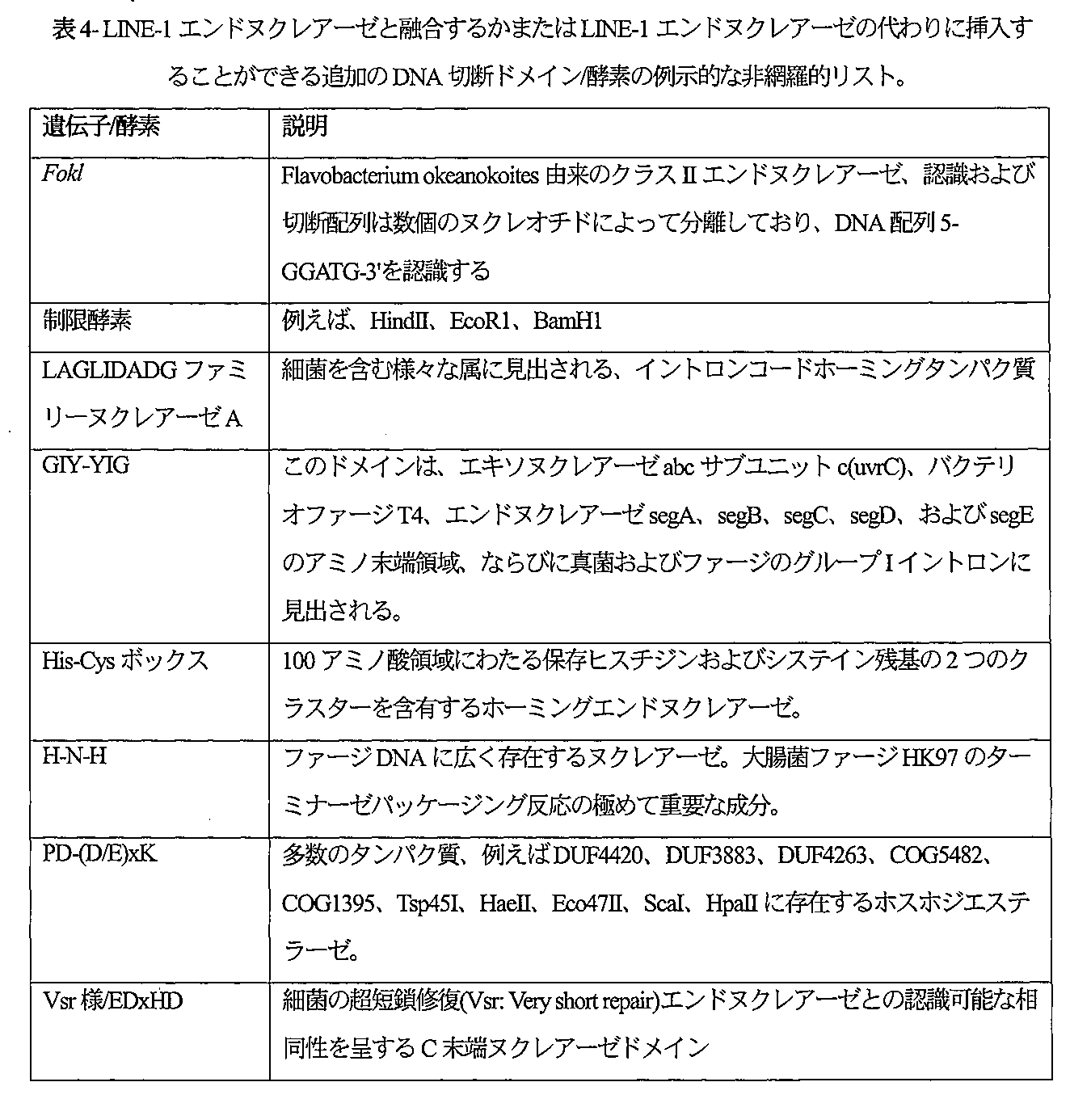
この例では、ORF2の逆転写酵素ドメインを、その効率を向上させるために修飾する。ある実験セットでは、LINE-1プラスミドGFPにおけるヒトORF2をコードする配列を切り出し、MMLVまたはTGIRTIIをコードする配列と置き換える。別の実験セットでは、ORF2逆転写酵素ドメインを異種タンパク質のDNA結合ドメインと融合させる。逆転写酵素ドメインおよび/またはDNA結合ドメインは、表5A~表5Bに提供する非網羅的なリストから選択することができる。構築物を図26に図示する。GFP発現を、HEK293T細胞へのトランスフェクション後にモニタリングする。 In this example, the reverse transcriptase domain of ORF2 is modified to improve its efficiency. In one set of experiments, the sequence encoding human ORF2 in the LINE-1 plasmid GFP is excised and replaced with a sequence encoding MMLV or TGIRTII. In another set of experiments, the ORF2 reverse transcriptase domain is fused to the DNA binding domain of a heterologous protein. The reverse transcriptase domain and/or DNA binding domain can be selected from the non-exhaustive list provided in Tables 5A-5B. The constructs are illustrated in FIG. 26. GFP expression is monitored after transfection into HEK293T cells.


この例では、ヒトLINE-1をコードする配列を、異なる生物由来のLINE-1によって置き換える。一例では、ヒトLINE-1構築物を、ヒトLINE-1がミンククジラLINE-1配列によって置き換えられている構築物と比較する(図27)。同じ実験フレームワークを使用して、いくつかのORFを試験する。例示的な非網羅的リストを下記の表6に提供する。さらなる包括的リストは、Ivancevic A.ら、Genome Biol Evol 8(11):3301~3322において入手可能である。
In this example, the sequence encoding human LINE-1 is replaced by LINE-1 from a different organism. In one example, the human LINE-1 construct is compared to a construct in which human LINE-1 is replaced by a minke whale LINE-1 sequence (FIG. 27). Using the same experimental framework, several ORFs are tested. An exemplary non-exhaustive list is provided in Table 6 below. A more comprehensive list is available in Ivancevic A. et al., Genome Biol Evol 8(11):3301-3322.

[00685]VIII.標的特異性のためのLINE-1融合タンパク質。
この例では、LINE-1プラスミドGFP ORF2を、メガTALヌクレアーゼのドメイン、CRISPR-CASヌクレアーゼ、TALEN、R2レトロエレメント結合ジンクフィンガー結合ドメイン、またはRep78 AAV等の反復エレメントに結合することができるDNA結合ドメインと融合させる。図28はその設計を例示する。表7は、配列特異的レトロ転移を増加するために融合させることができる種々のエレメントのリストを提供する。
[00685] VIII. LINE-1 fusion proteins for target specificity.
In this example, the LINE-1 plasmid GFP ORF2 is fused to a domain of MegaTAL nuclease, CRISPR-CAS nuclease, TALEN, R2 retroelement-binding zinc finger binding domain, or DNA binding domain that can bind to repetitive elements such as Rep78 AAV. Figure 28 illustrates the design. Table 7 provides a list of various elements that can be fused to increase sequence-specific retrotransposition.
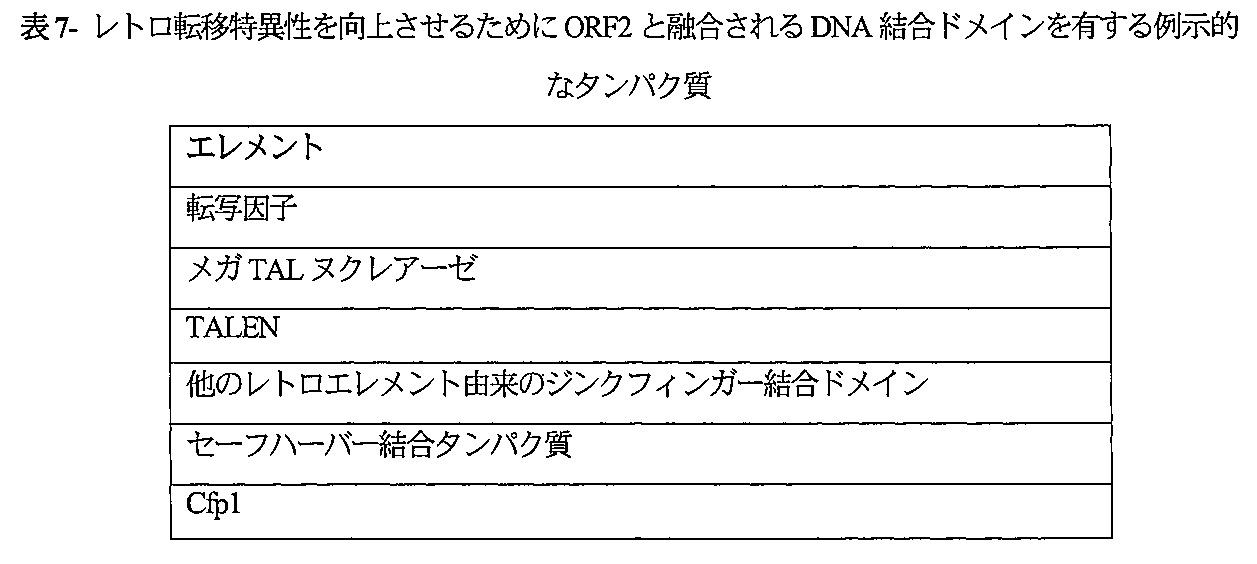
[00687]本節の(I)~(VIII)に記載した修飾は、GFPを読出しとして使用して、レトロ転移効率の向上に関して試験するために設計される。これに従って、(I)~(VIII)からのいくつかの有用な修飾は、その結果に関してGFPを挿入断片として用いて試験した単一レトロ転移構築物に組み入れられ、GFP配列は所望の挿入配列によって置き換えられる。 [00687] The modifications described in (I)-(VIII) of this section are designed to be tested for improved retrotransposition efficiency using GFP as a readout. Accordingly, several useful modifications from (I)-(VIII) are incorporated into a single retrotransposition construct that is tested for its results using GFP as an insert, with the GFP sequence replaced by the desired insert sequence.
実施例15.レトロトランスポゾン技術を使用する長期発現のための大きなペイロードの送達
[00688]細胞のゲノムに核酸ペイロードを組み入れ、例示的導入遺伝子を発現させるために多用途であるレトロトランスポゾン構築物の例示的実証が本明細書において提供される。レトロトランスポゾン構築物を本明細書の他所で詳述した通り設計した。
Example 15. Delivery of large payloads for long-term expression using retrotransposon technology
[00688] Provided herein are exemplary demonstrations of versatile retrotransposon constructs for incorporating nucleic acid payloads into the genome of cells and expressing exemplary transgenes. Retrotransposon constructs were designed as detailed elsewhere herein.
[00689]簡潔には、一連の検証実験において、GFPをコードするペイロードを以下の通り構築した:センス配向でドキシサイクリン誘導性調節下のアンチセンスプロモーター配列に続いて、イントロンで分断されたアンチセンスGFP遺伝子をLINE-1 ORFの下流に配置した(図29)。スプライシングドナー(SD)およびスプライシング受容体(SA)配列は、mRNAが上の鎖のプロモーターから産生される場合にだけ認識され、スプライシングされる、したがって、スプライシングされたmRNAからゲノムに組み込まれたGFP遺伝子だけが、蛍光シグナルを生じる。図2の代表的なフローサイトメトリーデータに示す通り、GFP発現をORF発現のドキシサイクリン誘導後35日でフローサイトメトリーを使用して測定し(緑色のヒストグラム)、陰性対照プラスミド(灰色のヒストグラム)と比較した。この場合、カーゴサイズは2.4kbであった。 [00689] Briefly, in a series of validation experiments, a payload encoding GFP was constructed as follows: an intron-split antisense GFP gene was placed downstream of the LINE-1 ORF, followed by an antisense promoter sequence under doxycycline-inducible control in the sense orientation (Figure 29). The splicing donor (SD) and splicing acceptor (SA) sequences are recognized and spliced only if the mRNA is produced from the promoter of the top strand, therefore only the GFP gene integrated into the genome from the spliced mRNA will produce a fluorescent signal. As shown in the representative flow cytometry data in Figure 2, GFP expression was measured using flow cytometry 35 days after doxycycline induction of ORF expression (green histogram) and compared to a negative control plasmid (grey histogram). In this case, the cargo size was 2.4 kb.
[00690]先の構築物中のカーゴGFP遺伝子をイントロンで隔てられたCD5-FcR-PI3K CAR-M配列と置き換えた(Morrisseyら、2018)。CD5結合剤発現をAlexa647コンジュゲートCD5タンパク質を使用して、プラスミドでトランスフェクトした陰性対照細胞集団(灰色のヒストグラム)と比較してレトロ転移した細胞がCD5-AF647陽性(赤色のヒストグラム)であるようにフローサイトメトリーによって測定した(図30)。3.0kb構築物の首尾よい発現を図に示される通り実証した。 [00690] The cargo GFP gene in the previous construct was replaced with an intron-separated CD5-FcR-PI3K CAR-M sequence (Morrissey et al., 2018). CD5 binder expression was measured by flow cytometry using Alexa647-conjugated CD5 protein such that retrotransfected cells were CD5-AF647 positive (red histogram) compared to a plasmid-transfected negative control cell population (grey histogram) (Figure 30). Successful expression of the 3.0 kb construct was demonstrated as shown in the figure.
[00691]カーゴ遺伝子長を、CD5-FcR-PI3K CAR-M配列の下流のT2A配列の後に、イントロンで隔てられたGFP遺伝子を加えることによって伸長した(図31)。CD5結合剤発現をAlexa647コンジュゲートCD5タンパク質を使用してフローサイトメトリーによって測定した。陰性対照(灰色のヒストグラム)と比較して、CD5結合剤陽性細胞を赤色のヒストグラムによって示す。陰性対照のプラスミドでトランスフェクトされた細胞(灰色のヒストグラム)と比較して、GFP発現をフローサイトメトリーを使用して測定した(緑色のヒストグラム)。Q2におけるフローサイトメトリーシグナルは、10.8%の細胞がCAR-Mタンパク質およびGFPタンパク質の両方を発現することを示した。 [00691] The cargo gene length was extended by adding an intron-separated GFP gene after the T2A sequence downstream of the CD5-FcR-PI3K CAR-M sequence (Figure 31). CD5 binder expression was measured by flow cytometry using Alexa647-conjugated CD5 protein. CD5 binder positive cells are shown by red histograms compared to negative control (gray histogram). GFP expression was measured using flow cytometry (green histogram) compared to cells transfected with negative control plasmid (gray histogram). Flow cytometry signal in Q2 showed that 10.8% of cells expressed both CAR-M and GFP proteins.
[00692]図32に示す通り、ペイロードサイズの制限は、3.9kbペイロードを用いたレトロトランスポゾン送達および組込み(レトロT送達)では到達しなかった。本明細書で記載される送達メカニズムは、第1世代CART構築物およびGFP(T2A部位によって分けられた)の発現について成功した。この実施例では、様々な構築物を挿入配列のレトロ転移効率について試験した。図33Aは、mRNAとしての遺伝子送達が首尾よい組込みを生じたことを示す。このデータは、レトロTがmRNAとして送達され得ることを初めて示した。図33B(上のパネル)に図表で例示する通り、遺伝子送達のために3’UTR中にORF1とORF2とをコードする別個のmRNAと共にアンチセンスプロモーターおよびGFPカーゴ(ORF2-GFPai)を使用するトランス戦略を探索した。図33B~33Dは、複数の代表的なアッセイからの実験結果を実証する。LINE-1タンパク質を発現する別個のmRNAは、レトロ転移のために必要なRNA-タンパク質複合体を再構成できた。シス戦略は、単一のバイシストロニックLINE-1 mRNAを3’UTR中のアンチセンスプロモーターおよびGFP遺伝子カーゴと共に使用する。様々な量および割合のORF2およびORF1を含む構築物を図33Bおよび図33Cに示す通り、ペイロードとしてGFPコード配列を含んで比較した。図33Dは、単一mRNAを導入することが、細胞あたりでより多い数の組込みをもたらすことを示す。生化学的アッセイおよび組込みアッセイのためにレトロ転移した細胞を濃縮するための293T GFP細胞の選別。細胞は図33Bにおいてと同じであり、下のパネルにおいて選別後4日のGFP発現を示す。グラフは、様々なLINE-1プラスミドでトランスフェクトした、LINE-1 mRNA(レトロmRNA)ならびにORF1およびORF2-GFP mRNAで電気穿孔された細胞からのゲノムDNA組込みについてのqPCRアッセイを示す。一方はハウスキーピング遺伝子RPS30に対して、およびもう一方はGFP遺伝子に対しての2つのqPCRプライマー-プローブセットを使用した。プラスミドでトランスフェクトした細胞は、SV40維持配列を含有しないプラスミドを使用する。細胞あたりの組入れを、プラスミドとゲノムDNAの標準曲線の内挿および、293T細胞あたり2コピーのRPS30に対する正規化を介して試料あたりのコピー数を決定することから算出する。エラーバーは、3回の技術的反復測定の標準偏差を記す。 [00692] As shown in Figure 32, the payload size limit was not reached for retrotransposon delivery and integration (retro-T delivery) with a 3.9 kb payload. The delivery mechanism described herein was successful for the expression of a first generation CART construct and GFP (separated by a T2A site). In this example, various constructs were tested for retrotransposition efficiency of the insert. Figure 33A shows that gene delivery as mRNA resulted in successful integration. This data showed for the first time that retro-T can be delivered as mRNA. As illustrated diagrammatically in Figure 33B (top panel), a trans strategy was explored using an antisense promoter and GFP cargo (ORF2-GFPai) with separate mRNAs encoding ORF1 and ORF2 in the 3'UTR for gene delivery. Figures 33B-33D demonstrate experimental results from several representative assays. A separate mRNA expressing the LINE-1 protein was able to reconstitute the RNA-protein complex required for retrotransposition. The cis strategy uses a single bicistronic LINE-1 mRNA with an antisense promoter and GFP gene cargo in the 3'UTR. Constructs containing various amounts and ratios of ORF2 and ORF1 were compared with GFP coding sequence as payload, as shown in Figure 33B and Figure 33C. Figure 33D shows that introducing a single mRNA results in a higher number of integrations per cell. Sorting of 293T GFP cells to enrich for retrotransposed cells for biochemical and integration assays. Cells are the same as in Figure 33B, and show GFP expression 4 days after sorting in the bottom panel. The graph shows qPCR assays for genomic DNA integration from cells electroporated with LINE-1 mRNA (retro-mRNA) and ORF1 and ORF2-GFP mRNA, transfected with various LINE-1 plasmids. Two qPCR primer-probe sets were used, one against the housekeeping gene RPS30 and the other against the GFP gene. Plasmid transfected cells use plasmids that do not contain SV40 maintenance sequences. Incorporation per cell is calculated from interpolation of plasmid and genomic DNA standard curves and determining copy numbers per sample via normalization to RPS30 at 2 copies per 293T cell. Error bars indicate standard deviation of three technical replicates.
実施例16.多様な細胞型への送達
[00693]図34~38に示す通り、例えば、CARタンパク質または例えばGFPタンパク質をコードする、目的の遺伝子を含むmRNA構築物は、上皮細胞(例えば、HEK293細胞)、単核球細胞株(例えば、THP-1細胞)、リンパ芽球細胞株(例えば、K562細胞)および初代リンパ球(T細胞)等の、多様な細胞型において効率的に発現され得る。活性化初代T細胞も、GFPのゲノム組込みおよび発現を有するmRNAで良好にトランスフェクトされた(図36)。初代T細胞を単離し、IL7/IL15を使用して増殖させ;第1Gen CAR構築物を活性化後2日目に送達した。細胞を選別し、凍結した。GFP発現は、凍結融解サイクル後に検出可能であった(図37A~B)。このことは、mRNA媒介送達およびL1-トランスポゾン媒介組込みの多用途な性質を示す。図38は、GFP mRNA組込みならびに、293T細胞、K562細胞、THP-1細胞および初代T細胞での発現の代表的なアッセイを示す。
Example 16. Delivery to various cell types
[00693] As shown in Figures 34-38, mRNA constructs containing a gene of interest, e.g., encoding a CAR protein or e.g., a GFP protein, can be efficiently expressed in a variety of cell types, such as epithelial cells (e.g., HEK293 cells), monocytic cell lines (e.g., THP-1 cells), lymphoblastoid cell lines (e.g., K562 cells), and primary lymphocytes (T cells). Activated primary T cells were also successfully transfected with mRNA with genomic integration and expression of GFP (Figure 36). Primary T cells were isolated and expanded using IL7/IL15; 1 Gen CAR constructs were delivered 2 days after activation. Cells were sorted and frozen. GFP expression was detectable after freeze-thaw cycles (Figures 37A-B). This demonstrates the versatile nature of mRNA-mediated delivery and L1-transposon-mediated integration. FIG. 38 shows representative assays of GFP mRNA integration and expression in 293T, K562, THP-1 and primary T cells.
実施例17.レトロ転移システムの修飾、ゲノム組込みのためのインテグラーゼの部位特異性の交換
[00694]この予測的実施例では、セリンインテグラーゼを使用する高度な位置特異性での細胞のゲノムへのレトロトランスポゾン組込みシステムを使用して、大きなmRNA構築物が非分裂哺乳動物細胞に安定に組み入れられ、発現される。レトロトランスポゾン構築物を、本開示他所で詳述した通り設計する。
Example 17. Modification of the retrotransposition system, exchanging the site specificity of integrase for genomic integration
[00694] In this prophetic example, large mRNA constructs are stably integrated and expressed in non-dividing mammalian cells using a system for retrotransposon integration into the genome of cells with high site specificity using serine integrase. Retrotransposon constructs are designed as detailed elsewhere in this disclosure.
[00695]この実施例では、第1の構築物、mRNA構築物を、インテグラーゼによる二重鎖ポリヌクレオチド組込みの可能性を排除する変異を触媒ドメイン中に含むセリンインテグラーゼに融合されたCasエンドヌクレアーゼ、およびガイドRNAが特異的に設計されるところに応じて、特定のゲノム座位、例えば、ヒストン遺伝子座位、アクチン遺伝子座位等を対象とするプライム編集ガイドRNA(pegRNA)オリゴヌクレオチドを含むように設計する。1つまたは複数のT2A切断部位は、個々のタンパク質、例えば、Cas9および、これらの断片のセリンインテグラーゼのコード配列を分離する。pegRNAを41bp AttBランディング部位を挿入するように設計する。1つまたは複数の代替的設計では、LINE 1 ORF2結合部位をインテグラーゼ結合部位との関連でORF2タンパク質の結合のために好都合で、近接して(例えば、並置して)位置付けて組み入れる。 [00695] In this example, the first construct, an mRNA construct, is designed to include a Cas endonuclease fused to a serine integrase that contains a mutation in the catalytic domain that precludes the possibility of double-stranded polynucleotide integration by the integrase, and a prime editing guide RNA (pegRNA) oligonucleotide that targets a particular genomic locus, e.g., a histone locus, an actin locus, etc., depending on where the guide RNA is specifically designed. One or more T2A cleavage sites separate the coding sequences of the individual proteins, e.g., Cas9 and the serine integrase of these fragments. The pegRNA is designed to insert a 41 bp AttB landing site. One or more alternative designs incorporate a LINE 1 ORF2 binding site in a convenient, closely spaced (e.g., juxtaposed) position for binding of the ORF2 protein in relation to the integrase binding site.
[00696]第2のmRNA構築物は、5、6、7、8、9、10キロベースより大きいカーゴ配列に融合され、タンパク質;変異されたエンドヌクレアーゼおよび、インテグラーゼがカーゴ配列を誘引し、ランディング配列に運ぶためカーゴ配列に融合されているAttP付着部位をコードする、LINE1 mRNAを含むように設計する。AttP付着部位は、AttBランディング部位に相補的である。 [00696] A second mRNA construct is designed to contain the LINE1 mRNA fused to a cargo sequence of greater than 5, 6, 7, 8, 9, 10 kilobases and encoding the protein; a mutated endonuclease and an AttP attachment site fused to the cargo sequence for the integrase to attract and deliver the cargo sequence to the landing sequence. The AttP attachment site is complementary to the AttB landing site.
[00697]mRNA構築物をin vitro転写を介して調製し、次いで精製する。得られた精製mRNA構築物それぞれを別個に脂質ナノ粒子(LNP)に組み入れる。電気穿孔を使用して、2つのmRNA構築物をLNPを使用して細胞に同時送達する。pegRNAに融合したCas9エンドヌクレアーゼは、特定の遺伝子座位にゲノムランディング配列を挿入するようにガイドされる。AttBランディング部位は、設計によりLINE1 mRNAと関連するカーゴ配列内に含まれ、AttP付着部位に誘引するビーコンのように作用する。タンパク質の同時翻訳は、ORFポリペプチドの生成をもたらし、インテグラーゼによって導かれ、付着部位によって連結され、ORFは、近接してORF結合部位と会合し、カーゴを特定の部位に組み込む。 [00697] The mRNA constructs are prepared via in vitro transcription and then purified. Each of the resulting purified mRNA constructs is separately incorporated into lipid nanoparticles (LNPs). Using electroporation, the two mRNA constructs are co-delivered into cells using LNPs. The Cas9 endonuclease fused to the pegRNA is guided to insert a genomic landing sequence into a specific locus. The AttB landing site is included within the cargo sequence associated with the LINE1 mRNA by design and acts like a beacon that attracts the AttP attachment site. Co-translation of the protein results in the production of an ORF polypeptide, guided by the integrase and linked by the attachment site, where the ORF associates with the ORF binding site in close proximity and integrates the cargo into the specific site.
[00698]さらに別の代替的設計システムでは、インテグラーゼシステムは、完全に回避され、PEG-RNAは、ガイドRNAによって方向付けられた特定のゲノム座位にORF結合部位だけを組み入れる。 [00698] In yet another alternative design system, the integrase system is avoided entirely, and the PEG-RNA integrates only the ORF binding site at the specific genomic locus directed by the guide RNA.
[00699]部位特異的組込みは、サンガー配列決定によって確認する。フローサイトメトリーを細胞における挿入配列の発現を実証するために実施する。細胞生存率およびゲノム組込みは、mRNAが細胞に有害な影響をあまり有しないことから、プラスミドまたはベクターに基づくシステムにおいてしばしば見られるよりも高いことが見出される。 [00699] Site-specific integration is confirmed by Sanger sequencing. Flow cytometry is performed to demonstrate expression of the inserted sequence in the cells. Cell viability and genomic integration are found to be higher than often seen in plasmid or vector-based systems because the mRNA has fewer deleterious effects on the cells.
実施例18.例示的配列
[00700]以下は、実施例において使用される構築物の例示的な配列である。これらの配列は参照例示を目的としており、当業者によって過度の実験を行わずに想到される配列の変形および最適化は本開示によって企図および包含される。配列の表題にmRNA配列と記載される場合、構築物はDNA鋳型のヌクレオチドを記載しており、当業者は対応するmRNA配列を容易に得ることができる。
Example 18. Exemplary sequences
[00700] The following are exemplary sequences of constructs used in the examples. These sequences are for reference purposes, and the modifications and optimizations of sequences that can be conceived by those skilled in the art without undue experimentation are contemplated and encompassed by the present disclosure. When the title of the sequence states "mRNA sequence," the construct describes the nucleotides of the DNA template, and those skilled in the art can easily obtain the corresponding mRNA sequence.


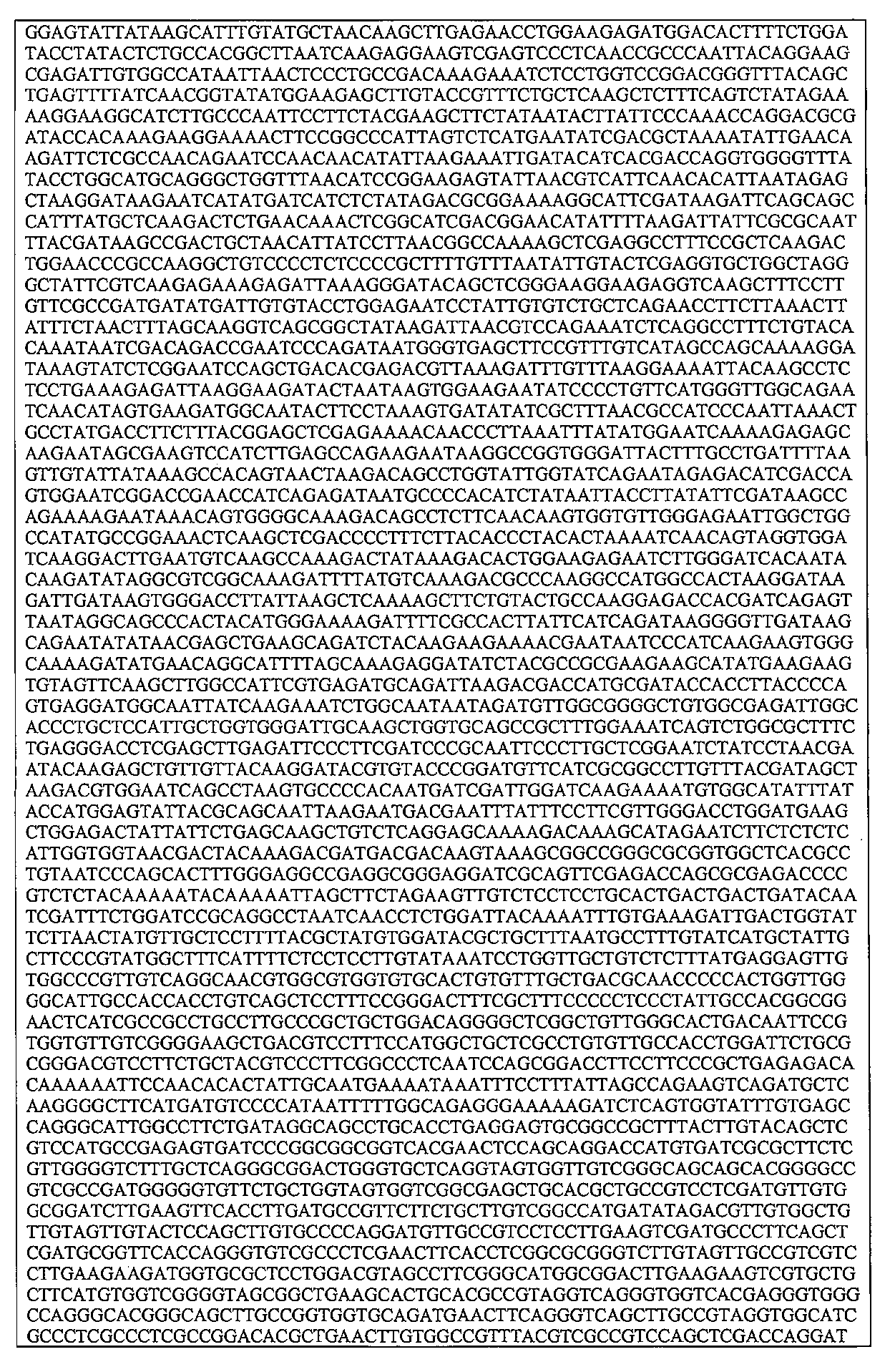


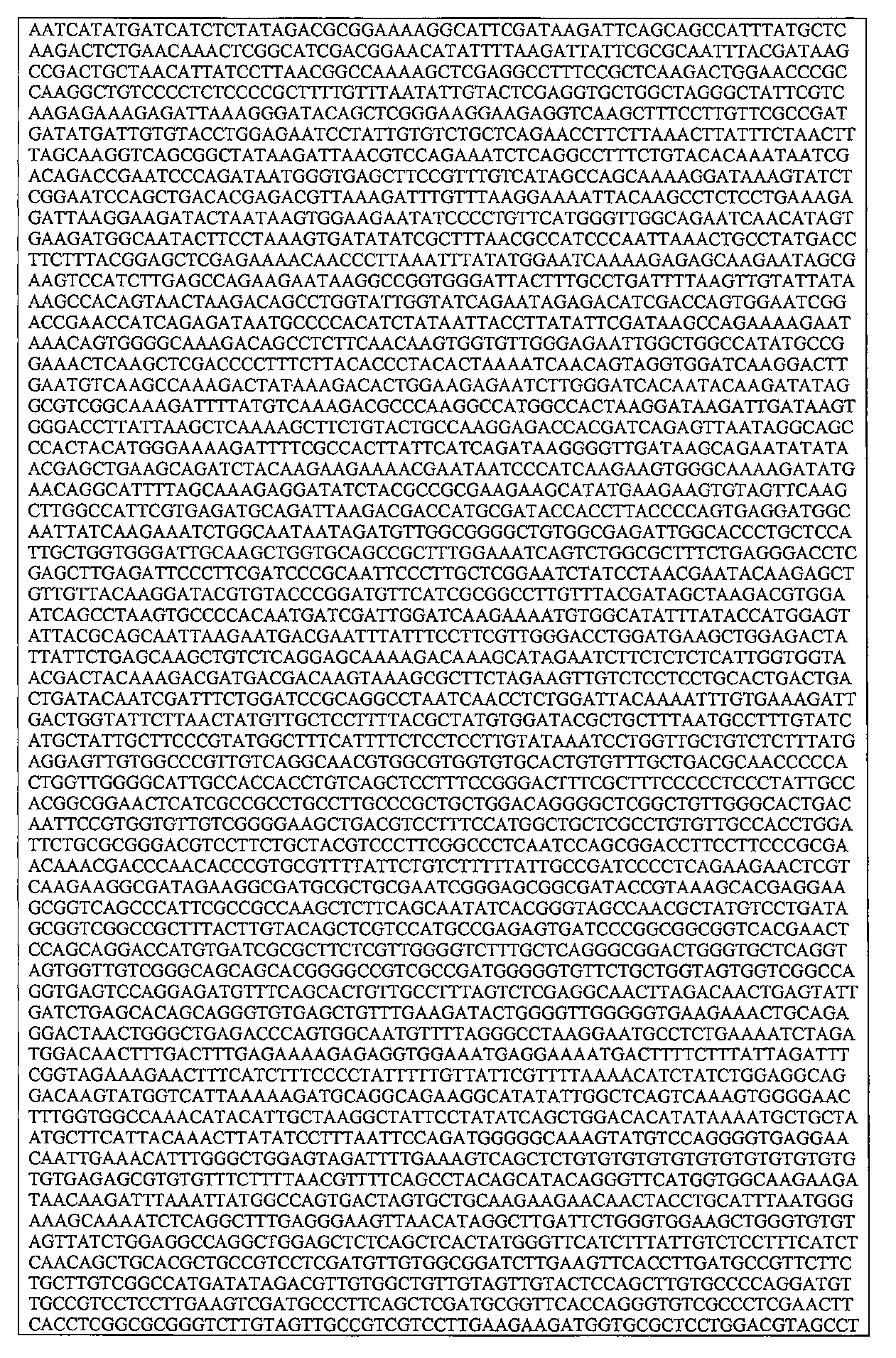


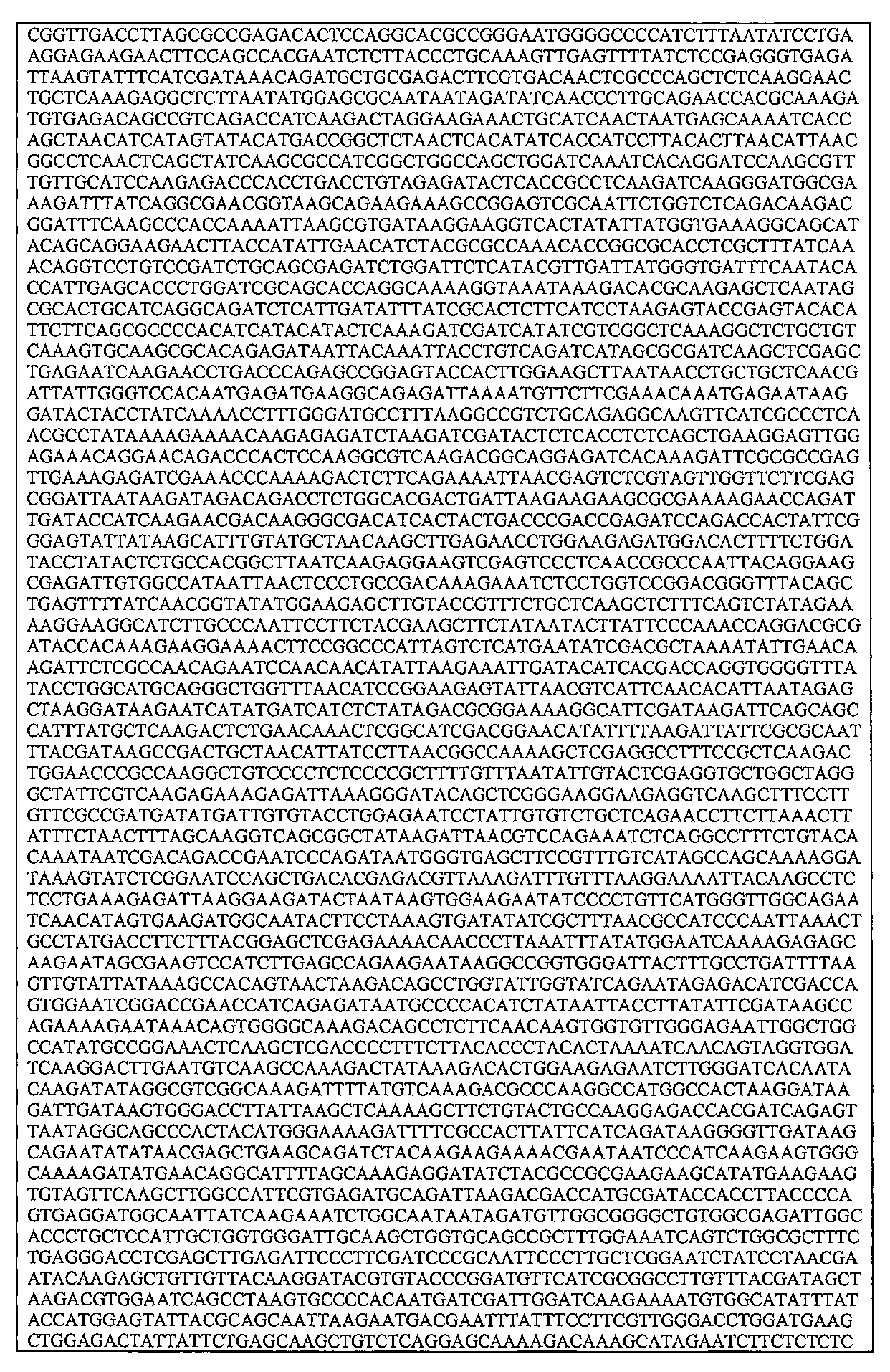


[00701]安定に組み込まれた核酸配列を有する細胞収量を増加させるための試みにおいて、この実施例で記載された通り選別および培養する方法を試みた。293T細胞を、IVTによって産生したLINE1-GFP mRNAを用いて電気穿孔し、in vitroで少なくとも3日間培養した。図40に示す通りGFPの発現をフローサイトメトリーを使用して定期的に決定した。ゲノムあたりのゲノム組込みを定量的PCRを使用して評価した。ゲノムあたりのゲノム中のGFPをコードする核酸の内挿を、GFPおよびハウスキーピング遺伝子(FAU)についての標準曲線を使用して評価した。GFP陽性細胞の選別および濃縮培養において、図40に示す通り、組込みは複数回の細胞継代において(EP後少なくとも18日間)安定であり、相当な濃縮が可能であったことが明らかであった。GFP発現は、EPの5日後で293T細胞の約1%において検出可能であった。GFP+細胞を最初の選別後に約28%に濃縮し、2回目の選別後さらに細胞の約74%まで濃縮した(図40、図41C)。
[00701] In an attempt to increase the yield of cells with stably integrated nucleic acid sequences, the selection and culture methods described in this example were attempted. 293T cells were electroporated with LINE1-GFP mRNA produced by IVT and cultured in vitro for at least 3 days. GFP expression was determined periodically using flow cytometry as shown in Figure 40. Genomic integration per genome was assessed using quantitative PCR. Interpolation of GFP-encoding nucleic acid in genomes per genome was assessed using standard curves for GFP and housekeeping gene (FAU). In the sorting and enrichment culture of GFP-positive cells, it was evident that integration was stable for multiple cell passages (for at least 18 days after EP) and allowed for substantial enrichment, as shown in Figure 40. GFP expression was detectable in approximately 1% of 293T cells 5 days after EP. GFP+ cells were enriched to about 28% after the first sort and further enriched to about 74% of the cells after the second sort (FIG. 40, FIG. 41C).
[00702]ゲノム組込みの標準曲線および例示的定量を図41Aおよび41Bにそれぞれ示す。図41Cは、GFP蛍光強度103単位で、およびGFP蛍光強度104単位でゲーティングした場合のゲノムあたりのGFP組込みの平均数を示す。 [00702] Standard curves and exemplary quantification of genome integration are shown in Figures 41A and 41B, respectively. Figure 41C shows the average number of GFP integrations per genome when gated at 103 units of GFP fluorescence intensity and at 104 units of GFP fluorescence intensity.
実施例20.トランスポゾン媒介組込みの増加のためのmRNA濃度のタイトレーション
[00703]電気穿孔のために使用したLINE1-GFP mRNAの濃度は、様々な細胞型、293T細胞、K562およびTHP-1細胞において細胞あたりの最適なゲノム組込みについてタイトレーションした(図42~46)。100、500、1000、1500および2000ng/μLのmRNAをGFP発現および細胞あたりの組込み数について試験した。1000ng/μlを超える濃度は、細胞死を生じる。図42、43および44に示す結果から、1000ng/μlは、レトロ転移し、組み込まれた核酸によってコードされたGFPのより高く長期間の発現を生じる。組み込まれたDNAがコードするタンパク質発現は、3日目に検出可能になり始め、およそ6~7日目にピークになる(図45)。しかし、K562およびTHP-1におけるLINE-1 GFP mRNAのゲノム組込みおよび発現は極めて低かった;組込みは、K562細胞において細胞あたり約0.067~0.155で検出された(図46)(THP-1データは示さない)。より高いLINE1-GFP mRNA濃度(1500および2000ng/μl)は、これらの細胞において細胞死を生じた。PD-0015単球でのGFP mRNA発現は、電気穿孔後3日目に、細胞当たりの検出可能な組込みを有して検出された(図47)。ステップは、さらに広範なDNase1処置について行われ、試験mRNAバッチを電気穿孔前に残存プラスミドについて評価した。ゲノムにおける組込みレベル決定の精度は、PCRによる組み込まれたDNA配列の最初の濃縮に続く、ゲノム内の組込み部位のマッピングをもたらすペアエンド配列決定によって改善され得る。次世代配列決定は、この点において絶対的基準と考えられ、それは、gDNA抽出→超音波処理による剪断→DNAリンカーをDNA末端にライゲーション→ネステッドPCR(1:リンカー用の1つのプライマー、DNAを組み込むための第2のプライマー、2:Illumina配列決定アダプターを添加)→ペアエンド配列決定を含む。
Example 20. Titration of mRNA concentration to increase transposon-mediated integration
[00703] The concentration of LINE1-GFP mRNA used for electroporation was titrated for optimal genomic integration per cell in various cell types, 293T cells, K562 and THP-1 cells (Figures 42-46). 100, 500, 1000, 1500 and 2000 ng/μL of mRNA were tested for GFP expression and number of integrations per cell. Concentrations above 1000 ng/μL result in cell death. From the results shown in Figures 42, 43 and 44, 1000 ng/μL results in higher and longer-lasting expression of GFP encoded by the retrotransposed and integrated nucleic acid. Protein expression encoded by the integrated DNA begins to be detectable at day 3 and peaks at approximately day 6-7 (Figure 45). However, genomic integration and expression of LINE-1 GFP mRNA in K562 and THP-1 were extremely low; integration was detected at approximately 0.067-0.155 per cell in K562 cells (Figure 46) (THP-1 data not shown). Higher LINE1-GFP mRNA concentrations (1500 and 2000 ng/μl) caused cell death in these cells. GFP mRNA expression in PD-0015 monocytes was detected with detectable integration per cell 3 days after electroporation (Figure 47). Steps were taken for more extensive DNase 1 treatment, where test mRNA batches were assessed for residual plasmid before electroporation. The accuracy of integration level determination in the genome can be improved by first enrichment of integrated DNA sequences by PCR, followed by paired-end sequencing resulting in mapping of integration sites within the genome. Next generation sequencing is considered the gold standard in this regard, which involves gDNA extraction → shearing by sonication → ligation of DNA linkers to the DNA ends → nested PCR (1: one primer for the linker, a second primer to incorporate the DNA; 2: adding Illumina sequencing adaptors) → paired-end sequencing.
実施例21.トランスポゾン媒介組込みを妨げる候補のノックダウンによる組込み効率の改善
[00704]この実施例では、ノックダウンがGFPをコードする試験核酸のより高い組込みを生じ得るかどうかを決定するためにsiRNAを使用して多数の内在性の候補をノックダウンした。候補は、LINE1レトロ転移の阻害薬:ADAR1、ADAR2(ADAR1B)、APOBEC3C、BRCA1、let-7 miRNA、RNase L、TASOR(HUSH複合体)、RAD51を含んだ。siRNA(標的候補あたり3つ)を作製し、LINE1-GFP mRNAと共に試験細胞に電気穿孔し、フローサイトメトリーによってLINE-1 GFP発現の変更について、およびqPCRによるそのゲノム組込みについて試験し、LINE-1 GFP組込みおよび発現の増加を助けるsiRNAのカクテルをさらなるタイトレーションのために選択した。試験した様々なsiRNAからの結果を図48~51に示す。個々に試験したADAR1、BRCAおよびRNASELのノックダウンは、LINE1-GFPの組込みの約2倍の増加を誘導した。ADAR2、RAD51およびAPOEBEC3Cは、それぞれ1.5倍未満の増加をもたらし、let7 miRNAおよびTASORは、それぞれ増加をもたらさなかった。図48に示す研究では、LINE-1 GFP(2000ng/μL)を100、200および300ng/μLのsiBRCAで293細胞において電気穿孔し、電気穿孔後4日目のデータを示す。100ng/μLでは、組込み率は、細胞あたりおよそGFP0.06コピーであり、siBRCA1_s459(100ng/μl)は、約2倍組込みを増加させる。図49に示すデータは、電気穿孔後6日目で、siRNASELおよびsiADAR1 siRNAのそれぞれが組込みを別個に約2倍増加させたことを実証する。一方、siAPOBEC3C_s2617は、電気穿孔後6日目にGFP組込みを<1.5倍増加させる(図50)。
Example 21. Improved integration efficiency by knocking down candidates that interfere with transposon-mediated integration
[00704] In this example, siRNA was used to knock down a number of endogenous candidates to determine whether knockdown could result in higher integration of the test nucleic acid encoding GFP. Candidates included inhibitors of LINE1 retrotransposition: ADAR1, ADAR2 (ADAR1B), APOBEC3C, BRCA1, let-7 miRNA, RNase L, TASOR (HUSH complex), RAD51. siRNAs (three per target candidate) were made and electroporated with LINE1-GFP mRNA into test cells and tested for alteration of LINE-1 GFP expression by flow cytometry and for their genomic integration by qPCR, and a cocktail of siRNAs that helped increase LINE-1 GFP integration and expression was selected for further titration. Results from the various siRNAs tested are shown in Figures 48-51. Knockdown of ADAR1, BRCA and RNASEL tested individually induced an approximately 2-fold increase in LINE1-GFP integration. ADAR2, RAD51 and APOEBEC3C each resulted in less than a 1.5-fold increase, while let7 miRNA and TASOR each resulted in no increase. In the study shown in FIG. 48, LINE-1 GFP (2000 ng/μL) was electroporated in 293 cells with 100, 200 and 300 ng/μL siBRCA and data are shown 4 days after electroporation. At 100 ng/μL, the integration rate was approximately 0.06 copies of GFP per cell, and siBRCA1_s459 (100 ng/μl) increased integration by approximately 2-fold. The data shown in Figure 49 demonstrates that siRNASEL and siADAR1 siRNA each independently increased integration by approximately 2-fold at 6 days post-electroporation, whereas siAPOBEC3C_s2617 increased GFP integration by <1.5-fold at 6 days post-electroporation (Figure 50).

実施例20.レトロ転移効率の改善
[00706]レトロ転移の効率は、レトロトランスポゾン遺伝子組込み、ならびに続く、組み込まれた遺伝子の転写および翻訳効率のレベル等の多数の変量によって影響を受け得る。この実施例では、LINE-1変異、mRNA配列変更/付加およびmRNAの化学的性質における変更等の変量を、細胞における構築物のレトロ転移効率および発現の向上へのそれらの影響について試験する。カーゴ遺伝子組込みを改善するために、以下の例示的実験を、細胞における構築物のレトロ転移効率および発現の向上へのそれらの影響について試験するために実行する:(1)mRNA修飾、mRNA安定性およびタンパク質発現を向上させるもの等;(2)配列修飾、局在化および組込みを増強する核局在化配列(NLS)の付加、およびLINE-1タンパク質での変異の導入等;(3)カーゴ発現を改善する方法、ならびに;(4)様々な生物に由来する様々なレトロエレメントでの生物情報学的分析。これらの実験からの知識を、様々な細胞型へのこれらのアプローチの特異性および多用途性を決定するために、骨髄細胞、T細胞、肝細胞、心筋細胞、ニューロンおよび網膜色素上皮細胞を含む多数のヒト細胞型にわたって適応させる。レトロトランスポゾンのin vivo送達は、マウスでも実行する。
Example 20. Improvement of retrotransposition efficiency
[00706] The efficiency of retrotransposition can be affected by a number of variables, such as the level of retrotransposon gene integration and the subsequent transcription and translation efficiency of the integrated gene. In this example, variables such as LINE-1 mutations, mRNA sequence changes/additions, and changes in mRNA chemistry are tested for their impact on improving retrotransposition efficiency and expression of the construct in cells. To improve cargo gene integration, the following exemplary experiments are performed to test for their impact on improving retrotransposition efficiency and expression of the construct in cells: (1) mRNA modifications, such as those that improve mRNA stability and protein expression; (2) sequence modifications, such as the addition of nuclear localization sequences (NLS) that enhance localization and integration, and the introduction of mutations in the LINE-1 protein; (3) methods to improve cargo expression, and; (4) bioinformatic analysis on various retroelements from various organisms. Knowledge from these experiments is applied across a number of human cell types, including bone marrow cells, T cells, hepatocytes, cardiomyocytes, neurons, and retinal pigment epithelial cells, to determine the specificity and versatility of these approaches to various cell types. In vivo delivery of retrotransposons is also performed in mice.
[00707]これらの実験に含まれる例示的細胞としては、肝細胞、心筋細胞、網膜色素上皮細胞およびニューロンが挙げられる。初代細胞および細胞株は、使用され、各細胞型/細胞株について最適な条件下で培養され得る。試験構築物としては、本明細書の他所で記載されるレトロトランスポゾン複合体においてORF1/2遺伝子に対して逆配向で挿入されたプロモーターおよびポリA配列と共にGFPを、コードする配列を含む、プラスミド構築物およびmRNA構築物が挙げられる。プラスミド構築物について、試験構築物は、センス配向でイントロンによって隔てられたGFP遺伝子をアンチセンス配向で含有する構築物を含む。mRNA構築物について、試験構築物は、イントロンを含まない構築物を含む。レトロ転移条件は、電気穿孔および/またはトランスフェクション試薬を介してin vitroで細胞に送達されるGFP-レトロトランスポゾンと共に、組込みを増強する試薬を含み得る。特定の細胞型にそれぞれ最適化された電気穿孔条件を使用する。組込みの効率は、例えば、SSCおよびFSCに基づいて設定したゲーティングを使用して、フローサイトメトリーによって決定する。フローサイトメトリーのためのゲーティングを設定するためにGFPを陰性対照および陽性対照において測定する。使用する例示的陰性対照は、<0.1% GFP+に設定する。使用する例示的陽性対照は、>90% GFP+に設定する。GFPは、フローサイトメトリーのためのゲーティングを設定するために陰性対照および陽性対照において測定する。使用する例示的陰性対照は、<0.1% GFP+に設定する。使用する例示的陽性対照は、>90% GFP+に設定する。首尾よい組込みを示す例示的な測定は、レトロ転移後の10日目に>2%の細胞においてフローサイトメトリーによって決定されたGFP発現の測定である。首尾よい組込みを示す別の例示的測定は、レトロ転移後の10日目に>10%の細胞においてフローサイトメトリーによって決定されたGFP発現の測定である。 [00707] Exemplary cells included in these experiments include hepatocytes, cardiomyocytes, retinal pigment epithelial cells, and neurons. Primary cells and cell lines can be used and cultured under optimal conditions for each cell type/cell line. Test constructs include plasmid and mRNA constructs that contain sequences encoding GFP with promoter and polyA sequences inserted in reverse orientation relative to the ORF1/2 gene in the retrotransposon complex described elsewhere herein. For plasmid constructs, test constructs include constructs containing the GFP gene in antisense orientation separated by an intron in sense orientation. For mRNA constructs, test constructs include constructs without introns. Retrotransposition conditions can include reagents that enhance integration with the GFP-retrotransposon delivered to cells in vitro via electroporation and/or transfection reagents. Electroporation conditions optimized for each particular cell type are used. Efficiency of integration is determined by flow cytometry, for example, using gating based on SSC and FSC. GFP is measured in negative and positive controls to set the gating for flow cytometry. An exemplary negative control used is set at <0.1% GFP+. An exemplary positive control used is set at >90% GFP+. GFP is measured in negative and positive controls to set the gating for flow cytometry. An exemplary negative control used is set at <0.1% GFP+. An exemplary positive control used is set at >90% GFP+. An exemplary measurement indicating successful integration is measurement of GFP expression as determined by flow cytometry in >2% of cells at day 10 after retrotransposition. Another exemplary measurement indicating successful integration is measurement of GFP expression as determined by flow cytometry in >10% of cells at day 10 after retrotransposition.
[00708]PCRおよび次世代配列決定(NGS)等の追加的アッセイを、例えば組込みを確認するために実施する。次世代配列決定は、トランスフェクトされた/電気穿孔された細胞について実施され得る。 [00708] Additional assays such as PCR and next generation sequencing (NGS) are performed, for example, to confirm integration. Next generation sequencing can be performed on transfected/electroporated cells.
[00709]mRNA安定性および翻訳効率に直接影響を与える可能性があり、それへの修飾が安定性およびタンパク質発現を向上することが試験される例示的mRNA構造は、5’CAP、ポリ(A)尾部および非翻訳領域(UTR)を含む。例えば、5’CAPの酵素的組入れおよびCAP類似体、例えば、7-メチルグアノシンの使用は、試験されるだろう。5’CAPの酵素的組入れは、CAP類似体を使用するよりも効率的であり得る。例えば、ポリ(A)尾部長の変形例は、ポリ(A)尾部長が翻訳効率に影響を与えるかどうかを決定するためにも試験されるだろう。例えば、mRNAのGC含有パーセントの変形例は、GC含有量が翻訳効率に影響を与えるかどうかを決定するために試験されるだろう。高いGC含有量は、mRNA二次構造安定性を向上させ得る。低いGC含有量は、mRNAの翻訳可能性を減少させ得る。配列特異的mRNAの変形は、最適なGC含有量に達するために試験され得る。別の例示的方法では、ある特定のコドンをまれなコドンと置換すること、および修飾されたヌクレオチドを挿入することは、それが翻訳効率に影響を与え得るかどうかを決定するために実行されるだろう。安定性およびタンパク質発現を向上させるために試験される他の例示的ヌクレオチド修飾としては、5-メチルシチジン(m5C)およびシュードウリジン(ψ)ヌクレオチドの使用が挙げられる。首尾よい組込みを示す例示的測定は、レトロ転移後10日目の細胞の>2%におけるフローサイトメトリーによって決定されるGFP発現の測定である。首尾よい組込みを示す別の例示的測定は、レトロ転移後10日目の細胞の>10%におけるフローサイトメトリーによって決定されるGFP発現の測定である。 [00709] Exemplary mRNA structures that may directly affect mRNA stability and translation efficiency and modifications to which may be tested to improve stability and protein expression include the 5'CAP, poly(A) tail, and untranslated regions (UTRs). For example, enzymatic incorporation of 5'CAP and use of CAP analogs, such as 7-methylguanosine, will be tested. Enzymatic incorporation of 5'CAP may be more efficient than using CAP analogs. For example, variations in poly(A) tail length will also be tested to determine whether poly(A) tail length affects translation efficiency. For example, variations in the percent GC content of the mRNA will be tested to determine whether GC content affects translation efficiency. High GC content may improve mRNA secondary structure stability. Low GC content may reduce mRNA translatability. Sequence-specific mRNA variations may be tested to arrive at optimal GC content. In another exemplary method, replacing certain codons with rare codons and inserting modified nucleotides will be performed to determine whether it can affect translation efficiency. Other exemplary nucleotide modifications that may be tested to improve stability and protein expression include the use of 5-methylcytidine (m5C) and pseudouridine (ψ) nucleotides. An exemplary measurement of successful integration is the measurement of GFP expression as determined by flow cytometry in >2% of cells 10 days after retrotransposition. Another exemplary measurement of successful integration is the measurement of GFP expression as determined by flow cytometry in >10% of cells 10 days after retrotransposition.
[00710]様々なmRNA産生プロセスも、全長mRNAの転写の増加のために試験されるだろう。 [00710] Various mRNA production processes will also be tested for increased transcription of full-length mRNA.
[00711]例示的NLS配列修飾は、例えば、局在化および組込みの増強のために試験され、様々なNLS配列、LINE-1エレメントの上流または下流のNLS配列の配置、および使用されるNLS配列の数を含む。上記の通り、GFPは、フローサイトメトリーのためのゲートを設定するために陰性対照および陽性対照において測定される。上記の通り、使用する例示的陰性対照は、<0.1% GFP+に設定する。上記の通り、使用する例示的陽性対照は、>90% GFP+に設定する。首尾よいカーゴ遺伝子発現を示す例示的な測定は、レトロ転移後10日目の細胞の>10%における、フローサイトメトリーによって決定されるGFP発現の増加の測定である。 [00711] Exemplary NLS sequence modifications tested, for example, for enhanced localization and integration, include various NLS sequences, placement of the NLS sequence upstream or downstream of the LINE-1 element, and the number of NLS sequences used. As above, GFP is measured in negative and positive controls to set gates for flow cytometry. As above, an exemplary negative control used is set to <0.1% GFP+. As above, an exemplary positive control used is set to >90% GFP+. An exemplary measurement indicative of successful cargo gene expression is measurement of increased GFP expression as determined by flow cytometry in >10% of cells at day 10 after retrotransposition.
[00712]局在化および組込みの増強のため等の、試験されるLINE-1タンパク質における変異をコードする例示的配列修飾としては、ORF1タンパク質のK3RおよびORF2のY1180Aが挙げられる。上記の通り、GFPは、フローサイトメトリーのためのゲートを設定するために陰性対照および陽性対照において測定される。上記の通り、使用する例示的陰性対照は、<0.1% GFP+に設定する。上記の通り、使用する例示的陽性対照は、>90% GFP+に設定する。首尾よいカーゴ遺伝子発現を示す例示的な測定は、レトロ転移後10日目の細胞の>10%における、フローサイトメトリーによって決定されるGFP発現の増加の測定である。 [00712] Exemplary sequence modifications encoding mutations in the LINE-1 protein to be tested, such as for enhanced localization and integration, include K3R in the ORF1 protein and Y1180A in ORF2. As above, GFP is measured in negative and positive controls to set gates for flow cytometry. As above, an exemplary negative control used is set to <0.1% GFP+. As above, an exemplary positive control used is set to >90% GFP+. An exemplary measurement indicative of successful cargo gene expression is measurement of increased GFP expression as determined by flow cytometry in >10% of cells at day 10 after retrotransposition.
実施例21.ヒトLINE1構築物によるレトロ転移において核局在化シグナルを導入する効果
[00713]この実施例では、数個の構築物を生成および試験し、ここで、核局在化シグナルを下に記載の通り様々な位置に挿入し、レトロ転移活性をHEK293T細胞で試験した。本明細書に記載されるレトロトランスポゾン配列を含む1つまたは複数の様々なNLSおよび異なる数の合計NLSを含有するmRNA構築物を293T細胞に電気穿孔し、細胞のゲノムの試験遺伝子の挿入数を調査した。図53に要約の通り、NLSをLINE1-GFP mRNA中の次の位置で個別に試験した:(i)ORF1-N、NLSをLINE1-GFP構築物のORF1をコードする配列のN末端に挿入した(図54A);(ii)ORF1-C、NLSをLINE1-GFP構築物のORF1をコードする配列のC末端に挿入した(図55A)、(iii)ORF2-N、NLSをLINE1-GFP構築物のORF2をコードする配列のN末端に挿入した(図56A);(iv)ORF2-N、SV40 NLSおよびリンカーをLINE1-GFP構築物のORF2をコードする配列のN末端に挿入した(図57A);ならびに(v)ORF2-C、NLSをLINE1-GFP構築物のORF2をコードする配列のC末端に挿入した(図58A)。各場合において、LINE GFP NLS構築物を使用するレトロ転移を細胞(ゲノム)あたりのGFP挿入の数で測定した。
Example 21. Effect of introducing a nuclear localization signal in retrotransposition with human LINE1 construct
[00713] In this example, several constructs were generated and tested in which nuclear localization signals were inserted at various locations as described below, and retrotransposition activity was tested in HEK293T cells. mRNA constructs containing one or more of the various NLSs and different numbers of total NLSs, including the retrotransposon sequences described herein, were electroporated into 293T cells, and the insertion number of the test gene in the genome of the cells was examined. As summarized in Figure 53, NLSs were tested individually at the following positions in the LINE1-GFP mRNA: (i) ORF1-N, an NLS was inserted N-terminally to the ORF1 coding sequence of the LINE1-GFP construct (Figure 54A); (ii) ORF1-C, an NLS was inserted C-terminally to the ORF1 coding sequence of the LINE1-GFP construct (Figure 55A), (iii) ORF2-N, an NLS was inserted N-terminally to the ORF2 coding sequence of the LINE1-GFP construct (Figure 56A); (iv) ORF2-N, an SV40 NLS and linker was inserted N-terminally to the ORF2 coding sequence of the LINE1-GFP construct (Figure 57A); and (v) ORF2-C, an NLS was inserted C-terminally to the ORF2 coding sequence of the LINE1-GFP construct (Figure 58A). In each case, retrotransposition using the LINE GFP NLS construct was measured as the number of GFP insertions per cell (genome).
[00714]表12Aは、図54A~55Cに記載された試験における構築物と関連する配列を詳述する。 [00714] Table 12A details the constructs and associated sequences in the studies described in Figures 54A-55C.

[00716]表12Bは、図56~56Cに記載された試験における構築物と関連する配列を詳述する。 [00716] Table 12B details the constructs and associated sequences in the studies described in Figures 56-56C.

[00718]表12Cは、図57~57Cに記載された試験における構築物と関連する配列を詳述する。 [00718] Table 12C details the constructs and associated sequences in the studies described in Figures 57-57C.

[00720]表12Dは、図58A~58Cに記載された試験における構築物と関連する配列を詳述する。 [00720] Table 12D details the constructs and associated sequences in the studies described in Figures 58A-58C.
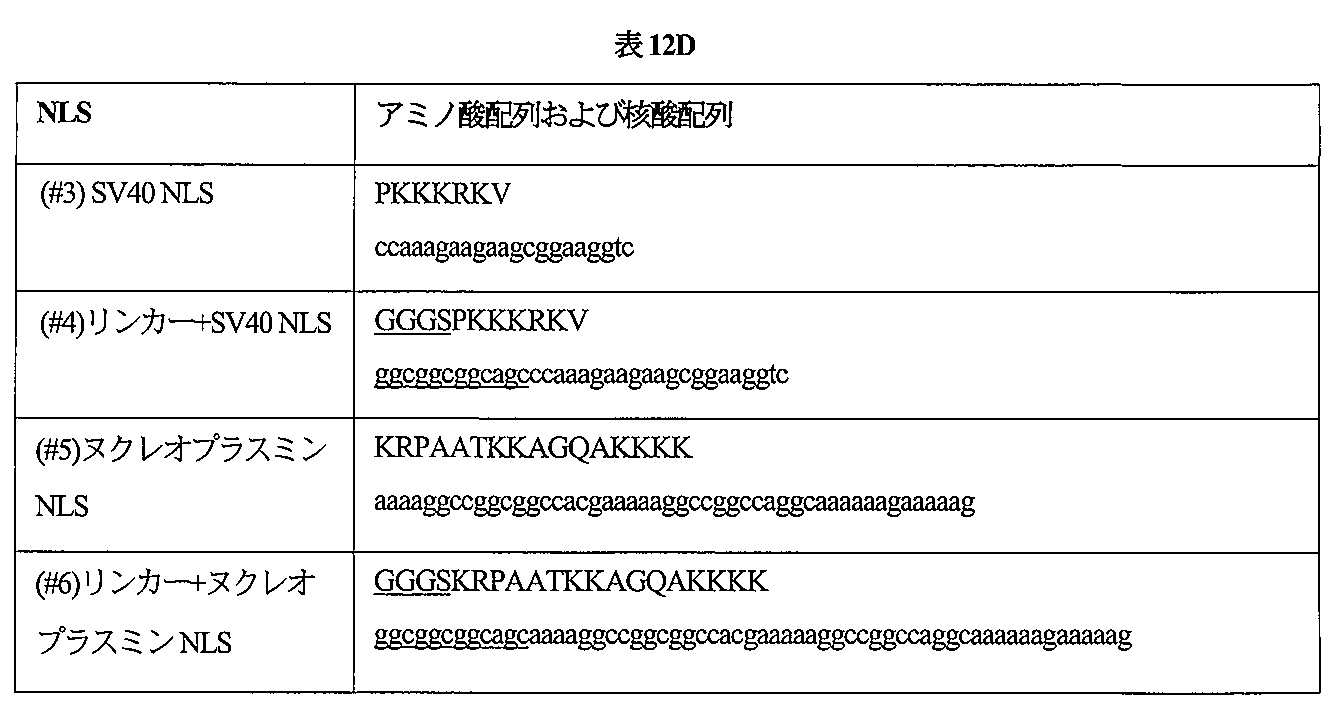
[00722]これらの実験のために使用した例示的なプラスミドを表13に示す。 [00722] Exemplary plasmids used for these experiments are shown in Table 13.
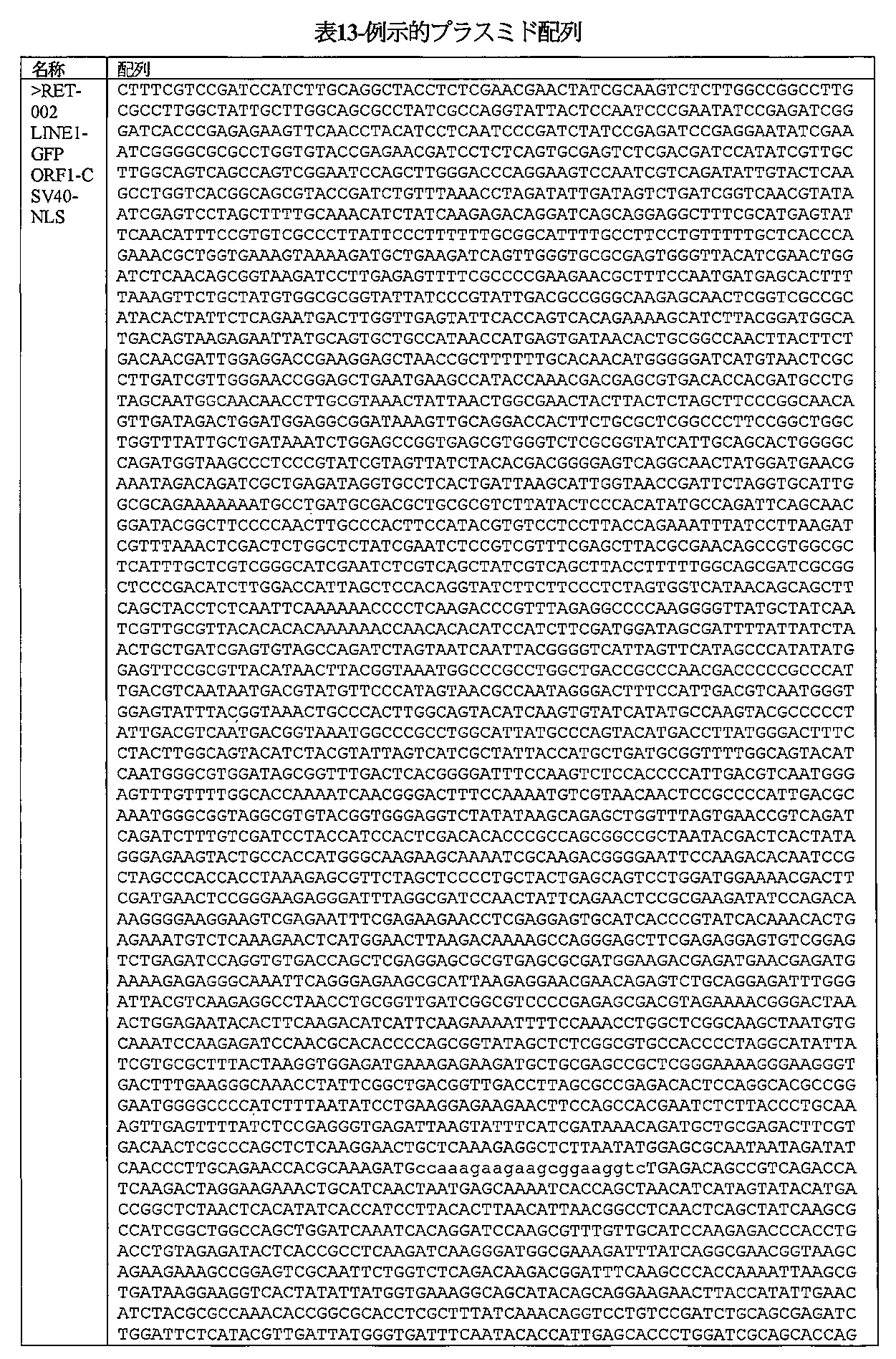


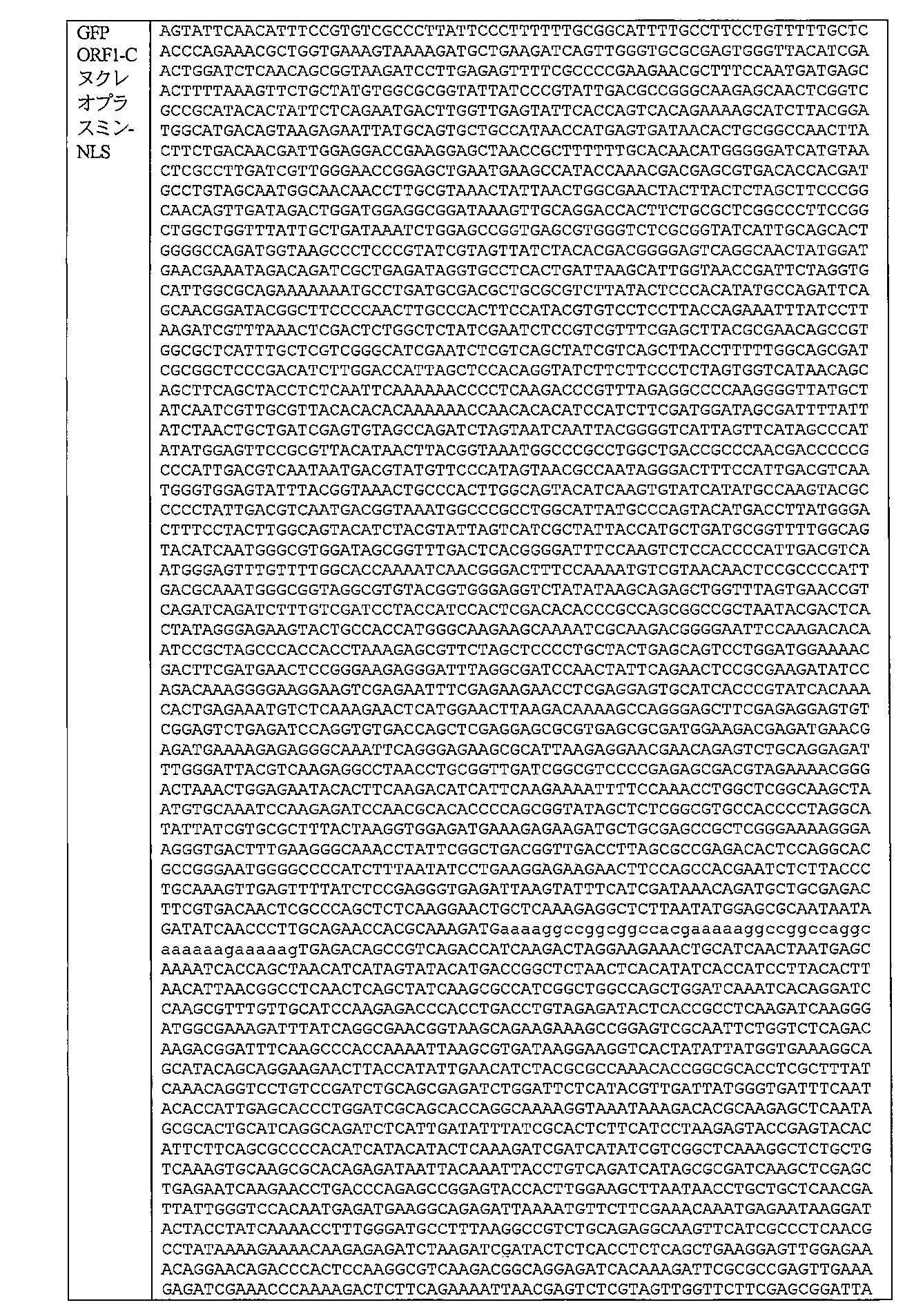

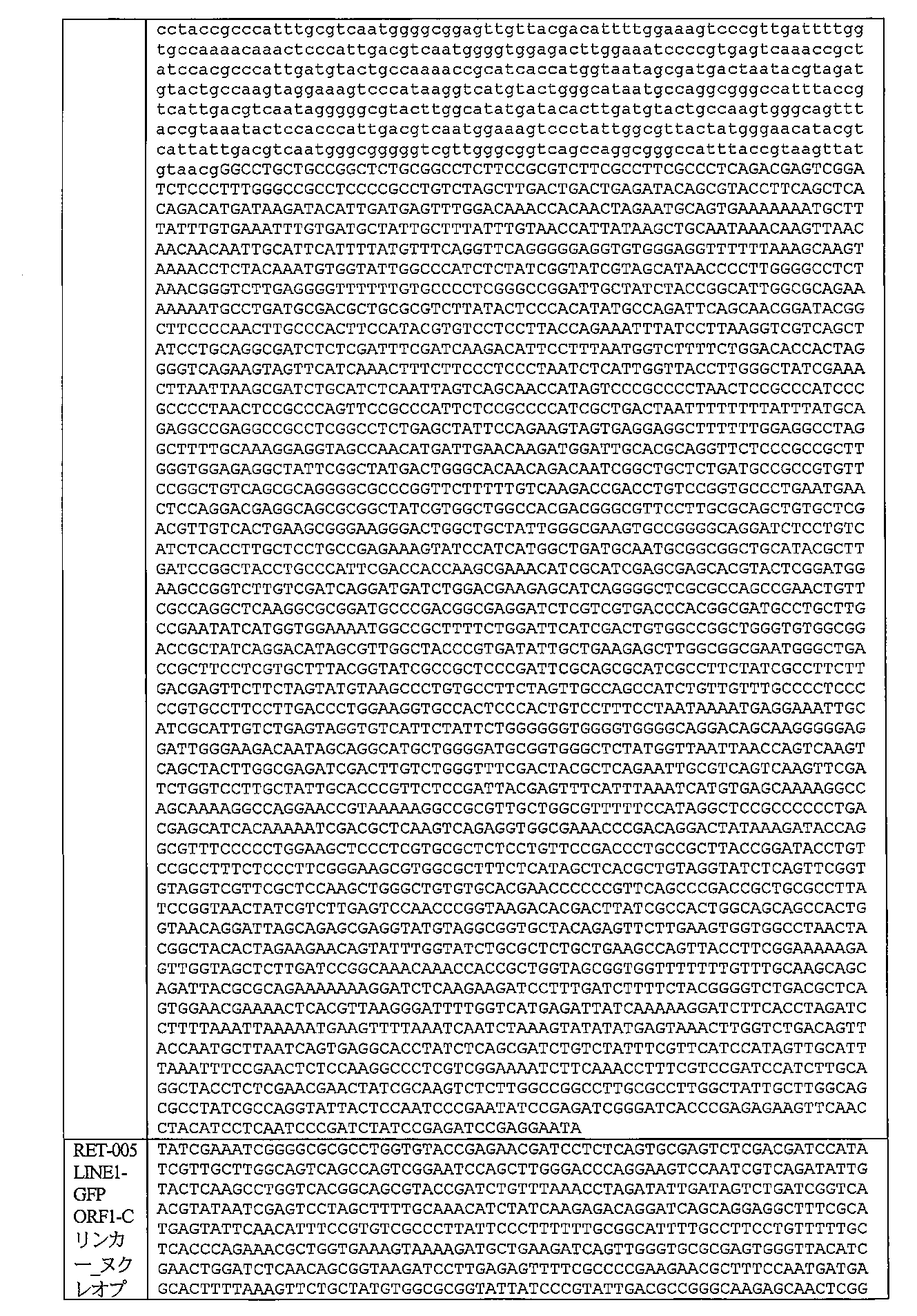


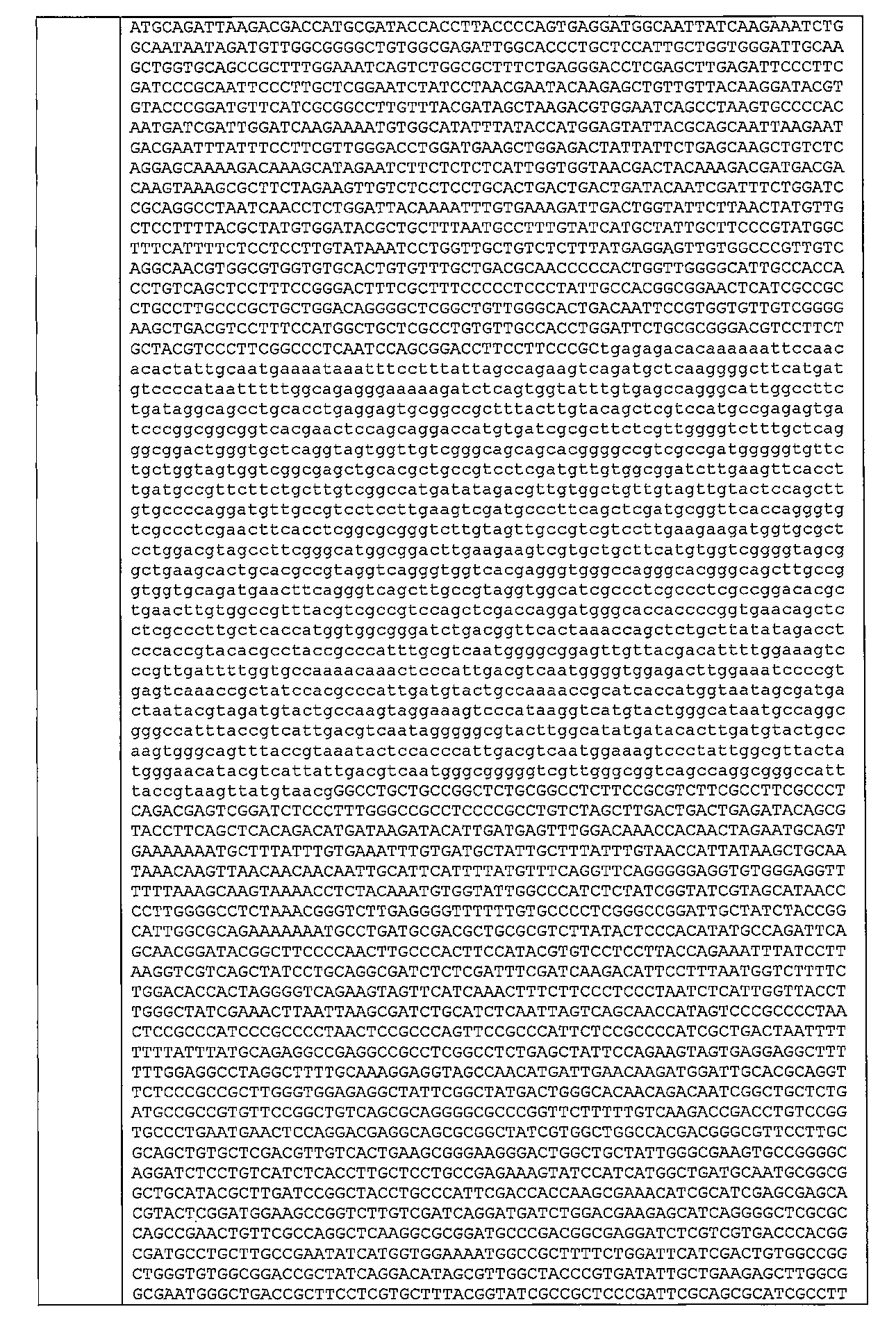

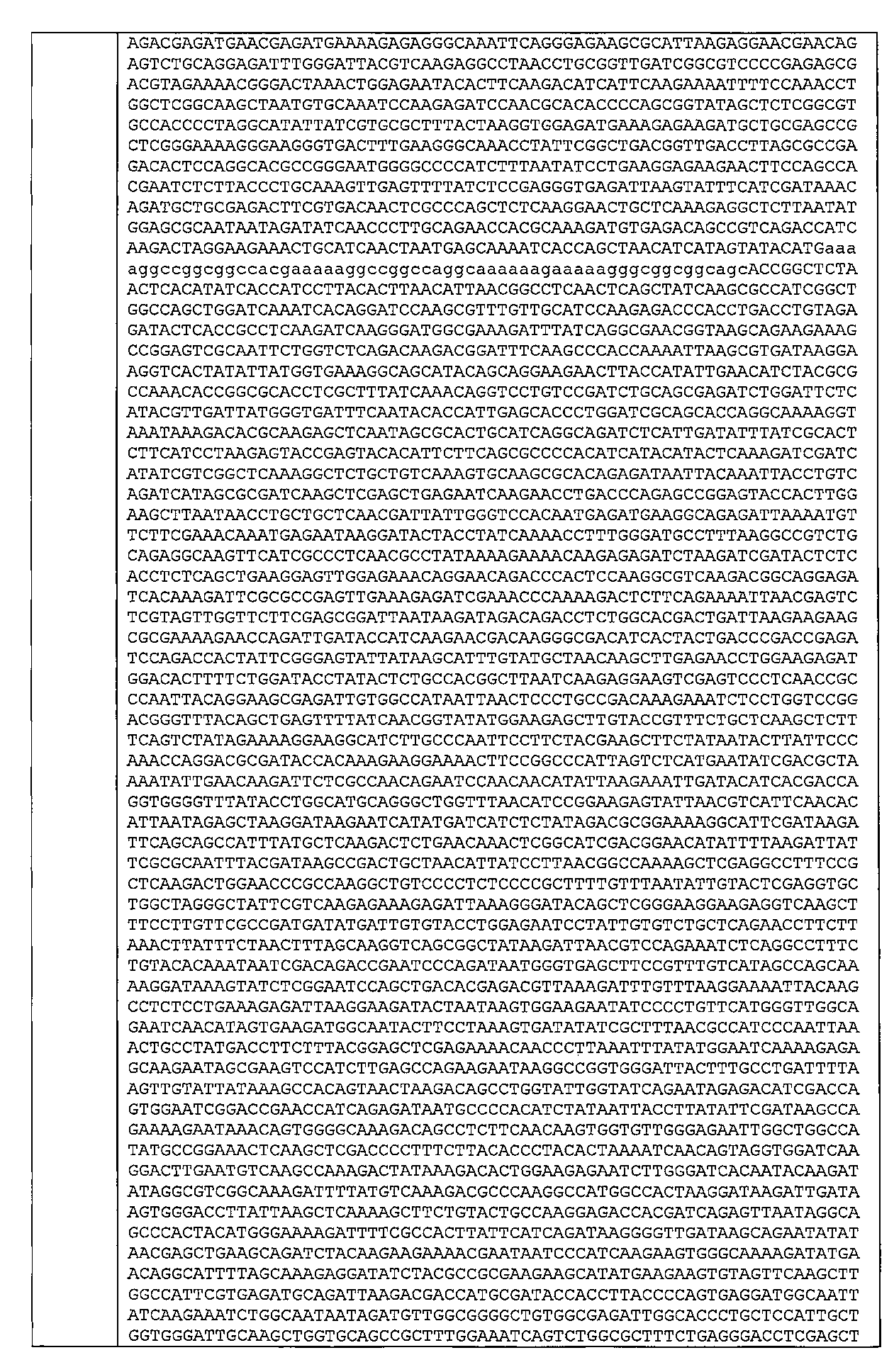
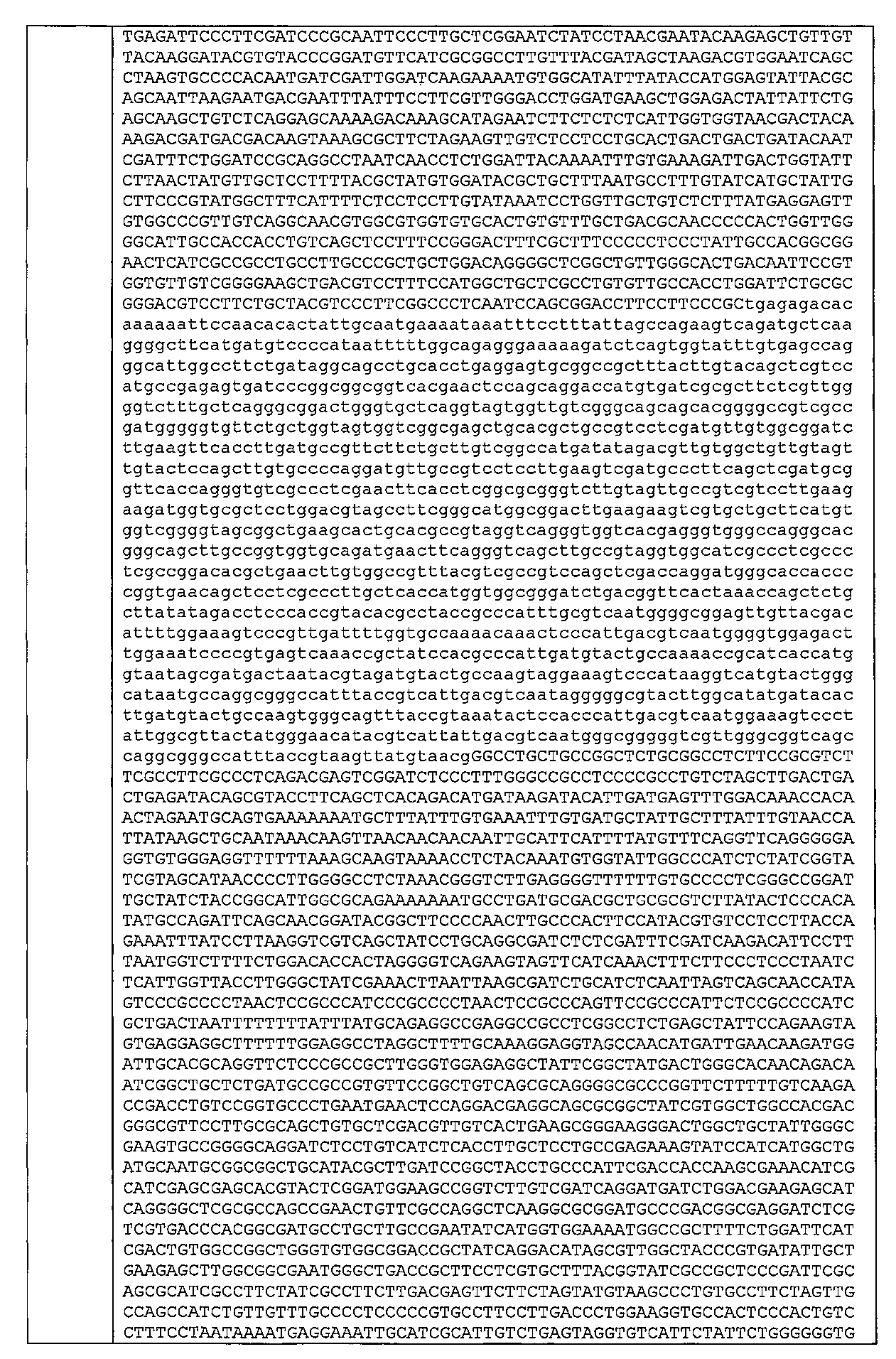










[00723]この実施例では、核外移行シグナル配列の付加を、カーゴ配列の翻訳の改善について試験する。GFPのC末端またはN末端でのNESの付加を発現の増加について試験する。GFPのC末端またはN末端での複数のNESの付加を発現の増加について試験する。より大きなカーゴ(5kBコード配列より大きい、または7.5kBコード配列より大きい)を、NESがある特定のサイズのカーゴへの影響を有するかどうかを調べるために試験する。トランスゴルジまたはER局在を特異的に必要とする追加的カーゴ、例えば、膜貫通ドメインを有するカーゴは、試験し得る。
[00723] In this example, the addition of a nuclear export signal sequence is tested for improved translation of the cargo sequence. The addition of an NES at the C-terminus or N-terminus of GFP is tested for increased expression. The addition of multiple NESs at the C-terminus or N-terminus of GFP is tested for increased expression. Larger cargoes (greater than a 5 kB coding sequence, or greater than a 7.5 kB coding sequence) are tested to see if NESs have an effect on cargoes of a certain size. Additional cargoes that specifically require trans-Golgi or ER localization, such as cargoes with transmembrane domains, can be tested.
実施例23.様々なヒト細胞のレトロ転移のための効率的なLINE1システムのスクリーニング
[00724]この実施例では、系統学的スクリーニングを、生物情報学を使用して多数の生物にわたって試み、ヒトゲノム内で効率的に移動できる1つまたは複数の機能亢進性レトロトランスポゾンエレメントを選択するための臨床検査が続いた。新規ドメインの変形を含むORF1およびORF2タンパク質を含む、503個の異なるゲノムに由来する1000万を超えるLINE-1配列を同定した(Ivancevicら、2016)。これらの内、「機能亢進性」LINE-1種が、ヒト、ラットおよびマウスのものより優れたレトロ転移活性を示すことを示す。これらのエレメントをLINE-1-GFPaiプラスミドにクローニングし、HEK293T細胞でスクリーニングする。GFPをコードする配列をプロモーターおよびポリA配列と共に含み、本明細書の他所に記載されるレトロトランスポゾン複合体中のORF1/2遺伝子に対して逆配向で挿入された試験mRNA構築物を、細胞を電気穿孔するために使用する。組込みの効率は、フローサイトメトリーおよびPCRによって決定する。上記の通り、GFPは、フローサイトメトリーのためのゲートを設定するために陰性対照および陽性対照において測定する。上記の通り、使用する例示的陰性対照は、<0.1%GFP+に設定する。上記の通り、使用する例示的陽性対照は、>90%GFP+に設定する。組込みは、PCRを使用して試験する。首尾よい組込みを示す例示的な測定は、レトロ転移後10日目の細胞の>10%における、フローサイトメトリーによって決定されるGFP発現の測定である。
Example 23. Screening of efficient LINE1 system for retrotransposition of various human cells
[00724] In this example, a phylogenetic screen was attempted across multiple organisms using bioinformatics, followed by clinical testing to select one or more hyperactive retrotransposon elements that can move efficiently within the human genome. Over 10 million LINE-1 sequences were identified from 503 different genomes, including ORF1 and ORF2 proteins that contain novel domain variants (Ivancevic et al., 2016). Of these, we show that "hyperactive" LINE-1 species exhibit superior retrotransposition activity to those of humans, rats, and mice. These elements are cloned into the LINE-1-GFPai plasmid and screened in HEK293T cells. A test mRNA construct containing a sequence encoding GFP with a promoter and polyA sequence, inserted in the reverse orientation relative to the ORF1/2 genes in the retrotransposon complex described elsewhere herein, is used to electroporate the cells. The efficiency of integration is determined by flow cytometry and PCR. As above, GFP is measured in negative and positive controls to set gates for flow cytometry. As above, an exemplary negative control used is set to <0.1% GFP+. As above, an exemplary positive control used is set to >90% GFP+. Integration is tested using PCR. An exemplary measurement indicating successful integration is measurement of GFP expression as determined by flow cytometry in >10% of cells 10 days after retrotransposition.
実施例24.カーゴ遺伝子発現の改善
[00725]カーゴ遺伝子発現を改善するために、様々なカーゴ遺伝子プロモーターおよびポリ(A)シグナルを試験する。カーゴ遺伝子発現を改善するために、短い構成的にスプライスされたイントロンの様々な挿入断片も試験する。カーゴ遺伝子発現を改善するために、様々な代替的コドンアルゴリズムを使用して生成したもの等のコドン最適化配列も試験する。上記の通り、GFPは、フローサイトメトリーのためのゲートを設定するために陰性対照および陽性対照において測定する。上記の通り、使用する例示的陰性対照は、<0.1%GFP+に設定する。上記の通り、使用する例示的陽性対照は、>90%GFP+に設定する。首尾よいカーゴ遺伝子発現を示す例示的な測定は、レトロ転移後10日目の細胞の>10%における、フローサイトメトリーによって決定されるGFP発現の増加の測定である。
Example 24. Improved cargo gene expression
[00725] Various cargo gene promoters and poly(A) signals are tested to improve cargo gene expression. Various inserts of short constitutively spliced introns are also tested to improve cargo gene expression. Codon-optimized sequences, such as those generated using various alternative codon algorithms, are also tested to improve cargo gene expression. As above, GFP is measured in negative and positive controls to set gates for flow cytometry. As above, an exemplary negative control used is set to <0.1% GFP+. As above, an exemplary positive control used is set to >90% GFP+. An exemplary measurement indicating successful cargo gene expression is the measurement of increased GFP expression as determined by flow cytometry in >10% of cells at 10 days after retrotransposition.
実施例25.in vivoカーゴ遺伝子送達のための効率的に最適化したレトロトランスポゾンシステムの適用
[00726]マウスにおいて、細胞内タンパク質または分泌タンパク質を検出するために肝臓標的化LNPを使用するin vivo送達のために、レトロトランスポゾンmRNAを改変する。カーゴ遺伝子mRNAの3’UTRを標的とする細胞型特異的miRNAは、望ましくない細胞型における分解のためにそれを標的とするように適用される。LNPを、in vivoでの効率的な送達のために試験する。GFPをコードする配列と共にプロモーターおよび、GFPコード配列に隣接するポリA配列を含む、LNP封入mRNA構築物をマウスに投与する。GFP遺伝子を、ORF1/2遺伝子に対して逆配向で本明細書の他所に記載されるレトロトランスポゾン複合体に挿入する。定めた時点でタンパク質発現を画像化によって調べ、試験マウスを屠殺し、組織を組織分析およびPCRのために収集する。
Example 25. Application of an efficient optimized retrotransposon system for in vivo cargo gene delivery
[00726] Retrotransposon mRNA is modified for in vivo delivery using liver-targeted LNP to detect intracellular or secreted proteins in mice. Cell type-specific miRNAs targeting the 3'UTR of cargo gene mRNA are applied to target it for degradation in undesired cell types. LNP is tested for efficient delivery in vivo. Mice are administered LNP-encapsulated mRNA constructs containing promoters with sequences coding for GFP and polyA sequences flanking the GFP coding sequence. The GFP gene is inserted into the retrotransposon complex described elsewhere herein in reverse orientation relative to the ORF1/2 gene. Protein expression is examined by imaging at defined time points, and test mice are sacrificed and tissues are collected for tissue analysis and PCR.
[00727]細胞特異的標的化をLNP封入mRNAの全身投与後に達成する、ここでLNPは、標的細胞中の同族対応物を認識する抗体またはリガンドを提示するための表面修飾を含む。 [00727] Cell-specific targeting is achieved following systemic administration of LNP-encapsulated mRNA, where the LNPs contain surface modifications to present antibodies or ligands that recognize their cognate counterparts in target cells.
[00728]特異的構築物の設計に続いて、細胞特異的標的化を試験する、ここで、UTRを1つまたは複数の細胞型特異的miRNAをコードするように修飾する。組換えmRNAが、目的の標的細胞ではない細胞に取り込まれる場合、細胞中に存在するmiRNAは、mRNAに結合し、破壊する。したがってmRNAは、目的の細胞型において発現できる。 [00728] Following the design of a specific construct, cell-specific targeting is tested, where the UTR is modified to encode one or more cell type-specific miRNAs. When the recombinant mRNA is taken up into a cell that is not the intended target cell, the miRNAs present in the cell will bind to and destroy the mRNA. Thus, the mRNA can be expressed in the cell type of interest.
[00729]肝臓への首尾よいin vivo mRNA送達を示す例示的測定、肝細胞でのフローサイトメトリーまたは組織診断によって決定されるGFP発現の測定。 [00729] An exemplary measurement indicating successful in vivo mRNA delivery to the liver is measurement of GFP expression in hepatocytes as determined by flow cytometry or histology.
実施例26.特定のゲノム位置への標的化レトロ転移
[00730]この実施例では、レトロ転移設計修飾を、特定のゲノム位置で標的化する特異性の向上のために実行する。標的化部分をORF2pの標的化の特異性の向上を確実にするために組み入れるレトロトランスポゾン融合構築物を生成する。1つの方法は、高く、持続可能な転写活性を有するゲノム上のセーフハーバー(GHS)部位の1つに特異的に組み込むカーゴを含むLINE1エレメントに再標的化するものである。AAVS1、CCR5およびROSA26は、GHS部位の一部である。上記の通り、特異的LINE1エレメントを、ヒトに容易に転移する効率的なLINE1エレメントを同定するために適切なスクリーニング後に選択する。選択したLINE1は、GHS座位の1つに組み込まれるものであり得る。
Example 26. Targeted retrotransposition to specific genomic locations
[00730] In this embodiment, retrotransposition design modification is carried out to improve the specificity of targeting at a specific genomic location. A retrotransposon fusion construct is generated that incorporates a targeting moiety to ensure the specificity of targeting ORF2p. One method is to retarget to a LINE1 element that contains a cargo that specifically integrates into one of the genomic safe harbor (GHS) sites with high and sustainable transcriptional activity. AAVS1, CCR5 and ROSA26 are part of the GHS sites. As mentioned above, a specific LINE1 element is selected after appropriate screening to identify an efficient LINE1 element that easily transposes to humans. The selected LINE1 can be integrated into one of the GHS loci.
[00731]別の方法は、レトロトランスポゾンORF2をORF2とCas9およびその変異体との融合を保有するように改変することである。エンドヌクレアーゼ活性を有するまたは有しない異種DNA結合ドメインを有する他の候補エレメントは、Cpf1、ジンクフィンガーエレメント、TALエフェクター機能、Cas6-8‘カスケード’、制限エンドヌクレアーゼ)であり、ORF2pのエンドヌクレアーゼドメインを置き換えるか、または補完するかのいずれかだろう。 [00731] Another approach is to modify the retrotransposon ORF2 to carry a fusion of ORF2 with Cas9 and its mutants. Other candidate elements with heterologous DNA binding domains with or without endonuclease activity are Cpf1, zinc finger elements, TAL effector functions, Cas6-8 'cascade', restriction endonucleases) that would either replace or complement the endonuclease domain of ORF2p.
[00732]様々な長さの相同性アームのmRNAカーゴ周辺への付加も試験する。 [00732] We will also test the addition of homology arms of various lengths around the mRNA cargo.
[00733]例示的構築物を:ORF1;RTおよびdCas9;アンチセンス配向でのカーゴ遺伝子、およびRT活性をプライミングするための部位を標的とするガイドRNをコードする配列を含んで、設計する。それぞれdCas9ニッカーゼに融合された2つのガイドRNAを使用する1つの例示的構築物において、標的位置の上流および下流にニックを導入することが、遺伝子カーゴの部位特異的組込みおよび配向を改善するかどうかを決定するために試験する。 [00733] Exemplary constructs are designed containing: ORF1; RT and dCas9; a cargo gene in antisense orientation; and a sequence encoding a guide RN that targets a site for priming RT activity. In one exemplary construct using two guide RNAs, each fused to a dCas9 nickase, introducing nicks upstream and downstream of the target location is tested to determine whether it improves site-specific integration and orientation of the gene cargo.
[00734]ORF2pがENを欠いており(欠失された)、Cas9またはその変異体、Cas12a(Cpf1)、Cas6-8‘カスケード’、メガヌクレアーゼ、ジンクフィンガーヌクレアーゼ、TALENまたは制限ヌクレアーゼに融合されており、特異性を方向付け、ゲノムDNAにニックを導入する例示的構築物を設計し、試験する。 [00734] Design and test exemplary constructs in which ORF2p lacks EN (is deleted) and is fused to Cas9 or a mutant thereof, Cas12a (Cpf1), Cas6-8 'cascade', meganuclease, zinc finger nuclease, TALEN or restriction nuclease to direct specificity and introduce nicks into genomic DNA.
[00735]ORF2pが、活性が低下したか、または変更された変異体ENを含み、Cas9またはその変異体、Cas 12a(Cpf1)、Cas6-8‘カスケード’、メガヌクレアーゼ、ジンクフィンガーヌクレアーゼ、TALENまたは制限ヌクレアーゼに融合されており、特異性を方向付け、ゲノムDNAにニックを導入する例示的構築物を設計し、試験する。例えば、レトロトランスポゾンプラスミドがORF2タンパク質とCas9およびCas9変異体との融合体をコードして改変される構築物を設計し、試験する。ORF1を含有するmRNA、ならびにRTおよびdCas9をコードするmRNAならびにアンチセンス配向でのカーゴ遺伝子、ならびにpegRNAをRT活性をプライミングするために標的部位に送達する。それぞれdCas9ニッカーゼに融合された2つのsgRNAの使用は、標的とする位置の上流および下流にニックを導入することが部位特異的組込みおよび遺伝子カーゴの配向を改善するかどうかを決定するために評価し得る。修飾されたLINE-1 RT融合タンパク質が、それ自体のmRNAに結合でき、核に輸送できる場合、pegRNAは、ゲノム領域を標的とでき、RT活性をプライミングでき(dCas9ニッカーゼ活性を介して)、それによりLINE-1 RTは、mRNA遺伝子カーゴをゲノムDNAへの組込みのために逆転写できる。 [00735] Exemplary constructs are designed and tested in which ORF2p contains mutant ENs with reduced or altered activity and is fused to Cas9 or mutants thereof, Cas 12a (Cpf1), Cas6-8 'cascade', meganucleases, zinc finger nucleases, TALENs or restriction nucleases to orient specificity and introduce nicks into genomic DNA. For example, constructs are designed and tested in which retrotransposon plasmids are modified to encode fusions of ORF2 protein with Cas9 and Cas9 mutants. An mRNA containing ORF1, as well as mRNAs encoding RT and dCas9 and a cargo gene in antisense orientation, and a pegRNA are delivered to the target site to prime RT activity. The use of two sgRNAs, each fused to a dCas9 nickase, may be evaluated to determine whether introducing nicks upstream and downstream of the targeted location improves site-specific integration and orientation of the gene cargo. If the modified LINE-1 RT fusion protein can bind to its own mRNA and transport to the nucleus, the pegRNA can target the genomic region and prime RT activity (via dCas9 nickase activity) so that LINE-1 RT can reverse transcribe the mRNA gene cargo for integration into genomic DNA.
[00736]組込み効率は、フローサイトメトリーによって決定されるだろう。上記のGFPを、フローサイトメトリーのためのゲートを設定するために陰性対照および陽性対照において測定する。上記の通り、使用する例示的陰性対照は、<0.1%GFP+に設定する。上記の通り、使用する例示的陽性対照は、>90%GFP+に設定する。組込みは、PCRによって確認する。ゲノム組込みの部位は、NGSを使用して分析する。特定のゲノム位置に優先的な組込みを有する任意の構築物は、その効率および/または組込み精度を改善するように数サイクルの指向性進化に供される。首尾よい遺伝子組込みおよび発現を示す例示的な測定は、特定のゲノム位置で検出される90%のカーゴ遺伝子組込みおよびレトロ転移後10日目の細胞の>2%における、フローサイトメトリーによって決定されるGFP発現である。 [00736] Integration efficiency will be determined by flow cytometry. GFP is measured in negative and positive controls to set gates for flow cytometry. As above, an exemplary negative control used is set to <0.1% GFP+. As above, an exemplary positive control used is set to >90% GFP+. Integration is confirmed by PCR. Sites of genomic integration are analyzed using NGS. Any constructs with preferential integration at a particular genomic location are subjected to several cycles of directed evolution to improve its efficiency and/or integration accuracy. An exemplary measurement indicative of successful gene integration and expression is 90% cargo gene integration detected at a particular genomic location and GFP expression as determined by flow cytometry in >2% of cells 10 days after retrotransposition.
Claims (48)
(a)ポリペプチドをコードする配列を含む可動遺伝因子、および
(b)挿入配列であって、外来治療用ポリペプチドをコードする配列の逆相補鎖である配列を含む、挿入配列
を含み、
可動遺伝因子の配列によってコードされるポリペプチドが、細胞のゲノムへの挿入配列の組込みを促進し;
医薬組成物がヒト対象に実質的に非免疫原性である、医薬組成物。 1. A pharmaceutical composition comprising a therapeutically effective amount of one or more polynucleic acids, or at least one vector encoding one or more polynucleic acids, wherein the one or more polynucleic acids:
(a) a mobile genetic element comprising a sequence encoding a polypeptide; and (b) an insert sequence, the insert sequence comprising a sequence that is the reverse complement of a sequence encoding an exogenous therapeutic polypeptide;
a polypeptide encoded by the sequence of the mobile genetic element promotes integration of the insertion sequence into the genome of the cell;
A pharmaceutical composition, wherein the pharmaceutical composition is substantially non-immunogenic in a human subject.
(i)ヒトORF1pまたはそれらの機能的断片、および
(ii)ヒトORF2pまたはそれらの機能的断片
を含む、請求項1に記載の医薬組成物。 The polypeptide encoded by the sequence of the mobile genetic element comprises one or more long interspersed element (LINE) polypeptides, the one or more LINE polypeptides comprising:
2. The pharmaceutical composition of claim 1, comprising: (i) human ORF1p or a functional fragment thereof; and (ii) human ORF2p or a functional fragment thereof.
(i)プロモーター配列が5’UTR配列の上流にあり、
(ii)5’UTR配列が、ポリペプチドをコードする可動遺伝因子の配列の上流にあり、
(iii)3’UTR配列が挿入配列の下流にあり;
(iv)3’UTRがポリA配列の上流にあり;
5’UTR配列、3’UTR配列またはポリA配列が、ヒトORF2pまたはそれらの機能的断片のための結合部位を含む、請求項1に記載の医薬組成物。 The one or more polynucleic acids comprise a first expression cassette comprising a promoter sequence, a 5'UTR sequence, a 3'UTR sequence and a polyA sequence:
(i) a promoter sequence is upstream of the 5'UTR sequence;
(ii) a 5'UTR sequence is upstream of the sequence of the mobile genetic element encoding the polypeptide;
(iii) a 3′UTR sequence is downstream of the insertion sequence;
(iv) the 3′UTR is upstream of a polyA sequence;
2. The pharmaceutical composition of claim 1, wherein the 5'UTR sequence, the 3'UTR sequence or the polyA sequence comprises a binding site for human ORF2p or a functional fragment thereof.
(i)プロモーター配列の逆相補鎖である配列が、5’UTR配列の逆相補鎖である配列の下流にあり、
(ii)5’UTR配列の逆相補鎖である配列が、外来治療用ポリペプチドをコードする配列の逆相補鎖である配列の下流にあり、
(iii)3’UTR配列の逆相補鎖である配列が、外来治療用ポリペプチドをコードする配列の逆相補鎖である配列の上流にあり、
(iv)ポリA配列の逆相補鎖である配列が、3’UTR配列の逆相補鎖である配列の上流にあり、ポリペプチドをコードする可動遺伝子の配列の下流にある、請求項15に記載の医薬組成物。 The insert sequence comprises a second expression cassette comprising a sequence that is the reverse complement of the promoter sequence, a sequence that is the reverse complement of the 5'UTR sequence, a sequence that is the reverse complement of the 3'UTR sequence and a sequence that is the reverse complement of the polyA sequence:
(i) a sequence that is the reverse complement of the promoter sequence is downstream of a sequence that is the reverse complement of the 5'UTR sequence;
(ii) a sequence that is the reverse complement of the 5'UTR sequence is downstream of a sequence that is the reverse complement of a sequence encoding an exogenous therapeutic polypeptide;
(iii) a sequence that is the reverse complement of the 3'UTR sequence is upstream of a sequence that is the reverse complement of a sequence encoding an exogenous therapeutic polypeptide;
(iv) a sequence which is the reverse complement of the polyA sequence is upstream of a sequence which is the reverse complement of the 3'UTR sequence and downstream of a sequence of a mobile gene encoding a polypeptide.
(a)5’UTRが、LINE-1由来の5’UTRもしくはACUCCUCCCCAUCCUCUCCCUCUGUCCCUCUGUCCCUCUGACCCUGCACUGUCCCAGCACCと少なくとも80%の配列同一性を有する配列を含み;かつ/または
(b)3’UTRが、LINE-1由来の3’UTRもしくはCAGGACACAGCCUUGGAUCAGGACAGAGACUUGGGGGCCAUCCUGCCCCUCCAACCCGACAUGUGUACCUCAGCUUUUUCCCUCACUUGCAUCAAUAAAGCUUCUGUGUUUGGAACAGと少なくとも80%の配列同一性を有する配列を含む、請求項1に記載の医薬組成物。 the one or more polynucleic acids comprise a 5'UTR sequence and a 3'UTR sequence;
2. The pharmaceutical composition of claim 1, wherein (a) the 5'UTR comprises a sequence having at least 80% sequence identity to the 5'UTR derived from LINE-1 or ACUCCUCCCCCAUCCUCUCUCCCUCUGUCCCUCUGUCCCUCUGUCCCUCUGACCCUGCACUGUCCCAGCACC; and/or (b) the 3'UTR comprises a sequence having at least 80% sequence identity to the 3'UTR derived from LINE-1 or CAGGACACAGCCUUGGAUCAGGACAGAGACUUGGGGGGCCAUCCUGCCCUCCAACCCGACAUGUGUACCUCAGCUUUUUCCCCUCACUUGCAUCAAUAAAGCUUCUGUGUUUGGAACAG.
(i)脂質ナノ粒子および重合体ナノ粒子からなる群から選択されるナノ粒子に製剤化されるか;ならびに/または
(ii)グリコシル化RNA、環状RNAおよび自己複製RNAからなる群から選択される1つまたは複数のポリ核酸を含む、請求項1に記載の医薬組成物。 The one or more polynucleic acids
2. The pharmaceutical composition of claim 1, (i) formulated in nanoparticles selected from the group consisting of lipid nanoparticles and polymeric nanoparticles; and/or (ii) comprising one or more polynucleic acids selected from the group consisting of glycosylated RNA, circular RNA, and self-replicating RNA.
(ii)組成物をヒト細胞の集団にex vivoで接触させるステップ、それによりヒト細胞のex vivoで修飾された集団を形成するステップを含むヒト細胞の集団をex vivoで修飾する方法であり、組成物が1つもしくは複数のポリ核酸または1つもしくは複数のポリ核酸をコードする少なくとも1つのベクターを含み、1つまたは複数のポリ核酸が:
(a)ポリペプチドをコードする配列を含む可動遺伝因子;および
(b)外来治療用ポリペプチドをコードする配列の逆相補鎖である、挿入配列
を含む、方法であって、
ヒト細胞のex vivoで修飾された集団が、ヒト対象に実質的に非免疫原性である、方法。 (i) a method of treating a disease or condition in a human subject in need of treatment, comprising administering to the human subject the pharmaceutical composition of claim 1; or (ii) a method of ex vivo modifying a population of human cells, comprising contacting the composition with the population of human cells ex vivo, thereby forming an ex vivo modified population of human cells, wherein the composition comprises one or more polynucleic acids or at least one vector encoding the one or more polynucleic acids, and wherein the one or more polynucleic acids are:
(a) a mobile genetic element comprising a sequence encoding a polypeptide; and (b) an insertion sequence which is the reverse complement of the sequence encoding an exogenous therapeutic polypeptide,
The method, wherein the ex vivo modified population of human cells is substantially non-immunogenic to a human subject.
を含む、方法。 1. A method for site-specific integration of a heterologous genomic insert into the genome of a mammalian cell, comprising: (i) introducing into the cell (a) a polynucleotide comprising a sequence encoding one or more human retrotransposon elements associated with the heterologous insert, and (b) a polynucleotide comprising a guide RNA, a sequence encoding an RNA-guided integrase or a fragment thereof, and a landing sequence operable by the integrase; and (ii) verifying integration of the heterologous insert into the site of the genome.
Applications Claiming Priority (7)
| Application Number | Priority Date | Filing Date | Title |
|---|---|---|---|
| US202163187117P | 2021-05-11 | 2021-05-11 | |
| US63/187,117 | 2021-05-11 | ||
| US202163254791P | 2021-10-12 | 2021-10-12 | |
| US63/254,791 | 2021-10-12 | ||
| US202163274907P | 2021-11-02 | 2021-11-02 | |
| US63/274,907 | 2021-11-02 | ||
| PCT/US2022/028831 WO2022241029A1 (en) | 2021-05-11 | 2022-05-11 | Methods and compositions for genomic integration |
Publications (2)
| Publication Number | Publication Date |
|---|---|
| JP2024518100A true JP2024518100A (en) | 2024-04-24 |
| JPWO2022241029A5 JPWO2022241029A5 (en) | 2025-05-20 |
Family
ID=84029812
Family Applications (1)
| Application Number | Title | Priority Date | Filing Date |
|---|---|---|---|
| JP2023570260A Pending JP2024518100A (en) | 2021-05-11 | 2022-05-11 | Methods and compositions for genomic integration |
Country Status (11)
| Country | Link |
|---|---|
| US (2) | US12319925B2 (en) |
| EP (1) | EP4337268A4 (en) |
| JP (1) | JP2024518100A (en) |
| KR (1) | KR20240037192A (en) |
| AU (1) | AU2022272235A1 (en) |
| BR (1) | BR112023023642A2 (en) |
| CA (1) | CA3218780A1 (en) |
| GB (1) | GB2623653A (en) |
| IL (1) | IL308445A (en) |
| MX (1) | MX2023013381A (en) |
| WO (1) | WO2022241029A1 (en) |
Families Citing this family (5)
| Publication number | Priority date | Publication date | Assignee | Title |
|---|---|---|---|---|
| JP2024518100A (en) | 2021-05-11 | 2024-04-24 | マイエロイド・セラピューティクス,インコーポレーテッド | Methods and compositions for genomic integration |
| CN118871134A (en) * | 2022-03-21 | 2024-10-29 | 生物探险有限公司 | Internal ribosome entry sites (IRES), plasmid vectors, and circular mRNA for enhanced protein expression |
| WO2024193739A1 (en) * | 2023-03-23 | 2024-09-26 | Ostravska Univerzita | Method for producing proteins in host cells |
| WO2025217194A1 (en) * | 2024-04-09 | 2025-10-16 | Typewriter Therapeutics, Inc. | Repeat dosing of retrotransposons |
| WO2025229499A1 (en) * | 2024-04-29 | 2025-11-06 | Averna Therapeutics Ltd | Compositions and methods for modulating t cells |
Family Cites Families (232)
| Publication number | Priority date | Publication date | Assignee | Title |
|---|---|---|---|---|
| US4522811A (en) | 1982-07-08 | 1985-06-11 | Syntex (U.S.A.) Inc. | Serial injection of muramyldipeptides and liposomes enhances the anti-infective activity of muramyldipeptides |
| US4470461A (en) | 1982-09-30 | 1984-09-11 | Phillips Petroleum Company | Organic nitro compounds as cosurfactants in enhanced oil recovery processes |
| GB8601597D0 (en) | 1986-01-23 | 1986-02-26 | Wilson R H | Nucleotide sequences |
| US5225539A (en) | 1986-03-27 | 1993-07-06 | Medical Research Council | Recombinant altered antibodies and methods of making altered antibodies |
| GB8809129D0 (en) | 1988-04-18 | 1988-05-18 | Celltech Ltd | Recombinant dna methods vectors and host cells |
| WO1990005144A1 (en) | 1988-11-11 | 1990-05-17 | Medical Research Council | Single domain ligands, receptors comprising said ligands, methods for their production, and use of said ligands and receptors |
| US5530101A (en) | 1988-12-28 | 1996-06-25 | Protein Design Labs, Inc. | Humanized immunoglobulins |
| US5703055A (en) | 1989-03-21 | 1997-12-30 | Wisconsin Alumni Research Foundation | Generation of antibodies through lipid mediated DNA delivery |
| DE3920358A1 (en) | 1989-06-22 | 1991-01-17 | Behringwerke Ag | BISPECIFIC AND OLIGO-SPECIFIC, MONO- AND OLIGOVALENT ANTI-BODY CONSTRUCTS, THEIR PRODUCTION AND USE |
| WO1992001813A1 (en) | 1990-07-25 | 1992-02-06 | Syngene, Inc. | Circular extension for generating multiple nucleic acid complements |
| US5571894A (en) | 1991-02-05 | 1996-11-05 | Ciba-Geigy Corporation | Recombinant antibodies specific for a growth factor receptor |
| GB9114948D0 (en) | 1991-07-11 | 1991-08-28 | Pfizer Ltd | Process for preparing sertraline intermediates |
| FI941572L (en) | 1991-10-07 | 1994-05-27 | Oncologix Inc | Combination and method of use of anti-erbB-2 monoclonal antibodies |
| US5858784A (en) | 1991-12-17 | 1999-01-12 | The Regents Of The University Of California | Expression of cloned genes in the lung by aerosol- and liposome-based delivery |
| US5633234A (en) | 1993-01-22 | 1997-05-27 | The Johns Hopkins University | Lysosomal targeting of immunogens |
| US6838254B1 (en) | 1993-04-29 | 2005-01-04 | Conopco, Inc. | Production of antibodies or (functionalized) fragments thereof derived from heavy chain immunoglobulins of camelidae |
| US5773244A (en) | 1993-05-19 | 1998-06-30 | Regents Of The University Of California | Methods of making circular RNA |
| FR2709309B1 (en) | 1993-08-25 | 1995-11-10 | Centre Nat Rech Scient | Cellular compositions, preparation and therapeutic uses. |
| US5631236A (en) | 1993-08-26 | 1997-05-20 | Baylor College Of Medicine | Gene therapy for solid tumors, using a DNA sequence encoding HSV-Tk or VZV-Tk |
| US5641875A (en) | 1993-09-30 | 1997-06-24 | University Of Pennsylvania | DNA encoding chimeric IgG Fc receptor |
| US5639642A (en) | 1994-06-16 | 1997-06-17 | Novo Nordisk A/S | Synthetic leader peptide sequences |
| US6300090B1 (en) | 1994-07-29 | 2001-10-09 | The Rockefeller University | Methods of use of viral vectors to deliver antigen to dendritic cells |
| US5641870A (en) | 1995-04-20 | 1997-06-24 | Genentech, Inc. | Low pH hydrophobic interaction chromatography for antibody purification |
| US5869046A (en) | 1995-04-14 | 1999-02-09 | Genentech, Inc. | Altered polypeptides with increased half-life |
| US5766903A (en) | 1995-08-23 | 1998-06-16 | University Technology Corporation | Circular RNA and uses thereof |
| US6150160A (en) | 1995-11-16 | 2000-11-21 | The John Hopkins University | Compositions and methods of use of mammalian retrotransposons |
| US20030121063A1 (en) | 1995-11-16 | 2003-06-26 | The Trustees Of The University Of Pennsylvania | Compositions and methods of use of mammalian retrotransposons |
| US6734014B1 (en) | 1996-02-08 | 2004-05-11 | The United States Of America As Represented By The Department Of Health And Human Services | Methods and compositions for transforming dendritic cells and activating T cells |
| US6602709B1 (en) | 1998-02-20 | 2003-08-05 | The Rockefeller University | Methods for use of apoptotic cells to deliver antigen to dendritic cells for induction or tolerization of T cells |
| US6210931B1 (en) | 1998-11-30 | 2001-04-03 | The United States Of America As Represented By The Secretary Of Agriculture | Ribozyme-mediated synthesis of circular RNA |
| US6576463B1 (en) | 1999-01-15 | 2003-06-10 | The Regents Of The University Of California | Hybrid vectors for gene therapy |
| AU1100201A (en) | 1999-10-28 | 2001-05-08 | Board Of Trustees Of The Leland Stanford Junior University | Methods of in vivo gene transfer using a sleeping beauty transposon system |
| AU2001257362A1 (en) | 2000-04-28 | 2001-11-12 | University Of Pittsburgh Of The Commonwealth System Of Higher Education | The use of tolerogenic dendritic cells for enhancing tolerogenicity in a host and methods for making the same |
| US7176243B2 (en) | 2000-06-02 | 2007-02-13 | The General Hospital Corporation | CaR receptor as a mediator of migratory cell chemotaxis and/or chemokinesis |
| CA2425862C (en) | 2000-11-07 | 2013-01-22 | City Of Hope | Cd19-specific redirected immune cells |
| US8709412B2 (en) | 2001-06-29 | 2014-04-29 | The Board Of Trustees Of The Leland Stanford Junior University | Modulation of TIM receptor activity in combination with cytoreductive therapy |
| JPWO2003064644A1 (en) | 2002-01-31 | 2005-05-26 | 株式会社ディナベック研究所 | LINE retro transfer method |
| JP2005530695A (en) | 2002-02-15 | 2005-10-13 | ザイコス インク. | Electroporation method for introducing physiologically active substances into cells |
| US20080254027A1 (en) | 2002-03-01 | 2008-10-16 | Bernett Matthew J | Optimized CD5 antibodies and methods of using the same |
| US20050250207A1 (en) | 2002-06-05 | 2005-11-10 | Rozwadowski Kevin L | Retrons for gene targeting |
| AU2003241252A1 (en) | 2002-06-06 | 2003-12-22 | Immunicum Ab | New method and composition for producing a cellular allogeneic vaccine |
| US20060239962A1 (en) | 2002-12-04 | 2006-10-26 | Banchereau Jacques F | Rapid one-step generation of antigen loaded dendritic cell vaccine from precursors |
| WO2004072290A1 (en) * | 2003-02-07 | 2004-08-26 | The Administrators Of The Tulane Educational Fund | Mammalian retrotransposable elements |
| US8007805B2 (en) | 2003-08-08 | 2011-08-30 | Paladin Labs, Inc. | Chimeric antigens for breaking host tolerance to foreign antigens |
| US8198020B2 (en) | 2003-08-22 | 2012-06-12 | Potentia Pharmaceuticals, Inc. | Compositions and methods for enhancing phagocytosis or phagocyte activity |
| US7709625B2 (en) | 2004-06-10 | 2010-05-04 | The Board Of Regents Of The University Of Texas | Methods and compositions for bone marrow stem cell-derived macrophage delivery of genes for gene therapy |
| EP1812555B1 (en) | 2004-10-25 | 2015-04-22 | Cellerant Therapeutics, Inc. | Methods of expanding myeloid cell populations and uses thereof |
| GB2421948A (en) * | 2004-12-30 | 2006-07-12 | Ist Superiore Sanita | Retrotransposon inhibition to treat cancer |
| US20060188891A1 (en) | 2005-02-23 | 2006-08-24 | Bickmore William D Jr | Methods and apparatus for controlling DNA amplification |
| US20060257359A1 (en) | 2005-02-28 | 2006-11-16 | Cedric Francois | Modifying macrophage phenotype for treatment of disease |
| US20090191202A1 (en) | 2005-09-29 | 2009-07-30 | Jamieson Catriona Helen M | Methods for manipulating phagocytosis mediated by CD47 |
| US7926300B2 (en) | 2005-11-18 | 2011-04-19 | Cree, Inc. | Adaptive adjustment of light output of solid state lighting panels |
| WO2007113572A1 (en) | 2006-04-03 | 2007-10-11 | Keele University | Targeted therapy |
| JP2009535065A (en) | 2006-05-04 | 2009-10-01 | アブマクシス・インコーポレイテツド | Methods for producing stable mammalian cell lines that produce high levels of recombinant proteins |
| WO2008011599A2 (en) | 2006-07-20 | 2008-01-24 | Gourmetceuticals, Llc | Phosphorylated glucomannan polysaccharide for receptor mediated activation and maturation of monocyte-derived dendritic cells |
| US7833789B2 (en) | 2006-08-01 | 2010-11-16 | Fondazione Centro San Raffaele Del Monte Tabor | Monocyte cell |
| CN1951499A (en) | 2006-10-09 | 2007-04-25 | 中国农业大学 | A cell mediated immunity vaccine and preparation method thereof |
| US10155038B2 (en) | 2007-02-02 | 2018-12-18 | Yale University | Cells prepared by transient transfection and methods of use thereof |
| AU2008271523B2 (en) | 2007-07-04 | 2015-09-10 | Max-Delbruck-Centrum Fur Molekulare Medizin | Hyperactive variants of the transposase protein of the transposon system Sleeping Beauty |
| EP2055784A1 (en) | 2007-10-31 | 2009-05-06 | Bundesrepublik Deutschland, letztvertreten durch den Präsidenten des Paul-Ehrlich-Instituts Prof. Dr. Johannes Löwer | Controlled activation of non-LTR retrotransposons in mammals |
| DK3056515T4 (en) | 2008-01-15 | 2025-10-20 | Univ Leland Stanford Junior | METHOD FOR MANIPULATING PHAGOCYTOSIS MEDIATED BY CD47 |
| EP2313436B1 (en) | 2008-07-22 | 2014-11-26 | Ablynx N.V. | Amino acid sequences directed against multitarget scavenger receptors and polypeptides |
| MX2011000970A (en) | 2008-08-29 | 2011-03-15 | Symphogen As | Anti-cd5 antibodies. |
| ES2840750T3 (en) | 2008-09-22 | 2021-07-07 | Baylor College Medicine | Methods and compositions for generating an immune response by inducing CD40 and pattern recognition receptor adapters |
| US9080211B2 (en) | 2008-10-24 | 2015-07-14 | Epicentre Technologies Corporation | Transposon end compositions and methods for modifying nucleic acids |
| EP2248903A1 (en) * | 2009-04-29 | 2010-11-10 | Universitat Autònoma De Barcelona | Methods and reagents for efficient and targeted gene transfer to monocytes and macrophages |
| US9101674B2 (en) | 2010-03-29 | 2015-08-11 | Vib Vzw | Targeting and in vivo imaging of tumor-associated macrophages |
| AU2011239569B2 (en) | 2010-04-16 | 2014-07-24 | Baylor College Of Medicine | Method for treating solid tumors |
| WO2012005763A1 (en) | 2010-07-06 | 2012-01-12 | The Scripps Research Institute | Use of myeloid-like progenitor cell populations to treat tumors |
| ES2602743T3 (en) | 2010-09-08 | 2017-02-22 | Chemotherapeutisches Forschungsinstitut Georg-Speyer-Haus | Chimeric antigen receptors with an optimized hinge region |
| WO2012043651A1 (en) | 2010-09-30 | 2012-04-05 | 国立大学法人 熊本大学 | Production method for myeloid blood cells |
| WO2012109476A2 (en) | 2011-02-09 | 2012-08-16 | The University Of Rochester | Methods and compositions related to staufen 1 binding sites formed by duplexing alu elements |
| US9353370B2 (en) | 2011-03-30 | 2016-05-31 | Riken | Functional nucleic acid molecule and use thereof |
| BR112013031553A2 (en) | 2011-06-08 | 2020-11-10 | Shire Human Genetic Therapies, Inc. | compositions, mrna encoding a gland and its use, use of at least one mrna molecule and a vehicle for transfer and use of an mrna encoding for exogenous protein |
| SG10201903119QA (en) | 2011-09-06 | 2019-05-30 | Agency Science Tech & Res | Polypeptide vaccine |
| WO2013051718A1 (en) | 2011-10-07 | 2013-04-11 | 国立大学法人三重大学 | Chimeric antigen receptor |
| US9149519B2 (en) | 2012-01-17 | 2015-10-06 | New York University | Chimeric human immunodeficiency virus type 1 (HIV-1) with enhanced dendritic cell and macrophage tropism comprising the simian immunodeficiency virus (SIV) minimal Vpx packaging domain |
| US20140140989A1 (en) | 2012-02-06 | 2014-05-22 | Inhibrx Llc | Non-Platelet Depleting and Non-Red Blood Cell Depleting CD47 Antibodies and Methods of Use Thereof |
| EP3578569A1 (en) | 2012-02-06 | 2019-12-11 | Inhibrx, Inc. | Cd47 antibodies and methods of use thereof |
| JP6850528B2 (en) | 2012-02-13 | 2021-03-31 | シアトル チルドレンズ ホスピタル ドゥーイング ビジネス アズ シアトル チルドレンズ リサーチ インスティテュート | Bispecific chimeric antigen receptor and its therapeutic use |
| US8647616B2 (en) | 2012-02-14 | 2014-02-11 | Loma Linda University | Agents and method for treating inflammation-related conditions and diseases |
| EP2639313A1 (en) | 2012-03-14 | 2013-09-18 | Rheinische Friedrich-Wilhelms-Universität Bonn | High-resolution transcriptome of human macrophages |
| WO2013176915A1 (en) | 2012-05-25 | 2013-11-28 | Roman Galetto | Methods for engineering allogeneic and immunosuppressive resistant t cell for immunotherapy |
| CN103483452B (en) | 2012-06-12 | 2021-08-13 | 上海细胞治疗集团有限公司 | Dual-signal-independent chimeric antigen receptors and their uses |
| PT2692865E (en) | 2012-07-30 | 2015-02-06 | Nbe Therapeutics Llc | Transposition-mediated identification of specific binding or functional proteins |
| US20140037606A1 (en) | 2012-08-06 | 2014-02-06 | Eyal Amiel | Cell-based, anti-cancer vaccines |
| NZ746914A (en) | 2012-10-02 | 2020-03-27 | Memorial Sloan Kettering Cancer Center | Compositions and methods for immunotherapy |
| JP6572131B2 (en) | 2012-12-12 | 2019-09-04 | バスキュロックス インコーポレイテッド | CD47 antibody for treatment |
| US9221908B2 (en) | 2012-12-12 | 2015-12-29 | Vasculox, Inc. | Therapeutic CD47 antibodies |
| PE20151408A1 (en) | 2013-02-06 | 2015-10-15 | Inhibrx Llc | CD47 ANTIBODIES THAT DO NOT EXHAUST PLATELETS OR RED BALLOONS AND METHODS OF USING THEM |
| WO2014121840A1 (en) | 2013-02-07 | 2014-08-14 | Medizinische Hochschule Hannover | Induced dendritic cells and uses thereof |
| WO2014134165A1 (en) | 2013-02-26 | 2014-09-04 | Memorial Sloan-Kettering Cancer Center | Compositions and methods for immunotherapy |
| EP3567104A1 (en) | 2013-03-01 | 2019-11-13 | Regents of the University of Minnesota | Talen-based gene correction |
| US20160145348A1 (en) | 2013-03-14 | 2016-05-26 | Fred Hutchinson Cancer Research Center | Compositions and methods to modify cells for therapeutic objectives |
| EP3623380B1 (en) | 2013-03-15 | 2025-10-22 | Novartis AG | Targeting cytotoxic cells with chimeric receptors for adoptive immunotherapy |
| RU2733652C2 (en) | 2013-10-31 | 2020-10-06 | Фред Хатчинсон Кэнсер Рисерч Сентер | Modified hematopoietic stem cells/progenitor cells and non-t effector cells, and use thereof |
| KR102444529B1 (en) | 2013-12-25 | 2022-09-19 | 다이이찌 산쿄 가부시키가이샤 | Anti-TROP2 Antibody-Drug Conjugate |
| CN106414748B (en) | 2014-02-14 | 2021-05-28 | 得克萨斯州大学系统董事会 | Chimeric antigen receptor and preparation method |
| EP3116544A4 (en) | 2014-03-11 | 2017-08-23 | The Board of Trustees of the Leland Stanford Junior University | Anti sirp-alpha antibodies and bi-specific macrophage enhancing antibodies |
| US20170233452A1 (en) | 2014-04-23 | 2017-08-17 | Immusoft Corporation | Chimeric antigen receptors specific to avb6 integrin and methods of use thereof to treat cancer |
| CN104004095B (en) | 2014-06-04 | 2016-11-23 | 博生吉医药科技(苏州)有限公司 | A kind of CD7 nano antibody, its coded sequence and application |
| EP3169335B8 (en) | 2014-07-16 | 2019-10-09 | ModernaTX, Inc. | Circular polynucleotides |
| EP3172237A2 (en) | 2014-07-21 | 2017-05-31 | Novartis AG | Treatment of cancer using humanized anti-bcma chimeric antigen receptor |
| US10544201B2 (en) | 2014-07-31 | 2020-01-28 | Cellectis | ROR1 specific multi-chain chimeric antigen receptor |
| TW202140557A (en) | 2014-08-19 | 2021-11-01 | 瑞士商諾華公司 | Treatment of cancer using a cd123 chimeric antigen receptor |
| MX2017002605A (en) | 2014-08-28 | 2017-05-19 | Bioatla Llc | Conditionally active chimeric antigen receptors for modified t-cells. |
| WO2016030501A1 (en) * | 2014-08-28 | 2016-03-03 | Centre National De La Recherche Scientifique - Cnrs - | Synthetic alu-retrotransposon vectors for gene therapy |
| CN107074969A (en) | 2014-09-09 | 2017-08-18 | 优努姆治疗公司 | Chimerical receptor and its application in immunization therapy |
| JP6712262B2 (en) | 2014-09-10 | 2020-06-17 | ミルテニー バイオテック ゲゼルシャフト ミット ベシュレンクテル ハフツングMiltenyi Biotec GmbH | Cell populations for use in immunotherapy |
| IL294043B2 (en) | 2014-09-28 | 2024-10-01 | Univ California | Modulation of stimulatory and non-stimulatory myeloid cells |
| KR20170068539A (en) | 2014-10-07 | 2017-06-19 | 셀렉티스 | Method for modulating car-induced immune cells activity |
| MA41538A (en) | 2014-10-17 | 2017-12-26 | Baylor College Medicine | BIPARTITE AND TRIPARTITE IMMUNE CELLS OF SIGNALING |
| RU2020139190A (en) | 2014-10-31 | 2021-01-26 | Массачусетс Инститьют Оф Текнолоджи | DELIVERY OF BIOMOLECULES INTO THE CELLS OF THE IMMUNE SYSTEM |
| SG11201704058TA (en) | 2014-11-18 | 2017-06-29 | Janssen Pharmaceutica Nv | Cd47 antibodies, methods, and uses |
| US11041158B2 (en) | 2014-12-22 | 2021-06-22 | AgBiome, Inc. | Optimization methods for making a synthetic gene |
| WO2016126608A1 (en) | 2015-02-02 | 2016-08-11 | Novartis Ag | Car-expressing cells against multiple tumor antigens and uses thereof |
| SG11201706236SA (en) | 2015-02-06 | 2017-08-30 | Nat Univ Singapore | Methods for enhancing efficacy of therapeutic immune cells |
| US10577669B2 (en) | 2015-02-11 | 2020-03-03 | Loma Linda University | Method for utilizing engineered dendritic cells to induce gut-homing regulatory T cells and treat gut inflammation |
| US20170151281A1 (en) | 2015-02-19 | 2017-06-01 | Batu Biologics, Inc. | Chimeric antigen receptor dendritic cell (car-dc) for treatment of cancer |
| KR102624023B1 (en) | 2015-02-24 | 2024-01-11 | 더 리젠츠 오브 더 유니버시티 오브 캘리포니아 | Binding-triggered transcription switches and methods of using them |
| CN107249602B (en) | 2015-02-27 | 2021-09-28 | 美商生物细胞基因治疗有限公司 | Chimeric Antigen Receptors (CARs) targeting hematologic malignancies, compositions thereof, and methods of use |
| US9777064B2 (en) | 2015-03-17 | 2017-10-03 | Chimera Bioengineering, Inc. | Smart CAR devices, DE CAR polypeptides, side CARs and uses thereof |
| US10214591B1 (en) * | 2015-04-03 | 2019-02-26 | Alienor Farma | Monoclonal antibody to human line-1 ORF2 protein and method for early detection of transforming cells in pre-neoplastic tissues of a human subject |
| WO2016172606A1 (en) | 2015-04-23 | 2016-10-27 | Baylor College Of Medicine | Cd5 chimeric antigen receptor for adoptive t cell therapy |
| US9845345B2 (en) | 2015-05-18 | 2017-12-19 | Ab Initio Biotherapeutics, Inc. | SIRP polypeptide compositions and methods of use |
| US10434153B1 (en) | 2015-05-20 | 2019-10-08 | Kim Leslie O'Neill | Use of car and bite technology coupled with an scFv from an antibody against human thymidine kinase 1 to specifically target tumors |
| EP3302558A4 (en) | 2015-06-01 | 2019-01-16 | The Rockefeller University | ANTICANCER AGENTS AND METHODS OF USE |
| GB201509413D0 (en) | 2015-06-01 | 2015-07-15 | Ucl Business Plc | Fusion protein |
| AU2016279062A1 (en) | 2015-06-18 | 2019-03-28 | Omar O. Abudayyeh | Novel CRISPR enzymes and systems |
| WO2017015553A1 (en) | 2015-07-22 | 2017-01-26 | University Of Washington | Compositions and methods for producing pro-inflammatory macrophages |
| RU2766690C2 (en) | 2015-07-28 | 2022-03-15 | Дзе Трастиз Оф Дзе Юниверсити Оф Пенсильвания | Modified monocytes/macrophages expressing chimeric antigen receptors and their applications |
| CN108472314A (en) | 2015-07-31 | 2018-08-31 | 明尼苏达大学董事会 | Modified Cells and Therapeutics |
| CA2993429A1 (en) | 2015-07-31 | 2017-02-09 | Tarveda Therapeutics, Inc. | Compositions and methods for immuno-oncology therapies |
| GEP20217326B (en) | 2015-08-07 | 2021-11-25 | Alx Oncology Inc | Constructs having a sirp-alpha domain or variant thereof |
| US11352439B2 (en) | 2015-08-13 | 2022-06-07 | Kim Leslie O'Neill | Macrophage CAR (MOTO-CAR) in immunotherapy |
| EP3347026A4 (en) | 2015-09-09 | 2019-05-08 | Seattle Children's Hospital (DBA Seattle Children's Research Institute) | GENETIC MODIFICATION OF MACROPHAGES FOR IMMUNOTHERAPY |
| ES2937052T3 (en) | 2015-09-16 | 2023-03-23 | T Curx Gmbh | Improved transposon system for gene delivery |
| CN108601849A (en) | 2015-09-22 | 2018-09-28 | 尤利乌斯·马克西米利安维尔茨堡大学 | A method of high-caliber in lymphocyte and stable gene transfer |
| CN105154473B (en) | 2015-09-30 | 2019-03-01 | 上海细胞治疗研究院 | An efficient and safe transposon integration system and its use |
| KR20180054600A (en) | 2015-10-13 | 2018-05-24 | 브라이엄 영 유니버시티 | The macrophage chimeric antigen receptor (MOTO-CAR) |
| AU2016352912A1 (en) | 2015-11-09 | 2018-05-31 | Aperisys, Inc. | Modified immune cells and uses thereof |
| US10946042B2 (en) | 2015-12-01 | 2021-03-16 | The Trustees Of The University Of Pennsylvania | Compositions and methods for selective phagocytosis of human cancer cells |
| EP3202783A1 (en) | 2016-02-02 | 2017-08-09 | Ecole Polytechnique Fédérale de Lausanne (EPFL) | Engineered antigen presenting cells and uses thereof |
| WO2017136633A1 (en) | 2016-02-04 | 2017-08-10 | Duke University | Cell-based vaccine compositions and methods of use |
| WO2017133175A1 (en) | 2016-02-04 | 2017-08-10 | Nanjing Legend Biotech Co., Ltd. | Engineered mammalian cells for cancer therapy |
| GB201602473D0 (en) | 2016-02-11 | 2016-03-30 | Horizon Discovery Ltd | Replicative transposon system |
| US9820350B2 (en) | 2016-02-19 | 2017-11-14 | Cooper Technologies Company | Configurable lighting system |
| US20170275665A1 (en) | 2016-02-24 | 2017-09-28 | Board Of Regents, The University Of Texas System | Direct crispr spacer acquisition from rna by a reverse-transcriptase-cas1 fusion protein |
| US10617749B1 (en) | 2016-02-24 | 2020-04-14 | Duke University | Composition of matter and methods for alteration of dendritic cell metabolism to augment cancer vaccine efficacy |
| US20200063157A9 (en) | 2016-02-26 | 2020-02-27 | Poseida Therapeutics, Inc. | Transposon system and methods of use |
| EP3219803A1 (en) | 2016-03-15 | 2017-09-20 | Max-Delbrück-Centrum für Molekulare Medizin | Enhanced sleeping beauty transposons, kits and methods of transposition |
| US20180186855A1 (en) | 2016-03-23 | 2018-07-05 | Alector Llc | Chimeric receptors and methods of use thereof |
| EP3436070A4 (en) | 2016-03-29 | 2019-11-27 | University of Southern California | CHIMERIC ANTIGENIC RECEPTORS TARGETING CANCER |
| WO2017184553A1 (en) | 2016-04-18 | 2017-10-26 | Baylor College Of Medicine | Cancer gene therapy targeting cd47 |
| US10875919B2 (en) | 2016-04-26 | 2020-12-29 | Alector Llc | Chimeric receptors and methods of use thereof |
| US11390658B2 (en) | 2016-06-06 | 2022-07-19 | St. Jude Children's Research Hospital | Anti-CD7 chimeric antigen receptor and method of use thereof |
| US11130951B2 (en) | 2016-06-09 | 2021-09-28 | The General Hospital Corporation | Modulating the cellular stress response |
| AU2017283713B2 (en) | 2016-06-17 | 2021-04-08 | Massachusetts Institute Of Technology | Type VI CRISPR orthologs and systems |
| CN107523545A (en) | 2016-06-20 | 2017-12-29 | 上海细胞治疗研究院 | A kind of lethal cell of high efficiency stable expression antibody and application thereof |
| SG10201913858WA (en) | 2016-08-26 | 2020-03-30 | Agency Science Tech & Res | Macrophage stimulating protein receptor (or ron - recepteur d' origine nantais) antibodies and uses thereof |
| JOP20190009A1 (en) | 2016-09-21 | 2019-01-27 | Alx Oncology Inc | Antibodies against signal-regulatory protein alpha and methods of use |
| MX389789B (en) | 2016-09-27 | 2025-03-20 | Cero Therapeutics Inc | CHIMERICAL ENVELOPEMENT RECEPTOR MOLECULES. |
| US20190263928A1 (en) | 2016-09-30 | 2019-08-29 | Baylor College Of Medicine | Adaptive chimeric antigen receptor t-cell design |
| WO2018071058A1 (en) | 2016-10-15 | 2018-04-19 | Baylor College Of Medicine | Platform for enhanced targeted cell delivery |
| WO2018073394A1 (en) | 2016-10-19 | 2018-04-26 | Cellectis | Cell death inducing chimeric antigen receptors |
| EP3529276A4 (en) | 2016-10-21 | 2020-06-17 | Arch Oncology, Inc. | Therapeutic cd47 antibodies |
| WO2018083126A1 (en) | 2016-11-01 | 2018-05-11 | Genmab B.V. | Polypeptide variants and uses thereof |
| CN119913127A (en) | 2016-11-11 | 2025-05-02 | 生物辐射实验室股份有限公司 | Methods for processing nucleic acid samples |
| CA3049961A1 (en) | 2016-12-09 | 2018-06-14 | The Broad Institute, Inc. | Crispr effector system based diagnostics |
| KR20240039236A (en) | 2016-12-09 | 2024-03-26 | 알렉터 엘엘씨 | Anti-sirp-alpha antibodies and methods of use thereof |
| US20190336615A1 (en) | 2017-01-27 | 2019-11-07 | Silverback Therapeutics, Inc. | Tumor targeting conjugates and methods of use thereof |
| US11744861B2 (en) | 2017-03-13 | 2023-09-05 | Poseida Therapeutics, Inc. | Compositions and methods for selective elimination and replacement of hematopoietic stem cells |
| KR20190140918A (en) | 2017-03-15 | 2019-12-20 | 더 브로드 인스티튜트, 인코퍼레이티드 | CRISPR effector system-based diagnostics for virus detection |
| US10934336B2 (en) | 2017-04-13 | 2021-03-02 | The Trustees Of The University Of Pennsylvania | Use of gene editing to generate universal TCR re-directed T cells for adoptive immunotherapy |
| US10415017B2 (en) | 2017-05-17 | 2019-09-17 | Thunder Biotech, Inc. | Transgenic macrophages, chimeric antigen receptors, and associated methods |
| JP2020525537A (en) | 2017-06-12 | 2020-08-27 | エモリー ユニバーシティー | Chimeric antigen receptor (CAR) targeting T cell antigens and use in cell therapy |
| WO2019005641A1 (en) | 2017-06-25 | 2019-01-03 | Systimmune, Inc. | Guidance and navigation control proteins and method of making and using thereof |
| WO2019010551A1 (en) | 2017-07-10 | 2019-01-17 | Instituto De Biologia Molecular Do Paraná - Ibmp | Genetic platform for heterologous overexpression in combination with the selection of cells that produce high levels of proteins |
| KR102670957B1 (en) | 2017-07-26 | 2024-05-31 | 포티 세븐, 인코포레이티드 | Anti-SIRP-alpha antibodies and related methods |
| CN109337872B (en) | 2017-07-27 | 2023-06-23 | 上海细胞治疗研究院 | Artificial antigen-presenting cells for efficiently expanding CAR-T cells and uses thereof |
| CN109306340B (en) | 2017-07-27 | 2023-06-06 | 上海细胞治疗研究院 | Artificial antigen presenting cell for efficiently amplifying whole T cells and application thereof |
| US20200247889A1 (en) | 2017-08-08 | 2020-08-06 | Pionyr Immunotherapeutics, Inc. | Compositions and methods for disabling myeloid cells expressing trem1 |
| US12404505B2 (en) | 2017-09-05 | 2025-09-02 | Regeneron Pharmaceuticals, Inc. | Delivery of a gene-editing system with a single retroviral particle and methods of generation and use |
| CA3072777A1 (en) | 2017-09-08 | 2019-03-14 | Poseida Therapeutics, Inc. | Compositions and methods for chimeric ligand receptor (clr)-mediated conditional gene expression |
| CN111479921B (en) | 2017-09-18 | 2024-08-02 | 埃克苏马生物技术公司 | Methods and compositions for genetically modifying and amplifying lymphocytes and modulating their activity |
| AU2018341244A1 (en) | 2017-09-26 | 2020-03-05 | Cero Therapeutics, Inc. | Chimeric engulfment receptor molecules and methods of use |
| US12467050B2 (en) | 2017-10-02 | 2025-11-11 | Georgia Tech Research Corporation | Methods and compositions for engineering synthetic bioswitches for remote control of biological activity |
| WO2019070843A1 (en) | 2017-10-03 | 2019-04-11 | Board Of Regents, The University Of Texas System | Non-ltr-retroelement reverse transcriptase and uses thereof |
| GB201717974D0 (en) | 2017-10-31 | 2017-12-13 | Univ Court Of The Univ Of Aberdeen | Modified receptors |
| US20200255830A1 (en) | 2017-11-02 | 2020-08-13 | Arbor Biotechnologies, Inc. | Novel crispr-associated transposon systems and components |
| CN109971716B (en) | 2017-12-28 | 2023-08-01 | 上海细胞治疗研究院 | EGFR-specific CAR-T cells with autocrine CD47 antibody and uses thereof |
| US11572557B2 (en) | 2018-01-29 | 2023-02-07 | The Board Of Trustees Of The Leland Stanford Junior University | Photoreversible acylation reagents |
| JP7570231B2 (en) | 2018-02-02 | 2024-10-23 | ザ トラスティーズ オブ ザ ユニバーシティ オブ ペンシルバニア | Modified monocytes/macrophages/dendritic cells expressing chimeric antigen receptors and uses in diseases and disorders associated with protein aggregates - Patents.com |
| CA3092832A1 (en) | 2018-03-02 | 2019-09-06 | Generation Bio Co. | Identifying and characterizing genomic safe harbors (gsh) in humans and murine genomes, and viral and non-viral vector compositions for targeted integration at an identified gsh loci |
| GB2572005A (en) | 2018-03-16 | 2019-09-18 | Univ Court Univ Of Edinburgh | Macrophage-based therapy |
| EP3774864A1 (en) | 2018-03-28 | 2021-02-17 | Cero Therapeutics, Inc. | Chimeric engulfment receptors and uses thereof for neurodegenerative diseases |
| WO2019191334A1 (en) | 2018-03-28 | 2019-10-03 | Cero Therapeutics, Inc. | Chimeric tim4 receptors and uses thereof |
| WO2019191340A1 (en) | 2018-03-28 | 2019-10-03 | Cero Therapeutics, Inc. | Cellular immunotherapy compositions and uses thereof |
| WO2019201995A1 (en) | 2018-04-20 | 2019-10-24 | Medizinische Hochschule Hannover | Chimeric antigen receptor and car-t cells that bind a herpes virus antigen |
| EP3813885A4 (en) | 2018-05-02 | 2022-01-12 | The Trustees of The University of Pennsylvania | COMPOSITIONS AND METHODS OF PHOSPHOLIPASE-A2 RECEPTOR CHIMERA AUTOANTIBODY RECEPTOR T CELLS |
| US20210147915A1 (en) | 2018-06-26 | 2021-05-20 | The Broad Institute, Inc. | Crispr/cas and transposase based amplification compositions, systems and methods |
| WO2020014303A1 (en) | 2018-07-11 | 2020-01-16 | X Gen Us Co. | Transposome enabled dna/rna-sequencing (ted rna-seq) |
| WO2020014528A1 (en) | 2018-07-13 | 2020-01-16 | The Regents Of The University Of California | Retrotransposon-based delivery vehicle and methods of use thereof |
| AU2019327449A1 (en) * | 2018-08-28 | 2021-03-11 | Flagship Pioneering Innovations Vi, Llc | Methods and compositions for modulating a genome |
| EP3628309A1 (en) | 2018-09-28 | 2020-04-01 | Universität Heidelberg | Method of making oral dosage forms |
| GB201818110D0 (en) | 2018-11-06 | 2018-12-19 | Macrophox Ltd | Monocytes for cancer targeting |
| WO2020097193A1 (en) | 2018-11-06 | 2020-05-14 | The Regents Of The University Of California | Chimeric antigen receptors for phagocytosis |
| CA3124110A1 (en) * | 2018-12-17 | 2020-06-25 | The Broad Institute, Inc. | Crispr-associated transposase systems and methods of use thereof |
| CA3117950A1 (en) | 2018-12-19 | 2020-06-25 | Amgen Inc. | Apparatus for resolving imaging problems caused by the meniscus |
| SG11202106699VA (en) | 2018-12-19 | 2021-07-29 | Univ Pennsylvania | Use of cd2/5/7 knock-out anti-cd2/5/7 chimeric antigen receptor t cells against t cell lymphomas and leukemias |
| EP3911735A4 (en) * | 2019-01-16 | 2023-07-12 | Beam Therapeutics, Inc. | MODIFIED IMMUNE CELLS WITH ENHANCED ANTI-NEOPLASTIC ACTIVITY AND RESISTANCE TO IMMUNOSUPPRESSION |
| US11026973B2 (en) | 2019-04-30 | 2021-06-08 | Myeloid Therapeutics, Inc. | Engineered phagocytic receptor compositions and methods of use thereof |
| US20220001031A1 (en) | 2019-04-30 | 2022-01-06 | Myeloid Therapeutics, Inc. | Engineered chimeric fusion protein compositions and methods of use thereof |
| US20220378824A1 (en) | 2019-04-30 | 2022-12-01 | Myeloid Therapeutics, Inc. | Engineered chimeric fusion protein compositions and methods of use thereof |
| CN114072157A (en) | 2019-04-30 | 2022-02-18 | 美洛德生物医药公司 | Engineered chimeric fusion protein compositions and methods of use thereof |
| EP3983007A4 (en) | 2019-06-11 | 2023-11-15 | Myeloid Therapeutics, Inc. | Macrophage specific engager compositions and methods of use thereof |
| CA3140594A1 (en) | 2019-06-19 | 2020-12-24 | Avak Kahvejian | Methods of dosing circular polyribonucleotides |
| CA3147875A1 (en) | 2019-07-19 | 2021-01-28 | Flagship Pioneering Innovations Vi, Llc | Recombinase compositions and methods of use |
| GB2628935B (en) | 2019-09-03 | 2025-03-05 | Myeloid Therapeutics Inc | Methods and compositions for genomic integration |
| US20230040216A1 (en) | 2019-11-19 | 2023-02-09 | The Broad Institute, Inc. | Retrotransposons and use thereof |
| US10980836B1 (en) | 2019-12-11 | 2021-04-20 | Myeloid Therapeutics, Inc. | Therapeutic cell compositions and methods of manufacturing and use thereof |
| MX2022007107A (en) | 2019-12-11 | 2022-11-14 | Myeloid Therapeutics Inc | Therapeutic cell compositions and methods for manufacture and uses thereof. |
| WO2021178709A1 (en) | 2020-03-04 | 2021-09-10 | Flagship Pioneering Innovations Vi, Llc | Methods and compositions for modulating a genome |
| KR20230053735A (en) | 2020-03-04 | 2023-04-21 | 플래그쉽 파이어니어링 이노베이션스 브이아이, 엘엘씨 | Improved methods and compositions for manipulation of genomes |
| AU2021230546A1 (en) | 2020-03-04 | 2022-10-13 | Flagship Pioneering Innovations Vi, Llc | Methods and compositions for modulating a genome |
| BR112022017735A2 (en) | 2020-03-05 | 2022-11-29 | Flagship Pioneering Innovations Vi Llc | HOST DEFENSE SUPPRESSION METHODS AND COMPOSITIONS TO MODULATE A GENOME |
| BR112022024228A2 (en) | 2020-06-04 | 2023-02-07 | Carisma Therapeutics Inc | CONSTRUCTS FOR CHIMERIC ANTIGEN RECEPTORS |
| CA3187138A1 (en) | 2020-06-26 | 2021-12-30 | Carisma Therapeutics Inc. | Mrna transfection of immune cells |
| WO2022036265A1 (en) | 2020-08-14 | 2022-02-17 | Cero Therapeutics, Inc. | Chimeric tim receptors and uses thereof |
| EP4217477A4 (en) | 2020-09-24 | 2024-10-16 | Flagship Pioneering Innovations V, Inc. | COMPOSITIONS AND METHODS FOR INHIBITING GENE EXPRESSION |
| WO2022098905A2 (en) | 2020-11-04 | 2022-05-12 | Myeloid Therapeutics, Inc. | Engineered chimeric fusion protein compositions and methods of use thereof |
| JP2024518100A (en) | 2021-05-11 | 2024-04-24 | マイエロイド・セラピューティクス,インコーポレーテッド | Methods and compositions for genomic integration |
-
2022
- 2022-05-11 JP JP2023570260A patent/JP2024518100A/en active Pending
- 2022-05-11 WO PCT/US2022/028831 patent/WO2022241029A1/en not_active Ceased
- 2022-05-11 GB GB2318472.4A patent/GB2623653A/en active Pending
- 2022-05-11 IL IL308445A patent/IL308445A/en unknown
- 2022-05-11 CA CA3218780A patent/CA3218780A1/en active Pending
- 2022-05-11 BR BR112023023642A patent/BR112023023642A2/en unknown
- 2022-05-11 MX MX2023013381A patent/MX2023013381A/en unknown
- 2022-05-11 AU AU2022272235A patent/AU2022272235A1/en active Pending
- 2022-05-11 EP EP22808288.9A patent/EP4337268A4/en active Pending
- 2022-05-11 KR KR1020237042556A patent/KR20240037192A/en active Pending
-
2023
- 2023-01-19 US US18/157,052 patent/US12319925B2/en active Active
-
2025
- 2025-04-23 US US19/187,426 patent/US20250250584A1/en active Pending
Also Published As
| Publication number | Publication date |
|---|---|
| AU2022272235A1 (en) | 2023-12-21 |
| WO2022241029A1 (en) | 2022-11-17 |
| EP4337268A4 (en) | 2025-06-04 |
| US20230141052A1 (en) | 2023-05-11 |
| US12319925B2 (en) | 2025-06-03 |
| BR112023023642A2 (en) | 2024-01-30 |
| EP4337268A1 (en) | 2024-03-20 |
| KR20240037192A (en) | 2024-03-21 |
| IL308445A (en) | 2024-01-01 |
| GB2623653A (en) | 2024-04-24 |
| US20250250584A1 (en) | 2025-08-07 |
| MX2023013381A (en) | 2024-02-08 |
| CA3218780A1 (en) | 2022-11-17 |
| GB202318472D0 (en) | 2024-01-17 |
Similar Documents
| Publication | Publication Date | Title |
|---|---|---|
| JP2022546592A (en) | Methods and compositions for genomic integration | |
| CN113631708B (en) | Methods and compositions for editing RNA | |
| US12319925B2 (en) | Methods and compositions for genomic integration | |
| US11535871B2 (en) | Optimized gene editing utilizing a recombinant endonuclease system | |
| CN113939591A (en) | Methods and compositions for editing RNA | |
| JP7278027B2 (en) | Gene editing by microfluidic delivery | |
| AU2014361834B2 (en) | CRISPR-Cas systems and methods for altering expression of gene products, structural information and inducible modular Cas enzymes | |
| CN114007655A (en) | Circular RNA for cell therapy | |
| CA3077086A1 (en) | Systems, methods, and compositions for targeted nucleic acid editing | |
| KR20220123398A (en) | Synthetic guide RNA, composition, method and use thereof | |
| EP4314265A2 (en) | Novel crispr enzymes, methods, systems and uses thereof | |
| JP2023542976A (en) | Systems and methods for transposing cargo nucleotide sequences | |
| KR20240139088A (en) | Kilobase-scale RNA-guided genome recombineering | |
| WO2022256578A2 (en) | Circular guide rnas for crispr/cas editing systems | |
| JP2024522821A (en) | Compositions and methods for genome editing | |
| CN117836009A (en) | Methods and compositions for genomic integration | |
| WO2025128722A2 (en) | Methods and compositions for genomic integration | |
| HK40081918A (en) | Methods and compositions for editing rna | |
| WO2024249342A1 (en) | Crispr-related methods and compositions targeting ptpn2 expression | |
| HK40081918B (en) | Methods and compositions for editing rna | |
| HK40061041A (en) | Methods and compositions for editing rnas | |
| WO2023196772A1 (en) | Novel rna base editing compositions, systems, methods and uses thereof | |
| HK40056042A (en) | Methods and compositions for editing rnas | |
| HK40056042B (en) | Methods and compositions for editing rnas |
Legal Events
| Date | Code | Title | Description |
|---|---|---|---|
| A521 | Request for written amendment filed |
Free format text: JAPANESE INTERMEDIATE CODE: A523 Effective date: 20250512 |
|
| A621 | Written request for application examination |
Free format text: JAPANESE INTERMEDIATE CODE: A621 Effective date: 20250512 |