CN115916223A - Methods and uses related to cell therapy engineered with chimeric antigen receptors targeting B cell maturation antigens - Google Patents
Methods and uses related to cell therapy engineered with chimeric antigen receptors targeting B cell maturation antigens Download PDFInfo
- Publication number
- CN115916223A CN115916223A CN202180040561.2A CN202180040561A CN115916223A CN 115916223 A CN115916223 A CN 115916223A CN 202180040561 A CN202180040561 A CN 202180040561A CN 115916223 A CN115916223 A CN 115916223A
- Authority
- CN
- China
- Prior art keywords
- cells
- dose
- car
- engineered
- subject
- Prior art date
- Legal status (The legal status is an assumption and is not a legal conclusion. Google has not performed a legal analysis and makes no representation as to the accuracy of the status listed.)
- Pending
Links
Images


Classifications
-
- A—HUMAN NECESSITIES
- A61—MEDICAL OR VETERINARY SCIENCE; HYGIENE
- A61K—PREPARATIONS FOR MEDICAL, DENTAL OR TOILETRY PURPOSES
- A61K35/00—Medicinal preparations containing materials or reaction products thereof with undetermined constitution
- A61K35/12—Materials from mammals; Compositions comprising non-specified tissues or cells; Compositions comprising non-embryonic stem cells; Genetically modified cells
- A61K35/14—Blood; Artificial blood
- A61K35/17—Lymphocytes; B-cells; T-cells; Natural killer cells; Interferon-activated or cytokine-activated lymphocytes
-
- A—HUMAN NECESSITIES
- A61—MEDICAL OR VETERINARY SCIENCE; HYGIENE
- A61K—PREPARATIONS FOR MEDICAL, DENTAL OR TOILETRY PURPOSES
- A61K38/00—Medicinal preparations containing peptides
-
- A—HUMAN NECESSITIES
- A61—MEDICAL OR VETERINARY SCIENCE; HYGIENE
- A61K—PREPARATIONS FOR MEDICAL, DENTAL OR TOILETRY PURPOSES
- A61K38/00—Medicinal preparations containing peptides
- A61K38/16—Peptides having more than 20 amino acids; Gastrins; Somatostatins; Melanotropins; Derivatives thereof
- A61K38/17—Peptides having more than 20 amino acids; Gastrins; Somatostatins; Melanotropins; Derivatives thereof from animals; from humans
- A61K38/177—Receptors; Cell surface antigens; Cell surface determinants
- A61K38/1774—Immunoglobulin superfamily (e.g. CD2, CD4, CD8, ICAM molecules, B7 molecules, Fc-receptors, MHC-molecules)
-
- A—HUMAN NECESSITIES
- A61—MEDICAL OR VETERINARY SCIENCE; HYGIENE
- A61K—PREPARATIONS FOR MEDICAL, DENTAL OR TOILETRY PURPOSES
- A61K38/00—Medicinal preparations containing peptides
- A61K38/16—Peptides having more than 20 amino acids; Gastrins; Somatostatins; Melanotropins; Derivatives thereof
- A61K38/17—Peptides having more than 20 amino acids; Gastrins; Somatostatins; Melanotropins; Derivatives thereof from animals; from humans
- A61K38/177—Receptors; Cell surface antigens; Cell surface determinants
- A61K38/1793—Receptors; Cell surface antigens; Cell surface determinants for cytokines; for lymphokines; for interferons
-
- A—HUMAN NECESSITIES
- A61—MEDICAL OR VETERINARY SCIENCE; HYGIENE
- A61K—PREPARATIONS FOR MEDICAL, DENTAL OR TOILETRY PURPOSES
- A61K38/00—Medicinal preparations containing peptides
- A61K38/16—Peptides having more than 20 amino acids; Gastrins; Somatostatins; Melanotropins; Derivatives thereof
- A61K38/17—Peptides having more than 20 amino acids; Gastrins; Somatostatins; Melanotropins; Derivatives thereof from animals; from humans
- A61K38/19—Cytokines; Lymphokines; Interferons
- A61K38/20—Interleukins [IL]
- A61K38/2006—IL-1
-
- A—HUMAN NECESSITIES
- A61—MEDICAL OR VETERINARY SCIENCE; HYGIENE
- A61K—PREPARATIONS FOR MEDICAL, DENTAL OR TOILETRY PURPOSES
- A61K39/00—Medicinal preparations containing antigens or antibodies
- A61K39/0005—Vertebrate antigens
- A61K39/0011—Cancer antigens
- A61K39/001102—Receptors, cell surface antigens or cell surface determinants
- A61K39/001116—Receptors for cytokines
- A61K39/001117—Receptors for tumor necrosis factors [TNF], e.g. lymphotoxin receptor [LTR] or CD30
-
- A—HUMAN NECESSITIES
- A61—MEDICAL OR VETERINARY SCIENCE; HYGIENE
- A61K—PREPARATIONS FOR MEDICAL, DENTAL OR TOILETRY PURPOSES
- A61K39/00—Medicinal preparations containing antigens or antibodies
- A61K39/395—Antibodies; Immunoglobulins; Immune serum, e.g. antilymphocytic serum
- A61K39/39533—Antibodies; Immunoglobulins; Immune serum, e.g. antilymphocytic serum against materials from animals
- A61K39/3955—Antibodies; Immunoglobulins; Immune serum, e.g. antilymphocytic serum against materials from animals against proteinaceous materials, e.g. enzymes, hormones, lymphokines
-
- A—HUMAN NECESSITIES
- A61—MEDICAL OR VETERINARY SCIENCE; HYGIENE
- A61K—PREPARATIONS FOR MEDICAL, DENTAL OR TOILETRY PURPOSES
- A61K40/00—Cellular immunotherapy
- A61K40/10—Cellular immunotherapy characterised by the cell type used
- A61K40/11—T-cells, e.g. tumour infiltrating lymphocytes [TIL] or regulatory T [Treg] cells; Lymphokine-activated killer [LAK] cells
-
- A—HUMAN NECESSITIES
- A61—MEDICAL OR VETERINARY SCIENCE; HYGIENE
- A61K—PREPARATIONS FOR MEDICAL, DENTAL OR TOILETRY PURPOSES
- A61K40/00—Cellular immunotherapy
- A61K40/30—Cellular immunotherapy characterised by the recombinant expression of specific molecules in the cells of the immune system
- A61K40/31—Chimeric antigen receptors [CAR]
-
- A—HUMAN NECESSITIES
- A61—MEDICAL OR VETERINARY SCIENCE; HYGIENE
- A61K—PREPARATIONS FOR MEDICAL, DENTAL OR TOILETRY PURPOSES
- A61K40/00—Cellular immunotherapy
- A61K40/40—Cellular immunotherapy characterised by antigens that are targeted or presented by cells of the immune system
- A61K40/41—Vertebrate antigens
- A61K40/42—Cancer antigens
- A61K40/4202—Receptors, cell surface antigens or cell surface determinants
- A61K40/4214—Receptors for cytokines
- A61K40/4215—Receptors for tumor necrosis factors [TNF], e.g. lymphotoxin receptor [LTR], CD30
-
- A—HUMAN NECESSITIES
- A61—MEDICAL OR VETERINARY SCIENCE; HYGIENE
- A61P—SPECIFIC THERAPEUTIC ACTIVITY OF CHEMICAL COMPOUNDS OR MEDICINAL PREPARATIONS
- A61P35/00—Antineoplastic agents
-
- A—HUMAN NECESSITIES
- A61—MEDICAL OR VETERINARY SCIENCE; HYGIENE
- A61P—SPECIFIC THERAPEUTIC ACTIVITY OF CHEMICAL COMPOUNDS OR MEDICINAL PREPARATIONS
- A61P37/00—Drugs for immunological or allergic disorders
- A61P37/02—Immunomodulators
- A61P37/06—Immunosuppressants, e.g. drugs for graft rejection
-
- A—HUMAN NECESSITIES
- A61—MEDICAL OR VETERINARY SCIENCE; HYGIENE
- A61P—SPECIFIC THERAPEUTIC ACTIVITY OF CHEMICAL COMPOUNDS OR MEDICINAL PREPARATIONS
- A61P7/00—Drugs for disorders of the blood or the extracellular fluid
-
- C—CHEMISTRY; METALLURGY
- C07—ORGANIC CHEMISTRY
- C07K—PEPTIDES
- C07K14/00—Peptides having more than 20 amino acids; Gastrins; Somatostatins; Melanotropins; Derivatives thereof
- C07K14/435—Peptides having more than 20 amino acids; Gastrins; Somatostatins; Melanotropins; Derivatives thereof from animals; from humans
- C07K14/705—Receptors; Cell surface antigens; Cell surface determinants
- C07K14/70503—Immunoglobulin superfamily
- C07K14/7051—T-cell receptor (TcR)-CD3 complex
-
- C—CHEMISTRY; METALLURGY
- C07—ORGANIC CHEMISTRY
- C07K—PEPTIDES
- C07K16/00—Immunoglobulins [IGs], e.g. monoclonal or polyclonal antibodies
- C07K16/18—Immunoglobulins [IGs], e.g. monoclonal or polyclonal antibodies against material from animals or humans
- C07K16/28—Immunoglobulins [IGs], e.g. monoclonal or polyclonal antibodies against material from animals or humans against receptors, cell surface antigens or cell surface determinants
- C07K16/2878—Immunoglobulins [IGs], e.g. monoclonal or polyclonal antibodies against material from animals or humans against receptors, cell surface antigens or cell surface determinants against the NGF-receptor/TNF-receptor superfamily, e.g. CD27, CD30, CD40, CD95
-
- A—HUMAN NECESSITIES
- A61—MEDICAL OR VETERINARY SCIENCE; HYGIENE
- A61K—PREPARATIONS FOR MEDICAL, DENTAL OR TOILETRY PURPOSES
- A61K35/00—Medicinal preparations containing materials or reaction products thereof with undetermined constitution
- A61K35/12—Materials from mammals; Compositions comprising non-specified tissues or cells; Compositions comprising non-embryonic stem cells; Genetically modified cells
- A61K2035/124—Materials from mammals; Compositions comprising non-specified tissues or cells; Compositions comprising non-embryonic stem cells; Genetically modified cells the cells being hematopoietic, bone marrow derived or blood cells
-
- A—HUMAN NECESSITIES
- A61—MEDICAL OR VETERINARY SCIENCE; HYGIENE
- A61K—PREPARATIONS FOR MEDICAL, DENTAL OR TOILETRY PURPOSES
- A61K39/00—Medicinal preparations containing antigens or antibodies
- A61K2039/51—Medicinal preparations containing antigens or antibodies comprising whole cells, viruses or DNA/RNA
- A61K2039/515—Animal cells
- A61K2039/5156—Animal cells expressing foreign proteins
-
- A—HUMAN NECESSITIES
- A61—MEDICAL OR VETERINARY SCIENCE; HYGIENE
- A61K—PREPARATIONS FOR MEDICAL, DENTAL OR TOILETRY PURPOSES
- A61K39/00—Medicinal preparations containing antigens or antibodies
- A61K2039/51—Medicinal preparations containing antigens or antibodies comprising whole cells, viruses or DNA/RNA
- A61K2039/515—Animal cells
- A61K2039/5158—Antigen-pulsed cells, e.g. T-cells
-
- A—HUMAN NECESSITIES
- A61—MEDICAL OR VETERINARY SCIENCE; HYGIENE
- A61K—PREPARATIONS FOR MEDICAL, DENTAL OR TOILETRY PURPOSES
- A61K39/00—Medicinal preparations containing antigens or antibodies
- A61K2039/54—Medicinal preparations containing antigens or antibodies characterised by the route of administration
-
- A—HUMAN NECESSITIES
- A61—MEDICAL OR VETERINARY SCIENCE; HYGIENE
- A61K—PREPARATIONS FOR MEDICAL, DENTAL OR TOILETRY PURPOSES
- A61K39/00—Medicinal preparations containing antigens or antibodies
- A61K2039/545—Medicinal preparations containing antigens or antibodies characterised by the dose, timing or administration schedule
-
- A—HUMAN NECESSITIES
- A61—MEDICAL OR VETERINARY SCIENCE; HYGIENE
- A61K—PREPARATIONS FOR MEDICAL, DENTAL OR TOILETRY PURPOSES
- A61K2239/00—Indexing codes associated with cellular immunotherapy of group A61K40/00
- A61K2239/31—Indexing codes associated with cellular immunotherapy of group A61K40/00 characterized by the route of administration
-
- A—HUMAN NECESSITIES
- A61—MEDICAL OR VETERINARY SCIENCE; HYGIENE
- A61K—PREPARATIONS FOR MEDICAL, DENTAL OR TOILETRY PURPOSES
- A61K2239/00—Indexing codes associated with cellular immunotherapy of group A61K40/00
- A61K2239/38—Indexing codes associated with cellular immunotherapy of group A61K40/00 characterised by the dose, timing or administration schedule
-
- A—HUMAN NECESSITIES
- A61—MEDICAL OR VETERINARY SCIENCE; HYGIENE
- A61K—PREPARATIONS FOR MEDICAL, DENTAL OR TOILETRY PURPOSES
- A61K2239/00—Indexing codes associated with cellular immunotherapy of group A61K40/00
- A61K2239/46—Indexing codes associated with cellular immunotherapy of group A61K40/00 characterised by the cancer treated
- A61K2239/48—Blood cells, e.g. leukemia or lymphoma
-
- C—CHEMISTRY; METALLURGY
- C07—ORGANIC CHEMISTRY
- C07K—PEPTIDES
- C07K2317/00—Immunoglobulins specific features
- C07K2317/30—Immunoglobulins specific features characterized by aspects of specificity or valency
- C07K2317/34—Identification of a linear epitope shorter than 20 amino acid residues or of a conformational epitope defined by amino acid residues
-
- C—CHEMISTRY; METALLURGY
- C07—ORGANIC CHEMISTRY
- C07K—PEPTIDES
- C07K2317/00—Immunoglobulins specific features
- C07K2317/60—Immunoglobulins specific features characterized by non-natural combinations of immunoglobulin fragments
- C07K2317/62—Immunoglobulins specific features characterized by non-natural combinations of immunoglobulin fragments comprising only variable region components
- C07K2317/622—Single chain antibody (scFv)
-
- C—CHEMISTRY; METALLURGY
- C07—ORGANIC CHEMISTRY
- C07K—PEPTIDES
- C07K2319/00—Fusion polypeptide
- C07K2319/01—Fusion polypeptide containing a localisation/targetting motif
- C07K2319/03—Fusion polypeptide containing a localisation/targetting motif containing a transmembrane segment
-
- C—CHEMISTRY; METALLURGY
- C07—ORGANIC CHEMISTRY
- C07K—PEPTIDES
- C07K2319/00—Fusion polypeptide
- C07K2319/33—Fusion polypeptide fusions for targeting to specific cell types, e.g. tissue specific targeting, targeting of a bacterial subspecies
-
- C—CHEMISTRY; METALLURGY
- C12—BIOCHEMISTRY; BEER; SPIRITS; WINE; VINEGAR; MICROBIOLOGY; ENZYMOLOGY; MUTATION OR GENETIC ENGINEERING
- C12N—MICROORGANISMS OR ENZYMES; COMPOSITIONS THEREOF; PROPAGATING, PRESERVING, OR MAINTAINING MICROORGANISMS; MUTATION OR GENETIC ENGINEERING; CULTURE MEDIA
- C12N2510/00—Genetically modified cells
Landscapes
- Health & Medical Sciences (AREA)
- Life Sciences & Earth Sciences (AREA)
- Chemical & Material Sciences (AREA)
- General Health & Medical Sciences (AREA)
- Immunology (AREA)
- Animal Behavior & Ethology (AREA)
- Veterinary Medicine (AREA)
- Public Health (AREA)
- Medicinal Chemistry (AREA)
- Epidemiology (AREA)
- Organic Chemistry (AREA)
- Pharmacology & Pharmacy (AREA)
- Proteomics, Peptides & Aminoacids (AREA)
- Engineering & Computer Science (AREA)
- Bioinformatics & Cheminformatics (AREA)
- Zoology (AREA)
- Cell Biology (AREA)
- Gastroenterology & Hepatology (AREA)
- Nuclear Medicine, Radiotherapy & Molecular Imaging (AREA)
- General Chemical & Material Sciences (AREA)
- Chemical Kinetics & Catalysis (AREA)
- Molecular Biology (AREA)
- Genetics & Genomics (AREA)
- Biophysics (AREA)
- Biochemistry (AREA)
- Toxicology (AREA)
- Hematology (AREA)
- Microbiology (AREA)
- Mycology (AREA)
- Biomedical Technology (AREA)
- Oncology (AREA)
- Biotechnology (AREA)
- Developmental Biology & Embryology (AREA)
- Virology (AREA)
- Transplantation (AREA)
- Diabetes (AREA)
- Endocrinology (AREA)
- Medicines Containing Material From Animals Or Micro-Organisms (AREA)
- Micro-Organisms Or Cultivation Processes Thereof (AREA)
- Medicines That Contain Protein Lipid Enzymes And Other Medicines (AREA)
Abstract
The present invention provides methods and uses related to adoptive cell therapy involving administration of a dose of cells, such as T cells, for treating diseases and disorders including certain plasma cell malignancies. The cells express recombinant receptors, such as Chimeric Antigen Receptors (CARs) specific for B Cell Maturation Antigen (BCMA). In some embodiments, the method is for treating a subject having Multiple Myeloma (MM).
Description
Cross Reference to Related Applications
The present application claims U.S. provisional application No. 63/008,564, entitled "methods and uses related to cell therapy engineered with chimeric antigen receptors targeting B cell maturation antigens," filed on 10/4/2020, the contents of which are incorporated by reference in their entirety for all purposes.
Incorporation by reference of the sequence listing
This application is filed in conjunction with a sequence listing in electronic format. The sequence listing is provided in a file named 735042023640SeqList. Txt, created on 8/4/2021, and has a size of 345,310 bytes. The information in the sequence listing in electronic format is incorporated by reference in its entirety.
Technical Field
In some aspects, the disclosure relates to methods and uses of adoptive cell therapies involving administration of a dose of cells, such as T cells, for treating diseases and disorders, including certain plasma cell malignancies. The cells express recombinant receptors, such as Chimeric Antigen Receptors (CARs) specific for B Cell Maturation Antigen (BCMA). In some embodiments, the method is for treating a subject having Multiple Myeloma (MM).
Background
B Cell Maturation Antigen (BCMA) is a type III transmembrane protein expressed on mature B lymphocytes. Upon binding of BCMA to one of its ligands, B cell activating factor (BAFF) or proliferation inducing ligand (APRIL) of the TNF family, pro-survival cell signaling is delivered to B cells, which has been found to be essential for plasma cell survival. BCMA expression is implicated in several diseases, including cancer, autoimmune disorders, and infectious diseases. Various BCMA-directed therapies, including BCMA binding to Chimeric Antigen Receptors (CARs), as well as cells expressing such CARs, are available. However, there remains a need for improved methods for treating BCMA-associated diseases and disorders, including adoptive cell therapies involving engineered anti-BCMA CAR-expressing cells. Embodiments that meet such needs are provided herein.
Disclosure of Invention
Provided herein are methods and uses for treating a subject having or suspected of having a disease or disorder associated with expression of B Cell Maturation Antigen (BCMA). Also provided are methods and uses for reducing the severity of toxicity, attenuating and/or preventing the onset of toxicity in a subject having or suspected of having a disease or disorder associated with B Cell Maturation Antigen (BCMA) expression to be treated with cell therapy.
Provided herein are methods and uses for treating a subject having or suspected of having a disease or disorder associated with B Cell Maturation Antigen (BCMA) expression, involving administering to the subject a dose of interleukin-1 receptor antagonist (IL-1 Ra) and a cell therapy comprising a dose of engineered T cells expressing a first Chimeric Antigen Receptor (CAR) specific for BCMA, wherein at least one dose of IL-1Ra is administered prior to the dose of engineered T cells.
Provided herein are methods and uses for treating a subject having or suspected of having a disease or disorder associated with B Cell Maturation Antigen (BCMA) expression, involving administering to a subject that has been administered at least one dose of interleukin-1 receptor antagonist (IL-1 Ra) a cell therapy comprising a dose of engineered T cells expressing a first Chimeric Antigen Receptor (CAR) specific for BCMA.
Provided herein are methods and uses for treating a subject having or suspected of having a disease or disorder associated with B Cell Maturation Antigen (BCMA) expression, involving administering at least one dose of interleukin-1 receptor antagonist (IL-1 Ra) to a subject that is a candidate for cell therapy comprising a dose of engineered T cells expressing a first Chimeric Antigen Receptor (CAR) specific for BCMA.
Provided herein are methods and uses for reducing the severity of toxicity, attenuating and/or preventing the onset of toxicity in a subject having or suspected of having a disease or disorder associated with B Cell Maturation Antigen (BCMA) expression to be treated with a cell therapy, involving administering to the subject a dose of interleukin-1 receptor antagonist (IL-1 Ra) and a cell therapy comprising a dose of engineered T cells expressing a first Chimeric Antigen Receptor (CAR) specific for BCMA, wherein at least one dose of IL-1Ra is administered prior to the dose of engineered T cells.
Provided herein are methods and uses for reducing the severity of toxicity, attenuating and/or preventing the onset of toxicity in a subject having or suspected of having a disease or disorder associated with B Cell Maturation Antigen (BCMA) expression to be treated with cell therapy, involving administering to a subject that has been administered at least one dose of interleukin-1 receptor antagonist (IL-1 Ra) a cell therapy comprising a dose of engineered T cells expressing a first Chimeric Antigen Receptor (CAR) specific for BCMA.
Provided herein are methods and uses for reducing the severity of toxicity, attenuating and/or preventing the onset of toxicity in a subject having or suspected of having a disease or disorder associated with B Cell Maturation Antigen (BCMA) expression to be treated with cell therapy, comprising administering to a subject who is a candidate for cell therapy at least one dose of interleukin-1 receptor antagonist (IL-1 Ra), the cell therapy comprising a dose of engineered T cells expressing a first Chimeric Antigen Receptor (CAR) specific for BCMA.
In some of any of the provided embodiments, the subject has been administered at least one dose of IL-1Ra at or within about 24 hours prior to the dose of engineered T cells.
In some of any provided embodiments, the at least one dose of IL-1Ra comprises at least two doses of IL-1Ra.
Provided herein are methods and uses for treating a subject having or suspected of having a disease or disorder associated with B Cell Maturation Antigen (BCMA) expression, involving administering to the subject at least two doses of an interleukin-1 receptor antagonist (IL-1 Ra) and a cell therapy comprising a dose of engineered T cells expressing a first Chimeric Antigen Receptor (CAR) specific for BCMA, wherein at least one dose of IL-1Ra is administered at or within about 24 hours prior to administration of the dose of engineered T cells; and administering at least one dose of IL-1Ra after administering the dose of engineered T cells.
Provided herein are methods and uses for treating a subject having or suspected of having a disease or disorder associated with B Cell Maturation Antigen (BCMA) expression, the methods and uses comprising administering to the subject at least two doses of an interleukin-1 receptor antagonist (IL-1 Ra), wherein at least one dose of IL-1Ra is administered at or within about 24 hours prior to administering to the subject a cell therapy comprising a dose of engineered T cells expressing a first Chimeric Antigen Receptor (CAR) specific for BCMA; and administering at least one dose of IL-1Ra after administering the dose of engineered T cells.
Provided herein are methods and uses for treating a subject having or suspected of having a disease or disorder associated with B Cell Maturation Antigen (BCMA) expression, the methods and uses comprising administering to the subject a cell therapy comprising a dose of engineered T cells expressing a first Chimeric Antigen Receptor (CAR) specific for BCMA, wherein the subject has been administered at least one dose of an interleukin-1 receptor antagonist (IL-1 Ra) at or within about 24 hours prior to administration of the dose of engineered T cells; and at least one dose of IL-1Ra is to be administered to the subject after administration of the dose of engineered T cells.
Provided herein are methods and uses for treating a subject having or suspected of having a disease or disorder associated with B Cell Maturation Antigen (BCMA) expression, the methods and uses involving administering to the subject a cell therapy comprising a dose of engineered T cells expressing a first Chimeric Antigen Receptor (CAR) specific for BCMA, the subject having been administered at least one dose of an interleukin-1 receptor antagonist (IL-1 Ra) at or about 24 hours prior to administration of the dose of engineered T cells; and administering at least one dose of IL-1Ra after administering the dose of engineered T cells.
Provided herein are methods and uses for reducing the severity of toxicity, attenuating and/or preventing the onset of toxicity in a subject having or suspected of having a disease or disorder associated with B Cell Maturation Antigen (BCMA) expression to be treated with a cell therapy, involving administering to the subject at least two doses of an interleukin-1 receptor antagonist (IL-1 Ra) and a cell therapy comprising a dose of engineered T cells expressing a first Chimeric Antigen Receptor (CAR) specific for BCMA, wherein at least one dose of IL-1Ra is administered at or within about 24 hours prior to administration of the dose of engineered T cells; and administering at least one dose of IL-1Ra after administering the dose of engineered T cells.
Provided herein are methods and uses for reducing the severity of toxicity, attenuating and/or preventing the onset of toxicity in a subject having or suspected of having a disease or disorder associated with B Cell Maturation Antigen (BCMA) expression to be treated with cell therapy, involving administering to the subject a cell therapy comprising a dose of engineered T cells expressing a first Chimeric Antigen Receptor (CAR) specific for BCMA, the subject having been administered at least one dose of interleukin-1 receptor antagonist (IL-1 Ra) for at or about 24 hours prior to administration of the dose of engineered T cells; and administering at least one dose of IL-1Ra after administering the dose of engineered T cells.
In some of any of the provided embodiments, at least one dose of IL-1Ra administered prior to administration of the dose of engineered T cells is administered at or within about 21, 18, 15, or 12 hours prior to administration of the dose of engineered T cells. In some of any of the provided embodiments, at least one dose of IL-1Ra administered prior to the dose of engineered T cells is administered within at or about 21 hours prior to administration of the dose of engineered T cells. In some of any of the provided embodiments, at least one dose of IL-1Ra administered prior to the dose of engineered T cells is administered at or within about 18 hours prior to administration of the dose of engineered T cells. In some of any of the provided embodiments, at least one dose of IL-1Ra administered prior to the dose of engineered T cells is administered within or about 15 hours prior to administration of the dose of engineered T cells. In some of any of the provided embodiments, at least one dose of IL-1Ra administered prior to the dose of engineered T cells is administered at or within about 12 hours prior to administration of the dose of engineered T cells.
In some of any of the provided embodiments, the at least one dose of IL-Ra administered prior to the dose of engineered cells comprises at least two doses of IL-1Ra administered prior to administration of the dose of engineered T cells.
In some of any of the provided embodiments, one dose of at least two doses of IL-1Ra is administered prior to administration of the dose of engineered T cells. In some of any of the provided embodiments, one dose of at least two doses of IL-1Ra is administered within or about 6, 5, 4, 3, or 2 hours prior to administration of the dose of engineered T cells. In some embodiments, one dose of at least two doses of IL-1RA2 is administered at or about 6 hours prior to administration of the dose of engineered T cells. In some embodiments, one dose of at least two doses of IL-1RA2 is administered at or about 5 hours prior to administration of the dose of engineered T cells. In some embodiments, one dose of at least two doses of IL-1RA2 is administered at or about 4 hours prior to administration of the dose of engineered T cells. In some of any of the provided embodiments, one dose of at least two doses of IL-1Ra is administered at or within about 3 hours prior to administration of the dose of engineered T cells. In some embodiments, one dose of at least two doses of IL-1RA2 is administered at or about 2 hours before the dose of engineered T cells is administered. In some of any of the provided embodiments, one of the at least two doses of IL-1Ra is administered within or about 24 hours prior to administration of the dose of engineered T cells, and one of the at least two doses of IL-1Ra is administered within or about 3 hours prior to administration of the dose of engineered T cells.
In some of any of the provided embodiments, the methods and uses further involve administering at least one dose of IL-1Ra after administering the dose of engineered T cells. In some of any of the provided embodiments, the at least one dose of IL-1Ra administered after the dose of engineered cells comprises at least 2, 3, 4, 5, 6, 7, or 8 doses of IL-1Ra administered after the dose of engineered T cells is administered. In some of any of the provided embodiments, the at least one dose of IL-1Ra administered after the dose of engineered cells comprises at least 2 doses of IL-1Ra administered after the dose of engineered T cells is administered. In some of any of the provided embodiments, the at least one dose of IL-1Ra administered after the dose of engineered cells comprises 3, 4, 5, 6, or 7 doses of IL-1Ra administered after the dose of engineered T cells is administered. In some of any of the provided embodiments, the at least one dose of IL-1Ra administered after the dose of engineered cells comprises at least 3 doses of IL-1Ra administered after the dose of engineered T cells is administered. In some of any of the provided embodiments, the at least one dose of IL-1Ra administered after the dose of engineered cells comprises at least 4 doses of IL-1Ra administered after the dose of engineered T cells is administered. In some of any of the provided embodiments, the at least one dose of IL-1Ra administered after the dose of engineered cells comprises 5 doses of IL-1Ra administered after the dose of engineered T cells is administered. In some of any of the provided embodiments, the at least one dose of IL-1Ra administered after the dose of engineered cells comprises at least 6 doses of IL-1Ra administered after administration of the dose of engineered T cells. In some of any of the provided embodiments, the at least one dose of IL-1Ra administered after the dose of engineered cells comprises at least 7 doses of IL-1Ra administered after administration of the dose of engineered T cells. In some of any of the provided embodiments, the at least one dose of IL-1Ra administered after the dose of engineered cells comprises at least 8 doses of IL-1Ra administered after administration of the dose of engineered T cells.
In some of any of the provided embodiments, at least one dose of IL-1Ra administered after the dose of engineered cells is administered daily for consecutive days. In some of any of the provided embodiments, the at least one dose of IL-1Ra administered after administration of the dose of engineered T cells is 4 doses, wherein one of the four doses is administered daily for 4 consecutive days after administration of the dose of engineered T cells. In some of any of the provided embodiments, the at least one dose of IL-1Ra administered after administration of the dose of engineered T cells is 5 doses administered daily for 5 consecutive days after administration of the dose of engineered T cells. In some embodiments, a dose of IL-1Ra is administered every 24 hours (q 24 h) on days 2-5.
Provided herein are methods and uses for reducing the severity of toxicity, attenuating and/or preventing the onset of toxicity in a subject having or suspected of having a disease or disorder associated with B Cell Maturation Antigen (BCMA) expression to be treated with a cell therapy, involving administering to the subject at least 6 doses of an interleukin-1 receptor antagonist (IL-1 Ra) and a cell therapy comprising a dose of engineered T cells expressing a first Chimeric Antigen Receptor (CAR) specific for BCMA, wherein the cell therapy is administered on day 1 and: (a) Administering a dose of IL-1Ra at or within about 24 hours prior to administering the dose of engineered T cells, optionally at night prior to administering the dose of engineered T cells; (b) Administering a dose of IL-1Ra at or within about 3 hours prior to administering the dose of engineered T cells on day 1; (c) Administering four doses of IL-1Ra after administering the dose of engineered T cells, wherein one of the four doses is administered daily on days 2, 3, 4, and 5.
In some of any of the provided embodiments, if the subject exhibits symptoms or signs of Cytokine Release Syndrome (CRS), the methods and uses further involve administering at least one additional dose of IL-1Ra after administering the dose of engineered cells. In some of any of the provided embodiments, the at least one additional dose of IL-1Ra comprises administering multiple doses. In some of any of the provided embodiments, multiple doses are administered daily for several consecutive days until the symptoms or signs of CRS subside. In some of any of the provided embodiments, the multiple doses are administered twice daily for several consecutive days until the symptoms or signs of CRS subside. In some embodiments, every 12 hours (q 12 h) a dose of IL-1Ra is administered. In some embodiments, if the subject exhibits symptoms or signs of Cytokine Release Syndrome (CRS), a dose of IL-1Ra is administered every 12 hours (q 12 h) until the symptoms or signs of CRS subside.
In some of any of the provided embodiments, the daily administration of IL-1Ra is administered at the same time or at about the same time per day.
In some of any of the provided embodiments, the IL-1Ra is recombinant IL-1Ra. In some of any of the provided embodiments, the IL-1Ra comprises the sequence set forth in SEQ ID NO:256 or a sequence having at least 90%, 91%, 92%, 93%, 94%, 95%, 96%, 97%, 98%, or 99% or more sequence identity to SEQ ID NO:256 and retains IL-1R antagonist function. In some of any of the provided embodiments, the IL-1Ra comprises the sequence set forth in SEQ ID NO: 256. In some of any of the provided embodiments, the IL-1Ra includes a sequence that has at least 90%, 91%, 92%, 93%, 94%, 95%, 96%, 97%, 98%, or 99% or more sequence identity to SEQ ID NO 256 and retains IL-1R antagonist function. In some of any of the provided embodiments, the IL-1Ra is anakinra. In some embodiments, anakinra is recombinant anakinra.
In some of any of the provided embodiments, each dose of recombinant IL-1Ra is at or about 500mg, at or about 400, at or about 300, at or about 200mg, at or about 100mg or at or about 50mg, or a range as defined in any of the foregoing. In some of any of the provided embodiments, each dose of IL-1Ra is at or about 500mg, at or about 400, at or about 300, at or about 200mg, at or about 100 or at or about 50mg, or a range as defined in any of the foregoing. In some of any of the provided embodiments, each dose of IL-1Ra is at or about 500mg. In some of any of the provided embodiments, each dose of IL-1Ra is at or about 400mg. In some of any of the provided embodiments, each dose of IL-1Ra is at or about 300mg. In some of any of the provided embodiments, each dose of IL-1Ra is at or about 200mg. In some of any of the provided embodiments, each dose of recombinant IL-1Ra is from or about 50mg to or about 200mg. In some of any of the provided embodiments, each dose of recombinant IL-1Ra is at or about 100mg. In some of any of the provided embodiments, each dose of IL-1Ra is at or about 50mg. In some of any of the provided embodiments, the IL-1Ra is administered subcutaneously.
In some of any of the provided embodiments, the methods and uses reduce the severity of, attenuate, and/or prevent the onset of toxicity associated with administration of cell therapy. In some of any of the provided embodiments, the methods and uses reduce the severity of toxic episodes associated with administration of cell therapy. In some of any of the provided embodiments, the methods and uses attenuate the onset of toxicity associated with administration of cell therapy. In some of any of the provided embodiments, the methods and uses prevent the onset of toxicity associated with administration of cell therapy.
In some of any of the provided embodiments, the toxicity is Cytokine Release Syndrome (CRS). In some of any of the provided embodiments, the CRS is heavy CRS or level 3 or higher ranked CRS. In some of any of the provided embodiments, the CRS is heavy. In some of any of the provided embodiments, the CRS is a rank 3 or higher ranked CRS. In some of any of the provided embodiments, the toxicity is Neurotoxicity (NT). In some of any provided embodiments, the NT is a severe NT, or a grade 2 or higher NT, or a grade 3 or higher NT. In some of any provided embodiments, the NT is a severe NT. In some of any of the provided embodiments, the NT is a grade 2 or higher NT. In some of any of the provided embodiments, the NT is a grade 3 or higher NT. In some of any of the provided embodiments, the toxicity is Macrophage Activation Syndrome (MAS) or Hemophagocytic Lymphohistiocytosis (HLH). In some of any of the provided embodiments, the toxicity is Macrophage Activation Syndrome (MAS). In some of any of the provided embodiments, the toxicity is Hemophagocytic Lymphohistiocytosis (HLH).
In some of any of the provided embodiments, at or before the time of administering the dose of engineered T cells, the subject has been administered one or more prior BCMA-directed therapies selected from the group consisting of: a prior dose of an engineered T cell expressing a second CAR specific for BCMA; prior administration of BCMA directed T cell cement (TCE); and prior administration of BCMA-directed antibody-drug conjugates (ADCs).
Provided herein are methods and uses for treating a subject having or suspected of having a disease or disorder associated with B Cell Maturation Antigen (BCMA) expression, involving administering to the subject a cell therapy comprising a dose of engineered T cells expressing a first Chimeric Antigen Receptor (CAR) specific for BCMA, wherein at or prior to the administration of the dose of engineered T cells, the subject has been administered one or more previous BCMA-directed therapies selected from the group consisting of: a prior dose of engineered T cells expressing a second CAR specific for BCMA; prior administration of BCMA directed T cell cement (TCE); and prior administration of BCMA-directed antibody-drug conjugates (ADCs).
Provided herein are methods and uses for treating a subject having or suspected of having a disease or disorder associated with B Cell Maturation Antigen (BCMA) expression, the methods and uses involving administering to the subject a cell therapy comprising a dose of engineered T cells expressing a first Chimeric Antigen Receptor (CAR) specific for BCMA, the subject having previously received one or more previous BCMA-directed therapies selected from the group consisting of: a prior dose of an engineered T cell expressing a second CAR specific for BCMA; prior administration of BCMA directed T cell cement (TCE); and prior administration of BCMA-directed antibody-drug conjugates (ADCs).
In some of any of the provided embodiments, the subject relapses or is refractory following one or more previous BCMA-directed therapies. In some of any of the provided embodiments, the subject relapses after one or more previous BCMA-directed therapies. In some of any of the provided embodiments, the subject is refractory to one or more prior BCMA-directed therapies. In some of any provided embodiments, the subject relapses or is refractory after one or more prior BCMA-directed therapies within at or about 1 year prior to administration of the dose of the engineered T cells expressing the first CAR. In some of any provided embodiments, the subject relapses after one or more prior BCMA-directed therapies at or about 1 year prior to administration of the dose of the first CAR-expressing engineered T cells. In some of any provided embodiments, the subject is refractory to one or more prior BCMA-directed therapies for at or about 1 year prior to administration of the dose of the first CAR-expressing engineered T cell. In some of any provided embodiments, the subject relapses or is refractory following one or more prior BCMA-directed therapies at or about 6 months prior to administration of the dose of the engineered T cells expressing the first CAR. In some of any provided embodiments, the subject relapses after one or more prior BCMA-directed therapies at or within about 6 months prior to administration of the dose of the first CAR-expressing engineered T cells. In some of any provided embodiments, the subject is refractory to one or more prior BCMA-directed therapies at or about 6 months prior to administration of the dose of the engineered T cells expressing the first CAR. In some of any provided embodiments, the subject relapses or is refractory after one or more prior BCMA-directed therapies within at or about 3 months prior to administration of the dose of the first CAR-expressing engineered T cells. In some of any provided embodiments, the subject relapses after one or more previous BCMA-directed therapies at or about 3 months prior to administration of the dose of the first CAR-expressing engineered T cells. In some of any provided embodiments, the subject is refractory to one or more prior BCMA-directed therapies at or within about 3 months prior to administration of the dose of the first CAR-expressing engineered T cell.
In some of any of the provided embodiments, the BCMA-directed TCE is or comprises a bispecific antibody or a bispecific T cell cement (BiTE). In some of any of the provided embodiments, the BCMA-directed TCE is a bispecific antibody. In some of any of the provided embodiments, the BCMA-directed TCE comprises a bispecific antibody. In some of any of the provided embodiments, the BCMA-directed TCE is a bispecific T cell cement (BiTE). In some of any of the provided embodiments, the BCMA-directed TCE comprises a bispecific T cell cement (BiTE). In some of any provided embodiments, the BCMA-directed TCE is selected from one or more of AMG 420/BI836909, AMG 701, CC-93269, JNJ-64007957, PF-06863135, and REGN5458. In some of any of the provided embodiments, the BCMA-directed TCE is AMG 420/BI 836909. In some of any provided embodiments, the BCMA-directed TCE is AMG 701. In some of any of the provided embodiments, the BCMA-directed TCE is CC-93269. In some of any of the provided embodiments, the BCMA-directed TCE is JNJ-64007957. In some of any provided embodiments, the BCMA-directed TCE is PF-06863135. In some of any of the provided embodiments, the BCMA-directed TCE is REGN5458.
In some of any of the provided embodiments, the BCMA-directed ADC is selected from one or more of the group consisting of belanazumab mofetil (betanatamab mfondatin) (GSK 2857916), MEDI2228, CC-99712, and AMG 224. In some of any of the provided embodiments, the BCMA-directed ADC is bevacizumab molfoptin (GSK 2857916). In some of any of the provided embodiments, the BCMA-directed ADC is MEDI2228. In some of any of the provided embodiments, the BCMA directional ADC is CC-99712. In some of any of the provided embodiments, the BCMA directional ADC is AMG 224.
In some of any provided embodiments, the first CAR contains: (a) an extracellular antigen-binding domain comprising: variable heavy chain (V) comprising heavy chain complementarity determining region 1 (CDR-H1), heavy chain complementarity determining region 2 (CDR-H2), and heavy chain complementarity determining region 3 (CDR-H3) contained within the sequence shown in SEQ ID NO:116 H ) And a variable light chain (V) comprising a light chain complementarity determining region 1 (CDR-L1), a light chain complementarity determining region 2 (CDR-L2), and a light chain complementarity determining region 3 (CDR-L3) contained within the sequence shown in SEQ ID NO:119 L ) (ii) a V comprising CDR-H1, CDR-H2 and CDR-H3 sequences shown in SEQ ID NOS 97, 101 and 103, respectively H And V comprising CDR-L1, CDR-L2 and CDR-L3 sequences shown in SEQ ID NOS 105, 107 and 108, respectively L (ii) a V comprising CDR-H1, CDR-H2 and CDR-H3 sequences shown in SEQ ID NOs 96, 100 and 103, respectively H And V comprising CDR-L1, CDR-L2 and CDR-L3 sequences shown in SEQ ID NOS 105, 107 and 108, respectively L (ii) a V comprising CDR-H1, CDR-H2 and CDR-H3 sequences shown in SEQ ID NOs 95, 99 and 103, respectively H And V comprising CDR-L1, CDR-L2 and CDR-L3 sequences shown in SEQ ID NOS 105, 107 and 108, respectively L (ii) a V comprising CDR-H1, CDR-H2 and CDR-H3 sequences shown in SEQ ID NOs 94, 98 and 102, respectively H And CDR-L1, CDR-L2 and CDR-V of the L3 sequence L (ii) a Or V comprising the amino acid sequence of SEQ ID NO 116 H And V comprising the amino acid sequence of SEQ ID NO 119 L (ii) a (b) Spacer comprising an IgG4/2 chimeric hinge or a modified IgG4 hinge, igG2/4 chimeric C H Region 2 and IgG 4C H Region 3, such as a spacer of about 228 amino acids in length or the spacer set forth in SEQ ID NO: 174; (c) a transmembrane domain; and (d) an intracellular signaling region comprising a cytoplasmic signaling domain of a CD3-zeta (CD 3 zeta) chain and a costimulatory signaling region, the costimulatory signaling region comprising the intracellular signaling domain of the T cell costimulatory molecule, or a signaling portion thereof.
In some of any of the provided embodiments, V H Is or includes the amino acid sequence of SEQ ID NO: 116; and V L Is or includes the amino acid sequence of SEQ ID NO: 119. In some of any of the provided embodiments, V H Is the amino acid sequence of SEQ ID NO. 116; and V L Is the amino acid sequence of SEQ ID NO. 119. In some of any of the provided embodiments, V H An amino acid sequence comprising SEQ ID NO 116; and V L Comprises the amino acid sequence of SEQ ID NO. 119.
In some of any of the provided embodiments, the extracellular antigen-binding domain comprises an scFv. In some of any of the provided embodiments, the extracellular antigen-binding domain is a scFv. In some of any of the provided embodiments, V H And V L Connected by a flexible joint. In some of any of the provided embodiments, the flexible linker comprises the amino acid sequence GGGGSGGGGSGGGS (SEQ ID NO: 1). In some of any of the provided embodiments, the flexible linker is the amino acid sequence GGGGSGGGGSGGGS (SEQ ID NO: 1). In some of any of the provided embodiments, V H Is located at V L The carboxyl terminal group of (4).
In some of any of the provided embodiments, the extracellular antigen-binding domain comprises the amino acid sequence of SEQ ID No. 114 or an amino acid sequence having at least 90%, 91%, 92%, 93%, 94%, 95%, 96%, 97%, 98% or 99% sequence identity to the amino acid sequence of SEQ ID No. 114. In some of any of the provided embodiments, the extracellular antigen-binding domain comprises the amino acid sequence of SEQ ID NO 114. In some of any of the provided embodiments, the extracellular antigen-binding domain comprises an amino acid sequence having at least 90%, 91%, 92%, 93%, 94%, 95%, 96%, 97%, 98%, or 99% sequence identity to the amino acid sequence of SEQ ID NO: 114.
In some of any of the provided embodiments, the nucleic acid encoding the extracellular antigen-binding domain comprises (a) the nucleotide sequence of SEQ ID NO: 113; (b) A nucleotide sequence having at least 90% sequence identity thereto; or (c) a degenerate sequence of (a) or (b). In some of any of the provided embodiments, the nucleic acid encoding the extracellular antigen-binding domain comprises the nucleotide sequence of SEQ ID NO 113. In some of any of the provided embodiments, the nucleic acid encoding the extracellular antigen-binding domain comprises a nucleotide sequence having at least 90% sequence identity to SEQ ID No. 113. In some of any of the provided embodiments, the nucleic acid encoding the extracellular antigen-binding domain comprises the nucleotide sequence of SEQ ID No. 115.
In some of any of the provided embodiments, the transmembrane domain is or includes a transmembrane domain from human CD 28. In some of any of the provided embodiments, the transmembrane domain is a transmembrane domain from human CD 28. In some of any of the provided embodiments, the transmembrane domain comprises a transmembrane domain from human CD 28. In some of any of the provided embodiments, the transmembrane domain is or includes the sequence shown in SEQ ID No. 138 or an amino acid sequence having at least 90% sequence identity to SEQ ID No. 138. In some of any of the provided embodiments, the transmembrane domain is or includes the sequence set forth in SEQ ID NO 138. In some of any of the provided embodiments, the transmembrane domain is the sequence shown in SEQ ID NO 138. In some of any of the provided embodiments, the transmembrane domain comprises the sequence shown in SEQ ID NO 138. In some of any of the provided embodiments, the transmembrane domain is or includes an amino acid sequence having at least 90% sequence identity to SEQ ID No. 138. In some of any of the provided embodiments, the transmembrane domain is an amino acid sequence having at least 90% sequence identity to SEQ ID No. 138. In some of any of the provided embodiments, the transmembrane domain comprises an amino acid sequence having at least 90% sequence identity to SEQ ID No. 138.
In some embodiments, the first CAR contains an extracellular antigen-binding domain having: a variable heavy chain (VH) comprising heavy chain complementarity determining region 1 (CDR-H1), heavy chain complementarity determining region 2 (CDR-H2), and heavy chain complementarity determining region 3 (CDR-H3) contained within the sequence set forth in SEQ ID NO:125, and a variable light chain (VL) comprising light chain complementarity determining region 1 (CDR-L1), light chain complementarity determining region 2 (CDR-L2), and light chain complementarity determining region 3 (CDR-L3) contained within the sequence set forth in SEQ ID NO: 127; and/or a VH comprising the CDR-H1, CDR-H2 and CDR-H3 sequences shown in SEQ ID NOS: 260, 261 and 262, respectively, and a VL comprising the CDR-L1, CDR-L2 and CDR-L3 sequences shown in SEQ ID NOS: 257, 258 and 259, respectively. In some embodiments, V H Is or includes the amino acid sequence of SEQ ID NO 125; and V L Is or includes the amino acid sequence of SEQ ID NO: 127. In some embodiments, the extracellular antigen-binding domain comprises the amino acid sequence of SEQ ID No. 128 or an amino acid sequence having at least 90%, 91%, 92%, 93%, 94%, 95%, 96%, 97%, 98%, or 99% sequence identity to the amino acid sequence of SEQ ID No. 128.
In some of any of the provided embodiments, the cytoplasmic signaling domain is or includes the sequence shown in SEQ ID No. 143 or an amino acid sequence having at least 90% sequence identity to SEQ ID No. 143. In some of any of the provided embodiments, the cytoplasmic signaling domain is or includes the sequence set forth in SEQ ID NO 143. In some of any of the provided embodiments, the cytoplasmic signaling domain is the sequence shown in SEQ ID NO 143. In some of any of the provided embodiments, the cytoplasmic signaling domain comprises the sequence shown in SEQ ID NO 143. In some of any of the provided embodiments, the cytoplasmic signaling domain is or includes an amino acid sequence having at least 90% sequence identity to SEQ ID No. 143. In some of any of the provided embodiments, the cytoplasmic signaling domain is an amino acid sequence having at least 90% sequence identity to SEQ ID No. 143. In some of any of the provided embodiments, the cytoplasmic signaling domain comprises an amino acid sequence having at least 90% sequence identity to SEQ ID No. 143.
In some of any of the provided embodiments, the co-stimulatory signaling region comprises an intracellular signaling domain of CD28, 4-1BB, or ICOS, or a signaling portion thereof. In some of any of the provided embodiments, the co-stimulatory signaling region comprises the intracellular signaling domain of CD 28. In some of any of the provided embodiments, the costimulatory signaling region comprises the intracellular signaling domain of ICOS. In some of any of the provided embodiments, the co-stimulatory signaling region comprises the intracellular signaling domain of 4-1BB. In some of any provided embodiments, 4-1BB is human 4-1BB. In some of any of the provided embodiments, the co-stimulatory signaling region is or includes the sequence set forth in SEQ ID No. 4 or an amino acid sequence having at least 90% sequence identity to the sequence set forth in SEQ ID No. 4. In some of any of the provided embodiments, the co-stimulatory signaling region is or includes the sequence shown in SEQ ID No. 4. In some of any of the provided embodiments, the co-stimulatory signaling region is the sequence shown in SEQ ID No. 4. In some of any of the provided embodiments, the co-stimulatory signaling region comprises the sequence shown in SEQ ID No. 4. In some of any of the provided embodiments, the co-stimulatory signaling region is an amino acid sequence having at least 90% sequence identity to the sequence set forth in SEQ ID No. 4. In some of any of the provided embodiments, the co-stimulatory signaling region comprises an amino acid sequence having at least 90% sequence identity to the sequence set forth in SEQ ID No. 4.
In some of any of the provided embodiments, the costimulatory signaling region is located between the transmembrane domain and the cytoplasmic signaling domain of the CD3-zeta (CD 3 zeta) chain.
In some of any provided embodiments, the first CAR contains, in order from its N-terminus to its C-terminus: an extracellular antigen-binding domain, a spacer, a transmembrane domain, and an intracellular signaling region.
In some of any of the provided embodiments, the first CAR contains (a) an extracellular antigen-binding domain comprising: variable heavy chain (V) comprising heavy chain complementarity determining region 1 (CDR-H1), heavy chain complementarity determining region 2 (CDR-H2), and heavy chain complementarity determining region 3 (CDR-H3) contained within the sequence set forth in SEQ ID NO:116 H ) And a variable light chain (V) comprising a light chain complementarity determining region 1 (CDR-L1), a light chain complementarity determining region 2 (CDR-L2), and a light chain complementarity determining region 3 (CDR-L3) contained within the sequence set forth in SEQ ID NO:119 L ) (ii) a (b) Spacer comprising a modified IgG4 hinge, igG2/4 chimeric C H Region 2 and IgG 4C H A region 3, said spacer being about 228 amino acids in length; (c) a transmembrane domain from human CD 28; and (d) an intracellular signaling region comprising a cytoplasmic signaling domain of a CD3-zeta (CD 3 zeta) chain and a costimulatory signaling region, the costimulatory signaling region comprising the intracellular signaling domain of 4-1 BB.
In some of any of the provided embodiments, the first CAR contains (a) an extracellular antigen-binding domain comprising the sequence set forth in SEQ ID NO:114 or an amino acid sequence having at least 90% sequence identity to the amino acid sequence of SEQ ID NO: 114; (b) A spacer comprising the sequence shown as SEQ ID NO:174 or an amino acid sequence having at least 90% sequence identity to SEQ ID NO: 174; (c) A transmembrane domain comprising the sequence shown in SEQ ID NO 138 or an amino acid sequence having at least 90% sequence identity to SEQ ID NO 138; and (d) an intracellular signaling region comprising a cytoplasmic signaling domain comprising the sequence set forth in SEQ ID No. 143 or an amino acid sequence having at least 90% sequence identity to SEQ ID No. 143, and a costimulatory signaling region comprising the sequence set forth in SEQ ID No. 4 or an amino acid sequence having at least 90% sequence identity to the sequence set forth in SEQ ID No. 4.
In some of any of the provided embodiments, the first CAR contains (a) an extracellular antigen-binding domain comprising the sequence set forth in SEQ ID NO: 114; (b) a spacer comprising the sequence shown in SEQ ID NO: 174; (c) A transmembrane domain comprising the sequence shown in SEQ ID NO 138; and (d) an intracellular signaling region comprising a cytoplasmic signaling domain comprising the sequence set forth in SEQ ID NO:143 and a costimulatory signaling region comprising the sequence set forth in SEQ ID NO: 4.
In some of any of the provided embodiments, the first CAR comprises the sequence set forth in SEQ ID NO 19. In some of any provided embodiments, the first CAR is encoded by a polynucleotide sequence comprising the sequence set forth in SEQ ID No. 13 or a sequence exhibiting at least 85%, 86%, 87%, 88%, 89%, 90%, 91%, 92%, 93%, 94%, 95%, 96%, 97%, 98% or 99% sequence identity thereto. In some of any of the provided embodiments, the first CAR is encoded by a polynucleotide sequence comprising the sequence set forth in SEQ ID No. 13. In some of any provided embodiments, the first CAR is encoded by a polynucleotide sequence that exhibits at least 85%, 86%, 87%, 88%, 89%, 90%, 91%, 92%, 93%, 94%, 95%, 96%, 97%, 98%, or 99% sequence identity to SEQ ID No. 13.
In some embodiments, the first CAR comprises the sequence shown in SEQ ID NO 312.
In some of any provided embodiments, the first CAR and the second CAR bind to the same epitope of BCMA.
In some of any provided embodiments, the first CAR and the second CAR bind different epitopes of BCMA.
In some of any provided embodiments, the first CAR and the second CAR are different.
In some of any provided embodiments, the second CAR comprises: v H Region and V L Region of the V H The regions comprise CDR-H1, CDR-H2 and CDR 259 having the amino acid sequences of SEQ ID NOs 257, 258 and 259 respectivelyCDR-H3, said V L The regions comprise CDR-L1, CDR-L2 and CDR-L3 comprising the amino acid sequences of SEQ ID NOs 260, 261 and 262, respectively; v comprising the sequence shown in SEQ ID NO. 125 H Region and V comprising the sequence shown in SEQ ID NO:127 L A zone; amino acid residues 22-493 of the sequence shown as SEQ ID NO. 265; and/or the sequence encoded by SEQ ID NO 266. In some of any provided embodiments, the second CAR comprises a V H Region and V L Region of the V H The regions comprise CDR-H1, CDR-H2 and CDR-H3 comprising the amino acid sequences of SEQ ID NOs 260, 261 and 262, respectively, said V L The regions comprise CDR-L1, CDR-L2 and CDR-L3 comprising the amino acid sequences of SEQ ID NOs 257, 258 and 259, respectively. In some of any of the provided embodiments, the second CAR comprises a V comprising the sequence shown in SEQ ID NO 125 H Region and V comprising the sequence shown in SEQ ID NO:127 L And (4) a zone. In some of any of the provided embodiments, the second CAR comprises amino acid residues 22-493 of the sequence shown in SEQ ID NO: 263. In some of any of the provided embodiments, the second CAR comprises the sequence encoded by SEQ ID NO 264. In some of any of the provided embodiments, the second CAR comprises amino acid residues 22-493 of the sequence shown in SEQ ID NO:263 and the sequence encoded by SEQ ID NO: 264. In some of any of the provided embodiments, the second CAR comprises amino acid residues 22-493 of the sequence shown in SEQ ID NO:263 and/or the sequence encoded by SEQ ID NO: 264. In some embodiments, the second CAR comprises the sequence encoded by SEQ ID NO 312.
In some of any provided embodiments, the second CAR is a multivalent CAR. In some of any of the provided embodiments, the second CAR comprises amino acid residues beginning at residue 22 to the terminus of the sequence set forth in any one of SEQ ID NOS 267-304. In some of any provided embodiments, the second CAR is a multivalent CAR. In some of any of the provided embodiments, the second CAR comprises amino acid residues beginning at residue 22 of the sequence set forth in any of SEQ ID NOs 265-302 to the terminus thereof.
In some of any provided embodiments, the second CAR comprises a CAR that contains centryrin. In some of any of the provided embodiments, the second CAR comprises amino acid residues 22-334 of the sequence set forth in SEQ ID NO: 310.
In some of any provided embodiments, the first CAR and the second CAR are the same.
In some of any provided embodiments, the dose of engineered T cells expressing the first CAR is generated from a sample comprising T cells obtained from the same subject that has previously been administered a previous dose of engineered T cells comprising the second CAR. In some of any provided embodiments, the dose of engineered T cells expressing the first CAR is generated from a sample comprising T cells obtained from the subject after the subject has been administered a previous dose of engineered T cells comprising the second CAR.
In some of any provided embodiments, prior to administering the dose of the first CAR-expressing engineered T cell, the method further comprises assessing the presence or amount of: (i) A cell expressing the second CAR, or (ii) a nucleotide sequence present in a construct encoding the second CAR. In some of any provided embodiments, prior to administering the dose of the first CAR-expressing engineered T cell, the method further comprises assessing the presence or amount of: a cell expressing a second CAR. In some of any provided embodiments, prior to administering the dose of the first CAR-expressing engineered T cell, the method further comprises assessing the presence or amount of: a nucleotide sequence present in a construct encoding the second CAR. In some of any of the provided embodiments, the test sample is obtained from the subject at the same time as the sample comprising T cells is obtained for generating the dose of engineered T cells from the same subject expressing the first CAR.
In some of any provided embodiments, prior to administering the dose of the first CAR-expressing engineered T-cell, the method further comprises assessing the presence or amount of: (i) A cell expressing a second CAR, or (ii) a nucleotide sequence present in a construct encoding a second CAR in a composition comprising the dose of engineered T cells expressing a first CAR. In some of any provided embodiments, prior to administering the dose of the first CAR-expressing engineered T-cell, the method further comprises assessing the presence or amount of: a cell expressing a second CAR. In some of any provided embodiments, prior to administering the dose of the first CAR-expressing engineered T cell, the method further comprises assessing the presence or amount of: a nucleotide sequence present in a construct encoding a second CAR in a composition comprising the dose of engineered T cells expressing the first CAR. In some of any provided embodiments, the presence or amount of cells expressing the second CAR is assessed by contacting the sample or the dose of the composition comprising engineered T cells with purified or recombinant BCMA. In some of any of the provided embodiments, the presence or amount of cells expressing the second CAR is assessed by contacting the sample or the dose of engineered T cells with BCMA-Fc.
In some of any provided embodiments, the presence or amount of the nucleotide sequence present in the construct encoding the second CAR is assessed by quantitative polymerase chain reaction (qPCR).
In some of any provided embodiments, the binding of the extracellular antigen-binding domain and/or the first CAR, or a measure indicative of the function or activity of said first CAR, is not reduced or blocked or is not significantly reduced or blocked following exposure to a cell expressing surface BCMA in the presence of soluble or shed forms of BCMA. In some of any of the provided embodiments, the binding of the extracellular antigen-binding domain to surface BCMA-expressing cells is not reduced or blocked or is not significantly reduced or blocked in the presence of soluble or shed forms of BCMA. In some of any of the provided embodiments, the binding of the first CAR to a cell expressing surface BCMA is not reduced or blocked or not significantly reduced or blocked in the presence of soluble or shed forms of BCMA. In some of any of the provided embodiments, the measure indicative of function or activity of the first CAR is not reduced or blocked or is not significantly reduced or blocked upon exposure to cells expressing surface BCMA in the presence of soluble or shed forms of BCMA. In some of any of the provided embodiments, the concentration or amount of soluble or shed form of BCMA corresponds to the concentration or amount present in the serum or blood or plasma of the subject or multiple myeloma patients, or the average concentration or average amount in a population of multiple myeloma patients; or is a concentration or amount of said soluble or shedding BCMA at which said binding or measure is reduced or blocked or substantially reduced or blocked in the same assay for cells expressing a reference anti-BCMA recombinant receptor (e.g., a reference anti-BCMA CAR).
In some of any provided embodiments, the dose of engineered T cells expressing the first CAR contains at or about 1x10 7 To at or about 2x10 CAR + T cells 9 And (c) CAR + T cells. In some of any provided embodiments, the dose of engineered T cells expressing the first CAR contains at or about 1x10 7 (iii) CAR + T cells to at or about 1x10 9 And (c) a CAR + T cell. In some of any provided embodiments, the dose of engineered T cells expressing the first CAR contains at or about 1x10 8 To at or about 1x10 CAR + T cells 8 And (c) CAR + T cells. In some of any of the provided embodiments, the dose of engineered T cells comprises at or about 5x10 7 Individual cells or CAR + T cells. In some of any provided embodiments, the dose of engineered T cells expressing the first CAR contains at or about 1x10 8 Individual cells or CAR + T cells. In some of any provided embodiments, the dose of engineered T cells expressing the first CAR contains at or about 1.5x10 8 Individual cells or CAR + T cells. In some of any provided embodiments, the dose of engineered T cells expressing the first CAR contains at or about 2x10 8 Individual cells or CAR + T cells. In some of any provided embodiments, the dose of engineered T cells expressing the first CAR comprisesIs at or about 2.5x10 8 Individual cells or CAR + T cells. In some of any provided embodiments, the dose of engineered T cells expressing the first CAR contains at or about 3x10 8 Individual cells or CAR + T cells. In some of any provided embodiments, the dose of engineered T cells expressing the first CAR contains at or about 3.5x10 8 Individual cells or CAR + T cells. In some of any provided embodiments, the dose of engineered T cells expressing the first CAR contains at or about 4x10 8 Individual cells or CAR + T cells. In some of any provided embodiments, the dose of engineered T cells expressing the first CAR contains at or about 4.5x10 8 Individual cells or CAR + T cells. In some of any provided embodiments, the dose of engineered T cells expressing the first CAR contains at or about 5x10 8 Individual cells or CAR + T cells. In some of any provided embodiments, the dose of engineered T cells expressing the first CAR contains at or about 5.5x10 8 Individual cells or CAR + T cells. In some of any provided embodiments, the dose of engineered T cells expressing the first CAR contains at or about 6x10 8 Individual cells or CAR + T cells. In some of any provided embodiments, the dose of engineered T cells expressing the first CAR contains at or about 8x10 8 Individual cells or CAR + T cells. In some of any provided embodiments, the dose of engineered T cells expressing the first CAR contains at or about 1x10 9 Individual cells or CAR + T cells. In some of any provided embodiments, the dose of engineered T cells expressing the first CAR contains at or about 1.5x10 9 Individual cells or CAR + T cells. In some of any provided embodiments, the dose of engineered T cells expressing the first CAR contains at or about 2x10 9 Individual cells or CAR + T cells.
In some of any provided embodiments, the dose of engineered T cells expressing the first CAR contains CD4 + T cells and CD8 + A combination of T cells. In some of any of the provided embodiments, the composition further comprises a pharmaceutically acceptable carrierDoses of engineered T cells expressing the first CAR include CD4 + CAR + T cells and CD8 + CAR + T cell combination. In some of any of the provided embodiments, CD4 + CAR + T cells and CD8 + CAR + T cell ratio and/or CD4 + T cells and CD8 + The ratio of T cells is at or about 1 or between at or about 1. In some of any of the provided embodiments, CD4 + CAR + T cells and CD8 + The CAR + T cell ratio was about 1. In some of any of the provided embodiments, CD4 + CAR + T cells and CD8 + The CAR + T cell ratio is or between at or about 1. In some of any provided embodiments, the dose of engineered T cells expressing a first CAR comprises CD4 + CAR + T cells and CD8 + CAR + T cell combination. In some of any of the provided embodiments, CD4 + T cells and CD8 + The ratio of T cells is at or about 1 or between at or about 1. In some of any of the provided embodiments, CD4 + T cells and CD8 + The ratio of T cells is or about 1. In some of any of the provided embodiments, CD4 + T cells and CD8 + The ratio of T cells is or between at or about 1.
In some of any provided embodiments, the dose of engineered T cells expressing the first CAR contains CD3 + CAR + T cells.
In some of any provided embodiments, less than or less than about 25%, 20%, 15%, 10%, 9%, 8%, 7%, 6%, 5%, 4%, 3%, 2%, or 1% of the CAR + T cells in the dose of engineered T cells expressing the first CAR express an apoptosis marker, such as annexin V or active caspase 3. In some of any provided embodiments, less than or less than about 25%, 20%, 15%, 10%, 9%, 8%, 7%, 6%, 5%, 4%, 3%, 2%, or 1% of the CAR + T cells in the dose of engineered T cells expressing the first CAR express the apoptosis marker. In some embodiments, the apoptosis marker is annexin V. In some embodiments, the apoptosis marker is active caspase 3.
In some of any provided embodiments, the subject has been administered a lymphodepletion therapy comprising administration of at or about 20-40mg/m prior to administration of the dose of the engineered T cells expressing the first CAR 2 Fludarabine on the surface area of the subject. In some of any provided embodiments, the subject has been administered a lymphodepleting therapy comprising daily administration of at or about 30mg/m prior to administering the dose of the first CAR-expressing engineered T cells 2 The fludarabine for 2-4 days. In some of any provided embodiments, the subject has been administered a lymphodepletion therapy comprising administration of at or about 200-400mg/m prior to administration of the dose of the engineered T cells expressing the first CAR 2 Cyclophosphamide on the surface area of the subject. In some of any provided embodiments, the subject has been administered a lymphodepletion therapy comprising daily administration of at or about 300mg/m prior to administration of the dose of the engineered T cells expressing the first CAR 2 Cyclophosphamide for 2-4 days. In some of any of the provided embodiments, the lymphodepleting therapy comprises daily administration of at or about 30mg/m 2 Fludarabine on the body surface area of a subject and administered at or about 300mg/m per day 2 Cyclophosphamide on the surface area of the subject for 3 days.
In some of any of the provided embodiments, the disease or disorder associated with BCMA expression is an autoimmune disease or disorder. In some of any of the provided embodiments, the disease or disorder associated with BCMA expression is cancer. In some of any of the provided embodiments, a cancer that expresses BCMA.
In some of any of the provided embodiments, the cancer is a B cell malignancy. In some of any of the provided embodiments, the cancer is a lymphoma, leukemia, or plasma cell malignancy. In some of any of the provided embodiments, the cancer is lymphoma, and the lymphoma is burkitt's lymphoma, non-hodgkin's lymphoma (NHL), hodgkin's lymphoma, fahrenheit macroglobulinemia, follicular lymphoma, small anaplastic lymphoma, mucosa-associated lymphoid tissue lymphoma (MALT), marginal zone lymphoma, spleen lymphoma, nodal monocyte-like B-cell lymphoma, immunoblastic lymphoma, large cell lymphoma, diffuse mixed cell lymphoma, pulmonary B-cell angiocentric lymphoma, small lymphocytic lymphoma, primary mediastinal B-cell lymphoma, lymphoplasmacytic lymphoma (LPL), or Mantle Cell Lymphoma (MCL). In some of any of the provided embodiments, the cancer is leukemia, and the leukemia is Chronic Lymphocytic Leukemia (CLL), plasma cell leukemia, or Acute Lymphocytic Leukemia (ALL). In some of any of the provided embodiments, the cancer is a plasma cell malignancy, and the plasma cell malignancy is Multiple Myeloma (MM) or plasmacytoma. In some of any of the provided embodiments, the cancer is Multiple Myeloma (MM). In some of any of the provided embodiments, the cancer is relapsed and/or refractory multiple myeloma (R/R MM). In some of any of the provided embodiments, the cancer is relapsed or refractory multiple myeloma (R/R MM). In some of any of the provided embodiments, the cancer is relapsed Multiple Myeloma (MM). In some of any of the provided embodiments, the cancer is refractory Multiple Myeloma (MM).
In some of any of the provided embodiments, the subject has been administered three or more prior therapies, such as four or more prior therapies, for the disease or disorder. In some of any of the provided embodiments, the three or more prior therapies for the disease or disorder, or the four or more prior therapies, are selected from: autologous Stem Cell Transplantation (ASCT), immunomodulators, proteasome inhibitors, and anti-CD 38 antibodies. In some of any of the provided embodiments, the immunomodulatory agent is selected from the group consisting of thalidomide, lenalidomide, and pomalidomide. In some of any of the provided embodiments, the proteasome inhibitor is selected from the group consisting of bortezomib, carfilzomib, and ixazoib. In some of any of the provided embodiments, the anti-CD 38 antibody is or comprises darunavailability.
In some of any of the provided embodiments, the subject has been administered between 3 and 15 or between 4 and 15 prior therapies or about 10 prior therapies. In some of any of the provided embodiments, the subject relapses or is refractory after one or more of the three or more prior therapies. In some of any of the provided embodiments, the subject relapses after one or more previous therapies or is refractory thereto. In some of any of the provided embodiments, the subject relapses or is refractory after at least 3 or at least 4 previous therapies. In some of any of the provided embodiments, the subject relapsed or was refractory after at least 3 previous therapies. In some of any of the provided embodiments, the subject relapsed or was refractory after at least 4 previous therapies. In some of any of the provided embodiments, the subject is refractory to or non-responsive to bortezomib, carfilzomib, lenalidomide, pomalidomide and/or anti-CD 38 monoclonal antibody.
In some of any of the provided embodiments, the subject has undergone a prior autologous stem cell transplant. In some of any of the provided embodiments, the subject has not previously undergone an autologous stem cell transplant.
In some of any of the provided embodiments, the subject has no active Plasma Cell Leukemia (PCL) or a history thereof. In some of any of the provided embodiments, the subject has suffered secondary Plasma Cell Leukemia (PCL).
In some of any of the provided embodiments, the subject is an adult subject or is 25 or 35 years of age or older. In some of any of the provided embodiments, the subject is an adult subject. In some of any of the provided embodiments, the subject is 25 years old or older. In some of any of the provided embodiments, the subject is 35 years of age or older.
In some of any of the provided embodiments, the subject has a time of about 4 years or between 2 and 15 years or between 2 and 12 years from the diagnosis of the disease or disorder.
In some of any of the provided embodiments, the subject has IMWG high risk cytogenetics.
Drawings
FIG. 1 shows a schematic diagram of a display device including 5x10 7 Single dose level of 1 (DL 1), containing 1.5x10 of total CAR + T cells 8 Single dose of dose level 2 (DL 2) or containing 4.5x10 of total CAR + T cells 8 Objective Response Rate (ORR) in human subjects with relapsed and/or refractory Multiple Myeloma (MM) who have been administered a composition containing autologous T cells expressing a CAR specific for B Cell Maturation Antigen (BCMA), including Complete Response (CR) rate and strict complete response (sCR) rate, very Good Partial Response (VGPR) rate, and Partial Response (PR) rate, at a dose level of 3 (DL 3) per single dose of total CAR + T cells. b One subject in the DL3 cohort failed to evaluate efficacy due to the lack of post-29 day baseline response evaluation.
Figure 2 shows the assessment of response over time in subjects of the longest follow-up DL1 cohort following administration of CAR-expressing T cells (n = 14).
FIG. 3 shows CAR in peripheral blood of subjects in DL1, DL2 and DL3 cohorts + Expansion and long-term persistence of T cells as measured by quantitative polymerase chain reaction (qPCR) on genomic DNA preparations from whole blood samples for detection of CAR-encoding vector sequences (vector copies/. Mu.g genomic DNA). LLOQ, lower limit of quantitation; LLOD, lower limit of detection.
Figure 4A shows the level of soluble BCMA (sbbcma) (ng/mL) in the subject serum at different time points (day 29, month 2, and month 3) before and after CAR + T cell administration in subjects with PR or better overall response (PR, VGPR, CR, or sCR; responder) compared to subjects with worse overall response (MR or SD; non-responder) than PR. Figure 4B shows sBCMA levels prior to CAR + T cell administration (before treatment) in subjects exhibiting PR or better overall response (PR, VGPR, CR or sCR; responders) and subjects exhibiting worse response than PR (MR or SD; non-responders).
Figures 5A-5D depict exemplary phenotypic profiles of 40 engineered CAR + T cell compositions, each from multiple myeloma patients. CD45RA x CCR7 expression profiles in CAR + T cell compositions are shown for the CD4+ population (fig. 5A) and the CD8+ population (fig. 5B). CD27 x CD28 expression profiles in CAR + T cell compositions are shown for the CD4+ population (fig. 5C) and the CD8+ population (fig. 5D). Each CAR + T cell composition is shown by a dot (\9679;), a cross (×), diamond (. Diamond.), or a triangle (. DELTA.).
Detailed Description
Provided herein are methods and uses, engineered cells, compositions, combinations, articles of manufacture, and compounds, including those that bind to, target, or target B Cell Maturation Antigen (BCMA), as well as BCMA-expressing cells and diseases. The provided methods can be used to treat diseases or disorders associated with BCMA. BCMA is observed to be expressed on certain diseases and disorders, such as malignant tumors, or tissues or cells thereof, e.g., on malignant plasma cells, particularly in subjects with Multiple Myeloma (MM), including relapsed/refractory multiple myeloma (R/R MM), e.g., on normal tissues, to a lesser extent. The provided embodiments include methods useful for treating such diseases and disorders and/or targeting such cell types, including cells comprising BCMA-binding recombinant receptors, including Chimeric Antigen Receptors (CARs), and compositions and articles of manufacture comprising the cells.
In some aspects, methods of treatment are provided that involve administering an interleukin-1 receptor antagonist (IL-1 Ra) (e.g., recombinant IL-1 Ra) in combination with a BCMA targeted cell therapy. In embodiments of the provided methods, the IL-1Ra is administered just prior to, in parallel with, and/or after administration of a BCMA-targeted cell therapy (e.g., anti-BCMA CAR-T cells). In particular embodiments, at least one dose of IL-1Ra is administered just prior to administration of BCMA-targeted cell therapy (e.g., anti-BCMA CAR-T cells), and may be administered for a shorter time (e.g., up to one week or 5 days) after administration of BCMA-targeted therapy to reduce, prevent, and/or attenuate possible toxicity associated with cell therapy. Thus, in some aspects, the provided methods provide prophylactic treatment of toxicity that may arise in a subject following administration of BCMA targeted cell therapy (e.g., anti-BCMA CAR-T cells). In some aspects, the provided methods are also useful for reducing the severity of, attenuating, and/or preventing the onset of toxicity, such as Cytokine Release Syndrome (CRS), neurotoxicity (NT)/Neurological Events (NE), and/or Macrophage Activation Syndrome (MAS), which in some cases may be associated with such therapies, including cell therapy, for example with cells comprising BCMA-binding recombinant receptors, including Chimeric Antigen Receptors (CARs), and compositions comprising the cells. In some aspects, the methods and uses delay the onset of cell therapy-related toxicity, optionally Cytokine Release Syndrome (CRS), by one day or more. In some embodiments, the methods and uses delay the onset of CRS associated with administration of cell therapy by one day or more.
In some aspects, methods of treatment are also provided that involve administering a cell therapy, e.g., comprising an engineered cell expressing a recombinant receptor that binds, targets, or is directed to BCMA, to a subject that has previously received one or more prior therapies directed to BCMA. In some aspects, the subject may have received prior therapies directed to BCMA, including prior treatments or therapies using BCMA binding agents or BCMA targeting agents, such as BCMA-targeting antibody-drug conjugates (ADCs), BCMA-targeting T cell cement (TCEs), or cells expressing BCMA-targeting Chimeric Antigen Receptors (CARs). In some aspects, the subject may be unresponsive to, relapse after, or refractory to prior therapy (e.g., prior BCMA-directed therapy). In some aspects, the provided methods and uses may be for subjects who have failed to respond to, relapse after, or become refractory to prior BCMA-directed therapy. In some aspects, the provided embodiments can result in the beneficial effects of high response rates, low incidence of adverse events (e.g., toxicity), prolonged response, and in some cases improved response over time, e.g., in subjects who have not responded to prior therapies (such as prior BCMA-directed therapies), relapse thereafter, or become refractory thereto.
The methods provided herein involve administering a dose of cells, such as T cells containing or enriched for expressing a recombinant receptor directed to or binding to BCMA (e.g., a CAR). BCMA binding recombinant receptors generally can contain an antigen binding domain that includes an antibody specific for BCMA (including antigen binding antibody fragments, such as single chain fragments, including single chain variable fragments (scFv), single domain antibody fragments, heavy chain variable (V) H ) Zone). Engineered or recombinant cells (e.g., engineered T cells) expressing such BCMA-binding recombinant receptors (e.g., anti-BCMA CARs) and/or containing nucleic acids encoding such receptors can be provided as compositions, used in the provided methods, and used to administer therapeutic doses containing such cells.
Adoptive cell therapies, including those involving administration of cells expressing recombinant receptors specific for the disease or disorder of interest, such as Chimeric Antigen Receptors (CARs) and/or other recombinant antigen receptors, as well as other adoptive immune cell therapies and adoptive T cell therapies, can be effective in treating cancer and other diseases and disorders. In some cases, the available methods of adoptive cell therapy may not always be entirely satisfactory. In some aspects, the administered cells have the following capabilities: recognize and bind to a target (e.g., a target antigen such as BCMA), transport, localize to, and successfully enter the appropriate site within a subject, tumor, and its environment, are activated, amplified, exert various effector functions (including cytotoxic killing and secretion of various factors (e.g., cytokines)), persist (including long-term) present, differentiate, transform, or participate in reprogramming to certain phenotypic states, provide an effective and robust recall response upon clearance and re-exposure to the target ligand or antigen, and avoid or reduce depletion, anergy, terminal differentiation, and/or differentiation to an inhibitory state.
In some aspects, available methods for treating diseases or disorders (such as multiple myeloma) are complex and may not always be entirely satisfactory. In some aspects, the choice of treatment regimen may depend on a number of factors, including drug availability, response to previous therapy, aggressiveness of relapse, eligibility for Autologous Stem Cell Transplantation (ASCT), and whether relapse occurred during or after therapy. In some aspects, MM leads to relapse and remission, and in some cases, existing regimens may lead to relapse and/or toxicity from treatment. In some cases, subjects with a particularly aggressive disease, such as subjects with persistent or recurrent disease after various therapies, subjects with a high disease burden (e.g., high tumor burden), and/or subjects with a particularly aggressive disease type (e.g., plasmacytoma) can be particularly difficult to treat, and the response to certain therapies in these subjects can be poor or of short duration. In some cases, subjects who have undergone extensive pre-treatment (e.g., subjects who have relapsed after several different prior therapies) may exhibit a low response rate and/or a high incidence of adverse events.
In some aspects, the therapeutic efficacy of adoptive cell therapy may be limited by the occurrence of toxicity (e.g., CRS, NT, or MAS) in a subject administered such cells, which in some cases may be severe at certain doses or exposures of the administered cells. In some cases, while higher doses of such cells may increase the therapeutic effect (e.g., by increasing exposure to the cells, such as by promoting expansion and/or persistence), they may also result in a higher risk of developing toxicity or more severe toxicity. In some aspects, some administered cells may contain cells that expand or proliferate rapidly, which may also contribute to the risk of developing toxicity or more severe toxicity. Moreover, in some cases, subjects with a higher disease burden may also have a higher risk of developing toxicity or more severe toxicity. Certain possible methods for administering cell therapy to a subject may not always be entirely satisfactory. Increasing the dose of cells or promoting the expansion or proliferation of administered cells in a subject may be associated with a higher response rate, but may also be associated with an increase in the occurrence of toxicity.
The provided methods involve administering IL-1Ra (e.g., recombinant IL-1 Ra) prior to and/or in combination with BCMA-targeted cell therapy, such as for prophylactic treatment, and allow for systemic management of toxicity that may be associated with immunotherapy and/or adoptive cell therapy. The provided methods provide advantages over available methods in preventing the onset of toxicity (such as CRS, NT, and/or MAS that may be associated with cell therapy), reducing the severity of toxicity, attenuating, ameliorating, treating, and/or preventing the onset of toxicity. In some aspects, provided methods for reducing the severity of toxicity, attenuating and/or preventing the onset of toxicity involve prophylactic administration of a therapeutic agent, such as recombinant IL-1Ra, prior to administration of a dose of cells for cell therapy. In some aspects, prophylactic administration of additional therapeutic agents (e.g., recombinant IL-1 Ra) can provide the following advantages: reducing the severity of toxicity, attenuating and/or preventing the onset of toxicity, initiated at the time of administration of the cell therapy, without reducing the efficacy or therapeutic effect of the cell therapy. In some aspects, the methods and uses provided allow for the administration of cells that can achieve or can be associated with a likelihood of a high or specified desired degree of therapeutic outcome (e.g., a favorable outcome or response, such as a complete response, a strict complete response or a very good partial response, and/or a sustained response or outcome), and that can also be associated with a relatively low degree or minimized degree or desired degree of likelihood of risk of developing toxic outcome or toxicity following administration of cell therapy to a subject.
In some aspects, the provided methods and uses result in cell therapies that exhibit prolonged persistence of cells after administration of the cells as well as high response rates and low toxicity (e.g., CRS or NE, such as grade 3 or higher ranked CRS or grade 3 or higher ranked neurotoxicity) rates. In some aspects, it has been observed herein that relatively higher doses of BCMA can be administered to bind CAR-expressing cells, and that such doses are observed to result in high objective response rates and low toxicity rates, including very low incidence of severe toxicity (e.g., grade 3 or higher CRS or grade 3 or higher neurotoxicity). In some aspects, the provided methods can be used to further reduce the severity of toxicity, attenuate, delay, or prevent the onset of toxicity (e.g., severe toxicity) by prophylactically administering a therapeutic agent that ameliorates toxicity. In some cases, the provided embodiments also allow for improved expansion and/or persistence of the administered engineered cells, and in some cases result in a prolonged response and/or a response that improves over time. In some aspects, it is observed that treatment of subjects with an aggressive or refractory disease (e.g., subjects with a high number of pre-treatments, subjects with a high tumor burden, and/or subjects with an aggressive disease type) according to the provided embodiments provides a safe, effective, and long-lasting treatment.
In various aspects, BCMA binding recombinant receptors (including polynucleotides, engineered cells, and cell compositions encoding such receptors) for use in the provided methods and uses exhibit certain desirable properties that can overcome or counteract certain limitations that may reduce optimal responses to cell therapy. In some aspects, a cell therapy of engineered cells expressing BCMA binding recombinant receptor is administered to a subject that has previously received a previous BCMA-directed therapy but has not responded, relapsed thereafter, and/or become refractory.
In some aspects, it is observed that compositions containing engineered cells expressing the exemplary BCMA binding recombinant receptor herein exhibit consistent cellular health of the engineered cells, and that the compositions are associated with improved clinical responses. In some contexts, engineered cells and cell compositions for use in the provided methods and uses can provide various advantages over available therapies targeting BCMA, such as preventing toxicity episodes, reducing the severity of toxicity, attenuating, ameliorating, treating, and/or preventing toxicity episodes, and improving the activity of recombinant receptors and response to BCMA-targeted cell therapy. In addition, it has been observed that the provided methods and uses of the engineered cells or compositions comprising the engineered cells provide advantages in treating subjects that result in high response rates, sustained responses, and low adverse event rates at the various dosage levels tested, including relatively higher doses. Furthermore, it has been observed that the provided methods and uses of the engineered cells or compositions comprising the engineered cells provide advantages in treating subjects suffering from a particularly aggressive and/or refractory disease or who relapse to and/or are refractory to a variety of different prior treatments for the disease (including prior BCMA directed therapies).
All publications (including patent documents, scientific articles, and databases) mentioned in this application are incorporated by reference in their entirety for all purposes to the same extent as if each individual publication was individually incorporated by reference. If a definition set forth herein is contrary to or otherwise inconsistent with a definition set forth in the patents, applications, published applications and other publications that are incorporated herein by reference, the definition set forth herein overrides the definition incorporated herein by reference.
The section headings used herein are for organizational purposes only and are not to be construed as limiting the subject matter described. I. Methods and uses of engineered cells expressing chimeric antigen receptors specific for B cell maturation antigens
Provided herein are engineered cells that express a B Cell Maturation Antigen (BCMA) binding recombinant receptor (e.g., CAR), engineered cells that express the recombinant receptor (e.g., CAR), various engineered cells that express the receptor, and/or compositions comprising the engineered cells, such as methods of administration and uses, such as therapeutic and prophylactic uses, in treating diseases, conditions, and disorders. In some aspects, the disease, condition or disorder includes those expressing BCMA, such as cancer or tumor. In some aspects, the provided methods involve administering the engineered cells or compositions thereof to a subject who has received prior treatment or therapy directed to BCMA, such as prior treatment or therapy with a BCMA binding agent or BCMA targeting agent, such as a BCMA-targeting antibody-drug conjugate (ADC), a BCMA-targeting T cell cement (TCE), or a cell expressing a BCMA-targeting Chimeric Antigen Receptor (CAR). Such methods (e.g., methods of treatment) and uses include those involving administering to a subject an engineered cell (e.g., a plurality of engineered cells) that expresses an anti-BCMA recombinant receptor (e.g., CAR). Methods of combination therapy and/or treatment are also provided. In some aspects, prophylactic and therapeutic methods and uses involving administration of the engineered cells or compositions thereof, and additional agents are also provided.
In some aspects, combination therapy methods are also provided that involve administering additional therapeutic agents, e.g., for prophylactic use, to reduce the severity of toxicity, attenuate and/or prevent the onset of toxicity (e.g., cytokine Release Syndrome (CRS), neurotoxicity (NT)/Neurological Event (NE), and/or Macrophage Activation Syndrome (MAS)), which in some cases may be associated with cell therapy. In some aspects, the additional therapeutic agent is an interleukin-1 receptor antagonist (IL-1 Ra), such as anakinra. In some aspects, the methods and uses provided include treatment of a particular subject, such as a subject that has been previously administered a BCMA-directed therapy, such as a previous therapy involving a BCMA binding molecule (e.g., a Chimeric Antigen Receptor (CAR), a T cell cement, an antibody-drug conjugate). In some aspects, the provided methods allow for treatment of subjects who have previously received and have not responded to, relapsed after, and/or become refractory to a previous BCMA-directed therapy.
Such provided methods and uses include therapeutic methods and uses, e.g., involving administering engineered cells (e.g., expressing a recombinant receptor specific for BCMA) or compositions containing the same and/or in combination with additional therapeutic agents (e.g., recombinant IL-1 Ra) to a subject having a disease, disorder or disorder associated with BCMA, such as a disease, disorder or disorder associated with BCMA expression (e.g., multiple myeloma), and/or having a disease, disorder or disorder in which cells or tissues express (e.g., specifically express) BCMA. In some embodiments, the cells and/or composition are administered in an amount effective to achieve treatment of the disease or disorder. In some embodiments, the cells and/or additional therapeutic agent (e.g., recombinant IL-1 Ra) are administered in an amount effective to achieve a severity of, reduce and/or prevent onset of toxicity, which in some cases may be associated with cell therapy.
Provided herein are uses of cells (e.g., engineered cells expressing a recombinant receptor, such as a CAR), compositions, and/or additional therapeutic agents (e.g., recombinant IL-1 Ra) in such methods and treatments, and in the manufacture or preparation of medicaments for performing such therapeutic and/or prophylactic methods. In some aspects, engineered cells and/or compositions containing the same are provided for use in the manufacture of a medicament for treating a disease or disorder (e.g., a BCMA-associated disease or disorder, e.g., multiple myeloma). In some aspects, one or more additional therapeutic agents (e.g., recombinant IL-1 Ra) are provided for use in the manufacture of a medicament for reducing the severity, attenuating, and/or preventing the onset of toxicity that may be associated with cell therapy (e.g., any of the cell therapies described herein). In some aspects, a combination (e.g., a combination comprising an engineered cell) and/or a composition comprising an engineered cell and an additional therapeutic agent (e.g., recombinant IL-1 Ra) are provided for use in the manufacture of one or more medicaments for treating a disease or disorder.
In some embodiments, the method is performed by administering to a subject having, once having, or suspected of having the disease or disorder, an engineered cell expressing a recombinant receptor or a composition comprising the engineered cell and/or an additional therapeutic agent (e.g., recombinant IL-1 Ra). In some embodiments, the method thereby treats the disease or condition or disorder in a subject. Also provided herein is the use of any of the compositions (e.g., pharmaceutical compositions provided herein) for the treatment of a disease or disorder associated with BCMA, e.g., in a treatment regimen. In some embodiments, the methods thereby reduce the severity of toxicity, attenuate and/or prevent the onset of toxicity in a subject, which in some cases may be associated with cell therapy, having a disease or disorder to be treated with engineered cells (e.g., expressing recombinant receptors specific for BCMA) and/or compositions comprising engineered cells. Also provided herein is the use of any of the compositions (e.g., pharmaceutical compositions provided herein) and/or combinations (e.g., combinations of pharmaceutical compositions provided herein) for treating a BCMA-associated disease or disorder, such as in a treatment regimen; and/or for prophylactic treatment regimens, e.g., to reduce the severity of toxicity, attenuate and/or prevent the onset of toxicity, which in some cases may be associated with cell therapy.
In some contexts, the provided embodiments are also based on the observation of clinical studies that administration of engineered cells expressing a particular BCMA binding recombinant receptor, such as those described herein, results in a high response rate and a low rate of adverse events, such as Cytokine Release Syndrome (CRS) or neurological events (NE; or neurotoxicity, NT). In some aspects, the methods and uses provided allow for the administration of relatively higher doses of engineered cells for cell therapy, which may result in a high response rate and fewer adverse events.
A. Methods of treatment and uses
Provided herein are methods of administration and uses, such as therapeutic uses, of engineered cells expressing a BCMA binding recombinant receptor (e.g., CAR), engineered cells expressing the recombinant receptor (e.g., CAR), a plurality of engineered cells expressing the receptor, and/or compositions comprising the cells.
As used herein, "treatment" (and grammatical variants thereof, such as "treatment" or "treating") refers to a complete or partial improvement or reduction in a disease or condition or disorder, or a symptom, adverse effect or outcome or phenotype associated therewith. Desirable therapeutic effects include, but are not limited to, preventing occurrence or recurrence of disease, alleviation of symptoms, diminishment of any direct or indirect pathological consequences of the disease, preventing metastasis, decreasing the rate of disease progression, amelioration or palliation of the disease state, and remission or improved prognosis. The term does not imply a complete cure of the disease or a complete elimination of any symptoms or one or more effects on all symptoms or outcomes.
As used herein, "delaying the progression of a disease" means delaying, impeding, slowing, delaying, stabilizing, inhibiting, and/or delaying the progression of a disease (e.g., cancer). Such delays may be of varying lengths of time, depending on the medical history and/or subject being treated. A sufficient or significant delay may actually encompass prevention, as the subject does not suffer from the disease. For example, the development of advanced cancers, such as metastases, may be delayed.
As used herein, "preventing" includes providing prevention with respect to the occurrence or recurrence of a disease in a subject who may be predisposed to the disease but has not yet been diagnosed with the disease. In some embodiments, engineered cells and compositions as described herein are used to delay the progression of a disease or slow the progression of a disease and/or reduce the severity of, attenuate and/or prevent the onset of an adverse event or side effect (e.g., toxicity).
As used herein, an "inhibitory" function or activity is a decreasing function or activity when compared to an otherwise identical condition except for the condition or parameter of interest, or alternatively, as compared to another condition. For example, an antibody or composition or cell that inhibits tumor growth reduces the growth rate of the tumor compared to the growth rate of the tumor in the absence of the antibody or composition or cell.
In the context of administration, an "effective amount" of an agent (e.g., a pharmaceutical formulation, cell, or composition) refers to an amount effective to achieve a desired result (e.g., a therapeutic or prophylactic result) at the necessary dose/amount and for the necessary period of time.
A "therapeutically effective amount" of an agent (e.g., a pharmaceutical formulation, antibody, cell, or composition) is an amount effective to achieve the desired therapeutic result (e.g., for treating a disease, disorder, or disorder) and/or the pharmacokinetic or pharmacodynamic effect of the treatment at the requisite dosage and for the requisite period of time. The therapeutically effective amount may vary depending on factors such as: disease state, age, sex, and weight of the subject, and the cell population administered. In some embodiments, the provided methods involve administering the molecules, antibodies, cells, and/or compositions in an effective amount (e.g., a therapeutically effective amount).
A "prophylactically effective amount" is an amount effective, at dosages and for periods of time necessary, to achieve the desired prophylactic result. Typically, but not necessarily, because a prophylactic dose is used in a subject prior to or early in the disease, the prophylactically effective amount will be less than the therapeutically effective amount.
As used herein, a "subject" or "individual" is a mammal. In some embodiments, "mammal" includes humans, non-human primates, livestock and farm animals, as well as zoo, sports, or pet animals, such as dogs, horses, rabbits, cows, pigs, hamsters, gerbils, mice, ferrets, rats, cats, monkeys, and the like. In some embodiments, the subject is a human.
Methods of administration of cells for adoptive cell therapy are known and can be used in conjunction with the provided methods and compositions. For example, adoptive T cell therapy methods are described in, e.g., U.S. patent application publication nos. 2003/0170238 to Gruenberg et al; U.S. Pat. nos. 4,690,915 to Rosenberg; rosenberg (2011) Nat Rev Clin Oncol.8 (10): 577-85. See, e.g., themeli et al (2013) Nat Biotechnol.31 (10): 928-933; tsukahara et al (2013) Biochem Biophys Res Commun 438 (1): 84-9; davila et al (2013) PLoS ONE 8 (4): e61338.
1. Subject to be treated and indications
The disease to be treated includes any disease or disorder associated with BCMA or any disease or disorder in which BCMA is specifically expressed and/or in which BCMA has been targeted for treatment (also interchangeably referred to herein as a "BCMA-associated disease or disorder"). Cancers associated with BCMA expression include hematological malignancies, such as multiple myeloma, fahrenheit macroglobulinemia, and both hodgkin and non-hodgkin lymphomas. For a review of BCMA, see Coquery et al, crit Rev Immunol, 2012,32 (4): 287-305. Because BCMA has been implicated in mediating tumor cell survival, it is a potential target for cancer therapy. Chimeric antigen receptors containing mouse anti-human BCMA antibodies and cells expressing such chimeric receptors have been previously described. See Carpenter et al, clin Cancer Res.,2013,19 (8): 2048-2060.
In some embodiments, the BCMA-associated disease or disorder is a B cell-associated disorder. In some embodiments, the BCMA-associated disease or disorder is one or more diseases or conditions selected from the group consisting of: glioblastoma, lymphomatoid granulomatosis, post-transplant lymphoproliferative disorder, immunomodulatory disorder, heavy chain disease, primary or immune cell-related amyloidosis, or monoclonal gammopathy of unknown significance.
In some embodiments, the BCMA-associated disease or disorder is an autoimmune disease or disorder. Such autoimmune diseases or disorders include, but are not limited to, systemic Lupus Erythematosus (SLE), lupus nephritis, inflammatory bowel disease, rheumatoid arthritis (e.g., juvenile rheumatoid arthritis), ANCA-associated vasculitis, idiopathic Thrombocytopenic Purpura (ITP), thrombotic Thrombocytopenic Purpura (TTP), autoimmune thrombocytopenia, chagas 'disease, grave's disease, wegener's granulomatosis, polyarteritis nodosa, sjogren's syndrome, pemphigus vulgaris, scleroderma, multiple sclerosis, psoriasis, igA nephropathy, polyneuropathy, vasculitis, diabetes mellitus, raynaud's syndrome, antiphospholipid syndrome, goodpasture's disease, igM, autoimmune glomerulonephritis, or progressive glomerulonephritis.
In certain diseases and disorders, BCMA is expressed on malignant cells and cancers. In some embodiments, the cancer (e.g., a BCMA-expressing cancer) is a B cell malignancy. In some embodiments, the cancer (e.g., a BCMA-expressing cancer) is a lymphoma, leukemia, or plasma cell malignancy. Lymphomas contemplated herein include, but are not limited to, burkitt's lymphoma (e.g., endemic or sporadic burkitt's lymphoma), non-hodgkin's lymphoma (NHL), hodgkin's lymphoma, fahrenheit macroglobulinemia, follicular lymphoma, small non-dividing cell lymphoma, mucosa-associated lymphoid tissue lymphoma (MALT), marginal zone lymphoma, spleen lymphoma, nodal monocytic B-cell lymphoma, immunoblastic lymphoma, large cell lymphoma, diffuse mixed cell lymphoma, pulmonary B-cell angiocentric lymphoma, small lymphocytic lymphoma, primary mediastinal B-cell lymphoma, lymphoplasmacytic lymphoma (LPL), or Mantle Cell Lymphoma (MCL). Leukemias contemplated herein include, but are not limited to, chronic Lymphocytic Leukemia (CLL), plasma cell leukemia, or Acute Lymphocytic Leukemia (ALL). Plasma cell malignancies, including but not limited to multiple myeloma (e.g., non-secretory multiple myeloma, smoldering multiple myeloma) or plasmacytoma, are also contemplated herein. In some embodiments, the disease or disorder is Multiple Myeloma (MM), such as relapsed and/or refractory multiple myeloma (R/R MM). In some embodiments, the disease or disorder is a plasmacytoma, such as an extramedullary plasmacytoma. In some embodiments, the subject does not have a plasmacytoma, such as an extramedullary plasmacytoma. BCMA-associated diseases, disorders or conditions (e.g., BCMA-expressing cancers) that can be treated include, but are not limited to, neuroblastoma, renal cell carcinoma, colon cancer, colorectal cancer, breast cancer, epithelial squamous cell carcinoma, melanoma, myeloma (e.g., multiple myeloma), gastric cancer, brain cancer, lung cancer, pancreatic cancer, cervical cancer, ovarian cancer, liver cancer, bladder cancer, prostate cancer, testicular cancer, thyroid cancer, uterine cancer, adrenal cancer, and head and neck cancer.
In some embodiments, the method can identify a subject having, suspected of having, or at risk of having a disease or disorder associated with BCMA. Accordingly, methods are provided for identifying subjects having a disease or disorder associated with elevated BCMA expression and selecting them for engineered cell therapy that expresses a BCMA-binding recombinant receptor (e.g., CAR).
In some aspects, for example, a subject can be screened for the presence of a disease or disorder associated with elevated BCMA expression (e.g., a BCMA-expressing cancer). In some embodiments, the methods comprise screening for or detecting the presence of a BCMA-associated disease (e.g., a tumor or cancer, such as multiple myeloma). Thus, in some aspects, a sample can be obtained from a patient suspected of having a disease or disorder associated with elevated BCMA expression and the level of BCMA expression determined therefrom. In some aspects, a subject that tests positive for a BCMA-associated disease or disorder can be selected for treatment by the methods of the invention, and a therapeutically effective amount of an engineered cell comprising a recombinant receptor that binds BCMA (e.g., a CAR), or a pharmaceutical composition thereof, as described herein, can be administered thereto.
2. Prior therapy
In some embodiments, the subject has received one or more prior therapies prior to initiating administration of the engineered cells. In some aspects, subjects to be treated according to the provided methods and uses include subjects who have received one or more prior therapies. In some aspects, the subject to be treated according to the methods and uses provided include subjects who have received one or more prior therapies and who have relapsed and/or become refractory to one or more prior therapies. In some embodiments, the subject has received at least 1, 2, 3, 4, 5, 6, 7, 8, 9, 10, 11, 12, 13, 14, 15, 16, 17, 18, 19, or 20 or more prior therapies. In some embodiments, the subject has received at least 3, 4, 5, 6, 7, 8, 9, 10 or more prior therapies. In some embodiments, any one or more prior therapies is a BCMA-directed therapy, such as a BCMA-directed anti-myeloma therapy.
In some embodiments, the subject has received BCMA-directed therapy prior to administration of the engineered cells. In some embodiments, the subject has received 1, 2, or 3 prior BCMA-directed therapies prior to starting administration of the engineered cells. In some embodiments, the subject has received one or more prior BCMA-directed therapies selected from the group consisting of: t cell cement (TCE) therapy, antibody-drug conjugate (ADC) therapy, and T cell expressing chimeric antigen receptor (CAR T cell) therapy. In some embodiments, the subject has received one or more prior BCMA-directed therapies selected from the group consisting of: BCMA-directed T cell cement (TCE) therapy, BCMA-directed antibody-drug conjugate (ADC) therapy, and BCMA-directed CAR T cell therapy. In some embodiments, the prior BCMA targeted therapy comprises a monoclonal antibody. In some aspects, exemplary prior BCMA targeted therapies include, but are not limited to, those described in the following documents: mullard et al, nat Rev Drug Discov.2019, 7 months; 18 481-484; duell et al, (2019) clin pharmacol the ther, 106; o' Donnell et al, ther Adv Hematol.2017 for 2 months; 8 (2) 41-53; borrello et al, J Clin invest.2019;129 (6) 2175 to 2177; lin et al Molecular Cancer (2019) 18; and Steiner et al, (2020) bulletin-Magazine of European Medical Oncology13:43-49, or any of the BCMA targeted therapies described herein.
In some embodiments, the prior BCMA targeted therapy is an anti-BCMA monoclonal antibody. Exemplary anti-BCMA monoclonal antibodies include SEA-BCMA, a non-fucosylated monoclonal antibody (see, e.g., van Epps et al, cancer Res 2018, 7/1 (78) (suppl 13) 3833 abdallah et al, journal of Clinical Oncology 2019, 15_ suppl, TPS8054-TPS 8054).
In some of any of the embodiments, the subject is non-responsive to one or more prior therapies, has a persistent or recurrent disease after, or is or becomes refractory to. In some aspects, the subject relapses or is refractory to one or more previous therapies, e.g., at or prior to administration of a cellular therapy of a cell expressing a BCMA binding recombinant receptor described herein (e.g., a BCMA binding CAR). In some aspects, the subject is non-responsive to one or more prior BCMA-directed therapies, relapses thereafter, or is refractory thereto. In some embodiments, the subject to be treated according to the provided methods or uses includes a subject that has failed to respond to, relapsed after, and/or is refractory to one or more previous BCMA-directed therapies. In some aspects, BCMA targeted therapy comprises one or more of: t cell cement (TCE) therapy, antibody-drug conjugate (ADC) therapy, and CAR T cell therapy, such as any of the therapies described herein. In some aspects, a subject to be treated according to provided embodiments includes a subject who relapses after one or more previous BCMA-directed therapies described herein or who is refractory thereto.
In some of any embodiments, the subject relapses or is refractory following a previous BCMA-directed therapy within at or about 18 months, 1 year, 9 months, 6 months, or 3 months prior to administration of the dose of the engineered T cells comprising a BCMA binding CAR described herein. In some of any embodiments, the subject relapses or is refractory after a previous BCMA-directed therapy within at or about 1 year prior to administration of the dose of the engineered T cells comprising a BCMA binding CAR described herein. In some of any of the embodiments, the subject relapses or is refractory after a previous BCMA-directed therapy within at or about 6 months prior to administration of the dose of engineered T cells comprising a BCMA binding CAR described herein. In some of any embodiments, the subject relapses or is refractory after a previous BCMA-directed therapy within at or about 3 months prior to administration of the dose of the engineered T cells comprising a BCMA binding CAR described herein.
T cell cement (TCE)
In some embodiments, the prior BCMA-directed therapy is T cell cement (TCE) therapy. In some aspects, the TCE is an antibody that binds both tumor cell antigen surface and a component of the T Cell Receptor (TCR) complex to induce T cell-mediated killing of tumor cells bearing a target surface antigen. In some aspects, after formation of cytolytic synapses, T cells release perforin and granzyme B, eventually leading to tumor cell apoptosis. Activation of T cells can result in the transient release of cytokines that engage other immune cells and expand the immune response to tumor tissue and can lead to the proliferation of T cells and the continued killing of tumor cells. Exemplary TCE therapies include bispecific T cell cement (BiTE) therapy and bispecific antibodies (see, e.g., mullard et al, nat Rev Drug discov.2019, 7 months; 18 (7): 481-484, (2019) clin. Pharmacol. Ther.,106, 781-791 o donnell et al, ther Adv hemamol.2017, 2 months; 8 (2): 41-53). In some embodiments, the BCMA-directed TCE targets BCMA and CD3, e.g., biTE, which comprises two single-chain variable fragments (scFv), one directed against BCMA, fused to another single-chain variable fragment directed against the CD3 antigen found on T lymphocytes.
Exemplary prior BCMA-directed TCEs include, but are not limited to, AMG 420/BI 836909 (anti-BCMA/anti-CD 3 BiTE; hipp et al, leukemia (2017) 31, 1743-1751, topp et al Journal of Clinical Oncology.2019.37 (15) supplement, 8007-8007), AMG 701 (half-life extended anti-BCMA/anti-CD 3 BiTE; cho et al blood.2019.134 (suppl _ 1): 135, cho et al, clinical Lymphoma, myeloma and Leukemia,19 (10): e 54), CC-93269 (anti-BCMA/anti-CD 3 bispecific antibody; costa et al ASH Annual meeting.2019. Abstract # 143), JNJ-64007957 (anti-CD 3/anti-BCMA bispecific monoclonal antibody; girgis et al blood.2016.128 (22): 5668), PF-06863135 (anti-CD 3/anti-BCMA bispecific monoclonal antibody; lesokhin et al, blood (2018) 132 (suppl 1): 3229, raje et al, blood (2019) 134 (suppl _ 1): GN 9) and RE5458 (anti-BCMA/anti-CD 3 BiTE; cooper et al blood.2019.3176 (suppl _ 3176).
b. Antibody-drug conjugates (ADCs)
In some embodiments, the prior BCMA-directed therapy is an antibody-drug conjugate (ADC) therapy. ADCs comprise recombinant monoclonal antibodies (mabs) covalently bound to a biologically active drug (also referred to as a "payload," e.g., a cytotoxic chemical) through a chemical linker (e.g., a synthetic chemical linker) with labile bonds. In some aspects, the ADC recognizes and binds to an antigen on the surface of a target cell (e.g., a tumor cell) by virtue of the antibody moiety, which is then taken up or internalized. Upon internalization of the ADC, the biologically active drug (e.g., cytotoxic chemical) is released in the lysosome and transported into the cytosol to kill the target cell. In some aspects, the ADC may also trigger antibody-dependent cell-mediated cytotoxicity (ADCC) and antibody-dependent cell-mediated phagocytosis of target cells (e.g., tumor cells). In some embodiments, the prior BCMA-directed therapy comprises an ADC comprising an antibody or antigen binding fragment thereof that is specific for, binds to, and/or targets BCMA.
Exemplary prior BCMA directional ADCs include, but are not limited to, belanazumab mofovast (GSK 2857916), MEDI2228, CC-99712, and AMG 224. In some embodiments, the prior BCMA-directed ADC is belimumab mufostine (GSK 2857916) which contains a humanized, nonfucosylated IgG1 mAb with high affinity (K) to BCMA D 0.5 nM) conjugated via a non-cleavable linker maleimidocaproyl to the antimitotic agent monomethyl auristatin F (see, e.g., tai et al blood.2014.123 (20): 3128-3138). In some embodiments, the prior BCMA-directed ADC is MEDI2228, which containsPyrrolobenzodiazepines cleavable via a protease Linker conjugated anti-BCMA antibodies (see, e.g., kinner et al, blood.2017.130 (suppl _ 1): 3153, xing et al, blood (2019) 134 (suppl _ 1): 1817). In some embodiments, the previous BCMA directional ADC is CC-99712. In some embodiments, the prior BCMA-directed ADC is AMG 224 (anti-BCMA-MCC-
DM 1; anti-BCMA is an anti-human BCMA IgG1 antibody; MCC is a non-cleavable linker 4- (N-maleimidomethyl) cyclohexane-1-carboxylate conjugated to a lysine residue in the antibody; and DM1 is a semi-synthetic derivative of the ansamycin antibiotic maytansine conjugated to MCC; see, e.g., O' Donnell et al, ther Adv hemtool.2017, 2 months; 8 (2): 41-53).
c. Chimeric Antigen Receptor (CAR) -expressing T cells
In some embodiments, the prior BCMA-directed therapy is a chimeric antigen receptor expressing T cell (CAR T cell) therapy. In some embodiments, the prior BCMA-directed CAR T cell therapy comprises engineered cells, e.g., engineered T cells expressing any anti-BCMA recombinant receptor.
Exemplary prior BCMA-directed CAR T cell therapies include, but are not limited to, idecabagene viciul (Ide-cel, bb2121; raje et al N Engl J med.2019.380: 1726-1737), JNJ-4528 (Madduri et al blood.2019.134 (suppl _ 1): 577)/LCAR-B38M (Wang et al blood.2019.134 (suppl _ 1): 579), P-BCMA-101 (Costello et al blood.2019.134 (suppl _ 1): 3184), bb21217 (Berdeja et al blood.2019.134 (suppl _ 1): 927), CT103A (Li et al blood.2019;134 (suppl _ 1): 929), CT053 (Ji et al blood.2019; CAR 134 (suppl _ 35), suppl v 449, C4419-273; any of the following BCMA-directed therapies: for example, WO 2018/085690; WO 2016/094304; WO 2018/085690; WO 2016/014789; WO 2019/108900; WO/2018/014038; WO 2017/173256; WO 2016/090320; WO 2016/090327; WO 2019/090003; WO 2017/025038; US 2016/0046724; US 2017/0183418; fu et al, blood.2019; 134; cohen et al J.Clin.invest.2019.129 (6): 2210-2221; ali et al, blood2016;128 (13): 1688 1700; borrello et al, J Clin invest.2019;129 (6) 2175 to 2177; lin et al Molecular Cancer (2019) 18; and Steiner et al, (2020) bulletin-Magazine of European Medical Oncology 13.
In some embodiments, the prior BCMA-directed CAR T cell therapy comprises an engineered cell that expresses any BCMA-binding recombinant receptor described herein (e.g., any anti-BCMA CAR described in section III). In some aspects, a previous BCMA-directed CAR T therapy comprises an engineered cell expressing an anti-BCMA CAR described in WO 2019/090003. In some aspects, prior BCMA-directed CAR T therapies comprise engineered cells expressing an anti-BCMA CAR that contains an antigen binding domain that is a scFv containing a variable heavy chain (V) derived from an antibody or antigen binding fragment described in WO 2016/090320, WO 2016/090327, WO 2010/104949, WO 2017/173256, or Carpenter et al, clin Cancer res.,2013,19 (8): 2048-2060, each of which is hereby incorporated by reference in its entirety H ) Variable region and/or light chain (V) L ) And (4) a zone.
In some embodiments, a prior BCMA-directed CAR T cell therapy comprises an anti-BCMA CAR comprising: v H Region and V L Zone of the V H The region comprises CDR-H1, CDR-H2 and CDR-H3 comprising the amino acid sequences of SEQ ID NOs 257, 258 and 259 respectively, said V L The regions comprise CDR-L1, CDR-L2 and CDR-L3 comprising the amino acid sequences of SEQ ID NOs 260, 261 and 262, respectively; and/or V comprising the sequence shown in SEQ ID NO:125 H Region and V comprising the sequence shown in SEQ ID NO:127 L A zone; and/or amino acid residues 22-493 of the sequence shown in SEQ ID NO: 265; and/or the sequence encoded by SEQ ID NO 266. In some embodiments, a prior BCMA-directed CAR T cell therapy comprises an anti-BCMA CAR comprising: v H Region and V L Zone of the V H The regions comprise CDR-H1, CDR-H2 and CDR-H3 comprising the amino acid sequences of SEQ ID NOs 260, 261 and 262, respectively, said V L The region comprises CDR-L1, CDR-L2 and CDR-L3 comprising the amino acid sequences of SEQ ID NOS: 257, 258 and 259 respectively; and/or V comprising the sequence shown in SEQ ID NO:125 H Region and V comprising the sequence shown in SEQ ID NO:127 L A zone; and/or amino acid residues 22-493 of the sequence shown in SEQ ID NO: 263; and/or the sequence encoded by SEQ ID NO 264. In some embodiments, the prior BCMA-directed CAR T cell therapy comprises an anti-BCMA CAR comprising a mature polypeptide sequence of the sequence shown in SEQ ID NO: 265. In some embodiments, the prior BCMA-directed CAR T cell therapy comprises an anti-BCMA CAR comprising the mature polypeptide sequence of the sequence shown in SEQ ID NO: 263. In some embodiments, the prior BCMA-directed CAR T cell therapy comprises an anti-BCMA CAR comprising the sequence set forth in SEQ ID NO: 312. In some embodiments, the prior BCMA-directed CAR T cell therapy is or comprises Idecabtagene viccleucel (Ide cel, bb 2121) (see, e.g., raje et al N Engl J med.2019.380:1726-1737 WO 2018/085690 or WO 2016/014789; each of which is hereby incorporated by reference in its entirety). In some embodiments, the prior BCMA-directed CAR T cell therapy is or comprises an anti-BCMA CAR, the sequence of which is shown in WO 2018/085690, WO 2016/094304, WO 2018/085690, or WO 2016/014789, each of which is hereby incorporated by reference in its entirety.
In some embodiments, the prior BCMA-directed CAR T cell therapy comprises an anti-BCMA CAR as a multivalent CAR, such as a CAR that binds a bi-epitope, e.g., a CAR comprising two different single domain antibodies (e.g., VHHs that are directed against different epitopes on BCMA). In some aspects, a prior BCMA-directed CAR T cell therapy comprises an anti-BCMA CAR that binds to one or more epitopes of BCMA selected from the group consisting of the sequences set forth in SEQ ID NOs 303-309. In some embodiments, the prior BCMA-directed CAR T cell therapy is or comprises JNJ-4528 (also known as LCAR-B38M) (see, e.g., madduri et al blood.2019.134 (suppl _ 1): 577 wang et al blood.2019.134 (suppl _ 1): 579 xu et al PNAS 2019.116 (19) 9543-9551 zhao et al, journal of Hematology & Oncology 11 (2018); WO 2018/025038; each of which is hereby incorporated by reference in its entirety). In some embodiments, the prior BCMA-directed CAR T cell therapy comprises a CAR comprising amino acid residues beginning from residue 22 of the sequence set forth in any of SEQ ID NOs 265-302 to the terminus thereof, and/or the mature polypeptide sequence of the sequence set forth in any of SEQ ID NOs 2675-302, and/or the CAR encoded by the nucleotide sequence encoding the CAR set forth in any of SEQ ID NOs 265-302, and/or any of the CARs described in WO 2018/028647 or WO 2017/025038 (each of which is hereby incorporated by reference in its entirety). In some embodiments, the prior BCMA-directed CAR T cell therapy comprises a CAR comprising amino acid residues beginning from residue 22 to the terminus of the sequence set forth in any one of SEQ ID NOs 265-302.
In some aspects, prior BCMA-directed CAR T cell therapies comprise centryrin as an extracellular binding domain, without single-chain variable fragments (scFv). In some aspects, centryrin is a modified fibronectin type III (FN 3) domain Protein with high specificity and a wide range of binding affinities, but is smaller than scFv (see, e.g., goldberg et al, protein Eng Des sel.2016, 12 months; 29 (12): 563-572). In some embodiments, the prior BCMA-directed CAR T cell therapy is or comprises P-BCMA-101 (Costello et al blood.2019.134 (suppl. 1): 3184 Fu et al, blood.2019;134 3154, WO 2018/014038 and WO 2019/173636, each of which is hereby incorporated by reference in its entirety). In some embodiments, the prior BCMA-directed CAR T cell therapy comprises a CAR comprising amino acid residues 22-334 of the sequence set forth in SEQ ID NO:310, and/or the mature polypeptide sequence of the sequence set forth in SEQ ID NO:310, and/or a CAR encoded by a nucleotide sequence encoding a CAR set forth in any one of SEQ ID NOs: 310, and/or any described in WO 2018/014038 or WO 2019/173636 (each of which is hereby incorporated by reference in its entirety). In some embodiments, the prior BCMA-directed CAR T cell therapy comprises a CAR comprising amino acid residues 22-334 of the sequence set forth in SEQ ID NO: 310.
For subjects who have received prior adoptive cell therapy, such as prior BCMA-directed recombinant receptor (e.g., CAR) expressing T cell therapy (CAR T cell therapy), the provided methods and uses further include assessing the presence, amount, and/or level of a prior BCMA-directed recombinant receptor (e.g., CAR) in a sample obtained from the subject to be treated. In some aspects, assessment of the presence, amount, and/or level of a prior BCMA-directed recombinant receptor (e.g., CAR) can be used to detect existing cells in a subject expressing a previously administered recombinant receptor-expressing cell, and, if desired, select cells that have not been previously engineered with a prior recombinant receptor or cells that do not express a prior recombinant receptor. In some aspects, such methods can be used to reduce or prevent re-engineering of cells that have been engineered with a previously recombinant receptor (e.g., CAR).
In some of any embodiments, if the cell expressing the prior BCMA-directed CAR is not present in a sample obtained from the subject, or the nucleotide sequence present in the construct encoding the prior BCMA-directed CAR is not present in a sample obtained from the subject (e.g., in a sample obtained for generating cells for engineering to reach a BCMA binding recombinant receptor provided herein), the subject is selected for administration of a cell engineered to express a BCMA binding recombinant receptor provided herein. In some aspects, a subject is selected for administration of a cell engineered to express a BCMA binding recombinant receptor provided herein even if a cell expressing a prior BCMA-directed CAR is present in a sample obtained from the subject, or a nucleotide sequence present in a construct encoding a prior BCMA-directed CAR is present in a sample obtained from the subject. In some aspects, if cells expressing a prior BCMA-directed CAR are present in a sample obtained from a subject, or a nucleotide sequence present in a construct encoding a prior BCMA-directed CAR is present in a sample obtained from a subject, the methods and uses can involve selecting T cells that do not comprise a prior BCMA-directed CAR to produce the dose of engineered T cells comprising a BCMA binding recombinant receptor provided herein. In some of any embodiments, if a cell expressing a prior BCMA-directed CAR is present in a sample obtained from a subject, or a nucleotide sequence present in a construct encoding a prior BCMA-directed CAR is present in a sample obtained from a subject, the cell expressing the prior BCMA-directed CAR or comprising the nucleotide sequence encoding the prior BCMA-directed CAR is excluded from engineering, e.g., engineering to express a BCMA binding recombinant receptor provided herein, and/or from administration, e.g., from a composition for administration to a subject.
In some aspects, for a subject who has received prior BCMA-directed recombinant receptor expressing cell (e.g., CAR T cell) therapy, a sample containing primary cells obtained from the subject (e.g., for engineering the cells to express BCMA-specific CARs as described herein, as described in section III below) is assessed for the presence of prior recombinant receptor in the sample.
In some aspects, a sample from a subject to be treated can be assessed by detecting the expression of a previously recombinant receptor or the presence of a nucleic acid sequence encoding a previously recombinant receptor. In some aspects, the presence of a previously recombinant receptor can be assessed using any method capable of detecting the presence, absence, level, and/or amount of a protein or nucleic acid from a biological sample. In some embodiments, the presence of a prior recombinant receptor can be assessed using any method that can be used to assess or determine the pharmacokinetic parameters, bioavailability, persistence, expansion, and/or number of engineered cells following administration of the engineered cells or cell compositions to a subject, e.g., a subject having a disease or disorder to be treated who has been administered a prior recombinant receptor expressing cell therapy (e.g., a prior BCMA directed CAR T cell therapy).
In some aspects, the presence and/or amount of cells previously engineered with a previously recombinant receptor in a sample from a subject to be treated according to the provided embodiments is assessed based on expression of the previously recombinant receptor. Nucleic acid-based methods such as quantitative PCR (qPCR), for example, can be used; or cell-based methods such as flow cytometry; or other assays, such as immunoassay ELISA or chromatography/mass spectrometry based assays to assess the presence and/or amount of cells previously engineered with a previously recombinant receptor in a sample from a subject. The previously recombinant receptor or cells expressing the previously recombinant receptor can be detected by flow cytometry-based or quantitative PCR-based methods and extrapolated to total cell number using known methods. See, e.g., brentjens et al, sci Transl Med.2013 (177); park et al, molecular Therapy 15 (4): 825-833 (2007); savoldo et al, JCI 121 (5): 1822-1826 (2011); davila et al, (2013) PLoS ONE 8 (4): e61338; davila et al, oncoimmunology 1 (9): 1577-1583 (2012); larers, blood 2011117; jensen et al, biol Blood Marrow transfer 2010, 9 months; 16 (9) 1245-1256; brentjens et al, blood 2011 118 (18): 4817-4828.
Exemplary nucleic acid-based methods for assessing the presence of a previously recombined receptor include polymerase chain reaction-based methods such as quantitative PCR (qPCR), digital PCR (dPCR), or digital PCR in microdroplet (ddPCR). In some aspects, the presence, absence, and/or amount of a particular sequence can be detected using probes or primers that can specifically bind, detect, recognize, and/or amplify all or a portion of a nucleic acid sequence encoding a previously recombined receptor. In some embodiments, the primers or probes used in qPCR or other nucleic acid-based methods are specific for binding, identifying and/or amplifying nucleic acids encoding recombinant proteins (e.g., previously recombinant proteins), and/or other components or elements of plasmids and/or vectors, including regulatory elements (e.g., promoters, transcriptional and/or post-transcriptional regulatory elements or response elements) or markers (e.g., surrogate markers). In some aspects, exemplary nucleic acid-based methods for assessing the presence of a previously recombinant receptor include high-throughput RNA sequencing (RNA-seq) or other high-throughput methods for assessing nucleic acid expression in a sample.
In some embodiments, a sample containing primary cells obtained from a subject is assessed by qPCR for subjects who have received prior BCMA-directed recombinant receptor expressing cell (e.g., CAR-T cell) therapy using probes or primers that can detect and/or amplify sequences specific to prior BCMA-directed recombinant receptors or other components of nucleic acids used for engineering (e.g., regulatory elements, viral sequences, etc.). In some aspects, primary cells from a subject are used for engineering of BCMA-specific CARs according to the methods and uses provided herein if a sample from the subject contains low levels of previously recombined receptors, e.g., below the lower limit of detection (LLOD) of previously recombined receptors detected by qPCR.
Exemplary cell or protein based methods for assessing the presence of a previously recombined receptor include flow cytometry, enzyme linked immunosorbent assay (ELISA), enzyme Immunoassay (EIA), radioimmunoassay (RIA), surface Plasmon Resonance (SPR), western blot, lateral flow assay, immunohistochemistry, protein array, or immuno-PCR (iPCR).
In some embodiments, a sample containing primary cells obtained from a subject is assessed by flow cytometry using an agent, such as an isolated or purified antigen, e.g., a recombinantly expressed antigen, e.g., recombinant BCMA-Fc (soluble human BCMA fused at its C-terminus to the Fc region of IgG), for a subject that has received a previous therapy with BCMA-directed recombinant receptor expressing cells (e.g., CAR T cells). In some aspects, primary cells from a subject are used for engineering of BCMA-specific CARs according to the methods and uses provided herein if a sample from the subject contains low levels of previously recombinant receptors, e.g., below the lower limit of detection (LLOD) of previously recombinant receptors detected by flow cytometry using BCMA-Fc.
d. Other prior therapies and medical history
In some aspects, a subject to be treated according to the methods and uses provided is a subject who has relapsed after one or more previous therapies or who is refractory thereto. In some aspects, the prior therapy comprises treatment with: autologous Stem Cell Transplantation (ASCT), immunomodulators, proteasome inhibitors, and anti-CD 38 antibodies; unless the subject is not a candidate for or contraindicated to one or more of the therapies. In some aspects, the subject has relapsed or is refractory to three or more prior therapies, comprising treatment with three or more therapies selected from: (ii) autologous stem cell transplantation, (2) a proteasome inhibitor and an immunomodulator, alone or in combination, and (3) an anti-CD 38 monoclonal antibody as part of a combination therapy or monotherapy; unless the subject is not a candidate for or contraindicated for one or more of the therapies. In some embodiments, the immunomodulator is selected from thalidomide, lenalidomide or pomalidomide. In some embodiments, the proteasome inhibitor is selected from the group consisting of bortezomib, carfilzomib, or ixazoib. In some embodiments, the anti-CD 38 antibody is or comprises darunavir. In some embodiments, the subject must have undergone at least 2 consecutive treatment cycles per regimen, unless disease progression optimally responds to the regimen.
In some aspects, a subject can be screened for soluble BCMA (sBCMA) levels in a biological sample (such as blood or serum), e.g., from the subject. In some aspects, a subject can be screened for sBCMA levels prior to treatment with a cell therapy. In some aspects, the methods comprise screening or detecting the level or amount of sBCMA in a subject having a disease or disorder associated with BCMA expression (e.g., a tumor or cancer, such as multiple myeloma). In some aspects, a sample can be obtained from a patient suspected of having a disease or disorder associated with BCMA, and the level or amount of sbbcma is determined, for example, using an assay that detects the level of soluble protein, such as an enzyme-linked immunosorbent assay (ELISA). In some aspects, sBCMA levels may be correlated with the proportion of plasma cells in a bone marrow biopsy in subjects with Multiple Myeloma (MM). In some aspects, sBCMA levels may be associated with reduced response to treatment or shorter overall or progression-free survival in subjects with Multiple Myeloma (MM) (see, e.g., ghermezi et al, haematologica 2017,102 (4): 785-795). In some aspects, subjects exhibiting low levels of sBCMA may be selected for treatment according to the methods of the invention, and may be administered a therapeutically effective amount of an engineered cell comprising a recombinant receptor (e.g., CAR) that binds BCMA, or a pharmaceutical composition thereof, as described herein. In some aspects, a subject exhibiting high sBCMA levels may be selected for treatment in the methods of the invention, and a therapeutically effective amount of an engineered cell comprising a recombinant receptor that binds BCMA (e.g., a CAR) or a pharmaceutical composition thereof as described herein may be administered thereto, wherein the antigen binding domain of the CAR has low affinity for binding soluble BCMA. In some embodiments, the ability of the antigen binding domain of the CAR to bind cell surface BCMA is not reduced or not significantly reduced in the presence of sBCMA.
In some embodiments, the subject has refractory or relapsed disease, e.g., after treatment with another BCMA-specific antibody and/or cells expressing a BCMA-targeted chimeric receptor and/or other therapies, including chemotherapy, radiation, and/or Hematopoietic Stem Cell Transplantation (HSCT) (e.g., allogeneic HSCT or autologous HSCT). In some embodiments, the administration is effective to treat the subject despite the subject having developed resistance to another BCMA-targeted therapy. In some embodiments, the subject has not relapsed, but is determined to be at risk of relapse (e.g., has a high risk of relapse), and the compound or composition is therefore administered prophylactically, e.g., to reduce the likelihood of relapse or prevent relapse.
In some embodiments, the subject is a subject eligible for transplantation, e.g., eligible for Hematopoietic Stem Cell Transplantation (HSCT) (e.g., allogeneic HSCT or autologous HSCT). In some such embodiments, prior to administering the engineered cells expressing a BCMA binding recombinant receptor (e.g., CAR), the plurality of engineered cells expressing the receptor, and/or the composition comprising the engineered cells as provided herein, the subject, while eligible, has not previously received a transplant.
In some embodiments, the subject is a subject who is not eligible for transplantation, such as Hematopoietic Stem Cell Transplantation (HSCT) (e.g., allogeneic HSCT or autologous HSCT). In some such embodiments, according to embodiments provided herein, such subjects are administered engineered cells expressing a BCMA binding recombinant receptor (e.g., CAR), a plurality of engineered cells expressing the receptor, and/or a composition comprising the engineered cells.
In some embodiments, the methods may involve including or excluding a particular subject undergoing therapy with the provided anti-BCMA antibodies, recombinant receptors, and/or cells comprising such receptors based on a particular standard, diagnosis, or indication. In some embodiments, the subject does not have active Plasma Cell Leukemia (PCL) or a history thereof at the time of administration of the dose of cell or pre-treatment lymphodepleting chemotherapy. In some embodiments, if the subject has active PCL or a history thereof at the time of administration, the subject may be excluded from treatment according to the provided methods. In some embodiments, if the subject suffers from PCL (e.g., secondary PCL) at the time of administration, the subject can be excluded from treatment according to the provided methods. In some embodiments, assessment of a standard, diagnosis, or indication can be performed at the time of screening a subject for eligibility or suitability for treatment according to the provided methods, at various steps of a treatment regimen, at the time of receiving a lymphocyte depletion therapy, and/or immediately prior to or at the time of beginning administration of the engineered cells or compositions thereof.
3. Administration of engineered cells
In some embodiments, the methods involve adoptive cell therapy, wherein a subject is administered a genetically engineered cell expressing a recombinant receptor that binds BCMA (e.g., a CAR). Such administration can facilitate cellular activation (e.g., T cell activation) in a manner that targets BCMA, such that cells of the disease or disorder are targeted for destruction.
Thus, the methods and uses provided include methods and uses for adoptive cell therapy. In some embodiments, the method comprises administering the cell or a composition comprising the cell to a subject (e.g., a subject having, at risk of having, or suspected of having the disease, condition, or disorder). In some embodiments, the cells, populations, and compositions are administered to a subject having a particular disease or disorder to be treated, e.g., by adoptive cell therapy (such as adoptive T cell therapy). In some embodiments, the cell or composition is administered to a subject (e.g., a subject suffering from or at risk of suffering from the disease or disorder). In some aspects, the methods thereby treat the disease or disorder (e.g., ameliorate one or more symptoms of the disease or disorder), such as by reducing tumor burden in a BCMA-expressing cancer.
Methods of administration of cells for adoptive cell therapy are known and can be used in conjunction with the provided methods and compositions. For example, adoptive T cell therapy methods are described in, e.g., U.S. patent application publication nos. 2003/0170238 to Gruenberg et al; U.S. Pat. No. 4,690,915 to Rosenberg; rosenberg (2011) Nat Rev Clin Oncol.8 (10): 577-85. See, e.g., themeli et al (2013) Nat Biotechnol.31 (10): 928-933; tsukahara et al (2013) Biochem Biophys Res Commun 438 (1): 84-9; davila et al (2013) PLoS ONE 8 (4): e61338.
In some embodiments, the cell therapy (e.g., adoptive cell therapy, e.g., adoptive T cell therapy) is performed by autologous transfer, wherein the cells are isolated and/or otherwise prepared from a subject to receive the cell therapy or from a sample derived from such a subject. Thus, in some aspects, the cells are derived from a subject (e.g., a patient) in need of treatment, and the cells are administered to the same subject after isolation and processing.
In some embodiments, the cell therapy (e.g., adoptive cell therapy, e.g., adoptive T cell therapy) is performed by allogenic transfer, wherein the cells are isolated and/or otherwise prepared from a subject (e.g., a first subject) other than the subject that will receive or ultimately receives the cell therapy. In such embodiments, the cell is then administered to a different subject (e.g., a second subject) of the same species. In some embodiments, the first and second subjects are genetically identical. In some embodiments, the first and second subjects are genetically similar. In some embodiments, the second subject expresses the same HLA class or supertype as the first subject.
In some embodiments, the subject to which the cell, population of cells, or composition is administered is a primate, such as a human. In some embodiments, the subject to which the cell, population of cells, or composition is administered is a non-human primate (NHP). In some embodiments, the non-human primate is a monkey (e.g., a cynomolgus monkey) or a ape. The subject may be male or female and may be of any suitable age, including infant, juvenile, adolescent, adult and geriatric subjects. In some embodiments, the subject is a non-primate mammal, such as a rodent (e.g., mouse, rat, etc.). In some examples, the patient or subject is a validated animal model for disease, adoptive cell therapy, and/or for assessing toxicity outcome, such as Cytokine Release Syndrome (CRS).
The engineered cells expressing a BCMA binding recombinant receptor (e.g., CAR), the plurality of engineered cells expressing the receptor, and/or the composition comprising the engineered cells can be administered by any suitable means, e.g., by injection, e.g., intravenous or subcutaneous injection, intraocular injection, periocular injection, subretinal injection, intravitreal injection, transseptal injection, subportional injection, intrachoroidal injection, intracameral injection, subconjunctival injection, sub-Tenon injection, retrobulbar injection, peribulbar injection, or posterior juxtascleral (posteror juxtascleral) delivery. In some embodiments, they are administered by parenteral, intrapulmonary, and intranasal, and, if local treatment is desired, intralesional administration. Parenteral infusion includes intramuscular, intravenous, intraarterial, intraperitoneal, intracranial, intrathoracic or subcutaneous administration. Dosing and administration may depend in part on whether administration is short-term or long-term. Various dosing schedules include, but are not limited to, single or multiple administrations at different time points, bolus administration and pulsed infusion.
For the prevention or treatment of disease, the appropriate dosage of the engineered cells or compositions comprising the same can depend on the type of disease to be treated, the type of engineered cells or compositions comprising the same, the severity and course of the disease, whether the engineered cells or compositions comprising the same are administered for prophylactic or therapeutic purposes, previous therapy, the patient's clinical history and response to recombinant receptors or cells, and the discretion of the attending physician. In some embodiments, the compositions and molecules and cells are suitably administered to the patient at once or in a series of treatments.
In some embodiments, the treatment does not induce an immune response to the therapy in the subject, and/or does not induce such a response to the extent that an effective treatment of the disease or disorder is prevented. In some aspects, the degree of immunogenicity and/or graft-versus-host response is less than that observed with different but comparable treatments. For example, in the case of adoptive cell therapy using cells expressing a CAR comprising the provided anti-BCMA antibody, the degree of immunogenicity is reduced in some embodiments, as compared to a CAR comprising a different antibody (such as a mouse or monkey or rabbit or humanized antibody) that binds a similar (e.g., overlapping) epitope and/or competes with the antibody for binding to BCMA.
In certain embodiments, in the context of genetically engineered cells containing the recombinant receptor, the following ranges of cells are administered to a subject: from at or about 10 to at or about 1000 million cells and/or an amount of such cells per kilogram of body weight of the subject, e.g., from 10 to at or about 500 million cells (e.g., from at or about 500 million cells, from at or about 2500 million cells, from at or about 50000 million cells, from at or about 10 million cells, from at or about 50 million cells, from at or about 200 million cells, from at or about 300 million cells, from at or about 400 million cells, or a range defined by any two of the foregoing values), from 100 to at or about 500 cells (e.g., from at or about 500 million cells, from at or about 2500 million cells, from at or about 50000 million cells, from at or about 10 million cells, from at or about 50 million cells, from at or about 200 million cells, from at or about 300 million cells, from at or about 400 cells, or a range defined by any two of the foregoing values), such as from at or about 1000 to at or about 1000 cells (e.g., is or about 2000 million cells, is or about 2500 million cells, is or about 3000 million cells, is or about 4000 million cells, is or about 5000 million cells, is or about 6000 million cells, is or about 7000 million cells, is or about 8000 million cells, is or about 9000 million cells, is or about 100 hundred million cells, is or about 250 million cells, is or about 500 hundred million cells, is or about 750 hundred million cells, is or about 900 million cells, or a range defined by any two of the foregoing values), and in some cases is or about 10000 cells to or about 500 hundred million cells (e.g., is or about 12000 million cells, is or about 15000 million cells, is or about 25000 million cells, is or about 30000 cells, is or about 35000 million cells, is or about 45000 million cells, is or about 60000 million cells, is or about 65000 cells, at or about 80000 million cells, at or about 90000 million cells, at or about 12 million cells, at or about 30 million cells, at or about 300 million cells, at or about 450 million cells) or any value between these ranges and/or these ranges per kilogram of subject body weight. Likewise, the dosage may vary depending on the disease or disorder and/or the attributes specific to the patient and/or other treatment.
In some embodiments, the method comprises administering a dose of the engineered cells or a composition comprising a dose of the engineered cells. In some embodiments, the engineered cells or compositions comprising engineered cells may be used in a therapeutic regimen, wherein the therapeutic regimen comprises administering a dose of the engineered cells or compositions comprising a dose of the engineered cells. In some embodiments, the dose may comprise, for example, a specific number or range of recombinant receptor expressing T cells, total T cells, or total Peripheral Blood Mononuclear Cells (PBMCs), such as any number of such cells described herein. In some embodiments, a composition containing a dose of the cells can be administered. In some aspects, the number, amount, or proportion of CAR expressing (CAR +) cells in a population of cells or a cellular composition can be assessed by detecting surrogate markers (e.g., by flow cytometry or other means) or by detecting binding of a labeled molecule (e.g., a labeled antigen) that can specifically bind to a receptor provided herein.
In connection with the provided methods, the cells administered are immune cells engineered to express a BCMA-binding (anti-BCMA) recombinant receptor (e.g., CAR). In some embodiments, the immune cell is a T cell. In some embodiments, the administered cells are CD4+ T cells. In some embodiments, the administered cells are CD8+ T cells. In some embodiments, the cells administered are a combination of CD4+ T cells and CD8+ T cells, such as a combination of CD4+ CAR T cells and CD8+ CAR T cells, which in some aspects are in the same container or cell composition or suspension. In some examples, the ratio of CD4+ cells to CD8+ cells (CD 4: CD 8) administered (as in the suspension or composition or container) is 1. In some embodiments, the ratio is between 1. In some embodiments, the ratio is from or about 1. In some embodiments, the ratio is from or about 1. In some aspects, the ratio of CD4+ CAR-T cells to CD8+ CAR-T cells or the ratio of CD4+ to CD8+ cells in a subject receiving treatment and/or a subject from which a sample is taken and treated to produce a cell composition is within a desired range, such as between or about 1.
In some embodiments, e.g., where the subject is a human, the dose comprises greater than or greater than about 1x10 6 Total recombinant receptor (e.g., CAR) expressing (CAR +) cells, T cells, or Peripheral Blood Mononuclear Cells (PBMCs) and less than or less than about 2x10 9 Total recombinant receptor (e.g., CAR) expressing cells, T cells, or Peripheral Blood Mononuclear Cells (PBMCs), e.g., at or about 1.0x10 7 To at or about 1.2x10 9 Within the range of one such cell (e.g., at or about 1.0x10 7 、1.5x10 7 、2.0x10 7 、2.5x10 7 、5x10 7 、1.5x10 8 、3x10 8 、4.5x10 8 、6x10 8 、8x10 8 Or 1.2x10 9 Total such cells), or within a range between any two of the foregoing values. In some embodiments, for example where the subject is a human, the dose comprises greater than or greater than about 1x10 6 Total recombinant receptor (e.g., CAR) expressing (CAR +) cells, T cells, or Peripheral Blood Mononuclear Cells (PBMCs) and less than or less than about 2x10 9 Total recombinant receptor (e.g., CAR) -expressing cells, T cells, or peripheral blood mononuclear cells (PBMs)C) For example at or about 2.5x10 7 To or about 1.2x10 9 Within the range of one such cell (e.g., at or about 2.5x10 7 、5x10 7 、1.5x10 8 、3x10 8 、4.5x10 8 、6x10 8 、8x10 8 Or 1.2x10 9 Total such cells), or a range between any two of the foregoing values. In some embodiments, for example, where the subject is a human, the dose comprises at or about 5x10 7 Total recombinant receptor (e.g., CAR) expressing cells, T cells, or Peripheral Blood Mononuclear Cells (PBMCs). In some embodiments, for example, where the subject is a human, the dose comprises at or about 1.5x10 8 Total recombinant receptor (e.g., CAR) expressing cells, T cells, or Peripheral Blood Mononuclear Cells (PBMCs). In some embodiments, for example, where the subject is a human, the dose comprises at or about 3x10 8 Total recombinant receptor (e.g., CAR) expressing cells, T cells, or Peripheral Blood Mononuclear Cells (PBMCs). In some embodiments, for example, where the subject is a human, the dose comprises at or about 4.5x10 8 Total recombinant receptor (e.g., CAR) expressing cells, T cells, or Peripheral Blood Mononuclear Cells (PBMCs). In some embodiments, for example, where the subject is a human, the dose comprises at or about 6x10 8 Total recombinant receptor (e.g., CAR) expressing cells, T cells, or Peripheral Blood Mononuclear Cells (PBMCs). In some embodiments, for example, where the subject is a human, the dose comprises at or about 8x10 8 Total recombinant receptor (e.g., CAR) expressing cells, T cells, or Peripheral Blood Mononuclear Cells (PBMCs). In some embodiments, for example, where the subject is a human, the dose comprises at or about 1.2x10 9 Total recombinant receptor (e.g., CAR) expressing cells, T cells, or Peripheral Blood Mononuclear Cells (PBMCs).
In some embodiments, the dose of genetically engineered cells comprises from at or about 1x10 5 To or about 2x10 9 Total CAR expression (CAR +) T cells, from or about 1x10 5 To or about 5x10 8 Total CAR + T cells of from or about 1x10 5 To be at or about 2.5x10 8 Total CAR + T cells of from or about 1x10 5 To or about 1x10 8 Total CAR + T cells of from or about 1x10 5 To or about 5x10 7 Total CAR + T cells of from or about 1x10 5 To be at or about 2.5x10 7 Total CAR + T cells of from or about 1x10 5 To or about 1x10 7 Total CAR + T cells of from or about 1x10 5 To or about 5x10 6 Total CAR + T cells of from or about 1x10 5 To or about 2.5x10 6 Total CAR + T cells of from or about 1x10 5 To or about 1x10 6 Total CAR + T cells of from or about 1x10 6 To or about 5x10 8 Total CAR + T cells of from or about 1x10 6 To or about 2.5x10 8 Total CAR + T cells of from or about 1x10 6 To or about 1x10 8 Total CAR + T cells of from or about 1x10 6 To or about 5x10 7 Total CAR + T cells of from or about 1x10 6 To be at or about 2.5x10 7 Total CAR + T cells of from or about 1x10 6 To or about 1x10 7 Total CAR + T cells of from or about 1x10 6 To or about 5x10 6 Total CAR + T cells of from or about 1x10 6 To or about 2.5x10 6 Total CAR + T cells of from at or about 2.5x10 6 To or about 5x10 8 Total CAR + T cells of from at or about 2.5x10 6 To be at or about 2.5x10 8 Total CAR + T cells of from at or about 2.5x10 6 To or about 1x10 8 Total CAR + T cells of from or about 2.5x10 6 To or about 5x10 7 Total CAR + T cells of from at or about 2.5x10 6 To be at or about 2.5x10 7 Total CAR + T cells of from at or about 2.5x10 6 To or about 1x10 7 Total CAR + T cells of from or about 2.5x10 6 To or about 5x10 6 Total CAR + T cells of from or about 5x10 6 To or about 5x10 8 Total CAR + T cells of from or about 5x10 6 To or about 2.5x10 8 Total CAR + T cells of from or about 5x10 6 To or about 1x10 8 Total CAR + T cells of from or about 5x10 6 To or about 5x10 7 Total CAR + T cells of from at or about5x10 6 To or about 2.5x10 7 Total CAR + T cells of from or about 5x10 6 To or about 1x10 7 Total CAR + T cells of from or about 1x10 7 To or about 5x10 8 Total CAR + T cells of from or about 1x10 7 To or about 2.5x10 8 Total CAR + T cells of from or about 1x10 7 To or about 1x10 8 Total CAR + T cells of from or about 1x10 7 To or about 5x10 7 Total CAR + T cells of from or about 1x10 7 To or about 2.5x10 7 Total CAR + T cells of from at or about 2.5x10 7 To or about 5x10 8 Total CAR + T cells of from at or about 2.5x10 7 To or about 2.5x10 8 Total CAR + T cells of from or about 2.5x10 7 To or about 1x10 8 Total CAR + T cells of from at or about 2.5x10 7 To or about 5x10 7 Total CAR + T cells of from or about 5x10 7 To or about 5x10 8 Total CAR + T cells of from or about 5x10 7 To or about 2.5x10 8 Total CAR + T cells of from or about 5x10 7 To or about 1x10 8 Total CAR + T cells of from or about 1x10 8 To or about 5x10 8 Total CAR + T cells of from or about 1x10 8 To be at or about 2.5x10 8 Total CAR + T cells of from or about 2.5x10 8 To or about 5x10 8 Total CAR + T cells. In some embodiments, the dose of genetically engineered cells comprises from at or about 1.0x10 7 To or about 8x10 8 Total CAR + (CAR +) T cells, from at or about 1.0x10 7 To or about 6.5x10 8 Total CAR + T cells of from at or about 1.5x10 7 To be at or about 6.5x10 8 Total CAR + T cells of from at or about 1.5x10 7 To or about 6.0x10 8 Total CAR + T cells of from or about 2.5x10 7 To or about 6.0x10 8 Total CAR + T cells, alternatively from at or about 5.0x10 7 To or about 6.0x10 8 Total CAR + T cells. In some embodiments, the dose of genetically engineered cells comprises from at or about 0.5x10 8 To or about 8x10 8 A CAR + (CAR +) T cell. In some embodiments, the dosage isComprises from at or about 1.5x10 8 To be at or about 4.5x10 8 A CAR + (CAR +) T cell. In some embodiments, the dose of genetically engineered cells comprises from at or about 1.5x10 8 To or about 5.4x10 8 Individual CAR + (CAR +) T cells. In some embodiments, the dose is at or about 5x10 7 Total CAR + cells. In some embodiments, the dose is at or about 1.0x10 7 Total CAR + cells. In some embodiments, the dose is at or about 1.5x10 8 Total CAR + cells. In some embodiments, the dose is at or about 3x10 8 Total CAR + cells. In some embodiments, the dose is at or about 3.5x10 8 Total CAR + cells. In some embodiments, the dose is at or about 4.0x10 8 Total CAR + cells. In some embodiments, the dose is at or about 4.5x10 8 Total CAR + cells. In some embodiments, the dose is at or about 5.0x10 8 Total CAR + cells. In some embodiments, the dose is at or about 5.4x10 8 Total CAR + cells. In some embodiments, the dose is at or about 5.5x10 8 Total CAR + cells. In some embodiments, the dose is at or about 6x10 8 Total CAR + cells. In some embodiments, the dose is at or about 6.5x10 8 Total CAR + cells. In some embodiments, the dose is at or about 7.0x10 8 Total CAR + cells. In some embodiments, the dose is at or about 7.5x10 8 Total CAR + cells. In some embodiments, the dose is at or about 8x10 8 Total CAR + cells. In some embodiments, the dose is at or about 1.2x10 9 Total CAR + cells.
In some embodiments, the dose of genetically engineered cells is comprised at or about 2.5x10 7 (ii) a total of CAR + (CAR +) T cells, total T cells, or total Peripheral Blood Mononuclear Cells (PBMCs) to a ratio of at or about 1.2x10 9 Between one CAR + T cell, total T cell or total PBMC, at or about 5.0x10 7 Individual CAR + T cells, total T cells or total Peripheral Blood Mononuclear Cells (PBMCs) and at or about 6.0x10 8 Between one CAR + T cell, total T cell or total PBMC, at or about 5.0x10 7 (ii) a CAR + T cell and a molecular weight at or about 4.5x10 8 Between one CAR + T cell, total T cell or total Peripheral Blood Mononuclear Cell (PBMC) at or about 1.5x10 8 (ii) a CAR + T cell and a molecular weight of at or about 3.0x10 8 Between CAR + T cells, total T cells, or total PBMCs (each inclusive). In some embodiments, the amount is referenced to the total number of CD3+ or CD8+, in some cases also to CAR + (CAR +) cells. In some embodiments, the dose comprises from or about 2.5x10 7 To or about 1.2x10 9 Individual CD3+ or CD8+ total T cells or CD3+ or CD8+ CAR + cells, from or about 5.0x10 7 To or about 6.0x10 8 Individual CD3+ or CD8+ total T cells or CD3+ or CD8+ CAR + cells, from or about 5.0x10 7 To or about 4.5x10 8 Individual CD3+ or CD8+ total T cells or CD3+ or CD8+ CAR + cells, or from or about 1.5x10 8 To or about 3.0x10 8 Individual CD3+ or CD8+ total T cells or CD3+ or CD8+ CAR + cells (each inclusive).
In some embodiments, the dose of genetically engineered cells is referenced to the total number of CD3+ CAR + (CAR +) cells or CD4+/CD8+ CAR + (CAR +) cells. In some embodiments, the dose comprises the following number of genetically engineered cells: from or about 1.0x10 7 To or about 1.2x10 9 Individual CD3+ or CD4+/CD8+ total T cells or CD3+ CAR + or CD4+/CD8+ CAR + cells, from or about 1.5x10 7 To or about 1.2x10 9 Individual CD3+ or CD4+/CD8+ total T cells or CD3+ CAR + or CD4+/CD8+ CAR + cells, from or about 2.0x10 7 To or about 1.2x10 9 Individual CD3+ or CD4+/CD8+ total T cells or CD3+ CAR + or CD4+/CD8+ CAR + cells, from or about 2.5x10 7 To or about 1.2x10 9 Individual CD3+ or CD4+/CD8+ total T cells or CD3+ CAR + or CD4+/CD8+ CAR + cells, from or about 5.0x10 7 To or about 6.0x10 8 Individual CD3+ or CD4+/CD8+ total T cells or CD3+ CAR + or CD4+/CD8+ CAR + cells, from or about 5.0x10 7 To or about 4.5x10 8 Individual CD3+ or CD4+/CD8+ total T cells or CD3+ CAR + or CD4+/CD8+ CAR + cells, or from or about 1.5x10 8 To or about 3.0x10 8 A CD3+ orCD4+/CD8+ total T cells or CD3+ CAR + or CD4+/CD8+ CAR + cells (each inclusive). In some embodiments, the dose comprises at or about 1.0x10 7 、1.5x10 7 、2.0x10 7 、2.5x10 7 、5x10 7 、1.5x10 8 、3x10 8 、4.5x10 8 、6x10 8 、8x10 8 Or 1.2x10 9 CD3+ or CD4+/CD8+ total T cells or CD3+ CAR + or CD4+/CD8+ CAR + cells. In some embodiments, the dose comprises a dose of at or about 2.5x10 7 、5x10 7 、1.5x10 8 、3x10 8 、4.5x10 8 、6x10 8 、8x10 8 Or 1.2x10 9 Individual CD3+ CAR + cells. In some embodiments, the dose comprises at or about 1.0x10 7 、1.5x10 7 、2.0x10 7 、2.5x10 7 、5x10 7 、1.5x10 8 、3x10 8 、4.5x10 8 、6x10 8 、8x10 8 Or 1.2x10 9 Individual CD4+/CD8+ CAR + cells. In some embodiments, the dose is at or about 5x10 7 Individual CD3+ CAR + cells. In some embodiments, the dose is at or about 1.5x10 8 Individual CD3+ CAR + cells. In some embodiments, the dose is at or about 3x10 8 Individual CD3+ CAR + cells. In some embodiments, the dose is at or about 4.5x10 8 Individual CD3+ CAR + cells. In some embodiments, the dose is at or about 6x10 8 Individual CD3+ CAR + cells. In some embodiments, the dose is at or about 6.5x10 8 Individual CD3+ CAR + cells. In some embodiments, the dose is at or about 8x10 8 Individual CD3+ CAR + cells. In some embodiments, the dose is at or about 1.2x10 9 Individual CD3+ CAR + cells.
In some embodiments, the dose is at or about 1.0x10 7 Individual CD4+/CD8+ CAR + cells. In some embodiments, the dose is at or about 1.5x10 7 Individual CD4+/CD8+ CAR + cells. In some embodiments, the dose is at or about 2.0x10 7 Individual CD4+/CD8+ CAR + cells. In some embodiments, the dose is at or about 2.5x10 7 CD4+a/CD 8+ CAR + cell. In some embodiments, the dose is at or about 5x10 7 Individual CD4+/CD8+ CAR + cells. In some embodiments, the dose is at or about 1.5x10 8 Individual CD4+/CD8+ CAR + cells. In some embodiments, the dose is at or about 3x10 8 Individual CD4+/CD8+ CAR + cells. In some embodiments, the dose is at or about 4.5x10 8 Individual CD4+/CD8+ CAR + cells. In some embodiments, the dose is at or about 6x10 8 Individual CD4+/CD8+ CAR + cells. In some embodiments, the dose is at or about 8x10 8 Individual CD4+/CD8+ CAR + cells. In some embodiments, the dose is at or about 1.2x10 9 Individual CD4+/CD8+ CAR + cells. In some embodiments, the dose is at or about 2.5x10 7 Individual CD4+ or CD8+ CAR + cells. In some embodiments, the dose is at or about 5x10 7 Individual CD4+ or CD8+ CAR + cells. In some embodiments, the dose is at or about 1.5x10 8 Individual CD4+ or CD8+ CAR + cells. In some embodiments, the dose is at or about 3x10 8 A CD4+ or CD8+ CAR + cell. In some embodiments, the dose is at or about 4.5x10 8 Individual CD4+ or CD8+ CAR + cells. In some embodiments, the dose is at or about 6x10 8 Individual CD4+ or CD8+ CAR + cells. In some embodiments, the dose is at or about 6.5x10 8 Individual CD4+ or CD8+ CAR + cells. In some embodiments, the dose is at or about 8x10 8 A CD4+ or CD8+ CAR + cell. In some embodiments, the dose is at or about 1.2x10 9 Individual CD4+ or CD8+ CAR + cells.
In some embodiments, the dose of T cells comprises CD4+ T cells, CD8+ T cells, or CD4+ T cells and CD8+ T cells.
In some embodiments, for example, where the subject is a human, the total amount of CD4+ T cells and CD8+ T cells at the dose is comprised at or about 1x10 6 And is or about 2x10 9 Between total CAR expressing CD4+ cells and CAR expressing CD8+ cells, e.g., at or about 2.5x10 7 To or about 1.2x10 9 Within the scope of one such cell, the cells,for example at or about 5x10 7 To be at or about 4.5x10 8 Within the scope of such cells; such as at or about 1.0x10 7 Is or about 2.5x10 7 Is at or about 2.0x10 7 Is or about 2.5x10 7 At or about 5x10 7 Is or about 1.5x10 8 Is or about 3x10 8 Is or about 4.5x10 8 At or about 6x10 8 Is or about 6.5x10 8 Is or about 8x10 8 Or at or about 1.2x10 9 Total such cells, or a range between any two of the foregoing values. In some embodiments, for example, where the subject is a human, the dose of CD8+ T cells (included in the dose comprising CD4+ T cells and CD8+ T cells) is comprised at or about 1x10 6 And is or about 2x10 9 Total recombinant receptor (e.g., CAR) -expressing CD8+ cells, e.g., at or about 2.5x10 7 To or about 1.2x10 9 Within the range of one such cell, for example at or about 5X10 7 To be at or about 4.5x10 8 Within the scope of such cells; such as at or about 2.5x10 7 Is or about 5x10 7 Is or about 1.5x10 8 Is or about 3x10 8 Is or about 4.5x10 8 At or about 6x10 8 Is or about 8x10 8 Or at or about 1.2x10 9 Total such cells, or a range between any two of the foregoing values.
In some embodiments, the dose of cells (e.g., recombinant receptor-expressing T cells) is administered to the subject as a single dose, or only once over a period of two weeks, one month, three months, six months, 1 year, or longer. In some embodiments, multiple doses are administered to the patient, and each dose or the total dose can be within any of the foregoing values. In some embodiments, the engineered cells for administration or the composition of engineered cells for administration exhibit a characteristic indicative of or consistent with cell health. In some embodiments, such a dose of CAR + cells that is at or about or at least about 70%, 75%, 80%, 85%, or 90% exhibits one or more characteristics or phenotypes indicative of cellular health or bioactive CAR cells, such as the absence of expression of an apoptosis marker.
In particular embodiments, the phenotype is or includes an absence of apoptosis and/or an indication that the cell is undergoing an apoptotic process. Apoptosis is a process of programmed cell death that includes a series of stereotyped morphological and biochemical events that lead to characteristic cellular changes and death, including blebbing, cell contraction, nuclear division, chromatin condensation, chromosomal DNA fragmentation, and overall mRNA decay. In some aspects, the early stage of apoptosis may be indicated by activation of certain caspases (e.g., 2, 8, 9, and 10). In some aspects, the mid to late stages of apoptosis are characterized by further loss of membrane integrity, chromatin condensation, and DNA fragmentation, including biochemical events such as activation of caspases 3, 6, and 7.
In particular embodiments, the phenotype is negative expression of one or more factors associated with programmed cell death, such as pro-apoptotic factors known to initiate apoptosis, e.g., members of the death receptor pathway, activating members of the mitochondrial (intrinsic) pathway (such as Bcl-2 family members, e.g., bax, bad, and Bid), and caspases. In certain embodiments, the phenotype is the absence of an indicator (e.g., an annexin V molecule or by TUNEL staining) that preferentially binds to cells undergoing apoptosis when incubated with or contacted with a cellular composition. In some embodiments, the phenotype is or includes expression of one or more markers indicative of an apoptotic state in a cell. In some embodiments, the phenotype is a lack of expression and/or activation of a caspase (e.g., caspase 3). In some aspects, activation of caspase-3 indicates an increase or recovery of apoptosis. In certain embodiments, caspase activation may be detected by known methods. In some embodiments, an antibody that specifically binds to activated caspase (i.e., specifically binds to cleaved polypeptide) may be used to detect caspase activation. In a particular embodiment, the phenotype is or comprises active caspase 3-. In some embodiments, the apoptosis marker is an agent that detects a characteristic associated with apoptosis in a cell. In certain embodiments, the agent is an annexin V molecule.
In some embodiments, a composition containing engineered cells for administration comprises a number or amount of cells that exhibit a phenotype indicative of or consistent with cellular health. In some any embodiments, less than about 25%, 20%, 15%, 10%, 9%, 8%, 7%, 6%, 5%, 4%, 3%, 2%, or 1% of the CAR + T cells in the dose of engineered T cells express an apoptosis marker, optionally annexin V or active caspase 3. In some any embodiments, less than 5%, 4%, 3%, 2%, or 1% of the CAR + T cells in the dose of engineered T cells express annexin V or active caspase 3.
In some embodiments, the engineered cells or compositions comprising the same are administered as part of a combination therapy, such as concurrently with another therapeutic intervention (such as another antibody or engineered cell or a receptor or agent (such as a cytotoxic agent or therapeutic agent)) or sequentially in any order.
In some embodiments, the engineered cells or compositions comprising the same are co-administered simultaneously or sequentially in any order with one or more additional therapeutic agents or in combination with another therapeutic intervention. In some instances, the cells are co-administered with another therapy close enough in time that the population of cells enhances the effect of the one or more additional therapeutic agents, or vice versa. In some embodiments, the engineered cell or a composition comprising the same is administered prior to one or more additional therapeutic agents. In some embodiments, the engineered cell or a composition comprising the same is administered after one or more additional therapeutic agents.
In some embodiments, the subject may receive a bridging therapy after leukapheresis and prior to lymphodepleting chemotherapy. During manufacture of the provided compositions or cells, the treating physician may decide whether bridging therapy is necessary, e.g., for disease control. In some embodiments, the bridging therapy does not include a biologic, such as an antibody (e.g., darunavailab). In some embodiments, the bridging therapy is stopped before lymphocyte clearance is initiated. In some embodiments, the bridging therapy is discontinued 1 day, 2 days, 3 days, 4 days, 5 days, 7 days, 10 days, 14 days, 21 days, 28 days, 45 days, or 60 days prior to lymphocyte clearance.
After administration of the cells to a mammal (e.g., a human), the biological activity of the engineered cell population and/or the antibody is measured in some aspects by any of a number of known methods. Parameters to be assessed include specific binding of engineered or native T cells or other immune cells to an antigen, assessed in vivo, e.g., by imaging, or ex vivo, e.g., by ELISA or flow cytometry. In certain embodiments, the ability of the engineered cell to destroy a target cell can be measured using any suitable method known in the art, such as the cytotoxicity assays described, for example, in: kochenderfer et al, J.immunotherapy,32 (7): 689-702 (2009), and Herman et al, J.immunological Methods,285 (1): 25-40 (2004). In certain embodiments, the biological activity of the cells can also be measured by determining the expression and/or secretion of certain cytokines (e.g., CD 107a, IFN γ, IL-2, and TNF). In some aspects, biological activity is measured by assessing clinical outcome (e.g., reduction in tumor burden or burden).
In certain embodiments, the engineered cell is modified in any number of ways such that its therapeutic or prophylactic efficacy is increased. For example, in some embodiments, an engineered CAR or TCR expressed by a population is conjugated to a targeting moiety, either directly or indirectly through a linker. The practice of conjugating a compound (e.g., a CAR or TCR) to a targeting moiety is known in the art. See, e.g., wadwa et al, J.drug Targeting,3 (2): 111 (1995) and U.S. Pat. No. 5,087,616, incorporated by reference in their entirety.
4. Treatment outcome
In some embodiments, the dosage and/or frequency of administration is determined based on the outcome of the treatment (e.g., efficacy, response, and/or safety, such as the absence or reduction of adverse events (e.g., toxicity, including CRS, NT, and/or MAS)).
a. Reaction(s) of
In some embodiments, efficacy is determined by assessing the disease state. An exemplary method for assessing a disease state comprises: measuring M protein in biological fluids (e.g., blood and/or urine) by electrophoresis and immuno-fixation; quantification of sFLC (κ and λ) in blood; bone examination; and imaging the subject with the extramedullary disease by Positron Emission Tomography (PET)/Computed Tomography (CT). In some embodiments, the disease state can be assessed by bone marrow examination. In some examples, the dose and/or frequency of administration is determined by the expansion and persistence of recombinant receptors or cells in the blood and/or bone marrow. In some embodiments, the dose and/or frequency administered is determined based on the anti-tumor activity of the recombinant receptor or the engineered cell. In some embodiments, anti-tumor activity is determined by Overall Response Rate (ORR) and/or International Myeloma Working Group (IMWG) uniform response criteria (see Kumar et al (2016) Lancet Oncol 17 (8): e 328-346). In some embodiments, minimal Residual Disease (MRD) assessment is used to assess response. In some embodiments, MRD may be assessed by methods such as flow cytometry and high throughput sequencing (e.g., deep sequencing). In some aspects, subjects with MRD negative disease include those exhibiting an absence of abnormal clonal plasma cells in bone marrow aspirates with a minimum sensitivity of 10 5 1 or more (i.e., 10) of the nucleated cells -5 Sensitivity) or high throughput sequencing, such as deep sequencing or Next Generation Sequencing (NGS).
In some aspects, a persistent MRD negative is included in the bone marrow (NGF or NGS, or both) and subjects who exhibit MRD negative by imaging as defined below are confirmed at least 1 year apart. Subsequent evaluations can be used to further specify the duration of negativity (e.g., MRD negative at 5 years). In some aspects, flow MRD negative comprises subjects exhibiting an absence of phenotypically abnormal clonal plasma cells by NGF in bone marrow aspirates using EuroFlow standard procedures (or validated equivalent methods) for MRD detection in multiple myeloma, with a minimum sensitivity of 10 5 Is provided with1 nucleated cell or more among the nucleated cells. In some aspects, sequencing MRD negative comprises a subject exhibiting an absence of clonal plasma cells in the bone marrow aspirate through NGS, wherein the presence of a clone is defined as less than two identical sequencing reads obtained after DNA sequencing (or validated equivalent method) of the bone marrow aspirate using the lymphoscope platform, with a minimum sensitivity of 10 5 1 nucleated cell or more out of the nucleated cells. In some aspects, imaging plus MRD negatives includes subjects exhibiting MRD negatives as assessed by NGF or NGS and an increase in tracer uptake found at baseline or previous PET/CT, with disappearance or reduction of each region to a smaller mediastinal blood pool SUV or to less than surrounding normal tissue (see Kumar et al (2016) Lancet Oncol 17 (8): e 328-346).
In some embodiments, the response is assessed based on the duration of the response following administration of the recombinant receptor or cell. In some examples, the dose and/or frequency of administration may be based on toxicity. In some embodiments, the dose and/or frequency may be determined based on the health-related quality of life (HRQoL) of the subject administered the recombinant receptor and/or cell. In some embodiments, the dose and/or frequency of administration may be varied, i.e., increased or decreased, based on any of the above criteria.
In some aspects, the subject is assessed for survival, survival over a specified period of time, degree of survival, presence or duration of event-free or symptom-free survival, or relapse-free survival. In some embodiments, any symptom of the disease or disorder is assessed. In some embodiments, a measure of tumor burden is specified. In some embodiments, exemplary parameters for determining include a particular clinical outcome indicative of an improvement or amelioration of the tumor. Such parameters include: the duration of disease control, which includes Objective Response (OR), complete Response (CR), strict complete response (sCR), very Good Partial Response (VGPR), partial Response (PR), minimal Response (MR), disease Stabilization (SD), disease Progression (PD) OR relapse (see, e.g., international Myeloma Working Group (IMWG) uniform response criteria; see Kumar et al (2016) Lancet Oncol 17 (8): e 328-346), objective Response Rate (ORR), progression-free survival (PFS), and Overall Survival (OS). In some embodiments, minimal Residual Disease (MRD) assessment is used to assess response. Specific thresholds for the parameters can be set to determine the efficacy of the methods provided herein. In some embodiments, the disease or disorder to be treated is multiple myeloma. In some embodiments, the measurable disease criteria for multiple myeloma may include: (1) serum M protein 1g/dL or greater; (2) urinary M protein 200mg or more per 24 hours; (3) Serum free light chain (sFLC) levels of 10mg/dL or greater are involved, with abnormal kappa to lambda ratios. In some cases, light chain disease is only applicable to subjects with no measurable disease in serum or urine.
In some aspects, the response to a therapy, e.g., according to provided embodiments, can be measured at a specified time point after administration of the cell therapy is initiated. In some embodiments, the specified time point is at or about 1, 2, 3, 6, 9, 12, 18, 24, 30, or 36 months, or within a range defined by any of the foregoing, after initiation of the administration. In some embodiments, the specified time point is 4, 8, 12, 16, 20, 24, 28, 32, 36, 48, or 52 weeks after the start of the administration, or within a range defined by any of the foregoing. In some embodiments, the specified time point is at or about 1 month after the administration is initiated. In some embodiments, the specified time point is at or about 3 months after the administration is initiated. In some embodiments, the specified time point is at or about 6 months after the administration is initiated. In some embodiments, the specified time point is at or about 9 months after the administration is initiated. In some embodiments, the specified time point is at or about 12 months after the administration is initiated.
In some embodiments, the reaction or outcome determined at or about 3, 6, 9, or 12 months after the specified time point is equal or improved as compared to the reaction or outcome determined at the initial specified time point. For example, in some aspects, if the response OR outcome determined at the initially specified time point is Stable Disease (SD), progressive Disease (PD), OR relapse, then at a later time point at OR about 3, 6, 9, OR 12 months after the initially specified time point, subjects treated according to the provided embodiments can exhibit an equal OR improved response OR outcome (e.g., exhibit a better response outcome according to International Myeloma Working Group (IMWG) uniform response criteria; see Kumar et al (2016) Lancet Oncol 17 (8): e 328-346), i.e., a response OR outcome equal to the initially specified time point, OR a response OR outcome of an Objective Response (OR), a Complete Response (CR), a strict complete response (sCR), a Very Good Partial Response (VGPR), OR a Partial Response (PR). In some aspects, a subject treated according to the provided embodiments can show an improved response or outcome between the two assay time points. In some aspects, the subject may exhibit PR or VGPR at an initial designated time point for evaluation (e.g., 4 weeks after initiation of administration) and then exhibit an improved response, such as CR or sCR, at a later time point (e.g., 12 weeks after initiation of administration). In some aspects, progression-free survival (PFS) is described as the length of time during and after treatment of a disease (e.g., cancer) that a subject survives with the disease without worsening the disease. In some aspects, an Objective Response (OR) is described as a measurable response. In some aspects, the objective response rate (ORR; also referred to as overall response rate in some cases) is described as the proportion of patients who achieve CR or PR. In some aspects, overall Survival (OS) is described as the length of time a subject diagnosed with a disease (e.g., cancer) remains alive from the date of diagnosis or the date of initiation of treatment for the disease. In some aspects, event-free survival (EFS) is described as the length of time a subject remains without certain complications or events that the treatment is intended to prevent or delay after the cancer treatment is over. These events may include the recurrence of cancer or the onset of certain symptoms, such as bone pain from cancer that has spread to the bone, or death.
In some embodiments, the measure of duration of response (DOR) comprises the time from recording to tumor response to disease progression. In some embodiments, the parameters used to assess response may include a persistent response, e.g., a response that persists after a period of time from initiation of therapy. In some embodiments, a persistent response is indicated by a response rate of about 1, 2, 3, 4, 5, 6, 7, 8, 9, 10, 11, 12, 18, or 24 months after initiation of treatment. In some embodiments, the reaction or outcome may last greater than or greater than about 3, 6, 9, or 12 months.
In some embodiments, an Eastern Cooperative Oncology Group (ECOG) performance status indicator may be used to assess or select subjects for treatment, e.g., subjects with poor performance as a result of prior therapy (see, e.g., oken et al (1982) Am J Clin oncol.5: 649-655). The ECOG fitness status scale describes the level of a patient's functioning in terms of his self-care ability, daily activities, and physical fitness (e.g., walking, working, etc.). In some embodiments, an ECOG performance status of 0 indicates that the subject can perform normal activities. In some aspects, a subject with ECOG performance status 1 exhibits some limitation in physical activity, but the subject is able to ambulate completely. In some aspects, a patient with ECOG performance status 2 is more than 50% ambulatory. In some cases, a subject with ECOG performance status of 2 may also be able to self-care; see, e.g., the  Et al, (1993) Br J Cancer 67 (4) 773-775. In some embodiments, a subject to be administered according to a method or treatment regimen provided herein comprises a subject with an ECOG performance status of 0 or 1.
In some embodiments, the administration can treat the subject despite the subject having developed resistance to another therapy. In some embodiments, the dose OR the composition is capable of achieving an Objective Response (OR) in at least 50%, at least 60%, at least 70%, at least 80%, at least 90%, OR at least 95% of subjects administered when administered to a subject according to embodiments described herein. In some embodiments, OR comprises a subject who achieves a strict complete response (sCR), a Complete Response (CR), a Very Good Partial Response (VGPR), a Partial Response (PR), and a Minimal Response (MR). In some embodiments, the dose or the composition can be at least 50%, 60%, 70%, 80%, or 85% when administered to a subject according to embodiments described hereinA strict complete response (sCR), a Complete Response (CR), a Very Good Partial Response (VGPR) or a Partial Response (PR) is achieved in the administered subject. In some embodiments, the dose or composition is capable of achieving a strict complete response (sCR) or Complete Response (CR) in at least 20%, 30%, 40%, 50%, 60%, or 70% of subjects administered when administered to a subject according to embodiments described herein. In some embodiments, an exemplary dose comprises about 1.0x10 7 、1.5x10 7 、2.0x10 7 、2.5x10 7 、5.0x10 7 、1.5x10 8 、3.0x10 8 、4.5x10 8 、6.0x10 8 Or 8.0x10 8 Individual CAR expressing (CAR +) T cells. In some embodiments, an exemplary dose comprises about 5.0x10 7 、1.5x10 8 、3.0x10 8 、4.5x10 8 、6.0x10 8 Or 8.0x10 8 Individual CAR expressing (CAR +) T cells. In some embodiments, an exemplary dose comprises about 5.0x10 7 、1.5x10 8 、3.0x10 8 、4.5x10 8 、6.0x10 8 Or 8.0x10 8 Individual CAR expressing (CAR +) T cells. In some aspects, specific responses to treatment, e.g., according to the methods provided herein, can be assessed based on International Myeloma Working Group (IMWG) uniform response criteria (see Kumar et al (2016) Lancet Oncol 17 (8): e 328-346).
In some embodiments, an exemplary dose to achieve a particular outcome (e.g., OR and/OR absence of toxicity OR severe toxicity) comprises about 5.0x10 7 Individual CAR expressing (CAR +) T cells. In some embodiments, an exemplary dose to achieve a particular outcome (e.g., OR and/OR absence of toxicity OR severe toxicity) comprises about 1.5x10 8 And (c) a CAR + T cell. In some embodiments, an exemplary dose to achieve a particular outcome (e.g., OR and/OR absence of toxicity OR severe toxicity) comprises about 3.0 × 10 8 And (c) CAR + T cells. In some embodiments, an exemplary dose to achieve a particular outcome (e.g., OR and/OR absence of toxicity OR severe toxicity) comprises about 4.5x10 8 And (c) a CAR + T cell. In some embodiments, an exemplary dose to achieve a particular outcome (e.g., OR and/OR absence of toxicity OR severe toxicity) comprises about 6.0x10 8 And (c) CAR + T cells. In some aspects, an exemplary dose to achieve a particular outcome (e.g., OR and/OR absence of toxicity OR severe toxicity) comprises about 8.0x10 8 And (c) CAR + T cells.
b. Safety feature
In some embodiments, the toxicity, adverse events and/or side effects of the treatment can be monitored and used to assess the administration of one or more additional therapeutic agents (e.g., recombinant IL-1 Ra) and/or to adjust the dose and/or frequency of the additional therapeutic agents; and/or modulating the dosage and/or frequency of administration of the recombinant receptor (e.g., CAR), cells, and or composition. For example, adverse events and laboratory abnormalities may be monitored and used to adjust the dosage and/or frequency of administration. Adverse events included infusion reactions, cytokine Release Syndrome (CRS), neurotoxicity (NT), macrophage Activation Syndrome (MAS)/Hemophagocytic Lymphohistiocytosis (HLH), and Tumor Lysis Syndrome (TLS). Any such event can establish dose-limiting toxicity and warrant dose reduction and/or termination of treatment. Other side effects or adverse events that may be used as guidelines for determining the dose and/or frequency of administration include non-hematologic adverse events, including, but not limited to, fatigue, fever or febrile neutropenia, increased transaminase over a set duration (e.g., less than or equal to 2 weeks or less than or equal to 7 days), headache, bone pain, hypotension, hypoxia, chills, diarrhea, nausea/vomiting, neurotoxicity (e.g., confusion, aphasia, seizure, convulsions, lethargy, and/or change in mental state), disseminated intravascular coagulation, other asymptomatic non-hematologic clinical laboratory abnormalities (e.g., electrolyte abnormalities). Other side effects or adverse events that may be used as guidelines for determining the dosage and/or frequency of administration include hematological adverse events including, but not limited to, neutropenia, leukopenia, thrombocytopenia, animal and/or B cell aplasia, and hypogammaglobulinemia.
In some embodiments, the toxic outcome of a subject to administration of a therapeutic agent (e.g., CAR T cells) can be assessed or monitored. In some embodiments, the toxicity outcome is or is associated with a toxic event, such as Cytokine Release Syndrome (CRS), severe CRS (CRS), macrophage Activation Syndrome (MAS), tumor lysis syndrome, fever at least at or at about 38 degrees celsius for three or more days and a plasma level of C-reactive protein (CRP) of at least or at least about 20mg/dL, neurotoxicity (NT), and/or severe Neurotoxicity (NT). In some embodiments, a toxic outcome is a sign or symptom, a particular plurality of signs and symptoms, and/or an amount or degree thereof, the presence or absence of which can specify a particular degree, severity, or level of toxicity in a subject. The skilled artisan is well aware of the specific signs, symptoms and/or amounts or degrees thereof that are assigned or determined to be associated with the undesirable toxic outcome of a therapeutic agent (e.g., CAR-T cells).
In some aspects, the toxic outcome is or is associated with Cytokine Release Syndrome (CRS) or severe CRS (CRS), or is indicative of Cytokine Release Syndrome (CRS) or severe CRS (CRS). In some cases, CRS, such as CRS, may occur following adoptive T cell therapy and administration of other biologies to the subject. See Davila et al, sci Transl Med 6,224ra25 (2014); brentjens et al, sci. Trans. Med.5,177ra38 (2013); grupp et al, n.engl.j.med.368,1509-1518 (2013); and Kochenderfer et al, blood 119,2709-2720 (2012); xu et al, cancer Letters 343 (2014) 172-78.
Typically, CRS is caused by an excessive systemic immune response, e.g., mediated by T cells, B cells, NK cells, monocytes, and/or macrophages. Such cells can release large amounts of inflammatory mediators, such as cytokines and chemokines. Cytokines may trigger an acute inflammatory response and/or induce endothelial organ damage that may lead to microvascular leakage, heart failure or death. Severe life-threatening CRS may lead to lung infiltration and lung injury, renal failure, or disseminated intravascular coagulation. Other severe life-threatening toxicities may include cardiotoxicity, respiratory distress, neurotoxicity, and/or liver failure. In some aspects, heat generation, especially high heat (. Gtoreq.38.5 ℃ C. Or. Gtoreq.101.3 ℃ F.) is associated with CRS. In some cases, the features or symptoms of CRS are similar to infection. In some embodiments, infection is also considered in subjects presenting with CRS symptoms, and monitoring by culture and empirical antibiotic therapy may be administered. Other symptoms associated with CRS may include cardiac dysfunction, adult respiratory distress syndrome, renal and/or liver failure, coagulation disorders, disseminated intravascular coagulation, and capillary leak syndrome.
In the context of administration of CAR-expressing cells, CRS typically occurs 6-20 days after infusion of the CAR-expressing cells. See Xu et al, cancer Letters 343 (2014) 172-78. In some cases, CRS occurs less than 6 days or more than 20 days after CAR T cell infusion. The incidence and timing of CRS may be related to baseline cytokine levels or tumor burden at the time of infusion. Typically, CRS includes elevated serum levels of Interferon (IFN) - γ, tumor Necrosis Factor (TNF) - α, and/or Interleukin (IL) -2. Other cytokines that can be rapidly induced in CRS are IL-1 β, IL-6, IL-8 and IL-10.CRS has been described as more severe in multiple myeloma subjects with higher disease loads and is associated with increases in serum cytokines including IL-6, IFN- γ, and other cytokines, as well as elevations in inflammatory markers, C-reactive protein (CRP), and ferritin (Cohen et al, J Clin invest.2019:1-12.; brudno et al, blood 2016 127 (26): 3321 3330 Lee et al, blood 2015126 (8): 104 Davila et al, sci Transl Med 2014 6 (224): 224ra 225.
Exemplary signs or symptoms associated with CRS include fever, stiffness, chills, hypotension, dyspnea, acute Respiratory Distress Syndrome (ARDS), encephalopathy, elevated aspartate Aminotransferase (AST)/alanine Aminotransferase (ALT), renal failure, heart disease, hypoxia, neurological disorders, and death. Neurological complications include delirium, epileptiform activity, confusion, difficulty finding words, loss of speech, and/or becoming dull. Other CRS-related signs or outcomes include fatigue, nausea, headache, seizures, tachycardia, myalgia, rash, acute vascular leakage syndrome, impaired liver function, and renal failure. In some aspects, CRS is associated with an increase in one or more factors (such as serum ferritin, d-dimer, aminotransferase, lactate dehydrogenase, and triglyceride), or with hypofibrinogenemia or hepatosplenomegaly. Other exemplary signs or symptoms associated with CRS include hemodynamic instability, febrile neutropenia, increased serum C-reactive protein (CRP), changes in coagulation parameters (e.g., international Normalized Ratio (INR), prothrombin Time (PTI), and/or fibrinogen), changes in cardiac and other organ function, and/or Absolute Neutrophil Count (ANC).
In some embodiments, the signs or symptoms associated with CRS comprise one or more of: sustained heating, e.g., heating at a specified temperature (e.g., above or above about 38 degrees celsius) for two or more days (e.g., three or more days, e.g., four or more days or at least three consecutive days); heating at a temperature of greater than or greater than about 38 degrees Celsius; increased cytokine (e.g., IFN γ or IL-6); and/or toxicity, such as hypotension (e.g., as measured by at least one intravenous vasopressor); hypoxia (e.g., plasma Oxygen (PO) 2 ) Levels below or below about 90%); and/or one or more neurological disorders (including mental state changes, dullness and seizures). In some embodiments, neurotoxicity (NT) may be observed concurrently with CRS.
Exemplary CRS-related outcomes include increased or high serum levels of one or more factors, including cytokines and chemokines and other factors related to CRS. Exemplary outcomes also include an increase in the synthesis or secretion of one or more of such factors. Such synthesis or secretion may be performed by a T cell or a cell that interacts with a T cell (e.g., an innate immune cell or B cell).
CRS standards have been developed that appear to correlate with the onset of CRS to predict which patients are more likely to be at risk for sCRS (see Davila et al Sci Transl Med 2014 6 (224): 224ra 225. Factors include fever, hypoxia, hypotension, neurological changes, elevated serum levels of inflammatory cytokines, the treatment-induced elevation of which may be closely related to both tumor burden and crs symptoms prior to treatment. Other guidelines for the diagnosis and management of CRS are known (see, e.g., lee et al, blood.2014;124 (2): 188-95). In some embodiments, the criteria reflecting CRS ranking are those detailed in table 1 below.

In some embodiments, the criteria reflecting CRS ranking are those detailed in table 2 below.
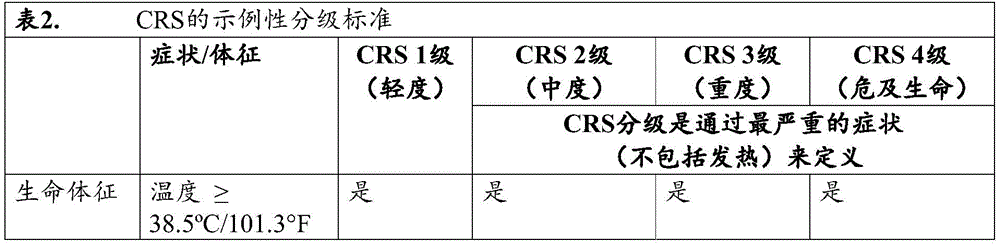

In some embodiments, the high dose vasopressor medications include those described in table 3 below.

In some embodiments, the toxic outcome is severe CRS. In some embodiments, the toxic outcome is the absence of severe CRS (e.g., moderate or mild CRS). In some embodiments, the heavy CRS includes 3-grade or higher ranked CRS, as shown in tables 1 and 2. In some embodiments, the heavy CRS includes a level 2 or higher CRS, such as a level 2, 3, 4, or 5 CRS.
In some aspects, the toxicity outcome is or is associated with neurotoxicity. In some embodiments, the signs or symptoms associated with clinical risk of neurotoxicity include confusion, delirium, aphasia, expressive aphasia, dullness, myoclonus, lethargy, mental state changes, convulsions, epileptiform activity, epilepsy (optionally as confirmed by electroencephalography (EEG)), elevated levels of beta amyloid protein (a β), elevated levels of glutamate, and elevated levels of oxygen radicals. In some embodiments, neurotoxicity is graded based on severity (e.g., using a grade 1-5 scale (see, e.g., guido Cavaletti & Paola Marmiroli Nature Reviews Neurology 6,657-666 (month 12 2010); national cancer institute of america — common toxicity standard version 4.03 (NCI-CTCAE v 4.03)). As used herein, if a subject exhibits symptoms that limit self-care (e.g., bathing, dressing and peeling, eating, toileting, taking medicine) after administration, the subject is deemed to have "severe neurotoxicity" in response to or secondary to cell therapy or administration of one dose of cells thereof, 1) symptoms of peripheral motor neuropathy, including inflammation or degeneration of peripheral motor nerves; 2) Symptoms of peripheral sensory neuropathy include inflammation or degeneration of peripheral sensory nerves, dysesthesia (e.g., sensory perception distortion), resulting in abnormal and unpleasant sensations, neuropathic pain (e.g., a severe sensation of pain along a nerve or group of nerves), and/or paresthesia such as a functional disorder of sensory neurons, resulting in abnormal skin sensations of tingling, numbness, pressure, coldness, and warmness without stimulation. In some embodiments, the severe neurotoxicity comprises grade 3 or higher neurotoxicity, as shown in table 4. In some embodiments, severe neurotoxicity comprises grade 2 or higher neurotoxicity, e.g., grade 2, grade 3, grade 4, or grade 5 neurotoxicity.
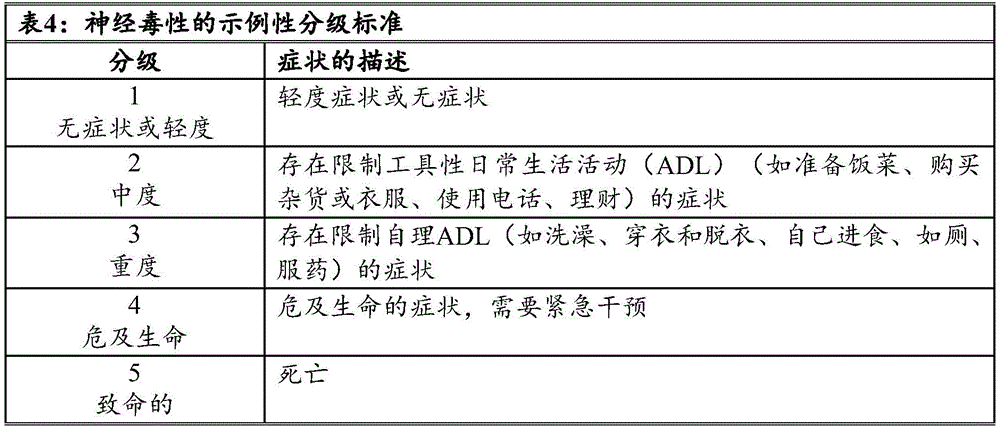
In some aspects, neurotoxicity may be associated with CRS, or may be independent or independent of CRS. In some aspects, neurotoxicity may be associated with early onset of CRS and rapid elevation of inflammatory cytokines in serum and Central Nervous System (CNS), possibly leading to disruption of the Blood Brain Barrier (BBB) (Gus et al, cancer Discov 2017 (12): 1404 1419. In some aspects, increases in serum IL-6, IFN- γ, and MIP-1 α peaks may be associated with neurotoxicity. In some cases, neurotoxicity is also associated with an increase in endogenous IL-1Ra peak, IL-1Ra being an endogenous inhibitor of the pro-inflammatory effects of IL-1 α (IL-1 α) and IL-1 β (IL-1 β), which in some cases are associated with neurotoxicity. In some aspects, higher levels of cytokines commonly associated with systemic inflammation, e.g., IL-6, IL-10, and interferon gamma (IFN γ), are observed in cases of severe neurotoxicity.
In some embodiments, the toxic outcome is dose-limiting toxicity. In some embodiments, the toxicity outcome is the absence of dose-limiting toxicity. In some embodiments, dose-limiting toxicity (DLT) is defined as any grade 3 or higher toxicity as assessed by any known or published guidelines for assessing specific toxicity, such as any of the guidelines described above and including National Cancer Institute (NCI) standard of Common terminologic Criteria for additive Events, CTCAE version 4.0.
In some aspects, the toxicity is Macrophage Activation Syndrome (MAS), also known as Hemophagocytic Lymphohistiocytosis (HLH). In some aspects, MAS/HLH is associated with impaired NK and cytotoxic T cell function and has a wide range of causes, symptoms and fates. In some aspects, MAS/HLH results in a high inflammatory response, with some features overlapping CRS. In some aspects, MAS may be associated with uncontrolled activation and proliferation of administered cells and subsequent macrophage activation. In some aspects, MAS may manifest as high grade, non-remitting fever, cytopenia and hepatosplenomegaly. Exemplary observations found in MAS include elevated levels of inflammatory cytokines, serum ferritin, soluble IL-2 receptor (sCD 25), triglycerides, reduction in circulating Natural Killer (NK) cells, elevated transaminase levels, signs of acute liver failure, coagulopathy, and disseminated intravascular coagulopathy. In some aspects, MAS and CRS overlap in clinical presentation and observation, but also have distinguishing features such as hepatosplenomegaly and lymphadenopathy. In some aspects, a subject having a hematological malignancy is at higher risk for developing MAS/HLH. In some cases, subjects with MAS/HLH or CRS-associated MAS/HLH-like syndrome (MALS) exhibit elevated levels of cytokines (such as IL-18, IL-8, IP-10, MCP-1, MIG, and/or MIP-1 β) (see, e.g., teachy et al, cancer Discov.2016;6 664-679, shimabukuro-Vornhagen, journal for ImmunoTherapy of cancer.2018; 6.
Exemplary signs or symptoms associated with clinical risk of MAS/HLH include persistent high fever (> 38.5 ℃) and lymphohematopoietic enlargement (splenic/hepatomegaly), occasionally accompanied by adenopathy, and in some cases, lung, nerve, skin, and gastrointestinal involvement may also be present; laboratory observations such as pancytopenia, methemoglobinemia, hypofibrinogenemia and elevated levels of D-dimers, hypertriglyceridemia and liver dysfunction. In some aspects, persistent infection may be a cause of MAS/HLH, and is monitored using standard tests for infections caused by the most common viruses, such as herpes virus, cytomegalovirus (CMV) and Epstein-Barr virus (EBV), and other sources of infection (e.g., mycobacteria, parasites and fungi, particularly candida and mucor) should be excluded according to specific clinical or epidemiological characteristics. In some aspects, bone marrow aspirate is tested for indications related to MAS/HLH.
In some aspects, exemplary diagnostic criteria for MAS/HLH may be based on HLH-2004 consensus criteria, which was further revised in 2014 with respect to malignancy-associated HLH (Lehmberg et al, haematologica.2015;100 (8): 997-1004); in some cases, as long as one of the following two criteria is met:
1. MAS/HLH compliant molecular diagnostics
2. The diagnostic criteria for MAS/HLH (5 of the 8 criteria below) were met:
a. persistent high heat (not less than 38.5℃)
b. Splenomegaly
c. Cytopenia (affecting 2 of 3 lineages of peripheral blood): hemoglobin<90g/L, platelets<100x10 9 L, and neutrophils<1.0x10 9 /L
d. Triglyceride is greater than or equal to 3.0mmol/L (265 mg/dL) or fibrinogen is less than or equal to 1.5g/L
e. Hemophagocytic effects in bone marrow, spleen and/or lymph nodes
f. Low or no NK cell Activity (according to local laboratory reference range)
g. Ferritin is more than or equal to 500ng/mL
h. Soluble CD25 (i.e., soluble IL-2 receptor) is greater than or equal to 2400U/mL.
In some embodiments, for example, treatment according to the provided methods may result in a lower rate and/or a lower degree of toxicity, toxicity outcome or symptoms, toxicity promoting characteristics, factors or characteristics, such as symptoms or outcomes associated with or indicative of Cytokine Release Syndrome (CRS) or neurotoxicity (such as severe CRS or severe neurotoxicity) or MAS/HLH, as compared to administration of other therapies. In some embodiments, for example, treatment according to the provided methods can result in a higher response rate (e.g., a higher OR, CR, sCR, VGPR, OR PR rate) and/OR a more sustained response, as well as a lower rate and/OR lower degree of toxicity, toxicity outcome OR symptoms, toxicity-promoting characteristics, factors, OR characteristics, such as symptoms OR outcomes associated with OR indicative of Cytokine Release Syndrome (CRs) OR neurotoxicity (e.g., severe CRs OR severe neurotoxicity) OR MAS/HLH, as compared to administration of other therapies. In some embodiments, treatment according to the provided methods may result in a higher response rate and a lower rate or degree of toxicity. In some aspects, such results may also be accompanied by higher expansion or extended persistence of the administered cells compared to administration of other therapies.
B. Combination therapy
Also provided are methods of combination therapy comprising administration and use, such as therapeutic and prophylactic use, of BCMA binding recombinant receptors (e.g., CARs), engineered cells expressing the recombinant receptors (e.g., CARs), a plurality of engineered cells expressing the receptors, and/or compositions comprising the engineered cells.
In some embodiments, the BCMA binding molecules (e.g., chimeric antigen receptors) and/or engineered cells expressing the molecules (e.g., recombinant receptors) described herein are administered as part of a combination therapy or combination therapy, e.g., simultaneously, sequentially in any order, or intermittently with one or more additional therapeutic interventions. In some embodiments, the one or more additional therapeutic interventions include, for example, antibodies, engineered cells, receptors, and/or agents (e.g., cells expressing recombinant receptors and/or cytotoxic or therapeutic agents (e.g., chemotherapeutic agents)). In some embodiments, the combination therapy comprises administration of one or more additional agents, therapies and/or treatments, e.g., any of the additional agents, therapies and/or treatments described herein. In some embodiments, combination therapy includes the administration of one or more additional agents for treatment or therapy, such as agents for ameliorating toxicity that may be associated with cell therapy, such as interleukin-1 receptor antagonists (IL-1 Ra) (e.g., recombinant IL-1 Ra), IL-6 targeting agents, steroids; administration of a lymphocyte clearance therapy or other agent, such as an immunomodulator, an immune checkpoint inhibitor, an adenosine pathway or adenosine receptor antagonist or agonist and/or a kinase inhibitor. In some embodiments, the combination therapy or combination therapy comprises additional treatments, such as surgical treatments, transplantation, and/or radiation therapy. Also provided are methods of combination therapy or combination therapy comprising a BCMA binding recombinant receptor (e.g., CAR), cell, and/or composition described herein and one or more additional therapeutic interventions.
In some embodiments, the additional agent enhances safety by reducing or ameliorating the adverse effects of the administered engineered cells or compositions comprising the same. In some embodiments, the additional agent may treat the same disease, disorder, or co-morbidity (comorbidity). In some embodiments, the additional agent can ameliorate, reduce or eliminate one or more toxicity, adverse effects or side effects associated with administration of the cells and/or compositions (e.g., CAR-expressing cells), and in some aspects can be used in any prophylactic method provided herein. In some embodiments, the additional agent for combination therapy or combination therapy enhances, potentiates, and/or promotes the efficacy and/or safety of the therapeutic effect of the engineered cells or compositions comprising the same. In some embodiments, the additional agent enhances or improves the efficacy, survival, or persistence of the administered cells (e.g., cells expressing the recombinant receptor). In some embodiments, the additional agent is selected from a protein phosphatase inhibitor, a kinase inhibitor, a cytokine, an immunomodulator, or an agent that reduces the level or activity of regulatory T (Treg) cells.
Any additional agent described herein can be prepared and administered as a combination therapy with an engineered cell expressing any BCMA binding recombinant receptor (e.g., CAR) described herein or a composition comprising the cell, such as in a pharmaceutical composition comprising one or more agents of the combination therapy and a pharmaceutically acceptable carrier (such as any one described herein). In some embodiments, an engineered cell expressing any of the BCMA binding recombinant receptors (e.g., CARs) described herein or a composition comprising the cell can be administered simultaneously, concurrently, or sequentially in any order with additional agents, therapies, or treatments, wherein such administration provides therapeutically effective levels of each agent in the subject. In some embodiments, the additional agent may be co-administered with an engineered cell expressing any of the BCMA binding recombinant receptors described herein (e.g., CARs) or a composition comprising the cell, e.g., as part of the same pharmaceutical composition or using the same method of delivery. In some embodiments, the additional agent is administered simultaneously with the engineered cell expressing a BCMA binding recombinant receptor or composition described herein but in a separate composition. In some embodiments, the additional agent is an additional engineered cell (e.g., a cell engineered to express a different recombinant receptor) and is administered in the same composition or in a separate composition. In some embodiments, the additional agent is incubated with the engineered cell (e.g., CAR-expressing cell) prior to administration of the cell.
In some examples, one or more additional agents are administered after or before (at a selected time period apart from) administration of the engineered cells and/or compositions expressing BCMA binding recombinant receptor described herein. In some examples, the period of time is 1 day, 2 days, 3 days, 4 days, 5 days, 6 days, 1 week, 2 weeks, 3 weeks, 1 month, 2 months, or 3 months. In some examples, one or more additional agents are administered multiple times and/or the engineered cells expressing a BCMA binding recombinant receptor and/or compositions described herein are administered multiple times. For example, in some embodiments, the additional agent is administered prior to the engineered cells and/or compositions expressing a BCMA binding recombinant receptor described herein, e.g., two weeks, 12 days, 10 days, 8 days, 1 week, 6 days, 5 days, 4 days, 3 days, 2 days, or 1 day prior to administration. For example, in some embodiments, the additional agent is administered after the engineered cells and/or compositions expressing BCMA binding recombinant receptor described herein, e.g., two weeks, 12 days, 10 days, 8 days, 1 week, 6 days, 5 days, 4 days, 3 days, 2 days, or 1 day after administration.
The dosage of the additional agent can be any therapeutically effective amount, e.g., any dosage amount described herein, and the appropriate dosage of the additional agent can depend on the type of disease to be treated, the type, dosage and/or frequency of recombinant receptor, cell and/or composition administered, the severity and course of the disease, whether the recombinant receptor, cell and/or composition is administered for prophylactic or therapeutic purposes, previous therapy, the patient's clinical history and response to the recombinant receptor, cell and/or composition, and the discretion of the attending physician. The recombinant receptor, cell, and/or composition and/or additional agent and/or therapy can be administered to the patient at one time, repeatedly, or over a series of treatments.
In some aspects, the administration of a dose of the engineered cells and/or a composition comprising the engineered cells is repeated. In some aspects, the subject receives one or more additional doses of the engineered cells and/or the composition containing the engineered cells that are the same as the initial dose of the engineered cells and/or the composition containing the engineered cells. In some aspects, the subject receives one or more additional doses of the engineered cells and/or the composition containing the engineered cells that are different from the initial dose of the engineered cells and/or the composition containing the engineered cells. In some aspects, the additional dose is higher than the initial dose. In some aspects, the additional dose is lower than the initial dose. In some embodiments, only one dose of the engineered cells and/or the composition containing the engineered cells is administered to the subject. In some embodiments, the administration of a dose of the engineered cells and/or the composition comprising the engineered cells is not repeated.
1. Prophylactic therapy
In some aspects, the methods and uses provided relate to administering additional therapies as prophylactic therapies. In some embodiments, for prophylactic therapy, additional agents and/or combination therapies are administered prior to a particular event or at an early stage of the disease. In some aspects, prophylactic therapy is initiated prior to administration of the cell therapy and/or prior to generating an outcome of the cell therapy (e.g., such as generating an adverse event, such as toxicity from the cell therapy). In some embodiments, prophylactic therapy includes prophylactic measures, such as therapy for preventing adverse events (e.g., toxicity) following administration of cell therapy. In some aspects, methods are provided for reducing the severity of toxicity, attenuating and/or preventing the onset of toxicity in a subject to be treated with cell therapy. In some aspects, toxicity comprises toxicity that may be associated with cell therapy.
In some embodiments, prophylactic therapy can enhance, potentiate, and/or promote the safety of the therapeutic effect of engineered cells expressing recombinant receptors that bind BCMA and/or compositions comprising such cells as described herein. In some embodiments, additional agents, e.g., for prophylactic therapy, enhance safety by reducing or ameliorating the adverse effects of the engineered cells or compositions. In some embodiments, the additional agent can ameliorate, reduce, or eliminate one or more toxicity, adverse effects, or side effects associated with administration of the engineered cell or composition (e.g., CAR-expressing cell). As described above, adverse events (e.g., toxicity) that may be associated with cell therapy (e.g., adoptive cell therapy) may include Cytokine Release Syndrome (CRS), neurotoxicity (also known as neurological events; NEs), and Macrophage Activation Syndrome (MAS). In some aspects, macrophage-produced IL-1 plays a role in priming CRS. In some aspects, CRS may also be associated with disseminated intravascular coagulation and may exhibit clinical and pathological pictures similar to MAS (see, e.g., hay et al, british Journal of Haematology 2018 (3): 364-374.
In some aspects, the additional agent for combination therapy is an interleukin-1 receptor antagonist (IL-1 Ra). In some embodiments, IL-1Ra is administered as a prophylactic treatment. In some aspects, the IL-1Ra is administered prior to administration of a dose of engineered cells (e.g., T cells expressing a recombinant receptor). In some embodiments, at least one dose of IL-1Ra is administered prior to administration of the dose of engineered cells. In some aspects, administration of IL-1Ra is continued after administration of a dose of the engineered cells. In some aspects, at least one dose of IL-1Ra is administered after a dose of cells is administered.
In some aspects, the IL-1Ra used in the combination therapy and/or prophylactic therapy is anakinra (Kineret) or a modified form thereof, such as anakinra partially modified with an N-terminal Pro-Ala-Ser (PAS) (see, e.g., powers et al, J Biol chem.2020, 1 month, 17 days; 295 (3): 868-882). In some aspects, IL-1Ra is anakinra. An exemplary sequence of anakinra is shown in SEQ ID NO: 256. In some aspects, anakinra is recombinant IL-1RA approved for administration to a moderate to severe active Rheumatoid Arthritis (RA) subject aged 18 or older. Blocking IL-1 by IL-1Ra can prevent severe CRS while maintaining the full anti-tumor efficacy of the administered cell therapy. IL-1Ra can cross the blood brain barrier, thus can reduce the severity of neurological events, and can be used to alleviate MAS/HLH. IL-1 activated human microglia produce inducible nitric oxide synthase and proinflammatory cytokines (Tarrassishin et al, glia 62,999-1013 (2014)), and thus, blockade of IL-1 can lead to reduction or prevention of severe CRS and severe neurological events. In some aspects, administration of IL-1Ra as a prophylactic therapy can result in an improvement in the onset, incidence, and severity of adverse events (such as CRS, neurological events, or MAS).
In some aspects, the subject receives IL-1Ra as a prophylactic therapy, e.g., anakinra, e.g., to reduce the severity of, attenuate, and/or prevent the onset of toxicity that may be associated with an adoptive cell therapy, such as a cell therapy comprising a dose of engineered cells, e.g., engineered T cells comprising a Chimeric Antigen Receptor (CAR) specific for B Cell Maturation Antigen (BCMA) as provided herein. In some aspects, one or more doses of IL-1Ra administered prior to the dose of engineered T cells are administered prophylactically.
In some of any of the embodiments, the subject receives at least one dose of IL-1Ra prior to the dose of engineered cells. In some aspects, a cell therapy comprising a dose of engineered cells (which comprise a CAR specific for BCMA) is administered to a subject that has been administered at least one dose of IL-1Ra. In some embodiments, the methods and uses provided relate to administering at least one dose of IL-1Ra to a subject prior to administration of a cell therapy comprising a dose of engineered T cells containing a CAR specific for BCMA. In some aspects, at least one dose of IL-1Ra administered prior to the dose of engineered T cells is prophylactic administration of IL-1Ra.
In some of any of the provided embodiments, at least one dose of IL-1Ra is administered to the subject at or within about 24 hours prior to the dose of engineered T cells.
In some of any embodiments, the methods and uses involve administering at least two doses of IL-1Ra and a cell therapy comprising a dose of engineered T cells containing a CAR specific for BCMA. In some aspects, at least one dose of IL-1Ra is administered at or within about 24 hours prior to the dose of engineered T cells; and administering at least one dose of IL-1Ra after said dose of engineered T cells. In some aspects, the dose of engineered T cells comprising a CAR specific for BCMA is administered to a subject who has been administered at least one dose of IL-1Ra at or within about 24 hours prior to the dose of engineered T cells; and administering at least one dose of IL-1Ra after said dose of engineered T cells.
In some of any of the provided embodiments, at least one dose of IL-1Ra is administered to the subject at or within about 24 hours prior to the dose of engineered T cells. In some aspects, at least one dose of IL-1Ra is administered to the subject at or about 21, 18, 15, 12, 9, 6, or 3 hours before the dose of engineered T cells, or within a range defined by any of the foregoing. In some aspects, at least one dose of IL-1Ra is administered to the subject at or about 24, 21, 18, 15, or 12 hours, or within a range defined by any of the foregoing, prior to the dose of engineered T cells. In some aspects, at least one dose of IL-1Ra is administered to the subject at or within about 21 hours prior to the dose of engineered T cells. In some aspects, at least one dose of IL-1Ra is administered to the subject at or within about 18 hours prior to the dose of engineered T cells. In some aspects, at least one dose of IL-1Ra is administered to the subject at or within about 15 hours prior to the dose of engineered T cells. In some aspects, at least one dose of IL-1Ra is administered to the subject at or within about 12 hours prior to the dose of engineered T cells. In some aspects, at least one dose of IL-1Ra is administered to the subject the evening or night before administration of the dose of engineered T cells. In some aspects, the methods and uses involve administering at least one dose of IL-1Ra at or within about 6, 5, 4, 3, or 2 hours prior to administering the dose of engineered T cells. In some aspects, at least one dose of IL-1Ra is administered at or within about 3 hours prior to administration of the dose of engineered T cells. In some of any of the embodiments, at least two doses of IL-1Ra are administered prior to administration of the dose of engineered T cells. In some aspects, one dose of IL-1Ra is administered within at or about 24 hours prior to administration of the dose of engineered T cells, and one dose of IL-1Ra is administered within at or about 3 hours. In some aspects, one dose of IL-1Ra is administered within at or about 18 hours prior to administration of the dose of engineered T cells, and one dose of IL-1Ra is administered within at or about 3 hours. In some aspects, a dose of IL-1Ra is administered at or within about 12 hours before the dose of engineered T cells is administered, and a dose of IL-1Ra is administered at or within about 3 hours. In some aspects, a dose of IL-1Ra is administered to the subject the evening or night before administration of the dose of engineered T cells, and a dose of IL-1Ra is administered at or within about 3 hours before administration of the dose of engineered T cells.
In some aspects, the subject is administered at least two doses of IL-1Ra. In some aspects, at least 2, 3, 4, 5, 6, 7, 8, 9, or 10 doses of IL-1Ra are administered to the subject.
In some of any of the embodiments, the subject is administered at least one dose of IL-1Ra after administration of the dose of engineered T cells. In some aspects, at least 2, 3, 4, 5, 6, 7, 8, 9, or 10 doses of IL-1Ra are administered to the subject after administration of the dose of engineered T cells. In some aspects, at least 2, 3, 4, 5, 6, 7, or 8 doses of IL-1Ra are administered after the dose of engineered T cells is administered. In some aspects, 3, 4, 5, 6, or 7 doses of IL-1Ra are administered after administration of the dose of engineered T cells. In some embodiments, 5 doses of IL-1Ra are administered after administration of the dose of engineered T cells. In some embodiments, 4 doses of IL-1Ra are administered after administration of the dose of engineered T cells.
In some of any of the embodiments, the dose of IL-1Ra is administered daily for a plurality of consecutive days. In some aspects, these doses are administered daily for several consecutive days after administration of the dose of engineered T cells. In some aspects, each of the 5 doses of IL-1Ra administered after administration of the dose of engineered T cells is administered daily for 5 consecutive days after administration of the dose of engineered T cells. In some aspects, each of the 4 doses of IL-1Ra administered after administration of the dose of engineered T cells is administered daily for 4 consecutive days after administration of the dose of engineered T cells. In some aspects, the dose of engineered T cells is administered on day 1, and one of the 4 doses of IL-1Ra administered after administration of the dose of engineered T cells is administered on each of days 2, 3, 4, and 5.
In some aspects, the subject is administered a total of 2, 3, 4, 5, 6, 7, 8, 9, or 10 doses of IL-1Ra. In some aspects, the subject is administered a total of 5, 6, 7, 8, or 9 doses of IL-1Ra. In some aspects, the subject is administered a total of 7 doses of IL-1Ra. In some aspects, the subject is administered a total of 8 doses of IL-1Ra. In some aspects, the subject is administered a total of 9 doses of IL-1Ra.
In some of any of the provided embodiments, the daily administration of IL-1Ra is given at or about the same time per day. In some of any of the provided embodiments, the daily administration of the dose of IL-1Ra is administered at about 24 hour (q 24 h) intervals.
In some aspects, the methods and uses further comprise administering at least one additional dose of IL-1Ra if the subject exhibits signs or symptoms of toxicity, such as Cytokine Release Syndrome (CRS), neurotoxicity (NT), or Macrophage Activation Syndrome (MAS)/Hemophagocytic Lymphohistiocytosis (HLH), or at the onset of toxicity. In some aspects, if the subject exhibits signs or symptoms of CRS or at the onset of CRS, the subject is administered at least one additional dose of IL-1Ra after administration of the engineered T cells. In some aspects, at least one additional dose of IL-1Ra is administered once every two days, once a day, twice a day, three times a day, or four times a day. In some aspects, at least one additional dose of IL-1Ra is administered twice daily. In some aspects, at least one additional dose of IL-1Ra is administered once daily. In some aspects, at least one additional dose of IL-1Ra is administered until signs or symptoms of CRS subside. In some aspects, at least one additional dose of IL-1Ra is one additional dose. Thus, in some aspects, if the subject exhibits signs or symptoms of CRS or at the onset of CRS, a dose of IL-1RA is administered twice daily. In some aspects, if the subject exhibits signs or symptoms of CRS or at the onset of CRS, a dose of IL-1RA is administered about every 12 hours (q 12 h).
In some of any of the embodiments, the IL-1Ra administered in combination with a cell therapy (e.g., a cell therapy comprising a dose of engineered T cells expressing an anti-BCMA Chimeric Antigen Receptor (CAR)) is a recombinant IL-1Ra. In some aspects, the recombinant IL-1Ra is non-glycosylated. In some aspects, the recombinant IL-1Ra is anakinra. In some of any of the embodiments, the IL-1Ra comprises the sequence shown in SEQ ID No. 256 or a sequence having at least 90%, 91%, 92%, 93%, 94%, 95%, 96%, 97%, 98% or 99% or more sequence identity to SEQ ID No. 256 and retaining IL-1R antagonist function. In some of any of the embodiments, the IL-1Ra comprises the sequence set forth in SEQ ID NO: 256. In some aspects, the IL-1Ra is anakinra, and each dose of anakinra is at or about 500, 400, 300, 200, 100, or 50mg, or a range defined in any of the foregoing. In some embodiments, each dose of anakinra is at or about 200mg. In some embodiments, each dose of anakinra is at or about 100mg.
In some embodiments, the IL-1Ra is administered by subcutaneous administration. In some aspects, anakinra is administered by subcutaneous administration at a dose of at or about 100mg per day. In some aspects, anakinra is administered by subcutaneous administration twice daily at a dose of at or about 100mg if the subject exhibits signs or symptoms of CRS or at the onset of CRS.
In some of any of the embodiments, the methods and uses involve prophylactically administering to a subject a combination of a recombinant IL-1Ra (e.g., anakinra) and a cell therapy comprising expression of a Chimeric Antigen Receptor (CAR) specific for BCMA as described herein (e.g., comprising a V comprising the sequence shown in SEQ ID NO: 125) H Region and V comprising the sequence shown in SEQ ID NO:127 L Region), the subject has a disease or disorder, such as Multiple Myeloma (MM), e.g., relapsed or refractory multiple myeloma (R/rmm). In some of any of the embodiments, the methods and uses involve administering two doses of IL-Ra prior to administering the cell therapy, such as each dose comprising 100mg of anakinra administered subcutaneously, wherein one dose of recombinant IL-1Ra is administered at or near night prior to administering the cell therapy and one dose of recombinant IL-1Ra is administered at or about 3 hours prior to administering the cell therapy. In some of any of the embodiments, the methods and uses further involve continuing to administer IL-1Ra after administering the cell therapy for 5 consecutive days daily, each dose comprising 100mg of anakinra administered subcutaneously. In some of any of the embodiments, the methods and uses further involve continuing to administer IL-1Ra for 4 consecutive days after administering the cell therapy Daily administration, each dose contained 100mg of anakinra administered subcutaneously. In some of any embodiments, if the subject exhibits signs or symptoms of CRS or at the onset of CRS, one or more doses of recombinant IL-1Ra are administered twice daily until CRS subsides. In some of any of the embodiments, the recombinant IL-1Ra is administered at or about the same time per day. In some of any of the embodiments, one dose of IL-1Ra is administered about every 24 hours. In some of any of the embodiments, about every 12 hours of administration of a dose of IL-1Ra.
In some of any of the embodiments, the methods and uses involve administering two doses of IL-1Ra prior to administering cell therapy, such as each dose comprising 100mg anakinra administered subcutaneously, wherein one dose of IL-1Ra is administered at night or evening prior to administering cell therapy, and one dose of IL-1Ra is administered at or about 3 hours prior to administering cell therapy (day 1), and one dose of IL-1Ra is administered daily (e.g., q24 h) on days 2-5, such as a dose comprising about 100mg anakinra administered subcutaneously.
In some of any of the embodiments, the methods and uses involve administering two doses of IL-1Ra prior to administering the cell therapy, such as each dose comprising 100mg anakinra administered subcutaneously, wherein one dose of recombinant IL-1Ra is administered at night or evening prior to administering the cell therapy, and one dose of IL-1Ra is administered at or about 3 hours prior to administering the cell therapy (day 1), and if the subject exhibits signs or symptoms of CRS or the onset of CRS, two doses of IL-1Ra are administered daily (e.g., q12 h) on days 2-5, such as a dose comprising about 100mg anakinra administered subcutaneously.
In some of any of the embodiments, the provided methods and uses, e.g., prophylactic methods and uses, reduce the severity of toxicity, attenuate and/or prevent the onset of toxicity. In some of any of the embodiments, the toxicity is Cytokine Release Syndrome (CRS). In some of any of the embodiments, the CRS is heavy CRS or rank 3 or higher ranked CRS. In some of any of the embodiments, the toxicity is Neurotoxicity (NT). In some of any of the embodiments, the NT is a severe NT, or a grade 2 or higher NT, or a grade 3 or higher NT. In some of any of the embodiments, the toxicity is Macrophage Activation Syndrome (MAS) or Hemophagocytic Lymphohistiocytosis (HLH).
In some embodiments, the methods are used to prophylactically treat a subject identified as a subject at risk for developing toxicity following administration of an engineered T cell (e.g., a CAR T cell). For example, certain subjects, upon administration of adoptive T cell therapy (e.g., CAR T cells), may exhibit risk factors that make them more susceptible or more likely to be toxic (e.g., severe CRS). Thus, methods are provided for identifying a subject at risk of developing toxicity following administration of an engineered T cell (e.g., a CAR T cell) and selecting a subject for treatment with any of the prophylactic methods described herein before the subject receives administration of an engineered T cell (e.g., a CAR T cell).
In some embodiments, the toxicity is Cytokine Release Syndrome (CRS). In some cases, CRS, such as CRS, may occur following adoptive T cell therapy and administration of other biologies to the subject. See Davila et al, sci Transl Med 6,224ra25 (2014); brentjens et al, sci. Trans. Med.5,177ra38 (2013); grupp et al, n.engl.j.med.368,1509-1518 (2013); and Kochenderfer et al, blood 119,2709-2720 (2012); xu et al, cancer Letters 343 (2014) 172-78. CRS standards have been developed that appear to correlate with the onset of CRS to predict which patients are more likely to be at risk for sCRS (see Davila et al Science translational media 2014;6 (224): 224ra 25). Exemplary features of CRS are described in section i.4.b.
In some embodiments, if the subject is identified as at risk for developing toxicity following administration of the engineered T cells (e.g., CAR T cells), the subject is selected for treatment by any of the methods described herein. In some embodiments, a subject is identified as at risk for developing toxicity (e.g., CRS) if the subject exhibits one or more factors. In some embodiments, the factors include fever, hypoxia, hypotension, neurological changes, and/or elevated levels of inflammatory markers. In some embodiments, the marker of inflammation is C-reactive protein (CRP), erythrocyte Sedimentation Rate (ESR), albumin, ferritin, β 2 microglobulin (β 2-M), lactate Dehydrogenase (LDH), a cytokine, or a chemokine. In some cases, the marker of inflammation is LDH. In some examples, the inflammatory marker is a cytokine or chemokine that is IL-7, IL15, MIP-1 α, or TNF- α. In some embodiments, the factor comprises a volumetric measure of tumor burden. In some embodiments, the volumetric measure of tumor burden is the sum of the product of diameters (SPD), the longest tumor diameter (LD), the sum of the longest tumor diameters (SLD), tumor volume, necrotic volume, necrosis-tumor ratio (NTR), peritumoral edema (PTE), and edema-tumor ratio (ETR).
In some embodiments, the subject is identified as at risk for developing toxicity following administration of the engineered T cells if the level of the inflammatory marker in the sample from the subject is above a threshold. In some embodiments, the marker of inflammation is LDH. In some embodiments, the threshold is at or about 300 units/liter, at or about 400 units/liter, at or about 500 units/liter, or at or about 600 units/liter. In some embodiments, the marker of inflammation is LDH and the threshold value is at or about 300 units/liter, at or about 400 units/liter, at or about 500 units/liter, or at or about 600 units/liter.
In some embodiments, the subject is identified as at risk for developing toxicity following administration of the engineered T cells if the volumetric measure of tumor burden in the subject is above a threshold. In some embodiments, the volumetric measure of tumor burden is SPD. In some embodiments, the threshold is at or about 30cm 2 At or about 40cm 2 At or about 50cm 2 At or about 60cm 2 Alternatively or at about 70cm 2 . In some embodiments, the volume measurement is SPD and the threshold value is at or about 30cm 2 At or about 40cm 2 At or about 50cm 2 At or about 60cm 2 Alternatively or at about 70cm 2 。
2. Lymphocyte clearance therapy
In some embodiments, the additional therapy is a lymphocyte clearance therapy. Lymphodepleting chemotherapy is thought to improve the engraftment and activity of recombinant receptor expressing cells (e.g., CAR T cells). In some embodiments, lymphodepleting chemotherapy may enhance adoptively transferred tumor-specific T cells to proliferate in vivo by steady state proliferation. In some embodiments, chemotherapy may reduce or eliminate CD4+ CD25+ regulatory T cells, which may inhibit the function of tumor-targeted adoptively metastasized T cells. In some embodiments, lymphodepleting chemotherapy prior to adoptive T cell therapy may enhance expression of stromal cell derived factor 1 (SDF-1) in bone marrow, enhancing homing of modified T cells to the primary tumor site by SDF-1 binding to CXCR-4 expressed on the surface of T cells. In some embodiments, lymphodepleting chemotherapy may also reduce the tumor burden and potentially reduce the risk and severity of CRS in a subject.
In some embodiments, the subject is lymphodepleted, e.g., prior to administration of the engineered cells (e.g., CAR-expressing cells). In some embodiments, the lymphocyte depletion comprises administration of one or more of: melphalan, cytoxan, cyclophosphamide and/or fludarabine. In some embodiments, the subject is administered a lymphodepleting chemotherapy prior to, concurrently with, or after administration (e.g., infusion) of the engineered cells (e.g., CAR expressing cells). In one example, lymphodepleting chemotherapy is administered to the subject prior to administering the engineered cells (e.g., CAR-expressing cells). In some embodiments, the lymphocyte depleting chemotherapy is administered 1 to 10 days prior to administering the engineered cell, such as 1, 2, 3, 4, 5, 6, 7, 8, 9, or 10 days prior to starting administration of the engineered cell, or at least 2 days prior to starting administration of the engineered cell, such as at least 3, 4, 5, 6, or 7 days. In some embodiments, the preconditioning agent is administered to the subject no more than 7 days prior to beginning administration of the engineered cells, such as no more than 6, 5, 4, 3, or 2 days prior. The number of days after administration of the lymphocyte depleting chemotherapy may be determined according to clinical or logistical circumstances. In some instances, dose adjustments or other changes to the lymphodepleting chemotherapeutic regimen may be implemented due to the health of the subject (e.g., the subject's underlying organ function as determined by a treating physician).
In some embodiments, the lymphodepleting chemotherapy comprises administering a lymphodepleting agent, such as cyclophosphamide, fludarabine, or a combination thereof. In some embodiments, cyclophosphamide is administered to the subject at a dose of between or between about 20mg/kg and 100mg/kg body weight of the subject (such as between or between about 40mg/kg and 80 mg/kg). In some aspects, about 60mg/kg of cyclophosphamide is administered to the subject. In some embodiments, cyclophosphamide is administered once daily for one or two days. In some embodiments, where the lymphocyte depleting agent comprises cyclophosphamide, the amount of the compound is at or at about 100mg/m 2 And 500mg/m 2 Between the body surface areas of the subject, e.g., at or about 200mg/m 2 And 400mg/m 2 Or 250mg/m 2 And 350mg/m 2 (iv) administering cyclophosphamide to the subject at a dose between (inclusive). In some cases, about 100mg/m is administered to the subject 2 Cyclophosphamide of (1). In some cases, about 150mg/m is administered to the subject 2 Cyclophosphamide of (1). In some cases, about 200mg/m is administered to the subject 2 Cyclophosphamide of (1). In some cases, about 250mg/m is administered to the subject 2 Cyclophosphamide of (1). In some cases, about 300mg/m is administered to the subject 2 Cyclophosphamide of (1). In some embodiments, cyclophosphamide may be administered in a single dose or may be administered in multiple doses, such as daily, every other day, or every third day. In some embodiments, cyclophosphamide is administered daily, such as for 1-5 days, e.g., for 2 to 4 days. In some cases, about 300mg/m per day is administered to the subject prior to initiating cell therapy 2 Cyclophosphamide on the surface area of the subject for 3 days. In some embodiments, a total of or about 300mg/m is administered to the subject prior to initiating cell therapy 2 、400mg/m 2 、500mg/m 2 、600mg/m 2 、700mg/m 2 、800mg/m 2 、900mg/m 2 、1000mg/m 2 、1200mg/m 2 、1500mg/m 2 、1800mg/m 2 、2000mg/m 2 、2500mg/m 2 、2700mg/m 2 、3000mg/m 2 、3300mg/m 2 、3600mg/m 2 、4000mg/m 2 Or 5000mg/m 2 Cyclophosphamide of (a), or a range as defined in any of the foregoing.
In some embodiments, where the lymphocyte scavenger comprises fludarabine, the subject is administered a dose at or about 1mg/m 2 And 100mg/m 2 Between the body surface areas of the subject, e.g., at or about 10mg/m 2 And 75mg/m 2 Middle, 15mg/m 2 And 50mg/m 2 20mg/m 2 And 40mg/m 2 Or 24mg/m 2 And 35mg/m 2 Fludarabine (limits included). In some cases, about 10mg/m is administered to the subject 2 Fludarabine. In some cases, about 15mg/m is administered to the subject 2 Fludarabine. In some cases, about 20mg/m is administered to the subject 2 Fludarabine. In some cases, about 25mg/m is administered to the subject 2 Fludarabine. In some cases, about 30mg/m is administered to the subject 2 Fludarabine. In some embodiments, fludarabine may be administered in a single dose or may be administered in multiple doses, such as daily, every other day, or every third day. In some embodiments, fludarabine is administered daily, such as for 1-5 days, for example for 2 to 4 days. In some cases, about 30mg/m is administered to the subject daily prior to initiating cell therapy 2 Fludarabine on the surface area of the subject for 3 days. In some embodiments, a total of or about 10mg/m is administered to the subject prior to initiating cell therapy 2 、20mg/m 2 、25mg/m 2 、30mg/m 2 、40mg/m 2 、50mg/m 2 、60mg/m 2 、70mg/m 2 、80mg/m 2 ,90mg/m 2 、100mg/m 2 、120mg/m 2 、150mg/m 2 、180mg/m 2 、200mg/m 2 、250mg/m 2 、270mg/m 2 、300mg/m 2 、330mg/m 2 、360mg/m 2 、400mg/m 2 Or 500mg/m 2 Or a cyclophosphamide within the range defined in any of the foregoing.
In some embodiments, the lymphocyte scavenger comprises a single agent, such as cyclophosphamide or fludarabine. In some embodiments, the subject is administered cyclophosphamide only, and no fludarabine or other lymphocyte depleting agent. In some embodiments, prior to administration, the subject has received a lymphodepleting therapy comprising daily administration of at or about 200-400mg/m 2 The surface area of the subject, optionally at or about 300mg/m 2 Cyclophosphamide for 2-4 days. In some embodiments, the subject is administered fludarabine alone, e.g., without cyclophosphamide or other lymphocyte depleting agents. In some embodiments, prior to administration, the subject has received a lymphodepletion therapy comprising daily administration of at or about 20-40mg/m 2 The surface area of the subject, optionally at or about 30mg/m 2 Fludarabine for 2-4 days.
In some embodiments, the lymphocyte scavenger comprises a combination of agents, such as cyclophosphamide and fludarabine. Thus, a combination of agents may include cyclophosphamide at any dose or schedule of administration (such as those described above) and fludarabine at any dose or schedule of administration (such as those described above). For example, in some aspects, the subject is administered at or about 30mg/m per day 2 Fludarabine on the body surface area of a subject and administered at or about 300mg/m per day 2 Cyclophosphamide on the surface area of the subject for 3 days.
In some embodiments, an antiemetic therapy other than dexamethasone or other steroids may be administered prior to the lymphodepleting chemotherapy. In some embodiments, mesna can be used in a subject with a history of hemorrhagic cystitis.
3. Other additional therapies
In some embodiments, a pain management drug (e.g., acetaminophen) or an antihistamine (e.g., diphenhydramine) can be administered before, during, or after administration of a composition or dose of recombinant receptors, engineered T cells, or engineered T cells provided herein to ameliorate or reduce or eliminate minor side effects associated with treatment. In some examples, red blood cell and platelet transfusions and/or colony stimulating factors may be administered to reduce or eliminate one or more toxicity, adverse effects, or side effects associated with administration of the cells and/or compositions (e.g., CAR-expressing cells). In some embodiments, a prophylactic or empirical anti-infective agent (e.g., trimethoprim/sulfamethoxazole for pneumocystis pneumonia (PCP) prevention, a broad spectrum antibiotic, an antifungal agent, or an antiviral agent for febrile neutropenia) may be administered to treat side effects resulting from treatment. In some instances, if necessary, prophylaxis may be provided to treat lymphopenia and/or neutropenia as a result of the treatment.
In some embodiments, the additional therapy, treatment, or agent comprises chemotherapy, radiotherapy, surgery, transplantation, adoptive cell therapy, an antibody, a cytotoxic agent, a chemotherapeutic agent, a cytokine, a growth inhibitor, an anti-hormonal agent, a kinase inhibitor, an anti-angiogenic agent, a cardioprotective agent, an immunostimulant, an immunosuppressant, an immune checkpoint inhibitor, an antibiotic, an angiogenesis inhibitor, a metabolic modulator, or other therapeutic agent, or any combination thereof. In some embodiments, the additional agent is a protein, peptide, nucleic acid, small molecule agent, cell, toxin, lipid, carbohydrate, or a combination thereof, or any other type of therapeutic agent, such as radiation. In some embodiments, the additional therapy, agent, or treatment comprises surgery, chemotherapy, radiation therapy, transplantation, administration of cells expressing a recombinant receptor (e.g., CAR), a kinase inhibitor, an immune checkpoint inhibitor, an mTOR pathway inhibitor, an immunosuppressant, an immunomodulator, an antibody, an immune scavenger, an antibody and/or antigen binding fragment thereof, an antibody conjugate, other antibody therapy, a cytotoxin, a steroid, a cytokine, a peptide vaccine, hormone therapy, an antimetabolite, a metabolic modulator, a drug that inhibits calcium dependent phosphatase calcineurin or p70S6 kinase FK506 or inhibits p70S6 kinase, an alkylating agent, an anthracycline, a vinca alkaloid, a proteasome inhibitor, a GITR agonist, a protein tyrosine phosphatase inhibitor, a protein kinase inhibitor, an oncolytic virus, and/or other types of immunotherapy. In some embodiments, the additional agent or treatment is bone marrow transplantation, T-cell depletion therapy with a chemotherapeutic agent (e.g., fludarabine), external beam radiation therapy (XRT), cyclophosphamide, and/or antibody therapy.
In some embodiments, the cells, BCMA-binding recombinant receptors, and/or compositions (e.g., CAR-expressing cells) are administered in combination with other engineered cells (e.g., other CAR-expressing cells). In some embodiments, the additional agent is a kinase inhibitor, e.g., a bruton's tyrosine kinase (Btk) inhibitor, e.g., ibrutinib. In some embodiments, the additional agent is an adenosine pathway or adenosine receptor antagonist or agonist. In some embodiments, the additional agent is an immunomodulatory agent, such as thalidomide or a thalidomide derivative (e.g., lenalidomide). In some embodiments, the additional agent is a gamma secretase inhibitor, such as a gamma secretase inhibitor that inhibits or reduces intramembrane cleavage of a target (e.g., BCMA) of gamma secretase on a cell (e.g., a tumor/cancer cell). In some embodiments, the additional therapy, agent, or treatment is a cytotoxic or chemotherapeutic agent, a biologic therapy (e.g., an antibody, e.g., a monoclonal antibody, or a cell therapy), or an inhibitor (e.g., a kinase inhibitor).
In some embodiments, the additional agent is a chemotherapeutic agent. Exemplary chemotherapeutic agents include anthracyclines (e.g., doxorubicin, such as liposomal doxorubicin); vinca alkaloids (e.g., vinblastine, vincristine, vindesine, vinorelbine); alkylating agents (e.g., cyclophosphamide, dacarbazine, melphalan, ifosfamide, temozolomide); immune cell antibodies (e.g., alemtuzumab, gemtuzumab ozogamicin, rituximab, tositumomab); antimetabolites (including, for example, folic acid antagonists, pyrimidine analogs, purine analogs, and adenosine deaminase inhibitors such as fludarabine); TNFR glucocorticoid-induced TNFR-associated protein (GITR) agonists; proteasome inhibitors (e.g., aclacinomycin a, gliotoxin, or bortezomib); an immunomodulator, such as thalidomide or a thalidomide derivative (e.g. lenalidomide).
In some embodiments, the additional therapy or treatment is a cell therapy, e.g., an adoptive cell therapy. In some embodiments, the additional therapy comprises administering an engineered cell, e.g., an additional CAR-expressing cell. In some embodiments, the additional engineered cell is a CAR-expressing cell that expresses the same or different recombinant receptor as the engineered cell provided herein (e.g., an anti-BCMA CAR-expressing cell). In some embodiments, recombinant receptors (e.g., CARs) expressed on the otherwise engineered cells recognize different antigens and/or epitopes. In some embodiments, the recombinant receptor (e.g., CAR) expressed on the additional engineered cell recognizes a different epitope of the same antigen (e.g., BCMA) than the recombinant receptor described herein. In some embodiments, the recombinant receptor (e.g., CAR) expressed on the otherwise engineered cell recognizes a different antigen, e.g., a different tumor antigen or combination of antigens. For example, in some embodiments, the recombinant receptor (e.g., CAR) expressed on the otherwise engineered cells targets cancer cells (e.g., cancer stem cells) that express early lineage markers, while other CAR-expressing cells target cancer cells that express late lineage markers. In such embodiments, the additional engineered cells are administered prior to, concurrently with, or after administration (e.g., infusion) of the CAR-expressing cells described herein. In some embodiments, the additional engineered cells express an allogeneic CAR.
In some embodiments, the configuration of the one or more CAR molecules comprises one primary intracellular signaling domain and two or more (e.g., 2, 3, 4, or 5 or more) costimulatory signaling domains. In some embodiments, the one or more CAR molecules may have the same or different primary intracellular signaling domains, the same or different costimulatory signaling domains, or the same number or different numbers of costimulatory signaling domains. In some embodiments, one or more CAR molecules can be configured as an isolated CAR, wherein one CAR molecule comprises an antigen binding domain and a costimulatory domain (e.g., 4-1 BB) and another CAR molecule comprises an antigen binding domain and a primary intracellular signaling domain (e.g., CD3 ζ).
In some embodiments, the additional agent is any of a cell engineered to express one or more anti-BCMA recombinant receptors and/or a cell engineered to express an additional molecule (e.g., a recombinant receptor, e.g., a CAR) targeted to a different antigen. In some embodiments, the additional agent comprises any one or more of the cells described herein (e.g., in section III). In some embodiments, the additional agent is a cell engineered to express a recombinant receptor (e.g., CAR) that targets a different epitope and/or antigen (e.g., a different antigen associated with a disease or disorder). In some embodiments, the additional agent is a cell engineered to express a recombinant receptor (e.g., CAR) that targets a second or additional antigen expressed in multiple myeloma (e.g., GPRC5D, CD38, CD138, CS-1, BAFF-R, TACI, and/or FcRH 5).
In some embodiments, the additional agent is an immunomodulatory agent. In some embodiments, the combination therapy includes an immunomodulatory agent that can stimulate, amplify, and/or otherwise enhance an anti-tumor immune response (e.g., an anti-tumor immune response from an administered engineered cell), such as by inhibiting immunosuppressive signaling or enhancing immunostimulatory signaling. In some embodiments, the immunomodulator is a peptide, a protein, or a small molecule. In some embodiments, the protein may be a fusion protein or a recombinant protein. In some embodiments, the immunomodulator binds to an immune target, such as a cell surface receptor expressed on an immune cell (e.g., a T cell, a B cell, or an antigen presenting cell). For example, in some embodiments, the immunomodulatory agent is an antibody or antigen-binding antibody fragment, a fusion protein, a small molecule, or a polypeptide. In some embodiments, the recombinant receptor, cell, and/or composition is administered in combination with an additional agent that is an antibody or antigen-binding fragment thereof (e.g., a monoclonal antibody).
In some embodiments, the immune modulator blocks, inhibits or counteracts a component of the immune checkpoint pathway. The immune system has multiple inhibitory pathways involved in maintaining self-tolerance and for modulating immune responses. Tumors can use certain immune checkpoint pathways as the primary mechanism of immune resistance, particularly against T cells specific for tumor antigens (pardol (2012) Nature Reviews Cancer 12. Since many such immune checkpoints are initiated by ligand-receptor interactions, they can be easily blocked by antibodies directed against the ligand and/or its receptor.
Thus, therapy with antagonistic molecules that block immune checkpoint pathways, such as small molecules, nucleic acid inhibitors (e.g., RNAi), or antibody molecules, is becoming a promising approach to immunotherapy for cancer and other diseases. In contrast to most anticancer agents, checkpoint inhibitors do not necessarily target tumor cells directly, but rather target lymphocyte receptors or their ligands to enhance the endogenous antitumor activity of the immune system.
As used herein, the term "immune checkpoint inhibitor" refers to a molecule that reduces, inhibits, interferes with or modulates, in whole or in part, one or more checkpoint proteins. Checkpoint proteins regulate T cell activation or function. These proteins are responsible for either co-stimulatory or inhibitory interactions with the T cell response. Immune checkpoint proteins regulate and maintain self-tolerance and the duration and magnitude of physiological immune responses. In some embodiments, a subject may be administered an additional agent that may enhance or potentiate an immune response to a disease or disorder (e.g., cancer, any of which is described herein), such as an immune response produced by an engineered cell expressing a BCMA binding recombinant receptor and/or composition provided herein.
Immune checkpoint inhibitors include any agent that blocks or inhibits the inhibitory pathways of the immune system in a statistically significant manner. Such inhibitors may include small molecule inhibitors or may include antibodies or antigen-binding fragments thereof that bind to and block or inhibit immune checkpoint receptors, ligands, and/or receptor-ligand interactions. In some embodiments, modulation, enhancement, and/or stimulation of a particular receptor may outweigh immune checkpoint pathway components. Exemplary immune checkpoint molecules that can be targeted for blocking, inhibiting, modulating, enhancing and/or stimulating include, but are not limited to, PD-1 (CD 279), PD-L1 (CD 274, B7-H1), PDL2 (CD 273, B7-DC), CTLA-4, LAG-3 (CD 223), TIM-3, 4-1BB (CD 137), 4-1BBL (CD 137L), GITR (TNFRSF 18, AITR), CD40, OX40 (CD 134, TNFRSF 4), CXCR2, tumor Associated Antigen (TAA), B7-H3, B7-H4, BTLA, HVEM, GAL9, B7H3, B7H4, VISTA, KIR, 2B4 (belonging to the CD2 family of molecules and expressed on all NK, γ δ and memory CD8+ (α β) T cells), CD160 (also known as BY 55), CGEN-15049, acacem (e.g., CEACAM-1, CEACAM-3, and/or CEACAM-5), TIGIT, LAIR1, CD160, 2B4, CD80, CD86, B7-H3 (CD 276), B7-H4 (VTCN 1), HVEM (TNFRSF 14 or CD 270), KIR, A2aR, MHC class I, MHC class II, GAL9, adenosine, and transforming growth factor receptor (TGFR; e.g., TGFR β). Immune checkpoint inhibitors include antibodies or antigen binding fragments thereof or other binding proteins that bind to and block or inhibit and/or enhance or stimulate the activity of one or more of any of the molecules.
Exemplary immune checkpoint inhibitors include tremelimumab (CTLA-4 blocking antibody, also known as Techilimumab, CP-675, 206), anti-OX 40, PD-L1 monoclonal antibody (anti-B7-H1; MEDI 4736), MK-3475 (PD-1 blocking agent), nivolumab (anti-PD-1 antibody), CT-011 (anti-PD-1 antibody), BY55 monoclonal antibody, AMP224 (anti-PD-L1 antibody), BMS-936559 (anti-PD-L1 antibody), MPLDL3280A (anti-PD-L1 antibody), MSB0010718C (anti-PD-L1 antibody), and ipilimumab (anti-CTLA-4 antibody, also known as anti-CTLA-4 antibody) MDX-010 and MDX-101). Exemplary immunomodulatory antibodies include, but are not limited to, daclizumab (Zenapax), bevacizumab @>
 Basiliximab (Basiliximab), ipilimumab, nivolumab, pembrolizumab, MPDL3280A, pidilizumab (CT-011), MK-3475, BMS-936559, MPDL3280A (atet)(ii) tremelimumab), tremelimumab, IMP321, BMS-986016, LAG525, udelluzumab (urelumab), PF-05082566, TRX518, MK-4166, daclizumab (SGN-40), lucumumab (lucumumab) (HCD 122), SEA-CD40, CP-870, CP-893, MEDI6469, MEDI6383, MOXR0916, AMP-224, MSB0010718C (avilumab), MEDI4736, PDR001, rhigM12B7, uluzumab (Uloculumab), BKT140, vlluzumab (Valliumumab) (CDX-1127), ARGX-110, MGA271, lirunumab (BMS-6015, IPH 98989898985),
 IPH 1, ARGX-115, emamuzumab (Emuzumab), MNCC 9005, and 168RP 02, or a binding antibodies or fragments thereof. Other exemplary immunomodulators include, for example, aftuzumab (affuzumab) (which can be withheld from @) > Obtaining); pefilgrastim>
 Lenalidomide (CC-5013,
 ) (ii) a Thalidomide->
 actimid (CC 4047); and IRX-2 (a mixture of human
 cytokines including interleukin 1, interleukin 2, and interferon gamma, CAS 951209-71-5, available from IRX Therapeutics).
Programmed cell death 1 (PD-1) is an immune checkpoint protein expressed in B cells, NK cells and T cells (Shinohara et al, 1995, genomics 23-6 blank et al, 2007, cancer Immunol 56, 739-45, finger et al, 1997, gene 197 (2012) Nature Reviews Cancer 12. The primary role of PD-1 is to limit the activity of T cells in peripheral tissues during inflammation in response to infection, as well as to limit autoimmunity. PD-1 expression is induced in activated T cells, and binding of PD-1 to one of its endogenous ligands serves to inhibit T cell activation by inhibiting stimulatory kinases. PD-1 also acts to inhibit the TCR "stop signal". PD-1 is highly expressed on Treg cells and can increase their proliferation in the presence of ligands (pardol (2012) Nature Reviews Cancer 12. anti-PD 1 antibodies have been used to treat melanoma, non-small cell lung Cancer, bladder Cancer, prostate Cancer, colorectal Cancer, head and neck Cancer, triple negative breast Cancer, leukemia, lymphoma, and renal cell carcinoma (Topalian et al, 2012, n Engl J Med 366, 2443-54, lipson et al, 2013, clin Cancer Res 19. Exemplary anti-PD-1 antibodies include nivolumab (Opdivo of BMS), pembrolizumab (Keytruda of Merck), pidilizumab (CT-011 of Cure Tech), lambertilizumab (lambrolizumab) (MK-3475 of Merck), and AMP-224 (Merck), nivolumab (also known as Opdivo, BMS-936558, or MDX1106; bristol-Myers Squibb) is a fully human IgG4 monoclonal antibody that specifically blocks PD-1. Nivolumab (clone 5C 4) and other human monoclonal antibodies that specifically bind to PD-1 are described in US 8,008,449 and WO 2006/121168. Pidilizumab (CT-011. Pidilizumab and other humanized anti-PD-1 monoclonal antibodies are described in WO 2009/101611. Pembrolizumab (previously known as Lamivzumab, also known as Keytruda, MK03475; merck) is a humanized IgG4 monoclonal antibody that binds to PD-1. Pembrolizumab and other humanized anti-PD-1 antibodies are described in US 8,354,509 and WO 2009/114335. Other anti-PD-1 antibodies include, inter alia, AMP 514 (amplimune), e.g., anti-PD-1 antibodies described in US 8,609,089, US 2010028330, US 20120114649, and/or US 20150210769. AMP-224 (B7-DCIg; amplimmune; e.g., as described in WO 2010/027827 and WO 2011/066342) is a PD-L2 Fc fusion soluble receptor that blocks the interaction between PD-1 and B7-H1.
PD-L1 (also known as CD274 and B7-H1) and PD-L2 (also known as CD273 and B7-DC) are ligands of PD-1 and are found on activated T cells, B cells, bone marrow cells, macrophages and some types of tumor cells. Anti-tumor therapies have focused on anti-PD-L1 antibodies. The complex of PD-1 with PD-L1 inhibits the proliferation of CD8+ T cells and reduces immune responses (Topalian et al, 2012, n Engl J Med 366, 2443-54, brahmer et al, 2012, n Eng J Med 366. anti-PD-L1 antibodies have been used to treat non-small cell lung Cancer, melanoma, colorectal Cancer, renal cell carcinoma, pancreatic Cancer, gastric Cancer, ovarian Cancer, breast Cancer, and hematologic malignancies (Brahmer et al, 2012, N Eng J Med 366, 2455-65 Ott et al, 2013, clin Cancer Res 19. Exemplary anti-PD-L1 antibodies include MDX-1105 (Metarex), MEDI4736 (Medimone), MPDL3280A (Genentech), BMS-935559 (Bristol-Myers Squibb), and MSB0010718C. MEDI4736 (Medimone) is a human monoclonal antibody that binds to PD-L1 and inhibits the interaction of the ligand with PD-1. MDPL3280A (Genentech/Roche) is a human Fc optimized IgG1 monoclonal antibody that binds to PD-L1. MDPL3280A and other human monoclonal antibodies to PD-L1 are described in U.S. patent No. 7,943,743 and U.S. publication No. 20120039906. Other anti-PD-L1 binding agents include yw243.55.S70 (see WO 2010/077634) and MDX-1105 (also known as BMS-936559, and anti-PD-L1 binding agents described, for example, in WO 2007/005874).
Cytotoxic T lymphocyte-associated antigen (CTLA-4), also known as CD152, is a co-inhibitory molecule that functions to regulate T cell activation. CTLA-4 is a member of the immunoglobulin superfamily that is expressed only on T cells. CTLA-4 acts to inhibit T cell activation, and it has been reported to inhibit helper T cell activity and enhance regulatory T cell immunosuppressive activity. Although the clear mechanism of action of CTLA-4 is still under investigation, it has been shown to inhibit T cell activation by competing with CD28 in binding to CD80 and CD86 to win out and actively signal inhibitors to T cells (pardol (2012) Nature Reviews Cancer 12. anti-CTLA-4 antibodies have been used in clinical trials to treat melanoma, prostate Cancer, small cell lung Cancer, non-small cell lung Cancer (Robert & Ghiringhelli,2009, oncologist 14, 848-61 ott et al, 2013, client Cancer Res 19, weber,2007, oncologist 12, wada, 2013, j trans Med 11 89. An important feature of anti-CTLA-4 is the kinetics of the anti-tumor effect, with a lag phase of up to 6 months after the initial treatment required for the physiological response. In some cases, the tumor may actually increase after treatment initiation before shrinkage is observed (pardol (2012) Nature Reviews Cancer 12. Exemplary anti-CTLA-4 antibodies include ipilimumab (Bristol-Myers Squibb) and tremelimumab (Pfizer). Ipilimumab recently received FDA approval for the treatment of metastatic melanoma (Wada et al, 2013, j trans Med 11.
Lymphocyte activation gene-3 (LAG-3), also known as CD223, is another immune checkpoint protein. LAG-3 is associated with inhibition of lymphocyte activity and, in some cases, induction of lymphocyte anergy. LAG-3 is expressed on various cells in the immune system, including B cells, NK cells, and dendritic cells. LAG-3 is a natural ligand for MHC class II receptors that are abundantly expressed on melanoma-infiltrating T cells, including those endowed with potent immunosuppressive activity. Exemplary anti-LAG-3 antibodies include BMS-986016 (Bristol-Myers Squib), which is a monoclonal antibody targeting LAG-3. IMP701 (immitep) is the antagonist LAG-3 antibody, and IMP731 (immitep and GlaxoSmithKline) is the depleted LAG-3 antibody. Other LAG-3 inhibitors include IMP321 (Immutep), a recombinant fusion protein of a soluble portion of LAG-3 and Ig that binds MHC class II molecules and activates Antigen Presenting Cells (APCs). Other antibodies are described, for example, in WO 2010/019570 and US 2015/0259420.
The T-cell immunoglobulin domain and mucin domain-3 (TIM-3), originally identified on activated Th1 cells, have been shown to be negative regulators of the immune response. Blockade of TIM-3 promotes T cell-mediated anti-tumor immunity and has anti-tumor activity in a range of mouse tumor models. The combination of TIM-3 blockade with other immunotherapeutic agents (e.g., TSR-042, anti-CD 137 antibodies, and others) may be additive or synergistic in increasing anti-tumor effects. TIM-3 expression has been associated with many different tumor types, including melanoma, NSCLC, and renal cancer, and in addition, intratumoral TIM-3 expression has been shown to be associated with poor prognosis across a range of tumor types, including NSCLC, cervical cancer, and gastric cancer. Blockade of TIM-3 also has the benefit of enhancing immunity to many chronic viral diseases. TIM-3 has also been shown to interact with a number of ligands, including galectin-9, phosphatidylserine and HMGB1, although it is currently unclear which, if any, of these ligands are involved in the regulation of the anti-tumor response. In some embodiments, antibodies, antibody fragments, small molecules, or peptide inhibitors targeting TIM-3 can bind to the IgV domain of TIM-3 to inhibit interaction with its ligand. Exemplary antibodies and peptides that inhibit TIM-3 are described in US 2015/0218274, WO 2013/006490, and US 2010/0247521. Other anti-TIM-3 antibodies include humanized versions of RMT3-23 (Ngiow et al, 2011, cancer Res, 71. Bispecific antibodies that inhibit TIM-3 and PD-1 are described in US 2013/0156774.
In some embodiments, the additional agent is a CEACAM inhibitor (e.g., a CEACAM-1, CEACAM-3, and/or CEACAM-5 inhibitor). In some embodiments, the CEACAM inhibitor is an anti-CEACAM antibody molecule. Exemplary anti-CEACAM-1 antibodies are described in WO 2010/125571, WO 2013/082366, WO 2014/059251 and WO 2014/022332, e.g., monoclonal antibodies 34B1, 26H7 and 5F4; or a recombinant form thereof, as described in, for example, US 2004/0047858, US 7,132,255 and WO 99/052552. In some embodiments, the anti-CEACAM antibody binds CEACAM-5 as described, for example, in Zheng et al PLoS one. (2011) 6 (6): e 21146; or cross-react with CEACAM-1 and CEACAM-5, as described, for example, in WO 2013/054331 and US 2014/0271618.
4-1BB, also known as CD137, is a transmembrane glycoprotein belonging to the TNFR superfamily. The 4-1BB receptor is present on activated T cells and B cells and monocytes. An exemplary anti-4-1 BB antibody is Ulvacizumab (BMS-663513), which has potential immunostimulatory and anti-tumor activity.
Tumor necrosis factor receptor superfamily member 4 (TNFRSF 4), also known as OX40 and CD134, is another member of the TNFR superfamily. OX40 is not constitutively expressed on resting naive T cells and functions as a secondary costimulatory immune checkpoint molecule. Exemplary anti-OX 40 antibodies are MEDI6469 and MOXR0916 (RG 7888, genentech).
In some embodiments, the additional agent comprises a molecule that reduces the population of regulatory T cells (tregs). Methods of reducing (e.g., depleting) the number of Treg cells are known in the art and include, for example, CD25 depletion, cyclophosphamide administration, and modulating glucocorticoid-induced TNFR family-related Gene (GITR) function. GITR is a member of the TNFR superfamily, which is upregulated on activated T cells, thereby enhancing the immune system. Reducing the number of Treg cells in a subject prior to apheresis or prior to administration of engineered cells (e.g., CAR-expressing cells) can reduce the number of unwanted immune cells (e.g., tregs) in the tumor microenvironment and reduce the risk of relapse in the subject. In some embodiments, the additional agent comprises a molecule that targets GITR and/or modulates GITR function, such as a GITR agonist and/or a GITR antibody that depletes regulatory T cells (tregs). In some embodiments, the additional agent comprises cyclophosphamide. In some embodiments, the GITR targeting molecule and/or a molecule that modulates GITR function (e.g., a GITR agonist and/or a Treg-depleted GITR antibody) is administered prior to engineering the cells (e.g., CAR-expressing cells). For example, in some embodiments, a GITR agonist may be administered prior to apheresis of the cells. In some embodiments, cyclophosphamide is administered to the subject prior to administration (e.g., infusion or re-infusion) of the engineered cells (e.g., CAR-expressing cells) or prior to apheresis of the cells. In some embodiments, cyclophosphamide and an anti-GITR antibody are administered to the subject prior to administration (e.g., infusion or reinfusion) of the engineered cells (e.g., CAR-expressing cells) or prior to apheresis of the cells.
In some embodiments, the additional agent is a GITR agonist. Exemplary GITR agonists include, for example, GITR fusion proteins and anti-GITR antibodies (e.g., bivalent anti-GITR antibodies), such as the GITR fusion proteins described in U.S. patent No. 6,111,090, european patent No. 090505B 1, U.S. patent No. 8,586,023, PCT publication nos. WO 2010/003118, and 2011/090754; or anti-GITR antibodies such as described in U.S. patent No. 7,025,962, european patent No. 1947183B 1, U.S. patent No. 7,812,135, U.S. patent No. 8,388,967, U.S. patent No. 8,591,886, european patent No. EP 1866339, PCT publication No. WO 2011/028683, PCT publication No. WO 2013/039954, PCT publication No. WO 2005/007190, PCT publication No. WO 2007/133822, PCT publication No. WO2005/055808, PCT publication No. WO 99/40196, PCT publication No. WO 2001/03720, PCT publication No. WO99/20758, PCT publication No. WO2006/083289, PCT publication No. WO 2005/451, U.S. patent No. 7,618,632, and PCT publication No. WO 2011/051726, each of which is incorporated by reference in its entirety. An exemplary anti-GITR antibody is TRX518.
In some embodiments, the additional agent enhances tumor infiltration or migration of the administered cells (e.g., CAR-expressing cells). For example, in some embodiments, the additional agent stimulates CD40, such as CD40L, e.g., recombinant human CD40L. Cluster of differentiation 40 (CD 40) is also a member of the TNFR superfamily. CD40 is a costimulatory protein found on antigen presenting cells and mediates a wide variety of immune and inflammatory responses. CD40 is also expressed on some malignancies, where CD40 promotes proliferation. Exemplary anti-CD 40 antibodies are daclizumab (SGN-40), lucatumab (Novartis, antagonist), SEA-CD40 (Seattle Genetics), and CP-870,893. In some embodiments, the additional agent that enhances tumor infiltration comprises the tyrosine kinase inhibitors sunitinib, heparanase, and/or chemokine receptors (e.g., CCR2, CCR4, and CCR 7).
In some embodiments, the additional agent comprises a thalidomide drug or an analog thereof and/or a derivative thereof, such as lenalidomide, pomalidomide, or apremide. See, e.g., bertilaccio et al, blood (2013) 122; otahal et al, oncoimmunology (2016) 5 (4): e1115940; fecteau et al, blood (2014) 124 (10): 1637-1644; and Kuramitsu et al, cancer Gene Therapy (2015) 22. Lenalidomide ((RS) -3- (4-amino-1-oxo-1, 3-dihydro-2H-isoindol-2-yl) piperidine-2, 6-dione; also known as Revlimid) is a synthetic derivative of thalidomide and has a variety of immunomodulatory effects, including potentiating immune synapse formation between T cells and Antigen Presenting Cells (APC). For example, in some cases, lenalidomide modulates T cell responses and results in increased production of Interleukin (IL) -2 in CD4+ and CD8+ T cells, induces a shift in T helper (Th) responses from Th2 to Th1, inhibits expansion of regulatory T cell subsets (tregs), and improves filtrationFunction of immunological synapses in vesicular lymphoma and Chronic Lymphocytic Leukemia (CLL) (Otahal et al, oncoimmunology (2016) 5 (4): e 1115940). Lenalidomide also has direct tumor killing activity in patients with Multiple Myeloma (MM) and regulates the survival of CLL tumor cells directly and indirectly by affecting supporting cells such as the nurse-like (karse-like) cells found in the microenvironment of lymphoid tissues. Lenalidomide can also enhance T cell proliferation and interferon-gamma production in response to activation of T cells or dendritic cell mediated activation via CD3 ligation. Lenalidomide can also induce malignant B cells to express higher levels of immunostimulatory molecules such as CD80, CD86, HLA-DR, CD95 and CD40 (Fecteau et al, blood (2014) 124 (10): 1637-1644). In some embodiments, lenalidomide is administered at a dose of about 1mg to about 20mg per day, for example about 1mg to about 10mg, about 2.5mg to about 7.5mg, about 5mg to about 15mg per day, such as about 5mg, 10mg, 15mg, or 20mg per day. In some embodiments, lenalidomide is administered at a dose of about 10 μ g/kg to 5mg/kg, such as about 100 μ g/kg to about 2mg/kg, about 200 μ g/kg to about 1mg/kg, about 400 μ g/kg to about 600 μ g/kg, such as about 500 μ g/kg. In some embodiments, from about 350 to about 550mg/m 2 (e.g., 350-375, 375-400, 400-425, 425-450, 450-475, or 475-500mg/m 2 ) E.g., intravenous administration of rituximab. In some embodiments, lenalidomide is administered at a low dose.
In some embodiments, the additional agent is a B cell inhibitor. In some embodiments, the additional agent is one or more B cell inhibitor selected from an inhibitor of CD10, CD19, CD20, CD22, CD34, CD123, CD79a, CD79B, CD179B, FLT-3, or ROR1, or a combination thereof. In some embodiments, the B cell inhibitor is an antibody (e.g., a monospecific or bispecific antibody) or an antigen-binding fragment thereof. In some embodiments, the additional agent is an engineered cell that expresses a recombinant receptor that targets a B cell target (e.g., CD10, CD19, CD20, CD22, CD34, CD123, CD79a, CD79B, CD179B, FLT-3, or ROR 1).
In some embodiments, the additional agent is a CD20 inhibitor, e.g., an anti-CD 20 antibody (e.g., an anti-CD 20 monospecific or bispecific antibody) or fragment thereof. Exemplary anti-CD 20 antibodies include, but are not limited to, rituximab, ofatumumab, ocrelizumab (also known as GA101 or RO 5072759), veltuzumab, obituzumab, TRU-015 (truion Pharmaceuticals), ocatuzumab (also known as AME-133v or ocrelizumab), and Pro131921 (Genentech). See, for example, lim et al Haematologica, (2010) 95 (1): 135-43. In some embodiments, the anti-CD 20 antibody comprises rituximab. Rituximab is a chimeric mouse/human monoclonal antibody IgG1 κ, which binds to CD20 and causes cell lysis of CD 20-expressing cells. In some embodiments, the additional agent comprises rituximab. In some embodiments, the CD20 inhibitor is a small molecule.
In some embodiments, the additional agent is a CD22 inhibitor, e.g., an anti-CD 22 antibody (e.g., an anti-CD 22 monospecific or bispecific antibody) or fragment thereof. Exemplary anti-CD 22 antibodies include epratuzumab and RFB4. In some embodiments, the CD22 inhibitor is a small molecule. In some embodiments, the antibody is a monospecific antibody, optionally conjugated to a second agent (such as a chemotherapeutic agent). For example, in some embodiments, the antibody is an anti-CD 22 monoclonal antibody-MMAE conjugate (e.g., DCDT 2980S). In some embodiments, the antibody is a scFv of an anti-CD 22 antibody, e.g., a scFv of antibody RFB4. In some embodiments, the scFv is fused to all or a fragment of Pseudomonas exotoxin-a (e.g., BL 22). In some embodiments, the scFv is fused to all or a fragment (e.g., a 38kDa fragment) of pseudomonas exotoxin-a (e.g., moxetumomab pasudotox). In some embodiments, the anti-CD 22 antibody is an anti-CD 19/CD22 bispecific antibody, optionally conjugated to a toxin. For example, in some embodiments, the anti-CD 22 antibody comprises an anti-CD 19/CD22 bispecific moiety (e.g., two scFv ligands, recognizing human CD19 and CD 22), optionally linked to all or a portion of Diphtheria Toxin (DT), e.g., the first 389 amino acids (DT 390) of Diphtheria Toxin (DT), e.g., a ligand-directed toxin such as DT2219ARL. In some embodiments, the bispecific moiety (e.g., anti-CD 19/anti-CD 22) is attached to a toxin such as a deglycosylated ricin a chain (e.g., combotox).
In some embodiments, the immunomodulatory agent is a cytokine. In some embodiments, the immunomodulatory agent is a cytokine or an agent that induces an increase in cytokine expression in the tumor microenvironment. Cytokines have important functions related to T cell expansion, differentiation, survival and homeostasis. Cytokines that can be administered to a subject receiving an engineered cell and/or composition expressing a BCMA binding recombinant receptor provided herein include one or more of the following: IL-2, IL-4, IL-7, IL-9, IL-15, IL-18 and IL-21. In some embodiments, the cytokine administered is IL-7, IL-15, or IL-21, or a combination thereof. In some embodiments, administration of a cytokine to a subject who has a suboptimal response to administration of an engineered cell (e.g., a CAR-expressing cell) improves the efficacy and/or anti-tumor activity of the administered cell (e.g., a CAR-expressing cell).
"cytokine" means the generic term for a protein released by one cell population that acts on another cell as an intercellular mediator. Examples of such cytokines are lymphokines, monokines, and traditional polypeptide hormones. Cytokines include growth hormones such as human growth hormone, N-methionyl human growth hormone, and bovine growth hormone; parathyroid hormone; thyroxine; (ii) insulin; proinsulin; relaxin; relaxin original; glycoprotein hormones such as Follicle Stimulating Hormone (FSH), thyroid Stimulating Hormone (TSH) and Luteinizing Hormone (LH); a liver growth factor; fibroblast growth factor; prolactin; placental lactogen; tumor necrosis factor-alpha and-beta; a mullerian inhibiting substance; mouse gonadotropin-related peptides; a statin; an activin; vascular endothelial growth factor; an integrin; thrombopoietin (TPO); nerve growth factors, such as NGF-beta; platelet growth factor; transforming Growth Factors (TGF), such as TGF-alpha and TGF-beta; insulin-like growth factors-I and-II; erythropoietin (EPO); an osteoinductive factor; interferons, such as interferon- α, - β, and- γ; colony Stimulating Factors (CSFs), such as macrophage-CSF (M-CSF); granulocyte-macrophage-CSF (GM-CSF); and granulocyte-CSF (G-CSF); interleukins (IL), such as IL-1, IL-1 α, IL-2, IL-3, IL-4, IL-5, IL-6, IL-7, IL-8, IL-9, IL-10, IL-11, IL-12, IL-15; tumor necrosis factors, such as TNF- α or TNF- β; and other polypeptide factors, including LIF and Kit Ligand (KL). As used herein, the term cytokine includes proteins from natural sources or from recombinant cell culture, as well as biologically active equivalents of the native sequence cytokines. For example, the immunomodulator is a cytokine, and the cytokine is IL-4, TNF- α, GM-CSF or IL-2.
In some embodiments, the additional agent comprises an interleukin-15 (IL-15) polypeptide, an interleukin-15 receptor alpha (IL-15 Ra) polypeptide, or a combination thereof (e.g., hetIL-15 (Admune Therapeutics, LLC)). hetIL-15 is a heterodimeric, non-covalent complex of IL-15 with IL-15 Ra. hetIL-15 is described, for example, in the following documents: U.S.8,124,084, U.S.2012/0177598, U.S.2009/0082299, U.S.2012/0141413 and U.S.2011/0081311. In some embodiments, the immunomodulator may contain one or more cytokines. For example, the interleukin may include an leukocyte-interleukin injection (Multikine), which is a combination of natural cytokines. In some embodiments, the immune modulator is a Toll-like receptor (TLR) agonist, adjuvant, or cytokine.
In some embodiments, the additional agent is an agent that ameliorates or neutralizes one or more toxicity or side effects associated with cell therapy. In some embodiments, the additional agent is selected from the group consisting of steroids (e.g., corticosteroids), TNF α inhibitors, and inhibitors of IL-6 or IL-6 signaling. Examples of TNF α inhibitors are anti-TNF α antibody molecules such as infliximab, adalimumab, certolizumab pegol, and golimumab. Another example of a TNF α inhibitor is a fusion protein, such as etanercept. Small molecule inhibitors of TNF α include, but are not limited to, xanthine derivatives (e.g., pentoxifylline) and bupropion. Examples of IL-6 inhibitors are anti-IL-6 receptor (anti-IL-6R) antibody molecules such as tocilizumab, sariluzumab, iximab, CNTO 328, ALD518/BMS-945429, CNTO 136, CPSI-2364, CDP6038, VX30, ARGX-109, FE301, and FM101. In some embodiments, the anti-IL-6R antibody molecule is tocilizumab. In some aspects, tollizumab blocks the interaction between the inflammatory cytokine interleukin-6 (IL-6) and its receptor IL-6 receptor (IL-6R). In some aspects, the inhibitor of IL-6 is an anti-IL-6 antibody. In some aspects, an exemplary anti-IL-6 antibody is cetuximab. In some aspects, cetuximab blocks IL-6 signaling by binding to IL-6 and preventing IL-6 from activating immune effector cells.
In some aspects, additional agents that ameliorate or neutralize one or more toxicity or side effects associated with cell therapy include anti-GM-CSF agents such as lenzilumab, which is a humanized monoclonal antibody that neutralizes GM-CSF (Sterner et al, blood (2018) 132 (suppl 1): 961, sterner et al, blood.2019;133 (7): 697-709); t cell depleting antibodies alemtuzumab, anti-thymocyte globulin (ATG), cyclophosphamide, ruxotinib or ibrutinib (Borrega et al, hema sphere.2019, 4 months; 3 (2): 191).
In some embodiments, the additional agent is an IL-1R antagonist, such as anakinra. In some embodiments, the additional agent is anakinra. In some aspects, anakinra is administered to a subject with severe CRS and who is not effective for treatment with tollizumab and a corticosteroid. In some embodiments, the additional agent is anakinra, and an exemplary dose of anakinra is at or about 25mg, 50mg, 60mg, 70mg, 80mg, 90mg, 100mg, 110mg, 120mg, 125mg, 150mg, 200mg, 250mg, 300mg, 400mg, or 500mg per day, or any range defined by any of the foregoing, such as 100mg per day. In some aspects, an exemplary daily dose of anakinra is at or about 100mg. In some aspects, an exemplary daily dose of anakinra is at or about 200mg. In some aspects, anakinra is administered subcutaneously. In some aspects, anakinra is administered until CRS regression, e.g., a daily dose of 100mg for SC administration. In some aspects, anakinra is administered until CRS subsides, e.g., a 200mg daily dose of SC administration, such as two 100mg doses. In some aspects, if the subject exhibits severe CRS, and in some cases, binds to a neurological event or MAS/HLH, anakinra is administered at 100mg, SC twice daily (e.g., once every 12 hours) until the resolution of the adverse event (such as CRS, neurological event, and/or MAS/HLH).
In some embodiments, the additional agent is a modulator of adenosine levels and/or adenosine pathway components. Adenosine can function as an immunomodulator in vivo. For example, adenosine and some adenosine analogues that non-selectively activate adenosine receptor subtypes reduce neutrophil production of inflammatory oxidation products (Cronstein et al, ann.N.Y.Acad.Sci.451:291,1985 Roberts et al, biochem.J.,227, 669,1985, schrier et al, J.Immunol.137:3284,1986, cronstein et al, clinical Immunol.Immunopath.42:76, 1987. In some cases, the concentration of extracellular adenosine or adenosine analogs may increase in a particular environment, such as the Tumor Microenvironment (TME). In some cases, adenosine or adenosine analog signaling is dependent on hypoxia or factors involved in hypoxia or its regulation, such as hypoxia-inducible factor (HIF). In some embodiments, an increase in adenosine signaling may increase intracellular cAMP and cAMP-dependent protein kinases, leading to inhibition of pro-inflammatory cytokine production, and may lead to synthesis of immunosuppressive molecules and development of tregs (Sitkovsky et al, cancer Immunol Res (2014) 2 (7): 598-605). In some embodiments, the additional agent may reduce or reverse the immunosuppressive effects of adenosine, adenosine analogs, and/or adenosine signaling. In some embodiments, the additional agent may reduce or reverse hypoxia driven A2-adenylate-competent T cell immunosuppression. In some embodiments, the additional agent is selected from the group consisting of an antagonist of adenosine receptors, an extracellular adenosine-degrading agent, an inhibitor of adenosine production by CD39/CD73 extracellular enzymes, and an inhibitor of hypoxia-HIF-1 α signaling. In some embodiments, the additional agent is an adenosine receptor antagonist or agonist.
Immune responses, such as macrophage, neutrophil, granulocyte, dendritic cell, T cell, and/or B cell mediated responses, may be enhanced by inhibitors of extracellular adenosine (e.g., agents that prevent extracellular adenosine formation, degrade extracellular adenosine, inactivate extracellular adenosine, and/or reduce extracellular adenosine) and/or adenosine receptor inhibitors (e.g., adenosine receptor antagonists). In addition, inhibitors of Gs protein mediated cAMP-dependent intracellular pathways and inhibitors of Gi protein mediated intracellular pathways triggered by adenosine receptors may also increase acute and chronic inflammation.
In some embodiments, the additional agent is an adenosine receptor antagonist or agonist, e.g., an antagonist or agonist of one or more of adenosine receptors A2a, A2b, A1, and A3. Respectively, A1 and A3 inhibit adenylate cyclase activity, and A2a and A2b stimulate adenylate cyclase activity. Certain adenosine receptors (e.g., A2a, A2b, and A3) may suppress or reduce the immune response during inflammation. Thus, antagonizing an immunosuppressive adenosine receptor can amplify, potentiate, or enhance an immune response, e.g., an immune response from an administered cell (e.g., a CAR-expressing T cell). In some embodiments, the additional agent inhibits extracellular adenosine production and adenosine signaling triggered by adenosine receptors. For example, by inhibiting or reducing local tissue hypoxia that produces adenosine; by degrading (or inactivating) accumulated extracellular adenosine; by preventing or reducing the expression of adenosine receptors on immune cells; and/or by inhibiting/antagonizing the signaling of adenosine ligands through adenosine receptors, may enhance the enhancement of immune responses, local tissue inflammation, and targeted tissue destruction.
An antagonist is any substance that acts as an agent that binds to a cellular receptor without eliciting a biological response, tending to abolish the action of another substance. In some embodiments, the antagonist is a chemical compound that is an antagonist of an adenosine receptor (e.g., A2a, A2b, or A3 receptor). In some embodiments, the antagonist is a peptide or peptidomimetic that binds to an adenosine receptor but does not trigger a Gi protein-dependent intracellular pathway. Exemplary antagonists are described in the following documents: U.S. Pat. nos. 5,565,566, 5,545,627, 5,981,524, 5,861,405, 6,066,642, 6,326,390, 5,670,501, 6,117,998, 6,232,297, 5,786,360, 5,424,297, 6,313,131, 5,504,090 and 6,322,771.
In some embodiments, the additional agent is an A2 receptor (A2R) antagonist, such as an A2a antagonist. Exemplary A2R antagonists include KW6002 (istradefylline)), SCH58261, caffeine, paramxanthine, 3, 7-dimethyl-1-propargyl xanthine (DMPX), 8- (m-chlorostyryl) caffeine (CSC), MSX-2, MSX-3, MSX-4, CGS-15943, ZM-241385, SCH-442416, reladenant (preladenant), viparant (bipadenant) (BII 014), V2006, ST-1535, SYN-115, PSB-1115, ZM241365, FSPTP, and an inhibitory nucleic acid (e.g., siRNA or shRNA) targeting A2R expression or any antibody or antigen binding fragment thereof targeting A2R. In some embodiments, the additional agent is an A2R antagonist described, for example, in the following documents: ohta et al, proc Natl Acad Sci U S A (2006) 103; jin et al, cancer Res. (2010) 70 (6): 2245-2255; leone et al, comparative and Structural Biotechnology Journal (2015) 13; beavis et al, proc Natl Acad Sci U S A (2013) 110; and Pinna, a., expert Opin Investig Drugs (2009) 18; sitkovsky et al, cancer Immunol Res (2014) 2 (7): 598-605; US 8,080,554; US 8,716,301; US 20140056922; WO 2008/147482; US 8,883,500; US 20140377240; WO 02/055083; US 7,141,575; US 7,405,219; US 8,883,500; US 8,450,329 and US 8,987,279.
In some embodiments, the antagonist is an antisense molecule, an inhibitory nucleic acid molecule (e.g., a small inhibitory RNA (siRNA)), or a catalytic nucleic acid molecule (e.g., a ribozyme) that specifically binds to an mRNA encoding an adenosine receptor. In some embodiments, an antisense molecule, inhibitory nucleic acid molecule, or catalytic nucleic acid molecule binds to a nucleic acid encoding A2a, A2b, or A3. In some embodiments, the antisense molecule, inhibitory nucleic acid molecule, or catalytic nucleic acid targets a biochemical pathway downstream of an adenosine receptor. For example, antisense molecules or catalytic nucleic acids can inhibit Gs proteins or enzymes involved in Gi protein-dependent intracellular pathways. In some embodiments, the additional agent comprises a dominant negative mutant form of an adenosine receptor (e.g., A2a, A2b, or A3).
In some embodiments, additional agents that inhibit extracellular adenosine include agents that render extracellular adenosine nonfunctional (or reduce such function), e.g., agents that modify the adenosine structure to inhibit the ability of adenosine to signal through adenosine receptors. In some embodiments, the additional agent is an enzyme, modified form thereof, or modulator thereof that produces adenosine or adenosine degradation extracellularly. For example, in some embodiments, the additional agent is an enzyme (e.g., adenosine deaminase) or another catalytic molecule that selectively binds to and destroys adenosine, thereby eliminating or significantly reducing the ability of endogenously formed adenosine to signal through adenosine receptors and terminate inflammation.
In some embodiments, the additional agent is Adenosine Deaminase (ADA) or a modified form thereof, e.g., recombinant ADA and/or polyethylene glycol modified ADA (ADA-PEG), which can inhibit local tissue accumulation of extracellular adenosine. ADA-PEG has been used to treat patients with ADA SCID (Hershfield (1995) Hum Mutat.5: 107). In some embodiments, an agent that inhibits extracellular adenosine comprises an agent that prevents or reduces extracellular adenosine formation, and/or prevents or reduces extracellular adenosine accumulation, thereby eliminating or significantly reducing the immunosuppressive effects of adenosine. In some embodiments, additional agents specifically inhibit enzymes and proteins involved in the regulation of synthesis and/or secretion of proinflammatory molecules, the additional agents including modulators of nuclear transcription factors. Inhibition of adenosine receptor expression, or Gs protein or Gi protein dependent intracellular pathway, or cAMP dependent intracellular pathway can lead to an increase/enhancement of the immune response.
In some embodiments, the additional agent may target an extracellular enzyme that produces or produces extracellular adenosine. In some embodiments, the additional agent targets CD39 and CD73 extracellular enzymes that together act to produce extracellular adenosine. CD39 (also known as ectonucleoside triphosphate diphosphohydrolase) converts extracellular ATP (or ADP) to 5' AMP. Subsequently, CD73 (also known as 5 'nucleotidase) converts 5' AMP to adenosine. The activity of CD39 can be reversed by the action of NDP kinase and adenylate kinase, while the activity of CD73 is irreversible. CD39 and CD73 are expressed on tumor stromal cells (including endothelial cells and tregs) and are also expressed on many cancer cells. For example, under hypoxic conditions in the tumor microenvironment, CD39 and CD73 expression on endothelial cells is increased. Tumor hypoxia may result from inadequate blood supply and tumor vascular clutter, thereby affecting oxygen delivery (Carroll and Ashcroft (2005), expert. Rev. Mol. Med.7 (6): 1-16). Hypoxia also inhibits Adenylate Kinase (AK) which converts adenosine to AMP, resulting in very high extracellular adenosine concentrations. Thus, adenosine is released at high concentrations in response to hypoxia, a condition that frequently occurs in the Tumor Microenvironment (TME) in or around solid tumors. In some embodiments, the additional agent is one or more of an anti-CD 39 antibody or antigen-binding fragment thereof, an anti-CD 73 antibody or antigen-binding fragment thereof (e.g., MEDI9447 or TY/23), α - β -methylene-Adenosine Diphosphate (ADP), ARL 67156, POM-3, IPH52 (see, e.g., allard et al, clin Cancer Res (2013) 19 (20): 5626-5635 hausler et al, am J transres (2014) 6 (2): 129-139 zhang, b., cancer Res. (2010) 70 (16): 6407-6411.
In some embodiments, the additional agent is an inhibitor of hypoxia inducible factor 1 alpha (HIF-1 α) signaling. Exemplary HIF-1 α inhibitors include digoxin, acriflavine, sirtuin-7 (sirtuin-7), and gatertip (ganetespib).
In some embodiments, the additional agent comprises a protein tyrosine phosphatase inhibitor, e.g., a protein tyrosine phosphatase inhibitor as described herein. In some embodiments, the protein tyrosine phosphatase inhibitor is an SHP-1 inhibitor, such as an SHP-1 inhibitor described herein, e.g., sodium antimony gluconate. In some embodiments, the protein tyrosine phosphatase inhibitor is a SHP-2 inhibitor, such as a SHP-2 inhibitor described herein.
In some embodiments, the additional agent is a kinase inhibitor. Kinase inhibitors (such as CDK4 kinase inhibitors, BTK kinase inhibitors, MNK kinase inhibitors, or DGK kinase inhibitors) may modulate constitutively active survival pathways present in tumor cells and/or modulate immune cell function. In some embodiments, the kinase inhibitor is a Bruton's Tyrosine Kinase (BTK) inhibitor, e.g., ibrutinib. In some embodiments, the kinase inhibitor is a phosphatidylinositol-4, 5-bisphosphate 3-kinase (PI 3K) inhibitor. In some embodiments, the kinase inhibitor is a CDK4 inhibitor, e.g., a CDK4/6 inhibitor. In some embodiments, the kinase inhibitor is an mTOR inhibitor, e.g., rapamycin, a rapamycin analog, OSI-027. The mTOR inhibitor may be, for example, a mTORC1 inhibitor and/or a mTORC2 inhibitor, such as a mTORC1 inhibitor and/or a mTORC2 inhibitor. In some embodiments, the kinase inhibitor is a MNK inhibitor or a dual PI3K/mTOR inhibitor. In some embodiments, other exemplary kinase inhibitors include the AKT inhibitors pirifosine (perifosine), the mTOR inhibitors temsirolimus (temsirolimus), the Src kinase inhibitors dasatinib (dasatinib) and fotatatinib (fostamatinib), the JAK2 inhibitors pactinib and ruxotinib, the PKC β inhibitors enzastarin (enzastaurin) and bryoid, and the AAK inhibitor alisertib (alisertib).
In some embodiments, the kinase inhibitor is a BTK inhibitor selected from the group consisting of: ibrutinib (PCI-32765); GDC-0834; RN-486; CGI-560; CGI-1764; HM-71224; CC-292; ONO-4059; CNX-774; and LFM-A13. In some embodiments, the BTK inhibitor does not reduce or inhibit the kinase activity of interleukin-2 inducible kinase (ITK) and is selected from GDC-0834; RN-486; CGI-560; CGI-1764; HM-71224; CC-292; ONO-4059; CNX-774; and LFM-A13.
In some embodiments, the kinase inhibitor is a BTK inhibitor, e.g., ibrutinib (1- [ (3R) -3- [ 4-amino-3- (4-phenoxyphenyl) -1H-pyrazolo [3,4-d ] pyrimidin-1-yl ] piperidin-1-yl ] prop-2-en-1-one; also known as PCI-32765). In some embodiments, the kinase inhibitor is a BTK inhibitor, such as ibrutinib (PCI-32765), and ibrutinib is administered at a dose of: about 250mg, 300mg, 350mg, 400mg, 420mg, 440mg, 460mg, 480mg, 500mg, 520mg, 540mg, 560mg, 580mg, 600mg (e.g., 250mg, 420mg, or 560 mg) per day for a period of time, e.g., daily for a 21 day period, or daily for a 28 day period. In some embodiments, 1, 2, 3,4, 5, 6, 7, 8, 9, 10, 11, 12 or more cycles of ibrutinib are administered. In some embodiments, the BTK inhibitor is a BTK inhibitor described in international application WO 2015/079417.
In some embodiments, the kinase inhibitor is a PI3K inhibitor. PI3K is the core of the PI3K/Akt/mTOR pathway, which is involved in cell cycle regulation and lymphoma survival. Exemplary PI3K inhibitors include idelalisib (PI 3K δ inhibitor). In some embodiments, the additional agent is idealist and rituximab.
In some embodiments, the additional agent is an inhibitor of mammalian target of rapamycin (mTOR). In some embodiments, the kinase inhibitor is an mTOR inhibitor selected from the group consisting of: temsirolimus; rilomox (ridaforolimus) (also known as AP23573 and MK 8669); everolimus (RAD 001); rapamycin (AY 22989); a simapimod; AZD8055; PF04691502; SF1126; and XL765. In some embodiments, the additional agent is a mitogen-activated protein kinase (MAPK) inhibitor, such as vemurafenib (vemurafenib), dabrafenib (dabrafenib), and trametinib (trametinib).
In some embodiments, the additional agent is an agent that modulates a pro-apoptotic or anti-apoptotic protein. In some embodiments, the additional agent comprises a B-cell lymphoma 2 (BCL-2) inhibitor (e.g., venetocone (venetoclax), also known as ABT-199 or GDC-0199; or ABT-737). Venetork is a small molecule that inhibits the anti-apoptotic protein BCL-2 (4- (4- { [2- (4-chlorophenyl) -4, 4-dimethyl-1-cyclohexen-1-yl ] methyl } -1-piperazinyl) -N- ({ 3-nitro-4- [ (tetrahydro-2H-pyran-4-ylmethyl) amino ] phenyl } sulfonyl) -2- (1H-pyrrolo [2,3-b ] pyridin-5-yloxy) benzamide). Other agents that modulate pro-or anti-apoptotic proteins include the BCL-2 inhibitor ABT-737, navitularax (navitoclax) (ABT-263); mcl-1siRNA or Mcl-1 inhibitor retinoid N- (4-hydroxyphenyl) tretinoamide (4-HPR) for maximal efficacy. In some embodiments, the additional agent provides a pro-apoptotic stimulus, such as recombinant tumor necrosis factor-related apoptosis-inducing ligand (TRAIL), which can activate the apoptotic pathway by binding to TRAIL death receptors DR-4 and DR-5 on the surface of tumor cells; or a TRAIL-R2 agonistic antibody.
In some embodiments, the additional agent comprises an indoleamine 2, 3-dioxygenase (IDO) inhibitor. IDO is an enzyme that catalyzes the degradation of the amino acid L-tryptophan to kynurenine. Many cancers overexpress IDO, such as prostate, colorectal, pancreatic, cervical, gastric, ovarian, head, and lung cancers. Plasmacytoid dendritic cells (pdcs), macrophages and Dendritic Cells (DCs) can express IDO. In some aspects, the reduction of L-tryptophan (e.g., catalyzed by IDO) results in an immunosuppressive environment by inducing T cell anergy and apoptosis. Thus, in some aspects, an IDO inhibitor can enhance the efficacy of the engineered cells and/or compositions described herein that express BCMA binding recombinant receptor, e.g., by reducing inhibition or death of the administered CAR-expressing cells. Exemplary inhibitors of IDO include, but are not limited to, 1-methyltryptamine indoximod (New Link Genetics) (see, e.g., clinical trial identification numbers NCT01191216; NCT 01792050) and INCB024360 (Incyte corp.) (see, e.g., clinical trial identification numbers NCT01604889; NCT 01685255).
In some embodiments, the additional agent comprises a cytotoxic agent, for example, CPX-351 (cell Pharmaceuticals), cytarabine, doxorubicin, vosarafloxacin (vosaroxin) (Sunesis Pharmaceuticals), sapatabine (cyclacell Pharmaceuticals), idarubicin, or mitoxantrone. In some embodiments, the additional agent comprises a hypomethylating agent, e.g., a DNA methyltransferase inhibitor, e.g., azacitidine or decitabine.
In another embodiment, the additional therapy is transplantation, e.g., allogeneic stem cell transplantation.
In some embodiments, the additional agent is an oncolytic virus. In some embodiments, the oncolytic virus is capable of selectively replicating in a cancer cell and triggering death of the cancer cell or slowing growth of the cancer cell. In some cases, the oncolytic virus has no or minimal effect on non-cancerous cells. Oncolytic viruses include, but are not limited to, oncolytic adenoviruses, oncolytic herpes simplex viruses, oncolytic retroviruses, oncolytic parvoviruses, oncolytic vaccinia viruses, oncolytic Sinbis viruses, oncolytic influenza viruses, or oncolytic RNA viruses (e.g., oncolytic respiratory arc virus, oncolytic Newcastle Disease Virus (NDV), oncolytic measles virus, or oncolytic Vesicular Stomatitis Virus (VSV)).
Other exemplary combination therapies, treatments and/or agents include anti-allergic agents, antiemetics, analgesics, and adjunctive therapies. In some embodiments, the additional agent comprises a cytoprotective agent, such as a neuroprotective agent, a free radical scavenger, a cardioprotective agent, an anthracycline extravasation neutralizer, and a nutrient.
In some embodiments, the antibody for use as an additional agent is conjugated or otherwise bound to a therapeutic agent described herein, such as a chemotherapeutic agent (e.g., cyclophosphamide, fludarabine, a histone deacetylase inhibitor, a demethylating agent, a peptide vaccine, an antitumor antibiotic, a tyrosine kinase inhibitor, an alkylating agent, an antimicrotubule agent, or an antimitotic agent), an antiallergic agent, an antiemetic agent (anti-nausean agent) (or an antiemetic agent), an analgesic, or a cytoprotective agent. In some embodiments, the additional agent is an antibody-drug conjugate.
In some embodiments, additional agents may modulate, inhibit, or stimulate specific factors at the DNA, RNA, or protein level to enhance or enhance the efficacy of the engineered cells and/or compositions provided herein that express BCMA binding recombinant receptors. In some embodiments, the additional agent may modulate a factor at the nucleic acid (e.g., DNA or RNA) level within the administered cell (e.g., a cell engineered to express a recombinant receptor (e.g., CAR)). In some embodiments, inhibitory nucleic acids (e.g., inhibitory nucleic acids, e.g., dsrnas, e.g., sirnas or shrnas) or Clustered Regularly Interspaced Short Palindromic Repeats (CRISPRs), transcription activator-like effectors (TALENs), or zinc finger endonucleases (ZFNs) can be used to inhibit expression of inhibitory molecules in engineered cells (e.g., CAR-expressing cells). In some embodiments, the inhibitor is an shRNA. In some embodiments, the inhibitory molecule is inhibited within an engineered cell (e.g., a CAR-expressing cell). In some embodiments, a nucleic acid molecule encoding a dsRNA molecule that inhibits expression of a molecule that modulates ("modulate" or "regulate") (e.g., inhibits) T cell function is operably linked to a promoter (e.g., a HI or U6-derived promoter) such that the dsRNA molecule that inhibits expression of the inhibitory molecule is expressed within an engineered cell (e.g., a CAR-expressing cell). See, e.g., brummelkamp TR, et al (2002) Science 296; miyagishi M, et al (2002) nat. Biotechnol.19:497-500.
In some embodiments, the additional agent (such as any of the immune checkpoint inhibitors described herein) is capable of disrupting a gene encoding an inhibitory molecule. In some embodiments, the disruption is by deletion (e.g., of the entire gene, exon, or region), and/or substitution with an exogenous sequence, and/or by mutation within the gene, typically within an exon of the gene (e.g., a frameshift or missense mutation). In some embodiments, the disruption results in the incorporation of a premature stop codon into the gene such that the inhibitory molecule is not expressed or is not expressed in a form capable of being expressed on the surface of a cell and/or capable of mediating cell signaling. The disruption is usually performed at the DNA level. The destruction is usually permanent, irreversible or non-temporary.
In some aspects, disruption is by gene editing, such as using a DNA-binding protein or DNA-binding nucleic acid that specifically binds or hybridizes to a gene at the region targeted for disruption. In some aspects, the protein or nucleic acid is coupled to or complexed with a nuclease, e.g., in the form of a chimeric or fusion protein. For example, in some embodiments, disruption is achieved using a fusion comprising a DNA-targeting protein and a nuclease specific for the disrupted gene, such as a Zinc Finger Nuclease (ZFN) or TAL effector nuclease (TALEN) or an RNA-guided nuclease, such as a Clustered Regularly Interspaced Short Palindromic Repeats (CRISPR) -Cas system, such as a CRISPR-Cas9 system. In some embodiments, a method of producing or generating a genetically engineered cell (e.g., a CAR-expressing cell) comprises introducing into a population of cells a nucleic acid molecule encoding a genetically engineered antigen receptor (e.g., a CAR) and a nucleic acid molecule encoding an agent that targets an inhibitory molecule, the agent being a gene editing nuclease specific for the inhibitory molecule, e.g., a fusion of a DNA-targeting protein and a nuclease (such as a ZFN or TALEN or an RNA-guided nuclease (such as a CRISPR-Cas9 system)).
BCMA binding recombinant receptors and polynucleotides encoding same
In some aspects, BCMA binding recombinant receptors or chimeric antigen receptors that bind or recognize BCMA molecules, polynucleotides encoding BCMA binding recombinant receptors (e.g., chimeric antigen receptors; CARs), and cells that express such receptors are provided. In some aspects, cells expressing BCMA binding recombinant receptor and compositions comprising such cells are used according to the methods or uses provided herein. BCMA binding recombinant receptors typically contain an antibody (e.g., an antigen-binding antibody fragment) and/or other binding peptide that specifically recognizes (e.g., specifically binds to) BCMA (e.g., a BCMA protein, such as a human BCMA protein). In some aspects, the agent binds to the extracellular portion of BCMA. Also provided are cells (e.g., engineered cells) comprising such polynucleotides or expressing such receptors, and compositions comprising such engineered cells. In some aspects, methods of using such cells and compositions are also provided, as well as uses thereof, such as in methods of treatment.
In some embodiments, a polynucleotide encoding a BCMA binding recombinant receptor (e.g., CAR) is optimized or contains certain features designed to optimize (e.g., for codon usage) to reduce RNA heterogeneity and/or modify (e.g., increase or confer) more consistent expression (e.g., surface expression) of the encoded receptor between cell product batches. In some embodiments, a polynucleotide encoding a BCMA binding recombinant receptor is modified, e.g., to remove cryptic or cryptic splice sites, compared to a reference polynucleotide, to reduce RNA heterogeneity. In some embodiments, the polynucleotide encoding the BCMA binding recombinant receptor is codon optimized, such as for expression in mammalian (e.g., human) cells (e.g., human T cells). In some aspects, the modified polynucleotide results in improved, e.g., increased or more uniform or more consistent, levels of expression (e.g., surface expression) when expressed in a cell. Such polynucleotides may be used in constructs to generate engineered cells that express the encoded BCMA binding cell surface protein. Accordingly, cells expressing recombinant receptors encoded by the polynucleotides provided herein are also provided, as well as their use in adoptive cell therapy, such as treatment of diseases and disorders associated with BCMA expression (e.g., multiple myeloma).
Such polynucleotides include those that encode recombinant receptors (e.g., antigen receptors) that specifically recognize (e.g., specifically bind) BCMA (e.g., human BCMA). In some aspects, encoded receptors (such as those containing BCMA binding polypeptides) and compositions and articles of manufacture and uses thereof are also provided. In some aspects, such polynucleotides can be used to engineer immune cells (e.g., T cells) to express BCMA binding recombinant receptors, e.g., using the methods described herein (e.g., part III) to produce engineered cells or cell compositions for use in methods (e.g., therapeutic and/or prophylactic methods provided herein).
BCMA binding polypeptides include antibodies, such as single chain antibodies (e.g., antigen binding antibody fragments) or portions thereof. In some embodiments, the recombinant receptor is a chimeric antigen receptor, such as those containing an anti-BCMA antibody or antigen-binding fragment thereof. In any embodiment, an antibody or antigen-binding fragment that specifically recognizes an antigen (e.g., BCMA) in the CAR specifically binds to the antigen. The provided polynucleotides can be incorporated into constructs, such as deoxyribonucleic acid (DNA) or ribonucleic acid (RNA) constructs, such as those that can be introduced into a cell to express the encoded BCMA binding recombinant receptor.
In some cases, the polynucleotide encoding the BCMA binding recombinant receptor contains a signal sequence encoding a signal peptide, in some cases encoded upstream of the nucleic acid sequence encoding the BCMA binding recombinant receptor or joined at the 5' terminus of the nucleic acid sequence encoding the antigen binding domain. In some cases, a polynucleotide containing a nucleic acid sequence encoding a BCMA binding recombinant receptor (e.g., a Chimeric Antigen Receptor (CAR)) contains a signal sequence encoding a signal peptide. In some aspects, the signal sequence may encode a signal peptide derived from a native polypeptide. In other aspects, the signal sequence may encode a heterologous or non-native signal peptide. In some aspects, non-limiting exemplary signal peptides include the signal peptide of the IgG kappa chain shown in SEQ ID NO 166 encoded by the nucleotide sequence shown in SEQ ID NO 167 or 168-171; the GMCSFR alpha chain encoded by the nucleotide sequence shown in SEQ ID NO:154 and SEQ ID NO: 155; a CD8 alpha signal peptide shown as SEQ ID NO. 146; or the CD33 signal peptide shown in SEQ ID NO: 142. In some cases, a polynucleotide encoding a BCMA binding recombinant receptor may contain nucleic acid sequences encoding additional molecules (e.g., surrogate or other markers), or may contain additional components, such as promoters, regulatory elements, and/or polycistronic elements. In some embodiments, the nucleic acid sequence encoding the BCMA binding recombinant receptor may be operably linked to any additional component.
Furthermore, in some contexts, optimal response to therapy may depend on the ability of an engineered recombinant receptor (such as a CAR) to consistently and reliably express and/or bind a target antigen on the cell surface. For example, in some cases, heterogeneity in transcribed RNA from an introduced transgene (e.g., encoding a recombinant receptor) may affect expression and/or activity of the recombinant receptor in some cases expressed in cells used in cell therapy (e.g., human T cells). In some circumstances, the length and type of spacer in a recombinant receptor (e.g., CAR) may affect the expression, activity, and/or function of the receptor.
In some contexts, the embodiments provided are based on the following observations: optimization of specific spacers and nucleic acid sequences can result in consistent and robust expression of recombinant receptors. In some embodiments, BCMA-binding recombinant receptors used in the provided methods provide advantages over available methods of cell therapy, particularly BCMA-targeted cell therapy. In some embodiments, the BCMA-binding recombinant receptor contains a fully human antigen-binding domain with low affinity for binding to soluble BCMA. In some embodiments, the BCMA binding recombinant receptor contains a modified spacer that results in enhanced binding to BCMA expressed on the surface of a target cell. In some embodiments, it is observed that BCMA binding recombinant receptors exhibit reduced antigen-independent tonic signaling, which in some cases can result in reduced cell depletion by antigen-independent signaling, and lack of inhibition by soluble BCMA. In some embodiments, the BCMA binding recombinant receptor exhibits activity or potency against target cells expressing low density or low levels of BCMA. In some aspects, advantages of the described BCMA binding recombinant receptors include that they can be used in subjects who have previously received and/or have not responded to, have subsequently relapsed for, or become refractory to prior therapies directed to BCMA, including prior therapies or therapies using BCMA binding agents or BCMA targeting agents, such as BCMA targeting antibody-drug conjugates (ADCs), BCMA targeting T cell cement agents (TCEs), or cells expressing BCMA targeting Chimeric Antigen Receptor (CAR). As provided herein, the advantages of BCMA binding to recombinant receptors, such as stability, high expression, reduced antigen-independent (e.g., tonic) signaling, low binding of soluble BCMA, high response rates, low incidence of adverse events (e.g., toxicity), prolonged response, and in some cases, improved response over time, can thus be used in subjects that have not responded to prior BCMA-directed therapy, have relapsed thereafter, or become refractory thereto.
Furthermore, in some circumstances, certain recombinant receptors may exhibit antigen-independent activity or signaling (also referred to as "tonic signaling"), which may lead to undesirable effects, such as increased differentiation and/or depletion of T cells expressing the recombinant receptor. In some aspects, such activity may limit the activity, effect, or potency of T cells. In some cases, during engineering and ex vivo expansion of cells for recombinant receptor expression, the cells may exhibit a phenotype indicative of depletion due to tonic signaling through the recombinant receptor.
In some circumstances, the properties of a particular target antigen to which a recombinant receptor specifically binds, recognizes, or targets may affect the activity of the receptor. In some contexts, B Cell Maturation Antigen (BCMA) is commonly expressed on malignant plasma cells and is an attractive therapeutic target for cell therapy. In some cases, BCMA can be cleaved by gamma secretase to produce soluble BCMA (sbbcma) or "shed" forms of BCMA, thereby reducing BCMA expression on the surface of target cells. In some cases, BCMA binding activity of recombinant receptors, such as anti-BCMA Chimeric Antigen Receptors (CARs), can be blocked or inhibited by the presence of soluble BCMA. Improved strategies are needed for optimal response to cell therapies, particularly recombinant receptors that specifically bind, recognize or target BCMA (e.g., BCMA expressed on the surface of a target cell).
BCMA binding recombinant receptors (e.g., expressed in cells used in the methods and uses provided herein) typically contain an extracellular binding domain and an intracellular signaling domain. BCMA binding recombinant receptors include polypeptides comprising antibodies, including single chain cell surface proteins (e.g., recombinant receptors, such as chimeric antigen receptors) comprising such antibodies.
BCMA binding recombinant receptors include single chain cell surface proteins, such as recombinant receptors (e.g., antigen receptors), that comprise one of the provided antibodies or fragments thereof (e.g., BCMA binding fragments). Recombinant receptors include antigen receptors that specifically bind or specifically recognize BCMA, such as antigen receptors containing provided anti-BCMA antibodies (e.g., antigen binding fragments). Antigen receptors include functional non-TCR antigen receptors, such as Chimeric Antigen Receptors (CARs). Also provided are cells expressing the recombinant receptor and their use in adoptive cell therapy (e.g., treatment of diseases and disorders associated with BCMA expression).
Exemplary antigen receptors (including CARs) and methods of engineering and introducing such antigen receptors into cells include, for example, those described in: international patent application publication nos. WO 200014257, WO 2013126726, WO 2012/129514, WO 2014031687, WO 2013166321, WO 2013071154, WO 2013123061, U.S. patent application publication nos. US 2002131960, US 2013287748, US 20130149337, U.S. patent nos. 6,451,995, 7,446,190, 8,252,592, 8,339,645, 8,398,282, 7,446,179, 6,410,319, 7,070,995, 7,265,209, 7,354,762, 7,446,191, 8,324,353, and 8,479,118, and european patent application No. EP 2537416, each incorporated herein in its entirety; and/or those described in the following documents: sadelain et al, cancer discov.2013 for 4 months; 3 (4) 388-398; davila et al (2013) PLoS ONE 8 (4): e61338; turtle et al, curr, opin, immunol, month 10 2012; 24 (5) 633-39; wu et al, cancer, 3/2012, 18 (2): 160-75. In some aspects, antigen receptors include CARs as described in U.S. patent No. 7,446,190, and those described in international patent application publication No. WO 2014055668. Exemplary CARs include those disclosed in any of the above-mentioned publications (e.g., WO 2014031687, US 8,339,645, US 7,446,179, US 2013/0149337, US 7,446,190, and US 8,389,282), and wherein the antigen binding moiety (e.g., scFv) is replaced by an antibody or antigen binding fragment thereof as provided herein.
In some aspects, BCMA-specific CARs used in provided embodiments include, for example, those described in WO 2019/090003.
In some aspects, the BCMA-specific CARs used in the provided embodiments have an amino acid sequence selected from SEQ ID NOs 15-20, or an amino acid sequence that exhibits at least or about at least 90%, 91%, 92%, 93%, 94%, 95%, 96%, 97%, 98%, or 99% sequence identity to the amino acid sequence set forth in any of SEQ ID NOs 15-20. In some embodiments, the CAR has the amino acid sequence set forth in SEQ ID No. 19, or an amino acid sequence that exhibits at least or about at least 90%, 91%, 92%, 93%, 94%, 95%, 96%, 97%, 98%, or 99% sequence identity to the amino acid sequence set forth in SEQ ID No. 19.
In some embodiments, the CAR is encoded by a polynucleotide such as a polynucleotide having a nucleic acid sequence set forth in any of SEQ ID NOs 9-14 or a sequence exhibiting at least or at least about 90%, 91%, 92%, 93%, 94%, 95%, 96%, 97%, 98%, or 99% sequence identity to a nucleic acid sequence set forth in any of SEQ ID NOs 9-14. In some embodiments, the CAR is encoded by a polynucleotide such as a polynucleotide having the nucleic acid sequence set forth in SEQ ID No. 13 or SEQ ID No. 14 or a sequence exhibiting at least or at least about 90%, 91%, 92%, 93%, 94%, 95%, 96%, 97%, 98% or 99% sequence identity to the nucleic acid sequence set forth in SEQ ID No. 13 or SEQ ID No. 14. In some embodiments, the CAR is encoded by a polynucleotide such as a polynucleotide having the nucleic acid sequence set forth in SEQ ID No. 13 or a sequence exhibiting at least or at least about 90%, 91%, 92%, 93%, 94%, 95%, 96%, 97%, 98%, or 99% sequence identity to SEQ ID No. 13. In some embodiments, the CAR is encoded by a polynucleotide such as a polynucleotide having a nucleic acid sequence set forth in SEQ ID NO. 13. In some embodiments, the CAR is encoded by a polynucleotide such as a polynucleotide having the nucleic acid sequence set forth in SEQ ID No. 14 or a sequence exhibiting at least or at least about 90%, 91%, 92%, 93%, 94%, 95%, 96%, 97%, 98% or 99% sequence identity to SEQ ID No. 14. In some embodiments, the CAR is encoded by a polynucleotide such as a polynucleotide having a nucleic acid sequence set forth in SEQ ID NO. 14.
In some embodiments, the nucleic acid encoding the antigen binding domain comprises: (a) A nucleotide sequence set forth in any one of SEQ ID NOs 30, 31, 50, 51, 59, 60, 82, 84, 113 and 115; (b) A nucleotide sequence having at least 90% sequence identity to any one of SEQ ID NOs 30, 31, 50, 51, 59, 60, 82, 84, 113 and 115; or (c) a degenerate sequence of (a) or (b). In some embodiments, the nucleic acid encoding the antigen binding domain comprises: (a) 29, 49, 58, 83, 114, 126, 128, 129, 130, or a nucleotide sequence encoding an amino acid sequence set forth in any one of SEQ ID NOs; (b) A nucleotide sequence having at least 90% sequence identity with a nucleotide sequence encoding the amino acid sequence set forth in any one of SEQ ID NOs 29, 49, 58, 83, 114, 126, 128, 129, 130; or (c) a degenerate sequence of (a) or (b).
A. Antigen binding domains
Chimeric receptors include Chimeric Antigen Receptors (CARs). The chimeric receptor (e.g., CAR) typically comprises an extracellular antigen binding domain that includes, is or is contained within or comprises one of the provided anti-BCMA antibodies. Thus, a chimeric receptor (e.g., CAR) typically comprises in its extracellular portion one or more BCMA binding domains, such as one or more antigen binding fragments, domains, or portions, or one or more antibody variable regions and/or antibody molecules (such as those described herein).
The term "antibody" is used herein in the broadest sense and includes both polyclonal and monoclonal antibodies, including whole antibodies and functional (antigen-binding) antibody fragments, including fragment antigen-knotsHe (Fab) fragment, F (ab') 2 Fragments, fab' fragments, fv fragments, recombinant IgG (rIgG) fragments, heavy chain variable (V) fragments capable of specifically binding antigen H ) Regions, single chain antibody fragments (including single chain variable fragments (scFv)), and single domain antibody (e.g., sdAb, sdFv, nanobody) fragments. The term encompasses genetically engineered and/or otherwise modified forms of immunoglobulins, such as intrabodies, peptibodies, chimeric antibodies, fully human antibodies, humanized and heteroconjugate antibodies, multispecific (e.g., bispecific or trispecific) antibodies, diabodies, triabodies and tetrabodies, tandem diabodies, tandem triabodies. Unless otherwise indicated, the term "antibody" should be understood to encompass functional antibody fragments thereof, also referred to herein as "antigen-binding fragments". The term also encompasses whole or full-length antibodies, including antibodies of any class or subclass, including IgG and its subclasses, igM, igE, igA, and IgD.
The terms "complementarity determining regions" and "CDRs" are synonymous with "hypervariable regions" or "HVRs," and are known in the art, and refer to non-contiguous amino acid sequences within an antibody variable region that confer antigen specificity and/or binding affinity. Typically, there are three CDRs (CDR-H1, CDR-H2, CDR-H3) in each heavy chain variable region and three CDRs (CDR-L1, CDR-L2, CDR-L3) in each light chain variable region. "framework regions" and "FR" are known in the art and refer to the non-CDR portions of the variable regions of heavy and light chains. Typically, there are four FRs (FR-H1, FR-H2, FR-H3 and FR-H4) per full-length heavy chain variable region and four FRs (FR-L1, FR-L2, FR-L3 and FR-L4) per full-length light chain variable region.
The precise amino acid sequence boundaries of a given CDR or FR can be readily determined using any of a number of well-known protocols, including those described in: kabat et al (1991), "Sequences of Proteins of Immunological Interest," published Health Service 5 th edition, national Institutes of Health, bethesda, md. ("Kabat" numbering scheme); al-Lazikani et Al, (1997) JMB 273,927-948 ("Chothia" numbering scheme); macCallum et al, J.mol.biol.262:732-745 (1996), "Antibody-antigen interactions: contact analysis and binding site topograph," J.mol.biol.262,732-745". ("Contact" numbering plan); lefranc MP et al, "IMGT unique number for immunoglobulin and T cell receptor variable domains and Ig perfect V-like domains," Dev Comp Immunol, month 1 2003; 27 (1): 55-77 ("IMGT" numbering scheme); honegger A and Pl ü ckthun A, "Yet antenna number scheme for immunoglobulin variable domains," an automatic modeling and analysis tool, "J Mol Biol, no. 6/8, 2001; 309 (3): 657-70 ("Aho" numbering scheme); and Martin et al, "modular vary highly loops: a combined algorithm," PNAS,1989,86 (23): 9268-9272 ("AbM" numbering scheme).
The boundaries of a given CDR or FR may vary depending on the scheme used for identification. For example, the Kabat approach is based on structural alignment, while the Chothia approach is based on structural information. The numbering of both the Kabat and Chothia schemes is based on the most common antibody region sequence length, with insertions provided by insertion letters (e.g., "30 a"), and deletions occurring in some antibodies. These two schemes place certain insertions and deletions ("indels") at different positions, resulting in different numbering. The Contact scheme is based on analysis of complex crystal structures and is similar in many respects to the Chothia numbering scheme. The AbM protocol is a compromise between Kabat and Chothia definitions and is based on the protocol used by Oxford Molecular's AbM antibody modeling software.
Table 5 below lists exemplary position boundaries of CDR-L1, CDR-L2, CDR-L3 and CDR-H1, CDR-H2, CDR-H3 identified by the Kabat, chothia, abM and Contact protocols, respectively. For CDR-H1, the residue numbering is set forth using both Kabat and Chothia numbering schemes. FRs are located between CDRs, e.g., FR-L1 is located before CDR-L1, FR-L2 is located between CDR-L1 and CDR-L2, FR-L3 is located between CDR-L2 and CDR-L3, and so on. It should be noted that because the Kabat numbering scheme shown places insertions at H35A and H35B, the ends of Chothia CDR-H1 loops vary between H32 and H34 according to the length of the loops when numbered using the Kabat numbering convention shown.
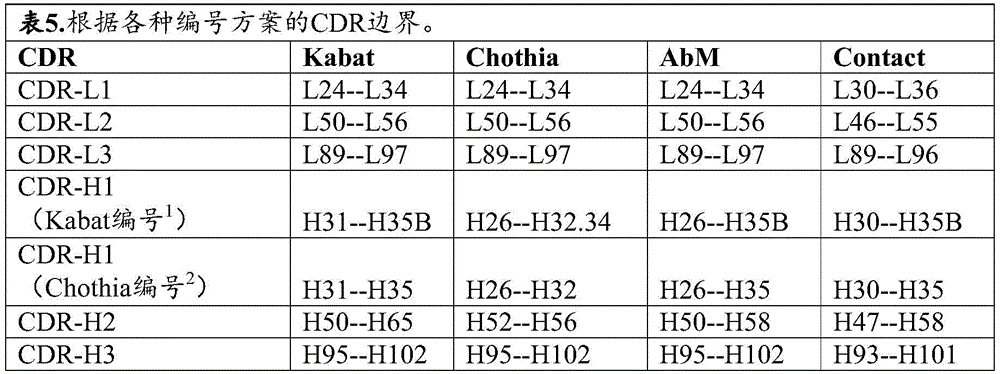
1-Kabat et al (1991), "Sequences of Proteins of Immunological Interest," 5 th edition Public Health Service, national Institutes of Health, besserdan, maryland
2-Al-Lazikani et Al, (1997) JMB 273,927-948
Thus, unless otherwise specified, it is to be understood that a "CDR" or "complementarity determining region" of a given antibody or region thereof (e.g., a variable region thereof) or a separately designated CDR (e.g., CDR-H1, CDR-H2, CDR-H3) encompasses one (or a particular) complementarity determining region as defined by any of the foregoing schemes or other known schemes. For example, in stating that a particular CDR (e.g., CDR-H3) contains a given V H Or V L In the case of the amino acid sequence of a corresponding CDR in the amino acid sequence of a region, it is understood that such a CDR has the sequence of the corresponding CDR (e.g., CDR-H3) within the variable region, as defined by any of the foregoing schemes or other known schemes. In some embodiments, a particular CDR sequence is specified. Exemplary CDR sequences of the provided antibodies are described using various numbering schemes, but it is understood that the provided antibodies can include CDRs as described according to any other of the above-described numbering schemes or other numbering schemes known to the skilled artisan.
Likewise, unless otherwise specified, a given antibody or region thereof, such as the FR of its variable region or one or more FR designated individually (e.g., FR-H1, FR-H2, FR-H3, FR-H4) is understood to encompass one (or a particular) framework region as defined by any known protocol. In some cases, schemes for identifying a particular CDR, FR or FRs or CDRs are specified, such as CDRs defined by the Kabat, chothia, abM, IMGT, or Contact methods or other known schemes. In other cases, specific amino acid sequences of CDRs or FRs are given.
The term "variable region" or "variable domain" refers to the domain of an antibody heavy or light chain that is involved in binding of the antibody to an antigen. The variable regions of the heavy and light chains of natural antibodies (V, respectively) H And V L ) Generally have a similar structure, with each domain containing four retainersConserved Framework Region (FR) and three CDRs. (see, e.g., kindt et al Kuby Immunology, 6 th edition, W.H.Freeman and Co., page 91 (2007) H Or V L The domains may be sufficient to confer antigen binding specificity. In addition, V from an antibody that binds an antigen can be used H Or V L Domain isolation of antibodies binding to the specific antigen for screening complementary V's, respectively L Or V H A library of domains. See, e.g., portolano et al, J.Immunol.150:880-887 (1993); clarkson et al, nature 352, 624-628 (1991).
Antibodies included in the CAR include antibody fragments. "antibody fragment" or "antigen-binding fragment" refers to a molecule other than an intact antibody that comprises a portion of the intact antibody that binds the antigen to which the intact antibody binds. Examples of antibody fragments include, but are not limited to, fv, fab '-SH, F (ab') 2 (ii) a A diabody; a linear antibody; heavy chain variable (V) H ) Regions, single chain antibody molecules (e.g., scFv), and single chain antibody molecules containing only V H A single domain antibody of a region; and multispecific antibodies formed from antibody fragments. In some embodiments, the antigen binding domain in the CAR is or comprises an antibody fragment containing a variable heavy chain (V) H ) Domains and variable light chains (V) L ) And (4) a zone. In particular embodiments, the antibody is a heavy chain variable (V) comprising H ) Variable domains and/or light chains (V) L ) A single chain antibody fragment (e.g., scFv) of a region.
A single domain antibody (sdAb) is an antibody fragment that comprises all or part of the heavy chain variable region or all or part of the light chain variable region of the antibody. In certain embodiments, the single domain antibody is a human single domain antibody.
Antibody fragments can be prepared by a variety of techniques, including but not limited to proteolytic digestion of intact antibodies and production by recombinant host cells. In some embodiments, the antibody is a recombinantly produced fragment, such as a fragment comprising an arrangement that does not occur in nature (such as those having two or more antibody regions or chains connected by a synthetic linker (e.g., a peptide linker)), and/or a fragment that may not be produced by enzymatic digestion of a naturally occurring intact antibody. In some aspects, the antibody fragment is an scFv.
A "humanized" antibody is an antibody in which all or substantially all of the CDR amino acid residues are derived from non-human CDRs and all or substantially all of the FR amino acid residues are derived from human FRs. The humanized antibody optionally can include at least a portion of an antibody constant region derived from a human antibody. "humanized forms" of a non-human antibody refer to variants of the non-human antibody that have been subjected to humanization to generally reduce immunogenicity to humans, while retaining the specificity and affinity of the parent non-human antibody. In some embodiments, some FR residues in a humanized antibody are substituted with corresponding residues from a non-human antibody (e.g., the antibody from which the CDR residues are derived), e.g., to restore or improve antibody specificity or affinity.
The anti-BCMA antibody included in the CAR includes a human antibody. A "human antibody" is an antibody having an amino acid sequence corresponding to that of a human or human cell or an antibody produced using a human antibody library or a non-human source of other human antibody coding sequences, including human antibody libraries. The term does not include humanized forms of non-human antibodies comprising non-human antigen-binding regions, such as those in which all or substantially all of the CDRs are non-human. The term includes antigen-binding fragments of human antibodies.
Human antibodies can be prepared by administering an immunogen to a transgenic animal that has been modified to produce a fully human antibody or a fully antibody with human variable regions in response to antigen challenge. Such animals typically contain all or part of a human immunoglobulin locus that replaces an endogenous immunoglobulin locus or that is present extrachromosomally or randomly integrated into the chromosome of the animal. In such transgenic animals, the endogenous immunoglobulin locus has typically been inactivated. Human antibodies can also be derived from human antibody libraries, including phage display and cell-free libraries, containing antibody coding sequences derived from human libraries.
Antibodies included in the CAR include those that are monoclonal antibodies, including monoclonal antibody fragments. The term "monoclonal antibody" as used herein refers to an antibody obtained from or within a population of substantially homogeneous antibodies (i.e., the individual antibodies comprising the population are identical except for possible variants containing naturally occurring mutations or produced during production of the monoclonal antibody preparation, such variants typically being present in minor amounts). In contrast to polyclonal antibody preparations, which typically include different antibodies directed against different epitopes, each monoclonal antibody of a monoclonal antibody preparation is directed against a single epitope on the antigen. The term should not be construed as requiring production of the antibody by any particular method. Monoclonal antibodies can be prepared by a variety of techniques, including but not limited to, production from hybridomas, recombinant DNA methods, phage display, and other antibody display methods.
In some embodiments, the CAR comprises one or more BCMA binding portions of an antibody molecule, such as a heavy chain variable (V) of an antibody H ) Variable region and/or light chain (V) L ) A region (e.g., a scFv antibody fragment). In some embodiments, a BCMA-binding CAR described herein (e.g., for use in the provided methods) contains an antibody, such as an anti-BCMA antibody or antigen-binding fragment thereof, that confers the BCMA-binding properties of the CAR. In some embodiments, the antibody or antigen binding domain may be or be derived from any of the described anti-BCMA antibodies. See, e.g., carpenter et al, clin Cancer Res.,2013,19 (8): 2048-2060, WO 2016090320, WO 2016090327, WO 2010104949, and WO 2017173256. Any such anti-BCMA antibody or antigen binding fragment can be used in a CAR. In some embodiments, the anti-BCMA CAR comprises an antigen binding domain that is a scFv comprising a variable heavy chain (V) derived from an antibody described in WO 2016090320 or WO 2016090327 H ) Domains and/or variable light chains (V) L ) And (4) a zone.
In some embodiments, the antibody (e.g., anti-BCMA antibody or antigen binding fragment) comprises a heavy and/or light chain variable (V) as described H Or V L ) A region or sufficient antigen binding portion thereof. In some embodiments, an anti-BCMA antibody (e.g., antigen binding fragment) comprises a V comprising CDR-H1, CDR-H2, and/or CDR-H3 as described H A region sequence or a sufficient antigen-binding portion thereof. In some embodiments, an anti-BCMA antibody (e.g., antigen binding fragment) comprises a heavy chain variable region such asV of the CDR-L1, CDR-L2 and/or CDR-L3 L A domain sequence or a sufficient antigen-binding portion. In some embodiments, an anti-BCMA antibody (e.g., antigen binding fragment) comprises a V comprising CDR-H1, CDR-H2, and/or CDR-H3 as described H A region sequence and comprises a V comprising CDR-L1, CDR-L2 and/or CDR-L3 as described L A sequence of regions. The antibodies also include those having a sequence that is at least or at least about 90%, about 91%, about 92%, about 93%, about 94%, about 95%, about 96%, about 97%, about 98%, or about 99% identical to such a sequence.
In some embodiments, the antibody is a single domain antibody (sdAb) comprising only V H A domain sequence or sufficient antigen-binding portion thereof, e.g. any of the above V H Sequences (e.g., CDR-H1, CDR-H2, CDR-H3, and/or CDR-H4).
In some embodiments, comprising V H The antibodies provided herein (e.g., anti-BCMA antibodies) or antigen-binding fragments thereof of a region further comprise a light chain or sufficient antigen-binding portion thereof. For example, in some embodiments, the antibody or antigen-binding fragment thereof comprises V H Region and V L Zone, or V H And V L Sufficient antigen binding portion of the region. In such embodiments, V H The sequence of the region may be any of the above-mentioned V H And (4) sequencing. In some such embodiments, the antibody is an antigen binding fragment, such as a Fab or scFv. In some such embodiments, the antibody is a full length antibody further comprising a constant region.
In some embodiments, the antibody in the CAR (e.g., an antigen-binding fragment thereof) has a heavy chain variable (V) H ) A region wherein the heavy chain variable region has an amino acid sequence selected from any one of SEQ ID NOs 32, 52, 61, 85, 116, 125, 131, or a V sequence selected from any one of SEQ ID NOs 32, 52, 61, 85, 116, 125, 131 H An amino acid sequence having at least 90%, 91%, 92%, 93%, 94%, 95%, 96%, 97%, 98%, or 99% sequence identity to a region amino acid; or contain a group V present in H CDR-H1, CDR-H2 and/or CDR-H3 in sequence. In some embodiments of the present invention, the substrate is,the antibody or antibody fragment in the CAR has the V of any of the antibodies or antibody binding fragments described in WO 2016/090327, WO 2016/090320, or WO 2017/173256 H And (4) a zone.
In some embodiments, the antibody in the CAR (e.g., an antigen-binding fragment thereof) has a light chain variable (V) L ) A region wherein the light chain variable region has an amino acid sequence selected from any one of SEQ ID NOs 33, 53, 62, 88, 119, 127 and 132 or a V selected from any one of SEQ ID NOs 33, 53, 62, 88, 119, 127 and 132 L An amino acid sequence having at least 90%, 91%, 92%, 93%, 94%, 95%, 96%, 97%, 98%, or 99% sequence identity to a region amino acid; or contain a group V present in L CDR-L1, CDR-L2 and/or CDR-L3 in the sequence. In some embodiments, the antibody or antibody fragment in the CAR has the V of any of the antibodies or antibody binding fragments described in WO 2016/090327, WO 2016/090320, or WO 2017/173256 L And (4) a zone.
In some embodiments, the V of the antibody (e.g., antigen-binding fragment thereof) in the CAR H And V L The region comprises: 32 and 33, respectively, or an amino acid sequence having at least 90% identity to SEQ ID NOs 32 and 33, respectively; 52 and 53, respectively, or an amino acid sequence having at least 90% identity to SEQ ID NO 52 and 53, respectively; 61 and 62, respectively, or an amino acid sequence having at least 90% identity to SEQ ID NO 61 and 62, respectively; 85 and 88, respectively, or an amino acid sequence having at least 90% identity to SEQ ID NOs 85 and 88, respectively: 116 and 119, respectively, or an amino acid sequence having at least 90% identity to SEQ ID NOs 116 and 119, respectively; the amino acid sequences of SEQ ID NO 125 and 127, respectively, or the amino acid sequences having at least 90% identity to SEQ ID NO 125 and 127, respectively; 131 and 132, respectively, or an amino acid sequence having at least 90% identity to SEQ ID NO 131 and 132, respectively.
In some embodiments, the V of the antibody or antigen binding fragment thereof in the CAR H And V L The region comprises: 32 and 33, respectively, or an amino acid sequence having at least 90% identity to SEQ ID NOs 32 and 33, respectively. In some embodiments, the V of the antibody or antigen binding fragment thereof H And V L The region comprises: 52 and 53, respectively, or an amino acid sequence having at least 90% identity to SEQ ID NO 52 and 53, respectively. In some embodiments, the V of the antibody or antigen binding fragment thereof H And V L The region comprises: 61 and 62, respectively, or an amino acid sequence having at least 90% identity to SEQ ID NO 61 and 62, respectively. In some embodiments, the V of the antibody or antigen binding fragment thereof H And V L The region comprises: 85 and 88, respectively, or an amino acid sequence having at least 90% identity to SEQ ID NO 85 and 88, respectively. In some embodiments, the V of the antibody or antigen binding fragment thereof H And V L The region comprises: 116 and 119, respectively, or an amino acid sequence having at least 90% identity to SEQ ID NOs 116 and 119, respectively. In some embodiments, the V of the antibody or antigen binding fragment thereof H And V L The region comprises: 125 and 127, respectively, or an amino acid sequence having at least 90% identity to SEQ ID NOs 125 and 127, respectively. In some embodiments, the V of the antibody or antigen binding fragment thereof H And V L The region comprises: 131 and 132, respectively, or an amino acid sequence having at least 90% identity to SEQ ID NOs 131 and 132, respectively.
In some embodiments, the V of the antibody or antigen binding fragment thereof in the CAR H And V L The region comprises the amino acid sequences of SEQ ID NO 32 and 33. In some embodiments, the V of the antibody or antigen binding fragment thereof H And V L The regions comprise the amino acid sequences of SEQ ID NO 52 and 53. In some embodiments, the V of the antibody or antigen binding fragment thereof H And V L The region comprises the amino acid sequences of SEQ ID NO 61 and 62. In some casesIn embodiments, the V of the antibody or antigen binding fragment thereof H And V L The region comprises the amino acid sequences of SEQ ID NO 85 and 88. In some embodiments, the V of the antibody or antigen binding fragment thereof H And V L The regions comprise the amino acid sequences of SEQ ID NOS: 116 and 119, respectively. In some embodiments, the V of the antibody or antigen binding fragment thereof H And V L The regions comprise the amino acid sequences of SEQ ID NO 125 and 127, respectively. In some embodiments, the V of the antibody or antigen binding fragment thereof H And V L The regions comprise the amino acid sequences of SEQ ID NO 131 and 132, respectively.
In some embodiments, in the CAR, the antibody or antigen-binding fragment thereof comprises V H And V L And said V is H The region comprises a V selected from any one of SEQ ID NOs 32, 52, 61, 85, 116, 125, 131 H Heavy chain complementarity determining region 1 (CDR-H1), heavy chain complementarity determining region 2 (CDR-H2), and heavy chain complementarity determining region 3 (CDR-H3) contained within the region amino acid sequences; and said V is L The region comprises a V selected from any one of SEQ ID NOs 33, 53, 62, 88, 119, 127, 132 L Light chain complementarity determining region 1 (CDR-L1), light chain complementarity determining region 2 (CDR-L2), and light chain complementarity determining region 3 (CDR-L3) are contained within the region amino acid sequences.
In some embodiments, in the CAR, the antibody or antigen-binding fragment thereof comprises a V H And V L And said V is H The region includes CDR-H1, CDR-H2 and CDR-H3 contained within the amino acid sequence of SEQ ID NO. 32, and said V L The region comprises CDR-L1, CDR-L2 and CDR-L3 contained within the amino acid sequence of SEQ ID NO. 33; the V is H 52, and said V L The region comprises CDR-L1, CDR-L2 and CDR-L3 contained within the amino acid sequence of SEQ ID NO. 53; the V is H The region comprises CDR-H1, CDR-H2 and CDR-H3 contained within the amino acid sequence of SEQ ID NO. 61, and said V L The region comprises CDR-L1, CDR-L2 and CDR-L3 contained within the amino acid sequence of SEQ ID NO. 62; the V is H The region comprises C contained within the amino acid sequence of SEQ ID NO 85DR-H1, CDR-H2 and CDR-H3, and said V L The region comprises CDR-L1, CDR-L2 and CDR-L3 contained within the amino acid sequence of SEQ ID NO. 88; the V is H 116, and said V L The region comprises CDR-L1, CDR-L2 and CDR-L3 contained within the amino acid sequence of SEQ ID NO. 119; the V is H 125, and said V L 127, and CDR-L1, CDR-L2, and CDR-L3 contained within the amino acid sequence of SEQ ID NO; the V is H 131, and the V includes CDR-H1, CDR-H2, and CDR-H3 contained within the amino acid sequence of SEQ ID NO L The region includes CDR-L1, CDR-L2 and CDR-L3 contained within the amino acid sequence of SEQ ID NO. 132.
In some embodiments, in the CAR, the antibody or antigen-binding fragment thereof comprises V H And V L And said V is H The region includes CDR-H1, CDR-H2 and CDR-H3 contained within the amino acid sequence of SEQ ID NO. 32, and said V L The region comprises CDR-L1, CDR-L2 and CDR-L3 contained within the amino acid sequence of SEQ ID NO. 33. In some embodiments, V H 52, and V L The region comprises CDR-L1, CDR-L2 and CDR-L3 contained within the amino acid sequence of SEQ ID NO. 53. In some embodiments, V H The region comprises CDR-H1, CDR-H2 and CDR-H3 contained within the amino acid sequence of SEQ ID NO. 61, and V L The region comprises CDR-L1, CDR-L2 and CDR-L3 contained within the amino acid sequence of SEQ ID NO. 62. In some embodiments, V H The region comprises CDR-H1, CDR-H2 and CDR-H3 contained within the amino acid sequence of SEQ ID NO. 85 and V L The region comprises CDR-L1, CDR-L2 and CDR-L3 contained within the amino acid sequence of SEQ ID NO. 88. In some embodiments, V H The region comprises CDR-H1, CDR-H2 and CDR-H3 contained within the amino acid sequence of SEQ ID NO. 116 and V L The region comprises CDR-L1, CDR-L2 and CDR-L3 contained within the amino acid sequence of SEQ ID NO. 119. In some embodiments, V H Region comprising C contained within the amino acid sequence of SEQ ID NO 125 DR-H1, CDR-H2 and CDR-H3, and V L The region comprises CDR-L1, CDR-L2 and CDR-L3 contained within the amino acid sequence of SEQ ID NO: 127. In some embodiments, V H 131 includes CDR-H1, CDR-H2 and CDR-H3 contained within the amino acid sequence of SEQ ID NO, and V L The region includes CDR-L1, CDR-L2 and CDR-L3 contained within the amino acid sequence of SEQ ID NO. 132.
In some embodiments, the V of the antibody or antigen binding fragment thereof in the CAR H And V L The regions comprise the amino acid sequences of SEQ ID NO 32 and 33, respectively. In some embodiments, the V of the antibody or antigen binding fragment thereof H And V L The regions comprise the amino acid sequences of SEQ ID NO 52 and 53, respectively. In some embodiments, the V of the antibody or antigen binding fragment thereof H And V L The regions comprise the amino acid sequences of SEQ ID NO 61 and 62, respectively. In some embodiments, the V of the antibody or antigen binding fragment thereof H And V L The regions comprise the amino acid sequences of SEQ ID NO 85 and 88, respectively. In some embodiments, the V of the antibody or antigen binding fragment thereof H And V L The regions comprise the amino acid sequences of SEQ ID NO:116 and 119, respectively. In some embodiments, the V of the antibody or antigen binding fragment thereof H And V L The regions comprise the amino acid sequences of SEQ ID NO 125 and 127, respectively. In some embodiments, the V of the antibody or antigen binding fragment thereof H And V L The regions comprise the amino acid sequences of SEQ ID NO 131 and 132, respectively.
In some embodiments, the V of an antibody or antigen binding fragment thereof provided herein H And V L The region comprises an amino acid sequence selected from the group consisting of: 116 and 119 of SEQ ID NO, or with any of the above V H And V L Any antibody or antigen-binding fragment thereof having at least 90% sequence identity (e.g., at least 90%, 91%, 92%, 93%, 94%, 95%, 96%, 97%, 98%, or 99% sequence identity thereof), or comprising any of the above-described V s H And V L V of H CDR-H1, CDR-H2 and CDR-H3 and V contained in the region L Any antibody or antigen binding thereof to CDR-L1, CDR-L2 and CDR-L3 contained within a regionAnd (4) fragment. In some embodiments, the V of an antibody or antigen binding fragment thereof provided herein H And V L The region comprises an amino acid sequence selected from the group consisting of SEQ ID NO:116 and 119. In some embodiments, anti-idiotype antibodies as described in PCT/US2020/063492 are used to detect expression of antigen binding domains comprising these sequences.
In some embodiments, the antibody or antigen-binding fragment thereof is a single chain antibody fragment, such as a single chain variable fragment (scFv) or a diabody or a single domain antibody (sdAb). In some embodiments, the antibody or antigen binding fragment is a monoclonal antibody comprising only V H A single domain antibody of a region. In some embodiments, the antibody or antigen binding fragment is a heavy chain variable (V) comprising H ) Variable domains and light chains (V) L ) A scFv of a region. In some embodiments, the single chain antibody fragment (e.g., scFv) comprises a linkage of two antibody domains or regions (e.g., heavy chain variable (V) H ) Variable domains and light chains (V) L ) Zone) of the surface of the substrate. The linker is typically a peptide linker, e.g., a flexible and/or soluble peptide linker. Linkers include those that are rich in glycine and serine and/or in some cases threonine. In some embodiments, the linker also includes charged residues that can improve solubility, such as lysine and/or glutamic acid. In some embodiments, the linker further comprises one or more prolines.
Thus, anti-BCMA antibodies are provided that include single chain antibody fragments, such as scFv and diabodies, particularly human single chain antibody fragments, typically comprising a linkage of two antibody domains or regions (e.g., V) H And V L Zone) of the surface of the substrate. The linker is typically a peptide linker, e.g. a flexible and/or soluble peptide linker, e.g. one rich in glycine and serine.
In some aspects, a glycine and serine (and/or threonine) -rich linker comprises at least 80%, 85%, 90%, 91%, 92%, 93%, 94%, 95%, 96%, 97%, 98%, or 99% of such amino acids. In some embodiments, they include at least or about 50%, 55%, 60%, 70%, or 75% glycine, serine, and/or threonine. In some embodiments, the linker consists essentially entirely of glycine, serine, and/or threonine. Linkers are typically between about 5 and about 50 amino acids in length, typically between at or about 10 and at or about 30, such as 10, 11, 12, 13, 14, 15, 16, 17, 18, 19, 20, 21, 22, 23, 24, 25, 26, 27, 28, 29, or 30, and in some examples between 10 and 25 amino acids in length. Exemplary linkers include linkers with different numbers of repeats of the sequence GGGGS (4gs seq ID no 7) or GGGS (3gs seq ID no 2) (such as between 2, 3, 4 and 5 repeats of this sequence. Exemplary linkers include those having or consisting of the sequence shown in SEQ ID NO 1 (GGGGSGGGGSGGGGS). Exemplary linkers also include those having or consisting of the sequence shown in SEQ ID NO:176 (GSTSGGKPGSGEGSTKG). Exemplary linkers also include those having or consisting of the sequence shown in SEQ ID NO:255 (SRGGGGSGGGGSGGGGSLEMA).
Thus, in some embodiments, provided embodiments include single chain antibody fragments (e.g., scFv) comprising one or more of the above linkers, such as glycine/serine rich linkers (including linkers with GGGS (SEQ ID NO: 2) or GGGGS (SEQ ID NO: 7) repeats, such as the linker shown in SEQ ID NO: 1).
In some embodiments, the linker has an amino acid sequence comprising the sequence set forth in SEQ ID NO 1. Fragments (e.g., scFv) may comprise V H A region or portion thereof, followed by a linker, followed by V L A region or a portion thereof. Fragments (e.g., scFv) may comprise V L Region or portion thereof, followed by linker, followed by V H A region or a portion thereof.
Table 6 provides SEQ ID NOs of exemplary antigen binding domains (e.g., antibodies or antigen binding fragments) that can be included in BCMA binding recombinant receptors (e.g., anti-BCMA Chimeric Antigen Receptor (CAR)) to be used in the provided methods and uses. In some embodiments, the BCMA binding recombinant receptor comprises a BCMA binding antibody or fragment thereof comprising a polypeptide comprising CDR-H1, CV of DR-H2 and CDR-H3 sequences H Regions and V comprising CDR-L1, CDR-L2 and CDR-L3 sequences L Regions, as shown in SEQ ID NOs listed in each row of table 6 below (numbering according to Kabat). In some embodiments, the BCMA binding recombinant receptor comprises a BCMA binding antibody or fragment thereof comprising the V shown by SEQ ID NO listed in each row of table 6 below H Region sequences and V L A sequence of regions; or comprises a V comprising the same sequence as set forth in SEQ ID NO shown in each row of Table 6 below H Region sequences and V L V having at least 90%, 91%, 92%, 93%, 94%, 95%, 96%, 97%, 98% or 99% sequence identity to a region sequence H And V L An antibody of the amino acid sequence of the region. In some embodiments, the BCMA binding recombinant receptor comprises a BCMA binding antibody or fragment thereof comprising the V shown by SEQ ID NO listed in each row of table 6 below H Region sequences and V L A sequence of regions. In some embodiments, the BCMA binding recombinant receptor comprises a BCMA binding antibody or fragment thereof comprising the scFv sequence set forth by SEQ ID NOs listed in each row of table 6 below; or an antibody comprising an scFv amino acid sequence having at least 90%, 91%, 92%, 93%, 94%, 95%, 96%, 97%, 98% or 99% sequence identity to the scFv sequence set forth by SEQ ID NOs as set forth in each row of table 6 below. In some embodiments, the BCMA binding recombinant receptor comprises a BCMA binding antibody or fragment thereof comprising the scFv sequence shown in SEQ ID NO 114; or an antibody comprising an scFv amino acid sequence having at least 90%, 91%, 92%, 93%, 94%, 95%, 96%, 97%, 98% or 99% sequence identity thereto. In some embodiments, the BCMA binding recombinant receptor comprises a BCMA binding antibody or fragment thereof comprising the scFv sequence set forth by SEQ ID NOs listed in each row of table 6 below. In some embodiments, the BCMA binding recombinant receptor comprises a BCMA binding antibody or fragment thereof comprising the scFv sequence shown in SEQ ID No. 114.

The antibody (e.g., antigen binding fragment) in the CAR comprises a human antibody. In some embodiments of the provided human anti-BCMA antibodies (e.g., antigen binding fragments), the human antibodies comprise V H Zone of the V H The region comprises a portion having at least 95%, 96%, 97%, 98%, 99% or 100% sequence identity to the amino acid sequence encoded by the germline nucleotide human heavy chain V segment, a portion having at least 95%, 96%, 97%, 98%, 99% or 100% sequence identity to the amino acid sequence encoded by the germline nucleotide human heavy chain D segment, and/or a portion having at least 95%, 96%, 97%, 98%, 99% or 100% sequence identity to the amino acid sequence encoded by the germline nucleotide human heavy chain J segment; and/or contain V L Region of the V L The region comprises a portion having at least 95%, 96%, 97%, 98%, 99% or 100% sequence identity to an amino acid sequence encoded by a germline nucleotide human kappa or lambda chain V segment and/or a portion having at least 95%, 96%, 97%, 98%, 99% or 100% sequence identity to an amino acid sequence encoded by a germline nucleotide human kappa or lambda chain J segment. In some embodiments, V H Said part of the region corresponds to CDR-H1, CDR-H2 and/or CDR-H3. In some embodiments, V H The portion of the region corresponds to framework region 1 (FR 1), FR2 and/or FR4. In some embodiments, V L The portion of the region corresponds to CDR-L1, CDR-L2 and/or CDR-L3. In some embodiments, V L Said portion of the region corresponds to FR1, FR2 and/or FR4.
In some embodiments, a human antibody (e.g., an antigen-binding fragment) contains a CDR-H1 that has at least 95%, 96%, 97%, 98%, 99% or 100% sequence identity to the amino acid sequence of the corresponding CDR-H1 region within a sequence encoded by a germline nucleotide human heavy chain V segment. For example, in some embodiments, a human antibody contains a CDR-H1 having a sequence that is 100% identical or that differs by no more than one, two, or three amino acids as compared to the corresponding CDR-H1 region within the sequence encoded by the germline nucleotide human heavy chain V segment.
In some embodiments, a human antibody (e.g., an antigen-binding fragment) contains a CDR-H2 that has at least 95%, 96%, 97%, 98%, 99% or 100% sequence identity to the amino acid sequence of the corresponding CDR-H2 region within the sequence encoded by the germline nucleotide human heavy chain V segment. For example, in some embodiments, a human antibody contains a CDR-H2 having a sequence that is 100% identical or that differs by no more than one, two, or three amino acids as compared to the corresponding CDR-H2 region within the sequence encoded by the germline nucleotide human heavy chain V segment.
In some embodiments, a human antibody (e.g., an antigen-binding fragment) contains a CDR-H3 that has at least 95%, 96%, 97%, 98%, 99% or 100% sequence identity to the amino acid sequence of the corresponding CDR-H3 region within the sequences encoded by the germline nucleotide human heavy chain V, D, and J segments. For example, in some embodiments, a human antibody contains a CDR-H3 having a sequence that is 100% identical or differs by no more than one, two, or three amino acids from the corresponding CDR-H3 region within the sequences encoded by the germline nucleotide human heavy chain V, D, and J segments.
In some embodiments, a human antibody (e.g., an antigen-binding fragment) contains a CDR-L1 that has at least 95%, 96%, 97%, 98%, 99% or 100% sequence identity to the amino acid sequence of a corresponding CDR-L1 region within a sequence encoded by a germline nucleotide human light chain V segment. For example, in some embodiments, a human antibody contains a CDR-L1 having a sequence that is 100% identical or that differs by no more than one, two, or three amino acids as compared to the corresponding CDR-L1 region within a sequence encoded by a germline nucleotide human light chain V segment.
In some embodiments, a human antibody (e.g., an antigen-binding fragment) contains a CDR-L2 that has at least 95%, 96%, 97%, 98%, 99% or 100% sequence identity to the amino acid sequence of a corresponding CDR-L2 region within a sequence encoded by a germline nucleotide human light chain V segment. For example, in some embodiments, a human antibody contains a CDR-L2 having a sequence that is 100% identical or that differs by no more than one, two, or three amino acids as compared to the corresponding CDR-L2 region within a sequence encoded by a germline nucleotide human light chain V segment.
In some embodiments, a human antibody (e.g., an antigen-binding fragment) contains a CDR-L3 that has at least 95%, 96%, 97%, 98%, 99% or 100% sequence identity to the amino acid sequence of the corresponding CDR-L3 region within the sequences encoded by the germline nucleotide human light chain V and J segments. For example, in some embodiments, a human antibody contains a CDR-L3 having a sequence that is 100% identical or that differs by no more than one, two, or three amino acids as compared to the corresponding CDR-L3 region within the sequences encoded by the germline nucleotide human light chain V and J segments.
In some embodiments, a human antibody (e.g., antigen-binding fragment) comprises a framework region comprising human germline gene segment sequences. For example, in some embodiments, the human antibody comprises V H Regions in which the framework regions (e.g., FR1, FR2, FR3, and FR 4) have at least 95%, 96%, 97%, 98%, 99%, or 100% sequence identity with the framework regions encoded by the human germline antibody segment (e.g., V segment and/or J segment). In some embodiments, the human antibody comprises V L Regions in which the framework regions (e.g., FR1, FR2, FR3, and FR 4) have at least 95%, 96%, 97%, 98%, 99%, or 100% sequence identity with the framework regions encoded by the human germline antibody segment (e.g., V segment and/or J segment). For example, in some such embodiments, V H Zone and/or V L The regions contain a framework region sequence that differs by no more than 10 amino acids, such as no more than 9, 8, 7, 6, 5, 4, 3, 2 or 1 amino acid, from the framework region sequence encoded by the human germline antibody segment.
In some embodiments, the reference antibody may be a mouse anti-BCMA scFv described in international patent application publication No. WO 2010/104949.
The antibody (e.g., antigen binding fragment) can contain at least a portion of an immunoglobulin constant region, such as one or more constant regions A domain. In some embodiments, the constant region comprises a light chain constant region and/or a heavy chain constant region 1 (C) H 1). In some embodiments, the antibody comprises C H 2 and/or C H 3 domain, such as an Fc region. In some embodiments, the Fc region is that of a human IgG (e.g., igG1 or IgG 4).
B. Spacer
In some embodiments, recombinant receptors (e.g., CARs) comprising an antibody (e.g., antigen binding fragment) provided herein (such as those expressed by engineered cells used in the methods and uses provided herein) further comprise a spacer or spacer region. The spacer is typically a polypeptide spacer and is typically located within the CAR between the antigen binding domain and the transmembrane domain of the CAR. In some aspects, the spacer may be or include at least a portion of an immunoglobulin constant region or a variant or modified form thereof, such as a hinge region of an immunoglobulin (e.g., an IgG hinge region, e.g., of IgG4 or IgG4 origin) and/or a C H 1/C L And/or an Fc region. In some embodiments, the spacer comprises a hinge region comprising or is CD8 a. In some embodiments, CD8 a is human CD8 a. In some embodiments, the constant region or one or more portions thereof is human IgG, such as human IgG4 or IgG1 or IgG 2. In general, a spacer (such as the portion of the constant region) serves as a spacer region between the antigen recognition component (e.g., scFv) and the transmembrane domain. In some embodiments, the length and/or composition of the spacer is designed to optimize or promote certain characteristics of the interaction between the CAR and its target; in some aspects, the length and/or composition of the spacer is designed to optimize the biophysical synaptic distance between the CAR-expressing cell and the cell expressing the target of the CAR during or upon or after binding of the CAR to its target on the cell expressing the target; in some aspects, the target-expressing cell is a BCMA-expressing tumor cell. In some embodiments, the CAR is expressed by a T cell, and the length of the spacer is a length compatible with T cell activation or optimization of CAR T cell performance. In some embodiments, the spacer is located in the ligand binding domain of the recombinant receptor (e.g., CAR) A spacer region between the transmembrane domains. In some embodiments, the spacer region is a region located between the ligand binding domain and the transmembrane domain of the recombinant receptor (e.g., CAR).
In some embodiments, the spacer can have a length that provides increased cellular reactivity upon antigen binding compared to the absence of the spacer and/or the presence of a different spacer (e.g., a spacer of only a different length). In some embodiments, the spacer has a length of at least 100 amino acids, such as a length of at least 110, 125, 130, 135, 140, 145, 150, 160, 170, 180, 190, 200, 210, 220, 230, 240, or 250 amino acids. In some examples, the spacer has a length of at or about 12 amino acids or has a length of no more than 12 amino acids. Exemplary spacers include those having at least about 10 to 300 amino acids, about 10 to 200 amino acids, about 50 to 175 amino acids, about 50 to 150 amino acids, about 10 to 125 amino acids, about 50 to 100 amino acids, about 100 to 300 amino acids, about 100 to 250 amino acids, about 125 to 250 amino acids, or about 200 to 250 amino acids (and including any integer between the endpoints of any listed range). In some embodiments, the spacer or spacer region has a length of at least about 12 amino acids, at least about 119 amino acids, at least about 125 amino acids, at least about 200 amino acids, or at least about 220 amino acids or at least about 225 amino acids.
In some embodiments, the spacer has a length of 125 to 300 amino acids, a length of 125 to 250 amino acids, a length of 125 to 230 amino acids, a length of 125 to 200 amino acids, a length of 125 to 180 amino acids, a length of 125 to 150 amino acids, a length of 150 to 300 amino acids, a length of 150 to 250 amino acids, a length of 150 to 230 amino acids, a length of 150 to 200 amino acids, a length of 150 to 180 amino acids, a length of 180 to 300 amino acids, a length of 180 to 250 amino acids, a length of 180 to 230 amino acids, a length of 180 to 200 amino acids, a length of 200 to 300 amino acids, a length of 200 to 250 amino acids, a length of 200 to 230 amino acids, a length of 230 to 300 amino acids, a length of 230 to 250 amino acids, or a length of 250 to 300 amino acids. In some embodiments, the spacer has a length of at least or at least about or has a length of about 130, 140, 150, 160, 170, 180, 190, 200, 210, 220, 221, 222, 223, 224, 225, 226, 227, 228, or 229 amino acids or between any of the foregoing.
Exemplary spacers include those comprising one or more portions of an immunoglobulin constant region, such as those comprising an Ig hinge (e.g., an IgG hinge domain). In some aspects, the spacer comprises an IgG hinge alone, with C H 2 and C H 3 IgG hinge or C linked to one or more of the domains H 3 domain linked IgG hinge. In some embodiments, the IgG hinge, C H 2 and/or C H 3 may be derived in whole or in part from IgG4 or IgG2. In some embodiments, the spacer may be a C, hinge containing a moiety derived from IgG4, igG2, and/or IgG2 and IgG4 H 2 and/or C H 3 sequence of one or more of seq id No. 3. In some embodiments, the hinge region comprises all or a portion of an IgG4 hinge region and/or an IgG2 hinge region, wherein the IgG4 hinge region is optionally a human IgG4 hinge region, and the IgG2 hinge region is optionally a human IgG2 hinge region; c H Region 2 comprises IgG 4C H 2 region and/or IgG 2C H 2, all or a portion of region 2, wherein IgG 4C H Region 2 is optionally human IgG 4C H 2 region, and IgG 2C H Region 2 is optionally human IgG 2C H Zone 2; and/or C H Region 3 comprises IgG 4C H 3 region and/or IgG 2C H 3, all or a portion of region 3, wherein IgG 4C H 3 region is optionally human IgG 4C H 3 region and IgG 2C H Region 3 is optionally human IgG 2C H And (3) zone. In some embodiments, hinge C H 2 and C H 3 comprises a hinge region C from IgG4 H 2 and C H 3, all or a portion of each of the same. In some embodiments, the hinge region is chimeric and comprises a hinge region from human IgG4 and human IgG 2; c H Region 2 is chimeric and comprises C from human IgG4 and human IgG2 H Zone 2; and/or C H Region 3 is chimeric and comprises C from human IgG4 and human IgG2 H And (3) zone. In some embodiments, the spacer comprises an IgG4/2 chimeric hinge or a modified IgG4 hinge comprising at least one amino acid substitution as compared to a human IgG4 hinge region; human IgG2/4 chimeric C H Zone 2; and human IgG 4C H And (3) zone.
In some embodiments, the spacer may be derived in whole or in part from IgG4 and/or IgG2, and may contain mutations, such as one or more single amino acid mutations in one or more domains. In some examples, the amino acid modification is a substitution of proline (P) for serine (S) in the hinge region of IgG 4. In some embodiments, the amino acid modification is the substitution of asparagine (N) with glutamine (Q) to reduce the glycosylation heterogeneity, C of the full-length IgG4 Fc sequence shown in SEQ ID NO:173 H N177Q mutation at position 177 in region 2, or C of full-length IgG2 Fc sequence shown in SEQ ID NO:172 H N176Q at position 176 in zone 2. In some embodiments, the spacer is or comprises an IgG4/2 chimeric hinge or a modified IgG4 hinge, igG2/4 chimeric C H Region 2 and IgG 4C H Region 3, and optionally has a length of about 228 amino acids; or a spacer as shown in SEQ ID NO 174. In some embodiments, the spacer comprises an amino acid sequence
ESKYGPPCPPCPAPPVAGPSVFLFPPKPKDTLMISRTPEVTCVVVDVSQEDPEVQFNWYVDGVEVHNAKTKPREEQFQSTYRVVSVLTVLHQDWLNGKEYKCKVSNKGLPSSIEKTISKAKGQPREPQVYTLPPSQEEMTKNQVSLTCLVKGFYPSDIAVEWESNGQPENNYKTTPPVLDSDGSFFLYSRLTVDKSRWQEGNVFSCSVMHEALHNHYTQKSLSLSLGK(SEQ ID NO:174)。
In some embodiments, the spacer is encoded by a polynucleotide that has been optimized for codon expression and/or to eliminate splice sites (e.g., cryptic splice sites). In some embodiments, the coding sequence for the spacer comprises the nucleic acid sequence set forth in SEQ ID NO 200. In some embodiments, the coding sequence for the spacer comprises the nucleic acid sequence set forth in SEQ ID NO 236 or 8.
Additional exemplary spacers include, but are not limited to, those described in the following documents: hudecek et al (2013) client res, 19; hudecek et al (2015) Cancer Immunol. Res.,3 (2): 125-135 or International patent application publication No. WO 2014031687. In some embodiments, the nucleotide sequence of the spacer is optimized to reduce RNA heterogeneity upon expression. In some embodiments, the nucleotide sequence of the spacer is optimized to reduce cryptic splice sites or to reduce the likelihood of splicing events at splice sites.
In some embodiments, the spacer has the amino acid sequence shown as SEQ ID NO 237 and is encoded by the polynucleotide sequence shown as SEQ ID NO 238. In some embodiments, the spacer has the amino acid sequence set forth in SEQ ID NO: 157. In some embodiments, the spacer has the amino acid sequence set forth in SEQ ID NO: 156. In some embodiments, the spacer has the amino acid sequence set forth in SEQ ID NO 134 and is encoded by the polynucleotide sequence set forth in SEQ ID NO 135. In some embodiments, the spacer has the amino acid sequence set forth in SEQ ID No. 174 encoded by a polynucleotide sequence set forth in SEQ ID No. 175, 200, 236, or 8 or a polynucleotide exhibiting at least 85%, 86%, 87%, 88%, 89%, 90%, 91%, 92%, 93%, 94%, 95%, 96%, 97%, 98%, 99% or more sequence identity to SEQ ID No. 175, 200, 236, or 8. In some embodiments, the spacer has an amino acid sequence that exhibits at least 85%, 86%, 87%, 88%, 89%, 90%, 91%, 92%, 93%, 94%, 95%, 96%, 97%, 98%, 99% or more sequence identity to SEQ ID NO:174 encoded by a polynucleotide that has optionally been optimized for codon usage and/or to reduce RNA heterogeneity.
In some embodiments, the spacer is or comprises an amino acid sequence encoded by the nucleotide sequence set forth in SEQ ID NO: 200.
C. Transmembrane domain and intracellular signaling component
An antigen recognition component (e.g., an antigen binding domain) is typically linked to one or more intracellular signaling regions containing a signaling component, e.g., a signaling component that mimics stimulation and/or activation by an antigen receptor complex (e.g., a TCR complex), in the case of a CAR and/or signals via another cell surface receptor. Thus, in some embodiments, a BCMA binding domain (e.g., an antibody or antigen binding fragment thereof) is linked to one or more transmembrane domains (such as those described herein) and an intracellular signaling region or intracellular signaling domain comprising one or more intracellular components (such as those described herein). In some embodiments, the transmembrane domain is fused to an extracellular domain. In one embodiment, a transmembrane domain is used that is naturally associated with one of the domains in the receptor (e.g., CAR). In some cases, the transmembrane domains are selected or modified by amino acid substitutions to avoid binding of such domains to the transmembrane domains of the same or different surface membrane proteins to minimize interaction with other members of the receptor complex.
In some embodiments, the transmembrane domain is derived from a natural or synthetic source. When the source is natural, in some aspects, the domain may be derived from any membrane bound or transmembrane protein. Transmembrane domains include those derived from (i.e., comprising at least one or more of the transmembrane domains of): the α, β or zeta chain of the T cell receptor, CD3 epsilon, CD4, CD5, CD8, CD9, CD16, CD22, CD28, CD33, CD37, CD45, CD64, CD80, CD86, CD134, CD137 and/or CD154. For example, the transmembrane domain may be a CD28 transmembrane domain comprising the amino acid sequence shown in SEQ ID NO 138 encoded by the nucleic acid sequence shown in SEQ ID NO 139 or SEQ ID NO 140. In some embodiments, the transmembrane domain is or comprises a transmembrane domain derived from CD8 a. In some embodiments, CD8 a is human CD8 a. Alternatively, in some embodiments, the transmembrane domain is synthetic. In some aspects, the synthetic transmembrane domain comprises predominantly hydrophobic residues, such as leucine and valine. In some aspects, triplets of phenylalanine, tryptophan, and valine will be found at each end of the synthetic transmembrane domain. In some embodiments, the linkage is achieved through a linker, spacer, and/or one or more transmembrane domains.
Intracellular signaling regions or intracellular signaling domains include those that mimic or approximate: signals via native antigen receptors, signals via a combination of such receptors with co-stimulatory receptors, and/or signals via only co-stimulatory receptors. In some embodiments, a short oligopeptide or polypeptide linker (e.g., a linker of between 2 and 10 amino acids in length, such as a glycine and serine containing linker, e.g., a glycine-serine doublet) is present and forms a link between the transmembrane domain and the intracellular signaling domain of the CAR.
Receptors (e.g., CARs) typically include an intracellular signaling region containing at least one or more intracellular signaling components. In some embodiments, the receptor comprises an intracellular component or signaling domain of a TCR complex, such as a TCR CD3 chain, e.g., a CD3 zeta chain, that mediates T cell activation and cytotoxicity. Thus, in some aspects, the BCMA binding antibody is linked to one or more cell signaling modules. In some embodiments, the cell signaling module comprises a CD3 transmembrane domain, a CD3 intracellular signaling domain, and/or other CD transmembrane domains. In some embodiments, the receptor (e.g., CAR) further comprises a portion of one or more additional molecules, such as Fc receptor gamma, CD8, CD4, CD25, or CD 16. For example, in some aspects, the CAR comprises a chimeric molecule between CD3-zeta (CD 3-zeta) or Fc receptor gamma and CD8, CD4, CD25, or CD 16.
In some embodiments, upon or after attaching the CAR, the cytoplasmic domain or the intracellular signaling domain of the CAR stimulates and/or activates at least one of the normal effector functions or responses of an immune cell (e.g., a T cell engineered to express the CAR). For example, in some circumstances, the CAR induces a function of the T cell, such as cytolytic activity or T helper cell activity, such as secretion of cytokines or other factors. In some embodiments, truncated portions of the intracellular signaling domain of the antigen receptor component or co-stimulatory molecule (e.g., if it transduces effector function signals) are used in place of the intact immunostimulatory chain. In some embodiments, the one or more intracellular signaling domains comprise a cytoplasmic sequence of a T Cell Receptor (TCR), and in some aspects also include those of co-receptors that function in parallel with such receptors in the natural context to initiate signal transduction upon antigen receptor engagement, and/or any derivatives or variants of such molecules, and/or any synthetic sequences with the same functional capacity.
In the context of native TCRs, complete activation typically requires not only signaling through the TCR, but also a costimulatory signal. Thus, in some embodiments, to facilitate full activation, components for generating secondary or co-stimulatory signals are also included in the CAR. In other embodiments, the CAR does not include a component for generating a costimulatory signal. In some aspects, the additional CAR is expressed in the same cell and provides a component for generating a secondary or co-stimulatory signal.
In some aspects, T cell activation is described as being mediated by two classes of cytoplasmic signaling sequences: those that initiate antigen-dependent primary activation by the TCR (primary cytoplasmic signaling sequences), and those that act in an antigen-independent manner to provide secondary or costimulatory signals (secondary cytoplasmic signaling sequences). In some aspects, the CAR comprises one or both of such cytoplasmic signaling sequences.
In some aspects, the CAR comprises a primary cytoplasmic signaling sequence that modulates primary stimulation and/or activation of the TCR complex. The primary cytoplasmic signaling sequence that functions in a stimulatory manner can contain signaling motifs known as immunoreceptor tyrosine activation motifs or ITAMs. Examples of primary cytoplasmic signaling sequences containing ITAMs include those derived from TCR or CD3 ζ, fcR γ, CD3 δ, and CD3 epsilon. In some embodiments, the intracellular signaling region or intracellular signaling domain in the CAR contains a cytoplasmic signaling domain derived from CD3 ζ, portion, or sequence thereof. In some embodiments, CD3 ζ comprises the amino acid sequence set forth in SEQ ID NO 143 encoded by the nucleic acid sequence set forth in SEQ ID NO 144 or SEQ ID NO 145.
In some embodiments, the CAR comprises a signaling domain (e.g., an intracellular or cytoplasmic signaling domain) and/or a transmembrane portion of a costimulatory molecule, such as a T cell costimulatory molecule. Exemplary costimulatory molecules include CD28, 4-1BB, OX40, DAP10, and ICOS. For example, the co-stimulatory molecule may be derived from 4-1BB and may comprise the amino acid sequence shown in SEQ ID NO. 4, which is encoded by the nucleotide sequence shown in SEQ ID NO. 5 or SEQ ID NO. 6. In some aspects, the same CAR includes both a stimulating or activating component (e.g., a cytoplasmic signaling sequence) and a co-stimulatory component.
In some embodiments, the stimulating or activating component is included in one CAR, while the co-stimulating component is provided by another CAR that recognizes another antigen. In some embodiments, the CAR comprises an activating or stimulating CAR and a co-stimulating CAR expressed on the same cell (see WO 2014/055668). In some aspects, the BCMA-targeted CAR is a stimulatory or activating CAR; in other aspects, it is a co-stimulatory CAR. In some embodiments, the cell further comprises an inhibitory CAR (iCAR, see Fedorov et al, sci. Trans. Medicine,5 (215) (12 months 2013)), such as a CAR that recognizes an antigen other than BCMA, whereby the stimulation or activation signal delivered by the BCMA-targeted CAR is reduced or inhibited by binding of the inhibitory CAR to its ligand, e.g., to reduce off-target effects.
In certain embodiments, the intracellular signaling region comprises a CD28 transmembrane and signaling domain linked to a CD3 (e.g., CD 3-zeta) intracellular domain. In some embodiments, the intracellular signaling domain comprises a chimeric CD28 and CD137 (4-1bb, tnfrsf9) costimulatory domain linked to a CD3 ζ intracellular domain.
In some embodiments, the CAR encompasses one or more (e.g., two or more) co-stimulatory domains and a stimulatory or activating domain (e.g., a primary activation domain) in the cytoplasmic fraction. Exemplary CARs include the intracellular components of CD 3-zeta, CD28, and 4-1 BB.
In some embodiments, provided chimeric antigen receptors comprise: (a) An extracellular antigen-binding domain that specifically recognizes B Cell Maturation Antigen (BCMA), such as any of the antigen-binding domains described herein; (b) a spacer of at least 125 amino acids in length; (c) a transmembrane domain; and (d) an intracellular signaling region. In some embodiments, the antigen binding domain of such a receptorV comprising an amino acid sequence comprising SEQ ID NO 116 and 119, respectively, or an amino acid sequence having at least 90% identity to SEQ ID NO 116 and 119, respectively H Region and V L And (4) a zone. In some embodiments, the antigen binding domain of such a receptor comprises V H Region and V L Region of the V H V whose region is or comprises SEQ ID NO:116 H CDR-H1, CDR-H2 and CDR-H3 contained within the amino acid sequence of the region, said V L V whose region is or comprises SEQ ID NO 119 L CDR-L1, CDR-L2 and CDR-L3 are contained within the amino acid sequence of the region. In some embodiments, the antigen binding domain of such a receptor comprises V H Region and V L Region of the V H The region comprises CDR-H1, CDR-H2 and CDR-H3 comprising SEQ ID NOS 97, 101 and 103, respectively, said V L The regions comprise CDR-L1, CDR-L2 and CDR-L3 comprising SEQ ID NOS 105, 107 and 108, respectively. In some embodiments, the antigen binding domain of such a receptor comprises V H Region and V L Zone of the V H The region comprises CDR-H1, CDR-H2 and CDR-H3 comprising SEQ ID NOs 96, 100 and 103, respectively, said V L The regions comprise CDR-L1, CDR-L2 and CDR-L3 comprising SEQ ID NOS 105, 107 and 108, respectively. In some embodiments, the antigen binding domain of such a receptor comprises V H Region and V L Zone of the V H The region comprises CDR-H1, CDR-H2 and CDR-H3 comprising SEQ ID NOs 95, 99 and 103, respectively, said V L The regions comprise CDR-L1, CDR-L2 and CDR-L3 comprising SEQ ID NOS 105, 107 and 108, respectively. In some embodiments, the antigen binding domain of such a receptor comprises V H Region and V L Region of the V H The region comprises CDR-H1, CDR-H2 and CDR-H3 comprising SEQ ID NOs 94, 98 and 102, respectively, said V L The regions comprise CDR-L1, CDR-L2 and CDR-L3 comprising SEQ ID NOS 104, 106 and 108, respectively. In some embodiments, the antigen binding domain of such a receptor comprises V H Region and V L Region of the V H The region is or comprises the amino acid sequence of SEQ ID NO:116, said V L The region is or comprises the amino acid sequence of SEQ ID NO 119. In some embodiments, the antigen binding domain of such a receptor comprises the amino acid sequence of SEQ ID NO 114.
In some embodiments, the intracellular signaling region comprises a stimulatory cytoplasmic signaling domain. In some embodiments, the stimulatory cytoplasmic signaling domain is capable of inducing a primary activation signal in a T cell, is a T Cell Receptor (TCR) component, and/or comprises an immunoreceptor tyrosine-based activation motif (ITAM). In some embodiments, the stimulatory cytoplasmic signaling domain is or includes a cytoplasmic signaling domain of the CD3-zeta (CD 3 zeta) chain or a functional variant or signaling portion thereof. In some embodiments, the stimulatory cytoplasmic domain is human or derived from a human protein. In some embodiments, the stimulatory cytoplasmic domain is or comprises the sequence shown as SEQ ID No. 143 or an amino acid sequence having at least 90% sequence identity to SEQ ID No. 143. In some embodiments, the nucleic acid encoding the stimulatory cytoplasmic domain is or includes the sequence shown in SEQ ID NO:144, or is a codon optimized sequence and/or degenerate sequence thereof. In other embodiments, the nucleic acid encoding the stimulatory cytoplasmic signaling domain is or includes the sequence set forth in SEQ ID NO 145. In some embodiments, the intracellular signaling region further comprises a costimulatory signaling region. In some embodiments, the co-stimulatory signaling region comprises an intracellular signaling domain of a T cell co-stimulatory molecule, or a signaling portion thereof. In some embodiments, the co-stimulatory signaling region comprises an intracellular signaling domain of CD28, 4-1BB, or ICOS, or a signaling portion thereof. In some embodiments, the co-stimulatory signaling region comprises the intracellular signaling domain of 4-1 BB. In some embodiments, the co-stimulatory signaling region is human or derived from a human protein. In other embodiments, the co-stimulatory signaling region is or comprises the sequence shown in SEQ ID No. 4 or an amino acid sequence that exhibits at least 90% sequence identity to the sequence shown in SEQ ID No. 4. In some embodiments, the nucleic acid encoding the co-stimulatory region is or comprises the sequence shown in SEQ ID NO. 5, or is a codon optimized sequence and/or degenerate sequences thereof. In some embodiments, the nucleic acid encoding the co-stimulatory signaling region comprises the sequence shown in SEQ ID NO 6. In some embodiments, the costimulatory signaling region is located between the transmembrane domain and the intracellular signaling region. In some embodiments, the transmembrane domain is or comprises a transmembrane domain derived from CD4, CD28 or CD 8. In some embodiments, the transmembrane domain is or comprises a transmembrane domain derived from CD 28. In some embodiments, the transmembrane domain is human or derived from a human protein. In other embodiments, the transmembrane domain is or includes the sequence shown in SEQ ID No. 138 or an amino acid sequence that exhibits at least 90% sequence identity to SEQ ID No. 138.
Provided is a chimeric antigen receptor comprising: (1) An extracellular antigen-binding domain that specifically binds human B Cell Maturation Antigen (BCMA), wherein the extracellular antigen-binding domain comprises: (i) V with sequence corresponding to SEQ ID NO 116 H Variable heavy chain (V) having an amino acid sequence with at least 90%, 91%, 92%, 93%, 94%, 95%, 96%, 97%, 98% or 99% sequence identity to a region sequence H ) (ii) a And (ii) a V comprising a nucleotide sequence identical to any one of SEQ ID NO:119 L A variable light chain (V) having an amino acid sequence with at least 90%, 91%, 92%, 93%, 94%, 95%, 96%, 97%, 98% or 99% sequence identity to a region sequence L ) (ii) a (2) The spacer shown in SEQ ID NO:174, or wherein the nucleic acid encoding the spacer is or comprises the sequence shown in SEQ ID NO: 200; (3) A transmembrane domain, optionally a transmembrane domain from human CD 28; and (4) an intracellular signaling region comprising the cytoplasmic signaling domain of the CD3-zeta (CD 3 zeta) chain and the intracellular signaling domain of the T cell costimulatory molecule. Polynucleotides encoding such chimeric antigen receptors are also provided.
In some embodiments, V H Region comprising V of SEQ ID NO 116 H CDR-H1, CDR-H2 and CDR-H3 contained within the sequence of the region; and V L V with region comprising SEQ ID NO 119 L CDR-L1, CDR-L2 and CDR-L3 contained within the sequence of the region; or V H The regions comprise CDR-H1, CDR-H2 and CDR-H3 comprising the sequences of SEQ ID NOS 97, 101 and 103, respectively, and V L The regions comprise CDR-L1, CDR-L2 and CDR-L3 comprising the sequences of SEQ ID NOS 105, 107 and 108, respectively; v H The regions each containing SECDR-H1, CDR-H2 and CDR-H3 of the sequences of Q ID NO 96, 100 and 103, and V L The regions comprise CDR-L1, CDR-L2 and CDR-L3 comprising the sequences of SEQ ID NOS 105, 107 and 108, respectively; v H The regions comprise CDR-H1, CDR-H2 and CDR-H3 comprising the sequences of SEQ ID NOS 95, 99 and 103, respectively, and V L The regions comprise CDR-L1, CDR-L2 and CDR-L3 comprising the sequences of SEQ ID NOS 105, 107 and 108, respectively; or V H The regions comprise CDR-H1, CDR-H2 and CDR-H3 comprising the sequences of SEQ ID NOs 94, 98 and 102, respectively, and V L The regions comprise CDR-L1, CDR-L2 and CDR-L3 comprising the sequences of SEQ ID NOS 104, 106 and 108, respectively.
Provided is a chimeric antigen receptor comprising: (1) An extracellular antigen-binding domain that specifically binds to human B Cell Maturation Antigen (BCMA), wherein the extracellular antigen-binding domain comprises: v with SEQ ID NO 116 H Variable heavy chain (V) of CDR-H1, CDR-H2 and CDR-H3 contained within the sequence of the region H ) Region and V comprising SEQ ID NO 119 L Variable light chain (V) of CDR-L1, CDR-L2 and CDR-L3 contained within the sequence of the region L ) A zone; or the V H Region comprising V of SEQ ID NO 116 H CDR-H1, CDR-H2 and CDR-H3 contained within the sequence of the region; and said V is L Region comprising V of SEQ ID NO 119 L CDR-L1, CDR-L2 and CDR-L3 contained in the region sequence; or the V H The regions comprise CDR-H1, CDR-H2 and CDR-H3 comprising the sequences of SEQ ID NOS 97, 101 and 103, respectively, and said V L The regions comprise CDR-L1, CDR-L2 and CDR-L3 comprising the sequences of SEQ ID NOS 105, 107 and 108, respectively; the V is H The regions comprise CDR-H1, CDR-H2 and CDR-H3 comprising the sequences of SEQ ID NOs 96, 100 and 103, respectively, and said V L The regions comprise CDR-L1, CDR-L2 and CDR-L3 comprising the sequences of SEQ ID NOS 105, 107 and 108, respectively; the V is H The regions comprise CDR-H1, CDR-H2 and CDR-H3 comprising the sequences of SEQ ID NOS 95, 99 and 103, respectively, and said V L The regions comprise CDR-L1, CDR-L2 and CDR-L3 comprising the sequences of SEQ ID NOS 105, 107 and 108, respectively; or the V H The regions comprise CDR-H1, CDR-H2 and CDR-H3 comprising the sequences of SEQ ID NOs 94, 98 and 102, respectively, and said V L The zone comprisesCDR-L1, CDR-L2 and CDR-L3 comprising the sequences of SEQ ID NOs 104, 106 and 108, respectively; (2) The spacer shown in SEQ ID NO:174, or wherein the nucleic acid encoding said spacer is or comprises the sequence shown in SEQ ID NO: 200; (3) A transmembrane domain, optionally a transmembrane domain from human CD 28; and (4) an intracellular signaling region comprising the cytoplasmic signaling domain of a human CD3-zeta (CD 3 zeta) chain and the intracellular signaling domain of a T cell costimulatory molecule, optionally from human 4-1BB or human CD 28. Polynucleotides encoding such chimeric antigen receptors are also provided. In some embodiments, the extracellular antigen-binding domain comprises V of SEQ ID NO:116 H Region sequence and V of SEQ ID NO 119 L A sequence of regions. In some embodiments, the antigen binding domain of such a receptor comprises the amino acid sequence of SEQ ID NO 114. In some embodiments, the other domain, region or component of the chimeric antigen receptor comprises any domain, region or component described herein.
D. Surrogate markers
In some embodiments, the CAR or the polynucleotide encoding the CAR further comprises a surrogate marker, such as a cell surface marker (e.g., a truncated cell surface marker), which can be used to confirm transduction or engineering of the cell to express the receptor. For example, in some aspects, extrinsic marker genes are used in conjunction with engineered cell therapy to allow for detection or selection of cells, and in some cases also to facilitate cell suicide through ADCC. Exemplary marker genes include truncated epidermal growth factor receptor (EGFRt), which can be co-expressed with a transgene of interest (CAR or TCR) in transduced cells (see, e.g., U.S. patent No. 8,802,374). EGFRT contains anti-cetuximab  A recognized epitope. For this reason, it is>
 Can be used to identify or select cells that have been engineered with an EGFRT construct, including cells that are also co-engineered with another recombinant receptor, such as a Chimeric Antigen Receptor (CAR)And (4) cells. Additionally, EGFRt is commonly used as a suicide mechanism in conjunction with cell therapy. In some aspects, when EGFRt is co-expressed in cells with a transgene of interest (e.g., CAR or TCR), it can be targeted by cetuximab monoclonal antibodies to reduce or deplete transformed, genetically modified cells via ADCC (see, U.S. patent No. 8,802,374 and Liu et al, nature biotech, 4.2016; 34 (4): 430-434). Importantly, the suicide killing pathway using tfegfr requires the availability of antibody epitopes. Another example of such a marker gene is Prostate Specific Membrane Antigen (PSMA) or a modified form thereof. PSMA or modified forms thereof may comprise an amino acid sequence that is bound by or recognized by a PSMA-targeting molecule (e.g., an antibody or antigen-binding fragment thereof). The PSMA-targeting molecules can be used to identify or select cells that have been engineered with PSMA or modified constructs, including cells that are also co-engineered with another recombinant receptor, such as a Chimeric Antigen Receptor (CAR) as provided herein. In some aspects, the marker includes all or part (e.g., a truncated form) of CD34, nerve Growth Factor Receptor (NGFR), epidermal growth factor receptor (e.g., EGFR), or PSMA.
Exemplary surrogate markers can include truncated forms of a cell surface polypeptide, such as truncated forms that are non-functional and do not transduce or cannot transduce a signal or are generally transduced by a full-length form of a cell surface polypeptide, and/or do not internalize or cannot internalize. Exemplary truncated cell surface polypeptides include truncated forms of growth factors or other receptors, such as truncated human epidermal growth factor receptor 2 (tHER 2), truncated epidermal growth factor receptor (tEGFR, an exemplary tEGFR sequence shown in SEQ ID NO: 246), or Prostate Specific Membrane Antigen (PSMA), or modified forms thereof. tEGFR may contain an antibody cetuximab Or other therapeutic anti-EGFR antibody or binding molecule, which can be used to identify or select cells that have been engineered with the tfegfr construct and the encoded foreign protein, and/or to eliminate or isolate cells that express the encoded foreign protein. See U.S. Pat. Nos. 8,802,374 andliu et al, nature Biotech.2016 for 4 months; 34 (4):430-434). In some aspects, a marker (e.g., a surrogate marker) includes all or part (e.g., a truncated form) of CD34, NGFR, CD19, or truncated CD19 (e.g., truncated non-human CD 19), or an epidermal growth factor receptor (e.g., tfegfr). In some embodiments, the label is or comprises a fluorescent protein, such as Green Fluorescent Protein (GFP), enhanced Green Fluorescent Protein (EGFP) (e.g., superfolder GFP (sfGFP)), red Fluorescent Protein (RFP) (e.g., tdTomato, mCherry, mStrawberry, asRed2, dsRed, or DsRed 2), cyan Fluorescent Protein (CFP), cyan fluorescent protein (BFP), enhanced Blue Fluorescent Protein (EBFP), and Yellow Fluorescent Protein (YFP), and variants thereof, including species variants, monomeric variants, and codon optimized and/or enhanced variants of fluorescent proteins. In some embodiments, the marker is or comprises an enzyme (such as luciferase), lacZ gene from e.coli, alkaline phosphatase, secreted Embryonic Alkaline Phosphatase (SEAP), chloramphenicol Acetyltransferase (CAT). Exemplary luminescent reporter genes include luciferase (luc), β -galactosidase, chloramphenicol Acetyltransferase (CAT), β -Glucuronidase (GUS), or variants thereof.
In some embodiments, the marker is a selectable marker. In some embodiments, the selectable marker is or comprises a polypeptide that confers resistance to an exogenous agent or drug. In some embodiments, the selectable marker is an antibiotic resistance gene. In some embodiments, the selectable marker is an antibiotic resistance gene that confers antibiotic resistance to the mammalian cell. In some embodiments, the selectable marker is or comprises a puromycin resistance gene, a hygromycin resistance gene, a blasticidin resistance gene, a neomycin resistance gene, a geneticin resistance gene, or a bleomycin resistance gene or modified forms thereof.
In some embodiments, the nucleic acid encoding the marker is operably linked to a polynucleotide encoding a linker sequence (e.g., a cleavable linker sequence, e.g., T2A). See WO 2014031687. In some embodiments, introduction of a construct encoding a CAR and a surrogate marker separated by a T2A ribosomal switch can express both proteins from the same construct, such that the surrogate marker can be used as a marker to detect cells expressing such a construct. In some embodiments, the surrogate marker and optional linker sequence can be any one as disclosed in international publication No. WO 2014031687. For example, the marker can be truncated EGFR (tEGFR) or PSMA, optionally linked to a linker sequence, such as a 2A cleavable linker sequence (e.g., a T2A, P2A, E2A, or F2A cleavable linker, as described elsewhere herein). Exemplary polypeptides of truncated EGFR surrogate markers comprise the amino acid sequence set forth in SEQ ID No. 246 or an amino acid sequence exhibiting at least 85%, 86%, 87%, 88%, 89%, 90%, 91%, 92%, 93%, 94%, 95%, 96%, 97%, 98%, 99% or more sequence identity to SEQ ID No. 246. In some embodiments, the spacer is or comprises a glycine-serine rich sequence or other flexible linker, such as known flexible linkers.
In some embodiments, the marker is a molecule (e.g., a cell surface protein) or portion thereof that is not naturally found on T cells or not naturally found on the surface of T cells.
In some embodiments, the molecule is a non-self molecule, e.g., a non-self protein, i.e., a molecule that is not recognized as "self" by the host's immune system into which the cell adoptively transfers.
In some embodiments, the marker does not provide any therapeutic function and/or does not produce an effect other than use as a genetically engineered marker (e.g., for selecting successfully engineered cells). In other embodiments, the marker may be a therapeutic molecule or a molecule that otherwise exerts a desired effect, such as a ligand for a cell that will be encountered in vivo, such as a costimulatory or immune checkpoint molecule, to enhance and/or attenuate the response of the cell following adoptive transfer and encounter with the ligand.
In some cases, the CARs are referred to as first generation, second generation, and/or third generation CARs. In some aspects, the first generation CAR is a CAR that provides only CD3 chain-induced signals upon or in response to antigen binding; in some aspects, the second generation CAR is a CAR that provides such signals and co-stimulatory signals, such as a CAR that includes an intracellular signaling domain from a co-stimulatory receptor, such as CD28 or CD137 (i.e., 4-1 BB); in some aspects, the third generation CARs are CARs that in some aspects include multiple co-stimulatory domains of different co-stimulatory receptors.
In some embodiments, the chimeric antigen receptor comprises an extracellular portion comprising an antibody or fragment described herein. In some aspects, the chimeric antigen receptor comprises an extracellular portion comprising an antibody or fragment described herein and an intracellular signaling domain. In some embodiments, the antibody or fragment comprises an scFv or comprises only a V H A single domain antibody of region, and an intracellular signaling domain comprising an ITAM. In some aspects, the intracellular signaling domain comprises a signaling domain of the zeta chain of the CD 3-zeta (CD 3 zeta) chain. In some embodiments, the chimeric antigen receptor includes a transmembrane domain that connects an extracellular domain with an intracellular signaling domain. In some aspects, the transmembrane domain contains a transmembrane portion of CD 28. The extracellular domain and the transmembrane domain may be linked directly or indirectly. In some embodiments, the extracellular domain and the transmembrane domain are linked by a spacer (such as any of the spacers described herein). In some embodiments, the chimeric antigen receptor contains an intracellular domain of a costimulatory molecule (e.g., a T cell costimulatory molecule), such as between the transmembrane domain and the intracellular signaling domain. In some aspects, the T cell costimulatory molecule is CD28 or 4-1BB.
In some embodiments, the transmembrane domain of the receptor (e.g., CAR) is the transmembrane domain of human CD28 or a variant thereof, e.g., the 27 amino acid transmembrane domain of human CD28 (accession number: P10747.1). In some embodiments, the intracellular signaling domain comprises an intracellular costimulatory signaling domain of human CD28 or a functional variant thereof, such as a 41 amino acid domain thereof, and/or such a domain with substitutions LL to GG at positions 186-187 of the native CD28 protein. In some embodiments, the intracellular domain comprises an intracellular co-stimulatory signaling domain of 4-1BB or a functional variant thereof, such as a 42 amino acid cytoplasmic domain of human 4-1BB (accession number Q07011.1). In some embodiments, the intracellular signaling domain comprises a human CD3 zeta stimulating signaling domain or a functional variant thereof, such as the cytoplasmic domain of 112 AA of isoform 3 of human CD3 zeta (accession No.: P20963.2) or a CD3 zeta signaling domain as described in U.S. Pat. No. 7,446,190.
For example, in some embodiments, the CAR comprises a BCMA antibody or fragment (any human BCMA antibody as described herein, including sdabs and scfvs), a spacer (such as any spacer comprising an Ig hinge), a CD28 transmembrane domain, a CD28 intracellular signaling domain, and a CD3 zeta signaling domain. In some embodiments, the CAR comprises a BCMA antibody or fragment (any human BCMA antibody as described herein, including sdabs and scfvs), a spacer (such as any spacer comprising an Ig hinge), a CD28 transmembrane domain, a 4-1BB intracellular signaling domain, and a CD3 zeta signaling domain. In some embodiments, such CAR constructs further comprise a T2A ribosome skipping element and/or a tfegfr sequence, e.g., downstream of the CAR.
In certain embodiments, the multispecific recombinant receptor (e.g., multispecific CAR) may comprise any multispecific antibody, including, for example, bispecific antibodies, multispecific single chain antibodies, e.g., diabodies, triabodies, and tetrabodies, tandem diabodies, and tandem triascfvs, as any of those described above in section i.a.
Other exemplary BCMA-specific CARs for use in embodiments provided herein include idecabagene viciuel (idecel, bb2121; raje et al, N Engl J med.2019.380: 1726-1737), JNJ-4528 (Madduri et al, blood.2019.134 (suppl _ 1): 577)/LCAR-B38M (Wang et al, blood.2019.134 (suppl _ 1): 579), P-BCMA-101 (Costello et al, blood.2019.134 (suppl _1 blood 3184), bb21217 (Berdeja et al, blood.2019.134 (suppl _ 1): 927), CT103A (Li et al, blood.2019;134 (suppl _1 929), CT ma (CT, ma et al, blood.053; yang et al, blood.2019; CAR 134 (suppl _ 1), MTV, 44v-088, C-088, bcg-B134, C-B-1, and any of the following therapies: for example, WO 2018/085690; WO 2016/094304; WO 2018/085690; WO 2016/014789; WO 2019/108900; WO/2018/014038; WO 2017/173256; WO 2016/090320; WO 2016/090327; WO 2019/090003; WO 2017/025038; US 2016/0046724; US 2017/0183418; fu et al, blood.2019; 134; cohen et al J.Clin.invest.2019.129 (6): 2210-2221; ali et al, blood2016;128 (13): 1688 1700; borrello et al, J Clin invest.2019;129 (6) 2175 to 2177; molecular Cancer (2019) 18, lin et al 154; and Steiner et al, (2020) bulletin-Magazine of European Medical Oncology 13.
In some embodiments, an anti-BCMA CAR comprises: v H Region and V L Region of the V H The region comprises CDR-H1, CDR-H2 and CDR-H3 comprising the amino acid sequences of SEQ ID NOs 257, 258 and 259 respectively, said V L The regions comprise CDR-L1, CDR-L2 and CDR-L3 comprising the amino acid sequences of SEQ ID NOs 260, 261 and 262, respectively; and/or V comprising the sequence shown in SEQ ID NO:125 H Region and V comprising the sequence shown in SEQ ID NO:127 L A zone; and/or amino acid residues 22-493 of the sequence shown as SEQ ID NO. 265; and/or the sequence encoded by SEQ ID NO 266. In some aspects, the anti-BCMA CAR comprises the mature polypeptide sequence of the sequence shown in SEQ ID No. 265. In some embodiments, an anti-BCMA CAR comprises: v H Region and V L Region of the V H The region comprises CDR-H1, CDR-H2 and CDR-H3 comprising the amino acid sequences of SEQ ID NOS 260, 261 and 262, respectively, and the V L The regions comprise CDR-L1, CDR-L2 and CDR-L3 comprising the amino acid sequences of SEQ ID NOs 257, 258 and 259, respectively; and/or V comprising the sequence shown in SEQ ID NO:125 H Region and V comprising the sequence shown in SEQ ID NO:127 L A zone; and/or amino acid residues 22-493 of the sequence shown in SEQ ID NO: 263; and/or the sequence shown in SEQ ID NO: 264. In some aspects, the anti-BCMA CAR comprises the mature polypeptide sequence of the sequence shown in SEQ ID NO: 263. In some aspects, the anti-BCMA CAR comprises the mature polypeptide sequence of the sequence shown in SEQ ID NO 312. In some embodiments, the BCMA-specific CAR is or comprises Idecabtagene viciuel (Ide cel, bb 2121) (see, e.g., raje et al N Engl J med.2019.380:1726-1737 WO 2018/085690 or WO 2016/014789. In some embodiments, the BCMA-specific CARs include those described in WO 2018/085690, WO 2016/094304, WO 2018/085690, or WO 2016/014789 (which are hereby incorporated by reference in their entirety).
In some embodiments, the anti-BCMA CAR is a multivalent CAR, such as a bi-epitope binding CAR, e.g., a CAR comprising two different single domain antibodies (e.g., VHHs, which are directed against different epitopes on BCMA). In some aspects, the anti-BCMA CAR binds to one or more epitopes of BCMA selected from the group consisting of the sequences set forth in SEQ ID NOs 303-309. In some embodiments, the BCMA specific CAR is or comprises JNJ-4528 (also known as LCAR-B38M) (see, e.g., madduri et al, blood.2019.134 (suppl. 1): 577 Wang et al, blood.2019.134 (suppl. 1): 579 xu et al, PNAS 2019.116 (19) 9543-9551, ZHao et al, journal of Hematology & Oncology11:141 (2018); WO 2018/028647 WO 2017/025038. In some embodiments, the anti-BCMA CAR comprises an amino acid residue starting from residue 22 of the sequence set forth in any of SEQ ID NOs 265-302 to its terminus, and/or the mature polypeptide sequence of the sequence set forth in any of SEQ ID NOs 265-302, and/or a CAR encoded by a nucleotide sequence encoding the CAR set forth in any of SEQ ID NOs 265-302, and/or any described in WO 2018/028647 or WO 2017/025038 (which are hereby incorporated by reference in their entirety). In some embodiments, the anti-BCMA CAR comprises amino acid residues starting from residue 22 to the terminus of the sequence set forth in any one of SEQ ID NOs 265-302.
In some aspects, the BCMA-specific CAR comprises Centyrin as the extracellular binding domain, and does not comprise a single-chain variable fragment (scFv). In some aspects, the centryrin is a modified fibronectin type III (FN 3) domain Protein with high specificity and a wide range of binding affinities, but is smaller than scFv (see, e.g., goldberg et al, protein Eng Des Sel.2016, 12.month; 29 (12): 563-572). In some embodiments, the BCMA-specific CAR P-BCMA-101 (Costello et al blood.2019.134 (suppl. J.1): 3184, fu et al blood.2019;134 3154, WO 2018/014038 and WO 2019/173636. In some embodiments, the BCMA-specific CAR comprises amino acid residues 22-334 of the sequence set forth in SEQ ID NO:310, and/or the mature polypeptide sequence of the sequence set forth in SEQ ID NO:310, and/or a CAR encoded by a nucleotide sequence encoding a CAR set forth in any one of SEQ ID NOs: 310, and/or any described in WO 2018/014038 or WO 2019/173636 (which are hereby incorporated by reference in their entirety). In some embodiments, the BCMA-specific CAR comprises amino acid residues 22-334 of the sequence set forth in SEQ ID NO: 310.
Exemplary characteristics of bcma binding to recombinant receptors
In some aspects, the antibody or antigen-binding fragment thereof in the recombinant receptor expressed by the engineered cell has one or more defined functional characteristics (e.g., binding properties) including the ability to recognize or bind to a particular epitope (e.g., an epitope similar or overlapping to the epitope specifically bound by another antibody (e.g., a reference antibody) or an epitope different from the epitope specifically bound by another antibody (e.g., a reference antibody)), compete for binding with the other antibody (e.g., the reference antibody), and/or a particular binding affinity. In other embodiments, the antibody or antigen-binding fragment thereof in the recombinant receptor recognizes (e.g., specifically recognizes) or binds (e.g., specifically binds) to an epitope that is different from or does not overlap with an epitope specifically bound by other antibodies (e.g., a reference antibody). For example, an antibody in a recombinant receptor specifically binds to an epitope that is different from the epitope that other antibodies (e.g., reference antibodies) specifically bind to. In some embodiments, the antibodies and antigen-binding fragments thereof do not compete directly, or to a lesser extent, for binding with other antibodies (e.g., reference antibodies).
In some embodiments, the antibody or antigen binding fragment thereof specifically recognizes or specifically binds to BCMA protein. In any embodiment, the antibody or antigen-binding fragment that specifically recognizes BCMA in the recombinant receptor specifically binds BCMA. In some embodiments provided herein, the BCMA protein refers to human BCMA, mouse BCMA protein, or non-human primate (e.g., cynomolgus monkey) BCMA protein. In some of any of the embodiments herein, the BCMA protein refers to a human BCMA protein. The observation that an antibody or recombinant receptor binds to or specifically binds to BCMA protein does not necessarily mean that it binds to BCMA protein of every species. For example, in some embodiments, a characteristic of binding to a BCMA protein (e.g., the ability to specifically bind thereto and/or compete for binding with a reference antibody and/or bind with a particular affinity or compete to some extent) refers in some embodiments to the ability to a human BCMA protein, and an antibody may not have this function for a BCMA protein of another species (e.g., mouse).
In some embodiments, the antibody or antigen-binding fragment binds to a mammalian BCMA protein (including to naturally occurring BCMA variants, such as certain splice variants or allelic variants).
In some embodiments, the antibody specifically binds to a human BCMA protein, e.g., to an epitope or region of a human BCMA protein, such as a human BCMA protein comprising the amino acid sequence of SEQ ID NO:164 (GenBank No. BAB 60895.1) or SEQ ID NO:165 (NCBI No. NP _ 001183.2), or an allelic or splice variant thereof. In one embodiment, the human BCMA protein is encoded by a transcript variant or is an isoform having the amino acid sequence shown in SEQ ID NO. 163. In some embodiments, the antibody binds to a cynomolgus monkey BCMA protein (such as the cynomolgus monkey BCMA protein shown in SEQ ID NO:147 (GenBank accession number EHH 60172.1)). In some embodiments, the antibody binds to human BCMA, but does not bind or binds at a lower level or degree or affinity to cynomolgus monkey BCMA protein (e.g., the cynomolgus monkey BCMA protein shown as SEQ ID NO:147 (GenBank No. EHH 60172.1)). In some embodiments, the antibody does not bind or binds to a lower level or degree or affinity to a mouse BCMA protein, such as that shown in SEQ ID NO:179 (NCBI number NP 035738.1). In some embodiments, the antibody binds to a mouse BCMA protein, such as the mouse BCMA protein set forth in SEQ ID No. 179 (NCBI No. NP 035738.1). In some embodiments, the antibody binds to mouse BCMA protein with lower affinity than to human BCMA protein and/or cynomolgus BCMA protein. In some embodiments, the antibody binds to mouse BCMA protein and/or cynomolgus BCMA protein with lower affinity than it binds to human BCMA protein. In some embodiments, the binding affinity of the antibody to mouse BCMA protein and/or cynomolgus BCMA protein is similar to its binding to human BCMA protein.
In some embodiments, the provided antigen binding domain or CAR exhibits preferential binding to membrane-bound BCMA compared to soluble BCMA. In some embodiments, the provided antigen binding domain or CAR exhibits greater binding affinity for membrane-bound BCMA compared to soluble BCMA.
In one embodiment, the extent of binding of an anti-BCMA antibody or antigen binding domain or CAR to an unrelated non-BCMA protein (e.g., a non-human BCMA protein or other non-BCMA protein) is less than or less than about 10% of the binding of said antibody or antigen binding domain or CAR to human BCMA protein or human membrane bound BCMA, as measured, for example, by Radioimmunoassay (RIA). In some embodiments, the antibody or antigen binding domain in the recombinant receptor comprises an antibody or antigen binding domain or recombinant receptor wherein binding to mouse BCMA protein is less than or at or about 10% of the binding of the antibody to human BCMA protein. In some embodiments, the antibody or antigen binding domain in the recombinant receptor comprises an antibody wherein the binding to cynomolgus BCMA protein is less than or at or about 10% of the binding of the antibody to human BCMA protein. In some embodiments, the antibody or antigen binding domain in the recombinant receptor comprises an antibody wherein binding to cynomolgus BCMA protein and/or mouse BCMA protein is similar or about equal to binding of the antibody to human BCMA protein. In some embodiments, the antibody or antigen-binding domain in the recombinant receptor comprises an antibody or antigen-binding domain or recombinant receptor wherein binding to soluble BCMA protein is less than or at or about 10% of the binding of said antibody to membrane-bound BCMA protein.
In some embodiments, the antibody specifically binds to a BCMA protein (e.g., human BCMA, mouse BCMA protein, or non-human primate (e.g., cynomolgus monkey) BCMA protein), and/or the antibody competes for binding with a reference antibody, and/or the antibody binds with a specific affinity or competes to some extent.
In some embodiments, the antibody in the recombinant receptor is capable of binding BCMA protein (e.g., human BCMA protein) with at least a specific affinity, as measured by any of a variety of known methods. In some embodiments, the affinity is determined by an equilibrium dissociation constant (K) D ) Represents; in some embodiments, the affinity is by EC 50 And (4) showing.
A variety of assays are known for assessing binding affinity and/or determining whether an antibody or fragment thereof or recombinant receptor specifically binds to a particular ligand (e.g., an antigen such as a BCMA protein). It is within the level of the skilled artisan to determine the binding affinity of an antibody or recombinant receptor for an antigen (e.g., BCMA, such as human BCMA or cynomolgus BCMA or mouse BCMA), for example, by using any of a variety of binding assays well known in the art. For example, in some embodiments, using Surface Plasmon Resonance (SPR) analysis, one may use  Instruments to determine the binding kinetics and constants of the complex between two proteins (e.g., an antibody or fragment thereof and an antigen (e.g., a BCMA protein)) are disclosed (see, e.g., scatchard et al, ann.n.y.acad.sci.51:660,1949, wilson, science 295, 2103,2002, wolff et al, cancer res.53:2560,1993; and U.S. Pat. nos. 5,283,173, 5,468,614, or equivalents).
SPR measures the change in concentration of molecules at the sensor surface as the molecules bind to or dissociate from the surface. The change in SPR signal is proportional to the change in mass concentration near the surface, allowing the binding kinetics between two molecules to be measured. The dissociation constant for the complex can be determined by monitoring the change in refractive index with respect to time as the buffer passes through the chip. Other suitable assays for measuring the binding of one protein to another include, for example, immunoassays, such as enzyme-linked immunosorbent assays (ELISA) and Radioimmunoassays (RIA), or binding is determined by monitoring changes in the spectral or optical properties of the protein by fluorescence, ultraviolet absorption, circular dichroism, or Nuclear Magnetic Resonance (NMR). Other exemplary assays include, but are not limited to, western blotting, ELISA, analytical ultracentrifugation, spectroscopy, flow cytometry, sequencing, and other methods for detecting expressed polynucleotide or protein binding.
In some embodiments, the antibody or fragment thereof or antigen binding domain of the CAR binds (e.g., specifically binds) to an antigen (e.g., a BCMA protein or an epitope therein), wherein the affinity isAnd force or K A (i.e., the equilibrium association constant for a particular binding interaction, in units of 1/M; equals the association rate for that association reaction [ k ] Association of Or k a ]And dissociation rate [ k ] Dissociation Or k d ]A ratio of (c), assuming bimolecular interaction) equal to or greater than 10 5 M -1 . In some embodiments, the antibody or fragment thereof or antigen binding domain of the CAR exhibits binding affinity for a peptide epitope, its K D (i.e., the equilibrium dissociation constant for a particular binding interaction, in units of M; equals the dissociation rate for that association reaction [ k ] Dissociation Or k d ]With association rate [ k ] Association of Or k a ]Is assumed to be bimolecular interaction) is equal to or less than 10 -5 And M. For example, equilibrium dissociation constant K D At 10 -5 M to 10 -13 M, e.g. 10 -7 M to 10 - 11 M、10 -8 M to 10 -10 M, or 10 -9 M to 10 -10 M is in the range of. Association Rate (association Rate constant; k) Association of Or k a (ii) a Units of 1/Ms) and dissociation rate (dissociation rate constant; k is a radical of Dissociation Or k d (ii) a In units of 1/s) can be determined using any assay known in the art, for example, surface Plasmon Resonance (SPR).
In some embodiments, the binding affinity (EC) of an antibody (e.g., antigen binding fragment) or antigen binding domain of a CAR to a BCMA protein (e.g., a human BCMA protein) 50 ) And/or a dissociation constant of from or from about 0.01nM to about 500nM, from or from about 0.01nM to about 400nM, from or from about 0.01nM to about 100nM, from or from about 0.01nM to about 50nM, from or from about 0.01nM to about 10nM, from or from about 0.01nM to about 1nM, from or from about 0.01nM to about 0.1nM, from or from about 0.1nM to about 500nM, from or from about 0.1nM to about 400nM, from or from about 0.1nM to about 100nM, from or from about 0.1nM to about 50nM, from or from about 0.1nM to about 10nM, from or from about 0.1nM to about 1nM, from or from about 0.5nM to about 200nM, from or from about 1nM to about 500nM, from or from about 1nM to about 100nM, from or from about 1nM to about 50nM, from or from about 1nM to about 10nM, from or from about 2nM to about 50nM, from or from about 10nM to about 500nM, from or from about 10nM to about 10nMTo about 100nM, from or about 10nM to about 50nM, from or about 50nM to about 500nM, from or about 50nM to about 100nM, or from or about 100nM to about 500nM. In certain embodiments, the antibody has binding affinity (EC) for BCMA protein (e.g., human BCMA protein) 50 ) And/or equilibrium dissociation constant K D Equal to or less than or about 400nM, 300nM, 200nM, 100nM, 50nM, 40nM, 30nM, 25nM, 20nM, 19nM, 18nM, 17nM, 16nM, 15nM, 14nM, 13nM, 12nM, 11nM, 10nM, 9nM, 8nM, 7nM, 6nM, 5nM, 4nM, 3nM, 2nM, or 1nM or less. In some embodiments, the antibody binds to a BCMA protein (e.g., a human BCMA protein) with a subnanomolar binding affinity, e.g., with a binding affinity of less than about 1nM (e.g., less than about 0.9nM, about 0.8nM, about 0.7nM, about 0.6nM, about 0.5nM, about 0.4nM, about 0.3nM, about 0.2nM, or about 0.1nM or less).
In some embodiments, the binding affinity can be classified as high affinity or low affinity. In some cases, an antibody or fragment thereof of a recombinant receptor (e.g., CAR) exhibiting low to medium affinity binding or an antigen-binding domain of a recombinant receptor exhibits up to 10 7 M -1 At most 10 6 M -1 At most 10 5 M -1 K of A . In some cases, an antibody or fragment thereof or recombinant receptor that exhibits high affinity binding to a particular epitope is present at least 10 7 M -1 At least 10 8 M -1 At least 10 9 M -1 At least 10 10 M -1 At least 10 11 M -1 At least 10 12 M -1 Or at least 10 13 M -1 K of A Interact with such epitopes. In some embodiments, the anti-BCMA antibody or fragment thereof or antigen binding domain of a recombinant receptor (e.g., CAR) binds to BCMA protein with binding affinity (EC) 50 ) And/or equilibrium dissociation constant K D From or about 0.01nM to about 1 μ M, 0.1nM to 1 μ M, 1nM to 500nM, 1nM to 100nM, 1nM to 50nM, 1nM to 10nM, 10nM to 500nM, 10nM to 100nM, 10nM to 50nM, 50nM to 500nM, 50nM to 100nM, or 100nM to 500nM. In certain embodiments, of recombinant receptors (e.g., CARs)Binding affinity (EC) of anti-BCMA antibodies or fragments or antigen binding domains thereof to BCMA proteins 50 ) And/or dissociation constant K to equilibrium dissociation constant D Is at or less than about 1 μ M, 500nM, 100nM, 50nM, 40nM, 30nM, 25nM, 20nM, 19nM, 18nM, 17nM, 16nM, 15nM, 14nM, 13nM, 12nM, 11nM, 10nM, 9nM, 8nM, 7nM, 6nM, 5nM, 4nM, 3nM, 2nM, or 1nM or less. The degree of affinity of a particular antibody can be compared to the affinity of a known antibody (e.g., a reference antibody).
In some embodiments, the binding affinity of an anti-BCMA antibody or antigen binding domain of a recombinant receptor (e.g., a CAR) to different antigens (e.g., BCMA proteins from different species) can be compared to determine species cross-reactivity. For example, species cross-reactivity can be classified as high or low cross-reactivity. In some embodiments, the equilibrium dissociation constant K can be compared for different antigens (e.g., BCMA proteins from different species (e.g., human, cynomolgus monkey, or mouse)) D To determine species cross-reactivity. In some embodiments, the species cross-reactivity of the anti-BCMA antibody or antigen binding domain of the CAR may be high, e.g., the anti-BCMA antibody binds to human BCMA and species variant BCMA to a similar extent, e.g., K for human BCMA D And K to species variant BCMA D Is or is about 1. In some embodiments, the species cross-reactivity of the anti-BCMA antibody or antigen binding domain of the CAR may be low, e.g., the anti-BCMA antibody has high affinity for human BCMA but low affinity for species variant BCMA, or vice versa. For example, K for species variant BCMA D And K for human BCMA D Is greater than 10, 15, 20, 25, 30, 40, 50, 60, 70, 80, 90, 100, 200, 500, 1000, 2000, or more, and the anti-BCMA antibody has low species cross-reactivity. The degree of species cross-reactivity can be compared to the species cross-reactivity of a known antibody (e.g., a reference antibody).
In some embodiments, the anti-BCMA antibody or antigen binding domain of the CAR is directed to a different form or topology type of antigen (e.g., a soluble BCMA protein)) Is compared to the binding affinity for membrane bound BCMA to determine preferential binding or relative affinity for a particular form or topology type. For example, in some aspects, provided anti-BCMA antibodies or antigen binding domains can exhibit preferential binding to membrane-bound BCMA compared to soluble BCMA, and/or exhibit greater binding affinity to membrane-bound BCMA compared to soluble BCMA. In some embodiments, the equilibrium dissociation constant K can be compared for different forms or topological types of BCMA proteins D To determine preferential binding or relative binding affinity. In some embodiments, the preferential binding or relative affinity for membrane bound BCMA may be higher compared to soluble BCMA. For example, in some cases, K to soluble BCMA D K of BCMA binding to counter film D Is greater than 10, 15, 20, 25, 30, 40, 50, 60, 70, 80, 90, 100, 200, 500, 1000, 2000 or more and the antibody or antigen binding domain preferentially binds to membrane bound BCMA or has a higher binding affinity for membrane bound BCMA. In some cases, K to membrane bound BCMA A With K on soluble BCMA A Is greater than 10, 15, 20, 25, 30, 40, 50, 60, 70, 80, 90, 100, 200, 500, 1000, 2000 or more and the antibody or antigen binding domain preferentially binds to membrane bound BCMA or has a higher binding affinity for membrane bound BCMA. In some cases, the antibody or antigen binding domain of the CAR binds to soluble BCMA and membrane-bound BCMA to a similar extent, e.g., K to soluble BCMA D K of BCMA binding to counter film D Is or is about 1. In some cases, the antibody or antigen binding domain of the CAR binds to soluble BCMA and membrane-bound BCMA to a similar extent, e.g., K to soluble BCMA A K of BCMA binding to counter film A Is or is about 1. The degree of preferential binding or relative affinity for membrane-bound or soluble BCMA can be compared to that of a known antibody (e.g., a reference antibody).
In some embodiments, the antibody or antigen binding fragment thereof in the recombinant receptor (e.g., CAR) binds to human and non-human BCMA proteins or a fragment thereofHis non-BCMA protein binds to a similar extent. For example, in some embodiments, the antibody or antigen-binding fragment or antigen-binding domain thereof of the CAR balances the dissociation constant (K) with a human BCMA protein (e.g., a human BCMA protein comprising the amino acid sequence of SEQ ID NO:164 (GenBank No. BAB 60895.1) or SEQ ID NO:165 (NCBI No. NP _ 001183.2), or an allelic or splice variant thereof) D ) K that binds and is similar, or about equal, or less than 2-fold difference or less than 5-fold difference to non-human BCMA (e.g., cynomolgus monkey BCMA, a cynomolgus monkey BCMA protein as shown in SEQ ID NO:147 (GenBank accession EHH 60172.1)) D And (4) combining.
In some embodiments, the antibody or antigen binding fragment thereof in the recombinant receptor (e.g., CAR) binds to a similar extent to soluble BCMA protein and membrane bound BCMA protein, with an equilibrium dissociation constant (K) D ) Are similar or about the same or less than a 2-fold difference or less than a 5-fold difference.
For example, in some embodiments, an antibody or antigen-binding fragment thereof in a recombinant receptor (e.g., a CAR) binds human BCMA with a K of about or less than or about 1 μ M, 500nM, 100nM, 50nM, 40nM, 30nM, 25nM, 20nM, 19nM, 18nM, 17nM, 16nM, 15nM, 14nM, 13nM, 12nM, 11nM, 10nM, 9nM, 8nM, 7nM, 6nM, 5nM, 4nM, 3nM, 2nM, or 1nM or less D Binds and binds to cynomolgus monkey BCMA with a K of about or less than or about 1 μ M, 500nM, 100nM, 50nM, 40nM, 30nM, 25nM, 20nM, 19nM, 18nM, 17nM, 16nM, 15nM, 14nM, 13nM, 12nM, 11nM, 10nM, 9nM, 8nM, 7nM, 6nM, 5nM, 4nM, 3nM, 2nM, or 1nM or less D And (4) combining. In some embodiments, the antibody or antigen-binding fragment thereof binds to mouse BCMA protein with a KD of about or less than about 1 μ Μ, 500nM, 100nM, 50nM, 40nM, 30nM, 25nM, 20nM, 19nM, 18nM, 17nM, 16nM, 15nM, 14nM, 13nM, 12nM, 11nM, 10nM, 9nM, 8nM, 7nM, 6nM, 5nM, 4nM, 3nM, 2nM, or 1nM or less. In some embodiments, the antibody or antigen binding fragment thereof in the recombinant receptor (e.g., CAR) binds with high affinity to human BCMA, cynomolgus BCMA, and mouse BCMA. In some embodiments, the antibody or antigen-binding fragment thereof is conjugated to a human BCMA and cynomolgus BCMA bind with high affinity and bind with mouse BCMA with low affinity. In some embodiments, the antibody or antigen binding fragment thereof binds to human BCMA and BCMA from other species or other variants of BCMA protein with high affinity.
In some embodiments, the total binding capacity (R) as measured using specific Surface Plasmon Resonance (SPR) conditions max ) For determining the binding capacity or capacity of the antibody or antigen binding fragment thereof to an antigen (e.g., a BCMA protein, such as a human BCMA protein). For SPR analysis, a "ligand" is an immobilized target molecule (e.g., BCMA protein) on the sensor surface, and an "analyte" is a test molecule (e.g., an antibody) for binding to the "ligand". For example, an "analyte" can be any antibody or antigen-binding fragment thereof that binds to BCMA protein. For a particular ligand and analyte pair in SPR, R can be determined assuming a 1 max . The binding capacity (R) was determined using the following formula max ):R max (RU) = (analyte molecular weight)/(ligand molecular weight) × immobilized ligand level (RU). For example, the bound R between any antibody or antigen binding fragment thereof and BCMA protein (e.g., human BCMA or cynomolgus BCMA) under specific SPR conditions max Is at least or at least about 50 Resonance Units (RU), such as about 25RU, 20RU, 15RU, 10RU, 5RU or 1RU.
In some embodiments, the antibody (e.g., a human antibody) in the CAR specifically binds to a particular epitope or region (e.g., typically an extracellular epitope or region) of the BCMA protein. BCMA proteins are 184 amino acid type III membrane proteins containing an extracellular domain, a transmembrane domain, and a cytoplasmic domain. With respect to the human BCMA amino acid sequence shown in SEQ ID No. 164, the extracellular domain corresponds to amino acids 1-54, amino acids 55-77 correspond to the transmembrane domain, and amino acids 78-184 correspond to the cytoplasmic domain.
Recombinant receptors (e.g., CARs) include those that exhibit antigen-dependent activity or signaling (e.g., CARs), i.e., signaling activity is measurably absent or at background levels in the absence of antigen (e.g., BCMA). Thus, in some aspects, a recombinant receptor (e.g., a CAR) does not exhibit basal or antigen-independent activity or signaling in the absence of the current antigen (e.g., BCMA) or exhibits no more than background or tolerable or low level of robust or antigen-independent activity or signaling. In some embodiments, provided anti-BCMA CAR-expressing cells exhibit biological activity or function, including cytotoxic activity, cytokine production, and proliferative capacity.
In some embodiments, the biological or functional activity (e.g., cytotoxic activity) of the chimeric receptor can be measured using any of a variety of known methods. The activity may be assessed or determined in vitro or in vivo. In some embodiments, activity can be assessed following administration of the cell to a subject (e.g., a human). Parameters to be assessed include specific binding of engineered or native T cells or other immune cells to an antigen, which is assessed, for example, in vivo, e.g., by imaging, or ex vivo, e.g., by ELISA or flow cytometry. In certain embodiments, the ability of the engineered cell to destroy a target cell can be measured using any suitable method known in the art, such as the cytotoxicity assays described, for example, in: kochenderfer et al, J.immunothery, 32 (7): 689-702 (2009), and Herman et al J.immunological Methods,285 (1): 25-40 (2004). In certain embodiments, the biological activity of the cell may also be measured by determining the expression and/or secretion of certain cytokines as follows: such as interleukin-2 (IL-2), interferon-gamma (IFN γ), interleukin-4 (IL-4), TNF- α (TNF α), interleukin-6 (IL-6), interleukin-10 (IL-10), interleukin-12 (IL-12), granulocyte-macrophage colony stimulating factor (GM-CSF), CD107a, and/or TGF- β (TGF β). Assays for measuring cytokines are well known in the art and include, but are not limited to, ELISA, intracellular cytokine staining, flow bead arrays, RT-PCR, ELISPOT, flow cytometry, and bioassays that test cells responsive to the relevant cytokine for reactivity (e.g., proliferation) in the presence of a test sample. In some aspects, biological activity is measured by assessing clinical outcome (e.g., reduction in tumor burden or burden).
In some aspects, the reporter cell line can be used to monitor antigen independent activity and/or tonic signaling by the anti-BCMA CAR expressing cells. In some embodiments, a T cell line (e.g., jurkat cell line) contains a reporter molecule, such as a fluorescent protein or other detectable molecule (e.g., red fluorescent protein), expressed under the control of an endogenous Nur77 transcriptional regulatory element. In some embodiments, the Nur77 reporter expression is cell-intrinsic and dependent on signaling by a recombinant reporter containing a primary activation signal in T cells, a signaling domain of a T Cell Receptor (TCR) component, and/or a signaling domain comprising an immunoreceptor tyrosine-based activation motif (ITAM) (e.g., the CD3 zeta chain). Nur77 expression is generally not affected by other signaling pathways, such as cytokine signaling or toll-like receptor (TLR) signaling, which may function in a cell-extrinsic manner and may not be dependent on signaling through recombinant receptors. Thus, only cells expressing an exogenous recombinant receptor containing the appropriate signaling region (e.g., an anti-BCMA CAR) are able to express Nur77 upon stimulation (e.g., binding of a specific antigen). In some cases, nur77 expression can also show a dose-dependent response to the amount of stimulus (e.g., antigen).
In some embodiments, the provided anti-BCMA CARs exhibit improved expression on the cell surface as compared to an alternative CAR having the same amino acid sequence but encoded by a nucleotide sequence that has not been splice site eliminated and/or codon optimized. In some embodiments, the expression of a recombinant receptor on the surface of a cell can be assessed. Methods for determining expression of recombinant receptors on the surface of cells can include the use of Chimeric Antigen Receptor (CAR) specific antibodies (e.g., brentjens et al, sci. Trans. Med.2013, 3 months; 5 (177): 177ra 38), protein L (Zheng et al, j. Trans. Med.2012, 2 months; 10. In some embodiments, expression of a recombinant receptor on the surface of the cell (e.g., a primary T cell) can be assessed, for example, by flow cytometry using a detectable binding molecule that can bind to the recombinant receptor or a portion thereof. In some embodiments, the binding molecule for detecting expression of a recombinant receptor is an anti-idiotype antibody, e.g., an anti-idiotype agonist antibody specific for a binding domain (e.g., scFv) or a portion thereof. Exemplary anti-idiotype antibodies are described in PCT/US2020/063492, herein incorporated by reference in its entirety. In some embodiments, the binding molecule is or comprises an isolated or purified antigen, such as a recombinantly expressed antigen.
F. Multispecific antibodies
In certain embodiments, BCMA binding recombinant receptors are multispecific. Multispecific recombinant receptors include bispecific receptors. A multispecific binding partner (e.g., an antibody) has binding specificity for at least two different sites, which may be in the same or different antigens. In certain embodiments, one of the binding specificities is for BCMA and the other is for another antigen. In some embodiments, the additional binding domain and/or recognizes a third or more antigens. In certain embodiments, a bispecific antibody can bind two different epitopes of BCMA. Bispecific antibodies can also be used to localize cytotoxic agents to cells expressing BCMA. Bispecific antibodies can be prepared as full length antibodies or antibody fragments. The multispecific antibodies include multispecific single chain antibodies (e.g., diabodies, triabodies, and tetrabodies), tandem diabodies, and tandem triabodies. Also provided are multispecific chimeric receptors, such as multispecific CARs, containing antibodies (e.g., antigen-binding fragments). Also provided are multispecific cells containing antibodies or polypeptides (including antibodies), e.g., cells containing a cell surface protein (including anti-BCMA antibodies) and additional cell surface proteins (such as additional chimeric receptors) that bind to different antigens or different epitopes on BCMA.
Exemplary antigens include B cell specific antigens, other tumor specific antigens, such as antigens specifically expressed on or associated with a leukemia (e.g., B cell leukemia), lymphoma (e.g., hodgkin lymphoma, non-hodgkin lymphoma, etc.), or myeloma (e.g., multiple Myeloma (MM), plasma cell malignancy (e.g., plasmacytoma)). For example, antigens include those that are specifically expressed on or associated with: b-cell Chronic Lymphocytic Leukemia (CLL), diffuse large B-cell lymphoma (DLBCL), acute Myeloid Leukemia (AML), acute Lymphocytic Leukemia (ALL), burkitt's lymphoma (e.g., endemic or sporadic Burkitt's lymphoma), mantle Cell Lymphoma (MCL), non-small cell lung cancer (NSCLC), chronic myeloid (or granulocytic) leukemia (CML), hairy Cell Leukemia (HCL), small Lymphocytic Lymphoma (SLL), marginal zone lymphoma, hodgkin's Lymphoma (HL), non-Hodgkin's lymphoma (NHL), anaplastic Large Cell Lymphoma (ALCL), refractory follicular lymphoma, fahrenhein macroglobulinemia, follicular lymphoma, small non-cleaved cell lymphoma, hodgkin's lymphoma (ALCL), refractory follicular lymphoma, fahrenhein macroglobulinemia, follicular lymphoma, or Leptocytic lymphoma mucosal associated lymphoid tissue lymphoma (MALT), marginal zone lymphoma, nodular monocyte-like B-cell lymphoma, immunoblastic lymphoma, large cell lymphoma, diffuse mixed cell lymphoma, pulmonary B-cell angiocentric lymphoma, small lymphocytic lymphoma, primary mediastinal B-cell lymphoma, lymphoplasmacytic lymphoma (LPL) neuroblastoma, renal cell carcinoma, colon carcinoma, colorectal carcinoma, breast carcinoma, epithelial squamous cell carcinoma, melanoma, myeloma (such as multiple myeloma (e.g., nonsecretory multiple myeloma, smoldering multiple myeloma)), gastric carcinoma, esophageal carcinoma, brain carcinoma, lung carcinoma (e.g., small cell lung carcinoma), pancreatic carcinoma, cervical carcinoma, melanoma, and the like, ovarian cancer, liver cancer (e.g., liver cancer (hepatoma), hepatoma, etc.), bladder cancer, prostate cancer, testicular cancer, thyroid cancer, uterine cancer, spleen cancer (e.g., splenic lymphoma), adrenal cancer and/or head and neck cancer, and antigens expressed on T cells.
In some embodiments, the second or additional antigens for use in the multi-targeting strategy include those wherein at least one antigen is a universal tumor antigen or a family member thereof. In some embodiments, the second or additional antigen is an antigen expressed on a tumor. In some embodiments, the BCMA binding domain of the recombinant receptor targets an antigen on the same tumor type as the second or further antigen. In some embodiments, the second or additional antigen may be a universal tumor antigen or may be a tumor antigen that is characteristic of the tumor type.
Exemplary second or additional antigens include CD4, CD5, CD8, CD14, CD15, CD19, CD20, CD21, CD22, CD23, CD25, CD33, CD37, CD38, CD40L, CD46, CD52, CD54, CD74, CD80, CD126, CD138, B7, MUC-1, ia, HM1.24, HLA-DR, tenascin, angiogenic factors, VEGF, PIGF, ED-B fibronectin, VEGF oncogenes, oncogene products, CD66a-D, necrosis antigen, ii, IL-2, T101, TAC, IL-6, ROR1, TRAIL-R1 (DR 4), TRAIL-R2 (DR 5), her2, L1-CAM, mesothelin, CEA, hepatitis B surface antigen, anti-folate receptor, CD24, CD30, CD44, EGFR, EGP-2, EGP-4, EPHa2, erbB3, erbB4, erbB dimer EGFR vIII, FBP, FCRL5, FCRH5, fetal acetylcholine receptor, GD2, GD3, G protein-coupled receptor class 5 member D (GPRC 5D), HMW-MAA, IL-22R-alpha, IL-13R-alpha 2, kdr, kappa light chain, lewis Y, L1-cell adhesion molecule (L1-CAM), melanoma-associated antigen (MAGE) -A1, MAGE-A3, MAGE-A6, melanoma-preferentially expressing antigen (PRAME), survivin, EGP2, EGP40, TAG72, B7-H6, IL-13 receptor A2 (IL-13 Ra 2), CA9, CD171, G250/CAIX, HLA-AI MAGE Al, HLA-A2 NY-ESO-1, PSCA, folate receptor-a, CD44v6, CD44v7/8, avb6 integrin, 8H9, NCAM, VEGF receptor, VEGF 5, NKT 4, NKR 2, NKD 2, and a universal TAG for G7-related antigens, cancer-testis antigen, MUC1, MUC16, NY-ESO-1, MART-1, gp100, carcinoembryonic antigen, VEGF-R2, carcinoembryonic antigen (CEA), prostate specific antigen, PSMA, her2/neu, estrogen receptor, progesterone receptor, ephrin B2, CD123, c-Met, GD-2, O-acetylated GD2 (OGD 2), CE7, wilms 1 (WT-1), cyclin A2, CCL-1, hTERT, MDM2, CYP1B, WT1, activin, biotinylation, p53, cyclin (D1), CS-1, BAFF-R, TACI, CD56, TIM-3, CD123, L1-cell adhesion molecule, MAGE-A1, MAGE 3, cyclin (such as cyclin A1 (CCNA 1)) and/or pathogen specific antigen, HBV molecule, expressed by HIV, HCV, pathogen, or other molecules; and/or in some aspects, a neoepitope or neoantigen thereof. In some embodiments, the antigen is associated with or is a universal tag.
In some aspects, the antigen (e.g., a second or additional antigen, such as a disease-specific antigen and/or a related antigen, such as G protein-coupled receptor class C group 5 member D (GPRC 5D), CD38 (cyclic ADP ribohydrolase), CD138 (syndecan-1, syndecan, SYN-1), CS-1 (CS 1, CD2 subset 1, CRACC, SLAMF7, CD319 and 19A 24), BAFF-R, TACI and/or FcRH 5) is expressed on multiple myeloma. Other exemplary multiple myeloma antigens include CD56, TIM-3, CD33, CD123, CD44, CD20, CD40, CD74, CD200, EGFR, β 2-microglobulin, HM1.24, IGF-1R, IL-6R, TRAIL-R1, and activin type IIA receptor (ActRIIA). See Benson and Byrd, j.clin.oncol. (2012) 30 (16): 2013-15; tao and Anderson, bone Marrow Research (2011): 924058; chu et al, leukemia (2013) 28 (4): 917-27; garfall et al, discov Med. (2014) 17 (91): 37-46. In some embodiments, antigens include those present on lymphoid tumors, myeloma, AIDS-related lymphoma, and/or post-transplant lymphoproliferative disorders, such as CD38. Antibodies or antigen-binding fragments directed against such antigens are known and include, for example, those described in: U.S. Pat. nos. 8,153,765, 8,603477, 8,008,450; US publication nos. US20120189622 or US20100260748; and/or international PCT publication nos. WO2006099875, WO 2009080829 or WO 2012092612 or WO 2014210064. In some embodiments, such antibodies or antigen-binding fragments thereof (e.g., scFv) are comprised in a multispecific antibody, a multispecific chimeric receptor (e.g., a multispecific CAR), and/or a multispecific cell.
G. Optimized anti-BCMA CAR polynucleotides
In some embodiments, the starting or reference sequence encoding a transgene (e.g., a BCMA binding recombinant receptor, e.g., an anti-BCMA CAR) is evaluated for codon optimization and/or splice site removal.
In some embodiments, the method is performed on an anti-BCMA CAR (e.g., a CAR that comprises an scFv antigen binding domain specific for BCMA, a spacer (shown as SEQ ID NO: 174), a costimulatory signaling region (e.g., a costimulatory signaling domain from 4-1 BB), and a CD3 zeta signaling region). Exemplary identified splice donor and splice acceptor sites and their corresponding scores are listed below in tables 7 and 8 for exemplary anti-BCMA CARs.


In some embodiments, the resulting one or more modified nucleic acid sequences are then synthesized and used to transduce cells to test for splicing, as indicated by RNA heterogeneity. Exemplary methods are as follows and are described in the examples. Briefly, RNA was collected from the expressing cells, amplified by reverse transcriptase polymerase chain reaction (RT-PCR), and resolved by agarose gel electrophoresis to determine the heterogeneity of RNA compared to the starting sequence. In some cases, the improved sequences can be resubmitted to a gene synthesis provider for further codon optimization and splice site removal, followed by further cryptic splice site evaluation, modification, synthesis, and testing until the RNA on the agarose gel exhibits minimal RNA heterogeneity.
In some embodiments, the provided methods for optimizing an encoding nucleic acid sequence encoding a transgene (e.g., an anti-BCMA CAR as provided herein or a construct as provided herein) are to both reduce or eliminate cryptic splice sites (see, e.g., SEQ ID NO:200 for exemplary codon optimization and splice site elimination spacer sequences) and optimize human codon usage (see, e.g., SEQ ID NO:236 for exemplary codon optimization and spacer sequences). Exemplary optimization strategies are described in the examples.
In some embodiments, a polynucleotide encoding a chimeric antigen receptor is provided, comprising a nucleic acid encoding: (a) An extracellular antigen-binding domain that specifically recognizes BCMA, including any of the antigen-binding domains described below; (b) a spacer of at least 125 amino acids in length; (c) a transmembrane domain; and (d) an intracellular signaling region, wherein the RNA, optionally messenger RNA (mRNA), transcribed from the polynucleotide exhibits at least 70%, 75%, 80%, 85%, 90% or 95% RNA homogeneity following expression of the polynucleotide in a cell. In some embodiments, the antigen binding domain comprises a VH region and a VL region comprising the amino acid sequences shown in SEQ ID NOS: 116 and 119, respectively, or amino acid sequences at least 90% identical to SEQ ID NOS: 116 and 119, respectively. In some embodiments, the antigen binding domain comprises a VH region that is or comprises a CDR-H1, CDR-H2 and CDR-H3 contained within the VH region amino acid sequence selected from SEQ ID NO:116 and a VL region that is or comprises a CDR-L1, CDR-L2 and CDR-L3 contained within the VL region amino acid sequence selected from SEQ ID NO: 119. In some embodiments, the antigen binding domain comprises a VH region comprising CDR-H1, CDR-H2, and CDR-H3 comprising the amino acid sequences of SEQ ID NOS 97, 101, and 103, respectively, and a VL region comprising CDR-L1, CDR-L2, and CDR-L3 comprising the amino acid sequences of SEQ ID NOS 105, 107, and 108, respectively; or a VH region comprising CDR-H1, CDR-H2 and CDR-H3 comprising the amino acid sequences of SEQ ID NOS 96, 100 and 103, respectively, and a VL region comprising CDR-L1, CDR-L2 and CDR-L3 comprising the amino acid sequences of SEQ ID NOS 105, 107 and 108, respectively; or a VH region comprising CDR-H1, CDR-H2 and CDR-H3 comprising the amino acid sequences of SEQ ID NOS 95, 99 and 103, respectively, and a VL region comprising the amino acids of SEQ ID NOS 105, 107 and 108, respectively CDR-L1, CDR-L2 and CDR-L3 of the sequence; or a VH region comprising CDR-H1, CDR-H2 and CDR-H3 comprising the amino acid sequences of SEQ ID NOS 94, 98 and 102, respectively, and a VL region comprising CDR-L1, CDR-L2 and CDR-L3 comprising the amino acid sequences of SEQ ID NOS 104, 106 and 108, respectively; or a VH region and a VL region, the VH region is or comprises the amino acid sequence shown in SEQ ID NO:116, and the V L The region is or comprises the amino acid sequence shown in SEQ ID NO 119. In some embodiments, exemplary antigen binding domains in the chimeric antigen receptor encoded by the polynucleotide include those described in each row of table 6 herein. In any such embodiment, the transmembrane domain of the CAR is or comprises a transmembrane domain derived from CD 28; the intracellular signaling region comprises the cytoplasmic signaling domain of the CD3-zeta (CD 3 zeta) chain or a functional variant or signaling portion thereof, and the costimulatory signaling region comprises the intracellular signaling domain of 4-1 BB.
In some embodiments, a polynucleotide encoding a chimeric antigen receptor is provided, the polynucleotide comprising a nucleic acid encoding: (a) An extracellular antigen-binding domain that specifically recognizes BCMA, including any of the antigen-binding domains described below; (b) (b) a spacer, wherein the encoding nucleic acid is or comprises or consists of or consists essentially of the sequence shown in SEQ ID No. 200 or encodes the amino acid sequence shown in SEQ ID No. 174; (c) a transmembrane domain; and (d) an intracellular signaling region. In some embodiments, the antigen binding domain comprises a VH region and a VL region comprising the amino acid sequences shown in SEQ ID NOS: 116 and 119, respectively, or amino acid sequences at least 90% identical to SEQ ID NOS: 116 and 119, respectively. In some embodiments, the antigen binding domain comprises a VH region that is or comprises a CDR-H1, CDR-H2, and CDR-H3 contained within the VH region amino acid sequence selected from SEQ ID NO:116 and a VL region that is or comprises a CDR-L1, CDR-L2, and CDR-L3 contained within the VL region amino acid sequence selected from SEQ ID NO: 119. In some embodiments, the antigen binding domain comprises a VH region comprising CDR-H1, CDR-H2 and VL region comprising the amino acid sequences of SEQ ID NOS 97, 101 and 103, respectively CDR-H3, said VL region comprising CDR-L1, CDR-L2 and CDR-L3 comprising amino acid sequences of SEQ ID NO 105, 107 and 108, respectively; or a VH region comprising CDR-H1, CDR-H2 and CDR-H3 comprising the amino acid sequences of SEQ ID NOS 96, 100 and 103, respectively, and a VL region comprising CDR-L1, CDR-L2 and CDR-L3 comprising the amino acid sequences of SEQ ID NOS 105, 107 and 108, respectively; or a VH region comprising CDR-H1, CDR-H2 and CDR-H3 comprising the amino acid sequences of SEQ ID NOS 95, 99 and 103, respectively, and a VL region comprising CDR-L1, CDR-L2 and CDR-L3 comprising the amino acid sequences of SEQ ID NOS 105, 107 and 108, respectively; or a VH region comprising CDR-H1, CDR-H2 and CDR-H3 comprising the amino acid sequences of SEQ ID NOS 94, 98 and 102, respectively, and a VL region comprising CDR-L1, CDR-L2 and CDR-L3 comprising the amino acid sequences of SEQ ID NOS 104, 106 and 108, respectively; or a VH region and a VL region, the VH region being or comprising the amino acid sequence shown in SEQ ID NO:116, the V L The region is or comprises the amino acid sequence shown in SEQ ID NO: 119. In some embodiments, exemplary antigen binding domains in the chimeric antigen receptor encoded by the polynucleotide include those described in each row of table 9 herein. In any such embodiment, the transmembrane domain of the CAR is or comprises a transmembrane domain derived from CD 28; the intracellular signaling region comprises the cytoplasmic signaling domain of the CD3-zeta (CD 3 zeta) chain or a functional variant or signaling portion thereof, and the costimulatory signaling region comprises the intracellular signaling domain of 4-1 BB.
Also provided herein are exemplary modified polynucleotides, including codon optimized (O) and/or Splice Site Elimination (SSE) modified polynucleotides. Examples of such polynucleotides are shown in table 6, where exemplary nucleotide (nt) sequences of components of an exemplary CAR construct before splice site elimination and codon optimization (not opt), nucleic acid (nt) sequences of components of the CAR construct after splice site elimination and optimization (O/SSE), and corresponding amino acid (aa) sequences encoded by the nucleic acid sequences are provided. The components include IgG-kappa signaling sequence (ss), anti-BCMA scFv, spacer region, transmembrane (tm) domain, co-signaling sequence (4-1 BB co-sig or CD28 co-sig), CD3 zeta signaling domain (CD 3-zeta), T2A ribosome skipping element (T2A), and truncated EGF receptor (EGFRT) sequence. The polynucleotide sequence of the exemplary CAR construct is shown in SEQ ID NOS: 9-14, which encodes the amino acid sequences shown in SEQ ID NOS: 15-20.

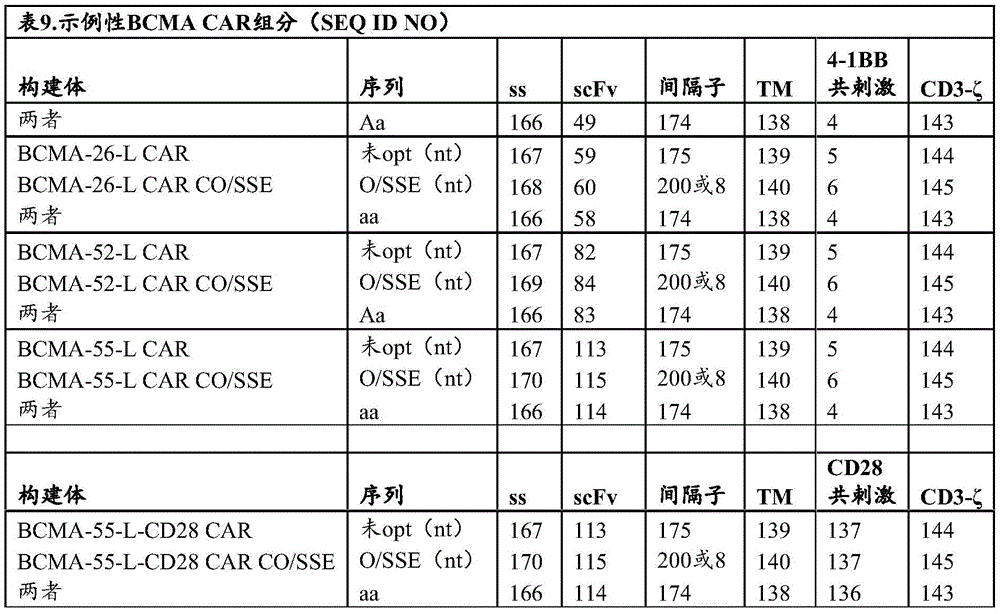
Engineered cells and processes for producing engineered cells
Also provided are cells (e.g., engineered cells) containing recombinant receptors (e.g., chimeric antigen receptors), e.g., exemplary recombinant receptors containing an extracellular domain that binds BCMA as described herein. Also provided are populations of such cells, compositions containing such cells, and/or enriched for such cells, such as where the cells expressing BCMA binding recombinant receptor comprise at least 50%, 60%, 70%, 80%, 90%, 91%, 92%, 93%, 94%, 95%, 96%, 97%, 98%, 99% or more of the total cells or cells of a certain type (e.g., T cells or CD8+ or CD4+ cells) in the composition. The compositions include pharmaceutical compositions and formulations for administration (e.g., for adoptive cell therapy). Also provided are therapeutic methods for administering the cells and compositions to a subject (e.g., a patient), as well as cells and pharmaceutical compositions for use in such methods.
Thus, genetically engineered cells expressing recombinant receptors containing antibodies, such as CAR-containing cells, are also provided. The cells are typically eukaryotic cells, such as mammalian cells, and typically human cells. In some embodiments, the cell is derived from blood, bone marrow, lymph or lymphoid organs, is a cell of the immune system, such as a cell of innate or adaptive immunity, e.g., bone marrow or lymphocytes, including lymphocytes, typically T cells and/or NK cells. Other exemplary cells include stem cells, such as pluripotent stem cells and multipotent stem cells, including induced pluripotent stem cells (ipscs). The cells are typically primary cells, such as those isolated directly from a subject and/or isolated from a subject and frozen. In some embodiments, the cells comprise one or more subsets of T cells or other cell types, such as the entire population of T cells, CD4+ cells, CD8+ cells, and subpopulations thereof, such as those defined by: function, activation state, maturity, likelihood of differentiation, expansion, recycling, localization and/or persistence ability, antigen specificity, antigen receptor type, presence in a particular organ or compartment, marker or cytokine secretion characteristics and/or degree of differentiation. With respect to the subject to be treated, the cells may be allogeneic and/or autologous. The methods include off-the-shelf methods. In some aspects, as with the prior art, the cells are pluripotent and/or multipotent, such as stem cells, such as induced pluripotent stem cells (ipscs). In some embodiments, the methods comprise isolating cells from a subject, preparing, processing, culturing, and/or engineering them, as described herein, and reintroducing them into the same patient either before or after cryopreservation.
Subtypes and subpopulations of T cells and/or CD4+ and/or CD8+ T cells include naive T (T) N ) Cells, effector T cells (T) EFF ) Memory T cells and subtypes thereof (e.g., stem cell memory T (T) SCM ) Central memory T (T) CM ) Memory of effect T (T) EM ) Or terminally differentiated effector memory T cells), tumor Infiltrating Lymphocytes (TILs), immature T cells, mature T cells, helper T cells, cytotoxic T cells, mucosa-associated constant T (MAIT) cells, naturally occurring and adaptive regulatory T (Treg) cells, helper T cells (e.g., TH1 cells, TH2 cells, TH3 cells, TH17 cells, TH9 cells, TH22 cells, follicular helper T cells), α/β T cells, and δ/γ T cells.
In some aspects, it is observed that compositions containing engineered cells expressing the exemplary BCMA binding recombinant receptors provided herein are enriched for central memory T cells (T cells) CM ) A phenotype-associated subset of immune cells (e.g., a CD4+ or CD8+ subset of T cells), the central memory T cells in some aspects associated with increased persistence of engineered cellsDurability and durability are related.
In some embodiments, the cell is a Natural Killer (NK) cell. In some embodiments, the cell is a monocyte or granulocyte, e.g., a myeloid cell, a macrophage, a neutrophil, a dendritic cell, a mast cell, an eosinophil, and/or a basophil.
In some embodiments, the cell comprises one or more polynucleotides introduced via genetic engineering, and thereby expresses a recombinant or genetically engineered product of such polynucleotides. In some embodiments, the polynucleotide is heterologous, i.e., not normally present in a cell or sample obtained from a cell, such as a polynucleotide obtained from another organism or cell, e.g., the polynucleotide is not normally found in the cell being engineered and/or the organism from which such cell is derived. In some embodiments, the polynucleotide is not a naturally occurring polynucleotide as not found in nature, including nucleic acids comprising chimeric combinations of polynucleotides encoding various domains from a plurality of different cell types. In some embodiments, the cell (e.g., an engineered cell) comprises a vector (e.g., a viral vector, an expression vector, etc.) as described herein, such as a vector comprising a nucleic acid encoding a recombinant receptor described herein.
In particular examples, immune cells (e.g., human immune cells) are used to express a provided polypeptide encoding a chimeric antigen receptor. In some examples, the immune cells are T cells, such as CD4+ and/or CD8+ immune cells, including primary cells, such as primary CD4+ and CD8+ cells.
In particular embodiments, the engineered cells are produced by a process that produces an output composition enriched for T cells from one or more input compositions and/or from a single biological sample. In certain embodiments, the output composition contains cells that express a recombinant receptor (e.g., a CAR, such as an anti-BCMA CAR). In particular embodiments, the cells of the output composition are suitable for administration to a subject as a therapy (e.g., autologous cell therapy). In some embodiments, the export composition is a composition enriched for CD4+ and CD8+ T cells.
In some embodiments, the process for generating or producing engineered cells is performed by a process comprising some or all of the following steps: collecting or obtaining a biological sample; isolating, selecting or enriching an input cell from a biological sample; cryopreservation and storage of the input cells; thawing and/or incubating the input cells under stimulatory conditions; engineering the stimulated cells to express or contain a recombinant polynucleotide, e.g., a polynucleotide encoding a recombinant receptor such as a CAR; incubating the engineered cells to a threshold amount, density, or expansion; formulating the cultured cells in an output composition; and/or cryopreserving and storing the formulated export cells until the cells are released for infusion and/or are suitable for administration to a subject. In some embodiments, the entire process is performed with a single composition enriched for T cells (e.g., CD4+ and CD8+ T cells). In certain embodiments, the process is performed with two or more input compositions of enriched T cells that are combined prior to and/or during the process to produce or produce a single output composition of enriched T cells. In some embodiments, the enriched T cells are or comprise engineered T cells, e.g., T cells transduced to express a recombinant receptor.
In particular embodiments, the export composition of the engineered cells expressing the recombinant receptor (e.g., an anti-BCMA CAR) is produced from the initial and/or import composition of the cells. In some embodiments, the output composition is a composition enriched for T cells, enriched for CD4+ T cells, and/or enriched for CD8+ T cells (hereinafter also referred to as a composition enriched for T cells, a composition enriched for CD4+ T cells, and a composition enriched for CD8+ T cells, respectively). In some embodiments, the composition enriched for CD4+ T cells contains at least 60%, 65%, 70%, 75%, 80%, 85%, 90%, 95%, 98%, 99% or 99.9% cd4+ T cells. In particular embodiments, the composition enriched for CD4+ T cells contains 100% CD4+ T cells or contains about 100% CD4+ T cells. In certain embodiments, the T cell enriched composition comprises or contains less than 20%, less than 10%, less than 5%, less than 1%, less than 0.1%, or less than 0.01% CD8+ T cells, and/or does not contain or is substantially free of CD8+ T cells. In some embodiments, the population of cells consists essentially of CD4+ T cells. In some embodiments, the composition enriched for CD8+ T cells contains at least 75%, 80%, 85%, 90%, 95%, 98%, 99%, or 99.9% cd8+ T cells, or contains about 100% cd8+ T cells. In certain embodiments, the composition enriched for CD8+ T cells comprises or contains less than 20%, less than 10%, less than 5%, less than 1%, less than 0.1%, or less than 0.01% cd4+ T cells, and/or is free of CD4+ T cells, and/or is free of or substantially free of CD4+ T cells. In some embodiments, the population of cells consists essentially of CD8+ T cells.
In particular embodiments, the output composition of engineered cells is produced from an initial or input composition of cells produced and/or prepared by combining, mixing, and/or pooling cells (including from a cell composition containing enriched T cells, enriched CD4+ T cells, and/or enriched CD8+ T cells). In some embodiments, the input composition of cells is a composition of combined, mixed and/or pooled CD4+ and CD8+ T cells. In particular embodiments, the input composition contains between 30% and 70%, between 35% and 65%, between 40% and 60%, between 45% and 55%, or about 50% or 50% CD4+ T cells and between 30% and 70%, between 35% and 65%, between 40% and 60%, between 45% and 55%, or about 50% or 50% CD8+ T cells. In certain embodiments, the input composition contains between 45% and 55%, about 50% or 50% CD4+ T cells and between 45% and 55%, about 50% or 50% CD8+ T cells.
In certain embodiments, the process for producing an engineered cell may further comprise one or more of: activating and/or stimulating cells, e.g., cells into which the composition is infused; and/or genetically engineering the activated and/or stimulated cells, e.g., to introduce a polynucleotide encoding a recombinant protein by transduction or transfection; and/or culturing the engineered cell, e.g., under conditions that promote proliferation and/or expansion. In particular embodiments, the provided methods can be used in conjunction with harvesting, collecting, and/or formulating an output composition produced after the cells have been incubated, activated, stimulated, engineered, transduced, transfected and/or incubated.
In some embodiments, the one or more process steps are performed at least in part in serum-free media. In some embodiments, the serum-free medium is a defined or well-defined cell culture medium. In certain embodiments, the serum-free medium is a controlled medium that has been treated, e.g., filtered, to remove inhibitors and/or growth factors. In some embodiments, the serum-free medium contains a protein. In certain embodiments, the serum-free medium may contain serum albumin, hydrolysates, growth factors, hormones, carrier proteins and/or attachment factors. In some embodiments, the serum-free medium comprises a cytokine. In some embodiments, the serum-free medium comprises a cytokine or a recombinant cytokine. In some embodiments, the serum-free medium comprises recombinant IL-2, IL-15, and/or IL-7. In some embodiments, the serum-free medium comprises glutamine. In some embodiments, the serum-free medium comprises glutamine and recombinant IL-2, IL-15, and IL-7.
In some embodiments, the serum-free medium comprises a basal medium comprising one or more proteins or other additives. In some embodiments, all or a portion of the incubation is performed in a basal medium. In some embodiments, the basal medium contains a mixture of inorganic salts, sugars, amino acids, and optionally vitamins, organic acids, and/or buffers or other well-known cell culture nutrients. In addition to nutrients, the medium also helps to maintain pH and osmotic pressure. In some aspects, the components of the serum-free medium support cell growth, proliferation, and/or expansion.
A variety of commercially available basal media are well known to those skilled in the art and include Dulbecco's Modified Eagle's Medium (DMEM), roswell Park Memorial Institute Medium (RPMI), iskoff's modified Dulbecco's Medium, and Haas ' Medium. In some embodiments, the basal medium is Iskoff's modified Dulbecco's medium, RPMI-1640, or alpha-MEM. In some embodiments, the basal medium is a balanced salt solution (e.g., PBS, DPBS, HBSS, EBSS). In some embodiments, the basal medium is selected from Dulbecco's Modified Eagle's Medium (DMEM), minimal Essential Medium (MEM), eagle's Basal Medium (BME), F-10, F-12, RPMI 1640, glasgow's Minimal Essential Medium (GMEM), alpha minimal essential medium (alpha MEM), iskoff's modified Dulbecco's medium, and M199. In some embodiments, the basal medium is a complex medium (e.g., RPMI-1640, IMDM). In some embodiments, the basal medium is the optizer tmctsttmt cell expansion basal medium (ThermoFisher).
In some embodiments, the basal medium can further comprise a protein or peptide. In some embodiments, the at least one protein is not of non-mammalian origin. In some embodiments, the at least one protein is a human protein or is derived from a human. In some embodiments, the at least one protein is recombinant. In some embodiments, the at least one protein comprises albumin, transferrin, insulin, fibronectin, aprotinin, or fetuin. In some embodiments, the protein comprises one or more of albumin, insulin or transferrin, optionally one or more of human or recombinant albumin, insulin or transferrin.
In some embodiments, the protein is albumin or an albumin substitute. In some embodiments, the albumin is human albumin. In some embodiments, the albumin is a recombinant albumin. In some embodiments, the albumin is native human serum albumin. In some embodiments, the albumin is recombinant human serumAlbumin. In some embodiments, the albumin is a recombinant albumin from a non-human source. The albumin substitute may be of any protein or polypeptide origin. Examples of such protein or polypeptide samples include, but are not limited to, bovine pituitary extract, plant hydrolysates (e.g., rice hydrolysate), fetal bovine albumin (fetuin), ovalbumin Human Serum Albumin (HSA) or another animal derived albumin, chicken extract, bovine embryo extract, bovine serum albumin (HSA),  I and->
 And II, performing treatment. In some embodiments, the protein or peptide comprises transferrin. In some embodiments, the protein or peptide comprises fibronectin. In some embodiments, the protein or peptide comprises aprotinin. In some embodiments, the protein comprises fetuin.
In some embodiments, the one or more additional proteins are part of a serum replacement supplement that is added to the basal medium. Examples of serum replacement supplements include, for example, immune cell serum replacement (ThermoFisher, # A2598101) or Smith et al Clin Transl immunology.2015, 1 month; 4 (1): those described in e 31.
In certain embodiments, the basal medium is supplemented with additional additives. Additives to the cell culture medium may include, but are not limited to, nutrients, sugars (e.g., glucose), amino acids, vitamins, or additives (e.g., ATP and NADH).
In some embodiments, the basal medium further comprises glutamine, such as L-glutamine. In some aspects, the glutamine is glutamine in free form, such as L-glutamine. In some embodiments, the concentration of glutamine (e.g., L-glutamine) in the basal medium is less than 200mM, such as less than 150mM, 100mM or less, such as 20mM to 120mM or 40mM to 100mM, such as or about 80mM. In some embodiments, the concentration of L-glutamine is from about 0.5mM to about 5mM (e.g., 2 mM).
In some embodiments, the basal medium further contains synthetic amino acids, such as a dipeptide form of L-glutamine, e.g., L-alanyl-L-glutamine. In some embodiments, the concentration of dipeptide form of L-glutamine (e.g., L-alanyl-L-glutamine) in the basal medium is about 0.5mM to 5mM. In some embodiments, the concentration of dipeptide form of L-glutamine (e.g., L-alanyl-L-glutamine) in the basal medium is about 2mM.
In some embodiments, the provided methods are performed such that one, more, or all steps in the preparation of cells for clinical use (e.g., for adoptive cell therapy) are performed without exposing the cells to non-sterile conditions. In some embodiments, the cells are selected, stimulated, transduced, washed and formulated, all within a closed, sterile system or device. In some embodiments, the one or more steps are performed outside of a closed system or apparatus. In some such embodiments, the cells are transferred out of the closed system or device under sterile conditions, such as by transferring them into a separate closed system by sterile transfer.
A. Preparation of cells for engineering
In some embodiments, the preparation of the engineered cell comprises one or more culturing and/or preparation steps. Cells for introducing a recombinant receptor (e.g., CAR) can be isolated from a sample, such as a biological sample, e.g., a sample obtained or derived from a subject. In some embodiments, the subject from which the cells are isolated is a subject having a disease or disorder or in need of or to which a cell therapy is to be administered. In some embodiments, the subject is a human in need of a particular therapeutic intervention (such as adoptive cell therapy, where cells are isolated, processed, and/or engineered).
Thus, in some embodiments, the cell is a primary cell, e.g., a primary human cell. Samples include tissues, fluids, and other samples taken directly from a subject, as well as samples from one or more processing steps, such as isolation, centrifugation, genetic engineering (e.g., transduction with a viral vector), washing, and/or incubation. The biological sample may be a sample obtained directly from a biological source or a processed sample. Biological samples include, but are not limited to, bodily fluids (e.g., blood, plasma, serum, cerebrospinal fluid, synovial fluid, urine, and sweat), tissue, and organ samples, including processed samples derived therefrom.
In some aspects, the sample from which the cells are derived or isolated is blood or a blood-derived sample, or is derived from an apheresis or leukopheresis product. Exemplary samples include whole blood, peripheral Blood Mononuclear Cells (PBMCs), leukocytes, bone marrow, thymus, tissue biopsies, tumors, leukemias, lymphomas, lymph nodes, gut-associated lymphoid tissue, mucosa-associated lymphoid tissue, spleen, other lymphoid tissue, liver, lung, stomach, intestine, colon, kidney, pancreas, breast, bone, prostate, cervix, testis, ovary, tonsil, or other organs and/or cells derived therefrom. In the context of cell therapy (e.g., adoptive cell therapy), samples include samples from both autologous and allogeneic sources.
In some embodiments, the cells are derived from a cell line, such as a T cell line. In some embodiments, the cells are obtained from a xenogeneic source, e.g., from a mouse, rat, non-human primate, or pig.
In some embodiments, the isolation of the cells comprises one or more preparation steps and/or non-affinity based cell isolation steps. In some examples, cells are washed, centrifuged, and/or incubated in the presence of one or more reagents, e.g., to remove unwanted components, to enrich for desired components, to lyse, or to remove cells that are sensitive to a particular reagent. In some examples, cells are isolated based on one or more characteristics, such as density, adhesion characteristics, size, sensitivity to a particular component, and/or resistance.
In some examples, the cells from the circulating blood of the subject are obtained, for example, by apheresis or leukopheresis. In some aspects, the sample contains lymphocytes, including T cells, monocytes, granulocytes, B cells, other nucleated leukocytes, erythrocytes, and/or platelets, and in some aspects contains cells other than erythrocytes and platelets.
In some embodiments, blood cells collected from a subject are washed, e.g., to remove a plasma fraction, and the cells are placed in an appropriate buffer or medium for subsequent processing steps. In some embodiments, the cells are washed with Phosphate Buffered Saline (PBS). In some embodiments, the wash solution lacks calcium and/or magnesium and/or many or all divalent cations. In some aspects, the washing step is accomplished by a semi-automatic "flow-through" centrifuge (e.g., cobe 2991 cell processor, baxter) according to the manufacturer's instructions. In some aspects, the washing step is accomplished by Tangential Flow Filtration (TFF) according to the manufacturer's instructions. In some embodiments, the cells are resuspended in various biocompatible buffers (e.g., ca-free) after washing ++ /Mg ++ PBS) of (ii). In certain embodiments, the blood cell sample is fractionated and the cells are resuspended directly in culture medium.
In some aspects, for the production of isolated or secreted polypeptides, in addition to prokaryotes, eukaryotic microorganisms (such as filamentous fungi or yeast) are suitable cloning or expression hosts for antibody-encoding vectors, including fungi and yeast strains whose glycosylation pathways have been modified to mimic or approximate those in human cells, thereby producing antibodies with partially or fully human glycosylation patterns. See Gerngross, nat. Biotech.22:1409-1414 (2004) and Li et al, nat. Biotech.24:210-215 (2006).
Exemplary eukaryotic cells that can be used to express polypeptides (including isolated or secreted polypeptides) include, but are not limited to, COS cells, including COS 7 cells; 293 cells, including 293-6E cells; CHO cells including CHO-S, DG44, lec13 CHO cells and FUT8 CHO cells; PER. A cell; and NSO cells. In some embodiments, antibody heavy and/or light chains (e.g., V) can be expressed in yeast H Zone and/or V L Zone).See, for example, U.S. publication No. US 2006/0270045 A1. In some embodiments, the heavy and/or light chain (e.g., V) is based on its pairing H Zone and/or V L Region) to perform the desired post-translational modifications to select a particular eukaryotic host cell. For example, in some embodiments, a polypeptide produced by a CHO cell has a higher sialylation level than the same polypeptide produced in a 293 cell.
In some embodiments, the methods of making include the step of freezing (e.g., cryopreserving) the cells before or after isolating, selecting, and/or enriching, and/or incubating for transduction and engineering, and/or after incubating and/or harvesting the engineered cells. In some embodiments, the freezing and subsequent thawing steps remove granulocytes and to some extent monocytes from the cell population. In some embodiments, the cells are suspended in a freezing solution to remove plasma and platelets, e.g., after a washing step. In some aspects, any of a variety of known freezing solutions and parameters may be used. In some embodiments, the cells are frozen (e.g., cryopreserved or cryopreserved) in a medium and/or solution having a final concentration of DMSO at or about 12.5%, 12.0%, 11.5%, 11.0%, 10.5%, 10.0%, 9.5%, 9.0%, 8.5%, 8.0%, 7.5%, 7.0%, 6.5%, 6.0%, 5.5%, or 5.0%, or DMSO at between 1% and 15%, between 6% and 12%, between 5% and 10%, or between 6% and 8%. In particular embodiments, the cells are frozen (e.g., cryopreserved or cryopreserved) in a medium and/or solution having a final concentration of HSA of at or about 5.0%, 4.5%, 4.0%, 3.5%, 3.0%, 2.5%, 2.0%, 1.5%, 1.25%, 1.0%, 0.75%, 0.5%, or 0.25%, or between 0.1% and-5%, between 0.25% and 4%, between 0.5% and 2%, or between 1% and 2%. One example includes the use of PBS containing 20% DMSO and 8% Human Serum Albumin (HSA), or other suitable cell freezing media. It was then diluted 1% with medium so that the final concentrations of DMSO and HSA were 10% and 4%, respectively. The cells are then typically frozen at a rate of equal to or about 1 degree celsius/minute to equal to or about-80 degrees celsius and stored in the gas phase of a liquid nitrogen storage tank.
In some embodiments, the isolation of the cell or population comprises one or more preparative and/or non-affinity based cell isolation steps. In some examples, cells are washed, centrifuged, and/or incubated in the presence of one or more reagents, e.g., to remove unwanted components, to enrich for desired components, to lyse, or to remove cells that are sensitive to a particular reagent. In some examples, cells are isolated based on one or more characteristics, such as density, adhesion characteristics, size, sensitivity to a particular component, and/or resistance. In some embodiments, the methods include density-based cell separation methods, such as preparing leukocytes from peripheral blood by lysing erythrocytes and centrifuging through a Percoll or Ficoll gradient.
In some embodiments, at least a portion of the selecting step comprises incubating the cells with a selection agent. Incubation with one or more selection reagents, e.g., as part of a selection process, can be performed using one or more selection reagents for selecting one or more different cell types based on the expression or presence of one or more particular molecules, such as surface markers (e.g., surface proteins), intracellular markers, or nucleic acids, in or on the cell. In some embodiments, any known method of separation based on such labels using one or more selection reagents may be used. In some embodiments, one or more selection reagents result in a separation that is an affinity or immunoaffinity based separation. For example, in some aspects, the selection comprises incubation with one or more reagents for separating cells and cell populations based on cellular expression or expression levels of one or more markers (typically cell surface markers), for example by incubation with an antibody or binding partner that specifically binds to such markers, followed by typically performing a washing step and separating cells that have bound the antibody or binding partner from those that are not bound to the antibody or binding partner.
In some aspects of such processes, a volume of cells is mixed with an amount of a desired selection reagent based on affinity. Immunoaffinity-based selection can be performed using any system or method that allows for favorable energetic interactions between isolated cells and molecules that specifically bind to markers on the cells (e.g., antibodies or other binding partners on solid surfaces (e.g., particles)). In some embodiments, the method is performed using particles (e.g., beads, e.g., magnetic beads) coated with a selection agent (e.g., an antibody) specific for a marker of the cell. Particles (e.g., beads) can be incubated or mixed with cells in a container (e.g., tube or bag) while shaking or mixing, wherein the ratio of cell density to particles (e.g., beads) is constant to help promote energetically favorable interactions. In other cases, the method comprises selecting cells, wherein all or a portion of the selection is performed in an internal cavity of a centrifugal chamber, e.g., under centrifugal rotation. In some embodiments, incubating the cells with a selection agent (e.g., an immunoaffinity-based selection agent) is performed in a centrifugal chamber. In certain embodiments, the separation or isolation is performed using a system, device, or apparatus described in international patent application publication No. WO 2009/072003 or US 20110003380 A1. In one example, the system is a system as described in International publication No. WO 2016/073602.
In some embodiments, by performing such selection steps or portions thereof in the cavity of the centrifugal chamber (e.g., incubation with antibody-coated particles (e.g., magnetic beads)), the user is able to control certain parameters, such as the volume of various solutions, addition of solutions during processing, and timing thereof, which can provide a number of advantages over other available methods. For example, the ability to reduce the volume of liquid in the cavity during incubation can increase the concentration of particles (e.g., bead reagents) used in selection and thereby increase the chemical potential of the solution without affecting the total number of cells in the cavity. This in turn may enhance the pair-wise interaction between the cells being treated and the particles for selection. In some embodiments, for example, in association with systems, circuits, and controls as described herein, the incubation step is performed in a chamber, allowing a user to achieve agitation of the solution at one or more desired times during incubation, which may also improve the interaction.
In some embodiments, at least a portion of the selecting step is performed in a centrifugal chamber, which comprises incubating the cells with a selection agent. In some aspects of such processes, a volume of cells is mixed with an amount of desired affinity-based selection reagent that is much less than what is typically employed when similar selections are made in a tube or container for selecting the same number of cells and/or the same volume of cells according to the manufacturer's instructions. In some embodiments, the amount of the one or more selection reagents employed is no more than 5%, no more than 10%, no more than 15%, no more than 20%, no more than 25%, no more than 50%, no more than 60%, no more than 70%, or no more than 80% of the amount of the same one or more selection reagents employed for cell selection in tube-or container-based incubations for the same number of cells and/or the same volume of cells according to the manufacturer's instructions.
In some embodiments, for selection of cells, e.g., immunoaffinity-based selection, the cells are incubated in a chamber cavity in a composition that also contains a selection buffer with a selection reagent, e.g., a surface-labeled molecule, e.g., an antibody, that specifically binds to the cells that are desired to be enriched and/or depleted (but not to other cells in the composition), optionally coupled to a scaffold (e.g., a polymer or surface, e.g., beads, e.g., magnetic beads coupled to monoclonal antibodies specific for CD4 and CD 8). In some embodiments, as described, a selection reagent is added to cells in a chamber cavity in an amount that is significantly less (e.g., no greater than 5%, 10%, 20%, 30%, 40%, 50%, 60%, 70%, or 80% of the amount) than is typically used or would be needed to achieve about the same or similar selection efficiency for the same number of cells or the same volume of cells when selecting in an oscillating or rotating tube. In some embodiments, the incubation is performed with the addition of selection buffer to the cells and selection reagents to achieve a target volume of incubation of, for example, 10mL to 200mL, such as at least or about at least 10mL, 20mL, 30mL, 40mL, 50mL, 60mL, 70mL, 80mL, 90mL, 100mL, 150mL, or 200mL of reagents. In some embodiments, the selection buffer and selection reagent are pre-mixed prior to addition to the cells. In some embodiments, the selection buffer and selection reagent are added separately to the cells. In some embodiments, the selective incubation is performed under periodic mild mixing conditions, which can help promote energetically favorable interactions, allowing for the use of less total selection reagents to achieve high selection efficiency.
In some embodiments, the total duration of incubation with the selection agent is or is about 5 minutes to 6 hours, such as 30 minutes to 3 hours, for example at least or about at least 30 minutes, 60 minutes, 120 minutes, or 180 minutes.
In some embodiments, the incubation is typically performed under mixing conditions, such as in the presence of rotation, typically at a relatively low force or speed, such as a speed lower than the speed used to pellet the cells, such as from or about 600rpm to 1700rpm (e.g., at or about or at least 600rpm, 1000rpm, or 1500rpm, or 1700 rpm), such as at a certain RCF at the sample or chamber wall or other container wall, which RCF is from or about 80g to 100g (e.g., at or about or at least 80g, 85g, 90g, 95g, or 100 g). In some embodiments, rotation is performed using a repeating interval of such low speed rotation followed by a rest period, e.g., rotation and/or rest for 1, 2, 3, 4, 5, 6, 7, 8, 9, or 10 seconds, e.g., rotation for about 1 or 2 seconds, followed by rest for about 5, 6, 7, or 8 seconds.
In some embodiments, such a process is performed within a fully enclosed system integral with the chamber. In some embodiments, this process (and in some aspects one or more additional steps, such as a pre-wash step to wash a cell-containing sample, such as an apheresis sample) is performed in an automated fashion such that cells, reagents, and other components are aspirated and pushed out of the chamber at appropriate times and centrifuged in order to complete the wash and binding steps in a single closed system using an automated procedure.
In some embodiments, after incubating and/or mixing the cells and one or more selection reagents, the incubated cells are subjected to separation to select the cells based on the presence or absence of the one or more specific reagents. In some embodiments, the separation is performed in the same closed system, wherein the cells are incubated with the selection reagent. In some embodiments, after incubation with the selection agent, the incubated cells (including cells to which the selection agent has been bound) are transferred into a system for immunoaffinity-based separation of the cells. In some embodiments, the system for immunoaffinity-based separation is or comprises a magnetic separation column.
In some embodiments, the separation method comprises separating different cell types based on the expression or presence of one or more specific molecules, such as surface markers (e.g., surface proteins), intracellular markers, or nucleic acids, in the cell. In some embodiments, any known method for separation based on such labeling may be used. In some embodiments, the separation is affinity-based or immunoaffinity-based separation. For example, in some aspects, isolating comprises isolating cells and cell populations based on the expression or level of expression of one or more markers (typically cell surface markers) of the cells, e.g., by incubating with an antibody or binding partner that specifically binds to such markers, followed typically by a washing step and isolating cells that have bound to the antibody or binding partner from those cells that are not bound to the antibody or binding partner.
Such separation steps may be based on positive selection (where cells that have bound the agent are retained for further use) and/or negative selection (where cells that are not bound to the antibody or binding partner are retained). In some examples, both fractions are retained for further use. In some aspects, negative selection may be particularly useful in the absence of antibodies that can be used to specifically identify cell types in a heterogeneous population, such that isolation based on markers expressed by cells other than the desired population is best performed.
In some embodiments, the treating step further comprises negative and/or positive selection of the incubated cells, such as using a system or device that can perform affinity-based selection. In some embodiments, the isolation is performed by enriching a particular cell population via positive selection, or depleting a particular cell population via negative selection. In some embodiments, positive or negative selection is accomplished by: incubating the cells with one or more antibodies or other binding agents that specifically bind to one or more surface markers expressed on positively or negatively selected cells (marker +) or at a relatively high level (marker), respectively High (a) )。
Isolation need not result in 100% enrichment or depletion of a particular cell population or cells expressing a particular marker. For example, positive selection or enrichment for a particular type of cell (such as those expressing a marker) refers to increasing the number or percentage of such cells, but without the need for cells that do not express the marker to be completely absent. Likewise, negative selection, removal, or depletion of a particular type of cell (such as those expressing a marker) refers to a reduction in the number or percentage of such cells, but does not require complete removal of all such cells.
In some examples, multiple rounds of separation steps are performed, wherein fractions from a positive or negative selection of one step are subjected to another separation step, such as a subsequent positive or negative selection. In some examples, a single isolation step may deplete cells expressing multiple markers simultaneously, such as by incubating the cells with multiple antibodies or binding partners, each specific for a marker targeted for negative selection. Similarly, multiple cell types can be positively selected simultaneously by incubating the cells with multiple antibodies or binding partners expressed on the various cell types.
For example, in some aspects, a particular subpopulation of T cells, such as cells that are positive or highly expressed for one or more surface markers (e.g., CD28+, CD62L +, CCR7+, CD27+, CD127+, CD4+, CD8+, CD45RA +, and/or CD45RO + T cells) are isolated by positive or negative selection techniques.
For example, anti-CD 3/anti-CD 28 conjugated magnetic beads (e.g., m-450CD3/CD 28T cell expandators, MACSiBeads TM, etc.) positive selection for CD3+, CD28+ T cells.
In some embodiments, T cells are isolated from the PBMC sample by negative selection for markers expressed on non-T cells (e.g., B cells, monocytes, or other leukocytes, such as CD 14). In some aspects, the CD4+ and/or CD8+ selection step is used to separate CD4+ helper T cells and CD8+ cytotoxic T cells from a composition (e.g., from a PBMC composition, such as a composition obtained via leukapheresis). In some aspects, such CD4+ and CD8+ populations may be further classified into subpopulations by positive or negative selection for markers expressed on one or more naive, memory and/or effector T cell subpopulations, or expressed to a relatively high degree. In some embodiments, the CD4+ and CD8+ cells are mixed in a desired ratio.
In some embodiments, the CD8+ cells are further enriched or depleted for naive, central memory, effector memory, and/or central memory stem cells, such as by positive or negative selection based on surface antigens associated with the respective subpopulation. In some embodiments, the central memory T (T) is targeted CM ) The cells are enriched to increase efficacy, such as to improve long-term survival after administration, expansion, and/or implantation, which is particularly robust in some aspects in such subpopulations. See Terakura et al (2012) blood.1:72-82; wang et al (2012) J Immunother.35 (9): 689-701. In some embodiments, the combination is T-rich CM Further enhanced efficacy of CD8+ T cells and CD4+ T cells.
In embodiments, the memory T cells are present in both CD62L + and CD 62L-subsets of CD8+ peripheral blood lymphocytes. PBMCs can be enriched or depleted against CD62L-CD8+ and/or CD62L + CD8+ fractions, for example using anti-CD 8 and anti-CD 62L antibodies.
In some embodiments, the central memory T (T) is CM ) Enrichment of cells is based on positive or high surface expression of CD45RO, CD62L, CCR7, CD27, CD28, CD3, and/or CD 127; in some aspects, it is based on negative selection of cells expressing or highly expressing CD45RA and/or granzyme B. In some aspects, T is enriched CM The isolation of the CD8+ population of cells is performed by depletion of CD4, CD14, CD45RA expressing cells and positive selection or enrichment of CD62L expressing cells. In one aspect, central memory T (T) CM ) Enrichment of cells was performed starting from negative cell fractions selected on the basis of CD4 expression, which were negatively selected on the basis of CD14 and CD45RA expression and positively selected on the basis of CD 62L. In some aspects the selection is performed simultaneously, while in other aspects it is performed sequentially in any order. In some aspects, the same CD4 expression-based selection step used to prepare a CD8+ cell population or subpopulation is also used to generate a CD4+ cell population or subpopulation, such that positive and negative fractions from CD 4-based separations are retained and used in subsequent steps of the method, optionally after one or more other positive or negative selection steps.
In some embodiments, the central memory CD8+ cells are CD27+, CD28+, CD62L +, CCR7+, CD45RA-, and/or CD45RO +. In some embodiments, the central memory CD8+ cells are CD62L + and CD45RO +. In some embodiments, the central memory CD8+ cells are CCR7+ and CD45RO +. In some embodiments, the central memory CD8+ cells are CCR7+ and CD45RA-. In some embodiments, the central memory CD8+ cells are CD62L + and CCR7+. In some embodiments, the central memory CD8+ cells are CD62L +/CD45RA-, CCR7+/CD45RA-, CD62L +/CCR7+, or CD62L +/CCR7+/CD45RA-, and have moderate to high expression of CD44. In some embodiments, the central memory CD8+ cells are CD27+/CD28+/CD62L +/CD45RA-, CD27+/CD28+/CCR7+/CD45RA-, CD27+/CD28+/CD62L +/CCR7+, or CD27+/CD28+/CD62L +/CCR7+/CD45RA-.
In particular embodiments, a biological sample (e.g., a sample of PBMCs or other leukocytes) is subjected to selection of CD4+ T cells, wherein both negative and positive fractions are retained. In certain embodiments, the CD8+ T cells are selected from negative fractions. In some embodiments, the biological sample is subjected to selection of CD8+ T cells, wherein negative and positive fractions are retained simultaneously. In certain embodiments, the CD4+ T cells are selected from negative fractions.
In a particular example, a PBMC sample or other leukocyte sample is subjected to selection of CD4+ cells, wherein negative and positive fractions are retained. The negative fractions are then subjected to negative selection based on the expression of CD14 and CD45RA and positive selection based on markers unique to central memory T cells (such as CD62L or CCR 7), where positive and negative selection is performed in any order.
In some embodiments, the CD4+ T helper cells are classified as naive, central memory, and effector cells by identifying cell populations having cell surface antigens. CD4+ lymphocytes can be obtained by standard methods. In some embodiments, the naive CD4+ T lymphocyte is a CD45RO-, CD45RA +, CD62L +, CD4+ T cell. In some embodiments, the central memory CD4+ cells are CD62L + and CD45RO +. In some embodiments, the central memory CD4+ cells are CD62L + and CD45RO +. In some embodiments, the central memory CD4+ cells are CD27+, CD28+, CD62L +, CCR7+, CD45RA-, and/or CD45RO +. In some embodiments, the central memory CD4+ cells are CD62L + and CD45RO +. In some embodiments, the central memory CD4+ cells are CCR7+ and CD45RO +. In some embodiments, the central memory CD4+ cells are CCR7+ and CD45RA-. In some embodiments, the central memory CD4+ cells are CD62L + and CCR7+. In some embodiments, the central memory CD4+ cells are CD62L +/CD45RA-, CCR7+/CD45RA-, CD62L +/CCR7+, or CD62L +/CCR7+/CD45RA-, and have moderate to high expression of CD44. In some embodiments, the central memory CD4+ cells are CD27+/CD28+/CD62L +/CD45RA-, CD27+/CD28+/CCR7+/CD45RA-, CD27+/CD28+/CD62L +/CCR7+, or CD27+/CD28+/CD62L +/CCR7+/CD45RA-. In some embodiments, the effector CD4+ cells are CD 62L-and CD45RO-.
In one example, to enrich for CD4+ cells by negative selection, monoclonal antibody cocktails typically include antibodies directed against CD14, CD20, CD11b, CD16, HLA-DR and CD8. In some embodiments, the antibody or binding partner is bound to a solid support or matrix (e.g., magnetic or paramagnetic beads) to allow cell separation for positive and/or negative selection. For example, in some embodiments, immunomagnetic (or affinity magnetic) separation techniques are used to separate or isolate cells and Cell populations (reviewed In Methods In Molecular Medicine, vol.58: metastasis Research Protocols, vol.2: cell Behavor In vitro and In vivo, pp.17-25 S.A.Brooks and U.Schumacher, editors Humana Press inc., tuotowa, new jersey).
In some aspects, a sample or composition of cells to be separated is contacted with small magnetizable or magnetically responsive material (e.g., magnetically responsive particles or microparticles, such as paramagnetic beads (e.g., such as Or->
Or-> Beads)) were incubated together. The magnetically responsive material (e.g., particles) are typically attached, directly or indirectly, to a binding partner (e.g., an antibody) that specifically binds to a molecule (e.g., a surface label) present on a cell, cells, or cell population that is desired to be isolated (e.g., desired to be selected negatively or positively).
In some embodiments, the magnetic particles or beads comprise a magnetically responsive material bound to a specific binding member (such as an antibody or other binding partner). There are many well-known magnetically responsive materials used in magnetic separation methods. Suitable magnetic particles include those described in Molday, U.S. patent No. 4,452,773, and european patent specification EP 452342B, which are hereby incorporated by reference. Colloidal-sized particles (such as those described in Owen U.S. Pat. No. 4,795,698 and Liberti et al, U.S. Pat. No. 5,200,084) are other examples.
The incubation is typically performed under conditions whereby the antibody or binding partner, or a molecule that specifically binds to such an antibody or binding partner attached to the magnetic particle or bead (such as a secondary antibody or other reagent), specifically binds to a cell surface molecule, if present on a cell within the sample.
In some aspects, the sample is placed in a magnetic field and those cells having magnetically responsive or magnetizable particles attached thereto will be attracted to the magnet and separated from the unlabeled cells. For positive selection, cells attracted to the magnet are retained; for negative selection, cells that were not attracted (unlabeled cells) were retained. In some aspects, a combination of positive and negative selections are performed during the same selection step, wherein positive and negative fractions are retained and further processed or subjected to additional separation steps.
In certain embodiments, the magnetically responsive particles are coated in a primary or other binding partner, a secondary antibody, a lectin, an enzyme, or streptavidin. In certain embodiments, the magnetic particles are attached to the cells by coating with a primary antibody specific for one or more labels. In certain embodiments, the cells are labeled with a primary antibody or binding partner rather than beads, and then a cell-type specific secondary antibody or other binding partner (e.g., streptavidin) -coated magnetic particle is added. In certain embodiments, streptavidin-coated magnetic particles are used in combination with a biotinylated primary or secondary antibody.
In some embodiments, the magnetically responsive particles remain attached to the cells, which are subsequently incubated, cultured, and/or engineered; in some aspects, the particles remain attached to the cells for administration to a patient. In some embodiments, the magnetizable or magnetically responsive particles are removed from the cell. Methods for removing magnetizable particles from cells are known and include, for example, the use of competitive unlabeled antibodies, magnetizable particles, or antibodies conjugated to cleavable linkers, and the like. In some embodiments, the magnetizable particles are biodegradable.
In some embodiments, affinity-based selection is by magnetically activated cell sorting (Miltenyi Biotec, austen, calif.) by a standard laboratory protocol. Magnetically activated cell sorting>
 The system enables high purity selection of cells with attached magnetized particles. In certain embodiments, is selected>
 Operation in a mode in which non-target species and target species are eluted sequentially after application of an external magnetic field. That is, cells attached to magnetized particles remain in place while unattached species are eluted. Then, after completion of the first elution step, the species trapped in the magnetic field and prevented from eluting are released in a manner such that they can be eluted and recovered. In certain embodiments, the non-target cells are labeled and depleted from a heterogeneous population of cells.
In certain embodiments, the isolating or separating is performed using a system, device, or apparatus that performs one or more of the isolating, cell preparing, separating, processing, incubating, culturing, and/or preparing steps of the method. In some aspects, the system is used to perform each of these steps in a closed or sterile environment, e.g., to minimize errors, user handling, and/or contamination. In one example, the system is a system as described in international patent application publication No. WO 2009/072003 or US 20110003380 A1.
In some embodiments, the system or apparatus performs one or more (e.g., all) of the separation, processing, engineering, and formulation steps in an integrated or stand-alone system and/or in an automated or programmable manner. In some aspects, the system or apparatus includes a computer and/or computer program in communication with the system or apparatus that allows a user to program, control, assess the outcome and/or adjustment of various aspects of the processing, separation, engineering and compounding steps.
At one endSome aspects, use The system (Miltenyi Biotec) performs the isolation and/or other steps, for example for automated isolation of cells at a clinical scale level in a closed and sterile system. The components may include an integrated microcomputer, a magnetic separation unit, a peristaltic pump and various pinch valves. In some aspects, the integrated computer controls all components of the instrument and instructs the system to perform repetitive procedures in a standardized sequence. In some aspects, the magnetic separation unit comprises a movable permanent magnet and a bracket for a selection column. The peristaltic pump controls the flow rate of the entire tubing set and, together with the pinch valve, ensures a controlled flow of buffer through the system and continuous suspension of cells.
In some aspects of the present invention, the first and second electrodes are, the system uses antibody-coupled magnetizable particles, which are provided in a sterile, pyrogen-free solution. In some embodiments, after labeling the cells with magnetic particles, the cells are washed to remove excess particles. The cell preparation bag is then connected to a tubing set which in turn is connected to a buffer containing bag and a cell collection bag. The tubing set consists of pre-assembled sterile tubing (including pre-column and separation column) and is intended for single use only. After initiating the separation procedure, the system automatically applies the cell sample to the separation column. The labeled cells remain within the column, while the unlabeled cells are removed by a series of washing steps. In some embodiments, the cell population for use with the methods described herein is unlabeled and does not remain in the column. In some embodiments, a population of cells for use with the methods described herein is labeled and retained in a column. In some embodiments, a cell population for use with the methods described herein is eluted from the column after removal of the magnetic field and collected in a cell collection bag.
In certain embodiments, cliniMACS is used  The system (Miltenyi Biotec) performs the isolation and/or other steps. In some aspects, cliniMACS @>
 The system is equipped with a cell processing unit that allows automated washing and fractionation of cells by centrifugation. Clinimacs->
 The system may also include an onboard camera and image recognition software that determines an optimal cell fractionation endpoint by identifying macroscopic layers of the source cell product. For example, peripheral blood can be automatically separated into red blood cells, white blood cells, and a plasma layer. CliniMACS->
 The system may also include an integrated cell culture chamber that implements cell culture protocols such as cell differentiation and expansion, antigen loading, and long-term cell culture. The input port may allow for sterile removal and replenishment of media, and the cells may be monitored using an integrated microscope. See, e.g., klebanoff et al (2012) J immunother.35 (9): 651-660; terakura et al (2012) blood.1:72-82; and Wang et al (2012) J Immunother.35 (9): 689-701.
In some embodiments, the population of cells described herein is collected and enriched (or depleted) by flow cytometry, wherein the cells stained for the plurality of cell surface markers are carried in a fluid stream. In some embodiments, the cell populations described herein are collected and enriched (or depleted) by preparative scale (FACS) sorting. In certain embodiments, the cell populations described herein are collected and enriched (or depleted) by using a microelectromechanical systems (MEMS) Chip in conjunction with a FACS-based detection system (see, e.g., WO 2010/033140, cho et al (2010) Lab Chip 10,1567-1573; and Godin et al (2008) J biophoton.1 (5): 355-376. In both cases, cells can be labeled with multiple labels, allowing for the separation of well-defined T-cell subsets with high purity.
In some embodiments, the antibody or binding partner is labeled with one or more detectable labels to facilitate isolation for positive and/or negative selection. For example, the separation may be based on binding to a fluorescently labeled antibody. In some examples, the cells are carried in the fluid stream for separation based on binding of antibodies or other binding partners specific for one or more cell surface markers, such as by Fluorescence Activated Cell Sorting (FACS), including preparative scale (FACS), and/or microelectromechanical system (MEMS) chips, e.g., in combination with a flow cytometry detection system. Such methods allow for simultaneous positive and negative selection based on multiple markers.
In some embodiments, the isolating and/or selecting produces one or more input compositions enriched for T cells, e.g., CD3+ T cells, CD4+ T cells, and/or CD8+ T cells. In some embodiments, two or more separate input compositions are isolated, selected, enriched, or obtained from a single biological sample. In some embodiments, separate input compositions are isolated, selected, enriched, and/or obtained from separate biological samples collected, obtained, and/or obtained from the same subject.
In certain embodiments, the one or more input compositions are or comprise a T cell enriched composition comprising at least 60%, at least 65%, at least 70%, at least 75%, at least 80%, at least 85%, at least 90%, at least 95%, at least 98%, at least 99%, at least 99.5%, at least 99.9%, or at or about 100% CD3+ T cells. In particular embodiments, the enriched T cell import composition consists essentially of CD3+ T cells.
In certain embodiments, the one or more input compositions are or comprise a CD4+ T cell enriched composition comprising at least 60%, at least 65%, at least 70%, at least 75%, at least 80%, at least 85%, at least 90%, at least 95%, at least 98%, at least 99%, at least 99.5%, at least 99.9%, or at or about 100% CD4+ T cells. In certain embodiments, the CD4+ T cell infused composition comprises less than 40%, less than 35%, less than 30%, less than 25%, less than 20%, less than 15%, less than 10%, less than 5%, less than 1%, less than 0.1%, or less than 0.01% CD8+ T cells, and/or does not comprise or is substantially free of CD8+ T cells. In some embodiments, the T cell-enriched composition consists essentially of CD4+ T cells.
In certain embodiments, the one or more compositions is or comprises a composition of CD8+ T cells that is or comprises at least 60%, at least 65%, at least 70%, at least 75%, at least 80%, at least 85%, at least 90%, at least 95%, at least 98%, at least 99%, at least 99.5%, at least 99.9%, or at or about 100% CD8+ T cells. In certain embodiments, the composition of CD8+ T cells contains less than 40%, less than 35%, less than 30%, less than 25%, less than 20%, less than 15%, less than 10%, less than 5%, less than 1%, less than 0.1%, or less than 0.01% CD4+ T cells, and/or does not contain or is substantially free of CD4+ T cells. In some embodiments, the composition enriched for T cells consists essentially of CD8+ T cells.
In some embodiments, the methods of preparation include the step of freezing (e.g., cryopreserving) the cells prior to or after isolation, incubation, and/or engineering. In some embodiments, the freezing and subsequent thawing steps remove granulocytes and, to some extent, monocytes from the cell population. In some embodiments, the cells are suspended in a freezing solution to remove plasma and platelets, e.g., after a washing step. In some aspects, any of a variety of known freezing solutions and parameters may be used. One example includes the use of PBS containing 20% DMSO and 8% Human Serum Albumin (HSA), or other suitable cell freezing media. It was then diluted 1% with medium so that the final concentrations of DMSO and HSA were 10% and 4%, respectively. The cells were then frozen at a rate of 1 degree celsius/minute to-80 degrees celsius and stored in the gas phase of a liquid nitrogen storage tank.
B. Activation and stimulation
In some embodiments, the cells are incubated and/or cultured prior to or in conjunction with genetic engineering. The incubation step may comprise culturing, incubating, stimulating, activating and/or propagating. In some embodiments, the composition or cell is incubated in the presence of a stimulating condition or agent. Such conditions include those designed to induce proliferation, expansion, activation and/or survival of cells in a population to mimic antigen exposure and/or to prime cells for genetic engineering (e.g., for introduction of recombinant antigen receptors).
In some embodiments, the provided methods include incubation, culturing, and/or genetic engineering steps. For example, in some embodiments, methods for incubating and/or engineering depleted cell populations and culture starting compositions are provided. Thus, in some embodiments, the population of cells is incubated in the culture starting composition.
The incubation and/or engineering may be performed in a culture vessel such as a cell, chamber, well, column, tube set, valve, vial, culture dish, bag, or other vessel used to culture or cultivate cells.
The conditions may include one or more of the following: specific media, temperature, oxygen content, carbon dioxide content, time, agents (e.g., nutrients, amino acids, antibiotics, ions, and/or stimulatory factors such as cytokines, chemokines, antigens, binding partners, fusion proteins, recombinant soluble receptors, and any other agent intended to activate cells)).
In some embodiments, the stimulating condition or agent comprises one or more agents (e.g., ligands) capable of stimulating or activating the intracellular signaling domain of the TCR complex. In some aspects, the agent opens or initiates a TCR/CD3 intracellular signaling cascade in a T cell. Such agents may include antibodies such as antibodies specific for the TCR, e.g., anti-CD 3. In some embodiments, the stimulating conditions include one or more agents, such as ligands, capable of stimulating a co-stimulatory receptor, such as anti-CD 28. In some embodiments, such agents and/or ligands may be bound to a solid support such as a bead and/or one or more cytokines. Optionally, the amplification method may further comprise the step of adding an anti-CD 3 and/or anti-CD 28 antibody to the culture medium (e.g., at a concentration of at least about 0.5 ng/ml). In some embodiments, the stimulating agent includes IL-2, IL-15 and/or IL-7. In some aspects, the IL-2 concentration is at least about 10 units/mL.
In some aspects, the incubation is performed according to a variety of techniques, such as those described in the following references: U.S. Pat. Nos. 6,040,177 to Riddell et al; klebanoff et al (2012) J immunoher.35 (9): 651-660; terakura et al (2012) blood.1:72-82; and/or Wang et al (2012) J Immunother.35 (9): 689-701.
In some embodiments, T cells are expanded by: adding feeder cells, such as non-dividing Peripheral Blood Mononuclear Cells (PBMCs) to the culture starting composition (e.g., such that for each T lymphocyte in the initial population to be expanded, the resulting cell population contains at least about 5, 10, 20, or 40 or more PBMC feeder cells); and incubating the culture (e.g., for a time sufficient to expand the number of T cells). In some aspects, the non-dividing feeder cells may comprise gamma irradiated PBMC feeder cells. In some embodiments, the PBMCs are irradiated with gamma rays in the range of about 3000 to 3600 rads to prevent cell division. In some aspects, the feeder cells are added to the culture medium prior to the addition of the population of T cells.
In some embodiments, the stimulation conditions include a temperature suitable for human T lymphocyte growth, such as at least about 25 degrees celsius, typically at least about 30 degrees celsius, and typically at or about 37 degrees celsius. Optionally, the incubation may also include the addition of non-dividing EBV-transformed Lymphoblastoid Cells (LCLs) as feeder cells. The LCL may be irradiated with gamma rays in the range of about 6000 to 10,000 rads. In some aspects, the LCL feeder cells are provided in any suitable amount (e.g., a ratio of LCL feeder cells to naive T lymphocytes of at least about 10.
In embodiments, antigen-specific T cells, such as antigen-specific CD4+ and/or CD8+ T cells, are obtained by stimulating naive or antigen-specific T lymphocytes with an antigen. For example, antigen-specific T cell lines or clones can be generated against cytomegalovirus antigens by isolating T cells from infected subjects and stimulating the cells with the same antigen in vitro.
In some embodiments, at least a portion of the incubation in the presence of one or more stimulatory conditions or stimulatory agents is performed in the internal cavity of the centrifugal chamber, e.g., under centrifugal rotation, as described in international publication No. WO 2016/073602. In some embodiments, at least a portion of the incubation performed in the centrifugal chamber comprises mixing with one or more agents to induce stimulation and/or activation. In some embodiments, cells (e.g., selected cells) are mixed with a stimulating condition or agent in a centrifugal chamber. In some aspects of such processes, a volume of cells is mixed with an amount of one or more stimulation conditions or stimulators that is much smaller than those typically used when similar stimulation is performed in a cell culture plate or other system.
In some embodiments, the stimulating agent is added to the cells in the chamber cavity in an amount that is significantly less (e.g., no greater than 5%, 10%, 20%, 30%, 40%, 50%, 60%, 70%, or 80% of the amount) than is typically used or would be needed to achieve about the same or similar selection efficiency for the same cell number or the same cell volume, e.g., when selecting in a periodically oscillating or rotating tube or bag without mixing in a centrifugal chamber. In some embodiments, the incubation is performed with the addition of an incubation buffer to the cells and the stimulating agent to achieve a target volume of incubation of, for example, 10mL to 200mL (e.g., at least or about or 10mL, 20mL, 30mL, 40mL, 50mL, 60mL, 70mL, 80mL, 90mL, 100mL, 150mL, or 200 mL) of the agent. In some embodiments, the incubation buffer and the stimulating agent are pre-mixed prior to addition of the cells. In some embodiments, the incubation buffer and stimulating agent are added separately to the cells. In some embodiments, the stimulating incubation is performed under periodic mild mixing conditions, which may help promote energetically favorable interactions and thereby allow for the use of less overall stimulant while achieving stimulation and activation of the cells.
In some embodiments, the incubation is typically performed under mixing conditions, such as in the presence of rotation, typically at a relatively low force or speed, such as a speed lower than the speed used to pellet the cells, such as from or about 600rpm to 1700rpm (e.g., at or about or at least 600rpm, 1000rpm, or 1500rpm, or 1700 rpm), such as at a certain RCF at the sample or chamber wall or other container wall, which RCF is from or about 80g to 100g (e.g., at or about or at least 80g, 85g, 90g, 95g, or 100 g). In some embodiments, rotation is performed using a repeating interval of such low speed rotation followed by a rest period, e.g., rotation and/or rest for 1, 2, 3, 4, 5, 6, 7, 8, 9, or 10 seconds, e.g., rotation for about 1 or 2 seconds, followed by rest for about 5, 6, 7, or 8 seconds.
In some embodiments, for example, the total duration of incubation with the stimulating agent is at or between about 1 hour and 96 hours, 1 hour and 72 hours, 1 hour and 48 hours, 4 hours and 36 hours, 8 hours and 30 hours, or 12 hours and 24 hours, such as at least or about at least 6 hours, 12 hours, 18 hours, 24 hours, 36 hours, or 72 hours. In some embodiments, further incubation is performed for the following time: at or about between 1 hour and 48 hours, between 4 hours and 36 hours, between 8 hours and 30 hours, or between 12 hours and 24 hours inclusive.
In particular embodiments, the stimulating conditions comprise incubating, culturing and/or incubating the composition enriched for T cells with and/or in the presence of one or more cytokines. In certain embodiments, the one or more cytokines are recombinant cytokines. In some embodiments, the one or more cytokines are human recombinant cytokines. In certain embodiments, the one or more cytokines bind to and/or are capable of binding to a receptor expressed by and/or endogenous to a T cell. In particular embodiments, the one or more cytokines are or comprise a member of the 4-alpha-helical bundle family of cytokines. In some embodiments, the members of the 4-alpha-helical bundle family of cytokines include, but are not limited to, interleukin 2 (IL-2), interleukin 4 (IL-4), interleukin 7 (IL-7), interleukin 9 (IL-9), interleukin 12 (IL-12), interleukin 15 (IL-15), granulocyte colony-stimulating factor (G-CSF), and granulocyte macrophage colony-stimulating factor (GM-CSF).
In some embodiments, the stimulation results in activation and/or proliferation of the cell, e.g., prior to transduction.
C. Vectors and methods for genetic engineering
Also provided are methods, polynucleotides, compositions, and kits for expressing BCMA-binding recombinant receptors (e.g., CARs) and for producing genetically engineered cells that express such recombinant receptors. In some embodiments, one or more recombinant receptors (e.g., CARs) or other molecules can be genetically engineered into a cell or cells. Genetic engineering typically involves introducing nucleic acids encoding recombinant or engineered components into cells, for example, by retroviral transduction, transfection or transformation.
Polynucleotides encoding the chimeric antigen receptors and/or portions (e.g., chains) thereof are also provided. Polynucleotides provided include those encoding anti-BCMA chimeric antigen receptors (e.g., antigen binding fragments) described herein. Also provided are polynucleotides encoding one or more antibodies and/or portions thereof, such as those nucleic acids encoding one or more of the anti-BCMA antibodies (e.g., antigen binding fragments) and/or other antibodies and/or portions thereof described herein (e.g., antibodies and/or portions thereof that bind other target antigens). The polynucleotides may include those comprising naturally and/or non-naturally occurring nucleotides and bases, including for example those having backbone modifications. The terms "nucleic acid molecule," "nucleic acid," and "polynucleotide" are used interchangeably and refer to a polymer of nucleotides. Such polymers of nucleotides may contain natural and/or non-natural nucleotides and include, but are not limited to, DNA, RNA, and PNA. "nucleic acid sequence" refers to the nucleic acid molecules or polynucleotides of nucleotides in the linear sequence.
Polynucleotides that have been optimized for codon usage and/or elimination of splice sites (e.g., cryptic splice sites) are also provided. Also provided are methods of optimizing and generating the coding sequences for a chimeric antigen receptor (such as any of the chimeric antigen receptors described herein). Such methods are described in section II herein.
Also provided are vectors containing the polynucleotides (e.g., any of the polynucleotides described herein) and host cells containing the vectors, e.g., host cells for producing antibodies or antigen-binding fragments thereof or cells expressing recombinant receptors (e.g., CARs) containing such antibodies or fragments. In some embodiments, the vector is a viral vector. In some embodiments, the vector is a retroviral vector or a lentiviral vector. Also provided are methods for producing antibodies or antigen-binding fragments thereof or cells expressing recombinant receptors (e.g., CARs) containing such antibodies or fragments.
In some embodiments, the nucleic acid may encode a V that constitutes an antibody L Amino acid sequence of the region and/or V constituting the antibody H The amino acid sequence of a region (e.g., the light and/or heavy chain of an antibody). The nucleic acid may encode V constituting the antibody L One or more amino acid sequences of the region and/or V constituting an antibody H The amino acid sequence of a region (e.g., the light and/or heavy chain of an antibody). In other embodiments, one or more vectors (e.g., expression vectors) comprising such polynucleotides are provided. In other embodiments, host cells comprising such polynucleotides are provided. In one such embodiment, the host cell comprises (e.g., has been transformed with) a vector comprising a V encoding a constituent antibody H A nucleic acid of an amino acid sequence of a region. In another such embodiment, the host cell comprises (e.g., has been transformed with): (1) Containing V encoding a constituent antibody L Amino acid sequence of the region and V constituting the antibody H A vector containing a nucleic acid encoding an amino acid sequence of the region, or (2) a vector containing a V encoding a V constituting an antibody L First vector containing nucleic acid encoding amino acid sequence of region and V constituting antibody H A second vector of nucleic acids of the amino acid sequence of the region. In some embodiments, the host cell comprises (e.g., has been transformed with) one or more vectors, which are transformed withComprising one or more nucleic acids encoding one or more amino acid sequences that make up one or more antibodies and/or portions thereof (e.g., antigen-binding fragments thereof). In some embodiments, one or more such host cells are provided. In some embodiments, compositions containing one or more such host cells are provided. In some embodiments, the one or more host cells may express different antibodies or the same antibody. In some embodiments, each host cell may express more than one antibody.
Also provided are methods of making anti-BCMA chimeric antigen receptors. For recombinant production of a chimeric receptor, nucleic acid sequences encoding the chimeric receptor antibody (e.g., as described herein) can be isolated and inserted into one or more vectors for further cloning and/or expression in a host cell. Such nucleic acid sequences can be readily isolated and sequenced using conventional procedures (e.g., by using oligonucleotide probes that are capable of specifically binding to genes encoding the heavy and light chains of an antibody). In some embodiments, a method of making an anti-BCMA chimeric antigen receptor is provided, wherein the method comprises culturing a host cell comprising a nucleic acid sequence encoding an antibody as provided above under conditions suitable for expression of the receptor.
In some cases, a polynucleotide containing a nucleic acid sequence encoding a BCMA binding recombinant receptor (e.g., a Chimeric Antigen Receptor (CAR)) contains a signal sequence encoding a signal peptide. In some aspects, the signal sequence may encode a signal peptide derived from a native polypeptide. In other aspects, the signal sequence may encode a heterologous or non-native signal peptide. In some aspects, non-limiting exemplary signal peptides include the signal peptide of the IgG kappa chain shown in SEQ ID NO 166 or encoded by the nucleotide sequences shown in SEQ ID NO 167 or 168-171; the GMCSFR alpha chain shown as SEQ ID NO:154 and encoded by the nucleotide sequence shown as SEQ ID NO: 155; a CD8 alpha signal peptide shown as SEQ ID NO. 146; or the CD33 signal peptide shown in SEQ ID NO: 142.
In some embodiments, the vector or construct may contain a promoter and/or enhancer or regulatory element that regulates expression of the encoded recombinant receptor. In some examples, the promoter and/or enhancer or regulatory element may be a condition-dependent promoter, enhancer and/or regulatory element. In some examples, these elements drive expression of a transgene. In some examples, the CAR transgene may be operably linked to a promoter, such as the EF 1. Alpha. Promoter with the HTLV1 enhancer (SEQ ID NO: 151). In some examples, the CAR transgene is operably linked to a woodchuck hepatitis virus (WHP) post-transcriptional regulatory element (WPRE; SEQ ID NO: 253) located downstream of the transgene.
In some embodiments, the vector or construct may contain a single promoter that drives expression of one or more nucleic acid molecules. In some embodiments, such nucleic acid molecules (e.g., transcripts) can be polycistronic (bicistronic or tricistronic, see, e.g., U.S. Pat. No. 6,060,273). For example, in some embodiments, the transcription unit may be engineered as a bicistronic unit containing an IRES (internal ribosome entry site) that allows for co-expression of the gene product (e.g., which encodes the first and second chimeric receptors) via information from a single promoter. Alternatively, in some cases, a single promoter can direct the expression of RNAs that contain two or three genes (e.g., encoding first and second recombinant receptors or portions of recombinant receptors) in a single Open Reading Frame (ORF) that are separated from each other by sequences encoding self-cleaving peptides (e.g., 2A cleavage sequences) or protease recognition sites (e.g., furin). Thus, the ORF encodes a single polypeptide which is cleaved into a single protein during (in the case of T2A) or post-translational cleavage. In some cases, a peptide such as T2A can cause ribosomes to skip synthesis of peptide bonds at the C-terminus of the 2A element (ribosome skipping), resulting in a separation between the end of the 2A sequence and the next peptide downstream (see, e.g., de felipe, genetic Vaccines and the ther.2:13 (2004) and defeipe et al Traffic 5 616-626 (2004)). A number of 2A elements are known. Examples of 2A sequences that may be used in the methods and polynucleotides disclosed herein include, but are not limited to, 2A sequences from the following viruses: foot and mouth disease virus (F2A, e.g., SEQ ID NO:152 or 153), equine rhinitis A virus (E2A, e.g., SEQ ID NO:148 or 149), gliocladium odoratum beta tetrad virus (T2A, e.g., SEQ ID NO:241, 242 or 243), and porcine teschovirus-1 (P2A, e.g., SEQ ID NO:201 or 202), as described in U.S. patent publication No. 20070116690. In some embodiments, the one or more different or separate promoters drive expression of one or more nucleic acid molecules encoding one or more recombinant receptors or portions thereof.
Any of the recombinant receptors provided herein (e.g., BCMA-binding recombinant receptor and/or additional recombinant receptor) can be encoded by a polynucleotide containing one or more nucleic acid molecules encoding the receptor in any combination or arrangement. For example, one, two, three, or more polynucleotides may encode one, two, three, or more different receptors or domains. In some embodiments, one vector or construct contains a nucleic acid molecule encoding one or more binding recombinant receptors, and a separate vector or construct contains a nucleic acid molecule encoding another molecule (e.g., another recombinant receptor). Each of the nucleic acid molecules may also encode one or more markers, such as surface markers, for example truncated EGFR (tfegfr).
Also provided are compositions comprising one or more nucleic acid molecules, vectors or constructs (such as any of the nucleic acid molecules, vectors or constructs described above). In some embodiments, the nucleic acid molecule, vector, construct or composition may be used to engineer a cell (such as a T cell) to express any recombinant receptor and/or additional molecule.
In some embodiments, one or more recombinant receptors (e.g., CARs) can be genetically engineered to be expressed in a cell or cells. In some embodiments, the first recombinant receptor and the second molecule (e.g., recombinant receptor) are encoded by the same or separate nucleic acid molecules. In some embodiments, the additional molecule is engineered for expression in a cell or a plurality of cells.
1. Gene transfer
In some embodiments, the methods for producing an engineered cell comprise introducing a polynucleotide encoding a recombinant receptor (e.g., an anti-BCMA CAR) into a cell (e.g., a stimulated or activated cell). In a particular embodiment, the recombinant protein is a recombinant receptor, such as any of the recombinant receptors described in section I. Introduction of a nucleic acid molecule encoding a recombinant protein (e.g., a recombinant receptor) into a cell can be performed using any of a number of known vectors. Such vectors include viral and non-viral systems, including lentiviral and gammaretrovirus systems, and transposon-based systems, such as PiggyBac or Sleeping Beauty based gene transfer systems. Exemplary methods include those for transferring nucleic acids encoding a receptor, including by virus (e.g., retrovirus or lentivirus), transduction, transposon, and electroporation. In some embodiments, the engineering produces one or more engineered compositions enriched for T cells.
In certain embodiments, the one or more compositions of stimulated T cells are or include two separate stimulated compositions of enriched T cells. In particular embodiments, two separate compositions of enriched T cells, e.g., two separate compositions of enriched T cells that have been selected, isolated and/or enriched from the same biological sample, are engineered separately. In certain embodiments, the two separate compositions comprise a composition enriched for CD4+ T cells. In particular embodiments, the two separate compositions comprise a composition enriched for CD8+ T cells. In some embodiments, two separate compositions of enriched CD4+ T cells and enriched CD8+ T cells are genetically engineered separately. In some embodiments, a single composition enriched for T cells is genetically engineered. In certain embodiments, the single composition is a composition enriched for CD4+ T cells. In some embodiments, the single composition is a composition enriched for CD4+ and CD8+ T cells that has been combined from separate compositions prior to engineering.
In some embodiments, separate compositions enriched for CD4+ and CD8+ T cells are combined into a single composition and genetically engineered, e.g., transduced or transfected. In certain embodiments, the separately engineered compositions of enriched CD4+ and enriched CD8+ T cells are combined into a single composition after genetic engineering has been performed and/or completed.
In some embodiments, gene transfer is accomplished by: the cells are first stimulated, as by combining them with a stimulus that induces a response (e.g., proliferation, survival, and/or activation), e.g., as measured by expression of a cytokine or activation marker, and then the activated cells are transduced and expanded in culture to a sufficient number for clinical use. In certain embodiments, gene transfer is accomplished by: the cells are first incubated under stimulatory conditions, such as by any of the methods described in section III-B.
In some circumstances, overexpression of a stimulatory factor (e.g., a lymphokine or a cytokine) may be toxic to the subject. Thus, in some contexts, the engineered cells include gene segments that result in the cells being susceptible to negative selection in vivo (e.g., following administration in adoptive immunotherapy). For example, in some aspects, the cells are engineered such that they can be eliminated due to a change in the in vivo conditions of the patient to whom they are administered. A negatively selective phenotype may result from the insertion of a gene that confers sensitivity to an administered agent (e.g., a compound). Negative selection genes include the herpes simplex virus type I thymidine kinase (HSV-I TK) gene (Wigler et al, cell 2, 223, 1977), which confers sensitivity to ganciclovir; a cellular hypoxanthine phosphoribosyl transferase (HPRT) gene; a cellular Adenine Phosphoribosyltransferase (APRT) gene; bacterial cytosine deaminase gene (Mullen et al, proc. Natl. Acad. Sci. USA.89:33 (1992)).
In some aspects, the cells are further engineered to promote expression of cytokines or other factors. Various methods for introducing genetically engineered components (e.g., antigen receptors, such as CARs) are well known and can be used with the provided methods and compositions. Exemplary methods include those for transferring a polynucleotide encoding a receptor, including by virus (e.g., retrovirus or lentivirus), transduction, transposon, and electroporation.
In some embodiments, the recombinant polynucleotide is transferred into a cell using a recombinant infectious viral particle, such as a vector derived from simian virus 40 (SV 40), adenovirus, adeno-associated virus (AAV). In some embodiments, recombinant lentiviral or retroviral vectors, such as gamma-retroviral vectors, are used to transfer recombinant polynucleotides into T cells (see, e.g., koste et al (2014) Gene Therapy 2014 4.3.doi: 10.1038/2014.25; carlens et al (2000) Exp Hematol 28 (10): 1137-46 Alonso-Camino et al (2013) Mol Ther Ther Nucl Acids 2, e93 park et al, trends Biotechnol.2011 11.29 (11): 550-557.
In some embodiments, the method for genetic engineering is performed by contacting one or more cells of the composition with a nucleic acid molecule encoding a recombinant protein (e.g., a recombinant receptor). In some embodiments, contacting can be achieved by centrifugation, such as rotational seeding (e.g., centrifugal seeding). Such methods include any of those described in international publication No. WO 2016/073602. Exemplary centrifugation chambers include those produced and sold by Biosafe SA, including for use in  And &>
 2 systems, including a-200/F and a-200 centrifugal chambers and various kits for use in such systems. Exemplary chambers, systems and processing instruments and cabinets are described, for example, in the following documents: U.S. Pat. No. 6,123,655, U.S. Pat. No. 6,733,433, and published U.S. patent application publication No. US 2008/0171951, and published International patent application publication No. WO 00/38762, the contents of each of which are incorporated herein by reference in their entirety. Exemplary kits for use in such systems include, but are not limited to, disposable kits sold by BioSafe SA under the product names CS-430.1, CS-490.1, CS-600.1, or CS-900.2. />
In some embodiments, contacting can be achieved by centrifugation (e.g., rotational seeding, e.g., centrifugal seeding). In some embodiments, the composition containing the cells, viral particles, and reagents can be rotated, typically at a relatively low force or speed, such as at a speed lower than that used to pellet the cells, for example at or about 600rpm to 1700rpm (e.g., at or about or at least 600rpm, 1000rpm or 1500rpm or 1700 rpm). In some embodiments, the rotation is performed with a force (e.g., relative centrifugal force) from or about 100g to 3200g (e.g., at or about or at least about 100g, 200g, 300g, 400g, 500g, 1000g, 1500g, 2000g, 2500g, 3000g, or 3200 g), as measured, for example, at an inner or outer wall of the chamber or cavity. The term "relative centrifugal force" or RCF is generally understood to be the effective force exerted on an object or substance (e.g., a cell, sample, or pellet and/or a point in a chamber or other container that is rotated) relative to the earth's gravity at a particular point in space, as compared to the axis of rotation. The values may be determined using well known formulas that take into account gravity, the rotational speed, and the radius of rotation (distance from the axis of rotation and the object, substance, or particle that is measuring the RCF).
In some embodiments, the introducing is performed by contacting one or more cells of the composition with a nucleic acid molecule encoding a recombinant protein (e.g., a recombinant receptor). In some embodiments, contacting can be achieved by centrifugation, such as rotational seeding (e.g., centrifugal seeding). Such methods include any of those described in international publication No. WO 2016/073602. Exemplary centrifugal chambers include those produced and sold by Biosafe SA, including for use in And &>
 2 systems, including a-200/F and a-200 centrifugal chambers and various kits for use in such systems. Exemplary chambers, systems and processing instruments and cabinets are described, for example, in the following documents: U.S. Pat. No. 6,123,655, U.S. Pat. No. 6,733,433, and published U.S. patent application publication No. US 2008/0171951, and published International patent application publication No. WO 00/38762, the contents of each of which are incorporated herein by reference in their entirety. Exemplary kits for use in such systems include, but are not limited to, the product names CS-430.1, CS-490.1, CS-600.1, or CS by BioSafe SAA disposable kit sold at 900.2.
In some embodiments, the system is included with and/or placed in association with other instruments, including instruments for operating, automating, controlling and/or monitoring aspects of the transduction step as well as one or more various other processing steps performed in the system (e.g., one or more processing steps that may be performed using or in conjunction with a centrifugal chamber system as described herein or in international publication number WO 2016/073602). In some embodiments, such an instrument is housed in a cabinet. In some embodiments, the instrument comprises a cabinet comprising a housing containing control circuitry, a centrifuge, a shield, a motor, a pump, a sensor, a display, and a user interface. Exemplary devices are described in U.S. Pat. No. 6,123,655, U.S. Pat. No. 6,733,433, and US 2008/0171951.
In some embodiments, the system comprises a series of containers, such as bags, tubes, stopcocks, clips, connectors, and centrifugation chambers. In some embodiments, the container (e.g., bag) comprises one or more containers (e.g., bags) containing the cells to be transduced and the viral vector particles in the same container or in separate containers (e.g., the same bag or separate bags). In some embodiments, the system further comprises one or more containers (e.g., bags) containing media, such as diluent and/or wash solution, which is drawn into the chamber and/or other components during the method to dilute, resuspend, and/or wash the components and/or compositions. The containers may be connected at one or more locations in the system, such as at locations corresponding to the input line, diluent line, wash line, waste line, and/or output line.
In some embodiments, the chamber is associated with a centrifuge that enables rotation of the chamber, e.g., about its axis of rotation. Transduction in conjunction with cells and/or in one or more other processing steps, rotation may occur before, during and/or after incubation. Thus, in some embodiments, one or more of the various processing steps are performed under rotation (e.g., under a particular force). The chamber is typically rotatable vertically or substantially vertically such that the chamber is vertically disposed during centrifugation, and the side walls and shaft are vertical or substantially vertical, and the end wall or walls are horizontal or substantially horizontal.
In some embodiments, the composition containing the cells, the vector (e.g., viral particle), and the reagent can be rotated, typically at a relatively low force or speed, such as at a speed lower than that used to pellet the cells, such as from or about 600rpm to 1700rpm (e.g., at or about or at least 600rpm, 1000rpm, or 1500rpm, or 1700 rpm). In some embodiments, the rotation is performed with a force (e.g., relative centrifugal force) from or about 100g to 3200g (e.g., at or about or at least about 100g, 200g, 300g, 400g, 500g, 1000g, 1500g, 2000g, 2500g, 3000g, or 3200 g), as measured, for example, at an inner or outer wall of the chamber or chambers. The term "relative centrifugal force" or RCF is generally understood to be the effective force exerted on an object or substance (e.g., a cell, sample, or pellet and/or a point in a chamber or other container that is rotated) relative to the earth's gravity at a particular point in space, as compared to the axis of rotation. The values may be determined using well known formulas that take into account gravity, rotational speed, and radius of rotation (distance from the axis of rotation and the object, substance, or particle that is measuring RCF).
In some embodiments, during at least a portion of the genetic engineering (e.g., transduction), and/or after the genetic engineering, the cells are transferred to a bioreactor bag assembly for culturing the genetically engineered cells, e.g., for growing or expanding the cells.
2. Viral vectors
In some embodiments, the recombinant nucleic acid is transferred into a cell using a recombinant infectious viral particle, such as a vector derived from simian virus 40 (SV 40), adenovirus, adeno-associated virus (AAV). In some embodiments, recombinant nucleic Acids are transferred into T cells using recombinant lentiviral or retroviral vectors (such as gamma-retroviral vectors) (see, e.g., koste et al (2014) Gene Therapy 2014 4-3 days doi:10.1038/gt.2014.25; carlens et al (2000) Exp Hematol 28 (10): 1137-46 Alonso-Camino et al (2013) Mol Ther Nucl Acids 2, e93 park et al, trends Biotechnol.2011 11-29 days (11): 550-557).
In some embodiments, the viral vector or non-viral DNA contains a nucleic acid encoding a heterologous recombinant protein. In some embodiments, the heterologous recombinant molecule is or comprises a recombination receptor (e.g., an antigen receptor), a SB transposon (e.g., for gene silencing), a capsid-encapsulated transposon, a homoduplex nucleic acid (e.g., for genomic recombination), or a reporter gene (e.g., a fluorescent protein such as GFP) or luciferase.
In some embodiments, the retroviral vector has a Long Terminal Repeat (LTR), for example, a retroviral vector derived from moloney murine leukemia virus (MoMLV), myeloproliferative sarcoma virus (MPSV), murine embryonic stem cell virus (MESV), murine Stem Cell Virus (MSCV), spleen Focus Forming Virus (SFFV), or human immunodeficiency virus type 1 (HIV-1). Most retroviral vectors are derived from murine retroviruses. In some embodiments, the retroviruses include those derived from any avian or mammalian cell source. The retroviruses are generally amphotropic, meaning that they are capable of infecting host cells of several species, including humans. In one embodiment, the gene to be expressed replaces retroviral gag, pol and/or env sequences. A number of exemplary retroviral systems have been described (e.g., U.S. Pat. Nos. 5,219,740, 6,207,453.
Methods of lentivirus transduction are known. Exemplary methods are described, for example, in the following documents: wang et al (2012) J. Immunother.35 (9): 689-701; cooper et al (2003) blood.101:1637-1644; verhoeyen et al (2009) Methods Mol biol.506:97-114; and Cavalieri et al (2003) blood.102 (2): 497-505.
In some embodiments, the viral vector particle contains a genome derived from a retroviral genome-based vector (e.g., from a lentiviral genome-based vector). In some aspects of the provided viral vectors, a heterologous nucleic acid encoding a recombinant receptor (e.g., antigen receptor, such as CAR) is contained and/or located between the 5'ltr and 3' ltr sequences of the vector genome.
In some embodiments, the viral vector genome is a lentiviral genome, such as an HIV-1 genome or an SIV genome. For example, lentiviral vectors have been generated by attenuating virulence genes multiple times, for example, genes env, vif, vpu, and nef can be deleted, making the vector safer for therapeutic purposes. Lentiviral vectors are known. See Naldini et al, (1996 and 1998); zufferey et al, (1997); dull et al, 1998; U.S. Pat. nos. 6,013,516 and 5,994,136. In some embodiments, these viral vectors are plasmid-based or virus-based and are configured to carry essential sequences for incorporation of foreign nucleic acids for selection and for transfer of the nucleic acids into host cells. Known lentiviruses can be readily obtained from storage agencies or collections, such as the American type culture Collection ("ATCC"; university Blvd, vaginalis, mass.) 10801 Nos. 20110-2209, or isolated from known sources using conventional techniques.
Non-limiting examples of lentiviral vectors include those derived from lentiviruses, such as human immunodeficiency virus 1 (HIV-1), HIV-2, simian Immunodeficiency Virus (SIV), human T-lymphotropic virus 1 (HTLV-1), HTLV-2, or equine infectious anemia virus (E1 AV). For example, lentiviral vectors have been generated by attenuating HIV virulence genes multiple times, e.g., deleting genes env, vif, vpr, vpu, and nef, making the vectors safer for therapeutic purposes. Lentiviral vectors are known in the art, see Naldini et al, (1996 and 1998); zufferey et al, (1997); dull et al, 1998; U.S. Pat. nos. 6,013,516 and 5,994,136. In some embodiments, these viral vectors are plasmid-based or virus-based and are configured to carry essential sequences for incorporation of foreign nucleic acids for selection and for transfer of the nucleic acids into host cells. Known lentiviruses can be readily obtained from storage agencies or collections, such as the American type culture Collection ("ATCC"; university Blvd, vaginalis, mass.) 10801 Nos. 20110-2209, or isolated from known sources using conventional techniques.
In some embodiments, the viral genomic vector may contain sequences of the 5 'and 3' LTRs of a retrovirus (such as lentivirus). In some aspects, the viral genome construct may contain sequences from the 5 'and 3' LTRs of lentivirus, and in particular may contain R and U5 sequences from the 5'LTR of lentivirus and an inactivated or self-inactivating 3' LTR from lentivirus. The LTR sequence may be an LTR sequence from any lentivirus of any species. For example, they may be LTR sequences from HIV, SIV, FIV or BIV. Typically, the LTR sequence is an HIV LTR sequence.
In some embodiments, the nucleic acid of the viral vector (e.g., an HIV viral vector) lacks additional transcription units. The vector genome may contain an inactivated or self-inactivated 3' LTR (Zufferey et al J Virol 72, 9873,1998, miyoshi et al, J Virol 72, 8150, 1998). For example, a deletion in the U3 region of the 3' LTR of the nucleic acid used to generate viral vector RNA may be used to generate a self-inactivating (SIN) vector. This deletion can then be transferred to the 5' LTR of proviral DNA during reverse transcription. Self-inactivating vectors typically have enhancer and promoter sequence deletions from the 3 'Long Terminal Repeat (LTR) that are copied into the 5' LTR during vector integration. In some embodiments, sufficient sequence may be eliminated, including removal of the TATA box, to eliminate transcriptional activity of the LTRs. This may prevent the production of full-length vector RNA in the transduced cells. In some aspects, the U3 element of the 3' LTR contains deletions of its enhancer sequence, TATA box, sp1, and NF-. Kappa.B sites. The provirus produced after entry and reverse transcription contains an inactivated 5'LTR due to a self-inactivated 3' LTR. This can improve safety by reducing the risk of mobilization of the vector genome and the effect of LTRs on nearby cellular promoters. The self-inactivated 3' LTR may be constructed by any method known in the art. In some embodiments, this does not affect vector titer or in vitro or in vivo properties of the vector.
Optionally, the U3 sequence from the lentiviral 5' ltr may be replaced in the viral construct with a promoter sequence (such as a heterologous promoter sequence). This may increase the titer of virus recovered from the packaging cell line. Enhancer sequences may also be included. Any enhancer/promoter combination that increases expression of the viral RNA genome in the packaging cell line can be used. In one example, CMV enhancer/promoter sequences are used (U.S. Pat. No. 5,385,839 and U.S. Pat. No. 5,168,062).
In certain embodiments, the risk of insertional mutagenesis can be minimized by constructing the retroviral vector genome (e.g., lentiviral vector genome) to be integration defective. Various approaches can be taken to generate non-integrative vector genomes. In some embodiments, one or more mutations may be engineered into the integrase component of the pol gene such that it encodes a protein with an inactive integrase. In some embodiments, the vector genome itself may be modified to prevent integration by, for example, mutating or deleting one or both attachment sites, or to render the 3' LTR Proximal Polypurine Tract (PPT) non-functional by deletion or modification. In some embodiments, non-genetic approaches may be used; these include pharmacological agents that inhibit one or more functions of integrase. These pathways are not mutually exclusive; that is, more than one of the pathways may be used at a time. For example, both the integrase and attachment site may be non-functional, or the integrase and PPT site may be non-functional, or the attachment site and PPT site may be non-functional, or both may be non-functional. Such methods and viral vector genomes are known and available (see Philpott and Thrasher, human Gene Therapy 18, 483,2007, engelman et al J Virol 2729,1995, brown et al J Virol 73 (1999); WO 2009/076524, mcWilliams et al, J Virol 77, 11150,2003, powell and Levin J Virol 70, 5288, 1996).
In some embodiments, the vector contains sequences for propagation in a host cell (e.g., a prokaryotic host cell). In some embodiments, the nucleic acid of the viral vector contains one or more origins of replication for propagation in prokaryotic cells (e.g., bacterial cells). In some embodiments, vectors comprising a prokaryotic origin of replication may also contain genes whose expression confers a detectable or selectable marker such as drug resistance.
The viral vector genome is typically constructed in the form of a plasmid, which can be transfected into a packaging cell line or a producer cell line. Any of a variety of known methods can be used to produce retroviral particles whose genome contains an RNA copy of the viral vector genome. In some embodiments, at least two components are involved in the preparation of a virus-based gene delivery system: first, the packaging plasmid, which includes the structural proteins and enzymes necessary to produce the viral vector particle, and second, the viral vector itself, i.e., the genetic material to be transferred. Biosafety protection can be introduced when designing one or both of these components.
In some embodiments, the packaging plasmid may contain all of the retroviral (e.g., HIV-1) proteins except for the envelope proteins (Naldini et al, 1998). In other embodiments, the viral vector may lack additional viral genes (e.g., those associated with virulence, such as vpr, vif, vpu, and nef, and/or Tat (the major transactivator of HIV)). In some embodiments, a lentiviral vector (e.g., an HIV-based lentiviral vector) comprises only the genes of three parental viruses: gag, pol, and rev, which reduces or eliminates the possibility of reconstitution of wild-type virus by recombination.
In some embodiments, the viral vector genome is introduced into a packaging cell line that contains all of the components necessary to package viral genomic RNA transcribed from the viral vector genome into viral particles. Alternatively, the viral vector genome may comprise one or more genes encoding viral components in addition to the one or more sequences of interest (e.g., recombinant nucleic acids). However, in some aspects, to prevent replication of the genome in the target cell, endogenous viral genes required for replication are removed and provided separately in a packaging cell line.
In some embodiments, the packaging cell line is transfected with one or more plasmid vectors containing components necessary for particle production. In some embodiments, a plasmid containing the viral vector genome (including the LTRs, cis-acting packaging sequences, and sequences of interest, i.e., a nucleic acid encoding an antigen receptor (e.g., CAR)); and one or more helper plasmids encoding viral enzymes and/or structural components (e.g., gag, pol, and/or rev). In some embodiments, multiple vectors are used to isolate the various genetic components that produce retroviral vector particles. In some such embodiments, providing a separate vector to the packaging cell reduces the likelihood of recombination events that might otherwise result in replication competent viruses. In some embodiments, a single plasmid vector having all retroviral components may be used.
In some embodiments, retroviral vector particles (e.g., lentiviral vector particles) are pseudotyped to increase the transduction efficiency of a host cell. For example, in some embodiments, retroviral vector particles (e.g., lentiviral vector particles) are pseudotyped with VSV-G glycoproteins, which provide a broad host range of cells, thereby extending the types of cells that can be transduced. In some embodiments, the packaging cell line is transfected with a plasmid or polynucleotide encoding a non-native envelope glycoprotein to, for example, include a tropic, polyhalotropic, or amphotropic envelope, such as sindbis virus envelope, GALV, or VSV-G.
In some embodiments, the packaging cell line provides the components required for the packaging of viral genomic RNA into lentiviral vector particles in trans, including viral regulatory and structural proteins. In some embodiments, the packaging cell line can be any cell line capable of expressing a lentiviral protein and producing a functional lentiviral vector particle. In some aspects, suitable packaging cell lines include 293 (ATCC CCLX), 293T, heLA (ATCC CCL 2), D17 (ATCC CCL 183), MDCK (ATCC CCL 34), BHK (ATCC CCL-10), and Cf2Th (ATCC CRL 1430) cells.
In some embodiments, the packaging cell line stably expresses one or more viral proteins. For example, in some aspects, a packaging cell line can be constructed that contains gag, pol, rev, and/or other structural genes but lacks the LTRs and packaging components. In some embodiments, the packaging cell line can be transiently transfected with nucleic acid molecules encoding one or more viral proteins, as well as a viral vector genome containing nucleic acid molecules encoding heterologous proteins and/or nucleic acid encoding envelope glycoproteins.
In some embodiments, the viral vector and the packaging plasmid and/or helper plasmid are introduced into the packaging cell line by transfection or infection. The packaging cell line produces viral vector particles containing the viral vector genome. Methods for transfection or infection are well known. Non-limiting examples include calcium phosphate, DEAE-dextran and lipofection methods, electroporation and microinjection.
Upon introduction of the recombinant plasmid and retroviral LTR and the packaging sequence into a particular cell line (e.g., by calcium phosphate precipitation), the packaging sequence may allow transcription of the RNA of the recombinant plasmid to be packaged into viral particles, which may then be secreted into the culture medium. In some embodiments, the recombinant retrovirus-containing medium is then collected, optionally concentrated, and used for gene transfer. For example, in some aspects, after co-transfection of the packaging plasmid and transfer vector into a packaging cell line, viral vector particles are recovered from the culture medium and titrated by standard methods used by those skilled in the art.
In some embodiments, retroviral vectors, such as lentiviral vectors, can be produced in a packaging cell line (such as the exemplary HEK 293T cell line) by introducing a plasmid to allow production of lentiviral particles. In some embodiments, the packaging cell is transfected and/or contains polynucleotides encoding gag and pol, and a polynucleotide encoding a recombinant receptor (e.g., an antigen receptor, e.g., a CAR). In some embodiments, the packaging cell line is optionally and/or additionally transfected with and/or contains a polynucleotide encoding a rev protein. In some embodiments, the packaging cell line is optionally and/or additionally transfected with and/or contains a polynucleotide encoding a non-natural envelope glycoprotein (e.g., VSV-G). In some such embodiments, approximately two days after transfection of the cells (e.g., HEK 293T cells), the cell supernatant contains the recombinant lentiviral vector that can be recovered and titrated.
The recovered and/or produced retroviral vector particles can be used to transduce target cells using methods as described. Once in the target cell, the viral RNA is reverse transcribed, enters the nucleus and is stably integrated into the host genome. One or two days after integration of the viral RNA, expression of the recombinant protein (e.g., an antigen receptor, such as a CAR) can be detected.
In some embodiments, the provided methods relate to methods of transducing cells by contacting (e.g., incubating) a cell composition comprising a plurality of cells with a viral particle. In some embodiments, the cell to be transfected or transduced is or comprises a primary cell obtained from a subject, e.g., a cell enriched and/or selected from a subject.
In some embodiments, the concentration of cells to be transduced in the composition is from or about 1.0x10 5 One cell/mL to 1.0x10 8 Individual cells/mL, e.g., at least or about 1.0x10 5 Individual cell/mL, 5X10 5 Individual cell/mL, 1X10 6 Individual cell/mL, 5X10 6 Individual cell/mL, 1X10 7 Individual cell/mL, 5X10 7 Individual cell/mL or 1X10 8 Individual cells/mL.
In some embodiments, the viral particle is provided in copies of the viral vector particle or in a ratio of Infectious Units (IU) thereof to the total number of cells to be transduced (IU/cell). For example, in some embodiments, the viral particle is present at or about or at least at or about 0.5, 1, 2, 3, 4, 5, 10, 15, 20, 30, 40, 50, or 60IU of viral vector particle/cell during the contacting.
In some embodiments, the titer of the viral vector particle is at or about 1x10 6 IU/mL and 1x10 8 IU/mL, e.g., at or about 5x10 6 IU/mL and 5x10 7 Between IU/mL, e.g. at least 6x10 6 IU/mL、7x10 6 IU/mL、8x10 6 IU/mL、9x10 6 IU/mL、1x10 7 IU/mL、2x10 7 IU/mL、3x10 7 IU/mL、4x10 7 IU/mL or 5x10 7 IU/mL。
In some embodiments, transduction may be achieved at a multiplicity of infection (MOI) of less than 100 (e.g., typically less than 60, 50, 40, 30, 20, 10, 5, or less).
In some embodiments, the method involves contacting or incubating the cell with a viral particle. In some embodiments, the contacting is performed for 30 minutes to 72 hours, such as 30 minutes to 48 hours, 30 minutes to 24 hours, or 1 hour to 24 hours, such as at least or about at least 30 minutes, 1 hour, 2 hours, 6 hours, 12 hours, 24 hours, 36 hours, or longer.
In some embodiments, the contacting is performed in solution. In some embodiments, the cell and viral particle are contacted in the following volumes: from or about 0.5mL to 500mL, such as from or about 0.5mL to 200mL, 0.5mL to 100mL, 0.5mL to 50mL, 0.5mL to 10mL, 0.5mL to 5mL, 5mL to 500mL, 5mL to 200mL, 5mL to 100mL, 5mL to 50mL, 5mL to 10mL, 10mL to 500mL, 10mL to 200mL, 10mL to 100mL, 10mL to 50mL, 50mL to 500mL, 50mL to 200mL, 50mL to 100mL, 100mL to 500mL, 100mL to 200mL, or 200mL to 500mL.
In certain embodiments, the input cells are treated, incubated, or contacted with particles comprising a binding molecule that binds to or recognizes a recombinant receptor encoded by viral DNA.
In some embodiments, incubation of the cells with the viral vector particles results in or produces an export composition comprising cells transduced with the viral vector particles.
In some embodiments, the recombinant polynucleotide is transferred into T cells by electroporation (see, e.g., chicaybam et al, (2013) PLoS ONE 8 (3): e60298; and Van Tedelaoo et al (2000) Gene Therapy 7 (16): 1431-1437). In some embodiments, the recombinant polynucleotide is transferred into T cells by transposition (see, e.g., manuri et al (2010) Hum Gene Ther 21 (4): 427-437. Other methods of introducing and expressing genetic material in immune cells include calcium phosphate transfection (e.g., as described in Current Protocols in Molecular Biology, john Wiley & Sons, n.y., new york), protoplast fusion, cationic liposome-mediated transfection; tungsten particle-promoted microprojectile bombardment (Johnston, nature,346, 776-777 (1990)); and strontium phosphate DNA coprecipitation (Brash et al, mol. Cell biol., 7.
Other approaches and vectors for transferring polynucleotides encoding recombinant products are, for example, those described in international patent application publication No. WO 2014055668 and U.S. Pat. No. 7,446,190.
Additional polynucleotides (e.g., for introduced genes) include those used to improve therapeutic efficacy, for example, by promoting viability and/or function of the transferred cells; providing genes for genetic markers for selection and/or evaluation of cells, e.g., to assess in vivo survival or localization; genes that improve safety, for example, by making cells susceptible to negative selection in vivo, such as Lupton s.d. et al, mol.and Cell biol.,11 (1991); and Riddell et al, human Gene Therapy 3, 319-338 (1992); see also the disclosure of PCT/US91/08442 and PCT/US94/05601 to Lupton et al, which describe the use of bifunctional selectable fusion genes derived from the fusion of a dominant positive selectable marker with a negative selectable marker. See, e.g., riddell et al, U.S. Pat. No. 6,040,177, columns 14-17.
3. Engineered cells, vectors and compositions for multi-targeting
Also provided are cells, such as engineered cells, that can bind to and/or target multiple antigens. In some embodiments, improved selectivity and specificity are achieved by strategies that target multiple antigens. Such strategies typically involve multiple antigen binding domains, which are typically present on different genetically engineered antigen receptors and specifically bind different antigens. In some embodiments, the cells are engineered to have the ability to bind more than one antigen. For example, in some embodiments, the cell is engineered to express a multispecific recombinant receptor. In some embodiments, the cell expresses a plurality of recombinant receptors, each of which may target an antigen or antigens, e.g., one receptor (e.g., any of those described herein) targets BCMA and another receptor targets another antigen (e.g., a tumor antigen). In some aspects, a plurality of genetically engineered antigen receptors that specifically bind to different antigens, each of which is expressed in or on a disease or disorder to be targeted by a cell or tissue or cells thereof, are introduced into a cell. In some aspects, such features can address off-target effects or reduce the likelihood of off-target effects or increase efficacy. For example, where a single antigen expressed in a disease or disorder is also expressed on or in non-diseased or normal cells, such multi-targeted pathways may provide selectivity for a desired cell type by requiring activation of the cell or induction of specific effector functions via binding of multiple antigen receptors. In some embodiments, a plurality of cells can be engineered to express one or more different recombinant receptors, each of which can target an antigen or multiple antigens.
Also provided are multispecific cells containing any of the recombinant receptors described herein, such as cells containing a recombinant anti-BCMA antibody and an additional cell surface protein (e.g., a recombinant chimeric receptor) that binds to a different antigen or a different epitope on BCMA. In some embodiments, compositions of cells expressing recombinant receptors are provided, wherein one or more of the multispecific recombinant receptors binds and/or targets BCMA. In some embodiments, the multispecific recombinant receptor targets one or more different epitopes on BCMA.
In some embodiments, a composition of cells is provided, wherein each type of cell expresses one or more recombinant receptors. In some embodiments, the cell comprises (e.g., has been transformed with) one or more vectors comprising one or more nucleic acids encoding one or more amino acid sequences that constitute one or more antibodies and/or portions thereof (e.g., antigen-binding fragments thereof). In some embodiments, one or more such cells are provided. In some embodiments, compositions containing one or more such cells are provided. In some embodiments, the one or more cells may express different antibodies or the same antibody. In some embodiments, each cell expresses one or more antibodies, such as more than one antibody. In some embodiments, each cell expresses a multispecific receptor, e.g., a CAR.
In some embodiments, the cells comprise a multi-targeting strategy that targets BCMA and a second or additional antigen associated with a particular disease or disorder. In some embodiments, the second or additional antigen is targeted by a multispecific receptor and/or a plurality of cells (e.g., one or more cells), each cell engineered to express one or more recombinant receptors. In some embodiments, the recombinant receptor targeting the second or additional antigen is expressed on the same cell as the BCMA-binding recombinant receptor or on a different cell.
In some embodiments, the second or additional antigens for use in the multi-targeting strategy include those wherein at least one antigen is a universal tumor antigen or a family member thereof. In some embodiments, the second or additional antigen is an antigen expressed on a tumor. In some embodiments, the BCMA-binding recombinant receptor targets an antigen on the same tumor type as the second or further antigen. In some embodiments, the second or additional antigen may be a universal tumor antigen or may be a tumor antigen that is characteristic of the tumor type. In some embodiments, the cell further comprises an additional genetically engineered antigen receptor that recognizes a second or additional antigen expressed on the disease or disorder to be treated and induces a stimulatory or activating signal.
Exemplary antigens include CD4, CD5, CD8, CD14, CD15, CD19, CD20, CD21, CD22, CD23, CD25, CD33, CD37, CD38, CD40L, CD46, CD52, CD54, CD74, CD80, CD126, CD138, B7, MUC-1, ia, HM1.24, HLA-DR, tenascin, angiogenic factors, VEGF, PIGF, ED-B fibronectin, oncogenes oncogene products, CD66a-D, necrosis antigen, ii, IL-2, T101, TAC, IL-6, ROR1, TRAIL-R1 (DR 4), TRAIL-R2 (DR 5), B Cell Maturation Antigen (BCMA), tEGFR, her2, L1-CAM, mesothelin, CEA, hepatitis B surface antigen, anti-folate receptor, CD24, CD30, CD44, EGFR, EGP-2, EGP-4, EPHa2, erbB2, and ErbB3, erbB4, erbB dimer, EGFR vIII, FBP, FCRL5, FCRH5, fetal acetylcholine receptor, GD2, GD3, G-protein coupled receptor class 5 member D (GPRC 5D), HMW-MAA, IL-22R-alpha, IL-13R-alpha 2, kdr, kappa light chain, lewis Y, L1-cell adhesion molecule (L1-CAM), melanoma-associated antigen (MAGE) -A1, MAGE-A3, MAGE-A6, and melanoma preferentially expresses antigen (PRAME), survivin, EGP2, EGP40, TAG72, B7-H6, IL-13 receptor A2 (IL-13 Ra 2), CA9, CD171, G250/CAIX, HLA-AI MAGE Al, HLA-A2 NY-ESO-1, PSCA, folate receptor-a, CD44v6, CD44v7/8, avb6 integrin, 8H9, NCAM, VEGF receptor, 5T4, fetal AchR, NKG2D ligand, and combinations thereof, dual antigens, antigens associated with a universal tag, cancer-testis antigens, MUC1, MUC16, NY-ESO-1, MART-1, gp100, oncofetal antigens, VEGF-R2, carcinoembryonic antigen (CEA), prostate specific antigens, PSMA, her2/neu, estrogen receptors, progesterone receptors, ephrin B2, CD123, c-Met, GD-2, O-acetylated GD2 (OGD 2), CE7, wilms 1 (WT-1), cyclins, cyclin A2, CCL-1, hTERT, MDM2, CYP1B, WT1, activin, AFP, p53, cyclin (D1), CS-1, BCMA, ff-R, TACI, CD56, CCL-3, CD123, L1-cell adhesion molecules, MAGE-A1, MAGE A3, cyclins (such as cyclin A1 (CCNA 1)) and/or pathogens, HIV specific antigens, TIM molecules and/or other molecules expressed by HIV-specific pathogens; and/or in some aspects, a neoepitope or neoantigen thereof. In some embodiments, the antigen is associated with or is a universal tag.
In some embodiments, the plurality of antigens (e.g., a first antigen (e.g., BCMA) and a second or additional antigen) are expressed on the targeted cell, tissue, or disease or disorder (e.g., on cancer cells). In some aspects, the cell, tissue, disease, or disorder is a multiple myeloma or multiple myeloma cell. One or more of the plurality of antigens are also typically expressed on cells that do not require targeting with cell therapy (e.g., normal or non-diseased cells or tissues) and/or engineered cells themselves. In such embodiments, specificity and/or efficacy is achieved by requiring the attachment of multiple receptors to achieve cellular responses.
In some aspects, the antigen (e.g., a second or additional antigen, such as a disease-specific antigen and/or a related antigen, such as G protein-coupled receptor class C group 5 member D (GPRC 5D), CD38 (cyclic ADP ribohydrolase), CD138 (syndecan-1, syndecan, SYN-1), CS-1 (CS 1, CD2 subset 1, CRACC, SLAMF7, CD319 and 19A 24), BAFF-R, TACI and/or FcRH 5) is expressed on multiple myeloma. Other exemplary multiple myeloma antigens include CD56, TIM-3, CD33, CD123, CD44, CD20, CD40, CD74, CD200, EGFR, β 2-microglobulin, HM1.24, IGF-1R, IL-6R, TRAIL-R1, and activin type IIA receptor (ActRIIA). See Benson and Byrd, j.clin.oncol. (2012) 30 (16): 2013-15; tao and Anderson, bone Marrow Research (2011): 924058; chu et al, leukemia (2013) 28 (4): 917-27; garfall et al, discov Med. (2014) 17 (91): 37-46. In some embodiments, antigens include those present on lymphoid tumors, myeloma, AIDS-related lymphoma, and/or post-transplant lymphoproliferative disorders, such as CD38. Antibodies or antigen-binding fragments directed against such antigens are known and include, for example, those described in: U.S. Pat. nos. 8,153,765, 8,603477, 8,008,450; U.S. publication nos. US 20120189622 or US 20100260748; and/or international PCT publication nos. WO 2006099875, WO 2009080829 or WO 2012092612 or WO 2014210064. In some embodiments, such antibodies or antigen-binding fragments thereof (e.g., scFv) are comprised in a multispecific antibody, a multispecific chimeric receptor (e.g., a multispecific CAR), and/or a multispecific cell.
In some embodiments, the cells and methods include a multi-targeting strategy, such as, for example, expressing two or more genetically engineered receptors on a cell, each receptor recognizing a different antigen and typically each comprising a different intracellular signaling component. Such multi-targeting strategies are described, for example, in the following documents: international patent application publication No. WO 2014055668 A1 (describing a combination of stimulating or activating and co-stimulating CARs, e.g., targeting two different antigens that are present on off-target (e.g., normal cells) alone, but only on cells of the disease or disorder to be treated together) and Fedorov et al, sci.
In some embodiments, a plurality of cells are provided, each cell engineered to express one or more recombinant receptors. For example, in some embodiments, one cell is engineered to express a recombinant receptor that binds and/or targets BCMA, and another cell is engineered to express a recombinant receptor that binds and/or targets another or second antigen. In some embodiments, the cells may each express a multispecific recombinant receptor, wherein one or more of the target antigens is BCMA. In some such embodiments, the plurality of cells may be administered together or separately. In some embodiments, the plurality of cells is administered simultaneously or concurrently with the cells, e.g., sequentially or intermittently on the same day and/or in any order as another engineered cell in the plurality of cells. For example, in some embodiments, an engineered cell expressing a BCMA binding recombinant receptor (e.g., CAR) is administered simultaneously or sequentially, in any order, with another engineered cell expressing a recombinant receptor that binds a different target antigen or a different epitope on BCMA. In some embodiments, the plurality of cells may be in the same composition. Exemplary compositions of cells include those described in section IV below.
D. Culture, expansion and formulation of engineered cells
In some embodiments, provided methods include one or more steps for growing cells (e.g., growing cells under conditions that promote proliferation and/or expansion). In some embodiments, after the step of genetically engineering (e.g., introducing a recombinant polypeptide into a cell by transduction or transfection), the cell is incubated under conditions that promote proliferation and/or expansion. In particular embodiments, the cells are incubated under stimulatory conditions and incubated after the cells are transduced or transfected with a recombinant polynucleotide (e.g., a polynucleotide encoding a recombinant receptor).
In certain embodiments, one or more compositions of engineered T cells are or include two separate compositions of enriched T cells. In particular embodiments, two separate compositions of enriched T cells, e.g., two separate compositions of enriched T cells selected, isolated, and/or enriched from the same biological sample, are each incubated under stimulatory conditions. In certain embodiments, the two separate compositions comprise a composition enriched for CD4+ T cells. In particular embodiments, the two separate compositions comprise a composition enriched for CD8+ T cells. In some embodiments, two separate compositions of enriched CD4+ T cells and enriched CD8+ T cells are incubated, e.g., under conditions that promote proliferation and/or expansion, respectively.
In some embodiments, a single composition enriched for T cells is incubated. In some embodiments, the single composition is a composition enriched for CD4+ and CD8+ T cells that has been combined from separate compositions prior to incubation. In some embodiments, separate compositions of enriched CD4+ and CD8+ T cells are combined into a single composition and incubated, for example, under conditions that promote proliferation and/or expansion. In certain embodiments, the separately incubated compositions of enriched CD4+ and enriched CD8+ T cells are combined into a single composition after the incubation has been performed and/or completed.
In some embodiments, the incubation is performed under conditions that promote proliferation and/or amplification. In some embodiments, such conditions may be designed to induce proliferation, expansion, activation, and/or survival of cells in a population. In particular embodiments, the stimulation conditions may include one or more of: specific media, temperature, oxygen content, carbon dioxide content, time, agents (e.g., nutrients, amino acids, antibiotics, ions, and/or stimulatory factors such as cytokines, chemokines, antigens, binding partners, fusion proteins, recombinant soluble receptors, and any other agent designed to promote growth, division, and/or expansion of cells)).
In particular embodiments, the cells are incubated in the presence of one or more cytokines. In certain embodiments, the one or more cytokines are recombinant cytokines. In some embodiments, the one or more cytokines are human recombinant cytokines. In certain embodiments, the one or more cytokines bind to and/or are capable of binding to a receptor expressed by and/or endogenous to a T cell. In particular embodiments, the one or more cytokines (e.g., recombinant cytokines) are or include members of the 4-alpha-helical bundle family of cytokines. In some embodiments, members of the 4-alpha-helical bundle family of cytokines include, but are not limited to, interleukin 2 (IL-2), interleukin 4 (IL-4), interleukin 7 (IL-7), interleukin 9 (IL-9), interleukin 12 (IL-12), interleukin 15 (IL-15), granulocyte colony-stimulating factor (G-CSF), and granulocyte macrophage colony-stimulating factor (GM-CSF). In some embodiments, the one or more recombinant cytokines include IL-2, IL-7, and/or IL-15. In some embodiments, the cells (e.g., engineered cells) are cultured in the presence of a cytokine (e.g., a recombinant human cytokine) at concentrations of: between 1IU/mL and 2,000IU/mL, between 10IU/mL and 100IU/mL, between 50IU/mL and 200IU/mL, between 100IU/mL and 500IU/mL, between 100IU/mL and 1,000IU/mL, between 500IU/mL and 2,000IU/mL, or between 100IU/mL and 1,500IU/mL.
In some embodiments, the incubation is conducted under conditions that generally include a temperature suitable for growth of primary immune cells (e.g., human T lymphocytes), such as at least about 25 degrees celsius, typically at least about 30 degrees celsius, and typically at or about 37 degrees celsius. In some embodiments, the composition of enriched T cells is incubated at a temperature of 25 to 38 degrees celsius (such as 30 to 37 degrees celsius, for example at or about 37 degrees celsius ± 2 degrees celsius). In some embodiments, the incubation is performed for a period of time until the culture (e.g., incubation or expansion) produces the desired or threshold density, number, or dose of cells. In some embodiments, the incubation is greater than or greater than about or for a period of or about 24 hours, 48 hours, 72 hours, 96 hours, 5 days, 6 days, 7 days, 8 days, 9 days, or longer.
In a particular embodiment, the incubation is performed in a closed system. In certain embodiments, in the absence ofThe cultivation is carried out under sterile conditions in a closed system. In certain embodiments, the incubation is performed in a closed system as one or more steps of the provided system. In some embodiments, the T cell enriched composition is removed from the closed system and placed in and/or linked to a bioreactor for incubation. Examples of suitable bioreactors for incubation include, but are not limited to, GE Xuri TM W25、GE Xuri TM W5、Sartorius RM
RM 20|50、Finesse SmartRocker TM Bioreactor system and-> An XRS bioreactor system. In some embodiments, the bioreactor is used to perfuse and/or mix the cells during at least a portion of the incubation step.
In some embodiments, the mixing is or includes rocking and/or motion. In some cases, the bioreactor may be subject to motion or rocking, which may in some aspects increase oxygen transfer. Moving the bioreactor may include, but is not limited to, rotation along a horizontal axis, rotation along a vertical axis, rocking motion along a horizontal axis of a tilt (tipped or inclined) of the bioreactor, or any combination thereof. In some embodiments, at least a portion of the incubation is performed with rocking. The rocking speed and angle can be adjusted to achieve the desired agitation. In some embodiments, the rocking angle is 20 °, 19 °, 18 °, 17 °, 16 °, 15 °, 14 °, 13 °, 12 °, 11 °, 10 °, 9 °, 8 °, 7 °, 6 °, 5 °, 4 °, 3 °, 2 °, or 1 °. In certain embodiments, the rocking angle is between 6-16 °. In other embodiments, the rocking angle is between 7-16 °. In other embodiments, the rocking angle is between 8-12 °. In some embodiments, the rocking rate is 1, 2, 3, 4, 5, 6, 7, 8, 9, 10, 11, 12, 13, 14, 15, 16, 17, 18, 19, 20, 21, 22, 23, 24, 25, 26, 27, 28, 29, 30, 31, 32, 33, 34, 35, 36, 37, 38, 39, 40rpm. In some implementations, the rocking rate is between 4rpm and 12rpm, such as between 4rpm and 6rpm, inclusive.
In some embodiments, the bioreactor is maintained at a temperature at or near 37 ℃ and a CO2 level at or near 5%, with a stable air flow rate as follows: is about or at least 0.01L/min, 0.05L/min, 0.1L/min, 0.2L/min, 0.3L/min, 0.4L/min, 0.5L/min, 1.0L/min, 1.5L/min, or 2.0L/min or greater than 2.0L/min. In certain embodiments, in the case of perfusion, at least a portion of the incubation is performed, such as at a rate of 290 ml/day, 580 ml/day, and/or 1160 ml/day (e.g., depending on the timing associated with initiation of incubation and/or the density of the incubated cells). In some embodiments, at least a portion of the cell culture expansion is performed under a rocking motion, e.g., at an angle between 5 ° and 10 ° (e.g., 6 °), at a constant rocking speed, e.g., a speed between 5 and 15RPM (e.g., 6RMP or 10 RPM).
In some embodiments, provided methods for making, generating, or producing cell therapy and/or engineered cells may include formulating cells before or after incubation, engineering, and incubation and/or one or more other processing steps as described, e.g., formulating genetically engineered cells resulting from the provided processing steps. In some embodiments, one or more processing steps (including formulating the cells) may be performed in a closed system. In some cases, treating cells in one or more steps (e.g., performed in a centrifuge chamber and/or closed system) for making, generating, or producing cell therapy and/or engineered cells may include formulating the cells before or after culturing (e.g., culturing and expanding) and/or one or more other treatment steps as described, e.g., formulating genetically engineered cells produced by a provided transduction treatment step.
In some embodiments, a cell dose comprising cells engineered with a recombinant antigen receptor (e.g., a CAR or TCR) is provided as a composition or formulation, such as a pharmaceutical composition or formulation. Such compositions can be used in accordance with the methods provided, e.g., for the prevention or treatment of diseases, conditions, and disorders, or in detection, diagnosis, and prognosis methods. In some cases, the cells can be formulated in an amount for dosage administration (e.g., for single unit dose administration or multiple dose administration).
In some embodiments, the cells may be formulated into a container (e.g., a bag or vial).
In some embodiments, the cells are formulated in a pharmaceutically acceptable buffer, which in some aspects may include a pharmaceutically acceptable carrier or excipient. In some embodiments, the treatment comprises exchanging the medium for a pharmaceutically acceptable medium or formulation buffer required for administration to the subject. In some embodiments, the treating step may involve washing the transduced and/or expanded cells in place of cells in a pharmaceutically acceptable buffer, which may include one or more optional pharmaceutically acceptable carriers or excipients. Examples of such pharmaceutical forms comprising a pharmaceutically acceptable carrier or excipient may be any of the forms described below in connection with forms acceptable for administration of the cells and composition to a subject. In some embodiments, the pharmaceutical composition contains the cell in an amount effective to treat or prevent the disease or disorder (e.g., a therapeutically effective amount or a prophylactically effective amount).
In some embodiments, the formulation buffer contains a cryopreservative. In some embodiments, cells are formulated with a cryopreservative solution comprising 1.0% to 30% DMSO solution, such as 5% to 20% DMSO solution or 5% to 10% DMSO solution. In some embodiments, the cryopreservative solution is or contains PBS, e.g., containing 20% dmso and 8% Human Serum Albumin (HSA), or other suitable cell freezing medium. In some embodiments, the cryopreservative solution is or contains, e.g., at least or about 7.5% dmso. In some embodiments, the processing step may involve washing the transduced and/or expanded cells to exchange the cells in the cryopreservative solution. In some embodiments, the cells are frozen (e.g., cryopreserved or cryopreserved) in a medium and/or solution having a final concentration of DMSO at or about 12.5%, 12.0%, 11.5%, 11.0%, 10.5%, 10.0%, 9.5%, 9.0%, 8.5%, 8.0%, 7.5%, 7.0%, 6.5%, 6.0%, 5.5%, or 5.0%, or DMSO at between 1% and 15%, between 6% and 12%, between 5% and 10%, or between 6% and 8%. In particular embodiments, the cells are frozen (e.g., cryopreserved or cryopreserved) in a medium and/or solution having a final concentration of HSA of at or about 5.0%, 4.5%, 4.0%, 3.5%, 3.0%, 2.5%, 2.0%, 1.5%, 1.25%, 1.0%, 0.75%, 0.5%, or 0.25%, or between 0.1% and 5%, between 0.25% and 4%, between 0.5% and 2%, or between 1% and 2%.
In some embodiments, the formulation is performed using one or more processing steps including washing, diluting or concentrating cells, such as cultured or expanded cells. In some embodiments, treatment may include diluting or concentrating the cells to a desired concentration or quantity, such as including a unit dosage composition for the number of cells used in a given dose or portion thereof. In some embodiments, the treating step may include reducing the volume, thereby increasing the concentration of cells as desired. In some embodiments, the treating step may include increasing the volume, thereby decreasing the concentration of cells as desired. In some embodiments, the treating comprises adding a volume of formulation buffer to the transduced and/or expanded cells. In some embodiments, the volume of formulation buffer is from or about 10mL to 1000mL, such as at least or about or 50mL, 100mL, 200mL, 300mL, 400mL, 500mL, 600mL, 700mL, 800mL, 900mL, or 1000mL.
In some embodiments, such processing steps for formulating the cell composition are performed in a closed system. Examples of such processing steps may use a centrifugal chamber in combination with one or more systems or kits associated with a cell processing system (e.g., a centrifugal chamber manufactured and sold by Biosafe SA, including for use in connection with  Or Sepax->
 Those used with cell processing systems). Exemplary systems and processes are described in International publication No. WO 2016/073602. In some embodiments, the method comprises effecting expression of a formulated composition from an internal cavity of a centrifugal chamber, the formulated composition being the resulting cell composition formulated in a formulation buffer (such as a pharmaceutically acceptable buffer) in any of the above embodiments as described. In some embodiments, the formulated composition is delivered to a container (e.g., a vial of biomedical material vessel as described herein) that is operably connected to a centrifuge chamber as part of a closed system. In some embodiments, the biomedical material vessel is configured for integration into and/or operable connection to and/or integrated into or operable connection to a closed system or device that performs one or more processing steps. In some embodiments, the biomedical material vessel is connected to a system at an output line or location. In some cases, the closure system is connected to a vial of biomedical material vessels at an inlet tube. An exemplary closure system for use with a biomedical materials vessel described herein includes: >
 And &>
 2, system.
In some embodiments, a closed system, such as that associated with a centrifuge chamber or cell processing system, comprises a multi-port output kit containing a manifold of multiple tubes associated with ports at each end of the tubing line, which ports can be connected to one or more containers for delivery of a formulated composition. In some aspects, a desired number or plurality of vials can be aseptically connected to one or more, typically two or more, such as at least 3, 4, 5, 6, 7, 8 or more ports, of the multi-port output. For example, in some embodiments, one or more containers (e.g., biomedical material vessels) may be attached to the port or less than all of the port. Thus, in some embodiments, the system may enable delivery of an output composition to multiple vials of a biomedical material vessel.
In some aspects, the cells can be delivered to one or more of a plurality of output containers (e.g., vials) in an amount for dosage administration (e.g., for single unit dose administration or multiple dose administration). For example, in some embodiments, the vials may each contain the number of cells administered in a given dose or portion thereof. Thus, in some aspects, each vial may contain a single unit dose for administration, or may contain a portion of the dose required, such that more than one of the plurality of vials, such as two vials or 3 vials, together constitute the dose for administration.
Thus, the container (e.g., bag or vial) typically contains the cells to be administered, e.g., one or more unit doses thereof. The unit dose can be the amount or number of cells to be administered to the subject, or twice the number (or more) of cells to be administered. It may be the lowest dose or the lowest possible dose of cells to be administered to a subject.
In some embodiments, each container (e.g., bag or vial) individually contains a unit dose of cells. Thus, in some embodiments, each container comprises the same or about or substantially the same number of cells. In some embodiments, each unit dose contains at least or about at least 1x10 6 、2x10 6 、5x10 6 、1x10 7 、5x10 7 Or 1x10 8 Individual engineered cells, total cells, T cells or PBMCs. In some embodiments, the volume of the formulated cell composition in each container (e.g., bag or vial) is 10mL to 100mL, such as at least or about at least 20mL, 30mL, 40mL, 50mL, 60mL, 70mL, 80mL, 90mL, or 100mL. In some embodiments, the cells in the container (e.g., bag or vial) may be cryopreserved. In some embodiments, the container (e.g., vial) may be stored in liquid nitrogen until further The steps are used.
In some aspects, the engineered cells or cell compositions are evaluated at one or more stages or time points during the manufacturing process (including before the engineered cells or cell compositions containing the engineered cells are released for infusion, ready for administration to a subject, and/or administered to a subject). In some embodiments, after assessing the number, amount, or percentage of cells that have been engineered and/or cells expressing an anti-BCMA CAR according to the provided embodiments (e.g., with respect to a portion, fraction, and/or sample of the engineered cells or cell compositions), the engineered cells or cell compositions are released for infusion, ready for administration to a subject, and/or administration to a subject. In particular embodiments, after the cells are determined to be safe (e.g., sterile and/or free) and/or have a desired biological characteristic (e.g., contain less than or more than a desired threshold copy number of a nucleic acid sequence encoding an anti-BCMA CAR as described herein) upon completion of the one or more methods, the engineered cells or cell compositions are released for infusion, ready for administration to a subject, and/or to a subject. In some embodiments, such an assessment can be used to determine the number and/or percentage of CAR-expressing cells to determine the appropriate dose of cells for administration. In some aspects, for subjects who have received prior adoptive cell therapy, such as prior BCMA-directed recombinant receptor (e.g., CAR) expressing T cell therapy (CAR T cell therapy), the provided methods and uses can further include assessing the presence, amount, and/or level of a prior BCMA-directed recombinant receptor (e.g., CAR) in the engineered cell or cell composition. In some aspects, assessment of the presence, amount, and/or level of a prior BCMA-directed recombinant receptor (e.g., CAR) can be used to detect any remaining cells that express the prior recombinant receptor, and if desired, to exclude such cells that still express the prior recombinant receptor or to enrich for cells that do not express the prior recombinant receptor. In some aspects, such methods can be used to reduce or prevent administration of cells that still contain a previously recombinant receptor (e.g., CAR).
In some embodiments, the presence and/or amount of an anti-BCMA CAR (and in some cases, a previously recombinant receptor) is assessed by detecting the expression of the recombinant receptor or the presence of a nucleic acid sequence encoding the recombinant receptor. In some aspects, the presence of a recombinant receptor can be assessed using any method that is capable of detecting the presence, absence, level, and/or amount of a protein or nucleic acid in a biological sample, e.g., using a nucleic acid-based method, such as quantitative PCR (qPCR); or cell-based methods such as flow cytometry; or other assays such as immunoassays, ELISA or chromatography/mass spectrometry based assays. anti-BCMA CAR or cells expressing an anti-BCMA CAR can be detected by flow cytometry-based or quantitative PCR-based methods and extrapolated to total cell number using known methods. See, e.g., brentjens et al, sci Transl Med.2013 (177); park et al, molecular Therapy 15 (4): 825-833 (2007); savoldo et al, JCI 121 (5): 1822-1826 (2011); davila et al, (2013) PLoS ONE 8 (4): e61338; davila et al, oncoimmunology 1 (9): 1577-1583 (2012); larers, blood 2011 117; jensen et al, biol Blood Marrow transfer 2010, 9 months; 16 (9) 1245-1256; brentjens et al, blood 2011118 (18): 4817-4828.
Exemplary nucleic acid-based methods for assessing the presence of recombinant receptors include polymerase chain reaction-based methods, such as quantitative PCR (qPCR), digital PCR (dPCR), or digital PCR in microdroplet (ddPCR). In some aspects, the presence, absence, and/or amount of a particular sequence can be detected using probes or primers that can specifically bind, detect, recognize, and/or amplify all or a portion of a nucleic acid sequence encoding a recombinant receptor. In some embodiments, the primers or probes used in qPCR or other nucleic acid-based methods are specific for binding, recognizing, and/or amplifying nucleic acids encoding recombinant proteins (e.g., anti-BCMA CARs, and in some cases, previously recombinant proteins), and/or other components or elements of plasmids and/or vectors, including regulatory elements (e.g., promoters, transcriptional and/or post-transcriptional regulatory elements or response elements) or markers (e.g., surrogate markers). In some aspects, exemplary nucleic acid-based methods for assessing the presence of recombinant receptors include high-throughput RNA sequencing (RNA-seq) or other high-throughput methods for assessing nucleic acid expression in a sample. In some aspects, exemplary methods for assessing the presence and/or amount of an anti-BCMA CAR encoding nucleic acid in an engineered cell or composition include those described in WO 2020/033916.
Exemplary cell or protein based methods for assessing the presence of a recombinant receptor (e.g., an anti-BCMA CAR, and in some cases, a previously recombinant receptor) include flow cytometry, enzyme-linked immunosorbent assay (ELISA), enzyme Immunoassay (EIA), radioimmunoassay (RIA), surface Plasmon Resonance (SPR), western blot, lateral flow assay, immunohistochemistry, protein arrays, or immuno-PCR (iPCR).
In some embodiments, the presence of a BCMA-directed recombinant receptor (e.g., an anti-BCMA CAR, and in some cases, a previously recombinant receptor) expressing cell in an engineered cell or cell composition can be detected using a reagent, e.g., an isolated or purified antigen, e.g., a recombinantly expressed antigen, e.g., recombinant BCMA-Fc (soluble human BCMA fused at its C-terminus to the Fc region of IgG). In some embodiments, the presence of an anti-BCMA CAR expressing cell in the engineered cell or cell composition can be detected using an agent that is capable of specifically detecting the presence of an anti-BCMA CAR, such as an anti-idiotypic antibody, an anti-idiotypic agonist antibody specific for a binding domain (e.g., scFv), or a portion thereof. Exemplary anti-idiotype antibodies are described in PCT/US2020/063492, herein incorporated by reference in its entirety. In some embodiments, the binding molecule is or comprises an isolated or purified antigen, such as a recombinantly expressed antigen. In some cases, for example, for a subject who has received a previous therapy with a BCMA-directed recombinant receptor expressing cell (e.g., CAR T cell), the amount or level of BCMA-binding recombinant receptor assessed using an isolated or purified antigen (e.g., recombinant BCMA Fc; detecting any recombinant receptor that binds to BCMA, including previous BCMA-directed recombinant receptors and anti-BCMA CARs for use according to the provided methods) can be compared to the amount or level of anti-BCMA CAR detected using a particular recombinant receptor-specific agent (e.g., an anti-idiotypic antibody directed against a specific anti-BCMA CAR). In some cases, a difference between the two amounts can indicate the presence and/or amount of cells expressing a prior recombinant receptor (e.g., prior BCMA-directed CAR T therapy).
In some embodiments, such cells produced by the methods, or compositions comprising such cells, are administered to a subject to treat a disease or disorder.
E. Exemplary procedures and features
In some embodiments, engineered cells for use according to the provided methods, such as those expressing anti-BCMA CARs as described, are produced or generated by a process for selecting, isolating, activating, stimulating, expanding, incubating, and/or formulating cells. In some embodiments, such methods include any as described.
In some embodiments, the at least one separate composition enriched for CD4+ T cells and the at least one separate composition enriched for CD8+ T cells are isolated, selected, enriched, or obtained from a single biological sample (e.g., a PBMC or other leukocyte sample from the same donor, such as a patient or a healthy individual). In some embodiments, the separate compositions enriched for CD4+ T cells and the separate compositions enriched for CD8+ T cells are initially generated (e.g., isolated, selected, and/or enriched) from the same biological sample (e.g., a single biological sample obtained, collected, and/or obtained from a single subject). In some embodiments, the biological sample is first subjected to selection of CD4+ T cells, wherein negative and positive fractions are retained, and the negative fraction is further subjected to selection of CD8+ T cells. In other embodiments, the biological sample is first subjected to selection of CD8+ T cells, wherein negative and positive fractions are retained, and the negative fraction is further subjected to selection of CD4+ T cells. In some embodiments, the selection method is performed as described in International PCT publication No. WO 2015/164675. In some aspects, CD8+ T cells are first positively selected for a biological sample to generate at least one composition enriched for CD8+ T cells, and then CD4+ T cells are positively selected for a negative fraction to generate at least one composition enriched for CD4+ T cells, such that the at least one composition enriched for CD8+ T cells and the at least one composition enriched for CD4+ T cells are separate compositions from the same biological sample (e.g., from the same donor patient or healthy individual). In some aspects, two or more separate compositions of enriched T cells (e.g., at least one is a composition of enriched CD4+ T cells from the same donor, and at least one is a separate composition of enriched CD8+ T cells) are separately frozen (e.g., cryopreserved or cryopreserved) in a cryopreservation medium.
In some embodiments, cells from the composition enriched for CD4+ T cells and cells from the composition enriched for CD8+ T cells are mixed, combined, and/or combined to produce an import composition containing CD4+ T cells and CD8+ T cells. In certain embodiments, the compositions enriched for CD4+ T cells and CD8+ T cells are combined, mixed, and/or combined prior to incubating the cells under stimulating conditions. In certain embodiments, after CD4+ and CD8+ T cells are isolated, enriched, and/or selected from a biological sample, the compositions enriched for CD4+ and CD8+ T cells are combined, mixed, and/or combined. In particular embodiments, the compositions enriched for CD4+ and CD8+ T cells are combined, mixed, and/or combined after freezing (e.g., cryopreservation) and thawing the compositions enriched for CD4+ and CD8+ T cells.
In particular embodiments, the input composition contains a ratio of CD4+ T cells to CD8+ T cells of between 3. In a particular embodiment, the input composition contains a ratio of CD4+ T cells to CD8+ T cells between 3. In a particular embodiment, the input composition contains a ratio of CD4+ T cells to CD8+ T cells between 2. In certain embodiments, the input composition contains CD4+ T cells to CD8+ T cells in a ratio of at or about 2. In certain embodiments, the input composition contains CD4+ T cells to CD8+ T cells in a ratio of at or about 1.
In some aspects, two or more separate compositions enriched for T cells (e.g., at least one is a composition enriched for CD4+ T cells from the same biological sample, and at least one is a separate composition enriched for CD8+ T cells from the same biological sample) are thawed and mixed, combined, and/or combined, and the compositions can optionally be washed before or after mixing, combining, and/or combining. In some aspects, the mixed, combined, and/or pooled and optionally washed compositions of enriched T cells form an input composition. In some aspects, an input composition (e.g., comprising CD4+ T cells and CD8+ T cells in a ratio of at or about 1. In some aspects, the activated/stimulated cell composition is engineered, transduced, and/or transfected, for example, with a viral vector encoding a recombinant protein (e.g., CAR), to express the same recombinant protein in both CD4+ T cells and CD8+ T cells of the cell composition. In some aspects, the method comprises removing the stimulating reagent, e.g., magnetic beads, from the cell composition. In some aspects, a cell composition containing engineered CD4+ T cells and engineered CD8+ T cells is cultured, e.g., for expansion of CD4+ T cells and/or CD8+ T cell populations therein. In certain embodiments, the cell composition from the incubation is harvested and/or collected and/or formulated, for example, by washing the cell composition in a formulation buffer. In certain embodiments, a formulated cell composition comprising CD4+ T cells and CD8+ T cells is frozen (e.g., cryopreserved or cryopreserved) in a cryopreservation medium. In some aspects, the engineered CD4+ T cells and CD8+ T cells in the formulation are derived from the same donor or biological sample and express the same recombinant protein (e.g., CAR), and the formulation is administered to a subject in need thereof (as is the same donor).
In some embodiments, engineered cells (such as those expressing anti-BCMA CARs as described) and compositions comprising such cells (such as compositions containing CD4+ and CD8+ T cells expressing anti-BCMA Chimeric Antigen Receptor (CAR)) used in accordance with the provided methods are produced or generated by an exemplary process that includes separately selecting CD4+ and CD8+ T cells from a sample, followed by combining the selected cells in a defined ratio for subsequent processing steps.
In some aspects of the exemplary methods, separate compositions of CD4+ and CD8+ cells are selected from isolated PBMCs from a human leukocyte apheresis sample, and the selected cell compositions are cryopreserved. In some embodiments, the human subject is a subject with Multiple Myeloma (MM). In some aspects, the selected CD4+ and CD8+ T cell compositions are then thawed and mixed at a ratio of viable CD4+ T cells to viable CD8+ T cells of 1. In exemplary embodiments, the beads-to-cells ratio of 1 6 Density of individual cells/mL stimulates approximately 300X10 from the mixed cell composition 6 T cell (150X 10) 6 CD4+ and 150x10 6 Individual CD8+ T cells). In some embodiments, the medium further comprises recombinant IL-2, IL-7, and IL-15. Stimulation was performed by incubation for between 18 and 30 hours.
In some aspects of the exemplary process, after incubation, approximately 100x10 of the cell composition from the stimulus is washed 6 Viable cells were resuspended in an exemplary serum-free medium containing recombinant IL-2, IL-7, and IL-15. In some cases, no transduction adjuvant is added. In some aspects, cells are transduced with an exemplary lentiviral vector encoding any of the exemplary anti-BCMA CARs described herein (e.g., comprising a scFv antigen binding domain specific for BCMA, a CD28 transmembrane region, a 4-1BB costimulatory signaling region, and a CD 3-zeta derived intracellular signaling domain) by: the inoculation was performed for 60 minutes followed by incubation at about 37 ℃ for about 18 to 30 hours. In some aspects, the cell density after rotational seeding is about 1x10 6 Individual cells/mL.
In some embodiments, the transduced cells are then incubated for expansion by transfer into about 500mL of exemplary serum-free media in a bioreactor (e.g., a rocking motion bioreactor) containing IL-2, IL-7, and IL-15 at twice the concentrations used during the incubation and transduction steps. In some exemplary procedures, the exemplary medium does not contain a poloxamer.
In some aspects, greater than or about 0.6x10 is achieved 6 After a threshold cell density of individual cells/mL, medium is gradually added, priming of fresh medium is periodically (e.g., between about 2 and about 15 minutes) added to a volume of 1000mL, and the cells are incubated under steady rocking conditions (non-perfusion) until greater than or about 0.6x10 is achieved 6 Threshold viable cell density of individual cells/mL. In some embodiments, if the viable cell density is greater than 0.8x10 6 Individual cells/mL, a combined fill/perfusion step is initiated, wherein the first medium is added in a stepwise manner, e.g. as indicated above, until the target volume is 1000mL, and then perfusion is initiated as described below. In some aspects, the medium is then replaced by semi-continuous perfusion with continuous mixing. In some embodiments, the perfusion rate and/or rocking speed is increased at least one-fold as the cell density increases during the expansion phase. In some embodiments, the perfusion rate increases at least one-fold as the cell density increases during the expansion phase. In some embodiments, the culture medium is added to the culture in a stepwise manner, with the total volume per day being determined by the viable cell density (e.g., at a higher rate once a certain density is reached), until a rate that, for example, results in the addition of about 750mL or 1500mL of total fresh medium to the culture per day (at a higher rate when a higher cell concentration is reached), with priming of fresh medium being added periodically during the day (e.g., between about every 0.5 hour and about every 1.5 or 2 hours). In some embodiments, up to about 3500x10 6 Or 5500x10 6 The day after the exemplary expansion threshold of (c) cells were harvested. In some embodiments, the total number of nucleated cells (TNCs) has reached at least or at least about 3500x10 on a certain day 6 At a later time and after the TNC number has reached at least or at least about 5500x10 6 Cells were harvested at a certain time point for each total nucleated cell. After harvesting, the anti-CD 3 and anti-CD 28 antibody conjugated beads were removed from the cell composition by exposure to a magnetic field. The cells are then prepared and aliquoted into freezer bags (e.g., cryoStore) for administration TM Freezing bag) And vials for further analysis, and cryogenically stored. In some cases, each bag is aliquoted a volume of 30mL of the formulated cell composition. In some cases, cells are cryopreserved at variable concentrations as long as the number of target cells of the total output composition is met.
In some embodiments, engineered cells (such as those expressing anti-BCMA CARs as described) and compositions comprising such cells (such as compositions containing CD4+ and CD8+ T cells expressing anti-BCMA Chimeric Antigen Receptor (CAR)) used according to the provided methods are produced or generated by another exemplary process. In an exemplary process, primary CD4+ and CD8+ cells are enriched from PBMC-containing biological samples from human leukopheresis samples, including from subjects with Multiple Myeloma (MM). In some aspects, the enriched CD4+ and enriched CD8+ cell compositions are cryopreserved separately and subsequently mixed at a ratio of live CD4+ T cells to live CD8+ T cells of 1. In some aspects, the enriched CD4+ and enriched CD8+ cell compositions are separately cryopreserved and subsequently mixed at a ratio of live CD4+ T cells to live CD8+ T cells of 2.
In some embodiments, in an exemplary serum-free medium containing recombinant IL-2, IL-7 and IL-15, beads coated with paramagnetic polystyrene with attached anti-CD 3 and anti-CD 28 antibodies at a bead to cell ratio of 1 6 Density of individual cells/mL approximately 300x10 from the mixed cell composition 6 A T cell (e.g., 150X 10) 6 CD4+ and 150x10 6 Individual CD8+ T cells) were incubated for between 18 and 30 hours.
In some aspects, following incubation, the cells from the incubated cell composition are transduced to a cell culture medium in an exemplary serum-free medium with cytokines with an exemplary lentiviral vector encoding any of the exemplary anti-BCMA CARs described herein (e.g., comprising a scFv antigen binding domain specific for BCMA, a CD28 transmembrane region, a 4-1BB co-stimulatory signaling region, and a CD 3-zeta derived intracellular signaling domain) byAbout 100x10 less 6 Up to about 200x10 6 Individual living cells: the inoculation was performed for 60 minutes followed by incubation at about 37 ℃ for about 18 to 30 hours.
In some embodiments, the transduced cells are then expanded by incubation in about 500mL of exemplary serum-free media containing twice the concentration of IL-2, IL-7, and IL-15 used during the incubation and transduction steps in a bioreactor (e.g., a rocking motion bioreactor). In some aspects, the medium does not comprise or does not comprise a poloxamer. In some aspects, it is believed that greater than or greater than about 0.6x10 is achieved 6 After a cell density of individual cells/mL, the medium is gradually added, periodically (e.g., between about 2 and about 15 minutes) a priming of fresh medium is added to a volume of 1000mL, and the cells are incubated under steady rocking conditions (non-perfusion) until greater than or about 0.6 × 10 is achieved 6 Threshold viable cell density of individual cells/mL. In some aspects, if the viable cell density is greater than 0.8x10 6 Individual cells/mL, a combined fill/perfusion step is started, wherein the first medium is added in a stepwise manner as indicated above until the target volume is 1000mL, and then perfusion is started. In some embodiments, the medium is replaced by semi-continuous perfusion with continuous mixing. In some aspects, the perfusion rate and/or rocking speed is increased at least one-fold as the cell density increases during the expansion phase. In some embodiments, the perfusion rate increases at least one-fold as the cell density increases during the expansion phase. In some aspects, the culture medium is added to the culture in a stepwise manner, with the total volume per day being determined by the viable cell density (e.g., at a higher rate once a certain density is reached), until a rate that, for example, results in the addition of about 750mL or 1500mL of total fresh medium to the culture per day (e.g., at a higher rate when a higher cell concentration is reached), with fresh medium being added periodically during the day (e.g., between at or about every 0.5 hour and at or about every 1.5 or 2 hours of priming). In some embodiments, the total number of nucleated cells (TNC) on a given day reaches at least or at least about 1000x10 6 At a later time and when the number of TNC reaches at least or at least about 2400x10 6 Cells were harvested at a time point of total nucleated cells with a viability of at least 85%. In some aspects, the anti-CD 3 and anti-CD 28 antibody-conjugated beads are removed from the cell composition after harvesting.
In some embodiments, the cells are then formulated and an aliquot of the composition is transferred to a container, e.g., for downstream storage or use. In some embodiments, the formulated composition or portion thereof is transferred to a freezer bag (e.g., cryoStore) suitable for cryopreservation and storage of, for example, a cell composition for potential administration to a subject TM A freezer bag), and/or transferring the composition or a portion thereof to a vial or other container, e.g., for further analysis of the cells. In some aspects, the cells are cryopreserved, e.g., under conditions suitable for downstream thawing and administration use. In some cases, a volume of 30mL of the formulated cells was used in a separate bag. In some cases, cells are cryopreserved at variable total cell concentrations, e.g., to allow for consistent numbers or concentrations of CAR + T cells in each dose in the context of cells for administration. In some embodiments, the target CAR + CD3+ cells are in an amount equal to or about the desired number per 30mL or per bag (e.g., at or about 37.5x 10) 6 CAR + CD3+ cells), which in some embodiments involves variation in total cell concentration between compositions produced by different donors or patients.
In some aspects, this exemplary process of generating engineered cell compositions from a series of multiple myeloma patients for individual leukopheresis samples obtained from such samples may result in a duration of the portion of the process from the start of activation to harvest ranging between 5 days and 8 days, with an average duration of 5.5 days between these samples. In some aspects, the average cumulative population doubling number in the process can be about 5 for the set of samples.
In some aspects, the exemplary processes described herein may be used to produce engineered T cell compositions from many human multiple myeloma leukopheresis samples. In some aspects, various parameters are evaluated, including those that reflect cell phenotype, function, and cell engineering. In some embodiments, T cell purity, T cell lineage representation, transduction frequency and function were observed to be substantially similar to those of compositions produced with these leukapheresis products using different exemplary processes (e.g., as described above). In some aspects, a reduction in population doublings and average number of days of duration between activation onset and harvest was observed when produced using the exemplary processes described above as compared to different exemplary processes (e.g., as described above). In some aspects, a similar or increased percentage of central memory phenotype cells (and a similar or decreased percentage of effector memory phenotype cells) is observed in the engineered cell compositions produced by the different exemplary processes described herein.
In some embodiments, the engineered cells are produced using a process that in some aspects has a particular success rate, such as a high success rate or a success rate greater than a threshold rate, such as those capable of generating a therapeutic cell composition, such as being capable of generating such a composition having certain desired or desired characteristics (e.g., in the context of autologous cell therapy) for a large number or percentage of samples, such as for all or a high percentage of samples each derived from a different individual subject or patient, such as a subject or patient to be treated with the therapeutic composition. In some aspects, the subject or patient has a disease or disorder, such as cancer, e.g., blood cancer, or hematological cancer, e.g., multiple myeloma. In some aspects, the sample (for which a high percentage of therapeutic cellular compositions may be generated) is a patient sample, including a patient sample that is variable, for example, in terms of cell phenotype or other parameter of its sample or cells. In some embodiments, the engineered cell compositions have improved or high cell health as compared to cell compositions generated via other processes. In some embodiments, the composition comprises a high percentage of cells that are negative for the apoptosis marker. In some embodiments, the engineered cell composition is produced by a method that produces a multifunctional cell comprising robust cytokine production. In some embodiments, the engineered cell compositions are produced by a method that produces a T cell composition enriched for memory phenotype, enriched for central memory phenotype, and/or enriched for cells that are CD27+, CD28+, CCR7+, CD45RA-, CD45RO +, CD62L +, CD3+, granzyme B-, and/or CD127 +. In some embodiments, at least 20%, 25%, 30%, 35%, 40%, 45%, 50%, 55%, 60%, 65%, 70%, 75%, or 80% or more of the cells in the composition, the T cells in the composition, or the engineered T cells in the composition (or, for at least half or most of the samples produced using a particular method, or on average, at least 20%, 25%, 30%, 35%, 40%, 45%, 50%, 55%, 60%, 65%, 70%, 75%, or 80% or more of the cells in the composition) are T cells having a central memory phenotype; is CD27+, CD28+; is CCR7+ and CD45RA-; and/or is CCR7+, CD45RO +. In some embodiments, at least 50%, 55%, 60%, 65%, 70%, 75% or 80% or 85% or 90% or 95% or more of the cells in the composition, the T cells in the composition, or the engineered T cells in the composition (or, for at least half or most of the samples produced using a particular method, or on average, at least 50%, 55%, 60%, 65%, 70%, 75% or 80% or 85% or 90% or 95% or more of the cells in the composition) are T cells having a memory phenotype; is CD45RA-; and/or is CD45RO +.
In certain embodiments, the cells of the composition have a high share and/or frequency of central memory cells. In some embodiments, at least or about 30%, at least or about 40%, at least or about 50%, at least or about 60%, at least or about 70%, at least or about 75%, at least or about 80%, at least or about 85%, at least or about 90%, at least or about 95%, or greater than 95% of the cells of the composition have a memory phenotype, have a central memory phenotype, or are central memory T cells. In certain embodiments, at least or about 50%, at least or at or about 55%, at least or at or about 60%, or at least or at or about 65% of the cells of the composition are central memory T cells. In certain embodiments, between or about 40% and or about 65%, between or about 40% and or about 45%, between or about 45% and or about 50%, between or about 50% and or about 55%, between or about 55% and or about 60%, or between or about 60% and or about 65% of the cells of the composition have a memory phenotype, have a central memory phenotype, or are central memory T cells. In some embodiments, at least or at or about 30%, at least or at or about 40%, at least or at or about 50%, at least or at or about 60%, at least or at or about 70%, at least or at or about 75%, at least or at or about 80%, at least or at or about 85%, at least or at or about 90%, at least or at or about 95%, or greater than 95% of the T cells of the composition have a memory phenotype, have a central memory phenotype, or are central memory T cells. In certain embodiments, at least or about 50%, at least or at or about 55%, at least or at or about 60%, or at least or at or about 65% of the T cells of the composition have a memory phenotype, have a central memory phenotype, or are central memory T cells. In certain embodiments, between or about 40% and or about 65%, between or about 40% and or about 45%, between or about 45% and or about 50%, between or about 50% and or about 55%, between or about 55% and or about 60%, or between or about 60% and or about 65% of the T cells of the composition have a memory phenotype, have a central memory phenotype, or are central memory T cells. In some embodiments, at least or about 30%, at least or about 40%, at least or about 50%, at least or about 60%, at least or about 70%, at least or about 75%, at least or about 80%, at least or about 85%, at least or about 90%, at least or about 95%, or greater than 95% of the CD4+ T cells of the composition are central memory CD4+ T cells. In certain embodiments, at least or at or about 50%, at least or at or about 55%, at least or at or about 60%, or at least or at or about 65% of the CD4+ T cells of the composition are central memory CD4+ T cells. In certain embodiments, between or about 40% and or about 65%, between or about 40% and or about 45%, between or about 45% and or about 50%, between or about 50% and or about 55%, between or about 55% and or about 60%, or between or about 60% and or about 65% of the CD4+ T cells of the composition are central memory CD4+ T cells. In some embodiments, at least or about 30%, at least or about 40%, at least or about 50%, at least or about 60%, at least or about 70%, at least or about 75%, at least or about 80%, at least or about 85%, at least or about 90%, at least or about 95%, or greater than 95% of the CD4+ CAR + T cells of the composition are central memory CD4+ CAR + T cells. In certain embodiments, at least or at or about 50%, at least or at or about 55%, at least or at or about 60%, or at least or at or about 65% of the CD4+ CAR + T cells of the composition are central memory CD4+ CAR + T cells. In certain embodiments, between or about 40% and or about 65%, between or about 40% and or about 45%, between or about 45% and or about 50%, between or about 50% and or about 55%, between or about 55% and or about 60%, or between or about 60% and or about 65% of the CD4+ CAR + T cells of the composition are central memory CD4+ CAR + T cells. In some embodiments, at least or about 30%, at least or about 40%, at least or about 50%, at least or about 60%, at least or about 70%, at least or about 75%, at least or about 80%, at least or about 85%, at least or about 90%, at least or about 95%, or greater than 95% of the CD8+ T cells of the composition are central memory CD8+ T cells. In certain embodiments, at least or at or about 50%, at least or at or about 55%, at least or at or about 60%, or at least or at or about 65% of the CD8+ T cells of the composition are central memory CD8+ T cells. In certain embodiments, between or about 40% and or about 65%, between or about 40% and or about 45%, between or about 45% and or about 50%, between or about 50% and or about 55%, between or about 55% and or about 60%, or between or about 60% and or about 65% of the CD8+ T cells of the composition are central memory CD8+ T cells. In some embodiments, at least or about 30%, at least or about 40%, at least or about 50%, at least or about 60%, at least or about 70%, at least or about 75%, at least or about 80%, at least or about 85%, at least or about 90%, at least or about 95%, or greater than 95% of the CD8+ CAR + T cells of the composition are central memory CD8+ CAR + T cells. In certain embodiments, at least or at or about 50%, at least or at or about 55%, at least or at or about 60%, or at least or at or about 65% of the CD8+ CAR + T cells of the composition are central memory CD8+ CAR + T cells. In certain embodiments, between or about 40% and or about 65%, between or about 40% and or about 45%, between or about 45% and or about 50%, between or about 50% and or about 55%, between or about 55% and or about 60%, or between or about 60% and or about 65% of the CD8+ CAR + T cells of the composition are central memory CD8+ CAR + T cells. In some embodiments, at least or at or about 30%, at least or at or about 40%, at least or at or about 50%, at least or at or about 60%, at least or at or about 70%, at least or at or about 75%, at least or at or about 80%, at least or at or about 85%, at least or at or about 90%, at least or at or about 95%, or greater than 95% of the CAR + T cells (e.g., CD4+ T cells and CD8+ T cells) of the composition are central memory CD4+ or CD8+ T cells. In certain embodiments, at least or about 50%, at least or at or about 55%, at least or at or about 60%, or at least or at or about 65% of the CAR + T cells (e.g., CD4+ T cells and CD8+ T cells) of the composition are central memory CD4+ or CD8+ T cells. In some embodiments, at least or about 30%, at least or about 40%, at least or about 50%, at least or about 60%, at least or about 70%, at least or about 75%, at least or about 80%, at least or about 85%, at least or about 90%, at least or about 95%, or greater than 95% of the cells in the composition are CD27+, CD28+, CCR7+, CD45RA-, CD45RO +, CD62L +, CD3+, CD95+, granzyme B-, and/or CD127+. In some embodiments, at least or about 50%, at least or about 55%, at least or about 60%, or at least or about 65% of the CAR + T cells in the composition are CD27+, CD28+, CCR7+, CD45RA-, CD45RO +, CD62L +, CD3+, CD95+, granzyme B-, and/or CD127+.
In some embodiments, iterations of the method produce a plurality of compositions, optionally from human biological samples, wherein the method is performed in a plurality of different individual subjects. In some embodiments, the average (i.e., mean) or median percentage of cells having a memory phenotype in the plurality of compositions is between or about 40% and or about 65%, between or about 40% and or about 45%, between or about 45% and or about 50%, between or about 50% and or about 55%, between or about 55% and or about 60%, or between or about 60% and or about 65%. In some embodiments, the average (i.e., mean) or median percentage of cells having a central memory phenotype in the plurality of compositions is between or about 40% and or about 65%, between or about 40% and or about 45%, between or about 45% and or about 50%, between or about 50% and or about 55%, between or about 55% and or about 60%, or between or about 60% and or about 65%. In some embodiments, the average (i.e., average) or median percentage of cells in the plurality of compositions that are CD27+, CD28+, CCR7+, CD45RA-, CD45RO +, CD62L +, CD3+, CD95+, granzyme B-, and/or CD127+ is between or about 40% and or about 65%, between or about 40% and or about 45%, between or about 45% and or about 50%, between or about 50% and or about 55%, between or about 55% and or about 60%, or between or about 60% and or about 65%. In some embodiments, the average (i.e., mean) or median percentage of cells in the plurality of compositions that are CCR7+/CD45 RA-or CCR7+/CD45RO + is between or about 40% and or about 65%, between or about 40% and or about 45%, between or about 45% and or about 50%, between or about 50% and or about 55%, between or about 55% and or about 60%, or between or about 60% and or about 65%. In some embodiments, the mean (i.e., average) or median percentage of central memory CD4+ T cells in the engineered CD4+ T cells (e.g., CAR + CD4+ T cells) in the plurality of compositions is between or about 40% and or about 65%, between or about 40% and or about 45%, between or about 45% and or about 50%, between or about 50% and or about 55%, between or about 55% and or about 60%, or between or about 60% and or about 65%. In some embodiments, the mean (i.e., average) or median percentage of central memory CD8+ T cells in the engineered CD8+ T cells (e.g., CAR + CD8+ T cells) in the plurality of compositions is between or about 40% and or about 65%, between or about 40% and or about 45%, between or about 45% and or about 50%, between or about 50% and or about 55%, between or about 55% and or about 60%, or between or about 60% and or about 65%. In some embodiments, the average (i.e., mean) or median percentage of central memory T cells (e.g., CD4+ central memory T cells and CD8+ central memory T cells) among the engineered T cells (e.g., CAR + T cells) in the plurality of compositions is between or about 40% and or about 65%, between or about 40% and or about 45%, between or about 45% and or about 50%, between or about 50% and or about 55%, between or about 55% and or about 60%, or between or about 60% and or about 65%.
Pharmaceutical compositions
Also provided are compositions, including pharmaceutical compositions and formulations, comprising engineered cells expressing BCMA binding recombinant receptor. Such compositions include those comprising engineered cells (such as a plurality of engineered cells) that express the provided anti-BCMA recombinant receptor (e.g., CAR). In some aspects, compositions, e.g., cellular compositions, for the provided methods and uses (e.g., therapeutic methods and uses) are also provided. In some embodiments, provided compositions are capable of achieving certain therapeutic outcomes, such as response or safety outcomes, when administered to a subject having a disease or disorder (e.g., multiple myeloma).
Pharmaceutical formulations are provided that include a BCMA binding recombinant chimeric antigen receptor or an engineered cell expressing the receptor, a plurality of engineered cells expressing the receptor, and/or an additional agent for use in a combination therapy or therapy. Pharmaceutical compositions and formulations typically include one or more optional pharmaceutically acceptable carriers or excipients. In some embodiments, the composition comprises at least one additional therapeutic agent.
The term "pharmaceutical formulation" refers to a formulation in a form such that the biological activity of the active ingredient contained therein is effective and free of additional components having unacceptable toxicity to the subject to which the formulation is applied.
By "pharmaceutically acceptable carrier" is meant an ingredient in a pharmaceutical formulation that is non-toxic to the subject in addition to the active ingredient. Pharmaceutically acceptable carriers include, but are not limited to, buffers, excipients, stabilizers, or preservatives.
In some aspects, the selection of the carrier is determined in part by the particular cell, additional therapeutic agent, and/or by the method of administration. Thus, there are a variety of suitable formulations. For example, the pharmaceutical composition may contain a preservative. Suitable preservatives may include, for example, methyl paraben, propyl paraben, sodium benzoate and benzalkonium chloride. In some aspects, a mixture of two or more preservatives is used. Preservatives or mixtures thereof are typically present in amounts of about 0.0001% to about 2% by weight of the total composition. Vectors are described, for example, in Remington's Pharmaceutical Sciences 16 th edition, osol, A. Edition (1980). Pharmaceutically acceptable carriers are generally non-toxic to recipients at the dosages and concentrations employed, and include, but are not limited to: buffers such as phosphate, citrate and other organic acids; antioxidants, including ascorbic acid and methionine; preservatives (such as octadecyl dimethyl benzyl ammonium chloride; hexamethonium chloride; benzalkonium chloride; benzethonium chloride; phenol, butanol or benzyl alcohol; alkyl parabens, such as methyl or propyl paraben, catechol; resorcinol; cyclohexanol; 3-pentanol; and m-cresol); low molecular weight (less than about 10 residues) polypeptides; proteins, such as serum albumin, gelatin or immunoglobulins; hydrophilic polymers such as polyvinylpyrrolidone; amino acids such as glycine, glutamine, asparagine, histidine, arginine or lysine; monosaccharides, disaccharides, and other carbohydrates including glucose, mannose, or dextrins; chelating agents, such as EDTA; sugars such as sucrose, mannitol, trehalose, or sorbitol; salt-forming counterions, such as sodium; metal complexes (e.g., zinc-protein complexes); and/or a non-ionic surfactant, such as polyethylene glycol (PEG).
In some aspects, a buffer is included in the composition. Suitable buffers include, for example, citric acid, sodium citrate, phosphoric acid, potassium phosphate, and various other acids and salts. In some aspects, a mixture of two or more buffers is used. The buffering agent or mixtures thereof are typically present in an amount of about 0.001% to about 4% by weight of the total composition. Methods for preparing administrable pharmaceutical compositions are known. Exemplary methods are described in more detail in, for example, remington, the Science and Practice of Pharmacy, lippincott Williams & Wilkins; 21 st edition (5/1/2005).
The formulation or composition may also contain more than one active ingredient useful for the particular indication, disease or condition being treated with the cells or their compositions, preferably those having activities complementary to the cells or their compositions, wherein the respective activities do not adversely affect each other. Such active ingredients are suitably present in combination in an amount effective for the intended purpose. Thus, in some embodiments, the pharmaceutical composition further comprises other pharmaceutically active agents or drugs, such as chemotherapeutic agents, e.g., asparaginase, busulfan, carboplatin, cisplatin, daunorubicin, doxorubicin, fluorouracil, gemcitabine, hydroxyurea, methotrexate, paclitaxel, rituximab, vinblastine, vincristine, and the like.
In some embodiments, the pharmaceutical composition contains an amount (e.g., a therapeutically effective amount or a prophylactically effective amount) of cells or compositions thereof effective to treat or prevent a disease or disorder. In some embodiments, treatment efficacy or prevention efficacy is monitored by periodic assessment of the treated subject. For repeated administrations over several days or longer, depending on the condition, the treatment is repeated until the desired suppression of disease symptoms occurs. However, other administration regimens may be useful and may be determined. The desired dose may be delivered by administering the composition as a single bolus, by administering the composition as multiple boluses, or by administering the composition as a continuous infusion.
In certain embodiments, in the context of a genetically engineered cell containing the recombinant receptor (e.g., CAR), the following ranges of cells are administered to a subject: at or about one million to at or about 1000 million cells, such as at or about 100 million to at or about 500 million cells (e.g., at or about 500 million cells, at or about 2500 million cells, at or about 5000 million cells, at or about 50000 million cells, at or about 10 million cells, at or about 50 million cells, at or about 200 cells, at or about 300 million cells, at or about 400 million cells, or a range defined by any two of the foregoing values), such as at or about 1000 million to at or about 1000 cells (e.g., at or about 2000 million cells, at or about 3000 million cells, at or about 4000 million cells, at or about 6000 million cells, at or about 7000 million cells, at or about 8000 million cells, at or about 9000 million cells, at or about 100 million cells, at or about 250 cells, at or about 500 million cells, at or about 750 million cells, at or about 900 cells, or a range defined by any one of the foregoing values), and in some cases, from or about 10000 million cells to or about 500 million cells (e.g., from or about 12000 million cells, from or about 15000 million cells, from or about 25000 million cells, from or about 30000 million cells, from or about 35000 million cells, from or about 45000 million cells, from or about 65000 million cells, from or about 80000 million cells, from or about 90000 million cells, from or about 12 million cells, from or about 30 million cells, from or about 300 million cells, from or about 450 million cells) or any value between these ranges and/or the range of such cell numbers per kilogram of subject body weight. In some aspects, in the context of genetically engineered cells expressing a recombinant receptor (e.g., a CAR), a composition can contain at least the number of cells for administration of a dose of cell therapy, such as about or at least the number of cells described herein (e.g., in section i.a (3)) for administration.
The cells can be applied using standard application techniques, formulations, and/or equipment. Formulations and devices, such as syringes and vials, for storing and administering compositions are provided. Administration of the cells may be autologous or heterologous. For example, the immunoreactive cells or progenitor cells can be obtained from one subject and administered to the same subject or a different compatible subject. Peripheral blood-derived immunoresponsive cells or progeny thereof (e.g., derived in vivo, ex vivo, or in vitro) can be administered by local injection, including catheter administration, systemic injection, local injection, intravenous injection, or parenteral administration. When a therapeutic composition (e.g., a pharmaceutical composition containing genetically modified immune response cells) is administered, it is typically formulated in a unit dose injectable form (solution, suspension, emulsion).
Formulations include those for oral, intravenous, intraperitoneal, subcutaneous, pulmonary, transdermal, intramuscular, intranasal, buccal, sublingual, or suppository administration. In some embodiments, the population of cells is administered parenterally. As used herein, the term "parenteral" includes intravenous, intramuscular, subcutaneous, rectal, vaginal, intracranial, intrathoracic and intraperitoneal administration. In some embodiments, the cell population is administered to the subject by intravenous, intraperitoneal, or subcutaneous injection using peripheral systemic delivery.
In some embodiments, the compositions are provided as sterile liquid formulations, such as isotonic aqueous solutions, suspensions, emulsions, dispersions, or viscous compositions, which in some aspects may be buffered to a selected pH. Liquid formulations are generally easier to prepare than gels, other viscous compositions, and solid compositions. Additionally, liquid compositions are somewhat more convenient to administer, particularly by injection. Viscous compositions, on the other hand, can be formulated within an appropriate viscosity range to provide longer contact times with specific tissues. The liquid or viscous composition can comprise a carrier, which can be a solvent or dispersion medium, containing, for example, water, saline, phosphate buffered saline, polyols (e.g., glycerol, propylene glycol, liquid polyethylene glycol), and suitable mixtures thereof.
Sterile injectable solutions can be prepared by incorporating the therapeutic agent in a solvent, e.g., by mixing with a suitable carrier, diluent or excipient (e.g., sterile water, physiological saline, glucose, dextrose, and the like).
Formulations for in vivo administration are typically sterile. Sterility can be readily achieved, for example, by filtration through sterile filtration membranes.
Pharmaceutical compositions for use in combination therapy are also provided. Any additional agent(s) useful in the combination therapies described herein (e.g., an agent described in section i.b) can be prepared and administered with the engineered cells expressing the BCMA binding recombinant receptor described herein as one or more pharmaceutical compositions. The combination therapy may be administered in one or more pharmaceutical compositions, for example, where the cells expressing the recombinant receptor are in the same pharmaceutical composition or in separate pharmaceutical compositions with the additional agent. For example, in some embodiments, the additional agent is an additional engineered cell (e.g., a cell engineered to express a different recombinant receptor) and is administered in the same composition or in a separate composition. In some embodiments, each pharmaceutical composition is formulated into an appropriate formulation according to the particular cell (e.g., an engineered cell expressing a recombinant receptor) and/or additional agent, as well as the particular dosage regimen and/or method of delivery.
V. article or kit
Also provided are articles of manufacture or kits containing the provided genetically engineered cells (e.g., expressing BCMA binding recombinant receptor) and/or compositions comprising the cells and/or additional therapeutic agents (e.g., recombinant IL-1 Ra), e.g., for use in combination therapy. Also provided are articles of manufacture or kits containing the provided recombinant receptors (e.g., CARs), genetically engineered cells, and/or compositions comprising the cells. The article of manufacture may comprise a container and a label or package insert on or associated with the container. Suitable containers include, for example, bottles, vials, syringes, test tubes, IV bags, and the like. The container may be formed from a variety of materials, such as glass or plastic. In some embodiments, the container has a sterile access port. Exemplary containers include intravenous solution bags, vials, including those having a stopper pierceable by an injection needle. The article of manufacture or kit may further comprise a package insert indicating that the composition may be used to treat a particular disorder, such as the disorders described herein (e.g., multiple myeloma). Alternatively or additionally, the article of manufacture or kit may further comprise another or the same container comprising a pharmaceutically acceptable buffer. It may also include other materials such as other buffers, diluents, filters, needles and/or syringes.
The label or package insert can indicate that the composition is for use in treating a BCMA-expressing or BCMA-associated disease, disorder or condition in an individual. A label or package insert on or associated with the container can indicate instructions regarding reconstitution and/or use of the formulation. The label or package insert may further indicate that the formulation is useful or intended for subcutaneous, intravenous, or other administration to treat or prevent a BCMA-expressing or BCMA-associated disease, disorder, or condition in an individual.
In some embodiments, the container contains the composition by itself or in combination with another composition effective to treat, prevent, and/or diagnose the condition. The article of manufacture or kit can comprise (a) a first container having a composition (i.e., a first drug) therein, wherein the composition comprises an antibody (e.g., an anti-BCMA antibody) or antigen-binding fragment thereof or a recombinant receptor (e.g., a CAR); and (b) a second container having a composition (i.e., a second drug) therein, wherein the composition comprises an additional agent (e.g., for use in combination therapy, such as IL-1Ra (e.g., anakinra), a cytotoxic agent, or other therapeutic agent), and the article of manufacture or kit further comprises instructions for treating a subject with an effective amount of the second drug on a label or package insert.
Definition of VI
As used herein, reference to a "corresponding form" of an antibody means that when comparing properties or activities of two antibodies, the same form of antibody is used to compare the properties. For example, if an antibody is stated to have a higher activity than the activity of the corresponding form of the first antibody, it means that the particular form (e.g., the scFv of the antibody) has a higher activity than the scFv form of the first antibody.
The term "Fc region" is used herein to define the C-terminal region of an immunoglobulin heavy chain that contains at least a portion of a constant region. The term includes native sequence Fc regions and variant Fc regions. In one embodiment, the human IgG heavy chain Fc region extends from Cys226 or from Pro230 to the carboxy-terminus of the heavy chain. However, the C-terminal lysine (Lys 447) of the Fc region may or may not be present. Unless otherwise indicated herein, the numbering of amino acid residues in the Fc region or constant region is according to the EU numbering system (also known as the EU index), as in Kabat et al, sequences of Proteins of Immunological Interest, published Health Service 5 th edition, national Institutes of Health, bethesda, MD,1991.
The terms "full-length antibody," "intact antibody," and "whole antibody" are used interchangeably herein to refer to an antibody having a structure substantially similar to a native antibody structure or having a heavy chain containing an Fc region as defined herein.
An "isolated" antibody is one that has been separated from components of its natural environment. In some embodiments, the antibody is purified to greater than 95% or 99% purity as determined by, for example, electrophoresis (e.g., SDS-PAGE, isoelectric focusing (IEF), capillary electrophoresis), or chromatography (e.g., ion exchange or reverse phase HPLC). For a review of methods of assessing antibody purity, see, e.g., flatman et al, j.chromager.b 848 (2007).
An "isolated" nucleic acid is a nucleic acid molecule that has been separated from components of its natural environment. An isolated nucleic acid includes a nucleic acid molecule contained in a cell that normally contains the nucleic acid molecule, but which is present extrachromosomally or at a chromosomal location different from its natural chromosomal location.
An "isolated nucleic acid encoding an anti-BCMA antibody" refers to one or more nucleic acid molecules encoding the heavy and light chains (or fragments thereof) of an antibody, including such one or more nucleic acid molecules in a single vector or separate vectors, as well as such one or more nucleic acid molecules present at one or more locations in a host cell.
The terms "host cell," "host cell line," and "host cell culture" are used interchangeably and refer to a cell into which exogenous nucleic acid has been introduced, including the progeny of such a cell. Host cells include "transformants" and "transformed cells," which include the primary transformed cell and progeny derived therefrom, regardless of the number of passages. Progeny may not have exactly the same nucleic acid content as the parent cell, but may contain mutations. Included herein are mutant progeny that have the same function or biological activity as screened or selected in the originally transformed cell.
The terms "polypeptide" and "protein" are used interchangeably to refer to a polymer of amino acid residues and are not limited to a minimum length. Polypeptides, including the antibodies and antibody chains, as well as other peptides (e.g., linkers and BCMA binding peptides), can include amino acid residues comprising natural and/or unnatural amino acid residues. The term also includes post-expression modifications of the polypeptide, such as glycosylation, sialylation, acetylation, phosphorylation, and the like. In some aspects, the polypeptide may contain modifications with respect to the native or native sequence, so long as the protein maintains the desired activity. These modifications may be deliberate (e.g.by site-directed mutagenesis) or may be accidental (e.g.by mutation of the host producing the protein or by error due to PCR amplification).
As used herein, "percent (%) amino acid sequence identity" and "percent identity" and "sequence identity" when used with respect to an amino acid sequence (reference polypeptide sequence) is defined as the percentage of amino acid residues in a candidate sequence (e.g., the subject antibody or fragment) that are identical to the amino acid residues in the reference polypeptide sequence after aligning the sequences and introducing gaps, if necessary, to achieve the maximum percent sequence identity and not considering any conservative substitutions as part of the sequence identity. Alignments to determine percent amino acid sequence identity can be performed in a variety of ways well known in the art, for example, using publicly available computer software, such as BLAST, BLAST-2, ALIGN, or Megalign (DNASTAR) software. One skilled in the art can determine appropriate parameters for aligning sequences, including any algorithms necessary to achieve maximum alignment over the full length of the sequences being compared.
An amino acid substitution can include the substitution of one amino acid in a polypeptide with another amino acid. Amino acid substitutions can be introduced into the recombinant receptor of interest and the product screened for a desired activity (e.g., retained/improved antigen binding, or reduced immunogenicity).
Amino acids can be generally grouped according to the following common side chain properties:
(1) Hydrophobicity: norleucine, met, ala, val, leu, ile;
(2) Neutral hydrophilicity: cys, ser, thr, asn, gln;
(3) Acidity: asp and Glu;
(4) Alkalinity: his, lys, arg;
(5) Residues that influence chain orientation: gly, pro;
(6) Aromatic: trp, tyr, phe
Non-conservative amino acid substitutions will involve exchanging members of one of these classes for another.
As used herein, the term "vector" refers to a nucleic acid molecule capable of transmitting another nucleic acid to which it is linked. The term includes vectors which are self-replicating nucleic acid structures as well as vectors which are incorporated into the genome of a host cell into which they have been introduced. Certain vectors are capable of directing the expression of nucleic acids to which they are operably linked. Such vectors are referred to herein as "expression vectors".
The term "package insert" is used to refer to instructions typically included in commercial packages of therapeutic products containing information regarding the indications, usage, dosage, administration, combination therapy, contraindications, and/or warnings for use of such therapeutic products.
As used herein, the singular forms "a", "an" and "the" include plural referents unless the context clearly dictates otherwise. For example, "a" or "an" means "at least one" or "one or more". It is to be understood that the aspects, embodiments and variations described herein include, "comprise," consist of, "and/or" consist essentially of.
Throughout this disclosure, various aspects of the claimed subject matter are presented in a range format. It is to be understood that the description in range format is merely for convenience and brevity and should not be construed as a rigid limitation on the scope of the claimed subject matter. Accordingly, the description of a range should be considered to have specifically disclosed all the possible subranges as well as individual numerical values within that range. For example, where a range of values is provided, it is understood that each intervening value, to the extent that there is no stated or intervening value in that stated range, is encompassed within the claimed subject matter. The upper and lower limits of these smaller ranges may independently be included in the smaller ranges, and are also encompassed within the claimed subject matter, subject to any specifically excluded limit in the stated range. Where stated ranges include one or both of the limits, ranges excluding either or both of those included limits are also included in the claimed subject matter. This applies regardless of the breadth of the range.
The term "about" as used herein refers to the usual error range for the corresponding value as readily known to those skilled in the art. Reference herein to "about" a value or parameter includes (and describes) embodiments that are directed to the value or parameter itself. For example, a description referring to "about X" includes a description of "X".
As used herein, "composition" refers to any mixture of two or more products, substances or compounds (including cells). It may be a solution, suspension, liquid, powder, paste, aqueous, non-aqueous, or any combination thereof.
As used herein, a statement that a cell or cell population is "positive" for a particular marker refers to the detectable presence of the particular marker (typically a surface marker) on or in the cell. When referring to a surface marker, the term refers to the presence of surface expression as detected by flow cytometry, for example by staining with an antibody that specifically binds to the marker and detecting the antibody, wherein the staining is detectable by flow cytometry at a level that is substantially higher than the staining detected by the same procedure with an isotype matched control under otherwise identical conditions, and/or that is substantially similar to the level of cells known to be positive for the marker, and/or that is substantially higher than the level of cells known to be negative for the marker.
As used herein, a statement that a cell or cell population is "negative" for a particular marker refers to the absence of a substantially detectable presence of the particular marker (typically a surface marker) on or in the cell. When referring to a surface marker, the term refers to the absence of surface expression as detected by flow cytometry, for example by staining with an antibody that specifically binds to the marker and detecting the antibody, wherein the staining is not detected by flow cytometry at a level that is substantially higher than that detected by the same procedure with an isotype matched control under otherwise identical conditions, and/or that is substantially lower than that of a cell known to be positive for the marker, and/or that is substantially similar compared to that of a cell known to be negative for the marker.
Unless defined otherwise, all technical terms, symbols, and other technical and scientific terms or expressions used herein are intended to have the same meaning as commonly understood by one of ordinary skill in the art to which the claimed subject matter belongs. In some instances, terms having commonly understood meanings are defined herein for clarity and/or for ease of reference, and such definitions contained herein should not be construed as representing substantial differences from what is commonly understood in the art.
Exemplary embodiments
Embodiments provided include:
1. a method of treating a subject having or suspected of having a disease or disorder associated with B-cell maturation antigen (BCMA) expression, the method comprising administering to the subject a dose of interleukin-1 receptor antagonist (IL-1 Ra) and a cell therapy comprising a dose of engineered T cells comprising a first Chimeric Antigen Receptor (CAR) specific for BCMA, wherein at least one dose of IL-1Ra is administered prior to administration of the dose of engineered T cells.
2. A method of treating a subject having or suspected of having a disease or disorder associated with B Cell Maturation Antigen (BCMA) expression, the method comprising administering to a subject to which has been administered at least one dose of interleukin-1 receptor antagonist (IL-1 Ra), a cell therapy comprising a dose of engineered T cells comprising a first Chimeric Antigen Receptor (CAR) specific for BCMA.
3. A method of treating a subject having or suspected of having a disease or disorder associated with B-cell maturation antigen (BCMA) expression, the method comprising administering at least one dose of interleukin-1 receptor antagonist (IL-1 Ra) to the subject as a candidate for cell therapy, the cell therapy comprising a dose of engineered T cells comprising a first Chimeric Antigen Receptor (CAR) specific for BCMA.
4. A method of reducing the severity of toxicity, attenuating and/or preventing the onset of toxicity in a subject having or suspected of having a disease or disorder associated with B-cell maturation antigen (BCMA) expression to be treated with a cell therapy, comprising administering to the subject a dose of an interleukin-1 receptor antagonist (IL-1 Ra) and a cell therapy comprising a dose of engineered T cells comprising a first Chimeric Antigen Receptor (CAR) specific for BCMA, wherein at least one dose of IL-1Ra is administered prior to administration of the dose of engineered T cells.
5. A method of reducing the severity of toxicity, attenuating and/or preventing the onset of toxicity in a subject having or suspected of having a disease or disorder associated with B Cell Maturation Antigen (BCMA) expression to be treated with cell therapy, comprising administering to a subject to which has been administered at least one dose of an interleukin-1 receptor antagonist (IL-1 Ra), cell therapy comprising a dose of engineered T cells containing a first Chimeric Antigen Receptor (CAR) specific for BCMA.
6. A method of reducing the severity of toxicity, attenuating and/or preventing the onset of toxicity in a subject having or suspected of having a disease or disorder associated with B Cell Maturation Antigen (BCMA) expression to be treated with cell therapy, comprising administering to a subject who is a candidate for cell therapy at least one dose of interleukin-1 receptor antagonist (IL-1 Ra), said cell therapy comprising a dose of engineered T cells containing a first Chimeric Antigen Receptor (CAR) specific for BCMA.
7. The method of any one of embodiments 1-6, wherein the subject has been administered at least one dose of IL-1Ra at or within about 24 hours prior to the dose of engineered T cells.
8. The method according to any one of embodiments 1-7, wherein the at least one dose of IL-1Ra comprises at least two doses of IL-1Ra.
9. A method of treating a subject having or suspected of having a disease or disorder associated with B-cell maturation antigen (BCMA) expression, the method comprising administering to the subject at least two doses of interleukin-1 receptor antagonist (IL-1 Ra) and a cell therapy comprising a dose of engineered T cells comprising a first Chimeric Antigen Receptor (CAR) specific for BCMA, wherein at least one dose of IL-1Ra is administered at or within about 24 hours prior to the dose of engineered T cells; and administering at least one dose of IL-1Ra after administering the dose of engineered T cells.
10. A method of treating a subject having or suspected of having a disease or disorder associated with B-cell maturation antigen (BCMA) expression, the method comprising administering to the subject at least two doses of an interleukin-1 receptor antagonist (IL-1 Ra), wherein at least one dose of IL-1Ra is administered at or within about 24 hours prior to administering to the subject a cell therapy comprising a dose of engineered T cells comprising a first Chimeric Antigen Receptor (CAR) specific for BCMA; and administering at least one dose of IL-1Ra after administering the dose of engineered T cells.
11. A method of treating a subject having or suspected of having a disease or disorder associated with B-cell maturation antigen (BCMA) expression, the method comprising administering to the subject a cell therapy comprising a dose of engineered T cells comprising a first Chimeric Antigen Receptor (CAR) specific for BCMA, wherein the subject has been administered at least one dose of interleukin-1 receptor antagonist (IL-1 Ra) at or within about 24 hours prior to administration of the dose of engineered T cells; and at least one dose of IL-1Ra is to be administered to the subject after administration of the dose of engineered T cells.
12. A method of treating a subject having or suspected of having a disease or disorder associated with expression of B Cell Maturation Antigen (BCMA), the method comprising:
administering to a subject a cell therapy comprising a dose of engineered T cells containing a first Chimeric Antigen Receptor (CAR) specific for BCMA, the subject having been administered at least one dose of interleukin-1 receptor antagonist (IL-1 Ra) within at or about 24 hours prior to administration of the dose of engineered T cells; and administering at least one dose of IL-1Ra after administering the dose of engineered T cells.
13. A method of reducing the severity of toxicity, attenuating and/or preventing the onset of toxicity in a subject having or suspected of having a disease or disorder associated with B Cell Maturation Antigen (BCMA) expression to be treated with a cell therapy, comprising administering to the subject at least two doses of an interleukin-1 receptor antagonist (IL-1 Ra) and a cell therapy comprising a dose of engineered T cells comprising a first Chimeric Antigen Receptor (CAR) specific for BCMA, wherein at least one dose of IL-1Ra is administered at or within about 24 hours prior to administration of the dose of engineered T cells; and administering at least one dose of IL-1Ra after administering the dose of engineered T cells.
14. A method of reducing the severity of toxicity, attenuating and/or preventing the onset of toxicity in a subject having or suspected of having a disease or disorder associated with B Cell Maturation Antigen (BCMA) expression to be treated with cell therapy, the method comprising administering to the subject a cell therapy comprising a dose of engineered T cells comprising a first Chimeric Antigen Receptor (CAR) specific for BCMA, the subject having been administered at least one dose of an interleukin-1 receptor antagonist (IL-1 Ra) within at or about 24 hours prior to administration of the dose of engineered T cells; and administering at least one dose of IL-1Ra after administering the dose of engineered T cells.
15. The method of any one of embodiments 1-14, wherein at least one dose of IL-1Ra administered prior to administration of the dose of engineered T cells is administered within or about 21, 18, 15, or 12 hours prior to administration of the dose of engineered T cells.
16. The method of any one of embodiments 1-15, wherein the at least one dose of IL-Ra administered prior to administration of the dose of engineered T cells comprises at least two doses of IL-1Ra administered prior to administration of the dose of engineered T cells.
17. The method of embodiment 16, wherein one dose of at least two doses of IL-1Ra administered prior to administration of the dose of engineered T cells is administered within or about 6, 5, 4, 3, or 2 hours prior to administration of the dose of engineered T cells.
18. The method of embodiment 16 or 17, wherein one dose of at least two doses of IL-1Ra administered prior to administration of the dose of engineered T cells is administered at or within about 3 hours prior to administration of the dose of engineered T cells.
19. The method of any one of embodiments 16-18, wherein one of at least two doses of IL-1Ra is administered at or within about 24 hours prior to administering the dose of engineered T cells, and one of at least two doses of IL-1Ra is administered at or within about 3 hours prior to administering the dose of engineered T cells.
20. The method of any one of embodiments 1-8 and 15-19, further comprising administering at least one dose of IL-1Ra after administering the dose of engineered T cells.
21. The method of any one of embodiments 9-20, wherein the at least one dose of IL-1Ra administered after administration of the dose of engineered T cells comprises at least 2, 3, 4, 5, 6, 7, or 8 doses of IL-1Ra administered after administration of the dose of engineered T cells.
22. The method of any one of embodiments 9-21, wherein the at least one dose of IL-1Ra administered after administration of the dose of engineered T cells comprises 3, 4, 5, 6, or 7 doses of IL-1Ra administered after administration of the dose of engineered T cells.
23. The method of any one of embodiments 9-22, wherein at least one dose of IL-1Ra administered after administration of the dose of engineered T cells comprises 4 doses of engineered T cells.
24. The method of any one of embodiments 9-22, wherein the at least one dose of IL-1Ra administered after administration of the dose of engineered T cells comprises 5 doses of IL-1Ra administered after administration of the dose of engineered T cells.
25. The method of any one of embodiments 9-24, wherein at least one dose of IL-1Ra administered after administration of the dose of engineered cells is administered daily for consecutive days.
26. The method of any one of embodiments 9-25, wherein the at least one dose of IL-1Ra administered after administration of the dose of engineered T cells is 4 doses, wherein one of the four doses is administered daily for 4 consecutive days after administration of the dose of engineered T cells.
27. The method of any one of embodiments 9-25, wherein the at least one dose of IL-1Ra administered after administration of the dose of engineered T cells is 5 doses administered daily for 5 consecutive days after administration of the dose of engineered T cells.
28. The method according to any one of embodiments 20-27, wherein a dose of IL-1Ra is administered every 24 hours (q 24 h) on days 2-5.
29. A method of reducing the severity of toxicity, attenuating and/or preventing the onset of toxicity in a subject having or suspected of having a disease or disorder associated with B Cell Maturation Antigen (BCMA) expression to be treated with a cell therapy, comprising administering to the subject at least 6 doses of an interleukin-1 receptor antagonist (IL-1 Ra) and a cell therapy comprising a dose of engineered T cells containing a first Chimeric Antigen Receptor (CAR) specific for BCMA, wherein the cell therapy is administered on day 1 and:
(a) Administering a dose of IL-1Ra within at or about 24 hours prior to administering the dose of engineered T cells, optionally overnight prior to administering the dose of engineered T cells;
(b) Administering a dose of IL-1Ra at or within about 3 hours prior to administering the dose of engineered T cells on day 1;
(c) Administering four doses of IL-1Ra after administering the dose of engineered T cells, wherein one of the four doses is administered daily on days 2, 3, 4, and 5.
30. The method of any one of embodiments 1-29, further comprising administering at least one additional dose of IL-1Ra after administering the dose of engineered T cells if the subject exhibits symptoms or signs of Cytokine Release Syndrome (CRS).
31. The method of embodiment 30, wherein the at least one additional dose of IL-1Ra comprises administering multiple doses, optionally wherein the multiple doses are administered daily for consecutive days until the symptoms or signs of CRS subside.
32. The method of embodiment 31, wherein the plurality of doses is administered twice daily for consecutive days until the symptoms or signs of CRS subside.
33. The method according to any one of embodiments 20-32, wherein, if the subject exhibits symptoms or signs of Cytokine Release Syndrome (CRS), a dose of IL-1Ra is administered every 12 hours (q 12 h) until the symptoms or signs of CRS subside.
34. The method according to any one of embodiments 30-33, wherein the daily administration of IL-1Ra is given at or about the same time each day.
35. The method according to any one of embodiments 1-34, wherein the IL-1Ra is recombinant IL-1Ra.
36. The method of any of embodiments 1-35, wherein the IL-1Ra comprises the sequence shown in SEQ ID No. 256 or a sequence having at least 90%, 91%, 92%, 93%, 94%, 95%, 96%, 97%, 98% or 99% or more sequence identity to SEQ ID No. 256 and retaining IL-1R antagonist function.
37. The method according to any one of embodiments 1-36, wherein the IL-1Ra is anakinra.
38. The method of embodiment 37, wherein anakinra is recombinant anakinra.
39. The method according to any one of embodiments 1-38, wherein each dose of the IL-1Ra is at or about 500mg, at or about 400mg, at or about 300mg, at or about 200mg, at or about 100mg or at or about 50mg, or a range defined in any of the foregoing, optionally wherein each dose of the recombinant IL-1Ra is from at or about 50mg to at or about 200mg.
40. The method according to any one of embodiments 1-39, wherein each dose of said IL-1Ra is at or about 100mg.
41. The method according to any one of embodiments 1-40, wherein the IL-1Ra is administered subcutaneously.
42. The method according to any one of embodiments 1-41, wherein said method reduces the severity of, attenuates, and/or prevents the onset of toxicity associated with administration of said cell therapy.
43. The method according to any one of embodiments 4-8 and 13-42, wherein the toxicity is Cytokine Release Syndrome (CRS).
44. The method of embodiment 43, wherein the CRS is a heavy CRS or a level 3 or higher ranked CRS.
45. The method according to any one of embodiments 4-8 and 13-42, wherein the toxicity is Neurotoxicity (NT).
46. The method of embodiment 45, wherein said NT is a severe NT, or a grade 2 or higher NT, or a grade 3 or higher NT.
47. The method according to any one of embodiments 4-8 and 13-42, wherein the toxicity is Macrophage Activation Syndrome (MAS) or Hemophagocytic Lymphohistiocytosis (HLH).
48. The method of any one of embodiments 1-47, wherein at or before the time of administering the dose of engineered T cells, the subject has been administered one or more prior BCMA-directed therapies selected from:
A prior dose of engineered T cells comprising a second CAR specific for BCMA;
prior administration of BCMA directed T cell cement (TCE); and
BCMA-directed antibody-drug conjugates (ADCs) were previously administered.
49. A method of treating a subject having or suspected of having a disease or disorder associated with B Cell Maturation Antigen (BCMA) expression, the method comprising administering to the subject a cell therapy comprising a dose of engineered T cells comprising a first Chimeric Antigen Receptor (CAR) specific for BCMA, wherein at or prior to the administration of the dose of engineered T cells, the subject has been administered one or more prior BCMA-directed therapies selected from the group consisting of:
a prior dose of engineered T cells comprising a second CAR specific for BCMA;
prior application of BCMA directed T cell cement (TCE); and
BCMA-directed antibody-drug conjugates (ADCs) were previously administered.
50. A method of treating a subject having or suspected of having a disease or disorder associated with B Cell Maturation Antigen (BCMA) expression, the method comprising administering to the subject a cell therapy comprising a dose of engineered T cells comprising a first Chimeric Antigen Receptor (CAR) specific for BCMA, the subject having previously received one or more previous BCMA-directed therapies selected from the group consisting of:
A prior dose of engineered T cells comprising a second CAR specific for BCMA;
prior administration of BCMA directed T cell cement (TCE); and
BCMA-directed antibody-drug conjugates (ADCs) were previously administered.
51. The method of any one of embodiments 48-50, wherein said subject relapses or is refractory after said one or more prior BCMA directed therapies.
52. The method of any one of embodiments 48-51, wherein the subject relapsed or was refractory following the one or more prior BCMA-directed therapies at or within about 1 year prior to administering the dose of engineered T cells comprising the first CAR.
53. The method of any one of embodiments 48-51, wherein the subject relapsed or was refractory following the one or more prior BCMA-directed therapies at or within about 6 months prior to administering the dose of engineered T cells comprising the first CAR.
54. The method of any one of embodiments 48-51, wherein the subject relapsed or was refractory following the one or more prior BCMA-directed therapies at or within about 3 months prior to administering the dose of engineered T cells comprising the first CAR.
55. The method of any one of embodiments 48-54, wherein the BCMA-directed TCE is or comprises a bispecific antibody or a bispecific T cell cement (BiTE).
56. The method according to any one of embodiments 48-55, wherein the BCMA-directed TCE is selected from one or more of AMG420/BI 836909, AMG 701, CC-93269, JNJ-64007957, PF-06863135, and REGN 5458.
57. The method according to any one of embodiments 48-56, wherein said BCMA-directed ADC is selected from one or more of Bellamumab mufopristin (GSK 2857916), MEDI2228, CC-99712, and AMG 224.
58. The method according to any of embodiments 1-57, wherein said first CAR comprises:
(a) An extracellular antigen-binding domain comprising:
variable heavy chain (V) comprising heavy chain complementarity determining region 1 (CDR-H1), heavy chain complementarity determining region 2 (CDR-H2), and heavy chain complementarity determining region 3 (CDR-H3) contained within the sequence shown in SEQ ID NO:116 H ) And a variable light chain (V) comprising a light chain complementarity determining region 1 (CDR-L1), a light chain complementarity determining region 2 (CDR-L2), and a light chain complementarity determining region 3 (CDR-L3) contained within the sequence shown in SEQ ID NO:119 L );
V comprising CDR-H1, CDR-H2 and CDR-H3 sequences shown in SEQ ID NOS 97, 101 and 103, respectively H And V comprising the CDR-L1, CDR-L2 and CDR-L3 sequences shown in SEQ ID NOS 105, 107 and 108, respectively L ;
V comprising CDR-H1, CDR-H2 and CDR-H3 sequences shown in SEQ ID NOs 96, 100 and 103, respectively H And V comprising the CDR-L1, CDR-L2 and CDR-L3 sequences shown in SEQ ID NOS 105, 107 and 108, respectively L ;
V comprising CDR-H1, CDR-H2 and CDR-H3 sequences shown in SEQ ID NOs 95, 99 and 103, respectively H And V comprising CDR-L1, CDR-L2 and CDR-L3 sequences shown in SEQ ID NOS 105, 107 and 108, respectively L ;
V comprising the CDR-H1, CDR-H2 and CDR-H3 sequences shown in SEQ ID NOS 94, 98 and 102, respectively H And V comprising the CDR-L1, CDR-L2 and CDR-L3 sequences shown in SEQ ID NOS 104, 106 and 108, respectively L (ii) a Or
116 comprising the amino acid sequence of SEQ ID NO H And V comprising the amino acid sequence of SEQ ID NO 119 L ;
(b) Spacer comprising an IgG4/2 chimeric hinge or a modified IgG4 hinge, igG2/4 chimeric C H Region 2 and IgG 4C H A 3 region, said spacer optionally having a length of about 228 amino acids; or a spacer as shown in SEQ ID NO: 174;
(c) A transmembrane domain, optionally from human CD 28; and
(d) An intracellular signaling region comprising a cytoplasmic signaling domain of a CD3-zeta (CD 3 zeta) chain and a costimulatory signaling region comprising the intracellular signaling domain of a T cell costimulatory molecule or a signaling portion thereof.
59. The method of embodiment 58, wherein said V H Is or comprises the amino acid sequence of SEQ ID NO: 116; and said V is L Is or comprises the amino acid sequence of SEQ ID NO: 119.
60. The method of embodiment 58 or 59, wherein the extracellular antigen-binding domain comprises a scFv.
61. The method of any one of embodiments 58-60, wherein said V H And said V L Linked by a flexible linker, optionally wherein the flexible linker comprises the amino acid sequence GGGGSGGGGSGGGGS (SEQ ID NO: 1).
62. The method of any one of embodiments 58-61, wherein said V H At the V L The carboxyl terminal group of (4).
63. The method according to any one of embodiments 58-62, wherein the extracellular antigen-binding domain comprises the amino acid sequence of SEQ ID NO:114 or an amino acid sequence having at least 90%, 91%, 92%, 93%, 94%, 95%, 96%, 97%, 98%, or 99% sequence identity to the amino acid sequence of SEQ ID NO: 114.
64. The method according to any one of embodiments 58-63, wherein the extracellular antigen-binding domain comprises the amino acid sequence of SEQ ID NO 114.
65. The method according to any one of embodiments 58-64, wherein the nucleic acid encoding the extracellular antigen-binding domain comprises (a) the nucleotide sequence of SEQ ID NO 113; (b) A nucleotide sequence having at least 90% sequence identity thereto; or (c) a degenerate sequence of (a) or (b).
66. The method according to any one of embodiments 58-65, wherein the nucleic acid encoding the extracellular antigen-binding domain comprises the nucleotide sequence of SEQ ID NO 115.
67. The method according to any one of embodiments 58-66, wherein the transmembrane domain is or comprises a transmembrane domain from human CD 28.
68. The method according to any one of embodiments 58-67, wherein the transmembrane domain is or comprises the sequence shown in SEQ ID NO 138 or an amino acid sequence having at least 90% sequence identity to SEQ ID NO 138.
69. The method according to any of embodiments 1-57, wherein the first CAR comprises an extracellular antigen-binding domain comprising:
variable heavy chain (V) comprising heavy chain complementarity determining region 1 (CDR-H1), heavy chain complementarity determining region 2 (CDR-H2), and heavy chain complementarity determining region 3 (CDR-H3) contained within the sequence shown in SEQ ID NO:125 H ) And a variable light chain (V) comprising a light chain complementarity determining region 1 (CDR-L1), a light chain complementarity determining region 2 (CDR-L2), and a light chain complementarity determining region 3 (CDR-L3) contained within the sequence shown in SEQ ID NO:127 L ) (ii) a And/or
V comprising CDR-H1, CDR-H2 and CDR-H3 sequences shown in SEQ ID NOs 260, 261 and 262, respectively H And V comprising the CDR-L1, CDR-L2 and CDR-L3 sequences shown in SEQ ID NOS 257, 258 and 259 respectively L 。
70. The method of embodiment 69, wherein said V H Is or comprises the amino acid sequence of SEQ ID NO 125; and said V is L Is or comprises the amino acid sequence of SEQ ID NO: 127.
71. The method of embodiment 69 or embodiment 70, wherein the extracellular antigen-binding domain comprises the amino acid sequence of SEQ ID NO:128 or an amino acid sequence having at least 90%, 91%, 92%, 93%, 94%, 95%, 96%, 97%, 98% or 99% sequence identity to the amino acid sequence of SEQ ID NO: 128.
72. The method according to any one of embodiments 58-71, wherein the cytoplasmic signaling domain is or comprises the sequence shown in SEQ ID NO 143 or an amino acid sequence having at least 90% sequence identity to SEQ ID NO 143.
73. The method of any one of embodiments 58-72, wherein the co-stimulatory signaling region comprises an intracellular signaling domain of CD28, 4-1BB, or ICOS, or a signaling portion thereof.
74. The method of any one of embodiments 58-73, wherein the co-stimulatory signaling region comprises an intracellular signaling domain of 4-1BB, optionally human 4-1 BB.
75. The method according to any one of embodiments 58-74, wherein the co-stimulatory signaling region is or comprises the sequence shown in SEQ ID NO. 4 or an amino acid sequence having at least 90% sequence identity to the sequence shown in SEQ ID NO. 4.
76. The method according to any one of embodiments 58-75, wherein said costimulatory signaling region is located between the transmembrane domain and the cytoplasmic signaling domain of the CD3-zeta (CD 3 zeta) chain.
77. The method according to any of embodiments 1-76, wherein said first CAR comprises, in order from its N-terminus to its C-terminus: the extracellular antigen-binding domain, the spacer, the transmembrane domain, and the intracellular signaling region.
78. The method of any of embodiments 1-77, wherein said first CAR comprises
(a) An extracellular antigen-binding domain comprising:
variable heavy chain (V) comprising heavy chain complementarity determining region 1 (CDR-H1), heavy chain complementarity determining region 2 (CDR-H2), and heavy chain complementarity determining region 3 (CDR-H3) contained within the sequence shown in SEQ ID NO:116 H ) And a variable light chain (V) comprising a light chain complementarity determining region 1 (CDR-L1), a light chain complementarity determining region 2 (CDR-L2), and a light chain complementarity determining region 3 (CDR-L3) contained within the sequence shown in SEQ ID NO:119 L );
(b) Spacer comprising a modified IgG4 hinge, igG2/4 chimeric C H Region 2 and IgG 4C H A 3 region, said spacer having a length of about 228 amino acids;
(c) A transmembrane domain from human CD 28; and
(d) An intracellular signaling region comprising a cytoplasmic signaling domain of a CD3-zeta (CD 3 zeta) chain and a costimulatory signaling region, the costimulatory signaling region comprising the intracellular signaling domain of 4-1 BB.
79. The method of any of embodiments 1-78, wherein said first CAR comprises
(a) An extracellular antigen-binding domain comprising the sequence shown as SEQ ID NO:114 or an amino acid sequence having at least 90% sequence identity to the amino acid sequence of SEQ ID NO: 114;
(b) A spacer comprising the sequence set forth in SEQ ID NO:174 or an amino acid sequence having at least 90% sequence identity to SEQ ID NO: 174;
(c) A transmembrane domain comprising the sequence shown in SEQ ID NO. 138 or an amino acid sequence having at least 90% sequence identity to SEQ ID NO. 138; and
(d) An intracellular signaling region comprising a cytoplasmic signaling domain comprising the sequence set forth in SEQ ID NO. 143 or an amino acid sequence having at least 90% sequence identity to SEQ ID NO. 143 and a costimulatory signaling region comprising the sequence set forth in SEQ ID NO. 4 or an amino acid sequence having at least 90% sequence identity to the sequence set forth in SEQ ID NO. 4.
80. The method of any of embodiments 1-79, wherein the first CAR comprises
(a) An extracellular antigen-binding domain comprising the sequence set forth in SEQ ID NO 114;
(b) A spacer comprising the sequence shown in SEQ ID NO: 174;
(c) A transmembrane domain comprising the sequence shown in SEQ ID NO 138; and
(d) An intracellular signaling region comprising a cytoplasmic signaling domain comprising the sequence set forth in SEQ ID NO. 143 and a costimulatory signaling region comprising the sequence set forth in SEQ ID NO. 4.
81. The method according to any of embodiments 1-80, wherein said first CAR comprises the sequence shown in SEQ ID No. 19.
82. The method according to any of embodiments 1-81, wherein the first CAR is encoded by a polynucleotide sequence comprising the sequence shown as SEQ ID No. 13 or a sequence exhibiting at least 85%, 86%, 87%, 88%, 89%, 90%, 91%, 92%, 93%, 94%, 95%, 96%, 97%, 98% or 99% sequence identity thereto.
83. The method of any of embodiments 1-68 and 72-82, wherein the first CAR is encoded by a polynucleotide sequence comprising the sequence set forth in SEQ ID No. 13.
84. The method according to any of embodiments 1-57 and 69-77, wherein the first CAR comprises the sequence shown in SEQ ID NO: 312.
85. The method according to any of embodiments 48-84, wherein said first CAR and said second CAR bind to the same epitope of BCMA.
86. The method according to any of embodiments 48-84, wherein said first CAR and said second CAR bind different epitopes of BCMA.
87. The method according to any of embodiments 48-86, wherein said first CAR and said second CAR are different.
88. The method of any of embodiments 48-87, wherein said second CAR comprises:
V H region and V L Zone of the V H The regions comprise CDR-H1, CDR-H2 and CDR-H3 comprising the amino acid sequences of SEQ ID NOs 260, 261 and 262, respectively, said V L The region comprises CDR-L1, CDR-L2 and CDR-L3 comprising the amino acid sequences of SEQ ID NOS: 257, 258 and 259 respectively;
v comprising the sequence shown in SEQ ID NO. 125 H Region and V comprising the sequence shown in SEQ ID NO:127 L A zone;
amino acid residues 22-493 of the sequence shown in SEQ ID NO: 263; and/or
The sequence encoded by SEQ ID NO 264.
89. The method according to any of embodiments 48-88, wherein said second CAR is a multivalent CAR.
90. The method according to any of embodiments 48-89, wherein the second CAR comprises amino acid residues beginning at residue 22 to the terminus of the sequence set forth in any of SEQ ID NOs 265-302.
91. The method according to any of embodiments 48-89, wherein said second CAR comprises a centryrin-containing CAR.
92. The method according to any of embodiments 48-91, wherein the second CAR comprises amino acid residues 22-334 of the sequence shown in SEQ ID No. 310.
93. The method according to any of embodiments 48-85, wherein said first CAR and said second CAR are the same.
94. The method of any of embodiments 48-93, wherein the dose of engineered T cells comprising the first CAR is generated from a sample comprising T cells obtained from the same subject that has previously been administered a previous dose of engineered T cells comprising the second CAR.
95. The method of any of embodiments 48-94, wherein said dose of engineered T cells comprising said first CAR is generated from a sample comprising T cells obtained from said subject after said subject has been administered a previous dose of engineered T cells comprising said second CAR.
96. The method of any of embodiments 48-95, wherein prior to administering said dose of engineered T cells comprising said first CAR, the method further comprises assessing the presence or amount in a test sample obtained from said subject of: (i) A cell expressing the second CAR, or (ii) a nucleotide sequence present in a construct encoding the second CAR.
97. The method according to any of embodiments 94-96, wherein said test sample is obtained from said subject simultaneously with obtaining a sample comprising T cells, for generating said dose of engineered T cells from the same subject comprising said first CAR.
98. The method of any of embodiments 48-97, wherein prior to administering said dose of engineered T cells comprising said first CAR, the method further comprises assessing the presence or amount of: (i) A cell expressing the second CAR, or (ii) a nucleotide sequence present in a construct encoding the second CAR in a composition comprising the dose of engineered T cells containing the first CAR.
99. The method of any of embodiments 96-98, wherein the presence or amount of cells expressing the second CAR is assessed by contacting a sample or composition comprising the dose of engineered T cells with purified or recombinant BCMA, optionally BCMA-Fc.
100. The method of any of embodiments 96-98, wherein the presence or amount of the nucleotide sequence present in the construct encoding the second CAR is assessed by quantitative polymerase chain reaction (qPCR).
101. The method according to any of embodiments 58-100, wherein the binding of the extracellular antigen-binding domain and/or the first CAR, or the measure indicative of function or activity of the first CAR, is not reduced or blocked or is not significantly reduced or blocked following exposure to cells expressing surface BCMA in the presence of soluble or shed forms of BCMA.
102. The method of embodiment 101, wherein the concentration or amount of the soluble or shed form of BCMA corresponds to the concentration or amount present in the serum or blood or plasma of the subject or multiple myeloma patient, or to an average concentration or average amount in a population of multiple myeloma patients; or is a concentration or amount at which the binding or measure is reduced or blocked or significantly reduced or blocked in the same assay for cells expressing a reference anti-BCMA recombinant receptor, optionally a reference anti-BCMA CAR.
103. The method of any of embodiments 1-102, wherein the dose of engineered T cells comprising the first CAR is comprised at or about 1x10 7 Is and is or about 2x10 9 CAR + T cells between individuals.
104. The method of any of embodiments 1-103, wherein the dose of engineered T cells comprising the first CAR is comprised at or about 1x10 7 Is and is or about 1x10 9 CAR + T cells between individuals.
105. The method of any of embodiments 1-104, wherein the dose of engineered T cells comprising the first CAR is comprised at or about 1x10 8 Is and is or about 8x10 8 CAR + T cells between individuals.
106. The method of any one of embodiments 1-104, wherein the dose of engineered T cells comprises at or about 5x10 7 Individual cells or CAR + T cells.
107. The method of any of embodiments 1-105, wherein said dose of engineered T cells comprising said first CAR comprises at or about 1.5x10 8 Individual cells or CAR + T cells.
108. The method of any of embodiments 1-105, wherein the dose of engineered T cells comprising the first CAR comprises at or about 3x10 8 Individual cells or CAR + T cells.
109. The method of any of embodiments 1-105, wherein said dose of engineered T cells comprising said first CAR comprises at or about 4.5x10 8 Individual cells or CAR + T cells.
110. The method of any of embodiments 1-105, wherein said dose of engineered T cells comprising said first CAR comprises at or about 5.5x10⁸ cells or CAR + T cells.
111. The method of any of embodiments 1-105, wherein the dose of engineered T cells comprising the first CAR comprises at or about 6x10 8 Individual cells or CAR + T cells.
112. The method of any of embodiments 1-111, wherein the dose of engineered T cells comprising the first CAR comprises CD4 + T cells and CD8 + A combination of T cells.
113. The method of any of embodiments 1-112, wherein the dose of engineered T cells comprising the first CAR comprises CD4 + CAR + T cells and CD8 + CAR + T cell combination.
114. The method of embodiment 112 or 113, wherein CD4 + CAR + T cells and CD8 + CAR + T cell ratio and/or CD4 + T cells and CD8 + The ratio of T cells is at or about 1 or between at or about 1.
115. The method of any one of embodiments 1-114A method wherein the dose of engineered T cells comprising the first CAR comprise CD3 + CAR + T cells.
116. The method of any one of embodiments 1-115, wherein less than or less than about 25%, 20%, 15%, 10%, 9%, 8%, 7%, 6%, 5%, 4%, 3%, 2%, or 1% of CAR + T cells in the dose of engineered T cells comprising the first CAR express an apoptosis marker, optionally annexin V or active caspase 3.
117. The method of any of embodiments 1-116, wherein the subject has been administered a lymphodepleting therapy comprising daily administration of at or about 20-40mg/m prior to administration of the dose of the engineered T cells comprising the first CAR 2 The surface area of the subject, optionally at or about 30mg/m 2 Is administered at or about 200-400mg/m for 2-4 days, and/or daily 2 The surface area of the subject, optionally at or about 300mg/m 2 Cyclophosphamide for 2-4 days.
118. The method of embodiment 117, wherein the lymphodepleting therapy comprises daily administration of at or about 30mg/m 2 Fludarabine on the body surface area of a subject and administered at or about 300mg/m per day 2 Cyclophosphamide on the surface area of the subject for 3 days.
119. The method according to any one of embodiments 1-118, wherein the disease or disorder associated with BCMA expression is an autoimmune disease or disorder.
120. The method according to any one of embodiments 1-119, wherein the disease or disorder associated with BCMA expression is cancer, optionally BCMA expressing cancer.
121. The method of embodiment 120, wherein the cancer is a B cell malignancy.
122. The method of embodiment 120 or 121, wherein the cancer is lymphoma, leukemia, or plasma cell malignancy.
123. The method of any one of embodiments 120-122, wherein the cancer is lymphoma, and the lymphoma is burkitt's lymphoma, non-hodgkin's lymphoma (NHL), hodgkin's lymphoma, fahrenheit macroglobulinemia, follicular lymphoma, small non-dividing cell lymphoma, mucosa-associated lymphoid tissue lymphoma (MALT), marginal zone lymphoma, splenic lymphoma, nodal monocyte-like B-cell lymphoma, immunoblastic lymphoma, large cell lymphoma, diffuse mixed cell lymphoma, pulmonary B-cell angiocentric lymphoma, small lymphocytic lymphoma, primary mediastinal B-cell lymphoma, lymphoplasmacytic lymphoma (LPL), or Mantle Cell Lymphoma (MCL).
124. The method of any one of embodiments 120-122, wherein the cancer is leukemia, and the leukemia is Chronic Lymphocytic Leukemia (CLL), plasma cell leukemia, or Acute Lymphocytic Leukemia (ALL).
125. The method of any one of embodiments 120-122, wherein the cancer is a plasma cell malignancy and the plasma cell malignancy is Multiple Myeloma (MM) or plasmacytoma.
126. The method according to any one of embodiments 120-122 and 125, wherein the cancer is Multiple Myeloma (MM), optionally relapsed or refractory multiple myeloma (R/rmm).
127. The method according to any one of embodiments 1-126, wherein the subject has been administered three or more prior therapies, optionally four or more prior therapies, for the disease or disorder, optionally selected from:
autologous Stem Cell Transplantation (ASCT);
an immunomodulator;
a proteasome inhibitor; and
an anti-CD 38 antibody.
128. The method of embodiment 127, wherein the immunomodulatory agent is selected from the group consisting of thalidomide, lenalidomide, and pomalidomide.
129. The method of embodiment 127 or 128, wherein the proteasome inhibitor is selected from the group consisting of bortezomib, carfilzomib, and ixazomide.
130. The method of any one of embodiments 127-129, wherein the anti-CD 38 antibody is or comprises daratumab.
131. The method according to any one of embodiments 1-130, wherein the subject has been administered between 3 and 15 or between 4 and 15 prior therapies or about 10 prior therapies.
132. The method of any one of embodiments 127-131, wherein the subject relapses or is refractory after one or more of the 3 or more prior therapies.
133. The method of any one of embodiments 127-132, wherein the subject relapses or is refractory after at least 3 or at least 4 of the 3 or more prior therapies.
134. The method of embodiment 132 or 133, wherein the subject is refractory to or non-responsive to bortezomib, carfilzomib, lenalidomide, pomalidomide and/or the anti-CD 38 monoclonal antibody.
135. The method of any one of embodiments 1-134, wherein the subject has undergone a previous autologous stem cell transplant.
136. The method of any one of embodiments 1-134, wherein the subject has not had a previous autologous stem cell transplant.
137. The method according to any one of embodiments 1-136, wherein the subject does not have active Plasma Cell Leukemia (PCL) or a history thereof.
138. The method of any one of embodiments 1-137, wherein the subject has suffered a secondary Plasma Cell Leukemia (PCL).
139. The method of any one of embodiments 1-138, wherein the subject is an adult subject or is 25 or 35 years of age or older.
140. The method according to any one of embodiments 1-139, wherein the subject has a time of about 4 years or between 2 and 15 years or between 2 and 12 years from diagnosis of the disease or disorder.
141. The method according to any one of embodiments 1-140, wherein the subject has IMWG high risk cytogenetics.
VIII example
The following examples are included for illustrative purposes only and are not intended to limit the scope of the present invention.
Example 1: nucleic acid constructs and generation of Chimeric Antigen Receptors (CAR) that bind to BCMA
Polynucleotides encoding exemplary Chimeric Antigen Receptors (CARs) each comprising a human anti-BCMA scFv antigen binding domain are generated. The CARs produced include those containing scfvs containing V as described in WO 2016090320, WO 2016090327 and WO 2019090003 H And V L And (4) sequencing. In some cases of scFv, V H At V L And in some cases, V L At V H The amino terminus of (a). Exemplary scFv regions in the generated CARs are shown in table E1.

The epitopes recognized (e.g., specifically bound by exemplary anti-BCMA scFv clones) were determined based on a complete discontinuous epitope mapping by chemical ligation of peptides on scaffolds (CLIPS; pepscan Presto BV, lerlingtord, netherlands; see, e.g., timmerman et al, (2007) J.mol.Recognit.20: 283-329). BCMA-23 and BCMA-25scFv were observed to bind to the peptide SNTPPLTCQR (shown in SEQ ID NO: 160), which can be recognized in a linear fashion. In some aspects, such antibodies recognize a non-linear or linear epitope comprising residues of the peptide SEQ ID NO:160, and in some aspects, also include residues of CIPCVLR (shown in SEQ ID NO: 159), SNTPPLTCQR, and/or SVTNSVK (shown in SEQ ID NO: 161). It was observed that BCMA-26scFv recognized an epitope comprising residues present in CSQNEYF (shown in SEQ ID NO: 162) and LLHACIPCLR (shown in SEQ ID NO: 158). It was observed that BCMA-52-scFv-mFc binds to an epitope comprising residues of the following discontinuous peptides: QNEYF (SEQ ID NO: 91), CIPCQL (SEQ ID NO: 92) and CQRYC (SEQ ID NO: 93). It was observed that BCMA-55-scFv specifically binds to an epitope comprising residues present in a peptide comprising a discontinuous portion of human BCMA polypeptide sequence, which discontinuous portion comprises the following sequence alone: MLMAG (SEQ ID NO: 122), YFDSLL (SEQ ID NO: 123) and QLRCSSNTPPL (SEQ ID NO: 124).
Exemplary polynucleotide CAR constructs contain a nucleic acid encoding a human IgG-kappa signaling sequence (SEQ ID NO:167, encoding SEQ ID NO: 166); the above human anti-BCMA scFv; spacer (e.g.containing modified IgG4 hinge C) H 2-C H 3 (SEQ ID NO:175, encoding SEQ ID NO: 174); also known as "long spacer" or LS); a human CD28 transmembrane domain; a human 4-1 BB-derived intracellular co-signaling sequence; and a human CD 3-zeta derived intracellular signaling domain.
The nucleotide sequences encoding various BCMA CARs were evaluated for potential splice sites and modified in a conservative manner, including the removal of potential predicted cryptic splice donor and acceptor sites.
The cDNA clone encoding such a CAR is ligated to downstream ribosome-hopping elements (such as the T2A coding sequence SEQ ID NO:244 or 245, encoding SEQ ID NO: 243), followed by a truncated receptor coding sequence, and cloned into a lentiviral expression vector.
Example 2: administering anti-BCMA CAR-expressing cells to relapsed or refractory Multiple Myeloma (MM) subjects
A Chimeric Antigen Receptor (CAR) -expressing T cell composition containing autologous T cells that express a CAR specific for B Cell Maturation Antigen (BCMA) is administered to a human subject with relapsed and/or refractory Multiple Myeloma (MM).
A. Subjects and treatments
A composition containing autologous T cells engineered to express an exemplary CAR specific for BCMA (described in example 1 above) is administered to an adult subject with relapsed or refractory (R/R) Multiple Myeloma (MM) who has received 3 or more prior treatments (the 3 or more prior treatments including at least a proteasome inhibitor, an immunomodulator and an anti-CD 38 monoclonal antibody, in each case except that the subject is not a candidate for receiving such treatment (e.g., by contraindicated means).
The administered T cell compositions have been produced by a process comprising immunoaffinity-based enrichment of CD4+ and CD8+ cell populations from leukopheresis samples from individual subjects with MM, pooling cells of such populations (e.g., at or about a ratio of 1. The process was observed to produce a cell composition enriched for the central memory phenotype compared to the starting sample and cell composition produced using a different manufacturing process. The CAR comprises a BCMA-55 derived scFv binding domain, a modified IgG derived C H 2-C H A 3-hinge spacer, a CD28 transmembrane domain, and an intracellular signaling region (comprising a 4-1BB endodomain and a CD3 zeta endodomain in tandem, as described in example 1).
Two to seven days prior to CAR + T cell infusion, subjects received fludarabine (flu, 30 mg/m) 2 Day) and cyclophosphamide (Cy, 300 mg/m) 2 Day)/day) of lymphodepleting chemotherapy (LDC) for 3 days, LDC completed at least 48 hours prior to CAR + T cell infusion. Prior to intravenous administration, the cryopreserved cell composition was thawed at the bedside, with the day of infusion designated as day 1. On day 1, the subjects were administered CAR-expressing T cells at the following doses: containing 5x10 7 Single dose level of 1 (DL 1) or containing 1.5x10 of total CAR-expressing T cells 8 Single dose level 2 (DL 2) of total CAR expressing T cells.
At the specific time points analyzed, 19 adult subjects were enrolled in an ongoing clinical study involving this therapy. Of the 19 subjects at this particular time point, 13 subjects had been administered anti-BCMA CAR + cells, each subject administered either DL1 or DL 2. Of these 13 subjects, at this particular time point of the study being performed, 8 subjects could evaluate attributes indicative of safety (based on the evaluability of the > 1 month follow-up) (n = 5dl1. One subject failed to receive CAR + T cells due to sepsis following LDC leading to death prior to CAR + T cell administration. Three subjects (all DL 1) were evaluated for confirmed responses at this time point (based on the evaluability of the > 2 month follow-up) according to the International Myeloma Working Group (IMWG) Uniform response criteria (Kumar et al (2016) Lancet Oncol 17 (8): e 328-346).
For the 8 subjects evaluated at this time point, the median follow-up was 5 weeks (range 4-13 weeks). The median age was 53 years (range 36-66 years) and the median time from diagnosis was 4 years (range 2-12 years). The subject had received 10 prior regimens (ranging from 4 to 15 prior regimens) for a median value of MM. Of these 8 subjects, 4 (50%) were refractory (no response or progression within 60 days after the last therapy) to bortezomib, carfilzomib, lenalidomide, pomalidomide and anti-CD 38 monoclonal antibody. 7 of 8 subjects (88%) had received a prior autologous stem cell transplant, and 4 of 8 subjects (50%) had high risk cytogenetics for IMWG.
No Dose Limiting Toxicity (DLT) was observed in the evaluated subjects receiving either DL1 or DL2 when evaluated at the time point of the ongoing study. At the time points, cytokine Release Syndrome (CRS) (all grade 1 or 2) has been observed in 6 (75%) of 8 subjects. In these 8 subjects, the median CRS onset time at that time point was 9 days (ranging from 4-10 days) and the median duration was 4.5 days (ranging from 2-19 days). None of the subjects with grade 2 CRS at the time point required vasopressor support, and only 1 subject received tositumumab. None of the subjects exhibited a grade 3 or higher CRS. 3 of 8 subjects (38%) had experienced neurological Adverse Events (AEs). At this time point, two of the eight subjects exhibited a grade 1 event, and 1 exhibited a grade 3 event (lethargy), which had been relieved within 24 hours after steroid administration. For 3 subjects who experienced neurological AEs, the onset of neurological AEs was 9, 11, and 12 days, respectively, with durations of 2, 3, and 1 days, respectively. By analysis at this time point, subjects who have undergone grade 3 Neurotoxicity (NT) had developed secondary Plasma Cell Leukemia (PCL) prior to receiving LDC.
Evidence of objective responses was observed in all 8 subjects at the time point, including subjects with secondary PCL. Three subjects (all administered DL 1) were observed to have achieved a confirmed response (1: partial response, PR; 2: strict complete response, sCR), while the remaining subjects remained unidentified (1: complete response, CR; 2: very good partial response, VGPR; 1: PR; 1: minimal response, MR). By the time point of evaluation, no progression of the subject was observed.
The results indicate that administration of anti-BCMA CAR cell therapy exhibits advantageous safety at the dose levels evaluated, and there is no DLT report at this point in the ongoing clinical study. The results are consistent with the following conclusions: at this time point, the incidence of grade 3 or higher NTs was low, and no grade 3 or higher CRS was observed in clinical response.
Example 3: administration of anti-BCMA CAR-expressing cells to relapsed or refractory Multiple Myeloma (MM) subjects
Followed by further evaluation of reaction and safety outcomes
Subjects were assessed for response and safety outcomes at subsequent time points in the clinical study described in example 2, with some additional subjects receiving different doses of cells.
A. Subjects and treatments
The analysis of the time points presented in this example was based on the evaluation of a total of 44 subjects who had been administered anti-BCMA CAR expressing cells. The 44 subjects were adult subjects with relapsed or refractory (R/R) Multiple Myeloma (MM) who had received failed 3 or more prior treatments (the 3 or more prior treatments included at least (1) autologous stem cell transplantation, (2) proteasome inhibitors and immunomodulators, alone or in combination, and (3) anti-CD 38 monoclonal antibodies as part of a combination therapy or monotherapy, in each case except that the subjects were not candidates for such treatment (e.g., by contraindications). Subjects treated included subjects who failed the last line of treatment and had an Eastern Cooperative Oncology Group (ECOG) score between 0 and 1. The subject is not selected for BCMA expression level in a sample of the subject.
On day 1, the subject was administered a dose of CAR + T cells as follows: containing 5x10 7 Single dose level of 1 (DL 1), containing 1.5x10 of total CAR + T cells 8 Single dose of 2 dose level (DL 2) containing 3.0x10 of total CAR + T cells 8 Single dose levels of 2A (DL 2A), or containing 4.5x10, of total CAR + T cells 8 Single dose level of 3 (DL 3) of total CAR + T cells. Bone marrow examination was performed 15 days after administration, and disease was assessed 29 days after administration.
Monitoring the subject's response over time, including Objective Response Rate (ORR), complete Response (CR), strict complete response (sCR), partial Response (PR), very Good Partial Response (VGPR), minimal Residual Disease (MRD), disease Progression (PD), disease Stability (SD), and Minimal Response (MR) (e.g., according to International Myeloma Working Group (IMWG) uniform response criteria; kumar et al (2016) Lancet Oncol 17 (8): e 328-346); and the development of any adverse event, such as a Severe Adverse Event (SAE). Minimal Residual Disease (MRD) was assessed by Next Generation Sequencing (NGS) in subjects whose major clonotypes were identified at the time of screening evaluation.
Subjects in the DL1, DL2 and DL3 cohorts were assessed for anti-BCMA CARs in peripheral blood by quantitative polymerase chain reaction (qPCR) on genomic DNA preparations of whole blood samples from subjects using primers specific for the anti-BCMA CAR encoding vector (vector copies/. Mu.g genomic DNA) on days 1, 5, 8, 11, 15, 22, 29, 60 and 90 after administration of CAR-expressing T cells + Expansion and long-term persistence of T cells. The level of soluble BCMA (sBCMA) in serum samples of subjects was also measured at different time points before and after administration of CAR + T cells.
Demographic and baseline characteristics of all, DL1, DL2 and DL3 cohort subjects at the time points are shown in table E2. Subjects typically have highly refractory myelomas, with 77% of subjects having high risk cytogenetics. More than 50% of subjects receiving bridging therapy exhibited disease progression prior to receiving anti-BCMA CAR + T cell administration. The subject typically has a high tumor burden prior to administration of CAR + T cells, as indicated by serum and urine M protein levels, serum Free Light Chain (FLC) levels, and the presence of plasma cells in bone marrow and extramedullary plasmacytomas.


The treatment history of all, DL1, DL2 and DL3 group subjects at the time points is shown in table E3.

SCT, stem cell transplantation; IMiD, immunomodulatory drugs; PI, proteasome inhibitor.
B. Safety and outcome of response after treatment
Table E4 shows Severe Adverse Events (SAE) occurring in all, DL1, DL2 and DL3 groups.
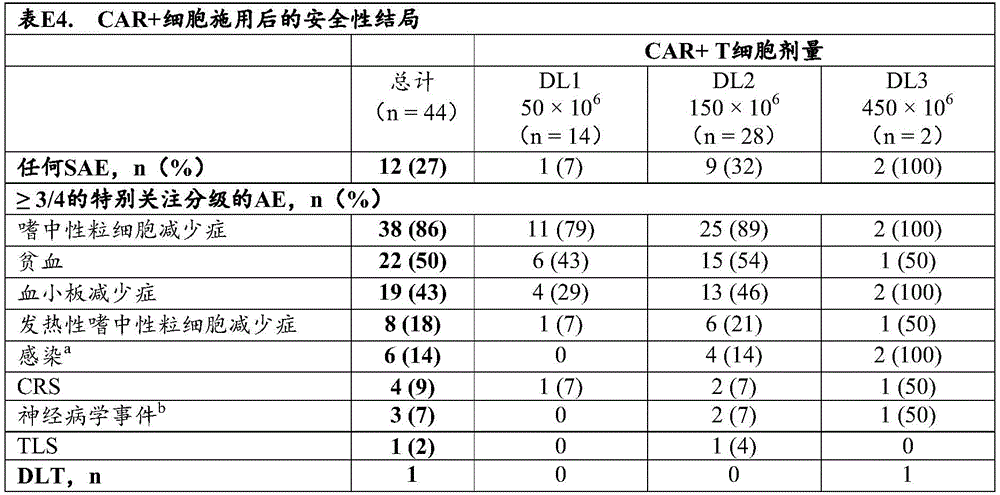
CRS, cytokine release syndrome; DLT, dose limiting toxicity; SAE, severe adverse events; AESI, adverse events of particular concern.
a Pneumonia, appendicitis, campylobacter infection, cellulitis, and septicemia.
b Confusion, agitation, absence of reflexes, lethargy, and a state of consciousness loss.
One subject in the DL3 cohort developed a DLT with CRS class 4 with a history of chronic renal disease associated with myeloma, neurological events with confusion of consciousness, and klebsiella pneumoniae sepsis lacking in the form of pharyngeal reflex, acute renal injury, and nosocomial infection, and died on day 19 after CAR + T cell administration.
Table E5 shows the safety outcome for all, DL1, DL2 and DL3 cohorts in terms of CRS and neurological events. Neurological events are usually associated with CRS. Grade 1 or 2 CRS occurred in 71% of all subjects, while grade 3 or higher CRS was observed in only 9% of all subjects. One subject experienced grade 4 reflex-free neurological events. One subject with CRS event required high dose vasopressors.


CRS, cytokine release syndrome.
With respect to prolonged cytopenia, for example, grade 3 or 4 anemia and thrombocytopenia occur in 18% of subjects prior to the initiation of lymphodepleting chemotherapy, as determined from laboratory evaluations. A28/42 subjects (67%) developed grade 3 or grade 4 cytopenia lasting more than 29 days. At a follow-up visit of 3 months, 17/24 subjects (71%) had a regression of cytopenia to grade ≦ 2 at month 3. In some cases, the median time to regression was 2.1 months for neutropenia, 2.2 months for anemia and 3.4 months for thrombocytopenia, where in some cases regression was defined as grade 2 or lower without transfusion within 1 week of laboratory assessment or without growth factor support within 1 week of laboratory assessment (pefilgrastim, 2 weeks).
Objective Response Rate (ORR) based on best overall response among all, DL1, DL2 and DL3 groups) Shown in fig. 1. In all subjects, 82% ORR was observed, with 48% of subjects exhibiting better response than VGPR. 5x10 at the lowest dose level 7 A Complete Response (CR) rate of 43% was observed in individual total CAR expressing T cells (DL 1). One subject in the DL3 group failed to evaluate efficacy due to the lack of post-baseline response assessment on day 29. Table E6 shows the results of Minimal Residual Disease (MRD) assessment by Next Generation Sequencing (NGS) in 21 subjects who could be evaluated for MRD.

The assessment of the time-dependent response of subjects in the DL1 group at the longest follow-up after CAR-expressing T cells (n = 14) administration is shown in figure 2. Typically, a continued improvement in response over time was observed, with five (5) (36%) of 14 subjects showing a boost in response after day 29. Six (6) of nine (9) subjects undergoing MRD assessment were MRD negative (as assessed by NGS) at day 29, with one subject undergoing MRD assessment at month 2.
C. Durability
CAR + The expansion and long-term persistence of T cells in the peripheral blood of subjects in the DL1, DL2 and DL3 cohorts is shown in figure 3. Results were correlated with CAR observed at all dose levels (DL 1, DL2, and DL 3) + Robust expansion of T cells was consistent. Generally, when more than or equal to 150x10 is applied 6 In subjects at doses of total CAR expressing T cells (DL 2 and DL 3), an increased persistence was observed over the past 2 months.
D. Soluble BCMA
Levels of soluble BCMA (sBCMA) in the serum (ng/mL) of subjects at various time points before and after CAR + T cell administration are shown in figure 4A. Figure 4B shows sBCMA levels prior to CAR + T cell administration (before treatment) in subjects exhibiting PR or better overall response (responders) and in subjects exhibiting worse response than PR (MR or SD; non-responders). A response was observed across a broad range of sBCMA levels in subjects, and the response or lack thereof was independent of sBCMA levels. A decrease in sBCMA levels was observed following anti-BCMA CAR administration, consistent with tumor killing activity of anti-BCMA CAR + cells. The results show that a greater reduction of sBCMA is observed on day 29 or later in subjects with PR or better overall response (PR, VGPR, CR or sCR; responder) compared to subjects with overall response worse than PR (MR or SD). The results are consistent with the observation that anti-BCMA CAR + T cells are not inhibited by high pre-treatment sbbcma levels.
E. Conclusion
The results are consistent with the following observations: high Overall Response Rate (ORR) (82%) in response to administration of anti-BCMA CAR + cells that express the fully human antigen binding domain and are generated by a manufacturing process that produces a population enriched for central memory T cell phenotypes is high in subjects with relapsed/refractory multiple myeloma (R/R MM) who are subject to massive pretreatment (77% of subjects have high risk cytogenetics). Robust expansion of the administered cells was observed at all dose levels tested, and approximately 27% of subjects achieved Complete Response (CR) or strict complete response (sCR), with a general observation of a potentiation of response over time. At the lowest dose level administered (50X 10) 6 Individual CAR + T cells) a 43% high ratio of CR and sCR was observed. The results are also consistent with manageable toxicity profiles, including low rates of grade 3 or higher CRS (9%) and grade 3 or higher neurological events (7%). Grade 1 or 2 CRS was observed in approximately 71% of subjects, and grade 1 or 2 neurological events were observed in 18% of subjects. The results also show that anti-BCMA CAR + T cells show activity in subjects with high soluble BCMA levels prior to treatment.
Example 4: administering anti-BCMA CAR-expressing cells to relapsed or refractory Multiple Myeloma (MM) subjects
Followed by further evaluation of reaction and safety outcomes
Response and safety outcomes were assessed in patients at subsequent time points in the clinical studies described in examples 2 and 3, with some additional subjects receiving different doses of cells.
A. Subjects and treatments
The analysis of the time points presented in this example was based on the evaluation of a total of 51 subjects who had been administered anti-BCMA CAR expressing cells. The 51 subjects were adult subjects with relapsed or refractory (R/R) Multiple Myeloma (MM) who had received failed 3 or more prior treatments (the 3 or more prior treatments included at least (1) autologous stem cell transplantation, (2) a proteasome inhibitor, (3) an immunomodulator, and/or (4) an anti-CD 38 monoclonal antibody, in each case except that the subjects were not candidates for such treatment (e.g., by contraindication).
On day 1, the subject was administered a dose of CAR + T cells as follows: containing 3.0x10 of 8 Single dose level of 2A (DL 2A), containing 4.5x10 of total CAR + T cells 8 Single dose of dose level 3 (DL 3), or containing 6.0x10 of total CAR + T cells 8 Single dose level of 3A (DL 3A) of total CAR + T cells. Subjects were monitored and responses assessed as described in examples 2 and 3 above.
B. Safety and outcome of response after treatment
At the time of evaluation, 51 subjects had received anti-BCMA CAR expressing cells of DL2A (n = 19), DL3 (n = 19) and DL3A (n = 13). Median age 61 years (33-77 years); median time from diagnosis was 7.0 (1.7-23.6) years; and subjects underwent a median of 6 (3-18) previous regimens. Overall, 92% of subjects had 2 immunomodulator therapies, 2 proteasome inhibitor therapies, and anti-CD 38 monoclonal antibody therapies, 92% of subjects had prior Autologous Stem Cell Transplantation (ASCT), and 96% of subjects were refractory to the last therapy; 61% of subjects underwent bridge therapy (77% of subjects were refractory to bridge therapy). Two subjects had dose-limiting toxicity: grade 3 Neurological Events (NEs) continued for more than 7 days under DL2A and grade 4 neutropenia continued for >28 days under DL 3. One subject developed grade 5 cardiac arrest not associated with steroid-induced myopathy (as a contributing factor) at 53 days post-infusion. 2% of subjects developed Cytokine Release Syndrome (CRS) grade 3/4 (any grade, 92%); median time to onset and median time to regression were 2 (1-4) days and 3 (1-10) days, respectively. 4% of the subjects developed grade 3/4 NE (any grade, 10%). Median time to onset and median time to regression were 6 (1-6) days and 5 (2-8) days, respectively. CRS/NE was treated with tollizumab and/or steroids (78%), anakinra (14%) and/or vasopressors (6%). On day 29, 21%, 55% and 44% of subjects developed grade 3 or higher anemia, neutropenia and thrombocytopenia (median time to any cytopenia that resolved to grade 2 or lower is ≦ 2.1 months). Grade 3 or higher infections occurred in 14% of subjects. The response of a total of 44 subjects was evaluated as shown in table E7. The median PFS was not reached. Robust cell expansion was observed at all dose levels.

For DL2A, DL3A and all, a n =19, 13 and 51.
C. Conclusion
The results are consistent with the following observations: in response to application of 3.0x10 8 、4.5x10 8 Or 6.0x10 8 Manageable safety and high response rates of individual total anti-BCMA CAR + T cells, with an Objective Response Rate (ORR) of 91%, and Complete Response (CR) or strict CR (sCR) achieved in 39% of subjects. An increase in the response over time was observed.
Example 5: prophylactic administration of interleukin-1 receptor to relapsed or refractory Multiple Myeloma (MM) subjects
Antagonist (IL-1 Ra) and administration of anti-BCMA CAR expressing cells
Prophylactic administration of interleukin-1 receptor antagonist (IL-1 Ra) Anakinra (AKR) to human subjects suffering from relapsed and/or refractory Multiple Myeloma (MM) administered a Chimeric Antigen Receptor (CAR) expressing T cell composition containing autologous T cells expressing a CAR specific for B Cell Maturation Antigen (BCMA) to assess the effects on the onset, incidence and severity of potential events, such as Cytokine Release Syndrome (CRS).
Compositions containing autologous T cells were engineered to express an exemplary CAR specific for BCMA (described in example 1 above) and administered to adult subjects with relapsed or refractory (R/R) Multiple Myeloma (MM) who had received 3 or more prior treatments.
The administered T cell composition is produced by a process generally as described in example 2 above. The CAR comprises a BCMA-55 derived scFv binding domain, a modified IgG derived C H 2-C H A 3-hinge spacer, a CD28 transmembrane domain, and an intracellular signaling region (comprising a 4-1BB endodomain and a CD3 ζ endodomain in tandem), wherein the polynucleotide encoding the CAR is optimized, as described in example 1.
Two to seven days prior to CAR + T cell infusion, subjects received fludarabine (flu, 30 mg/m) 2 Day) and cyclophosphamide (Cy, 300 mg/m) 2 Day)/day) of lymphodepleting chemotherapy (LDC) for 3 days, LDC completed at least 48 hours prior to CAR + T cell infusion. The cell composition is administered intravenously, with the day of infusion designated as day 1. On day 1, the following doses of CAR + T cells were administered to the subject: containing 4.5x10 8 Single dose of dose level 3 (DL 3) or containing 6.0x10 of total CAR + T cells 8 Single dose level of 3A (DL 3A) of total CAR + T cells. Specifically, in the study described in this example, fourteen patients were administered a composition containing 6.0X10 8 Single dose of total CAR + T cells.
Subjects received 2 doses of 100mg AKR administered Subcutaneously (SC) prior to CAR + T cell infusion: one dose was administered at night before administration of anti-BCMA CAR expressing cells and one dose was administered 3 hours before administration of anti-BCMA CAR expressing cells on day 1 (n = 14). After administration of anti-BCMA CAR-expressing cells, the subject received four additional doses of AKR: a single dose of 100mg SC AKR is administered once daily for four consecutive days (one dose each on days 2-5; e.g., q24 h). In the case of CRS episode, 100mg SC AKR was administered twice daily (e.g., q12 h) until CRS subsided. The dose of AKR is administered at about the same time each day. In the case of CRS worsening and/or in the case of neurotoxic episodes, guidelines for toxicity management were followed. All subjects receiving eligible anti-BCMA CAR-expressing T cell products and receiving at least 1 dose of prophylactic AKR were evaluated for safety and tolerability of anti-BCMA CAR-expressing T cells following prophylactic treatment with anakinra.
Subjects administered anti-BCMA CAR expressing cells but not treated with AKR were used as control group (n = 19). Median numbers of previous regimens were 6 and 5 in the AKR-treated and non-AKR-treated groups, respectively, and 57% and 68% of subjects used bridging therapy, respectively.
The incidence and onset of Cytokine Release Syndrome (CRS), neurological Events (NE), expansion and persistence (e.g., pharmacokinetics) of CAR-expressing cells in the blood of the subject, and response to CAR-expressing T-cell therapy (including Objective Response Rate (ORR), complete Response (CR) rate, or strict complete response (sCR) rate) as ranked by Lee (2014) criteria were determined according to IMWG uniform response criteria. Median follow-up range for AKR treated subjects was 3.0 (1.8-6.2) months; for control subjects, the median follow-up range was 8.8 (5.3-12.2) months. The results are shown in fig. E8.
It was observed that the use of AKR prevention had no adverse effect on NE, infection, macrophage activation syndrome/hemophagocytic lymphohistiocytosis (MAS/HLH), CAR + T cell expansion or incidence of disease response. In particular, the overall frequency of CRS was similar in both groups of subjects, but fewer CRS class 2 events in AKR-treated subjects; relative risk (95%CI) =0.54 (0.21, 1.38). Neither group observed a grade 3 or higher CRS event. The incidence of Neurological Events (NE), grade 3 or higher infections and MAS/HLH between these two groups was also similar. The use of tollizumab and steroids is numerically lower in AKR treated subjects. The CAR + T cell expansion kinetics in both groups were similar. Efficacy was assessed in all subjects at two months, with an Overall Response Rate (ORR) of 100% in subjects treated with AKR and 95% in control subjects.

CRS: cytokine release syndrome; g: grading; HLH: hemophagocytic lymphohistiocytosis; LDH: a lactate dehydrogenase; MAS: macrophage activation syndrome; NE: a neurological event; s: a steroid; t: (ii) toclizumab; ULN: the upper limit of normal.
These results are consistent with the following findings: anakinra prophylaxis in combination with administration of anti-BCMA CAR expressing T cells can reduce the incidence of grade 2 or higher CRS.
Example 6: relapsed or refractory multiple myeloma treated previously with BCMA targeted therapy against MM
(MM) administration of anti-BCMA CAR-expressing cells to a subject
A Chimeric Antigen Receptor (CAR) -expressing T cell composition containing autologous T cells expressing CARs specific for B Cell Maturation Antigen (BCMA) is administered to a human subject with relapsed and/or refractory Multiple Myeloma (MM) who has previously received prior BCMA-directed therapy.
An adult subject with relapsed or refractory (R/R) Multiple Myeloma (MM) who has received prior BCMA-directed therapy for MM, achieved at least Partial Response (PR) according to IMWG response criteria, and subsequently progressed, is administered a composition containing autologous T cells engineered to express an exemplary CAR specific for BCMA (described in example 1 above). Previous BCMA-directed therapies may include BCMA-directed CAR-expressing T cell therapies; BCMA-directed T cell cement (TCE) comprising an antibody that binds both a surface tumor cell antigen and a component of a T Cell Receptor (TCR) complex to induce T cell-mediated killing of tumor cells bearing the surface antigen of interest; and BCMA-directed antibody-drug conjugates (ADCs). For subjects who have received prior BCMA-directed CAR-expressing T cell therapy, the last prior administration of CAR T cell therapy must be received at least 6 months prior to the start of the study. Subjects who have received prior BCMA directed antimyeloma therapy need not receive at least 3 prior antimyeloma treatment regimens nor need to be refractory to the last antimyeloma treatment regimen.
The administered T cell composition is produced by a process generally as described in example 2 above. In some cases, a subject is assessed for the presence or expression of a prior BCMA-directed CAR in a primary T cell population (e.g., obtained from a leukapheresis sample) of the subject that has received a prior BCMA-directed CAR expressing T cell therapy, for example, by flow cytometry staining with recombinant BCMA-Fc (soluble human BCMA fused at its C-terminus to the Fc region of IgG), and/or by quantitative Polymerase Chain Reaction (PCR) with primers or probes specific for sequences present in a construct containing a nucleic acid sequence encoding a prior BCMA-directed CAR. A BCMA binding CAR (e.g., a novel BCMA binding CAR) for use in the therapy comprises a BCMA-55 derived scFv binding domain, a modified IgG derived CH2-CH 3-hinge spacer, a CD28 transmembrane domain, and an intracellular signaling region (comprising a 4-1BB endodomain and a CD3 zeta endodomain in series), wherein the polynucleotide encoding the CAR is optimized, as described in example 1.
In some cases, the presence, amount, or quantity of a previous BCMA-directed CAR and/or a BCMA-binding CAR for cell therapy (e.g., a novel BCMA-binding CAR; described in example 1) in a cell composition generated for administration (e.g., expressing a BCMA-binding CAR described in example 1) is assessed for subjects who have received a previous BCMA-directed CAR expressing T cell therapy. In some cases, the presence, amount, or quantity of prior BCMA-directed CAR expressing cells as well as BCMA binding CARs for cell therapy (e.g., novel BCMA binding CARs) expressing cells can be detected by flow cytometry staining with recombinant BCMA-Fc. In some cases, the presence, amount, or number of cells expressing a BCMA binding CAR for cell therapy (e.g., a novel BCMA binding CAR) can be detected by flow cytometry staining with an anti-idiotypic antibody specific for a BCMA binding CAR for cell therapy (e.g., a novel BCMA binding CAR). In some cases, the presence of a BCMA binding CAR for cell therapy (e.g., a novel BCMA binding CAR) is also assessed by qPCR with primers or probes specific for sequences present in a construct containing a nucleic acid sequence encoding a BCMA binding CAR for cell therapy (e.g., a novel BCMA binding CAR). Any such amount or quantity can be used to determine the presence and/or proportion of a prior BCMA-directed CAR present in a cell composition for administration, and/or to determine the dose of cells expressing BCMA binding CAR for cell therapy.
Two to seven days prior to CAR + T cell infusion, subjects received fludarabine (flu, 30 mg/m) 2 One day) and cyclophosphamide (Cy, 300 mg/m) 2 Day) lymphodepleting chemotherapy (LDC) for 3 days, LDC was completed at least 48 hours prior to CAR + T cell infusion. The cell composition is administered intravenously, with the day of infusion designated as day 1. On day 1, the subject was administered a dose of CAR + T cells as follows: containing 5x10 7 A single dose level 1 (DL 1) of individual total CAR + T cells; containing 1.5x10 8 A single dose level of 2 (DL 2) of total CAR + T cells; containing 3.0x10 of 8 A dose level of 2A (DL 2A) for a single dose of total CAR + T cells; containing 4.5x10 8 A single dose level of 3 (DL 3) of total CAR + T cells; or contains 6.0x10 8 Single dose level of 3A (DL 3A) for each total CAR + T cell.
Responses to CAR expressing T cell therapy were determined according to IMWG uniform response criteria, including Objective Response Rate (ORR), complete Response (CR) rate, or strict complete response (sCR) rate. The incidence and severity of Adverse Events (AEs) and the incidence and severity of laboratory abnormalities were also determined.
Example 7: evaluation of T cell compositions produced by exemplary manufacturing Processes
In an exemplary procedure, 50 CAR + T cell compositions containing autologous T cells expressing anti-BCMA CARs were generated from apheresis (one per subject) collected from 50 individual human subjects, including 10 healthy donors and 40 multiple myeloma patients. CD4+ and CD8+ T cells were selected from the apheresis samples and cryopreserved separately. The cells were then thawed and individual CD4+ T cells and CD8+ T cells were combined at a ratio of live CD4+ to CD8+ cells of 1. The combined CD4+ and CD8+ T cells were stimulated, transduced and expanded with CAR-encoding vectors in exemplary serum-free media, and frozen by cryopreservation, generally as described in example 2.
In an exemplary alternative process, the therapeutic T cell composition is produced by a process comprising selecting T cells based on immunoaffinity from a leukapheresis sample from a 55 list of exclusively human cancer subjects. The mixed T cells were activated and transduced with a viral vector encoding the CAR, expanded and cryopreserved.
Cells in the frozen compositions were thawed and their viability, expression of apoptosis markers such as active caspase 3 (CAS), and surface expression of CD3, CD4, CD8, CD27, CD28, CCR7, CD45RA, and CAR were assessed by flow cytometry. The percentage of CD3+ cells, the percentage of CAR + apoptotic marker negative cells in CD3+ CAR + cells in the composition, and the percentage of central memory CD4+ CAR + cells and central memory CD8+ CAR + cells in the composition were determined. The cellular phenotype of the cellular composition produced by the manufacturing process is assessed and, in some aspects, compared to the cellular phenotype of the cellular composition produced by an alternative process.
The manufacturing process of this embodiment produces an engineered cellular composition that satisfies certain predetermined characteristics, including a threshold number of CAR-expressing cells in the cellular composition administered to the patient, in 100% of a human biological sample undergoing the manufacturing process. Figures 5A and 5B show the median (horizontal line), interquartile (box) and 1.5x interquartile (whiskers) of the percentages of cells in the composition that were in CD4+ CAR + cells (figure 5A) and in CD8+ CAR + cells (figure 5B) of the phenotype shown (based on CD45RA and CCR7 surface expression), respectively, for compositions generated from a sample group of 40 multiple myeloma subjects alone. Figures 5C and 5D show the median (horizontal line), interquartile (box) and 1.5x interquartile (whiskers) of the percentages of cells in the composition that were in CD4+ CAR + cells (figure 5C) and in CD8+ CAR + cells (figure 5D), respectively, of the phenotype shown (based on CD27 and CD28 surface expression) for the compositions generated by the sample groups of 40 multiple myeloma subjects alone. Using this exemplary process to generate engineered cell compositions from individual leukopheresis samples obtained from a series of multiple myeloma patients, it was observed that the duration of the portion of the process from the start of activation to harvest ranged between 7 and 10 days, and the average duration between these samples was approximately 7.5 days. It was further determined that the average cumulative population doubling over the course was about 7.5 between different samples.
In this study, the population of engineered T cells in the cell composition produced by the exemplary process included less than 15% of cells expressing the apoptosis marker and was enriched for the central memory phenotype as compared to the starting sample and to the cell composition produced using the exemplary alternative process.
The present invention is not intended to be limited in scope by the specific embodiments disclosed, which are presented, for example, to illustrate various aspects of the invention. Various modifications to the compositions and methods will be apparent from the description and teachings herein. Such variations may be practiced without departing from the true scope and spirit of the disclosure, and are intended to fall within the scope of the disclosure.
Sequence of


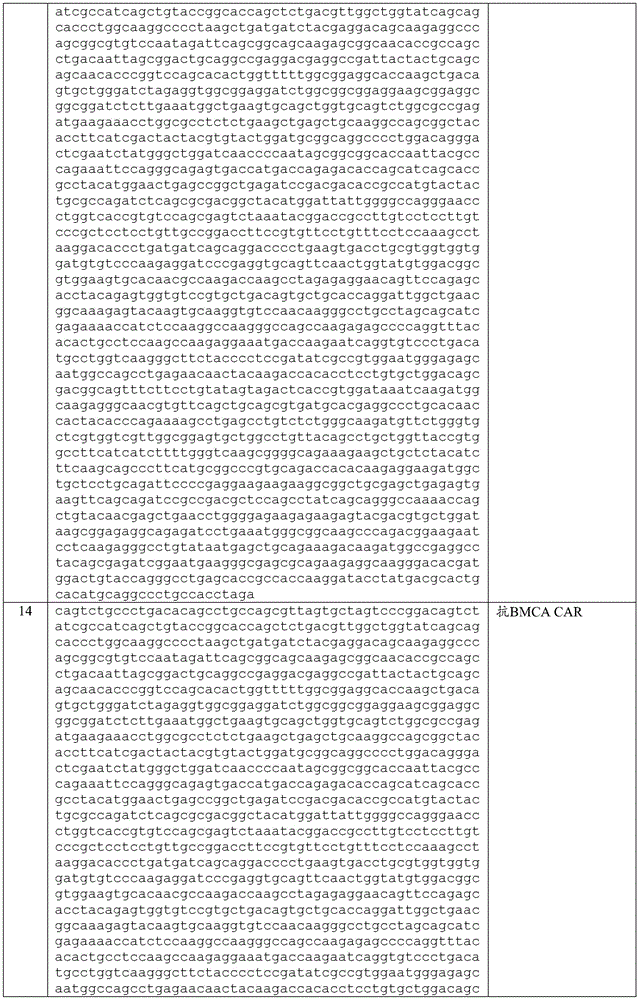


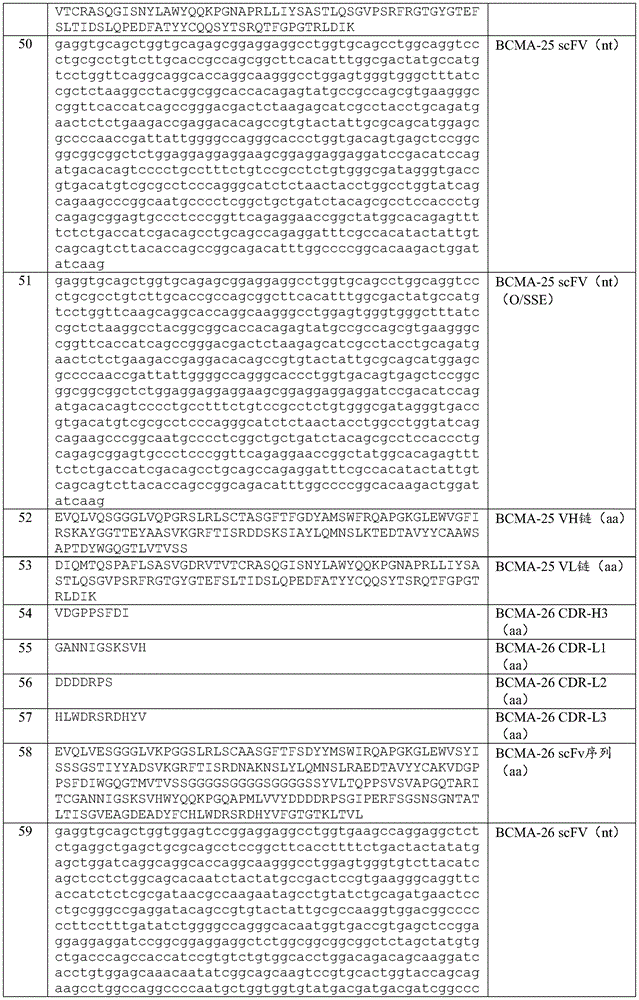
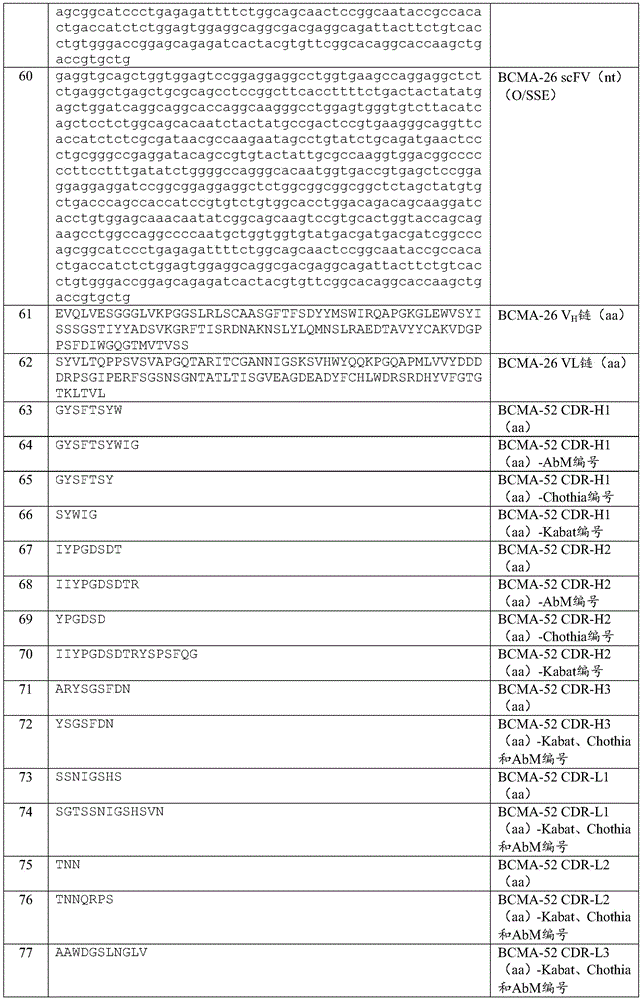


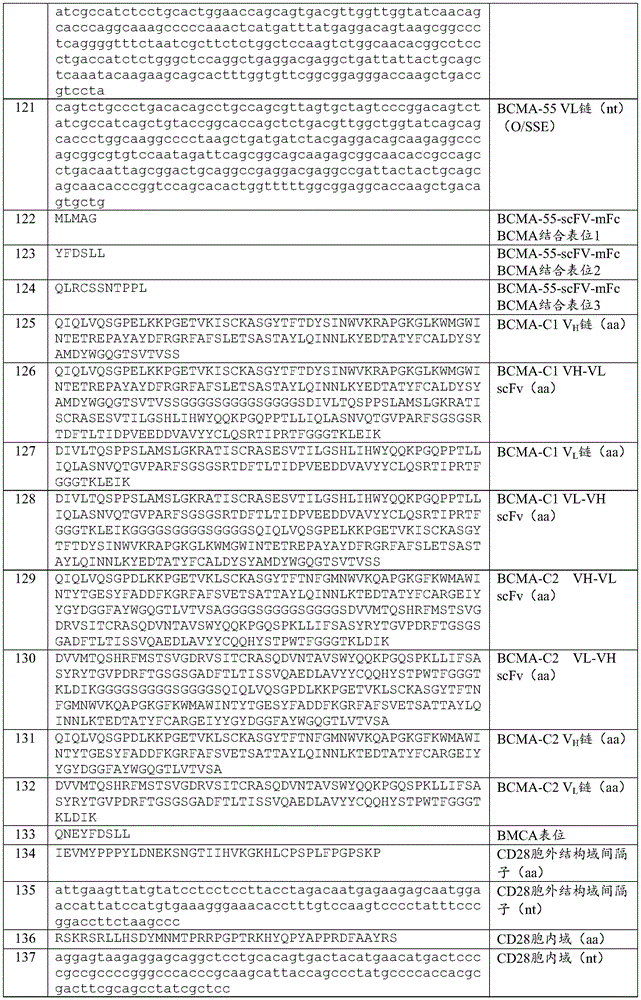


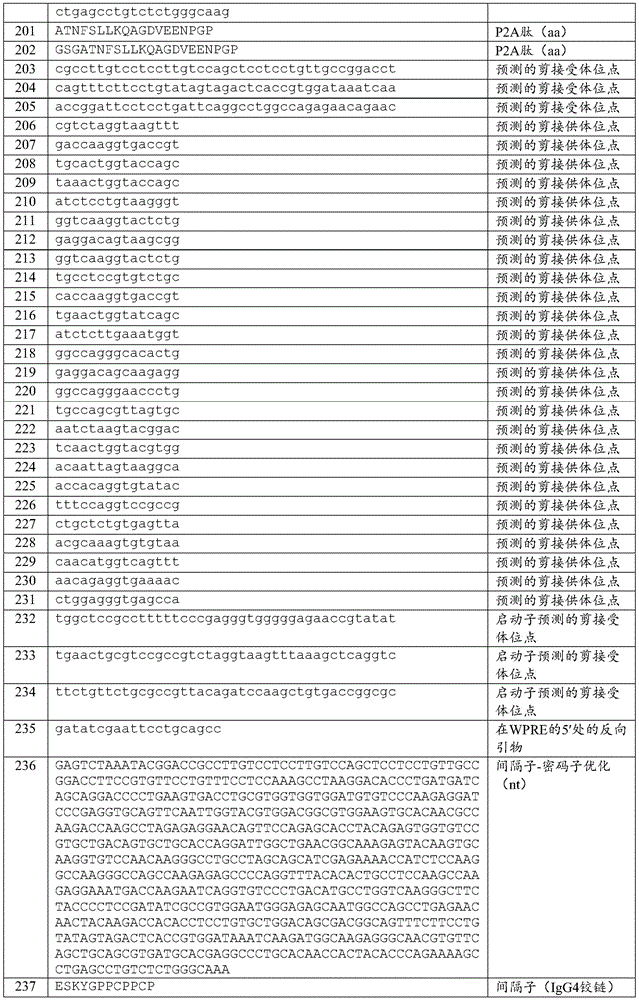


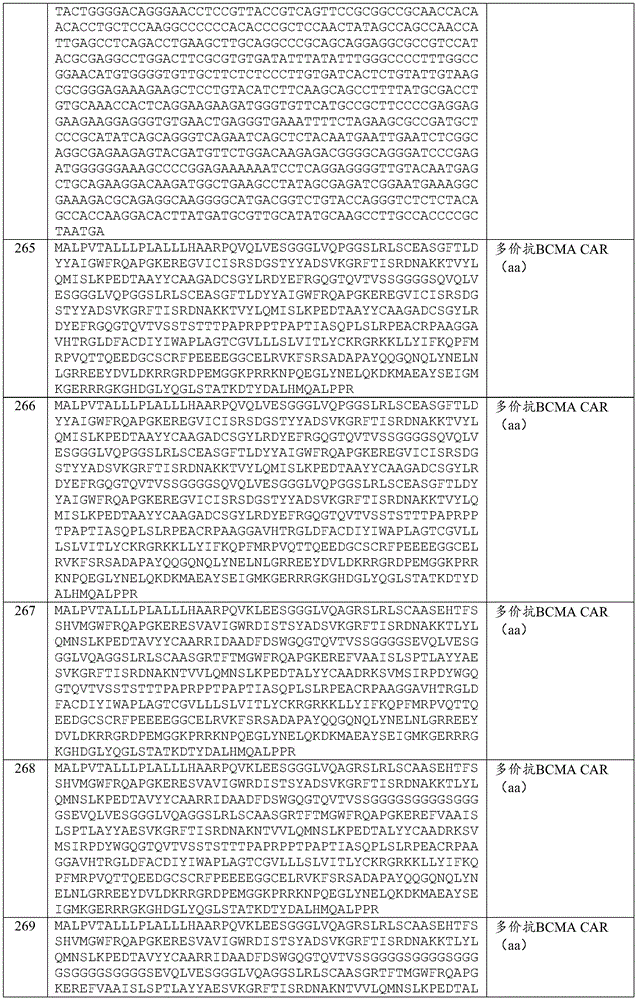


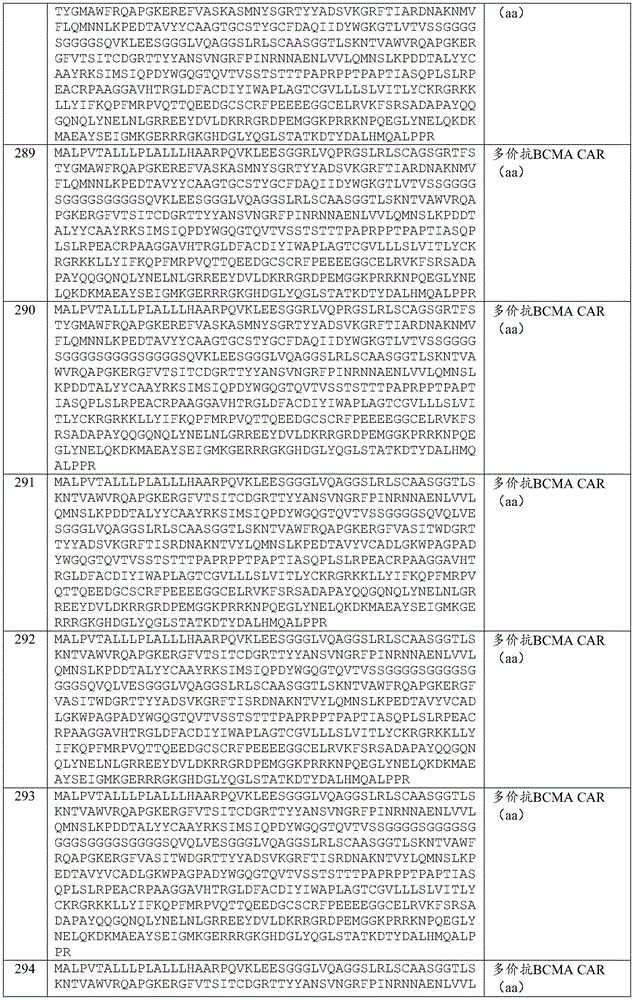


Sequence listing
<110> Zhununo therapeutics GmbH
<120> methods and uses related to cell therapy engineered with chimeric antigen receptors targeting B cell maturation antigens
<130> 735042023640
<140> not yet allocated
<141> simultaneous concurrent commit
<150> 63/008,564
<151> 2020-04-10
<160> 312
<170> FastSEQ version 4.0 for Windows
<210> 1
<211> 15
<212> PRT
<213> Artificial sequence
<220>
<223> (4 GS) 3 linker
<400> 1
Gly Gly Gly Gly Ser Gly Gly Gly Gly Ser Gly Gly Gly Gly Ser
1 5 10 15
<210> 2
<211> 4
<212> PRT
<213> Artificial sequence
<220>
<223> 3GS joint
<400> 2
Gly Gly Gly Ser
1
<210> 3
<211> 41
<212> DNA
<213> Artificial sequence
<220>
<223> predicted splice acceptor site of 4-1BB/CD3 ζ
<400> 3
gctgagagtc aagttttcca ggtccgccga cgctccagcc t 41
<210> 4
<211> 42
<212> PRT
<213> Artificial sequence
<220>
<223> 4-1 BB-derived intracellular co-signaling sequences
<400> 4
Lys Arg Gly Arg Lys Lys Leu Leu Tyr Ile Phe Lys Gln Pro Phe Met
1 5 10 15
Arg Pro Val Gln Thr Thr Gln Glu Glu Asp Gly Cys Ser Cys Arg Phe
20 25 30
Pro Glu Glu Glu Glu Gly Gly Cys Glu Leu
35 40
<210> 5
<211> 126
<212> DNA
<213> Artificial sequence
<220>
<223> 4-1 BB-derived intracellular co-signaling sequence
<400> 5
aagcggggga gaaagaaact gctgtatatt ttcaaacagc cctttatgag acctgtgcag 60
actacccagg aggaagacgg atgcagctgt aggtttcccg aggaagagga aggaggctgt 120
gagctg 126
<210> 6
<211> 126
<212> DNA
<213> Artificial sequence
<220>
<223> 4-1 BB-derived intracellular co-signaling sequence
<400> 6
aagcggggca gaaagaagct gctctacatc ttcaagcagc ccttcatgcg gcccgtgcag 60
accacacaag aggaagatgg ctgctcctgc agattccccg aggaagaaga aggcggctgc 120
gagctg 126
<210> 7
<211> 5
<212> PRT
<213> Artificial sequence
<220>
<223> 4GS linker
<400> 7
Gly Gly Gly Gly Ser
1 5
<210> 8
<211> 684
<212> DNA
<213> Artificial sequence
<220>
<223> alternative CO/SSE spacer
<400> 8
gaatctaagt acggaccgcc ttgtcctcct tgtcccgctc ctcctgttgc cggaccttcc 60
gtgttcctgt ttcctccaaa gcctaaggac accctgatga tcagcaggac ccctgaagtg 120
acctgcgtgg tggtggatgt gtcccaagag gatcccgagg tgcagttcaa ctggtatgtg 180
gacggcgtgg aagtgcacaa cgccaagacc aagcctagag aggaacagtt ccagagcacc 240
tacagagtgg tgtccgtgct gacagtgctg caccaggatt ggctgaacgg caaagagtac 300
aagtgcaagg tgtccaacaa gggcctgcct agcagcatcg agaaaaccat ctccaaggcc 360
aagggccagc caagagagcc ccaggtttac acactgcctc caagccaaga ggaaatgacc 420
aagaatcagg tgtccctgac atgcctggtc aagggcttct acccctccga tatcgccgtg 480
gaatgggaga gcaatggcca gcctgagaac aactacaaga ccacacctcc tgtgctggac 540
agcgacggca gtttcttcct gtatagtaga ctcaccgtgg ataaatcaag atggcaagag 600
ggcaacgtgt tcagctgcag cgtgatgcac gaggccctgc acaaccacta cacccagaaa 660
agcctgagcc tgtctctggg caag 684
<210> 9
<211> 1959
<212> DNA
<213> Artificial sequence
<220>
<223> anti-BMCA CAR
<400> 9
gaggtgcagc tggtggagtc cggaggaggc ctggtgaagc caggaggctc cctgaggctg 60
tcttgcgcag ccagcggctt cacctttagc gactactata tgtcctggat cagacaggca 120
cctggcaagg gcctggagtg ggtgagctac atcagctcct ctggctccac aatctactat 180
gccgactctg tgaagggccg gtttaccatc agcagagata acgccaagaa ttccctgtat 240
ctgcagatga acagcctgag ggccgaggac acagccgtgt actattgcgc caaggtggac 300
ggcgattaca ccgaggatta ttggggccag ggcacactgg tgaccgtgag ctccggcggc 360
ggcggctctg gaggaggagg cagcggcgga ggaggctccc agtctgccct gacacagcca 420
gccagcgtgt ccggctctcc cggacagtcc atcacaatct cttgtaccgg ctctagctcc 480
gacgtgggca agtacaacct ggtgtcctgg tatcagcagc cccctggcaa ggcccctaag 540
ctgatcatct acgatgtgaa caagaggcca tctggcgtga gcaatcgctt cagcggctcc 600
aagtctggca ataccgccac actgaccatc agcggcctgc agggcgacga tgaggcagat 660
tactattgtt ctagctacgg cggcagcaga tcctacgtgt tcggcacagg caccaaggtg 720
accgtgctgg aatctaagta cggaccgcct tgtcctcctt gtcccgctcc tcctgttgcc 780
ggaccttccg tgttcctgtt tcctccaaag cctaaggaca ccctgatgat cagcaggacc 840
cctgaagtga cctgcgtggt ggtggatgtg tcccaagagg atcccgaggt gcagttcaac 900
tggtatgtgg acggcgtgga agtgcacaac gccaagacca agcctagaga ggaacagttc 960
cagagcacct acagagtggt gtccgtgctg acagtgctgc accaggattg gctgaacggc 1020
aaagagtaca agtgcaaggt gtccaacaag ggcctgccta gcagcatcga gaaaaccatc 1080
tccaaggcca agggccagcc aagagagccc caggtttaca cactgcctcc aagccaagag 1140
gaaatgacca agaatcaggt gtccctgaca tgcctggtca agggcttcta cccctccgat 1200
atcgccgtgg aatgggagag caatggccag cctgagaaca actacaagac cacacctcct 1260
gtgctggaca gcgacggcag tttcttcctg tatagtagac tcaccgtgga taaatcaaga 1320
tggcaagagg gcaacgtgtt cagctgcagc gtgatgcacg aggccctgca caaccactac 1380
acccagaaaa gcctgagcct gtctctgggc aagatgttct gggtgctcgt ggtcgttggc 1440
ggagtgctgg cctgttacag cctgctggtt accgtggcct tcatcatctt ttgggtcaag 1500
cggggcagaa agaagctgct ctacatcttc aagcagccct tcatgcggcc cgtgcagacc 1560
acacaagagg aagatggctg ctcctgcaga ttccccgagg aagaagaagg cggctgcgag 1620
ctgagagtga agttcagcag atccgccgac gctccagcct atcagcaggg ccaaaaccag 1680
ctgtacaacg agctgaacct ggggagaaga gaagagtacg acgtgctgga taagcggaga 1740
ggcagagatc ctgaaatggg cggcaagccc agacggaaga atcctcaaga gggcctgtat 1800
aatgagctgc agaaagacaa gatggccgag gcctacagcg agatcggaat gaagggcgag 1860
cgcagaagag gcaagggaca cgatggactg taccagggcc tgagcaccgc caccaaggat 1920
acctatgacg cactgcacat gcaggccctg ccacctaga 1959
<210> 10
<211> 1950
<212> DNA
<213> Artificial sequence
<220>
<223> anti-BMCA CAR
<400> 10
gaggtgcagc tggtgcagag cggaggaggc ctggtgcagc ctggcaggtc cctgcgcctg 60
tcttgcaccg ccagcggctt cacatttggc gactatgcca tgtcctggtt caagcaggca 120
ccaggcaagg gcctggagtg ggtgggcttt atccgctcta aggcctacgg cggcaccaca 180
gagtatgccg ccagcgtgaa gggccggttc accatcagcc gggacgactc taagagcatc 240
gcctacctgc agatgaactc tctgaagacc gaggacacag ccgtgtacta ttgcgcagca 300
tggagcgccc caaccgatta ttggggccag ggcaccctgg tgacagtgag ctccggcggc 360
ggcggctctg gaggaggagg aagcggagga ggaggatccg acatccagat gacacagtcc 420
cctgcctttc tgtccgcctc tgtgggcgat agggtgaccg tgacatgtcg cgcctcccag 480
ggcatctcta actacctggc ctggtatcag cagaagcccg gcaatgcccc tcggctgctg 540
atctacagcg cctccaccct gcagagcgga gtgccctccc ggttcagagg aaccggctat 600
ggcacagagt tttctctgac catcgacagc ctgcagccag aggatttcgc cacatactat 660
tgtcagcagt cttacaccag ccggcagaca tttggccccg gcacaagact ggatatcaag 720
gagtctaaat acggaccgcc ttgtcctcct tgtcccgctc ctcctgttgc cggaccttcc 780
gtgttcctgt ttcctccaaa gcctaaggac accctgatga tcagcaggac ccctgaagtg 840
acctgcgtgg tggtggatgt gtcccaagag gatcccgagg tgcagttcaa ctggtatgtg 900
gacggcgtgg aagtgcacaa cgccaagacc aagcctagag aggaacagtt ccagagcacc 960
tacagagtgg tgtccgtgct gacagtgctg caccaggatt ggctgaacgg caaagagtac 1020
aagtgcaagg tgtccaacaa gggcctgcct agcagcatcg agaaaaccat ctccaaggcc 1080
aagggccagc caagagagcc ccaggtttac acactgcctc caagccaaga ggaaatgacc 1140
aagaatcagg tgtccctgac atgcctggtc aagggcttct acccctccga tatcgccgtg 1200
gaatgggaga gcaatggcca gcctgagaac aactacaaga ccacacctcc tgtgctggac 1260
agcgacggca gtttcttcct gtatagtaga ctcaccgtgg ataaatcaag atggcaagag 1320
ggcaacgtgt tcagctgcag cgtgatgcac gaggccctgc acaaccacta cacccagaaa 1380
agcctgagcc tgtctctggg caagatgttc tgggtgctcg tggtcgttgg cggagtgctg 1440
gcctgttaca gcctgctggt taccgtggcc ttcatcatct tttgggtcaa gcggggcaga 1500
aagaagctgc tctacatctt caagcagccc ttcatgcggc ccgtgcagac cacacaagag 1560
gaagatggct gctcctgcag attccccgag gaagaagaag gcggctgcga gctgagagtg 1620
aagttcagca gatccgccga cgctccagcc tatcagcagg gccaaaacca gctgtacaac 1680
gagctgaacc tggggagaag agaagagtac gacgtgctgg ataagcggag aggcagagat 1740
cctgaaatgg gcggcaagcc cagacggaag aatcctcaag agggcctgta taatgagctg 1800
cagaaagaca agatggccga ggcctacagc gagatcggaa tgaagggcga gcgcagaaga 1860
ggcaagggac acgatggact gtaccagggc ctgagcaccg ccaccaagga tacctatgac 1920
gcactgcaca tgcaggccct gccacctaga 1950
<210> 11
<211> 1953
<212> DNA
<213> Artificial sequence
<220>
<223> anti-BMCA CAR
<400> 11
gaggtgcagc tggtggagtc cggaggaggc ctggtgaagc caggaggctc tctgaggctg 60
agctgcgcag cctccggctt caccttttct gactactata tgagctggat caggcaggca 120
ccaggcaagg gcctggagtg ggtgtcttac atcagctcct ctggcagcac aatctactat 180
gccgactccg tgaagggcag gttcaccatc tctcgcgata acgccaagaa tagcctgtat 240
ctgcagatga actccctgcg ggccgaggat acagccgtgt actattgcgc caaggtggac 300
ggcccccctt cctttgatat ctggggccag ggcacaatgg tgaccgtgag ctccggagga 360
ggaggatccg gcggaggagg ctctggcggc ggcggctcta gctatgtgct gacccagcca 420
ccatccgtgt ctgtggcacc tggacagaca gcaaggatca cctgtggagc aaacaatatc 480
ggcagcaagt ccgtgcactg gtaccagcag aagcctggcc aggccccaat gctggtggtg 540
tatgacgatg acgatcggcc cagcggcatc cctgagagat tttctggcag caactccggc 600
aataccgcca cactgaccat ctctggagtg gaggcaggcg acgaggcaga ttacttctgt 660
cacctgtggg accggagcag agatcactac gtgttcggca caggcaccaa gctgaccgtg 720
ctggaatcta agtacggacc gccttgtcct ccttgtcccg ctcctcctgt tgccggacct 780
tccgtgttcc tgtttcctcc aaagcctaag gacaccctga tgatcagcag gacccctgaa 840
gtgacctgcg tggtggtgga tgtgtcccaa gaggatcccg aggtgcagtt caactggtat 900
gtggacggcg tggaagtgca caacgccaag accaagccta gagaggaaca gttccagagc 960
acctacagag tggtgtccgt gctgacagtg ctgcaccagg attggctgaa cggcaaagag 1020
tacaagtgca aggtgtccaa caagggcctg cctagcagca tcgagaaaac catctccaag 1080
gccaagggcc agccaagaga gccccaggtt tacacactgc ctccaagcca agaggaaatg 1140
accaagaatc aggtgtccct gacatgcctg gtcaagggct tctacccctc cgatatcgcc 1200
gtggaatggg agagcaatgg ccagcctgag aacaactaca agaccacacc tcctgtgctg 1260
gacagcgacg gcagtttctt cctgtatagt agactcaccg tggataaatc aagatggcaa 1320
gagggcaacg tgttcagctg cagcgtgatg cacgaggccc tgcacaacca ctacacccag 1380
aaaagcctga gcctgtctct gggcaagatg ttctgggtgc tcgtggtcgt tggcggagtg 1440
ctggcctgtt acagcctgct ggttaccgtg gccttcatca tcttttgggt caagcggggc 1500
agaaagaagc tgctctacat cttcaagcag cccttcatgc ggcccgtgca gaccacacaa 1560
gaggaagatg gctgctcctg cagattcccc gaggaagaag aaggcggctg cgagctgaga 1620
gtgaagttca gcagatccgc cgacgctcca gcctatcagc agggccaaaa ccagctgtac 1680
aacgagctga acctggggag aagagaagag tacgacgtgc tggataagcg gagaggcaga 1740
gatcctgaaa tgggcggcaa gcccagacgg aagaatcctc aagagggcct gtataatgag 1800
ctgcagaaag acaagatggc cgaggcctac agcgagatcg gaatgaaggg cgagcgcaga 1860
agaggcaagg gacacgatgg actgtaccag ggcctgagca ccgccaccaa ggatacctat 1920
gacgcactgc acatgcaggc cctgccacct aga 1953
<210> 12
<211> 1974
<212> DNA
<213> Artificial sequence
<220>
<223> anti-BMCA CAR
<400> 12
agctatgagc tgacacagcc tccaagcgcc tctggcacac ctggacagcg agtgacaatg 60
agctgtagcg gcaccagcag caacatcggc agccacagcg tgaactggta tcagcagctg 120
cctggcacag cccctaaact gctgatctac accaacaacc agcggcctag cggcgtgccc 180
gatagatttt ctggcagcaa gagcggcaca agcgccagcc tggctatttc tggactgcag 240
agcgaggacg aggccgacta ttattgtgcc gcctgggacg gctctctgaa cggccttgtt 300
tttggcggag gcaccaagct gacagtgctg ggatctagag gtggcggagg atctggcggc 360
ggaggaagcg gaggcggcgg atctcttgaa atggctgaag tgcagctggt gcagtctggc 420
gccgaagtga agaagcctgg cgagagcctg aagatcagct gcaaaggcag cggctacagc 480
ttcaccagct actggatcgg ctgggtccga cagatgcctg gcaaaggcct tgagtggatg 540
ggcatcatct accccggcga cagcgacacc agatacagcc ctagctttca gggccacgtg 600
accatcagcg ccgacaagtc tatcagcacc gcctacctgc agtggtccag cctgaaggcc 660
tctgacaccg ccatgtacta ctgcgccaga tactctggca gcttcgacaa ttggggccag 720
ggcacactgg tcaccgtgtc cagcgagtct aaatacggac cgccttgtcc tccttgtccc 780
gctcctcctg ttgccggacc ttccgtgttc ctgtttcctc caaagcctaa ggacaccctg 840
atgatcagca ggacccctga agtgacctgc gtggtggtgg atgtgtccca agaggatccc 900
gaggtgcagt tcaactggta tgtggacggc gtggaagtgc acaacgccaa gaccaagcct 960
agagaggaac agttccagag cacctacaga gtggtgtccg tgctgacagt gctgcaccag 1020
gattggctga acggcaaaga gtacaagtgc aaggtgtcca acaagggcct gcctagcagc 1080
atcgagaaaa ccatctccaa ggccaagggc cagccaagag agccccaggt ttacacactg 1140
cctccaagcc aagaggaaat gaccaagaat caggtgtccc tgacatgcct ggtcaagggc 1200
ttctacccct ccgatatcgc cgtggaatgg gagagcaatg gccagcctga gaacaactac 1260
aagaccacac ctcctgtgct ggacagcgac ggcagtttct tcctgtatag tagactcacc 1320
gtggataaat caagatggca agagggcaac gtgttcagct gcagcgtgat gcacgaggcc 1380
ctgcacaacc actacaccca gaaaagcctg agcctgtctc tgggcaagat gttctgggtg 1440
ctcgtggtcg ttggcggagt gctggcctgt tacagcctgc tggttaccgt ggccttcatc 1500
atcttttggg tcaagcgggg cagaaagaag ctgctctaca tcttcaagca gcccttcatg 1560
cggcccgtgc agaccacaca agaggaagat ggctgctcct gcagattccc cgaggaagaa 1620
gaaggcggct gcgagctgag agtgaagttc agcagatccg ccgacgctcc agcctatcag 1680
cagggccaaa accagctgta caacgagctg aacctgggga gaagagaaga gtacgacgtg 1740
ctggataagc ggagaggcag agatcctgaa atgggcggca agcccagacg gaagaatcct 1800
caagagggcc tgtataatga gctgcagaaa gacaagatgg ccgaggccta cagcgagatc 1860
ggaatgaagg gcgagcgcag aagaggcaag ggacacgatg gactgtacca gggcctgagc 1920
accgccacca aggataccta tgacgcactg cacatgcagg ccctgccacc taga 1974
<210> 13
<211> 1962
<212> DNA
<213> Artificial sequence
<220>
<223> anti-BMCA CAR
<400> 13
cagtctgccc tgacacagcc tgccagcgtt agtgctagtc ccggacagtc tatcgccatc 60
agctgtaccg gcaccagctc tgacgttggc tggtatcagc agcaccctgg caaggcccct 120
aagctgatga tctacgagga cagcaagagg cccagcggcg tgtccaatag attcagcggc 180
agcaagagcg gcaacaccgc cagcctgaca attagcggac tgcaggccga ggacgaggcc 240
gattactact gcagcagcaa cacccggtcc agcacactgg tttttggcgg aggcaccaag 300
ctgacagtgc tgggatctag aggtggcgga ggatctggcg gcggaggaag cggaggcggc 360
ggatctcttg aaatggctga agtgcagctg gtgcagtctg gcgccgagat gaagaaacct 420
ggcgcctctc tgaagctgag ctgcaaggcc agcggctaca ccttcatcga ctactacgtg 480
tactggatgc ggcaggcccc tggacaggga ctcgaatcta tgggctggat caaccccaat 540
agcggcggca ccaattacgc ccagaaattc cagggcagag tgaccatgac cagagacacc 600
agcatcagca ccgcctacat ggaactgagc cggctgagat ccgacgacac cgccatgtac 660
tactgcgcca gatctcagcg cgacggctac atggattatt ggggccaggg aaccctggtc 720
accgtgtcca gcgagtctaa atacggaccg ccttgtcctc cttgtcccgc tcctcctgtt 780
gccggacctt ccgtgttcct gtttcctcca aagcctaagg acaccctgat gatcagcagg 840
acccctgaag tgacctgcgt ggtggtggat gtgtcccaag aggatcccga ggtgcagttc 900
aactggtatg tggacggcgt ggaagtgcac aacgccaaga ccaagcctag agaggaacag 960
ttccagagca cctacagagt ggtgtccgtg ctgacagtgc tgcaccagga ttggctgaac 1020
ggcaaagagt acaagtgcaa ggtgtccaac aagggcctgc ctagcagcat cgagaaaacc 1080
atctccaagg ccaagggcca gccaagagag ccccaggttt acacactgcc tccaagccaa 1140
gaggaaatga ccaagaatca ggtgtccctg acatgcctgg tcaagggctt ctacccctcc 1200
gatatcgccg tggaatggga gagcaatggc cagcctgaga acaactacaa gaccacacct 1260
cctgtgctgg acagcgacgg cagtttcttc ctgtatagta gactcaccgt ggataaatca 1320
agatggcaag agggcaacgt gttcagctgc agcgtgatgc acgaggccct gcacaaccac 1380
tacacccaga aaagcctgag cctgtctctg ggcaagatgt tctgggtgct cgtggtcgtt 1440
ggcggagtgc tggcctgtta cagcctgctg gttaccgtgg ccttcatcat cttttgggtc 1500
aagcggggca gaaagaagct gctctacatc ttcaagcagc ccttcatgcg gcccgtgcag 1560
accacacaag aggaagatgg ctgctcctgc agattccccg aggaagaaga aggcggctgc 1620
gagctgagag tgaagttcag cagatccgcc gacgctccag cctatcagca gggccaaaac 1680
cagctgtaca acgagctgaa cctggggaga agagaagagt acgacgtgct ggataagcgg 1740
agaggcagag atcctgaaat gggcggcaag cccagacgga agaatcctca agagggcctg 1800
tataatgagc tgcagaaaga caagatggcc gaggcctaca gcgagatcgg aatgaagggc 1860
gagcgcagaa gaggcaaggg acacgatgga ctgtaccagg gcctgagcac cgccaccaag 1920
gatacctatg acgcactgca catgcaggcc ctgccaccta ga 1962
<210> 14
<211> 1959
<212> DNA
<213> Artificial sequence
<220>
<223> anti-BMCA CAR
<400> 14
cagtctgccc tgacacagcc tgccagcgtt agtgctagtc ccggacagtc tatcgccatc 60
agctgtaccg gcaccagctc tgacgttggc tggtatcagc agcaccctgg caaggcccct 120
aagctgatga tctacgagga cagcaagagg cccagcggcg tgtccaatag attcagcggc 180
agcaagagcg gcaacaccgc cagcctgaca attagcggac tgcaggccga ggacgaggcc 240
gattactact gcagcagcaa cacccggtcc agcacactgg tttttggcgg aggcaccaag 300
ctgacagtgc tgggatctag aggtggcgga ggatctggcg gcggaggaag cggaggcggc 360
ggatctcttg aaatggctga agtgcagctg gtgcagtctg gcgccgagat gaagaaacct 420
ggcgcctctc tgaagctgag ctgcaaggcc agcggctaca ccttcatcga ctactacgtg 480
tactggatgc ggcaggcccc tggacaggga ctcgaatcta tgggctggat caaccccaat 540
agcggcggca ccaattacgc ccagaaattc cagggcagag tgaccatgac cagagacacc 600
agcatcagca ccgcctacat ggaactgagc cggctgagat ccgacgacac cgccatgtac 660
tactgcgcca gatctcagcg cgacggctac atggattatt ggggccaggg aaccctggtc 720
accgtgtcca gcgagtctaa atacggaccg ccttgtcctc cttgtcccgc tcctcctgtt 780
gccggacctt ccgtgttcct gtttcctcca aagcctaagg acaccctgat gatcagcagg 840
acccctgaag tgacctgcgt ggtggtggat gtgtcccaag aggatcccga ggtgcagttc 900
aactggtatg tggacggcgt ggaagtgcac aacgccaaga ccaagcctag agaggaacag 960
ttccagagca cctacagagt ggtgtccgtg ctgacagtgc tgcaccagga ttggctgaac 1020
ggcaaagagt acaagtgcaa ggtgtccaac aagggcctgc ctagcagcat cgagaaaacc 1080
atctccaagg ccaagggcca gccaagagag ccccaggttt acacactgcc tccaagccaa 1140
gaggaaatga ccaagaatca ggtgtccctg acatgcctgg tcaagggctt ctacccctcc 1200
gatatcgccg tggaatggga gagcaatggc cagcctgaga acaactacaa gaccacacct 1260
cctgtgctgg acagcgacgg cagtttcttc ctgtatagta gactcaccgt ggataaatca 1320
agatggcaag agggcaacgt gttcagctgc agcgtgatgc acgaggccct gcacaaccac 1380
tacacccaga aaagcctgag cctgtctctg ggcaagatgt tctgggtgct cgtggtcgtt 1440
ggcggagtgc tggcctgtta cagcctgctg gttaccgtgg ccttcatcat cttttgggtc 1500
aggagtaaga ggagcaggct cctgcacagt gactacatga acatgactcc ccgccgcccc 1560
gggcccaccc gcaagcatta ccagccctat gccccaccac gcgacttcgc agcctatcgc 1620
tccagagtga agttcagcag atccgccgac gctccagcct atcagcaggg ccaaaaccag 1680
ctgtacaacg agctgaacct ggggagaaga gaagagtacg acgtgctgga taagcggaga 1740
ggcagagatc ctgaaatggg cggcaagccc agacggaaga atcctcaaga gggcctgtat 1800
aatgagctgc agaaagacaa gatggccgag gcctacagcg agatcggaat gaagggcgag 1860
cgcagaagag gcaagggaca cgatggactg taccagggcc tgagcaccgc caccaaggat 1920
acctatgacg cactgcacat gcaggccctg ccacctaga 1959
<210> 15
<211> 653
<212> PRT
<213> Artificial sequence
<220>
<223> anti-BMCA CAR
<400> 15
Glu Val Gln Leu Val Glu Ser Gly Gly Gly Leu Val Lys Pro Gly Gly
1 5 10 15
Ser Leu Arg Leu Ser Cys Ala Ala Ser Gly Phe Thr Phe Ser Asp Tyr
20 25 30
Tyr Met Ser Trp Ile Arg Gln Ala Pro Gly Lys Gly Leu Glu Trp Val
35 40 45
Ser Tyr Ile Ser Ser Ser Gly Ser Thr Ile Tyr Tyr Ala Asp Ser Val
50 55 60
Lys Gly Arg Phe Thr Ile Ser Arg Asp Asn Ala Lys Asn Ser Leu Tyr
65 70 75 80
Leu Gln Met Asn Ser Leu Arg Ala Glu Asp Thr Ala Val Tyr Tyr Cys
85 90 95
Ala Lys Val Asp Gly Asp Tyr Thr Glu Asp Tyr Trp Gly Gln Gly Thr
100 105 110
Leu Val Thr Val Ser Ser Gly Gly Gly Gly Ser Gly Gly Gly Gly Ser
115 120 125
Gly Gly Gly Gly Ser Gln Ser Ala Leu Thr Gln Pro Ala Ser Val Ser
130 135 140
Gly Ser Pro Gly Gln Ser Ile Thr Ile Ser Cys Thr Gly Ser Ser Ser
145 150 155 160
Asp Val Gly Lys Tyr Asn Leu Val Ser Trp Tyr Gln Gln Pro Pro Gly
165 170 175
Lys Ala Pro Lys Leu Ile Ile Tyr Asp Val Asn Lys Arg Pro Ser Gly
180 185 190
Val Ser Asn Arg Phe Ser Gly Ser Lys Ser Gly Asn Thr Ala Thr Leu
195 200 205
Thr Ile Ser Gly Leu Gln Gly Asp Asp Glu Ala Asp Tyr Tyr Cys Ser
210 215 220
Ser Tyr Gly Gly Ser Arg Ser Tyr Val Phe Gly Thr Gly Thr Lys Val
225 230 235 240
Thr Val Leu Glu Ser Lys Tyr Gly Pro Pro Cys Pro Pro Cys Pro Ala
245 250 255
Pro Pro Val Ala Gly Pro Ser Val Phe Leu Phe Pro Pro Lys Pro Lys
260 265 270
Asp Thr Leu Met Ile Ser Arg Thr Pro Glu Val Thr Cys Val Val Val
275 280 285
Asp Val Ser Gln Glu Asp Pro Glu Val Gln Phe Asn Trp Tyr Val Asp
290 295 300
Gly Val Glu Val His Asn Ala Lys Thr Lys Pro Arg Glu Glu Gln Phe
305 310 315 320
Gln Ser Thr Tyr Arg Val Val Ser Val Leu Thr Val Leu His Gln Asp
325 330 335
Trp Leu Asn Gly Lys Glu Tyr Lys Cys Lys Val Ser Asn Lys Gly Leu
340 345 350
Pro Ser Ser Ile Glu Lys Thr Ile Ser Lys Ala Lys Gly Gln Pro Arg
355 360 365
Glu Pro Gln Val Tyr Thr Leu Pro Pro Ser Gln Glu Glu Met Thr Lys
370 375 380
Asn Gln Val Ser Leu Thr Cys Leu Val Lys Gly Phe Tyr Pro Ser Asp
385 390 395 400
Ile Ala Val Glu Trp Glu Ser Asn Gly Gln Pro Glu Asn Asn Tyr Lys
405 410 415
Thr Thr Pro Pro Val Leu Asp Ser Asp Gly Ser Phe Phe Leu Tyr Ser
420 425 430
Arg Leu Thr Val Asp Lys Ser Arg Trp Gln Glu Gly Asn Val Phe Ser
435 440 445
Cys Ser Val Met His Glu Ala Leu His Asn His Tyr Thr Gln Lys Ser
450 455 460
Leu Ser Leu Ser Leu Gly Lys Met Phe Trp Val Leu Val Val Val Gly
465 470 475 480
Gly Val Leu Ala Cys Tyr Ser Leu Leu Val Thr Val Ala Phe Ile Ile
485 490 495
Phe Trp Val Lys Arg Gly Arg Lys Lys Leu Leu Tyr Ile Phe Lys Gln
500 505 510
Pro Phe Met Arg Pro Val Gln Thr Thr Gln Glu Glu Asp Gly Cys Ser
515 520 525
Cys Arg Phe Pro Glu Glu Glu Glu Gly Gly Cys Glu Leu Arg Val Lys
530 535 540
Phe Ser Arg Ser Ala Asp Ala Pro Ala Tyr Gln Gln Gly Gln Asn Gln
545 550 555 560
Leu Tyr Asn Glu Leu Asn Leu Gly Arg Arg Glu Glu Tyr Asp Val Leu
565 570 575
Asp Lys Arg Arg Gly Arg Asp Pro Glu Met Gly Gly Lys Pro Arg Arg
580 585 590
Lys Asn Pro Gln Glu Gly Leu Tyr Asn Glu Leu Gln Lys Asp Lys Met
595 600 605
Ala Glu Ala Tyr Ser Glu Ile Gly Met Lys Gly Glu Arg Arg Arg Gly
610 615 620
Lys Gly His Asp Gly Leu Tyr Gln Gly Leu Ser Thr Ala Thr Lys Asp
625 630 635 640
Thr Tyr Asp Ala Leu His Met Gln Ala Leu Pro Pro Arg
645 650
<210> 16
<211> 650
<212> PRT
<213> Artificial sequence
<220>
<223> anti-BMCA CAR
<400> 16
Glu Val Gln Leu Val Gln Ser Gly Gly Gly Leu Val Gln Pro Gly Arg
1 5 10 15
Ser Leu Arg Leu Ser Cys Thr Ala Ser Gly Phe Thr Phe Gly Asp Tyr
20 25 30
Ala Met Ser Trp Phe Lys Gln Ala Pro Gly Lys Gly Leu Glu Trp Val
35 40 45
Gly Phe Ile Arg Ser Lys Ala Tyr Gly Gly Thr Thr Glu Tyr Ala Ala
50 55 60
Ser Val Lys Gly Arg Phe Thr Ile Ser Arg Asp Asp Ser Lys Ser Ile
65 70 75 80
Ala Tyr Leu Gln Met Asn Ser Leu Lys Thr Glu Asp Thr Ala Val Tyr
85 90 95
Tyr Cys Ala Ala Trp Ser Ala Pro Thr Asp Tyr Trp Gly Gln Gly Thr
100 105 110
Leu Val Thr Val Ser Ser Gly Gly Gly Gly Ser Gly Gly Gly Gly Ser
115 120 125
Gly Gly Gly Gly Ser Asp Ile Gln Met Thr Gln Ser Pro Ala Phe Leu
130 135 140
Ser Ala Ser Val Gly Asp Arg Val Thr Val Thr Cys Arg Ala Ser Gln
145 150 155 160
Gly Ile Ser Asn Tyr Leu Ala Trp Tyr Gln Gln Lys Pro Gly Asn Ala
165 170 175
Pro Arg Leu Leu Ile Tyr Ser Ala Ser Thr Leu Gln Ser Gly Val Pro
180 185 190
Ser Arg Phe Arg Gly Thr Gly Tyr Gly Thr Glu Phe Ser Leu Thr Ile
195 200 205
Asp Ser Leu Gln Pro Glu Asp Phe Ala Thr Tyr Tyr Cys Gln Gln Ser
210 215 220
Tyr Thr Ser Arg Gln Thr Phe Gly Pro Gly Thr Arg Leu Asp Ile Lys
225 230 235 240
Glu Ser Lys Tyr Gly Pro Pro Cys Pro Pro Cys Pro Ala Pro Pro Val
245 250 255
Ala Gly Pro Ser Val Phe Leu Phe Pro Pro Lys Pro Lys Asp Thr Leu
260 265 270
Met Ile Ser Arg Thr Pro Glu Val Thr Cys Val Val Val Asp Val Ser
275 280 285
Gln Glu Asp Pro Glu Val Gln Phe Asn Trp Tyr Val Asp Gly Val Glu
290 295 300
Val His Asn Ala Lys Thr Lys Pro Arg Glu Glu Gln Phe Gln Ser Thr
305 310 315 320
Tyr Arg Val Val Ser Val Leu Thr Val Leu His Gln Asp Trp Leu Asn
325 330 335
Gly Lys Glu Tyr Lys Cys Lys Val Ser Asn Lys Gly Leu Pro Ser Ser
340 345 350
Ile Glu Lys Thr Ile Ser Lys Ala Lys Gly Gln Pro Arg Glu Pro Gln
355 360 365
Val Tyr Thr Leu Pro Pro Ser Gln Glu Glu Met Thr Lys Asn Gln Val
370 375 380
Ser Leu Thr Cys Leu Val Lys Gly Phe Tyr Pro Ser Asp Ile Ala Val
385 390 395 400
Glu Trp Glu Ser Asn Gly Gln Pro Glu Asn Asn Tyr Lys Thr Thr Pro
405 410 415
Pro Val Leu Asp Ser Asp Gly Ser Phe Phe Leu Tyr Ser Arg Leu Thr
420 425 430
Val Asp Lys Ser Arg Trp Gln Glu Gly Asn Val Phe Ser Cys Ser Val
435 440 445
Met His Glu Ala Leu His Asn His Tyr Thr Gln Lys Ser Leu Ser Leu
450 455 460
Ser Leu Gly Lys Met Phe Trp Val Leu Val Val Val Gly Gly Val Leu
465 470 475 480
Ala Cys Tyr Ser Leu Leu Val Thr Val Ala Phe Ile Ile Phe Trp Val
485 490 495
Lys Arg Gly Arg Lys Lys Leu Leu Tyr Ile Phe Lys Gln Pro Phe Met
500 505 510
Arg Pro Val Gln Thr Thr Gln Glu Glu Asp Gly Cys Ser Cys Arg Phe
515 520 525
Pro Glu Glu Glu Glu Gly Gly Cys Glu Leu Arg Val Lys Phe Ser Arg
530 535 540
Ser Ala Asp Ala Pro Ala Tyr Gln Gln Gly Gln Asn Gln Leu Tyr Asn
545 550 555 560
Glu Leu Asn Leu Gly Arg Arg Glu Glu Tyr Asp Val Leu Asp Lys Arg
565 570 575
Arg Gly Arg Asp Pro Glu Met Gly Gly Lys Pro Arg Arg Lys Asn Pro
580 585 590
Gln Glu Gly Leu Tyr Asn Glu Leu Gln Lys Asp Lys Met Ala Glu Ala
595 600 605
Tyr Ser Glu Ile Gly Met Lys Gly Glu Arg Arg Arg Gly Lys Gly His
610 615 620
Asp Gly Leu Tyr Gln Gly Leu Ser Thr Ala Thr Lys Asp Thr Tyr Asp
625 630 635 640
Ala Leu His Met Gln Ala Leu Pro Pro Arg
645 650
<210> 17
<211> 651
<212> PRT
<213> Artificial sequence
<220>
<223> anti-BMCA CAR
<400> 17
Glu Val Gln Leu Val Glu Ser Gly Gly Gly Leu Val Lys Pro Gly Gly
1 5 10 15
Ser Leu Arg Leu Ser Cys Ala Ala Ser Gly Phe Thr Phe Ser Asp Tyr
20 25 30
Tyr Met Ser Trp Ile Arg Gln Ala Pro Gly Lys Gly Leu Glu Trp Val
35 40 45
Ser Tyr Ile Ser Ser Ser Gly Ser Thr Ile Tyr Tyr Ala Asp Ser Val
50 55 60
Lys Gly Arg Phe Thr Ile Ser Arg Asp Asn Ala Lys Asn Ser Leu Tyr
65 70 75 80
Leu Gln Met Asn Ser Leu Arg Ala Glu Asp Thr Ala Val Tyr Tyr Cys
85 90 95
Ala Lys Val Asp Gly Pro Pro Ser Phe Asp Ile Trp Gly Gln Gly Thr
100 105 110
Met Val Thr Val Ser Ser Gly Gly Gly Gly Ser Gly Gly Gly Gly Ser
115 120 125
Gly Gly Gly Gly Ser Ser Tyr Val Leu Thr Gln Pro Pro Ser Val Ser
130 135 140
Val Ala Pro Gly Gln Thr Ala Arg Ile Thr Cys Gly Ala Asn Asn Ile
145 150 155 160
Gly Ser Lys Ser Val His Trp Tyr Gln Gln Lys Pro Gly Gln Ala Pro
165 170 175
Met Leu Val Val Tyr Asp Asp Asp Asp Arg Pro Ser Gly Ile Pro Glu
180 185 190
Arg Phe Ser Gly Ser Asn Ser Gly Asn Thr Ala Thr Leu Thr Ile Ser
195 200 205
Gly Val Glu Ala Gly Asp Glu Ala Asp Tyr Phe Cys His Leu Trp Asp
210 215 220
Arg Ser Arg Asp His Tyr Val Phe Gly Thr Gly Thr Lys Leu Thr Val
225 230 235 240
Leu Glu Ser Lys Tyr Gly Pro Pro Cys Pro Pro Cys Pro Ala Pro Pro
245 250 255
Val Ala Gly Pro Ser Val Phe Leu Phe Pro Pro Lys Pro Lys Asp Thr
260 265 270
Leu Met Ile Ser Arg Thr Pro Glu Val Thr Cys Val Val Val Asp Val
275 280 285
Ser Gln Glu Asp Pro Glu Val Gln Phe Asn Trp Tyr Val Asp Gly Val
290 295 300
Glu Val His Asn Ala Lys Thr Lys Pro Arg Glu Glu Gln Phe Gln Ser
305 310 315 320
Thr Tyr Arg Val Val Ser Val Leu Thr Val Leu His Gln Asp Trp Leu
325 330 335
Asn Gly Lys Glu Tyr Lys Cys Lys Val Ser Asn Lys Gly Leu Pro Ser
340 345 350
Ser Ile Glu Lys Thr Ile Ser Lys Ala Lys Gly Gln Pro Arg Glu Pro
355 360 365
Gln Val Tyr Thr Leu Pro Pro Ser Gln Glu Glu Met Thr Lys Asn Gln
370 375 380
Val Ser Leu Thr Cys Leu Val Lys Gly Phe Tyr Pro Ser Asp Ile Ala
385 390 395 400
Val Glu Trp Glu Ser Asn Gly Gln Pro Glu Asn Asn Tyr Lys Thr Thr
405 410 415
Pro Pro Val Leu Asp Ser Asp Gly Ser Phe Phe Leu Tyr Ser Arg Leu
420 425 430
Thr Val Asp Lys Ser Arg Trp Gln Glu Gly Asn Val Phe Ser Cys Ser
435 440 445
Val Met His Glu Ala Leu His Asn His Tyr Thr Gln Lys Ser Leu Ser
450 455 460
Leu Ser Leu Gly Lys Met Phe Trp Val Leu Val Val Val Gly Gly Val
465 470 475 480
Leu Ala Cys Tyr Ser Leu Leu Val Thr Val Ala Phe Ile Ile Phe Trp
485 490 495
Val Lys Arg Gly Arg Lys Lys Leu Leu Tyr Ile Phe Lys Gln Pro Phe
500 505 510
Met Arg Pro Val Gln Thr Thr Gln Glu Glu Asp Gly Cys Ser Cys Arg
515 520 525
Phe Pro Glu Glu Glu Glu Gly Gly Cys Glu Leu Arg Val Lys Phe Ser
530 535 540
Arg Ser Ala Asp Ala Pro Ala Tyr Gln Gln Gly Gln Asn Gln Leu Tyr
545 550 555 560
Asn Glu Leu Asn Leu Gly Arg Arg Glu Glu Tyr Asp Val Leu Asp Lys
565 570 575
Arg Arg Gly Arg Asp Pro Glu Met Gly Gly Lys Pro Arg Arg Lys Asn
580 585 590
Pro Gln Glu Gly Leu Tyr Asn Glu Leu Gln Lys Asp Lys Met Ala Glu
595 600 605
Ala Tyr Ser Glu Ile Gly Met Lys Gly Glu Arg Arg Arg Gly Lys Gly
610 615 620
His Asp Gly Leu Tyr Gln Gly Leu Ser Thr Ala Thr Lys Asp Thr Tyr
625 630 635 640
Asp Ala Leu His Met Gln Ala Leu Pro Pro Arg
645 650
<210> 18
<211> 658
<212> PRT
<213> Artificial sequence
<220>
<223> anti-BMCA CAR
<400> 18
Ser Tyr Glu Leu Thr Gln Pro Pro Ser Ala Ser Gly Thr Pro Gly Gln
1 5 10 15
Arg Val Thr Met Ser Cys Ser Gly Thr Ser Ser Asn Ile Gly Ser His
20 25 30
Ser Val Asn Trp Tyr Gln Gln Leu Pro Gly Thr Ala Pro Lys Leu Leu
35 40 45
Ile Tyr Thr Asn Asn Gln Arg Pro Ser Gly Val Pro Asp Arg Phe Ser
50 55 60
Gly Ser Lys Ser Gly Thr Ser Ala Ser Leu Ala Ile Ser Gly Leu Gln
65 70 75 80
Ser Glu Asp Glu Ala Asp Tyr Tyr Cys Ala Ala Trp Asp Gly Ser Leu
85 90 95
Asn Gly Leu Val Phe Gly Gly Gly Thr Lys Leu Thr Val Leu Gly Ser
100 105 110
Arg Gly Gly Gly Gly Ser Gly Gly Gly Gly Ser Gly Gly Gly Gly Ser
115 120 125
Leu Glu Met Ala Glu Val Gln Leu Val Gln Ser Gly Ala Glu Val Lys
130 135 140
Lys Pro Gly Glu Ser Leu Lys Ile Ser Cys Lys Gly Ser Gly Tyr Ser
145 150 155 160
Phe Thr Ser Tyr Trp Ile Gly Trp Val Arg Gln Met Pro Gly Lys Gly
165 170 175
Leu Glu Trp Met Gly Ile Ile Tyr Pro Gly Asp Ser Asp Thr Arg Tyr
180 185 190
Ser Pro Ser Phe Gln Gly His Val Thr Ile Ser Ala Asp Lys Ser Ile
195 200 205
Ser Thr Ala Tyr Leu Gln Trp Ser Ser Leu Lys Ala Ser Asp Thr Ala
210 215 220
Met Tyr Tyr Cys Ala Arg Tyr Ser Gly Ser Phe Asp Asn Trp Gly Gln
225 230 235 240
Gly Thr Leu Val Thr Val Ser Ser Glu Ser Lys Tyr Gly Pro Pro Cys
245 250 255
Pro Pro Cys Pro Ala Pro Pro Val Ala Gly Pro Ser Val Phe Leu Phe
260 265 270
Pro Pro Lys Pro Lys Asp Thr Leu Met Ile Ser Arg Thr Pro Glu Val
275 280 285
Thr Cys Val Val Val Asp Val Ser Gln Glu Asp Pro Glu Val Gln Phe
290 295 300
Asn Trp Tyr Val Asp Gly Val Glu Val His Asn Ala Lys Thr Lys Pro
305 310 315 320
Arg Glu Glu Gln Phe Gln Ser Thr Tyr Arg Val Val Ser Val Leu Thr
325 330 335
Val Leu His Gln Asp Trp Leu Asn Gly Lys Glu Tyr Lys Cys Lys Val
340 345 350
Ser Asn Lys Gly Leu Pro Ser Ser Ile Glu Lys Thr Ile Ser Lys Ala
355 360 365
Lys Gly Gln Pro Arg Glu Pro Gln Val Tyr Thr Leu Pro Pro Ser Gln
370 375 380
Glu Glu Met Thr Lys Asn Gln Val Ser Leu Thr Cys Leu Val Lys Gly
385 390 395 400
Phe Tyr Pro Ser Asp Ile Ala Val Glu Trp Glu Ser Asn Gly Gln Pro
405 410 415
Glu Asn Asn Tyr Lys Thr Thr Pro Pro Val Leu Asp Ser Asp Gly Ser
420 425 430
Phe Phe Leu Tyr Ser Arg Leu Thr Val Asp Lys Ser Arg Trp Gln Glu
435 440 445
Gly Asn Val Phe Ser Cys Ser Val Met His Glu Ala Leu His Asn His
450 455 460
Tyr Thr Gln Lys Ser Leu Ser Leu Ser Leu Gly Lys Met Phe Trp Val
465 470 475 480
Leu Val Val Val Gly Gly Val Leu Ala Cys Tyr Ser Leu Leu Val Thr
485 490 495
Val Ala Phe Ile Ile Phe Trp Val Lys Arg Gly Arg Lys Lys Leu Leu
500 505 510
Tyr Ile Phe Lys Gln Pro Phe Met Arg Pro Val Gln Thr Thr Gln Glu
515 520 525
Glu Asp Gly Cys Ser Cys Arg Phe Pro Glu Glu Glu Glu Gly Gly Cys
530 535 540
Glu Leu Arg Val Lys Phe Ser Arg Ser Ala Asp Ala Pro Ala Tyr Gln
545 550 555 560
Gln Gly Gln Asn Gln Leu Tyr Asn Glu Leu Asn Leu Gly Arg Arg Glu
565 570 575
Glu Tyr Asp Val Leu Asp Lys Arg Arg Gly Arg Asp Pro Glu Met Gly
580 585 590
Gly Lys Pro Arg Arg Lys Asn Pro Gln Glu Gly Leu Tyr Asn Glu Leu
595 600 605
Gln Lys Asp Lys Met Ala Glu Ala Tyr Ser Glu Ile Gly Met Lys Gly
610 615 620
Glu Arg Arg Arg Gly Lys Gly His Asp Gly Leu Tyr Gln Gly Leu Ser
625 630 635 640
Thr Ala Thr Lys Asp Thr Tyr Asp Ala Leu His Met Gln Ala Leu Pro
645 650 655
Pro Arg
<210> 19
<211> 654
<212> PRT
<213> Artificial sequence
<220>
<223> anti-BMCA CAR
<400> 19
Gln Ser Ala Leu Thr Gln Pro Ala Ser Val Ser Ala Ser Pro Gly Gln
1 5 10 15
Ser Ile Ala Ile Ser Cys Thr Gly Thr Ser Ser Asp Val Gly Trp Tyr
20 25 30
Gln Gln His Pro Gly Lys Ala Pro Lys Leu Met Ile Tyr Glu Asp Ser
35 40 45
Lys Arg Pro Ser Gly Val Ser Asn Arg Phe Ser Gly Ser Lys Ser Gly
50 55 60
Asn Thr Ala Ser Leu Thr Ile Ser Gly Leu Gln Ala Glu Asp Glu Ala
65 70 75 80
Asp Tyr Tyr Cys Ser Ser Asn Thr Arg Ser Ser Thr Leu Val Phe Gly
85 90 95
Gly Gly Thr Lys Leu Thr Val Leu Gly Ser Arg Gly Gly Gly Gly Ser
100 105 110
Gly Gly Gly Gly Ser Gly Gly Gly Gly Ser Leu Glu Met Ala Glu Val
115 120 125
Gln Leu Val Gln Ser Gly Ala Glu Met Lys Lys Pro Gly Ala Ser Leu
130 135 140
Lys Leu Ser Cys Lys Ala Ser Gly Tyr Thr Phe Ile Asp Tyr Tyr Val
145 150 155 160
Tyr Trp Met Arg Gln Ala Pro Gly Gln Gly Leu Glu Ser Met Gly Trp
165 170 175
Ile Asn Pro Asn Ser Gly Gly Thr Asn Tyr Ala Gln Lys Phe Gln Gly
180 185 190
Arg Val Thr Met Thr Arg Asp Thr Ser Ile Ser Thr Ala Tyr Met Glu
195 200 205
Leu Ser Arg Leu Arg Ser Asp Asp Thr Ala Met Tyr Tyr Cys Ala Arg
210 215 220
Ser Gln Arg Asp Gly Tyr Met Asp Tyr Trp Gly Gln Gly Thr Leu Val
225 230 235 240
Thr Val Ser Ser Glu Ser Lys Tyr Gly Pro Pro Cys Pro Pro Cys Pro
245 250 255
Ala Pro Pro Val Ala Gly Pro Ser Val Phe Leu Phe Pro Pro Lys Pro
260 265 270
Lys Asp Thr Leu Met Ile Ser Arg Thr Pro Glu Val Thr Cys Val Val
275 280 285
Val Asp Val Ser Gln Glu Asp Pro Glu Val Gln Phe Asn Trp Tyr Val
290 295 300
Asp Gly Val Glu Val His Asn Ala Lys Thr Lys Pro Arg Glu Glu Gln
305 310 315 320
Phe Gln Ser Thr Tyr Arg Val Val Ser Val Leu Thr Val Leu His Gln
325 330 335
Asp Trp Leu Asn Gly Lys Glu Tyr Lys Cys Lys Val Ser Asn Lys Gly
340 345 350
Leu Pro Ser Ser Ile Glu Lys Thr Ile Ser Lys Ala Lys Gly Gln Pro
355 360 365
Arg Glu Pro Gln Val Tyr Thr Leu Pro Pro Ser Gln Glu Glu Met Thr
370 375 380
Lys Asn Gln Val Ser Leu Thr Cys Leu Val Lys Gly Phe Tyr Pro Ser
385 390 395 400
Asp Ile Ala Val Glu Trp Glu Ser Asn Gly Gln Pro Glu Asn Asn Tyr
405 410 415
Lys Thr Thr Pro Pro Val Leu Asp Ser Asp Gly Ser Phe Phe Leu Tyr
420 425 430
Ser Arg Leu Thr Val Asp Lys Ser Arg Trp Gln Glu Gly Asn Val Phe
435 440 445
Ser Cys Ser Val Met His Glu Ala Leu His Asn His Tyr Thr Gln Lys
450 455 460
Ser Leu Ser Leu Ser Leu Gly Lys Met Phe Trp Val Leu Val Val Val
465 470 475 480
Gly Gly Val Leu Ala Cys Tyr Ser Leu Leu Val Thr Val Ala Phe Ile
485 490 495
Ile Phe Trp Val Lys Arg Gly Arg Lys Lys Leu Leu Tyr Ile Phe Lys
500 505 510
Gln Pro Phe Met Arg Pro Val Gln Thr Thr Gln Glu Glu Asp Gly Cys
515 520 525
Ser Cys Arg Phe Pro Glu Glu Glu Glu Gly Gly Cys Glu Leu Arg Val
530 535 540
Lys Phe Ser Arg Ser Ala Asp Ala Pro Ala Tyr Gln Gln Gly Gln Asn
545 550 555 560
Gln Leu Tyr Asn Glu Leu Asn Leu Gly Arg Arg Glu Glu Tyr Asp Val
565 570 575
Leu Asp Lys Arg Arg Gly Arg Asp Pro Glu Met Gly Gly Lys Pro Arg
580 585 590
Arg Lys Asn Pro Gln Glu Gly Leu Tyr Asn Glu Leu Gln Lys Asp Lys
595 600 605
Met Ala Glu Ala Tyr Ser Glu Ile Gly Met Lys Gly Glu Arg Arg Arg
610 615 620
Gly Lys Gly His Asp Gly Leu Tyr Gln Gly Leu Ser Thr Ala Thr Lys
625 630 635 640
Asp Thr Tyr Asp Ala Leu His Met Gln Ala Leu Pro Pro Arg
645 650
<210> 20
<211> 653
<212> PRT
<213> Artificial sequence
<220>
<223> anti-BMCA CAR
<400> 20
Gln Ser Ala Leu Thr Gln Pro Ala Ser Val Ser Ala Ser Pro Gly Gln
1 5 10 15
Ser Ile Ala Ile Ser Cys Thr Gly Thr Ser Ser Asp Val Gly Trp Tyr
20 25 30
Gln Gln His Pro Gly Lys Ala Pro Lys Leu Met Ile Tyr Glu Asp Ser
35 40 45
Lys Arg Pro Ser Gly Val Ser Asn Arg Phe Ser Gly Ser Lys Ser Gly
50 55 60
Asn Thr Ala Ser Leu Thr Ile Ser Gly Leu Gln Ala Glu Asp Glu Ala
65 70 75 80
Asp Tyr Tyr Cys Ser Ser Asn Thr Arg Ser Ser Thr Leu Val Phe Gly
85 90 95
Gly Gly Thr Lys Leu Thr Val Leu Gly Ser Arg Gly Gly Gly Gly Ser
100 105 110
Gly Gly Gly Gly Ser Gly Gly Gly Gly Ser Leu Glu Met Ala Glu Val
115 120 125
Gln Leu Val Gln Ser Gly Ala Glu Met Lys Lys Pro Gly Ala Ser Leu
130 135 140
Lys Leu Ser Cys Lys Ala Ser Gly Tyr Thr Phe Ile Asp Tyr Tyr Val
145 150 155 160
Tyr Trp Met Arg Gln Ala Pro Gly Gln Gly Leu Glu Ser Met Gly Trp
165 170 175
Ile Asn Pro Asn Ser Gly Gly Thr Asn Tyr Ala Gln Lys Phe Gln Gly
180 185 190
Arg Val Thr Met Thr Arg Asp Thr Ser Ile Ser Thr Ala Tyr Met Glu
195 200 205
Leu Ser Arg Leu Arg Ser Asp Asp Thr Ala Met Tyr Tyr Cys Ala Arg
210 215 220
Ser Gln Arg Asp Gly Tyr Met Asp Tyr Trp Gly Gln Gly Thr Leu Val
225 230 235 240
Thr Val Ser Ser Glu Ser Lys Tyr Gly Pro Pro Cys Pro Pro Cys Pro
245 250 255
Ala Pro Pro Val Ala Gly Pro Ser Val Phe Leu Phe Pro Pro Lys Pro
260 265 270
Lys Asp Thr Leu Met Ile Ser Arg Thr Pro Glu Val Thr Cys Val Val
275 280 285
Val Asp Val Ser Gln Glu Asp Pro Glu Val Gln Phe Asn Trp Tyr Val
290 295 300
Asp Gly Val Glu Val His Asn Ala Lys Thr Lys Pro Arg Glu Glu Gln
305 310 315 320
Phe Gln Ser Thr Tyr Arg Val Val Ser Val Leu Thr Val Leu His Gln
325 330 335
Asp Trp Leu Asn Gly Lys Glu Tyr Lys Cys Lys Val Ser Asn Lys Gly
340 345 350
Leu Pro Ser Ser Ile Glu Lys Thr Ile Ser Lys Ala Lys Gly Gln Pro
355 360 365
Arg Glu Pro Gln Val Tyr Thr Leu Pro Pro Ser Gln Glu Glu Met Thr
370 375 380
Lys Asn Gln Val Ser Leu Thr Cys Leu Val Lys Gly Phe Tyr Pro Ser
385 390 395 400
Asp Ile Ala Val Glu Trp Glu Ser Asn Gly Gln Pro Glu Asn Asn Tyr
405 410 415
Lys Thr Thr Pro Pro Val Leu Asp Ser Asp Gly Ser Phe Phe Leu Tyr
420 425 430
Ser Arg Leu Thr Val Asp Lys Ser Arg Trp Gln Glu Gly Asn Val Phe
435 440 445
Ser Cys Ser Val Met His Glu Ala Leu His Asn His Tyr Thr Gln Lys
450 455 460
Ser Leu Ser Leu Ser Leu Gly Lys Met Phe Trp Val Leu Val Val Val
465 470 475 480
Gly Gly Val Leu Ala Cys Tyr Ser Leu Leu Val Thr Val Ala Phe Ile
485 490 495
Ile Phe Trp Val Arg Ser Lys Arg Ser Arg Leu Leu His Ser Asp Tyr
500 505 510
Met Asn Met Thr Pro Arg Arg Pro Gly Pro Thr Arg Lys His Tyr Gln
515 520 525
Pro Tyr Ala Pro Pro Arg Asp Phe Ala Ala Tyr Arg Ser Arg Val Lys
530 535 540
Phe Ser Arg Ser Ala Asp Ala Pro Ala Tyr Gln Gln Gly Gln Asn Gln
545 550 555 560
Leu Tyr Asn Glu Leu Asn Leu Gly Arg Arg Glu Glu Tyr Asp Val Leu
565 570 575
Asp Lys Arg Arg Gly Arg Asp Pro Glu Met Gly Gly Lys Pro Arg Arg
580 585 590
Lys Asn Pro Gln Glu Gly Leu Tyr Asn Glu Leu Gln Lys Asp Lys Met
595 600 605
Ala Glu Ala Tyr Ser Glu Ile Gly Met Lys Gly Glu Arg Arg Arg Gly
610 615 620
Lys Gly His Asp Gly Leu Tyr Gln Gly Leu Ser Thr Ala Thr Lys Asp
625 630 635 640
Thr Tyr Asp Ala Leu His Met Gln Ala Leu Pro Pro Arg
645 650
<210> 21
<211> 5
<212> PRT
<213> Artificial sequence
<220>
<223> BCMA epitopes
<400> 21
Tyr Phe Asp Ser Leu
1 5
<210> 22
<211> 14
<212> PRT
<213> Artificial sequence
<220>
<223> BCMA-23 CDR-L1
<400> 22
Thr Gly Ser Ser Ser Asp Val Gly Lys Tyr Asn Leu Val Ser
1 5 10
<210> 23
<211> 7
<212> PRT
<213> Artificial sequence
<220>
<223> BCMA-23 CDR-L2
<400> 23
Asp Val Asn Lys Arg Pro Ser
1 5
<210> 24
<211> 10
<212> PRT
<213> Artificial sequence
<220>
<223> BCMA-23 CDR-L3
<400> 24
Ser Ser Tyr Gly Gly Ser Arg Ser Tyr Val
1 5 10
<210> 25
<211> 41
<212> DNA
<213> Artificial sequence
<220>
<223> BCMA-23 predicted splice acceptor site
<400> 25
ggctgattat tattgtagct catatggagg tagtaggtct t 41
<210> 26
<211> 41
<212> DNA
<213> Artificial sequence
<220>
<223> BCMA-23 predicted splice acceptor site
<400> 26
ctactacatg agctggatcc gccaggctcc agggaagggg c 41
<210> 27
<211> 41
<212> DNA
<213> Artificial sequence
<220>
<223> BCMA-23 predicted splice acceptor site (O/SSE)
<400> 27
ctactatatg tcctggatca gacaggcacc tggcaagggc c 41
<210> 28
<211> 41
<212> DNA
<213> Artificial sequence
<220>
<223> BCMA-23 predicted splice acceptor site (O/SSE)
<400> 28
ggcagattac tattgttcta gctacggcgg cagcagatcc t 41
<210> 29
<211> 243
<212> PRT
<213> Artificial sequence
<220>
<223> BCMA-23 scFv
<400> 29
Glu Val Gln Leu Val Glu Ser Gly Gly Gly Leu Val Lys Pro Gly Gly
1 5 10 15
Ser Leu Arg Leu Ser Cys Ala Ala Ser Gly Phe Thr Phe Ser Asp Tyr
20 25 30
Tyr Met Ser Trp Ile Arg Gln Ala Pro Gly Lys Gly Leu Glu Trp Val
35 40 45
Ser Tyr Ile Ser Ser Ser Gly Ser Thr Ile Tyr Tyr Ala Asp Ser Val
50 55 60
Lys Gly Arg Phe Thr Ile Ser Arg Asp Asn Ala Lys Asn Ser Leu Tyr
65 70 75 80
Leu Gln Met Asn Ser Leu Arg Ala Glu Asp Thr Ala Val Tyr Tyr Cys
85 90 95
Ala Lys Val Asp Gly Asp Tyr Thr Glu Asp Tyr Trp Gly Gln Gly Thr
100 105 110
Leu Val Thr Val Ser Ser Gly Gly Gly Gly Ser Gly Gly Gly Gly Ser
115 120 125
Gly Gly Gly Gly Ser Gln Ser Ala Leu Thr Gln Pro Ala Ser Val Ser
130 135 140
Gly Ser Pro Gly Gln Ser Ile Thr Ile Ser Cys Thr Gly Ser Ser Ser
145 150 155 160
Asp Val Gly Lys Tyr Asn Leu Val Ser Trp Tyr Gln Gln Pro Pro Gly
165 170 175
Lys Ala Pro Lys Leu Ile Ile Tyr Asp Val Asn Lys Arg Pro Ser Gly
180 185 190
Val Ser Asn Arg Phe Ser Gly Ser Lys Ser Gly Asn Thr Ala Thr Leu
195 200 205
Thr Ile Ser Gly Leu Gln Gly Asp Asp Glu Ala Asp Tyr Tyr Cys Ser
210 215 220
Ser Tyr Gly Gly Ser Arg Ser Tyr Val Phe Gly Thr Gly Thr Lys Val
225 230 235 240
Thr Val Leu
<210> 30
<211> 729
<212> DNA
<213> Artificial sequence
<220>
<223> BCMA-23 scFv
<400> 30
gaagtgcagc tggtggagtc tgggggaggc ttggtcaagc ctggagggtc cctgagactc 60
tcctgtgcag cctctggatt caccttcagt gactactaca tgagctggat ccgccaggct 120
ccagggaagg ggctggagtg ggtttcatac attagtagta gtggtagtac catatactac 180
gcagactctg tgaagggccg attcaccatc tccagggaca acgccaagaa ctcactgtat 240
ctgcaaatga acagcctgag agccgaggac acggccgtgt attactgtgc gaaagtagac 300
ggagactaca cagaggacta ctggggccag ggaaccctgg tcaccgtctc ctcaggtgga 360
ggcggttcag gcggaggtgg ctctggcggt ggcggatcgc agtctgccct gactcagcct 420
gcctccgtgt ctgggtctcc tggacagtcg atcactatct cctgcactgg aagcagcagt 480
gatgttggca aatataatct tgtctcctgg taccaacagc ccccaggcaa agcccccaag 540
ctcataattt atgacgtcaa taagcggccc tcaggggttt ctaatcgctt ctctggctcc 600
aagtctggca acacggccac cctgacaatc tctgggctcc agggtgacga cgaggctgat 660
tattattgta gctcatatgg aggtagtagg tcttatgtct tcggaactgg gaccaaggtg 720
accgtccta 729
<210> 31
<211> 729
<212> DNA
<213> Artificial sequence
<220>
<223> BCMA-23 scFv
<400> 31
gaggtgcagc tggtggagtc cggaggaggc ctggtgaagc caggaggctc cctgaggctg 60
tcttgcgcag ccagcggctt cacctttagc gactactata tgtcctggat cagacaggca 120
cctggcaagg gcctggagtg ggtgagctac atcagctcct ctggctccac aatctactat 180
gccgactctg tgaagggccg gtttaccatc agcagagata acgccaagaa ttccctgtat 240
ctgcagatga acagcctgag ggccgaggac acagccgtgt actattgcgc caaggtggac 300
ggcgattaca ccgaggatta ttggggccag ggcacactgg tgaccgtgag ctccggcggc 360
ggcggctctg gaggaggagg cagcggcgga ggaggctccc agtctgccct gacacagcca 420
gccagcgtgt ccggctctcc cggacagtcc atcacaatct cttgtaccgg ctctagctcc 480
gacgtgggca agtacaacct ggtgtcctgg tatcagcagc cccctggcaa ggcccctaag 540
ctgatcatct acgatgtgaa caagaggcca tctggcgtga gcaatcgctt cagcggctcc 600
aagtctggca ataccgccac actgaccatc agcggcctgc agggcgacga tgaggcagat 660
tactattgtt ctagctacgg cggcagcaga tcctacgtgt tcggcacagg caccaaggtg 720
accgtgctg 729
<210> 32
<211> 118
<212> PRT
<213> Artificial sequence
<220>
<223> BCMA-23 VH chain
<400> 32
Glu Val Gln Leu Val Glu Ser Gly Gly Gly Leu Val Lys Pro Gly Gly
1 5 10 15
Ser Leu Arg Leu Ser Cys Ala Ala Ser Gly Phe Thr Phe Ser Asp Tyr
20 25 30
Tyr Met Ser Trp Ile Arg Gln Ala Pro Gly Lys Gly Leu Glu Trp Val
35 40 45
Ser Tyr Ile Ser Ser Ser Gly Ser Thr Ile Tyr Tyr Ala Asp Ser Val
50 55 60
Lys Gly Arg Phe Thr Ile Ser Arg Asp Asn Ala Lys Asn Ser Leu Tyr
65 70 75 80
Leu Gln Met Asn Ser Leu Arg Ala Glu Asp Thr Ala Val Tyr Tyr Cys
85 90 95
Ala Lys Val Asp Gly Asp Tyr Thr Glu Asp Tyr Trp Gly Gln Gly Thr
100 105 110
Leu Val Thr Val Ser Ser
115
<210> 33
<211> 110
<212> PRT
<213> Artificial sequence
<220>
<223> BCMA-23 VL chain
<400> 33
Gln Ser Ala Leu Thr Gln Pro Ala Ser Val Ser Gly Ser Pro Gly Gln
1 5 10 15
Ser Ile Thr Ile Ser Cys Thr Gly Ser Ser Ser Asp Val Gly Lys Tyr
20 25 30
Asn Leu Val Ser Trp Tyr Gln Gln Pro Pro Gly Lys Ala Pro Lys Leu
35 40 45
Ile Ile Tyr Asp Val Asn Lys Arg Pro Ser Gly Val Ser Asn Arg Phe
50 55 60
Ser Gly Ser Lys Ser Gly Asn Thr Ala Thr Leu Thr Ile Ser Gly Leu
65 70 75 80
Gln Gly Asp Asp Glu Ala Asp Tyr Tyr Cys Ser Ser Tyr Gly Gly Ser
85 90 95
Arg Ser Tyr Val Phe Gly Thr Gly Thr Lys Val Thr Val Leu
100 105 110
<210> 34
<211> 5
<212> PRT
<213> Artificial sequence
<220>
<223> BCMA-23、-26 CDR-H1
<400> 34
Asp Tyr Tyr Met Ser
1 5
<210> 35
<211> 17
<212> PRT
<213> Artificial sequence
<220>
<223> BCMA-23、-26 CDR-H2
<400> 35
Tyr Ile Ser Ser Ser Gly Ser Thr Ile Tyr Tyr Ala Asp Ser Val Lys
1 5 10 15
Gly
<210> 36
<211> 9
<212> PRT
<213> Artificial sequence
<220>
<223> BCMA-23 CDR-H3
<400> 36
Val Asp Gly Asp Tyr Thr Glu Asp Tyr
1 5
<210> 37
<211> 5
<212> PRT
<213> Artificial sequence
<220>
<223> BCMA-25 CDR-H1
<400> 37
Asp Tyr Ala Met Ser
1 5
<210> 38
<211> 19
<212> PRT
<213> Artificial sequence
<220>
<223> BCMA-25 CDR-H2
<400> 38
Phe Ile Arg Ser Lys Ala Tyr Gly Gly Thr Thr Glu Tyr Ala Ala Ser
1 5 10 15
Val Lys Gly
<210> 39
<211> 7
<212> PRT
<213> Artificial sequence
<220>
<223> BCMA-25 CDR-H3
<400> 39
Trp Ser Ala Pro Thr Asp Tyr
1 5
<210> 40
<211> 11
<212> PRT
<213> Artificial sequence
<220>
<223> BCMA-25 CDR-L1
<400> 40
Arg Ala Ser Gln Gly Ile Ser Asn Tyr Leu Ala
1 5 10
<210> 41
<211> 7
<212> PRT
<213> Artificial sequence
<220>
<223> BCMA-25 CDR-L2
<400> 41
Ser Ala Ser Thr Leu Gln Ser
1 5
<210> 42
<211> 9
<212> PRT
<213> Artificial sequence
<220>
<223> BCMA-25 CDR-L3
<400> 42
Gln Gln Ser Tyr Thr Ser Arg Gln Thr
1 5
<210> 43
<211> 41
<212> DNA
<213> Artificial sequence
<220>
<223> BCMA-25 predicted splice acceptor site
<400> 43
ctatgccatg tcctggttca ggcaggcacc aggcaagggc c 41
<210> 44
<211> 41
<212> DNA
<213> Artificial sequence
<220>
<223> BCMA-25 predicted splice acceptor site
<400> 44
gtccgcctct gtgggcgata gggtgaccgt gacatgtcgc g 41
<210> 45
<211> 41
<212> DNA
<213> Artificial sequence
<220>
<223> BCMA-25 predicted splice acceptor site
<400> 45
gtgggcttta tccgctctaa ggcctacggc ggcaccacag a 41
<210> 46
<211> 41
<212> DNA
<213> Artificial sequence
<220>
<223> BCMA-25 predicted splice acceptor site
<400> 46
gtgacatgtc gcgcctccca gggcatctct aactacctgg c 41
<210> 47
<211> 41
<212> DNA
<213> Artificial sequence
<220>
<223> BCMA-25 predicted splice acceptor site
<400> 47
tacagcgcct ccaccctgca gagcggagtg ccctcccggt t 41
<210> 48
<211> 41
<212> DNA
<213> Artificial sequence
<220>
<223> BCMA-25 predicted splice acceptor site (O/SSE)
<400> 48
ctatgccatg tcctggttca agcaggcacc aggcaagggc c 41
<210> 49
<211> 240
<212> PRT
<213> Artificial sequence
<220>
<223> BCMA-25 scFv sequences
<400> 49
Glu Val Gln Leu Val Gln Ser Gly Gly Gly Leu Val Gln Pro Gly Arg
1 5 10 15
Ser Leu Arg Leu Ser Cys Thr Ala Ser Gly Phe Thr Phe Gly Asp Tyr
20 25 30
Ala Met Ser Trp Phe Arg Gln Ala Pro Gly Lys Gly Leu Glu Trp Val
35 40 45
Gly Phe Ile Arg Ser Lys Ala Tyr Gly Gly Thr Thr Glu Tyr Ala Ala
50 55 60
Ser Val Lys Gly Arg Phe Thr Ile Ser Arg Asp Asp Ser Lys Ser Ile
65 70 75 80
Ala Tyr Leu Gln Met Asn Ser Leu Lys Thr Glu Asp Thr Ala Val Tyr
85 90 95
Tyr Cys Ala Ala Trp Ser Ala Pro Thr Asp Tyr Trp Gly Gln Gly Thr
100 105 110
Leu Val Thr Val Ser Ser Gly Gly Gly Gly Ser Gly Gly Gly Gly Ser
115 120 125
Gly Gly Gly Gly Ser Asp Ile Gln Met Thr Gln Ser Pro Ala Phe Leu
130 135 140
Ser Ala Ser Val Gly Asp Arg Val Thr Val Thr Cys Arg Ala Ser Gln
145 150 155 160
Gly Ile Ser Asn Tyr Leu Ala Trp Tyr Gln Gln Lys Pro Gly Asn Ala
165 170 175
Pro Arg Leu Leu Ile Tyr Ser Ala Ser Thr Leu Gln Ser Gly Val Pro
180 185 190
Ser Arg Phe Arg Gly Thr Gly Tyr Gly Thr Glu Phe Ser Leu Thr Ile
195 200 205
Asp Ser Leu Gln Pro Glu Asp Phe Ala Thr Tyr Tyr Cys Gln Gln Ser
210 215 220
Tyr Thr Ser Arg Gln Thr Phe Gly Pro Gly Thr Arg Leu Asp Ile Lys
225 230 235 240
<210> 50
<211> 720
<212> DNA
<213> Artificial sequence
<220>
<223> BCMA-25 scFV
<400> 50
gaggtgcagc tggtgcagag cggaggaggc ctggtgcagc ctggcaggtc cctgcgcctg 60
tcttgcaccg ccagcggctt cacatttggc gactatgcca tgtcctggtt caggcaggca 120
ccaggcaagg gcctggagtg ggtgggcttt atccgctcta aggcctacgg cggcaccaca 180
gagtatgccg ccagcgtgaa gggccggttc accatcagcc gggacgactc taagagcatc 240
gcctacctgc agatgaactc tctgaagacc gaggacacag ccgtgtacta ttgcgcagca 300
tggagcgccc caaccgatta ttggggccag ggcaccctgg tgacagtgag ctccggcggc 360
ggcggctctg gaggaggagg aagcggagga ggaggatccg acatccagat gacacagtcc 420
cctgcctttc tgtccgcctc tgtgggcgat agggtgaccg tgacatgtcg cgcctcccag 480
ggcatctcta actacctggc ctggtatcag cagaagcccg gcaatgcccc tcggctgctg 540
atctacagcg cctccaccct gcagagcgga gtgccctccc ggttcagagg aaccggctat 600
ggcacagagt tttctctgac catcgacagc ctgcagccag aggatttcgc cacatactat 660
tgtcagcagt cttacaccag ccggcagaca tttggccccg gcacaagact ggatatcaag 720
<210> 51
<211> 720
<212> DNA
<213> Artificial sequence
<220>
<223> BCMA-25 scFV (O/SSE)
<400> 51
gaggtgcagc tggtgcagag cggaggaggc ctggtgcagc ctggcaggtc cctgcgcctg 60
tcttgcaccg ccagcggctt cacatttggc gactatgcca tgtcctggtt caagcaggca 120
ccaggcaagg gcctggagtg ggtgggcttt atccgctcta aggcctacgg cggcaccaca 180
gagtatgccg ccagcgtgaa gggccggttc accatcagcc gggacgactc taagagcatc 240
gcctacctgc agatgaactc tctgaagacc gaggacacag ccgtgtacta ttgcgcagca 300
tggagcgccc caaccgatta ttggggccag ggcaccctgg tgacagtgag ctccggcggc 360
ggcggctctg gaggaggagg aagcggagga ggaggatccg acatccagat gacacagtcc 420
cctgcctttc tgtccgcctc tgtgggcgat agggtgaccg tgacatgtcg cgcctcccag 480
ggcatctcta actacctggc ctggtatcag cagaagcccg gcaatgcccc tcggctgctg 540
atctacagcg cctccaccct gcagagcgga gtgccctccc ggttcagagg aaccggctat 600
ggcacagagt tttctctgac catcgacagc ctgcagccag aggatttcgc cacatactat 660
tgtcagcagt cttacaccag ccggcagaca tttggccccg gcacaagact ggatatcaag 720
<210> 52
<211> 118
<212> PRT
<213> Artificial sequence
<220>
<223> BCMA-25 VH chain
<400> 52
Glu Val Gln Leu Val Gln Ser Gly Gly Gly Leu Val Gln Pro Gly Arg
1 5 10 15
Ser Leu Arg Leu Ser Cys Thr Ala Ser Gly Phe Thr Phe Gly Asp Tyr
20 25 30
Ala Met Ser Trp Phe Arg Gln Ala Pro Gly Lys Gly Leu Glu Trp Val
35 40 45
Gly Phe Ile Arg Ser Lys Ala Tyr Gly Gly Thr Thr Glu Tyr Ala Ala
50 55 60
Ser Val Lys Gly Arg Phe Thr Ile Ser Arg Asp Asp Ser Lys Ser Ile
65 70 75 80
Ala Tyr Leu Gln Met Asn Ser Leu Lys Thr Glu Asp Thr Ala Val Tyr
85 90 95
Tyr Cys Ala Ala Trp Ser Ala Pro Thr Asp Tyr Trp Gly Gln Gly Thr
100 105 110
Leu Val Thr Val Ser Ser
115
<210> 53
<211> 107
<212> PRT
<213> Artificial sequence
<220>
<223> BCMA-25 VL chain
<400> 53
Asp Ile Gln Met Thr Gln Ser Pro Ala Phe Leu Ser Ala Ser Val Gly
1 5 10 15
Asp Arg Val Thr Val Thr Cys Arg Ala Ser Gln Gly Ile Ser Asn Tyr
20 25 30
Leu Ala Trp Tyr Gln Gln Lys Pro Gly Asn Ala Pro Arg Leu Leu Ile
35 40 45
Tyr Ser Ala Ser Thr Leu Gln Ser Gly Val Pro Ser Arg Phe Arg Gly
50 55 60
Thr Gly Tyr Gly Thr Glu Phe Ser Leu Thr Ile Asp Ser Leu Gln Pro
65 70 75 80
Glu Asp Phe Ala Thr Tyr Tyr Cys Gln Gln Ser Tyr Thr Ser Arg Gln
85 90 95
Thr Phe Gly Pro Gly Thr Arg Leu Asp Ile Lys
100 105
<210> 54
<211> 9
<212> PRT
<213> Artificial sequence
<220>
<223> BCMA-26 CDR-H3
<400> 54
Val Asp Gly Pro Pro Ser Phe Asp Ile
1 5
<210> 55
<211> 11
<212> PRT
<213> Artificial sequence
<220>
<223> BCMA-26 CDR-L1
<400> 55
Gly Ala Asn Asn Ile Gly Ser Lys Ser Val His
1 5 10
<210> 56
<211> 7
<212> PRT
<213> Artificial sequence
<220>
<223> BCMA-26 CDR-L2
<400> 56
Asp Asp Asp Asp Arg Pro Ser
1 5
<210> 57
<211> 11
<212> PRT
<213> Artificial sequence
<220>
<223> BCMA-26 CDR-L3
<400> 57
His Leu Trp Asp Arg Ser Arg Asp His Tyr Val
1 5 10
<210> 58
<211> 241
<212> PRT
<213> Artificial sequence
<220>
<223> BCMA-26 scFv sequences
<400> 58
Glu Val Gln Leu Val Glu Ser Gly Gly Gly Leu Val Lys Pro Gly Gly
1 5 10 15
Ser Leu Arg Leu Ser Cys Ala Ala Ser Gly Phe Thr Phe Ser Asp Tyr
20 25 30
Tyr Met Ser Trp Ile Arg Gln Ala Pro Gly Lys Gly Leu Glu Trp Val
35 40 45
Ser Tyr Ile Ser Ser Ser Gly Ser Thr Ile Tyr Tyr Ala Asp Ser Val
50 55 60
Lys Gly Arg Phe Thr Ile Ser Arg Asp Asn Ala Lys Asn Ser Leu Tyr
65 70 75 80
Leu Gln Met Asn Ser Leu Arg Ala Glu Asp Thr Ala Val Tyr Tyr Cys
85 90 95
Ala Lys Val Asp Gly Pro Pro Ser Phe Asp Ile Trp Gly Gln Gly Thr
100 105 110
Met Val Thr Val Ser Ser Gly Gly Gly Gly Ser Gly Gly Gly Gly Ser
115 120 125
Gly Gly Gly Gly Ser Ser Tyr Val Leu Thr Gln Pro Pro Ser Val Ser
130 135 140
Val Ala Pro Gly Gln Thr Ala Arg Ile Thr Cys Gly Ala Asn Asn Ile
145 150 155 160
Gly Ser Lys Ser Val His Trp Tyr Gln Gln Lys Pro Gly Gln Ala Pro
165 170 175
Met Leu Val Val Tyr Asp Asp Asp Asp Arg Pro Ser Gly Ile Pro Glu
180 185 190
Arg Phe Ser Gly Ser Asn Ser Gly Asn Thr Ala Thr Leu Thr Ile Ser
195 200 205
Gly Val Glu Ala Gly Asp Glu Ala Asp Tyr Phe Cys His Leu Trp Asp
210 215 220
Arg Ser Arg Asp His Tyr Val Phe Gly Thr Gly Thr Lys Leu Thr Val
225 230 235 240
Leu
<210> 59
<211> 723
<212> DNA
<213> Artificial sequence
<220>
<223> BCMA-26 scFV
<400> 59
gaggtgcagc tggtggagtc cggaggaggc ctggtgaagc caggaggctc tctgaggctg 60
agctgcgcag cctccggctt caccttttct gactactata tgagctggat caggcaggca 120
ccaggcaagg gcctggagtg ggtgtcttac atcagctcct ctggcagcac aatctactat 180
gccgactccg tgaagggcag gttcaccatc tctcgcgata acgccaagaa tagcctgtat 240
ctgcagatga actccctgcg ggccgaggat acagccgtgt actattgcgc caaggtggac 300
ggcccccctt cctttgatat ctggggccag ggcacaatgg tgaccgtgag ctccggagga 360
ggaggatccg gcggaggagg ctctggcggc ggcggctcta gctatgtgct gacccagcca 420
ccatccgtgt ctgtggcacc tggacagaca gcaaggatca cctgtggagc aaacaatatc 480
ggcagcaagt ccgtgcactg gtaccagcag aagcctggcc aggccccaat gctggtggtg 540
tatgacgatg acgatcggcc cagcggcatc cctgagagat tttctggcag caactccggc 600
aataccgcca cactgaccat ctctggagtg gaggcaggcg acgaggcaga ttacttctgt 660
cacctgtggg accggagcag agatcactac gtgttcggca caggcaccaa gctgaccgtg 720
ctg 723
<210> 60
<211> 723
<212> DNA
<213> Artificial sequence
<220>
<223> BCMA-26 scFV (O/SSE)
<400> 60
gaggtgcagc tggtggagtc cggaggaggc ctggtgaagc caggaggctc tctgaggctg 60
agctgcgcag cctccggctt caccttttct gactactata tgagctggat caggcaggca 120
ccaggcaagg gcctggagtg ggtgtcttac atcagctcct ctggcagcac aatctactat 180
gccgactccg tgaagggcag gttcaccatc tctcgcgata acgccaagaa tagcctgtat 240
ctgcagatga actccctgcg ggccgaggat acagccgtgt actattgcgc caaggtggac 300
ggcccccctt cctttgatat ctggggccag ggcacaatgg tgaccgtgag ctccggagga 360
ggaggatccg gcggaggagg ctctggcggc ggcggctcta gctatgtgct gacccagcca 420
ccatccgtgt ctgtggcacc tggacagaca gcaaggatca cctgtggagc aaacaatatc 480
ggcagcaagt ccgtgcactg gtaccagcag aagcctggcc aggccccaat gctggtggtg 540
tatgacgatg acgatcggcc cagcggcatc cctgagagat tttctggcag caactccggc 600
aataccgcca cactgaccat ctctggagtg gaggcaggcg acgaggcaga ttacttctgt 660
cacctgtggg accggagcag agatcactac gtgttcggca caggcaccaa gctgaccgtg 720
ctg 723
<210> 61
<211> 118
<212> PRT
<213> Artificial sequence
<220>
<223> BCMA-26 VH chain
<400> 61
Glu Val Gln Leu Val Glu Ser Gly Gly Gly Leu Val Lys Pro Gly Gly
1 5 10 15
Ser Leu Arg Leu Ser Cys Ala Ala Ser Gly Phe Thr Phe Ser Asp Tyr
20 25 30
Tyr Met Ser Trp Ile Arg Gln Ala Pro Gly Lys Gly Leu Glu Trp Val
35 40 45
Ser Tyr Ile Ser Ser Ser Gly Ser Thr Ile Tyr Tyr Ala Asp Ser Val
50 55 60
Lys Gly Arg Phe Thr Ile Ser Arg Asp Asn Ala Lys Asn Ser Leu Tyr
65 70 75 80
Leu Gln Met Asn Ser Leu Arg Ala Glu Asp Thr Ala Val Tyr Tyr Cys
85 90 95
Ala Lys Val Asp Gly Pro Pro Ser Phe Asp Ile Trp Gly Gln Gly Thr
100 105 110
Met Val Thr Val Ser Ser
115
<210> 62
<211> 108
<212> PRT
<213> Artificial sequence
<220>
<223> BCMA-26 VL chain
<400> 62
Ser Tyr Val Leu Thr Gln Pro Pro Ser Val Ser Val Ala Pro Gly Gln
1 5 10 15
Thr Ala Arg Ile Thr Cys Gly Ala Asn Asn Ile Gly Ser Lys Ser Val
20 25 30
His Trp Tyr Gln Gln Lys Pro Gly Gln Ala Pro Met Leu Val Val Tyr
35 40 45
Asp Asp Asp Asp Arg Pro Ser Gly Ile Pro Glu Arg Phe Ser Gly Ser
50 55 60
Asn Ser Gly Asn Thr Ala Thr Leu Thr Ile Ser Gly Val Glu Ala Gly
65 70 75 80
Asp Glu Ala Asp Tyr Phe Cys His Leu Trp Asp Arg Ser Arg Asp His
85 90 95
Tyr Val Phe Gly Thr Gly Thr Lys Leu Thr Val Leu
100 105
<210> 63
<211> 8
<212> PRT
<213> Artificial sequence
<220>
<223> BCMA-52 CDR-H1
<400> 63
Gly Tyr Ser Phe Thr Ser Tyr Trp
1 5
<210> 64
<211> 10
<212> PRT
<213> Artificial sequence
<220>
<223> BCMA-52 CDR-H1
<400> 64
Gly Tyr Ser Phe Thr Ser Tyr Trp Ile Gly
1 5 10
<210> 65
<211> 7
<212> PRT
<213> Artificial sequence
<220>
<223> BCMA-52 CDR-H1
<400> 65
Gly Tyr Ser Phe Thr Ser Tyr
1 5
<210> 66
<211> 5
<212> PRT
<213> Artificial sequence
<220>
<223> BCMA-52 CDR-H1
<400> 66
Ser Tyr Trp Ile Gly
1 5
<210> 67
<211> 8
<212> PRT
<213> Artificial sequence
<220>
<223> BCMA-52 CDR-H2
<400> 67
Ile Tyr Pro Gly Asp Ser Asp Thr
1 5
<210> 68
<211> 10
<212> PRT
<213> Artificial sequence
<220>
<223> BCMA-52 CDR-H2
<400> 68
Ile Ile Tyr Pro Gly Asp Ser Asp Thr Arg
1 5 10
<210> 69
<211> 6
<212> PRT
<213> Artificial sequence
<220>
<223> BCMA-52 CDR-H2
<400> 69
Tyr Pro Gly Asp Ser Asp
1 5
<210> 70
<211> 17
<212> PRT
<213> Artificial sequence
<220>
<223> BCMA-52 CDR-H2
<400> 70
Ile Ile Tyr Pro Gly Asp Ser Asp Thr Arg Tyr Ser Pro Ser Phe Gln
1 5 10 15
Gly
<210> 71
<211> 9
<212> PRT
<213> Artificial sequence
<220>
<223> BCMA-52 CDR-H3
<400> 71
Ala Arg Tyr Ser Gly Ser Phe Asp Asn
1 5
<210> 72
<211> 7
<212> PRT
<213> Artificial sequence
<220>
<223> BCMA-52 CDR-H3
<400> 72
Tyr Ser Gly Ser Phe Asp Asn
1 5
<210> 73
<211> 8
<212> PRT
<213> Artificial sequence
<220>
<223> BCMA-52 CDR-L1
<400> 73
Ser Ser Asn Ile Gly Ser His Ser
1 5
<210> 74
<211> 13
<212> PRT
<213> Artificial sequence
<220>
<223> BCMA-52 CDR-L1
<400> 74
Ser Gly Thr Ser Ser Asn Ile Gly Ser His Ser Val Asn
1 5 10
<210> 75
<211> 3
<212> PRT
<213> Artificial sequence
<220>
<223> BCMA-52 CDR-L2
<400> 75
Thr Asn Asn
1
<210> 76
<211> 7
<212> PRT
<213> Artificial sequence
<220>
<223> BCMA-52 CDR-L2
<400> 76
Thr Asn Asn Gln Arg Pro Ser
1 5
<210> 77
<211> 11
<212> PRT
<213> Artificial sequence
<220>
<223> BCMA-52 CDR-L3
<400> 77
Ala Ala Trp Asp Gly Ser Leu Asn Gly Leu Val
1 5 10
<210> 78
<211> 41
<212> DNA
<213> Artificial sequence
<220>
<223> BCMA-52 predicted splice acceptor site
<400> 78
ctggccatca gtggcctcca gtctgaggat gaggctgatt a 41
<210> 79
<211> 41
<212> DNA
<213> Artificial sequence
<220>
<223> BCMA-52 predicted splice acceptor site
<400> 79
agatacagcc cgtccttcca aggccacgtc accatctcag c 41
<210> 80
<211> 41
<212> DNA
<213> Artificial sequence
<220>
<223> predicted splice acceptor site (O/SSE) of BCMA-52
<400> 80
ctggctattt ctggactgca gagcgaggac gaggccgact a 41
<210> 81
<211> 41
<212> DNA
<213> Artificial sequence
<220>
<223> BCMA-52 predicted splice acceptor site (O/SSE)
<400> 81
agatacagcc ctagctttca gggccacgtg accatcagcg c 41
<210> 82
<211> 744
<212> DNA
<213> Artificial sequence
<220>
<223> BCMA-52 scFv
<400> 82
tcctatgagc tgactcagcc accctcagcg tctgggaccc ccgggcagag ggtcaccatg 60
tcttgttctg gaaccagctc caacatcgga agtcactctg taaactggta ccagcagctc 120
ccaggaacgg cccccaaact cctcatctat actaataatc agcggccctc aggggtccct 180
gaccgattct ctggctccaa gtctggcacc tcagcctccc tggccatcag tggcctccag 240
tctgaggatg aggctgatta ttactgtgca gcatgggatg gcagcctgaa tggtctggta 300
ttcggcggag ggaccaagct gaccgtccta ggttctagag gtggtggtgg tagcggcggc 360
ggcggctctg gtggtggtgg atccctcgag atggccgagg tgcagctggt gcagtctgga 420
gcagaggtga aaaagcccgg ggagtctctg aagatctcct gtaagggttc tggatacagc 480
tttaccagct actggatcgg ctgggtgcgc cagatgcccg ggaaaggcct ggagtggatg 540
gggatcatct atcctggtga ctctgatacc agatacagcc cgtccttcca aggccacgtc 600
accatctcag ctgacaagtc catcagcact gcctacctgc agtggagcag cctgaaggcc 660
tcggacaccg ccatgtatta ctgtgcgcgc tactctggtt ctttcgataa ctggggtcaa 720
ggtactctgg tgaccgtctc ctca 744
<210> 83
<211> 248
<212> PRT
<213> Artificial sequence
<220>
<223> BCMA-52 scFv
<400> 83
Ser Tyr Glu Leu Thr Gln Pro Pro Ser Ala Ser Gly Thr Pro Gly Gln
1 5 10 15
Arg Val Thr Met Ser Cys Ser Gly Thr Ser Ser Asn Ile Gly Ser His
20 25 30
Ser Val Asn Trp Tyr Gln Gln Leu Pro Gly Thr Ala Pro Lys Leu Leu
35 40 45
Ile Tyr Thr Asn Asn Gln Arg Pro Ser Gly Val Pro Asp Arg Phe Ser
50 55 60
Gly Ser Lys Ser Gly Thr Ser Ala Ser Leu Ala Ile Ser Gly Leu Gln
65 70 75 80
Ser Glu Asp Glu Ala Asp Tyr Tyr Cys Ala Ala Trp Asp Gly Ser Leu
85 90 95
Asn Gly Leu Val Phe Gly Gly Gly Thr Lys Leu Thr Val Leu Gly Ser
100 105 110
Arg Gly Gly Gly Gly Ser Gly Gly Gly Gly Ser Gly Gly Gly Gly Ser
115 120 125
Leu Glu Met Ala Glu Val Gln Leu Val Gln Ser Gly Ala Glu Val Lys
130 135 140
Lys Pro Gly Glu Ser Leu Lys Ile Ser Cys Lys Gly Ser Gly Tyr Ser
145 150 155 160
Phe Thr Ser Tyr Trp Ile Gly Trp Val Arg Gln Met Pro Gly Lys Gly
165 170 175
Leu Glu Trp Met Gly Ile Ile Tyr Pro Gly Asp Ser Asp Thr Arg Tyr
180 185 190
Ser Pro Ser Phe Gln Gly His Val Thr Ile Ser Ala Asp Lys Ser Ile
195 200 205
Ser Thr Ala Tyr Leu Gln Trp Ser Ser Leu Lys Ala Ser Asp Thr Ala
210 215 220
Met Tyr Tyr Cys Ala Arg Tyr Ser Gly Ser Phe Asp Asn Trp Gly Gln
225 230 235 240
Gly Thr Leu Val Thr Val Ser Ser
245
<210> 84
<211> 744
<212> DNA
<213> Artificial sequence
<220>
<223> BCMA-52 scFv (O/SSE)
<400> 84
agctatgagc tgacacagcc tccaagcgcc tctggcacac ctggacagcg agtgacaatg 60
agctgtagcg gcaccagcag caacatcggc agccacagcg tgaactggta tcagcagctg 120
cctggcacag cccctaaact gctgatctac accaacaacc agcggcctag cggcgtgccc 180
gatagatttt ctggcagcaa gagcggcaca agcgccagcc tggctatttc tggactgcag 240
agcgaggacg aggccgacta ttattgtgcc gcctgggacg gctctctgaa cggccttgtt 300
tttggcggag gcaccaagct gacagtgctg ggatctagag gtggcggagg atctggcggc 360
ggaggaagcg gaggcggcgg atctcttgaa atggctgaag tgcagctggt gcagtctggc 420
gccgaagtga agaagcctgg cgagagcctg aagatcagct gcaaaggcag cggctacagc 480
ttcaccagct actggatcgg ctgggtccga cagatgcctg gcaaaggcct tgagtggatg 540
ggcatcatct accccggcga cagcgacacc agatacagcc ctagctttca gggccacgtg 600
accatcagcg ccgacaagtc tatcagcacc gcctacctgc agtggtccag cctgaaggcc 660
tctgacaccg ccatgtacta ctgcgccaga tactctggca gcttcgacaa ttggggccag 720
ggcacactgg tcaccgtgtc cagc 744
<210> 85
<211> 116
<212> PRT
<213> Artificial sequence
<220>
<223> BCMA-52 VH chain
<400> 85
Glu Val Gln Leu Val Gln Ser Gly Ala Glu Val Lys Lys Pro Gly Glu
1 5 10 15
Ser Leu Lys Ile Ser Cys Lys Gly Ser Gly Tyr Ser Phe Thr Ser Tyr
20 25 30
Trp Ile Gly Trp Val Arg Gln Met Pro Gly Lys Gly Leu Glu Trp Met
35 40 45
Gly Ile Ile Tyr Pro Gly Asp Ser Asp Thr Arg Tyr Ser Pro Ser Phe
50 55 60
Gln Gly His Val Thr Ile Ser Ala Asp Lys Ser Ile Ser Thr Ala Tyr
65 70 75 80
Leu Gln Trp Ser Ser Leu Lys Ala Ser Asp Thr Ala Met Tyr Tyr Cys
85 90 95
Ala Arg Tyr Ser Gly Ser Phe Asp Asn Trp Gly Gln Gly Thr Leu Val
100 105 110
Thr Val Ser Ser
115
<210> 86
<211> 350
<212> DNA
<213> Artificial sequence
<220>
<223> BCMA-52 VH chain
<400> 86
gaggtgcagc tggtgcagtc tggagcagag gtgaaaaagc ccggggagtc tctgaagatc 60
tcctgtaagg gttctggata cagctttacc agctactgga tcggctgggt gcgccagatg 120
cccgggaaag gcctggagtg gatggggatc atctatcctg gtgactctga taccagatac 180
agcccgtcct tccaaggcca cgtcaccatc tcagctgaca agtccatcag cactgcctac 240
ctgcagtgga gcagcctgaa ggcctcggac accgccatgt attactgtgc gcgctactct 300
ggttctttcg ataactgggg tcaaggtact ctggtgaccg tctcctcagc 350
<210> 87
<211> 348
<212> DNA
<213> Artificial sequence
<220>
<223> BCMA-52 VH chain (O/SSE)
<400> 87
gaagtgcagc tggtgcagtc tggcgccgaa gtgaagaagc ctggcgagag cctgaagatc 60
agctgcaaag gcagcggcta cagcttcacc agctactgga tcggctgggt ccgacagatg 120
cctggcaaag gccttgagtg gatgggcatc atctaccccg gcgacagcga caccagatac 180
agccctagct ttcagggcca cgtgaccatc agcgccgaca agtctatcag caccgcctac 240
ctgcagtggt ccagcctgaa ggcctctgac accgccatgt actactgcgc cagatactct 300
ggcagcttcg acaattgggg ccagggcaca ctggtcaccg tgtccagc 348
<210> 88
<211> 111
<212> PRT
<213> Artificial sequence
<220>
<223> BCMA-52 VL chain
<400> 88
Ser Tyr Glu Leu Thr Gln Pro Pro Ser Ala Ser Gly Thr Pro Gly Gln
1 5 10 15
Arg Val Thr Met Ser Cys Ser Gly Thr Ser Ser Asn Ile Gly Ser His
20 25 30
Ser Val Asn Trp Tyr Gln Gln Leu Pro Gly Thr Ala Pro Lys Leu Leu
35 40 45
Ile Tyr Thr Asn Asn Gln Arg Pro Ser Gly Val Pro Asp Arg Phe Ser
50 55 60
Gly Ser Lys Ser Gly Thr Ser Ala Ser Leu Ala Ile Ser Gly Leu Gln
65 70 75 80
Ser Glu Asp Glu Ala Asp Tyr Tyr Cys Ala Ala Trp Asp Gly Ser Leu
85 90 95
Asn Gly Leu Val Phe Gly Gly Gly Thr Lys Leu Thr Val Leu Gly
100 105 110
<210> 89
<211> 333
<212> DNA
<213> Artificial sequence
<220>
<223> BCMA-52 VL chain
<400> 89
tcctatgagc tgactcagcc accctcagcg tctgggaccc ccgggcagag ggtcaccatg 60
tcttgttctg gaaccagctc caacatcgga agtcactctg taaactggta ccagcagctc 120
ccaggaacgg cccccaaact cctcatctat actaataatc agcggccctc aggggtccct 180
gaccgattct ctggctccaa gtctggcacc tcagcctccc tggccatcag tggcctccag 240
tctgaggatg aggctgatta ttactgtgca gcatgggatg gcagcctgaa tggtctggta 300
ttcggcggag ggaccaagct gaccgtccta ggt 333
<210> 90
<211> 333
<212> DNA
<213> Artificial sequence
<220>
<223> BCMA-52 VL chain (O/SSE)
<400> 90
agctatgagc tgacacagcc tccaagcgcc tctggcacac ctggacagcg agtgacaatg 60
agctgtagcg gcaccagcag caacatcggc agccacagcg tgaactggta tcagcagctg 120
cctggcacag cccctaaact gctgatctac accaacaacc agcggcctag cggcgtgccc 180
gatagatttt ctggcagcaa gagcggcaca agcgccagcc tggctatttc tggactgcag 240
agcgaggacg aggccgacta ttattgtgcc gcctgggacg gctctctgaa cggccttgtt 300
tttggcggag gcaccaagct gacagtgctg gga 333
<210> 91
<211> 5
<212> PRT
<213> Artificial sequence
<220>
<223> BCMA-52-scFV-mFc BCMA binding epitope 1
<400> 91
Gln Asn Glu Tyr Phe
1 5
<210> 92
<211> 6
<212> PRT
<213> Artificial sequence
<220>
<223> BCMA-52-scFV-mFc BCMA binding epitope 2
<400> 92
Cys Ile Pro Cys Gln Leu
1 5
<210> 93
<211> 5
<212> PRT
<213> Artificial sequence
<220>
<223> BCMA-52-scFV-mFc BCMA binding epitope 3
<400> 93
Cys Gln Arg Tyr Cys
1 5
<210> 94
<211> 8
<212> PRT
<213> Artificial sequence
<220>
<223> BCMA-55 CDR-H1
<400> 94
Gly Tyr Thr Phe Ile Asp Tyr Tyr
1 5
<210> 95
<211> 10
<212> PRT
<213> Artificial sequence
<220>
<223> BCMA-55 CDR-H1
<400> 95
Gly Tyr Thr Phe Ile Asp Tyr Tyr Val Tyr
1 5 10
<210> 96
<211> 7
<212> PRT
<213> Artificial sequence
<220>
<223> BCMA-55 CDR-H1
<400> 96
Gly Tyr Thr Phe Ile Asp Tyr
1 5
<210> 97
<211> 5
<212> PRT
<213> Artificial sequence
<220>
<223> BCMA-55 CDR-H1
<400> 97
Asp Tyr Tyr Val Tyr
1 5
<210> 98
<211> 8
<212> PRT
<213> Artificial sequence
<220>
<223> BCMA-55 CDR-H2
<400> 98
Ile Asn Pro Asn Ser Gly Gly Thr
1 5
<210> 99
<211> 10
<212> PRT
<213> Artificial sequence
<220>
<223> BCMA-55 CDR-H2
<400> 99
Trp Ile Asn Pro Asn Ser Gly Gly Thr Asn
1 5 10
<210> 100
<211> 6
<212> PRT
<213> Artificial sequence
<220>
<223> BCMA-55 CDR-H2
<400> 100
Asn Pro Asn Ser Gly Gly
1 5
<210> 101
<211> 17
<212> PRT
<213> Artificial sequence
<220>
<223> BCMA-55 CDR-H2
<400> 101
Trp Ile Asn Pro Asn Ser Gly Gly Thr Asn Tyr Ala Gln Lys Phe Gln
1 5 10 15
Gly
<210> 102
<211> 11
<212> PRT
<213> Artificial sequence
<220>
<223> BCMA-55 CDR-H3
<400> 102
Ala Arg Ser Gln Arg Asp Gly Tyr Met Asp Tyr
1 5 10
<210> 103
<211> 9
<212> PRT
<213> Artificial sequence
<220>
<223> BCMA-55 CDR-H3
<400> 103
Ser Gln Arg Asp Gly Tyr Met Asp Tyr
1 5
<210> 104
<211> 9
<212> PRT
<213> Artificial sequence
<220>
<223> BCMA-55 CDR-L1
<400> 104
Ile Ser Cys Thr Gly Thr Ser Ser Asp
1 5
<210> 105
<211> 8
<212> PRT
<213> Artificial sequence
<220>
<223> BCMA-55 CDR-L1
<400> 105
Thr Gly Thr Ser Ser Asp Val Gly
1 5
<210> 106
<211> 3
<212> PRT
<213> Artificial sequence
<220>
<223> BCMA-55 CDR-L2
<400> 106
Glu Asp Ser
1
<210> 107
<211> 7
<212> PRT
<213> Artificial sequence
<220>
<223> BCMA-55 CDR-L2
<400> 107
Glu Asp Ser Lys Arg Pro Ser
1 5
<210> 108
<211> 10
<212> PRT
<213> Artificial sequence
<220>
<223> BCMA-55 CDR-L3
<400> 108
Ser Ser Asn Thr Arg Ser Ser Thr Leu Val
1 5 10
<210> 109
<211> 41
<212> DNA
<213> Artificial sequence
<220>
<223> BCMA-55 predicted splice acceptor site
<400> 109
gccctcaggg gtttctaatc gcttctctgg ctccaagtct g 41
<210> 110
<211> 41
<212> DNA
<213> Artificial sequence
<220>
<223> BCMA-55 predicted splice acceptor site
<400> 110
cgaggctgat tattactgca gctcaaatac aagaagcagc a 41
<210> 111
<211> 41
<212> DNA
<213> Artificial sequence
<220>
<223> BCMA-55 predicted splice acceptor site (O/SSE)
<400> 111
cgaggccgat tactactgca gcagcaacac ccggtccagc a 41
<210> 112
<211> 41
<212> DNA
<213> Artificial sequence
<220>
<223> BCMA-55 predicted splice acceptor site (O/SSE)
<400> 112
gcccagcggc gtgtccaata gattcagcgg cagcaagagc g 41
<210> 113
<211> 732
<212> DNA
<213> Artificial sequence
<220>
<223> BCMA-55 scFv
<400> 113
caatctgccc tgactcagcc tgcctccgtg tctgcgtctc ctggacagtc gatcgccatc 60
tcctgcactg gaaccagcag tgacgttggt tggtatcaac agcacccagg caaagccccc 120
aaactcatga tttatgagga cagtaagcgg ccctcagggg tttctaatcg cttctctggc 180
tccaagtctg gcaacacggc ctccctgacc atctctgggc tccaggctga ggacgaggct 240
gattattact gcagctcaaa tacaagaagc agcactttgg tgttcggcgg agggaccaag 300
ctgaccgtcc taggttctag aggtggtggt ggtagcggcg gcggcggctc tggtggtggt 360
ggatccctcg agatggccga agtgcagctg gtgcagtctg gggctgagat gaagaagcct 420
ggggcctcac tgaagctctc ctgcaaggct tctggataca ccttcatcga ctactatgta 480
tactggatgc gacaggcccc tggacaaggg cttgagtcca tgggatggat caaccctaac 540
agtggtggca caaactatgc acagaagttt cagggcaggg tcaccatgac cagggacacg 600
tccatcagca cagcctacat ggagctgagc aggctgagat ctgacgacac cgccatgtat 660
tactgtgcgc gctcccagcg tgacggttac atggattact ggggtcaagg tactctggtg 720
accgtctcct ca 732
<210> 114
<211> 244
<212> PRT
<213> Artificial sequence
<220>
<223> BCMA-55 scFv
<400> 114
Gln Ser Ala Leu Thr Gln Pro Ala Ser Val Ser Ala Ser Pro Gly Gln
1 5 10 15
Ser Ile Ala Ile Ser Cys Thr Gly Thr Ser Ser Asp Val Gly Trp Tyr
20 25 30
Gln Gln His Pro Gly Lys Ala Pro Lys Leu Met Ile Tyr Glu Asp Ser
35 40 45
Lys Arg Pro Ser Gly Val Ser Asn Arg Phe Ser Gly Ser Lys Ser Gly
50 55 60
Asn Thr Ala Ser Leu Thr Ile Ser Gly Leu Gln Ala Glu Asp Glu Ala
65 70 75 80
Asp Tyr Tyr Cys Ser Ser Asn Thr Arg Ser Ser Thr Leu Val Phe Gly
85 90 95
Gly Gly Thr Lys Leu Thr Val Leu Gly Ser Arg Gly Gly Gly Gly Ser
100 105 110
Gly Gly Gly Gly Ser Gly Gly Gly Gly Ser Leu Glu Met Ala Glu Val
115 120 125
Gln Leu Val Gln Ser Gly Ala Glu Met Lys Lys Pro Gly Ala Ser Leu
130 135 140
Lys Leu Ser Cys Lys Ala Ser Gly Tyr Thr Phe Ile Asp Tyr Tyr Val
145 150 155 160
Tyr Trp Met Arg Gln Ala Pro Gly Gln Gly Leu Glu Ser Met Gly Trp
165 170 175
Ile Asn Pro Asn Ser Gly Gly Thr Asn Tyr Ala Gln Lys Phe Gln Gly
180 185 190
Arg Val Thr Met Thr Arg Asp Thr Ser Ile Ser Thr Ala Tyr Met Glu
195 200 205
Leu Ser Arg Leu Arg Ser Asp Asp Thr Ala Met Tyr Tyr Cys Ala Arg
210 215 220
Ser Gln Arg Asp Gly Tyr Met Asp Tyr Trp Gly Gln Gly Thr Leu Val
225 230 235 240
Thr Val Ser Ser
<210> 115
<211> 732
<212> DNA
<213> Artificial sequence
<220>
<223> BCMA-55 scFv (O/SSE)
<400> 115
cagtctgccc tgacacagcc tgccagcgtt agtgctagtc ccggacagtc tatcgccatc 60
agctgtaccg gcaccagctc tgacgttggc tggtatcagc agcaccctgg caaggcccct 120
aagctgatga tctacgagga cagcaagagg cccagcggcg tgtccaatag attcagcggc 180
agcaagagcg gcaacaccgc cagcctgaca attagcggac tgcaggccga ggacgaggcc 240
gattactact gcagcagcaa cacccggtcc agcacactgg tttttggcgg aggcaccaag 300
ctgacagtgc tgggatctag aggtggcgga ggatctggcg gcggaggaag cggaggcggc 360
ggatctcttg aaatggctga agtgcagctg gtgcagtctg gcgccgagat gaagaaacct 420
ggcgcctctc tgaagctgag ctgcaaggcc agcggctaca ccttcatcga ctactacgtg 480
tactggatgc ggcaggcccc tggacaggga ctcgaatcta tgggctggat caaccccaat 540
agcggcggca ccaattacgc ccagaaattc cagggcagag tgaccatgac cagagacacc 600
agcatcagca ccgcctacat ggaactgagc cggctgagat ccgacgacac cgccatgtac 660
tactgcgcca gatctcagcg cgacggctac atggattatt ggggccaggg aaccctggtc 720
accgtgtcca gc 732
<210> 116
<211> 118
<212> PRT
<213> Artificial sequence
<220>
<223> BCMA-55 VH chain
<400> 116
Glu Val Gln Leu Val Gln Ser Gly Ala Glu Met Lys Lys Pro Gly Ala
1 5 10 15
Ser Leu Lys Leu Ser Cys Lys Ala Ser Gly Tyr Thr Phe Ile Asp Tyr
20 25 30
Tyr Val Tyr Trp Met Arg Gln Ala Pro Gly Gln Gly Leu Glu Ser Met
35 40 45
Gly Trp Ile Asn Pro Asn Ser Gly Gly Thr Asn Tyr Ala Gln Lys Phe
50 55 60
Gln Gly Arg Val Thr Met Thr Arg Asp Thr Ser Ile Ser Thr Ala Tyr
65 70 75 80
Met Glu Leu Ser Arg Leu Arg Ser Asp Asp Thr Ala Met Tyr Tyr Cys
85 90 95
Ala Arg Ser Gln Arg Asp Gly Tyr Met Asp Tyr Trp Gly Gln Gly Thr
100 105 110
Leu Val Thr Val Ser Ser
115
<210> 117
<211> 354
<212> DNA
<213> Artificial sequence
<220>
<223> BCMA-55 VH chain
<400> 117
gaagtgcagc tggtgcagtc tggggctgag atgaagaagc ctggggcctc actgaagctc 60
tcctgcaagg cttctggata caccttcatc gactactatg tatactggat gcgacaggcc 120
cctggacaag ggcttgagtc catgggatgg atcaacccta acagtggtgg cacaaactat 180
gcacagaagt ttcagggcag ggtcaccatg accagggaca cgtccatcag cacagcctac 240
atggagctga gcaggctgag atctgacgac accgccatgt attactgtgc gcgctcccag 300
cgtgacggtt acatggatta ctggggtcaa ggtactctgg tgaccgtctc ctca 354
<210> 118
<211> 354
<212> DNA
<213> Artificial sequence
<220>
<223> BCMA-55 VH chain (O/SSE)
<400> 118
gaagtgcagc tggtgcagtc tggcgccgag atgaagaaac ctggcgcctc tctgaagctg 60
agctgcaagg ccagcggcta caccttcatc gactactacg tgtactggat gcggcaggcc 120
cctggacagg gactcgaatc tatgggctgg atcaacccca atagcggcgg caccaattac 180
gcccagaaat tccagggcag agtgaccatg accagagaca ccagcatcag caccgcctac 240
atggaactga gccggctgag atccgacgac accgccatgt actactgcgc cagatctcag 300
cgcgacggct acatggatta ttggggccag ggaaccctgg tcaccgtgtc cagc 354
<210> 119
<211> 105
<212> PRT
<213> Artificial sequence
<220>
<223> BCMA-55 VL chain
<400> 119
Gln Ser Ala Leu Thr Gln Pro Ala Ser Val Ser Ala Ser Pro Gly Gln
1 5 10 15
Ser Ile Ala Ile Ser Cys Thr Gly Thr Ser Ser Asp Val Gly Trp Tyr
20 25 30
Gln Gln His Pro Gly Lys Ala Pro Lys Leu Met Ile Tyr Glu Asp Ser
35 40 45
Lys Arg Pro Ser Gly Val Ser Asn Arg Phe Ser Gly Ser Lys Ser Gly
50 55 60
Asn Thr Ala Ser Leu Thr Ile Ser Gly Leu Gln Ala Glu Asp Glu Ala
65 70 75 80
Asp Tyr Tyr Cys Ser Ser Asn Thr Arg Ser Ser Thr Leu Val Phe Gly
85 90 95
Gly Gly Thr Lys Leu Thr Val Leu Gly
100 105
<210> 120
<211> 312
<212> DNA
<213> Artificial sequence
<220>
<223> BCMA-55 VL chain
<400> 120
caatctgccc tgactcagcc tgcctccgtg tctgcgtctc ctggacagtc gatcgccatc 60
tcctgcactg gaaccagcag tgacgttggt tggtatcaac agcacccagg caaagccccc 120
aaactcatga tttatgagga cagtaagcgg ccctcagggg tttctaatcg cttctctggc 180
tccaagtctg gcaacacggc ctccctgacc atctctgggc tccaggctga ggacgaggct 240
gattattact gcagctcaaa tacaagaagc agcactttgg tgttcggcgg agggaccaag 300
ctgaccgtcc ta 312
<210> 121
<211> 312
<212> DNA
<213> Artificial sequence
<220>
<223> BCMA-55 VL chain (O/SSE)
<400> 121
cagtctgccc tgacacagcc tgccagcgtt agtgctagtc ccggacagtc tatcgccatc 60
agctgtaccg gcaccagctc tgacgttggc tggtatcagc agcaccctgg caaggcccct 120
aagctgatga tctacgagga cagcaagagg cccagcggcg tgtccaatag attcagcggc 180
agcaagagcg gcaacaccgc cagcctgaca attagcggac tgcaggccga ggacgaggcc 240
gattactact gcagcagcaa cacccggtcc agcacactgg tttttggcgg aggcaccaag 300
ctgacagtgc tg 312
<210> 122
<211> 5
<212> PRT
<213> Artificial sequence
<220>
<223> BCMA-55-scFV-mFc BCMA binding epitope 1
<400> 122
Met Leu Met Ala Gly
1 5
<210> 123
<211> 6
<212> PRT
<213> Artificial sequence
<220>
<223> BCMA-55-scFV-mFc BCMA binding epitope 2
<400> 123
Tyr Phe Asp Ser Leu Leu
1 5
<210> 124
<211> 11
<212> PRT
<213> Artificial sequence
<220>
<223> BCMA-55-scFV-mFc BCMA binding epitope 3
<400> 124
Gln Leu Arg Cys Ser Ser Asn Thr Pro Pro Leu
1 5 10
<210> 125
<211> 117
<212> PRT
<213> Artificial sequence
<220>
<223> BCMA-C1 VH chain
<400> 125
Gln Ile Gln Leu Val Gln Ser Gly Pro Glu Leu Lys Lys Pro Gly Glu
1 5 10 15
Thr Val Lys Ile Ser Cys Lys Ala Ser Gly Tyr Thr Phe Thr Asp Tyr
20 25 30
Ser Ile Asn Trp Val Lys Arg Ala Pro Gly Lys Gly Leu Lys Trp Met
35 40 45
Gly Trp Ile Asn Thr Glu Thr Arg Glu Pro Ala Tyr Ala Tyr Asp Phe
50 55 60
Arg Gly Arg Phe Ala Phe Ser Leu Glu Thr Ser Ala Ser Thr Ala Tyr
65 70 75 80
Leu Gln Ile Asn Asn Leu Lys Tyr Glu Asp Thr Ala Thr Tyr Phe Cys
85 90 95
Ala Leu Asp Tyr Ser Tyr Ala Met Asp Tyr Trp Gly Gln Gly Thr Ser
100 105 110
Val Thr Val Ser Ser
115
<210> 126
<211> 243
<212> PRT
<213> Artificial sequence
<220>
<223> BCMA-C1 VH-VL scFv
<400> 126
Gln Ile Gln Leu Val Gln Ser Gly Pro Glu Leu Lys Lys Pro Gly Glu
1 5 10 15
Thr Val Lys Ile Ser Cys Lys Ala Ser Gly Tyr Thr Phe Thr Asp Tyr
20 25 30
Ser Ile Asn Trp Val Lys Arg Ala Pro Gly Lys Gly Leu Lys Trp Met
35 40 45
Gly Trp Ile Asn Thr Glu Thr Arg Glu Pro Ala Tyr Ala Tyr Asp Phe
50 55 60
Arg Gly Arg Phe Ala Phe Ser Leu Glu Thr Ser Ala Ser Thr Ala Tyr
65 70 75 80
Leu Gln Ile Asn Asn Leu Lys Tyr Glu Asp Thr Ala Thr Tyr Phe Cys
85 90 95
Ala Leu Asp Tyr Ser Tyr Ala Met Asp Tyr Trp Gly Gln Gly Thr Ser
100 105 110
Val Thr Val Ser Ser Gly Gly Gly Gly Ser Gly Gly Gly Gly Ser Gly
115 120 125
Gly Gly Gly Ser Asp Ile Val Leu Thr Gln Ser Pro Pro Ser Leu Ala
130 135 140
Met Ser Leu Gly Lys Arg Ala Thr Ile Ser Cys Arg Ala Ser Glu Ser
145 150 155 160
Val Thr Ile Leu Gly Ser His Leu Ile His Trp Tyr Gln Gln Lys Pro
165 170 175
Gly Gln Pro Pro Thr Leu Leu Ile Gln Leu Ala Ser Asn Val Gln Thr
180 185 190
Gly Val Pro Ala Arg Phe Ser Gly Ser Gly Ser Arg Thr Asp Phe Thr
195 200 205
Leu Thr Ile Asp Pro Val Glu Glu Asp Asp Val Ala Val Tyr Tyr Cys
210 215 220
Leu Gln Ser Arg Thr Ile Pro Arg Thr Phe Gly Gly Gly Thr Lys Leu
225 230 235 240
Glu Ile Lys
<210> 127
<211> 111
<212> PRT
<213> Artificial sequence
<220>
<223> BCMA-C1 VL chain
<400> 127
Asp Ile Val Leu Thr Gln Ser Pro Pro Ser Leu Ala Met Ser Leu Gly
1 5 10 15
Lys Arg Ala Thr Ile Ser Cys Arg Ala Ser Glu Ser Val Thr Ile Leu
20 25 30
Gly Ser His Leu Ile His Trp Tyr Gln Gln Lys Pro Gly Gln Pro Pro
35 40 45
Thr Leu Leu Ile Gln Leu Ala Ser Asn Val Gln Thr Gly Val Pro Ala
50 55 60
Arg Phe Ser Gly Ser Gly Ser Arg Thr Asp Phe Thr Leu Thr Ile Asp
65 70 75 80
Pro Val Glu Glu Asp Asp Val Ala Val Tyr Tyr Cys Leu Gln Ser Arg
85 90 95
Thr Ile Pro Arg Thr Phe Gly Gly Gly Thr Lys Leu Glu Ile Lys
100 105 110
<210> 128
<211> 243
<212> PRT
<213> Artificial sequence
<220>
<223> BCMA-C1 VL-VH scFv
<400> 128
Asp Ile Val Leu Thr Gln Ser Pro Pro Ser Leu Ala Met Ser Leu Gly
1 5 10 15
Lys Arg Ala Thr Ile Ser Cys Arg Ala Ser Glu Ser Val Thr Ile Leu
20 25 30
Gly Ser His Leu Ile His Trp Tyr Gln Gln Lys Pro Gly Gln Pro Pro
35 40 45
Thr Leu Leu Ile Gln Leu Ala Ser Asn Val Gln Thr Gly Val Pro Ala
50 55 60
Arg Phe Ser Gly Ser Gly Ser Arg Thr Asp Phe Thr Leu Thr Ile Asp
65 70 75 80
Pro Val Glu Glu Asp Asp Val Ala Val Tyr Tyr Cys Leu Gln Ser Arg
85 90 95
Thr Ile Pro Arg Thr Phe Gly Gly Gly Thr Lys Leu Glu Ile Lys Gly
100 105 110
Gly Gly Gly Ser Gly Gly Gly Gly Ser Gly Gly Gly Gly Ser Gln Ile
115 120 125
Gln Leu Val Gln Ser Gly Pro Glu Leu Lys Lys Pro Gly Glu Thr Val
130 135 140
Lys Ile Ser Cys Lys Ala Ser Gly Tyr Thr Phe Thr Asp Tyr Ser Ile
145 150 155 160
Asn Trp Val Lys Arg Ala Pro Gly Lys Gly Leu Lys Trp Met Gly Trp
165 170 175
Ile Asn Thr Glu Thr Arg Glu Pro Ala Tyr Ala Tyr Asp Phe Arg Gly
180 185 190
Arg Phe Ala Phe Ser Leu Glu Thr Ser Ala Ser Thr Ala Tyr Leu Gln
195 200 205
Ile Asn Asn Leu Lys Tyr Glu Asp Thr Ala Thr Tyr Phe Cys Ala Leu
210 215 220
Asp Tyr Ser Tyr Ala Met Asp Tyr Trp Gly Gln Gly Thr Ser Val Thr
225 230 235 240
Val Ser Ser
<210> 129
<211> 244
<212> PRT
<213> Artificial sequence
<220>
<223> BCMA-C2 VH-VL scFv
<400> 129
Gln Ile Gln Leu Val Gln Ser Gly Pro Asp Leu Lys Lys Pro Gly Glu
1 5 10 15
Thr Val Lys Leu Ser Cys Lys Ala Ser Gly Tyr Thr Phe Thr Asn Phe
20 25 30
Gly Met Asn Trp Val Lys Gln Ala Pro Gly Lys Gly Phe Lys Trp Met
35 40 45
Ala Trp Ile Asn Thr Tyr Thr Gly Glu Ser Tyr Phe Ala Asp Asp Phe
50 55 60
Lys Gly Arg Phe Ala Phe Ser Val Glu Thr Ser Ala Thr Thr Ala Tyr
65 70 75 80
Leu Gln Ile Asn Asn Leu Lys Thr Glu Asp Thr Ala Thr Tyr Phe Cys
85 90 95
Ala Arg Gly Glu Ile Tyr Tyr Gly Tyr Asp Gly Gly Phe Ala Tyr Trp
100 105 110
Gly Gln Gly Thr Leu Val Thr Val Ser Ala Gly Gly Gly Gly Ser Gly
115 120 125
Gly Gly Gly Ser Gly Gly Gly Gly Ser Asp Val Val Met Thr Gln Ser
130 135 140
His Arg Phe Met Ser Thr Ser Val Gly Asp Arg Val Ser Ile Thr Cys
145 150 155 160
Arg Ala Ser Gln Asp Val Asn Thr Ala Val Ser Trp Tyr Gln Gln Lys
165 170 175
Pro Gly Gln Ser Pro Lys Leu Leu Ile Phe Ser Ala Ser Tyr Arg Tyr
180 185 190
Thr Gly Val Pro Asp Arg Phe Thr Gly Ser Gly Ser Gly Ala Asp Phe
195 200 205
Thr Leu Thr Ile Ser Ser Val Gln Ala Glu Asp Leu Ala Val Tyr Tyr
210 215 220
Cys Gln Gln His Tyr Ser Thr Pro Trp Thr Phe Gly Gly Gly Thr Lys
225 230 235 240
Leu Asp Ile Lys
<210> 130
<211> 244
<212> PRT
<213> Artificial sequence
<220>
<223> BCMA-C2 VL-VH scFv
<400> 130
Asp Val Val Met Thr Gln Ser His Arg Phe Met Ser Thr Ser Val Gly
1 5 10 15
Asp Arg Val Ser Ile Thr Cys Arg Ala Ser Gln Asp Val Asn Thr Ala
20 25 30
Val Ser Trp Tyr Gln Gln Lys Pro Gly Gln Ser Pro Lys Leu Leu Ile
35 40 45
Phe Ser Ala Ser Tyr Arg Tyr Thr Gly Val Pro Asp Arg Phe Thr Gly
50 55 60
Ser Gly Ser Gly Ala Asp Phe Thr Leu Thr Ile Ser Ser Val Gln Ala
65 70 75 80
Glu Asp Leu Ala Val Tyr Tyr Cys Gln Gln His Tyr Ser Thr Pro Trp
85 90 95
Thr Phe Gly Gly Gly Thr Lys Leu Asp Ile Lys Gly Gly Gly Gly Ser
100 105 110
Gly Gly Gly Gly Ser Gly Gly Gly Gly Ser Gln Ile Gln Leu Val Gln
115 120 125
Ser Gly Pro Asp Leu Lys Lys Pro Gly Glu Thr Val Lys Leu Ser Cys
130 135 140
Lys Ala Ser Gly Tyr Thr Phe Thr Asn Phe Gly Met Asn Trp Val Lys
145 150 155 160
Gln Ala Pro Gly Lys Gly Phe Lys Trp Met Ala Trp Ile Asn Thr Tyr
165 170 175
Thr Gly Glu Ser Tyr Phe Ala Asp Asp Phe Lys Gly Arg Phe Ala Phe
180 185 190
Ser Val Glu Thr Ser Ala Thr Thr Ala Tyr Leu Gln Ile Asn Asn Leu
195 200 205
Lys Thr Glu Asp Thr Ala Thr Tyr Phe Cys Ala Arg Gly Glu Ile Tyr
210 215 220
Tyr Gly Tyr Asp Gly Gly Phe Ala Tyr Trp Gly Gln Gly Thr Leu Val
225 230 235 240
Thr Val Ser Ala
<210> 131
<211> 122
<212> PRT
<213> Artificial sequence
<220>
<223> BCMA-C2 VH chain
<400> 131
Gln Ile Gln Leu Val Gln Ser Gly Pro Asp Leu Lys Lys Pro Gly Glu
1 5 10 15
Thr Val Lys Leu Ser Cys Lys Ala Ser Gly Tyr Thr Phe Thr Asn Phe
20 25 30
Gly Met Asn Trp Val Lys Gln Ala Pro Gly Lys Gly Phe Lys Trp Met
35 40 45
Ala Trp Ile Asn Thr Tyr Thr Gly Glu Ser Tyr Phe Ala Asp Asp Phe
50 55 60
Lys Gly Arg Phe Ala Phe Ser Val Glu Thr Ser Ala Thr Thr Ala Tyr
65 70 75 80
Leu Gln Ile Asn Asn Leu Lys Thr Glu Asp Thr Ala Thr Tyr Phe Cys
85 90 95
Ala Arg Gly Glu Ile Tyr Tyr Gly Tyr Asp Gly Gly Phe Ala Tyr Trp
100 105 110
Gly Gln Gly Thr Leu Val Thr Val Ser Ala
115 120
<210> 132
<211> 107
<212> PRT
<213> Artificial sequence
<220>
<223> BCMA-C2 VL chain
<400> 132
Asp Val Val Met Thr Gln Ser His Arg Phe Met Ser Thr Ser Val Gly
1 5 10 15
Asp Arg Val Ser Ile Thr Cys Arg Ala Ser Gln Asp Val Asn Thr Ala
20 25 30
Val Ser Trp Tyr Gln Gln Lys Pro Gly Gln Ser Pro Lys Leu Leu Ile
35 40 45
Phe Ser Ala Ser Tyr Arg Tyr Thr Gly Val Pro Asp Arg Phe Thr Gly
50 55 60
Ser Gly Ser Gly Ala Asp Phe Thr Leu Thr Ile Ser Ser Val Gln Ala
65 70 75 80
Glu Asp Leu Ala Val Tyr Tyr Cys Gln Gln His Tyr Ser Thr Pro Trp
85 90 95
Thr Phe Gly Gly Gly Thr Lys Leu Asp Ile Lys
100 105
<210> 133
<211> 9
<212> PRT
<213> Artificial sequence
<220>
<223> BMCA epitopes
<400> 133
Gln Asn Glu Tyr Phe Asp Ser Leu Leu
1 5
<210> 134
<211> 39
<212> PRT
<213> Artificial sequence
<220>
<223> CD28 extracellular domain spacer
<400> 134
Ile Glu Val Met Tyr Pro Pro Pro Tyr Leu Asp Asn Glu Lys Ser Asn
1 5 10 15
Gly Thr Ile Ile His Val Lys Gly Lys His Leu Cys Pro Ser Pro Leu
20 25 30
Phe Pro Gly Pro Ser Lys Pro
35
<210> 135
<211> 117
<212> DNA
<213> Artificial sequence
<220>
<223> CD28 extracellular domain spacer
<400> 135
attgaagtta tgtatcctcc tccttaccta gacaatgaga agagcaatgg aaccattatc 60
catgtgaaag ggaaacacct ttgtccaagt cccctatttc ccggaccttc taagccc 117
<210> 136
<211> 41
<212> PRT
<213> Artificial sequence
<220>
<223> CD28 endodomain
<400> 136
Arg Ser Lys Arg Ser Arg Leu Leu His Ser Asp Tyr Met Asn Met Thr
1 5 10 15
Pro Arg Arg Pro Gly Pro Thr Arg Lys His Tyr Gln Pro Tyr Ala Pro
20 25 30
Pro Arg Asp Phe Ala Ala Tyr Arg Ser
35 40
<210> 137
<211> 123
<212> DNA
<213> Artificial sequence
<220>
<223> CD28 endodomain
<400> 137
aggagtaaga ggagcaggct cctgcacagt gactacatga acatgactcc ccgccgcccc 60
gggcccaccc gcaagcatta ccagccctat gccccaccac gcgacttcgc agcctatcgc 120
tcc 123
<210> 138
<211> 28
<212> PRT
<213> Artificial sequence
<220>
<223> CD28 transmembrane Domain
<400> 138
Met Phe Trp Val Leu Val Val Val Gly Gly Val Leu Ala Cys Tyr Ser
1 5 10 15
Leu Leu Val Thr Val Ala Phe Ile Ile Phe Trp Val
20 25
<210> 139
<211> 84
<212> DNA
<213> Artificial sequence
<220>
<223> CD28 transmembrane domain
<400> 139
atgttttggg tgctggtcgt ggtcggaggg gtgctggcct gttacagcct gctggtgaca 60
gtcgctttca tcatcttctg ggtg 84
<210> 140
<211> 84
<212> DNA
<213> Artificial sequence
<220>
<223> CD28 transmembrane domain
<400> 140
atgttctggg tgctcgtggt cgttggcgga gtgctggcct gttacagcct gctggttacc 60
gtggccttca tcatcttttg ggtc 84
<210> 141
<211> 41
<212> DNA
<213> Artificial sequence
<220>
<223> CD28TM predicted splice acceptor site
<400> 141
aggggtgctg gcctgttaca gcctgctggt gacagtcgct t 41
<210> 142
<211> 16
<212> PRT
<213> Artificial sequence
<220>
<223> CD33 Signal peptide
<400> 142
Met Pro Leu Leu Leu Leu Leu Pro Leu Leu Trp Ala Gly Ala Leu Ala
1 5 10 15
<210> 143
<211> 112
<212> PRT
<213> Artificial sequence
<220>
<223> CD 3-zeta derived intracellular signaling domain
<400> 143
Arg Val Lys Phe Ser Arg Ser Ala Asp Ala Pro Ala Tyr Gln Gln Gly
1 5 10 15
Gln Asn Gln Leu Tyr Asn Glu Leu Asn Leu Gly Arg Arg Glu Glu Tyr
20 25 30
Asp Val Leu Asp Lys Arg Arg Gly Arg Asp Pro Glu Met Gly Gly Lys
35 40 45
Pro Arg Arg Lys Asn Pro Gln Glu Gly Leu Tyr Asn Glu Leu Gln Lys
50 55 60
Asp Lys Met Ala Glu Ala Tyr Ser Glu Ile Gly Met Lys Gly Glu Arg
65 70 75 80
Arg Arg Gly Lys Gly His Asp Gly Leu Tyr Gln Gly Leu Ser Thr Ala
85 90 95
Thr Lys Asp Thr Tyr Asp Ala Leu His Met Gln Ala Leu Pro Pro Arg
100 105 110
<210> 144
<211> 336
<212> DNA
<213> Artificial sequence
<220>
<223> intracellular signaling domain derived from CD 3-zeta
<400> 144
agagtcaagt tttccaggtc cgccgacgct ccagcctacc agcaggggca gaaccagctg 60
tacaacgagc tgaacctggg cagaagggaa gagtacgacg tcctggataa gcggagaggc 120
cgggaccctg agatgggcgg caagcctcgg cggaagaacc cccaggaagg cctgtataac 180
gaactgcaga aagacaagat ggccgaggcc tacagcgaga tcggcatgaa gggcgagcgg 240
aggcggggca agggccacga cggcctgtat cagggcctgt ccaccgccac caaggatacc 300
tacgacgccc tgcacatgca ggccctgccc ccaagg 336
<210> 145
<211> 336
<212> DNA
<213> Artificial sequence
<220>
<223> CD 3-zeta derived intracellular signaling domain
<400> 145
agagtgaagt tcagcagatc cgccgacgct ccagcctatc agcagggcca aaaccagctg 60
tacaacgagc tgaacctggg gagaagagaa gagtacgacg tgctggataa gcggagaggc 120
agagatcctg aaatgggcgg caagcccaga cggaagaatc ctcaagaggg cctgtataat 180
gagctgcaga aagacaagat ggccgaggcc tacagcgaga tcggaatgaa gggcgagcgc 240
agaagaggca agggacacga tggactgtac cagggcctga gcaccgccac caaggatacc 300
tatgacgcac tgcacatgca ggccctgcca cctaga 336
<210> 146
<211> 18
<212> PRT
<213> Artificial sequence
<220>
<223> CD8 alpha signal peptide
<400> 146
Met Ala Leu Pro Val Thr Ala Leu Leu Leu Pro Leu Ala Leu Leu Leu
1 5 10 15
His Ala
<210> 147
<211> 183
<212> PRT
<213> Macaca fascicularis
<220>
<223> Macaca fascicularis BCMA, genBank number EHH60172.1
<400> 147
Met Leu Gln Met Ala Arg Gln Cys Ser Gln Asn Glu Tyr Phe Asp Ser
1 5 10 15
Leu Leu His Asp Cys Lys Pro Cys Gln Leu Arg Cys Ser Ser Thr Pro
20 25 30
Pro Leu Thr Cys Gln Arg Tyr Cys Asn Ala Ser Met Thr Asn Ser Val
35 40 45
Lys Gly Met Asn Ala Ile Leu Trp Thr Cys Leu Gly Leu Ser Leu Ile
50 55 60
Ile Ser Leu Ala Val Phe Val Leu Thr Phe Leu Leu Arg Lys Met Ser
65 70 75 80
Ser Glu Pro Leu Lys Asp Glu Phe Lys Asn Thr Gly Ser Gly Leu Leu
85 90 95
Gly Met Ala Asn Ile Asp Leu Glu Lys Gly Arg Thr Gly Asp Glu Ile
100 105 110
Val Leu Pro Arg Gly Leu Glu Tyr Thr Val Glu Glu Cys Thr Cys Glu
115 120 125
Asp Cys Ile Lys Asn Lys Pro Lys Val Asp Ser Asp His Cys Phe Pro
130 135 140
Leu Pro Ala Met Glu Glu Gly Ala Thr Ile Leu Val Thr Thr Lys Thr
145 150 155 160
Asn Asp Tyr Cys Asn Ser Leu Ser Ala Ala Leu Ser Val Thr Glu Ile
165 170 175
Glu Lys Ser Ile Ser Ala Arg
180
<210> 148
<211> 20
<212> PRT
<213> Artificial sequence
<220>
<223> E2A peptides
<400> 148
Gln Cys Thr Asn Tyr Ala Leu Leu Lys Leu Ala Gly Asp Val Glu Ser
1 5 10 15
Asn Pro Gly Pro
20
<210> 149
<211> 23
<212> PRT
<213> Artificial sequence
<220>
<223> E2A peptides
<400> 149
Gly Ser Gly Gln Cys Thr Asn Tyr Ala Leu Leu Lys Leu Ala Gly Asp
1 5 10 15
Val Glu Ser Asn Pro Gly Pro
20
<210> 150
<211> 20
<212> DNA
<213> Artificial sequence
<220>
<223> EF1a/HTLV promoter forward primer
<400> 150
<210> 151
<211> 544
<212> DNA
<213> Artificial sequence
<220>
<223> EF 1. Alpha. Promoter with HTLV1 enhancer
<400> 151
ggatctgcga tcgctccggt gcccgtcagt gggcagagcg cacatcgccc acagtccccg 60
agaagttggg gggaggggtc ggcaattgaa ccggtgccta gagaaggtgg cgcggggtaa 120
actgggaaag tgatgtcgtg tactggctcc gcctttttcc cgagggtggg ggagaaccgt 180
atataagtgc agtagtcgcc gtgaacgttc tttttcgcaa cgggtttgcc gccagaacac 240
agctgaagct tcgaggggct cgcatctctc cttcacgcgc ccgccgccct acctgaggcc 300
gccatccacg ccggttgagt cgcgttctgc cgcctcccgc ctgtggtgcc tcctgaactg 360
cgtccgccgt ctaggtaagt ttaaagctca ggtcgagacc gggcctttgt ccggcgctcc 420
cttggagcct acctagactc agccggctct ccacgctttg cctgaccctg cttgctcaac 480
tctacgtctt tgtttcgttt tctgttctgc gccgttacag atccaagctg tgaccggcgc 540
ctac 544
<210> 152
<211> 22
<212> PRT
<213> Artificial sequence
<220>
<223> F2A peptide
<400> 152
Val Lys Gln Thr Leu Asn Phe Asp Leu Leu Lys Leu Ala Gly Asp Val
1 5 10 15
Glu Ser Asn Pro Gly Pro
20
<210> 153
<211> 25
<212> PRT
<213> Artificial sequence
<220>
<223> F2A peptide
<400> 153
Gly Ser Gly Val Lys Gln Thr Leu Asn Phe Asp Leu Leu Lys Leu Ala
1 5 10 15
Gly Asp Val Glu Ser Asn Pro Gly Pro
20 25
<210> 154
<211> 22
<212> PRT
<213> Artificial sequence
<220>
<223> GMCSFR alpha chain signal peptide
<400> 154
Met Leu Leu Leu Val Thr Ser Leu Leu Leu Cys Glu Leu Pro His Pro
1 5 10 15
Ala Phe Leu Leu Ile Pro
20
<210> 155
<211> 66
<212> DNA
<213> Artificial sequence
<220>
<223> GMCSFR alpha chain signal sequence
<400> 155
atgcttctcc tggtgacaag ccttctgctc tgtgagttac cacacccagc attcctcctg 60
atccca 66
<210> 156
<211> 229
<212> PRT
<213> Artificial sequence
<220>
<223> hinge-CH 2-CH3 spacer
<400> 156
Glu Ser Lys Tyr Gly Pro Pro Cys Pro Pro Cys Pro Ala Pro Glu Phe
1 5 10 15
Leu Gly Gly Pro Ser Val Phe Leu Phe Pro Pro Lys Pro Lys Asp Thr
20 25 30
Leu Met Ile Ser Arg Thr Pro Glu Val Thr Cys Val Val Val Asp Val
35 40 45
Ser Gln Glu Asp Pro Glu Val Gln Phe Asn Trp Tyr Val Asp Gly Val
50 55 60
Glu Val His Asn Ala Lys Thr Lys Pro Arg Glu Glu Gln Phe Asn Ser
65 70 75 80
Thr Tyr Arg Val Val Ser Val Leu Thr Val Leu His Gln Asp Trp Leu
85 90 95
Asn Gly Lys Glu Tyr Lys Cys Lys Val Ser Asn Lys Gly Leu Pro Ser
100 105 110
Ser Ile Glu Lys Thr Ile Ser Lys Ala Lys Gly Gln Pro Arg Glu Pro
115 120 125
Gln Val Tyr Thr Leu Pro Pro Ser Gln Glu Glu Met Thr Lys Asn Gln
130 135 140
Val Ser Leu Thr Cys Leu Val Lys Gly Phe Tyr Pro Ser Asp Ile Ala
145 150 155 160
Val Glu Trp Glu Ser Asn Gly Gln Pro Glu Asn Asn Tyr Lys Thr Thr
165 170 175
Pro Pro Val Leu Asp Ser Asp Gly Ser Phe Phe Leu Tyr Ser Arg Leu
180 185 190
Thr Val Asp Lys Ser Arg Trp Gln Glu Gly Asn Val Phe Ser Cys Ser
195 200 205
Val Met His Glu Ala Leu His Asn His Tyr Thr Gln Lys Ser Leu Ser
210 215 220
Leu Ser Leu Gly Lys
225
<210> 157
<211> 119
<212> PRT
<213> Artificial sequence
<220>
<223> hinge-CH 3 spacer
<400> 157
Glu Ser Lys Tyr Gly Pro Pro Cys Pro Pro Cys Pro Gly Gln Pro Arg
1 5 10 15
Glu Pro Gln Val Tyr Thr Leu Pro Pro Ser Gln Glu Glu Met Thr Lys
20 25 30
Asn Gln Val Ser Leu Thr Cys Leu Val Lys Gly Phe Tyr Pro Ser Asp
35 40 45
Ile Ala Val Glu Trp Glu Ser Asn Gly Gln Pro Glu Asn Asn Tyr Lys
50 55 60
Thr Thr Pro Pro Val Leu Asp Ser Asp Gly Ser Phe Phe Leu Tyr Ser
65 70 75 80
Arg Leu Thr Val Asp Lys Ser Arg Trp Gln Glu Gly Asn Val Phe Ser
85 90 95
Cys Ser Val Met His Glu Ala Leu His Asn His Tyr Thr Gln Lys Ser
100 105 110
Leu Ser Leu Ser Leu Gly Lys
115
<210> 158
<211> 11
<212> PRT
<213> Intelligent (Homo sapiens)
<220>
<223> human BCMA epitope (residues 17-27)
<400> 158
Leu Leu His Ala Cys Ile Pro Cys Gln Leu Arg
1 5 10
<210> 159
<211> 7
<212> PRT
<213> Intelligent (Homo sapiens)
<220>
<223> human BCMA epitope (residues 21-27)
<400> 159
Cys Ile Pro Cys Gln Leu Arg
1 5
<210> 160
<211> 10
<212> PRT
<213> Intelligent (Homo sapiens)
<220>
<223> human BCMA epitope (residues 30-39)
<400> 160
Ser Asn Thr Pro Pro Leu Thr Cys Gln Arg
1 5 10
<210> 161
<211> 7
<212> PRT
<213> Intelligent (Homo sapiens)
<220>
<223> human BCMA epitope (residues 44-50)
<400> 161
Ser Val Thr Asn Ser Val Lys
1 5
<210> 162
<211> 7
<212> PRT
<213> Intelligent (Homo sapiens)
<220>
<223> human BCMA epitope (residues 8-15)
<400> 162
Cys Ser Gln Asn Glu Tyr Phe
1 5
<210> 163
<211> 135
<212> PRT
<213> Intelligent (Homo sapiens)
<220>
<223> human BCMA variant, genBank number ABN42510.1
<400> 163
Met Leu Gln Met Ala Gly Gln Cys Ser Gln Asn Glu Tyr Phe Asp Ser
1 5 10 15
Leu Leu His Ala Cys Ile Pro Cys Gln Leu Arg Cys Ser Ser Asn Thr
20 25 30
Pro Pro Leu Thr Cys Gln Arg Tyr Cys Asn Ala Arg Ser Gly Leu Leu
35 40 45
Gly Met Ala Asn Ile Asp Leu Glu Lys Ser Arg Thr Gly Asp Glu Ile
50 55 60
Ile Leu Pro Arg Gly Leu Glu Tyr Thr Val Glu Glu Cys Thr Cys Glu
65 70 75 80
Asp Cys Ile Lys Ser Lys Pro Lys Val Asp Ser Asp His Cys Phe Pro
85 90 95
Leu Pro Ala Met Glu Glu Gly Ala Thr Ile Leu Val Thr Thr Lys Thr
100 105 110
Asn Asp Tyr Cys Lys Ser Leu Pro Ala Ala Leu Ser Ala Thr Glu Ile
115 120 125
Glu Lys Ser Ile Ser Ala Arg
130 135
<210> 164
<211> 184
<212> PRT
<213> Intelligent (Homo sapiens)
<220>
<223> human BCMA, genBank number BAB60895.1
<400> 164
Met Leu Gln Met Ala Gly Gln Cys Ser Gln Asn Glu Tyr Phe Asp Ser
1 5 10 15
Leu Leu His Ala Cys Ile Pro Cys Gln Leu Arg Cys Ser Ser Asn Thr
20 25 30
Pro Pro Leu Thr Cys Gln Arg Tyr Cys Asn Ala Ser Val Thr Asn Ser
35 40 45
Val Lys Gly Thr Asn Ala Ile Leu Trp Thr Cys Leu Gly Leu Ser Leu
50 55 60
Ile Ile Ser Leu Ala Val Phe Val Leu Met Phe Leu Leu Arg Lys Ile
65 70 75 80
Ser Ser Glu Pro Leu Lys Asp Glu Phe Lys Asn Thr Gly Ser Gly Leu
85 90 95
Leu Gly Met Ala Asn Ile Asp Leu Glu Lys Ser Arg Thr Gly Asp Glu
100 105 110
Ile Ile Leu Pro Arg Gly Leu Glu Tyr Thr Val Glu Glu Cys Thr Cys
115 120 125
Glu Asp Cys Ile Lys Ser Lys Pro Lys Val Asp Ser Asp His Cys Phe
130 135 140
Pro Leu Pro Ala Met Glu Glu Gly Ala Thr Ile Leu Val Thr Thr Lys
145 150 155 160
Thr Asn Asp Tyr Cys Lys Ser Leu Pro Ala Ala Leu Ser Ala Thr Glu
165 170 175
Ile Glu Lys Ser Ile Ser Ala Arg
180
<210> 165
<211> 184
<212> PRT
<213> Intelligent (Homo sapiens)
<220>
<223> human BCMA, NCBI number NP _001183.2
<400> 165
Met Leu Gln Met Ala Gly Gln Cys Ser Gln Asn Glu Tyr Phe Asp Ser
1 5 10 15
Leu Leu His Ala Cys Ile Pro Cys Gln Leu Arg Cys Ser Ser Asn Thr
20 25 30
Pro Pro Leu Thr Cys Gln Arg Tyr Cys Asn Ala Ser Val Thr Asn Ser
35 40 45
Val Lys Gly Thr Asn Ala Ile Leu Trp Thr Cys Leu Gly Leu Ser Leu
50 55 60
Ile Ile Ser Leu Ala Val Phe Val Leu Met Phe Leu Leu Arg Lys Ile
65 70 75 80
Asn Ser Glu Pro Leu Lys Asp Glu Phe Lys Asn Thr Gly Ser Gly Leu
85 90 95
Leu Gly Met Ala Asn Ile Asp Leu Glu Lys Ser Arg Thr Gly Asp Glu
100 105 110
Ile Ile Leu Pro Arg Gly Leu Glu Tyr Thr Val Glu Glu Cys Thr Cys
115 120 125
Glu Asp Cys Ile Lys Ser Lys Pro Lys Val Asp Ser Asp His Cys Phe
130 135 140
Pro Leu Pro Ala Met Glu Glu Gly Ala Thr Ile Leu Val Thr Thr Lys
145 150 155 160
Thr Asn Asp Tyr Cys Lys Ser Leu Pro Ala Ala Leu Ser Ala Thr Glu
165 170 175
Ile Glu Lys Ser Ile Ser Ala Arg
180
<210> 166
<211> 20
<212> PRT
<213> Artificial sequence
<220>
<223> human IgG-kappa signal peptide
<400> 166
Met Val Leu Gln Thr Gln Val Phe Ile Ser Leu Leu Leu Trp Ile Ser
1 5 10 15
Gly Ala Tyr Gly
20
<210> 167
<211> 60
<212> DNA
<213> Artificial sequence
<220>
<223> human IgG-kappa signal sequence
<400> 167
atggtgctgc agacccaggt gttcatcagc ctgctgctgt ggatctccgg agcatacgga 60
<210> 168
<211> 60
<212> DNA
<213> Artificial sequence
<220>
<223> human IgG-kappa signal sequence
<400> 168
atggtgctgc agacacaggt gttcatcagc ctgctgctgt ggatctccgg agcatacgga 60
<210> 169
<211> 60
<212> DNA
<213> Artificial sequence
<220>
<223> human IgG-kappa signal sequence
<400> 169
atggtgctgc agacccaggt gttcatcagc ctgctgctgt ggatctctgg cgcctacggc 60
<210> 170
<211> 60
<212> DNA
<213> Artificial sequence
<220>
<223> human IgG-kappa signal sequence
<400> 170
atggtgctgc agacccaggt gttcatcagc ctgctgctgt ggatctctgg cgcctatgga 60
<210> 171
<211> 60
<212> DNA
<213> Artificial sequence
<220>
<223> human IgG-kappa signal sequence
<400> 171
atggtgctgc agacacaggt gttcatctcc ctgctgctgt ggatctctgg agcatacgga 60
<210> 172
<211> 326
<212> PRT
<213> Intelligent (Homo sapiens)
<220>
<223> human IgG2 Fc (Uniprot P01859)
<400> 172
Ala Ser Thr Lys Gly Pro Ser Val Phe Pro Leu Ala Pro Cys Ser Arg
1 5 10 15
Ser Thr Ser Glu Ser Thr Ala Ala Leu Gly Cys Leu Val Lys Asp Tyr
20 25 30
Phe Pro Glu Pro Val Thr Val Ser Trp Asn Ser Gly Ala Leu Thr Ser
35 40 45
Gly Val His Thr Phe Pro Ala Val Leu Gln Ser Ser Gly Leu Tyr Ser
50 55 60
Leu Ser Ser Val Val Thr Val Pro Ser Ser Asn Phe Gly Thr Gln Thr
65 70 75 80
Tyr Thr Cys Asn Val Asp His Lys Pro Ser Asn Thr Lys Val Asp Lys
85 90 95
Thr Val Glu Arg Lys Cys Cys Val Glu Cys Pro Pro Cys Pro Ala Pro
100 105 110
Pro Val Ala Gly Pro Ser Val Phe Leu Phe Pro Pro Lys Pro Lys Asp
115 120 125
Thr Leu Met Ile Ser Arg Thr Pro Glu Val Thr Cys Val Val Val Asp
130 135 140
Val Ser His Glu Asp Pro Glu Val Gln Phe Asn Trp Tyr Val Asp Gly
145 150 155 160
Val Glu Val His Asn Ala Lys Thr Lys Pro Arg Glu Glu Gln Phe Asn
165 170 175
Ser Thr Phe Arg Val Val Ser Val Leu Thr Val Val His Gln Asp Trp
180 185 190
Leu Asn Gly Lys Glu Tyr Lys Cys Lys Val Ser Asn Lys Gly Leu Pro
195 200 205
Ala Pro Ile Glu Lys Thr Ile Ser Lys Thr Lys Gly Gln Pro Arg Glu
210 215 220
Pro Gln Val Tyr Thr Leu Pro Pro Ser Arg Glu Glu Met Thr Lys Asn
225 230 235 240
Gln Val Ser Leu Thr Cys Leu Val Lys Gly Phe Tyr Pro Ser Asp Ile
245 250 255
Ser Val Glu Trp Glu Ser Asn Gly Gln Pro Glu Asn Asn Tyr Lys Thr
260 265 270
Thr Pro Pro Met Leu Asp Ser Asp Gly Ser Phe Phe Leu Tyr Ser Lys
275 280 285
Leu Thr Val Asp Lys Ser Arg Trp Gln Gln Gly Asn Val Phe Ser Cys
290 295 300
Ser Val Met His Glu Ala Leu His Asn His Tyr Thr Gln Lys Ser Leu
305 310 315 320
Ser Leu Ser Pro Gly Lys
325
<210> 173
<211> 327
<212> PRT
<213> Intelligent (Homo sapiens)
<220>
<223> human IgG4 Fc (Uniprot P01861)
<400> 173
Ala Ser Thr Lys Gly Pro Ser Val Phe Pro Leu Ala Pro Cys Ser Arg
1 5 10 15
Ser Thr Ser Glu Ser Thr Ala Ala Leu Gly Cys Leu Val Lys Asp Tyr
20 25 30
Phe Pro Glu Pro Val Thr Val Ser Trp Asn Ser Gly Ala Leu Thr Ser
35 40 45
Gly Val His Thr Phe Pro Ala Val Leu Gln Ser Ser Gly Leu Tyr Ser
50 55 60
Leu Ser Ser Val Val Thr Val Pro Ser Ser Ser Leu Gly Thr Lys Thr
65 70 75 80
Tyr Thr Cys Asn Val Asp His Lys Pro Ser Asn Thr Lys Val Asp Lys
85 90 95
Arg Val Glu Ser Lys Tyr Gly Pro Pro Cys Pro Ser Cys Pro Ala Pro
100 105 110
Glu Phe Leu Gly Gly Pro Ser Val Phe Leu Phe Pro Pro Lys Pro Lys
115 120 125
Asp Thr Leu Met Ile Ser Arg Thr Pro Glu Val Thr Cys Val Val Val
130 135 140
Asp Val Ser Gln Glu Asp Pro Glu Val Gln Phe Asn Trp Tyr Val Asp
145 150 155 160
Gly Val Glu Val His Asn Ala Lys Thr Lys Pro Arg Glu Glu Gln Phe
165 170 175
Asn Ser Thr Tyr Arg Val Val Ser Val Leu Thr Val Leu His Gln Asp
180 185 190
Trp Leu Asn Gly Lys Glu Tyr Lys Cys Lys Val Ser Asn Lys Gly Leu
195 200 205
Pro Ser Ser Ile Glu Lys Thr Ile Ser Lys Ala Lys Gly Gln Pro Arg
210 215 220
Glu Pro Gln Val Tyr Thr Leu Pro Pro Ser Gln Glu Glu Met Thr Lys
225 230 235 240
Asn Gln Val Ser Leu Thr Cys Leu Val Lys Gly Phe Tyr Pro Ser Asp
245 250 255
Ile Ala Val Glu Trp Glu Ser Asn Gly Gln Pro Glu Asn Asn Tyr Lys
260 265 270
Thr Thr Pro Pro Val Leu Asp Ser Asp Gly Ser Phe Phe Leu Tyr Ser
275 280 285
Arg Leu Thr Val Asp Lys Ser Arg Trp Gln Glu Gly Asn Val Phe Ser
290 295 300
Cys Ser Val Met His Glu Ala Leu His Asn His Tyr Thr Gln Lys Ser
305 310 315 320
Leu Ser Leu Ser Leu Gly Lys
325
<210> 174
<211> 228
<212> PRT
<213> Artificial sequence
<220>
<223> IgG4/IgG2 hinge-IgG 2/IgG4 CH 2-IgG 4 CH3 spacer
<400> 174
Glu Ser Lys Tyr Gly Pro Pro Cys Pro Pro Cys Pro Ala Pro Pro Val
1 5 10 15
Ala Gly Pro Ser Val Phe Leu Phe Pro Pro Lys Pro Lys Asp Thr Leu
20 25 30
Met Ile Ser Arg Thr Pro Glu Val Thr Cys Val Val Val Asp Val Ser
35 40 45
Gln Glu Asp Pro Glu Val Gln Phe Asn Trp Tyr Val Asp Gly Val Glu
50 55 60
Val His Asn Ala Lys Thr Lys Pro Arg Glu Glu Gln Phe Gln Ser Thr
65 70 75 80
Tyr Arg Val Val Ser Val Leu Thr Val Leu His Gln Asp Trp Leu Asn
85 90 95
Gly Lys Glu Tyr Lys Cys Lys Val Ser Asn Lys Gly Leu Pro Ser Ser
100 105 110
Ile Glu Lys Thr Ile Ser Lys Ala Lys Gly Gln Pro Arg Glu Pro Gln
115 120 125
Val Tyr Thr Leu Pro Pro Ser Gln Glu Glu Met Thr Lys Asn Gln Val
130 135 140
Ser Leu Thr Cys Leu Val Lys Gly Phe Tyr Pro Ser Asp Ile Ala Val
145 150 155 160
Glu Trp Glu Ser Asn Gly Gln Pro Glu Asn Asn Tyr Lys Thr Thr Pro
165 170 175
Pro Val Leu Asp Ser Asp Gly Ser Phe Phe Leu Tyr Ser Arg Leu Thr
180 185 190
Val Asp Lys Ser Arg Trp Gln Glu Gly Asn Val Phe Ser Cys Ser Val
195 200 205
Met His Glu Ala Leu His Asn His Tyr Thr Gln Lys Ser Leu Ser Leu
210 215 220
Ser Leu Gly Lys
225
<210> 175
<211> 684
<212> DNA
<213> Artificial sequence
<220>
<223> IgG4/IgG2 hinge-IgG 2/IgG4 CH 2-IgG 4 CH3 spacer
<400> 175
gaatctaagt acggaccgcc ctgccctccc tgccctgctc ctcctgtggc tggaccaagc 60
gtgttcctgt ttccacctaa gcctaaagat accctgatga tttcccgcac acctgaagtg 120
acttgcgtgg tcgtggacgt gagccaggag gatccagaag tgcagttcaa ctggtacgtg 180
gacggcgtgg aagtccacaa tgctaagact aaaccccgag aggaacagtt tcagtcaact 240
taccgggtcg tgagcgtgct gaccgtcctg catcaggatt ggctgaacgg gaaggagtat 300
aagtgcaaag tgtctaataa gggactgcct agctccatcg agaaaacaat tagtaaggca 360
aaagggcagc ctcgagaacc acaggtgtat accctgcccc ctagccagga ggaaatgacc 420
aagaaccagg tgtccctgac atgtctggtc aaaggcttct atccaagtga catcgccgtg 480
gagtgggaat caaatgggca gcccgagaac aattacaaga ccacaccacc cgtgctggac 540
tctgatggaa gtttctttct gtattccagg ctgaccgtgg ataaatctcg ctggcaggag 600
ggcaacgtgt tctcttgcag tgtcatgcac gaagccctgc acaatcatta tacacagaag 660
tcactgagcc tgtccctggg caaa 684
<210> 176
<211> 18
<212> PRT
<213> Artificial sequence
<220>
<223> joint
<400> 176
Gly Ser Thr Ser Gly Ser Gly Lys Pro Gly Ser Gly Glu Gly Ser Thr
1 5 10 15
Lys Gly
<210> 177
<211> 399
<212> DNA
<213> Artificial sequence
<220>
<223> MND promoter
<400> 177
tttatttagt ctccagaaaa aggggggaat gaaagacccc acctgtaggt ttggcaagct 60
aggatcaagg ttaggaacag agagacagca gaatatgggc caaacaggat atctgtggta 120
agcagttcct gccccggctc agggccaaga acagttggaa cagcagaata tgggccaaac 180
aggatatctg tggtaagcag ttcctgcccc ggctcagggc caagaacaga tggtccccag 240
atgcggtccc gccctcagca gtttctagag aaccatcaga tgtttccagg gtgccccaag 300
gacctgaaat gaccctgtgc cttatttgaa ctaaccaatc agttcgcttc tcgcttctgt 360
tcgcgcgctt ctgctccccg agctcaataa aagagccca 399
<210> 178
<211> 554
<212> DNA
<213> Artificial sequence
<220>
<223> modified EF1 alpha promoter
<400> 178
ggatctgcga tcgctccggt gcccgtcagt gggcagagcg cacatcgccc acagtccccg 60
agaagttggg gggaggggtc ggcaattgaa ccggtgccta gagaaggtgg cgcggggtaa 120
actgggaaag tgatgtcgtg tactggctcc gcctttttcc cgagggtggg ggagaaccgt 180
atataagtgc agtagtcgcc gtgaacgttc tttttcgcaa cgggtttgcc gccagaacac 240
agctgaagct tcgaggggct cgcatctctc cttcacgcgc ccgccgccct acctgaggcc 300
gccatccacg ccggttgagt cgcgttctgc cgcctcccgc ctgtggtgcc tcctgaactg 360
cgtccgccgt ctaggtaagt ttaaagctca ggtcgagacc gggcctttgt ccggcgctcc 420
cttggagcct acctagactc agccggctct ccacgctttg cctgaccctg cttgctcaac 480
tctacgtctt tgtttcgttt tctgttctgc gccgttacag atccaagctg tgaccggcgc 540
ctacggctag cgcc 554
<210> 179
<211> 185
<212> PRT
<213> mouse (Mus musculus)
<220>
<223> mouse BCMA, NCBI No. NP 035738.1
<400> 179
Met Ala Gln Gln Cys Phe His Ser Glu Tyr Phe Asp Ser Leu Leu His
1 5 10 15
Ala Cys Lys Pro Cys His Leu Arg Cys Ser Asn Pro Pro Ala Thr Cys
20 25 30
Gln Pro Tyr Cys Asp Pro Ser Val Thr Ser Ser Val Lys Gly Thr Tyr
35 40 45
Thr Val Leu Trp Ile Phe Leu Gly Leu Thr Leu Val Leu Ser Leu Ala
50 55 60
Leu Phe Thr Ile Ser Phe Leu Leu Arg Lys Met Asn Pro Glu Ala Leu
65 70 75 80
Lys Asp Glu Pro Gln Ser Pro Gly Gln Leu Asp Gly Ser Ala Gln Leu
85 90 95
Asp Lys Ala Asp Thr Glu Leu Thr Arg Ile Arg Ala Gly Asp Asp Arg
100 105 110
Ile Phe Pro Arg Ser Leu Glu Tyr Thr Val Glu Glu Cys Thr Cys Glu
115 120 125
Asp Cys Val Lys Ser Lys Pro Lys Gly Asp Ser Asp His Phe Phe Pro
130 135 140
Leu Pro Ala Met Glu Glu Gly Ala Thr Ile Leu Val Thr Thr Lys Thr
145 150 155 160
Gly Asp Tyr Gly Lys Ser Ser Val Pro Thr Ala Leu Gln Ser Val Met
165 170 175
Gly Met Glu Lys Pro Thr His Thr Arg
180 185
<210> 180
<211> 41
<212> DNA
<213> Artificial sequence
<220>
<223> optimized splice acceptor site
<400> 180
cagtttcttc ctgtatagta gactcaccgt ggataaatca a 41
<210> 181
<211> 41
<212> DNA
<213> Artificial sequence
<220>
<223> optimized splice acceptor site
<400> 181
gggcaacgtg ttcagctgca gcgtgatgca cgaggccctg c 41
<210> 182
<211> 41
<212> DNA
<213> Artificial sequence
<220>
<223> optimized splice acceptor site
<400> 182
cggagtgctg gcctgttaca gcctgctggt taccgtggcc t 41
<210> 183
<211> 41
<212> DNA
<213> Artificial sequence
<220>
<223> optimized splice acceptor site
<400> 183
gctgagagtg aagttcagca gatccgccga cgctccagcc t 41
<210> 184
<211> 41
<212> DNA
<213> Artificial sequence
<220>
<223> optimized splice acceptor site
<400> 184
acacctccac tggatcccca agagctggat atcctgaaaa c 41
<210> 185
<211> 41
<212> DNA
<213> Artificial sequence
<220>
<223> optimized splice acceptor site
<400> 185
accggattcc tcctgatcca agcctggcca gagaacagaa c 41
<210> 186
<211> 41
<212> DNA
<213> Artificial sequence
<220>
<223> optimized splice acceptor site
<400> 186
acggccagtt tagcctggct gtggtgtctc tgaacatcac c 41
<210> 187
<211> 41
<212> DNA
<213> Artificial sequence
<220>
<223> optimized splice acceptor site
<400> 187
aagtttcttt ctgtattcca gactgaccgt ggataaatct c 41
<210> 188
<211> 41
<212> DNA
<213> Artificial sequence
<220>
<223> optimized splice acceptor site
<400> 188
cgccttgtcc tccttgtccc gctcctcctg ttgccggacc t 41
<210> 189
<211> 15
<212> DNA
<213> Artificial sequence
<220>
<223> optimized splice donor sites
<400> 189
<210> 190
<211> 15
<212> DNA
<213> Artificial sequence
<220>
<223> optimized splice donor sites
<400> 190
<210> 191
<211> 15
<212> DNA
<213> Artificial sequence
<220>
<223> optimized splice donor sites
<400> 191
<210> 192
<211> 15
<212> DNA
<213> Artificial sequence
<220>
<223> optimized splice donor site
<400> 192
<210> 193
<211> 15
<212> DNA
<213> Artificial sequence
<220>
<223> optimized splice donor sites
<400> 193
tcagcagatc cgccg 15
<210> 194
<211> 15
<212> DNA
<213> Artificial sequence
<220>
<223> optimized splice donor site
<400> 194
ctcctgtgtg aactc 15
<210> 195
<211> 15
<212> DNA
<213> Artificial sequence
<220>
<223> optimized splice donor site
<400> 195
<210> 196
<211> 15
<212> DNA
<213> Artificial sequence
<220>
<223> optimized splice donor sites
<400> 196
<210> 197
<211> 15
<212> DNA
<213> Artificial sequence
<220>
<223> optimized splice donor site
<400> 197
<210> 198
<211> 15
<212> DNA
<213> Artificial sequence
<220>
<223> optimized splice donor sites
<400> 198
<210> 199
<211> 15
<212> DNA
<213> Artificial sequence
<220>
<223> optimized splice donor site
<400> 199
<210> 200
<211> 684
<212> DNA
<213> Artificial sequence
<220>
<223> optimized SSE IgG4/IgG2 hinge-IgG 2/IgG4 CH 2-IgG 4
CH3 spacer
<400> 200
gagtctaaat acggaccgcc ttgtcctcct tgtcccgctc ctcctgttgc cggaccttcc 60
gtgttcctgt ttcctccaaa gcctaaggac accctgatga tcagcaggac ccctgaagtg 120
acctgcgtgg tggtggatgt gtcccaagag gatcccgagg tgcagttcaa ctggtatgtg 180
gacggcgtgg aagtgcacaa cgccaagacc aagcctagag aggaacagtt ccagagcacc 240
tacagagtgg tgtccgtgct gacagtgctg caccaggatt ggctgaacgg caaagagtac 300
aagtgcaagg tgtccaacaa gggcctgcct agcagcatcg agaaaaccat ctccaaggcc 360
aagggccagc caagagagcc ccaggtttac acactgcctc caagccaaga ggaaatgacc 420
aagaatcagg tgtccctgac atgcctggtc aagggcttct acccctccga tatcgccgtg 480
gaatgggaga gcaatggcca gcctgagaac aactacaaga ccacacctcc tgtgctggac 540
agcgacggca gtttcttcct gtatagtaga ctcaccgtgg ataaatcaag atggcaagag 600
ggcaacgtgt tcagctgcag cgtgatgcac gaggccctgc acaaccacta cacccagaaa 660
agcctgagcc tgtctctggg caag 684
<210> 201
<211> 19
<212> PRT
<213> Artificial sequence
<220>
<223> P2A peptide
<400> 201
Ala Thr Asn Phe Ser Leu Leu Lys Gln Ala Gly Asp Val Glu Glu Asn
1 5 10 15
Pro Gly Pro
<210> 202
<211> 22
<212> PRT
<213> Artificial sequence
<220>
<223> P2A peptides
<400> 202
Gly Ser Gly Ala Thr Asn Phe Ser Leu Leu Lys Gln Ala Gly Asp Val
1 5 10 15
Glu Glu Asn Pro Gly Pro
20
<210> 203
<211> 41
<212> DNA
<213> Artificial sequence
<220>
<223> predicted splice acceptor site
<400> 203
cgccttgtcc tccttgtcca gctcctcctg ttgccggacc t 41
<210> 204
<211> 41
<212> DNA
<213> Artificial sequence
<220>
<223> predicted splice acceptor site
<400> 204
cagtttcttc ctgtatagta gactcaccgt ggataaatca a 41
<210> 205
<211> 41
<212> DNA
<213> Artificial sequence
<220>
<223> predicted splice acceptor site
<400> 205
accggattcc tcctgattca ggcctggcca gagaacagaa c 41
<210> 206
<211> 15
<212> DNA
<213> Artificial sequence
<220>
<223> predicted splice donor sites
<400> 206
<210> 207
<211> 15
<212> DNA
<213> Artificial sequence
<220>
<223> predicted splice donor site
<400> 207
<210> 208
<211> 15
<212> DNA
<213> Artificial sequence
<220>
<223> predicted splice donor site
<400> 208
<210> 209
<211> 15
<212> DNA
<213> Artificial sequence
<220>
<223> predicted splice donor sites
<400> 209
<210> 210
<211> 15
<212> DNA
<213> Artificial sequence
<220>
<223> predicted splice donor sites
<400> 210
<210> 211
<211> 15
<212> DNA
<213> Artificial sequence
<220>
<223> predicted splice donor site
<400> 211
<210> 212
<211> 15
<212> DNA
<213> Artificial sequence
<220>
<223> predicted splice donor site
<400> 212
<210> 213
<211> 15
<212> DNA
<213> Artificial sequence
<220>
<223> predicted splice donor site
<400> 213
<210> 214
<211> 15
<212> DNA
<213> Artificial sequence
<220>
<223> predicted splice donor site
<400> 214
<210> 215
<211> 15
<212> DNA
<213> Artificial sequence
<220>
<223> predicted splice donor sites
<400> 215
<210> 216
<211> 15
<212> DNA
<213> Artificial sequence
<220>
<223> predicted splice donor sites
<400> 216
<210> 217
<211> 15
<212> DNA
<213> Artificial sequence
<220>
<223> predicted splice donor site
<400> 217
<210> 218
<211> 15
<212> DNA
<213> Artificial sequence
<220>
<223> predicted splice donor site
<400> 218
<210> 219
<211> 15
<212> DNA
<213> Artificial sequence
<220>
<223> predicted splice donor site
<400> 219
<210> 220
<211> 15
<212> DNA
<213> Artificial sequence
<220>
<223> predicted splice donor sites
<400> 220
<210> 221
<211> 15
<212> DNA
<213> Artificial sequence
<220>
<223> predicted splice donor site
<400> 221
<210> 222
<211> 15
<212> DNA
<213> Artificial sequence
<220>
<223> predicted splice donor site
<400> 222
<210> 223
<211> 15
<212> DNA
<213> Artificial sequence
<220>
<223> predicted splice donor sites
<400> 223
<210> 224
<211> 15
<212> DNA
<213> Artificial sequence
<220>
<223> predicted splice donor sites
<400> 224
<210> 225
<211> 15
<212> DNA
<213> Artificial sequence
<220>
<223> predicted splice donor site
<400> 225
<210> 226
<211> 15
<212> DNA
<213> Artificial sequence
<220>
<223> predicted splice donor sites
<400> 226
tttccaggtc cgccg 15
<210> 227
<211> 15
<212> DNA
<213> Artificial sequence
<220>
<223> predicted splice donor sites
<400> 227
<210> 228
<211> 15
<212> DNA
<213> Artificial sequence
<220>
<223> predicted splice donor site
<400> 228
<210> 229
<211> 15
<212> DNA
<213> Artificial sequence
<220>
<223> predicted splice donor sites
<400> 229
caacatggtc agttt 15
<210> 230
<211> 15
<212> DNA
<213> Artificial sequence
<220>
<223> predicted splice donor sites
<400> 230
<210> 231
<211> 15
<212> DNA
<213> Artificial sequence
<220>
<223> predicted splice donor site
<400> 231
<210> 232
<211> 41
<212> DNA
<213> Artificial sequence
<220>
<223> promoter predicted splice acceptor site
<400> 232
tggctccgcc tttttcccga gggtggggga gaaccgtata t 41
<210> 233
<211> 41
<212> DNA
<213> Artificial sequence
<220>
<223> promoter predicted splice acceptor site
<400> 233
tgaactgcgt ccgccgtcta ggtaagttta aagctcaggt c 41
<210> 234
<211> 41
<212> DNA
<213> Artificial sequence
<220>
<223> promoter predicted splice acceptor site
<400> 234
ttctgttctg cgccgttaca gatccaagct gtgaccggcg c 41
<210> 235
<211> 20
<212> DNA
<213> Artificial sequence
<220>
<223> reverse primer at 5' of WPRE
<400> 235
<210> 236
<211> 684
<212> DNA
<213> Artificial sequence
<220>
<223> spacer-codon optimization
<400> 236
gagtctaaat acggaccgcc ttgtcctcct tgtccagctc ctcctgttgc cggaccttcc 60
gtgttcctgt ttcctccaaa gcctaaggac accctgatga tcagcaggac ccctgaagtg 120
acctgcgtgg tggtggatgt gtcccaagag gatcccgagg tgcagttcaa ttggtacgtg 180
gacggcgtgg aagtgcacaa cgccaagacc aagcctagag aggaacagtt ccagagcacc 240
tacagagtgg tgtccgtgct gacagtgctg caccaggatt ggctgaacgg caaagagtac 300
aagtgcaagg tgtccaacaa gggcctgcct agcagcatcg agaaaaccat ctccaaggcc 360
aagggccagc caagagagcc ccaggtttac acactgcctc caagccaaga ggaaatgacc 420
aagaatcagg tgtccctgac atgcctggtc aagggcttct acccctccga tatcgccgtg 480
gaatgggaga gcaatggcca gcctgagaac aactacaaga ccacacctcc tgtgctggac 540
agcgacggca gtttcttcct gtatagtaga ctcaccgtgg ataaatcaag atggcaagag 600
ggcaacgtgt tcagctgcag cgtgatgcac gaggccctgc acaaccacta cacccagaaa 660
agcctgagcc tgtctctggg caaa 684
<210> 237
<211> 12
<212> PRT
<213> Artificial sequence
<220>
<223> spacer (IgG 4 hinge)
<400> 237
Glu Ser Lys Tyr Gly Pro Pro Cys Pro Pro Cys Pro
1 5 10
<210> 238
<211> 36
<212> DNA
<213> Artificial sequence
<220>
<223> spacer (IgG 4 hinge)
<400> 238
gaatctaagt acggaccgcc ctgcccccct tgccct 36
<210> 239
<211> 41
<212> DNA
<213> Artificial sequence
<220>
<223> spacer predicted splice acceptor site
<400> 239
aagtttcttt ctgtattcca ggctgaccgt ggataaatct c 41
<210> 240
<211> 41
<212> DNA
<213> Artificial sequence
<220>
<223> spacer predicted splice acceptor site
<400> 240
gggcaacgtg ttctcttgca gtgtcatgca cgaagccctg c 41
<210> 241
<211> 18
<212> PRT
<213> Artificial sequence
<220>
<223> T2A peptide
<400> 241
Glu Gly Arg Gly Ser Leu Leu Thr Cys Gly Asp Val Glu Glu Asn Pro
1 5 10 15
Gly Pro
<210> 242
<211> 21
<212> PRT
<213> Artificial sequence
<220>
<223> T2A peptide
<400> 242
Gly Ser Gly Glu Gly Arg Gly Ser Leu Leu Thr Cys Gly Asp Val Glu
1 5 10 15
Glu Asn Pro Gly Pro
20
<210> 243
<211> 24
<212> PRT
<213> Artificial sequence
<220>
<223> T2A peptide
<400> 243
Leu Glu Gly Gly Gly Glu Gly Arg Gly Ser Leu Leu Thr Cys Gly Asp
1 5 10 15
Val Glu Glu Asn Pro Gly Pro Arg
20
<210> 244
<211> 72
<212> DNA
<213> Artificial sequence
<220>
<223> T2A peptide
<400> 244
ctcgagggcg gcggagaggg cagaggaagt cttctaacat gcggtgacgt ggaggagaat 60
cccggcccta gg 72
<210> 245
<211> 72
<212> DNA
<213> Artificial sequence
<220>
<223> T2A peptide
<400> 245
cttgaaggtg gtggcgaagg cagaggcagc ctgcttacat gcggagatgt ggaagagaac 60
cccggaccta ga 72
<210> 246
<211> 357
<212> PRT
<213> Artificial sequence
<220>
<223> truncated EGFR (tEGFR) sequence
<400> 246
Met Leu Leu Leu Val Thr Ser Leu Leu Leu Cys Glu Leu Pro His Pro
1 5 10 15
Ala Phe Leu Leu Ile Pro Arg Lys Val Cys Asn Gly Ile Gly Ile Gly
20 25 30
Glu Phe Lys Asp Ser Leu Ser Ile Asn Ala Thr Asn Ile Lys His Phe
35 40 45
Lys Asn Cys Thr Ser Ile Ser Gly Asp Leu His Ile Leu Pro Val Ala
50 55 60
Phe Arg Gly Asp Ser Phe Thr His Thr Pro Pro Leu Asp Pro Gln Glu
65 70 75 80
Leu Asp Ile Leu Lys Thr Val Lys Glu Ile Thr Gly Phe Leu Leu Ile
85 90 95
Gln Ala Trp Pro Glu Asn Arg Thr Asp Leu His Ala Phe Glu Asn Leu
100 105 110
Glu Ile Ile Arg Gly Arg Thr Lys Gln His Gly Gln Phe Ser Leu Ala
115 120 125
Val Val Ser Leu Asn Ile Thr Ser Leu Gly Leu Arg Ser Leu Lys Glu
130 135 140
Ile Ser Asp Gly Asp Val Ile Ile Ser Gly Asn Lys Asn Leu Cys Tyr
145 150 155 160
Ala Asn Thr Ile Asn Trp Lys Lys Leu Phe Gly Thr Ser Gly Gln Lys
165 170 175
Thr Lys Ile Ile Ser Asn Arg Gly Glu Asn Ser Cys Lys Ala Thr Gly
180 185 190
Gln Val Cys His Ala Leu Cys Ser Pro Glu Gly Cys Trp Gly Pro Glu
195 200 205
Pro Arg Asp Cys Val Ser Cys Arg Asn Val Ser Arg Gly Arg Glu Cys
210 215 220
Val Asp Lys Cys Asn Leu Leu Glu Gly Glu Pro Arg Glu Phe Val Glu
225 230 235 240
Asn Ser Glu Cys Ile Gln Cys His Pro Glu Cys Leu Pro Gln Ala Met
245 250 255
Asn Ile Thr Cys Thr Gly Arg Gly Pro Asp Asn Cys Ile Gln Cys Ala
260 265 270
His Tyr Ile Asp Gly Pro His Cys Val Lys Thr Cys Pro Ala Gly Val
275 280 285
Met Gly Glu Asn Asn Thr Leu Val Trp Lys Tyr Ala Asp Ala Gly His
290 295 300
Val Cys His Leu Cys His Pro Asn Cys Thr Tyr Gly Cys Thr Gly Pro
305 310 315 320
Gly Leu Glu Gly Cys Pro Thr Asn Gly Pro Lys Ile Pro Ser Ile Ala
325 330 335
Thr Gly Met Val Gly Ala Leu Leu Leu Leu Leu Val Val Ala Leu Gly
340 345 350
Ile Gly Leu Phe Met
355
<210> 247
<211> 1074
<212> DNA
<213> Artificial sequence
<220>
<223> truncated EGFR (tEGFR) sequence
<400> 247
atgcttctcc tggtgacaag ccttctgctc tgtgagttac cacacccagc attcctcctg 60
atcccacgca aagtgtgtaa cggaataggt attggtgaat ttaaagactc actctccata 120
aatgctacga atattaaaca cttcaaaaac tgcacctcca tcagtggcga tctccacatc 180
ctgccggtgg catttagggg tgactccttc acacatactc ctcctctgga tccacaggaa 240
ctggatattc tgaaaaccgt aaaggaaatc acagggtttt tgctgattca ggcttggcct 300
gaaaacagga cggacctcca tgcctttgag aacctagaaa tcatacgcgg caggaccaag 360
caacatggtc agttttctct tgcagtcgtc agcctgaaca taacatcctt gggattacgc 420
tccctcaagg agataagtga tggagatgtg ataatttcag gaaacaaaaa tttgtgctat 480
gcaaatacaa taaactggaa aaaactgttt gggacctccg gtcagaaaac caaaattata 540
agcaacagag gtgaaaacag ctgcaaggcc acaggccagg tctgccatgc cttgtgctcc 600
cccgagggct gctggggccc ggagcccagg gactgcgtct cttgccggaa tgtcagccga 660
ggcagggaat gcgtggacaa gtgcaacctt ctggagggtg agccaaggga gtttgtggag 720
aactctgagt gcatacagtg ccacccagag tgcctgcctc aggccatgaa catcacctgc 780
acaggacggg gaccagacaa ctgtatccag tgtgcccact acattgacgg cccccactgc 840
gtcaagacct gcccggcagg agtcatggga gaaaacaaca ccctggtctg gaagtacgca 900
gacgccggcc atgtgtgcca cctgtgccat ccaaactgca cctacggatg cactgggcca 960
ggtcttgaag gctgtccaac gaatgggcct aagatcccgt ccatcgccac tgggatggtg 1020
ggggccctcc tcttgctgct ggtggtggcc ctggggatcg gcctcttcat gtga 1074
<210> 248
<211> 1074
<212> DNA
<213> Artificial sequence
<220>
<223> truncated EGFR (tEGFR) sequence (O/SSE)
<400> 248
atgctgctcc tcgtgacaag cctgctcctg tgtgaactcc ctcatccagc ttttctgctc 60
attcctcgga aagtgtgcaa cggcatcggc atcggagagt tcaaggacag cctgagcatc 120
aatgccacca acatcaagca cttcaagaat tgcaccagca tcagcggcga cctgcacatt 180
ctgcctgtgg cctttagagg cgacagcttc acccacacac ctccactgga tccccaagag 240
ctggatatcc tgaaaaccgt gaaagagatt accggattcc tcctgatcca agcctggcca 300
gagaacagaa ccgatctgca cgccttcgag aacctcgaga tcatcagagg ccggaccaaa 360
cagcacggcc agtttagcct ggctgtggtg tctctgaaca tcaccagtct gggcctgaga 420
agcctgaaag aaatctccga cggcgacgtg atcatctccg gaaacaagaa cctgtgctac 480
gccaacacca tcaactggaa gaagctgttc ggcacctccg gccagaaaac aaagatcatc 540
tctaaccggg gcgagaacag ctgcaaggcc accggacaag tttgtcacgc cctgtgtagc 600
cctgaaggct gttggggacc cgaacctaga gactgtgtgt cctgccggaa tgtgtcccgg 660
ggcagagaat gtgtggataa gtgcaacctg ctggaaggcg agccccgcga gtttgtggaa 720
aacagcgagt gcatccagtg tcaccccgag tgtctgcccc aggccatgaa cattacatgc 780
accggcagag gccccgacaa ctgtattcag tgcgcccact acatcgacgg ccctcactgc 840
gtgaaaacat gtccagctgg cgtgatggga gagaacaaca ccctcgtgtg gaagtatgcc 900
gacgccggac atgtgtgcca cctgtgtcac cctaattgca cctacggctg taccggacct 960
ggcctggaag gatgccctac aaacggccct aagatcccca gcattgccac cggaatggtt 1020
ggagccctgc tgcttctgtt ggtggtggcc ctcggaatcg gcctgttcat gtga 1074
<210> 249
<211> 41
<212> DNA
<213> Artificial sequence
<220>
<223> predicted splice acceptor site for truncated marker
<400> 249
actcctcctc tggatccaca ggaactggat attctgaaaa c 41
<210> 250
<211> 41
<212> DNA
<213> Artificial sequence
<220>
<223> predicted splice acceptor site for truncated marker
<400> 250
acagggtttt tgctgattca ggcttggcct gaaaacagga c 41
<210> 251
<211> 41
<212> DNA
<213> Artificial sequence
<220>
<223> predicted splice acceptor site for truncated marker
<400> 251
atggtcagtt ttctcttgca gtcgtcagcc tgaacataac a 41
<210> 252
<211> 15
<212> DNA
<213> Artificial sequence
<220>
<223> predicted splice donor sites for truncated markers
<400> 252
<210> 253
<211> 589
<212> DNA
<213> Artificial sequence
<220>
<223> woodchuck hepatitis virus (WHP)
Post-transcriptional regulatory element (WPRE)
<400> 253
aatcaacctc tggattacaa aatttgtgaa agattgactg gtattcttaa ctatgttgct 60
ccttttacgc tatgtggata cgctgcttta atgcctttgt atcatgctat tgcttcccgt 120
atggctttca ttttctcctc cttgtataaa tcctggttgc tgtctcttta tgaggagttg 180
tggcccgttg tcaggcaacg tggcgtggtg tgcactgtgt ttgctgacgc aacccccact 240
ggttggggca ttgccaccac ctgtcagctc ctttccggga ctttcgcttt ccccctccct 300
attgccacgg cggaactcat cgccgcctgc cttgcccgct gctggacagg ggctcggctg 360
ttgggcactg acaattccgt ggtgttgtcg gggaaatcat cgtcctttcc ttggctgctc 420
gcctgtgttg ccacctggat tctgcgcggg acgtccttct gctacgtccc ttcggccctc 480
aatccagcgg accttccttc ccgcggcctg ctgccggctc tgcggcctct tccgcgtctt 540
cgccttcgcc ctcagacgag tcggatctcc ctttgggccg cctccccgc 589
<210> 254
<211> 15
<212> DNA
<213> Artificial sequence
<220>
<223> predicted splice sites
<400> 254
<210> 255
<211> 21
<212> PRT
<213> Artificial sequence
<220>
<223> joint
<400> 255
Ser Arg Gly Gly Gly Gly Ser Gly Gly Gly Gly Ser Gly Gly Gly Gly
1 5 10 15
Ser Leu Glu Met Ala
20
<210> 256
<211> 153
<212> PRT
<213> Artificial sequence
<220>
<223> anakinra
<400> 256
Met Arg Pro Ser Gly Arg Lys Ser Ser Lys Met Gln Ala Phe Arg Ile
1 5 10 15
Trp Asp Val Asn Gln Lys Thr Phe Tyr Leu Arg Asn Asn Gln Leu Val
20 25 30
Ala Gly Tyr Leu Gln Gly Pro Asn Val Asn Leu Glu Glu Lys Ile Asp
35 40 45
Val Val Pro Ile Glu Pro His Ala Leu Phe Leu Gly Ile His Gly Gly
50 55 60
Lys Met Cys Leu Ser Cys Val Lys Ser Gly Asp Glu Thr Arg Leu Gln
65 70 75 80
Leu Glu Ala Val Asn Ile Thr Asp Leu Ser Glu Asn Arg Lys Gln Asp
85 90 95
Lys Arg Phe Ala Phe Ile Arg Ser Asp Ser Gly Pro Thr Thr Ser Phe
100 105 110
Glu Ser Ala Ala Cys Pro Gly Trp Phe Leu Cys Thr Ala Met Glu Ala
115 120 125
Asp Gln Pro Val Ser Leu Thr Asn Met Pro Asp Glu Gly Val Met Val
130 135 140
Thr Lys Phe Tyr Phe Gln Glu Asp Glu
145 150
<210> 257
<211> 15
<212> PRT
<213> Artificial sequence
<220>
<223> CDR-L1
<400> 257
Arg Ala Ser Glu Ser Val Thr Ile Leu Gly Ser His Leu Ile His
1 5 10 15
<210> 258
<211> 7
<212> PRT
<213> Artificial sequence
<220>
<223> CDR-L2
<400> 258
Leu Ala Ser Asn Val Gln Thr
1 5
<210> 259
<211> 9
<212> PRT
<213> Artificial sequence
<220>
<223> CDR-L3
<400> 259
Leu Gln Ser Arg Thr Ile Pro Arg Thr
1 5
<210> 260
<211> 5
<212> PRT
<213> Artificial sequence
<220>
<223> CDR-H1
<400> 260
Asp Tyr Ser Ile Asn
1 5
<210> 261
<211> 17
<212> PRT
<213> Artificial sequence
<220>
<223> CDR-H2
<400> 261
Trp Ile Asn Thr Glu Thr Arg Glu Pro Ala Tyr Ala Tyr Asp Phe Arg
1 5 10 15
Gly
<210> 262
<211> 8
<212> PRT
<213> Artificial sequence
<220>
<223> CDR-H3
<400> 262
Asp Tyr Ser Tyr Ala Met Asp Tyr
1 5
<210> 263
<211> 493
<212> PRT
<213> Artificial sequence
<220>
<223> anti-BCMA CAR
<400> 263
Met Ala Leu Pro Val Thr Ala Leu Leu Leu Pro Leu Ala Leu Leu Leu
1 5 10 15
His Ala Ala Arg Pro Asp Ile Val Leu Thr Gln Ser Pro Pro Ser Leu
20 25 30
Ala Met Ser Leu Gly Lys Arg Ala Thr Ile Ser Cys Arg Ala Ser Glu
35 40 45
Ser Val Thr Ile Leu Gly Ser His Leu Ile His Trp Tyr Gln Gln Lys
50 55 60
Pro Gly Gln Pro Pro Thr Leu Leu Ile Gln Leu Ala Ser Asn Val Gln
65 70 75 80
Thr Gly Val Pro Ala Arg Phe Ser Gly Ser Gly Ser Arg Thr Asp Phe
85 90 95
Thr Leu Thr Ile Asp Pro Val Glu Glu Asp Asp Val Ala Val Tyr Tyr
100 105 110
Cys Leu Gln Ser Arg Thr Ile Pro Arg Thr Phe Gly Gly Gly Thr Lys
115 120 125
Leu Glu Ile Lys Gly Ser Thr Ser Gly Ser Gly Lys Pro Gly Ser Gly
130 135 140
Glu Gly Ser Thr Lys Gly Gln Ile Gln Leu Val Gln Ser Gly Pro Glu
145 150 155 160
Leu Lys Lys Pro Gly Glu Thr Val Lys Ile Ser Cys Lys Ala Ser Gly
165 170 175
Tyr Thr Phe Thr Asp Tyr Ser Ile Asn Trp Val Lys Arg Ala Pro Gly
180 185 190
Lys Gly Leu Lys Trp Met Gly Trp Ile Asn Thr Glu Thr Arg Glu Pro
195 200 205
Ala Tyr Ala Tyr Asp Phe Arg Gly Arg Phe Ala Phe Ser Leu Glu Thr
210 215 220
Ser Ala Ser Thr Ala Tyr Leu Gln Ile Asn Asn Leu Lys Tyr Glu Asp
225 230 235 240
Thr Ala Thr Tyr Phe Cys Ala Leu Asp Tyr Ser Tyr Ala Met Asp Tyr
245 250 255
Trp Gly Gln Gly Thr Ser Val Thr Val Ser Ser Ala Ala Ala Thr Thr
260 265 270
Thr Pro Ala Pro Arg Pro Pro Thr Pro Ala Pro Thr Ile Ala Ser Gln
275 280 285
Pro Leu Ser Leu Arg Pro Glu Ala Cys Arg Pro Ala Ala Gly Gly Ala
290 295 300
Val His Thr Arg Gly Leu Asp Phe Ala Cys Asp Ile Tyr Ile Trp Ala
305 310 315 320
Pro Leu Ala Gly Thr Cys Gly Val Leu Leu Leu Ser Leu Val Ile Thr
325 330 335
Leu Tyr Cys Lys Arg Gly Arg Lys Lys Leu Leu Tyr Ile Phe Lys Gln
340 345 350
Pro Phe Met Arg Pro Val Gln Thr Thr Gln Glu Glu Asp Gly Cys Ser
355 360 365
Cys Arg Phe Pro Glu Glu Glu Glu Gly Gly Cys Glu Leu Arg Val Lys
370 375 380
Phe Ser Arg Ser Ala Asp Ala Pro Ala Tyr Gln Gln Gly Gln Asn Gln
385 390 395 400
Leu Tyr Asn Glu Leu Asn Leu Gly Arg Arg Glu Glu Tyr Asp Val Leu
405 410 415
Asp Lys Arg Arg Gly Arg Asp Pro Glu Met Gly Gly Lys Pro Arg Arg
420 425 430
Lys Asn Pro Gln Glu Gly Leu Tyr Asn Glu Leu Gln Lys Asp Lys Met
435 440 445
Ala Glu Ala Tyr Ser Glu Ile Gly Met Lys Gly Glu Arg Arg Arg Gly
450 455 460
Lys Gly His Asp Gly Leu Tyr Gln Gly Leu Ser Thr Ala Thr Lys Asp
465 470 475 480
Thr Tyr Asp Ala Leu His Met Gln Ala Leu Pro Pro Arg
485 490
<210> 264
<211> 1485
<212> DNA
<213> Artificial sequence
<220>
<223> anti-BCMA CAR
<400> 264
atggcactcc ccgtcaccgc ccttctcttg cccctcgccc tgctgctgca tgctgccagg 60
cccgacattg tgctcactca gtcacctccc agcctggcca tgagcctggg aaaaagggcc 120
accatctcct gtagagccag tgagtccgtc acaatcttgg ggagccatct tattcactgg 180
tatcagcaga agcccgggca gcctccaacc cttcttattc agctcgcgtc aaacgtccag 240
acgggtgtac ctgccagatt ttctggtagc gggtcccgca ctgattttac actgaccata 300
gatccagtgg aagaagacga tgtggccgtg tattattgtc tgcagagcag aacgattcct 360
cgcacatttg gtgggggtac taagctggag attaagggaa gcacgtccgg ctcagggaag 420
ccgggctccg gcgagggaag cacgaagggg caaattcagc tggtccagag cggacctgag 480
ctgaaaaaac ccggcgagac tgttaagatc agttgtaaag catctggcta taccttcacc 540
gactacagca taaattgggt gaaacgggcc cctggaaagg gcctcaaatg gatgggttgg 600
atcaataccg aaactaggga gcctgcttat gcatatgact tccgcgggag attcgccttt 660
tcactcgaga catctgcctc tactgcttac ctccaaataa acaacctcaa gtatgaagat 720
acagccactt acttttgcgc cctcgactat agttacgcca tggactactg gggacaggga 780
acctccgtta ccgtcagttc cgcggccgca accacaacac ctgctccaag gccccccaca 840
cccgctccaa ctatagccag ccaaccattg agcctcagac ctgaagcttg caggcccgca 900
gcaggaggcg ccgtccatac gcgaggcctg gacttcgcgt gtgatattta tatttgggcc 960
cctttggccg gaacatgtgg ggtgttgctt ctctcccttg tgatcactct gtattgtaag 1020
cgcgggagaa agaagctcct gtacatcttc aagcagcctt ttatgcgacc tgtgcaaacc 1080
actcaggaag aagatgggtg ttcatgccgc ttccccgagg aggaagaagg agggtgtgaa 1140
ctgagggtga aattttctag aagcgccgat gctcccgcat atcagcaggg tcagaatcag 1200
ctctacaatg aattgaatct cggcaggcga gaagagtacg atgttctgga caagagacgg 1260
ggcagggatc ccgagatggg gggaaagccc cggagaaaaa atcctcagga ggggttgtac 1320
aatgagctgc agaaggacaa gatggctgaa gcctatagcg agatcggaat gaaaggcgaa 1380
agacgcagag gcaaggggca tgacggtctg taccagggtc tctctacagc caccaaggac 1440
acttatgatg cgttgcatat gcaagccttg ccaccccgct aatga 1485
<210> 265
<211> 495
<212> PRT
<213> Artificial sequence
<220>
<223> multivalent anti-BCMA CAR
<400> 265
Met Ala Leu Pro Val Thr Ala Leu Leu Leu Pro Leu Ala Leu Leu Leu
1 5 10 15
His Ala Ala Arg Pro Gln Val Gln Leu Val Glu Ser Gly Gly Gly Leu
20 25 30
Val Gln Pro Gly Gly Ser Leu Arg Leu Ser Cys Glu Ala Ser Gly Phe
35 40 45
Thr Leu Asp Tyr Tyr Ala Ile Gly Trp Phe Arg Gln Ala Pro Gly Lys
50 55 60
Glu Arg Glu Gly Val Ile Cys Ile Ser Arg Ser Asp Gly Ser Thr Tyr
65 70 75 80
Tyr Ala Asp Ser Val Lys Gly Arg Phe Thr Ile Ser Arg Asp Asn Ala
85 90 95
Lys Lys Thr Val Tyr Leu Gln Met Ile Ser Leu Lys Pro Glu Asp Thr
100 105 110
Ala Ala Tyr Tyr Cys Ala Ala Gly Ala Asp Cys Ser Gly Tyr Leu Arg
115 120 125
Asp Tyr Glu Phe Arg Gly Gln Gly Thr Gln Val Thr Val Ser Ser Gly
130 135 140
Gly Gly Gly Ser Gln Val Gln Leu Val Glu Ser Gly Gly Gly Leu Val
145 150 155 160
Gln Pro Gly Gly Ser Leu Arg Leu Ser Cys Glu Ala Ser Gly Phe Thr
165 170 175
Leu Asp Tyr Tyr Ala Ile Gly Trp Phe Arg Gln Ala Pro Gly Lys Glu
180 185 190
Arg Glu Gly Val Ile Cys Ile Ser Arg Ser Asp Gly Ser Thr Tyr Tyr
195 200 205
Ala Asp Ser Val Lys Gly Arg Phe Thr Ile Ser Arg Asp Asn Ala Lys
210 215 220
Lys Thr Val Tyr Leu Gln Met Ile Ser Leu Lys Pro Glu Asp Thr Ala
225 230 235 240
Ala Tyr Tyr Cys Ala Ala Gly Ala Asp Cys Ser Gly Tyr Leu Arg Asp
245 250 255
Tyr Glu Phe Arg Gly Gln Gly Thr Gln Val Thr Val Ser Ser Thr Ser
260 265 270
Thr Thr Thr Pro Ala Pro Arg Pro Pro Thr Pro Ala Pro Thr Ile Ala
275 280 285
Ser Gln Pro Leu Ser Leu Arg Pro Glu Ala Cys Arg Pro Ala Ala Gly
290 295 300
Gly Ala Val His Thr Arg Gly Leu Asp Phe Ala Cys Asp Ile Tyr Ile
305 310 315 320
Trp Ala Pro Leu Ala Gly Thr Cys Gly Val Leu Leu Leu Ser Leu Val
325 330 335
Ile Thr Leu Tyr Cys Lys Arg Gly Arg Lys Lys Leu Leu Tyr Ile Phe
340 345 350
Lys Gln Pro Phe Met Arg Pro Val Gln Thr Thr Gln Glu Glu Asp Gly
355 360 365
Cys Ser Cys Arg Phe Pro Glu Glu Glu Glu Gly Gly Cys Glu Leu Arg
370 375 380
Val Lys Phe Ser Arg Ser Ala Asp Ala Pro Ala Tyr Gln Gln Gly Gln
385 390 395 400
Asn Gln Leu Tyr Asn Glu Leu Asn Leu Gly Arg Arg Glu Glu Tyr Asp
405 410 415
Val Leu Asp Lys Arg Arg Gly Arg Asp Pro Glu Met Gly Gly Lys Pro
420 425 430
Arg Arg Lys Asn Pro Gln Glu Gly Leu Tyr Asn Glu Leu Gln Lys Asp
435 440 445
Lys Met Ala Glu Ala Tyr Ser Glu Ile Gly Met Lys Gly Glu Arg Arg
450 455 460
Arg Gly Lys Gly His Asp Gly Leu Tyr Gln Gly Leu Ser Thr Ala Thr
465 470 475 480
Lys Asp Thr Tyr Asp Ala Leu His Met Gln Ala Leu Pro Pro Arg
485 490 495
<210> 266
<211> 622
<212> PRT
<213> Artificial sequence
<220>
<223> multivalent anti-BCMA CAR
<400> 266
Met Ala Leu Pro Val Thr Ala Leu Leu Leu Pro Leu Ala Leu Leu Leu
1 5 10 15
His Ala Ala Arg Pro Gln Val Gln Leu Val Glu Ser Gly Gly Gly Leu
20 25 30
Val Gln Pro Gly Gly Ser Leu Arg Leu Ser Cys Glu Ala Ser Gly Phe
35 40 45
Thr Leu Asp Tyr Tyr Ala Ile Gly Trp Phe Arg Gln Ala Pro Gly Lys
50 55 60
Glu Arg Glu Gly Val Ile Cys Ile Ser Arg Ser Asp Gly Ser Thr Tyr
65 70 75 80
Tyr Ala Asp Ser Val Lys Gly Arg Phe Thr Ile Ser Arg Asp Asn Ala
85 90 95
Lys Lys Thr Val Tyr Leu Gln Met Ile Ser Leu Lys Pro Glu Asp Thr
100 105 110
Ala Ala Tyr Tyr Cys Ala Ala Gly Ala Asp Cys Ser Gly Tyr Leu Arg
115 120 125
Asp Tyr Glu Phe Arg Gly Gln Gly Thr Gln Val Thr Val Ser Ser Gly
130 135 140
Gly Gly Gly Ser Gln Val Gln Leu Val Glu Ser Gly Gly Gly Leu Val
145 150 155 160
Gln Pro Gly Gly Ser Leu Arg Leu Ser Cys Glu Ala Ser Gly Phe Thr
165 170 175
Leu Asp Tyr Tyr Ala Ile Gly Trp Phe Arg Gln Ala Pro Gly Lys Glu
180 185 190
Arg Glu Gly Val Ile Cys Ile Ser Arg Ser Asp Gly Ser Thr Tyr Tyr
195 200 205
Ala Asp Ser Val Lys Gly Arg Phe Thr Ile Ser Arg Asp Asn Ala Lys
210 215 220
Lys Thr Val Tyr Leu Gln Met Ile Ser Leu Lys Pro Glu Asp Thr Ala
225 230 235 240
Ala Tyr Tyr Cys Ala Ala Gly Ala Asp Cys Ser Gly Tyr Leu Arg Asp
245 250 255
Tyr Glu Phe Arg Gly Gln Gly Thr Gln Val Thr Val Ser Ser Gly Gly
260 265 270
Gly Gly Ser Gln Val Gln Leu Val Glu Ser Gly Gly Gly Leu Val Gln
275 280 285
Pro Gly Gly Ser Leu Arg Leu Ser Cys Glu Ala Ser Gly Phe Thr Leu
290 295 300
Asp Tyr Tyr Ala Ile Gly Trp Phe Arg Gln Ala Pro Gly Lys Glu Arg
305 310 315 320
Glu Gly Val Ile Cys Ile Ser Arg Ser Asp Gly Ser Thr Tyr Tyr Ala
325 330 335
Asp Ser Val Lys Gly Arg Phe Thr Ile Ser Arg Asp Asn Ala Lys Lys
340 345 350
Thr Val Tyr Leu Gln Met Ile Ser Leu Lys Pro Glu Asp Thr Ala Ala
355 360 365
Tyr Tyr Cys Ala Ala Gly Ala Asp Cys Ser Gly Tyr Leu Arg Asp Tyr
370 375 380
Glu Phe Arg Gly Gln Gly Thr Gln Val Thr Val Ser Ser Thr Ser Thr
385 390 395 400
Thr Thr Pro Ala Pro Arg Pro Pro Thr Pro Ala Pro Thr Ile Ala Ser
405 410 415
Gln Pro Leu Ser Leu Arg Pro Glu Ala Cys Arg Pro Ala Ala Gly Gly
420 425 430
Ala Val His Thr Arg Gly Leu Asp Phe Ala Cys Asp Ile Tyr Ile Trp
435 440 445
Ala Pro Leu Ala Gly Thr Cys Gly Val Leu Leu Leu Ser Leu Val Ile
450 455 460
Thr Leu Tyr Cys Lys Arg Gly Arg Lys Lys Leu Leu Tyr Ile Phe Lys
465 470 475 480
Gln Pro Phe Met Arg Pro Val Gln Thr Thr Gln Glu Glu Asp Gly Cys
485 490 495
Ser Cys Arg Phe Pro Glu Glu Glu Glu Gly Gly Cys Glu Leu Arg Val
500 505 510
Lys Phe Ser Arg Ser Ala Asp Ala Pro Ala Tyr Gln Gln Gly Gln Asn
515 520 525
Gln Leu Tyr Asn Glu Leu Asn Leu Gly Arg Arg Glu Glu Tyr Asp Val
530 535 540
Leu Asp Lys Arg Arg Gly Arg Asp Pro Glu Met Gly Gly Lys Pro Arg
545 550 555 560
Arg Lys Asn Pro Gln Glu Gly Leu Tyr Asn Glu Leu Gln Lys Asp Lys
565 570 575
Met Ala Glu Ala Tyr Ser Glu Ile Gly Met Lys Gly Glu Arg Arg Arg
580 585 590
Gly Lys Gly His Asp Gly Leu Tyr Gln Gly Leu Ser Thr Ala Thr Lys
595 600 605
Asp Thr Tyr Asp Ala Leu His Met Gln Ala Leu Pro Pro Arg
610 615 620
<210> 267
<211> 488
<212> PRT
<213> Artificial sequence
<220>
<223> multivalent anti-BCMA CAR
<400> 267
Met Ala Leu Pro Val Thr Ala Leu Leu Leu Pro Leu Ala Leu Leu Leu
1 5 10 15
His Ala Ala Arg Pro Gln Val Lys Leu Glu Glu Ser Gly Gly Gly Leu
20 25 30
Val Gln Ala Gly Arg Ser Leu Arg Leu Ser Cys Ala Ala Ser Glu His
35 40 45
Thr Phe Ser Ser His Val Met Gly Trp Phe Arg Gln Ala Pro Gly Lys
50 55 60
Glu Arg Glu Ser Val Ala Val Ile Gly Trp Arg Asp Ile Ser Thr Ser
65 70 75 80
Tyr Ala Asp Ser Val Lys Gly Arg Phe Thr Ile Ser Arg Asp Asn Ala
85 90 95
Lys Lys Thr Leu Tyr Leu Gln Met Asn Ser Leu Lys Pro Glu Asp Thr
100 105 110
Ala Val Tyr Tyr Cys Ala Ala Arg Arg Ile Asp Ala Ala Asp Phe Asp
115 120 125
Ser Trp Gly Gln Gly Thr Gln Val Thr Val Ser Ser Gly Gly Gly Gly
130 135 140
Ser Glu Val Gln Leu Val Glu Ser Gly Gly Gly Leu Val Gln Ala Gly
145 150 155 160
Gly Ser Leu Arg Leu Ser Cys Ala Ala Ser Gly Arg Thr Phe Thr Met
165 170 175
Gly Trp Phe Arg Gln Ala Pro Gly Lys Glu Arg Glu Phe Val Ala Ala
180 185 190
Ile Ser Leu Ser Pro Thr Leu Ala Tyr Tyr Ala Glu Ser Val Lys Gly
195 200 205
Arg Phe Thr Ile Ser Arg Asp Asn Ala Lys Asn Thr Val Val Leu Gln
210 215 220
Met Asn Ser Leu Lys Pro Glu Asp Thr Ala Leu Tyr Tyr Cys Ala Ala
225 230 235 240
Asp Arg Lys Ser Val Met Ser Ile Arg Pro Asp Tyr Trp Gly Gln Gly
245 250 255
Thr Gln Val Thr Val Ser Ser Thr Ser Thr Thr Thr Pro Ala Pro Arg
260 265 270
Pro Pro Thr Pro Ala Pro Thr Ile Ala Ser Gln Pro Leu Ser Leu Arg
275 280 285
Pro Glu Ala Cys Arg Pro Ala Ala Gly Gly Ala Val His Thr Arg Gly
290 295 300
Leu Asp Phe Ala Cys Asp Ile Tyr Ile Trp Ala Pro Leu Ala Gly Thr
305 310 315 320
Cys Gly Val Leu Leu Leu Ser Leu Val Ile Thr Leu Tyr Cys Lys Arg
325 330 335
Gly Arg Lys Lys Leu Leu Tyr Ile Phe Lys Gln Pro Phe Met Arg Pro
340 345 350
Val Gln Thr Thr Gln Glu Glu Asp Gly Cys Ser Cys Arg Phe Pro Glu
355 360 365
Glu Glu Glu Gly Gly Cys Glu Leu Arg Val Lys Phe Ser Arg Ser Ala
370 375 380
Asp Ala Pro Ala Tyr Gln Gln Gly Gln Asn Gln Leu Tyr Asn Glu Leu
385 390 395 400
Asn Leu Gly Arg Arg Glu Glu Tyr Asp Val Leu Asp Lys Arg Arg Gly
405 410 415
Arg Asp Pro Glu Met Gly Gly Lys Pro Arg Arg Lys Asn Pro Gln Glu
420 425 430
Gly Leu Tyr Asn Glu Leu Gln Lys Asp Lys Met Ala Glu Ala Tyr Ser
435 440 445
Glu Ile Gly Met Lys Gly Glu Arg Arg Arg Gly Lys Gly His Asp Gly
450 455 460
Leu Tyr Gln Gly Leu Ser Thr Ala Thr Lys Asp Thr Tyr Asp Ala Leu
465 470 475 480
His Met Gln Ala Leu Pro Pro Arg
485
<210> 268
<211> 498
<212> PRT
<213> Artificial sequence
<220>
<223> multivalent anti-BCMA CAR
<400> 268
Met Ala Leu Pro Val Thr Ala Leu Leu Leu Pro Leu Ala Leu Leu Leu
1 5 10 15
His Ala Ala Arg Pro Gln Val Lys Leu Glu Glu Ser Gly Gly Gly Leu
20 25 30
Val Gln Ala Gly Arg Ser Leu Arg Leu Ser Cys Ala Ala Ser Glu His
35 40 45
Thr Phe Ser Ser His Val Met Gly Trp Phe Arg Gln Ala Pro Gly Lys
50 55 60
Glu Arg Glu Ser Val Ala Val Ile Gly Trp Arg Asp Ile Ser Thr Ser
65 70 75 80
Tyr Ala Asp Ser Val Lys Gly Arg Phe Thr Ile Ser Arg Asp Asn Ala
85 90 95
Lys Lys Thr Leu Tyr Leu Gln Met Asn Ser Leu Lys Pro Glu Asp Thr
100 105 110
Ala Val Tyr Tyr Cys Ala Ala Arg Arg Ile Asp Ala Ala Asp Phe Asp
115 120 125
Ser Trp Gly Gln Gly Thr Gln Val Thr Val Ser Ser Gly Gly Gly Gly
130 135 140
Ser Gly Gly Gly Gly Ser Gly Gly Gly Gly Ser Glu Val Gln Leu Val
145 150 155 160
Glu Ser Gly Gly Gly Leu Val Gln Ala Gly Gly Ser Leu Arg Leu Ser
165 170 175
Cys Ala Ala Ser Gly Arg Thr Phe Thr Met Gly Trp Phe Arg Gln Ala
180 185 190
Pro Gly Lys Glu Arg Glu Phe Val Ala Ala Ile Ser Leu Ser Pro Thr
195 200 205
Leu Ala Tyr Tyr Ala Glu Ser Val Lys Gly Arg Phe Thr Ile Ser Arg
210 215 220
Asp Asn Ala Lys Asn Thr Val Val Leu Gln Met Asn Ser Leu Lys Pro
225 230 235 240
Glu Asp Thr Ala Leu Tyr Tyr Cys Ala Ala Asp Arg Lys Ser Val Met
245 250 255
Ser Ile Arg Pro Asp Tyr Trp Gly Gln Gly Thr Gln Val Thr Val Ser
260 265 270
Ser Thr Ser Thr Thr Thr Pro Ala Pro Arg Pro Pro Thr Pro Ala Pro
275 280 285
Thr Ile Ala Ser Gln Pro Leu Ser Leu Arg Pro Glu Ala Cys Arg Pro
290 295 300
Ala Ala Gly Gly Ala Val His Thr Arg Gly Leu Asp Phe Ala Cys Asp
305 310 315 320
Ile Tyr Ile Trp Ala Pro Leu Ala Gly Thr Cys Gly Val Leu Leu Leu
325 330 335
Ser Leu Val Ile Thr Leu Tyr Cys Lys Arg Gly Arg Lys Lys Leu Leu
340 345 350
Tyr Ile Phe Lys Gln Pro Phe Met Arg Pro Val Gln Thr Thr Gln Glu
355 360 365
Glu Asp Gly Cys Ser Cys Arg Phe Pro Glu Glu Glu Glu Gly Gly Cys
370 375 380
Glu Leu Arg Val Lys Phe Ser Arg Ser Ala Asp Ala Pro Ala Tyr Gln
385 390 395 400
Gln Gly Gln Asn Gln Leu Tyr Asn Glu Leu Asn Leu Gly Arg Arg Glu
405 410 415
Glu Tyr Asp Val Leu Asp Lys Arg Arg Gly Arg Asp Pro Glu Met Gly
420 425 430
Gly Lys Pro Arg Arg Lys Asn Pro Gln Glu Gly Leu Tyr Asn Glu Leu
435 440 445
Gln Lys Asp Lys Met Ala Glu Ala Tyr Ser Glu Ile Gly Met Lys Gly
450 455 460
Glu Arg Arg Arg Gly Lys Gly His Asp Gly Leu Tyr Gln Gly Leu Ser
465 470 475 480
Thr Ala Thr Lys Asp Thr Tyr Asp Ala Leu His Met Gln Ala Leu Pro
485 490 495
Pro Arg
<210> 269
<211> 508
<212> PRT
<213> Artificial sequence
<220>
<223> multivalent anti-BCMA CAR
<400> 269
Met Ala Leu Pro Val Thr Ala Leu Leu Leu Pro Leu Ala Leu Leu Leu
1 5 10 15
His Ala Ala Arg Pro Gln Val Lys Leu Glu Glu Ser Gly Gly Gly Leu
20 25 30
Val Gln Ala Gly Arg Ser Leu Arg Leu Ser Cys Ala Ala Ser Glu His
35 40 45
Thr Phe Ser Ser His Val Met Gly Trp Phe Arg Gln Ala Pro Gly Lys
50 55 60
Glu Arg Glu Ser Val Ala Val Ile Gly Trp Arg Asp Ile Ser Thr Ser
65 70 75 80
Tyr Ala Asp Ser Val Lys Gly Arg Phe Thr Ile Ser Arg Asp Asn Ala
85 90 95
Lys Lys Thr Leu Tyr Leu Gln Met Asn Ser Leu Lys Pro Glu Asp Thr
100 105 110
Ala Val Tyr Tyr Cys Ala Ala Arg Arg Ile Asp Ala Ala Asp Phe Asp
115 120 125
Ser Trp Gly Gln Gly Thr Gln Val Thr Val Ser Ser Gly Gly Gly Gly
130 135 140
Ser Gly Gly Gly Gly Ser Gly Gly Gly Gly Ser Gly Gly Gly Gly Ser
145 150 155 160
Gly Gly Gly Gly Ser Glu Val Gln Leu Val Glu Ser Gly Gly Gly Leu
165 170 175
Val Gln Ala Gly Gly Ser Leu Arg Leu Ser Cys Ala Ala Ser Gly Arg
180 185 190
Thr Phe Thr Met Gly Trp Phe Arg Gln Ala Pro Gly Lys Glu Arg Glu
195 200 205
Phe Val Ala Ala Ile Ser Leu Ser Pro Thr Leu Ala Tyr Tyr Ala Glu
210 215 220
Ser Val Lys Gly Arg Phe Thr Ile Ser Arg Asp Asn Ala Lys Asn Thr
225 230 235 240
Val Val Leu Gln Met Asn Ser Leu Lys Pro Glu Asp Thr Ala Leu Tyr
245 250 255
Tyr Cys Ala Ala Asp Arg Lys Ser Val Met Ser Ile Arg Pro Asp Tyr
260 265 270
Trp Gly Gln Gly Thr Gln Val Thr Val Ser Ser Thr Ser Thr Thr Thr
275 280 285
Pro Ala Pro Arg Pro Pro Thr Pro Ala Pro Thr Ile Ala Ser Gln Pro
290 295 300
Leu Ser Leu Arg Pro Glu Ala Cys Arg Pro Ala Ala Gly Gly Ala Val
305 310 315 320
His Thr Arg Gly Leu Asp Phe Ala Cys Asp Ile Tyr Ile Trp Ala Pro
325 330 335
Leu Ala Gly Thr Cys Gly Val Leu Leu Leu Ser Leu Val Ile Thr Leu
340 345 350
Tyr Cys Lys Arg Gly Arg Lys Lys Leu Leu Tyr Ile Phe Lys Gln Pro
355 360 365
Phe Met Arg Pro Val Gln Thr Thr Gln Glu Glu Asp Gly Cys Ser Cys
370 375 380
Arg Phe Pro Glu Glu Glu Glu Gly Gly Cys Glu Leu Arg Val Lys Phe
385 390 395 400
Ser Arg Ser Ala Asp Ala Pro Ala Tyr Gln Gln Gly Gln Asn Gln Leu
405 410 415
Tyr Asn Glu Leu Asn Leu Gly Arg Arg Glu Glu Tyr Asp Val Leu Asp
420 425 430
Lys Arg Arg Gly Arg Asp Pro Glu Met Gly Gly Lys Pro Arg Arg Lys
435 440 445
Asn Pro Gln Glu Gly Leu Tyr Asn Glu Leu Gln Lys Asp Lys Met Ala
450 455 460
Glu Ala Tyr Ser Glu Ile Gly Met Lys Gly Glu Arg Arg Arg Gly Lys
465 470 475 480
Gly His Asp Gly Leu Tyr Gln Gly Leu Ser Thr Ala Thr Lys Asp Thr
485 490 495
Tyr Asp Ala Leu His Met Gln Ala Leu Pro Pro Arg
500 505
<210> 270
<211> 493
<212> PRT
<213> Artificial sequence
<220>
<223> multivalent anti-BCMA CAR
<400> 270
Met Ala Leu Pro Val Thr Ala Leu Leu Leu Pro Leu Ala Leu Leu Leu
1 5 10 15
His Ala Ala Arg Pro Glu Val Gln Leu Val Glu Ser Gly Gly Gly Leu
20 25 30
Val Gln Ala Gly Gly Ser Leu Arg Leu Ser Cys Ala Ala Ser Gly Arg
35 40 45
Thr Phe Thr Met Gly Trp Phe Arg Gln Ala Pro Gly Lys Glu Arg Glu
50 55 60
Phe Val Ala Ala Ile Ser Leu Ser Pro Thr Leu Ala Tyr Tyr Ala Glu
65 70 75 80
Ser Val Lys Gly Arg Phe Thr Ile Ser Arg Asp Asn Ala Lys Asn Thr
85 90 95
Val Val Leu Gln Met Asn Ser Leu Lys Pro Glu Asp Thr Ala Leu Tyr
100 105 110
Tyr Cys Ala Ala Asp Arg Lys Ser Val Met Ser Ile Arg Pro Asp Tyr
115 120 125
Trp Gly Gln Gly Thr Gln Val Thr Val Ser Ser Gly Gly Gly Gly Ser
130 135 140
Gly Gly Gly Gly Ser Gln Val Lys Leu Glu Glu Ser Gly Gly Gly Leu
145 150 155 160
Val Gln Ala Gly Arg Ser Leu Arg Leu Ser Cys Ala Ala Ser Glu His
165 170 175
Thr Phe Ser Ser His Val Met Gly Trp Phe Arg Gln Ala Pro Gly Lys
180 185 190
Glu Arg Glu Ser Val Ala Val Ile Gly Trp Arg Asp Ile Ser Thr Ser
195 200 205
Tyr Ala Asp Ser Val Lys Gly Arg Phe Thr Ile Ser Arg Asp Asn Ala
210 215 220
Lys Lys Thr Leu Tyr Leu Gln Met Asn Ser Leu Lys Pro Glu Asp Thr
225 230 235 240
Ala Val Tyr Tyr Cys Ala Ala Arg Arg Ile Asp Ala Ala Asp Phe Asp
245 250 255
Ser Trp Gly Gln Gly Thr Gln Val Thr Val Ser Ser Thr Ser Thr Thr
260 265 270
Thr Pro Ala Pro Arg Pro Pro Thr Pro Ala Pro Thr Ile Ala Ser Gln
275 280 285
Pro Leu Ser Leu Arg Pro Glu Ala Cys Arg Pro Ala Ala Gly Gly Ala
290 295 300
Val His Thr Arg Gly Leu Asp Phe Ala Cys Asp Ile Tyr Ile Trp Ala
305 310 315 320
Pro Leu Ala Gly Thr Cys Gly Val Leu Leu Leu Ser Leu Val Ile Thr
325 330 335
Leu Tyr Cys Lys Arg Gly Arg Lys Lys Leu Leu Tyr Ile Phe Lys Gln
340 345 350
Pro Phe Met Arg Pro Val Gln Thr Thr Gln Glu Glu Asp Gly Cys Ser
355 360 365
Cys Arg Phe Pro Glu Glu Glu Glu Gly Gly Cys Glu Leu Arg Val Lys
370 375 380
Phe Ser Arg Ser Ala Asp Ala Pro Ala Tyr Gln Gln Gly Gln Asn Gln
385 390 395 400
Leu Tyr Asn Glu Leu Asn Leu Gly Arg Arg Glu Glu Tyr Asp Val Leu
405 410 415
Asp Lys Arg Arg Gly Arg Asp Pro Glu Met Gly Gly Lys Pro Arg Arg
420 425 430
Lys Asn Pro Gln Glu Gly Leu Tyr Asn Glu Leu Gln Lys Asp Lys Met
435 440 445
Ala Glu Ala Tyr Ser Glu Ile Gly Met Lys Gly Glu Arg Arg Arg Gly
450 455 460
Lys Gly His Asp Gly Leu Tyr Gln Gly Leu Ser Thr Ala Thr Lys Asp
465 470 475 480
Thr Tyr Asp Ala Leu His Met Gln Ala Leu Pro Pro Arg
485 490
<210> 271
<211> 498
<212> PRT
<213> Artificial sequence
<220>
<223> multivalent anti-BCMA CAR
<400> 271
Met Ala Leu Pro Val Thr Ala Leu Leu Leu Pro Leu Ala Leu Leu Leu
1 5 10 15
His Ala Ala Arg Pro Glu Val Gln Leu Val Glu Ser Gly Gly Gly Leu
20 25 30
Val Gln Ala Gly Gly Ser Leu Arg Leu Ser Cys Ala Ala Ser Gly Arg
35 40 45
Thr Phe Thr Met Gly Trp Phe Arg Gln Ala Pro Gly Lys Glu Arg Glu
50 55 60
Phe Val Ala Ala Ile Ser Leu Ser Pro Thr Leu Ala Tyr Tyr Ala Glu
65 70 75 80
Ser Val Lys Gly Arg Phe Thr Ile Ser Arg Asp Asn Ala Lys Asn Thr
85 90 95
Val Val Leu Gln Met Asn Ser Leu Lys Pro Glu Asp Thr Ala Leu Tyr
100 105 110
Tyr Cys Ala Ala Asp Arg Lys Ser Val Met Ser Ile Arg Pro Asp Tyr
115 120 125
Trp Gly Gln Gly Thr Gln Val Thr Val Ser Ser Gly Gly Gly Gly Ser
130 135 140
Gly Gly Gly Gly Ser Gly Gly Gly Gly Ser Gln Val Lys Leu Glu Glu
145 150 155 160
Ser Gly Gly Gly Leu Val Gln Ala Gly Arg Ser Leu Arg Leu Ser Cys
165 170 175
Ala Ala Ser Glu His Thr Phe Ser Ser His Val Met Gly Trp Phe Arg
180 185 190
Gln Ala Pro Gly Lys Glu Arg Glu Ser Val Ala Val Ile Gly Trp Arg
195 200 205
Asp Ile Ser Thr Ser Tyr Ala Asp Ser Val Lys Gly Arg Phe Thr Ile
210 215 220
Ser Arg Asp Asn Ala Lys Lys Thr Leu Tyr Leu Gln Met Asn Ser Leu
225 230 235 240
Lys Pro Glu Asp Thr Ala Val Tyr Tyr Cys Ala Ala Arg Arg Ile Asp
245 250 255
Ala Ala Asp Phe Asp Ser Trp Gly Gln Gly Thr Gln Val Thr Val Ser
260 265 270
Ser Thr Ser Thr Thr Thr Pro Ala Pro Arg Pro Pro Thr Pro Ala Pro
275 280 285
Thr Ile Ala Ser Gln Pro Leu Ser Leu Arg Pro Glu Ala Cys Arg Pro
290 295 300
Ala Ala Gly Gly Ala Val His Thr Arg Gly Leu Asp Phe Ala Cys Asp
305 310 315 320
Ile Tyr Ile Trp Ala Pro Leu Ala Gly Thr Cys Gly Val Leu Leu Leu
325 330 335
Ser Leu Val Ile Thr Leu Tyr Cys Lys Arg Gly Arg Lys Lys Leu Leu
340 345 350
Tyr Ile Phe Lys Gln Pro Phe Met Arg Pro Val Gln Thr Thr Gln Glu
355 360 365
Glu Asp Gly Cys Ser Cys Arg Phe Pro Glu Glu Glu Glu Gly Gly Cys
370 375 380
Glu Leu Arg Val Lys Phe Ser Arg Ser Ala Asp Ala Pro Ala Tyr Gln
385 390 395 400
Gln Gly Gln Asn Gln Leu Tyr Asn Glu Leu Asn Leu Gly Arg Arg Glu
405 410 415
Glu Tyr Asp Val Leu Asp Lys Arg Arg Gly Arg Asp Pro Glu Met Gly
420 425 430
Gly Lys Pro Arg Arg Lys Asn Pro Gln Glu Gly Leu Tyr Asn Glu Leu
435 440 445
Gln Lys Asp Lys Met Ala Glu Ala Tyr Ser Glu Ile Gly Met Lys Gly
450 455 460
Glu Arg Arg Arg Gly Lys Gly His Asp Gly Leu Tyr Gln Gly Leu Ser
465 470 475 480
Thr Ala Thr Lys Asp Thr Tyr Asp Ala Leu His Met Gln Ala Leu Pro
485 490 495
Pro Arg
<210> 272
<211> 503
<212> PRT
<213> Artificial sequence
<220>
<223> multivalent anti-BCMA CAR
<400> 272
Met Ala Leu Pro Val Thr Ala Leu Leu Leu Pro Leu Ala Leu Leu Leu
1 5 10 15
His Ala Ala Arg Pro Glu Val Gln Leu Val Glu Ser Gly Gly Gly Leu
20 25 30
Val Gln Ala Gly Gly Ser Leu Arg Leu Ser Cys Ala Ala Ser Gly Arg
35 40 45
Thr Phe Thr Met Gly Trp Phe Arg Gln Ala Pro Gly Lys Glu Arg Glu
50 55 60
Phe Val Ala Ala Ile Ser Leu Ser Pro Thr Leu Ala Tyr Tyr Ala Glu
65 70 75 80
Ser Val Lys Gly Arg Phe Thr Ile Ser Arg Asp Asn Ala Lys Asn Thr
85 90 95
Val Val Leu Gln Met Asn Ser Leu Lys Pro Glu Asp Thr Ala Leu Tyr
100 105 110
Tyr Cys Ala Ala Asp Arg Lys Ser Val Met Ser Ile Arg Pro Asp Tyr
115 120 125
Trp Gly Gln Gly Thr Gln Val Thr Val Ser Ser Gly Gly Gly Gly Ser
130 135 140
Gly Gly Gly Gly Ser Gly Gly Gly Gly Ser Gly Gly Gly Gly Ser Gln
145 150 155 160
Val Lys Leu Glu Glu Ser Gly Gly Gly Leu Val Gln Ala Gly Arg Ser
165 170 175
Leu Arg Leu Ser Cys Ala Ala Ser Glu His Thr Phe Ser Ser His Val
180 185 190
Met Gly Trp Phe Arg Gln Ala Pro Gly Lys Glu Arg Glu Ser Val Ala
195 200 205
Val Ile Gly Trp Arg Asp Ile Ser Thr Ser Tyr Ala Asp Ser Val Lys
210 215 220
Gly Arg Phe Thr Ile Ser Arg Asp Asn Ala Lys Lys Thr Leu Tyr Leu
225 230 235 240
Gln Met Asn Ser Leu Lys Pro Glu Asp Thr Ala Val Tyr Tyr Cys Ala
245 250 255
Ala Arg Arg Ile Asp Ala Ala Asp Phe Asp Ser Trp Gly Gln Gly Thr
260 265 270
Gln Val Thr Val Ser Ser Thr Ser Thr Thr Thr Pro Ala Pro Arg Pro
275 280 285
Pro Thr Pro Ala Pro Thr Ile Ala Ser Gln Pro Leu Ser Leu Arg Pro
290 295 300
Glu Ala Cys Arg Pro Ala Ala Gly Gly Ala Val His Thr Arg Gly Leu
305 310 315 320
Asp Phe Ala Cys Asp Ile Tyr Ile Trp Ala Pro Leu Ala Gly Thr Cys
325 330 335
Gly Val Leu Leu Leu Ser Leu Val Ile Thr Leu Tyr Cys Lys Arg Gly
340 345 350
Arg Lys Lys Leu Leu Tyr Ile Phe Lys Gln Pro Phe Met Arg Pro Val
355 360 365
Gln Thr Thr Gln Glu Glu Asp Gly Cys Ser Cys Arg Phe Pro Glu Glu
370 375 380
Glu Glu Gly Gly Cys Glu Leu Arg Val Lys Phe Ser Arg Ser Ala Asp
385 390 395 400
Ala Pro Ala Tyr Gln Gln Gly Gln Asn Gln Leu Tyr Asn Glu Leu Asn
405 410 415
Leu Gly Arg Arg Glu Glu Tyr Asp Val Leu Asp Lys Arg Arg Gly Arg
420 425 430
Asp Pro Glu Met Gly Gly Lys Pro Arg Arg Lys Asn Pro Gln Glu Gly
435 440 445
Leu Tyr Asn Glu Leu Gln Lys Asp Lys Met Ala Glu Ala Tyr Ser Glu
450 455 460
Ile Gly Met Lys Gly Glu Arg Arg Arg Gly Lys Gly His Asp Gly Leu
465 470 475 480
Tyr Gln Gly Leu Ser Thr Ala Thr Lys Asp Thr Tyr Asp Ala Leu His
485 490 495
Met Gln Ala Leu Pro Pro Arg
500
<210> 273
<211> 489
<212> PRT
<213> Artificial sequence
<220>
<223> multivalent anti-BCMA CAR
<400> 273
Met Ala Leu Pro Val Thr Ala Leu Leu Leu Pro Leu Ala Leu Leu Leu
1 5 10 15
His Ala Ala Arg Pro Gln Val Lys Leu Glu Glu Ser Gly Gly Gly Leu
20 25 30
Val Gln Ala Gly Arg Ser Leu Arg Leu Ser Cys Ala Ala Ser Glu His
35 40 45
Thr Phe Ser Ser His Val Met Gly Trp Phe Arg Gln Ala Pro Gly Lys
50 55 60
Glu Arg Glu Ser Val Ala Val Ile Gly Trp Arg Asp Ile Ser Thr Ser
65 70 75 80
Tyr Ala Asp Ser Val Lys Gly Arg Phe Thr Ile Ser Arg Asp Asn Ala
85 90 95
Lys Lys Thr Leu Tyr Leu Gln Met Asn Ser Leu Lys Pro Glu Asp Thr
100 105 110
Ala Val Tyr Tyr Cys Ala Ala Arg Arg Ile Asp Ala Ala Asp Phe Asp
115 120 125
Ser Trp Gly Gln Gly Thr Gln Val Thr Val Ser Ser Gly Gly Gly Gly
130 135 140
Ser Ala Val Gln Leu Val Glu Ser Gly Gly Gly Leu Val Gln Ala Gly
145 150 155 160
Asp Ser Leu Arg Leu Thr Cys Thr Ala Ser Gly Arg Ala Phe Ser Thr
165 170 175
Tyr Phe Met Ala Trp Phe Arg Gln Ala Pro Gly Lys Glu Arg Glu Phe
180 185 190
Val Ala Gly Ile Ala Trp Ser Gly Gly Ser Thr Ala Tyr Ala Asp Ser
195 200 205
Val Lys Gly Arg Phe Thr Ile Ser Arg Asp Asn Ala Lys Asn Thr Val
210 215 220
Tyr Leu Gln Met Asn Ser Leu Lys Ser Glu Asp Thr Ala Val Tyr Tyr
225 230 235 240
Cys Ala Ser Arg Gly Ile Glu Val Glu Glu Phe Gly Ala Trp Gly Gln
245 250 255
Gly Thr Gln Val Thr Val Ser Ser Thr Ser Thr Thr Thr Pro Ala Pro
260 265 270
Arg Pro Pro Thr Pro Ala Pro Thr Ile Ala Ser Gln Pro Leu Ser Leu
275 280 285
Arg Pro Glu Ala Cys Arg Pro Ala Ala Gly Gly Ala Val His Thr Arg
290 295 300
Gly Leu Asp Phe Ala Cys Asp Ile Tyr Ile Trp Ala Pro Leu Ala Gly
305 310 315 320
Thr Cys Gly Val Leu Leu Leu Ser Leu Val Ile Thr Leu Tyr Cys Lys
325 330 335
Arg Gly Arg Lys Lys Leu Leu Tyr Ile Phe Lys Gln Pro Phe Met Arg
340 345 350
Pro Val Gln Thr Thr Gln Glu Glu Asp Gly Cys Ser Cys Arg Phe Pro
355 360 365
Glu Glu Glu Glu Gly Gly Cys Glu Leu Arg Val Lys Phe Ser Arg Ser
370 375 380
Ala Asp Ala Pro Ala Tyr Gln Gln Gly Gln Asn Gln Leu Tyr Asn Glu
385 390 395 400
Leu Asn Leu Gly Arg Arg Glu Glu Tyr Asp Val Leu Asp Lys Arg Arg
405 410 415
Gly Arg Asp Pro Glu Met Gly Gly Lys Pro Arg Arg Lys Asn Pro Gln
420 425 430
Glu Gly Leu Tyr Asn Glu Leu Gln Lys Asp Lys Met Ala Glu Ala Tyr
435 440 445
Ser Glu Ile Gly Met Lys Gly Glu Arg Arg Arg Gly Lys Gly His Asp
450 455 460
Gly Leu Tyr Gln Gly Leu Ser Thr Ala Thr Lys Asp Thr Tyr Asp Ala
465 470 475 480
Leu His Met Gln Ala Leu Pro Pro Arg
485
<210> 274
<211> 499
<212> PRT
<213> Artificial sequence
<220>
<223> multivalent anti-BCMA CAR
<400> 274
Met Ala Leu Pro Val Thr Ala Leu Leu Leu Pro Leu Ala Leu Leu Leu
1 5 10 15
His Ala Ala Arg Pro Gln Val Lys Leu Glu Glu Ser Gly Gly Gly Leu
20 25 30
Val Gln Ala Gly Arg Ser Leu Arg Leu Ser Cys Ala Ala Ser Glu His
35 40 45
Thr Phe Ser Ser His Val Met Gly Trp Phe Arg Gln Ala Pro Gly Lys
50 55 60
Glu Arg Glu Ser Val Ala Val Ile Gly Trp Arg Asp Ile Ser Thr Ser
65 70 75 80
Tyr Ala Asp Ser Val Lys Gly Arg Phe Thr Ile Ser Arg Asp Asn Ala
85 90 95
Lys Lys Thr Leu Tyr Leu Gln Met Asn Ser Leu Lys Pro Glu Asp Thr
100 105 110
Ala Val Tyr Tyr Cys Ala Ala Arg Arg Ile Asp Ala Ala Asp Phe Asp
115 120 125
Ser Trp Gly Gln Gly Thr Gln Val Thr Val Ser Ser Gly Gly Gly Gly
130 135 140
Ser Gly Gly Gly Gly Ser Gly Gly Gly Gly Ser Ala Val Gln Leu Val
145 150 155 160
Glu Ser Gly Gly Gly Leu Val Gln Ala Gly Asp Ser Leu Arg Leu Thr
165 170 175
Cys Thr Ala Ser Gly Arg Ala Phe Ser Thr Tyr Phe Met Ala Trp Phe
180 185 190
Arg Gln Ala Pro Gly Lys Glu Arg Glu Phe Val Ala Gly Ile Ala Trp
195 200 205
Ser Gly Gly Ser Thr Ala Tyr Ala Asp Ser Val Lys Gly Arg Phe Thr
210 215 220
Ile Ser Arg Asp Asn Ala Lys Asn Thr Val Tyr Leu Gln Met Asn Ser
225 230 235 240
Leu Lys Ser Glu Asp Thr Ala Val Tyr Tyr Cys Ala Ser Arg Gly Ile
245 250 255
Glu Val Glu Glu Phe Gly Ala Trp Gly Gln Gly Thr Gln Val Thr Val
260 265 270
Ser Ser Thr Ser Thr Thr Thr Pro Ala Pro Arg Pro Pro Thr Pro Ala
275 280 285
Pro Thr Ile Ala Ser Gln Pro Leu Ser Leu Arg Pro Glu Ala Cys Arg
290 295 300
Pro Ala Ala Gly Gly Ala Val His Thr Arg Gly Leu Asp Phe Ala Cys
305 310 315 320
Asp Ile Tyr Ile Trp Ala Pro Leu Ala Gly Thr Cys Gly Val Leu Leu
325 330 335
Leu Ser Leu Val Ile Thr Leu Tyr Cys Lys Arg Gly Arg Lys Lys Leu
340 345 350
Leu Tyr Ile Phe Lys Gln Pro Phe Met Arg Pro Val Gln Thr Thr Gln
355 360 365
Glu Glu Asp Gly Cys Ser Cys Arg Phe Pro Glu Glu Glu Glu Gly Gly
370 375 380
Cys Glu Leu Arg Val Lys Phe Ser Arg Ser Ala Asp Ala Pro Ala Tyr
385 390 395 400
Gln Gln Gly Gln Asn Gln Leu Tyr Asn Glu Leu Asn Leu Gly Arg Arg
405 410 415
Glu Glu Tyr Asp Val Leu Asp Lys Arg Arg Gly Arg Asp Pro Glu Met
420 425 430
Gly Gly Lys Pro Arg Arg Lys Asn Pro Gln Glu Gly Leu Tyr Asn Glu
435 440 445
Leu Gln Lys Asp Lys Met Ala Glu Ala Tyr Ser Glu Ile Gly Met Lys
450 455 460
Gly Glu Arg Arg Arg Gly Lys Gly His Asp Gly Leu Tyr Gln Gly Leu
465 470 475 480
Ser Thr Ala Thr Lys Asp Thr Tyr Asp Ala Leu His Met Gln Ala Leu
485 490 495
Pro Pro Arg
<210> 275
<211> 509
<212> PRT
<213> Artificial sequence
<220>
<223> multivalent anti-BCMA CAR
<400> 275
Met Ala Leu Pro Val Thr Ala Leu Leu Leu Pro Leu Ala Leu Leu Leu
1 5 10 15
His Ala Ala Arg Pro Gln Val Lys Leu Glu Glu Ser Gly Gly Gly Leu
20 25 30
Val Gln Ala Gly Arg Ser Leu Arg Leu Ser Cys Ala Ala Ser Glu His
35 40 45
Thr Phe Ser Ser His Val Met Gly Trp Phe Arg Gln Ala Pro Gly Lys
50 55 60
Glu Arg Glu Ser Val Ala Val Ile Gly Trp Arg Asp Ile Ser Thr Ser
65 70 75 80
Tyr Ala Asp Ser Val Lys Gly Arg Phe Thr Ile Ser Arg Asp Asn Ala
85 90 95
Lys Lys Thr Leu Tyr Leu Gln Met Asn Ser Leu Lys Pro Glu Asp Thr
100 105 110
Ala Val Tyr Tyr Cys Ala Ala Arg Arg Ile Asp Ala Ala Asp Phe Asp
115 120 125
Ser Trp Gly Gln Gly Thr Gln Val Thr Val Ser Ser Gly Gly Gly Gly
130 135 140
Ser Gly Gly Gly Gly Ser Gly Gly Gly Gly Ser Gly Gly Gly Gly Ser
145 150 155 160
Gly Gly Gly Gly Ser Ala Val Gln Leu Val Glu Ser Gly Gly Gly Leu
165 170 175
Val Gln Ala Gly Asp Ser Leu Arg Leu Thr Cys Thr Ala Ser Gly Arg
180 185 190
Ala Phe Ser Thr Tyr Phe Met Ala Trp Phe Arg Gln Ala Pro Gly Lys
195 200 205
Glu Arg Glu Phe Val Ala Gly Ile Ala Trp Ser Gly Gly Ser Thr Ala
210 215 220
Tyr Ala Asp Ser Val Lys Gly Arg Phe Thr Ile Ser Arg Asp Asn Ala
225 230 235 240
Lys Asn Thr Val Tyr Leu Gln Met Asn Ser Leu Lys Ser Glu Asp Thr
245 250 255
Ala Val Tyr Tyr Cys Ala Ser Arg Gly Ile Glu Val Glu Glu Phe Gly
260 265 270
Ala Trp Gly Gln Gly Thr Gln Val Thr Val Ser Ser Thr Ser Thr Thr
275 280 285
Thr Pro Ala Pro Arg Pro Pro Thr Pro Ala Pro Thr Ile Ala Ser Gln
290 295 300
Pro Leu Ser Leu Arg Pro Glu Ala Cys Arg Pro Ala Ala Gly Gly Ala
305 310 315 320
Val His Thr Arg Gly Leu Asp Phe Ala Cys Asp Ile Tyr Ile Trp Ala
325 330 335
Pro Leu Ala Gly Thr Cys Gly Val Leu Leu Leu Ser Leu Val Ile Thr
340 345 350
Leu Tyr Cys Lys Arg Gly Arg Lys Lys Leu Leu Tyr Ile Phe Lys Gln
355 360 365
Pro Phe Met Arg Pro Val Gln Thr Thr Gln Glu Glu Asp Gly Cys Ser
370 375 380
Cys Arg Phe Pro Glu Glu Glu Glu Gly Gly Cys Glu Leu Arg Val Lys
385 390 395 400
Phe Ser Arg Ser Ala Asp Ala Pro Ala Tyr Gln Gln Gly Gln Asn Gln
405 410 415
Leu Tyr Asn Glu Leu Asn Leu Gly Arg Arg Glu Glu Tyr Asp Val Leu
420 425 430
Asp Lys Arg Arg Gly Arg Asp Pro Glu Met Gly Gly Lys Pro Arg Arg
435 440 445
Lys Asn Pro Gln Glu Gly Leu Tyr Asn Glu Leu Gln Lys Asp Lys Met
450 455 460
Ala Glu Ala Tyr Ser Glu Ile Gly Met Lys Gly Glu Arg Arg Arg Gly
465 470 475 480
Lys Gly His Asp Gly Leu Tyr Gln Gly Leu Ser Thr Ala Thr Lys Asp
485 490 495
Thr Tyr Asp Ala Leu His Met Gln Ala Leu Pro Pro Arg
500 505
<210> 276
<211> 494
<212> PRT
<213> Artificial sequence
<220>
<223> multivalent anti-BCMA CAR
<400> 276
Met Ala Leu Pro Val Thr Ala Leu Leu Leu Pro Leu Ala Leu Leu Leu
1 5 10 15
His Ala Ala Arg Pro Ala Val Gln Leu Val Glu Ser Gly Gly Gly Leu
20 25 30
Val Gln Ala Gly Asp Ser Leu Arg Leu Thr Cys Thr Ala Ser Gly Arg
35 40 45
Ala Phe Ser Thr Tyr Phe Met Ala Trp Phe Arg Gln Ala Pro Gly Lys
50 55 60
Glu Arg Glu Phe Val Ala Gly Ile Ala Trp Ser Gly Gly Ser Thr Ala
65 70 75 80
Tyr Ala Asp Ser Val Lys Gly Arg Phe Thr Ile Ser Arg Asp Asn Ala
85 90 95
Lys Asn Thr Val Tyr Leu Gln Met Asn Ser Leu Lys Ser Glu Asp Thr
100 105 110
Ala Val Tyr Tyr Cys Ala Ser Arg Gly Ile Glu Val Glu Glu Phe Gly
115 120 125
Ala Trp Gly Gln Gly Thr Gln Val Thr Val Ser Ser Gly Gly Gly Gly
130 135 140
Ser Gly Gly Gly Gly Ser Gln Val Lys Leu Glu Glu Ser Gly Gly Gly
145 150 155 160
Leu Val Gln Ala Gly Arg Ser Leu Arg Leu Ser Cys Ala Ala Ser Glu
165 170 175
His Thr Phe Ser Ser His Val Met Gly Trp Phe Arg Gln Ala Pro Gly
180 185 190
Lys Glu Arg Glu Ser Val Ala Val Ile Gly Trp Arg Asp Ile Ser Thr
195 200 205
Ser Tyr Ala Asp Ser Val Lys Gly Arg Phe Thr Ile Ser Arg Asp Asn
210 215 220
Ala Lys Lys Thr Leu Tyr Leu Gln Met Asn Ser Leu Lys Pro Glu Asp
225 230 235 240
Thr Ala Val Tyr Tyr Cys Ala Ala Arg Arg Ile Asp Ala Ala Asp Phe
245 250 255
Asp Ser Trp Gly Gln Gly Thr Gln Val Thr Val Ser Ser Thr Ser Thr
260 265 270
Thr Thr Pro Ala Pro Arg Pro Pro Thr Pro Ala Pro Thr Ile Ala Ser
275 280 285
Gln Pro Leu Ser Leu Arg Pro Glu Ala Cys Arg Pro Ala Ala Gly Gly
290 295 300
Ala Val His Thr Arg Gly Leu Asp Phe Ala Cys Asp Ile Tyr Ile Trp
305 310 315 320
Ala Pro Leu Ala Gly Thr Cys Gly Val Leu Leu Leu Ser Leu Val Ile
325 330 335
Thr Leu Tyr Cys Lys Arg Gly Arg Lys Lys Leu Leu Tyr Ile Phe Lys
340 345 350
Gln Pro Phe Met Arg Pro Val Gln Thr Thr Gln Glu Glu Asp Gly Cys
355 360 365
Ser Cys Arg Phe Pro Glu Glu Glu Glu Gly Gly Cys Glu Leu Arg Val
370 375 380
Lys Phe Ser Arg Ser Ala Asp Ala Pro Ala Tyr Gln Gln Gly Gln Asn
385 390 395 400
Gln Leu Tyr Asn Glu Leu Asn Leu Gly Arg Arg Glu Glu Tyr Asp Val
405 410 415
Leu Asp Lys Arg Arg Gly Arg Asp Pro Glu Met Gly Gly Lys Pro Arg
420 425 430
Arg Lys Asn Pro Gln Glu Gly Leu Tyr Asn Glu Leu Gln Lys Asp Lys
435 440 445
Met Ala Glu Ala Tyr Ser Glu Ile Gly Met Lys Gly Glu Arg Arg Arg
450 455 460
Gly Lys Gly His Asp Gly Leu Tyr Gln Gly Leu Ser Thr Ala Thr Lys
465 470 475 480
Asp Thr Tyr Asp Ala Leu His Met Gln Ala Leu Pro Pro Arg
485 490
<210> 277
<211> 499
<212> PRT
<213> Artificial sequence
<220>
<223> multivalent anti-BCMA CAR
<400> 277
Met Ala Leu Pro Val Thr Ala Leu Leu Leu Pro Leu Ala Leu Leu Leu
1 5 10 15
His Ala Ala Arg Pro Ala Val Gln Leu Val Glu Ser Gly Gly Gly Leu
20 25 30
Val Gln Ala Gly Asp Ser Leu Arg Leu Thr Cys Thr Ala Ser Gly Arg
35 40 45
Ala Phe Ser Thr Tyr Phe Met Ala Trp Phe Arg Gln Ala Pro Gly Lys
50 55 60
Glu Arg Glu Phe Val Ala Gly Ile Ala Trp Ser Gly Gly Ser Thr Ala
65 70 75 80
Tyr Ala Asp Ser Val Lys Gly Arg Phe Thr Ile Ser Arg Asp Asn Ala
85 90 95
Lys Asn Thr Val Tyr Leu Gln Met Asn Ser Leu Lys Ser Glu Asp Thr
100 105 110
Ala Val Tyr Tyr Cys Ala Ser Arg Gly Ile Glu Val Glu Glu Phe Gly
115 120 125
Ala Trp Gly Gln Gly Thr Gln Val Thr Val Ser Ser Gly Gly Gly Gly
130 135 140
Ser Gly Gly Gly Gly Ser Gly Gly Gly Gly Ser Gln Val Lys Leu Glu
145 150 155 160
Glu Ser Gly Gly Gly Leu Val Gln Ala Gly Arg Ser Leu Arg Leu Ser
165 170 175
Cys Ala Ala Ser Glu His Thr Phe Ser Ser His Val Met Gly Trp Phe
180 185 190
Arg Gln Ala Pro Gly Lys Glu Arg Glu Ser Val Ala Val Ile Gly Trp
195 200 205
Arg Asp Ile Ser Thr Ser Tyr Ala Asp Ser Val Lys Gly Arg Phe Thr
210 215 220
Ile Ser Arg Asp Asn Ala Lys Lys Thr Leu Tyr Leu Gln Met Asn Ser
225 230 235 240
Leu Lys Pro Glu Asp Thr Ala Val Tyr Tyr Cys Ala Ala Arg Arg Ile
245 250 255
Asp Ala Ala Asp Phe Asp Ser Trp Gly Gln Gly Thr Gln Val Thr Val
260 265 270
Ser Ser Thr Ser Thr Thr Thr Pro Ala Pro Arg Pro Pro Thr Pro Ala
275 280 285
Pro Thr Ile Ala Ser Gln Pro Leu Ser Leu Arg Pro Glu Ala Cys Arg
290 295 300
Pro Ala Ala Gly Gly Ala Val His Thr Arg Gly Leu Asp Phe Ala Cys
305 310 315 320
Asp Ile Tyr Ile Trp Ala Pro Leu Ala Gly Thr Cys Gly Val Leu Leu
325 330 335
Leu Ser Leu Val Ile Thr Leu Tyr Cys Lys Arg Gly Arg Lys Lys Leu
340 345 350
Leu Tyr Ile Phe Lys Gln Pro Phe Met Arg Pro Val Gln Thr Thr Gln
355 360 365
Glu Glu Asp Gly Cys Ser Cys Arg Phe Pro Glu Glu Glu Glu Gly Gly
370 375 380
Cys Glu Leu Arg Val Lys Phe Ser Arg Ser Ala Asp Ala Pro Ala Tyr
385 390 395 400
Gln Gln Gly Gln Asn Gln Leu Tyr Asn Glu Leu Asn Leu Gly Arg Arg
405 410 415
Glu Glu Tyr Asp Val Leu Asp Lys Arg Arg Gly Arg Asp Pro Glu Met
420 425 430
Gly Gly Lys Pro Arg Arg Lys Asn Pro Gln Glu Gly Leu Tyr Asn Glu
435 440 445
Leu Gln Lys Asp Lys Met Ala Glu Ala Tyr Ser Glu Ile Gly Met Lys
450 455 460
Gly Glu Arg Arg Arg Gly Lys Gly His Asp Gly Leu Tyr Gln Gly Leu
465 470 475 480
Ser Thr Ala Thr Lys Asp Thr Tyr Asp Ala Leu His Met Gln Ala Leu
485 490 495
Pro Pro Arg
<210> 278
<211> 504
<212> PRT
<213> Artificial sequence
<220>
<223> multivalent anti-BCMA CAR
<400> 278
Met Ala Leu Pro Val Thr Ala Leu Leu Leu Pro Leu Ala Leu Leu Leu
1 5 10 15
His Ala Ala Arg Pro Ala Val Gln Leu Val Glu Ser Gly Gly Gly Leu
20 25 30
Val Gln Ala Gly Asp Ser Leu Arg Leu Thr Cys Thr Ala Ser Gly Arg
35 40 45
Ala Phe Ser Thr Tyr Phe Met Ala Trp Phe Arg Gln Ala Pro Gly Lys
50 55 60
Glu Arg Glu Phe Val Ala Gly Ile Ala Trp Ser Gly Gly Ser Thr Ala
65 70 75 80
Tyr Ala Asp Ser Val Lys Gly Arg Phe Thr Ile Ser Arg Asp Asn Ala
85 90 95
Lys Asn Thr Val Tyr Leu Gln Met Asn Ser Leu Lys Ser Glu Asp Thr
100 105 110
Ala Val Tyr Tyr Cys Ala Ser Arg Gly Ile Glu Val Glu Glu Phe Gly
115 120 125
Ala Trp Gly Gln Gly Thr Gln Val Thr Val Ser Ser Gly Gly Gly Gly
130 135 140
Ser Gly Gly Gly Gly Ser Gly Gly Gly Gly Ser Gly Gly Gly Gly Ser
145 150 155 160
Gln Val Lys Leu Glu Glu Ser Gly Gly Gly Leu Val Gln Ala Gly Arg
165 170 175
Ser Leu Arg Leu Ser Cys Ala Ala Ser Glu His Thr Phe Ser Ser His
180 185 190
Val Met Gly Trp Phe Arg Gln Ala Pro Gly Lys Glu Arg Glu Ser Val
195 200 205
Ala Val Ile Gly Trp Arg Asp Ile Ser Thr Ser Tyr Ala Asp Ser Val
210 215 220
Lys Gly Arg Phe Thr Ile Ser Arg Asp Asn Ala Lys Lys Thr Leu Tyr
225 230 235 240
Leu Gln Met Asn Ser Leu Lys Pro Glu Asp Thr Ala Val Tyr Tyr Cys
245 250 255
Ala Ala Arg Arg Ile Asp Ala Ala Asp Phe Asp Ser Trp Gly Gln Gly
260 265 270
Thr Gln Val Thr Val Ser Ser Thr Ser Thr Thr Thr Pro Ala Pro Arg
275 280 285
Pro Pro Thr Pro Ala Pro Thr Ile Ala Ser Gln Pro Leu Ser Leu Arg
290 295 300
Pro Glu Ala Cys Arg Pro Ala Ala Gly Gly Ala Val His Thr Arg Gly
305 310 315 320
Leu Asp Phe Ala Cys Asp Ile Tyr Ile Trp Ala Pro Leu Ala Gly Thr
325 330 335
Cys Gly Val Leu Leu Leu Ser Leu Val Ile Thr Leu Tyr Cys Lys Arg
340 345 350
Gly Arg Lys Lys Leu Leu Tyr Ile Phe Lys Gln Pro Phe Met Arg Pro
355 360 365
Val Gln Thr Thr Gln Glu Glu Asp Gly Cys Ser Cys Arg Phe Pro Glu
370 375 380
Glu Glu Glu Gly Gly Cys Glu Leu Arg Val Lys Phe Ser Arg Ser Ala
385 390 395 400
Asp Ala Pro Ala Tyr Gln Gln Gly Gln Asn Gln Leu Tyr Asn Glu Leu
405 410 415
Asn Leu Gly Arg Arg Glu Glu Tyr Asp Val Leu Asp Lys Arg Arg Gly
420 425 430
Arg Asp Pro Glu Met Gly Gly Lys Pro Arg Arg Lys Asn Pro Gln Glu
435 440 445
Gly Leu Tyr Asn Glu Leu Gln Lys Asp Lys Met Ala Glu Ala Tyr Ser
450 455 460
Glu Ile Gly Met Lys Gly Glu Arg Arg Arg Gly Lys Gly His Asp Gly
465 470 475 480
Leu Tyr Gln Gly Leu Ser Thr Ala Thr Lys Asp Thr Tyr Asp Ala Leu
485 490 495
His Met Gln Ala Leu Pro Pro Arg
500
<210> 279
<211> 498
<212> PRT
<213> Artificial sequence
<220>
<223> multivalent anti-BCMA CAR
<400> 279
Met Ala Leu Pro Val Thr Ala Leu Leu Leu Pro Leu Ala Leu Leu Leu
1 5 10 15
His Ala Ala Arg Pro Glu Val Gln Leu Val Glu Ser Gly Gly Gly Met
20 25 30
Val Gln Ala Gly Asp Ser Leu Arg Leu Ser Cys Val Gln Ser Thr Tyr
35 40 45
Thr Val Asn Ser Asp Val Met Gly Trp Phe Arg Gln Ala Pro Gly Lys
50 55 60
Glu Arg Glu Phe Val Gly Ala Ile Met Trp Asn Asp Gly Ile Thr Tyr
65 70 75 80
Leu Gln Asp Ser Val Lys Gly Arg Phe Thr Ile Phe Arg Asp Asn Ala
85 90 95
Lys Asn Thr Val Tyr Leu Gln Met Asn Ser Leu Lys Leu Glu Asp Thr
100 105 110
Ala Val Tyr Tyr Cys Ala Ala Ser Lys Gly Arg Tyr Ser Glu Tyr Glu
115 120 125
Tyr Trp Gly Gln Gly Thr Gln Val Thr Val Ser Ser Gly Gly Gly Gly
130 135 140
Ser Gln Val Lys Leu Glu Glu Ser Gly Gly Arg Leu Val Gln Pro Arg
145 150 155 160
Gly Ser Leu Arg Leu Ser Cys Ala Gly Ser Gly Arg Thr Phe Ser Thr
165 170 175
Tyr Gly Met Ala Trp Phe Arg Gln Ala Pro Gly Lys Glu Arg Glu Phe
180 185 190
Val Ala Ser Lys Ala Ser Met Asn Tyr Ser Gly Arg Thr Tyr Tyr Ala
195 200 205
Asp Ser Val Lys Gly Arg Phe Thr Ile Ala Arg Asp Asn Ala Lys Asn
210 215 220
Met Val Phe Leu Gln Met Asn Asn Leu Lys Pro Glu Asp Thr Ala Val
225 230 235 240
Tyr Tyr Cys Ala Ala Gly Thr Gly Cys Ser Thr Tyr Gly Cys Phe Asp
245 250 255
Ala Gln Ile Ile Asp Tyr Trp Gly Lys Gly Thr Leu Val Thr Val Ser
260 265 270
Ser Thr Ser Thr Thr Thr Pro Ala Pro Arg Pro Pro Thr Pro Ala Pro
275 280 285
Thr Ile Ala Ser Gln Pro Leu Ser Leu Arg Pro Glu Ala Cys Arg Pro
290 295 300
Ala Ala Gly Gly Ala Val His Thr Arg Gly Leu Asp Phe Ala Cys Asp
305 310 315 320
Ile Tyr Ile Trp Ala Pro Leu Ala Gly Thr Cys Gly Val Leu Leu Leu
325 330 335
Ser Leu Val Ile Thr Leu Tyr Cys Lys Arg Gly Arg Lys Lys Leu Leu
340 345 350
Tyr Ile Phe Lys Gln Pro Phe Met Arg Pro Val Gln Thr Thr Gln Glu
355 360 365
Glu Asp Gly Cys Ser Cys Arg Phe Pro Glu Glu Glu Glu Gly Gly Cys
370 375 380
Glu Leu Arg Val Lys Phe Ser Arg Ser Ala Asp Ala Pro Ala Tyr Gln
385 390 395 400
Gln Gly Gln Asn Gln Leu Tyr Asn Glu Leu Asn Leu Gly Arg Arg Glu
405 410 415
Glu Tyr Asp Val Leu Asp Lys Arg Arg Gly Arg Asp Pro Glu Met Gly
420 425 430
Gly Lys Pro Arg Arg Lys Asn Pro Gln Glu Gly Leu Tyr Asn Glu Leu
435 440 445
Gln Lys Asp Lys Met Ala Glu Ala Tyr Ser Glu Ile Gly Met Lys Gly
450 455 460
Glu Arg Arg Arg Gly Lys Gly His Asp Gly Leu Tyr Gln Gly Leu Ser
465 470 475 480
Thr Ala Thr Lys Asp Thr Tyr Asp Ala Leu His Met Gln Ala Leu Pro
485 490 495
Pro Arg
<210> 280
<211> 508
<212> PRT
<213> Artificial sequence
<220>
<223> multivalent anti-BCMA CAR
<400> 280
Met Ala Leu Pro Val Thr Ala Leu Leu Leu Pro Leu Ala Leu Leu Leu
1 5 10 15
His Ala Ala Arg Pro Glu Val Gln Leu Val Glu Ser Gly Gly Gly Met
20 25 30
Val Gln Ala Gly Asp Ser Leu Arg Leu Ser Cys Val Gln Ser Thr Tyr
35 40 45
Thr Val Asn Ser Asp Val Met Gly Trp Phe Arg Gln Ala Pro Gly Lys
50 55 60
Glu Arg Glu Phe Val Gly Ala Ile Met Trp Asn Asp Gly Ile Thr Tyr
65 70 75 80
Leu Gln Asp Ser Val Lys Gly Arg Phe Thr Ile Phe Arg Asp Asn Ala
85 90 95
Lys Asn Thr Val Tyr Leu Gln Met Asn Ser Leu Lys Leu Glu Asp Thr
100 105 110
Ala Val Tyr Tyr Cys Ala Ala Ser Lys Gly Arg Tyr Ser Glu Tyr Glu
115 120 125
Tyr Trp Gly Gln Gly Thr Gln Val Thr Val Ser Ser Gly Gly Gly Gly
130 135 140
Ser Gly Gly Gly Gly Ser Gly Gly Gly Gly Ser Gln Val Lys Leu Glu
145 150 155 160
Glu Ser Gly Gly Arg Leu Val Gln Pro Arg Gly Ser Leu Arg Leu Ser
165 170 175
Cys Ala Gly Ser Gly Arg Thr Phe Ser Thr Tyr Gly Met Ala Trp Phe
180 185 190
Arg Gln Ala Pro Gly Lys Glu Arg Glu Phe Val Ala Ser Lys Ala Ser
195 200 205
Met Asn Tyr Ser Gly Arg Thr Tyr Tyr Ala Asp Ser Val Lys Gly Arg
210 215 220
Phe Thr Ile Ala Arg Asp Asn Ala Lys Asn Met Val Phe Leu Gln Met
225 230 235 240
Asn Asn Leu Lys Pro Glu Asp Thr Ala Val Tyr Tyr Cys Ala Ala Gly
245 250 255
Thr Gly Cys Ser Thr Tyr Gly Cys Phe Asp Ala Gln Ile Ile Asp Tyr
260 265 270
Trp Gly Lys Gly Thr Leu Val Thr Val Ser Ser Thr Ser Thr Thr Thr
275 280 285
Pro Ala Pro Arg Pro Pro Thr Pro Ala Pro Thr Ile Ala Ser Gln Pro
290 295 300
Leu Ser Leu Arg Pro Glu Ala Cys Arg Pro Ala Ala Gly Gly Ala Val
305 310 315 320
His Thr Arg Gly Leu Asp Phe Ala Cys Asp Ile Tyr Ile Trp Ala Pro
325 330 335
Leu Ala Gly Thr Cys Gly Val Leu Leu Leu Ser Leu Val Ile Thr Leu
340 345 350
Tyr Cys Lys Arg Gly Arg Lys Lys Leu Leu Tyr Ile Phe Lys Gln Pro
355 360 365
Phe Met Arg Pro Val Gln Thr Thr Gln Glu Glu Asp Gly Cys Ser Cys
370 375 380
Arg Phe Pro Glu Glu Glu Glu Gly Gly Cys Glu Leu Arg Val Lys Phe
385 390 395 400
Ser Arg Ser Ala Asp Ala Pro Ala Tyr Gln Gln Gly Gln Asn Gln Leu
405 410 415
Tyr Asn Glu Leu Asn Leu Gly Arg Arg Glu Glu Tyr Asp Val Leu Asp
420 425 430
Lys Arg Arg Gly Arg Asp Pro Glu Met Gly Gly Lys Pro Arg Arg Lys
435 440 445
Asn Pro Gln Glu Gly Leu Tyr Asn Glu Leu Gln Lys Asp Lys Met Ala
450 455 460
Glu Ala Tyr Ser Glu Ile Gly Met Lys Gly Glu Arg Arg Arg Gly Lys
465 470 475 480
Gly His Asp Gly Leu Tyr Gln Gly Leu Ser Thr Ala Thr Lys Asp Thr
485 490 495
Tyr Asp Ala Leu His Met Gln Ala Leu Pro Pro Arg
500 505
<210> 281
<211> 518
<212> PRT
<213> Artificial sequence
<220>
<223> multivalent anti-BCMA CAR
<400> 281
Met Ala Leu Pro Val Thr Ala Leu Leu Leu Pro Leu Ala Leu Leu Leu
1 5 10 15
His Ala Ala Arg Pro Glu Val Gln Leu Val Glu Ser Gly Gly Gly Met
20 25 30
Val Gln Ala Gly Asp Ser Leu Arg Leu Ser Cys Val Gln Ser Thr Tyr
35 40 45
Thr Val Asn Ser Asp Val Met Gly Trp Phe Arg Gln Ala Pro Gly Lys
50 55 60
Glu Arg Glu Phe Val Gly Ala Ile Met Trp Asn Asp Gly Ile Thr Tyr
65 70 75 80
Leu Gln Asp Ser Val Lys Gly Arg Phe Thr Ile Phe Arg Asp Asn Ala
85 90 95
Lys Asn Thr Val Tyr Leu Gln Met Asn Ser Leu Lys Leu Glu Asp Thr
100 105 110
Ala Val Tyr Tyr Cys Ala Ala Ser Lys Gly Arg Tyr Ser Glu Tyr Glu
115 120 125
Tyr Trp Gly Gln Gly Thr Gln Val Thr Val Ser Ser Gly Gly Gly Gly
130 135 140
Ser Gly Gly Gly Gly Ser Gly Gly Gly Gly Ser Gly Gly Gly Gly Ser
145 150 155 160
Gly Gly Gly Gly Ser Gln Val Lys Leu Glu Glu Ser Gly Gly Arg Leu
165 170 175
Val Gln Pro Arg Gly Ser Leu Arg Leu Ser Cys Ala Gly Ser Gly Arg
180 185 190
Thr Phe Ser Thr Tyr Gly Met Ala Trp Phe Arg Gln Ala Pro Gly Lys
195 200 205
Glu Arg Glu Phe Val Ala Ser Lys Ala Ser Met Asn Tyr Ser Gly Arg
210 215 220
Thr Tyr Tyr Ala Asp Ser Val Lys Gly Arg Phe Thr Ile Ala Arg Asp
225 230 235 240
Asn Ala Lys Asn Met Val Phe Leu Gln Met Asn Asn Leu Lys Pro Glu
245 250 255
Asp Thr Ala Val Tyr Tyr Cys Ala Ala Gly Thr Gly Cys Ser Thr Tyr
260 265 270
Gly Cys Phe Asp Ala Gln Ile Ile Asp Tyr Trp Gly Lys Gly Thr Leu
275 280 285
Val Thr Val Ser Ser Thr Ser Thr Thr Thr Pro Ala Pro Arg Pro Pro
290 295 300
Thr Pro Ala Pro Thr Ile Ala Ser Gln Pro Leu Ser Leu Arg Pro Glu
305 310 315 320
Ala Cys Arg Pro Ala Ala Gly Gly Ala Val His Thr Arg Gly Leu Asp
325 330 335
Phe Ala Cys Asp Ile Tyr Ile Trp Ala Pro Leu Ala Gly Thr Cys Gly
340 345 350
Val Leu Leu Leu Ser Leu Val Ile Thr Leu Tyr Cys Lys Arg Gly Arg
355 360 365
Lys Lys Leu Leu Tyr Ile Phe Lys Gln Pro Phe Met Arg Pro Val Gln
370 375 380
Thr Thr Gln Glu Glu Asp Gly Cys Ser Cys Arg Phe Pro Glu Glu Glu
385 390 395 400
Glu Gly Gly Cys Glu Leu Arg Val Lys Phe Ser Arg Ser Ala Asp Ala
405 410 415
Pro Ala Tyr Gln Gln Gly Gln Asn Gln Leu Tyr Asn Glu Leu Asn Leu
420 425 430
Gly Arg Arg Glu Glu Tyr Asp Val Leu Asp Lys Arg Arg Gly Arg Asp
435 440 445
Pro Glu Met Gly Gly Lys Pro Arg Arg Lys Asn Pro Gln Glu Gly Leu
450 455 460
Tyr Asn Glu Leu Gln Lys Asp Lys Met Ala Glu Ala Tyr Ser Glu Ile
465 470 475 480
Gly Met Lys Gly Glu Arg Arg Arg Gly Lys Gly His Asp Gly Leu Tyr
485 490 495
Gln Gly Leu Ser Thr Ala Thr Lys Asp Thr Tyr Asp Ala Leu His Met
500 505 510
Gln Ala Leu Pro Pro Arg
515
<210> 282
<211> 503
<212> PRT
<213> Artificial sequence
<220>
<223> multivalent anti-BCMA CAR
<400> 282
Met Ala Leu Pro Val Thr Ala Leu Leu Leu Pro Leu Ala Leu Leu Leu
1 5 10 15
His Ala Ala Arg Pro Glu Val Gln Leu Val Glu Ser Gly Gly Gly Met
20 25 30
Val Gln Ala Gly Asp Ser Leu Arg Leu Ser Cys Val Gln Ser Thr Tyr
35 40 45
Thr Val Asn Ser Asp Val Met Gly Trp Phe Arg Gln Ala Pro Gly Lys
50 55 60
Glu Arg Glu Phe Val Gly Ala Ile Met Trp Asn Asp Gly Ile Thr Tyr
65 70 75 80
Leu Gln Asp Ser Val Lys Gly Arg Phe Thr Ile Phe Arg Asp Asn Ala
85 90 95
Lys Asn Thr Val Tyr Leu Gln Met Asn Ser Leu Lys Leu Glu Asp Thr
100 105 110
Ala Val Tyr Tyr Cys Ala Ala Ser Lys Gly Arg Tyr Ser Glu Tyr Glu
115 120 125
Tyr Trp Gly Gln Gly Thr Gln Val Thr Val Ser Ser Gly Gly Gly Gly
130 135 140
Ser Gly Gly Gly Gly Ser Gln Val Lys Leu Glu Glu Ser Gly Gly Arg
145 150 155 160
Leu Val Gln Pro Arg Gly Ser Leu Arg Leu Ser Cys Ala Gly Ser Gly
165 170 175
Arg Thr Phe Ser Thr Tyr Gly Met Ala Trp Phe Arg Gln Ala Pro Gly
180 185 190
Lys Glu Arg Glu Phe Val Ala Ser Lys Ala Ser Met Asn Tyr Ser Gly
195 200 205
Arg Thr Tyr Tyr Ala Asp Ser Val Lys Gly Arg Phe Thr Ile Ala Arg
210 215 220
Asp Asn Ala Lys Asn Met Val Phe Leu Gln Met Asn Asn Leu Lys Pro
225 230 235 240
Glu Asp Thr Ala Val Tyr Tyr Cys Ala Ala Gly Thr Gly Cys Ser Thr
245 250 255
Tyr Gly Cys Phe Asp Ala Gln Ile Ile Asp Tyr Trp Gly Lys Gly Thr
260 265 270
Leu Val Thr Val Ser Ser Thr Ser Thr Thr Thr Pro Ala Pro Arg Pro
275 280 285
Pro Thr Pro Ala Pro Thr Ile Ala Ser Gln Pro Leu Ser Leu Arg Pro
290 295 300
Glu Ala Cys Arg Pro Ala Ala Gly Gly Ala Val His Thr Arg Gly Leu
305 310 315 320
Asp Phe Ala Cys Asp Ile Tyr Ile Trp Ala Pro Leu Ala Gly Thr Cys
325 330 335
Gly Val Leu Leu Leu Ser Leu Val Ile Thr Leu Tyr Cys Lys Arg Gly
340 345 350
Arg Lys Lys Leu Leu Tyr Ile Phe Lys Gln Pro Phe Met Arg Pro Val
355 360 365
Gln Thr Thr Gln Glu Glu Asp Gly Cys Ser Cys Arg Phe Pro Glu Glu
370 375 380
Glu Glu Gly Gly Cys Glu Leu Arg Val Lys Phe Ser Arg Ser Ala Asp
385 390 395 400
Ala Pro Ala Tyr Gln Gln Gly Gln Asn Gln Leu Tyr Asn Glu Leu Asn
405 410 415
Leu Gly Arg Arg Glu Glu Tyr Asp Val Leu Asp Lys Arg Arg Gly Arg
420 425 430
Asp Pro Glu Met Gly Gly Lys Pro Arg Arg Lys Asn Pro Gln Glu Gly
435 440 445
Leu Tyr Asn Glu Leu Gln Lys Asp Lys Met Ala Glu Ala Tyr Ser Glu
450 455 460
Ile Gly Met Lys Gly Glu Arg Arg Arg Gly Lys Gly His Asp Gly Leu
465 470 475 480
Tyr Gln Gly Leu Ser Thr Ala Thr Lys Asp Thr Tyr Asp Ala Leu His
485 490 495
Met Gln Ala Leu Pro Pro Arg
500
<210> 283
<211> 508
<212> PRT
<213> Artificial sequence
<220>
<223> multivalent anti-BCMA CAR
<400> 283
Met Ala Leu Pro Val Thr Ala Leu Leu Leu Pro Leu Ala Leu Leu Leu
1 5 10 15
His Ala Ala Arg Pro Glu Val Gln Leu Val Glu Ser Gly Gly Gly Met
20 25 30
Val Gln Ala Gly Asp Ser Leu Arg Leu Ser Cys Val Gln Ser Thr Tyr
35 40 45
Thr Val Asn Ser Asp Val Met Gly Trp Phe Arg Gln Ala Pro Gly Lys
50 55 60
Glu Arg Glu Phe Val Gly Ala Ile Met Trp Asn Asp Gly Ile Thr Tyr
65 70 75 80
Leu Gln Asp Ser Val Lys Gly Arg Phe Thr Ile Phe Arg Asp Asn Ala
85 90 95
Lys Asn Thr Val Tyr Leu Gln Met Asn Ser Leu Lys Leu Glu Asp Thr
100 105 110
Ala Val Tyr Tyr Cys Ala Ala Ser Lys Gly Arg Tyr Ser Glu Tyr Glu
115 120 125
Tyr Trp Gly Gln Gly Thr Gln Val Thr Val Ser Ser Gly Gly Gly Gly
130 135 140
Ser Gly Gly Gly Gly Ser Gly Gly Gly Gly Ser Gln Val Lys Leu Glu
145 150 155 160
Glu Ser Gly Gly Arg Leu Val Gln Pro Arg Gly Ser Leu Arg Leu Ser
165 170 175
Cys Ala Gly Ser Gly Arg Thr Phe Ser Thr Tyr Gly Met Ala Trp Phe
180 185 190
Arg Gln Ala Pro Gly Lys Glu Arg Glu Phe Val Ala Ser Lys Ala Ser
195 200 205
Met Asn Tyr Ser Gly Arg Thr Tyr Tyr Ala Asp Ser Val Lys Gly Arg
210 215 220
Phe Thr Ile Ala Arg Asp Asn Ala Lys Asn Met Val Phe Leu Gln Met
225 230 235 240
Asn Asn Leu Lys Pro Glu Asp Thr Ala Val Tyr Tyr Cys Ala Ala Gly
245 250 255
Thr Gly Cys Ser Thr Tyr Gly Cys Phe Asp Ala Gln Ile Ile Asp Tyr
260 265 270
Trp Gly Lys Gly Thr Leu Val Thr Val Ser Ser Thr Ser Thr Thr Thr
275 280 285
Pro Ala Pro Arg Pro Pro Thr Pro Ala Pro Thr Ile Ala Ser Gln Pro
290 295 300
Leu Ser Leu Arg Pro Glu Ala Cys Arg Pro Ala Ala Gly Gly Ala Val
305 310 315 320
His Thr Arg Gly Leu Asp Phe Ala Cys Asp Ile Tyr Ile Trp Ala Pro
325 330 335
Leu Ala Gly Thr Cys Gly Val Leu Leu Leu Ser Leu Val Ile Thr Leu
340 345 350
Tyr Cys Lys Arg Gly Arg Lys Lys Leu Leu Tyr Ile Phe Lys Gln Pro
355 360 365
Phe Met Arg Pro Val Gln Thr Thr Gln Glu Glu Asp Gly Cys Ser Cys
370 375 380
Arg Phe Pro Glu Glu Glu Glu Gly Gly Cys Glu Leu Arg Val Lys Phe
385 390 395 400
Ser Arg Ser Ala Asp Ala Pro Ala Tyr Gln Gln Gly Gln Asn Gln Leu
405 410 415
Tyr Asn Glu Leu Asn Leu Gly Arg Arg Glu Glu Tyr Asp Val Leu Asp
420 425 430
Lys Arg Arg Gly Arg Asp Pro Glu Met Gly Gly Lys Pro Arg Arg Lys
435 440 445
Asn Pro Gln Glu Gly Leu Tyr Asn Glu Leu Gln Lys Asp Lys Met Ala
450 455 460
Glu Ala Tyr Ser Glu Ile Gly Met Lys Gly Glu Arg Arg Arg Gly Lys
465 470 475 480
Gly His Asp Gly Leu Tyr Gln Gly Leu Ser Thr Ala Thr Lys Asp Thr
485 490 495
Tyr Asp Ala Leu His Met Gln Ala Leu Pro Pro Arg
500 505
<210> 284
<211> 513
<212> PRT
<213> Artificial sequence
<220>
<223> multivalent anti-BCMA CAR
<400> 284
Met Ala Leu Pro Val Thr Ala Leu Leu Leu Pro Leu Ala Leu Leu Leu
1 5 10 15
His Ala Ala Arg Pro Glu Val Gln Leu Val Glu Ser Gly Gly Gly Met
20 25 30
Val Gln Ala Gly Asp Ser Leu Arg Leu Ser Cys Val Gln Ser Thr Tyr
35 40 45
Thr Val Asn Ser Asp Val Met Gly Trp Phe Arg Gln Ala Pro Gly Lys
50 55 60
Glu Arg Glu Phe Val Gly Ala Ile Met Trp Asn Asp Gly Ile Thr Tyr
65 70 75 80
Leu Gln Asp Ser Val Lys Gly Arg Phe Thr Ile Phe Arg Asp Asn Ala
85 90 95
Lys Asn Thr Val Tyr Leu Gln Met Asn Ser Leu Lys Leu Glu Asp Thr
100 105 110
Ala Val Tyr Tyr Cys Ala Ala Ser Lys Gly Arg Tyr Ser Glu Tyr Glu
115 120 125
Tyr Trp Gly Gln Gly Thr Gln Val Thr Val Ser Ser Gly Gly Gly Gly
130 135 140
Ser Gly Gly Gly Gly Ser Gly Gly Gly Gly Ser Gly Gly Gly Gly Ser
145 150 155 160
Gln Val Lys Leu Glu Glu Ser Gly Gly Arg Leu Val Gln Pro Arg Gly
165 170 175
Ser Leu Arg Leu Ser Cys Ala Gly Ser Gly Arg Thr Phe Ser Thr Tyr
180 185 190
Gly Met Ala Trp Phe Arg Gln Ala Pro Gly Lys Glu Arg Glu Phe Val
195 200 205
Ala Ser Lys Ala Ser Met Asn Tyr Ser Gly Arg Thr Tyr Tyr Ala Asp
210 215 220
Ser Val Lys Gly Arg Phe Thr Ile Ala Arg Asp Asn Ala Lys Asn Met
225 230 235 240
Val Phe Leu Gln Met Asn Asn Leu Lys Pro Glu Asp Thr Ala Val Tyr
245 250 255
Tyr Cys Ala Ala Gly Thr Gly Cys Ser Thr Tyr Gly Cys Phe Asp Ala
260 265 270
Gln Ile Ile Asp Tyr Trp Gly Lys Gly Thr Leu Val Thr Val Ser Ser
275 280 285
Thr Ser Thr Thr Thr Pro Ala Pro Arg Pro Pro Thr Pro Ala Pro Thr
290 295 300
Ile Ala Ser Gln Pro Leu Ser Leu Arg Pro Glu Ala Cys Arg Pro Ala
305 310 315 320
Ala Gly Gly Ala Val His Thr Arg Gly Leu Asp Phe Ala Cys Asp Ile
325 330 335
Tyr Ile Trp Ala Pro Leu Ala Gly Thr Cys Gly Val Leu Leu Leu Ser
340 345 350
Leu Val Ile Thr Leu Tyr Cys Lys Arg Gly Arg Lys Lys Leu Leu Tyr
355 360 365
Ile Phe Lys Gln Pro Phe Met Arg Pro Val Gln Thr Thr Gln Glu Glu
370 375 380
Asp Gly Cys Ser Cys Arg Phe Pro Glu Glu Glu Glu Gly Gly Cys Glu
385 390 395 400
Leu Arg Val Lys Phe Ser Arg Ser Ala Asp Ala Pro Ala Tyr Gln Gln
405 410 415
Gly Gln Asn Gln Leu Tyr Asn Glu Leu Asn Leu Gly Arg Arg Glu Glu
420 425 430
Tyr Asp Val Leu Asp Lys Arg Arg Gly Arg Asp Pro Glu Met Gly Gly
435 440 445
Lys Pro Arg Arg Lys Asn Pro Gln Glu Gly Leu Tyr Asn Glu Leu Gln
450 455 460
Lys Asp Lys Met Ala Glu Ala Tyr Ser Glu Ile Gly Met Lys Gly Glu
465 470 475 480
Arg Arg Arg Gly Lys Gly His Asp Gly Leu Tyr Gln Gly Leu Ser Thr
485 490 495
Ala Thr Lys Asp Thr Tyr Asp Ala Leu His Met Gln Ala Leu Pro Pro
500 505 510
Arg
<210> 285
<211> 500
<212> PRT
<213> Artificial sequence
<220>
<223> multivalent anti-BCMA CAR
<400> 285
Met Ala Leu Pro Val Thr Ala Leu Leu Leu Pro Leu Ala Leu Leu Leu
1 5 10 15
His Ala Ala Arg Pro Gln Val Lys Leu Glu Glu Ser Gly Gly Arg Leu
20 25 30
Val Gln Pro Arg Gly Ser Leu Arg Leu Ser Cys Ala Gly Ser Gly Arg
35 40 45
Thr Phe Ser Thr Tyr Gly Met Ala Trp Phe Arg Gln Ala Pro Gly Lys
50 55 60
Glu Arg Glu Phe Val Ala Ser Lys Ala Ser Met Asn Tyr Ser Gly Arg
65 70 75 80
Thr Tyr Tyr Ala Asp Ser Val Lys Gly Arg Phe Thr Ile Ala Arg Asp
85 90 95
Asn Ala Lys Asn Met Val Phe Leu Gln Met Asn Asn Leu Lys Pro Glu
100 105 110
Asp Thr Ala Val Tyr Tyr Cys Ala Ala Gly Thr Gly Cys Ser Thr Tyr
115 120 125
Gly Cys Phe Asp Ala Gln Ile Ile Asp Tyr Trp Gly Lys Gly Thr Leu
130 135 140
Val Thr Val Ser Ser Gly Gly Gly Gly Ser Gln Val Lys Leu Glu Glu
145 150 155 160
Ser Gly Gly Gly Leu Val Gln Ala Gly Gly Ser Leu Arg Leu Ser Cys
165 170 175
Ala Ala Ser Gly Gly Thr Leu Ser Lys Asn Thr Val Ala Trp Val Arg
180 185 190
Gln Ala Pro Gly Lys Glu Arg Gly Phe Val Thr Ser Ile Thr Cys Asp
195 200 205
Gly Arg Thr Thr Tyr Tyr Ala Asn Ser Val Asn Gly Arg Phe Pro Ile
210 215 220
Asn Arg Asn Asn Ala Glu Asn Leu Val Val Leu Gln Met Asn Ser Leu
225 230 235 240
Lys Pro Asp Asp Thr Ala Leu Tyr Tyr Cys Ala Ala Tyr Arg Lys Ser
245 250 255
Ile Met Ser Ile Gln Pro Asp Tyr Trp Gly Gln Gly Thr Gln Val Thr
260 265 270
Val Ser Ser Thr Ser Thr Thr Thr Pro Ala Pro Arg Pro Pro Thr Pro
275 280 285
Ala Pro Thr Ile Ala Ser Gln Pro Leu Ser Leu Arg Pro Glu Ala Cys
290 295 300
Arg Pro Ala Ala Gly Gly Ala Val His Thr Arg Gly Leu Asp Phe Ala
305 310 315 320
Cys Asp Ile Tyr Ile Trp Ala Pro Leu Ala Gly Thr Cys Gly Val Leu
325 330 335
Leu Leu Ser Leu Val Ile Thr Leu Tyr Cys Lys Arg Gly Arg Lys Lys
340 345 350
Leu Leu Tyr Ile Phe Lys Gln Pro Phe Met Arg Pro Val Gln Thr Thr
355 360 365
Gln Glu Glu Asp Gly Cys Ser Cys Arg Phe Pro Glu Glu Glu Glu Gly
370 375 380
Gly Cys Glu Leu Arg Val Lys Phe Ser Arg Ser Ala Asp Ala Pro Ala
385 390 395 400
Tyr Gln Gln Gly Gln Asn Gln Leu Tyr Asn Glu Leu Asn Leu Gly Arg
405 410 415
Arg Glu Glu Tyr Asp Val Leu Asp Lys Arg Arg Gly Arg Asp Pro Glu
420 425 430
Met Gly Gly Lys Pro Arg Arg Lys Asn Pro Gln Glu Gly Leu Tyr Asn
435 440 445
Glu Leu Gln Lys Asp Lys Met Ala Glu Ala Tyr Ser Glu Ile Gly Met
450 455 460
Lys Gly Glu Arg Arg Arg Gly Lys Gly His Asp Gly Leu Tyr Gln Gly
465 470 475 480
Leu Ser Thr Ala Thr Lys Asp Thr Tyr Asp Ala Leu His Met Gln Ala
485 490 495
Leu Pro Pro Arg
500
<210> 286
<211> 510
<212> PRT
<213> Artificial sequence
<220>
<223> multivalent anti-BCMA CAR
<400> 286
Met Ala Leu Pro Val Thr Ala Leu Leu Leu Pro Leu Ala Leu Leu Leu
1 5 10 15
His Ala Ala Arg Pro Gln Val Lys Leu Glu Glu Ser Gly Gly Arg Leu
20 25 30
Val Gln Pro Arg Gly Ser Leu Arg Leu Ser Cys Ala Gly Ser Gly Arg
35 40 45
Thr Phe Ser Thr Tyr Gly Met Ala Trp Phe Arg Gln Ala Pro Gly Lys
50 55 60
Glu Arg Glu Phe Val Ala Ser Lys Ala Ser Met Asn Tyr Ser Gly Arg
65 70 75 80
Thr Tyr Tyr Ala Asp Ser Val Lys Gly Arg Phe Thr Ile Ala Arg Asp
85 90 95
Asn Ala Lys Asn Met Val Phe Leu Gln Met Asn Asn Leu Lys Pro Glu
100 105 110
Asp Thr Ala Val Tyr Tyr Cys Ala Ala Gly Thr Gly Cys Ser Thr Tyr
115 120 125
Gly Cys Phe Asp Ala Gln Ile Ile Asp Tyr Trp Gly Lys Gly Thr Leu
130 135 140
Val Thr Val Ser Ser Gly Gly Gly Gly Ser Gly Gly Gly Gly Ser Gly
145 150 155 160
Gly Gly Gly Ser Gln Val Lys Leu Glu Glu Ser Gly Gly Gly Leu Val
165 170 175
Gln Ala Gly Gly Ser Leu Arg Leu Ser Cys Ala Ala Ser Gly Gly Thr
180 185 190
Leu Ser Lys Asn Thr Val Ala Trp Val Arg Gln Ala Pro Gly Lys Glu
195 200 205
Arg Gly Phe Val Thr Ser Ile Thr Cys Asp Gly Arg Thr Thr Tyr Tyr
210 215 220
Ala Asn Ser Val Asn Gly Arg Phe Pro Ile Asn Arg Asn Asn Ala Glu
225 230 235 240
Asn Leu Val Val Leu Gln Met Asn Ser Leu Lys Pro Asp Asp Thr Ala
245 250 255
Leu Tyr Tyr Cys Ala Ala Tyr Arg Lys Ser Ile Met Ser Ile Gln Pro
260 265 270
Asp Tyr Trp Gly Gln Gly Thr Gln Val Thr Val Ser Ser Thr Ser Thr
275 280 285
Thr Thr Pro Ala Pro Arg Pro Pro Thr Pro Ala Pro Thr Ile Ala Ser
290 295 300
Gln Pro Leu Ser Leu Arg Pro Glu Ala Cys Arg Pro Ala Ala Gly Gly
305 310 315 320
Ala Val His Thr Arg Gly Leu Asp Phe Ala Cys Asp Ile Tyr Ile Trp
325 330 335
Ala Pro Leu Ala Gly Thr Cys Gly Val Leu Leu Leu Ser Leu Val Ile
340 345 350
Thr Leu Tyr Cys Lys Arg Gly Arg Lys Lys Leu Leu Tyr Ile Phe Lys
355 360 365
Gln Pro Phe Met Arg Pro Val Gln Thr Thr Gln Glu Glu Asp Gly Cys
370 375 380
Ser Cys Arg Phe Pro Glu Glu Glu Glu Gly Gly Cys Glu Leu Arg Val
385 390 395 400
Lys Phe Ser Arg Ser Ala Asp Ala Pro Ala Tyr Gln Gln Gly Gln Asn
405 410 415
Gln Leu Tyr Asn Glu Leu Asn Leu Gly Arg Arg Glu Glu Tyr Asp Val
420 425 430
Leu Asp Lys Arg Arg Gly Arg Asp Pro Glu Met Gly Gly Lys Pro Arg
435 440 445
Arg Lys Asn Pro Gln Glu Gly Leu Tyr Asn Glu Leu Gln Lys Asp Lys
450 455 460
Met Ala Glu Ala Tyr Ser Glu Ile Gly Met Lys Gly Glu Arg Arg Arg
465 470 475 480
Gly Lys Gly His Asp Gly Leu Tyr Gln Gly Leu Ser Thr Ala Thr Lys
485 490 495
Asp Thr Tyr Asp Ala Leu His Met Gln Ala Leu Pro Pro Arg
500 505 510
<210> 287
<211> 520
<212> PRT
<213> Artificial sequence
<220>
<223> multivalent anti-BCMA CAR
<400> 287
Met Ala Leu Pro Val Thr Ala Leu Leu Leu Pro Leu Ala Leu Leu Leu
1 5 10 15
His Ala Ala Arg Pro Gln Val Lys Leu Glu Glu Ser Gly Gly Arg Leu
20 25 30
Val Gln Pro Arg Gly Ser Leu Arg Leu Ser Cys Ala Gly Ser Gly Arg
35 40 45
Thr Phe Ser Thr Tyr Gly Met Ala Trp Phe Arg Gln Ala Pro Gly Lys
50 55 60
Glu Arg Glu Phe Val Ala Ser Lys Ala Ser Met Asn Tyr Ser Gly Arg
65 70 75 80
Thr Tyr Tyr Ala Asp Ser Val Lys Gly Arg Phe Thr Ile Ala Arg Asp
85 90 95
Asn Ala Lys Asn Met Val Phe Leu Gln Met Asn Asn Leu Lys Pro Glu
100 105 110
Asp Thr Ala Val Tyr Tyr Cys Ala Ala Gly Thr Gly Cys Ser Thr Tyr
115 120 125
Gly Cys Phe Asp Ala Gln Ile Ile Asp Tyr Trp Gly Lys Gly Thr Leu
130 135 140
Val Thr Val Ser Ser Gly Gly Gly Gly Ser Gly Gly Gly Gly Ser Gly
145 150 155 160
Gly Gly Gly Ser Gly Gly Gly Gly Ser Gly Gly Gly Gly Ser Gln Val
165 170 175
Lys Leu Glu Glu Ser Gly Gly Gly Leu Val Gln Ala Gly Gly Ser Leu
180 185 190
Arg Leu Ser Cys Ala Ala Ser Gly Gly Thr Leu Ser Lys Asn Thr Val
195 200 205
Ala Trp Val Arg Gln Ala Pro Gly Lys Glu Arg Gly Phe Val Thr Ser
210 215 220
Ile Thr Cys Asp Gly Arg Thr Thr Tyr Tyr Ala Asn Ser Val Asn Gly
225 230 235 240
Arg Phe Pro Ile Asn Arg Asn Asn Ala Glu Asn Leu Val Val Leu Gln
245 250 255
Met Asn Ser Leu Lys Pro Asp Asp Thr Ala Leu Tyr Tyr Cys Ala Ala
260 265 270
Tyr Arg Lys Ser Ile Met Ser Ile Gln Pro Asp Tyr Trp Gly Gln Gly
275 280 285
Thr Gln Val Thr Val Ser Ser Thr Ser Thr Thr Thr Pro Ala Pro Arg
290 295 300
Pro Pro Thr Pro Ala Pro Thr Ile Ala Ser Gln Pro Leu Ser Leu Arg
305 310 315 320
Pro Glu Ala Cys Arg Pro Ala Ala Gly Gly Ala Val His Thr Arg Gly
325 330 335
Leu Asp Phe Ala Cys Asp Ile Tyr Ile Trp Ala Pro Leu Ala Gly Thr
340 345 350
Cys Gly Val Leu Leu Leu Ser Leu Val Ile Thr Leu Tyr Cys Lys Arg
355 360 365
Gly Arg Lys Lys Leu Leu Tyr Ile Phe Lys Gln Pro Phe Met Arg Pro
370 375 380
Val Gln Thr Thr Gln Glu Glu Asp Gly Cys Ser Cys Arg Phe Pro Glu
385 390 395 400
Glu Glu Glu Gly Gly Cys Glu Leu Arg Val Lys Phe Ser Arg Ser Ala
405 410 415
Asp Ala Pro Ala Tyr Gln Gln Gly Gln Asn Gln Leu Tyr Asn Glu Leu
420 425 430
Asn Leu Gly Arg Arg Glu Glu Tyr Asp Val Leu Asp Lys Arg Arg Gly
435 440 445
Arg Asp Pro Glu Met Gly Gly Lys Pro Arg Arg Lys Asn Pro Gln Glu
450 455 460
Gly Leu Tyr Asn Glu Leu Gln Lys Asp Lys Met Ala Glu Ala Tyr Ser
465 470 475 480
Glu Ile Gly Met Lys Gly Glu Arg Arg Arg Gly Lys Gly His Asp Gly
485 490 495
Leu Tyr Gln Gly Leu Ser Thr Ala Thr Lys Asp Thr Tyr Asp Ala Leu
500 505 510
His Met Gln Ala Leu Pro Pro Arg
515 520
<210> 288
<211> 505
<212> PRT
<213> Artificial sequence
<220>
<223> multivalent anti-BCMA CAR
<400> 288
Met Ala Leu Pro Val Thr Ala Leu Leu Leu Pro Leu Ala Leu Leu Leu
1 5 10 15
His Ala Ala Arg Pro Gln Val Lys Leu Glu Glu Ser Gly Gly Arg Leu
20 25 30
Val Gln Pro Arg Gly Ser Leu Arg Leu Ser Cys Ala Gly Ser Gly Arg
35 40 45
Thr Phe Ser Thr Tyr Gly Met Ala Trp Phe Arg Gln Ala Pro Gly Lys
50 55 60
Glu Arg Glu Phe Val Ala Ser Lys Ala Ser Met Asn Tyr Ser Gly Arg
65 70 75 80
Thr Tyr Tyr Ala Asp Ser Val Lys Gly Arg Phe Thr Ile Ala Arg Asp
85 90 95
Asn Ala Lys Asn Met Val Phe Leu Gln Met Asn Asn Leu Lys Pro Glu
100 105 110
Asp Thr Ala Val Tyr Tyr Cys Ala Ala Gly Thr Gly Cys Ser Thr Tyr
115 120 125
Gly Cys Phe Asp Ala Gln Ile Ile Asp Tyr Trp Gly Lys Gly Thr Leu
130 135 140
Val Thr Val Ser Ser Gly Gly Gly Gly Ser Gly Gly Gly Gly Ser Gln
145 150 155 160
Val Lys Leu Glu Glu Ser Gly Gly Gly Leu Val Gln Ala Gly Gly Ser
165 170 175
Leu Arg Leu Ser Cys Ala Ala Ser Gly Gly Thr Leu Ser Lys Asn Thr
180 185 190
Val Ala Trp Val Arg Gln Ala Pro Gly Lys Glu Arg Gly Phe Val Thr
195 200 205
Ser Ile Thr Cys Asp Gly Arg Thr Thr Tyr Tyr Ala Asn Ser Val Asn
210 215 220
Gly Arg Phe Pro Ile Asn Arg Asn Asn Ala Glu Asn Leu Val Val Leu
225 230 235 240
Gln Met Asn Ser Leu Lys Pro Asp Asp Thr Ala Leu Tyr Tyr Cys Ala
245 250 255
Ala Tyr Arg Lys Ser Ile Met Ser Ile Gln Pro Asp Tyr Trp Gly Gln
260 265 270
Gly Thr Gln Val Thr Val Ser Ser Thr Ser Thr Thr Thr Pro Ala Pro
275 280 285
Arg Pro Pro Thr Pro Ala Pro Thr Ile Ala Ser Gln Pro Leu Ser Leu
290 295 300
Arg Pro Glu Ala Cys Arg Pro Ala Ala Gly Gly Ala Val His Thr Arg
305 310 315 320
Gly Leu Asp Phe Ala Cys Asp Ile Tyr Ile Trp Ala Pro Leu Ala Gly
325 330 335
Thr Cys Gly Val Leu Leu Leu Ser Leu Val Ile Thr Leu Tyr Cys Lys
340 345 350
Arg Gly Arg Lys Lys Leu Leu Tyr Ile Phe Lys Gln Pro Phe Met Arg
355 360 365
Pro Val Gln Thr Thr Gln Glu Glu Asp Gly Cys Ser Cys Arg Phe Pro
370 375 380
Glu Glu Glu Glu Gly Gly Cys Glu Leu Arg Val Lys Phe Ser Arg Ser
385 390 395 400
Ala Asp Ala Pro Ala Tyr Gln Gln Gly Gln Asn Gln Leu Tyr Asn Glu
405 410 415
Leu Asn Leu Gly Arg Arg Glu Glu Tyr Asp Val Leu Asp Lys Arg Arg
420 425 430
Gly Arg Asp Pro Glu Met Gly Gly Lys Pro Arg Arg Lys Asn Pro Gln
435 440 445
Glu Gly Leu Tyr Asn Glu Leu Gln Lys Asp Lys Met Ala Glu Ala Tyr
450 455 460
Ser Glu Ile Gly Met Lys Gly Glu Arg Arg Arg Gly Lys Gly His Asp
465 470 475 480
Gly Leu Tyr Gln Gly Leu Ser Thr Ala Thr Lys Asp Thr Tyr Asp Ala
485 490 495
Leu His Met Gln Ala Leu Pro Pro Arg
500 505
<210> 289
<211> 510
<212> PRT
<213> Artificial sequence
<220>
<223> multivalent anti-BCMA CAR
<400> 289
Met Ala Leu Pro Val Thr Ala Leu Leu Leu Pro Leu Ala Leu Leu Leu
1 5 10 15
His Ala Ala Arg Pro Gln Val Lys Leu Glu Glu Ser Gly Gly Arg Leu
20 25 30
Val Gln Pro Arg Gly Ser Leu Arg Leu Ser Cys Ala Gly Ser Gly Arg
35 40 45
Thr Phe Ser Thr Tyr Gly Met Ala Trp Phe Arg Gln Ala Pro Gly Lys
50 55 60
Glu Arg Glu Phe Val Ala Ser Lys Ala Ser Met Asn Tyr Ser Gly Arg
65 70 75 80
Thr Tyr Tyr Ala Asp Ser Val Lys Gly Arg Phe Thr Ile Ala Arg Asp
85 90 95
Asn Ala Lys Asn Met Val Phe Leu Gln Met Asn Asn Leu Lys Pro Glu
100 105 110
Asp Thr Ala Val Tyr Tyr Cys Ala Ala Gly Thr Gly Cys Ser Thr Tyr
115 120 125
Gly Cys Phe Asp Ala Gln Ile Ile Asp Tyr Trp Gly Lys Gly Thr Leu
130 135 140
Val Thr Val Ser Ser Gly Gly Gly Gly Ser Gly Gly Gly Gly Ser Gly
145 150 155 160
Gly Gly Gly Ser Gln Val Lys Leu Glu Glu Ser Gly Gly Gly Leu Val
165 170 175
Gln Ala Gly Gly Ser Leu Arg Leu Ser Cys Ala Ala Ser Gly Gly Thr
180 185 190
Leu Ser Lys Asn Thr Val Ala Trp Val Arg Gln Ala Pro Gly Lys Glu
195 200 205
Arg Gly Phe Val Thr Ser Ile Thr Cys Asp Gly Arg Thr Thr Tyr Tyr
210 215 220
Ala Asn Ser Val Asn Gly Arg Phe Pro Ile Asn Arg Asn Asn Ala Glu
225 230 235 240
Asn Leu Val Val Leu Gln Met Asn Ser Leu Lys Pro Asp Asp Thr Ala
245 250 255
Leu Tyr Tyr Cys Ala Ala Tyr Arg Lys Ser Ile Met Ser Ile Gln Pro
260 265 270
Asp Tyr Trp Gly Gln Gly Thr Gln Val Thr Val Ser Ser Thr Ser Thr
275 280 285
Thr Thr Pro Ala Pro Arg Pro Pro Thr Pro Ala Pro Thr Ile Ala Ser
290 295 300
Gln Pro Leu Ser Leu Arg Pro Glu Ala Cys Arg Pro Ala Ala Gly Gly
305 310 315 320
Ala Val His Thr Arg Gly Leu Asp Phe Ala Cys Asp Ile Tyr Ile Trp
325 330 335
Ala Pro Leu Ala Gly Thr Cys Gly Val Leu Leu Leu Ser Leu Val Ile
340 345 350
Thr Leu Tyr Cys Lys Arg Gly Arg Lys Lys Leu Leu Tyr Ile Phe Lys
355 360 365
Gln Pro Phe Met Arg Pro Val Gln Thr Thr Gln Glu Glu Asp Gly Cys
370 375 380
Ser Cys Arg Phe Pro Glu Glu Glu Glu Gly Gly Cys Glu Leu Arg Val
385 390 395 400
Lys Phe Ser Arg Ser Ala Asp Ala Pro Ala Tyr Gln Gln Gly Gln Asn
405 410 415
Gln Leu Tyr Asn Glu Leu Asn Leu Gly Arg Arg Glu Glu Tyr Asp Val
420 425 430
Leu Asp Lys Arg Arg Gly Arg Asp Pro Glu Met Gly Gly Lys Pro Arg
435 440 445
Arg Lys Asn Pro Gln Glu Gly Leu Tyr Asn Glu Leu Gln Lys Asp Lys
450 455 460
Met Ala Glu Ala Tyr Ser Glu Ile Gly Met Lys Gly Glu Arg Arg Arg
465 470 475 480
Gly Lys Gly His Asp Gly Leu Tyr Gln Gly Leu Ser Thr Ala Thr Lys
485 490 495
Asp Thr Tyr Asp Ala Leu His Met Gln Ala Leu Pro Pro Arg
500 505 510
<210> 290
<211> 515
<212> PRT
<213> Artificial sequence
<220>
<223> multivalent anti-BCMA CAR
<400> 290
Met Ala Leu Pro Val Thr Ala Leu Leu Leu Pro Leu Ala Leu Leu Leu
1 5 10 15
His Ala Ala Arg Pro Gln Val Lys Leu Glu Glu Ser Gly Gly Arg Leu
20 25 30
Val Gln Pro Arg Gly Ser Leu Arg Leu Ser Cys Ala Gly Ser Gly Arg
35 40 45
Thr Phe Ser Thr Tyr Gly Met Ala Trp Phe Arg Gln Ala Pro Gly Lys
50 55 60
Glu Arg Glu Phe Val Ala Ser Lys Ala Ser Met Asn Tyr Ser Gly Arg
65 70 75 80
Thr Tyr Tyr Ala Asp Ser Val Lys Gly Arg Phe Thr Ile Ala Arg Asp
85 90 95
Asn Ala Lys Asn Met Val Phe Leu Gln Met Asn Asn Leu Lys Pro Glu
100 105 110
Asp Thr Ala Val Tyr Tyr Cys Ala Ala Gly Thr Gly Cys Ser Thr Tyr
115 120 125
Gly Cys Phe Asp Ala Gln Ile Ile Asp Tyr Trp Gly Lys Gly Thr Leu
130 135 140
Val Thr Val Ser Ser Gly Gly Gly Gly Ser Gly Gly Gly Gly Ser Gly
145 150 155 160
Gly Gly Gly Ser Gly Gly Gly Gly Ser Gln Val Lys Leu Glu Glu Ser
165 170 175
Gly Gly Gly Leu Val Gln Ala Gly Gly Ser Leu Arg Leu Ser Cys Ala
180 185 190
Ala Ser Gly Gly Thr Leu Ser Lys Asn Thr Val Ala Trp Val Arg Gln
195 200 205
Ala Pro Gly Lys Glu Arg Gly Phe Val Thr Ser Ile Thr Cys Asp Gly
210 215 220
Arg Thr Thr Tyr Tyr Ala Asn Ser Val Asn Gly Arg Phe Pro Ile Asn
225 230 235 240
Arg Asn Asn Ala Glu Asn Leu Val Val Leu Gln Met Asn Ser Leu Lys
245 250 255
Pro Asp Asp Thr Ala Leu Tyr Tyr Cys Ala Ala Tyr Arg Lys Ser Ile
260 265 270
Met Ser Ile Gln Pro Asp Tyr Trp Gly Gln Gly Thr Gln Val Thr Val
275 280 285
Ser Ser Thr Ser Thr Thr Thr Pro Ala Pro Arg Pro Pro Thr Pro Ala
290 295 300
Pro Thr Ile Ala Ser Gln Pro Leu Ser Leu Arg Pro Glu Ala Cys Arg
305 310 315 320
Pro Ala Ala Gly Gly Ala Val His Thr Arg Gly Leu Asp Phe Ala Cys
325 330 335
Asp Ile Tyr Ile Trp Ala Pro Leu Ala Gly Thr Cys Gly Val Leu Leu
340 345 350
Leu Ser Leu Val Ile Thr Leu Tyr Cys Lys Arg Gly Arg Lys Lys Leu
355 360 365
Leu Tyr Ile Phe Lys Gln Pro Phe Met Arg Pro Val Gln Thr Thr Gln
370 375 380
Glu Glu Asp Gly Cys Ser Cys Arg Phe Pro Glu Glu Glu Glu Gly Gly
385 390 395 400
Cys Glu Leu Arg Val Lys Phe Ser Arg Ser Ala Asp Ala Pro Ala Tyr
405 410 415
Gln Gln Gly Gln Asn Gln Leu Tyr Asn Glu Leu Asn Leu Gly Arg Arg
420 425 430
Glu Glu Tyr Asp Val Leu Asp Lys Arg Arg Gly Arg Asp Pro Glu Met
435 440 445
Gly Gly Lys Pro Arg Arg Lys Asn Pro Gln Glu Gly Leu Tyr Asn Glu
450 455 460
Leu Gln Lys Asp Lys Met Ala Glu Ala Tyr Ser Glu Ile Gly Met Lys
465 470 475 480
Gly Glu Arg Arg Arg Gly Lys Gly His Asp Gly Leu Tyr Gln Gly Leu
485 490 495
Ser Thr Ala Thr Lys Asp Thr Tyr Asp Ala Leu His Met Gln Ala Leu
500 505 510
Pro Pro Arg
515
<210> 291
<211> 492
<212> PRT
<213> Artificial sequence
<220>
<223> multivalent anti-BCMA CAR
<400> 291
Met Ala Leu Pro Val Thr Ala Leu Leu Leu Pro Leu Ala Leu Leu Leu
1 5 10 15
His Ala Ala Arg Pro Gln Val Lys Leu Glu Glu Ser Gly Gly Gly Leu
20 25 30
Val Gln Ala Gly Gly Ser Leu Arg Leu Ser Cys Ala Ala Ser Gly Gly
35 40 45
Thr Leu Ser Lys Asn Thr Val Ala Trp Val Arg Gln Ala Pro Gly Lys
50 55 60
Glu Arg Gly Phe Val Thr Ser Ile Thr Cys Asp Gly Arg Thr Thr Tyr
65 70 75 80
Tyr Ala Asn Ser Val Asn Gly Arg Phe Pro Ile Asn Arg Asn Asn Ala
85 90 95
Glu Asn Leu Val Val Leu Gln Met Asn Ser Leu Lys Pro Asp Asp Thr
100 105 110
Ala Leu Tyr Tyr Cys Ala Ala Tyr Arg Lys Ser Ile Met Ser Ile Gln
115 120 125
Pro Asp Tyr Trp Gly Gln Gly Thr Gln Val Thr Val Ser Ser Gly Gly
130 135 140
Gly Gly Ser Gln Val Gln Leu Val Glu Ser Gly Gly Gly Leu Val Gln
145 150 155 160
Ala Gly Gly Ser Leu Arg Leu Ser Cys Ala Ala Ser Gly Gly Thr Leu
165 170 175
Ser Lys Asn Thr Val Ala Trp Phe Arg Gln Ala Pro Gly Lys Glu Arg
180 185 190
Gly Phe Val Ala Ser Ile Thr Trp Asp Gly Arg Thr Thr Tyr Tyr Ala
195 200 205
Asp Ser Val Lys Gly Arg Phe Thr Ile Ser Arg Asp Asn Ala Lys Asn
210 215 220
Thr Val Tyr Leu Gln Met Asn Ser Leu Lys Pro Glu Asp Thr Ala Val
225 230 235 240
Tyr Val Cys Ala Asp Leu Gly Lys Trp Pro Ala Gly Pro Ala Asp Tyr
245 250 255
Trp Gly Gln Gly Thr Gln Val Thr Val Ser Ser Thr Ser Thr Thr Thr
260 265 270
Pro Ala Pro Arg Pro Pro Thr Pro Ala Pro Thr Ile Ala Ser Gln Pro
275 280 285
Leu Ser Leu Arg Pro Glu Ala Cys Arg Pro Ala Ala Gly Gly Ala Val
290 295 300
His Thr Arg Gly Leu Asp Phe Ala Cys Asp Ile Tyr Ile Trp Ala Pro
305 310 315 320
Leu Ala Gly Thr Cys Gly Val Leu Leu Leu Ser Leu Val Ile Thr Leu
325 330 335
Tyr Cys Lys Arg Gly Arg Lys Lys Leu Leu Tyr Ile Phe Lys Gln Pro
340 345 350
Phe Met Arg Pro Val Gln Thr Thr Gln Glu Glu Asp Gly Cys Ser Cys
355 360 365
Arg Phe Pro Glu Glu Glu Glu Gly Gly Cys Glu Leu Arg Val Lys Phe
370 375 380
Ser Arg Ser Ala Asp Ala Pro Ala Tyr Gln Gln Gly Gln Asn Gln Leu
385 390 395 400
Tyr Asn Glu Leu Asn Leu Gly Arg Arg Glu Glu Tyr Asp Val Leu Asp
405 410 415
Lys Arg Arg Gly Arg Asp Pro Glu Met Gly Gly Lys Pro Arg Arg Lys
420 425 430
Asn Pro Gln Glu Gly Leu Tyr Asn Glu Leu Gln Lys Asp Lys Met Ala
435 440 445
Glu Ala Tyr Ser Glu Ile Gly Met Lys Gly Glu Arg Arg Arg Gly Lys
450 455 460
Gly His Asp Gly Leu Tyr Gln Gly Leu Ser Thr Ala Thr Lys Asp Thr
465 470 475 480
Tyr Asp Ala Leu His Met Gln Ala Leu Pro Pro Arg
485 490
<210> 292
<211> 502
<212> PRT
<213> Artificial sequence
<220>
<223> multivalent anti-BCMA CAR
<400> 292
Met Ala Leu Pro Val Thr Ala Leu Leu Leu Pro Leu Ala Leu Leu Leu
1 5 10 15
His Ala Ala Arg Pro Gln Val Lys Leu Glu Glu Ser Gly Gly Gly Leu
20 25 30
Val Gln Ala Gly Gly Ser Leu Arg Leu Ser Cys Ala Ala Ser Gly Gly
35 40 45
Thr Leu Ser Lys Asn Thr Val Ala Trp Val Arg Gln Ala Pro Gly Lys
50 55 60
Glu Arg Gly Phe Val Thr Ser Ile Thr Cys Asp Gly Arg Thr Thr Tyr
65 70 75 80
Tyr Ala Asn Ser Val Asn Gly Arg Phe Pro Ile Asn Arg Asn Asn Ala
85 90 95
Glu Asn Leu Val Val Leu Gln Met Asn Ser Leu Lys Pro Asp Asp Thr
100 105 110
Ala Leu Tyr Tyr Cys Ala Ala Tyr Arg Lys Ser Ile Met Ser Ile Gln
115 120 125
Pro Asp Tyr Trp Gly Gln Gly Thr Gln Val Thr Val Ser Ser Gly Gly
130 135 140
Gly Gly Ser Gly Gly Gly Gly Ser Gly Gly Gly Gly Ser Gln Val Gln
145 150 155 160
Leu Val Glu Ser Gly Gly Gly Leu Val Gln Ala Gly Gly Ser Leu Arg
165 170 175
Leu Ser Cys Ala Ala Ser Gly Gly Thr Leu Ser Lys Asn Thr Val Ala
180 185 190
Trp Phe Arg Gln Ala Pro Gly Lys Glu Arg Gly Phe Val Ala Ser Ile
195 200 205
Thr Trp Asp Gly Arg Thr Thr Tyr Tyr Ala Asp Ser Val Lys Gly Arg
210 215 220
Phe Thr Ile Ser Arg Asp Asn Ala Lys Asn Thr Val Tyr Leu Gln Met
225 230 235 240
Asn Ser Leu Lys Pro Glu Asp Thr Ala Val Tyr Val Cys Ala Asp Leu
245 250 255
Gly Lys Trp Pro Ala Gly Pro Ala Asp Tyr Trp Gly Gln Gly Thr Gln
260 265 270
Val Thr Val Ser Ser Thr Ser Thr Thr Thr Pro Ala Pro Arg Pro Pro
275 280 285
Thr Pro Ala Pro Thr Ile Ala Ser Gln Pro Leu Ser Leu Arg Pro Glu
290 295 300
Ala Cys Arg Pro Ala Ala Gly Gly Ala Val His Thr Arg Gly Leu Asp
305 310 315 320
Phe Ala Cys Asp Ile Tyr Ile Trp Ala Pro Leu Ala Gly Thr Cys Gly
325 330 335
Val Leu Leu Leu Ser Leu Val Ile Thr Leu Tyr Cys Lys Arg Gly Arg
340 345 350
Lys Lys Leu Leu Tyr Ile Phe Lys Gln Pro Phe Met Arg Pro Val Gln
355 360 365
Thr Thr Gln Glu Glu Asp Gly Cys Ser Cys Arg Phe Pro Glu Glu Glu
370 375 380
Glu Gly Gly Cys Glu Leu Arg Val Lys Phe Ser Arg Ser Ala Asp Ala
385 390 395 400
Pro Ala Tyr Gln Gln Gly Gln Asn Gln Leu Tyr Asn Glu Leu Asn Leu
405 410 415
Gly Arg Arg Glu Glu Tyr Asp Val Leu Asp Lys Arg Arg Gly Arg Asp
420 425 430
Pro Glu Met Gly Gly Lys Pro Arg Arg Lys Asn Pro Gln Glu Gly Leu
435 440 445
Tyr Asn Glu Leu Gln Lys Asp Lys Met Ala Glu Ala Tyr Ser Glu Ile
450 455 460
Gly Met Lys Gly Glu Arg Arg Arg Gly Lys Gly His Asp Gly Leu Tyr
465 470 475 480
Gln Gly Leu Ser Thr Ala Thr Lys Asp Thr Tyr Asp Ala Leu His Met
485 490 495
Gln Ala Leu Pro Pro Arg
500
<210> 293
<211> 512
<212> PRT
<213> Artificial sequence
<220>
<223> multivalent anti-BCMA CAR
<400> 293
Met Ala Leu Pro Val Thr Ala Leu Leu Leu Pro Leu Ala Leu Leu Leu
1 5 10 15
His Ala Ala Arg Pro Gln Val Lys Leu Glu Glu Ser Gly Gly Gly Leu
20 25 30
Val Gln Ala Gly Gly Ser Leu Arg Leu Ser Cys Ala Ala Ser Gly Gly
35 40 45
Thr Leu Ser Lys Asn Thr Val Ala Trp Val Arg Gln Ala Pro Gly Lys
50 55 60
Glu Arg Gly Phe Val Thr Ser Ile Thr Cys Asp Gly Arg Thr Thr Tyr
65 70 75 80
Tyr Ala Asn Ser Val Asn Gly Arg Phe Pro Ile Asn Arg Asn Asn Ala
85 90 95
Glu Asn Leu Val Val Leu Gln Met Asn Ser Leu Lys Pro Asp Asp Thr
100 105 110
Ala Leu Tyr Tyr Cys Ala Ala Tyr Arg Lys Ser Ile Met Ser Ile Gln
115 120 125
Pro Asp Tyr Trp Gly Gln Gly Thr Gln Val Thr Val Ser Ser Gly Gly
130 135 140
Gly Gly Ser Gly Gly Gly Gly Ser Gly Gly Gly Gly Ser Gly Gly Gly
145 150 155 160
Gly Ser Gly Gly Gly Gly Ser Gln Val Gln Leu Val Glu Ser Gly Gly
165 170 175
Gly Leu Val Gln Ala Gly Gly Ser Leu Arg Leu Ser Cys Ala Ala Ser
180 185 190
Gly Gly Thr Leu Ser Lys Asn Thr Val Ala Trp Phe Arg Gln Ala Pro
195 200 205
Gly Lys Glu Arg Gly Phe Val Ala Ser Ile Thr Trp Asp Gly Arg Thr
210 215 220
Thr Tyr Tyr Ala Asp Ser Val Lys Gly Arg Phe Thr Ile Ser Arg Asp
225 230 235 240
Asn Ala Lys Asn Thr Val Tyr Leu Gln Met Asn Ser Leu Lys Pro Glu
245 250 255
Asp Thr Ala Val Tyr Val Cys Ala Asp Leu Gly Lys Trp Pro Ala Gly
260 265 270
Pro Ala Asp Tyr Trp Gly Gln Gly Thr Gln Val Thr Val Ser Ser Thr
275 280 285
Ser Thr Thr Thr Pro Ala Pro Arg Pro Pro Thr Pro Ala Pro Thr Ile
290 295 300
Ala Ser Gln Pro Leu Ser Leu Arg Pro Glu Ala Cys Arg Pro Ala Ala
305 310 315 320
Gly Gly Ala Val His Thr Arg Gly Leu Asp Phe Ala Cys Asp Ile Tyr
325 330 335
Ile Trp Ala Pro Leu Ala Gly Thr Cys Gly Val Leu Leu Leu Ser Leu
340 345 350
Val Ile Thr Leu Tyr Cys Lys Arg Gly Arg Lys Lys Leu Leu Tyr Ile
355 360 365
Phe Lys Gln Pro Phe Met Arg Pro Val Gln Thr Thr Gln Glu Glu Asp
370 375 380
Gly Cys Ser Cys Arg Phe Pro Glu Glu Glu Glu Gly Gly Cys Glu Leu
385 390 395 400
Arg Val Lys Phe Ser Arg Ser Ala Asp Ala Pro Ala Tyr Gln Gln Gly
405 410 415
Gln Asn Gln Leu Tyr Asn Glu Leu Asn Leu Gly Arg Arg Glu Glu Tyr
420 425 430
Asp Val Leu Asp Lys Arg Arg Gly Arg Asp Pro Glu Met Gly Gly Lys
435 440 445
Pro Arg Arg Lys Asn Pro Gln Glu Gly Leu Tyr Asn Glu Leu Gln Lys
450 455 460
Asp Lys Met Ala Glu Ala Tyr Ser Glu Ile Gly Met Lys Gly Glu Arg
465 470 475 480
Arg Arg Gly Lys Gly His Asp Gly Leu Tyr Gln Gly Leu Ser Thr Ala
485 490 495
Thr Lys Asp Thr Tyr Asp Ala Leu His Met Gln Ala Leu Pro Pro Arg
500 505 510
<210> 294
<211> 497
<212> PRT
<213> Artificial sequence
<220>
<223> multivalent anti-BCMA CAR
<400> 294
Met Ala Leu Pro Val Thr Ala Leu Leu Leu Pro Leu Ala Leu Leu Leu
1 5 10 15
His Ala Ala Arg Pro Gln Val Lys Leu Glu Glu Ser Gly Gly Gly Leu
20 25 30
Val Gln Ala Gly Gly Ser Leu Arg Leu Ser Cys Ala Ala Ser Gly Gly
35 40 45
Thr Leu Ser Lys Asn Thr Val Ala Trp Val Arg Gln Ala Pro Gly Lys
50 55 60
Glu Arg Gly Phe Val Thr Ser Ile Thr Cys Asp Gly Arg Thr Thr Tyr
65 70 75 80
Tyr Ala Asn Ser Val Asn Gly Arg Phe Pro Ile Asn Arg Asn Asn Ala
85 90 95
Glu Asn Leu Val Val Leu Gln Met Asn Ser Leu Lys Pro Asp Asp Thr
100 105 110
Ala Leu Tyr Tyr Cys Ala Ala Tyr Arg Lys Ser Ile Met Ser Ile Gln
115 120 125
Pro Asp Tyr Trp Gly Gln Gly Thr Gln Val Thr Val Ser Ser Gly Gly
130 135 140
Gly Gly Ser Gly Gly Gly Gly Ser Gln Val Gln Leu Val Glu Ser Gly
145 150 155 160
Gly Gly Leu Val Gln Ala Gly Gly Ser Leu Arg Leu Ser Cys Ala Ala
165 170 175
Ser Gly Gly Thr Leu Ser Lys Asn Thr Val Ala Trp Phe Arg Gln Ala
180 185 190
Pro Gly Lys Glu Arg Gly Phe Val Ala Ser Ile Thr Trp Asp Gly Arg
195 200 205
Thr Thr Tyr Tyr Ala Asp Ser Val Lys Gly Arg Phe Thr Ile Ser Arg
210 215 220
Asp Asn Ala Lys Asn Thr Val Tyr Leu Gln Met Asn Ser Leu Lys Pro
225 230 235 240
Glu Asp Thr Ala Val Tyr Val Cys Ala Asp Leu Gly Lys Trp Pro Ala
245 250 255
Gly Pro Ala Asp Tyr Trp Gly Gln Gly Thr Gln Val Thr Val Ser Ser
260 265 270
Thr Ser Thr Thr Thr Pro Ala Pro Arg Pro Pro Thr Pro Ala Pro Thr
275 280 285
Ile Ala Ser Gln Pro Leu Ser Leu Arg Pro Glu Ala Cys Arg Pro Ala
290 295 300
Ala Gly Gly Ala Val His Thr Arg Gly Leu Asp Phe Ala Cys Asp Ile
305 310 315 320
Tyr Ile Trp Ala Pro Leu Ala Gly Thr Cys Gly Val Leu Leu Leu Ser
325 330 335
Leu Val Ile Thr Leu Tyr Cys Lys Arg Gly Arg Lys Lys Leu Leu Tyr
340 345 350
Ile Phe Lys Gln Pro Phe Met Arg Pro Val Gln Thr Thr Gln Glu Glu
355 360 365
Asp Gly Cys Ser Cys Arg Phe Pro Glu Glu Glu Glu Gly Gly Cys Glu
370 375 380
Leu Arg Val Lys Phe Ser Arg Ser Ala Asp Ala Pro Ala Tyr Gln Gln
385 390 395 400
Gly Gln Asn Gln Leu Tyr Asn Glu Leu Asn Leu Gly Arg Arg Glu Glu
405 410 415
Tyr Asp Val Leu Asp Lys Arg Arg Gly Arg Asp Pro Glu Met Gly Gly
420 425 430
Lys Pro Arg Arg Lys Asn Pro Gln Glu Gly Leu Tyr Asn Glu Leu Gln
435 440 445
Lys Asp Lys Met Ala Glu Ala Tyr Ser Glu Ile Gly Met Lys Gly Glu
450 455 460
Arg Arg Arg Gly Lys Gly His Asp Gly Leu Tyr Gln Gly Leu Ser Thr
465 470 475 480
Ala Thr Lys Asp Thr Tyr Asp Ala Leu His Met Gln Ala Leu Pro Pro
485 490 495
Arg
<210> 295
<211> 502
<212> PRT
<213> Artificial sequence
<220>
<223> multivalent anti-BCMA CAR
<400> 295
Met Ala Leu Pro Val Thr Ala Leu Leu Leu Pro Leu Ala Leu Leu Leu
1 5 10 15
His Ala Ala Arg Pro Gln Val Lys Leu Glu Glu Ser Gly Gly Gly Leu
20 25 30
Val Gln Ala Gly Gly Ser Leu Arg Leu Ser Cys Ala Ala Ser Gly Gly
35 40 45
Thr Leu Ser Lys Asn Thr Val Ala Trp Val Arg Gln Ala Pro Gly Lys
50 55 60
Glu Arg Gly Phe Val Thr Ser Ile Thr Cys Asp Gly Arg Thr Thr Tyr
65 70 75 80
Tyr Ala Asn Ser Val Asn Gly Arg Phe Pro Ile Asn Arg Asn Asn Ala
85 90 95
Glu Asn Leu Val Val Leu Gln Met Asn Ser Leu Lys Pro Asp Asp Thr
100 105 110
Ala Leu Tyr Tyr Cys Ala Ala Tyr Arg Lys Ser Ile Met Ser Ile Gln
115 120 125
Pro Asp Tyr Trp Gly Gln Gly Thr Gln Val Thr Val Ser Ser Gly Gly
130 135 140
Gly Gly Ser Gly Gly Gly Gly Ser Gly Gly Gly Gly Ser Gln Val Gln
145 150 155 160
Leu Val Glu Ser Gly Gly Gly Leu Val Gln Ala Gly Gly Ser Leu Arg
165 170 175
Leu Ser Cys Ala Ala Ser Gly Gly Thr Leu Ser Lys Asn Thr Val Ala
180 185 190
Trp Phe Arg Gln Ala Pro Gly Lys Glu Arg Gly Phe Val Ala Ser Ile
195 200 205
Thr Trp Asp Gly Arg Thr Thr Tyr Tyr Ala Asp Ser Val Lys Gly Arg
210 215 220
Phe Thr Ile Ser Arg Asp Asn Ala Lys Asn Thr Val Tyr Leu Gln Met
225 230 235 240
Asn Ser Leu Lys Pro Glu Asp Thr Ala Val Tyr Val Cys Ala Asp Leu
245 250 255
Gly Lys Trp Pro Ala Gly Pro Ala Asp Tyr Trp Gly Gln Gly Thr Gln
260 265 270
Val Thr Val Ser Ser Thr Ser Thr Thr Thr Pro Ala Pro Arg Pro Pro
275 280 285
Thr Pro Ala Pro Thr Ile Ala Ser Gln Pro Leu Ser Leu Arg Pro Glu
290 295 300
Ala Cys Arg Pro Ala Ala Gly Gly Ala Val His Thr Arg Gly Leu Asp
305 310 315 320
Phe Ala Cys Asp Ile Tyr Ile Trp Ala Pro Leu Ala Gly Thr Cys Gly
325 330 335
Val Leu Leu Leu Ser Leu Val Ile Thr Leu Tyr Cys Lys Arg Gly Arg
340 345 350
Lys Lys Leu Leu Tyr Ile Phe Lys Gln Pro Phe Met Arg Pro Val Gln
355 360 365
Thr Thr Gln Glu Glu Asp Gly Cys Ser Cys Arg Phe Pro Glu Glu Glu
370 375 380
Glu Gly Gly Cys Glu Leu Arg Val Lys Phe Ser Arg Ser Ala Asp Ala
385 390 395 400
Pro Ala Tyr Gln Gln Gly Gln Asn Gln Leu Tyr Asn Glu Leu Asn Leu
405 410 415
Gly Arg Arg Glu Glu Tyr Asp Val Leu Asp Lys Arg Arg Gly Arg Asp
420 425 430
Pro Glu Met Gly Gly Lys Pro Arg Arg Lys Asn Pro Gln Glu Gly Leu
435 440 445
Tyr Asn Glu Leu Gln Lys Asp Lys Met Ala Glu Ala Tyr Ser Glu Ile
450 455 460
Gly Met Lys Gly Glu Arg Arg Arg Gly Lys Gly His Asp Gly Leu Tyr
465 470 475 480
Gln Gly Leu Ser Thr Ala Thr Lys Asp Thr Tyr Asp Ala Leu His Met
485 490 495
Gln Ala Leu Pro Pro Arg
500
<210> 296
<211> 507
<212> PRT
<213> Artificial sequence
<220>
<223> multivalent anti-BCMA CAR
<400> 296
Met Ala Leu Pro Val Thr Ala Leu Leu Leu Pro Leu Ala Leu Leu Leu
1 5 10 15
His Ala Ala Arg Pro Gln Val Lys Leu Glu Glu Ser Gly Gly Gly Leu
20 25 30
Val Gln Ala Gly Gly Ser Leu Arg Leu Ser Cys Ala Ala Ser Gly Gly
35 40 45
Thr Leu Ser Lys Asn Thr Val Ala Trp Val Arg Gln Ala Pro Gly Lys
50 55 60
Glu Arg Gly Phe Val Thr Ser Ile Thr Cys Asp Gly Arg Thr Thr Tyr
65 70 75 80
Tyr Ala Asn Ser Val Asn Gly Arg Phe Pro Ile Asn Arg Asn Asn Ala
85 90 95
Glu Asn Leu Val Val Leu Gln Met Asn Ser Leu Lys Pro Asp Asp Thr
100 105 110
Ala Leu Tyr Tyr Cys Ala Ala Tyr Arg Lys Ser Ile Met Ser Ile Gln
115 120 125
Pro Asp Tyr Trp Gly Gln Gly Thr Gln Val Thr Val Ser Ser Gly Gly
130 135 140
Gly Gly Ser Gly Gly Gly Gly Ser Gly Gly Gly Gly Ser Gly Gly Gly
145 150 155 160
Gly Ser Gln Val Gln Leu Val Glu Ser Gly Gly Gly Leu Val Gln Ala
165 170 175
Gly Gly Ser Leu Arg Leu Ser Cys Ala Ala Ser Gly Gly Thr Leu Ser
180 185 190
Lys Asn Thr Val Ala Trp Phe Arg Gln Ala Pro Gly Lys Glu Arg Gly
195 200 205
Phe Val Ala Ser Ile Thr Trp Asp Gly Arg Thr Thr Tyr Tyr Ala Asp
210 215 220
Ser Val Lys Gly Arg Phe Thr Ile Ser Arg Asp Asn Ala Lys Asn Thr
225 230 235 240
Val Tyr Leu Gln Met Asn Ser Leu Lys Pro Glu Asp Thr Ala Val Tyr
245 250 255
Val Cys Ala Asp Leu Gly Lys Trp Pro Ala Gly Pro Ala Asp Tyr Trp
260 265 270
Gly Gln Gly Thr Gln Val Thr Val Ser Ser Thr Ser Thr Thr Thr Pro
275 280 285
Ala Pro Arg Pro Pro Thr Pro Ala Pro Thr Ile Ala Ser Gln Pro Leu
290 295 300
Ser Leu Arg Pro Glu Ala Cys Arg Pro Ala Ala Gly Gly Ala Val His
305 310 315 320
Thr Arg Gly Leu Asp Phe Ala Cys Asp Ile Tyr Ile Trp Ala Pro Leu
325 330 335
Ala Gly Thr Cys Gly Val Leu Leu Leu Ser Leu Val Ile Thr Leu Tyr
340 345 350
Cys Lys Arg Gly Arg Lys Lys Leu Leu Tyr Ile Phe Lys Gln Pro Phe
355 360 365
Met Arg Pro Val Gln Thr Thr Gln Glu Glu Asp Gly Cys Ser Cys Arg
370 375 380
Phe Pro Glu Glu Glu Glu Gly Gly Cys Glu Leu Arg Val Lys Phe Ser
385 390 395 400
Arg Ser Ala Asp Ala Pro Ala Tyr Gln Gln Gly Gln Asn Gln Leu Tyr
405 410 415
Asn Glu Leu Asn Leu Gly Arg Arg Glu Glu Tyr Asp Val Leu Asp Lys
420 425 430
Arg Arg Gly Arg Asp Pro Glu Met Gly Gly Lys Pro Arg Arg Lys Asn
435 440 445
Pro Gln Glu Gly Leu Tyr Asn Glu Leu Gln Lys Asp Lys Met Ala Glu
450 455 460
Ala Tyr Ser Glu Ile Gly Met Lys Gly Glu Arg Arg Arg Gly Lys Gly
465 470 475 480
His Asp Gly Leu Tyr Gln Gly Leu Ser Thr Ala Thr Lys Asp Thr Tyr
485 490 495
Asp Ala Leu His Met Gln Ala Leu Pro Pro Arg
500 505
<210> 297
<211> 491
<212> PRT
<213> Artificial sequence
<220>
<223> multivalent anti-BCMA CAR
<400> 297
Met Ala Leu Pro Val Thr Ala Leu Leu Leu Pro Leu Ala Leu Leu Leu
1 5 10 15
His Ala Ala Arg Pro Gln Val Gln Leu Val Glu Ser Gly Gly Gly Leu
20 25 30
Val Gln Ala Gly Gly Ser Leu Arg Leu Ser Cys Ala Ala Ser Gly Gly
35 40 45
Thr Leu Ser Lys Asn Thr Val Ala Trp Phe Arg Gln Ala Pro Gly Lys
50 55 60
Glu Arg Gly Phe Val Ala Ser Ile Thr Trp Asp Gly Arg Thr Thr Tyr
65 70 75 80
Tyr Ala Asp Ser Val Lys Gly Arg Phe Thr Ile Ser Arg Asp Asn Ala
85 90 95
Lys Asn Thr Val Tyr Leu Gln Met Asn Ser Leu Lys Pro Glu Asp Thr
100 105 110
Ala Val Tyr Val Cys Ala Asp Leu Gly Lys Trp Pro Ala Gly Pro Ala
115 120 125
Asp Tyr Trp Gly Gln Gly Thr Gln Val Thr Val Ser Ser Gly Gly Gly
130 135 140
Gly Ser Asp Val Gln Leu Val Glu Ser Gly Gly Gly Leu Val Gln Ala
145 150 155 160
Gly Gly Ser Leu Arg Leu Ser Cys Ala Ala Ser Gly Gly Thr Leu Ser
165 170 175
Lys Asn Thr Val Ala Trp Val Arg Gln Ala Pro Gly Lys Glu Arg Gly
180 185 190
Phe Val Thr Ser Ile Thr Cys Asp Gly Arg Thr Thr Tyr Tyr Ala Asn
195 200 205
Ser Val Lys Gly Arg Phe Pro Ile Ser Arg Asp Asn Ala Glu Asn Thr
210 215 220
Val Tyr Leu Gln Met Asn Ser Leu Lys Pro Glu Asp Thr Ala Gly Tyr
225 230 235 240
Val Cys Ala Asp Leu Gly Lys Trp Pro Ala Gly Ser Ala Asp Tyr Trp
245 250 255
Gly Gln Gly Thr His Val Thr Val Ser Ser Thr Ser Thr Thr Thr Pro
260 265 270
Ala Pro Arg Pro Pro Thr Pro Ala Pro Thr Ile Ala Ser Gln Pro Leu
275 280 285
Ser Leu Arg Pro Glu Ala Cys Arg Pro Ala Ala Gly Gly Ala Val His
290 295 300
Thr Arg Gly Leu Asp Phe Ala Cys Asp Ile Tyr Ile Trp Ala Pro Leu
305 310 315 320
Ala Gly Thr Cys Gly Val Leu Leu Leu Ser Leu Val Ile Thr Leu Tyr
325 330 335
Cys Lys Arg Gly Arg Lys Lys Leu Leu Tyr Ile Phe Lys Gln Pro Phe
340 345 350
Met Arg Pro Val Gln Thr Thr Gln Glu Glu Asp Gly Cys Ser Cys Arg
355 360 365
Phe Pro Glu Glu Glu Glu Gly Gly Cys Glu Leu Arg Val Lys Phe Ser
370 375 380
Arg Ser Ala Asp Ala Pro Ala Tyr Gln Gln Gly Gln Asn Gln Leu Tyr
385 390 395 400
Asn Glu Leu Asn Leu Gly Arg Arg Glu Glu Tyr Asp Val Leu Asp Lys
405 410 415
Arg Arg Gly Arg Asp Pro Glu Met Gly Gly Lys Pro Arg Arg Lys Asn
420 425 430
Pro Gln Glu Gly Leu Tyr Asn Glu Leu Gln Lys Asp Lys Met Ala Glu
435 440 445
Ala Tyr Ser Glu Ile Gly Met Lys Gly Glu Arg Arg Arg Gly Lys Gly
450 455 460
His Asp Gly Leu Tyr Gln Gly Leu Ser Thr Ala Thr Lys Asp Thr Tyr
465 470 475 480
Asp Ala Leu His Met Gln Ala Leu Pro Pro Arg
485 490
<210> 298
<211> 501
<212> PRT
<213> Artificial sequence
<220>
<223> multivalent anti-BCMA CAR
<400> 298
Met Ala Leu Pro Val Thr Ala Leu Leu Leu Pro Leu Ala Leu Leu Leu
1 5 10 15
His Ala Ala Arg Pro Gln Val Gln Leu Val Glu Ser Gly Gly Gly Leu
20 25 30
Val Gln Ala Gly Gly Ser Leu Arg Leu Ser Cys Ala Ala Ser Gly Gly
35 40 45
Thr Leu Ser Lys Asn Thr Val Ala Trp Phe Arg Gln Ala Pro Gly Lys
50 55 60
Glu Arg Gly Phe Val Ala Ser Ile Thr Trp Asp Gly Arg Thr Thr Tyr
65 70 75 80
Tyr Ala Asp Ser Val Lys Gly Arg Phe Thr Ile Ser Arg Asp Asn Ala
85 90 95
Lys Asn Thr Val Tyr Leu Gln Met Asn Ser Leu Lys Pro Glu Asp Thr
100 105 110
Ala Val Tyr Val Cys Ala Asp Leu Gly Lys Trp Pro Ala Gly Pro Ala
115 120 125
Asp Tyr Trp Gly Gln Gly Thr Gln Val Thr Val Ser Ser Gly Gly Gly
130 135 140
Gly Ser Gly Gly Gly Gly Ser Gly Gly Gly Gly Ser Asp Val Gln Leu
145 150 155 160
Val Glu Ser Gly Gly Gly Leu Val Gln Ala Gly Gly Ser Leu Arg Leu
165 170 175
Ser Cys Ala Ala Ser Gly Gly Thr Leu Ser Lys Asn Thr Val Ala Trp
180 185 190
Val Arg Gln Ala Pro Gly Lys Glu Arg Gly Phe Val Thr Ser Ile Thr
195 200 205
Cys Asp Gly Arg Thr Thr Tyr Tyr Ala Asn Ser Val Lys Gly Arg Phe
210 215 220
Pro Ile Ser Arg Asp Asn Ala Glu Asn Thr Val Tyr Leu Gln Met Asn
225 230 235 240
Ser Leu Lys Pro Glu Asp Thr Ala Gly Tyr Val Cys Ala Asp Leu Gly
245 250 255
Lys Trp Pro Ala Gly Ser Ala Asp Tyr Trp Gly Gln Gly Thr His Val
260 265 270
Thr Val Ser Ser Thr Ser Thr Thr Thr Pro Ala Pro Arg Pro Pro Thr
275 280 285
Pro Ala Pro Thr Ile Ala Ser Gln Pro Leu Ser Leu Arg Pro Glu Ala
290 295 300
Cys Arg Pro Ala Ala Gly Gly Ala Val His Thr Arg Gly Leu Asp Phe
305 310 315 320
Ala Cys Asp Ile Tyr Ile Trp Ala Pro Leu Ala Gly Thr Cys Gly Val
325 330 335
Leu Leu Leu Ser Leu Val Ile Thr Leu Tyr Cys Lys Arg Gly Arg Lys
340 345 350
Lys Leu Leu Tyr Ile Phe Lys Gln Pro Phe Met Arg Pro Val Gln Thr
355 360 365
Thr Gln Glu Glu Asp Gly Cys Ser Cys Arg Phe Pro Glu Glu Glu Glu
370 375 380
Gly Gly Cys Glu Leu Arg Val Lys Phe Ser Arg Ser Ala Asp Ala Pro
385 390 395 400
Ala Tyr Gln Gln Gly Gln Asn Gln Leu Tyr Asn Glu Leu Asn Leu Gly
405 410 415
Arg Arg Glu Glu Tyr Asp Val Leu Asp Lys Arg Arg Gly Arg Asp Pro
420 425 430
Glu Met Gly Gly Lys Pro Arg Arg Lys Asn Pro Gln Glu Gly Leu Tyr
435 440 445
Asn Glu Leu Gln Lys Asp Lys Met Ala Glu Ala Tyr Ser Glu Ile Gly
450 455 460
Met Lys Gly Glu Arg Arg Arg Gly Lys Gly His Asp Gly Leu Tyr Gln
465 470 475 480
Gly Leu Ser Thr Ala Thr Lys Asp Thr Tyr Asp Ala Leu His Met Gln
485 490 495
Ala Leu Pro Pro Arg
500
<210> 299
<211> 511
<212> PRT
<213> Artificial sequence
<220>
<223> multivalent anti-BCMA CAR
<400> 299
Met Ala Leu Pro Val Thr Ala Leu Leu Leu Pro Leu Ala Leu Leu Leu
1 5 10 15
His Ala Ala Arg Pro Gln Val Gln Leu Val Glu Ser Gly Gly Gly Leu
20 25 30
Val Gln Ala Gly Gly Ser Leu Arg Leu Ser Cys Ala Ala Ser Gly Gly
35 40 45
Thr Leu Ser Lys Asn Thr Val Ala Trp Phe Arg Gln Ala Pro Gly Lys
50 55 60
Glu Arg Gly Phe Val Ala Ser Ile Thr Trp Asp Gly Arg Thr Thr Tyr
65 70 75 80
Tyr Ala Asp Ser Val Lys Gly Arg Phe Thr Ile Ser Arg Asp Asn Ala
85 90 95
Lys Asn Thr Val Tyr Leu Gln Met Asn Ser Leu Lys Pro Glu Asp Thr
100 105 110
Ala Val Tyr Val Cys Ala Asp Leu Gly Lys Trp Pro Ala Gly Pro Ala
115 120 125
Asp Tyr Trp Gly Gln Gly Thr Gln Val Thr Val Ser Ser Gly Gly Gly
130 135 140
Gly Ser Gly Gly Gly Gly Ser Gly Gly Gly Gly Ser Gly Gly Gly Gly
145 150 155 160
Ser Gly Gly Gly Gly Ser Asp Val Gln Leu Val Glu Ser Gly Gly Gly
165 170 175
Leu Val Gln Ala Gly Gly Ser Leu Arg Leu Ser Cys Ala Ala Ser Gly
180 185 190
Gly Thr Leu Ser Lys Asn Thr Val Ala Trp Val Arg Gln Ala Pro Gly
195 200 205
Lys Glu Arg Gly Phe Val Thr Ser Ile Thr Cys Asp Gly Arg Thr Thr
210 215 220
Tyr Tyr Ala Asn Ser Val Lys Gly Arg Phe Pro Ile Ser Arg Asp Asn
225 230 235 240
Ala Glu Asn Thr Val Tyr Leu Gln Met Asn Ser Leu Lys Pro Glu Asp
245 250 255
Thr Ala Gly Tyr Val Cys Ala Asp Leu Gly Lys Trp Pro Ala Gly Ser
260 265 270
Ala Asp Tyr Trp Gly Gln Gly Thr His Val Thr Val Ser Ser Thr Ser
275 280 285
Thr Thr Thr Pro Ala Pro Arg Pro Pro Thr Pro Ala Pro Thr Ile Ala
290 295 300
Ser Gln Pro Leu Ser Leu Arg Pro Glu Ala Cys Arg Pro Ala Ala Gly
305 310 315 320
Gly Ala Val His Thr Arg Gly Leu Asp Phe Ala Cys Asp Ile Tyr Ile
325 330 335
Trp Ala Pro Leu Ala Gly Thr Cys Gly Val Leu Leu Leu Ser Leu Val
340 345 350
Ile Thr Leu Tyr Cys Lys Arg Gly Arg Lys Lys Leu Leu Tyr Ile Phe
355 360 365
Lys Gln Pro Phe Met Arg Pro Val Gln Thr Thr Gln Glu Glu Asp Gly
370 375 380
Cys Ser Cys Arg Phe Pro Glu Glu Glu Glu Gly Gly Cys Glu Leu Arg
385 390 395 400
Val Lys Phe Ser Arg Ser Ala Asp Ala Pro Ala Tyr Gln Gln Gly Gln
405 410 415
Asn Gln Leu Tyr Asn Glu Leu Asn Leu Gly Arg Arg Glu Glu Tyr Asp
420 425 430
Val Leu Asp Lys Arg Arg Gly Arg Asp Pro Glu Met Gly Gly Lys Pro
435 440 445
Arg Arg Lys Asn Pro Gln Glu Gly Leu Tyr Asn Glu Leu Gln Lys Asp
450 455 460
Lys Met Ala Glu Ala Tyr Ser Glu Ile Gly Met Lys Gly Glu Arg Arg
465 470 475 480
Arg Gly Lys Gly His Asp Gly Leu Tyr Gln Gly Leu Ser Thr Ala Thr
485 490 495
Lys Asp Thr Tyr Asp Ala Leu His Met Gln Ala Leu Pro Pro Arg
500 505 510
<210> 300
<211> 496
<212> PRT
<213> Artificial sequence
<220>
<223> multivalent anti-BCMA CAR
<400> 300
Met Ala Leu Pro Val Thr Ala Leu Leu Leu Pro Leu Ala Leu Leu Leu
1 5 10 15
His Ala Ala Arg Pro Gln Val Gln Leu Val Glu Ser Gly Gly Gly Leu
20 25 30
Val Gln Ala Gly Gly Ser Leu Arg Leu Ser Cys Ala Ala Ser Gly Gly
35 40 45
Thr Leu Ser Lys Asn Thr Val Ala Trp Phe Arg Gln Ala Pro Gly Lys
50 55 60
Glu Arg Gly Phe Val Ala Ser Ile Thr Trp Asp Gly Arg Thr Thr Tyr
65 70 75 80
Tyr Ala Asp Ser Val Lys Gly Arg Phe Thr Ile Ser Arg Asp Asn Ala
85 90 95
Lys Asn Thr Val Tyr Leu Gln Met Asn Ser Leu Lys Pro Glu Asp Thr
100 105 110
Ala Val Tyr Val Cys Ala Asp Leu Gly Lys Trp Pro Ala Gly Pro Ala
115 120 125
Asp Tyr Trp Gly Gln Gly Thr Gln Val Thr Val Ser Ser Gly Gly Gly
130 135 140
Gly Ser Gly Gly Gly Gly Ser Asp Val Gln Leu Val Glu Ser Gly Gly
145 150 155 160
Gly Leu Val Gln Ala Gly Gly Ser Leu Arg Leu Ser Cys Ala Ala Ser
165 170 175
Gly Gly Thr Leu Ser Lys Asn Thr Val Ala Trp Val Arg Gln Ala Pro
180 185 190
Gly Lys Glu Arg Gly Phe Val Thr Ser Ile Thr Cys Asp Gly Arg Thr
195 200 205
Thr Tyr Tyr Ala Asn Ser Val Lys Gly Arg Phe Pro Ile Ser Arg Asp
210 215 220
Asn Ala Glu Asn Thr Val Tyr Leu Gln Met Asn Ser Leu Lys Pro Glu
225 230 235 240
Asp Thr Ala Gly Tyr Val Cys Ala Asp Leu Gly Lys Trp Pro Ala Gly
245 250 255
Ser Ala Asp Tyr Trp Gly Gln Gly Thr His Val Thr Val Ser Ser Thr
260 265 270
Ser Thr Thr Thr Pro Ala Pro Arg Pro Pro Thr Pro Ala Pro Thr Ile
275 280 285
Ala Ser Gln Pro Leu Ser Leu Arg Pro Glu Ala Cys Arg Pro Ala Ala
290 295 300
Gly Gly Ala Val His Thr Arg Gly Leu Asp Phe Ala Cys Asp Ile Tyr
305 310 315 320
Ile Trp Ala Pro Leu Ala Gly Thr Cys Gly Val Leu Leu Leu Ser Leu
325 330 335
Val Ile Thr Leu Tyr Cys Lys Arg Gly Arg Lys Lys Leu Leu Tyr Ile
340 345 350
Phe Lys Gln Pro Phe Met Arg Pro Val Gln Thr Thr Gln Glu Glu Asp
355 360 365
Gly Cys Ser Cys Arg Phe Pro Glu Glu Glu Glu Gly Gly Cys Glu Leu
370 375 380
Arg Val Lys Phe Ser Arg Ser Ala Asp Ala Pro Ala Tyr Gln Gln Gly
385 390 395 400
Gln Asn Gln Leu Tyr Asn Glu Leu Asn Leu Gly Arg Arg Glu Glu Tyr
405 410 415
Asp Val Leu Asp Lys Arg Arg Gly Arg Asp Pro Glu Met Gly Gly Lys
420 425 430
Pro Arg Arg Lys Asn Pro Gln Glu Gly Leu Tyr Asn Glu Leu Gln Lys
435 440 445
Asp Lys Met Ala Glu Ala Tyr Ser Glu Ile Gly Met Lys Gly Glu Arg
450 455 460
Arg Arg Gly Lys Gly His Asp Gly Leu Tyr Gln Gly Leu Ser Thr Ala
465 470 475 480
Thr Lys Asp Thr Tyr Asp Ala Leu His Met Gln Ala Leu Pro Pro Arg
485 490 495
<210> 301
<211> 501
<212> PRT
<213> Artificial sequence
<220>
<223> multivalent anti-BCMA CAR
<400> 301
Met Ala Leu Pro Val Thr Ala Leu Leu Leu Pro Leu Ala Leu Leu Leu
1 5 10 15
His Ala Ala Arg Pro Gln Val Gln Leu Val Glu Ser Gly Gly Gly Leu
20 25 30
Val Gln Ala Gly Gly Ser Leu Arg Leu Ser Cys Ala Ala Ser Gly Gly
35 40 45
Thr Leu Ser Lys Asn Thr Val Ala Trp Phe Arg Gln Ala Pro Gly Lys
50 55 60
Glu Arg Gly Phe Val Ala Ser Ile Thr Trp Asp Gly Arg Thr Thr Tyr
65 70 75 80
Tyr Ala Asp Ser Val Lys Gly Arg Phe Thr Ile Ser Arg Asp Asn Ala
85 90 95
Lys Asn Thr Val Tyr Leu Gln Met Asn Ser Leu Lys Pro Glu Asp Thr
100 105 110
Ala Val Tyr Val Cys Ala Asp Leu Gly Lys Trp Pro Ala Gly Pro Ala
115 120 125
Asp Tyr Trp Gly Gln Gly Thr Gln Val Thr Val Ser Ser Gly Gly Gly
130 135 140
Gly Ser Gly Gly Gly Gly Ser Gly Gly Gly Gly Ser Asp Val Gln Leu
145 150 155 160
Val Glu Ser Gly Gly Gly Leu Val Gln Ala Gly Gly Ser Leu Arg Leu
165 170 175
Ser Cys Ala Ala Ser Gly Gly Thr Leu Ser Lys Asn Thr Val Ala Trp
180 185 190
Val Arg Gln Ala Pro Gly Lys Glu Arg Gly Phe Val Thr Ser Ile Thr
195 200 205
Cys Asp Gly Arg Thr Thr Tyr Tyr Ala Asn Ser Val Lys Gly Arg Phe
210 215 220
Pro Ile Ser Arg Asp Asn Ala Glu Asn Thr Val Tyr Leu Gln Met Asn
225 230 235 240
Ser Leu Lys Pro Glu Asp Thr Ala Gly Tyr Val Cys Ala Asp Leu Gly
245 250 255
Lys Trp Pro Ala Gly Ser Ala Asp Tyr Trp Gly Gln Gly Thr His Val
260 265 270
Thr Val Ser Ser Thr Ser Thr Thr Thr Pro Ala Pro Arg Pro Pro Thr
275 280 285
Pro Ala Pro Thr Ile Ala Ser Gln Pro Leu Ser Leu Arg Pro Glu Ala
290 295 300
Cys Arg Pro Ala Ala Gly Gly Ala Val His Thr Arg Gly Leu Asp Phe
305 310 315 320
Ala Cys Asp Ile Tyr Ile Trp Ala Pro Leu Ala Gly Thr Cys Gly Val
325 330 335
Leu Leu Leu Ser Leu Val Ile Thr Leu Tyr Cys Lys Arg Gly Arg Lys
340 345 350
Lys Leu Leu Tyr Ile Phe Lys Gln Pro Phe Met Arg Pro Val Gln Thr
355 360 365
Thr Gln Glu Glu Asp Gly Cys Ser Cys Arg Phe Pro Glu Glu Glu Glu
370 375 380
Gly Gly Cys Glu Leu Arg Val Lys Phe Ser Arg Ser Ala Asp Ala Pro
385 390 395 400
Ala Tyr Gln Gln Gly Gln Asn Gln Leu Tyr Asn Glu Leu Asn Leu Gly
405 410 415
Arg Arg Glu Glu Tyr Asp Val Leu Asp Lys Arg Arg Gly Arg Asp Pro
420 425 430
Glu Met Gly Gly Lys Pro Arg Arg Lys Asn Pro Gln Glu Gly Leu Tyr
435 440 445
Asn Glu Leu Gln Lys Asp Lys Met Ala Glu Ala Tyr Ser Glu Ile Gly
450 455 460
Met Lys Gly Glu Arg Arg Arg Gly Lys Gly His Asp Gly Leu Tyr Gln
465 470 475 480
Gly Leu Ser Thr Ala Thr Lys Asp Thr Tyr Asp Ala Leu His Met Gln
485 490 495
Ala Leu Pro Pro Arg
500
<210> 302
<211> 506
<212> PRT
<213> Artificial sequence
<220>
<223> multivalent anti-BCMA CAR
<400> 302
Met Ala Leu Pro Val Thr Ala Leu Leu Leu Pro Leu Ala Leu Leu Leu
1 5 10 15
His Ala Ala Arg Pro Gln Val Gln Leu Val Glu Ser Gly Gly Gly Leu
20 25 30
Val Gln Ala Gly Gly Ser Leu Arg Leu Ser Cys Ala Ala Ser Gly Gly
35 40 45
Thr Leu Ser Lys Asn Thr Val Ala Trp Phe Arg Gln Ala Pro Gly Lys
50 55 60
Glu Arg Gly Phe Val Ala Ser Ile Thr Trp Asp Gly Arg Thr Thr Tyr
65 70 75 80
Tyr Ala Asp Ser Val Lys Gly Arg Phe Thr Ile Ser Arg Asp Asn Ala
85 90 95
Lys Asn Thr Val Tyr Leu Gln Met Asn Ser Leu Lys Pro Glu Asp Thr
100 105 110
Ala Val Tyr Val Cys Ala Asp Leu Gly Lys Trp Pro Ala Gly Pro Ala
115 120 125
Asp Tyr Trp Gly Gln Gly Thr Gln Val Thr Val Ser Ser Gly Gly Gly
130 135 140
Gly Ser Gly Gly Gly Gly Ser Gly Gly Gly Gly Ser Gly Gly Gly Gly
145 150 155 160
Ser Asp Val Gln Leu Val Glu Ser Gly Gly Gly Leu Val Gln Ala Gly
165 170 175
Gly Ser Leu Arg Leu Ser Cys Ala Ala Ser Gly Gly Thr Leu Ser Lys
180 185 190
Asn Thr Val Ala Trp Val Arg Gln Ala Pro Gly Lys Glu Arg Gly Phe
195 200 205
Val Thr Ser Ile Thr Cys Asp Gly Arg Thr Thr Tyr Tyr Ala Asn Ser
210 215 220
Val Lys Gly Arg Phe Pro Ile Ser Arg Asp Asn Ala Glu Asn Thr Val
225 230 235 240
Tyr Leu Gln Met Asn Ser Leu Lys Pro Glu Asp Thr Ala Gly Tyr Val
245 250 255
Cys Ala Asp Leu Gly Lys Trp Pro Ala Gly Ser Ala Asp Tyr Trp Gly
260 265 270
Gln Gly Thr His Val Thr Val Ser Ser Thr Ser Thr Thr Thr Pro Ala
275 280 285
Pro Arg Pro Pro Thr Pro Ala Pro Thr Ile Ala Ser Gln Pro Leu Ser
290 295 300
Leu Arg Pro Glu Ala Cys Arg Pro Ala Ala Gly Gly Ala Val His Thr
305 310 315 320
Arg Gly Leu Asp Phe Ala Cys Asp Ile Tyr Ile Trp Ala Pro Leu Ala
325 330 335
Gly Thr Cys Gly Val Leu Leu Leu Ser Leu Val Ile Thr Leu Tyr Cys
340 345 350
Lys Arg Gly Arg Lys Lys Leu Leu Tyr Ile Phe Lys Gln Pro Phe Met
355 360 365
Arg Pro Val Gln Thr Thr Gln Glu Glu Asp Gly Cys Ser Cys Arg Phe
370 375 380
Pro Glu Glu Glu Glu Gly Gly Cys Glu Leu Arg Val Lys Phe Ser Arg
385 390 395 400
Ser Ala Asp Ala Pro Ala Tyr Gln Gln Gly Gln Asn Gln Leu Tyr Asn
405 410 415
Glu Leu Asn Leu Gly Arg Arg Glu Glu Tyr Asp Val Leu Asp Lys Arg
420 425 430
Arg Gly Arg Asp Pro Glu Met Gly Gly Lys Pro Arg Arg Lys Asn Pro
435 440 445
Gln Glu Gly Leu Tyr Asn Glu Leu Gln Lys Asp Lys Met Ala Glu Ala
450 455 460
Tyr Ser Glu Ile Gly Met Lys Gly Glu Arg Arg Arg Gly Lys Gly His
465 470 475 480
Asp Gly Leu Tyr Gln Gly Leu Ser Thr Ala Thr Lys Asp Thr Tyr Asp
485 490 495
Ala Leu His Met Gln Ala Leu Pro Pro Arg
500 505
<210> 303
<211> 10
<212> PRT
<213> Artificial sequence
<220>
<223> BCMA epitopes
<400> 303
Met Leu Gln Met Ala Gly Gln Cys Ser Gln
1 5 10
<210> 304
<211> 14
<212> PRT
<213> Artificial sequence
<220>
<223> BCMA epitopes
<400> 304
Cys Ser Gln Asn Glu Tyr Phe Asp Ser Leu Leu His Ala Cys
1 5 10
<210> 305
<211> 13
<212> PRT
<213> Artificial sequence
<220>
<223> BCMA epitopes
<400> 305
Asn Glu Tyr Phe Asp Ser Leu Leu His Ala Cys Ile Pro
1 5 10
<210> 306
<211> 11
<212> PRT
<213> Artificial sequence
<220>
<223> BCMA epitopes
<400> 306
Ala Cys Ile Pro Cys Gln Leu Arg Cys Ser Ser
1 5 10
<210> 307
<211> 19
<212> PRT
<213> Artificial sequence
<220>
<223> BCMA epitopes
<400> 307
Cys Gln Leu Arg Cys Ser Ser Asn Thr Pro Pro Leu Thr Cys Gln Arg
1 5 10 15
Tyr Cys Asn
<210> 308
<211> 10
<212> PRT
<213> Artificial sequence
<220>
<223> BCMA epitopes
<400> 308
Leu Thr Cys Gln Arg Tyr Cys Asn Ala Ser
1 5 10
<210> 309
<211> 12
<212> PRT
<213> Artificial sequence
<220>
<223> BCMA epitopes
<400> 309
Ala Ser Val Thr Asn Ser Val Lys Gly Thr Asn Ala
1 5 10
<210> 310
<211> 334
<212> PRT
<213> Artificial sequence
<220>
<223> anti-BCMA centryrin CAR
<400> 310
Met Ala Leu Pro Val Thr Ala Leu Leu Leu Pro Leu Ala Leu Leu Leu
1 5 10 15
His Ala Ala Arg Pro Met Leu Pro Ala Pro Lys Asn Leu Val Val Ser
20 25 30
Arg Ile Thr Glu Asp Ser Ala Arg Leu Ser Trp Thr Ala Pro Asp Ala
35 40 45
Ala Phe Asp Ser Phe Pro Ile Arg Tyr Ile Glu Thr Leu Ile Trp Gly
50 55 60
Glu Ala Ile Trp Leu Asp Val Pro Gly Ser Glu Arg Ser Tyr Asp Leu
65 70 75 80
Thr Gly Leu Lys Pro Gly Thr Glu Tyr Ala Val Val Ile Thr Gly Val
85 90 95
Lys Gly Gly Arg Phe Ser Ser Pro Leu Val Ala Ser Phe Thr Thr Thr
100 105 110
Thr Thr Pro Ala Pro Arg Pro Pro Thr Pro Ala Pro Thr Ile Ala Ser
115 120 125
Gln Pro Leu Ser Leu Arg Pro Glu Ala Cys Arg Pro Ala Ala Gly Gly
130 135 140
Ala Val His Thr Arg Gly Leu Asp Phe Ala Cys Asp Ile Tyr Ile Trp
145 150 155 160
Ala Pro Leu Ala Gly Thr Cys Gly Val Leu Leu Leu Ser Leu Val Ile
165 170 175
Thr Leu Tyr Cys Lys Arg Gly Arg Lys Lys Leu Leu Tyr Ile Phe Lys
180 185 190
Gln Pro Phe Met Arg Pro Val Gln Thr Thr Gln Glu Glu Asp Gly Cys
195 200 205
Ser Cys Arg Phe Pro Glu Glu Glu Glu Gly Gly Cys Glu Leu Arg Val
210 215 220
Lys Phe Ser Arg Ser Ala Asp Ala Pro Ala Tyr Lys Gln Gly Gln Asn
225 230 235 240
Gln Leu Tyr Asn Glu Leu Asn Leu Gly Arg Arg Glu Glu Tyr Asp Val
245 250 255
Leu Asp Lys Arg Arg Gly Arg Asp Pro Glu Met Gly Gly Lys Pro Arg
260 265 270
Arg Lys Asn Pro Gln Glu Gly Leu Tyr Asn Glu Leu Gln Lys Asp Lys
275 280 285
Met Ala Glu Ala Tyr Ser Glu Ile Gly Met Lys Gly Glu Arg Arg Arg
290 295 300
Gly Lys Gly His Asp Gly Leu Tyr Gln Gly Leu Ser Thr Ala Thr Lys
305 310 315 320
Asp Thr Tyr Asp Ala Leu His Met Gln Ala Leu Pro Pro Arg
325 330
<210> 311
<211> 21
<212> PRT
<213> Artificial sequence
<220>
<223> Signal sequence
<400> 311
Met Ala Leu Pro Val Thr Ala Leu Leu Leu Pro Leu Ala Leu Leu Leu
1 5 10 15
His Ala Ala Arg Pro
20
<210> 312
<211> 472
<212> PRT
<213> Artificial sequence
<220>
<223> anti-BCMA CAR
<400> 312
Asp Ile Val Leu Thr Gln Ser Pro Pro Ser Leu Ala Met Ser Leu Gly
1 5 10 15
Lys Arg Ala Thr Ile Ser Cys Arg Ala Ser Glu Ser Val Thr Ile Leu
20 25 30
Gly Ser His Leu Ile His Trp Tyr Gln Gln Lys Pro Gly Gln Pro Pro
35 40 45
Thr Leu Leu Ile Gln Leu Ala Ser Asn Val Gln Thr Gly Val Pro Ala
50 55 60
Arg Phe Ser Gly Ser Gly Ser Arg Thr Asp Phe Thr Leu Thr Ile Asp
65 70 75 80
Pro Val Glu Glu Asp Asp Val Ala Val Tyr Tyr Cys Leu Gln Ser Arg
85 90 95
Thr Ile Pro Arg Thr Phe Gly Gly Gly Thr Lys Leu Glu Ile Lys Gly
100 105 110
Ser Thr Ser Gly Ser Gly Lys Pro Gly Ser Gly Glu Gly Ser Thr Lys
115 120 125
Gly Gln Ile Gln Leu Val Gln Ser Gly Pro Glu Leu Lys Lys Pro Gly
130 135 140
Glu Thr Val Lys Ile Ser Cys Lys Ala Ser Gly Tyr Thr Phe Thr Asp
145 150 155 160
Tyr Ser Ile Asn Trp Val Lys Arg Ala Pro Gly Lys Gly Leu Lys Trp
165 170 175
Met Gly Trp Ile Asn Thr Glu Thr Arg Glu Pro Ala Tyr Ala Tyr Asp
180 185 190
Phe Arg Gly Arg Phe Ala Phe Ser Leu Glu Thr Ser Ala Ser Thr Ala
195 200 205
Tyr Leu Gln Ile Asn Asn Leu Lys Tyr Glu Asp Thr Ala Thr Tyr Phe
210 215 220
Cys Ala Leu Asp Tyr Ser Tyr Ala Met Asp Tyr Trp Gly Gln Gly Thr
225 230 235 240
Ser Val Thr Val Ser Ser Ala Ala Ala Thr Thr Thr Pro Ala Pro Arg
245 250 255
Pro Pro Thr Pro Ala Pro Thr Ile Ala Ser Gln Pro Leu Ser Leu Arg
260 265 270
Pro Glu Ala Cys Arg Pro Ala Ala Gly Gly Ala Val His Thr Arg Gly
275 280 285
Leu Asp Phe Ala Cys Asp Ile Tyr Ile Trp Ala Pro Leu Ala Gly Thr
290 295 300
Cys Gly Val Leu Leu Leu Ser Leu Val Ile Thr Leu Tyr Cys Lys Arg
305 310 315 320
Gly Arg Lys Lys Leu Leu Tyr Ile Phe Lys Gln Pro Phe Met Arg Pro
325 330 335
Val Gln Thr Thr Gln Glu Glu Asp Gly Cys Ser Cys Arg Phe Pro Glu
340 345 350
Glu Glu Glu Gly Gly Cys Glu Leu Arg Val Lys Phe Ser Arg Ser Ala
355 360 365
Asp Ala Pro Ala Tyr Gln Gln Gly Gln Asn Gln Leu Tyr Asn Glu Leu
370 375 380
Asn Leu Gly Arg Arg Glu Glu Tyr Asp Val Leu Asp Lys Arg Arg Gly
385 390 395 400
Arg Asp Pro Glu Met Gly Gly Lys Pro Arg Arg Lys Asn Pro Gln Glu
405 410 415
Gly Leu Tyr Asn Glu Leu Gln Lys Asp Lys Met Ala Glu Ala Tyr Ser
420 425 430
Glu Ile Gly Met Lys Gly Glu Arg Arg Arg Gly Lys Gly His Asp Gly
435 440 445
Leu Tyr Gln Gly Leu Ser Thr Ala Thr Lys Asp Thr Tyr Asp Ala Leu
450 455 460
His Met Gln Ala Leu Pro Pro Arg
465 470
Claims (100)
Applications Claiming Priority (3)
| Application Number | Priority Date | Filing Date | Title |
|---|---|---|---|
| US202063008564P | 2020-04-10 | 2020-04-10 | |
| US63/008,564 | 2020-04-10 | ||
| PCT/US2021/026702 WO2021207689A2 (en) | 2020-04-10 | 2021-04-09 | Methods and uses related to cell therapy engineered with a chimeric antigen receptor targeting b-cell maturation antigen |
Publications (1)
| Publication Number | Publication Date |
|---|---|
| CN115916223A true CN115916223A (en) | 2023-04-04 |
Family
ID=75675059
Family Applications (1)
| Application Number | Title | Priority Date | Filing Date |
|---|---|---|---|
| CN202180040561.2A Pending CN115916223A (en) | 2020-04-10 | 2021-04-09 | Methods and uses related to cell therapy engineered with chimeric antigen receptors targeting B cell maturation antigens |
Country Status (11)
| Country | Link |
|---|---|
| US (1) | US20230149462A1 (en) |
| EP (1) | EP4132542A2 (en) |
| JP (1) | JP2023522857A (en) |
| KR (1) | KR20230009386A (en) |
| CN (1) | CN115916223A (en) |
| AU (1) | AU2021251265A1 (en) |
| BR (1) | BR112022020333A2 (en) |
| CA (1) | CA3179800A1 (en) |
| IL (1) | IL297147A (en) |
| MX (1) | MX2022012533A (en) |
| WO (1) | WO2021207689A2 (en) |
Families Citing this family (5)
| Publication number | Priority date | Publication date | Assignee | Title |
|---|---|---|---|---|
| PT3703750T (en) * | 2017-11-01 | 2025-01-17 | Memorial Sloan Kettering Cancer Center | Chimeric antigen receptors specific for b-cell maturation antigen and encoding polynucleotides |
| EP3873943A2 (en) * | 2018-11-01 | 2021-09-08 | Juno Therapeutics, Inc. | Methods for treatment using chimeric antigen receptors specific for b-cell maturation antigen |
| CN116574194A (en) * | 2022-06-02 | 2023-08-11 | 深圳普瑞金生物药业股份有限公司 | Chimeric antigen receptors and uses thereof |
| WO2024182516A1 (en) * | 2023-02-28 | 2024-09-06 | Juno Therapeutics, Inc. | Cell therapy for treating systemic autoimmune diseases |
| WO2024249214A2 (en) * | 2023-05-26 | 2024-12-05 | Bioventures, Llc | Anti-cd24 chimeric antigen receptor, compositions and methods |
Family Cites Families (147)
| Publication number | Priority date | Publication date | Assignee | Title |
|---|---|---|---|---|
| GB2116183B (en) | 1982-03-03 | 1985-06-05 | Genentech Inc | Human antithrombin iii dna sequences therefore expression vehicles and cloning vectors containing such sequences and cell cultures transformed thereby a process for expressing human antithrombin iii and pharmaceutical compositions comprising it |
| US4452773A (en) | 1982-04-05 | 1984-06-05 | Canadian Patents And Development Limited | Magnetic iron-dextran microspheres |
| US5168062A (en) | 1985-01-30 | 1992-12-01 | University Of Iowa Research Foundation | Transfer vectors and microorganisms containing human cytomegalovirus immediate-early promoter-regulatory DNA sequence |
| US4690915A (en) | 1985-08-08 | 1987-09-01 | The United States Of America As Represented By The Department Of Health And Human Services | Adoptive immunotherapy as a treatment modality in humans |
| US4795698A (en) | 1985-10-04 | 1989-01-03 | Immunicon Corporation | Magnetic-polymer particles |
| IN165717B (en) | 1986-08-07 | 1989-12-23 | Battelle Memorial Institute | |
| US5219740A (en) | 1987-02-13 | 1993-06-15 | Fred Hutchinson Cancer Research Center | Retroviral gene transfer into diploid fibroblasts for gene therapy |
| US5565566A (en) | 1987-04-24 | 1996-10-15 | Discovery Therapeutics, Inc. | N6 -substituted 9-methyladenines: a new class of adenosine receptor antagonists |
| US5298508A (en) | 1988-07-19 | 1994-03-29 | The United States Of America As Represented By The Department Of Health And Human Services | Irreversible inhibitors of adenosine receptors |
| DE68919715T2 (en) | 1988-12-28 | 1995-04-06 | Stefan Miltenyi | METHOD AND MATERIALS FOR HIGHLY GRADUATED MAGNETIC SPLITTING OF BIOLOGICAL MATERIALS. |
| US5283173A (en) | 1990-01-24 | 1994-02-01 | The Research Foundation Of State University Of New York | System to detect protein-protein interactions |
| US5200084A (en) | 1990-09-26 | 1993-04-06 | Immunicon Corporation | Apparatus and methods for magnetic separation |
| US5424297A (en) | 1992-04-27 | 1995-06-13 | University Of Virginia Alumni Patents Foundation | Adenosine dextran conjugates |
| AU6781194A (en) | 1993-05-03 | 1994-11-21 | United States Of America, Represented By The Secretary, Department Of Health And Human Services, The | 8-substituted 1,3,7-trialkyl-xanthine derivatives as a2-selective adenosine receptor antagonists |
| US5504090A (en) | 1994-03-30 | 1996-04-02 | Trustees Of The University Of Pennsylvania | Compositions and methods for the prevention and treatment of ischemia-reperfusion organ injury |
| US5827642A (en) | 1994-08-31 | 1998-10-27 | Fred Hutchinson Cancer Research Center | Rapid expansion method ("REM") for in vitro propagation of T lymphocytes |
| US5670501A (en) | 1994-09-01 | 1997-09-23 | Discovery Therapeutics, Inc. | N-substituted 9-alkyladenines |
| US6013516A (en) | 1995-10-06 | 2000-01-11 | The Salk Institute For Biological Studies | Vector and method of use for nucleic acid delivery to non-dividing cells |
| US6066642A (en) | 1996-01-29 | 2000-05-23 | The United States Of America As Represented By The Department Of Health And Human Services | Dihydropyridine-, pyridine-, benzopyran-4-one- and triazoloquinazoline derivative, their preparation and their use as adenosine receptor antagonists |
| DE19608753C1 (en) | 1996-03-06 | 1997-06-26 | Medigene Gmbh | Transduction system based on rep-negative adeno-associated virus vector |
| WO1997034634A1 (en) | 1996-03-20 | 1997-09-25 | Sloan-Kettering Institute For Cancer Research | Single chain fv constructs of anti-ganglioside gd2 antibodies |
| WO1997015399A1 (en) | 1996-04-24 | 1997-05-01 | Claude Fell | Cell separation system for biological fluids like blood |
| US6111090A (en) | 1996-08-16 | 2000-08-29 | Schering Corporation | Mammalian cell surface antigens; related reagents |
| AU4055697A (en) | 1996-08-16 | 1998-03-06 | Schering Corporation | Mammalian cell surface antigens; related reagents |
| US5786360A (en) | 1996-11-19 | 1998-07-28 | Link Technology Incorporated | A1 adenosine receptor antagonists |
| AU1102399A (en) | 1997-10-21 | 1999-05-10 | Human Genome Sciences, Inc. | Human tumor necrosis factor receptor-like proteins tr11, tr11sv1, and tr11sv2 |
| US5994136A (en) | 1997-12-12 | 1999-11-30 | Cell Genesys, Inc. | Method and means for producing high titer, safe, recombinant lentivirus vectors |
| IL137409A0 (en) | 1998-02-09 | 2001-07-24 | Genentech Inc | Novel tumor necrosis factor receptor homolog and nucleic acids encoding the same |
| WO1999052552A1 (en) | 1998-04-15 | 1999-10-21 | Brigham & Women's Hospital, Inc. | T cell inhibitory receptor compositions and uses thereof |
| US6326390B1 (en) | 1998-08-25 | 2001-12-04 | King Pharmaceuticals Reseach And Development, Inc. | Use of adenosine A3 receptor antagonists to inhibit tumor growth |
| JP2002524081A (en) | 1998-09-04 | 2002-08-06 | スローン − ケッタリング インスティチュート フォー キャンサー リサーチ | Fusion receptor specific for prostate-specific membrane antigen and uses thereof |
| US6410319B1 (en) | 1998-10-20 | 2002-06-25 | City Of Hope | CD20-specific redirected T cells and their use in cellular immunotherapy of CD20+ malignancies |
| CN1182882C (en) | 1998-12-24 | 2005-01-05 | 生物安全股份有限公司 | Blood separation system especially for concentrating hematopoietic stem cells |
| US6232297B1 (en) | 1999-02-01 | 2001-05-15 | University Of Virginia Patent Foundation | Methods and compositions for treating inflammatory response |
| US6313131B1 (en) | 1999-02-16 | 2001-11-06 | Upsher-Smith Laboratories, Inc. | Method of kidney treatment |
| US6322771B1 (en) | 1999-06-18 | 2001-11-27 | University Of Virginia Patent Foundation | Induction of pharmacological stress with adenosine receptor agonists |
| WO2001003720A2 (en) | 1999-07-12 | 2001-01-18 | Genentech, Inc. | Promotion or inhibition of angiogenesis and cardiovascularization by tumor necrosis factor ligand/receptor homologs |
| AU2001265346A1 (en) | 2000-06-02 | 2001-12-17 | Memorial Sloan-Kettering Cancer Center | Artificial antigen presenting cells and methods of use thereof |
| CA2425862C (en) | 2000-11-07 | 2013-01-22 | City Of Hope | Cd19-specific redirected immune cells |
| GB0100624D0 (en) | 2001-01-10 | 2001-02-21 | Vernalis Res Ltd | Chemical compounds VII |
| US7070995B2 (en) | 2001-04-11 | 2006-07-04 | City Of Hope | CE7-specific redirected immune cells |
| US20090257994A1 (en) | 2001-04-30 | 2009-10-15 | City Of Hope | Chimeric immunoreceptor useful in treating human cancers |
| AU2002356962C1 (en) | 2001-12-12 | 2008-05-01 | The Government Of The United States Of America As Represented By The Secretary, Department Of Health And Human Services | Methods for using extracellular adenosine inhibitors and adenosine receptor inhibitors to enhance immune response and inflammation |
| US20030170238A1 (en) | 2002-03-07 | 2003-09-11 | Gruenberg Micheal L. | Re-activated T-cells for adoptive immunotherapy |
| US7446190B2 (en) | 2002-05-28 | 2008-11-04 | Sloan-Kettering Institute For Cancer Research | Nucleic acids encoding chimeric T cell receptors |
| US20040047858A1 (en) | 2002-09-11 | 2004-03-11 | Blumberg Richard S. | Therapeutic anti-BGP(C-CAM1) antibodies and uses thereof |
| JP4511943B2 (en) | 2002-12-23 | 2010-07-28 | ワイス エルエルシー | Antibody against PD-1 and use thereof |
| US20050129671A1 (en) | 2003-03-11 | 2005-06-16 | City Of Hope | Mammalian antigen-presenting T cells and bi-specific T cells |
| US20050025763A1 (en) | 2003-05-08 | 2005-02-03 | Protein Design Laboratories, Inc. | Therapeutic use of anti-CS1 antibodies |
| KR20060052681A (en) | 2003-05-23 | 2006-05-19 | 와이어쓰 | Gitr ligand and gitr ligand-related molecules and antibody and uses thereof |
| WO2005007190A1 (en) | 2003-07-11 | 2005-01-27 | Schering Corporation | Agonists or antagonists of the clucocorticoid-induced tumour necrosis factor receptor (gitr) or its ligand for the treatment of immune disorders, infections and cancer |
| US8268582B2 (en) | 2003-10-22 | 2012-09-18 | Keck Graduate Institute | Methods of synthesizing heteromultimeric polypeptides in yeast using a haploid mating strategy |
| WO2005055808A2 (en) | 2003-12-02 | 2005-06-23 | Genzyme Corporation | Compositions and methods to diagnose and treat lung cancer |
| MXPA06008700A (en) | 2004-02-06 | 2007-01-19 | Morphosys Ag | Anti-cd38 human antibodies and uses therefor. |
| GB0409799D0 (en) | 2004-04-30 | 2004-06-09 | Isis Innovation | Method of generating improved immune response |
| EP1765402A2 (en) | 2004-06-04 | 2007-03-28 | Duke University | Methods and compositions for enhancement of immunity by in vivo depletion of immunosuppressive cell activity |
| JP5225069B2 (en) | 2005-03-23 | 2013-07-03 | ゲンマブ エー/エス | Antibodies against CD38 for the treatment of multiple myeloma |
| MX2007011218A (en) | 2005-03-23 | 2007-10-17 | Biosafe Sa | Integrated system for collecting, processing and transplanting cell subsets, including adult stem cells, for regenerative medicine. |
| CA2602777C (en) | 2005-03-25 | 2018-12-11 | Tolerrx, Inc. | Gitr binding molecules and uses therefor |
| PL2161336T5 (en) | 2005-05-09 | 2017-10-31 | Ono Pharmaceutical Co | Human monoclonal antibodies to programmed death 1(PD-1) and methods for treating cancer using anti-PD-1 antibodies alone or in combination with other immunotherapeutics |
| MX2007014474A (en) | 2005-05-17 | 2008-02-07 | Univ Connecticut | Compositions and methods for immunomodulation in an organism. |
| CN104356236B (en) | 2005-07-01 | 2020-07-03 | E.R.施贵宝&圣斯有限责任公司 | Human monoclonal antibody against programmed death ligand 1 (PD-L1) |
| WO2007084342A2 (en) | 2006-01-13 | 2007-07-26 | The Government Of The United States, As Represented By The Secretary Of The Department Of Health And Human Services, National Institutes Of Health | Codon optimi zed il- 15 and il- 15r-alpha genes for expression in mammalian cells |
| WO2007133822A1 (en) | 2006-01-19 | 2007-11-22 | Genzyme Corporation | Gitr antibodies for the treatment of cancer |
| EP1914242A1 (en) | 2006-10-19 | 2008-04-23 | Sanofi-Aventis | Novel anti-CD38 antibodies for the treatment of cancer |
| EP2111231A4 (en) | 2007-02-13 | 2010-12-15 | Univ Northeastern | METHODS AND COMPOSITIONS FOR IMPROVING IMMUNE RESPONSES |
| US8389282B2 (en) | 2007-03-30 | 2013-03-05 | Memorial Sloan-Kettering Cancer Center | Constitutive expression of costimulatory ligands on adoptively transferred T lymphocytes |
| CA2691357C (en) | 2007-06-18 | 2014-09-23 | N.V. Organon | Antibodies to human programmed death receptor pd-1 |
| US9931377B2 (en) | 2007-06-27 | 2018-04-03 | The United States Of America, As Represented By The Secretary, Department Of Health And Human Services | Cell expressing complexes of IL-15 and IL-15Ralpha |
| ES2591281T3 (en) | 2007-07-12 | 2016-11-25 | Gitr, Inc. | Combination therapies that employ GITR binding molecules |
| US9416165B2 (en) | 2007-10-26 | 2016-08-16 | The Regents Of The University Of California | Methods of inhibiting viral replication and improving T cell function employing soluble Tim-3 inhibitors |
| US8727132B2 (en) | 2007-12-07 | 2014-05-20 | Miltenyi Biotec Gmbh | Sample processing system and methods |
| US8479118B2 (en) | 2007-12-10 | 2013-07-02 | Microsoft Corporation | Switching search providers within a browser search box |
| HRP20180184T1 (en) | 2007-12-11 | 2018-04-06 | The University Of North Carolina At Chapel Hill | RETROVIRAS VECTORS WITH MODIFIED POLYPURINE LINE |
| EP2238168B8 (en) | 2007-12-26 | 2014-07-23 | Biotest AG | Agents targeting cd138 and uses thereof |
| HUE034465T2 (en) | 2008-02-11 | 2018-02-28 | Cure Tech Ltd | Monoclonal antibodies for tumor treatment |
| US8168757B2 (en) | 2008-03-12 | 2012-05-01 | Merck Sharp & Dohme Corp. | PD-1 binding proteins |
| US20120164718A1 (en) | 2008-05-06 | 2012-06-28 | Innovative Micro Technology | Removable/disposable apparatus for MEMS particle sorting device |
| JP5173594B2 (en) | 2008-05-27 | 2013-04-03 | キヤノン株式会社 | Management apparatus, image forming apparatus, and processing method thereof |
| GB0906579D0 (en) | 2009-04-16 | 2009-05-20 | Vernalis R&D Ltd | Pharmaceuticals, compositions and methods of making and using the same |
| AU2009266873A1 (en) | 2008-07-02 | 2010-01-07 | Emergent Product Development Seattle, Llc | TGF-beta antagonist multi-target binding proteins |
| AR072999A1 (en) | 2008-08-11 | 2010-10-06 | Medarex Inc | HUMAN ANTIBODIES THAT JOIN GEN 3 OF LYMPHOCYTARY ACTIVATION (LAG-3) AND THE USES OF THESE |
| EP2328919A2 (en) | 2008-08-25 | 2011-06-08 | Amplimmune, Inc. | Pd-i antagonists and methods for treating infectious disease |
| PL2350129T3 (en) | 2008-08-25 | 2015-12-31 | Amplimmune Inc | Compositions of pd-1 antagonists and methods of use |
| JPWO2010030002A1 (en) | 2008-09-12 | 2012-02-02 | 国立大学法人三重大学 | Foreign GITR ligand expressing cells |
| EP2361263A1 (en) | 2008-10-31 | 2011-08-31 | Abbott Biotherapeutics Corp. | Use of anti-cs1 antibodies for treatment of rare lymphomas |
| WO2010065959A1 (en) | 2008-12-05 | 2010-06-10 | Northeastern University | Method of preparing adenosine-resistant anti-tumor t lymphocytes for adoptive immunotherapy |
| EP4331604B9 (en) | 2008-12-09 | 2025-07-23 | F. Hoffmann-La Roche AG | Anti-pd-l1 antibodies and their use to enhance t-cell function |
| ES2629337T3 (en) | 2009-02-09 | 2017-08-08 | Inserm - Institut National De La Santé Et De La Recherche Médicale | Antibodies against PD-1 and antibodies against PD-L1 and uses thereof |
| MX2011009430A (en) | 2009-03-10 | 2011-11-18 | Biogen Idec Inc | Anti-bcma antibodies. |
| CN102471380B (en) | 2009-04-01 | 2015-01-14 | 霍夫曼-拉罗奇有限公司 | Anti-fcrh5 antibodies and immunoconjugates and methods of use |
| KR20180077322A (en) | 2009-04-30 | 2018-07-06 | 텔 하쇼머 메디컬 리서치 인프라스트럭쳐 앤드 서비시스 리미티드. | Anti ceacam1 antibodies and methods of using same |
| US8871191B2 (en) | 2009-08-14 | 2014-10-28 | The United States Of America As Represented By The Secretary Of The Department Of Health And Human Services | Use of IL-15 preparations to treat lymphopenia |
| CA2772613C (en) | 2009-09-03 | 2020-03-10 | Schering Corporation | Anti-gitr antibodies |
| GB0919054D0 (en) | 2009-10-30 | 2009-12-16 | Isis Innovation | Treatment of obesity |
| WO2011056894A2 (en) | 2009-11-03 | 2011-05-12 | Jensen Michael C | TRUNCATED EPIDERIMAL GROWTH FACTOR RECEPTOR (EGFRt) FOR TRANSDUCED T CELL SELECTION |
| US20130017199A1 (en) | 2009-11-24 | 2013-01-17 | AMPLIMMUNE ,Inc. a corporation | Simultaneous inhibition of pd-l1/pd-l2 |
| HUE029257T2 (en) | 2009-12-29 | 2017-02-28 | Aptevo Res And Dev Llc | Heterodimer binding proteins and uses thereof |
| CA2802344C (en) | 2010-06-18 | 2023-06-13 | The Brigham And Women's Hospital, Inc. | Bi-specific antibodies against tim-3 and pd-1 for immunotherapy in chronic immune conditions |
| PH12013501201A1 (en) | 2010-12-09 | 2013-07-29 | Univ Pennsylvania | Use of chimeric antigen receptor-modified t cells to treat cancer |
| JOP20210044A1 (en) | 2010-12-30 | 2017-06-16 | Takeda Pharmaceuticals Co | Anti-CD38 . antibody |
| CN106074601A (en) | 2011-03-23 | 2016-11-09 | 弗雷德哈钦森癌症研究中心 | Method and composition for cellular immunotherapy |
| US8398282B2 (en) | 2011-05-12 | 2013-03-19 | Delphi Technologies, Inc. | Vehicle front lighting assembly and systems having a variable tint electrowetting element |
| WO2013006490A2 (en) | 2011-07-01 | 2013-01-10 | Cellerant Therapeutics, Inc. | Antibodies that specifically bind to tim3 |
| US20130108641A1 (en) | 2011-09-14 | 2013-05-02 | Sanofi | Anti-gitr antibodies |
| WO2013054320A1 (en) | 2011-10-11 | 2013-04-18 | Tel Hashomer Medical Research Infrastructure And Services Ltd. | Antibodies to carcinoembryonic antigen-related cell adhesion molecule (ceacam) |
| JP6368243B2 (en) | 2011-11-11 | 2018-08-08 | フレッド ハッチンソン キャンサー リサーチ センター | T-cell immunotherapy targeted to cyclin A1 for cancer |
| EP2785743B1 (en) | 2011-12-01 | 2019-08-14 | The Brigham and Women's Hospital, Inc. | Anti-ceacam1 recombinant antibodies for cancer therapy |
| WO2013109759A1 (en) | 2012-01-17 | 2013-07-25 | Northeastern University | Methods and compositions for expanding immunosuppressive t regulatory cells in vitro and uses thereof |
| JP6850528B2 (en) | 2012-02-13 | 2021-03-31 | シアトル チルドレンズ ホスピタル ドゥーイング ビジネス アズ シアトル チルドレンズ リサーチ インスティテュート | Bispecific chimeric antigen receptor and its therapeutic use |
| WO2013126726A1 (en) | 2012-02-22 | 2013-08-29 | The Trustees Of The University Of Pennsylvania | Double transgenic t cells comprising a car and a tcr and their methods of use |
| CN107557334B (en) | 2012-05-03 | 2021-06-25 | 弗雷德哈钦森癌症研究中心 | T cell receptor with enhanced affinity and preparation method thereof |
| EP2879709B1 (en) | 2012-07-31 | 2020-01-08 | The Brigham and Women's Hospital, Inc. | Modulation of the immune response |
| ES2842102T3 (en) | 2012-08-20 | 2021-07-12 | Hutchinson Fred Cancer Res | Method and compositions for cellular immunotherapy |
| NZ746914A (en) | 2012-10-02 | 2020-03-27 | Memorial Sloan Kettering Cancer Center | Compositions and methods for immunotherapy |
| EP2906241B1 (en) | 2012-10-12 | 2020-01-08 | The Brigham and Women's Hospital, Inc. | Enhancement of the immune response |
| WO2014097442A1 (en) | 2012-12-20 | 2014-06-26 | 三菱電機株式会社 | On-board device, and program |
| EP3004168A4 (en) | 2013-05-24 | 2017-03-01 | Board of Regents, The University of Texas System | Chimeric antigen receptor-targeting monoclonal antibodies |
| TWI725931B (en) | 2013-06-24 | 2021-05-01 | 美商建南德克公司 | Anti-fcrh5 antibodies |
| US9108442B2 (en) | 2013-08-20 | 2015-08-18 | Ricoh Company, Ltd. | Image forming apparatus |
| US9512084B2 (en) | 2013-11-29 | 2016-12-06 | Novartis Ag | Amino pyrimidine derivatives |
| JOP20200094A1 (en) | 2014-01-24 | 2017-06-16 | Dana Farber Cancer Inst Inc | Antibody molecules to pd-1 and uses thereof |
| JOP20200096A1 (en) | 2014-01-31 | 2017-06-16 | Children’S Medical Center Corp | TIM-3 Antibody Molecules and Their Uses |
| LT3116909T (en) | 2014-03-14 | 2020-02-10 | Novartis Ag | ANTI-BODY MOLECULES AGAINST LAG-3 AND THEIR USE |
| JP6698546B2 (en) | 2014-04-14 | 2020-05-27 | セレクティスCellectis | BCMA (CD269)-specific chimeric antigen receptor for cancer immunotherapy |
| CN113046321A (en) | 2014-04-23 | 2021-06-29 | 朱诺治疗学股份有限公司 | Methods of isolating, culturing and genetically engineering immune cell populations for adoptive therapy |
| EP3172237A2 (en) | 2014-07-21 | 2017-05-31 | Novartis AG | Treatment of cancer using humanized anti-bcma chimeric antigen receptor |
| EP3172231B1 (en) | 2014-07-24 | 2021-05-05 | Bluebird Bio, Inc. | Bcma chimeric antigen receptors |
| EP3757206B1 (en) | 2014-11-05 | 2024-04-10 | Juno Therapeutics, Inc. | Methods for transduction and cell processing |
| CA2969870A1 (en) | 2014-12-05 | 2016-06-09 | Memorial Sloan-Kettering Cancer Center | Chimeric antigen receptors targeting b-cell maturation antigen and uses thereof |
| SG10201901707QA (en) | 2014-12-05 | 2019-03-28 | Memorial Sloan Kettering Cancer Center | Antibodies targeting b-cell maturation antigen and methods of use |
| EP3230321B1 (en) | 2014-12-12 | 2019-08-28 | Bluebird Bio, Inc. | Bcma chimeric antigen receptors |
| CN105384825B (en) | 2015-08-11 | 2018-06-01 | 南京传奇生物科技有限公司 | A kind of bispecific chimeric antigen receptor and its application based on single domain antibody |
| TWI691596B (en) | 2016-04-01 | 2020-04-21 | 美商凱特製藥公司 | Chimeric antigen and t cell receptors and methods of use |
| AU2017296236A1 (en) | 2016-07-15 | 2019-01-03 | Poseida Therapeutics, Inc. | Chimeric antigen receptors and methods for use |
| AU2017355504C1 (en) | 2016-11-04 | 2024-06-20 | 2Seventy Bio, Inc. | Anti-BCMA CAR T cell compositions |
| CN111225675B (en) * | 2017-06-02 | 2024-05-03 | 朱诺治疗学股份有限公司 | Articles and methods of treatment using adoptive cell therapy |
| PT3703750T (en) | 2017-11-01 | 2025-01-17 | Memorial Sloan Kettering Cancer Center | Chimeric antigen receptors specific for b-cell maturation antigen and encoding polynucleotides |
| CN111511370A (en) * | 2017-11-01 | 2020-08-07 | 朱诺治疗学股份有限公司 | Antibodies and chimeric antigen receptors specific for B cell maturation antigens |
| MA50564A (en) * | 2017-11-06 | 2020-09-16 | Hutchinson Fred Cancer Res | COMBINATION OF CELL THERAPY AND A GAMMA SECRETASE INHIBITOR |
| KR20200096253A (en) * | 2017-11-30 | 2020-08-11 | 노파르티스 아게 | BCMA-targeting chimeric antigen receptor, and uses thereof |
| EP3762106A1 (en) | 2018-03-07 | 2021-01-13 | Poseida Therapeutics, Inc. | Cartyrin compositions and methods for use |
| US20210047405A1 (en) * | 2018-04-27 | 2021-02-18 | Novartis Ag | Car t cell therapies with enhanced efficacy |
| CA3101340A1 (en) * | 2018-05-24 | 2019-11-28 | Ayala Pharmaceuticals Inc. | Compositions comprising bisfluoroalkyl-1,4-benzodiazepinone compounds and immunotherapeutics and methods of use thereof |
| CA3101510A1 (en) * | 2018-06-01 | 2019-12-05 | University Of Southern California | Diverse antigen binding domains, novel platforms and other enhancements for cellular therapy |
| EP3833742A2 (en) * | 2018-08-09 | 2021-06-16 | Juno Therapeutics, Inc. | Processes for generating engineered cells and compositions thereof |
| AU2019316647A1 (en) | 2018-08-09 | 2021-02-25 | Juno Therapeutics, Inc. | Methods for assessing integrated nucleic acids |
-
2021
- 2021-04-09 CN CN202180040561.2A patent/CN115916223A/en active Pending
- 2021-04-09 WO PCT/US2021/026702 patent/WO2021207689A2/en not_active Ceased
- 2021-04-09 AU AU2021251265A patent/AU2021251265A1/en active Pending
- 2021-04-09 US US17/917,923 patent/US20230149462A1/en active Pending
- 2021-04-09 JP JP2022562013A patent/JP2023522857A/en active Pending
- 2021-04-09 EP EP21721796.7A patent/EP4132542A2/en active Pending
- 2021-04-09 KR KR1020227039295A patent/KR20230009386A/en active Pending
- 2021-04-09 BR BR112022020333A patent/BR112022020333A2/en unknown
- 2021-04-09 IL IL297147A patent/IL297147A/en unknown
- 2021-04-09 CA CA3179800A patent/CA3179800A1/en active Pending
- 2021-04-09 MX MX2022012533A patent/MX2022012533A/en unknown
Also Published As
| Publication number | Publication date |
|---|---|
| BR112022020333A2 (en) | 2022-11-22 |
| WO2021207689A2 (en) | 2021-10-14 |
| AU2021251265A1 (en) | 2022-11-03 |
| WO2021207689A3 (en) | 2021-11-18 |
| KR20230009386A (en) | 2023-01-17 |
| EP4132542A2 (en) | 2023-02-15 |
| US20230149462A1 (en) | 2023-05-18 |
| CA3179800A1 (en) | 2021-10-14 |
| IL297147A (en) | 2022-12-01 |
| MX2022012533A (en) | 2022-12-13 |
| JP2023522857A (en) | 2023-06-01 |
Similar Documents
| Publication | Publication Date | Title |
|---|---|---|
| US20250242020A1 (en) | Antibodies and chimeric antigen receptors specific for receptor tyrosine kinase like orphan receptor 1 (ror1) | |
| KR102845789B1 (en) | Chimeric antigen receptor and encoding polynucleotide specific for B cell maturation antigen | |
| JP7742773B2 (en) | Chimeric antigen receptor specific for G protein-coupled receptor class C group 5 member D (GPRC5D) | |
| JP7510413B2 (en) | Methods of treatment using chimeric antigen receptors specific for B cell maturation antigens | |
| CN115916223A (en) | Methods and uses related to cell therapy engineered with chimeric antigen receptors targeting B cell maturation antigens | |
| JP2025525937A (en) | Chimeric antigen receptor specific for GPRC5D and BCMA | |
| KR20250135354A (en) | Chimeric antigen receptor specific for BAFF-R and CD19 and methods and uses thereof |
Legal Events
| Date | Code | Title | Description |
|---|---|---|---|
| PB01 | Publication | ||
| PB01 | Publication | ||
| SE01 | Entry into force of request for substantive examination | ||
| SE01 | Entry into force of request for substantive examination |