KR20210096638A - Multiplex Genome Editing of Immune Cells to Enhance Function and Resistance to Inhibitory Environments - Google Patents
Multiplex Genome Editing of Immune Cells to Enhance Function and Resistance to Inhibitory Environments Download PDFInfo
- Publication number
- KR20210096638A KR20210096638A KR1020217019926A KR20217019926A KR20210096638A KR 20210096638 A KR20210096638 A KR 20210096638A KR 1020217019926 A KR1020217019926 A KR 1020217019926A KR 20217019926 A KR20217019926 A KR 20217019926A KR 20210096638 A KR20210096638 A KR 20210096638A
- Authority
- KR
- South Korea
- Prior art keywords
- cell
- cells
- immune
- car
- cish
- Prior art date
- Legal status (The legal status is an assumption and is not a legal conclusion. Google has not performed a legal analysis and makes no representation as to the accuracy of the status listed.)
- Pending
Links
Images




Classifications
-
- C—CHEMISTRY; METALLURGY
- C12—BIOCHEMISTRY; BEER; SPIRITS; WINE; VINEGAR; MICROBIOLOGY; ENZYMOLOGY; MUTATION OR GENETIC ENGINEERING
- C12N—MICROORGANISMS OR ENZYMES; COMPOSITIONS THEREOF; PROPAGATING, PRESERVING, OR MAINTAINING MICROORGANISMS; MUTATION OR GENETIC ENGINEERING; CULTURE MEDIA
- C12N15/00—Mutation or genetic engineering; DNA or RNA concerning genetic engineering, vectors, e.g. plasmids, or their isolation, preparation or purification; Use of hosts therefor
- C12N15/09—Recombinant DNA-technology
- C12N15/63—Introduction of foreign genetic material using vectors; Vectors; Use of hosts therefor; Regulation of expression
-
- C—CHEMISTRY; METALLURGY
- C12—BIOCHEMISTRY; BEER; SPIRITS; WINE; VINEGAR; MICROBIOLOGY; ENZYMOLOGY; MUTATION OR GENETIC ENGINEERING
- C12N—MICROORGANISMS OR ENZYMES; COMPOSITIONS THEREOF; PROPAGATING, PRESERVING, OR MAINTAINING MICROORGANISMS; MUTATION OR GENETIC ENGINEERING; CULTURE MEDIA
- C12N5/00—Undifferentiated human, animal or plant cells, e.g. cell lines; Tissues; Cultivation or maintenance thereof; Culture media therefor
- C12N5/06—Animal cells or tissues; Human cells or tissues
- C12N5/0602—Vertebrate cells
- C12N5/0634—Cells from the blood or the immune system
- C12N5/0636—T lymphocytes
-
- A—HUMAN NECESSITIES
- A61—MEDICAL OR VETERINARY SCIENCE; HYGIENE
- A61K—PREPARATIONS FOR MEDICAL, DENTAL OR TOILETRY PURPOSES
- A61K35/00—Medicinal preparations containing materials or reaction products thereof with undetermined constitution
- A61K35/12—Materials from mammals; Compositions comprising non-specified tissues or cells; Compositions comprising non-embryonic stem cells; Genetically modified cells
- A61K35/14—Blood; Artificial blood
- A61K35/17—Lymphocytes; B-cells; T-cells; Natural killer cells; Interferon-activated or cytokine-activated lymphocytes
-
- A—HUMAN NECESSITIES
- A61—MEDICAL OR VETERINARY SCIENCE; HYGIENE
- A61K—PREPARATIONS FOR MEDICAL, DENTAL OR TOILETRY PURPOSES
- A61K40/00—Cellular immunotherapy
- A61K40/10—Cellular immunotherapy characterised by the cell type used
- A61K40/15—Natural-killer [NK] cells; Natural-killer T [NKT] cells
-
- A—HUMAN NECESSITIES
- A61—MEDICAL OR VETERINARY SCIENCE; HYGIENE
- A61K—PREPARATIONS FOR MEDICAL, DENTAL OR TOILETRY PURPOSES
- A61K40/00—Cellular immunotherapy
- A61K40/30—Cellular immunotherapy characterised by the recombinant expression of specific molecules in the cells of the immune system
- A61K40/31—Chimeric antigen receptors [CAR]
-
- A—HUMAN NECESSITIES
- A61—MEDICAL OR VETERINARY SCIENCE; HYGIENE
- A61K—PREPARATIONS FOR MEDICAL, DENTAL OR TOILETRY PURPOSES
- A61K40/00—Cellular immunotherapy
- A61K40/40—Cellular immunotherapy characterised by antigens that are targeted or presented by cells of the immune system
- A61K40/41—Vertebrate antigens
- A61K40/42—Cancer antigens
-
- A—HUMAN NECESSITIES
- A61—MEDICAL OR VETERINARY SCIENCE; HYGIENE
- A61P—SPECIFIC THERAPEUTIC ACTIVITY OF CHEMICAL COMPOUNDS OR MEDICINAL PREPARATIONS
- A61P35/00—Antineoplastic agents
-
- C—CHEMISTRY; METALLURGY
- C07—ORGANIC CHEMISTRY
- C07K—PEPTIDES
- C07K14/00—Peptides having more than 20 amino acids; Gastrins; Somatostatins; Melanotropins; Derivatives thereof
- C07K14/435—Peptides having more than 20 amino acids; Gastrins; Somatostatins; Melanotropins; Derivatives thereof from animals; from humans
- C07K14/705—Receptors; Cell surface antigens; Cell surface determinants
-
- C—CHEMISTRY; METALLURGY
- C07—ORGANIC CHEMISTRY
- C07K—PEPTIDES
- C07K14/00—Peptides having more than 20 amino acids; Gastrins; Somatostatins; Melanotropins; Derivatives thereof
- C07K14/435—Peptides having more than 20 amino acids; Gastrins; Somatostatins; Melanotropins; Derivatives thereof from animals; from humans
- C07K14/705—Receptors; Cell surface antigens; Cell surface determinants
- C07K14/70503—Immunoglobulin superfamily
- C07K14/7051—T-cell receptor (TcR)-CD3 complex
-
- C—CHEMISTRY; METALLURGY
- C12—BIOCHEMISTRY; BEER; SPIRITS; WINE; VINEGAR; MICROBIOLOGY; ENZYMOLOGY; MUTATION OR GENETIC ENGINEERING
- C12N—MICROORGANISMS OR ENZYMES; COMPOSITIONS THEREOF; PROPAGATING, PRESERVING, OR MAINTAINING MICROORGANISMS; MUTATION OR GENETIC ENGINEERING; CULTURE MEDIA
- C12N15/00—Mutation or genetic engineering; DNA or RNA concerning genetic engineering, vectors, e.g. plasmids, or their isolation, preparation or purification; Use of hosts therefor
- C12N15/09—Recombinant DNA-technology
- C12N15/10—Processes for the isolation, preparation or purification of DNA or RNA
- C12N15/102—Mutagenizing nucleic acids
-
- C—CHEMISTRY; METALLURGY
- C12—BIOCHEMISTRY; BEER; SPIRITS; WINE; VINEGAR; MICROBIOLOGY; ENZYMOLOGY; MUTATION OR GENETIC ENGINEERING
- C12N—MICROORGANISMS OR ENZYMES; COMPOSITIONS THEREOF; PROPAGATING, PRESERVING, OR MAINTAINING MICROORGANISMS; MUTATION OR GENETIC ENGINEERING; CULTURE MEDIA
- C12N15/00—Mutation or genetic engineering; DNA or RNA concerning genetic engineering, vectors, e.g. plasmids, or their isolation, preparation or purification; Use of hosts therefor
- C12N15/09—Recombinant DNA-technology
- C12N15/11—DNA or RNA fragments; Modified forms thereof; Non-coding nucleic acids having a biological activity
- C12N15/113—Non-coding nucleic acids modulating the expression of genes, e.g. antisense oligonucleotides; Antisense DNA or RNA; Triplex- forming oligonucleotides; Catalytic nucleic acids, e.g. ribozymes; Nucleic acids used in co-suppression or gene silencing
-
- C—CHEMISTRY; METALLURGY
- C12—BIOCHEMISTRY; BEER; SPIRITS; WINE; VINEGAR; MICROBIOLOGY; ENZYMOLOGY; MUTATION OR GENETIC ENGINEERING
- C12N—MICROORGANISMS OR ENZYMES; COMPOSITIONS THEREOF; PROPAGATING, PRESERVING, OR MAINTAINING MICROORGANISMS; MUTATION OR GENETIC ENGINEERING; CULTURE MEDIA
- C12N15/00—Mutation or genetic engineering; DNA or RNA concerning genetic engineering, vectors, e.g. plasmids, or their isolation, preparation or purification; Use of hosts therefor
- C12N15/09—Recombinant DNA-technology
- C12N15/63—Introduction of foreign genetic material using vectors; Vectors; Use of hosts therefor; Regulation of expression
- C12N15/79—Vectors or expression systems specially adapted for eukaryotic hosts
- C12N15/85—Vectors or expression systems specially adapted for eukaryotic hosts for animal cells
-
- C—CHEMISTRY; METALLURGY
- C12—BIOCHEMISTRY; BEER; SPIRITS; WINE; VINEGAR; MICROBIOLOGY; ENZYMOLOGY; MUTATION OR GENETIC ENGINEERING
- C12N—MICROORGANISMS OR ENZYMES; COMPOSITIONS THEREOF; PROPAGATING, PRESERVING, OR MAINTAINING MICROORGANISMS; MUTATION OR GENETIC ENGINEERING; CULTURE MEDIA
- C12N5/00—Undifferentiated human, animal or plant cells, e.g. cell lines; Tissues; Cultivation or maintenance thereof; Culture media therefor
- C12N5/06—Animal cells or tissues; Human cells or tissues
- C12N5/0602—Vertebrate cells
- C12N5/0634—Cells from the blood or the immune system
- C12N5/0646—Natural killers cells [NK], NKT cells
-
- C—CHEMISTRY; METALLURGY
- C12—BIOCHEMISTRY; BEER; SPIRITS; WINE; VINEGAR; MICROBIOLOGY; ENZYMOLOGY; MUTATION OR GENETIC ENGINEERING
- C12N—MICROORGANISMS OR ENZYMES; COMPOSITIONS THEREOF; PROPAGATING, PRESERVING, OR MAINTAINING MICROORGANISMS; MUTATION OR GENETIC ENGINEERING; CULTURE MEDIA
- C12N9/00—Enzymes; Proenzymes; Compositions thereof; Processes for preparing, activating, inhibiting, separating or purifying enzymes
- C12N9/14—Hydrolases (3)
- C12N9/16—Hydrolases (3) acting on ester bonds (3.1)
- C12N9/22—Ribonucleases [RNase]; Deoxyribonucleases [DNase]
-
- A—HUMAN NECESSITIES
- A61—MEDICAL OR VETERINARY SCIENCE; HYGIENE
- A61K—PREPARATIONS FOR MEDICAL, DENTAL OR TOILETRY PURPOSES
- A61K2121/00—Preparations for use in therapy
-
- A—HUMAN NECESSITIES
- A61—MEDICAL OR VETERINARY SCIENCE; HYGIENE
- A61K—PREPARATIONS FOR MEDICAL, DENTAL OR TOILETRY PURPOSES
- A61K2300/00—Mixtures or combinations of active ingredients, wherein at least one active ingredient is fully defined in groups A61K31/00 - A61K41/00
-
- C—CHEMISTRY; METALLURGY
- C12—BIOCHEMISTRY; BEER; SPIRITS; WINE; VINEGAR; MICROBIOLOGY; ENZYMOLOGY; MUTATION OR GENETIC ENGINEERING
- C12N—MICROORGANISMS OR ENZYMES; COMPOSITIONS THEREOF; PROPAGATING, PRESERVING, OR MAINTAINING MICROORGANISMS; MUTATION OR GENETIC ENGINEERING; CULTURE MEDIA
- C12N2310/00—Structure or type of the nucleic acid
- C12N2310/10—Type of nucleic acid
- C12N2310/20—Type of nucleic acid involving clustered regularly interspaced short palindromic repeats [CRISPR]
-
- C—CHEMISTRY; METALLURGY
- C12—BIOCHEMISTRY; BEER; SPIRITS; WINE; VINEGAR; MICROBIOLOGY; ENZYMOLOGY; MUTATION OR GENETIC ENGINEERING
- C12N—MICROORGANISMS OR ENZYMES; COMPOSITIONS THEREOF; PROPAGATING, PRESERVING, OR MAINTAINING MICROORGANISMS; MUTATION OR GENETIC ENGINEERING; CULTURE MEDIA
- C12N2510/00—Genetically modified cells
-
- C—CHEMISTRY; METALLURGY
- C12—BIOCHEMISTRY; BEER; SPIRITS; WINE; VINEGAR; MICROBIOLOGY; ENZYMOLOGY; MUTATION OR GENETIC ENGINEERING
- C12N—MICROORGANISMS OR ENZYMES; COMPOSITIONS THEREOF; PROPAGATING, PRESERVING, OR MAINTAINING MICROORGANISMS; MUTATION OR GENETIC ENGINEERING; CULTURE MEDIA
- C12N2750/00—MICROORGANISMS OR ENZYMES; COMPOSITIONS THEREOF; PROPAGATING, PRESERVING, OR MAINTAINING MICROORGANISMS; MUTATION OR GENETIC ENGINEERING; CULTURE MEDIA ssDNA viruses
- C12N2750/00011—Details
- C12N2750/14011—Parvoviridae
- C12N2750/14111—Dependovirus, e.g. adenoassociated viruses
- C12N2750/14141—Use of virus, viral particle or viral elements as a vector
- C12N2750/14143—Use of virus, viral particle or viral elements as a vector viral genome or elements thereof as genetic vector
Landscapes
- Health & Medical Sciences (AREA)
- Life Sciences & Earth Sciences (AREA)
- Engineering & Computer Science (AREA)
- Chemical & Material Sciences (AREA)
- Genetics & Genomics (AREA)
- Organic Chemistry (AREA)
- Zoology (AREA)
- Biomedical Technology (AREA)
- General Health & Medical Sciences (AREA)
- Bioinformatics & Cheminformatics (AREA)
- Wood Science & Technology (AREA)
- Biotechnology (AREA)
- General Engineering & Computer Science (AREA)
- Molecular Biology (AREA)
- Biochemistry (AREA)
- Immunology (AREA)
- Microbiology (AREA)
- Veterinary Medicine (AREA)
- Public Health (AREA)
- Animal Behavior & Ethology (AREA)
- Medicinal Chemistry (AREA)
- Epidemiology (AREA)
- Biophysics (AREA)
- Cell Biology (AREA)
- Physics & Mathematics (AREA)
- Plant Pathology (AREA)
- Hematology (AREA)
- Proteomics, Peptides & Aminoacids (AREA)
- Toxicology (AREA)
- Gastroenterology & Hepatology (AREA)
- Pharmacology & Pharmacy (AREA)
- Chemical Kinetics & Catalysis (AREA)
- Nuclear Medicine, Radiotherapy & Molecular Imaging (AREA)
- General Chemical & Material Sciences (AREA)
- Crystallography & Structural Chemistry (AREA)
- Medicines Containing Material From Animals Or Micro-Organisms (AREA)
- Micro-Organisms Or Cultivation Processes Thereof (AREA)
- Medicines That Contain Protein Lipid Enzymes And Other Medicines (AREA)
- Peptides Or Proteins (AREA)
- Developmental Biology & Embryology (AREA)
Abstract
본원에서는 다중 유전자의 파괴와 함께 면역 세포를 생성하기 위한 방법이 제공된다. 추가로 면역 세포의 유전자좌에 키메라 항원 수용체를 삽입하기 위한 방법이 제공된다.Provided herein are methods for generating immune cells with disruption of multiple genes. Further provided are methods for inserting a chimeric antigen receptor at a locus of an immune cell.

Description
[0001] 본 출원은 2018년 11월 28일자로 출원된 미국 가특허 출원 제62/772,406호에 대한 우선권을 주장하며, 이의 전문이 본원에 참조로 인용된다. [0001] This application claims priority to U.S. Provisional Patent Application No. 62/772,406, filed on November 28, 2018, the entirety of which is incorporated herein by reference.
1. 기술 분야 1. Technical field
[0002] 본원 발명은 일반적으로 면역학, 세포 생물학, 분자 생물학 및 의약 분야에 관한 것이다. 보다 특히, 면역 세포의 멀티플렉스 편집 및 이의 사용 방법에 관한 것이다. [0002] The present invention relates generally to the fields of immunology, cell biology, molecular biology and medicine. More particularly, it relates to multiplex editing of immune cells and methods of use thereof.
2. 관련 분야의 기재2. Description of related fields
[0003] 세포 면역학은 암 치료를 위한 많은 전망을 유지하고 있다. 그러나, 단독으로 적용되는 경우 대부분의 면역치료학적 접근법은 대다수의 악성 종양, 특히 고형 종양에 대해 제한된 가치를 갖는다. 상기 제한된 성공의 이유는 종양 세포의 표면 상의 종양 항원의 감소된 발현을 포함하고, 이는 면역계에 의한 이들의 검출, 면역 세포 불활성화를 유도하는 PD1, NKG2A, TIGIT 또는 CISH와 같은 억제성 수용체에 대한 리간드의 발현; 및 면역 반응을 억제하고 종양 세포 증식 및 생존률을 촉진시키는 형질전환 성장 인자-β (TGFβ) 및 아데노신과 같은 물질을 방출하는 미소환경에서 세포 (예를 들어, 조절 T 세포 또는 골수성-유래된 서프레서 세포)의 유도를 감소시킨다. 따라서 세포 면역치료요법의 개선된 방법에 대한 필요성이 충족되지 않고 있다. [0003] Cellular immunology holds many promises for cancer treatment. However, most immunotherapeutic approaches when applied alone have limited value for the majority of malignancies, especially solid tumors. Reasons for this limited success include reduced expression of tumor antigens on the surface of tumor cells, which leads to their detection by the immune system, immune cell inactivation, for inhibitory receptors such as PD1, NKG2A, TIGIT or CISH. expression of ligand; and cells (e.g., regulatory T cells or myeloid-derived suppressors) that release substances such as transforming growth factor-β (TGFβ) and adenosine that suppress the immune response and promote tumor cell proliferation and survival. cells) is reduced. Therefore, the need for improved methods of cellular immunotherapy remains unmet.
발명의 개요 Summary of invention
[0004] 본원의 개시내용은 특히 가공된 면역 세포를 포함하는 암 면역치료요법과 관련된 조성물 및 방법을 제공한다. 특정 구현예는 수동에 의해 변형되어 1개, 2개 이상의 유전자의 발현이 결핍되어 있거나 발현이 감소된 특정 면역 세포에 관한 것이고, 특정 경우에, 상기 변형(들)을 갖는 세포는 또한 항원 수용체인 비-천연 단백질을 포함하는 하나 이상의 이종성 단백질을 발현한다. 또한, 비-천연 면역 세포를 생성하는 방법이 포함된다. 특정 경우에, 이종성 항원 수용체는 발현이 감소되거나 제거된 유전자의 게놈 유전자좌에 도입된다. [0004] The present disclosure provides, inter alia, compositions and methods related to cancer immunotherapy comprising engineered immune cells. Certain embodiments relate to certain immune cells that have been manually modified to lack or have reduced expression of one, two or more genes, in certain instances, the cells carrying said modification(s) are also antigen receptors. Express one or more heterologous proteins, including non-native proteins. Also included are methods of generating non-naturally occurring immune cells. In certain instances, a heterologous antigen receptor is introduced into the genomic locus of a gene whose expression has been reduced or eliminated.
[0005] 하나의 구현예에서, 본원의 개시내용은 면역 세포에서 적어도 2개의 유전자의 파괴를 위한 시험관내 방법을 제공하고, 여기서, 상기 적어도 2개의 유전자는 NKG2A, SIGLEC-7, LAG3, TIM3, CISH, FOXO1, TGFBR2, TIGIT, CD96, ADORA2, NR3C1, PD1, PDL-1, PDL-2, CD47, SIRPA, SHIP1, ADAM17, RPS6, 4EBP1, CD25, CD40, IL21R, ICAM1, CD95, CD80, CD86, IL10R, CD5, CD7, 및 이의 조합으로 이루어진 그룹으로부터 선택된다. 특정 양상에서, 3개, 4개, 5개 또는 6개 이상의 유전자가 파괴된다. 특정 양상에서, 2개 이상의 유전자의 파괴는 예를 들어, 동일한 방법 단계에서 동시에 일어난다. 상기 방법은 각각의 유전자에 대한 가이드 RNA (gRNA)를 면역 세포에 도입함을 포함할 수 있다. [0005] In one embodiment, the present disclosure provides an in vitro method for disruption of at least two genes in an immune cell, wherein the at least two genes are NKG2A, SIGLEC-7, LAG3, TIM3, CISH, FOXO1, TGFBR2, TIGIT, CD96, ADORA2, NR3C1, PD1, PDL-1, PDL-2, CD47, SIRPA, SHIP1, ADAM17, RPS6, 4EBP1, CD25, CD40, IL21R, ICAM1, CD95, CD80, CD86, IL10R, CD5, CD7, and combinations thereof. In certain aspects, 3, 4, 5, 6 or more genes are disrupted. In certain aspects, disruption of two or more genes occurs simultaneously, eg, in the same method step. The method may include introducing a guide RNA (gRNA) for each gene into an immune cell.
[0006] 상기 방법은 예를 들어, 하기와 같은 유전자의 특정 조합의 녹다운을 포함할 수 있다: (a) NKG2A와 CISH, (b) NKG2A와 TGFBRII, (c) CISH와 TGFBRII, (d) TIGIT와 FOXO1, (e) TIGIT와 TGFBRII, (f) CD96과 FOXO1, (g) CD96과 TGFBRII, (h) FOXO1과 TGFBRII, (i) CD96과 TIGIT, (j) CISH와 TIGIT, (k) TIM3과 CISH, (l) TIM3과 TGFBRII, (m) FOXO1과 TGFBRII, (n) TIM3과 TIGIT, (o) SIGLEC7과 CISH, (p) SIGLEC7과 TGFBRII, (q) CD47과 CISH, (r) CD47과 TGFBRII, (s) SIRPA와 CISH, (t) SIRPA와 TGFBRII, (u) CD47과 TIGIT, (v) CD47과 SIRPA, (w) A2AR과 CISH, (x) A2AR과 TGFBRII, (y) ADAM17과 CISH, (z) TGFBRII와 ADAM17, (a) A2AR과 TIGIT, (b) SHP1과 CISH, (c) CISH과 TGFBRII, (d) SHP1과 TGFBRII, (e) SHP1과 TIGIT, 또는 (f) SHP1과 TIM3. 상기 방법은 (1) NKG2A, CISH와 TGFBRII, (2) TIGIT, FOXO1과 TGFBRII, (3) TGFBRII, CD96과 TIGIT, (4) TGFBR2, CISH와 TIGIT, (5) TIM3, CISH와 TGFBRII, (6) CD96, FOXO1과 TGFBRII, (7) TGFBRII, TIM3와 TIGIT, (8) SIGLEC7, CISH와 TGFBRII, (9) CD47, CISH와 TGFBRII, (10) SIRPA, CISH와 TGFBRII, (11) TGFBRII, CD47과 TIGIT, (12) TGFBRII, CD47과 SIRPA, (13) A2AR, CISH와 TGFBRII, (14) TGFBRII, CISH와 ADAM17, (15) TGFBRII, TIM3과 TIGIT, (16) TGFBRII, A2AR과 TIGIT, (17) SHP1, CISH와 TGFBRII, (18) TGFBRII, CISH와 SHP1, (19) TGFBRII, SHP1과 TIGIT, 또는 (20) TGFBRII, SHP1과 TIM3의 녹다운을 포함할 수 있다. 임의의 상기 서브그룹은 상기된 바와 같은 제2 서브그룹과 조합될 수 있다. 예를 들어, 서브그룹 a-j1 중 임의의 하나는 다른 서브그룹 a-j1 중 임의의 하나 이상과 조합될 수 있거나, 서브그룹 a-j1의 임의의 하나의 이상은 다른 서브그룹 1-23의 임의의 하나 이상과 조합될 수 있거나, 서브그룹 1-23의 어느 하나 이상은 다른 서브그룹 1-23의 임의의 하나 이상과 조합될 수 있다. [0006] The method may include, for example, knockdown of a specific combination of genes such as: (a) NKG2A and CISH, (b) NKG2A and TGFBRII, (c) CISH and TGFBRII, (d) TIGIT and FOXO1, (e) TIGIT and TGFBRII, (f) CD96 and FOXO1, (g) CD96 and TGFBRII, (h) FOXO1 and TGFBRII, (i) CD96 and TIGIT, (j) CISH and TIGIT, (k) TIM3 and CISH, (l) TIM3 and TGFBRII, (m) FOXO1 and TGFBRII, (n) TIM3 and TIGIT, (o) SIGLEC7 and CISH, (p) SIGLEC7 and TGFBRII, (q) CD47 and CISH, (r) CD47 and TGFBRII , (s) SIRPA and CISH, (t) SIRPA and TGFBRII, (u) CD47 and TIGIT, (v) CD47 and SIRPA, (w) A2AR and CISH, (x) A2AR and TGFBRII, (y) ADAM17 and CISH, (z) TGFBRII and ADAM17, (a) A2AR and TIGIT, (b) SHP1 and CISH, (c) CISH and TGFBRII, (d) SHP1 and TGFBRII, (e) SHP1 and TIGIT, or (f) SHP1 and TIM3. The method comprises (1) NKG2A, CISH and TGFBRII, (2) TIGIT, FOXO1 and TGFBRII, (3) TGFBRII, CD96 and TIGIT, (4) TGFBR2, CISH and TIGIT, (5) TIM3, CISH and TGFBRII, (6) ) CD96, FOXO1 and TGFBRII, (7) TGFBRII, TIM3 and TIGIT, (8) SIGLEC7, CISH and TGFBRII, (9) CD47, CISH and TGFBRII, (10) SIRPA, CISH and TGFBRII, (11) TGFBRII, CD47 and TIGIT, (12) TGFBRII, CD47 and SIRPA, (13) A2AR, CISH and TGFBRII, (14) TGFBRII, CISH and ADAM17, (15) TGFBRII, TIM3 and TIGIT, (16) TGFBRII, A2AR and TIGIT, (17) knockdown of SHP1, CISH and TGFBRII, (18) TGFBRII, CISH and SHP1, (19) TGFBRII, SHP1 and TIGIT, or (20) TGFBRII, SHP1 and TIM3. Any of the above subgroups may be combined with a second subgroup as described above. For example, any one of subgroups a-j1 may be combined with any one or more of other subgroups a-j1, or any one or more of subgroups a-j1 may be of any one or more of other subgroups 1-23 It may be combined with any one or more, or any one or more of subgroups 1-23 may be combined with any one or more of other subgroups 1-23.
[0007] 일부 양상에서, 상기 방법은 Cas9와 같은 RNA-가이드 엔도뉴클레아제를 세포에 도입함을ㄹ 추가로 포함한다. RNA 가이드된 엔도뉴클레아제의 도입은 RNA-가이드된 엔도뉴클레아제를 암호화하는 mRNA와 같은 핵산을 면역 세포에 도입하는 것을 포함할 수 있다. [0007] In some aspects, the method further comprises introducing an RNA-guided endonuclease, such as Cas9, into the cell. Introduction of the RNA guided endonuclease may comprise introducing a nucleic acid, such as an mRNA encoding the RNA-guided endonuclease, into the immune cell.
[0008] 특정 양상에서, 면역 세포는 T 세포, NK 세포, B 세포, 대식세포, NK T 세포 또는 줄기 세포이다. 또 다른 경우에, 면역 세포는 T 세포가 아니고 CAR T 세포를 포함하지 않는다. 일부 양상에서, 면역 세포는 하나 이상의 키메라 항원 수용체 (CAR) 및/또는 하나 이상의 T 세포 수용체 (TCR)를 발현하도록 가공된다. 면역 세포는 바이러스 특이적, 예를 들어, 바이러스 특이적 T 세포일 수 있다. T 세포는 조절 T 세포일 수 있다. B 세포는 조절 B 세포일 수 있다. 일부 양상에서, 줄기 세포는 중간엽 줄기 세포 (MSC) 또는 유도된 만능 줄기 (iPS) 세포이다. 특정 양상에서, T 세포는 CD8+ T 세포, CD4+ T 세포 또는 감마-델타 T 세포이다. 면역 세포는 말초 혈액, 제대혈, 골수 또는 이의 혼합물로부터 단리될 수 있다. 일부 양상에서, 제대혈은 2개 이상의 개별 제대혈 유닛으로부터 풀링된다. [0008] In certain aspects, the immune cell is a T cell, NK cell, B cell, macrophage, NK T cell or stem cell. In another instance, the immune cells are not T cells and do not include CAR T cells. In some aspects, the immune cells are engineered to express one or more chimeric antigen receptors (CARs) and/or one or more T cell receptors (TCRs). The immune cells may be virus specific, eg, virus specific T cells. The T cell may be a regulatory T cell. The B cell may be a regulatory B cell. In some aspects, the stem cell is a mesenchymal stem cell (MSC) or an induced pluripotent stem (iPS) cell. In certain aspects, the T cell is a CD8 + T cell, a CD4 + T cell, or a gamma-delta T cell. Immune cells may be isolated from peripheral blood, umbilical cord blood, bone marrow, or mixtures thereof. In some aspects, cord blood is pooled from two or more separate cord blood units.
[0009] 일부 양상에서, 도입 단계는 형질감염 또는 형질도입을 포함한다. 예를 들어, 도입은 1회 초과, 예를 들어, 전기천공의 2 또는 3라운드 수행될 수 있는 전기천공을 포함한다. 일부 양상에서, 제1 그룹의 CRISPR gRNA는 제1 전기천공에서 도입되고 제2 그룹의 CRISPR gRNA는 제2 라운드의 전기천공에서 도입된다. 특정 경우에, 제1 그룹의 CRISPR gRNA는 제2 그룹의 CRISPR gRNA와는 상이하다. 특정 양상에서, 제1 그룹 및/또는 제2 그룹의 CRISPR gRNA는 1, 2, 3, 또는 4개 이상의 CRISPR gRNA를 포함한다. 일부 양상에서, 2개의 CRISPR gRNA는 제1 전기천공에서 도입되고 2개의 상이한 CRISPR gRNA는 제2 라운드의 전기천공에서 도입된다. 특정 구현예에서, CRISPR gRNA 그룹은 이중 적어도 2개가 상이한 유전자를 표적화하는 gRNA 그룹을 포함하고; 특정 구현예에서, gRNA 각각의 그룹은 상이한 유전자를 표적화한다. [0009] In some aspects, the introducing step comprises transfection or transduction. For example, introduction includes electroporation, which may be performed more than once, eg, 2 or 3 rounds of electroporation. In some aspects, a first group of CRISPR gRNAs are introduced in a first electroporation and a second group of CRISPR gRNAs are introduced in a second round of electroporation. In certain instances, the CRISPR gRNAs of the first group are different from the CRISPR gRNAs of the second group. In certain aspects, the first group and/or the second group of CRISPR gRNAs comprise 1, 2, 3, or 4 or more CRISPR gRNAs. In some aspects, two CRISPR gRNAs are introduced in a first electroporation and two different CRISPR gRNAs are introduced in a second round of electroporation. In certain embodiments, the CRISPR gRNA group comprises a gRNA group of which at least two target different genes; In certain embodiments, each group of gRNAs targets a different gene.
[0010] 특정 양상에서, 상기 방법은 NKG2A, CD47, TGFβR2, 및 CISH; NKG2A, CISH, TGFβR2 및 ADORA2; NKG2A, TGFβR2 및 CISH; TIGIT, CD96, CISH, 및 ADORA2; or ADAM17, TGFβR2, NKG2A, 및 SHP1을 파괴함을 포함한다. [0010] In certain aspects, the method comprises NKG2A, CD47, TGFβR2, and CISH; NKG2A, CISH, TGFβR2 and ADORA2; NKG2A, TGFβR2 and CISH; TIGIT, CD96, CISH, and ADORA2; or destroy ADAM17, TGFβR2, NKG2A, and SHP1.
[0011] 일부 양상에서, 상기 파괴는 면역 세포의 증진된 항종양 세포독성, 생체내 증식, 생체내 지속성 및/또는 개선된 기능을 유도한다. 특정 양상에서, 면역 세포는 변형(들)이 부재인 경우와 비교하여 IFN-γ, CD107, 및/또는 TNFα의 분비를 증가시켰다. 일부 양상에서, 면역 세포는 변형(들)이 부재인 경우와 비교하여 퍼포린 및/또는 그랜자임 B의 증가된 생성을 갖는다. [0011] In some aspects, the disruption leads to enhanced anti-tumor cytotoxicity, in vivo proliferation, in vivo persistence and/or improved function of immune cells. In certain aspects, the immune cells have increased secretion of IFN-γ, CD107, and/or TNFα compared to the absence of the modification(s). In some aspects, the immune cell has increased production of perforin and/or granzyme B compared to the absence of the modification(s).
[0012] 추가의 양상에서, 상기 방법은 CAR 및/또는 TCR을 면역 세포에 도입하는 단계, 예를 들어, CAR 및/또는 TCR을 암호화하는 핵산을 면역 세포에 도입함을 추가로 포함한다. 일부 양상에서, 핵산은 발현 벡터, 예를 들어, 레트로바이러스 벡터에 있다. 특정 양상에서, 벡터는 아데노바이러스 관련 벡터, 예를 들어, AAV6이다. 일부 양상에서, 벡터는 본원의 NKG2A, SIGLEC-7, LAG3, TIM3, CISH, FOXO1, TGFBR2, TIGIT, CD96, ADORA2, NR3C1, PD1, PDL-1, PDL-2, CD47, SIRPA, SHIP1, ADAM17, RPS6, 4EBP1, CD25, CD40, IL21R, ICAM1, CD95, CD80, CD86, IL10R, CD5, CD7, 및 이의 조합으로 이루어진 그룹으로부터 선택되는 억제성 유전자 서열과 같은 억제성 유전자 서열을 추가로 포함한다. 특정 양상에서, 벡터는 억제성 유전자에 대한 가이드 RNA를 추가로 포함한다. CAR은 억제성 유전자에 대한 상동성 아암에 의해 플랭킹될 수 있다. 일부 양상에서, CAR 서열을 포함하는 벡터의 도입은 면역 세포에서 억제성 유전자좌, 예를 들어, 억제성 유전자의 엑손에서 CAR의 삽입을 유도하여 상기 CAR이 억제성 유저자의 내인성 프로모터의 제어하에 있도록 한다. 특정 양상에서, 상기 벡터의 도입은 억제성 유전자의 발현을 추가로 파괴한다. [0012] In a further aspect, the method further comprises introducing a CAR and/or TCR into the immune cell, eg, introducing a nucleic acid encoding the CAR and/or TCR into the immune cell. In some aspects, the nucleic acid is in an expression vector, eg, a retroviral vector. In certain aspects, the vector is an adenovirus-associated vector, eg, AAV6. In some aspects, the vector of the present disclosure comprises NKG2A, SIGLEC-7, LAG3, TIM3, CISH, FOXO1, TGFBR2, TIGIT, CD96, ADORA2, NR3C1, PD1, PDL-1, PDL-2, CD47, SIRPA, SHIP1, ADAM17, and an inhibitory gene sequence, such as an inhibitory gene sequence selected from the group consisting of RPS6, 4EBP1, CD25, CD40, IL21R, ICAM1, CD95, CD80, CD86, IL10R, CD5, CD7, and combinations thereof. In certain aspects, the vector further comprises a guide RNA for the repressor gene. The CAR may be flanked by homology arms to repressor genes. In some aspects, introduction of a vector comprising a CAR sequence induces insertion of the CAR in an immune cell at a repressive locus, e.g., an exon of a repressor gene, such that the CAR is under the control of the endogenous promoter of the repressive user. . In certain aspects, introduction of the vector further disrupts expression of the repressor gene.
[0013] 또 다른 구현예에서, 면역 세포, 예를 들어, 각각의 유전자에 대한 CRISPR 가이드 RNA (gRNA)를 면역 세포에 도입하는 것을 포함하는 단계에 의해 생성된 면역 세포에서 적어도 2개의 유전자의 발현이 파괴된 본원의 구현예의 면역 세포가 제공되고, 여기서, 상기 적어도 2개의 유전자는 NKG2A, SIGLEC-7, LAG3, TIM3, CISH, FOXO1, TGFBR2, TIGIT, CD96, ADORA2, NR3C1, PD1, PDL-1, PDL-2, CD47, SIRPA, SHIP1, ADAM17, RPS6, 4EBP1, CD25, CD40, IL21R, ICAM1, CD95, CD80, CD86, IL10R, CD5, CD7, 및 이의 조합으로 이루어진 그룹으로부터 선택된다. 일부 양상에서, 3개, 4개, 5개 또는 6개 이상의 유전자가 파괴된다. [0013] In another embodiment, expression of at least two genes in an immune cell, e.g., an immune cell produced by the step comprising introducing into the immune cell a CRISPR guide RNA (gRNA) for each gene Provided is a disrupted immune cell of the embodiments herein, wherein said at least two genes are NKG2A, SIGLEC-7, LAG3, TIM3, CISH, FOXO1, TGFBR2, TIGIT, CD96, ADORA2, NR3C1, PD1, PDL-1 , PDL-2, CD47, SIRPA, SHIP1, ADAM17, RPS6, 4EBP1, CD25, CD40, IL21R, ICAM1, CD95, CD80, CD86, IL10R, CD5, CD7, and combinations thereof. In some aspects, 3, 4, 5, 6 or more genes are disrupted.
[0014] 특정 양상에서, 면역 세포는 T 세포, NK 세포, B 세포, 또는 줄기 세포이다. 일부 양상에서, 면역 세포는 키메라 항원 수용체 (CAR) 및/또는 T 세포 수용체 (TCR)를 발현하도록 가공된다. 면역 세포는 바이러스 특이적, 예를 들어, 바이러스 특이적 T 세포일 수 있다. T 세포는 조절 T 세포일 수 있다. B 세포는 조절 B 세포일 수 있다. 일부 양상에서, 줄기 세포는 중간엽 줄기 세포 (MSC) 또는 유도된 만능 줄기 (iPS) 세포이다. 특정 양상에서, T 세포는 CD8+ T 세포, CD4+ T 세포 또는 감마-델타 T 세포이다. 면역 세포는 말초 혈액, 제대혈, 또는 골수로부터 단리될 수 있다. 일부 양상에서, 제대혈은 2개 이상의 개별 제대혈 유닛으로부터 풀링된다. [0014] In certain aspects, the immune cell is a T cell, NK cell, B cell, or stem cell. In some aspects, the immune cells are engineered to express a chimeric antigen receptor (CAR) and/or a T cell receptor (TCR). The immune cells may be virus specific, eg, virus specific T cells. The T cell may be a regulatory T cell. The B cell may be a regulatory B cell. In some aspects, the stem cell is a mesenchymal stem cell (MSC) or an induced pluripotent stem (iPS) cell. In certain aspects, the T cell is a CD8 + T cell, a CD4 + T cell, or a gamma-delta T cell. Immune cells can be isolated from peripheral blood, umbilical cord blood, or bone marrow. In some aspects, cord blood is pooled from two or more separate cord blood units.
[0015] 특정 양상에서, 상기 방법은 NKG2A, CD47, TGFβR2, 및 CISH; NKG2A, CISH, TGFβR2 및 ADORA2; NKG2A, TGFβR2 및 CISH; TIGIT, CD96, CISH, 및 ADORA2; 또는 ADAM17, TGFβR2, NKG2A, 및 SHP1과 같은 특정 그룹의 유전자를 파괴함을 포함한다. [0015] In certain aspects, the method comprises NKG2A, CD47, TGFβR2, and CISH; NKG2A, CISH, TGFβR2 and ADORA2; NKG2A, TGFβR2 and CISH; TIGIT, CD96, CISH, and ADORA2; or disrupting certain groups of genes such as ADAM17, TGFβR2, NKG2A, and SHP1.
[0016] 일부 양상에서, 상기 파괴는 면역 세포의 증진된 항종양 세포독성, 생체내 증식, 생체내 지속성 및/또는 개선된 기능을 유도한다. 특정 양상에서, 면역 세포는 IFN-γ, CD107, 및/또는 TNFα의 분비를 증가시켰다. 일부 양상에서, 면역 세포는 퍼포린 및/또는 그랜자임 B의 증가된 생성을 갖는다. [0016] In some aspects, the disruption leads to enhanced anti-tumor cytotoxicity, in vivo proliferation, in vivo persistence and/or improved function of immune cells. In certain aspects, the immune cells have increased secretion of IFN-γ, CD107, and/or TNFα. In some aspects, the immune cell has increased production of perforin and/or granzyme B.
[0017] 일부 양상에서, 세포는 CAR 및/또는 TCR을 발현하도록 가공된다. CAR은 예를 들어, 세포의 내인성 억제성 유전자좌에 삽입될 수 있고, 억제성 유전자좌는 NKG2A, SIGLEC-7, LAG3, TIM3, CISH, FOXO1, TGFBR2, TIGIT, CD96, ADORA2, NR3C1, PD1, PDL-1, PDL-2, CD47, SIRPA, SHIP1, ADAM17, RPS6, 4EBP1, CD25, CD40, IL21R, ICAM1, CD95, CD80, CD86, IL10R, CD5, CD7, 및 이의 조합으로 이루어진 그룹으로부터 선택된다. 일부 양상에서, CAR은 억제성 유전자의 내인성 프로모터의 제어하에 있다. 특정 양상에서, CAR은 CRISPR-매개된 유전자 편집에 의해 억제성 유전자좌에 삽입된다. [0017] In some aspects, the cell is engineered to express a CAR and/or a TCR. The CAR can be inserted, for example, at an endogenous repressive locus of the cell, the repressive locus being NKG2A, SIGLEC-7, LAG3, TIM3, CISH, FOXO1, TGFBR2, TIGIT, CD96, ADORA2, NR3C1, PD1, PDL- 1, PDL-2, CD47, SIRPA, SHIP1, ADAM17, RPS6, 4EBP1, CD25, CD40, IL21R, ICAM1, CD95, CD80, CD86, IL10R, CD5, CD7, and combinations thereof. In some aspects, the CAR is under the control of an endogenous promoter of a repressive gene. In certain aspects, the CAR is inserted at a repressive locus by CRISPR-mediated gene editing.
[0018] 일부 양상에서, CAR은 F(ab’)2, Fab’, Fab, Fv, 및 scFv로 이루어진 그룹으로부터 선택되는 항원-결합 도메인을 포함한다. 특정 양상에서, CAR은 CD19, CD319 (CS1), ROR1, CD20, 암배아 항원, 알파페토단백질, CA-125, MUC-1, 상피 종양 항원, 흑색종-관련 항원, 돌연변이된 p53, 돌연변이된 ras, HER2/Neu, ERBB2, 폴레이트 결합 단백질, HIV-1 외피 당단백질 gp120, HIV-1 외피 당단백질 gp41, GD2, CD5, CD123, CD23, CD30, CD56, c-Met, 메소텔린, GD3, HERV-K, IL-11R알파, 카파쇄, 람다쇄, CSPG4, ERBB2, WT-1, TRAIL/DR4, VEGFR2, CD33, CD47, CLL-1, U5snRNP200, CD200, BAFF-R, BCMA, CD99 및 이의 조합으로 이루어진 그룹으로부터 선택되는 하나 이상의 종양 관련 항원을 표적화한다. 특정 양상에서, CAR은 CD3ξ, CD28, OX40/CD134, 4-1BB/CD137, FcεRIγ, ICOS/CD278, ILRB/CD122, IL-2RG/CD132, DAP12, CD70, CD40 및 이의 조합으로 이루어진 그룹으로부터 선택되는 적어도 하나의 신호전달 도메인을 포함한다. 일부 양상에서, 면역 세포는 IL-7, IL-2, IL-15, IL-12, IL-18, 및 IL-21 중 하나 이상과 같은 하나 이상의 이종성 사이토킨을 포함한다. 특정 양상에서, CAR은 막 결합된 비분비성 TNF-알파 돌연변이체 또는 유도성 카스파제 9와 같은 자살 유전자를 추가로 포함한다. [0018] In some aspects, the CAR comprises an antigen-binding domain selected from the group consisting of F(ab')2, Fab', Fab, Fv, and scFv. In certain aspects, the CAR is CD19, CD319 (CS1), ROR1, CD20, carcinoembryonic antigen, alphafetoprotein, CA-125, MUC-1, epithelial tumor antigen, melanoma-associated antigen, mutated p53, mutated ras , HER2/Neu, ERBB2, folate binding protein, HIV-1 envelope glycoprotein gp120, HIV-1 envelope glycoprotein gp41, GD2, CD5, CD123, CD23, CD30, CD56, c-Met, mesothelin, GD3, HERV -K, IL-11R alpha, kappa chain, lambda chain, CSPG4, ERBB2, WT-1, TRAIL/DR4, VEGFR2, CD33, CD47, CLL-1, U5snRNP200, CD200, BAFF-R, BCMA, CD99 and combinations thereof Targets one or more tumor-associated antigens selected from the group consisting of. In certain aspects, the CAR is selected from the group consisting of CD3ξ, CD28, OX40/CD134, 4-1BB/CD137, FcεRIγ, ICOS/CD278, ILRB/CD122, IL-2RG/CD132, DAP12, CD70, CD40, and combinations thereof. at least one signaling domain. In some aspects, the immune cell comprises one or more heterologous cytokines, such as one or more of IL-7, IL-2, IL-15, IL-12, IL-18, and IL-21. In certain aspects, the CAR further comprises a suicide gene, such as a membrane bound non-secretory TNF-alpha mutant or
[0019] 본원에서는 추가로 적어도 하나의 CAR 및/또는 TCR, 적어도 하나의 억제성 유전자 서열 및 적어도 하나의 gRNA를 암호화하는 발현 벡터가 제공된다. 일부 양상에서, 억제성 유전자 서열은 NKG2A, SIGLEC-7, LAG3, TIM3, CISH, FOXO1, TGFBR2, TIGIT, CD96, ADORA2, NR3C1, PD1, PDL-1, PDL-2, CD47, SIRPA, SHIP1, ADAM17, RPS6, 4EBP1, CD25, CD40, IL21R, ICAM1, CD95, CD80, CD86, IL10R, CD5 및 CD7로 이루어진 그룹으로부터 선택되는 억제성 유전자로부터 기원한다. 특정 양상에서, gRNA는 억제성 유전자에 특이적이다. 일부 양상에서, 벡터는 바이러스 벡터, 예를 들어, AAV 벡터이다. CAR은 억제성 유전자에 대한 상동성 아암에 의해 플랭킹될 수 있다. 또한, 본원에서는 구현예의 벡터를 발현하도록 가공된, 구현예의 세포와 같은 숙주 세포가 제공된다. 양상에서, 세포는 T 세포, NK 세포, B 세포, 또는 줄기 세포이다. [0019] Further provided herein are expression vectors encoding at least one CAR and/or TCR, at least one repressor gene sequence and at least one gRNA. In some aspects, the repressor gene sequence is NKG2A, SIGLEC-7, LAG3, TIM3, CISH, FOXO1, TGFBR2, TIGIT, CD96, ADORA2, NR3C1, PD1, PDL-1, PDL-2, CD47, SIRPA, SHIP1, ADAM17 , RPS6, 4EBP1, CD25, CD40, IL21R, ICAM1, CD95, CD80, CD86, IL10R, CD5 and CD7. In certain aspects, the gRNA is specific for a repressor gene. In some aspects, the vector is a viral vector, eg, an AAV vector. The CAR may be flanked by homology arms to repressor genes. Also provided herein are host cells, such as cells of an embodiment, engineered to express a vector of an embodiment. In an aspect, the cell is a T cell, NK cell, B cell, or stem cell.
[0020] 또한, 본원에서는 기재된 구현예의 면역 세포 집단을 포함하는 약제학적 조성물이 제공된다. 또 다른 구현예는 면역 관련 장애, 감염성 질환 및/똔느 암의 치료를 위한 본원에 기재된 구현예의 세포 집단을 포함하는 조성물을 제공한다. [0020] Also provided herein is a pharmaceutical composition comprising a population of immune cells of the described embodiments. Another embodiment provides a composition comprising a cell population of an embodiment described herein for the treatment of an immune related disorder, an infectious disease, and/or a cancer.
[0021] 추가의 구현예에서, 기재된 구현예의 유효량의 면역 세포를 대상체에게 투여함을 포함하는, 대상체에서 질환 또는 장애를 치료하는 방법이 제공된다. 일부 양상에서, 질환 또는 장애는 감염성 질환, 암, 예를 들어, 고형암 또는 혈액학적 악성 종양 또는 면역 관련 장애이다. 면역 관련 장애는 예를 들어, 자가면역 장애, 이식편 대 숙주 질환, 동종이식 거부 또는 염증성 병태이다. 일부 양상에서, 면역 관련 장애는 염증성 병태이고 면역 세포는 필수적으로 글루코코르티코이드 수용체를 발현하지 않는다. 특정 양상에서, 면역 세포는 수용자 개체와 관련하여 자가유래 또는 동종이계이다. [0021] In a further embodiment, there is provided a method of treating a disease or disorder in a subject comprising administering to the subject an effective amount of an immune cell of the described embodiments. In some aspects, the disease or disorder is an infectious disease, cancer, eg, a solid cancer or a hematologic malignancy or an immune-related disorder. The immune related disorder is, for example, an autoimmune disorder, graft versus host disease, allograft rejection or an inflammatory condition. In some aspects, the immune-related disorder is an inflammatory condition and immune cells do not necessarily express glucocorticoid receptors. In certain aspects, the immune cells are autologous or allogeneic with respect to the recipient subject.
[0022] 추가의 양상에서, 상기 방법은 추가로 적어도 제2 치료학적 제제를 면역 세포를 투여받은 개체에 투여함을 포함한다. 일부 양상에서, 적어도 제2 치료학적 제제는 화학치료요법, 면역치료요법, 수술, 방사선치료요법, 호르몬 치료요법 또는 생물치료요법을 포함한다. 특정 양상에서, 면역 세포 및/또는 적어도 제2 치료학적 제제는 정맥내로, 복막내로, 기관내, 종양내, 근육내, 내시경으로, 병변내, 경피적으로, 피하내, 국부적으로, 또는 직접 주사 또는 관류에 의해 투여된다. [0022] In a further aspect, the method further comprises administering to the subject receiving the immune cells at least a second therapeutic agent. In some aspects, the at least second therapeutic agent comprises chemotherapy, immunotherapy, surgery, radiation therapy, hormone therapy, or biotherapy. In certain aspects, the immune cells and/or at least a second therapeutic agent are administered by intravenous, intraperitoneal, intratracheal, intratumoral, intramuscular, endoscopic, intralesional, transdermal, subcutaneous, local, or direct injection or It is administered by perfusion.
[0023] 또 다른 구현예는 면역 세포의 억제성 유전자좌에 CAR을 삽입하기 위해 CRISPR gRNA를 사용함을 포함하는 CAR을 발현하도록 면역 세포를 가공하기 위한 방법을 제공한다. 일부 양상에서, CAR은 발현 벡터, 예를 들어, 레트로바이러스 벡터, 플라스미드, 렌티바이러스 벡터, 아데노바이러스 벡터, 아데노바이러스 관련 바이러스 벡터 등에 의해 암호화되어 있다. 특정 양상에서, 바이러스 벡터는 아데노바이러스 관련 벡터, 예를 들어, AAV6이다. [0023] Another embodiment provides a method for processing an immune cell to express the CAR, including the use of the CRISPR gRNA to insert the CAR inhibitory locus of immune cells. In some aspects, the CAR is encoded by an expression vector, eg, a retroviral vector, a plasmid, a lentiviral vector, an adenoviral vector, an adenovirus-associated viral vector, and the like. In certain aspects, the viral vector is an adenovirus-associated vector, eg, AAV6.
[0024] 일부 양상에서, 벡터는 억제성 유전자 서열을 추가로 포함하고, 예를 들어, 억제성 유전자 서열은 NKG2A, SIGLEC-7, LAG3, TIM3, CISH, FOXO1, TGFBR2, TIGIT, CD96, ADORA2, NR3C1, PD1, PDL-1, PDL-2, CD47, SIRPA, SHIP1, ADAM17, RPS6, 4EBP1, CD25, CD40, IL21R, ICAM1, CD95, CD80, CD86, IL10R, CD5, CD7, 및 이의 조합으로 이루어진 그룹으로부터 선택된다. 일부 양상에서, CRISPR gRNA는 억제성 유전자에 대한 것이다. 특정 양상에서, CAR은 억제성 유전자에 대한 상동성 아암에 의해 플랭킹된다. 특정 양상에서, CAR은 억제성 유전자의 엑손과 같은 유전자의 임의의 일부에서 억제성 유전자좌에 삽입된다. CAR은 억제성 유전자의 내인성 프로모터의 제어하에 있을 수 있다. 특정 양상에서, CAR은 억제성 유전자의 발현을 파괴한다. [0024] In some aspects, the vector further comprises a repressor gene sequence, e.g., the repressor gene sequence is NKG2A, SIGLEC-7, LAG3, TIM3, CISH, FOXO1, TGFBR2, TIGIT, CD96, ADORA2, NR3C1, PD1, PDL-1, PDL-2, CD47, SIRPA, SHIP1, ADAM17, RPS6, 4EBP1, CD25, CD40, IL21R, ICAM1, CD95, CD80, CD86, IL10R, CD5, CD7, and combinations thereof. is selected from In some aspects, the CRISPR gRNA is directed to a repressor gene. In certain aspects, the CAR is flanked by homology arms to repressor genes. In certain aspects, the CAR is inserted at a repressor locus in any portion of a gene, such as an exon of a repressor gene. The CAR may be under the control of an endogenous promoter of a repressive gene. In certain aspects, the CAR disrupts expression of a repressor gene.
[0025] 일부 양상에서, CAR은 CD19, CD319 (CS1), ROR1, CD20, 암배아 항원, 알파페토단백질, CA-125, MUC-1, 상피 종양 항원, 흑색종-관련 항원, 돌연변이된 p53, 돌연변이된 ras, HER2/Neu, ERBB2, 폴레이트 결합 단백질, HIV-1 외피 당단백질 gp120, HIV-1 외피 당단백질 gp41, GD2, CD5, CD123, CD23, CD30, CD56, c-Met, 메소텔린, GD3, HERV-K, IL-11R알파, 카파쇄, 람다쇄, CSPG4, ERBB2, WT-1, TRAIL/DR4, VEGFR2, CD33, CD47, CLL-1, U5snRNP200, CD200, BAFF-R, BCMA, CD99 및 이의 조합으로 이루어진 그룹으로부터 선택되는 하나 이상의 종양 관련 항원을 표적화한다. 특정 양상에서, CAR은 CD3ξ, CD28, OX40/CD134, 4-1BB/CD137, FcεRIγ, ICOS/CD278, ILRB/CD122, IL-2RG/CD132, DAP12, CD70, 및 CD40으로 이루어진 그룹으로부터 선택되는 적어도 하나의 신호전달 도메인을 포함한다. 일부 양상에서, CAR을 암호화하는 벡터는 또한 IL-7, IL-2, IL-15, IL-12, IL-18, IL-21, 또는 이의 조합물과 같은 사이토킨을 암호화한다. 또 다른 경우에, 사이토킨은 CAR을 암호화하는 벡터로부터 분리된 벡터 상에 있다. 특정 양상에서, CAR을 암호화하는 핵산 작제물은 추가로 자살 유전자, 예를 들어, 유도성 카스파제 9 또는 막 결합된 비분비성 TNF-알파 돌연변이체를 포함한다. [0025] In some aspects, the CAR is CD19, CD319 (CS1), ROR1, CD20, carcinoembryonic antigen, alphafetoprotein, CA-125, MUC-1, epithelial tumor antigen, melanoma-associated antigen, mutated p53, mutated ras, HER2/Neu, ERBB2, folate binding protein, HIV-1 envelope glycoprotein gp120, HIV-1 envelope glycoprotein gp41, GD2, CD5, CD123, CD23, CD30, CD56, c-Met, mesothelin, GD3, HERV-K, IL-11R alpha, kappa chain, lambda chain, CSPG4, ERBB2, WT-1, TRAIL/DR4, VEGFR2, CD33, CD47, CLL-1, U5snRNP200, CD200, BAFF-R, BCMA, CD99 and one or more tumor-associated antigens selected from the group consisting of combinations thereof. In certain aspects, the CAR is at least one selected from the group consisting of CD3ξ, CD28, OX40/CD134, 4-1BB/CD137, FcεRIγ, ICOS/CD278, ILRB/CD122, IL-2RG/CD132, DAP12, CD70, and CD40. of the signaling domain. In some aspects, the vector encoding the CAR also encodes a cytokine, such as IL-7, IL-2, IL-15, IL-12, IL-18, IL-21, or combinations thereof. In another case, the cytokine is on a vector separate from the vector encoding the CAR. In certain aspects, the nucleic acid construct encoding the CAR further comprises a suicide gene, eg, an
[0026] 추가로, 본원에서는 면역 세포, 예를 들어, 본원의 방법에 의해 생성된 면역 세포의 억제성 유전자에 삽입된 적어도 하나의 CAR을 갖는 면역 세포가 제공한다. 또한 본원에서는 T 세포, B 세포, NK 세포, NK T 세포, 대식 세포, 줄기 세포, 이의 혼합물 등의 집단과 같은, 개시내용의 구현예의 면역 세포 집단을 포함하는 조성물이 제공된다. [0026] Further provided herein is an immune cell having at least one CAR inserted into an inhibitory gene of the immune cell, eg, an immune cell produced by the methods herein. Also provided herein are compositions comprising a population of immune cells of an embodiment of the disclosure, such as a population of T cells, B cells, NK cells, NK T cells, macrophages, stem cells, mixtures thereof, and the like.
[0027] 또 다른 구현예는 구현예의 세포 집단을 포함하는 조성물을 제공하고, 특정 구현예에서, 상기 집단은 적어도 면역 관련 장애, 감염성 질환 및/또는 암을 치료하기 위한 것을 적어도 포함하는, 임의의 종류의 의학적 병태의 치료를 위해 사용된다. [0027] Another embodiment provides a composition comprising the cell population of the embodiment, wherein in certain embodiments, the population comprises any It is used for the treatment of a kind of medical condition.
[0028] 추가의 구현예는 구현예의 유효량의 면역 세포를 대상체에게 투여함을 포함하는, 대상체에서 질환 또는 장애를 치료하는 방법을 제공한다. 일부 양상에서, 질환 또는 장애는 감염성 질환; 암, 예를 들어, 고형암 또는 혈액학적 악성 종양; 및/또는 면역 관련 장애이다. 면역 관련 장애는 일부 경우에, 자가면역 장애, 이식편 대 숙주 질환, 동종이식 거부 및/또는 염증성 병태일 수 있다. 일부 양상에서, 면역 관련 장애는 염증성 병태이고 면역 세포는 필수적으로 글루코코르티코이드 수용체를 발현하지 않는다. 특정 양상에서, 면역 세포는 수용자 개체와 관련하여 자가유래 또는 동종이계이다. [0028] A further embodiment provides a method of treating a disease or disorder in a subject comprising administering to the subject an effective amount of an immune cell of the embodiment. In some aspects, the disease or disorder is an infectious disease; cancer such as solid cancer or hematologic malignancy; and/or an immune-related disorder. The immune-related disorder may, in some cases, be an autoimmune disorder, graft versus host disease, allograft rejection, and/or an inflammatory condition. In some aspects, the immune-related disorder is an inflammatory condition and immune cells do not necessarily express glucocorticoid receptors. In certain aspects, the immune cells are autologous or allogeneic with respect to the recipient subject.
[0029] 추가의 양상에서, 상기 방법은 추가로 적어도 제2 치료학적 제제를 개체에게 투여함을 포함한다. 일부 양상에서, 적어도 제2 치료학적 제제는 화학치료요법, 면역치료요법, 수술, 방사선치료요법, 호르몬 치료요법 또는 생물치료요법을 포함한다. 특정 양상에서, 면역 세포 및/또는 적어도 제2 치료학적 제제는 정맥내로, 복막내로, 기관내, 종양내, 근육내, 내시경으로, 병변내, 경피적으로, 피하내, 국부적으로, 또는 직접 주사 또는 관류에 의해 투여된다. 면역 세포 및 적어도 제2 치료학적 제제는 동일한 시점에 또는 상이한 시점에 투여될 수 있고, 이들이 상이한 시점에 또는 동일한 시점에 투여되지만 동일한 제형으로 있지 않은 경우, 이들은 동일한 경로에 의해 투여될 수 있거나 투여되지 않을 수 있다. [0029] In a further aspect, the method further comprises administering to the subject at least a second therapeutic agent. In some aspects, the at least second therapeutic agent comprises chemotherapy, immunotherapy, surgery, radiation therapy, hormone therapy, or biotherapy. In certain aspects, the immune cells and/or at least a second therapeutic agent are administered by intravenous, intraperitoneal, intratracheal, intratumoral, intramuscular, endoscopic, intralesional, transdermal, subcutaneous, local, or direct injection or It is administered by perfusion. The immune cells and at least the second therapeutic agent may be administered at the same time or at different times, and if they are administered at different times or at the same time but not in the same formulation, they may or may not be administered by the same route. may not be
[0030] 본원 개시내용의 다른 목적, 특성 및 이점은 하기의 상세한 설명으로부터 자명할 것이다. 그러나, 상세한 설명 및 본원 개시내용의 특정 구현예를 제시하는 구체적인 실시예는, 상기 상세한 설명으로부터 본 발명의 개념과 범위 내에서 다양한 변화 및 변형을 줄 수 있음이 당업계의 숙련자에게는 명백하기 때문에, 단지 예시로서만 제공되는 것임을 알아야 한다. [0030] Other objects, features and advantages of the present disclosure will become apparent from the following detailed description. However, since the detailed description and specific examples, which set forth specific embodiments of the present disclosure, will be apparent to those skilled in the art from the foregoing detailed description that various changes and modifications can be made within the spirit and scope of the invention, It should be noted that this is provided by way of example only.
[0031] 하기의 도면은 본 명세서의 일부를 형성하고 본 발명의 특정 양상을 추가로 입증하기 위해 포함된다. 본 발명은 본원에 제공된 특정 구현예의 상세한 설명과 함께 이들 도면 중 하나 이상을 참조로 보다 잘 이해될 수 있다.
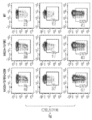
[0032] 도 1: CRISPR/Cas9는 NK 세포에서 효율적인 다중 유전자 (NKG2A, CD47, TGFBR2, 및 CISH) 파괴를 매개한다. 상기 유전자 세트에서, NKG2A 및 CD47은 제1 라운드의 전기천공 및 제2 라운드의 전기천공에서 녹아웃되고, CISH 및 TGFBR2가 표적화되었다. 녹아웃 효율은 2개 라운드의 전기천공을 위해 PCR 및 유동-세포측정을 사용하여 성공적으로 입증되었다. 유동 패널에서 적색 (우측 상에 피크) 및 청색 (좌측 상에 피크) 히스토그램은 각각 CRISPR KO 전 및 후 단백질의 발현을 나타낸다.
[0033] 도 2: 또 다른 세트의 유전자 (TIGIT (T), CD96 (C), CISH (CH), 아데노신(A))를 사용한 NK 세포에서의 멀티플렉스 유전자 편집의 입증. 상기 유전자 세트에서, TIGIT 및 CD96은 제1 라운드의 전기천공 및 제2 라운드의 전기천공에서 녹아웃되고, CISH 및 아데노신이 표적화되었다. 녹아웃 효율은 2개 라운드의 전기천공을 위해 PCR 및 유동-세포측정을 사용하여 성공적으로 입증되었다. 유동 패널에서 적색 (우측 상에 피크) 및 청색 (좌측 상에 피크) 히스토그램은 각각 CRISPR KO 전 및 후 단백질의 발현을 나타낸다.
[0034] 도 3: NK 세포에서 다중 유전자(NKG2A, CD47, TGFBR2 및 CISH)의 파괴는 표적 종양 세포에 대해 증진된 기능을 유도한다. 표적 세포주를 사용한 자극 후 IFN-γ, TNFα 및 CD107 분비가 증진되었다. IFN-γ, TNFα 및 CD107 생성의 유동 세포측정 분석은 브레펠딘 A의 존재하에 5시간 동안 표적 세포주로 동시 자극된 다양한 NK 세포 (편집된 것 대 Cas9 단독)를 수행하여 수행하였다.
[0035] 도 4a-4b: NK 세포에서 다중 유전자 (NKG2A, CD47, TGFBR2 및 CISH)의 파괴는 증진된 항종양 세포독성을 유도한다. (도 4a) 유전자 편집된 NK 세포 대 Cas9 단독 NK 세포의 세포독성 활성은 K562에 대해 51Cr-방출 검정에 의해 측정하였다(도 4b). 재조합 TGF-B 처리 (50ng/ml)의 30분 후, pSMAD 활성은 유동 세포측정에 의해 측정하였다. 외인성 TGF-β의 첨가는 KO CAR-NK 세포에서 pSMAD의 활성화를 유도하는데 실패하였다.
[0036] 도 5: NK 세포는 CyTOF 분석에 의해 도시된 바와 같이 사이토킨 자극 또는 표적 인지시 CD16 및 CD62L 발현을 상실한다.
[0037] 도 6: NK 세포에서 ADAM17의 녹아웃은 CD16 및 CD62L의 발산을 차단한다.
[0038] 도 7: NK 세포에서 녹아웃 ADAM17은 K562 표적에 대한 ADCC 및 세포독성을 개선시킨다.
[0039] 도 8: 72h에서 NK 세포에서 SHP1 녹아웃 효율의 FACS-기반 스크리닝.
[0040] 도 9: NK 세포에서 SHP1의 파괴는 증진된 항종양 효능을 유도한다. NK 세포는 4시간 동안 1:1 비율로 K562 또는 Raji 세포와 함께 동시 배양하였다. 배양 후, 세포는 어넥신 V로 염색시키고 생 세포 및 죽은 세포를 분석하였다. K562 세포는 NK 세포 사멸에 민감성이고 Raji 세포는 NK 세포 사멸에 내성이다.
[0041] 도 10a-10b: NK 세포에서 SHP1의 파괴는 증진된 항종양 효능을 유도한다(도 10a). NK 세포는 5시간 동안 2:1 비율로 K562 또는 Raji 세포와 함께 동시 배양하였다(도 10b). 다양한 이펙터:표적 비율에서 용해 퍼센트, IFNγ, TNFα, 및 CD107a의 퍼센트, 및 생 세포 또는 죽은 세포의 퍼센트를 나타낸다.
[0042] 도 11: NK-CAR 세포에서 SHP1의 파괴는 아폽토시스 검정에 의한 평가시 증진된 항종양 효능을 유도한다.
[0043] 도 12a-12c: (도 12a) 7일 FACS-기반 NKG2A 녹아웃 효율. (도 12b)) 확장된 NK 세포에서 NKG2A의 파괴는 증진된 항종양 효능을 유도한다. (도 12c) NK-CAR 세포에서 NKG2A의 파괴는 Raji 표적에 대해 증진된 항종양 효능을 유도한다.
[0044] 도 13: 접근법은 또 다른 세트의 유전자 - TIGIT (T), CD96 (C), CISH (CH), 및 아데노신 (ADORA2A) (A)을 사용하여 입증되었다. 상기 세트의 유전자에 대해, TIGIT 및 CD96은 제1 라운드의 전기천공 동안에 NK 세포의 하나의 세트에서 녹아웃되었다. CISH 및 아데노신(ADORA2A)은 TIGIT 및 CD96 KO 세포에서 제2 라운드의 녹아웃을 위해 표적화하였다. 녹아웃 효율은 2개 라운드의 전기천공을 위해 PCR 및 유동-세포측정을 사용하여 성공적으로 입증되었다. 유동 패널에서 적색 (우측 상에 피크) 및 청색 (좌측 상에 피크) 히스토그램은 각각 CRISPR KO 전 및 후 단백질의 발현을 나타낸다.
[0045] 도 14: NK 세포에서 다중 유전자의 파괴는 증진된 항종양 효능을 유도한다. 이를 평가하기 위해, 다중 유전자 (NKG2A, CISH, TGFBRII 및 아데노신 (ADORA2A)) 녹아웃 세포 및 cas9 단독으로 전기천공된 세포는 5시간 동안 K562 (NK 민감성) 및 Raji (NK 내성) 세포와 함께 대조군으로서 사용하였다. NK 세포 기능은 유동 세포측정 및 표적 세포주 자극 시 KO 세포에서 TNFα, IFNγ, 및 CD107a에서의 관찰된 증가에 의해 평가하였다.
[0046] 도 15: NK 세포에서 다중 유전자의 파괴는 증진된 항종양 효능을 유도한다. 이를 평가하기 위해, 다중 유전자 (NKG2A, CISH, TGFBRII) 녹아웃 세포 및 cas9 단독으로 전기천공된 세포는 대조군으로서 사용하였다. NKG2A 발현은 유동 세포측정에 의해 확인하였다. 외인성 TGF-β의 첨가는 KO CAR-NK 세포에서 pSMAD의 활성화를 유도하는데 실패하였다.
[0047] 도 16: NK-CAR 세포에서 다중 유전자 (NKG2A, CD47, TGFβR2 및 CISH)의 파괴는 증진된 항종양 효능을 유도한다.
[0048] 도 17: TGFβR2 KO는 TGFβ의 억제성 효과로부터 NK-CAR 세포를 보호한다.
[0049] 도 18: 멀티플렉스 유전자 편집은 상이한 NK-CAR 작제물을 사용하고 상이한 표적에 대해 재현가능하다.
[0050] 도 19: 다중 억제성 유전자의 멀티플렉스 유전자 편집은 NK 구조를 유지하고 TFGβ에 의해 유도된 소모로부터 NK 세포를 보호한다. [0031] to the drawings is included to demonstrate a more specific aspect of the present invention and form a part hereof. The invention may be better understood by reference to one or more of these drawings in conjunction with the detailed description of specific embodiments provided herein.
1 : CRISPR/Cas9 mediates efficient multiple gene (NKG2A, CD47, TGFBR2, and CISH) disruption in NK cells. In this set of genes, NKG2A and CD47 were knocked out in the first round of electroporation and the second round of electroporation, and CISH and TGFBR2 were targeted. Knockout efficiency was successfully demonstrated using PCR and flow-cytometry for two rounds of electroporation. Red (peak on the right) and blue (peak on the left) histograms in the flow panel represent the expression of proteins before and after CRISPR KO, respectively.
[0033] Figure 2 : Demonstration of multiplex gene editing in NK cells using another set of genes (TIGIT (T), CD96 (C), CISH (CH), adenosine (A)). In this set of genes, TIGIT and CD96 were knocked out in the first round of electroporation and the second round of electroporation, and CISH and adenosine were targeted. Knockout efficiency was successfully demonstrated using PCR and flow-cytometry for two rounds of electroporation. Red (peak on the right) and blue (peak on the left) histograms in the flow panel represent the expression of proteins before and after CRISPR KO, respectively.
Figure 3 : Disruption of multiple genes (NKG2A, CD47, TGFBR2 and CISH) in NK cells leads to enhanced function on target tumor cells. IFN-γ, TNFα and CD107 secretion were enhanced after stimulation with the target cell line. Flow cytometric analysis of IFN-γ, TNFα and CD107 production was performed by performing various NK cells (edited vs. Cas9 alone) co-stimulated with target cell lines for 5 h in the presence of brefeldin A.
4A-4B: Disruption of multiple genes (NKG2A, CD47, TGFBR2 and CISH) in NK cells leads to enhanced anti-tumor cytotoxicity. ( FIG. 4A ) The cytotoxic activity of gene edited NK cells versus Cas9 alone NK cells was measured by a 51 Cr-release assay for K562 ( FIG. 4B ). After 30 min of recombinant TGF-B treatment (50 ng/ml), pSMAD activity was measured by flow cytometry. Addition of exogenous TGF-β failed to induce activation of pSMAD in KO CAR-NK cells.
Figure 5: NK cells lose CD16 and CD62L expression upon cytokine stimulation or target recognition as shown by CyTOF assay.
Figure 6 : Knockout of ADAM17 in NK cells blocks the shedding of CD16 and CD62L.
Figure 7 : Knockout ADAM17 in NK cells improves ADCC and cytotoxicity against K562 target.
[0039] Figure 8 : FACS-based screening of SHP1 knockout efficiency in NK cells at 72h.
[0040] Figure 9 : Disruption of SHP1 in NK cells leads to enhanced anti-tumor efficacy. NK cells were co-cultured with K562 or Raji cells at a 1:1 ratio for 4 hours. After incubation, cells were stained with Annexin V and live and dead cells were analyzed. K562 cells are sensitive to NK cell death and Raji cells are resistant to NK cell death.
[0041] Figures 10a-10b : Disruption of SHP1 in NK cells leads to enhanced anti-tumor efficacy ( Figure 10a ). NK cells were co-cultured with K562 or Raji cells at a 2: 1 ratio for 5 hours ( FIG. 10b ). Percent lysis, percentage of IFNγ, TNFα, and CD107a, and percentage of live or dead cells at various effector:target ratios are shown.
Figure 11 : Disruption of SHP1 in NK-CAR cells leads to enhanced anti-tumor efficacy as assessed by an apoptosis assay.
12A-12C : ( FIG. 12A ) 7-day FACS-based NKG2A knockout efficiency. ( FIG. 12B ) Disruption of NKG2A in expanded NK cells leads to enhanced antitumor efficacy. ( FIG. 12C ) Disruption of NKG2A in NK-CAR cells leads to enhanced antitumor efficacy against Raji targets.
[0044] Figure 13 : The approach was demonstrated using another set of genes - TIGIT (T), CD96 (C), CISH (CH), and adenosine (ADORA2A) (A). For this set of genes, TIGIT and CD96 were knocked out in one set of NK cells during the first round of electroporation. CISH and adenosine (ADORA2A) were targeted for a second round of knockout in TIGIT and CD96 KO cells. Knockout efficiency was successfully demonstrated using PCR and flow-cytometry for two rounds of electroporation. Red (peak on the right) and blue (peak on the left) histograms in the flow panel represent the expression of proteins before and after CRISPR KO, respectively.
[0045] Figure 14 : Disruption of multiple genes in NK cells leads to enhanced anti-tumor efficacy. To evaluate this, multi-gene (NKG2A, CISH, TGFBRII and adenosine (ADORA2A)) knockout cells and cells electroporated with cas9 alone were used as controls along with K562 (NK sensitive) and Raji (NK resistant) cells for 5 h. did. NK cell function was assessed by flow cytometry and the observed increase in TNFα, IFNγ, and CD107a in KO cells upon target cell line stimulation.
[0046] Figure 15 : Disruption of multiple genes in NK cells leads to enhanced anti-tumor efficacy. To evaluate this, multi-gene (NKG2A, CISH, TGFBRII) knockout cells and cells electroporated with cas9 alone were used as controls. NKG2A expression was confirmed by flow cytometry. Addition of exogenous TGF-β failed to induce activation of pSMAD in KO CAR-NK cells.
[0047] Figure 16 : Disruption of multiple genes (NKG2A, CD47, TGFβR2 and CISH) in NK-CAR cells leads to enhanced anti-tumor efficacy.
17 : TGFβR2 KO protects NK-CAR cells from the inhibitory effect of TGFβ.
[0049] Figure 18 : Multiplex gene editing uses different NK-CAR constructs and is reproducible for different targets.
[0050] Figure 19 : Multiplex gene editing of multiple repressor genes maintains NK structure and protects NK cells from depletion induced by TFGβ.
[0051] 특정 구현예에서, 본원의 개시내용은 사람 면역 세포 (예를 들어, T 세포, NK 세포, CAR-형질도입된 T 세포, 또는 CAR-형질도입된 NK 세포)에서 동시에 녹다운(또는 녹아운)된 2개의 이상의 유전자(예를 들어, 유전자(예를 들어, 아데노신 2a 수용체, TGFβR2, NKG2A, TIGIT 및/또는 CISH)를 포함하는, 표 1에 열거된 것들)에 대해 CRISPR-Cas9 기술을 사용한 신규 접근법을 제공한다. 면역 세포는 말초 혈액 또는 제대혈 또는 이의 조합으로부터 유래할 수 있다. [0051] In certain embodiments, the present disclosure provides for simultaneous knockdown (or knockdown) in human immune cells (eg, T cells, NK cells, CAR-transduced T cells, or CAR-transduced NK cells). CRISPR-Cas9 technology for two or more genes (e.g., those listed in Table 1, including genes (e.g., adenosine 2a receptor, TGFβR2, NKG2A, TIGIT, and/or CISH)) new approaches used. Immune cells may be derived from peripheral blood or umbilical cord blood or a combination thereof.
[0052] 본원의 연구는 이들의 단백질의 감소된 발현이 T 세포 및 NK 세포의 개선된 기능, 생체내 증식 및 지속성 및 세포독성과 상호관련됨을 입증하였다. 상기 전략은 또한 TGFβ 및 아데노신에 의해 대부분 구동되는 면역억제 종양 미세환경으로부터 T 세포, NK 세포, NK T 세포 및 iNKT 세포를 보호한다. 따라서, 본원의 방법을 사용하여 다양한 입양 세포 치료요법 생성물(예를 들어, NK 세포, T 세포, 예를 들어, 바이러스 특이적 T 세포 및 조절 T 세포, B 세포, 예를 들어, 조절 B 세포, CAR-형질도입된 NK 세포, CAR-T 세포 및 TCR 가공된 T 및 NK 세포, iNKT 세포, NKT 세포)의 효능을 개선시킬 수 있다. 입양 세포 치료요법 생성물을 사용하여 예를 들어 암 (예를 들어, 혈액학적 또는 고체 악성종양)에서 감염성 질환 및 면역 장애에 이르는 다양한 질환을 치료할 수 있다. [0052] The study herein demonstrated that reduced expression of their proteins correlates with improved function, in vivo proliferation and persistence and cytotoxicity of T cells and NK cells. This strategy also protects T cells, NK cells, NK T cells and iNKT cells from the immunosuppressive tumor microenvironment driven mostly by TGFβ and adenosine. Thus, various adoptive cell therapy products (e.g. , NK cells, T cells, e.g., virus specific T cells and regulatory T cells, B cells, e.g., regulatory B cells, CAR-transduced NK cells, CAR-T cells and TCR engineered T and NK cells, iNKT cells, NKT cells). Adoptive cell therapy products can be used to treat a variety of diseases, ranging from, for example, cancer (eg, hematological or solid malignancies) to infectious diseases and immune disorders.
[0053] 특정 구현예에서, 면역 세포는 적어도 하나의 CAR을 발현하고, CAR 가공은 과거 수년 내 많은 진전이 있었다. 사실, CAR-CD19은 B 세포 백혈병 및 림프종을 갖는 환자에서 인상적인 임상적 결과를 나타냈고 지난 해에 2개의 CAR T 생성물의 FDA 승인을 유도하였다. CAR-형질도입된 T 세포는 과거 수년 동안 선도를 이끌었고, 출원인에 의해 주도된 단계 I/II CAR NK 시험 뿐만 아니라 모든 임상전 연구는 또한 암에 대한 CAR-NK 세포의 효과를 보여주었다. CAR 가공에서의 진전에도 불구하고, CAR은 여전히 대부분 무작위로 세포의 DNA에 통합하여 클론 확장, 발암성 형질전환, 변경된 전이유전자 발현 또는 전사 사일런싱을 유도할 수 있는 바이러스 벡터를 사용하여 T 세포 또는 NK 세포로 형질도입된다. 따라서, CAR의 특정 DNA 유전자좌로의 삽입을 표적화하는 방법의 모색이 가치가 있을 수 있다. [0053] In certain embodiments, the immune cell expresses at least one CAR, and CAR processing has come a long way in the past few years. In fact, CAR-CD19 has shown impressive clinical results in patients with B cell leukemia and lymphoma and led to FDA approval of two CAR T products in the past year. CAR-transduced T cells have led the way in the past few years, and all preclinical studies as well as the Phase I/II CAR NK trial led by the Applicants have also shown the effect of CAR-NK cells on cancer. Despite advances in CAR processing, CARs are still mostly randomly integrated into the DNA of cells to induce clonal expansion, oncogenic transformation, altered transgene expression, or transcriptional silencing using viral vectors to induce T cells or transduced into NK cells. Therefore, the search for methods to target the insertion of CARs into specific DNA loci may be valuable.
[0054] 따라서, 하나의 구현예에서, 본원의 개시내용은 억제성 유전자 또는 관문 단백질의 유전자좌에서와 같이 특정 유전자좌에 CRISPR/Cas9를 사용하여 CAR을 삽입하기 위한 방법을 제공한다. 유전자좌에 CAR의 삽입을 또한 사용하여 유전자의 발현을 동시에 파괴할 수 있고, 임의로 또한 이것이 경우에 따라 상기 유전자의 프로모터의 제어하에 있도록 한다. 구체적으로, 본원의 방법은 예를 들어, AAV6 벡터 및 CRISPR/Cas9 기술을 사용하여, NKG2A, CISH, PD-1, TIGIT, TIM3, SHP1, 또는 TGFβR2를 포함하지만 이에 제한되지 않는 표 1에 열거된 것들과 같은 억제 유전자의 유전자좌에 CAR의 삽입을 지시할 수 있다. 억제성 유전자좌에 CAR의 삽입은 관문 분자(예를 들어)의 억제성 효과를 파괴할 수 있어, 또한 CAR 발현이 관문 프로모터의 조절하에 있도록 하고 종양 미세환경에서 상향조절되도록 한다. 이것은 관문 분자의 상향조절이 CAR 치료요법의 성공에 부정적 영향을 줄 수 있는 고형 종양에서 CAR 치료요법의 적용을 위해 유용하다. 따라서, 추가의 방법은 증가된 안전성 프로필을 가질 수 있는 CAR 삽입 방법을 사용하여 T 세포, B 세포, NK, NKT 또는 iNKT 세포와 같은, 입양 세포 치료요법을 생성하기 위해 제공된다. [0054] Accordingly, in one embodiment, the present disclosure provides a method for inserting a CAR using CRISPR/Cas9 at a specific locus, such as at the locus of a repressor gene or a checkpoint protein. Insertion of a CAR at a locus can also be used to simultaneously disrupt the expression of a gene, optionally also allowing it to be under the control of the promoter of said gene as the case may be. Specifically, the methods herein are listed in Table 1 including, but not limited to, NKG2A, CISH, PD-1, TIGIT, TIM3, SHP1, or TGFβR2, for example, using AAV6 vectors and CRISPR/Cas9 technology. insertion of the CAR at the locus of a repressor gene, such as those Insertion of a CAR at a repressive locus can disrupt the inhibitory effect of a checkpoint molecule (eg), allowing CAR expression to be under the control of a checkpoint promoter and upregulated in the tumor microenvironment. This is useful for the application of CAR therapy in solid tumors where upregulation of checkpoint molecules may negatively affect the success of CAR therapy. Accordingly, additional methods are provided for generating adoptive cell therapies, such as T cells, B cells, NK, NKT or iNKT cells, using CAR insertion methods that may have an increased safety profile.
I. 정의I. Definition
[0055] 본원에서 사용된 바와 같이, 특정 성분과 관련하여 "필수적으로 부재"라는 용어는 해당 특정 성분이 의도적으로 조성물 내로 전혀 조제하여 넣지 않았고/않았거나 해당 특정 성분이 오염물로서만 존재하거나 미량으로만 존재하는 것을 의미하기 위해 사용된다. 따라서, 조성물의 의도치 않은 임의의 오염으로 야기된 특정 성분의 총량은 0.05% 미만, 바람직하게는 0.01%이다. 표준 분석 방법으로 특정 성분의 양이 검출될 수 없는 조성물이 가장 바람직하다. [0055] As used herein, the term "essentially absent" with respect to a particular ingredient means that that particular ingredient was not intentionally formulated at all into the composition and/or that that particular ingredient is present only as a contaminant or is present only as a contaminant or in trace amounts. It is used to mean that only exists. Accordingly, the total amount of a particular component resulting from any unintended contamination of the composition is less than 0.05%, preferably 0.01%. Compositions in which the amount of a particular component cannot be detected by standard analytical methods are most preferred.
[0056] 본원 명세서에서, 단수형 관사("a" 또는 "an")는 하나 이상을 의미할 수 있다. 본원 청구항(들)에서 사용된 바와 같은, 용어 "포함하는"과 함께 사용되는 경우, 용어 “a” 또는 “an”은 하나 또는 하나 초과를 의미할 수 있다. 본원에서 "또 다른" 이라는 말은 적어도 두번째 또는 그 이상을 의미할 수 있다. 여전히 추가로, 용어 “갖는”, “포함하는(including)”, “함유하는” 및 “포함하는(comprising)”은 상호교환될 수 있고 당업자는 이들 용어가 개방형 용어인 것으로 인지된다. 특정 구현예에서, 본원 개시내용의 양상은 예를 들어, 본원 개시내용의 하나 이상의 서열로 “로 필수적으로 이루어진” 또는 “로 이루어진”일 수 있다. 본원 개시내용의 일부 구현예는 본 발명의 하나 이상의 구성성분, 방법 단계 및/또는 방법으로 이루어지거나 본질적으로 이루어질 수 있다. 본 명세서에 기재된 임의의 방법 또는 조성물은 본 명세서에 기재된 임의의 다른 방법 또는 조성물에 대해 실시될 수 있는 것으로 고려된다. 본 출원의 범위는 본 명세서에 기재되는 공정, 기계, 제조, 물질의 조성물, 수단, 방법들 및 단계들의 특정 구현예에 한정하려는 것은 아니다. 본원에 사용된 바와 같은 용어 “또는” 및 “및/또는”을 사용하여 조합하여 또는 서로 배타적으로 다수의 성분들을 기재한다. 예를 들어, “x, y, 및/또는 z”는 “x” 단독, “y” 단독, “z” 단독, “x, y, 및 z,” “(x 및 y) 또는 z,” “x 또는 (y 및 z),” 또는 “x 또는 y 또는 z”을 언급할 수 있다. 이것은 구체적으로 x, y, 또는 z가 하나의 구현예로부터 배제될 수 있는 것으로 고려된다. [0056] As used herein, the singular article (“a” or “an”) may mean one or more. As used in the claim(s) herein, when used in conjunction with the term “comprising,” the term “a” or “an” may mean one or more than one. As used herein, the term “another” may mean at least a second or more. Still further, the terms “having,” “including,” “containing,” and “comprising,” may be interchanged and those skilled in the art will recognize that these terms are open-ended terms. In certain embodiments, aspects of the present disclosure may be “consisting essentially of” or “consisting of” one or more sequences of the present disclosure, for example. Some embodiments of the present disclosure may consist of or consist essentially of one or more components, method steps and/or methods of the present invention. It is contemplated that any method or composition described herein may be practiced with respect to any other method or composition described herein. The scope of the present application is not intended to be limited to the particular embodiments of the processes, machines, manufacture, compositions of matter, means, methods and steps described herein. As used herein, the terms “or” and “and/or” are used to describe a plurality of components in combination or exclusive of one another. For example, “x, y, and/or z” is “x” alone, “y” alone, “z” alone, “x, y, and z,” “(x and y) or z,” “ x or (y and z),” or “x or y or z”. It is specifically contemplated that x, y, or z may be excluded from one embodiment.
[0057] 청구항에서 "또는" 이라는 용어의 사용은, 그것이 명시적으로 대안만을 언급하지 않는 한 또는 명세서가 대안 및 "및/또는"만을 언급하는 정의를 뒷받침하고 있더라도 그 대안이 상호 배타적이지 않는 한 "및/또는"을 의미하는 것으로 사용된다. 본원에서 "또 다른" 이라는 말은 적어도 두번째 또는 그 이상을 의미할 수 있다. 용어 “약”, “실질적으로” 및 “대략적으로”는 일반적으로 기재된 값의 + 또는 - 5%를 의미한다. [0057] The use of the term "or" in a claim is intended to imply that the alternatives are not mutually exclusive, unless it explicitly refers to alternatives only, or even if the specification supports a definition referring only to alternatives and "and/or". used to mean “and/or”. As used herein, the term “another” may mean at least a second or more. The terms “about”, “substantially” and “approximately” generally mean + or − 5% of the stated value.
[0058] 본원 명세서 전반에 걸쳐 “하나의 구현예”, “구현예”, “특정 구현예”, “관련 구현예”, “특정 구현예”, “추가의 구현예” 또는 “추가의 구현예” 또는 이의 조합에 대한 언급은 상기 구현예와 관련하여 기재된 특정 특성, 구조 또는 특징이 본원 개시내용의 적어도 하나의 구현예에 포함됨을 의미한다. 따라서, 본원 명세서의 다양한 위치에서 이전의 문장의 출현은 모두 동일한 구현예를 필수적으로 언급하지는 않는다. 추가로, 특정 특성, 구조 또는 특징은 하나 이상의 구현예에서 임의의 적합한 방식으로 조합될 수 있다. [0058] Throughout this specification, “one embodiment”, “embodiment”, “specific embodiment”, “related embodiment”, “specific embodiment”, “further embodiment” or “further embodiment” ” or a combination thereof means that a particular property, structure, or characteristic described in connection with the embodiment is included in at least one embodiment of the present disclosure. Thus, the appearances of the preceding sentences in various places in this specification are not necessarily all referring to the same embodiment. Additionally, the particular properties, structures, or characteristics may be combined in any suitable manner in one or more embodiments.
[0059] “면역 장애", "면역 관련 장애" 또는 "면역 매개된 장애"는 면역 반응이 질환의 발병 또는 진행에서 주요 역할을 수행하는 장애를 언급한다. 면역 매개된 장애는 자가면역 장애, 동종이식 거부, 이식편 대 숙주 질환 및 염증성 및 알레르기성 병태를 포함한다. [0059] "Immune disorder", "immune related disorder" or "immune mediated disorder" refers to a disorder in which an immune response plays a major role in the onset or progression of a disease. The immune mediated disorder is an autoimmune disorder, allogeneic transplant rejection, graft versus host disease, and inflammatory and allergic conditions.
[0060] “면역 반응"은 면역계 세포, 예를 들어, 자극에 대한 B 세포, 또는 T 세포, 또는 선천성 면역 세포의 반응이다. 하나의 구현예에서, 반응은 특정 항원에 특이적이다("항원-특이적 반응"). [0060] An “immune response” is the response of an immune system cell, eg, a B cell, or T cell, or innate immune cell, to a stimulus. In one embodiment, the response is specific for a particular antigen (“antigen -specific reactions").
[0061] 본원에 사용된 바와 같은 용어 “억제성 유전자”는 이의 유전자 생성물이 직간접적으로 면역 세포의 하나 이상의 유형의 활성, 증식 및/또는 지속성에 해로운 유전자를 언급한다. [0061] The term "repressor gene" as used herein refers to a gene whose gene product is directly or indirectly detrimental to the activity, proliferation and/or persistence of one or more types of immune cells.
[0062] “자가면역 질환"은 면역계가 결과적으로 조직에 대한 손상과 함께, 정상 숙주의 일부인 항원 (즉, 자가항원)에 대한 면역 반응 (예를 들어, B 세포 또는 T 세포 반응)을 생성하는 질환을 언급한다. 자가항원은 숙주 세포로부터 유래될 수 있거나, 정상적으로 점막 표면에 군집하는 미생물 (공생 유기체로서 공지된)과 같은 공생 유기체로부터 유래할 수 있다. [0062] An “autoimmune disease” is one in which the immune system produces an immune response (eg, a B-cell or T-cell response) to an antigen (ie, an autoantigen) that is part of a normal host, with consequent damage to tissues. Refers to disease Autoantigens can be derived from host cells or from commensal organisms, such as microorganisms (known as symbiotic organisms) that normally colonize mucosal surfaces.
[0063] 본원에 사용된 바와 같은 용어 “가공된”은 세포, 핵산, 폴리펩타이드, 벡터 등을 포함하는, 사람의 손에 의해 생성된 실체를 언급한다. 적어도 일부 경우에, 가공된 실체는 합성이고 천연적으로 존재하지 않거나 본원의 개시내용에 사용되는 방식으로 구성되지 않는 요소를 포함한다. [0063] The term "engineered" as used herein refers to an entity produced by the human hand, including cells, nucleic acids, polypeptides, vectors, and the like. In at least some cases, engineered entities are synthetic and include elements that do not exist in nature or are not constructed in the manner used in the disclosure herein.
[0064] 질환 또는 병태의 “치료하는" 또는 치료는 질환의 징후 또는 증상을 완화시키는 노력에서 하나 이상의 약물을 환자에게 투여함을 포함할 수 있는 프로토콜을 실행함을 언급한다. 바람직할 수 있는 치료 효과는 질환 진행율의 감소, 질환 상태의 개선 또는 완화, 차도 또는 개선된 예후를 포함한다. 완화는 이들의 출현 후 뿐만 아니라 질환 또는 병태의 징후 또는 증상 출현 전에 일어날 수 있다. 따라서, "치료하는" 또는 "치료"는 질환 또는 목적하지 않을 수 있는 병태를 “예방하는” 또는 이의 “예방”을 포함할 수 있다. 추가로, "치료하는" 또는 "치료"는 징후 또는 증상의 완전한 완화를 요구하지 않고, 치유를 요구하지 않으며 구체적으로 환자에 대해 단지 미진한 효과를 갖는 프로토콜을 포함한다. [0064] “Treating” or treatment of a disease or condition refers to implementing a protocol that may include administering to a patient one or more drugs in an effort to alleviate the signs or symptoms of the disease. Effect includes reduction of disease progression rate, improvement or alleviation of disease state, remission or improved prognosis.Relief can occur after their appearance as well as before the appearance of signs or symptoms of disease or condition.Therefore, "treating" Or "treatment" may include "preventing" or "prevention" of a disease or condition that may be undesirable. Further, "treating" or "treatment" does not require complete alleviation of the signs or symptoms. protocol, which does not require healing and specifically has only marginal effects on the patient.
[0065] 본원 전반에 걸쳐 사용된 바와 같은 용어 "치료학적 이득" 또는 "치료학적 유효량"은 상기 병태의 의학적 치료와 관련하여 대상체의 웰빙을 촉진시키거나 증진시키는 어떠한 것을 언급한다. 이것은 질환의 징후 또는 증상의 빈도 또는 중증도에서의 감소를 포함하지만 이에 제한되지 않는다. 예를 들어, 암의 치료는 예를 들어, 종양 크기에서의 감소, 종양 공격성에서의 감소, 암 성장율에서의 감소 또는 전이의 예방을 포함할 수 있다. 암의 치료는 또한 암을 갖는 대상체의 생존을 지연시키는 것을 언급할 수 있다. [0065] The term "therapeutically benefit" or "therapeutically effective amount" as used throughout this application refers to anything that promotes or enhances the well-being of a subject in connection with the medical treatment of said condition. This includes, but is not limited to, a decrease in the frequency or severity of signs or symptoms of a disease. For example, treating cancer can include, for example, a reduction in tumor size, a reduction in tumor aggressiveness, a reduction in cancer growth rate, or prevention of metastasis. Treating cancer may also refer to delaying survival of a subject having cancer.
[0066] “대상체" 및 "환자"는 사람 또는 비-사람, 예를 들어, 영장류, 포유동물 및 척추동물을 언급한다. 특정 구현예에서, 대상체는 사람이다. [0066] "subject" and "patient" refer to humans or non-humans, such as primates, mammals and vertebrates In certain embodiments, the subject is a human.
[0067] 본원에 사용된 바와 같은 “포유류”는 본원 발명의 방법을 위해 적당한 대상체이다. 포유류는 사람을 포함하는 고등 척추동물 부류의 포유류 (Mammalia)의 임의의 구성원일 수 있고; 새끼에게 영양을 공급하기 위해 우유를 분비하는 암컷의 신생아, 체모 및 유선을 특징으로 한다. 추가로, 포유류는 기후 조건의 변화에도 불구하고 일정한 체온을 유지하는 이들의 능력을 특징으로 한다. 포유류의 예는 사람, 고양이, 개, 소, 마우스, 래트, 말, 염소, 양, 및 침팬지이다. 포유류는 “환자” 또는 “대상체” 또는 “개체”로서 언급될 수 있다. [0067] As used herein, a “mammal” is a suitable subject for the methods of the present invention. The mammal may be any member of the higher vertebrate class Mammalia, including humans; It features a female newborn, body hair, and mammary glands that secrete milk to nourish their offspring. Additionally, mammals are characterized by their ability to maintain a constant body temperature despite changes in climatic conditions. Examples of mammals are humans, cats, dogs, cattle, mice, rats, horses, goats, sheep, and chimpanzees. A mammal may be referred to as a “patient” or “subject” or “individual”.
[0068] 용어 "약제학적 또는 약제학적으로 허용되는"은 동물, 예를 들어, 적절하게 사람에게 투여되는 경우 역반응, 알레르기 반응 또는 다른 원치않는 반응을 생성하지 않는 분자 실체 및 조성물을 언급한다. 항체 또는 추가의 활성 성분을 포함하는 약제학적 조성물의 제조는 본원 개시내용의 측면에서 당업자에게 공지되어 있다. 더욱이, 동물 (예를 들어, 사람) 투여에 대해, 제조는 생물학적 표준의 FDA 사무국에 의해 요구되는 바와 같이 멸균성, 발열성, 일반적인 안정성 및 순도 표준을 충족해야만 하는 것으로 이해된다. [0068] The term "pharmaceutically or pharmaceutically acceptable" refers to molecular entities and compositions that do not produce an adverse, allergic or other undesirable reaction when properly administered to an animal, eg, a human. The preparation of pharmaceutical compositions comprising antibodies or additional active ingredients is known to those skilled in the art in light of the present disclosure. Moreover, it is understood that for animal (eg, human) administration, preparations must meet sterility, pyrogenicity, general safety and purity standards as required by the FDA Office of Biological Standards.
[0069] 본원에 사용된 바와 같은, "약제학적으로 허용되는 담체"는 당업자에게 공지된 바와 같이, 임의의 및 모든 수성 용매(예를 들어, 물, 알콜/수용액, 식염수 용액, 비경구 비히클, 예를 들어, 염화나트륨, 링거 덱스트로스 등), 비-수성 용매(예를 들어, 프로필렌 글리콜, 폴리에틸렌 글리콜, 식물성 오일, 및 주사가능한 유기 에스테르, 예를 들어, 에틸올레에이트), 분산 매질, 코팅, 계면활성제, 항산화제, 보존제(예를 들어, 항세균 또는 항진균 제제, 항-산화물, 킬레이팅 제제 및 불활성 가스), 등장성 제제, 흡수 지연제, 염, 약물, 약물 안정화제, 겔, 결합제, 부형제, 붕해제, 윤활제, 감미제, 향제, 염료, 유체 및 영양물 보충제, 상기 유사 물질 및 이의 조합물을 포함한다. 약제학적 조성물 중 다양한 성분들의 pH 및 정확한 농도는 널리 공지된 파라미터에 따라 조정된다. [0069] As used herein, "pharmaceutically acceptable carrier" refers to any and all aqueous solvents (e.g., water, alcohol/aqueous solutions, saline solutions, parenteral vehicles, For example, sodium chloride, Ringer's dextrose, etc.), non-aqueous solvents (eg, propylene glycol, polyethylene glycol, vegetable oils, and injectable organic esters such as ethyloleate), dispersion media, coatings, surfactants, antioxidants, preservatives (eg, antibacterial or antifungal agents, anti-oxides, chelating agents and inert gases), isotonic agents, absorption delaying agents, salts, drugs, drug stabilizers, gels, binders, excipients, disintegrants, lubricants, sweeteners, flavoring agents, dyes, fluid and nutrient supplements, the like, and combinations thereof. The pH and precise concentrations of the various components in the pharmaceutical composition are adjusted according to well-known parameters.
[0070] 본원에 사용된 바와 같은, 유전자의 "파괴"는 파괴 부재하에 유전자 생성물의 발현 수준과 비교하여, 세포에서 대상체 유전자에 의해 암호화된 하나 이상의 유전자 생성물의 발현의 제거 또는 감소를 언급한다. 예시적인 유전자 생성물은 유전자에 의해 암호화된 mRNA 및 단백질 생성물을 포함한다. 일부 경우에 파괴는 일시적이거나 가역적이고 다른 경우에 영구적이다. 일부 경우에 파괴는 절단된 또는 비-기능성 생성물이 생성될 수 있다는 사실에도 불구하고 기능성 또는 전장 단백질 또는 mRN에 대한 것이다. 본원에서 일부 구현예에서, 발현과는 반대로 유전자 활성 또는 기능은 파괴된다. 유전자 파괴는 일반적으로 인공 방법에 의해, 즉, 화합물, 분자, 복합체 또는 조성물의 첨가 또는 유도에 의해 및/또는 DNA 수준에서와 같이 유전자의 핵산 또는 이와 연관된 핵산의 파괴에 의해 유도된다. 유전자 파괴를 위한 예시적 방법은 유전자 사일런싱, 녹다운, 녹아웃, 및/또는 유전자 편집과 같은 유전자 파괴 기술을 포함한다. 이의 예는 안티센스 기술, 예를 들어, 일반적으로 발현의 일시적 감소를 유도하는, RNAi, siRNA, shRNA, 및/또는 리보자임과 같은 안티센스 기술, 및 예를 들어, 절단 유도 및/또는 상동성 재조합에 의한 표적화된 유전자 불활성화 또는 파괴를 유도하는 유전자 편집 기술을 포함한다. 이의 예는 삽입, 돌연변이 및 결실을 포함한다. 상기 파괴는 전형적으로 유전자에 의해 암호화된 정상 또는 “야생형” 생성물 발현의 억제 및/또는 완전한 부재를 유도한다. 상기 유전자 파괴의 예는 삽입, 프레임 전환(frameshift) 및 미스센스 돌연변이, 전체 유전자의 결실을 포함하는, 유전자 또는 유전자 일부의 결실, 녹인 (knock-in) 및 녹아웃(knock-out)이다. 상기 파괴는 암호화 영역에서, 예를 들어, 하나 이상의 엑손에서 발생하여 예를 들어, 종료 코돈의 삽입에 의한 것과 같이 전장 생성물, 기능성 생성물 또는 임의의 생성물을 생성하지 못하는 능력을 유도할 수 있다. 상기 파괴는 또한 유전자의 전사를 방지하도록, 프로모터 또는 인핸서 또는 전사의 활성화에 영향을 미치는 다른 영역 내 파괴에 의해 발생할 수 있다. 유전자 파괴는 상동성 재조합에 의한 표적화된 유전자 불활성화를 포함하는, 유전자 표적화를 포함한다. [0070] As used herein, "disruption" of a gene refers to the elimination or reduction of expression of one or more gene products encoded by a subject gene in a cell as compared to the expression level of the gene product in the absence of disruption. Exemplary gene products include mRNA and protein products encoded by the gene. In some cases the destruction is temporary or reversible and in other cases permanent. In some cases the disruption is to a functional or full-length protein or mRNA despite the fact that a truncated or non-functional product may be produced. In some embodiments herein, gene activity or function is disrupted as opposed to expression. Gene disruption is generally induced by artificial methods, ie by addition or induction of a compound, molecule, complex or composition and/or by disruption of the nucleic acid of a gene or nucleic acid associated therewith, such as at the DNA level. Exemplary methods for gene disruption include gene disruption techniques such as gene silencing, knockdown, knockout, and/or gene editing. Examples thereof include antisense technologies, e.g., antisense technologies, such as RNAi, siRNA, shRNA, and/or ribozymes, which generally induce a transient decrease in expression, and e.g., for inducing cleavage and/or homologous recombination. gene editing techniques that lead to targeted gene inactivation or disruption by Examples thereof include insertions, mutations and deletions. Such disruption typically results in suppression and/or complete absence of expression of the normal or “wild-type” product encoded by the gene. Examples of such gene disruptions are deletions, knock-ins and knock-outs of genes or parts of genes, including insertions, frameshifts and missense mutations, deletions of entire genes. Such disruption may result in the inability to occur in a coding region, eg, in one or more exons, to generate a full-length product, a functional product, or any product, such as, for example, by insertion of a stop codon. Such disruptions may also occur by disruptions in promoters or enhancers or other regions that affect the activation of transcription, to prevent transcription of the gene. Gene disruption includes gene targeting, including targeted gene inactivation by homologous recombination.
II. 멀티플렉스 유전자 편집II. Multiplex Gene Editing
[0071] 특정 구현예에서, 본원의 개시내용은 임의의 유형의 면역 세포의 멀티플렉스 유전자 편집에 관한 것이다. CRISPR은 면역 세포에서 2개 이상의 유전자, 예를 들어, 3, 4, 5, 6, 7, 8, 9, 10개 이상의 유전자의 발현을 파괴하기 위해 사용될 수 있는 하나의 예이다. 유전자는 표 1에 열거된 유전자로부터 선택될 수 있고, 예를 들어, NK 세포 수용체 A (NKG2A), 시알산-결합 Ig-유사 렉틴 7 (SIGLEC-7, CD328), 림프구 활성화 3 (LAG3), T-세포 면역글로불린 뮤신 계열 구성원 3 (TIM3, CD366, HAVCR2), 사이토킨 유도성 SH2-함유 단백질 (CISH, CIS-1, SOCS), 포크헤드 박스 O1 (FOXO1), 형질전환 성장 인자 베타 수용체 2 (TGFβR2), Ig 및 ITIM 도메인을 갖는 T 세포 면역수용체(TIGIT), CD96, 아데노신 수용체 2A (ADORA2), 핵 수용체 서브계열 3 그룹 C 구성원 1 (NR3C1), 프로그램화된 세포사 1 (PD1), 프로그램화된 세포사 1 리간드 1 (PDL-1), 프로그램화된 세포사 1 리간드 2 (PDL-2), CD47, 신호 조절 단백질 알파 (SIRPA), SH2 도메인-함유 이노시톨 5-포스파타제 1 (SHIP1), ADAM 메탈로펩티다제 도메인 17 (ADAM17), 리보솜 단백질 S6 (RPS6), 진핵세포 해독 개시 인자 4E 결합 단백질 1 (4EBP1), CD25, CD40, 인터류킨 21 수용체 (IL21R), 세포간 접합 분자 1 (ICAM1), CD95, CD80, CD86, 인터류킨 21 수용체(IL10R), CD5, CD7일 수 있거나 다른 억제성 유전자일 수 있다. 유전자 편집은 다중 유전자의 발현을 동시에 파괴시킬 수 있다. [0071] In certain embodiments, the disclosure herein relates to multiplex gene editing of any type of immune cell. CRISPR is one example that can be used to disrupt the expression of two or more genes, eg, 3, 4, 5, 6, 7, 8, 9, 10 or more genes, in an immune cell. The gene may be selected from the genes listed in Table 1, for example, NK cell receptor A (NKG2A), sialic acid-binding Ig-like lectin 7 (SIGLEC-7, CD328), lymphocyte activation 3 (LAG3), T-cell immunoglobulin mucin family member 3 (TIM3, CD366, HAVCR2), cytokine inducible SH2-containing protein (CISH, CIS-1, SOCS), forkhead box O1 (FOXO1), transforming growth factor beta receptor 2 ( TGFβR2), T cell immunoreceptor with Ig and ITIM domains (TIGIT), CD96, adenosine receptor 2A (ADORA2), nuclear receptor subfamily 3 group C member 1 (NR3C1), programmed cell death 1 (PD1), programmed programmed cell death 1 ligand 1 (PDL-1), programmed cell death 1 ligand 2 (PDL-2), CD47, signal regulatory protein alpha (SIRPA), SH2 domain-containing inositol 5-phosphatase 1 (SHIP1), ADAM metallo Peptidase domain 17 (ADAM17), ribosomal protein S6 (RPS6), eukaryotic translation initiation factor 4E binding protein 1 (4EBP1), CD25, CD40, interleukin 21 receptor (IL21R), intercellular junction molecule 1 (ICAM1), CD95 , CD80, CD86, interleukin 21 receptor (IL10R), CD5, CD7 or other inhibitory genes. Gene editing can disrupt the expression of multiple genes simultaneously.
[0072] 일부 구현예에서, 유전자 파괴는 유전자 내 파괴, 예를 들어, 녹-아웃, 삽입, 미스센스 또는 프레임 전환 돌연변이, 예를 들어, 이중대립유전자 프레임 전환 돌연변이, 유전자 전부 또는 일부의 결실, 예를 들어,따라서, 하나 이상의 엑손 또는 일부, 및/또는 녹-인을 실행함에 의해 수행된다. 예를 들어, 상기 파괴는 DNA-결합 표적화된 뉴클레아제, 예를 들어, 아연 핑거 뉴클레아제(ZFN) 및 전사 활성화인자 유사 이펙터 뉴클레아제 (TALEN), 및 RNA-가이드된 뉴클레아제, 예를 들어, CRlSPR-연합된 뉴클레아제 (Cas)를 포함하고, 구체적으로 유전자 또는 이의 일부의 서열에 표적화되도록 디자인된 서열 특이적 또는 표적화된 뉴클레아제에 의해 실행될 수 있다. [0072] In some embodiments, a gene disruption is a disruption in a gene, eg, a knock-out, insertion, missense or frame shift mutation, eg, a biallelic frame shift mutation, deletion of all or part of a gene, For example , thus, by executing one or more exons or portions, and/or knock-ins. For example, the disruption can occur with DNA-binding targeted nucleases such as zinc finger nucleases (ZFNs) and transcriptional activator-like effector nucleases (TALENs), and RNA-guided nucleases, For example, it can be carried out by a sequence specific or targeted nuclease comprising a CR1SPR-associated nuclease (Cas) and specifically designed to target the sequence of a gene or portion thereof.
[0073] 일부 구현예에서, 상기 파괴는 유전자의 발현이 후기 시점에 회복되도록 일시적이거나 가역적이다. 다른 구현예에서, 상기 파괴는 가역적이거나 일시적이지 않고, 예를 들어, 영구적이다. [0073] In some embodiments, the disruption is transient or reversible such that expression of the gene is restored at a later time point. In other embodiments, the disruption is not reversible or temporary, eg, permanent.
[0074] 일부 구현예에서, 유전자 파괴는 전형적으로 표적화된 방식으로 유전자 내 하나 이상의 이중 가닥 파열 및/또는 하나 이상의 단일 가닥 파열의 유도에 의해 수행된다. 일부 구현예에서, 이중 가닥 또는 단일 가닥 파열은 뉴클레아제, 예를 들어, 엔도뉴클레아제, 예를 들어, 유전자-표적화된 뉴클레아제에 의해 수행된다. 일부 양상에서, 상기 파열은 유전자의 암호화 영역 내, 예를 들어, 엑손내 유도된다. 예를 들어, 일부 구현예에서, 상기 유도는 암호화 영역의 N-말단 부위 부근에서, 예를 들어, 제1 엑손내, 제2 엑손 내 또는 후속 엑손내에서 일어난다. [0074] In some embodiments, gene disruption is typically performed by induction of one or more double-strand breaks and/or one or more single-strand breaks in a gene in a targeted manner. In some embodiments, double-stranded or single-stranded breaks are performed by a nuclease, eg, an endonuclease, eg, a gene-targeted nuclease. In some aspects, the rupture is induced within the coding region of the gene, eg, within an exon. For example, in some embodiments, said induction occurs near the N-terminal site of the coding region, eg, within a first exon, within a second exon, or within a subsequent exon.
[0075] 면역 세포는 가이드 RNA 및 CRISPR효소, 또는 CRISPR 효소를 암호화하는 mRNA에 도입될 수 있다. 일부 양상에서, 세포에는 동시에 1, 2, 3, 4, 5개 이상의 가이드 RNA가 도입된다. 예를 들어, 세포에는 제1 전기 천공 동안에 1, 2 또는 3개 가이드 RNA가 도입될 수 있고 이어서 추가로 제2 전기 천공 동안에 1, 2 또는 3개의 추가의 가이드 RNA가 도입된다. [0075] Immune cells can be introduced into guide RNA and CRISPR enzyme, or mRNA encoding the CRISPR enzyme. In some aspects, the cell is simultaneously introduced with 1, 2, 3, 4, 5 or more guide RNAs. For example, the cell may be introduced with 1, 2 or 3 guide RNAs during a first electroporation followed by further introduction of 1, 2 or 3 additional guide RNAs during a second electroporation.
[0076] 일부 구현예에서, 유전자 파괴는 예를 들어, RNA 간섭 (RNAi), 짧은 간섭 RNA (siRNA), 짧은 헤어핀 (shRNA)에 의한 안티센스 기술을 사용하여 성취되고/되거나 리보자임을 사용하여 유전자의 발현을 선택적으로 서프레싱하거나 리프레싱한다. siRNA 기술은 유전자로부터 전사되는 mRNA의 뉴클레오타이드 서열과 상동성인 서열 및 상기 뉴클레오타이드 서열과 상보적인 서열을 갖는 이중 가닥 RNA 분자를 사용하는 RNAi이다. siRNA는 일반적으로 유전자로부터 전사되는 mRNA의 하나의 영역과 상동성/상보성이거나 상이한 영역과 상동성/상보성인 다수의 RNA 분자를 포함하는 siRNA일 수 있다. 일부 양상에서, siRNA는 폴리시스트론성 작제물에 포함된다. [0076] In some embodiments, gene disruption is accomplished using antisense technology, e.g., by RNA interference (RNAi), short interfering RNA (siRNA), short hairpin (shRNA) and/or gene using ribozymes selectively suppress or refresh the expression of siRNA technology is RNAi using double-stranded RNA molecules having a sequence homologous to the nucleotide sequence of an mRNA transcribed from a gene and a sequence complementary to the nucleotide sequence. An siRNA may be an siRNA comprising a plurality of RNA molecules that are either homologous/complementary to one region of an mRNA that is generally transcribed from a gene or homologous/complementary to a different region. In some aspects, the siRNA is comprised in a polycistronic construct.
[0077] 일부 구현예에서, 상기 파괴는 유전자에 특이적으로 결합하거나 이에 하이브리드화하는, DNA-표적화 분자, 예를 들어, DNA-결합 단백질 또는 DNA-결합 핵산, 또는 복합체, 화합물 또는 이를 함유하는 조성물을 사용하여 성취된다. 일부 구현예에서, DNA-표적화 분자는 DNA-결합 도메인, 예를 들어, 아연 핑거 단백질(ZFP) DNA-결합 도메인, 전사 활성화인자-유사 단백질 (TAL) 또는 TAL 이펙터 (TALE) DNA-결합 도메인, 클러스터링된 규칙적 상호 분산된 팔린드롬 반복체 (CRISPR) DNA-결합 도메인, 또는 메가뉴클레아제로부터의 DNA-결합 도메인을 포함한다. 아연 핑거, TALE, 및 CRISPR 시스템 결합 도메인은 예를 들어, 천연적으로 존재하는 아연 핑거 또는 TALE 단백질의 인지 나선 영역의 가공 (하나 이상의 아미노산을 변경하는)을 통해 소정의 뉴클레오타이드 서열에 결합하도록 가공될 수 있다. 가공된 DNA 결합 단백질(아연 핑거 또는 TALE)은 천연적으로 존재하지 않는 단백질이다. 디자인을 위한 합리적 기준에는 기존 ZFP 및/또는 TALE 디자인의 정보와 결합 데이터를 저장하는 데이터베이스에서 정보를 처리하기위한 대체 규칙 및 컴퓨터 알고리즘의 적용이 포함된다. [0077] In some embodiments, the disruption comprises a DNA-targeting molecule, e.g., a DNA-binding protein or a DNA-binding nucleic acid, or complex, compound or containing the same, that specifically binds to or hybridizes to a gene. This is achieved using the composition. In some embodiments, the DNA-targeting molecule comprises a DNA-binding domain, e.g., a zinc finger protein (ZFP) DNA-binding domain, a transcriptional activator-like protein (TAL) or a TAL effector (TALE) DNA-binding domain, clustered regularly interdispersed palindromic repeats (CRISPR) DNA-binding domains, or DNA-binding domains from meganucleases. Zinc finger, TALE, and CRISPR system binding domains can be engineered to bind to a given nucleotide sequence, for example, through processing (altering one or more amino acids) of the recognition helix region of a naturally occurring zinc finger or TALE protein. can Engineered DNA binding proteins (zinc fingers or TALEs) are proteins that do not exist in nature. Reasonable criteria for design include application of substitution rules and computer algorithms for processing information in databases that store information and associated data from existing ZFP and/or TALE designs.
[0078] CRISPR-매개된 파괴를 위해, 가이드 RNA 및 엔도뉴클레아제는 당업계에 공지된 임의의 수단에 의해 면역 세포로 도입되어 세포 또는 서브세포 격실 내부로의 전달을 가능하게 하고 사용될 수 있는 제제/화학물질 및/또는 분자 (단백질 및 핵산)는 리포좀 전달 수단, 중합체 담체, 화학적 담체, 지질복합체, 다중복합체, 덴드리머, 나노입자, 에멀젼, 비제한적인 예로서 천연 세포내 이입 또는 포식 경로, 및 물리적 방법, 예를 들어, 전기천공을 포함한다. 특정 양상에서, 전기천공은 가이드 RNA 및 엔도뉴클레아제, 또는 엔도뉴클레아제를 암호화하는 핵산을 도입하기 위해 사용된다. [0078] For CRISPR-mediated destruction, guide RNA and endonuclease can be introduced into an immune cell by any means known in the art to enable delivery into the cell or subcellular compartment and be used. Agents/chemicals and/or molecules (proteins and nucleic acids) can be used in liposomal delivery means, polymer carriers, chemical carriers, lipocomplexes, multiplexes, dendrimers, nanoparticles, emulsions, including but not limited to natural endocytosis or phagocytic pathways, and physical methods such as electroporation. In certain aspects, electroporation is used to introduce guide RNAs and endonucleases, or nucleic acids encoding endonucleases.
[0079] 하나의 예시적 특정 방법에서, 다중 유전자의 CRISPR 녹아웃을 위한 방법은 제대혈 또는 말초 혈액으로부터 면역 세포, 예를 들어, NK 세포와 같은 면역 세포의 단리를 포함할 수 있다. NK 세포는 단리될 수 있고, 하나의 예로서, 예를 들어, 1:2의 비율로 방사선조사된 피더 세포와 함께 배양 플레이트에 씨딩할 수 있다. 세포는 이어서 예를 들어, 200 IU/mL의 농도로 IL-2의 존재하에 gRNA 및 Cas9와 함께 전기천공될 수 있다. 상기 배지는 하나의 예로서 격일로 갈아줄 수 있다. 1 내지 3일 후, NK 세포는 피더 세포를 제거하기 위해 단리되고, 이어서 CAR 작제물로 형질도입될 수 있다. NK 세포는 이어서 추가의 유전자(들)에 대한 제2 CRISPR Cas9 녹아웃에 적용될 수 있다. 전기천공 후, NK 세포는 예를 들어, 5 내지 9일 동안 피더 세포와 함께 씨딩될 수 있다. [0079] In one specific exemplary method, the method for CRISPR knockout of multiple genes may comprise the isolation of immune cells, such as immune cells, eg, NK cells, from umbilical cord blood or peripheral blood. NK cells can be isolated and, as an example, seeded in culture plates with irradiated feeder cells, eg, in a ratio of 1:2. Cells can then be electroporated with gRNA and Cas9 in the presence of IL-2, for example, at a concentration of 200 IU/mL. The medium may be changed every other day as an example. After 1-3 days, NK cells can be isolated to remove feeder cells and then transduced with CAR constructs. The NK cells may then be subjected to a second CRISPR Cas9 knockout for additional gene(s). After electroporation, NK cells can be seeded with feeder cells for, for example, 5-9 days.
[0080] [표 1] [0080] [Table 1]

[0081] [표 2] [0081] [Table 2]
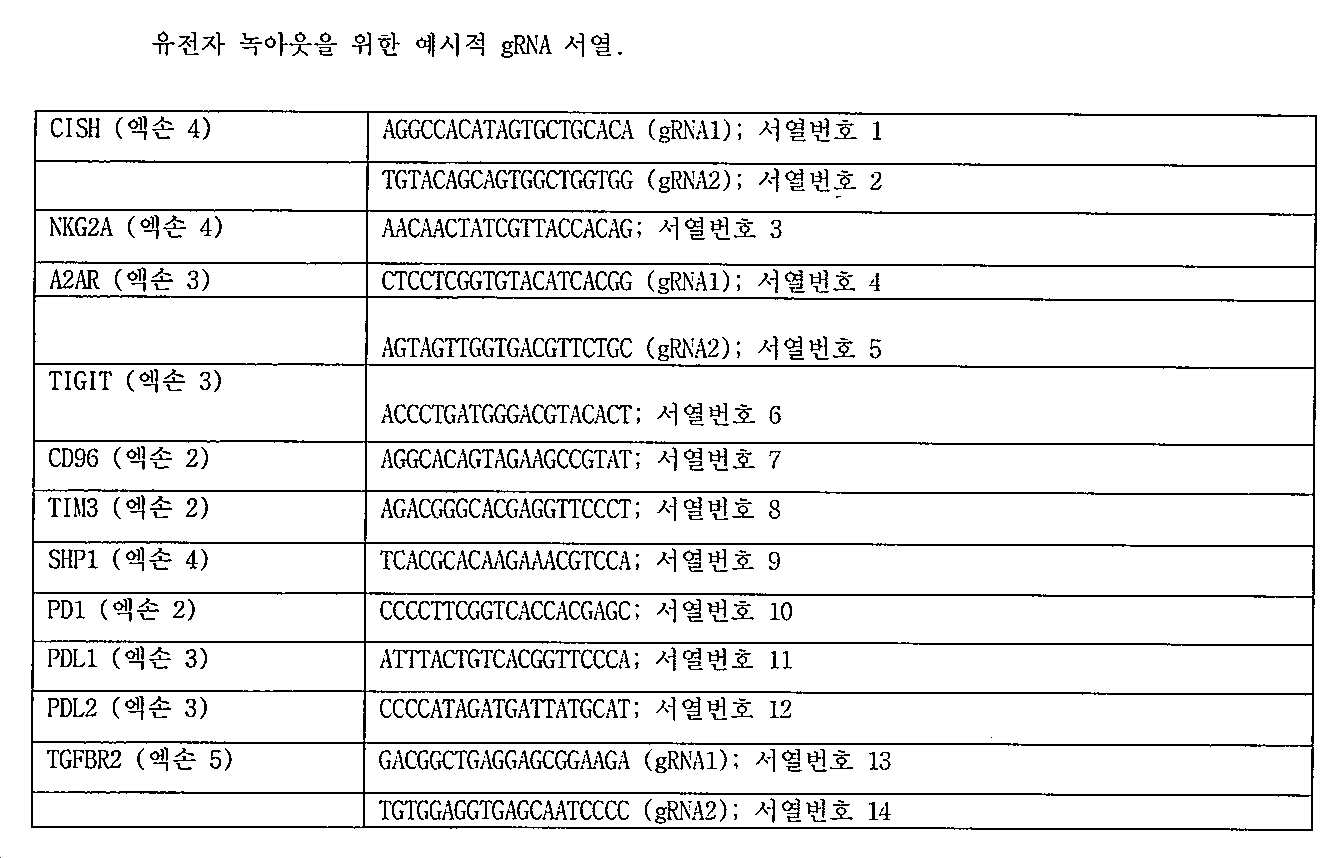
[0082] 일부 구현예에서, 본원 개시내용의 면역 세포는 2개 이상의 유전자를 변경하도록 변형된다. 일부 구현예에서, 변경된 유전자 발현은 유전자 내 파괴, 예를 들어, 녹 아웃, 삽입. 미스센스 또는 프레임 전환 돌연변이, 예를 들어, 양대립유전자 프레임 전환 돌연변이, 유전자 전부 또는 일부, 예를 들어, 하나 이상의 엑손 또는 이의 일부의 결실 및/또는 녹-인을 수행함에 의해 수행된다. 특정 구현예에서, 변경된 유전자 발현은 DNA-결합 표적화된 뉴클레아제, 예를 들어, RNA-가이드된 뉴클레아제, 예를 들어, CRlSPR-연합된 뉴클레아제 (Cas)를 포함하고, 구체적으로 유전자 또는 이의 일부의 서열에 표적화되도록 디자인된 서열 특이적 또는 표적화된 뉴클레아제에 의해 실행될 수 있다. [0082] In some embodiments, immune cells of the present disclosure are modified to alter two or more genes. In some embodiments, altered gene expression is disrupted within a gene, eg, knockout, insertion. missense or frame shift mutations, eg, biallelic frame shift mutations, all or part of a gene, eg, deletion and/or knock-in of one or more exons or parts thereof. In certain embodiments, altered gene expression comprises a DNA-binding targeted nuclease, e.g., an RNA-guided nuclease, e.g., a CR1SPR-associated nuclease (Cas), specifically may be carried out by sequence-specific or targeted nucleases designed to target the sequence of a gene or portion thereof.
[0083] 일부 구현예에서, 유전자의 발현, 활성 및/또는 기능의 변경은 유전자를 파괴함에 의해 수행된다. 일부 양상에서, 유전자는 이의 발현이 유전자 변형의 부재 또는 변형을 수행하기 위해 도입된 성분들의 부재하의 발현과 비교하여 적어도 또는 약 20, 30, 또는 40%, 일반적으로 적어도 또는 약 50, 60, 70, 80, 90, 91, 92, 93, 94, 95, 96, 97, 98, 99 또는 100%까지 감소되도록 변형된다. [0083] In some embodiments, altering the expression, activity and/or function of a gene is effected by disrupting the gene. In some aspects, a gene has a gene whose expression is at least or about 20, 30, or 40%, generally at least or about 50, 60, 70, compared to expression in the absence of the genetic modification or in the absence of components introduced to effect the modification. , 80, 90, 91, 92, 93, 94, 95, 96, 97, 98, 99 or 100%.
[0084] 일부 구현예에서, 상기 변경은 유전자의 발현이 필요에 따라 후기 시점에 회복되도록 일시적이거나 가역적이다. 다른 구현예에서, 상기 변경은 가역적이거나 일시적이지 않고, 예를 들어, 영구적이다. [0084] In some embodiments, the alteration is transient or reversible such that expression of the gene is restored at a later time point as needed. In other embodiments, the alteration is not reversible or transient, eg, permanent.
[0085] 일부 구현예에서, 유전자 변경은 전형적으로 표적화된 방식으로 유전자 내 하나 이상의 이중 가닥 파열 및/또는 하나 이상의 단일 가닥 파열의 도입에 의해 수행된다. 일부 구현예에서, 이중 가닥 또는 단일 가닥 파열은 뉴클레아제, 예를 들어, 엔도뉴클레아제, 예를 들어, 유전자-표적화된 뉴클레아제에 의해 수행된다. 일부 양상에서, 상기 파열은 유전자의 암호화 영역 내, 예를 들어, 엑손내 유도된다. 예를 들어, 일부 구현예에서, 상기 유도는 암호화 영역의 N-말단 부위 부근에서, 예를 들어, 제1 엑손내, 제2 엑손 내 또는 후속 엑손내에서 일어난다. [0085] In some embodiments, genetic alteration is typically performed by introduction of one or more double-stranded breaks and/or one or more single-stranded breaks within a gene in a targeted manner. In some embodiments, double-stranded or single-stranded breaks are performed by a nuclease, eg, an endonuclease, eg, a gene-targeted nuclease. In some aspects, the rupture is induced within the coding region of the gene, eg, within an exon. For example, in some embodiments, said induction occurs near the N-terminal site of the coding region, eg, within a first exon, within a second exon, or within a subsequent exon.
[0086] 일부 양상에서, 이중 가닥 또는 단일 가닥 파열은 예를 들어, 비-상동성 말단-접합 (NHEJ) 또는 상동성-지시된 복구(HDR)에 의해 세포성 복구 공정을 통해 복구를 진행한다. 일부 양상에서, 상기 복구 공정은 오류가 발생하기 용이하고, 유전자의 완전한 녹아웃을 유도할 수 있는, 프레임 전환 돌연변이, 예를 들어, 양대립유전자 프레임 전환 돌연변이와 같은 유전자의 파괴를 유도한다. 예를 들어, 일부 양상에서, 상기 파괴는 결실, 돌연변이 및/또는 삽입을 유도함을 포함한다. 일부 구현예에서, 상기 파괴는 조기 정지 코돈의 존재를 유도한다. 일부 양상에서, 삽입, 결실, 전좌, 프레임전환 돌연변이 및/또는 미성숙한 중지 코돈의 존재는 유전자의 발현, 활성 및/또는 기능의 파괴를 유도한다. [0086] In some aspects, double-stranded or single-stranded breaks undergo repair via a cellular repair process, for example, by non-homologous end-joining (NHEJ) or homology-directed repair (HDR). . In some aspects, the repair process is error prone and leads to disruption of a gene, such as a frame shift mutation, eg, a biallelic frame shift mutation, that can lead to a complete knockout of the gene. For example, in some aspects, the disruption comprises inducing deletion, mutation and/or insertion. In some embodiments, the disruption results in the presence of an early stop codon. In some aspects, insertions, deletions, translocations, frameshift mutations and/or the presence of immature stop codons lead to disruption of expression, activity and/or function of the gene.
[0087] 일부 구현예에서, 변경은 RNA-가이드된 엔도뉴클레아제 (RGEN)을 통한 변경과 같은, 하나 이상의 DNA-결합 핵산을 사용하여 수행된다. 예를 들어, 상기 변경은 클러스터링된 규칙적으로 이격된 짧은 팔린드롬 반복체 (CRISPR) 및 CRISPR-연합 (Cas) 단백질을 사용하여 수행될 수 있다. 일반적으로, "CRISPR 시스템"은 총체적으로 Cas 유전자를 암호화하는 서열, tracr (트랜스-활성화 CRISPR) 서열(예를 들어, tracrRNA 또는 활성 부분 tracrRNA), tracr-쌍(mate) 서열 (내인성 CRISPR 시스템과 관련하여 “직접적인 반복체” 및 tracrRNA-가공된 부분 직접적인 반복체), 가이드 서열(또한, 내인성 CRISPR 시스템과 관련하여 “스페이서”로서 언급되는)), 및/또는 CRISPR 유전자좌로부터 다른 서열 및 전사체를 포함하는, CRISPR-연합 (“Cas”) 유전자의 발현에 관여하거나 이의 활성을 지시하는 전사체 및 다른 요소들을 언급한다. [0087] In some embodiments, the alteration is performed using one or more DNA-binding nucleic acids, such as through an RNA-guided endonuclease (RGEN). For example, such alterations can be performed using clustered regularly spaced short palindromic repeats (CRISPR) and CRISPR-associated (Cas) proteins. In general, a "CRISPR system" refers to a sequence encoding a Cas gene collectively, a tracr (trans-activating CRISPR) sequence (eg, tracrRNA or active moiety tracrRNA), a tracr-mate sequence (as it relates to an endogenous CRISPR system). "direct repeats" and tracrRNA-engineered partial direct repeats), guide sequences (also referred to as "spacers" in reference to the endogenous CRISPR system), and/or other sequences and transcripts from the CRISPR locus refers to transcripts and other elements that are involved in the expression of or direct the activity of CRISPR-associated (“Cas”) genes.
[0088] CRISPR/Cas 뉴클레아제 또는 CRISPR/Cas 뉴클레아제 시스템은 뉴클레아제 기능 (예를 들어, 2개의 뉴클레아제 도메인)과 함께 DNA 및 Cas 단백질 (예를 들어, Cas9)에 서열 특이적으로 결합하는 비-암호화 RNA 분자(가이드) RNA를 포함할 수 있다. CRISPR 시스템의 하나 이상의 요소들은 예를 들어, 내인성 CRISPR 시스템을 포함하는 특정 유기체, 예를 들어, 스트렙토코커스 피오게네스(Streptococcus pyogenes)로부터 유래된 I형, II형, 또는 III형 CRISPR 시스템으로부터 유래할 수 있다. [0088] CRISPR/Cas nucleases or CRISPR/Cas nuclease systems are sequence specific for DNA and Cas proteins (eg, Cas9) with nuclease function (eg, two nuclease domains) non-coding RNA molecule (guide) RNA that binds positively. One or more elements of the CRISPR system may be derived from a type I, type II, or type III CRISPR system, e.g., derived from a particular organism comprising an endogenous CRISPR system, e.g., Streptococcus pyogenes. can
[0089] 일부 양상에서, Cas 뉴클레아제 및 gRNA (표적 서열 및 고정된 tracrRNA에 특이적인 crRNA의 융합을 포함하는)는 세포에 도입한다. 일반적으로, gRNA의 5’ 말단에서 표적 부위는 Cas 뉴클레아제를 상보성 염기 쌍형성을 사용하여 표적 부위, 예를 들어, 유전자에 표적화시킨다. 표적 부위는 전형적으로 NGG 또는 NAG와 같은, 프로토스페이서 인접 모티프 (PAM) 서열의 바로 5’ 위치를 기준으로 선택될 수 있다. 이와 관련하여, gRNA는 가이드 RNA의 처음 20, 19, 18, 17, 16, 15, 14, 14, 12, 11, 또는 10개의 뉴클레오타이드를 표적 DNA 서열에 상응하도록 변형시킴에 의해 목적하는 서열에 표적화된다. 일반적으로, CRISPR 시스템은 표적 서열의 부위에서 CRISPR 복합체의 형성을 촉진시키는 요소들에 의해 특징화된다. 전형적으로, "표적 서열"은 일반적으로 가이드 서열이 상보성을 갖도록 디자인된 서열을 언급하고, 여기서, 표적 서열과 가이드 서열 간의 하이브리드화는 CRISPR 복합체의 형성을 촉진시킨다. 완전한 상보성은 필수적으로 요구되지 않고, 단, 하이브리드화를 유발하고 CRISPR 복합체의 형성을 촉진시키기에 충분한 상보성이 있다. [0089] In some aspects, a Cas nuclease and a gRNA (comprising a fusion of a crRNA specific to a target sequence and an immobilized tracrRNA) are introduced into a cell. Generally, the target site at the 5' end of the gRNA targets the Cas nuclease to the target site, eg, a gene, using complementary base pairing. The target site may be selected based on the position immediately 5' of the protospacer adjacent motif (PAM) sequence, typically NGG or NAG. In this regard, the gRNA is targeted to a sequence of interest by modifying the first 20, 19, 18, 17, 16, 15, 14, 14, 12, 11, or 10 nucleotides of the guide RNA to correspond to the target DNA sequence. do. In general, the CRISPR system is characterized by elements that promote the formation of the CRISPR complex at the site of the target sequence. Typically, "target sequence" generally refers to a sequence to which a guide sequence is designed to have complementarity, wherein hybridization between the target sequence and the guide sequence promotes the formation of a CRISPR complex. Perfect complementarity is not necessarily required, provided that there is sufficient complementarity to cause hybridization and promote formation of the CRISPR complex.
[0090] CRISPR 시스템은 표적 부위에서 이중 가닥 파열 (DSB)에 이어서 본원에 논의된 바와 같은 파괴 또는 변경을 유도할 수 있다. 다른 구현예에서, “닉카제”로 간주되는 Cas9 변이체를 사용하여 표적 부위에서 단일 가닥을 닉킹(nick)한다. 쌍 형성 닉카제를 사용하여, 예를 들어, 각각 닉의 동시 도입시, 5’ 오버행이 도입되도록 하는 한쌍의 상이한 gRNA 표적화 서열에 의해 지시되는 특이성을 개선시킬 수 있다. 다른 구현예에서, 촉매적 불활성 Cas9는 전사 리프레서 또는 활성화인자와 같은 이종성 이펙터 도메인에 융합되어 유전자 발현에 영향을 미친다. [0090] The CRISPR system is capable of inducing a double strand break (DSB) at the target site followed by a break or alteration as discussed herein. In another embodiment, a Cas9 variant, considered a “nickase,” is used to nick a single strand at the target site. Pairing nickases can be used to improve the specificity dictated by a pair of different gRNA targeting sequences, for example, such that upon co-introduction of each nick, a 5' overhang is introduced. In another embodiment, a catalytically inactive Cas9 is fused to a heterologous effector domain, such as a transcriptional repressor or activator, to affect gene expression.
[0091] 표적 서열은 DNA 또는 RNA 폴리뉴클레오타이드와 같은 임의의 폴리뉴클레오타이드를 포함할 수 있다. 표적 서열은 세포의 핵 또는 세포질에, 예를 들어, 세포의 기관 내 위치할 수 있다. 일반적으로, 표적 서열을 포함하는 표적화된 유전자좌로의 재조합을 위해 사용될 수 있는 서열 또는 주형은 "편집 주형" 또는 "편집 폴리뉴클레오타이드" 또는 "편집 서열"로서 언급된다. 일부 양상에서, 외인성 주형 폴리뉴클레오타이드는 편집 주형으로서 언급될 수 있다. 일부 양상에서, 재조합은 상동성 재조합이다. [0091] The target sequence may comprise any polynucleotide, such as a DNA or RNA polynucleotide. The target sequence may be located in the nucleus or cytoplasm of the cell, for example, in an organ of the cell. In general, a sequence or template that can be used for recombination into a targeted locus comprising a target sequence is referred to as an “editing template” or “editing polynucleotide” or “editing sequence”. In some aspects, an exogenous template polynucleotide may be referred to as an editing template. In some aspects, the recombination is homologous recombination.
[0092] 전형적으로, 내인성 CRISPR 시스템과 관련하여, CRISPR 복합체 (표적 서열에 하이브리드화되고 하나 이상의 Cas 단백질과 복합체화된 가이드 서열을 포함하는)의 형성은 표적 서열에서 또는 이의 부근에서 (예를 들어, 이로부터 1, 2, 3, 4, 5, 6, 7, 8, 9, 10, 20, 50개 이상의 염기쌍 내) 하나의 가닥 또는 가닥 둘다의 절단을 유도한다. 야생형 tracr 서열 전부 또는 일부 (예를 들어, 야생형 tracr 서열의 약 또는 약 20, 26, 32, 45, 48, 54, 63, 67, 85, 또는 이상의 뉴클레오타이드)를 포함할 수 있거나 이들로 이루어질 수 있는 tracr 서열은 또한 예를 들어, tracr 서열의 적어도 일부를 가이드 서열에 작동적으로 연결된 tracr 쌍 서열의 전부 또는 일부에 하이브리드화함에 의해 CRISPR 복합체의 일부를 형성할 수 있다. tracr 서열은 하이브리드화하고 CRISPR 복합체의 형성에 관여하는 tracr 쌍 서열에 충분한 상보성, 예를 들어, 최적으로 정렬되는 경우 tracr 쌍 서열의 길이를 따라 적어도 50%, 60%, 70%, 80%, 90%, 95%또는 99%의 서열 상보성을 갖는다. [0092] Typically, in the context of an endogenous CRISPR system, formation of a CRISPR complex (comprising a guide sequence hybridized to a target sequence and complexed with one or more Cas proteins) occurs at or near the target sequence (e.g., , which induces cleavage of one or both strands (within 1, 2, 3, 4, 5, 6, 7, 8, 9, 10, 20, 50 or more base pairs therefrom). may comprise or consist of all or part of the wild-type tracr sequence (e.g., about or about 20, 26, 32, 45, 48, 54, 63, 67, 85, or more nucleotides of the wild-type tracr sequence) The tracr sequence may also form part of a CRISPR complex, for example, by hybridizing at least a portion of the tracr sequence to all or part of a tracr pair sequence operably linked to a guide sequence. The tracr sequence hybridizes and has sufficient complementarity to the tracr pair sequence involved in the formation of the CRISPR complex, e.g., at least 50%, 60%, 70%, 80%, 90% along the length of the tracr pair sequence when optimally aligned. %, 95% or 99% sequence complementarity.
[0093] CRISPR 시스템의 하나 이상의 요소들의 발현을 구동시키는 하나 이상의 벡터는 세포에 도입되어 CRISPR 시스템의 요소들의 발현이 하나 이상의 표적 부위에서 CRISRR 복합체의 형성을 지시할 수 있다. 성분들은 또한 단백질 및/또는 RNA로서 세포에 전달될 수 있다. 예를 들어, Cas 효소, tracr-쌍 서열에 연결된 가이드 서열 및 tracr 서열은 각각 별도의 벡터 상에 별도의 조절 요소들에 작동적으로 연결될 수 있다. 대안적으로, 동일하거나 상이한 조절 요소들로부터 발현되는 2개 이상의 요소들은 제1 벡터에 포함되지 않은 CRISPR 시스템의 임의의 성분들을 제공하는 하나 이상의 추가의 벡터와 함께 단일 벡터에 조합될 수 있다. 벡터는 제한 엔도뉴클레아제 인지 서열 (또한 “클로닝 부위”로서 언급되는)과 같은 하나 이상의 삽입 부위를 포함할 수 있다. 일부 구현예에서, 하나 이상의 삽입 부위는 하나 이상의 벡터의 하나 이상의 서열 요소들의 업스트림 및/또는 다운스트림에 위치한다. 다수의 상이한 가이드 서열이 사용되는 경우, 단일 발현 작제물은 세포 내 다수의 상이한 상응하는 표적 서열에 CRISPR 활성을 표적화하기 위해 사용될 수 있다. [0093] One or more vectors driving expression of one or more elements of the CRISPR system can be introduced into the cell such that expression of the elements of the CRISPR system directs the formation of the CRISRR complex at one or more target sites. Components may also be delivered to cells as proteins and/or RNAs. For example, the Cas enzyme, the guide sequence linked to the tracr-pair sequence, and the tracr sequence can each be operably linked to separate regulatory elements on separate vectors. Alternatively, two or more elements expressed from the same or different regulatory elements may be combined in a single vector with one or more additional vectors providing any components of the CRISPR system not included in the first vector. A vector may contain one or more insertion sites, such as restriction endonuclease recognition sequences (also referred to as “cloning sites”). In some embodiments, one or more insertion sites are located upstream and/or downstream of one or more sequence elements of one or more vectors. When a number of different guide sequences are used, a single expression construct can be used to target CRISPR activity to a number of different corresponding target sequences in the cell.
[0094] 벡터는 Cas 단백질과 같은 CRISPR 효소를 암호화하는 효소-암호화 서열에 작동적으로 연결된 조절 요소를 포함할 수 있다. Cas 단백질의 비제한적인 예는 Cas1, Cas1B, Cas2, Cas3, Cas4, Cas5, Cas6, Cas7, Cas8, Cas9 (또한 Csn1 및 Csx12로서 공지된), Cas10, Csy1, Csy2, Csy3, Cse1, Cse2, Csc1, Csc2, Csa5, Csn2, Csm2, Csm3, Csm4, Csm5, Csm6, Cmr1, Cmr3, Cmr4, Cmr5, Cmr6, Csb1, Csb2, Csb3, Csx17, Csx14, Csx10, Csx16, CsaX, Csx3, Csx1, Csx15, Csfl, Csf2, Csf3, Csf4, 이의 상동체 또는 이의 변형된 버젼을 포함한다. 이들 효소는 공지되어 있고; 예를 들어, 에스. 피오게네스 Cas9 단백질의 아미노산 서열은 승인 번호 Q99ZW2하에 SwissProt 데이터베이스에서 발견될 수 있다. [0094] The vector may include regulatory elements operably linked to an enzyme-coding sequence encoding a CRISPR enzyme, such as a Cas protein. Non-limiting examples of Cas proteins include Cas1, Cas1B, Cas2, Cas3, Cas4, Cas5, Cas6, Cas7, Cas8, Cas9 (also known as Csn1 and Csx12), Cas10, Csy1, Csy2, Csy3, Cse1, Cse2, Csc1 , Csc2, Csa5, Csn2, Csm2, Csm3, Csm4, Csm5, Csm6, Cmr1, Cmr3, Cmr4, Cmr5, Cmr6, Csb1, Csb2, Csb3, Csx17, Csx14, Csx10, Csx3, Csx10, Csxfl , Csf2, Csf3, Csf4, homologues or modified versions thereof. These enzymes are known; For example, S. The amino acid sequence of the pyogenes Cas9 protein can be found in the SwissProt database under accession number Q99ZW2.
[0095] CRISPR 효소는 Cas9 (예를 들어, 에스. 피오게네스로부터 또는 에스. 뉴모니아로부터)일 수 있다. CRISPR 효소는 예를 들어, 표적 서열 내 및/또는 표적 서열의 보체 내, 표적 서열의 위치에서 가닥 하나 또는 가닥 둘다의 절단을 지시할 수 있다. 상기 벡터는 상응하는 야생형 효소와 관련하여 돌연변이된 CRISPR 효소를 암호화하여 상기 돌연변이된 CRISPR 효소는 표적 서열을 함유하는 표적 폴리뉴클레오타이드의 가닥 하나 또는 가닥 둘다를 절단하는 능력이 부재일 수 있다. 예를 들어, 에스. 피오게네스로부터의 Cas9의 RuvC I 촉매 도메인에서 아스파르테이트 대 알라닌 치환 (D10A)은 가닥 둘다를 절단하는 뉴클레아제로부터 닉카제 (단일 가닥을 절단하는)로 Cas9를 전환시킨다. 일부 구현예에서, Cas9 닉카제는 가이드 서열(들), 예를 들어, 각각 DNA 표적의 센스 및 안티센스 가닥을 표적화하는 2개의 가이드 서열과 조합하여 사용될 수 있다. 상기 조합은 가닥 둘다를 닉킹하도록 하고 NHEJ 또는 HDR을 유도하기 위해 사용된다. [0095] The CRISPR enzyme may be Cas9 (eg , from S. pyogenes or from S. pneumoniae). A CRISPR enzyme may direct cleavage of one or both strands at a location in the target sequence, eg, within the target sequence and/or in the complement of the target sequence. The vector encodes a mutated CRISPR enzyme with respect to a corresponding wild-type enzyme such that the mutated CRISPR enzyme lacks the ability to cleave one or both strands of the target polynucleotide containing the target sequence. For example, S. An aspartate to alanine substitution (D10A) in the RuvC I catalytic domain of Cas9 from pyogenes converts Cas9 from a nuclease cleaving both strands to a nickase (cleaving a single strand). In some embodiments, a Cas9 nickase can be used in combination with a guide sequence(s), eg, two guide sequences that each target the sense and antisense strands of a DNA target. This combination allows nicking of both strands and is used to induce NHEJ or HDR.
[0096] 일부 구현예에서, CRISPR 효소를 암호화하는 효소 암호화 서열은 특정 세포에서, 예를 들어, 진핵 세포에서의 발현을 위해 코돈 최적화되어 있다. 진핵 세포는 특정 유기체, 예를 들어, 사람, 마우스, 래트, 토끼, 개 또는 비-사람 영장류를 포함하는 포유동물의 세포이거나 이들로부터 유래된 세포일 수 있다. 일반적으로, 코돈 최적화는 고유 서열의 적어도 하나의 코돈을 고유 아미노산 서열을 유지하면서 숙주 세포의 유전자에서 보다 흔하게 또는 가능 흔하게 사용되는 코돈으로 대체함에 의해 관심 대상의 숙주 세포에서 증진된 발현을 위해 핵산 서열을 변형시키는 공정을 언급한다. 다양한 종은 특정 아미노산의 특정 코돈에 대해 특정 편향을 나타낸다. 코돈 편향(유기체 간의 코돈 용법에서의 차이)은 흔히 전령 RNA (mRNA)의 해독 효율과 상호관련되고, 이는 이어서 무엇 보다 해독될 코돈의 성질 및 특정 운반 RNA (tRNA) 분자의 가용성에 의존하는 것으로 사료된다. 세포에서 선택된 tRNA의 우세는 일반적으로 펩타이드 합성에서 가장 흔하게 사용되는 코돈을 반영한다. 따라서, 유전자들은 코돈 최적화를 기준으로 소정의 유기체에서 최적의 유전자 발현을 위해 조정될 수 있다. [0096] In some embodiments, the enzyme coding sequence encoding the CRISPR enzyme is codon optimized for expression in a particular cell, eg, in a eukaryotic cell. A eukaryotic cell may be a cell of or derived from a particular organism, eg, a mammal, including a human, mouse, rat, rabbit, dog, or non-human primate. In general, codon optimization involves replacing a nucleic acid sequence for enhanced expression in a host cell of interest by replacing at least one codon of the native sequence with a more commonly or possibly more commonly used codon in the host cell's gene while maintaining the native amino acid sequence. refers to the process of transforming Different species exhibit specific biases for specific codons of specific amino acids. Codon bias (differences in codon usage between organisms) is often correlated with the translation efficiency of messenger RNA (mRNA), which in turn is believed to depend, among other things, on the nature of the codon to be translated and the availability of specific transport RNA (tRNA) molecules. do. The predominance of the selected tRNA in the cell generally reflects the most commonly used codons in peptide synthesis. Thus, genes can be adjusted for optimal gene expression in a given organism based on codon optimization.
[0097] 일반적으로, 가이드 서열은 표적 서열과 하이브리드화하고 CRISPR 복합체의 표적 서열로의 서열-특이적 결합을 지시하기에 충분히 표적 폴리뉴클레오타이드 서열과 상보성을 갖는 임의의 폴리뉴클레오타이드 서열이다. 일부 구현예에서, 가이드 서열과 이의 상응하는 표적 서열 간의 상보성 정도는 적합한 정렬 알고리듬을 사용하여 최적으로 정렬되는 경우 약 또는 약 50%, 60%, 75%, 80%, 85%, 90%, 95%, 97%, 99%이상이다. [0097] In general, a guide sequence is any polynucleotide sequence having sufficient complementarity with the target polynucleotide sequence to hybridize with the target sequence and direct sequence-specific binding of the CRISPR complex to the target sequence. In some embodiments, the degree of complementarity between a guide sequence and its corresponding target sequence is about or about 50%, 60%, 75%, 80%, 85%, 90%, 95 when optimally aligned using a suitable alignment algorithm. %, 97%, 99% or more.
[0098] 최적의 정렬은 서열을 정렬시키기위한 임의의 적합한 알고리듬을 사용하여 결정될 수 있고 상기 알고리즘의 비제한적인 예는 스미스-워터맨 (Smith-Waterman) 알고리즘, 니들맨-운쉬(Needleman-Wunsch) 알고리즘, 버로우-휠러 트랜스폼 (Burrows-Wheeler Transform)을 기반으로 하는 알고리즘 (예를 들어, 버로우 휠러 얼라이너(Burrows Wheeler Aligner), 클러스탈 더블유 (Clustal W), 클러스탈 엑스(Clustal X), BLAT, 노보얼라인(Novoalign) (Novocraft Technologies, ELAND (Illumina, San Diego, Calif.), SOAP (soap.genomics.org.cn에서 가용한), 및 Maq (maq.sourceforge.net에서 가용한)를 포함한다. [0098] An optimal alignment can be determined using any suitable algorithm for aligning sequences, non-limiting examples of which include the Smith-Waterman algorithm, the Needleman-Wunsch algorithm. , algorithms based on the Burrows-Wheeler Transform (e.g., Burrows Wheeler Aligner, Clustal W, Clustal X, BLAT, Novoalign (Novocraft Technologies, ELAND (Illumina, San Diego, Calif.)), SOAP (available at soap.genomics.org.cn), and Maq (available at maq.sourceforge.net). .
[0099] CRISPR 효소는 하나 이상의 이종성 단백질 도메인을 포함하는 융합 단백질의 일부일 수 있다. CRISPR 효소 융합 단백질은 임의의 추가의 단백질 서열 및 임의로 임의의 2개의 도메인 사이의 링커 서열을 포함할 수 있다. CRISPR 효소에 융합될 수 있는 단백질 도메인의 예는 제한 없이, 에피토프 태그, 리포터 유전자 서열, 및 하기의 활성 중 하나 이상을 갖는 단백질 도메인을 포함한다: 메틸라제 활성, 데메틸라제 활성, 전사 활성화 활성, 전사 억제 활성, 전사 방출 인자 활성, 히스톤 변형 활성, RNA 절단 활성 및 핵산 결합 활성. 에피토프 태그의 비제한적인 예는 히스티딘 (His) 태그, V5 태그, FLAG 태그, 인플루엔자 헤마글루티닌 (HA) 태그, Myc 태그, VSV-G 태그, 및 티오레독신 (Trx) 태그를 포함한다. 리포터 유전자의 예는 글루타티온-5-트랜스퍼라제 (GST), 서양고추냉이 퍼옥시다제 (HRP), 클로람페니콜 아세틸트랜스퍼라제 (CAT) 베타 갈락토시다제, 베타-글루쿠로니다제, 루시퍼라제, 녹색 형광성 단백질 (GFP), HcRed, DsRed, 시안(cyan) 형광성 단백질 (CFP), 황색 형광성 단백질 (YFP), 및 청색 형광 단백질 (BFP)를 포함하는 자가형광 단백질을 포함하지만 이에 제한되지 않는다. CRISPR 효소는 말토스 결합 단백질 (MBP), S-태그, Lex A DNA 결합 도메인 (DBD) 융합체, GAL4A DNA 결합 도메인 융합체 및 헤르페스 심플렉스 바이러스 (HSV) BP 16 단백질 융합체를 포함하지만 이에 제한되지 않는, DNA 분자에 결합하거나 다른 세포 분자에 결합하는 단백질 또는 단백질의 단편을 암호화하는 유전자 서열에 융합될 수 있다. CRISPR 효소를 포함하는 융합 단백질의 일부를 형성할 수 있는 추가의 도메인은 본원에 참조로 인용된 US 20110059502에 기재되어 있다. [0099] The CRISPR enzyme may be part of a fusion protein comprising one or more heterologous protein domains. The CRISPR enzyme fusion protein may comprise any additional protein sequence and optionally a linker sequence between any two domains. Examples of protein domains that can be fused to a CRISPR enzyme include, without limitation, epitope tags, reporter gene sequences, and protein domains having one or more of the following activities: methylase activity, demethylase activity, transcriptional activation activity, Transcription repression activity, transcription release factor activity, histone modification activity, RNA cleavage activity and nucleic acid binding activity. Non-limiting examples of epitope tags include histidine (His) tags, V5 tags, FLAG tags, influenza hemagglutinin (HA) tags, Myc tags, VSV-G tags, and thioredoxin (Trx) tags. Examples of reporter genes are glutathione-5-transferase (GST), horseradish peroxidase (HRP), chloramphenicol acetyltransferase (CAT) beta galactosidase, beta-glucuronidase, luciferase, green autofluorescent proteins including, but not limited to, fluorescent protein (GFP), HcRed, DsRed, cyan fluorescent protein (CFP), yellow fluorescent protein (YFP), and blue fluorescent protein (BFP). CRISPR enzymes include, but are not limited to, maltose binding protein (MBP), S-tag, Lex A DNA binding domain (DBD) fusion, GAL4A DNA binding domain fusion and herpes simplex virus (HSV)
III. 억제성 유전자 유전자좌에서 CAR 및/또는 TCR의 삽입III. Insertion of CAR and/or TCR at the repressor gene locus
[00100] 일부 구현예에서, 본원의 개시내용은 면역 세포의 특이적 유전자 유전자좌에서 CAR 및/또는 TCR의 삽입에 관한 것이다. CAR 및/또는 TCR은 예를 들어, NKG2A, Siglec-7, LAG3, TIM3, CISH, FOXO1, TGFBR2, TIGIT, CD96, 아데노신 수용체 2A, NR3C1, PD1, PDL-1, PDL-2, CD47, SIRPAa, SHIP1, ADAM17, pS6, 4EBP1, CD25, CD40, IL21R, ICAM1, CD95, CD80, CD86, IL10R, CD5, CD7, 및 이의 조합으로 이루어진 그룹으로부터 선택되는 유전자와 같은 억제성 유전자 유전자좌에 삽입될 수 있다. [00100] In some embodiments, the disclosure herein relates to insertion of a CAR and/or TCR at a specific genetic locus of an immune cell. CAR and/or TCR can be, for example, NKG2A, Siglec-7, LAG3, TIM3, CISH, FOXO1, TGFBR2, TIGIT, CD96, adenosine receptor 2A, NR3C1, PD1, PDL-1, PDL-2, CD47, SIRPAa, SHIP1, ADAM17, pS6, 4EBP1, CD25, CD40, IL21R, ICAM1, CD95, CD80, CD86, IL10R, CD5, CD7, and combinations thereof.
[00101] 본원에 기재된 임의의 방법에서 하나 이상의 CAR 및/또는 TCR의 삽입은 부위-특이적일 수 있다. 예를 들어, 하나 이상의 CAR 및/또는 TCR은 프로모터에 인접 부위 또는 부근에 삽입될 수 있다. 또 다른 예에서, 하나 이상의 전이유전자는 유전자 (예를 들어, 억제성 유전자)의 엑손에 인접 부위, 부근 또는 내에 삽입될 수 있다. 상기 삽입을 사용하여 CAR 및/또는 TCR을 녹인시킬 수 있고 유전자의 발현을 동시에 파괴한다. 또 다른 예에서, 하나 이상의 CAR 및/또는 TCR은 유전자의 인트론에 인접 부위, 부근 또는 이내에 삽입될 수 있다. CAR 및/또는 TCR은 아데노-연합된 바이러스 (AAV) 바이러스 벡터에 의해 도입되고 표적화된 게놈 위치에 통합될 수 있다. 일부 경우에, rAAV 벡털를 사용하여 특정 위치로의 전이유전자의 삽입을 지시할 수 있다. 예를 들어, 일부 경우에, CAR 및/또는 TCR은 NKG2A, Siglec 7, LAG3, TIM3, CISH, FOXO1, TGFBR2, TIGIT, CD96, 아데노신 수용체 2A, NR3C1, PD1, PDL-1, PDL-2, CD47, SIRPa, SHIP1, ADAM17, pS6, 4EBP1, CD25, CD40, IL21R, ICAM1, CD95, CD80, CD86, IL10R, CD5, 또는 CD7 유전자의 적어도 일부에 rAAV 또는 AAV 벡터에 의해 통합될 수 있다. [00101] The insertion of one or more CARs and/or TCRs in any of the methods described herein may be site-specific. For example, one or more CARs and/or TCRs may be inserted at or near the promoter. In another example, one or more transgenes can be inserted into, adjacent to, or within an exon of a gene (eg, a repressor gene). The insertion can be used to knock down the CAR and/or TCR and simultaneously disrupt the expression of the gene. In another example, one or more CARs and/or TCRs may be inserted at, adjacent to, or within an intron of a gene. The CAR and/or TCR may be introduced by an adeno-associated virus (AAV) viral vector and integrated at a targeted genomic location. In some cases, the rAAV vector can be used to direct insertion of a transgene into a specific location. For example, in some cases, the CAR and/or TCR is NKG2A,
[00102] 세포의 표적화된 유전자좌의 변형은 DNA를 세포에 도입함에 의해 생성될 수 있고, 여기서, 상기 DNA는 표적 유전자좌와 상동성을 갖는다. DNA는 마커 유전자를 포함하여 통합된 작제물을 포함하는 세포의 선택을 가능하게 할 수 있다. 표적 벡터에서 상보성 DNA는 표적 유전자좌에서 염색체 DNA와 재조합할 수 있다. 마커 유전자는 상보성 DNA 서열, 3' 재조합 아암, 및5' 재조합 아암에 의해 플랭킹될 수 있다. 세포 내 다수의 유전자좌는 표적화될 수 있다. 예를 들어, 1개 이상의 표적 유전자좌에 특이적인 재조합 아암을 갖는 전이유전자는 1회 도입될 수 있어 다수의 게놈 변형은 단일 단계에서 일어난다. 상동성 아암은 0.2 kb 내지 약 5 kb 길이, 예를 들어, 약 0.2 kb, 0.4 kb 0.6 kb, 0.8 kb, 1.0 kb, 1.2 kb, 1.4 kb, 1.6 kb, 1.8 kb, 2.0kb, 2.2 kb, 2.4 kb, 2.6 kb, 2.8 kb, 3.0 kb, 3.2 kb, 3.4 kb, 3.6 kb, 3.8 kb, 4.0 kb, 4.2 kb, 4.4 kb, 4.6kb, 4.8 kb, 내지 약 5.0kb 길이일 수 있다. [00102] Modification of a targeted locus in a cell can be produced by introducing DNA into the cell, wherein the DNA has homology to the target locus. The DNA may include a marker gene to enable selection of cells containing the integrated construct. Complementary DNA in the target vector can recombine with chromosomal DNA at the target locus. The marker gene may be flanked by a complementary DNA sequence, a 3' recombination arm, and a 5' recombination arm. Multiple loci in a cell can be targeted. For example, a transgene with a recombinant arm specific for one or more target loci can be introduced once so that multiple genomic modifications occur in a single step. The homology arms are from 0.2 kb to about 5 kb in length, e.g., about 0.2 kb, 0.4 kb 0.6 kb, 0.8 kb, 1.0 kb, 1.2 kb, 1.4 kb, 1.6 kb, 1.8 kb, 2.0 kb, 2.2 kb, 2.4 kb. kb, 2.6 kb, 2.8 kb, 3.0 kb, 3.2 kb, 3.4 kb, 3.6 kb, 3.8 kb, 4.0 kb, 4.2 kb, 4.4 kb, 4.6 kb, 4.8 kb, to about 5.0 kb in length.
[00103] 하나의 방법에서, 가이드 RNA는 예를 들어, 유전자의 프로모터, 엑손 또는 인트론에 인접한 부위에서 억제성 유전자의 영역을 표적화하도록 디자인될 수 있다. 가이드 RNA는 엑손, 예를 들어, 억제성 유전자의 제1, 제2 또는 제3 엑손의 5’ 말단을 표적화할 수 있다. 가이드 RNA는 AAV 벡터 복구 매트릭스에 포함될 수 있다. AAV 벡터는 자가 절단 2A 펩타이드, 예를 들어, P2A 펩타이드에 이어서 CAR cDNA를 암호화할 수 있다. CAR 카세트 및 가이드 RNA 서열은 억제성 유전자에 대한 상동성 아암에 의해 플랭킹될 수 있다. 면역 세포에는 예를 들어, 전기 천공되어 AAV 벡터 및 Cas9, 예를 들어, Cas9 mRNA가 도입될 수 있다. [00103] In one method, a guide RNA can be designed to target a region of a repressor gene, eg, at a region adjacent to a promoter, exon or intron of the gene. The guide RNA may target the 5' end of an exon, eg, the first, second or third exon of a repressor gene. The guide RNA may be included in the AAV vector repair matrix. The AAV vector may encode a self-cleaving 2A peptide, eg, a P2A peptide followed by a CAR cDNA. The CAR cassette and guide RNA sequences may be flanked by homology arms to repressor genes. Immune cells can be introduced into the AAV vector and Cas9, eg, Cas9 mRNA, eg, by electroporation.
IV. 면역 세포IV. immune cells
[00104] 본원 개시내용의 특정 구현예는 다중 유전자의 녹아웃을 갖고/갖거나 억제성 유전자좌에서 CAR의 녹킹을 갖도록 가공된 면역 세포에 관한 것이다. 면역 세포는 T 세포 (예를 들어, 조절 T 세포, CD4+ T 세포, CD8+ T 세포, 또는 감마-델타 T 세포), NK 세포, 영구 NK 세포, NKT 세포, B 세포, 또는 줄기 세포 (예를 들어, 중간엽 줄기 세포 (MSC) 또는 유도된 만능 줄기 (iPSC) 세포)일 수 있다. 면역 세포는 바이러스 특이적일 수 있고 CAR을 발현하고/하거나 TCR을 발현할 수 있다. 일부 구현예에서, 세포는 단핵구 또는 과립구, 예를 들어, 골수 세포, 대식세포, 호중구, 수지상 세포, 비만 세포, 호산구 및/또는 호염구이다. 또한 본원에서는 입양 세포 치료요법 (이 경우에 상기 세포는 자가유래 또는 동종이계일 수 있다)을 위해 세포를 사용하고 투여하는 방법 뿐만 아니라 면역 세포를 생성하고 가공하는 방법이 제공된다. 따라서, 면역 세포는 예를 들어, 암 세포를 표적화하기 위한 면역치료요법으로서 사용될 수 있다. [00104] Certain embodiments of the present disclosure relate to immune cells engineered to have knockouts of multiple genes and/or to have knockouts of CARs at repressive loci. Immune cells include T cells (eg , regulatory T cells, CD4 + T cells, CD8 + T cells, or gamma-delta T cells), NK cells, persistent NK cells, NKT cells, B cells, or stem cells (eg, for example , mesenchymal stem cells (MSC) or induced pluripotent stem (iPSC) cells). Immune cells may be virus specific and may express a CAR and/or may express a TCR. In some embodiments, the cells are monocytes or granulocytes, eg, bone marrow cells, macrophages, neutrophils, dendritic cells, mast cells, eosinophils and/or basophils. Also provided herein are methods of generating and processing immune cells, as well as methods of using and administering cells for adoptive cell therapy, in which case the cells may be autologous or allogeneic. Thus, immune cells can be used, for example, as immunotherapy to target cancer cells.
[00105] 면역 세포는 대상체, 특히 사람 대상체로부터 단리될 수 있다. 면역 세포는 관심 대상의 대상체, 예를 들어, 특정 질환 또는 병태를 갖는 것으로 의심되는 대상체, 특정 질환 또는 병태에 대한 소인을 갖는 것으로 의심되는 대상체, 또는 특정 질환 또는 병태에 대해 치료요법을 받고있는 대상체로부터 수득될 수 있다. 면역 세포는 혈액, 제대혈, 비장, 흉선, 림프절 및 골수를 포함하지만 이에 제한되지 않는, 대상체내에 존재하는 임의의 위치로부터 수거될 수 있다. 단리된 면역 세포는 직접 사용될 수 있거나, 또는 이들은 예를 들어, 동결에 의해 일정 기간 동안 저장 될 수 있다. [00105] Immune cells may be isolated from a subject, particularly a human subject. Immune cells are a subject of interest, e.g., a subject suspected of having a particular disease or condition, a subject suspected of having a predisposition for a particular disease or condition, or a subject receiving therapy for a particular disease or condition. can be obtained from Immune cells can be harvested from any location present in a subject, including, but not limited to, blood, cord blood, spleen, thymus, lymph nodes, and bone marrow. Isolated immune cells can be used directly, or they can be stored for a period of time, for example, by freezing.
[00106] 면역 세포는 혈액 (혈액 은행 또는 제대혈 은행에 의해 수거되는 혈액을 포함하는), 비장, 골수, 수술 과정 동안에 제거되고/되거나 노출된 조직 및 생검 과정에 의해 수득된 조직을 포함하지만 이에 제한되지 않는, 이들의 존재하는 임의의 조직으로부터 집적/정제될 수 있다. 이로부터 면역 세포가 집적되고, 단리되고/되거나 정제되는 조직/기관은 생존 및 비-생존 대상체로부터 단리될 수 있고, 여기서, 상기 비-생존 대상체는 기관 공여자이다. 특정 구현예에서, 면역 세포는 혈액, 예를 들어, 말초 혈액 또는 제대혈 또는 이의 혼합물로부터 단리된다. 일부 양상에서, 제대혈로부터 단리된 면역 세포는 예를 들어, CD4- 양성 또는 CD8-양성 T 세포 억제에 의해 측정되는 바와 같이 증진된 면역조절 능력을 갖는다. 특정 양상에서, 면역 세포는 증진된 면역조절 능력을 위해 풀링된 혈액, 특히 풀링된 제대혈로부터 단리된다. 풀링된 혈액은 2개 이상의 공급원, 예를 들어, 3, 4, 5, 6, 7, 8, 9, 10개 이상의 공급원(예를 들어, 공여자 대상체)로부터 기원할 수 있다. [00106] Immune cells include, but are not limited to, blood (including blood collected by blood banks or cord blood banks), spleen, bone marrow, tissues removed and/or exposed during surgical procedures, and tissues obtained by biopsy procedures. It can be integrated/purified from any tissue in which it is present. Tissues/organs from which immune cells are aggregated, isolated and/or purified can be isolated from living and non-surviving subjects, wherein the non-surviving subjects are organ donors. In certain embodiments, immune cells are isolated from blood, eg, peripheral blood or umbilical cord blood, or a mixture thereof. In some aspects, immune cells isolated from umbilical cord blood have enhanced immunomodulatory capacity as measured, for example, by CD4-positive or CD8-positive T cell inhibition. In certain aspects, immune cells are isolated from pooled blood, particularly pooled umbilical cord blood, for enhanced immunomodulatory capacity. The pooled blood may originate from two or more sources, eg, 3, 4, 5, 6, 7, 8, 9, 10 or more sources (eg, a donor subject).
[00107] 면역 세포의 집단은 치료요법을 필요로 하거나 감소된 면역 세포 활성과 연관된 질환을 앓는 대상체로부터 수득될 수 있다. 따라서, 상기세포는 치료요법을 필요로 하는 대상체에 자가일 수 있다. 대안적으로, 면역 세포의 집단은 공여자, 바람직하게 조직적합성 일치된 공여자로부터 수득될 수 있다. 상기면역 세포 집단은 말초 혈액, 제대혈, 골수, 비장, 또는 면역 세포가 대상체 또는 공여자에 체류하는 임의의 다른 기관/조직으로부터 수거될 수 있다. 상기 면역 세포는 대상체 및/또는 공여자 풀로부터, 예를 들어, 풀링된 제대혈로부터 단리될 수 있다. [00107] A population of immune cells can be obtained from a subject in need of therapy or suffering from a disease associated with reduced immune cell activity. Thus, the cells may be autologous to a subject in need of therapy. Alternatively, the population of immune cells may be obtained from a donor, preferably a histocompatibility matched donor. The immune cell population may be harvested from peripheral blood, umbilical cord blood, bone marrow, spleen, or any other organ/tissue in which immune cells reside in the subject or donor. The immune cells may be isolated from a subject and/or donor pool, eg, from pooled umbilical cord blood.
[00108] 면역 세포의 집단이 대상체와는 다른 공여자로부터 수득된 경우, 상기 공여자는 바람직하게 동종이계이고 단, 상기 수득된 세포는 이들이 대상체로 도입될 수 있다는 점에서 대상체-적합성이다. 동종이계 공여자 세포는 사람-백혈구-항원(HLA)-적합성이거나 적합성이 아닐 수 있다. [00108] When the population of immune cells is obtained from a donor different from the subject, the donor is preferably allogeneic, provided that the cells obtained are subject-compatible in that they can be introduced into the subject. Allogeneic donor cells may or may not be human-leukocyte-antigen (HLA)-compatible.
A. T 세포A. T cells
[00109] 일부 구현예에서, 면역 세포는 T 세포이다. 기능성 항-종양 이펙터 세포의 유도화, 활성화 및 확장을 위한 여러 기본 접근법은 지난 20년 동안 기재되었다. 이들은 다음을 포함한다: 자가유래 세포, 예를 들어, 종양-침윤 림프구 (TIL); 자가유래 DC를 사용하여 생체외 활성화된 T 세포, 림프구, 인공 항원-제공 세포 (APC) 또는 T 세포 리간드 및 활성화 항체로 코팅된 비드, 또는 표적세포막을 포획함에 의해 단리된 세포; 항-숙주 종양 T 세포 수용체 (TCR)를 천연적으로 발현하는 동종이계 세포; 및 "T-몸체"로서 공지된 항체 유사 종양 인지 능력을 나타내는 종양-반응성 TCR 또는 키메라 TCR 분자를 발현하도록 유전학적으로 재프로그래밍되거나 “재지시된” 비-종양-특이적 자가유래 또는 동종이계 세포. 이들 접근법은 본원에 기재된 방법에 사용될 수 있는 T 세포 제조 및 면역화를 위한 수많은 프로토콜을 생성하였다. [00109] In some embodiments, the immune cell is a T cell. Several basic approaches for the derivatization, activation and expansion of functional anti-tumor effector cells have been described over the past two decades. These include: autologous cells such as tumor-infiltrating lymphocytes (TILs); cells isolated by using autologous DCs to capture ex vivo activated T cells, lymphocytes, artificial antigen-presenting cells (APCs) or beads coated with T cell ligands and activating antibodies, or target cell membranes; allogeneic cells naturally expressing anti-host tumor T cell receptor (TCR); and non-tumor-specific autologous or allogeneic cells that have been genetically reprogrammed or “redirected” to express a tumor-reactive TCR or chimeric TCR molecule exhibiting antibody-like tumor recognition ability known as a “T-body” . These approaches have resulted in numerous protocols for T cell preparation and immunization that can be used in the methods described herein.
[00110] 일부 구현예에서, T 세포는 혈액, 골수, 림프, 탯줄 또는 림프 기관으로부터 유래한다. 일부 양상에서, 세포는 사람 세포이다. 세포는 전형적으로 1차 세포, 예를 들어, 대상체로 부터 직접 단리되고/되거나 대상체로부터 단리되어 동결된 것들이다. 일부 구현예에서, 세포는 T 세포 또는 다른 세포 유형의 하나 이상의 서브세트, 예를 들어, 전체 T 세포 집단, CD4+ 세포, CD8+ 세포, 및 이의 서브집단, 예를 들어, 기능, 활성화 상태, 성숙도, 분화를 위한 잠재력, 확장, 재순환, 위치화 및/또는 지속성 능력, 항원-특이성, 항원 수용체의 유형, 특정 기관 또는 격실내에서의 존재, 마커 또는 사이토카인 분비 프로파일, 및/또는 분화 정도에 의해 한정된 것들을 포함한다. 치료될 대상체와 관련하여, 세포는 동종이계 및/또는 자가일 수 있다. 일부 양상에서, 예를 들어, 상용 기술에 대해, 세포들은 만능 및/또는 다능성 세포, 예를 들어, 줄기 세포, 예를 들어, 유도된 만능 줄기 세포 (iPSC)이다. 일부 구현예에서, 상기 방법은 대상체로부터 세포를 단리하고, 이들을 제조하고, 가공하고, 배양하고/하거나 조작하고 이들을 냉동보존 전 또는 후에 동일한 환자에게 재도입함을 포함한다. [00110] In some embodiments, the T cell is from blood, bone marrow, lymph, umbilical cord, or lymphoid organ. In some aspects, the cell is a human cell. Cells are typically primary cells, eg, those isolated directly from a subject and/or those isolated and frozen from a subject. In some embodiments, the cell comprises one or more subsets of T cells or other cell types, e.g., the entire T cell population, CD4 + cells, CD8 + cells, and subpopulations thereof, e.g., function, activation state, maturity, potential for differentiation, expansion, recycling, localization and/or persistence ability, antigen-specificity, type of antigen receptor, presence in a particular organ or compartment, marker or cytokine secretion profile, and/or degree of differentiation including those defined by With respect to the subject to be treated, the cells may be allogeneic and/or autologous. In some aspects, eg, for commercial technology, the cells are pluripotent and/or pluripotent cells, eg, stem cells, eg, induced pluripotent stem cells (iPSCs). In some embodiments, the method comprises isolating cells from a subject, preparing, processing, culturing, and/or manipulating them and reintroducing them into the same patient before or after cryopreservation.
[00111] T 세포 (예를 들어, CD4+ 및/또는 CD8+ T 세포)의 서브유형 및 서브집단 중에는 순수 T (TN) 세포, 이펙터 T 세포 (TEFF), 메모리 T 세포 및 이의 서브타입, 예를 들어, 줄기 세포 메모리 T (TSCM), 중추 메모리 T (TCM), 이펙터 메모리 T (TEM), 또는 최종적으로 분화된 이펙터 메모리 T 세포, 종양-침윤 림프구(TIL), 미성숙 T 세포, 성숙 T 세포, 헬퍼 T 세포, 세포독성 T 세포, 점막 연합 불변 T (MAIT) 세포, 천연적으로 존재하고 적응성 조절 T (Treg) 세포, 헬퍼 T 세포, 예를 들어, TH1 세포, TH2 세포, TH3 세포, TH17 세포, TH9 세포, TH22 세포, 난포 헬퍼 T 세포, 알파/베타 T 세포 및 델타/감마 T 세포가 있다. [00111] Among the subtypes and subpopulations of T cells (eg, CD4 + and/or CD8 + T cells) are naive T (T N ) cells, effector T cells (T EFF ), memory T cells and subtypes thereof. , eg, stem cell memory T (TSC M ), central memory T (TC M ), effector memory T (T EM ), or terminally differentiated effector memory T cells, tumor-infiltrating lymphocytes (TILs), immature T Cells, mature T cells, helper T cells, cytotoxic T cells, mucosal association invariant T (MAIT) cells, naturally occurring and adaptive regulatory T (Treg) cells, helper T cells such as TH1 cells, TH2 cells , TH3 cells, TH17 cells, TH9 cells, TH22 cells, follicle helper T cells, alpha/beta T cells and delta/gamma T cells.
[00112] 일부 구현예에서, T 세포 집단의 하나 이상은 특이적 마커, 예를 들어, 표면 마커에 대해 양성이거나 특이적 마커에 대해 음성인 세포에 대해 집적되거나 고갈된다. 일부 경우에, 상기 마커는 T 세포의 특정 집단 (예를 들어, 비-메모리 세포)상에 부재이거나 비교적 보다 낮은 수준으로 발현되는 것들 및 존재하거나 T 세포의 특정 다른 집단 (예를 들어, 메모리 세포) 상에 존재하거나 비교적 보다 높은 수준으로 발현되는 것들이다. [00112] In some embodiments, one or more of the T cell population is enriched or depleted for cells that are positive for a specific marker, eg, a surface marker or negative for a specific marker. In some cases, the markers are those that are absent or expressed at relatively lower levels on a particular population of T cells (eg, non-memory cells) and are present or present on certain other populations of T cells (eg, memory cells). ) or expressed at relatively higher levels.
[00113] 일부 구현예에서, T 세포는 비-T 세포, 예를 들어, B 세포, 단핵구, 또는 다른 백혈구 세포 상에서 발현되는 마커, 예를 들어 CD 14의 음성 선택에 의해 PBMC 샘플로부터 분리된다. 일부 양상에서, CD4+ 또는 CD8+ 선택 단계는 CD4+ 헬퍼 및 CD8+ 세포독성 T 세포를 분리하기 위해 사용된다. 상기 CD4+ 및 CD8+ 집단은 추가로 하나 이상의 순수, 메모리 및/또는 이펙터 T 세포 서브집단상에서 발현되거나 비교적 보다 높은 정도로 발현되는 마커에 대한 양성 또는 음성 선택에 의해 서브집단으로 분류될 수 있다. [00113] In some embodiments, T cells are isolated from a PBMC sample by negative selection of a marker, eg,
[00114] 일부 구현예에서, CD8+ T 세포는 추가로 예를 들어, 각각의 서브집단과 관련된 표면 항원을 기준으로 양성 또는 음성 선택에 의해 순수, 중추 기억, 이펙터 기억 및/또는 중추 기억 줄기 세포에 대해 집적되거나 이들이 고갈된다. 일부 구현예에서, 중추 기억 T (TCM) 세포에 대한 집적은 효능을 증가시키기 위해, 예를 들어, 일부 양상에서 특히 상기 서브집단에서 강력한, 투여 후 장기 생존, 확장 및/또는 생착을 개선시키기 위해 수행된다. [00114] In some embodiments, the CD8 + T cells are further naïve, central memory, effector memory and/or central memory stem cells, e.g., by positive or negative selection based on a surface antigen associated with each subpopulation. are accumulated or they are depleted. In some embodiments, aggregation for central memory T (T CM ) cells is potent in some aspects to increase efficacy, e.g., improve long-term survival, expansion and/or engraftment after administration, particularly in said subpopulations in some aspects. is performed for
[00115] 일부 구현예에서, T 세포는 자가유래 T 세포이다. 상기 방법에서, 종양 샘플은 환자로부터 수득하였고, 단일 세포 현탁액을 수득한다. 단일 세포 현탁액은 임의의 적합한 방식, 예를 들어, 기계적으로(예를 들어, gentleMACS™ 분해기를 사용하여 종양을 분해시키는, Miltenyi Biotec, Auburn, Calif.) 또는 효소적으로(예를 들어, 콜라게나제 또는 Dnase) 수득될 수 있다. 종양 효소 분해물의 단일-세포 현탁액을 인터류킨-2 (IL-2)에서 배양한다. [00115] In some embodiments, the T cell is an autologous T cell. In this method, a tumor sample is obtained from a patient and a single cell suspension is obtained. The single cell suspension can be prepared in any suitable manner, eg, mechanically ( eg , Miltenyi Biotec, Auburn, Calif., which degrades tumors using a gentleMACS™ digester) or enzymatically (eg, collagenase agent or DNA) can be obtained. Single-cell suspensions of tumor enzyme lysates are cultured in interleukin-2 (IL-2).
[00116] 배양된 T 세포를 풀링하고 신속하게 확장시킬 수 있다. 신속한 확장은 약 10 내지 약 14일의 기간 동안 적어도 약 50배 (예를 들어, 50-, 60-, 70-, 80-, 90-, 또는 100-배 이상)의 항원-특이적 T-세포 수의 증가를 제공한다. 보다 바람직하게, 신속한 확장은 약 10 내지 약 14일의 기간 동안 적어도 약 200-배 (예를 들어, 200-, 300-, 400-, 500-, 600-, 700-, 800-, 900-, 이상)의 증가를 제공한다. [00116] Cultured T cells can be pooled and rapidly expanded. The rapid expansion is at least about 50-fold (eg, 50-, 60-, 70-, 80-, 90-, or 100-fold or more) antigen-specific T-cells over a period of about 10 to about 14 days. provides an increase in number. More preferably, rapid expansion is at least about 200-fold (eg , 200-, 300-, 400-, 500-, 600-, 700-, 800-, 900-, above) increases.
[00117] 확장은 당업계에 공지된 바와 같은 임의의 다수의 방법에 의해 성취될 수 있다. 예를 들어, T 세포는 피더 림프구 및 인터류킨-2 (IL-2) 또는 인터류킨-15 (IL-15)의 존재하에 바람직하게는 IL-2의 존재하에 비-특이적 T-세포 수용체 자극을 사용하여 신속하게 확장될 수 있다. 비-특이적 T-세포 수용체 자극은 약 30 ng/ml 용량의 OKT3, 마우스 모노클로날 항-CD3 항체(Ortho-McNeil®, Raritan, N.J.로부터 가용함)를 포함한다. 대안적으로, T 세포는 임의로 벡터로 부터 발현될 수 있는, 암의 하나 이상의 항원 (이의 항원성 부분, 예를 들어, 에피토프(들) 또는 세포), 예를 들어, 사람 백혈구 항원 A2 (HLA-A2) 결합 펩타이드를 사용하여 , T-세포 성장 인자, 예를 들어, 300 IU/ml IL-2 또는 IL-15, 바람직하게는 IL-2의 존재하에 말초 혈액 단핵 세포 (PBMC)의 시험관내 자극에 의해 신속하게 확장될 수 있다. 시험관내 유도된 T-세포는 HLA-A2-발현 항원-제공 세포 상에 펄싱된 암의 동일한 항원(들)을 사용한 재-자극에 의해 신속하게 확장될 수 있다. 대안으로, T-세포는 예를 들어, 조사된 자가유래 림프구로 또는 조사된 HLA-A2+ 동종이계 림프구 및 IL-2로 재자극될 수 있다. [00117] Expansion may be accomplished by any of a number of methods as known in the art. For example, T cells use feeder lymphocytes and non-specific T-cell receptor stimulation in the presence of interleukin-2 (IL-2) or interleukin-15 (IL-15), preferably in the presence of IL-2. can be expanded quickly. Non-specific T-cell receptor stimulation includes OKT3, a mouse monoclonal anti-CD3 antibody (available from Ortho-McNeil®, Raritan, NJ) at a dose of about 30 ng/ml. Alternatively, the T cell may optionally contain one or more antigens of cancer (antigenic portions thereof, e.g., epitope(s) or cells), e.g., human leukocyte antigen A2 (HLA- A2) In vitro stimulation of peripheral blood mononuclear cells (PBMC) in the presence of a T-cell growth factor, for example 300 IU/ml IL-2 or IL-15, preferably IL-2, using a binding peptide can be rapidly expanded by In vitro induced T-cells can be rapidly expanded by re-stimulation with the same antigen(s) of the cancer pulsed on HLA-A2-expressing antigen-presenting cells. Alternatively, T-cells can be restimulated, for example, with irradiated autologous lymphocytes or with irradiated HLA-A2 + allogeneic lymphocytes and IL-2.
[00118] 자가유래 T 세포를 변형시켜 자가유래 T 세포의 성장 및 활성화를 촉진시키는 T 세포 성장 인자를 발현시킬 수 있다. 적합한 T 세포 성장 인자들은 예를 들어, 인터류킨 (IL)-2, IL-7, IL-15, 및 IL-12를 포함한다. 변형을 위한 적합한 방법은 당업계에 공지되어 있다. 예를 들어, 문헌(Sambrook et al., Molecular Cloning: A Laboratory Manual, 3rd ed., Cold Spring Harbor Press, Cold Spring Harbor, N.Y. 2001; and Ausubel et al., Current Protocols in Molecular Biology, Greene Publishing Associates and John Wiley & Sons, NY, 1994)을 참조한다. 특정 양상에서, 변형된 자가유래 T 세포는 고수준으로 T 세포 성장 인자를 발현한다. IL-12의 서열과 같은 T 세포 성장 인자 암호화 서열은 당업계에서 용이하게 가용하고, T 세포 성장 인자 암호화 서열로 작동가능하게 연결된 프로모터는 고수준의 발현을 촉진시킨다. [00118] Autologous T cells can be modified to express T cell growth factors that promote the growth and activation of autologous T cells. Suitable T cell growth factors include, for example, interleukin (IL)-2, IL-7, IL-15, and IL-12. Suitable methods for transformation are known in the art. See, e.g., Sambrook et al ., Molecular Cloning: A Laboratory Manual, 3 rd ed., Cold Spring Harbor Press, Cold Spring Harbor, NY 2001; and Ausubel et al., Current Protocols in Molecular Biology , Greene Publishing Associates. and John Wiley & Sons, NY, 1994). In certain aspects, the modified autologous T cells express T cell growth factors at high levels. T cell growth factor coding sequences, such as those of IL-12, are readily available in the art, and promoters operably linked to T cell growth factor coding sequences promote high-level expression.
B. NK 세포B. NK cells
[00119] 일부 구현예에서, 면역 세포는 천연 킬러 (NK) 세포이다. NK 세포는 다양한 종양 세포, 바이러스 감염된 세포 및 골수 및 흉선에서 일부 정상 세포에 대해 자발적 세포독성을 갖는 림프구의 서브집단이다. NK 세포는 골수, 림프절, 비장, 편도 및 흉선에서 분화하고 성숙된다. NK 세포는 사람에서 CD16, CD56, 및 CD8와 같은 특이적 표면 마커에 의해 검출될 수 있다. NK 세포는 T 세포 항원 수용체, 범 T 마커 CD3, 또는 표면 면역글로불린 B 세포 수용체를 발현하지 않는다. [00119] In some embodiments, the immune cell is a natural killer (NK) cell. NK cells are a subpopulation of lymphocytes with spontaneous cytotoxicity against a variety of tumor cells, virus-infected cells and some normal cells in the bone marrow and thymus. NK cells differentiate and mature in the bone marrow, lymph nodes, spleen, tonsils and thymus. NK cells can be detected in humans by specific surface markers such as CD16, CD56, and CD8. NK cells do not express the T cell antigen receptor, the pan T marker CD3, or the surface immunoglobulin B cell receptor.
[00120] 특정 구현예에서, NK 세포는 사람 말초 혈액 단핵 세포 (PBMC), 비자극된 백혈구성분채집 생성물 (PBSC), 사람 배아 줄기 세포 (hESC), 유도된 만능 줄기 세포 (iPSC), 골수, 또는 당업계에 널리 공지된 방법에 의한 제대혈로부터 유래한다. 특히, 제대 Cb는 NK 세포를 유도하기 위해 사용된다. 특정 양상에서, NK 세포는 NK 세포의 생체외 확장에 대해 이전에 기재된 방법에 의해 단리되고 확장된다(문헌참조: Spanholtz et al., 2011; Shah et al., 2013). 상기 방법에서, CB 단핵 세포는 피콜 밀도 구배 원심분리에 의해 단리되고 IL-2 및 인공 항원 제공 세포 (aAPC)와 함께 생물반응기에서 배양한다. 7일 후, 세포 배양물에서 CD3을 발현하는 임의의 세포를 고갈시키고 추가로 7일 동안 재배양한다. 세포는 다시 CD3-고갈시키고 특징 분석하여 CD56+/CD3- 세포 또는 NK 세포의 퍼센트를 결정한다. 다른 방법에서, 제대 CB를 사용하여 CD34+ 세포를 단리하고 CD56+/CD3- 세포로 분화시키고 SCF, IL-7, IL-15, 및 IL-2를 함유하는 배지에서 배양함에 의해 NK 세포를 유도한다. [00120] In certain embodiments, the NK cells are human peripheral blood mononuclear cells (PBMC), unstimulated leukocyte apheresis products (PBSC), human embryonic stem cells (hESC), induced pluripotent stem cells (iPSC), bone marrow, or It is derived from umbilical cord blood by methods well known in the art. In particular, umbilical cord Cb is used to induce NK cells. In certain aspects, NK cells are isolated and expanded by methods previously described for ex vivo expansion of NK cells (Spanholtz et al., 2011; Shah et al., 2013). In this method, CB mononuclear cells are isolated by Ficoll density gradient centrifugation and cultured in a bioreactor with IL-2 and artificial antigen presenting cells (aAPCs). After 7 days, any cells expressing CD3 in the cell culture are depleted and cultured for an additional 7 days. Cells are again CD3-depleted and characterized to determine the percentage of CD56 + /CD3 − cells or NK cells. In another method, umbilical cord CB is used to isolate CD34 + cells, differentiate into CD56 + /CD3 − cells, and induce NK cells by culturing in media containing SCF, IL-7, IL-15, and IL-2. do.
[00121] 특정 구현예에서, NK 세포는 이들의 제조 동안에 일부 시점에서 확장시킨다. 특정 경우에, NK 세포의 확장은 제대혈로부터의 단핵 세포 (MNC)를 항원 제공 세포(APC) 및 IL-2의 존재하에 자극하고; 상기 세포를 APC로 재자극하여 확장된 NK 세포를 생성함을 포함하고, 여기서, 적어도 일부 경우에 상기 방법은 생물반응기에서 수행된다. 자극 단계는 MNC가 NK 세포를 향하도록 지시할 수 있다. 재자극 단계는 IL-2의 존재를 포함하거나 포함하지 않을 수 있다. 특정 양상에서, 상기 방법은 자극 단계 동안에 임의의 배지 성분의 제거 또는 첨가를 포함하지 않는다. 특정 양상에서, 상기 방법은 특정 시간표내에서, 예를 들어 15일 미만으로, 예를 들어 14일에 수행된다. [00121] In certain embodiments, NK cells expand at some point during their manufacture. In certain instances, expansion of NK cells stimulates mononuclear cells (MNCs) from umbilical cord blood in the presence of antigen presenting cells (APCs) and IL-2; restimulating the cells with APC to produce expanded NK cells, wherein in at least some cases the method is performed in a bioreactor. The stimulation step may direct MNCs towards NK cells. The restimulation step may or may not include the presence of IL-2. In certain aspects, the method does not include the removal or addition of any media components during the stimulation step. In certain aspects, the method is performed within a specified timetable, such as in less than 15 days, such as in 14 days.
[00122] 특정 구현예에서, NK 세포는 상기 확장을 위한 생체외 방법에 의해 화강되고, 상기 방법은 (a) 제대혈로부터 단핵 세포 (MNC)의 출발 집단을 수득하는 단계; (b) 상기 MNC를 항원 제공 세포 (APC) 및 IL-2의 존재하에 자극하는 단계; 및 (c) 상기 세포를 APC로 재극하여 확장된 NK 세포를 생성하는 단계를 포함하고, 여기서, 상기 방법은 생물반응기에서 수행되고 양호한 제조 수행(GMP)에 적합하다. 단계 (b)의 자극은 MNC가 NK 세포를 향하도록 지시할 수 있다. 단계 (c)는 IL-2의 존재를 포함할 수 있거나 포함하지 않을 수 있다. 특정 양상에서, 상기 방법은 단계 (b) 동안에 임의의 배지 성분의 제거 또는 첨가를 포함하지 않는다. 특정 양상에서, 상기 방법은 15일 미만, 예를 들어, 14일에 수행된다. [00122] In certain embodiments, NK cells are enriched by said ex vivo method for expansion, said method comprising the steps of (a) obtaining a starting population of mononuclear cells (MNC) from umbilical cord blood; (b) stimulating said MNC in the presence of antigen presenting cells (APC) and IL-2; and (c) reacting said cells with APC to produce expanded NK cells, wherein said method is performed in a bioreactor and is suitable for good manufacturing practice (GMP). Stimulation of step (b) may direct MNCs towards NK cells. Step (c) may or may not include the presence of IL-2. In certain aspects, the method does not include the removal or addition of any medium components during step (b). In certain aspects, the method is performed less than 15 days, eg, 14 days.
[00123] 일부 양상에서, 상기 방법은 하나 이상의 특정 마커, 예를 들어, CD3에 양성인 세포를 고갈시키는 단계를 추가로 포함한다. 특정 양상에서, 상기 고갈 단계는 단계 (b)와 (c) 사이에서 수행된다. 일부 양상에서, 상기 세포는 CD3 고갈을 위해 생물반응기로부터 제거하고 단계 (c)를 위해 생물반응기에 위치시킨다. [00123] In some aspects, the method further comprises depleting cells that are positive for one or more specific markers, eg, CD3. In certain aspects, the depleting step is performed between steps (b) and (c). In some aspects, the cells are removed from the bioreactor for CD3 depletion and placed in the bioreactor for step (c).
[00124] 특정 양상에서, 제대혈로부터 NMC의 출발 집단을 수득하는 단계는 덱스트란, 사람 혈청 알부민(HSA), DNAse, 및/또는 염화마그네슘의 존재하에 제대혈을 해동시키는 단계를 포함한다. 특정 양상에서, 제대혈로부터 MNC의 출발 집단을 수득하는 단계는 덱스트란 및/또는 DNase의 존재하에 제대혈을 해동시키는 단계를 포함한다. 특정 양상에서, 제대혈은 5-20%, 예를 들어, 10%, 덱스트란의 존재하에 세척한다. 특정 양상에서, 제대혈은 예를 들어, 100-300 mM의 농도, 특히 200 mM의 농도에서 염화마그네슘의 존재하에 현탁시킨다. 일부 양상에서, 수득하는 단계는 피콜 밀도 구배 원심분리를 수행하여 단핵 세포 (MNC)를 수득하는 단계를 포함한다. [00124] In certain aspects, obtaining a starting population of NMCs from cord blood comprises thawing cord blood in the presence of dextran, human serum albumin (HSA), DNAse, and/or magnesium chloride. In certain aspects, obtaining a starting population of MNCs from cord blood comprises thawing cord blood in the presence of dextran and/or DNase. In certain aspects, umbilical cord blood is washed in the presence of 5-20%, eg, 10%, dextran. In a particular aspect, umbilical cord blood is suspended in the presence of magnesium chloride, for example at a concentration of 100-300 mM, in particular at a concentration of 200 mM. In some aspects, obtaining comprises performing Ficoll density gradient centrifugation to obtain mononuclear cells (MNCs).
[00125] 특정 양상에서, 생물반응기는 가스 투과성 생물반응기이다. 특정 양상에서, 가스 투과성 생물반응기는 G-Rex100M 또는 G-Rex100이다. 일부 양상에서, 단계 (b)의 자극은 배지 3-5 L, 예를 들어, 3, 3.5, 4, 4.5, 또는 5 L에서 수행된다. [00125] In certain aspects, the bioreactor is a gas permeable bioreactor. In certain aspects, the gas permeable bioreactor is G-Rex100M or G-Rex100. In some aspects, the stimulation of step (b) is performed in 3-5 L of medium, eg, 3, 3.5, 4, 4.5, or 5 L.
[00126] 일부 양상에서, APC는 감마 방사선 조사된다. 특정 양상에서, APC는 막-결합된 IL-21 (mbIL-21)을 발현하도록 가공된다. 특정 양상에서, APC는 IL-21, IL-15 및 IL-2을 발현하도록 가공된다. 일부 양상에서, MNC 및 APC는 1:2의 비율로 배양한다. 일부 양상에서, IL-2는 50-200 IU/mL, 예를 들어, 100 IU/mL의 농도로 있다. 특정 양상에서, IL-2는 2 내지 3일 마다 보충된다. [00126] In some aspects, the APC is gamma-irradiated. In certain aspects, APCs are engineered to express membrane-bound IL-21 (mbIL-21). In certain aspects, APCs are engineered to express IL-21, IL-15 and IL-2. In some aspects, MNCs and APCs are cultured in a ratio of 1:2. In some aspects, the IL-2 is at a concentration of 50-200 IU/mL, eg, 100 IU/mL. In certain aspects, IL-2 is replenished every 2-3 days.
[00127] 특정 양상에서, 단계 (b)는 6 내지 8일 동안, 예를 들어, 7일 동안 수행된다. 일부 양상에서, 단계 (c)는 6 내지 8일 동안, 예를 들어, 7일 동안 수행된다. 일부 양상에서, 단계 (c)는 세포의 분할을 포함하지 않는다. 특정 양상에서, 단계 (c) 동안에 세포에 IL-2를 2회 공급하고 특정 경우에, 어떠한 다른 배지 성분들은 단계 (c) 동안에 첨가되지 않거나 제거되지 않는다. [00127] In certain aspects, step (b) is performed for 6 to 8 days, such as 7 days. In some aspects, step (c) is performed for 6-8 days, eg, 7 days. In some aspects, step (c) does not comprise dividing the cells. In certain aspects, the cells are supplied with IL-2 twice during step (c) and in certain instances, no other media components are added or removed during step (c).
[00128] 일부 양상에서, 상기 방법은 3, 4, 5, 또는 6개의 생물반응기의 사용을 포함한다. 특정 양상에서, 상기 방법은 10개 미만의 생물반응기의 사용을 포함한다. [00128] In some aspects, the method comprises the use of 3, 4, 5, or 6 bioreactors. In certain aspects, the method comprises the use of less than 10 bioreactors.
[00129] 특정 양상에서, NK 세포는 적어도 500-배, 800-배, 1000-배, 1200-배, 1500-배, 2000-배, 2500-배, 3000-배 또는 5000-배 확장된다. 특정 양상에서, 생물반응기에서 NK 세포의 배양은 정적 액체 배양과 비교하여 1000-배 초과의 NK 세포를 생성한다. [00129] In certain aspects, the NK cells are expanded at least 500-fold, 800-fold, 1000-fold, 1200-fold, 1500-fold, 2000-fold, 2500-fold, 3000-fold or 5000-fold. In certain aspects, culturing NK cells in a bioreactor produces more than 1000-fold NK cells as compared to a static liquid culture.
[00130] 특정 양상에서, 상기 방법은 사람 백혈구 항원 (HLA) 매칭을 포함하지 않는다. 일부 양상에서, NK 세포의 출발 집단은 반일치(haploidentical) 공여자로부터 수득되지 않는다. [00130] In certain aspects, the method does not include human leukocyte antigen (HLA) matching. In some aspects, the starting population of NK cells is not obtained from a haploidentical donor.
[00131] 일부 양상에서, 상기 확장된 NK 세포는 말초 혈액으로부터 확장된 NK 세포와 비교하여 증진된 항-종양 활성을 갖는다. 특정 양상에서, 확장된 NK 세포는 말초 혈액으로부터 확장된 NK 세포와 비교하여 하나 이상의 세포 사이클 유전자, 하나 이상의 세포 분열 유전자 및/또는 하나 이상의 DNA 복제 유전자의 보다 높은 발현을 갖는다. 일부 양상에서, 확장된 NK 세포는 말초 혈액으로부터 확장된 NK 세포와 비교하여 보다 높은 증식 능력을 갖는다. 일부 양상에서, 확장된 NK 세포는 소진되지 않는다. 특정 양상에서, 소진은 퍼포린, 그랜자임, CD57, KLRG1, 및/또는 PD1의 발현을 측정함에 의해 검출된다. 일부 양상에서, 확장된 NK 세포는 퍼포린 및/또는 그랜자임의 높은 발현을 갖는다. 특정 양상에서, 확장된 NK 세포는 CD57, KLRG1, 및/또는 PD1의 낮은 발현을 갖거나 발현을 갖지 않는다. [00131] In some aspects, the expanded NK cells have enhanced anti-tumor activity compared to NK cells expanded from peripheral blood. In certain aspects, expanded NK cells have higher expression of one or more cell cycle genes, one or more cell division genes and/or one or more DNA replication genes compared to NK cells expanded from peripheral blood. In some aspects, expanded NK cells have a higher proliferative capacity compared to NK cells expanded from peripheral blood. In some aspects, the expanded NK cells are not exhausted. In certain aspects, exhaustion is detected by measuring the expression of perforin, granzyme, CD57, KLRG1, and/or PD1. In some aspects, the expanded NK cells have high expression of perforin and/or granzyme. In certain aspects, the expanded NK cells have low or no expression of CD57, KLRG1, and/or PD1.
[00132] 일부 양상에서, 확장된 NK 세포는 임상적으로 관련된 용량을 포함한다. 특정 양상에서, 제대혈은 동결된 제대혈이다. 특정 양상에서, 동결된 제대혈은 하나 이상의 감염성 질환, 예를 들어, A형 간염, B형 간염, C형 간염, 트리파노소마 크루지(Trypanosoma cruzi), HIV, 사람 T-림프구 바이러스, 시필리스(syphyllis), 지카(Zika) 바이러스 등에 대해 시험되었다. 일부 양상에서, 제대혈은 풀링된 제대혈, 예를 들어, 3, 4, 5, 6, 7, 또는 8개 개별 제대혈 유닛이다. [00132] In some aspects, the expanded NK cells comprise a clinically relevant dose. In certain aspects, the cord blood is frozen cord blood. In certain aspects, frozen umbilical cord blood can be used for one or more infectious diseases, e.g., hepatitis A, hepatitis B, hepatitis C, Trypanosoma cruzi, HIV, human T-lymphocyte virus, syphyllis. , Zika virus, and the like. In some aspects, the cord blood is a pooled cord blood, eg, 3, 4, 5, 6, 7, or 8 individual cord blood units.
[00133] 일부 양상에서, NK 세포는 예를 들어, 수용자 개체와 관련하여 자가가 아니다. 특정 양상에서, NK 세포는 예를 들어, 수용자 개체와 관련하여 동종이계가 아니다. [00133] In some aspects, the NK cells are not autologous, for example with respect to the recipient subject. In certain aspects, the NK cells are not allogeneic, eg, with respect to the recipient subject.
[00134] 일부 양상에서, APC는 범용 항원 제공 세포(uAPC)이다. 특정 양상에서, uAPC는 (1) CD48 및/또는 CS1 (CD319), (2) 막-결합된 인터류킨-21 (mbIL-21), 및 (3) 41BB 리간드(41BBL)를 발현하도록 가공된다. 일부 양상에서, uAPC는 CD48을 발현한다. 특정 양상에서, uAPC는 CS1을 발현한다. 특정 양상에서, uAPC는 CD48 및 CS1을 발현한다. 일부 양상에서, uAPC는 필수적으로 내인성 HLA 부류 I, II, 및/또는 CD1d 분자를 발현하지 않는다. 특정 양상에서, uAPC는 ICAM-1 (CD54) 및/또는 LFA-3 (CD58)을 발현한다. 특정 양상에서, uAPC는 추가로 백혈병 세포-유래된 aAPC, 예를 들어, K562 세포로서 정의된다. [00134] In some aspects, the APC is a universal antigen presenting cell (uAPC). In certain aspects, uAPCs are engineered to express (1) CD48 and/or CS1 (CD319), (2) membrane-bound interleukin-21 (mbIL-21), and (3) 41BB ligand (41BBL). In some aspects, the uAPC expresses CD48. In certain aspects, the uAPC expresses CS1. In certain aspects, the uAPC expresses CD48 and CS1. In some aspects, the uAPC does not necessarily express endogenous HLA class I, II, and/or CD1d molecules. In certain aspects, the uAPC expresses ICAM-1 (CD54) and/or LFA-3 (CD58). In certain aspects, the uAPC is further defined as a leukemia cell-derived aAPC, eg, a K562 cell.
C. 줄기 세포C. Stem Cells
[00135] 일부 구현예에서, 본원 개시내용의 면역 세포는 줄기 세포, 예를 들어, 유도된 만능 줄기 세포(PSC), 중간엽 줄기 세포 (MSC), 또는 조혈 줄기 세포 (HSC)일 수 있다. [00135] In some embodiments, an immune cell of the present disclosure may be a stem cell, eg, an induced pluripotent stem cell (PSC), a mesenchymal stem cell (MSC), or a hematopoietic stem cell (HSC).
[00136] 본원에 사용된 만능 줄기 세포는 통상적으로 iPS 세포 또는 iPSC로 약칭되는 유도된 만능 줄기(iPS) 세포일 수 있다. 생식 세포를 제외하고는, 어떤 세포라도 iPCS를 위한 출발점으로 사용될 수 있다. 예를 들어, 세포형은 케라틴세포, 섬유아세포, 조혈 세포, 간엽 세포, 간세포 또는 위세포일 수 있다. 세포 분화의 정도 또는 해당 세포가 수거되는 동물의 연령에는 제한이 없으며; 미분화 전구 세포 (체세포 줄기 세포를 포함) 및 최종적으로 분화된 성숙한 세포조차도 본원에 개시된 방법에서 체세포의 공급원으로 사용될 수 있다. [00136] Pluripotent stem cells as used herein may be induced pluripotent stem (iPS) cells, commonly abbreviated as iPS cells or iPSCs. With the exception of germ cells, any cell can be used as a starting point for iPCS. For example, the cell type may be a keratinocyte, a fibroblast, a hematopoietic cell, a mesenchymal cell, a hepatocyte or a gastric cell. There is no limit to the degree of cell differentiation or the age of the animal from which the cells are harvested; Even undifferentiated progenitor cells (including somatic stem cells) and finally differentiated mature cells can be used as a source of somatic cells in the methods disclosed herein.
[00137] 체세포는 당업자에게 공지된 방법들을 사용하여 재프로그래밍되어 iPS 세포를 생성할 수 있다. 일반적으로, 핵 재프로그래밍 인자를 사용하여 체세포로부터 만능 줄기 세포를 생성한다. 일부 구현예에서, 적어도 3개 또는 적어도 4개의 Klf4, c-Myc, Oct3/4, Sox2, Nanog 및 Lin28을 사용한다. 다른 구현예에서, Oct3/4, Sox2, c-Myc 및 Klf4 또는 Oct3/4, Sox2, Nanog, 및 Lin28가 사용된다. [00137] Somatic cells can be reprogrammed to generate iPS cells using methods known to those of skill in the art. Generally, nuclear reprogramming factors are used to generate pluripotent stem cells from somatic cells. In some embodiments, at least 3 or at least 4 Klf4, c-Myc, Oct3/4, Sox2, Nanog and Lin28 are used. In other embodiments, Oct3/4, Sox2, c-Myc and Klf4 or Oct3/4, Sox2, Nanog, and Lin28 are used.
[00138] iPSC는 일단 유도되면 다능성을 유지하기에 충분한 배지 중에서 배양될 수 있다. 특정 구현예에서, 비한정 조건이 사용될 수 있는데; 예를 들어, 만능 세포는 섬유아세포 피더 세포 또는 줄기 세포를 미분화 상태로 유지하기 위해 섬유아세포 피더 세포에 노출된 배지 상에서 배양될 수 있다. 일부 구현예에서, 세포는 피더 세포로서 세포 분열을 종료시키기 위해 방사선 또는 항생제로 처리된 마우스 배아 섬유아세포의 공존 하에 배양된다. 대안으로, 만능 세포는 TESR™ 배지 또는 E8™/필수 8™ 배지와 같은 합성된 피더 독립적인 배양 시스템을 사용하여 배양되어 필수적으로 미분화 상태로 유지될 수 있다. [00138] Once induced, iPSCs can be cultured in a medium sufficient to maintain pluripotency. In certain embodiments, non-limiting conditions may be used; For example, pluripotent cells can be cultured on medium exposed to fibroblast feeder cells or to maintain the stem cells in an undifferentiated state. In some embodiments, the cells are cultured in the presence of mouse embryonic fibroblasts treated with radiation or antibiotics to terminate cell division as feeder cells. Alternatively, pluripotent cells can be cultured using a synthesized feeder independent culture system such as TESR™ medium or E8™/
V. 유전학적으로 가공된 항원 수용체V. Genetically Engineered Antigen Receptors
[00139] 본원 개시내용의 면역 세포는 가공된 TCR, CAR, 키메라 사이토킨 수용체, 케모킨 수용체, 이의 배합물 등과 같은 항원 수용체를 발현하도록 유전학적으로 가공될 수 있다. 예를 들어, 면역 세포는 암 항원에 대한 항원 특이성을 갖는 CAR 및/또는 TCR을 발현하도록 변형된다. 상이한 항원에 대한 것과 같은 다중 CAR 및/또는 TCR은 면역 세포에 첨가될 수 있다. 일부 양상에서, 면역 세포는 CRISPR을 사용한 억제성 유전자좌에서 CAR 또는 TCR을 녹-인시킴에 의해 CAR 또는 TCR을 발현하도록 가공된다. [00139] Immune cells of the present disclosure may be genetically engineered to express antigen receptors such as engineered TCRs, CARs, chimeric cytokine receptors, chemokine receptors, combinations thereof, and the like. For example, an immune cell is modified to express a CAR and/or TCR with antigen specificity for a cancer antigen. Multiple CARs and/or TCRs, such as for different antigens, can be added to immune cells. In some aspects, the immune cell is engineered to express a CAR or TCR by knocking in the CAR or TCR at an inhibitory locus using CRISPR.
[00140] 변형을 위한 적합한 방법은 당업계에 공지되어 있다. 예를 들어, 상기 문헌(Sambrook and Ausubel)을 참조한다. 예를 들어, 세포는 문헌(참조: Heemskerk et al., 2008 and Johnson et al., 2009)에 기재된 형질도입 기술을 사용하여, 암 항원에 대해 항원 특이성을 갖는 TCR을 발현하도록 형질도입될 수 있다. [00 140] Suitable methods for transformation are well known in the art. See, eg, Sambrook and Ausubel, supra. For example, cells can be transduced to express TCRs with antigen specificity for cancer antigens using the transduction techniques described in Heemskerk et al., 2008 and Johnson et al., 2009. .
[00141] 전장 TCR α 및 β (또는 γ 및 δ) 쇄를 암호화하는 RNA의 전기천공은 레트로바이러스적으로 형질도입되고 내인성 TCR 쇄의 쌍 형성에 의해 유발된 자가반응성을 갖는 장기간의 문제점을 극복하기 위한 대안으로서 사용될 수 있다. 상기 대안적 쌍형성이 일시적 형질감염 전략에서 일어나지만,능히 생성된 자가반응성 T 세포는 일부 시간 후 자가반응성을 상실하는데 그 이유는 형질도입된 TCR α 및 β 쇄가 단지 일시적으로 발현되기 때문이다. 도입된 TCR α 및 β 쇄 발현이 감소되는 경우, 단지 정상의 자가 T 세포를 잔류시킨다. 이것은 전장 TCR 쇄가 도입된 TCR 쇄를 결코 상실하지 않아 환자에서 일정한 해당 자가반응성을 유발하는 안정한 레트로바이러스 형질도입에 의해 도입되는 경우가 아니다. [00141] Electroporation of RNA encoding full-length TCR α and β (or γ and δ) chains overcomes the long-term problem of retrovirally transduced autoreactivity induced by pairing of endogenous TCR chains. can be used as an alternative for Although this alternative pairing occurs in transient transfection strategies, the autoreactive T cells that are capable of generating lose autoreactivity after some time because the transduced TCR α and β chains are only transiently expressed. When the introduced TCR α and β chain expression is reduced, only normal autologous T cells remain. This is not the case when the full-length TCR chain is introduced by stable retroviral transduction which never loses the introduced TCR chain, resulting in a constant glycolytic autoreactivity in the patient.
[00142] 일부 구현예에서, 상기 세포는 하나 이상의 항원 수용체를 암호화하는 유전학적 가공을 통해 도입된 하나 이상의 핵산, 및 상기 핵산의 유전학적으로 가공된 생성물을 포함한다. 일부 구현예에서, 핵산은 즉, 통상적으로 가공된 세포 및/또는 상기 세포가 유래되는 유기체에서 발견되지 않는, 또 다른 유기체 또는 세포로부터 수득된 것과 같이 세포로부터 수득된 세포 또는 샘플 중에 존재하지 않는 이종성이다. 일부 구현예에서, 핵산은 천연적으로 존재하지 않는, 예를 들어, 천연에서 발견되지 않는 핵산(예를 들어, 키메라)이다. [00142] In some embodiments, the cell comprises one or more nucleic acids introduced through genetic engineering encoding one or more antigen receptors, and a genetically engineered product of the nucleic acids. In some embodiments, the nucleic acid is heterologous, i.e., not present in a cell or sample obtained from a cell, such as obtained from another organism or cell, that is not normally found in the processed cell and/or the organism from which the cell is derived. am. In some embodiments, the nucleic acid is a nucleic acid that does not exist in nature, eg, that is not found in nature (eg , a chimeric ).
[00143] 일부 구현예에서, CAR은 항원에 특이적으로 결합하는 세포외 항원-인지 도메인을 함유한다. 일부 구현예에서, 상기 항원은 세포 표면 상에서 발현되는 단백질이다. 일부 구현예에서, CAR은 TCR-유사 CAR이고 상기 항원은 가공된 펩타이드 항원, 예를 들어, TCR과 같이 주요 조직적합성 복합체 (MHC) 분자와 관련하여 세포 표면 상에서 인지되는 세포내 단백질의 펩타이드 항원이다. [00143] In some embodiments, the CAR contains an extracellular antigen-recognition domain that specifically binds an antigen. In some embodiments, the antigen is a protein expressed on the cell surface. In some embodiments, the CAR is a TCR-like CAR and the antigen is an engineered peptide antigen, e.g., a peptide antigen of an intracellular protein recognized on the cell surface in association with a major histocompatibility complex (MHC) molecule such as a TCR. .
[00144] CAR 및 재조합 TCR을 포함하는 예시적 항원 수용체, 및 수용체를 가공하고 세포에 도입하기 위한 방법은 예를 들어, 문헌(참조: 국제 특허 출원 공개 공보 WO200014257, WO2013126726, WO2012/129514, WO2014031687, WO2013/166321, WO2013/071154, WO2013/123061, 미국 특허 출원 공개 공보 US2002131960, US2013287748, US20130149337, 미국 특허 제6,451,995호, 제7,446,190호, 제8,252,592호, 제8,339,645호, 제8,398,282호, 제7,446,179호, 제6,410,319호, 제7,070,995호, 제7,265,209호, 제7,354,762호, 제7,446,191호, 제8,324,353호, 및 제8,479,118호, 및 유럽 특허 출원 EP2537416)에 기재된 것들, 및/또는 문헌(참조: Sadelain et al., 2013; Davila et al. 2013; Turtle et al., 2012; Wu et al., 2012)에 기재된 것들을 포함한다. 일부 양상에서, 유전학적으로 가공된 항원 수용체는 미국 특허 제7,446,190호에 기재된 바와 같은 CAR, 및 국제 특허 출원 공개 공보 WO/2014055668 Al에 기재된 것들을 포함한다. [00144] Exemplary antigen receptors, including CARs and recombinant TCRs, and methods for processing and introducing receptors into cells are described, for example, in International Patent Application Publications WO200014257, WO2013126726, WO2012/129514, WO2014031687, WO2013/166321, WO2013/071154, WO2013/123061, US Patent Application Publications US2002131960, US2013287748, US20130149337, US Patents 6,451,995, 7,446,190, 8,252,592, 8,339,645, 8,398,282,179, 7,446 6,410,319, 7,070,995, 7,265,209, 7,354,762, 7,446,191, 8,324,353, and 8,479,118, and European Patent Application EP2537416, and/or Sadelain et al., 2013; Davila et al. 2013; Turtle et al., 2012; Wu et al., 2012). In some aspects, genetically engineered antigen receptors include CARs as described in US Pat. No. 7,446,190, and those described in International Patent Application Publication No. WO/2014055668 Al.
A. 키메라 항원 수용체A. Chimeric Antigen Receptor
[00145] 일부 구현예에서, CAR은 다음을 포함한다: a) 하나 이상의 세포내 신호전달 도메인, b) 막관통 도메인, 및 c) 항원 결합 영역을 포함하는 세포외 도메인. [00145] In some embodiments, the CAR comprises: a) one or more intracellular signaling domains, b) a transmembrane domain, and c) an extracellular domain comprising an antigen binding region.
[00146] 일부 구현예에서, 가공된 항원 수용체는 활성화 또는 자극 CAR, 동시 자극 CAR (문헌참조: WO2014/055668), 및/또는 억제 CAR (iCAR, 문헌(Fedorov et al., 2013)을 참조한다)을 포함하는 CAR을 포함한다. CAR은 일반적으로 일부 양상에서 링커 및/또는 막관통 도메인(들)을 통해 하나 이상의 세포내 신호전달 성분에 연결된 세포외 항원 (또는 리간드) 결합 도메인을 포함한다. 상기 분자는 전형적으로 천연 항원 수용체를 통한 신호, 동시 자극 수용체와 조합된 상기 수용체를 통한 신호 및/또는 단독의 동시 자극 수용체를 통한 신호를 모방하거나 근접한다. [00146] In some embodiments, the engineered antigen receptor is an activating or stimulatory CAR, a co-stimulatory CAR (see WO2014/055668), and/or an inhibitory CAR (iCAR, see Fedorov et al ., 2013). ) containing CARs. A CAR generally comprises, in some aspects, an extracellular antigen (or ligand) binding domain linked to one or more intracellular signaling components via a linker and/or a transmembrane domain(s). The molecule typically mimics or approximates a signal through a native antigen receptor, a signal through that receptor in combination with a co-stimulatory receptor, and/or a signal through a co-stimulatory receptor alone.
[00147] 본원의 개시내용의 특정 구현예는 세포내 신호전달 도메인, 막관통 도메인 및 하나 이상의 신호전달 모티프를 포함하는 세포외 도메인을 포함하는, 면역원성을 감소시키기 위해 사람화된 CAR (hCAR)을 포함하는 항원-특이적 CAR 폴리펩타이드를 암호화하는 핵산을 포함하는, 핵산의 용도에 관한 것이다. 특정 구현예에서, CAR은 하나 이상의 항원 간의 공유된 공간을 포함하는 에피토프를 인지할 수 있다. 특정 구현예에서, 결합 영역은 모노클로날 항체의 상보성 결정 영역, 모노클로날 항체의 가변 영역 및/또는 이의 항원 결합 단편을 포함할 수 있다. 또 다른 구현예에서, 상기 특이성은 수용체에 결합하는 펩타이드 (예를 들어, 사이토카인)로부터 유래한다. [00147] Certain embodiments of the present disclosure include a humanized CAR (hCAR) to reduce immunogenicity comprising an intracellular signaling domain, a transmembrane domain and an extracellular domain comprising one or more signaling motifs. It relates to the use of a nucleic acid, comprising a nucleic acid encoding an antigen-specific CAR polypeptide comprising: In certain embodiments, the CAR is capable of recognizing an epitope comprising a shared space between one or more antigens. In certain embodiments, the binding region may comprise a complementarity determining region of a monoclonal antibody, a variable region of a monoclonal antibody and/or an antigen-binding fragment thereof. In another embodiment, the specificity is from a peptide (eg, a cytokine) that binds to a receptor.
[00148] 사람 CAR 핵산은 사람 환자에 대한 세포성 면역치료요법을 증진시키기 위해 사용되는 사람 유전자들일 수 있는 것으로 고려된다. 특이적 구현예에서, 본 발명은 전장 CAR cDNA 또는 암호화 영역을 포함한다. 항원 결합 영역 또는 도메인은 본원에 참조로 인용되는 미국 특허 제7,109,304호에 기재된 것들과 같은 특정 사람 모노클로날 항체로부터 유래된 단일쇄 가변 단편 (scFv)의 VH 및 VL 쇄의 단편을 포함할 수 있다. 상기 단편은 또한 사람 항원-특이적 항체의 임의의 수의 상이한 항원 결합 도메인일 수 있다. 보다 구체적인 구현예에서, 상기 단편은 사람 세포에서 발현을 위한 사람 코돈 용법을 위해 최적호된 서열에 의해 암호화된 항원-특이적 scFv이다. [00148] It is contemplated that human CAR nucleic acids may be human genes used to enhance cellular immunotherapy for human patients. In a specific embodiment, the invention comprises a full-length CAR cDNA or coding region. Antigen binding regions or domains may include fragments of the V H and V L chains of single chain variable fragments (scFv) derived from certain human monoclonal antibodies, such as those described in US Pat. No. 7,109,304, which is incorporated herein by reference. can The fragment may also be any number of different antigen binding domains of a human antigen-specific antibody. In a more specific embodiment, said fragment is an antigen-specific scFv encoded by a sequence optimized for human codon usage for expression in human cells.
[00149] 정렬은 다량체성, 예를 들어, 디아바디 또는 다량체일 수 있다. 다량체는 경쇄 및 중쇄의 가변부의 가교 결합쌍에 의해 디아바디로 형성될 가능성이 높다. 작제물의 힌지 부분은 전체적으로 결실되고, 제1 시스테인이 유지되고, 세린 보다는 프롤린 치환, 제1 시스테인까지 절단된 다중 대안물을 가질 수 있다. Fc 부분은 결실될 수 있다. 안정하고/하거나 이량체화하는 임의의 단백질은 상기 목적에 작용할 수 있다. Fc 도메인, 예를 들어, 사람 면역글로불린으로부터의 CH2 또는 CH3 도메인 중 단지 하나를 사용할 수 있다. 또한, 이량체화를 개선시키기 위해 변형된 사람 면역글로불린의 힌지, CH2 및 CH3 영역을 사용할 수 있다. 또한 단지 면역글로불린의 힌지 부분을 사용할 수 있다. 또한 CD8알파 부분을 사용할 수 있다. [00149] The alignment may be multimeric, eg, diabodies or multimeric. Multimers are highly likely to be formed into diabodies by cross-linking pairs of the variable regions of the light and heavy chains. The hinge portion of the construct may have multiple alternatives deleted entirely, the first cysteine being retained, a proline rather than serine substitution, truncated up to the first cysteine. The Fc portion may be deleted. Any protein that is stable and/or dimerizes may serve this purpose. Only one of the Fc domains, eg, CH2 or CH3 domains from human immunoglobulins, can be used. It is also possible to use the hinge, CH2 and CH3 regions of modified human immunoglobulins to improve dimerization. It is also possible to use only the hinge portion of an immunoglobulin. It is also possible to use the CD8 alpha portion.
[00150] 일부 구현예에서, CAR 핵산은 막관통 도메인 및 변형된 CD28 세포내 신호전달 도메인과 같은, 다른 동시자극 수용체를 암호화하는 서열을 포함한다. 다른 동시자극 수용체는 하나 이상의 CD28, CD27, OX-40 (CD134), DAP10, DAP12 및 4-1BB (CD137)을 포함하지만 이에 제한되지 않는다. CD3z에 의해 개시된 원발성 신호에 추가로, 사람 CAR에 삽입된 사람 동시 자극 수용체에 의해 제공된 추가의 신호는 NK 세포의 완전한 활성화를 위해 중요하고 입양 면역요법의 생체내 지속성 및 치료학적 성공의 개선을 도와줄 수 있다. [00150] In some embodiments, the CAR nucleic acid comprises sequences encoding other costimulatory receptors, such as a transmembrane domain and a modified CD28 intracellular signaling domain. Other costimulatory receptors include, but are not limited to, one or more of CD28, CD27, OX-40 (CD134), DAP10, DAP12 and 4-1BB (CD137). In addition to the primary signals initiated by CD3z, additional signals provided by human costimulatory receptors embedded in human CARs are important for full activation of NK cells and help improve the in vivo persistence and therapeutic success of adoptive immunotherapy. can give
[00151] 일부 구현예에서, 입양 치료요법에 의해 표적화될 특정 세포 유형에서 발현되는 항원, 예를 들어, 암 마커 및/또는 약화된 반응을 유도하기 위해 의도된 항원, 예를 들어, 정상 또는 비-환부 세포 유형 상에 발현되는 항원과 같은 특정 항원 (또는 마커 또는 리간드)에 대한 특이성을 갖는 CAR이 작제된다. 따라서, CAR은 전형적으로 세포외 부분에서, 하나 이상의 항원 결합 분자, 예를 들어, 하나 이상의 항원 결합 단편, 도메인, 또는 이의 일부, 또는 하나 이상의 항체 가변 도메인, 및/또는 항체 분자를 포함한다. 일부 구현예에서, CAR은 모노클로날 항체 (mAb)의 가변 중쇄 (VH) 및 가변 경쇄 (VL)로부터 유래된 단일쇄 항체 단편 (scFv)와 같은 항에 분자의 항원 결합 부분 또는 부분들을 포함한다. [00151] In some embodiments, antigens expressed in a particular cell type to be targeted by adoptive therapy, e.g., cancer markers and/or antigens intended to elicit an attenuated response, e.g., normal or non-specific - a CAR with specificity for a particular antigen (or marker or ligand), such as an antigen expressed on the affected cell type, is constructed. Thus, a CAR typically comprises, in the extracellular portion, one or more antigen binding molecules, eg, one or more antigen binding fragments, domains, or portions thereof, or one or more antibody variable domains, and/or antibody molecules. In some embodiments, the CAR comprises an antigen-binding portion or portions of an antigen-binding molecule, such as a single chain antibody fragment (scFv) derived from the variable heavy (VH) and variable light (VL) chains of a monoclonal antibody (mAb). .
[00152] 키메라 항원 수용체의 특정 구현예에서, 수용체의 항원 특이적 부분(이는 항원 결합 영역을 포함하는 세포외 도메인으로서 언급될 수 있다)은 종양 관련 항원 또는 병원체-특이적 항원 결합 도메인을 포함한다. 항원은 패턴-인지 수용체, 예를 들어, Dectin-1에 의해 인지되는 탄수화물 항원을 포함한다. 종양 관련 항원은 이것이 종양 세포의 세포 표면 상에서 발현되는 한 임의의 종류일 수 있다. 종양 관련 항원의 예시적 구현예는 CD19, CD20, 암배아 항원, 알파페토단백질, CA-125, MUC-1, CD56, EGFR, c-Met, AKT, Her2, Her3, 상피 종양 항원, 흑색종-관련 항원, 머스타드 p53, 돌연변이된 ras 등을 포함한다. 특정 구현예에서, CAR은 사이토킨과 동시 발현하여 저량의 종양 관련 항원이 있는 경우 지속성을 개선시킬 수 있다. 예를 들어, CAR은 하나 이상의 사이토킨, 예를 들어, IL-7, IL-2, IL-15, IL-12, IL-18, IL-21, 또는 이의 배합물과 함께 동시 발현될 수 있다. [00152] In certain embodiments of the chimeric antigen receptor, the antigen-specific portion of the receptor (which may be referred to as an extracellular domain comprising an antigen binding region) comprises a tumor associated antigen or pathogen-specific antigen binding domain. . Antigens include carbohydrate antigens recognized by pattern-recognition receptors such as Dectin-1. The tumor-associated antigen can be of any kind as long as it is expressed on the cell surface of tumor cells. Exemplary embodiments of tumor associated antigens include CD19, CD20, carcinoembryonic antigen, alphafetoprotein, CA-125, MUC-1, CD56, EGFR, c-Met, AKT, Her2, Her3, epithelial tumor antigen, melanoma- related antigens, mustard p53, mutated ras, and the like. In certain embodiments, CARs can co-express cytokines to improve persistence in the presence of low amounts of tumor-associated antigens. For example, the CAR can be co-expressed with one or more cytokines, eg, IL-7, IL-2, IL-15, IL-12, IL-18, IL-21, or a combination thereof.
[00153] 키메라 수용체를 암호화하는 개방 판독 프레임의 서열은 게놈 DNA 공급원, cDNA 공급원으로부터 수득될 수 있거나 합성되거나 (예를 들어, PCR을 통해) 이의 조합일 수 있다. 게놈 DNA의 크기 및 인트론의 수에 의존하여, 인트론이 mRNA를 안정화시키는것으로 밝혀짐에 따라 cDNA 또는 이의 조합을 사용하는 것이 바람직할 수 있다. 또한, 추가로, mRNA를 안정화시키기 위해 내인성 또는 외인성 비-암호화 영역을 사용하는 것이 유리할 수 있다. [00153] The sequence of the open reading frame encoding the chimeric receptor may be obtained from a genomic DNA source, a cDNA source, or may be synthesized (eg, via PCR) or a combination thereof. Depending on the size of the genomic DNA and the number of introns, it may be desirable to use cDNA or a combination thereof as introns have been found to stabilize mRNA. Additionally, it may be advantageous to use endogenous or exogenous non-coding regions to stabilize the mRNA.
[00154] 키메라 작제물은 누출된 DNA로서 또는 적합한 벡터에서 면역 세포로 도입될 수 있는 것으로 고려된다. 세포를, 누출된 DNA를 사용하는 전기천공에 의해 안정하게 형질감염시키는 방법은 당업계에 공지되어 있다. 예를 들어, 미국 특허 제6,410,319호를 참조한다. 누출된 DNA는 일반적으로 발현을 위한 적당한 배향에서 플라스미드 발현 벡터 내 함유된, 키메라 수용체를 암호화하는 DNA를 언급한다. [00154] It is contemplated that the chimeric construct may be introduced into immune cells as leaked DNA or in a suitable vector. Methods for stably transfecting cells by electroporation using leaked DNA are known in the art. See, eg, US Pat. No. 6,410,319. Leaked DNA refers to DNA encoding a chimeric receptor, generally contained in a plasmid expression vector in the proper orientation for expression.
[00155] 대안적으로, 바이러스 벡터(예를 들어, 레트로바이러스 벡터, 아데노바이러스 벡터, 아데노-관련 바이러스 벡터 또는 렌티바이러스 벡터)를 사용하여 키메라 작제물을 마우스 세포에 도입할 수 있다. 본원의 개시내용의 방법에 따라 사용하기 위해 적합한 벡터는 면역 세포에서 비-복제성이다. 바이러스를 기반으로 하는 다수의 벡터가 공지되어 있고, 여기서, 세포에 유지되는 바이러스의 카피수는 세포의 생존율을 유지하기에 충분히 낮고, 예를 들어, HIV, SV40, EBV, HSV, 또는 BPV를 기반으로 하는 벡터가 있다. [00155] Alternatively, a viral vector (eg, retroviral vector, adenoviral vector, adeno-associated viral vector or lentiviral vector) can be used to introduce the chimeric construct into mouse cells. Suitable vectors for use in accordance with the methods of the present disclosure are non-replicating in immune cells. A number of vectors based on viruses are known, wherein the number of copies of the virus maintained in cells is low enough to maintain viability of the cells, e.g., based on HIV, SV40, EBV, HSV, or BPV. There is a vector with
[00156] 일부 양상에서, 항원-특이적 결합, 또는 인지 성분은 하나 이상의 막관통 및 세포내 신호전달 도메인에 연결된다. 일부 구현예에서, CAR은 CAR의 세포외 도메인에 융합된 막관통 도메인을 포함한다. 하나의 구현예에서, 천연적으로 CAR 내 도메인 중 하나와 연합된 막관통 도메인이 사용된다. 일부 경우에, 막관통 도메인은 수용체 복합체의 다른 구성원과의 상호작용을 최소화하기 위해 동일하거나 상이한 표면 막 단백질의 막관통 도메인으로의 도메인의 결합을 회피하도록 아미노산 치환에 의해 선택되거나 변형된다. [00156] In some aspects, an antigen-specific binding, or recognition component, is linked to one or more transmembrane and intracellular signaling domains. In some embodiments, the CAR comprises a transmembrane domain fused to an extracellular domain of the CAR. In one embodiment, a transmembrane domain naturally associated with one of the domains in the CAR is used. In some cases, the transmembrane domain is selected or modified by amino acid substitutions to avoid binding of the domain to the transmembrane domain of the same or different surface membrane protein to minimize interaction with other members of the receptor complex.
[00157] 일부 구현예에서, 막관통 도메인은 천연으로부터 또는 합성 공급원으로부터 유래한다. 공급원이 천연인 경우, 일부 양상에서 도메인은 임의의 막 결합된 또는 막관통 단백질로부터 유래한다. 막관통 영역은 T-세포 수용체, CD28, CD3 제타, CD3 엡실론, CD3 감마, CD3 델타, CD45, CD4, CD5, CD8, CD9, CD 16, CD22, CD33, CD37, CD64, CD80, CD86, CD 134, CD137, CD154, ICOS/CD278, GITR/CD357, NKG2D, 및 DAP 분자의 알파, 베타, 또는 제타 쇄로부터 유래된 것들(즉, 이의 적어도 막관통 영역(들)을 포함하는)을 포함한다. 대안적으로, 일부 구현예에서 막관통 도메인은 합성이다. 일부 양상에서, 합성 막관통 도메인은 주로 소수성 잔기들, 예를 들어, 류신 및 발린을 포함한다. 일부 양상에서, 페닐알라닌, 트립토판 및 발린의 트리플렛은 합성 막관통 도메인의 각각의 말단에서 발견된다. [00157] In some embodiments, the transmembrane domain is from a natural source or from a synthetic source. When the source is natural, in some aspects the domain is from any membrane bound or transmembrane protein. The transmembrane region is the T-cell receptor, CD28, CD3 zeta, CD3 epsilon, CD3 gamma, CD3 delta, CD45, CD4, CD5, CD8, CD9,
[00158] 특정 구현예에서, NK 세포와 같은 면역 세포를 유전학적으로 변형시키기 위해 본원에 기재된 플랫폼 기술은 (i) 전기천공 장치 (예를 들어, 뉴클레오펙터)를 사용한 비-바이러스 유전자 전달, (ii) 엔도도메인(예를 들어, CD28/CD3-ζ, CD137/CD3-ζ, 또는 다른 조합)을 통해 신호를 전달하는 CAR, (iii) 항원-인지 도메인을 세포 표면으로 연결하는 다양한 길이의 세포외 도메인을 갖는 CAR 및 일부 경우에, (iv) CAR+ 면역 세포를 강하게 및 수적으로 확장시킬 수 있도록 K562로부터 유래된 인공 항원 제공 세포 (aAPC)(문헌참조: Singh et al., 2008; Singh et al., 2011). [00158] In certain embodiments, the platform technology described herein for genetically modifying immune cells, such as NK cells, comprises (i) non-viral gene transfer using an electroporation device (e.g., a nucleofactor); (ii) CARs that signal through endodomains (e.g., CD28/CD3-ζ, CD137/CD3-ζ, or other combinations), (iii) antigen-recognition domains of varying lengths linking antigen-recognition domains to the cell surface CARs with extracellular domains and, in some cases, (iv) artificial antigen presenting cells (aAPCs) derived from K562 to enable robust and numerical expansion of CAR + immune cells (Singh et al. , 2008; Singh) et al. , 2011).
B. T 세포 수용체 (TCR)B. T cell receptor (TCR)
[00159] 일부 구현예에서, 유전학적으로 가공된 수용체는 재조합 TCR 및/또는 천연적으로 존재하는 T 세포로부터 클로닝된 TCR을 포함한다. “T 세포 수용체" 또는 "TCR"은 가변 α 및 β 쇄 (또한 각각 TCRα 및 TCRβ로서 공지된) 또는 가변 γ 및 δ 쇄 (또한 각각 TCRγ 및 TCRδ로서 공지된)를 함유하고 MHC 수용체에 결합된 항원 펩타이드에 특이적으로 결합할 수 있는 분자를 언급한다. 일부 구현예에서, TCR은 αβ 형태이다. [00159] In some embodiments, the genetically engineered receptor comprises a recombinant TCR and/or a TCR cloned from a naturally occurring T cell. A “T cell receptor” or “TCR” is an antigen that contains variable α and β chains (also known as TCRα and TCRβ, respectively) or variable γ and δ chains (also known as TCRγ and TCRδ, respectively) and is bound to an MHC receptor. Refers to a molecule capable of specifically binding to a peptide In some embodiments, the TCR is in the αβ form.
[00160] 전형적으로, αβ 및 γδ 형태로 존재하는 TCR은 일반적으로 구조적으로 유사하지만 이들을 발현하는 T 세포는 고유의 해부하적 위치 또는 기능을 가질 수 있다. TCR은 세포의 표면 상에서 또는 가용성 형태로 발견될 수 있다. 일반적으로, TCR은 T 세포 (또는 T 림프구)의 표면상에서 발견되고, 여기서, 이것은 일반적으로 주요 조직적합성 복합체 (MHC) 분자에 결합된 항원을 인지하는데 관여한다. 일부 구현예에서, TCR은 또한 불변 도메인, 막관통 도메인 및/또는 짧은 세포질 꼬리를 함유할 수 있다(문헌참조: 예를 들어, Janeway et al, 1997) 예를 들어, 일부 양상에서, TCR의 각각의 쇄는 하나의 N-말단 면역글로불린 가변 도메인, 하나의 면역글로불린 불변 도메인, 막관통 영역 및 C-말단에 짧은 세포질 꼬리를 가질 수 있다. 일부 구현예에서, TCR은 신호 전달을 매개하는데 관여하는 CD3 복합체의 영구적 단백질과 연관된다. 달리 기재되지 않는 경우, 용어 "TCR"은 이의 기능성 TCR 단편을 포괄하는 것으로 이해되어야만 한다. 상기 용어는 또한 αβ 형태 또는 γδ 형태의 TCR을 포함하는, 온전하거나 전장의 TCR를 포괄한다. [00160] Typically, TCRs present in αβ and γδ forms are generally structurally similar, but T cells expressing them may have unique anatomical locations or functions. TCRs can be found on the surface of cells or in soluble form. In general, TCRs are found on the surface of T cells (or T lymphocytes), where they are usually involved in recognizing antigens bound to major histocompatibility complex (MHC) molecules. In some embodiments, a TCR may also contain a constant domain, a transmembrane domain, and/or a short cytoplasmic tail (see, e.g., Janeway et al, 1997). For example, in some aspects, each of the TCR's The chain of may have one N-terminal immunoglobulin variable domain, one immunoglobulin constant domain, a transmembrane region and a short cytoplasmic tail at the C-terminus. In some embodiments, the TCR is associated with a permanent protein of the CD3 complex involved in mediating signal transduction. Unless otherwise stated, the term “TCR” should be understood to encompass functional TCR fragments thereof. The term also encompasses intact or full-length TCRs, including TCRs in either the αβ form or the γδ form.
[00161] 따라서, 본원의 목적을 위해, TCR에 대한 언급은 임의의 TCR 또는 MHC 분자, 즉, MHC-펩타이드 복합체에 결합된 특이적 항원 펩타이드에 결합하는 TCR의 항원-결합 부분과 같은 기능성 단편을 포함한다. 상호교환적으로 사용될 수 있는 "항원 결합 부분" 또는 항원 결합 단편" 은 TCR의 구조적 도메인의 일부를 함유하지만 완전한 TCR이 결합하는 항원(예를 들어, MHC-펩타이드 복합체)에 결합하는 분자를 언급한다. 일부 경우에, 항원 결합 부분은 TCR의 가변 도메인, 예를 들어, 특정 MHC-펩타이드 복합체에 결합하는 것에 대한 결합 부위를 형성하기에 충분한 TCR의 가변 α 쇄 및 가변 β 쇄와 같은 TCR의 가변 도메인을 함유하고, 여기서, 각각의 쇄는 3개의 상보성 결정 영역을 함유한다. [00 161] Thus, for purposes herein, reference to the TCR are any TCR or MHC molecule, i.e., MHC- antigen in TCR binding to a specific antigen peptide binding to the peptide complexes - a functional fragment, such as a coupling part include "Antigen binding moiety" or antigen binding fragment, which may be used interchangeably, refers to a molecule that contains a portion of the structural domain of a TCR but binds to an antigen to which the complete TCR binds (eg, an MHC-peptide complex). In some cases, the antigen binding portion is a variable domain of a TCR, eg, a variable domain of a TCR, such as a variable α chain and a variable β chain of a TCR sufficient to form a binding site for binding to a particular MHC-peptide complex. , wherein each chain contains three complementarity determining regions.
[00162] 일부 구현예에서, TCR 쇄의 가변 도메인은 연합하여 TCR 분자의 결합 부위를 형성함에 의해 항원 인지를 부여하고 펩타이드 특이성을 결정하는, 면역글로불린과 유사한 루프 또는 상보성 결정 영역 (CDR)을 형성한다. 전형적으로, 면역글로불린과 같이, CDR은 프레임워크 영역 (FR)에 의해 분리된다(문헌참조: 예를 들어, Jores et al., 1990; Chothia et al., 1988; Lefranc et al., 2003). 일부 구현예에서, CDR3은 가공된 항원을 인지하기 위해 관여하는 주요 CDR이지만, 알파 쇄의 CDR1은 또한 항원성 펩타이드의 N-말단부와 상호작용하는 것으로 나타난 반면 베타 쇄의 CDR1은 펩타이드의 C-말단부와 상호작용한다. CDR2는 MHC 분자를 인지하는 것으로 사료된다. 일부 구현예에서, β-쇄의 가변 영역은 추가로 초가변 (HV4) 영역을 함유할 수 있다. [00162] In some embodiments, the variable domains of a TCR chain associate to form a binding site of a TCR molecule, thereby forming an immunoglobulin-like loop or complementarity determining region (CDR) that confers antigen recognition and determines peptide specificity. do. Typically, like immunoglobulins, CDRs are separated by framework regions (FRs) (see, eg, Jores et al., 1990; Chothia et al ., 1988; Lefranc et al ., 2003). In some embodiments, CDR3 is the major CDR involved in recognizing engineered antigen, but CDR1 of the alpha chain has also been shown to interact with the N-terminal end of the antigenic peptide whereas the CDR1 of the beta chain is the C-terminal end of the peptide. interact with CDR2 is thought to recognize MHC molecules. In some embodiments, the variable region of the β-chain may further contain a hypervariable (HV4) region.
[00163] 일부 구현예에서, TCR 쇄는 불변 도메인을 함유한다. 예를 들어, 면역글로불린과 같이, TCR 쇄(예를 들어, α-쇄, β-쇄)의 세포외 부분은 N-말단에서 2개의 면역글로불린 도메인, 가변 도메인 (예를 들어, Va 또는 Vp; 전형적으로 캐뱃 넘버링을 기준으로 아미노산 1 내지 116: Kabat et al., "Sequences of Proteins of Immunological Interest, US Dept. Health and Human Services, Public Health Service National Institutes of Health, 1991, 5th ed.), 및 세포막에 인접한 하나의 불변 도메인(예를 들어, α-쇄 불변 도메인 또는 Ca, 전형적으로 캐뱃을 기준으로 아미노산 117 내지 259, β-쇄 불변 도메인 또는 Cp, 전형적으로 캐뱃을 기준으로 아미노산 117 내지 295)를 함유할 수 있다. 예를 들어, 일부 경우에, 2개의 쇄에 의해 형성되는 TCR의 세포외 부분은 CDR을 함유하는, 2개의 막-근접 불변 도메인 및 2개의 막-원위 가변 도메인을 함유한다. TCR 도메인의 불변 도메인은 짧은 연결 서열을 함유하고, 여기서, 시스테인 잔기는 디설파이드 결합을 형성하고 이는2개의 쇄 사이를 연결한다. 일부 구현예에서, TCR은 α 및 β 쇄 각각에서 추가의 시스테인 잔기를 가져 TCR은 불변 도메인에서 2개의 디설파이드 결합을 함유한다. [00163] In some embodiments, the TCR chain contains a constant domain. For example, as with immunoglobulins, the extracellular portion of a TCR chain (eg, α-chain, β-chain) contains at the N-terminus two immunoglobulin domains, a variable domain (eg, V a or Vp ). ;
[00164] 일부 구현예에서, TCR 쇄는 막관통 도메인을 함유할 수 있다. 일부 구현예에서, 막관통 도메인은 양으로 하전되어 있다. 일부 경우에서, TCR 쇄는 세포질 꼬리를 함유한다. 일부 경우에, 상기 구조는 TCR이 CD3과 같은 다른 분자와 연합할 수 있게 한다. 예를 들어, 막관통 영역을 갖는 불변 도메인을 함유하는 TCR은 세포막에 단백질을 고정시키고 CD3 신호전달 장치 또는 복합체의 영구 서브유닛과 연합할 수 있다. [00164] In some embodiments, the TCR chain may contain a transmembrane domain. In some embodiments, the transmembrane domain is positively charged. In some cases, the TCR chain contains a cytoplasmic tail. In some cases, the structure allows the TCR to associate with other molecules such as CD3. For example, a TCR containing a constant domain with a transmembrane region can anchor the protein to the cell membrane and associate with a permanent subunit of the CD3 signaling apparatus or complex.
[00165] 일반적으로, CD3은 포유동물 및 ζ-쇄에서 3개의 고유 쇄(γ, δ, 및 ε)를 가질 수 있는 다중-단백질 복합체이다 . 예를 들어, 포유동물에서, 복합체는 CD3g 쇄, CD3d 쇄, 2개의 CD3e 쇄 및 CD3ζ 쇄의 동종이량체를 함유할 수 있다. CD3g, CD3d, 및 CD3e 쇄는 단일 면역글로불린 도메인을 함유하는 면역글로불린 슈퍼패밀리의 고도의 관련 세포 표면 단백질이다. CD3g, CD3d, 및 CD3e 쇄의 막관통 영역은 음으로 하전되어 있고, 이는 이들 쇄가 양으로 하전된 T 세포 수용체 쇄와 연합하도록 하는 특징이다. CD3g, CD3d, 및 CD3e 쇄의 세포내 꼬리 각각은 면역수용체 티로신-기반 활성화 모티프 또는 ITAM으로서 공지된 단일의 보존된 모티프를 함유하는 반면 각각의 CD3ζ 쇄는 3개를 갖는다. 일반적으로, ITAM은 TCR 복합체의 신호전달 능력에 관여한다. 이들 악세사리 분자는 음으로 하전된 막관통 영역을 갖고 TCR로부터 세포로 신호를 전파하는 역할을 수행한다. CD3- 및 ζ-쇄는 TCR과 함께 T 세포 수용체 복합체로서 공지된 것을 형성한다. [00165] In general, CD3 is a multi-protein complex that can have three distinct chains (γ, δ, and ε) in mammals and ζ-chains. For example, in a mammal, the complex may contain a homodimer of a CD3g chain, a CD3d chain, two CD3e chains and a CD3ζ chain. The CD3g, CD3d, and CD3e chains are highly related cell surface proteins of the immunoglobulin superfamily that contain a single immunoglobulin domain. The transmembrane regions of the CD3g, CD3d, and CD3e chains are negatively charged, a characteristic that allows these chains to associate with positively charged T cell receptor chains. Each of the intracellular tails of the CD3g, CD3d, and CD3e chains contain a single conserved motif known as an immunoreceptor tyrosine-based activation motif or ITAM, while each CD3ζ chain has three. In general, ITAM is involved in the signaling capacity of the TCR complex. These accessory molecules have negatively charged transmembrane regions and serve to propagate signals from the TCR to the cell. The CD3- and ζ-chains together with the TCR form what is known as the T cell receptor complex.
[00166] 일부 구현예에서, TCR은 2개의 쇄 α 및 β (또는 임의로 γ 및 δ)의 이종이량체일 수 있거나 이것은 단일쇄 TCR 작제물일 수 있다. 일부 구현예에서, TCR은 예를 들어, 디설파이드 결합 또는 다설파이드 결합들에 의해 연결된 2개의 별개의 쇄 (α 및 β 쇄 또는 γ 및 δ 쇄)를 함유하는 이종이량체이다. 일부 구현예에서, 표적 항원 (예를 들어, 암 항원)에 대한 TCR을 동정하고 세포에 도입한다. 일부 구현예에서, TCR을 암호화하는 핵산은 예를 들어, 공용의 TCR DNA 서열의 폴리머라제 연쇄 반응 (PCR) 증폭 (PCR)에 의해 다양한 공급원으로부터 수득될 수 있다. 일부 구현예에서, TCR은 생물학적 공급원으로부터, 예를 들어, T 세포 (예를 들어, 세포독성 T 세포), T 세포 하이브리도마 또는 다른 공용의 공급원과 같은 세포로부터 수득된다. 일부 구현예에서, T 세포는 생체내 단리된 세포로부터 수득될 수 있다. 일부 구현예에서, 고친화성 T 세포 클론은 환자로부터 단리될 수 있고 TCR이 단리된다. 일부 구현예에서, T 세포는 배양된 T 세포 하이브리도마 또는 클론일 수 있다. 일부 구현예에서, 표적 항원에 대한 TCR 클론은 사람 면역계 유전자 (예를 들어, 사람 백혈구 항원 시스템 또는 HLA)로 가공된 유전자전이 마우스에서 생성되었다. 예를 들어, 문헌(tumor antigens (Parkhurst et al., 2009; Cohen et al., 2005))을 참조한다. 일부 구현예에서 파아지 디스플레이를 사용하여 표적 항원에 대한 TCR을 단리한다(문헌참조: 예를 들어, Varela-Rohena et al., 2008, 및 Li, 2005). 일부 구현예에서, TCR 또는 이의 항원-결합 부분은 합성적으로 TCR의 서열 지식으로부터 합성적으로 생성될 수 있다. [00166] In some embodiments, the TCR may be a heterodimer of two chains α and β (or optionally γ and δ) or it may be a single chain TCR construct. In some embodiments, the TCR is a heterodimer containing two distinct chains (α and β chains or γ and δ chains) linked by, for example, disulfide bonds or polysulfide bonds. In some embodiments, a TCR for a target antigen (eg, a cancer antigen) is identified and introduced into a cell. In some embodiments, a nucleic acid encoding a TCR can be obtained from a variety of sources, for example, by polymerase chain reaction (PCR) amplification (PCR) of a common TCR DNA sequence. In some embodiments, the TCR is obtained from a biological source, eg, from a cell such as a T cell (eg, a cytotoxic T cell), a T cell hybridoma, or other common source. In some embodiments, T cells can be obtained from isolated cells in vivo. In some embodiments, a high affinity T cell clone can be isolated from a patient and a TCR is isolated. In some embodiments, the T cell may be a cultured T cell hybridoma or clone. In some embodiments, a TCR clone for a target antigen was generated in a transgenic mouse engineered with human immune system genes (eg, human leukocyte antigen system or HLA). See, eg, tumor antigens (Parkhurst et al., 2009; Cohen et al., 2005). In some embodiments, phage display is used to isolate TCRs for target antigens (see, eg, Varela-Rohena et al., 2008, and Li, 2005). In some embodiments, a TCR or antigen-binding portion thereof can be synthetically generated from knowledge of the sequence of a TCR.
C. 항원-제공 세포C. Antigen-presenting cells
[00167] 대식세포, B 림프구 및 수지상 세포를 포함하는 항원-제공 세포는 이들의 특정 MHC 분자의 발현으로 구분된다. APC는 이들의 외부 세포막 상에 MHC 분자와 함께 항원을 내재화하고 상기 항원의 일부를 재발현한다. 상기 MHC는 다중 유전자좌와 함께 대형 유전학적 복합체이다. MHC 유전자좌는 부류 I 및 부류 II MHC로서 언급되는 2개 부류의 MHC 막 분자를 암호화한다. T 헬퍼 림프구는 일반적으로 MHC 부류 II 분자와 연합된 항원을 인지하고, T 세포독성 림프구는 MHC 부류 I 분자와 연합된 항원을 인지한다. 사람에서, MHC는 HLA 복합체로서 언급되고 마우스에서 H-2 복합체로서 언급된다. [00167] Antigen-presenting cells, including macrophages, B lymphocytes and dendritic cells, are distinguished by their expression of specific MHC molecules. APCs internalize antigens along with MHC molecules on their outer cell membranes and re-express some of these antigens. The MHC is a large genetic complex with multiple loci. The MHC locus encodes two classes of MHC membrane molecules, referred to as class I and class II MHCs. T helper lymphocytes generally recognize antigens associated with MHC class II molecules, and T cytotoxic lymphocytes recognize antigens associated with MHC class I molecules. In humans, MHC is referred to as the HLA complex and in mice as the H-2 complex.
[00168] 일부 경우에, aAPC는 구현예의 치료학적 조성물 및 세포 치료요법 생성물을 제조하는데 유용하다. 항원 제공 시스템의 제조 및 용도에 관한 일반 지침에 대해, 예를 들어, 문헌(미국 특허 제6,225,042호, 제6,355,479호, 제6,362,001호 및 제6,790,662호; 미극 특허 출원 공개 공보 제2009/0017000호 및 제2009/0004142호; 및 국제 공개 공보 제WO2007/103009호)을 참조한다. [00168] In some cases, aAPCs are useful in preparing the therapeutic compositions and cell therapy products of the embodiments. For general guidance regarding the manufacture and use of antigen presentation systems, see, e.g., U.S. Patent Nos. 6,225,042, 6,355,479, 6,362,001 and 6,790,662; U.S. Patent Application Publication Nos. 2009/0017000 and 2009/0004142; and International Publication No. WO2007/103009).
[00169] aAPC 시스템은 적어도 하나의 외인성 원조 분자를 포함할 수 있다. 분자를 원조하는 임의의 적합한 수 및 조합이 사용될 수 있다. 원조 분자는 동시-자극 분자와 접착 분자와 같은 원조 분자로부터 선택될 수 있다. 예시적인 동시-자극 분자는 CD86, CD64 (FcγRI), 41BB 라간드, 및 IL-21을 포함한다. 접착 분자는 탄수화물-결합 당단백질, 예를 들어, 셀렉틴, 막관통 결합 당단백질, 예를 들어, 인테그린, 칼슘-의존성 단백질, 예를 들어, 캐드헤린, 및 단일-통과 막관통 면역글로불린 (ig) 슈퍼패밀리 단백질, 예를 들어, 예를 들어, 세포 대 세포 또는 세포 대 매트릭스 접촉을 촉진시키는 간 접착 분자 (ICAM)를 포함할 수 있다. 예시적 접착 분자는 LFA-3 및 ICAM, 예를 들어 ICAM-1을 포함한다. 동시-자극 분자 및 접착 분자를 포함하는, 예시적인 원조 분자의 선택, 클로닝, 제조 및 발현을 위해 유용한 기술, 방법 및 시약은 예를 들어, 미국 특허 제6,225,042호, 제6,355,479호, 및 제6,362,001호에 예시되어 있다. [00169] The aAPC system may comprise at least one exogenous aid molecule. Any suitable number and combination of supporting molecules may be used. The aid molecule may be selected from co-stimulatory molecules and aid molecules such as adhesion molecules. Exemplary co-stimulatory molecules include CD86, CD64 (FcγRI), 41BB ragand, and IL-21. Adhesion molecules include carbohydrate-binding glycoproteins such as selectins, transmembrane binding glycoproteins such as integrins, calcium-dependent proteins such as cadherins, and single-pass transmembrane immunoglobulins (ig) superfamily proteins, such as, for example, intercellular adhesion molecules (ICAM) that promote cell-to-cell or cell-to-matrix contact. Exemplary adhesion molecules include LFA-3 and ICAM, such as ICAM-1. Techniques, methods, and reagents useful for the selection, cloning, preparation, and expression of exemplary aid molecules, including co-stimulatory molecules and adhesion molecules, are described, for example, in U.S. Patent Nos. 6,225,042, 6,355,479, and 6,362,001 is exemplified in
D. 항원D. Antigen
[00170] 유전학적으로 가공된 항원 수용체에 의해 표적화된 항원들 중에는 입양 세포 치료요법을 통해 표적화될 질환, 병태 또는 세포 유형과 관련하여 발현되는 것들이다. 질환 및 병태 중에는 혈액암, 면역계의 암, 예를 들어, 림프종, 백혈병 및/또는 골수종, 예를 들어, B, T, 및 골수 백혈병, 림프종 및 다발성 골수종을 포함하는, 암 및 종양을 포함하는 증식성, 신생물성 및 악성 질환 및 장애들이 있다. 일부 구현예에서, 상기 항원은 정상 또는 비-표적화된 세포 또는 조직과 비교하여 질환 또는 병태의 세포, 예를 들어, 종양 또는 병원성 세포 상에서 선택적으로 발현되거나 과발현된다. 다른 구현예에서, 항원은 정상 세포 상에서 발현되고/되거나 가공된 세포 상에서 발현된다. [00170] Among the antigens targeted by genetically engineered antigen receptors are those expressed in association with the disease, condition or cell type to be targeted via adoptive cell therapy. Among the diseases and conditions are hematological cancers, cancers of the immune system such as lymphomas, leukemias and/or myelomas such as B, T, and proliferation, including cancers and tumors, including myeloid leukemias, lymphomas and multiple myeloma. There are sexual, neoplastic and malignant diseases and disorders. In some embodiments, the antigen is selectively expressed or overexpressed on a cell of a disease or condition, eg, a tumor or pathogenic cell, as compared to a normal or non-targeted cell or tissue. In other embodiments, the antigen is expressed on normal cells and/or expressed on engineered cells.
[00171] 임의의 적합한 항원은 본원의 방법에서 표적화될 수 있다. 항원은 특정 암 세포와 연관될 수 있지만 일부 경우에 비-암성 세포와는 연관되어 있지 않다. 예시적인 항원은 감염성 제제로부터의 항원 분자, 자동-/자가-항원, 종양-/암-연합된 항원, 및 종양 신생항원을 포함하지만이에 제한되지 않는다(문헌참조: Linnemann et al., 2015). 특정 양상에서, 항원은 NY-ESO, EGFRvIII, Muc-1, Her2, CA-125, WT-1, Mage-A3, Mage-A4, Mage-A10, TRAIL/DR4, 및 CEA를 포함한다. 특정 양상에서, 2개 이상의 항원 수용체에 대한 항원은 CD19, EBNA, WT1, CD123, NY-ESO, EGFRvIII, MUC1, HER2, CA-125, WT1, Mage-A3, Mage-A4, Mage-A10, TRAIL/DR4, 및/또는 CEA를 포함하지만 이에 제한되지 않는다. 이들 항원에 대한 서열은 예를 들어, GenBank® 데이터베이스에서 당업계에 공지되어 있다: CD19 (승인 번호 NG_007275.1), EBNA (승인 번호 NG_002392.2), WT1 (승인 번호 NG_009272.1), CD123 (승인 번호 NC_000023.11), NY-ESO (승인 번호 NC_000023.11), EGFRvIII (승인 번호 NG_007726.3), MUC1 (승인 번호 NG_029383.1), HER2 (승인 번호 NG_007503.1), CA-125 (승인 번호 NG_055257.1), WT1 (승인 번호 NG_009272.1), Mage-A3 (승인 번호 NG_013244.1), Mage-A4 (승인 번호 NG_013245.1), Mage-A10 (승인 번호 NC_000023.11), TRAIL/DR4 (승인 번호 NC_000003.12), 및/또는 CEA (승인 번호 NC_000019.10). [00171] Any suitable antigen can be targeted in the methods herein. Antigens may be associated with specific cancer cells, but in some cases not associated with non-cancerous cells. Exemplary antigens include, but are not limited to, antigenic molecules from infectious agents, auto-/self-antigens, tumor-/cancer-associated antigens, and tumor neoantigens (Linnemann et al. , 2015). . In certain aspects, antigens include NY-ESO, EGFRvIII, Muc-1, Her2, CA-125, WT-1, Mage-A3, Mage-A4, Mage-A10, TRAIL/DR4, and CEA. In certain aspects, the antigens for the two or more antigen receptors are CD19, EBNA, WT1, CD123, NY-ESO, EGFRvIII, MUC1, HER2, CA-125, WT1, Mage-A3, Mage-A4, Mage-A10, TRAIL /DR4, and/or CEA. Sequences for these antigens are known in the art, for example in the GenBank® database: CD19 (Accession No. NG_007275.1), EBNA (Accession No. NG_002392.2), WT1 (Accession No. NG_009272.1), CD123 ( Approval No. NC_000023.11), NY-ESO (Approval No. NC_000023.11), EGFRvIII (Approval No. NG_007726.3), MUC1 (Approval No. NG_029383.1), HER2 (Approval No. NG_007503.1), CA-125 (Approval No. NG_007503.1) No. NG_055257.1), WT1 (Approval No. NG_009272.1), Mage-A3 (Approval No. NG_013244.1), Mage-A4 (Approval No. NG_013245.1), Mage-A10 (Approval No. NC_000023.11), TRAIL/ DR4 (Approval No. NC_000003.12), and/or CEA (Approval No. NC_000019.10).
[00172] 종양 관련 항원은 예를 들어, 전립선암, 유방암, 결장직장암, 폐암, 췌장암, 신장암, 중피종, 난소암, 간암, 뇌암, 골암, 위암, 비장암, 고환암, 자궁경부암, 항문암, 담낭암, 갑상선암, 또는 흑색종암으로부터 유래할 수 있다. 예시적인 종양 관련 항원 또는 종양 세포 유래된 항원은 MAGE 1, 3, 및 MAGE 4 (또는 다른 MAGE 항원, 예를 들어, 국제 특허 공개 공보 WO 99/40188에 기재된 것들); PRAME; BAGE; RAGE, Lage (또한 NY-ESO-1으로서 공지된); SAGE; 및 HAGE 또는 GAGE를 포함한다. 종양 항원의 이들 비제한적인 예는 흑색종, 폐 암종, 육종 및 방광암종과 같은 광범위한 종양 유형에서 발현된다. 예를 들어, 미국 특허 제6,544,518호를 참조한다. 전립선 암 종양-관련 항원은 예를 들어, 전립선 특이적 막 항원(PSMA), 전립선-특이적 항원 (PSA), 전립선 산 포스페이트, NKX3.1, 및 전립선의 6개 막관통 상피 항원(STEAP)을 포함한다. [00172] Tumor-associated antigens are, for example, prostate cancer, breast cancer, colorectal cancer, lung cancer, pancreatic cancer, kidney cancer, mesothelioma, ovarian cancer, liver cancer, brain cancer, bone cancer, stomach cancer, spleen cancer, testicular cancer, cervical cancer, anal cancer, It may be from gallbladder cancer, thyroid cancer, or melanoma cancer. Exemplary tumor associated antigens or tumor cell derived antigens include
[00173] 다른 종양 관련 항원은 Plu-1, HASH-1, HasH-2, Cripto 및 Criptin을 포함한다. 추가로, 종양 항원은 많은 암의 치료에 유용한, 짧은 10개 아미노산 길이의 펩타이드인 전장 고나도트로핀 호르몬 방출 호르몬 (GnRH)과 같은 자가 펩타이드 호르몬일 수 있다. [00173] Other tumor-associated antigens include Plu-1, HASH-1, HasH-2, Cripto and Criptin. Additionally, the tumor antigen may be an autologous peptide hormone such as full-length gonadotropin hormone-releasing hormone (GnRH), a short 10 amino acid long peptide, useful for the treatment of many cancers.
[00174] 종양 항원은 종양-관련 항원 발현, 예를 들어, HER-2/neu 발현을 특징으로 하는 암으로부터 유래된 종양 항원을 포함한다. 관심 대상의 종양 관련 항원은 멜라닌세포-흑색종 계통 항원 MART-1/Melan-A, gp100, gp75, mda-7, 티로시나제 및 티로시나제 관련 단백질과 같은 계통 특이적 종양 항원을 포함한다. 예시적인 종양-관련 항원은 p53, Ras, c-Myc, 세포질 세린/트레오닌 키나제 (예를 들어, A-Raf, B-Raf, 및 C-Raf, 사이클린-의존성 키나제), MAGE-A1, MAGE-A2, MAGE-A3, MAGE-A4, MAGE-A6, MAGE-A10, MAGE-A12, MART-1, BAGE, DAM-6, -10, GAGE-1, -2, -8, GAGE-3, -4, -5, -6, -7B, NA88-A, MART-1, MC1R, Gp100, PSA, PSM, 티로시나제, TRP-1, TRP-2, ART-4, CAMEL, CEA, Cyp-B, hTERT, hTRT, iCE, MUC1, MUC2, 포스포이노시티드 3-키나제(PI3K), TRK 수용체, PRAME, P15, RU1, RU2, SART-1, SART-3, 발름스 종양 항원(Wilms' tumor antigen) (WT1), AFP, -카테닌/m, 카스파제-8/m, CEA, CDK-4/m, ELF2M, GnT-V, G250, HSP70-2M, HST-2, KIAA0205, MUM-1, MUM-2, MUM-3, 미오신/m, RAGE, SART-2, TRP-2/INT2, 707-AP, 아넥신 II, CDC27/m, TPI/mbcr-abl, BCR-ABL, 인터페론 조절 인자 4 (IRF4), ETV6/AML, LDLR/FUT, Pml/RAR, 종양 관련 칼슘 신호 전달인자 1 (TACSTD1) TACSTD2, 수용체 티로신 키나제(예를 들어, 상피 성장 인자 수용체 (EGFR) (특히, EGFRvIII), 혈소판 유래된 성장 인자 수용체 (PDGFR), 혈관 내피 성장 인자 수용체 (VEGFR)), 세포질 티로신 키나제(예를 들어, src-패밀리, syk-ZAP70 패밀리), 인테그린-연결된 키나제(ILK), 신호 전달인자 및 전사 STAT3, STATS, 및 STATE의 신호 전달인자 및 활성화인자(예를 들어, HIF-1 및 HIF-2), 핵 인자 -카파 B (NF-B), 노치 수용체(예를 들어, 노치1-4), c-Met, 라파마이신의 포유동물 표적(mTOR), WNT, 세포외 신호 조절된 키나제 (ERK), 및 이들의 조절 서브유닛, PMSA, PR-3, MDM2, 메소텔린, 신장 세포 암종-5T4, SM22-알파, 카보닉 언하이드라제 I (CAI) 및 IX (CAIX) (또한 G250로서 공지된), STEAD, TEL/AML1, GD2, 프로테이나제 3, hTERT, 육종 전좌 중지점(breakpoint), EphA2, ML-IAP, EpCAM, ERG (TMPRSS2 ETS 융합 유전자), NA17, PAX3, ALK, 안드로겐 수용체, 사이클린 B1, 폴리시일산, MYCN, RhoC, GD3, 푸코실 GM1, 메소텔리안, PSCA, sLe, PLAC1, GM3, BORIS, Tn, GLoboH, NY-BR-1, RGsS, SART3, STn, PAX5, OY-TES1, 정자 단백질 17, LCK, HMWMAA, AKAP-4, SSX2, XAGE 1, B7H3, 레구마인, TIE2, Page4, MAD-CT-1, FAP, MAD-CT-2, fos 관련 항원 1, CBX2, CLDN6, SPANX, TPTE, ACTL8, ANKRD30A, CDKN2A, MAD2L1, CTAG1B, SUNC1, LRRN1 및 유전자형 중 임의의 하나 이상으로부터 유래되거나 이들을 포함하는 종양 항원을 포함하지만 이에 제한되지 않는다. [00174] Tumor antigens include tumor antigens derived from cancer characterized by tumor-associated antigen expression, eg, HER-2/neu expression. Tumor associated antigens of interest include lineage specific tumor antigens such as melanocyte-melanoma lineage antigens MART-1/Melan-A, gp100, gp75, mda-7, tyrosinase and tyrosinase related proteins. Exemplary tumor-associated antigens are p53, Ras, c-Myc, cytoplasmic serine/threonine kinases (eg , A-Raf, B-Raf, and C-Raf, cyclin-dependent kinases), MAGE-A1, MAGE- A2, MAGE-A3, MAGE-A4, MAGE-A6, MAGE-A10, MAGE-A12, MART-1, BAGE, DAM-6, -10, GAGE-1, -2, -8, GAGE-3, - 4, -5, -6, -7B, NA88-A, MART-1, MC1R, Gp100, PSA, PSM, Tyrosinase, TRP-1, TRP-2, ART-4, CAMEL, CEA, Cyp-B, hTERT , hTRT, iCE, MUC1, MUC2, phosphoinositide 3-kinase (PI3K), TRK receptor, PRAME, P15, RU1, RU2, SART-1, SART-3, Wilms' tumor antigen ( WT1), AFP, -catenin/m, caspase-8/m, CEA, CDK-4/m, ELF2M, GnT-V, G250, HSP70-2M, HST-2, KIAA0205, MUM-1, MUM-2 , MUM-3, myosin/m, RAGE, SART-2, TRP-2/INT2, 707-AP, annexin II, CDC27/m, TPI/mbcr-abl, BCR-ABL, interferon regulatory factor 4 (IRF4) , ETV6/AML, LDLR/FUT, Pml/RAR, tumor-associated calcium signaling factor 1 (TACSTD1) TACSTD2, receptor tyrosine kinases ( eg, epidermal growth factor receptor (EGFR) (particularly EGFRvIII)), platelet-derived growth factor receptor (PDGFR), vascular endothelial growth factor receptor (VEGFR)), cytoplasmic tyrosine kinases (eg , src-family, syk-ZAP70 family), integrin-linked kinases (ILK), signaling factors and transcriptional STAT3, STATS , and signal transducers and activators of STATE ( eg, HIF-1 and HIF-2), nuclear factor-kappa B (NF-B), Notch receptors ( For example, Notch1-4), c-Met, mammalian target of rapamycin (mTOR), WNT, extracellular signal regulated kinase (ERK), and their regulatory subunits, PMSA, PR-3, MDM2 , mesothelin, renal cell carcinoma-5T4, SM22-alpha, carbonic anhydrase I (CAI) and IX (CAIX) (also known as G250), STEAD, TEL/AML1, GD2, proteinase 3 , hTERT, sarcoma translocation breakpoint, EphA2, ML-IAP, EpCAM, ERG (TMPRSS2 ETS fusion gene), NA17, PAX3, ALK, androgen receptor, cyclin B1, polycylic acid, MYCN, RhoC, GD3, fucosyl GM1, Mesothelian, PSCA, sLe, PLAC1, GM3, BORIS, Tn, GLoboH, NY-BR-1, RGsS, SART3, STn, PAX5, OY-TES1, Sperm Protein 17, LCK, HMWMAA, AKAP-4, SSX2, XAGE 1, B7H3, Legumain, TIE2, Page4, MAD-CT-1, FAP, MAD-CT-2, fos-associated antigen 1, CBX2, CLDN6, SPANX, TPTE, ACTL8, ANKRD30A, CDKN2A, MAD2L1, tumor antigens derived from or comprising any one or more of CTAG1B, SUNC1, LRRN1 and genotypes.
[00175] 항원은 종양 세포로부터 돌연변이된 유전자로부터 또는 정상 세포와 비교하여 종양 세포에서 상이한 수준으로 전사되는 유전자로부터 유래된 에피토프 영역 또는 에피토프 펩타이드, 예를 들어, 텔로머라제 효소, 수르비빈, 메소텔린, 돌연변이된 ras, bcr/abl 재배열, Her2/neu, 돌연변이된 또는 야생형 p53, 시토크롬 P450 1B1, 및 비정상적으로 발현된 인트론 서열, 예를 들어, N-아세틸글루코사미닐트랜스퍼라제-V; 흑색종 및 B-세포 림프종에서 특유의 유전자형을 생성하는 면역글로불린 유전자의 클론 재정렬; 발암바이러스 공정으로부터 유래된 에피토프 영역 또는 에피토프 펩타이드를 포함하는 종양 항원, 예를 들어, 사람 파필로마 바이러스 단백질 E6 및 E7; 엡슈타인 바르 바이러스 단백질 LMP2; 종양-선택적 발현을 갖는 비돌연변이된 발암태아 단백질, 예를 들어, 암배아 항원 및 알파-페토단백질을 포함할 수 있다. [00175] Antigens are epitope regions or epitope peptides derived from genes mutated from tumor cells or from genes transcribed at different levels in tumor cells compared to normal cells, e.g., telomerase enzyme, survivin, mesothelin , mutated ras, bcr/abl rearrangement, Her2/neu, mutated or wild-type p53, cytochrome P450 1B1, and aberrantly expressed intron sequences such as N-acetylglucosaminyltransferase-V; clonal rearrangement of immunoglobulin genes that produce unique genotypes in melanoma and B-cell lymphoma; tumor antigens comprising epitope regions or epitope peptides derived from oncogenic processes, such as human papilloma virus proteins E6 and E7; Epstein Barr virus protein LMP2; non-mutated oncofetoproteins with tumor-selective expression, such as carcinoembryonic antigen and alpha-fetoprotein.
[00176] 다른 구현예에서, 항원은 병원성 미생물로부터 또는 기회주의적 병원성 미생물 (또한 본원에서 감염성 질환 미생물로서 호칭되는), 예를 들어, 바이러스, 진균류, 기생충 및 세균으로부터 수득되거나 유래된다. 특정 구현예에서, 상기 미생물로부터 유래된 항원은 전장 단백질을 포함한다. [00176] In another embodiment, the antigen is obtained or derived from a pathogenic microorganism or from an opportunistic pathogenic microorganism (also referred to herein as an infectious disease microorganism), such as viruses, fungi, parasites and bacteria. In certain embodiments, the antigen derived from the microorganism comprises a full-length protein.
[00177] 이의 항원이 본원에 기재된 방법에 사용하기 위해 고려되는 예시적인 병원성 유기체는 사람 면역결핍 바이러스 (HIV), 헤르페스 심플렉스 바이러스(HSV), 호흡기 신시티알 바이러스(respiratory syncytial virus) (RSV), 사이토메갈로바이러스(CMV), 엡슈타인-바르 바이러스(Epstein-Barr virus) (EBV), 인플루엔자 A, B, 및 C, 수포성 구내염 바이러스 (VSV), 수포성 구내염 바이러스 (VSV), 폴리오마바이러스(예를 들어, BK 바이러스 및 JC 바이러스), 아데노바이러스, 메티실린-내성 스타필로코코스 아우레우스(Staphylococcus aureus (MRSA))을 포함하는 스타필로코커스 종(Staphylococcus species), 및 스트렙토코커스 뉴모니아 (Streptococcus pneumoniae)를 포함하는 스트렙토코커스 종 (Streptococcus species)을 포함한다. 당업자에 의해 이해되는 바와 같이, 이들 및 본원에 기재된 바와 같은 항원으로서 사용하기 위한 다른 병원성 병원체로부터 유래된 단백질 및 상기 단백질을 암호화하는 뉴클레오타이드 서열은 공보 및 GENBANK®, SWISS-PROT®, 및 TREMBL®와 같은 공용 데이터베이스로부터 동정될 수 있다. [00 177] Exemplary pathogenic organism is an antigen that is contemplated for use with the methods described herein is human immunodeficiency virus (HIV), herpes simplex virus (HSV), respiratory New City Al virus (respiratory syncytial virus) (RSV) , cytomegalovirus (CMV), Epstein-Barr virus (EBV), influenza A, B, and C, vesicular stomatitis virus (VSV), vesicular stomatitis virus (VSV), polyomavirus Staphylococcus species, including (eg , BK virus and JC virus), adenovirus, methicillin-resistant Staphylococcus aureus (MRSA), and Streptococcus pneumoniae Streptococcus species including (Streptococcus pneumoniae). As will be understood by one of ordinary skill in the art, proteins derived from these and other pathogenic pathogens for use as antigens as described herein and the nucleotide sequences encoding the proteins are disclosed in publications and with GENBANK®, SWISS-PROT®, and TREMBL®. It can be identified from the same public database.
[00178] 사람 면역결핍 바이러스 (HIV)로부터 유래된 항원은 임의의 HIV 비리온 구조적 단백질(예를 들어, gp120, gp41, p17, p24), 프로테아제, 역전사효소, 또는 tat, rev, nef, vif, vpr 및 vpu에 으해 암호화된 HIV 단백질을 포함한다. [00178] Antigens derived from human immunodeficiency virus (HIV) can include any HIV virion structural protein (eg , gp120, gp41, p17, p24), protease, reverse transcriptase, or tat, rev, nef, vif, Contains HIV proteins encoded by vpr and vpu.
[00179] 헤르페스 심플렉스 바이러스 (예를 들어, HSV 1 및 HSV2)로부터 유래된 항원은 HSV 후기 유전자로부터 발현된 단백질을 포함하지만 이에 제한되지 않는다. 유전자의 후기 그룹은 우세하게 비리온 입자를 형성하는 단백질을 암호화한다. 상기 단백질은 바이러스 캡시드를 형성하는 (UL): UL6, UL18, UL35, UL38 및 주요 캡시드 단백질 UL19, UL45, 및 UL27로부터의 5개의 단백질을 포함하고, 이들 각각은 본원에 기재된 바와 같은 항원으로서 사용될 수 있다. 본원에 항원으로서 사용하기 위해 고려되는 다른 예시적인 HSV 단백질은 ICP27 (H1, H2), 당단백질 B (gB) 및 당단백질 D (gD) 단백질을 포함한다. HSV 게놈은 적어도 74개 유전자를 포함하고 이들 유전자 각각은 잠재적으로 항원으로서 사용될 수 있는 단백질을 암호화한다. [00179] Antigens derived from herpes simplex viruses (eg ,
[00180] 사이토메갈로바이러스 (CMV)로부터 유래된 항원은 CMV 구조적 단백질, 바이러스 복제의 이메디에이트 어얼리 및 어얼리 단계 동안에 발현되는 바이러스 항원, 당단백질 I 및 III, 캡시드 단백질, 코트 단백질, 보다 낮은 매트릭스 단백질 pp65 (ppUL83), p52 (ppUL44), IE1 및 1E2 (UL123 및 UL122), UL128-UL150로부터의 유전자 클러스터로부터의 단백질 생성물 (Rykman, et al., 2006), 외피 당단백질 B (gB), gH, gN, 및 pp150을 포함한다. 당업자에 의해 이해되는 바와 같이, 본원에 기재된 항원으로서 사용하기 위한 CMV 단백질은 GENBANK®, SWISS-PROT®, 및 TREMBL® (문헌참조: 예를 들어, Bennekov et al., 2004; Loewendorf et al., 2010; Marschall et al., 2009)와 같은 공용 데이터베이스에서 동정될 수 있다. [00180] Antigens derived from cytomegalovirus (CMV) are CMV structural proteins, viral antigens expressed during the immediate and early stages of viral replication, glycoproteins I and III, capsid proteins, coat proteins, lower Matrix proteins pp65 (ppUL83), p52 (ppUL44), IE1 and 1E2 (UL123 and UL122), protein products from gene clusters from UL128-UL150 (Rykman, et al. , 2006), envelope glycoprotein B (gB), gH, gN, and pp150. As will be understood by one of ordinary skill in the art, CMV proteins for use as antigens described herein include GENBANK®, SWISS-PROT®, and TREMBL® (see, eg , Bennekov et al., 2004; Loewendorf et al ., 2010; Marschall et al ., 2009).
[00181] 특정 구현예에서 사용하기 위해 고려되는 엡슈타인-반 바이러스(Epstein-Ban virus (EBV))로부터 유래된 항원은 EBV 용해 단백질 gp350 및 gp110, 엡슈타인-반 핵 항원 (EBNA)-1, EBNA-2, EBNA-3A, EBNA-3B, EBNA-3C, EBNA-리더 단백질(EBNA-LP) 및 잠재적 막 단백질 (LMP)-1, LMP-2A 및 LMP-2B를 포함하는 잠재적 사이클 감염 동안에 생성되는 EBV 단백질을 포함한다(문헌참조: 예를 들어, Lockey et al., 2008). [00181] Antigens derived from Epstein-Ban virus (EBV) contemplated for use in certain embodiments include EBV lytic proteins gp350 and gp110, Epstein-ban nuclear antigen (EBNA)-1, Produced during latent cycle infection, including EBNA-2, EBNA-3A, EBNA-3B, EBNA-3C, EBNA-leader protein (EBNA-LP) and latent membrane protein (LMP)-1, LMP-2A and LMP-2B EBV proteins that are used (see, eg , Lockey et al. , 2008).
[00182] 본원에 사용하기 위해 고려되는 호흡기 신시티알 바이러스 (RSV)로부터 유래된 항원은 RSV 게놈에 의해 암호화된 임의의 11개 단백질 또는 이의 항원성 단편을 포함한다: NS 1, NS2, N (뉴클레오캡시드 단백질), M (매트릭스 단백질) SH, G 및 F (바이러스 코트 단백질), M2 (제2 매트릭스 단백질), M2-1 (연장 인자), M2-2 (전사 조절), RNA 폴리머라제 및 인단백질 P. [00182] Antigens derived from respiratory synthral virus (RSV) contemplated for use herein include any of the 11 proteins or antigenic fragments thereof encoded by the RSV genome:
[00183] 사용하기 위해 고려되는 수포성 구내염 바이러스 (VSV)로부터 유래된 항원은 VSV 게놈에 으해 암호화된 5개 주요 단백질, 및 이의 항원성 단편 중 임의의 하나를 포함한다: 대형 단백질 (L), 당단백질 (G), 뉴클레오단백질 (N), 인단백질 (P), 및 매트릭스 단백질 (M) (문헌참조: 예를 들어, Rieder et al., 1999). [00183] Antigens derived from vesicular stomatitis virus (VSV) contemplated for use include any one of the five major proteins encoded by the VSV genome, and antigenic fragments thereof: large protein (L), glycoprotein (G), nucleoprotein (N), phosphoprotein (P), and matrix protein (M) (see, eg , Rieder et al. , 1999).
[00184] 특정 구현예에서 사용하기 위해 고려되는 인플루엔자 바이러스로부터 유래된 항원은 헤마글루티닌 (HA), 뉴라미니다제 (NA), 뉴클레오단백질 (NP), 매트릭스 단백질 M1 및 M2, NS1, NS2 (NEP), PA, PB1, PB1-F2, 및 PB2를 포함한다. [00184] Antigens derived from influenza virus contemplated for use in certain embodiments include hemagglutinin (HA), neuraminidase (NA), nucleoprotein (NP), matrix proteins M1 and M2, NS1, NS2 (NEP), PA, PB1, PB1-F2, and PB2.
[00185] 예시적 바이러스 항원은 또한 아데노바이러스 폴리펩타이드, 알파바이러스, 칼리시바이러스 폴리펩타이드(예를 들어, 칼리시바이러스 캡시드 항원), 코로나바이러스 폴리펩타이드, 디스템페르 바이러스 폴리펩타이드, 에볼라 바이러스 폴리펩타이드, 엔테로바이러스 폴리펩타이드, 플라비바이러스 폴리펩타이드, 간염 바이러스 (AE) 폴리펩타이드 (B형 간염 코어 또는 표면 항원, C형 간염 바이러스 E1 또는 E2 당단백질, 코어, 또는 비-구조적 단백질), 헤르페스바이러스 폴리펩타이드 (헤르페스 심플렉스 바이러스 또는 바리셀라 조스터 바이러스 당단백질을 포함하는), 감염성 복막염 바이러스 폴리펩타이드, 백혈병 바이러스 폴리펩타이드, 마르부르크 바이러스 폴리펩타이드, 오르토믹소바이러스 폴리펩타이드, 파필로마 바이러스 폴리펩타이드, 파라인플루엔자 바이러스 폴리펩타이드(예를 들어, 헤마글루티닌 및 뉴라미니다제 폴리펩타이드), 파라믹소바이러스 폴리펩타이드, 파르보바이러스 폴리펩타이드, 페스티바이러스 폴리펩타이드, 피코나 바이러스 폴리펩타이드(예를 들어, 폴리오바이러스 캡시드 폴리펩타이드), 폭스 바이러스 폴리펩타이드(예를 들어, 백시니아 바이러스 폴리펩타이드), 랍비 바이러스 폴리펩타이드(예를 들어, 랍비 바이러스 당단백질 G), 레오바이러스 폴리펩타이드, 레트로바이러스 폴리펩타이드, 및 로타바이러스 폴리펩타이드를 포함하지만 이에 제한되지 않는다. [00185] Exemplary viral antigens also include adenoviral polypeptides, alphaviruses, calicivirus polypeptides (eg , calicivirus capsid antigens), coronavirus polypeptides, distemper virus polypeptides, Ebola virus polypeptides , enterovirus polypeptide, flavivirus polypeptide, hepatitis virus (AE) polypeptide (hepatitis B core or surface antigen, hepatitis C virus E1 or E2 glycoprotein, core, or non-structural protein), herpesvirus poly Peptides (including herpes simplex virus or varicella zoster virus glycoprotein), infectious peritonitis virus polypeptide, leukemia virus polypeptide, Marburg virus polypeptide, orthomyxovirus polypeptide, papilloma virus polypeptide, parainfluenza virus Polypeptides ( eg, hemagglutinin and neuraminidase polypeptides), paramyxovirus polypeptides, parvovirus polypeptides, pestivirus polypeptides, piconavirus polypeptides ( eg poliovirus capsids) polypeptide), pox virus polypeptide (eg , vaccinia virus polypeptide), rabbi virus polypeptide (eg , rabbi virus glycoprotein G), reovirus polypeptide, retroviral polypeptide, and rotavirus poly peptides, but are not limited thereto.
[00186] 특정 구현예에서, 상기 항원은 세균성 항원일 수 있다. 특정 구현예에서, 관심 대상의 세균 항원은 분비된 폴리펩타이드일 수 있다. 다른 특정 구현예에서, 세균 항원은 세균의 외부 세포 표면 상에 노출된 폴리펩타이드 부분 또는 부분들을 갖는 항원을 포함한다. [00186] In certain embodiments, the antigen may be a bacterial antigen. In certain embodiments, the bacterial antigen of interest may be a secreted polypeptide. In another specific embodiment, the bacterial antigen comprises an antigen having a polypeptide portion or portions exposed on the outer cell surface of the bacteria.
[00187] 사용하기 위해 고려되는 메티실린-내성 스타필로코커스 아우레우스(Staphylococcus aureus)(MRSA)를 포함하는 스타필로코커스 종으로부터 유래된 항원은 독성 조절제, 예를 들어, Agr 시스템, Sar 및 Sae, Arl 시스템, Sar 동족체 (Rot, MgrA, SarS, SarR, SarT, SarU, SarV, SarX, SarZ 및 TcaR), Srr 시스템 및 TRAP를 포함한다. 항원으로서 작용할 수 있는 다른 스타필로코커스 단백질은 Clp 단백질, HtrA, MsrR, 아코니타제, CcpA, SvrA, Msa, CfvA 및 CfvB를 포함한다(문헌참조: 예를 들어, Staphylococcus: Molecular Genetics, 2008 Caister Academic Press, Ed. Jodi Lindsay). 스타필로코커스 아우레우스의 2개의 종 (N315 및 Mu50)에 대한 게놈은 서열분석되었고 예를 들어, PATRIC (PATRIC: The VBI PathoSystems Resource Integration Center, Snyder et al., 2007)에서 공용화되어 있다. 당업자에 의해 이해되는 바와 같이, 항원으로서 사용하기 위한 스타필로코커스(Staphylococcus) 단백질은 또한 GenBank®, Swiss-Prot®, 및 TrEMBL®와 같이 다른 공용의 데이터베이스에서 동정될 수 있다. [00187] Antigens derived from Staphylococcus species, including methicillin-resistant Staphylococcus aureus (MRSA) contemplated for use, are toxicity modulators such as the Agr system, Sar and Sae. , Arl system, Sar homologues (Rot, MgrA, SarS, SarR, SarT, SarU, SarV, SarX, SarZ and TcaR), Srr system and TRAP. Other Staphylococcus proteins that can act as antigens include the Clp protein, HtrA, MsrR, aconitase, CcpA, SvrA, Msa, CfvA and CfvB (see , e.g., Staphylococcus : Molecular Genetics, 2008 Caister Academic Press, Ed. Jodi Lindsay). The genomes for two species of Staphylococcus aureus (N315 and Mu50) have been sequenced and published, for example, in PATRIC (PATRIC: The VBI PathoSystems Resource Integration Center, Snyder et al. , 2007). As will be appreciated by those of skill in the art, Staphylococcus proteins for use as antigens can also be identified in other public databases such as GenBank®, Swiss-Prot®, and TrEMBL®.
[00188] 본원에 기재된 특정 구현예에서 사용하기 위해 고려되는 스트렙토코커스 뉴모니아(Streptococcus pneumoniae)로 부터 유래된 항원은 뉴모라이신, PspA, 콜린-결합 단백질 A (CbpA), NanA, NanB, SpnHL, PavA, LytA, Pht, 및 필린 단백질(RrgA; RrgB; RrgC)을 포함한다. 스트렙토코커스 뉴모니아의 항원 단백질은 또한 당업계에 공지되어 있고 일부 구현예에서 항원으로서 사용될 수 있다(문헌참조: 예를 들어, Zysk et al., 2000). 스트렙토코커스 뉴모니아의 독성 균주의 완전한 게놈 서열은 서열분석되었고, 당업자에 의해 이해되는 바와 같이, 본원에 사용하기 위한 에스. 뉴모니아 단백질은 또한 GENBANK®, SWISS-PROT®, 및 TREMBL®와 같은 다른 공용의 데이터베이스에서 동정될 수 있다. 본원의 개시내용에 따른 항원에 대한 특정 관심 대상의 단백질은 뉴모코씨의 표면에 노출될 것으로 예측된 독성 인자 및 단백질을 포함한다(문헌참조: 예를 들어, Frolet et al., 2010). [00188] Antigens derived from Streptococcus pneumoniae contemplated for use in certain embodiments described herein include pneumolysin, PspA, choline-binding protein A (CbpA), NanA, NanB, SpnHL , PavA, LytA, Pht, and pilin proteins (RrgA; RrgB; RrgC). Antigenic proteins of Streptococcus pneumoniae are also known in the art and can be used as antigens in some embodiments (see, eg , Zysk et al ., 2000). The complete genome sequence of a virulent strain of Streptococcus pneumoniae has been sequenced and, as will be understood by one of ordinary skill in the art, S. pneumoniae for use herein. Pneumonia proteins can also be identified in other public databases such as GENBANK®, SWISS-PROT®, and TREMBL®. Proteins of particular interest for antigens according to the present disclosure include virulence factors and proteins predicted to be exposed on the surface of pneumococci (see, eg, Frolet et al., 2010).
[00189] 항원으로서 사용될 수 있는 세균 항원의 예는 액티노마이세스(Actinomyces) 폴리펩타이드, 바실러스(Bacillus) 폴리펩타이드, 박테로이데스(Bacteroides) 폴리펩타이드, 보르데텔라 (Bordetella) 폴리펩타이드, 바르토넬라(Bartonella) 폴리펩타이드, 보렐리아(Borrelia) 폴리펩타이드 (예를 들어, 비. 부르그도르페리(B. Burgdorferi )OspA)), 브루셀라(Brucella) 폴리펩타이드, 캠필로박터(Campylobacter) 폴리펩타이드, 카프노사이토파가(Capnocytophaga) 폴리펩타이드, 클라미디아(Chlamydia) 폴리펩타이드, 코리네박테리움(Corynebacterium) 폴리펩타이드, 콕시엘라(Coxiella) 폴리펩타이드, 더마토필러스(Dermatophilus) 폴리펩타이드, 엔테로코커스(Enterococcus) 폴리펩타이드, 에흐를리키아(Ehrlichia) 폴리펩타이드, 에스케리키아(Escherichia) 폴리펩타이드, 프란시셀라(Francisella) 폴리펩타이드, 푸소박테리움(Fusobacterium) 폴리펩타이드, 해모바르토넬라(Haemobartonella) 폴리펩타이드, 해모필러스(Haemophilus) 폴리펩타이드 (예를 들어, 에이취. 인플루엔자(H. Influenzae)) b형 외부 막 단백질), 헬리코박터(Helicobacter) 폴리펩타이드, 크렙시엘라(Klebsiella) 폴리펩타이드, L-형태 세균 폴리펩타이드, 렙토스피라(Leptospira) 폴리펩타이드, 리스테리아(Listeria) 폴리펩타이드, 마이코박테리아(Mycobacteria) 폴리펩타이드, 마이코플라스마(Mycoplasma) 폴리펩타이드, 나이세리아(Neisseria) 폴리펩타이드, 네오리케치아(Neorickettsia) 폴리펩타이드, 노카디아(Nocardia) 폴리펩타이드, 파스퇴렐라(Pasteurella) 폴리펩타이드, 펩토코커스(Peptococcus) 폴리펩타이드, 펩토스트렙토코커스(Peptostreptococcus) 폴리펩타이드, 뉴모코커스(Pneumococcus) 폴리펩타이드 (즉, 에스. 뉴모니아(S. Pneumoniae)) 폴리펩타이드) (본원의 기재사항을 참조한다), 프로테우스(Proteus) 폴리펩타이드, 슈도모나스(Pseudomonas) 폴리펩타이드, 리케치아(Rickettsia) 폴리펩타이드, 로칼리마에아(Rochalimaea) 폴리펩타이드, 살모넬라(Salmonella) 폴리펩타이드, 쉬겔라(Shigella) 폴리펩타이드, 스타필로코커스(Staphylococcus) 폴리펩타이드, 그룹 A 스트렙토코커스(streptococcus) 폴리펩타이드 (예를 들어, 에스. 피오게네스(S. Pyogenes) M 단백질), 그룹 B 스트렙토코커스(streptococcus)(에스. 아갈락티아(S. agalactiae)) 폴리펩타이드, 트레포네마(Treponema) 폴리펩타이드, 및 예르시니아(Yersinia) 폴리펩타이드(예를 들어, 와이 페스티스(Y pestis) F1 및 V 항원)을 포함하지만 이에 제한되지 않는다. [00 189] Examples of bacterial antigens which can be used as an antigen is liquid Martino My process (Actinomyces) polypeptides, Bacillus (Bacillus) polypeptide, foil teroyi des (Bacteroides) polypeptides, Bordetella (Bordetella) polypeptide, Bar-SAT Nella (Bartonella) polypeptide, borelri O (Borrelia) polypeptide (e. g., ratio. Hamburg D'Perry (B. Burgdorferi) OspA)), brucellosis (Brucella) polypeptides, Campylobacter (Campylobacter) polypeptide, CAP nosayi topa the (Capnocytophaga) polypeptides, Chlamydia (Chlamydia) polypeptides, Corynebacterium (Corynebacterium) polypeptide, koksi Ella (Coxiella) polypeptide, Derma topil Russ (Dermatophilus) polypeptides, Enterococcus (Enterococcus) polypeptide, the Ehrlichia Polypeptide, Escherichia Polypeptide, Francisella Polypeptide, Fusobacterium Polypeptide, Haemobartonella Polypeptide, Haemophilus ( Haemophilus ) polypeptides (eg , H. influenzae ( H. Influenzae ) type b outer membrane protein), Helicobacter ( Helicobacter ) polypeptides, Klebsiella polypeptides, L-form bacterial polypeptides, leptospira (Leptospira) polypeptides, Listeria (Listeria) polypeptide, mycobacteria (mycobacteria) polypeptide, mycoplasma (mycoplasma) polypeptides, Neisseria (Neisseria) polypeptide, neo rikechiah (Neorickettsia) polypeptides, no Arcadia (Nocardia) Polypeptide, Pasteurella ( P asteurella) polypeptide, pepto Rhodococcus (Peptococcus) polypeptide, pepto Streptococcus (Peptostreptococcus) polypeptide, Lactococcus pneumophila (Pneumococcus) polypeptides (i.e., S. Pneumonia ( S. Pneumoniae ) polypeptide) (see the description herein), Proteus ( Proteus ) Polypeptide, Pseudomonas ( Pseudomonas ) Polypeptide, Rickettsia ( Rickettsia ) Polypeptide, Rochalimaea polypeptides, Salmonella (Salmonella) polypeptide, sH Gela (Shigella) polypeptides, Staphylococcus (Staphylococcus) polypeptides, group a Streptococcus (streptococcus) polypeptide (e. g., S. P comes Ness (S. Pyogenes ) M protein), group B streptococcus ( S. agalactiae ) polypeptides, Treponema polypeptides, and Yersinia polypeptides (eg , Y pestis F1 and V antigens).
[00190] 진균류 항원의 예는 압시디아(Absidia) 폴리펩타이드, 아크레모니움(Acremonium) 폴리펩타이드, 알테르나리아(Alternaria) 폴리펩타이드, 아스퍼질러스(Aspergillus) 폴리펩타이드, 바시디오볼루스(Basidiobolus) 폴리펩타이드, 바이폴라리스(Bipolaris) 폴리펩타이드, 블라스토마이세스(Blastomyces) 폴리펩타이드, 캔디다(Candida) 폴리펩타이드, 코씨디오이데스(Coccidioides) 폴리펩타이드, 코니디오볼루스(Conidiobolus) 폴리펩타이드, 크립토코커스(Cryptococcus) 폴리펩타이드, 쿠르발라리아(Curvalaria) 폴리펩타이드, 에피더모피톤(Epidermophyton) 폴리펩타이드, 엑소피알라(Exophiala) 폴리펩타이드, 게오트리쿰(Geotrichum) 폴리펩타이드, 히스토플라스마(Histoplasma) 폴리펩타이드, 마두렐라(Madurella) 폴리펩타이드, 말라세지아(Malassezia) 폴리펩타이드, 마이크로스포룸(Microsporum) 폴리펩타이드, 모닐리엘라(Moniliella) 폴리펩타이드, 모르티에렐라(Mortierella) 폴리펩타이드, 뮤코르(Mucor) 폴리펩타이드, 파에실로마이세스(Paecilomyces) 폴리펩타이드, 페니실리움(Penicillium) 폴리펩타이드, 피알레모니움(Phialemonium) 폴리펩타이드, 피알로포라(Phialophora) 폴리펩타이드, 프로토테카(Prototheca) 폴리펩타이드, 슈달레스케리아(Pseudallescheria) 폴리펩타이드, 슈도마이크로도키움(Pseudomicrodochium) 폴리펩타이드, 피티움(Pythium) 폴리펩타이드, 리노스포리디움(Rhinosporidium) 폴리펩타이드, 리조푸스(Rhizopus) 폴리펩타이드, 스콜레코바시디움(Scolecobasidium) 폴리펩타이드, 스포로트릭스(Sporothrix) 폴리펩타이드, 스템필리움(Stemphylium) 폴리펩타이드, 트리코피톤(Trichophyton) 폴리펩타이드, 트리코스포론(Trichosporon) 폴리펩타이드, 및 크실로히파(Xylohypha) 폴리펩타이드를 포함하지만 이에 제한되지 않는다. [00 190] Examples of fungal antigens abscisic Dia (Absidia) polypeptide, Acre monitor Titanium (Acremonium) polypeptide, altereuna Liao (Alternaria) polypeptides, Aspergillus (Aspergillus) polypeptide, Bridge audio bolus (Basidiobolus) poly peptide, by Polaris (Bipolaris) polypeptide, Blas Sat My process (Blastomyces) polypeptides, Candida (Candida) polypeptide, nose CD cucumber des (Coccidioides) polypeptide, Connie audio bolus (Conidiobolus) polypeptides, Cryptococcus Rhodococcus ( Cryptococcus Polypeptide, Curvalaria Polypeptide, Epidermophyton Polypeptide, Exophiala Polypeptide, Geotrichum Polypeptide, Histoplasma Polypeptide , Madurella Polypeptide, Malassezia Polypeptide, Microsporum Polypeptide, Moniliella Polypeptide, Mortierella Polypeptide, Mucor polypeptide, par indeed My process (Paecilomyces) polypeptide, Penny room Solarium (Penicillium) polypeptides, blood Alessio monitor Titanium (Phialemonium) polypeptide, Fora (Phialophora) polypeptide in PR, protocol teka (Prototheca) polypeptide, syudal Rescheria ( Pseudallescheria ) Polypeptide, Pseudomicrodochium Polypeptide, Pythium ( Pythium ) Polypeptide, Rhinosporidium Polypeptide, Rhizopus ( Rhizopus ) Polypeptide, Scolecobasidium ) polypeptide, sporo Sporothrix polypeptide, Stemphylium polypeptide, Trichophyton polypeptide, Trichosporon polypeptide, and Xylohypha polypeptide.
[00191] 원생동물 기생충 항원의 예는 바베시아(Babesia) 폴리펩타이드, 발란티디움(Balantidium) 폴리펩타이드, 베스노이티아(Besnoitia) 폴리펩타이드, 크립토스포리디움(Cryptosporidium) 폴리펩타이드, 에이메리아(Eimeria) 폴리펩타이드, 엔세팔리토준(Encephalitozoon) 폴리펩타이드, 엔타모에바(Entamoeba) 폴리펩타이드, 기아르디아(Giardia) 폴리펩타이드, 하몬디아(Hammondia) 폴리펩타이드, 헤파토준(Hepatozoon) 폴리펩타이드, 이소스포라(Isospora) 폴리펩타이드, 라이슈마니아(Leishmania) 폴리펩타이드, 마이크로스포리디아(Microsporidia) 폴리펩타이드, 네오스포라(Neospora) 폴리펩타이드, 노세마(Nosema) 폴리펩타이드, 펜타트리코모나스(Pentatrichomonas) 폴리펩타이드, 플라스모디움(Plasmodium) 폴리펩타이드를 포함하지만 이에 제한되지 않는다. 유충 기생충 항원의 예는 아칸토케일로네마(Acanthocheilonema) 폴리펩타이드, 아엘루로스트론길러스(Aelurostrongylus) 폴리펩타이드, 안실로스토마(Ancylostoma) 폴리펩타이드, 안기오스트론길러스 (Angiostrongylus) 폴리펩타이드, 아스카리스(Ascaris) 폴리펩타이드, 브루기아(Brugia) 폴리펩타이드, 부노스토뭄(Bunostomum) 폴리펩타이드, 카필라리아(Capillaria) 폴리펩타이드, 카베르티아(Chabertia) 폴리펩타이드, 쿠페리아(Cooperia) 폴리펩타이드, 크레노소마(Crenosoma) 폴리펩타이드, 딕티오카울루스(Dictyocaulus) 폴리펩타이드, 디옥토피메(Dioctophyme) 폴리펩타이드, 디페탈로네마(Dipetalonema) 폴리펩타이드, 디필로보트리움(Diphyllobothrium) 폴리펩타이드, 디플리디움(Diplydium) 폴리펩타이드, 디로필라리아(Dirofilaria) 폴리펩타이드, 드라쿤쿨러스(Dracunculus) 폴리펩타이드, 엔테로비우스(Enterobius) 폴리펩타이드, 필라로디에스(Filaroides) 폴리펩타이드, 해몬쿠스(Haemonchus) 폴리펩타이드, 라고킬라스카리스(Lagochilascaris) 폴리펩타이드, 로아(Loa) 폴리펩타이드, 만소넬라(Mansonella) 폴리펩타이드, 무엘레리우스(Muellerius) 폴리펩타이드, 나노피에투스(Nanophyetus) 폴리펩타이드, 네카토르(Necator) 폴리펩타이드, 네마토디루스(Nematodirus) 폴리펩타이드, 오에소파고스토뭄(Oesophagostomum) 폴리펩타이드, 온코세르카(Onchocerca) 폴리펩타이드, 오피스토르키스(Opisthorchis) 폴리펩타이드, 오스테르타기아(Ostertagia) 폴리펩타이드, 파라필라리아(Parafilaria) 폴리펩타이드, 파라고니무스(Paragonimus) 폴리펩타이드, 파라스카리스(Parascaris) 폴리펩타이드, 피살로프테라(Physaloptera) 폴리펩타이드, 프로토스트론길루스(Protostrongylus) 폴리펩타이드, 세타리아(Setaria) 폴리펩타이드, 스피로세르카(Spirocerca) 폴리펩타이드, 스피로메트라(Spirometra) 폴리펩타이드, 스테파노필라리아(Stephanofilaria) 폴리펩타이드, 스트론길로이데스(Strongyloides) 폴리펩타이드, 스트론길러스(Strongylus) 폴리펩타이드, 텔라지아(Thelazia) 폴리펩타이드, 톡사스카리스(Toxascaris) 폴리펩타이드, 톡소카라(Toxocara) 폴리펩타이드, 트리키넬라(Trichinella) 폴리펩타이드, 트리코스트론길러스(Trichostrongylus) 폴리펩타이드, 트리쿠리스(Trichuris) 폴리펩타이드, 운시나리아(Uncinaria) 폴리펩타이드, 및 우체레리아(Wuchereria) 폴리펩타이드(예를 들어, 피. 팔시파룸(P. Falciparum)) 포자소체(circumsporozoite) (PfCSP)), 포자소체 표면 단백질(sporozoite surface protein) 2 (PfSSP2), 간 상태 항원 1의 카복실 말단 (PfLSA1 c-term), 및 배출된 단백질 1 (PfExp-1), 뉴모시스티스(Pneumocystis) 폴리펩타이드, 사코시스티스(Sarcocystis) 폴리펩타이드, 쉬스토소마 (Schistosoma) 폴리펩타이드, 테일레리아(Theileria) 폴리펩타이드, 톡소플라스마(Toxoplasma) 폴리펩타이드 및 트리파노소마 (Trypanosoma) 폴리펩타이드를 포함하지만 이에 제한되지 않는다. [00 191] protozoa Examples of animal parasite antigens barbecue cyano (Babesia) polypeptide, Balan T Stadium (Balantidium) polypeptide, Beth noise thiazole (Besnoitia) polypeptides, Cryptosporidium (Cryptosporidium) polypeptide, this Almeria (Eimeria) polypeptide , ense sold tojun LA (Encephalitozoon) polypeptides, enta Moe's bar (Entamoeba) polypeptides, groups are Dia (Giardia) polypeptides, Harmon Dia (Hammondia) polypeptide, Hephaestus tojun (Hepatozoon) polypeptides, iso Spokane (Isospora) polypeptide, referred to issue mania (Leishmania) polypeptide, micro sports Lydia (Microsporidia) polypeptide, neohseupo La (Neospora) polypeptide, Nose town (Nosema) polypeptide, penta trichomonas (Pentatrichomonas) polypeptide, flasks modium (Plasmodium) polypeptides. Examples of larval parasite antigens Archon Sat locales nematic (Acanthocheilonema) polypeptide, Oh elru Los Tron way Russ (Aelurostrongylus) polypeptide, ansil Los Thomas (Ancylostoma) polypeptide, hug agarose Tron way Russ (Angiostrongylus) polypeptide, Asker Ris ( Ascaris ) Polypeptide, Brugia ( Brugia ) Polypeptide, Bunostomum ( Bunostomum ) Polypeptide, Capillaria ( Capillaria ) Polypeptide, Cabertia ( Chabertia ) Polypeptide, Cooperia ( Cooperia ) Polypeptide, Cre au village (Crenosoma) polypeptide, Dick thio cowl Ruth (Dictyocaulus) polypeptide, di loam pime (Dioctophyme) polypeptide, diphenoxylate phthaloyl nematic (Dipetalonema) polypeptide, dipil robot Solarium (Diphyllobothrium) polypeptide, depletion Stadium (Diplydium ) Polypeptide, Dirofilaria Polypeptide, Dracunculus Polypeptide, Enterobius Polypeptide, Filaroides Polypeptide, Haemonchus Polypeptide, Lago Killa Scar-less (Lagochilascaris) polypeptides, Loa (Loa) polypeptide, manso Nella (Mansonella) polypeptide, non elegans Julius (Muellerius) polypeptide, a tooth (Nanophyetus) polypeptide, Neka Torr (Necator) polypeptide in nano blood, Nematodirus Polypeptide, Oesophagostomum Polypeptide, Onchocerca Polypeptide, Office Torchis Polypeptide, Ostertagia Polypeptide, Paraphylla Ria ( Parafilaria ) Polypeptide, Paragonimus ( Paragonimus Polypeptide, Parascaris Polypeptide, Physaloptera Polypeptide, Protostrongylus Polypeptide, Setaria Polypeptide, Spirocerca Polypeptide, spiro Metra (Spirometra) polypeptide, Stefano pillar Liao (Stephanofilaria) polypeptide, strontium Gilroy des (Strongyloides) polypeptide, strontium way Russ (Strongylus) polypeptide, telra Jia (Thelazia) polypeptide, Flick SARS Charis ( Toxascaris Polypeptide, Toxocara Polypeptide, Trichinella Polypeptide, Trichostrongylus Polypeptide, Trichuris Polypeptide, Uncinaria Polypeptide , and Wuchereria polypeptides (eg , P. Falciparum ( P. Falciparum ) sporozoite (circumsporozoite) (PfCSP)), sporozoite surface protein 2 (PfSSP2), the carboxyl terminus of liver state antigen 1 (PfLSA1 c-term), and excreted protein 1 (PfExp-1), New necked seutiseu (Pneumocystis) polypeptide, Sacco when seutiseu (Sarcocystis) polypeptide, sH testosterone Soma (Schistosoma) polypeptide, tail Le Trang (Theileria) polypeptides, Toxoplasma (Toxoplasma) poly peptides and Trypanosoma polypeptides.
[00192] 체외기생충 항원의 예는 벼룩; 강성 진드기 및 연성 진드기를 포함하는 진드기; 파리, 예를 들어, 미드게스(midges), 모기, 응애, 진딧물, 말파리, 뿔파리, 사슴 파리(deer flies), 체체 파리(tsetse flies), 안정한 파리(stable flies), 승저증 원인 파리 및 깔따구과(biting gnats); 개미; 거미, 이(lice); 진드기(mites); 및 진정한 벌레(true bugs), 예를 들어, 베드 벌레(bed bugs) 및 키싱 벌레(kissing bugs)로부터의 폴리펩타이드 (항원 및 알레르겐을 포함하는)를 포함하지만 이에 제한되지 않는다. [00192] Examples of ectoparasite antigens include fleas; mites, including hard mites and soft mites; Flies, such as midges, mosquitoes, mites, aphids, horse flies, horn flies, deer flies, tsetse flies, stable flies, mites flies and biting gnats; ant; spider, lice; mites; and polypeptides (including antigens and allergens) from true bugs, such as bed bugs and kissing bugs.
E. 자살 유전자E. Suicide Gene
[00193] 일부 경우에, 본원 개시내용의 임의의 세포는 이종성 사이토킨, 가공된 수용체 등 이외의 다른 하나 이상의 제제를 생성하도록 변형된다. 특정 구현예에서, NK 세포와 같은 세포는 하나 이상의 자살 유전자를 함유하도록 가공되고, 본원에 사용된 바와 같은 용어 “자살 유전자”는 프로드럭의 투여시, 유전자 생성물을 숙주 세포를 사멸시키는 화합물로 전환시키는 유전자로서 정의된다. 일부 경우에, NK 세포 치료요법은 NK 세포 치료요법을 받고/받거나 NK 세포 치료요법을 받은 개체가 하나 이상의 부작용의 하나 이상의 증상, 예를 들어, 사이토킨 방출 증후군, 신경독성, 아나필락시스/알레르기, 및/또는 온-표적/오프 종양 독성(예로서)을 나타내는 경우 또는 임박하게를 포함하는 하나 이상의 증상을 가질 위험에 있는 것으로 고려되는 경우 하나 이상의 임의의 종류의 유전자의 활용에 적용될 수 있다. 자살 유전자의 사용은 치료요법에 대한 계획된 프로토콜의 일부일 수 있거나 이를 사용할 필요성이 인지되는 경우에만 사용될 수 있다. 일부 경우에, 세포 치료요법은 치료요법이 더 이상 요구되지 않아서 상기 자살 유전자 또는 이로부터의 유전자 생성물을 표적화하는 제제(들)을 사용하여 종료된다. [00193] In some cases, any of the cells of the present disclosure are modified to produce one or more agents other than heterologous cytokines, engineered receptors, and the like. In certain embodiments, cells, such as NK cells, are engineered to contain one or more suicide genes, and the term “suicide gene” as used herein, upon administration of a prodrug, converts the gene product into a compound that kills the host cell. It is defined as a gene that causes In some cases, NK cell therapy may be administered to an individual receiving NK cell therapy and/or receiving NK cell therapy with one or more symptoms of one or more side effects, e.g., cytokine release syndrome, neurotoxicity, anaphylaxis/allergy, and/or or one or more of any kind of gene when considered to be at risk of having one or more symptoms, including or imminently exhibiting on-target/off tumor toxicity (eg). The use of suicide genes may be part of a planned protocol for therapy or may only be used if the need for its use is recognized. In some cases, cell therapy is terminated using agent(s) that target the suicide gene or gene product therefrom so that therapy is no longer required.
[00194] 자살 유전자의 예는 가공된 분비불능 (막 결합된 것을 포함하는) 종양 괴사 인자 (TNF)-알파 돌연변이체 폴리펩타이드를 포함하고 (문헌참조: PCT/US19/62009, 이는 이의 전문이 본원에 참조로 인용된다) 이들은 TNF-알파 돌연변이체에 결합하는 항체의 전달에 의해 표적화될 수 있다. 사용될 수 있는 자살 유전자/프로드럭 조합의 예는 헤르페스 심플렉스 바이러스(Herpes Simplex Virus)-티미딘 키나제(HSV-tk) 및 간시클로비르(ganciclovir), 아시클로비르(acyclovir), 또는 FIAU; 옥시도리덕타제 및 사이클로헥시미드; 사이토신 데아미나제 및 5-플루오로시토신; 티미딘 키나제 티미딜레이트 키나제 (Tdk::Tmk) 및 AZT; 및 데옥시시티딘 키나제 및 시토신 아라비노시드이다. 프로드럭 6-메틸퓨린 데옥시리보사이드를 독성의 퓨린 6-메틸퓨린으로 전환시키는 소위 자살 유전자로 불리우는 이. 콜리 퓨린 뉴클레오사이드 포스포릴라제가 사용될 수 있다. 다른 자살 유전자들은 예를 들어, CD20, CD52, 유도성 카스파제 9, 퓨린 뉴클레오사이드 포스포릴라제 (PNP), 시토크롬 p450 효소 (CYP), 카복시펩티다제 (CP), 카복실에스테라제 (CE), 니트로리덕타제 (NTR), 구아닌 리보실트랜스퍼라제 (XGRTP), 글리코시다제 효소, 메티오닌-α,γ-리아제 (MET), 및 티미딘 포스포릴라제 (TP)를 포함한다. [00194] Examples of suicide genes include engineered nonsecretory (including membrane bound) tumor necrosis factor (TNF)-alpha mutant polypeptides, see PCT/US19/62009, which is herein incorporated by reference in its entirety. (incorporated by reference) may be targeted by delivery of an antibody that binds to a TNF-alpha mutant. Examples of suicide gene/prodrug combinations that can be used include Herpes Simplex Virus-thymidine kinase (HSV-tk) and ganciclovir, acyclovir, or FIAU; oxidoreductase and cycloheximide; cytosine deaminase and 5-fluorocytosine; thymidine kinase thymidylate kinase (Tdk::Tmk) and AZT; and deoxycytidine kinase and cytosine arabinoside. E. a so-called suicide gene that converts the prodrug 6-methylpurine deoxyriboside to the toxic purine 6-methylpurine. Coli purine nucleoside phosphorylase can be used. Other suicide genes are, for example, CD20, CD52,
F. 전달 방법F. Delivery method
[00195] 당업자는 본원 개시내용의 항원 수용체의 발현을 위한 표준 재조합 기술을 통해 벡터를 작제하기 위한 장비를 잘 갖추고 있다(문헌참조: 예를 들어, Sambrook et al., 2001 and Ausubel et al., 1996, 이 둘다는 본원에 참조로 인용된다). 벡터는 플라스미드, 코스미드, 바이러스 (박테리오파아지, 동물 바이러스, 및 식물 바이러스), 및 인공 염색체(예를 들어, YAC), 예를 들어, 레트로바이러스 벡터(예를 들어, 몰로니 뮤린 백혈병 바이러스 벡터 (MoMLV), MSCV, SFFV, MPSV, SNV 등으로부터 유래된), 렌티바이러스 벡터(예를 들어, HIV-1, HIV-2, SIV, BIV, FIV 등으로부터 유래된), 복제 컴피턴트, 이의 복제 결핍 및 거트부재 (gutless) 형태를 포함하는 아데노바이러스(Ad) 벡터, 아데노-관련 바이러스(AAV) 벡터, 시미안 바이러스 40 (SV-40) 벡터, 소 파필로마 바이러스 벡터, 엡슈타인-바르 바이러스 벡터, 헤르페스 바이러스 벡터, 백시니아 바이러스 벡터, 하베이 뮤린 육종 바이러스 벡터, 뮤린 유방 종양 바이러스 벡터, 라우스 육종 바이러스 벡터, 파르보바이러스 벡터, 폴리오 바이러스 벡터, 수포성 구내염 바이러스 벡터, 마라바 바이러스 벡터 및 그룹 B 아데노바이러스 에나데노투시레브 벡터를 포함하지만 이에 제한되지 않는다. [00195] Those skilled in the art are well equipped to construct vectors via standard recombinant techniques for the expression of antigen receptors of the present disclosure (see, e.g., Sambrook et al. , 2001 and Ausubel et al., 1996, both of which are incorporated herein by reference). Vectors include plasmids, cosmids, viruses (bacteriophages, animal viruses, and plant viruses), and artificial chromosomes (eg , YAC), such as retroviral vectors (eg, Moloney murine leukemia virus vectors ( MoMLV), MSCV, SFFV, MPSV, SNV, etc.), lentiviral vectors (e.g., derived from HIV-1, HIV-2, SIV, BIV, FIV, etc.), replication competent, replication deficient thereof and adenovirus (Ad) vectors, adeno-associated virus (AAV) vectors, simian virus 40 (SV-40) vectors, bovine papilloma virus vectors, Epstein-Barr virus vectors, including gutless forms; Herpes virus vector, vaccinia virus vector, Harvey murine sarcoma virus vector, murine mammary tumor virus vector, roux sarcoma virus vector, parvovirus vector, polio virus vector, vesicular stomatitis virus vector, maraba virus vector and group B adenovirus including, but not limited to, the enadenotushirev vector.
[00196] 특정 구현예에서, 벡터는 다중시스트론성 벡터이고, 예를 들어, PCT/US19/62014에 기재되어 있고, 이는 전문이 본원에 참조로 인용된다. 상기 경우에, 단일 벡터는 CAR 또는 TCR (및 CAR 또는 TCR의 일부가 상호 교환될 수 있도록 하는 모듈 포맷으로 구성될 수 있는 발현 작제물), 자살 유전자 및 하나 이상의 사이토킨을 암호화할 수 있다. [00196] In certain embodiments, the vector is a polycistronic vector, eg, described in PCT/US19/62014, which is incorporated herein by reference in its entirety. In this case, a single vector may encode a CAR or TCR (and an expression construct that may be constructed in a modular format allowing portions of the CAR or TCR to be interchanged), a suicide gene and one or more cytokines.
a. 바이러스 벡터a. virus vector
[00197] 항원 수용체를 암호화하는 바이러스 벡터는 본원 개시내용의 특정 양상에서 제공될 수 있다. 재조합 바이러스 벡터를 생성하는데 있어서, 비-피루 유전자는 전형적으로 이종성 (또는 비-고유) 단백질에 대한 유전자 또는 암호화 서열로 대체된다. 바이러스 벡터는 일종의 발현 작제물이고 이는 핵산 및 능히 단백질을 세포로 도입하기 위해 바이러스 서열을 사용한다. 특정 바이러스가 세포를 감염시키거나 수용체-매개된 세포내이입을 통해 세포에 진입하고 숙주 세포 게놈에 통합하고 안정하게 및 효율적으로 바이러스 유전자를 발현시키는 능력은 이들이 외래 핵산의 세포 (예를 들어, 포유동물 세포)로의 전달을 위해 매력적인 후보물이 되게 한다. 본원 발명의 특정 양상의 핵산을 전달하기 위해 사용될 수 있는 바이러스 벡터의 비제한적인 예는 하기에 기재되어 있다. [00197] Viral vectors encoding antigen receptors may be provided in certain aspects of the present disclosure. In generating recombinant viral vectors, the non-pyru gene is typically replaced with a gene or coding sequence for a heterologous (or non-native) protein. Viral vectors are a type of expression construct that use viral sequences to introduce nucleic acids and possibly proteins into cells. The ability of a particular virus to infect a cell or enter a cell through receptor-mediated endocytosis, integrate into the host cell genome, and stably and efficiently express viral genes is dependent on their ability to produce cells of foreign nucleic acids (e.g., mammalian make it an attractive candidate for delivery to animal cells). Non-limiting examples of viral vectors that can be used to deliver the nucleic acids of certain aspects of the invention are described below.
[00198] 렌티바이러스는 통상의 레트로바이러스 유전자 gag, pol, 및 env외에 , 조절 또는 구조적 기능을 갖는 다른 유전자들을 함유하는 복합 레트로바이러스이다. 렌티바이러스 벡터는 당업계에 널리 공지되어 있다(문헌참조: 예를 들어, 미국 특허 제6,013,516호 및 제5,994,136호). [00198] Lentiviruses are complex retroviruses containing, in addition to the common retroviral genes gag, pol , and env , other genes with regulatory or structural functions. Lentiviral vectors are well known in the art (see, eg, US Pat. Nos. 6,013,516 and 5,994,136).
[00199] 재조합 렌티바이러스 벡터는 비-분열 세포를 감염시킬 수 있고 생체내 및 생체외 유전자 전달 및 핵산 서열의 발현 둘다를 위해 사용될 수 있다. 예를 들어, 비-분열 세포-여기서, 적합한 숙주 세포는 팩키징 기능, 즉, gag, pol 및 env, 및 rev 및 tat를 함유하는 2개 이상의 벡터로 형질감염된다―를 감염시킬 수 있는 재조합 렌티바이러스는 본원에 참조로 인용된 미국 특허 제5,994,136호에 기재되어 있다. [00199] Recombinant lentiviral vectors can infect non-dividing cells and can be used for both in vivo and ex vivo gene transfer and expression of nucleic acid sequences. For example, a recombinant lentivirus capable of infecting a non-dividing cell, wherein a suitable host cell is transfected with two or more vectors containing the packaging function, ie, gag, pol and env, and rev and tat. are described in US Pat. No. 5,994,136, which is incorporated herein by reference.
b. 조절 요소들 b. control elements
[00200] 본원의 개시내용에 유용한 벡터에 포함된 발현 카세트는 특히 (5'-에서-3' 방향으로) 단백질 암호화 서열에 작동적으로 연결된 진핵 전사 프로모터, 삽입 서열을 포함하는 스플라이스 신호, 및 전사 종결/폴리아데닐화 서열을 함유한다. 진핵 세포에서 단백질 암호화 유전자의 전사를 제어하는 프로모터 및 인핸서는 다중 유전학적 요소들로 구성된다. 세포 기구는 각각의 요소에 의해 전달되는 조절 정보를 수집하고 통합할 수 있어 상이한 유전자들이 전사 조절의 별개의 흔한 복합 패턴으로 전개되도록 한다. 본원 개시내용과 관련하여 사용되는 프로모터는 항시성, 유도성 및 조직-특이적 프로모터를 포함한다. [00200] Expression cassettes contained in vectors useful in the present disclosure are particularly eukaryotic (in the 5'-to-3' direction) a eukaryotic transcriptional promoter operably linked to a protein coding sequence, a splice signal comprising an insertion sequence, and Contains transcription termination/polyadenylation sequences. Promoters and enhancers that control the transcription of protein-coding genes in eukaryotic cells are made up of multiple genetic elements. Cellular machinery can collect and integrate the regulatory information conveyed by each element, allowing different genes to unfold into distinct and common complex patterns of transcriptional regulation. Promoters as used in connection with the present disclosure include constitutive, inducible and tissue-specific promoters.
(i) 프로모터/인핸서(i) promoter/enhancer
[00201] 본원에 제공된 발현 작제물은 항원 수용체의 발현을 구동시키기 위해 프로모터를 포함한다. 프로모터는 일반적으로 RNA 합성을 위한 개시 부위를 위치시키는 기능을 하는 서열을 포함한다. 이의 최상의 공지된 예는 TATA 박스이지만, 예를 들어, 포유동물 종결 데옥시뉴클레오티딜 트랜스퍼라제 유전자에 대한 프로모터 및 SV40 레이트 유전자에 대한 프로모터와 같이 TATA 박스가 부재인 일부 프로모터에서, 개시 부위 자체 위에 위치한 구분된 요소는 개시 위치를 고정시키는 것을 도와준다. 추가의 프로모터 요소들은 전사 개시의 빈도를 조절한다. 전형적으로, 이들은 개시 부위의 30-30110 bp 업스트림 영역에 위치하지만, 다수의 프로모터는 또한 개시 부위의 다운스트림에 기능성 요소들을 함유하는 것으로 나타났다. 암호화 서열을 프로모터“의 제어하에” 있도록 하기 위해, 하나는 선택된 프로모터의 “다운스트림”(즉, 3')에 전사 판독 프레임의 전사 개시 부위의 5' 말단에 위치한다. “업스트림” 프로모터는 DNA의 전사를 자극하고 암호화된 RNA의 발현을 촉진시킨다. [00201] The expression constructs provided herein include a promoter to drive expression of the antigen receptor. Promoters generally contain sequences that function to locate the initiation site for RNA synthesis. The best known example of this is the TATA box, but in some promoters lacking a TATA box, such as, for example, the promoter for the mammalian termination deoxynucleotidyl transferase gene and the promoter for the SV40 rate gene, above the initiation site itself. Positioned discrete elements help to fix the starting position. Additional promoter elements regulate the frequency of transcription initiation. Typically, they are located in the region 30-30110 bp upstream of the initiation site, but many promoters have also been shown to contain functional elements downstream of the initiation site. In order to place the coding sequence "under the control of" a promoter, one is placed "downstream" (ie 3') of the selected promoter and 5' end of the transcriptional initiation site of the transcriptional reading frame. An “upstream” promoter stimulates transcription of DNA and expression of the encoded RNA.
[00202] 프로모터 요소들 사이의 공간은 흔히 가요성이어서 프로모터 기능은 요소들이 서로 상대적으로 역위되거나 이동되는 경우 보존된다. tk 프로모터에서, 프로모터 요소들 간의 공간은 활성이 감소하기 시작하기 전에 50bp 이격으로 증가될 수 있다. 프로모터에 의존하여, 이것은 개별 요소들이 전사를 활성화시키기 위해 협력적으로 또는 독립적으로 기능할 수 있음을 나타낸다. 프로모터는 핵산 서열의 전사 활성화에 관여하는 시스-작용 조절 서열을 언급하는 “인핸서”와 연계하여 사용되거나 사용되지 않을 수 있다. [00202] The spacing between promoter elements is often flexible so that promoter function is preserved when the elements are inverted or moved relative to each other. In the tk promoter, the spacing between promoter elements can be increased by 50 bp before activity begins to decrease. Depending on the promoter, this indicates that individual elements can function cooperatively or independently to activate transcription. A promoter may or may not be used in connection with an “enhancer”, which refers to a cis-acting regulatory sequence involved in the transcriptional activation of a nucleic acid sequence.
[00203] 프로모터는 암호화 분절 및/또는 엑손의 업스트림에 위치한 5' 비-암호화 서열을 단리시킴에 의해 수득될 수 있는 바와 같이 핵산 서열과 천연적으로 연합된 것일 수 있다. 상기 프로모터는 “내인성”으로서 언급될 수 있다. 유사하게, 인핸서는 상기 서열의 다운스트림 또는 업스트림에 위치한, 핵산 서열과 천연적으로 연관된 것일 수 있다. 대안적으로, 특정 이점은 정상적으로 이의 천연 환경에서 핵산 서열과 연합되지 않은 프로모터 프로모터를 언급하는, 재조합 또는 이종성 프로모터의 제어하에 암호화 핵산 분절을 위치시킴에 의해 획득될 수 있다. 재조합 또는 이종성 인핸서는 또한 이의 천연 환경에서 핵산 성려과 정상적으로 연합되지 않은 인핸서를 언급한다. 상기 프로모터 또는 인핸서는 다른 유전자의 프로모터 또는 인핸서, 및 임의의 다른 바이러스, 원핵 세포 또는 진핵 세포로부터 단리된 프로모터 또는 인핸서, 및 “천연적으로 존재”하지 않는, 즉, 발현을 변화시키는 상이한 전사 조절 영역, 및/또는 돌연변이의 상이한 요소들을 함유하는 프로모터 또는 인핸서를 포함할 수 있다. 예를 들어, 재조합 DNA 작제물에서 대부분 통상적으로 사용되는 프로모터는 b-락타마제 (페니실리나제), 락토스 및 트립토판 (trp) 프로모터 시스템을 포함한다. 합성적으로 프로모터 및 인핸서의 핵산 서열을 생성하는 것에 추가로, 서열은 본원에 기재된 조성물과 연계하여 PCR™을 포함하는 재조합 클로닝 및/또는 핵산 증폭 기술을 사용하여 생성될 수 있다. 추가로, 미토콘드리아, 엽록체 등과 같은 비-핵 기관 내 서열의 전사 및/또는 발현을 지시하는 제어 서열이 또한 사용될 수 있는 것으로 고려된다. [00203] A promoter may be one naturally associated with a nucleic acid sequence as may be obtained by isolating a 5' non-coding sequence located upstream of the coding segment and/or exon. Such promoters may be referred to as “endogenous”. Similarly, an enhancer may be naturally associated with a nucleic acid sequence located downstream or upstream of the sequence. Alternatively, certain advantages may be obtained by placing the coding nucleic acid segment under the control of a recombinant or heterologous promoter, which refers to a promoter promoter not normally associated with a nucleic acid sequence in its natural environment. A recombinant or heterologous enhancer also refers to an enhancer that is not normally associated with a nucleic acid component in its natural environment. Such promoters or enhancers are promoters or enhancers of other genes, and promoters or enhancers isolated from any other virus, prokaryotic or eukaryotic cell, and different transcriptional regulatory regions that are not “naturally present,” i.e., change expression. , and/or promoters or enhancers containing different elements of the mutation. For example, most commonly used promoters in recombinant DNA constructs include the b-lactamase (penicillinase), lactose and tryptophan (trp) promoter systems. In addition to synthetically generating the nucleic acid sequences of promoters and enhancers, sequences can be generated using recombinant cloning and/or nucleic acid amplification techniques, including PCR™, in conjunction with the compositions described herein. Additionally, it is contemplated that control sequences that direct transcription and/or expression of sequences in non-nuclear organs such as mitochondria, chloroplasts, etc. may also be used.
[00204] 천연적으로, 기관(organelle), 세포 유형, 기관(organ), 또는 발현을 위해 선택된 유기체 내에서 DNA 분절의 발현을 효과적으로 지시하는 프로모터 및/또는 인핸서를 사용하는 것이 중요하다. 분자 생물학적 분야의 당업자는 일반적으로 단백질 발현을 위한 프로모터, 인핸서 및 세포 유형 조합의 사용을 알고 있다(문헌참조: 예를 들어, Sambrook et al. 1989, 본원에 참조로 인용됨). 사용되는 프로모터는 항상성, 조직-특이적, 유도성일 수 있고/있거나 도입된 DNA 분절의 고수준의 발현을 지시하기 위해 적당한 조건하에서 유용할 수 있고, 예를 들어, 재조합 단백질 및/또는 펩타이드의 대규모 생성에 유리하다. 프로모터는 이종성 또는 내인성일 수 있다. [00204] It is important to use promoters and/or enhancers that effectively direct expression of a DNA segment in an organism, naturally, in an organelle, cell type, organ, or organism selected for expression. Those skilled in the art of molecular biology are generally aware of the use of combinations of promoters, enhancers and cell types for protein expression (see, eg, Sambrook et al. 1989, incorporated herein by reference). The promoter used may be constitutive, tissue-specific, inducible and/or useful under suitable conditions to direct high-level expression of the introduced DNA segment, for example, for large-scale production of recombinant proteins and/or peptides. advantageous to Promoters may be heterologous or endogenous.
[00205] 추가로 임의의 프로모터/인핸서 조합(예를 들어, epd.isb-sib.ch/의 월드 와이드 웹을 통해, 진핵 세포 프로모터 데이터 베이스 EPDB 당)은 또한 발현을 구동시키기 위해 사용될 수 있다. T3, T7 또는 SP6 세포질 발현 시스템의 사용은 또 다른 가능한 구현예이다. 진핵 세포는 적당한 세균 폴리머라제가 전달 복합체의 일부로서 또는 추가의 유전학적 발현 작제물의 일부로서 제공된 경우 특정 세균 프로모터로부터의 세포질 전사를 지지할 수 있다. [00205] Additionally any promoter/enhancer combination (eg, via the World Wide Web at epd.isb-sib.ch/, per eukaryotic promoter database EPDB) can also be used to drive expression. The use of a T3, T7 or SP6 cytoplasmic expression system is another possible embodiment. Eukaryotic cells can support cytoplasmic transcription from specific bacterial promoters when an appropriate bacterial polymerase is provided as part of a delivery complex or as part of an additional genetic expression construct.
[00206] 프로모터의 비제한적인 예는 어얼리 또는 레이트 바이러스 프로모터, 예를 들어, SV40 어얼리 또는 레이트 프로모터, 사이토메갈로바이러스 (CMV) 이메디에이트 어얼리 프로모터, 라우스 육종 바이러스 (RSV) 어얼리 프로모터; 진핵 세포 프로모터, 예를 들어, 베타 액틴 프로모터, GADPH 프로모터, 메탈로티오네인 프로모터; 및 연결된(concatenated) 반응 요소 프로모터들, 예를 들어, 사이클릭 AMP 반응 요소 프로모터들 (cre), 혈청 반응 요소 프로모터 (sre), 포르볼 (phorbol) 에스테르 프로모터 (TPA) 및 최소 TATA 박스 부근의 반응 요소 프로모터들 (tre)를 포함한다. 또한 사람 성장 호르몬 프로모터 서열(예를 들어, Genbank®에 기재된 사람 성장 호르몬 최소 프로모터, 승인 번호 X05244, 뉴클레오타이드 283-341) 또는 마우스 유방 종양 프로모터(ATCC, Cat. No. ATCC 45007로부터 가용한)를 사용할 수 있다. 특정 구현예에서, 프로모터는 CMV IE, 덱틴-1, 덱틴-2, 사람 CD11c, F4/80, SM22, RSV, SV40, Ad MLP, 베타-액틴, MHC 부류 I 또는 MHC 부류 II 프로모터이지만 치료학적 유전자의 발현을 구동시키기 위해 유용한 임의의 다른 프로모터는 본원 개시내용의 수행에 적용될 수 있다. [00206] Non-limiting examples of promoters include early or late virus promoters, eg, SV40 early or late promoter, cytomegalovirus (CMV) immediate early promoter, Rous sarcoma virus (RSV) early promoter. ; eukaryotic promoters such as the beta actin promoter, the GADPH promoter, the metallothionein promoter; and concatenated response element promoters, e.g., cyclic AMP response element promoters (cre), serum response element promoter (sre), phorbol ester promoter (TPA), and a response near the minimal TATA box. element promoters (tre). In addition, human growth hormone promoter sequences (eg, human growth hormone minimal promoter listed in Genbank®, accession number X05244, nucleotides 283-341) or mouse mammary tumor promoters (ATCC, available from Cat. No. ATCC 45007) may be used. can In certain embodiments, the promoter is a CMV IE, Dectin-1, Dectin-2, human CD11c, F4/80, SM22, RSV, SV40, Ad MLP, beta-actin, MHC class I or MHC class II promoter but is a therapeutic gene Any other promoter useful for driving the expression of can be applied in the practice of the present disclosure.
[00207] 특정 양상에서, 본 개시내용의 방법은 또한 인핸서 서열, 즉, 프로모터의 활성을 증가시키고 시스로 작용하고 이들의 배향과 무관하에 심지어 보다 상대적으로 긴 거리 (표적 프로모터로부터 수킬로베이스까지 이격되어 있는)에서 작용할 잠재력을 갖는 핵산 서열에 관한 것이다. 그러나, 인핸서 기능은 이들이 또한 소정의 프로모터에 근접하여 기능할 수 있으므로 필수적으로 상기 긴 거리에 제한되지 않는다. [00207] In certain aspects, the methods of the present disclosure also increase the activity of enhancer sequences, ie, promoters and act in cis, independent of their orientation, even at relatively long distances (several kilobases from the target promoter). It relates to a nucleic acid sequence that has the potential to act in However, enhancer functions are not necessarily limited to such long distances as they may also function in proximity to a given promoter.
(ii) 개시 신호 및 연계된 발현 (ii) initiation signals and associated expression
[00208] 특정 개시 신호는 또한 암호화 서열의 효율적인 해독을 위해 본원의 개시내용에 제공된 발현 작제물에 사용될 수 있다. 이들 신호는 ATG 개시 코돈 또는 인접 서열을 포함한다. 외인성 해독 제어 신호는 ATG 개시 코돈을 ?l마하고 제공될 필요가 있을 수 있다. 당업자는 이를 용이하게 결정할 수 있고 필요한 신호를 제공할 수 있다. 개시 코돈은 전체 삽입체의 해독을 보장하기 위해 목적하는 암호화 서열의 판독 프레임과 “인 프레임”으로 있어야 한다는 것은 널리 공지되어 있다. 외인성 해독 제어 신호 및 개시 코돈은 천연이거나 합성일 수 있다. 발현 효율은 적당한 전사 인핸서 요소들의 내포에 의해 증진될 수 있다. [00208] Certain initiation signals may also be used in the expression constructs provided herein for efficient translation of the coding sequence. These signals include the ATG initiation codon or adjacent sequences. An exogenous translational control signal may need to be provided near the ATG initiation codon. A person skilled in the art can easily determine this and can provide the necessary signal. It is well known that the initiation codon must be “in frame” with the reading frame of the desired coding sequence to ensure translation of the entire insert. Exogenous translational control signals and initiation codons may be natural or synthetic. Expression efficiency can be enhanced by inclusion of appropriate transcriptional enhancer elements.
[00209] 특정 구현예에서, 내부 리보솜 진입 부위 (IRES) 요소들을 사용하여 다중유전자, 또는 폴리시스트론, 메시지를 생성한다. IRES 요소들은 5' 메틸화된 캡 의존성 해독의 리보솜 스캐닝 모델을 우회할 수 있고 내부 부위에서 해독을 개시할 수 있다. 피코나바이러스 패밀리의 2개의 구성원 (소아마비 및 뇌척수심근염)으로부터의 IRES 요소들은 개시되어 있고, 또한 포유동물 메시지로부터의 IRES가 기재되어 있다. IRES 요소들은 이종성 개방 판독 프레임에 연결될 수 있다. 다중 개방 판독 프레임은 함께 전사될 수 있고 각각은 IRES에 의해 분리되어 있고 폴리시스트론 메시지를 생성한다. IRES 요소에 의해, 각각의 개방 판독 프레임은 효율적인 해독을 위해 리보솜에 접근할 수 있다. 다중 유전자는 단일 메시지를 전사하기 위해 단일 프로모터/인핸서를 사용하여 효율적으로 발현될 수 있다. [00209] In certain embodiments, internal ribosome entry site (IRES) elements are used to generate a multigene, or polycistronic, message. IRES elements can bypass the ribosome scanning model of 5' methylated cap-dependent translation and initiate translation at an internal site. IRES elements from two members of the piconavirus family (polio and encephalomyocarditis) have been disclosed, as well as IRESs from mammalian messages. IRES elements can be linked to a heterogeneous open reading frame. Multiple open reading frames can be transcribed together, each separated by an IRES and generating a polycistronic message. By means of the IRES element, each open reading frame has access to the ribosome for efficient translation. Multiple genes can be efficiently expressed using a single promoter/enhancer to transcribe a single message.
[00210] 추가로, 특정 2A 서열 요소들을 사용하여 본원의 개시내용에 제공된 작제물 내 유전자들의 연결되거나 동시 발현을 생성시킬 수 있다. 예를 들어, 절단 서열을 사용하여 단일 시스트론을 형성하기 위해 개방 판독 프레임들을 연결시킴에 의해 유전자들을 동시 발현시킬 수 있다. 예시적 절단 서열은 F2A (구제역 질환 바이러스 2A) 또는 “2A-유사” 서열(예를 들어, 토세아 아시그나(Thosea asigna) 바이러스 2A; T2A)이다. [00210] Additionally, certain 2A sequence elements can be used to generate linked or co-expression of genes in the constructs provided in the disclosure herein. For example, genes can be co-expressed by linking open reading frames to form a single cistron using a cleavage sequence. Exemplary cutting sequence F2A (foot-and-mouth disease virus 2A) or "2A- similar" sequences (for example, soil Seah O signaling (Thosea asigna) virus 2A; T2A).
(iii) 복제 오리진 (iii) origin of replication
숙주 세포 내 벡터를 증가시키기 위해, 하나 이상의 복제 오리진 부위 (흔히 “ori”로 칭함), 예를 들어, 상기된 바와 같이 EBV의 oriP 또는 프로그래밍에서 유사하거나 상승된 기능을 갖고, 유전학적으로 가공된 oriP에 상응하는 핵산 서열을 함유할 수 있다. 대안적으로, 상기된 바와 같이 다른 염색체외 복제 바이러스의 복제 오리진 또는 자발적으로 복제하는 서열 (ARS)가 사용될 수 있다. To augment the vector in the host cell, one or more origins of replication sites (commonly referred to as “ori”), for example, as described above, have a similar or elevated function in the oriP or programming of EBV, and are genetically engineered It may contain a nucleic acid sequence corresponding to oriP. Alternatively, origins of replication or spontaneously replicating sequences (ARS) of other extrachromosomal replicating viruses may be used as described above.
c. 선택 및 스크리닝 가능한 마커c. Selectable and Screenable Markers
[00211] 일부 구현예에서, 본원 개시내용의 작제물을 함유하는 세포는 발현 벡터 내 마커를 포함시킴에 의해 시험관내 또는 생체내에서 동정될 수 있다. 상기 마커는 발현 벡터를 함유하는 세포의 용이한 동정을 가능하게 하는 세포에 동정가능한 변화를 부여한다. 일반적으로, 선택 마커는 선택을 가능하게 하는 성질을 부여하는 마커이다. 양성 선택 마커는 마커의 존재가 이의 선택을 가능하게 하는 마커이고 음성 선택 마커는 이의 존재가 이의 선택을 차단시키는 마커이다. 양성 선택 마커의 예는 약물 내성 마커이다. [00211] In some embodiments, cells containing a construct of the present disclosure can be identified in vitro or in vivo by including a marker in an expression vector. The marker confers an identifiable change in the cell that allows for the easy identification of the cell containing the expression vector. In general, selection markers are markers that confer properties that enable selection. A positive selection marker is a marker whose presence permits its selection and a negative selection marker is a marker whose presence blocks its selection. An example of a positive selection marker is a drug resistance marker.
[00212] 일반적으로, 약물 선택 마커의 내포는 형질전환체의 클로닝 및 동정을 원조하고, 예를 들어, 네오마이신, 푸로마이신, 하이그로마이신, DHFR, GPT, 제오신 및 히스티디놀에 대한 내성을 부여하는 유전자는 유용한 선택 마커이다. 조건의 수행을 기반으로 하는 형질전환체의 구별을 가능하게 하는 표현형을 부여하는 마커에 추가로, 스크리닝가능한 마커, 예를 들어, 이의 기반이 비색 분석인 GFP를 포함하는 다른 유형의 마커가 또한 고려된다. 대안적으로, 헤르페스 심플렉스 티미딘 키나제 (tk) 또는 클로람페니콜 아세틸트랜스퍼라제(CAT)와 같은 음성 선택 마커로서 스크리닝가능한 효소가 사용될 수 있다. 당업자는 또한 능히 FACS 분석과 연계된 면역학적 마커를 사용하는 방법을 알고 있다. 사용되는 마커는 이것이 유전자 생성물을 암호화하는 핵산과 동시에 발현될 수 있는 한 중요한 것으로 사료되지 않는다. 선택 및 스크리닝 가능한 마커의 추가의 예는 당업자에게 널리 공지되어 있다. [00212] In general, inclusion of drug selection markers aids in cloning and identification of transformants, for example, resistance to neomycin, puromycin, hygromycin, DHFR, GPT, zeocin and histidinol. Genes that confer In addition to markers conferring a phenotype that allows for the discrimination of transformants based on performance of the condition, other types of markers are also contemplated, including screenable markers, e.g., GFP, the basis of which is colorimetric analysis. do. Alternatively, a screenable enzyme can be used as a negative selectable marker, such as herpes simplex thymidine kinase ( tk) or chloramphenicol acetyltransferase (CAT). The person skilled in the art also knows how to use immunological markers in conjunction with FACS analysis. The marker used is not considered important as long as it can be expressed simultaneously with the nucleic acid encoding the gene product. Additional examples of selectable and screenable markers are well known to those skilled in the art.
d. 다른 핵산 전달 방법 d. Other Nucleic Acid Delivery Methods
[00213] 항원 수용체를 암호화하는 핵산의 바이러스 전달에 추가로, 하기에는 소정의 숙주 세포로의 추가의 재조합 유전자 전달 방법이 있고 따라서 본원 개시내용에서 고려된다. [00213] In addition to viral delivery of nucleic acids encoding antigen receptors, below are additional methods of recombinant gene delivery into a given host cell and are therefore contemplated in the present disclosure.
[00214] 현재 개시내용과 함께 DNA 또는 RNA와 같은 핵산의 면역 세포로의 도입은 본원에 기재된 바와 같이 또는 당업자에게 공지되어 있는 바와 같이 세포의 형질전환을 위한 핵산 전달을 위해 임의의 적합한 방법을 사용할 수 있다. 상기 방법은 예를 들어, 생체외 형질감염, 미세 주사를 포함하는 주사에 의해; 전기천공에 의해; 인산칼슘 침전에 의해; DEAE-덱스트란에 이어서 폴리에틸렌 글리콜을 사용함에 의해; 직접적인 소닉 로딩에 의해; 리포좀 매개된 형질감염 및 수용체-매개된 형질감염에 의해; 미립자가속 충격에 의해; 탄화규소 섬유와 함께 교반에 의해; 아그로박테리움(Agrobacterium)-매개된 형질전환에 의해; 건조/억제-매개된 DNA 취득 및 상기 방법의 임의의 조합에 의해서와 같이 DNA의 직접적인 전달을 포함하지만 이에 제한되지 않는다. 이들과 같은 기술의 적용을 통해, 기관(들), 세포(들), 조직 (들) 또는 유기체(들)은 안정하게 또는 일시적으로 형질전환될 수 있다. [00214] The introduction of a nucleic acid, such as DNA or RNA, into an immune cell in conjunction with the present disclosure can be accomplished using any suitable method for delivery of the nucleic acid for transformation of a cell, as described herein or as known to those skilled in the art. can The method may be performed by injection, including, for example, ex vivo transfection, microinjection; by electroporation; by calcium phosphate precipitation; by using DEAE-dextran followed by polyethylene glycol; by direct sonic loading; by liposome-mediated transfection and receptor-mediated transfection; by particle-accelerated impact; by stirring with silicon carbide fibers; Agrobacterium (Agrobacterium) - by-mediated transfection; drying/suppression-mediated DNA acquisition and direct delivery of DNA, such as by any combination of the above methods. Through the application of techniques such as these, an organ(s), cell(s), tissue(s) or organism(s) may be stably or transiently transformed.
II. 치료 방법II. treatment method
[00215] 본원 개시내용의 구현예는 암, 임의의 종류의 감염 및 임의의 면역 장애에 대해 개체를 치료하는 방법을 포함한다. 상기 개체는 초기 치료로서 또는 또 다른 치료 후 또는 또 다른 치료 동안에 본원 개시내용의 치료 방법을 사용할 수 있다. 면역치료 방법은 암의 유형 또는 단계를 기준으로 암을 갖는 개체의 필요에 따라 조정될 수 있고, 적어도 일부 경우에, 면역치료요법은 개체에 대한 치료 과정 동안에 변형될 수 있다. [00215] Embodiments of the present disclosure include methods of treating an individual for cancer, any kind of infection, and any immune disorder. The subject may use the methods of treatment of the present disclosure as an initial treatment or after or during another treatment. Immunotherapy methods may be tailored to the needs of an individual having cancer based on the type or stage of cancer, and in at least some cases, immunotherapy may be modified during the course of treatment for the individual.
[00216] 특정 경우에, 치료 방법은 다음과 같다: 1) 임의의 유형의 혈액학적 악성 종양을 갖는 환자를 치료하기 위한 T 또는 NK 세포를 사용한 입양 세포 치료요법(생체외 확장되거나 CAR 또는 TCR을 발현하는), (2) 임의의 유형의 고형암을 갖는 암 환자를 치료하기 위한 T 또는 NK 세포 (생체외 확장되거나 CAR 또는 TCR을 발현하는)를 사용한 입양 세포 치료요법, (3) 면역 장애를 갖는 환자를 치료하기 위한 Tregs 및 조절 B 세포를 사용한 입양 세포 치료요법 (생체외 확장되거나 CAR 또는 TCR을 발현하는), (4) 감염성 질환을 갖는 환자를 치료하기 위한 T 또는 NK 세포를 사용한 입양 세포 치료요법 (생체외 확장되거나 CAR 또는 TCR을 발현하는). 본원의 개시내용은 사람 NK 세포에서 다중 유전자의 녹킹 다운/아웃이 개선된 기능 및 종양 미세환경에 대한 내성에 기여함을 보여주는 것은 처음이다. 특정 구현예에서, 이것은 환자 자신의 면역 세포 또는 입양적으로 전달된 면역 세포의 기능을 증진시키는 신규 면역치료학적 접근법을 사용한 환자 케어에 대해 직접적인 영향을 미친다. 구현예는 면역치료요법을 위한 고도의 기능성 T, NK 및 B 세포 (생체내 확장되고 CAR 또는 TCR 가공된)를 생성하기 위한 신규 접근법을 제공한다. 이들은 암-혈액학적 및 고형 종양 둘다-(NK 세포 및 T 세포, 또한 CAR T 세포 및 CAR NK 세포), 자가면역 및 동종면역 장애 (B 세포, 조절 B 세포 및 조절 T 세포)를 표적화하고 감염의 치료 (병원체-특이적 T 세포에 대해)를 포함한다. [00216] In certain cases, the method of treatment is as follows: 1) adoptive cell therapy using T or NK cells to treat a patient with any type of hematologic malignancy (expanded ex vivo or administered CAR or TCR). (2) adoptive cell therapy using T or NK cells (expanded ex vivo or expressing CAR or TCR) to treat cancer patients having any type of solid cancer, (3) having an immune disorder adoptive cell therapy with Tregs and regulatory B cells to treat patients (expanded ex vivo or expressing CAR or TCR), (4) adoptive cell therapy with T or NK cells to treat patients with infectious disease therapy (expanded ex vivo or expressing CAR or TCR). The present disclosure is the first to show that knocking down/out of multiple genes in human NK cells contributes to improved function and resistance to the tumor microenvironment. In certain embodiments, this has a direct impact on patient care using novel immunotherapeutic approaches that enhance the function of the patient's own immune cells or adoptively transferred immune cells. Embodiments provide novel approaches for generating highly functional T, NK and B cells (expanded in vivo and CAR or TCR engineered) for immunotherapy. They target cancer-both hematological and solid tumors- (NK cells and T cells, also CAR T cells and CAR NK cells), autoimmune and alloimmune disorders (B cells, regulatory B cells and regulatory T cells) and reduce the risk of infection. treatment (for pathogen-specific T cells).
[00217] 일부 구현예에서, 본원의 개시내용은 본원의 개시내용의 유효량의 면역세포를 투여함을 포함하는 면역치료요법을 위한 방법을 제공한다. 하나의 구현예에서, 의학적 질환 또는 장애는 면역 반응을 유발하는 면역 NK 세포 집단의 전달에 의해 치료된다. 본원의 개시내용의 특정 구현예에서, 암 또는 감염은 면역 반응을 유발하는 면역 세포 집단의 전달에 의해 처리된다. 본원에 제공된 것은 유효량의 항원 특이적 세포 치료요법을 개체에게 투여함을 포함하는 개체 내 암을 치료하거나 이의 진행을 지연시키기 위한 방법이다. 본 발명의 방법은 면역 장애, 고형 암, 혈액암 및 바이러스 감염의 치료를 위해 적용될 수 있다. [00217] In some embodiments, the present disclosure provides methods for immunotherapy comprising administering an effective amount of an immune cell of the present disclosure. In one embodiment, the medical disease or disorder is treated by delivery of an immune NK cell population that elicits an immune response. In certain embodiments of the disclosure herein, the cancer or infection is treated by delivery of a population of immune cells that elicit an immune response. Provided herein is a method for treating or delaying the progression of cancer in a subject comprising administering to the subject an effective amount of an antigen specific cell therapy. The methods of the present invention can be applied for the treatment of immune disorders, solid cancers, hematologic cancers and viral infections.
[00218] 본 발명의 치료 방법이 유용한 종양은 임의의 악성 세포 유형, 예를 들어, 고형 종양 또는 혈액학적 종양에서 발견되는 것들을 포함한다. 예시적인 고형 종양은 췌장, 결장, 맹장, 위, 뇌, 머리, 목, 난소, 신장, 후두, 육종, 폐, 방광, 흑색종, 전립선 및 유방으로 이루어진 그룹으로부터 선택되는 기관의 종양을 포함할 수 있지만 이에 제한되지 않는다. 예시적인 혈액학적 종양은 골수의 종양, T 또는 B 세포 악성 종양, 백혈병, 림프종, 모세포종, 골수종 등을 포함한다. 본원에 제공된 방법을 사용하여 치료될 수 있는 암의 추가의 예는 폐암(소세포 폐암, 비-소세포 폐암, 폐의 선암종 및 폐의 편평 암종을 포함하는), 복막, 위장 또는 위암(위장암 및 위장 기질 암을 포함하는), 췌장암, 자궁암, 난소암, 간암, 방광암, 유방암, 결장암, 결장직장암, 자궁내막 또는 자궁 암종, 침샘 암종, 콩팥 또는 신장암, 전립선암, 음경암, 갑상선암, 다양한 유형의 두경부암 및 흑색종을 포함하지만 이에 제한되지 않는다. [00218] Tumors for which the treatment methods of the present invention are useful include those found in any malignant cell type, eg, a solid tumor or a hematologic tumor. Exemplary solid tumors may include tumors of an organ selected from the group consisting of pancreas, colon, cecum, stomach, brain, head, neck, ovary, kidney, larynx, sarcoma, lung, bladder, melanoma, prostate and breast. but is not limited thereto. Exemplary hematologic tumors include tumors of the bone marrow, T or B cell malignancies, leukemias, lymphomas, blastomas, myelomas, and the like. Additional examples of cancers that can be treated using the methods provided herein include lung cancer (including small cell lung cancer, non-small cell lung cancer, adenocarcinoma of the lung and squamous carcinoma of the lung), peritoneal, gastrointestinal or gastric cancer (stomach cancer and gastrointestinal cancer) including stromal cancer), pancreatic cancer, uterine cancer, ovarian cancer, liver cancer, bladder cancer, breast cancer, colon cancer, colorectal cancer, endometrial or uterine carcinoma, salivary gland carcinoma, kidney or kidney cancer, prostate cancer, penile cancer, thyroid cancer, various types of cancer head and neck cancer and melanoma.
[00219] 상기 암은 구체적으로 하기의 조직학적 유형을 가질 수 있지만 이들에 제한되지 않는다: 악성 신생물; 암종; 미분화된 암종; 거대 및 스핀들 세포 암종; 소세포 암종; 유두 암종; 편평 세포 암종; 림프구상피 암종; 기저 세포 암종; 섬모기질 암종; 이행 세포 암종; 유두 이행 암종; 선암종; 악성 가스트린종; 담관 암종; 간세포 암종; 조합된 간세포 암종 및 담관암종; 섬유주 선암종; 선낭 암종; 선종폴립 내 선암종; 가족성 폴립증 콜리 선암종; 고형 암종; 악성 카시노이드 종양; 세기관지-폐포 선암종; 유두 선암종; 색소형성 암종; 호산성 암종; 호산소성 선암종(oxyphilic adenocarcinoma); 호염기성 암종; 투명 세포 선암종; 과립 세포 암종; 여포성 선암종; 유두 및 여포성 선암종; 비캡슐화 경화 암종; 부신피질 암종; 자궁내막 암종; 피부 부속 암종 (skin appendage carcinoma); 아포크린 선암종(apocrine adenocarcinoma); 피지 선암종; 귀지 선암종(ceruminous adenocarcinoma); 점막상피 암종; 낭선암종; 유두 낭선암종; 유두 장액성 낭선암종(papillary serous cystadenocarcinoma); 점소양 낭선암종; 점소양 선암종; 시그넷 환 세포 암종(signet ring cell carcinoma); 침윤 도관 암종(infiltrating duct carcinoma); 수질 암종; 소엽 암종; 염증성 암종; 유방 파게트 질환(paget's disease, mammary); 소포 세포 암종; 선편평세포 암종; 선암종 w/편평 상피화생; 악성 흉선종thymoma; 악성 난소 기질 종양(ovarian stromal tumor, malignant); 악성 포막종(thecoma, malignant); 악성 과립막 세포 종양(granulosa cell tumor, malignant); 악성 암성모세포종; 세르톨리 세포 암종(sertoli cell carcinoma); 악성 라이디히 세포 종양(leydig cell tumor, malignant); 악성 지질 세포 종양; 악성 부신결정종(paraganglioma, malignant); 악성 유선외 부신결정종(extra-mammary paraganglioma, malignant); 크롬친화세포종(pheochromocytoma); 사구체혈관육종(glomangiosarcoma); 악성 흑색종; 무색소성 흑색종; 표재 확장성 흑색종; 흑색점 악성 흑색종(lentigo malignant melanoma); 선단 흑자성 흑색종(acral lentiginous melanomas); 결절성 흑색종; 거대 색소성모반에서 악성 흑색종; 상피모양 세포 흑색종; 악성 청색모반(blue nevus, malignant); 육종; 섬유육종; 악성 섬유 조직구종; 점액육종(myxosarcoma); 지방육종; 평활근육종(leiomyosarcoma); 횡문근육종; 배아 횡문근육종; 폐포 횡문근육종; 기질 육종; 악성 혼합 종양; 뮬러관 혼합 종양; 신아세포종(nephroblastoma); 간아세포종(hepatoblastoma); 암육종; 악성 중간엽종; 악성 브레너 종양 (brenner tumor, malignant); 악성 엽상 종양(phyllodes tumor, malignant); 활액 육종; 악성 중피종(mesothelioma, malignant); 미분화배세포종(dysgerminoma); 배아 암종(embryonal carcinoma); 악성 기형종(teratoma, malignant); 악성 난소갑상선종(struma ovarii, malignant); 융모암종; 악성 중신종(mesonephroma, malignant); 혈관육종; 악성 혈관내피종; 카포시 육종; 악성 혈관주위세포종(hemangiopericytoma, malignant); 림프관 육종; 골육종; 피질주위 골육종(juxtacortical osteosarcoma); 연골육종; 악성 연골모세포종; 간엽성 연골육종(mesenchymal chondrosarcoma); 골의 거대 세포 종양; 어윙 육종(ewing's sarcoma); 악성 치원성 종양(odontogenic tumor, malignant); 에나멜아세포 치원서육종(ameloblastic odontosarcoma); 악성 에나멜아세포종(ameloblastoma, malignant); 사기질모세포섬유육종; 악성 송과체부종양; 척색종; 악성 신경교종; 뇌실막세포종(ependymoma); 성상세포종; 원형질 성상세포종; 원섬유 성상세포종; 성상모세포종; 교모세포종; 핍지교종; 핍지교모세포종(oligodendroblastoma); 원시 신경외배엽종양; 소뇌 육종; 신경절아세포종(ganglioneuroblastoma); 신경모세포종; 망막모세포종; 후각 신경성 종양; 악성 뇌수막종(meningioma, malignant); 신경섬유육종(neurofibrosarcoma); 악성 신경초종(neurilemmoma, malignant); 악성 과립 세포 종양; 악성 림프종; 호지킨 질환; 호지킨(hodgkin's); 파라육아종(paragranuloma); 소림프구 악성 림프종(malignant lymphoma, small lymphocytic); 대형 세포 확산 악성 림프종(malignant lymphoma, large cell, diffuse); 여포성 악성 림프종(malignant lymphoma, follicular); 균상식육종(mycosis fungoides); 다른 특정 비-호지킨 림프종; B-세포 림프종; 저급/여포성 비-호지킨 림프종(NHL); 소림프구(SL) NHL; 중간 등급/여포 NHL; 중간 등급 확산 NHL; 고등급 면역아구성 NHL; 고등급 림프아구성 NHL; 고등급 소 비-절단된 세포 NHL; 벌크 질환 NHL; 맨틀 세포 림프종; AIDS-관련 림프종; 발덴스트롬 마크로글로불린혈증(Waldenstrom's macroglobulinemia); 악성 조직구증; 다발성 골수종; 비만 세포 육종; 면역증식성 소장 질환; 백혈병; 림프구 백혈병; 혈장 세포 백혈병; 적백혈병)(erythroleukemia); 림프구육종 세포 백혈병; 골수백혈병; 호염기성 백혈병; 호산성 백혈병; 단핵구 백혈병; 비만 세포 백혈병; 거핵아구 백혈병; 골수 육종; 모발 세포 백혈병; 만성 림프구 백혈병 (CLL); 급성 림프아구성 백혈병 (ALL); 급성 골수 백혈병 (AML); 및 만성 골수아구성 백혈병. [00219] The cancer may specifically have, but is not limited to, the following histological types: malignant neoplasm; carcinoma; undifferentiated carcinoma; giant and spindle cell carcinoma; small cell carcinoma; papillary carcinoma; squamous cell carcinoma; lymphocytic epithelial carcinoma; basal cell carcinoma; ciliary stromal carcinoma; transitional cell carcinoma; papillary transitional carcinoma; adenocarcinoma; malignant gastrinoma; bile duct carcinoma; hepatocellular carcinoma; combined hepatocellular carcinoma and cholangiocarcinoma; trabecular adenocarcinoma; adenocystic carcinoma; adenocarcinoma within adenomatous polyp; familial polyposis coli adenocarcinoma; solid carcinoma; malignant carcinoid tumors; bronchiolar-alveolar adenocarcinoma; papillary adenocarcinoma; pigmentary carcinoma; eosinophilic carcinoma; oxyphilic adenocarcinoma; basophilic carcinoma; clear cell adenocarcinoma; granule cell carcinoma; follicular adenocarcinoma; papillary and follicular adenocarcinoma; unencapsulated sclerosing carcinoma; adrenocortical carcinoma; endometrial carcinoma; skin appendage carcinoma; apocrine adenocarcinoma; sebaceous adenocarcinoma; ceruminous adenocarcinoma; mucosal epithelial carcinoma; cystadenocarcinoma; papillary cystadenocarcinoma; papillary serous cystadenocarcinoma; pruritic cystadenocarcinoma; pruritic adenocarcinoma; signet ring cell carcinoma; infiltrating duct carcinoma; medullary carcinoma; lobular carcinoma; inflammatory carcinoma; paget's disease (mammary); follicular cell carcinoma; adenosquamous cell carcinoma; adenocarcinoma w/squamous metaplasia; malignant thymoma; malignant ovarian stromal tumor (malignant); thecoma, malignant; malignant granulosa cell tumor (malignant); malignant cancerous blastoma; Sertoli cell carcinoma; leydig cell tumor, malignant; malignant lipid cell tumor; malignant paraganglioma (malignant); malignant extra-mammary paraganglioma (malignant); pheochromocytoma; glomangiosarcoma; malignant melanoma; pigmented melanoma; superficial dilated melanoma; lentigo malignant melanoma; acral lentiginous melanomas; nodular melanoma; malignant melanoma in nevus giant pigmentosa; epithelial cell melanoma; malignant blue nevus (malignant); sarcoma; fibrosarcoma; malignant fibrous histiocytoma; myxosarcoma; liposarcoma; leiomyosarcoma; rhabdomyosarcoma; embryonic rhabdomyosarcoma; alveolar rhabdomyosarcoma; stromal sarcoma; malignant mixed tumor; Mueller's Tube Mixed Tumor; nephroblastoma; hepatoblastoma; carcinosarcoma; malignant mesenchymal; malignant brenner tumor (malignant); phyllodes tumor, malignant; synovial sarcoma; malignant mesothelioma (malignant); dysgerminoma; embryonic carcinoma; teratoma, malignant; malignant ovarian adenoma (struma ovarii, malignant); choriocarcinoma; malignant mesonephroma (malignant); hemangiosarcoma; malignant hemangioendothelioma; Kaposi's sarcoma; malignant hemangiopericytoma (malignant); lymphangiosarcoma; osteosarcoma; juxtacortical osteosarcoma; chondrosarcoma; malignant chondroblastoma; mesenchymal chondrosarcoma; giant cell tumor of bone; ewing's sarcoma; odontogenic tumor, malignant; ameloblastic odontosarcoma; malignant ameloblastoma (malignant); eosinophilic fibrosarcoma; malignant pineal tumor; chordoma; malignant glioma; ependymoma; astrocytoma; protoplasmic astrocytoma; fibrillar astrocytoma; astroblastoma; glioblastoma; oligodendroglioma; oligodendroblastoma; primitive neuroectodermal tumor; cerebellar sarcoma; ganglioneuroblastoma; neuroblastoma; retinoblastoma; olfactory nerve tumors; malignant meningioma (malignant); neurofibrosarcoma; neurilemmoma, malignant; malignant granule cell tumor; malignant lymphoma; Hodgkin's disease; Hodgkin's;paragranuloma; malignant lymphoma, small lymphocytic; malignant lymphoma, large cell, diffuse; malignant lymphoma, follicular; mycosis fungoides; other specific non-Hodgkin's lymphoma; B-cell lymphoma; low-grade/follicular non-Hodgkin's lymphoma (NHL); small lymphocyte (SL) NHL; intermediate grade/follicular NHL; moderate-grade diffuse NHL; high-grade immunoblastic NHL; high-grade lymphoblastic NHL; high grade bovine non-cleaved cell NHL; bulk disease NHL; mantle cell lymphoma; AIDS-related lymphoma; Waldenstrom's macroglobulinemia; malignant histiocytosis; multiple myeloma; mast cell sarcoma; immunoproliferative small intestine disease; leukemia; lymphocytic leukemia; plasma cell leukemia; erythroleukemia; lymphocytic cell leukemia; myeloid leukemia; basophilic leukemia; eosinophilic leukemia; monocytic leukemia; mast cell leukemia; megakaryocyte leukemia; myelosarcoma; hair cell leukemia; chronic lymphocytic leukemia (CLL); acute lymphoblastic leukemia (ALL); acute myeloid leukemia (AML); and chronic myeloblastic leukemia.
[00220] 특정 구현예는 백혈병의 치료 방법에 관한 것이다. 백혈병은 혈액암 또는 골수 암이고 혈액 세포, 일반적으로 백혈구 세포 (백혈구)의 비정상적 증식 (증식에 의한 생성)을 특징으로 한다. 이것은 혈액학적 신생물로 불리우는, 광범위한 그룹의 질환의 일부이다. 백혈병은 광범위한 질환을 포괄하는 광범위한 용어이다. 백혈병은 임상적으로 및 병리학적으로 이의 급성 및 만성 형태로 나누어진다. [00220] Certain embodiments relate to methods of treating leukemia. Leukemia is a cancer of the blood or bone marrow and is characterized by an abnormal proliferation (produced by proliferation) of blood cells, usually white blood cells (white blood cells). It is part of a broad group of diseases called hematological neoplasms. Leukemia is a broad term that encompasses a wide range of diseases. Leukemia is clinically and pathologically divided into its acute and chronic forms.
[00221] 본원 개시내용의 특정 구현예에서, 면역 세포는 이를 필요로 하는 개체, 예를 들어, 암 또는 감염을 갖는 개체에게 전달된다. 상기 세포는 이어서 각각의 암 또는 병원성 세포를 공격하는 개체의 면역계를 증진시킨다. 일부 경우에, 상기 개체에는 하나 이상의 용량의 면역 세포가 제공된다. 개체에게 2 이상의 용량의 면역 세포가 제공되는 경우에, 투여 사이의 지속 기간은 개체내 증식을 위한 시간을 허용하기 위해 충분해야만 하고 특정 구현예에서, 투여 사이의 지속 기간은 l, 2, 3, 4, 5, 6, 7일 이상이다. [00221] In certain embodiments of the present disclosure, immune cells are delivered to an individual in need thereof, eg, an individual having cancer or an infection. The cells then boost the individual's immune system to attack the respective cancer or pathogenic cell. In some cases, the subject is provided with one or more doses of immune cells. Where an individual is provided with two or more doses of immune cells, the duration between administrations must be sufficient to allow time for proliferation in the individual and in certain embodiments, the duration between administrations is 1, 2, 3, 4, 5, 6, 7 or more days.
[00222] 본원 개시내용의 특정 구현예는 면역-매개된 장애를 치료하거나 예방하기 위한 방법을 제공한다. 하나의 구현예에서, 대상체는 자가면역 질환을 갖는다. 자가면역 질환의 비제한적인 예는 다음을 포함한다: 원형 탈모증, 강직성 척추염, 항인지질 증후군(antiphospholipid syndrome), 자가면역 애디슨 질환, 부신의 자가면역 질환, 자가면역 용혈성 빈혈, 자가면역 간염, 자가면역 난소염 및 고환염, 자가면역 혈소판감소증, 베체트 질환(Behcet's disease), 수포성 유사천포창, 심근증, 셀리악 스페이트-피부염(celiac spate-dermatitis), 만성 피로 면역 기능부전 증후군(CFIDS), 만성 ㅇ며증 탈수초 다발신경병증, 처그-스트라우스 증후군(Churg-Strauss syndrome), 반흔성 유천포창(cicatrical pemphigoid), CREST 증구훈, 한냉응집질환(cold agglutinin disease), 크론 질환, 원판성 루프스(discoid lupus), 한랭 글로불린혈증(essential mixed cryoglobulinemia), 섬유근통-섬유근염(fibromyalgia-fibromyositis), 사구체신염(glomerulonephritis), 그레이브스 질환(Graves' disease), 길리안-바레(Guillain-Barre), 하시모토 갑상선염(Hashimoto's thyroiditis), 특발성 폐 섬유증, 특발성 혈소판 감소성 자반증(ITP), IgA 신경병증, 소아 관절염, 편평태선, 홍반성 루푸스(lupus erthematosus), 메니어 질환(Meniere's disease), 혼성 연결 조직 질환, 다발성 경화증, 1형 또는 면역-매개된 진성 당뇨병, 중증 근무력증, 신증후군(예를 들어, 최소 변화 질환, 병소 사구체경화증, 또는 막성 신장병증), 심상성천포창(pemphigus vulgaris), 악성 빈혈(pernicious anemia), 결절성 다발동맥염, 다발연골염, 다선성 증후군(polyglandular syndromes), 류마티스성 다발근통, 다발근염 및 피부근염, 1차 무감마글로불린혈증, 1차 담즙성 경변증, 건선, 건선성 관절염, 레이노드 현상(Raynaud's phenomenon), 라이터 증후군(Reiter's syndrome), 류마티스성 관절염, 사르코이드증, 경피증(scleroderma), 쇼그렌 증후군(Sjogren's syndrome), 강직 인간 증후군, 전신 홍반성 낭창, 홍반 루프스, 궤양성 대장염, 포도막염, 맥관염 (예를 들, 결절성 다발관절염(polyarteritis nodosa), 타카야수 관절염(takayasu arteritis), 측두 동맥염(temporal arteritis)/거대 세포 관절염(giant cell arteritis), 또는 피부염 포진 혈관염), 백반증, 및 베게너 육아종증. 본원에 기재된 방법을 사용하여 치료될 수 있는 자가면역 질환의 일부 예는 다발성 경화증, 류마티스성 관절염, 전신 홍반성 낭창, I형 진성 당뇨병, 크론 질환; 궤양성 대장염, 중증 근무력증, 사구체신염, 강직성 척추염, 혈관염 또는 건선을 포함하지만 이에 제한되지 않는다. 대상체는 또한 천식과 같은 알레르기 질환을 가질 수 있다. [00222] Certain embodiments of the present disclosure provide methods for treating or preventing an immune-mediated disorder. In one embodiment, the subject has an autoimmune disease. Non-limiting examples of autoimmune diseases include: alopecia areata, ankylosing spondylitis, antiphospholipid syndrome, autoimmune Addison's disease, autoimmune disease of the adrenal gland, autoimmune hemolytic anemia, autoimmune hepatitis, autoimmune Ovarian and orchitis, autoimmune thrombocytopenia, Behcet's disease, pemphigus bullae, cardiomyopathy, celiac spate-dermatitis, chronic fatigue immune dysfunction syndrome (CFIDS), chronic dandruff dehydration Hyperpolyneuropathy, Churg-Strauss syndrome, cicatrical pemphigoid, CREST Koo-hoon, cold agglutinin disease, Crohn's disease, discoid lupus, cold Essential mixed cryoglobulinemia, fibromyalgia-fibromyositis, glomerulonephritis, Graves' disease, Guillain-Barre, Hashimoto's thyroiditis, idiopathic lung Fibrosis, idiopathic thrombocytopenic purpura (ITP), IgA neuropathy, arthritis in children, lichen planus, lupus erthematosus, Meniere's disease, mixed connective tissue disease, multiple sclerosis, type 1 or immune- mediated diabetes mellitus, myasthenia gravis, nephrotic syndrome (eg, minimal change disease, focal glomerulosclerosis, or membranous nephropathy), pemphigus vulgaris, pernicious anemia, polyarteritis nodosa, polychondritis , polyglandular syndromes, polymyalgia rheumatica, polymyositis and dermatomyositis, primary agammaglobulinemia, primary biliary cirrhosis, psoriasis, Psoriatic arthritis, Raynaud's phenomenon, Reiter's syndrome, rheumatoid arthritis, sarcoidosis, scleroderma, Sjogren's syndrome, ankylosing human syndrome, systemic lupus erythematosus, lupus erythematosus , ulcerative colitis, uveitis, vasculitis (eg, polyarteritis nodosa, takayasu arteritis, temporal arteritis/giant cell arteritis, or dermatitis herpes vasculitis) ), vitiligo, and Wegener's granulomatosis. Some examples of autoimmune diseases that can be treated using the methods described herein include multiple sclerosis, rheumatoid arthritis, systemic lupus erythematosus, type I diabetes mellitus, Crohn's disease; ulcerative colitis, myasthenia gravis, glomerulonephritis, ankylosing spondylitis, vasculitis or psoriasis. The subject may also have an allergic condition, such as asthma.
[00223] 여전히 또 다른 구현예에서, 대상체는 이식된 기관 또는 줄기 세포의 수용자이고 면역 세포를 사용하여 거부를 예방하고/하거나 치료한다. 특정 구현예에서, 대상체는 이식편 대 숙주 질환을 갖거나 발병할 위험에 처해 있다. GVHD는 관련된 또는 관련되지 않은 공여자로부터 기원하는 줄기 세포를 사용하거나 함유하는 임의의 이식체의 가능한 합병증이다. 급성 및 만성의 2가지 종류의 GVHD가 있다. 급성 GVHD는 이식 후 처음 3개월 이내에 나타난다. 급성 GVHD의 징후에는 손과 발에 붉은 피부 발진이 나타나 피부가 벗겨 지거나 물집이 생겨 퍼지고 더 심해질 수 있다. 급성 GVHD는 또한 위 및 장에 영향을 줄 수 있고 이 경우에 경련, 메스꺼움 및 설사가 나타난다. 피부와 눈의 황변 (황달)은 급성 GVHD가 간에 영향을 미쳤음을 나타낸다. 만성 GVHD는 중증도에 따라 순위가 매겨진다: 1 단계/등급은 약하고; 4 단계/등급은 중증이다. 만성 GVHD는 이식 후 3개월 이후에 나타난다. 만성 GVHD의 증상은 급성 GVHD의 증상과 유사하지만, 추가로 만성 GVHD는 눈의 점액선, 입의 타액선 및 위 내벽과 내장을 윤활하는 샘에도 영향을 줄 수 있다. 본원에 기재된 임의의 면역 세포의 집단이 사용될 수 있다. 이식된 기관의 예는 고체 기관 이식체, 예를 들어, 신장, 간, 피부, 췌장, 폐 및/또는 심장, 또는 세포 이식체, 예를 들어, 섬(islet), 간세포, 근아세포, 골수, 또는 조혈 또는 다른 줄기 세포를 포함한다. 이식체는 복합 이식체, 예를 들어, 얼굴 조직일 수 있다. 면역 세포는 이식 전에 이식과 동시에 또는 이식 후에 투여될 수 있다. 일부 구현예에서, 면역 세포는 이식 전, 예를 들어, 이식 전 적어도 1시간, 적어도 12 시간, 적어도 1일, 적어도 2일, 적어도 3일, 적어도 4일, 적어도 5일, 적어도 6일, 적어도 1주, 적어도 2주, 적어도 3주, 적어도 4주, 또는 적어도 1개월째에 투여된다. 하나의 특정 비제한적인 예에서, 치료학적 유효량의면역 세포의 투여는 이식 전 3 내지 5일째에 일어난다. [00223] In yet another embodiment, the subject is a recipient of a transplanted organ or stem cells and immune cells are used to prevent and/or treat rejection. In certain embodiments, the subject has or is at risk of developing a graft versus host disease. GVHD is a possible complication of any transplant that uses or contains stem cells originating from a related or unrelated donor. There are two types of GVHD, acute and chronic. Acute GVHD appears within the first 3 months after transplantation. Signs of acute GVHD include red skin rashes on the hands and feet that may flaky or blister, spread and get worse. Acute GVHD can also affect the stomach and intestines, in which case cramps, nausea and diarrhea occur. Yellowing of the skin and eyes (jaundice) indicates that acute GVHD has affected the liver. Chronic GVHD is ranked according to severity:
[00224] 일부 구현예에서, 대상체에게 면역 세포 치료요법 전에 비골수절제성 림프구고갈 화학치료요법이 투여될 수 있다. 비골수절제성 림프구고갈 화학치료요법은 임의의 적합한 경로에 의해 투여될 수 있는, 임의의 적합한 상기 치료요법일 수 있다. 비골수절제성 림프구고갈 화학치료요법은 예를 들어, 특히 암이 전이성일 수 있는 흑색종인 경우 사이클로포스파미드 및 플루다라빈의 투여를 포함할 수 있다. 사이클로포스파미드 및 플루다라빈의 예시적 경로는 정맥내이다. 또한, 사이클로포스파미드 및 플루다라빈의 임의의 적합한 용량이 투여될 수 있다. 특정 양상에서, 약 60 mg/kg의 사이클로포스파미드가 2일 동안 투여되고 이후 약 25 mg/m2의 플루다라빈은 5일동안 투여된다. [00224] In some embodiments, the subject may be administered non-myeloablative lymphocyte-depleting chemotherapy prior to immune cell therapy. Non-myeloablative lymphocyte-depleting chemotherapy may be any suitable such therapy, which may be administered by any suitable route. Nonmyeloablative lymphocyte-depleting chemotherapy may include administration of cyclophosphamide and fludarabine, for example, especially if the cancer is melanoma, which may be metastatic. An exemplary route of cyclophosphamide and fludarabine is intravenous. In addition, any suitable dose of cyclophosphamide and fludarabine may be administered. In certain aspects, about 60 mg/kg of cyclophosphamide is administered for 2 days followed by about 25 mg/m 2 of fludarabine administered for 5 days.
[00225] 특정 구현예에서, 면역 세포의 성장 및 활성화를 촉진시키는 성장 인자는 면역 세포와 동시에 대상체에게 또는 후속적으로 면역 세포에 투여된다. 면역 세포 성장 인자는 면역 세포의 성장 및 활성화를 촉진시키는 임의의 적합한 성장 인자일 수 있다. 적합한 면역 세포 성장 인자의 예는 인터류킨 (IL)-2, IL-7, IL-12, IL-15, IL-18 및 IL-21을 포함하고, 이는 단독으로 또는 다양한 조합으로, 예를 들어, IL-2와 IL-7, IL-2와 IL-15, IL-7과 IL-15, IL-2, IL-7와 IL-15, IL-12와 IL-7, IL-12와 IL-15, 또는 IL-12와 IL-2로 사용될 수 있다. [00225] In certain embodiments, a growth factor that promotes the growth and activation of immune cells is administered to the subject concurrently with the immune cells or subsequently to the immune cells. The immune cell growth factor may be any suitable growth factor that promotes the growth and activation of immune cells. Examples of suitable immune cell growth factors include interleukin (IL)-2, IL-7, IL-12, IL-15, IL-18 and IL-21, either alone or in various combinations, for example, IL-2 and IL-7, IL-2 and IL-15, IL-7 and IL-15, IL-2, IL-7 and IL-15, IL-12 and IL-7, IL-12 and IL- 15, or IL-12 and IL-2.
[00226] 치료학적 유효량의 면역 세포는 비경구 투여, 예를 들어, 정맥내, 복막내, 근육내, 흉골하 또는 관절내 주사 또는 주입을 포함하는 다수의 경로에 의해 투여될 수 있다. [00226] A therapeutically effective amount of immune cells can be administered by a number of routes, including parenteral administration, for example, intravenous, intraperitoneal, intramuscular, substernal or intra-articular injection or infusion.
[00227] 입양 세포 치료요법에 사용하기 위한 면역 세포의 치료학적 유효량은 치료받는 대상체에서 목적하는 효과를 성취하는 양이다. 예를 들어, 이것은 진행을 억제하거나 자가면역 또는 동종면역 질환의 퇴행을 유발하기 위해 필요하거나 자가면역 질환, 예를 들어, 통증 및 염증에 의해 유발된 증상을 경감시킬 수 있는 면역 세포의 양일 수 있다. 염증, 예를 들어, 암, 부종 및 승온과 같은 염증과 연관된 증상을 경감시키기 위해 필요한 양일 수 있다. 이것은 또한 이식된 기관의 거부를 감소시키거나 방지하는데 필요한 양일 수 있다. [00227] A therapeutically effective amount of immune cells for use in adoptive cell therapy is an amount that achieves the desired effect in the subject being treated. For example, it can be the amount of immune cells needed to inhibit progression or cause regression of an autoimmune or alloimmune disease, or to alleviate symptoms caused by an autoimmune disease, eg, pain and inflammation. . Inflammation, for example, may be the amount necessary to relieve symptoms associated with inflammation, such as cancer, edema, and elevated temperature. It may also be the amount necessary to reduce or prevent rejection of the transplanted organ.
[00228] 면역 세포 집단은 상기 질환에 맞는 치료 용법, 예를 들어, 질환 상태를 개선하기 위해 1일 내지 수일에 걸쳐 단일 용량 또는 수회 용량 또는 질환 진행을 억제하고 질환 재발을 예방하기 위해 연장된 기간 동안 주기적 용량으로 투여될 수 있다. 제형 중에 사용될 정확한 용량은 또한 투여 경로, 및 질환 또는 장애의 중증도에 의존하고 임상의의 판단 및 각각의 환자의 상황에 따라 결정되어야만 한다. 면역 세포의 치료학적 유효량은 치료받는 대상체, 환부의 중증도 및 유형 및 투여 방식에 의존한다. 일부 구현예에서, 사람 대상체의 치료에 사용될 수 있는 용량은 적어도 3.8×10⁴, 적어도 3.8×10⁵, 적어도 3.8×10⁶, 적어도 3.8×10⁷, 적어도 3.8×10⁸, 적어도 3.8×10⁹, 또는 적어도 3.8×10¹⁰ 면역 세포/m2의 범위이다. 특정 구현예에서, 사람 대상체의 치료에 사용되는 용량은 약 3.8×10⁹ 내지 약 3.8×10¹⁰ 면역 세포/m2의 범위이다. 추가의 구현예에서, 면역 세포의 치료학적 유효량은 체중 kg 당 약 5×10⁶ 세포 내지 체중 kg 당 약 7.5×10⁸ 세포, 예를 들어, 체중 kg 당 약 2×10⁷ 세포 내지 약 5×10⁸ 세포, 또는 체중 kg 당 약 5×10⁷ 세포 내지 약 2×10⁸ 세포로 다양할 수 있다. 면역 세포의 정확한 양은 대상체의 연령, 체중, 성별 및 생리학적 병태를 기준으로 당업자에 의해 용이하게 결정된다. 유효량은 시험관내 또는 동물 모델 시험 시스템으로부터 유래된 용량-반응 곡선으로부터 외삽될 수 있다. [00228] Immune cell populations can be used in a therapeutic regimen tailored to the disease, eg, a single dose or multiple doses over one to several days to ameliorate the disease state, or an extended period of time to inhibit disease progression and prevent disease recurrence. It may be administered in periodic doses during The exact dose to be used in the formulation will also depend on the route of administration, and the severity of the disease or disorder, and should be determined according to the judgment of the clinician and each patient's circumstances. A therapeutically effective amount of immune cells depends on the subject being treated, the severity and type of lesion, and the mode of administration. In some embodiments, a dose that can be used to treat a human subject is at least 3.8×10 4 , at least 3.8×10 5 , at least 3.8×10 6 , at least 3.8×10 7 , at least 3.8×10 8 , at least 3.8×10 9 . , or at least 3.8×10 10 immune cells/m 2 . In certain embodiments, the dose used to treat a human subject ranges from about 3.8×10 9 to about 3.8×10 10 immune cells/m 2 . In a further embodiment, the therapeutically effective amount of immune cells is from about 5×10 6 cells/kg body weight to about 7.5×10 8 cells/kg body weight, e.g., from about 2×10 7 cells/kg body weight to about 5×10 7 cells/kg body weight. 10 8 cells, or from about 5×10 7 cells to about 2×10 8 cells per kg body weight. The exact amount of immune cells is readily determined by one of ordinary skill in the art based on the subject's age, weight, sex, and physiological condition. Effective amounts can be extrapolated from dose-response curves derived from in vitro or animal model test systems.
[00229] 면역 세포는 면역 매개된 장애의 치료를 위해 하나 이상의 다른 치료학적 제제와 조합하여 투여될 수 있다. 조합 치료요법은 하나 이상의 항-미생물 제제(예를 들어, 항생제, 항-바이러스 제제 및 항-진균제), 항-종양 제제(예를 들어, 플루오로우라실, 메토트렉세이트, 파클리탁셀, 플루다라빈, 에토포시드, 독소루비신, 또는 빈크리스틴), 면역-고갈 제제(예를 들어, 플루다라빈, 에토포시드, 독소루비신, 또는 빈크리스틴), 면역억제제 (예를 들어, 아자티오프린, 또는 글루코코르티코이드, 예를 들어, 덱사메타손 또는 프레드니손), 소염제 (예를 들어, 글루코코르티코이드, 예를 들어, 하이드로코르티손, 덱사메타손 또는 프레드니손, 또는 비-스테로이드성 소염제, 예를 들어, 아세틸살리실산, 이부프로펜 또는 나프록센 나트륨), 사이토카인(예를 들어, 인터류킨-10 또는 형질전환 성장 인자-베타), 호르몬(예를 들어, 에스트로겐), 또는 백신을 포함할 수 있지만 이에 제한되지 않는다. 추가로, 칼시뉴린 억제제(예를 들어, 사이클로스포린 및 타크롤리무스); mTOR 억제제 (예르 들어, 라파마이신); 마이코페놀레이트 모페틸, 항체 (예를 들어, CD3, CD4, CD40, CD154, CD45, IVIG, 또는 B 세포를 인지하는); 화학치료학적 제제(예를 들어, 메토트렉세이트, 트레오설판, 부설판); 조사; 또는 케모킨, 인터류킨 또는 이들의 억제제(예를 들어, BAFF, IL-2, 항-IL-2R, IL-4, JAK 키나제 억제제)를 포함하지만 이에 제한되지 않는 면역억제 또는 관용성 제제가 투여될 수 있다. 상기 추가의 약제학적 제제는 목적하는 효과에 의존하여 면역 세포의 투여 전, 투여 동안에 또는 투여 후 투여될 수 있다. 세포 및 제제는 동일한 경로 또는 상이한 경로에 의해 및 동일 부위에 또는 상이한 부위에 투여될 수 있다. [00229] Immune cells can be administered in combination with one or more other therapeutic agents for the treatment of an immune mediated disorder. Combination therapy may include one or more anti-microbial agents (eg, antibiotics, anti-viral agents and anti-fungals), anti-tumor agents (eg, fluorouracil, methotrexate, paclitaxel, fludarabine, etopo). cid, doxorubicin, or vincristine), an immune-depleting agent (e.g., fludarabine, etoposide, doxorubicin, or vincristine), an immunosuppressant (e.g., azathioprine, or a glucocorticoid, such as For example, dexamethasone or prednisone), anti-inflammatory agents (such as glucocorticoids such as hydrocortisone, dexamethasone or prednisone, or non-steroidal anti-inflammatory agents such as acetylsalicylic acid, ibuprofen or naproxen sodium), cytokines ( eg, interleukin-10 or transforming growth factor-beta), hormones (eg, estrogen), or vaccines. Additionally, calcineurin inhibitors (eg, cyclosporine and tacrolimus); mTOR inhibitors ( eg, rapamycin); mycophenolate mofetil, an antibody (eg, that recognizes CD3, CD4, CD40, CD154, CD45, IVIG, or B cells); chemotherapeutic agents (eg , methotrexate, threosulfan, busulfan); Research; or immunosuppressive or tolerant agents including, but not limited to, chemokines, interleukins, or inhibitors thereof (e.g. , BAFF, IL-2, anti-IL-2R, IL-4, JAK kinase inhibitors) may be administered. there is. Said additional pharmaceutical agent may be administered before, during or after administration of immune cells depending on the desired effect. Cells and agents may be administered by the same route or by different routes and at the same site or at different sites.
A. 약제학적 조성물A. Pharmaceutical Compositions
[00230] 또한 본원에서 면역 세포 (예를 들어, T 세포, B 세포 및 NK 세포) 및 약제학적으로 허용되는 담체를 포함하는 약제학적 조성물 및 제형이 제공된다. [00230] Also provided herein are pharmaceutical compositions and formulations comprising immune cells (eg, T cells, B cells and NK cells) and a pharmaceutically acceptable carrier.
[00231] 본원에 기재된 바와 같은 약제학적 조성물 및 제형은 동결건조된 제형 또는 수용액 형태로, 하나 이상의 임의의 약제학적으로 허용되는 담체와 목적하는 정도의 순도를 갖는 활성 성분 (예를 들어, 항체 또는 폴리펩타이드)을 혼합함에 의해 제조할 수 있다(Remington's Pharmaceutical Sciences 22nd edition, 2012). 약제학적으로 허용되는 담체는 일반적으로 사용되는 용량 및 농도에서 수용자에게 비독성이고 다음을 포함하지만 이에 제한되지 않는다: 완충액, 예를 들어, 포스페이트, 시트레이트, 및 다른 유기산; 아스코르브산 및 메티오닌을 포함하는 항산화제; 보존제(예를 들어, 옥타데실디메틸벤질 암모늄 클로라이드; 헥사메토늄 클로라이드; 벤즈알코늄 클로라이드; 벤즈에토늄 클로라이드; 페놀, 부틸 또는 벤질 알콜; 알킬 파라벤, 예를 들어, 메틸 또는 프로필 파라벤; 카테콜; 레소르시놀; 사이클로헥산올; 3-펜타놀; 및 m-크레졸); 저분자량 (약 10개 잔기 미만) 폴리펩타이드; 단백질, 예를 들어, 혈청 알부민, 겔라틴, 또는 면역글로불린; 친수성 중합체, 예를 들어, 폴리비닐피롤리돈; 아미노산, 예를 들어, 글라이신, 글루타민, 아스파라긴, 히스티딘, 아르기닌, 또는 라이신; 모노사카라이드, 디사카라이드, 및 글루코스, 만노스 또는 덱스트린을 포함하는 다른 탄수화물; 킬레이팅 제제, 예를 들어, EDTA; 슈가, 예를 들어, 슈크로스, 만니톨, 트레할로스 또는 소르비톨; 염-형성 역이온, 예를 들어, 나트륨; 금속 착물 (예를 들어, Zn- 단백질 착물); 및/또는 비-이온 계면활성제, 예를 들어, 폴리에틸렌 글리콜 (PEG). 본원에서 예시적인 약제학적으로 허용되는 담체는 조직 사이의 약물 분산제, 예를 들어, 가용성 중성 -활성 하이알루로니다제 당단백질 (sHASEGP), 예를 들어, 사람 가용성 PH-20 하이알루로니다제 당단백질, 예를 들어, rHuPH20 (HYLENEX®, Baxter International, Inc.)을 추가로 포함한다. 특정 예시적인 sHASEGP, 및 rHuPH20을 포함하는 사용 방법은 미국 특허 공개 공보 제2005/0260186호 및 제2006/0104968호에 기재되어 있다. 하나의 양상에서, sHASEGP는 콘드로이티나제와 같은 하나 이상의 추가의 글리코스아미노글리카나제와 조합된다. [00231] Pharmaceutical compositions and formulations as described herein are in the form of lyophilized formulations or aqueous solutions with one or more optional pharmaceutically acceptable carriers and an active ingredient having the desired degree of purity (e.g., an antibody or polypeptide) by mixing (Remington's
B. 조합 치료요법B. Combination Therapy
[00232] 특정 구현예에서, 본 구현예의 조성물 및 방법은 적어도 하나의 추가의 치료요법과 조합된 면역 세포 집단을 포함한다. 추가의 치료요법은 방사선 치료요법, 수술 (예를 들어, 종괴절제술 및 유방절제술), 화학치료요법, 유전자 치료요법, DNA 치료요법, 바이러스 치료요법, RNA 치료요법, 면역치료요법, 골수 이식, 나노치료요법, 모노클로날 항체 치료요법, 또는 이전의 치료 조합일 수 있다. 추가의 치료요법은 보조제 또는 신규보조제 치료요법 형태일 수 있다. [00232] In certain embodiments, the compositions and methods of this embodiment comprise a population of immune cells in combination with at least one additional therapy. Additional therapies include radiation therapy, surgery (eg, mass resection and mastectomy), chemotherapy, gene therapy, DNA therapy, viral therapy, RNA therapy, immunotherapy, bone marrow transplantation, nano therapy, monoclonal antibody therapy, or a combination of previous treatments. The additional therapy may be in the form of an adjuvant or novel adjuvant therapy.
[00233] 일부 구현예에서, 추가의 치료요법은 소분자 효소 억제제 또는 항-전이성 제제의 투여이다. 일부 구현예에서, 추가의 치료요법은 부작용 제한 제제 (예를 들어, 항오심 제제 등과 같은 치료의 부작용의 발병 및/또는 중증도를 감소시키는 것으로 의도된 제제)의 투여이다. 일부 구현예에서, 추가의 치료요법은 방사선 치료요법이다. 일부 구현예에서, 추가의 치료요법은 수술이다. 일부 구현예에서, 추가의 치료요법은 방사선 치료요법과 수술의 조합이다. 일부 구현예에서, 상기 추가의 치료요법은 감마 방사선 조사이다. 일부 구현예에서, 추가의 치료요법은 PBK/AKT/mTOR 경로, HSP90 억제제, 튜불린 억제제, 아폽토시스 억제제, 및/또는 화학예방제를 표적화하는 치료요법이다. 추가의 치료요법은 당업계에 공지된 하나 이상의 화학치료학적 제제일 수 있다. [00233] In some embodiments, the additional therapy is administration of a small molecule enzyme inhibitor or an anti-metastatic agent. In some embodiments, the additional therapy is administration of a side-effect limiting agent (eg, an agent intended to reduce the incidence and/or severity of side effects of treatment, such as anti-nausea agents, etc.). In some embodiments, the additional therapy is radiation therapy. In some embodiments, the additional therapy is surgery. In some embodiments, the additional therapy is a combination of radiation therapy and surgery. In some embodiments, the additional therapy is gamma radiation. In some embodiments, the additional therapy is a therapy that targets the PBK/AKT/mTOR pathway, an HSP90 inhibitor, a tubulin inhibitor, an apoptosis inhibitor, and/or a chemopreventive agent. The additional therapy may be one or more chemotherapeutic agents known in the art.
[00234] 면역 세포 치료요법은 면역 관문 치료요법과 같은 추가의 암 치료요법과 관련하여, 치료요법 전, 치료요법 동안에, 치료요법 후 또는 다양한 조합으로 투여될 수 있다. 투여는 동시 내지 수분 내지 수일 내지 수주 범위의 간격일 수 있다. 면역 세포 치료요법이 추가의 치료학적 제제와는 별도로 환자에게 제공되는 구현예에서, 당업자는 일반적으로 각각의 전달 시간 사이에 충분한 시기가 만료되지 않도록 보장하여 2개의 화합물은 여전히 환자에 대한 유리한 조합 효과를 발휘할 수 있다. 상기 경우에, 당업자는 환자에게 항체 치료요법 및 항암 치료요법이 서로 약 12 내지 24 또는 72 h 내에, 보다 특히 서로 약 6-12 h 내에 항체 치료요법 및 항암 치료요법이 제공될 수 있는 것으로 고려된다. 일부 상황에서, 각각의 투여 사이에 수일 (2, 3, 4, 5, 6 또는 7일) 내지 수주 (1, 2, 3, 4, 5, 6, 7 또는 8주)가 경과하는 경우, 치료를 위한 시기를 유의적으로 연장하는 것이 바람직할 수 있다. [00234] Immune cell therapy may be administered before, during, after, or in various combinations in connection with additional cancer therapies, such as immune checkpoint therapy. Administration may be simultaneous to several minutes to intervals ranging from days to weeks. In embodiments where immune cell therapy is provided to the patient separately from the additional therapeutic agent, one of ordinary skill in the art will generally ensure that sufficient time period does not expire between each delivery time so that the two compounds still have a beneficial combined effect on the patient. can perform In this case, it is contemplated by the skilled artisan that the patient may be provided with antibody therapy and anti-cancer therapy within about 12 to 24 or 72 h of each other, more particularly within about 6-12 h of each other. . In some situations, if several days (2, 3, 4, 5, 6 or 7) to several weeks (1, 2, 3, 4, 5, 6, 7 or 8 weeks) elapse between each administration, treatment It may be desirable to significantly extend the time period for
[00235] 다양한 조합이 사용될 수 있다. 하기 예시에 대해, 면역 세포 치료요법은 “A”이고 항암 치료요법은 “B”이다: [00235] Various combinations may be used. For the following examples, the immune cell therapy is “A” and the anti-cancer therapy is “B”:
A/B/A B/A/B B/B/A A/A/B A/B/B B/A/A A/B/B/B B/A/B/BA/B/A B/A/B B/B/A A/A/B A/B/B B/A/A A/B/B/B B/A/B/B
B/B/B/A B/B/A/B A/A/B/B A/B/A/B A/B/B/A B/B/A/AB/B/B/A B/B/A/B A/A/B/B A/B/A/B A/B/B/A B/B/A/A
B/A/B/A B/A/A/B A/A/A/B B/A/A/A A/B/A/A A/A/B/AB/A/B/A B/A/A/B A/A/A/B B/A/A/A A/B/A/A A/A/B/A
[00236] 본 구현예의 임의의 화합물 또는 치료요법의 환자로의 투여는 경우에 따라 제제의 독성을 고려하여 상기 화합물의 투여를 위한 일반 프로토콜에 따른다. 따라서, 일부 구현예에서, 조합 치료요법에 기인할 수 있는 독성을 모니터링하는 단계가 있다. [00236] Administration to a patient of any compound or therapy of this embodiment is in accordance with the general protocol for administration of the compound, optionally taking into account the toxicity of the agent. Accordingly, in some embodiments, there is a step of monitoring for toxicity that may be attributable to the combination therapy.
1. 화학치료요법1. Chemotherapy
[00237] 광범위한 화학치료학적 제제는 본 발명의 구현예에 따라 사용될 수 있다. 용어 “화학치료요법”은 암을 치료하기 위한 약물의 사용을 언급한다. “화학치료학적 제제”는 암의 치료에 투여되는 화합물 또는 조성물을 함축하기 위해 사용된다. 이들 제제 또는 약물은 이들이 세포 주기에 영향을 미칠지 및 어느 단계에서 영향을 미칠지와 같은 세포 내 이들의 활성 방식에 의해 분류된다. 대안적으로, 제제는 DNA를 직접 가교결합시키거나 DNA에 삽입되거나 핵산 합성에 영향을 미침에 의해 염색체 및 유사분열 일탈을 유도하는 이의 능력을 기준으로 특징 분석될 수 있다. [00237] A wide range of chemotherapeutic agents may be used in accordance with embodiments of the present invention. The term “chemotherapy” refers to the use of drugs to treat cancer. "Chemotherapeutic agent" is used to connote a compound or composition administered for the treatment of cancer. These agents or drugs are classified by the mode of their activity within the cell, such as at which stage they will affect the cell cycle and at what stage. Alternatively, agents can be characterized based on their ability to induce chromosomal and mitotic aberrations by directly crosslinking DNA, inserting into DNA, or affecting nucleic acid synthesis.
[00238] 화학치료학적 제제의 예는 알킬화제, 예를 들어, 티오테파 및 사이클로스포스파미드; 알킬 설포네이트, 예를 들어, 부설판, 임프로설판, 및 피포설판; 아지리딘, 예를 들어, 벤조도파, 카보쿠온, 메투레도파, 및 우레도파; 알트레타민, 트리에틸렌멜라민, 트리에틸렌포스포라미드,트리에틸렌티오포스포라미드 및 트리메틸롤로멜라민을 포함하는 에틸렌이민 및 메틸라멜라민; 아세토게닌(특히 불라타신 및 불라타시논); 캄프토테신(합성 유사체 토포테칸을 포함하는); 브리오스타틴; 칼리스타틴; CC-1065 (이의 아도젤레신, 카젤레신 및 비젤레신 합성 유사체를 포함하는); 크립토피신(특히, 크립토피신 1 및 크립토피신 8); 돌라스타틴; 두오카마이신 (합성 유사체 , KW-2189 및 CB1-TM1을 포함하는); 엘레우트레오빈; 판크라티스타틴; 사코딕티인; 스폰기스타틴; 질소 머스타드, 예를 들어, 클로람부실, 클로르나파진, 콜로포스파미드, 에스트라무스틴, 이포스파미드, 메클로레타민, 메클로레타민 옥사이드 하이드로클로라이드, 멜팔란, 노벰비킨, 페네스테린, 프레드니무스틴, 트로포스파미드, 및 우라실 머스타드; 니트로스우레아, 예를 들어, 카무스틴, 클로로조토신, 포테무스틴, 로무스틴, 니무스틴, 및 라님누스틴; 항생제, 예를 들어, 에네디인 항생제 (예를 들어, 칼리케아미신, 특히 칼리케아미신 감몰 및 칼리케아미신 오메가I1); 디네미신 A를 포함하는 디네미신; 비스포스포네이트, 예를 들어, 클로드로네이트; 에스퍼라미신; 및 네오카지노스타틴 발색단 및 관련 크로모단백질 에네디인 항생제 발색단, 아클라시노마이신, 액티노마이신, 아우트라르니신, 아자세린, 블레오마이신, 칵티노마이신, 카라비신, 카미노마이신, 카지노필린, 크로모마이니스, 닥티노마이신, 다우노루비신, 데토루비신, 6-디아조-5-옥소-L-노르류신, 독소루비신(모르폴리노-독소루비신, 시아노모프폴리노-독소루비신, 2-피롤리노-독소루비신 및 데옥시독소루비신을 포함하는), 에피루비신, 에소루비신, 이다루비신, 마셀로마이신, 미토마이신, 예를 들어, 미토마이신 C, 마이코페놀산, 노갈라르니신, 올리보마이신, 페플로마이신, 포트피로마이신, 푸로마이신, 쿠엘라마이신, 로도루비신, 스트렙토니그린, 스트렙토조신, 튜버시딘, 우베니멕스, 지노스타틴, 및 조루비신; 항대사물, 예를 들어, 메토트렉세이트 및 5-플루오로우라실 (5-FU); 엽산 유사체, 예를 들어, 데노프테린, 프테로프테린, 및 트리메트렉세이트; 퓨린 유사체, 예를 들어, 플루다라빈, 6-머캅토퓨린, 티아미프린, 및 티오구아닌; 피리미딘 유사체, 예를 들어, 안시타빈, 아자시티딘, 6-아자우리딘, 카모푸르, 시타라빈, 디데옥시우리딘, 독시플루리딘, 에노시타빈, 및 플록스우리딘; 안드로겐, 예를 들어, 칼루스테론, 드로모스타놀론 프로피오네이트, 에피티오스타놀, 메피티오스탄, 및 테스톨락톤; 항-부신제(anti-adrenal), 예를 들어, 미토탄 및 트릴로스탄; 엽산 보충제, 예를 들어, 프롤린산; 아세글라톤; 알도포스파미드 글리코시드; 아미노레불린산; 에닐우라실; 암사크린; 베스트라부실; 비산트렌; 에다트락세이트; 데포파민; 데메콜신; 디아지쿠온; 엘포르미틴; 엘리프티늄 아세테이트; 에포틸론; 에토글루시드; 갈륨 니트레이트; 하이드록시우레아; 렌티난; 이오니다이닌; 메이탄시노이드, 예를 들어, 메이탄신 및 안사미토신; 미토구아존; 미톡산트론; 모피단몰; 니트라에린; 펜토스타틴; 페나메트; 피라루비신; 로속산트론; 포도필린산; 2-에틸하이드라지드; 프로카바진; PSK폴리사카라이드 복합체; 라족산; 리족신; 시조피란; 스피로게르마늄; 테누아존산; 트리아지쿠온; 2,2',2”-트리클로로트리에틸아민; 트리코테센(특히, T-2 톡신, 베라쿠린 A, 로리딘 A 및 안구이딘); 우레탄; 빈데신; 다카바진; 만노무스틴; 미토브로니톨; 미토락톨; 피포브로만; 가시토신; 아라비노시드 (“Ara-C”); 사이클로포스파미드; 탁소이드, 예를 들어, 파클리탁셀 및 도세탁셀 겜시타빈; 6-티오구아닌; 머캅토퓨린; 플라티늄 배위 착물, 예를 들어, 시스플라틴, 옥살리플라틴, 및 카보플라틴; 빈블라스틴; 백금; 에토포시드 (VP-16); 이포스파미드; 미톡산트론; 빈크리스틴; 비노렐빈; 노반트론; 테니포시드; 에다트렉세이트; 다우노마이신; 아미노프테린; 젤로다; 이반드로네이트; 이리노테칸 (예를 들어, CPT-11); 토포이소머라제 억제제 RFS 2000; 디플루오로메틸오르니틴 (DMFO); 레티노이드, 예를 들어, 레티노산; 카페시타빈; 카보플라틴, 프로카바진, 플리코마이신, 겜시타비엔, 나벨빈, 파네실-단백질 트랜스퍼라제 억제제, 트랜스플라티늄, 및 약제학적으로 허용되는 염, 산, 또는 상기 임의의 유도체를 포함한다. [00238] Examples of chemotherapeutic agents include alkylating agents such as thiotepa and cyclosphosphamide; alkyl sulfonates such as busulfan, improsulfan, and piposulfan; aziridines such as benzodopa, carboquone, meturedopa, and uredopa; ethylenimine and methyllamelamine, including altretamine, triethylenemelamine, triethylenephosphoramide, triethylenethiophosphoramide and trimethylolomelamine; acetogenins (particularly bullatacin and bullatacinone); camptothecin (including the synthetic analogue topotecan); bryostatin; callistatin; CC-1065 (including its adozelesin, cazelesin and bizelesin synthetic analogs); cryptophycins (particularly cryptophycin 1 and cryptophycin 8); dolastatin; duocarmycin (including synthetic analogs, KW-2189 and CB1-TM1); eleutreobin; pancratistatin; Sacodictine; Spongistatin; Nitrogen mustards such as chlorambucil, chlornaphazine, colophosphamide, estramustine, ifosfamide, mechlorethamine, mechlorethamine oxide hydrochloride, melphalan, novembikin, phenesterine , prednimustine, trophosphamide, and uracil mustard; nitrosureas such as carmustine, chlorozotocin, potemustine, lomustine, nimustine, and ranimnustine; antibiotics, such as enedyin antibiotics (eg calicheamicin, in particular calicheamicin gamma and calicheamicin omegaI1); dynemycins, including dynemycin A; bisphosphonates such as clodronate; esperamicin; and neocazynostatin chromophore and related chromoprotein enediin antibiotic chromophore, aclacinomycin, actinomycin, outranisin, azaserine, bleomycin, cactinomycin, carabicin, caminomycin, casinophylline, chromo Minis, dactinomycin, daunorubicin, detorubicin, 6-diazo-5-oxo-L-norleucine, doxorubicin (morpholino-doxorubicin, cyanomorpholino-doxorubicin, 2-pyrrolino -including doxorubicin and deoxydoxorubicin), epirubicin, esorubicin, idarubicin, maselomycin, mitomycin such as mitomycin C, mycophenolic acid, nogalarnicin, olibomycin, peplomycin, portpyromycin, puromycin, quelamycin, rhodorubicin, streptonigrin, streptozocin, tubersidin, ubenimex, ginostatin, and zorubicin; antimetabolites such as methotrexate and 5-fluorouracil (5-FU); folic acid analogs such as denopterin, pteropterin, and trimetrexate; purine analogs such as fludarabine, 6-mercaptopurine, thiamiprine, and thioguanine; pyrimidine analogs such as ancitabine, azacitidine, 6-azauridine, camofur, cytarabine, dideoxyuridine, doxyfluridine, enocitabine, and floxuridine; androgens such as calusterone, dromostanolone propionate, epithiostanol, mepitiostan, and testolactone; anti-adrenal agents such as mitotane and trillostane; folic acid supplements such as prolinic acid; aceglatone; aldophosphamide glycoside; aminolevulinic acid; enyluracil; amsacrine; bestlabucil; bisantrene; edatraxate; depopamine; demecholcin; diagequon; elformitin; eliftinium acetate; epothilone; etoglucide; gallium nitrate; hydroxyurea; lentinan; ionidinine; maytansinoids such as maytansine and ansamitocin; mitoguazone; mitoxantrone; fur short mole; nitraerin; pentostatin; phenamet; pyrarubicin; losoxantrone; podophyllic acid; 2-ethylhydrazide; procarbazine; PSK polysaccharide complex; Lazoxic acid; lyzoxine; sijopiran; spirogermanium; tenuazonic acid; triaziquone; 2,2′,2″-trichlorotriethylamine; trichothecenes (particularly T-2 toxin, veracurin A, loridine A and anguidin); urethane; vindesine; Dacarbazine; mannomustine; mitobronitol; mitolactol; pipobroman; gastocin; arabinoside (“Ara-C”); cyclophosphamide; taxoids such as paclitaxel and docetaxel gemcitabine; 6-thioguanine; mercaptopurine; platinum coordination complexes such as cisplatin, oxaliplatin, and carboplatin; vinblastine; platinum; etoposide (VP-16); ifosfamide; mitoxantrone; vincristine; vinorelbine; novantron; teniposide; edatrexate; daunomycin; aminopterin; Zeloda; ibandronate; irinotecan (eg, CPT-11); topoisomerase inhibitor RFS 2000; difluoromethylornithine (DMFO); retinoids such as retinoic acid; capecitabine; carboplatin, procarbazine, plicomycin, gemcitabien, navelbine, farnesyl-protein transferase inhibitors, transplatinum, and pharmaceutically acceptable salts, acids, or derivatives of any of the foregoing .
2. 방사선 치료요법2. Radiation Therapy
[00239] DNA 손상을 유발하고 광범위하게 사용되어온 다른 인자들은 통상적으로 γ-선, X-선, 및/또는 방사성 동위원소의 종양 세포의 직접적인 전달로서 공지된 것을 포함한다. DNA 손상 인자의 다른 형태가 또한 고려되고, 예를 들어, 마이크로파, 양성자 빔 조사, 및 UV-조사가 있다. 모든 이들 인자들은 DNA에 대해, DNA의 전구체에 대해, DNA의 복제 및 복구에 대해 및 염색체의 어셈블리 및 유지에 대해 광범위한 손상에 영향을 미칠 가능성이 높다. X-선에 대한 용량 범위는 장기간 (3 내지 4주) 동안 하루 50 내지 200 뢴트겐로부터 2000 내지 6000 뢴트겐의 단일 용량의 범위이다. 방사성 동위원소에 대한 용량 범위는 매우 다양하고 동위원소의 반감기, 방출된 방사선 강도 및 유형, 및 신생물 세포에 의한 흡수에 의존한다. [00239] Other factors that cause DNA damage and have been widely used include those commonly known as γ-rays, X-rays, and/or direct delivery of radioactive isotopes to tumor cells. Other forms of DNA damaging agents are also contemplated, such as microwaves, proton beam irradiation, and UV-irradiation. All of these factors are likely to affect widespread damage to DNA, to its precursors, to the replication and repair of DNA, and to the assembly and maintenance of chromosomes. Dosage ranges for X-rays range from 50 to 200 roentgens per day for a long period of time (3 to 4 weeks) to a single dose of 2000 to 6000 roentgens per day. Dosage ranges for radioisotopes vary widely and depend on the half-life of the isotope, the intensity and type of radiation emitted, and uptake by the neoplastic cells.
3. 면역치료요법3. Immunotherapy
[00240] 당업자는 추가의 면역치료요법이 구현예의 방법과 조합하거나 연계하여 사용될 수 있음을 이해할 것이다. 암 치료와 관련하여, 면역치료제는 일반적으로 암 세포를 표적화하고 파괴하기 위한 면역 이펙터 세포 및 분자에 의존한다. 리툭시맙 (RITUXAN®)은 그러한 예이다. 면역 이펙터는 예를 들어, 종양 세포의 표면 상에 일부 마커에 특이적인 항체일 수 있다. 단독의 항체는 치료요법의 이펙터로서 작용할 수 있거나 이것은 실제로 세포 사멸에 영향을 미치는 다른 세포를 동원할 수 있다. 항체는 또한 약물 또는 독소 (화학치료제, 방사성핵종, 리신 A 쇄, 콜레라 독소, 백일해 독소) 등에 접합될 수 있고 표적화제로서 작용할 수 있다. 대안적으로, 이펙터는 직접적으로 또는 간접적으로 종양 세포 표적과 상호작용하는 표면 분자를 함유하는 림프구일 수 있다. 다양한 이펙터 세포는 세포독성 T 세포 및 NK 세포를 포함한다. [00240] Those skilled in the art will appreciate that additional immunotherapeutics may be used in combination or in conjunction with the methods of the embodiments. In the context of cancer treatment, immunotherapeutic agents generally rely on immune effector cells and molecules to target and destroy cancer cells. Thank when rituximab (RITUXAN ®) is such an example. The immune effector may be, for example, an antibody specific for some marker on the surface of a tumor cell. An antibody alone may act as an effector of a therapy or it may actually recruit other cells to affect cell death. The antibody may also be conjugated to a drug or toxin (chemotherapeutic agent, radionuclide, ricin A chain, cholera toxin, pertussis toxin) or the like and act as a targeting agent. Alternatively, the effector may be a lymphocyte containing a surface molecule that directly or indirectly interacts with a tumor cell target. Various effector cells include cytotoxic T cells and NK cells.
[00241] 항체-약물 접합체 (ADC)는 세포-사멸 약물에 공유적으로 연결된 모노클로날 항체 (Mab)를 포함하고 조합 치료요법에 사용될 수 있다. 상기 접근법은 이들의 항원 표적에 대한 고특이성의 Mab와 상당히 강력한 세포독성 약물을 조합하여 농축된 수준의 항원과 함께 페이로드 (약물)를 종양 세포에 전달하는 “무장된(armed)” Mab를 유도한다. 약물의 표적화된 전달은 또한 정상 조직에서 이의 노출을 최소화하여 감소된 독성 및 개선된 치료학적 지수를 유도한다. 예시적인 ADC 약물은 ADCETRIS® (브렌툭시맙 베도틴) 및 KADCYLA® (트라스투주맙 엠탄신 또는 T-DM1)을 포함한다. [00241] An antibody-drug conjugate (ADC) comprises a monoclonal antibody (Mab) covalently linked to a cell-killing drug and can be used in combination therapy. This approach combines highly specific Mab for their antigenic target with a fairly potent cytotoxic drug to induce an “armed” Mab that delivers a payload (drug) along with enriched levels of antigen to tumor cells. do. Targeted delivery of drugs also minimizes their exposure in normal tissues, leading to reduced toxicity and an improved therapeutic index. Exemplary ADC drug comprises ADCETRIS ® (Brandel Took Thank during chopping FIG tin) and KADCYLA ® (trastuzumab M. tansin or T-DM1).
[00242] 면역치료요볍의 하나의 양상에서, 종양 세포는 표적화에 순응할 수 있는, 즉 대다수의 다른 세포 상에 존재하지 않는 일부 마커를 함유해야만 한다. 많은 종양 마커가 존재하고 임의의 이들 마커는 본 발명의 구현예와 관련하여 표적화를 위해 적합할 수 있다. 통상의 종양 마커는 CD20, 암배아 항원, 티로시나제 (p97), gp68, TAG-72, HMFG, 시알릴 루이스 항원(Sialyl Lewis Antigen), MucA, MucB, PLAP, 라미닌 수용체, erb B, 및 p155를 포함한다. 면역치료요법의 대안적 양상은 항암 효과를 면역 자극 효과와 조합하는 것이다. 면역 자극 분자는 또한 다음을 포함한다: 사이토카인, 예를 들어, IL-2, IL-4, IL-12, GM-CSF, 감마-IFN, 케모킨, 예를 들어, MIP-1, MCP-1, IL-8, 및 성장 인자, 예를 들어, FLT3 리간드. [00242] In one aspect of immunotherapy, the tumor cells must be amenable to targeting, ie, contain some marker that is not present on the majority of other cells. Many tumor markers exist and any of these markers may be suitable for targeting in the context of embodiments of the invention. Common tumor markers include CD20, carcinogen antigen, tyrosinase (p97), gp68, TAG-72, HMFG, Sialyl Lewis Antigen, MucA, MucB, PLAP, laminin receptor, erb B, and p155 do. An alternative aspect of immunotherapy is to combine an anticancer effect with an immune stimulating effect. Immune stimulating molecules also include: cytokines such as IL-2, IL-4, IL-12, GM-CSF, gamma-IFN, chemokines such as MIP-1, MCP- 1, IL-8, and growth factors such as FLT3 ligand.
[00243] 면역치료요법의 예는 면역 애쥬번트(예를 들어, 마이코박테리움 보비스(Mycobacterium bovis), 플라스모디움 팔시파룸(Plasmodium falciparum), 디니트로클로로벤젠, 및 방향족 화합물); 사이토카인 치료요법, 예를 들어, 인터페론 a, b, 및 g, IL-1, GM-CSF, 및 TNF; 유전자 치료요법, 예를 들어, TNF, IL-1, IL-2, 및 p53; 및 모노클로날 항체, 예를 들어, 항-CD20, 항-강글리오시드 GM2, 및 항-p185를 포함한다. 하나 이상의 항암 치료요법은 본원에 기재된 항체 치료요법과 함께 사용될 수 있는 것으로 고려된다. [00243] Examples of immunotherapy include immune adjuvants (eg, Mycobacterium bovis, Plasmodium falciparum, dinitrochlorobenzene, and aromatic compounds); cytokine therapies such as interferons a, b, and g, IL-1, GM-CSF, and TNF; gene therapy such as TNF, IL-1, IL-2, and p53; and monoclonal antibodies such as anti-CD20, anti-ganglioside GM2, and anti-p185. It is contemplated that one or more anti-cancer therapies may be used in conjunction with the antibody therapies described herein.
[00244] 일부 구현예에서, 면역치료요법은 면역 관문 억제제일 수 있다. 면역 관문은 신호 (예를 들어, 동시 자극 분자)를 상향시키거나 신호를 하향시킨다. 면역 관문 차단에 의해 표적화될 수 있는 억제 면역 관문은 아데노신 A2A 수용체 (A2AR), B7-H3 (또한 CD276로서 공지된), B 및 T 림프구 약화인자 (BTLA), 세포독성 T-림프구-연합 단백질 4 (CTLA-4, 또한 CD152로서 공지된), 인돌아민 2,3-디옥시게나제(IDO), 킬러-세포 면역글로불린 (KIR), 림프구 활성화 유전자-3 (LAG3), 프로그래밍된 사멸 1 (PD-1), T-세포 면역글로불린 도메인 및 뮤신 도메인 3 (TIM-3) 및 T 세포 활성화의 V-도메인 Ig 서프레서(VISTA)를 포함한다. 특히, 면역 관문 억제제는 PD-1 축 및/또는 CTLA-4를 표적화한다. [00244] In some embodiments, the immunotherapy may be an immune checkpoint inhibitor. Immune checkpoints either up- or down-signals (eg, costimulatory molecules). Inhibitory immune checkpoints that can be targeted by immune checkpoint blockade include adenosine A2A receptor (A2AR), B7-H3 (also known as CD276), B and T lymphocyte attenuator (BTLA), cytotoxic T-lymphocyte-associated protein 4 (CTLA-4, also known as CD152),
[00245] 면역 관문 억제제는 소분자, 재조합 형태의 리간드 또는 수용체와 같은 약물일 수 있거나, 특히 항체, 예를 들어, 사람 항체이다. 면역 관문 단백질 또는 이의 유사체의 공지된 억제제가 사용될 수 있고 특히 키메라화된, 사람화된 또는 사람 형태의 항체가 사용될 수 있다. 당업자가 인지하는 바와 같이, 대안적 및/또는 균등한 명칭이 본원 개시내용에 언급된 특정 항체에 대해 사용될 수 있다. 상기 대안적 및/또는 균등한 명칭은 본원 개시내용과 관련하여 상호교환될 수 있다. 예를 들어, 람브롤리주맙은 대안적 및 균등한 명칭인 MK-3475 및 펨브롤리주맙으로 공지되어 있다. [00245] The immune checkpoint inhibitor may be a small molecule, recombinant form of a drug, such as a ligand or receptor, or in particular an antibody, for example a human antibody. Known inhibitors of immune checkpoint proteins or analogs thereof may be used and in particular antibodies in chimeric, humanized or human form may be used. As one of ordinary skill in the art will recognize, alternative and/or equivalent designations may be used for the specific antibodies referred to in this disclosure. The above alternative and/or equivalent designations may be used interchangeably in the context of the present disclosure. For example, lambrolizumab is known by the alternative and equivalent names MK-3475 and pembrolizumab.
[00246] 일부 구현예에서, PD-1 결합 길항제는 PD-1의 이의 리간드 결합 파트너로의 결합을 억제하는 분자이다. 특정 양상에서, PD-1 리간드 결합 파트너는 PDL1 및/또는 PDL2이다. 또 다른 구현예에서, PDL1 결합 길항제는 PDL1의 이의 결합 파트너로의 결합을 억제하는 분자이다. 특정 양상에서, PDL1 결합 파트너는 PD-1 및/또는 B7-1이다. 또 다른 구현예에서, PDL2 결합 길항제는 PDL2의 이의 결합 파트너로의 결합을 억제하는 분자이다. 특정 양상에서, PDL2 결합 파트너는 PD-1이다. 길항제는 항체, 이의 항원 결합 단편, 면역어드헤신, 융합 단백질 또는 올리고뉴클레오타이드일 수 있다. [00246] In some embodiments, a PD-1 binding antagonist is a molecule that inhibits binding of PD-1 to its ligand binding partner. In certain aspects, the PD-1 ligand binding partner is PDL1 and/or PDL2. In another embodiment, the PDL1 binding antagonist is a molecule that inhibits binding of PDL1 to its binding partner. In certain aspects, the PDL1 binding partner is PD-1 and/or B7-1. In another embodiment, the PDL2 binding antagonist is a molecule that inhibits binding of PDL2 to its binding partner. In certain aspects, the PDL2 binding partner is PD-1. The antagonist may be an antibody, antigen-binding fragment thereof, immunoadhesin, fusion protein or oligonucleotide.
[00247] 일부 구현예에서, PD-1 결합 길항제는 항-PD-1 항체 (예를 들어, 사람 항체, 사람화된 항체 또는 키메라 항체)이다. 일부 구현예에서, 항-PD-1 항체는 니볼루맙, 펨브롤리주맙, 및 CT-011로 이루어진 그룹으로부터 선택된다. 일부 구현예에서, PD-1 결합 길항제는 면역어드헤신 (예를 들어, 불변 영역 (예를 들어, 면역글로불린 서열의 Fc 영역)에 융합된 PDL1 또는 PDL2의 세포외 또는 PD-1 결합 부분을 포함하는 면역어드헤신)이다. 일부 구현예에서, PD-1 결합 길항제는 AMP-224이다. MDX-1106-04, MDX-1106, ONO-4538, BMS-936558, 및 OPDIVO®로서 공지된 니볼루맙은 사용될 수 있는 항-PD-1 항체이다. MK-3475, Merck 3475, 람브롤리주맙, KEYTRUDA®, 및 SCH-900475로서 또한 공지된 펨브롤리주맙은 예시적인 항-PD-1 항체이다. hBAT 또는 hBAT-1로서 또한 공지된 CT-011은 항-PD-1 항체이다. B7-DCIg로서 또한 공지된 AMP-224는 PDL2-Fc 융합 가용성 수용체이다. [00247] In some embodiments, the PD-1 binding antagonist is an anti-PD-1 antibody (eg, a human antibody, a humanized antibody, or a chimeric antibody). In some embodiments, the anti-PD-1 antibody is selected from the group consisting of nivolumab, pembrolizumab, and CT-011. In some embodiments, the PD-1 binding antagonist comprises an extracellular or PD-1 binding portion of PDL1 or PDL2 fused to an immunoadhesin (eg, a constant region (eg, an Fc region of an immunoglobulin sequence)). immune adhesin). In some embodiments, the PD-1 binding antagonist is AMP-224. MDX-1106-04, MDX-1106, ONO-4538, BMS-936558, and known as nibol rumap OPDIVO ® is wherein -PD-1 antibody can be used. MK-3475, Merck 3475, Raleigh rambeu jumap, KEYTRUDA ®, and also known pembeu Raleigh jumap as SCH-900475 is an example wherein -PD-1 antibody. CT-011, also known as hBAT or hBAT-1, is an anti-PD-1 antibody. AMP-224, also known as B7-DCIg, is a PDL2-Fc fusion soluble receptor.
[00248] 본원에 제공된 방법에서 표적화될 수 있는 또 다른 면역 관문은 CD152로서 공지된 세포독성 T-림프구-연합된 단백질 4 (CTLA-4)이다. 사람 CTLA-4의 완전한 cDNA 서열은 Genbank 승인 번호 L15006을 갖는다. CTLA-4는 T 세포의 표면 상에서 발견되고 항원-제공 세포의 표면 상에 CD80 또는 CD86에 결합하는 경우 “오프” 스위치로서 작용한다. CTLA4는 헬퍼 T 세포의 표면상에서 발현되고 억제 신호를 T 세포에 전송하는 면역글로불린 슈퍼패밀리의 구성원이다. CTLA4는 T-세포 동시 자극 단백질 CD28과 유사하고 2개의 분자는 각각 항원-제공 세포 상에서 B7-1 및 B7-2으로 불리우는 CD80 및 CD86에 결합한다. CTLA4는 억제 신호를 T 세포에 전송하는 반면 CD28은 자극 신호를 전송한다. 세포내 CTLA4는 또한 조절 T 세포에서 발견되고 이들의 기능을 위해 중요할 수 있다. T 세포 수용체 및 CD28을 통한 T 세포 활성화는 B7 분자에 대한 억제 수용체인, CTLA-4의 증가된 발현을 유도한다. [00248] Another immune checkpoint that can be targeted in the methods provided herein is the cytotoxic T-lymphocyte-associated protein 4 (CTLA-4) known as CD152. The complete cDNA sequence of human CTLA-4 has Genbank accession number L15006. CTLA-4 is found on the surface of T cells and acts as an “off” switch when binding to CD80 or CD86 on the surface of antigen-presenting cells. CTLA4 is a member of the immunoglobulin superfamily that is expressed on the surface of helper T cells and transmits inhibitory signals to T cells. CTLA4 is similar to the T-cell co-stimulatory protein CD28 and two molecules bind to CD80 and CD86, termed B7-1 and B7-2, respectively, on antigen-presenting cells. CTLA4 transmits an inhibitory signal to T cells, whereas CD28 transmits a stimulatory signal. Intracellular CTLA4 is also found on regulatory T cells and may be important for their function. T cell activation through the T cell receptor and CD28 leads to increased expression of CTLA-4, an inhibitory receptor for the B7 molecule.
[00249] 일부 구현예에서, 면역 관문 억제제는 항-CTLA-4 항체(예를 들어, 사람 항체, 사람화된 항체, 또는 키메라 항체), 이의 항원 결합 단편, 면역어드헤신, 융합 단백질 또는 올리고펩타이드이다. [00249] In some embodiments, the immune checkpoint inhibitor is an anti-CTLA-4 antibody (eg, a human antibody, a humanized antibody, or a chimeric antibody), an antigen binding fragment thereof, an immunoadhesin, a fusion protein, or an oligopeptide am.
[00250] 본 발명의 방법에 사용하기 위해 적합한 항-사람-CTLA-4 항체(또는 이로부터 유래된 VH 및/또는 VL 도메인)은 당업계에 널리 공지된 방법을 사용하여 생성될 수 있다. 대안적으로, 당업계에서 인지된 항-CTLA-4 항체가 사용될 수 있다. 예시적인 항-CTLA-4 항체는 이필리무맙(또한 10D1, MDX- 010, MDX- 101, 및 Yervoy®로서 공지된) 또는 이의 항원 결합 단편 및 변이체이다. 다른 구현예에서, 상기 항체는 이필리무맙의 중쇄 및 경쇄 CDR 또는 VR을 포함한다. 따라서, 하나의 구현예에서, 항체는 이필리무맙의 VH 영역의 CDR1, CDR2, 및 CDR3 도메인 및 이필리무맙의 VL 영역의 CDR1, CDR2 및 CDR3 도메인을 포함한다. 또 다른 구현예에서, 항체는 상기 언급된 항체와 CTLA-4상의 동일한 항체에 결합하는 것에 경쟁하고/하거나 결합한다. 또 다른 구현예에서, 항체는 상기 언급된 항체와 적어도 약 90%의 가변 영역 아미노산 서열 동일성(예를 들어, 이필리무맙과 적어도 약 90%, 95%, 또는 99% 가변 영역 동일성)을 갖는다. [00250] Anti-human-CTLA-4 antibodies (or VH and/or VL domains derived therefrom) suitable for use in the methods of the invention can be generated using methods well known in the art. Alternatively, art-recognized anti-CTLA-4 antibodies can be used. Exemplary anti-CTLA-4 antibodies are ipilimumab (also known as 10D1, MDX-010, MDX-101, and Yervoy®) or antigen-binding fragments and variants thereof. In another embodiment, the antibody comprises the heavy and light chain CDRs or VRs of ipilimumab. Thus, in one embodiment, the antibody comprises the CDR1, CDR2, and CDR3 domains of the VH region of ipilimumab and the CDR1, CDR2 and CDR3 domains of the VL region of ipilimumab. In another embodiment, the antibody competes for and/or binds to the aforementioned antibody for binding to the same antibody on CTLA-4. In another embodiment, the antibody has at least about 90% variable region amino acid sequence identity to the aforementioned antibody (eg, at least about 90%, 95%, or 99% variable region identity to ipilimumab).
4. 수술4. Surgery
[00251] 암을 갖는 사람의 대략 60%는 동일한 유형의 수술을 진행하고 이는 예방적, 진단학적 또는 단계 결정, 치유적 및 일시적인 수술을 포함한다. 치유적 수술은 암성 조직의 전부 또는 일부가 물리적으로 제거되고, 절제되고/되거나 파괴된 절제술을 포함하고 본 발명의 구현예의 치료, 화학치료요법, 방사성 치료요법, 호르몬 치료요법, 유전자 치료요법 및/또는 대안적 치료요법과 같은 다른 치료요법과 연계하여 사용될 수 있다. 종양 절제술은 종양의 적어도 일부의 물리적 제거를 언급한다. 종양 절제술에 추가로, 수술에 의한 치료는 레이저 수술, 냉동수술, 전기수술, 및 현미경적으로 제어된 수술(모흐 수술(Mohs’ surgery))을 포함한다. [00251] Approximately 60% of people with cancer undergo the same type of surgery, which includes prophylactic, diagnostic or staging, curative and palliative surgery. Curative surgery includes resection in which all or part of the cancerous tissue is physically removed, resected and/or destroyed and includes treatment, chemotherapy, radiotherapy, hormone therapy, gene therapy and/or treatment of an embodiment of the invention. or in conjunction with other therapies such as alternative therapies. Tumor resection refers to the physical removal of at least a portion of a tumor. In addition to tumor resection, surgical treatment includes laser surgery, cryosurgery, electrosurgery, and microscopically controlled surgery (Mohs' surgery).
[00252] 암성 세포, 조직 또는 종양의 일부 또는 전부의 절제 시, 공동이 신체에 형성될 수 있다. 치료는 관류, 직접적인 주사 또는 추가의 항암 치료요법을 사용한 영역의 국소 적용에 의해 성취될 수 있다. 상기 치료는 예를 들어, 1, 2, 3, 4, 5, 6, 또는 7일 마다, 또는 1, 2, 3, 4, 및 5주 마다, 1, 2, 3, 4, 5, 6, 7, 8, 9, 10, 11, 또는 12개월 마다 반복될 수 있다. 이들 치료는 또한 다양한 용량일 수 있다. [00252] Upon resection of some or all of cancerous cells, tissues, or tumors, a cavity may form in the body. Treatment can be accomplished by perfusion, direct injection, or topical application of the area with additional anti-cancer therapy. The treatment may be, for example, every 1, 2, 3, 4, 5, 6, or 7 days, or every 1, 2, 3, 4, and 5 weeks, 1, 2, 3, 4, 5, 6, It may be repeated every 7, 8, 9, 10, 11, or 12 months. These treatments may also be of various doses.
5. 다른 제제5. Other Agents
[00253] 다른 제제는 치료의 치료학적 효능을 개선시키기 위해 본 구현예의 특정 양상과 조합하여 사용될 수 있는 것으로 고려된다. 이들 추가의 제제는 세포 표면 수용체 및 GAP 접속부의 상향 조절에 영향을 미치는 제제, 세포증식 억제 및 분화제, 세포 접착의 억제제, 과증식성 세포의 아폽토시스 유도제에 대한 민감성을 증가시키는 제제 또는 다른 생물학적 제제를 포함한다. GAP 접속부의 수를 상승시킴에 의한 세포내 신호전달의 증가는 이웃하는 과증식성 세포 집단에 대한 항-과증식성 효과를 증가시킨다. 다른 구현예에서, 세포증식억제 또는 분화제는 치료의 항-과증식성 효능을 개선시키기 위해 본 구현예의 특정 양상과 조합하여 사용될 수 있다. 세포 접착의 억제제는 본 구현예의 효능을 개선시키는 것으로 고려된다. 세포 접착 억제제의 예는 병소 접착 키나제 (FAK) 억제제 및 로바스타틴이다. 과증식성 세포의 아폽토시스에 대한 민감성을 증가시키는 다른 제제, 예를 들어, 항체 c225는 치료 효능을 개선하기 위해 본 구현예의 특정 양상과 조합하여 사용될 수 있는 것으로 추가로 고려된다. [00253] It is contemplated that other agents may be used in combination with certain aspects of this embodiment to improve the therapeutic efficacy of a treatment. These additional agents may include agents that affect the upregulation of cell surface receptors and GAP junctions, agents that inhibit cell proliferation and differentiation, inhibitors of cell adhesion, agents that increase the sensitivity of hyperproliferative cells to agents that induce apoptosis, or other biological agents include Increasing intracellular signaling by raising the number of GAP junctions increases the anti-hyperproliferative effect on neighboring hyperproliferative cell populations. In other embodiments, cytostatic or differentiation agents may be used in combination with certain aspects of this embodiment to improve the anti-hyperproliferative efficacy of a treatment. Inhibitors of cell adhesion are contemplated to improve the efficacy of this embodiment. Examples of cell adhesion inhibitors are foci adhesion kinase (FAK) inhibitors and lovastatin. It is further contemplated that other agents that increase the sensitivity of hyperproliferative cells to apoptosis, eg, antibody c225, may be used in combination with certain aspects of this embodiment to improve therapeutic efficacy.
III. 제품 또는 키트 III. product or kit
[00254] 면역 세포를 포함하는 제품 또는 키트가 또한 본원에 제공된다. 제품 또는 키트는 추가로 개체에서 암을 치료하거나 이의 진행을 지연시키거나 암을 갖는 개체의 면역 기능을 증진시키기 위해 면역 세포를 사용하기 위한 지침서를 포함하는 팩키지 삽입물을 추가로 포함할 수 있다. 본원에 기재된 임의의 항원-특이적 면역 세포는 제품 또는 키트에 포함될 수 있다. 적합한 컨테이너는 예를 들어, 병, 바이알, 백 및 시린지를 포함한다. 컨테이너는 다양한 재료, 예를 들어, 유리, 플라스틱 (예를 들어, 폴리비닐 클로라이드 또는 폴리올레핀), 또는 금속 합금 (예를 들어, 스테인레스강 또는 하스텔로이)으로부터 형성될 수 있다. 일부 구현예에서, 컨테이너는 제형 및 이의 위에 또는 연합된 표지를 보유하고, 상기 컨테이너는 사용 지침을 지적할 수 있다. 제품 또는 키트는 추가로 다른 완충액, 희석제, 충전제, 바늘, 시린지 및 팩키지 삽입물을 사용 지침서와 함께 포함하는, 상업적 및 사용자 견지에서 요구될 수 있는 다른 물질을 포함할 수 있다. 일부 구현예에서, 제품은 추가로 하나 이상의 또 다른 제제 (예를 들어, 화학치료학적 제제 및 항-신생물제)를 포함한다. 하나 이상의 제제를 위해 적합한 컨테이너는 예를 들어, 병, 바이알, 백 및 시린지를 포함한다. [00254] Also provided herein are articles or kits comprising immune cells. The article or kit may further comprise a package insert comprising instructions for using the immune cells to treat or delay the progression of or enhance immune function in an individual having cancer. Any of the antigen-specific immune cells described herein may be included in an article or kit. Suitable containers include, for example, bottles, vials, bags and syringes. The container can be formed from a variety of materials, such as glass, plastic (eg, polyvinyl chloride or polyolefin), or a metal alloy (eg, stainless steel or hastelloy). In some embodiments, the container holds the dosage form and a label thereon or associated with, the container being capable of pointing out instructions for use. The article or kit may further contain other materials as may be required from a commercial and user standpoint, including other buffers, diluents, fillers, needles, syringes, and package inserts with instructions for use. In some embodiments, the product further comprises one or more other agents (eg, a chemotherapeutic agent and an anti-neoplastic agent). Suitable containers for one or more formulations include, for example, bottles, vials, bags and syringes.
IV. 실시예IV. Example
[00255] 하기의 실시예는 본 발명의 바람직한 구현예를 입증하기 위해 포함된다. 당업계의 숙련자라면, 하기의 실시예에 기술된 기법들이 본 발명을 잘 수행하기 위해 본 발명자들에 의해 발견된 기법들을 대표하는 것이기 때문에, 발명의 수행에 대한 바람직한 양태를 구성하는 것으로 간주될 수 있음을 알 수 있을 것이다. 그러나, 당업계의 숙련자라면, 본 명세서의 내용을 고려하여, 개시된 구체적인 구현예에 있어서 본 발명의 개념과 범위를 벗어나지 않으면서 여러가지 변화를 주어도 그와 비슷하거나 유사한 결과를 얻을 수 있다는 사실을 알 수 있을 것이다. [00255] The following examples are included to demonstrate preferred embodiments of the present invention. For those skilled in the art, the techniques described in the following examples may be considered to constitute preferred embodiments for the practice of the invention, since they are representative of techniques discovered by the inventors for carrying out the invention well. you will see that there is However, those skilled in the art will recognize that similar or similar results can be obtained by making various changes in the specific embodiments disclosed without departing from the spirit and scope of the present invention in consideration of the contents of the present specification. There will be.
실시예 1- 멀티플렉스 유전자 편집Example 1- Multiplex Gene Editing
[00256] 면역 세포, 예를 들어, T 세포 및 NK 세포에서 다중 유전자의 발현을 동시에 파괴하는 효능을 시험하기 위해, 여러 연구를 수행하여 CRISPR을 사용한 유전자의 상이한 조합의 파괴를 시험하였다. 제1 연구에서, CRISPR/Cas9를 사용하여 NK 세포에서 NKG2A, CD47, TGFBR2, 및 CISH의 발현을 파괴하였다. 상기 유전자 세트에서, NKG2A 및 CD47은 제1 라운드의 전기천공 및 제2 라운드의 전기천공에서 녹아웃되고, CISH 및 TGFBR2가 표적화되었다. 녹아웃 효율은 2개 라운드의 전기천공을 위해 PCR 및 유동-세포측정을 사용하여 성공적으로 입증되었다. [00256] To test the efficacy of simultaneously disrupting the expression of multiple genes in immune cells, such as T cells and NK cells, several studies were performed to test disruption of different combinations of genes using CRISPR. In the first study, CRISPR/Cas9 was used to disrupt the expression of NKG2A, CD47, TGFBR2, and CISH in NK cells. In this set of genes, NKG2A and CD47 were knocked out in the first round of electroporation and the second round of electroporation, and CISH and TGFBR2 were targeted. Knockout efficiency was successfully demonstrated using PCR and flow-cytometry for two rounds of electroporation.
[00257] 다중 유전자를 파괴하는 방법은 TIGIT, CD96, CISH, 아데노신 (도 2) 및 NKG2A, CD47, TGFBR2 및 CISH (도 3)을 포함하는 추가의 세트의 유전자에서 입증되었다. 다중 유전자의 파괴는 표적 종양 세포에 대한 기능을 증진시키는 것으로 밝혀졌다. IFN-γ, TNFα 및 CD107 생성의 유동 세포측정 분석은 브레펠딘 A의 존재하에 5시간 동안 표적 세포주로 동시 자극된 다양한 NK 세포 (편집된 것 대 Cas9 단독)를 사용하여 수행하였다. 표적 세포주를 사용한 자극 후 IFN-γ, TNFα 및 CD107 분비가 증진되었다(도 3). [00257] Methods of disrupting multiple genes have been demonstrated in an additional set of genes including TIGIT, CD96, CISH, adenosine (FIG. 2) and NKG2A, CD47, TGFBR2 and CISH (FIG. 3). Disruption of multiple genes has been shown to enhance function on target tumor cells. Flow cytometric analysis of IFN-γ, TNFα and CD107 production was performed using various NK cells (edited vs. Cas9 alone) costimulated with target cell lines for 5 h in the presence of brefeldin A. After stimulation with the target cell line, IFN-γ, TNFα and CD107 secretion was enhanced ( FIG. 3 ).
[00258] 상기 증진된 기능은 NK 세포에서 NKG2A, CD47, TGFBR2 및 CISH의 파괴에 의해 확인되었고, 이는 K562 세포에 대한 51Cr-방출 검정에 의한 측정시 증진된 항종양 세포독성을 보여주었다(도 4a). 추가로, 재조합 TGF-B 처리 (50ng/ml)의 30분 후, pSMAD 활성은 유동 세포측정에 의해 측정하였다(도 4b). 또한 NK 세포는 사이토킨 자극 또는 표적 인지 시 CD16 및 CD62L 발현을 상실하고(도 5) NK 세포에서 ADAM17의 녹아웃은 CD16 및 CD62L의 발산을 방지하고 (도 6), K562 표적에 대해 ADCC 및 세포독성을 개선시킨다(도 7). [00258] The enhanced function was confirmed by disruption of NKG2A, CD47, TGFBR2 and CISH in NK cells, which showed enhanced anti-tumor cytotoxicity as measured by a 51 Cr-release assay on K562 cells (Fig. 4a). Additionally, after 30 min of recombinant TGF-B treatment (50 ng/ml), pSMAD activity was measured by flow cytometry (Fig. 4b). In addition, NK cells lost CD16 and CD62L expression upon cytokine stimulation or target recognition (Fig. 5), and knockout of ADAM17 in NK cells prevented the shedding of CD16 and CD62L (Fig. 6), and ADCC and cytotoxicity against K562 targets. improve (FIG. 7).
[00259] 추가의 연구는 NK 세포에서 SHP1의 파괴가 증진된 항종양 효능을 유도함을 보여주었다(도 9 및 10). NK 세포는 4시간 동안 1:1 비율로 K562/Rji 세포와 함께 동시 배양하였다. 배양 후, 세포는 어넥신 V로 염색시키고 생 세포 및 죽은 세포를 분석하였다. K562 세포는 NK 세포 사멸에 민감성이고 Raji 세포는 NK 세포 사멸에 내성이다. 추가로, NK-CAR 세포에서 NKG2A의 파괴는 Raji 표적에 대해 증진된 항종양 효능을 유도하였다(도 12). [00259] Further studies showed that disruption of SHP1 in NK cells led to enhanced antitumor efficacy ( FIGS. 9 and 10 ). NK cells were co-cultured with K562/Rji cells at a 1:1 ratio for 4 hours. After incubation, cells were stained with Annexin V and live and dead cells were analyzed. K562 cells are sensitive to NK cell death and Raji cells are resistant to NK cell death. Additionally, disruption of NKG2A in NK-CAR cells induced enhanced antitumor efficacy against Raji targets ( FIG. 12 ).
[00260] 본원의 접근법은 추가로 추가 세트의 유전자 - TIGIT, CD96, CISH, 및 아데노신 및 NKG2A, CISH, TGFBRII 및 아데노신으로 입증되었다. NK 세포 기능은 유동 세포측정에 의해 평가하였고, 표적 세포주 자극 시 세포에서 TNFα, IFNγ, 및 CD107a의 증가가 관찰되었다(도 13-14). [00260] The approach herein was further demonstrated with an additional set of genes - TIGIT, CD96, CISH, and adenosine and NKG2A, CISH, TGFBRII and adenosine. NK cell function was assessed by flow cytometry, and increases in TNFα, IFNγ, and CD107a were observed in the cells upon stimulation of the target cell line ( FIGS. 13-14 ).
[00261] 따라서, 본 발명의 방법을 사용하여 면역 세포에서 다중 유전자의 발현을 동시에 파괴하여 이들의 기능을 증가시켰다. [00261] Therefore, the expression of multiple genes in immune cells was simultaneously disrupted using the method of the present invention to increase their function.
실시예 2 - 방법Example 2 - Method
[00262] sgRNA-Cas9 예비-복합체화 및 전기천공: 인접 영역에 걸친 1 또는 2개의 sgRNA는 각각의 유전자에 대해 디자인하고 사용하였다. 1ug cas9 (PNA Bio) 및 500ng sgRNA (모든 sgRNA의 합) 반응은 각각의 유전자에 대해 수행하였고 20분 동안 빙상에서 항온처리하였다. 20분 후, 250,000개의 NK 세포는 T-완충액* (Neon 전기천공 키트 (Invitrogen)와 함께 포함되고, RNP 복합체 및 세포를 포함하는 총 용적은 14ul이어야만 한다) 중에 재현탁시키고 Neon 형질감염 시스템을 사용하여 10ul 전기천공 팁으로 전기천공하였다. 전기천공 조건은 NK 세포에 대해 1600V, 10ms, 및 3 펄스이다*. 세포는 이어서 APC(1 NK: 2 APC), SCGM 배지 (바람직하게 항생제 부재), 200IU/ml IL2를 갖는 배양 플레이트에 첨가하고 37°C 항온처리기에서 회복되도록 방치하였다. [00262] sgRNA-Cas9 pre-complexing and electroporation: 1 or 2 sgRNAs spanning the contiguous region were designed and used for each gene. 1ug cas9 (PNA Bio) and 500ng sgRNA (sum of all sgRNAs) reactions were performed for each gene and incubated on ice for 20 min. After 20 min, 250,000 NK cells were resuspended in T-buffer* (included with Neon Electroporation Kit (Invitrogen), total volume containing RNP complexes and cells should be 14ul) and using the Neon transfection system and electroporated with a 10ul electroporation tip. Electroporation conditions are 1600 V, 10 ms, and 3 pulses for NK cells*. Cells were then added to culture plates with APC (1 NK: 2 APC), SCGM medium (preferably without antibiotics), 200 IU/ml IL2 and left to recover in a 37 °C incubator.
[00263] crRNA 예비-복합체화 및 전기천공: crRNA 및 tracrRNA 듀플렉스는 피펫 및 원심분리로 혼합하였다. 혼합물은 열순환기에서 5분동안 95°C에서 항온처리하고 이어서 벤치탑(benchtop) 상에서 실온으로 냉각되도록 방치하였다. [00263] crRNA pre-complexation and electroporation: crRNA and tracrRNA duplexes were mixed by pipetting and centrifugation. The mixture was incubated at 95 °C for 5 min in a thermocycler and then left to cool to room temperature on a benchtop.
[00264] [표 3] [00264] [Table 3]

[00265] [표 4] [00265] [Table 4]
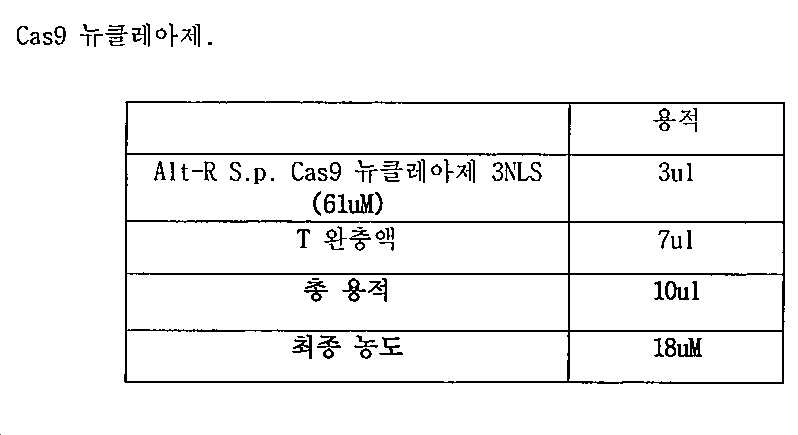
[00266] [표 5] [00266] [Table 5]
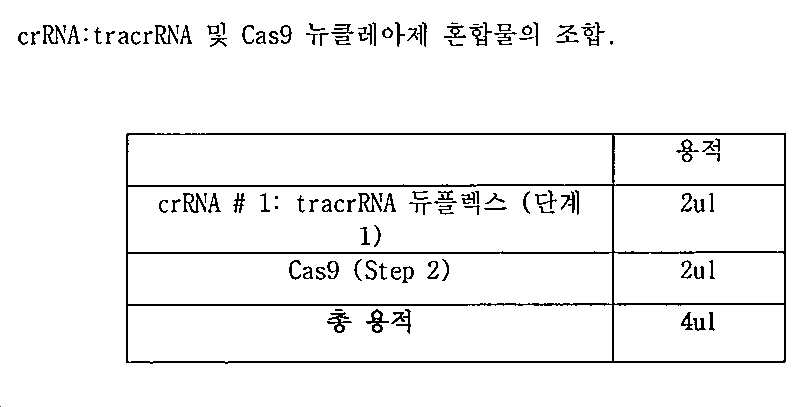
[00267] crRNA: tracrRNA 듀플렉스는 피펫으로 Cas9 뉴클레아제 믹스(Mix)와 조합하였고 15분동안 실온에서 항온처리하였다. 상기 혼합물은 이어서 crRNA와 조합하였다. [00267] crRNA: tracrRNA duplexes were combined with Cas9 Nuclease Mix (Mix) with a pipette and incubated for 15 min at room temperature. The mixture was then combined with crRNA.
[00268] [표 6] [00268] [Table 6]

[00269] 전기천공은 먼저 APC (1 NK: 2 APC), SCGM 배지 (바람직하게 항생제 부재), 및 200IU/mL IL-2와 함께 배양 플레이트를 제조함에 의해 수행하였다. 웰 당 250,000 세포를 제조하고 사용 직전에 7.5ul T 완충액 중에 재현탁시켰다. 전기천공 조건은 1600V, 10ms, 및 3 펄스이다*. 세포는 이어서 배양 플레이트에 첨가하고 37°C 항온처리기에서 회복되도록 방치하였다. [00269] Electroporation was performed by first preparing a culture plate with APC (1 NK: 2 APC), SCGM medium (preferably without antibiotics), and 200 IU/mL IL-2. 250,000 cells per well were prepared and resuspended in 7.5ul T buffer immediately prior to use. Electroporation conditions are 1600V, 10ms, and 3 pulses*. Cells were then added to the culture plate and left to recover in a 37 °C incubator.
[00270] NK 세포 확장: NK 세포 단리 키트 (제조원: Miltenyi (130-092-657))를 사용하여 제대혈 또는 말초 혈액으로부터 NK 세포를 단리한다. NK 세포를 IL2(200IU/ml)의 존재하에 1:2 비율 (1개 NK 세포 2개 피더 세포)로 피더 세포와 함께 SCGM 배지에 첨가한다. 배지를 격일로 IL2로 갈아준다. 4일째 NK 세포 단리 키트를 사용하여 NK 세포를 재선택하여 피더 세포를 제거하거나 모든 피더 세포가 소실될때까지 7일동안 대기한다. 키메라 항원 수용체로 형질도입하거나 Crispr-Cas9에 대해 전기천공한다. [00270] NK Cell Expansion: NK cells are isolated from umbilical cord blood or peripheral blood using the NK Cell Isolation Kit (Miltenyi (130-092-657)). NK cells are added to SCGM medium along with feeder cells in the presence of IL2 (200 IU/ml) at a 1:2 ratio (1
* * ** * *
[00271] 본원에 개시되고 청구된 모든 방법들은 본 명세서의 내용을 고려하여 과도한 실험없이 만들어 수행할 수 있다. 본 발명의 조성물 및 방법은 바람직한 구현예의 관점에서 기술되었지만, 본 발명의 당업계의 개념, 의미 및 범위를 벗어나지 않으면서 다양한 변화들을 본원에 기술된 방법들, 상기 방법의 단계들 또는 상기 방법 단계들의 순서에 적용할 수 있다는 사실은 당업계의 숙련자들에게는 명백할 것이다. 보다 구체적으로, 화학적 및 생리학적으로 모두 관련되어 있는 특정 제제의 경우 이들을 사용하여도 동일하거나 유사한 결과가 달성된다면 본원에 기술된 제제를 대체할 수 있음도 명백할 것이다. 당업계의 숙련자들에게 명백한 이러한 모든 유사한 대체물 및 변형은 첨부된 특허청구범위에 정의된 본 발명의 의미, 범위 및 개념에 속하는 것으로 간주된다. [00271] All methods disclosed and claimed herein can be made and performed without undue experimentation in light of the teachings herein. While the compositions and methods of the present invention have been described in terms of preferred embodiments, various changes may be made to the methods, steps of the methods, or method steps described herein without departing from the spirit, meaning and scope of the present invention in the art. It will be apparent to those skilled in the art that the sequence is applicable. More specifically, it will be apparent that certain agents that are both chemically and physiologically related may be substituted for the agents described herein if the same or similar results are achieved using them. All such similar substitutes and modifications apparent to those skilled in the art are deemed to fall within the meaning, scope and concept of the invention as defined in the appended claims.
참고문헌references
하기의 참고문헌들은, 본원에 기술된 내용에 대하여 예시적인 절차이거나 이를 보충하는 기타 상세한 설명을 제공하는 정도로, 본원에 참고로서 상세하게 포함된다.The following references are specifically incorporated herein by reference to the extent that they provide other detailed descriptions of or supplementing the subject matter described herein.



SEQUENCE LISTING <110> BOARD OF REGENTS, THE UNIVERSITY OF TEXAS SYSTEM <120> MULTIPLEX GENOME EDITING OF IMMUNE CELLS TO ENHANCE FUNCTIONALITY AND RESISTANCE TO SUPPRESSIVE ENVIRONMENT <130> UTSC.P1184WO <140> PCT/US2019/063641 <141> 2019-11-27 <150> 62/772,406 <151> 2018-11-28 <160> 15 <170> PatentIn version 3.5 <210> 1 <211> 20 <212> DNA <213> Artificial Sequence <220> <221> source <223> /note="Description of Artificial Sequence: Synthetic oligonucleotide" <400> 1 aggccacata gtgctgcaca 20 <210> 2 <211> 20 <212> DNA <213> Artificial Sequence <220> <221> source <223> /note="Description of Artificial Sequence: Synthetic oligonucleotide" <400> 2 tgtacagcag tggctggtgg 20 <210> 3 <211> 20 <212> DNA <213> Artificial Sequence <220> <221> source <223> /note="Description of Artificial Sequence: Synthetic oligonucleotide" <400> 3 aacaactatc gttaccacag 20 <210> 4 <211> 20 <212> DNA <213> Artificial Sequence <220> <221> source <223> /note="Description of Artificial Sequence: Synthetic oligonucleotide" <400> 4 ctcctcggtg tacatcacgg 20 <210> 5 <211> 20 <212> DNA <213> Artificial Sequence <220> <221> source <223> /note="Description of Artificial Sequence: Synthetic oligonucleotide" <400> 5 agtagttggt gacgttctgc 20 <210> 6 <211> 20 <212> DNA <213> Artificial Sequence <220> <221> source <223> /note="Description of Artificial Sequence: Synthetic oligonucleotide" <400> 6 accctgatgg gacgtacact 20 <210> 7 <211> 20 <212> DNA <213> Artificial Sequence <220> <221> source <223> /note="Description of Artificial Sequence: Synthetic oligonucleotide" <400> 7 aggcacagta gaagccgtat 20 <210> 8 <211> 20 <212> DNA <213> Artificial Sequence <220> <221> source <223> /note="Description of Artificial Sequence: Synthetic oligonucleotide" <400> 8 agacgggcac gaggttccct 20 <210> 9 <211> 20 <212> DNA <213> Artificial Sequence <220> <221> source <223> /note="Description of Artificial Sequence: Synthetic oligonucleotide" <400> 9 tcacgcacaa gaaacgtcca 20 <210> 10 <211> 20 <212> DNA <213> Artificial Sequence <220> <221> source <223> /note="Description of Artificial Sequence: Synthetic oligonucleotide" <400> 10 ccccttcggt caccacgagc 20 <210> 11 <211> 20 <212> DNA <213> Artificial Sequence <220> <221> source <223> /note="Description of Artificial Sequence: Synthetic oligonucleotide" <400> 11 atttactgtc acggttccca 20 <210> 12 <211> 20 <212> DNA <213> Artificial Sequence <220> <221> source <223> /note="Description of Artificial Sequence: Synthetic oligonucleotide" <400> 12 ccccatagat gattatgcat 20 <210> 13 <211> 20 <212> DNA <213> Artificial Sequence <220> <221> source <223> /note="Description of Artificial Sequence: Synthetic oligonucleotide" <400> 13 gacggctgag gagcggaaga 20 <210> 14 <211> 20 <212> DNA <213> Artificial Sequence <220> <221> source <223> /note="Description of Artificial Sequence: Synthetic oligonucleotide" <400> 14 tgtggaggtg agcaatcccc 20 <210> 15 <211> 20 <212> DNA <213> Artificial Sequence <220> <221> source <223> /note="Description of Artificial Sequence: Synthetic oligonucleotide" <400> 15 gtcaccctgg ttcttgcgac 20 SEQUENCE LISTING <110> BOARD OF REGENTS, THE UNIVERSITY OF TEXAS SYSTEM <120> MULTIPLEX GENOME EDITING OF IMMUNE CELLS TO ENHANCE FUNCTIONALITY AND RESISTANCE TO SUPPRESSIVE ENVIRONMENT <130> UTSC.P1184WO <140> PCT/US2019/063641 <141> 2019-11-27 <150> 62/772,406 <151> 2018-11-28 <160> 15 <170> PatentIn version 3.5 <210> 1 <211> 20 <212> DNA <213> Artificial Sequence <220> <221> source <223> /note="Description of Artificial Sequence: Synthetic oligonucleotide" <400> 1 aggccacata gtgctgcaca 20 <210> 2 <211> 20 <212> DNA <213> Artificial Sequence <220> <221> source <223> /note="Description of Artificial Sequence: Synthetic oligonucleotide" <400> 2 tgtacagcag tggctggtgg 20 <210> 3 <211> 20 <212> DNA <213> Artificial Sequence <220> <221> source <223> /note="Description of Artificial Sequence: Synthetic oligonucleotide" <400> 3 aacaactatc gttaccacag 20 <210> 4 <211> 20 <212> DNA <213> Artificial Sequence <220> <221> source <223> /note="Description of Artificial Sequence: Synthetic oligonucleotide" <400> 4 ctcctcggtg tacatcacgg 20 <210> 5 <211> 20 <212> DNA <213> Artificial Sequence <220> <221> source <223> /note="Description of Artificial Sequence: Synthetic oligonucleotide" <400> 5 agtagttggt gacgttctgc 20 <210> 6 <211> 20 <212> DNA <213> Artificial Sequence <220> <221> source <223> /note="Description of Artificial Sequence: Synthetic oligonucleotide" <400> 6 accctgatgg gacgtacact 20 <210> 7 <211> 20 <212> DNA <213> Artificial Sequence <220> <221> source <223> /note="Description of Artificial Sequence: Synthetic oligonucleotide" <400> 7 aggcacagta gaagccgtat 20 <210> 8 <211> 20 <212> DNA <213> Artificial Sequence <220> <221> source <223> /note="Description of Artificial Sequence: Synthetic oligonucleotide" <400> 8 agacgggcac gaggttccct 20 <210> 9 <211> 20 <212> DNA <213> Artificial Sequence <220> <221> source <223> /note="Description of Artificial Sequence: Synthetic oligonucleotide" <400> 9 tcacgcacaa gaaacgtcca 20 <210> 10 <211> 20 <212> DNA <213> Artificial Sequence <220> <221> source <223> /note="Description of Artificial Sequence: Synthetic oligonucleotide" <400> 10 ccccttcggt caccacgagc 20 <210> 11 <211> 20 <212> DNA <213> Artificial Sequence <220> <221> source <223> /note="Description of Artificial Sequence: Synthetic oligonucleotide" <400> 11 atttactgtc acggttccca 20 <210> 12 <211> 20 <212> DNA <213> Artificial Sequence <220> <221> source <223> /note="Description of Artificial Sequence: Synthetic oligonucleotide" <400> 12 ccccatagat gattatgcat 20 <210> 13 <211> 20 <212> DNA <213> Artificial Sequence <220> <221> source <223> /note="Description of Artificial Sequence: Synthetic oligonucleotide" <400> 13 gacggctgag gagcggaaga 20 <210> 14 <211> 20 <212> DNA <213> Artificial Sequence <220> <221> source <223> /note="Description of Artificial Sequence: Synthetic oligonucleotide" <400> 14 tgtggaggtg agcaatcccc 20 <210> 15 <211> 20 <212> DNA <213> Artificial Sequence <220> <221> source <223> /note="Description of Artificial Sequence: Synthetic oligonucleotide" <400> 15 gtcaccctgg ttcttgcgac 20
Claims (148)
148. The method of claim 146 or 147, wherein said immune cell and/or said at least second therapeutic agent is administered intravenously, intraperitoneally, intratracheally, intratumorally, intramuscularly, endoscopically, intralesional, transdermally, subcutaneously. , topically, or by direct injection or perfusion.
Applications Claiming Priority (3)
| Application Number | Priority Date | Filing Date | Title |
|---|---|---|---|
| US201862772406P | 2018-11-28 | 2018-11-28 | |
| US62/772,406 | 2018-11-28 | ||
| PCT/US2019/063641 WO2020113029A2 (en) | 2018-11-28 | 2019-11-27 | Multiplex genome editing of immune cells to enhance functionality and resistance to suppressive environment |
Publications (1)
| Publication Number | Publication Date |
|---|---|
| KR20210096638A true KR20210096638A (en) | 2021-08-05 |
Family
ID=69005890
Family Applications (1)
| Application Number | Title | Priority Date | Filing Date |
|---|---|---|---|
| KR1020217019926A Pending KR20210096638A (en) | 2018-11-28 | 2019-11-27 | Multiplex Genome Editing of Immune Cells to Enhance Function and Resistance to Inhibitory Environments |
Country Status (13)
| Country | Link |
|---|---|
| US (1) | US20220031749A1 (en) |
| EP (1) | EP3887518A2 (en) |
| JP (2) | JP7672702B2 (en) |
| KR (1) | KR20210096638A (en) |
| CN (1) | CN113272427A (en) |
| AU (1) | AU2019386140A1 (en) |
| BR (1) | BR112021010297A2 (en) |
| CA (1) | CA3121027A1 (en) |
| EA (1) | EA202191463A1 (en) |
| IL (1) | IL283428A (en) |
| MX (1) | MX2021006208A (en) |
| SG (1) | SG11202105609RA (en) |
| WO (1) | WO2020113029A2 (en) |
Families Citing this family (28)
| Publication number | Priority date | Publication date | Assignee | Title |
|---|---|---|---|---|
| PE20211959A1 (en) * | 2019-02-15 | 2021-09-30 | Editas Medicine Inc | IMMUNOTHERAPY MODIFIED NATURAL KILLER (NK) CELLS |
| CA3131533A1 (en) | 2019-03-05 | 2020-09-10 | Nkarta, Inc. | Cd19-directed chimeric antigen receptors and uses thereof in immunotherapy |
| US20220184131A1 (en) * | 2019-05-01 | 2022-06-16 | Juno Therapeutics, Inc. | Cells expressing a recombinant receptor from a modified tgfbr2 locus, related polynucleotides and methods |
| EP3980450A4 (en) * | 2019-06-04 | 2024-06-19 | Nkarta, Inc. | COMBINATIONS OF GENETICALLY MODIFIED NATURAL KILLER CELLS AND GENETICALLY MODIFIED T CELLS FOR IMMUNOTHERAPY |
| US20230009232A1 (en) * | 2019-11-20 | 2023-01-12 | Cartherics Pty. Ltd. | Method for providing immune cells with enhanced function |
| JP2023507118A (en) * | 2019-12-18 | 2023-02-21 | エディタス・メディシン、インコーポレイテッド | Engineered cells for therapy |
| TW202227625A (en) * | 2020-08-28 | 2022-07-16 | 美商建南德克公司 | Crispr/cas9 multiplex knockout of host cell proteins |
| US20250262301A1 (en) * | 2020-10-26 | 2025-08-21 | Shoreline Biosciences, Inc. | Methods of inducing antibody-dependent cellular cytotoxicity (adcc) using modified natural killer (nk) cells |
| CN116348121A (en) * | 2020-10-27 | 2023-06-27 | 加利福尼亚大学董事会 | Natural killer cells with enhanced activity |
| WO2022113056A1 (en) | 2020-11-30 | 2022-06-02 | Crispr Therapeutics Ag | Gene-edited natural killer cells |
| WO2022120370A2 (en) * | 2020-12-03 | 2022-06-09 | Nkarta, Inc. | Methods of engineering immune cells for enhanced potency and persistence and uses of engineered cells in immunotherapy |
| US11473060B2 (en) | 2020-12-30 | 2022-10-18 | Crispr Therapeutics Ag | Compositions and methods for differentiating stem cells into NK cells |
| WO2022157671A1 (en) * | 2021-01-20 | 2022-07-28 | Avectas Limited | Sequential delivery of rnps to immune cells |
| EP4039808A1 (en) * | 2021-02-08 | 2022-08-10 | Ospedale San Raffaele S.r.l. | Guide rnas and uses thereof |
| WO2022242701A1 (en) * | 2021-05-20 | 2022-11-24 | Wuxi Biologics (Shanghai) Co., Ltd. | Genetically modified gamma-delta t cells and uses thereof |
| JP2024521566A (en) * | 2021-05-20 | 2024-06-03 | ウーシー バイオロジクス アイルランド リミテッド | Genetically modified NK cells and uses thereof |
| PE20241173A1 (en) | 2021-10-14 | 2024-05-28 | Arsenal Biosciences Inc | IMMUNE CELLS THAT HAVE CO-EXPRESSED HCRNA AND LOGIC GATE SYSTEMS |
| AU2021469314A1 (en) * | 2021-10-19 | 2024-03-14 | Peter Maccallum Cancer Institute | Compositions and methods for immunotherapy |
| WO2023081900A1 (en) * | 2021-11-08 | 2023-05-11 | Juno Therapeutics, Inc. | Engineered t cells expressing a recombinant t cell receptor (tcr) and related systems and methods |
| JP2024540469A (en) * | 2021-11-17 | 2024-10-31 | ザ リージェンツ オブ ザ ユニバーシティ オブ カリフォルニア | Genetic targets for T cell-based immunotherapy to overcome inhibitors |
| WO2023215278A1 (en) * | 2022-05-03 | 2023-11-09 | The Broad Institute, Inc. | Modified immune cells and methods for use thereof |
| WO2024076750A2 (en) * | 2022-10-07 | 2024-04-11 | Whitehead Institute For Biomedical Research | Engineered macrophages for use in treating cancer |
| EP4353741A1 (en) * | 2022-10-14 | 2024-04-17 | ONK Therapeutics Limited | Double knockout natural killer cells |
| WO2024100203A1 (en) * | 2022-11-10 | 2024-05-16 | Onk Therapeutics Limited | Combined therapies using immunomodulating drugs |
| CN115948341B (en) * | 2022-11-28 | 2025-05-16 | 上海恩凯细胞技术有限公司 | CAR-immune cell knocking down NKG2A gene and application thereof |
| KR20250158048A (en) | 2023-03-03 | 2025-11-05 | 아스널 바이오사이언시스, 인크. | Systems targeting PSMA and CA9 |
| CN116590237B (en) * | 2023-05-29 | 2023-10-31 | 上海贝斯昂科生物科技有限公司 | Genetically modified natural killer cells and preparation and application thereof |
| WO2025035310A1 (en) * | 2023-08-11 | 2025-02-20 | 香港北恒生物科技有限公司 | Engineered immune cell and use thereof |
Family Cites Families (93)
| Publication number | Priority date | Publication date | Assignee | Title |
|---|---|---|---|---|
| US5824311A (en) | 1987-11-30 | 1998-10-20 | Trustees Of The University Of Pennsylvania | Treatment of tumors with monoclonal antibodies against oncogene antigens |
| US4870287A (en) | 1988-03-03 | 1989-09-26 | Loma Linda University Medical Center | Multi-station proton beam therapy system |
| US5851795A (en) | 1991-06-27 | 1998-12-22 | Bristol-Myers Squibb Company | Soluble CTLA4 molecules and uses thereof |
| US6416998B1 (en) | 1992-09-02 | 2002-07-09 | Baylor College Of Medicine | Plasmid encoding a modified steroid hormone |
| US5846945A (en) | 1993-02-16 | 1998-12-08 | Onyx Pharmaceuticals, Inc. | Cytopathic viruses for therapy and prophylaxis of neoplasia |
| US5801005A (en) | 1993-03-17 | 1998-09-01 | University Of Washington | Immune reactivity to HER-2/neu protein for diagnosis of malignancies in which the HER-2/neu oncogene is associated |
| WO1995001994A1 (en) | 1993-07-09 | 1995-01-19 | Synergen, Inc. | Recombinant ctla4 polypeptides and methods for making the same |
| GB9506466D0 (en) | 1994-08-26 | 1995-05-17 | Prolifix Ltd | Cell cycle regulated repressor and dna element |
| ATE240119T1 (en) | 1995-03-08 | 2003-05-15 | Scripps Research Inst | ANTIGEN PRESENTATION SYSTEM AND ACTIVATION OF T CELLS |
| US5763270A (en) | 1995-06-07 | 1998-06-09 | Genemedicine, Inc. | Plasmid for delivery of nucleic acids to cells and methods of use |
| US6013516A (en) | 1995-10-06 | 2000-01-11 | The Salk Institute For Biological Studies | Vector and method of use for nucleic acid delivery to non-dividing cells |
| WO1997034634A1 (en) | 1996-03-20 | 1997-09-25 | Sloan-Kettering Institute For Cancer Research | Single chain fv constructs of anti-ganglioside gd2 antibodies |
| US5760395A (en) | 1996-04-18 | 1998-06-02 | Universities Research Assoc., Inc. | Method and apparatus for laser-controlled proton beam radiology |
| AU723355B2 (en) | 1996-05-23 | 2000-08-24 | Scripps Research Institute, The | MHC class II antigen presenting systems and methods for activating CD4+ T cells |
| US5739169A (en) | 1996-05-31 | 1998-04-14 | Procept, Incorporated | Aromatic compounds for inhibiting immune response |
| US5844905A (en) | 1996-07-09 | 1998-12-01 | International Business Machines Corporation | Extensions to distributed MAC protocols with collision avoidance using RTS/CTS exchange |
| WO1998042752A1 (en) | 1997-03-21 | 1998-10-01 | Brigham And Women's Hospital Inc. | Immunotherapeutic ctla-4 binding peptides |
| US5994136A (en) | 1997-12-12 | 1999-11-30 | Cell Genesys, Inc. | Method and means for producing high titer, safe, recombinant lentivirus vectors |
| PT1659179E (en) | 1998-02-05 | 2011-09-16 | Glaxosmithkline Biolog Sa | Tumor-associated antigen derivatives from the mage family, and nucleic acid sequences encoding them, used for the preparation of fusion proteins and of compositions for vaccination |
| JP2002524081A (en) | 1998-09-04 | 2002-08-06 | スローン − ケッタリング インスティチュート フォー キャンサー リサーチ | Fusion receptor specific for prostate-specific membrane antigen and uses thereof |
| US6410319B1 (en) | 1998-10-20 | 2002-06-25 | City Of Hope | CD20-specific redirected T cells and their use in cellular immunotherapy of CD20+ malignancies |
| CA2356215C (en) | 1998-12-23 | 2015-11-24 | Pfizer Inc. | Human monoclonal antibodies to ctla-4 |
| US6790662B1 (en) | 1999-03-12 | 2004-09-14 | Ortho-Mcneil Pharmaceutical, Inc. | Method of isolating CD8+ cells, and related hybridoma cells antibodies and polypeptides |
| CN1227030C (en) | 1999-04-19 | 2005-11-16 | 史密丝克莱恩比彻姆生物有限公司 | Adjuvant compositions comprising saponins and immunostimulatory oligonucleotides |
| US7605238B2 (en) | 1999-08-24 | 2009-10-20 | Medarex, Inc. | Human CTLA-4 antibodies and their uses |
| ATE354655T1 (en) | 1999-08-24 | 2007-03-15 | Medarex Inc | HUMAN ANTIBODIES TO CTLA-4 AND THEIR USES |
| AU2001265346A1 (en) | 2000-06-02 | 2001-12-17 | Memorial Sloan-Kettering Cancer Center | Artificial antigen presenting cells and methods of use thereof |
| CA2425862C (en) | 2000-11-07 | 2013-01-22 | City Of Hope | Cd19-specific redirected immune cells |
| US20040071671A1 (en) | 2001-02-20 | 2004-04-15 | Leturcq Didier J. | Cell therapy method for the treatment of tumors |
| US7070995B2 (en) | 2001-04-11 | 2006-07-04 | City Of Hope | CE7-specific redirected immune cells |
| US20090257994A1 (en) | 2001-04-30 | 2009-10-15 | City Of Hope | Chimeric immunoreceptor useful in treating human cancers |
| US20030211603A1 (en) | 2001-08-14 | 2003-11-13 | Earp David J. | Reprogramming cells for enhanced differentiation capacity using pluripotent stem cells |
| US7446190B2 (en) | 2002-05-28 | 2008-11-04 | Sloan-Kettering Institute For Cancer Research | Nucleic acids encoding chimeric T cell receptors |
| AU2003263653A1 (en) | 2002-09-27 | 2004-04-19 | Daewoong Co., Ltd. | A vaccine enhancing the protective immunity to hepatitis c virus using plasmid dna and recombinant adenovirus |
| US7871607B2 (en) | 2003-03-05 | 2011-01-18 | Halozyme, Inc. | Soluble glycosaminoglycanases and methods of preparing and using soluble glycosaminoglycanases |
| US20060104968A1 (en) | 2003-03-05 | 2006-05-18 | Halozyme, Inc. | Soluble glycosaminoglycanases and methods of preparing and using soluble glycosaminogly ycanases |
| US20050129671A1 (en) | 2003-03-11 | 2005-06-16 | City Of Hope | Mammalian antigen-presenting T cells and bi-specific T cells |
| EP1648512A4 (en) | 2003-07-31 | 2009-01-21 | Immunomedics Inc | Anti-cd19 antibodies |
| US7682828B2 (en) | 2003-11-26 | 2010-03-23 | Whitehead Institute For Biomedical Research | Methods for reprogramming somatic cells |
| WO2006029198A2 (en) | 2004-09-08 | 2006-03-16 | Wisconsin Alumni Research Foundation | Culturing human embryonic stem cells |
| PL2161336T5 (en) | 2005-05-09 | 2017-10-31 | Ono Pharmaceutical Co | Human monoclonal antibodies to programmed death 1(PD-1) and methods for treating cancer using anti-PD-1 antibodies alone or in combination with other immunotherapeutics |
| EP3147296A1 (en) | 2005-11-14 | 2017-03-29 | Merial, Inc. | Gene therapy for renal failure |
| US8278104B2 (en) | 2005-12-13 | 2012-10-02 | Kyoto University | Induced pluripotent stem cells produced with Oct3/4, Klf4 and Sox2 |
| US8129187B2 (en) | 2005-12-13 | 2012-03-06 | Kyoto University | Somatic cell reprogramming by retroviral vectors encoding Oct3/4. Klf4, c-Myc and Sox2 |
| EP1970446B1 (en) | 2005-12-13 | 2011-08-03 | Kyoto University | Nuclear reprogramming factor |
| CA2643337C (en) | 2006-03-01 | 2016-01-12 | Janssen Pharmaceutica N.V. | Cancer treatment combining lymphodepleting agent with ctls and cytokines |
| AU2007307206B2 (en) | 2006-10-04 | 2016-02-11 | Janssen Pharmaceutica, N.V. | Preparation of inactivated artificial antigen presenting cells and their use in cell therapies |
| SG193652A1 (en) | 2007-03-23 | 2013-10-30 | Wisconsin Alumni Res Found | Somatic cell reprogramming |
| US8389282B2 (en) | 2007-03-30 | 2013-03-05 | Memorial Sloan-Kettering Cancer Center | Constitutive expression of costimulatory ligands on adoptively transferred T lymphocytes |
| CA2691357C (en) | 2007-06-18 | 2014-09-23 | N.V. Organon | Antibodies to human programmed death receptor pd-1 |
| US9683232B2 (en) | 2007-12-10 | 2017-06-20 | Kyoto University | Efficient method for nuclear reprogramming |
| US8479118B2 (en) | 2007-12-10 | 2013-07-02 | Microsoft Corporation | Switching search providers within a browser search box |
| HUE034465T2 (en) | 2008-02-11 | 2018-02-28 | Cure Tech Ltd | Monoclonal antibodies for tumor treatment |
| US8168757B2 (en) | 2008-03-12 | 2012-05-01 | Merck Sharp & Dohme Corp. | PD-1 binding proteins |
| JP5173594B2 (en) | 2008-05-27 | 2013-04-03 | キヤノン株式会社 | Management apparatus, image forming apparatus, and processing method thereof |
| CA2726990C (en) | 2008-06-04 | 2020-09-08 | Cellular Dynamics International, Inc. | Methods for the production of ips cells using extra-chromosomal vectors |
| WO2010014784A2 (en) | 2008-08-01 | 2010-02-04 | Bristol-Myers Squibb Company | Combination of anti-ctla4 antibody with diverse therapeutic regimens for the synergistic treatment of proliferative diseases |
| EP2331696A1 (en) | 2008-08-12 | 2011-06-15 | Cellular Dynamics International, Inc. | Methods for the production of ips cells |
| EP2328919A2 (en) | 2008-08-25 | 2011-06-08 | Amplimmune, Inc. | Pd-i antagonists and methods for treating infectious disease |
| US8268620B2 (en) | 2008-10-24 | 2012-09-18 | Wisconsin Alumni Research Foundation | OCT4 and SOX2 with SV40 T antigen produce pluripotent stem cells from primate somatic cells |
| AU2010254811B2 (en) | 2009-06-05 | 2015-02-19 | FUJIFILM Cellular Dynamics, Inc. | Reprogramming T cells and hematopoietic cells |
| CA2770412C (en) | 2009-08-07 | 2018-09-11 | Kyoto University | Method of efficiently establishing induced pluripotent stem cells |
| US8889394B2 (en) | 2009-09-07 | 2014-11-18 | Empire Technology Development Llc | Multiple domain proteins |
| AU2010315166B2 (en) | 2009-11-04 | 2015-01-22 | FUJIFILM Cellular Dynamics, Inc. | Episomal reprogramming with chemicals |
| US20130017199A1 (en) | 2009-11-24 | 2013-01-17 | AMPLIMMUNE ,Inc. a corporation | Simultaneous inhibition of pd-l1/pd-l2 |
| EP2526189B1 (en) | 2010-01-22 | 2016-10-12 | Kyoto University | Method for improving induced pluripotent stem cell generation efficiency |
| JP5705242B2 (en) | 2010-02-19 | 2015-04-22 | ゼンコア インコーポレイテッド | Novel CTLA4-IG immune adhesin |
| EP2571512B1 (en) | 2010-05-17 | 2017-08-23 | Sangamo BioSciences, Inc. | Novel dna-binding proteins and uses thereof |
| JP5984217B2 (en) | 2010-06-15 | 2016-09-06 | セルラー ダイナミクス インターナショナル, インコーポレイテッド | Preparation of induced pluripotent stem cells from a small amount of peripheral blood |
| PH12013501201A1 (en) | 2010-12-09 | 2013-07-29 | Univ Pennsylvania | Use of chimeric antigen receptor-modified t cells to treat cancer |
| CN106074601A (en) | 2011-03-23 | 2016-11-09 | 弗雷德哈钦森癌症研究中心 | Method and composition for cellular immunotherapy |
| US8398282B2 (en) | 2011-05-12 | 2013-03-19 | Delphi Technologies, Inc. | Vehicle front lighting assembly and systems having a variable tint electrowetting element |
| JP6368243B2 (en) | 2011-11-11 | 2018-08-08 | フレッド ハッチンソン キャンサー リサーチ センター | T-cell immunotherapy targeted to cyclin A1 for cancer |
| JP6850528B2 (en) | 2012-02-13 | 2021-03-31 | シアトル チルドレンズ ホスピタル ドゥーイング ビジネス アズ シアトル チルドレンズ リサーチ インスティテュート | Bispecific chimeric antigen receptor and its therapeutic use |
| WO2013126726A1 (en) | 2012-02-22 | 2013-08-29 | The Trustees Of The University Of Pennsylvania | Double transgenic t cells comprising a car and a tcr and their methods of use |
| CN107557334B (en) | 2012-05-03 | 2021-06-25 | 弗雷德哈钦森癌症研究中心 | T cell receptor with enhanced affinity and preparation method thereof |
| WO2013176915A1 (en) | 2012-05-25 | 2013-11-28 | Roman Galetto | Methods for engineering allogeneic and immunosuppressive resistant t cell for immunotherapy |
| JP2014022858A (en) | 2012-07-17 | 2014-02-03 | Murata Mfg Co Ltd | Power amplifier |
| ES2842102T3 (en) | 2012-08-20 | 2021-07-12 | Hutchinson Fred Cancer Res | Method and compositions for cellular immunotherapy |
| NZ746914A (en) | 2012-10-02 | 2020-03-27 | Memorial Sloan Kettering Cancer Center | Compositions and methods for immunotherapy |
| AU2013329186B2 (en) * | 2012-10-10 | 2019-02-14 | Sangamo Therapeutics, Inc. | T cell modifying compounds and uses thereof |
| US9308236B2 (en) | 2013-03-15 | 2016-04-12 | Bristol-Myers Squibb Company | Macrocyclic inhibitors of the PD-1/PD-L1 and CD80(B7-1)/PD-L1 protein/protein interactions |
| EP2997133B1 (en) | 2013-05-13 | 2023-08-23 | Cellectis | Methods for engineering highly active t cell for immunotherapy |
| RU2016107426A (en) | 2013-08-02 | 2017-09-07 | Адуро Байотек Холдингс, Юроуп Б.В. | COMBINING CD27 AGONISTS AND INHIBITING IMMUNE CONTROL POINTS TO STIMULATE IMMUNITY |
| PT3702373T (en) | 2013-09-13 | 2022-09-27 | Beigene Switzerland Gmbh | Anti-pd1 antibodies and their use as therapeutics and diagnostics |
| AU2016287440B2 (en) | 2015-06-30 | 2022-02-10 | Cellectis | Methods for improving functionality in NK cell by gene inactivation using specific endonuclease |
| ES2890859T3 (en) | 2015-07-29 | 2022-01-24 | Onk Therapeutics Ltd | Modified natural killer cells and natural killer cell lines that have increased cytotoxicity |
| CN108472314A (en) * | 2015-07-31 | 2018-08-31 | 明尼苏达大学董事会 | Modified Cells and Therapeutics |
| US10975149B2 (en) | 2015-12-16 | 2021-04-13 | The Walter And Eliza Hall Institute Of Medical Research | Inhibition of cytokine-induced SH2 protein in NK cells |
| AU2017341736B2 (en) | 2016-10-12 | 2022-09-08 | Feldan Bio Inc. | Rationally-designed synthetic peptide shuttle agents for delivering polypeptide cargos from an extracellular space to the cytosol and/or nucleus of a target eukaryotic cell, uses thereof, methods and kits relating to same |
| WO2018115189A1 (en) * | 2016-12-21 | 2018-06-28 | Cellectis | Stably enginereed proteasome inhibitor resistant immune cells for immunotherapy |
| JP2020503043A (en) * | 2016-12-30 | 2020-01-30 | セルラリティ インコーポレイテッド | Genetically modified natural killer cells |
| WO2019106163A1 (en) * | 2017-12-01 | 2019-06-06 | Cellectis | Reprogramming of genetically engineered primary immune cells |
-
2019
- 2019-11-27 KR KR1020217019926A patent/KR20210096638A/en active Pending
- 2019-11-27 EA EA202191463A patent/EA202191463A1/en unknown
- 2019-11-27 AU AU2019386140A patent/AU2019386140A1/en active Pending
- 2019-11-27 SG SG11202105609RA patent/SG11202105609RA/en unknown
- 2019-11-27 WO PCT/US2019/063641 patent/WO2020113029A2/en not_active Ceased
- 2019-11-27 CA CA3121027A patent/CA3121027A1/en active Pending
- 2019-11-27 BR BR112021010297-3A patent/BR112021010297A2/en unknown
- 2019-11-27 MX MX2021006208A patent/MX2021006208A/en unknown
- 2019-11-27 CN CN201980088334.XA patent/CN113272427A/en active Pending
- 2019-11-27 EP EP19827952.3A patent/EP3887518A2/en active Pending
- 2019-11-27 JP JP2021530101A patent/JP7672702B2/en active Active
- 2019-11-27 US US17/309,408 patent/US20220031749A1/en active Pending
-
2021
- 2021-05-25 IL IL283428A patent/IL283428A/en unknown
-
2024
- 2024-07-31 JP JP2024124210A patent/JP2024153823A/en active Pending
Also Published As
| Publication number | Publication date |
|---|---|
| SG11202105609RA (en) | 2021-06-29 |
| US20220031749A1 (en) | 2022-02-03 |
| CA3121027A1 (en) | 2020-06-04 |
| AU2019386140A1 (en) | 2021-06-24 |
| JP2022513652A (en) | 2022-02-09 |
| WO2020113029A3 (en) | 2020-07-09 |
| JP2024153823A (en) | 2024-10-29 |
| JP7672702B2 (en) | 2025-05-08 |
| BR112021010297A2 (en) | 2021-08-24 |
| EA202191463A1 (en) | 2021-10-13 |
| EP3887518A2 (en) | 2021-10-06 |
| IL283428A (en) | 2021-07-29 |
| CN113272427A (en) | 2021-08-17 |
| WO2020113029A2 (en) | 2020-06-04 |
| MX2021006208A (en) | 2021-10-01 |
Similar Documents
| Publication | Publication Date | Title |
|---|---|---|
| US20220265718A1 (en) | Immune cells expressing engineered antigen receptors | |
| JP7672702B2 (en) | Multiplex genome editing of immune cells to enhance function and resistance to inhibitory environments | |
| US20210230548A1 (en) | Natural killer cells engineered to express chimeric antigen receptors with immune checkpoint blockade | |
| US20220389383A1 (en) | Large-scale combined car transduction and crispr gene editing of nk cells | |
| US20220033778A1 (en) | Methods for ex vivo expansion of natural killer cells and use thereof | |
| US20230045174A1 (en) | Large-scale combined car transduction and crispr gene editing of msc cells | |
| WO2022251377A1 (en) | Inhibitory chimeric antigen receptor prevents on-target off-tumor effects of adoptive cell therapy | |
| JP7698321B2 (en) | Large-scale combination of CAR transduction and CRISPR gene editing of B cells | |
| US20220401479A1 (en) | Large-scale combined car transduction and crispr gene editing of t cells | |
| EA048895B1 (en) | MULTIPLEX GENOME EDITING OF IMMUNE CELLS TO ENHANCE FUNCTIONALITY AND RESISTANCE TO SUPPRESSIVE ENVIRONMENTS |
Legal Events
| Date | Code | Title | Description |
|---|---|---|---|
| PA0105 | International application |
St.27 status event code: A-0-1-A10-A15-nap-PA0105 |
|
| PG1501 | Laying open of application |
St.27 status event code: A-1-1-Q10-Q12-nap-PG1501 |
|
| R18-X000 | Changes to party contact information recorded |
St.27 status event code: A-3-3-R10-R18-oth-X000 |
|
| E13-X000 | Pre-grant limitation requested |
St.27 status event code: A-2-3-E10-E13-lim-X000 |
|
| P11-X000 | Amendment of application requested |
St.27 status event code: A-2-2-P10-P11-nap-X000 |
|
| P13-X000 | Application amended |
St.27 status event code: A-2-2-P10-P13-nap-X000 |
|
| PA0201 | Request for examination |
St.27 status event code: A-1-2-D10-D11-exm-PA0201 |
|
| P22-X000 | Classification modified |
St.27 status event code: A-2-2-P10-P22-nap-X000 |
|
| P22-X000 | Classification modified |
St.27 status event code: A-2-2-P10-P22-nap-X000 |
|
| D21 | Rejection of application intended |
Free format text: ST27 STATUS EVENT CODE: A-1-2-D10-D21-EXM-PE0902 (AS PROVIDED BY THE NATIONAL OFFICE) |
|
| PE0902 | Notice of grounds for rejection |
St.27 status event code: A-1-2-D10-D21-exm-PE0902 |
|
| T11 | Administrative time limit extension requested |
Free format text: ST27 STATUS EVENT CODE: U-3-3-T10-T11-OTH-X000 (AS PROVIDED BY THE NATIONAL OFFICE) |
|
| T11-X000 | Administrative time limit extension requested |
St.27 status event code: U-3-3-T10-T11-oth-X000 |
|
| E13 | Pre-grant limitation requested |
Free format text: ST27 STATUS EVENT CODE: A-2-3-E10-E13-LIM-X000 (AS PROVIDED BY THE NATIONAL OFFICE) |
|
| E13-X000 | Pre-grant limitation requested |
St.27 status event code: A-2-3-E10-E13-lim-X000 |
|
| P11 | Amendment of application requested |
Free format text: ST27 STATUS EVENT CODE: A-2-2-P10-P11-NAP-X000 (AS PROVIDED BY THE NATIONAL OFFICE) |
|
| P11-X000 | Amendment of application requested |
St.27 status event code: A-2-2-P10-P11-nap-X000 |
|
| P13 | Application amended |
Free format text: ST27 STATUS EVENT CODE: A-2-2-P10-P13-NAP-X000 (AS PROVIDED BY THE NATIONAL OFFICE) |
|
| P13-X000 | Application amended |
St.27 status event code: A-2-2-P10-P13-nap-X000 |