CN112105420A - Methods and compositions for treating cancer - Google Patents
Methods and compositions for treating cancer Download PDFInfo
- Publication number
- CN112105420A CN112105420A CN201980031761.4A CN201980031761A CN112105420A CN 112105420 A CN112105420 A CN 112105420A CN 201980031761 A CN201980031761 A CN 201980031761A CN 112105420 A CN112105420 A CN 112105420A
- Authority
- CN
- China
- Prior art keywords
- seq
- cells
- cell
- engineered
- gene
- Prior art date
- Legal status (The legal status is an assumption and is not a legal conclusion. Google has not performed a legal analysis and makes no representation as to the accuracy of the status listed.)
- Pending
Links
Images


Classifications
-
- C—CHEMISTRY; METALLURGY
- C12—BIOCHEMISTRY; BEER; SPIRITS; WINE; VINEGAR; MICROBIOLOGY; ENZYMOLOGY; MUTATION OR GENETIC ENGINEERING
- C12N—MICROORGANISMS OR ENZYMES; COMPOSITIONS THEREOF; PROPAGATING, PRESERVING, OR MAINTAINING MICROORGANISMS; MUTATION OR GENETIC ENGINEERING; CULTURE MEDIA
- C12N5/00—Undifferentiated human, animal or plant cells, e.g. cell lines; Tissues; Cultivation or maintenance thereof; Culture media therefor
- C12N5/06—Animal cells or tissues; Human cells or tissues
- C12N5/0602—Vertebrate cells
- C12N5/0634—Cells from the blood or the immune system
- C12N5/0636—T lymphocytes
-
- A—HUMAN NECESSITIES
- A61—MEDICAL OR VETERINARY SCIENCE; HYGIENE
- A61K—PREPARATIONS FOR MEDICAL, DENTAL OR TOILETRY PURPOSES
- A61K35/00—Medicinal preparations containing materials or reaction products thereof with undetermined constitution
- A61K35/12—Materials from mammals; Compositions comprising non-specified tissues or cells; Compositions comprising non-embryonic stem cells; Genetically modified cells
- A61K35/14—Blood; Artificial blood
- A61K35/17—Lymphocytes; B-cells; T-cells; Natural killer cells; Interferon-activated or cytokine-activated lymphocytes
-
- A—HUMAN NECESSITIES
- A61—MEDICAL OR VETERINARY SCIENCE; HYGIENE
- A61K—PREPARATIONS FOR MEDICAL, DENTAL OR TOILETRY PURPOSES
- A61K38/00—Medicinal preparations containing peptides
-
- A—HUMAN NECESSITIES
- A61—MEDICAL OR VETERINARY SCIENCE; HYGIENE
- A61K—PREPARATIONS FOR MEDICAL, DENTAL OR TOILETRY PURPOSES
- A61K40/00—Cellular immunotherapy
- A61K40/10—Cellular immunotherapy characterised by the cell type used
- A61K40/11—T-cells, e.g. tumour infiltrating lymphocytes [TIL] or regulatory T [Treg] cells; Lymphokine-activated killer [LAK] cells
-
- A—HUMAN NECESSITIES
- A61—MEDICAL OR VETERINARY SCIENCE; HYGIENE
- A61K—PREPARATIONS FOR MEDICAL, DENTAL OR TOILETRY PURPOSES
- A61K40/00—Cellular immunotherapy
- A61K40/30—Cellular immunotherapy characterised by the recombinant expression of specific molecules in the cells of the immune system
- A61K40/31—Chimeric antigen receptors [CAR]
-
- A—HUMAN NECESSITIES
- A61—MEDICAL OR VETERINARY SCIENCE; HYGIENE
- A61K—PREPARATIONS FOR MEDICAL, DENTAL OR TOILETRY PURPOSES
- A61K40/00—Cellular immunotherapy
- A61K40/30—Cellular immunotherapy characterised by the recombinant expression of specific molecules in the cells of the immune system
- A61K40/32—T-cell receptors [TCR]
-
- A—HUMAN NECESSITIES
- A61—MEDICAL OR VETERINARY SCIENCE; HYGIENE
- A61K—PREPARATIONS FOR MEDICAL, DENTAL OR TOILETRY PURPOSES
- A61K40/00—Cellular immunotherapy
- A61K40/40—Cellular immunotherapy characterised by antigens that are targeted or presented by cells of the immune system
- A61K40/41—Vertebrate antigens
- A61K40/42—Cancer antigens
- A61K40/4202—Receptors, cell surface antigens or cell surface determinants
- A61K40/421—Immunoglobulin superfamily
-
- A—HUMAN NECESSITIES
- A61—MEDICAL OR VETERINARY SCIENCE; HYGIENE
- A61K—PREPARATIONS FOR MEDICAL, DENTAL OR TOILETRY PURPOSES
- A61K40/00—Cellular immunotherapy
- A61K40/40—Cellular immunotherapy characterised by antigens that are targeted or presented by cells of the immune system
- A61K40/41—Vertebrate antigens
- A61K40/42—Cancer antigens
- A61K40/4202—Receptors, cell surface antigens or cell surface determinants
- A61K40/421—Immunoglobulin superfamily
- A61K40/4211—CD19 or B4
-
- A—HUMAN NECESSITIES
- A61—MEDICAL OR VETERINARY SCIENCE; HYGIENE
- A61K—PREPARATIONS FOR MEDICAL, DENTAL OR TOILETRY PURPOSES
- A61K40/00—Cellular immunotherapy
- A61K40/40—Cellular immunotherapy characterised by antigens that are targeted or presented by cells of the immune system
- A61K40/41—Vertebrate antigens
- A61K40/42—Cancer antigens
- A61K40/4202—Receptors, cell surface antigens or cell surface determinants
- A61K40/4214—Receptors for cytokines
- A61K40/4215—Receptors for tumor necrosis factors [TNF], e.g. lymphotoxin receptor [LTR], CD30
-
- A—HUMAN NECESSITIES
- A61—MEDICAL OR VETERINARY SCIENCE; HYGIENE
- A61K—PREPARATIONS FOR MEDICAL, DENTAL OR TOILETRY PURPOSES
- A61K40/00—Cellular immunotherapy
- A61K40/40—Cellular immunotherapy characterised by antigens that are targeted or presented by cells of the immune system
- A61K40/41—Vertebrate antigens
- A61K40/42—Cancer antigens
- A61K40/4231—Cytokines
- A61K40/4232—Tumor necrosis factors [TNF] or CD70
-
- A—HUMAN NECESSITIES
- A61—MEDICAL OR VETERINARY SCIENCE; HYGIENE
- A61K—PREPARATIONS FOR MEDICAL, DENTAL OR TOILETRY PURPOSES
- A61K47/00—Medicinal preparations characterised by the non-active ingredients used, e.g. carriers or inert additives; Targeting or modifying agents chemically bound to the active ingredient
- A61K47/50—Medicinal preparations characterised by the non-active ingredients used, e.g. carriers or inert additives; Targeting or modifying agents chemically bound to the active ingredient the non-active ingredient being chemically bound to the active ingredient, e.g. polymer-drug conjugates
- A61K47/51—Medicinal preparations characterised by the non-active ingredients used, e.g. carriers or inert additives; Targeting or modifying agents chemically bound to the active ingredient the non-active ingredient being chemically bound to the active ingredient, e.g. polymer-drug conjugates the non-active ingredient being a modifying agent
- A61K47/68—Medicinal preparations characterised by the non-active ingredients used, e.g. carriers or inert additives; Targeting or modifying agents chemically bound to the active ingredient the non-active ingredient being chemically bound to the active ingredient, e.g. polymer-drug conjugates the non-active ingredient being a modifying agent the modifying agent being an antibody, an immunoglobulin or a fragment thereof, e.g. an Fc-fragment
- A61K47/6835—Medicinal preparations characterised by the non-active ingredients used, e.g. carriers or inert additives; Targeting or modifying agents chemically bound to the active ingredient the non-active ingredient being chemically bound to the active ingredient, e.g. polymer-drug conjugates the non-active ingredient being a modifying agent the modifying agent being an antibody, an immunoglobulin or a fragment thereof, e.g. an Fc-fragment the modifying agent being an antibody or an immunoglobulin bearing at least one antigen-binding site
- A61K47/6849—Medicinal preparations characterised by the non-active ingredients used, e.g. carriers or inert additives; Targeting or modifying agents chemically bound to the active ingredient the non-active ingredient being chemically bound to the active ingredient, e.g. polymer-drug conjugates the non-active ingredient being a modifying agent the modifying agent being an antibody, an immunoglobulin or a fragment thereof, e.g. an Fc-fragment the modifying agent being an antibody or an immunoglobulin bearing at least one antigen-binding site the antibody targeting a receptor, a cell surface antigen or a cell surface determinant
-
- A—HUMAN NECESSITIES
- A61—MEDICAL OR VETERINARY SCIENCE; HYGIENE
- A61K—PREPARATIONS FOR MEDICAL, DENTAL OR TOILETRY PURPOSES
- A61K51/00—Preparations containing radioactive substances for use in therapy or testing in vivo
- A61K51/02—Preparations containing radioactive substances for use in therapy or testing in vivo characterised by the carrier, i.e. characterised by the agent or material covalently linked or complexing the radioactive nucleus
- A61K51/04—Organic compounds
- A61K51/08—Peptides, e.g. proteins, carriers being peptides, polyamino acids, proteins
- A61K51/10—Antibodies or immunoglobulins; Fragments thereof, the carrier being an antibody, an immunoglobulin or a fragment thereof, e.g. a camelised human single domain antibody or the Fc fragment of an antibody
- A61K51/1027—Antibodies or immunoglobulins; Fragments thereof, the carrier being an antibody, an immunoglobulin or a fragment thereof, e.g. a camelised human single domain antibody or the Fc fragment of an antibody against receptors, cell-surface antigens or cell-surface determinants
-
- A—HUMAN NECESSITIES
- A61—MEDICAL OR VETERINARY SCIENCE; HYGIENE
- A61P—SPECIFIC THERAPEUTIC ACTIVITY OF CHEMICAL COMPOUNDS OR MEDICINAL PREPARATIONS
- A61P35/00—Antineoplastic agents
-
- C—CHEMISTRY; METALLURGY
- C07—ORGANIC CHEMISTRY
- C07K—PEPTIDES
- C07K14/00—Peptides having more than 20 amino acids; Gastrins; Somatostatins; Melanotropins; Derivatives thereof
- C07K14/435—Peptides having more than 20 amino acids; Gastrins; Somatostatins; Melanotropins; Derivatives thereof from animals; from humans
- C07K14/705—Receptors; Cell surface antigens; Cell surface determinants
- C07K14/70503—Immunoglobulin superfamily
- C07K14/7051—T-cell receptor (TcR)-CD3 complex
-
- C—CHEMISTRY; METALLURGY
- C07—ORGANIC CHEMISTRY
- C07K—PEPTIDES
- C07K14/00—Peptides having more than 20 amino acids; Gastrins; Somatostatins; Melanotropins; Derivatives thereof
- C07K14/435—Peptides having more than 20 amino acids; Gastrins; Somatostatins; Melanotropins; Derivatives thereof from animals; from humans
- C07K14/705—Receptors; Cell surface antigens; Cell surface determinants
- C07K14/70503—Immunoglobulin superfamily
- C07K14/70517—CD8
-
- C—CHEMISTRY; METALLURGY
- C07—ORGANIC CHEMISTRY
- C07K—PEPTIDES
- C07K14/00—Peptides having more than 20 amino acids; Gastrins; Somatostatins; Melanotropins; Derivatives thereof
- C07K14/435—Peptides having more than 20 amino acids; Gastrins; Somatostatins; Melanotropins; Derivatives thereof from animals; from humans
- C07K14/705—Receptors; Cell surface antigens; Cell surface determinants
- C07K14/70503—Immunoglobulin superfamily
- C07K14/70521—CD28, CD152
-
- C—CHEMISTRY; METALLURGY
- C07—ORGANIC CHEMISTRY
- C07K—PEPTIDES
- C07K14/00—Peptides having more than 20 amino acids; Gastrins; Somatostatins; Melanotropins; Derivatives thereof
- C07K14/435—Peptides having more than 20 amino acids; Gastrins; Somatostatins; Melanotropins; Derivatives thereof from animals; from humans
- C07K14/705—Receptors; Cell surface antigens; Cell surface determinants
- C07K14/70503—Immunoglobulin superfamily
- C07K14/70539—MHC-molecules, e.g. HLA-molecules
-
- C—CHEMISTRY; METALLURGY
- C07—ORGANIC CHEMISTRY
- C07K—PEPTIDES
- C07K14/00—Peptides having more than 20 amino acids; Gastrins; Somatostatins; Melanotropins; Derivatives thereof
- C07K14/435—Peptides having more than 20 amino acids; Gastrins; Somatostatins; Melanotropins; Derivatives thereof from animals; from humans
- C07K14/705—Receptors; Cell surface antigens; Cell surface determinants
- C07K14/70578—NGF-receptor/TNF-receptor superfamily, e.g. CD27, CD30, CD40, CD95
-
- C—CHEMISTRY; METALLURGY
- C07—ORGANIC CHEMISTRY
- C07K—PEPTIDES
- C07K16/00—Immunoglobulins [IGs], e.g. monoclonal or polyclonal antibodies
- C07K16/18—Immunoglobulins [IGs], e.g. monoclonal or polyclonal antibodies against material from animals or humans
- C07K16/28—Immunoglobulins [IGs], e.g. monoclonal or polyclonal antibodies against material from animals or humans against receptors, cell surface antigens or cell surface determinants
- C07K16/2803—Immunoglobulins [IGs], e.g. monoclonal or polyclonal antibodies against material from animals or humans against receptors, cell surface antigens or cell surface determinants against the immunoglobulin superfamily
-
- C—CHEMISTRY; METALLURGY
- C07—ORGANIC CHEMISTRY
- C07K—PEPTIDES
- C07K16/00—Immunoglobulins [IGs], e.g. monoclonal or polyclonal antibodies
- C07K16/18—Immunoglobulins [IGs], e.g. monoclonal or polyclonal antibodies against material from animals or humans
- C07K16/28—Immunoglobulins [IGs], e.g. monoclonal or polyclonal antibodies against material from animals or humans against receptors, cell surface antigens or cell surface determinants
- C07K16/2875—Immunoglobulins [IGs], e.g. monoclonal or polyclonal antibodies against material from animals or humans against receptors, cell surface antigens or cell surface determinants against the NGF/TNF superfamily, e.g. CD70, CD95L, CD153, CD154
-
- C—CHEMISTRY; METALLURGY
- C07—ORGANIC CHEMISTRY
- C07K—PEPTIDES
- C07K16/00—Immunoglobulins [IGs], e.g. monoclonal or polyclonal antibodies
- C07K16/18—Immunoglobulins [IGs], e.g. monoclonal or polyclonal antibodies against material from animals or humans
- C07K16/28—Immunoglobulins [IGs], e.g. monoclonal or polyclonal antibodies against material from animals or humans against receptors, cell surface antigens or cell surface determinants
- C07K16/2878—Immunoglobulins [IGs], e.g. monoclonal or polyclonal antibodies against material from animals or humans against receptors, cell surface antigens or cell surface determinants against the NGF-receptor/TNF-receptor superfamily, e.g. CD27, CD30, CD40, CD95
-
- C—CHEMISTRY; METALLURGY
- C12—BIOCHEMISTRY; BEER; SPIRITS; WINE; VINEGAR; MICROBIOLOGY; ENZYMOLOGY; MUTATION OR GENETIC ENGINEERING
- C12N—MICROORGANISMS OR ENZYMES; COMPOSITIONS THEREOF; PROPAGATING, PRESERVING, OR MAINTAINING MICROORGANISMS; MUTATION OR GENETIC ENGINEERING; CULTURE MEDIA
- C12N15/00—Mutation or genetic engineering; DNA or RNA concerning genetic engineering, vectors, e.g. plasmids, or their isolation, preparation or purification; Use of hosts therefor
- C12N15/09—Recombinant DNA-technology
- C12N15/11—DNA or RNA fragments; Modified forms thereof; Non-coding nucleic acids having a biological activity
-
- C—CHEMISTRY; METALLURGY
- C12—BIOCHEMISTRY; BEER; SPIRITS; WINE; VINEGAR; MICROBIOLOGY; ENZYMOLOGY; MUTATION OR GENETIC ENGINEERING
- C12N—MICROORGANISMS OR ENZYMES; COMPOSITIONS THEREOF; PROPAGATING, PRESERVING, OR MAINTAINING MICROORGANISMS; MUTATION OR GENETIC ENGINEERING; CULTURE MEDIA
- C12N15/00—Mutation or genetic engineering; DNA or RNA concerning genetic engineering, vectors, e.g. plasmids, or their isolation, preparation or purification; Use of hosts therefor
- C12N15/09—Recombinant DNA-technology
- C12N15/63—Introduction of foreign genetic material using vectors; Vectors; Use of hosts therefor; Regulation of expression
- C12N15/79—Vectors or expression systems specially adapted for eukaryotic hosts
- C12N15/85—Vectors or expression systems specially adapted for eukaryotic hosts for animal cells
- C12N15/86—Viral vectors
-
- C—CHEMISTRY; METALLURGY
- C12—BIOCHEMISTRY; BEER; SPIRITS; WINE; VINEGAR; MICROBIOLOGY; ENZYMOLOGY; MUTATION OR GENETIC ENGINEERING
- C12N—MICROORGANISMS OR ENZYMES; COMPOSITIONS THEREOF; PROPAGATING, PRESERVING, OR MAINTAINING MICROORGANISMS; MUTATION OR GENETIC ENGINEERING; CULTURE MEDIA
- C12N9/00—Enzymes; Proenzymes; Compositions thereof; Processes for preparing, activating, inhibiting, separating or purifying enzymes
- C12N9/14—Hydrolases (3)
- C12N9/16—Hydrolases (3) acting on ester bonds (3.1)
- C12N9/22—Ribonucleases [RNase]; Deoxyribonucleases [DNase]
-
- A—HUMAN NECESSITIES
- A61—MEDICAL OR VETERINARY SCIENCE; HYGIENE
- A61K—PREPARATIONS FOR MEDICAL, DENTAL OR TOILETRY PURPOSES
- A61K39/00—Medicinal preparations containing antigens or antibodies
- A61K2039/505—Medicinal preparations containing antigens or antibodies comprising antibodies
-
- A—HUMAN NECESSITIES
- A61—MEDICAL OR VETERINARY SCIENCE; HYGIENE
- A61K—PREPARATIONS FOR MEDICAL, DENTAL OR TOILETRY PURPOSES
- A61K39/00—Medicinal preparations containing antigens or antibodies
- A61K2039/51—Medicinal preparations containing antigens or antibodies comprising whole cells, viruses or DNA/RNA
- A61K2039/515—Animal cells
- A61K2039/5156—Animal cells expressing foreign proteins
-
- A—HUMAN NECESSITIES
- A61—MEDICAL OR VETERINARY SCIENCE; HYGIENE
- A61K—PREPARATIONS FOR MEDICAL, DENTAL OR TOILETRY PURPOSES
- A61K39/00—Medicinal preparations containing antigens or antibodies
- A61K2039/80—Vaccine for a specifically defined cancer
- A61K2039/804—Blood cells [leukemia, lymphoma]
-
- A—HUMAN NECESSITIES
- A61—MEDICAL OR VETERINARY SCIENCE; HYGIENE
- A61K—PREPARATIONS FOR MEDICAL, DENTAL OR TOILETRY PURPOSES
- A61K39/00—Medicinal preparations containing antigens or antibodies
- A61K2039/80—Vaccine for a specifically defined cancer
- A61K2039/852—Pancreas
-
- A—HUMAN NECESSITIES
- A61—MEDICAL OR VETERINARY SCIENCE; HYGIENE
- A61K—PREPARATIONS FOR MEDICAL, DENTAL OR TOILETRY PURPOSES
- A61K39/00—Medicinal preparations containing antigens or antibodies
- A61K2039/80—Vaccine for a specifically defined cancer
- A61K2039/86—Lung
-
- A—HUMAN NECESSITIES
- A61—MEDICAL OR VETERINARY SCIENCE; HYGIENE
- A61K—PREPARATIONS FOR MEDICAL, DENTAL OR TOILETRY PURPOSES
- A61K39/00—Medicinal preparations containing antigens or antibodies
- A61K2039/80—Vaccine for a specifically defined cancer
- A61K2039/868—Vaccine for a specifically defined cancer kidney
-
- A—HUMAN NECESSITIES
- A61—MEDICAL OR VETERINARY SCIENCE; HYGIENE
- A61K—PREPARATIONS FOR MEDICAL, DENTAL OR TOILETRY PURPOSES
- A61K39/00—Medicinal preparations containing antigens or antibodies
- A61K2039/80—Vaccine for a specifically defined cancer
- A61K2039/892—Reproductive system [uterus, ovaries, cervix, testes]
-
- A—HUMAN NECESSITIES
- A61—MEDICAL OR VETERINARY SCIENCE; HYGIENE
- A61K—PREPARATIONS FOR MEDICAL, DENTAL OR TOILETRY PURPOSES
- A61K2121/00—Preparations for use in therapy
-
- A—HUMAN NECESSITIES
- A61—MEDICAL OR VETERINARY SCIENCE; HYGIENE
- A61K—PREPARATIONS FOR MEDICAL, DENTAL OR TOILETRY PURPOSES
- A61K2239/00—Indexing codes associated with cellular immunotherapy of group A61K40/00
- A61K2239/27—Indexing codes associated with cellular immunotherapy of group A61K40/00 characterized by targeting or presenting multiple antigens
- A61K2239/28—Expressing multiple CARs, TCRs or antigens
-
- A—HUMAN NECESSITIES
- A61—MEDICAL OR VETERINARY SCIENCE; HYGIENE
- A61K—PREPARATIONS FOR MEDICAL, DENTAL OR TOILETRY PURPOSES
- A61K2239/00—Indexing codes associated with cellular immunotherapy of group A61K40/00
- A61K2239/31—Indexing codes associated with cellular immunotherapy of group A61K40/00 characterized by the route of administration
-
- A—HUMAN NECESSITIES
- A61—MEDICAL OR VETERINARY SCIENCE; HYGIENE
- A61K—PREPARATIONS FOR MEDICAL, DENTAL OR TOILETRY PURPOSES
- A61K2239/00—Indexing codes associated with cellular immunotherapy of group A61K40/00
- A61K2239/38—Indexing codes associated with cellular immunotherapy of group A61K40/00 characterised by the dose, timing or administration schedule
-
- A—HUMAN NECESSITIES
- A61—MEDICAL OR VETERINARY SCIENCE; HYGIENE
- A61K—PREPARATIONS FOR MEDICAL, DENTAL OR TOILETRY PURPOSES
- A61K2300/00—Mixtures or combinations of active ingredients, wherein at least one active ingredient is fully defined in groups A61K31/00 - A61K41/00
-
- A—HUMAN NECESSITIES
- A61—MEDICAL OR VETERINARY SCIENCE; HYGIENE
- A61K—PREPARATIONS FOR MEDICAL, DENTAL OR TOILETRY PURPOSES
- A61K40/00—Cellular immunotherapy
- A61K40/50—Cellular immunotherapy characterised by the use of allogeneic cells
-
- C—CHEMISTRY; METALLURGY
- C07—ORGANIC CHEMISTRY
- C07K—PEPTIDES
- C07K2317/00—Immunoglobulins specific features
- C07K2317/50—Immunoglobulins specific features characterized by immunoglobulin fragments
- C07K2317/56—Immunoglobulins specific features characterized by immunoglobulin fragments variable (Fv) region, i.e. VH and/or VL
- C07K2317/565—Complementarity determining region [CDR]
-
- C—CHEMISTRY; METALLURGY
- C07—ORGANIC CHEMISTRY
- C07K—PEPTIDES
- C07K2317/00—Immunoglobulins specific features
- C07K2317/60—Immunoglobulins specific features characterized by non-natural combinations of immunoglobulin fragments
- C07K2317/62—Immunoglobulins specific features characterized by non-natural combinations of immunoglobulin fragments comprising only variable region components
- C07K2317/622—Single chain antibody (scFv)
-
- C—CHEMISTRY; METALLURGY
- C07—ORGANIC CHEMISTRY
- C07K—PEPTIDES
- C07K2317/00—Immunoglobulins specific features
- C07K2317/70—Immunoglobulins specific features characterized by effect upon binding to a cell or to an antigen
- C07K2317/74—Inducing cell proliferation
-
- C—CHEMISTRY; METALLURGY
- C07—ORGANIC CHEMISTRY
- C07K—PEPTIDES
- C07K2317/00—Immunoglobulins specific features
- C07K2317/70—Immunoglobulins specific features characterized by effect upon binding to a cell or to an antigen
- C07K2317/76—Antagonist effect on antigen, e.g. neutralization or inhibition of binding
-
- C—CHEMISTRY; METALLURGY
- C07—ORGANIC CHEMISTRY
- C07K—PEPTIDES
- C07K2319/00—Fusion polypeptide
- C07K2319/01—Fusion polypeptide containing a localisation/targetting motif
- C07K2319/02—Fusion polypeptide containing a localisation/targetting motif containing a signal sequence
-
- C—CHEMISTRY; METALLURGY
- C07—ORGANIC CHEMISTRY
- C07K—PEPTIDES
- C07K2319/00—Fusion polypeptide
- C07K2319/01—Fusion polypeptide containing a localisation/targetting motif
- C07K2319/03—Fusion polypeptide containing a localisation/targetting motif containing a transmembrane segment
-
- C—CHEMISTRY; METALLURGY
- C07—ORGANIC CHEMISTRY
- C07K—PEPTIDES
- C07K2319/00—Fusion polypeptide
- C07K2319/30—Non-immunoglobulin-derived peptide or protein having an immunoglobulin constant or Fc region, or a fragment thereof, attached thereto
-
- C—CHEMISTRY; METALLURGY
- C07—ORGANIC CHEMISTRY
- C07K—PEPTIDES
- C07K2319/00—Fusion polypeptide
- C07K2319/33—Fusion polypeptide fusions for targeting to specific cell types, e.g. tissue specific targeting, targeting of a bacterial subspecies
-
- C—CHEMISTRY; METALLURGY
- C12—BIOCHEMISTRY; BEER; SPIRITS; WINE; VINEGAR; MICROBIOLOGY; ENZYMOLOGY; MUTATION OR GENETIC ENGINEERING
- C12N—MICROORGANISMS OR ENZYMES; COMPOSITIONS THEREOF; PROPAGATING, PRESERVING, OR MAINTAINING MICROORGANISMS; MUTATION OR GENETIC ENGINEERING; CULTURE MEDIA
- C12N2310/00—Structure or type of the nucleic acid
- C12N2310/10—Type of nucleic acid
- C12N2310/20—Type of nucleic acid involving clustered regularly interspaced short palindromic repeats [CRISPR]
-
- C—CHEMISTRY; METALLURGY
- C12—BIOCHEMISTRY; BEER; SPIRITS; WINE; VINEGAR; MICROBIOLOGY; ENZYMOLOGY; MUTATION OR GENETIC ENGINEERING
- C12N—MICROORGANISMS OR ENZYMES; COMPOSITIONS THEREOF; PROPAGATING, PRESERVING, OR MAINTAINING MICROORGANISMS; MUTATION OR GENETIC ENGINEERING; CULTURE MEDIA
- C12N2510/00—Genetically modified cells
-
- C—CHEMISTRY; METALLURGY
- C12—BIOCHEMISTRY; BEER; SPIRITS; WINE; VINEGAR; MICROBIOLOGY; ENZYMOLOGY; MUTATION OR GENETIC ENGINEERING
- C12N—MICROORGANISMS OR ENZYMES; COMPOSITIONS THEREOF; PROPAGATING, PRESERVING, OR MAINTAINING MICROORGANISMS; MUTATION OR GENETIC ENGINEERING; CULTURE MEDIA
- C12N2750/00—MICROORGANISMS OR ENZYMES; COMPOSITIONS THEREOF; PROPAGATING, PRESERVING, OR MAINTAINING MICROORGANISMS; MUTATION OR GENETIC ENGINEERING; CULTURE MEDIA ssDNA viruses
- C12N2750/00011—Details
- C12N2750/14011—Parvoviridae
- C12N2750/14111—Dependovirus, e.g. adenoassociated viruses
- C12N2750/14141—Use of virus, viral particle or viral elements as a vector
- C12N2750/14143—Use of virus, viral particle or viral elements as a vector viral genome or elements thereof as genetic vector
-
- C—CHEMISTRY; METALLURGY
- C12—BIOCHEMISTRY; BEER; SPIRITS; WINE; VINEGAR; MICROBIOLOGY; ENZYMOLOGY; MUTATION OR GENETIC ENGINEERING
- C12N—MICROORGANISMS OR ENZYMES; COMPOSITIONS THEREOF; PROPAGATING, PRESERVING, OR MAINTAINING MICROORGANISMS; MUTATION OR GENETIC ENGINEERING; CULTURE MEDIA
- C12N2800/00—Nucleic acids vectors
- C12N2800/80—Vectors containing sites for inducing double-stranded breaks, e.g. meganuclease restriction sites
Landscapes
- Health & Medical Sciences (AREA)
- Life Sciences & Earth Sciences (AREA)
- Chemical & Material Sciences (AREA)
- Organic Chemistry (AREA)
- Immunology (AREA)
- General Health & Medical Sciences (AREA)
- Genetics & Genomics (AREA)
- Engineering & Computer Science (AREA)
- Medicinal Chemistry (AREA)
- Molecular Biology (AREA)
- Biochemistry (AREA)
- Zoology (AREA)
- Proteomics, Peptides & Aminoacids (AREA)
- Biophysics (AREA)
- Biomedical Technology (AREA)
- Veterinary Medicine (AREA)
- Public Health (AREA)
- Animal Behavior & Ethology (AREA)
- Bioinformatics & Cheminformatics (AREA)
- Cell Biology (AREA)
- Wood Science & Technology (AREA)
- Epidemiology (AREA)
- Biotechnology (AREA)
- General Engineering & Computer Science (AREA)
- Toxicology (AREA)
- Gastroenterology & Hepatology (AREA)
- Microbiology (AREA)
- Pharmacology & Pharmacy (AREA)
- Physics & Mathematics (AREA)
- Hematology (AREA)
- Plant Pathology (AREA)
- Nuclear Medicine, Radiotherapy & Molecular Imaging (AREA)
- Chemical Kinetics & Catalysis (AREA)
- General Chemical & Material Sciences (AREA)
- Virology (AREA)
- Optics & Photonics (AREA)
- Developmental Biology & Embryology (AREA)
- Micro-Organisms Or Cultivation Processes Thereof (AREA)
- Medicines Containing Material From Animals Or Micro-Organisms (AREA)
- Peptides Or Proteins (AREA)
Abstract
Description
相关申请的交叉引用CROSS-REFERENCE TO RELATED APPLICATIONS
本申请要求于2018年5月11日提交的美国临时申请专利序列号62/670,417、2018年7月20日提交的美国临时申请专利序列号62/701,340、2018年11月7日提交的美国临时申请专利序列号62/756,643、2018年11月30日提交的美国临时申请专利序列号62/773,658、和2019年3月29日提交的美国临时申请专利序列号62/826,600的权益。上述引用的专利申请的全部内容通过引用并入本文。This application claims US Provisional Application Serial No. 62/670,417, filed on May 11, 2018, US Provisional Application Serial No. 62/701,340, filed on July 20, 2018, and US Provisional Application Serial No. 62/701,340, filed on November 7, 2018 Application Serial No. 62/756,643, US Provisional Application Serial No. 62/773,658, filed November 30, 2018, and U.S. Provisional Application Serial No. 62/826,600, filed March 29, 2019. The entire contents of the above-cited patent applications are incorporated herein by reference.
背景技术Background technique
嵌合抗原受体(CAR)T细胞疗法使用经基因修饰的T细胞来更特异性和有效地靶向和杀伤癌细胞。从血液中收集T细胞后,对细胞进行工程改造,使其表面上包含CAR。可以使用CRISPR/Cas9基因编辑技术将CAR引入T细胞。将这些同种异体CAR T细胞注射入患者体内时,受体使T细胞能够杀伤癌细胞。Chimeric antigen receptor (CAR) T cell therapy uses genetically modified T cells to more specifically and effectively target and kill cancer cells. After T cells are collected from the blood, the cells are engineered to contain the CAR on their surface. CARs can be introduced into T cells using CRISPR/Cas9 gene editing technology. When these allogeneic CAR T cells are injected into a patient, the receptor enables the T cells to kill cancer cells.
发明内容SUMMARY OF THE INVENTION
在一些方面,本披露提供了经工程改造的免疫细胞(例如,T细胞)和产生已经使用CRISPR/Cas9基因编辑技术进行编辑以破坏内源CD70表达(敲除CD70)的免疫细胞的方法。In some aspects, the present disclosure provides engineered immune cells (eg, T cells) and methods of generating immune cells that have been edited using CRISPR/Cas9 gene editing technology to disrupt endogenous CD70 expression (knockout CD70).
在本披露的一些方面,提供了经工程改造的免疫细胞(例如,T细胞),其包含CD70基因中的破坏。在一些实施例中,经工程改造的免疫细胞是同种异体T细胞,其包含破坏的CD70基因和编码CAR的核酸。在一些实施例中,经工程改造的免疫细胞是同种异体T细胞,其包含通过插入编码CAR的核酸而破坏的TRAC基因、破坏的β2M基因和破坏的CD70基因。在一些实施例中,T细胞是人T细胞。在一些实施例中,经工程改造的免疫细胞(例如,T细胞)包含破坏的TRAC基因、破坏的B2M基因、破坏的CD70基因和编码CAR的核酸。在一些实施例中,破坏的TRAC基因包含编码CAR的核酸。在一些实施例中,经工程改造的免疫细胞(例如,T细胞)进一步包含破坏的PD-1基因。在一些实施例中,编码CAR的核酸靶向肿瘤抗原(例如,BCMA、CD19、CD33或CD70)。In some aspects of the present disclosure, engineered immune cells (eg, T cells) are provided that comprise a disruption in the CD70 gene. In some embodiments, the engineered immune cells are allogeneic T cells comprising a disrupted CD70 gene and a nucleic acid encoding a CAR. In some embodiments, the engineered immune cells are allogeneic T cells comprising a disrupted TRAC gene, a disrupted β2M gene, and a disrupted CD70 gene by insertion of a nucleic acid encoding a CAR. In some embodiments, the T cells are human T cells. In some embodiments, the engineered immune cells (eg, T cells) comprise a disrupted TRAC gene, a disrupted B2M gene, a disrupted CD70 gene, and a nucleic acid encoding a CAR. In some embodiments, the disrupted TRAC gene comprises a nucleic acid encoding a CAR. In some embodiments, the engineered immune cells (eg, T cells) further comprise a disrupted PD-1 gene. In some embodiments, the nucleic acid encoding the CAR targets a tumor antigen (eg, BCMA, CD19, CD33, or CD70).
在一些方面,提供的经工程改造的免疫细胞(例如,T细胞)表现出改善的T细胞功能,包括防止过早耗尽、增强的CAR T细胞扩增和增加的癌细胞杀伤效率。在一些方面,相对于未经编辑的T细胞或相对于表达CD70的经编辑的T细胞,所提供的经工程改造的免疫细胞(例如,T细胞)表现出持续的、稳定的细胞生长,并且显示出增加的细胞毒性和细胞因子(例如,IL-2和/或IFN-γ)分泌。In some aspects, provided engineered immune cells (eg, T cells) exhibit improved T cell function, including prevention of premature exhaustion, enhanced CAR T cell expansion, and increased cancer cell killing efficiency. In some aspects, the provided engineered immune cells (eg, T cells) exhibit sustained, stable cell growth relative to unedited T cells or relative to edited T cells expressing CD70, and Shows increased cytotoxicity and cytokine (eg, IL-2 and/or IFN-γ) secretion.
在一些方面,本披露提供了经工程改造的T细胞,其包含破坏的CD70基因和编码不结合CD70的CAR的核酸。在一些方面,经工程改造的T细胞包含破坏的T细胞受体α恒定区(TRAC)基因。在一些方面,破坏的TRAC基因包含编码不结合CD70的CAR的核酸。在一些方面,经工程改造的T细胞包含破坏的β-2-微球蛋白(β2M)基因。In some aspects, the present disclosure provides engineered T cells comprising a disrupted CD70 gene and a nucleic acid encoding a CAR that does not bind CD70. In some aspects, the engineered T cells comprise a disrupted T cell receptor alpha constant region (TRAC) gene. In some aspects, the disrupted TRAC gene comprises nucleic acid encoding a CAR that does not bind CD70. In some aspects, the engineered T cells comprise a disrupted beta-2-microglobulin (beta2M) gene.
在一些方面,本披露提供了经工程改造的T细胞,其包含:(i)破坏的TRAC基因;(ii)破坏的B2M基因;(iii)破坏的CD70基因;和(iv)编码不结合CD70的CAR的核酸。In some aspects, the disclosure provides engineered T cells comprising: (i) a disrupted TRAC gene; (ii) a disrupted B2M gene; (iii) a disrupted CD70 gene; and (iv) encoding a CD70 that does not bind CAR nucleic acid.
在一些方面,本披露提供了包含经工程改造的T细胞的细胞群,其中经工程改造的T细胞包含破坏的CD70基因和编码不结合CD70的CAR的核酸。In some aspects, the present disclosure provides a cell population comprising engineered T cells, wherein the engineered T cells comprise a disrupted CD70 gene and a nucleic acid encoding a CAR that does not bind CD70.
在一些方面,细胞群中的经工程改造的T细胞包含破坏的T细胞受体α恒定区(TRAC)基因。在一些方面,破坏的TRAC基因包含编码不结合CD70的CAR的核酸。在一些方面,细胞群中的经工程改造的T细胞包含破坏的β-2-微球蛋白(β2M)基因。In some aspects, the engineered T cells in the cell population comprise a disrupted T cell receptor alpha constant region (TRAC) gene. In some aspects, the disrupted TRAC gene comprises nucleic acid encoding a CAR that does not bind CD70. In some aspects, the engineered T cells in the cell population comprise a disrupted beta-2-microglobulin (beta2M) gene.
在一些方面,本披露提供了包含经工程改造的T细胞的细胞群,其中所述经工程改造的T细胞包含:(i)破坏的TRAC基因;(ii)破坏的B2M基因;(iii)破坏的CD70基因;和(iv)编码不结合CD70的CAR的核酸。In some aspects, the present disclosure provides a cell population comprising engineered T cells, wherein the engineered T cells comprise: (i) a disrupted TRAC gene; (ii) a disrupted B2M gene; (iii) a disrupted and (iv) a nucleic acid encoding a CAR that does not bind CD70.
在任何前述或相关方面,所述CAR包含结合i-B细胞成熟抗原(BCMA)的胞外结构域。在一些方面,胞外结构域包含抗BCMA抗体。在一些方面,胞外结构域包含抗BCMA单链可变片段(scFv)。在一些方面,抗BCMA scFv包含可变重(VH)链互补决定区(CDR)和与参考抗体相同的可变轻(VL)链CDR,其中所述参考抗体包含如SEQ ID NO:60所示的VH和SEQ IDNO:61所示的VL。在一些方面,抗BCMA scFv包含VH和VL链,其分别包含SEQ ID NO:60和61所示的氨基酸序列。在一些方面,抗BCMA scFv包含SEQ ID NO:59的氨基酸序列。在一些方面,抗BCMA scFv由与SEQ ID NO:57具有至少80%、85%、90%、95%、96%、97%、98%或99%同一性的核苷酸序列编码。In any of the foregoing or related aspects, the CAR comprises an extracellular domain that binds i-B cell maturation antigen (BCMA). In some aspects, the extracellular domain comprises an anti-BCMA antibody. In some aspects, the extracellular domain comprises an anti-BCMA single chain variable fragment (scFv). In some aspects, the anti-BCMA scFv comprises a variable heavy (VH) chain complementarity determining region (CDR) and the same variable light (VL) chain CDRs as a reference antibody, wherein the reference antibody comprises as set forth in SEQ ID NO:60 The VH and VL shown in SEQ ID NO:61. In some aspects, the anti-BCMA scFv comprises VH and VL chains comprising the amino acid sequences set forth in SEQ ID NOs: 60 and 61, respectively. In some aspects, the anti-BCMA scFv comprises the amino acid sequence of SEQ ID NO:59. In some aspects, the anti-BCMA scFv is encoded by a nucleotide sequence that is at least 80%, 85%, 90%, 95%, 96%, 97%, 98%, or 99% identical to SEQ ID NO:57.
在任何前述或相关方面,抗BCMA scFv包含SEQ ID NO:59的氨基酸序列。在一些实施例中,抗BCMA scFv包含含有SEQ ID NO:60的氨基酸序列的VH。在一些实施例中,抗BCMAscFv包含含有SEQ ID NO:61的氨基酸序列的VL。在一些实施例中,抗BCMA scFv包含VH,所述VH包含(i)SEQ ID NO:80、SEQ ID NO:82和/或SEQ ID NO:84或(ii)SEQ ID NO:81、SEQID NO:83、或SEQ ID NO:85的CDR氨基酸序列;和/或抗BCMA scFv包含VL序列,所述VL序列包含(i)SEQ ID NO:74、SEQ ID NO:76和/或SEQ ID NO:78的CDR氨基酸序列。In any of the foregoing or related aspects, the anti-BCMA scFv comprises the amino acid sequence of SEQ ID NO:59. In some embodiments, the anti-BCMA scFv comprises a VH comprising the amino acid sequence of SEQ ID NO:60. In some embodiments, the anti-BCMA scFv comprises a VL comprising the amino acid sequence of SEQ ID NO:61. In some embodiments, the anti-BCMA scFv comprises a VH comprising (i) SEQ ID NO:80, SEQ ID NO:82 and/or SEQ ID NO:84 or (ii) SEQ ID NO:81, SEQ ID NO : 83, or the CDR amino acid sequence of SEQ ID NO: 85; and/or the anti-BCMA scFv comprises a VL sequence comprising (i) SEQ ID NO: 74, SEQ ID NO: 76 and/or SEQ ID NO: 78 CDR amino acid sequence.
在任何前述或相关方面,CAR包含结合CD33的胞外结构域。在一些胞外结构域中包含抗CD33抗体。在一些方面,胞外结构域包含抗CD33 scFv。在一些方面,抗CD33 scFv包含与参考抗体相同的VH CDR和相同的VL链CDR,其中参考抗体包含如SEQ ID NO:140所示的VH和如SEQ ID NO:141所示的VL。在一些方面,抗CD33 scFv包含VH和VL链,所述VH和VL链分别包含SEQ ID NO:140和141所示的氨基酸序列。在一些方面,抗CD33scFv包含SEQ ID NO:137的氨基酸序列。In any of the foregoing or related aspects, the CAR comprises an extracellular domain that binds CD33. Anti-CD33 antibodies are included in some extracellular domains. In some aspects, the extracellular domain comprises an anti-CD33 scFv. In some aspects, the anti-CD33 scFv comprises the same VH CDRs and the same VL chain CDRs as the reference antibody, wherein the reference antibody comprises the VH as set forth in SEQ ID NO:140 and the VL as set forth in SEQ ID NO:141. In some aspects, the anti-CD33 scFv comprises VH and VL chains comprising the amino acid sequences set forth in SEQ ID NOs: 140 and 141, respectively. In some aspects, the anti-CD33 scFv comprises the amino acid sequence of SEQ ID NO:137.
在任何前述或相关方面,CAR包含结合CD19的胞外结构域。在一些方面,其中胞外结构域包含抗CD19抗体。在一些方面,胞外结构域包含抗CD19 scFv。在一些方面,抗CD19scFv包含与参考抗体相同的VH CDR和相同的VL链CDR,其中参考抗体包含如SEQ ID NO:152所示的VH和如SEQ ID NO:153所示的VL。在一些方面,抗CD19 scFv包含VH和VL链,所述VH和VL链分别包含SEQ ID NO:152和153所示的氨基酸序列。在一些方面,抗CD19 scFv包含SEQID NO:151的氨基酸序列。In any of the foregoing or related aspects, the CAR comprises an extracellular domain that binds CD19. In some aspects, wherein the extracellular domain comprises an anti-CD19 antibody. In some aspects, the extracellular domain comprises an anti-CD19 scFv. In some aspects, the anti-CD19 scFv comprises the same VH CDRs and the same VL chain CDRs as the reference antibody, wherein the reference antibody comprises the VH as set forth in SEQ ID NO:152 and the VL as set forth in SEQ ID NO:153. In some aspects, the anti-CD19 scFv comprises VH and VL chains comprising the amino acid sequences set forth in SEQ ID NOs: 152 and 153, respectively. In some aspects, the anti-CD19 scFv comprises the amino acid sequence of SEQ ID NO:151.
在一些方面,本披露提供了经工程改造的T细胞,其包含:(i)破坏的TRAC基因;(ii)破坏的B2M基因;(iii)破坏的CD70基因;和(iv)编码结合CD70的CAR的核酸。在一些方面,破坏的TRAC基因包含编码CAR的核酸。In some aspects, the present disclosure provides engineered T cells comprising: (i) a disrupted TRAC gene; (ii) a disrupted B2M gene; (iii) a disrupted CD70 gene; CAR nucleic acid. In some aspects, the disrupted TRAC gene comprises nucleic acid encoding a CAR.
在一些方面,本披露提供了包含经工程改造的T细胞的细胞群,其中所述经工程改造的T细胞包含:(i)破坏的TRAC基因;(ii)破坏的B2M基因;(iii)破坏的CD70基因;和(iv)编码结合CD70的CAR的核酸。In some aspects, the present disclosure provides a cell population comprising engineered T cells, wherein the engineered T cells comprise: (i) a disrupted TRAC gene; (ii) a disrupted B2M gene; (iii) a disrupted and (iv) a nucleic acid encoding a CAR that binds CD70.
在一些方面,本披露提供了包含经工程改造的T细胞的细胞群,其中所述经工程改造的T细胞包含:In some aspects, the present disclosure provides a cell population comprising engineered T cells, wherein the engineered T cells comprise:
(i)破坏的TRAC基因;(i) a disrupted TRAC gene;
(ii)破坏的β2M基因;(ii) disrupted β2M gene;
(iii)破坏的CD70基因(iii) Disrupted CD70 gene
(iv)编码CAR的核酸,所述CAR包含(a)包含抗CD70 scFv的胞外结构域,(b)CD8跨膜结构域,和(c)包含41BB共刺激结构域和CD3z信号传导结构域的胞内结构域。(iv) a nucleic acid encoding a CAR comprising (a) an extracellular domain comprising an anti-CD70 scFv, (b) a CD8 transmembrane domain, and (c) a 41BB costimulatory domain and a CD3z signaling domain the intracellular domain.
在任何前述或相关方面,结合CD70的CAR包含含有抗CD70抗体的胞外结构域。在一些方面,CAR包含含有抗CD70 scFv的胞外结构域。在一些方面,抗CD70 scFv包含与参考抗体相同的VH CDR和相同的VL CDR,其中参考抗体包含如SEQ ID NO:51所示的VH和如SEQ IDNO:52所示的VL。在一些方面,抗CD70 scFv包含VH和VL链,所述VH和VL链分别包含SEQ IDNO:51和52所示的氨基酸序列。在一些方面,抗CD70 scFv包含SEQ ID NO:48或50的氨基酸序列。在一些方面,抗CD70 scFv包含SEQ ID NO:50的氨基酸序列。In any of the foregoing or related aspects, the CD70-binding CAR comprises an extracellular domain comprising an anti-CD70 antibody. In some aspects, the CAR comprises an extracellular domain comprising an anti-CD70 scFv. In some aspects, the anti-CD70 scFv comprises the same VH CDRs and the same VL CDRs as the reference antibody, wherein the reference antibody comprises the VH as set forth in SEQ ID NO:51 and the VL as set forth in SEQ ID NO:52. In some aspects, the anti-CD70 scFv comprises VH and VL chains comprising the amino acid sequences set forth in SEQ ID NOs: 51 and 52, respectively. In some aspects, the anti-CD70 scFv comprises the amino acid sequence of SEQ ID NO: 48 or 50. In some aspects, the anti-CD70 scFv comprises the amino acid sequence of SEQ ID NO:50.
在任何前述或相关方面,抗CD70 scFv包含VH,所述VH包含SEQ ID NO:51的氨基酸序列。在一些实施例中,抗CD70 scFv包含含有SEQ ID NO:52的氨基酸序列的VL。在一些实施例中,抗CD70 scFv包含VH,所述VH包含(i)SEQ ID NO:68、SEQ ID NO:70和/或SEQ IDNO:72或(ii)SEQ ID NO:69、SEQ ID NO:71和/或SEQ ID NO:73的CDR氨基酸序列;和/或抗CD70 scFv包含VL序列,所述VL序列包含(i)SEQ ID NO:62、SEQ ID NO:64和/或SEQ ID NO:66或(ii)SEQ ID NO:SEQ ID NO:63,SEQ ID NO:65和/或SEQ ID NO:67的CDR氨基酸序列。In any of the foregoing or related aspects, the anti-CD70 scFv comprises a VH comprising the amino acid sequence of SEQ ID NO:51. In some embodiments, the anti-CD70 scFv comprises a VL comprising the amino acid sequence of SEQ ID NO:52. In some embodiments, the anti-CD70 scFv comprises a VH comprising (i) SEQ ID NO:68, SEQ ID NO:70 and/or SEQ ID NO:72 or (ii) SEQ ID NO:69, SEQ ID NO The CDR amino acid sequence of: 71 and/or SEQ ID NO:73; and/or the anti-CD70 scFv comprises a VL sequence comprising (i) SEQ ID NO:62, SEQ ID NO:64 and/or SEQ ID NO : 66 or (ii) the CDR amino acid sequences of SEQ ID NO: SEQ ID NO: 63, SEQ ID NO: 65 and/or SEQ ID NO: 67.
在任何前述或相关方面,CAR包含CD28或41BB共刺激结构域。在任何前述或相关方面,CAR包含CD3ζ信号传导结构域。在任何前述或相关方面,CAR包含CD8跨膜结构域。In any of the foregoing or related aspects, the CAR comprises a CD28 or 41BB costimulatory domain. In any of the foregoing or related aspects, the CAR comprises a CD3zeta signaling domain. In any of the foregoing or related aspects, the CAR comprises a CD8 transmembrane domain.
在任何前述或相关方面,相对于未修饰的T细胞,TRAC基因中存在缺失。在一些方面,缺失是15-30个碱基对。在一些方面,缺失是20个碱基对。在一些方面,缺失包含SEQ IDNO:86。在一些方面,缺失是SEQ ID NO:86。In any of the foregoing or related aspects, there is a deletion in the TRAC gene relative to unmodified T cells. In some aspects, the deletion is 15-30 base pairs. In some aspects, the deletion is 20 base pairs. In some aspects, the deletion comprises SEQ ID NO:86. In some aspects, the deletion is SEQ ID NO:86.
在一些方面,本披露提供了经工程改造的T细胞,其包含破坏的CD70基因和编码结合CD70的CAR的核酸,其中所述CAR包含SEQ ID NO:46所示的氨基酸序列。在一些方面,本披露提供了经工程改造的T细胞,其包含破坏的CD70基因和编码结合CD70的CAR的核酸,其中所述核酸序列与SEQ ID NO:45至少90%相同。在一些方面,本披露提供了经工程改造的T细胞,其包含破坏的CD70基因和编码结合CD70的CAR的核酸,其中所述核酸序列是SEQ ID NO:45。In some aspects, the present disclosure provides engineered T cells comprising a disrupted CD70 gene and a nucleic acid encoding a CD70-binding CAR, wherein the CAR comprises the amino acid sequence set forth in SEQ ID NO:46. In some aspects, the disclosure provides engineered T cells comprising a disrupted CD70 gene and a nucleic acid encoding a CD70-binding CAR, wherein the nucleic acid sequence is at least 90% identical to SEQ ID NO:45. In some aspects, the disclosure provides engineered T cells comprising a disrupted CD70 gene and a nucleic acid encoding a CD70-binding CAR, wherein the nucleic acid sequence is SEQ ID NO:45.
在一些实施例中,CD70基因被CRISPR/Cas9基因编辑破坏。在一些实施例中,TRAC基因被CRISPR/Cas9基因编辑破坏。在一些实施例中,B2M基因被CRISPR/Cas9基因编辑破坏。在一些实施例中,PD-1基因被CRISPR/Cas9基因编辑破坏。In some embodiments, the CD70 gene is disrupted by CRISPR/Cas9 gene editing. In some embodiments, the TRAC gene is disrupted by CRISPR/Cas9 gene editing. In some embodiments, the B2M gene is disrupted by CRISPR/Cas9 gene editing. In some embodiments, the PD-1 gene is disrupted by CRISPR/Cas9 gene editing.
在一些方面,本披露提供了经工程改造的T细胞,其包含:In some aspects, the present disclosure provides engineered T cells comprising:
(i)破坏的TRAC基因,其中所述破坏的TRAC基因包含编码CAR的核酸,所述CAR包含SEQ ID NO:46所示的氨基酸序列;(i) a disrupted TRAC gene, wherein the disrupted TRAC gene comprises a nucleic acid encoding a CAR comprising the amino acid sequence shown in SEQ ID NO:46;
(ii)破坏的B2M基因;和(ii) a disrupted B2M gene; and
(iii)破坏的CD70基因。在一些实施例中,编码CAR的核酸包含与SEQ ID NO:45至少80%、至少90%、至少95%、至少96%、至少97%、至少98%或至少99%相同的序列。(iii) Disrupted CD70 gene. In some embodiments, the nucleic acid encoding a CAR comprises at least 80%, at least 90%, at least 95%, at least 96%, at least 97%, at least 98%, or at least 99% identical sequence to SEQ ID NO:45.
在其他方面,本披露提供了经工程改造的T细胞,其包含:In other aspects, the present disclosure provides engineered T cells comprising:
(i)破坏的TRAC基因,其中所述破坏的TRAC基因包含编码CAR的核酸,其中核酸序列与SEQ ID NO:45至少90%相同;(i) a disrupted TRAC gene, wherein the disrupted TRAC gene comprises a nucleic acid encoding a CAR, wherein the nucleic acid sequence is at least 90% identical to SEQ ID NO:45;
(ii)破坏的B2M基因;和(ii) a disrupted B2M gene; and
(iii)破坏的CD70基因。在一些实施例中,破坏的TRAC基因包含供体序列,所述供体序列包含SEQ ID NO:45或SEQ ID NO:44所示的核苷酸序列。(iii) Disrupted CD70 gene. In some embodiments, the disrupted TRAC gene comprises a donor sequence comprising the nucleotide sequence set forth in SEQ ID NO:45 or SEQ ID NO:44.
在一些方面,本披露提供了经工程改造的T细胞,其包含:In some aspects, the present disclosure provides engineered T cells comprising:
(i)破坏的TRAC基因,其包含与SEQ ID NO:44至少90%相同的核酸序列;(i) a disrupted TRAC gene comprising a nucleic acid sequence at least 90% identical to SEQ ID NO:44;
(ii)破坏的B2M基因;和(ii) a disrupted B2M gene; and
(iii)破坏的CD70基因。(iii) Disrupted CD70 gene.
在一些方面,本披露提供了经工程改造的T细胞,其包含:In some aspects, the present disclosure provides engineered T cells comprising:
(i)破坏的TRAC基因,其包含SEQ ID NO:44的核酸序列;(i) a disrupted TRAC gene comprising the nucleic acid sequence of SEQ ID NO:44;
(ii)破坏的B2M基因;和(ii) a disrupted B2M gene; and
(iii)破坏的CD70基因。(iii) Disrupted CD70 gene.
在任何前述或相关方面,所述经工程改造的T细胞包含破坏的PD-1基因。在一些方面,经工程改造的免疫细胞是同种异体T细胞,其包含通过插入编码CAR的核酸而破坏的TRAC基因、破坏的β2M基因和破坏的PD-1基因。在一些实施例中,经工程改造的免疫细胞(例如,T细胞)进一步包含破坏的CD70基因。In any of the foregoing or related aspects, the engineered T cells comprise a disrupted PD-1 gene. In some aspects, the engineered immune cells are allogeneic T cells comprising a disrupted TRAC gene, a disrupted β2M gene, and a disrupted PD-1 gene by insertion of a nucleic acid encoding a CAR. In some embodiments, the engineered immune cells (eg, T cells) further comprise a disrupted CD70 gene.
在任何前述或相关方面,所述经工程改造的T细胞在用靶细胞5次再激发后维持细胞毒性,其中所述靶细胞表达对所述CAR具有特异性的抗原。在一些方面,所述经经工程改造的T细胞在用靶细胞10次再激发后维持细胞毒性。在一些方面,靶细胞是癌细胞。在一些方面,靶细胞是血液癌或实体瘤的癌细胞。In any of the foregoing or related aspects, the engineered T cells maintain cytotoxicity after 5 re-challenges with target cells, wherein the target cells express an antigen specific for the CAR. In some aspects, the engineered T cells maintain cytotoxicity after 10 re-challenges with target cells. In some aspects, the target cell is a cancer cell. In some aspects, the target cell is a cancer cell of a blood cancer or a solid tumor.
在任何前述或相关方面,所述经工程改造的T细胞或细胞群包含CAR,所述CAR包含SEQ ID NO:57的氨基酸序列。在一些方面,CAR由与SEQ ID NO:56具有至少90%同一性的核酸序列编码。In any of the foregoing or related aspects, the engineered T cell or population of cells comprises a CAR comprising the amino acid sequence of SEQ ID NO:57. In some aspects, the CAR is encoded by a nucleic acid sequence that is at least 90% identical to SEQ ID NO:56.
在任何前述或相关方面,所述经工程改造的T细胞或细胞群包含CAR,所述CAR包含SEQ ID NO:139的氨基酸序列。在一些方面,CAR由与SEQ ID NO:136具有至少90%同一性的核酸序列编码。In any of the foregoing or related aspects, the engineered T cell or population of cells comprises a CAR comprising the amino acid sequence of SEQ ID NO:139. In some aspects, the CAR is encoded by a nucleic acid sequence that is at least 90% identical to SEQ ID NO:136.
在任何前述或相关方面,所述经工程改造的T细胞或细胞群包含CAR,所述CAR包含SEQ ID NO:149的氨基酸序列。在一些方面,CAR由与SEQ ID NO:148具有至少90%同一性的核酸序列编码。In any of the foregoing or related aspects, the engineered T cell or population of cells comprises a CAR comprising the amino acid sequence of SEQ ID NO:149. In some aspects, the CAR is encoded by a nucleic acid sequence that is at least 90% identical to SEQ ID NO:148.
在任何前述或相关方面,所述经工程改造的T细胞或细胞群包含CAR,所述CAR包含SEQ ID NO:46的氨基酸序列。在一些方面,CAR由与SEQ ID NO:45具有至少90%同一性的核酸序列编码。In any of the foregoing or related aspects, the engineered T cell or population of cells comprises a CAR comprising the amino acid sequence of SEQ ID NO:46. In some aspects, the CAR is encoded by a nucleic acid sequence that is at least 90% identical to SEQ ID NO:45.
本披露的其他方面提供了包含本文所述的任何经工程改造的免疫细胞(例如,T细胞)的细胞群。在一些实施例中,细胞群包含T细胞,其包含通过插入编码CAR的核酸而破坏的TRAC基因、破坏的β2M基因和破坏的CD70基因。在一些实施例中,细胞群包含T细胞,其包含破坏的TRAC基因、破坏的B2M基因、破坏的CD70基因和编码CAR的核酸。在一些实施例中,细胞群包含T细胞,其包含破坏的TRAC基因,其中破坏的TRAC基因包含编码CAR的核酸、破坏的B2M基因和破坏的CD70基因。Other aspects of the disclosure provide cell populations comprising any of the engineered immune cells (eg, T cells) described herein. In some embodiments, the cell population comprises T cells comprising a TRAC gene disrupted by insertion of a nucleic acid encoding a CAR, a disrupted β2M gene, and a disrupted CD70 gene. In some embodiments, the cell population comprises T cells comprising a disrupted TRAC gene, a disrupted B2M gene, a disrupted CD70 gene, and a nucleic acid encoding a CAR. In some embodiments, the cell population comprises T cells comprising a disrupted TRAC gene, wherein the disrupted TRAC gene comprises a nucleic acid encoding a CAR, a disrupted B2M gene, and a disrupted CD70 gene.
在一些方面,本披露提供了包含经工程改造的T细胞的细胞群,其中所述经工程改造的T细胞包含:In some aspects, the present disclosure provides a cell population comprising engineered T cells, wherein the engineered T cells comprise:
(i)破坏的TRAC基因,其中所述破坏的TRAC基因包含编码CAR的核酸,所述CAR包含(a)胞外结构域,其包含抗CD70抗原结合片段,(b)CD8跨膜结构域,和(c)胞内结构域,其包含41BB共刺激结构域和CD3z信号传导结构域;(i) a disrupted TRAC gene, wherein the disrupted TRAC gene comprises a nucleic acid encoding a CAR comprising (a) an extracellular domain comprising an anti-CD70 antigen-binding fragment, (b) a CD8 transmembrane domain, and (c) an intracellular domain comprising a 41BB co-stimulatory domain and a CD3z signaling domain;
(ii)破坏的β-2-微球蛋白(B2M)基因;和(ii) a disrupted beta-2-microglobulin (B2M) gene; and
(iii)破坏的CD70基因。(iii) Disrupted CD70 gene.
在一些方面,本披露提供了包含经工程改造的T细胞的细胞群,其中所述经工程改造的T细胞包含:In some aspects, the present disclosure provides a cell population comprising engineered T cells, wherein the engineered T cells comprise:
(i)破坏的TRAC基因,其中所述破坏的TRAC基因包含编码CAR的核酸,所述CAR包含SEQ ID NO:46所示的氨基酸序列;(i) a disrupted TRAC gene, wherein the disrupted TRAC gene comprises a nucleic acid encoding a CAR comprising the amino acid sequence shown in SEQ ID NO:46;
(ii)破坏的β2M基因;和(ii) a disrupted β2M gene; and
(iii)破坏的CD70基因。(iii) Disrupted CD70 gene.
在其他方面,本披露提供了包含经工程改造的T细胞的细胞群,其中所述经工程改造的T细胞包含:In other aspects, the present disclosure provides cell populations comprising engineered T cells, wherein the engineered T cells comprise:
(i)破坏的TRAC基因,其中所述破坏的TRAC基因包含编码CAR的核酸,其中核酸序列与SEQ ID NO:45至少90%相同;(i) a disrupted TRAC gene, wherein the disrupted TRAC gene comprises a nucleic acid encoding a CAR, wherein the nucleic acid sequence is at least 90% identical to SEQ ID NO:45;
(ii)破坏的β2M基因;并且(ii) a disrupted β2M gene; and
(iii)破坏的CD70基因。在一些方面,破坏的TRAC基因包含SEQ ID NO:45所示的核酸序列。(iii) Disrupted CD70 gene. In some aspects, the disrupted TRAC gene comprises the nucleic acid sequence set forth in SEQ ID NO:45.
在一些方面,本披露提供了包含经工程改造的T细胞的细胞群,其中所述经工程改造的T细胞包含:In some aspects, the present disclosure provides a cell population comprising engineered T cells, wherein the engineered T cells comprise:
(i)破坏的TRAC基因,其包含与SEQ ID NO:44至少90%相同的核酸序列;(i) a disrupted TRAC gene comprising a nucleic acid sequence at least 90% identical to SEQ ID NO:44;
(ii)破坏的β2M基因;和(ii) a disrupted β2M gene; and
(iii)破坏的CD70基因。在一些方面,破坏的TRAC基因包含SEQ ID NO:44所示的核酸序列。(iii) Disrupted CD70 gene. In some aspects, the disrupted TRAC gene comprises the nucleic acid sequence set forth in SEQ ID NO:44.
在一些实施例中,CAR包含CD3z信号传导结构域。在一些实施例中,CAR包含CD8跨膜结构域。在一些实施例中,CAR包含CD28或41BB共刺激结构域。In some embodiments, the CAR comprises a CD3z signaling domain. In some embodiments, the CAR comprises a CD8 transmembrane domain. In some embodiments, the CAR comprises a CD28 or 41BB costimulatory domain.
在细胞群的任何前述或相关方面,破坏的β2M基因包含至少一个选自SEQ ID NO:9-14中任一个的核苷酸序列。在细胞群的任何前述或相关方面,破坏的CD70基因包含至少一个选自SEQ ID NO:129-134中任一个的核苷酸序列。In any of the foregoing or related aspects of the cell population, the disrupted β2M gene comprises at least one nucleotide sequence selected from any one of SEQ ID NOs: 9-14. In any of the foregoing or related aspects of the cell population, the disrupted CD70 gene comprises at least one nucleotide sequence selected from any of SEQ ID NOs: 129-134.
在一些实施例中,TRAC基因包含SEQ ID NO:45的核苷酸序列和/或编码抗CD70CAR的核酸,所述核酸包含SEQ ID NO:45的核苷酸序列。在一些实施例中,TRAC基因包含SEQID NO:45的核苷酸序列。在一些实施例中,TRAC基因包含SEQ ID NO:44的核苷酸序列。在一些实施例中,TRAC基因包含SEQ ID NO:56的核苷酸序列和/或编码抗BCMA CAR的核酸,所述核酸包含SEQ ID NO:56的核苷酸序列。在一些实施例中,TRAC基因包含SEQ ID NO:56的核苷酸序列。在一些实施例中,TRAC基因包含SEQ ID NO:55的核苷酸序列。In some embodiments, the TRAC gene comprises the nucleotide sequence of SEQ ID NO:45 and/or a nucleic acid encoding an anti-CD70 CAR comprising the nucleotide sequence of SEQ ID NO:45. In some embodiments, the TRAC gene comprises the nucleotide sequence of SEQ ID NO:45. In some embodiments, the TRAC gene comprises the nucleotide sequence of SEQ ID NO:44. In some embodiments, the TRAC gene comprises the nucleotide sequence of SEQ ID NO:56 and/or a nucleic acid encoding an anti-BCMA CAR comprising the nucleotide sequence of SEQ ID NO:56. In some embodiments, the TRAC gene comprises the nucleotide sequence of SEQ ID NO:56. In some embodiments, the TRAC gene comprises the nucleotide sequence of SEQ ID NO:55.
在一些实施例中,TRAC基因包含SEQ ID NO:156的核苷酸序列和/或编码抗CD19CAR的核酸,所述核酸包含SEQ ID NO:148的核苷酸序列。在一些实施例中,TRAC基因包含SEQ ID NO:148的核苷酸序列。在一些实施例中,TRAC基因包含SEQ ID NO:156的核苷酸序列。在一些实施例中,TRAC基因包含SEQ ID NO:135的核苷酸序列和/或编码抗CD33 CAR的核酸,所述核酸包含SEQ ID NO:136的核苷酸序列。在一些实施例中,TRAC基因包含SEQ IDNO:136的核苷酸序列。在一些实施例中,TRAC基因包含SEQ ID NO:135的核苷酸序列。In some embodiments, the TRAC gene comprises the nucleotide sequence of SEQ ID NO:156 and/or a nucleic acid encoding an anti-CD19 CAR comprising the nucleotide sequence of SEQ ID NO:148. In some embodiments, the TRAC gene comprises the nucleotide sequence of SEQ ID NO:148. In some embodiments, the TRAC gene comprises the nucleotide sequence of SEQ ID NO:156. In some embodiments, the TRAC gene comprises the nucleotide sequence of SEQ ID NO:135 and/or a nucleic acid encoding an anti-CD33 CAR comprising the nucleotide sequence of SEQ ID NO:136. In some embodiments, the TRAC gene comprises the nucleotide sequence of SEQ ID NO:136. In some embodiments, the TRAC gene comprises the nucleotide sequence of SEQ ID NO:135.
在任何前述方面,经工程改造的T细胞:相对于对照T细胞,(a)表现出增加的细胞增殖能力;In any of the preceding aspects, the engineered T cells: (a) exhibit increased cell proliferative capacity relative to control T cells;
(b)表现出增加的细胞裂解;(b) exhibit increased cell lysis;
(c)表现出减少的细胞耗尽;(c) exhibits reduced cell depletion;
(d)维持细胞因子依赖性增殖;(d) maintaining cytokine-dependent proliferation;
(e)表现出增加的细胞因子分泌;或(e) exhibits increased cytokine secretion; or
(f)(a)-(e)的任何组合,(f) any combination of (a)-(e),
其中对照T细胞表达内源性CD70蛋白。The control T cells express endogenous CD70 protein.
在一些实施例中,至少50%、任选地50%-65%的经工程改造的T细胞不表达可检测水平的TCR表面蛋白,不表达可检测水平的β2M表面蛋白,不表达可检测水平的CD70表面蛋白和/或表达可检测水平的CAR。In some embodiments, at least 50%, optionally 50%-65% of the engineered T cells do not express detectable levels of TCR surface protein, do not express detectable levels of β2M surface protein, do not express detectable levels of CD70 surface protein and/or expressing detectable levels of CAR.
在一些实施例中,至少90%、任选地90%-100%的经工程改造的T细胞不表达可检测水平的TCR表面蛋白。在一些实施例中,大于99.5%的经工程改造的T细胞不表达可检测水平的TCR表面蛋白。In some embodiments, at least 90%, optionally 90%-100%, of the engineered T cells do not express detectable levels of TCR surface proteins. In some embodiments, greater than 99.5% of the engineered T cells do not express detectable levels of TCR surface proteins.
在一些实施例中,至少60%、任选地60%-75%的经工程改造的免疫细胞(例如,T细胞)不表达可检测水平的β2M表面蛋白。In some embodiments, at least 60%, optionally 60%-75%, of the engineered immune cells (eg, T cells) do not express detectable levels of β2M surface protein.
在一些实施例中,至少80%、任选地80%-100%的经工程改造的免疫细胞(例如,T细胞)不表达可检测水平的CD70表面蛋白。In some embodiments, at least 80%, optionally 80%-100%, of the engineered immune cells (eg, T cells) do not express detectable levels of CD70 surface protein.
在一些实施例中,至少80%、任选地80%-95%的经工程改造的免疫细胞(例如,T细胞)表达可检测水平的CAR(例如,抗CD70 CAR或抗BCMA CAR)。In some embodiments, at least 80%, optionally 80%-95%, of the engineered immune cells (eg, T cells) express detectable levels of a CAR (eg, an anti-CD70 CAR or an anti-BCMA CAR).
在一些实施例中,经工程改造的免疫细胞(例如,T细胞)进一步包含破坏的PD-1基因。In some embodiments, the engineered immune cells (eg, T cells) further comprise a disrupted PD-1 gene.
在一些实施例中,至少50%、任选地50%-70%的经工程改造的T细胞不表达可检测水平的TCR表面蛋白,不表达可检测水平的β2M表面蛋白,不表达可检测水平的PD-1表面蛋白,不表达可检测水平的CD70表面蛋白,和/或表达可检测水平的CAR。In some embodiments, at least 50%, optionally 50%-70% of the engineered T cells do not express detectable levels of TCR surface protein, do not express detectable levels of β2M surface protein, do not express detectable levels PD-1 surface protein, does not express detectable levels of CD70 surface protein, and/or expresses detectable levels of CAR.
在一些方面,本披露提供了一种用于产生经工程改造的T细胞的方法,所述方法包括:In some aspects, the present disclosure provides a method for generating engineered T cells, the method comprising:
(a)向T细胞递送(a) Delivery to T cells
RNA指导的核酸酶,RNA-guided nucleases,
靶向CD70基因的gRNA,和a gRNA targeting the CD70 gene, and
包含供体模板的载体,所述供体模板包含编码CAR的核酸;并且a vector comprising a donor template comprising a nucleic acid encoding a CAR; and
(b)产生包含破坏的CD70基因并表达所述CAR的经工程改造的T细胞。(b) Generation of engineered T cells comprising a disrupted CD70 gene and expressing the CAR.
在一些方面,所述方法进一步包括将靶向TRAC基因的gRNA递送至T细胞;其中所述经工程改造的T细胞进一步包含破坏的TRAC基因。在一些方面,编码CAR的核酸的侧翼为针对TRAC基因的左和右同源臂;并且其中所述经工程改造的T细胞在所述TRAC基因中包含编码所述CAR的所述核酸。在一些方面,所述方法进一步包括将靶向β2M基因的gRNA递送至T细胞;其中所述的经工程改造的T细胞进一步包含破坏的β2M基因。In some aspects, the method further comprises delivering a gRNA targeting the TRAC gene to the T cell; wherein the engineered T cell further comprises a disrupted TRAC gene. In some aspects, the nucleic acid encoding a CAR is flanked by left and right homology arms for a TRAC gene; and wherein the engineered T cell comprises the nucleic acid encoding the CAR in the TRAC gene. In some aspects, the method further comprises delivering a gRNA targeting the β2M gene to the T cell; wherein the engineered T cell further comprises a disrupted β2M gene.
本文还提供了产生经工程改造的T细胞的方法,所述方法包括(a)向T细胞递送RNA指导的核酸酶、靶向TRAC基因的gRNA、靶向β2M基因的gRNA、靶向gRNA的gRNA、靶向CD70基因的gRNA、以及包含供体模板的载体,所述供体模板包含编码CAR的核酸,任选地其中编码CAR的核酸的侧翼为针对TRAC基因座的左和右同源臂,并且(b)产生经工程改造的T细胞。Also provided herein are methods of generating engineered T cells comprising (a) delivering to T cells an RNA-guided nuclease, a gRNA targeting the TRAC gene, a gRNA targeting the β2M gene, a gRNA targeting the gRNA , a gRNA targeting the CD70 gene, and a vector comprising a donor template comprising a nucleic acid encoding a CAR, optionally wherein the nucleic acid encoding the CAR is flanked by left and right homology arms for the TRAC locus, and (b) producing engineered T cells.
在一些实施例中,RNA指导的核酸酶是Cas9核酸酶,任选地是酿脓链球菌Cas9核酸酶。可以使用其他RNA指导的核酸酶,并在下面进行描述。In some embodiments, the RNA-guided nuclease is a Cas9 nuclease, optionally a Streptococcus pyogenes Cas9 nuclease. Other RNA-guided nucleases can be used and are described below.
在一些实施例中,其中靶向TRAC基因的gRNA包含SEQ ID NO:98的核苷酸序列或靶向SEQ ID NO:118的核苷酸序列,并且任选地其中靶向TRAC基因的gRNA包含SEQ ID NO:30的核苷酸序列。在一些实施例中,靶向β2M基因的gRNA包含SEQ ID NO:99的核苷酸序列或靶向SEQ ID NO:119的核苷酸序列,并且任选地其中靶向β2M基因的gRNA包含SEQ ID NO:31的核苷酸序列。在一些实施例中,靶向CD70基因的gRNA包含SEQ ID NO:94或95的核苷酸序列或靶向SEQ ID NO:114或115的核苷酸序列,并且任选地其中靶向CD70基因的gRNA包含SEQID NO:26或27的核苷酸序列。In some embodiments, wherein the gRNA targeting the TRAC gene comprises the nucleotide sequence of SEQ ID NO: 98 or the nucleotide sequence targeting SEQ ID NO: 118, and optionally wherein the gRNA targeting the TRAC gene comprises Nucleotide sequence of SEQ ID NO:30. In some embodiments, the gRNA targeting the β2M gene comprises the nucleotide sequence of SEQ ID NO:99 or the nucleotide sequence targeting SEQ ID NO:119, and optionally wherein the gRNA targeting the β2M gene comprises SEQ ID NO: 119 Nucleotide sequence of ID NO:31. In some embodiments, the gRNA targeting the CD70 gene comprises the nucleotide sequence of SEQ ID NO: 94 or 95 or the nucleotide sequence targeting SEQ ID NO: 114 or 115, and optionally wherein the CD70 gene is targeted The gRNA comprises the nucleotide sequence of SEQ ID NO: 26 or 27.
在任何前述方面中,RNA指导的核酸酶和gRNA在核糖核苷酸蛋白(RNP)中复合。In any of the preceding aspects, the RNA-guided nuclease and the gRNA are complexed in a ribonucleotide protein (RNP).
在一些实施例中,所述方法进一步包括将靶向PD-1基因的gRNA递送至T细胞。In some embodiments, the method further comprises delivering a PD-1 gene-targeting gRNA to the T cells.
在一些实施例中,靶向PD-1基因的gRNA包含SEQ ID NO:100的核苷酸序列或靶向SEQ ID NO:120的核苷酸序列,并且任选地其中靶向PD-1基因的gRNA包含SEQ ID NO:32的核苷酸序列。In some embodiments, the gRNA targeting the PD-1 gene comprises the nucleotide sequence of SEQ ID NO: 100 or the nucleotide sequence targeting SEQ ID NO: 120, and optionally wherein the PD-1 gene is targeted The gRNA comprises the nucleotide sequence of SEQ ID NO:32.
在一些方面,本披露提供了产生用于针对靶细胞的免疫疗法的经工程改造的T细胞的方法,所述方法包括:In some aspects, the present disclosure provides methods of generating engineered T cells for immunotherapy against target cells, the methods comprising:
(a)破坏T细胞中的CD70基因,并且(a) disrupts the CD70 gene in T cells, and
(b)表达与靶细胞上表达的抗原结合的CAR,其中所述抗原不是CD70。在一些方面,靶细胞是癌细胞。在一些方面,所述方法是离体的。在一些方面,所述方法进一步包括破坏T细胞中的TRAC基因。在一些方面,所述方法进一步包括破坏T细胞中的β2M基因。在一些方面,CAR由破坏的TRAC基因中的核酸编码。在一些方面,CAR是本文描述的CAR中的任何一种。(b) expressing a CAR that binds to an antigen expressed on a target cell, wherein the antigen is not CD70. In some aspects, the target cell is a cancer cell. In some aspects, the method is ex vivo. In some aspects, the method further comprises disrupting the TRAC gene in the T cell. In some aspects, the method further comprises disrupting the β2M gene in the T cells. In some aspects, the CAR is encoded by nucleic acid in the disrupted TRAC gene. In some aspects, the CAR is any of the CARs described herein.
在一些方面,本披露提供了通过本文所述的任何一种方法产生的经工程改造的T细胞群。In some aspects, the present disclosure provides engineered T cell populations produced by any of the methods described herein.
在一些方面,本披露提供了增加T细胞增殖的方法,所述方法包括破坏T细胞中的CD70基因。在一些方面,本披露提供了减少T细胞耗尽的方法,所述方法包括破坏T细胞中的CD70基因。在任何前述方面,CD70基因被CRISPR/Cas基因编辑破坏。在一些方面,所述方法进一步包括破坏T细胞中的TRAC基因、β2M基因或TRAC和β2M基因两者。在一些方面,TRAC基因、β2M基因或TRAC和β2M基因两者被CRISPR/Cas基因编辑破坏。In some aspects, the present disclosure provides methods of increasing T cell proliferation, the methods comprising disrupting the CD70 gene in T cells. In some aspects, the present disclosure provides methods of reducing T cell depletion comprising disrupting the CD70 gene in T cells. In any of the foregoing aspects, the CD70 gene is disrupted by CRISPR/Cas gene editing. In some aspects, the method further comprises disrupting the TRAC gene, the β2M gene, or both the TRAC and β2M genes in the T cell. In some aspects, the TRAC gene, the β2M gene, or both the TRAC and β2M genes are disrupted by CRISPR/Cas gene editing.
在一些实施例中,载体包含编码CAR的核酸,所述CAR包含SEQ ID NO:46的氨基酸序列。在一些实施例中,载体包含编码CAR的核酸,所述CAR包含SEQ ID NO:57的氨基酸序列。在一些实施例中,载体包含编码CAR的核酸,所述CAR包含SEQ ID NO:149的氨基酸序列。在一些实施例中,载体包含编码CAR的核酸,所述CAR包含SEQ ID NO:139的氨基酸序列。In some embodiments, the vector comprises a nucleic acid encoding a CAR comprising the amino acid sequence of SEQ ID NO:46. In some embodiments, the vector comprises a nucleic acid encoding a CAR comprising the amino acid sequence of SEQ ID NO:57. In some embodiments, the vector comprises a nucleic acid encoding a CAR comprising the amino acid sequence of SEQ ID NO:149. In some embodiments, the vector comprises a nucleic acid encoding a CAR comprising the amino acid sequence of SEQ ID NO:139.
在一些方面,本披露提供用于向受试者施用本文所述的细胞群或经工程改造的T细胞的方法。在一些方面,经工程改造的T细胞是经工程改造的人T细胞。在一些方面,所述受试者患有癌症。在一些方面,癌症表达CD70、BMCA、CD19、CD33或其组合。在一些方面,以有效治疗癌症的量向受试者施用细胞群。在一些方面,癌症是实体瘤恶性肿瘤或血液恶性肿瘤。在一些方面,实体瘤恶性肿瘤选自由以下组成的组:卵巢肿瘤、胰腺肿瘤、肾肿瘤、肺肿瘤和肠道肿瘤。在一些方面,以有效减少受试者中肿瘤体积的量向受试者施用细胞群。In some aspects, the present disclosure provides methods for administering to a subject a population of cells or engineered T cells described herein. In some aspects, the engineered T cells are engineered human T cells. In some aspects, the subject has cancer. In some aspects, the cancer expresses CD70, BMCA, CD19, CD33, or a combination thereof. In some aspects, the cell population is administered to the subject in an amount effective to treat the cancer. In some aspects, the cancer is a solid tumor malignancy or a hematological malignancy. In some aspects, the solid tumor malignancy is selected from the group consisting of ovarian tumors, pancreatic tumors, kidney tumors, lung tumors, and intestinal tumors. In some aspects, the cell population is administered to the subject in an amount effective to reduce tumor volume in the subject.
在一些方面,本披露提供了一种用于治疗受试者中的癌症的方法,所述方法包括向受试者施用本文所述的细胞群或经工程改造的T细胞。In some aspects, the present disclosure provides a method for treating cancer in a subject, the method comprising administering to the subject a cell population or engineered T cells described herein.
在一些方面,本披露提供了一种用于治疗受试者中的癌症的方法,所述方法包括向患者施用包含经工程改造的T细胞的细胞群,其中经工程改造的T细胞包含破坏的CD70基因和编码CAR的核酸,从而治疗受试者的癌症。在一些实施例中,CAR结合CD70。在一些实施例中,CAR不结合CD70。In some aspects, the present disclosure provides a method for treating cancer in a subject, the method comprising administering to the patient a population of cells comprising engineered T cells, wherein the engineered T cells comprise disrupted CD70 gene and nucleic acid encoding CAR, thereby treating cancer in a subject. In some embodiments, the CAR binds CD70. In some embodiments, the CAR does not bind CD70.
在其他方面,本披露提供了一种用于治疗受试者中的癌症的方法,所述方法包括向患者施用包含经工程改造的T细胞的细胞群,其中经工程改造的T细胞包含:In other aspects, the present disclosure provides a method for treating cancer in a subject, the method comprising administering to the patient a population of cells comprising engineered T cells, wherein the engineered T cells comprise:
(i)破坏的TRAC基因;;(i) disrupted TRAC genes;
(ii)破坏的B2M基因;(ii) a disrupted B2M gene;
(iii)破坏的CD70基因;和(iii) a disrupted CD70 gene; and
(iv)编码CAR的核酸;(iv) nucleic acid encoding a CAR;
从而治疗所述受试者的癌症。thereby treating cancer in the subject.
在又其他方面,本披露提供了一种用于治疗受试者中的癌症的方法,所述方法包括向患者施用包含经工程改造的T细胞的细胞群,其中经工程改造的T细胞包含:In yet other aspects, the present disclosure provides a method for treating cancer in a subject, the method comprising administering to the patient a population of cells comprising engineered T cells, wherein the engineered T cells comprise:
(i)破坏的TRAC基因;(i) a disrupted TRAC gene;
(ii)破坏的B2M基因;(ii) a disrupted B2M gene;
(iii)破坏的CD70基因;和(iii) a disrupted CD70 gene; and
(iv)编码CAR的核酸,其包含(a)包含抗CD70抗原结合片段的胞外结构域,(b)CD8跨膜结构域,和(c)包含41BB共刺激结构域和CD3z信号传导结构域的胞内结构域,(iv) a nucleic acid encoding a CAR comprising (a) an extracellular domain comprising an anti-CD70 antigen-binding fragment, (b) a CD8 transmembrane domain, and (c) a 41BB costimulatory domain and a CD3z signaling domain the intracellular domain of
从而治疗所述受试者的癌症。在一些实施例中,CAR包含SEQ ID NO:46的氨基酸序列。在一些实施例中,编码CAR的核酸包含SEQ ID NO:45的核苷酸序列。在一些实施例中,破坏的TRAC基因包含SEQ ID NO:45或SEQ ID NO:44的核苷酸序列。thereby treating cancer in the subject. In some embodiments, the CAR comprises the amino acid sequence of SEQ ID NO:46. In some embodiments, the nucleic acid encoding a CAR comprises the nucleotide sequence of SEQ ID NO:45. In some embodiments, the disrupted TRAC gene comprises the nucleotide sequence of SEQ ID NO:45 or SEQ ID NO:44.
在一些方面,本披露提供了一种治疗受试者中的癌症的方法,所述方法包括向受试者施用包含经工程改造的T细胞的细胞群,其中经工程改造的T细胞包含:In some aspects, the present disclosure provides a method of treating cancer in a subject, the method comprising administering to the subject a cell population comprising engineered T cells, wherein the engineered T cells comprise:
(i)破坏的TRAC基因,其中所述破坏的TRAC基因包含编码CAR的核酸,所述CAR包含SEQ ID NO:46所示的氨基酸序列;(i) a disrupted TRAC gene, wherein the disrupted TRAC gene comprises a nucleic acid encoding a CAR comprising the amino acid sequence shown in SEQ ID NO:46;
(ii)破坏的β2M基因;和(ii) a disrupted β2M gene; and
(iii)破坏的CD70基因,(iii) a disrupted CD70 gene,
从而治疗所述受试者的癌症。thereby treating cancer in the subject.
在一些方面,本披露提供了一种治疗受试者中的癌症的方法,所述方法包括向受试者施用包含经工程改造的T细胞的细胞群,其中经工程改造的T细胞包含:In some aspects, the present disclosure provides a method of treating cancer in a subject, the method comprising administering to the subject a cell population comprising engineered T cells, wherein the engineered T cells comprise:
(i)破坏的TRAC基因,其中所述破坏的TRAC基因包含编码CAR的核酸,其中核酸序列与SEQ ID NO:45至少90%相同;(i) a disrupted TRAC gene, wherein the disrupted TRAC gene comprises a nucleic acid encoding a CAR, wherein the nucleic acid sequence is at least 90% identical to SEQ ID NO:45;
(ii)破坏的β2M基因;和(ii) a disrupted β2M gene; and
(iii)破坏的CD70基因,(iii) a disrupted CD70 gene,
从而治疗所述受试者的癌症。在一些方面,破坏的TRAC基因包含SEQ ID NO:45所示的核酸序列。thereby treating cancer in the subject. In some aspects, the disrupted TRAC gene comprises the nucleic acid sequence set forth in SEQ ID NO:45.
在一些方面,本披露提供了一种治疗受试者中的癌症的方法,所述方法包括向受试者施用包含经工程改造的T细胞的细胞群,其中经工程改造的T细胞包含:In some aspects, the present disclosure provides a method of treating cancer in a subject, the method comprising administering to the subject a cell population comprising engineered T cells, wherein the engineered T cells comprise:
(i)破坏的TRAC基因,其包含与SEQ ID NO:44至少90%相同的核酸序列;(i) a disrupted TRAC gene comprising a nucleic acid sequence at least 90% identical to SEQ ID NO:44;
(ii)破坏的β2M基因;和(ii) a disrupted β2M gene; and
(iii)破坏的CD70基因,(iii) a disrupted CD70 gene,
从而治疗所述受试者的癌症。在一些方面,破坏的TRAC基因包含SEQ ID NO:44所示的核酸序列。thereby treating cancer in the subject. In some aspects, the disrupted TRAC gene comprises the nucleic acid sequence set forth in SEQ ID NO:44.
在任何前述或相关方面,经工程改造的T细胞是经工程改造的人T细胞。在一些实施例中,经工程改造的T细胞是经工程改造的同种异体T细胞。In any of the foregoing or related aspects, the engineered T cells are engineered human T cells. In some embodiments, the engineered T cells are engineered allogeneic T cells.
附图说明Description of drawings
图1包括图,其显示TRAC-/β2M-/PD-1-/CD70-(四基因敲除)T细胞中高效多基因编辑。Figure 1 includes graphs showing efficient multigene editing in TRAC-/β2M-/PD-1-/CD70- (quad knockout) T cells.
图2包括图,其显示经多基因编辑的细胞之间相似扩增。Figure 2 includes graphs showing similar expansion between cells that have undergone multiple gene editing.
图3包括图,其显示在TRAC-/β2M-/CD70-/抗CD70 CAR+(即,3X KO(CD70)、CD70 CAR+)T细胞中高效多基因编辑。Figure 3 includes graphs showing efficient multigene editing in TRAC- / β2M- / CD70-/anti - CD70 CAR + (ie, 3X KO(CD70), CD70 CAR + ) T cells.
图4包括图,其显示在TRAC-/β2M-/CD70-/抗CD70 CAR+T细胞群中维持正常比例的CD4+和CD8+T细胞。Figure 4 includes graphs showing that normal proportions of CD4+ and CD8+ T cells are maintained in the TRAC- / β2M-/ CD70- /anti - CD70 CAR + T cell population.
图5包括图,其显示在TRAC-/β2M-/PD-1-/CD70-/抗CD70 CAR+T细胞中有效多基因编辑。Figure 5 includes graphs showing efficient multigene editing in TRAC-/β2M- / PD - 1- /CD70-/anti - CD70 CAR + T cells.
图6包括图,其显示在TRAC-/β2M-/PD-1-/CD70-/抗CD70 CAR+((即,4X KO,CD70 CAR+)T细胞群中维持正常比例的CD4+和CD8+T细胞。Figure 6 includes graphs showing maintenance of normal proportions of CD4+ and CD8+ T in TRAC-/β2M- / PD - 1- /CD70-/anti - CD70 CAR + ((ie, 4X KO, CD70 CAR + ) T cell populations cell.
图7A-7C包括图,其显示与具有多基因编辑的抗BCMA CAR+T细胞的表征有关的数据。对双敲除TRAC-/β2M-/抗BCMA CAR+T细胞和四敲除TRAC-/β2M-/PD-1-/CD70-/抗BCMA CAR+T细胞进行针对TRAC和β2M(图7A)、PD-1和CD70(图7B)和BCMA CAR(图7C)表达的染色。抗BCMA CAR在双敲除和四敲除CAR T细胞中均以约80%表达。7A-7C include graphs showing data related to the characterization of anti-BCMA CAR+ T cells with multiple gene editing. Double knockout TRAC- / β2M-/anti - BCMA CAR + T cells and quad - knockout TRAC-/β2M-/PD - 1- /CD70-/anti - BCMA CAR + T cells were tested against TRAC and β2M (Fig. 7A), Staining for PD-1 and CD70 (Fig. 7B) and BCMA CAR (Fig. 7C) expression. Anti-BCMA CAR was expressed at about 80% in both double knockout and quad knockout CAR T cells.
图8包括流式细胞仪图,其显示了经三周,与2X KO(TRAC-/β2M-)抗CD33 CAR T细胞相比,3X KO(TRAC-/β2M-/CD70-)抗CD33 CAR T细胞中CD4+细胞的损失的预防。Figure 8 includes flow cytometry plots showing 3X KO (TRAC-/β2M-/CD70-) anti-CD33 CAR T cells compared to 2X KO (TRAC-/β2M-) anti-CD33 CAR T cells over three weeks Prevention of loss of CD4+ cells in cells.
图9包括图,其显示经两周抗CD33 CAR T细胞中CD70 KO增强的细胞增殖。在3X KO(TRAC-/β2M-/CD70-)和2X KO(TRAC-/β2M-)抗CD33 CAR T细胞中定量活细胞总数。Figure 9 includes graphs showing CD70 KO-enhanced cell proliferation in anti-CD33 CAR T cells over two weeks. Total viable cells were quantified in 3X KO (TRAC-/β2M-/CD70-) and 2X KO (TRAC-/β2M-) anti-CD33 CAR T cells.
图10包括图,其显示经两周抗CD19 CAR T细胞中CD70 KO增强的细胞增殖。在3XKO(TRAC-/β2M-/CD70-)和2X KO(TRAC-/β2M-)抗CD33 CAR T细胞中定量活细胞总数。Figure 10 includes graphs showing CD70 KO-enhanced cell proliferation in anti-CD19 CAR T cells over two weeks. Total viable cells were quantified in 3XKO (TRAC-/β2M-/CD70-) and 2X KO (TRAC-/β2M-) anti-CD33 CAR T cells.
图11包括图,其显示CD70 KO增强抗BCMA CAR T细胞中的细胞增殖以及挽救PD1KO对BCMA CAR细胞增殖的有害作用。在4X KO(TRAC-/β2M-/CD70-/PD1-)、3X KO(CD70)(TRAC-/β2M-/CD70-)、3X KO(PD1)(TRAC-/β2M-/PD1-)和2X KO(TRAC-/β2M-)抗CD33 CAR T细胞中定量活细胞总数。Figure 11 includes graphs showing that CD70 KO enhances cell proliferation in anti-BCMA CAR T cells and rescues the deleterious effect of PD1 KO on BCMA CAR cell proliferation. In 4X KO(TRAC-/β2M-/CD70-/PD1-), 3X KO(CD70)(TRAC-/β2M-/CD70-), 3X KO(PD1)(TRAC-/β2M-/PD1-) and 2X Quantification of total viable cells in KO (TRAC-/β2M-) anti-CD33 CAR T cells.
图12包括图,其显示CD70 KO增强抗BCMA CAR T细胞中的细胞增殖以及挽救PD1KO对BCMA CAR细胞增殖的有害作用。在4X KO(TRAC-/β2M-/CD70-/PD1-)、3X KO(CD70)(TRAC-/β2M-/CD70-)、3X KO(PD1)(TRAC-/β2M-/PD1-)和2X KO(TRAC-/β2M-)抗CD33 CAR T细胞中定量活细胞总数。抗BCMA CAR T细胞衍生自作为图11中显示的CAR T细胞的不同供体T细胞。Figure 12 includes graphs showing that CD70 KO enhances cell proliferation in anti-BCMA CAR T cells and rescues the deleterious effect of PD1 KO on BCMA CAR cell proliferation. In 4X KO(TRAC-/β2M-/CD70-/PD1-), 3X KO(CD70)(TRAC-/β2M-/CD70-), 3X KO(PD1)(TRAC-/β2M-/PD1-) and 2X Quantification of total viable cells in KO (TRAC-/β2M-) anti-CD33 CAR T cells. Anti-BCMA CAR T cells were derived from different donor T cells as CAR T cells shown in Figure 11.
图13包括图,其显示2X KO(TRAC-/B2M-)抗BCMA CAR+T细胞和3X KO(TRAC-/B2M-/CD70-)抗BCMA CAR+T细胞中的由于抗原暴露导致的凋亡细胞死亡的比较。将CAR+T细胞暴露于板结合的BCMA抗原24小时,每24小时进行再激发,并在每次抗原激发后通过流式细胞仪评估细胞凋亡。由抗原激发引起的凋亡诱导在具有CD70 KO的抗BCMA CAR+T细胞中比不具有其的那些相比更低。Figure 13 includes graphs showing apoptosis due to antigen exposure in 2X KO (TRAC-/B2M-) anti-BCMA CAR+ T cells and 3X KO (TRAC-/B2M-/CD70-) anti-BCMA CAR+ T cells Comparison of cell death. CAR+ T cells were exposed to plate-bound BCMA antigen for 24 hours, rechallenged every 24 hours, and apoptosis was assessed by flow cytometry after each antigen challenge. Apoptosis induction by antigen challenge was lower in anti-BCMA CAR+ T cells with CD70 KO compared to those without it.
图14包括图,其显示在2X KO(TRAC-/B2M-)抗BCMA CAR+T细胞和3X KO(TRAC-/B2M-/CD70-)抗BCMA CAR+T细胞中抗原暴露后CAR T细胞扩增的比较。将CAR+T细胞暴露于平板结合的BCMA抗原24小时,每24小时进行再激发,并在每次抗原激发后评估细胞扩增,并标准化为0h时的群体。抗原激发后的群体扩增在具有CD70 KO的抗BCMA CAR+T细胞中比不具有其的那些相比更高。Figure 14 includes graphs showing CAR T cell expansion following antigen exposure in 2X KO (TRAC-/B2M-) anti-BCMA CAR+ T cells and 3X KO (TRAC-/B2M-/CD70-) anti-BCMA CAR+ T cells increased comparison. CAR+ T cells were exposed to plate-bound BCMA antigen for 24 hours, rechallenged every 24 hours, and cell expansion was assessed after each antigen challenge and normalized to the population at 0 h. Population expansion after antigen challenge was higher in anti-BCMA CAR+ T cells with CD70 KO compared to those without it.
图15包括图,其显示在TRAC-/β2M-/CD70-/抗CD70 CAR+T细胞中的稳健细胞扩增。在3X KO(TRAC-/β2M-/CD70-)和2X KO(TRAC-/β2M-)抗CD70 CAR T细胞中定量活细胞总数。用CD70 sgRNA T7或T8生成3X KO细胞。Figure 15 includes graphs showing robust cell expansion in TRAC- / β2M- / CD70-/anti - CD70 CAR + T cells. Total viable cells were quantified in 3X KO (TRAC-/β2M-/CD70-) and 2X KO (TRAC-/β2M-) anti-CD70 CAR T cells. 3X KO cells were generated with CD70 sgRNA T7 or T8.
图16包括图,其显示TRAC-/β2M-/PD-1-/CD70-/抗CD70 CAR+T细胞的稳健细胞扩增。在4X KO(TRAC-/β2M-/PD1-/CD70-)、3X KO(TRAC-/β2M-/PD1-)和2X KO(TRAC-/β2M-)抗CD70 CAR T细胞中定量活细胞总数。Figure 16 includes graphs showing robust cell expansion of TRAC-/β2M- / PD - 1- /CD70-/anti - CD70 CAR + T cells. Total viable cells were quantified in 4X KO (TRAC-/β2M-/PD1-/CD70-), 3X KO (TRAC-/β2M-/PD1-) and 2X KO (TRAC-/β2M-) anti-CD70 CAR T cells.
图17包括图,其显示由抗CD19 CAR T细胞(TRAC-/β2M-/CD70-/抗CD19 CAR+或TRAC-/β2M-/抗CD19 CAR+T细胞)稳健杀伤Nalm6(顶部分图)细胞和Raji(底部分图)细胞。Figure 17 includes graphs showing robust killing of Nalm6 (top panel) cells by anti-CD19 CAR T cells (TRAC- / β2M-/CD70- / anti - CD19 CAR + or TRAC- / β2M-/anti - CD19 CAR + T cells) and Raji (bottom panel) cells.
图18包括图,其显示由抗CD33 CAR T细胞(TRAC-/β2M-/CD70-/抗CD33 CAR+或TRAC-/β2M-/抗CD33 CAR+T细胞)稳健杀伤MV411细胞。Figure 18 includes graphs showing robust killing of MV411 cells by anti-CD33 CAR T cells (TRAC- / β2M-/CD70- / anti - CD33 CAR + or TRAC- / β2M-/anti - CD33 CAR + T cells).
图19包括图,其显示相对于2X KO(TRAC-/β2M-)抗CD70 CAR+T细胞,由3X KO(TRAC-/β2M-/CD70-)抗CD70 CAR+T细胞稳健杀伤A498细胞。Figure 19 includes graphs showing robust killing of A498 cells by 3X KO (TRAC- / β2M-/ CD70- ) anti - CD70 CAR + T cells relative to 2X KO (TRAC- / β2M-) anti - CD70 CAR + T cells.
图20包括图,其显示在用MV411靶细胞激发后3X KO(TRAC-/β2M-/CD70-)或2X KO(TRAC-/β2M-)抗CD33 CAR T细胞的细胞扩增。Figure 20 includes graphs showing cell expansion of 3X KO (TRAC-/β2M-/CD70-) or 2X KO (TRAC-/β2M-) anti-CD33 CAR T cells following challenge with MV411 target cells.
图21包括图,其显示在用Nalm6靶细胞激发后3X KO(TRAC-/β2M-/CD70-)或2X KO(TRAC-/β2M-)抗CD70 CAR T细胞的细胞扩增。Figure 21 includes graphs showing cell expansion of 3X KO (TRAC-/β2M-/CD70-) or 2X KO (TRAC-/β2M-) anti-CD70 CAR T cells following challenge with Nalm6 target cells.
图22A包括图,其显示在连续再激发后抗CD70 CAR T细胞杀伤A498细胞。利用4XKO(TRAC-/β2M-/CD70-/PD1-)、3X KO(CD70)(TRAC-/β2M-/CD70-)、3X KO(PD1)(TRAC-/β2M-/PD1-)和2X KO(TRAC-/β2M-)抗CD70 CAR+T细胞。3X KO(CD70),CD70 CAR+T细胞和4X KO,CD70 CAR+T细胞最有效。图22B包括图,其显示在连续再激发后抗CD70 CAR T细胞杀伤ACHN细胞。利用与图22A相同的细胞。3X KO(CD70),CD70 CAR+T细胞和4X KO,CD70 CAR+T细胞最有效。Figure 22A includes graphs showing anti-CD70 CAR T cell killing of A498 cells following serial re-challenge. Using 4XKO(TRAC- / β2M- / CD70- / PD1- ), 3X KO(CD70)(TRAC- / β2M- / CD70- ), 3X KO(PD1)(TRAC- / β2M- / PD1- ) and 2X KO (TRAC − /β2M − ) anti-CD70 CAR+ T cells. 3X KO(CD70), CD70 CAR + T cells and 4X KO, CD70 CAR+ T cells were most effective. Figure 22B includes graphs showing that anti-CD70 CAR T cells kill ACHN cells following serial re-challenge. The same cells as in Figure 22A were used. 3X KO(CD70), CD70 CAR + T cells and 4X KO, CD70 CAR+ T cells were most effective.
图23A包括图,其显示抗CD70 CAR T细胞以不同效应子:靶比率杀伤ACHN细胞。利用4X KO(TRAC-/β2M-/CD70-/PD1-)、3X KO(CD70)(TRAC-/β2M-/CD70-)、3X KO(PD1)(TRAC-/β2M-/PD1-)和2X KO(TRAC-/β2M-)抗CD70 CAR+T细胞。3X KO(CD70),CD70 CAR+T细胞和4X KO,CD70 CAR+T细胞是多次连续再激发后的优异杀伤细胞。图23B包括图,其显示图23A中的细胞在八次再激发后,LAG3(左)和PD1(右)表达。Figure 23A includes graphs showing that anti-CD70 CAR T cells kill ACHN cells at different effector:target ratios. Using 4X KO (TRAC - /β2M - /CD70 - /PD1 - ), 3X KO(CD70) (TRAC - /β2M - /CD70 - ), 3X KO(PD1) (TRAC - /β2M - /PD1 - ) and 2X KO (TRAC - /β2M - ) anti-CD70 CAR+ T cells. 3X KO(CD70), CD70 CAR + T cells and 4X KO, CD70 CAR + T cells are superior killer cells after multiple consecutive re-challenges. Figure 23B includes graphs showing LAG3 (left) and PD1 (right) expression in the cells in Figure 23A after eight rechallenges.
图24A-24C包括图,其显示了如通过多骨髓瘤细胞系(MM.1S)的连续再激发所测量,PD-1和CD70的敲除增强了抗BCMA CAR+T细胞的细胞杀伤活性。双敲除(2X KO(TRAC-/β2M-))抗BCMA CAR+T细胞(圆形)在约4次再激发后开始失去对MM.1S细胞的效力,而四敲除(4X KO(TRAC-/β2M-/CD70-/PD1-)抗BCMA CAR+T细胞(正方形)能够在10次再激发后杀伤100%的MM.1S细胞(图24A)。与此一致的是,四敲除抗BCMA CAR+T细胞在10次再激发后仍继续应答于靶细胞分泌IFN-g,而双敲除抗BCMA CAR+T细胞在第三次再激发后显示出IFN-g分泌减少(图24B)。与双敲除抗BCMA CAR+T细胞相比,四敲除抗BCMA CAR+T细胞还显示出应答于靶细胞暴露更高的增殖(图24C)。Figures 24A-24C include graphs showing that knockdown of PD-1 and CD70 enhanced the cell killing activity of anti-BCMA CAR+ T cells as measured by serial re-challenge of a multiple myeloma cell line (MM.1S). Double knockout (2X KO(TRAC − /β2M − )) anti-BCMA CAR + T cells (circles) began to lose potency on MM.1S cells after ~4 rechallenges, while quad knockout (4X KO (TRAC ) - /β2M - /CD70 - /PD1 - ) anti-BCMA CAR + T cells (squares) were able to kill 100% of MM.1S cells after 10 re-challenges ( FIG. 24A ). Consistent with this, the quad-knockout anti-BCMA BCMA CAR + T cells continued to secrete IFN-g in response to target cells after 10 rechallenges, whereas double knockout anti-BCMA CAR + T cells showed decreased IFN-g secretion after the third rechallenge (Figure 24B) The quad-knockout anti-BCMA CAR + T cells also showed higher proliferation in response to target cell exposure compared to the double-knockout anti-BCMA CAR + T cells (FIG. 24C).
图25A-25C包括图,其显示相对于双敲除(2X KO)TRAC-/β2M-/抗CD70CAR+T细胞和三敲除(3X KO(PD1)TRAC-/β2M-/PD-1-/抗CD70 CAR+T细胞,使用四敲除(4X KO)TRAC-/β2M-/PD-1-/CD70-/抗CD70 CAR+T细胞和三敲除(3X KO(CD70))TRAC-/β2M-/CD70-/抗CD70 CAR+T细胞,在A498 PD-L1肾癌细胞(其过表达PD-L1)中的细胞杀伤活性最高。图25A中使用的CART细胞:A498-PD-L1细胞比率为2:1,图25B中使用的CAR T细胞:A498-PD-L1细胞比率为1:1,图25C中使用的CAR T细胞:A498-PD-L1细胞比率为0.5:1。Figures 25A-25C include graphs showing TRAC-/β2M- / anti - CD70 CAR + T cells relative to double knockout (2X KO) and triple knockout (3X KO(PD1)TRAC- / β2M-/PD - 1- / Anti-CD70 CAR + T cells using quad-knockout (4X KO) TRAC-/β2M- / PD - 1- /CD70-/anti - CD70 CAR + T cells and triple-knockout (3X KO(CD70)) TRAC- / β2M - /CD70-/anti - CD70 CAR + T cells, had the highest cell-killing activity in A498 PD-L1 renal cancer cells (which overexpress PD-L1). CART cell:A498-PD-L1 cell ratio used in Figure 25A The ratio of CAR T cells:A498-PD-L1 cells used in Figure 25B was 1:1, and the ratio of CAR T cells:A498-PD-L1 cells used in Figure 25C was 0.5:1.
图26A和图26B包括图,其显示相对于三敲除(3X KO(CD70)TRAC-/β2M-/CD70-/抗CD70 CAR+T细胞、双敲除(2X KO)TRAC-/β2M-/抗CD70 CAR+T细胞和三敲除(3X KO(PD1)TRAC-/β2M-/PD-1-/抗CD70CAR+T细胞,四敲除(4X KO)TRAC-/β2M-/PD-1-/CD70-/抗CD70 CAR+T细胞分泌最高水平的细胞因子IFN-γ(图26A)和IL-2(图26B)。使用CAR T细胞:A498-PD-L1细胞比率为1:1。Figures 26A and 26B include graphs showing the relative effects of triple knockout (3X KO(CD70)TRAC- / β2M- / CD70-/anti - CD70 CAR + T cells, double knockout (2X KO)TRAC- / β2M- / Anti-CD70 CAR + T cells and triple knockout (3X KO(PD1)TRAC- / β2M-/PD - 1- /anti-CD70CAR + T cells, quad-knockout (4X KO)TRAC- / β2M-/PD - 1- /CD70 − /anti-CD70 CAR + T cells secreted the highest levels of cytokines IFN-γ ( FIG. 26A ) and IL-2 ( FIG. 26B ). A 1:1 ratio of CAR T cells:A498-PD-L1 cells was used.
图27A包括图,其显示设计为评估暴露于以下项的皮下A498肾细胞癌模型中肿瘤体积减小的实验的结果:2X KO(TRAC-/β2M-),CD70 CAR+T细胞;3X KO(PD-1)(TRAC-/β2M-/PD1-),CD70 CAR+T细胞;3X KO(CD70)(TRAC-/β2M-/CD70-),CD70 CAR+T细胞;或4X KO(PD-1,CD70)(TRAC-/β2M-/PD1-/CD70-),CD70 CAR+T细胞。图27B包括图,其显示设计用于评估皮下A498肾细胞癌再激发模型中肿瘤生长的预防的实验的结果。在第25天用A498肿瘤细胞再激发来自图27A的小鼠,并随时间评估肿瘤体积。图27C包括图,其显示设计为评估暴露于以下项的皮下A498肾细胞癌模型(在CAR-T注射时约150mm3的大肿瘤)中肿瘤体积减小的实验的结果:3X KO(CD70)(TRAC-/β2M-/CD70-),CD70 CAR+T细胞;4X KO(PD-1,CD70)(TRAC-/β2M-/PD1-/CD70-),CD70 CAR+T细胞;2X KO(TRAC-/β2M-),CD70 CAR+T细胞;或3X KO(PD-1)(TRAC-/β2M-/PD1-),CD70 CAR+T细胞。Figure 27A includes graphs showing results of experiments designed to evaluate tumor volume reduction in a subcutaneous A498 renal cell carcinoma model exposed to: 2X KO (TRAC − /β2M − ), CD70 CAR + T cells; 3X KO ( PD-1) (TRAC - /β2M - /PD1 - ), CD70 CAR + T cells; 3X KO(CD70)(TRAC - /β2M - /CD70 - ), CD70 CAR + T cells; or 4X KO (PD-1 , CD70) (TRAC - /β2M - /PD1 - /CD70 - ), CD70 CAR + T cells. Figure 27B includes graphs showing the results of an experiment designed to evaluate the prevention of tumor growth in the subcutaneous A498 renal cell carcinoma re-challenge model. Mice from Figure 27A were re-challenged with A498 tumor cells on
图28A包括图,其显示暴露于以下项的皮下MM.1S模型中肿瘤体积减小:2X KO(TRAC-/β2M-),BCMA CAR+T细胞;3X KO(PD-1)(TRAC-/β2M-/PD1-),BCMA CAR+T细胞;3X KO(CD70)(TRAC-/β2M-/CD70-),BCMA CAR+T细胞;或4X KO(PD-1,CD70)(TRAC-/β2M-/PD1-/CD70-),BCMA CAR+T细胞。28A includes graphs showing tumor volume reduction in the subcutaneous MM.1S model exposed to: 2X KO (TRAC − /β2M − ), BCMA CAR + T cells; 3X KO(PD-1) (TRAC − / β2M - /PD1 - ), BCMA CAR + T cells; 3X KO(CD70)(TRAC - /β2M - /CD70 - ), BCMA CAR + T cells; or 4X KO(PD-1,CD70)(TRAC - /β2M - /PD1 - /CD70 - ), BCMA CAR + T cells.
图28B包括图,其显示肿瘤细胞再激发后皮下MM.1S模型中肿瘤体积减小。来自图28A的小鼠在第45天用第二次接种MM.1S细胞进行再激发,并随时间评估肿瘤体积。Figure 28B includes graphs showing tumor volume reduction in the subcutaneous MM.1S model following tumor cell re-challenge. Mice from Figure 28A were re-challenged with a second inoculation of MM.1S cells on
图29包括图,其显示人CD45+2X KO(TRAC-/β2M-),BCMA CAR+T细胞;人CD45+3X KO(PD-1)(TRAC-/β2M-/PD1-),BCMA CAR+T细胞;人CD45+3X KO(CD70)(TRAC-/β2M-/CD70-),BCMACAR+T细胞;和人CD45+4X KO(PD-1,CD70)(TRAC-/β2M-/PD1-/CD70-),BCMA CAR+T细胞在给药后1周(右图),2周(中图)和3周(左图)的数量。Figure 29 includes graphs showing
图30包括图,其显示设计为评估暴露于以下项的皮下RPMI-8226肿瘤异种移植物模型中肿瘤体积减少的实验的结果:TRAC-/β2M/-抗-BCMA CAR+T细胞(2X KO,BCMA CAR+T细胞);TRAC-/β2M-/PD1-/抗BCMA CAR+T细胞(3X KO(PD-1),BCMA CAR+T细胞);TRAC-/β2M-/CD70-/抗BCMA CAR+T细胞(3X KO(CD70),BCMA CAR+T细胞);或者TRAC-/β2M-/PD1-/CD70-/抗BCMA CAR+T细胞(4X KO(PD-1,CD70),BCMA CAR+T细胞),以剂量1 x 10⁵、3 x 10⁵、1 x 10⁶、或3 x 10⁶个细胞/小鼠暴露。Figure 30 includes graphs showing results of experiments designed to evaluate tumor volume reduction in a subcutaneous RPMI-8226 tumor xenograft model exposed to TRAC-/β2M/ - anti-BCMA CAR + T cells (2X KO, BCMA CAR + T cells); TRAC- / β2M- / PD1-/anti - BCMA CAR + T cells (3X KO(PD-1), BCMA CAR + T cells); TRAC- / β2M-/CD70- / anti - BCMA CAR + T cells (3X KO(CD70), BCMA CAR + T cells); or TRAC - /β2M - /PD1 - /CD70 - / anti-BCMA CAR + T cells (4X KO(PD-1, CD70), BCMA CAR + T cells), exposed at doses of 1 x 10⁵, 3 x 10⁵, 1 x 10⁶ , or 3 x 10⁶ cells/mouse.
图31包括图,其显示TRAC-/β2M-/CD70-/抗CD70 CAR+T细胞维持细胞因子依赖性增殖。Figure 31 includes graphs showing that TRAC- / β2M-/ CD70- /anti - CD70 CAR + T cells maintain cytokine-dependent proliferation.
图32显示了TRAC-/β2M-/PD-1-/CD70-/抗CD70 CAR+T细胞的细胞因子依赖性生长。Figure 32 shows cytokine-dependent growth of TRAC-/β2M- / PD - 1- /CD70-/anti - CD70 CAR + T cells.
图33包括图,其显示4X KO(TRAC-/β2M-/PD-1-/CD70-),BCMA CAR+T细胞维持细胞因子依赖性。Figure 33 includes graphs showing that 4X KO (TRAC − /β2M − /PD-1 − /CD70 − ), BCMA CAR + T cells maintain cytokine dependence.
图34包括图,其显示当与A498肾癌细胞以不同比率共培养24小时,与2X KO(TRAC-/β2M-)抗CD70 CAR+T细胞相比,3X KO(TRAC-/β2M-/CD70-)抗-CD70 CAR+T细胞的增强的细胞因子(IL-2)释放。Figure 34 includes graphs showing that 3X KO (TRAC-/β2M-/CD70 compared to 2X KO (TRAC-/β2M-) anti-CD70 CAR+ T cells when co-cultured with A498 renal cancer cells at different ratios for 24 hours -) Enhanced cytokine (IL-2) release by anti-CD70 CAR+ T cells.
图35包括图,其显示相对于TCR+T细胞,由抗CD70 CAR T细胞(2X KO(TRAC-/β2M-),CD70 CAR+;3X KO(PD-1)(TRAC-/β2M-/PD-1-),CD70CAR+;和4X KO(TRAC-/β2M-/PD-1-/CD70-)CD70 CAR+)稳健杀伤A498细胞。将T细胞与A498细胞以不同比率共培养24小时,并测量细胞裂解的百分比。Figure 35 includes graphs showing that, relative to TCR+ T cells, anti-CD70 CAR T cells (2X KO(TRAC- / β2M- ), CD70 CAR+; 3X KO(PD-1)(TRAC- / β2M- / PD- 1- ), CD70CAR+; and 4X KO (TRAC- / β2M-/PD - 1- / CD70- )CD70CAR + ) robustly killed A498 cells. T cells were co-cultured with A498 cells at different ratios for 24 hours and the percentage of cell lysis was measured.
图36包括图,其显示相对于双敲除TRAC-/β2M-/抗CD70 CAR+(即,2X KO,CD70 CAR+)T细胞和三敲除TRAC-/β2M-/PD-1-/抗CD70 CAR+(即3X KO(PD-1),CD70 CAR+)T细胞,使用四敲除TRAC-/β2M-/PD-1-/CD70-/抗CD70 CAR+T细胞(4X KO,CD70 CAR+)和三敲除TRAC-/β2M-/CD70-/抗CD70 CAR+T细胞(3X KO(CD70),CD70 CAR+)在A498肾癌细胞中的最高细胞杀伤活性。使用CAR T细胞:A498细胞的0.25:1比率。共培养24小时后,测量A498细胞的细胞裂解百分比。Figure 36 includes graphs showing TRAC-/β2M-/PD- 1- /anti-CD70 CAR + (ie, 2X KO, CD70 CAR + ) T cells relative to double knockout and triple knockout TRAC- / β2M- / PD - 1- /anti CD70 CAR + (i.e. 3X KO(PD-1), CD70 CAR + ) T cells, using quad knockout TRAC-/β2M- / PD - 1- /CD70-/anti - CD70 CAR + T cells (4X KO, CD70 CAR+ ) and triple knockout TRAC- / β2M- / CD70-/anti - CD70 CAR + T cells (3X KO(CD70), CD70 CAR+) with the highest cell-killing activity in A498 renal cancer cells. A 0.25:1 ratio of CAR T cells:A498 cells was used. After 24 hours of co-culture, the percentage of cell lysis of A498 cells was measured.
图37A和37B包括图,其显示相对于双敲除TRAC-/β2M-/抗CD70 CAR+T细胞(2X KO,CD70 CAR+)和三敲除TRAC-/β2M-/PD-1-/抗CD70 CAR+T细胞(3X KO(PD-1),CD70 CAR+),四敲除TRAC-/β2M-/PD-1-/CD70-/抗CD70 CAR+T细胞(4X KO,CD70 CAR+)和三敲除TRAC-/β2M-/CD70-/抗CD70 CAR+T细胞(3X KO(CD70),CD70 CAR+)分泌最高水平的细胞因子IFN-γ(图37A)和IL-2(图37B)。使用CAR T细胞:A498细胞的0.25:1比率。共培养24小时后测量IFN-γ和IL-2的分泌。Figures 37A and 37B include graphs showing TRAC-/β2M-/PD-1-/anti-CD70 relative to double - knockout TRAC-/β2M-/anti - CD70 CAR + T cells (2X KO, CD70 CAR+) and triple - knockout TRAC-/β2M-/PD - 1- /anti-CD70 CAR + T cells (3X KO(PD-1), CD70 CAR+), quad - knockout TRAC-/β2M-/PD - 1- /CD70-/anti - CD70 CAR + T cells (4X KO, CD70 CAR+) and triple-knockout Except TRAC − /β2M − /CD70 − /anti-CD70 CAR + T cells (3X KO(CD70), CD70 CAR + ) secreted the highest levels of cytokines IFN-γ ( FIG. 37A ) and IL-2 ( FIG. 37B ). A 0.25:1 ratio of CAR T cells:A498 cells was used. The secretion of IFN-γ and IL-2 was measured after 24 hours of co-culture.
图38包括图,其显示相对于表达内源CD70(2X KO(TRAC-/β2M-)CD70 CAR+)的抗CD70 CAR T细胞,在抗CD70 CAR T细胞(3X KO(CD70)(TRAC-/β2M-/CD70-),CD70 CAR+;3XKO(PD-1)(TRAC-/β2M-/PD1-),CD70 CAR+;和4X KO(TRAC-/β2M-/CD70-/PD-1-),CD70 CAR+)中敲除CD70降低CD4+T细胞中的PD-1表达水平。Figure 38 includes graphs showing that in anti-CD70 CAR T cells (3X KO(CD70)(TRAC- / β2M) relative to anti-CD70 CAR T cells expressing endogenous CD70 (2X KO(TRAC- / β2M- )CD70 CAR+) - /CD70 - ), CD70 CAR+; 3XKO(PD-1)(TRAC - /β2M - /PD1 - ), CD70 CAR+; and 4X KO(TRAC - /β2M - /CD70 - /PD-1 - ), CD70 CAR+ ) knockdown of CD70 reduced PD-1 expression levels in CD4+ T cells.
图39A和图39B包括图,其显示相对于表达内源性CD70的抗CD70CAR T细胞(2X KO(TRAC-/β2M-)CD70 CAR+),抗CD70 CAR T细胞(3X KO(CD70)(TRAC-/β2M-/CD70-),CD70 CAR+;3X KO(PD-1)(TRAC-/β2M-/PD1-),CD70 CAR+;和4X KO(TRAC-/β2M-/CD70-/PD-1-),CD70CAR+)中敲除CD70降低CD8+T细胞(图39A)和CD4+T细胞(图39B)中耗尽标志物LAG3的水平。Figures 39A and 39B include graphs showing anti-CD70 CAR T cells (3X KO(CD70) (TRAC-) relative to anti - CD70 CAR T cells expressing endogenous CD70 (2X KO(TRAC- / β2M- )CD70 CAR+) /β2M - /CD70 - ), CD70 CAR+; 3X KO(PD-1)(TRAC - /β2M - /PD1 - ), CD70 CAR+; and 4X KO (TRAC - /β2M - /CD70 - /PD-1 - ) , CD70CAR+) knockdown of CD70 reduced the levels of the depletion marker LAG3 in CD8+ T cells (FIG. 39A) and CD4+ T cells (FIG. 39B).
图40A包括图,其显示在五个不同癌细胞系中的相对CD70表达(左分图)和在三个不同癌细胞系中的相对CD70表达(右分图)。图40B包括图,其显示在九个不同癌细胞系中相对CD70表达。图40C-40D包括图,其显示相对于双敲除TRAC-/β2M-/抗CD70 CAR+T细胞(2XKO,CD70 CAR+)和三敲除TRAC-/β2M-/PD-1-/抗CD70 CAR+T细胞(3X KO(PD-1),CD70 CAR+),使用四敲除TRAC-/β2M-/PD-1-/CD70-/抗CD70 CAR+T细胞(4X KO,CD70 CAR+)和三敲除TRAC-/β2M-/CD70-/抗D70 CAR+T细胞(3X KO(CD70),CD70 CAR+)在ACHN(
图41A和图41B包括图,其显示相对于双敲除TRAC-/β2M-/抗CD70 CAR+T细胞(2XKO,CD70 CAR+)和三敲除TRAC-/β2M-/PD-1-/抗CD70 CAR+T细胞(3X KO(PD-1),CD70 CAR+),四敲除TRAC-/β2M-/PD-1-/CD70-/抗CD70 CAR+T细胞(4X KO,CD70 CAR+)和三敲除TRAC-/β2M-/CD70-/抗CD70 CAR+T细胞(3X KO(CD70),CD70 CAR+)分泌最高水平的细胞因子IFN-γ(图41A)和IL-2(图41B)。使用CAR T细胞:ACHN细胞的0.25:1比率。Figures 41A and 41B include graphs showing TRAC-/β2M-/PD-1-/anti-CD70 relative to double - knockout TRAC-/β2M-/anti - CD70 CAR + T cells (2XKO, CD70 CAR+) and triple - knockout TRAC-/β2M-/PD - 1- /anti-CD70 CAR + T cells (3X KO(PD-1), CD70 CAR+), quad - knockout TRAC-/β2M-/PD - 1- /CD70-/anti - CD70 CAR + T cells (4X KO, CD70 CAR+) and triple-knockout Except TRAC- / β2M- / CD70-/anti - CD70 CAR + T cells (3X KO(CD70), CD70 CAR+) secreted the highest levels of cytokines IFN-γ (Fig. 41A) and IL-2 (Fig. 41B). A 0.25:1 ratio of CAR T cells:ACHN cells was used.
图42A包括图,其显示设计用于评估暴露于3X KO(TRAC-/B2M-/CD70-)抗CD70 CART细胞的人卵巢肿瘤异种移植物模型(例如,SKOV-3肿瘤细胞)中肿瘤体积减小的实验的结果。图42B包括图,其显示设计用于评估暴露于3X KO(TRAC-/B2M-/CD70-)抗CD70 CAR T细胞的人非小细胞肺肿瘤异种移植物模型(例如,NCI-H1975肿瘤细胞)中肿瘤体积减小的实验的结果。图42C包括图,其显示设计用于评估暴露于3X KO(TRAC-/B2M-/CD70-)抗CD70CAR T细胞的人胰腺肿瘤异种移植物模型(例如,Hs766T肿瘤细胞)中肿瘤体积减小的实验的结果。图42D包括图,其显示设计用于评估暴露于3X KO(TRAC-/B2M-/CD70-)抗CD70 CART细胞的人T细胞淋巴瘤异种移植物模型(例如,HuT78肿瘤细胞)中肿瘤体积减小的实验的结果。显示了单个小鼠的肿瘤体积(左)和平均肿瘤体积(右)。Figure 42A includes graphs showing tumor volume reduction in a human ovarian tumor xenograft model (eg, SKOV-3 tumor cells) designed to assess exposure to 3X KO (TRAC-/B2M-/CD70-) anti-CD70 CART cells Results of small experiments. Figure 42B includes graphs showing a human non-small cell lung tumor xenograft model (eg, NCI-H1975 tumor cells) designed to evaluate exposure to 3X KO (TRAC-/B2M-/CD70-) anti-CD70 CAR T cells Results of experiments in which tumor volume was reduced in . Figure 42C includes graphs showing tumor volume reduction in a human pancreatic tumor xenograft model (eg, Hs766T tumor cells) designed to assess exposure to 3X KO (TRAC-/B2M-/CD70-) anti-CD70 CAR T cells Results of the experiment. Figure 42D includes graphs showing tumor volume reduction in a human T-cell lymphoma xenograft model (eg, HuT78 tumor cells) designed to assess exposure to 3X KO (TRAC-/B2M-/CD70-) anti-CD70 CART cells Results of small experiments. Tumor volumes (left) and mean tumor volumes (right) for individual mice are shown.
具体实施方式Detailed ways
本披露至少部分地基于以下发现:破坏经工程改造以表达抗原靶向部分(例如,CAR)的免疫细胞中的CD70基因增强对基于细胞的免疫疗法重要的几个特征,包括抗肿瘤功效。具体地,此经工程改造的免疫细胞显示出出乎意料的优越特性,包括延长的增殖和体内持久性,从而导致长期、增强的抗肿瘤功效。值得注意的是,已经用对各种抗原(包括BCMA、CD19、CD33和CD70)特异的靶向部分证明了这些出乎意料的特性。The present disclosure is based, at least in part, on the discovery that disrupting the CD70 gene in immune cells engineered to express an antigen targeting moiety (eg, CAR) enhances several features important for cell-based immunotherapy, including antitumor efficacy. Specifically, this engineered immune cell displayed unexpectedly superior properties, including prolonged proliferation and in vivo persistence, leading to long-term, enhanced anti-tumor efficacy. Notably, these unexpected properties have been demonstrated with targeting moieties specific for various antigens including BCMA, CD19, CD33 and CD70.
如本文所证明,破坏CD70基因导致在癌细胞体外进行多轮激发之后,经工程改造以表达抗原靶向部分的免疫细胞的细胞毒性得以维持。不希望受到理论的束缚,细胞毒性的这种维持表明,破坏CD70基因使经工程改造的免疫细胞抵抗耗尽,并可能导致细胞寿命更长。As demonstrated herein, disruption of the CD70 gene results in maintenance of cytotoxicity in immune cells engineered to express the antigen targeting moiety after multiple rounds of in vitro challenge of cancer cells. Without wishing to be bound by theory, this maintenance of cytotoxicity suggests that disrupting the CD70 gene renders engineered immune cells resistant to exhaustion and may lead to longer cell lifespans.
还发现破坏经工程改造以表达抗原靶向部分的免疫细胞中的CD70基因增强针对大肿瘤的抗肿瘤功效,并诱导持久的抗癌记忆应答。具体而言,抗癌记忆应答阻止了再激发后肿瘤的生长。此外,已经证明破坏CD70基因导致免疫细胞(其经工程改造以更低的经工程改造的免疫细胞比靶细胞的比率表达抗原靶向部分)的细胞毒性增强,表明低剂量的经工程改造的免疫细胞的潜在功效。Disruption of the CD70 gene in immune cells engineered to express antigen targeting moieties was also found to enhance antitumor efficacy against large tumors and induce durable anticancer memory responses. Specifically, the anticancer memory response prevented tumor growth after rechallenge. Furthermore, disruption of the CD70 gene has been shown to result in enhanced cytotoxicity of immune cells engineered to express antigen targeting moieties at a lower ratio of engineered immune cells to target cells, suggesting that low doses of engineered immune cells Potential efficacy of cells.
还已经表明,CD70基因的破坏增强细胞增殖和经工程改造的免疫细胞的体内持久性。不希望被理论所束缚,相信本文所述的经工程改造的免疫细胞的优越特性允许更一致的细胞群,更大的规模生产(由于细胞能够存活经受更多的细胞分裂),以及产生经工程改造的细胞需要的较少的起始细胞。这些特性在临床环境中也可能被证明是有益的。例如,增加的扩增和减少的耗尽表明每剂量的功效增加以及以较低剂量获得功效的能力。It has also been shown that disruption of the CD70 gene enhances cell proliferation and in vivo persistence of engineered immune cells. Without wishing to be bound by theory, it is believed that the superior properties of the engineered immune cells described herein allow for more consistent cell populations, larger scale production (since cells can survive more cell divisions), and the generation of engineered immune cells The engineered cells require fewer starting cells. These properties may also prove beneficial in a clinical setting. For example, increased expansion and decreased depletion indicate increased efficacy per dose and the ability to achieve efficacy at lower doses.
还已经证明,破坏免疫细胞(其经工程改造以表达抗原靶向部分)中的CD70基因维持对表达高免疫抑制分子即PD-L1的癌细胞的细胞毒性。不希望被理论所束缚,据信当与癌细胞上表达的PD-L1结合时免疫细胞上表达的PD-1的内部负信号可以通过破坏CD70来克服。It has also been shown that disrupting the CD70 gene in immune cells engineered to express an antigen targeting moiety maintains cytotoxicity against cancer cells expressing a highly immunosuppressive molecule, PD-L1. Without wishing to be bound by theory, it is believed that the internal negative signaling of PD-1 expressed on immune cells can be overcome by destroying CD70 when bound to PD-L1 expressed on cancer cells.
因此,本文提供了用于治疗癌症(例如BCMA+、CD19+、CD33+和CD70+恶性肿瘤)的方法和组合物(例如,细胞组合物),涉及使用具有增加的功效和持久性的经工程改造的免疫细胞。Accordingly, provided herein are methods and compositions (eg, cellular compositions) for the treatment of cancers (eg, BCMA + , CD19 + , CD33 + and CD70 + malignancies) involving the use of engineered engineered immune cells.
CD70基因编辑CD70 gene editing
分化簇70(CD70)是肿瘤坏死因子超家族的成员,并且其表达限于激活的T和B淋巴细胞以及成熟的树突状细胞。CD70通过与其配体CD27相互作用而参与肿瘤细胞和调节性T细胞的存活。CD70及其受体CD27在包括T细胞(激活的和T reg)和B细胞在内的多种细胞类型的免疫功能中具有多种作用。尚不清楚CD70在所有这些细胞类型中如何发挥功能来控制功能,例如细胞凋亡,尽管出版物表明相互矛盾的作用。例如,据报道CD70根据抗原负荷诱导T细胞的凋亡或存活(Wensveen,F.,等人J.Immunol[免疫学杂志],卷188:4256-4267,2012)。Cluster of differentiation 70 (CD70) is a member of the tumor necrosis factor superfamily and its expression is restricted to activated T and B lymphocytes and mature dendritic cells. CD70 is involved in tumor cell and regulatory T cell survival by interacting with its ligand CD27. CD70 and its receptor CD27 have multiple roles in the immune function of various cell types including T cells (activated and T reg) and B cells. It is unclear how CD70 functions in all these cell types to control functions such as apoptosis, although publications suggest conflicting roles. For example, CD70 has been reported to induce apoptosis or survival of T cells depending on antigen load (Wensveen, F., et al. J. Immunol, Vol. 188:4256-4267, 2012).
尽管已证明CAR T细胞是一种有效的免疫疗法,但仍然存在各种激发。例如,随着时间的流逝,CAR T细胞将耗尽,并在体内失效。关于制造,要花费大量的时间来产生患者给药所需的足够的细胞。为了解决这些限制,本披露提供了CAR T细胞,其经工程改造以破坏内源性CD70表达,同时表达抗原靶向部分(例如,scFv)。Although CAR T cells have been shown to be an effective immunotherapy, various challenges remain. For example, over time, CAR T cells will deplete and become ineffective in the body. With regard to manufacturing, it takes a significant amount of time to generate enough cells for patient administration. To address these limitations, the present disclosure provides CAR T cells engineered to disrupt endogenous CD70 expression while expressing an antigen targeting moiety (eg, scFv).
出人意料地,本披露显示破坏CD70基因能够增加CAR T的健康和功能(例如,延长的增殖,减少的耗尽),而与CAR T中的scFv靶向的抗原无关。这甚至适用于在T细胞上表达的抗原(例如CD33和CD70),其中破坏的CD70基因的作用即使在可能预期同胞相杀的情况下仍保持CAR T功能。也就是说,这些CD70敲除细胞(例如,其中已经使用CRISPR/Cas9基因编辑技术对CD70基因进行编辑的细胞),相对于未修饰的T细胞(或经编辑的表达CD70的T细胞),独立于CAR插入,表现出持续的、稳定的细胞生长,并表达较低水平的耗尽标志物,例如LAG3。本披露的CAR T细胞可以包括任何抗体(包括完整的抗体和抗体片段)或与癌症抗原特异性结合以将CAR T细胞指导至癌细胞的其他分子(例如,受体或配体)。在一些实施例中,抗体是抗CD70抗体(例如,抗CD70 scFv)。在其他实施例中,抗体是抗CD19抗体(例如,抗CD19 scFv)。在其他实施例中,抗体是抗BCMA抗体(例如,抗BCMA scFv)。在其他实施例中,抗体是抗CD33抗体(例如,抗CD33 scFv)。本披露涵盖其他癌症抗原。Surprisingly, the present disclosure shows that disruption of the CD70 gene can increase the health and function of CAR Ts (eg, prolonged proliferation, reduced exhaustion) regardless of the antigen targeted by the scFv in the CAR T. This applies even to antigens expressed on T cells (eg CD33 and CD70), where the effect of a disrupted CD70 gene preserves CAR T function even in situations where sibling kill might be expected. That is, these CD70 knockout cells (eg, cells in which the CD70 gene has been edited using CRISPR/Cas9 gene editing technology) are independent of unmodified T cells (or edited CD70-expressing T cells) On CAR insertion, sustained, stable cell growth was shown and lower levels of depletion markers, such as LAG3, were expressed. The CAR T cells of the present disclosure can include any antibody (including whole antibodies and antibody fragments) or other molecules (eg, receptors or ligands) that specifically bind to cancer antigens to direct the CAR T cells to cancer cells. In some embodiments, the antibody is an anti-CD70 antibody (eg, an anti-CD70 scFv). In other embodiments, the antibody is an anti-CD19 antibody (eg, an anti-CD19 scFv). In other embodiments, the antibody is an anti-BCMA antibody (eg, an anti-BCMA scFv). In other embodiments, the antibody is an anti-CD33 antibody (eg, an anti-CD33 scFv). This disclosure covers other cancer antigens.
应当理解,基因破坏包括通过基因编辑带来的基因修饰(例如,使用CRISPR/Cas基因编辑来插入或缺失一个或多个核苷酸)。在一些实施例中,破坏的基因是不编码功能蛋白的基因。在一些实施例中,包含破坏的基因的细胞不表达(例如,不在细胞表面表达)所述基因编码的可检测水平(例如,通过抗体,例如,通过流式细胞术)的蛋白质。不表达可检测水平的蛋白质的细胞可以称为敲除细胞。例如,如果使用特异性结合CD70蛋白的抗体无法在细胞表面检测到CD70蛋白,则可以将具有CD70基因编辑的细胞视为CD70敲除细胞。It is to be understood that gene disruption includes genetic modification brought about by gene editing (eg, insertion or deletion of one or more nucleotides using CRISPR/Cas gene editing). In some embodiments, the disrupted gene is a gene that does not encode a functional protein. In some embodiments, cells comprising a disrupted gene do not express (eg, do not express on the cell surface) detectable levels (eg, by antibodies, eg, by flow cytometry) of the protein encoded by the gene. Cells that do not express detectable levels of the protein can be referred to as knockout cells. For example, cells with CD70 gene editing can be considered CD70 knockout cells if the CD70 protein cannot be detected on the cell surface using an antibody that specifically binds to the CD70 protein.
在一些实施例中,本文提供了细胞群,其中一定百分比的细胞已经被编辑(例如,CD70基因被编辑),导致一定百分比的细胞不表达特定的基因和/或蛋白质。在一些实施例中,经基因编辑的细胞群中的至少50%(例如,50%、55%、60%、65%、70%、75%、80%、85%、90%、或85%)的细胞是CD70敲除细胞。在一些实施例中,群体的至少50%的细胞(例如,T细胞)不表达可检测水平的CD70蛋白。在一些实施例中,基因编辑的细胞群中至少55%、至少60%、至少65%、至少70%、至少75%、至少80%、至少85%、至少90%、或至少95%的细胞可以是CD70敲除细胞。In some embodiments, provided herein are cell populations in which a percentage of cells have been edited (eg, the CD70 gene has been edited) such that a percentage of cells do not express a particular gene and/or protein. In some embodiments, at least 50% (eg, 50%, 55%, 60%, 65%, 70%, 75%, 80%, 85%, 90%, or 85%) of the gene-edited cell population ) are CD70 knockout cells. In some embodiments, at least 50% of the cells (eg, T cells) of the population do not express detectable levels of CD70 protein. In some embodiments, at least 55%, at least 60%, at least 65%, at least 70%, at least 75%, at least 80%, at least 85%, at least 90%, or at least 95% of the cells in the gene edited cell population Can be CD70 knockout cells.
在一些实施例中,群体的经工程改造的T细胞中有10%、15%、20%、25%、30%、35%或40%不表达可检测水平的CD70表面蛋白。在一些实施例中,不表达可检测水平CD70表面蛋白的经工程改造的T细胞的百分比随时间增加。因此,在一些实施例中,经工程改造的T细胞群中至少50%的经工程改造的T细胞不表达可检测水平的CD70表面蛋白。例如,群体的至少55%、至少60%、至少70%、至少75%、至少80%、至少85%、至少90%或至少95%的经工程改造的T细胞可以不表达可检测水平的CD70表面蛋白。在一些实施例中,群体中50%-100%、50%-90%、50%-80%、50%-70%、50%-60%、60%-100%、60%-90%、60%-80%、60%-70%、70%-100%、70%-90%、70%-80%、80%-100%、80%-90%、或90%-100%的经工程改造的T细胞不表达可检测水平的CD70表面蛋白。In some embodiments, 10%, 15%, 20%, 25%, 30%, 35% or 40% of the engineered T cells of the population do not express detectable levels of CD70 surface protein. In some embodiments, the percentage of engineered T cells that do not express detectable levels of CD70 surface protein increases over time. Thus, in some embodiments, at least 50% of the engineered T cells in the engineered T cell population do not express detectable levels of CD70 surface protein. For example, at least 55%, at least 60%, at least 70%, at least 75%, at least 80%, at least 85%, at least 90%, or at least 95% of the engineered T cells of the population may not express detectable levels of CD70 surface protein. In some embodiments, 50%-100%, 50%-90%, 50%-80%, 50%-70%, 50%-60%, 60%-100%, 60%-90%, 60%-80%, 60%-70%, 70%-100%, 70%-90%, 70%-80%, 80%-100%, 80%-90%, or 90%-100% Engineered T cells did not express detectable levels of CD70 surface protein.
可以如本文所提供使用以在CD70基因中产生基因组改变(例如,破坏,例如,缺失,插入,取代)的经修饰和未修饰的CD70 gRNA序列的非限制性实例在表5中列出(例如,SEQID NO:23-29和33-39)。可以使用位于第19号染色体上的CD70基因序列(GRCh38坐标:染色体19:6,583,183-6,604,103;Ensembl:ENSG 00000125726)设计其他gRNA序列。在某些实施例中,靶向CD70基因组区域的gRNA在CD70基因中或周围产生插入缺失(Indel)(例如:插入、缺失或取代),破坏CD70 mRNA和/或蛋白质的表达。Non-limiting examples of modified and unmodified CD70 gRNA sequences that can be used as provided herein to create genomic alterations (e.g., disruptions, e.g., deletions, insertions, substitutions) in the CD70 gene are listed in Table 5 (e.g. , SEQ ID NOs: 23-29 and 33-39). Additional gRNA sequences can be designed using the CD70 gene sequence located on chromosome 19 (GRCh38 coordinates: chromosome 19: 6,583,183-6,604,103; Ensembl: ENSG 00000125726). In certain embodiments, gRNAs targeting CD70 genomic regions create indels (eg, insertions, deletions, or substitutions) in or around the CD70 gene, disrupting the expression of CD70 mRNA and/or protein.
在一些实施例中,将核糖核蛋白颗粒(RNP)递送至T细胞(例如原代T细胞),所述核糖核蛋白颗粒包含RNA指导的核酸酶(例如,Cas核酸酶,例如Cas9核酸酶)和靶向CD70基因(或任何其他目的基因)的gRNA。在其他实施例中,RNA指导的核酸酶和gRNA分开递送至T细胞。核糖核蛋白颗粒(RNP)只是与gRNA预复合/复合(结合)的受RNA指导的核酸酶(例如,Cas9)。In some embodiments, ribonucleoprotein particles (RNPs) comprising RNA-guided nucleases (eg, Cas nucleases, such as Cas9 nucleases) are delivered to T cells (eg, primary T cells) and a gRNA targeting the CD70 gene (or any other gene of interest). In other embodiments, the RNA-guided nuclease and gRNA are delivered to T cells separately. Ribonucleoprotein particles (RNPs) are simply RNA-directed nucleases (eg, Cas9) that are precomplexed/complexed (bound) with gRNA.
在一些实施例中,靶向CD70基因的gRNA是合成的经修饰的gRNA,例如但不限于包含SEQ ID NO:33-39的gRNA中的任何一个。在一些实施例中,靶向CD70基因的gRNA是合成的未修饰的gRNA,例如但不限于包含SEQ ID NO:23-29的gRNA中的任何一个。In some embodiments, the gRNA targeting the CD70 gene is a synthetic modified gRNA, such as, but not limited to, any of the gRNAs comprising SEQ ID NOs: 33-39. In some embodiments, the gRNA targeting the CD70 gene is a synthetic unmodified gRNA, such as, but not limited to, any of the gRNAs comprising SEQ ID NOs: 23-29.
在一些实施例中,靶向CD70基因组区域的gRNA和RNA指导的核酸酶在CD70基因中产生双链断裂。断裂的修复导致CD70基因中的插入缺失,其中CD70基因序列可包含选自由以下组成的组的核苷酸序列:SEQ ID NO:129-134。In some embodiments, gRNAs and RNA-guided nucleases targeting CD70 genomic regions create double-strand breaks in the CD70 gene. Repair of the break results in an indel in the CD70 gene, wherein the CD70 gene sequence may comprise a nucleotide sequence selected from the group consisting of SEQ ID NOs: 129-134.
多基因编辑multiple gene editing
在一些实施例中,本披露的经工程改造的T细胞例如在一个以上基因中包括一个以上的破坏的基因(例如:一个以上的基因编辑)。例如,经过工程改造的T细胞可包含破坏的CD70基因、破坏的T细胞受体α链恒定区(TRAC)基因、破坏的β-2-微球蛋白(β2M)基因、破坏的程序性细胞死亡-1(PD-1或PDCD1)基因,或两个或多个上述破坏的基因的任意组合。在一些实施例中,经工程改造的T细胞包含破坏的TRAC基因、破坏的β2M基因和破坏的CD70基因。在一些实施例中,经工程改造的T细胞包含破坏的TRAC基因、破坏的β2M基因和破坏的PD-1基因。在一些实施例中,经工程改造的T细胞包含破坏的TRAC基因、破坏的β2M基因、破坏的CD70基因和破坏的PD-1基因。In some embodiments, the engineered T cells of the present disclosure include, eg, one or more disrupted genes in more than one gene (eg, one or more gene edits). For example, engineered T cells may contain disrupted CD70 gene, disrupted T cell receptor alpha chain constant region (TRAC) gene, disrupted beta-2-microglobulin (beta2M) gene, disrupted programmed cell death -1 (PD-1 or PDCD1) gene, or any combination of two or more of the above-disrupted genes. In some embodiments, the engineered T cells comprise a disrupted TRAC gene, a disrupted β2M gene, and a disrupted CD70 gene. In some embodiments, the engineered T cells comprise a disrupted TRAC gene, a disrupted β2M gene, and a disrupted PD-1 gene. In some embodiments, the engineered T cells comprise a disrupted TRAC gene, a disrupted β2M gene, a disrupted CD70 gene, and a disrupted PD-1 gene.
TRAC基因编辑TRAC gene editing
在一些实施例中,经工程改造的T细胞包含破坏的TRAC基因。这种破坏导致TCR功能的丧失,并使经工程改造的T细胞无同种异体反应性并适合于同种异体移植,从而最小化移植物抗宿主疾病的风险。在一些实施例中,消除内源性TRAC基因的表达以防止移植物抗宿主应答。In some embodiments, the engineered T cells comprise a disrupted TRAC gene. This disruption results in loss of TCR function and renders engineered T cells non-alloreactive and suitable for allogeneic transplantation, thereby minimizing the risk of graft-versus-host disease. In some embodiments, the expression of the endogenous TRAC gene is eliminated to prevent a graft-versus-host response.
在一些实施例中,通过将嵌合抗原受体(CAR)敲入TRAC基因(例如,使用腺相关病毒(AAV)载体和供体模板)来产生TRAC基因表达的破坏。在一些实施例中,用核酸酶和靶向TRAC基因组区域的gRNA产生TRAC基因表达的破坏。在一些实施例中,通过HDR产生TRAC基因中的基因组缺失,其中嵌合抗原受体(CAR)代替TRAC基因的片段(例如,使用腺相关病毒(AAV)载体和供体模板)。在一些实施例中,利用核酸酶和靶向TRAC基因组区域的gRNA,并将嵌合抗原受体(CAR)敲入TRAC基因,来产生TRAC基因表达的破坏。In some embodiments, disruption of TRAC gene expression is produced by knocking a chimeric antigen receptor (CAR) into the TRAC gene (eg, using an adeno-associated virus (AAV) vector and a donor template). In some embodiments, disruption of TRAC gene expression is produced using nucleases and gRNAs targeting TRAC genomic regions. In some embodiments, a genomic deletion in the TRAC gene is created by HDR, wherein a chimeric antigen receptor (CAR) replaces a segment of the TRAC gene (eg, using an adeno-associated virus (AAV) vector and a donor template). In some embodiments, disruption of TRAC gene expression is produced using a nuclease and a gRNA targeting a TRAC genomic region and knocking a chimeric antigen receptor (CAR) into the TRAC gene.
可以如本文所提供用于在TRAC基因中产生基因组的经修饰和未修饰的TRAC gRNA序列的非限制性实例列在表7中(例如,SEQ ID NO:30和40)。还参见2018年5月11日提交的国际申请号PCT/US 2018/032334,其通过引用并入本文。可以使用位于第14号染色体上的TRAC基因序列(GRCh38:第14号染色体:22,547,506-22,552,154;Ensembl;ENSG00000277734)设计其他gRNA序列。在一些实施例中,靶向TRAC基因组区域的gRNA和RNA指导的核酸酶在TRAC基因组区域中产生断裂,导致TRAC基因中的插入缺失,其破坏mRNA或蛋白质的表达。Non-limiting examples of modified and unmodified TRAC gRNA sequences that can be used to generate genomes in TRAC genes as provided herein are listed in Table 7 (eg, SEQ ID NOs: 30 and 40). See also International Application No. PCT/US 2018/032334, filed May 11, 2018, which is incorporated herein by reference. Additional gRNA sequences can be designed using the TRAC gene sequence located on chromosome 14 (GRCh38: chromosome 14: 22,547,506-22,552,154; Ensembl; ENSG00000277734). In some embodiments, gRNAs and RNA-guided nucleases targeting TRAC genomic regions create breaks in the TRAC genomic region resulting in indels in the TRAC gene that disrupt mRNA or protein expression.
在一些实施例中,群体中至少50%的经工程改造的T细胞不表达可检测水平的T细胞受体(TCR)表面蛋白。例如,群体中至少55%、至少60%、至少70%、至少75%、至少80%、至少85%、至少90%或至少95%的经工程改造的T细胞可以不表达可检测水平的TCR表面蛋白。例如,群体中50%-100%、50%-90%、50%-80%、50%-70%、50%-60%、60%-100%、60%-90%、60%-80%、60%-70%、70%-100%、70%-90%、70%-80%、80%-100%、80%-90%或90%-100%的经工程改造的T细胞不表达可检测水平的TCR表面蛋白。In some embodiments, at least 50% of the engineered T cells in the population do not express detectable levels of T cell receptor (TCR) surface proteins. For example, at least 55%, at least 60%, at least 70%, at least 75%, at least 80%, at least 85%, at least 90%, or at least 95% of the engineered T cells in the population may not express detectable levels of TCR surface protein. For example, 50%-100%, 50%-90%, 50%-80%, 50%-70%, 50%-60%, 60%-100%, 60%-90%, 60%-80 in the population %, 60%-70%, 70%-100%, 70%-90%, 70%-80%, 80%-100%, 80%-90%, or 90%-100% engineered T cells No detectable levels of TCR surface protein were expressed.
在一些实施例中,将核糖核蛋白颗粒(RNP)递送至T细胞(例如原代T细胞),所述核糖核蛋白颗粒包含RNA指导的核酸酶(例如,Cas核酸酶,例如Cas9核酸酶)和靶向TRAC基因(或任何其他目的基因)的gRNA。在其他实施例中,RNA指导的核酸酶和gRNA分开递送至T细胞。核糖核蛋白颗粒(RNP)只是与gRNA预复合/复合的受RNA指导的核酸酶(例如,Cas9)。In some embodiments, ribonucleoprotein particles (RNPs) comprising RNA-guided nucleases (eg, Cas nucleases, such as Cas9 nucleases) are delivered to T cells (eg, primary T cells) and gRNA targeting the TRAC gene (or any other gene of interest). In other embodiments, the RNA-guided nuclease and gRNA are delivered to T cells separately. Ribonucleoprotein particles (RNPs) are simply RNA-guided nucleases (eg, Cas9) precomplexed/complexed with gRNA.
在一些实施例中,靶向TRAC基因组区域的gRNA和RNA指导的核酸酶导致TRAC基因中的插入缺失,所述TRAC基因包含选自以下表1中序列的核苷酸序列:In some embodiments, gRNAs and RNA-guided nucleases targeting TRAC genomic regions result in indels in a TRAC gene comprising a nucleotide sequence selected from the sequences in Table 1 below:
表1.Table 1.
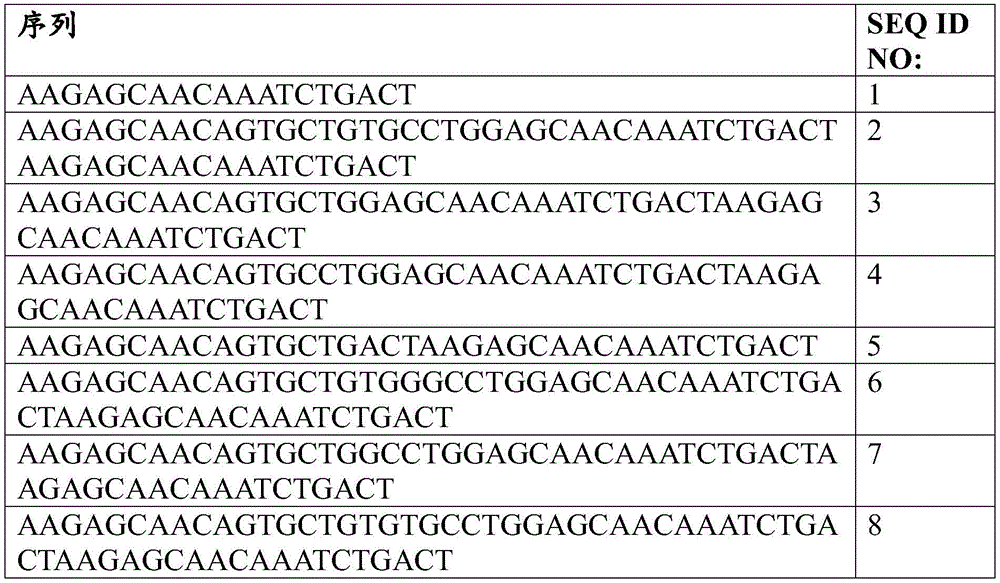
在一些实施例中,相对于未修饰的T细胞,经工程改造的T细胞包含TRAC基因中的缺失。在一些实施例中,相对于未修饰的T细胞,经工程改造的T细胞包含TRAC基因中15-30个碱基对的缺失。在一些实施例中,相对于未修饰的T细胞,经工程改造的T细胞包含在TRAC中基因中15、16、17、18、19、20、21、22、23、24、25、26、27、28、29或30个碱基对的缺失。在一些实施例中,相对于未修饰的T细胞,经工程改造的T细胞包含TRAC基因中超过30个碱基对的缺失。在一些实施例中,相对于未修饰的T细胞,经工程改造的T细胞包含TRAC基因中20个碱基对的缺失。在一些实施例中,相对于未修饰的T细胞,经工程改造的T细胞包含TRAC基因中SEQ ID NO:86的缺失。在一些实施例中,相对于未修饰的T细胞,经工程改造的T细胞包含TRAC基因中包含SEQ ID NO:86的缺失。在一些实施例中,相对于未修饰的T细胞,经工程改造的T细胞包含TRAC基因中SEQ ID NO:118的缺失。在一些实施例中,相对于未修饰的T细胞,经工程改造的T细胞包含TRAC基因中包含SEQ ID NO:118的缺失。In some embodiments, the engineered T cells comprise deletions in the TRAC gene relative to unmodified T cells. In some embodiments, the engineered T cells comprise a 15-30 base pair deletion in the TRAC gene relative to unmodified T cells. In some embodiments, the engineered T cells are comprised of
β2M基因编辑β2M gene editing
在一些实施例中,经工程改造的T细胞包含破坏的β2M基因。β2M是MHC I复合物的常见(不变)组分。通过基因编辑破坏其表达将阻止宿主抗治疗性同种异体T细胞应答,从而导致同种异体T细胞持久性增加。在一些实施例中,消除内源性β2M基因的表达以防止移植物抗宿主应答。In some embodiments, the engineered T cells comprise a disrupted β2M gene. β2M is a common (invariant) component of the MHC I complex. Disruption of its expression through gene editing will prevent host-resistant therapeutic allogeneic T cell responses, resulting in increased allogeneic T cell persistence. In some embodiments, the expression of the endogenous β2M gene is eliminated to prevent a graft-versus-host response.
可以如本文所提供用于在β2M基因中产生基因组缺失的经修饰和未修饰的β2MgRNA序列的非限制性实例列在表7中(例如,SEQ ID NO:31和41)。还参见2018年5月11日提交的国际申请号PCT/US 2018/032334,其通过引用并入本文。可以使用位于第15号染色体上的β2M基因序列(GRCh38坐标:染色体15:44,711,477-44,718,877;Ensembl:ENSG00000166710)设计其他gRNA序列。Non-limiting examples of modified and unmodified β2MgRNA sequences that can be used to create genomic deletions in the β2M gene as provided herein are listed in Table 7 (eg, SEQ ID NOs: 31 and 41). See also International Application No. PCT/US 2018/032334, filed May 11, 2018, which is incorporated herein by reference. Additional gRNA sequences can be designed using the β2M gene sequence located on chromosome 15 (GRCh38 coordinates: chromosome 15: 44,711,477-44,718,877; Ensembl: ENSG00000166710).
在一些实施例中,靶向β2M基因组区域的gRNA和RNA指导的核酸酶在β2M基因组区域中产生断裂,导致β2M基因中的插入缺失,其破坏mRNA或蛋白质的表达。In some embodiments, gRNAs and RNA-guided nucleases targeting the β2M genomic region create breaks in the β2M genomic region resulting in indels in the β2M gene that disrupt mRNA or protein expression.
在一些实施例中,群体中至少50%的经工程改造的T细胞不表达可检测水平的β2M表面蛋白。例如,群体的至少55%、至少60%、至少70%、至少75%、至少80%、至少85%、至少90%或至少95%的经工程改造的T细胞可以不表达可检测水平的β2M表面蛋白。在一些实施例中,群体中50%-100%、50%-90%、50%-80%、50%-70%、50%-60%、60%-100%、60%-90%、60%-80%、60%-70%、70%-100%、70%-90%、70%-80%、80%-100%、80%-90%、或90%-100%的经工程改造的T细胞不表达可检测水平的β2M表面蛋白。In some embodiments, at least 50% of the engineered T cells in the population do not express detectable levels of β2M surface protein. For example, at least 55%, at least 60%, at least 70%, at least 75%, at least 80%, at least 85%, at least 90%, or at least 95% of the engineered T cells of the population may not express detectable levels of β2M surface protein. In some embodiments, 50%-100%, 50%-90%, 50%-80%, 50%-70%, 50%-60%, 60%-100%, 60%-90%, 60%-80%, 60%-70%, 70%-100%, 70%-90%, 70%-80%, 80%-100%, 80%-90%, or 90%-100% The engineered T cells did not express detectable levels of the β2M surface protein.
在一些实施例中,细胞群中少于50%的经工程改造的T细胞表达可检测水平的β2M表面蛋白。在一些实施例中,细胞群中少于30%的经工程改造的T细胞表达可检测水平的β2M表面蛋白。例如,细胞群中少于50%、少于30%、少于25%、少于20%、少于15%、少于10%或少于5%的经工程改造的T细胞表达可检测水平的β2M表面蛋白。在一些实施例中,细胞群中40%-30%、40%-20%、40%-10%、40%-5%、30%-20%、30%-10%、30%-5%、20%-10%、20%-5%、或10%-5%的经工程改造的T细胞表达可检测水平的β2M表面蛋白。In some embodiments, less than 50% of the engineered T cells in the cell population express detectable levels of β2M surface protein. In some embodiments, less than 30% of the engineered T cells in the cell population express detectable levels of β2M surface protein. For example, less than 50%, less than 30%, less than 25%, less than 20%, less than 15%, less than 10%, or less than 5% of the engineered T cells in the cell population express detectable levels β2M surface protein. In some embodiments, 40%-30%, 40%-20%, 40%-10%, 40%-5%, 30%-20%, 30%-10%, 30%-5% in the cell population , 20%-10%, 20%-5%, or 10%-5% of the engineered T cells expressed detectable levels of β2M surface protein.
在一些实施例中,将核糖核蛋白颗粒(RNP)递送至T细胞(例如原代T细胞),所述核糖核蛋白颗粒包含RNA指导的核酸酶(例如,Cas核酸酶,例如Cas9核酸酶)和靶向B2M基因(或任何其他目的基因)的gRNA。在其他实施例中,RNA指导的核酸酶和gRNA分开递送至T细胞。核糖核蛋白颗粒(RNP)只是与gRNA预复合/复合的受RNA指导的核酸酶(例如,Cas9)。In some embodiments, ribonucleoprotein particles (RNPs) comprising RNA-guided nucleases (eg, Cas nucleases, such as Cas9 nucleases) are delivered to T cells (eg, primary T cells) and gRNA targeting the B2M gene (or any other gene of interest). In other embodiments, the RNA-guided nuclease and gRNA are delivered to T cells separately. Ribonucleoprotein particles (RNPs) are simply RNA-guided nucleases (eg, Cas9) precomplexed/complexed with gRNA.
在一些实施例中,经编辑的β2M基因包含选自以下表2中序列的核苷酸序列。In some embodiments, the edited β2M gene comprises a nucleotide sequence selected from the sequences in Table 2 below.
表2.Table 2.

PD-1基因编辑PD-1 gene editing
PD-1是在激活的T细胞中上调并用来抑制或终止T细胞应答的免疫检查点分子。通过基因编辑破坏PD-1可以导致受试者更持久和/或更有效的治疗性T细胞应答和/或减少免疫抑制。在一些实施例中,经工程改造的T细胞包含破坏的PD-1基因。在一些实施例中,消除内源性PD-1基因的表达以增强本披露的CAR T细胞的抗肿瘤功效。PD-1 is an immune checkpoint molecule that is upregulated in activated T cells and used to inhibit or terminate T cell responses. Disruption of PD-1 by gene editing can result in a more durable and/or more effective therapeutic T cell response and/or reduced immunosuppression in the subject. In some embodiments, the engineered T cells comprise a disrupted PD-1 gene. In some embodiments, the expression of the endogenous PD-1 gene is eliminated to enhance the anti-tumor efficacy of the CAR T cells of the present disclosure.
可以如本文所提供用于在PD-1基因中产生基因组缺失的经修饰和未修饰的PD-1gRNA序列的非限制性实例列在表5中(例如,SEQ ID NO:32和42)。还参见2018年5月11日提交的国际申请号PCT/US 2018/032334,其通过引用并入本文。可以使用位于第2号染色体上的PD-1基因序列(GRCh38坐标:染色体2:241,849,881-241,858,908;Ensembl:ENSG00000188389)设计其他gRNA序列。Non-limiting examples of modified and unmodified PD-1 gRNA sequences that can be used to create genomic deletions in the PD-1 gene as provided herein are listed in Table 5 (eg, SEQ ID NOs: 32 and 42). See also International Application No. PCT/US 2018/032334, filed May 11, 2018, which is incorporated herein by reference. Additional gRNA sequences can be designed using the PD-1 gene sequence located on chromosome 2 (GRCh38 coordinates: Chromosome 2: 241,849,881-241,858,908; Ensembl: ENSG00000188389).
在一些实施例中,RNA指导的核酸酶和靶向PD-1基因组区域的gRNA在TRAC基因组区域中产生断裂,导致PD-1基因中的插入缺失,破坏PD-1mRNA或蛋白质的表达。In some embodiments, RNA-guided nucleases and gRNAs targeting PD-1 genomic regions create breaks in the TRAC genomic regions, resulting in indels in the PD-1 gene, disrupting PD-1 mRNA or protein expression.
在一些实施例中,群体中至少50%的经工程改造的T细胞不表达可检测水平的PD-1表面蛋白。例如,群体中至少55%、至少60%、至少70%、至少75%、至少80%、至少85%、至少90%或至少95%的经工程改造的T细胞可以不表达可检测水平的PD-1表面蛋白。在一些实施例中,群体中50%-100%、50%-90%、50%-80%、50%-70%、50%-60%、60%-100%、60%-90%、60%-80%、60%-70%、70%-100%、70%-90%、70%-80%、80%-100%、80%-90%、或90%-100%的经工程改造的T细胞不表达可检测水平的PD-1表面蛋白。In some embodiments, at least 50% of the engineered T cells in the population do not express detectable levels of PD-1 surface protein. For example, at least 55%, at least 60%, at least 70%, at least 75%, at least 80%, at least 85%, at least 90%, or at least 95% of the engineered T cells in the population may not express detectable levels of PD -1 surface protein. In some embodiments, 50%-100%, 50%-90%, 50%-80%, 50%-70%, 50%-60%, 60%-100%, 60%-90%, 60%-80%, 60%-70%, 70%-100%, 70%-90%, 70%-80%, 80%-100%, 80%-90%, or 90%-100% The engineered T cells did not express detectable levels of the PD-1 surface protein.
在一些实施例中,将核糖核蛋白颗粒(RNP)递送至T细胞(例如原代T细胞),所述核糖核蛋白颗粒包含RNA指导的核酸酶(例如,Cas核酸酶,例如Cas9核酸酶)和靶向PD-1基因(或任何其他目的基因)的gRNA。在其他实施例中,RNA指导的核酸酶和gRNA分开递送至T细胞。核糖核蛋白颗粒(RNP)只是与gRNA预复合/复合的受RNA指导的核酸酶(例如,Cas9)。In some embodiments, ribonucleoprotein particles (RNPs) comprising RNA-guided nucleases (eg, Cas nucleases, such as Cas9 nucleases) are delivered to T cells (eg, primary T cells) and gRNA targeting the PD-1 gene (or any other gene of interest). In other embodiments, the RNA-guided nuclease and gRNA are delivered to T cells separately. Ribonucleoprotein particles (RNPs) are simply RNA-guided nucleases (eg, Cas9) precomplexed/complexed with gRNA.
细胞表型Cell phenotype
在一些实施例中,细胞群内的一个或多个基因编辑导致表型,所述表型与细胞增殖能力、细胞耗尽、细胞生存力、细胞裂解能力(例如,增加细胞因子产生和/或释放)或它们的任何组合的改变关联。In some embodiments, the editing of one or more genes within a population of cells results in a phenotype that is associated with cell proliferative capacity, cell depletion, cell viability, cell lysis capacity (eg, increased cytokine production and/or release) or any combination of them to change the association.
在一些实施例中,群体中经工程改造的T细胞包含CAR,所述CAR包含抗CD70 scFv胞外结构域。在一些实施例中,群体中经工程改造的T细胞包含CAR,所述CAR包含抗BCMAscFv胞外结构域。在一些实施例中,群体中经工程改造的T细胞包含CAR,所述CAR包含抗CD19 scFv胞外结构域。在一些实施例中,群体中经工程改造的T细胞包含CAR,所述CAR包含抗CD33 scFv胞外结构域。任何上述经工程改造的T细胞也可包含以下一个或多个基因的破坏:TRAC、β2M、PD-1、和/或CD70(例如,TRAC-/β2M-/CD70-;TRAC-/β2M-/PD-1-;或TRAC-/β2M-/PD-1-/CD70-)。In some embodiments, the engineered T cells in the population comprise a CAR comprising an anti-CD70 scFv extracellular domain. In some embodiments, the engineered T cells in the population comprise a CAR comprising an anti-BCMA scFv extracellular domain. In some embodiments, the engineered T cells in the population comprise a CAR comprising an anti-CD19 scFv extracellular domain. In some embodiments, the engineered T cells in the population comprise a CAR comprising an anti-CD33 scFv extracellular domain. Any of the above engineered T cells may also comprise disruption of one or more of the following genes: TRAC, β2M, PD-1, and/or CD70 (eg, TRAC − /β2M − /CD70 − ; TRAC − /β2M − / PD-1 − ; or TRAC − /β2M − /PD-1 − /CD70 − ).
在一些实施例中,相对于对照细胞,本披露的经工程改造的T细胞表现出增加的细胞增殖能力。在一些实施例中,相对于对照T细胞,本披露的经工程改造的T细胞表现出至少20%更大的细胞增殖能力。例如,经工程改造的T细胞(例如,TRAC-/β2M-/CD70-;TRAC-/β2M-/PD-1-;或TRAC-/β2M-/PD-1-/CD70-;有或没有CAR),相对于对照细胞,可以表现出至少25%、至少30%、至少35%、至少40%、至少45%、至少50%、至少55%、至少60%、至少65%、至少70%、至少75%、至少80%或至少90%更大的细胞增殖能力。在一些实施例中,相对于对照T细胞,本披露的经工程改造的T细胞表现出20%-100%、20%-90%、20%-80%、20%-70%、20%-60%、20%-50%、30%-100%、30%-90%、30%-80%、30%-70%、30%-60%、30%-50%、40%-100%、40%-90%、40%-80%、40%-70%、40%-60%、40%-50%、50%-100%、50%-90%、50%-80%、50%-70%、或50%-60%更大的细胞增殖能力。测量细胞增殖的方法是本领域技术人员已知的并且在本文中描述。In some embodiments, the engineered T cells of the present disclosure exhibit increased cell proliferative capacity relative to control cells. In some embodiments, the engineered T cells of the present disclosure exhibit at least 20% greater cell proliferative capacity relative to control T cells. For example, engineered T cells (eg, TRAC − /β2M − /CD70 − ; TRAC − /β2M − /PD-1 − ; or TRAC − /β2M − /PD-1 − /CD70 − ; with or without CAR ), relative to control cells, may exhibit at least 25%, at least 30%, at least 35%, at least 40%, at least 45%, at least 50%, at least 55%, at least 60%, at least 65%, at least 70%, At least 75%, at least 80% or at least 90% greater cell proliferation capacity. In some embodiments, engineered T cells of the
在一些实施例中,相对于对照T细胞,本披露的经工程改造的T细胞表现出减少的耗尽。例如,相对于对照T细胞,经工程改造的T细胞可以表达降低水平的LAG3(或其他耗尽标志物)。在一些实施例中,相对于对照T细胞,LAG3表达水平降低了至少20%。例如,相对于对照T细胞,LAG3表达水平可以降低至少25%、至少30%、至少35%、至少40%、至少45%、至少50%、至少55%、至少60%、至少65%、至少70%、至少75%、至少80%或至少90%。在一些实施例中,相对于对照T细胞,LAG3表达的水平降低20%-100%、20%-90%、20%-80%、20%-70%、20%-60%、20%-50%、30%-100%、30%-90%、30%-80%、30%-70%、30%-60%、30%-50%、40%-100%、40%-90%、40%-80%、40%-70%、40%-60%、40%-50%、50%-100%、50%-90%、50%-80%、50%-70%、或50%-60%。在一些实施例中,通过测量耗尽标志物物(包括TIGIT、PD-1、LAG-3或其组合)表面表达的减少来确定减少的耗尽。测量表面表达的方法是本领域技术人员已知的并且在本文中描述。In some embodiments, the engineered T cells of the present disclosure exhibit reduced depletion relative to control T cells. For example, engineered T cells can express reduced levels of LAG3 (or other markers of depletion) relative to control T cells. In some embodiments, LAG3 expression levels are reduced by at least 20% relative to control T cells. For example, LAG3 expression levels can be reduced by at least 25%, at least 30%, at least 35%, at least 40%, at least 45%, at least 50%, at least 55%, at least 60%, at least 65%, at least 70%, at least 75%, at least 80% or at least 90%. In some embodiments, the level of LAG3 expression is reduced relative to control T cells by 20%-100%, 20%-90%, 20%-80%, 20%-70%, 20%-60%, 20%- 50%, 30%-100%, 30%-90%, 30%-80%, 30%-70%, 30%-60%, 30%-50%, 40%-100%, 40%-90% , 40%-80%, 40%-70%, 40%-60%, 40%-50%, 50%-100%, 50%-90%, 50%-80%, 50%-70%, or 50%-60%. In some embodiments, reduced depletion is determined by measuring the reduction in surface expression of depletion markers, including TIGIT, PD-1, LAG-3, or a combination thereof. Methods of measuring surface expression are known to those of skill in the art and are described herein.
在一些实施例中,相对于对照细胞,本披露的经工程改造的T细胞表现出增加的细胞生存力。在一些实施例中,相对于对照细胞,本披露的经工程改造的T细胞表现出细胞生存力增加至少20%。例如,相对于对照细胞,本披露的经工程改造的T细胞的细胞生存力可表现出增加至少25%、至少30%、至少35%、至少40%、至少45%、至少50%、至少55%、至少60%、至少65%、至少70%、至少75%、至少80%或至少90%。在一些实施例中,相对于对照细胞,本披露的经工程改造的T细胞的细胞生存力表现出增加20%-100%、20%-90%、20%-80%、20%-70%、20%-60%、20%-50%、30%-100%、30%-90%、30%-80%、30%-70%、30%-60%、30%-50%、40%-100%、40%-90%、40%-80%、40%-70%、40%-60%、40%-50%、50%-100%、50%-90%、50%-80%、50%-70%、或50%-60%。测量细胞生存力的方法是本领域技术人员已知的并且在本文中描述。In some embodiments, the engineered T cells of the present disclosure exhibit increased cell viability relative to control cells. In some embodiments, the engineered T cells of the present disclosure exhibit at least a 20% increase in cell viability relative to control cells. For example, engineered T cells of the present disclosure can exhibit an increase in cell viability of at least 25%, at least 30%, at least 35%, at least 40%, at least 45%, at least 50%, at least 55% relative to control cells %, at least 60%, at least 65%, at least 70%, at least 75%, at least 80%, or at least 90%. In some embodiments, engineered T cells of the present disclosure exhibit a 20%-100%, 20%-90%, 20%-80%, 20%-70% increase in cell viability relative to control cells , 20%-60%, 20%-50%, 30%-100%, 30%-90%, 30%-80%, 30%-70%, 30%-60%, 30%-50%, 40 %-100%, 40%-90%, 40%-80%, 40%-70%, 40%-60%, 40%-50%, 50%-100%, 50%-90%, 50%- 80%, 50%-70%, or 50%-60%. Methods of measuring cell viability are known to those of skill in the art and are described herein.
在一些实施例中,相对于对照细胞,本披露的经工程改造的T细胞表现出增加的细胞裂解能力。在一些实施例中,相对于对照细胞,本披露的经工程改造的T细胞表现出细胞裂解能力增加至少20%(多杀伤至少20%的靶细胞)。例如,相对于对照细胞,本披露的经工程改造的T细胞的细胞裂解能力可表现出增加至少25%、至少30%、至少35%、至少40%、至少45%、至少50%、至少55%、至少60%、至少65%、至少70%、至少75%、至少80%或至少90%。在一些实施例中,相对于对照细胞,本披露的经工程改造的T细胞的细胞裂解能力表现出增加20%-100%、20%-90%、20%-80%、20%-70%、20%-60%、20%-50%、30%-100%、30%-90%、30%-80%、30%-70%、30%-60%、30%-50%、40%-100%、40%-90%、40%-80%、40%-70%、40%-60%、40%-50%、50%-100%、50%-90%、50%-80%、50%-70%、或50%-60%。In some embodiments, the engineered T cells of the present disclosure exhibit increased cytolytic capacity relative to control cells. In some embodiments, engineered T cells of the present disclosure exhibit at least a 20% increase in cytolytic capacity relative to control cells (at least 20% more kill of target cells). For example, engineered T cells of the present disclosure can exhibit an increase in cytolytic capacity of at least 25%, at least 30%, at least 35%, at least 40%, at least 45%, at least 50%, at least 55% relative to control cells %, at least 60%, at least 65%, at least 70%, at least 75%, at least 80%, or at least 90%. In some embodiments, engineered T cells of the present disclosure exhibit a 20%-100%, 20%-90%, 20%-80%, 20%-70% increase in cytolytic capacity relative to control cells , 20%-60%, 20%-50%, 30%-100%, 30%-90%, 30%-80%, 30%-70%, 30%-60%, 30%-50%, 40 %-100%, 40%-90%, 40%-80%, 40%-70%, 40%-60%, 40%-50%, 50%-100%, 50%-90%, 50%- 80%, 50%-70%, or 50%-60%.
在一些实施例中,相对于对照细胞,本披露的经工程改造的T细胞表现出增加的细胞因子分泌。例如,在一些实施例中,经工程改造的T细胞分泌的细胞因子(例如,IL-2和/或IFN-γ)的水平比对照T细胞分泌的细胞因子水平大至少2倍(例如,至少3倍、至少4倍、或至少5倍)。In some embodiments, the engineered T cells of the present disclosure exhibit increased cytokine secretion relative to control cells. For example, in some embodiments, the engineered T cells secrete levels of cytokines (eg, IL-2 and/or IFN-γ) that are at least 2-fold greater than the levels of cytokines secreted by control T cells (eg, at least 3 times, at least 4 times, or at least 5 times).
在一些实施例中,对照T细胞是表达内源CD70蛋白(通常由T细胞表达的CD70)的经工程改造的T细胞(例如,基因编辑的T细胞)。在一些实施例中,对照T细胞是经工程改造的T细胞,其表达内源CD70蛋白并包含通过插入编码CAR(例如,抗CD70 CAR或抗BCMA CAR)的核酸而破坏的TRAC基因、破坏的β2M基因,破坏的PD-1基因或上述破坏的基因的任何组合。在一些实施例中,对照T细胞是未编辑的T细胞。In some embodiments, the control T cells are engineered T cells (eg, gene edited T cells) that express the endogenous CD70 protein (CD70 normally expressed by T cells). In some embodiments, the control T cells are engineered T cells that express endogenous CD70 protein and comprise a TRAC gene disrupted by insertion of a nucleic acid encoding a CAR (eg, anti-CD70 CAR or anti-BCMA CAR), disrupted β2M gene, disrupted PD-1 gene, or any combination of the aforementioned disrupted genes. In some embodiments, the control T cells are unedited T cells.
出人意料地,本披露的多基因编辑的CAR T细胞(例如,TRAC-/β2M-/PD-1-/CD70-细胞)在用癌细胞多次激发(也称为一个或多个再激发)后,维持毒性(杀伤癌细胞的能力)。在一些实施例中,经工程改造的T细胞在用靶细胞进行至少1次再激发后维持细胞毒性,其中靶细胞表达被CAR T细胞识别的抗原。在一些实施例中,经工程改造的T细胞在用靶细胞进行至少2次再激发后维持细胞毒性,其中靶细胞表达被CAR T细胞识别的抗原。在一些实施例中,经工程改造的T细胞在用癌细胞进行至少1次再激发后,维持细胞毒性。在一些实施例中,经工程改造的T细胞在用癌细胞进行至少2次再激发后,维持细胞毒性。在一些实施例中,经工程改造的T细胞在用靶细胞进行1、2、3、4、5、6、7、8、9或10次再激发后维持细胞毒性,其中靶细胞表达由CAR T细胞识别的抗原。在一些实施例中,经工程改造的T细胞在用靶细胞进行2、3、4、5、6、7、8、9或10次再激发后维持细胞毒性,其中靶细胞表达由CAR T细胞识别的抗原。在一些实施例中,经工程改造的T细胞在用癌细胞进行2、3、4、5、6、7、8、9或10次再激发后维持细胞毒性。在一些实施例中,经工程改造的T细胞在用靶细胞进行10次或更多次再激发后维持细胞毒性,其中靶细胞表达由CAR T细胞识别的抗原。在一些实施例中,经工程改造的T细胞在用靶细胞进行10次或更多次再激发后维持细胞毒性。在一些实施例中,经工程改造的T细胞表达对CD70特异性的CAR,并且靶细胞(例如,癌细胞)表达CD70。在一些实施例中,经工程改造的T细胞表达对CD19特异性的CAR,并且靶细胞(例如,癌细胞)表达CD19。在一些实施例中,经工程改造的T细胞表达对CD33特异性的CAR,并且靶细胞(例如,癌细胞)表达CD33。在一些实施例中,经工程改造的T细胞表达对BCMA特异的CAR,并且靶细胞(例如,癌细胞)表达BCMA。Unexpectedly, the multi-gene edited CAR T cells of the present disclosure (eg, TRAC- / β2M-/PD - 1- / CD70- cells) after multiple challenge (also referred to as one or more re-challenges) with cancer cells , to maintain toxicity (the ability to kill cancer cells). In some embodiments, the engineered T cells maintain cytotoxicity after at least 1 re-challenge with target cells that express an antigen recognized by the CAR T cells. In some embodiments, the engineered T cells maintain cytotoxicity after at least 2 re-challenges with target cells that express an antigen recognized by the CAR T cells. In some embodiments, the engineered T cells maintain cytotoxicity after at least 1 re-challenge with cancer cells. In some embodiments, the engineered T cells maintain cytotoxicity after at least 2 re-challenges with cancer cells. In some embodiments, the engineered T cells maintain cytotoxicity after 1, 2, 3, 4, 5, 6, 7, 8, 9, or 10 re-challenges with target cells that express a CAR Antigens recognized by T cells. In some embodiments, the engineered T cells maintain cytotoxicity following 2, 3, 4, 5, 6, 7, 8, 9, or 10 re-challenges with the target cells, wherein the target cells express the CAR T cells recognized antigens. In some embodiments, the engineered T cells maintain cytotoxicity after 2, 3, 4, 5, 6, 7, 8, 9, or 10 re-challenges with cancer cells. In some embodiments, the engineered T cells maintain cytotoxicity after 10 or more rechallenges with target cells that express antigens recognized by the CAR T cells. In some embodiments, the engineered T cells maintain cytotoxicity after 10 or more rechallenges with target cells. In some embodiments, the engineered T cells express a CAR specific for CD70, and the target cells (eg, cancer cells) express CD70. In some embodiments, the engineered T cells express a CAR specific for CD19, and the target cells (eg, cancer cells) express CD19. In some embodiments, the engineered T cells express a CAR specific for CD33, and the target cells (eg, cancer cells) express CD33. In some embodiments, the engineered T cells express a CAR specific for BCMA, and the target cells (eg, cancer cells) express BCMA.
基因编辑方法gene editing methods
基因编辑(包括基因组编辑)是基因工程的一种类型,其中在DNA序列中,例如在靶细胞的基因组中插入、缺失和/或取代一个或多个核苷酸/一个或多个核酸。靶向基因编辑使得能够在靶细胞的基因组中的预选位点(例如,在靶基因或靶DNA序列中)实现插入、缺失和/或取代。当例如通过一个或多个核苷酸/一个或多个核酸的缺失、插入或取代来编辑内源基因的序列时,包含受影响序列的内源基因可能由于序列修饰而被敲除或敲低。因此,靶向编辑可用于破坏内源基因表达。“靶向整合”是指涉及在插入位点缺失或不缺失内源序列情况下,一个或多个外源序列的插入的过程。当存在包含外源序列的供体模板时,靶向整合可以由靶向基因编辑产生。如本文所用,“破坏的基因”是指相对于内源基因包含插入、缺失或取代的基因,使得来自内源基因的功能蛋白的表达被减少或抑制。如本文所用,“破坏基因”是指在内源基因中插入、缺失或取代至少一个核苷酸/核酸,从而减少或抑制来自内源基因的功能蛋白的表达的方法。破坏基因的方法是本领域技术人员已知的并且在本文中描述。Gene editing (including genome editing) is a type of genetic engineering in which one or more nucleotides/one or more nucleic acids are inserted, deleted and/or substituted in a DNA sequence, eg, in the genome of a target cell. Targeted gene editing enables insertions, deletions, and/or substitutions at preselected sites in the genome of a target cell (eg, in a target gene or target DNA sequence). When the sequence of an endogenous gene is edited, eg by deletion, insertion or substitution of one or more nucleotides/nucleic acids, the endogenous gene comprising the affected sequence may be knocked out or knocked down due to the sequence modification . Therefore, targeted editing can be used to disrupt endogenous gene expression. "Targeted integration" refers to a process involving the insertion of one or more exogenous sequences with or without deletion of the endogenous sequence at the insertion site. Targeted integration can result from targeted gene editing when a donor template containing the foreign sequence is present. As used herein, a "disrupted gene" refers to a gene that contains insertions, deletions or substitutions relative to an endogenous gene such that the expression of a functional protein from the endogenous gene is reduced or inhibited. As used herein, "disrupting a gene" refers to a method of inserting, deleting or substituting at least one nucleotide/nucleic acid in an endogenous gene, thereby reducing or inhibiting the expression of a functional protein from the endogenous gene. Methods of disrupting genes are known to those of skill in the art and are described herein.
靶向编辑可以通过不依赖核酸酶的方法或依赖于核酸酶的方法来实现。在不依赖核酸酶的靶向编辑方法中,同源重组是由在外源多核苷酸侧翼的同源序列进行指导,所述外源多核苷酸通过宿主细胞的酶促机制引入内源序列中。外源多核苷酸可以在内源序列中引入核苷酸的缺失、插入或替换。Targeted editing can be achieved by nuclease-independent methods or nuclease-dependent methods. In nuclease-independent targeted editing methods, homologous recombination is directed by homologous sequences flanking exogenous polynucleotides that are introduced into endogenous sequences by the enzymatic machinery of the host cell. An exogenous polynucleotide can introduce deletions, insertions or substitutions of nucleotides into the endogenous sequence.
可替代地,依赖于核酸酶的方法可以通过特异性稀有剪切核酸酶(例如,内切核酸酶)特异性引入双链断裂(DSB)来实现更高频率的靶向编辑。这种依赖核酸酶的靶向编辑还利用DNA修复机制,例如非同源末端连接(NHEJ),它应答于DSB而发生。NHEJ修复DNA通常会导致少量内源核苷酸的随机插入或缺失(插入缺失)。与NHEJ介导的修复相反,修复也可以通过同源定向修复(HDR)进行。当存在包含侧翼是一对同源臂的外源遗传物质的供体模板时,可通过HDR将外源遗传物质引入基因组,这导致外源遗传物质的靶向整合。Alternatively, nuclease-dependent methods can achieve higher frequencies of targeted editing by specifically introducing double-strand breaks (DSBs) by specific rare-cutting nucleases (eg, endonucleases). This nuclease-dependent targeted editing also utilizes DNA repair mechanisms, such as non-homologous end joining (NHEJ), which occurs in response to DSBs. DNA repair by NHEJ typically results in random insertions or deletions (indels) of small amounts of endogenous nucleotides. In contrast to NHEJ-mediated repair, repair can also be performed by homology-directed repair (HDR). When there is a donor template comprising foreign genetic material flanked by a pair of homology arms, the foreign genetic material can be introduced into the genome by HDR, which results in the targeted integration of the foreign genetic material.
能够引入特异性和靶向DSB的可用内切核酸酶包括但不限于锌指核酸酶(ZFN)、转录激活子样效应子核酸酶(TALEN)和RNA指导的CRISPR-Cas9核酸酶(CRISPR/Cas9;聚簇规则间隔短回文重复序列相关9)。另外,利用phiC31和Bxb1整合酶的DICE(双整合酶盒交换)系统也可以用于靶向整合。Available endonucleases capable of introducing specific and targeting DSBs include, but are not limited to, zinc finger nucleases (ZFNs), transcription activator-like effector nucleases (TALENs), and RNA-guided CRISPR-Cas9 nucleases (CRISPR/Cas9 ; Clustered Regularly Interspaced Short Palindromic Repeats Correlation 9). Alternatively, the DICE (Dual Integrase Cassette Exchange) system utilizing phiC31 and Bxb1 integrases can also be used for targeted integration.
ZFN是靶向核酸酶,包含与锌指DNA结合结构域(ZFBD)融合的核酸酶,ZFBD是通过一个或多个锌指以序列特异性方式结合DNA的多肽结构域。锌指是锌指结合结构域内约30个氨基酸的结构域,其结构通过锌离子的配位稳定。锌指的实例包括但不限于C2H2锌指、C3H锌指和C4锌指。设计的锌指结构域是自然界中不存在的结构域,其设计/组成主要来自于合理的标准,例如,取代规则和用于在存储现有ZFP设计信息和结合数据的数据库中处理信息的计算机算法的应用。参见,例如,美国专利号6,140,081;6,453,242;和6,534,261;另见WO 98/53058;WO 98/53059;WO 98/53060;WO 02/016536和WO 03/016496。选择的锌指结构域是在自然界中找不到的结构域,其产生主要来自经验过程,例如噬菌体展示、相互作用陷阱或杂交选择。ZFNs在美国专利号7,888,121和美国专利号7,972,854中更详细描述。ZFN的最广为人知的实例是FokI核酸酶与锌指DNA结合结构域的融合物。ZFNs are targeting nucleases comprising nucleases fused to zinc finger DNA binding domains (ZFBDs), which are polypeptide domains that bind DNA in a sequence-specific manner through one or more zinc fingers. A zinc finger is a domain of about 30 amino acids within the zinc finger binding domain, the structure of which is stabilized by the coordination of zinc ions. Examples of zinc fingers include, but are not limited to, C2H2 zinc fingers, C3H zinc fingers, and C4 zinc fingers. Engineered zinc finger domains are domains that do not exist in nature and whose design/composition is largely derived from rational criteria, e.g., substitution rules and computers for processing the information in databases storing existing ZFP design information and binding data application of the algorithm. See, eg, US Patent Nos. 6,140,081; 6,453,242; and 6,534,261; see also WO 98/53058; WO 98/53059; WO 98/53060; WO 02/016536 and WO 03/016496. Selected zinc finger domains are domains that are not found in nature and arise primarily from empirical processes such as phage display, interaction traps or hybrid selection. ZFNs are described in more detail in US Patent No. 7,888,121 and US Patent No. 7,972,854. The best known example of a ZFN is a fusion of FokI nuclease with a zinc finger DNA binding domain.
TALEN是靶向核酸酶,其包含与TAL效应子DNA结合结构域融合的核酸酶。“转录激活子样效应子DNA结合结构域”,“TAL效应子DNA结合结构域”或“TALE DNA结合结构域”是TAL效应子蛋白的多肽结构域,其负责TAL效应子蛋白与DNA的结合。TAL效应子蛋白由黄杆菌属(Xanthomonas)的植物病原体在感染期间分泌。这些蛋白质进入植物细胞的核,通过其DNA结合结构域结合效应子特异性DNA序列,并通过其反式激活结构域激活这些序列上的基因转录。TAL效应子DNA结合结构域特异性取决于不完全的34个氨基酸重复的效应子可变数目,其在选择的称为重复可变二残基(RVD)的重复位置处包含多态性。在美国专利申请NO.2011/0145940中更详细地描述了TALEN。在本领域中最公认的TALEN实例是FokI核酸酶与TAL效应DNA结合结构域的融合多肽。TALENs are targeting nucleases comprising nucleases fused to a TAL effector DNA-binding domain. A "transcription activator-like effector DNA-binding domain", "TAL effector DNA-binding domain" or "TALE DNA-binding domain" is the polypeptide domain of a TAL effector protein that is responsible for the binding of the TAL effector protein to DNA . TAL effector proteins are secreted during infection by plant pathogens of the genus Xanthomonas. These proteins enter the nucleus of plant cells, bind effector-specific DNA sequences through their DNA-binding domains, and activate gene transcription on these sequences through their transactivation domains. TAL effector DNA-binding domain specificity depends on the variable number of effector repeats of incomplete 34 amino acids that contain polymorphisms at selected repeat positions called repeat variable diresidues (RVDs). TALENs are described in more detail in US Patent Application No. 2011/0145940. The most recognized example of a TALEN in the art is a fusion polypeptide of FokI nuclease and a TAL effector DNA binding domain.
适用于如本文提供的用途的靶向核酸酶的其他实例包括但不限于Bxb1、phiC31、R4、PhiBT1和Wβ/SPBc/TP901-1,无论是单独使用还是组合使用。Other examples of targeted nucleases suitable for use as provided herein include, but are not limited to, Bxb1, phiC31, R4, PhiBT1 and Wβ/SPBc/TP901-1, whether used alone or in combination.
靶向核酸酶的其他非限制性实例包括天然存在的核酸酶和重组核酸酶,例如CRISPR/Cas9、限制性内切核酸酶、大范围核酸酶归巢内切核酸酶等。Other non-limiting examples of targeting nucleases include naturally occurring nucleases and recombinant nucleases such as CRISPR/Cas9, restriction endonucleases, meganuclease homing endonucleases, and the like.
CRISPR-Cas9基因编辑CRISPR-Cas9 gene editing
CRISPR-Cas9系统是原核生物中天然存在的防御机制,其已被重新用作用于基因编辑的RNA指导的DNA靶向平台。它依赖于DNA核酸酶Cas9和两个非编码RNA(crisprRNA(crRNA)和反式激活RNA(tracrRNA))来靶向DNA的切割。CRISPR是聚簇规则间隔短回文重复序列(Clustered Regularly Interspaced Short Palindromic Repeats)的缩写,是在细菌和古细菌基因组中发现的包含与先前暴露于细胞的外源DNA(暴露于例如已感染或攻击原核生物的病毒)相似的DNA片段(间隔子DNA)的DNA序列的家族。这些DNA片段被原核生物用来在重新引入后,例如在随后的攻击中从相似的病毒中检测和破坏相似的外源DNA。CRISPR基因座的转录导致包含间隔子序列的RNA分子的形成,所述RNA分子缔合并靶向Cas(CRISPR相关)蛋白以能够识别和剪切外源(外源DNA)。已经描述了许多类型和种类的CRISPR/Cas系统(参见例如,Koonin等人,(2017)微生物学当前观点[Curr OpinMicrobiol]37:67-78)。The CRISPR-Cas9 system, a naturally occurring defense mechanism in prokaryotes, has been repurposed as an RNA-guided DNA targeting platform for gene editing. It relies on the DNA nuclease Cas9 and two noncoding RNAs (crisprRNA (crRNA) and transactivating RNA (tracrRNA)) to target DNA for cleavage. CRISPR, short for Clustered Regularly Interspaced Short Palindromic Repeats ( Clustered Regularly Interspaced Short Palindromic Repeats ), is a bacterial and archaeal genome found in bacterial and archaeal genomes that contains a A family of DNA sequences of DNA fragments (spacer DNA) similar to, for example, viruses that have infected or attacked prokaryotes. These DNA fragments are used by prokaryotes to detect and destroy similar foreign DNA from similar viruses after reintroduction, eg, in subsequent challenges. Transcription of the CRISPR locus results in the formation of RNA molecules comprising spacer sequences that associate and target Cas (CRISPR-associated) proteins to enable recognition and cleavage of foreign (exogenous DNA). Many types and species of CRISPR/Cas systems have been described (see, eg, Koonin et al., (2017) Current Opinion in Microbiology [Curr Opin Microbiol] 37:67-78).
crRNA通过典型地与靶DNA中的20个核苷酸(nt)序列的沃森-克里克碱基配对来驱动CRISPR-Cas9复合物的序列识别和特异性。改变crRNA中5’20nt的序列可将CRISPR-Cas9复合物靶向特定基因座。如果靶序列后面是特定的短DNA序列(序列为NGG)作为原间隔物相邻基序(PAM),CRISPR-Cas9复合物仅结合包含与crRNA的前20nt序列匹配的DNA序列,即单指导RNA(sgRNA)。crRNA drives sequence recognition and specificity of the CRISPR-Cas9 complex by Watson-Crick base pairing, typically to a 20-nucleotide (nt) sequence in the target DNA. Altering the sequence of the 5'20nt in crRNA targets the CRISPR-Cas9 complex to a specific locus. If the target sequence is followed by a specific short DNA sequence (sequence NGG) as a protospacer adjacent motif (PAM), the CRISPR-Cas9 complex only binds DNA sequences that contain a match to the first 20nt sequence of the crRNA, i.e. a single guide RNA (sgRNA).
TracrRNA与crRNA的3’末端杂交形成RNA双链体结构,所述双链体结构与Cas9内切核酸酶结合形成催化活性的CRISPR-Cas9复合物,其然后可以切割靶DNA。TracrRNA hybridizes to the 3' end of the crRNA to form an RNA duplex structure that binds to the Cas9 endonuclease to form a catalytically active CRISPR-Cas9 complex, which can then cleave the target DNA.
一旦CRISPR-Cas9复合物在靶位点与DNA结合,Cas9酶内的两个独立的核酸酶结构域各自切割PAM位点上游的DNA链之一,从而留下双链断裂(DSB),在这里DNA的两条链以碱基对(平末端)终止。Once the CRISPR-Cas9 complex binds DNA at the target site, two separate nuclease domains within the Cas9 enzyme each cleave one of the DNA strands upstream of the PAM site, leaving a double-strand break (DSB), here Both strands of DNA are terminated with base pairs (blunt ends).
CRISPR-Cas9复合物在特定靶位点处与DNA结合并形成位点特异性DSB之后,下一个关键步骤是修复DSB。细胞使用两种主要的DNA修复途径来修复DSB:非同源末端连接(NHEJ)和同源定向修复(HDR)。After the CRISPR-Cas9 complex binds to DNA at a specific target site and forms a site-specific DSB, the next critical step is to repair the DSB. Cells use two major DNA repair pathways to repair DSBs: non-homologous end joining (NHEJ) and homology-directed repair (HDR).
NHEJ是一种稳健的修复机制,在包括非分裂细胞在内的大多数细胞类型中表现出高活性。NHEJ容易出错,并且通常会在DSB的位点导致在一个到几百个核苷酸之间的去除或添加,尽管此类修饰典型地<20nt。产生的插入和缺失(插入缺失)可以破坏基因的编码或非编码区域。另外,HDR使用内源性或外源性提供的长段同源供体DNA来以高保真度修复DSB。HDR仅在分裂的细胞中有效,并且在大多数细胞类型中以相对较低的频率发生。在本披露的许多实施例中,NHEJ被作为自发的修复来利用。NHEJ is a robust repair mechanism that exhibits high activity in most cell types, including nondividing cells. NHEJ is error-prone and often results in the removal or addition of between one and several hundred nucleotides at the site of the DSB, although such modifications are typically <20nt. The resulting insertions and deletions (indels) can disrupt coding or noncoding regions of a gene. Additionally, HDR uses long stretches of homologous donor DNA provided endogenously or exogenously to repair DSBs with high fidelity. HDR is only effective in dividing cells and occurs relatively infrequently in most cell types. In many embodiments of the present disclosure, NHEJ is utilized as a spontaneous repair.
在一些实施例中,尽管可以使用其他Cas9同源物,但是Cas9(CRISPR相关蛋白9)内切核酸酶来自酿脓链球菌。应当理解,如本文所提供的,可以使用野生型Cas9或可以使用Cas9的修饰版本(例如,Cas9的进化版本,或Cas9直向同源物或变体)。在一些实施例中,Cas9可以被另一种RNA指导的内切核酸酶诸如(II类CRISPR/Cas系统的)Cpf1替代。In some embodiments, the Cas9 (CRISPR-associated protein 9) endonuclease is from Streptococcus pyogenes, although other Cas9 homologs can be used. It is to be understood that, as provided herein, wild-type Cas9 can be used or a modified version of Cas9 can be used (eg, an evolved version of Cas9, or a Cas9 ortholog or variant). In some embodiments, Cas9 can be replaced by another RNA-guided endonuclease such as Cpf1 (of the Class II CRISPR/Cas system).
在一些实施例中,CRISPR/Cas系统包含衍生自I型、II型或III型系统的组分。针对CRISPR/Cas基因座的更新分类方案定义了具有I至V或VI型的1类和2类CRISPR/Cas系统(Makarova等人,(2015)Nat Rev Microbiol[自然微生物学综述],13(11):722-36;Shmakov等人,(2015)Mol Cell[分子细胞],60:385-397)。2类CRISPR/Cas系统具有单蛋白效应子。II、V和VI型的Cas蛋白是单蛋白的、RNA指导的内切核酸酶,在本文中称为“2类Cas核酸酶”。2类Cas核酸酶包括,例如Cas9、Cpf1、C2c1、C2c2和C2c3蛋白。Cpf1核酸酶(Zetsche等人,(2015)Cell[细胞]163:1-13)与Cas9同源,并且包含RuvC样核酸酶结构域。In some embodiments, the CRISPR/Cas system comprises components derived from a Type I, Type II or Type III system. An updated classification scheme for CRISPR/Cas loci defines
在一些实施例中,Cas核酸酶来自II型CRISPR/Cas系统(例如,来自CRISPR/Cas9系统的Cas9蛋白)。在一些实施例中,Cas核酸酶来自2类CRISPR/Cas系统(单蛋白Cas核酸酶,例如Cas9蛋白或Cpf1蛋白)。Cas9和Cpf1蛋白家族是具有DNA内切核酸酶活性的酶,并且可以通过设计合适的指导RNA来指导它们切割所期望的核酸靶,如本文进一步所述。In some embodiments, the Cas nuclease is from a type II CRISPR/Cas system (eg, a Cas9 protein from a CRISPR/Cas9 system). In some embodiments, the Cas nuclease is from a
在一些实施例中,Cas核酸酶可包含一个以上的核酸酶结构域。例如,Cas9核酸酶可包含至少一个RuvC样核酸酶结构域(例如Cpf1)和至少一个HNH样核酸酶结构域(例如Cas9)。在一些实施例中,Cas9核酸酶在靶序列中引入DSB。在一些实施例中,将Cas9核酸酶修饰为仅包含一个功能性核酸酶结构域。例如,修饰Cas9核酸酶,使得核酸酶结构域之一突变或全部或部分缺失以降低其核酸切割活性。在一些实施例中,Cas9核酸酶被修饰为包含无功能性RuvC样核酸酶结构域。在其他实施例中,Cas9核酸酶被修饰为包含无功能性HNH样核酸酶结构域。在一些其中仅一个核酸酶结构域起功能的实施例中,Cas9核酸酶是能够将单链断裂(“切口”)引入靶序列的切口酶。在一些实施例中,Cas9核酸酶核酸酶结构域内的保守氨基酸被取代以减少或改变核酸酶活性。在一些实施例中,Cas核酸酶切口酶在RuvC样核酸酶结构域中包含氨基酸取代。RuvC样核酸酶结构域中的示例性氨基酸取代包括D10A(基于酿脓链球菌Cas9核酸酶)。在一些实施例中,切口酶在HNH样核酸酶结构域中包含氨基酸取代。HNH样核酸酶结构域中的示例性氨基酸取代包括E762A、H840A、N863A、H983A和D986A(基于酿脓链球菌Cas9核酸酶)。In some embodiments, a Cas nuclease may comprise more than one nuclease domain. For example, a Cas9 nuclease can comprise at least one RuvC-like nuclease domain (eg, Cpfl) and at least one HNH-like nuclease domain (eg, Cas9). In some embodiments, the Cas9 nuclease introduces DSBs in the target sequence. In some embodiments, the Cas9 nuclease is modified to contain only one functional nuclease domain. For example, the Cas9 nuclease is modified such that one of the nuclease domains is mutated or deleted in whole or in part to reduce its nucleic acid cleavage activity. In some embodiments, the Cas9 nuclease is modified to comprise a non-functional RuvC-like nuclease domain. In other embodiments, the Cas9 nuclease is modified to comprise a nonfunctional HNH-like nuclease domain. In some embodiments in which only one nuclease domain is functional, the Cas9 nuclease is a nickase capable of introducing single-strand breaks ("nicks") into the target sequence. In some embodiments, conserved amino acids within the Cas9 nuclease nuclease domain are substituted to reduce or alter nuclease activity. In some embodiments, the Cas nuclease nickase comprises amino acid substitutions in the RuvC-like nuclease domain. Exemplary amino acid substitutions in the RuvC-like nuclease domain include D10A (based on S. pyogenes Cas9 nuclease). In some embodiments, the nickase comprises amino acid substitutions in the HNH-like nuclease domain. Exemplary amino acid substitutions in the HNH-like nuclease domain include E762A, H840A, N863A, H983A, and D986A (based on S. pyogenes Cas9 nuclease).
在一些实施例中,Cas核酸酶来自I型CRISPR/Cas系统。在一些实施例中,Cas核酸酶是I型CRISPR/Cas系统的Cascade复合物的组分。例如,Cas核酸酶是Cas3核酸酶。在一些实施例中,Cas核酸酶衍生自III型CRISPR/Cas系统。在一些实施例中,Cas核酸酶衍生自IV型CRISPR/Cas系统。在一些实施例中,Cas核酸酶衍生自V型CRISPR/Cas系统。在一些实施例中,Cas核酸酶衍生自VI型CRISPR/Cas系统。In some embodiments, the Cas nuclease is from a type I CRISPR/Cas system. In some embodiments, the Cas nuclease is a component of the Cascade complex of the Type I CRISPR/Cas system. For example, a Cas nuclease is a Cas3 nuclease. In some embodiments, the Cas nuclease is derived from the Type III CRISPR/Cas system. In some embodiments, the Cas nuclease is derived from the Type IV CRISPR/Cas system. In some embodiments, the Cas nuclease is derived from the Type V CRISPR/Cas system. In some embodiments, the Cas nuclease is derived from the Type VI CRISPR/Cas system.
指导RNAguide RNA
本披露提供了靶向基因组的核酸,该靶向基因组的核酸可以将相关多肽(例如,定点多肽)的活性引导至靶核酸内的特定靶序列。靶向基因组的核酸可以是RNA。靶向基因组的RNA在本文中称为“指导RNA”或“gRNA”。指导RNA包含与目的靶核酸序列杂交的至少一个间隔子序列、和CRISPR重复序列。在II型系统中,gRNA还包含称为tracrRNA序列的第二RNA。在II型gRNA中,CRISPR重复序列和tracrRNA序列彼此杂交形成双链体。在V型gRNA中,crRNA形成双链体。在这两个系统中,双链体都结合定点多肽,使得指导RNA和定点多肽形成复合物。在一些实施例中,靶向基因组的核酸由于其与定点多肽的缔合而为复合物提供了靶特异性。因此,靶向基因组的核酸指导定点多肽的活性。The present disclosure provides genome-targeted nucleic acids that can direct the activity of a polypeptide of interest (eg, a site-directed polypeptide) to a specific target sequence within a target nucleic acid. The nucleic acid targeted to the genome can be RNA. Genome-targeting RNAs are referred to herein as "guide RNAs" or "gRNAs." The guide RNA comprises at least one spacer sequence that hybridizes to the target nucleic acid sequence of interest, and a CRISPR repeat. In type II systems, the gRNA also contains a second RNA called a tracrRNA sequence. In type II gRNAs, CRISPR repeats and tracrRNA sequences hybridize to each other to form duplexes. In V-type gRNAs, crRNAs form duplexes. In both systems, the duplex binds the site-directed polypeptide such that the guide RNA and the site-directed polypeptide form a complex. In some embodiments, the genome-targeted nucleic acid provides target specificity to the complex due to its association with the site-directed polypeptide. Thus, the nucleic acid targeted to the genome directs the activity of the site-directed polypeptide.
如本领域普通技术人员所理解的,每个指导RNA设计为包括与其基因组靶序列互补的间隔子序列。参见Jinek等人,Science[科学],337,816-821(2012)和Deltcheva等人,Nature[自然],471,602-607(2011)。As understood by those of ordinary skill in the art, each guide RNA is designed to include a spacer sequence complementary to its genomic target sequence. See Jinek et al, Science, 337, 816-821 (2012) and Deltcheva et al, Nature, 471, 602-607 (2011).
在一些实施例中,靶向基因组的核酸(例如,gRNA)是双分子指导RNA。在一些实施例中,靶向基因组的核酸(例如,gRNA)是单分子指导RNA。In some embodiments, the genome-targeting nucleic acid (eg, gRNA) is a bimolecular guide RNA. In some embodiments, the genome-targeting nucleic acid (eg, gRNA) is a single-molecule guide RNA.
双分子指导RNA包含两条链的RNA。第一条链在5'至3'方向上包含任选的间隔子延伸序列、间隔子序列和最小CRISPR重复序列。第二条链包含最小tracrRNA序列(与最小CRISPR重复序列互补)、3’tracrRNA序列和任选的tracrRNA延伸序列。Bimolecular guide RNAs contain two strands of RNA. The first strand contains an optional spacer extension sequence, a spacer sequence, and a minimal CRISPR repeat in the 5' to 3' direction. The second strand contains a minimal tracrRNA sequence (complementary to a minimal CRISPR repeat), a 3' tracrRNA sequence and an optional tracrRNA extension sequence.
II型系统中的单分子指导RNA(称为“sgRNA”)在5'至3'方向上包含任选的间隔子延伸序列、间隔子序列、最小CRISPR重复序列、单分子指导接头、最小tracrRNA序列、3’tracrRNA序列和任选的tracrRNA延伸序列。任选的tracrRNA延伸序列可以包含为指导RNA贡献另外的功能(例如,稳定性)的元件。单分子向导接头将最小CRISPR重复序列和最小tracrRNA序列连接起来以形成发夹结构。任选的tracrRNA延伸包括一个或多个发夹。Single-molecule guide RNAs (referred to as "sgRNAs") in the Type II system comprise optional spacer extension sequences, spacer sequences, minimal CRISPR repeats, single-molecule guide linkers, minimal tracrRNA sequences in the 5' to 3' direction , 3' tracrRNA sequence and optional tracrRNA extension sequence. The optional tracrRNA extension sequence may contain elements that contribute additional functions (eg, stability) to the guide RNA. A single-molecule guide linker joins the minimal CRISPR repeat and minimal tracrRNA sequence to form a hairpin structure. The optional tracrRNA extension includes one or more hairpins.
V型系统中的单分子指导RNA在5'至3'方向上包含最小CRISPR重复序列和间隔子序列。Single-molecule guide RNAs in the V-type system contain minimal CRISPR repeats and spacer sequences in the 5' to 3' direction.
在一些实施例中,sgRNA在sgRNA序列的5’末端包含20个核苷酸的间隔子序列。在一些实施例中,sgRNA在sgRNA序列的5’末端包含少于20个核苷酸的间隔子序列。在一些实施例中,sgRNA在sgRNA序列的5’末端包含大于20个核苷酸的间隔子序列。在一些实施例中,sgRNA在sgRNA序列的5’末端包含具有17-30个核苷酸的可变长度的间隔子序列(参见表3)。In some embodiments, the sgRNA comprises a 20 nucleotide spacer sequence at the 5' end of the sgRNA sequence. In some embodiments, the sgRNA comprises a spacer sequence of less than 20 nucleotides at the 5' end of the sgRNA sequence. In some embodiments, the sgRNA comprises a spacer sequence greater than 20 nucleotides at the 5' end of the sgRNA sequence. In some embodiments, the sgRNA comprises a variable length spacer sequence of 17-30 nucleotides at the 5' end of the sgRNA sequence (see Table 3).
在一些实施例中,sgRNA在sgRNA序列的3’末端不包含尿嘧啶。在一些实施例中,sgRNA在sgRNA序列的3’末端包含一个或多个尿嘧啶。例如,sgRNA可以在sgRNA序列的3’端包含1个尿嘧啶(U)。sgRNA可以在sgRNA序列的3’端包含2个尿嘧啶(UU)。sgRNA可以在sgRNA序列的3’端包含3个尿嘧啶(UUU)。sgRNA可以在sgRNA序列的3’端包含4个尿嘧啶(UUUU)。sgRNA可以在sgRNA序列的3’端包含5个尿嘧啶(UUUUU)。sgRNA可以在sgRNA序列的3’端包含6个尿嘧啶(UUUUUU)。sgRNA可以在sgRNA序列的3’端包含7个尿嘧啶(UUUUUUU)。sgRNA可以在sgRNA序列的3’端包含8个尿嘧啶(UUUUUUUU)。In some embodiments, the sgRNA does not contain uracil at the 3' end of the sgRNA sequence. In some embodiments, the sgRNA comprises one or more uracils at the 3' end of the sgRNA sequence. For example, the sgRNA can contain a uracil (U) at the 3' end of the sgRNA sequence. The sgRNA can contain 2 uracils (UU) at the 3' end of the sgRNA sequence. The sgRNA can contain three uracils (UUU) at the 3' end of the sgRNA sequence. The sgRNA can contain four uracils (UUUU) at the 3' end of the sgRNA sequence. The sgRNA can contain five uracils (UUUUU) at the 3' end of the sgRNA sequence. The sgRNA can contain 6 uracils (UUUUUU) at the 3' end of the sgRNA sequence. The sgRNA can contain seven uracils (UUUUUUU) at the 3' end of the sgRNA sequence. The sgRNA can contain 8 uracils (UUUUUUUU) at the 3' end of the sgRNA sequence.
sgRNA可以是未经修饰的或经修饰的。例如,经修饰的sgRNA可以包含一个或多个2'-O-甲基硫代磷酸酯核苷酸。sgRNAs can be unmodified or modified. For example, a modified sgRNA can comprise one or more 2'-O-methyl phosphorothioate nucleotides.
表3.table 3.
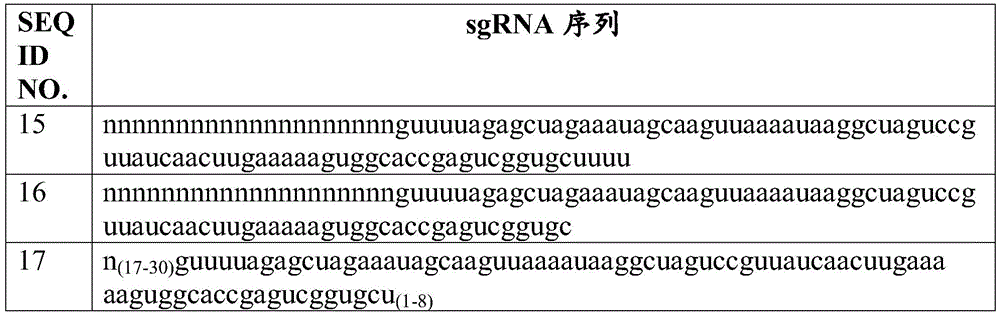
举例说明,用于CRISPR/Cas/Cpf1系统中的指导RNA或其他较小的RNA可以通过化学方法容易地合成,如下文所示和本领域所述。随着化学合成程序的不断发展,通过诸如高效液相色谱法(HPLC,其避免使用诸如PAGE等凝胶)等程序纯化此类RNA随着多核苷酸长度显著增加超过约一百个核苷酸而趋于更具挑战性。用于产生更大长度的RNA的一种方法是产生两个或更多个连接在一起的分子。更长的RNA(诸如编码Cas9或Cpf1内切核酸酶的那些)更容易酶促产生。如本领域所述,可以在RNA的化学合成和/或酶促生成期间或之后引入多种类型的RNA修饰,例如,增强稳定性、降低先天免疫应答的可能性或程度、和/或增强其他属性的修饰。For example, guide RNAs or other smaller RNAs for use in the CRISPR/Cas/Cpf1 system can be readily synthesized by chemical methods, as shown below and described in the art. As chemical synthesis procedures continue to evolve, purification of such RNAs by procedures such as high performance liquid chromatography (HPLC, which avoids the use of gels such as PAGE) increases dramatically with polynucleotide lengths beyond about a hundred nucleotides tend to be more challenging. One method for generating RNAs of greater length is to generate two or more molecules linked together. Longer RNAs, such as those encoding Cas9 or Cpf1 endonucleases, are more readily produced enzymatically. As described in the art, various types of RNA modifications can be introduced during or after chemical synthesis and/or enzymatic production of RNA, eg, to enhance stability, reduce the likelihood or extent of an innate immune response, and/or enhance other Modification of properties.
在一些实施例中,可以使用TIDE分析来确定插入缺失频率(编辑频率),其可以用于鉴定高效gRNA分子。在一些实施例中,高效gRNA产生高于80%的基因编辑频率。例如,如果gRNA产生至少80%、至少85%、至少90%、至少95%或100%的基因编辑频率,则被认为是高效。In some embodiments, TIDE analysis can be used to determine indel frequencies (editing frequencies), which can be used to identify high-efficiency gRNA molecules. In some embodiments, high-efficiency gRNAs yield gene editing frequencies greater than 80%. For example, a gRNA is considered highly efficient if it produces at least 80%, at least 85%, at least 90%, at least 95%, or 100% gene editing frequency.
在一些实施例中,基因破坏可通过使用两个指导RNA缺失基因组序列而发生。使用CRISPR-Cas基因编辑技术在细胞中产生基因组缺失(例如,以敲除细胞中的基因)的方法是已知的(Bauer DE等人Vis.Exp.[可视化实验]2015;95;e52118)。In some embodiments, gene disruption can occur by deleting genomic sequences using two guide RNAs. Methods to create genomic deletions in cells (eg, to knock out genes in cells) using CRISPR-Cas gene editing technology are known (Bauer DE et al. Vis. Exp. [Visualization Experiments] 2015; 95; e52118).
间隔子序列spacer sequence
在一些实施例中,gRNA包含间隔子序列。间隔子序列是定义目的靶核酸的靶序列(例如,DNA靶序列,如基因组靶序列)的序列(例如,20个核苷酸的序列)。在一些实施例中,间隔子序列是15至30个核苷酸。在一些实施例中,间隔子序列是15、16、17、18、19、29、21、22、23、24、25、26、27、28、29或30个核苷酸。在一些实施例中,间隔子序列是20个核苷酸。In some embodiments, the gRNA comprises a spacer sequence. A spacer sequence is a sequence (eg, a 20 nucleotide sequence) that defines a target sequence (eg, a DNA target sequence, such as a genomic target sequence) of a target nucleic acid of interest. In some embodiments, the spacer sequence is 15 to 30 nucleotides. In some embodiments, the spacer sequence is 15, 16, 17, 18, 19, 29, 21, 22, 23, 24, 25, 26, 27, 28, 29, or 30 nucleotides. In some embodiments, the spacer sequence is 20 nucleotides.
“靶序列”与PAM序列相邻并且是通过RNA指导的核酸酶(例如,Cas9)修饰的序列。“靶核酸”是双链分子:一条链包含靶序列并且被称为“PAM链”,并且另一条互补链被称为“非PAM链”。本领域技术人员认识到,gRNA间隔子序列与位于目的靶核酸的非PAM链中的、靶序列的反向互补序列杂交。因此,gRNA间隔子序列是靶序列的RNA等同物。例如,如果靶序列是5′-AGAGCAACAGTGCTGTGGCC-3′(SEQ ID NO:86),则gRNA间隔子序列是5′-AGAGCAACAGUGCUGUGGCC-3′(SEQ ID NO:98)。gRNA的间隔子经由杂交(即,碱基配对)以序列特异性方式与目的靶核酸相互作用。因此,间隔子的核苷酸序列根据目的靶核酸的靶序列而变化。A "target sequence" is adjacent to the PAM sequence and is a sequence modified by an RNA-guided nuclease (eg, Cas9). A "target nucleic acid" is a double-stranded molecule: one strand contains the target sequence and is referred to as the "PAM strand", and the other complementary strand is referred to as the "non-PAM strand". One of skill in the art recognizes that the gRNA spacer sequence hybridizes to the reverse complement of the target sequence located in the non-PAM strand of the target nucleic acid of interest. Thus, the gRNA spacer sequence is the RNA equivalent of the target sequence. For example, if the target sequence is 5'-AGAGCAACAGTGCTGTGGCC-3' (SEQ ID NO:86), the gRNA spacer sequence is 5'-AGAGCAACAGUGCUGUGGCC-3' (SEQ ID NO:98). The spacer of the gRNA interacts with the target nucleic acid of interest in a sequence-specific manner via hybridization (ie, base pairing). Therefore, the nucleotide sequence of the spacer varies depending on the target sequence of the target nucleic acid of interest.
在本文的CRISPR/Cas系统中,将间隔子序列设计成与靶核酸的区域杂交,该区域位于该系统中使用的Cas9酶的PAM的5'。间隔子可以与靶序列完全匹配或可以有错配。每个Cas9酶都有特定的PAM序列,使得该酶识别靶DNA。例如,酿脓链球菌识别靶核酸中的包含序列5'-NRG-3'的PAM,其中R包含A或G,其中N是任何核苷酸并且N紧邻由间隔子序列靶向的靶核酸序列的3'。In the CRISPR/Cas system herein, the spacer sequence is designed to hybridize to a region of the target nucleic acid that is 5' to the PAM of the Cas9 enzyme used in the system. The spacer may be an exact match to the target sequence or may have mismatches. Each Cas9 enzyme has a specific PAM sequence that allows the enzyme to recognize target DNA. For example, Streptococcus pyogenes recognizes a PAM in a target nucleic acid comprising the sequence 5'-NRG-3', where R comprises A or G, where N is any nucleotide and N is immediately adjacent to the target nucleic acid sequence targeted by the spacer sequence 3'.
在一些实施例中,靶核酸序列包含20个核苷酸。在一些实施例中,靶核酸包含小于20个核苷酸。在一些实施例中,靶核酸包含超过20个核苷酸。在一些实施例中,靶核酸包含至少:5、10、15、16、17、18、19、20、21、22、23、24、25、30个或更多个核苷酸。在一些实施例中,靶核酸包含至多:5、10、15、16、17、18、19、20、21、22、23、24、25、30个或更多个核苷酸。在一些实施例中,靶核酸序列包含紧邻PAM的第一核苷酸的5'的20个碱基。例如,在包含5'-NNNNNNNNNNNNNNNNNNNNNRG-3'的序列中,靶核酸包含对应于多个N的序列,其中N是任何核苷酸,并且该下划线的NRG序列是酿脓链球菌PAM。In some embodiments, the target nucleic acid sequence comprises 20 nucleotides. In some embodiments, the target nucleic acid comprises less than 20 nucleotides. In some embodiments, the target nucleic acid comprises more than 20 nucleotides. In some embodiments, the target nucleic acid comprises at least: 5, 10, 15, 16, 17, 18, 19, 20, 21, 22, 23, 24, 25, 30 or more nucleotides. In some embodiments, the target nucleic acid comprises at most: 5, 10, 15, 16, 17, 18, 19, 20, 21, 22, 23, 24, 25, 30 or more nucleotides. In some embodiments, the target nucleic acid sequence comprises 20 bases immediately 5' to the first nucleotide of the PAM. For example, in a sequence comprising 5'-NNNNNNNNNNNNNNNNNNNN NRG -3', the target nucleic acid comprises a sequence corresponding to a plurality of Ns, where N is any nucleotide, and the underlined NRG sequence is S. pyogenes PAM.
如本文所提供使用的gRNA的非限制性实例在2018年5月11日提交的PCT/IB 2018/001619中提供,其通过引用并入本文。Non-limiting examples of gRNAs for use as provided herein are provided in PCT/IB 2018/001619, filed May 11, 2018, which is incorporated herein by reference.
制备gRNA的方法Methods of preparing gRNA
本披露的gRNA通过本领域中可用的合适方式产生,包括但不限于体外转录(IVT)、合成方法和/或化学合成方法或其组合。使用了酶促(IVT)、固相、液相、组合合成方法、小区域合成和连接方法。在一个实施例中,使用IVT酶促合成方法制备gRNA。通过IVT制备多核苷酸的方法是本领域已知的,并且在国际申请PCT/US 2013/30062中描述。因此,本披露还包括多核苷酸,例如DNA、构建体和载体用于体外转录本文所述的gRNA。The gRNAs of the present disclosure are produced by suitable means available in the art, including but not limited to in vitro transcription (IVT), synthetic methods, and/or chemical synthetic methods, or combinations thereof. Enzymatic (IVT), solid phase, liquid phase, combinatorial synthesis methods, small domain synthesis and ligation methods were used. In one embodiment, the gRNA is prepared using an IVT enzymatic synthesis method. Methods of preparing polynucleotides by IVT are known in the art and described in International Application PCT/US 2013/30062. Accordingly, the present disclosure also includes polynucleotides, such as DNA, constructs and vectors for in vitro transcription of the gRNAs described herein.
在一些实施例中,在合成或合成后将非天然的经修饰的核碱基引入多核苷酸,例如gRNA。在某些实施例中,修饰是在核苷间键、嘌呤或嘧啶碱基或糖上。在一些实施例中,通过化学合成或聚合酶将修饰引入多核苷酸的末端。经修饰的核酸及其合成的实例在PCT申请号PCT/US 2012/058519中披露。经修饰的多核苷酸的合成也描述在Verma和Eckstein,Annual Review of Biochemistry[生物化学年鉴],卷76,99-134(1998)中。In some embodiments, non-naturally modified nucleobases are introduced into polynucleotides, eg, gRNAs, after synthesis or synthesis. In certain embodiments, the modification is on an internucleoside linkage, a purine or pyrimidine base, or a sugar. In some embodiments, modifications are introduced into the termini of the polynucleotide by chemical synthesis or a polymerase. Examples of modified nucleic acids and their synthesis are disclosed in PCT Application No. PCT/US 2012/058519. The synthesis of modified polynucleotides is also described in Verma and Eckstein, Annual Review of Biochemistry, Vol. 76, 99-134 (1998).
在一些实施例中,使用酶促或化学连接方法来将多核苷酸或其区域与不同功能部分,例如靶向剂或递送剂、荧光标记、液体、纳米颗粒等缀合。多核苷酸和经修饰的多核苷酸的缀合描述在Goodchild,Bioconjugate Chemistry[生物缀合化学],卷1(3),165-187(1990)中。In some embodiments, enzymatic or chemical ligation methods are used to conjugate polynucleotides or regions thereof to different functional moieties, such as targeting or delivery agents, fluorescent labels, liquids, nanoparticles, and the like. Conjugation of polynucleotides and modified polynucleotides is described in Goodchild, Bioconjugate Chemistry, Vol. 1(3), 165-187 (1990).
本发明的某些实施例还提供了本文所述的核酸,例如编码gRNA的载体。在一些实施例中,核酸是DNA分子。在其他实施例中,核酸是RNA分子。在一些实施例中,核酸包含编码crRNA的核苷酸序列。在一些实施例中,编码crRNA的核苷酸序列包含间隔子侧,所述间隔子侧翼是来自天然存在的CRISPR/Cas系统的重复序列的全部或部分。在一些实施例中,核酸包含编码tracrRNA的核苷酸序列。在一些实施例中,crRNA和tracrRNA由两个分开的核酸编码。在其他实施例中,crRNA和tracrRNA由单核酸编码。在一些实施例中,crRNA和tracrRNA由单核酸的相对链编码。在其他实施例中,crRNA和tracrRNA由单核酸的相同链编码。Certain embodiments of the present invention also provide nucleic acids described herein, eg, vectors encoding gRNAs. In some embodiments, the nucleic acid is a DNA molecule. In other embodiments, the nucleic acid is an RNA molecule. In some embodiments, the nucleic acid comprises a nucleotide sequence encoding a crRNA. In some embodiments, the nucleotide sequence encoding the crRNA comprises a spacer flanking all or part of a repeat sequence from the naturally occurring CRISPR/Cas system. In some embodiments, the nucleic acid comprises a nucleotide sequence encoding a tracrRNA. In some embodiments, crRNA and tracrRNA are encoded by two separate nucleic acids. In other embodiments, crRNA and tracrRNA are encoded by a single nucleic acid. In some embodiments, crRNA and tracrRNA are encoded by opposing strands of a single nucleic acid. In other embodiments, crRNA and tracrRNA are encoded by the same strand of a single nucleic acid.
在一些实施例中,通过本领域中描述的任何方式化学合成本披露提供的gRNA(参见例如,WO/2005/01248)。随着化学合成程序的不断发展,通过诸如高效液相色谱法(HPLC,其避免使用诸如PAGE等凝胶)等程序纯化此类RNA随着多核苷酸长度显著增加超过约一百个核苷酸而趋于更具挑战性。用于产生更大长度的RNA的一种方法是产生两个或更多个连接在一起的分子。In some embodiments, the gRNAs provided by the present disclosure are chemically synthesized by any means described in the art (see, eg, WO/2005/01248). As chemical synthesis procedures continue to evolve, purification of such RNAs by procedures such as high performance liquid chromatography (HPLC, which avoids the use of gels such as PAGE) increases significantly with polynucleotide lengths beyond about a hundred nucleotides tend to be more challenging. One method for generating RNAs of greater length is to generate two or more molecules linked together.
在一些实施例中,本披露提供的gRNA通过酶促方法(例如,体外转录、IVT)合成。In some embodiments, the gRNAs provided by the present disclosure are synthesized by enzymatic methods (eg, in vitro transcription, IVT).
如本领域所述,可以在RNA的化学合成和/或酶促生成期间或之后引入多种类型的RNA修饰,例如,增强稳定性、降低先天免疫应答的可能性或程度、和/或增强其他属性的修饰。As described in the art, various types of RNA modifications can be introduced during or after chemical synthesis and/or enzymatic production of RNA, eg, to enhance stability, reduce the likelihood or extent of an innate immune response, and/or enhance other Modification of properties.
在某些实施例中,一种以上的指导RNA可以与CRISPR/Cas核酸酶系统一起使用。每种指导RNA可包含不同的靶向序列,以使CRISPR/Cas系统切割一种以上的靶核酸。在一些实施例中,一种或多种指导RNA可以在Cas9 RNP复合物中具有相同或不同的性质,例如活性或稳定性。当使用一种以上指导RNA时,每种指导RNA可以在相同或不同的载体上编码。用于驱动一种以上指导RNA表达的启动子是相同或不同的。In certain embodiments, more than one guide RNA can be used with the CRISPR/Cas nuclease system. Each guide RNA can contain a different targeting sequence to allow the CRISPR/Cas system to cleave more than one target nucleic acid. In some embodiments, one or more guide RNAs can have the same or different properties, such as activity or stability, within the Cas9 RNP complex. When more than one guide RNA is used, each guide RNA can be encoded on the same or different vectors. The promoters used to drive expression of more than one guide RNA are the same or different.
指导RNA可以通过crRNA的靶向序列(例如间隔子序列)靶向任何目的序列。在一些实施例中,指导RNA的靶向序列与靶核酸分子上的靶序列之间的互补程度为约60%、65%、70%、75%、80%、85%、90%、95%、97%、98%、99%或100%。在一些实施例中,指导RNA的靶向序列和靶核酸分子上的靶序列是100%互补的。在其他实施例中,指导RNA的靶向序列和靶核酸分子上的靶序列可以包含至少一个错配。例如,指导RNA的靶向序列和靶核酸分子上的靶序列可以包含1、2、3、4、5、6、7、8、9或10个错配。在一些实施例中,指导RNA的靶向序列和靶核酸分子上的靶序列可以包含1-6个错配。在一些实施例中,指导RNA的靶向序列和靶核酸分子上的靶序列可以包含5或6个错配。The guide RNA can target any sequence of interest through the targeting sequence of the crRNA (eg, a spacer sequence). In some embodiments, the degree of complementarity between the targeting sequence of the guide RNA and the target sequence on the target nucleic acid molecule is about 60%, 65%, 70%, 75%, 80%, 85%, 90%, 95% , 97%, 98%, 99% or 100%. In some embodiments, the targeting sequence of the guide RNA and the target sequence on the target nucleic acid molecule are 100% complementary. In other embodiments, the targeting sequence of the guide RNA and the target sequence on the target nucleic acid molecule may contain at least one mismatch. For example, the targeting sequence of the guide RNA and the target sequence on the target nucleic acid molecule may contain 1, 2, 3, 4, 5, 6, 7, 8, 9, or 10 mismatches. In some embodiments, the targeting sequence of the guide RNA and the target sequence on the target nucleic acid molecule may contain 1-6 mismatches. In some embodiments, the targeting sequence of the guide RNA and the target sequence on the target nucleic acid molecule may contain 5 or 6 mismatches.
靶向序列的长度可取决于CRISPR/Cas9系统和使用的组分。例如,来自不同细菌物种的不同Cas9蛋白具有不同的最佳靶向序列长度。因此,靶向序列长度可包含5、6、7、8、9、10、11、12、13、14、15、16、17、18、19、20、21、22、23、24、25、26、27、28、29、30、35、40、45、50、或超过50个的核苷酸。在一些实施例中,靶向序列长度可包含18-24个核苷酸。在一些实施例中,靶向序列长度可包含19-21个核苷酸。在一些实施例中,靶向序列长度可包含20个核苷酸。The length of the targeting sequence can depend on the CRISPR/Cas9 system and the components used. For example, different Cas9 proteins from different bacterial species have different optimal targeting sequence lengths. Thus, the targeting sequence length may comprise 5, 6, 7, 8, 9, 10, 11, 12, 13, 14, 15, 16, 17, 18, 19, 20, 21, 22, 23, 24, 25, 26, 27, 28, 29, 30, 35, 40, 45, 50, or more than 50 nucleotides. In some embodiments, the targeting sequence may comprise 18-24 nucleotides in length. In some embodiments, the targeting sequence may comprise 19-21 nucleotides in length. In some embodiments, the targeting sequence may comprise 20 nucleotides in length.
在本披露的一些实施例中,CRISPR/Cas核酸酶系统包括至少一种指导RNA。在一些实施例中,指导RNA和Cas蛋白可以形成核糖核蛋白(RNP),例如,CRISPR/Cas复合物。指导RNA可以将Cas蛋白指导至靶核酸分子(例如,基因组DNA分子)上的靶序列,其中Cas蛋白切割靶核酸。在一些实施例中,CRISPR/Cas复合物是Cpf1/指导RNA复合物。在一些实施例中,CRISPR复合物是II型CRISPR/Cas9复合物。在一些实施例中,Cas蛋白是Cas9蛋白。在一些实施例中,CRISPR/Cas9复合物是Cas9/指导RNA复合物。In some embodiments of the present disclosure, the CRISPR/Cas nuclease system includes at least one guide RNA. In some embodiments, the guide RNA and Cas protein can form a ribonucleoprotein (RNP), eg, a CRISPR/Cas complex. A guide RNA can guide a Cas protein to a target sequence on a target nucleic acid molecule (eg, a genomic DNA molecule), where the Cas protein cleaves the target nucleic acid. In some embodiments, the CRISPR/Cas complex is a Cpf1/guide RNA complex. In some embodiments, the CRISPR complex is a type II CRISPR/Cas9 complex. In some embodiments, the Cas protein is a Cas9 protein. In some embodiments, the CRISPR/Cas9 complex is a Cas9/guide RNA complex.
指导RNA和核酸酶的递送Delivery of guide RNAs and nucleases
在一些实施例中,将gRNA和RNA指导的核酸酶同时或顺序地分开地递送至细胞。在一些实施例中,将gRNA和RNA指导的核酸酶一起递送至细胞。在一些实施例中,将gRNA和RNA指导的核酸酶预复合在一起以形成核糖核蛋白(RNP)。In some embodiments, the gRNA and RNA-guided nuclease are delivered to the cell separately, simultaneously or sequentially. In some embodiments, the gRNA is delivered to the cell together with the RNA-guided nuclease. In some embodiments, the gRNA and RNA-guided nuclease are precomplexed together to form a ribonucleoprotein (RNP).
RNP对基因编辑很有用,至少因为它们使在富含核酸的细胞环境中发生混杂相互作用的风险降到最低,并保护RNA免受降解。形成RNP的方法是本领域已知的。在一些实施例中,将RNP递送至细胞(例如:T细胞),所述RNP包含RNA指导的核酸酶(例如,Cas核酸酶,例如Cas9核酸酶)和靶向目的基因的gRNA。在一些实施例中,通过电穿孔将RNP递送至T细胞。RNPs are useful for gene editing, at least because they minimize the risk of promiscuous interactions in nucleic acid-rich cellular environments and protect RNA from degradation. Methods of forming RNPs are known in the art. In some embodiments, an RNP is delivered to a cell (eg, a T cell) comprising an RNA-guided nuclease (eg, a Cas nuclease, eg, a Cas9 nuclease) and a gRNA targeting a gene of interest. In some embodiments, RNPs are delivered to T cells by electroporation.
如本文所用,“靶向TRAC的RNP”是指与RNA指导的核酸酶预复合的靶向TRAC基因的gRNA。如本文所用,“靶向β2M的RNP”是指与RNA指导的核酸酶预复合的靶向β2M基因的gRNA。如本文所用,“靶向CD70的RNP”是指与RNA指导的核酸酶预复合的靶向CD70基因的gRNA。如本文所用,“靶向PD-1的RNP”是指与RNA指导的核酸酶预复合的靶向PD-1基因的gRNA。As used herein, a "TRAC-targeting RNP" refers to a TRAC gene-targeting gRNA precomplexed with an RNA-guided nuclease. As used herein, "RNP targeting β2M" refers to a gRNA targeting the β2M gene precomplexed with an RNA-guided nuclease. As used herein, "CD70-targeting RNP" refers to a CD70 gene-targeting gRNA precomplexed with an RNA-guided nuclease. As used herein, "PD-1 targeting RNP" refers to a PD-1 gene-targeting gRNA precomplexed with an RNA-guided nuclease.
在一些实施例中,将靶向TRAC的RNP递送至细胞。在一些实施例中,将靶向β2M的RNP递送至细胞。在一些实施例中,将靶向CD70的RNP递送至细胞。在一些实施例中,将靶向PD-1的RNP递送至细胞。In some embodiments, TRAC-targeting RNPs are delivered to cells. In some embodiments, the RNP targeting β2M is delivered to the cell. In some embodiments, an RNP targeting CD70 is delivered to the cell. In some embodiments, RNPs targeting PD-1 are delivered to cells.
在一些实施例中,将一种以上的RNP递送至细胞。在一些实施例中,将一种以上的RNP分开地递送至细胞。在一些实施例中,将一种以上的RNP同时递送至细胞。在一些实施例中,将以下RNP中的至少一种递送至细胞:In some embodiments, more than one RNP is delivered to the cell. In some embodiments, more than one RNP is delivered to the cell separately. In some embodiments, more than one RNP is delivered to the cell simultaneously. In some embodiments, at least one of the following RNPs is delivered to the cell:
(i)靶向TRAC的RNP;(i) RNPs targeting TRAC;
(ii)靶向β2M的RNP;(ii) RNPs targeting β2M;
(iii)靶向CD70的RNP;或(iii) an RNP targeting CD70; or
(iv)靶向PD-1的RNP。在一些实施例中,将以下RNP中的至少两种递送至细胞:(iv) RNPs targeting PD-1. In some embodiments, at least two of the following RNPs are delivered to the cell:
(i)靶向TRAC的RNP;(i) RNPs targeting TRAC;
(ii)靶向β2M的RNP;(ii) RNPs targeting β2M;
(iii)靶向CD70的RNP;或(iii) an RNP targeting CD70; or
(iv)靶向PD-1的RNP。(iv) RNPs targeting PD-1.
在一些实施例中,将RNA指导的核酸酶在表达RNA指导的核酸酶的DNA载体中、以编码RNA指导的核酸酶的RNA、或蛋白质递送至细胞。在一些实施例中,将靶向基因的gRNA作为表达所述gRNA的RNA或DNA载体递送至细胞。In some embodiments, the RNA-guided nuclease is delivered to the cell in a DNA vector expressing the RNA-guided nuclease, as RNA encoding the RNA-guided nuclease, or as a protein. In some embodiments, the gene-targeting gRNA is delivered to the cell as an RNA or DNA vector that expresses the gRNA.
RNA指导的核酸酶、gRNA和/或RNP的递送可以通过使用已知方法直接注射或细胞转染(例如,电穿孔或化学转染)来进行。可以使用其他细胞转染方法。RNA-directed delivery of nucleases, gRNAs, and/or RNPs can be performed by direct injection or cell transfection (eg, electroporation or chemical transfection) using known methods. Other cell transfection methods can be used.
嵌合抗原受体(CAR)T细胞Chimeric Antigen Receptor (CAR) T Cells
嵌合抗原受体是指人工免疫细胞受体,其经工程改造以识别并结合肿瘤细胞表达的抗原。通常,CAR是为T细胞设计的,并且是T细胞受体(TCR)复合物的信号传导结构域与抗原识别结构域(例如,抗体的单链片段(scFv)或其他抗体片段)的嵌合体(Enblad等人,Human Gene Therapy.[人类基因疗法]2015;26(8):498-505)。表达CAR的T细胞被称为CART细胞。CAR具有以非MHC限制的方式将T细胞特异性和反应性重定向至所选靶标的能力。非MHC限制性抗原识别赋予表达CAR的T细胞识别独立于抗原加工的抗原的能力,从而绕开了肿瘤逃逸的主要机制。此外,当在T细胞中表达时,CAR不会有利地与内源性T细胞受体(TCR)α和β链二聚。CAR通常通过它们结合的抗原来指代。例如,“CD19 CAR”、“CD70 CAR”、“CD33CAR”和“BCMA CAR”是包含分别与CD19、CD70、CD33或BCMA特异性结合的抗原结合结构域的CAR。因此,这些术语可与抗CD19 CAR、抗CD70 CAR、抗CD33 CAR和抗BCMA CAR互换。本领域普通技术人员将理解,可以用任一术语来指代特异性结合抗原的CAR。Chimeric antigen receptors refer to artificial immune cell receptors that are engineered to recognize and bind to antigens expressed by tumor cells. Typically, CARs are designed for T cells and are chimeras of the signaling domain of a T cell receptor (TCR) complex with an antigen recognition domain (eg, a single-chain fragment (scFv) of an antibody or other antibody fragment) (Enblad et al., Human Gene Therapy. [Human Gene Therapy] 2015;26(8):498-505). CAR-expressing T cells are called CART cells. CARs have the ability to redirect T cell specificity and responsiveness to selected targets in an MHC-independent manner. Non-MHC-restricted antigen recognition confers CAR-expressing T cells the ability to recognize antigens independent of antigen processing, thereby bypassing the primary mechanism of tumor escape. Furthermore, when expressed in T cells, CARs do not favorably dimerize with endogenous T cell receptor (TCR) alpha and beta chains. CARs are often referred to by the antigen to which they bind. For example, "CD19 CAR", "CD70 CAR", "CD33 CAR" and "BCMA CAR" are CARs comprising antigen binding domains that specifically bind to CD19, CD70, CD33 or BCMA, respectively. Thus, these terms are interchangeable with anti-CD19 CAR, anti-CD70 CAR, anti-CD33 CAR, and anti-BCMA CAR. One of ordinary skill in the art will understand that either term may be used to refer to a CAR that specifically binds an antigen.
有四代CAR,每代CAR含有不同组分。第一代CAR通过铰链结构域和跨膜结构域将抗体衍生的scFv与T细胞受体的CD3ζ(ζ或z)细胞内信号传导结构域连接。第二代CAR掺入了另外的结构域(例如CD28、4-1BB(41BB)或ICOS)以提供共刺激信号。第三代CAR含有两个与TCRCD3ζ链融合的共刺激结构域。第三代共刺激结构域可以包括例如CD3ζ、CD27、CD28、4-1BB、ICOS、或OX40的组合。在一些实施例中,CAR含有通常衍生自单链可变片段(scFv)、铰链的胞外结构域,跨膜结构域,以及具有一个(第一代)、两个(第二代)、或三个(第三代)衍生自CD3Z和/或共刺激分子的信号传导结构域的胞内结构域(Maude等人,Blood.[血液]2015;125(26):4017-4023;Kakarla和Gottschalk,Cancer J.[癌症杂志]2014;20(2):151-155)。There are four generations of CARs, each containing a different component. The first generation of CARs linked antibody-derived scFvs to the CD3ζ (ζ or z) intracellular signaling domains of T-cell receptors through hinge and transmembrane domains. Second-generation CARs incorporate additional domains (eg, CD28, 4-1BB (41BB), or ICOS) to provide costimulatory signals. The third-generation CAR contains two costimulatory domains fused to the TCRCD3ζ chain. The third generation costimulatory domains can include, for example, combinations of CD3ζ, CD27, CD28, 4-1BB, ICOS, or OX40. In some embodiments, the CAR contains an extracellular domain typically derived from a single-chain variable fragment (scFv), a hinge, a transmembrane domain, and has one (first generation), two (second generation), or Three (third generation) intracellular domains derived from the signaling domains of CD3Z and/or costimulatory molecules (Maude et al., Blood. [Blood] 2015;125(26):4017-4023; Kakarla and Gottschalk , Cancer J. [Journal of Cancer] 2014;20(2):151-155).
CAR通常在功能特性上有所不同。T细胞受体的CD3ζ信号传导结构域(在参与时)会激活并诱导T细胞增殖,但可能导致无反应性(机体防御机制缺乏反应,导致直接诱导外周淋巴细胞耐受性)。当淋巴细胞对特定抗原无反应时,它们被认为是无反应的。在第二代CAR中增加共刺激结构域改善了经修饰的T细胞的复制能力和持久性。用CD28或4-1BB CAR在体外观察到相似的抗肿瘤作用,但临床前体内研究表明4-1BB CAR可以产生优异的增殖和/或持久性。临床试验表明,这两种第二代CAR都能够在体内诱导大量T细胞增殖,但是含有4-1BB共刺激结构域的CAR似乎可以持续更长的时间。第三代CAR组合了多个信号传导结构域(共刺激)以增强效能。CARs generally differ in functional properties. The CD3ζ signaling domain of the T-cell receptor (when engaged) activates and induces T-cell proliferation, but may lead to anergy (lack of response from the body's defense mechanisms, leading to direct induction of peripheral lymphocyte tolerance). Lymphocytes are considered unresponsive when they are unresponsive to a specific antigen. The addition of costimulatory domains in second-generation CARs improved the replication capacity and persistence of modified T cells. Similar antitumor effects were observed in vitro with CD28 or 4-1BB CAR, but preclinical in vivo studies demonstrated that 4-1BB CAR could yield superior proliferation and/or persistence. Clinical trials have shown that both second-generation CARs are able to induce substantial T-cell proliferation in vivo, but CARs containing the 4-1BB co-stimulatory domain appear to last longer. Third-generation CARs combine multiple signaling domains (costimulation) to enhance potency.
在一些实施例中,嵌合抗原受体是第一代CAR。在其他实施例中,嵌合抗原受体是第二代CAR。在还其他实施例中,嵌合抗原受体是第三代CAR。In some embodiments, the chimeric antigen receptor is a first generation CAR. In other embodiments, the chimeric antigen receptor is a second generation CAR. In still other embodiments, the chimeric antigen receptor is a third generation CAR.
在一些实施例中,CAR包含含有抗原结合结构域(例如抗体,如scFv)的细胞外(胞外)结构域、跨膜结构域、和细胞质(胞内)结构域。In some embodiments, the CAR comprises an extracellular (extracellular) domain, a transmembrane domain, and a cytoplasmic (intracellular) domain comprising an antigen binding domain (eg, an antibody, such as an scFv).
胞外结构域extracellular domain
胞外结构域是CAR的暴露于细胞外液的区域,并且在一些实施例中,CAR包括抗原结合结构域、以及任选的信号肽、间隔子结构域、和/或铰链结构域。在一些实施例中,抗原结合结构域是单链可变片段(scFv),其包括与短接头肽连接的免疫球蛋白的VL和VH。在一些实施例中,接头包括亲水性残基,即,多段甘氨酸和丝氨酸用于柔性,以及多段谷氨酸和赖氨酸用于增加溶解度。单链可变片段(scFv)实际上不是抗体的片段,而是免疫球蛋白的重链(VH)和轻链(VL)的可变区的融合蛋白,该融合蛋白与十到约25个氨基酸的短链接头肽连接。接头通常富含甘氨酸用于柔性、以及丝氨酸或苏氨酸用于溶解度,并且可以将VH的N-末端与VL的C-末端相连,反之亦然。尽管去除了恒定区并引入了接头,但此蛋白仍保留了原始免疫球蛋白的特异性。在一些实施例中,本披露的scFv是人源化的。在其他实施例中,scFv是完全人类的。在还其他实施例中,scFv是嵌合体(例如,小鼠和人序列的嵌合体)。The extracellular domain is the region of the CAR that is exposed to extracellular fluid, and in some embodiments, the CAR includes an antigen binding domain, and optionally a signal peptide, spacer domain, and/or hinge domain. In some embodiments, the antigen binding domain is a single-chain variable fragment (scFv) comprising the VL and VH of an immunoglobulin linked to a short linker peptide. In some embodiments, the linker includes hydrophilic residues, ie, stretches of glycine and serine for flexibility, and stretches of glutamic acid and lysine for increased solubility. A single-chain variable fragment (scFv) is not actually a fragment of an antibody, but a fusion protein of the variable regions of the heavy (VH) and light (VL) chains of an immunoglobulin with ten to about 25 amino acids. The short linker peptide linker. Linkers are typically rich in glycine for flexibility, and serine or threonine for solubility, and can link the N-terminus of VH to the C-terminus of VL and vice versa. Despite the removal of the constant region and the introduction of linkers, the protein retains the specificity of the original immunoglobulin. In some embodiments, the scFvs of the present disclosure are humanized. In other embodiments, the scFv is fully human. In still other embodiments, the scFv is a chimera (eg, a chimera of mouse and human sequences).
在一些实施例中,scFv是抗CD70 scFv(与CD70特异性结合)。可以如本文提供而使用的抗CD70 scFv蛋白的非限制性实例可以包括SEQ ID NO:48或SEQ ID NO:50的氨基酸序列。In some embodiments, the scFv is an anti-CD70 scFv (which specifically binds to CD70). Non-limiting examples of anti-CD70 scFv proteins that can be used as provided herein can include the amino acid sequence of SEQ ID NO:48 or SEQ ID NO:50.
在一些实施例中,scFv是抗BCMA scFv(特异性结合BCMA)。可以如本文提供而使用的抗BCMA scFv蛋白的非限制性实例可以包括SEQ ID NO:59的氨基酸序列。In some embodiments, the scFv is an anti-BCMA scFv (specifically binds BCMA). A non-limiting example of an anti-BCMA scFv protein that can be used as provided herein can include the amino acid sequence of SEQ ID NO:59.
在一些实施例中,scFv是抗CD19 scFv(特异性结合CD19)。可如本文提供而使用的抗CD19 scFv蛋白的非限制性实例可包括SEQ ID NO:151的氨基酸序列。In some embodiments, the scFv is an anti-CD19 scFv (specifically binds CD19). A non-limiting example of an anti-CD19 scFv protein that can be used as provided herein can include the amino acid sequence of SEQ ID NO:151.
在一些实施例中,scFv是抗CD33 scFv(特异性结合CD33)。可以如本文提供而使用的抗CD33 scFv蛋白的非限制性实例可以包括SEQ ID NO:137的氨基酸序列。In some embodiments, the scFv is an anti-CD33 scFv (specifically binds CD33). A non-limiting example of an anti-CD33 scFv protein that can be used as provided herein can include the amino acid sequence of SEQ ID NO:137.
可以使用其他scFv蛋白。Other scFv proteins can be used.
信号肽可以增强CAR结合的抗原特异性。信号肽可衍生自抗体(如但不限于CD8)、以及表位标签(如但不限于GST或FLAG)。信号肽的实例包括MLLLVTSLLLCELPHPAFLLIP(SEQID NO:88)和MALPVTALLLPLALLLHAARP(SEQ ID NO:89)。可以使用其他信号肽。Signal peptides can enhance the antigen specificity of CAR binding. Signal peptides can be derived from antibodies (such as, but not limited to, CD8), and epitope tags (such as, but not limited to, GST or FLAG). Examples of signal peptides include MLLLVTSLLLCELPHPAFLLIP (SEQ ID NO:88) and MALPVTALLLPLALLLHAARP (SEQ ID NO:89). Other signal peptides can be used.
在一些实施例中,间隔子结构域或铰链结构域位于CAR的胞外结构域(包含抗原结合结构域)与跨膜结构域之间、或者CAR的胞质结构域与跨膜结构域之间。间隔子结构域是起到将跨膜结构域连接至多肽链中的胞外结构域和/或胞质结构域的功能的任何寡肽或多肽。铰链结构域是起到向CAR或其结构域提供柔性、或防止CAR或其结构域的空间位阻的作用的任何寡肽或多肽。在一些实施例中,间隔子结构域或铰链结构域可以包含多达300个氨基酸(例如,10至100个氨基酸、或5至20个氨基酸)。在一些实施例中,一个或多个间隔子结构域可以包括在CAR的其他区域中。在一些实施例中,铰链结构域是CD8铰链结构域。可以使用其他铰链结构域。In some embodiments, the spacer domain or hinge domain is located between the extracellular domain (including the antigen binding domain) and the transmembrane domain of the CAR, or between the cytoplasmic domain and the transmembrane domain of the CAR . A spacer domain is any oligopeptide or polypeptide that functions to link the transmembrane domain to the extracellular and/or cytoplasmic domains in the polypeptide chain. A hinge domain is any oligopeptide or polypeptide that functions to provide flexibility to, or prevent steric hindrance of, the CAR or its domains. In some embodiments, the spacer domain or hinge domain can comprise up to 300 amino acids (eg, 10 to 100 amino acids, or 5 to 20 amino acids). In some embodiments, one or more spacer domains may be included in other regions of the CAR. In some embodiments, the hinge domain is a CD8 hinge domain. Other hinge domains can be used.
跨膜结构域transmembrane domain
跨膜结构域是跨过膜的疏水性α螺旋。跨膜结构域提供了CAR的稳定性。在一些实施例中,如本文提供的CAR的跨膜结构域是CD8跨膜结构域。在其他实施例中,跨膜结构域是CD28跨膜结构域。在还其他实施例中,跨膜结构域是CD8和CD28跨膜结构域的嵌合体。如本文提供的,可以使用其他跨膜结构域。在一些实施例中,跨膜结构域是CD8a跨膜结构域:FVPVFLPAKPTTTPAPRPPTPAPTIASQPLSLRPEACRPAAGGAVHTRGLDFACDIYIWAPLAGTCGVLLLSLVITLYCNHRNR(SEQ ID NO:90)。可以使用其他跨膜结构域。The transmembrane domain is a hydrophobic alpha helix that spans the membrane. The transmembrane domain provides the stability of the CAR. In some embodiments, the transmembrane domain of a CAR as provided herein is a CD8 transmembrane domain. In other embodiments, the transmembrane domain is the CD28 transmembrane domain. In still other embodiments, the transmembrane domain is a chimera of CD8 and CD28 transmembrane domains. As provided herein, other transmembrane domains can be used. In some embodiments, the transmembrane domain is the CD8a transmembrane domain: FVPVFLPAKPTTTPAPRPPTPAPTIASQPLSLRPEACRPAAGGAVHTRGLDFACDIYIWAPLAGTCGVLLLSLVITLYCNHRNR (SEQ ID NO:90). Other transmembrane domains can be used.
在一些实施例中,跨膜结构域是包含以下氨基酸序列的CD8a跨膜结构域:IYIWAPLAGTCGVLLLSLVITLY(SEQ ID NO:126)。In some embodiments, the transmembrane domain is a CD8a transmembrane domain comprising the following amino acid sequence: IYIWAPLAGTCGVLLLSLVITLY (SEQ ID NO: 126).
胞内结构域intracellular domain
胞内结构域是受体的功能端。抗原识别后,受体聚簇,并且信号被传递到细胞。最常用的胞内结构域组分是CD3-ζ,其中包含三(3)个基于免疫受体酪氨酸的激活基序(ITAM)。抗原结合后,它会将激活信号传递给T细胞。在许多情况下,CD3-ζ可能无法提供完全有效的激活信号,因此,使用了共刺激信号传导。例如,CD28和/或4-1BB可以与CD3-ζ(CD3ζ)一起使用,以传递增殖/生存信号。因此,在一些实施例中,如本文提供的CAR的共刺激分子是CD28共刺激分子。在其他实施例中,共刺激分子是4-1BB共刺激分子。在一些实施例中,CAR包括CD3ζ和CD28。在其他实施例中,CAR包括CD3-ζ和4-1BB。在仍其他实施例中,CAR包括CD3ζ、CD28、和4-1BB。表4提供了可以在本文中使用的衍生自4-1BB、CD28和CD3-ζ的信号传导结构域的实例。The intracellular domain is the functional end of the receptor. After antigen recognition, receptors are clustered and the signal is transmitted to the cell. The most commonly used intracellular domain component is CD3-zeta, which contains three (3) immunoreceptor tyrosine-based activation motifs (ITAMs). After antigen binding, it transmits activation signals to T cells. In many cases, CD3-ζ may not provide a fully effective activation signal, therefore, co-stimulatory signaling is used. For example, CD28 and/or 4-1BB can be used with CD3-zeta (CD3zeta) to deliver proliferation/survival signals. Accordingly, in some embodiments, the costimulatory molecule of a CAR as provided herein is a CD28 costimulatory molecule. In other embodiments, the costimulatory molecule is a 4-1BB costimulatory molecule. In some embodiments, the CAR includes CD3ζ and CD28. In other embodiments, the CAR includes CD3-zeta and 4-1BB. In still other embodiments, the CAR includes CD3zeta, CD28, and 4-1BB. Table 4 provides examples of signaling domains derived from 4-1BB, CD28, and CD3-zeta that can be used herein.
表4Table 4

癌症抗原cancer antigen
CD70CD70
在一些实施例中,本披露的T细胞用设计用于靶向CD70的嵌合抗原受体(CAR)进行工程改造。最初将CD70鉴定为CD27的配体,CD27是参与T细胞增殖和存活的共刺激受体。在病毒感染期间,CD70仅在引流淋巴结中一小部分的激活T细胞和抗原呈递细胞上发现。许多人类肿瘤也表达CD70,包括但不限于实体癌,例如透明细胞肾癌、乳腺癌、胃癌、卵巢癌、成胶质细胞瘤和血液系统恶性肿瘤。由于其在正常组织上的受限表达模式以及在许多癌症中的过度表达,CD70是有吸引力的治疗靶标。In some embodiments, the T cells of the present disclosure are engineered with a chimeric antigen receptor (CAR) designed to target CD70. CD70 was initially identified as a ligand for CD27, a costimulatory receptor involved in T cell proliferation and survival. During viral infection, CD70 is found only on a small subset of activated T cells and antigen-presenting cells in draining lymph nodes. Many human tumors also express CD70, including, but not limited to, solid cancers such as clear cell renal, breast, gastric, ovarian, glioblastoma, and hematological malignancies. Due to its restricted expression pattern on normal tissues and overexpression in many cancers, CD70 is an attractive therapeutic target.
因此,在一些实施例中,本披露的T细胞经工程改造以表达包含抗CD70抗体(例如,抗CD70 scFv)的CAR。在一些实施例中,抗CD70抗体是由SEQ ID NO:47或49的序列编码的抗CD70 scFv。在一些实施例中,抗CD70抗体是包含SEQ ID NO:48或50的序列的抗CD70 scFv。在一些实施例中,抗CD70抗体是包含VH的抗CD70 scFv,所述VH包含SEQ ID NO:51的序列。在一些实施例中,抗CD70抗体是包含VL的抗CD70 scFv,所述VL包含SEQ ID NO:52的序列。在一些实施例中,包含CAR的抗CD70抗体由SEQ ID NO:45的序列编码。在一些实施例中,包含CAR的抗CD70抗体包含SEQ ID NO:46的序列。Accordingly, in some embodiments, the T cells of the present disclosure are engineered to express a CAR comprising an anti-CD70 antibody (eg, an anti-CD70 scFv). In some embodiments, the anti-CD70 antibody is an anti-CD70 scFv encoded by the sequence of SEQ ID NO: 47 or 49. In some embodiments, the anti-CD70 antibody is an anti-CD70 scFv comprising the sequence of SEQ ID NO: 48 or 50. In some embodiments, the anti-CD70 antibody is an anti-CD70 scFv comprising a VH comprising the sequence of SEQ ID NO:51. In some embodiments, the anti-CD70 antibody is an anti-CD70 scFv comprising a VL comprising the sequence of SEQ ID NO:52. In some embodiments, the anti-CD70 antibody comprising a CAR is encoded by the sequence of SEQ ID NO:45. In some embodiments, the anti-CD70 antibody comprising a CAR comprises the sequence of SEQ ID NO:46.
在一些实施例中,抗CD70抗体是由核苷酸序列编码的抗CD70 scFv,所述核苷酸序列与SEQ ID NO:47或49具有至少80%、81%、82%、83%、84%、85%、86%、87%、88%、89%、90%、91%、92%、93%、94%、95%、96%、97%、98%或99%同一性。在一些实施例中,抗CD70抗体是包含氨基酸序列的抗CD70 scFv,所述氨基酸序列与SEQ ID NO:48或50具有至少80%、81%、82%、83%、84%、85%、86%、87%、88%、89%、90%、91%、92%、93%、94%、95%、96%、97%、98%或99%同一性。在一些实施例中,抗CD70抗体是包含VH的抗CD70 scFv,所述VH包含与SEQ ID NO:51具有至少80%、81%、82%、83%、84%、85%、86%、87%、88%、89%、90%、91%、92%、93%、94%、95%、96%、97%、98%或99%同一性的氨基酸序列。在一些实施例中,抗CD70抗体是包含VL的抗CD70 scFv,所述VL包含与SEQ ID NO:52具有至少80%、81%、82%、83%、84%、85%、86%、87%、88%、89%、90%、91%、92%、93%、94%、95%、96%、97%、98%或99%同一性的氨基酸序列。在一些实施例中,包含CAR的抗CD70抗体由核苷酸序列编码,所述核苷酸序列与SEQ ID NO:45具有至少80%、81%、82%、83%、84%、85%、86%、87%、88%、89%、90%、91%、92%、93%、94%、95%、96%、97%、98%或99%同一性。在一些实施例中,包含CAR的抗CD70抗体包含与SEQ ID NO:46具有至少80%、81%、82%、83%、84%、85%、86%、87%、88%、89%、90%、91%、92%、93%、94%、95%、96%、97%、98%或99%同一性的氨基酸序列。In some embodiments, the anti-CD70 antibody is an anti-CD70 scFv encoded by a nucleotide sequence that is at least 80%, 81%, 82%, 83%, 84% identical to SEQ ID NO: 47 or 49 %, 85%, 86%, 87%, 88%, 89%, 90%, 91%, 92%, 93%, 94%, 95%, 96%, 97%, 98% or 99% identical. In some embodiments, the anti-CD70 antibody is an anti-CD70 scFv comprising an amino acid sequence having at least 80%, 81%, 82%, 83%, 84%, 85%, SEQ ID NO: 48 or 50, 86%, 87%, 88%, 89%, 90%, 91%, 92%, 93%, 94%, 95%, 96%, 97%, 98% or 99% identical. In some embodiments, the anti-CD70 antibody is an anti-CD70 scFv comprising a VH comprising at least 80%, 81%, 82%, 83%, 84%, 85%, 86%, SEQ ID NO:51, Amino acid sequences of 87%, 88%, 89%, 90%, 91%, 92%, 93%, 94%, 95%, 96%, 97%, 98% or 99% identity. In some embodiments, the anti-CD70 antibody is an anti-CD70 scFv comprising a VL comprising at least 80%, 81%, 82%, 83%, 84%, 85%, 86%, Amino acid sequences of 87%, 88%, 89%, 90%, 91%, 92%, 93%, 94%, 95%, 96%, 97%, 98% or 99% identity. In some embodiments, an anti-CD70 antibody comprising a CAR is encoded by a nucleotide sequence that is at least 80%, 81%, 82%, 83%, 84%, 85% identical to SEQ ID NO:45 , 86%, 87%, 88%, 89%, 90%, 91%, 92%, 93%, 94%, 95%, 96%, 97%, 98% or 99% identical. In some embodiments, the anti-CD70 antibody comprising a CAR comprises at least 80%, 81%, 82%, 83%, 84%, 85%, 86%, 87%, 88%, 89% of SEQ ID NO:46 , 90%, 91%, 92%, 93%, 94%, 95%, 96%, 97%, 98% or 99% identical amino acid sequences.
BCMABCMA
在一些实施例中,本披露的T细胞用设计为靶向BCMA的CAR工程改造。B细胞成熟抗原(BCMA,CD269)是肿瘤坏死因子受体(TNF)超家族的成员。BCMA结合B细胞激活因子(BAFF)和诱导增殖的配体(APRIL)。在非恶性细胞中,BCMA主要由浆细胞和成熟B细胞的亚群表达。BCMA由包括多个骨髓瘤细胞和非霍奇金淋巴瘤在内的B谱系细胞选择性表达,因此BCMA也是有吸引力的治疗靶标。In some embodiments, the T cells of the present disclosure are engineered with a CAR designed to target BCMA. B cell maturation antigen (BCMA, CD269) is a member of the tumor necrosis factor receptor (TNF) superfamily. BCMA binds B cell activating factor (BAFF) and proliferation-inducing ligand (APRIL). In non-malignant cells, BCMA is predominantly expressed by subsets of plasma cells and mature B cells. BCMA is selectively expressed by cells of the B lineage including multiple myeloma cells and non-Hodgkin's lymphoma, so BCMA is also an attractive therapeutic target.
因此,在一些实施例中,本披露的T细胞经工程改造以表达包含抗BCMA抗体(例如,抗BCMA scFv)的CAR。在一些实施例中,抗BCMA抗体是由SEQ ID NO:58的序列编码的抗BCMAscFv。在一些实施例中,所述抗BCMA抗体是包含SEQ ID NO:59的序列的抗BCMA scFv。在一些实施例中,抗BCMA抗体是包含VH的抗BCMA scFv,所述VH包含SEQ ID NO:60的序列。在一些实施例中,抗BCMA抗体是包含VL的抗BCMA scFv,所述VL包含SEQ ID NO:61的序列。在一些实施例中,包含CAR的抗BCMA抗体由SEQ ID NO:56的序列编码。在一些实施例中,包含CAR的抗BCMA抗体包含SEQ ID NO:57的序列。Accordingly, in some embodiments, the T cells of the present disclosure are engineered to express a CAR comprising an anti-BCMA antibody (eg, an anti-BCMA scFv). In some embodiments, the anti-BCMA antibody is an anti-BCMA scFv encoded by the sequence of SEQ ID NO:58. In some embodiments, the anti-BCMA antibody is an anti-BCMA scFv comprising the sequence of SEQ ID NO:59. In some embodiments, the anti-BCMA antibody is an anti-BCMA scFv comprising a VH comprising the sequence of SEQ ID NO:60. In some embodiments, the anti-BCMA antibody is an anti-BCMA scFv comprising a VL comprising the sequence of SEQ ID NO:61. In some embodiments, the anti-BCMA antibody comprising a CAR is encoded by the sequence of SEQ ID NO:56. In some embodiments, the anti-BCMA antibody comprising a CAR comprises the sequence of SEQ ID NO:57.
在一些实施例中,抗BCMA抗体是由核苷酸序列编码的抗BCMA scFv,所述核苷酸序列与SEQ ID NO:58具有至少80%、81%、82%、83%、84%、85%、86%、87%、88%、89%、90%、91%、92%、93%、94%、95%、96%、97%、98%或99%同一性。在一些实施例中,抗BCMA抗体是包含氨基酸序列的抗BCMA scFv,所述氨基酸序列与SEQ ID NO:59具有至少80%、81%、82%、83%、84%、85%、86%、87%、88%、89%、90%、91%、92%、93%、94%、95%、96%、97%、98%或99%同一性。在一些实施例中,抗BCMA抗体是包含VH的抗BCMAscFv,所述VH包含与SEQ ID NO:60具有至少80%、81%、82%、83%、84%、85%、86%、87%、88%、89%、90%、91%、92%、93%、94%、95%、96%、97%、98%或99%同一性的氨基酸序列。在一些实施例中,抗BCMA抗体是包含VL的抗BCMA scFv,所述VL包含与SEQ ID NO:61具有至少80%、81%、82%、83%、84%、85%、86%、87%、88%、89%、90%、91%、92%、93%、94%、95%、96%、97%、98%或99%同一性的氨基酸序列。在一些实施例中,包含CAR的抗BCMA抗体由与SEQ ID NO:56具有至少80%、81%、82%、83%、84%、85%、86%、87%、88%、89%、90%、91%、92%、93%、94%、95%、96%、97%、98%或99%同一性的核苷酸序列编码。在一些实施例中,包含CAR的抗BCMA抗体包含氨基酸序列,所述氨基酸序列与SEQ IDNO:57具有至少80%、81%、82%、83%、84%、85%、86%、87%、88%、89%、90%、91%、92%、93%、94%、95%、96%、97%、98%或99%同一性。In some embodiments, the anti-BCMA antibody is an anti-BCMA scFv encoded by a nucleotide sequence having at least 80%, 81%, 82%, 83%, 84%, 85%, 86%, 87%, 88%, 89%, 90%, 91%, 92%, 93%, 94%, 95%, 96%, 97%, 98% or 99% identity. In some embodiments, the anti-BCMA antibody is an anti-BCMA scFv comprising an amino acid sequence that is at least 80%, 81%, 82%, 83%, 84%, 85%, 86% identical to SEQ ID NO:59 , 87%, 88%, 89%, 90%, 91%, 92%, 93%, 94%, 95%, 96%, 97%, 98% or 99% identical. In some embodiments, the anti-BCMA antibody is an anti-BCMA scFv comprising a VH comprising at least 80%, 81%, 82%, 83%, 84%, 85%, 86%, 87% of SEQ ID NO:60 %, 88%, 89%, 90%, 91%, 92%, 93%, 94%, 95%, 96%, 97%, 98% or 99% identical amino acid sequences. In some embodiments, the anti-BCMA antibody is an anti-BCMA scFv comprising a VL comprising at least 80%, 81%, 82%, 83%, 84%, 85%, 86%, Amino acid sequences of 87%, 88%, 89%, 90%, 91%, 92%, 93%, 94%, 95%, 96%, 97%, 98% or 99% identity. In some embodiments, the anti-BCMA antibody comprising a CAR is at least 80%, 81%, 82%, 83%, 84%, 85%, 86%, 87%, 88%, 89% identical to SEQ ID NO:56 , 90%, 91%, 92%, 93%, 94%, 95%, 96%, 97%, 98% or 99% identical to nucleotide sequences encoding. In some embodiments, the anti-BCMA antibody comprising a CAR comprises an amino acid sequence that is at least 80%, 81%, 82%, 83%, 84%, 85%, 86%, 87% of SEQ ID NO:57 , 88%, 89%, 90%, 91%, 92%, 93%, 94%, 95%, 96%, 97%, 98% or 99% identical.
CD19CD19
在一些实施例中,本披露的T细胞用设计为靶向CD19的CAR工程改造。分化簇19(CD19)是可在白血病前体细胞上检测到的抗原决定簇。人和鼠氨基酸和核酸序列可以在公共数据库中找到,例如GenBank、UniProt和Swiss-Prot。例如,人CD19的氨基酸序列可以作为UniProt/Swiss-Prot登录号P15391找到,并且编码人CD19的核苷酸序列可以登录号NM—001178098找到。CD19在大多数B谱系癌症上表达,包括例如急性成淋巴细胞白血病、慢性淋巴细胞白血病和非霍奇金淋巴瘤。它也是B细胞祖细胞的早期标志物。参见,例如,Nicholson等人Mol.Immun.[分子免疫学]34(16-17):1157-1165(1997)。In some embodiments, the T cells of the present disclosure are engineered with a CAR designed to target CD19. Cluster of differentiation 19 (CD19) is an antigenic determinant detectable on leukemic precursor cells. Human and murine amino acid and nucleic acid sequences can be found in public databases such as GenBank, UniProt and Swiss-Prot. For example, the amino acid sequence of human CD19 can be found as UniProt/Swiss-Prot accession number P15391, and the nucleotide sequence encoding human CD19 can be found as accession number NM-001178098. CD19 is expressed on most B-lineage cancers, including, for example, acute lymphoblastic leukemia, chronic lymphocytic leukemia, and non-Hodgkin's lymphoma. It is also an early marker of B cell progenitors. See, eg, Nicholson et al. Mol. Immun. [Molecular Immunology] 34(16-17):1157-1165 (1997).
因此,在一些实施例中,本披露的T细胞经工程改造以表达包含抗CD19抗体(例如,抗CD19 scFv)的CAR。在一些实施例中,抗CD19抗体是由SEQ ID NO:150的序列编码的抗CD19 scFv。在一些实施例中,抗CD19抗体是包含SEQ ID NO:151的序列的抗CD19 scFv。在一些实施例中,抗CD19抗体是包含VH的抗CD19 scFv,所述VH包含SEQ ID NO:152的序列。在一些实施例中,抗CD19抗体是包含VL的抗CD19 scFv,所述VL包含SEQ ID NO:153的序列。在一些实施例中,包含CAR的抗CD19抗体由SEQ ID NO:148的序列编码。在一些实施例中,包含CAR的抗CD19抗体包含SEQ ID NO:149的序列。Thus, in some embodiments, the T cells of the present disclosure are engineered to express a CAR comprising an anti-CD19 antibody (eg, an anti-CD19 scFv). In some embodiments, the anti-CD19 antibody is an anti-CD19 scFv encoded by the sequence of SEQ ID NO:150. In some embodiments, the anti-CD19 antibody is an anti-CD19 scFv comprising the sequence of SEQ ID NO:151. In some embodiments, the anti-CD19 antibody is an anti-CD19 scFv comprising a VH comprising the sequence of SEQ ID NO:152. In some embodiments, the anti-CD19 antibody is an anti-CD19 scFv comprising a VL comprising the sequence of SEQ ID NO:153. In some embodiments, the anti-CD19 antibody comprising a CAR is encoded by the sequence of SEQ ID NO:148. In some embodiments, the anti-CD19 antibody comprising a CAR comprises the sequence of SEQ ID NO:149.
在一些实施例中,抗CD19抗体是由核苷酸序列编码的抗CD19 scFv,所述核苷酸序列与SEQ ID NO:150具有至少80%、81%、82%、83%、84%、85%、86%、87%、88%、89%、90%、91%、92%、93%、94%、95%、96%、97%、98%或99%同一性。在一些实施例中,抗CD19抗体是包含氨基酸序列的抗CD19 scFv,所述氨基酸序列与SEQ ID NO:151具有至少80%、81%、82%、83%、84%、85%、86%、87%、88%、89%、90%、91%、92%、93%、94%、95%、96%、97%、98%或99%同一性。在一些实施例中,抗CD19抗体是包含VH的抗CD19scFv,所述VH包含与SEQ ID NO:152具有至少80%、81%、82%、83%、84%、85%、86%、87%、88%、89%、90%、91%、92%、93%、94%、95%、96%、97%、98%或99%同一性的氨基酸序列。在一些实施例中,抗CD19抗体是包含VL的抗CD19 scFv,所述VL包含与SEQ ID NO:153具有至少80%、81%、82%、83%、84%、85%、86%、87%、88%、89%、90%、91%、92%、93%、94%、95%、96%、97%、98%或99%同一性的氨基酸序列。在一些实施例中,包含CAR的抗CD19抗体由核苷酸编码,所述核苷酸与SEQ ID NO:148具有至少80%、81%、82%、83%、84%、85%、86%、87%、88%、89%、90%、91%、92%、93%、94%、95%、96%、97%、98%或99%同一性。在一些实施例中,包含CAR的抗CD19抗体包含与SEQ ID NO:149具有至少80%、81%、82%、83%、84%、85%、86%、87%、88%、89%、90%、91%、92%、93%、94%、95%、96%、97%、98%或99%同一性的氨基酸序列。In some embodiments, the anti-CD19 antibody is an anti-CD19 scFv encoded by a nucleotide sequence having at least 80%, 81%, 82%, 83%, 84%, 85%, 86%, 87%, 88%, 89%, 90%, 91%, 92%, 93%, 94%, 95%, 96%, 97%, 98% or 99% identity. In some embodiments, the anti-CD19 antibody is an anti-CD19 scFv comprising an amino acid sequence that is at least 80%, 81%, 82%, 83%, 84%, 85%, 86% identical to SEQ ID NO: 151 , 87%, 88%, 89%, 90%, 91%, 92%, 93%, 94%, 95%, 96%, 97%, 98% or 99% identical. In some embodiments, the anti-CD19 antibody is an anti-CD19 scFv comprising a VH comprising at least 80%, 81%, 82%, 83%, 84%, 85%, 86%, 87% of SEQ ID NO: 152 %, 88%, 89%, 90%, 91%, 92%, 93%, 94%, 95%, 96%, 97%, 98% or 99% identical amino acid sequences. In some embodiments, the anti-CD19 antibody is an anti-CD19 scFv comprising a VL comprising at least 80%, 81%, 82%, 83%, 84%, 85%, 86%, SEQ ID NO: 153, Amino acid sequences of 87%, 88%, 89%, 90%, 91%, 92%, 93%, 94%, 95%, 96%, 97%, 98% or 99% identity. In some embodiments, the anti-CD19 antibody comprising a CAR is encoded by nucleotides having at least 80%, 81%, 82%, 83%, 84%, 85%, 86% of SEQ ID NO: 148 %, 87%, 88%, 89%, 90%, 91%, 92%, 93%, 94%, 95%, 96%, 97%, 98% or 99% identity. In some embodiments, the anti-CD19 antibody comprising a CAR comprises at least 80%, 81%, 82%, 83%, 84%, 85%, 86%, 87%, 88%, 89% of SEQ ID NO: 149 , 90%, 91%, 92%, 93%, 94%, 95%, 96%, 97%, 98% or 99% identical amino acid sequences.
CD33CD33
在一些实施例中,本披露的T细胞用设计为靶向CD33的CAR工程改造。CD33,也称为Siglec3,是在髓系谱系细胞(其已知与唾液酸结合)上表达的跨膜受体。由于CD33在癌细胞(例如,急性髓细胞性白血病)中表达,因此认为CD33代表靶向这些恶性肿瘤的细胞表面标志物。In some embodiments, the T cells of the present disclosure are engineered with a CAR designed to target CD33. CD33, also known as Siglec3, is a transmembrane receptor expressed on cells of the myeloid lineage that is known to bind sialic acid. Since CD33 is expressed in cancer cells (eg, acute myeloid leukemia), it is believed that CD33 represents a cell surface marker targeting these malignancies.
因此,在一些实施例中,本披露的T细胞经工程改造以表达包含抗CD33抗体(例如,抗CD33 scFv)的CAR。在一些实施例中,抗CD33抗体是由SEQ ID NO:138的序列编码的抗CD33 scFv。在一些实施例中,抗CD33抗体是包含SEQ ID NO:137的序列的抗CD33 scFv。在一些实施例中,抗CD33抗体是包含VH的抗CD19 scFv,所述VH包含SEQ ID NO:140的序列。在一些实施例中,抗CD33抗体是包含VL的抗CD33 scFv,所述VL包含SEQ ID NO:141的序列。在一些实施例中,包含CAR的抗CD33抗体由SEQ ID NO:136的序列编码。在一些实施例中,包含CAR的抗CD33抗体包含SEQ ID NO:139的序列。Accordingly, in some embodiments, the T cells of the present disclosure are engineered to express a CAR comprising an anti-CD33 antibody (eg, an anti-CD33 scFv). In some embodiments, the anti-CD33 antibody is an anti-CD33 scFv encoded by the sequence of SEQ ID NO:138. In some embodiments, the anti-CD33 antibody is an anti-CD33 scFv comprising the sequence of SEQ ID NO:137. In some embodiments, the anti-CD33 antibody is an anti-CD19 scFv comprising a VH comprising the sequence of SEQ ID NO:140. In some embodiments, the anti-CD33 antibody is an anti-CD33 scFv comprising a VL comprising the sequence of SEQ ID NO:141. In some embodiments, the anti-CD33 antibody comprising a CAR is encoded by the sequence of SEQ ID NO:136. In some embodiments, the anti-CD33 antibody comprising a CAR comprises the sequence of SEQ ID NO:139.
在一些实施例中,抗CD33抗体是由核苷酸序列编码的抗CD33 scFv,所述核苷酸序列与SEQ ID NO:138具有至少80%、81%、82%、83%、84%、85%、86%、87%、88%、89%、90%、91%、92%、93%、94%、95%、96%、97%、98%或99%同一性。在一些实施例中,抗CD33抗体是包含氨基酸序列的抗CD33 scFv,所述氨基酸序列与SEQ ID NO:137具有至少80%、81%、82%、83%、84%、85%、86%、87%、88%、89%、90%、91%、92%、93%、94%、95%、96%、97%、98%或99%同一性。在一些实施例中,抗CD33抗体是包含VH的抗CD19scFv,所述VH包含与SEQ ID NO:140具有至少80%、81%、82%、83%、84%、85%、86%、87%、88%、89%、90%、91%、92%、93%、94%、95%、96%、97%、98%或99%同一性的氨基酸序列。在一些实施例中,抗CD33抗体是包含VL的抗CD33 scFv,所述VL包含与SEQ ID NO:141具有至少80%、81%、82%、83%、84%、85%、86%、87%、88%、89%、90%、91%、92%、93%、94%、95%、96%、97%、98%或99%同一性的氨基酸序列。在一些实施例中,包含CAR的抗CD33抗体由核苷酸序列编码,所述核苷酸序列与SEQ ID NO:136具有至少80%、81%、82%、83%、84%、85%、86%、87%、88%、89%、90%、91%、92%、93%、94%、95%、96%、97%、98%或99%同一性。在一些实施例中,包含CAR的抗CD33抗体包含与SEQ ID NO:139具有至少80%、81%、82%、83%、84%、85%、86%、87%、88%、89%、90%、91%、92%、93%、94%、95%、96%、97%、98%或99%同一性的氨基酸序列。In some embodiments, the anti-CD33 antibody is an anti-CD33 scFv encoded by a nucleotide sequence having at least 80%, 81%, 82%, 83%, 84%, 85%, 86%, 87%, 88%, 89%, 90%, 91%, 92%, 93%, 94%, 95%, 96%, 97%, 98% or 99% identity. In some embodiments, the anti-CD33 antibody is an anti-CD33 scFv comprising an amino acid sequence that is at least 80%, 81%, 82%, 83%, 84%, 85%, 86% identical to SEQ ID NO: 137 , 87%, 88%, 89%, 90%, 91%, 92%, 93%, 94%, 95%, 96%, 97%, 98% or 99% identical. In some embodiments, the anti-CD33 antibody is an anti-CD19 scFv comprising a VH comprising at least 80%, 81%, 82%, 83%, 84%, 85%, 86%, 87% of SEQ ID NO: 140 %, 88%, 89%, 90%, 91%, 92%, 93%, 94%, 95%, 96%, 97%, 98% or 99% identical amino acid sequences. In some embodiments, the anti-CD33 antibody is an anti-CD33 scFv comprising a VL comprising at least 80%, 81%, 82%, 83%, 84%, 85%, 86%, SEQ ID NO: 141, Amino acid sequences of 87%, 88%, 89%, 90%, 91%, 92%, 93%, 94%, 95%, 96%, 97%, 98% or 99% identity. In some embodiments, an anti-CD33 antibody comprising a CAR is encoded by a nucleotide sequence that is at least 80%, 81%, 82%, 83%, 84%, 85% identical to SEQ ID NO: 136 , 86%, 87%, 88%, 89%, 90%, 91%, 92%, 93%, 94%, 95%, 96%, 97%, 98% or 99% identical. In some embodiments, the anti-CD33 antibody comprising a CAR comprises at least 80%, 81%, 82%, 83%, 84%, 85%, 86%, 87%, 88%, 89% of SEQ ID NO: 139 , 90%, 91%, 92%, 93%, 94%, 95%, 96%, 97%, 98% or 99% identical amino acid sequences.
抗体Antibody
抗体(以多种形式可互换使用)是一种免疫球蛋白分子,能够通过位于免疫球蛋白分子可变区中的至少一个抗原识别位点特异性结合至靶,例如碳水化合物、多核苷酸、脂质、多肽等。如本文所用,术语“抗体”不仅包括完整的(即,全长)单克隆抗体,还包括抗原结合片段(例如Fab、Fab'、F(ab')2、Fv)、单链可变片段(scFv)、其突变体,包含抗体部分的融合蛋白、人源化抗体、嵌合抗体、双抗体、线性抗体、单链抗体、单结构域抗体(例如,骆驼或美洲驼VHH抗体)、多特异性抗体(例如,双特异性抗体)和包含所需特异性抗原识别位点的免疫球蛋白分子的任何其他经修饰的构型(包括抗体的糖基化变体、抗体的氨基酸序列变体和共价修饰的抗体)。An antibody (used interchangeably in various forms) is an immunoglobulin molecule capable of specifically binding to a target, e.g. carbohydrate, polynucleotide, through at least one antigen recognition site located in the variable region of the immunoglobulin molecule , lipids, peptides, etc. As used herein, the term "antibody" includes not only intact (ie, full-length) monoclonal antibodies, but also antigen-binding fragments (eg, Fab, Fab', F(ab')2, Fv), single-chain variable fragments ( scFv), mutants thereof, fusion proteins comprising antibody moieties, humanized antibodies, chimeric antibodies, diabodies, linear antibodies, single chain antibodies, single domain antibodies (e.g., camel or llama VHH antibodies), Multispecific antibodies (eg, bispecific antibodies) and any other modified configurations of immunoglobulin molecules comprising the desired specific antigen recognition site (including glycosylation variants of antibodies, amino acid sequence changes of antibodies) antibodies and covalently modified antibodies).
典型的抗体分子包含通常与抗原结合有关的重链可变区(VH)和轻链可变区(VL)。这些负责抗原结合的区域/残基可以使用本领域已知方法,从参考抗体(例如本文所述的抗CD70抗体或抗BCMA抗体)的VH/VL序列的氨基酸序列来鉴定。VH和VL区可以进一步细分为超变区(称为“互补决定区”(“CDR”)),穿插更保守区(称为“框架区”(“FR”))。每个VH和VL典型地由三个CDR和四个FR构成,以下列顺序从氨基末端到羧基末端排列:FR1、CDR1、FR2、CDR2、FR3、CDR3、FR4。可以使用本领域已知的方法,例如通过Kabat定义、Chothia定义、AbM定义和/或接触定义(所有这些在本领域中是众所周知的)来精确地鉴定框架区和CDR的程度。如本文所用,CDR可指通过本领域已知的任何方法定义的CDR。两种具有相同CDR的抗体是指两种抗体具有通过相同方法测定的该CDR的相同氨基酸序列。参见Kabat,E.A.等人(1991)Sequences of Proteins of Immunological Interest[免疫学感兴趣的蛋白质序列],第五版,U.S.Department of Health and Human Services[美国健康与人类服务部],NIH公开号91-3242,Chothia等人,(1989)Nature[自然]342:877;Chothia,C等人(1987)J.Mol.Biol.[分子生物学杂志]196:901-917,Al-lazikani等人(1997)J.Molec.Biol.[分子生物学杂志]273:927-948;和Almagro,J.Mol.Recognit.[分子识别杂志]17:132-143(2004)。另请参见hgmp.mrc.ac.uk和bioinf.org.uk/abs。A typical antibody molecule comprises a heavy chain variable region (VH) and a light chain variable region (VL) that are typically involved in antigen binding. These regions/residues responsible for antigen binding can be identified from the amino acid sequence of the VH/VL sequence of a reference antibody (eg, an anti-CD70 antibody or an anti-BCMA antibody described herein) using methods known in the art. The VH and VL regions can be further subdivided into hypervariable regions (referred to as "complementarity determining regions" ("CDR")) interspersed with more conserved regions (referred to as "framework regions" ("FR")). Each VH and VL is typically composed of three CDRs and four FRs, arranged from amino terminus to carboxy terminus in the following order: FR1, CDR1, FR2, CDR2, FR3, CDR3, FR4. The extent of framework regions and CDRs can be precisely identified using methods known in the art, eg, by Kabat definitions, Chothia definitions, AbM definitions, and/or contact definitions, all of which are well known in the art. As used herein, a CDR can refer to a CDR defined by any method known in the art. Two antibodies having the same CDR means that the two antibodies have the same amino acid sequence of that CDR as determined by the same method. See Kabat, E.A. et al. (1991) Sequences of Proteins of Immunological Interest, Fifth Edition, U.S. Department of Health and Human Services, NIH Publication No. 91- 3242, Chothia et al. (1989) Nature 342:877; Chothia, C. et al. (1987) J. Mol. Biol. ) J. Molec. Biol. [J. Molecular Biology] 273:927-948; and Almagro, J. Mol. Recognit. [J. Molecular Recognition] 17:132-143 (2004). See also hgmp.mrc.ac.uk and bioinf.org.uk/abs.
在一些实施例中,抗体是scFv、例如抗CD70 scFv、抗BCMA scFv、抗CD19 scFv或抗CD33 scFv。抗体包括任何类别的抗体,例如IgD、IgE、IgG、IgA或IgM(或其亚类),并且抗体不必是任何特定类别。根据免疫球蛋白重链的恒定结构域的抗体氨基酸序列,免疫球蛋白可分为不同类别。免疫球蛋白有五个主要的类别:IgA、IgD、IgE、IgG和IgM,并且其中一些可以进一步分为亚类(同种型),例如IgG1、IgG2、IgG3、IgG4、IgA1和IgA2。对应于不同类别的免疫球蛋白的重链恒定结构域分别被称为α、δ、ε、γ和μ。不同类别的免疫球蛋白的亚单元结构和三维构型是熟知的。In some embodiments, the antibody is an scFv, eg, an anti-CD70 scFv, an anti-BCMA scFv, an anti-CD19 scFv, or an anti-CD33 scFv. Antibodies include antibodies of any class, such as IgD, IgE, IgG, IgA, or IgM (or subclasses thereof), and antibodies need not be of any particular class. Immunoglobulins can be divided into different classes based on the antibody amino acid sequence of the constant domains of immunoglobulin heavy chains. There are five main classes of immunoglobulins: IgA, IgD, IgE, IgG, and IgM, and some of these can be further divided into subclasses (isotypes), such as IgG1, IgG2, IgG3, IgG4, IgA1, and IgA2. The heavy chain constant domains that correspond to the different classes of immunoglobulins are called alpha, delta, epsilon, gamma, and mu, respectively. The subunit structures and three-dimensional configurations of different classes of immunoglobulins are well known.
本文所用的抗体可以是鼠、大鼠、人或任何其他来源的抗体(包括嵌合或人源化抗体)。在一些实例中,抗体包含经修饰的恒定区,例如免疫学上惰性的恒定区,例如,不触发补体介导的裂解或不刺激抗体依赖性细胞介导的细胞毒性(ADCC)。Antibodies as used herein may be of murine, rat, human or any other origin (including chimeric or humanized antibodies). In some examples, the antibody comprises a modified constant region, eg, a constant region that is immunologically inert, eg, does not trigger complement-mediated lysis or stimulate antibody-dependent cell-mediated cytotoxicity (ADCC).
在一些实施例中,本披露的抗体是人源化抗体。人源化抗体是指非人(例如,鼠)抗体的形式,其是特异性嵌合免疫球蛋白、免疫球蛋白链或其抗原结合片段(所述片段包含衍生自非人免疫球蛋白的最小序列)。在大多数情况下,人源化抗体是人免疫球蛋白(受体抗体),其中来自接受体互补决定区(CDR)的残基被来自非人物种(例如小鼠、大鼠、兔)(供体抗体)的具有希望的特异性、亲和力和能力的CDR残基替换。在一些情况下,人免疫球蛋白的Fv框架区(FR)残基被相应的非人残基替换。此外,人源化抗体可包含在接受体抗体或导入的CDR或框架序列中均未发现的残基,但被包含在内以进一步完善和优化抗体性能。总体上,人源化抗体将包括至少一个、并且典型地两个可变结构域中的基本上全部,其中全部或基本上全部的CDR区相应于非人免疫球蛋白的那些,并且全部或基本上全部的FR区是人免疫球蛋白共有序列的那些。人源化抗体还任选地包括免疫球蛋白恒定区或结构域(Fc)的至少一部分,典型地是人免疫球蛋白的至少一部分。其他形式的人源化抗体具有相对于原始抗体改变的一个或多个CDR(一个、两个、三个、四个、五个或六个),也称为一个或多个CDR“衍生自”来自原始抗体的一个或多个CDR。人源化抗体也可涉及亲和力成熟。In some embodiments, the antibodies of the present disclosure are humanized antibodies. Humanized antibodies refer to forms of non-human (eg, murine) antibodies that are specific chimeric immunoglobulins, immunoglobulin chains, or antigen-binding fragments thereof (the fragments comprising minimal sequence). In most cases, humanized antibodies are human immunoglobulins (receptor antibodies) in which residues from the acceptor complementarity determining regions (CDRs) are replaced by those from a non-human species (e.g. mouse, rat, rabbit) ( donor antibody) with the desired specificity, affinity, and ability to replace CDR residues. In some instances, Fv framework region (FR) residues of the human immunoglobulin are replaced by corresponding non-human residues. In addition, humanized antibodies may contain residues that are not found in neither the recipient antibody nor the introduced CDR or framework sequences, but are included to further refine and optimize antibody performance. Generally, a humanized antibody will include substantially all of at least one, and typically both, variable domains, wherein all or substantially all of the CDR regions correspond to those of a non-human immunoglobulin, and all or substantially all All of the above FR regions are those of the human immunoglobulin consensus sequence. The humanized antibody also optionally includes at least a portion of an immunoglobulin constant region or domain (Fc), typically at least a portion of a human immunoglobulin. Other forms of humanized antibodies have one or more CDRs (one, two, three, four, five, or six) altered relative to the original antibody, also referred to as one or more CDRs "derived from" One or more CDRs from the original antibody. Humanized antibodies may also involve affinity maturation.
在一些实施例中,本披露的抗体是嵌合抗体,其可以包括来自人抗体的重恒定区和轻恒定区。嵌合抗体是指具有来自第一物种的可变区或可变区的一部分以及来自第二物种的恒定区的抗体。典型地,在这些嵌合抗体中,轻链和重链的可变区都模拟源自一个哺乳动物物种(例如,非人哺乳动物(例如小鼠、兔和大鼠))的抗体的可变区,而恒定部分与衍生自另一种哺乳动物(例如,人)的抗体中的序列同源。在一些实施例中,可以在可变区和/或恒定区中进行氨基酸修饰。In some embodiments, the antibodies of the present disclosure are chimeric antibodies, which can include heavy and light constant regions from human antibodies. A chimeric antibody refers to an antibody having a variable region or a portion of a variable region from a first species and a constant region from a second species. Typically, in these chimeric antibodies, the variable regions of both light and heavy chains mimic the variable regions of antibodies derived from one mammalian species (eg, non-human mammals (eg, mice, rabbits, and rats)) regions, while the constant portion is homologous to sequences in an antibody derived from another mammal (eg, a human). In some embodiments, amino acid modifications can be made in the variable and/or constant regions.
在一些实施例中,本披露的抗体特异性结合靶抗原,例如人CD70、人BCMA、人CD19或人CD33。“特异性结合”靶或表位的抗体是本领域众所周知的术语,并且确定这种特异性结合的方法也是本领域众所周知的。如果分子与特定靶抗原的反应比与其他靶抗原的反应更频繁、更迅速、更持久和/或更具有亲和力,则所述分子表现出“特异性结合”。如果抗体比其结合其他物质具有更大的亲和力、亲合力、更容易和/或更持久地结合靶抗原,则所述抗体“特异性结合”所述靶抗原。例如,特异性地(或优选地)与CD70、BCMA、CD19或CD33表位结合的抗体是以下抗体,所述抗体相对于与其他CD70、BCMA、CD19或CD33表位或非CD70、非BCMA、非CD19或非CD33表位结合,与该CD70、BCMA、CD19或CD33表位以更大亲和力、亲合力、更容易和/或更持久地结合。通过阅读该定义还应理解,例如,特异性结合第一靶抗原的抗体可以或可以不特异性结合或不优先结合第二靶抗原。这样,“特异性结合”或“优先结合”并不一定要求(尽管可以包括)排他性结合。通常,但并非必须,提及结合是指优先结合。In some embodiments, the antibodies of the present disclosure specifically bind a target antigen, eg, human CD70, human BCMA, human CD19, or human CD33. An antibody that "specifically binds" a target or epitope is a term well known in the art, and methods of determining such specific binding are also well known in the art. A molecule exhibits "specific binding" if it reacts with a particular target antigen more frequently, more rapidly, more persistently, and/or with greater affinity than with other target antigens. An antibody "specifically binds" to a target antigen if it binds the target antigen with greater affinity, avidity, more readily and/or more persistently than it binds other substances. For example, an antibody that specifically (or preferably) binds to a CD70, BCMA, CD19 or CD33 epitope is an antibody that binds to other CD70, BCMA, CD19 or CD33 epitopes or non-CD70, non-BCMA, A non-CD19 or non-CD33 epitope binds with greater affinity, avidity, easier and/or longer binding to the CD70, BCMA, CD19 or CD33 epitope. It should also be understood by reading this definition that, for example, an antibody that specifically binds to a first target antigen may or may not bind specifically or preferentially bind a second target antigen. As such, "specific binding" or "preferential binding" does not necessarily require (although may include) exclusive binding. Usually, though not necessarily, reference to binding refers to binding preferentially.
在一些实施例中,抗体与CD70之间的平衡解离常数(KD)为100pM至1μM。在一些实施例中,抗体和CD70之间的KD为1nM至100nM。In some embodiments, the equilibrium dissociation constant (K D ) between the antibody and CD70 is 100 pM to 1 μM. In some embodiments, the KD between the antibody and CD70 is 1 nM to 100 nM.
在一些实施例中,抗体和BCMA之间的平衡解离常数(KD)为100pM至1μM。在一些实施例中,抗体和BCMA之间的KD为1nM至100nM。In some embodiments, the equilibrium dissociation constant (K D ) between the antibody and BCMA is 100 pM to 1 μM. In some embodiments, the KD between the antibody and BCMA is 1 nM to 100 nM.
在一些实施例中,抗体和CD19之间的平衡解离常数(KD)为100pM至1μM。在一些实施例中,抗体和CD19之间的KD为1nM至100nM。In some embodiments, the equilibrium dissociation constant (K D ) between the antibody and CD19 is 100 pM to 1 μM. In some embodiments, the KD between the antibody and CD19 is 1 nM to 100 nM.
在一些实施例中,抗体和CD33之间的平衡解离常数(KD)为100pM至1μM。在一些实施例中,抗体和CD33之间的KD为1nM至100nM。In some embodiments, the equilibrium dissociation constant (K D ) between the antibody and CD33 is 100 pM to 1 μM. In some embodiments, the KD between the antibody and CD33 is 1 nM to 100 nM.
同样在本披露的范围内的是本文披露的任何示例性抗体的功能变体。相对于参考抗体,功能变体可以在VH和/或VL中、或在一个或多个VH CDR和/或一个或多个VL CDR中包含一个或多个氨基酸残基变异,同时保持与参考抗体基本相似结合和生物学活性(例如,基本相似的结合亲和力、结合特异性、抑制活性,抗肿瘤活性或其组合)。Also within the scope of the present disclosure are functional variants of any of the exemplary antibodies disclosed herein. A functional variant may comprise one or more amino acid residue variations in the VH and/or VL, or in one or more VH CDRs and/or one or more VL CDRs, relative to the reference antibody, while remaining identical to the reference antibody. Substantially similar binding and biological activity (eg, substantially similar binding affinity, binding specificity, inhibitory activity, anti-tumor activity, or a combination thereof).
在一些实例中,与参照抗体(例如抗体A(VH:SEQ ID NO:51;VL:SEQ ID NO:52)或参考抗体)或抗体B(VH:SEQ ID NO:60;VL:SEQ ID NO:61))的VH CDR1、VH CDR2和VH CDR3相比,本文披露的抗体包含总共包含不超过10个氨基酸变异(例如,不超过9、8、7、6、5、4、3、2、或1个氨基酸变异)的VH CDR1、VH CDR2和VH CDR3。“总共”是指所有三个VH CDR中氨基酸变异的总数在限定的范围内。替代地或另外地,与参考抗体的VL CDR1、VL CDR2和VL CDR3相比,抗体可包含总共包含不超过10个氨基酸变异(例如,不超过9、8、7、6、5、4、3、2或1个氨基酸变异)的VL CDR1、VL CDR2和VL CDR3。In some examples, with reference antibody (eg, antibody A (VH: SEQ ID NO: 51; VL: SEQ ID NO: 52) or reference antibody) or antibody B (VH: SEQ ID NO: 60; VL: SEQ ID NO: 52) :61)) compared to VH CDR1, VH CDR2, and VH CDR3, the antibodies disclosed herein comprise a total of no more than 10 amino acid variations (e.g., no more than 9, 8, 7, 6, 5, 4, 3, 2, or 1 amino acid variation) of VH CDR1, VH CDR2 and VH CDR3. "Total" means that the total number of amino acid variations in all three VH CDRs is within a defined range. Alternatively or additionally, the antibody may comprise a total of no more than 10 amino acid variations (eg, no more than 9, 8, 7, 6, 5, 4, 3) compared to the VL CDR1, VL CDR2, and VL CDR3 of the reference antibody. , 2 or 1 amino acid variation) VL CDR1, VL CDR2 and VL CDR3.
在一些实例中,本文披露的抗体可以包含其中至少一个包含不超过5个氨基酸变异(例如,不超过4、3、2或1个氨基酸变异)的VH CDR1、VH CDR2和VH CDR3作为参考抗体(例如抗体A(VH:SEQ ID NO:51;VL:SEQ ID NO:52)或抗体B(VH:SEQ ID NO:60;VL:SEQ ID NO:61))的对应VH CDR。在特定实例中,抗体包含含有不超过5个氨基酸变异(例如,不超过4、3、2或1个氨基酸变异)的VH CDR3作为参考抗体(例如抗体A(VH:SEQ ID NO:51;VL:SEQ IDNO:52)或抗体B(VH:SEQ ID NO:60;VL:SEQ ID NO:61))的VH CDR3。可替代地或另外地,抗体可包含其中至少一个包含不超过5个氨基酸变异(例如,不超过4、3、2或1个氨基酸变异)的VL CDR1、VL CDR2和VL CDR3作为参考抗体的对应VL CDR。在特定实例中,抗体包含含有不超过5个氨基酸变异(例如,不超过4、3、2或1个氨基酸变异)的VL CDR3作为参考抗体的VLCDR3。In some examples, the antibodies disclosed herein can comprise as reference antibodies at least one of VH CDR1, VH CDR2, and VH CDR3 comprising no more than 5 amino acid variations (eg, no more than 4, 3, 2, or 1 amino acid variation) ( For example the corresponding VH CDRs of Antibody A (VH: SEQ ID NO: 51; VL: SEQ ID NO: 52) or Antibody B (VH: SEQ ID NO: 60; VL: SEQ ID NO: 61)). In a specific example, the antibody comprises a VH CDR3 containing no more than 5 amino acid variations (eg, no more than 4, 3, 2, or 1 amino acid variation) as a reference antibody (eg, Antibody A (VH: SEQ ID NO: 51; VL ) : SEQ ID NO: 52) or the VH CDR3 of Antibody B (VH: SEQ ID NO: 60; VL: SEQ ID NO: 61)). Alternatively or additionally, the antibody may comprise at least one of VL CDR1, VL CDR2 and VL CDR3 in which at least one comprises no more than 5 amino acid variations (e.g., no more than 4, 3, 2 or 1 amino acid variation) as a counterpart to the reference antibody. VL CDRs. In a specific example, the antibody comprises a VLCDR3 that contains no more than 5 amino acid variations (eg, no more than 4, 3, 2, or 1 amino acid variation) of the VL CDR3 as a reference antibody.
在某些情况下,氨基酸残基变异可以是保守的氨基酸残基取代。如本文所用,“保守氨基酸取代”是指不改变进行氨基酸取代的蛋白质的相对电荷或大小特征的氨基酸取代。可以根据本领域的普通技术人员已知的用于改变多肽序列的方法来制备变体,例如改变多肽序列的方法在编译此类方法的以下参考文献中可以找到:例如,MolecularCloning:A Laboratory Manual[分子克隆:实验室手册],J.Sambrook等人编辑,第二版,冷泉港实验室出版社,冷泉港,纽约,1989,或Current Protocols in Molecular Biology[分子生物学的当前方案],F.M.Ausubel等编辑,约翰威利父子出版社(John Wiley&Sons,Inc.),纽约。氨基酸的保守取代包括在以下组内的氨基酸之间进行的取代:(a)A→G,S;(b)R→K,H;(c)N→Q,H;(d)D→E,N;(e)C→S,A;(f)Q→N;(g)E→D,Q;(h)G→A;(i)H→N,Q;(j)I→L,V;(k)L→I,V;(l)K→R,H;(m)M→L,I,Y;(n)F→Y,M,L;(o)P→A;(p)S→T;(q)T→S;(r)W→Y,F;(s)Y→W,F;和(t)V→I,L。In certain instances, amino acid residue variations can be conservative amino acid residue substitutions. As used herein, "conservative amino acid substitutions" refer to amino acid substitutions that do not alter the relative charge or size characteristics of the protein in which the amino acid substitution is made. Variants can be prepared according to methods known to those of ordinary skill in the art for altering polypeptide sequences, e.g., methods for altering polypeptide sequences can be found in the following references compiling such methods: e.g., Molecular Cloning: A Laboratory Manual [ Molecular Cloning: A Laboratory Manual], edited by J. Sambrook et al., 2nd edition, Cold Spring Harbor Laboratory Press, Cold Spring Harbor, New York, 1989, or Current Protocols in Molecular Biology, F.M. Ausubel Edited by John Wiley & Sons, Inc., New York. Conservative substitutions of amino acids include substitutions between amino acids within the following groups: (a) A→G,S; (b) R→K,H; (c) N→Q,H; (d) D→E ,N;(e)C→S,A;(f)Q→N;(g)E→D,Q;(h)G→A;(i)H→N,Q;(j)I→L ,V; (k)L→I,V; (l)K→R,H; (m)M→L,I,Y; (n)F→Y,M,L; (o)P→A; (p)S→T; (q)T→S; (r)W→Y,F; (s)Y→W,F; and (t)V→I,L.
在一些实施例中,本文披露的抗体可以包含与参考抗体(例如抗体A(VH:SEQ IDNO:51;VL:SEQ ID NO:52)或抗体B(VH:SEQ ID NO:60;VL:SEQ ID NO:61))的VH CDR总共至少80%(例如,85%、90%、95%或98%)相同的VH CDR。可替代地或另外地,抗体可以包含与参考抗体的VL CDR总共至少有80%(例如,85%、90%、95%或98%)相同的VL CDR。在一些实施例中,抗体可包含与参考抗体(例如,抗体A(VH:SEQ ID NO:51;VL:SEQ ID NO:52)或抗体B(VH:SEQ ID NO:60;VL:SEQ ID NO:61))的VH至少80%(例如,85%、90%、95%或98%)相同的VH和/或与参考抗体的VL至少80%(例如,85%、90%、95%或98%)相同的VL。In some embodiments, an antibody disclosed herein may comprise a reference antibody (eg, Antibody A (VH: SEQ ID NO: 51; VL: SEQ ID NO: 52) or Antibody B (VH: SEQ ID NO: 60; VL: SEQ ID NO: 60) ID NO: 61)) VH CDRs total at least 80% (eg, 85%, 90%, 95%, or 98%) identical VH CDRs. Alternatively or additionally, the antibody may comprise at least 80% (eg, 85%, 90%, 95%, or 98%) identical VL CDRs in total to the VL CDRs of the reference antibody. In some embodiments, the antibody may comprise a reference antibody (eg, Antibody A (VH: SEQ ID NO:51; VL: SEQ ID NO:52) or Antibody B (VH: SEQ ID NO:60; VL: SEQ ID) NO:61)) at least 80% (eg, 85%, 90%, 95%, or 98%) identical VH and/or at least 80% (eg, 85%, 90%, 95%) identical to the VL of the reference antibody or 98%) the same VL.
在一些实施例中,抗CD70抗体(例如,抗CD70 scFv)包含VH和VL,所述VH和VL分别包含SEQ ID NO:51和52所示的氨基酸序列。在一些实施例中,抗CD70抗体(例如,抗CD70scFv)包含VH(SEQ ID NO:51所示)的三个CDR(CDR1、CDR2和CDR2),以及VL(SEQ ID NO:52所示)的三个CDR(CDR1、CDR2和CDR3)。在一些实施例中,抗CD70抗体(例如,抗CD70 scFv)包含VH(SEQ ID NO:51所示)的三个CDR(CDR1、CDR2和CDR2),以及VL(SEQ ID NO:52所示)的三个CDR(CDR1、CDR2和CDR3),其中CDR是根据Kabat确定。在一些实施例中,抗CD70抗体(例如,抗CD70 scFv)包含VH(SEQ ID NO:51所示)的三个CDR(CDR1、CDR2和CDR2),以及VL(SEQ IDNO:52所示)的三个CDR(CDR1、CDR2和CDR3),其中CDR是根据Chothia确定。在一些实施例中,抗CD70抗体(例如,抗CD70 scFv)包含VH(SEQ ID NO:51所示)的三个CDR(CDR1、CDR2和CDR2),以及VL(SEQ ID NO:52所示)的三个CDR(CDR1、CDR2和CDR3),其中CDR是根据AbM确定的。在一些实施例中,抗CD70抗体(例如抗CD70 scFv)包含在SEQ ID NO:68、70和72中分别列出的重链CDR1、CDR2和CDR3序列,以及在SEQ ID NO:62、64和66中列出的轻链CDR1、CDR2和CDR3序列。在一些实施例中,抗CD70抗体(例如抗CD70 scFv)包含在SEQ ID NO:69、71和73中分别列出的重链CDR1、CDR2和CDR3序列,以及在SEQ ID NO:63、65和67中列出的轻链CDR1、CDR2和CDR3序列。在一些实施例中,抗CD70抗体是包含SEQ ID NO:50所示氨基酸序列的抗CD70 scFv。在一些实施例中,抗CD70抗体是由SEQ ID NO:49所示核苷酸序列编码的抗CD70 scFv。在一些实施例中,抗CD70抗体是包含SEQ ID NO:48所示氨基酸序列的抗CD70scFv。在一些实施例中,抗CD70抗体是由SEQ ID NO:47所示核苷酸序列编码的抗CD70scFv。In some embodiments, an anti-CD70 antibody (eg, an anti-CD70 scFv) comprises VH and VL comprising the amino acid sequences set forth in SEQ ID NOs: 51 and 52, respectively. In some embodiments, an anti-CD70 antibody (eg, an anti-CD70 scFv) comprises three CDRs (CDR1, CDR2, and CDR2) of VH (represented in SEQ ID NO: 51), and VL (represented by SEQ ID NO: 52) Three CDRs (CDR1, CDR2 and CDR3). In some embodiments, an anti-CD70 antibody (eg, an anti-CD70 scFv) comprises three CDRs (CDR1, CDR2, and CDR2) of VH (represented in SEQ ID NO:51), and VL (represented in SEQ ID NO:52) The three CDRs (CDR1, CDR2 and CDR3), where the CDRs were determined according to Kabat. In some embodiments, an anti-CD70 antibody (eg, an anti-CD70 scFv) comprises three CDRs (CDR1, CDR2, and CDR2) of VH (represented in SEQ ID NO:51), and a Three CDRs (CDR1, CDR2 and CDR3), where the CDRs were determined according to Chothia. In some embodiments, an anti-CD70 antibody (eg, an anti-CD70 scFv) comprises three CDRs (CDR1, CDR2, and CDR2) of VH (represented in SEQ ID NO:51), and VL (represented in SEQ ID NO:52) of three CDRs (CDR1, CDR2 and CDR3), where the CDRs were determined according to AbM. In some embodiments, an anti-CD70 antibody (eg, an anti-CD70 scFv) comprises the heavy chain CDR1, CDR2, and CDR3 sequences set forth in SEQ ID NOs: 68, 70, and 72, respectively, and in SEQ ID NOs: 62, 64, and Light chain CDR1, CDR2 and CDR3 sequences listed in 66. In some embodiments, an anti-CD70 antibody (eg, an anti-CD70 scFv) comprises the heavy chain CDR1, CDR2, and CDR3 sequences set forth in SEQ ID NOs: 69, 71, and 73, respectively, and in SEQ ID NOs: 63, 65, and The light chain CDR1, CDR2 and CDR3 sequences listed in 67. In some embodiments, the anti-CD70 antibody is an anti-CD70 scFv comprising the amino acid sequence set forth in SEQ ID NO:50. In some embodiments, the anti-CD70 antibody is an anti-CD70 scFv encoded by the nucleotide sequence set forth in SEQ ID NO:49. In some embodiments, the anti-CD70 antibody is an anti-CD70 scFv comprising the amino acid sequence set forth in SEQ ID NO:48. In some embodiments, the anti-CD70 antibody is an anti-CD70 scFv encoded by the nucleotide sequence set forth in SEQ ID NO:47.
在一些实施例中,抗BCMA抗体(例如抗BCMA scFv)包含VH和VL,所述VH和VL分别包含SEQ ID NO:60和61所示的氨基酸序列。在一些实施例中,抗BCMA抗体(例如,抗BCMAscFv)包含VH(SEQ ID NO:60所示)的三个CDR(CDR1、CDR2和CDR2),以及VL(SEQ ID NO:61所示)的三个CDR(CDR1、CDR2和CDR3)。在一些实施例中,抗BCMA抗体(例如,抗BCMA scFv)包含VH(SEQ ID NO:60所示)的三个CDR(CDR1、CDR2和CDR2),以及VL(SEQ ID NO:61所示)的三个CDR(CDR1、CDR2和CDR3),其中CDR是根据Kabat确定。在一些实施例中,抗BCMA抗体(例如,抗BCMA scFv)包含VH(SEQ ID NO:60所示)的三个CDR(CDR1、CDR2和CDR2),以及VL(SEQ IDNO:61所示)的三个CDR(CDR1、CDR2和CDR3),其中CDR是根据Chothia确定。在一些实施例中,抗BCMA抗体(例如,抗BCMA scFv)包含VH(SEQ ID NO:60所示)的三个CDR(CDR1、CDR2和CDR2),以及VL(SEQ ID NO:61所示)的三个CDR(CDR1、CDR2和CDR3),其中CDR是根据AbM确定的。在一些实施例中,抗BCMA抗体(例如,抗BCMA scFv)包含在SEQ ID NO:80、82和84中分别列出的重链CDR1、CDR2和CDR3序列,以及在SEQ ID NO:74、76和78中列出的轻链CDR1、CDR2和CDR3序列。在一些实施例中,抗BCMA抗体(例如,抗BCMA scFv)包含在SEQ ID NO:81、83和85中分别列出的重链CDR1、CDR2和CDR3序列,以及在SEQ ID NO:75、77和79中列出的轻链CDR1、CDR2和CDR3序列。在一些实施例中,抗BCMA抗体是包含SEQ ID NO:59所示氨基酸序列的抗BCMA scFv。在一些实施例中,抗BCMA抗体是由SEQ ID NO:58所示核苷酸序列编码的抗BCMA scFv。In some embodiments, an anti-BCMA antibody (eg, an anti-BCMA scFv) comprises VH and VL comprising the amino acid sequences set forth in SEQ ID NOs: 60 and 61, respectively. In some embodiments, an anti-BCMA antibody (eg, an anti-BCMA scFv) comprises three CDRs (CDR1, CDR2, and CDR2) of VH (represented in SEQ ID NO:60), and VL (represented by SEQ ID NO:61) Three CDRs (CDR1, CDR2 and CDR3). In some embodiments, an anti-BCMA antibody (eg, an anti-BCMA scFv) comprises three CDRs (CDR1, CDR2, and CDR2) of VH (represented in SEQ ID NO:60), and VL (represented in SEQ ID NO:61) The three CDRs (CDR1, CDR2 and CDR3), where the CDRs were determined according to Kabat. In some embodiments, an anti-BCMA antibody (eg, an anti-BCMA scFv) comprises three CDRs (CDR1, CDR2, and CDR2) of VH (represented in SEQ ID NO: 60), and VL (represented by SEQ ID NO: 61) Three CDRs (CDR1, CDR2 and CDR3), where the CDRs were determined according to Chothia. In some embodiments, an anti-BCMA antibody (eg, an anti-BCMA scFv) comprises three CDRs (CDR1, CDR2, and CDR2) of VH (represented in SEQ ID NO:60), and VL (represented in SEQ ID NO:61) of three CDRs (CDR1, CDR2 and CDR3), where the CDRs were determined according to AbM. In some embodiments, an anti-BCMA antibody (eg, an anti-BCMA scFv) comprises the heavy chain CDRl, CDR2, and CDR3 sequences set forth in SEQ ID NOs: 80, 82, and 84, respectively, and in SEQ ID NOs: 74, 76 and the light chain CDR1, CDR2 and CDR3 sequences listed in 78. In some embodiments, an anti-BCMA antibody (eg, an anti-BCMA scFv) comprises the heavy chain CDRl, CDR2, and CDR3 sequences set forth in SEQ ID NOs: 81, 83, and 85, respectively, and in SEQ ID NOs: 75, 77 and the light chain CDR1, CDR2 and CDR3 sequences listed in 79. In some embodiments, the anti-BCMA antibody is an anti-BCMA scFv comprising the amino acid sequence set forth in SEQ ID NO:59. In some embodiments, the anti-BCMA antibody is an anti-BCMA scFv encoded by the nucleotide sequence set forth in SEQ ID NO:58.
在一些实施例中,抗CD19抗体(例如,抗CD19 scFv)包含VH和VL,所述VH和VL分别包含SEQ ID NO:152和153所示的氨基酸序列。在一些实施例中,抗CD19抗体(例如,抗CD19scFv)包含VH(SEQ ID NO:152所示)的三个CDR(CDR1、CDR2和CDR2),以及VL(SEQ ID NO:153所示)的三个CDR(CDR1、CDR2和CDR3)。在一些实施例中,抗CD19抗体(例如,抗CD19 scFv)包含VH(SEQ ID NO:152所示)的三个CDR(CDR1、CDR2和CDR2),以及VL(SEQ ID NO:153所示)的三个CDR(CDR1、CDR2和CDR3),其中CDR是根据Kabat确定。在一些实施例中,抗CD19抗体(例如,抗CD19 scFv)包含VH(SEQ ID NO:152所示)的三个CDR(CDR1、CDR2和CDR2),以及VL(SEQID NO:153所示)的三个CDR(CDR1、CDR2和CDR3),其中CDR是根据Chothia确定。在一些实施例中,抗CD19抗体(例如,抗CD19 scFv)包含VH(SEQ ID NO:152所示)的三个CDR(CDR1,CDR2和CDR2),以及VL(SEQ ID NO:153所示)的三个CDR(CDR1,CDR2和CDR3),其中CDR是根据AbM确定的。在一些实施例中,抗CD19抗体(例如,抗CD19 scFv)包含在SEQ ID NO:169、170和171中分别列出的重链CDR1、CDR2和CDR3序列,以及在SEQ ID NO:166、167和168中分别列出的轻链CDR1、CDR2和CDR3序列,。在一些实施例中,抗CD19抗体(例如,抗CD19 scFv)包含在SEQ ID NO:175、176和177中分别列出的重链CDR1、CDR2和CDR3序列,以及在SEQ ID NO:172、173和174中分别列出的轻链CDR1、CDR2和CDR3序列,。在一些实施例中,抗CD19抗体是包含SEQ ID NO:151所示氨基酸序列的抗CD19 scFv。在一些实施例中,抗CD19抗体是由SEQID NO:150所示核苷酸序列编码的抗CD19 scFv。In some embodiments, an anti-CD19 antibody (eg, an anti-CD19 scFv) comprises VH and VL comprising the amino acid sequences set forth in SEQ ID NOs: 152 and 153, respectively. In some embodiments, an anti-CD19 antibody (eg, an anti-CD19 scFv) comprises three CDRs (CDR1, CDR2, and CDR2) of VH (represented in SEQ ID NO: 152), and VL (represented by SEQ ID NO: 153) Three CDRs (CDR1, CDR2 and CDR3). In some embodiments, an anti-CD19 antibody (eg, an anti-CD19 scFv) comprises three CDRs (CDR1, CDR2, and CDR2) of VH (set forth in SEQ ID NO: 152), and VL (set forth in SEQ ID NO: 153) The three CDRs (CDR1, CDR2 and CDR3), where the CDRs were determined according to Kabat. In some embodiments, an anti-CD19 antibody (eg, an anti-CD19 scFv) comprises three CDRs (CDR1, CDR2, and CDR2) of VH (represented in SEQ ID NO: 152), and a Three CDRs (CDR1, CDR2 and CDR3), where the CDRs were determined according to Chothia. In some embodiments, an anti-CD19 antibody (eg, an anti-CD19 scFv) comprises three CDRs (CDR1, CDR2, and CDR2) of VH (represented in SEQ ID NO: 152), and VL (represented by SEQ ID NO: 153) The three CDRs (CDR1, CDR2 and CDR3) of which the CDRs were determined according to AbM. In some embodiments, an anti-CD19 antibody (eg, an anti-CD19 scFv) comprises the heavy chain CDR1, CDR2, and CDR3 sequences set forth in SEQ ID NOs: 169, 170, and 171, respectively, and in SEQ ID NOs: 166, 167 and the light chain CDR1, CDR2 and CDR3 sequences listed in 168, respectively. In some embodiments, an anti-CD19 antibody (eg, an anti-CD19 scFv) comprises the heavy chain CDR1, CDR2, and CDR3 sequences set forth in SEQ ID NOs: 175, 176, and 177, respectively, and in SEQ ID NOs: 172, 173 and the light chain CDR1, CDR2 and CDR3 sequences listed in 174, respectively. In some embodiments, the anti-CD19 antibody is an anti-CD19 scFv comprising the amino acid sequence set forth in SEQ ID NO:151. In some embodiments, the anti-CD19 antibody is an anti-CD19 scFv encoded by the nucleotide sequence set forth in SEQ ID NO:150.
在一些实施例中,抗CD33抗体(例如,抗CD33 scFv)包含VH和VL,所述VH和VL分别包含SEQ ID NO:140和141所示的氨基酸序列。在一些实施例中,抗CD33抗体(例如,抗CD33scFv)包含VH(SEQ ID NO:140所示)的三个CDR(CDR1、CDR2和CDR2),以及VL(SEQ ID NO:141所示)的三个CDR(CDR1、CDR2和CDR3)。在一些实施例中,抗CD33抗体(例如,抗CD33 scFv)包含VH(SEQ ID NO:140所示)的三个CDR(CDR1、CDR2和CDR2),以及VL(SEQ ID NO:141所示)的三个CDR(CDR1、CDR2和CDR3),其中CDR是根据Kabat确定。在一些实施例中,抗CD33抗体(例如,抗CD33 scFv)包含VH(SEQ ID NO:140所示)的三个CDR(CDR1、CDR2和CDR2),以及VL(SEQID NO:141所示)的三个CDR(CDR1、CDR2和CDR3),其中CDR是根据Chothia确定。在一些实施例中,抗CD33抗体(例如,抗CD33 scFv)包含VH(SEQ ID NO:140所示)的三个CDR(CDR1,CDR2和CDR2),以及VL(SEQ ID NO:141所示)的三个CDR(CDR1,CDR2和CDR3),其中CDR是根据AbM确定的。在一些实施例中,抗CD33抗体(例如,抗CD33 scFv)包含在SEQ ID NO:142、143和144中分别列出的重链CDR1、CDR2和CDR3序列,以及在SEQ ID NO:145、146和147中列出的轻链CDR1、CDR2和CDR3序列。在一些实施例中,抗CD33抗体(例如,抗CD33 scFv)包含在SEQ IDNO:178、179和180中分别列出的重链CDR1、CDR2和CDR3序列,以及在SEQ ID NO:145、146和147中列出的轻链CDR1、CDR2和CDR3序列。在一些实施例中,抗CD33抗体是包含SEQ ID NO:137所示氨基酸序列的抗CD33 scFv。在一些实施例中,抗CD33抗体是由SEQ ID NO:138所示核苷酸序列编码的抗CD33 scFv。In some embodiments, an anti-CD33 antibody (eg, an anti-CD33 scFv) comprises VH and VL comprising the amino acid sequences set forth in SEQ ID NOs: 140 and 141, respectively. In some embodiments, an anti-CD33 antibody (eg, an anti-CD33 scFv) comprises three CDRs (CDR1, CDR2, and CDR2) of VH (represented in SEQ ID NO: 140), and VL (represented by SEQ ID NO: 141) Three CDRs (CDR1, CDR2 and CDR3). In some embodiments, an anti-CD33 antibody (eg, an anti-CD33 scFv) comprises three CDRs (CDR1, CDR2, and CDR2) of VH (represented in SEQ ID NO: 140), and VL (represented by SEQ ID NO: 141) The three CDRs (CDR1, CDR2 and CDR3), where the CDRs were determined according to Kabat. In some embodiments, an anti-CD33 antibody (eg, an anti-CD33 scFv) comprises three CDRs (CDR1, CDR2, and CDR2) of VH (represented in SEQ ID NO: 140), and a Three CDRs (CDR1, CDR2 and CDR3), where the CDRs were determined according to Chothia. In some embodiments, an anti-CD33 antibody (eg, an anti-CD33 scFv) comprises three CDRs (CDR1, CDR2, and CDR2) of VH (represented in SEQ ID NO: 140), and VL (represented by SEQ ID NO: 141) The three CDRs (CDR1, CDR2 and CDR3) of which the CDRs were determined according to AbM. In some embodiments, an anti-CD33 antibody (eg, an anti-CD33 scFv) comprises the heavy chain CDR1, CDR2, and CDR3 sequences set forth in SEQ ID NOs: 142, 143, and 144, respectively, and in SEQ ID NOs: 145, 146 and the light chain CDR1, CDR2 and CDR3 sequences listed in 147. In some embodiments, an anti-CD33 antibody (eg, an anti-CD33 scFv) comprises the heavy chain CDR1, CDR2, and CDR3 sequences set forth in SEQ ID NOs: 178, 179, and 180, respectively, and in SEQ ID NOs: 145, 146, and Light chain CDR1, CDR2 and CDR3 sequences listed in 147. In some embodiments, the anti-CD33 antibody is an anti-CD33 scFv comprising the amino acid sequence set forth in SEQ ID NO:137. In some embodiments, the anti-CD33 antibody is an anti-CD33 scFv encoded by the nucleotide sequence set forth in SEQ ID NO:138.
靶向抗原的嵌合抗原受体构建体Antigen-targeted chimeric antigen receptor constructs
在一些实施例中,本文所述的经工程改造的T细胞包含靶向肿瘤抗原的CAR。在一些实施例中,肿瘤抗原是“肿瘤相关抗原”,指免疫原性分子(例如蛋白质),其通常在肿瘤细胞中的表达水平高于非肿瘤细胞中的表达水平,其在非肿瘤细胞可以不表达或仅在较低水平上表达。在一些实施例中,被携带肿瘤的宿主的免疫系统识别的肿瘤相关结构被称为肿瘤相关抗原。在一些实施例中,如果与肿瘤相关的抗原在大多数肿瘤中广泛表达,则其为通用肿瘤抗原。在一些实施例中,肿瘤相关抗原是分化抗原、突变抗原、过表达的细胞抗原或病毒抗原。在一些实施例中,肿瘤抗原是“肿瘤特异性抗原”或“TSA”,是指肿瘤细胞特有的免疫原性分子,例如蛋白质。肿瘤特异性抗原仅在肿瘤细胞中表达。在一些实施例中,肿瘤抗原不是CD70。In some embodiments, the engineered T cells described herein comprise a CAR targeting a tumor antigen. In some embodiments, a tumor antigen is a "tumor-associated antigen," which refers to an immunogenic molecule (eg, a protein) that is typically expressed at higher levels in tumor cells than in non-tumor cells, in which non-tumor cells can Not expressed or only expressed at lower levels. In some embodiments, tumor-associated structures recognized by the immune system of a tumor-bearing host are referred to as tumor-associated antigens. In some embodiments, a tumor-associated antigen is a universal tumor antigen if it is widely expressed in most tumors. In some embodiments, the tumor-associated antigen is a differentiation antigen, a mutated antigen, an overexpressed cellular antigen, or a viral antigen. In some embodiments, the tumor antigen is a "tumor specific antigen" or "TSA," which refers to an immunogenic molecule, such as a protein, that is specific to a tumor cell. Tumor-specific antigens are expressed only in tumor cells. In some embodiments, the tumor antigen is not CD70.
在一些实施例中,本文所述的经工程改造的T细胞包含靶向非CD70的CAR(例如,不结合CD70的CAR)。In some embodiments, the engineered T cells described herein comprise a CAR that targets non-CD70 (eg, a CAR that does not bind CD70).
CD19CD19 CARCAR
在一些实施例中,本文所述的经工程改造的T细胞包含靶向CD19的CAR,本文中也称为CD19 CAR、抗CD19 CAR或抗CD19 CAR T细胞。在一些实施例中,抗CD19 CAR包含(i)包含抗CD19抗原结合结构域的胞外结构域,(ii)跨膜结构域,和(iii)包含至少一个共刺激结构域的胞内结构域。In some embodiments, the engineered T cells described herein comprise a CAR targeting CD19, also referred to herein as CD19 CAR, anti-CD19 CAR, or anti-CD19 CAR T cells. In some embodiments, the anti-CD19 CAR comprises (i) an extracellular domain comprising an anti-CD19 antigen binding domain, (ii) a transmembrane domain, and (iii) an intracellular domain comprising at least one costimulatory domain .
在一些实施例中,抗CD19 CAR包含(i)包含抗CD19抗原结合域的胞外结构域,(ii)Cd8跨膜结构域,和(iii)包含CD28或41BB共刺激结构域以及CD3-ζ信号传导结构域的胞内结构域。在一些实施例中,抗CD19 CAR包含(i)包含抗CD19抗原结合域的胞外结构域,(ii)Cd8跨膜结构域,和(iii)包含CD28共刺激结构域以及CD3-ζ信号传导结构域的胞内结构域。在一些实施例中,抗CD19 CAR包含(i)包含抗CD19抗原结合结构域的胞外结构域,(ii)Cd8跨膜结构域,和(iii)包含41BB共刺激结构域以及CD3-ζ信号传导结构域的胞内结构域。In some embodiments, the anti-CD19 CAR comprises (i) an extracellular domain comprising an anti-CD19 antigen binding domain, (ii) a Cd8 transmembrane domain, and (iii) a CD28 or 41BB costimulatory domain and CD3-ζ The intracellular domain of the signaling domain. In some embodiments, the anti-CD19 CAR comprises (i) an extracellular domain comprising an anti-CD19 antigen binding domain, (ii) a Cd8 transmembrane domain, and (iii) a CD28 costimulatory domain and CD3-ζ signaling The intracellular domain of the domain. In some embodiments, the anti-CD19 CAR comprises (i) an extracellular domain comprising an anti-CD19 antigen binding domain, (ii) a Cd8 transmembrane domain, and (iii) a 41BB costimulatory domain and CD3-ζ signaling The intracellular domain of the conduction domain.
在一些实施例中,抗CD19 CAR包含(i)包含抗CD19抗原结合域的胞外结构域,(ii)包含SEQ ID NO:126所示氨基酸序列的CD8跨膜结构域,和(iii)包含CD28共刺激结构域(其包含SEQ ID NO:20所示氨基酸序列)和CD3-ζ信号传导结构域(其包含SEQ ID NO:22所示氨基酸序列)的胞内结构域。In some embodiments, the anti-CD19 CAR comprises (i) an extracellular domain comprising an anti-CD19 antigen binding domain, (ii) a CD8 transmembrane domain comprising the amino acid sequence set forth in SEQ ID NO: 126, and (iii) comprising The intracellular domain of the CD28 costimulatory domain (which comprises the amino acid sequence set forth in SEQ ID NO:20) and the CD3-zeta signaling domain (which comprises the amino acid sequence set forth in SEQ ID NO:22).
在一些实施例中,抗CD19 CAR包含(i)包含抗CD19 scFv的胞外结构域,其包含SEQID NO:151所示的氨基酸序列,(ii)CD8的跨膜结构域,其包含SEQ ID NO:126所示的氨基酸序列,(iii)包含CD28共刺激结构域(其包含SEQ ID NO:20所示氨基酸序列)和CD3-ζ信号传导结构域(其包含SEQ ID NO:22所示氨基酸序列)的胞内结构域。In some embodiments, the anti-CD19 CAR comprises (i) an extracellular domain comprising an anti-CD19 scFv comprising the amino acid sequence set forth in SEQ ID NO: 151, (ii) a transmembrane domain of CD8 comprising SEQ ID NO: : the amino acid sequence shown in 126, (iii) comprising the CD28 costimulatory domain (which comprises the amino acid sequence shown in SEQ ID NO:20) and the CD3-ζ signaling domain (which comprises the amino acid sequence shown in SEQ ID NO:22) ) of the intracellular domain.
在一些实施例中,抗CD19 CAR包含(i)包含含有可变重链和轻链区的抗CD19 scFv的胞外结构域,所述可变重链和轻链区分别包含SEQ ID NO:152和153所示的氨基酸序列,(ii)CD8跨膜结构域,其包含SEQ ID NO:126所示氨基酸序列,和(iii)包含CD28共刺激结构域(其包含SEQ ID NO:20所示氨基酸序列)和CD3-ζ信号传导结构域(其包含SEQ ID NO:22所示氨基酸序列)的胞内结构域。In some embodiments, the anti-CD19 CAR comprises (i) an extracellular domain comprising an anti-CD19 scFv comprising variable heavy and light chain regions comprising SEQ ID NO: 152, respectively and the amino acid sequence shown in 153, (ii) the CD8 transmembrane domain comprising the amino acid sequence shown in SEQ ID NO:126, and (iii) the CD28 costimulatory domain comprising the amino acid shown in SEQ ID NO:20 sequence) and the intracellular domain of the CD3-zeta signaling domain comprising the amino acid sequence shown in SEQ ID NO: 22.
在一些实施例中,抗CD19 CAR包含SEQ ID NO:149所示的氨基酸序列。在一些实施例中,抗CD19 CAR由SEQ ID NO:148所示的核苷酸序列编码。在一些实施例中,抗CD19 CAR由与SEQ ID NO:148所示核苷酸序列具有至少80%、85%、90%、95%、96%、97%、98%、99%或100%同一性的核苷酸序列编码。In some embodiments, the anti-CD19 CAR comprises the amino acid sequence set forth in SEQ ID NO:149. In some embodiments, the anti-CD19 CAR is encoded by the nucleotide sequence set forth in SEQ ID NO:148. In some embodiments, the anti-CD19 CAR consists of at least 80%, 85%, 90%, 95%, 96%, 97%, 98%, 99% or 100% of the nucleotide sequence set forth in SEQ ID NO: 148 Nucleotide sequence encoding for identity.
CD33CD33 CARCAR
在一些实施例中,本文所述的经工程改造的T细胞包含靶向CD33的CAR,本文中也称为CD33 CAR、抗CD33 CAR或抗CD33 CAR T细胞。在一些实施例中,抗CD33 CAR包含(i)包含抗CD33抗原结合结构域的胞外结构域,(ii)跨膜结构域,和(iii)包含至少一个共刺激结构域的胞内结构域。In some embodiments, the engineered T cells described herein comprise a CAR targeting CD33, also referred to herein as CD33 CAR, anti-CD33 CAR, or anti-CD33 CAR T cells. In some embodiments, the anti-CD33 CAR comprises (i) an extracellular domain comprising an anti-CD33 antigen binding domain, (ii) a transmembrane domain, and (iii) an intracellular domain comprising at least one costimulatory domain .
在一些实施例中,抗CD33 CAR包含(i)包含抗CD33抗原结合域的胞外结构域,(ii)CD8跨膜结构域,和(iii)包含CD28或41BB共刺激结构域以及CD3-ζ信号传导结构域的胞内结构域。在一些实施例中,抗CD33 CAR包含(i)包含抗CD33抗原结合域的胞外结构域,(ii)CD8跨膜结构域,和(iii)包含CD28共刺激结构域以及CD3-ζ信号传导结构域的胞内结构域。在一些实施例中,抗CD33 CAR包含(i)包含抗CD33抗原结合结构域的胞外结构域,(ii)CD8跨膜结构域,和(iii)包含41BB共刺激结构域以及CD3-ζ信号传导结构域的胞内结构域。In some embodiments, the anti-CD33 CAR comprises (i) an extracellular domain comprising an anti-CD33 antigen binding domain, (ii) a CD8 transmembrane domain, and (iii) a CD28 or 41BB costimulatory domain and CD3-ζ The intracellular domain of the signaling domain. In some embodiments, the anti-CD33 CAR comprises (i) an extracellular domain comprising an anti-CD33 antigen binding domain, (ii) a CD8 transmembrane domain, and (iii) a CD28 costimulatory domain and CD3-ζ signaling The intracellular domain of the domain. In some embodiments, the anti-CD33 CAR comprises (i) an extracellular domain comprising an anti-CD33 antigen binding domain, (ii) a CD8 transmembrane domain, and (iii) a 41BB costimulatory domain and CD3-ζ signaling The intracellular domain of the conduction domain.
在一些实施例中,抗CD33 CAR包含(i)包含抗CD33抗原结合域的胞外结构域,(ii)包含SEQ ID NO:126所示氨基酸序列的CD8跨膜结构域,和(iii)包含41BB共刺激结构域(其包含SEQ ID NO:19所示氨基酸序列)和CD3-ζ信号传导结构域(其包含SEQ ID NO:22所示氨基酸序列)的胞内结构域。In some embodiments, the anti-CD33 CAR comprises (i) an extracellular domain comprising an anti-CD33 antigen binding domain, (ii) a CD8 transmembrane domain comprising the amino acid sequence set forth in SEQ ID NO: 126, and (iii) comprising 41BB co-stimulatory domain (which comprises the amino acid sequence set forth in SEQ ID NO: 19) and intracellular domain of the CD3-zeta signaling domain (which comprises the amino acid sequence set forth in SEQ ID NO: 22).
在一些实施例中,抗CD33 CAR包含(i)包含抗CD33 scFv的胞外结构域,其包含SEQID NO:137所示的氨基酸序列,(ii)CD8的跨膜结构域,其包含SEQ ID NO:126所示的氨基酸序列,(iii)包含41BB共刺激结构域(其包含SEQ ID NO:19所示氨基酸序列)和CD3-ζ信号传导结构域(其包含SEQ ID NO:22所示氨基酸序列)的胞内结构域。In some embodiments, the anti-CD33 CAR comprises (i) an extracellular domain comprising an anti-CD33 scFv comprising the amino acid sequence set forth in SEQ ID NO: 137, (ii) a transmembrane domain of CD8 comprising SEQ ID NO: : the amino acid sequence shown in 126, (iii) comprising the 41BB costimulatory domain (which comprises the amino acid sequence shown in SEQ ID NO: 19) and the CD3-ζ signaling domain (which comprises the amino acid sequence shown in SEQ ID NO: 22) ) of the intracellular domain.
在一些实施例中,抗CD33 CAR包含(i)包含含有可变重链和轻链区的抗CD33 scFv的胞外结构域,所述可变重链和轻链区分别包含SEQ ID NO:140和141所示的氨基酸序列,(ii)CD8跨膜结构域,其包含SEQ ID NO:126所示氨基酸序列,和(iii)包含41BB共刺激结构域(其包含SEQ ID NO:19所示氨基酸序列)和CD3-ζ信号传导结构域(其包含SEQ ID NO:22所示氨基酸序列)的胞内结构域。In some embodiments, the anti-CD33 CAR comprises (i) an extracellular domain comprising an anti-CD33 scFv comprising variable heavy and light chain regions, respectively comprising SEQ ID NO: 140 and the amino acid sequence shown in 141, (ii) the CD8 transmembrane domain comprising the amino acid sequence shown in SEQ ID NO: 126, and (iii) comprising the 41BB co-stimulatory domain (which comprises the amino acid shown in SEQ ID NO: 19) sequence) and the intracellular domain of the CD3-zeta signaling domain comprising the amino acid sequence shown in SEQ ID NO: 22.
在一些实施例中,抗CD33 CAR包含SEQ ID NO:139所示的氨基酸序列。在一些实施例中,抗CD33 CAR由SEQ ID NO:136所示的核苷酸序列编码。在一些实施例中,抗CD33 CAR由与SEQ ID NO:136所示核苷酸序列具有至少80%、85%、90%、95%、96%、97%、98%、99%或100%同一性的核苷酸序列编码。In some embodiments, the anti-CD33 CAR comprises the amino acid sequence set forth in SEQ ID NO:139. In some embodiments, the anti-CD33 CAR is encoded by the nucleotide sequence set forth in SEQ ID NO:136. In some embodiments, the anti-CD33 CAR consists of at least 80%, 85%, 90%, 95%, 96%, 97%, 98%, 99%, or 100% of the nucleotide sequence set forth in SEQ ID NO: 136 Nucleotide sequence encoding for identity.
BCMA CARBCMA CAR
在一些实施例中,本文所述的经工程改造的T细胞包含靶向BCMA的CAR,本文中也称为BCMA CAR,抗BCMA CAR或抗BCMA CAR T细胞。在一些实施例中,抗BCMA CAR包含(i)包含抗BCMA抗原结合结构域的胞外结构域,(ii)跨膜结构域,和(iii)包含至少一个共刺激结构域的胞内结构域。In some embodiments, the engineered T cells described herein comprise a BCMA-targeting CAR, also referred to herein as a BCMA CAR, an anti-BCMA CAR, or an anti-BCMA CAR T cell. In some embodiments, the anti-BCMA CAR comprises (i) an extracellular domain comprising an anti-BCMA antigen binding domain, (ii) a transmembrane domain, and (iii) an intracellular domain comprising at least one costimulatory domain .
在一些实施例中,抗BCMA CAR包含(i)包含抗BCMA抗原结合域的胞外结构域,(ii)CD8跨膜结构域,和(iii)包含CD28或41BB共刺激结构域以及CD3-ζ信号传导结构域的胞内结构域。在一些实施例中,抗BCMA CAR包含(i)包含抗BCMA抗原结合域的胞外结构域,(ii)CD8跨膜结构域,和(iii)包含CD28共刺激结构域以及CD3-ζ信号传导结构域的胞内结构域。在一些实施例中,抗BCMA CAR包含(i)包含抗BCMA抗原结合结构域的胞外结构域,(ii)CD8跨膜结构域,和(iii)包含41BB共刺激结构域以及CD3-ζ信号传导结构域的胞内结构域。In some embodiments, the anti-BCMA CAR comprises (i) an extracellular domain comprising an anti-BCMA antigen binding domain, (ii) a CD8 transmembrane domain, and (iii) a CD28 or 41BB costimulatory domain and CD3-zeta The intracellular domain of the signaling domain. In some embodiments, the anti-BCMA CAR comprises (i) an extracellular domain comprising an anti-BCMA antigen binding domain, (ii) a CD8 transmembrane domain, and (iii) a CD28 costimulatory domain and CD3-zeta signaling The intracellular domain of the domain. In some embodiments, the anti-BCMA CAR comprises (i) an extracellular domain comprising an anti-BCMA antigen binding domain, (ii) a CD8 transmembrane domain, and (iii) a 41BB costimulatory domain and CD3-ζ signaling The intracellular domain of the conduction domain.
在一些实施例中,抗BCMA CAR包含(i)包含抗BCMA抗原结合域的胞外结构域,(ii)包含SEQ ID NO:126所示氨基酸序列的CD8跨膜结构域,和(iii)包含41BB共刺激结构域(其包含SEQ ID NO:19所示氨基酸序列)和CD3-ζ信号传导结构域(其包含SEQ ID NO:22所示氨基酸序列)的胞内结构域。In some embodiments, the anti-BCMA CAR comprises (i) an extracellular domain comprising an anti-BCMA antigen binding domain, (ii) a CD8 transmembrane domain comprising the amino acid sequence set forth in SEQ ID NO: 126, and (iii) comprising 41BB co-stimulatory domain (which comprises the amino acid sequence set forth in SEQ ID NO: 19) and intracellular domain of the CD3-zeta signaling domain (which comprises the amino acid sequence set forth in SEQ ID NO: 22).
在一些实施例中,抗BCMA CAR包含(i)包含抗BCMA scFv的胞外结构域,其包含SEQID NO:59所示的氨基酸序列,(ii)CD8的跨膜结构域,其包含SEQ ID NO:126所示的氨基酸序列,(iii)包含41BB共刺激结构域(其包含SEQ ID NO:19所示氨基酸序列)和CD3-ζ信号传导结构域(其包含SEQ ID NO:22所示氨基酸序列)的胞内结构域。In some embodiments, the anti-BCMA CAR comprises (i) an extracellular domain comprising an anti-BCMA scFv comprising the amino acid sequence set forth in SEQ ID NO: 59, (ii) a transmembrane domain of CD8 comprising SEQ ID NO: : the amino acid sequence shown in 126, (iii) comprising the 41BB costimulatory domain (which comprises the amino acid sequence shown in SEQ ID NO: 19) and the CD3-ζ signaling domain (which comprises the amino acid sequence shown in SEQ ID NO: 22) ) of the intracellular domain.
在一些实施例中,抗BCMA CAR包含(i)包含含有可变重链和轻链区的抗BCMA scFv的胞外结构域,所述可变重链和轻链区分别包含SEQ ID NO:60和61所示的氨基酸序列,(ii)CD8跨膜结构域,其包含SEQ ID NO:126所示氨基酸序列,和(iii)包含41BB共刺激结构域(其包含SEQ ID NO:19所示氨基酸序列)和CD3-ζ信号传导结构域(其包含SEQ ID NO:22所示氨基酸序列)的胞内结构域。In some embodiments, the anti-BCMA CAR comprises (i) an extracellular domain comprising an anti-BCMA scFv comprising variable heavy and light chain regions, respectively comprising SEQ ID NO:60 and the amino acid sequence shown in 61, (ii) the CD8 transmembrane domain comprising the amino acid sequence shown in SEQ ID NO: 126, and (iii) the 41BB costimulatory domain comprising the amino acid shown in SEQ ID NO: 19 sequence) and the intracellular domain of the CD3-zeta signaling domain comprising the amino acid sequence shown in SEQ ID NO: 22.
在一些实施例中,抗BCMA CAR包含SEQ ID NO:57所示的氨基酸序列。在一些实施例中,抗BCMA CAR由SEQ ID NO:56所示的核苷酸序列编码。在一些实施例中,抗BCMA CAR由与SEQ ID NO:56所示核苷酸序列具有至少80%、85%、90%、95%、96%、97%、98%、99%或100%同一性的核苷酸序列编码。In some embodiments, the anti-BCMA CAR comprises the amino acid sequence set forth in SEQ ID NO:57. In some embodiments, the anti-BCMA CAR is encoded by the nucleotide sequence set forth in SEQ ID NO:56. In some embodiments, the anti-BCMA CAR consists of at least 80%, 85%, 90%, 95%, 96%, 97%, 98%, 99% or 100% of the nucleotide sequence set forth in SEQ ID NO:56 Nucleotide sequence encoding for identity.
CD70CD70 CARCAR
在一些实施例中,本文所述的经工程改造的T细胞包含靶向CD70的CAR,本文中也称为CD70 CAR、抗CD70 CAR或抗CD70 CAR T细胞。在一些实施例中,抗CD70 CAR包含(i)包含抗CD70抗原结合结构域的胞外结构域,(ii)跨膜结构域,和(iii)包含至少一个共刺激结构域的胞内结构域。In some embodiments, the engineered T cells described herein comprise a CAR targeting CD70, also referred to herein as CD70 CAR, anti-CD70 CAR, or anti-CD70 CAR T cells. In some embodiments, the anti-CD70 CAR comprises (i) an extracellular domain comprising an anti-CD70 antigen binding domain, (ii) a transmembrane domain, and (iii) an intracellular domain comprising at least one costimulatory domain .
在一些实施例中,抗CD70 CAR包含(i)包含抗CD70抗原结合域的胞外结构域,(ii)CD8跨膜结构域,和(iii)包含CD28或41BB共刺激结构域以及CD3-ζ信号传导结构域的胞内结构域。在一些实施例中,抗CD70 CAR包含(i)包含抗CD70抗原结合域的胞外结构域,(ii)CD8跨膜结构域,和(iii)包含CD28共刺激结构域以及CD3-ζ信号传导结构域的胞内结构域。在一些实施例中,抗CD70 CAR包含(i)包含抗CD70抗原结合结构域的胞外结构域,(ii)CD8跨膜结构域,和(iii)包含41BB共刺激结构域以及CD3-ζ信号传导结构域的胞内结构域。In some embodiments, the anti-CD70 CAR comprises (i) an extracellular domain comprising an anti-CD70 antigen binding domain, (ii) a CD8 transmembrane domain, and (iii) a CD28 or 41BB costimulatory domain and CD3-ζ The intracellular domain of the signaling domain. In some embodiments, the anti-CD70 CAR comprises (i) an extracellular domain comprising an anti-CD70 antigen binding domain, (ii) a CD8 transmembrane domain, and (iii) a CD28 costimulatory domain and CD3-ζ signaling The intracellular domain of the domain. In some embodiments, the anti-CD70 CAR comprises (i) an extracellular domain comprising an anti-CD70 antigen binding domain, (ii) a CD8 transmembrane domain, and (iii) a 41BB costimulatory domain and CD3-ζ signaling The intracellular domain of the conduction domain.
在一些实施例中,抗CD70 CAR包含(i)包含抗CD70抗原结合域的胞外结构域,(ii)包含SEQ ID NO:126所示氨基酸序列的CD8跨膜结构域,和(iii)包含41BB共刺激结构域(其包含SEQ ID NO:19所示氨基酸序列)和CD3-ζ信号传导结构域(其包含SEQ ID NO:22所示氨基酸序列)的胞内结构域。In some embodiments, the anti-CD70 CAR comprises (i) an extracellular domain comprising an anti-CD70 antigen binding domain, (ii) a CD8 transmembrane domain comprising the amino acid sequence set forth in SEQ ID NO: 126, and (iii) comprising 41BB co-stimulatory domain (which comprises the amino acid sequence set forth in SEQ ID NO: 19) and intracellular domain of the CD3-zeta signaling domain (which comprises the amino acid sequence set forth in SEQ ID NO: 22).
在一些实施例中,抗CD70 CAR包含(i)包含抗CD70 scFv的胞外结构域,其包含SEQID NO:50所示的氨基酸序列,(ii)CD8的跨膜结构域,其包含SEQ ID NO:126所示的氨基酸序列,(iii)包含41BB共刺激结构域(其包含SEQ ID NO:19所示氨基酸序列)和CD3-ζ信号传导结构域(其包含SEQ ID NO:22所示氨基酸序列)的胞内结构域。In some embodiments, the anti-CD70 CAR comprises (i) an extracellular domain comprising an anti-CD70 scFv comprising the amino acid sequence set forth in SEQ ID NO:50, (ii) a transmembrane domain of CD8 comprising SEQ ID NO: : the amino acid sequence shown in 126, (iii) comprising the 41BB costimulatory domain (which comprises the amino acid sequence shown in SEQ ID NO: 19) and the CD3-ζ signaling domain (which comprises the amino acid sequence shown in SEQ ID NO: 22) ) of the intracellular domain.
在一些实施例中,抗CD70 CAR包含(i)包含含有可变重链和轻链区的抗CD70 scFv的胞外结构域,所述可变重链和轻链区分别包含SEQ ID NO:51和52所示的氨基酸序列,(ii)CD8跨膜结构域,其包含SEQ ID NO:126所示氨基酸序列,和(iii)包含41BB共刺激结构域(其包含SEQ ID NO:19所示氨基酸序列)和CD3-ζ信号传导结构域(其包含SEQ ID NO:22所示氨基酸序列)的胞内结构域。In some embodiments, the anti-CD70 CAR comprises (i) an extracellular domain comprising an anti-CD70 scFv comprising variable heavy and light chain regions, respectively comprising SEQ ID NO: 51 and the amino acid sequence shown in 52, (ii) the CD8 transmembrane domain comprising the amino acid sequence shown in SEQ ID NO: 126, and (iii) the 41BB costimulatory domain comprising the amino acid shown in SEQ ID NO: 19 sequence) and the intracellular domain of the CD3-zeta signaling domain comprising the amino acid sequence shown in SEQ ID NO: 22.
在一些实施例中,抗CD70 CAR包含SEQ ID NO:46所示的氨基酸序列。在一些实施例中,抗CD70 CAR由SEQ ID NO:45所示的核苷酸序列编码。在一些实施例中,抗CD70 CAR由与SEQ ID NO:45所示核苷酸序列具有至少80%、85%、90%、95%、96%、97%、98%、99%或100%同一性的核苷酸序列编码。In some embodiments, the anti-CD70 CAR comprises the amino acid sequence set forth in SEQ ID NO:46. In some embodiments, the anti-CD70 CAR is encoded by the nucleotide sequence set forth in SEQ ID NO:45. In some embodiments, the anti-CD70 CAR consists of at least 80%, 85%, 90%, 95%, 96%, 97%, 98%, 99% or 100% of the nucleotide sequence set forth in SEQ ID NO:45 Nucleotide sequence encoding for identity.
嵌合抗原受体构建体的表达Expression of Chimeric Antigen Receptor Constructs
供体模板Donor template
可以将编码CAR的核酸递送至T细胞,所述T细胞包含在本文中所称的供体模板(也称为供体多核苷酸)。供体模板可以包含非同源序列,例如编码CAR的核酸,其侧翼是两个同源区域,以允许在目的基因组位置进行有效的HDR。任选地,供体模板可以与DNA中的靶位置不具有同源区域,并且可以通过在靶位点切割后通过NHEJ依赖性末端连接而整合。Nucleic acids encoding CARs can be delivered to T cells comprising what is referred to herein as a donor template (also referred to as a donor polynucleotide). The donor template may comprise a non-homologous sequence, such as a nucleic acid encoding a CAR, flanked by two regions of homology to allow efficient HDR at the genomic location of interest. Optionally, the donor template may have no regions of homology to the target site in the DNA, and may be integrated by NHEJ-dependent end joining after cleavage at the target site.
供体模板可以是单链和/或双链的DNA或RNA,并且可以线性或环状形式引入细胞中。如果以线性形式引入,则可以通过本领域技术人员已知的方法保护供体序列的末端(例如,以防止核酸外切降解)。例如,将一个或多个双脱氧核苷酸残基添加至线性分子的3'末端和/或将自身互补的寡核苷酸连接至一个或两个末端。参见,例如,Chang等人,(1987)Proc.Natl.Acad.Sci.USA[美国国家科学院院刊]84:4959-4963;Nehls等人,(1996)Science[科学]272:886-889。保护外源多核苷酸免于降解的其他方法包括但不限于一个或多个末端氨基基团的添加和经修饰的核苷酸间键的使用,例如硫代磷酸酯、氨基磷酸酯和O-甲基核糖或脱氧核糖残基。Donor templates can be single- and/or double-stranded DNA or RNA, and can be introduced into cells in linear or circular form. If introduced in linear form, the ends of the donor sequence can be protected (eg, to prevent exonucleolytic degradation) by methods known to those of skill in the art. For example, one or more dideoxynucleotide residues are added to the 3' terminus of a linear molecule and/or self-complementary oligonucleotides are attached to one or both termini. See, eg, Chang et al. (1987) Proc. Natl. Acad. Sci. USA 84:4959-4963; Nehls et al. (1996) Science 272:886-889. Other methods of protecting exogenous polynucleotides from degradation include, but are not limited to, the addition of one or more terminal amino groups and the use of modified internucleotide linkages, such as phosphorothioates, phosphoramidates, and O- Methylribose or deoxyribose residues.
可以将供体模板作为载体分子的一部分引入细胞中,所述载体分子具有另外的序列,例如复制起点、启动子和编码抗生素抗性的基因。此外,供体模板可以作为裸露的核酸引入(作为与试剂(例如脂质体或泊洛沙姆)复合的核酸引入),或可以通过病毒递送(例如,腺病毒、AAV、疱疹病毒、逆转录病毒、慢病毒和整合酶缺陷型慢病毒(IDLV))。The donor template can be introduced into the cell as part of a vector molecule with additional sequences such as an origin of replication, a promoter and a gene encoding antibiotic resistance. In addition, the donor template can be introduced as a naked nucleic acid (as a nucleic acid complexed with an agent (eg, liposomes or poloxamers)), or can be delivered by a virus (eg, adenovirus, AAV, herpes virus, reverse transcription virus, lentivirus, and integrase-deficient lentivirus (IDLV).
在一些实施例中,插入供体模板,使得其表达由整合位点处的内源启动子驱动,即驱动供体插入其中的内源基因表达的启动子。然而,在一些实施例中,供体模板包含外源启动子和/或增强子,例如组成型启动子、诱导型启动子或组织特异性启动子。在一些实施例中,外源启动子是包含SEQ ID NO:123的序列的EF1α启动子。可以使用其他启动子。In some embodiments, the donor template is inserted such that its expression is driven by the endogenous promoter at the integration site, ie, the promoter that drives the expression of the endogenous gene into which the donor is inserted. However, in some embodiments, the donor template comprises an exogenous promoter and/or enhancer, such as a constitutive promoter, an inducible promoter, or a tissue-specific promoter. In some embodiments, the exogenous promoter is an EF1α promoter comprising the sequence of SEQ ID NO:123. Other promoters can be used.
此外,外源序列还可包括转录或翻译调控序列,例如启动子、增强子、绝缘子、内部核糖体进入位点、编码2A肽的序列和/或聚腺苷酸化信号。In addition, exogenous sequences may also include transcriptional or translational regulatory sequences, such as promoters, enhancers, insulators, internal ribosomal entry sites, sequences encoding 2A peptides, and/or polyadenylation signals.
在一些实施例中,供体模板包含与SEQ ID NO:44具有至少80%、85%、90%、95%、96%、97%、98%或98%同一性的核苷酸序列。在一些实施例中,供体模板包含SEQ ID NO:44的核苷酸序列。In some embodiments, the donor template comprises a nucleotide sequence that is at least 80%, 85%, 90%, 95%, 96%, 97%, 98%, or 98% identical to SEQ ID NO:44. In some embodiments, the donor template comprises the nucleotide sequence of SEQ ID NO:44.
在一些实施例中,供体模板包含与SEQ ID NO:55具有至少80%、85%、90%、95%、96%、97%、98%或98%同一性的核苷酸序列。在一些实施例中,供体模板包含SEQ ID NO:55的核苷酸序列。In some embodiments, the donor template comprises a nucleotide sequence that is at least 80%, 85%, 90%, 95%, 96%, 97%, 98%, or 98% identical to SEQ ID NO:55. In some embodiments, the donor template comprises the nucleotide sequence of SEQ ID NO:55.
在一些实施例中,供体模板包含与SEQ ID NO:135具有至少80%、85%、90%、95%、96%、97%、98%或98%同一性的核苷酸序列。在一些实施例中,供体模板包含SEQ IDNO:135的核苷酸序列。In some embodiments, the donor template comprises a nucleotide sequence that is at least 80%, 85%, 90%, 95%, 96%, 97%, 98%, or 98% identical to SEQ ID NO:135. In some embodiments, the donor template comprises the nucleotide sequence of SEQ ID NO:135.
在一些实施例中,供体模板包含与SEQ ID NO:156具有至少80%、85%、90%、95%、96%、97%、98%或98%同一性的核苷酸序列。在一些实施例中,供体模板包含SEQ IDNO:156的核苷酸序列。In some embodiments, the donor template comprises a nucleotide sequence that is at least 80%, 85%, 90%, 95%, 96%, 97%, 98%, or 98% identical to SEQ ID NO:156. In some embodiments, the donor template comprises the nucleotide sequence of SEQ ID NO:156.
其他方法Other methods
在一些实施例中,通过本领域技术人员已知的方法将编码CAR的核酸引入经工程改造的细胞。例如,可以通过载体将CAR引入经工程改造的细胞中。可以使用本领域已知的多种不同方法将本文披露的任何核酸或表达载体引入免疫效应子细胞。将核酸引入细胞的方法的非限制性实例包括:脂转染、转染(例如,磷酸钙转染、使用高度支化有机化合物的转染、使用阳离子聚合物的转染、基于树状聚合物的转染、光学转染、基于颗粒的转染(例如,纳米粒子转染)或使用脂质体的转染(例如,阳离子脂质体))、显微注射、电穿孔、细胞挤压、声波穿孔、原生质体融合、impalefection,流体动力学递送、基因枪,磁转染、病毒转染和核转染。In some embodiments, the nucleic acid encoding the CAR is introduced into the engineered cell by methods known to those of skill in the art. For example, a CAR can be introduced into an engineered cell via a vector. Any of the nucleic acids or expression vectors disclosed herein can be introduced into immune effector cells using a number of different methods known in the art. Non-limiting examples of methods of introducing nucleic acids into cells include: lipofection, transfection (eg, calcium phosphate transfection, transfection using highly branched organic compounds, transfection using cationic polymers, dendrimer-based transfection, optical transfection, particle-based transfection (eg, nanoparticle transfection) or transfection using liposomes (eg, cationic liposomes), microinjection, electroporation, cell extrusion, Sonication, protoplast fusion, impalefection, hydrodynamic delivery, gene gun, magnetic transfection, viral transfection and nucleofection.
递送方法和构建体Delivery methods and constructs
可以使用载体系统递送核酸酶和/或供体模板,所述载体系统包括但不限于质粒载体、DNA小环、逆转录病毒载体、慢病毒载体、腺病毒载体、痘病毒载体、疱疹病毒载体和腺相关病毒载体及其组合。Nucleases and/or donor templates can be delivered using vector systems including, but not limited to, plasmid vectors, DNA minicircles, retroviral vectors, lentiviral vectors, adenoviral vectors, poxvirus vectors, herpesvirus vectors and Adeno-associated viral vectors and combinations thereof.
常规的基于病毒和非病毒的基因转移方法可用于将编码核酸酶和供体模板的核酸引入细胞(例如,T细胞)中。非病毒载体递送系统包括DNA质粒、DNA小环、裸核酸以及与递送媒介物诸如脂质体或泊洛沙姆复合的核酸。病毒载体递送系统包括DNA和RNA病毒,这些病毒在递送至细胞后具有附加型基因组或整合型基因组。Conventional viral and non-viral-based gene transfer methods can be used to introduce nucleic acids encoding nucleases and donor templates into cells (eg, T cells). Non-viral vector delivery systems include DNA plasmids, DNA minicircles, naked nucleic acids, and nucleic acids complexed with delivery vehicles such as liposomes or poloxamers. Viral vector delivery systems include DNA and RNA viruses that have episomal or integrated genomes after delivery to cells.
核酸的非病毒递送方法包括电穿孔、脂转染、显微注射、生物射弹、病毒体、脂质体、免疫脂质体、聚阳离子或脂质:核酸缀合物、裸DNA、裸RNA、带帽的RNA、人工病毒体和增强对DNA的吸收的试剂。使用例如Sonitron 2000系统(Rich-Mar公司)的超声操作也可用于递送核酸。下面提供了一些具体实例。Non-viral delivery methods of nucleic acids include electroporation, lipofection, microinjection, biolistic, virosomes, liposomes, immunoliposomes, polycations or lipid:nucleic acid conjugates, naked DNA, naked RNA , capped RNA, artificial virions, and agents that enhance DNA uptake. Sonication using, for example, the
腺相关病毒递送Adeno-associated virus delivery
可以使用腺相关病毒(AAV)将编码CAR构建体的供体核酸递送至细胞。AAV是小病毒,其位点特异性整合到宿主基因组中,并且因此可以递送转基因,例如CAR。存在反向末端重复序列(ITR),位于AAV基因组和/或目标转基因的侧翼,并用作复制起点。AAV基因组中还存在rep和cap蛋白,它们在转录时形成衣壳,所述衣壳封装了AAV基因组以递送到靶细胞中。这些衣壳上的表面受体会赋予AAV血清型,其决定衣壳主要结合哪个靶器官,并且因此决定AAV将最有效地感染哪些细胞。目前已知十二种人AAV血清型。在一些实施例中,AAV是AAV血清型6(AAV6)。Donor nucleic acid encoding a CAR construct can be delivered to cells using adeno-associated virus (AAV). AAVs are small viruses that integrate site-specifically into the host genome and thus can deliver transgenes, such as CARs. Inverted terminal repeats (ITRs) are present that flank the AAV genome and/or the transgene of interest and serve as origins of replication. Also present in the AAV genome are rep and cap proteins that, when transcribed, form a capsid that encapsulates the AAV genome for delivery into target cells. Surface receptors on these capsids confer AAV serotypes, which determine which target organ the capsid primarily binds to, and thus which cells the AAV will most efficiently infect. Twelve human AAV serotypes are currently known. In some embodiments, the AAV is AAV serotype 6 (AAV6).
出于多种原因,腺相关病毒是用于基因治疗的最常用病毒之一。首先,AAV在施用于包括人在内的哺乳动物后不会引起免疫应答。第二,将AAV有效地递送至靶细胞,尤其是在考虑选择合适的AAV血清型时。最后,因为基因组可以在宿主细胞中持续存在而不整合,AAV具有感染分裂和非分裂细胞的能力。这种特性使它们成为基因治疗的理想候选。Adeno-associated viruses are among the most commonly used viruses for gene therapy for a number of reasons. First, AAVs do not elicit an immune response when administered to mammals, including humans. Second, efficient delivery of AAV to target cells, especially when considering the selection of an appropriate AAV serotype. Finally, because the genome can persist in the host cell without integration, AAV has the ability to infect both dividing and non-dividing cells. This property makes them ideal candidates for gene therapy.
同源定向修复(HDR)Homology Directed Repair (HDR)
通过同源定向修复(HDR)将编码CAR的供体核酸插入靶基因位点。CRISPR Cas9酶剪切靶基因座处的两条DNA链。然后发生HDR,以修复双链断裂(DSB)并插入供体DNA。为了使此正确发生,设计供体序列的侧翼残基与靶基因中DSB位点周围的序列(以下简称“同源臂”)互补。这些同源臂用作DSB修复的模板,并使HDR成为基本无错误的机制。同源定向修复(HDR)的速率是突变与切割位点之间的距离的函数,因此选择重叠或附近的靶位点很重要。模板可以包括由同源区侧翼的额外序列、或者可以含有与基因组序列不同的序列,从而可以进行序列编辑。The CAR-encoding donor nucleic acid is inserted into the target gene locus by homology-directed repair (HDR). The CRISPR Cas9 enzyme cleaves two DNA strands at the target locus. HDR then occurs to repair the double-strand break (DSB) and insert the donor DNA. In order for this to occur correctly, the flanking residues of the donor sequence are designed to be complementary to the sequences surrounding the DSB site in the target gene (hereinafter referred to as "homology arms"). These homology arms serve as templates for DSB repair and make HDR a largely error-free mechanism. The rate of homology-directed repair (HDR) is a function of the distance between the mutation and the cleavage site, so it is important to select overlapping or nearby target sites. The template may include additional sequences flanked by regions of homology, or may contain sequences that differ from the genomic sequence, allowing sequence editing.
靶基因可以与受试者的免疫应答相关,其中永久缺失靶基因的至少一部分将调节免疫应答。例如,为了产生CAR T细胞,靶基因可以是TCRα恒定区(TRAC)。TRAC的破坏导致内源性TCR的功能丧失。The target gene can be associated with an immune response in a subject, wherein permanent deletion of at least a portion of the target gene will modulate the immune response. For example, to generate CAR T cells, the target gene can be the TCRα constant region (TRAC). Disruption of TRAC results in loss of function of endogenous TCR.
在一些实施例中,靶基因在安全港基因座中。In some embodiments, the target gene is in a safe harbor locus.
经工程改造的T细胞engineered T cells
本披露的经工程改造的(经基因编辑的)CAR T细胞可以是自体的(“自身”)或非自体的(“非自身的”,例如,同种异体的、同基因的或异基因的)。“自体”是指来自相同受试者的细胞。“同种异体的”是指与受试者相同物种的细胞,但是在遗传上不同于受试者中的细胞。在一些实施例中,T细胞获自哺乳动物。在一些实施例中,T细胞获自人。The engineered (gene-edited) CAR T cells of the present disclosure can be autologous ("autologous") or non-autologous ("nonautologous", eg, allogeneic, syngeneic, or allogeneic ). "Autologous" refers to cells from the same subject. "Allogeneic" refers to cells of the same species as the subject, but genetically different from the cells in the subject. In some embodiments, the T cells are obtained from a mammal. In some embodiments, the T cells are obtained from humans.
T细胞可从多种来源获得,包括但不限于外周血单核细胞、骨髓、淋巴结组织、脐带血、胸腺组织、感染部位的组织、腹水、胸腔积液、脾脏组织、和肿瘤。在某些实施例中,可以使用本领域技术人员已知的许多技术,例如沉淀(例如,FICOLLTM分离),从从受试者收集的单位血液中获得T细胞。T cells can be obtained from a variety of sources including, but not limited to, peripheral blood mononuclear cells, bone marrow, lymph node tissue, umbilical cord blood, thymus tissue, tissue at sites of infection, ascites, pleural effusion, spleen tissue, and tumors. In certain embodiments, T cells can be obtained from a unit of blood collected from a subject using a number of techniques known to those of skill in the art, such as precipitation (eg, FICOLL ™ isolation).
在一些实施例中,使用分离的T细胞群。在一些实施例中,在分离外周血单核细胞(PBMC)之后,可以在激活、扩增和/或基因修饰之前或之后,将细胞毒性T细胞和辅助T淋巴细胞分类为幼稚、记忆和效应T细胞亚群。In some embodiments, isolated T cell populations are used. In some embodiments, after isolation of peripheral blood mononuclear cells (PBMCs), cytotoxic T cells and helper T lymphocytes can be classified into naive, memory, and effector before or after activation, expansion, and/or genetic modification T cell subsets.
T细胞的特定亚群(其表达以下一种或多种细胞表面标志物:TCRab、CD3、CD4、CD8、CD27 CD28、CD38 CD45RA、CD45RO、CD62L、CD127、CD122、CD95、CD197、CCR7、KLRG1、MCH-I蛋白和/或MCH-II蛋白)可以通过阳性或阴性选择技术进一步分离。在一些实施例中,通过阳性或阴性选择技术进一步分离T细胞的特定亚群,所述特定亚群表达选自由TCRab、CD4和/或CD8组成的组中的标志物中的一种或多种。在一些实施例中,经工程改造的T细胞群不表达或基本不表达一种或多种以下标志物:CD70、CD57、CD244、CD160、PD-1、CTLA4、HM3和LAG3。在一些实施例中,可以在基因工程改造之前和/或基因工程改造之后通过阳性或阴性选择来分离T细胞的亚群。A specific subset of T cells (which express one or more of the following cell surface markers: TCRab, CD3, CD4, CD8, CD27 CD28, CD38 CD45RA, CD45RO, CD62L, CD127, CD122, CD95, CD197, CCR7, KLRG1, MCH-I protein and/or MCH-II protein) can be further isolated by positive or negative selection techniques. In some embodiments, specific subsets of T cells expressing one or more markers selected from the group consisting of TCRab, CD4 and/or CD8 are further isolated by positive or negative selection techniques . In some embodiments, the engineered T cell population does not express or substantially does not express one or more of the following markers: CD70, CD57, CD244, CD160, PD-1, CTLA4, HM3, and LAG3. In some embodiments, subsets of T cells can be isolated by positive or negative selection before and/or after genetic engineering.
在一些实施例中,分离的T细胞群表达一种或多种标志物,包括但不限于CD3+、CD4+、CD8+或其组合。在一些实施例中,从供体或受试者分离T细胞,并在进行基因编辑之前首先激活和刺激其体外增殖。In some embodiments, the isolated T cell population expresses one or more markers, including but not limited to CD3+, CD4+, CD8+, or a combination thereof. In some embodiments, T cells are isolated from a donor or subject and first activated and stimulated to proliferate in vitro prior to gene editing.
为了获得足够的治疗剂量的T细胞组合物,通常对T细胞进行一轮或多轮刺激、激活和/或扩增。T细胞通常可以使用如下专利描述的方法来激活和扩增,例如美国专利6,352,694、6,534,055、6,905,680、6,692,964、5,858,358、6,887,466、6,905,681、7,144,575、7,067,318、7,172,869、7,232,566、7,175,843、5,883,223、6,905,874、6,797,514、和6,867,041。在一些实施例中,在将基因组编辑组合物引入T细胞之前,T细胞被激活并扩增约1天至约4天、约1天至约3天、约1天至约2天、约2天至约3天、约2天至约4天、约3天至约4天、或约1天、约2天、约3天或约4天。In order to obtain a sufficient therapeutic dose of T cell composition, T cells are typically subjected to one or more rounds of stimulation, activation and/or expansion. T细胞通常可以使用如下专利描述的方法来激活和扩增,例如美国专利6,352,694、6,534,055、6,905,680、6,692,964、5,858,358、6,887,466、6,905,681、7,144,575、7,067,318、7,172,869、7,232,566、7,175,843、5,883,223、6,905,874、6,797,514、和6,867,041. In some embodiments, the T cells are activated and expanded for about 1 day to about 4 days, about 1 day to about 3 days, about 1 day to about 2 days, about 2 days prior to introducing the genome editing composition into the T cells day to about 3 days, about 2 days to about 4 days, about 3 days to about 4 days, or about 1 day, about 2 days, about 3 days, or about 4 days.
在一些实施例中,在将基因组编辑组合物引入T细胞之前,T细胞被激活并扩增约4小时、约6小时、约12小时、约18小时、约24小时、约36小时、约48小时、约60小时或约72小时。In some embodiments, the T cells are activated and expanded for about 4 hours, about 6 hours, about 12 hours, about 18 hours, about 24 hours, about 36 hours, about 48 hours prior to introducing the genome editing composition into the T cells hours, about 60 hours, or about 72 hours.
在一些实施例中,在将基因组编辑组合物引入T细胞的同时激活T细胞。通过本文所述的任何基因编辑方法产生的T细胞群或分离的T细胞也在本披露的范围内。In some embodiments, the T cells are activated concurrently with the introduction of the genome editing composition into the T cells. T cell populations or isolated T cells generated by any of the gene editing methods described herein are also within the scope of this disclosure.
在一些实施例中,本文提供了包含基因经工程改造的T细胞的T细胞群,其包含破坏的内源性CD70基因和编码嵌合抗原受体(CAR)的核酸,例如本文所述的那些。在一些实施例中,CAR结合在病理细胞上表达的抗原。在一些实施例中,CAR结合CD70。在其他实施例中,CAR不结合CD70。此类T细胞群可进一步包含具有以下一种或多种基因编辑的基因经工程改造的T细胞:破坏的内源性程序性细胞死亡-1(PD-1)基因、破坏的内源性T细胞受体α链恒定区(TRAC)基因以及破坏的内源性β-2-微球蛋白(β2M)基因。在一些实例中,可以将编码CAR的核酸插入TRAC基因座。In some embodiments, provided herein are T cell populations comprising genetically engineered T cells comprising a disrupted endogenous CD70 gene and a nucleic acid encoding a chimeric antigen receptor (CAR), such as those described herein . In some embodiments, the CAR binds to an antigen expressed on pathological cells. In some embodiments, the CAR binds CD70. In other embodiments, the CAR does not bind CD70. Such T cell populations may further comprise genetically engineered T cells with one or more of the following gene edits: disrupted endogenous programmed cell death-1 (PD-1) gene, disrupted endogenous T cells Cell receptor alpha chain constant region (TRAC) gene and disrupted endogenous beta-2-microglobulin (beta2M) gene. In some examples, a nucleic acid encoding a CAR can be inserted into the TRAC locus.
在一些实施例中,本文披露的T细胞群包含经基因工程改造的T细胞,其包含破坏的CD70基因和编码嵌合抗原受体(CAR)(其与病理细胞上表达的抗原结合)的核酸。在一些实施例中,本文披露的T细胞群包含经基因工程改造的T细胞,其包含破坏的CD70基因和编码嵌合抗原受体(CAR)的核酸,其中所述CAR结合CD70。在其他实施例中,本文披露的T细胞群包含经基因工程改造的T细胞,其包含破坏的CD70基因和编码CAR的核酸,其中所述CAR不结合CD70。在一些实施例中,本文披露的T细胞群包含经基因工程改造的T细胞,其包含破坏的CD70基因和编码嵌合抗原受体(CAR)(其结合与病理细胞上表达的抗原结合)的核酸,并且还包含破坏的PD1基因。在一些实施例中,CAR结合CD70。在一些实施例中,CAR不结合CD70。在一些方面,CAR结合CD19。在一些实施例中,CAR结合CD33。在一些方面,CAR结合BCMA。任何刚刚提到的经工程改造的T细胞可以进一步包含破坏的T细胞受体α链恒定区(TRAC)基因和/或破坏的β-2-微球蛋白(β2M)基因。In some embodiments, the T cell populations disclosed herein comprise genetically engineered T cells comprising a disrupted CD70 gene and nucleic acid encoding a chimeric antigen receptor (CAR) that binds an antigen expressed on pathological cells . In some embodiments, the T cell populations disclosed herein comprise genetically engineered T cells comprising a disrupted CD70 gene and a nucleic acid encoding a chimeric antigen receptor (CAR), wherein the CAR binds CD70. In other embodiments, the T cell populations disclosed herein comprise genetically engineered T cells comprising a disrupted CD70 gene and a nucleic acid encoding a CAR, wherein the CAR does not bind CD70. In some embodiments, the T cell populations disclosed herein comprise genetically engineered T cells comprising a disrupted CD70 gene and a chimeric antigen receptor (CAR) that binds to antigens expressed on pathological cells. nucleic acid, and also contains a disrupted PD1 gene. In some embodiments, the CAR binds CD70. In some embodiments, the CAR does not bind CD70. In some aspects, the CAR binds CD19. In some embodiments, the CAR binds CD33. In some aspects, CAR combines with BCMA. Any of the just-mentioned engineered T cells may further comprise a disrupted T cell receptor alpha chain constant region (TRAC) gene and/or a disrupted beta-2-microglobulin (beta2M) gene.
在特定的实例中,本文提供了包含经基因工程改造的T细胞的T细胞群,其包含破坏的CD70基因,破坏的T细胞受体α链恒定区(TRAC)基因,破坏的β-2-微球蛋白(β2M基因,编码嵌合抗原受体(CAR)(例如,本文所述的抗BCMA CAR,抗CD19 CAR,抗CD33 CAR或抗CD70CAR)的核酸,以及任选地程序性细胞死亡1(PD-1)基因。本文披露的任何经工程改造的T细胞可包含天然(未破坏的)HLA基因。In specific examples, provided herein are T cell populations comprising genetically engineered T cells comprising disrupted CD70 gene, disrupted T cell receptor alpha chain constant region (TRAC) gene, disrupted β-2- Microglobulin (β2M gene, nucleic acid encoding a chimeric antigen receptor (CAR) (eg, anti-BCMA CAR, anti-CD19 CAR, anti-CD33 CAR, or anti-CD70 CAR described herein), and optionally programmed cell death 1 (PD-1) gene. Any of the engineered T cells disclosed herein may contain native (undisrupted) HLA genes.
在一些实例中,至少50%(例如,60%、70%、80%、90%或95%)的T细胞群表达本文披露的CAR,并且不表达可检测水平的表面CD70。这样的细胞可进一步具有不表达可检测水平的表面TCR、可检测水平的表面β2M和/或可检测水平的表面PD-1的特征。在一些实例中,T细胞群针对的至少50%(例如,60%、70%、80%、90%或95%)表达本文披露的CAR,并且不表达可检测水平的表面CD70、可检测水平的表面TCR和可检测水平的表面β2M。在一些实例中,T细胞群中的至少50%(例如,60%、70%、80%、90%或95%)表达本文披露的CAR,并且不表达可检测水平的表面CD70、可检测水平的表面TCR、可检测水平的表面β2M和可检测水平的PD-1。In some examples, at least 50% (eg, 60%, 70%, 80%, 90%, or 95%) of the T cell population express a CAR disclosed herein and do not express detectable levels of surface CD70. Such cells may be further characterized as not expressing detectable levels of surface TCR, detectable levels of surface β2M, and/or detectable levels of surface PD-1. In some examples, at least 50% (eg, 60%, 70%, 80%, 90%, or 95%) of the T cell population directed against express a CAR disclosed herein and do not express detectable levels of surface CD70, detectable levels of surface TCR and detectable levels of surface β2M. In some examples, at least 50% (eg, 60%, 70%, 80%, 90%, or 95%) of the T cell population express a CAR disclosed herein and do not express detectable levels of surface CD70, detectable levels of surface TCR, detectable levels of surface β2M, and detectable levels of PD-1.
表达如本文所述的CAR并且不表达可检测水平的表面CD70的分离的细胞也在本披露的范围内。这样的分离的细胞可以不表达可检测水平的表面TCR、可检测水平的表面β2M和/或可检测水平的表面PD-1。在一些实例中,分离的细胞包含编码CAR的核酸,其插入TRAC基因座。Isolated cells that express a CAR as described herein and do not express detectable levels of surface CD70 are also within the scope of the present disclosure. Such isolated cells may not express detectable levels of surface TCR, detectable levels of surface β2M, and/or detectable levels of surface PD-1. In some examples, the isolated cells comprise nucleic acid encoding a CAR inserted into the TRAC locus.
本文还提供了经工程改造的T细胞群,其包括经工程改造的T细胞,所述经工程改造的T细胞包含RNA指导的核酸酶(例如,本文所述的那些(例如,Cas9核酸酶))和靶向CD70基因的指导RNA(gRNA)(例如,此处描述的内容)。在一些情况下,T细胞群中的T细胞的至少50%(例如,60%、70%、80%、90%、或95%)包含RNA指导的核酸酶和靶向CD70基因的gRNA。这样的经工程改造的T细胞群可以进一步包含经工程改造的T细胞,其包含靶向PD-1基因的gRNA、靶向TRAC基因的gRNA、靶向β2M基因的gRNA和/或包含供体模板的核酸(例如,载体),所述供体模板包含编码CAR的核苷酸序列(例如,本文所述的那些),其任选地侧翼是针对TRAC基因座的左和右同源臂。在一些实例中,T细胞群中的T细胞的至少50%(例如,60%、70%、80%、90%、或95%)包含RNA指导的核酸酶,靶向CD70的gRNA基因和编码CAR的核酸。当编码CAR的核酸进一步包含针对TRAC基因座的左和右同源臂时,T细胞还可包含靶向TRAC基因的gRNA。另外,T细胞可进一步包含靶向PD-1基因的gRNA、靶向β2M基因的gRNA或其组合。Also provided herein are populations of engineered T cells comprising engineered T cells comprising RNA-guided nucleases (eg, those described herein (eg, Cas9 nucleases) ) and a guide RNA (gRNA) targeting the CD70 gene (eg, as described herein). In some cases, at least 50% (eg, 60%, 70%, 80%, 90%, or 95%) of the T cells in the T cell population comprise an RNA-guided nuclease and a gRNA targeting the CD70 gene. Such engineered T cell populations may further comprise engineered T cells comprising a PD-1 gene targeting gRNA, a TRAC gene targeting gRNA, a β2M gene targeting gRNA and/or comprising a donor template A nucleic acid (eg, a vector) comprising a CAR-encoding nucleotide sequence (eg, those described herein) that is optionally flanked by left and right homology arms to the TRAC locus. In some examples, at least 50% (eg, 60%, 70%, 80%, 90%, or 95%) of the T cells in the T cell population comprise an RNA-guided nuclease, a CD70-targeting gRNA gene and encoding CAR nucleic acid. When the nucleic acid encoding the CAR further comprises left and right homology arms to the TRAC locus, the T cell may also comprise a gRNA targeting the TRAC gene. In addition, the T cells may further comprise a gRNA targeting the PD-1 gene, a gRNA targeting the β2M gene, or a combination thereof.
也在本披露的范围内的是分离的经工程改造的T细胞,其包含RNA指导的核酸酶,靶向CD70基因的gRNA,和任选地靶向PD-1基因的gRNA、靶向TRAC基因的gRNA、靶向β2M基因的gRNA、和包含供体模板(其包含编码CAR的核苷酸序列(例如,本文所述的那些))的核酸(例如,载体)中的一个或多个。编码CAR的核苷酸序列的侧翼可以是针对TRAC基因座的左和右同源臂。Also within the scope of the present disclosure is an isolated engineered T cell comprising an RNA-guided nuclease, a gRNA targeting the CD70 gene, and optionally a gRNA targeting the PD-1 gene, targeting the TRAC gene One or more of a CAR-encoding gRNA, a gRNA targeting the β2M gene, and a nucleic acid (eg, a vector) comprising a donor template comprising a nucleotide sequence encoding a CAR (eg, those described herein). The nucleotide sequence encoding the CAR can be flanked by left and right homology arms for the TRAC locus.
生成CAR-T细胞Generation of CAR-T cells
在一些实施例中,本文所述的经工程改造的T细胞是通过修饰细胞的基因组产生。在一些实施例中,在靶基因的位点处诱导双链断裂(DSB)。在一些实施例中,使用一种或多种内源性DNA修复途径修复DSB。在一些实施例中,DNA修复途径不需要同源序列(例如,非同源末端连接途径或NHEJ途径)。在一些实施例中,修复途径需要同源序列(例如,同源定向途径或HDR途径)。In some embodiments, the engineered T cells described herein are generated by modifying the genome of the cell. In some embodiments, a double-strand break (DSB) is induced at the site of the target gene. In some embodiments, DSBs are repaired using one or more endogenous DNA repair pathways. In some embodiments, the DNA repair pathway does not require homologous sequences (eg, the non-homologous end joining pathway or the NHEJ pathway). In some embodiments, the repair pathway requires homologous sequences (eg, homology-directed pathways or HDR pathways).
在一些实施例中,通过用CRISPR-Cas9作为内切核酸酶和一种或多种非编码RNA诱导DSB,并使用HDR和本文所述的供体多核苷酸模板修复DSB,从而产生本文所述的经工程改造的T细胞。In some embodiments, a DSB described herein is produced by inducing a DSB with CRISPR-Cas9 as an endonuclease and one or more non-coding RNAs, and repairing the DSB using HDR and a donor polynucleotide template described herein of engineered T cells.
在一些实施例中,本文所述的经工程改造的T细胞是使用与靶基因序列即TRAC互补的gRNA产生。在一些实施例中,本文所述的经工程改造的T细胞是使用包含SEQ ID NO:98所示序列的TRAC gRNA间隔子产生。在一些实施例中,本文所述的经工程改造的T细胞是使用包含SEQ ID NO:30所示序列的TRAC gRNA产生。在一些实施例中,包含SEQ ID NO:98所示序列的TRAC gRNA靶向SEQ ID NO:118所示的TRAC序列。在一些实施例中,包含SEQ ID NO:30所示序列的TRAC gRNA靶向SEQ ID NO:118所示的TRAC序列。In some embodiments, the engineered T cells described herein are generated using a gRNA complementary to a target gene sequence, TRAC. In some embodiments, the engineered T cells described herein are generated using a TRAC gRNA spacer comprising the sequence set forth in SEQ ID NO:98. In some embodiments, the engineered T cells described herein are generated using a TRAC gRNA comprising the sequence set forth in SEQ ID NO:30. In some embodiments, the TRAC gRNA comprising the sequence set forth in SEQ ID NO:98 targets the TRAC sequence set forth in SEQ ID NO:118. In some embodiments, the TRAC gRNA comprising the sequence set forth in SEQ ID NO:30 targets the TRAC sequence set forth in SEQ ID NO:118.
在一些实施例中,本文所述的经工程改造的T细胞是使用包含SEQ ID NO:108所示序列的TRAC gRNA间隔子产生。在一些实施例中,本文所述的经工程改造的T细胞是使用包含SEQ ID NO:40所示序列的TRAC gRNA产生。在一些实施例中,包含SEQ ID NO:108所示序列的TRAC gRNA靶向SEQ ID NO:118所示的TRAC序列。在一些实施例中,包含SEQ ID NO:40所示序列的TRAC gRNA靶向SEQ ID NO:118所示的TRAC序列。In some embodiments, the engineered T cells described herein are generated using a TRAC gRNA spacer comprising the sequence set forth in SEQ ID NO:108. In some embodiments, the engineered T cells described herein are generated using a TRAC gRNA comprising the sequence set forth in SEQ ID NO:40. In some embodiments, the TRAC gRNA comprising the sequence set forth in SEQ ID NO:108 targets the TRAC sequence set forth in SEQ ID NO:118. In some embodiments, the TRAC gRNA comprising the sequence set forth in SEQ ID NO:40 targets the TRAC sequence set forth in SEQ ID NO:118.
在一些实施例中,本文所述的经工程改造的T细胞是使用与靶基因序列即β2M互补的gRNA产生。在一些实施例中,本文所述的经工程改造的T细胞是使用包含SEQ ID NO:99所示序列的β2M gRNA间隔子产生。在一些实施例中,本文所述的经工程改造的T细胞是使用包含SEQ ID NO:31所示序列的β2M gRNA产生。在一些实施例中,包含SEQ ID NO:99所示序列的β2M gRNA靶向SEQ ID NO:119所示的β2M序列。在一些实施例中,包含SEQ ID NO:31所示序列的β2M gRNA靶向SEQ ID NO:119所示的β2M序列。In some embodiments, the engineered T cells described herein are generated using a gRNA complementary to the target gene sequence, β2M. In some embodiments, the engineered T cells described herein are generated using a β2M gRNA spacer comprising the sequence set forth in SEQ ID NO:99. In some embodiments, the engineered T cells described herein are generated using a β2M gRNA comprising the sequence set forth in SEQ ID NO:31. In some embodiments, the β2M gRNA comprising the sequence set forth in SEQ ID NO:99 targets the β2M sequence set forth in SEQ ID NO:119. In some embodiments, the β2M gRNA comprising the sequence set forth in SEQ ID NO:31 targets the β2M sequence set forth in SEQ ID NO:119.
在一些实施例中,本文所述的经工程改造的T细胞是使用包含SEQ ID NO:109所示序列的β2M gRNA间隔子产生。在一些实施例中,本文所述的经工程改造的T细胞是使用包含SEQ ID NO:41所示序列的β2M gRNA产生。在一些实施例中,包含SEQ ID NO:109所示序列的β2M gRNA靶向SEQ ID NO:119所示的β2M序列。在一些实施例中,包含SEQ ID NO:41所示序列的β2M gRNA靶向SEQ ID NO:119所示的β2M序列。In some embodiments, the engineered T cells described herein are generated using a β2M gRNA spacer comprising the sequence set forth in SEQ ID NO:109. In some embodiments, the engineered T cells described herein are generated using a β2M gRNA comprising the sequence set forth in SEQ ID NO:41. In some embodiments, the β2M gRNA comprising the sequence set forth in SEQ ID NO:109 targets the β2M sequence set forth in SEQ ID NO:119. In some embodiments, the β2M gRNA comprising the sequence set forth in SEQ ID NO:41 targets the β2M sequence set forth in SEQ ID NO:119.
在一些实施例中,本文所述的经工程改造的T细胞是使用与靶基因序列即CD70互补的gRNA产生。在一些实施例中,本文所述的经工程改造的T细胞是使用包含SEQ ID NO:94所示序列的CD70 gRNA间隔子产生。在一些实施例中,本文所述的经工程改造的T细胞是使用包含SEQ ID NO:26所示序列的CD70 gRNA产生。在一些实施例中,包含SEQ ID NO:94所示序列的CD70 gRNA靶向SEQ ID NO:114所示的CD70序列。在一些实施例中,包含SEQ ID NO:26所示序列的CD70 gRNA靶向SEQ ID NO:114所示的CD70序列。In some embodiments, the engineered T cells described herein are generated using a gRNA complementary to a target gene sequence, namely CD70. In some embodiments, the engineered T cells described herein are generated using a CD70 gRNA spacer comprising the sequence set forth in SEQ ID NO:94. In some embodiments, the engineered T cells described herein are generated using a CD70 gRNA comprising the sequence set forth in SEQ ID NO:26. In some embodiments, the CD70 gRNA comprising the sequence set forth in SEQ ID NO:94 targets the CD70 sequence set forth in SEQ ID NO:114. In some embodiments, the CD70 gRNA comprising the sequence set forth in SEQ ID NO:26 targets the CD70 sequence set forth in SEQ ID NO:114.
在一些实施例中,本文所述的经工程改造的T细胞是使用包含SEQ ID NO:104所示序列的CD70 gRNA间隔子产生。在一些实施例中,本文所述的经工程改造的T细胞是使用包含SEQ ID NO:36所示序列的CD70 gRNA产生。在一些实施例中,包含SEQ ID NO:104所示序列的CD70 gRNA靶向SEQ ID NO:114所示的CD70序列。在一些实施例中,包含SEQ ID NO:36所示序列的CD70 gRNA靶向SEQ ID NO:114所示的CD70序列。In some embodiments, the engineered T cells described herein are generated using a CD70 gRNA spacer comprising the sequence set forth in SEQ ID NO:104. In some embodiments, the engineered T cells described herein are generated using a CD70 gRNA comprising the sequence set forth in SEQ ID NO:36. In some embodiments, the CD70 gRNA comprising the sequence set forth in SEQ ID NO:104 targets the CD70 sequence set forth in SEQ ID NO:114. In some embodiments, the CD70 gRNA comprising the sequence set forth in SEQ ID NO:36 targets the CD70 sequence set forth in SEQ ID NO:114.
在一些实施例中,本文所述的经工程改造的T细胞是使用与靶基因序列即CD70互补的gRNA产生。在一些实施例中,本文所述的经工程改造的T细胞是使用包含SEQ ID NO:95所示序列的CD70 gRNA间隔子产生。在一些实施例中,本文所述的经工程改造的T细胞是使用包含SEQ ID NO:27所示序列的CD70 gRNA产生。在一些实施例中,包含SEQ ID NO:95所示序列的CD70 gRNA靶向SEQ ID NO:115所示的CD70序列。在一些实施例中,包含SEQ ID NO:27所示序列的CD70 gRNA靶向SEQ ID NO:115所示的CD70序列。In some embodiments, the engineered T cells described herein are generated using a gRNA complementary to a target gene sequence, namely CD70. In some embodiments, the engineered T cells described herein are generated using a CD70 gRNA spacer comprising the sequence set forth in SEQ ID NO:95. In some embodiments, the engineered T cells described herein are generated using a CD70 gRNA comprising the sequence set forth in SEQ ID NO:27. In some embodiments, the CD70 gRNA comprising the sequence set forth in SEQ ID NO:95 targets the CD70 sequence set forth in SEQ ID NO:115. In some embodiments, the CD70 gRNA comprising the sequence set forth in SEQ ID NO:27 targets the CD70 sequence set forth in SEQ ID NO:115.
在一些实施例中,本文所述的经工程改造的T细胞是使用包含SEQ ID NO:105所示序列的CD70 gRNA间隔子产生。在一些实施例中,本文所述的经工程改造的T细胞是使用包含SEQ ID NO:37所示序列的CD70 gRNA产生。在一些实施例中,包含SEQ ID NO:105所示序列的CD70 gRNA靶向SEQ ID NO:115所示的CD70序列。在一些实施例中,包含SEQ ID NO:37所示序列的CD70 gRNA靶向SEQ ID NO:115所示的CD70序列。In some embodiments, the engineered T cells described herein are generated using a CD70 gRNA spacer comprising the sequence set forth in SEQ ID NO:105. In some embodiments, the engineered T cells described herein are generated using a CD70 gRNA comprising the sequence set forth in SEQ ID NO:37. In some embodiments, the CD70 gRNA comprising the sequence set forth in SEQ ID NO:105 targets the CD70 sequence set forth in SEQ ID NO:115. In some embodiments, the CD70 gRNA comprising the sequence set forth in SEQ ID NO:37 targets the CD70 sequence set forth in SEQ ID NO:115.
在一些实施例中,本文所述的经工程改造的T细胞是使用与靶基因序列即PD-1互补的gRNA产生。在一些实施例中,本文所述的经工程改造的T细胞是使用包含SEQ ID NO:100所示序列的PD-1gRNA间隔子产生。在一些实施例中,本文所述的经工程改造的T细胞是使用包含SEQ ID NO:32所示序列的PD-1gRNA产生。在一些实施例中,包含SEQ ID NO:100所示序列的PD-1gRNA靶向SEQ ID NO:120所示的β2M序列。在一些实施例中,包含SEQ ID NO:32所示序列的PD-1gRNA靶向SEQ ID NO:120所示的PD-1序列。In some embodiments, the engineered T cells described herein are generated using a gRNA complementary to a target gene sequence, PD-1. In some embodiments, the engineered T cells described herein are generated using a PD-1 gRNA spacer comprising the sequence set forth in SEQ ID NO:100. In some embodiments, the engineered T cells described herein are generated using a PD-1 gRNA comprising the sequence set forth in SEQ ID NO:32. In some embodiments, the PD-1 gRNA comprising the sequence set forth in SEQ ID NO:100 targets the β2M sequence set forth in SEQ ID NO:120. In some embodiments, the PD-1 gRNA comprising the sequence set forth in SEQ ID NO:32 targets the PD-1 sequence set forth in SEQ ID NO:120.
在一些实施例中,本文所述的经工程改造的T细胞是使用包含SEQ ID NO:110所示序列的PD-1gRNA间隔子产生。在一些实施例中,本文所述的经工程改造的T细胞是使用包含SEQ ID NO:42所示序列的PD-1gRNA产生。在一些实施例中,包含SEQ ID NO:110所示序列的PD-1gRNA靶向SEQ ID NO:120所示的PD-1序列。在一些实施例中,包含SEQ ID NO:42所示序列的PD-1gRNA靶向SEQ ID NO:120所示的PD-1序列。In some embodiments, the engineered T cells described herein are generated using a PD-1 gRNA spacer comprising the sequence set forth in SEQ ID NO:110. In some embodiments, the engineered T cells described herein are generated using a PD-1 gRNA comprising the sequence set forth in SEQ ID NO:42. In some embodiments, the PD-1 gRNA comprising the sequence set forth in SEQ ID NO:110 targets the PD-1 sequence set forth in SEQ ID NO:120. In some embodiments, the PD-1 gRNA comprising the sequence set forth in SEQ ID NO:42 targets the PD-1 sequence set forth in SEQ ID NO:120.
在一些实施例中,本文所述的经工程改造的T细胞使用如下产生:包含SEQ ID NO:98所示序列的TRAC gRNA,包含SEQ ID NO:99所示序列的β2M gRNA,包含SEQ ID NO:94或95所示序列集的CD70 gRNA和/或包含SEQ ID NO:100所示序列的PD-1gRNA。在一些实施例中,本文所述的经工程改造的T细胞使用如下产生:包含SEQ ID NO:108所示序列的TRAC gRNA,包含SEQ ID NO:109所示序列的β2M gRNA,包含SEQ ID NO:104或105所示序列集的CD70gRNA和/或包含SEQ ID NO:110所示序列的PD-1gRNA。In some embodiments, the engineered T cells described herein are generated using a TRAC gRNA comprising the sequence set forth in SEQ ID NO:98, β2M gRNA comprising the sequence set forth in SEQ ID NO:99, comprising SEQ ID NO : CD70 gRNA of the sequence set shown in 94 or 95 and/or PD-1 gRNA comprising the sequence shown in SEQ ID NO: 100. In some embodiments, the engineered T cells described herein are generated using a TRAC gRNA comprising the sequence set forth in SEQ ID NO: 108, β2M gRNA comprising the sequence set forth in SEQ ID NO: 109, comprising SEQ ID NO : CD70 gRNA of the sequence set shown in 104 or 105 and/or PD-1 gRNA comprising the sequence shown in SEQ ID NO: 110.
在一些实施例中,本文所述的经工程改造的T细胞是使用如下产生:包含SEQ IDNO:30所示序列的TRAC gRNA,包含SEQ ID NO:31所示序列的β2M gRNA,包含SEQ ID NO:26或27所示序列集的CD70 gRNA和/或包含SEQ ID NO:32所示的序列的PD-1gRNA。在一些实施例中,本文所述的经工程改造的T细胞使用如下产生:包含SEQ ID NO:40所示序列的TRACgRNA,包含SEQ ID NO:41所示序列的β2M gRNA,包含SEQ ID NO:36或27所示序列集的CD70gRNA和/或包含SEQ ID NO:42所示序列的PD-1gRNA。In some embodiments, the engineered T cells described herein are generated using a TRAC gRNA comprising the sequence set forth in SEQ ID NO: 30, β2M gRNA comprising the sequence set forth in SEQ ID NO: 31, comprising SEQ ID NO : CD70 gRNA of the sequence set shown in 26 or 27 and/or PD-1 gRNA comprising the sequence shown in SEQ ID NO: 32. In some embodiments, the engineered T cells described herein are generated using a TRAC gRNA comprising the sequence set forth in SEQ ID NO:40, β2M gRNA comprising the sequence set forth in SEQ ID NO:41, comprising SEQ ID NO: CD70 gRNA of the sequence set shown in 36 or 27 and/or PD-1 gRNA comprising the sequence shown in SEQ ID NO: 42.
在一些实施例中,使用包含非同源序列的供体模板产生经工程改造的T细胞,所述非同源序列是编码CAR的核酸。在一些实施例中,供体模板由同源臂构成,所述同源臂对应于靶基因即TRAC中的序列。在一些实施例中,供体模板的5’同源臂(左同源臂)包含SEQ IDNO:122所示的序列。在一些实施例中,供体模板的3’同源臂包含SEQ ID NO:125所示的序列。In some embodiments, engineered T cells are generated using a donor template comprising a non-homologous sequence that is a nucleic acid encoding a CAR. In some embodiments, the donor template consists of homology arms that correspond to sequences in the target gene, ie, TRAC. In some embodiments, the 5' homology arm (left homology arm) of the donor template comprises the sequence set forth in SEQ ID NO:122. In some embodiments, the 3' homology arm of the donor template comprises the sequence set forth in SEQ ID NO:125.
在一些实施例中,外源启动子是包含SEQ ID NO:123所示序列的EF1a启动子。在一些实施例中,供体模板包含SEQ ID NO:135所示的序列。在一些实施例中,供体模板包含SEQID NO:156所示的序列。在一些实施例中,供体模板包含SEQ ID NO:44所示的序列。在一些实施例中,供体模板包含SEQ ID NO:55所示的序列。In some embodiments, the exogenous promoter is the EF1a promoter comprising the sequence set forth in SEQ ID NO:123. In some embodiments, the donor template comprises the sequence set forth in SEQ ID NO:135. In some embodiments, the donor template comprises the sequence set forth in SEQ ID NO:156. In some embodiments, the donor template comprises the sequence set forth in SEQ ID NO:44. In some embodiments, the donor template comprises the sequence set forth in SEQ ID NO:55.
在一些实施例中,使用常规的基于病毒和非病毒的基因转移方法将编码gRNA的多核苷酸、核酸酶和供体模板引入细胞(例如,T细胞)。In some embodiments, the polynucleotide encoding the gRNA, the nuclease, and the donor template are introduced into cells (eg, T cells) using conventional viral and non-viral-based gene transfer methods.
在一些实施例中,使用非病毒载体递送系统将多核苷酸(例如gRNA、sgRNA和编码核酸酶mRNA、或供体模板)递送至细胞。非病毒载体递送系统的实例包括但不限于DNA质粒、DNA小环、裸核酸、脂质体、核糖核蛋白颗粒(RNP)或泊洛沙姆。在一些实施例中,使用非病毒载体递送系统将多核苷酸引入细胞的方法包括电穿孔、脂转染、显微注射、生物射弹或试剂增强的吸收。In some embodiments, polynucleotides (eg, gRNA, sgRNA, and mRNA encoding a nuclease, or a donor template) are delivered to cells using a non-viral vector delivery system. Examples of non-viral vector delivery systems include, but are not limited to, DNA plasmids, DNA minicircles, naked nucleic acids, liposomes, ribonucleoprotein particles (RNPs), or poloxamers. In some embodiments, methods of introducing polynucleotides into cells using non-viral vector delivery systems include electroporation, lipofection, microinjection, biolistic, or agent-enhanced uptake.
在一些实施例中,使用病毒载体递送系统将多核苷酸(例如gRNA、sgRNA和编码核酸酶mRNA、或供体模板)递送至细胞。病毒载体递送系统的实例包括但不限于逆转录病毒载体、慢病毒载体、腺病毒载体、痘病毒载体、疱疹病毒载体和腺相关病毒(AAV)载体。In some embodiments, polynucleotides (eg, gRNAs, sgRNAs, and mRNA encoding nucleases, or donor templates) are delivered to cells using viral vector delivery systems. Examples of viral vector delivery systems include, but are not limited to, retroviral, lentiviral, adenoviral, poxvirus, herpesvirus, and adeno-associated virus (AAV) vectors.
在一些实施例中,将编码CAR构建体的供体模板作为一种或多种多核苷酸递送至细胞。在一些实施例中,编码CAR构建体的供体模板由病毒递送媒介物递送。在一些实施例中,病毒递送媒介物是腺相关病毒(AAV)载体。In some embodiments, the donor template encoding the CAR construct is delivered to the cell as one or more polynucleotides. In some embodiments, the donor template encoding the CAR construct is delivered by a viral delivery vehicle. In some embodiments, the viral delivery vehicle is an adeno-associated virus (AAV) vector.
在一些实施例中,内切核酸酶(例如,Cas9)作为多肽递送至细胞。在一些实施例中,将内切核酸酶(例如,Cas9)与靶向基因组的核酸(例如,gRNA,sgRNA)分开地递送至细胞。在一些实施例中,内切核酸酶(例如,Cas9)作为与一种或多种靶向基因组的多核苷酸(例如,gRNA、sgRNA)的复合物被递送至细胞。在一些实施例中,内切核酸酶或预复合的内切核酸酶由非病毒递送媒介物递送,所述非病毒递送媒介物包括但不限于纳米颗粒、脂质体、核糖核蛋白、带正电荷的肽、小分子RNA-缀合物、适体-RNA嵌合体或RNA融合蛋白复合物。在一些实施例中,将内切核酸酶多肽或预复合的内切核酸酶多肽引入细胞的方法包括电穿孔、脂转染、显微注射,生物射弹或试剂增强的吸收。In some embodiments, the endonuclease (eg, Cas9) is delivered to the cell as a polypeptide. In some embodiments, the endonuclease (eg, Cas9) is delivered to the cell separately from the genome-targeting nucleic acid (eg, gRNA, sgRNA). In some embodiments, the endonuclease (eg, Cas9) is delivered to the cell as a complex with one or more genome-targeting polynucleotides (eg, gRNA, sgRNA). In some embodiments, the endonuclease or pre-complexed endonuclease is delivered by a non-viral delivery vehicle including, but not limited to, nanoparticles, liposomes, ribonucleoproteins, positive Charged peptides, small RNA-conjugates, aptamer-RNA chimeras or RNA fusion protein complexes. In some embodiments, the method of introducing an endonuclease polypeptide or a pre-complexed endonuclease polypeptide into a cell comprises electroporation, lipofection, microinjection, biolistic, or enhanced uptake of an agent.
在一些实施例中,Cas9多肽与一种或多种sgRNA预复合以形成核糖核蛋白颗粒(RNP)。在一些实施例中,使用脂质纳米颗粒配制Cas9/sgRNA RNP。在一些实施例中,使用AAV载体配制供体模板。在一些实施例中,通过细胞的电穿孔将配制的Cas9/sgRNA RNP递送至细胞。在一些实施例中,在电穿孔之前递送配制为AAV载体的供体模板。在一些实施例中,在电穿孔期间递送配制为AAV载体的供体模板。在一些实施例中,在电穿孔后递送配制为AAV载体的供体模板。In some embodiments, the Cas9 polypeptide is precomplexed with one or more sgRNAs to form ribonucleoprotein particles (RNPs). In some embodiments, the Cas9/sgRNA RNPs are formulated using lipid nanoparticles. In some embodiments, the donor template is formulated using an AAV vector. In some embodiments, the formulated Cas9/sgRNA RNPs are delivered to the cells by electroporation of the cells. In some embodiments, the donor template formulated as an AAV vector is delivered prior to electroporation. In some embodiments, the donor template formulated as an AAV vector is delivered during electroporation. In some embodiments, the donor template formulated as an AAV vector is delivered after electroporation.
在一些实施例中,使用CRISPR/Cas9内切核酸酶进行的基因编辑产生经工程改造的T细胞(其具有破坏的TRAC基因)。在一些实施例中,TRAC基因的破坏导致TRAC基因产物的表达消除或减少。在一些实施例中,TRAC基因的破坏破坏或抑制编码基因产物的转录和翻译。在一些实施例中,TRAC基因的破坏导致TRAC基因产物的表达消除或减少。在一些实施例中,TRAC基因表达的消除或减少与TCR功能的丧失有关。在一些实施例中,TCR功能的丧失使得经工程改造的T细胞适合于同种异体移植(即,最小化诱导GvHD的风险)。在一些实施例中,通过将CAR敲入TRAC基因中来产生TRAC基因的破坏(例如,使用AAV载体和供体模板)。在一些实施例中,通过靶向TRAC基因组区域并将CAR敲入CAR基因的gRNA产生TRAC基因表达的破坏。在一些实施例中,由供体模板提供的敲入CAR具有同源臂,所述同源臂对应于TRAC的DSB位点周围的序列。In some embodiments, gene editing using CRISPR/Cas9 endonucleases produces engineered T cells with disrupted TRAC genes. In some embodiments, disruption of the TRAC gene results in the elimination or reduction of expression of the TRAC gene product. In some embodiments, disruption of the TRAC gene disrupts or inhibits transcription and translation of the encoded gene product. In some embodiments, disruption of the TRAC gene results in the elimination or reduction of expression of the TRAC gene product. In some embodiments, the elimination or reduction of TRAC gene expression is associated with loss of TCR function. In some embodiments, the loss of TCR function makes the engineered T cells suitable for allogeneic transplantation (ie, minimizes the risk of inducing GvHD). In some embodiments, disruption of the TRAC gene is produced by knocking the CAR into the TRAC gene (eg, using an AAV vector and a donor template). In some embodiments, disruption of TRAC gene expression is produced by a gRNA that targets a TRAC genomic region and knocks the CAR into the CAR gene. In some embodiments, the knock-in CAR provided by the donor template has homology arms corresponding to sequences surrounding the DSB site of TRAC.
在一些实施例中,使用CRISPR/Cas9内切核酸酶进行的基因编辑产生经工程改造的T细胞(其具有破坏的β2M基因)。在一些实施例中,靶向B2M基因组区域的gRNA在β2M基因中产生插入缺失,其破坏或抑制编码基因产物的转录和翻译。在一些实施例中,β2M基因的破坏导致β2M多肽的表达消除或减少。在一些实施例中,B2M多肽表达的消除或减少与MHC I复合物的功能丧失有关。在一些实施例中,MHC I功能的丧失使经工程改造的T细胞适合于同种异体移植(即,使宿主抗同种异体T细胞应答的风险最小化)。在一些实施例中,MHC I功能的丧失导致同种异体接受体中经工程改造的T细胞的持久性增加。In some embodiments, gene editing using CRISPR/Cas9 endonucleases produces engineered T cells (which have a disrupted β2M gene). In some embodiments, a gRNA targeting a B2M genomic region creates an indel in the β2M gene that disrupts or inhibits transcription and translation of the encoded gene product. In some embodiments, disruption of the β2M gene results in the elimination or reduction of expression of the β2M polypeptide. In some embodiments, the elimination or reduction of B2M polypeptide expression is associated with loss of function of the MHC I complex. In some embodiments, the loss of MHC I function makes the engineered T cells suitable for allogeneic transplantation (ie, minimizes the risk of host anti-allogeneic T cell responses). In some embodiments, loss of MHC I function results in increased persistence of engineered T cells in an allogeneic recipient.
在一些实施例中,使用CRISPR/Cas9内切核酸酶进行的基因编辑产生经工程改造的T细胞(其具有破坏的CD70基因)。在一些实施例中,靶向CD70基因组区域的gRNA在CD70基因中产生插入缺失,其破坏或抑制编码基因产物的转录和翻译。在一些实施例中,CD70基因的破坏导致CD70多肽的表达消除或减少。在一些实施例中,CD70多肽表达的消除或减少与细胞增殖增强、体内持久性增强、耗尽减少和/或抗肿瘤功效增强相关。In some embodiments, gene editing using CRISPR/Cas9 endonucleases produces engineered T cells (which have a disrupted CD70 gene). In some embodiments, a gRNA targeting a CD70 genomic region creates an indel in the CD70 gene that disrupts or inhibits transcription and translation of the encoded gene product. In some embodiments, disruption of the CD70 gene results in the elimination or reduction of expression of the CD70 polypeptide. In some embodiments, elimination or reduction of CD70 polypeptide expression is associated with enhanced cell proliferation, enhanced in vivo persistence, reduced depletion, and/or enhanced anti-tumor efficacy.
在一些实施例中,使用CRISPR/Cas9内切核酸酶进行的基因编辑产生经工程改造的T细胞(其具有破坏的PD-1基因)。在一些实施例中,靶向PD-1基因组区域的gRNA在PD-1基因中产生插入缺失,其破坏或抑制编码基因产物的转录和翻译。在一些实施例中,PD-1基因的破坏导致PD-1多肽的表达消除或减少。In some embodiments, gene editing using CRISPR/Cas9 endonucleases produces engineered T cells with a disrupted PD-1 gene. In some embodiments, a gRNA targeting a PD-1 genomic region creates an indel in the PD-1 gene that disrupts or inhibits transcription and translation of the encoded gene product. In some embodiments, disruption of the PD-1 gene results in the elimination or reduction of expression of the PD-1 polypeptide.
方法和组合物methods and compositions
在一些实施例中,本文提供治疗癌症的方法。可以如本文提供的那样治疗的癌症的非限制性实例包括多发性骨髓瘤、白血病(例如T细胞白血病、B细胞急性淋巴细胞白血病(B-ALL)和/或慢性淋巴细胞性白血病(C-CLL))、淋巴瘤(例如,B细胞非霍奇金淋巴瘤(B-NHL)、霍奇金淋巴瘤和/或T细胞淋巴瘤)和/或透明细胞肾细胞癌(ccRCC)。在一些实施例中,所述方法包括将本披露的CAR T细胞(例如,抗BCMA、抗CD19、抗CD33和/或抗CD70 CAR T细胞)递送至患有多发性骨髓瘤、白血病或淋巴瘤的受试者。可以如本文所提供治疗的癌症(例如,实体瘤)的其他非限制性实例包括胰腺癌、胃癌、卵巢癌、宫颈癌、乳腺癌、肾癌、甲状腺癌、鼻咽癌、非小细胞肺癌(NSCLC)、胶质母细胞瘤和/或黑色素瘤。In some embodiments, provided herein are methods of treating cancer. Non-limiting examples of cancers that can be treated as provided herein include multiple myeloma, leukemias (eg, T-cell leukemia, B-cell acute lymphoblastic leukemia (B-ALL), and/or chronic lymphocytic leukemia (C-CLL) )), lymphoma (eg, B-cell non-Hodgkin's lymphoma (B-NHL), Hodgkin's lymphoma and/or T-cell lymphoma), and/or clear cell renal cell carcinoma (ccRCC). In some embodiments, the methods comprise delivering CAR T cells (eg, anti-BCMA, anti-CD19, anti-CD33, and/or anti-CD70 CAR T cells) of the present disclosure to patients with multiple myeloma, leukemia, or lymphoma subjects. Other non-limiting examples of cancers (eg, solid tumors) that can be treated as provided herein include pancreatic cancer, gastric cancer, ovarian cancer, cervical cancer, breast cancer, kidney cancer, thyroid cancer, nasopharyngeal cancer, non-small cell lung cancer ( NSCLC), glioblastoma and/or melanoma.
还已经在血液肿瘤和癌上检测到CD70。CD70在正常组织中的受限表达模式及其在各种恶性肿瘤中的广泛表达使其成为基于抗体的治疗方法的有吸引力的靶。然而,由于T细胞中CD70的表达,使用CAR T细胞疗法靶向CD70+癌症潜在存在问题。为了解决该潜在问题,本披露还提供了CAR T细胞,所述CAR T细胞经工程改造以破坏内源性CD70表达,同时表达抗CD70结合部分(例如,抗CD70 scFv)。CD70 has also been detected on hematological tumors and carcinomas. The restricted expression pattern of CD70 in normal tissues and its widespread expression in various malignancies make it an attractive target for antibody-based therapeutic approaches. However, targeting CD70 + cancers with CAR T cell therapy is potentially problematic due to the expression of CD70 in T cells. To address this potential problem, the present disclosure also provides CAR T cells engineered to disrupt endogenous CD70 expression while expressing an anti-CD70 binding moiety (eg, an anti-CD70 scFv).
在一些实施例中,所述癌症是CD70+癌症。在其他实施例中,所述癌症是BCMA+癌症。在一些实施例中,所述癌症是CD19+癌症。在一些实施例中,所述癌症是CD33+癌症。应当理解,表达其他癌症抗原的其他癌症可以使用本披露的经工程改造的CD70敲除CAR T细胞进行治疗。In some embodiments, the cancer is a CD70 + cancer. In other embodiments, the cancer is a BCMA + cancer. In some embodiments, the cancer is a CD19+ cancer. In some embodiments, the cancer is a CD33+ cancer. It will be appreciated that other cancers expressing other cancer antigens can be treated using the engineered CD70 knockout CAR T cells of the present disclosure.
在一些实施例中,所述方法包括向受试者(例如,患有CD70+癌症、BCMA+癌症、CD19+癌症或CD33+癌症的患者)施用本文提供的CAR T细胞群。在一些实施例中,所述方法包括向受试者施用包含CD70基因敲除的CAR T细胞群。在一些实施例中,所述方法包括向受试者施用包含CD70基因敲除和PD1基因敲除的CAR T细胞群。在一些实施例中,所述方法包括将细胞植入受试者。可以使用本领域已知的任何移植方法完成此植入步骤。例如,可以将经工程改造的细胞直接注射到受试者的血液中或以其他方式施用于受试者。In some embodiments, the methods comprise administering to a subject (eg, a patient with a CD70 + cancer, a BCMA + cancer, a CD19+ cancer, or a CD33+ cancer) a population of CAR T cells provided herein. In some embodiments, the method comprises administering to the subject a population of CAR T cells comprising a CD70 knockout. In some embodiments, the method comprises administering to the subject a population of CAR T cells comprising a CD70 knockout and a PD1 knockout. In some embodiments, the method includes implanting cells into the subject. This implantation step can be accomplished using any implantation method known in the art. For example, the engineered cells can be injected directly into the blood of the subject or otherwise administered to the subject.
如本文所证明,包含CD70基因敲除的CAR T细胞表现出延长的增殖和增加的体内持久性。在一些实施例中,相对于表达内源性CD70的CAR T细胞,包含CD70基因敲除的CAR T细胞表现出增加的抗肿瘤功效。在一些实施例中,相对于表达内源性CD70的CAR T细胞,包含CD70基因敲除的CAR T细胞在实体瘤中表现出增加的抗肿瘤功效。不希望受到理论的束缚,相对于表达内源性CD70的CAR T细胞,包含CD70基因敲除的CAR T细胞在体内的持久性增强可能允许实体瘤中的扩增,并且因此在此类肿瘤中具有增强的抗肿瘤功效。As demonstrated herein, CAR T cells comprising CD70 knockout exhibited prolonged proliferation and increased in vivo persistence. In some embodiments, CAR T cells comprising a CD70 knockout exhibit increased anti-tumor efficacy relative to CAR T cells expressing endogenous CD70. In some embodiments, CAR T cells comprising a CD70 knockout exhibit increased antitumor efficacy in solid tumors relative to CAR T cells expressing endogenous CD70. Without wishing to be bound by theory, the enhanced in vivo persistence of CAR T cells comprising CD70 knockout relative to CAR T cells expressing endogenous CD70 may allow expansion in solid tumors, and thus in such tumors Has enhanced anti-tumor efficacy.
在一些实施例中,本披露提供了用本文所述的CAR T细胞治疗实体瘤的方法。在一些实施例中,本披露提供了用本文所述的抗CD70 CAR T细胞治疗实体瘤的方法。In some embodiments, the present disclosure provides methods of treating solid tumors with the CAR T cells described herein. In some embodiments, the present disclosure provides methods of treating solid tumors with the anti-CD70 CAR T cells described herein.
施用步骤可包括通过引入的细胞至少部分定位在所希望位点(例如,肿瘤)的方法或途径将细胞(例如,经工程改造的T细胞)放置(例如,移植)到受试者体内,从而产生所希望的一种或多种效果。经工程改造的T细胞可以通过任何适当的途径施用,所述途径导致递送至受试者中的所需位置,在该位置中至少一部分植入的细胞或细胞成分保持活力。在施用于受试者后,细胞的活力期可以短至数小时(例如二十四小时)、几天,长达数年,或甚至受试者的寿命(即长期植入)。例如,在本文所述的一些方面,有效量的经工程改造的T细胞是经由全身性施用途径(如腹膜内或静脉内途径)施用的。The administering step can include placing (eg, transplanting) cells (eg, engineered T cells) into the subject by a method or route in which the introduced cells are located at least in part at a desired site (eg, a tumor), thereby produce the desired effect or effects. Engineered T cells can be administered by any suitable route that results in delivery to a desired location in a subject where at least a portion of the engrafted cells or cellular components remain viable. Following administration to a subject, the viability period of the cells can be as short as hours (eg, twenty-four hours), days, as long as years, or even the lifespan of the subject (ie, long-term engraftment). For example, in some aspects described herein, an effective amount of engineered T cells is administered via a systemic route of administration (eg, intraperitoneal or intravenous route).
受试者可以是期望对其进行诊断,治疗或疗法的任何受试者。在一些实施例中,受试者是哺乳动物。在一些实施例中,受试者是人。A subject can be any subject for whom diagnosis, treatment or therapy is desired. In some embodiments, the subject is a mammal. In some embodiments, the subject is a human.
供体是未接受治疗的个体。供体是非患者个体。在一些实施例中,供体是不患有或不怀疑患有要治疗的癌症的个体。在一些实施例中,可以使用多个供体,例如两个或更多个供体。Donors are individuals who have not received treatment. Donors are non-patient individuals. In some embodiments, the donor is an individual who does not have or is not suspected of having the cancer to be treated. In some embodiments, multiple donors may be used, eg, two or more donors.
在一些实施例中,根据本文所述方法施用的经工程改造的T细胞群包含获自一个或多个供体的同种异体T细胞。“同种异体的”是指从相同物种的一个或多个不同供体获得的细胞、细胞群、或包含细胞的生物学样品,其中一个或多个基因座处的基因与接受体(例如受试者)不同。例如,施用于受试者的经工程改造的T细胞群可以衍生自一个或多个不相关的供体,或衍生自一个或多个不同的同胞。在一些实施例中,可以使用同系细胞群,例如从遗传上相同的供体(例如,相同的双胞胎)获得的那些。在一些实施例中,细胞是自体细胞;即,这些经工程改造的T细胞是从受试者获得或分离并施用给相同受试者的,即,供体和接受体是相同的。In some embodiments, the engineered T cell population administered according to the methods described herein comprises allogeneic T cells obtained from one or more donors. "Allogeneic" refers to cells, populations of cells, or biological samples comprising cells obtained from one or more different donors of the same species in which genes at one or more loci are associated with the recipient (e.g., recipient) subjects) are different. For example, a population of engineered T cells administered to a subject can be derived from one or more unrelated donors, or from one or more different siblings. In some embodiments, syngeneic cell populations can be used, such as those obtained from genetically identical donors (eg, identical twins). In some embodiments, the cells are autologous cells; ie, these engineered T cells are obtained or isolated from a subject and administered to the same subject, ie, the donor and recipient are the same.
有效量是指预防或减轻医学病症(例如,癌症)的至少一种或多种体征或症状的所需的经工程改造的T细胞群的量,并且涉及足以提供所希望的效果(例如,治疗患有医学病症的受试者)的组合物的量。有效量还包括足以预防或延迟疾病症状的发展、改变疾病症状的进程(例如但不限于减慢疾病症状的进展)、或逆转疾病症状的量。应当理解,对于任何给定的情况,本领域的普通技术人员可以使用常规实验来测定适当的有效量。An effective amount refers to the amount of a population of engineered T cells required to prevent or alleviate at least one or more signs or symptoms of a medical condition (eg, cancer), and refers to an amount sufficient to provide the desired effect (eg, treatment subjects suffering from a medical condition) of the composition. An effective amount also includes an amount sufficient to prevent or delay the development of disease symptoms, alter the course of disease symptoms (such as, but not limited to, slow the progression of disease symptoms), or reverse disease symptoms. It will be understood that for any given situation, one of ordinary skill in the art can use routine experimentation to determine the appropriate effective amount.
为了用于本文所述的各个方面,细胞的有效量(例如,经工程改造的T细胞)包括至少102个细胞,至少5×10²个细胞,至少103个细胞,至少5×10³个细胞,至少104个细胞,至少5×10⁴个细胞,至少105个细胞,至少2×10⁵个细胞,至少3×10⁵个细胞,至少4×10⁵个细胞,至少5×10⁵个细胞,至少6×10⁵个细胞,至少7×10⁵个细胞,至少8×10⁵个细胞,至少9×10⁵个细胞,至少1×10⁶个细胞,至少2×10⁶个细胞,至少3×10⁶个细胞,至少4×10⁶个细胞,至少5×10⁶个细胞,至少6×10⁶个细胞,至少7×10⁶个细胞,至少8×10⁶个细胞,至少9×10⁶个细胞,或其倍数。细胞衍生自一个或多个供体、或获得自自体来源。在本文所述的一些实例中,将细胞在施用给有需要的受试者之前在培养中扩增。For use in the various aspects described herein, an effective amount of cells (eg, engineered T cells) includes at least 10 2 cells, at least 5 x 10 2 cells, at least 10 3 cells, at least 5 x 10 3 cells cells, at least 10 4 cells, at least 5 x 10 4 cells, at least 10 5 cells, at least 2 x 10 5 cells, at least 3 x 10 5 cells, at least 4 x 10 5 cells, at least 5 x 10 5 cells, at least 6 x 10 5 cells, at least 7 x 10 5 cells, at least 8 x 10 5 cells, at least 9 x 10 5 cells, at least 1 x 10 6 cells, at least 2 x 10 6 cells cells, at least 3 × 10 cells, at least 4 × 10 cells, at least 5 × 10 cells, at least 6 × 10 cells, at least 7 × 10 cells, at least 8 × 10 cells , at least 9×10 6 cells, or multiples thereof. Cells are derived from one or more donors, or obtained from autologous sources. In some examples described herein, the cells are expanded in culture prior to administration to a subject in need.
施用模式包括注射、输注、滴注或摄取。注射包括但不限于静脉内、肌内、动脉内、鞘内、心室内、囊内、眶内、心内、真皮内、腹膜内、经气管、皮下、表皮下、关节内、被膜下、蛛网膜下、脊柱内、脊髓内和胸骨内注射和输液。在一些实施例中,该途径是静脉内。Modes of administration include injection, infusion, drip or ingestion. Injections include, but are not limited to, intravenous, intramuscular, intraarterial, intrathecal, intraventricular, intracapsular, intraorbital, intracardiac, intradermal, intraperitoneal, transtracheal, subcutaneous, subepidermal, intraarticular, subcapsular, arachnoid Submembranous, intraspinal, intraspinal, and intrasternal injections and infusions. In some embodiments, the route is intravenous.
在一些实施例中,全身性施用经工程改造的T细胞,这是指将细胞群以不同于直接施用至靶部位、组织或器官的方式施用,而是使其进入受试者的循环系统,从而经受代谢和其他类似过程。In some embodiments, the engineered T cells are administered systemically, which means that the population of cells is administered in a manner other than directly to the target site, tissue or organ, but into the circulatory system of the subject, Thus undergoing metabolism and other similar processes.
可以由熟练的临床医生确定包含用于治疗医学病症的组合物的治疗的功效。如果疾病(例如,癌症)的任何一种或所有体征或症状(举一个例子,以有益的方式改变功能性靶标的水平(例如,增加至少10%))或其他临床上可接受的症状或标志物得到改善或减轻,则该治疗被认为是“有效治疗”。功效还可以通过如通过住院治疗或需要医疗干预所评估的受试者恶化的失败(例如,疾病进展停止或至少减慢)来测量。测量这些指标的方法是本领域技术人员已知的和/或本文所述的。治疗包括对受试者疾病的任何治疗,包括:(1)抑制疾病,例如阻止或减缓症状的进展;或(2)减轻疾病,例如引起症状消退;以及(3)预防或降低症状发展的可能性。The efficacy of a treatment comprising a composition for the treatment of a medical condition can be determined by the skilled clinician. If any or all signs or symptoms of a disease (eg, cancer) (for example, altering the level of a functional target in a beneficial manner (eg, increasing by at least 10%)) or other clinically acceptable symptoms or markers improvement or reduction, the treatment is considered "effective treatment". Efficacy can also be measured by a subject's failure to worsen (eg, cessation or at least slowing of disease progression) as assessed by hospitalization or need for medical intervention. Methods of measuring these indicators are known to those of skill in the art and/or described herein. Treatment includes any treatment of the subject's disease, including: (1) inhibiting the disease, eg, preventing or slowing the progression of symptoms; or (2) alleviating the disease, eg, causing resolution of symptoms; and (3) preventing or reducing the likelihood of developing symptoms sex.
本披露还包括组合疗法。例如,CD70和/或CD27抗体可用于结合和/或调节CAR T细胞上的CD70和/或CD27的活性,并促进耗尽的减少,增强的CAR T细胞扩增和增加杀伤癌细胞的功效。因此,可以将CD70和/或CD27抗体与本领域已知的任何CAR T细胞一起施用以改善CAR T细胞的功能。例如,本文提供的任何经工程改造的T细胞可以与抗CD70抗体、抗CD27抗体或抗CD70抗体和抗CD27抗体的组合组合施用。在一些实施例中,将TRAC-/β2M-CAR+T细胞(例如,抗CD70 CAR或抗BCMA CAR)与抗CD70和/或抗CD27抗体组合施用。在一些实施例中,将TRAC-/β2M-/PD-1-/CD70-CAR+T细胞(例如,抗CD70 CAR或抗BCMA CAR)与抗CD70和/或抗CD27抗体组合施用。在一些实施例中,将TRAC-/β2M-/PD-1-CAR+T细胞(例如,抗CD70 CAR或抗BCMA CAR)与抗CD70和/或抗CD27抗体组合施用。在一些实施例中,将TRAC-/β2M-/CD70-CAR+T细胞(例如,抗CD70 CAR或抗BCMA CAR)与抗CD70和/或抗CD27抗体组合施用。在一些实施例中,组合施用的抗体可以是伐立鲁单抗(Varlilumab)。The present disclosure also includes combination therapies. For example, CD70 and/or CD27 antibodies can be used to bind and/or modulate the activity of CD70 and/or CD27 on CAR T cells and promote a reduction in depletion, enhanced CAR T cell expansion and increased efficacy in killing cancer cells. Thus, CD70 and/or CD27 antibodies can be administered with any CAR T cell known in the art to improve CAR T cell function. For example, any of the engineered T cells provided herein can be administered in combination with an anti-CD70 antibody, an anti-CD27 antibody, or a combination of an anti-CD70 antibody and an anti-CD27 antibody. In some embodiments, TRAC- / β2M- CAR + T cells (eg, anti-CD70 CAR or anti-BCMA CAR) are administered in combination with anti-CD70 and/or anti-CD27 antibodies. In some embodiments, TRAC − /β2M − /PD-1 − /CD70 − CAR + T cells (eg, anti-CD70 CAR or anti-BCMA CAR) are administered in combination with anti-CD70 and/or anti-CD27 antibodies. In some embodiments, TRAC- / β2M-/PD - 1- CAR + T cells (eg, anti-CD70 CAR or anti-BCMA CAR) are administered in combination with anti-CD70 and/or anti-CD27 antibodies. In some embodiments, TRAC- / β2M- / CD70- CAR + T cells (eg, anti-CD70 CAR or anti-BCMA CAR) are administered in combination with anti-CD70 and/or anti-CD27 antibodies. In some embodiments, the antibody administered in combination may be Varilumab.
在一些实施例中,本披露提供了减少T细胞耗尽的方法,其包括破坏T细胞中的CD70基因。在一些实施例中,本披露提供了增加T细胞增殖的方法,其包括破坏T细胞中的CD70基因。在一些实施例中,本披露提供了增加T细胞的细胞毒性的方法,其包括破坏T细胞中的CD70基因。在一些实施例中,本披露提供了克服T细胞中的免疫检查点(例如,PD-1)的抑制作用的方法,其包括破坏T细胞中的CD70基因。In some embodiments, the present disclosure provides methods of reducing T cell depletion comprising disrupting the CD70 gene in T cells. In some embodiments, the present disclosure provides methods of increasing T cell proliferation comprising disrupting the CD70 gene in T cells. In some embodiments, the present disclosure provides methods of increasing the cytotoxicity of T cells comprising disrupting the CD70 gene in the T cells. In some embodiments, the present disclosure provides methods of overcoming the inhibitory effects of immune checkpoints (eg, PD-1) in T cells, comprising disrupting the CD70 gene in T cells.
其他实施例other embodiments
本披露涉及以下实施例。在本节中,术语实施例缩写为“E”,后跟序号。例如,E1等同于实施例1。The present disclosure relates to the following examples. In this section, the term embodiment is abbreviated "E" followed by a sequence number. For example, E1 is equivalent to Example 1.
E1.一种经工程改造的T细胞,所述经工程改造的T细胞包含破坏的CD70基因、破坏的程序性细胞死亡1(PD-1)基因和编码嵌合抗原受体(CAR)的核酸。E1. An engineered T cell comprising a disrupted CD70 gene, a disrupted programmed cell death 1 (PD-1) gene, and a nucleic acid encoding a chimeric antigen receptor (CAR) .
E2.一种经工程改造的T细胞,所述经工程改造的T细胞包含破坏的CD70基因和编码结合CD70的嵌合抗原受体(CAR)的核酸。E2. An engineered T cell comprising a disrupted CD70 gene and a nucleic acid encoding a CD70-binding chimeric antigen receptor (CAR).
E3.一种经工程改造的T细胞,所述经工程改造的T细胞包含破坏的CD70基因和编码不结合CD70的嵌合抗原受体(CAR)的核酸。E3. An engineered T cell comprising a disrupted CD70 gene and a nucleic acid encoding a chimeric antigen receptor (CAR) that does not bind CD70.
E4.如实施例2或3所述的经工程改造的T细胞,其进一步包含破坏的PD-1基因。E4. The engineered T cell of
E5.如实施例1-4中任一项所述经工程改造的T细胞,其进一步包含破坏的T细胞受体α链恒定区(TRAC)基因。E5. The engineered T cell of any one of embodiments 1-4, further comprising a disrupted T cell receptor alpha chain constant region (TRAC) gene.
E6.如实施例1-5中任一项所述经工程改造的T细胞,其进一步包含破坏的β-2-微球蛋白(β2M)基因。E6. The engineered T cell of any one of embodiments 1-5, further comprising a disrupted beta-2-microglobulin (beta2M) gene.
E7.一种经工程改造的T细胞,其包含:E7. An engineered T cell comprising:
破坏的T细胞受体α链恒定区(TRAC)基因;Disrupted T cell receptor alpha chain constant region (TRAC) gene;
破坏的β-2-微球蛋白(β2M)基因;disrupted β-2-microglobulin (β2M) gene;
破坏的CD70基因;和disrupted CD70 gene; and
编码嵌合抗原受体(CAR)的核酸。Nucleic acid encoding a chimeric antigen receptor (CAR).
E8.如实施例7所述的经工程改造的T细胞,其中编码所述CAR的所述核酸插入TRAC基因中。E8. The engineered T cell of
E9.如实施例7或8所述的经工程改造的T细胞,其进一步包含破坏的PD-1基因。E9. The engineered T cell of
E10.如实施例1-9中任一项所述的经工程改造的T细胞,其中所述CAR包含胞外结构域,所述胞外结构域包含抗CD70抗体,任选地其中所述抗CD70抗体是抗CD70单链可变片段(scFv)。E10. The engineered T cell of any one of embodiments 1-9, wherein the CAR comprises an extracellular domain comprising an anti-CD70 antibody, optionally wherein the anti- The CD70 antibody is an anti-CD70 single chain variable fragment (scFv).
E11.如实施例10所述的经工程改造的T细胞,其中所述抗CD70 scFv包含与参考抗体相同的重链可变区(VH)互补决定区(CDR)和相同的轻链可变区(VL)CDR,其中所述参考抗体包含SEQ ID NO:51所示的VH和SEQ ID NO:52所示的VL。E11. The engineered T cell of
E12.如实施例11所述的经工程改造的T细胞,其中所述抗CD70 scFv包含与所述参考抗体相同的VH和VL链。E12. The engineered T cell of
E13.如实施例11所述的经工程改造的T细胞,其中所述抗CD70 scFv包含SEQ IDNO:48或50的氨基酸序列。E13. The engineered T cell of
E14.如实施例11所述的经工程改造的T细胞,其中所述抗CD70 scFv包含SEQ IDNO:50的氨基酸序列。E14. The engineered T cell of
E15.如实施例1-9中任一项所述的经工程改造的T细胞,其中所述CAR包含胞外结构域,所述胞外结构域包含抗BCMA抗体,任选地其中所述抗BCMA抗体是抗BCMA单链可变片段(scFv)。E15. The engineered T cell of any one of embodiments 1-9, wherein the CAR comprises an extracellular domain comprising an anti-BCMA antibody, optionally wherein the anti- BCMA antibodies are anti-BCMA single chain variable fragments (scFv).
E16.如实施例15所述的经工程改造的T细胞,其中所述抗BCMA scFv包含与参照抗体相同的VH互补决定区(CDR)和相同的VL CDR,其中所述参照抗体包含SEQ ID NO:60所示的VH和SEQ ID NO:61所示的VL。E16. The engineered T cell of
E17.如实施例16所述的经工程改造的T细胞,其中所述抗BCMA scFv包含与所述参考抗体相同的VH和VL链。E17. The engineered T cell of
E18.如实施例16所述的经工程改造的T细胞,其中所述抗BCMA scFv包含SEQ IDNO:59的氨基酸序列。E18. The engineered T cell of
E19.如实施例1-18中任一项所述的经工程改造的T细胞,其中所述CAR包含CD28或41BB共刺激结构域和任选地CD3ζ信号传导结构域。E19. The engineered T cell of any one of embodiments 1-18, wherein the CAR comprises a CD28 or 41BB costimulatory domain and optionally a CD3ζ signaling domain.
E20.如实施例5-19中任一项所述的经工程改造的T细胞,其中TRAC基因包含SEQID NO:44或55的核苷酸序列和/或编码CAR的核酸,所述CAR包含SEQ ID NO:45或56的核苷酸序列。E20. The engineered T cell of any one of embodiments 5-19, wherein the TRAC gene comprises the nucleotide sequence of SEQ ID NO: 44 or 55 and/or a nucleic acid encoding a CAR comprising SEQ ID NO: 44 or 55 Nucleotide sequence of ID NO: 45 or 56.
E21.如实施例6-20中任一项所述的经工程改造的T细胞,其中所述破坏的β2M基因包含基因至少一个选自SEQ ID NO:9-14中任一个的核苷酸序列。E21. The engineered T cell of any one of embodiments 6-20, wherein the disrupted β2M gene comprises a gene at least one nucleotide sequence selected from any one of SEQ ID NOs: 9-14 .
E22.如实施例1-21中任一项所述的经工程改造的T细胞,其中所述经工程改造的T细胞在用癌细胞进行5次再激发后维持细胞毒性。E22. The engineered T cell of any one of embodiments 1-21, wherein the engineered T cell maintains cytotoxicity after 5 re-challenges with cancer cells.
E23.如实施例22的经工程改造的T细胞,其中所述经工程改造的T细胞在用癌细胞进行10次再激发后维持细胞毒性。E23. The engineered T cell of embodiment 22, wherein the engineered T cell maintains cytotoxicity after 10 re-challenges with cancer cells.
E24.一种包含经工程改造的T细胞的细胞群,所述经工程改造的T细胞包含破坏的CD70基因、破坏的程序性细胞死亡1(PD-1)基因和编码嵌合抗原受体(CAR)的核酸。E24. A cell population comprising engineered T cells comprising a disrupted CD70 gene, a disrupted programmed cell death 1 (PD-1) gene and encoding a chimeric antigen receptor ( CAR) nucleic acid.
E25.一种包含经工程改造的T细胞的细胞群,所述经工程改造的T细胞包含破坏的CD70基因和编码结合CD70的嵌合抗原受体(CAR)的核酸。E25. A cell population comprising engineered T cells comprising a disrupted CD70 gene and a nucleic acid encoding a CD70-binding chimeric antigen receptor (CAR).
E26.一种包含经工程改造的T细胞的细胞群,所述经工程改造的T细胞包含破坏的CD70基因和编码不结合CD70的嵌合抗原受体(CAR)的核酸。E26. A cell population comprising engineered T cells comprising a disrupted CD70 gene and a nucleic acid encoding a chimeric antigen receptor (CAR) that does not bind CD70.
E27.如实施例25或26所述的细胞群,其进一步包含破坏的程序性细胞死亡1(PD-1)基因。E27. The cell population of
E28.如实施例24-27中任一项所述的细胞群,其进一步包含破坏的T细胞受体α链恒定区(TRAC)基因。E28. The cell population of any one of embodiments 24-27, further comprising a disrupted T cell receptor alpha chain constant region (TRAC) gene.
E29.如实施例24-28中任一项所述的细胞群,其进一步包含破坏的β-2-微球蛋白(β2M)基因。E29. The cell population of any one of embodiments 24-28, further comprising a disrupted β-2-microglobulin (β2M) gene.
E30.一种细胞群,其包含E30. A cell population comprising
经工程改造的T细胞,所述经工程改造的T细胞包含engineered T cells comprising
破坏的T细胞受体α链恒定区(TRAC)基因;Disrupted T cell receptor alpha chain constant region (TRAC) gene;
破坏的β-2-微球蛋白(β2M)基因;disrupted β-2-microglobulin (β2M) gene;
破坏的CD70基因;以及disrupted CD70 gene; and
编码嵌合抗原受体(CAR)的核酸。Nucleic acid encoding a chimeric antigen receptor (CAR).
E31.如实施例30所述的细胞群,其中编码所述CAR的所述核酸插入TRAC基因中。E31. The cell population of
E32.如实施例30或31所述的细胞群,其中所述经工程改造的T细胞进一步包含破坏的程序性细胞死亡1(PD-1)基因。E32. The cell population of
E33.如实施例24或27-32中任一项所述的细胞群,其中所述CAR包含胞外结构域,所述胞外结构域包含抗CD70抗体,任选地其中所述抗CD70抗体是抗CD70单链可变片段(scFv)。E33. The cell population of any one of
E34.如实施例33所述的细胞群,其中所述抗CD70 scFv包含与参照抗体相同的VH互补决定区(CDR)和相同的VL CDR,其中所述参照抗体包含SEQ ID NO:51所示的VH和SEQID NO:52所示的VL。E34. The cell population of
E35.如实施例34所述的细胞群,其中所述抗CD70 scFv包含与所述参考抗体相同的VH和VL链。E35. The cell population of embodiment 34, wherein the anti-CD70 scFv comprises the same VH and VL chains as the reference antibody.
E36.如实施例35所述的细胞群,其中所述抗CD70 scFv包含SEQ ID NO:48或50的氨基酸序列。E36. The cell population of
E37.如实施例35所述的细胞群,其中所述抗CD70 scFv包含SEQ ID NO:50的氨基酸序列。E37. The cell population of
E38.如实施例24-32中任一项所述的细胞群,其中所述CAR包含胞外结构域,所述胞外结构域包含抗BCMA抗体,任选地其中所述抗BCMA抗体是抗BCMA单链可变片段(scFv)。E38. The cell population of any one of embodiments 24-32, wherein the CAR comprises an extracellular domain comprising an anti-BCMA antibody, optionally wherein the anti-BCMA antibody is an anti-BCMA antibody BCMA single chain variable fragment (scFv).
E39.如实施例38所述的细胞群,其中所述抗BCMA scFv包含与参照抗体相同的VH互补决定区(CDR)和相同的VL CDR,其中所述参照抗体包含SEQ ID NO:60所示的VH和SEQID NO:61所示的VL。E39. The cell population of embodiment 38, wherein the anti-BCMA scFv comprises the same VH complementarity determining regions (CDRs) and the same VL CDRs as a reference antibody, wherein the reference antibody comprises set forth in SEQ ID NO:60 The VH and VL shown in SEQ ID NO:61.
E40.如实施例39所述的细胞群,其中所述抗BCMA scFv包含与参考抗体相同的VH和VL链。E40. The cell population of embodiment 39, wherein the anti-BCMA scFv comprises the same VH and VL chains as the reference antibody.
E41.如实施例39的细胞群,其中所述抗BCMA scFv包含SEQ ID NO:59的氨基酸序列。E41. The cell population of embodiment 39, wherein the anti-BCMA scFv comprises the amino acid sequence of SEQ ID NO:59.
E42.如实施例28-41中任一项所述的细胞群,其中TRAC基因包含SEQ ID NO:44或55的核苷酸序列和/或编码所述CAR的核酸包含SEQ ID NO:45或56的核苷酸序列。E42. The cell population of any one of embodiments 28-41, wherein the TRAC gene comprises the nucleotide sequence of SEQ ID NO:44 or 55 and/or the nucleic acid encoding the CAR comprises SEQ ID NO:45 or 56 nucleotide sequence.
E43.如实施例29-42中任一项所述的细胞群,其中所述破坏的β2M基因包含基因至少一个选自SEQ ID NO:9-14中任一项所述的核苷酸序列。E43. The cell population of any one of embodiments 29-42, wherein the disrupted β2M gene comprises at least one nucleotide sequence selected from the group consisting of any one of SEQ ID NOs: 9-14.
E44.如实施例24-43中任一项所述的细胞群,其中至少50%的经工程改造的T细胞不表达可检测水平的TCR表面蛋白,不表达可检测水平的β2M表面蛋白,不表达可检测水平的CD70表面蛋白,不表达可检测水平的PD-1表面蛋白,和/或表达可检测水平的CAR。E44. The cell population of any one of embodiments 24-43, wherein at least 50% of the engineered T cells do not express detectable levels of TCR surface protein, do not express detectable levels of β2M surface protein, do not Expresses detectable levels of CD70 surface protein, does not express detectable levels of PD-1 surface protein, and/or expresses detectable levels of CAR.
E45.如实施例44所述的细胞群,其中50%-70%的经工程改造的T细胞不表达可检测水平的TCR表面蛋白,不表达可检测水平的β2M表面蛋白,不表达可检测水平的CD70表面蛋白,不表达可检测水平的PD-1表面蛋白,和/或表达可检测水平的CAR。E45. The cell population of embodiment 44, wherein 50%-70% of the engineered T cells do not express detectable levels of TCR surface protein, do not express detectable levels of β2M surface protein, and do not express detectable levels CD70 surface protein, does not express detectable levels of PD-1 surface protein, and/or expresses detectable levels of CAR.
E46.如实施例28-45中任一项所述的细胞群,其中至少90%,任选地90%-100%的经工程改造的T细胞不表达可检测水平的TCR表面蛋白。E46. The cell population of any one of embodiments 28-45, wherein at least 90%, optionally 90%-100% of the engineered T cells do not express detectable levels of TCR surface proteins.
E47.如实施例29-46中任一项所述的细胞群,其中至少60%、任选地60%-75%的经工程改造的T细胞不表达可检测水平的β2M表面蛋白。E47. The cell population of any one of embodiments 29-46, wherein at least 60%, optionally 60%-75% of the engineered T cells do not express detectable levels of β2M surface protein.
E48.如实施例24-47中任一项所述的细胞群,其中至少80%,任选地80%-100%的经工程改造的T细胞不表达可检测水平的CD70表面蛋白。E48. The cell population of any one of embodiments 24-47, wherein at least 80%, optionally 80%-100% of the engineered T cells do not express detectable levels of CD70 surface protein.
E49.如实施例1-48中任一项所述的细胞群,其中至少80%、任选地80%-95%的经工程改造的T细胞表达可检测水平的CAR。E49. The cell population of any one of embodiments 1-48, wherein at least 80%, optionally 80%-95% of the engineered T cells express detectable levels of CAR.
E50.如实施例24-49中任一项所述的细胞群,其中所述经工程改造的T细胞相对于对照T细胞表现出至少20%更大的细胞增殖能力。E50. The cell population of any one of embodiments 24-49, wherein the engineered T cells exhibit at least 20% greater cell proliferative capacity relative to control T cells.
E51.如实施例24-50中任一项所述的细胞群,其中所述经工程改造的T细胞相对于对照T细胞表现出至少20%更大的细胞裂解能力。E51. The cell population of any one of embodiments 24-50, wherein the engineered T cells exhibit at least 20% greater cytolytic capacity relative to control T cells.
E52.如实施例24-51中任一项的细胞群,其中所述经工程改造的T细胞分泌的细胞因子水平比对照T细胞分泌的细胞因子水平大至少2倍。E52. The cell population of any one of embodiments 24-51, wherein the engineered T cells secrete cytokine levels that are at least 2-fold greater than control T cells.
E53.如实施例24-52中任一项所述的群体,其中所述经工程改造的T细胞相对于对照T细胞表现出减少的细胞耗尽。E53. The population of any one of embodiments 24-52, wherein the engineered T cells exhibit reduced cell depletion relative to control T cells.
E54.如实施例53所述的细胞群,其中所述工程改造的T细胞相对于对照T细胞表达降低水平的LAG3。E54. The cell population of
E55.如实施例54中任一项所述的细胞群,其中所述对照T细胞是表达内源性CD70蛋白的经工程改造的T细胞。E55. The cell population of any one of embodiments 54, wherein the control T cells are engineered T cells expressing endogenous CD70 protein.
E56.如实施例24-55中任一项所述的细胞群,其中所述经工程改造的T细胞维持细胞因子依赖性增殖。E56. The cell population of any one of embodiments 24-55, wherein the engineered T cells maintain cytokine-dependent proliferation.
E57.如实施例24-56中任一项所述的细胞群,其中所述经工程改造的T细胞在用癌细胞进行5次再激发后维持细胞毒性。E57. The cell population of any one of embodiments 24-56, wherein the engineered T cells maintain cytotoxicity after 5 re-challenges with cancer cells.
E58.如实施例47的细胞群,其中所述经工程改造的T细胞在用癌细胞进行10次再激发后维持细胞毒性。E58. The cell population of embodiment 47, wherein the engineered T cells maintain cytotoxicity after 10 re-challenges with cancer cells.
E59.一种方法,其包括向受试者施用如实施例24-58中任一项所述的细胞群。E59. A method comprising administering to a subject the cell population of any one of embodiments 24-58.
E60.如实施例59所述的方法,其中所述经工程改造的T细胞是经工程改造的人T细胞。E60. The method of embodiment 59, wherein the engineered T cells are engineered human T cells.
E61.如实施例59或60所述的方法,其中所述受试者患有癌症。E61. The method of
E62.如实施例61所述的方法,其中所述癌症表达CD70和/或BCMA。E62. The method of
E63.如实施例59-62中任一项所述的方法,其中以有效治疗所述癌症的量向所述受试者施用所述细胞群。E63. The method of any one of embodiments 59-62, wherein the population of cells is administered to the subject in an amount effective to treat the cancer.
E64.如实施例59-63中任一项所述的方法,其中所述癌症是实体瘤恶性肿瘤或血液系统恶性肿瘤。E64. The method of any one of embodiments 59-63, wherein the cancer is a solid tumor malignancy or a hematological malignancy.
E65.如实施例64所述的方法,其中所述实体瘤恶性肿瘤选自由以下组成的组:卵巢肿瘤、胰腺肿瘤、肾肿瘤、肺肿瘤和肠道肿瘤。E65. The method of embodiment 64, wherein the solid tumor malignancy is selected from the group consisting of ovarian tumor, pancreatic tumor, kidney tumor, lung tumor, and intestinal tumor.
E66.如实施例63所述的方法,其中以有效减少所述受试者中肿瘤体积的量向所述受试者施用所述细胞群。E66. The method of
E67.一种产生经工程改造的T细胞的方法,所述方法包括E67. A method of producing an engineered T cell, the method comprising
(a)向T细胞递送(a) Delivery to T cells
RNA指导的核酸酶,RNA-guided nucleases,
靶向CD70基因的gRNA,和a gRNA targeting the CD70 gene, and
包含供体模板的载体,所述供体模板包含编码CAR的核酸;并且a vector comprising a donor template comprising a nucleic acid encoding a CAR; and
(b)产生包含破坏的CD70基因并表达所述CAR的经工程改造的T细胞。(b) Generation of engineered T cells comprising a disrupted CD70 gene and expressing the CAR.
E68.如实施例67所述的方法,其进一步包括在步骤(a)中,将靶向PD-1基因的gRNA递送至所述T细胞;其中步骤(b)的经工程改造的T细胞进一步包含破坏的PD-1基因。E68. The method of
E69.如实施例67或实施例68所述的方法,其进一步包括在步骤(a)中将靶向TRAC基因的gRNA递送至所述T细胞;其中步骤(b)的经工程改造的T细胞进一步包含破坏的TRAC基因。E69. The method of
E70.如实施例69所述的方法,其中编码所述CAR的所述核酸的侧翼为针对TRAC基因座的左和右同源臂;并且其中步骤(b)的经工程改造的T细胞包含编码插入到TRAC基因座中的CAR的核酸。E70. The method of embodiment 69, wherein the nucleic acid encoding the CAR is flanked by left and right homology arms for the TRAC locus; and wherein the engineered T cell of step (b) comprises encoding Nucleic acid of the CAR inserted into the TRAC locus.
E71.如实施例67-70中任一项所述的方法,其进一步包括在步骤(a)中将靶向β2M基因的gRNA递送至所述T细胞;其中步骤(b)的经工程改造的T细胞进一步包含破坏的β2M基因。E71. The method of any one of embodiments 67-70, further comprising delivering a gRNA targeting the β2M gene to the T cell in step (a); wherein the engineered T cells further contain a disrupted β2M gene.
E72.一种产生经工程改造的T细胞的方法,所述方法包括E72. A method of producing an engineered T cell, the method comprising
(a)向T细胞递送(a) Delivery to T cells
RNA指导的核酸酶,RNA-guided nucleases,
靶向TRAC基因的gRNA,gRNA targeting TRAC gene,
靶向β2M基因的gRNA,gRNA targeting the β2M gene,
靶向CD70基因的gRNA,和a gRNA targeting the CD70 gene, and
包含供体模板的载体,所述供体模板包含编码CAR的核酸;并且a vector comprising a donor template comprising a nucleic acid encoding a CAR; and
(b)产生经工程改造的T细胞。(b) Generation of engineered T cells.
E73.如实施例72所述的方法,其中编码所述CAR的所述核酸的侧翼为针对TRAC基因座的左和右同源臂。E73. The method of
E74.如实施例72或73所述的方法,其进一步包括将靶向PD-1基因的gRNA递送至所述T细胞。E74. The method of
E75.如实施例67-74中任一项所述的方法,其中所述RNA指导的核酸酶是Cas9核酸酶,任选地是酿脓链球菌Cas9核酸酶。E75. The method of any one of embodiments 67-74, wherein the RNA-guided nuclease is a Cas9 nuclease, optionally a Streptococcus pyogenes Cas9 nuclease.
E76.如实施例69-75中任一项所述的方法,其中靶向TRAC基因的gRNA包含SEQ IDNO:98的核苷酸序列或靶向SEQ ID NO:118的核苷酸序列,并且任选地其中靶向TRAC基因的gRNA包含SEQ ID NO:30的核苷酸序列。E76. The method of any one of embodiments 69-75, wherein the gRNA targeting the TRAC gene comprises the nucleotide sequence of SEQ ID NO:98 or the nucleotide sequence targeting SEQ ID NO:118, and any Optionally wherein the gRNA targeting the TRAC gene comprises the nucleotide sequence of SEQ ID NO:30.
E77.如实施例71-76中任一项所述的方法,其中靶向β2M基因的gRNA包含SEQ IDNO:99的核苷酸序列或靶向SEQ ID NO:119的核苷酸序列,并且任选地其中靶向β2M基因的gRNA包含SEQ ID NO:31的核苷酸序列。E77. The method of any one of embodiments 71-76, wherein the gRNA targeting the β2M gene comprises the nucleotide sequence of SEQ ID NO:99 or the nucleotide sequence targeting SEQ ID NO:119, and any Optionally wherein the gRNA targeting the β2M gene comprises the nucleotide sequence of SEQ ID NO:31.
E78.如实施例67-77中任一项所述的方法,其中靶向CD70基因的gRNA包含SEQ IDNO:94或95的核苷酸序列或靶向SEQ ID NO:114或115的核苷酸序列,并且任选地其中靶向CD70基因的gRNA包含SEQ ID NO:26或27的核苷酸序列。E78. The method of any one of embodiments 67-77, wherein the gRNA targeting the CD70 gene comprises the nucleotide sequence of SEQ ID NO: 94 or 95 or the nucleotide sequence targeting SEQ ID NO: 114 or 115 sequence, and optionally wherein the gRNA targeting the CD70 gene comprises the nucleotide sequence of SEQ ID NO: 26 or 27.
E79.如实施例68-71和74-78中任一项所述的方法,其中靶向PD-1基因的gRNA包含SEQ ID NO:100的核苷酸序列或靶向SEQ ID NO:120的核苷酸序列,并且任选地其中靶向PD-1基因的gRNA包含SEQ ID NO:32的核苷酸序列。E79. The method of any one of embodiments 68-71 and 74-78, wherein the gRNA targeting the PD-1 gene comprises the nucleotide sequence of SEQ ID NO:100 or the nucleotide sequence targeting SEQ ID NO:120 The nucleotide sequence, and optionally wherein the gRNA targeting the PD-1 gene comprises the nucleotide sequence of SEQ ID NO:32.
E80.如实施例67-79中任一项所述的方法,其中所述CAR包含胞外结构域,所述胞外结构域包含抗CD70抗体,任选地其中所述抗CD70抗体是抗CD70单链可变片段(scFv)。E80. The method of any one of embodiments 67-79, wherein the CAR comprises an extracellular domain comprising an anti-CD70 antibody, optionally wherein the anti-CD70 antibody is an anti-CD70 Single-chain variable fragments (scFv).
E81.如实施例80所述的方法,其中所述抗CD70 scFv包含与参照抗体相同的VH互补决定区(CDR)和相同的VL CDR,其中所述参照抗体包含SEQ ID NO:51所示的VH和SEQ IDNO:52所示的VL。E81. The method of
E82.如实施例81所述的方法,其中所述抗CD70 scFv包含与参考抗体相同的VH和VL链。E82. The method of
E83.如实施例81所述的方法,其中所述抗CD70 scFv包含SEQ ID NO:48或50的氨基酸序列。E83. The method of
E84.如实施例81所述的方法,其中所述抗CD70 scFv包含SEQ ID NO:50的氨基酸序列。E84. The method of
E85.如实施例67-79中任一项所述的方法,其中所述CAR包含胞外结构域,所述胞外结构域包含抗BCMA抗体,任选地其中所述抗BCMA抗体是抗BCMA单链可变片段(scFv)。E85. The method of any one of embodiments 67-79, wherein the CAR comprises an extracellular domain comprising an anti-BCMA antibody, optionally wherein the anti-BCMA antibody is an anti-BCMA Single-chain variable fragments (scFv).
E86.如实施例85所述的方法,其中所述抗BCMA scFv包含与参照抗体相同的VH互补决定区(CDR)和相同的VL CDR,其中所述参照抗体包含SEQ ID NO:60所示的VH和SEQ IDNO:61所示的VL。E86. The method of embodiment 85, wherein the anti-BCMA scFv comprises the same VH complementarity determining regions (CDRs) and the same VL CDRs as the reference antibody, wherein the reference antibody comprises the set forth in SEQ ID NO:60 VH and VL shown in SEQ ID NO:61.
E87.如实施例86所述的方法,其中所述抗BCMA scFv包含与参考抗体相同的VH和VL链。E87. The method of embodiment 86, wherein the anti-BCMA scFv comprises the same VH and VL chains as the reference antibody.
E88.如实施例86所述的方法,其中所述抗BCMA scFv包含SEQ ID NO:59的氨基酸序列。E88. The method of embodiment 86, wherein the anti-BCMA scFv comprises the amino acid sequence of SEQ ID NO:59.
E89.如实施例67-88中任一项所述的方法,其中所述CAR进一步包含CD28或41BB共刺激结构域和任选地CD3z信号传导结构域。E89. The method of any one of embodiments 67-88, wherein the CAR further comprises a CD28 or 41BB costimulatory domain and optionally a CD3z signaling domain.
E90.如实施例72所述的方法,其中所述载体包含编码CAR的核酸,所述CAR包含SEQID NO:46的氨基酸序列。E90. The method of
E91.如实施例72所述的方法,其中所述载体包含编码CAR的核酸,所述CAR包含SEQID NO:57的氨基酸序列。E91. The method of
E92.一种经工程改造的T细胞,其包含RNA指导的核酸酶和靶向CD70基因的gRNA,任选地其中靶向CD70基因的gRNA包含SEQ ID NO:94或95的核苷酸序列或靶向SEQ ID NO:114或115的核苷酸序列,并且任选地其中靶向CD70基因的gRNA包含SEQ ID NO:26或27的核苷酸序列。E92. An engineered T cell comprising an RNA-guided nuclease and a gRNA targeting the CD70 gene, optionally wherein the gRNA targeting the CD70 gene comprises the nucleotide sequence of SEQ ID NO: 94 or 95 or The nucleotide sequence targeting SEQ ID NO: 114 or 115, and optionally wherein the gRNA targeting the CD70 gene comprises the nucleotide sequence of SEQ ID NO: 26 or 27.
E93.如实施例92所述的经工程改造的T细胞,其进一步包含靶向PD-1基因的gRNA,任选地其中靶向PD-1基因的gRNA包含SEQ ID NO:100的核苷酸序列或靶向SEQ ID NO:120的核苷酸序列,并且任选地其中靶向PD-1基因的gRNA包含SEQ ID NO:32的核苷酸序列。E93. The engineered T cell of embodiment 92, further comprising a gRNA targeting the PD-1 gene, optionally wherein the gRNA targeting the PD-1 gene comprises the nucleotides of SEQ ID NO: 100 sequence or the nucleotide sequence targeting SEQ ID NO:120, and optionally wherein the gRNA targeting the PD-1 gene comprises the nucleotide sequence of SEQ ID NO:32.
E94.如实施例92或93所述的经工程改造的T细胞,其进一步包含靶向TRAC基因的gRNA,任选地其中靶向TRAC基因的gRNA包含SEQ ID NO:98的核苷酸序列或靶向SEQ ID NO:118的核苷酸序列,并且任选地其中靶向TRAC基因的gRNA包含SEQ ID NO:30的核苷酸序列。E94. The engineered T cell of embodiment 92 or 93, further comprising a gRNA targeting the TRAC gene, optionally wherein the gRNA targeting the TRAC gene comprises the nucleotide sequence of SEQ ID NO:98 or The nucleotide sequence targeting SEQ ID NO: 118, and optionally wherein the gRNA targeting the TRAC gene comprises the nucleotide sequence of SEQ ID NO:30.
E95.如实施例92-94中任一项所述的经工程改造的T细胞,其进一步包含靶向β2M基因的gRNA,任选地其中靶向β2M基因的gRNA包含SEQ ID NO:99的核苷酸序列或靶向SEQID NO:119的核苷酸序列,并且任选地其中靶向β2M基因的gRNA包含SEQ ID NO:31的核苷酸序列。E95. The engineered T cell of any one of embodiments 92-94, further comprising a gRNA targeting the β2M gene, optionally wherein the gRNA targeting the β2M gene comprises the nucleus of SEQ ID NO:99 The nucleotide sequence or the nucleotide sequence targeting SEQ ID NO: 119, and optionally wherein the gRNA targeting the β2M gene comprises the nucleotide sequence of SEQ ID NO: 31.
E96.如实施例92-95中任一项所述的经工程改造的T细胞,其中所述RNA指导的核酸酶是Cas9核酸酶,任选地是酿脓链球菌Cas9核酸酶。E96. The engineered T cell of any one of embodiments 92-95, wherein the RNA-guided nuclease is a Cas9 nuclease, optionally a Streptococcus pyogenes Cas9 nuclease.
E97.如实施例92-96中任一项所述的经工程改造的T细胞,其进一步包含含有供体模板的载体,所述供体模板包含编码CAR的核酸,任选地其中编码所述CAR的所述核酸的侧翼为针对TRAC基因座的左和右同源臂。E97. The engineered T cell of any one of embodiments 92-96, further comprising a vector comprising a donor template comprising a nucleic acid encoding a CAR, optionally wherein the The nucleic acid of the CAR is flanked by left and right homology arms for the TRAC locus.
E98.如实施例97所述的经工程改造的T细胞,其中所述CAR包含胞外结构域,所述胞外结构域包含抗CD70抗体,任选地其中所述抗CD70抗体是抗CD70单链可变片段(scFv)。E98. The engineered T cell of embodiment 97, wherein the CAR comprises an extracellular domain comprising an anti-CD70 antibody, optionally wherein the anti-CD70 antibody is an anti-CD70 monoclonal antibody Chain variable fragment (scFv).
E99.如实施例98所述的经工程改造的T细胞,其中所述抗CD70 scFv包含与参照抗体相同的VH互补决定区(CDR)和相同的VL CDR,其中所述参照抗体包含SEQ ID NO:51所示的VH和SEQ ID NO:52所示的VL。E99. The engineered T cell of embodiment 98, wherein the anti-CD70 scFv comprises the same VH complementarity determining regions (CDRs) and the same VL CDRs as a reference antibody, wherein the reference antibody comprises SEQ ID NO : VH shown in SEQ ID NO:51 and VL shown in SEQ ID NO:52.
E100.如实施例99所述的经工程改造的T细胞,其中所述抗CD70scFv包含与所述参考抗体相同的VH和VL链。E100. The engineered T cell of embodiment 99, wherein the anti-CD70 scFv comprises the same VH and VL chains as the reference antibody.
E101.如实施例99所述的经工程改造的T细胞,其中所述抗CD70scFv包含SEQ IDNO:48或50的氨基酸序列。E101. The engineered T cell of embodiment 99, wherein the anti-CD70 scFv comprises the amino acid sequence of SEQ ID NO:48 or 50.
E102.如实施例99所述的经工程改造的T细胞,其中所述抗CD70scFv包含SEQ IDNO:50的氨基酸序列。E102. The engineered T cell of embodiment 99, wherein the anti-CD70 scFv comprises the amino acid sequence of SEQ ID NO:50.
E103.如实施例97所述的经工程改造的T细胞,其中所述CAR包含胞外结构域,所述胞外结构域包含抗BCMA抗体,任选地其中所述抗BCMA抗体是抗BCMA单链可变片段(scFv)。E103. The engineered T cell of embodiment 97, wherein the CAR comprises an extracellular domain comprising an anti-BCMA antibody, optionally wherein the anti-BCMA antibody is an anti-BCMA monoclonal antibody Chain variable fragment (scFv).
E104.如实施例103所述的经工程改造的T细胞,其中所述抗BCMA scFv包含与参照抗体相同的VH互补决定区(CDR)和相同的VL CDR,其中所述参照抗体包含SEQ ID NO:60所示的VH和SEQ ID NO:61所示的VL。E104. The engineered T cell of embodiment 103, wherein the anti-BCMA scFv comprises the same VH complementarity determining regions (CDRs) and the same VL CDRs as a reference antibody, wherein the reference antibody comprises SEQ ID NO : VH shown in SEQ ID NO:60 and VL shown in SEQ ID NO:61.
E105.如实施例104所述的经工程改造的T细胞,其中所述抗BCMA scFv包含与所述参考抗体相同的VH和VL链。E105. The engineered T cell of
E106.如实施例104所述的经工程改造的T细胞,其中所述抗BCMA scFv包含SEQ IDNO:59的氨基酸序列。E106. The engineered T cell of
E107.如实施例97所述的经工程改造的T细胞,其中所述载体包含编码CAR的核酸,所述CAR包含SEQ ID NO:46或57的氨基酸序列。E107. The engineered T cell of embodiment 97, wherein the vector comprises a nucleic acid encoding a CAR comprising the amino acid sequence of SEQ ID NO:46 or 57.
E108.一种增加T细胞增殖或减少其耗尽的方法,所述方法包括破坏所述T细胞中的CD70基因。E108. A method of increasing T cell proliferation or reducing depletion thereof, the method comprising disrupting the CD70 gene in said T cells.
E109.如实施例108所述的方法,其进一步包括在T细胞中破坏至少一个选自以下组的基因,该组由以下组成:程序性细胞死亡1(PD-1)基因、T细胞受体α链恒定区(TRAC)基因和β-2-微球蛋白(β2M)基因。E109. The method of
E110.如实施例108-109中任一项所述的方法,其进一步包括在T细胞中表达编码嵌合抗原受体(CAR)的核酸。E110. The method of any one of embodiments 108-109, further comprising expressing a nucleic acid encoding a chimeric antigen receptor (CAR) in a T cell.
E111.如实施例108-110中任一项所述的方法,其中所述CD70基因被CRISPR/Cas基因编辑破坏。E111. The method of any one of embodiments 108-110, wherein the CD70 gene is disrupted by CRISPR/Cas gene editing.
E112.如实施例110-111中任一项所述的方法,其中所述PD-1、TRAC和/或β2M基因被CRISPR/Cas基因编辑破坏。E112. The method of any one of embodiments 110-111, wherein the PD-1, TRAC and/or β2M genes are disrupted by CRISPR/Cas gene editing.
E113.一种用于治疗受试者中的癌症的方法,所述方法包括向患者施用包含经工程改造的T细胞的细胞群,其中所述经工程改造的T细胞包含破坏的CD70基因和编码CAR的核酸,从而治疗所述受试者的癌症。E113. A method for treating cancer in a subject, the method comprising administering to the patient a population of cells comprising engineered T cells comprising a disrupted CD70 gene and encoding CAR nucleic acid, thereby treating cancer in the subject.
E114.如实施例113所述的方法,其中所述CAR结合CD70。E114. The method of embodiment 113, wherein the CAR binds CD70.
E115.如实施例113所述的方法,其中所述CAR不结合CD70。E115. The method of embodiment 113, wherein the CAR does not bind CD70.
E116.如实施例113-115中任一项所述的方法,其中所述经工程改造的T细胞进一步包含破坏的TRAC基因。E116. The method of any one of embodiments 113-115, wherein the engineered T cells further comprise a disrupted TRAC gene.
E117.如实施例113-116中任一项所述的方法,其中所述经工程改造的T细胞进一步包含破坏的B2M基因。E117. The method of any one of embodiments 113-116, wherein the engineered T cells further comprise a disrupted B2M gene.
E118.如实施例113-116中任一项所述的方法,其中所述经工程改造的T细胞进一步包含破坏的PD-1基因。E118. The method of any one of embodiments 113-116, wherein the engineered T cells further comprise a disrupted PD-1 gene.
E119.一种用于治疗受试者中的癌症的方法,所述方法包括向患者施用包含经工程改造的T细胞的细胞群,其中所述经工程改造的T细胞包含:E119. A method for treating cancer in a subject, the method comprising administering to the patient a population of cells comprising engineered T cells, wherein the engineered T cells comprise:
(i)破坏的TRAC基因;;(i) disrupted TRAC genes;
(ii)破坏的B2M基因;(ii) a disrupted B2M gene;
(iii)破坏的CD70基因;和(iii) a disrupted CD70 gene; and
(iv)编码CAR的核酸;(iv) nucleic acid encoding a CAR;
从而治疗所述受试者的癌症。thereby treating cancer in the subject.
E120.如实施例113-114和116-119中任一项所述的方法,其中所述CAR包含(a)胞外结构域,其包含抗CD70抗原结合片段,(b)CD8跨膜结构域,和(c)胞内结构域,其包含41BB共刺激结构域和CD3z共刺激结构域。E120. The method of any one of embodiments 113-114 and 116-119, wherein the CAR comprises (a) an extracellular domain comprising an anti-CD70 antigen-binding fragment, (b) a CD8 transmembrane domain , and (c) an intracellular domain comprising the 41BB costimulatory domain and the CD3z costimulatory domain.
E121.如实施例119或120所述的方法,其中所述破坏的TRAC基因包含编码CAR的核酸。E121. The method of embodiment 119 or 120, wherein the disrupted TRAC gene comprises a nucleic acid encoding a CAR.
E122.如实施例120-121中任一项所述的方法,其中所述抗CD70抗体是抗CD70scFv。E122. The method of any one of embodiments 120-121, wherein the anti-CD70 antibody is an anti-CD70 scFv.
E123.如实施例122所述的方法,其中所述抗CD70 scFv包含与参考抗体相同的重链可变区(VH)互补决定区(CDR)和相同的轻链可变区(VL)CDR,其中所述参考抗体包含SEQID NO:51所示的VH和SEQ ID NO:52所示的VL。E123. The method of embodiment 122, wherein the anti-CD70 scFv comprises the same heavy chain variable region (VH) complementarity determining regions (CDRs) and the same light chain variable region (VL) CDRs as the reference antibody, wherein the reference antibody comprises the VH shown in SEQ ID NO:51 and the VL shown in SEQ ID NO:52.
E124.如实施例123所述的方法,其中所述抗CD70 scFv包含与参考抗体相同的VH和VL链。E124. The method of embodiment 123, wherein the anti-CD70 scFv comprises the same VH and VL chains as the reference antibody.
E125.如实施例122所述的方法,其中所述抗CD70 scFv包含SEQ ID NO:48或50的氨基酸序列。E125. The method of embodiment 122, wherein the anti-CD70 scFv comprises the amino acid sequence of SEQ ID NO:48 or 50.
E126.如实施例122所述的方法,其中所述抗CD70 scFv包含SEQ ID NO:50的氨基酸序列。E126. The method of embodiment 122, wherein the anti-CD70 scFv comprises the amino acid sequence of SEQ ID NO:50.
E127.如实施例113和115-118中任一项所述的方法,其中所述CAR包含胞外结构域,所述胞外结构域包含抗BCMA抗体,任选地其中所述抗BCMA抗体是抗BCMA单链可变片段(scFv)。E127. The method of any one of embodiments 113 and 115-118, wherein the CAR comprises an extracellular domain comprising an anti-BCMA antibody, optionally wherein the anti-BCMA antibody is Anti-BCMA single chain variable fragment (scFv).
E128.如实施例127所述的方法,其中所述抗BCMA scFv包含与参照抗体相同的VH互补决定区(CDR)和相同的VL CDR,其中所述参照抗体包含SEQ ID NO:60所示的VH和SEQID NO:61所示的VL。E128. The method of embodiment 127, wherein the anti-BCMA scFv comprises the same VH complementarity determining regions (CDRs) and the same VL CDRs as a reference antibody, wherein the reference antibody comprises the set forth in SEQ ID NO:60 VH and VL shown in SEQ ID NO:61.
E129.如实施例128所述的方法,其中所述抗BCMA scFv包含与参考抗体相同的VH和VL链。E129. The method of embodiment 128, wherein the anti-BCMA scFv comprises the same VH and VL chains as the reference antibody.
E130.如实施例127所述的方法,其中所述抗BCMA scFv包含SEQ ID NO:59的氨基酸序列。E130. The method of embodiment 127, wherein the anti-BCMA scFv comprises the amino acid sequence of SEQ ID NO:59.
E131.如实施例113-130中任一项所述的方法,其中所述经工程改造的T细胞是经工程改造的人T细胞。E131. The method of any one of embodiments 113-130, wherein the engineered T cells are engineered human T cells.
E132.如实施例113-131中任一项所述的方法,其中所述癌症表达CD70和/或BCMA。E132. The method of any one of embodiments 113-131, wherein the cancer expresses CD70 and/or BCMA.
E133.如实施例113-132中任一项所述的方法,其中以有效治疗所述癌症的量向所述受试者施用所述细胞群。E133. The method of any one of embodiments 113-132, wherein the population of cells is administered to the subject in an amount effective to treat the cancer.
E134.如实施例113-133中任一项所述的方法,其中所述癌症是实体瘤恶性肿瘤或血液系统恶性肿瘤。E134. The method of any one of embodiments 113-133, wherein the cancer is a solid tumor malignancy or a hematological malignancy.
E135.如实施例134所述的方法,其中所述实体瘤恶性肿瘤选自由以下组成的组:卵巢肿瘤、胰腺肿瘤、肾肿瘤、肺肿瘤和肠道肿瘤。E135. The method of embodiment 134, wherein the solid tumor malignancy is selected from the group consisting of ovarian tumors, pancreatic tumors, kidney tumors, lung tumors, and intestinal tumors.
E136.一种包含经工程改造的T细胞的细胞群,其中所述经工程改造的T细胞包含:E136. A cell population comprising engineered T cells, wherein the engineered T cells comprise:
(i)破坏的TRAC基因;;(i) disrupted TRAC genes;
(ii)破坏的β-2-微球蛋白(B2M)基因;(ii) a disrupted beta-2-microglobulin (B2M) gene;
(iii)破坏的CD70基因(iii) Disrupted CD70 gene
(iv)编码CAR的核酸,其包含(a)包含抗CD70抗原结合片段的胞外结构域,(b)CD8跨膜结构域,和(c)包含41BB共刺激结构域和CD3z共刺激结构域的胞内结构域。(iv) a nucleic acid encoding a CAR comprising (a) an extracellular domain comprising an anti-CD70 antigen-binding fragment, (b) a CD8 transmembrane domain, and (c) a 41BB costimulatory domain and a CD3z costimulatory domain the intracellular domain.
E137.如实施例136所述的细胞群,其中所述破坏的TRAC基因包含编码CAR的核酸。E137. The cell population of embodiment 136, wherein the disrupted TRAC gene comprises a nucleic acid encoding a CAR.
E138.如实施例136-137中任一项所述的细胞群,其中所述经工程改造的T细胞是人T细胞。E138. The cell population of any one of embodiments 136-137, wherein the engineered T cells are human T cells.
E139.一种经工程改造的T细胞,所述经工程改造的T细胞包含:E139. An engineered T cell comprising:
(i)破坏的TRAC基因,其中所述破坏的TRAC基因包含编码CAR的核酸,所述CAR包含SEQ ID NO:46所示的氨基酸序列;(i) a disrupted TRAC gene, wherein the disrupted TRAC gene comprises a nucleic acid encoding a CAR comprising the amino acid sequence shown in SEQ ID NO:46;
(ii)破坏的B2M基因;和(ii) a disrupted B2M gene; and
(iii)破坏的CD70基因。(iii) Disrupted CD70 gene.
E140.如实施例139所述的经工程改造的T细胞,其中编码所述CAR的所述核酸包含与SEQ ID NO:45至少80%、至少90%、至少95%、至少96%、至少97%、至少98%或至少99%相同的序列。E140. The engineered T cell of embodiment 139, wherein the nucleic acid encoding the CAR comprises at least 80%, at least 90%, at least 95%, at least 96%, at least 97% identical to SEQ ID NO:45 %, at least 98% or at least 99% identical sequences.
E141.一种经工程改造的T细胞,所述经工程改造的T细胞包含:E141. An engineered T cell comprising:
(i)破坏的TRAC基因,其中所述破坏的TRAC基因包含编码CAR的核酸,其中核酸序列与SEQ ID NO:45至少90%相同;(i) a disrupted TRAC gene, wherein the disrupted TRAC gene comprises a nucleic acid encoding a CAR, wherein the nucleic acid sequence is at least 90% identical to SEQ ID NO:45;
(ii)破坏的B2M基因;和(ii) a disrupted B2M gene; and
(iii)破坏的CD70基因。(iii) Disrupted CD70 gene.
E142.如实施例139-141中任一项所述的经工程改造的T细胞,其中所述破坏的TRAC基因包含供体序列,所述供体序列包含SEQ ID NO:45或SEQ ID NO:44所示的核苷酸序列。E142. The engineered T cell of any one of embodiments 139-141, wherein the disrupted TRAC gene comprises a donor sequence comprising SEQ ID NO:45 or SEQ ID NO: The nucleotide sequence shown in 44.
E143.一种经工程改造的T细胞,所述经工程改造的T细胞包含:E143. An engineered T cell comprising:
(i)破坏的TRAC基因,其包含SEQ ID NO:44的核酸序列;(i) a disrupted TRAC gene comprising the nucleic acid sequence of SEQ ID NO:44;
(ii)破坏的B2M基因;和(ii) a disrupted B2M gene; and
(iii)破坏的CD70基因。(iii) Disrupted CD70 gene.
E144.如实施例139-143中任一项所述的经工程改造的T细胞,其中所述T细胞是人T细胞。E144. The engineered T cell of any one of embodiments 139-143, wherein the T cell is a human T cell.
实例Example
实例1.T细胞中Cas9:sgRNA RNP对CD70的有效敲除:Example 1. Efficient knockdown of CD70 by Cas9:sgRNA RNP in T cells:
这个实例描述了使用CRISPR/Cas9基因编辑对离体原代人T细胞中CD70基因的有效编辑。包含前三(3)个编码外显子的蛋白的CD70基因的基因组片段用作gRNA设计软件的输入。基因组区段还包括侧翼的剪接位点受体/供体序列。所希望的gRNA是会导致编码序列中的插入或缺失从而破坏CD70的氨基酸序列从而导致一个或多个功能等位基因的脱框/缺失的那些(称为“CD70敲除”等位基因)。合成了全部七(7)个靶向CD70基因的计算机模拟鉴定的gRNA间隔子序列,并对gRNA进行了特异性修饰,如表5所示。尽管表5中的gRNA已通过2'-O-甲基硫代磷酸酯修饰进行了修饰,但可以使用未修饰的gRNA或具有其他修饰的gRNA。还参见2018年5月11日提交的PCT/IB 2018/001619,其通过引用整体并入本文。This example describes the efficient editing of the CD70 gene in isolated primary human T cells using CRISPR/Cas9 gene editing. The genomic fragment of the CD70 gene containing the proteins encoding the first three (3) exons was used as input to the gRNA design software. The genome segment also includes flanking splice site acceptor/donor sequences. Desirable gRNAs are those that result in insertions or deletions in the coding sequence that disrupt the amino acid sequence of CD70 resulting in out-of-frame/deletion of one or more functional alleles (referred to as "CD70 knockout" alleles). All seven (7) in silico identified gRNA spacer sequences targeting the CD70 gene were synthesized and the gRNAs were specifically modified, as shown in Table 5. Although the gRNAs in Table 5 have been modified by 2'-O-methyl phosphorothioate modifications, unmodified gRNAs or gRNAs with other modifications can be used. See also PCT/IB 2018/001619, filed May 11, 2018, which is incorporated herein by reference in its entirety.
表5.CD70 gRNA序列/靶序列Table 5. CD70 gRNA sequences/target sequences
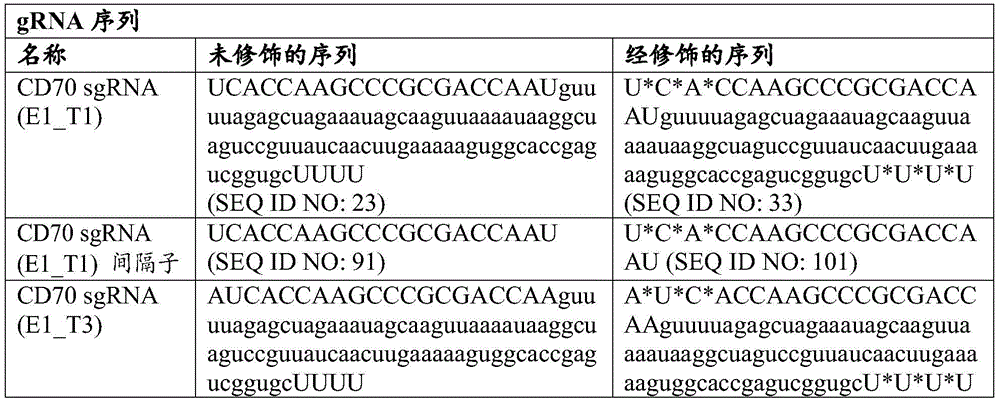

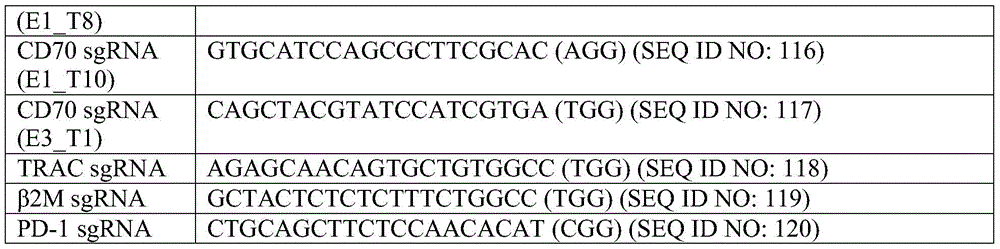
*:2'-O-甲基硫代磷酸酯残基*: 2'-O-methyl phosphorothioate residue
用核糖核蛋白颗粒(RNP)转染(电穿孔)原代人T细胞,所述核糖核蛋白颗粒包含Cas9核酸酶和靶向CD70基因的合成的经修饰sgRNA(表5中的序列)或对照(无Cas9,无gRNA)。转染后四到六(4-6)天,对细胞进行(1)TIDE分析以评估插入缺失频率,和(2)通过流式细胞仪进行处理(第一抗体:FITC抗人CD70抗体,克隆113-16,博奇公司)(Biolegend))以评估细胞表面CD70的表达水平。Primary human T cells were transfected (electroporated) with ribonucleoprotein particles (RNPs) containing Cas9 nuclease and a synthetic modified sgRNA targeting the CD70 gene (sequences in Table 5) or controls (No Cas9, no gRNA). Four to six (4-6) days after transfection, cells were subjected to (1) TIDE analysis to assess indel frequencies, and (2) processed by flow cytometry (primary antibody: FITC anti-human CD70 antibody, clone 113-16, Biolegend) to assess the expression level of cell surface CD70.
通过TIDE分析,七(7)个gRNA产生了可测量的数据,如表6所示。四(4)个gRNA序列产生的插入缺失百分比(编辑频率)高于85%,其中蛋白质表达敲低高于80%(SEQ ID NO:23、26、27和29),表明高效的基因编辑。表6中的数据来自一(1)个供体。将每个测试样品的CD70蛋白表达水平(通过中值荧光强度(MFI)评估)标准化为对照细胞中存在的CD70蛋白表达水平。Seven (7) gRNAs produced measurable data by TIDE analysis, as shown in Table 6. Four (4) gRNA sequences produced a percentage of indels (editing frequency) higher than 85% with protein expression knockdown higher than 80% (SEQ ID NOs: 23, 26, 27 and 29), indicating efficient gene editing. The data in Table 6 are from one (1) donor. The level of CD70 protein expression (assessed by median fluorescence intensity (MFI)) of each test sample was normalized to the level of CD70 protein expression present in control cells.
表6.基因编辑的T细胞中的CD70 gRNA序列,剪切效率和CD70表面蛋白表达Table 6. CD70 gRNA sequence, splicing efficiency and CD70 surface protein expression in gene-edited T cells

T细胞中中靶插入缺失概况的分析Analysis of target indel profiles in T cells
使用靶向以下CD70基因的T7指导物(SEQ ID NO:26;SEQ ID NO:36)进行基因编辑后在CD70基因座上进行中靶扩增子分析:On-target amplicon analysis at the CD70 locus was performed following gene editing using the T7 guide (SEQ ID NO:26; SEQ ID NO:36) targeting the following CD70 genes:
GCTTTGGTCCCATTGGTCGC(SEQ ID NO:160;靶序列,具有PAM SEQ ID NO:114)。GCTTTGGTCCCATTGGTCGC (SEQ ID NO: 160; target sequence with PAM SEQ ID NO: 114).
基因编辑后,在TRAC-/β2M-/CD70-/抗-CD70 CAR+细胞(如实例3中所述产生)中的CD70基因座周围进行中靶扩增子分析。After gene editing, on-target amplicon analysis was performed around the CD70 locus in TRAC-/β2M-/CD70-/anti-CD70 CAR+ cells (generated as described in Example 3).
使用KAPA HiFi PCR试剂盒(卡帕生物系统公司(Kapa Biosystems),威明(Wilmington),马萨诸塞州(MA))进行初始PCR。将100ng的输入gDNA与10uM的每种引物组合。将CD70_F和CD70_R引物配对以扩增CD70基因座(表7)。Initial PCR was performed using the KAPA HiFi PCR kit (Kapa Biosystems, Wilmington, MA). 100 ng of input gDNA was combined with 10 uM of each primer. The CD70_F and CD70_R primers were paired to amplify the CD70 locus (Table 7).
表7.用于CD70扩增子文库制备的引物Table 7. Primers used for CD70 amplicon library preparation

在CRISPR/Cas9基因编辑以产生TRAC-/β2M-/抗CD70 CAR+T细胞后,分析T细胞群中的CD70基因座,产生CD70基因座处的特定插入缺失频率和经编辑的基因序列(表8;缺失为破折号并且插入为粗体)。从两个不同的供体T细胞(1和2)生成了两个经编辑细胞的细胞群。一式两份地分析了来自每个供体的经编辑的T细胞群:1A/1B和2A/2B。Following CRISPR/Cas9 gene editing to generate TRAC- / β2M-/anti - CD70 CAR+ T cells, analysis of the CD70 locus in T cell populations yielded specific indel frequencies and edited gene sequences at the CD70 locus (Table 1). 8; deletions are dashes and insertions are bold). Two populations of edited cells were generated from two different donor T cells (1 and 2). The edited T cell populations from each donor were analyzed in duplicate: 1A/1B and 2A/2B.
表8.Table 8.
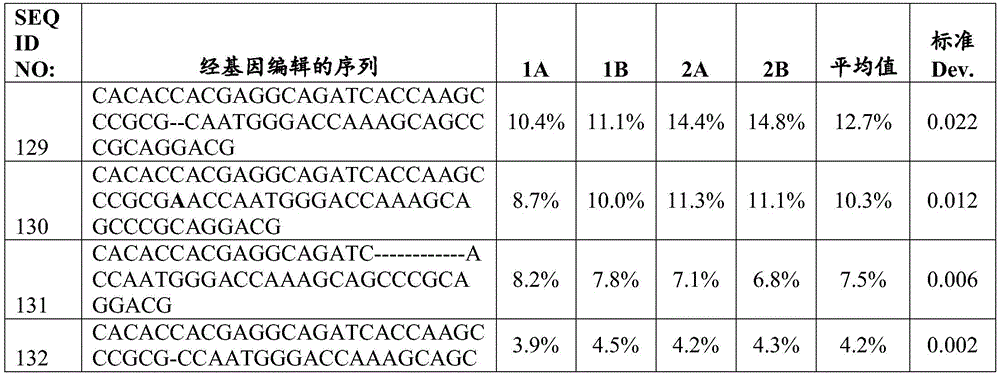

实例2.具有多个基因敲除的T细胞的产生Example 2. Generation of T cells with multiple knockouts
这个实例描述了使用CRISPR/Cas9基因编辑技术来产生同时缺乏两个、三个或四个基因表达的人T细胞。具体来说,T细胞受体(TCR)基因(在TCRα常数(TRAC)区域中编辑的基因),β2-微球蛋白(β2M)基因,分化簇70(CD70)基因和/或程序性细胞死亡1(PD-1或PD1)基因通过CRISPR/Cas9基因编辑进行编辑,以产在两个或更多个所列基因中具有缺陷的T细胞。为了简明起见,在附图中使用以下缩写:This example describes the use of CRISPR/Cas9 gene editing technology to generate human T cells that lack expression of two, three, or four genes simultaneously. Specifically, T cell receptor (TCR) genes (genes edited in the TCRα constant (TRAC) region), β2-microglobulin (β2M) genes, cluster of differentiation 70 (CD70) genes and/or programmed cell death 1 (PD-1 or PD1) gene is edited by CRISPR/Cas9 gene editing to generate T cells with defects in two or more of the listed genes. For simplicity, the following abbreviations are used in the drawings:
2X KO:TRAC-/β2M- 2X KO:TRAC - /β2M -
3X KO(PD-1):TRAC-/β2M-/PD-1- 3X KO(PD-1):TRAC - /β2M - /PD-1 -
3X KO(CD70):TRAC-/β2M-/CD70- 3X KO(CD70):TRAC- / β2M- / CD70-
4X KO:TRAC-/β2M-/PD-1-/CD70- 4X KO:TRAC - /β2M - /PD-1 - /CD70 -
用Cas9:gRNA RNP复合物对激活的原代人T细胞进行电穿孔。核转染混合物包含NucleofectorTM溶液,5 x 106个细胞,1μM Cas9和5μM gRNA(如Hendel等人所述,NatBiotechnol[自然生物].2015;33(9):985-989,PMID:26121415)。为了生成双敲除T细胞(2XKO),用两种不同的RNP复合物对细胞进行电穿孔,每种复合物均包含Cas9蛋白和以下sgRNA之一:处于上述浓度的TRAC(SEQ ID NO:40)和β2M(SEQ ID NO:41)。为了生成三重敲除T细胞(3X KO),将细胞用三种不同的RNP复合物进行电穿孔,每个RNA复合物均包含Cas蛋白和以下sgRNA之一:(a)处于上述指示浓度的TRAC(SEQ ID NO:40)、β2M(SEQ ID NO:41)、和PD-1(SEQ ID NO:42);或(b)处于上述指示浓度的TRAC(SEQ ID NO:40)、β2M(SEQ ID NO:41)、和CD70(SEQ ID NO:36或37)。为了产生四重敲除T细胞(4X KO),将细胞用四种不同的RNP复合物进行电穿孔,每个RNA复合物均包含Cas9蛋白和以下sgRNA之一:处于上述指示浓度的TRAC(SEQ ID NO:40)、β2M(SEQ ID NO:41)、PD-1(SEQ ID NO:42)、和CD70(SEQ ID NO:36或37)。也可以使用gRNA的未修饰版本(或其他经修饰的版本)(例如,SEQ ID NO:30、31、32、26和/或27)。表5和9中的序列。Activated primary human T cells were electroporated with the Cas9:gRNA RNP complex. The nucleofection mixture contained Nucleofector ™ solution, 5 x 10 cells, 1 μM Cas9 and 5 μM gRNA (as described by Hendel et al., NatBiotechnol [Nature Bio]. 2015;33(9):985-989, PMID:26121415) . To generate double knockout T cells (2XKO), cells were electroporated with two different RNP complexes, each complex containing Cas9 protein and one of the following sgRNAs: TRAC (SEQ ID NO: 40) at the above concentrations ) and β2M (SEQ ID NO: 41). To generate triple knockout T cells (3X KO), cells were electroporated with three different RNP complexes, each RNA complex containing Cas protein and one of the following sgRNAs: (a) TRAC at the concentrations indicated above (SEQ ID NO:40), β2M (SEQ ID NO:41), and PD-1 (SEQ ID NO:42); or (b) TRAC (SEQ ID NO:40), β2M (SEQ ID NO:40) at the concentrations indicated above ID NO: 41), and CD70 (SEQ ID NO: 36 or 37). To generate quadruple knockout T cells (4X KO), cells were electroporated with four different RNP complexes, each RNA complex containing Cas9 protein and one of the following sgRNAs: TRAC (SEQ ID NO: 40), β2M (SEQ ID NO: 41), PD-1 (SEQ ID NO: 42), and CD70 (SEQ ID NO: 36 or 37). Unmodified versions (or other modified versions) of gRNAs can also be used (eg, SEQ ID NOs: 30, 31, 32, 26, and/or 27). Sequences in Tables 5 and 9.
表9.gRNA序列/靶序列Table 9. gRNA sequences/target sequences
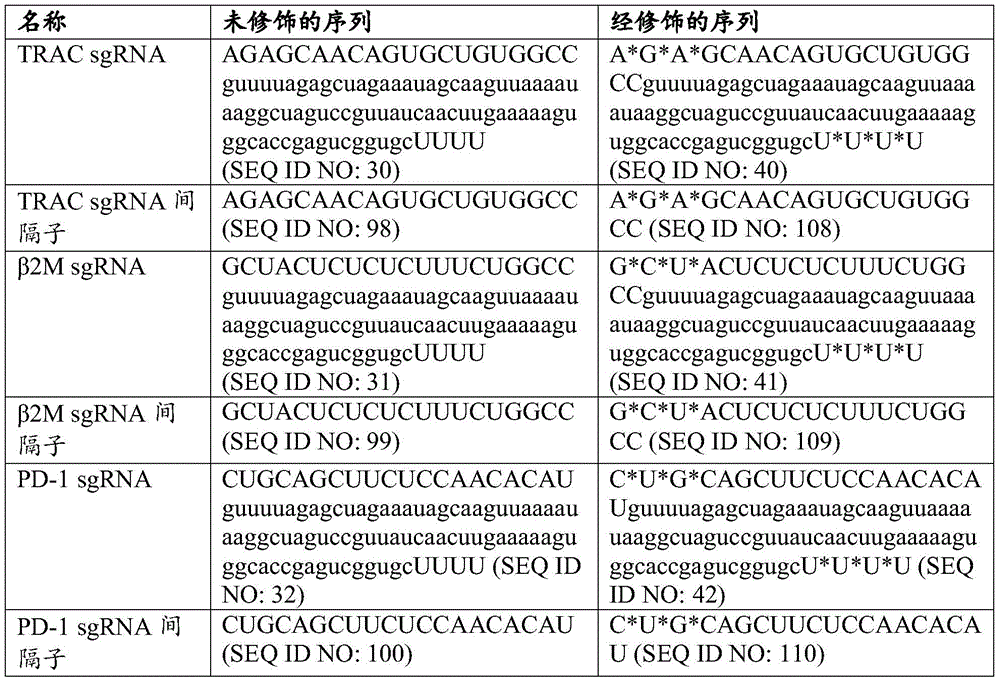
电穿孔后约一(1)周,将细胞不处理或用佛波豆蔻醚乙酸盐(PMA)/离子霉素处理过夜。第二天将细胞处理用于流式细胞术(参见,例如,Kalaitzidis D等人J Clin Invest[临床研究杂志]2017;127(4):1405-1413)以评估经编辑的细胞群表面的TRAC、β2M、PD-1和CD70的表达水平。使用了以下第一抗体(表10):Approximately one (1) week after electroporation, cells were left untreated or treated with phorbol myristate acetate (PMA)/ionomycin overnight. Cells were processed the next day for flow cytometry (see, eg, Kalaitzidis D et al J Clin Invest 2017;127(4):1405-1413) to assess TRAC on the surface of edited cell populations , β2M, PD-1 and CD70 expression levels. The following primary antibodies were used (Table 10):
表10.抗体Table 10. Antibodies

表11和12显示了高效的多基因编辑。对于双敲除细胞(2X KO;TRAC-/β2M-),83%的活细胞缺乏TCR和β2M的表达(表11;3X KO(PD1))。对于三敲除细胞,70%的活细胞缺乏TCR、β2M和PD-1的表达(表11);并且80%的活细胞缺乏TCR、β2M和CD70(与使用的CD70 gRNA无关)的表达(表12)。对于四敲除细胞(4X KO),78%的活细胞缺乏TCR、β2M、PD-1和CD70的表达(图1)。Tables 11 and 12 show efficient multigene editing. For double knockout cells (2X KO; TRAC − /β2M − ), 83% of viable cells lacked expression of TCR and β2M (Table 11; 3X KO(PD1)). For triple knockout cells, 70% of viable cells lacked expression of TCR, β2M, and PD-1 (Table 11); and 80% of viable cells lacked expression of TCR, β2M, and CD70 (regardless of the CD70 gRNA used) (Table 1). 12). For quad knockout cells (4X KO), 78% of viable cells lacked expression of TCR, β2M, PD-1 and CD70 (Figure 1).
表11.在2KO和3KO(PD1)细胞群中缺乏表达的活细胞%Table 11. % viable cells lacking expression in 2KO and 3KO (PD1) cell populations
表12.在3KO(CD70)细胞群中缺乏表达的活细胞%Table 12. % viable cells lacking expression in the 3KO (CD70) cell population
为了评估T细胞中的三基因编辑和四基因编辑是否影响细胞扩增,在编辑后的两周时间内,计数了双、三和四基因编辑的T细胞(未编辑的T细胞用作对照)中的细胞数量。产生5 x 10⁶个细胞,并针对每种T细胞基因型进行铺板。To assess whether triple- and quad-gene editing in T cells affects cell expansion, double-, triple-, and quadruple-edited T cells were counted over a two-week period after editing (unedited T cells were used as controls) the number of cells in the . 5 x 10 cells were generated and plated for each T cell genotype.
如图2,在电穿孔后窗口测试中,细胞增殖(扩展)继续进行。如活细胞数量所示,在双(β2M-/TRAC-)、三(β2M-/TRAC-/PD-1-、或β2M-/TRAC-/CD70-)和四(β2M-/TRAC-/PD-1-/CD70)敲除T细胞之间观察到相似的细胞增殖。这些数据表明,如通过T细胞增殖来测量,多个基因编辑(对于CD70和PD-1基因,多达三个和四个)不影响T细胞健康。As shown in Figure 2, in the post-electroporation window assay, cell proliferation (expansion) continued. As indicated by the number of viable cells, in double (β2M-/TRAC-), triple (β2M-/TRAC-/PD-1-, or β2M-/TRAC-/CD70-) and quadruple (β2M-/TRAC-/PD) Similar cell proliferation was observed between T cells with -1-/CD70) knockout. These data suggest that multiple gene edits (up to three and four for the CD70 and PD-1 genes) did not affect T cell health, as measured by T cell proliferation.
实例3.缺乏CD70和/或PD1的CAR T细胞的生成Example 3. Generation of CAR T cells lacking CD70 and/or PD1
具有多个敲除的抗CD70 CAR T细胞的生成Generation of anti-CD70 CAR T cells with multiple knockouts
该实例描述了同种异体人T细胞的产生,所述同种异体人T细胞缺乏TCR基因、β2M基因、CD70基因和/或PD1基因的表达,并表达靶向CD70的嵌合抗原受体(CAR)。这些细胞在图中被命名为TCR-/β2M-/CD70-/抗CD70 CAR+或3X KO(CD70)CD70 CAR+;TCR-/β2M-/PD1-/抗CD70 CAR+或3X KO(PD1)CD70 CAR+;TCR-/β2M-/PD1-/CD70-/抗CD70 CAR+或4X KO CD70 CAR+。This example describes the generation of allogeneic human T cells that lack expression of the TCR gene, β2M gene, CD70 gene, and/or PD1 gene, and express a CD70-targeting chimeric antigen receptor ( CAR). These cells are designated in the figure as TCR- / β2M- / CD70-/anti - CD70 CAR + or 3X KO(CD70)CD70 CAR + ; TCR- / β2M- / PD1-/anti - CD70 CAR + or 3X KO(PD1) CD70 CAR + ; TCR- / β2M- / PD1-/ CD70- /anti - CD70 CAR + or 4X KO CD70 CAR + .
重组腺相关腺病毒载体,血清型6(AAV6)(MOI 50,000)(其包含SEQ ID NO:43的核苷酸序列(包含SEQ ID NO:44中的供体模板,编码抗CD70CAR(包含SEQ ID NO:46的氨基酸序列))与Cas9:sgRNA RNP(1μM Cas9,5μM gRNA)一起递送以激活同种异体人T细胞。使用了以下sgRNA:TRAC(SEQ ID NO:40)、β2M(SEQ ID NO:41)、CD70(SEQ ID NO:36或37)和PD1(SEQ ID NO:42)。也可以使用gRNA的未修饰版本(或其他经修饰的版本)(例如,SEQ ID NO:30、31、32、26和/或27)。电穿孔后约一(1)周,将细胞进行处理用于流式细胞术,以评估经编辑的细胞群细胞表面的TRAC、β2M、CD70和PD1表达水平。使用了以下第一抗体(表13):Recombinant adeno-associated adenovirus vector, serotype 6 (AAV6) (MOI 50,000) (which comprises the nucleotide sequence of SEQ ID NO: 43 (comprising the donor template in SEQ ID NO: 44), encoding an anti-CD70 CAR (comprising SEQ ID NO: 44) The amino acid sequence of NO:46)) was delivered with Cas9:sgRNA RNP (1 μM Cas9, 5 μM gRNA) to activate allogeneic human T cells. The following sgRNAs were used: TRAC (SEQ ID NO:40), β2M (SEQ ID NO: : 41), CD70 (SEQ ID NO: 36 or 37), and PD1 (SEQ ID NO: 42). Unmodified versions (or other modified versions) of gRNAs can also be used (eg, SEQ ID NOs: 30, 31 , 32, 26 and/or 27). Approximately one (1) week after electroporation, cells were processed for flow cytometry to assess TRAC, β2M, CD70 and PD1 expression levels on the cell surface of edited cell populations . The following primary antibodies were used (Table 13):
表13.抗体Table 13. Antibodies
T细胞比例测定。然后使用以下抗体通过流式细胞术评估经编辑的T细胞群中CD4+和CD8+细胞的比例(表14):T cell ratio determination. The proportion of CD4+ and CD8+ cells in the edited T cell population was then assessed by flow cytometry using the following antibodies (Table 14):
表14.抗体Table 14. Antibodies
在经编辑的抗CD70 CAR T细胞群中实现了高效的基因编辑和CAR表达。此外,编辑不会不利地改变CD4/CD8 T细胞群。图3显示了三敲除CAR T细胞中的高效基因编辑和抗CD70 CAR表达。超过55%的活细胞缺乏TCR、β2M和CD70的表达,并且还表达抗CD70 CAR。图4表明TRAC-/β2M-/CD70-/抗CD70 CAR+细胞中CD4/CD8 T细胞亚群的正常比例保持不变,这表明如通过CD4+/CD8+T细胞亚群的比例测量,这些多基因编辑不影响T细胞生物学。Efficient gene editing and CAR expression were achieved in edited anti-CD70 CAR T cell populations. Furthermore, editing did not adversely alter CD4/CD8 T cell populations. Figure 3 shows efficient gene editing and anti-CD70 CAR expression in triple knockout CAR T cells. More than 55% of viable cells lack expression of TCR, β2M and CD70, and also express anti-CD70 CAR. Figure 4 shows that the normal ratio of CD4/CD8 T cell subsets in TRAC-/β2M-/CD70-/anti-CD70 CAR+ cells remained unchanged, suggesting that these polygenic Editing does not affect T cell biology.
图5显示在四敲除的CAR T细胞中高效的基因编辑和抗CD70 CAR表达。超过60%的活细胞缺乏TCR、β2M、PD-1和CD70的表达,并表达抗CD70 CAR。图6表明TRAC-/β2M-/PD-1-/CD70-/抗CD70 CAR+细胞中CD4/CD8 T细胞亚群的比例保持正常,这表明如通过CD4+/CD8+T细胞亚群的比例测量,这些多基因编辑不影响T细胞生物学。Figure 5 shows efficient gene editing and anti-CD70 CAR expression in quad-knockout CAR T cells. More than 60% of viable cells lack expression of TCR, β2M, PD-1, and CD70, and express anti-CD70 CAR. Figure 6 demonstrates that the ratio of CD4/CD8 T cell subsets in TRAC-/β2M- / PD - 1- /CD70-/anti - CD70 CAR + cells remains normal, indicating that as measured by the ratio of CD4+/CD8+ T cell subsets , these multiple gene edits do not affect T cell biology.
具有多个敲除的抗BCMA CAR T细胞的生成Generation of anti-BCMA CAR T cells with multiple knockouts
本实例描述了同种异体人T细胞的产生,所述同种异体人T细胞缺乏TCR基因、β2M基因、PD-1基因和/或CD70基因的表达,并且还表达靶向B-细胞成熟抗原(BCMA)的嵌合抗原受体(CAR)。This example describes the generation of allogeneic human T cells that lack expression of the TCR gene, β2M gene, PD-1 gene, and/or CD70 gene, and also express antigens targeted to B-cell maturation (BCMA) chimeric antigen receptor (CAR).
重组腺相关腺病毒载体,血清型6(AAV6)(其包含SEQ ID NO:54的核苷酸序列(包含SEQ ID NO:55中的供体模板,编码抗BCMA CAR(包含SEQ ID NO:57的氨基酸序列))与Cas9:gRNA RNP(1μM Cas9,5μM gRNA)一起递送以激活同种异体人T细胞。使用了以下gRNA:TRAC(SEQ ID NO:40)、β2M(SEQ ID NO:41)、PD-1(SEQ ID NO:42)、和CD70(SEQ ID NO:36或37)。也可以使用gRNA的未修饰版本(或其他经修饰的版本)(SEQ ID NO:30、31、32、26和/或27)。电穿孔后约一(1)周,如以上针对抗CD70 CAR+T细胞所述处理细胞用于流式细胞术,但有以下差异。使用生物素化的重组人BCMA(ACROS Cat#BC7-H82F0)检测抗BCMA CAR表达。然后如本文所述表征双和四敲除抗BCMA CAR+细胞。Recombinant adeno-associated adenovirus vector, serotype 6 (AAV6) (comprising the nucleotide sequence of SEQ ID NO:54 (comprising the donor template in SEQ ID NO:55) encoding an anti-BCMA CAR (comprising SEQ ID NO:57 The amino acid sequence of )) was delivered with Cas9:gRNA RNP (1 μM Cas9, 5 μM gRNA) to activate allogeneic human T cells. The following gRNAs were used: TRAC (SEQ ID NO:40), β2M (SEQ ID NO:41) , PD-1 (SEQ ID NO:42), and CD70 (SEQ ID NO:36 or 37). Unmodified versions (or other modified versions) of the gRNA can also be used (SEQ ID NOs:30, 31, 32 , 26 and/or 27). Approximately one (1) week after electroporation, cells were treated for flow cytometry as described above for anti-CD70 CAR+ T cells with the following differences. Biotinylated recombinant human was used Anti-BCMA CAR expression was detected by BCMA (ACROS Cat#BC7-H82F0). Double and quad knockout anti-BCMA CAR + cells were then characterized as described herein.
图7A-7B显示了TRAC基因、β2M基因、CD70基因和PD-1基因的高效基因编辑。图7C显示了抗BCMA CAR+细胞在双和四敲除细胞中的高表达。7A-7B show efficient gene editing of TRAC gene, β2M gene, CD70 gene and PD-1 gene. Figure 7C shows high expression of anti-BCMA CAR+ cells in double and quad knockout cells.
具有多个敲除的抗CD19 CAR T细胞的生成Generation of anti-CD19 CAR T cells with multiple knockouts
产生了同种异体人T细胞,其表达靶向CD19的嵌合抗原受体(CAR),并且缺乏TCR基因、ββ2M基因以及任选地CD70基因的表达。Allogeneic human T cells are generated that express a chimeric antigen receptor (CAR) targeting CD19 and lack expression of the TCR gene, the ββ2M gene, and optionally the CD70 gene.
为了产生同种异体T细胞,将激活的原代人T细胞用Cas9:gRNA RNP复合物电穿孔并用腺相关腺病毒载体(AAV)感染,所述载体包含与TRAC基因座具有同源性的抗CD19 CAR供体模板。重组AAV血清型6(AAV6)(其包含SEQ ID NO:155的核苷酸序列(包含SEQ ID NO:156中的供体模板(编码抗CD19 CAR(包含SEQ ID NO:149的氨基酸序列)))与Cas9:sgRNARNP(1μM Cas9,5μM gRNA)一起递送以激活人T细胞。以下sgRNA用于敲除相应的基因:TRAC(SEQ ID NO:40)、β2M(SEQ ID NO:41)、CD70(SEQ ID NO:36)。也可以使用gRNA的未修饰版本(或其他经修饰的版本)(例如,SEQ ID NO:30、21或27)。电穿孔后约一(1)周,如以上针对抗CD70 CAR+T细胞所述处理细胞用于流式细胞术,但有以下差异。使用生物素化的重组人CD19(ACROBIOSYSTEMS INC;CD9-H825)检测抗CD19CAR表达。然后如本文所述表征CD70缺陷型抗CD19 CAR+T细胞。To generate allogeneic T cells, activated primary human T cells were electroporated with Cas9:gRNA RNP complexes and infected with an adeno-associated adenoviral vector (AAV) containing an antifungal agent with homology to the TRAC locus CD19 CAR donor template. Recombinant AAV serotype 6 (AAV6) (comprising the nucleotide sequence of SEQ ID NO: 155 (comprising the donor template in SEQ ID NO: 156) (encoding an anti-CD19 CAR (comprising the amino acid sequence of SEQ ID NO: 149)) ) was delivered with Cas9:sgRNARNP (1 μM Cas9, 5 μM gRNA) to activate human T cells. The following sgRNAs were used to knock down the corresponding genes: TRAC (SEQ ID NO:40), β2M (SEQ ID NO:41), CD70 ( SEQ ID NO: 36). Unmodified versions (or other modified versions) of the gRNA can also be used (eg, SEQ ID NO: 30, 21 or 27). About one (1) week after electroporation, as described above for Anti-CD70 CAR T cells Cells were treated as described for flow cytometry with the following differences. Anti-CD19 CAR expression was detected using biotinylated recombinant human CD19 (ACROBIOSYSTEMS INC; CD9-H825). CD70 was then characterized as described herein Deficient anti-CD19 CAR + T cells.
具有多个敲除的抗CD33 CAR T细胞的生成Generation of anti-CD33 CAR T cells with multiple knockouts
生成同种异体人T细胞,其表达靶向CD33的嵌合抗原受体(CAR)并且缺乏T细胞受体(TCR)基因(在TCRα恒定(TRAC)区中经编辑的基因)、β2-微球蛋白(β2M)基因,以及任选地CD70基因的表达。Generation of allogeneic human T cells expressing a chimeric antigen receptor (CAR) targeting CD33 and lacking the T cell receptor (TCR) gene (an edited gene in the TCRα constant (TRAC) region), β2-micro Expression of the globulin (β2M) gene, and optionally the CD70 gene.
为了产生同种异体T细胞,将激活的原代人T细胞用Cas9:gRNA RNP复合物电穿孔并用腺相关腺病毒载体(AAV)感染,所述载体包含与TRAC基因座具有同源性的抗CD33 CAR供体模板。重组AAV血清型6(AAV6)(其包含SEQ ID NO:87的核苷酸序列(包含SEQ ID NO:135中的供体模板(编码抗CD33 CAR(包含SEQ ID NO:139的氨基酸序列)))与Cas9:sgRNARNP(1μM Cas9,5μM gRNA)一起递送以激活人T细胞。以下sgRNA用于敲除相应的基因:TRAC(SEQ ID NO:40)、β2M(SEQ ID NO:41)、CD70(SEQ ID NO:36)。也可以使用gRNA的未修饰版本(或其他经修饰的版本)(例如,SEQ ID NO:30、21或27)。To generate allogeneic T cells, activated primary human T cells were electroporated with Cas9:gRNA RNP complexes and infected with an adeno-associated adenoviral vector (AAV) containing an antifungal agent with homology to the TRAC locus CD33 CAR donor template. Recombinant AAV serotype 6 (AAV6) (comprising the nucleotide sequence of SEQ ID NO: 87 (comprising the donor template in SEQ ID NO: 135) (encoding an anti-CD33 CAR (comprising the amino acid sequence of SEQ ID NO: 139)) ) was delivered with Cas9:sgRNARNP (1 μM Cas9, 5 μM gRNA) to activate human T cells. The following sgRNAs were used to knock down the corresponding genes: TRAC (SEQ ID NO:40), β2M (SEQ ID NO:41), CD70 ( SEQ ID NO: 36). Unmodified versions (or other modified versions) of the gRNA can also be used (eg, SEQ ID NO: 30, 21 or 27).
类似地产生了TCR+T细胞(无RNP)和TRAC-/β2M-T细胞(无CAR的TCR和β2M缺陷细胞)的群体,用作对照。电穿孔后约一(1)周,如以上针对抗CD70 CAR+T细胞所述处理细胞用于流式细胞术,但有以下差异。使用生物素化的重组人CD33(数据未显示)检测抗CD33 CAR表达。然后如本文所述表征CD70敲除抗CD33 CAR+T细胞。Populations of TCR+ T cells (without RNP) and TRAC-/β2M- T cells (TCR without CAR and β2M deficient cells) were similarly generated and used as controls. Approximately one (1) week after electroporation, cells were processed for flow cytometry as described above for anti-CD70 CAR+ T cells, with the following differences. Anti-CD33 CAR expression was detected using biotinylated recombinant human CD33 (data not shown). CD70 knockout anti-CD33 CAR + T cells were then characterized as described herein.
具有CD70敲除的抗CD33 CAR T细胞中CD4/CD8细胞群的表征Characterization of CD4/CD8 cell populations in anti-CD33 CAR T cells with CD70 knockout
CD33可以在T细胞上表达,其中在培养的CD4细胞上观察到比CD8细胞更到的表达。在产生抗CD33 CAR-T细胞的过程中,由于同胞相杀,CD4细胞显著减少。如图8所示,具有完整CD70的抗CD33 CAR-T细胞培养物在3周的培养期内显示出CD4+细胞减少97%,而具有破坏的CD70的细胞培养物在这段时间内仅显示减少61%。因此,破坏CD70基因似乎减少了在抗CD33 CAR-T细胞培养物中观察到的同胞相杀。不希望受到理论的束缚,这种作用可能通过CD70/CD27相互作用增强的免疫刺激功能而发生,并且CD70的基因破坏导致CD4/CD8比例更平衡,这对于恶性肿瘤中的治疗益处可能更佳。CD33 can be expressed on T cells, with more expression observed on cultured CD4 cells than CD8 cells. During the production of anti-CD33 CAR-T cells, CD4 cells were significantly reduced due to sibling killing. As shown in Figure 8, anti-CD33 CAR-T cell cultures with intact CD70 showed a 97% reduction in CD4+ cells over a 3-week culture period, whereas cell cultures with disrupted CD70 showed only a reduction over this
实例4:CD70 KO改善细胞增殖Example 4: CD70 KO improves cell proliferation
CD70 KO对抗CD33 CAR T细胞体外增殖的影响Effects of CD70 KO on proliferation of anti-CD33 CAR T cells in vitro
为了评估细胞在含有细胞因子的培养基(IL-2+IL-7)中扩增的能力,使用了抗CD33 CAR T细胞。具体来说,如实例3中所述产生包含双敲除(TRAC-/B2M-)或三敲除(TRAC-/B2M-/CD70-)的总共5 x 106个抗CD33CAR T细胞,铺板并使其在10mL体积的细胞因子培养基中生长。1周后,计数细胞。然后将来自先前培养的5 x 10⁶个细胞重新铺板在10mL体积(新鲜的含细胞因子培养基)中,并于1周后计算细胞总数量。包含CD70基因破坏的同种异体抗CD33 CAR-T细胞在再铺的第一周和第二周扩增至更高水平(图9)。这些数据表明,CD70敲除可导致培养物中更高的细胞产量。To assess the ability of cells to expand in cytokine-containing media (IL-2+IL-7), anti-CD33 CAR T cells were used. Specifically, a total of 5 x 10 6 anti-CD33 CAR T cells comprising double knockout (TRAC-/B2M-) or triple knockout (TRAC-/B2M-/CD70-) were generated as described in Example 3, plated and It was grown in cytokine medium in a volume of 10 mL. After 1 week, cells were counted. 5 x 10⁶ cells from the previous culture were then re-plated in a 10 mL volume (fresh cytokine-containing medium) and the total number of cells was counted after 1 week. Allogeneic anti-CD33 CAR-T cells containing CD70 gene disruption expanded to higher levels during the first and second weeks of replating (Figure 9). These data suggest that CD70 knockout results in higher cell yields in culture.
CD70 KO对抗CD19 CAR T细胞体外增殖的影响Effects of CD70 KO on proliferation of anti-CD19 CAR T cells in vitro
为了进一步评估细胞在含有细胞因子的培养基(IL-2+IL-7)中扩增的能力,使用了抗CD19 CAR T细胞。具体来说,如实例3中所述产生包含双敲除(TRAC-/B2M-)或三敲除(TRAC-/B2M-/CD70-)的总共5 x 106个抗CD19 CAR T细胞,铺板并使其在10mL体积的细胞因子培养基中生长。1周后,计数细胞。然后将来自先前培养的5 x 10⁶个细胞重新铺板在10mL体积(新鲜的含细胞因子培养基)中,并于1周后计算细胞总数量。与没有CD70基因破坏的对照细胞相比,包含CD70基因破坏的同种异体抗CD19CAR-T细胞在再铺的第一周和第二周扩增至更高水平(图10)。这些数据表明,CD70敲除可导致培养物中更高的细胞产量。To further assess the ability of cells to expand in cytokine-containing media (IL-2+IL-7), anti-CD19 CAR T cells were used. Specifically, a total of 5 x 10 6 anti-CD19 CAR T cells comprising double knockout (TRAC-/B2M-) or triple knockout (TRAC-/B2M-/CD70-) were generated as described in Example 3 and plated and grown in a 10 mL volume of cytokine medium. After 1 week, cells were counted. 5 x 10⁶ cells from the previous culture were then re-plated in a 10 mL volume (fresh cytokine-containing medium) and the total number of cells was counted after 1 week. Allogeneic anti-CD19 CAR-T cells containing CD70 gene disruption expanded to higher levels during the first and second weeks of replating compared to control cells without CD70 gene disruption (Figure 10). These data suggest that CD70 knockout results in higher cell yields in culture.
CD70 KO对细胞因子驱动的抗BCMA CAR T细胞体外增殖和凋亡的影响Effects of CD70 KO on proliferation and apoptosis of cytokine-driven anti-BCMA CAR T cells in vitro
细胞因子驱动的增殖。为了评估CD70和/或PD1敲除对细胞增殖的影响,使用了抗BCMA CAR T细胞。如实例3中所述产生抗BCMA CAR T细胞。生成了以下多组经编辑的T细胞:Cytokine-driven proliferation. To assess the effect of CD70 and/or PD1 knockdown on cell proliferation, anti-BCMA CAR T cells were used. Anti-BCMA CAR T cells were generated as described in Example 3. The following sets of edited T cells were generated:
TRAC-/B2M-/抗BCMA CAR+(对照;2KO,BCMA CAR+)TRAC-/B2M-/anti-BCMA CAR+ (control; 2KO, BCMA CAR+)
TRAC-/B2M-/CD70-/抗BCMA CAR+(3KO(CD70),BCMA CAR+)TRAC-/B2M-/CD70-/anti-BCMA CAR+ (3KO(CD70), BCMA CAR+)
TRAC-/B2M-/PD1-/抗BCMA CAR+(3KO(PD1),BCMA CAR+)TRAC-/B2M-/PD1-/anti-BCMA CAR+ (3KO(PD1), BCMA CAR+)
TRAC-/B2M-/CD70-/PD1-/抗BCMA CAR+(4KO,BCMA CAR+)TRAC-/B2M-/CD70-/PD1-/anti-BCMA CAR+ (4KO, BCMA CAR+)
通过磁性耗尽CD3+B2M+细胞,使经编辑的细胞富集TRAC-/B2M-细胞。简而言之,将细胞用抗CD3生物素(博奇公司Cat#300404)抗β2M生物素(博奇公司Cat#316308)抗体(各0.5μg/1 x 106细胞)以100μl体积于4℃标记15分钟,用链霉亲和素标记的磁性微珠(梅旖旎生物技术公司(Miltenyi Biotech,130-048-101))在4℃下洗涤并孵育15分钟。将细胞重悬于缓冲液中,并根据制造商的方案通过LS柱(梅旖旎生物技术公司,130-042-401)。The edited cells were enriched for TRAC-/B2M- cells by magnetically depleting CD3+B2M+ cells. Briefly, cells were treated with anti-CD3 biotin (Boch Cat #300404) anti-β2M biotin (Boch Cat #316308) antibody (0.5 μg each/1 x 10 cells) in a volume of 100 μl at 4°C Labeled for 15 minutes, washed with streptavidin-labeled magnetic microbeads (Miltenyi Biotech, 130-048-101) and incubated at 4°C for 15 minutes. Cells were resuspended in buffer and passed through an LS column (Meiyi Biotechnology Co., 130-042-401) according to the manufacturer's protocol.
为了确定CD70或PD1对IL-2/IL-7驱动的T细胞增殖的影响,将经编辑的T细胞(1E6细胞/ml)在生长培养基(X-vivo培养基(04-744,龙沙公司(Lonza)))中进行培养长达四个星期,所述培养基补充有5%人AB血清(HP1022,威利生物医药公司(Valley Biomedical))、50ng/ml IL-2(rhIL-2;130-097-745,梅旖旎生物技术公司)和10ng/ml IL-7(rhIL-7;希尔季克思公司(Cellgenix)001410-050)。在指定的天数,将细胞计数并以1.5E6个细胞/ml的密度在适当培养皿中的新鲜培养基中重新接种。To determine the effect of CD70 or PD1 on IL-2/IL-7-driven T cell proliferation, edited T cells (1E6 cells/ml) were grown in growth medium (X-vivo medium (04-744, Lonza). Lonza)) supplemented with 5% human AB serum (HP1022, Valley Biomedical), 50 ng/ml IL-2 (rhIL-2) for up to four weeks ; 130-097-745, Mei Yini Biotechnology Company) and 10ng/ml IL-7 (rhIL-7; Cellgenix 001410-050). On the indicated days, cells were counted and reseeded in fresh medium in appropriate dishes at a density of 1.5E6 cells/ml.
图11和12表明与CD70足够的对照(即,包含内源性CD70的抗BCMA CAR T细胞)相比,CD70的敲除改善了IL-2/IL-7驱动的抗BCMA CAR T细胞的体外增殖。图11还显示,即使17天后在CD70基因完整时,即使来自该供体的T细胞似乎明显下降,CD70 KO仍可以改善抗BCMA CAR T细胞的健康和增殖能力(如与供体2(图12)相比,供体1的减少的细胞数量所示(图11))。维持T细胞健康的这一特性(由CD70基因的KO实现)广泛适用于CAR T开发的许多方面,包括:在生产过程中延长的扩增,提高产量和一致性,挽救耗尽/不健康的T细胞,从而可能降低患者中的剂量并增强应答,并与其他KO组合,所述KO可能对T细胞健康有害但具有克服T细胞活性抑制优势(例如,PD1 KO)。如图11和12所示,仅缺失PD1基因本身对CAR T细胞扩增没有益处,但是当与CD70 KO组合时显示出协同作用。Figures 11 and 12 demonstrate that knockdown of CD70 improves in vitro IL-2/IL-7 driven anti-BCMA CAR T cells compared to CD70-sufficient controls (ie, anti-BCMA CAR T cells containing endogenous CD70). proliferation. Figure 11 also shows that CD70 KO improved the health and proliferative capacity of anti-BCMA CAR T cells even after 17 days when the CD70 gene was intact, even though the T cells from this donor appeared to be significantly reduced (as in the case of Donor 2 (Figure 12). ) compared to
凋亡.在抗原再激发测定中,评估了CD70 KO对暴露于抗原后抗BCMA CAR+T凋亡细胞死亡的影响。简而言之,为了实现抗原暴露,将抗BCMA CAR+T细胞暴露于板粘附的重组BCMA蛋白。通过用1x PBS(1μg/ml;生物素化的人BCMA蛋白,ACRO生物系统公司(ACROBiosystems))中的重组BCMA蛋白在4℃将24孔板包被过夜,并且然后洗去未结合的抗原,来制备具有粘附抗原的板。洗涤后,然后用抗原结合板激发抗BCMA CAR+T细胞(其具有或不具有CD70敲除)。在生长培养基(X-vivo培养基(04-744,龙沙公司)(补充了IL-2(rhIL-2;130-097-745,梅旖旎生物技术公司))的5%人AB血清(HP1022,威利生物医药公司)))中,将2XKO(TRAC-/B2M-)抗BCMA CAR+T细胞和3X KO(TRAC-/B2M-/CD70-)抗BCMA CAR+T细胞(1 x10⁶个细胞/ml)暴露于板结合重组BCMA蛋白(1μg/ml)24小时。然后每24小时洗涤、计数细胞并用新鲜的板结合抗原重新激发(1 x 106细胞/ml),进行总共三次连续的再激发(24小时,48小时和72小时)。在每次再激发结束时,将等分试样的细胞在室温下用荧光素缀合的膜联蛋白V和碘化丙啶在膜联蛋白V结合缓冲液(博奇公司)中洗涤并染色15分钟。然后洗涤细胞,并重悬于膜联蛋白V结合缓冲液中,以通过流式细胞术进行分析。在每个时间点对细胞计数,得出每ml的细胞计数。为了计算每个时间点的扩增倍数,将时间0的初始扩增倍数设为1。通过将每个时间点的每ml细胞计数乘以前一个时间点的每ml扩增倍数,可以计算出所有其他时间点的扩增倍数。例如,通过将72小时处每ml的细胞计数乘以48小时处每ml的扩增倍数来计算72小时处的扩增倍数。Apoptosis. In an antigen rechallenge assay, the effect of CD70 KO on anti-BCMA CAR+ T apoptotic cell death after exposure to antigen was assessed. Briefly, to achieve antigen exposure, anti-BCMA CAR+ T cells were exposed to plate-adhered recombinant BCMA protein. Unbound antigen was then washed away by coating 24-well plates with recombinant BCMA protein in 1x PBS (1 μg/ml; biotinylated human BCMA protein, ACRO Biosystems) overnight at 4°C, to prepare plates with adherent antigens. After washing, anti-BCMA CAR+ T cells (with or without CD70 knockout) were then challenged with antigen binding plates. 5% human AB serum ( HP1022, Wiley Biopharmaceutical Company))), 2XKO (TRAC-/B2M-) anti-BCMA CAR+ T cells and 3X KO (TRAC-/B2M-/CD70-) anti-BCMA CAR+ T cells (1 x10 6 cells/ml) were exposed to plate-bound recombinant BCMA protein (1 μg/ml) for 24 hours. Cells were then washed, counted and re-challenged with fresh plate-bound antigen (1 x 10⁶ cells/ml) every 24 hours for a total of three consecutive re-challenges (24 hours, 48 hours and 72 hours). At the end of each re-excitation, aliquots of cells were washed and stained with fluorescein-conjugated annexin V and propidium iodide in annexin V binding buffer (Boch Company) at
图13证明,如第二(48小时)和第三(72小时)再激发后凋亡细胞百分比的降低所表明,CD70(CD70 KO)的缺失使抗BCMA CAR+T细胞免于凋亡。此外,响应于抗原暴露,抗BCMACAR+T细胞中CD70表达的缺失出人意料地增强了抗BCMA CAR+T细胞的扩增(图14)。Figure 13 demonstrates that depletion of CD70 (CD70 KO) protects anti-BCMA CAR+ T cells from apoptosis as indicated by the reduction in the percentage of apoptotic cells following the second (48 hours) and third (72 hours) rechallenge. Furthermore, loss of CD70 expression in anti-BCMACAR+ T cells unexpectedly enhanced the expansion of anti-BCMA CAR+ T cells in response to antigen exposure (Figure 14).
CD70 KO对抗CD70 CAR T细胞体外增殖的影响Effects of CD70 KO on proliferation of anti-CD70 CAR T cells in vitro
为了进一步评估破坏CAR T细胞中CD70基因的影响,如实例3所述产生抗CD70 CART细胞。具体地,使用两种不同的gRNA(T7(SEQ ID NO:36和T8(SEQ ID NO:37))产生3X KO(TRAC-/β2M-/CD70-)抗CD70 CAR T细胞。电穿孔后,如实例2所述通过计数活细胞来评估细胞扩增。图15显示了相对于双敲除TRAC-/β2M-/抗CD70 CAR+T细胞,用T7或T8 gRNA产生的三敲除TRAC-/β2M-/CD70-/抗CD70 CAR+T细胞表现出更大的细胞扩增。这些数据表明敲除CD70基因使抗CD70 CAR+T细胞具有细胞增殖优势。To further assess the effect of disrupting the CD70 gene in CAR T cells, anti-CD70 CAR T cells were generated as described in Example 3. Specifically, 3X KO (TRAC-/β2M-/CD70-) anti-CD70 CAR T cells were generated using two different gRNAs (T7 (SEQ ID NO:36 and T8 (SEQ ID NO:37)). After electroporation, Cell expansion was assessed by counting viable cells as described in Example 2. Figure 15 shows triple-knockout TRAC-/generated with T7 or T8 gRNA relative to double - knockout TRAC- / β2M-/anti - CD70 CAR + T cells β2M- / CD70-/anti - CD70 CAR + T cells exhibited greater cell expansion. These data suggest that knockout of the CD70 gene gives anti-CD70 CAR+ T cells a cell proliferation advantage.
还在四敲除TRAC-/β2M-/PD-1-/CD70-/抗CD70 CAR+T细胞中评估了细胞扩增。相对于三敲除TRAC-/β2M-/PD-1-/抗CD70 CAR+T细胞和双敲除TRAC-/β2M-/抗CD70 CAR+T细胞,这些细胞表现出更大的扩增(图16)。Cell expansion was also assessed in quad - knockout TRAC-/β2M-/PD - 1- /CD70-/anti - CD70 CAR + T cells. These cells exhibited greater expansion relative to triple - knockout TRAC-/β2M-/PD - 1- /anti-CD70 CAR + T cells and double - knockout TRAC-/β2M-/anti - CD70 CAR + T cells (Fig. 16).
实例5.CD70 KO增加体外CAR T细胞的持久性和效力Example 5. CD70 KO increases persistence and potency of CAR T cells in vitro
具有CD70敲除的抗CD19 CAR T细胞的细胞杀伤功能Cell-killing function of anti-CD19 CAR T cells with CD70 knockout
如实例3所述制备经编辑的抗CD19 CAR T细胞后,使用基于流式细胞术的细胞毒性测定来验证CAR T细胞的功能活性。将抗CD19 CAR T细胞(TRAC-/β2M-/CD19 CAR+和TRAC-/β2M-/CD70-/CD19 CAR+)与以下两种表达CD19的癌细胞系之一(靶细胞)共培养:Nalm6(ATCC crl3273)或Raji(ATCC ccl-86)。用5μM efluor670(伊生物技术公司(eBiosciences))标记靶细胞,洗涤并与TRAC-/β2M-/抗CD19 CAR+或TRAC-/β2M-/CD70-/抗CD19 CAR+以不同比例共培养(0.01、0.05、0.1、0.5、1:1T细胞:靶细胞)。将靶细胞以50,000个细胞/孔接种在96孔U型底板中。将共培养物孵育过夜。孵育后,将孔洗涤,并用200μL含有1:500稀释的5mg/mL DAPI的培养基(分子探针公司(Molecular Probes))替换培养基。然后将25μL CountBright珠(生命科技公司(Life Technologies))添加到每个孔中,并通过流式细胞术分析细胞培养物的细胞活力(即,对DAPI染色阴性的活细胞)。After the edited anti-CD19 CAR T cells were prepared as described in Example 3, a flow cytometry-based cytotoxicity assay was used to validate the functional activity of the CAR T cells. Anti-CD19 CAR T cells (TRAC-/β2M-/CD19 CAR+ and TRAC-/β2M-/CD70-/CD19 CAR+) were co-cultured with one of the following two CD19-expressing cancer cell lines (target cells): Nalm6 (ATCC crl3273) or Raji (ATCC ccl-86). Target cells were labeled with 5 μM efluor670 (eBiosciences), washed and co-cultured with TRAC-/β2M-/anti-CD19 CAR+ or TRAC-/β2M-/CD70-/anti-CD19 CAR+ at different ratios (0.01, 0.05 , 0.1, 0.5, 1:1 T cells:target cells). Target cells were seeded in a 96-well U-bottom plate at 50,000 cells/well. The co-cultures were incubated overnight. After incubation, the wells were washed and the medium was replaced with 200 μL of medium (Molecular Probes) containing 5 mg/mL DAPI at a 1:500 dilution. 25 μL of CountBright beads (Life Technologies) were then added to each well and the cell cultures were analyzed by flow cytometry for cell viability (ie, viable cells that stained negative for DAPI).
然后使用以下公式确定靶细胞(例如,Nalm6或Raji细胞)的细胞裂解百分比:The percent cell lysis of target cells (eg, Nalm6 or Raji cells) is then determined using the following formula:
细胞裂解百分比=(1-((测试样品中靶细胞的总数量)÷(对照样品中靶细胞的总数量))X 100;Percentage of cell lysis=(1-((total number of target cells in test sample)÷(total number of target cells in control sample))×100;
其中测试样品是与1)TRAC-/β2M-/CD19 CAR+T细胞或2)TRAC-/β2M-/CD70-/CD19CAR+T细胞共培养的靶细胞(例如,Nalm6或Raji细胞);并且wherein the test sample is a target cell (eg, Nalm6 or Raji cells) co-cultured with 1) TRAC-/β2M-/CD19 CAR+ T cells or 2) TRAC-/β2M-/CD70-/CD19CAR+ T cells; and
对照样品是未共培养的单独靶细胞。Control samples were target cells alone that were not co-cultured.
CD70基因的破坏导致抗CD19 CAR-T细胞在低CAR-T与靶标比率下对Raji细胞系的细胞溶解活性增强(图17,底部分图)。CD70的破坏不增强针对Nalm6细胞系的抗CD19 CAR-T活性(图17,顶部分图)。值得注意的是,Nalm6细胞系相对较容易被这些CAR-T细胞裂解(对于Nalm6,在CAR-T细胞与靶标比率为0.1:1时>80%裂解,相比而言,对于野生型细胞,对于Raji,在相同比率时为0%)可能解释了在此测定中缺乏由于针对Nalm6细胞的CD70破坏导致的增加的功效。针对Raji细胞系的CD70丧失赋予的活性增加表明,在具有激发性肿瘤环境中,尤其是当CAR-T与肿瘤的比率低时,CD70丧失在根除肿瘤细胞方面可能对CAR-T细胞具有实质性的益处。Disruption of the CD70 gene resulted in enhanced cytolytic activity of anti-CD19 CAR-T cells against the Raji cell line at low CAR-T to target ratios (Figure 17, bottom panel). Disruption of CD70 did not enhance anti-CD19 CAR-T activity against the Nalm6 cell line (FIG. 17, top panel). Notably, the Nalm6 cell line was relatively easily lysed by these CAR-T cells (>80% lysis at a CAR-T cell to target ratio of 0.1:1 for Nalm6, compared to wild-type cells, 0% at the same ratio for Raji) may explain the lack of increased efficacy due to CD70 disruption against Nalm6 cells in this assay. The increased activity conferred by CD70 loss against the Raji cell line suggests that CD70 loss may be substantial for CAR-T cells in eradicating tumor cells in a provocative tumor environment, especially when the CAR-T to tumor ratio is low benefits.
具有CD70敲除的抗CD33 CAR T细胞的细胞杀伤功能Cell-killing function of anti-CD33 CAR T cells with CD70 knockout
如实例3所述制备经编辑的抗CD33 CAR+T细胞后,使用基于流式细胞术的细胞毒性测定来验证CAR T细胞的功能活性。将抗CD33 CAR T细胞(TRAC-/β2M-/CD33 CAR+和TRAC-/β2M-/CD70-/CD33 CAR+)或对照T细胞(无RNP)与表达CD33的癌细胞系MV4-11(ATCCCRL-9591)共培养。用5μM efluor670(伊生物技术公司)标记靶细胞,洗涤并与TRAC-/B2M-/抗CD33 CAR+、TRAC-/β2M-/CD70-/抗CD33 CAR+、或对照以不同比例共培养(0.01:1、0.03:1、0.06:1、0.125:1、0.25:1、0.5:1或1:1T细胞:靶细胞)。将靶细胞以50,000个细胞/孔接种在96孔U型底板中。将共培养物孵育过夜。48小时后,将孔洗涤,并用200μL含有1:500稀释的5mg/mL DAPI的培养基(分子探针公司(Molecular Probes))替换培养基。然后将25μLCountBright珠(生命科技公司(Life Technologies))添加到每个孔中,并通过流式细胞术分析细胞培养物的细胞活力(即,对DAPI染色阴性的活细胞)。After the edited anti-CD33 CAR T cells were prepared as described in Example 3, a flow cytometry-based cytotoxicity assay was used to validate the functional activity of the CAR T cells. Anti-CD33 CAR T cells (TRAC-/β2M-/CD33 CAR+ and TRAC-/β2M-/CD70-/CD33 CAR+) or control T cells (no RNP) were compared with CD33-expressing cancer cell line MV4-11 (ATCCCRL-9591 )co-cultivate. Target cells were labeled with 5 μM efluor670 (YiBiotech), washed and co-cultured with TRAC-/B2M-/anti-CD33 CAR+, TRAC-/β2M-/CD70-/anti-CD33 CAR+, or control at different ratios (0.01:1 , 0.03:1, 0.06:1, 0.125:1, 0.25:1, 0.5:1 or 1:1 T cells:target cells). Target cells were seeded in a 96-well U-bottom plate at 50,000 cells/well. The co-cultures were incubated overnight. After 48 hours, the wells were washed and the medium was replaced with 200 μL of medium (Molecular Probes) containing 5 mg/mL DAPI at a 1:500 dilution. 25 μL of CountBright beads (Life Technologies) were then added to each well and the cell cultures were analyzed by flow cytometry for cell viability (ie, viable cells that stained negative for DAPI).
然后使用以下公式确定靶细胞(例如,MV4-11)的细胞裂解百分比:The percent cell lysis of target cells (eg, MV4-11) is then determined using the following formula:
细胞裂解百分比=(1-((测试样品中靶细胞的总数量)÷(对照样品中靶细胞的总数量))X 100;Percentage of cell lysis=(1-((total number of target cells in test sample)÷(total number of target cells in control sample))×100;
其中测试样品是与1)TRAC-/B2M-/CD33 CAR+T细胞或2)TRAC-/B2M-/CD70-/CD33CAR+T细胞共培养的靶细胞(例如,MV4-11细胞),和wherein the test sample is a target cell (eg, MV4-11 cells) co-cultured with 1) TRAC-/B2M-/CD33 CAR+ T cells or 2) TRAC-/B2M-/CD70-/CD33CAR+ T cells, and
对照样品是未共培养的单独靶细胞。Control samples were target cells alone that were not co-cultured.
尽管这两种抗CD33 CAR T细胞群均能有效杀伤MV4-11细胞,在0.5CAR T细胞:MV4-11细胞的比率达到近100%细胞杀伤,TRAC-/B2M-/CD70-/CD33 CAR+T细胞在较低的CAR T与癌细胞比率下表现出较高的细胞杀伤(图18)。这些数据表明,具有另外的CD70敲除功能的同种异体抗CD33 CAR T细胞在较低的CAR T细胞与靶细胞比率时更有效。Although both anti-CD33 CAR T cell populations were effective in killing MV4-11 cells, reaching nearly 100% cell killing at a ratio of 0.5 CAR T cells:MV4-11 cells, TRAC-/B2M-/CD70-/CD33 CAR+ T cells exhibited higher cell killing at lower CAR T to cancer cell ratios (Figure 18). These data suggest that allogeneic anti-CD33 CAR T cells with additional CD70 knockout are more potent at lower CAR T cell to target cell ratios.
具有CD70敲除的抗CD70 CAR T细胞的细胞杀伤功能Cell-killing function of anti-CD70 CAR T cells with CD70 knockout
细胞杀伤测定用于评估RAC-/β2M-/CD70-/抗CD70 CAR+细胞和TRAC-/β2M-/PD-1-/CD70-/抗CD70 CAR+细胞杀伤CD70+粘附性肾细胞癌(RCC)衍生的细胞系(A498细胞)的能力。粘附细胞以每孔50,000个细胞每孔接种在96孔板中,并在37℃下放置过夜。第二天,将经编辑的抗CD70 CAR T细胞以指示的比率添加到含有靶细胞的孔中。在指定的孵育期后,通过抽吸从培养物中去除CAR T细胞,并将100μL Cell titer-Glo(普洛麦格公司(Promega))添加到板的每个孔中以评估剩余的存活细胞数。然后使用酶标仪对每孔发射的光量进行定量。在24小时共同孵育后,这些细胞表现出对RCC衍生的细胞的有效细胞杀伤(图19)。敲除CD70时,抗CD70CAR T细胞显示出更高的效力,这在低T细胞:A498比率(1:1和0.5:1)时清晰可见,其中对于TRAC-/β2M-/CD70-/抗CD70 CAR+而言的细胞裂解保持在90%以上,而对于TRAC-/β2M-/抗CD70 CAR+而言的细胞裂解降至90%以下。这表明敲除CD70基因可为抗CD70CAR+T细胞提供更高的细胞杀伤效力。Cell Killing Assay to Assess Killing of RAC- / β2M-/ CD70- /anti - CD70 CAR + Cells and TRAC-/β2M- / PD - 1- /CD70-/Anti - CD70 CAR + Cells in CD70 + Adherent Renal Cell Carcinoma ( RCC) derived cell line (A498 cells). Adherent cells were seeded in 96-well plates at 50,000 cells per well and left overnight at 37°C. The next day, edited anti-CD70 CAR T cells were added to wells containing target cells at the indicated ratios. After the indicated incubation period, CAR T cells were removed from the culture by aspiration and 100 μL of Cell titer-Glo (Promega) was added to each well of the plate to assess the remaining viable cells number. The amount of light emitted from each well was then quantified using a microplate reader. After 24 hours of co-incubation, these cells exhibited potent cell killing of RCC-derived cells (Figure 19). When CD70 was knocked down, anti-CD70CAR T cells showed higher potency, which was clearly seen at low T cell:A498 ratios (1:1 and 0.5:1) for TRAC- / β2M-/ CD70- /anti - CD70 Cell lysis remained above 90% for CAR + , but dropped below 90% for TRAC- / β2M-/anti - CD70 CAR + . This indicates that knockout of the CD70 gene can provide anti-CD70 CAR+ T cells with higher cell-killing potency.
实例6.体外CD70缺陷的CAR T细胞的再激发Example 6. Re-challenge of CD70-deficient CAR T cells in vitro
CD70敲除改善连续再激发后抗CD33 CAR+T细胞杀伤CD70 knockout improves anti-CD33 CAR+ T cell killing after serial re-challenge
为了评估细胞在用表达抗原的细胞(例如,靶细胞)激发和再激发后扩增的能力,如实例3中所述产生抗CD33 CAR T细胞并加以利用。具体来说,将总共5 x 10⁶个T细胞在5x 10⁶个经辐照的靶细胞(MV-4-11)存在下铺板,并以10mL的体积生长。1周后,对细胞计数,将来自先前培养的5 x 10⁶个细胞与5 x 10⁶个经辐照的新鲜的靶细胞等分试样以10mL体积重新铺板,并在1周后计算细胞总数。如指示的那样重复该过程,每次再激发均以5 x 10⁶个细胞开始。如实例2中所述计数活细胞的数量。在用MV-4-11细胞激发2次后的第二周,含有CD70基因中的破坏的同种异体抗CD33 CAR-T细胞扩增至更高的水平(图20)。这些数据表明,在表达抗原的细胞的存在下,CD70可以限制T细胞的扩增,并且在抗原刺激后,其丧失可以导致更大的细胞扩增。To assess the ability of cells to expand upon challenge and rechallenge with antigen-expressing cells (eg, target cells), anti-CD33 CAR T cells were generated and utilized as described in Example 3. Specifically, a total of 5 x 10 6 T cells were plated in the presence of 5 x 10 6 irradiated target cells (MV-4-11) and grown in a volume of 10 mL. After 1 week, count the cells, re-plate 5 x 10 6 cells from the previous culture with 5 x 10 6 fresh irradiated target cell aliquots in 10 mL volume, and count the cells after 1 week total. The procedure was repeated as indicated, starting with 5 x 10⁶ cells for each re-challenge. The number of viable cells was counted as described in Example 2. Allogeneic anti-CD33 CAR-T cells containing a disruption in the CD70 gene expanded to higher levels the second week after 2 challenges with MV-4-11 cells (Figure 20). These data suggest that CD70 can limit T cell expansion in the presence of antigen-expressing cells and that its loss can lead to greater cell expansion following antigen stimulation.
CD70敲除改善连续再激发后抗CD19 CAR+T细胞杀伤CD70 knockout improves anti-CD19 CAR+ T cell killing after serial re-challenge
为了进一步评估细胞在用表达抗原的细胞(例如,靶细胞)激发和再激发后扩增的能力,如实例3中所述产生抗CD19 CAR T细胞并加以利用。具体来说,将总共5 x 10⁶个T细胞在5 x 10⁶个经辐照的靶细胞(Nalm6)存在下铺板,并以10mL的体积生长。1周后,对细胞计数,将来自先前培养的5 x 10⁶个细胞与5 x 10⁶个经辐照的新鲜的靶细胞等分试样以10mL体积重新铺板,并在1周后计算细胞总数。如指示的那样重复该过程,每次再激发均以5x 10⁶个细胞开始。如实例2中所述计数活细胞的数量。包含CD70基因中的破坏的同种异体抗CD19 CAR-T细胞在前2次激发期间扩增到相似的数量。然而,在三次激发时,含有CD70基因中的破坏的同种异体抗CD19CAR-T细胞在用Nalm6细胞第三次激发时扩增至更高水平(图21)。这些数据表明,在表达抗原的细胞的存在下,CD70的存在可限制T细胞扩增,并且在反复抗原刺激后,其丧失可导致更大的细胞扩增。To further assess the ability of cells to expand upon challenge and rechallenge with antigen-expressing cells (eg, target cells), anti-CD19 CAR T cells were generated and utilized as described in Example 3. Specifically, a total of 5 x 10⁶ T cells were plated in the presence of 5 x 10⁶ irradiated target cells (Nalm6) and grown in a volume of 10 mL. After 1 week, count the cells, re-plate 5 x 10 6 cells from the previous culture with 5 x 10 6 fresh irradiated target cell aliquots in 10 mL volume, and count the cells after 1 week total. The procedure was repeated as indicated, starting with 5 x 10⁶ cells for each re-challenge. The number of viable cells was counted as described in Example 2. Allogeneic anti-CD19 CAR-T cells containing disruptions in the CD70 gene expanded to similar numbers during the first 2 challenges. However, upon third challenge, allogeneic anti-CD19 CAR-T cells containing disruption in the CD70 gene expanded to higher levels upon third challenge with Nalm6 cells (FIG. 21). These data suggest that the presence of CD70 can limit T cell expansion in the presence of antigen-expressing cells, and that its loss can lead to greater cell expansion after repeated antigenic stimulation.
CD70或PD-1加CD70的敲除在连续再激发后维持抗CD70 CAR+T细胞的杀伤Knockout of CD70 or PD-1 plus CD70 maintains killing of anti-CD70 CAR + T cells after serial re-challenge
将上面产生的抗CD70 CAR+T细胞用CD70+肾癌细胞系A498连续再激发,并评估其杀伤CD70+肾癌细胞A498或ACHN的能力。The anti-CD70 CAR + T cells generated above were serially re-challenged with the CD70+ renal cancer cell line A498, and their ability to kill CD70+ renal cancer cells A498 or ACHN was assessed.
将A498细胞接种在T25烧瓶中,并以2:1的比率(T细胞:A498)与10 x 106个抗CD70CAR+T细胞(其中包含两个(TRAC-/β2M-),三个(TRAC-/β2M-/PD-1-)或(TRAC-/β2M-/CD70-))或四个(TRAC-/β2M-/PD-1-/CD70-)gRNA编辑)混合。A498 cells were seeded in T25 flasks at a ratio of 2:1 (T cells:A498) with 10 x 10 6 anti-CD70 CAR + T cells (containing two (TRAC − /β2M − ), three (TRAC − /β2M − ) - /β2M-/PD - 1- ) or (TRAC- / β2M- / CD70- )) or four (TRAC- / β2M-/PD - 1- / CD70- )gRNA editing) were mixed.
每次激发后两或三天,对细胞进行计数,洗涤,重悬于新鲜T细胞培养基中,并于第二天以一个A498细胞两个抗CD70 CAR+T细胞的相同比率(2:1,CAR+T:靶)重激发。将抗CD70CAR+T细胞与CD70+A498细胞的激发重复进行13次。每次暴露于A498细胞后三到四天(以及下一次再激发之前),取培养物等分试样并分析CAR T细胞以2:1(CAR T细胞:目标细胞)的比率时杀伤A498或ACHN靶细胞的能力。使用Cell titer-glo(普洛麦格公司)测量细胞杀伤。在首次用A498激发之前,具有2X KO(TRAC-/β2M-)、3X KO(TRAC-/β2M-/CD70)、3X KO(TRAC-/β2M-/PD-1-)和4X KO(TRAC-)/β2M-/PD-1-/CD70-)的抗CD70 CAR+T细胞均表现出对A498细胞的靶细胞杀伤率接近100%。然而,到激发九,2X KO(TRAC-/β2M-)和3X KO(TRAC-/β2M-/PD-1-)抗CD70 CAR+T细胞诱导A498细胞的靶细胞杀伤低于40%,而3X KO(TRAC-/β2M-/CD70)和4X KO(TRAC-/β2M-/PD-1-/CD70-)抗CD70 CAR+T细胞表现出超过60%的靶细胞杀伤(图22A)。即使在用A498细胞进行13次再激发后,针对3X KO(TRAC-/β2M-/CD70)和4X KO(TRAC-/β2M-/PD-1-/CD70-)抗CD70 CAR+T细胞的靶细胞杀伤仍保持在60%以上,证明这些CAR+T细胞具有抗耗尽能力。Two or three days after each challenge, cells were counted, washed, resuspended in fresh T cell medium, and treated the following day at the same ratio of one A498 cell to two anti-CD70 CAR + T cells (2:1 , CAR + T: target) rechallenge. The challenge of anti-CD70CAR + T cells with CD70+A498 cells was repeated 13 times. Three to four days after each exposure to A498 cells (and before the next rechallenge), culture aliquots were taken and analyzed for CAR T cells killing A498 or CAR T cells at a 2:1 (CAR T cell:target cell) ratio. ACHN target cell capacity. Cell killing was measured using a Cell titer-glo (Promega). Before first challenge with A498, with 2X KO (TRAC - /β2M - ), 3X KO (TRAC - /β2M - /CD70), 3X KO (TRAC - /β2M - /PD-1 - ) and 4X KO (TRAC - )/β2M - /PD-1 - /CD70 - ) anti-CD70 CAR+T cells all showed a target cell killing rate close to 100% to A498 cells. However, to challenge nine, 2X KO (TRAC - /β2M - ) and 3X KO (TRAC - /β2M - /PD-1 - ) anti-CD70 CAR + T cells induced less than 40% target cell killing of A498 cells, while 3X KO (TRAC − /β2M − /CD70) and 4X KO (TRAC − /β2M − /PD-1 − /CD70 − ) anti-CD70 CAR + T cells exhibited more than 60% target cell killing ( FIG. 22A ). Targets of 3X KO (TRAC − /β2M − /CD70) and 4X KO (TRAC − /β2M − /PD-1 − /CD70 − ) anti-CD70 CAR + T cells even after 13 re-challenges with A498 cells Cell killing remained above 60%, proving that these CAR+ T cells are resistant to depletion.
在用A498肾癌细胞连续激发后,还评估了抗CD70 CAR T细胞以2:1(T细胞比ACHN)的比率杀伤ACHN细胞的能力(图22B)。在用A498进行首次激发之前,双敲除TRAC-/β2M-/抗CD70 CAR+T细胞,三敲除TRAC-/β2M-/PD-1-抗CD70 CAR+T,三敲除TRAC-/β2M-/CD70-/抗CD70CAR+T细胞和四敲除TRAC-/β2M-/PD-1-/CD70-/抗CD70 CAR+T的细胞分别表现出高于62%、47%、73%和81%的细胞杀伤效率。The ability of anti-CD70 CAR T cells to kill ACHN cells at a ratio of 2:1 (T cells to ACHN) was also assessed following serial challenge with A498 renal cancer cells (Figure 22B). Double-knockout TRAC-/β2M-/anti - CD70 CAR + T cells, triple - knockout TRAC-/β2M-/
在激发五后,三敲除TRAC-/β2M-/CD70-/抗CD70 CAR+T细胞和四敲除TRAC-/β2M-/PD-1-/CD70-/抗CD70 CAR+T细胞仍然以比率为2:1(T细胞比ACHN)有效地杀伤ACHN细胞55%以上,而双敲除TRAC-/β2M-/抗CD70 CAR+T细胞和三敲除TRAC-/β2M-/PD-1-/抗CD70 CAR+T细胞杀伤降至11%以下的ACHN细胞。这种趋势继续存在,其中双敲除TRAC-/β2M-/抗CD70 CAR+T细胞和三敲除TRAC-/β2M-/PD-1-/抗CD70 CAR+T细胞无法存活超过10次再激发。相比之下,三敲除TRAC-/β2M-/CD70-/抗CD70 CAR+T细胞和四敲除TRAC-/β2M-/PD-1-/CD70-/抗CD70 CAR+T细胞继续在培养物中扩增并在两次再激发后以2:1的比率(T细胞比ACHN)杀伤大于30%的ACHN细胞。After challenge five, triple knockout TRAC- / β2M- / CD70-/anti - CD70 CAR + T cells and quad - knockout TRAC-/β2M-/PD - 1- /CD70-/anti - CD70 CAR + T cells remained at the ratio Killed more than 55% of ACHN cells efficiently at 2:1 (T cells to ACHN), while double knockout TRAC- / β2M-/anti - CD70 CAR + T cells and triple knockout TRAC- / β2M-/PD - 1- / Anti-CD70 CAR + T cell killing decreased to less than 11% of ACHN cells. This trend continued in which double knockout TRAC- / β2M-/anti - CD70 CAR + T cells and triple knockout TRAC- / β2M-/PD - 1- /anti-CD70 CAR + T cells failed to survive more than 10 re-challenges . In contrast, triple knockout TRAC- / β2M- / CD70-/anti - CD70 CAR + T cells and quad - knockout TRAC-/β2M-/PD - 1- /CD70-/anti - CD70 CAR + T cells continued in culture ACHN cells were expanded and killed greater than 30% of ACHN cells at a 2:1 ratio (T cells to ACHN) after two rechallenges.
数据表明4x KO,CD70 CAR+T细胞和3xKO(CD70),CD70 CAR+细胞比2X KO,CD70 CAR+T或3X KO(PD1)CD70 CAR+T细胞更有效。此外,3X(CD70)KO和4X KO防止T细胞耗尽。The data indicated that 4x KO, CD70 CAR + T cells and 3x KO(CD70), CD70 CAR + cells were more potent than 2X KO, CD70 CAR + T or 3X KO(PD1) CD70 CAR+ T cells. Furthermore, 3X(CD70) KO and 4X KO prevented T cell depletion.
5次再激发后,评估细胞杀伤癌细胞的能力。出人意料地,即使在多重癌细胞激发后,3KO和4KO抗CD70 CAR+T细胞仍在杀伤癌细胞方面保持高度有效(图23A)。抗CD70 CAR+T细胞对ACHN细胞的细胞杀伤作用甚至在1:1、0.5:1和0.25:1的降低的效应子与靶细胞的比率情况下仍可再现。(图23A)。After 5 re-challenges, the cells were assessed for their ability to kill cancer cells. Surprisingly, 3KO and 4KO anti-CD70 CAR+ T cells remained highly effective in killing cancer cells even after multiple cancer cell challenge (FIG. 23A). The cell killing effect of anti-CD70 CAR+ T cells on ACHN cells was reproducible even at reduced effector to target cell ratios of 1:1, 0.5:1 and 0.25:1. (FIG. 23A).
为了确保在CAR T治疗后的长期益处,CAR T细胞应能够在很长一段时间内鉴定并消除其靶细胞,从而排除癌细胞从CAR-T介导的细胞杀伤中逃脱的可能性。体外再激发测定模拟了在CAR-T细胞激活的多个周期中,CAR-T细胞与靶细胞的反复相遇。这些数据证明了三敲除TRAC-/β2M-/CD70-/抗CD70 CAR+T细胞和四敲除TRAC-/β2M-/PD-1-/CD70-/抗CD70 CAR+T细胞与双敲除TRAC-/β2M-/抗CD70 CAR+T细胞和三敲除TRAC-/β2M-/PD-1-/抗CD70 CAR+T细胞相比在用肾癌细胞持续多次激发中不显示其靶细胞杀伤能力降低的优势。To ensure long-term benefit following CAR T therapy, CAR T cells should be able to identify and eliminate their target cells over a long period of time, thereby ruling out the possibility of cancer cells escaping from CAR-T-mediated cell killing. The in vitro rechallenge assay mimics the repeated encounters of CAR-T cells with target cells during multiple cycles of CAR-T cell activation. These data demonstrate triple knockout TRAC- / β2M- / CD70-/anti - CD70 CAR + T cells and quad - knockout TRAC-/β2M-/PD - 1- /CD70-/anti - CD70 CAR + T cells with double knockout TRAC- / β2M-/anti - CD70 CAR + T cells and triple knockout TRAC- / β2M-/PD - 1- /anti-CD70 CAR + T cells did not show their target cells in sustained multiple challenge with renal cancer cells compared to triple knockout TRAC-/β2M-/PD-1-/anti-CD70 CAR+ T cells The advantage of reduced lethality.
再激发后,还通过流式细胞术在抗CD70 CAR+T细胞中测量了耗尽和激活标志物。8次激发后,三(TRAC-/β2M-/CD70-)和四(TRAC-/β2M-/PD1-/CD70-)KO抗CD70 CAR+T细胞比双(TRAC-/β2M-)和四(TRAC-/β2M-/PD1-/CD70-)KO抗CD70 CAR+T细胞表现出更高的激活标志物LAG3表达,这与它们的高细胞杀伤活性水平一致。观察到PD1表达在三(TRAC-/β2M-/CD70-)抗CD70 CAR+T细胞(类似于三(TRAC-/β2M-/PD1-)和四(TRAC-/β2M-/PD1-/CD70-)KO抗CD70 CAR+T细胞)与双(TRAC-/β2M-)抗CD70 CAR+T细胞相比更低,表明敲除CD70对抗CD70 CAR+T细胞中耗尽标志物PD1表达的下调具有影响。(图23B)。Depletion and activation markers were also measured in anti-CD70 CAR+ T cells by flow cytometry after rechallenge. After 8 challenges, triple (TRAC-/β2M-/CD70-) and quadruple (TRAC-/β2M-/PD1-/CD70-) KO anti-CD70 CAR+ T cells were stronger than double (TRAC-/β2M-) and quadruple ( TRAC-/β2M-/PD1-/CD70-) KO anti-CD70 CAR+ T cells exhibited higher expression of the activation marker LAG3, consistent with their high levels of cell-killing activity. PD1 expression was observed in tri(TRAC-/β2M-/CD70-) anti-CD70 CAR+ T cells (similar to tri(TRAC-/β2M-/PD1-) and quadri(TRAC-/β2M-/PD1-/CD70-) ) KO anti-CD70 CAR+ T cells) were lower compared to dual (TRAC-/β2M-) anti-CD70 CAR+ T cells, indicating that knockdown of CD70 has an effect on downregulation of the depletion marker PD1 expression in anti-CD70 CAR+ T cells . (FIG. 23B).
PD-1和CD70的敲除可在连续再激发后维持抗BCMA CAR+T细胞杀伤Knockdown of PD-1 and CD70 maintains anti-BCMA CAR + T cell killing after sequential re-challenge
将实例3中描述的产生的抗BCMA CAR+T细胞连续地用BCMA+多发性骨髓瘤细胞系MM.1S(ATCC CRL-2974)再激发,并评估其杀伤BCMA+多发性骨髓瘤细胞系MM.1S(ATCC CRL-2974)的能力。在每次再激发后,还测量了在通过CAR结合的连续T细胞激活后分泌细胞因子的能力。MM.1S细胞用5μM eFlour670进行标记,并以2:1的比率(MM.1S比T细胞)在6孔组织培养皿中与1 x 10⁶个抗BCMA CAR+T细胞(其包含两个(TRAC-/β2M-)或四个(TRAC-/β2M-/PD-1-/CD70-)gRNA编辑))混合。暴露于MM.1S细胞后一天,取培养物的等分试样,并且分析CAR-T细胞的靶细胞杀伤和IFN-g分泌。为了测量细胞因子的释放,将T细胞和靶细胞以所示比率共孵育24小时。按照制造商的说明(RD系统公司(RD Systems)),收集上清液培养基用于新板上的IL-2或IFNγELISA(RD系统公司)。为了定量细胞杀伤,将细胞洗涤,将培养基用200mL培养基替换,该培养基含有1:500稀释的5mg/mL DAPI(分子探针公司)(计算死亡/垂死的细胞)。最后,将25mL的CountBright珠(生命科技公司)添加到每个孔中。然后通过流式细胞术处理细胞。The generated anti-BCMA CAR + T cells described in Example 3 were serially re-challenged with the BCMA+ multiple myeloma cell line MM.1S (ATCC CRL-2974) and evaluated for killing the BCMA+ multiple myeloma cell line MM.1S (ATCC CRL-2974). After each rechallenge, the ability to secrete cytokines following sequential T cell activation by CAR binding was also measured. MM.1S cells were labeled with 5 μM eFlour670 and mixed with 1 x 10⁶ anti-BCMA CAR + T cells (containing two ( TRAC − /β2M − ) or four (TRAC − /β2M − /PD-1 − /CD70 − )gRNA editing)) were mixed. One day after exposure to MM.1S cells, aliquots of the cultures were taken and analyzed for target cell killing and IFN-g secretion by CAR-T cells. To measure cytokine release, T cells and target cells were co-incubated at the indicated ratios for 24 hours. Supernatant medium was collected for IL-2 or IFNy ELISA (RD Systems) on new plates following the manufacturer's instructions (RD Systems). To quantify cell killing, cells were washed and the medium was replaced with 200 mL of medium containing 5 mg/mL DAPI (Molecular Probes) at a 1:500 dilution (to count dead/dying cells). Finally, 25 mL of CountBright beads (Life Technologies) were added to each well. Cells were then processed by flow cytometry.
1)细胞/mL=((活靶细胞事件的数量)/(珠事件的数量))x((指定珠数(珠/50μL))/(样品体积))1) cells/mL = ((number of live target cell events)/(number of bead events)) x ((number of specified beads (beads/50 μL))/(sample volume))
2)通过细胞/mL x细胞总体积计算总靶细胞。2) Calculate total target cells by cells/mL x total cell volume.
3)然后用以下方程式计算细胞裂解百分比:3) The percent cell lysis was then calculated using the following equation:
%细胞裂解=(1-((测试样品中靶细胞的总数)/(对照样品中靶细胞的总数))x100。% cell lysis=(1-((total number of target cells in test sample)/(total number of target cells in control sample))x100.
每次激发后两三天,对细胞进行计数,洗涤,重悬于新鲜的T细胞培养基中,并以每两个经eFlour670标记的MM.1S细胞相同比率的一种抗BCMA CAR+T细胞进行激发。将抗BCMACAR+T细胞与BCMA+MM.1S细胞的激发重复进行10次。在用MM.1S细胞任何激发之前,将2X KO(TRAC-/B2M-)或4X KO(TRAC-/B2M-/CD70-/PD-1-)抗BCMA CAR+T细胞与MM.1S细胞共孵育导致靶细胞的完全杀伤。此外,由2X KO和4X KO抗BCMA CAR+T细胞产生的IFNγ相似。然而,在对MM.1S细胞进行第4次激发后,相对于4X KO抗BCMA CAR+T细胞诱导的杀伤,由2X KO抗BCMA CAR+T细胞引起的靶细胞杀伤和IFNγ产生减少。到第8次再激发时,对于2X KO抗BCMACAR+T细胞而言靶细胞杀伤仅约20%,而4X KO抗BCMA CAR+T细胞的IFNg和靶细胞杀伤仍与MM.1S细胞的任何激发前所见的相当(图24A-24B)。另外,四敲除抗BCMA CAR T细胞响应于暴露于靶细胞而显示出更高的增殖(图24C)。Two or three days after each challenge, cells were counted, washed, resuspended in fresh T cell medium, and treated with one anti-BCMA CAR + T cell at the same ratio per two eFlour670-labeled MM.1S cells to stimulate. Challenges of anti-BCMACAR + T cells and BCMA+MM.1S cells were repeated 10 times. 2X KO (TRAC-/B2M-) or 4X KO (TRAC-/B2M-/CD70-/PD-1-) anti-BCMA CAR+ T cells were co-cultured with MM.1S cells prior to any challenge with MM.1S cells Incubation results in complete killing of target cells. Furthermore, IFNγ production by 2X KO and 4X KO anti-BCMA CAR+ T cells was similar. However, after the 4th challenge of MM.1S cells, target cell killing and IFNγ production by 2X KO anti-BCMA CAR+ T cells was reduced relative to that induced by 4X KO anti-BCMA CAR+ T cells. By the 8th rechallenge, target cell killing was only about 20% for 2X KO anti-BCMACAR+ T cells, while IFNg and target cell killing of 4X KO anti-BCMA CAR+ T cells remained comparable to any challenge of MM.1S cells. Comparable to what was seen before (FIGS. 24A-24B). Additionally, quad knockout anti-BCMA CAR T cells showed higher proliferation in response to exposure to target cells (FIG. 24C).
为了确保在CAR T治疗后的长期益处,CAR T细胞应能够在很长一段时间内鉴定并消除其靶细胞,从而排除癌细胞从CAR-T介导的细胞杀伤中逃脱的可能性。体外再激发试验模拟了在CAR-T细胞激活的多个周期中CAR-T细胞与靶细胞的反复相遇,因此证明了与双敲除TRAC-/β2M-/抗BCMA CAR+T细胞相比,4X敲除TRAC-/β2M-/PD-1-/CD70-/抗BCMA CAR+T细胞的在用靶细胞持续多次激发方面优越性,没有表现出细胞杀伤能力的降低(图24A-24C)。To ensure long-term benefit following CAR T therapy, CAR T cells should be able to identify and eliminate their target cells over a long period of time, thereby ruling out the possibility of cancer cells escaping from CAR-T-mediated cell killing. The in vitro rechallenge assay simulates repeated encounters of CAR-T cells with target cells during multiple cycles of CAR-T cell activation, thus demonstrating that compared with double knockout TRAC- / β2M-/anti - BCMA CAR + T cells, The superiority of 4X knockout TRAC-/β2M- / PD - 1- /CD70-/anti - BCMA CAR + T cells in sustained multiple challenge with target cells did not show a reduction in cell killing capacity (Figures 24A-24C) .
实例7.CD70 KO克服了过量抑制性分子的激发Example 7. CD70 KO overcomes excitation of excess inhibitory molecules
多敲除抗CD70 CAR+ T细胞对A498-PD-L1肾癌细胞的作用比较Comparison of effects of multiple knockout anti-CD70 CAR+ T cells on A498-PD-L1 renal cancer cells
细胞杀伤测定。使用本文所述的细胞杀伤测定法确定了多基因编辑的抗CD70 CAR+细胞杀伤过表达PD-L1的A498肾癌细胞的能力。为了产生过表达PD-L1(CD274)的细胞,用编码PD-L1 cDNA和嘌呤霉素抗性基因(Genecopoeia)的慢病毒感染A498细胞。用嘌呤霉素选择后,将细胞用抗PD-L1抗体染色以评估PD-L1的表达。表达PD-L1的A498细胞被称为A498-PD-L1,并用于所述的功能测定中。Cell Killing Assay. The ability of multigene-edited anti-CD70 CAR + cells to kill PD-L1-overexpressing A498 renal cancer cells was determined using the cell-killing assay described herein. To generate cells overexpressing PD-L1 (CD274), A498 cells were infected with lentivirus encoding PD-L1 cDNA and a puromycin resistance gene (Genecopoeia). After selection with puromycin, cells were stained with anti-PD-L1 antibody to assess PD-L1 expression. A498 cells expressing PD-L1 were referred to as A498-PD-L1 and used in the described functional assays.
将TRAC-/β2M-/抗CD70 CAR+(2X KO,CD70 CAR+)、TRAC-/β2M-/PD-1-/抗CD70 CAR+(3X KO(PD-1),CD70 CAR+)、TRAC-/β2M-/CD70-/抗CD70 CAR+(3X KO(CD70),CD70 CAR+)、和TRAC-/β2M-/PD-1-/CD70-/抗CD70 CAR+(4X KO,CD70 CAR+)T细胞与A498-PD-L1细胞以CAR T细胞:A498-PD-L1靶细胞比率为2:1(图25A),1:1(图25B)或0.5:1(图25C)进行孵育。在24小时共同孵育后,CD70敲除细胞表现出对RCC衍生的细胞的有效细胞杀伤(图25A-25C)。仅存在PD1敲除的细胞在PD-L1过表达的情况下不能有效裂解细胞。但是,CD70敲除能够挽救PD1敲除,并且在具有CD70 KO和PD1 KO的CAR T细胞中观察到细胞裂解增强。这些数据表明,即使存在由肿瘤细胞表达的高度免疫抑制分子(例如PD-L1),这些CAR-T细胞表面CD70的丧失也增强其功能。TRAC- / β2M-/anti - CD70 CAR + (2X KO, CD70 CAR + ), TRAC- / β2M-/PD - 1- /anti-CD70 CAR + (3X KO(PD-1), CD70 CAR + ), TRAC - /β2M- / CD70-/anti - CD70 CAR + (3X KO(CD70),CD70 CAR + ), and TRAC-/β2M- / PD - 1- /CD70-/anti - CD70 CAR + (4X KO,CD70 CAR +) ) T cells were incubated with A498-PD-L1 cells at CAR T cell:A498-PD-L1 target cell ratios of 2:1 (FIG. 25A), 1:1 (FIG. 25B) or 0.5:1 (FIG. 25C). After 24 hours of co-incubation, CD70 knockout cells exhibited potent cell killing of RCC-derived cells (Figures 25A-25C). Cells with only PD1 knockout were not able to efficiently lyse cells in the presence of PD-L1 overexpression. However, CD70 knockout was able to rescue PD1 knockout, and enhanced cytolysis was observed in CAR T cells with CD70 KO and PD1 KO. These data suggest that the loss of surface CD70 on these CAR-T cells enhances their function even in the presence of highly immunosuppressive molecules (such as PD-L1) expressed by tumor cells.
细胞因子释放测定。如本文所述进行细胞因子释放测定。当以1:1的比率(CAR T细胞:A948-PD-L1靶细胞)进行24小时共同孵育后在A948-PD-L1细胞存在下共孵育时,使用ELISA测定评估了双敲除,三敲除和四敲除抗CD70 CAR+T细胞产生IL-2和IFN-g的能力。测定了细胞共培养上清液中的IL-2和IFN-g。当与A948-PD-L1细胞培养时,四敲除TRAC-/β2M-/PD-1-/CD70-/抗CD70 CAR+T细胞分泌最高水平的IFN-g(图26A)和IL-2(图26B)。这些数据证明,即使存在由肿瘤细胞表达的高度免疫抑制分子,例如PD-L1,CD70的敲除也增强CAR-T细胞分泌细胞因子。在CAR-T细胞中CD70的敲除与PD-1的敲除一起进一步增强这种作用。不希望受到理论的束缚,据信在抗CD70 CAR+T细胞中敲除CD70可以挽救其他敲除细胞的有害表型(例如:PD1)。这些数据表明,在高度免疫抑制的情况下,敲除CAR T细胞中的CD70增强靶细胞的杀伤和CAR T细胞功能。Cytokine release assay. Cytokine release assays were performed as described herein. When co-incubated in the presence of A948-PD-L1 cells after 24 h co-incubation at a 1:1 ratio (CAR T cells:A948-PD-L1 target cells), double knockout, triple knockout were assessed using an ELISA assay The ability of anti-CD70 CAR + T cells to produce IL-2 and IFN-g was knocked out and quadrupled. IL-2 and IFN-g were determined in cell co-culture supernatants. When cultured with A948-PD-L1 cells, quad - knockout TRAC-/β2M-/PD - 1- /CD70-/anti - CD70 CAR + T cells secreted the highest levels of IFN-g (Fig. 26A) and IL-2 ( Figure 26B). These data demonstrate that knockdown of CD70 enhances cytokine secretion by CAR-T cells even in the presence of highly immunosuppressive molecules expressed by tumor cells, such as PD-L1. Knockdown of CD70 in CAR-T cells, together with PD-1 knockdown, further enhanced this effect. Without wishing to be bound by theory, it is believed that knockout of CD70 in anti-CD70 CAR+ T cells rescues the deleterious phenotype of other knockout cells (eg: PD1). These data demonstrate that knockdown of CD70 in CAR T cells enhances target cell killing and CAR T cell function in a highly immunosuppressed setting.
实例8.CD70敲除改善体内功效Example 8. CD70 knockout improves efficacy in vivo
CD70和PD1基因敲除在抗CD70 CAR T细胞中的功效:NOG小鼠中皮下肾细胞癌肿瘤Efficacy of CD70 and PD1 knockout in anti-CD70 CAR T cells: subcutaneous renal cell carcinoma tumors in NOG mice 异种移植物模型xenograft model
小肿瘤模型中的治疗Treatment in Small Tumor Models
使用皮下肾细胞癌(A498)肿瘤小鼠异种移植物模型在体内评估了表达CD70 CAR的T细胞消除表达高水平CD70的肾癌细胞的能力。The ability of CD70 CAR-expressing T cells to eliminate renal cancer cells expressing high levels of CD70 was assessed in vivo using a subcutaneous renal cell carcinoma (A498) tumor mouse xenograft model.
如上使用CRISPR/Cas9和AAV6(参见例如,实例3),以使用靶向CD70的CAR构建体(SEQ ID NO:45;SEQ ID NO:46)创建缺乏TCR、β2M、CD70和/或PD1的表达但伴随TRAC基因座的表达的人T细胞。在这个实例中,首先用2、3或4个不同的Cas9:包含靶向TRAC(SEQ ID NO:40)、β2M(SEQ ID NO:41)、PD1(SEQ ID NO:42)和CD70(SEQ ID NO:36或37)的sgRNA的sgRNARNP复合物电穿孔激活的T细胞。TRAC基因座处的DNA双链断裂通过同源定向修复,使用包含供体模板((SEQ ID NO:44;SEQ ID NO:45)(编码包含SEQ ID NO:45氨基酸序列的抗CD70CAR))的AAV6-递送的DNA模板进行修复,所述供体模板含有侧翼于嵌合抗原受体盒(基因表达的-/+调控元件)的TRAC基因座的右和左同源臂。CRISPR/Cas9 and AAV6 were used as above (see eg, Example 3) to create expression lacking TCR, β2M, CD70 and/or PD1 using a CAR construct targeting CD70 (SEQ ID NO:45; SEQ ID NO:46) but concomitant expression of the TRAC locus in human T cells. In this example, 2, 3 or 4 different Cas9s were first used: comprising targeting TRAC (SEQ ID NO:40), β2M (SEQ ID NO:41), PD1 (SEQ ID NO:42) and CD70 (SEQ ID NO:41) T cells activated by electroporation of sgRNARNP complexes of sgRNAs of ID NO: 36 or 37). DNA double-strand breaks at the TRAC locus were repaired by homology-directed repair using a DNA-binding template comprising a donor template ((SEQ ID NO:44; SEQ ID NO:45) (encoding an anti-CD70 CAR comprising the amino acid sequence of SEQ ID NO:45)) AAV6-delivered DNA templates containing right and left homology arms flanking the TRAC locus of the chimeric antigen acceptor cassette (-/+ regulatory elements of gene expression) were repaired.
产生的经修饰T细胞为2X KO(TRAC-/β2M-)、3X KO(TRAC-/β2M-/PD1-或TRAC-/β2M-/CD70-)和4X KO(TRAC-/β2M-/PD1-/CD70-)抗CD70 CAR+(具有41BB共刺激结构域)T细胞。使用转化药物开发有限责任公司(斯科茨代尔,亚利桑那州)采用的方法,在NOG小鼠中评估了这些抗CD70 CAR+T细胞改善由CD70+肾癌细胞系引起的疾病的能力。简言之,开始研究前5-7天,将12只5-8周龄雌性CIEA NOG(NOD.Cg-PrkdcscidI12rgtm1Sug/JicTac)小鼠单独圈养在通风微隔离的笼子里,在无病原体的条件下维持。小鼠在右后侧腹皮下接种5 x 106个A498肾癌细胞/小鼠。当平均肿瘤大小达到25-75mm3(约50mm3的靶)时,将小鼠进一步分为5个治疗组,如表15所示。在第1天,根据表15,治疗组2至5接受200μl的单剂量静脉内抗CD70CAR+T细胞。The resulting modified T cells were 2X KO (TRAC-/β2M-), 3X KO (TRAC-/β2M-/PD1- or TRAC-/β2M-/CD70-) and 4X KO (TRAC-/β2M-/PD1- /CD70-) anti-CD70 CAR+ (with 41BB costimulatory domain) T cells. The ability of these anti-CD70 CAR+ T cells to ameliorate disease caused by a CD70+ renal cancer cell line was assessed in NOG mice using methods employed by Translational Drug Development, LLC (Scottsdale, AZ). Briefly, 12 5- to 8-week-old female CIEA NOG (NOD.Cg-Prkdc scid I12rg tm1Sug /JicTac) mice were individually housed in ventilated micro-isolated cages in pathogen-free cages 5-7 days prior to the start of the study. maintained under the conditions. Mice were inoculated subcutaneously in the right rear flank with 5 x 10⁶ A498 renal cancer cells/mouse. When the average tumor size reached 25-75 mm 3 (about 50 mm 3 target), the mice were further divided into 5 treatment groups, as shown in Table 15. On
表15.治疗组Table 15. Treatment groups

从治疗开始日起每周2次测量肿瘤体积。到第5天,所有四种类型的抗CD70 CAR T细胞治疗开始显示肿瘤体积减少,到第22天,所有四种类型的抗CD70 CAR T细胞在研究期间完全消除了CD70+肾癌肿瘤直到第91天(图27A)。这些数据表明,所有四种抗CD70 CAR T细胞都可以体内消退CD70+肾癌肿瘤。Tumor volumes were measured twice a week from the start of treatment. By
为了测试再激发后抗CD70 CAR T细胞的活性,在第25天,将存活小鼠用5 x 10⁶个A498肾癌细胞/小鼠接种在皮下左后胁腹中。(表16)。从第46天开始评估持续功效。结果显示在图27B中。在第56天,接受2X,CD70CAR+T细胞处理的5只小鼠中,再激发后5只表现出肿瘤再生,接受3X(PD1),CD70 CAR+T细胞处理的5只小鼠中,再激发后4只表现出肿瘤再生,接受4X(CD70,PD1),CD70 CAR+T细胞处理的5只小鼠中,再激发后2只表现出肿瘤再生,而接受3X(CD70),CD70 CAR+T细胞处理的小鼠中,再激发后没有表现出肿瘤再生。这种趋势持续,在第70天,接受3X(PD1),CD70CAR+T细胞处理的5只小鼠中,再激发后4只表现出肿瘤再生,接受4X(CD70,PD1),CD70 CAR+T细胞处理的5只小鼠中,再激发后4只表现出肿瘤再生,而接受3X(CD70),CD70 CAR+T治疗的小鼠中只有一只表现出小的肿瘤再生长,其在再激发后第34天开始出现。甚至到第91天,接受3X(CD70),CD70 CAR+T细胞治疗的5只小鼠中只有1只开始表现出肿瘤再生长,这表明TRAC-/β2M-/CD70-/抗CD70 CAR+T细胞保留了在重新暴露于肿瘤细胞后的更高体内功效。To test the activity of anti-CD70 CAR T cells after rechallenge, on
表16.未经治疗的小鼠或经CD70 CAR T细胞治疗的小鼠中再激发肿瘤的大小Table 16. Size of re-challenged tumors in untreated or CD70 CAR T cell-treated mice

大肿瘤模型中的治疗Treatment in Large Tumor Models
研究了抗CD70 CAR T细胞对较大的肾细胞癌肿瘤的体内功效。如上所述,使用靶向CD70的CAR构建体(SEQ ID NO:45),使用CRISPR/Cas9和AAV6来创建人T细胞,其缺乏TCR、β2M、CD70和/或PD1的表达并伴随着来自TRAC基因座的表达。在这个实例中,首先用2、3或4个不同的包含靶向TRAC(SEQ ID NO:40)、β2M(SEQ ID NO:41)、PD1(SEQ ID NO:42)和CD70(SEQ ID NO:36或37)的sgRNA的Cas9:sgRNA RNP复合物电穿孔激活的T细胞。TRAC基因座处的DNA双链断裂通过同源定向修复,使用AAV6-递送的DNA模板((SEQ ID NO:43)(编码包含SEQ ID NO:5氨基酸序列的抗CD70 CAR))进行修复,所述供体模板含有侧翼于嵌合抗原受体盒(基因表达的-/+调控元件)的TRAC基因座的右和左同源臂。The in vivo efficacy of anti-CD70 CAR T cells against larger renal cell carcinoma tumors was investigated. CRISPR/Cas9 and AAV6 were used to create human T cells lacking the expression of TCR, β2M, CD70 and/or PD1 and concomitantly derived from TRAC using a CAR construct targeting CD70 (SEQ ID NO:45) as described above expression of loci. In this example, TRAC (SEQ ID NO:40), β2M (SEQ ID NO:41), PD1 (SEQ ID NO:42) and CD70 (SEQ ID NO:42) were first targeted with 2, 3 or 4 different : 36 or 37) of sgRNA Cas9:sgRNA RNP complexes electroporated activated T cells. DNA double-strand breaks at the TRAC locus were repaired by homology-directed repair using an AAV6-delivered DNA template ((SEQ ID NO:43) (encoding an anti-CD70 CAR comprising the amino acid sequence of SEQ ID NO:5)), so The donor template contains the right and left homology arms of the TRAC locus flanking the chimeric antigen receptor cassette (-/+ regulatory elements of gene expression).
产生的经修饰T细胞为2X KO(TRAC-/β2M-)、3X KO(TRAC-/β2M-/PD1-或TRAC-/β2M-/CD70-)和4X KO(TRAC-/β2M-/PD1-/CD70-)抗CD70 CAR+(具有41BB共刺激结构域)T细胞。使用转化药物开发有限责任公司(斯科茨代尔,亚利桑那州)采用的方法,在NOG小鼠中评估了这些抗CD70 CAR+T细胞改善由CD70+肾癌细胞系引起的疾病的能力。简言之,开始研究前5-7天,将12只5-8周龄雌性小鼠CIEA NOG(NOD.Cg-PrkdcscidI12rgtm1Sug/JicTac)单独圈养在通风微隔离的笼子里,在无病原体的条件下维持。小鼠接受5 x 106个A498肾癌细胞/小鼠的皮下接种。当平均肿瘤大小达到125-175mm3(约150mm3的靶)时,将小鼠进一步分为5个治疗组,如表17所示。在第1天,根据表17,治疗组2至5接受200μl的单剂量静脉内抗CD70 CAR+T细胞。The resulting modified T cells were 2X KO (TRAC-/β2M-), 3X KO (TRAC-/β2M-/PD1- or TRAC-/β2M-/CD70-) and 4X KO (TRAC-/β2M-/PD1- /CD70-) anti-CD70 CAR+ (with 41BB costimulatory domain) T cells. The ability of these anti-CD70 CAR+ T cells to ameliorate disease caused by a CD70+ renal cancer cell line was assessed in NOG mice using methods employed by Translational Drug Development, LLC (Scottsdale, AZ). Briefly, 12 5-8 week old female mice CIEA NOG (NOD.Cg-Prkdc scid I12rg tm1Sug /JicTac) were individually housed in ventilated micro-isolated cages in pathogen-free cages 5-7 days before the start of the study. maintained under the conditions. Mice received subcutaneous inoculations of 5 x 10⁶ A498 renal cancer cells/mouse. When the mean tumor size reached 125-175 mm 3 (about 150 mm 3 target), the mice were further divided into 5 treatment groups, as shown in Table 17. On
表17.治疗组Table 17. Treatment groups

从治疗开始日起每周2次测量肿瘤体积。到第4天治疗时,只有3X KO(TRAC-/β2M-/CD70-)抗CD70 CAR+T细胞和4X KO(TRAC-/β2M-/PD1-/CD70-)抗CD70 CAR+T细胞开始显示肿瘤体积的减少(图27C)。相反,用2X KO(TRAC-/β2M-)抗CD70 CAR+T细胞或3X KO(TRAC-/β2M-/PD1-)抗CD70 CAR+T细胞治疗的动物的肿瘤生长与无治疗组相似。到第23天治疗时,3XKO(TRAC-/β2M-/CD70-)抗CD70 CAR+T细胞完全消除体内CD70+肾癌肿瘤。到第23天治疗,对4X KO(TRAC-/β2M-/PD1-/CD70-)抗CD70 CAR+T细胞的应答的肿瘤消除几乎完全,在5只小鼠中有4只未表现出可检测到的肾癌肿瘤。Tumor volumes were measured twice a week from the start of treatment. By
这些数据表明3X KO(TRAC-/β2M-/CD70-)抗CD70 CAR+T细胞和4X KO(TRAC-/β2M-/PD1-/CD70-)抗CD70 CAR+T细胞可显著消退大的CD70+肾脏体内肿瘤。These data demonstrate that 3X KO (TRAC-/β2M-/CD70-) anti-CD70 CAR+ T cells and 4X KO (TRAC-/β2M-/PD1-/CD70-) anti-CD70 CAR+ T cells significantly regress large CD70+ kidneys In vivo tumors.
PD1、CD70和具有CD70敲除的PD1的情况下抗BCMA CAR的体内肿瘤模型。In vivo tumor models of anti-BCMA CAR in the presence of PD1, CD70 and PD1 with CD70 knockout.
评估TRAC-/β2M-/抗BCMA(4-1BB共同刺激)CAR+T细胞,TRAC-/β2M-/PD-1-/抗BCMA(4-1BB共同刺激),TRAC-/β2M-/CD70-/抗BCMA(4-1BB共同刺激)和TRAC-/β2M-/PD-1-/CD70-/抗BCMA(4-1BB共同刺激)CAR+T细胞针对NOG小鼠的皮下MM.1S肿瘤异种移植物模型的功效。简言之,开始研究前5-7天,将25只5-8周龄雌性CIEA NOG(NOD.Cg-PrkdcscidI12rgtm1Sug/JicTac)小鼠单独圈养在通风微隔离的笼子里,在无病原体的条件下维持。在第1天,以50%基质胶/小鼠在25只小鼠右侧腹中皮下接种5 x 106个MM.1S细胞。当平均肿瘤体积达到75到125mm3之间时,将小鼠分为5个治疗组(N=5),并按表18中的指示给予T细胞群(包含约50%的抗BCMA CAR+T细胞)。Evaluation of TRAC-/β2M-/anti-BCMA (4-1BB costimulation) CAR+ T cells, TRAC-/β2M-/PD-1-/anti-BCMA (4-1BB costimulation), TRAC-/β2M-/CD70- Subcutaneous MM.1S tumor xenografts in NOG mice by anti-BCMA (4-1BB costimulation) and TRAC-/β2M-/PD-1-/CD70-/anti-BCMA (4-1BB costimulation) CAR+ T cells The efficacy of the physical model. Briefly, 25 5- to 8-week-old female CIEA NOG (NOD.Cg-Prkdc scid I12rg tm1Sug /JicTac) mice were individually housed in ventilated micro-isolated cages 5-7 days before the start of the study in pathogen-free cages. maintained under the conditions. On
表18.给药Table 18. Administration


每周两次测量肿瘤体积和体重,并在肿瘤体积达到≥2000mm3时对每只小鼠实施安乐死。Tumor volume and body weight were measured twice weekly, and each mouse was euthanized when tumor volume reached ≥ 2000 mm.
到第16天,所有治疗组均显示肿瘤从起始体积开始消退,而对照组中的动物平均肿瘤大于1500mm3。到第27天,对照组中的所有动物均达到≥2000mm3的肿瘤体积终点,而所有治疗组的平均肿瘤体积均小于20mm3(图28A)。在第45天,来自每个治疗组(第2-5组)的所有小鼠进一步经受继发性肿瘤激发(再激发)。以50%基质胶/小鼠在小鼠左侧腹中第二次皮下接种5 x 106个MM.1S细胞。进入一组新的对照小鼠(N=5),并在左侧腹中以50%基质胶/小鼠接种了5 x 106个MM.1S细胞。By
监测所有小鼠的初始右侧腹肿瘤和左侧腹中的再激发肿瘤中的肿瘤生长。在大多数受试者中,所有治疗组均成功抑制了初始右侧腹肿瘤的肿瘤生长(图:28A;表19)。在整个实验期间至第77天之前,在肿瘤再激发之前和之后,所有治疗均抑制了肿瘤生长。只有一名接受TRAC-/β2M-/CD70-/PD1-/抗BCMA CAR+T细胞治疗的受试者显示出从最初的癌细胞激发的肿瘤生长(表19)。All mice were monitored for tumor growth in the initial right flank tumor and re-challenged tumors in the left flank. In most subjects, all treatment groups successfully inhibited tumor growth of the initial right flank tumor (Figure: 28A; Table 19). All treatments inhibited tumor growth before and after tumor rechallenge throughout the experimental period until
出人意料地,从再激发的日期(第45天)到第77天,所有治疗组也显著抑制了左侧腹再激发后的肿瘤生长(图28B;表19)。这些数据表明,CAR+T细胞在体内持续存在,以抑制初始肿瘤的生长,以及在其他癌细胞再激发后抑制新肿瘤的生长,即使没有再向这些小鼠递送另外的CAR-T细胞。例如,初始用TRAC-/β2M-/抗BCMA CAR+T细胞群治疗的四只小鼠中的三只、初始用TRAC-/β2M-/CD70-/抗BCMA CAR+T细胞治疗的五只小鼠中的三只、初始用TRAC-/β2M-/PD1-/抗BCMA CAR+T细胞治疗的五只小鼠中的三只,尽管对新癌细胞的第二次激发(再激发),但未表现出新的肿瘤生长。这些数据证明,出乎意料的是,抗BCMA CAR+T细胞能够在注射后体内(例如)长期存活长达77天,并保持其长期体内抑制肿瘤细胞生长和减少肿瘤体积的能力。这些出人意料的结果表明,使用此类TRAC-/β2M-/抗BCMA CAR+T细胞可实现体内优异的长期抗癌作用。Surprisingly, all treatment groups also significantly inhibited tumor growth after left flank rechallenge from the date of rechallenge (day 45) to day 77 (Figure 28B; Table 19). These data suggest that CAR+ T cells persisted in vivo to inhibit the growth of the initial tumor, as well as to suppress the growth of new tumors after rechallenge of other cancer cells, even without delivering additional CAR-T cells to these mice. For example, three of four mice initially treated with TRAC-/β2M-/anti-BCMA CAR + T cell population, five mice initially treated with TRAC-/β2M-/CD70-/anti-BCMA CAR + T cells Three of mice and three of five mice initially treated with TRAC-/β2M-/PD1-/anti-BCMA CAR + T cells, despite a second challenge (re-challenge) of new cancer cells, No new tumor growth was shown. These data demonstrate, unexpectedly, that anti-BCMA CAR + T cells are able to survive long-term in vivo (for example) for up to 77 days after injection and maintain their long-term in vivo ability to inhibit tumor cell growth and reduce tumor volume. These unexpected results demonstrate that the use of such TRAC-/β2M-/anti-BCMA CAR + T cells can achieve excellent long-term anticancer effects in vivo.
按照制造商的方案,使用BD Trucount管从小鼠血液中定量人CD45+细胞,并使用Brilliant Violet 786偶联的抗人CD45(博奇公司Cat#368528)检测。所有组在1周时的值均显示低于100huCD45+细胞/μl。给药后两周,所有组中循环CD45+的数量达到峰值,然后在第3周降至第1周前的值(图29)。在第45天再激发后,经抗BCMA CAR+T细胞治疗的受试者能够消除或抑制肿瘤的生长,而无需在癌症再激发后随后循环CAR T细胞的扩增。这些数据进一步表明,出乎意料的是,抗BCMA CAR+T细胞能够在注射后体内(例如)长期存活长达77天,并保持其长期体内抑制肿瘤细胞生长和减少肿瘤体积的能力。这些出乎意料的结果表明,使用TRAC-/β2M-/抗BCMA CAR+T细胞、TRAC-/β2M-/CD70-/抗BCMA CAR+T细胞和TRAC-/β2M-/PD1-/抗BCMA CAR+T细胞将在体内获得优异的长期抗癌作用。Human CD45+ cells were quantified from mouse blood using BD Trucount tubes and detected using Brilliant Violet 786-conjugated anti-human CD45 (Boch Cat #368528) following the manufacturer's protocol. All groups showed values at 1 week below 100 huCD45+ cells/μl. Two weeks after dosing, the number of circulating CD45+ peaked in all groups and then decreased to
表19.未经治疗的小鼠或接受抗BCMA CAR T细胞治疗的小鼠的肿瘤大小Table 19. Tumor size in untreated mice or mice treated with anti-BCMA CAR T cells


TS=由于肿瘤体积而牺牲;MS=垂死牺牲;FD-T=发现动物死亡。TS = sacrificed due to tumor volume; MS = moribund sacrifice; FD-T = animal found dead.
在CD70敲除的背景下,抗BCMA CAR的体内肿瘤模型:CD70 KO对中等CAR T剂量的影响In vivo tumor model of anti-BCMA CAR in the context of CD70 knockout: effect of CD70 KO on moderate CAR T dose
针对NOG小鼠的皮下RPMI-8226肿瘤异种移植物模型,评估了具有和不具有CD70基因敲除的几种抗BCMA CAR+T细胞基因型的功效。简言之,开始研究前5-7天,将八十五(85)只5-8周龄雌性CIEA NOG(NOD.Cg-PrkdcscidI12rgtm1Sug/JicTac)小鼠单独圈养在通风微隔离的笼子里,在无病原体的条件下维持。在第1天,小鼠接受10 x 106个RPMI-8226细胞/小鼠的皮下接种。接种RPMI-8226细胞后十(10)天,将小鼠分为17个治疗组(N=5),并按表20中的指示给予T细胞群(包含约80%的抗BCMA CAR+T细胞)。The efficacy of several anti-BCMA CAR + T cell genotypes with and without CD70 knockout was evaluated against a subcutaneous RPMI-8226 tumor xenograft model in NOG mice. Briefly, eighty-five (85) 5-8 week old female CIEA NOG (NOD.Cg-Prkdc scid I12rg tm1Sug /JicTac) mice were individually housed in ventilated micro-isolated cages 5-7 days prior to study initiation. , maintained under pathogen-free conditions. On
表20.Table 20.


每周两次测量肿瘤体积和体重,并在肿瘤体积≥2000mm3时对每只小鼠实施安乐死。到第22天,数据显示,与以100,000个细胞给药的任何抗BCMA CAR T细胞基因型相比,应答于更高剂量的抗BCMA CAR T细胞(1 x 10⁵-3 x 10⁶个细胞剂量),肿瘤体积统计上显著减少(第5、9、13和17组)(图30;表21)。Tumor volume and body weight were measured twice weekly, and each mouse was euthanized when tumor volume was ≥ 2000 mm. By day 22, data showed responses to higher doses of anti-BCMA CAR T cells (1 x 10 5 -3
在第36天,以中等剂量3 x 10⁵个细胞给药的TRAC-/β2M-/CD70-/抗BCMA CAR+T细胞比没有CD70 KO(例如,TRAC-/β2M-/抗BCMA CAR+T细胞、TRAC-/β2M-/PD1-/抗BCMA CAR+T细胞或TRAC-/β2M-/PD1-/CD70-/抗BCMA CAR+T细胞)的抗BCMA CAR+T细胞表现出在减少肿瘤体积方面更大的作用(图30)。所有更高剂量的1x10⁶或更大的所有抗BCMA CAR+T细胞(图30;1毫升,3毫升)显示肿瘤体积完全消退。这种趋势一直持续到研究的第57天。On day 36, TRAC-/β2M-/CD70-/anti-BCMA CAR+ T cells dosed at an intermediate dose of 3 x 10 5 cells were stronger than those without CD70 KO (eg, TRAC-/β2M-/anti-BCMA CAR+T cells cells, TRAC-/β2M-/PD1-/anti-BCMA CAR+ T cells or TRAC-/β2M-/PD1-/CD70-/anti-BCMA CAR+ T cells) were shown to reduce tumor volume larger effect in terms of (Figure 30). All higher doses of 1x10⁶ or greater of all anti-BCMA CAR+ T cells (FIG. 30; 1 mL, 3 mL) showed complete regression of tumor volume. This trend continued until day 57 of the study.
这些结果表明,抑制CD70的活性(例如通过敲除CD70)增加了体内CAR+T细胞的功效和效力。此作用与抗CD70 CAR的存在无关。These results suggest that inhibiting the activity of CD70 (eg, by knocking down CD70) increases the efficacy and potency of CAR + T cells in vivo. This effect was independent of the presence of an anti-CD70 CAR.
表21.Table 21.
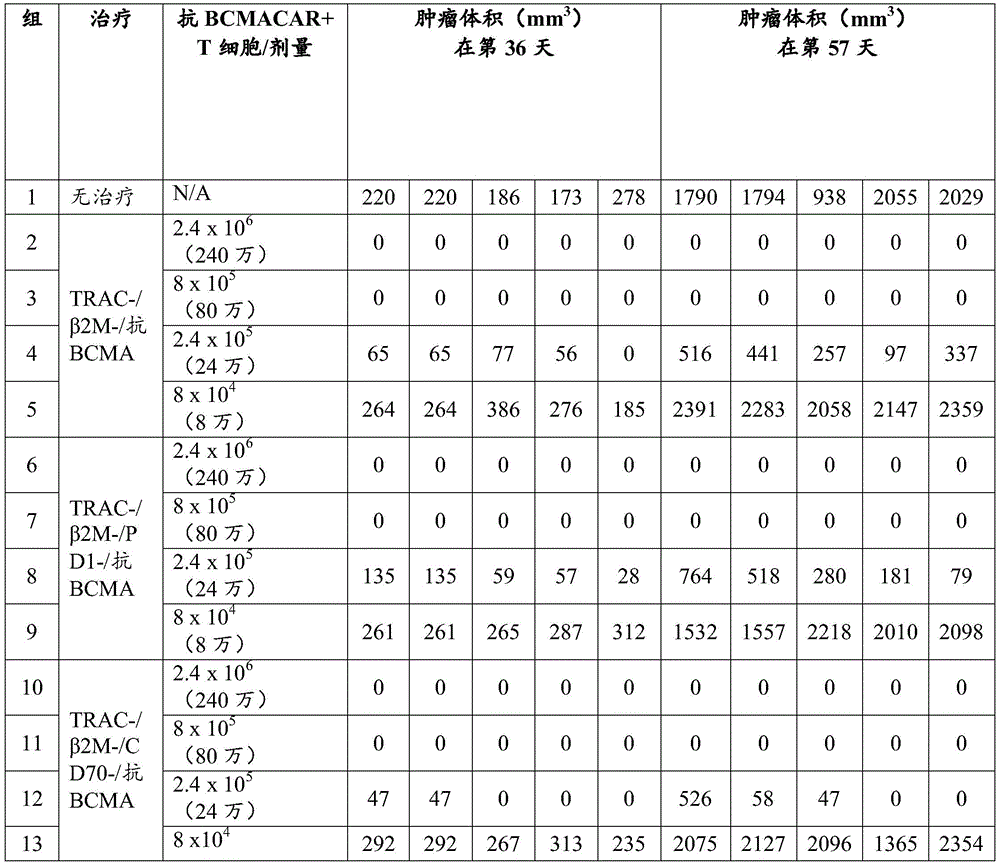

实例9.多敲除CAR T细胞保留细胞因子依赖性Example 9. Multiple knockout CAR T cells retain cytokine dependence
细胞因子依赖性。为了确定基因编辑是否导致不需要的脱靶编辑,从而可能产生具有不良特性(例如不受控制的细胞生长)的细胞,评估了基因编辑的CAR T细胞在不存在细胞因子和/或血清的情况下生长的能力。 Cytokine dependence . To determine whether gene editing results in unwanted off-target edits that may generate cells with undesirable properties such as uncontrolled cell growth, gene-edited CAR T cells were evaluated in the absence of cytokines and/or serum ability to grow.
抗CD70CAR T细胞:评估了TRAC-/β2M-/CD70-/抗CD70 CAR+细胞在不存在细胞因子和/或血清的情况下生长的能力。将5 x 106TRAC-/β2M-/CD70-/抗CD70 CAR+细胞铺板至细胞生产后约2周(第0天)。铺板后第7天和第14天,在完全培养基、无细胞因子(IL-2和IL-7)的5%人血清、或缺乏血清和细胞因子的基础培养基中计算活细胞的数量。在缺乏细胞因子的培养物中铺板第14天时未检测到任何细胞,这表明由于基因组编辑导致的任何潜在脱靶作用均未诱导细胞生长因子非依赖性生长/增殖(图31)。细胞仅在存在细胞因子(含有细胞因子的完全培养基)的情况下增殖,而在仅存在血清的情况下不增殖。因此,在体内,由于任何脱靶基因组编辑,细胞在不存在细胞因子、生长因子或抗原刺激的情况下可能不会生长。 Anti-CD70CAR T cells: The ability of TRAC- / β2M-/ CD70- /anti - CD70 CAR + cells to grow in the absence of cytokines and/or serum was assessed. 5 x 10⁶ TRAC- / β2M-/ CD70- /anti - CD70 CAR + cells were plated approximately 2 weeks after cell production (day 0). On
还评估了TRAC-/β2M-/CD70-/PD1-抗CD70 CAR+细胞在没有细胞因子和/或血清的情况下生长的能力。细胞产生后约2周(第0天)将2 x 106细胞铺板。铺板后直到26天,在完全培养基、无细胞因子(IL-2和IL-7)的5%人血清、或缺乏血清和细胞因子的基础培养基中计算活细胞的数量。在缺乏细胞因子的培养物中铺板第26天时未检测到任何细胞,这表明由于基因组编辑导致的任何潜在脱靶作用均未诱导细胞生长因子非依赖性生长/增殖(图32)。细胞仅在存在细胞因子(含有细胞因子的完全培养基)的情况下增殖,而在仅存在血清的情况下不增殖。因此,基因组编辑不会引起任何不良事件,这些不良事件会使细胞在没有细胞因子、生长因子或抗原刺激的情况下生长。The ability of TRAC-/β2M- / CD70- / PD1- anti - CD70 CAR + cells to grow in the absence of cytokines and/or serum was also assessed. About 2 weeks after cell generation (day 0) 2 x 10⁶ cells were plated. Up to 26 days after plating, the number of viable cells was counted in complete medium, 5% human serum without cytokines (IL-2 and IL-7), or basal medium lacking serum and cytokines. No cells were detected on day 26 plated in cytokine-deficient cultures, suggesting that cell growth factor-independent growth/proliferation was not induced by any potential off-target effects due to genome editing (Figure 32). Cells proliferated only in the presence of cytokines (complete medium containing cytokines), but not in the presence of serum alone. Thus, genome editing does not cause any adverse events that would allow cells to grow without cytokines, growth factors, or antigenic stimulation.
抗BCMA CAR+T细胞:评估了TRAC-/β2M-/CD70-/PD-1-/抗BCMA CAR+细胞在没有细胞因子和/或血清的情况下生长的能力。TRAC-/β2M-/CD70-/PD-1-/抗BCMA CAR+细胞也称为4XKO,BCMA CAR+细胞。按照实例6中所述的10次再激发,铺板1 x 10⁶个4X KO,BCMA CAR+细胞。铺板后第7天和第14天,在完全培养基、无细胞因子(IL-2和IL-7)的5%人血清、或缺乏血清和细胞因子的基础培养基中计算活细胞的数量。在缺乏细胞因子的培养物中铺板第13天时未检测到任何细胞,这表明由于基因组编辑导致的任何潜在脱靶作用均未诱导细胞生长因子非依赖性生长/增殖(图33)。细胞仅在存在细胞因子(含有细胞因子的完全培养基)的情况下增殖,而在仅存在血清的情况下不增殖。因此,在体内,细胞可能不会以不受控制的方式生长。 Anti-BCMA CAR+ T cells: The ability of TRAC- / β2M-/CD70- / PD - 1- /anti-BCMA CAR + cells to grow in the absence of cytokines and/or serum was assessed. TRAC- / β2M-/CD70- / PD - 1- /anti-BCMA CAR + cells are also known as 4XKO, BCMA CAR + cells. 1 x 10⁶ 4X KO, BCMA CAR+ cells were plated as described in Example 6 for 10 rechallenges. On
其他CAR T细胞:先前已经显示,本文示例的抗CD33 CAR+T细胞和抗CD19 CAR+T细胞仅在细胞因子存在下增殖,而在仅血清存在下不增殖。因此,在体内,这些细胞可能不会以不受控制的方式生长。 Other CAR T cells: It has been previously shown that the anti-CD33 CAR+ T cells and anti-CD19 CAR+ T cells exemplified herein proliferate only in the presence of cytokines, but not in the presence of serum alone. Therefore, in the body, these cells may not grow in an uncontrolled manner.
细胞因子释放测定。为了测量细胞因子的释放,将T细胞和靶细胞以所示比率共孵育24小时。按照制造商的说明(RD系统公司(RD Systems)),收集上清液培养基用于新板上的IL-2或IFNγELISA(RD系统公司)。Cytokine release assay. To measure cytokine release, T cells and target cells were co-incubated at the indicated ratios for 24 hours. Supernatant medium was collected for IL-2 or IFNy ELISA (RD Systems) on new plates following the manufacturer's instructions (RD Systems).
使用ELISA分析法分析在A498细胞存在下共培养时TRAC-/β2M-/CD70-/抗CD70 CAR+细胞产生白介素2(IL-2)的能力。三敲除TRAC-/β2M-/CD70-/抗CD70 CAR+T细胞和双敲除TRAC-/β2M-/抗CD70CAR+T细胞都分泌高水平的IL-2。出人意料地,当与A498细胞一起培养时,TRAC-/β2M-/CD70-/抗CD70 CAR+细胞分泌比TRAC-/β2M-/抗CD70 CAR+细胞更高水平的IL-2(图34)。这些结果表明,敲除CD70基因可使抗CD70CAR+T细胞分泌更多的IL-2。The ability of TRAC-/β2M-/ CD70- /anti - CD70 CAR + cells to produce interleukin 2 (IL-2) when co - cultured in the presence of A498 cells was analyzed using an ELISA assay. Both triple-knockout TRAC- / β2M- / CD70-/anti - CD70 CAR + T cells and double - knockout TRAC-/β2M-/anti - CD70CAR + T cells secreted high levels of IL-2. Unexpectedly, TRAC- / β2M-/ CD70- /anti - CD70 CAR + cells secreted higher levels of
实例10.多个敲除对A498肾癌细胞上抗CD70 CAR+T细胞的影响Example 10. Effects of Multiple Knockouts on Anti-CD70 CAR+ T Cells on A498 Renal Cancer Cells
多个敲除对抗CD70 CAR+T细胞功能的影响。Effects of multiple knockouts against CD70 CAR+ T cell function.
细胞杀伤测定。使用上述细胞杀伤测定确定多基因编辑杀伤A498肾癌细胞的能力。简而言之,TRAC-/β2M-/抗CD70 CAR+(2X KO,CD70 CAR+)、TRAC-/β2M-/PD-1-/抗CD70 CAR+(3X KO(PD-1),CD70 CAR+)、TRAC-/β2M-/CD70-/抗CD70 CAR+(3X KO(CD70),CD70 CAR+)和TRAC-/β2M-/PD-1-/CD70-/抗CD70 CAR+(4X KO,CD70 CAR+)细胞与CD70+粘附RCC衍生细胞系(A498细胞)以各种CAR T细胞:A498靶细胞比率孵育。Cell Killing Assay. The ability of the multigene editing to kill A498 renal cancer cells was determined using the cell killing assay described above. Briefly, TRAC- / β2M-/anti - CD70 CAR + (2X KO, CD70 CAR + ), TRAC- / β2M-/PD - 1- /anti-CD70 CAR + (3X KO(PD-1), CD70 CAR+ + ), TRAC- / β2M- / CD70-/anti - CD70 CAR + (3X KO(CD70), CD70 CAR + ) and TRAC-/β2M- / PD - 1- /CD70-/anti - CD70 CAR + (4X KO, CD70 CAR + ) cells were incubated with CD70 + adherent RCC-derived cell lines (A498 cells) at various CAR T cell:A498 target cell ratios.
在24小时共孵育后,TRAC-/β2M-/PD-1-/CD70-/抗CD70 CAR+细胞表现出对RCC衍生细胞的有效细胞杀伤(图35)。四TRAC-/β2M-/PD-1-/CD70-/抗CD70 CAR+T显示出比三敲除TRAC-/β2M-/PD-1-/抗CD70 CAR+T细胞更高的细胞杀伤效力,三敲除TRAC-/β2M-/PD-1-/抗CD70 CAR+T细胞显示出比双敲除TRAC-/β2M-/抗CD70 CAR+T细胞更高的效力(在低T细胞:A498比率为0.5:1和0.25:1时可见)。结果表明敲除CD70和PD-1基因使抗CD70 CAR+细胞具有更高的细胞杀伤效力。After 24 hours of co-incubation, TRAC − /β2M − /PD-1 − /CD70 − /anti-CD70 CAR + cells exhibited potent cell killing of RCC-derived cells ( FIG. 35 ). Quad - TRAC-/β2M-/PD - 1- /CD70-/anti - CD70 CAR + T cells showed higher cell-killing potency than triple - knockout TRAC-/β2M-/PD - 1- /anti-CD70 CAR + T cells, Triple knockout TRAC- / β2M-/PD - 1- /anti-CD70 CAR + T cells showed higher potency than double - knockout TRAC-/β2M-/anti - CD70 CAR + T cells (at low T cell:A498 ratios) visible at 0.5:1 and 0.25:1). The results showed that knockdown of CD70 and PD-1 genes made anti-CD70 CAR+ cells with higher cell-killing potency.
在以0.24:1的CAR T细胞:A948靶细胞比率共孵育24小时后,经基因编辑的细胞也表现出对RCC衍生细胞的有效杀伤。(图36)。具体而言,三敲除TRAC-/β2M-/CD70-/抗CD70CAR+T细胞和四敲除TRAC-/β2M-/PD-1-/CD70-/抗CD70 CAR+T细胞显示出比双抗敲除TRAC-/β2M-/抗-CD70 CAR+T或三敲除TRAC-/β2M-/PD-1-/抗CD70 CAR+T细胞更高的效力。这些数据表明,在抗CD70 CAR的背景下敲除CD70改善了抗CD70 CAR+T细胞的细胞杀伤能力。The gene-edited cells also exhibited potent killing of RCC-derived cells after 24 hours of co-incubation at a CAR T cell:A948 target cell ratio of 0.24:1. (Figure 36). Specifically, triple - knockout TRAC-/β2M-/CD70- / anti - CD70CAR + T cells and quad - knockout TRAC-/β2M-/PD - 1- /CD70-/anti - CD70 CAR + T cells showed more Knockout TRAC- / β2M-/anti - CD70 CAR + T or triple knockout TRAC- / β2M-/PD - 1- /anti-CD70 CAR + T cells were more potent. These data suggest that knockdown of CD70 in the context of anti-CD70 CAR improves the cell-killing capacity of anti-CD70 CAR + T cells.
细胞因子释放测定。如上所述进行细胞因子释放测定。当以0.25:1的比率(CAR T细胞:A498靶细胞)进行24小时共同孵育后在A498细胞存在下共孵育时,使用ELISA测定评估了双敲除,三敲除和四敲除抗CD70CAR+T细胞产生IL-2和干扰素γ(IFN-γ(IFN-g))的能力。测定了细胞共培养上清液中的IL-2和IFN-g。当与A498细胞一起培养时,三敲除TRAC-/β2M-/CD70-/抗CD70 CAR+T细胞和四敲除TRAC-/β2M-/PD-1-/CD70-/抗CD70 CAR+T细胞分泌最高水平的IFN-g(图37A)和IL-2(图37B)。Cytokine release assay. Cytokine release assays were performed as described above. Double-knockout, triple-knockout and quad-knockout anti-CD70CAR + were evaluated using an ELISA assay when co-incubated in the presence of A498 cells following 24-hour co-incubation at a ratio of 0.25:1 (CAR T cells:A498 target cells) The ability of T cells to produce IL-2 and interferon gamma (IFN-gamma (IFN-g)). IL-2 and IFN-g were determined in cell co-culture supernatants. Triple knockout TRAC- / β2M- / CD70-/anti - CD70 CAR + T cells and quad - knockout TRAC-/β2M-/PD - 1- /CD70-/anti - CD70 CAR + T cells when cultured with A498 cells The highest levels of IFN-g (FIG. 37A) and IL-2 (FIG. 37B) were secreted.
CD70敲除对耗尽标志物表达的影响Effects of CD70 knockout on the expression of depletion markers
在以上实例中使用的TRAC-/β2M-/抗CD70 CAR+(2X KO,CD70 CAR+)、TRAC-/β2M-/PD-1-/抗CD70 CAR+(3X KO(PD-1),CD70 CAR+)、TRAC-/β2M-/CD70-/抗CD70 CAR+(3X KO(CD70),CD70 CAR+)和TRAC-/β2M-/PD-1-/CD70-/抗CD70 CAR+(4X KO,CD70 CAR+)T细胞上评估PD-1和LAG3的耗尽标志物的水平。通过流式细胞术评估CD4+T细胞的PD-1表达(图38),并评估CD8+T细胞和CD4+T细胞的LAG3表达(分别为图39A和图39B)。TRAC-/β2M- / anti - CD70 CAR + (2X KO, CD70 CAR + ), TRAC- / β2M-/PD - 1- /anti-CD70 CAR + (3X KO(PD-1), CD70 used in the above examples CAR + ), TRAC- / β2M- / CD70-/anti - CD70 CAR + (3X KO(CD70), CD70 CAR + ) and TRAC-/β2M- / PD - 1- /CD70-/anti - CD70 CAR + (4X KO , CD70 CAR + ) T cells were assessed for levels of depletion markers of PD-1 and LAG3. CD4 + T cells were assessed for PD-1 expression by flow cytometry (Figure 38), and CD8 + T cells and CD4 + T cells were assessed for LAG3 expression (Figure 39A and Figure 39B, respectively).
数据表明,CD70 KO减少了CAR T细胞中的耗尽标志物表达。图38中的数据表明,如预期的那样,当敲除PD-1时,PD-1表达降低,而当敲除CD70时,PD-1表达也降低。The data indicated that CD70 KO reduced depletion marker expression in CAR T cells. The data in Figure 38 show that, as expected, PD-1 expression was reduced when PD-1 was knocked down, while PD-1 expression was also reduced when CD70 was knocked out.
图39A和39B中的数据显示敲除CD70减少CD4和CD8细胞中的LAG3表达标志物。The data in Figures 39A and 39B show that knockdown of CD70 reduces markers of LAG3 expression in CD4 and CD8 cells.
数据表明,敲除CD70可以特异性地减少CD8+和CD4+基因编辑的CAR+T细胞群的潜在耗尽,从而带来更好的治疗方法。The data suggest that knocking out CD70 can specifically reduce the potential depletion of CD8 + and CD4 + gene-edited CAR+ T cell populations, leading to better therapeutic approaches.
实例11.CD70 KO改善多种细胞类型中的细胞杀伤Example 11. CD70 KO improves cell killing in multiple cell types
CD70在各种癌细胞系中的表达。在各种癌细胞系中测量了相对CD70表达,以进一步评估抗CD70 CAR+T细胞杀伤各种癌症的能力。使用Alexa Fluor 647抗人CD70抗体(博奇公司目录号355115)通过FACS分析测量CD70表达。图40A(左图)显示了与其他肾癌细胞系A498、786-O,cacki-1和Caki-2相比,通过FACS测量的ACHN细胞中CD70的相对表达。另外,使用Alexa Fluor 647抗人CD70抗体(博奇公司目录号355115;图40A,右分图)或图40B中的FITC抗人CD70抗体(博奇公司货号目录号355105)通过FACS分析(表22,图40A和图40B)评估非肾癌细胞系的CD70表达。SNU-1(肠癌细胞)表现出与A498相似的高水平CD70表达(图40A,右分图)。SKOV-3(卵巢)、HuT78(淋巴瘤)、NCI-H1975(肺)和Hs-766T(胰腺)细胞系表现出的CD70表达水平与ACHN相似或更高,但低于A498(表22,图40B)。Expression of CD70 in various cancer cell lines. Relative CD70 expression was measured in various cancer cell lines to further assess the ability of anti-CD70 CAR + T cells to kill various cancers. CD70 expression was measured by FACS analysis using the Alexa Fluor 647 anti-human CD70 antibody (Boqi Cat. No. 355115). Figure 40A (left panel) shows the relative expression of CD70 in ACHN cells as measured by FACS compared to other renal cancer cell lines A498, 786-O, cacki-1 and Caki-2. In addition, FACS analysis (Table 22) was performed using Alexa Fluor 647 anti-human CD70 antibody (Boch Catalog No. 355115; Figure 40A, right panel) or FITC anti-human CD70 antibody in Figure 40B (Boch Catalog No. 355105). , Figure 40A and Figure 40B) Evaluation of CD70 expression in non-renal cancer cell lines. SNU-1 (intestinal cancer cells) exhibited high levels of CD70 expression similar to A498 (FIG. 40A, right panel). SKOV-3 (ovary), HuT78 (lymphoma), NCI-H1975 (lung) and Hs-766T (pancreas) cell lines exhibited CD70 expression levels similar to or higher than ACHN, but lower than that of A498 (Table 22, Fig. 40B).
表22.Table 22.


细胞杀伤测定。使用上述细胞杀伤测定,确定了多基因编辑的抗CD70CAR+细胞杀伤ACHN肾癌细胞的能力。TRAC-/β2M-/抗CD70 CAR+(2X KO,CD70 CAR+)、TRAC-/β2M-/PD-1-/抗CD70 CAR+(3X KO(PD-1),CD70CAR+)、TRAC-/β2M-/CD70-/抗CD70 CAR+(3X KO(CD70),CD70CAR+)和TRAC-/β2M-/PD-1-/CD70-/抗CD70 CAR+(4X KO,CD70 CAR+)细胞与粘附的RCC衍生的表达低水平CD70抗原的细胞系(ACHN细胞)(图40A显示了通过FACS测量的与其他肾癌细胞系A498、786-O、cacki-1和Caki-2相比,ACHN细胞中CD70的相对表达)以CAR T细胞:ACHN靶细胞比率为0.5:1(图40C)和0.25:1(图40D)一起孵育。在24小时共同孵育之后,经基因编辑的细胞表现出对RCC衍生的细胞的有效细胞杀伤(图40C和40D)。当敲除PD-1,当敲除CD70时,细胞显示出更高的效力,并且当敲除PD-1和CD70二者时,细胞显示出甚至稍微更高的效力。总之,PD-1或CD70或PD-1和CD70两者的敲除改善了ACHN细胞中抗CD70 CAR+细胞的细胞杀伤能力。Cell Killing Assay. Using the cell killing assay described above, the ability of multigene-edited anti-CD70CAR+ cells to kill ACHN renal cancer cells was determined. TRAC- / β2M-/anti - CD70 CAR + (2X KO,CD70CAR + ),TRAC- / β2M-/PD - 1- /anti-CD70 CAR + (3X KO(PD-1),CD70CAR + ),TRAC- / β2M- / CD70-/anti - CD70 CAR + (3X KO(CD70),CD70CAR + ) and TRAC-/β2M- / PD - 1- /CD70-/anti - CD70 CAR + (4X KO,CD70CAR + ) cells were associated with adhesion The attached RCC-derived cell line expressing low levels of CD70 antigen (ACHN cells) (Figure 40A shows ACHN cells compared to other renal cancer cell lines A498, 786-O, cacki-1 and Caki-2 as measured by FACS) Relative expression of CD70 in CAR T cells: ACHN target cell ratios of 0.5:1 (FIG. 40C) and 0.25:1 (FIG. 40D) were incubated. After 24 hours of co-incubation, the gene-edited cells exhibited potent cell killing of RCC-derived cells (Figures 40C and 40D). When PD-1 was knocked out, cells showed higher potency when CD70 was knocked out, and even slightly higher potency when both PD-1 and CD70 were knocked out. In conclusion, knockdown of PD-1 or CD70 or both PD-1 and CD70 improved the cell killing ability of anti-CD70 CAR+ cells in ACHN cells.
尽管发现ACHN细胞表达中等至低水平的CD70,但它们却出人意料地易受3X KO(PD-1),CD70 CAR+T细胞、3X KO(CD70),CD70 CAR+T细胞和4X KO CD70 CAR+T细胞杀伤(图40C和40D)。这表明高CD70表达并不是表达抗CD70 CAR的经基因编辑T细胞有效杀伤靶细胞的必要条件。此外,鉴于发现SNU-1、SK-OV-3、NCI-H1975和HS-766T细胞系上CD70的表达水平与ACHN相似或更高,因此预期抗CD70 CAR+T细胞会在杀伤这些癌细胞类型方面也特别有效。实际上,已发现TRAC-/β2M-/PD-1-/CD70-/抗CD70 CAR+(4X KO,CD70 CAR+)和TRAC-/β2M-/CD70-/抗CD70 CAR+(3X KO(CD70),CD70 CAR+)在共培养仅24小时后,就表现出出人意料的对多种实体瘤细胞系的有效杀伤(图40E显示被4X KO CAR+T细胞杀伤,图40F显示被3X KOCAR+T细胞杀伤)。3X KO,CD70 CAR+和4X KO,CD70 CAR+T细胞都以4:1的效应子:靶细胞比率杀伤>60%的肾脏、胰腺和卵巢肿瘤细胞(A498,ACHN,SK-OV-3和Hs-766T)以及以1:1的效应子:靶细胞比率是>50%。具有中至低CD70表达的癌细胞系(NCI-H1975,Calu-1和DU 145)的细胞杀伤仍然有效,其中以4:1的效应子:靶细胞比率在共培养24小时内>30%杀伤(图40E和40F)。较长时间(即96小时)暴露于3X KO或4X KO,CD70 CAR+T细胞会导致跨所有类型细胞的癌细胞杀伤增加,尤其是对于其中以1:1的效应子:靶细胞比率的杀伤>80%的SKOV-3、Hs-766T和NIC-H1975细胞(图40G)。Although ACHN cells were found to express moderate to low levels of CD70, they were unexpectedly susceptible to 3X KO (PD-1), CD70 CAR+ T cells, 3X KO (CD70), CD70 CAR+ T cells, and 4X KO CD70 CAR+ T cell killing (Figures 40C and 40D). This suggests that high CD70 expression is not required for efficient target cell killing by gene-edited T cells expressing anti-CD70 CARs. Furthermore, given that CD70 expression levels on SNU-1, SK-OV-3, NCI-H1975 and HS-766T cell lines were found to be similar to or higher than ACHN, anti-CD70 CAR + T cells are expected to be effective in killing these cancer cell types aspect is also particularly effective. Indeed, TRAC-/β2M- / PD - 1- /CD70-/anti - CD70 CAR + (4X KO, CD70 CAR + ) and TRAC- / β2M- / CD70-/anti - CD70 CAR + (3X KO (CD70 CAR+) have been found ), CD70 CAR + ) exhibited surprisingly potent killing of multiple solid tumor cell lines after only 24 hours of co-culture (Fig. cell killing). 3X KO, CD70 CAR+ and 4X KO, CD70 CAR+ T cells all killed >60% of kidney, pancreatic and ovarian tumor cells (A498, ACHN, SK-OV-3 and Hs) at a 4:1 effector:target ratio -766T) and at a 1:1 effector:target cell ratio was >50%. Cell killing of cancer cell lines with moderate to low CD70 expression (NCI-H1975, Calu-1 and DU 145) remained potent with >30% killing within 24 hours of co-culture at a 4:1 effector:target cell ratio (Figures 40E and 40F). Exposure to 3X KO or 4X KO for longer (i.e. 96 hours), CD70 CAR+ T cells resulted in increased cancer cell killing across all cell types, especially for those in which the effector:target ratio was 1:1 >80% of SKOV-3, Hs-766T and NIC-H1975 cells (Figure 40G).
通过视觉评估来评估SNU-1细胞的杀伤。Killing of SNU-1 cells was assessed by visual assessment.
还通过显微镜对SNU-1癌细胞进行了长期暴露于CAR+T细胞后的靶细胞杀伤评估。将SNU-1细胞以每孔100万个细胞的密度接种在6孔板中,并以4:1的效应子:靶比率与3X KO(CD70),抗CD70 CAR+T细胞混合。将共培养物孵育六(6)天,并通过显微镜评估存活癌细胞的存在。与对照孔相比,在含有TRAC-/β2M-/CD70-/抗CD70 CAR+T细胞的孔中消除了所有胃癌靶细胞(SNU-1),这表明癌细胞已在扩展的共培养情况下被抗CD70 CAR+T细胞完全消除。SNU-1 cancer cells were also assessed for target cell killing after chronic exposure to CAR T cells by microscopy. SNU-1 cells were seeded in 6-well plates at a density of 1 million cells per well and mixed with 3X KO(CD70), anti-CD70 CAR + T cells at a 4:1 effector:target ratio. Co-cultures were incubated for six (6) days and assessed by microscopy for the presence of viable cancer cells. All gastric cancer target cells (SNU-1) were depleted in wells containing TRAC- / β2M- / CD70-/anti - CD70 CAR + T cells compared to control wells, indicating that cancer cells have grown in expanded co-culture Completely eliminated by anti-CD70 CAR + T cells.
确定了抗CD70 CAR+T细胞选择性杀伤表达CD70的细胞的能力。设计了一种流式细胞术,以测试3X KO(CD70)(TRAC-/B2M-/CD70-)抗-CD70 CAR+T细胞对癌细胞悬浮液系(例如,称为“靶细胞”的K562、MM.1S和HuT78癌细胞)的杀伤。使用的两种靶细胞系是表达CD70的癌细胞(例如MM.1S和HuT78),而用作阴性对照癌细胞的第三种缺乏CD70的表达(例如K562)。将TRAC-/B2M-/CD70-/抗CD70 CAR+T细胞与表达CD70的MM.1S或HuT78细胞系或CD70阴性的K562细胞系共培养。用5μM efluor670(伊生物技术公司)标记靶细胞,洗涤,并且以每孔50,000个靶细胞的密度接种在96孔U型底板中。将靶细胞与TRAC-/B2M-/CD70-抗CD70CAR+T细胞以不同比率(CAR+T细胞与靶细胞的比率为0.5:1、1:1、2:1和4:1)共培养并孵育过夜。共培养24小时后确定靶细胞的杀伤。洗涤细胞,并向每个孔中加入200μL含有1:500稀释的5mg/mL DAPI(分子探针)的培养基(以计算死亡/垂死的细胞)。然后通过流式细胞术分析细胞,并对剩余的活靶细胞数量进行定量。The ability of anti-CD70 CAR+ T cells to selectively kill CD70-expressing cells was determined. A flow cytometry was designed to test 3X KO(CD70)(TRAC- / B2M-/ CD70- ) anti - CD70 CAR+ T cells against a cancer cell suspension line (e.g., K562 called "target cells" , MM.1S and HuT78 cancer cells). The two target cell lines used were CD70-expressing cancer cells (eg, MM.1S and HuT78), while a third, which was used as a negative control cancer cell, lacked CD70 expression (eg, K562). TRAC- / B2M-/ CD70- /anti - CD70 CAR+ T cells were co-cultured with CD70-expressing MM.1S or HuT78 cell lines or CD70-negative K562 cell lines. Target cells were labeled with 5 [mu]M efluor670 (Electronic Biotechnology), washed, and seeded in a 96-well U-bottom plate at a density of 50,000 target cells per well. Target cells were co - cultured with TRAC- /B2M-/CD70- anti -CD70CAR+ T cells at different ratios (CAR+ T cells to target cell ratios of 0.5:1, 1:1, 2:1 and 4:1) and Incubate overnight. Killing of target cells was determined after 24 hours of co-culture. Cells were washed and 200 μL of medium containing 5 mg/mL DAPI (Molecular Probes) at a 1:500 dilution was added to each well (to count dead/dying cells). Cells were then analyzed by flow cytometry and the number of remaining viable target cells was quantified.
图40H、图40I和图40J证明了TRAC-/B2M-/CD70-抗CD70 CAR+T细胞的选择性靶细胞杀伤。与3X KO(CD70)CAR+T细胞共培养24小时,即使在CAR+T细胞与表达CD70的靶细胞的0.5:1的低比率情况下,也几乎完全杀伤T细胞淋巴瘤细胞(HuT78)(图40J)。同样,24小时共培养导致在所有测试的CAR+T细胞与靶细胞比率下几乎完全杀伤多个骨髓瘤细胞(MM.1S)(图40I)。发现对靶细胞的杀伤具有选择性,因为TRAC-/B2M-/抗CD70 CAR+T细胞以任何测试的效应子:靶细胞比率都不诱导高于对照样品(例如,单独的癌细胞或与没有RNP的T细胞共培养)的水平的CD70缺陷型K562细胞的杀伤(图40H)。Figure 40H, Figure 40I and Figure 40J demonstrate selective target cell killing by TRAC-/B2M-/CD70- anti-CD70 CAR+ T cells. Co-culture with 3X KO(CD70) CAR+ T cells for 24 hours almost completely killed T-cell lymphoma cells (HuT78) even at a low 0.5:1 ratio of CAR+ T cells to CD70-expressing target cells (HuT78) ( Figure 40J). Likewise, 24-hour co-culture resulted in nearly complete killing of multiple myeloma cells (MM.1S) at all CAR+ T cell to target cell ratios tested (FIG. 40I). Killing of target cells was found to be selective, as TRAC-/B2M-/anti-CD70 CAR+ T cells did not induce higher than control samples at any of the tested effector:target cell ratios (e.g., cancer cells alone or with no Killing of CD70-deficient K562 cells at the level of RNP-T cell co-culture (FIG. 40H).
细胞因子释放测定。如上所述进行细胞因子释放测定。当以0.25:1的比率(CAR T细胞:ACHN靶细胞)进行24小时共同孵育后在ACHN细胞存在下共孵育时,使用ELISA测定评估了双敲除,三敲除和四敲除抗CD70CAR+T细胞产生IL-2和IFN-g的能力。测定了细胞共培养上清液中的IL-2和IFN-g。当与ACHN细胞一起培养时,三敲除TRAC-/β2M-/CD70-/抗CD70CAR+T细胞和四敲除TRAC-/β2M-/PD-1-/CD70-/抗CD70 CAR+T细胞分泌最高水平的IFN-g(图41)和IL-2(图41B)。总之,CD70或PD-1和CD70两者的敲除改善了ACHN细胞中抗CD70 CAR+细胞的细胞杀伤能力。Cytokine release assay. Cytokine release assays were performed as described above. Double-knockout, triple-knockout and quad-knockout anti-CD70CAR + were evaluated using an ELISA assay when co-incubated in the presence of ACHN cells following 24-hour co-incubation at a ratio of 0.25:1 (CAR T cells:ACHN target cells) The ability of T cells to produce IL-2 and IFN-g. IL-2 and IFN-g were determined in cell co-culture supernatants. When cultured with ACHN cells, triple knockout TRAC- / β2M-/CD70- / anti - CD70CAR + T cells and quad - knockout TRAC-/β2M-/PD - 1- /CD70-/anti - CD70CAR + T cells secreted The highest levels of IFN-g (FIG. 41) and IL-2 (FIG. 41B). In conclusion, knockdown of CD70 or both PD-1 and CD70 improved the cell killing ability of anti-CD70 CAR+ cells in ACHN cells.
实例12.CD70 KO在抗CD70 CAR+T细胞中的功效:NOG小鼠的肿瘤异种移植物模型Example 12. Efficacy of CD70 KO in anti-CD70 CAR+ T cells: tumor xenograft model in NOG mice
卵巢肿瘤模型中的治疗Treatment in Ovarian Tumor Models
使用小鼠皮下卵巢癌(SKOV-3)肿瘤异种移植物模型,体内评估了表达抗CD70 CAR的T细胞消除表达中等水平CD70的卵巢腺癌细胞的能力。Using a mouse subcutaneous ovarian cancer (SKOV-3) tumor xenograft model, the ability of anti-CD70 CAR-expressing T cells to deplete ovarian adenocarcinoma cells expressing intermediate levels of CD70 was assessed in vivo.
如上使用CRISPR/Cas9和AAV6(参见例如,实例3),以使用靶向CD70的CAR构建体(SEQ ID NO:45;SEQ ID NO:46)产生缺乏TCR、β2M、CD70的表达但伴随TRAC基因座的表达的人T细胞。在这个实例中首先用3种不同的Cas9电穿孔激活的T细胞:包含靶向TRAC(SEQ IDNO:40)、β2M(SEQ ID NO:41)和CD70(SEQ ID NO:36或37)的sgRNA的sgRNA RNP复合物。TRAC基因座处的DNA双链断裂通过同源定向修复,使用包含供体模板((SEQ ID NO:44;SEQ IDNO:45)(编码包含SEQ ID NO:45氨基酸序列的抗CD70 CAR))的AAV6-递送的DNA模板进行修复,所述供体模板含有侧翼于嵌合抗原受体盒(基因表达的-/+调控元件)的TRAC基因座的右和左同源臂。CRISPR/Cas9 and AAV6 were used as above (see eg, Example 3) to generate expression lacking TCR, β2M, CD70 but with the TRAC gene using a CD70-targeting CAR construct (SEQ ID NO:45; SEQ ID NO:46) expression of locus in human T cells. Activated T cells were first electroporated in this example with 3 different Cas9s: comprising sgRNAs targeting TRAC (SEQ ID NO:40), β2M (SEQ ID NO:41) and CD70 (SEQ ID NO:36 or 37) sgRNA-RNP complexes. DNA double-strand breaks at the TRAC locus were repaired by homology-directed repair using a DNA-binding template comprising a donor template ((SEQ ID NO:44; SEQ ID NO:45) (encoding an anti-CD70 CAR comprising the amino acid sequence of SEQ ID NO:45)) AAV6-delivered DNA templates containing right and left homology arms flanking the TRAC locus of the chimeric antigen acceptor cassette (-/+ regulatory elements of gene expression) were repaired.
所得的经修饰的T细胞是3X KO(TRAC-/β2M-/CD70-)抗CD70 CAR+T细胞。使用转化药物开发有限责任公司(斯科茨代尔,亚利桑那州)采用的方法,在NOG小鼠中评估了这些抗CD70 CAR+T细胞改善由CD70+卵巢癌细胞系引起的疾病的能力。简言之,开始研究前5-7天,将12只5-8周龄雌性CIEA NOG(NOD.Cg-PrkdcscidI12rgtm1Sug/JicTac)小鼠单独圈养在通风微隔离的笼子里,在无病原体的条件下维持。小鼠在右后侧腹皮下接种5x106个SKOV-3卵巢癌细胞/小鼠。当平均肿瘤大小达到25-75mm3(约50mm3的靶)时,将小鼠进一步分为两个治疗组,如表23所示。在第1天,根据表23,治疗组2接受单次200μl静脉内剂量的抗CD70CAR+T细胞。The resulting modified T cells were 3X KO (TRAC-/β2M-/CD70-) anti-CD70 CAR+ T cells. The ability of these anti-CD70 CAR+ T cells to ameliorate disease caused by a CD70+ ovarian cancer cell line was assessed in NOG mice using methods employed by Translational Drug Development, LLC (Scottsdale, AZ). Briefly, 12 5- to 8-week-old female CIEA NOG (NOD.Cg-Prkdc scid I12rg tm1Sug /JicTac) mice were individually housed in ventilated micro-isolated cages in pathogen-free cages 5-7 days prior to the start of the study. maintained under the conditions. Mice were inoculated subcutaneously on the right rear flank with 5x10 6 SKOV-3 ovarian cancer cells/mouse. When the mean tumor size reached 25-75 mm 3 (about 50 mm 3 target), the mice were further divided into two treatment groups, as shown in Table 23. On
表23.治疗组Table 23. Treatment groups

从治疗开始日起每周2次测量肿瘤体积。到注射后第9天,与未治疗的动物相比,用抗CD70 CAR T细胞治疗的肿瘤开始显示出肿瘤体积的减少。到注射后第17天,用抗CD70CAR T细胞治疗的小鼠中的CD70+卵巢癌肿瘤已完全消除。到注射后第44天,在治疗的动物中肿瘤生长的这种完全消退得以维持,随后用抗CD70 CAR T细胞治疗的5只小鼠中有4只保持无肿瘤直至观察结束(第69天)(图42A)。这些数据表明3X KO(TRAC-/β2M-/CD70-)抗CD70CAR+细胞在治疗人卵巢肿瘤方面具有高体内效力。Tumor volumes were measured twice a week from the start of treatment. By
非小细胞肺癌(NSCLC)肿瘤模型中的治疗Treatment in non-small cell lung cancer (NSCLC) tumor models
使用皮下肺癌(NCI-H1975)肿瘤小鼠异种移植物模型在体内评估了表达CD70 CAR的T细胞消除表达中等水平CD70的肺腺癌细胞的能力。The ability of CD70 CAR-expressing T cells to deplete lung adenocarcinoma cells expressing intermediate levels of CD70 was assessed in vivo using a subcutaneous lung cancer (NCI-H1975) tumor mouse xenograft model.
如上使用CRISPR/Cas9和AAV6(参见例如,实例3),以使用靶向CD70的CAR构建体(SEQ ID NO:43;SEQ ID NO:44)创建缺乏TCR、β2M、CD70的表达但伴随TRAC基因座的表达的人T细胞)。在这个实例中首先用3种不同的Cas9电穿孔激活的T细胞:包含靶向TRAC(SEQ IDNO:40)、β2M(SEQ ID NO:41)和CD70(SEQ ID NO:36或37)的sgRNA的sgRNA RNP复合物。TRAC基因座处的DNA双链断裂通过同源定向修复,使用AAV6-递送的DNA模板((SEQ ID NO:43;SEQ ID NO:44)(编码包含SEQ ID NO:45氨基酸序列的抗CD70 CAR))进行修复,所述供体模板含有侧翼于嵌合抗原受体盒(基因表达的-/+调控元件)的TRAC基因座的右和左同源臂。CRISPR/Cas9 and AAV6 were used as above (see eg, Example 3) to create expression lacking TCR, β2M, CD70 but concomitant TRAC gene using a CAR construct targeting CD70 (SEQ ID NO:43; SEQ ID NO:44) expression of locus in human T cells). Activated T cells were first electroporated in this example with 3 different Cas9s: comprising sgRNAs targeting TRAC (SEQ ID NO:40), β2M (SEQ ID NO:41) and CD70 (SEQ ID NO:36 or 37) sgRNA-RNP complexes. DNA double-strand breaks at the TRAC locus were repaired by homology directed repair using an AAV6-delivered DNA template ((SEQ ID NO:43; SEQ ID NO:44) (encoding an anti-CD70 CAR comprising the amino acid sequence of SEQ ID NO:45) )) were repaired with the donor template containing the right and left homology arms of the TRAC locus flanking the chimeric antigen acceptor cassette (-/+ regulatory elements of gene expression).
所得的经修饰的T细胞是3X KO(TRAC-/β2M-/CD70-)抗CD70 CAR+(具有41BB共刺激结构域)T细胞。使用转化药物开发有限责任公司(斯科茨代尔,亚利桑那州)采用的方法,在NOG小鼠中评估了这些抗CD70CAR+T细胞改善由CD70+肺癌细胞系引起的疾病的能力。简言之,开始研究前5-7天,将12只5-8周龄雌性CIEA NOG(NOD.Cg-PrkdcscidI12rgtm1Sug/JicTac)小鼠单独圈养在通风微隔离的笼子里,在无病原体的条件下维持。小鼠在右后侧腹皮下接种5 x 106个NCI-H1975肺癌细胞/小鼠。当平均肿瘤大小达到25-75mm3(约50mm3的靶)时,将小鼠进一步分为2个治疗组,如表24所示。在第1天,根据表24,治疗组2接受单次200μl静脉内剂量的抗CD70CAR+T细胞。The resulting modified T cells were 3X KO (TRAC-/β2M-/CD70-) anti-CD70 CAR+ (with 41BB costimulatory domain) T cells. The ability of these anti-CD70 CAR+ T cells to ameliorate disease caused by the CD70+ lung cancer cell line was assessed in NOG mice using methods employed by Translational Drug Development, LLC (Scottsdale, AZ). Briefly, 12 5- to 8-week-old female CIEA NOG (NOD.Cg-Prkdc scid I12rg tm1Sug /JicTac) mice were individually housed in ventilated micro-isolated cages in pathogen-free cages 5-7 days prior to the start of the study. maintained under the conditions. Mice were inoculated subcutaneously on the right rear flank with 5 x 10 6 NCI-H1975 lung cancer cells/mouse. When the mean tumor size reached 25-75 mm 3 (about 50 mm 3 target), the mice were further divided into 2 treatment groups, as shown in Table 24. On
表24.治疗组Table 24. Treatment groups

从治疗开始日起每周2次测量肿瘤体积。到注射后第12天,与未治疗的动物相比,用抗CD70 CAR T细胞治疗的肿瘤开始显示出肿瘤体积的减少。到注射后第33天,治疗动物的肿瘤完全消退。用抗CD70 CAR T细胞治疗导致对已建立的H1975肺癌异种移植物产生有效活性到注射后40天(长达40天,所有小鼠中的肿瘤再生长被抑制,肿瘤大小<100mm3),接着肿瘤开始生长。(图42B)。这些数据表明3X KO(TRAC-/β2M-/CD70-)抗CD70CAR+细胞在体内具有针对抗人CD70+肺癌肿瘤的有效活性。Tumor volumes were measured twice a week from the start of treatment. By
胰腺肿瘤模型中的治疗Treatment in Pancreatic Tumor Models
使用小鼠的皮下胰腺(Hs 766T)肿瘤异种移植物模型,在体内评估了表达CD70CAR的T细胞消除表达中等水平CD70的胰腺癌细胞的能力。Using a subcutaneous pancreatic (
如上使用CRISPR/Cas9和AAV6(参见例如,实例3),以使用靶向CD70的CAR构建体(SEQ ID NO:43;SEQ ID NO:44)创建缺乏TCR、β2M、CD70的表达但伴随TRAC基因座的表达的人T细胞)。在这个实例中首先用3种不同的Cas9电穿孔激活的T细胞:包含靶向TRAC(SEQ IDNO:40)、β2M(SEQ ID NO:41)和CD70(SEQ ID NO:36或37)的sgRNA的sgRNA RNP复合物。TRAC基因座处的DNA双链断裂通过同源定向修复,使用AAV6-递送的DNA模板((SEQ ID NO:43;SEQ ID NO:44)(编码包含SEQ ID NO:45氨基酸序列的抗CD70 CAR))进行修复,所述供体模板含有侧翼于嵌合抗原受体盒(基因表达的-/+调控元件)的TRAC基因座的右和左同源臂。CRISPR/Cas9 and AAV6 were used as above (see eg, Example 3) to create expression lacking TCR, β2M, CD70 but concomitant TRAC gene using a CAR construct targeting CD70 (SEQ ID NO:43; SEQ ID NO:44) expression of locus in human T cells). Activated T cells were first electroporated in this example with 3 different Cas9s: comprising sgRNAs targeting TRAC (SEQ ID NO:40), β2M (SEQ ID NO:41) and CD70 (SEQ ID NO:36 or 37) sgRNA-RNP complexes. DNA double-strand breaks at the TRAC locus were repaired by homology directed repair using an AAV6-delivered DNA template ((SEQ ID NO:43; SEQ ID NO:44) (encoding an anti-CD70 CAR comprising the amino acid sequence of SEQ ID NO:45) )) were repaired with the donor template containing the right and left homology arms of the TRAC locus flanking the chimeric antigen acceptor cassette (-/+ regulatory elements of gene expression).
所得的经修饰的T细胞是3X KO(TRAC-/β2M-/CD70-)抗CD70 CAR+T细胞。使用转化药物开发有限责任公司(斯科茨代尔,亚利桑那州)采用的方法,在NOG小鼠中评估了这些抗CD70 CAR+T细胞改善由CD70+胰腺癌细胞系引起的疾病的能力。简言之,开始研究前5-7天,将12只5-8周龄雌性CIEA NOG(NOD.Cg-PrkdcscidI12rgtm1Sug/JicTac)小鼠单独圈养在通风微隔离的笼子里,在无病原体的条件下维持。小鼠在右后侧腹皮下接种5x106个Hs766T胰腺癌细胞。当平均肿瘤大小达到25-75mm3(约50mm3的靶)时,将小鼠进一步分为2个治疗组,如表25所示。在第1天,根据表25,治疗组2接受200μl的单剂量静脉内抗CD70 CAR+T细胞。The resulting modified T cells were 3X KO (TRAC-/β2M-/CD70-) anti-CD70 CAR+ T cells. The ability of these anti-CD70 CAR+ T cells to ameliorate disease caused by a CD70+ pancreatic cancer cell line was assessed in NOG mice using methods employed by Translational Drug Development, LLC (Scottsdale, AZ). Briefly, 12 5- to 8-week-old female CIEA NOG (NOD.Cg-Prkdc scid I12rg tm1Sug /JicTac) mice were individually housed in ventilated micro-isolated cages in pathogen-free cages 5-7 days prior to the start of the study. maintained under the conditions. Mice were inoculated subcutaneously with 5x10 6 Hs766T pancreatic cancer cells in the right posterior flank. When the mean tumor size reached 25-75 mm 3 (about 50 mm 3 target), the mice were further divided into 2 treatment groups as shown in Table 25. On
表25.治疗组Table 25. Treatment groups

从治疗开始日起每周2次测量肿瘤体积。注射后第15天,用抗CD70CAR T细胞治疗的肿瘤开始在所有治疗的小鼠中显示出肿瘤体积的减少。用抗CD70 CAR+T细胞治疗有效减小了所有被测小鼠中CD70+胰腺癌肿瘤的大小(<37mm3),其中在研究期间(直到第67天)没有进一步增长的迹象(图42C)。这些数据表明3X KO(TRAC-/β2M-/CD70-)抗CD70 CAR+细胞体内诱导人CD70+胰腺癌肿瘤消退,对已建立的Hs766T胰腺癌异种移植物具有有效活性并且应答持久超出治疗开始后60天。Tumor volumes were measured twice a week from the start of treatment. On
皮肤T细胞淋巴瘤肿瘤异种移植物模型中的治疗Treatment in a Tumor Xenograft Model of Cutaneous T-Cell Lymphoma
使用小鼠皮下T细胞淋巴瘤(Hu T78)肿瘤异种移植物模型,在体内评估了表达抗CD70 CAR的T细胞消除T细胞淋巴瘤的能力。Using a mouse subcutaneous T-cell lymphoma (Hu T78) tumor xenograft model, the ability of T cells expressing an anti-CD70 CAR to eliminate T-cell lymphoma was assessed in vivo.
如上使用CRISPR/Cas9和AAV6(参见例如,实例3),以使用靶向CD70的CAR构建体(SEQ ID NO:43;SEQ ID NO:44)创建缺乏TCR、β2M、CD70的表达但伴随TRAC基因座的表达的人T细胞)。在这个实例中首先用3种不同的Cas9电穿孔激活的T细胞:包含靶向TRAC(SEQ IDNO:40)、β2M(SEQ ID NO:41)和CD70(SEQ ID NO:36或37)的sgRNA的sgRNA RNP复合物。TRAC基因座处的DNA双链断裂通过同源定向修复,使用AAV6-递送的DNA模板((SEQ ID NO:43;SEQ ID NO:44)(编码包含SEQ ID NO:45氨基酸序列的抗CD70 CAR))进行修复,所述供体模板含有侧翼于嵌合抗原受体盒(基因表达的-/+调控元件)的TRAC基因座的右和左同源臂。CRISPR/Cas9 and AAV6 were used as above (see eg, Example 3) to create expression lacking TCR, β2M, CD70 but concomitant TRAC gene using a CAR construct targeting CD70 (SEQ ID NO:43; SEQ ID NO:44) expression of locus in human T cells). Activated T cells were first electroporated in this example with 3 different Cas9s: comprising sgRNAs targeting TRAC (SEQ ID NO:40), β2M (SEQ ID NO:41) and CD70 (SEQ ID NO:36 or 37) sgRNA-RNP complexes. DNA double-strand breaks at the TRAC locus were repaired by homology directed repair using an AAV6-delivered DNA template ((SEQ ID NO:43; SEQ ID NO:44) (encoding an anti-CD70 CAR comprising the amino acid sequence of SEQ ID NO:45) )) were repaired with the donor template containing the right and left homology arms of the TRAC locus flanking the chimeric antigen acceptor cassette (-/+ regulatory elements of gene expression).
所得的经修饰的T细胞是3X KO(TRAC-/β2M-/CD70-)抗CD70 CAR+T细胞。使用转化药物开发有限责任公司(斯科茨代尔,亚利桑那州)采用的方法,在NOG小鼠中评估了这些抗CD70 CAR+T细胞改善由CD70+T细胞淋巴瘤细胞系引起的疾病的能力。简言之,开始研究前5-7天,将12只5-8周龄雌性CIEA NOG(NOD.Cg-PrkdcscidI12rgtm1Sug/JicTac)小鼠单独圈养在通风微隔离的笼子里,在无病原体的条件下维持。小鼠在右后侧腹皮下接种3 x 106个HuT78 T细胞淋巴瘤小鼠。当平均肿瘤大小达到25-75mm3(约50mm3的靶)时,将小鼠进一步分为2个治疗组,如表26所示。在第1天,根据表26,治疗组2接受200μl的单剂量静脉内抗CD70CAR+T细胞。The resulting modified T cells were 3X KO (TRAC-/β2M-/CD70-) anti-CD70 CAR+ T cells. The ability of these anti-CD70 CAR+ T cells to ameliorate disease caused by a CD70+ T-cell lymphoma cell line was assessed in NOG mice using methods employed by Translational Drug Development, LLC (Scottsdale, AZ). . Briefly, 12 5- to 8-week-old female CIEA NOG (NOD.Cg-Prkdc scid I12rg tm1Sug /JicTac) mice were individually housed in ventilated micro-isolated cages in pathogen-free cages 5-7 days prior to the start of the study. maintained under the conditions. Mice were inoculated subcutaneously with 3 x 10 6 HuT78 T-cell lymphoma mice on the right rear flank. When the average tumor size reached 25-75 mm 3 (about 50 mm 3 target), the mice were further divided into 2 treatment groups, as shown in Table 26. On
表26.治疗组Table 26. Treatment groups

从治疗开始日起每周2次测量肿瘤体积。注射后第12天,用抗CD70CAR T细胞治疗的肿瘤开始在所有治疗的小鼠中显示出肿瘤体积的减少。在第15天,用抗CD70 CAR+T细胞治疗有效地减小了所有被测小鼠中CD70+T细胞淋巴瘤肿瘤的大小(图42C)。这些数据表明,3X KO(TRAC-/β2M-/CD70-)抗CD70 CAR+细胞体内诱导人CD70+T细胞淋巴瘤肿瘤消退,对已建立的HuT78 T细胞淋巴瘤异种移植物具有有效活性。Tumor volumes were measured twice a week from the start of treatment. On
序列总结Sequence Summary
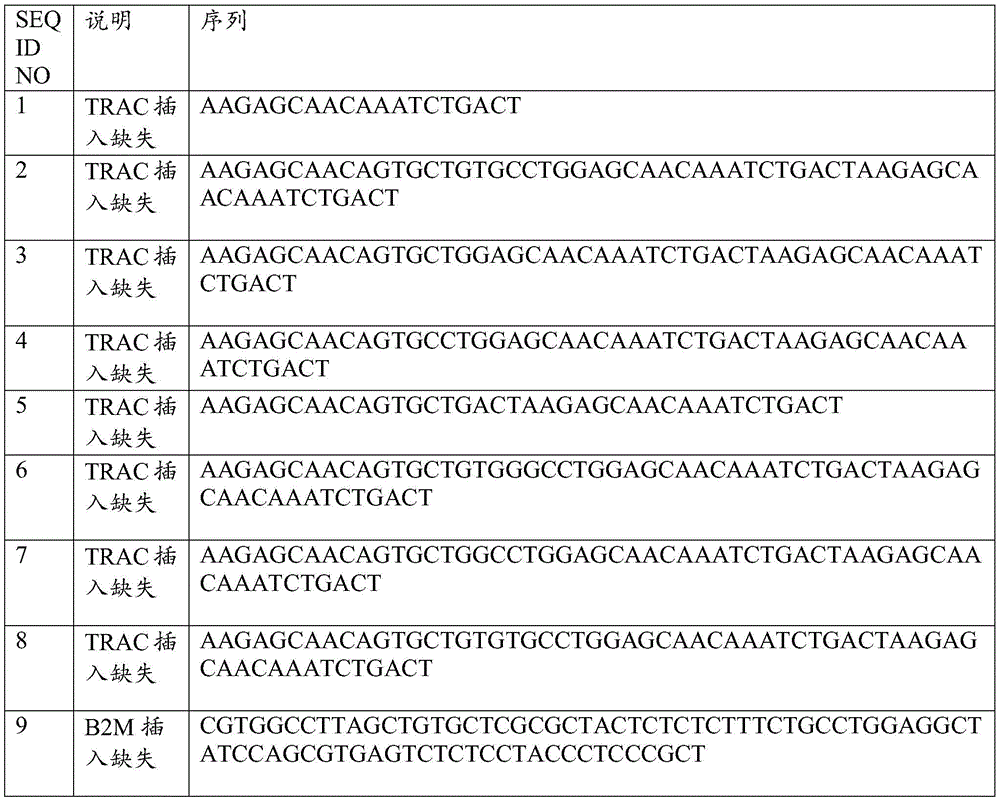
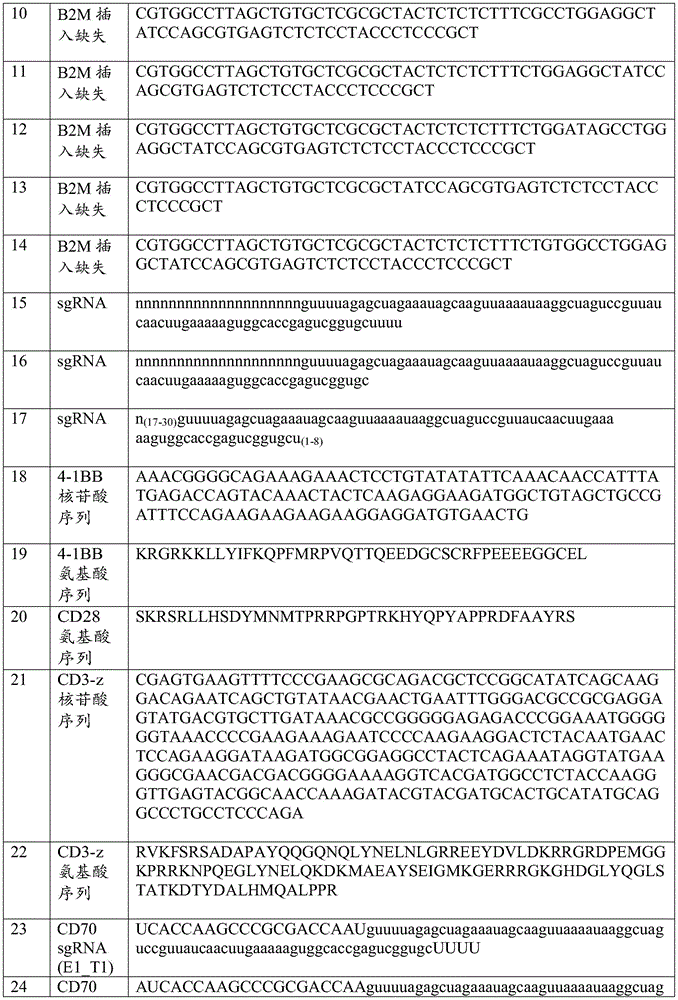

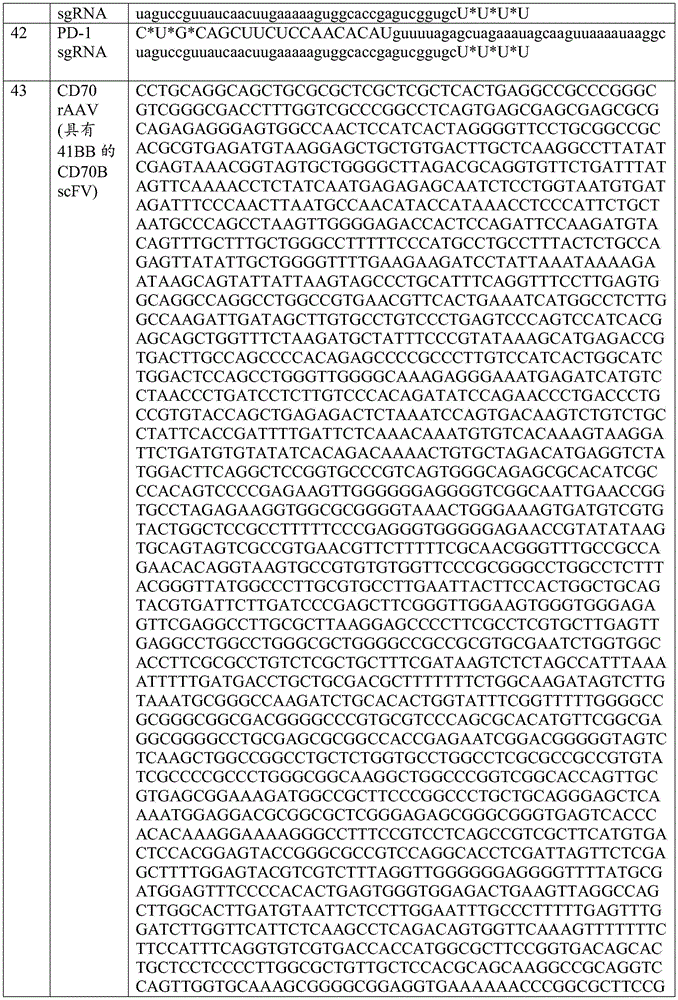


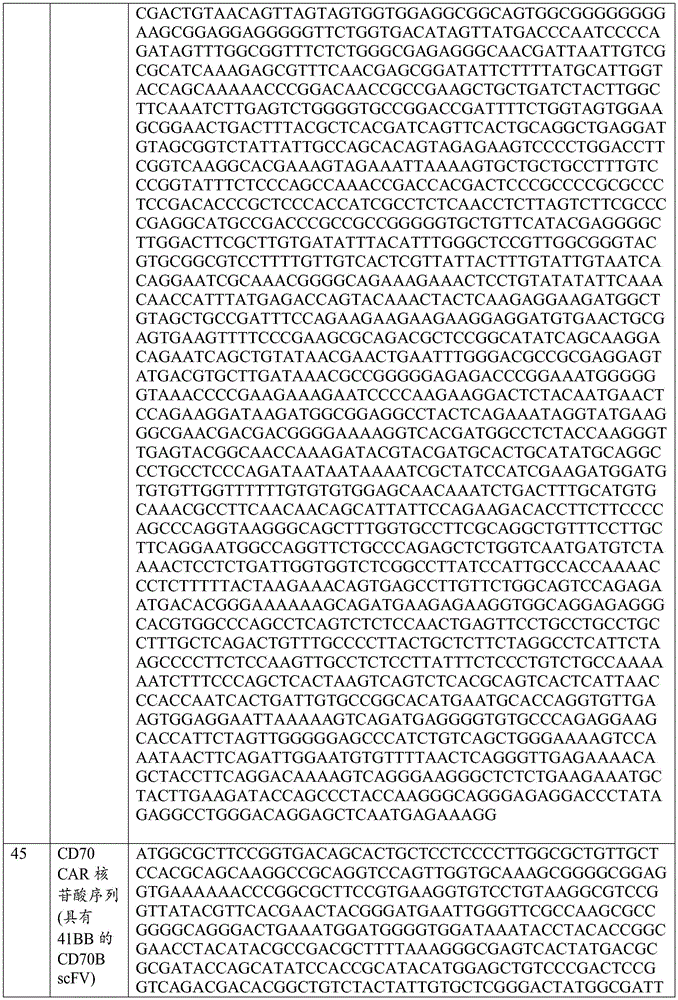
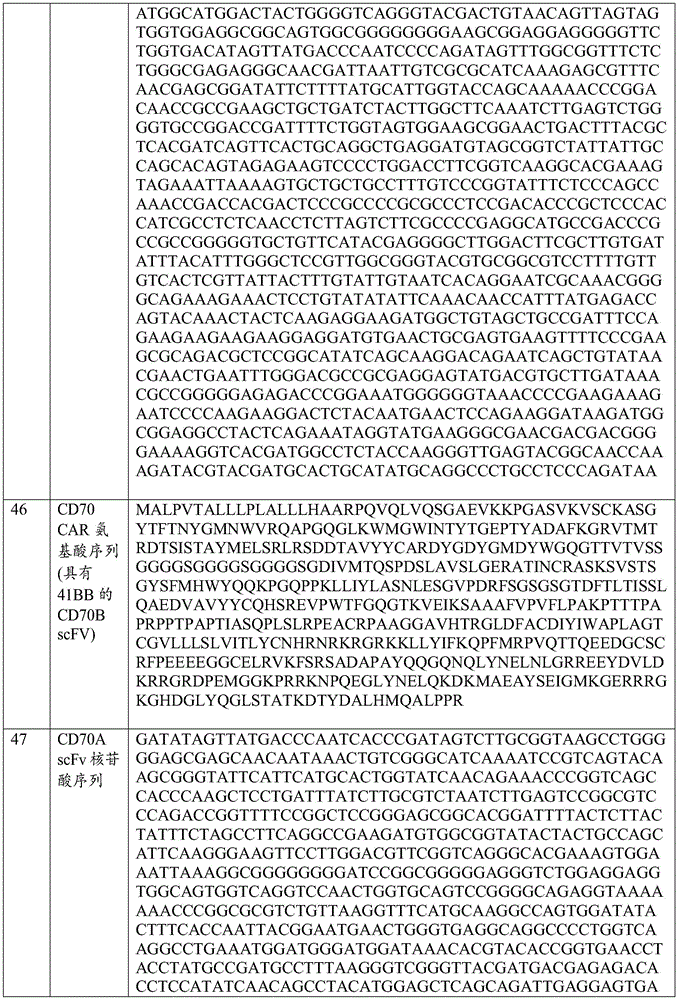
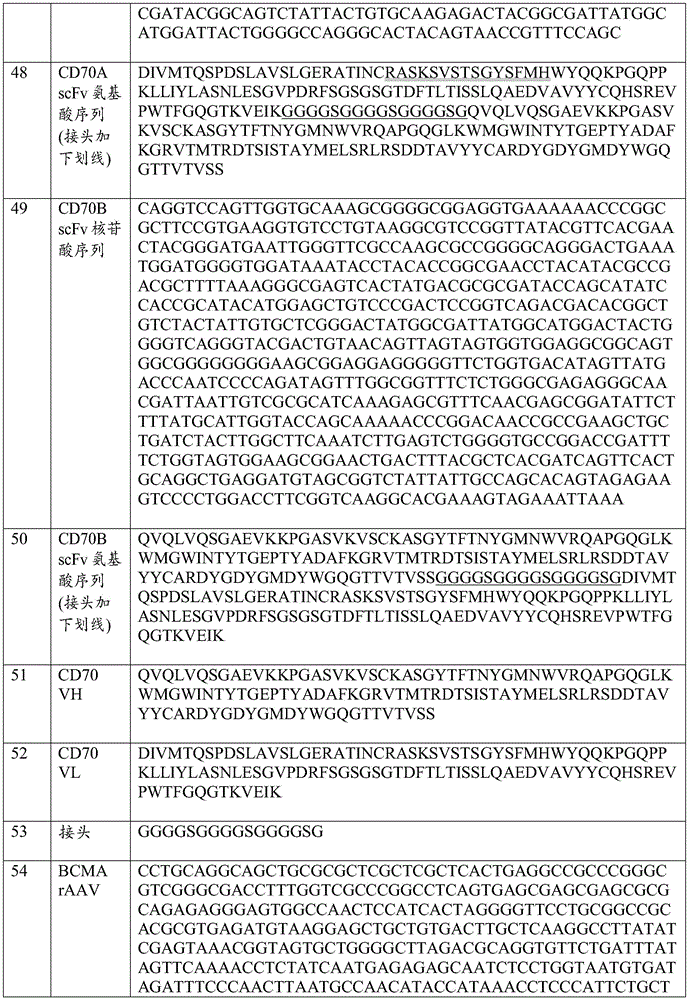

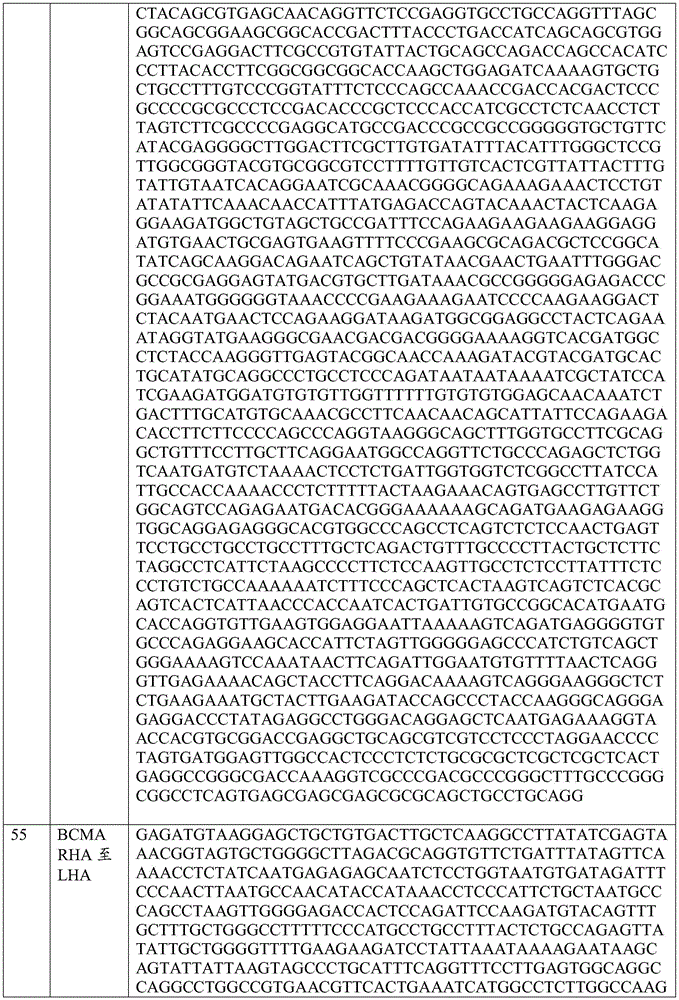
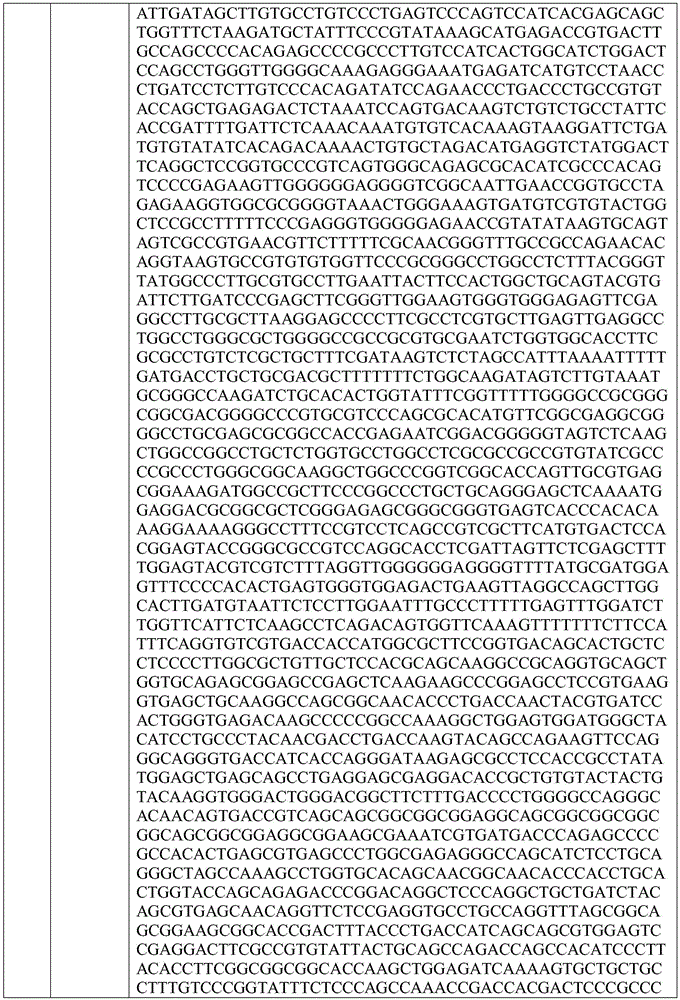

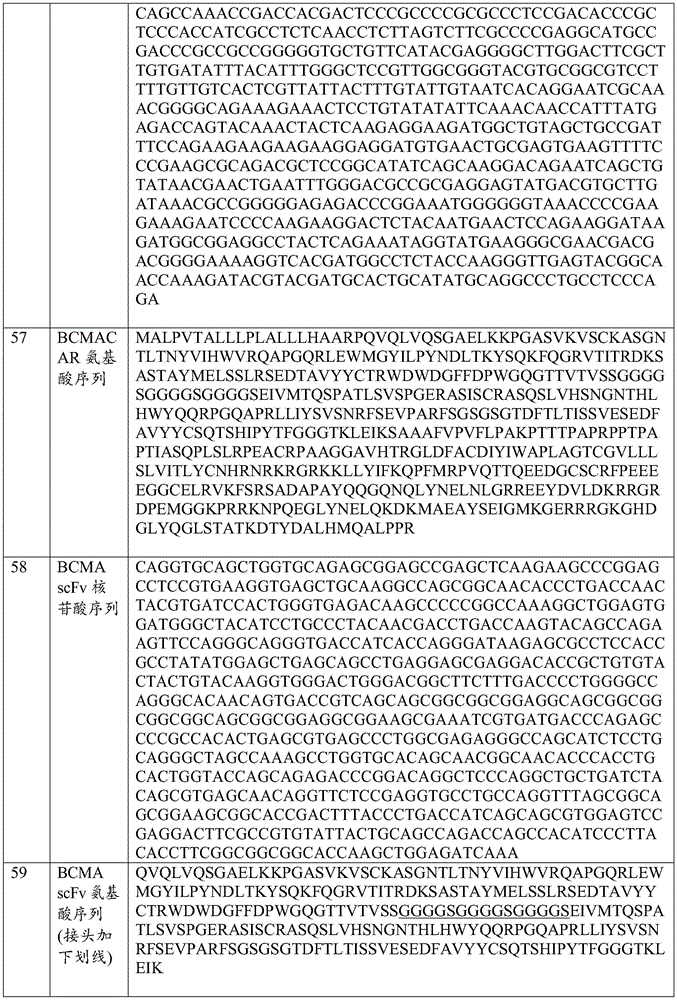


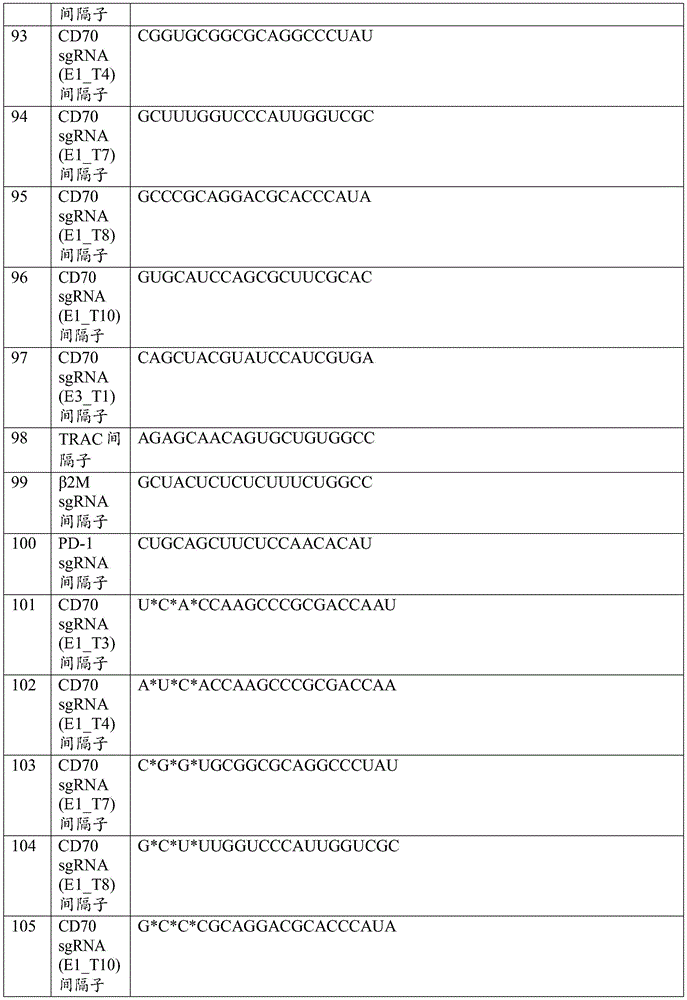


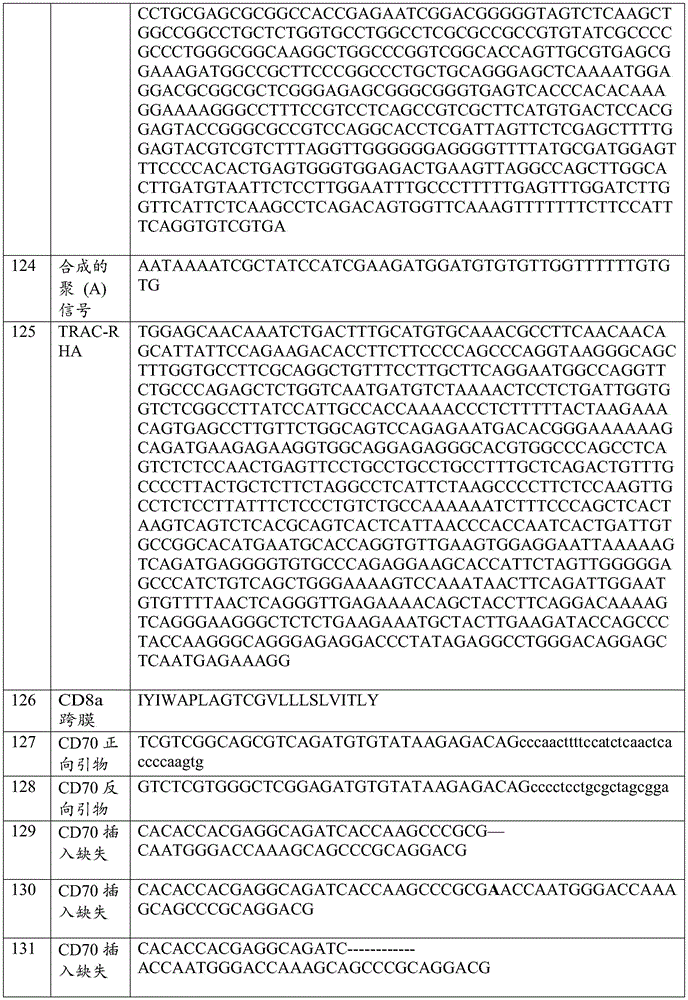
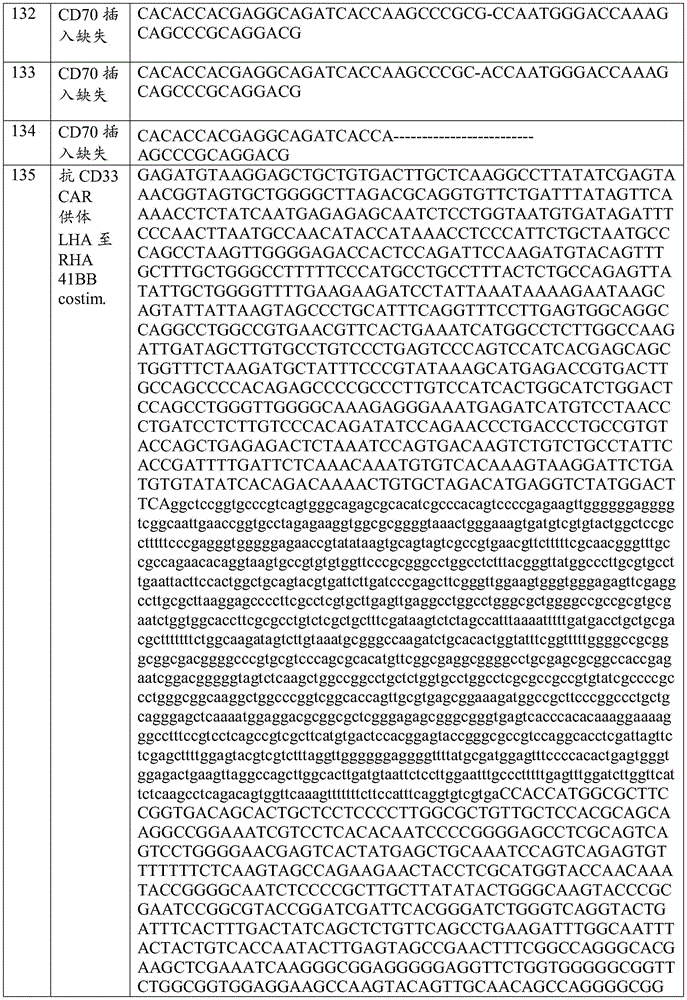

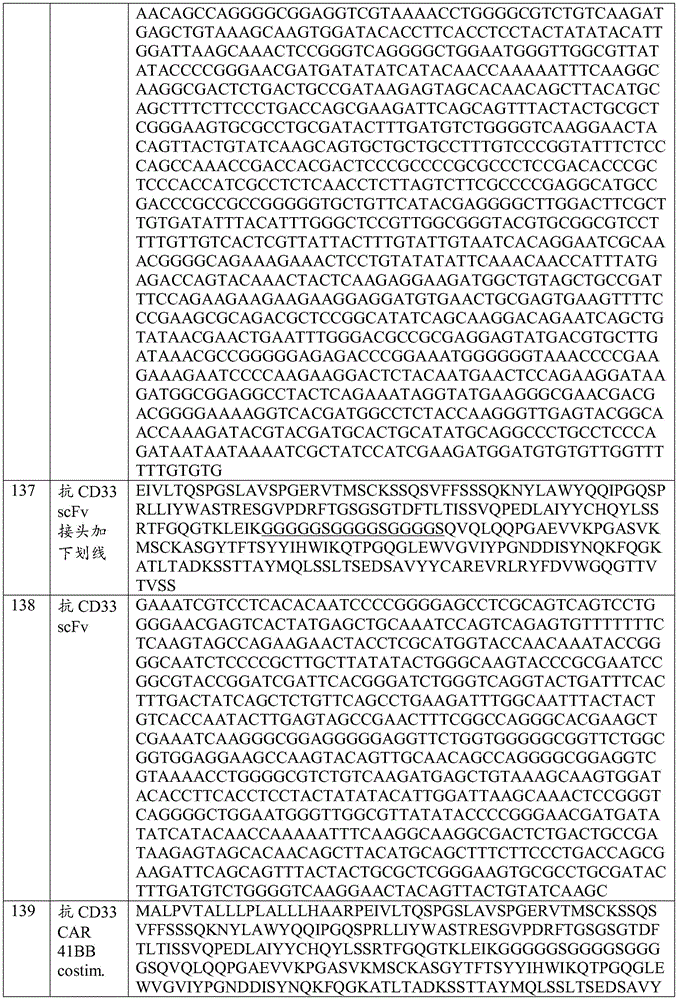

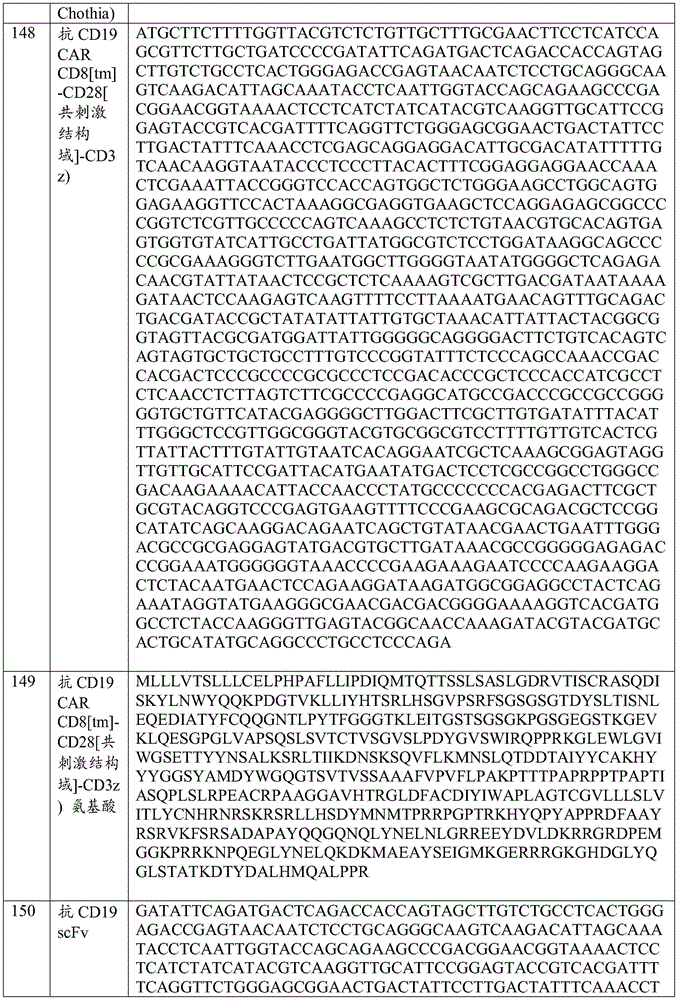
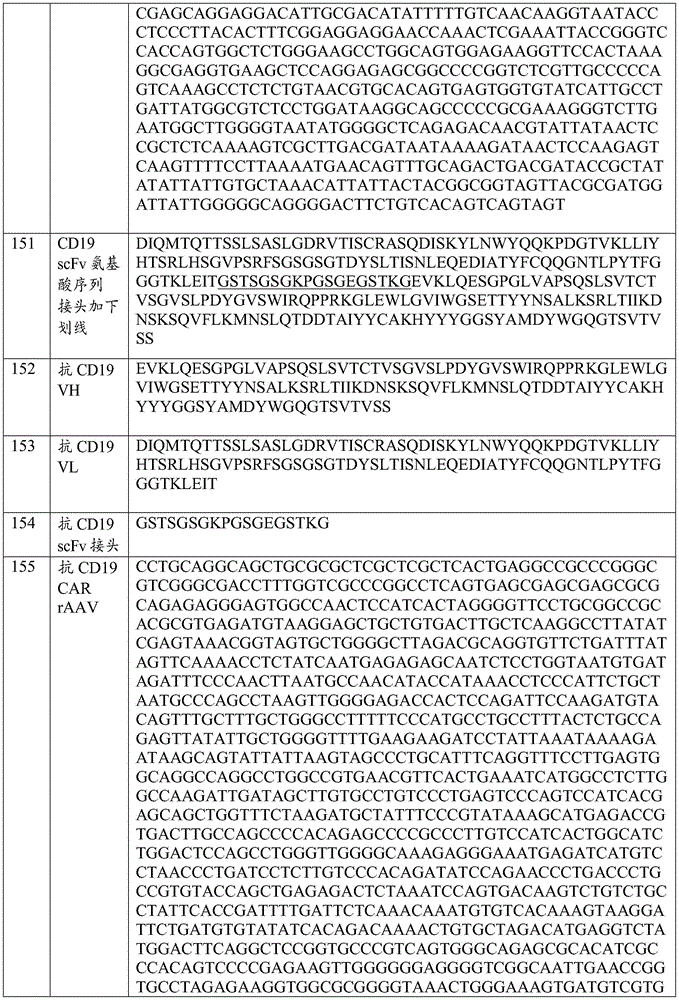


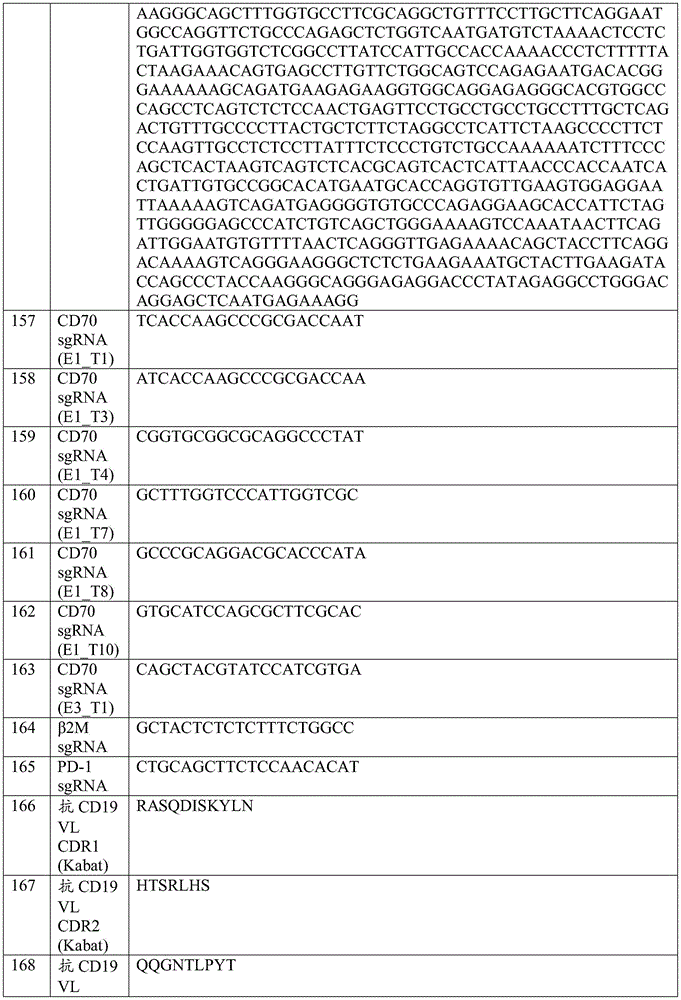
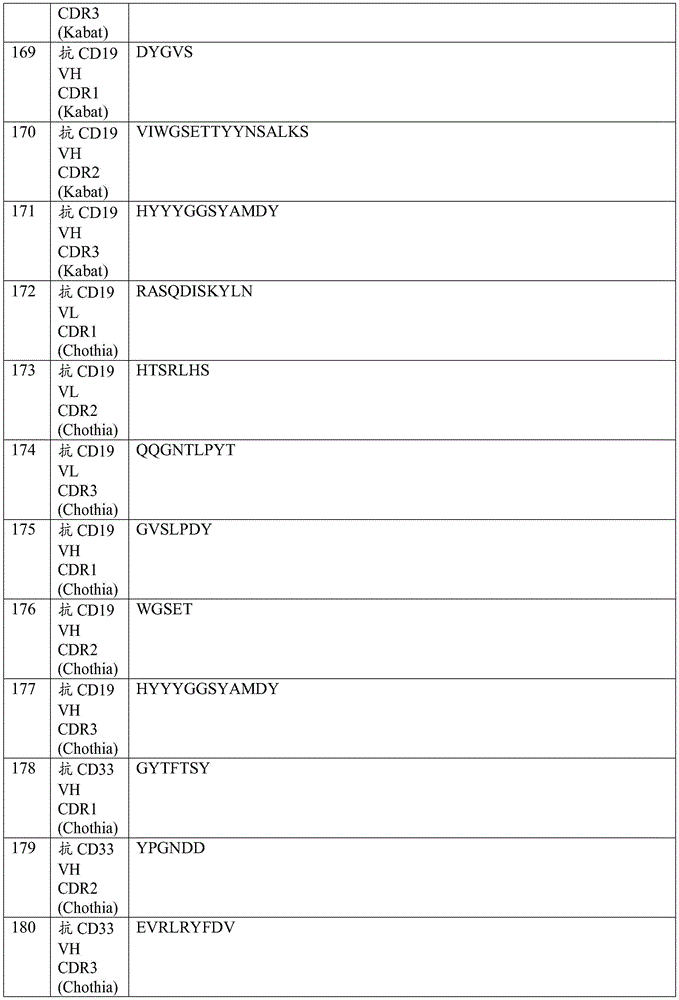
在此披露的所有参考文献、专利和专利申请都相对于每个被引用的主题通过引用而结合,这在某些情况下可以包括文件的全部内容。All references, patents, and patent applications disclosed herein are incorporated by reference with respect to each cited subject matter, which in some cases may include the entire contents of the document.
除非清楚地作相反指示,否则在说明书中和在权利要求中,如在此使用的不定冠词“一个/种)”(a/an)应当理解为意思指“至少一个(种)”。In the specification and in the claims, the indefinite article "a/an" (a/an) as used herein should be understood to mean "at least one" unless clearly indicated to the contrary.
还应当理解,除非明确指出相反,在包括多于一个步骤或动作的在此所要求保护的任何方法中,方法的步骤或动作的顺序不一定限于其中方法的步骤或动作被列举的顺序。It should also be understood that, in any method claimed herein that includes more than one step or action, the order of the steps or actions of the method is not necessarily limited to the order in which the steps or actions of the method are recited, unless expressly stated to the contrary.
在权利要求中,以及在以上说明书中,所有过渡性短语,如“包含”、“包括”、“携带”、“具有”、“含”、“涉及”、“持有”、“由……构成”等应理解为开放性的,即,意思指包括但不限于。只有过渡性短语“由……组成”和“主要由……组成”应当各自地为封闭或半封闭式过渡性短语,如美国专利局专利审查程序手册(United States Patent Office Manual ofPatent Examining Procedures),第2111.03节中所述。In the claims, as well as in the above specification, all transitional phrases such as "comprising", "including", "carrying", "having", "including", "involving", "possessing", "by... constitute" and the like should be construed as open-ended, that is, meant to include, but not be limited to. Only the transitional phrases "consisting of" and "consisting essentially of" should be closed or semi-closed transitional phrases, respectively, as in the United States Patent Office Manual of Patent Examining Procedures, described in Section 2111.03.
数值之前的术语“约”和“基本上”是指所列举数值的平均值±10%。The terms "about" and "substantially" preceding a numerical value mean ± 10% of the mean of the recited numerical value.
在提供值的范围的情况下,范围的上端和下端之间的每个值在本文中被具体地考虑和描述。Where a range of values is provided, each value between the upper and lower end of the range is specifically considered and described herein.
Claims (181)
Applications Claiming Priority (11)
| Application Number | Priority Date | Filing Date | Title |
|---|---|---|---|
| US201862670417P | 2018-05-11 | 2018-05-11 | |
| US62/670,417 | 2018-05-11 | ||
| US201862701340P | 2018-07-20 | 2018-07-20 | |
| US62/701,340 | 2018-07-20 | ||
| US201862756643P | 2018-11-07 | 2018-11-07 | |
| US62/756,643 | 2018-11-07 | ||
| US201862773658P | 2018-11-30 | 2018-11-30 | |
| US62/773,658 | 2018-11-30 | ||
| US201962826600P | 2019-03-29 | 2019-03-29 | |
| US62/826,600 | 2019-03-29 | ||
| PCT/IB2019/000500 WO2019215500A1 (en) | 2018-05-11 | 2019-05-10 | Methods and compositions for treating cancer |
Publications (1)
| Publication Number | Publication Date |
|---|---|
| CN112105420A true CN112105420A (en) | 2020-12-18 |
Family
ID=67402964
Family Applications (1)
| Application Number | Title | Priority Date | Filing Date |
|---|---|---|---|
| CN201980031761.4A Pending CN112105420A (en) | 2018-05-11 | 2019-05-10 | Methods and compositions for treating cancer |
Country Status (17)
| Country | Link |
|---|---|
| US (5) | US12227763B2 (en) |
| EP (1) | EP3790629A1 (en) |
| JP (2) | JP7542441B2 (en) |
| KR (1) | KR20210008502A (en) |
| CN (1) | CN112105420A (en) |
| AU (1) | AU2019266398A1 (en) |
| BR (1) | BR112020022879A2 (en) |
| CA (1) | CA3099364A1 (en) |
| CL (1) | CL2020002914A1 (en) |
| CO (1) | CO2020015255A2 (en) |
| IL (1) | IL278348B2 (en) |
| MX (1) | MX2020012028A (en) |
| PE (1) | PE20210666A1 (en) |
| PH (1) | PH12020551923A1 (en) |
| SG (1) | SG11202011080QA (en) |
| WO (1) | WO2019215500A1 (en) |
| ZA (1) | ZA202006627B (en) |
Cited By (2)
| Publication number | Priority date | Publication date | Assignee | Title |
|---|---|---|---|---|
| WO2023123195A1 (en) * | 2021-12-30 | 2023-07-06 | 深圳市先康达生命科学有限公司 | Engineered immune cell target gene of which can be regulated, preparation method therefor, and use thereof |
| CN117844811A (en) * | 2024-03-08 | 2024-04-09 | 上海恒润达生生物科技股份有限公司 | sgRNA composition for targeted knockout of CD70 gene and application thereof |
Families Citing this family (56)
| Publication number | Priority date | Publication date | Assignee | Title |
|---|---|---|---|---|
| CA3131533A1 (en) | 2019-03-05 | 2020-09-10 | Nkarta, Inc. | Cd19-directed chimeric antigen receptors and uses thereof in immunotherapy |
| EP3962535A1 (en) | 2019-04-30 | 2022-03-09 | CRISPR Therapeutics AG | Allogeneic cell therapy of b cell malignancies using genetically engineered t cells targeting cd19 |
| WO2020232292A1 (en) * | 2019-05-15 | 2020-11-19 | Board Of Regents, The University Of Texas System | Methods and compositions for treating non-small cell lung cancer |
| MA56388A (en) | 2019-06-27 | 2022-05-04 | Crispr Therapeutics Ag | USE OF CHEMERA ANTIGEN RECEPTOR T LYMPHOCYTES AND NK CELL INHIBITORS FOR THE TREATMENT OF CANCER |
| US12344656B2 (en) | 2019-09-06 | 2025-07-01 | Crispr Therapeutics Ag | Genetically engineered T cells having improved persistence in culture |
| WO2021095010A1 (en) | 2019-11-13 | 2021-05-20 | Crispr Therapeutics Ag | Renal cell carcinoma (rcc) therapy using genetically engineered t cells targeting cd70 |
| WO2021095009A1 (en) | 2019-11-13 | 2021-05-20 | Crispr Therapeutics Ag | Therapy for hematopoietic cell malignancies using genetically engineered t cells targeting cd70 |
| US20210139850A1 (en) | 2019-11-13 | 2021-05-13 | Crispr Therapeutics Ag | Manufacturing process for making t cells expressing chimeric antigen receptors |
| KR20220101128A (en) * | 2019-11-13 | 2022-07-19 | 크리스퍼 테라퓨틱스 아게 | CD70+ Solid Tumor Therapy Using Genetically Engineered T Cells Targeting CD70 |
| CN114901808A (en) | 2019-11-13 | 2022-08-12 | 克里斯珀医疗股份公司 | Method for producing CAR-T cells |
| CN113087805A (en) * | 2019-12-31 | 2021-07-09 | 华东师范大学 | Preparation and application of chimeric antigen receptor T cell of co-expression immune regulatory molecule |
| AU2021207751A1 (en) * | 2020-01-17 | 2022-07-21 | Crispr Therapeutics Ag | Genetically engineered T cells expressing BCMA-specific chimeric antigen receptors and uses thereof in cancer therapy |
| EP4103620A1 (en) | 2020-02-11 | 2022-12-21 | Crispr Therapeutics AG | Anti-idiotype antibodies targeting anti-cd19 chimeric antigen receptor |
| CA3173205A1 (en) * | 2020-03-31 | 2021-10-07 | Roland B. WALTER | Human anti-cd33 antibodies and uses thereof |
| GB202005184D0 (en) * | 2020-04-08 | 2020-05-20 | Autolus Ltd | Method |
| TW202208412A (en) | 2020-05-06 | 2022-03-01 | 瑞士商Crispr治療公司 | Masked chimeric antigen receptor specific to tyrosine-protein kinase like 7 (ptk7) and immune cells expressing such |
| US20210363212A1 (en) | 2020-05-21 | 2021-11-25 | Crispr Therapeutics Ag | Genetically engineered car t cells that secret interleukin-12 and therapeutic uses thereof |
| WO2021245603A1 (en) | 2020-06-04 | 2021-12-09 | Crispr Therapeutics Ag | Anti-cd70 antibodies and uses thereof |
| KR20230024984A (en) * | 2020-06-12 | 2023-02-21 | 엔카르타, 인크. | Genetically Modified Natural Killer Cells for CD70-Directed Cancer Immunotherapy |
| EP4171585A1 (en) | 2020-06-26 | 2023-05-03 | CRISPR Therapeutics AG | Allogeneic cell therapy of b cell malignancies using genetically engineered t cells targeting cd19 |
| US11795238B2 (en) | 2020-08-04 | 2023-10-24 | Crispr Therapeutics Ag | Anti-idiotype antibodies targeting anti-CD70 chimeric antigen receptor |
| WO2022043861A1 (en) | 2020-08-25 | 2022-03-03 | Crispr Therapeutics Ag | Anti-idiotype antibodies targeting anti-bcma chimeric antigen receptor |
| TW202227625A (en) * | 2020-08-28 | 2022-07-16 | 美商建南德克公司 | Crispr/cas9 multiplex knockout of host cell proteins |
| CN114164231B (en) * | 2020-09-10 | 2024-05-17 | 上海邦耀生物科技有限公司 | Method for gene editing of target site in cell |
| IL301012A (en) * | 2020-09-23 | 2023-05-01 | Crispr Therapeutics Ag | Genetically engineered t cells with regnase-1 and/or tgfbrii disruption have improved functionality and persistence |
| AU2021366431A1 (en) | 2020-10-20 | 2023-05-18 | Crispr Therapeutics Ag | Allogeneic cell therapy of b cell malignancies using genetically engineered t cells targeting cd19 |
| CA3199621A1 (en) * | 2020-10-26 | 2022-05-05 | Memorial Sloan-Kettering Cancer Center | Cells with cd70 knockout and uses for immunotherapy |
| US11661459B2 (en) | 2020-12-03 | 2023-05-30 | Century Therapeutics, Inc. | Artificial cell death polypeptide for chimeric antigen receptor and uses thereof |
| MX2023006395A (en) | 2020-12-03 | 2023-06-15 | Century Therapeutics Inc | GENETICALLY DESIGNED CELLS AND USES OF THESE. |
| WO2022133169A1 (en) | 2020-12-18 | 2022-06-23 | Century Therapeutics, Inc. | Chimeric antigen receptor systems with adaptable receptor specificity |
| WO2022137186A1 (en) | 2020-12-23 | 2022-06-30 | Crispr Therapeutics Ag | Cancer treatment using cd38 inhibitor and/or lenalidomide and t-cells expressing a chimeric antigen receptor |
| WO2022137181A1 (en) | 2020-12-23 | 2022-06-30 | Crispr Therapeutics Ag | Co-use of lenalidomide with car-t cells |
| EP4305153A1 (en) | 2021-03-09 | 2024-01-17 | CRISPR Therapeutics AG | Genetically engineered t cells with ptpn2 knockout have improved functionality and anti-tumor activity |
| WO2022215978A1 (en) * | 2021-04-05 | 2022-10-13 | 주식회사 셀렌진 | Guide rna complementary to pdcd-1 gene and use thereof |
| TW202310870A (en) | 2021-05-12 | 2023-03-16 | 瑞士商Crispr治療公司 | Genetically engineered immune cells targeting cd70 for use in treating hematopoietic malignancies |
| WO2022238963A2 (en) | 2021-05-12 | 2022-11-17 | Crispr Therapeutics Ag | Genetically engineered immune cells targeting cd70 for use in treating solid tumors |
| WO2023007373A1 (en) | 2021-07-26 | 2023-02-02 | Crispr Therapeutics Ag | Methods for manufacturing genetically engineered car-t cells |
| WO2023042079A1 (en) | 2021-09-14 | 2023-03-23 | Crispr Therapeutics Ag | Genetically engineered immune cells having a disrupted cd83 gene |
| WO2023084399A1 (en) | 2021-11-09 | 2023-05-19 | Crispr Therapeutics Ag | Genetically engineered immune cells expressing masked chimeric antigen receptors specific to protein tyrosine kinase 7 |
| WO2023100153A1 (en) | 2021-12-03 | 2023-06-08 | Crispr Therapeutics Ag | Use of anti-cd70 antibodies for identifying subjects susceptible for treatment with nk cell-based anti-cd70 therapy |
| WO2023111913A1 (en) | 2021-12-15 | 2023-06-22 | Crispr Therapeutics Ag | Engineered anti-liv1 cell with regnase-1 and/or tgfbrii disruption |
| EP4452304A1 (en) | 2021-12-22 | 2024-10-30 | CRISPR Therapeutics AG | Genetically engineered t cells with disrupted casitas b-lineage lymphoma proto-oncogene-b (cblb) and uses thereof |
| CN114369622A (en) * | 2021-12-31 | 2022-04-19 | 西安桑尼赛尔生物医药有限公司 | Bispecific universal CAR-T cells simultaneously targeting CD7 and CD19 and methods of making the same |
| WO2023201288A1 (en) * | 2022-04-15 | 2023-10-19 | The General Hospital Corporation | Cd70 binding car-t cells comprising cd33 binding t-cell engaging antibody molecules |
| WO2023205148A1 (en) | 2022-04-19 | 2023-10-26 | Intellia Therapeutics, Inc. | Chimeric antigen receptor compositions and uses |
| EP4540287A1 (en) | 2022-06-20 | 2025-04-23 | CRISPR Therapeutics AG | Chimeric antigen receptor specific to cd117 |
| EP4540288A1 (en) | 2022-06-20 | 2025-04-23 | CRISPR Therapeutics AG | Cd117-targeting nanoparticles for use in drug delivery |
| WO2024023801A2 (en) | 2022-07-29 | 2024-02-01 | Crispr Therapeutics Ag | Genetically engineered immune cells having disrupted transporter associated with antigen processing-1 (tap-1) gene |
| WO2024023804A2 (en) | 2022-07-29 | 2024-02-01 | Crispr Therapeutics Ag | Genetically engineered immune cells having disrupted transporter associated with antigen processing binding protein (tapbp) gene |
| WO2024023802A2 (en) | 2022-07-29 | 2024-02-01 | Crispr Therapeutics Ag | Genetically engineered immune cells having disrupted transporter associated with antigen processing-2 (tap-2) gene |
| WO2024192108A1 (en) | 2023-03-14 | 2024-09-19 | Evolveimmune Therapeutics, Inc. | Genetically modified car t cells and methods of making and using the same |
| WO2024220768A1 (en) * | 2023-04-21 | 2024-10-24 | Cold Spring Harbor Laboratory | Metabolic switches for anti-tumor immunity |
| CN121195068A (en) * | 2023-05-26 | 2025-12-23 | 爱迪塔斯医药公司 | CRISPR related methods and compositions targeting CD70 expression |
| WO2025038642A1 (en) * | 2023-08-14 | 2025-02-20 | Intellia Therapeutics, Inc. | Compositions and methods for genetically modifying cd70 |
| WO2025093707A1 (en) | 2023-10-31 | 2025-05-08 | Université de Lausanne | Method for suppressing car-t cells unresponsiveness for improving cancer immunotherapy |
| WO2025126049A2 (en) | 2023-12-11 | 2025-06-19 | Crispr Therapeutics Ag | Multiplex gene editing |
Citations (5)
| Publication number | Priority date | Publication date | Assignee | Title |
|---|---|---|---|---|
| WO2008074004A2 (en) * | 2006-12-14 | 2008-06-19 | Medarex, Inc. | Human antibodies that bind cd70 and uses thereof |
| WO2015121454A1 (en) * | 2014-02-14 | 2015-08-20 | Cellectis | Cells for immunotherapy engineered for targeting antigen present both on immune cells and pathological cells |
| US20170016025A1 (en) * | 2014-03-11 | 2017-01-19 | Cellectis | Method for generating t-cells compatible for allogenic transplantation |
| US20170107286A1 (en) * | 2014-06-02 | 2017-04-20 | The United States Of America, As Represented By The Secretary | Chimeric antigen receptors targeting cd-19 |
| US20170304418A1 (en) * | 2016-04-25 | 2017-10-26 | Regen BioPharma, Inc. | Universal donor checkpoint inhibitor silenced/gene edited cord blood killer cells |
Family Cites Families (135)
| Publication number | Priority date | Publication date | Assignee | Title |
|---|---|---|---|---|
| US5858358A (en) | 1992-04-07 | 1999-01-12 | The United States Of America As Represented By The Secretary Of The Navy | Methods for selectively stimulating proliferation of T cells |
| US6352694B1 (en) | 1994-06-03 | 2002-03-05 | Genetics Institute, Inc. | Methods for inducing a population of T cells to proliferate using agents which recognize TCR/CD3 and ligands which stimulate an accessory molecule on the surface of the T cells |
| US6534055B1 (en) | 1988-11-23 | 2003-03-18 | Genetics Institute, Inc. | Methods for selectively stimulating proliferation of T cells |
| US6905680B2 (en) | 1988-11-23 | 2005-06-14 | Genetics Institute, Inc. | Methods of treating HIV infected subjects |
| IL104570A0 (en) | 1992-03-18 | 1993-05-13 | Yeda Res & Dev | Chimeric genes and cells transformed therewith |
| US7175843B2 (en) | 1994-06-03 | 2007-02-13 | Genetics Institute, Llc | Methods for selectively stimulating proliferation of T cells |
| US6692964B1 (en) | 1995-05-04 | 2004-02-17 | The United States Of America As Represented By The Secretary Of The Navy | Methods for transfecting T cells |
| US7067318B2 (en) | 1995-06-07 | 2006-06-27 | The Regents Of The University Of Michigan | Methods for transfecting T cells |
| GB9710809D0 (en) | 1997-05-23 | 1997-07-23 | Medical Res Council | Nucleic acid binding proteins |
| GB9710807D0 (en) | 1997-05-23 | 1997-07-23 | Medical Res Council | Nucleic acid binding proteins |
| US6140081A (en) | 1998-10-16 | 2000-10-31 | The Scripps Research Institute | Zinc finger binding domains for GNN |
| US6534261B1 (en) | 1999-01-12 | 2003-03-18 | Sangamo Biosciences, Inc. | Regulation of endogenous gene expression in cells using zinc finger proteins |
| US6453242B1 (en) | 1999-01-12 | 2002-09-17 | Sangamo Biosciences, Inc. | Selection of sites for targeting by zinc finger proteins and methods of designing zinc finger proteins to bind to preselected sites |
| GEP20053685B (en) | 1999-08-17 | 2005-12-12 | Biogen Inc | BAFF Receptor (BCMA), an Immunoregulatory Agent |
| ES2302726T3 (en) | 2000-02-24 | 2008-08-01 | Invitrogen Corporation | STIMULATION AND SIMULTANEOUS CONCENTRATION OF CELLS. |
| US6797514B2 (en) | 2000-02-24 | 2004-09-28 | Xcyte Therapies, Inc. | Simultaneous stimulation and concentration of cells |
| US6867041B2 (en) | 2000-02-24 | 2005-03-15 | Xcyte Therapies, Inc. | Simultaneous stimulation and concentration of cells |
| JP2002060786A (en) | 2000-08-23 | 2002-02-26 | Kao Corp | Bactericidal antifouling agent for hard surfaces |
| CA2425862C (en) | 2000-11-07 | 2013-01-22 | City Of Hope | Cd19-specific redirected immune cells |
| WO2002066516A2 (en) | 2001-02-20 | 2002-08-29 | Zymogenetics, Inc. | Antibodies that bind both bcma and taci |
| WO2003016496A2 (en) | 2001-08-20 | 2003-02-27 | The Scripps Research Institute | Zinc finger binding domains for cnn |
| US7446190B2 (en) | 2002-05-28 | 2008-11-04 | Sloan-Kettering Institute For Cancer Research | Nucleic acids encoding chimeric T cell receptors |
| US20080025989A1 (en) | 2003-02-20 | 2008-01-31 | Seattle Genetics, Inc. | Anti-cd70 antibody-drug conjugates and their use for the treatment of cancer and immune disorders |
| CA2516455C (en) | 2003-02-20 | 2012-05-01 | Seattle Genetics, Inc. | Anti-cd70 antibody-drug conjugates and their use for the treatment of cancer and immune disorders |
| EP1460088A1 (en) | 2003-03-21 | 2004-09-22 | Biotest AG | Humanized anti-CD4 antibody with immunosuppressive properties |
| DE10328289B3 (en) | 2003-06-23 | 2005-01-05 | Enginion Ag | Working medium for steam cycle processes |
| US7888121B2 (en) | 2003-08-08 | 2011-02-15 | Sangamo Biosciences, Inc. | Methods and compositions for targeted cleavage and recombination |
| US7435596B2 (en) | 2004-11-04 | 2008-10-14 | St. Jude Children's Research Hospital, Inc. | Modified cell line and method for expansion of NK cell |
| US7972854B2 (en) | 2004-02-05 | 2011-07-05 | Sangamo Biosciences, Inc. | Methods and compositions for targeted cleavage and recombination |
| JP5222559B2 (en) | 2004-10-15 | 2013-06-26 | シアトル ジェネティックス, インコーポレイテッド | Anti-CD70 antibodies and uses thereof for the treatment and prevention of cancer and immune disorders |
| US8337838B2 (en) | 2004-10-15 | 2012-12-25 | Seattle Genetics, Inc. | Anti-CD70 antibody and its use for the treatment and prevention of cancer and immune disorders |
| US20120294863A1 (en) | 2004-10-15 | 2012-11-22 | Seattle Genetics, Inc. | Anti-CD70 Antibody and Its Use for the Treatment and Prevention of Cancer and Immune Disorders |
| US7641903B2 (en) | 2004-10-15 | 2010-01-05 | Seattle Genetics, Inc. | Anti-CD70 antibody and its use for the treatment and prevention of cancer and immune disorders |
| ES2766123T3 (en) | 2004-12-10 | 2020-06-11 | Peter Maccallum Cancer Inst | Methods and compositions for adoptive immunotherapy |
| EP2511299A1 (en) * | 2005-04-19 | 2012-10-17 | Seattle Genetics, Inc. | Humanized anti-CD70 binding agents and uses thereof |
| CN103146708A (en) | 2005-06-30 | 2013-06-12 | Abbvie公司 | Il-12/p40 binding proteins |
| EA016186B1 (en) | 2005-09-26 | 2012-03-30 | Медарекс, Инк. | Human monoclonal antibodies to cd70 and use thereof |
| US8389282B2 (en) | 2007-03-30 | 2013-03-05 | Memorial Sloan-Kettering Cancer Center | Constitutive expression of costimulatory ligands on adoptively transferred T lymphocytes |
| EP2198055A4 (en) | 2007-09-07 | 2012-04-18 | Cisthera Inc | Humanized pai-1 antibodies |
| MY159553A (en) | 2008-04-11 | 2017-01-13 | Seattle Genetics Inc | Detection and treatment of pancreatic, ovarian and other cancers |
| KR20110039220A (en) | 2008-06-30 | 2011-04-15 | 교와 핫꼬 기린 가부시키가이샤 | Anti-CD27 antibody |
| WO2011059836A2 (en) | 2009-10-29 | 2011-05-19 | Trustees Of Dartmouth College | T cell receptor-deficient t cell compositions |
| US8956828B2 (en) | 2009-11-10 | 2015-02-17 | Sangamo Biosciences, Inc. | Targeted disruption of T cell receptor genes using engineered zinc finger protein nucleases |
| TR201815882T4 (en) | 2009-12-10 | 2018-11-21 | Univ Iowa State Res Found Inc | Tal effector mediated DNA modification. |
| CA2785964C (en) | 2009-12-29 | 2021-03-30 | Kyowa Hakko Kirin Co., Ltd. | Anti-cd27 antibody |
| PL2542590T5 (en) | 2010-03-05 | 2020-08-10 | The Johns Hopkins University | Compositions and Methods for Target Immunomodulatory Antibodies and Fusion Proteins |
| NZ602892A (en) | 2010-04-13 | 2014-08-29 | Celldex Therapeutics Inc | Antibodies that bind human cd27 and uses thereof |
| US20120213771A1 (en) | 2010-04-13 | 2012-08-23 | Celldex Therapeutics Inc. | Antibodies that bind human cd27 and uses thereof |
| AU2011275749C1 (en) | 2010-07-09 | 2015-09-17 | Aduro Biotech Holdings, Europe B.V. | Agonistic antibody to CD27 |
| NZ723974A (en) | 2010-10-27 | 2017-03-31 | Baylor College Medicine | Chimeric cd27 receptors for redirecting t cells to cd70-positive malignancies |
| PH12013501201A1 (en) | 2010-12-09 | 2013-07-29 | Univ Pennsylvania | Use of chimeric antigen receptor-modified t cells to treat cancer |
| BR112013021562B1 (en) | 2011-03-16 | 2023-01-10 | Argenx Bvba | ANTIBODIES TO CD70 |
| HUE063461T2 (en) | 2011-05-27 | 2024-01-28 | Glaxo Group Ltd | BCMA (CD269/TNFRSF17)-binding proteins |
| US9382319B2 (en) | 2011-09-26 | 2016-07-05 | Jn Biosciences Llc | Hybrid constant regions |
| CN104053672A (en) | 2011-11-11 | 2014-09-17 | 瑞纳神经科学公司 | Antibodies specific for Trop-2 and their uses |
| WO2013074916A1 (en) | 2011-11-18 | 2013-05-23 | Board Of Regents, The University Of Texas System | Car+ t cells genetically modified to eliminate expression of t- cell receptor and/or hla |
| KR20130060720A (en) | 2011-11-30 | 2013-06-10 | 한국전자통신연구원 | Apparatus and method for interpreting service goal for goal-driven semantic service discovery |
| HK1206251A1 (en) | 2012-03-15 | 2016-01-08 | Janssen Biotech, Inc. | Human anti-cd27 antibodies, methods and uses |
| KR20210032014A (en) | 2012-04-11 | 2021-03-23 | 더 유나이티드 스테이츠 오브 어메리카, 애즈 리프리젠티드 바이 더 세크러테리, 디파트먼트 오브 헬쓰 앤드 휴먼 서비씨즈 | Chimeric antigen receptors targeting b-cell maturation antigen |
| WO2013176915A1 (en) | 2012-05-25 | 2013-11-28 | Roman Galetto | Methods for engineering allogeneic and immunosuppressive resistant t cell for immunotherapy |
| JP6694712B2 (en) | 2012-11-01 | 2020-05-20 | マックス−デルブルック−セントラム フアー モレキュラーレ メデジン | Antibody against CD269 (BCMA) |
| CN104968682A (en) | 2013-02-05 | 2015-10-07 | 英格玛布股份公司 | Bispecific antibodies against CD3[epsilon] and BCMA |
| WO2014158821A1 (en) | 2013-03-12 | 2014-10-02 | Imaginab, Inc. | Antigen binding constructs to cd70 |
| HK1220698A1 (en) | 2013-03-13 | 2017-05-12 | Seattle Genetics, Inc. | Cyclodextrin and antibody-drug conjugate formulations |
| WO2014140374A2 (en) | 2013-03-15 | 2014-09-18 | Novo Nordisk A/S | Monovalent cd27 antibodies |
| AU2014235968B2 (en) | 2013-03-21 | 2018-05-24 | Ospedale San Raffaele Srl | Targeted disruption of T cell receptor genes using engineered zinc finger protein nucleases |
| CN115261411A (en) | 2013-04-04 | 2022-11-01 | 哈佛学院校长同事会 | Therapeutic uses of genome editing with CRISPR/Cas systems |
| ES2883131T3 (en) | 2013-05-29 | 2021-12-07 | Cellectis | Methods for modifying T cells for immunotherapy using the RNA-guided CAS nuclease system |
| EP3004337B1 (en) | 2013-05-29 | 2017-08-02 | Cellectis | Methods for engineering t cells for immunotherapy by using rna-guided cas nuclease system |
| WO2015070083A1 (en) | 2013-11-07 | 2015-05-14 | Editas Medicine,Inc. | CRISPR-RELATED METHODS AND COMPOSITIONS WITH GOVERNING gRNAS |
| WO2015075470A1 (en) | 2013-11-21 | 2015-05-28 | Ucl Business Plc | Cell |
| IL312867A (en) | 2014-02-04 | 2024-07-01 | Kite Pharma Inc | Methods for producing autologous t cells useful to treat b cell malignancies and other cancers and compositions thereof |
| US20150328292A1 (en) | 2014-03-07 | 2015-11-19 | Bellicum Pharmaceuticals, Inc. | Caspase polypeptides having modified activity and uses thereof |
| CN106163547A (en) | 2014-03-15 | 2016-11-23 | 诺华股份有限公司 | Use Chimeric antigen receptor treatment cancer |
| JP6698546B2 (en) | 2014-04-14 | 2020-05-27 | セレクティスCellectis | BCMA (CD269)-specific chimeric antigen receptor for cancer immunotherapy |
| JP2017513485A (en) * | 2014-04-18 | 2017-06-01 | エディタス・メディシン,インコーポレイテッド | CRISPR-CAS related methods, compositions and components for cancer immunotherapy |
| CN106459924A (en) | 2014-04-23 | 2017-02-22 | 得克萨斯州大学系统董事会 | Chimeric antigen receptors (CAR) for use in therapy and methods for making the same |
| EP3152319A4 (en) | 2014-06-05 | 2017-12-27 | Sangamo BioSciences, Inc. | Methods and compositions for nuclease design |
| EP3172237A2 (en) | 2014-07-21 | 2017-05-31 | Novartis AG | Treatment of cancer using humanized anti-bcma chimeric antigen receptor |
| EP3172231B1 (en) | 2014-07-24 | 2021-05-05 | Bluebird Bio, Inc. | Bcma chimeric antigen receptors |
| EP3174556A1 (en) | 2014-07-29 | 2017-06-07 | Pfizer Inc | EGFRvIII SPECIFIC CHIMERIC ANTIGEN RECEPTORS FOR CANCER IMMUNOTHERAPY |
| AU2015301921A1 (en) | 2014-08-12 | 2017-03-02 | Celgene Corporation | Car-T lymphocytes engineered to home to lymph node B cell zone, skin, or gastrointestinal tract |
| GB201418965D0 (en) | 2014-10-24 | 2014-12-10 | Ospedale San Raffaele And Fond Telethon | |
| ES2983094T3 (en) * | 2014-10-31 | 2024-10-21 | Univ Pennsylvania | Alteration of gene expression in CAR-T cells and their uses |
| US12180263B2 (en) | 2014-11-06 | 2024-12-31 | President And Fellows Of Harvard College | Cells lacking B2M surface expression and methods for allogeneic administration of such cells |
| KR102763527B1 (en) | 2014-12-03 | 2025-02-05 | 애질런트 테크놀로지스, 인크. | Guide rna with chemical modifications |
| CA2969870A1 (en) | 2014-12-05 | 2016-06-09 | Memorial Sloan-Kettering Cancer Center | Chimeric antigen receptors targeting b-cell maturation antigen and uses thereof |
| CN107207616B (en) * | 2014-12-08 | 2021-11-19 | 美国卫生和人力服务部 | anti-CD70 chimeric antigen receptor |
| EP3230321B1 (en) | 2014-12-12 | 2019-08-28 | Bluebird Bio, Inc. | Bcma chimeric antigen receptors |
| IL252295B2 (en) | 2014-12-19 | 2023-10-01 | Dana Farber Cancer Inst Inc | Chimeric antigen receptors and methods of use thereof |
| ES2869972T3 (en) | 2015-01-26 | 2021-10-26 | Cellectis | MAb-Targeted Chimeric Antigen Receptor Systems for Sorting / Depleting Genomanipulated Immune Cells |
| GB201504840D0 (en) | 2015-03-23 | 2015-05-06 | Ucl Business Plc | Chimeric antigen receptor |
| JP2018510657A (en) | 2015-03-27 | 2018-04-19 | プレジデント アンド フェローズ オブ ハーバード カレッジ | Modified T cells and methods of making and using the same |
| ES2884838T3 (en) | 2015-04-06 | 2021-12-13 | Univ Leland Stanford Junior | Chemically modified guide RNA for CRISPR / CAS-mediated gene regulation |
| WO2016174652A1 (en) | 2015-04-30 | 2016-11-03 | Technion Research & Development Foundation Limited | Chimeric antigen receptors and methods of their use |
| CA2988854A1 (en) | 2015-05-08 | 2016-11-17 | President And Fellows Of Harvard College | Universal donor stem cells and related methods |
| SG10201914069SA (en) | 2015-05-18 | 2020-03-30 | Tcr2 Therapeutics Inc | Compositions and methods for tcr reprogramming using fusion proteins |
| CN104910278B (en) | 2015-05-27 | 2018-05-25 | 上海吉凯基因科技有限公司 | A kind of slow virus with high-efficiency transfection ability and biological activity for being used to prepare CART cells |
| CN108472314A (en) | 2015-07-31 | 2018-08-31 | 明尼苏达大学董事会 | Modified Cells and Therapeutics |
| EP3858388B1 (en) | 2015-09-28 | 2024-07-03 | Regents of the University of Minnesota | Chimeric antigen receptor (car) t cells as therapeutic interventions for gvhd |
| EP3756682B8 (en) | 2015-10-05 | 2022-04-27 | Precision Biosciences, Inc. | Genetically-modified cells comprising a modified human t cell receptor alpha constant region gene |
| GB201518136D0 (en) | 2015-10-14 | 2015-11-25 | Glaxosmithkline Ip Dev Ltd | Novel chimeric antigen receptors |
| WO2017070429A1 (en) | 2015-10-22 | 2017-04-27 | Regents Of The University Of Minnesota | Methods involving editing polynucleotides that encode t cell receptor |
| JP7115982B2 (en) | 2015-10-30 | 2022-08-09 | アレタ・バイオセラピューティクス・インコーポレイテッド | Compositions and methods for treating cancer |
| AU2016353067B2 (en) | 2015-11-13 | 2023-10-05 | Sanford Research | Anti-BCMA polypeptides and proteins |
| MX2018006767A (en) | 2015-12-04 | 2019-03-14 | Novartis Ag | COMPOSITIONS AND METHODS FOR IMMUNOLOGICAL ONCOLOGY. |
| US11052111B2 (en) | 2015-12-08 | 2021-07-06 | Chimera Bioengineering, Inc. | Smart CAR devices and DE CAR polypeptides for treating disease and methods for enhancing immune responses |
| IL259935B2 (en) | 2015-12-18 | 2023-03-01 | Sangamo Therapeutics Inc | Targeted disruption of the mhc cell receptor |
| AU2016369490C1 (en) | 2015-12-18 | 2021-12-23 | Sangamo Therapeutics, Inc. | Targeted disruption of the T cell receptor |
| WO2017112859A1 (en) | 2015-12-23 | 2017-06-29 | Precision Biosciences, Inc. | Engineered meganucleases with recognition sequences found in the human beta-2 microglobulin gene |
| ITUB20160112A1 (en) | 2016-01-28 | 2016-04-28 | Serteaweb Srl | ALARM PROCESS AND TELEVISION SYSTEM CONCERNING SUCH AN ALARM PROCESS |
| IL260732B2 (en) | 2016-02-17 | 2024-08-01 | Seagen Inc | BCMA antibodies and their use for the treatment of cancer and immune disorders |
| AU2017225733A1 (en) | 2016-03-04 | 2018-09-27 | Novartis Ag | Cells expressing multiple chimeric antigen receptor (CAR) molecules and uses therefore |
| RU2018135819A (en) | 2016-03-11 | 2020-04-13 | Блубёрд Био, Инк. | IMMUNE EFFECTED CELLS WITH REDACTED GENOME |
| WO2017167217A1 (en) | 2016-04-01 | 2017-10-05 | Innovative Cellular Therapeutics CO., LTD. | Use of chimeric antigen receptor modified cells to treat cancer |
| TWI691596B (en) | 2016-04-01 | 2020-04-21 | 美商凱特製藥公司 | Chimeric antigen and t cell receptors and methods of use |
| WO2017177137A1 (en) | 2016-04-07 | 2017-10-12 | Bluebird Bio, Inc. | Chimeric antigen receptor t cell compositions |
| WO2017180993A1 (en) | 2016-04-14 | 2017-10-19 | Bluebird Bio, Inc. | Salvage chimeric antigen receptor systems |
| WO2017182608A1 (en) | 2016-04-22 | 2017-10-26 | INSERM (Institut National de la Santé et de la Recherche Médicale) | Methods and vaccine compositions for the treatment of b-cell malignancies |
| US10875919B2 (en) | 2016-04-26 | 2020-12-29 | Alector Llc | Chimeric receptors and methods of use thereof |
| EP3448874A4 (en) | 2016-04-29 | 2020-04-22 | Voyager Therapeutics, Inc. | Compositions for the treatment of disease |
| WO2017186928A1 (en) | 2016-04-29 | 2017-11-02 | Curevac Ag | Rna encoding an antibody |
| WO2017193107A2 (en) | 2016-05-06 | 2017-11-09 | Juno Therapeutics, Inc. | Genetically engineered cells and methods of making the same |
| US20210177896A1 (en) | 2016-06-02 | 2021-06-17 | Novartis Ag | Therapeutic regimens for chimeric antigen receptor (car)- expressing cells |
| AU2017276706B2 (en) | 2016-06-07 | 2024-08-15 | Max-Delbrück-Centrum Für Molekulare Medizin In Der Helmholtz-Gemeinschaft | Chimeric antigen receptor and CAR-T cells that bind BCMA |
| JP7114490B2 (en) | 2016-06-24 | 2022-08-08 | アイセル・ジーン・セラピューティクス・エルエルシー | Construction of chimeric antibody receptors (CARs) and methods of their use |
| CN106544321B (en) | 2016-10-13 | 2019-01-29 | 北京艺妙神州医疗科技有限公司 | Universal CAR-T cell and its preparation method and application |
| WO2018068257A1 (en) | 2016-10-13 | 2018-04-19 | 北京艺妙神州医疗科技有限公司 | Universal car-t cell and preparation method and application therefor |
| WO2018073393A2 (en) * | 2016-10-19 | 2018-04-26 | Cellectis | Tal-effector nuclease (talen) -modified allogenic cells suitable for therapy |
| WO2018073391A1 (en) | 2016-10-19 | 2018-04-26 | Cellectis | Targeted gene insertion for improved immune cells therapy |
| AU2018208614A1 (en) | 2017-01-10 | 2019-07-11 | The General Hospital Corporation | Modified T cells and methods of their use |
| MY201573A (en) * | 2017-05-12 | 2024-03-02 | Crispr Therapeutics Ag | Materials and methods for engineering cells and uses thereof in immuno-oncology |
| WO2019119036A1 (en) * | 2017-12-19 | 2019-06-27 | Benitec Biopharma Limited | Cd70 deficient cells, and methods and reagents for producing same |
| BR112020015662A2 (en) | 2018-02-01 | 2020-12-08 | Pfizer Inc. | CHEMICAL ANTIGEN RECEPTORS AIMED AT CD70 |
| US11957695B2 (en) * | 2018-04-26 | 2024-04-16 | The Broad Institute, Inc. | Methods and compositions targeting glucocorticoid signaling for modulating immune responses |
-
2019
- 2019-05-10 CN CN201980031761.4A patent/CN112105420A/en active Pending
- 2019-05-10 KR KR1020207035240A patent/KR20210008502A/en active Pending
- 2019-05-10 SG SG11202011080QA patent/SG11202011080QA/en unknown
- 2019-05-10 US US17/054,483 patent/US12227763B2/en active Active
- 2019-05-10 JP JP2020563430A patent/JP7542441B2/en active Active
- 2019-05-10 CA CA3099364A patent/CA3099364A1/en active Pending
- 2019-05-10 PE PE2020001838A patent/PE20210666A1/en unknown
- 2019-05-10 EP EP19742890.7A patent/EP3790629A1/en active Pending
- 2019-05-10 IL IL278348A patent/IL278348B2/en unknown
- 2019-05-10 MX MX2020012028A patent/MX2020012028A/en unknown
- 2019-05-10 BR BR112020022879-6A patent/BR112020022879A2/en unknown
- 2019-05-10 AU AU2019266398A patent/AU2019266398A1/en active Pending
- 2019-05-10 WO PCT/IB2019/000500 patent/WO2019215500A1/en not_active Ceased
- 2019-05-10 US US16/409,737 patent/US20200063100A1/en not_active Abandoned
-
2020
- 2020-10-23 ZA ZA2020/06627A patent/ZA202006627B/en unknown
- 2020-11-10 CL CL2020002914A patent/CL2020002914A1/en unknown
- 2020-11-11 PH PH12020551923A patent/PH12020551923A1/en unknown
- 2020-12-04 CO CONC2020/0015255A patent/CO2020015255A2/en unknown
-
2021
- 2021-04-23 US US17/238,729 patent/US11254912B2/en active Active
- 2021-04-23 US US17/238,741 patent/US11649438B2/en active Active
-
2024
- 2024-07-12 JP JP2024112291A patent/JP2024150537A/en not_active Ceased
-
2025
- 2025-01-14 US US19/020,112 patent/US20250257320A1/en active Pending
Patent Citations (5)
| Publication number | Priority date | Publication date | Assignee | Title |
|---|---|---|---|---|
| WO2008074004A2 (en) * | 2006-12-14 | 2008-06-19 | Medarex, Inc. | Human antibodies that bind cd70 and uses thereof |
| WO2015121454A1 (en) * | 2014-02-14 | 2015-08-20 | Cellectis | Cells for immunotherapy engineered for targeting antigen present both on immune cells and pathological cells |
| US20170016025A1 (en) * | 2014-03-11 | 2017-01-19 | Cellectis | Method for generating t-cells compatible for allogenic transplantation |
| US20170107286A1 (en) * | 2014-06-02 | 2017-04-20 | The United States Of America, As Represented By The Secretary | Chimeric antigen receptors targeting cd-19 |
| US20170304418A1 (en) * | 2016-04-25 | 2017-10-26 | Regen BioPharma, Inc. | Universal donor checkpoint inhibitor silenced/gene edited cord blood killer cells |
Non-Patent Citations (1)
| Title |
|---|
| JUSTIN EYQUEM ET AL.: "Targeting a CAR to the TRAC locus with CRISPR/Cas9 enhances tumour rejection", 《NATURE》, vol. 543, no. 7643, pages 1, XP055397283, DOI: 10.1038/nature21405 * |
Cited By (2)
| Publication number | Priority date | Publication date | Assignee | Title |
|---|---|---|---|---|
| WO2023123195A1 (en) * | 2021-12-30 | 2023-07-06 | 深圳市先康达生命科学有限公司 | Engineered immune cell target gene of which can be regulated, preparation method therefor, and use thereof |
| CN117844811A (en) * | 2024-03-08 | 2024-04-09 | 上海恒润达生生物科技股份有限公司 | sgRNA composition for targeted knockout of CD70 gene and application thereof |
Also Published As
| Publication number | Publication date |
|---|---|
| AU2019266398A1 (en) | 2020-11-19 |
| CO2020015255A2 (en) | 2021-01-29 |
| US11649438B2 (en) | 2023-05-16 |
| PH12020551923A1 (en) | 2021-06-14 |
| US20210246425A1 (en) | 2021-08-12 |
| US12227763B2 (en) | 2025-02-18 |
| SG11202011080QA (en) | 2020-12-30 |
| IL278348B1 (en) | 2024-11-01 |
| JP2024150537A (en) | 2024-10-23 |
| EP3790629A1 (en) | 2021-03-17 |
| JP2021522820A (en) | 2021-09-02 |
| US20200063100A1 (en) | 2020-02-27 |
| JP7542441B2 (en) | 2024-08-30 |
| ZA202006627B (en) | 2022-03-30 |
| KR20210008502A (en) | 2021-01-22 |
| MX2020012028A (en) | 2021-03-29 |
| WO2019215500A1 (en) | 2019-11-14 |
| BR112020022879A2 (en) | 2021-02-23 |
| PE20210666A1 (en) | 2021-03-31 |
| US20210261919A1 (en) | 2021-08-26 |
| IL278348A (en) | 2020-12-31 |
| CA3099364A1 (en) | 2019-11-14 |
| US20250257320A1 (en) | 2025-08-14 |
| CL2020002914A1 (en) | 2021-07-30 |
| US20210060072A1 (en) | 2021-03-04 |
| US11254912B2 (en) | 2022-02-22 |
| IL278348B2 (en) | 2025-03-01 |
Similar Documents
| Publication | Publication Date | Title |
|---|---|---|
| US20250257320A1 (en) | Methods and compositions for treating cancer | |
| JP7553440B2 (en) | Anti-CD33 immune cell cancer therapy | |
| TW202229545A (en) | Genetically engineered t cells with regnase-1 and/or tgfbrii disruption have improved functionality and persistence | |
| EP4215543A2 (en) | Hpv-specific binding molecules | |
| JP7471289B2 (en) | Anti-LIV1 immune cell cancer therapy | |
| US20250074965A1 (en) | Anti-ptk7 immune cell cancer therapy | |
| JP2022547865A (en) | Genetically engineered T cells with improved persistence in culture | |
| TW202400778A (en) | Anti-cd19 car-t cells with multiple gene edits and therapeutic uses thereof | |
| US20230128917A1 (en) | Genetically engineered immune cells having a disrupted cd83 gene | |
| US20230331841A1 (en) | Anti-cd83 car-t cells with regnase-1 and/or tgfbrii disruption | |
| JP2025522812A (en) | Chimeric antigen receptors targeting GPC-3 and immune cells expressing such chimeric antigen receptors for therapeutic use | |
| WO2024062388A2 (en) | Genetically engineered immune cells expressing chimeric antigen receptor targeting cd20 |
Legal Events
| Date | Code | Title | Description |
|---|---|---|---|
| PB01 | Publication | ||
| PB01 | Publication | ||
| SE01 | Entry into force of request for substantive examination | ||
| SE01 | Entry into force of request for substantive examination |