RU2262231C1 - Method for desinsection of specific harmful pests by application of anthranilamid derivatives - Google Patents
Method for desinsection of specific harmful pests by application of anthranilamid derivatives Download PDFInfo
- Publication number
- RU2262231C1 RU2262231C1 RU2004107513A RU2004107513A RU2262231C1 RU 2262231 C1 RU2262231 C1 RU 2262231C1 RU 2004107513 A RU2004107513 A RU 2004107513A RU 2004107513 A RU2004107513 A RU 2004107513A RU 2262231 C1 RU2262231 C1 RU 2262231C1
- Authority
- RU
- Russia
- Prior art keywords
- alkyl
- halogen
- compound
- formula
- aphid
- Prior art date
Links
Classifications
-
- A—HUMAN NECESSITIES
- A01—AGRICULTURE; FORESTRY; ANIMAL HUSBANDRY; HUNTING; TRAPPING; FISHING
- A01N—PRESERVATION OF BODIES OF HUMANS OR ANIMALS OR PLANTS OR PARTS THEREOF; BIOCIDES, e.g. AS DISINFECTANTS, AS PESTICIDES OR AS HERBICIDES; PEST REPELLANTS OR ATTRACTANTS; PLANT GROWTH REGULATORS
- A01N43/00—Biocides, pest repellants or attractants, or plant growth regulators containing heterocyclic compounds
- A01N43/48—Biocides, pest repellants or attractants, or plant growth regulators containing heterocyclic compounds having rings with two nitrogen atoms as the only ring hetero atoms
- A01N43/56—1,2-Diazoles; Hydrogenated 1,2-diazoles
-
- A—HUMAN NECESSITIES
- A01—AGRICULTURE; FORESTRY; ANIMAL HUSBANDRY; HUNTING; TRAPPING; FISHING
- A01N—PRESERVATION OF BODIES OF HUMANS OR ANIMALS OR PLANTS OR PARTS THEREOF; BIOCIDES, e.g. AS DISINFECTANTS, AS PESTICIDES OR AS HERBICIDES; PEST REPELLANTS OR ATTRACTANTS; PLANT GROWTH REGULATORS
- A01N43/00—Biocides, pest repellants or attractants, or plant growth regulators containing heterocyclic compounds
- A01N43/48—Biocides, pest repellants or attractants, or plant growth regulators containing heterocyclic compounds having rings with two nitrogen atoms as the only ring hetero atoms
- A01N43/54—1,3-Diazines; Hydrogenated 1,3-diazines
-
- A—HUMAN NECESSITIES
- A01—AGRICULTURE; FORESTRY; ANIMAL HUSBANDRY; HUNTING; TRAPPING; FISHING
- A01N—PRESERVATION OF BODIES OF HUMANS OR ANIMALS OR PLANTS OR PARTS THEREOF; BIOCIDES, e.g. AS DISINFECTANTS, AS PESTICIDES OR AS HERBICIDES; PEST REPELLANTS OR ATTRACTANTS; PLANT GROWTH REGULATORS
- A01N43/00—Biocides, pest repellants or attractants, or plant growth regulators containing heterocyclic compounds
- A01N43/48—Biocides, pest repellants or attractants, or plant growth regulators containing heterocyclic compounds having rings with two nitrogen atoms as the only ring hetero atoms
- A01N43/58—1,2-Diazines; Hydrogenated 1,2-diazines
-
- A—HUMAN NECESSITIES
- A01—AGRICULTURE; FORESTRY; ANIMAL HUSBANDRY; HUNTING; TRAPPING; FISHING
- A01N—PRESERVATION OF BODIES OF HUMANS OR ANIMALS OR PLANTS OR PARTS THEREOF; BIOCIDES, e.g. AS DISINFECTANTS, AS PESTICIDES OR AS HERBICIDES; PEST REPELLANTS OR ATTRACTANTS; PLANT GROWTH REGULATORS
- A01N43/00—Biocides, pest repellants or attractants, or plant growth regulators containing heterocyclic compounds
- A01N43/72—Biocides, pest repellants or attractants, or plant growth regulators containing heterocyclic compounds having rings with nitrogen atoms and oxygen or sulfur atoms as ring hetero atoms
- A01N43/86—Biocides, pest repellants or attractants, or plant growth regulators containing heterocyclic compounds having rings with nitrogen atoms and oxygen or sulfur atoms as ring hetero atoms six-membered rings with one nitrogen atom and either one oxygen atom or one sulfur atom in positions 1,3
-
- C—CHEMISTRY; METALLURGY
- C07—ORGANIC CHEMISTRY
- C07C—ACYCLIC OR CARBOCYCLIC COMPOUNDS
- C07C251/00—Compounds containing nitrogen atoms doubly-bound to a carbon skeleton
- C07C251/72—Hydrazones
- C07C251/74—Hydrazones having doubly-bound carbon atoms of hydrazone groups bound to hydrogen atoms or to acyclic carbon atoms
- C07C251/76—Hydrazones having doubly-bound carbon atoms of hydrazone groups bound to hydrogen atoms or to acyclic carbon atoms to carbon atoms of a saturated carbon skeleton
-
- C—CHEMISTRY; METALLURGY
- C07—ORGANIC CHEMISTRY
- C07D—HETEROCYCLIC COMPOUNDS
- C07D213/00—Heterocyclic compounds containing six-membered rings, not condensed with other rings, with one nitrogen atom as the only ring hetero atom and three or more double bonds between ring members or between ring members and non-ring members
- C07D213/02—Heterocyclic compounds containing six-membered rings, not condensed with other rings, with one nitrogen atom as the only ring hetero atom and three or more double bonds between ring members or between ring members and non-ring members having three double bonds between ring members or between ring members and non-ring members
- C07D213/04—Heterocyclic compounds containing six-membered rings, not condensed with other rings, with one nitrogen atom as the only ring hetero atom and three or more double bonds between ring members or between ring members and non-ring members having three double bonds between ring members or between ring members and non-ring members having no bond between the ring nitrogen atom and a non-ring member or having only hydrogen or carbon atoms directly attached to the ring nitrogen atom
- C07D213/60—Heterocyclic compounds containing six-membered rings, not condensed with other rings, with one nitrogen atom as the only ring hetero atom and three or more double bonds between ring members or between ring members and non-ring members having three double bonds between ring members or between ring members and non-ring members having no bond between the ring nitrogen atom and a non-ring member or having only hydrogen or carbon atoms directly attached to the ring nitrogen atom with hetero atoms or with carbon atoms having three bonds to hetero atoms with at the most one bond to halogen, e.g. ester or nitrile radicals, directly attached to ring carbon atoms
- C07D213/72—Nitrogen atoms
- C07D213/76—Nitrogen atoms to which a second hetero atom is attached
- C07D213/77—Hydrazine radicals
-
- C—CHEMISTRY; METALLURGY
- C07—ORGANIC CHEMISTRY
- C07D—HETEROCYCLIC COMPOUNDS
- C07D231/00—Heterocyclic compounds containing 1,2-diazole or hydrogenated 1,2-diazole rings
- C07D231/02—Heterocyclic compounds containing 1,2-diazole or hydrogenated 1,2-diazole rings not condensed with other rings
- C07D231/06—Heterocyclic compounds containing 1,2-diazole or hydrogenated 1,2-diazole rings not condensed with other rings having one double bond between ring members or between a ring member and a non-ring member
-
- C—CHEMISTRY; METALLURGY
- C07—ORGANIC CHEMISTRY
- C07D—HETEROCYCLIC COMPOUNDS
- C07D231/00—Heterocyclic compounds containing 1,2-diazole or hydrogenated 1,2-diazole rings
- C07D231/02—Heterocyclic compounds containing 1,2-diazole or hydrogenated 1,2-diazole rings not condensed with other rings
- C07D231/06—Heterocyclic compounds containing 1,2-diazole or hydrogenated 1,2-diazole rings not condensed with other rings having one double bond between ring members or between a ring member and a non-ring member
- C07D231/08—Heterocyclic compounds containing 1,2-diazole or hydrogenated 1,2-diazole rings not condensed with other rings having one double bond between ring members or between a ring member and a non-ring member with oxygen or sulfur atoms directly attached to ring carbon atoms
-
- C—CHEMISTRY; METALLURGY
- C07—ORGANIC CHEMISTRY
- C07D—HETEROCYCLIC COMPOUNDS
- C07D231/00—Heterocyclic compounds containing 1,2-diazole or hydrogenated 1,2-diazole rings
- C07D231/02—Heterocyclic compounds containing 1,2-diazole or hydrogenated 1,2-diazole rings not condensed with other rings
- C07D231/10—Heterocyclic compounds containing 1,2-diazole or hydrogenated 1,2-diazole rings not condensed with other rings having two or three double bonds between ring members or between ring members and non-ring members
- C07D231/14—Heterocyclic compounds containing 1,2-diazole or hydrogenated 1,2-diazole rings not condensed with other rings having two or three double bonds between ring members or between ring members and non-ring members with hetero atoms or with carbon atoms having three bonds to hetero atoms with at the most one bond to halogen, e.g. ester or nitrile radicals, directly attached to ring carbon atoms
-
- C—CHEMISTRY; METALLURGY
- C07—ORGANIC CHEMISTRY
- C07D—HETEROCYCLIC COMPOUNDS
- C07D231/00—Heterocyclic compounds containing 1,2-diazole or hydrogenated 1,2-diazole rings
- C07D231/02—Heterocyclic compounds containing 1,2-diazole or hydrogenated 1,2-diazole rings not condensed with other rings
- C07D231/10—Heterocyclic compounds containing 1,2-diazole or hydrogenated 1,2-diazole rings not condensed with other rings having two or three double bonds between ring members or between ring members and non-ring members
- C07D231/14—Heterocyclic compounds containing 1,2-diazole or hydrogenated 1,2-diazole rings not condensed with other rings having two or three double bonds between ring members or between ring members and non-ring members with hetero atoms or with carbon atoms having three bonds to hetero atoms with at the most one bond to halogen, e.g. ester or nitrile radicals, directly attached to ring carbon atoms
- C07D231/16—Halogen atoms or nitro radicals
-
- C—CHEMISTRY; METALLURGY
- C07—ORGANIC CHEMISTRY
- C07D—HETEROCYCLIC COMPOUNDS
- C07D401/00—Heterocyclic compounds containing two or more hetero rings, having nitrogen atoms as the only ring hetero atoms, at least one ring being a six-membered ring with only one nitrogen atom
- C07D401/02—Heterocyclic compounds containing two or more hetero rings, having nitrogen atoms as the only ring hetero atoms, at least one ring being a six-membered ring with only one nitrogen atom containing two hetero rings
- C07D401/04—Heterocyclic compounds containing two or more hetero rings, having nitrogen atoms as the only ring hetero atoms, at least one ring being a six-membered ring with only one nitrogen atom containing two hetero rings directly linked by a ring-member-to-ring-member bond
-
- C—CHEMISTRY; METALLURGY
- C07—ORGANIC CHEMISTRY
- C07D—HETEROCYCLIC COMPOUNDS
- C07D413/00—Heterocyclic compounds containing two or more hetero rings, at least one ring having nitrogen and oxygen atoms as the only ring hetero atoms
- C07D413/02—Heterocyclic compounds containing two or more hetero rings, at least one ring having nitrogen and oxygen atoms as the only ring hetero atoms containing two hetero rings
- C07D413/04—Heterocyclic compounds containing two or more hetero rings, at least one ring having nitrogen and oxygen atoms as the only ring hetero atoms containing two hetero rings directly linked by a ring-member-to-ring-member bond
-
- C—CHEMISTRY; METALLURGY
- C07—ORGANIC CHEMISTRY
- C07D—HETEROCYCLIC COMPOUNDS
- C07D413/00—Heterocyclic compounds containing two or more hetero rings, at least one ring having nitrogen and oxygen atoms as the only ring hetero atoms
- C07D413/14—Heterocyclic compounds containing two or more hetero rings, at least one ring having nitrogen and oxygen atoms as the only ring hetero atoms containing three or more hetero rings
Landscapes
- Chemical & Material Sciences (AREA)
- Organic Chemistry (AREA)
- Life Sciences & Earth Sciences (AREA)
- Agronomy & Crop Science (AREA)
- Pest Control & Pesticides (AREA)
- Plant Pathology (AREA)
- Health & Medical Sciences (AREA)
- Engineering & Computer Science (AREA)
- Dentistry (AREA)
- General Health & Medical Sciences (AREA)
- Wood Science & Technology (AREA)
- Zoology (AREA)
- Environmental Sciences (AREA)
- Agricultural Chemicals And Associated Chemicals (AREA)
- Plural Heterocyclic Compounds (AREA)
- Heterocyclic Carbon Compounds Containing A Hetero Ring Having Nitrogen And Oxygen As The Only Ring Hetero Atoms (AREA)
- Organic Low-Molecular-Weight Compounds And Preparation Thereof (AREA)
Abstract
Description
Настоящее изобретение относится к способу использования некоторых антраниламидов, их N-оксидов, сельскохозяйственно-приемлемых солей и композиций для борьбы с беспозвоночными вредителями в сельском хозяйстве и в областях, не относящихся к сельскому хозяйству.The present invention relates to a method of using certain anthranilamides, their N-oxides, agriculturally acceptable salts and compositions for controlling invertebrate pests in agriculture and in non-agricultural fields.
Борьба с беспозвоночными вредителями имеет очень важное значение для выращивания высокоурожайных культур. Ущерб, наносимый беспозвоночными вредителями во время выращивания и хранения сельскохозяйственных культур, может приводить к значительному снижению продуктивности и, тем самым, к повышению стоимости продукта для потребителя. Важное значение также имеет борьба с беспозвоночными вредителями лесов, тепличных культур, декоративных растений, культур, выращиваемых в питомниках, при хранении пищевых продуктов и волокон; с вредителями, поражающими крупный рогатый скот, с бытовыми вредителями и с насекомыми, приносящими вред здоровью человека и животных. Для этих целей имеется множество коммерчески доступных продуктов, однако, необходимость в получении новых соединений, которые являются еще более эффективными, менее дорогостоящими, менее токсичными и более безопасными для окружающей среды, или обладают другими механизмами действия, остается актуальной.Invertebrate pest control is very important for the cultivation of high-yielding crops. The damage caused by invertebrate pests during the cultivation and storage of crops can lead to a significant decrease in productivity and, thereby, to increase the cost of the product for the consumer. Also important is the control of invertebrate pests of forests, greenhouse crops, ornamental plants, crops grown in nurseries, during the storage of food products and fibers; with pests that infect cattle, with domestic pests and with insects harmful to human and animal health. For these purposes, there are many commercially available products, however, the need for new compounds that are even more effective, less expensive, less toxic and safer for the environment, or have other mechanisms of action, remains relevant.
В NL 9202078 описаны производные N-ацилантраниловой кислоты формулы i, используемые в качестве инсектицидов:NL 9202078 describes derivatives of N-acylanthranilic acid of the formula i, used as insecticides:
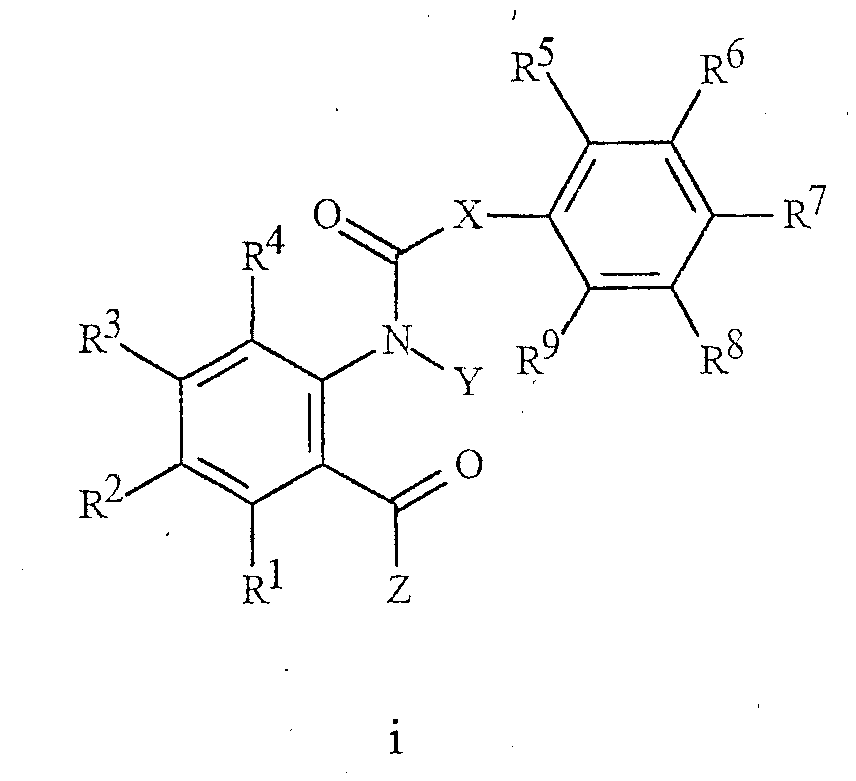
где Х представляет собой прямую связь;where X is a direct bond;
Y представляет собой Н или С1-С6 алкил;Y represents H or C 1 -C 6 alkyl;
Z представляет собой NH2, NH(С1-С3алкил) или N(С1-С3алкил)2; иZ represents NH 2 , NH (C 1 -C 3 alkyl) or N (C 1 -C 3 alkyl) 2 ; and
R1-R9 независимо представляют Н, галоген, С1-С6алкил, фенил, гидрокси, С1-С6алкокси или С1-С7ацилокси.R 1 -R 9 independently represent H, halogen, C 1 -C 6 alkyl, phenyl, hydroxy, C 1 -C 6 alkoxy or C 1 -C 7 acyloxy.
Краткое описание изобретенияSUMMARY OF THE INVENTION
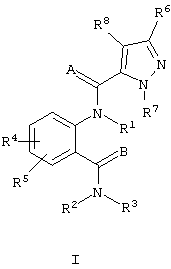
Настоящее изобретение относится к способу борьбы с чешуекрылыми, равнокрылыми, полужесткокрылыми, трипсами и с жесткокрылыми насекомыми-вредителями, предусматривающему контактирование указанных насекомых или окружающей их среды с определенным количеством соединения формулы I, его N-оксидов или сельскохозяйственно-приемлемой соли, эффективным против членистоногих:The present invention relates to a method for controlling lepidopteran, Equidrop, semi-winged, thrips and coleopteran insect pests, comprising contacting said insects or their environment with a certain amount of a compound of formula I, its N-oxides or an agriculturally acceptable salt, effective against arthropods:

где А и В независимо представляют О или S;where A and B independently represent O or S;
R1 представляет собой Н, С1-С6алкил, С2-С6алкоксикарбонил или С2-С6алкилкарбонил;R 1 represents H, C 1 -C 6 alkyl, C 2 -C 6 alkoxycarbonyl or C 2 -C 6 alkylcarbonyl;
R2 представляет собой Н или С1-С6алкил;R 2 represents H or C 1 -C 6 alkyl;
R3 представляет собой Н; С1-С6алкил, С2-С6алкенил, С2-С6алкинил или С3-С6циклоалкил, каждый из которых необязательно замещен одним или несколькими заместителями, выбранными из группы, состоящей из галогена, CN, NO2, гидрокси, С1-С4алкила,R 3 represents H; C 1 -C 6 alkyl, C 2 -C 6 alkenyl, C 2- C 6 alkynyl or C 3 -C 6 cycloalkyl, each optionally substituted with one or more substituents selected from the group consisting of halogen, CN, NO 2 hydroxy, C 1 -C 4 alkyl,
С1-С4-алкокси, С1-С4галогеналкокси, С1-С4алкилтио,C 1 -C 4 alkoxy, C 1 -C 4 haloalkoxy, C 1 -C 4 alkylthio,
С1-С4алкилсульфинила, С1-С4алкилсульфонила, С2-С6алкоксикарбонила,C 1 -C 4 alkylsulfinyl, C 1 -C 4 alkylsulfonyl, C 2 -C 6 alkoxycarbonyl,
С2-С6алкилкарбонила, С3-С6триалкилсилила, фенила, фенокси,C 2 -C 6 alkylcarbonyl, C 3 -C 6 trialkylsilyl, phenyl, phenoxy,
5-членных гетероароматических колец и 6-членных гетероароматических колец;5-membered heteroaromatic rings and 6-membered heteroaromatic rings;
где каждый из фенила, фенокси, 5-членного гетероароматического кольца и 6-членного гетероароматического кольца необязательно замещен одним-тремя заместителями, независимо выбранными из группы, состоящей из С1-С4алкила,where each of phenyl, phenoxy, 5-membered heteroaromatic ring and 6-membered heteroaromatic ring is optionally substituted with one to three substituents independently selected from the group consisting of C 1 -C 4 alkyl,
С2-С4алкенила, С2-С4алкинила, С3-С6циклоалкила,C 2 -C 4 alkenyl, C 2 -C 4 alkynyl, C 3 -C 6 cycloalkyl,
С1-С4галогеналкила, С2-С4галогеналкенила, С2-С4галогеналкинила, С3-С6галогенциклоалкила, галогена, CN, NO2, С1-С4алкокси,C 1 -C 4 halogenated, C 2 -C 4 halogenated, C 2 -C 4 halogenated, C 3 -C 6 halogenated, halogen, CN, NO 2 , C 1 -C 4 alkoxy,
С1-С4галогеналкокси, С1-С4алкилтио, С1-С4алкилсульфинила,C 1 -C 4 haloalkoxy, C 1 -C 4 alkylthio, C 1 -C 4 alkylsulfinyl,
С1-С4алкилсульфонила, С1-С4алкиламино, С2-С8диалкиламино,C 1 -C 4 alkylsulfonyl, C 1 -C 4 alkylamino, C 2 -C 8 dialkylamino,
С3-С6циклоалкиламино, С4-С8(алкил)(циклоалкил)амино,C 3 -C 6 cycloalkylamino, C 4 -C 8 (alkyl) (cycloalkyl) amino,
С2-С4алкилкарбонила, С2-С6алкоксикарбонила,C 2 -C 4 alkylcarbonyl, C 2 -C 6 alkoxycarbonyl,
С2-С6алкиламинокарбонила, С3-С8диалкиламинокарбонила иC 2 -C 6 alkylaminocarbonyl, C 3 -C 8 dialkylaminocarbonyl and
С3-С6триалкилсилила;C 3 -C 6 trialkylsilyl;
С1-С4алкокси; С1-С4алкиламино; С2-С8диалкиламино;C 1 -C 4 alkoxy; C 1 -C 4 alkylamino; C 2 -C 8 dialkylamino;
С3-С6циклоалкиламино; С2-С6-алкоксикарбонил или С2-С6алкилкарбонил;C 3 -C 6 cycloalkylamino; C 2 -C 6 alkoxycarbonyl or C 2 -C 6 alkylcarbonyl;
R4 представляет собой Н, С1-С6алкил, С2-С6алкенил,R 4 represents H, C 1 -C 6 alkyl, C 2 -C 6 alkenyl,
С2-С6алкинил, С3-С6циклоалкил, С1-С6галогеналкил, CN, галоген,C 2 -C 6 alkynyl, C 3 -C 6 cycloalkyl, C 1 -C 6 haloalkyl, CN, halogen,
С1-С4-алкокси, С1-С4галогеналкокси или NO2;C 1 -C 4 alkoxy, C 1 -C 4 haloalkoxy or NO 2 ;
R5 представляет собой Н, С1-С6алкил, С1-С6галогеналкил,R 5 represents H, C 1 -C 6 alkyl, C 1 -C 6 halogenated,
С1-С4алкоксиалкил, С1-С4гидроксиалкил, С(О)R10, CO2R10, С(О)NR10R11,C 1 -C 4 alkoxyalkyl, C 1 -C 4 hydroxyalkyl, C (O) R 10 , CO 2 R 10 , C (O) NR 10 R 11 ,
галоген, С1-С4алкокси, С1-С4галогеналкокси, NR10R11, N(R11)С(О)R10,halogen, C 1 -C 4 alkoxy, C 1 -C 4 haloalkoxy, NR 10 R 11 , N (R 11 ) C (O) R 10 ,
N(R11)CO2R10 или S(О)nR12;N (R 11 ) CO 2 R 10 or S (O) n R 12 ;
R6 представляет собой Н, С1-С6алкил, С1-С6галогеналкил, галоген, CN, С1-С4алкокси или С1-С4галогеналкокси;R 6 represents H, C 1 -C 6 alkyl, C 1 -C 6 haloalkyl, halogen, CN, C 1 -C 4 alkoxy or C 1 -C 4 haloalkoxy;
R7 представляет собой С1-С6алкил, С2-С6алкенил, С2-С6алкинил, С3-С6циклоалкил, С1-С6галогеналкил, С2-С6галогеналкенил, С2-С6галогеналкинил или С3-С6галогенциклоалкил; илиR 7 represents C 1 -C 6 alkyl, C 2 -C 6 alkenyl, C 2 -C 6 alkynyl, C 3 -C 6 cycloalkyl, C 1 -C 6 haloalkyl, C 2 -C 6 haloalkenyl, C 2- C 6 haloalkynyl or C 3 -C 6 halogenocycloalkyl; or
R7 представляет собой фенильное кольцо, бензильное кольцо или 5- или 6-членное гетероароматрическое кольцо, нафтильную циклическую систему или ароматическую 8-, 9- или 10-членную конденсированную гетеробициклическую систему, где каждое кольцо или циклическая система необязательно замещены одним-тремя заместителями, независимо выбранными из R9;R 7 represents a phenyl ring, a benzyl ring or a 5- or 6-membered heteroaromatic ring, a naphthyl cyclic system or an aromatic 8-, 9- or 10-membered condensed heterobicyclic system, where each ring or cyclic system is optionally substituted with one to three substituents, independently selected from R 9 ;
R8 представляет собой Н, С1-С6алкил, С1-С6галогеналкил, галоген, С1-С4алкокси или С1-С4галогеналкокси;R 8 represents H, C 1 -C 6 alkyl, C 1 -C 6 haloalkyl, halogen, C 1 -C 4 alkoxy or C 1 -C 4 haloalkoxy;
и каждый из R9 независимо представляет собой С1-С4алкил,and each of R 9 independently represents C 1 -C 4 alkyl,
С2-С4алкенил, С2-С4алкинил, С3-С6циклоалкил, С1-С4галогеналкил,C 2 -C 4 alkenyl, C 2 -C 4 alkynyl, C 3 -C 6 cycloalkyl, C 1 -C 4 haloalkyl,
С2-С4галогеналкенил, С2-С4галогеналкинил, С3-С6галогенциклоалкил,C 2 -C 4 haloalkenyl, C 2 -C 4 haloalkynyl, C 3 -C 6 halogenocycloalkyl,
галоген, CN, NO2, С1-С4-алкокси, С1-С4галогеналкокси,halogen, CN, NO 2 , C 1 -C 4 alkoxy, C 1 -C 4 haloalkoxy,
С1-С4алкилтио, С1-С4алкилсульфинил, С1-С4алкилсульфонил,C 1 -C 4 alkylthio, C 1 -C 4 alkylsulfinyl, C 1 -C 4 alkylsulfonyl,
С1-С4алкиламино, С2-С8диалкиламино, С3-С6циклоалкиламино,C 1 -C 4 alkylamino, C 2 -C 8 dialkylamino, C 3 -C 6 cycloalkylamino,
С4-С8(алкил)(циклоалкил)амино, С2-С4алкилкарбонил,C 4 -C 8 (alkyl) (cycloalkyl) amino, C 2 -C 4 alkylcarbonyl,
С2-С6алкоксикарбонил, С2-С6алкиламинокарбонил,C 2 -C 6 alkoxycarbonyl, C 2 -C 6 alkylaminocarbonyl,
С3-С8диалкиламинокарбонил или С3-С6триалкилсилил;C 3 -C 8 dialkylaminocarbonyl or C 3 -C 6 trialkylsilyl;
R10 представляет собой Н, С1-С4алкил или С1-С4галогеналкил;R 10 represents H, C 1 -C 4 alkyl or C 1 -C 4 halogenated;
R11 представляет собой Н или С1-С4алкил;R 11 represents H or C 1 -C 4 alkyl;
R12 представляет собой С1-С4алкил или С1-С4галогеналкил; иR 12 represents C 1 -C 4 alkyl or C 1 -C 4 haloalkyl; and
n равно 0, 1 или 2.n is 0, 1 or 2.
Настоящее изобретение также относится к такому способу, в котором беспозвоночный вредитель или окружающая его среда подвергаются контакту с композицией, содержащей биологически эффективное количество соединения формулы, I или с композицией, содержащей соединение формулы I и биологически эффективное количество, по крайней мере, одного дополнительного биологически активного соединения.The present invention also relates to such a method in which an invertebrate pest or its environment is contacted with a composition containing a biologically effective amount of a compound of formula I or with a composition containing a compound of formula I and a biologically effective amount of at least one additional biologically active connections.
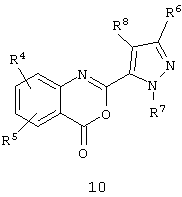
Кроме того, настоящее изобретение относится к соединению бензоксазинона формулы 10In addition, the present invention relates to a benzoxazinone compound of formula 10
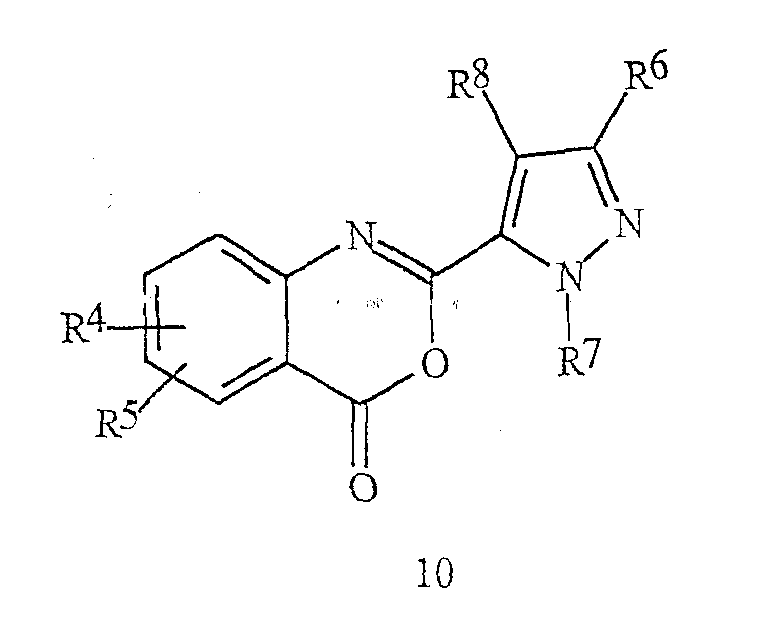
где R4, R5, R6, R7 и R8 определены выше в формуле I.where R 4 , R 5 , R 6 , R 7 and R 8 are as defined above in formula I.
Соединение формулы 10 может быть использовано в качестве синтетического промежуточного соединения для получения соединения формулы I.The compound of formula 10 can be used as a synthetic intermediate to obtain the compounds of formula I.
Подробное описание изобретенияDETAILED DESCRIPTION OF THE INVENTION
В вышеприведенном описании, термин "алкил", используемый отдельно или в сложных словах, таких как "алкилтио" или "галогеналкил", означает алкил с прямой или разветвленной цепью, такой как метил, этил, н-пропил, изопропил или различные бутильные, пентильные или гексильные изомеры. Термин "алкенил" означает алкены с прямой или разветвленной цепью, такие как 1-пропенил, 2-пропенил или различные бутенильные, пентенильные или гексенильные изомеры. Термин "алкенил" также означает полиены, такие как 1,2-пропадиенил и 2,4-гексадиенил. Термин "алкинил" означает алкины с прямой или разветвленной цепью, такие как 1-пропинил, 2-пропинил или различные бутенильные, пентинильные или гексинильные изомеры. Термин "алкинил" может также означать группы, состоящие из множества тройных связей, такие как 2,5-гексадиинил. Термин "алкокси" означает, например, метокси, этокси, н-пропилокси, изопропилокси и различные бутокси-, пентокси- и гексилоксиизомеры. Термин "алкоксиалкил" означает алкил, имеющий алкоксизаместитель. Примерами "алкоксиалкила" являются СН3ОСН2, СН3ОСН2СН2, СН3СН2ОСН2, СН3СН2СН2СН2ОСН2 и СН3СН2ОСН2СН2. Термин "алкилтио" означает алкилтиогруппы с прямой или разветвленной цепью, такие как метилтио, этилтио и различные пропилтио-, бутилтио- и гексилтиоизомеры. Термин "циклоалкил" означает, например, циклопропил, циклобутил, циклопентил и циклогексил.In the above description, the term “alkyl”, used alone or in complex words, such as “alkylthio” or “haloalkyl”, means straight or branched chain alkyl such as methyl, ethyl, n-propyl, isopropyl or various butyl, pentyl or hexyl isomers. The term “alkenyl” means straight or branched chain alkenes such as 1-propenyl, 2-propenyl or various butenyl, pentenyl or hexenyl isomers. The term "alkenyl" also means polyenes such as 1,2-propadienyl and 2,4-hexadienyl. The term “alkynyl” means straight or branched chain alkynes, such as 1-propynyl, 2-propynyl or various butenyl, pentinyl or hexynyl isomers. The term "alkynyl" may also mean groups consisting of many triple bonds, such as 2,5-hexadiinyl. The term “alkoxy” means, for example, methoxy, ethoxy, n-propyloxy, isopropyloxy and various butoxy, pentoxy and hexyloxy isomers. The term “alkoxyalkyl” means an alkyl having an alkoxy substituent. Examples of "alkoxyalkyl" are CH 3 OCH 2 , CH 3 OCH 2 CH 2 , CH 3 CH 2 OCH 2 , CH 3 CH 2 CH 2 CH 2 OCH 2 and CH 3 CH 2 OCH 2 CH 2 . The term “alkylthio” means straight or branched chain alkylthio groups such as methylthio, ethylthio and various propylthio, butylthio and hexylthio isomers. The term “cycloalkyl” means, for example, cyclopropyl, cyclobutyl, cyclopentyl and cyclohexyl.
Термин "гетероциклическое кольцо" или "система гетероциклических колец" означает кольцо или циклические системы, в которых, по крайней мере, один атом на кольце не является атомом углерода и это кольцо содержит 1-4 гетероатома, независимо выбранных из группы, состоящей из азота, кислорода и серы, при условии, что каждое гетероциклическое кольцо содержит не более 4 атомов азота, не более 2 атомов кислорода и не более 2 атомов серы. Такое гетероциклическое кольцо может быть связано посредством любого доступного атома углерода или азота в результате замены водорода на указанном атоме углерода или азота. Термин "система ароматических циклов" означает полностью ненасыщенные карбоциклы и гетероциклы, в которых, по крайней мере, одно кольцо указанной полициклической системы является ароматическим (где термин "ароматический" означает, что для данной циклической системы выполняется правило Хюккеля). Термин "гетероароматическое кольцо" означает полностью ароматические кольца, в которых, по крайней мере, один атом кольца не является углеродом, которые содержат 1-4 гетероатома, независимо выбранных из группы, состоящей из азота, кислорода и серы, при условии, что каждое гетероциклическое кольцо содержит не более 4 атомов азота, не более 2 атомов кислорода и не более 2 атомов серы (где "ароматический" означает, что выполняется правило Хюккеля). Такое гетероциклическое кольцо может быть связано посредством любого доступного атома углерода или азота в результате замены водорода на указанном атоме углерода или азота. Термин "ароматическая гетероциклическая система" означает полностью ароматические гетероциклы и гетероциклы, в которых по крайней мере, одно кольцо указанной полициклической системы является ароматическим (где термин "ароматический" означает, что для данной циклической системы выполняется правило Хюккеля). Термин "конденсированная гетеробициклическая система" означает циклическую систему, состоящую из двух конденсированных колец, в которых, по крайней мере, один атом кольца не является углеродом, и это кольцо может быть ароматическим или неароматическим, как определено выше.The term “heterocyclic ring” or “heterocyclic ring system” means a ring or cyclic systems in which at least one atom on the ring is not a carbon atom and this ring contains 1-4 heteroatoms independently selected from the group consisting of nitrogen, oxygen and sulfur, provided that each heterocyclic ring contains no more than 4 nitrogen atoms, no more than 2 oxygen atoms and no more than 2 sulfur atoms. Such a heterocyclic ring may be bonded via any available carbon or nitrogen atom as a result of the replacement of hydrogen at said carbon or nitrogen atom. The term “aromatic ring system” means completely unsaturated carbocycles and heterocycles in which at least one ring of said polycyclic system is aromatic (where the term “aromatic” means that the Hückel rule holds for a given cyclic system). The term “heteroaromatic ring” means fully aromatic rings in which at least one atom of the ring is not carbon, which contain 1-4 heteroatoms independently selected from the group consisting of nitrogen, oxygen and sulfur, provided that each heterocyclic the ring contains no more than 4 nitrogen atoms, no more than 2 oxygen atoms and no more than 2 sulfur atoms (where “aromatic” means that the Hückel rule is true). Such a heterocyclic ring may be bonded via any available carbon or nitrogen atom as a result of the replacement of hydrogen at said carbon or nitrogen atom. The term “aromatic heterocyclic system” means fully aromatic heterocycles and heterocycles in which at least one ring of said polycyclic system is aromatic (where the term “aromatic” means that the Hückel rule is true for a given cyclic system). The term "fused heterobicyclic system" means a cyclic system consisting of two fused rings in which at least one atom of the ring is not carbon, and this ring may be aromatic or non-aromatic, as defined above.
Термин "галоген", используемый отдельно или в сложных словах, таких как "галогеналкил", означает фтор, хлор, бром или иод. Кроме того, если этот термин используется в сложных словах, таких как "галогеналкил", то указанный алкил может быть частично или полностью замещен атомами галогена, которые могут быть одинаковыми или различными. Примерами галогеналкила являются F3С, ClCH2, CF3СН2 и CF3CCl2. Термины "галогеналкенил", "галогеналкинил", "галогеналкокси" и т.п. могут быть определены аналогично термину "галогеналкил". Примерами "галогеналкенила" являются (Cl)2С=СНСН2 и CF3СН2СН=СНСН2. Примерами "галогеналкинила" являются НС≡CCHCl, CF3С≡С, CCl3С≡С и FCH2С≡ССН2. Примерами "галогеналкокси" являются CF3О, CCl3СН2О, HCF2СН2СН2О и CF3СН2О.The term "halogen", used alone or in complex words such as "halogenated", means fluorine, chlorine, bromine or iodine. In addition, if the term is used in complex words, such as "halogenated", then the specified alkyl may be partially or completely replaced by halogen atoms, which may be the same or different. Examples of halogenated are F 3 C, ClCH 2 , CF 3 CH 2 and CF 3 CCl 2 . The terms haloalkenyl, haloalkynyl, haloalkoxy, and the like. can be defined similarly to the term "haloalkyl". Examples of "haloalkenyl" are (Cl) 2 C = CHCH 2 and CF 3 CH 2 CH = CHCH 2 . Examples of "haloalkynyl" are HC≡CCHCl, CF 3 C≡C, CCl 3 C≡C and FCH 2 C≡CHCH 2 . Examples of "haloalkoxy" are CF 3 O, CCl 3 CH 2 O, HCF 2 CH 2 CH 2 O and CF 3 CH 2 O.
Общее число атомов углерода в группе-заместителе указано префиксом "Сi-Сj", где "i" и "j" означают числа от 1 до 8. Так, например, С1-С4алкилсульфонил означает метилсульфонил-бутилсульфонил; С2алкоксиалкил означает СН3ОСН2; С3алкоксиалкил означает, например, СН3СН(ОСН3), СН3ОСН2СН2 или СН3СН2ОСН2; и С4алкоксиалкил означает различные изомеры алкильной группы, замещенной алкоксигруппой, содержащей в сумме 4 атома углерода, и примерами таких групп являются СН3СН2СН2ОСН2 и СН3СН2ОСН2СН2. В приведенном выше описании, если соединение формулы I включает гетероциклическое кольцо, то все заместители связаны с этим кольцом посредством любого доступного атома углерода или азота в результате замены водорода на указанном углероде или азоте.The total number of carbon atoms in the substituent group is indicated by the prefix "C i -C j ", where "i" and "j" are numbers from 1 to 8. So, for example, C 1 -C 4 alkylsulfonyl means methylsulfonyl-butylsulfonyl; C 2 alkoxyalkyl means CH 3 OCH 2 ; C 3 alkoxyalkyl means, for example, CH 3 CH (OCH 3 ), CH 3 OCH 2 CH 2 or CH 3 CH 2 OCH 2 ; and C 4 alkoxyalkyl means various isomers of an alkyl group substituted with an alkoxy group containing a total of 4 carbon atoms, and examples of such groups are CH 3 CH 2 CH 2 OCH 2 and CH 3 CH 2 OCH 2 CH 2 . In the above description, if the compound of formula I includes a heterocyclic ring, then all substituents are bonded to this ring via any available carbon or nitrogen atom as a result of the replacement of hydrogen with said carbon or nitrogen.
Термин "необязательно замещенный одним-тремя заместителями" означает, что одно-три доступных положения могут быть замещены на указанной группе. Если группа содержит заместитель, которым может быть водород, например, R6, и если в качестве заместителя выбран водород, то это эквивалентно тому, что указанная группа является незамещенной.The term “optionally substituted with one to three substituents” means that one to three available positions can be substituted on the indicated group. If the group contains a substituent, which may be hydrogen, for example, R 6 , and if hydrogen is chosen as the substituent, then this is equivalent to the fact that said group is unsubstituted.
Соединения формулы I могут существовать в форме одного или нескольких стереоизомеров. Различными стереоизомерами являются энантиомеры, диастереомеры, атропизомеры и геометрические изомеры. Следует отметить, что один стереоизомер может быть более активным и/или он может обладать более благоприятным эффективным действием, если он является преимущественным по сравнению с другим(и) стереоизомером(ами), или если он отделен от другого стереоизомера(ов). Кроме того, разделение, обогащение и/или селективное получение указанных стереоизомеров может быть осуществлено специалистом в данной области. В соответствии с этим, соединения формулы I могут присутствовать в виде смеси стереоизомеров, в виде отдельных стереоизомеров или в оптически активной форме. Аналогичным образом, соединения формулы 10 могут существовать в виде одного или нескольких стереоизомеров. Различными стереоизомерами являются энантиомеры, диастереомеры, атропизомеры и геометрические изомеры. Следует отметить, что один стереоизомер соединения формулы 10 может быть более подходящим для получения конкретного стереоизомера формулы I. Кроме того, разделение, обогащение и/или селективное получение указанных стереоизомеров может быть осуществлено специалистом в данной области. В соответствии с этим, соединения формулы 10 могут присутствовать в виде смеси стереоизомеров, в виде отдельных стереоизомеров или в оптически активной форме.The compounds of formula I may exist in the form of one or more stereoisomers. Various stereoisomers are enantiomers, diastereomers, atropisomers and geometric isomers. It should be noted that one stereoisomer may be more active and / or it may have a more favorable effective effect if it is advantageous over the other (s) stereoisomer (s) or if it is separated from other stereoisomer (s). In addition, the separation, enrichment and / or selective preparation of these stereoisomers can be carried out by a person skilled in the art. Accordingly, compounds of formula I may be present as a mixture of stereoisomers, as individual stereoisomers, or in an optically active form. Similarly, compounds of formula 10 may exist as one or more stereoisomers. Various stereoisomers are enantiomers, diastereomers, atropisomers and geometric isomers. It should be noted that one stereoisomer of a compound of formula 10 may be more suitable for the preparation of a particular stereoisomer of Formula I. In addition, separation, enrichment and / or selective preparation of said stereoisomers can be carried out by a person skilled in the art. Accordingly, compounds of formula 10 may be present as a mixture of stereoisomers, as individual stereoisomers, or in an optically active form.
Солями соединений формулы I являются кислотно-аддитивные соли, образованные неорганическими или органическими кислотами, такими как бромистоводородная, хлористоводородная, азотная, фосфорная, серная, уксусная, масляная, фумаровая, молочная, малеиновая, малоновая, щавелевая, пропионовая, салициловая, винная, 4-толуолсульфоновая или валериановая кислоты.Salts of compounds of the formula I are acid addition salts formed by inorganic or organic acids such as hydrobromic, hydrochloric, nitric, phosphoric, sulfuric, acetic, butyric, fumaric, lactic, maleic, malonic, oxalic, propionic, salicylic, tartaric 4 toluenesulfonic or valerianic acid.
Как указано выше, R7 представляет собой (среди прочих) фенил, бензил, 5- или 6-членное гетероароматическое кольцо, нафтильную циклическую систему или ароматическую 8-, 9- или 10-членную конденсированную гетеробициклическую систему, где каждый цикл или циклическая система необязательно замещены одним-тремя заместителями, независимо выбранными из R9. Термин "необязательно замещенный", относящийся к указанным группам R7, означает, что эти группы являются незамещенными или имеют, по крайней мере, один неводородный заместитель, не влияющий на активность против беспозвоночного вредителя, которой обладает незамещенный аналог. Следует также отметить, что J-1 - J-4, указанные ниже, означают 5- или 6-членные гетероароматические кольца. Примером фенильного кольца, необязательно замещенного 1-3 R9, является кольцо, представленное на фиг.1 как J-5, где r означает целое число от 0 до 3. Примером бензильного кольца, необязательно замещенного 1-3 R9, является кольцо, представленное на фиг.1 как J-6, где r означает целое число от 0 до 3. Примером нафтильной циклической системы, необязательно замещенной 1-3 R9, является система, представленная на фиг.1 как J-59, где r означает целое число от 0 до 3. Примерами 5- или 6-членного гетероароматического кольца, необязательно замещенного 1-3 R9, являются кольца, представленные на фиг.1 как J-7 - J-58, где r означает целое число от 0 до 3. При этом, следует отметить, что J-7 - J-26 являются примерами J-1; J-27 - J-41 являются примерами J-2; а J-46 - J-58 являются примерами J-3 и J-4. Атомы азота, которым требуется заместитель для заполнения их валентности, замещены Н или R9. Следует отметить, что группы J могут быть замещены лишь менее чем тремя группами R9 (например, от J-19, J-20, J-23 - J-26 и J-37 - J-40 могут быть замещены лишь одним R9). Примерами ароматических 8-, 9- или 10-членных конденсированных гетеробициклических систем, необязательно замещенных 1-3 R9, являются системы, представленные на фиг.1 как J-60 - J-90, где r означает целое число от 0 до 3. Хотя группы R9 представлены в этих структурах как J-5 - J-90, однако, следует отметить, что их присутствие является необязательным, поскольку они являются необязательными заместителями. Следует также отметить, что если положение связывания между (R9)r и группой J представлено как плавающее, то (R9)r может быть связан с любым доступным атомом углерода группы J. Кроме того, следует отметить, что если положение присоединения на группе J представлено как плавающее, то группа J может быть присоединена к остальной части соединения формулы I посредством любого доступного атома углерода группы J в результате замещения атома водорода.As indicated above, R 7 is (among others) a phenyl, benzyl, 5- or 6-membered heteroaromatic ring, a naphthyl cyclic system or an aromatic 8-, 9- or 10-membered condensed heterobicyclic system, where each cycle or cyclic system substituted by one to three substituents independently selected from R 9 . The term “optionally substituted”, referring to said R 7 groups, means that these groups are unsubstituted or have at least one non-hydrogen substituent that does not affect the activity against an invertebrate pest that an unsubstituted analog possesses. It should also be noted that J-1 to J-4, indicated below, mean 5- or 6-membered heteroaromatic rings. An example of a phenyl ring optionally substituted with 1-3 R 9 is the ring shown in FIG. 1 as J-5, where r is an integer from 0 to 3. An example of a benzyl ring optionally substituted with 1-3 R 9 is a ring, shown in FIG. 1 as J-6, where r is an integer from 0 to 3. An example of a naphthyl ring system optionally substituted with 1-3 R 9 is the system shown in FIG. 1 as J-59, where r is an integer integer from 0 to 3. Examples of a 5- or 6-membered heteroaromatic ring optionally substituted with 1-3 R 9 are stake as shown in Figure 1 as a J-7 - J-58, wherein r is an integer from 0 to 3. In this case, it should be noted that J-7 - J-26 are examples of J-1; J-27 - J-41 are examples of J-2; and J-46 to J-58 are examples of J-3 and J-4. Nitrogen atoms that require a substituent to fill their valencies are substituted with H or R 9 . It should be noted that groups J can be substituted with only less than three groups R 9 (for example, from J-19, J-20, J-23 - J-26 and J-37 - J-40 can be substituted with only one R 9 ) Examples of aromatic 8-, 9- or 10-membered fused heterobicyclic systems, optionally substituted with 1-3 R 9 , are those shown in FIG. 1 as J-60 to J-90, where r is an integer from 0 to 3. Although the R 9 groups are represented in these structures as J-5 - J-90, however, it should be noted that their presence is optional, since they are optional substituents. It should also be noted that if the binding position between (R 9 ) r and group J is presented as floating, then (R 9 ) r can be associated with any available carbon atom of group J. In addition, it should be noted that if the attachment position on the group J is represented as floating, then group J can be attached to the rest of the compounds of formula I via any available carbon atom of group J as a result of the replacement of the hydrogen atom.
Фигура 1Figure 1


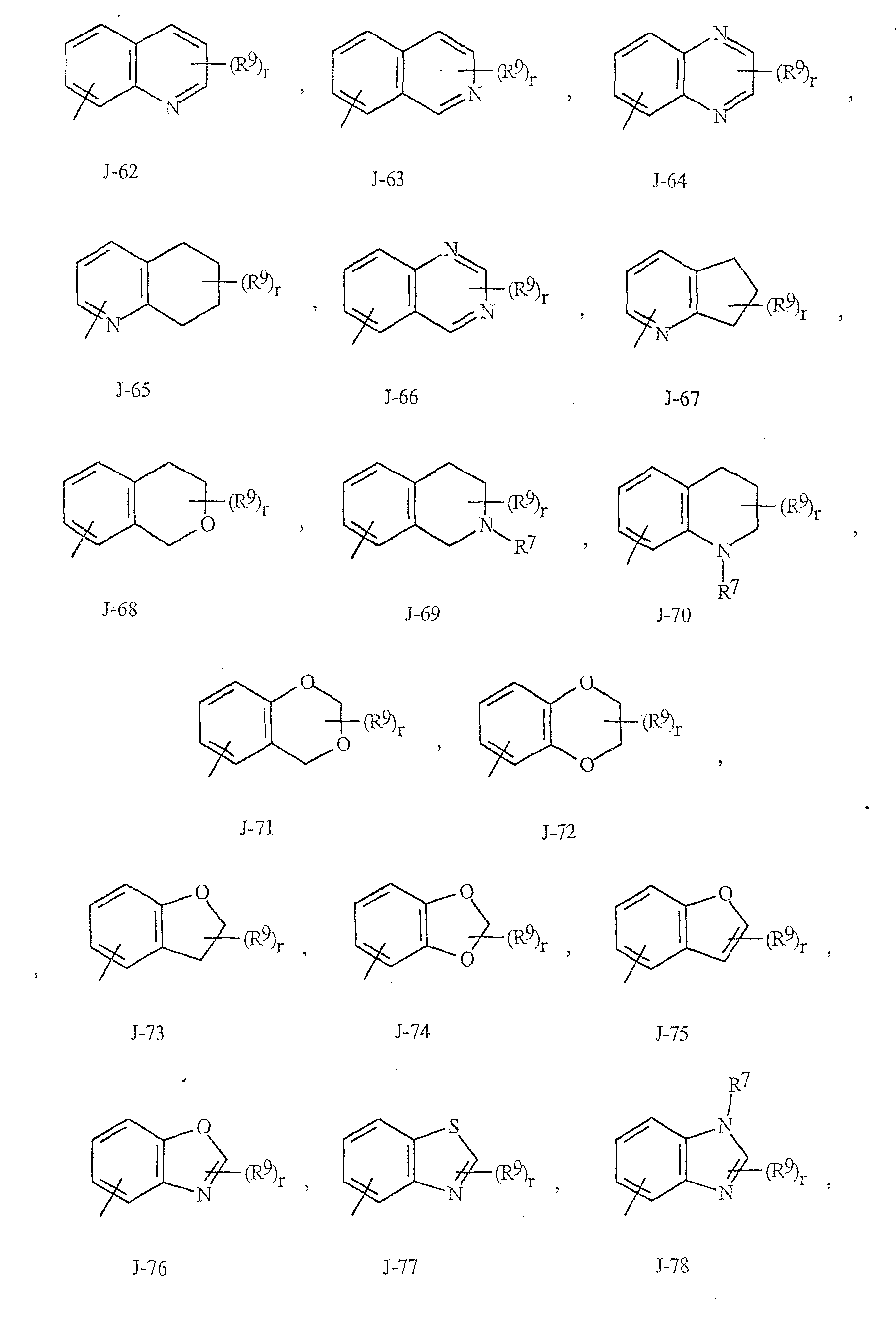
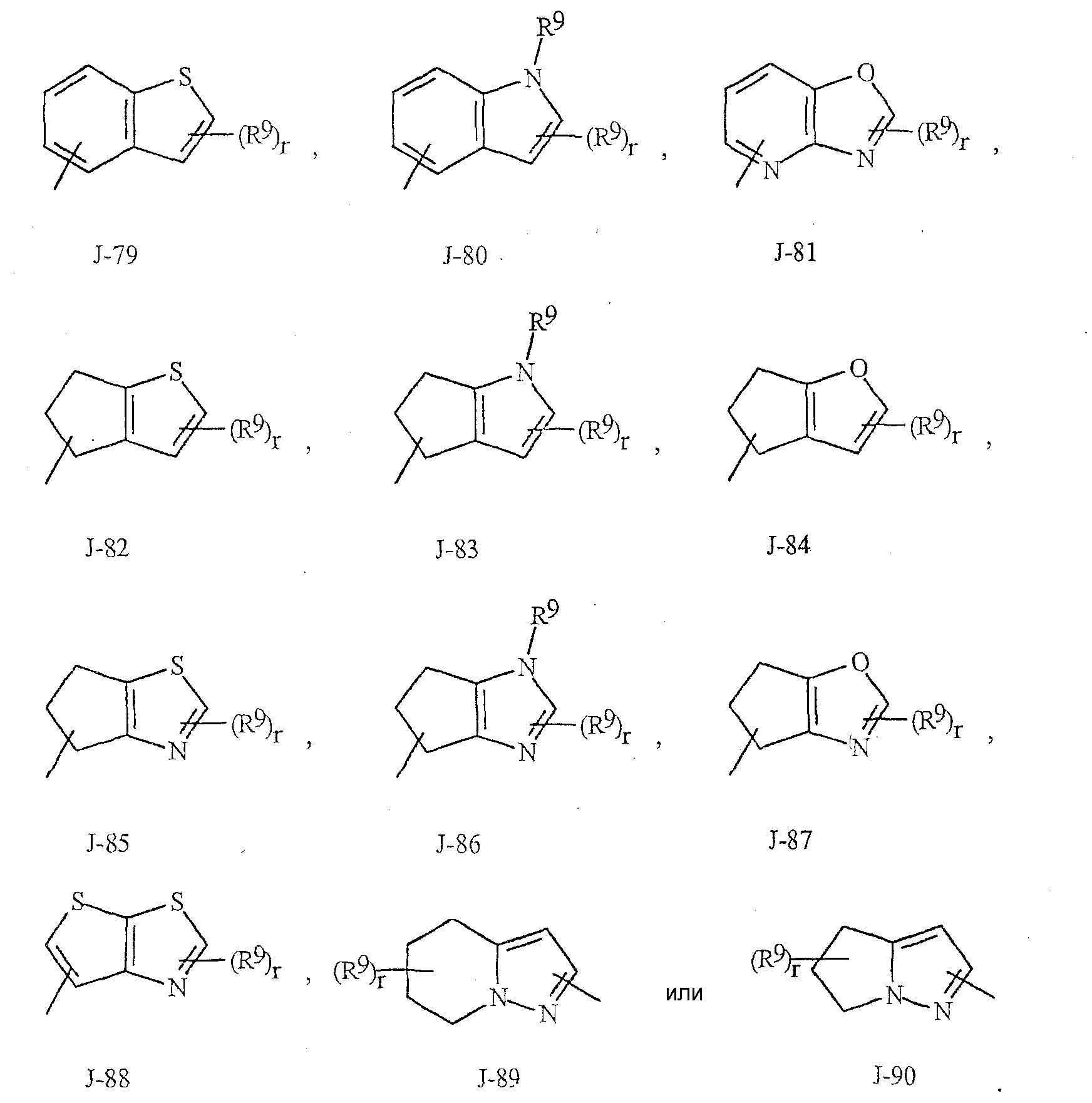
Предпочтительными способами, с точки зрения стоимости, легкости синтеза или применения и/или биологической эффективности, являются:Preferred methods, from the point of view of cost, ease of synthesis or use and / or biological effectiveness, are:
Предпочтительный вариант 1: Способы получения соединения формулы I, где оба А и В представляют О;Preferred Option 1: Methods of preparing a compound of formula I, wherein both A and B are O;
R7 представляет собой фенильное кольцо или 5- или 6-членное гетероароматическое кольцо, выбранное из группы, состоящей изR 7 represents a phenyl ring or a 5- or 6-membered heteroaromatic ring selected from the group consisting of
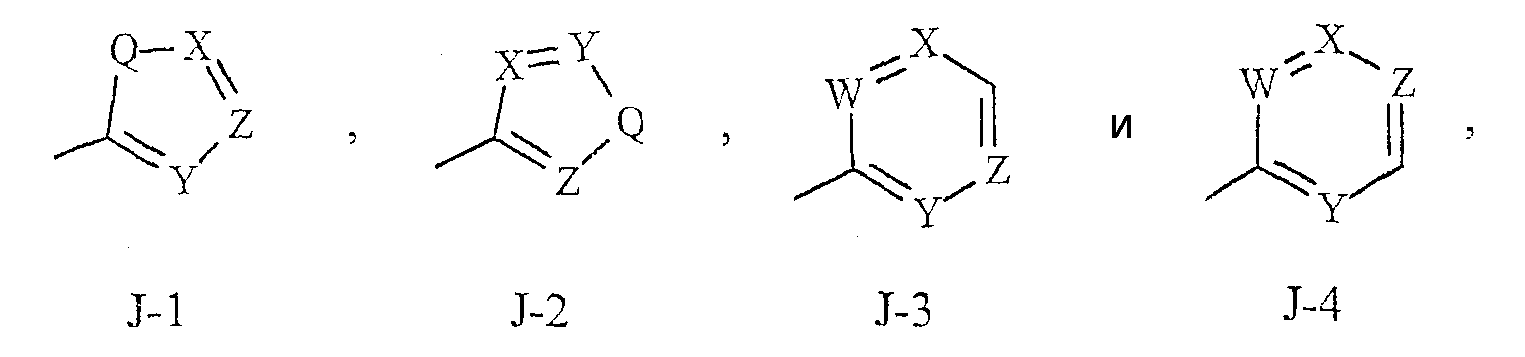
где каждое кольцо необязательно замещено одним-тремя заместителями, независимо выбранными из R9;where each ring is optionally substituted with one to three substituents independently selected from R 9 ;
Q представляет собой О, S, NH или NR9; иQ represents O, S, NH or NR 9 ; and
W, Х, Y и Z независимо представляют N, CN или CR9, при условии, что в J-3 и J-4, по крайней мере, один из W, Х, Y и Z представляет собой N.W, X, Y, and Z independently represent N, CN, or CR 9 , provided that in J-3 and J-4, at least one of W, X, Y, and Z is N.
Предпочтительный вариант 2: Способы предпочтительного варианта 1, где:Preferred option 2: Methods of the preferred option 1, where:
все R1, R2 и R8 представляют Н;all R 1 , R 2, and R 8 are H;
R3 представляет собой С1-С4алкил, необязательно замещенный галогеном, CN, ОСН3 или S(О)рСН3;R 3 represents C 1 -C 4 alkyl optionally substituted with halogen, CN, OCH 3 or S (O) p CH 3 ;
группа R4 присоединена в положении 2;a group R 4 is attached at position 2;
R4 представляет собой СН3, CF3, OCF3, OCHF2, CN или галоген;R 4 represents CH 3 , CF 3 , OCF 3 , OCHF 2 , CN or halogen;
R5 представляет собой Н, СН3 или галоген;R 5 represents H, CH 3 or halogen;
R6 представляет собой СН3, CF3 или галоген;R 6 represents CH 3 , CF 3 or halogen;
R7 представляет собой фенил или 2-пиридинил, каждый из которых является необязательно замещенным; иR 7 represents phenyl or 2-pyridinyl, each of which is optionally substituted; and
р равно 0, 1 или 2.p is 0, 1 or 2.
Предпочтительный вариант 3. Способы предпочтительного варианта 2, где R3 представляет собой С1-С4алкил, а R6 представляет собой CF3.Preferred Option 3. The methods of preferred embodiment 2, wherein R 3 is C 1 -C 4 alkyl and R 6 is CF 3 .
Предпочтительный вариант 4. Соединение предпочтительного варианта 2, где R3 представляет собой С1-С4алкил, а R6 представляет собой Cl или Br.Preferred Option 4. The compound of preferred embodiment 2, wherein R 3 is C 1 -C 4 alkyl and R 6 is Cl or Br.
Предпочтительными соединениями формулы 10 являются:Preferred compounds of formula 10 are:
Предпочтительный вариант А. Соединения формулы 10, где:Preferred Option A. Compounds of Formula 10, wherein:
R7 представляет собой фенильное кольцо или 5- или 6-членное гетероароматическое кольцо, выбранное из группы, состоящей изR 7 represents a phenyl ring or a 5- or 6-membered heteroaromatic ring selected from the group consisting of
где каждое кольцо необязательно замещено одним-тремя заместителями, независимо выбранными из R9;where each ring is optionally substituted with one to three substituents independently selected from R 9 ;
Q представляет собой О, S, NH или NR9; иQ represents O, S, NH or NR 9 ; and
W, Х, Y и Z независимо представляют N, СН или CR9, при условии, что в J-3 и J-4, по крайней мере, один из W, Х, Y и Z представляет собой N.W, X, Y, and Z independently represent N, CH, or CR 9 , provided that in J-3 and J-4, at least one of W, X, Y, and Z is N.
Предпочтительный вариант В: Соединения предпочтительного варианта А, где:Preferred Option B: Compounds of Preferred Option A, wherein:
R8 представляет собой Н;R 8 represents H;
группа R4 присоединена в положении 2;a group R 4 is attached at position 2;
R4 представляет собой СН3, CF3, OCF3, OCHF2, CN или галоген;R 4 represents CH 3 , CF 3 , OCF 3 , OCHF 2 , CN or halogen;
R5 представляет собой Н, СН3 или галоген;R 5 represents H, CH 3 or halogen;
R6 представляет собой СН3, CF3 или галоген; иR 6 represents CH 3 , CF 3 or halogen; and
R7 представляет собой фенил или 2-пиридинил, каждый из которых является необязательно замещенным.R 7 represents phenyl or 2-pyridinyl, each of which is optionally substituted.
Предпочтительный вариант С. Соединения предпочтительного варианта В, где R6 представляет собой CF3.Preferred Option C. Compounds of Preferred Embodiment B wherein R 6 is CF 3 .
Предпочтительный вариант D. Соединения предпочтительного варианта В, где R6 представляет собой Cl или Br.Preferred Option D. Compounds of Preferred Embodiment B wherein R 6 is Cl or Br.
Рассматриваются соединения формулы 10, где R4 находится в положении 2 и представляет собой СН3, Cl или Br; R5 находится в положении 4 и представляет собой F, Cl, Br, I или CF3; R6 представляет собой CF3, Cl или Br; R7 представляет собой 3-Cl-2-пиридинил или 3-Br-2-пиридинил; а R8 представляет собой Н.Compounds of formula 10 are contemplated wherein R 4 is at position 2 and is CH 3 , Cl or Br; R 5 is in position 4 and represents F, Cl, Br, I or CF 3 ; R 6 represents CF 3 , Cl or Br; R 7 represents 3-Cl-2-pyridinyl or 3-Br-2-pyridinyl; and R 8 represents N.
Для получения соединений формулы I может быть использован один или несколько из следующих способов и вариантов, приведенных на схемах 1-22. Определения А, В и R1-R9 в соединениях формул 2-40, представленных ниже, приведены выше в разделе "Краткое описание изобретения", если это не оговорено особо. Соединения формул 1а-d, 2a-d, 3a, 4a-d, 5a-b, 17a-c, 18а и 32а-b представляют собой различные подряды соединений формул 1, 2, 3, 4, 5, 17, 18 и 32. На этих схемах Het означает группу, представленную ниже:To obtain the compounds of formula I, one or more of the following methods and options shown in schemes 1-22 can be used. Definitions A, B and R 1 -R 9 in the compounds of formulas 2-40 below are given in the “Summary of the Invention” section above, unless otherwise indicated. The compounds of formulas 1a-d, 2a-d, 3a, 4a-d, 5a-b, 17a-c, 18a and 32a-b are different contracts of compounds of formulas 1, 2, 3, 4, 5, 17, 18 and 32 In these diagrams, Het means the group shown below:
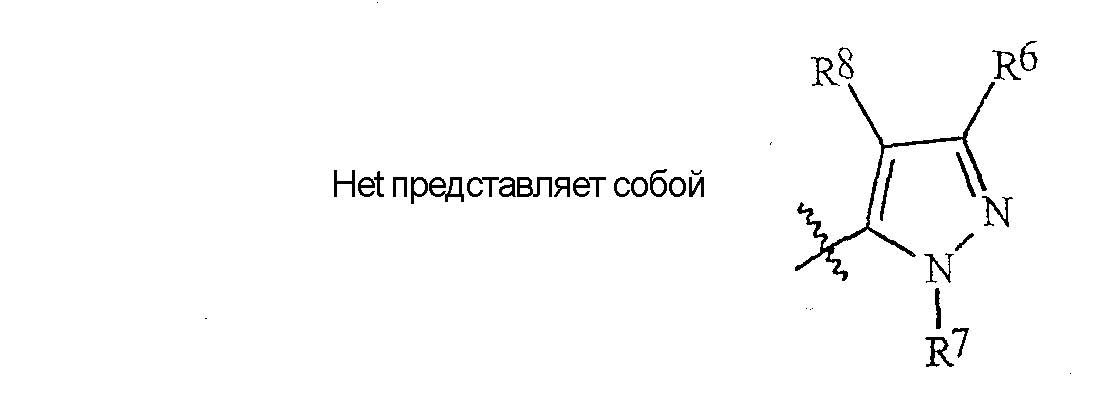
Типичный способ получения соединения формулы 1а приведен на схеме 1.A typical way to obtain the compounds of formula 1A is shown in scheme 1.

Метод, описанный на схеме 1, предусматривает осуществление реакции сочетания амина формулы 2 с хлорангидридом формулы 3 в присутствии акцептора кислоты с получением соединения формулы Ia. Типичными акцепторами кислоты являются аминовые основания, такие как триэтиламин, N,N-диизопропилэтиламин и пиридин; другими акцепторами являются гидроксиды, такие как гидроксид натрия и калия, и карбонаты, такие как карбонат натрия и карбонат калия. В некоторых случаях могут быть использованы акцепторы кислоты на полимерной основе, такие как связанный с полимером N,N-диизопропилэтиламин и связанный с полимером 4-(диметиламино)пиридин. Реакция сочетания может быть осуществлена в подходящем инертном растворителе, таком как тетрагидрофуран, диоксан, диэтиловый эфир или дихлорметан, с получением анилида формулы 1а.The method described in Scheme 1 involves the reaction of combining an amine of formula 2 with an acid chloride of formula 3 in the presence of an acid acceptor to give a compound of formula Ia. Typical acid acceptors are amine bases such as triethylamine, N, N-diisopropylethylamine and pyridine; other acceptors are hydroxides, such as sodium and potassium hydroxide, and carbonates, such as sodium carbonate and potassium carbonate. In some cases, polymer-based acid acceptors may be used, such as N, N-diisopropylethylamine bonded to the polymer and 4- (dimethylamino) pyridine bonded to the polymer. The coupling reaction may be carried out in a suitable inert solvent, such as tetrahydrofuran, dioxane, diethyl ether or dichloromethane, to give an anilide of formula 1a.
Тиоамид формулы 1b может быть получен на следующей стадии из соответствующего амида формулы Ia путем обработки одним из ряда стандартных реагентов переноса тиогруппы, включая пентасульфид фосфора и реагент Лавессона (2,4-бис(4-метоксифенил)-1,3-дитиа-2,4-дифосфетан-2,4-дисульфид).A thioamide of formula 1b can be obtained in the next step from the corresponding amide of formula Ia by treatment with one of a number of standard thio group transfer reagents, including phosphorus pentasulfide and Lawesson's reagent (2,4-bis (4-methoxyphenyl) -1,3-dithia-2, 4-diphosphetane-2,4-disulfide).
Как показано на схеме 2, альтернативная методика получения соединений формулы 1а предусматривает проведение реакции взаимодействия амина формулы 2 с кислотой формулы 4 в присутствии дегидратирующего агента, такого как дициклогексилкарбодиимид (DCC), 1,1'-карбонилдиимидазол, хлорангидрид бис(2-оксо-3-оксазолидинил)фосфиновой кислоты или гексафторфосфат бензотриазол-1-илокси-трис-(диметиламино)фосфония.As shown in Scheme 2, an alternative procedure for preparing compounds of Formula 1a involves reacting an amine of Formula 2 with an acid of Formula 4 in the presence of a dehydrating agent such as dicyclohexylcarbodiimide (DCC), 1,1'-carbonyldiimidazole, bis (2-oxo-3) chloride -oxazolidinyl) phosphinic acid or benzotriazol-1-yloxy-tris- (dimethylamino) phosphonium hexafluorophosphate.

И в этом случае могут быть использованы реагенты на полимерной основе, такие как связанный с полимером циклогексикарбодиимид. Реакция сочетания может быть проведена в подходящем инертном растворителе, таком как дихлорметан или N,N-диметилформамид. Способы синтеза по схемам 1 и 2 являются лишь репрезентативными примерами широкого ряда способов осуществления реакции сочетания, которые могут быть использованы для получения соединений формулы I; реакция сочетания такого типа широко описана в литературе по химическому синтезу.And in this case, polymer-based reagents, such as cyclohexycarbodiimide bonded to the polymer, can be used. The coupling reaction may be carried out in a suitable inert solvent, such as dichloromethane or N, N-dimethylformamide. The synthesis methods of Schemes 1 and 2 are only representative examples of a wide range of coupling reaction methods that can be used to prepare compounds of formula I; a coupling reaction of this type is widely described in the literature on chemical synthesis.
Каждому специалисту в данной области также будет очевидно, что хлорангидриды формулы 3 могут быть получены из кислот формулы 4 различными хорошо известными способами. Так, например, хлорангидриды формулы 3 могут быть легко получены из карбоновых кислот формулы 4 путем взаимодействия карбоновой кислоты 4 с тионилхлоридом или оксалилхлоридом в инертном растворителе, таком как толуол или дихлорметан, в присутствии каталитического количества N,N-диметилформамида.It will also be apparent to those skilled in the art that acid chlorides of formula 3 can be prepared from acids of formula 4 by various well-known methods. For example, acid chlorides of formula 3 can be easily obtained from carboxylic acids of formula 4 by reacting carboxylic acid 4 with thionyl chloride or oxalyl chloride in an inert solvent, such as toluene or dichloromethane, in the presence of a catalytic amount of N, N-dimethylformamide.
Как показано на схеме 3, амины формулы 2а обычно получают из соответствующих 2-нитробензамидов формулы 5 путем каталитического гидрирования нитрогруппы.As shown in Scheme 3, amines of formula 2a are usually prepared from the corresponding 2-nitrobenzamides of formula 5 by catalytic hydrogenation of a nitro group.

Типичные методики предусматривают восстановление водородом в присутствии металлического катализатора, такого как палладий на угле или оксид платины, в гидроксильных растворителях, таких как этанол и изопропанол. Амины формулы 2а могут быть также получены путем восстановления цинком в уксусной кислоте. Эти методики хорошо описаны в химической литературе. Заместители R1, такие как С1-С6алкил, могут быть введены на этой стадии по хорошо известным методикам, включая либо метод прямого алкилирования, либо, в основном, предпочтительный метод восстановительного алкилирования амина. Кроме того, как показано на схеме 3, обычно используемой методикой является объединение амина 2а с альдегидом в присутствии восстановителя, такого как цианоборогидрид натрия, с получением соединений формулы 2b, где R1 представляет собой С1-С6алкил.Typical techniques include hydrogen reduction in the presence of a metal catalyst, such as palladium on carbon or platinum oxide, in hydroxyl solvents such as ethanol and isopropanol. Amines of formula 2a can also be prepared by reduction with zinc in acetic acid. These techniques are well described in the chemical literature. R 1 substituents, such as C 1 -C 6 alkyl, can be introduced at this stage by well-known methods, including either the direct alkylation method or the generally preferred amine reductive alkylation method. In addition, as shown in Scheme 3, a commonly used technique is to combine amine 2a with an aldehyde in the presence of a reducing agent, such as sodium cyanoborohydride, to give compounds of formula 2b, where R 1 is C 1 -C 6 alkyl.
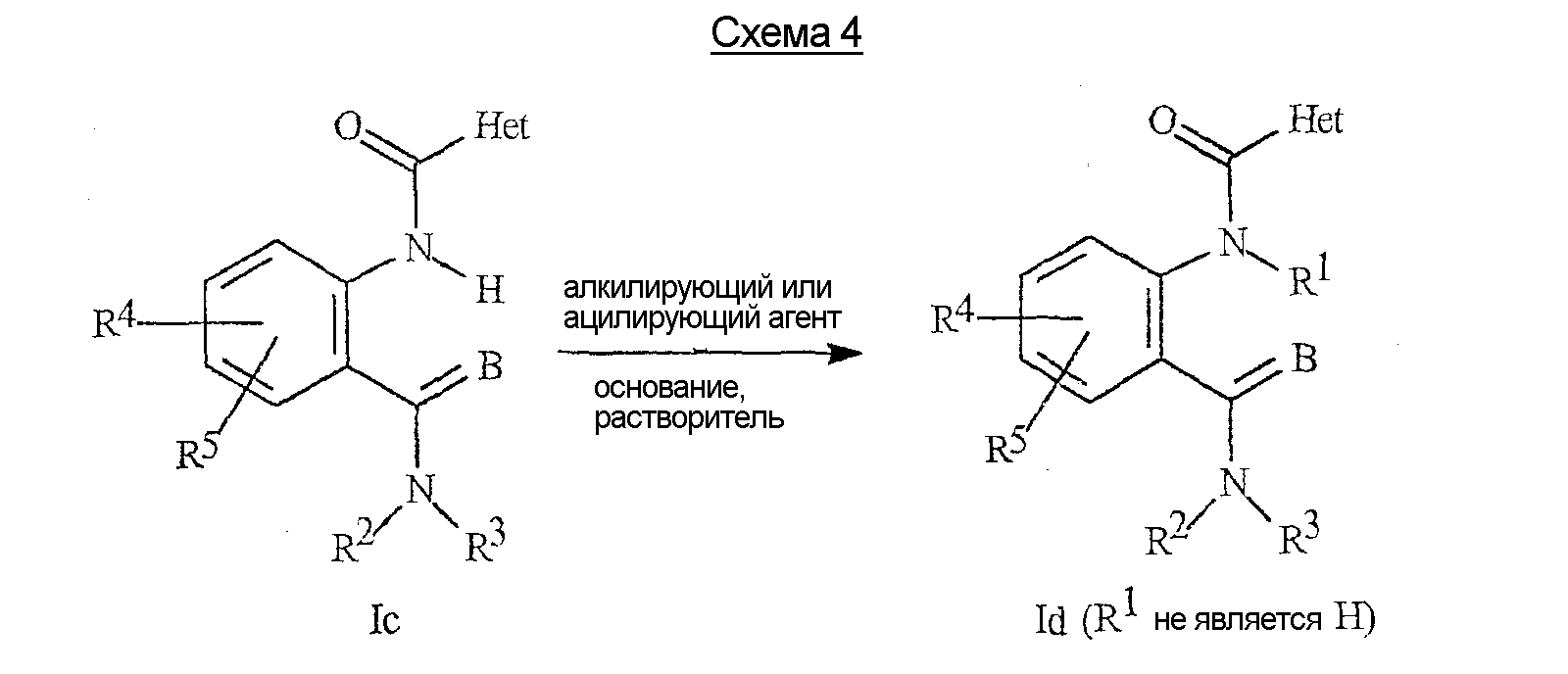
На схеме 4 показано, что соединения формулы 1с могут быть алкилированы или ацилированы с использованием подходящего алкилирующего или ацилирующего агента, такого как алкилгалогенид, алкилхлорформиат или ацилхлорид, в присутствии основания, такого как гидрид натрия или н-бутиллитий в инертном растворителе, таком как тетрагидрофуран или N,N-диметилформамид, с получением анилидов формулы Id, где R1 не является водородом.Scheme 4 shows that compounds of Formula 1c can be alkylated or acylated using a suitable alkylating or acylating agent, such as an alkyl halide, alkyl chloroformate or acyl chloride, in the presence of a base such as sodium hydride or n-butyl lithium in an inert solvent such as tetrahydrofuran or N, N-dimethylformamide to give anilides of the formula Id, wherein R 1 is not hydrogen.
Промежуточные амиды формулы 5а могут быть легко получены из коммерчески доступных 2-нитробензойных кислот. Могут быть использованы типичные способы образования амида. Как показано на схеме 5, такими способами являются прямая реакция сочетания с дегидратацией кислот формулы 6 с аминами формулы 7 с использованием, например, DCC, и превращение этих кислот в активированные формы, такие как хлорангидриды или ангидриды кислот, с последующей реакцией сочетания с аминами с образованием амидов формулы 5а.The intermediate amides of formula 5a can be easily obtained from commercially available 2-nitrobenzoic acids. Typical amide formation methods may be used. As shown in Scheme 5, such methods are a direct coupling reaction with the dehydration of acids of Formula 6 with amines of Formula 7 using, for example, DCC, and the conversion of these acids into activated forms, such as acid chlorides or acid anhydrides, followed by coupling with amines with the formation of amides of formula 5a.
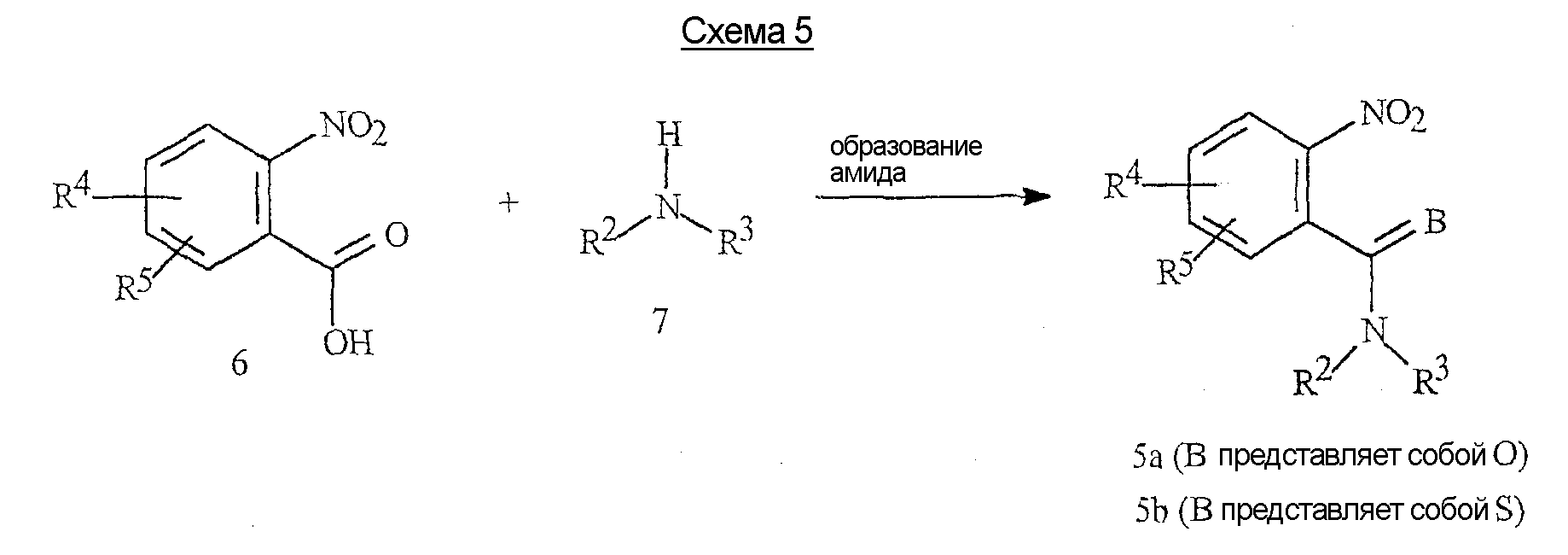
Особенно подходящими реагентами для реакции этого типа, включая активацию кислоты, являются алкилхлорформиаты, такие как этилхлорформиат или изопропилхлорформиат. Способы получения амида хорошо описаны в химической литературе. Амиды формулы 5а могут быть легко превращены в тиоамиды формулы 5b с использованием коммерчески доступных реагентов переноса тиогруппы, таких как пентасульфид фосфора и реагент Лавессона.Particularly suitable reagents for this type of reaction, including acid activation, are alkyl chloroformates, such as ethyl chloroformate or isopropyl chloroformate. Methods for producing amide are well described in the chemical literature. Amides of formula 5a can be easily converted to thioamides of formula 5b using commercially available thio group transfer reagents such as phosphorus pentasulfide and Lawesson's reagent.
Промежуточные антраниламиды формулы 2с или 2d могут быть также получены из ангидридов N-карбоксиантраниловой кислоты формул 8 или 9, соответственно, как показано на схеме 6.Intermediate anthranilamides of formula 2c or 2d may also be prepared from N-carboxyanthranilic acid anhydrides of formulas 8 or 9, respectively, as shown in Scheme 6.
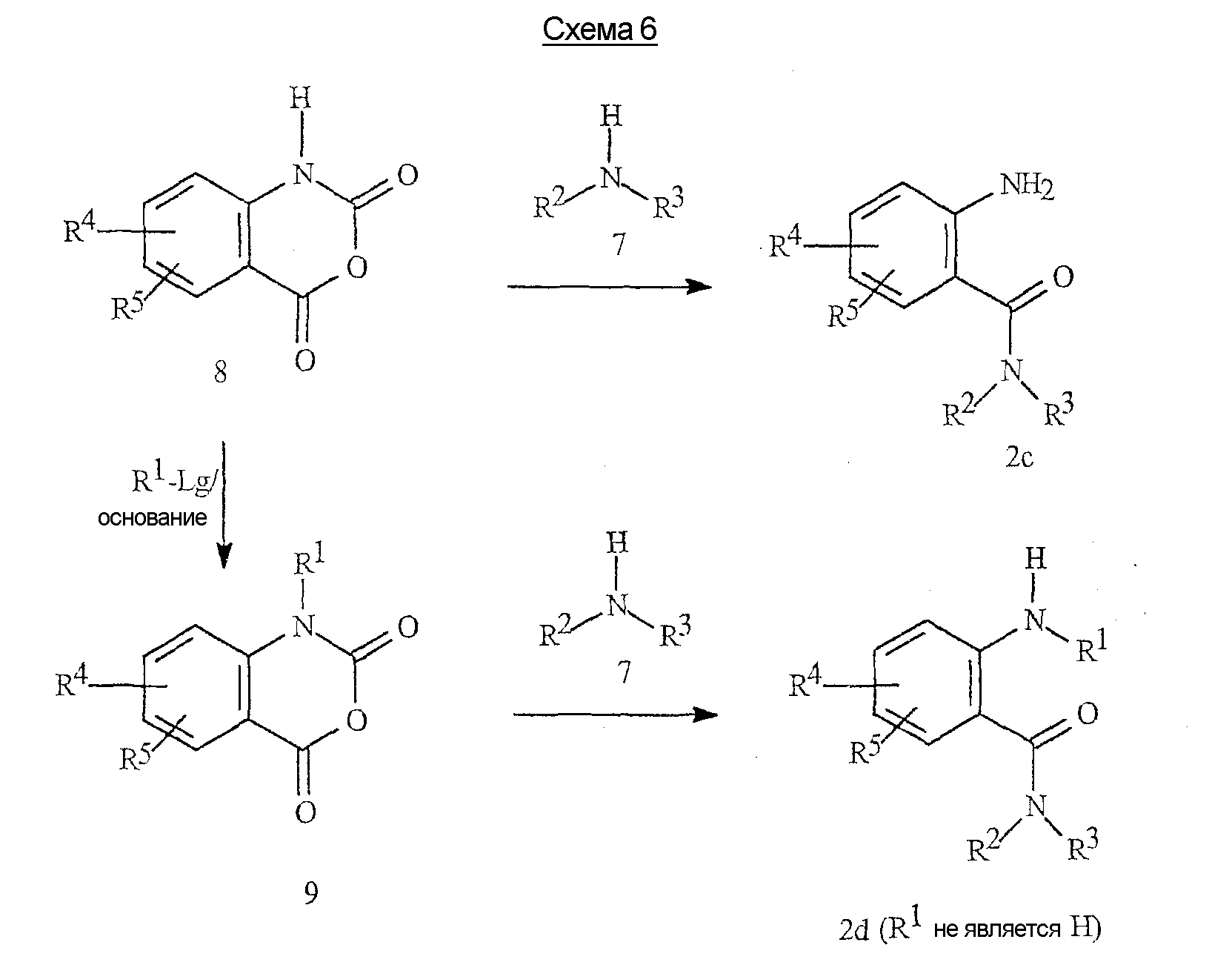
Типичные методики предусматривают объединение эквимолярных количеств амина 7 с ангидридом N-карбоксиантраниловой кислоты в полярных апротонных растворителях, таких как пиридин и N,N-диметилформамид при температуре в пределах от комнатной температуры до 100°С. Заместители R1, такие как алкил и замещенный алкил, могут быть введены путем катализируемой основанием реакции алкилирования ангидрида N-карбоксиантраниловой кислоты 8 с известными алкилирующими реагентами R1-Lg (где Lg означает нуклеофильно заменяемую уходящую группу, такую как галогенид, алкил- или арилсульфонаты или алкилсульфаты) с получением алкилзамещенного промежуточного соединения 9. Ангидриды N-карбоксиантраниловой кислоты формулы 8 могут быть получены способами, описанными Coppola, Synthesis 1980, 505-36.Typical techniques include combining equimolar amounts of amine 7 with N-carboxyanthranilic acid anhydride in polar aprotic solvents such as pyridine and N, N-dimethylformamide at temperatures ranging from room temperature to 100 ° C. R 1 substituents, such as alkyl and substituted alkyl, can be introduced by a base-catalyzed alkylation reaction of N-carboxyanthranilic acid anhydride 8 with known alkylating reagents R 1 -Lg (where Lg is a nucleophilically replaceable leaving group such as a halide, alkyl or arylsulfonates or alkyl sulfates) to give an alkyl substituted intermediate 9. N-carboxyanthranilic acid anhydrides of formula 8 can be prepared by the methods described by Coppola, Synthesis 1980, 505-36.
Как показано на схеме 7, альтернативная методика получения конкретных соединений формулы 1с предусматривает проведение реакции амина 7 с бензоксазиноном формулы 10.As shown in scheme 7, an alternative method for obtaining specific compounds of formula 1c involves the reaction of amine 7 with benzoxazinone of formula 10.
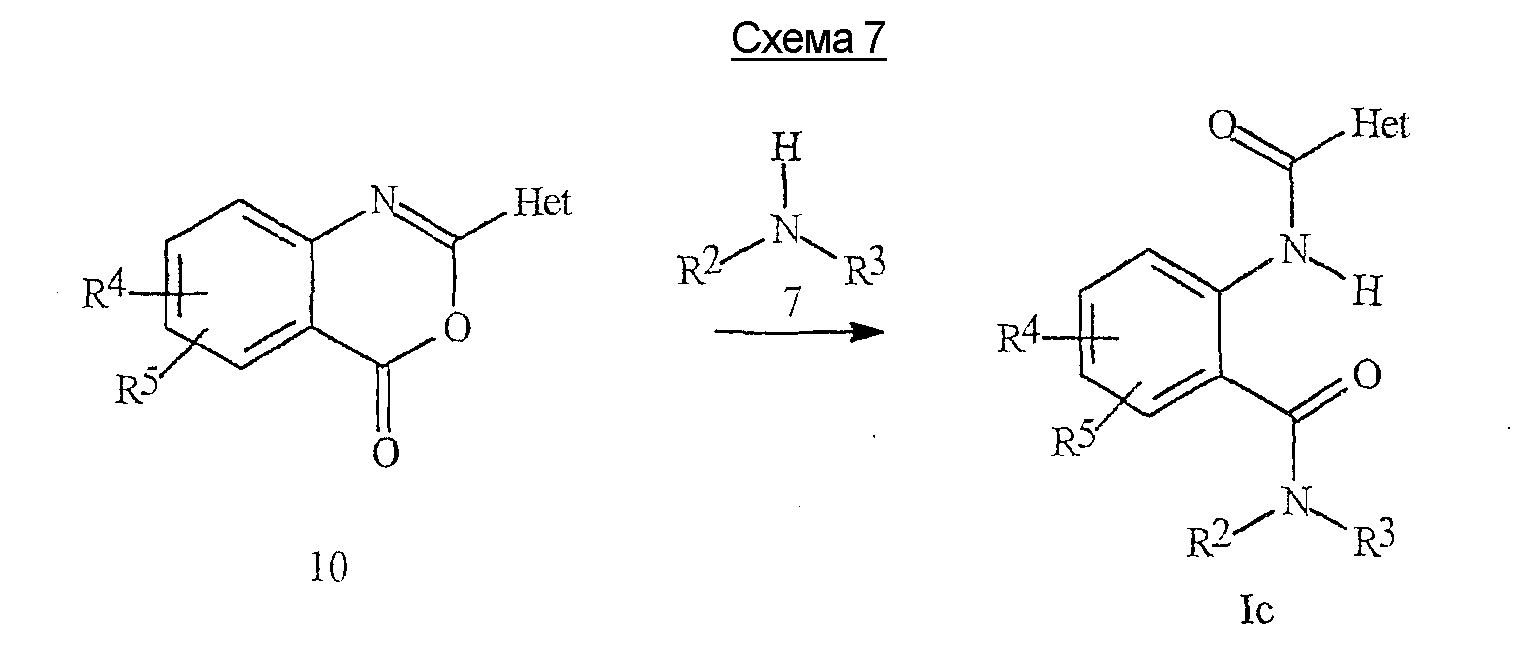
Реакция, описанная на схеме 7, может быть проведена в чистом виде или в различных подходящих растворителях, включая тетрагидрофуран, диэтиловый эфир, пиридин, дихлорметан или хлороформ при оптимальных температурах, составляющих в пределах от комнатной температуры до температуры кипения с обратным холодильником растворителя. Общая реакция бензоксазинонов с аминами с получением антраниламидов хорошо описана в химической литературе. Обзор химии бензоксазинонов можно найти у Jakobsen et al., Biorganic and Medicinal Chemistry 2000, 8, 2095-2103, и в цитируемых там работах. См. также Coppola, J. Heterocyclic Chemistry 1999, 36, 563-588.The reaction described in Scheme 7 can be carried out in pure form or in various suitable solvents, including tetrahydrofuran, diethyl ether, pyridine, dichloromethane or chloroform at optimal temperatures ranging from room temperature to the boiling point of the solvent under reflux. The general reaction of benzoxazinones with amines to produce anthranilamides is well described in the chemical literature. A review of the chemistry of benzoxazinones can be found in Jakobsen et al., Biorganic and Medicinal Chemistry 2000, 8, 2095-2103, and the works cited there. See also Coppola, J. Heterocyclic Chemistry 1999, 36, 563-588.
Бензоксазиноны формулы 10 могут быть получены в соответствии с различными методиками. Две методики, которые являются особенно подходящими, подробно приведены на схемах 8-9. На схеме 8 бензоксазинон формулы 10 получают непосредственно с помощью реакции сочетания пиразолкарбоновой кислоты формулы 4а с антраниловой кислотой формулы 11.Benzoxazinones of formula 10 can be obtained in accordance with various methods. Two techniques that are particularly suitable are detailed in Schemes 8-9. In Scheme 8, benzoxazinone of formula 10 is prepared directly by combining pyrazolecarboxylic acid of formula 4a with anthranilic acid of formula 11.
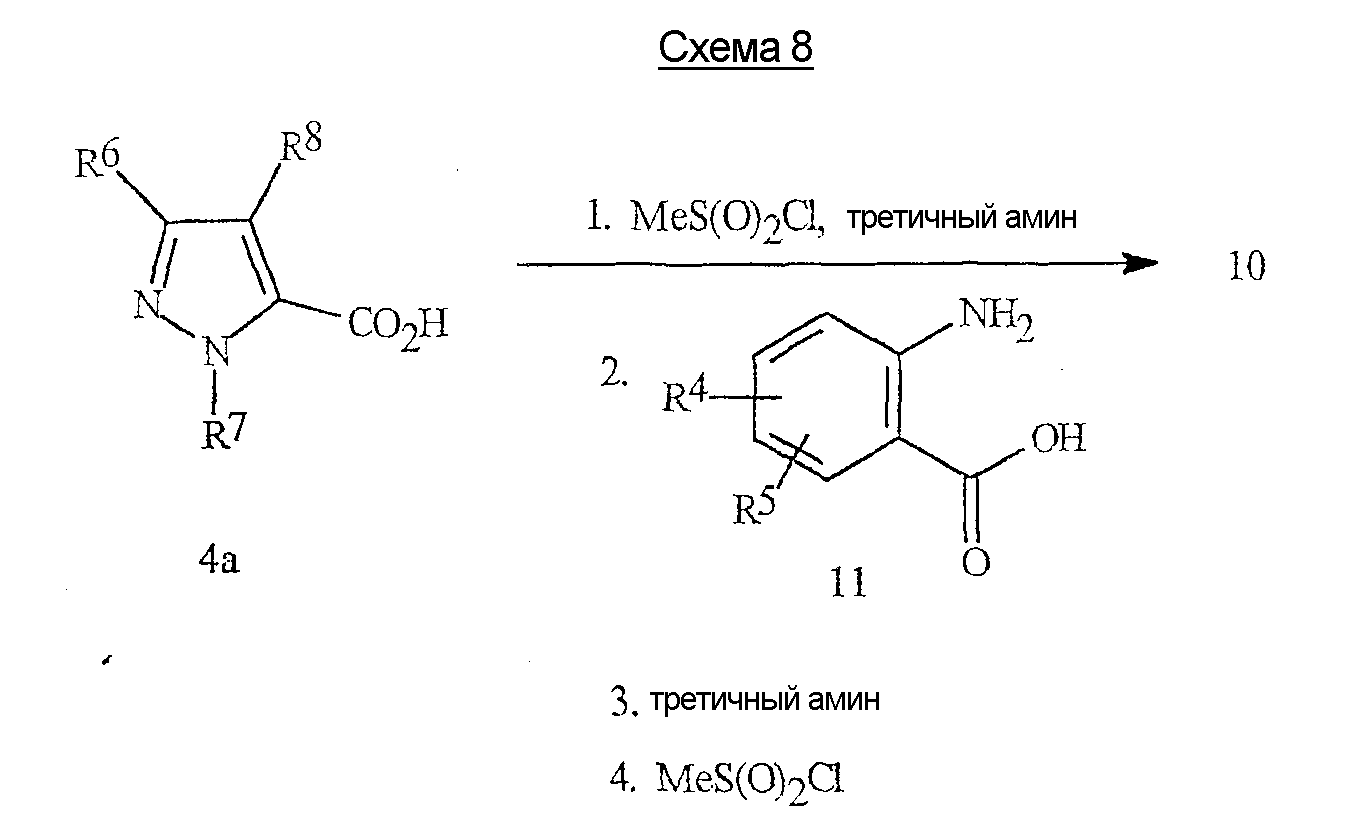
Эта реакция включает последовательное добавление метансульфонилхлорида в присутствии третичного амина, такого как триэтиламин или пиридин, к пиразолкарбоновой кислоте формулы 4а, затем добавления антраниловой кислоты формулы 11 с последующим повторным добавлением третичного амина и метансульфонилхлорида. Эта методика дает, в основном, хорошие выходы бензоксазинона и более детально проиллюстрирована в примерах 6 и 8.This reaction involves the sequential addition of methanesulfonyl chloride in the presence of a tertiary amine, such as triethylamine or pyridine, to the pyrazolecarboxylic acid of formula 4a, then the addition of anthranilic acid of formula 11, followed by the repeated addition of tertiary amine and methanesulfonyl chloride. This technique gives mainly good yields of benzoxazinone and is illustrated in more detail in Examples 6 and 8.
На схеме 9 проиллюстрировано альтернативное получение бензоксазинонов формулы 10, предусматривающее проведение реакции сочетания хлорангидрида пиразоловой кислоты формулы 3а с ангидридом N-карбоксиантраниловой кислоты формулы 8 с получением непосредственно бензоксазинона формулы 10.Scheme 9 illustrates an alternative preparation of the benzoxazinones of formula 10, involving the reaction of combining the pyrazolic acid chloride of formula 3a with N-carboxyanthranilic acid anhydride of formula 8 to produce directly benzoxazinone of formula 10.

Для этой реакции, подходящими являются такие растворители, как пиридин или пиридин/ацетонитрил. Хлорангидриды формулы 3а могут быть получены из соответствующих кислот формулы 4а различными методами синтеза, такими как хлорирование тионилхлоридом или оксалилхлоридом.Solvents such as pyridine or pyridine / acetonitrile are suitable for this reaction. Chlorides of formula 3a can be prepared from the corresponding acids of formula 4a by various synthetic methods, such as chlorination with thionyl chloride or oxalyl chloride.
Ангидриды N-карбоксиантраниловой кислоты формулы 8 могут быть получены из изатинов формулы 13, как показано на схеме 10.N-carboxyanthranilic acid anhydrides of formula 8 can be prepared from isatins of formula 13, as shown in Scheme 10.

Изатины формулы 13 получают из анилиновых производных формулы 12 способами, хорошо описанными в литературе. Окисление изатина 13 пероксидом водорода дает, в основном, хорошие выходы соответствующего ангидрида N-карбоксиантраниловой кислоты 8 (Angew. Chem. Int. Ed. Engl. 1980, 19, 222-223). Ангидриды N-карбоксиантраниловой кислоты могут быть также получены из антраниловых кислот 11 с помощью хорошо известных методик, предусматривающих проведение реакции соединения 11 с фосгеном или с эквивалентом фосгена.Isatins of formula 13 are prepared from aniline derivatives of formula 12 by methods well described in the literature. Oxidation of isatin 13 with hydrogen peroxide gives mainly good yields of the corresponding N-carboxyanthranilic acid anhydride 8 (Angew. Chem. Int. Ed. Engl. 1980, 19, 222-223). N-carboxyanthranilic acid anhydrides can also be prepared from anthranilic acids 11 using well-known procedures involving the reaction of compound 11 with phosgene or with an equivalent of phosgene.
Синтез репрезентативных кислот формулы 4 проиллюстрирован на схемах 11-16. Синтез пиразолов формулы 4а проиллюстрирован на схеме 11.The synthesis of representative acids of formula 4 is illustrated in schemes 11-16. The synthesis of pyrazoles of formula 4a is illustrated in scheme 11.

Синтез соединений формулы 4а на схеме 11 включает ключевую стадию введения заместителя R7 путем алкилирования или арилирования пиразола формулы 14 соединениями формулы 15 (где Lg представляет собой уходящую группу, определенную выше). В результате окисления метильной группы образуется пиразолкарбоновая кислота. Некоторые из более предпочтительных групп R6 представляют собой галогеналкилы.The synthesis of compounds of formula 4a in scheme 11 includes a key step in the introduction of a substituent R 7 by alkylation or arylation of a pyrazole of formula 14 with compounds of formula 15 (where Lg is a leaving group as defined above). As a result of the oxidation of the methyl group, pyrazolecarboxylic acid is formed. Some of the more preferred R 6 groups are haloalkyls.
Синтез пиразолов формулы 4а также проиллюстрирован на схеме 12.The synthesis of pyrazoles of formula 4a is also illustrated in Scheme 12.
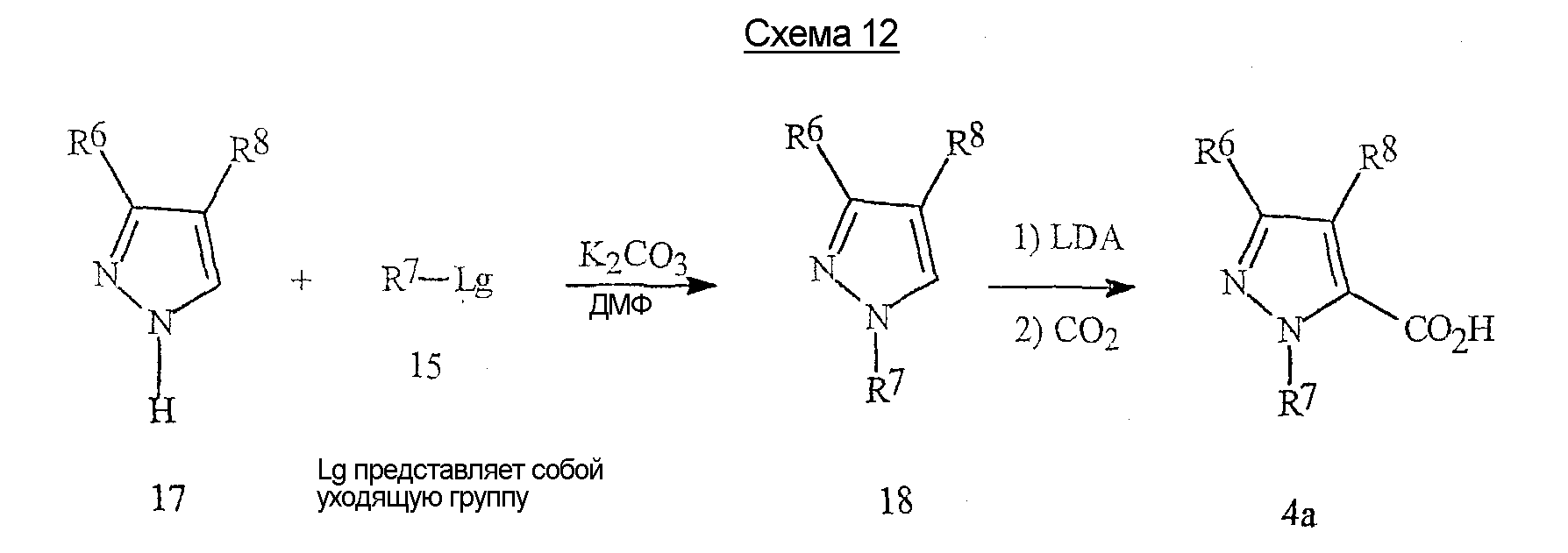
Эти кислоты могут быть получены путем металлирования и карбоксилирования соединений формулы 18, в качестве ключевой стадией. Группу R7 вводят способом, описанным на схеме 11, то есть, путем алкилирования или арилирования соединением формулы 15. Репрезентативными группами R6 являются, например, циано, галогеналкил и галоген.These acids can be obtained by metallation and carboxylation of compounds of formula 18, as a key step. The R 7 group is introduced by the method described in Scheme 11, that is, by alkylation or arylation with a compound of the formula 15. Representative R 6 groups are, for example, cyano, haloalkyl and halogen.
Эта методика может быть использована, в частности, для получения 1-(2-пиридинил)пиразолкарбоновых кислот формулы 4b, как показано на схеме 13.This technique can be used, in particular, to obtain 1- (2-pyridinyl) pyrazolecarboxylic acids of formula 4b, as shown in scheme 13.
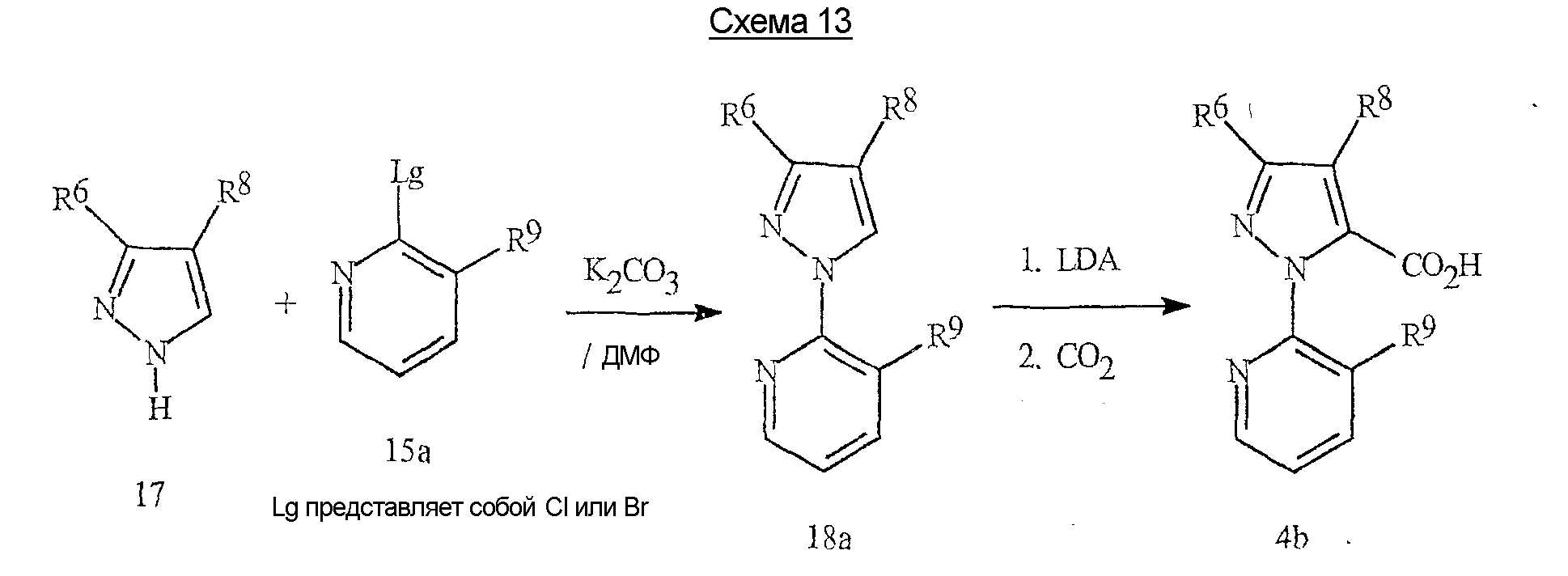
Реакция пиразола формулы 17 с 2,3-дигалогенпиридином формулы 15а дает хорошие выходы 1-пиридилпиразола формулы 18а с хорошей специфичностью для достижения желаемой региохимии. В результате металлирования соединения 18а диизопропиламидом лития (LDA) с последующим гашением литиевой соли диоксидом углерода получают 1-(2-пиридинил)пиразолкарбоновую кислоту формулы 4b. Подробное описание этих методик приводится в примерах 1, 3, 6, 8 и 10.The reaction of pyrazole of formula 17 with 2,3-dihalo-pyridine of formula 15a gives good yields of 1-pyridylpyrazole of formula 18a with good specificity to achieve the desired regiochemistry. Metallization of compound 18a with lithium diisopropylamide (LDA) followed by quenching of the lithium salt with carbon dioxide gives 1- (2-pyridinyl) pyrazolecarboxylic acid of formula 4b. A detailed description of these techniques is given in examples 1, 3, 6, 8 and 10.
Синтез пиразолов формулы 4с приведен на схеме 14.The synthesis of pyrazoles of formula 4c is shown in scheme 14.
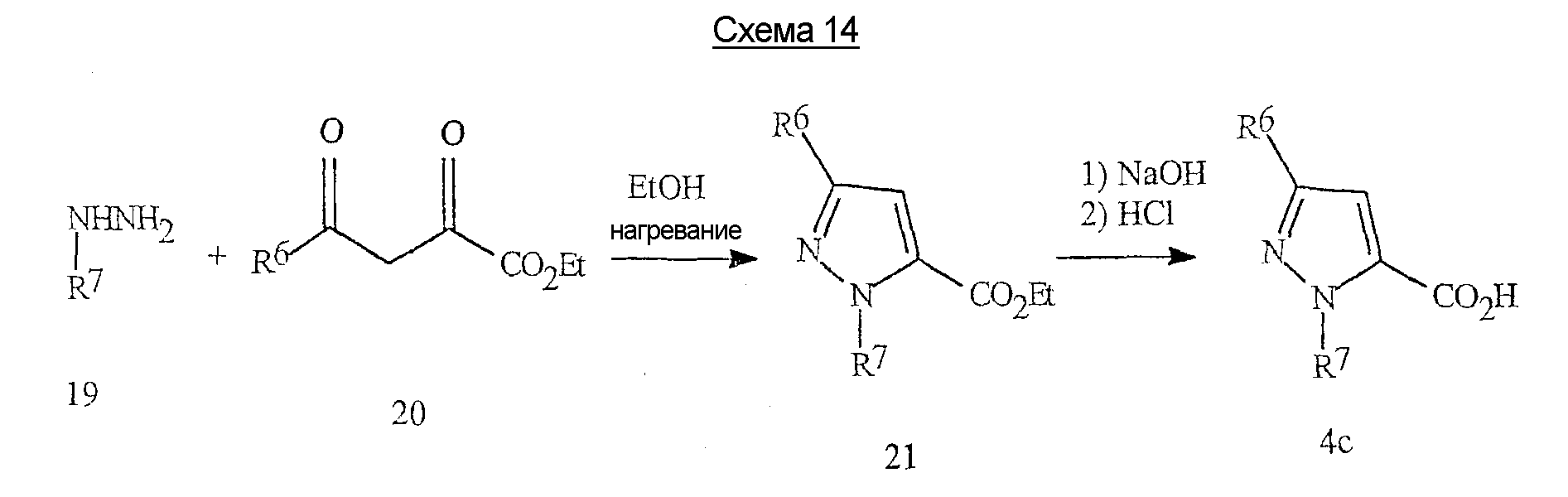
Альтернативный синтез пиразоловых кислот формулы 4с приведен на схеме 15.An alternative synthesis of pyrazoleic acids of formula 4c is shown in scheme 15.
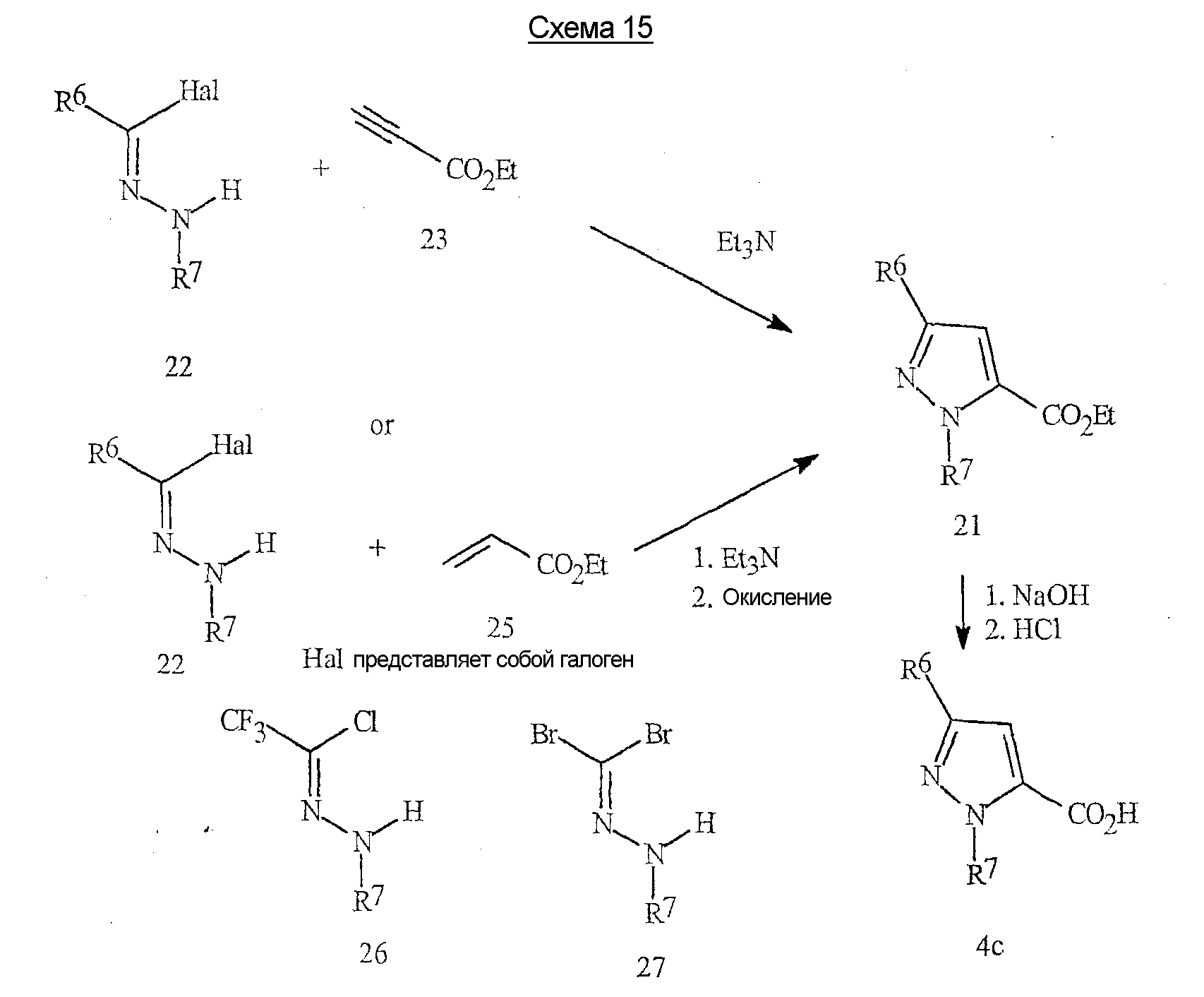
Способ, описанный на схеме 15, предусматривает проведение реакции 3+2-циклоприсоединения соответствующим образом замещенного иминогалогенида 22 либо с замещенными пропиолатами формулы 23, либо с акрилатами формулы 25. Реакция циклоприсоединения с акрилатом требует дополнительного окисления промежуточного пиразолина в пиразол. В результате гидролиза сложных эфиров образуются пиразоловые кислоты формулы 4с. Предпочтительными иминогалогенидами для этой реакции являются трифторметилиминохлорид формулы 26 и иминодибромид формулы 27. Такие соединения, как соединение 26, являются известными (J. Heterocycl. Chem. 1985, 22(2), 565-8). Такие соединения, как соединение 27, могут быть получены известными способами (Tetrahedron Letters 1999, 40, 2605). Эти методики могут быть использованы, в частности, для получения соединений, где R7 представляет собой необязательно замещенный фенил, а R6 представляет собой галогеналкил или бром.The method described in Scheme 15 involves a 3 + 2-cycloaddition reaction of a suitably substituted iminohalide 22 with either substituted propiolates of formula 23 or acrylates of formula 25. The cycloaddition reaction with acrylate requires additional oxidation of the intermediate pyrazoline to pyrazole. As a result of hydrolysis of esters, pyrazolic acids of formula 4c are formed. Preferred iminohalides for this reaction are trifluoromethyliminochloride of formula 26 and iminodibromide of formula 27. Compounds such as compound 26 are known (J. Heterocycl. Chem. 1985, 22 (2), 565-8). Compounds such as compound 27 can be prepared by known methods (Tetrahedron Letters 1999, 40, 2605). These techniques can be used, in particular, to prepare compounds wherein R 7 is optionally substituted phenyl and R 6 is haloalkyl or bromo.
Исходные пиразолы формулы 17 являются известными соединениями, либо они могут быть получены известными методами. Пиразол формулы 17а (соединения формулы 17, где R6 представляет собой CF3, а R8 представляет собой Н) может быть получен в соответствии с методиками, описанными в литературе (J. Fluorine Chem. 1991, 53(1), 61-70). Пиразолы формулы 17с (соединения формулы 17, где R6 представляет собой Cl или Br, а R8 представляет собой Н) могут быть также получены в соответствии с методиками, описанными в литературе (Chem. Ber. 1966, 99(10), 3350-7). Подходящий альтернативный способ получения соединения 17с проиллюстрирован на схеме 16.The starting pyrazoles of formula 17 are known compounds, or they can be prepared by known methods. Pyrazole of formula 17a (compounds of formula 17 where R 6 is CF 3 and R 8 is H) can be prepared according to the procedures described in the literature (J. Fluorine Chem. 1991, 53 (1), 61-70 ) Pyrazoles of formula 17c (compounds of formula 17 where R 6 is Cl or Br and R 8 is H) can also be prepared according to the procedures described in the literature (Chem. Ber. 1966, 99 (10), 3350- 7). A suitable alternative method for preparing compound 17c is illustrated in Scheme 16.
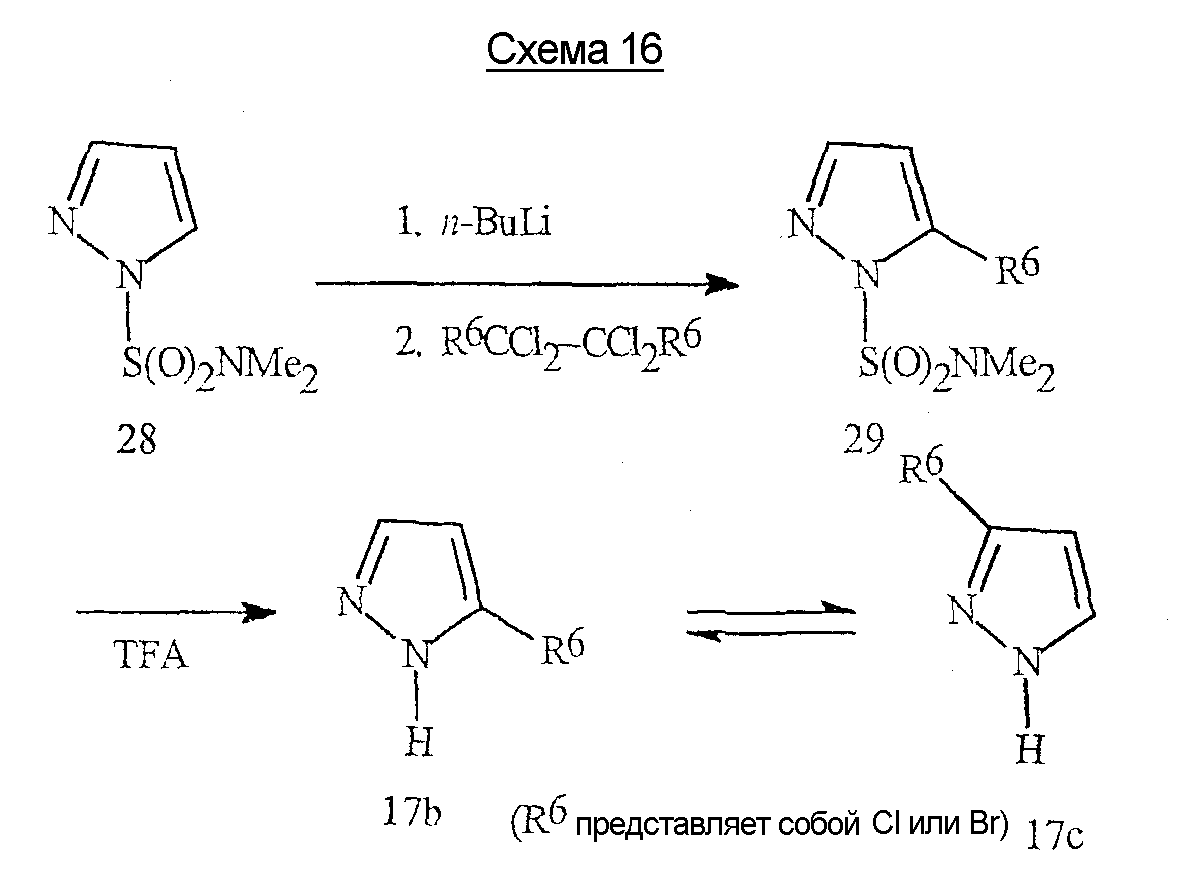
В способе, описанном на схеме 16, в результате металлирования сульфамоилпиразола формулы 28 н-бутиллитием с последующим прямым галогенированием аниона либо гексахлорэтаном (если R6 представляет собой Cl), либо 1,2-дибромтетрахлорэтаном (если R6 представляет собой Br) получают галогенированное производное формулы 29. Удаление сульфамоильной группы под действием трифторуксусной кислоты (TFA) при комнатной температуре происходит полностью и дает хороший выход пиразолов формулы 17с. Специалисту в данной области будет очевидно, что соединение формулы 17с представляет собой таутомер формулы 17b. Подробное описание эксперимента в соответствии с методиками приводится в примерах 8 и 10.In the method described in Scheme 16, metallation of a sulfamoylpyrazole of formula 28 with n-butyl lithium followed by direct halogenation of the anion with either hexachloroethane (if R 6 is Cl) or 1,2-dibromotetrachloroethane (if R 6 is Br) gives a halogenated derivative of formula 29. Removal of the sulfamoyl group by trifluoroacetic acid (TFA) at room temperature occurs completely and gives a good yield of pyrazoles of formula 17c. It will be apparent to those skilled in the art that the compound of formula 17c is a tautomer of formula 17b. A detailed description of the experiment in accordance with the methods is given in examples 8 and 10.
Пиразолкарбоновые кислоты формулы 4d, где R6 представляет собой Н, С1-С6алкил или С1-С6галогеналкил, могут быть получены способом, проиллюстрированным на схеме 17.Pyrazolecarboxylic acids of formula 4d, where R 6 is H, C 1 -C 6 alkyl or C 1 -C 6 haloalkyl, can be prepared by the method illustrated in Scheme 17.

В результате реакции соединения формулы 30, где R13 представляет собой С1-С4алкил, с подходящим основанием в подходящем органическом растворителе получают циклизованный продукт формулы 31, после нейтрализации кислотой, такой как уксусная кислота. Подходящим основанием могут быть, например, но не ограничиваются ими, гидрид натрия, трет-бутоксид калия, димсилнатрий (СН3S(О)СН2 -Na+), карбонаты или гидроксиды щелочных металлов (таких как литий, натрий или калий), фториды или гидроксиды тетраалкил(например, метил, этил или бутил)аммония или 2-трет-бутилимино-2-диэтиламино-1,3-диметилпергидро-1,3,2-диазафосфонин. Подходящими органическими растворителями могут быть, например, но не ограничиваются ими, ацетон, ацетонитрил, тетрагидрофуран, дихлорметан, диметилсульфоксид или N,N-диметилформамид. Реакцию циклизации обычно проводят при температуре примерно от 0°С до 120°С. Влияния растворителя, основания, температуры и времени добавления являются взаимонезависимыми, и для минимизации образования побочных продуктов необходимо правильно выбрать условия реакции. Предпочтительным основанием является фторид тетрабутиламмония.By reacting a compound of formula 30, where R 13 is C 1 -C 4 alkyl, with a suitable base in a suitable organic solvent, a cyclized product of formula 31 is obtained after neutralization with an acid such as acetic acid. A suitable base may be, for example, but not limited to, sodium hydride, potassium tert-butoxide, dimethyl sodium (CH 3 S (O) CH 2 - Na + ), alkali metal carbonates or hydroxides (such as lithium, sodium or potassium), tetraalkyl fluorides or hydroxides (e.g. methyl, ethyl or butyl) of ammonium or 2-tert-butylimino-2-diethylamino-1,3-dimethylperhydro-1,3,2-diazaphosphonin. Suitable organic solvents may be, for example, but not limited to, acetone, acetonitrile, tetrahydrofuran, dichloromethane, dimethyl sulfoxide or N, N-dimethylformamide. The cyclization reaction is usually carried out at a temperature of from about 0 ° C to 120 ° C. The effects of solvent, base, temperature, and addition time are independent of each other, and reaction conditions must be chosen correctly to minimize the formation of by-products. A preferred base is tetrabutylammonium fluoride.
В результате дегидратации соединения формулы 31 получают соединение формулы 32, а затем путем превращения функционального сложного эфира карбоновой кислоты в карбоновую кислоту получают соединение формулы 4d. Дегидратацию осуществляют путем обработки каталитическим количеством подходящей кислоты. Такой каталитической кислотой может быть, но не ограничивается ею, серная кислота. Реакцию обычно проводят с использованием органического растворителя. Специалисту в данной области будет очевидно, что реакции дегидратации могут быть проведены в широком ряду растворителей при температуре, в основном, в пределах примерно от 0°С до 200°С, а более предпочтительно, примерно от 0°С до 100°С. Для осуществления реакции дегидратации по способу схемы 17, предпочтительным является растворитель, содержащий уксусную кислоту, а температура, предпочтительно, составляет примерно 65°С. Соединения сложного эфира карбоновой кислоты могут быть превращены в соединения карбоновой кислоты различными методами, включая метод нуклеофильного расщепления в безводных условиях или гидролитические методы с использованием либо кислот, либо оснований (описание этих методов см. у T.W. Greene & P.G.M. Wuts, Protective Groups in Organic Synthesis, 2nd ed., John Wiley & Sons, Inc., New York, 1991, pp.224-269). Что касается способа, представленного на схеме 17, то предпочтительными являются методы гидролиза, катализируемого основанием. Подходящими основаниями являются гидроксиды щелочного металла (такого как литий, натрий или калий). Так, например, сложный эфир может быть растворен в смеси воды и спирта, такого как этанол. После обработки гидроксидом натрия или гидроксидом калия, сложный эфир омыляется с образованием натриевой или калиевой соли карбоновой кислоты. После подкисления сильной кислотой, такой как хлористоводородная кислота или серная кислота, получают карбоновую кислоту формулы 4d. Эта карбоновая кислота может быть выделена известными методами, включая кристаллизацию, экстракцию и перегонку.By dehydrating a compound of formula 31, a compound of formula 32 is obtained, and then, by converting a functional carboxylic acid ester to a carboxylic acid, a compound of formula 4d is obtained. Dehydration is carried out by treating with a catalytic amount of a suitable acid. Such catalytic acid may be, but is not limited to, sulfuric acid. The reaction is usually carried out using an organic solvent. It will be apparent to those skilled in the art that dehydration reactions can be carried out in a wide variety of solvents at a temperature generally in the range of from about 0 ° C to 200 ° C, and more preferably from about 0 ° C to 100 ° C. To carry out the dehydration reaction according to the method of Scheme 17, a solvent containing acetic acid is preferred, and the temperature is preferably about 65 ° C. Carboxylic acid ester compounds can be converted to carboxylic acid compounds by various methods, including nucleophilic cleavage under anhydrous conditions or hydrolytic methods using either acids or bases (for a description of these methods, see TW Greene & PGM Wuts, Protective Groups in Organic Synthesis , 2nd ed., John Wiley & Sons, Inc., New York, 1991, pp. 224-269). As for the method presented in scheme 17, the preferred methods are hydrolysis, catalyzed by the base. Suitable bases are alkali metal hydroxides (such as lithium, sodium or potassium). For example, the ester can be dissolved in a mixture of water and an alcohol, such as ethanol. After treatment with sodium hydroxide or potassium hydroxide, the ester is saponified to form the sodium or potassium salt of the carboxylic acid. After acidification with a strong acid, such as hydrochloric acid or sulfuric acid, a carboxylic acid of formula 4d is obtained. This carboxylic acid can be isolated by known methods, including crystallization, extraction and distillation.
Соединения формулы 30 могут быть получены способом, проиллюстрированным на схеме 18.The compounds of formula 30 can be obtained by the method illustrated in scheme 18.
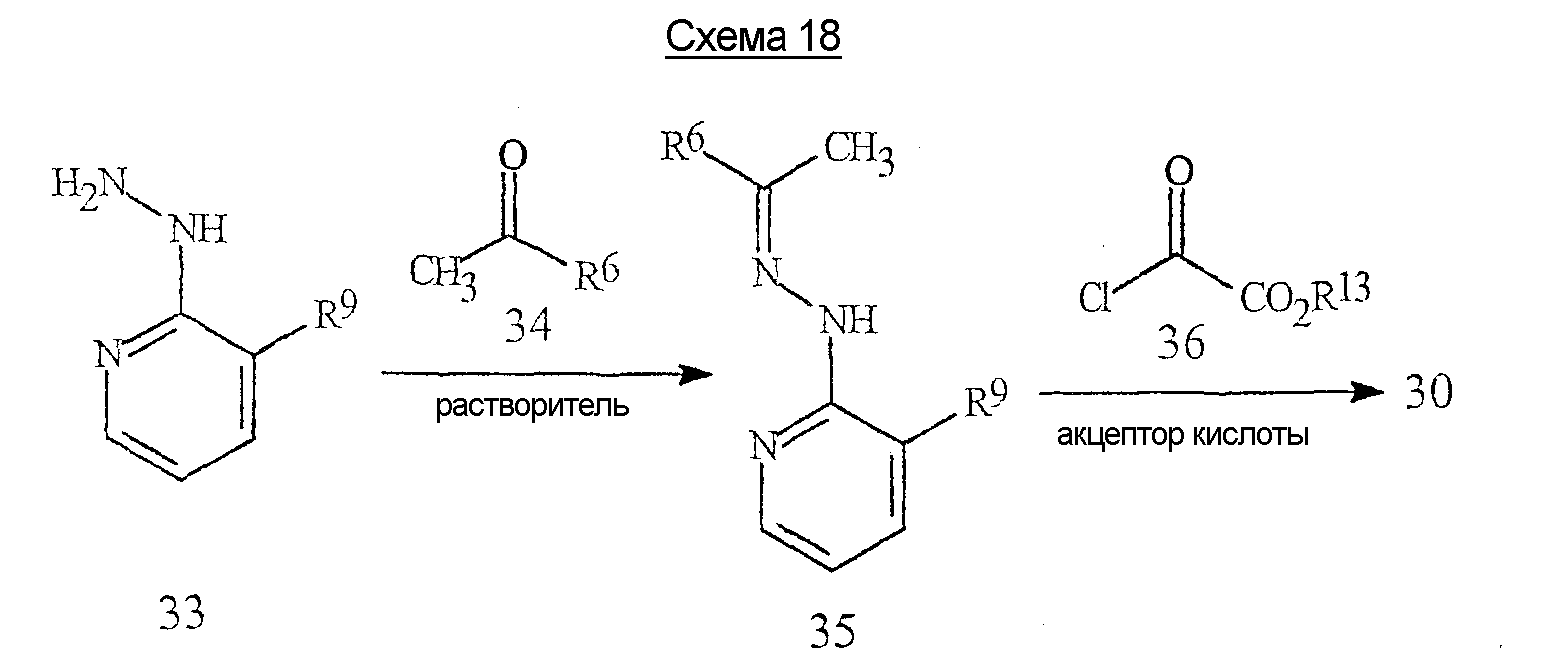
где R6 представляет собой Н, С1-С6алкил или С1-С6галогеналкил, а R13 представляет собой С1-С4алкил.where R 6 represents H, C 1 -C 6 alkyl or C 1 -C 6 halogenated, and R 13 represents C 1 -C 4 alkyl.
Обработка соединения гидразина формулы 33 кетоном формулы 34 в растворителе, таким как вода, метанол или уксусная кислота, приводит к образованию гидразона формулы 35. Специалисту в данной области будет очевидно, что для этой реакции может необязательно потребоваться катализ кислотой и может также потребоваться повышение температуры в зависимости от типа молекулярного замещения гидразона формулы 35. В результате реакции гидразона формулы 35 с соединением формулы 36 в подходящем органическом растворителе, которым может быть, но не ограничивается ими, дихлорметан или тетрагидрофуран, в присутствии акцептора кислоты, такого как триэтиламин, получают соединение формулы 30. Эту реакцию обычно проводят при температуре примерно от 0°С до 100°С. Подробное экспериментальное описание способа, проиллюстрированного на схеме 18, приводится в примере 17. Гидразиновые соединения формулы 33 могут быть получены стандартными способами, например, путем контактирования соответствующего галогенового соединения формулы 15а с гидразином.Treatment of a hydrazine compound of formula 33 with a ketone of formula 34 in a solvent such as water, methanol or acetic acid results in the formation of a hydrazone of formula 35. It will be apparent to one skilled in the art that this reaction may not necessarily require acid catalysis and may also require a temperature increase of depending on the type of molecular substitution of the hydrazone of formula 35. As a result of the reaction of the hydrazone of formula 35 with a compound of formula 36 in a suitable organic solvent, which may be, but not limited to dichloromethane or tetrahydrofuran in the presence of an acid acceptor such as triethylamine gives a compound of formula 30. This reaction is usually carried out at a temperature of from about 0 ° C to 100 ° C. A detailed experimental description of the method illustrated in Scheme 18 is given in Example 17. Hydrazine compounds of formula 33 can be prepared by standard methods, for example, by contacting the corresponding halogen compound of formula 15a with hydrazine.
Пиразолкарбоновые кислоты формулы 4d, где R6 представляет собой галоген, могут быть получены способом, проиллюстрированным на схеме 19.Pyrazolecarboxylic acids of formula 4d, where R 6 is halogen, can be obtained by the method illustrated in scheme 19.
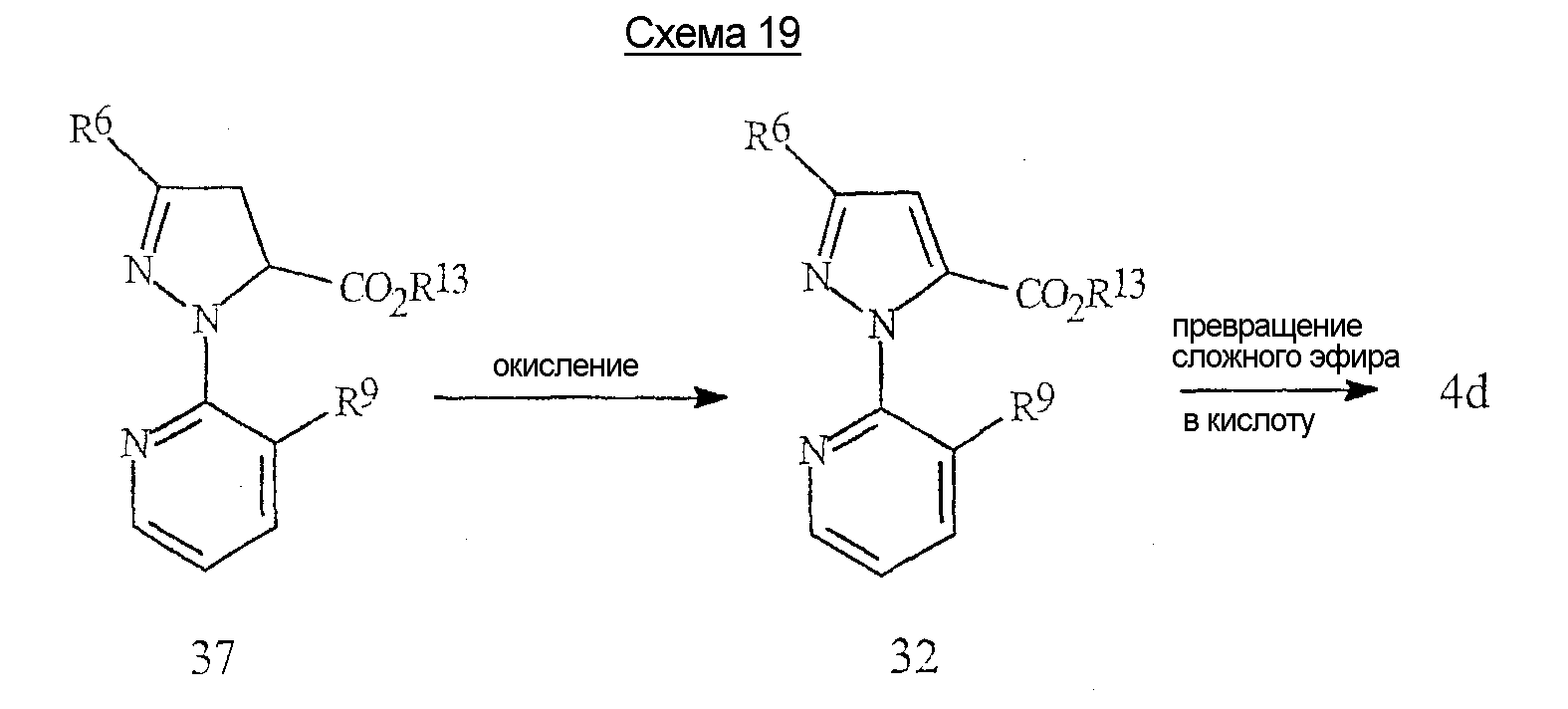
где R13 представляет собой С1-С4алкил.where R 13 represents a C 1 -C 4 alkyl.
В результате окисления соединения формулы 37 необязательно в присутствии кислоты получают соединение формулы 32, с последующим превращением функционального сложного эфира карбоновой кислоты в карбоновую кислоту с получением соединения формулы 4d. Окислителем может быть пероксид водорода, органические пероксиды, персульфат калия, персульфат натрия, персульфат аммония, моноперсульфат калия (например, Оксон®) или перманганат калия. Для полного превращения, необходимо использовать, по крайней мере, один эквивалент, а предпочтительно, примерно от одного до двух эквивалентов окислителя на соединение формулы 37. Окисление обычно осуществляют в присутствии растворителя. Таким растворителем может быть простой эфир, такой как тетрагидрофуран, п-диоксан и т.п., органический сложный эфир, такой как этилацетат, диметилкарбонат и т.п., или полярный апротонный органический растворитель, такой как N,N-диметилформамид, ацетонитрил и т.п. Кислотами, подходящими для использования на данной стадии окисления, являются неорганические кислоты, такие как серная кислота, фосфорная кислота и т.п., и органические кислоты, такие как уксусная кислота, бензойная кислота и т.п. Такая кислота, если она используется, должна быть добавлена в количестве, превышающем 0,1 эквивалента на соединение формулы 37. Для полного превращения может быть использовано от одного до пяти эквивалентов кислоты. Предпочтительным окислителем является персульфат калия, а окисление предпочтительно, осуществляют в присутствии серной кислоты. Эта реакция может быть осуществлена путем смешивания соединения формулы 37 в нужном растворителе и в кислоте, если она используется. Затем может быть добавлен окислитель в соответствующем количестве. Температуру реакции обычно варьируют, по крайней мере, примерно от 0°С до температуры кипения растворителя для достижения оптимального времени протекания реакции до ее завершения, которое, предпочтительно, составляет менее 8 часов. Нужный продукт, соединение формулы 32, может быть выделен известными методами, включая кристаллизацию, экстракцию и перегонку. Методики, подходящие для превращения сложного эфира формулы 32 в карбоновую кислоту формулы 4d, были уже описаны для схемы 17. Подробное экспериментальное описание способа, проиллюстрированного на схеме 19, приводится в примерах 12 и 13.By oxidizing the compound of formula 37, optionally in the presence of an acid, a compound of formula 32 is obtained, followed by conversion of the functional carboxylic acid ester to carboxylic acid to give a compound of formula 4d. The oxidizing agent may be hydrogen peroxide, organic peroxides, potassium persulfate, sodium persulfate, ammonium persulfate, potassium monopersulfate (e.g. Oxon®) or potassium permanganate. For complete conversion, it is necessary to use at least one equivalent, and preferably from about one to two equivalents of the oxidizing agent per compound of formula 37. The oxidation is usually carried out in the presence of a solvent. Such a solvent may be an ether such as tetrahydrofuran, p-dioxane and the like, an organic ester such as ethyl acetate, dimethyl carbonate and the like, or a polar aprotic organic solvent such as N, N-dimethylformamide, acetonitrile etc. Acids suitable for use in this oxidation step are inorganic acids such as sulfuric acid, phosphoric acid and the like, and organic acids such as acetic acid, benzoic acid and the like. Such an acid, if used, must be added in an amount in excess of 0.1 equivalent per compound of formula 37. One to five equivalents of acid may be used for complete conversion. Potassium persulfate is the preferred oxidizing agent, and the oxidation is preferably carried out in the presence of sulfuric acid. This reaction can be carried out by mixing the compound of formula 37 in the desired solvent and in acid, if used. An oxidizing agent may then be added in an appropriate amount. The reaction temperature usually ranges from at least about 0 ° C. to the boiling point of the solvent to achieve an optimal reaction time to completion, which is preferably less than 8 hours. The desired product, a compound of formula 32, can be isolated by known methods, including crystallization, extraction and distillation. Techniques suitable for converting an ester of formula 32 to a carboxylic acid of formula 4d have already been described for Scheme 17. A detailed experimental description of the method illustrated in Scheme 19 is given in Examples 12 and 13.
Соединения формулы 37 могут быть получены из соответствующих соединений формулы 38 как показано на схеме 20.Compounds of formula 37 can be prepared from the corresponding compounds of formula 38 as shown in Scheme 20.
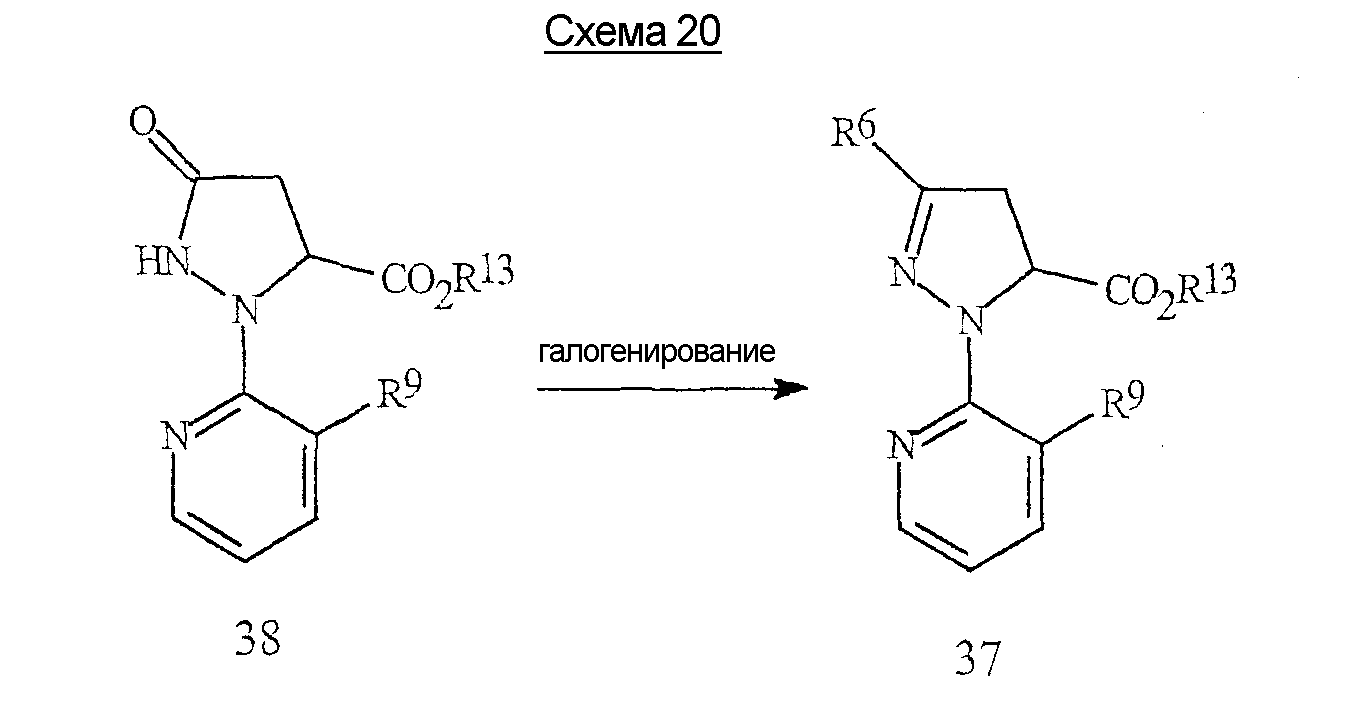
где R13 представляет собой С1-С4алкил, а R6 представляет собой галоген.where R 13 represents a C 1 -C 4 alkyl, and R 6 represents a halogen.
После обработки соединения формулы 38 галогенирующим реагентом, обычно в присутствии растворителя, получают соответствующее галогеновое соединение формулы 37. Галогенирующими реагентами, которые могут быть использованы в этих целях, являются оксигалогениды фосфора, тригалогениды фосфора, пентагалогениды фосфора, тионилхлорид, дигалогентриалкилфосфораны, дигалогендифенилфосфораны, оксалилхлорид и фосген. Предпочтительными являются оксигалогениды фосфора и пентагалогениды фосфора. Для полного превращения должно быть использовано, по крайней мере, 0,33 эквивалента, а предпочтительно, примерно от 0,33 до 1,2 эквивалента оксигалогенидов фосфора на соединение формулы 38 (то есть, молярное отношение оксигалогенида фосфора к соединению формулы 38 составляет, по крайней мере, 0,33). Для полного превращения должно быть использовано, по крайней мере, 0,20 эквивалента, а предпочтительно, примерно от 0,20 до 1,0 эквивалента пентагалогенидов фосфора на соединение формулы 38. Для этой реакции, предпочтительными являются соединения формулы 38, где R13 представляет собой С1-С4алкил. Типичными растворителями для этой реакции галогенирования являются галогенированные алканы, такие как дихлорметан, хлороформ, хлорбутан и т.п., ароматические растворители, такие как бензол, ксилол, хлорбензол и т.п.; простые эфиры, такие как тетрагидрофуран, п-диоксан, диэтиловый эфир и т.п.; и полярные апротонные растворители, такие как ацетонитрил, N,N-диметилформамид и т.п. Могут быть, но необязательно, добавлены органические основания, такие как триэтиламин, пиридин, N,N-диметиланилин или т.п. Может быть также добавлен, но необязательно, катализатор, такой как N,N-диметилформамид. Предпочтительным является способ, в котором в качестве растворителя используется ацетонитрил, а основание отсутствует. При использовании ацетонитрильного растворителя, обычно не требуется ни основания, ни катализатора. Указанный предпочтительный способ осуществляют путем смешивания соединения формулы 38 в ацетонитриле. Затем в течение определенного периода времени добавляют галогенирующий реагент и смесь выдерживают при нужной температуре до завершения реакции. Температура реакции обычно составляет от 20°С до температуры кипения ацетонитрила, а время реакции обычно составляет менее 2 часов. Затем реакционную массу нейтрализуют неорганическим основанием, таким как бикарбонат натрия, гидроксид натрия и т.п., или органическим основанием, таким как ацетат натрия. Нужный продукт, соединение формулы 37, может быть выделен известными методами, включая кристаллизацию, экстракцию и перегонку.After treating the compound of formula 38 with a halogenating reagent, usually in the presence of a solvent, the corresponding halogen compound of the formula 37 is obtained. The halogenating reagents that can be used for this purpose are phosphorus oxyhalides, phosphorus trihalides, phosphorus pentahalogenides, thionyl chloride, dihalo triphylphosphoranes, dihalogenophenyl diphenyl, . Phosphorus oxyhalides and phosphorus pentahalides are preferred. For complete conversion, at least 0.33 equivalents, and preferably from about 0.33 to 1.2 equivalents of phosphorus oxyhalides per compound of formula 38 should be used (i.e., the molar ratio of phosphorus oxyhalide to the compound of formula 38 is at least 0.33). For complete conversion, at least 0.20 equivalents, and preferably about 0.20 to 1.0 equivalents of phosphorus pentahalides, per compound of formula 38 should be used. For this reaction, compounds of formula 38 are preferred, where R 13 is C 1 -C 4 alkyl. Typical solvents for this halogenation reaction are halogenated alkanes such as dichloromethane, chloroform, chlorobutane and the like, aromatic solvents such as benzene, xylene, chlorobenzene and the like; ethers such as tetrahydrofuran, p-dioxane, diethyl ether and the like; and polar aprotic solvents such as acetonitrile, N, N-dimethylformamide and the like. Organic bases such as triethylamine, pyridine, N, N-dimethylaniline or the like can be added, but not necessarily. A catalyst, such as N, N-dimethylformamide, may also be added. Preferred is a method in which acetonitrile is used as a solvent and the base is absent. When using an acetonitrile solvent, usually no base or catalyst is required. Said preferred method is carried out by mixing a compound of formula 38 in acetonitrile. Then, a halogenating reagent is added over a period of time and the mixture is kept at the desired temperature until the reaction is complete. The reaction temperature is usually from 20 ° C. to the boiling point of acetonitrile, and the reaction time is usually less than 2 hours. Then the reaction mass is neutralized with an inorganic base, such as sodium bicarbonate, sodium hydroxide, etc., or an organic base, such as sodium acetate. The desired product, a compound of formula 37, can be isolated by known methods, including crystallization, extraction and distillation.
Альтернативно, соединения формулы 37, где R6 представляет собой галоген, могут быть получены путем обработки соответствующих соединений формулы 37, где R6 представляет собой другой галоген (например, Cl для получения соединения 37, где R3 представляет собой Br) или сульфонатную группу, такую как п-толуолсульфонат, бензолсульфонат и метансульфонат, соответствующим галогеноводородом. По данной методике, галогеновый или сульфонатный заместитель R6 в исходном соединении формулы 37 замещен, например, Br или Cl из бромистого водорода или хлористого водорода, соответственно. Реакцию проводят в подходящем растворителе, таком как дибромметан, дихлорметан или ацетонитрил. Данная реакция может быть осуществлена при атмосферном давлении, при давлении, близком к атмосферному давлению, или при давлении выше атмосферного в автоклаве. Если R6 в исходном соединении формулы 37 представляет собой галоген, такой как Cl, то реакцию предпочтительно проводят так, чтобы галогеноводород, образующийся в ходе реакции, удалялся путем барботирования или другими подходящими способами. Такая реакция может быть осуществлена при температуре примерно от 0°С до 100°С, лучше всего примерно при комнатной температуре (например, примерно от 10 до 40°С), а более предпочтительно, примерно от 20 до 30°С. Для облегчения реакции может быть добавлен катализатор на основе кислоты Льюиса (такой как трибромид алюминия для получения соединения формулы 37, где R6 представляет собой Br). Продукт формулы 37 выделяют стандартными известными методами, включая экстракцию, перегонку и кристаллизацию. Этот способ более подробно описан в примере 14.Alternatively, compounds of formula 37, where R 6 is halogen, can be obtained by treating the corresponding compounds of formula 37, where R 6 is another halogen (for example, Cl to obtain compound 37, where R 3 is Br) or a sulfonate group, such as p-toluenesulfonate, benzenesulfonate and methanesulfonate, with the corresponding hydrogen halide. According to this technique, the halogen or sulfonate substituent R 6 in the starting compound of formula 37 is substituted, for example, with Br or Cl from hydrogen bromide or hydrogen chloride, respectively. The reaction is carried out in a suitable solvent, such as dibromomethane, dichloromethane or acetonitrile. This reaction can be carried out at atmospheric pressure, at a pressure close to atmospheric pressure, or at a pressure above atmospheric in an autoclave. If R 6 in the starting compound of formula 37 is a halogen, such as Cl, then the reaction is preferably carried out so that the hydrogen halide generated during the reaction is removed by sparging or other suitable methods. Such a reaction can be carried out at a temperature of from about 0 ° C to 100 ° C, preferably at about room temperature (for example, from about 10 to 40 ° C), and more preferably from about 20 to 30 ° C. To facilitate the reaction, a Lewis acid-based catalyst (such as aluminum tribromide to obtain a compound of formula 37 where R 6 is Br) can be added. The product of formula 37 is isolated by standard known methods, including extraction, distillation and crystallization. This method is described in more detail in example 14.
Исходное соединение формулы 37, где R6 представляет собой Cl или Br, могут быть получены из соответствующих соединений формулы 38, как уже было описано выше. Исходные соединения формулы 37, где R6 представляет собой сульфонатную группу, могут быть аналогичным образом получены из соответствующих соединений формулы 38 стандартными способами, такими как обработка сульфонилхлоридом (например, п-толуолсульфонилхлоридом) и основанием, таким как третичный амин (например, триэтиламин) в подходящем растворителе, таком как дихлорметан; этот способ более подробно описан в примере 15.The starting compound of formula 37, wherein R 6 is Cl or Br, may be prepared from the corresponding compounds of formula 38, as already described above. The starting compounds of formula 37, where R 6 is a sulfonate group, can be similarly prepared from the corresponding compounds of formula 38 by standard methods, such as treatment with a sulfonyl chloride (e.g. p-toluenesulfonyl chloride) and a base such as a tertiary amine (e.g. triethylamine) in a suitable solvent, such as dichloromethane; this method is described in more detail in example 15.
Пиразолкарбоновые кислоты формулы 4d, где R6 представляет собой С1-С4алкокси или С1-С4галогеналкокси, могут быть также получены способом, проиллюстрированным на схеме 21.Pyrazolecarboxylic acids of formula 4d, wherein R 6 is C 1 -C 4 alkoxy or C 1 -C 4 haloalkoxy, can also be prepared by the method illustrated in Scheme 21.
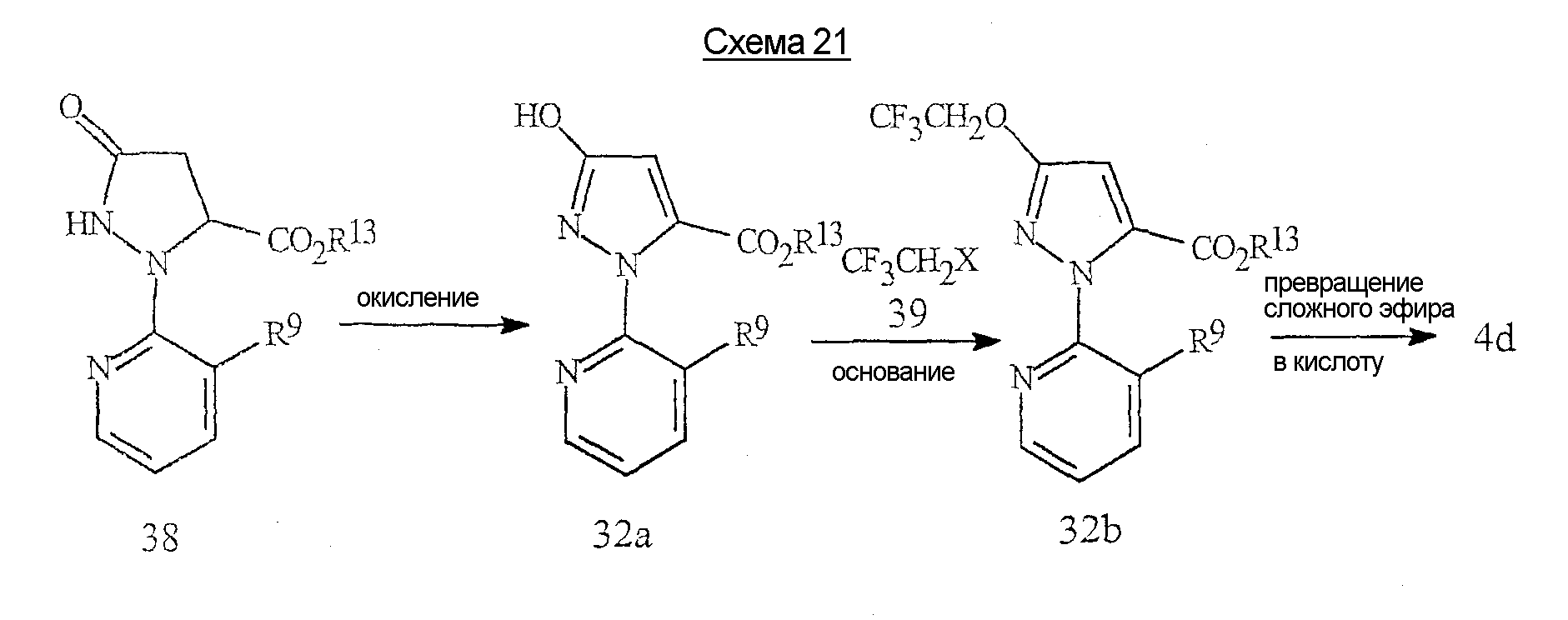
где R13 представляет собой С1-С4алкил, а Х представляет собой уходящую группу.where R 13 represents a C 1 -C 4 alkyl, and X represents a leaving group.
В этом способе, вместо галогенирования, как показано на схеме 20, соединение формулы 38 окисляют до соединения формулы 32а. Условия реакции такого окисления уже были описаны для превращения соединения формулы 37 в соединение формулы 32 на схеме 19.In this method, instead of halogenation, as shown in scheme 20, the compound of formula 38 is oxidized to the compound of formula 32a. The reaction conditions for such oxidation have already been described to convert a compound of formula 37 to a compound of formula 32 in Scheme 19.
Затем соединение формулы 32а алкилируют с образованием соединения формулы 32b путем контактирования с алкилирующим агентом CF3СН2Х (39) в присутствии основания. В алкилирующем агенте 39 Х представляет собой группу, уходящую при нуклеофильной реакции, такую как галоген (например, Br, I), OS(О)2СН3 (метансульфонат), OS(О)2CF3, OS(О)2Ph-р-СН3 (п-толуолсульфонат); и т.п., при этом, реакция хорошо проходит с метансульфонатом. Данную реакцию проводят в присутствии, по крайней мере, одного эквивалента основания. Подходящими основаниями являются неорганические основания, такие как карбонаты и гидроксиды щелочного металла (такого как литий, натрий или калий), и органические основания, такие как триэтиламин, диизопропилэтиламин и 1,8-диазабицикло[5.4.0]ундец-7-ен. Реакцию обычно проводят в растворителе, который может содержать спирты, такие как метанол и этанол; галогенированные алканы, такие как дихлорметан; ароматические растворители, такие как бензол, толуол и хлорбензол; простые эфиры, такие как тетрагидрофуран; и полярные апротонные растворители, такие как ацетонитрил, например, ацетонитрил, N,N-диметилформамид и т.п. При использовании с неорганическими основаниями, предпочтительными являются спирты и полярные апротонные растворители. В качестве основания предпочтительным является карбонат калия, а в качестве растворителя - ацетонитрил. Такую реакцию обычно проводят при температуре примерно от 0°С до 150°С, а наиболее предпочтительно примерно от комнатной температуры до 100°С. Продукт формулы 32b может быть выделен стандартными методами, такими как экстракция. Затем сложный эфир формулы 32b может быть превращен в карбоновую кислоту формулы 4d способами, которые уже были описаны для превращения соединения формулы 32 в соединение формулы 4d на схеме 17. Подробное экспериментальное описание способа, проиллюстрированного на схеме 21, приводится в примере 16.The compound of formula 32a is then alkylated to form a compound of formula 32b by contact with an alkylating agent CF 3 CH 2 X (39) in the presence of a base. In the alkylating agent, 39 X is a nucleophilic leaving group such as halogen (e.g., Br, I), OS (O) 2 CH 3 (methanesulfonate), OS (O) 2 CF 3 , OS (O) 2 Ph p-CH 3 (p-toluenesulfonate); and the like, while the reaction goes well with methanesulfonate. This reaction is carried out in the presence of at least one equivalent of a base. Suitable bases are inorganic bases such as carbonates and hydroxides of an alkali metal (such as lithium, sodium or potassium), and organic bases such as triethylamine, diisopropylethylamine and 1,8-diazabicyclo [5.4.0] undec-7-ene. The reaction is usually carried out in a solvent, which may contain alcohols, such as methanol and ethanol; halogenated alkanes such as dichloromethane; aromatic solvents such as benzene, toluene and chlorobenzene; ethers such as tetrahydrofuran; and polar aprotic solvents such as acetonitrile, for example acetonitrile, N, N-dimethylformamide and the like. When used with inorganic bases, alcohols and polar aprotic solvents are preferred. Potassium carbonate is preferred as the base, and acetonitrile as the solvent. Such a reaction is usually carried out at a temperature of from about 0 ° C to 150 ° C, and most preferably from about room temperature to about 100 ° C. The product of formula 32b can be isolated by standard methods, such as extraction. An ester of formula 32b can then be converted to a carboxylic acid of formula 4d by methods already described for converting a compound of formula 32 to a compound of formula 4d in Scheme 17. A detailed experimental description of the method illustrated in Scheme 21 is given in Example 16.
Соединения формулы 38 могут быть получены из соединений формулы 33, как показано на схеме 22.Compounds of formula 38 can be prepared from compounds of formula 33, as shown in Scheme 22.
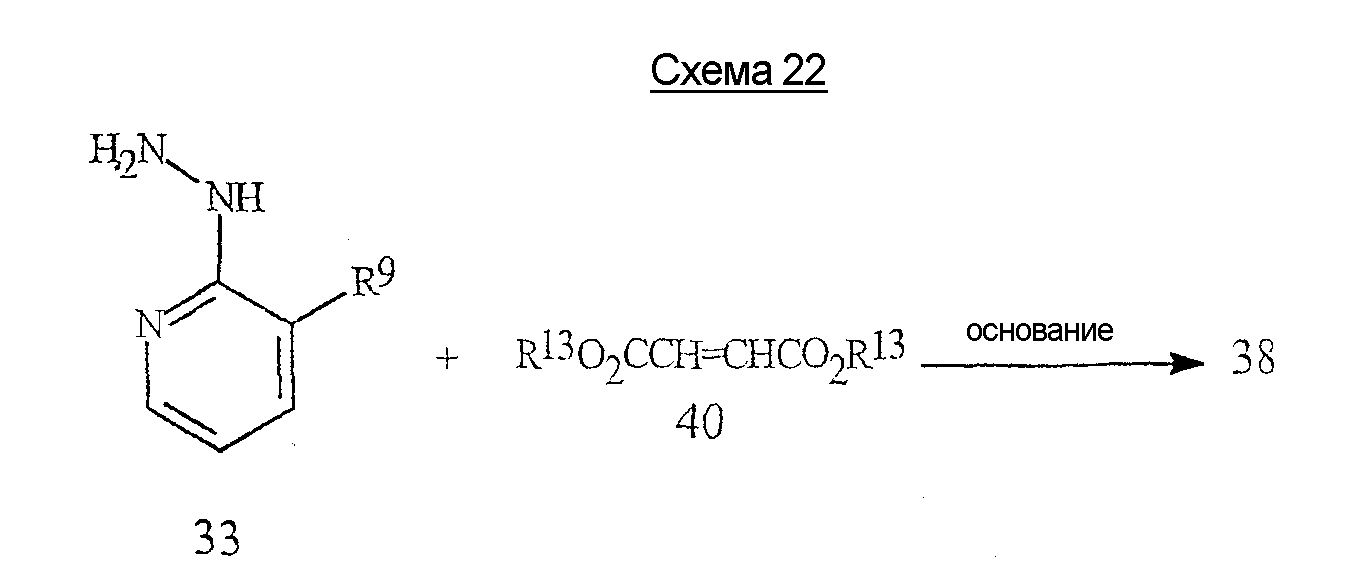
В этом способе соединение гидразина формулы 33 подвергают контакту с соединением формулы 40 (может быть использован сложный эфир фумаровой кислоты или сложный эфир малеиновой кислоты, или их смесь) в присутствии основания и растворителя. Таким основанием обычно является соль алкоксида металла, такого как метоксид натрия, метоксид калия, этоксид натрия, этоксид калия, трет-бутоксид калия, трет-бутоксид лития и т.п. При этом, должно быть использовано более чем 0,5 эквивалента, а предпочтительно, от 0,9 до 1,3 эквивалента основания на соединение формулы 33. При этом, должно быть использовано более чем 1,0 эквивалент, а предпочтительно, от 1,0 до 1,3 эквивалента соединения формулы 40. Могут быть использованы полярные протонные и полярные апротонные органические растворители, такие как спирты, ацетонитрил, тетрагидрофуран, N,N-диметилформамид, диметилсульфоксид и т.п. Предпочтительными растворителями являются спирты, такие как метанол и этанол. Особенно предпочтительно, чтобы этот спирт был таким же, как и спирт, разбавитель эфира фумаровой или малеиновой кислоты и алкоксидного основания. Реакцию обычно осуществляют путем смешивания соединения формулы 33 и основания в растворителе. Полученная смесь может быть подвергнута нагреванию или охлаждению до нужной температуры и соединение формулы 40 может быть добавлено в определенный период времени. Обычно, температура реакции составляет от 0°С до температуры кипения используемого растворителя. Реакция может быть проведена под давлением выше атмосферного для повышения температуры кипения растворителя. В основном, предпочтительной является температура примерно от 30°С до 90°С. Добавление должно быть проведено по возможности быстро, насколько это позволяет теплоперенос. Обычно время добавления составляет от 1 минуты до 2 часов. Оптимальная температура реакции и время добавления варьируются в зависимости от сходства соединения формулы 33 и соединения формулы 40. После добавления, реакционную смесь можно выдерживать в течение определенного периода времени при температуре реакции. В зависимости от температуры реакции, требуемое время выдерживания может составлять от 0 до 2 часов. Обычно время выдерживания составляет 10-60 минут. Затем реакционная масса может быть подкислена добавлением органической кислоты, такой как уксусная кислота и т.п., или неорганической кислоты, такой как хлористоводородная кислота, серная кислота и т.п. В зависимости от условий реакции и способов выделения, функциональная группа -CO2R13 на соединении формулы 38 может быть гидролизована до -CO2Н; так, например, такой гидролиз может быть стимулирован присутствием воды в реакционной смеси. Если образуется карбоновая кислота (-CO2Н), то она может быть снова превращена в CO2R13, где R13 представляет собой С1-С4алкил, хорошо известными методами этерификации. Нужный продукт, соединение формулы 38, может быть выделен известными методами, такими как кристаллизация, экстракция и перегонка.In this method, a hydrazine compound of formula 33 is contacted with a compound of formula 40 (fumaric acid ester or maleic acid ester or a mixture thereof can be used) in the presence of a base and a solvent. Such a base is usually a metal alkoxide salt such as sodium methoxide, potassium methoxide, sodium ethoxide, potassium ethoxide, potassium t-butoxide, lithium t-butoxide and the like. Moreover, more than 0.5 equivalent, and preferably from 0.9 to 1.3 equivalents of the base, per compound of formula 33 should be used. Moreover, more than 1.0 equivalent, and preferably from 1, should be used. 0 to 1.3 equivalents of a compound of formula 40. Polar protic and polar aprotic organic solvents such as alcohols, acetonitrile, tetrahydrofuran, N, N-dimethylformamide, dimethyl sulfoxide and the like can be used. Preferred solvents are alcohols, such as methanol and ethanol. It is particularly preferred that the alcohol be the same as the alcohol, diluent of the ester of fumaric or maleic acid and alkoxide base. The reaction is usually carried out by mixing a compound of formula 33 and a base in a solvent. The resulting mixture can be subjected to heating or cooling to the desired temperature and the compound of formula 40 can be added over a period of time. Typically, the reaction temperature is from 0 ° C. to the boiling point of the solvent used. The reaction can be carried out at a pressure above atmospheric to increase the boiling point of the solvent. In general, a temperature of about 30 ° C to 90 ° C is preferred. Addition should be carried out as quickly as possible, as far as heat transfer allows. Typically, the addition time is from 1 minute to 2 hours. The optimum reaction temperature and the addition time vary depending on the similarity of the compound of formula 33 and the compound of formula 40. After addition, the reaction mixture can be maintained for a certain period of time at the reaction temperature. Depending on the reaction temperature, the required holding time may be from 0 to 2 hours. Typically, the aging time is 10-60 minutes. The reaction mass can then be acidified by the addition of an organic acid, such as acetic acid, and the like, or an inorganic acid, such as hydrochloric acid, sulfuric acid, and the like. Depending on the reaction conditions and isolation methods, the —CO 2 R 13 functional group on the compound of formula 38 may be hydrolyzed to —CO 2 H; for example, such hydrolysis can be stimulated by the presence of water in the reaction mixture. If a carboxylic acid (—CO 2 H) is formed, then it can be converted back to CO 2 R 13 , where R 13 is C 1 -C 4 alkyl, well known in the art of esterification. The desired product, a compound of formula 38, can be isolated by known methods, such as crystallization, extraction and distillation.
Следует отметить, что некоторые реагенты и условия реакции, описанные выше для получения соединений формулы I, могут быть несовместимы с некоторыми функциональными группами, присутствующими в промежуточных соединениях. В этих случаях, осуществление последовательных процедур защиты/снятия защиты или взаимопревращения функциональных групп в данном синтезе будет облегчать получение нужных продуктов. Использование и выбор защитных групп могут быть осуществлены каждым специалистом в области химического синтеза (см., например, Greene T.W.& Wuts P.G.M., Protective Groups in Organic Synthesis, 2nd ed., Wiley, New York, 1991). При этом, следует отметить, что в некоторых случаях, после введения указанного реагента, как это проиллюстрировано на любой отдельной схеме для осуществления полного синтеза соединений формулы I, может потребоваться проведение дополнительных рутинных стадий синтеза, которые подробно не описываются. Для специалиста в данной области будет очевидно, что может оказаться необходимым осуществление комбинации стадий, проиллюстрированных в указанных выше схемах в том порядке, который отличается от конкретной последовательности проведения стадий, описанной для получения соединений формулы I.It should be noted that some of the reagents and reaction conditions described above for the preparation of compounds of formula I may not be compatible with certain functional groups present in the intermediates. In these cases, the implementation of sequential procedures of protection / deprotection or interconversion of functional groups in this synthesis will facilitate the receipt of the desired products. The use and selection of protective groups can be carried out by any person skilled in the field of chemical synthesis (see, for example, Greene T.W. & Wuts P.G.M., Protective Groups in Organic Synthesis, 2nd ed., Wiley, New York, 1991). Moreover, it should be noted that in some cases, after the introduction of the specified reagent, as illustrated in any separate scheme for the complete synthesis of the compounds of formula I, it may be necessary to carry out additional routine stages of the synthesis, which are not described in detail. It will be obvious to a person skilled in the art that it may be necessary to carry out a combination of the steps illustrated in the above schemes in an order that differs from the specific sequence of steps described for preparing compounds of formula I.
Для специалиста в данной области будет очевидно, что исходя из приведенного выше описания, могут быть получены соединения формулы I настоящего изобретения в их наиболее полном объеме. Поэтому, ниже приводятся примеры, которые представлены лишь в иллюстративных целях и не должны рассматриваться как ограничение изобретения. Проценты даны по массе, за исключением хроматографических смесей растворителей, или за исключением тех случаев, когда это оговорено особо. Части и проценты для хроматографических смесей растворителей даны по объему, если это не оговорено особо. 1Н-ЯМР-спектры даны в м.д. (миллионные доли) со сдвигами в сторону слабого поля по отношению к тетраметилсилану; с означает синглет; д означает дублет; т означает триплет; кв. означает квартет; м означает мультиплет; дд означает дублет дублетов; дт означает дублет триплетов; ушир.с. означает широкий синглет.For a person skilled in the art it will be obvious that, based on the above description, can be obtained compounds of formula I of the present invention in their most complete scope. Therefore, the following are examples that are presented for illustrative purposes only and should not be construed as limiting the invention. Percentages are given by weight, with the exception of chromatographic mixtures of solvents, or unless otherwise specified. Parts and percentages for chromatographic solvent mixtures are given by volume, unless otherwise specified. 1 H-NMR spectra are given in ppm. (ppm) with shifts towards a weak field with respect to tetramethylsilane; c means singlet; d means doublet; t is a triplet; sq. means a quartet; m means multiplet; dd means a doublet of doublets; dt means a doublet of triplets; broad.s. means wide singlet.
Пример 1Example 1
Получение 2-[1-этил-3-трифторметилпиразол-5-илкарбамоил]-3-метил-N-(1-метилэтил)бензамидаPreparation of 2- [1-ethyl-3-trifluoromethylpyrazol-5-ylcarbamoyl] -3-methyl-N- (1-methylethyl) benzamide
Стадия А: Получение 3-метил-N-(1-метилэтил)-2-нитробензамидаStage A: Obtaining 3-methyl-N- (1-methylethyl) -2-nitrobenzamide
Раствор 3-метил-2-нитробензойной кислоты (2,00 г, 11,0 ммоль) и триэтиламина (1,22 г, 12,1 ммоль) в 25 мл метиленхлорида охлаждали до 10°С. Затем осторожно добавляли этилхлорформиат, в результате чего образовывался твердый осадок. После перемешивания в течение 30 минут добавляли изопропиламин (0,94 г, 16,0 ммоль) и получали гомогенный раствор. Реакционную смесь перемешивали еще один час, выливали в воду и экстрагировали этилацетатом. Органические экстракты промывали водой, сушили над сульфатом магния и выпаривали при пониженном давлении с получением 1,96 г требуемого промежуточного соединения в виде белого твердого вещества, т.пл. 126-128°С.A solution of 3-methyl-2-nitrobenzoic acid (2.00 g, 11.0 mmol) and triethylamine (1.22 g, 12.1 mmol) in 25 ml of methylene chloride was cooled to 10 ° C. Ethyl chloroformate was then carefully added, resulting in a solid precipitate. After stirring for 30 minutes, isopropylamine (0.94 g, 16.0 mmol) was added and a homogeneous solution was obtained. The reaction mixture was stirred for another hour, poured into water and extracted with ethyl acetate. The organic extracts were washed with water, dried over magnesium sulfate and evaporated under reduced pressure to obtain 1.96 g of the desired intermediate compound as a white solid, mp. 126-128 ° C.
1H ЯМР (CDCl3) δ 1,24 (д, 6H), 2,38 (с, 3H), 4,22 (м, 1H), 5,80 (ушир.с, 1H), 7,4 (м, 3H). 1 H NMR (CDCl 3 ) δ 1.24 (d, 6H), 2.38 (s, 3H), 4.22 (m, 1H), 5.80 (br s, 1H), 7.4 ( m, 3H).
Стадия В: Получение 2-амино-3-метил-N-(1-метилэтил)бензамидаStage B: Obtaining 2-amino-3-methyl-N- (1-methylethyl) benzamide
2-нитробензамид стадии А (1,70 г, 7,6 ммоль) гидрировали над 5% Pd/C в 40 мл этанола при 50 фунт/кв.дюйм. После прекращения поглощения водорода, реакционную смесь фильтровали через фильтрующее вещество из диатомовой земли, Celite® и Celite® промывали эфиром. Фильтрат выпаривали при пониженном давлении с получением 1,41 г указанного в заголовке соединения в виде твердого вещества, т.пл. 149-151°С.Stage A 2-nitrobenzamide (1.70 g, 7.6 mmol) was hydrogenated over 5% Pd / C in 40 ml of ethanol at 50 psi. After the uptake of hydrogen ceased, the reaction mixture was filtered through a filter medium from diatomaceous earth, Celite® and Celite® were washed with ether. The filtrate was evaporated under reduced pressure to give 1.41 g of the title compound as a solid, mp. 149-151 ° C.
1H ЯМР (CDCl3) δ 1,24 (дд, 6H), 2,16 (с, 3H), 4,25 (м, 1H), 5,54 (ушир.с, 2H), 5,85 (ушир.с, 1Н), 6,59 (т, 1H), 7,13 (д, 1H), 7,17 (д, 1Н). 1 H NMR (CDCl 3 ) δ 1.24 (dd, 6H), 2.16 (s, 3H), 4.25 (m, 1H), 5.54 (br s, 2H), 5.85 ( broad s, 1H), 6.59 (t, 1H), 7.13 (d, 1H), 7.17 (d, 1H).
Стадия С: Получение 1-этил-3-трифторметилпиразол-5-илкарбоновой кислотыStage C: Obtaining 1-ethyl-3-trifluoromethylpyrazol-5-ylcarboxylic acid
К смеси 3-трифторметилпиразола (5 г, 37 ммоль) и порошкообразного карбоната калия (10 г, 72 ммоль), перемешиваемой в 30 мл N,N-диметилформамида, по каплям добавляли иодэтан (8 г, 51 ммоль). После слабой экзотермической реакции реакционную смесь перемешивали при комнатной температуре в течение ночи. Реакционную смесь распределяли между 100 мл диэтилового эфира и 100 мл воды. Эфирный слой отделяли, промывали водой (3 х) и насыщенным раствором соли, и сушили над сульфатом магния. После выпаривания растворителя в вакууме получали 4 г масла.To a mixture of 3-trifluoromethylpyrazole (5 g, 37 mmol) and powdered potassium carbonate (10 g, 72 mmol), stirred in 30 ml of N, N-dimethylformamide, iodoethane (8 g, 51 mmol) was added dropwise. After a weak exothermic reaction, the reaction mixture was stirred at room temperature overnight. The reaction mixture was partitioned between 100 ml of diethyl ether and 100 ml of water. The ether layer was separated, washed with water (3 x) and brine, and dried over magnesium sulfate. After evaporation of the solvent in vacuo, 4 g of oil was obtained.
К 3,8 г масла при перемешивании в 40 мл тетрагидрофурана в атмосфере азота и на бане сухой лед/ацетон, по каплям добавляли 17 мл 2,5М раствора н-бутиллития в тетрагидрофуране (43 ммоль) и раствор перемешивали в течение 20 минут при -78°С. Избыток газообразного диоксида углерода барботировали в перемешиваемый раствор при умеренной скорости в течение 10 минут. После добавления диоксида углерода, реакционную смесь оставляли для медленного доведения до комнатной температуры и перемешивали в течение ночи. Реакционную смесь распределяли между диэтиловым эфиром (100 мл) и 0,5 н водным гидроксидом натрия (100 мл). Основный слой отделяли и подкисляли концентрированной хлористоводородной кислотой до рН 2-3. Водную смесь экстрагировали этилацетатом (100 мл), органический экстракт промывали водой и раствором соли и сушили над сульфатом магния. Маслянистый остаток, который оставался после выпаривания растворителя в вакууме, растирали в небольшом количестве 1-хлорбутана с образованием твердого вещества. После фильтрования и сушки получали образец 1-этил-3-трифторметилпиразол-5-илкарбоновой кислоты (1,4 г), с небольшим количеством примеси, в виде твердого вещества с широким диапазоном температуры плавления.To 3.8 g of oil with stirring in 40 ml of tetrahydrofuran in a nitrogen atmosphere and in a dry ice / acetone bath, 17 ml of a 2.5 M solution of n-butyllithium in tetrahydrofuran (43 mmol) were added dropwise and the solution was stirred for 20 minutes at - 78 ° C. Excess carbon dioxide gas was bubbled into the stirred solution at a moderate speed for 10 minutes. After adding carbon dioxide, the reaction mixture was left to slowly bring to room temperature and was stirred overnight. The reaction mixture was partitioned between diethyl ether (100 ml) and 0.5 N aqueous sodium hydroxide (100 ml). The main layer was separated and acidified with concentrated hydrochloric acid to pH 2-3. The aqueous mixture was extracted with ethyl acetate (100 ml), the organic extract was washed with water and brine, and dried over magnesium sulfate. The oily residue which remained after evaporation of the solvent in vacuo was triturated with a small amount of 1-chlorobutane to form a solid. After filtering and drying, a sample of 1-ethyl-3-trifluoromethylpyrazol-5-ylcarboxylic acid (1.4 g) was obtained, with a small amount of impurity, as a solid with a wide melting range.
1H ЯМР (CDCl3) δ 1,51 (т, 3H), 4,68 (кв., 2H), 7,23 (с, 1H), 9,85 (ушир.с, 1H). 1 H NMR (CDCl 3 ) δ 1.51 (t, 3H), 4.68 (q, 2H), 7.23 (s, 1H), 9.85 (br s, 1H).
Стадия D. Получение 2-[1-этил-3-трифторметилпиразол-5-илкарбамоил]-3-метил-N-(1-метилэтил)бензамидаStep D. Preparation of 2- [1-ethyl-3-trifluoromethylpyrazol-5-ylcarbamoyl] -3-methyl-N- (1-methylethyl) benzamide
К раствору 1-этил-3-трифторметилпиразол-5-илкарбоновой кислоты (то есть, продукта стадии С) (0,5 г, 2,4 ммоль), при перемешивании в 20 мл метиленхлорида, добавляли оксалилхлорид (1,2 мл, 14 ммоль). После добавления 2 капель N,N-диметилформамида наблюдалось образование пены и выделение пузырьков. Реакционную смесь в виде желтого раствора кипятили с обратным холодильником в течение 1 часа. После охлаждения, растворитель удаляли в вакууме и полученный остаток растворяли в 20 мл тетрагидрофурана. К перемешанному раствору добавляли 2-амино-3-метил-N-(1-метилэтил)бензамид (то есть, продукт стадии В) (0,7 г, 3,6 ммоль), а затем по каплям добавляли N,N-диизопропилэтиламин (3 мл, 17 ммоль). После перемешивания при комнатной температуре в течение ночи, реакционную смесь распределяли между этилацетатом (100 мл) и 1н водной хлористоводородной кислотой (75 мл). Отделенный органический слой промывали водой и насыщенным раствором соли, а затем сушили над сульфатом магния. После выпаривания в вакууме получали белый твердый остаток, который, после очистки колоночной флеш-хроматографией на силикагеле (гексан/этилацетат, 2:1), давал 0,5 г указанного в заголовке соединения, то есть, соединения настоящего изобретения, с температурой плавления 223-226°С.To a solution of 1-ethyl-3-trifluoromethylpyrazol-5-ylcarboxylic acid (i.e., the product of step C) (0.5 g, 2.4 mmol), with stirring in 20 ml of methylene chloride, oxalyl chloride (1.2 ml, 14 mmol). After adding 2 drops of N, N-dimethylformamide, foam formation and bubbling were observed. The reaction mixture as a yellow solution was refluxed for 1 hour. After cooling, the solvent was removed in vacuo and the resulting residue was dissolved in 20 ml of tetrahydrofuran. To the stirred solution was added 2-amino-3-methyl-N- (1-methylethyl) benzamide (i.e., the product of step B) (0.7 g, 3.6 mmol), and then N, N-diisopropylethylamine was added dropwise. (3 ml, 17 mmol). After stirring at room temperature overnight, the reaction mixture was partitioned between ethyl acetate (100 ml) and 1N aqueous hydrochloric acid (75 ml). The separated organic layer was washed with water and brine, and then dried over magnesium sulfate. Evaporation in vacuo gave a white solid, which, after purification by flash column chromatography on silica gel (hexane / ethyl acetate, 2: 1), afforded 0.5 g of the title compound, i.e., the compound of the present invention, with a melting point of 223 -226 ° C.
1H ЯМР (ДМСО-d6) δ 1,06 (д, 6H), 1,36 (т, 3H), 2,45 (с, 3H), 3,97 (м, 1H), 4,58 (кв., 2H), 7,43-7,25 (м, 3H), 7,45 (с, 1H), 8,05 (д, 1H), 10,15 (с, 1H). 1 H NMR (DMSO-d 6 ) δ 1.06 (d, 6H), 1.36 (t, 3H), 2.45 (s, 3H), 3.97 (m, 1H), 4.58 ( q, 2H), 7.43-7.25 (m, 3H), 7.45 (s, 1H), 8.05 (d, 1H), 10.15 (s, 1H).
Пример 2Example 2
Получение N-[2-метил-6-[[(1-метилэтил)амино]карбонил]фенил]-1-фенил-3-(трифторметил)-1Н-пиразол-5-карбоксамидаPreparation of N- [2-methyl-6 - [[(1-methylethyl) amino] carbonyl] phenyl] -1-phenyl-3- (trifluoromethyl) -1H-pyrazole-5-carboxamide
Стадия А: Получение 2-метил-1-фенил-4-(трифторметил)-1Н-пиразолаStage A: Obtaining 2-methyl-1-phenyl-4- (trifluoromethyl) -1H-pyrazole
Раствор 1,1,1-трифторпентан-2,4-диона (20,0 г, 0,130 моль) в ледяной уксусной кислоте (60 мл) охлаждали до 7°С с использованием бани лед/вода. Затем в течение 60 минут по каплям добавляли фенилгидразин (14,1 г, 0,130 моль). Температура реакционной массы в процессе добавления повышалась до 15°С. Полученный оранжевый раствор выдерживали в течение 60 минут в условиях окружающей среды. Весь объем уксусной кислоты удаляли выпариванием на роторном испарителе при температуре бани 65°С. Остаток растворяли в метиленхлориде (150 мл). Раствор промывали водным бикарбонатом натрия (3 г, в 50 мл воды). Пурпурно-красный органический слой отделяли, обрабатывали активированным углем (2 г) и MgSO4, затем фильтровали. Летучие вещества удаляли на роторном испарителе. Неочищенный продукт состоял из 28,0 г масла розового цвета, которое содержало ~89% требуемого продукта и 11% 1-фенил-5-(трифторметил)-3-метилпиразола.A solution of 1,1,1-trifluoropentane-2,4-dione (20.0 g, 0.130 mol) in glacial acetic acid (60 ml) was cooled to 7 ° C using an ice / water bath. Then phenylhydrazine (14.1 g, 0.130 mol) was added dropwise over 60 minutes. The temperature of the reaction mass during the addition increased to 15 ° C. The resulting orange solution was kept for 60 minutes at ambient conditions. The entire volume of acetic acid was removed by rotary evaporation at a bath temperature of 65 ° C. The residue was dissolved in methylene chloride (150 ml). The solution was washed with aqueous sodium bicarbonate (3 g, in 50 ml of water). The purple-red organic layer was separated, treated with activated carbon (2 g) and MgSO 4 , then filtered. Volatiles were removed on a rotary evaporator. The crude product consisted of 28.0 g of pink oil, which contained ~ 89% of the desired product and 11% of 1-phenyl-5- (trifluoromethyl) -3-methylpyrazole.
1H ЯМР (ДМСО-d6) δ 2,35 (с, 3H), 6,76 (с, 1H), 7,6-7,5 (м, 5H). 1 H NMR (DMSO-d 6 ) δ 2.35 (s, 3H), 6.76 (s, 1H), 7.6-7.5 (m, 5H).
Стадия В. Получение 1-фенил-3-(трифторметил)-1Н-пиразол-5-карбоновой кислотыStage B. Obtaining 1-phenyl-3- (trifluoromethyl) -1H-pyrazole-5-carboxylic acid
Образец неочищенного 2-метил-1-фенил-4-(трифторметил)-1Н-пиразола (то есть, продукта стадии А) (~89%, 50,0 г, 0,221 моль) смешивали с водой (400 мл) и хлоридом цетилтриметиламмония (2,00 г, 0,011 моль). Смесь нагревали до 95°С. Затем через интервалы ~8 минут добавляли 10 равных порций перманганата калия. В процессе добавления реакционную массу поддерживали при 95-100°С. После добавления последней порции смесь выдерживали в течение ~15 минут при 95-100°С, после чего перманганат пурпурного цвета удаляли. Реакционную массу фильтровали в горячем состоянии (~75°С) через 1 см-слой фильтрующего вещества из диатомовой земли, Celite®, в 150-мл воронке со стеклянной крупнозернистой фриттой. Осадок на фильтре промывали теплой (~50°С) водой (3х100 мл). Объединенный фильтрат и промывки экстрагировали эфиром (2×100 мл) для удаления небольшого количества желтого нерастворимого в воде вещества. Водный слой продували азотом для удаления остаточного эфира. Прозрачный бесцветный щелочной раствор подкисляли добавлением по каплям концентрированной хлористоводородной кислоты до тех пор, пока рН не достигал ~1,3 (28 г, 0,28 моль). В процессе добавления первых двух третей кислоты наблюдалось интенсивное выделение газа. Продукт собирали фильтрованием, промывали водой (3×40 мл) и затем сушили в течение ночи в вакууме при 55°С. Продукт состоял из 11,7 г белого кристаллического порошка, который, в основном, был чистым, на что указывал 1Н-ЯМР.A sample of crude 2-methyl-1-phenyl-4- (trifluoromethyl) -1H-pyrazole (i.e., product of step A) (~ 89%, 50.0 g, 0.221 mol) was mixed with water (400 ml) and cetyltrimethylammonium chloride (2.00 g, 0.011 mol). The mixture was heated to 95 ° C. Then, at intervals of ~ 8 minutes, 10 equal portions of potassium permanganate were added. During the addition, the reaction mass was maintained at 95-100 ° C. After the last portion was added, the mixture was kept for ~ 15 minutes at 95-100 ° С, after which the purple permanganate was removed. The reaction mass was filtered while hot (~ 75 ° C) through a 1 cm layer of filter medium from diatomaceous earth, Celite®, in a 150 ml funnel with a glass coarse-grained frit. The filter cake was washed with warm (~ 50 ° C) water (3x100 ml). The combined filtrate and washes were extracted with ether (2 × 100 ml) to remove a small amount of yellow water insoluble matter. The aqueous layer was purged with nitrogen to remove residual ether. The clear, colorless alkaline solution was acidified by adding dropwise concentrated hydrochloric acid until the pH reached ~ 1.3 (28 g, 0.28 mol). During the addition of the first two thirds of the acid, intense gas evolution was observed. The product was collected by filtration, washed with water (3 × 40 ml) and then dried overnight in vacuo at 55 ° C. The product consisted of 11.7 g of a white crystalline powder, which was mostly pure, as indicated by 1 H-NMR.
1H ЯМР (CDCl3) δ 7,33 (с, 1H), 7,4-7,5 (м, 5H). 1 H NMR (CDCl 3 ) δ 7.33 (s, 1H), 7.4-7.5 (m, 5H).
Стадия С. Получение 1-фенил-3-(трифторметил)-1Н-пиразол-5-карбонилхлоридаStage C. Obtaining 1-phenyl-3- (trifluoromethyl) -1H-pyrazole-5-carbonyl chloride
Образец неочищенного 1-фенил-3-(трифторметил)-1Н-пиразол-5-карбоновой кислоты (то есть, продукта стадии В) (4,13 г, 16,1 моль) растворяли в метиленхлориде (45 мл). Раствор обрабатывали оксалилхлоридом (1,80 мл, 20,6 ммоль), затем N,N-диметилформамидом (0,010 мл, 0,13 ммоль). Выделение газа начиналось сразу после добавления N,N-диметилформамидного катализатора. Реакционную смесь перемешивали в условиях окружающей среды в течение ~20 минут, после чего ее кипятили с обратным холодильником в течение 35 минут. Летучие вещества удаляли выпариванием реакционной смеси на роторном испарителе при температуре бани 55°С. Полученный продукт состоял из 4,43 г светло-желтого масла. В качестве примеси, наблюдаемой с помощью 1Н-ЯМР, присутствовал лишь N,N-диметилформамид.A sample of the crude 1-phenyl-3- (trifluoromethyl) -1H-pyrazole-5-carboxylic acid (i.e., product of step B) (4.13 g, 16.1 mol) was dissolved in methylene chloride (45 ml). The solution was treated with oxalyl chloride (1.80 ml, 20.6 mmol), then N, N-dimethylformamide (0.010 ml, 0.13 mmol). Gas evolution began immediately after the addition of N, N-dimethylformamide catalyst. The reaction mixture was stirred at ambient conditions for ~ 20 minutes, after which it was boiled under reflux for 35 minutes. Volatiles were removed by evaporation of the reaction mixture on a rotary evaporator at a bath temperature of 55 ° C. The resulting product consisted of 4.43 g of a light yellow oil. As the impurity observed using 1 H-NMR, only N, N-dimethylformamide was present.
1H ЯМР (CDCl3) δ 7,40 (м, 1Н), 7,42 (с, 1H), 7,50-7,53 (м, 4H). 1 H NMR (CDCl 3 ) δ 7.40 (m, 1H), 7.42 (s, 1H), 7.50-7.53 (m, 4H).
Стадия D. Получение N-[2-метил-6-[[(1-метилэтил)амино]карбонил]фенил]-1-фенил-3-(трифторметил)-1Н-пиразол-5-карбоксамидаStep D. Preparation of N- [2-methyl-6 - [[(1-methylethyl) amino] carbonyl] phenyl] -1-phenyl-3- (trifluoromethyl) -1H-pyrazole-5-carboxamide
Образец ангидрида 3-метил-N-карбоксиантраниловой кислоты (0,30 г, 1,7 ммоль), частично растворенного в пиридине (4,0 мл), обрабатывали 1-фенил-3-(трифторметилпиразол)-5-карбоксилхлоридом (то есть, продуктом стадии С) (0,55 г, 1,9 ммоль). Смесь нагревали до ~95°С в течение 2 часов. Полученный оранжевый раствор охлаждали до 29°С, затем обрабатывали изопропиламином (1,00 г, 16,9 ммоль). Реакционная масса экзотермически нагревалась до 39°С. Затем ее нагревали до 55°С в течение 30 минут, в результате чего образовывалось большое количество осадка. Реакционную массу растворяли в дихлорметане (150 мл). Раствор промывали водной кислотой (5 мл конц. HCl в 45 мл воды), а затем водным основанием (2 г карбоната натрия в 50 мл воды). Органический слой сушили над MgSO4, фильтровали, затем концентрировали на роторном испарителе. После концентрирования до ~4 мл образовывались кристаллы продукта. Суспензию разбавляли ~10 мл эфира, в результате чего осаждалось еще некоторое количество продукта. Продукт выделяли фильтрованием, промывали эфиром (2×10 мл) и затем водой (2×50 мл). Влажный осадок на фильтре сушили в течение 30 минут при 70°С в вакууме. Продукт, соединение настоящего изобретения, состоял из 0,52 г не совсем белого порошка с температурой плавления 260-262°С.1H ЯМР (ДМСО-d6) δ 1,07 (д, 6H), 2,21 (с, 3H), 4,02 (октет, 1Н), 7,2-7,4 (м, 3H), 7,45-7,6 (м, 6H), 8,10 (д, 1H), 10,31 (с, 1H).A sample of 3-methyl-N-carboxyanthranilic acid anhydride (0.30 g, 1.7 mmol) partially dissolved in pyridine (4.0 ml) was treated with 1-phenyl-3- (trifluoromethylpyrazole) -5-carboxyl chloride (i.e. , the product of stage C) (0.55 g, 1.9 mmol). The mixture was heated to ~ 95 ° C for 2 hours. The resulting orange solution was cooled to 29 ° C, then treated with isopropylamine (1.00 g, 16.9 mmol). The reaction mass was exothermically heated to 39 ° C. Then it was heated to 55 ° C for 30 minutes, resulting in a large amount of precipitate. The reaction mass was dissolved in dichloromethane (150 ml). The solution was washed with aqueous acid (5 ml of conc. HCl in 45 ml of water) and then with an aqueous base (2 g of sodium carbonate in 50 ml of water). The organic layer was dried over MgSO 4 , filtered, then concentrated on a rotary evaporator. After concentration to ~ 4 ml, product crystals formed. The suspension was diluted with ~ 10 ml of ether, as a result of which some more product precipitated. The product was isolated by filtration, washed with ether (2 × 10 ml) and then with water (2 × 50 ml). The wet filter cake was dried for 30 minutes at 70 ° C in vacuo. The product, a compound of the present invention, consisted of 0.52 g of an off-white powder with a melting point of 260-262 ° C. 1 H NMR (DMSO-d 6 ) δ 1.07 (d, 6H), 2.21 (s, 3H), 4.02 (octet, 1H), 7.2-7.4 (m, 3H), 7.45-7.6 (m, 6H), 8.10 (d, 1H), 10.31 (s, 1H).
Пример 3Example 3
Получение N-[2-метил-6-[[(1-метилэтил)амино]карбонил]фенил]-3-(трифторметил)-1-[3-(трифторметил)-2-пиридинил]-1Н-пиразол-5-карбоксамидаPreparation of N- [2-methyl-6 - [[(1-methylethyl) amino] carbonyl] phenyl] -3- (trifluoromethyl) -1- [3- (trifluoromethyl) -2-pyridinyl] -1H-pyrazole-5- carboxamide
Стадия А: Получение 3-трифторметил-2-[3-(трифторметил)-1Н-пиразол-1-ил]пиридинаStep A: Preparation of 3-trifluoromethyl-2- [3- (trifluoromethyl) -1H-pyrazol-1-yl] pyridine
Смесь 2-хлор-3-трифторметилпиридина (3,62 г, 21 ммоль), 3-трифторметилпиразола (2,7 г, 20 ммоль) и карбоната калия (6,0 г, 43 ммоль) нагревали при 100°С в течение 18 ч. Охлажденную реакционную смесь добавляли в воду со льдом (100 мл). Смесь два раза экстрагировали эфиром (100 мл) и объединенные эфирные экстракты два раза промывали водой (100 мл). Органический слой сушили над сульфатом магния и концентрировали с получением масла. После хроматографии на силикагеле с использованием в качестве элюента смеси гексан:этилацетат (8:1-4:1) получали указанное в заголовке соединение (3,5 г) в виде масла.A mixture of 2-chloro-3-trifluoromethylpyridine (3.62 g, 21 mmol), 3-trifluoromethylpyrazole (2.7 g, 20 mmol) and potassium carbonate (6.0 g, 43 mmol) was heated at 100 ° C for 18 h. The cooled reaction mixture was added to ice water (100 ml). The mixture was extracted twice with ether (100 ml) and the combined ether extracts were washed twice with water (100 ml). The organic layer was dried over magnesium sulfate and concentrated to give an oil. Chromatography on silica gel using hexane: ethyl acetate (8: 1-4: 1) as the eluent gave the title compound (3.5 g) as an oil.
1H ЯМР (CDCl3) δ 6,75 (м, 1H), 7,5 (м, 1H), 8,2 (м, 2H), 8,7 (м, 1Н). 1 H NMR (CDCl 3 ) δ 6.75 (m, 1H), 7.5 (m, 1H), 8.2 (m, 2H), 8.7 (m, 1H).
Стадия В: Получение 3-(трифторметил)-1-[3-(трифторметил)-2-пиридинил]-1Н-пиразол-5-карбоновой кислотыStep B: Preparation of 3- (trifluoromethyl) -1- [3- (trifluoromethyl) -2-pyridinyl] -1H-pyrazole-5-carboxylic acid
Смесь указанного в заголовке соединения примера 3, стадии А (3,4 г, 13 ммоль) растворяли в тетрагидрофуране (30 мл) и охлаждали до -70°С. Затем добавляли диизопропиламид лития (2н в смеси гептан/тетрагидрофуран (Aldrich), 9,5 мл, 19 ммоль) и полученную темную смесь перемешивали 10 минут. После этого через смесь в течение 15 минут барботировали сухой диоксид углерода. Смесь оставляли для нагревания до 23°С и обрабатывали водой (50 мл) и 1н гидроксидом натрия (10 мл). Водную смесь экстрагировали эфиром (100 мл), затем этилацетатом (100 мл). Водный слой подкисляли 6н хлористоводородной кислотой до рН 1-2 и два раза экстрагировали дихлорметаном. Органический слой сушили сульфатом магния и концентрировали с получением указанного в заголовке соединения (1,5 г).A mixture of the title compound of Example 3, Step A (3.4 g, 13 mmol) was dissolved in tetrahydrofuran (30 ml) and cooled to -70 ° C. Then lithium diisopropylamide (2N in heptane / tetrahydrofuran (Aldrich), 9.5 ml, 19 mmol) was added and the resulting dark mixture was stirred for 10 minutes. After that, dry carbon dioxide was bubbled through the mixture for 15 minutes. The mixture was allowed to warm to 23 ° C and treated with water (50 ml) and 1N sodium hydroxide (10 ml). The aqueous mixture was extracted with ether (100 ml), then ethyl acetate (100 ml). The aqueous layer was acidified with 6N hydrochloric acid to pH 1-2 and extracted twice with dichloromethane. The organic layer was dried with magnesium sulfate and concentrated to obtain the title compound (1.5 g).
1H ЯМР (CDCl3) δ 7,6 (м, 1H), 7,95 (м, 1H), 8,56 (м, 1H), 8,9 (м, 1Н), 14,2 (ушир., 1Н). 1 H NMR (CDCl 3 ) δ 7.6 (m, 1H), 7.95 (m, 1H), 8.56 (m, 1H), 8.9 (m, 1H), 14.2 (br. , 1H).
Стадия С: Получение N-[2-метил-6-[[(1-метилэтил)амино]карбонил]фенил]-3-(трифторметил)-1-[3-(трифторметил)-2-пиридинил]-1Н-пиразол-5-карбоксамидаStep C: Preparation of N- [2-methyl-6 - [[(1-methylethyl) amino] carbonyl] phenyl] -3- (trifluoromethyl) -1- [3- (trifluoromethyl) -2-pyridinyl] -1H-pyrazole -5-carboxamide
Смесь указанного в заголовке соединения примера 3, стадии В (0,54 г, 1,1 ммоль), указанного в заголовке соединения примера 1, стадии В (0,44 г, 2,4 ммоль) и ВОР-хлорида (бис(2-оксо-оксазолидинил)фосфинилхлорида, 0,54 г, 2,1 ммоль) в ацетонитриле (13 мл) обрабатывали триэтиламином (0,9 мл). Смесь встряхивали в закрытом сосуде для сцинтилляции в течение 18 ч. Реакционную смесь распределяли между этилацетатом (100 мл) и 1н хлористоводородной кислотой. Этилацетатный слой последовательно промывали 1н хлористоводородной кислотой (50 мл), 1 н гидроксидом натрия (50 мл) и насыщенным раствором хлорида натрия (50 мл). Органический слой сушили над сульфатом магния и концентрировали. Остаток подвергали колоночной хроматографии на силикагеле с использованием в качестве элюента смесь гексан/этилацетат (5:1 - 3:1). Указанное в заголовке соединение (0,43 г), соединение настоящего изобретения, выделяли в виде белого твердого вещества, т.пл. 227-230°С.A mixture of the title compound of Example 3, step B (0.54 g, 1.1 mmol), the title compound of Example 1, step B (0.44 g, 2.4 mmol) and BOP chloride (bis (2 -oxo-oxazolidinyl) phosphinyl chloride, 0.54 g, 2.1 mmol) in acetonitrile (13 ml) was treated with triethylamine (0.9 ml). The mixture was shaken in a closed scintillation vessel for 18 hours. The reaction mixture was partitioned between ethyl acetate (100 ml) and 1N hydrochloric acid. The ethyl acetate layer was washed successively with 1 N hydrochloric acid (50 ml), 1 N sodium hydroxide (50 ml) and saturated sodium chloride solution (50 ml). The organic layer was dried over magnesium sulfate and concentrated. The residue was subjected to silica gel column chromatography using hexane / ethyl acetate (5: 1 to 3: 1) as an eluent. The title compound (0.43 g), a compound of the present invention, was isolated as a white solid, mp. 227-230 ° C.
1H ЯМР (CDCl3) δ 1,2 (м, 6H), 4,15 (м, 1H), 5,9 (ушир.д, 1Н), 7,1 (м, 1H), 7,2 (м, 2H), 7,4 (с, 1H), 7,6 (м, 1H), 8,15 (м, 1H), 8,74 (м, 1H), 10,4 (ушир., 1Н). 1 H NMR (CDCl 3 ) δ 1.2 (m, 6H), 4.15 (m, 1H), 5.9 (brd, 1H), 7.1 (m, 1H), 7.2 ( m, 2H), 7.4 (s, 1H), 7.6 (m, 1H), 8.15 (m, 1H), 8.74 (m, 1H), 10.4 (broad, 1H) .
Пример 4Example 4
Получение 1-(3-хлор-2-пиридинил)-N-[2-метил-6-[[(1-метилэтил)амино]карбонил]фенил]-3-(трифторметил)-1Н-пиразол-5-карбоксамидаPreparation of 1- (3-chloro-2-pyridinyl) -N- [2-methyl-6 - [[(1-methylethyl) amino] carbonyl] phenyl] -3- (trifluoromethyl) -1H-pyrazole-5-carboxamide
Стадия А: Получение 3-хлор-2-[3-(трифторметил)-1Н-пиразол-1-ил]пиридинаStep A: Preparation of 3-chloro-2- [3- (trifluoromethyl) -1H-pyrazol-1-yl] pyridine
К смеси 2,3-дихлорпиридина (99,0 г, 0,67 моль) и 3-(трифторметил)пиразола (83 г, 0,61 моль) в сухом N,N-диметилформамиде (300 мл) добавляли карбонат калия (166,0 г, 1,2 ммоль) и затем реакционную смесь нагревали до 110-125°С в течение 48 часов. Реакционную смесь охлаждали до 100°С и фильтровали через фильтрующее вещество из диатомовой земли, Celite®, для удаления твердых веществ. N,N-диметилформамид и избыток дихлорпиридина удаляли перегонкой при атмосферном давлении. После перегонки продукта при пониженном давлении (т.кип. 139-141°С, 7 мм) получали требуемое промежуточное соединение в виде прозрачного желтого масла (113,4 г).To a mixture of 2,3-dichloropyridine (99.0 g, 0.67 mol) and 3- (trifluoromethyl) pyrazole (83 g, 0.61 mol) in dry N, N-dimethylformamide (300 ml) was added potassium carbonate (166 , 0 g, 1.2 mmol) and then the reaction mixture was heated to 110-125 ° C for 48 hours. The reaction mixture was cooled to 100 ° C. and filtered through a filter aid from diatomaceous earth, Celite®, to remove solids. N, N-dimethylformamide and excess dichloropyridine were removed by distillation at atmospheric pressure. After distillation of the product under reduced pressure (mp. 139-141 ° C, 7 mm), the desired intermediate was obtained as a clear yellow oil (113.4 g).
1H ЯМР (CDCl3) δ 6,78 (с, 1H), 7,36 (т, 1H), 7,93 (д, 1H), 8,15 (с, 1H), 8,45 (д, 1H). 1 H NMR (CDCl 3 ) δ 6.78 (s, 1H), 7.36 (t, 1H), 7.93 (d, 1H), 8.15 (s, 1H), 8.45 (d, 1H).
Стадия В: Получение 1-(3-хлор-2-пиридинил)-3-(трифторметил)- 1Н-пиразол-5-карбоновой кислотыStage B: Obtaining 1- (3-chloro-2-pyridinyl) -3- (trifluoromethyl) - 1H-pyrazole-5-carboxylic acid
К раствору 3-хлор-2-[3-(трифторметил)-1Н-пиразол-1-ил]пиридина (то есть, продукта стадии А) (105,0 г, 425 ммоль) в сухом тетрагидрофуране (700 мл) при -75 °С через канюлю при -30°С добавляли раствор диизопропиламида лития (425 ммоль) в сухом тетрагидрофуране (300 мл). Темно-красный раствор перемешивали 15 минут, затем при -63°С барботировали диоксид углерода до тех пор, пока раствор не становился бледно-желтым и пока не прекращалось выделение тепла. Реакционную смесь перемешивали еще 20 минут и затем реакцию гасили водой (20 мл). Растворитель удаляли при пониженном давлении и реакционную смесь распределяли между эфиром и 0,5 н водным раствором гидроксида натрия. Водные экстракты промывали эфиром (3 х), фильтровали через фильтрующее вещество из диатомовой земли, Celite®, для удаления твердых веществ и затем подкисляли до рН примерно 4, в результате чего образовывалось оранжевое масло. Водную смесь интенсивно перемешивали и снова добавляли кислоту для снижения рН до 2,5-3. Оранжевое масло отверждали замораживанием с получением гранулированного твердого вещества, которое затем фильтровали, тщательно промывали водой и 1н хлористоводородной кислотой и сушили в вакууме при 50°С с получением указанного в заголовке соединения в виде не совсем белого твердого вещества (130 г). (Продукт от другой фракции, полученный после проведения аналогичных процедур, плавился при 175-176°С).To a solution of 3-chloro-2- [3- (trifluoromethyl) -1H-pyrazol-1-yl] pyridine (i.e., the product of step A) (105.0 g, 425 mmol) in dry tetrahydrofuran (700 ml) at - A solution of lithium diisopropylamide (425 mmol) in dry tetrahydrofuran (300 ml) was added through a cannula at -30 ° C at 75 ° C. The dark red solution was stirred for 15 minutes, then carbon dioxide was bubbled at -63 ° C until the solution turned pale yellow and until the heat ceased. The reaction mixture was stirred for another 20 minutes and then the reaction was quenched with water (20 ml). The solvent was removed under reduced pressure and the reaction mixture was partitioned between ether and a 0.5 N aqueous solution of sodium hydroxide. The aqueous extracts were washed with ether (3 x), filtered through a filter aid from diatomaceous earth, Celite®, to remove solids and then acidified to a pH of about 4, resulting in an orange oil. The aqueous mixture was stirred vigorously and acid was added again to lower the pH to 2.5-3. The orange oil was freeze-cured to give a granular solid, which was then filtered, washed thoroughly with water and 1N hydrochloric acid, and dried in vacuo at 50 ° C to give the title compound as an off-white solid (130 g). (The product from another fraction, obtained after similar procedures, melted at 175-176 ° C).
1H ЯМР (ДМСО-d6) δ 7,61 (с, 1H), 7,76 (дд, 1Н), 8,31 (д, 1H), 8,60 (д, 1Н). 1 H NMR (DMSO-d 6 ) δ 7.61 (s, 1H), 7.76 (dd, 1H), 8.31 (d, 1H), 8.60 (d, 1H).
Стадия С: Получение 8-метил-2Н-3,1-бензоксазин-2,4(1Н)-дионаStage C: Obtaining 8-methyl-2H-3,1-benzoxazine-2,4 (1H) -dione
К раствору 2-амино-3-метилбензойной кислоты (6 г) в сухом 1,4-диоксане (50 мл) по каплям добавляли раствор трихлорметилхлорформиата (8 мл) в сухом 1,4-диоксане (25 мл), при охлаждении ледяной водой для поддержания температуры реакции ниже 25°С. В процессе добавления начинал образовываться белый осадок. Реакционную смесь перемешивали при комнатной температуре в течение ночи. Осажденные твердые вещества удаляли фильтрованием и промывали 1,4-диоксаном (2×20 мл) и гексаном (2×15 мл), после чего сушили на воздухе с получением 6,51 г не совсем белого твердого вещества.To a solution of 2-amino-3-methylbenzoic acid (6 g) in dry 1,4-dioxane (50 ml) was added dropwise a solution of trichloromethylchloroformate (8 ml) in dry 1,4-dioxane (25 ml), while cooling with ice water to maintain the reaction temperature below 25 ° C. During the addition, a white precipitate began to form. The reaction mixture was stirred at room temperature overnight. The precipitated solids were removed by filtration and washed with 1,4-dioxane (2 × 20 ml) and hexane (2 × 15 ml), and then dried in air to obtain 6.51 g of an off-white solid.
1H ЯМР (ДМСО-d6) δ 2,33 (с, 3H), 7,18 (т, 1Н), 7,59 (д, 1H), 7,78 (д, 1Н), 11,0 (ушир.с, 1H). 1 H NMR (DMSO-d 6 ) δ 2.33 (s, 3H), 7.18 (t, 1H), 7.59 (d, 1H), 7.78 (d, 1H), 11.0 ( broad s, 1H).
Стадия D: Получение 2-[1-(3-хлор-2-пиридинил)-3-(трифторметил)- 1Н-пиразол-5-ил]-8-метил-4Н-3,1-бензоксазин-4-онаStep D: Preparation of 2- [1- (3-chloro-2-pyridinyl) -3- (trifluoromethyl) - 1H-pyrazol-5-yl] -8-methyl-4H-3,1-benzoxazin-4-one
К суспензии продукта карбоновой кислоты со стадии В (146 г, 500 ммоль), в дихлорметане (приблизительно 2 л) примерно в течение 2 часов, приблизительно 5-миллилитровыми порциями добавляли N,N-диметилформамид (20 капель) и оксалилхлорид (67 мл, 750 ммоль). В процессе добавления наблюдалось интенсивное выделение газа. Затем реакционную смесь перемешивали при комнатной температуре в течение ночи. Реакционную смесь концентрировали в вакууме с получением неочищенного хлорангидрида в виде мутной оранжевой смеси. Полученное вещество растворяли в дихлорметане, фильтровали для удаления твердых веществ, затем снова концентрировали и использовали без дополнительной очистки. Неочищенный хлорангидрид растворяли в ацетонитриле (250 мл) и добавляли к суспензии продукта стадии С в ацетонитриле (400 мл). Затем добавляли пиридин (250 мл) и смесь перемешивали при комнатной температуре в течение 15 минут с последующим ее нагреванием до температуры кипения с обратным холодильником в течение 3 ч. Полученную смесь охлаждали до комнатной температуры и перемешивали в течение ночи с получением твердой массы. Затем снова добавляли ацетонитрил и смесь размешивали с образованием густой суспензии. Твердые вещества собирали и промывали холодным ацетонитрилом. Полученные твердые вещества сушили воздухом и сушили в вакууме при 90°С в течение 5 часов с получением 144,8 г хлопьеобразного белого твердого вещества.To a suspension of the carboxylic acid product from step B (146 g, 500 mmol) in dichloromethane (approximately 2 L) over about 2 hours, N, N-dimethylformamide (20 drops) and oxalyl chloride (67 ml, 750 mmol). During the addition, intense gas evolution was observed. Then the reaction mixture was stirred at room temperature overnight. The reaction mixture was concentrated in vacuo to give the crude acid chloride as a cloudy orange mixture. The resulting material was dissolved in dichloromethane, filtered to remove solids, then concentrated again and used without further purification. The crude acid chloride was dissolved in acetonitrile (250 ml) and added to a suspension of the product of step C in acetonitrile (400 ml). Pyridine (250 ml) was then added and the mixture was stirred at room temperature for 15 minutes, followed by heating to reflux for 3 hours. The resulting mixture was cooled to room temperature and stirred overnight to obtain a solid mass. Then acetonitrile was added again and the mixture was stirred to form a thick suspension. Solids were collected and washed with cold acetonitrile. The resulting solids were air dried and dried in vacuo at 90 ° C for 5 hours to obtain 144.8 g of a flocculent white solid.
1H ЯМР (CDCl3) δ 1,84 (с, 3H), 7,4 (т, 1H), 7,6 (м, 3H), 8,0 (дд, 1Н), 8,1 (с, 1H), 8,6 (д, 1Н). 1 H NMR (CDCl 3 ) δ 1.84 (s, 3H), 7.4 (t, 1H), 7.6 (m, 3H), 8.0 (dd, 1H), 8.1 (s, 1H), 8.6 (d, 1H).
Стадия Е: Получение 1-(3-хлор-2-пиридинил)-N-[2-метил-6-[[(1-метилэтил)амино]карбонил]фенил]-3-(трифторметил)-1Н-пиразол-5-карбоксамидаStep E: Preparation of 1- (3-chloro-2-pyridinyl) -N- [2-methyl-6 - [[(1-methylethyl) amino] carbonyl] phenyl] -3- (trifluoromethyl) -1H-pyrazole-5 carboxamide
К суспензии продукта бензоксазинона стадии D (124 г, 300 ммоль) в дихлорметане (500 мл) по каплям, при комнатной температуре добавляли изопропиламин (76 мл, 900 ммоль). В процессе добавления температура реакционной смеси повышалась, и суспензия становилась более жидкой. Затем реакционную смесь нагревали до температуры кипения с обратным холодильником в течение 1,5 ч. В результате образовывалась новая суспензия. Реакционную смесь охлаждали до комнатной температуры, добавляли диэтиловый эфир (1,3 л) и смесь перемешивали при комнатной температуре в течение ночи. Твердые вещества собирали и промывали эфиром. Твердые вещества сушили на воздухе и затем сушили в вакууме при 90°С в течение 5 часов с получением 122 г указанного в заголовке соединения, соединения настоящего изобретения, в виде хлопьеобразного белого твердого вещества, т.пл. 194-196°С.To a suspension of the stage D benzoxazinone product (124 g, 300 mmol) in dichloromethane (500 ml), isopropylamine (76 ml, 900 mmol) was added dropwise at room temperature. During the addition, the temperature of the reaction mixture increased and the suspension became more liquid. Then the reaction mixture was heated to boiling temperature under reflux for 1.5 hours. As a result, a new suspension was formed. The reaction mixture was cooled to room temperature, diethyl ether (1.3 L) was added, and the mixture was stirred at room temperature overnight. Solids were collected and washed with ether. The solids were dried in air and then dried in vacuo at 90 ° C for 5 hours to give 122 g of the title compound, a compound of the present invention, as a flocculent white solid, mp. 194-196 ° C.
1H ЯМР (CDCl3) δ 1,23 (д, 6H), 2,21 (с, 3H), 4,2 (м, 1H), 5,9 (д, 1H), 7,2 (т, 1H), 7,3 (м, 2H), 7,31 (с, 1H), 7,4 (м, III), 7,8 (д, 1H), 8,5 (д, 1H), 10,4 (с, 1Н). 1 H NMR (CDCl 3 ) δ 1.23 (d, 6H), 2.21 (s, 3H), 4.2 (m, 1H), 5.9 (d, 1H), 7.2 (t, 1H), 7.3 (m, 2H), 7.31 (s, 1H), 7.4 (m, III), 7.8 (d, 1H), 8.5 (d, 1H), 10, 4 (s, 1H).
Пример 5Example 5
Альтернативное получение 1-(3-хлор-2-пиридинил)-N-[2-метил-6-[[(1-метилэтил)амино]карбонил]фенил]-3-(трифторметил)-1Н-пиразол-5-карбоксамидаAlternative Preparation of 1- (3-chloro-2-pyridinyl) -N- [2-methyl-6 - [[(1-methylethyl) amino] carbonyl] phenyl] -3- (trifluoromethyl) -1H-pyrazole-5-carboxamide
К раствору продукта карбоновой кислоты, полученного как описано в примере 4, стадии В (28 г, 96 ммоль) в дихлорметане (240 мл) добавляли N,N-диметилформамид (12 капель) и оксалилхлорид (15,8 г, 124 ммоль). Реакционную смесь перемешивали при комнатной температуре до тех пор, пока не прекращалось выделение газа (примерно 1,5 ч). Реакционную смесь концентрировали в вакууме с получением неочищенного хлорангидрида в виде масла, которое использовали без дополнительной очистки. Неочищенный хлорангидрид растворяли в ацетонитриле (95 мл) и добавляли к раствору бензоксазин-2,4-диона, полученного как описано в примере 4, стадии С, в ацетонитриле (95 мл). Полученную смесь перемешивали при комнатной температуре (примерно 30 минут). Затем добавляли пиридин (95 мл) и смесь нагревали примерно до 90°С (примерно 1 час). Реакционную смесь охлаждали примерно до 35°С и добавляли изопропиламин (25 мл). В процессе добавления реакционная смесь экзотермически нагревалась, после чего ее выдерживали примерно при 50°С (примерно 1 час). Затем реакционную смесь выливали в ледяную воду и перемешивали. Полученный осадок собирали фильтрованием, промывали водой и сушили в вакууме в течение ночи с получением 37,5 г указанного в заголовке соединения, соединения настоящего изобретения, в виде желтовато-коричневого твердого вещества.To a solution of the carboxylic acid product obtained as described in Example 4, step B (28 g, 96 mmol) in dichloromethane (240 ml) was added N, N-dimethylformamide (12 drops) and oxalyl chloride (15.8 g, 124 mmol). The reaction mixture was stirred at room temperature until gas evolution ceased (about 1.5 hours). The reaction mixture was concentrated in vacuo to give the crude acid chloride as an oil, which was used without further purification. The crude acid chloride was dissolved in acetonitrile (95 ml) and added to a solution of benzoxazine-2,4-dione, prepared as described in Example 4, step C, in acetonitrile (95 ml). The resulting mixture was stirred at room temperature (approximately 30 minutes). Pyridine (95 ml) was then added and the mixture was heated to about 90 ° C (about 1 hour). The reaction mixture was cooled to about 35 ° C. and isopropylamine (25 ml) was added. During the addition, the reaction mixture was exothermically heated, after which it was kept at about 50 ° C (about 1 hour). Then the reaction mixture was poured into ice water and stirred. The resulting precipitate was collected by filtration, washed with water and dried in vacuo overnight to obtain 37.5 g of the title compound, a compound of the present invention, as a tan solid.
1H ЯМР (CDCl3) δ 1,23 (д, 6H), 2,21 (с, 3H), 4,2 (м, 1Н), 5,9 (д, 1H), 7,2 (т, 1H), 7,3 (м, 2H), 7,31 (с, Hi), 7,4 (м, 1H), 7,8 (д, 1H), 8,5 (д, 1H), 10,4 (с, 1Н). 1 H NMR (CDCl 3 ) δ 1.23 (d, 6H), 2.21 (s, 3H), 4.2 (m, 1H), 5.9 (d, 1H), 7.2 (t, 1H), 7.3 (m, 2H), 7.31 (s, Hi), 7.4 (m, 1H), 7.8 (d, 1H), 8.5 (d, 1H), 10, 4 (s, 1H).
Пример 6Example 6
Получение N-[4-хлор-2-метил-6-[[(1-метилэтил)амино]карбонил]фенил]-1-(3-хлор-2-пиридинил)-3-(трифторметил)-1Н-пиразол-5-карбоксамидаPreparation of N- [4-chloro-2-methyl-6 - [[(1-methylethyl) amino] carbonyl] phenyl] -1- (3-chloro-2-pyridinyl) -3- (trifluoromethyl) -1H-pyrazole- 5-carboxamide
Стадия А: Получение 2-амино-3-метил-5-хлорбензойной кислотыStage A: Obtaining 2-amino-3-methyl-5-chlorobenzoic acid
К раствору 2-амино-3-метилбензойной кислоты (Aldrich, 15,0 г, 99,2 ммоль) в N,N-диметилформамиде (50 мл) добавляли N-хлорсукцинимид (13,3 г, 99,2 ммоль) и реакционную смесь нагревали до 100°С в течение 30 минут. Тепло отводили и реакционную смесь охлаждали до комнатной температуры и оставляли на ночь. Затем реакционную смесь медленно выливали в воду со льдом (250 мл), в результате чего осаждалось белое твердое вещество. Полученное твердое вещество фильтровали и четыре раза промывали водой и затем растворяли в этилацетате (900 мл). Этилацетатный раствор сушили над сульфатом магния, выпаривали при пониженном давлении и остаточное твердое вещество промывали эфиром с получением требуемого промежуточного соединения в виде белого твердого вещества (13,9 г).To a solution of 2-amino-3-methylbenzoic acid (Aldrich, 15.0 g, 99.2 mmol) in N, N-dimethylformamide (50 ml) was added N-chlorosuccinimide (13.3 g, 99.2 mmol) and the reaction the mixture was heated to 100 ° C for 30 minutes. Heat was removed and the reaction mixture was cooled to room temperature and left overnight. Then the reaction mixture was slowly poured into ice water (250 ml), whereupon a white solid precipitated. The resulting solid was filtered and washed four times with water and then dissolved in ethyl acetate (900 ml). The ethyl acetate solution was dried over magnesium sulfate, evaporated under reduced pressure, and the residual solid was washed with ether to obtain the desired intermediate compound as a white solid (13.9 g).
1H ЯМР (ДМСО-d6) δ 2,11 (с, 3H), 7,22 (с, 1Н), 7,55 (с, 1Н). 1 H NMR (DMSO-d 6 ) δ 2.11 (s, 3H), 7.22 (s, 1H), 7.55 (s, 1H).
Стадия В: Получение 3-хлор-2-[3-(трифторметил)-1Н-пиразол-1-ил]пиридинаStage B: Obtaining 3-chloro-2- [3- (trifluoromethyl) -1H-pyrazol-1-yl] pyridine
К смеси 2,3-дихлорпиридина (99,0 г, 0,67 моль) и 3-трифторметилпиразола (83 г, 0,61 моль) в сухом N,N-диметилформамиде (300 мл) добавляли карбонат калия (166,0 г, 1,2 ммоль) и затем реакционную смесь нагревали до 110-125°С в течение 48 часов. Реакционную смесь охлаждали до 100°С и фильтровали через фильтрующее вещество из диатомовой земли, Celite®, для удаления твердых веществ. N,N-диметилформамид и избыток дихлорпиридина удаляли перегонкой при атмосферном давлении. После перегонки продукта при пониженном давлении (т.кип. 139-141°С, 7 мм) получали требуемое промежуточное соединение в виде прозрачного желтого масла (113,4 г).To a mixture of 2,3-dichloropyridine (99.0 g, 0.67 mol) and 3-trifluoromethylpyrazole (83 g, 0.61 mol) in dry N, N-dimethylformamide (300 ml) was added potassium carbonate (166.0 g , 1.2 mmol) and then the reaction mixture was heated to 110-125 ° C for 48 hours. The reaction mixture was cooled to 100 ° C. and filtered through a filter aid from diatomaceous earth, Celite®, to remove solids. N, N-dimethylformamide and excess dichloropyridine were removed by distillation at atmospheric pressure. After distillation of the product under reduced pressure (mp. 139-141 ° C, 7 mm), the desired intermediate was obtained as a clear yellow oil (113.4 g).
1H ЯМР (CDCl3) δ 6,78 (с, 1Н), 7,36 (т, 1Н), 7,93 (д, 1Н), 8,15 (с, 1Н), 8,45 (д, 1Н). 1 H NMR (CDCl 3 ) δ 6.78 (s, 1H), 7.36 (t, 1H), 7.93 (d, 1H), 8.15 (s, 1H), 8.45 (d, 1H).
Стадия С: Получение 1-(3-хлор-2-пиридинил)-3-(трифторметил)-1Н-пиразол-5-карбоновой кислотыStage C: Obtaining 1- (3-chloro-2-pyridinyl) -3- (trifluoromethyl) -1H-pyrazole-5-carboxylic acid
К раствору продукта пиразола со стадии В (105,0 г, 425 ммоль) в сухом тетрагидрофуране (700 мл) при -75 °С через канюлю при -30°С добавляли раствор диизопропиламида лития (425 ммоль) в сухом тетрагидрофуране (300 мл). Темно-красный раствор перемешивали 15 минут и затем при -63°С барботировали диоксид углерода до тех пор, пока раствор не становился бледно-желтым и не прекращалось выделение тепла. Реакционную смесь перемешивали еще 20 минут и затем реакцию гасили водой (20 мл). Растворитель удаляли при пониженном давлении и реакционную смесь распределяли между эфиром и 0,5 н водным раствором гидроксида натрия. Водные экстракты промывали эфиром (3 х), фильтровали через фильтрующее вещество из диатомовой земли, Celite®, для удаления твердых веществ и затем подкисляли до рН примерно 4, в результате чего образовывалось оранжевое масло. Водную смесь тщательно перемешивали и снова добавляли кислоту для снижения рН до 2,5-3. Оранжевое масло отверждали с получением гранулированного твердого вещества, которое затем фильтровали, тщательно промывали водой и 1н хлористоводородной кислотой и сушили в вакууме при 50°С с получением указанного в заголовке соединения в виде не совсем белого твердого вещества (130 г). (Продукт от другой фракции, полученный после проведения аналогичных процедур, плавился при 175-176°С).To a solution of the pyrazole product from step B (105.0 g, 425 mmol) in dry tetrahydrofuran (700 ml) at -75 ° C through a cannula at -30 ° C was added a solution of lithium diisopropylamide (425 mmol) in dry tetrahydrofuran (300 ml) . The dark red solution was stirred for 15 minutes and then carbon dioxide was bubbled at -63 ° C until the solution turned pale yellow and the heat ceased. The reaction mixture was stirred for another 20 minutes and then the reaction was quenched with water (20 ml). The solvent was removed under reduced pressure and the reaction mixture was partitioned between ether and a 0.5 N aqueous solution of sodium hydroxide. The aqueous extracts were washed with ether (3 x), filtered through a filter aid from diatomaceous earth, Celite®, to remove solids and then acidified to a pH of about 4, resulting in an orange oil. The aqueous mixture was thoroughly mixed and acid was added again to lower the pH to 2.5-3. The orange oil was solidified to give a granular solid, which was then filtered, washed thoroughly with water and 1N hydrochloric acid, and dried in vacuo at 50 ° C to give the title compound as an off-white solid (130 g). (The product from another fraction, obtained after similar procedures, melted at 175-176 ° C).
1H ЯМР (ДМСО-d6) δ 7,61 (с, 1Н), 7,76 (дд, 1Н), 8,31 (д, 1Н), 8,60 (д, 1Н). 1 H NMR (DMSO-d 6 ) δ 7.61 (s, 1H), 7.76 (dd, 1H), 8.31 (d, 1H), 8.60 (d, 1H).
Стадия D: Получение 6-хлор-2-[1-(3-хлор-2-пиридинил)-3-(трифторметил)-1Н-пиразол-5-ил]-8-метил-4Н-3,1-бензоксазин-4-онаStep D: Preparation of 6-chloro-2- [1- (3-chloro-2-pyridinyl) -3- (trifluoromethyl) -1H-pyrazol-5-yl] -8-methyl-4H-3,1-benzoxazine- 4-she
К раствору метансульфонилхлорида (2,2 мл, 28,3 ммоль) в ацетонитриле (75 мл) по каплям добавляли смесь продукта карбоновой кислоты со стадии С (7,5 г, 27,0 ммоль), и триэтиламина (3,75 мл, 27,0 ммоль) в ацетонитриле (75 мл) при 0-5°С. Температуру реакции во время последовательного добавления реагентов поддерживали при 0°С. После перемешивания в течение 20 минут добавляли 2-амино-3-метил-5-хлорбензойную кислоту стадии А (5,1 г, 27,0 ммоль) и перемешивание продолжали еще 5 минут. Затем по каплям добавляли раствор триэтиламина (7,5 мл, 54,0 ммоль) в ацетонитриле (15 мл) и реакционную смесь перемешивали 45 минут, после чего добавляли метансульфонилхлорид (2,2 мл, 28,3 ммоль). После этого реакционную смесь нагревали до комнатной температуры и перемешивали в течение ночи. Затем добавляли примерно 75 мл воды, в результате чего осаждалось 5,8 г желтого твердого вещества. Дополнительно 1 г продукта выделяли экстракцией из фильтрата с получением всего 6,8 г указанного в заголовке соединения в виде желтого твердого вещества.To a solution of methanesulfonyl chloride (2.2 ml, 28.3 mmol) in acetonitrile (75 ml) was added dropwise a mixture of the carboxylic acid product from step C (7.5 g, 27.0 mmol) and triethylamine (3.75 ml, 27.0 mmol) in acetonitrile (75 ml) at 0-5 ° C. The reaction temperature during successive addition of reagents was maintained at 0 ° C. After stirring for 20 minutes, 2-amino-3-methyl-5-chlorobenzoic acid of step A (5.1 g, 27.0 mmol) was added and stirring was continued for another 5 minutes. Then, a solution of triethylamine (7.5 ml, 54.0 mmol) in acetonitrile (15 ml) was added dropwise and the reaction mixture was stirred for 45 minutes, after which methanesulfonyl chloride (2.2 ml, 28.3 mmol) was added. After that, the reaction mixture was warmed to room temperature and stirred overnight. Then, approximately 75 ml of water was added, whereupon 5.8 g of a yellow solid precipitated. An additional 1 g of product was isolated by extraction from the filtrate to give a total of 6.8 g of the title compound as a yellow solid.
1H ЯМР (CDCl3) δ 1,83 (с, 3H), 7,50 (с, 1Н), 7,53 (м, 2H), 7,99 (м, 2H), 8,58 (д, 1H). 1 H NMR (CDCl 3 ) δ 1.83 (s, 3H), 7.50 (s, 1H), 7.53 (m, 2H), 7.99 (m, 2H), 8.58 (d, 1H).
Стадия Е: получение N-[4-хлор-2-метил-6-[[(1-метилэтил)амино]карбонил]фенил]-1-(3-хлор-2-пиридинил)-3-(трифторметил)-1Н-пиразол-5-карбоксамидаStage E: obtaining N- [4-chloro-2-methyl-6 - [[(1-methylethyl) amino] carbonyl] phenyl] -1- (3-chloro-2-pyridinyl) -3- (trifluoromethyl) -1H pyrazole-5-carboxamide
К раствору продукта бензоксазинона со стадии D (5,0 г, 11,3 ммоль) в тетрагидрофуране (35 мл) по каплям, при комнатной температуре добавляли изопропиламин (2,9 мл, 34,0 ммоль) в тетрагидрофуране (10 мл). Затем реакционную смесь нагревали до тех пор, пока все твердые вещества не растворялись, и перемешивали еще 5 минут, после чего завершение реакции подтверждали тонкослойной хроматографией на силикагеле. Тетрагидрофурановый растворитель выпаривали при пониженном давлении и остаточное твердое вещество очищали хроматографией на силикагеле с последующим растиранием в смеси эфир/гексан с получением указанного в заголовке соединения, соединения настоящего изобретения, в виде твердого вещества (4,6 г), т.пл. 195-196°С.To a solution of the benzoxazinone product from step D (5.0 g, 11.3 mmol) in tetrahydrofuran (35 ml) was added dropwise isopropylamine (2.9 ml, 34.0 mmol) in tetrahydrofuran (10 ml) at room temperature. Then the reaction mixture was heated until all solids were dissolved, and stirred for another 5 minutes, after which the completion of the reaction was confirmed by thin-layer chromatography on silica gel. The tetrahydrofuran solvent was evaporated under reduced pressure and the residual solid was purified by silica gel chromatography, followed by trituration with ether / hexane, to give the title compound, the compound of the present invention, as a solid (4.6 g), mp 195-196 ° C.
1H ЯМР (CDCl3) δ 1,21 (д, 6H), 2,17 (с, 3H), 4,16 (м, 1Н), 5,95 (ушир. д, 1Н), 7,1-7,3 (м, 2H), 7,39 (с, 1Н), 7,4 (м, 1Н), 7,84 (д, 1Н), 8,50 (д, 1H), 10,24 (ушир.с, 1Н). 1 H NMR (CDCl 3 ) δ 1.21 (d, 6H), 2.17 (s, 3H), 4.16 (m, 1H), 5.95 (broad d, 1H), 7.1- 7.3 (m, 2H), 7.39 (s, 1H), 7.4 (m, 1H), 7.84 (d, 1H), 8.50 (d, 1H), 10.24 (broad) .s, 1H).
Пример 7Example 7
Получение N-[4-хлор-2-метил-6-[(1-метиламино)карбонил]фенил]-1-(3-хлор-2-пиридинил)-3-(трифторметил)-1Н-пиразол-5-карбоксамидаPreparation of N- [4-chloro-2-methyl-6 - [(1-methylamino) carbonyl] phenyl] -1- (3-chloro-2-pyridinyl) -3- (trifluoromethyl) -1H-pyrazole-5-carboxamide
К раствору продукта бензоксазинона примера 6, стадии D (4,50 г, 10,18 ммоль) в тетрагидрофуране (ТГФ; 70 мл) по каплям добавляли метиламин (2,0М раствор в ТГФ, 15 мл, 30,0 ммоль) и реакционную смесь перемешивали при комнатной температуре в течение 5 минут. Тетрагидрофурановый растворитель выпаривали при пониженном давлении и остаточное твердое вещество очищали хроматографией на силикагеле с получением 4,09 г указанного в заголовке соединения, соединения настоящего изобретения, в виде белого твердого вещества с температурой плавления 185-186°С.To a solution of the benzoxazinone product of Example 6, Step D (4.50 g, 10.18 mmol) in tetrahydrofuran (THF; 70 ml) was added dropwise methylamine (2.0 M solution in THF, 15 ml, 30.0 mmol) and the reaction the mixture was stirred at room temperature for 5 minutes. The tetrahydrofuran solvent was evaporated under reduced pressure and the residual solid was purified by silica gel chromatography to give 4.09 g of the title compound, a compound of the present invention, as a white solid with a melting point of 185-186 ° C.
1H ЯМР (ДМСО-d6) δ 2,17 (с, 3H), 2,65 (д, 3H), 7,35 (д, 1Н), 7,46 (дд, 1H), 7,65 (дд, 1H), 7,74 (с, 1H), 8,21 (д, 1Н), 8,35 (ушир. кв., 1H), 8,74 (д, 1Н), 10,39 (с, 1H). 1 H NMR (DMSO-d 6 ) δ 2.17 (s, 3H), 2.65 (d, 3H), 7.35 (d, 1H), 7.46 (dd, 1H), 7.65 ( dd, 1H), 7.74 (s, 1H), 8.21 (d, 1H), 8.35 (brq, 1H), 8.74 (d, 1H), 10.39 (s, 1H).
Пример 8Example 8
Получение 3-хлор-N-[4-хлор-2-метил-6-[[(1-метилэтил)амино]карбонил]фенил]-1-(3-хлор-2-пиридинил)-1Н-пиразол-5-карбоксамидаPreparation of 3-chloro-N- [4-chloro-2-methyl-6 - [[(1-methylethyl) amino] carbonyl] phenyl] -1- (3-chloro-2-pyridinyl) -1H-pyrazole-5- carboxamide
Стадия А: Получение 3-хлор-N,N-диметил-1Н-пиразол-1-сульфонамидаStage A: Obtaining 3-chloro-N, N-dimethyl-1H-pyrazole-1-sulfonamide
К раствору N-диметилсульфамоилпиразола (188,0 г, 1,07 моль) в сухом тетрагидрофуране (1500 мл) при -78°С по каплям добавляли раствор 2,5М н-бутиллития (472 мл, 1,18 моль) в гексане, поддерживая при этом температуру ниже -65°С. После завершения добавления, реакционную смесь выдерживали при -78°С в течение еще 45 минут, после чего по каплям добавляли раствор гексахлорэтана (279 г, 1,18 моль) в тетрагидрофуране (120 мл). Реакционную смесь выдерживали в течение 1 часа при -78°С, нагревали до -20°С и затем гасили водой (1 л). Реакционную смесь экстрагировали метиленхлоридом (4×500 мл), органические экстракты сушили над сульфатом магния и концентрировали. Затем неочищенный продукт очищали хроматографией на силикагеле с использованием в качестве элюента метиленхлорида, в результате чего получали указанное в заголовке соединение в виде желтого масла (160 г).To a solution of N-dimethylsulfamoylpyrazole (188.0 g, 1.07 mol) in dry tetrahydrofuran (1500 ml) at -78 ° C was added dropwise a solution of 2.5 M n-butyllithium (472 ml, 1.18 mol) in hexane, while maintaining the temperature below -65 ° C. After complete addition, the reaction mixture was kept at -78 ° C for another 45 minutes, after which a solution of hexachloroethane (279 g, 1.18 mol) in tetrahydrofuran (120 ml) was added dropwise. The reaction mixture was kept for 1 hour at -78 ° C, heated to -20 ° C and then quenched with water (1 L). The reaction mixture was extracted with methylene chloride (4 × 500 ml), the organic extracts were dried over magnesium sulfate and concentrated. The crude product was then purified by silica gel chromatography using methylene chloride as eluent, whereby the title compound was obtained as a yellow oil (160 g).
1H ЯМР (CDCl3) δ 3,07 (д, 6H), 6,33 (с, 1H), 7,61 (с, 1H). 1 H NMR (CDCl 3 ) δ 3.07 (d, 6H), 6.33 (s, 1H), 7.61 (s, 1H).
Стадия В: Получение 3-хлорпиразолаStage B: Obtaining 3-chloropyrazole
К трифторуксусной кислоте (290 мл) по каплям добавляли продукт хлорпиразола (160 г) со стадии А, реакционную смесь перемешивали при комнатной температуре в течение 1,5 часа и затем концентрировали при пониженном давлении. Остаток растворяли в гексане, нерастворившиеся твердые вещества отфильтровывали и гексан концентрировали с получением неочищенного продукта в виде масла. Затем неочищенный продукт очищали хроматографией на силикагеле с использованием в качестве элюента смеси эфир/гексан (40:60) с получением указанного в заголовке соединения в виде желтого масла (64,44 г).Chlorpyrazole product (160 g) from step A was added dropwise to trifluoroacetic acid (290 ml), the reaction mixture was stirred at room temperature for 1.5 hours, and then concentrated under reduced pressure. The residue was dissolved in hexane, insoluble solids were filtered off, and hexane was concentrated to obtain the crude product as an oil. The crude product was then purified by silica gel chromatography using ether / hexane (40:60) as the eluent to give the title compound as a yellow oil (64.44 g).
1H ЯМР (CDCl3) δ 6,39 (с, 1Н), 7,66 (с, 1H), 9,6 (ушир.с, 1H). 1 H NMR (CDCl 3 ) δ 6.39 (s, 1H), 7.66 (s, 1H), 9.6 (br s, 1H).
Стадия С: Получение 3-хлор-2-(3-хлор-1Н-пиразол-1-ил)пиридинаStage C: Obtaining 3-chloro-2- (3-chloro-1H-pyrazol-1-yl) pyridine
К смеси 2,3-дихлорпиридина (92,60 г, 0,629 моль) и 3-хлорпиразола (то есть, продукта стадии В) (64,44 г, 0,629 моль) в N,N-диметилформамиде (400 мл) добавляли карбонат калия (147,78 г, 1,06 моль) и затем реакционную смесь нагревали до 100°С в течение 36 часов. Реакционную смесь охлаждали до комнатной температуры и медленно выливали в воду со льдом. Осажденные твердые вещества фильтровали и промывали водой. Твердый осадок на фильтре растворяли в этилацетате, сушили над сульфатом магния и концентрировали. Неочищенное твердое вещество хроматографировали на силикагеле с использованием в качестве элюента смеси 20% этилацетат/гексан, в результате чего получали указанный в заголовке продукт в виде белого твердого вещества (39,75 г).To a mixture of 2,3-dichloropyridine (92.60 g, 0.629 mol) and 3-chloropyrazole (i.e. the product of step B) (64.44 g, 0.629 mol) in N, N-dimethylformamide (400 ml) was added potassium carbonate (147.78 g, 1.06 mol) and then the reaction mixture was heated to 100 ° C for 36 hours. The reaction mixture was cooled to room temperature and slowly poured into ice water. The precipitated solids were filtered and washed with water. The filter cake was dissolved in ethyl acetate, dried over magnesium sulfate and concentrated. The crude solid was chromatographed on silica gel using 20% ethyl acetate / hexane as eluent to give the title product as a white solid (39.75 g).
1H ЯМР (CDCl3) δ 6,43 (с, 1H), 7,26 (м, 1H), 7,90 (д, 1Н), 8,09 (с, 1H), 8,41 (д, 1Н). 1 H NMR (CDCl 3 ) δ 6.43 (s, 1H), 7.26 (m, 1H), 7.90 (d, 1H), 8.09 (s, 1H), 8.41 (d, 1H).
Стадия D: Получение 3-хлор-1-(3-хлор-2-пиридинил)-1Н-пиразол-5-карбоновой кислотыStep D: Preparation of 3-chloro-1- (3-chloro-2-pyridinyl) -1H-pyrazole-5-carboxylic acid
К раствору продукта пиразола со стадии С (39,75 г, 186 ммоль) в сухом тетрагидрофуране (400 мл) при -78°С по каплям добавляли раствор 2,0М диизопропиламида лития (93 мл, 186 ммоль) в тетрагидрофуране. Через раствор янтарного цвета в течение 14 минут барботировали диоксид углерода, после чего раствор приобретал окраску от бледно-коричневой до желтой. Реакционную смесь подщелачивали 1н водным раствором гидроксида натрия и экстрагировали эфиром (2×500 мл). Водные экстракты подкисляли 6н хлористоводородной кислотой и экстрагировали этилацетатом (3×500 мл). Этилацетатные экстракты сушили над сульфатом магния и концентрировали с получением указанного в заголовке продукта в виде не совсем белого твердого вещества (42,96 г). (Продукт от другой фракции, полученный после проведения аналогичных процедур, плавился при 198-199°С).To a solution of the pyrazole product from step C (39.75 g, 186 mmol) in dry tetrahydrofuran (400 ml) at -78 ° C was added dropwise a solution of 2.0 M lithium diisopropylamide (93 ml, 186 mmol) in tetrahydrofuran. Carbon dioxide was bubbled through the amber-colored solution for 14 minutes, after which the solution turned pale brown to yellow. The reaction mixture was made basic with a 1N aqueous sodium hydroxide solution and extracted with ether (2 × 500 ml). The aqueous extracts were acidified with 6N hydrochloric acid and extracted with ethyl acetate (3 × 500 ml). The ethyl acetate extracts were dried over magnesium sulfate and concentrated to give the title product as an off-white solid (42.96 g). (The product from another fraction, obtained after similar procedures, melted at 198-199 ° C).
1H ЯМР (ДМСО-d6) δ 6,99 (с, 1Н), 7,45 (м, 1H), 7,93 (д, 1H), 8,51 (д, 1Н). 1 H NMR (DMSO-d 6 ) δ 6.99 (s, 1H), 7.45 (m, 1H), 7.93 (d, 1H), 8.51 (d, 1H).
Стадия Е: Получение 6-хлор-2-[3-хлор-1-(3-хлор-2-пиридинил)-1Н-пиразол-5-ил]-8-метил-4Н-3,1-бензоксазин-4-онаStep E: Preparation of 6-chloro-2- [3-chloro-1- (3-chloro-2-pyridinyl) -1H-pyrazol-5-yl] -8-methyl-4H-3,1-benzoxazin-4- she
К раствору метансульфонилхлорида (6,96 г, 61,06 ммоль) в ацетонитриле (150 мл) по каплям добавляли смесь продукта карбоновой кислоты со стадии D (15,0 г, 58,16 ммоль), и триэтиламина (5,88 мл, 58,16 ммоль) в ацетонитриле (150 мл) при -5°С. Затем реакционную смесь перемешивали в течение 30 минут при 0°С. После этого добавляли 2-амино-3-метил-5-хлорбензойную кислоту примера 6, стадии А (10,79 г, 58,16 ммоль) и перемешивание продолжали еще 10 минут. Затем по каплям добавляли раствор триэтиламина (11,77 г, 116,5 ммоль) в ацетонитриле, поддерживая температуру ниже 10°С. Реакционную смесь перемешивали 60 минут при 0°С, после чего добавляли метансульфонилхлорид (6,96 г, 61,06 ммоль). После этого реакционную смесь нагревали до комнатной температуры и перемешивали еще 2 часа. Затем реакционную смесь концентрировали и неочищенный продукт хроматографировали на силикагеле с использованием в качестве элюента метиленхлорида, в результате чего получали указанный в заголовке продукт в виде желтого твердого вещества (9,1 г).To a solution of methanesulfonyl chloride (6.96 g, 61.06 mmol) in acetonitrile (150 ml) was added dropwise a mixture of the carboxylic acid product from step D (15.0 g, 58.16 mmol) and triethylamine (5.88 ml, 58.16 mmol) in acetonitrile (150 ml) at -5 ° C. Then the reaction mixture was stirred for 30 minutes at 0 ° C. After this was added 2-amino-3-methyl-5-chlorobenzoic acid of Example 6, Step A (10.79 g, 58.16 mmol) and stirring was continued for another 10 minutes. Then, a solution of triethylamine (11.77 g, 116.5 mmol) in acetonitrile was added dropwise, keeping the temperature below 10 ° C. The reaction mixture was stirred for 60 minutes at 0 ° C, after which methanesulfonyl chloride (6.96 g, 61.06 mmol) was added. After that, the reaction mixture was warmed to room temperature and stirred for another 2 hours. The reaction mixture was then concentrated and the crude product was chromatographed on silica gel using methylene chloride as the eluent to give the title product as a yellow solid (9.1 g).
1H ЯМР (CDCl3) δ 1,81 (с, 3H), 7,16 (с, 1H), 7,51 (м, 2H), 7,98 (д, 2H), 8,56 (д, 1H). 1 H NMR (CDCl 3 ) δ 1.81 (s, 3H), 7.16 (s, 1H), 7.51 (m, 2H), 7.98 (d, 2H), 8.56 (d, 1H).
Стадия F: Получение 3-хлор-N-[4-хлор-2-метил-6-[[(1-метилэтил)амино]карбонил]фенил]-1-(3-хлор-2-пиридинил)-1Н-пиразол-5-карбоксамидаStage F: Preparation of 3-chloro-N- [4-chloro-2-methyl-6 - [[(1-methylethyl) amino] carbonyl] phenyl] -1- (3-chloro-2-pyridinyl) -1H-pyrazole -5-carboxamide
К раствору продукта бензоксазинона стадии Е (6,21 г, 15,21 ммоль) в тетрагидрофуране (100 мл) добавляли изопропиламин (4,23 г, 72,74 ммоль), реакционную смесь нагревали до 60°С, перемешивали в течение 1 часа и затем охлаждали до комнатной температуры. Тетрагидрофурановый растворитель выпаривали при пониженном давлении и остаточное твердое вещество очищали хроматографией на силикагеле с получением указанного в заголовке соединения, соединения настоящего изобретения, в виде белого твердого вещества (5,5 г), т.пл. 173-175°С.Isopropylamine (4.23 g, 72.74 mmol) was added to a solution of the benzoxazinone product of stage E (6.21 g, 15.21 mmol) in tetrahydrofuran (100 ml), the reaction mixture was heated to 60 ° C, stirred for 1 hour and then cooled to room temperature. The tetrahydrofuran solvent was evaporated under reduced pressure, and the residual solid was purified by silica gel chromatography to obtain the title compound, a compound of the present invention, as a white solid (5.5 g), mp. 173-175 ° C.
1H ЯМР (CDCl3) δ 1,23 (д, 6H), 2,18 (с, 3H), 4,21 (м, 1H), 5,97 (д, 1H), 7,01 (м, 1H), 7,20 (с, 1Н), 7,24 (с, 1Н), 7,41 (д, 1H), 7,83 (д, 1Н), 8,43 (д, 1H), 10,15 (ушир.с, 1H). 1 H NMR (CDCl 3 ) δ 1.23 (d, 6H), 2.18 (s, 3H), 4.21 (m, 1H), 5.97 (d, 1H), 7.01 (m, 1H), 7.20 (s, 1H), 7.24 (s, 1H), 7.41 (d, 1H), 7.83 (d, 1H), 8.43 (d, 1H), 10, 15 (br s, 1H).
Пример 9Example 9
Получение 3-хлор-N-[4-хлор-2-метил-6-[(метиламино)карбонил]фенил]-1-(3-хлор-2-пиридинил)-1Н-пиразол-5-карбоксамидаPreparation of 3-chloro-N- [4-chloro-2-methyl-6 - [(methylamino) carbonyl] phenyl] -1- (3-chloro-2-pyridinyl) -1H-pyrazole-5-carboxamide
К раствору продукта бензоксазинона примера 8, стадии Е (6,32 г, 15,47 ммоль) в тетрагидрофуране (50 мл) добавляли метиламин (2,0М раствор в ТГФ, 38 мл, 77,38 ммоль), реакционную смесь нагревали до 60°С, перемешивали в течение 1 часа и затем охлаждали до комнатной температуры. Тетрагидрофурановый растворитель выпаривали при пониженном давлении и остаточное твердое вещество очищали хроматографией на силикагеле с получением указанного в заголовке соединения, соединения настоящего изобретения, в виде белого твердого вещества (4,57 г) с температурой плавления 225-226°С.To a solution of the benzoxazinone product of example 8, step E (6.32 g, 15.47 mmol) in tetrahydrofuran (50 ml) was added methylamine (2.0 M solution in THF, 38 ml, 77.38 mmol), the reaction mixture was heated to 60 ° C, was stirred for 1 hour and then cooled to room temperature. The tetrahydrofuran solvent was evaporated under reduced pressure and the residual solid was purified by silica gel chromatography to obtain the title compound, a compound of the present invention, as a white solid (4.57 g) with a melting point of 225-226 ° C.
1H ЯМР (CDCl3) δ 2,15 (с, 3H), 2,93 (с, 3H), 6,21 (д, 1H), 7,06 (с, 1H), 7,18 (с, 1Н), 7,20 (с, 1H), 7,42 (м, 1H), 7,83 (д, 1H), 8,42 (д, 1H), 10,08 (ушир.с, 1H). 1 H NMR (CDCl 3 ) δ 2.15 (s, 3H), 2.93 (s, 3H), 6.21 (d, 1H), 7.06 (s, 1H), 7.18 (s, 1H), 7.20 (s, 1H), 7.42 (m, 1H), 7.83 (d, 1H), 8.42 (d, 1H), 10.08 (br s, 1H).
Пример 10Example 10
Получение 3-бром-N-[4-хлор-2-метил-6-[[(1-метилэтил)амино]карбонил]фенил]-1-(3-хлор-2-пиридинил)-1Н-пиразол-5-карбоксамидаPreparation of 3-bromo-N- [4-chloro-2-methyl-6 - [[(1-methylethyl) amino] carbonyl] phenyl] -1- (3-chloro-2-pyridinyl) -1H-pyrazole-5- carboxamide
Стадия А: Получение 3-бром-N,N-диметил-1Н-пиразол-1-сульфонамидаStage A: Obtaining 3-bromo-N, N-dimethyl-1H-pyrazole-1-sulfonamide
К раствору N-диметилсульфамоилпиразола (44,0 г, 0,251 моль) в сухом тетрагидрофуране (500 мл) при -78°С по каплям добавляли раствор н-бутиллития (2,5М в гексане, 105,5 мл, 0,264 ммоль), поддерживая при этом температуру ниже -60°С. В процессе добавления образовывалось густое твердое вещество. После завершения добавления реакционную смесь выдерживали еще 15 минут, после чего по каплям добавляли раствор 1,2-дибромтетрахлорэтана (90 г, 0,276 моль) в тетрагидрофуране (150 мл), поддерживая температуру ниже -70°С. После того, как реакционная смесь становилась прозрачно оранжевой, перемешивание продолжали еще 15 минут. Баню (-78°С) удаляли и реакцию гасили водой (600 мл). Реакционную смесь экстрагировали метиленхлоридом (4 х), органические экстракты сушили над сульфатом магния и концентрировали. Неочищенный продукт очищали хроматографией на силикагеле с использованием в качестве элюента смесь метиленхлорид/гексан (50/50), в результате чего получали указанный в заголовке продукт в виде прозрачного бесцветного масла (57,04 г).To a solution of N-dimethylsulfamoylpyrazole (44.0 g, 0.251 mol) in dry tetrahydrofuran (500 ml) at -78 ° C was added dropwise a solution of n-butyllithium (2.5 M in hexane, 105.5 ml, 0.264 mmol), maintaining while the temperature is below -60 ° C. A thick solid formed during the addition. After complete addition, the reaction mixture was kept for another 15 minutes, after which a solution of 1,2-dibromotetrachloroethane (90 g, 0.276 mol) in tetrahydrofuran (150 ml) was added dropwise, keeping the temperature below -70 ° C. After the reaction mixture became transparent orange, stirring was continued for another 15 minutes. The bath (-78 ° C) was removed and the reaction was quenched with water (600 ml). The reaction mixture was extracted with methylene chloride (4 x), the organic extracts were dried over magnesium sulfate and concentrated. The crude product was purified by silica gel chromatography using methylene chloride / hexane (50/50) as the eluent to give the title product as a clear, colorless oil (57.04 g).
1H ЯМР (CDCl3) δ 3,07 (д, 6H), 6,44 (м, 1H), 7,62 (м, 1Н). 1 H NMR (CDCl 3 ) δ 3.07 (d, 6H), 6.44 (m, 1H), 7.62 (m, 1H).
Стадия В: Получение 3-бромпиразолаStage B: Obtaining 3-bromopyrazole
К трифторуксусной кислоте (70 мл) медленно добавляли продукт бромпиразола (57,04 г) со стадии А. Реакционную смесь перемешивали при комнатной температуре в течение 30 минут и затем концентрировали при пониженном давлении. Остаток растворяли в гексане, нерастворившиеся твердые вещества отфильтровывали и гексан выпаривали с получением неочищенного продукта в виде масла. Затем неочищенный продукт очищали хроматографией на силикагеле с использованием в качестве элюента смеси ацетат/дихлорметан (10:90) с получением масла. Полученное масло растворяли в дихлорметане, нейтрализовали водным раствором бикарбоната натрия, экстрагировали метиленхлоридом (3 х), сушили над сульфатом магния и концентрировали с получением указанного в заголовке продукта в виде белого твердого вещества (25,9 г), т.пл. 61-64°С.The brompyrazole product (57.04 g) from step A was slowly added to trifluoroacetic acid (70 ml). The reaction mixture was stirred at room temperature for 30 minutes and then concentrated under reduced pressure. The residue was dissolved in hexane, insoluble solids were filtered off and the hexane was evaporated to give the crude product as an oil. The crude product was then purified by silica gel chromatography using an acetate / dichloromethane mixture (10:90) as an eluent to give an oil. The resulting oil was dissolved in dichloromethane, neutralized with an aqueous sodium bicarbonate solution, extracted with methylene chloride (3 x), dried over magnesium sulfate and concentrated to give the title product as a white solid (25.9 g), mp 61-64 ° C.
1H ЯМР (CDCl3) δ 6,37 (д, 1H), 7,59 (д, 1H), 12,4 (ушир.с, 1Н). 1 H NMR (CDCl 3 ) δ 6.37 (d, 1H), 7.59 (d, 1H), 12.4 (br s, 1H).
Стадия С: Получение 2-(3-бром-1Н-пиразол-1-ил)-3-хлорпиридинаStage C: Obtaining 2- (3-bromo-1H-pyrazol-1-yl) -3-chloropyridine
К смеси 2,3-дихлорпиридина (27,4 г, 185 ммоль) и 3-бромпиразола (то есть, продукта стадии В) (25,4 г, 176 моль) в сухом N,N-диметилформамиде (88 мл) добавляли карбонат калия (48,6 г, 352 ммоль) и реакционную смесь нагревали до 125°С в течение 18 часов. Реакционную смесь охлаждали до комнатной температуры и выливали в воду со льдом (800 мл). В результате образовывался осадок. Осажденные твердые вещества перемешивали в течение 1,5 часа, фильтровали и промывали водой (2×100 мл). Твердый осадок на фильтре растворяли в метиленхлориде и последовательно промывали водой, 1н хлористоводородной кислотой, насыщенным водным раствором бикарбоната натрия и насыщенным раствором соли. Затем органические экстракты сушили над сульфатом магния и концентрировали с получением 39,9 г розового твердого вещества. Неочищенное твердое вещество суспендировали в гексане и интенсивно перемешивали в течение 1 часа. Твердые вещества отфильтровывали, промывали гексаном и сушили с получением указанного в заголовке продукта в виде не совсем белого порошка (30,4 г), который имел чистоту >94%, как было определено с помощью ЯМР. Этот продукт использовали на стадии D без дополнительной очистки.To a mixture of 2,3-dichloropyridine (27.4 g, 185 mmol) and 3-bromopyrazole (i.e. the product of step B) (25.4 g, 176 mol) in dry N, N-dimethylformamide (88 ml) was added potassium (48.6 g, 352 mmol) and the reaction mixture was heated to 125 ° C for 18 hours. The reaction mixture was cooled to room temperature and poured into ice water (800 ml). As a result, a precipitate formed. The precipitated solids were stirred for 1.5 hours, filtered and washed with water (2 × 100 ml). The filter cake was dissolved in methylene chloride and washed successively with water, 1N hydrochloric acid, saturated aqueous sodium bicarbonate and saturated brine. Then, the organic extracts were dried over magnesium sulfate and concentrated to obtain 39.9 g of a pink solid. The crude solid was suspended in hexane and stirred vigorously for 1 hour. The solids were filtered off, washed with hexane and dried to give the title product as an off-white powder (30.4 g), which had a purity> 94%, as determined by NMR. This product was used in step D without further purification.
1H ЯМР (CDC13) δ 6,52 (с, 1H), 7,30 (дд, 1H), 7,92 (д, 1H), 8,05 (с, 1Н), 8,43 (д, 1Н). 1 H NMR (CDC1 3 ) δ 6.52 (s, 1H), 7.30 (dd, 1H), 7.92 (d, 1H), 8.05 (s, 1H), 8.43 (d, 1H).
Стадия D: Получение 3-бром-1-(3-хлор-2-пиридинил)-1Н-пиразол-5-карбоновой кислотыStage D: Obtaining 3-bromo-1- (3-chloro-2-pyridinyl) -1H-pyrazole-5-carboxylic acid
К раствору продукта пиразола со стадии С (30,4 г, 118 ммоль) в сухом тетрагидрофуране (250 мл) при -76°С по каплям добавляли раствор диизопропиламида лития (118 ммоль) в тетрагидрофуране так, чтобы температура поддерживалась ниже -71°С. Реакционную смесь перемешивали в течение 15 минут при -76°С и затем в течение 10 минут барботировали диоксид углерода, что приводило к нагреванию смеси до -57°С. Реакционную смесь нагревали до -20°С и гасили водой. Реакционную смесь концентрировали, затем растворяли в воде (1 л) и эфире (500 мл) и добавляли водный раствор гидроксида натрия (1н, 20 мл). Водные экстракты промывали эфиром и подкисляли хлористоводородной кислотой. Осажденные твердые вещества фильтровали, промывали водой и сушили с получением указанного в заголовке продукта в виде желтовато-коричневого твердого вещества (27,7 г). (Продукт от другой фракции, полученный после проведения аналогичных процедур, плавился при 200-201°С).To a solution of the pyrazole product from step C (30.4 g, 118 mmol) in dry tetrahydrofuran (250 ml) at -76 ° C was added dropwise a solution of lithium diisopropylamide (118 mmol) in tetrahydrofuran so that the temperature was maintained below -71 ° C . The reaction mixture was stirred for 15 minutes at -76 ° C and then carbon dioxide was bubbled for 10 minutes, which led to heating of the mixture to -57 ° C. The reaction mixture was heated to −20 ° C. and quenched with water. The reaction mixture was concentrated, then dissolved in water (1 L) and ether (500 ml) and an aqueous solution of sodium hydroxide (1N, 20 ml) was added. The aqueous extracts were washed with ether and acidified with hydrochloric acid. The precipitated solids were filtered, washed with water and dried to give the title product as a tan solid (27.7 g). (The product from another fraction, obtained after similar procedures, melted at 200-201 ° C).
1H ЯМР (ДМСО-d6) δ 7,25 (с, 1H), 7,68 (дд, 1H), 8,24 (д, 1H), 8,56 (д, 1Н). 1 H NMR (DMSO-d 6 ) δ 7.25 (s, 1H), 7.68 (dd, 1H), 8.24 (d, 1H), 8.56 (d, 1H).
Стадия Е: Получение 2-[3-бром-1-(3-хлор-2-пиридинил)-1Н-пиразол-5-ил]-6-хлор-8-метил-4Н-3,1-бензоксазин-4-онаStep E: Preparation of 2- [3-bromo-1- (3-chloro-2-pyridinyl) -1H-pyrazol-5-yl] -6-chloro-8-methyl-4H-3,1-benzoxazin-4- she
Методику, аналогичную методике примера 6, стадии D, использовали для превращения продукта пиразолкарбоновой кислоты, полученного как описано в примере 10 стадии D (1,5 г, 4,96 ммоль) и 2-амино-3-метил-5-хлорбензойной кислоты (0,92 г, 4,96 ммоль) в указанный в заголовке продукт в виде твердого вещества (1,21 г).A procedure similar to that of Example 6, Step D, was used to convert the pyrazolecarboxylic acid product obtained as described in Example 10 of Step D (1.5 g, 4.96 mmol) and 2-amino-3-methyl-5-chlorobenzoic acid ( 0.92 g, 4.96 mmol) in the title product as a solid (1.21 g).
1H ЯМР (CDCl3) δ 2,01 (с, 3Н), 7,29 (с, 1H), 7,42 (д, 1H), 7,95 (д, 1H), 8,04 (м, 1Н), 8,25 (с, 1H), 8,26 (д, 1H). 1 H NMR (CDCl 3 ) δ 2.01 (s, 3H), 7.29 (s, 1H), 7.42 (d, 1H), 7.95 (d, 1H), 8.04 (m, 1H), 8.25 (s, 1H), 8.26 (d, 1H).
Стадия F: получение 3-бром-N-[4-хлор-2-метил-6-[[(1-метилэтил)амино]карбонил]фенил]-1-(3-хлор-2-пиридинил)-1Н-пиразол-5-карбоксамидаStage F: obtaining 3-bromo-N- [4-chloro-2-methyl-6 - [[(1-methylethyl) amino] carbonyl] phenyl] -1- (3-chloro-2-pyridinyl) -1H-pyrazole -5-carboxamide
К раствору продукта бензоксазинона стадии Е (0,20 г, 0,44 ммоль) в тетрагидрофуране добавляли изопропиламин (0,122 мл, 1,42 ммоль), реакционную смесь нагревали до 60°С в течение 90 минут и затем охлаждали до комнатной температуры. Тетрагидрофурановый растворитель выпаривали при пониженном давлении и остаточное твердое вещество растирали в эфире, фильтровали и сушили с получением указанного в заголовке соединения, соединения настоящего изобретения, в виде твердого вещества (150 мг), т.пл. 159-161°С.Isopropylamine (0.122 ml, 1.42 mmol) was added to a solution of the benzoxazinone product of step E (0.20 g, 0.44 mmol) in tetrahydrofuran, the reaction mixture was heated to 60 ° C for 90 minutes and then cooled to room temperature. The tetrahydrofuran solvent was evaporated under reduced pressure and the residual solid was triturated with ether, filtered and dried to give the title compound, a compound of the present invention, as a solid (150 mg), mp. 159-161 ° C.
1H ЯМР (CDCl3) δ 1,22 (д, 6H), 2,19 (с, 3H), 4,21 (м, 1Н), 5,99 (м, 1H), 7,05 (м, 1H), 7,22 (м, 2H), 7,39 (м, 1Н), 7,82 (д, 1H), 8,41 (д, 1H). 1 H NMR (CDCl 3 ) δ 1.22 (d, 6H), 2.19 (s, 3H), 4.21 (m, 1H), 5.99 (m, 1H), 7.05 (m, 1H), 7.22 (m, 2H), 7.39 (m, 1H), 7.82 (d, 1H), 8.41 (d, 1H).
Пример 11Example 11
Получение 3-бром-N-[4-хлор-2-метил-6-[(метиламино)карбонил]фенил]-1-(3-хлор-2-пиридинил)-1Н-пиразол-5-карбоксамидаPreparation of 3-bromo-N- [4-chloro-2-methyl-6 - [(methylamino) carbonyl] phenyl] -1- (3-chloro-2-pyridinyl) -1H-pyrazole-5-carboxamide
К раствору продукта бензоксазинона примера 10, стадии Е (0,20 г, 0,44 ммоль) в тетрагидрофуране добавляли метиламин (2,0М раствор в ТГФ, 0,514 мл, 1,02 ммоль), реакционную смесь нагревали до 60°С в течение 90 минут и затем охлаждали до комнатной температуры. Тетрагидрофурановый растворитель выпаривали при пониженном давлении и остаточное твердое вещество растирали с эфиром, фильтровали и сушили с получением указанного в заголовке соединения, соединения настоящего изобретения, в виде твердого вещества в виде твердого вещества (40 мг), т.пл. 162-164°С.To a solution of the benzoxazinone product of Example 10, Step E (0.20 g, 0.44 mmol) in tetrahydrofuran, methylamine (2.0 M solution in THF, 0.514 ml, 1.02 mmol) was added, the reaction mixture was heated to 60 ° C for 90 minutes and then cooled to room temperature. The tetrahydrofuran solvent was evaporated under reduced pressure and the residual solid was triturated with ether, filtered and dried to give the title compound, a compound of the present invention, as a solid as a solid (40 mg), mp. 162-164 ° C.
1H ЯМР (CDCl3) δ 2,18 (с, 3H), 2,95 (с, 3H), 6,21 (м, 1Н), 7,10 (с, 1Н), 7,24 (м, 2H), 7,39 (м, 1Н), 7,80 (д, 1H), 8,45 (д, 1Н). 1 H NMR (CDCl 3 ) δ 2.18 (s, 3H), 2.95 (s, 3H), 6.21 (m, 1H), 7.10 (s, 1H), 7.24 (m, 2H), 7.39 (m, 1H), 7.80 (d, 1H), 8.45 (d, 1H).
В следующем примере 12 проиллюстрировано альтернативное получение 3-хлор-1-(3-хлор-2-пиридинил)-1Н-пиразол-5-карбоновой кислоты, которая может быть использована для получения, например, 3-хлор-N-[4-хлор-2-метил-6-[[(1-метилэтил)амино]карбонил]фенил]-1-(3-хлор-2-пиридинил)-1Н-пиразол-5-карбоксамида и 3-хлор-N-[4-хлор-2-метил-6-[(метиламино)карбонил]фенил]-1-(3-хлор-2-пиридинил)-1Н-пиразол-5-карбоксамида, последовательностью стадий, проиллюстрированной в примерах 8 и 9.The following Example 12 illustrates an alternative preparation of 3-chloro-1- (3-chloro-2-pyridinyl) -1H-pyrazole-5-carboxylic acid, which can be used to produce, for example, 3-chloro-N- [4- chloro-2-methyl-6 - [[(1-methylethyl) amino] carbonyl] phenyl] -1- (3-chloro-2-pyridinyl) -1H-pyrazole-5-carboxamide and 3-chloro-N- [4 -chloro-2-methyl-6 - [(methylamino) carbonyl] phenyl] -1- (3-chloro-2-pyridinyl) -1H-pyrazole-5-carboxamide, the sequence of steps illustrated in examples 8 and 9.
Пример 12Example 12
Получение 3-хлор-1-(3-хлор-2-пиридинил)-1Н-пиразол-5-карбоновой кислотыPreparation of 3-chloro-1- (3-chloro-2-pyridinyl) -1H-pyrazole-5-carboxylic acid
Стадия А: Получение этил 2-(3-хлор-2-пиридинил)-5-оксо-3-пиразолидинкарбоксилата (альтернативно называемого этил 1-(3-хлор-2-пиридинил)-3-пиразолидинон-5-карбоксилатом)Stage A: Obtaining ethyl 2- (3-chloro-2-pyridinyl) -5-oxo-3-pyrazolidinecarboxylate (alternatively called ethyl 1- (3-chloro-2-pyridinyl) -3-pyrazolidinone-5-carboxylate)
В 2-литровую четырехгорлую колбу, снабженную механической мешалкой, термометром, капельной воронкой, обратным холодильником и устройством для впуска азота, загружали абсолютный этанол (250 мл) и этанольный раствор этоксида натрия (21%, 190 мл, 0,504 моль). Смесь нагревали до температуры кипения с обратным холодильником примерно при 83°С. Затем ее обрабатывали гидразоном 3-хлор-2(1Н)-пиридинона (68,0 г, 0,474 моль). Полученную смесь снова нагревали до температуры кипения с обратным холодильником в течение 5 минут. Затем желтую взвесь по каплям обрабатывали диэтилмалеатом (88,0 мл, 0,544 моль) в течение 5 минут. В процессе добавления интенсивность кипения с обратным холодильником заметно увеличивалась. По окончании добавления весь исходный продукт растворялся. Полученный оранжево-красный раствор поддерживали при кипении с обратным холодильником в течение 10 минут. После охлаждения до 65°С, реакционную смесь обрабатывали ледяной уксусной кислотой (50,0 мл, 0,873 моль). В результате образовывался осадок. Смесь разбавляли водой (650 мл), что приводило к растворению осадка. Оранжевый раствор охлаждали на бане со льдом. Продукт начинал осаждаться при 28°С. Взвесь выдерживали примерно при 2°С в течение 2 часов. Продукт выделяли фильтрованием, промывали водным этанолом (40%, 3×50 мл) и затем сушили воздухом на фильтре в течение примерно 1 часа. Указанное в заголовке соединение получали в виде высококристаллического светло-оранжевого порошка (70,3 г, выход 55%). 1Н-ЯМР-анализ не выявил каких-либо заметных примесей.Absolute ethanol (250 ml) and ethanol solution of sodium ethoxide (21%, 190 ml, 0.504 mol) were loaded into a 2-liter four-necked flask equipped with a mechanical stirrer, thermometer, dropping funnel and nitrogen inlet device. The mixture was heated to reflux at approximately 83 ° C. Then it was treated with 3-chloro-2 (1H) -pyridinone hydrazone (68.0 g, 0.474 mol). The resulting mixture was again heated to reflux for 5 minutes. Then the yellow suspension was treated dropwise with diethyl maleate (88.0 ml, 0.544 mol) for 5 minutes. During the addition, the reflux rate increased markedly. Upon completion of the addition, the entire starting product was dissolved. The resulting orange-red solution was maintained at the boil under reflux for 10 minutes. After cooling to 65 ° C, the reaction mixture was treated with glacial acetic acid (50.0 ml, 0.873 mol). As a result, a precipitate formed. The mixture was diluted with water (650 ml), which led to the dissolution of the precipitate. The orange solution was cooled in an ice bath. The product began to precipitate at 28 ° C. The suspension was maintained at about 2 ° C for 2 hours. The product was isolated by filtration, washed with aqueous ethanol (40%, 3 × 50 ml) and then air dried on the filter for about 1 hour. The title compound was obtained as a high crystalline pale orange powder (70.3 g, 55% yield). 1 H-NMR analysis did not reveal any noticeable impurities.
1H ЯМР (ДМСО-d6) δ 1,22 (т, 3H), 2,35 (д, 1Н), 2,91 (дд, 1H), 4,20 (кв., 2H), 4,84 (д, 1H), 7,20 (дд, 1Н), 7,92 (д, 1H), 8,27 (д, 1H), 10,18 (с, 1H). 1 H NMR (DMSO-d 6 ) δ 1.22 (t, 3H), 2.35 (d, 1H), 2.91 (dd, 1H), 4.20 (q, 2H), 4.84 (d, 1H), 7.20 (dd, 1H), 7.92 (d, 1H), 8.27 (d, 1H), 10.18 (s, 1H).
Стадия В: Получение этил 3-хлор-1-(3-хлор-2-пиридинил)-4,5-дигидро-1Н-пиразол-5-карбоксилата (альтернативно называемого этил 1-(3-хлор-2-пиридинил)-3-хлор-2-пиразолин-5-карбоксилат)Stage B: Obtaining ethyl 3-chloro-1- (3-chloro-2-pyridinyl) -4,5-dihydro-1H-pyrazole-5-carboxylate (alternatively called ethyl 1- (3-chloro-2-pyridinyl) - 3-chloro-2-pyrazoline-5-carboxylate)
В 2-литровую четырехгорлую колбу, снабженную механической мешалкой, термометром, обратным холодильником и устройством для впуска азота, загружали ацетонитрил (1000 мл), этил 2-(3-хлор-2-пиридинил)-5-оксо-3-пиразолидинкарбоксилат (то есть, продукт стадии А) (91,0 г, 0,337 моль) и оксихлорид фосфора (35,0 мл, 0,375 моль). После добавления оксихлорида фосфора смесь сама нагревалась с 22 до 25°С и образовывался осадок. Светло-желтую взвесь нагревали до температуры кипения с обратным холодильником при 83°С в течение 35 минут, после чего осадок растворялся. Полученный оранжево-красный раствор поддерживали при кипячении с обратным холодильником в течение 45 минут, после чего он приобретал черно-зеленый цвет. Обратный холодильник заменяли дистилляционной насадкой и 650 мл растворителя удаляли перегонкой. Во вторую 2-литровую четырехгорлую колбу, снабженную механической мешалкой, загружали бикарбонат натрия (130 г, 1,55 моль) и воду (400 мл). Концентрированную реакционную смесь добавляли к суспензии бикарбоната натрия в течение 15 минут. Полученную двухфазную смесь интенсивно перемешивали в течение 20 минут, и на этой стадии выделение газа прекращалось. Смесь разбавляли дихлорметаном (250 мл) и затем перемешивали 50 минут. Смесь обрабатывали фильтрующим веществом из диатомовой земли, Celite® 545 (11 г) и затем фильтровали для удаления черного смолистого вещества, которое препятствовало разделению фаз. Поскольку фильтрат медленно разделялся на отдельные фазы, его разбавляли дихлорметаном (200 мл) и водой (200 мл) и снова обрабатывали Celite® 545 (15 г). Смесь фильтровали и фильтрат переносили в делительную воронку. Более тяжелый темно-зеленый органический слой отделяли. Крупнозернистый слой (50 мл) снова фильтровали и затем добавляли к органическому слою. Органический раствор (800 мл) обрабатывали сульфатом магния (30 г) и силикагелем (12 г) и взвесь перемешивали магнитной мешалкой в течение 30 минут. Затем взвесь фильтровали для удаления сульфата магния и силикагеля, который становился темного сине-зеленого цвета. Осадок на фильтре промывали дихлорметаном (100 мл). Фильтрат концентрировали на роторном испарителе. Продукт состоял из масла темно-янтарного цвета (92,0 г, выход 93%). Незначительные примеси, наблюдаемые с помощью 1Н-ЯМР-анализа, представляли собой 1% исходного продукта и 0,7% ацетонитрила.Acetonitrile (1000 mL), ethyl 2- (3-chloro-2-pyridinyl) -5-oxo-3-pyrazolidinecarboxylate (then is, the product of stage A) (91.0 g, 0.337 mol) and phosphorus oxychloride (35.0 ml, 0.375 mol). After adding phosphorus oxychloride, the mixture itself was heated from 22 to 25 ° C and a precipitate formed. The light yellow suspension was heated to reflux at 83 ° C for 35 minutes, after which the precipitate was dissolved. The resulting orange-red solution was maintained at the boil under reflux for 45 minutes, after which it turned black-green. The reflux condenser was replaced with a distillation head and 650 ml of solvent was removed by distillation. Sodium bicarbonate (130 g, 1.55 mol) and water (400 ml) were charged into a second 2-liter four-necked flask equipped with a mechanical stirrer. The concentrated reaction mixture was added to the sodium bicarbonate suspension over 15 minutes. The resulting biphasic mixture was stirred vigorously for 20 minutes, and gas evolution ceased at this stage. The mixture was diluted with dichloromethane (250 ml) and then stirred for 50 minutes. The mixture was treated with a filter medium from diatomaceous earth, Celite® 545 (11 g) and then filtered to remove a black resinous substance that interfered with phase separation. Since the filtrate was slowly separated into separate phases, it was diluted with dichloromethane (200 ml) and water (200 ml) and again treated with Celite® 545 (15 g). The mixture was filtered and the filtrate was transferred to a separatory funnel. The heavier dark green organic layer was separated. The coarse layer (50 ml) was again filtered and then added to the organic layer. The organic solution (800 ml) was treated with magnesium sulfate (30 g) and silica gel (12 g) and the suspension was stirred with a magnetic stirrer for 30 minutes. Then the suspension was filtered to remove magnesium sulfate and silica gel, which became a dark blue-green color. The filter cake was washed with dichloromethane (100 ml). The filtrate was concentrated on a rotary evaporator. The product consisted of dark amber oil (92.0 g, yield 93%). The minor impurities observed by 1 H-NMR analysis were 1% of the starting material and 0.7% of acetonitrile.
1H ЯМР (ДМСО-d6) δ 1,15 (т, 3H), 3,26 (дд, 1Н), 3,58 (дд, 1H), 4,11 (кв., 2H), 5,25 (дд, 1H), 7,00 (дд, 1Н), 7,84 (д, 1H), 8,12 (д, 1H). 1 H NMR (DMSO-d 6 ) δ 1.15 (t, 3H), 3.26 (dd, 1H), 3.58 (dd, 1H), 4.11 (q, 2H), 5.25 (dd, 1H), 7.00 (dd, 1H), 7.84 (d, 1H), 8.12 (d, 1H).
Стадия С: Получение этил 3-хлор-1-(3-хлор-2-пиридинил)-1Н-пиразол-5-карбоксилата (альтернативно называемого этил 1-(3-хлор-2-пиридинил)-3-хлорпиразол-5-карбоксилат)Stage C: Obtaining ethyl 3-chloro-1- (3-chloro-2-pyridinyl) -1H-pyrazole-5-carboxylate (alternatively called ethyl 1- (3-chloro-2-pyridinyl) -3-chloropyrazole-5- carboxylate)
В 2-литровую четырехгорлую колбу, снабженную механической мешалкой, термометром, обратным холодильником и устройством для впуска азота, загружали этил 3-хлор-1-(3-хлор-2-пиридинил)-4,5-дигидро-1Н-пиразол-5-карбоксилат (то есть, продукт стадии В) (чистота 95%, 99,5 г, 0,328 моль), ацетонитрил (1000 мл) и серную кислоту (98%, 35,0 мл, 0,661 моль). После добавления серной кислоты смесь сама нагревалась с 22 до 35°С. После перемешивания в течение нескольких минут смесь обрабатывали персульфатом калия (140 г, 0,518 моль). Взвесь нагревали до температуры кипения с обратным холодильником при 84°С в течение 4,5 часов. Полученную оранжевую взвесь, которая была еще теплой (50-60°С), фильтровали для удаления мелкозернистого белого осадка. Осадок на фильтре промывали ацетонитрилом (50 мл). Фильтрат концентрировали на роторном испарителе примерно до 500 мл. Во вторую 2-литровую четырехгорлую колбу, снабженную механической мешалкой, загружали воду (1250 мл). Концентрированную реакционную массу добавляли в воду в течение примерно 5 минут. Продукт выделяли фильтрованием, промывали водным ацетонитрилом (25%, 3×125 мл), один раз промывали водой (100 мл) и затем сушили в течение ночи в вакууме при комнатной температуре. Продукт состоял из кристаллического оранжевого порошка (79,3 г, выход 82%). Незначительные примеси, наблюдаемые с помощью 1Н-ЯМР-анализа, представляли собой 1,9% воды и 0,6% ацетонитрила.Ethyl 3-chloro-1- (3-chloro-2-pyridinyl) -4,5-dihydro-1H-pyrazole-5 was charged into a 2-liter four-necked flask equipped with a mechanical stirrer, thermometer, reflux condenser and nitrogen inlet device β-carboxylate (i.e., product of step B) (purity 95%, 99.5 g, 0.328 mol), acetonitrile (1000 ml) and sulfuric acid (98%, 35.0 ml, 0.661 mol). After adding sulfuric acid, the mixture itself was heated from 22 to 35 ° C. After stirring for several minutes, the mixture was treated with potassium persulfate (140 g, 0.518 mol). The suspension was heated to boiling temperature under reflux at 84 ° C for 4.5 hours. The obtained orange suspension, which was still warm (50-60 ° C), was filtered to remove a fine-grained white precipitate. The filter cake was washed with acetonitrile (50 ml). The filtrate was concentrated on a rotary evaporator to approximately 500 ml. Water (1250 ml) was charged into a second 2-liter four-necked flask equipped with a mechanical stirrer. The concentrated reaction mass was added to water over about 5 minutes. The product was isolated by filtration, washed with aqueous acetonitrile (25%, 3 × 125 ml), washed once with water (100 ml) and then dried overnight in vacuo at room temperature. The product consisted of crystalline orange powder (79.3 g, 82% yield). The minor impurities observed by 1 H-NMR analysis were 1.9% water and 0.6% acetonitrile.
1H ЯМР (ДМСО-d6) δ 1,09 (т, 3H), 4,16 (кв., 2H), 7,31 (с, 1H), 7,71 (дд, 1H), 8,38 (д, 1Н), 8,59 (д, 1Н). 1 H NMR (DMSO-d 6 ) δ 1.09 (t, 3H), 4.16 (q, 2H), 7.31 (s, 1H), 7.71 (dd, 1H), 8.38 (d, 1H); 8.59 (d, 1H).
Стадия D: Получение 3-хлор-1-(3-хлор-2-пиридинил)-1Н-пиразол-5-карбоновой кислоты (альтернативно называемой 1-(3-хлор-2-пиридинил)-3-хлорпиразол-5-карбоновая кислота)Stage D: Preparation of 3-chloro-1- (3-chloro-2-pyridinyl) -1H-pyrazole-5-carboxylic acid (alternatively called 1- (3-chloro-2-pyridinyl) -3-chloropyrazole-5-carboxylic acid)
В 1-литровую четырехгорлую колбу, снабженную механической мешалкой, термометром и устройством для впуска азота, загружали этил 3-хлор-1-(3-хлор-2-пиридинил)-1Н-пиразол-5-карбоксилат (то есть, продукт стадии С) (чистота 97,5%, 79,3 г, 0,270 моль), метанол (260 мл), воду (140 мл) и гранулы гидроксида натрия (13,0 г, 0,325 моль). После добавления гидроксида натрия смесь сама нагревалась с 22 до 35°С, и исходный продукт начинал растворяться. После перемешивания в течение 45 минут в условиях комнатной температуры весь исходный продукт растворялся. Полученный темный оранжево-коричневый раствор концентрировали примерно до 250 мл на роторном испарителе. Затем концентрированную реакционную смесь разбавляли водой (400 мл). Водный раствор экстрагировали эфиром (200 мл). Затем водный слой переносили в 1-литровую колбу Эрленмейера, снабженную магнитной мешалкой. Раствор по каплям обрабатывали концентрированной хлористоводородной кислотой (36,0 г, 0,355 моль) в течение примерно 10 минут. Продукт выделяли фильтрованием, ресуспендировали в воде (2×200 мл) и с поверхности один раз промывали водой (100 мл), а затем сушили воздухом на фильтре в течение 1,5 часа. Продукт состоял из кристаллического светло-коричневого порошка (58,1 г, выход 83%). Незначительная примесь, наблюдаемая с помощью 1Н-ЯМР-анализа, представляла собой примерно 0,7% эфира.Ethyl 3-chloro-1- (3-chloro-2-pyridinyl) -1H-pyrazole-5-carboxylate (i.e., the product of step C) was charged into a 1 liter four-necked flask equipped with a mechanical stirrer, thermometer and nitrogen inlet device ) (purity 97.5%, 79.3 g, 0.270 mol), methanol (260 ml), water (140 ml) and granules of sodium hydroxide (13.0 g, 0.325 mol). After adding sodium hydroxide, the mixture itself was heated from 22 to 35 ° C, and the starting product began to dissolve. After stirring for 45 minutes at room temperature, all of the starting material was dissolved. The resulting dark orange-brown solution was concentrated to approximately 250 ml on a rotary evaporator. Then, the concentrated reaction mixture was diluted with water (400 ml). The aqueous solution was extracted with ether (200 ml). The aqueous layer was then transferred to a 1 liter Erlenmeyer flask equipped with a magnetic stirrer. The solution was treated dropwise with concentrated hydrochloric acid (36.0 g, 0.355 mol) for about 10 minutes. The product was isolated by filtration, resuspended in water (2 × 200 ml) and washed once with water (100 ml) from the surface, and then air-dried on the filter for 1.5 hours. The product consisted of a crystalline light brown powder (58.1 g, 83% yield). A slight impurity observed using 1 H-NMR analysis was approximately 0.7% ether.
1H ЯМР (ДМСО-d6) δ 7,20 (с, 1H), 7,68 (дд, 1H), 8,25 (д, 1Н), 8,56 (д, 1H), 13,95 (ушир.с, 1H). 1 H NMR (DMSO-d 6 ) δ 7.20 (s, 1H), 7.68 (dd, 1H), 8.25 (d, 1H), 8.56 (d, 1H), 13.95 ( broad s, 1H).
В следующем примере 13 проиллюстрировано альтернативное получение 3-бром-1-(3-хлор-2-пиридинил)-1Н-пиразол-5-карбоновой кислоты, которая может быть использована для получения, например, 3-бром-N-[4-хлор-2-метил-6-[[(1-метилэтил)амино]карбонил]фенил]-1-(3-хлор-2-пиридинил)-1Н-пиразол-5-карбоксамида и 3-бром-N-[4-хлор-2-метил-6-[(метиламино)карбонил]фенил]-1-(3-хлор-2-пиридинил)-1Н-пиразол-5-карбоксамида, последовательностью стадий, проиллюстрированной в примерах 10 и 11.The following Example 13 illustrates an alternative preparation of 3-bromo-1- (3-chloro-2-pyridinyl) -1H-pyrazole-5-carboxylic acid, which can be used to produce, for example, 3-bromo-N- [4- chloro-2-methyl-6 - [[(1-methylethyl) amino] carbonyl] phenyl] -1- (3-chloro-2-pyridinyl) -1H-pyrazole-5-carboxamide and 3-bromo-N- [4 -chloro-2-methyl-6 - [(methylamino) carbonyl] phenyl] -1- (3-chloro-2-pyridinyl) -1H-pyrazole-5-carboxamide, the sequence of steps illustrated in examples 10 and 11.
Пример 13Example 13
Получение 3-бром-1-(3-хлор-2-пиридинил)-1Н-пиразол-5-карбоновой кислотыPreparation of 3-bromo-1- (3-chloro-2-pyridinyl) -1H-pyrazole-5-carboxylic acid
Стадия А1: Получение этил 3-бром-1-(3-хлор-2-пиридинил)-4,5-дигидро-1Н-пиразол-5-карбоксилата (альтернативно называемого этил 1-(3-хлор-2-пиридинил)-3-бром-2-пиразолин-5-карбоксилат) с использованием оксибромида фосфораStage A1: Obtaining ethyl 3-bromo-1- (3-chloro-2-pyridinyl) -4,5-dihydro-1H-pyrazole-5-carboxylate (alternatively called ethyl 1- (3-chloro-2-pyridinyl) - 3-bromo-2-pyrazoline-5-carboxylate) using phosphorus oxybromide
В 1-литровую четырехгорлую колбу, снабженную механической мешалкой, термометром, капельной воронкой, обратным холодильником и устройством для впуска азота, загружали ацетонитрил (400 мл), этил 2-(3-хлор-2-пиридинил)-5-оксо-3-пиразолидинкарбоксилат (то есть, продукт примера 12, стадии А) (50,0 г, 0,185 моль) и оксибромид фосфора (34,0 мл, 0,119 моль). Оранжевую взвесь нагревали до температуры кипения с обратным холодильником при 83°С в течение 20 минут. Полученный мутный оранжевый раствор поддерживали при кипячении с обратным холодильником в течение 75 минут, после чего образовывался плотный желтовато-коричневый кристаллический осадок. Обратный холодильник заменяли дистилляционной насадкой и собирали мутный бесцветный дистиллят (300 мл). Во вторую 1-литровую четырехгорлую колбу, снабженную механической мешалкой, загружали бикарбонат натрия (45 г, 0,54 моль) и воду (200 мл). Концентрированную реакционную смесь добавляли к взвеси бикарбоната натрия в течение 5 минут. Полученную двухфазную смесь интенсивно перемешивали в течение 5 минут, и на этой стадии выделение газа прекращалось. Смесь разбавляли дихлорметаном (200 мл) и затем перемешивали 75 минут. Смесь обрабатывали 5 г фильтрующим веществом из диатомовой земли, Celite® 545, (11 г) и затем фильтровали для удаления коричневого смолистого вещества. Фильтрат переносили в делительную воронку. Коричневый органический слой (400 мл) отделяли, а затем обрабатывали сульфатом магния (15 г) и активированным углем Darco® G60 (2,0 г). Полученную взвесь перемешивали магнитной мешалкой в течение 15 минут и затем фильтровали для удаления сульфата магния и угля. Зеленый фильтрат обрабатывали силикагелем (3 г) и перемешивали несколько минут. Темный сине-зеленый силикагель удаляли фильтрованием и фильтрат концентрировали на роторном испарителе. Продукт состоял из масла светло-янтарного цвета (58,6 г, выход 95%), которое кристаллизовалось при стоянии. Незначительные примеси, наблюдаемые с помощью 1Н-ЯМР-анализа, представляли собой 0,3% ацетонитрила.Acetonitrile (400 ml), ethyl 2- (3-chloro-2-pyridinyl) -5-oxo-3- were charged into a 1-liter four-necked flask equipped with a mechanical stirrer, a thermometer, a dropping funnel, and a nitrogen inlet device. pyrazolidine carboxylate (i.e., product of example 12, step A) (50.0 g, 0.185 mol) and phosphorus oxybromide (34.0 ml, 0.119 mol). The orange slurry was heated to reflux at 83 ° C for 20 minutes. The resulting cloudy orange solution was maintained at reflux for 75 minutes, after which a dense tan crystalline precipitate formed. The reflux condenser was replaced with a distillation head and a cloudy, colorless distillate (300 ml) was collected. Sodium bicarbonate (45 g, 0.54 mol) and water (200 ml) were charged into a second 1-liter four-necked flask equipped with a mechanical stirrer. The concentrated reaction mixture was added to a suspension of sodium bicarbonate over 5 minutes. The resulting biphasic mixture was stirred vigorously for 5 minutes, and gas evolution ceased at this stage. The mixture was diluted with dichloromethane (200 ml) and then stirred for 75 minutes. The mixture was treated with 5 g of a filter medium from diatomaceous earth, Celite® 545, (11 g) and then filtered to remove the brown gum. The filtrate was transferred to a separatory funnel. The brown organic layer (400 ml) was separated and then treated with magnesium sulfate (15 g) and Darco® G60 activated carbon (2.0 g). The resulting suspension was stirred with a magnetic stirrer for 15 minutes and then filtered to remove magnesium sulfate and coal. The green filtrate was treated with silica gel (3 g) and stirred for several minutes. Dark blue-green silica gel was removed by filtration and the filtrate was concentrated on a rotary evaporator. The product consisted of a light amber oil (58.6 g, 95% yield), which crystallized upon standing. The minor impurities observed by 1 H-NMR analysis were 0.3% acetonitrile.
1H ЯМР (ДМСО-d6) δ 1,15 (т, 3H), 3,29 (дд, 1H), 3,60 (дд, 1H), 4,11 (кв., 2H), 5,20 (дд, 1H), 6,99 (дд, 1Н), 7,84 (д, 1Н), 8,12 (д, 1Н). 1 H NMR (DMSO-d 6 ) δ 1.15 (t, 3H), 3.29 (dd, 1H), 3.60 (dd, 1H), 4.11 (q, 2H), 5.20 (dd, 1H), 6.99 (dd, 1H), 7.84 (d, 1H), 8.12 (d, 1H).
Стадия А2: Получение этил 3-бром-1-(3-хлор-2-пиридинил)-4,5-дигидро-1Н-пиразол-5-карбоксилата с использованием пентабромида фосфораStage A2: Obtaining ethyl 3-bromo-1- (3-chloro-2-pyridinyl) -4,5-dihydro-1H-pyrazole-5-carboxylate using phosphorus pentabromide
В 1-литровую четырехгорлую колбу, снабженную механической мешалкой, термометром, капельной воронкой, обратным холодильником и устройством для впуска азота, загружали ацетонитрил (330 мл), этил 2-(3-хлор-2-пиридинил)-5-оксо-3-пиразолидинкарбоксилат (то есть, продукт примера 12, стадии А) (52,0 г, 0,193 моль) и пентабромид фосфора (41,0 г, 0,0952 моль). Оранжевую взвесь нагревали до температуры кипения с обратным холодильником при 84°С в течение 20 минут. Полученную кирпично-красную смесь выдерживали при кипячении с обратным холодильником в течение 90 минут, и на этой стадии образовывался плотный желтовато-коричневый кристаллический осадок. Обратный холодильник заменяли дистилляционной насадкой и мутный бесцветный дистиллят (220 мл) собирали. Во вторую 1-литровую четырехгорлую колбу, снабженную механической мешалкой, загружали бикарбонат натрия (40 г, 0,48 моль) и воду (200 мл). Концентрированную реакционную смесь добавляли к взвеси бикарбоната натрия в течение 5 минут. Полученную двухфазную смесь интенсивно перемешивали в течение 10 минут, и на этой стадии выделение газа прекращалось. Смесь разбавляли дихлорметаном (200 мл) и затем перемешивали 10 минут. Смесь обрабатывали фильтрующим веществом из диатомовой земли, Celite® 545, (5 г), а затем фильтровали для удаления пурпурного смолистого вещества. Осадок на фильтре промывали дихлорметаном (50 мл). Фильтрат переносили в делительную воронку. Пурпурно-красный органический слой (400 мл) отделяли и затем обрабатывали сульфатом магния (15 г) и активированным углем Darco® G60 (2,2 г). Взвесь перемешивали магнитной мешалкой в течение 40 минут. Затем взвесь фильтровали для удаления сульфата магния и угля. Фильтрат концентрировали на роторном испарителе. Продукт состоял из масла темно-янтарного цвета (61,2 г, выход 95%), которое кристаллизовалось при стоянии. Незначительные примеси, наблюдаемые с помощью 1Н-ЯМР-анализа, представляли собой 0,7% ацетонитрила.Acetonitrile (330 ml), ethyl 2- (3-chloro-2-pyridinyl) -5-oxo-3- were charged into a 1-liter four-necked flask equipped with a mechanical stirrer, a thermometer, a dropping funnel, and a nitrogen inlet device. pyrazolidine carboxylate (i.e., the product of Example 12, Step A) (52.0 g, 0.193 mol) and phosphorus pentabromide (41.0 g, 0.0952 mol). The orange slurry was heated to reflux at 84 ° C for 20 minutes. The resulting brick-red mixture was kept at reflux for 90 minutes, and a dense tan crystalline precipitate formed at this stage. The reflux condenser was replaced with a distillation head and a cloudy, colorless distillate (220 ml) was collected. Sodium bicarbonate (40 g, 0.48 mol) and water (200 ml) were charged into a second 1-liter four-necked flask equipped with a mechanical stirrer. The concentrated reaction mixture was added to a suspension of sodium bicarbonate over 5 minutes. The resulting biphasic mixture was stirred vigorously for 10 minutes, and gas evolution ceased at this stage. The mixture was diluted with dichloromethane (200 ml) and then stirred for 10 minutes. The mixture was treated with a filter medium from diatomaceous earth, Celite® 545, (5 g), and then filtered to remove the purple gum. The filter cake was washed with dichloromethane (50 ml). The filtrate was transferred to a separatory funnel. The purple-red organic layer (400 ml) was separated and then treated with magnesium sulfate (15 g) and Darco® G60 activated carbon (2.2 g). The suspension was stirred with a magnetic stirrer for 40 minutes. Then the suspension was filtered to remove magnesium sulfate and coal. The filtrate was concentrated on a rotary evaporator. The product consisted of dark amber oil (61.2 g, 95% yield), which crystallized upon standing. The minor impurities observed by 1 H-NMR analysis were 0.7% acetonitrile.
1H ЯМР (ДМСО-d6) δ 1,15 (т, 3H), 3,29 (дд, 1Н), 3,60 (дд, 1H), 4,11 (кв., 2H), 5,20 (дд, 1H), 6,99 (дд, 1Н), 7,84 (д, 1Н), 8,12 (д, 1H). 1 H NMR (DMSO-d 6 ) δ 1.15 (t, 3H), 3.29 (dd, 1H), 3.60 (dd, 1H), 4.11 (q, 2H), 5.20 (dd, 1H), 6.99 (dd, 1H), 7.84 (d, 1H), 8.12 (d, 1H).
Стадия В: Получение этил 3-бром-1-(3-хлор-2-пиридинил)-1Н-пиразол-5-карбоксилата (альтернативно называемого этил 1-(3-хлор-2-пиридинил)-3-бромпиразол-5-карбоксилат)Stage B: Obtaining ethyl 3-bromo-1- (3-chloro-2-pyridinyl) -1H-pyrazole-5-carboxylate (alternatively called ethyl 1- (3-chloro-2-pyridinyl) -3-bromopyrazole-5- carboxylate)
В 1-литровую четырехгорлую колбу, снабженную механической мешалкой, термометром, обратным холодильником и устройством для впуска азота, загружали этил 3-бром-1-(3-хлор-2-пиридинил)-4,5-дигидро-1Н-пиразол-5-карбоксилат (то есть, продукт стадии А1 и А2) (40,2 г, 0,121 моль), ацетонитрил (300 мл) и серную кислоту (98%, 13,0 мл, 0,245 моль). После добавления серной кислоты смесь сама нагревалась с 22 до 36°С. После перемешивания в течение нескольких минут смесь обрабатывали персульфатом калия (48,0 г, 0,178 моль). Взвесь нагревали до температуры кипения с обратным холодильником при 84°С в течение 2 часов. Полученную оранжевую взвесь, которая была еще теплой (50-65°С), фильтровали для удаления белого осадка. Осадок на фильтре промывали ацетонитрилом (2×50 мл). Фильтрат концентрировали примерно до 200 мл на роторном испарителе. Во вторую 1-литровую четырехгорлую колбу, снабженную механической мешалкой, загружали воду (400 мл). Концентрированную реакционную массу добавляли в воду в течение примерно 5 минут. Продукт выделяли фильтрованием, последовательно промывали водным ацетонитрилом (20%, 100 мл) и водой (75 мл) и затем сушили воздухом на фильтре в течение 1 часа. Продукт состоял из кристаллического оранжевого порошка (36,6 г, выход 90%). Незначительные примеси, наблюдаемые с помощью 1Н-ЯМР-анализа, представляли собой 1% неизвестного вещества и 0,5% ацетонитрила.Ethyl 3-bromo-1- (3-chloro-2-pyridinyl) -4,5-dihydro-1H-pyrazole-5 was charged into a 1-liter four-necked flask equipped with a mechanical stirrer, thermometer, reflux condenser and nitrogen inlet device β-carboxylate (i.e., product of step A1 and A2) (40.2 g, 0.121 mol), acetonitrile (300 ml) and sulfuric acid (98%, 13.0 ml, 0.245 mol). After adding sulfuric acid, the mixture itself was heated from 22 to 36 ° C. After stirring for several minutes, the mixture was treated with potassium persulfate (48.0 g, 0.178 mol). The suspension was heated to boiling temperature under reflux at 84 ° C for 2 hours. The resulting orange suspension, which was still warm (50-65 ° C), was filtered to remove white precipitate. The filter cake was washed with acetonitrile (2 × 50 ml). The filtrate was concentrated to approximately 200 ml on a rotary evaporator. Water (400 ml) was charged into a second 1-liter four-necked flask equipped with a mechanical stirrer. The concentrated reaction mass was added to water over about 5 minutes. The product was isolated by filtration, washed successively with aqueous acetonitrile (20%, 100 ml) and water (75 ml) and then air dried on the filter for 1 hour. The product consisted of crystalline orange powder (36.6 g, 90% yield). The minor impurities observed by 1 H-NMR analysis were 1% unknown substance and 0.5% acetonitrile.
1H ЯМР (ДМСО-d6) δ 1,09 (т, 3H), 4,16 (кв., 2H), 7,35 (с, 1Н), 7,72 (дд, 1H), 8,39 (д, 1H), 8,59 (д, 1H). 1 H NMR (DMSO-d 6 ) δ 1.09 (t, 3H), 4.16 (q, 2H), 7.35 (s, 1H), 7.72 (dd, 1H), 8.39 (d, 1H); 8.59 (d, 1H).
Стадия С: Получение 3-бром-1-(3-хлор-2-пиридинил)-1Н-пиразол-5-карбоновой кислоты (альтернативно называемой 1-(3-хлор-2-пиридинил)-3-бромпиразол-5-карбоновая кислота)Stage C: Obtaining 3-bromo-1- (3-chloro-2-pyridinyl) -1H-pyrazole-5-carboxylic acid (alternatively called 1- (3-chloro-2-pyridinyl) -3-bromopyrazole-5-carboxylic acid)
В 300-миллилитровую четырехгорлую колбу, снабженную механической мешалкой, термометром и устройством для впуска азота, загружали этил 3-бром-1-(3-хлор-2-пиридинил)-1Н-пиразол-5-карбоксилат (то есть, продукт стадии В) (чистота 98,5%, 25,0 г, 0,0756 моль), метанол (75 мл), воду (50 мл) и гранулы гидроксида натрия (3,30 г, 0,0825 моль). После добавления гидроксида натрия смесь сама нагревалась с 29 до 34°С, и исходный продукт начинал растворяться. После перемешивания в течение 90 минут в условиях комнатной температуры весь исходный продукт растворялся. Полученный темно-оранжевый раствор концентрировали на роторном испарителе примерно до 90 мл. Затем концентрированную реакционную смесь разбавляли водой (160 мл). Водный раствор экстрагировали эфиром (100 мл). Затем водный слой переносили в 500-миллилитровую колбу Эрленмейера, снабженную магнитной мешалкой. Раствор по каплям обрабатывали концентрированной хлористоводородной кислотой (8,50 г, 0,0839 моль) в течение примерно 10 минут. Продукт выделяли фильтрованием, снова суспендировали в воде (2×40 мл) и с поверхности один раз промывали водой (25 мл), а затем сушили воздухом на фильтре в течение 2 часов. Продукт состоял из кристаллического желтовато-коричневого порошка (20,9 г, выход 91%). Незначительные примеси, наблюдаемые с помощью 1Н-ЯМР-анализа, представляли собой примерно 0,8% неизвестного вещества и 0,7% эфира.Ethyl 3-bromo-1- (3-chloro-2-pyridinyl) -1H-pyrazole-5-carboxylate (i.e., product of step B) was charged into a 300 ml four-necked flask equipped with a mechanical stirrer, thermometer and nitrogen inlet device ) (purity 98.5%, 25.0 g, 0.0756 mol), methanol (75 ml), water (50 ml) and granules of sodium hydroxide (3.30 g, 0.0825 mol). After adding sodium hydroxide, the mixture itself was heated from 29 to 34 ° C, and the starting product began to dissolve. After stirring for 90 minutes at room temperature, all of the starting material was dissolved. The resulting dark orange solution was concentrated on a rotary evaporator to approximately 90 ml. Then, the concentrated reaction mixture was diluted with water (160 ml). The aqueous solution was extracted with ether (100 ml). The aqueous layer was then transferred to a 500 ml Erlenmeyer flask equipped with a magnetic stirrer. The solution was treated dropwise with concentrated hydrochloric acid (8.50 g, 0.0839 mol) for about 10 minutes. The product was isolated by filtration, again suspended in water (2 × 40 ml) and washed once with water (25 ml) from the surface, and then air-dried on the filter for 2 hours. The product consisted of a crystalline tan powder (20.9 g, yield 91%). The minor impurities observed by 1 H-NMR analysis were approximately 0.8% unknown substance and 0.7% ether.
1H ЯМР (ДМСО-d6) δ 7,25 (с, 1Н), 13,95 (ушир.с, 1Н), 8,56 (д, 1H), 8,25 (д, 1H), 7,68 (дд, 1H). 1 H NMR (DMSO-d 6 ) δ 7.25 (s, 1H), 13.95 (br s, 1H), 8.56 (d, 1H), 8.25 (d, 1H), 7, 68 (dd, 1H).
В следующем примере 14 проиллюстрировано альтернативное получение этил 3-бром-1-(3-хлор-2-пиридинил)-4,5-дигидро-1Н-пиразол-5-карбоксилата, который может быть использован для получения, например, этил 3-бром-1-(3-хлор-2-пиридинил)-1Н-пиразол-5-карбоксилата (то есть, продукта примера 13, стадии В).The following Example 14 illustrates an alternative preparation of ethyl 3-bromo-1- (3-chloro-2-pyridinyl) -4,5-dihydro-1H-pyrazole-5-carboxylate, which can be used to obtain, for example, ethyl 3- bromo-1- (3-chloro-2-pyridinyl) -1H-pyrazole-5-carboxylate (i.e., the product of example 13, step B).
Пример 14Example 14
Получение этил 3-бром-1-(3-хлор-2-пиридинил)-4,5-дигидро-1Н-пиразол-5-карбоксилата из этил 3-хлор-1-(3-хлор-2-пиридинил)-4,5-дигидро-1Н-пиразол-5-карбоксилата с использованием бромистого водородаObtaining ethyl 3-bromo-1- (3-chloro-2-pyridinyl) -4,5-dihydro-1H-pyrazole-5-carboxylate from ethyl 3-chloro-1- (3-chloro-2-pyridinyl) -4 , 5-dihydro-1H-pyrazole-5-carboxylate using hydrogen bromide
Бромистый водород пропускали через раствор этил 3-хлор-1-(3-хлор-2-пиридинил)-4,5-дигидро-1Н-пиразол-5-карбоксилата (т.е., продукта примера 12, стадии В) (8,45 г, 29,3 ммоль) в дихлорметане (85 мл). Через 90 минут выделение газа прекращалось, и реакционную смесь промывали водным раствором бикарбоната натрия (100 мл). Органическую фазу сушили и выпаривали при пониженном давлении с получением указанного в заголовке продукта в виде масле (9,7 г, выход 99%), который кристаллизовался при стоянии.Hydrogen bromide was passed through a solution of ethyl 3-chloro-1- (3-chloro-2-pyridinyl) -4,5-dihydro-1H-pyrazole-5-carboxylate (i.e., the product of example 12, step B) (8 45 g, 29.3 mmol) in dichloromethane (85 ml). After 90 minutes, gas evolution ceased, and the reaction mixture was washed with an aqueous solution of sodium bicarbonate (100 ml). The organic phase was dried and evaporated under reduced pressure to obtain the title product as an oil (9.7 g, 99% yield), which crystallized upon standing.
1H ЯМР (CDC13) δ 1,19 (т, 3H), 3,24 (1/2 АВ в АВХ-спектрограмме, J=9,3, 17,3 Гц, 1Н), 3,44 (1/2 АВ в АВХ-спектрограмме, J=11,7, 17,3 Гц, 1H), 4,18 (кв., 2H), 5,25 (X в ABX, 1H, J=9,3, 11,9 Гц), 6,85 (дд, J=4,7, 7,7 Гц, 1H), 7,65 (дд, J=1,6, 7,8 Гц, 1H), 8,07 (дд, J=1,6, 4,8 Гц, 1H). 1 H NMR (CDC1 3 ) δ 1.19 (t, 3H), 3.24 (1/2 AB in the AVX spectrogram, J = 9.3, 17.3 Hz, 1H), 3.44 (1 / 2 AB in the AVX spectrogram, J = 11.7, 17.3 Hz, 1H), 4.18 (q, 2H), 5.25 (X in ABX, 1H, J = 9.3, 11.9 Hz), 6.85 (dd, J = 4.7, 7.7 Hz, 1H), 7.65 (dd, J = 1.6, 7.8 Hz, 1H), 8.07 (dd, J = 1.6, 4.8 Hz, 1H).
В нижеследующем примере 15 проиллюстрировано получение этил 1-(3-хлор-2-пиридинил)-4,5-дигидро-3-[[(4-метилфенил)сульфонил]окси]-1Н-пиразол-5-карбоксилата, который может быть использован для получения этил 3-бром-1-(3-хлор-2-пиридинил)-4,5-дигидро-1Н-пиразол-5-карбоксилата в соответствии с методиками, описанными в примере 14.The following Example 15 illustrates the preparation of ethyl 1- (3-chloro-2-pyridinyl) -4,5-dihydro-3 - [[(4-methylphenyl) sulfonyl] oxy] -1H-pyrazole-5-carboxylate, which may be used to obtain ethyl 3-bromo-1- (3-chloro-2-pyridinyl) -4,5-dihydro-1H-pyrazole-5-carboxylate in accordance with the methods described in example 14.
Пример 15Example 15
Получение этил 1-(3-хлор-2-пиридинил)-4,5-дигидро-3-[[(4-метилфенил)сульфонил]окси]-1Н-пиразол-5-карбоксилатаPreparation of ethyl 1- (3-chloro-2-pyridinyl) -4,5-dihydro-3 - [[(4-methylphenyl) sulfonyl] oxy] -1H-pyrazole-5-carboxylate
Триэтиламин (3,75 г, 37,1 ммоль) по каплям добавляли к смеси этил 2-(3-хлор-2-пиридинил)-5-оксо-3-пиразолидинкарбоксилата (то есть, продукта примера 12, стадии А) (10,0 г, 37,1 ммоль) и п-толуолсульфонилхлорида (7,07 г, 37,1 ммоль) в дихлорметане (100 мл) при 0°С. Затем добавляли дополнительные порции п-толуолсульфонилхлорида (0,35 г, 1,83 ммоль) и триэтиламина (0,19 г, 1,88 ммоль). Реакционную смесь оставляли для нагревания до комнатной температуры и перемешивали в течение ночи. Затем смесь разбавляли дихлорметаном (200 мл) и промывали водой (3×70 мл). Органическую фазу сушили и выпаривали с получением указанного в заголовке продукта в виде масла (13,7 г, выход 87%), которое медленно кристаллизовалось. Продукт, перекристаллизованный из смеси этилацетат/гексан, имел температуру плавления 99,5-100°С.Triethylamine (3.75 g, 37.1 mmol) was added dropwise to a mixture of ethyl 2- (3-chloro-2-pyridinyl) -5-oxo-3-pyrazolidinecarboxylate (i.e., the product of example 12, step A) (10 , 0 g, 37.1 mmol) and p-toluenesulfonyl chloride (7.07 g, 37.1 mmol) in dichloromethane (100 ml) at 0 ° C. Then, additional portions of p-toluenesulfonyl chloride (0.35 g, 1.83 mmol) and triethylamine (0.19 g, 1.88 mmol) were added. The reaction mixture was allowed to warm to room temperature and was stirred overnight. The mixture was then diluted with dichloromethane (200 ml) and washed with water (3 × 70 ml). The organic phase was dried and evaporated to give the title product as an oil (13.7 g, 87% yield), which slowly crystallized. The product, recrystallized from ethyl acetate / hexane, had a melting point of 99.5-100 ° C.
ИК (нуйол) ν 1740, 1638, 1576, 1446, 1343, 1296, 1228, 1191, 1178, 1084, 1027, 948, 969, 868, 845 см-1.IR (nujol) ν 1740, 1638, 1576, 1446, 1343, 1296, 1228, 1191, 1178, 1084, 1027, 948, 969, 868, 845 cm -1 .
1H ЯМР (CDC13) δ 1,19 (т, 3H), 2,45 (с, 3H), 3,12 (1/2 АВ в АВХ-спектрограмме, J=17,3, 9 Гц, 1Н), 3,33 (1/2 АВ в АВХ-спектрограмме, J=17,5, 11,8 Гц, 1H), 4,16 (кв., 2H), 5,72 (X в ABX, J=9, 11,8 Гц, 1H), 6,79 (дд, J=4,6, 7,7 Гц, 1H), 7,36 (д, J=8,4 Гц, 2H), 7,56 (дд, J=1,6, 7,8 Гц, 1H), 7,95 (д, J=8,4 Гц, 2H), 8,01 (дд, J=1,4, 4,6 Гц, 1H). 1 H NMR (CDC1 3 ) δ 1.19 (t, 3H), 2.45 (s, 3H), 3.12 (1/2 AB in the AVX spectrogram, J = 17.3, 9 Hz, 1H) , 3.33 (1/2 AB in the AVX spectrogram, J = 17.5, 11.8 Hz, 1H), 4.16 (q, 2H), 5.72 (X in ABX, J = 9, 11.8 Hz, 1H), 6.79 (dd, J = 4.6, 7.7 Hz, 1H), 7.36 (d, J = 8.4 Hz, 2H), 7.56 (dd, J = 1.6, 7.8 Hz, 1H), 7.95 (d, J = 8.4 Hz, 2H), 8.01 (dd, J = 1.4, 4.6 Hz, 1H).
Пример 16Example 16
Получение N-[4-хлор-2-метил-6-[(метиламино)карбонил]фенил]-1-(3-хлор-2-пиридинил)-3-(2,2,2-трифторэтокси)-1Н-пиразол-5-карбоксамидаPreparation of N- [4-chloro-2-methyl-6 - [(methylamino) carbonyl] phenyl] -1- (3-chloro-2-pyridinyl) -3- (2,2,2-trifluoroethoxy) -1H-pyrazole -5-carboxamide
Стадия А: Получение этил 1-(3-хлор-2-пиридинил)-2,3-дигидро-3-оксо-1Н-пиразол-5-карбоксилатаStage A: Obtaining ethyl 1- (3-chloro-2-pyridinyl) -2,3-dihydro-3-oxo-1H-pyrazole-5-carboxylate
К суспензии этил 2-(3-хлор-2-пиридинил)-5-оксо-3-пиразолидинкарбоксилата (то есть, продукта примера 12, стадии А) (27 г, 100 ммоль), перемешанной в сухом ацетонитриле (200 мл), одной порцией добавляли серную кислоту (20 г, 200 ммоль). Реакционная смесь становилась более жидкой и образовывала бледно-зеленый почти прозрачный раствор, а затем снова становилась густой и образовывала бледно-желтую суспензию. После этого одной порцией добавляли персульфат калия (33 г, 120 ммоль) и реакционную смесь подвергали мягкому кипячению с обратным холодильником в течение 3,5 часов. После охлаждения с использованием ледяной бани белый твердый осадок удаляли фильтрованием и отбрасывали. Фильтрат разбавляли водой (400 мл) и затем 3 раза экстрагировали этиловым эфиром (всего 700 мл). После концентрирования объединенных эфирных экстрактов объем снижался (75 мл), в результате чего образовывался не совсем белый твердый осадок (3,75 г), который собирали фильтрованием. Затем эфирный маточный раствор концентрировали с получением второго сбора не совсем белого осадка (42 г), который также собирали фильтрованием. Не совсем белое твердое вещество также осаждалось из водной фазы; и твердое вещество (4,5 г) собирали фильтрованием с получением общего количества 12,45 г указанного в заголовке соединения.To a suspension of ethyl 2- (3-chloro-2-pyridinyl) -5-oxo-3-pyrazolidine carboxylate (i.e., the product of example 12, step A) (27 g, 100 mmol) mixed in dry acetonitrile (200 ml), sulfuric acid (20 g, 200 mmol) was added in one portion. The reaction mixture became more liquid and formed a pale green, almost transparent solution, and then became thick again and formed a pale yellow suspension. Thereafter, potassium persulfate (33 g, 120 mmol) was added in one portion and the reaction mixture was gently refluxed for 3.5 hours. After cooling using an ice bath, a white solid precipitate was removed by filtration and discarded. The filtrate was diluted with water (400 ml) and then extracted 3 times with ethyl ether (a total of 700 ml). After concentrating the combined ether extracts, the volume decreased (75 ml), resulting in an off-white solid precipitate (3.75 g), which was collected by filtration. The ethereal mother liquor was then concentrated to obtain a second collection of an off-white precipitate (42 g), which was also collected by filtration. An off-white solid also precipitated from the aqueous phase; and a solid (4.5 g) was collected by filtration to obtain a total of 12.45 g of the title compound.
1H ЯМР (ДМСО-d6) δ 1,06 (т, 3B), 4,11 (кв., 2H), 6,34 (с, 1Н), 7,6 (т, 1Н), 8,19 (д, 1Н), 8,5 (д, 1H), 10,6 (с, 1Н). 1 H NMR (DMSO-d 6 ) δ 1.06 (t, 3B), 4.11 (q, 2H), 6.34 (s, 1H), 7.6 (t, 1H), 8.19 (d, 1H), 8.5 (d, 1H), 10.6 (s, 1H).
Стадия В: Получение этил 1-(3-хлор-2-пиридинил)-3-(2,2,2-трифторэтокси)-1Н-пиразол-5-карбоксилатаStage B: Obtaining ethyl 1- (3-chloro-2-pyridinyl) -3- (2,2,2-trifluoroethoxy) -1H-pyrazole-5-carboxylate
К суспензии этил 1-(3-хлор-2-пиридинил)-2,3-дигидро-3-оксо-1Н-пиразол-5-карбоксилата (то есть, продукта стадии А) (0,8 г, 3 ммоль), перемешиваемой в сухом ацетонитриле (15 мл) при -5°С, добавляли карбонат калия (0,85 г, 6,15 ммоль). Суспензию перемешивали в течение 15 минут при 20°С. Перемешанную суспензию охлаждали до 5°С и по каплям добавляли 2,2,2-трифторэтилтрифторметансульфонат (0,8 г, 3,45 ммоль). Реакционную смесь нагревали до комнатной температуры, затем нагревали до температуры кипения с обратным холодильником, и на этом этапе тонкослойная хроматография указывала на завершение реакции. К реакционной смеси добавляли воду (25 мл) и затем смесь экстрагировали этиловым эфиром. Эфирный экстракт сушили над сульфатом магния и концентрировали с получением указанного в заголовке продукта (1,05 г) в виде бледно-желтого масла.To a suspension of ethyl 1- (3-chloro-2-pyridinyl) -2,3-dihydro-3-oxo-1H-pyrazole-5-carboxylate (i.e., the product of step A) (0.8 g, 3 mmol), stirring in dry acetonitrile (15 ml) at -5 ° C, potassium carbonate (0.85 g, 6.15 mmol) was added. The suspension was stirred for 15 minutes at 20 ° C. The stirred suspension was cooled to 5 ° C. and 2,2,2-trifluoroethyl trifluoromethanesulfonate (0.8 g, 3.45 mmol) was added dropwise. The reaction mixture was warmed to room temperature, then heated to the boiling temperature under reflux, and at this stage thin-layer chromatography indicated the completion of the reaction. Water (25 ml) was added to the reaction mixture, and then the mixture was extracted with ethyl ether. The ether extract was dried over magnesium sulfate and concentrated to give the title product (1.05 g) as a pale yellow oil.
1H ЯМР (CDC13) δ 1,21 (т, 3H), 4,20 (кв., 2H), 4,63 (кв., 2H), 6,53 (с, 1Н), 7,4 (т, 1H), 7,9 (д, 1H), 8,5 (д, 1Н). 1 H NMR (CDC1 3 ) δ 1.21 (t, 3H), 4.20 (q, 2H), 4.63 (q, 2H), 6.53 (s, 1H), 7.4 ( t, 1H), 7.9 (d, 1H), 8.5 (d, 1H).
Стадия С: Получение 1-(3-хлор-2-пиридинил)-3-(2,2,2-трифторэтокси)-1Н-пиразол-5-карбоксилатаStep C: Preparation of 1- (3-chloro-2-pyridinyl) -3- (2,2,2-trifluoroethoxy) -1H-pyrazole-5-carboxylate
К перемешиваемому раствору этил 1-(3-хлор-2-пиридинил)-3-(2,2,2-трифторэтокси)-1Н-пиразол-5-карбоксилата (то есть, продукта стадии В) (0,92 г, 2,8 ммоль) в метаноле (15 мл) добавляли воду (5 мл), в результате чего реакционная смесь становилась мутной. Затем по каплям добавляли водный раствор гидроксида натрия (50%, 1,5 г, 19,2 ммоль), реакционную смесь перемешивали при комнатной температуре в течение 30 минут, и на этом этапе реакционная смесь снова становилась прозрачной. Затем добавляли воду (20 мл) и реакционную смесь экстрагировали этиловым эфиром, который затем отбрасывали. Водную фазу подкисляли концентрированной хлористоводородной кислотой до рН 2, после чего экстрагировали этилацетатом (50 мл). Этилацетатный экстракт промывали водой (20 мл) и насыщенным раствором соли (20 мл), затем сушили над сульфатом магния и концентрировали с получением указанного в заголовке соединения, выделенного в виде белого твердого вещества (0,8 г).To a stirred solution of ethyl 1- (3-chloro-2-pyridinyl) -3- (2,2,2-trifluoroethoxy) -1H-pyrazole-5-carboxylate (i.e., the product of step B) (0.92 g, 2 , 8 mmol) in methanol (15 ml) was added water (5 ml), as a result of which the reaction mixture became cloudy. Then, an aqueous sodium hydroxide solution (50%, 1.5 g, 19.2 mmol) was added dropwise, the reaction mixture was stirred at room temperature for 30 minutes, and at this point the reaction mixture became transparent again. Then water (20 ml) was added and the reaction mixture was extracted with ethyl ether, which was then discarded. The aqueous phase was acidified with concentrated hydrochloric acid to pH 2, after which it was extracted with ethyl acetate (50 ml). The ethyl acetate extract was washed with water (20 ml) and brine (20 ml), then dried over magnesium sulfate and concentrated to obtain the title compound isolated as a white solid (0.8 g).
1H ЯМР (ДМСО-d6) δ 4,9 (кв., 2H), 6,75 (с, 1Н), 7,6 (т, IB), 8,2 (д, 1Н), 8,55 (д, 1Н), 13,7 (ушир.с, 1H). 1 H NMR (DMSO-d 6 ) δ 4.9 (q, 2H), 6.75 (s, 1H), 7.6 (t, IB), 8.2 (d, 1H), 8.55 (d, 1H), 13.7 (br s, 1H).
Стадия D: Получение 6-хлор-8-метил-2Н-3,1-бензоксазин-2,4(1Н)-дионаStage D: Obtaining 6-chloro-8-methyl-2H-3,1-benzoxazine-2,4 (1H) -dione
К суспензии 2-амино-3-метил-5-хлорбензойной кислоты (то есть, продукта примера 6, стадии А) (97 г, 520 ммоль), перемешанной в сухом диоксане (750 мл), при комнатной температуре по каплям добавляли трихлорметилхлорформиат (63 г, 320 ммоль). Реакционная смесь медленно экзотермически нагревалась до 42°С, и твердое вещество почти полностью растворялось, а затем снова образовывалась густая суспензия. После перемешивания суспензии при комнатной температуре в течение 2,5 часов, указанное в заголовке соединение выделяли фильтрованием, промывали этиловым эфиром и сушили с получением указанного в заголовке продукта в виде белого твердого вещества (98 г).To a suspension of 2-amino-3-methyl-5-chlorobenzoic acid (i.e., the product of Example 6, step A) (97 g, 520 mmol) stirred in dry dioxane (750 ml), trichloromethylchloroformate was added dropwise at room temperature ( 63 g, 320 mmol). The reaction mixture was slowly exothermically heated to 42 ° C, and the solid was almost completely dissolved, and then a thick suspension formed again. After stirring the suspension at room temperature for 2.5 hours, the title compound was isolated by filtration, washed with ethyl ether and dried to give the title product as a white solid (98 g).
1H ЯМР (ДМСО-d6) δ 2,3 (с, 3H), 7,70 (с, 1Н), 7,75 (с, 1H), 11,2 (с, 1H). 1 H NMR (DMSO-d 6 ) δ 2.3 (s, 3H), 7.70 (s, 1H), 7.75 (s, 1H), 11.2 (s, 1H).
Стадия Е: Получение 6-хлор-2-[1-(3-хлор-2-пиридинил)-3-(2,2,2-трифторэтокси)-1Н-пиразол-5-ил]-8-метил-4Н-3,1-бензоксазин-4-онаStep E: Preparation of 6-chloro-2- [1- (3-chloro-2-pyridinyl) -3- (2,2,2-trifluoroethoxy) -1H-pyrazol-5-yl] -8-methyl-4H- 3,1-benzoxazin-4-one
К суспензии 1-(3-хлор-2-пиридинил)-3-(2,2,2-трифторэтокси)-1Н-пиразол-5-карбоновой кислоты (то есть, продукта стадии С) (7,9 г, 24 ммоль), перемешанной в дихлорметане (100 мл), добавляли N,N-диметилформамид (4 капли). После этого в течение 45 минут по каплям добавляли оксалилхлорид (4,45 г, 35 ммоль). Полученный раствор перемешивали при комнатной температуре в течение 4 часов и затем концентрировали в вакууме. Выделенный хлорангидрид растворяли в сухом ацетонитриле (10 мл) и добавляли к суспензии 6-хлор-8-метил-2Н-3,1-бензоксазин-2,4(1Н)-диона (то есть, продукта стадии D) (4,9 г, 23 ммоль), перемешанной в сухом ацетонитриле (14 мл). Затем добавляли пиридин (10 мл) и раствор кипятили с обратным холодильником в течение 6 часов. После охлаждения на ледяной бане собирали белый твердый осадок (9,15 г). 1Н-ЯМР-спектр собранного осадка показал пики, соответствующие указанному в заголовке соединению и остаточному исходному продукту, 6-хлор-8-метил-2Н-3,1-бензоксазин-2,4(1Н)-диону. Небольшую порцию собранного осадка перекристаллизовывали из ацетонитрила с получением чистого указанного в заголовке продукта с т.пл. 178-180°С.To a suspension of 1- (3-chloro-2-pyridinyl) -3- (2,2,2-trifluoroethoxy) -1H-pyrazole-5-carboxylic acid (i.e., the product of step C) (7.9 g, 24 mmol ), stirred in dichloromethane (100 ml), N, N-dimethylformamide (4 drops) was added. Then, oxalyl chloride (4.45 g, 35 mmol) was added dropwise over 45 minutes. The resulting solution was stirred at room temperature for 4 hours and then concentrated in vacuo. The isolated acid chloride was dissolved in dry acetonitrile (10 ml) and added to a suspension of 6-chloro-8-methyl-2H-3,1-benzoxazine-2,4 (1H) -dione (i.e., the product of stage D) (4.9 g, 23 mmol), mixed in dry acetonitrile (14 ml). Pyridine (10 ml) was then added and the solution was refluxed for 6 hours. After cooling in an ice bath, a white solid precipitate (9.15 g) was collected. The 1 H-NMR spectrum of the collected precipitate showed peaks corresponding to the title compound and residual starting material, 6-chloro-8-methyl-2H-3,1-benzoxazine-2,4 (1H) dione. A small portion of the collected precipitate was recrystallized from acetonitrile to give the pure title product, mp. 178-180 ° C.
1H ЯМР (ДМСО-d6) δ 1,72 (с, 3H), 4,96 (кв., 2H), 7,04 (с, 1Н), 7,7 (т, 1Н), 7,75 (с, 1H), 7,9 (с, 1H), 8,3 (д, 1Н), 8,6 (д, 1H). 1 H NMR (DMSO-d 6 ) δ 1.72 (s, 3H), 4.96 (q, 2H), 7.04 (s, 1H), 7.7 (t, 1H), 7.75 (s, 1H), 7.9 (s, 1H), 8.3 (d, 1H), 8.6 (d, 1H).
Стадия F: Получение N-[4-хлор-2-метил-6-[(метиламино)карбонил]фенил]-1-(3-хлор-2-пиридинил)-3-(2,2,2-трифторэтокси)-1Н-пиразол-5-карбоксамидаStep F: Preparation of N- [4-chloro-2-methyl-6 - [(methylamino) carbonyl] phenyl] -1- (3-chloro-2-pyridinyl) -3- (2,2,2-trifluoroethoxy) - 1H-pyrazole-5-carboxamide
К суспензии 6-хлор-2-[1-(3-хлор-2-пиридинил)-3-(2,2,2-трифторэтокси)-1Н-пиразол-5-ил]-8-метил-4Н-3,1-бензоксазин-4-она (то есть, осажденного продукта стадии Е) (3,53 г, 7,5 ммоль) в тетрагидрофуране (15 мл), по каплям добавляли метиламин (2,0М раствор в ТГФ, 11 мл, 22 ммоль) и полученный раствор перемешивали при комнатной температуре в течение 45 минут. Затем тонкослойная хроматография указывала на завершение реакции. После этого добавляли этиловый эфир (100 мл) и реакционную смесь перемешивали в течение 2 часов, и за это время образовывался осадок. Осадок собирали фильтрованием и затем перекристаллизовывали из ацетонитрила с получением белого твердого вещества (0,82 г). Второй сбор белого твердого вещества (0,35 г) осаждался из ацетонитрильного маточного раствора и был собран фильтрованием. Исходный маточный раствор эфир/тетрагидрофуран концентрировали досуха и остаточное твердое вещество перекристаллизовывали из ацетонитрила с получением третьего сбора белого твердого вещества (0,95 г). Три сбора объединяли и получали в целом 2,12 г (после сушки) указанного в заголовке соединения, соединения настоящего изобретения, выделенного виде белого твердого вещества с температурой плавления 195-197°С.To a suspension of 6-chloro-2- [1- (3-chloro-2-pyridinyl) -3- (2,2,2-trifluoroethoxy) -1H-pyrazol-5-yl] -8-methyl-4H-3, 1-benzoxazin-4-one (i.e., the precipitated product of step E) (3.53 g, 7.5 mmol) in tetrahydrofuran (15 ml), methylamine (2.0 M solution in THF, 11 ml, 22 was added dropwise) mmol) and the resulting solution was stirred at room temperature for 45 minutes. Thin layer chromatography then indicated completion of the reaction. After that, ethyl ether (100 ml) was added and the reaction mixture was stirred for 2 hours, during which time a precipitate formed. The precipitate was collected by filtration and then recrystallized from acetonitrile to give a white solid (0.82 g). A second collection of white solid (0.35 g) was precipitated from the acetonitrile mother liquor and was collected by filtration. The stock ether / tetrahydrofuran stock solution was concentrated to dryness and the residual solid was recrystallized from acetonitrile to give a third collection of a white solid (0.95 g). The three collections were combined to give a total of 2.12 g (after drying) of the title compound, the compound of the present invention, isolated as a white solid with a melting point of 195-197 ° C.
1H ЯМР (CDCl3) δ 2,18 (с, 3H), 2,92 (д, 3H), 4,66 (кв., 2H), 6,15 (кв., 1H), 6,6 (с, 1H), 7,2 (с, 1H), 7,25 (с, 1H), 7,35 (т, 1Н), 7,8 (д, 1H), 8,45 (д, 1H), 10,0 (с, 1H). 1 H NMR (CDCl 3 ) δ 2.18 (s, 3H), 2.92 (d, 3H), 4.66 (q, 2H), 6.15 (q, 1H), 6.6 ( s, 1H), 7.2 (s, 1H), 7.25 (s, 1H), 7.35 (t, 1H), 7.8 (d, 1H), 8.45 (d, 1H), 10.0 (s, 1H).
В следующем примере 17 проиллюстрировано альтернативное получение 1-(3-хлор-2-пиридинил)-3-(трифторметил)-1Н-пиразол-5-карбоновой кислоты, которая может быть использована для получения, например, 1-(3-хлор-2-пиридинил)-N-[2-метил-6-[[(1-метилэтил)амино)карбонил]фенил]-(3-трифторметил)-1Н-пиразол-5-карбоксамида, последовательностью стадий, проиллюстрированной в примере 4.The following Example 17 illustrates an alternative preparation of 1- (3-chloro-2-pyridinyl) -3- (trifluoromethyl) -1H-pyrazole-5-carboxylic acid, which can be used to produce, for example, 1- (3-chloro- 2-pyridinyl) -N- [2-methyl-6 - [[(1-methylethyl) amino) carbonyl] phenyl] - (3-trifluoromethyl) -1H-pyrazole-5-carboxamide, the sequence of steps illustrated in example 4.
Пример 17Example 17
Получение 1-(3-хлор-2-пиридинил)-3-(трифторметил)-1Н-пиразол-5-карбоновой кислотыPreparation of 1- (3-chloro-2-pyridinyl) -3- (trifluoromethyl) -1H-pyrazole-5-carboxylic acid
Стадия А: Получение 3-хлор-2(1Н)-пиридинон(2,2,2-трифтор-1-метилэтилиден)гидразонаStage A: Obtaining 3-chloro-2 (1H) -pyridinone (2,2,2-trifluoro-1-methylethylidene) hydrazone
1,1,1-трифторацетон (7,80 г, 69,6 ммоль) добавляли к 3-хлор-2(1Н)-пиридинонгидразону (альтернативно называемого (3-хлорпиридин-2-ил)гидразин) (10 г, 69,7 ммоль) при 20-25°С. После завершения добавления семь перемешивали примерно 10 минут. Растворитель удаляли при пониженном давлении и смесь распределяли между этилацетатом (100 мл) и насыщенным водным раствором карбоната натрия (100 мл). Органический слой сушили и выпаривали. После проведения хроматографии на силикагеле (при элюировании этилацетатом) получали продукт в виде не совсем белого твердого вещества (11 г, выход 66%), т.пл, 64-64,5°С (после кристаллизации из смеси этилацетат/гексан).1,1,1-trifluoroacetone (7.80 g, 69.6 mmol) was added to 3-chloro-2 (1H) -pyridinonehydrazone (alternatively called (3-chloropyridin-2-yl) hydrazine) (10 g, 69, 7 mmol) at 20-25 ° C. After complete addition, seven were mixed for approximately 10 minutes. The solvent was removed under reduced pressure, and the mixture was partitioned between ethyl acetate (100 ml) and saturated aqueous sodium carbonate (100 ml). The organic layer was dried and evaporated. After chromatography on silica gel (eluting with ethyl acetate), the product was obtained as an off-white solid (11 g, yield 66%), mp 64-64.5 ° C (after crystallization from ethyl acetate / hexane).
ИК (нуйол) ν 1629, 1590, 1518, 1403, 1365, 1309, 1240, 1196, 1158, 1100, 1032, 992, 800 см-1.IR (nujol) ν 1629, 1590, 1518, 1403, 1365, 1309, 1240, 1196, 1158, 1100, 1032, 992, 800 cm -1 .
1H ЯМР (CDCl3) δ 2,12 (с, 3H), 6,91-6,86 (м, 1H), 7,64-7,61 (м, 1H), 8,33-8,32 (м, 2H). MC m/z 237 (M+). 1 H NMR (CDCl 3 ) δ 2.12 (s, 3H), 6.91-6.86 (m, 1H), 7.64-7.61 (m, 1H), 8.33-8.32 (m, 2H). MC m / z 237 (M + ).
Стадия В: Получение этилгидроэтандиоата (3-хлор-2-пиридинил)(2,2,2-трифтор-1-метилэтилиден)гидразида (альтернативно, называемого этилгидроэтандиоат (3-хлор-2-пиридинил)(2,2,2-трифтор-1-метилэтилиден)гидразинаStage B: Obtaining ethylhydroethanedioate (3-chloro-2-pyridinyl) (2,2,2-trifluoro-1-methylethylidene) hydrazide (alternatively called ethylhydroethanedioate (3-chloro-2-pyridinyl) (2,2,2-trifluoro -1-methylethylidene) hydrazine
Триэтиламин (20,81 г, 0,206 ммоль) добавляли к 3-хлор-2(1Н)-пиридининон(2,2,2-трифтор-1-метилэтилиден)гидразону (то есть, продукту стадии А) (32,63 г, 0,137 моль) в дихлорметане (68 мл) при 0°С. Затем к смеси при 0°С по каплям добавляли этилхлороксоацетат (18,75 г, 0,137 моль) в дихлорметане (69 мл). Смесь оставляли нагреваться до 25°С примерно на 2 часа. Смесь охлаждали до 0°С и затем по каплям добавляли порцию этилхлороксоацетата (3,75 г, 27,47 ммоль) в дихлорметане (14 мл). Примерно еще через 1 час смесь разбавляли дихлорметаном (примерно 450 мл) и смесь промывали водой (2×150 мл). Органический слой сушили и выпаривали. После проведения хроматографии на силикагеле (при элюировании смесью этилацетат-гексан, 1:1) получали продукт в виде твердого вещества (42,06 г, выход 90%), т.пл, 73,0-73,5°С (после кристаллизации из смеси этилацетат/гексан).Triethylamine (20.81 g, 0.206 mmol) was added to 3-chloro-2 (1H) -pyridininone (2,2,2-trifluoro-1-methylethylidene) hydrazone (i.e., the product of step A) (32.63 g, 0.137 mol) in dichloromethane (68 ml) at 0 ° C. Then, ethyl chloroxoacetate (18.75 g, 0.137 mol) in dichloromethane (69 ml) was added dropwise to the mixture at 0 ° C. The mixture was allowed to warm to 25 ° C. for about 2 hours. The mixture was cooled to 0 ° C. and then a portion of ethyl chloroxoacetate (3.75 g, 27.47 mmol) in dichloromethane (14 ml) was added dropwise. After about 1 hour, the mixture was diluted with dichloromethane (approximately 450 ml) and the mixture was washed with water (2 × 150 ml). The organic layer was dried and evaporated. Chromatography on silica gel (eluting with ethyl acetate-hexane 1: 1) gave the product as a solid (42.06 g, 90% yield), mp 73.0-73.5 ° C (after crystallization) from ethyl acetate / hexane).
ИК (нуйол) ν 1751, 1720, 1664, 1572, 1417, 1361, 1330, 1202, 1214, 1184, 1137, 1110, 1004, 1043, 1013, 942, 807, 836 см-1.IR (nujol) ν 1751, 1720, 1664, 1572, 1417, 1361, 1330, 1202, 1214, 1184, 1137, 1110, 1004, 1043, 1013, 942, 807, 836 cm -1 .
1H ЯМР (ДМСО-d6, 115°C) 1,19 (т, 3H), 1,72 (ушир.с, 3H), 4,25 (кв., 2H), 7,65 (дд, J=8,3, 4,7 Гц, 1H), 8,20 (дд, J=7,6, 1,5 Гц, 1H), 8,55 (д, J=3,6 Гц, 1H). MC m/z 337 (M+). 1 H NMR (DMSO-d 6 , 115 ° C) 1.19 (t, 3H), 1.72 (br s, 3H), 4.25 (q, 2H), 7.65 (dd, J = 8.3, 4.7 Hz, 1H), 8.20 (dd, J = 7.6, 1.5 Hz, 1H), 8.55 (d, J = 3.6 Hz, 1H). MC m / z 337 (M + ).
Стадия С: Получение этил 1-(3-хлор-2-пиридинил)-4,5-дигидро-5-гидрокси-3-(трифторметил)-1Н-пиразол-5-карбоксилатаStage C: Obtaining ethyl 1- (3-chloro-2-pyridinyl) -4,5-dihydro-5-hydroxy-3- (trifluoromethyl) -1H-pyrazole-5-carboxylate
Этилгидроэтандиоат (3-хлор-2-пиридинил)(2,2,2-трифтор-1-метилэтилиден)гидразида (то есть, продукт стадии В) (5 г, 14,8 ммоль) в диметилсульфоксиде (25 мл) добавляли к гидрату фторида тетрабутиламмония (10 г) в диметилсульфоксиде (25 мл) в течение 8 часов. После завершения добавления смесь выливали в уксусную кислоту (3,25 г) в воде (25 мл). После перемешивания в течение ночи при 25°С смесь экстрагировали толуолом (4×25 мл) и объединенные толуольные экстракты промывали водой (50 мл), сушили над сульфатом магния и выпаривали с получением твердого вещества. После проведения хроматографии на силикагеле (при элюировании смесью этилацетат-гексан, 1:2) получали продукт в виде твердого вещества (2,91 г, выход 50%), содержащий примерно 5% 3-хлор-2(1Н)-пиридининон(2,2,2-трифтор-1-метилэтилиден)гидразона, т.пл. 78-78,5°С (после перекристаллизации из смеси этилацетат/гексан).Ethylhydroethanedioate (3-chloro-2-pyridinyl) (2,2,2-trifluoro-1-methylethylidene) hydrazide (i.e., product of step B) (5 g, 14.8 mmol) in dimethyl sulfoxide (25 ml) was added to the hydrate tetrabutylammonium fluoride (10 g) in dimethyl sulfoxide (25 ml) for 8 hours. After complete addition, the mixture was poured into acetic acid (3.25 g) in water (25 ml). After stirring overnight at 25 ° C., the mixture was extracted with toluene (4 × 25 ml) and the combined toluene extracts were washed with water (50 ml), dried over magnesium sulfate and evaporated to give a solid. After chromatography on silica gel (eluting with ethyl acetate-hexane 1: 2), the product was obtained as a solid (2.91 g, 50% yield) containing about 5% 3-chloro-2 (1H) -pyridininone (2 , 2,2-trifluoro-1-methylethylidene) hydrazone, mp. 78-78.5 ° C (after recrystallization from a mixture of ethyl acetate / hexane).
ИК(нуйол) ν 3403, 1726, 1618, 1582, 3407, 1320, 1293, 1260, 1217, 1187, 1150, 1122, 1100, 1067, 1013, 873, 829 см-1,IR (nujol) ν 3403, 1726, 1618, 1582, 3407, 1320, 1293, 1260, 1217, 1187, 1150, 1122, 1100, 1067, 1013, 873, 829 cm - 1 ,
1H ЯМР (CDC13) δ 1,19 (с, 3Н), 3,20 (1/2 в ABZ-спектрограмме, J=18 Гц, 1H), 3,42 (1/2 в ABZ-спектрограмме, J=18 Гц, 1H), 4,24 (кв., 2H), 6,94 (дд, J=7,9, 4,9 Гц, 1H), 7,74 (дд, J=7,7, 1,5 Гц, 1H), 8,03 (дд, J=4,7, 1,5 Гц, 1Н). MC m/z 319(M+). 1 H NMR (CDC1 3 ) δ 1.19 (s, 3H), 3.20 (1/2 in the ABZ spectrogram, J = 18 Hz, 1H), 3.42 (1/2 in the ABZ spectrogram, J = 18 Hz, 1H), 4.24 (q, 2H), 6.94 (dd, J = 7.9, 4.9 Hz, 1H), 7.74 (dd, J = 7.7, 1 5 Hz, 1H); 8.03 (dd, J = 4.7, 1.5 Hz, 1H). MC m / z 319 (M + ).
Стадия D: Получение этил 1-(3-хлор-2-пиридинил)-3-(трифторметил)-1Н-пиразол-5-карбоксилатаStage D: Obtaining ethyl 1- (3-chloro-2-pyridinyl) -3- (trifluoromethyl) -1H-pyrazole-5-carboxylate
Серную кислоту (концентрированную, 2 капли) добавляли к этил 1-(3-хлор-2-пиридинил)-4,5-дигидро-5-гидрокси-3-(трифторметил)-1Н-пиразол-5-карбоксилату (то есть, продукту стадии С) (1 г, 2,96 ммоль) в уксусной кислоте (10 мл) и смесь нагревали до 65°С в течение примерно 1 часа. Смесь оставляли для охлаждения до 25°С и большую часть уксусной кислоты удаляли при пониженном давлении. Смесь распределяли между насыщенным водным раствором карбоната натрия (100 мл) и этилацетатом (100 мл). Водный слой экстрагировали этилацетатом (100 мл). Объединенные органические экстракты сушили и выпаривали с получением продукта в виде масла (0,66 г, выход 77%).Sulfuric acid (concentrated, 2 drops) was added to ethyl 1- (3-chloro-2-pyridinyl) -4,5-dihydro-5-hydroxy-3- (trifluoromethyl) -1H-pyrazole-5-carboxylate (i.e. the product of step C) (1 g, 2.96 mmol) in acetic acid (10 ml) and the mixture was heated to 65 ° C for about 1 hour. The mixture was allowed to cool to 25 ° C. and most of the acetic acid was removed under reduced pressure. The mixture was partitioned between saturated aqueous sodium carbonate (100 ml) and ethyl acetate (100 ml). The aqueous layer was extracted with ethyl acetate (100 ml). The combined organic extracts were dried and evaporated to give the product as an oil (0.66 g, 77% yield).
ИК (чистый) ν 3147, 2986, 1734, 1577, 1547, 1466, 1420, 1367, 1277, 1236, 1135, 1082, 1031, 973, 842, 802 см-1.IR (neat) ν 3147, 2986, 1734, 1577, 1547, 1466, 1420, 1367, 1277, 1236, 1135, 1082, 1031, 973, 842, 802 cm -1 .
1H ЯМР (CDC13) δ 1,23 (т, 3H), 4,25 (кв., 2H), 7,21 (с, 1Н), 7,48 (дд, J=8,1, 4,7 Гц, 1H), 7,94 (дд, J=6,6, 2 Гц, 1Н), 8,53 (дд, J=4,7,1,5 Гц, 1H). MC m/z 319 (M+). 1 H NMR (CDC1 3 ) δ 1.23 (t, 3H), 4.25 (q, 2H), 7.21 (s, 1H), 7.48 (dd, J = 8.1, 4, 7 Hz, 1H), 7.94 (dd, J = 6.6, 2 Hz, 1H), 8.53 (dd, J = 4.7.1.5 Hz, 1H). MC m / z 319 (M + ).
Стадия Е: Получение 1-(3-хлор-2-пиридинил)-3-(трифторметил)-1Н-пиразол-5-карбоновой кислотыStep E: Preparation of 1- (3-chloro-2-pyridinyl) -3- (trifluoromethyl) -1H-pyrazole-5-carboxylic acid
Гидроксид калия (0,5 г, 85%, 2,28 ммоль) в воде (1 мл) добавляли к этил 1-(3-хлор-2-пиридинил)-3-(трифторметил)-1Н-пиразол-5-карбоксилату (то есть, продукту стадии D) (0,66 г, 2,07 ммоль) в этаноле (3 мл). Примерно через 30 минут растворитель удаляли при пониженном давлении и смесь растворяли в воде (40 мл). Раствор промывали этилацетатом (20 мл). Водный слой подкисляли концентрированной хлористоводородной кислотой и экстрагировали этилацетатом (3×20 мл). Объединенные экстракты сушили и выпаривали с получением твердого вещества (0,53 г, выход 93%), т.пл. 178-179°С (после кристаллизации из смеси гексан-этилацетат).Potassium hydroxide (0.5 g, 85%, 2.28 mmol) in water (1 ml) was added to ethyl 1- (3-chloro-2-pyridinyl) -3- (trifluoromethyl) -1H-pyrazole-5-carboxylate (i.e., the product of step D) (0.66 g, 2.07 mmol) in ethanol (3 ml). After about 30 minutes, the solvent was removed under reduced pressure and the mixture was dissolved in water (40 ml). The solution was washed with ethyl acetate (20 ml). The aqueous layer was acidified with concentrated hydrochloric acid and extracted with ethyl acetate (3 × 20 ml). The combined extracts were dried and evaporated to give a solid (0.53 g, 93% yield), mp. 178-179 ° C (after crystallization from hexane-ethyl acetate).
ИК (нуйол) ν 1711, 1586, 1565, 1550, 1440, 1425, 1292, 1247, 1219, 1170, 1135, 1087, 1059, 1031, 972, 843, 816 см-1.IR (nujol) ν 1711, 1586, 1565, 1550, 1440, 1425, 1292, 1247, 1219, 1170, 1135, 1087, 1059, 1031, 972, 843, 816 cm -1 .
1H ЯМР (ДМСО-d6) δ 7,61 (с, 1Н), 7,77 (м, 1H), 8,30 (д, 1Н), 8,60 (с, 1Н). 1 H NMR (DMSO-d 6 ) δ 7.61 (s, 1H), 7.77 (m, 1H), 8.30 (d, 1H), 8.60 (s, 1H).
В примерах 18 и 19 проиллюстрированы условия реакций, альтернативные условиям, описанным в примере 10, стадии Е, и в примере 8, стадии Е, соответственно.Examples 18 and 19 illustrate reaction conditions that are alternative to the conditions described in example 10, step E, and in example 8, step E, respectively.
Пример 18Example 18
Получение 2-[3-бром-1-(3-хлор-2-пиридинил)-1Н-пиразол-5-ил]-6-хлор-8-метил-4Н-3,1-бензоксазин-4-онаPreparation of 2- [3-bromo-1- (3-chloro-2-pyridinyl) -1H-pyrazol-5-yl] -6-chloro-8-methyl-4H-3,1-benzoxazin-4-one
Метансульфонилхлорид (1,0 мл, 1,5 г, 13 ммоль) растворяли в ацетонитриле (10 мл) и смесь охлаждали до -5°С. Затем в течение 5 минут при температуре от -5 до 0°С по каплям добавляли раствор 3-бром-1-(3-хлор-2-пиридинил)-1Н-пиразол-5-карбоновой кислоты (то есть, продукта пиразолкарбоновой кислоты примера 10, стадии D) (3,02 г, 10 ммоль) и пиридина (1,4 мл, 1,4 г, 17 ммоль) в ацетонитриле (10 мл). В процессе добавления образовывалась взвесь. Смесь перемешивали в течение 5 минут при этой температуре и затем добавляли смесь 2-амино-3-метил-5-хлорбензойной кислоты (то есть, продукта примера 6, стадии А) (1,86 г, 10 ммоль) и пиридина (2,8 мл, 2,7 г, 35 ммоль) в ацетонитриле (10 мл), промывая дополнительным количеством ацетонитрила (5 мл). Смесь перемешивали в течение 15 минут при температуре от -5 до 0°С и затем в течение 5 минут по каплям добавляли метансульфонилхлорид (1,0 мл, 1,5 мл, 13 ммоль) в ацетонитриле (5 мл) при температуре от -5 до 0°С. Реакционную смесь перемешивали еще 15 минут при этой температуре, затем оставляли для медленного нагревания до комнатной температуры и перемешивали в течение 4 ч. После этого по каплям добавляли воду (20 мл) и смесь перемешивали 15 минут. Затем смесь фильтровали, твердые вещества промывали смесью ацетонитрил-вода, 2:1 (3×3 мл), затем ацетонитрилом (2×3 мл) и сушили в атмосфере азота с получением указанного в заголовке продукта в виде светло-желтого порошка, 4,07 г (выход неочищенного продукта 90,2%), т.пл. 203-205°С. ВЭЖХ продукта на хроматографической колонке Zorbax® RX-C8 (4,6 мм × 25 см, элюент 25-95% ацетонитрил/вода, рН 3) обнаруживала главный пик, соответствующий указанному в заголовке соединению и имеющий 95,7% от общей площади пиков на хроматограмме.Methanesulfonyl chloride (1.0 ml, 1.5 g, 13 mmol) was dissolved in acetonitrile (10 ml) and the mixture was cooled to -5 ° C. Then, a solution of 3-bromo-1- (3-chloro-2-pyridinyl) -1H-pyrazole-5-carboxylic acid (i.e., the pyrazolecarboxylic acid product of example) was added dropwise over 5 minutes at a temperature of from -5 to 0 ° C. 10, step D) (3.02 g, 10 mmol) and pyridine (1.4 ml, 1.4 g, 17 mmol) in acetonitrile (10 ml). During the addition, a suspension formed. The mixture was stirred for 5 minutes at this temperature, and then a mixture of 2-amino-3-methyl-5-chlorobenzoic acid (i.e., the product of example 6, step A) (1.86 g, 10 mmol) and pyridine (2, 8 ml, 2.7 g, 35 mmol) in acetonitrile (10 ml), washing with additional acetonitrile (5 ml). The mixture was stirred for 15 minutes at a temperature of from -5 to 0 ° C, and then methanesulfonyl chloride (1.0 ml, 1.5 ml, 13 mmol) was added dropwise in acetonitrile (5 ml) at a temperature of from -5 up to 0 ° С. The reaction mixture was stirred for another 15 minutes at this temperature, then left to slowly warm to room temperature and stirred for 4 hours. After that, water (20 ml) was added dropwise and the mixture was stirred for 15 minutes. Then the mixture was filtered, the solids were washed with a mixture of acetonitrile-water, 2: 1 (3 × 3 ml), then with acetonitrile (2 × 3 ml) and dried under a nitrogen atmosphere to obtain the title product as a light yellow powder, 4, 07 g (yield of crude product 90.2%), mp. 203-205 ° C. The HPLC of the product on a Zorbax® RX-C8 chromatography column (4.6 mm × 25 cm, eluent 25-95% acetonitrile / water, pH 3) showed a major peak corresponding to the title compound and having 95.7% of the total peak area on the chromatogram.
1H ЯМР (ДМСО-d6) δ 1,72 (с, 3H) 7,52 (с, 1H), 7,72-7,78 (м, 2H), 7,88 (м, 1H), 8,37 (дд, 1H), 8,62 (дд, 1H). 1 H NMR (DMSO-d 6 ) δ 1.72 (s, 3H) 7.52 (s, 1H), 7.72-7.78 (m, 2H), 7.88 (m, 1H), 8 37 (dd, 1H); 8.62 (dd, 1H).
Пример 19Example 19
Получение 6-хлор-2-[3-хлор-1-(3-хлор-2-пиридинил)-1Н-пиразол-5-ил]-8-метил-4Н-3,1-бензоксазин-4-онаPreparation of 6-chloro-2- [3-chloro-1- (3-chloro-2-pyridinyl) -1H-pyrazol-5-yl] -8-methyl-4H-3,1-benzoxazin-4-one
Метансульфонилхлорид (1,0 мл, 1,5 г, 13 ммоль) растворяли в ацетонитриле (10 мл) и смесь охлаждали до -5°С. Затем в течение 5 минут при температуре от -5 до 0°С по каплям добавляли раствор 3-хлор-1-(3-хлор-2-пиридинил)-1Н-пиразол-5-карбоновой кислоты (то есть, продукта карбоновой кислоты примера 8, стадии D) (2,58 г, 10 ммоль) и пиридина (1,4 мл, 1,4 г, 17 ммоль) в ацетонитриле (10 мл). В процессе добавления образовывалась суспензия. Смесь перемешивали в течение 5 минут при этой температуре и затем сразу добавляли всю 2-амино-3-метил-5-хлорбензойную кислоту (то есть, продукта примера 6, стадии А) (1,86 г, 10 ммоль). Затем в течение 15 минут при температуре от -5 до 0°С, по каплям добавляли раствор пиридина (2,8 мл, 2,7 г, 35 ммоль) в ацетонитриле (10 мл). Смесь перемешивали в течение 15 минут при температуре от -5 до 0°С и затем в течение 5 минут по каплям добавляли метансульфонилхлорид (1,0 мл, 1,5 мл, 13 ммоль) в ацетонитриле (5 мл) при температуре от -5 до 0°С. Реакционную смесь перемешивали еще 15 минут при этой температуре, затем оставляли для медленного нагревания до комнатной температуры и перемешивали в течение 4 ч. После этого по каплям добавляли воду (15 мл) и смесь перемешивали 15 минут. Затем смесь фильтровали, твердые вещества промывали смесью ацетонитрил-вода, 2:1 (3×3 мл), затем ацетонитрилом (2×3 мл) и сушили в атмосфере азота с получением указанного в заголовке продукта в виде светло-желтого порошка, 3,83 г (выход неочищенного продукта 94,0%), т.пл. 199-201°С. ВЭЖХ продукта на хроматографической колонке Zorbax® RX-C8 (4,6 мм × 25 см, элюент 25-95% ацетонитрил/вода, рН 3) обнаруживала главный пик, соответствующий указанному в заголовке соединению и имеющий 97,8% от общей площади пиков на хроматограмме.Methanesulfonyl chloride (1.0 ml, 1.5 g, 13 mmol) was dissolved in acetonitrile (10 ml) and the mixture was cooled to -5 ° C. Then, a solution of 3-chloro-1- (3-chloro-2-pyridinyl) -1H-pyrazole-5-carboxylic acid (i.e., the carboxylic acid product of example) was added dropwise over 5 minutes at a temperature of from -5 to 0 ° C. 8, steps D) (2.58 g, 10 mmol) and pyridine (1.4 ml, 1.4 g, 17 mmol) in acetonitrile (10 ml). During the addition, a suspension formed. The mixture was stirred for 5 minutes at this temperature, and then all 2-amino-3-methyl-5-chlorobenzoic acid (i.e., the product of example 6, step A) (1.86 g, 10 mmol) was immediately added. Then, a solution of pyridine (2.8 ml, 2.7 g, 35 mmol) in acetonitrile (10 ml) was added dropwise over 15 minutes at a temperature of from -5 to 0 ° C. The mixture was stirred for 15 minutes at a temperature of from -5 to 0 ° C, and then methanesulfonyl chloride (1.0 ml, 1.5 ml, 13 mmol) was added dropwise in acetonitrile (5 ml) at a temperature of from -5 up to 0 ° С. The reaction mixture was stirred for another 15 minutes at this temperature, then left to slowly warm to room temperature and stirred for 4 hours. After that, water (15 ml) was added dropwise and the mixture was stirred for 15 minutes. Then the mixture was filtered, the solids were washed with a mixture of acetonitrile-water, 2: 1 (3 × 3 ml), then with acetonitrile (2 × 3 ml) and dried in a nitrogen atmosphere to obtain the title product as a light yellow powder, 3, 83 g (crude product yield 94.0%), mp. 199-201 ° C. The HPLC of the product on a Zorbax® RX-C8 chromatographic column (4.6 mm × 25 cm, eluent 25-95% acetonitrile / water, pH 3) showed a major peak corresponding to the title compound and having 97.8% of the total peak area on the chromatogram.
1H ЯМР (ДМСО-d6) δ 1,72 (с, 3H), 7,48 (с, 1Н), 7,74-7,80 (м, 2H), 7,87 (м, 1H), 8,37 (дд, 1H), 8,62 (дд, 1H). 1 H NMR (DMSO-d 6 ) δ 1.72 (s, 3H), 7.48 (s, 1H), 7.74-7.80 (m, 2H), 7.87 (m, 1H), 8.37 (dd, 1H); 8.62 (dd, 1H).
С использованием описанных выше методик в комбинации с известными способами могут быть получены следующие соединения, представленные в таблице 1. В этих таблицах используются следующие сокращения: t означает третичный, s означает вторичный, n означает нормальный, i означает изо, "Ме" означает метил, "Et" означает этил, "Pr" означает пропил, "i-Pr" означает изопропил, а "Bu" означает бутил.Using the above methods, in combination with known methods, the following compounds can be obtained, shown in table 1. The following abbreviations are used in these tables: t means tertiary, s means secondary, n means normal, i means iso, "Me" means methyl, “Et” means ethyl, “Pr” means propyl, “i-Pr” means isopropyl, and “Bu” means butyl.
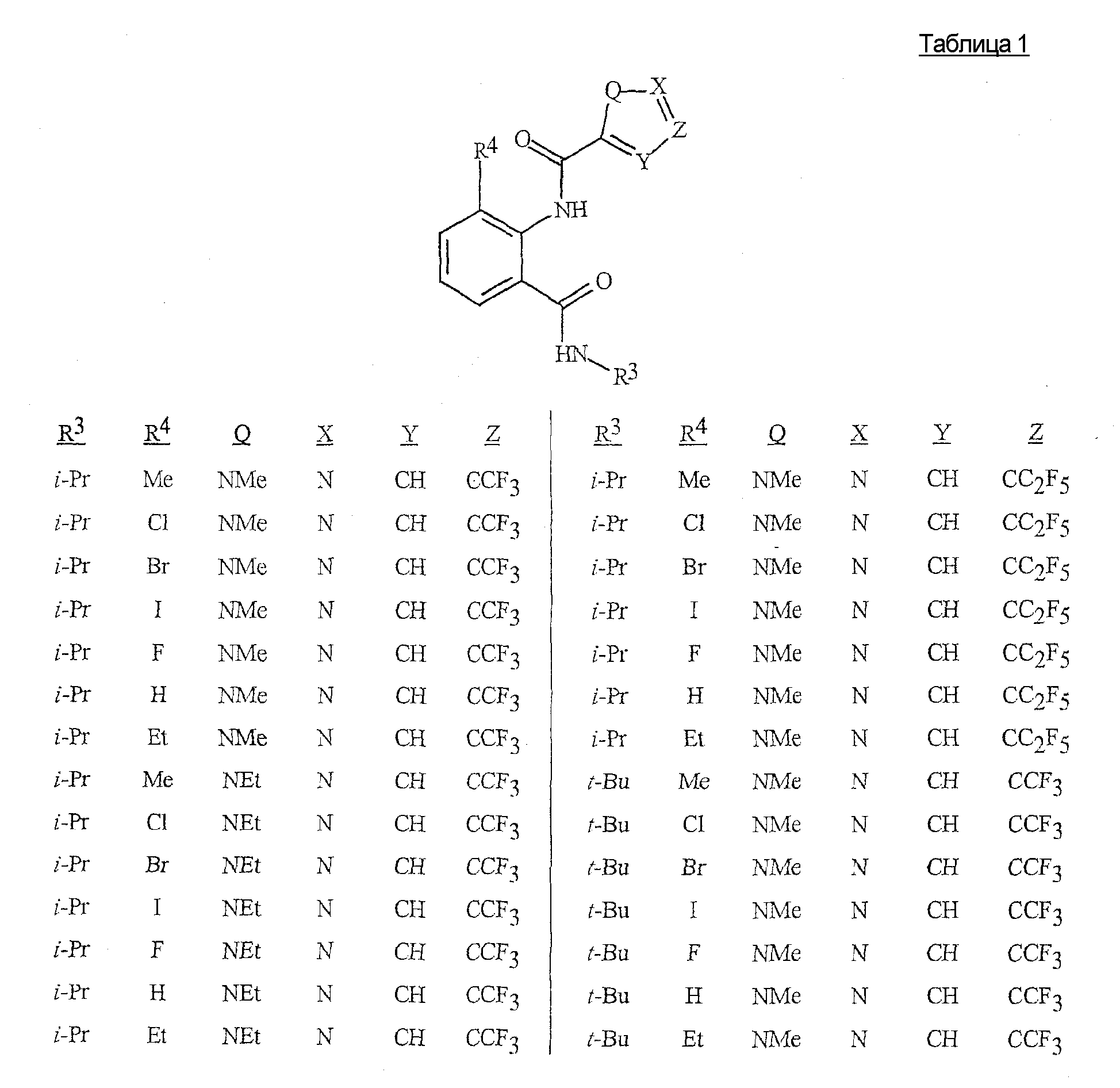
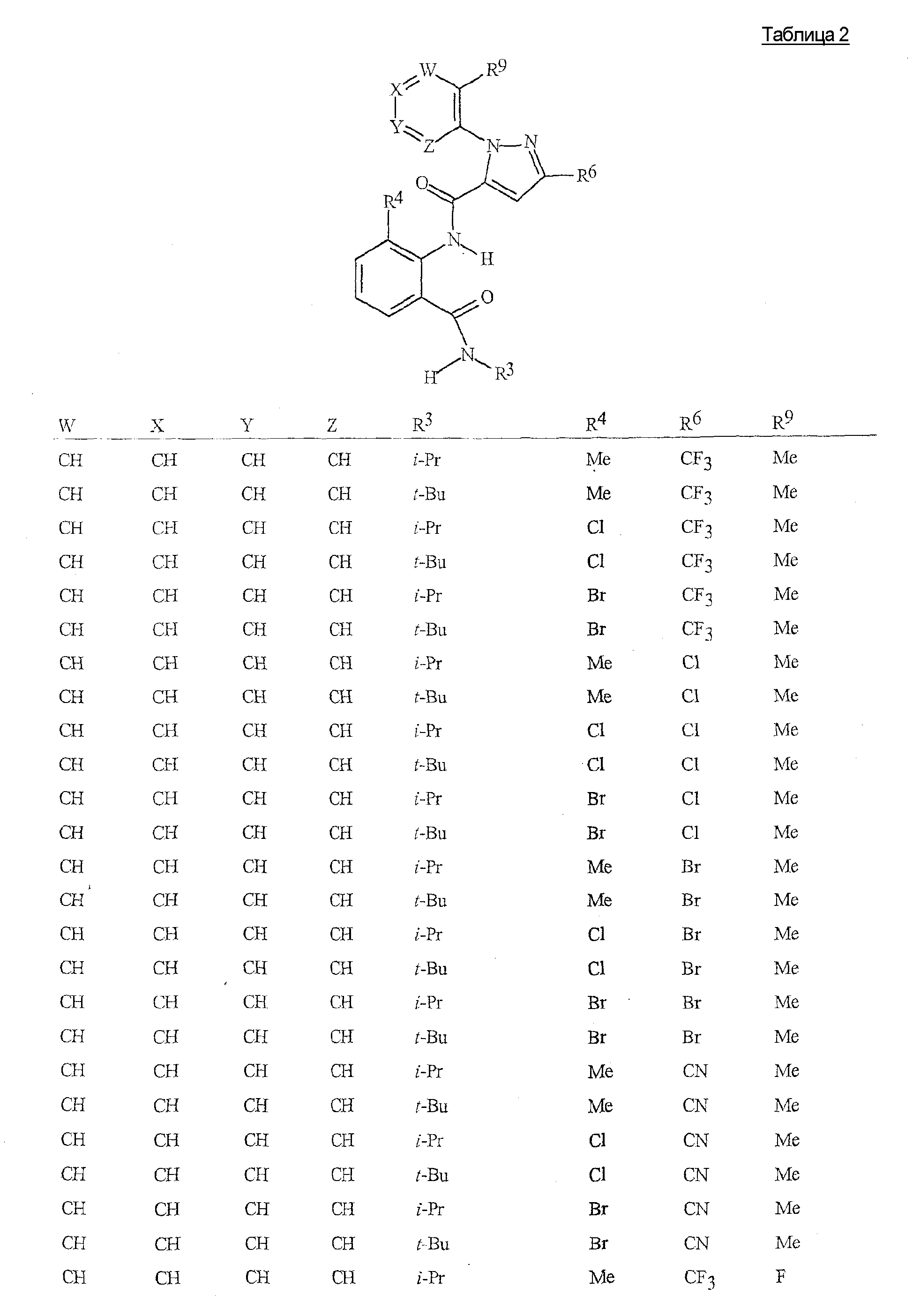


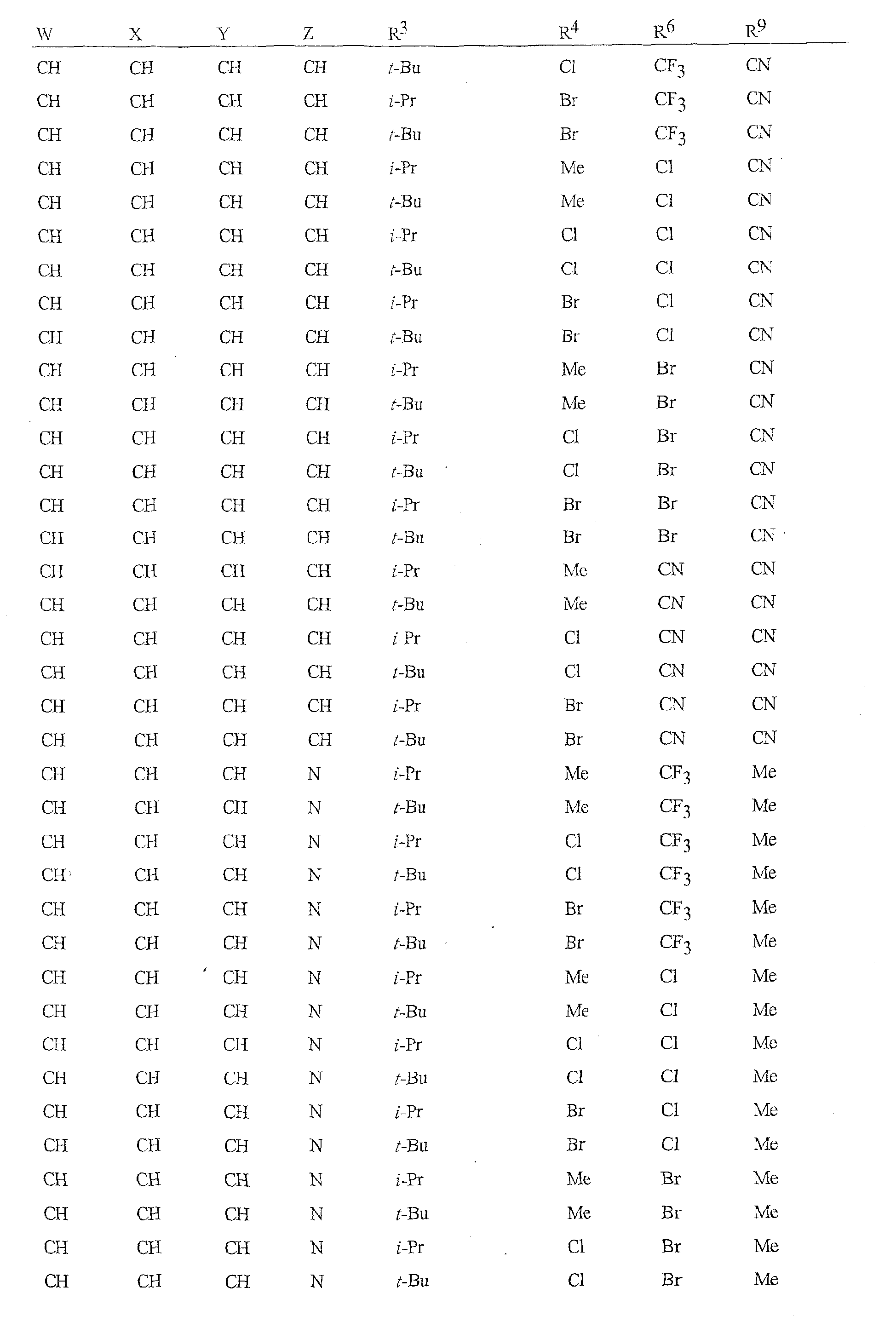
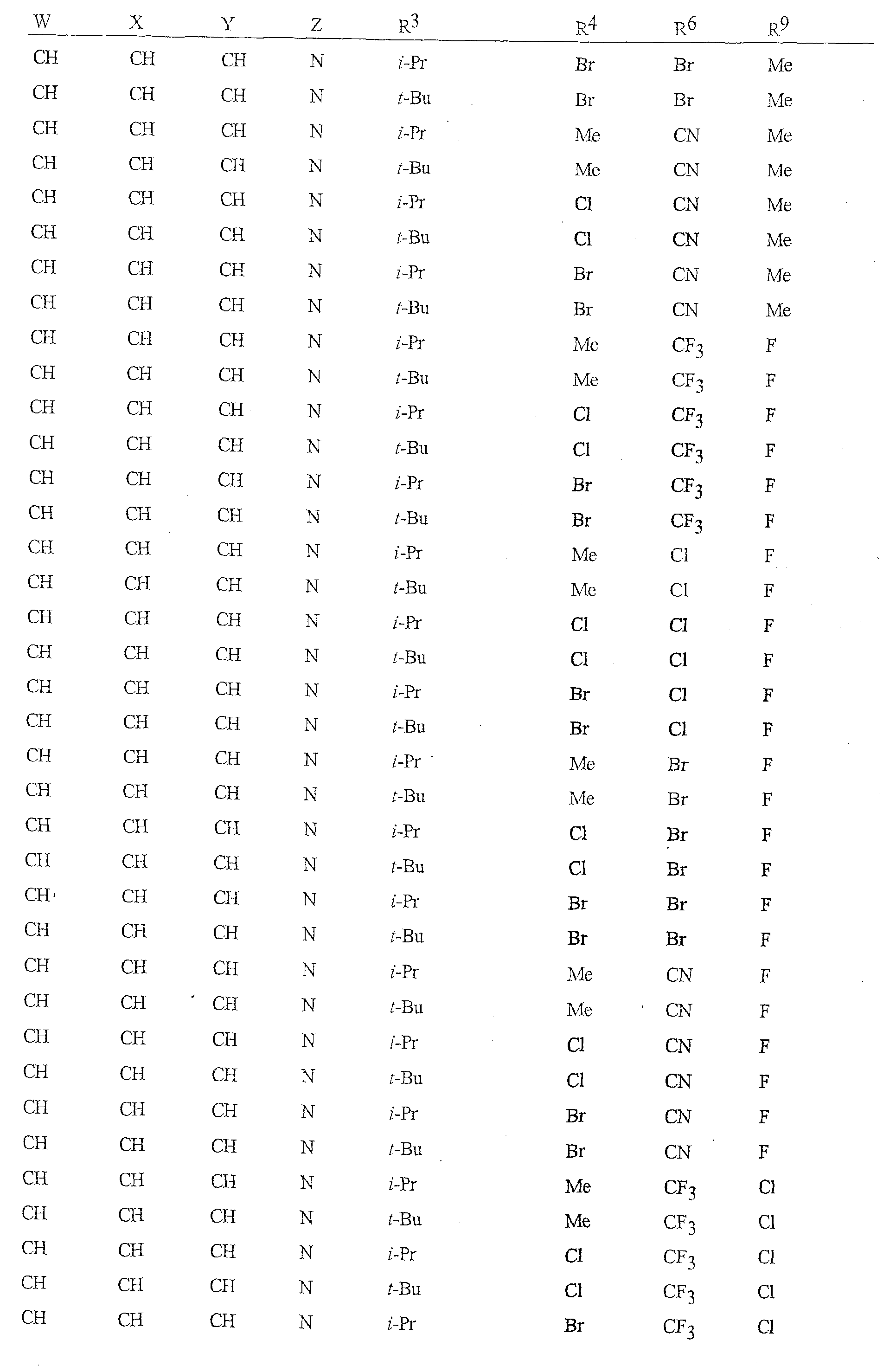
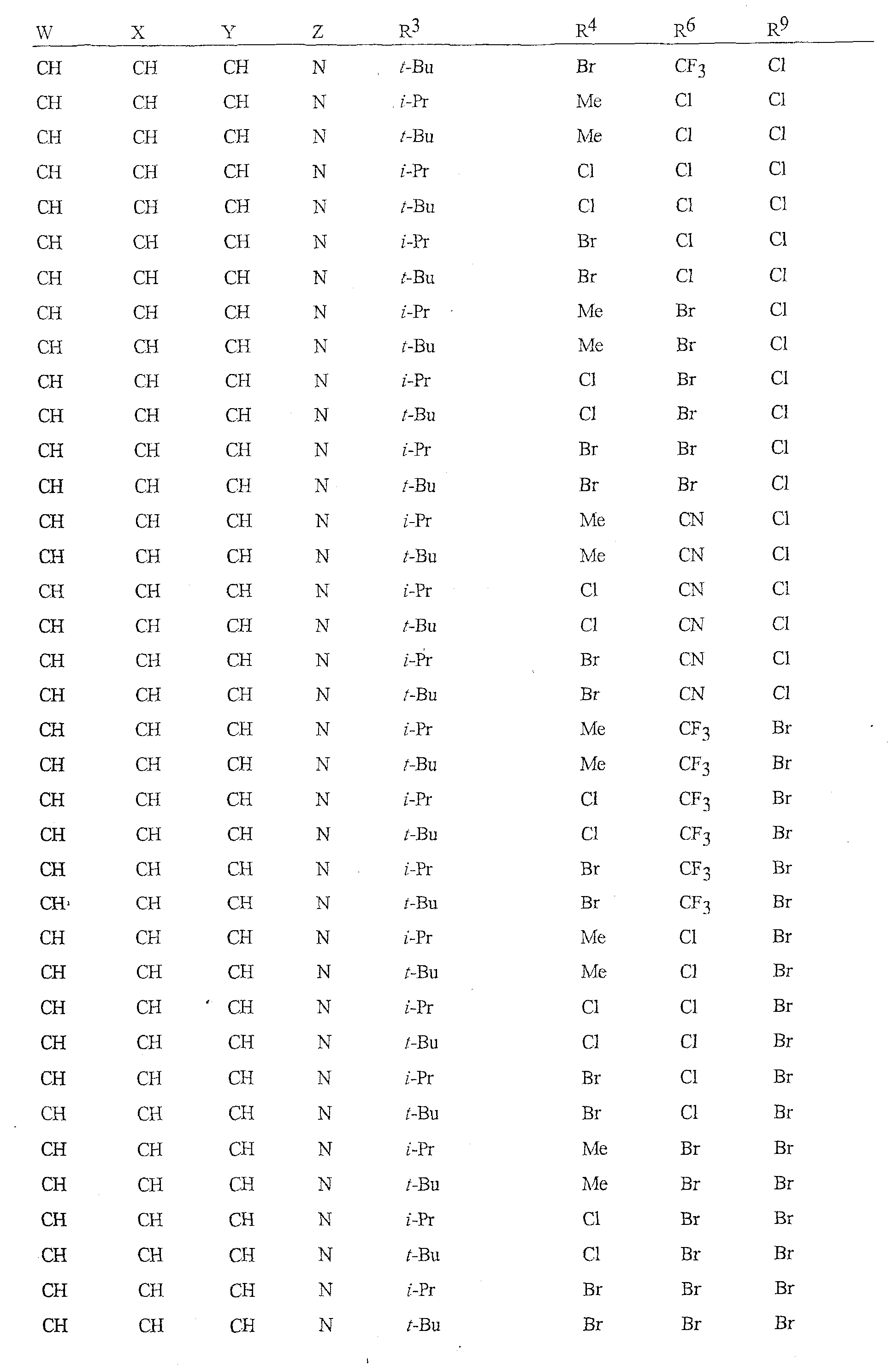
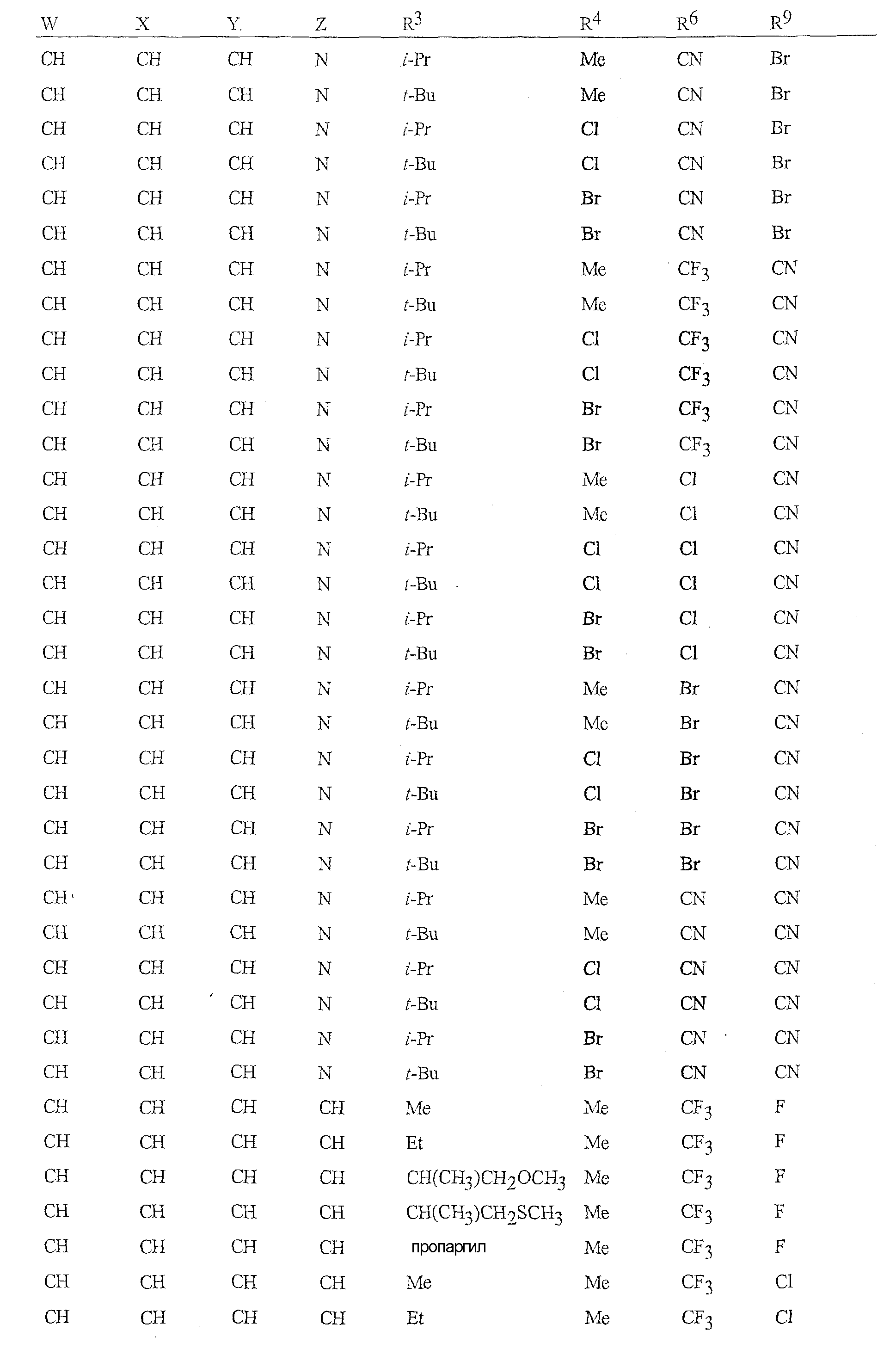
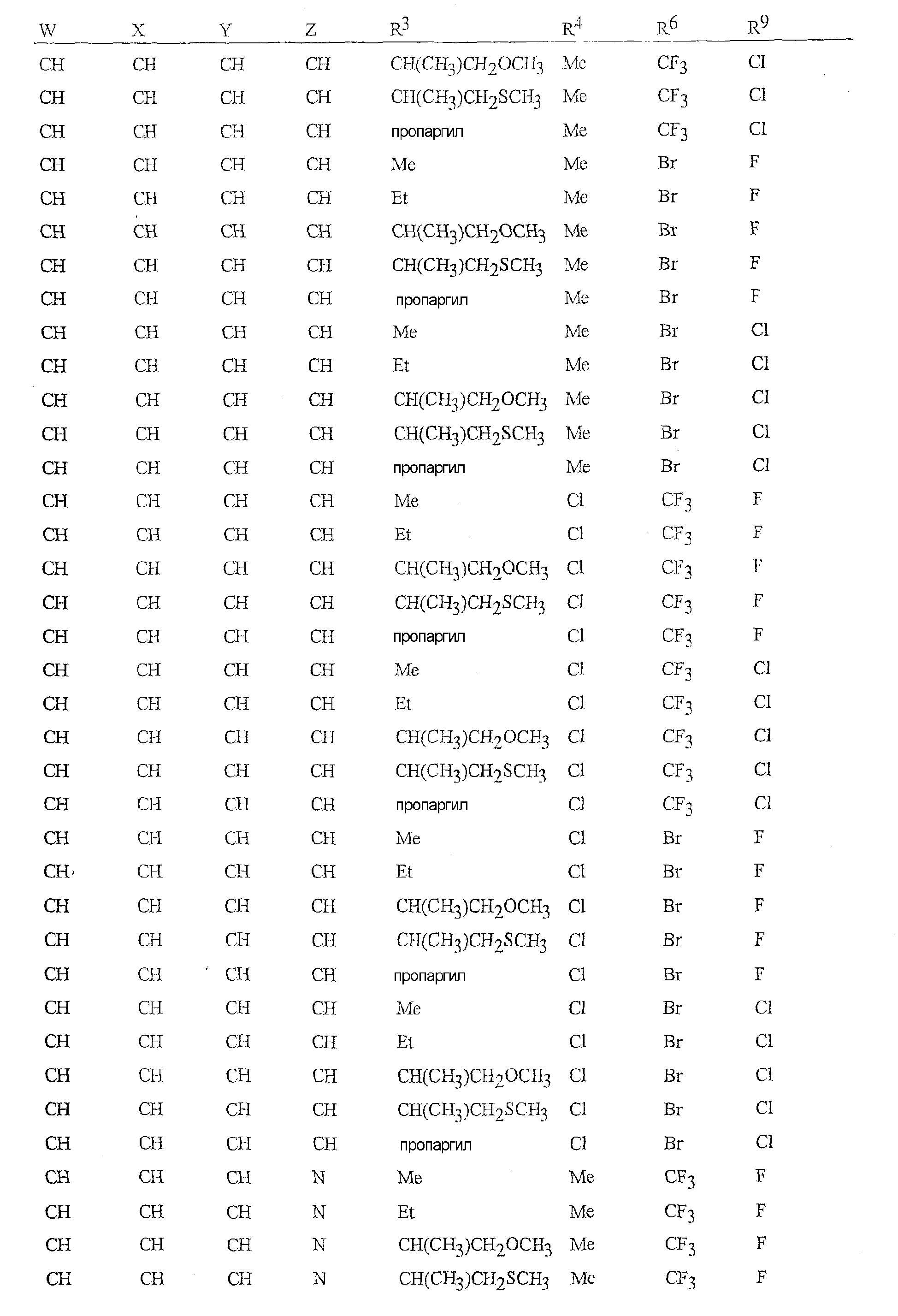

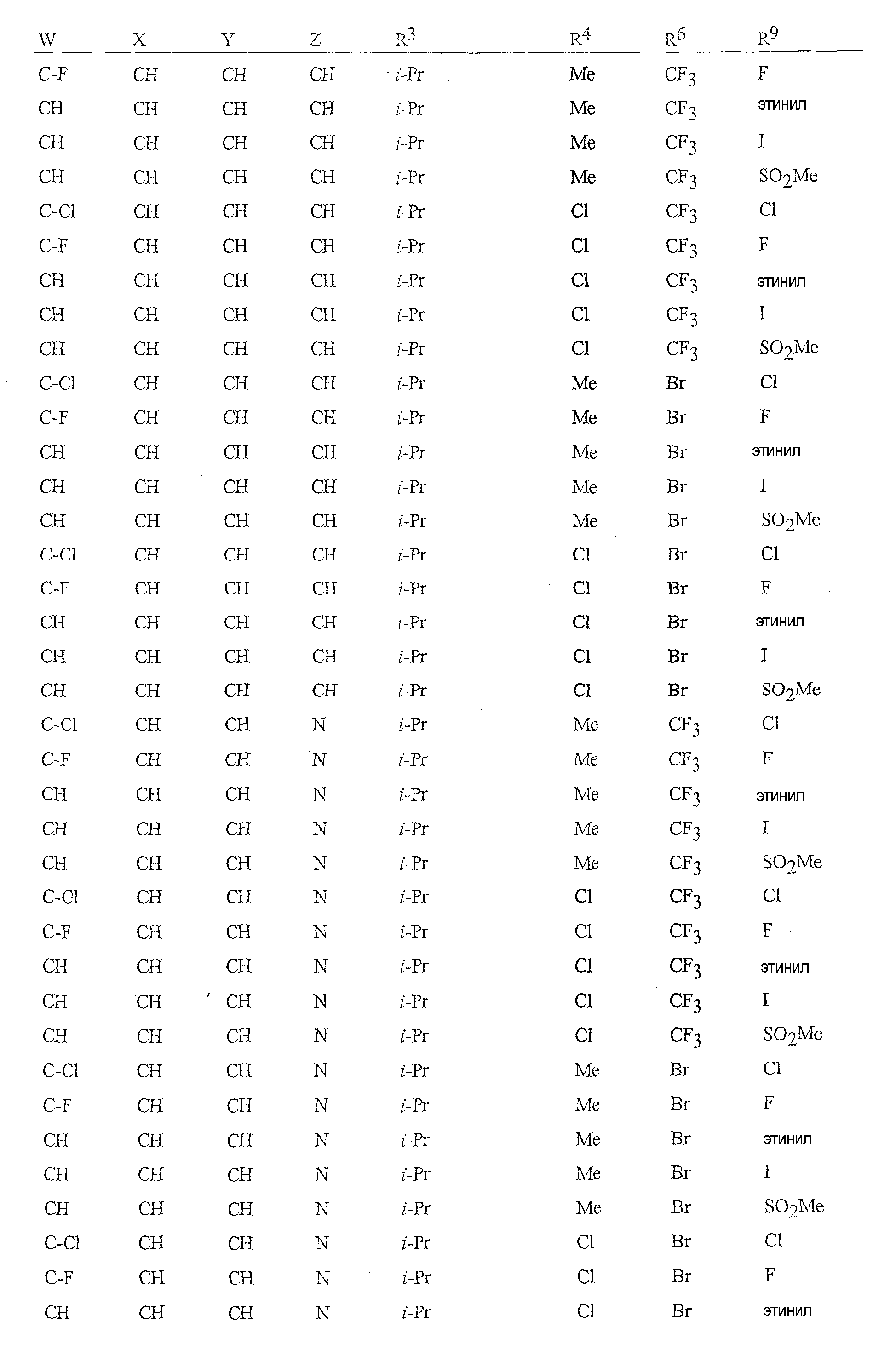
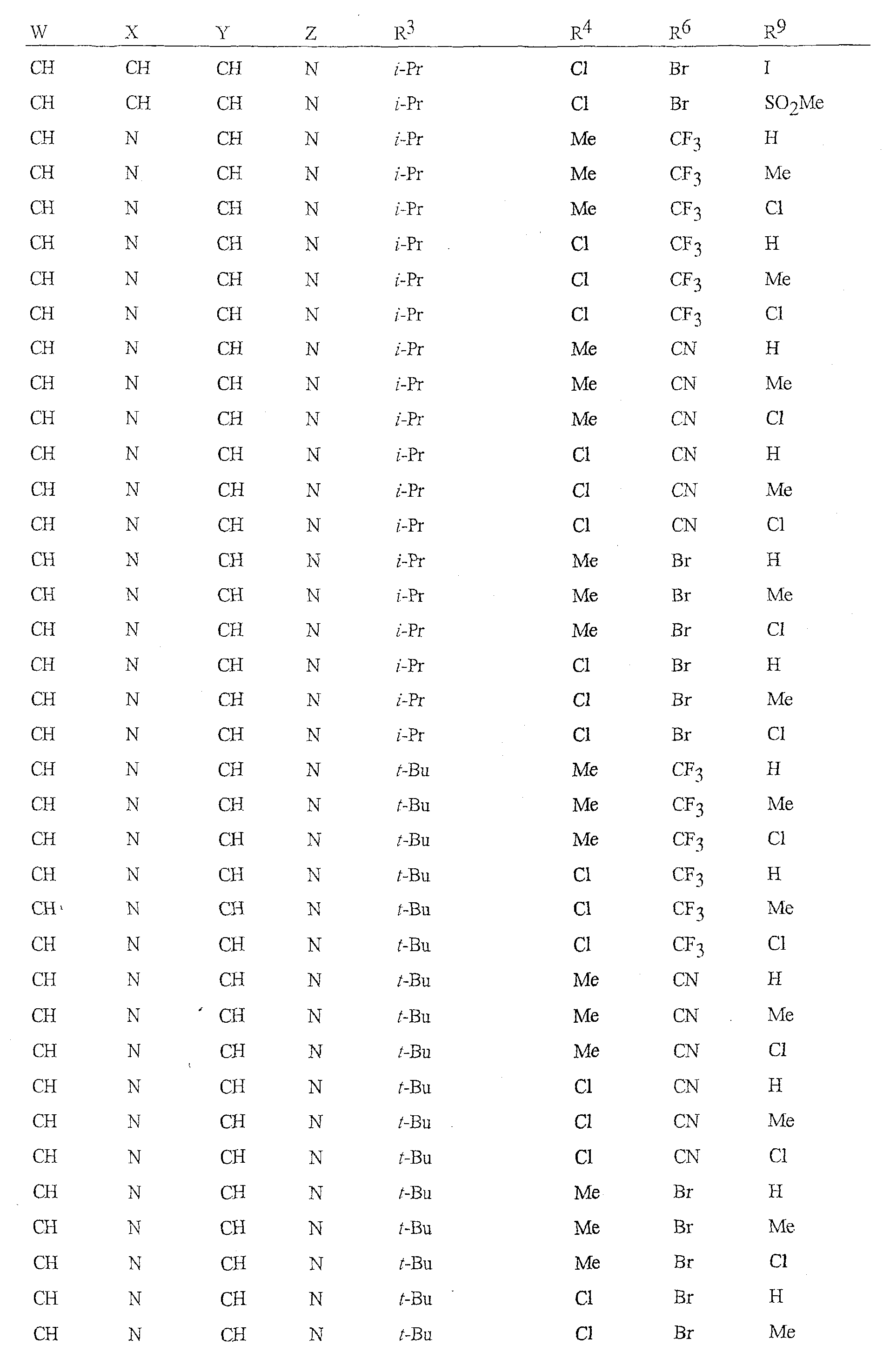
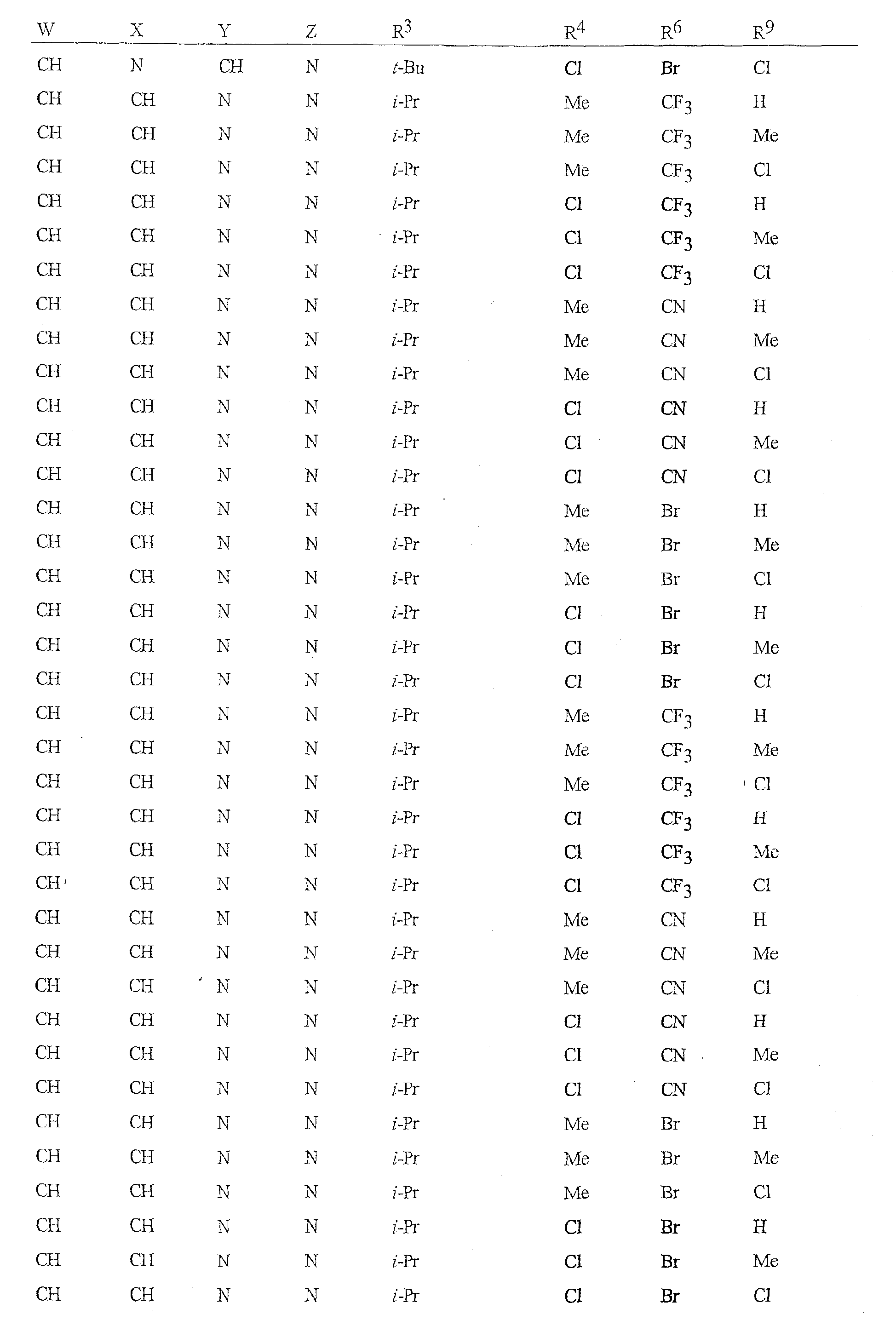
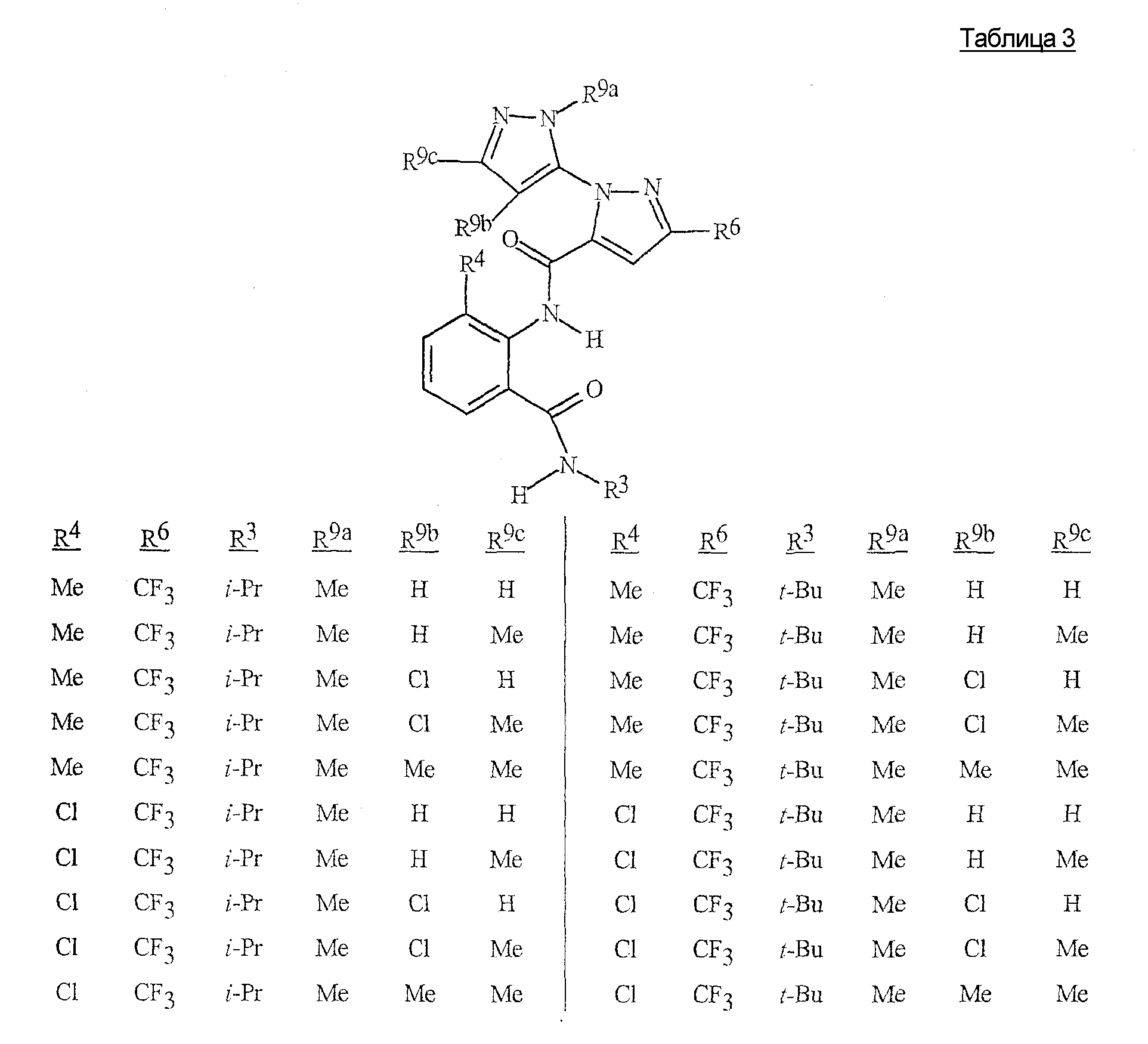


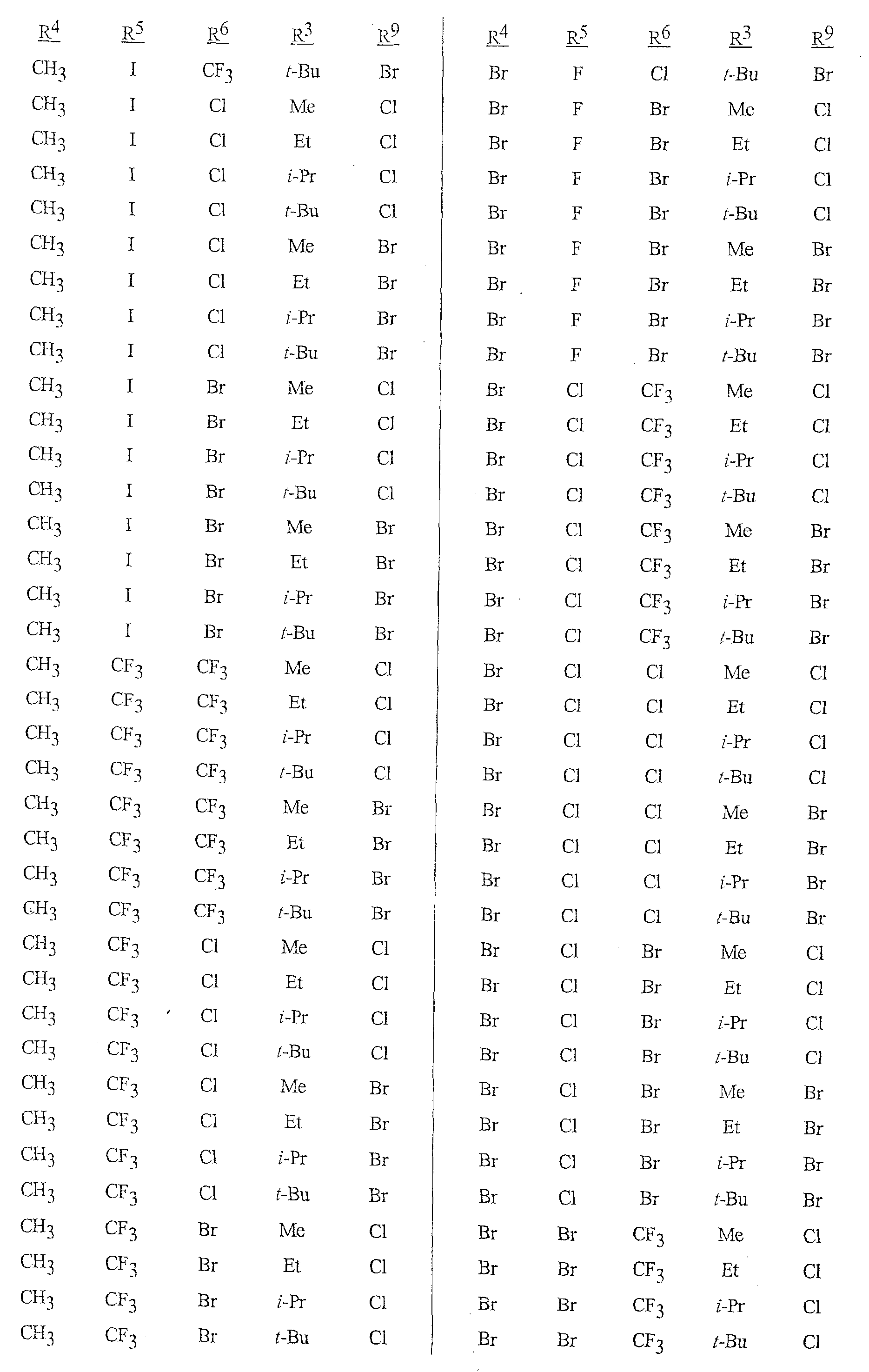


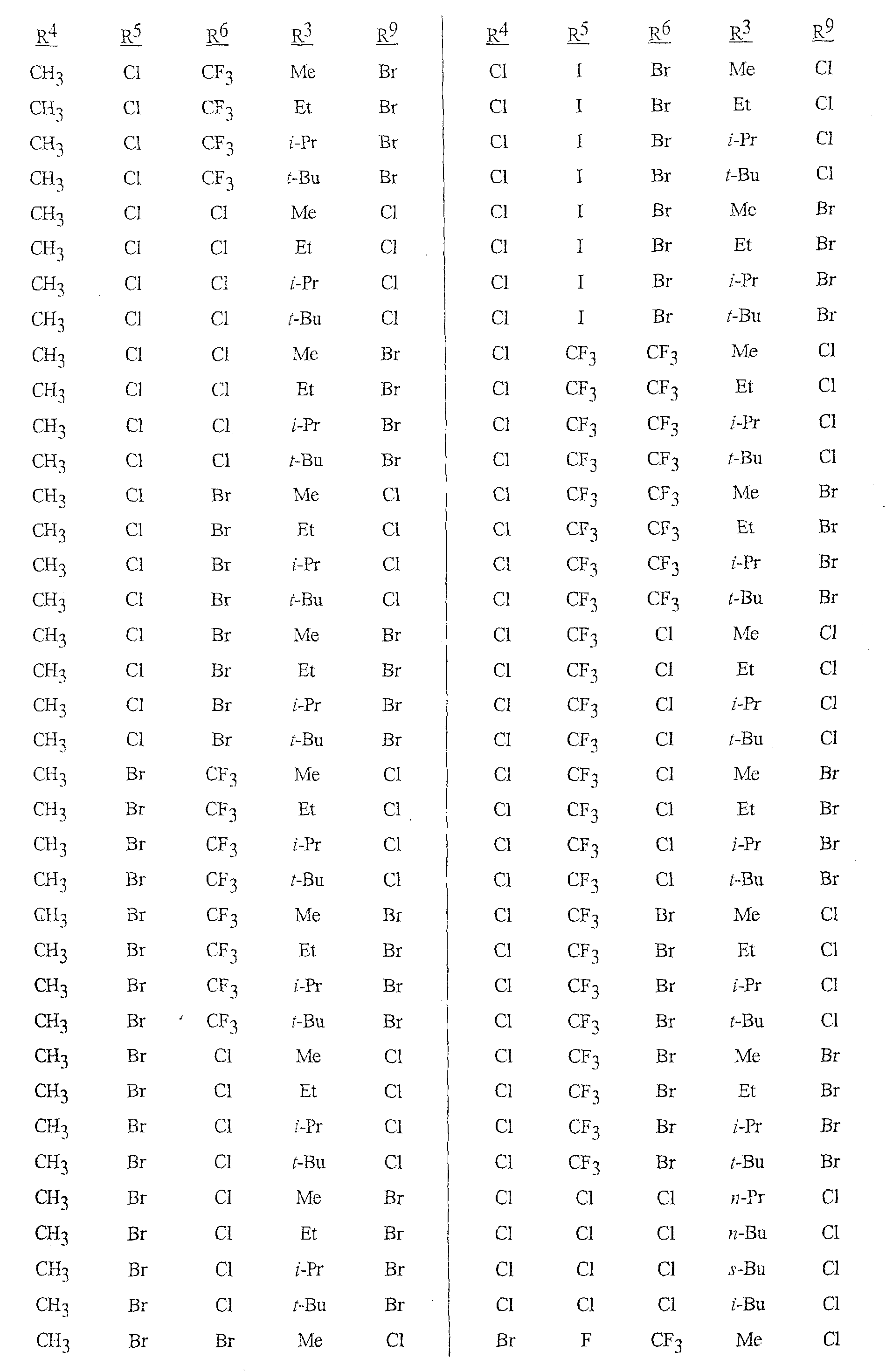

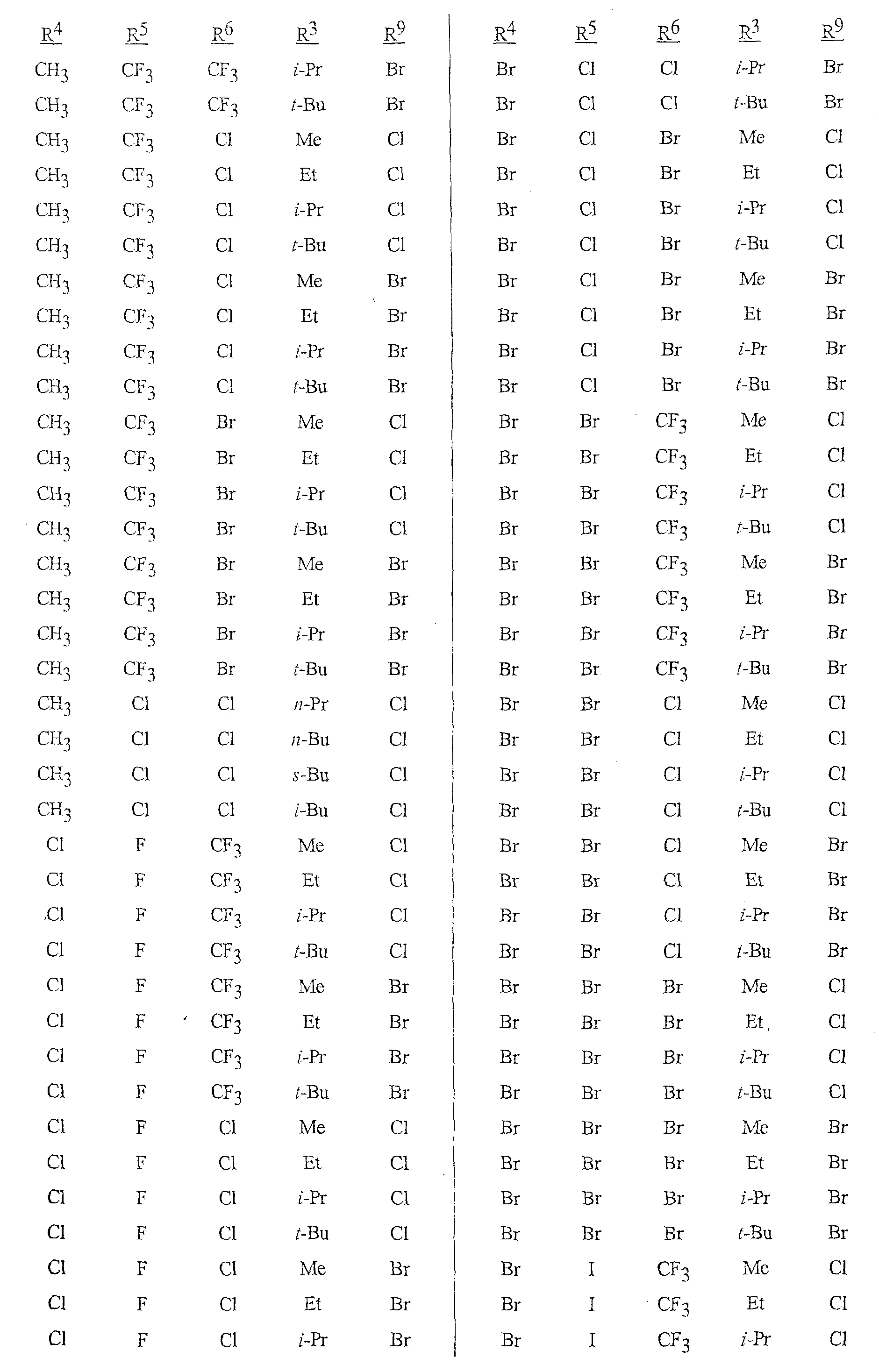


Как показано на схеме 7 и как проиллюстрировано в примерах 4 и 5, бензоксазины формул 10а-b, такие как бензоксазины, перечисленные в таблицах 7 и 8, могут быть использованы для получения соединений формулы I, включая соединения, перечисленные в таблицах 2 и 5.As shown in Scheme 7 and as illustrated in Examples 4 and 5, benzoxazines of formulas 10a-b, such as benzoxazines listed in Tables 7 and 8, can be used to prepare compounds of formula I, including the compounds listed in Tables 2 and 5.
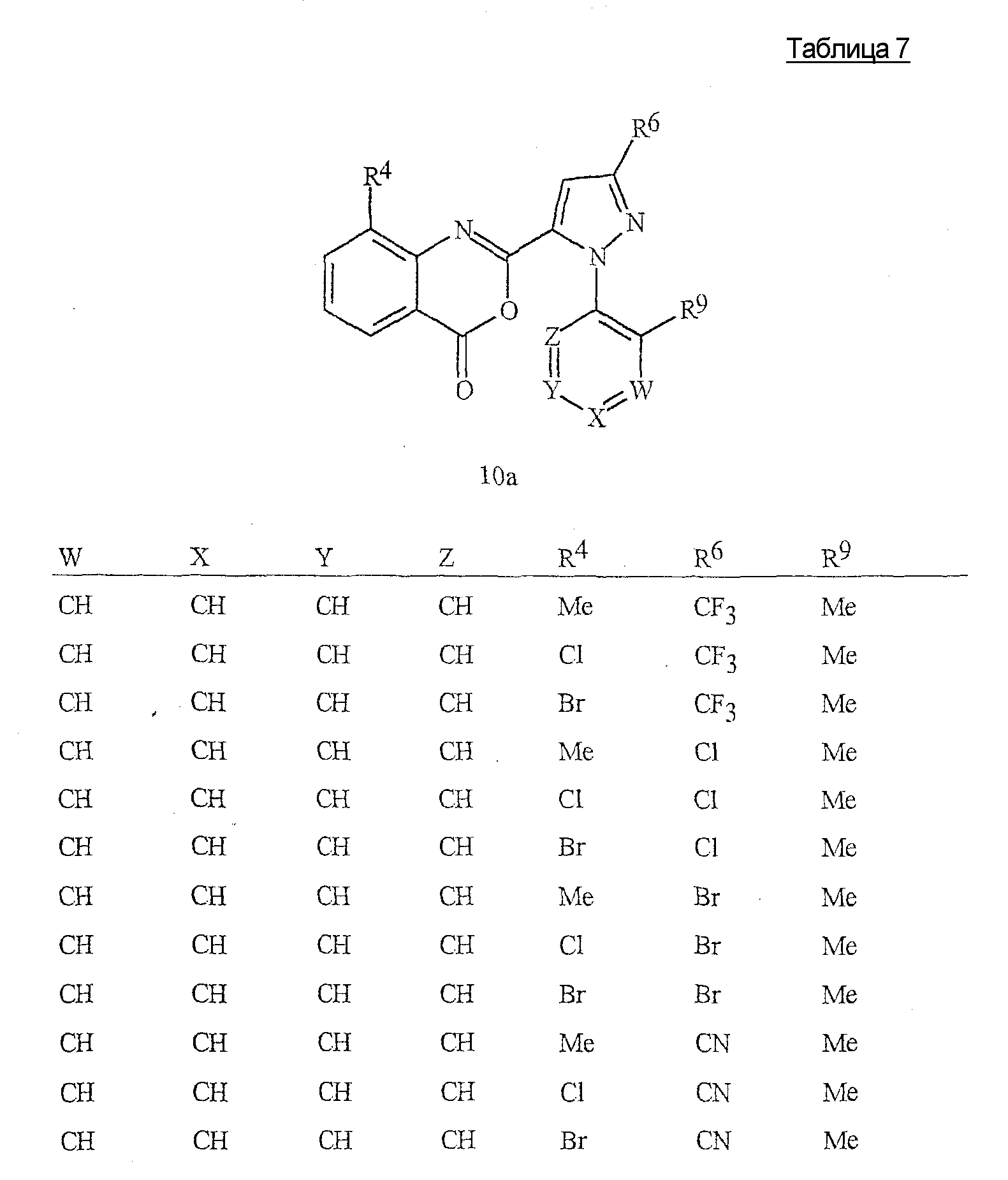
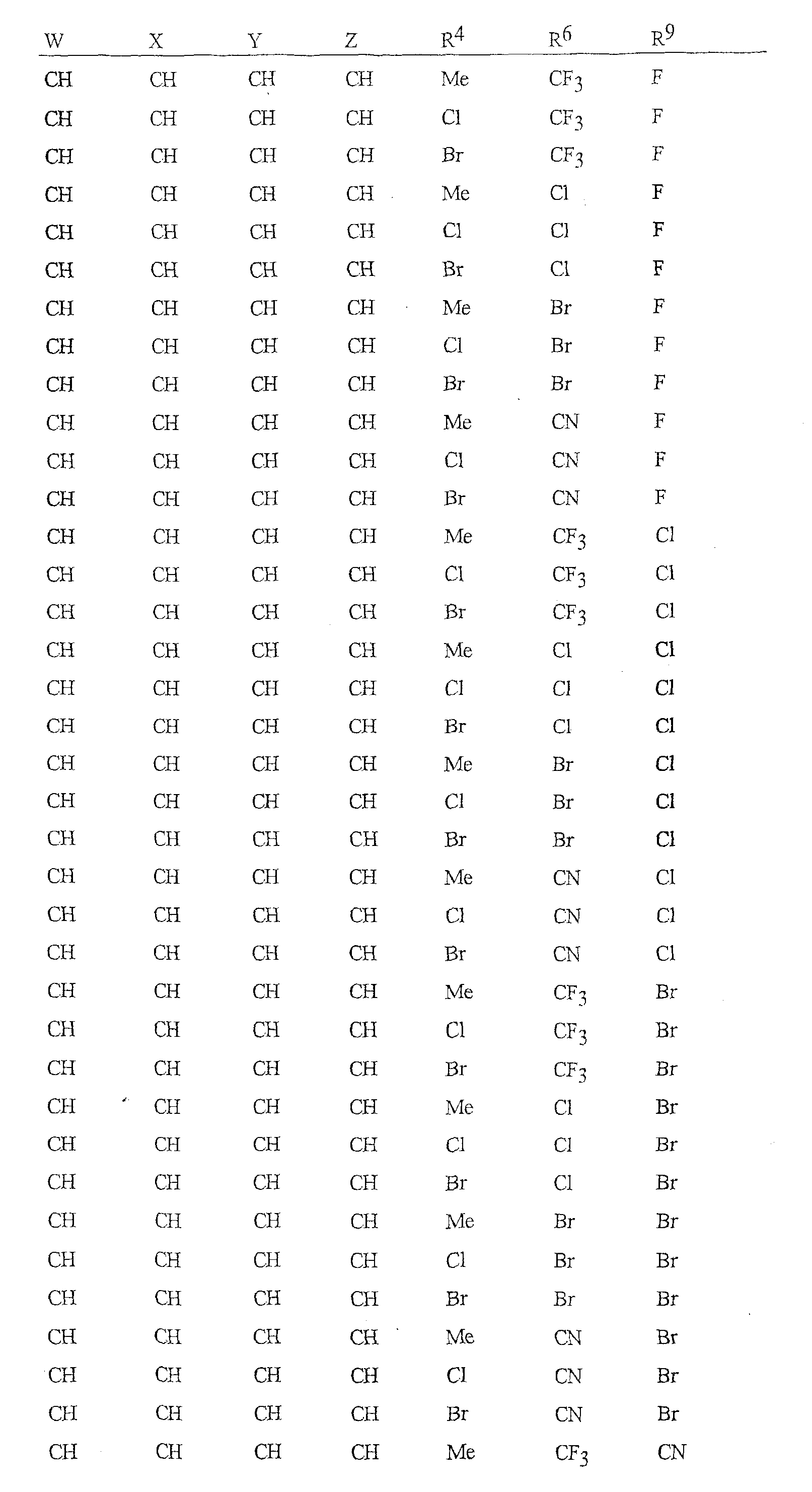
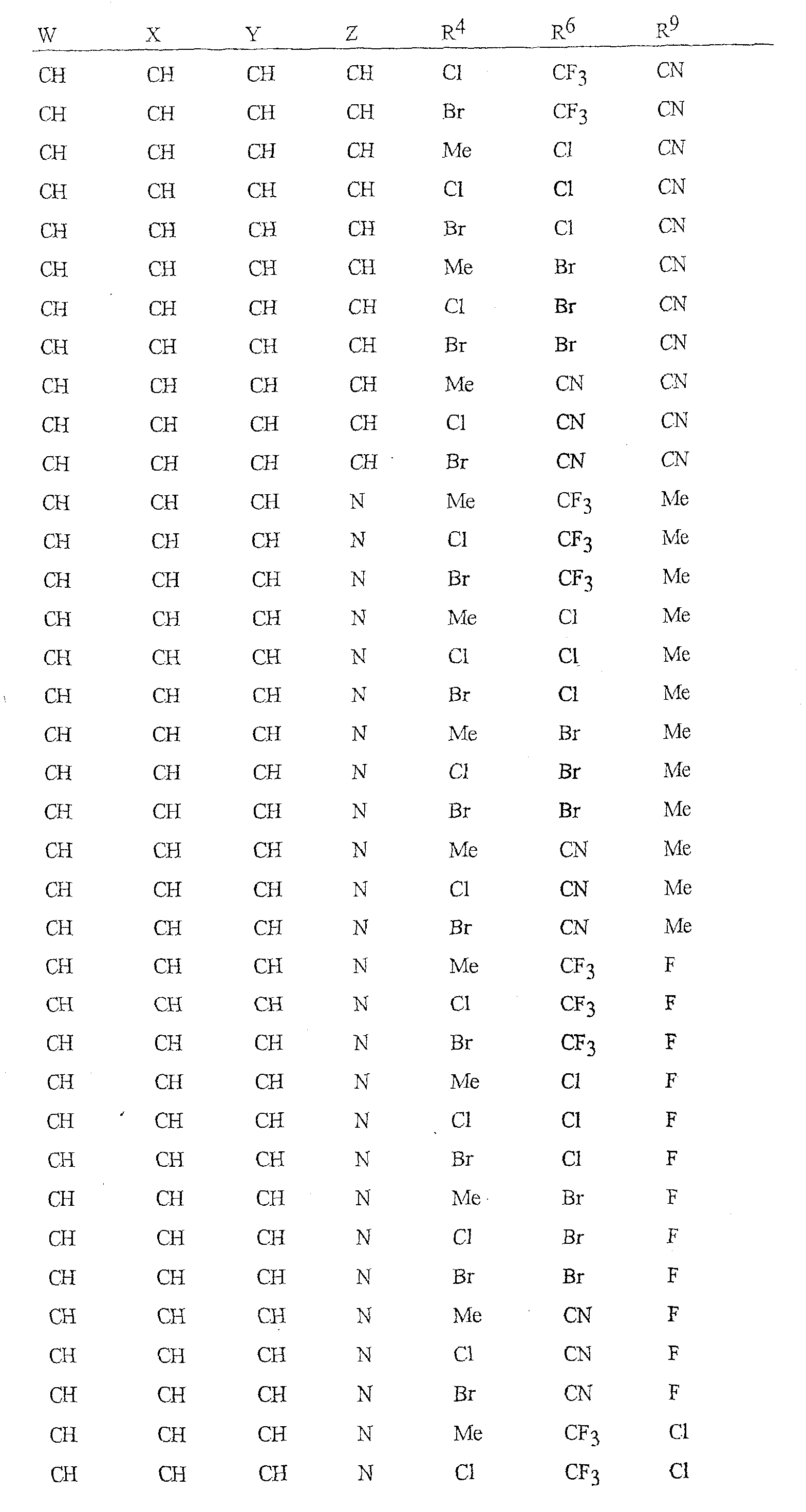
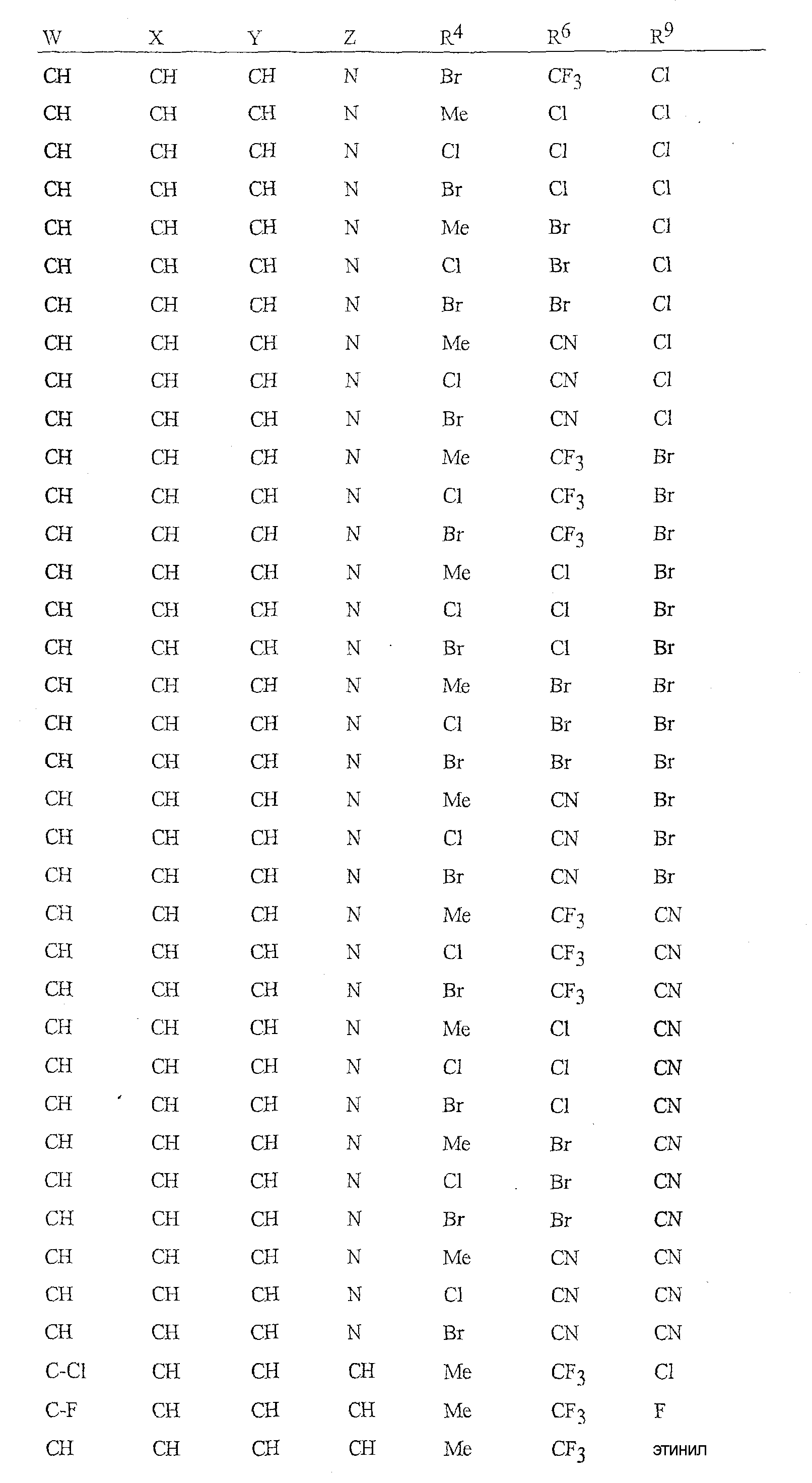
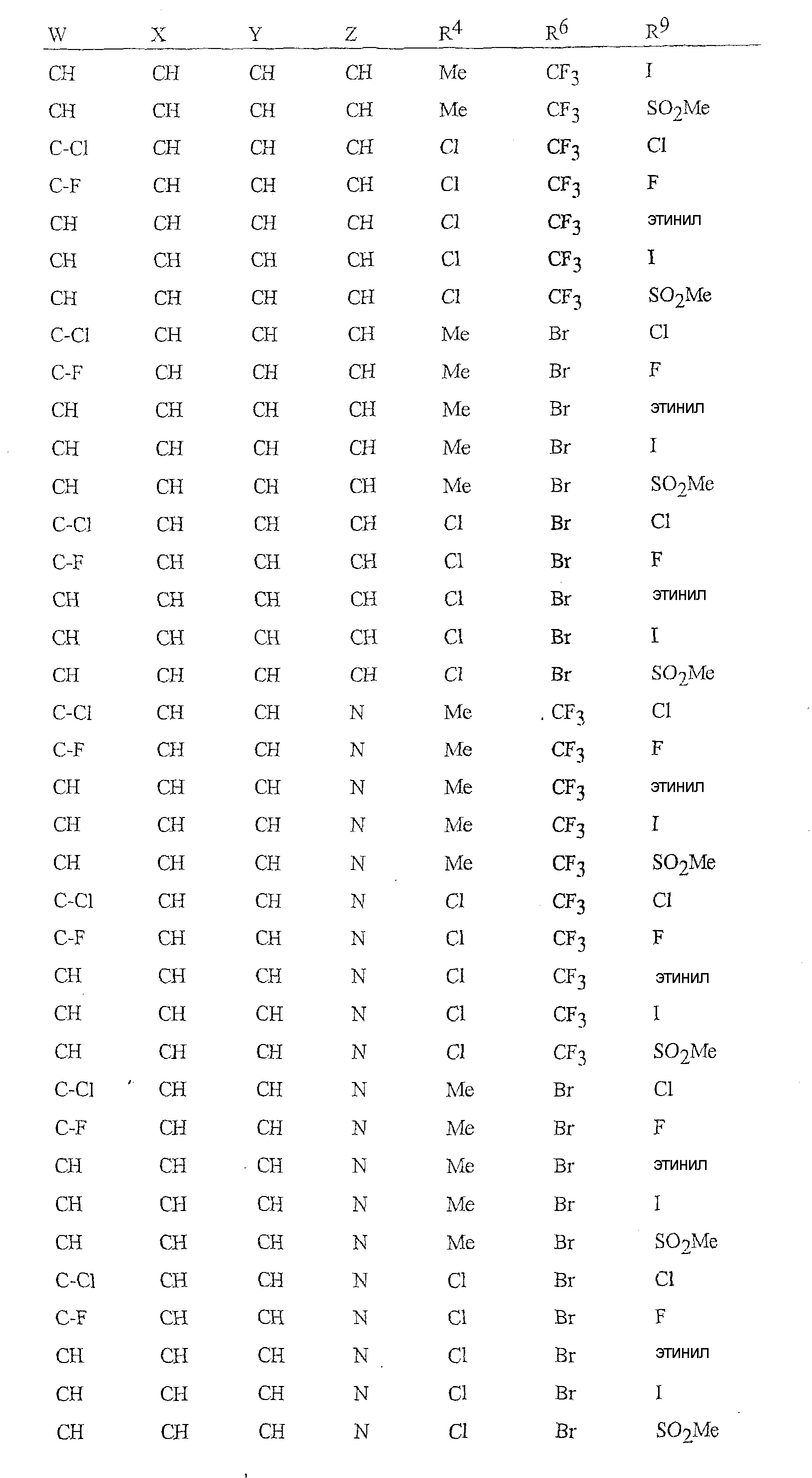


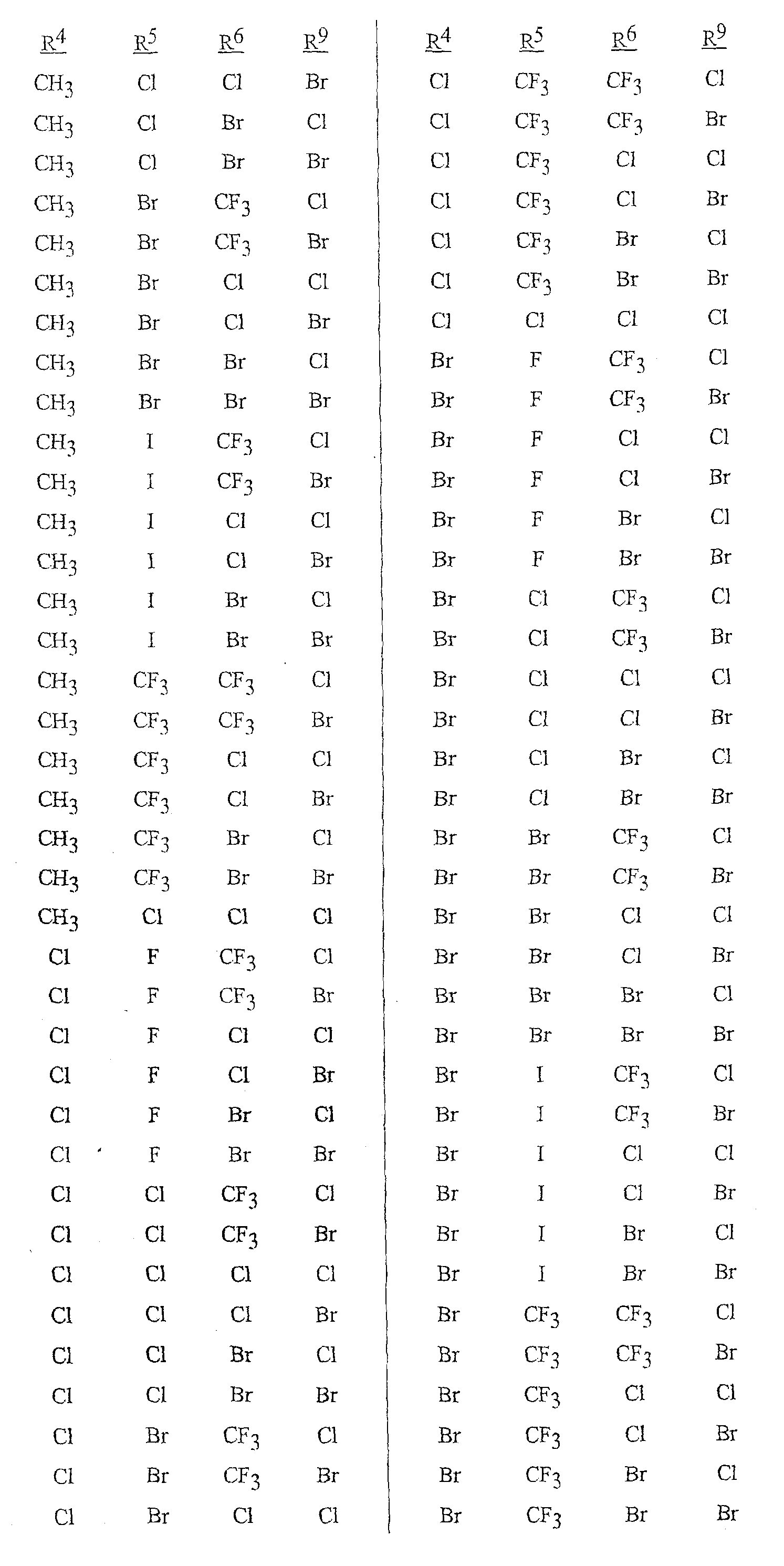
Композиции/ПрименениеCompositions / Application
Соединения настоящего изобретения могут быть использованы, в основном, в качестве препарата или композиции с сельскохозяйственно-приемлемым носителем, включающим, по крайней мере, один жидкий разбавитель, один твердый разбавитель или одно поверхностно-активное вещество. Ингредиенты указанного препарата или указанной композиции выбирают так, чтобы они соответствовали физическим свойствам активного ингредиента, способу введения и факторам окружающей среды, таким как тип почвы, влажность и температура. Подходящими композициями являются жидкости, такие как растворы (включая эмульгируемые концентраты), суспензии, эмульсии (включая микроэмульсии и/или суспензионные эмульсии) и т.п., которые могут, но необязательно, сгущаться с образованием гелей. Подходящими препаратами, кроме того, являются твердые вещества, такие как дусты, порошки, гранулы, драже, таблетки, пленки и т.п., которые могут быть диспергируемыми в воде ("смачиваемыми") или водорастворимыми. Активный ингредиент может быть (микро)инкапсулирован с последующим образованием суспензии или твердого препарата; или альтернативно, весь препарат активного ингредиента может быть инкапсулирован (или нанесен в виде "внешнего покрытия"). Инкапсулирование может регулировать или замедлять высвобождение активного ингредиента. Распыляемые препараты могут быть разведены в подходящей среде и использованы в объемах опрыскивания примерно от одного до нескольких литров на гектар. Высококонцентрированные композиции используют, главным образом, в качестве промежуточных продуктов для получения конечных препаратов.Указанные препараты обычно содержат эффективные количества активного ингредиента, разбавителя и поверхностно-активного вещества в нижеследующих приблизительных интервалах, и в сумме эти количества составляют 100% по массе.The compounds of the present invention can be used mainly as a preparation or composition with an agriculturally acceptable carrier comprising at least one liquid diluent, one solid diluent or one surfactant. The ingredients of the specified preparation or the specified composition are selected so that they correspond to the physical properties of the active ingredient, route of administration and environmental factors such as soil type, moisture and temperature. Suitable compositions are liquids, such as solutions (including emulsifiable concentrates), suspensions, emulsions (including microemulsions and / or suspension emulsions) and the like, which can, but need not, thicken to form gels. Suitable preparations are furthermore solids, such as dusts, powders, granules, dragees, tablets, films, and the like, which may be water dispersible (“wettable”) or water soluble. The active ingredient may be (micro) encapsulated, followed by the formation of a suspension or solid preparation; or alternatively, the entire preparation of the active ingredient may be encapsulated (or applied as an “external coating”). Encapsulation can control or slow down the release of the active ingredient. Sprayable formulations may be diluted in a suitable medium and used in spray volumes from about one to several liters per hectare. Highly concentrated compositions are mainly used as intermediates for the preparation of the final preparations. These preparations usually contain effective amounts of the active ingredient, diluent and surfactant in the following approximate ranges, and in total these amounts are 100% by weight.
Типичные твердые разбавители описаны Watkins et al., в Handbook of Insecticide Dust Diluents and Carriers, 2nd Ed., Dorland Books, Caldwell, New Jersey. Типичные жидкие разбавители описаны в руководстве Marsden, Solvents Guide, 2nd Ed., Interscience, New York, 1950. McCutcheon's Detergents and Emulsifiers Annual, Allured Publ. Corp., Ridgewood, New Jersey, а также Sisely and Wood, Encyclopedia of Surface Active Agents, Chemical Publ. Co., Inc., New York, 1964, где перечислены поверхностно-активные вещества и приводятся рекомендации к их использованию. Все препараты могут содержать небольшие количества добавок для снижения пенообразования, спекания, коррозии, роста микроорганизмов и т.п., или загустителей для повышения вязкости.Typical solid diluents are described by Watkins et al., In Handbook of Insecticide Dust Diluents and Carriers, 2nd Ed., Dorland Books, Caldwell, New Jersey. Typical liquid diluents are described in Marsden, Solvents Guide, 2nd Ed., Interscience, New York, 1950. McCutcheon's Detergents and Emulsifiers Annual, Allured Publ. Corp., Ridgewood, New Jersey, and Sisely and Wood, Encyclopedia of Surface Active Agents, Chemical Publ. Co., Inc., New York, 1964, which lists surfactants and provides recommendations for their use. All preparations may contain small amounts of additives to reduce foaming, sintering, corrosion, growth of microorganisms, etc., or thickeners to increase viscosity.
Поверхностно-активными веществами являются, например, полиэтоксилированные спирты, полиэтоксилированные алкилфенолы, полиэтоксилированные сложные эфиры сорбитана и жирных кислот, диалкилсульфосукцинаты, алкилсульфаты, алкилбензолсульфонаты, кремнийорганические вещества, N,N-диалкилтаураты, лигнинсульфонаты, конденсаты нафталинсульфоната и формальдегида, поликарбоксилаты и блок-сополимеры полиоксиэтилена/полиоксипропилена. Твердыми разбавителями являются, например, глины, такие как бентонит, монтмориллонит, аттапульгит и коалин, крахмал, сахар, диоксид кремния, тальк, диатомовая земля, мочевина, карбонат кальция, карбонат и бикарбонат натрия и сульфат натрия. Жидкими разбавителями являются, например, вода, N,N-диметилформамид, диметилсульфоксид, N-алкилпирролидон, этиленгликоль, полипропиленгликоль, парафины, алкилбензолы, алкилнафталины, оливковое масло, касторовое масло, льняное масло, тунговое масло, кунжутное масло, кукурузное масло, арахисовое масло, масло из семян хлопчатника, соевое масло, рапсовое масло и кокосовое масло, сложные эфиры жирных кислот, такие как циклогексанон, 2-гептанон, изофорон и 4-гидрокси-4-метил-2-пентанон, и спирты, такие как метанол, циклогексанол, деканол и тетрагидрофурфуриловый спирт.Surfactants are, for example, polyethoxylated alcohols, polyethoxylated alkyl phenols, polyethoxylated esters of sorbitan and fatty acids, dialkyl sulfosuccinates, alkyl sulfates, alkyl benzenesulfonates, organosilicon substances, N, N-dialkyltaurate sulfonyl sulfonyl sulfonyl sulfonates / polyoxypropylene. Solid diluents are, for example, clays such as bentonite, montmorillonite, attapulgite and koalin, starch, sugar, silicon dioxide, talc, diatomaceous earth, urea, calcium carbonate, sodium carbonate and sodium bicarbonate and sodium sulfate. Liquid diluents are, for example, water, N, N-dimethylformamide, dimethyl sulfoxide, N-alkylpyrrolidone, ethylene glycol, polypropylene glycol, paraffins, alkylbenzenes, alkylnaphthalenes, olive oil, castor oil, linseed oil, tung oil, sesame oil, corn, corn , cottonseed oil, soybean oil, rapeseed oil and coconut oil, fatty acid esters such as cyclohexanone, 2-heptanone, isophorone and 4-hydroxy-4-methyl-2-pentanone, and alcohols such as methanol, cyclohexanol , decanol and tetrahydro urfurilovy alcohol.
Растворы, включая эмульгируемые концентраты, могут быть получены путем простого смешивания ингредиентов. Дусты и порошки могут быть получены путем смешивания и, в основном, путем измельчения в молотковой мельнице или в струйной мельнице. Суспензии обычно получают путем измельчения в мельнице мокрого помола, см., например, патент США 3060084. Гранулы и драже могут быть получены путем распыления активного вещества на предварительно приготовленные гранулированные носители или путем агломерации. См., Browning, "Agglomeration", Chemical Engineering, December 4, 1967, pp.147-48, Perry's Chemical Engineer's Handbook, 4th Ed., McGraw-Hill, New York, 1963, pages 8-57, и т.п., и публикацию заявки на патент РСТ WO 91/13546. Гранулы могут быть получены как описано в патенте США № 4172714. Вододиспергируемые и водорастворимые гранулы могут быть получены как описано в патентах США № 4144050, № 3920442 и патенте DE 3246493. Таблетки могут быть получены как описано в патентах США № 5180587, № 5232701 и № 5208030. Пленки могут быть получены как описано в патенте Великобритании № 2095558 и в патенте США № 3299566.Solutions, including emulsifiable concentrates, can be prepared by simply mixing the ingredients. Dusts and powders can be obtained by mixing and mainly by grinding in a hammer mill or in a jet mill. Suspensions are usually obtained by grinding in a wet mill, see, for example, US Pat. No. 3,060,084. Granules and dragees can be obtained by spraying the active substance onto pre-prepared granular carriers or by agglomeration. See, Browning, "Agglomeration", Chemical Engineering, December 4, 1967, pp. 147-48, Perry's Chemical Engineer's Handbook, 4th Ed., McGraw-Hill, New York, 1963, pages 8-57, etc. ., and the publication of PCT patent application WO 91/13546. Granules can be prepared as described in US Pat. No. 4,172,714. Water-dispersible and water-soluble granules can be prepared as described in US Pat. No. 4,144,050, No. 3,920,442 and DE 3246493. Tablets can be prepared as described in US Pat. 5208030. Films can be obtained as described in UK patent No. 2095558 and in US patent No. 3299566.
Дополнительную информацию о препаратах можно найти в работах T.S. Woods, "The Formulator's Toolbox - Product Forms for Modern Agriculture", Pesticide Chemistry and Bioscience, The Food-Environment Challenge, T.Brooks and T.R. Roberts, Eds., Proceedings of the 9th International Congress on Pesticide Chemistry, The Royal Society of Chemistry, Cambridge, 1999, pp.120-133. См. также патент США № 3235361, ст.6, строка 16 - ст.7, строка 19 и примеры 10-41; патент США № 3309192, ст.5, строка 43 - ст.7, строка 62, и примеры 8, 12, 15, 39, 41, 52, 53, 58, 132, 138-140, 162-164, 166, 167 и 169-182; патент США № 2891855, ст.3, строка 66 - ст.5, строка 17, и примеры 1-4; Klingman, Weed Control as a Science, John Wiley and Sons, Inc., New York, 1961, pp.81-96; и Hance et al., Weed Control Handbook, 8th Ed., Blackwell Scientific Publications, Oxford, 1989.Further information on drugs can be found in T.S. Woods, "The Formulator's Toolbox - Product Forms for Modern Agriculture", Pesticide Chemistry and Bioscience, The Food-Environment Challenge, T. Brooks and T.R. Roberts, Eds., Proceedings of the 9th International Congress on Pesticide Chemistry, The Royal Society of Chemistry, Cambridge, 1999, pp. 120-133. See also US patent No. 3235361, article 6, line 16 - article 7, line 19 and examples 10-41; US patent No. 3309192, article 5, line 43 - article 7, line 62, and examples 8, 12, 15, 39, 41, 52, 53, 58, 132, 138-140, 162-164, 166, 167 and 169-182; US patent No. 2891855, article 3, line 66 - article 5, line 17, and examples 1-4; Klingman, Weed Control as a Science, John Wiley and Sons, Inc., New York, 1961, pp. 81-96; and Hance et al., Weed Control Handbook, 8th Ed., Blackwell Scientific Publications, Oxford, 1989.
В нижеследующих примерах, все проценты даны по массе, а все препараты получены стандартными способами. Номера соединений соответствуют номерам соединений, указанным в таблице А.In the following examples, all percentages are by weight, and all preparations are obtained by standard methods. Connection numbers correspond to connection numbers shown in table A.
Пример АExample A
Смачиваемый порошокWettable Powder
Пример ВExample B
ГранулыGranules
90,0%
90.0%
Пример СExample C
Экструдировнные гранулыExtruded granules
Пример DExample D
Эмульгируемый концентратEmulsifiable Concentrate
10,0%
10.0%
Пример ЕExample E
ГранулыGranules
Соединения настоящего изобретения характеризуются благоприятными метаболическими свойствами и/или характером остаточного распределения в почве и обладают активностью, направленной против беспозвоночных вредителей определенного спектра, имеющих или не имеющих отношение к сельскому хозяйству. (В контексте настоящего описания термин "борьба с беспозвоночными вредителями" означает ингибирование развития беспозвоночных вредителей (включая их уничтожение), которое приводит к значительному снижению поедания растений или других их повреждений или поражений, вызываемых вредителями; родственные термины определены аналогичным образом). В соответствии с настоящим описанием, в понятие "беспозвоночный вредитель" входят членистоногие, брюхоногие и нематоды, которые являются вредителями, приносящими серьезный экономический ущерб. Термин "членистоногие" означает насекомые, клещи, пауки, скорпионы, многоножки, двупарноногие, мокрицы и симфиллы. Термин "брюхоногие моллюски" означает улитки, слизни и другие стилопсы (Stylommatophora). Термин "нематоды" означает все гельминты, такие как круглые черви, гельминты, паразитирующие в сердце, и растительноядные нематоды (Nematoda), трематоды (Trematoda), колючеголовые (Acanthacephala) и ленточные черви (Cestoda). Следует отметить, что не все соединения являются в одинаковой степени эффективными против всех вредителей. Соединения настоящего изобретения обладают активностью против вредителей, причиняющих вред экономически ценным сельскохозяйственным культурам, лесам, тепличным культурам, культурам, выращиваемым в питомниках, декоративным растениям, пищевым продуктам и волокнам; насекомых, приносящих вред здоровью человека и животных; вредителей, обитающих в бытовых и торговых помещениях и вредителей, наносящих урон домашнему хозяйству и портящих продукты, находящиеся на хранении. Такими вредителями являются личинки насекомых отряда чешуекрылых Lepidoptera, таких как совки, подгрызающие совки, пяденицы и геликониды, принадлежащие к семейству совок Noctuidae (например, совка травяная (Spodoptera fugiperda, J.E.Smith), совка малая (Spodoptera exigua, Hubner), совка-ипсилон (Agrotis ipsilon Hufnagel), моль капустная (Trichoplusia ni Hubner), совка табачная (Heliothis virescens, Fabricius); сверлильщики, чехлоноски, гусеницы, строящие паутинное гнездо, конусовидные черви, гусеницы бабочки-капустницы (мермитиды) и скелетирующие листья вредители семейства огневок Pyralidae (например, мотылек кукурузный (Ostrinia nubialis Hubner), гусеница, поражающая цитрусовые (пупок апельсина) (Amyelois transitella Walker), кукурузная огневка (Crambus caliginosellus Clemens), луговой мотылек (Herpetogramma licarsisalis Walker)); листовертки, гусеницы листовертки-почкоеда, вредители семян и плодожорки семейства листоверток Tortricidae (например, плодожорка яблонная (Cydia pomonella Linnaeus), листовертка виноградная (Endopiza viteana Clemens), листовертка восточная персиковая (Grapholita molesta Busck)) и многие другие чешуекрылые Lepidoptera, борьба с которыми имеет экономически важное значение (например, моль капустная (Plutella xylostella Linnaeus), розовый коробочный червь хлопчатника (Pectinophora gossypiella Saunders), непарный шелкопряд (Lymantria dispar Linnaeus)); нимфы и взрослые особи отряда таракановых Blattodea, включая тараканов, принадлежащих к семейству таракановых Blattellidae и Blattidae (например, таракан черный (Blatta orientalis Linnaeus), таракан азиатский (Blatella asahinai Mizukubo), таракан рыжий (пруссак) (Blatella germanica Linnaeus), таракан полосатый (Supella longipalpa Fabricius), таракан американский (Periplaneta americana Linnaeus), таракан бурый (Periplaneta brunnea Burmeister), таракан мадейрианский (Leucophaea maderae Fabricus); личинки и взрослые особи, поедающие листья, отряда жесткокрылых Coleoptera, включая долгоносиков, принадлежащих к семеству ложных слоников Anthribidae, зерновок Bruchidae и слоников или долгоносиков Curculionidae (например, долгоносик хлопковый (Anthonomus grandis Boheman), долгоносик рисовый водяной (Lissorhoptrus oryzophilius Kuschel), долгоносик амбарный (Sitophilius granarius Linnaeus), долгоносик рисовый (Sitophilius oryzae Linnaeus)); земляные блошки, огуречные блошки, корнееды, листоеды, колорадские жуки и минирующие мушки, принадлежащие к семейству жуков-листоедов Chrysomelidae (например, колорадский жук (Leptinotarsa decemlineata Say), блошка кукурузная (Diabrotica virgifera virgifera LeConte)); хрущи и другие жуки семества настоящих пластинчатоусых Scaribaeidae (например, хрущик японский (Popillia japonica Newman) и хрущик европейский (Rhizotrogus majalis Razoumowsky)); кожееды семейства кожеедов Dermastidae; проволочники семейства жуков-щелкунов Elateridae; короеды семейства сколий Scolytidae и хрущики малые мучные семейства чернотелок Tenebrionidae. Кроме того, к ним относятся: взрослые особи и личинки отряда уховерток Dermaptera, включая уховерток семейства Forticulilae (например, уховертка обыкновенная (Fortficula auricularia Linnaeus), уховертка черная (Chelisoches morio Fabricus)); взрослые особи и нимфы отряда полужесткокрылых Hemiptera и равнокрылых Homoptera, такие как клопы-слепняки семейства Miridae, цикады семества Cicadidae, цикадки (например, Empoasca spp.) семейства Cicadellidae, кобылки семейства Fulgoroidae и Delphacidae, горбатки семейства Membracidae, листоблошки семейства Psyllidae, белокрылки семейства Aleyrodidae, тли семейства Aphididae, филлоксеры семейства Phylloxeridae, мучнистые червецы семейства Pseudococcidae, щитовки семейства Cocciedae, Diaspididae и Margarodidae, клопы-кружевницы семейства Tingidae, клопы-щитники семейства Pentatomidae, клопы-черепашки (например, Blissus spp.) и другие зерновки семейства Lygaeidae, пенницы семейства Cercopidae, тыквенные клопы семейства Coreidae, красноклопы и красноклопы хлопковые семейства Pyrrhocoridae. Такими вредителями также являются взрослые особи и личинки отряда Клещи (Acari), такие как паутинные клещи и красные клещи семейства Tetranychidae (например, европейский красный клещ (Panonychus ulmi Koch), двупятнистый паутинный клещ (Tetranychus urticae Koch), клещ МакДаниэля (Tetranychus mcdanieli McGregor), плоскотелки семества Tenuipalpidae (например, плоскотелка цитрусовая (Brevipalpus lewisi McGregor)), галлообразующие и почковые клещи семейства Eriophyidae и другие поедающие листья клещи и клещи, наносящие значительный ущерб здоровью человека и животных, то есть, клещи домашней пыли семейства Epidermoptidae, железницы семейства Demodicidae, зерновые клещи семейства Glycyphagidae, иксодовые клещи отряда Ixodidae (например, клещ олений (Ixodes scapularis Say), клещ австралийский паралитический (Ixodes holocyclus Neumann), клещ американский собачий (Dermacentor variabilis Say), техасский клещ (Amblyomma americanum Linnaeus) и чесоточные клещи и зудни семейства Psoroptidae, Pyemotidae и Sarcoptidae; взрослые и незрелые особи отряда прямокрылых Orthoptera, а именно, кузнечики, саранча и сверчки (например, кобылка американская (Melanoplus sanguinipes Fabricius, M. differentialis Thomas), саранча американская (например, Schistocerca american Drury), саранча пустынная (Schistocerca gregaria Forskal), саранча перелетная (Locusta migratoria Linnaeus), сверчок домовый (Acheta domesticus Linnaeus), медведки (Gryllotalpa spp.)); взрослые и незрелые особи отряда двукрылых Diptera, включая минирующие мушки, моли пестрянки, пестрокрылки (Tephritidae), шведские мушки (например, Oscinella frit Linnaeus), почвенные личинки, мухи домашние настоящие (Musca domestica Linnaeus), мухи комнатные малые (например, Fannia canicularis Linnaeus, F.femoralis Stein), жигалка осенняя (например, Stomoxys calcitrans Linnaeus), мухи осенние, жигалки коровьи малые, мухи мясные синие (например, Chrysomya spp., Phormia spp.) и другие настоящие мухи-вредители, оводы желудочные (например, Tabanus spp.), овобы носоглоточные (например, Gastrophilius spp., Oestrus spp.), личинки бычьего овода (например, Hypoderma spp.), оленьи мушки (например, Chrysops spp.), кровососки (например, Melophagus ovinus Linnaeus) и другие насекомые семейства короткоусых Brachycera, комары (например, Aedes spp., Anopheles spp., Culex spp.), мошки черные (например, Prosimulium spp., Simulium spp.), мокрицы, мошки песчанные, комарики и другие насекомые семейства Nematocera; взрослые и незрелые особи трипсов отряда Thysanoptera, включая трипсы луковые (Thrips tabaci Lindeman) и другие поедающие листья трипсы; насекомые-вредители отряда перепончатокрылых Hymenoptera, включая такие насекомые, как муравьи (например, муравей-древоточец красный (Camponotus ferrugineus Fabricus), муравей-древоточец черный (Camponotus pennsylvanicus De Geer), фараонов муравей (Monomorium pharaonis Linnaeus), васмания (Wasmannia auropunctata Roger), муравей Рихтера (Solenopsis geminata Fabricius), муравей рыжий лесной (Solenopsis invicta Buren), муравей аргентинский (Iridomyrmex humilis Mayr), паратрехина (Paratrechina longicornis Latreille) муравей дерновый (Tetramorium caespitum Linnaeus), лазий американский (Lasius alienus Forster), муравей домашний пахучий (Tapinoma sessile Say)), пчелы (включая пчел-плотников), шершни, золотистые каранксы и осы; насекомые-вредители отряда термитов Isoptera, включая термита желтоногого восточного (Reticulitermes flavipes Kollar), термита желтоногого западного (Reticulitermes hesperus Banks), термита средиземноморского (Coptotermes formosanus Shiraki), термита западно-индийского древоядного (Incisitermes immigrans Snyder) и другие термиты, наносящие эначительный экономический ущерб; насекомые-вредители отряда щетинохвосток Thysanura, такие как чешуйница (Lepisma saccharina Linnaeus) и чешуйница домашняя (Thermobia domestica Packard); насекомые-вредители отряда пухоедов Mallophaga, включая вошь головную (Pediculus humanus capitis De Geer), вошь платяную (Pediculus humanus humanus Linnaeus), пухоеда (Menacanthus stramineus Nitszch), власоеда собачьего (Trichodectes canis De Geer), пухоеда куриного пестробрюхого (Goniocotes gallinae De Geer), власоеда овечьего (Bovicola ovis Schrank), коротконосую кровососущую вошь крупного рогатого скота (Haematopinus eurysternus Nitzch), долгоносую кровососущую вошь крупного рогатого скота (Linognathus vituli Linnaeus) и другие настоящие вши и пухоеды-паразиты, которые обитают на человеке и животных; насекомые-вредители отряда блох Siphonoptera, включая блоху крысиную (Xenopsylla cheopis, Rothschild), блоху кошачью (Ctenocephalides felis, Bouche), блоху собачью (Ctenocephalides canis, Curtis), блоху куриную (Ceratophillus gallinae, Schrank), блоху присасывающуюся (Echidinophaga gallinacae, Westwood), блоху человеческую (Pulex irritans Linnaeus) и другие блохи, поражающие млекопитающих и птиц. Другими членистоногими вредителями являются: пауки отряда Araneae, такие как паук коричневый (Loxosceles reclusa Gertsch & Mulaik) и паук-ткач черный (черная вдова) (Latrodectus mactans Fabricius) и многоножки отряда мухоловок Scutigeromorpha, такие как мухоловка обыкновенная (Scutigera coleoptrata Linnaeus). Активными также являются члены классов нематод, цестод, трематод и колючеголовых, включая наносящих экономический ущерб членов отрядов Strongylida, Ascaridida, Oxyurida, Rhabditida, Spirurida и Enoplida, которыми являются, но не ограничиваются ими, вредители, наносящие серьезный ущерб сельскому хозяйству (то есть, нематоды, образующие корневые наросты, рода Meloidogyne), повреждающие нематоды рода Pratilenchus, корневые нематоды рода Trichudorus и т.п.) и насекомые, наносящие вред здоровью животных и человека (то есть, все наносящие экономический ущерб трематоды, ленточные червы и круглые черви, такие как Strongylus vulgaris, поражающие лошадей, Toxocara canis, поражающие собак, Haemonchus contortus, поражающие овец, Dirofilaria immitis Leidy, поражающие собак, Anoplocephala perfoliata поражающие лошадей, Fasciola hepatica Linnaeus, поражающие жвачных, т.п.).The compounds of the present invention are characterized by favorable metabolic properties and / or the nature of the residual distribution in the soil and have activity directed against invertebrate pests of a certain spectrum, with or without relevance to agriculture. (In the context of the present description, the term "control of invertebrate pests" means the inhibition of the development of invertebrate pests (including their destruction), which leads to a significant reduction in the eating of plants or their other damage or damage caused by pests; related terms are defined in a similar way). In accordance with the present description, the term "invertebrate pest" includes arthropods, gastropods and nematodes, which are pests that cause serious economic damage. The term "arthropods" means insects, ticks, spiders, scorpions, millipedes, bipeds, wood lice and symphyllae. The term "gastropods" means snails, slugs and other stylops (Stylommatophora). The term "nematodes" means all helminths, such as roundworms, parasitic helminths in the heart, and herbivorous nematodes (Nematoda), trematodes (Trematoda), prickly-headed (Acanthacephala), and tapeworms (Cestoda). It should be noted that not all compounds are equally effective against all pests. The compounds of the present invention have activity against pests that cause harm to economically valuable crops, forests, greenhouse crops, crops grown in nurseries, ornamental plants, food products and fibers; insects harmful to human and animal health; pests living in household and commercial premises and pests that damage the household and spoil the products in storage. Such pests are insect larvae of the lepidoptera order Lepidoptera, such as scoops, biting scoops, moths and heliconids belonging to the family Noctuidae scoop (for example, grass scoop (Spodoptera fugiperda, JESmith), small scoop (Spodoptera exigua, scoop) (Agrotis ipsilon Hufnagel), cabbage moth (Trichoplusia ni Hubner), tobacco scoop (Heliothis virescens, Fabricius); drills, covers, caterpillars, spider webs, cone-shaped worms, caterpillars of the insect pigeonfishes and ermidae insects (e.g. corn moth worm (Ostrinia nubialis Hubner), citrus fruit caterpillar (navel of an orange) (Amyelois transitella Walker), corn moth (Crambus caliginosellus Clemens), meadow moth (Herpetogramma licarsisalis Walker)); leafworms, caterpillars of the insect leaf family and leaf-worms Tortricidae leaflets (for example, an apple moth (Cydia pomonella Linnaeus), grape leaflet (Endopiza viteana Clemens), an oriental peach leaflet (Grapholita molesta Busck)) and many other Lepidoptera lepidoptera, which are economically important to control (for example, Plella moth xylostella Linnaeus), pink cor eous cotton worm (Pectinophora gossypiella Saunders), gypsy moth (Lymantria dispar Linnaeus)); nymphs and adult individuals of the cockroach detachment Blattodea, including cockroaches belonging to the cockroach family Blattellidae and Blattidae (for example, a black cockroach (Blatta orientalis Linnaeus), an Asian cockroach (Blatella asahinai Mizukubo), a red cockroach (Prussakus Linatus, Blatus germanus, Linatus prussus), Blatella tanusa, Linatus german (Prussak), Linat german (Supella longipalpa Fabricius), American cockroach (Periplaneta americana Linnaeus), brown cockroach (Periplaneta brunnea Burmeister), Madeira cockroach (Leucophaea maderae Fabricus); larvae and adult individuals, eating leaves, order of winged-legged Coleoptera lentis, Anthribidae, Grains Bruchidae and elephants or weevils Curculionidae (for example, cotton weevil (Anthonomus grandis Boheman), aquatic rice weevil (Lissorhoptrus oryzophilius Kuschel), barn weevil (Sitophilius granarius Linnaeus), rice weevil (Sitophilius oryzae Linus eared); Colorado beetles and mining flies belonging to the Chrysomelidae family of leaf beetles (for example, Colorado beetle (Leptinotarsa decemlineata Say), corn flea (Diabrotica virgifera virgifera LeConte)); Khrushchev and other beetles of the family of real lamellar Scaribaeidae (for example, Japanese hrushchik (Popillia japonica Newman) and European hrushchik (Rhizotrogus majalis Razoumowsky)); skin-eaters of the family of skin-eaters Dermastidae; wireworms of the family of nutcracker beetles Elateridae; bark beetles of the Scolytidae family and chrysanthemums Tenebrionidae. In addition, these include: adults and larvae of the Dermaptera earwig detachment, including the earworms of the Forticulilae family (for example, common earwig (Fortficula auricularia Linnaeus), black earwig (Chelisoches morio Fabricus)); adult individuals and nymphs of the order Hemiptera and Homoptera Hemoptera, such as horsefly bugs of the family Miridae, cicadas of the family Cicadidae, cicadas (for example, Empoasca spp.) of the family Cicadellidae, mares of the family Fulgoroidae and Delphidae lecidae Aleyrodidae, aphids of the Aphididae family, phylloxera of the Phylloxeridae family, mealybugs of the Pseudococcidae family, scale insects of the Cocciedae family, Diaspididae and Margarodidae, lace-bugs of the Tingidae family, insect bugs of the Pentatomidae family, e.g. bugs, bugs. Lygaeidae family, pennies of the Cercopidae family, pumpkin bugs of the Coreidae family, red bugs and red bugs of the cotton family Pyrrhocoridae. These pests are also adult and larvae of the Acari tick group, such as spider mites and red mites of the Tetranychidae family (for example, European red tick (Panonychus ulmi Koch), two-spotted spider mite (Tetranychus urticae Koch), McDaniel mite ), squamous beetles of the Tenuipalpidae family (for example, citrus beetle (Brevipalpus lewisi McGregor)), gall-forming and bud mites of the Eriophyidae family and other leaf-eating mites and mites that cause significant damage to human and animal health, that is, house dust mites of the Epidermopt family iron mites of the Demodicidae family, grain mites of the Glycyphagidae family, ixodid mites of the order Ixodidae (for example, deer mite (Ixodes scapularis Say), Australian paralytic mite (Ixodes holocyclus Neumann), American canine mite (Dermacentor variablyususumay), scabies and itch mites of the family Psoroptidae, Pyemotidae and Sarcoptidae; adult and immature individuals of the order Orthoptera Orthoptera, namely, grasshoppers, locusts and crickets (e.g. American filly (Melanoplus sanguinipes Fabricius, M. differentialis Thomas), American locusts (e.g. Schistocerca american Drury), Desert locust (Schistocercala gregaria, migratory locust (Locusta migratoria Linnaeus), house cricket (Acheta domesticus Linnaeus), bears (Gryllotalpa spp.)); adult and immature individuals of the Diptera diptera squad, including mining flies, spotted fly moths, red-winged moths (Tephritidae), Swedish flies (for example, Oscinella frit Linnaeus), soil larvae, real house flies (Musca domestica Linnaeus), small house flies (for example, small houseflies Linnaeus, F.femoralis Stein), autumn litter (e.g., Stomoxys calcitrans Linnaeus), autumn flies, small cow lighters, blue meat flies (e.g. Chrysomya spp., Phormia spp.) And other true pest flies, gastric breeders (e.g. , Tabanus spp.), Nasopharyngeal ovobas (e.g. Gastrophilius spp., Oestrus spp.), Bovine gadfly larvae (e.g. p, Hypoderma spp.), deer flies (e.g. Chrysops spp.), bloodsuckers (e.g. Melophagus ovinus Linnaeus) and other insects of the Brachycera family, mosquitoes (e.g. Aedes spp., Anopheles spp., Culex spp.), midges black (for example, Prosimulium spp., Simulium spp.), wood lice, sand midges, mosquitoes and other insects of the Nematocera family; adult and immature thrips of the Thysanoptera order, including onion thrips (Thrips tabaci Lindeman) and other leaf-eating thrips; Hymenoptera hymenoptera insect pests, including insects such as ants (e.g. red wood ant (Camponotus ferrugineus Fabricus), black wood ant (Camponotus pennsylvanicus De Geer), pharaoh ant (Monomorium pharaonis Linmanerunusa (Linomorpius), ), Richter's ant (Solenopsis geminata Fabricius), forest red ant (Solenopsis invicta Buren), Argentinean ant (Iridomyrmex humilis Mayr), paratrachina (Paratrechina longicornis Latreille) sod ant (Tetramorium caeseritum Laserius) home smelling (Tapinoma sessile Say)), bees (including carpenter bees), hornets, golden caranxes and wasps; insect pests of the Isoptera termite order, including eastern yellow-footed termite (Reticulitermes flavipes Kollar), yellow-footed western termite (Reticulitermes hesperus Banks), Mediterranean termite (Coptotermes formosanus Shiraki), termite West Indian tree-eater (other insigner economic damage; Thysanura bristle-tailed insect pests such as silverfish (Lepisma saccharina Linnaeus) and domestic silverfish (Thermobia domestica Packard); insect pests of the order of Mallophaga carnivores, including head louse (Pediculus humanus capitis De Geer), body lice (Pediculus humanus humanus Linnaeus), carnivore (Menacanthus stramineus Nitszch), dog-eating cannibalis (Trichodectes canis De Geer), and gingerbread grouse (Gingerbread echinacea) Geer), sheep’s lice-beetle (Bovicola ovis Schrank), short-nosed blood-sucking cattle louse (Haematopinus eurysternus Nitzch), long-billed cattle louse (Linognathus vituli Linnaeus) and other real animal lice; insect pests of the Siphonoptera flea order, including rat flea (Xenopsylla cheopis, Rothschild), cat flea (Ctenocephalides felis, Bouche), dog flea (Ctenocephalides canis, Curtis), chicken flea (Ceacinophis gallidae, Callacidae bacilliformes Westwood), human flea (Pulex irritans Linnaeus), and other fleas that infect mammals and birds. Other arthropod pests are: Araneae order spiders, such as the brown spider (Loxosceles reclusa Gertsch & Mulaik) and the black weaver spider (Black widow) (Latrodectus mactans Fabricius) and the millipede Scutigeromorpha flycatcher, such as the common flycatcher Linraeutae (Scutigeromorpha). Active are also members of the classes of nematodes, cestodes, trematodes and pricklyheads, including those causing economic damage to members of the orders Strongylida, Ascaridida, Oxyurida, Rhabditida, Spirurida and Enoplida, which are, but are not limited to, pests that cause serious damage to agriculture (i.e., nematodes forming root growths, of the genus Meloidogyne), damaging nematodes of the genus Pratilenchus, root nematodes of the genus Trichudorus, etc.) and insects harmful to the health of animals and humans (that is, all causing economic damage to trematodes, tapeworms and round worms such as Strongylus vulgaris, affecting horses, Toxocara canis, affecting dogs, Haemonchus contortus, affecting sheep, Dirofilaria immitis Leidy, affecting dogs, Anoplocephala perfoliata, affecting horses, Fasciola hepatica Linnaeus, affecting ruminants, etc.).
Соединения настоящего изобретения обладают особенно высокой активностью против насекомых-вредителей отряда чешуекрылых Lepidoptera (например, Alabama argillacea Hubner (гусеница американской совки хлопковой), Archips argyrospila Walker (плодовая листовертка), A. rosana Linnaeus (гусеница горностаевой моли) и другие виды Archips, Chilo suppressalis Walker (сверлильщик рисовый стеблевой) (хило), Cnaphalocrosis medinalis Guenee (листовертка рисовая), Crambus caliginosellus Clemens (огневка кукурузная), Crambus teterrellus Zincken (мотылек травяной), Cydia pomonella Linnaeus (плодожорка яблонная), Earias insulana Boisvudal (шиповатый червь), Earias vitella Fabricius (совка пятнистая), Helicoverpa armigera Hubner (совка американская хлопковая), Helicoverpa zea Boddie (совка кукурузная), Heliothis virescens Fabricius (совка табачная), Herpetogramma licarsisalis Walker (мотылек луговой), Lobesia botrana Denis & Schiffermuller (листовертка виноградная), Pectinophora gossypiella Saunders (розовый коробочный червь хлопчатника), Phyllocnistis citrella Stainton (сокоедка цитрусовая), Pieris brassicae Linnaeus (белянка капустная), Pieris rapae Linnaeus (белянка репная), Plutella xylostella Linnaeus (моль капустная), Spodoptera exigua Hubner (совка малая), Spodoptera litura Fabricius (совка табачная, гусеницы, образующие скопления), Spodoptera frugiperda J.E. Smith (совка травяная), Trichoplusia ni Hubner (совка капустная) и Tuta absoluta Meyrick (минирующая мушка томатная)). Соединения настоящего изобретения также обладают коммерчески ценной активностью по отношению к членам отряда равнокрылых Homoptera, включая Acyrthisiphon pisum Harris (тля гороховая), Aphis craccivora Koch (тля люцерновая), Aphis fabae Scopoli (тля бобовая),Aphys gossypii Glover (тля хлопковая, тля бахчевая), Aphis pomi De Geer (тля яблонная), Aphis spiraecola Patch (тля таволговая), Aulacorthum solani Kaltenbach (тля вьюнковая), Chaetosiphon fragaefolii Cockerell (тля земляничная), Diuraphis noxia Kurdjumov/Mordvilko (тля русская пшеничная), Dysaphis plantaginea Paaserini (тля яблонная розовая), Eriosoma lanigerum Hausmann (тля яблонная кровяная), Hyalopterus pruni Geoffroy(тля сливовая опыленная), Lipaphis erysimi Kaltenbach (тля ложнокапустная), Metopolophium dirrhodum Walker (тля злаковая), Macrosipum euphorbidae Thomas (тля картофельная листовая), Myzus persicae Sulzer (тля персиковая-картофельная, тля персиковая зеленая), Nasonovia ribisnigri Mosley (тля салатная), Pemphigus spp. (корневые и галлообразующие тли), Rhopalosiphum maidis Fitch (тля кукурузная листовая), Rhopalosiphum padi Linnaeus (тля черемуховая-овсовая), Schizaphis graminium Rondani (тля злаковая обыкновенная), Sitobion avenae Fabricius (тля листовая), Therioaphis maculata Buckton (тля люцерновая пятнистая), Toxoptera aurantii Boyer de Fonscolombe (тля цитрусовая черная) и Toxoptera citricida Kirkaldy (тля цитрусовая коричневая); Adelges spp. (хермес); Phylloxera devastatrix Pergande (филоксера гикори); Bemisia tabaci Gennadius (белокрылка табачная, белокрылка бататовая), Bemisia argentifolii Bellows & Perring (белокрылка магнолиевая), Dialeurodes citri Ashmead (белокрылка цитрусовая) и Trialeurodes vaporariorum Westwood (белокрылка тепличная); Empoasca fabae Harris (цикадка картофельная), Laodelphax striatellus Fallen (цикадка коричневая малая), Macrolestes quadrilineatus Forbes (цикадка астровая), Nephoterrix cinticeps Uhler (цикадка зеленая), Nephoterrix nigropticus Stal (цикадка рисовая), Nilaparvata lugens Stal (цикадка коричневая), Peregrinus maidis Ashmead (цикадка кукурузная), Sogatella furcifera, Horvath (цикадка белоспинная), Sogatodes orizicola Muir (дельфицид рисовый), Typhlocyba pomaria McAtee (цикадка яблонная), Erythroneoura spp. (цикадки виноградные); Magicidada septendecim Linnaeus (цикадка 17-летняя); Icerya purshasi Maskell (червец австралийский чешуйчатый), Quadraspidiotus perniciosus Comstock (щитовка калифорнийская); Planococcus citri Risso (червец цитрусовый); Pseudococcus spp. (и другие сообщества червецов); Cacopsilla pyricola Foerster (медяница грушевая), Trioza diospyri Ashmead (листоблошка хурмовая). Соединения изобретения также обладают активностью против других членов отряда полужесткокрылых Hemiptera, включая: Acrosternum hilare Say (щитник зеленый), Anasa tristis De Geer (клоп-ромбовик печальный), Blissus leucopterus leucopterus Say (клоп белокрылый), Corythuca gossypii Fabricius (клоп-кружевница хлопчатника), Cyrtopeltis modesta Distant (клоп томатный), Dysdercus suturellus Herrish-Schaffer (красноклоп хлопковый), Euchistus servus Say (клоп-щитник коричневый), Euchistus variolarius Palisot de Beuavois (клоп-щитник однопятнистый), Graptosthetus spp. (сообщества клопов-наземников), Leptoglossus corculus Say (клоп-краевик семян сосны), Lygus lineolaris Palisot de Beuavois (клопик луговой), Nesara viridula Linnaeus (клоп хлопково-огородный), Oebalus pugnax Fabricius (клоп-щитник рисовый), Oncopeltus fasciatus Dallas (клоп молочайный), Pseudatomoscelis seriatus Reuter (слепняк хлопковый). Другими отрядами насекомых, против которых направлены соединения настоящего изобретения, являются отряд трипсов Thysanoptera (например, Frankliniella occidentallis Pergande (трипс западный цветочный), Scirthothrips citri Moulton (трипс цитрусовый), Sericothrips variabilis Beach (трипс соевый) и Thrips tabaci Lindenman (трипс луковый); и отряд жесткокрылых Coleoptera (например, Leptinotarsa decemlineata Say (колорадский жук), Epilachna varivestis Mulsant (зерновка бобовая мексиканская) и проволочники рода Agriotes, Athous или Limonius).The compounds of the present invention are particularly active against pests of Lepidoptera lepidoptera (e.g., Alabama argillacea Hubner (caterpillar of the American cotton scoop), Archips argyrospila Walker (fruit leaf), A. rosana Linnaeus (ermine moth caterpillar), and other Archips species, suppressalis Walker (stalk rice drill) (chilo), Cnaphalocrosis medinalis Guenee (rice leaflet), Crambus caliginosellus Clemens (corn ogne), Crambus teterrellus Zincken (grass moth), Cydia pomonella Linnaeusula insula (apple fruit) , Earias vitella Fabricius (scoop chamomile), Helicoverpa armigera Hubner (American cotton scoop), Helicoverpa zea Boddie (maize scoop), Heliothis virescens Fabricius (tobacco scoop), Herpetogramma licarsisalis Walker (meadow moth), Lobesia botrana Denis & Schiffermullerun gerifolia leaf, (Schiffermulella lepidis) pink cotton boxworm), Phyllocnistis citrella Stainton (citrus juice juice), Pieris brassicae Linnaeus (cabbage white), Pieris rapae Linnaeus (turnip white), Plutella xylostella Linnaeus (cabbage moth), Spodopteraraida species tobacco scoop, caterpillars forming clusters), Spodoptera frugiperda JE Smith (grass scoop), Trichoplusia ni Hubner (cabbage scoop) and Tuta absoluta Meyrick (tomato miner)). The compounds of the present invention also have commercially valuable activity against members of the homoptera Homoptera order, including Acyrthisiphon pisum Harris (aphid pea), Aphis craccivora Koch (aphid alfalfa), Aphis fabae Scopoli (aphid bean), Aphys gossyepa lopacea ( ), Aphis pomi De Geer (aphid apple), Aphis spiraecola Patch (aphid aphid), Aulacorthum solani Kaltenbach (aphid bindweed), Chaetosiphon fragaefolii Cockerell (aphid strawberry), Diuraphis noxia Kurdjumov / Mordysko wheaten pink apple aphid), Eriosoma lanigerum Hausmann (blood apple aphid), Hyalopterus pruni Geoffroy (aphid plum pollinated ay), Lipaphis erysimi Kaltenbach (aphid cabbage), Metopolophium dirrhodum Walker (aphid), Macrosipum euphorbidae Thomas (leaf aphid), Myzus persicae Sulzer (peach-aphid aphid, green aphid aphid), Nasonia ribis (salad green) Pemphigus spp. (root and gall-forming aphids), Rhopalosiphum maidis Fitch (leaf aphid), Rhopalosiphum padi Linnaeus (bird aphid oats), Schizaphis graminium Rondani (common aphid), Sitobion avenae Fabricius (aphid beetle maculata, Theri Bu ), Toxoptera aurantii Boyer de Fonscolombe (black aphid aphids) and Toxoptera citricida Kirkaldy (brown aphid aphids); Adelges spp. (hermes); Phylloxera devastatrix Pergande (phylloxera hickory); Bemisia tabaci Gennadius (tobacco whitefly, batak whitefly), Bemisia argentifolii Bellows & Perring (magnolia whitefly), Dialeurodes citri Ashmead (citrus whitefly) and Trialeurodes vaporariorum Westwood (greenhouse whitefly); Empoasca fabae Harris (potato cicadas), Laodelphax striatellus Fallen (small brown cicadas), Macrolestes quadrilineatus Forbes (aster cicadas), Nephoterrix cinticeps Uhler (green cicadas), Nephoterrix nigropticus Stal, Nigella cicerella maidis Ashmead (corn cicadas), Sogatella furcifera, Horvath (white-backed cicadas), Sogatodes orizicola Muir (rice delphide), Typhlocyba pomaria McAtee (apple cicadas), Erythroneoura spp. (grape cicadas); Magicidada septendecim Linnaeus (17-year-old cicadas); Icerya purshasi Maskell (Australian Scalybug), Quadraspidiotus perniciosus Comstock (Californian scale); Planococcus citri Risso (Citrus Worm); Pseudococcus spp. (and other worm communities); Cacopsilla pyricola Foerster (pear throat), Trioza diospyri Ashmead (persimmon leaf). The compounds of the invention also have activity against other members of the Hemiptera semi-winged squad, including: Acrosternum hilare Say (green shield), Anasa tristis De Geer (sad bufo-rhombus), Blissus leucopterus leucopterus Say (white-winged bugs), Corythuca gossypius rugosa (cotton gossypii ), Cyrtopeltis modesta Distant (tomato bug), Dysdercus suturellus Herrish-Schaffer (cotton red bug), Euchistus servus Say (brown bugs), Euchistus variolarius Palisot de Beuavois (single-spotted bugs), Graptosthetus spp. (terrestrial bugs communities), Leptoglossus corculus Say (pine seed bug bug), Lygus lineolaris Palisot de Beuavois (meadow bugs), Nesara viridula Linnaeus (cotton garden bugs), Oebalus pugnax Fabricius (Onisus bugs) Dallas (euphorbiaceae bug), Pseudatomoscelis seriatus Reuter (cotton horsefly). Other insect orders against which the compounds of the present invention are directed are the thysus thysanoptera (e.g. Frankliniella occidentallis Pergande (western flower thrips), Scirthothrips citri Moulton (citrus thrips), Sericothrips variabilis Beach (soybean thrips) and Linden thrips tabaci) ; and a winged Coleoptera squad (e.g. Leptinotarsa decemlineata Say (Colorado potato beetle), Epilachna varivestis Mulsant (Mexican bean kernel) and wireworms of the genus Agriotes, Athous, or Limonius).
Соединения настоящего изобретения могут быть также смешаны с одним или несколькими другими биологически активными соединениями или агентами, включая, инсектициды, фунгициды, нематоциды, бактерициды, акарициды, регуляторы роста, такие как стимуляторы образования корней, химические стерилизующие агенты, полухимикаты, репелленты, атрактанты, феромоны, стимуляторы питания, другие биологически активные соединения или энтомопатогенные бактерии, вирусы или грибки, для получения многокомпонентного пестицида, позволяющего еще более расширить спектр применения данных соединений в сельском хозяйстве. Таким образом, композиции настоящего изобретения могут, кроме того, содержать биологически эффективное количество, по крайней мере, одного дополнительного биологически активного соединения или агента. Примерами таких биологически активных соединений или агентов, с которым соединения настоящего изобретения могут образовывать композиции, являются: инсектициды, такие как абамектин, ацефат, ацетамиприд, амидофлумет (S-1955), авермектин, азадирахтин, азинфосметил, бифентрин, бинфеназат, бупрофезин, карбофуран, хлорфенапир, хлорфлуазурон, хлорпирифос, хлорпирифосметил, хромефанозид, клотианидин, цифлутрин, бета-цифлутрин, цигалотрин, лямбда-цигалотрин, циперметрин, циромазин, дельтаметрин, диафентиурон, диазинон, дифлубензурон, диметоат, диофенолан, эмамектин, эндосульфан, эсфенвалерат, этипрол, фенотикарб, феноксикарб, фенпропатрин, фенпроксимат, фенвалерат, фипронил, флоникамид, флуцитринат, тау-флувалинат, флуфенерим (UR-50701), флуфеноксурон, фонофос, галофенозид, гексафлумурон, имидаклоприд, индоксакарб, изофенфос, луфенурон, малатион, метальдегид, метамидофос, метидатион, метомил, метопрен, метоксихлор, монокротофос, метоксифенозид, нитиазин, новалурон, новифлумурон (XDE-007), оксамил, паратион, паратионметил, перметрин, форат, фозалон, фосмет, фосфамидон, пиримикарб, профенофос, пиметрозин, пиридалил, пирипроксифен, ротенон, спиносад, спиромезифин (BSN-2060), сульпрофос, тубефенозид, тефлубензурон, тефлутрин, тербуфос, тетрахлорвинфос, тиаклоприд, тиаметоксам, тиодикарб, тиосультап-натрий, тралометрин, трихлорфон и трифлумурон; фунгициды, такие как ацибензолар, азоксистробин, беномил, бластицидин-S, смесь Бордо (трехосновный сульфат меди), бромуконазол, карпропамид, каптафол, каптан, карбендазим, хлоронеб, хлороталонил, оксихлорид меди, соли меди, цифлуфенамид, цимоксанил, ципроконазол, ципродинил, (S)-3,5-дихлор-N-(3-хлор-1-этил-1-метил-2-оксопропил)-4-метилбензамид (RH 7821), диклоцимет (S-2900), дикломезин, диклоран, дифеноконазол, (S)-3,5-дигидро-5-метил-2-(метилтио)-5-фенил-3-(фениламино)-4Н-имидазол-4-он (RP 407213), диметоморф, димоксистробин, диниконазол, диниконазол-М, додин, эдифенфос, эпоксиконазол, фамоксадон, фенамидол, фенаримон, фенбуконазол, фенкарамид (SZX0722), фенпиклонил, фенпропидин, фенпропиморф, ацетат фентина, гидроксид фентина, флуазинам, флудиоксонил, флуметовер (RPA 403397), флуморф/флуморлин (SYP-L190), флуоксастробин (ХЕС-5725), флухинконазол, флузилазол, флутоланил, флутриафол, фольпет, фозетил-алюминий, фуралаксил, фураметапир (S-82658), гексаконазол, ипконазол, ипробенфос, ипродион, изопротиолан, казугамицин, крезоксимметил, манкоцеб, манеб, мефеноксам, мепронил, металаксил, метконазол, метоминостробин/феноминостробин (SSF-126), метрафенон (АС375839), миклобутанил, нео-азозин (метанарсонат железа), никобифен (ВАS510), оризастробин, оксадиксил, пенконазол, пенцикурон, пробеназол, прохлораз, пропамокарб, пропиконазол, прохиназид (DPX-KQ926), протиоконазол (JAU-6476), пирифенокс, пирикластробин, пириметанил, пирохилон, хиноксифен, спироксамин, сера, тебуконазол, тетроконазол, тиабендазол, тифлузамид, тиофанатметил, тирам, тиадинил, триадимефон, триадименол, трициклазол, трифлоксистробин, тритиконазол, валидамицин и винклозолин; нематоциды, такие как алдикарб, оксамил и фенамифос; бактерициды, такие как стрептомицин; акарициды, такие как амитраз, хинометионат, хлорбензилат, цигексатин, дикофол, диенохлор, этоксазол, феназахин, оксид фенбутатина, фенпропатрин, фенпироксимат, гекситиазокс, пропаргит, пиридабен и тебуфенпирад; и биологические агенты, такие как Bacillus thuringiensis, включая виды aizawai и kurstaki, дельта-эндотоксин Bacillus thuringiensis, бакуловирусы и энтомопатогенные бактерии, вирусы и грибки.The compounds of the present invention can also be mixed with one or more other biologically active compounds or agents, including insecticides, fungicides, nematicides, bactericides, acaricides, growth regulators, such as root stimulants, chemical sterilizing agents, semi-chemicals, repellents, attractants, pheromones , nutrition stimulants, other biologically active compounds or entomopathogenic bacteria, viruses or fungi, to obtain a multicomponent pesticide, which will further expand l the range of application of these compounds in agriculture. Thus, the compositions of the present invention may also contain a biologically effective amount of at least one additional biologically active compound or agent. Examples of such biologically active compounds or agents with which the compounds of the present invention can formulate compositions are: insecticides such as abamectin, acefate, acetamipride, amidoflumet (S-1955), avermectin, azadirachtin, azinphosmethyl, bifentrin, binfenazate, buprofezin, carbofuran, carbofuran, carbofuran, chlorfenapyr, chlorfluazuron, chlorpyrifos, chlorpyrifosomethyl, chromefanoside, clotianidin, cyfluthrin, beta-cyfluthrin, cygalotrin, lambda-cygalotrin, cypermethrin, cyromazine, deltamethrin, diafentiuron, diazinon, difluben, enolan, emamectin, endosulfan, esfenvalerate, ethiprole, fenotikarb, fenoxycarb, fenpropathrin, fenproksimat, fenvalerate, fipronil, flonicamid, flucythrinate, tau-fluvalinate, flufenerim (UR-50701), flufenoxuron, fonofos, halofenozide, hexaflumuron, imidacloprid, indoxacarb, isofenphos , lufenuron, malathion, metaldehyde, metamidofos, methidation, metomil, metoprene, methoxychlor, monocrotophos, methoxyphenoside, nithiazine, novaluron, noviflumuron (XDE-007), oxamyl, parathion, parathionomethyl, permethrym, phosphoridone, phosphoridone, phosphoridone, phosphoridone, profenofos, p imetrozine, pyridylyl, pyriproxifene, rotenone, spinosad, spiromesifine (BSN-2060), sulphrophos, tufenoside, teflubenzuron, teflutrin, terbufos, tetrachlorvinphos, thiacloprid, thiamethoxam, thiodicarb, thiosulfloreturfon-trifonumturfon-trifonumturfon fungicides, such as acibenzolar, azoxystrobin, benomyl, blasticidin-S, Bordeaux mixture (tribasic copper sulfate), bromukonazole, carpropamide, captafol, captan, carbendazim, chloroneb, chlorothalonil, copper oxychloride, copper salts, cyclofenophenamide, cyclofenophenamide, cyclofenophenamide (S) -3,5-dichloro-N- (3-chloro-1-ethyl-1-methyl-2-oxopropyl) -4-methylbenzamide (RH 7821), diclocimet (S-2900), diclomesine, dicloran, diphenoconazole , (S) -3,5-dihydro-5-methyl-2- (methylthio) -5-phenyl-3- (phenylamino) -4H-imidazol-4-one (RP 407213), dimethomorph, dimoxystrobin, diniconazole, diniconazole -M, dodin, edifenfos, ep xiconazole, famoxadone, fenamidol, fenarimon, fenbuconazole, fenkaramid (SZX0722), fenpiklonil, fenpropidin, fenpropimorf, acetate fentina, fentina hydroxide, fluazinam, fludioxonil, flumetover (RPA 403397 fluorin-fluoroform (LF-90) 5725), fluquinconazole, fluzilazol, flutolanil, flutriafol, folpet, fosetyl-aluminum, furalaxyl, furametapir (S-82658), hexaconazole, ipconazole, iprobenfos, iprodione, isoprothiolane, kasugamycin, kresoxim-methyl, mancozeb, maneb, mefenoxam, mepronil, metalaxyl, metconazole, metominostrobin / phenominostrobin (SSF-12 6), metraphenone (AC375839), miklobutanyl, neo-azosine (iron methanarsonate), nikobifen (BAS510), oryzastrobin, oxadixyl, penconazole, pencicuron, probenazole, prochlorase, propamocarb, propiconazole, prochinazone (DP) 9 (D) 6476), pyrifenox, pyriclastrobin, pyrimethanil, pyrochilone, quinoxifene, spiroxamine, sulfur, tebuconazole, tetroconazole, thiabendazole, tiflusamide, thiofanatmethyl, thiram, thiadinyl, triadimethynolin, trinolitholinol, trinolitholazole, trinolitholazole, trinolitholinol, trinolitholinol, trinolitholinol, trinolitholinol, trinolitholinol, trinolitholinol, trinolitholinol, tricylazinol; nematicides, such as aldicarb, oxamyl and phenamiphos; bactericides such as streptomycin; acaricides such as amitraz, quinomethionate, chlorobenzylate, cyhexatin, dicofol, dienochlor, ethoxazole, phenazachine, phenbutatin oxide, fenpropatrin, fenpiroksimat, hexithiazox, propargite, pyridaben and tebufenpyrad; and biological agents such as Bacillus thuringiensis, including aizawai and kurstaki species, Bacillus thuringiensis delta endotoxin, baculoviruses and entomopathogenic bacteria, viruses and fungi.
Общим руководством по указанным защитным агротехническим средствам является The Pesticide Manual, 12th Edition, C.D.S. Tomlin, Ed., British Crop Protection Council, Farnham, Surrey, U.K., 2000.General guidance for these protective agricultural products is The Pesticide Manual, 12th Edition, C.D.S. Tomlin, Ed., British Crop Protection Council, Farnham, Surrey, U.K., 2000.
Предпочтительными инсектицидами и акарицидами для их смешивания с соединениями настоящего изобретения являются пиретроиды, такие как циперметрин, цигалотрин, цифлутрин и бета-цифлутрин, эсфенвалерат, фенвалерат и тралометрин; карбаматы, такие как фенотикарб, метомил, оксамил и тиодикарб; нео-никотиноиды, такие как клотианидин, имидаклоприд и тиаклоприд; блокаторы нейронных натриевых каналов, такие как индоксакарб, инсектицидные макроциклические лактоны, такие как спиносад, абамектин, авермектин и эмамектин; антагонисты γ-аминомасляной кислоты (GABA), такие как эндосульфан, этипрол и фипронил; инсектицидные мочевины, такие как флуфеноксурон и трифлумурон; миметики ювенильных гормонов, такие как диофенолан и пирипроксифен; пиметрозин и амитраз. Предпочтительными биологическими агентами для смешивания с соединениями настоящего изобретения являются Bacillus thuringiensis и дельта-эндотоксин Bacillus thuringiensis, а также природные и генетически модифицированные вирусные инсектициды, включая члены семейства бакуловирусов, а также грибки-энтомофаги.Preferred insecticides and acaricides for mixing with the compounds of the present invention are pyrethroids such as cypermethrin, cygalotrin, cyfluthrin and beta-cyfluthrin, esfenvalerate, fenvalerate and tralamometrin; carbamates such as phenothicarb, methomyl, oxamyl and thiodicarb; neo-nicotinoids such as clothianidin, imidacloprid and thiacloprid; sodium neural channel blockers, such as indoxacarb, insecticidal macrocyclic lactones, such as spinosad, abamectin, avermectin and emamectin; γ-aminobutyric acid antagonists (GABA) such as endosulfan, etiprol and fipronil; insecticidal ureas such as flufenoxuron and triflumuron; juvenile hormone mimetics such as diophenolan and pyriproxifen; pimetrosine and amitraz. Preferred biological agents for mixing with the compounds of the present invention are Bacillus thuringiensis and Bacillus thuringiensis delta-endotoxin, as well as natural and genetically modified viral insecticides, including members of the baculovirus family, as well as entomophage fungi.
Наиболее предпочтительными смесями являются смесь соединения настоящего изобретения с цигалотрином; смесь соединения настоящего изобретения с бета-цифлутрином; смесь соединения настоящего изобретения с эсфенвалератом; смесь соединения настоящего изобретения с метомилом; смесь соединения настоящего изобретения с имидоклопридом; смесь соединения настоящего изобретения с тиаклопридом; смесь соединения настоящего изобретения с индоксакарбом; смесь соединения настоящего изобретения с абамектином; смесь соединения настоящего изобретения с эндосульфаном; смесь соединения настоящего изобретения с этипролом; смесь соединения настоящего изобретения с фипронилом; смесь соединения настоящего изобретения с флуфеноксуроном; смесь соединения настоящего изобретения с пирипроксифеном; смесь соединения настоящего изобретения с пиметрозином; смесь соединения настоящего изобретения с амитразом; смесь соединения настоящего изобретения с Bacillus thuringiensis и смесь соединения настоящего изобретения с дельта-эндотоксином Bacillus thuringiensis.Most preferred mixtures are a mixture of a compound of the present invention with cygalotrin; a mixture of a compound of the present invention with beta-cyfluthrin; a mixture of a compound of the present invention with esfenvalerate; a mixture of a compound of the present invention with methomyl; a mixture of a compound of the present invention with imidocloprid; a mixture of a compound of the present invention with thiacloprid; a mixture of a compound of the present invention with indoxacarb; a mixture of a compound of the present invention with abamectin; a mixture of a compound of the present invention with endosulfan; a mixture of a compound of the present invention with etiprol; a mixture of a compound of the present invention with fipronil; a mixture of a compound of the present invention with flufenoxuron; a mixture of a compound of the present invention with pyriproxyphene; a mixture of a compound of the present invention with pimetrosine; a mixture of a compound of the present invention with amitraz; a mixture of a compound of the present invention with Bacillus thuringiensis and a mixture of a compound of the present invention with Bacillus thuringiensis delta-endotoxin.
В некоторых случаях, во избежание вырабатывания резистентности, особенно предпочтительными являются комбинации с другими соединениями или агентами, предназначенными для борьбы с беспозвоночными вредителями и имеющими аналогичный спектр действия, но различные механизмы действия. Так, например, композиции настоящего изобретения могут, кроме того, включать биологически эффективное количество, по крайней мере, одного дополнительного соединения или агента, предназначенного для борьбы с беспозвоночными вредителями и имеющего аналогичный спектр действия, но другой механизм действия. Контактирование растения, генетически модифицированное так, чтобы оно экспрессировало соединение для защиты растения (например, белок) или его локус, с биологически эффективным количеством соединения настоящего изобретения может также обеспечивать более широкий спектр защиты растения и может способствовать предотвращению вырабатывания резистентности.In some cases, in order to avoid the development of resistance, combinations with other compounds or agents designed to control invertebrate pests and having a similar spectrum of action, but different mechanisms of action, are particularly preferred. So, for example, the compositions of the present invention may also include a biologically effective amount of at least one additional compound or agent designed to control invertebrate pests and having a similar spectrum of action, but a different mechanism of action. Contacting a plant genetically modified to express a plant protection compound (eg, a protein) or its locus with a biologically effective amount of a compound of the present invention can also provide a wider range of plant protection and can help prevent the development of resistance.
Борьба с беспозвоночными вредителями, защита сельскохозяйственных, плодовых и специальных культур, а также защита здоровья животных и человека могут быть достигнуты путем внесения в эффективном количестве одного или нескольких соединений настоящего изобретения в окружающую вредителей среду, включая сельскохозяйственные угодья и не-сельскохозяйственные очаги поражения, нанесения на защищаемые площади или непосредственно на уничтожаемых вредителей. Таким образом, настоящее изобретение, кроме того, относится к способу борьбы с беспозвоночными, обитающими на листьях и в почве, и к способу защиты сельскохозяйственных и/или не-сельскохозяйственных культур, предусматривающему контактирование указанных беспозвоночных вредителей или окружающей их среды с биологически эффективным количеством одного или нескольких соединений настоящего изобретения, или с композицией, содержащей, по крайней мере, одно такое соединение, или с композицией, содержащей, по крайней мере, одно такое соединение и эффективное количество, по крайней мере, одного дополнительного биологически активного соединения или агента. Предпочтительным способом осуществления такого контактирования является опрыскивание. Альтернативно, на листья растения или в почву может быть внесена гранулированная композиция, содержащая соединение настоящего изобретения. Соединения настоящего изобретения являются эффективными для их доставки посредством поглощения растением в результате контактирования этого растения с композицией, содержащей соединение настоящего изобретения, вносимое путем орошения почвы жидким препаратом, путем внесения в почву гранулированной композиции, путем обработки ящика с рассадой или путем окунания (погружения) рассады. Другими методами контактирования являются внесение соединения или композиции настоящего изобретения путем прямого опрыскивания и опрыскивания раствором с последействием, авиационного опрыскивания, протравливание семян, микроинкапсулирования, системного поглощения, использование приманок, ушных клипс, болюсов, туманообразователей, фумигантов, аэрозолей, дустов и многие другие методы.The control of invertebrate pests, the protection of agricultural, fruit and special crops, as well as the protection of animal and human health can be achieved by introducing in an effective amount of one or more compounds of the present invention into the environment of the pests, including agricultural land and non-agricultural foci of defeat, application on protected areas or directly on exterminated pests. Thus, the present invention also relates to a method for controlling invertebrates living on leaves and in soil, and to a method for protecting agricultural and / or non-agricultural crops, comprising contacting said invertebrate pests or their environment with a biologically effective amount of one or several compounds of the present invention, or with a composition containing at least one such compound, or with a composition containing at least one such compound effective amount of at least one additional biologically active compound or agent. A preferred method for effecting such contacting is to spray. Alternatively, a granular composition containing a compound of the present invention may be applied to the leaves of a plant or to the soil. The compounds of the present invention are effective for their delivery by absorption by the plant as a result of contacting the plant with a composition containing the compound of the present invention, applied by irrigating the soil with a liquid preparation, by applying a granular composition to the soil, by treating the box with seedlings or by dipping (dipping) the seedlings . Other contacting methods are the application of a compound or composition of the present invention by direct spraying and solution spraying with aftereffect, aerial spraying, seed dressing, microencapsulation, systemic absorption, the use of baits, ear clips, boluses, foggers, fumigants, aerosols, dusts and many other methods.
Соединения настоящего изобретения могут быть введены в приманки, которые поедаются беспозвоночными насекомыми, или в устройства, такие как ловушки и т.п. Гранулы или приманки, содержащие 0,01-5% активного ингредиента, 0,05-10%, агента, удерживающего влагу, и 40-99% растительной муки, являются эффективными для борьбы с почвенными насекомыми при очень низких нормах введения, особенно при дозах активного ингредиента, которые являются летальными при проглатывании, а не при прямом контакте.The compounds of the present invention can be introduced into baits that are eaten by invertebrate insects, or into devices such as traps and the like. Granules or baits containing 0.01-5% of the active ingredient, 0.05-10%, a moisture retaining agent, and 40-99% of vegetable flour, are effective for controlling soil insects at very low rates of administration, especially at doses active ingredient that are fatal if swallowed, and not by direct contact.
Соединения настоящего изобретения могут быть внесены в чистом виде, но в большинстве случаев, их вносят в виде композиции, содержащей одно или несколько соединений вместе с подходящими носителями, разбавителями и поверхностно-активными веществами, и возможно, в сочетании с кормом, в зависимости от конкретной цели применения. Предпочтительным способом введения является опрыскивание водной дисперсией и раствором рафинированного масла и указанных соединений. Комбинации с распыляемыми маслами, концентрированными распыляемыми маслами, адгезивными агентами, адъювантами, другими растворителями и синергистами, такими как пиперонилбутоксид, часто усиливают эффективность соединения.The compounds of the present invention can be made in pure form, but in most cases, they are made in the form of a composition containing one or more compounds together with suitable carriers, diluents and surfactants, and possibly in combination with food, depending on the particular purpose of application. A preferred route of administration is spraying with an aqueous dispersion and a solution of refined oil and these compounds. Combinations with spray oils, concentrated spray oils, adhesive agents, adjuvants, other solvents and synergists such as piperonyl butoxide often enhance the effectiveness of the compound.
Доза внесения, необходимая для эффективной борьбы с насекомыми (то есть, "биологически эффективное количество"), зависит от таких факторов, как конкретный вид уничтожаемого насекомого-вредителя, стадия жизненного цикла растения, его размер, место произрастания, время года, культура-хозяин или животное-хозяин, режим питания, поведение при спаривании, влажность окружающей среды, температура и т.п. В нормальных условиях, норма внесения составляет примерно от 0,01 до 2 кг активного ингредиента на гектар, и это количество является достаточным для уничтожения вредителей в сельскохозяйственных экосистемах, но может оказаться достаточной норма внесения, по крайней мере, 0,0001 кг/гектар, либо может потребоваться норма внесения до 8 кг/гектар. Для несельскохозяйственного применения, эффективные дозы могут составлять в пределах от около 1,0 до 50 мг/м2, но может оказаться достаточной норма внесения, по крайней мере, 0,1 кг/м2, либо может потребоваться норма внесения до 150 кг/м2. Специалист в данной области может легко определить биологически эффективное количество активного ингредиента, необходимое для достижения желаемого уровня уничтожения беспозвоночных вредителей.The dose required to effectively control insects (that is, a “biologically effective amount”) depends on factors such as the particular species of pest being killed, stage of the plant’s life cycle, size, place of growth, season, host culture or a host animal, diet, mating behavior, environmental humidity, temperature, and the like. Under normal conditions, the application rate is approximately 0.01 to 2 kg of active ingredient per hectare, and this amount is sufficient to kill pests in agricultural ecosystems, but an application rate of at least 0.0001 kg / hectare may be sufficient. or a spread rate of up to 8 kg / ha may be required. For non-agricultural use, effective doses may range from about 1.0 to 50 mg / m 2 , but a dosage rate of at least 0.1 kg / m 2 may be sufficient, or a dosage rate of up to 150 kg / m may be required. m 2 . One of skill in the art can easily determine the biologically effective amount of the active ingredient needed to achieve the desired level of killing of invertebrate pests.
В нижеследующих тестах, описанных в биологических примерах настоящего изобретения, продемонстрирована эффективность способов настоящего изобретения для защиты растений от конкретных членистоногих вредителей. Термин "эффективность борьбы с вредителями" означает ингибирование развитие членистоногих насекомых (включая их гибель), которое приводит к значительному снижению поедания растений этими насекомыми. Однако защита растений от вредителей с использованием указанных соединений не ограничивается указанными видами. См. таблицу А, в которой приводится описание соединений. В этой таблице были использованы следующие сокращения: t означает третичный, n означает нормальный, s означает вторичный, i означает изо, с означает цикло, "Ме" означает метил, "Et" означает этил, "Pr" означает пропил, "Bu" означает бутил, "i-Pr" означает изопропил, "s-Bu" означает вторичный бутил, и т.п. Сокращение "Ех" означает "пример", а приведенные цифры указывают на номер примера, в котором описано получение данного соединения.The following tests described in the biological examples of the present invention demonstrate the effectiveness of the methods of the present invention for protecting plants from specific arthropod pests. The term "pest control effectiveness" means inhibition of the development of arthropod insects (including their death), which leads to a significant reduction in the consumption of plants by these insects. However, the protection of plants from pests using these compounds is not limited to these species. See table A for a description of the compounds. The following abbreviations were used in this table: t means tertiary, n means normal, s means secondary, i means iso, c means cyclo, "Me" means methyl, "Et" means ethyl, "Pr" means propyl, "Bu" means butyl, "i-Pr" means isopropyl, "s-Bu" means secondary butyl, and the like. The abbreviation "Ex" means "example", and the figures given indicate the number of the example in which the preparation of this compound is described.
Индексная таблица АIndex Table A

R1, R5 и R8 представляют Н, если это не оговорено особо; В представляет собой О, если это не оговорено особо. "CN" связан через углерод, но не через азот; например, "CN-Ph" означает цианофенил, но не изоцианофенилR 1 , R 5 and R 8 represent H, unless otherwise indicated; B represents O, unless otherwise specified. "CN" is bonded through carbon, but not through nitrogen; for example, "CN-Ph" means cyanophenyl, but not isocyanophenyl
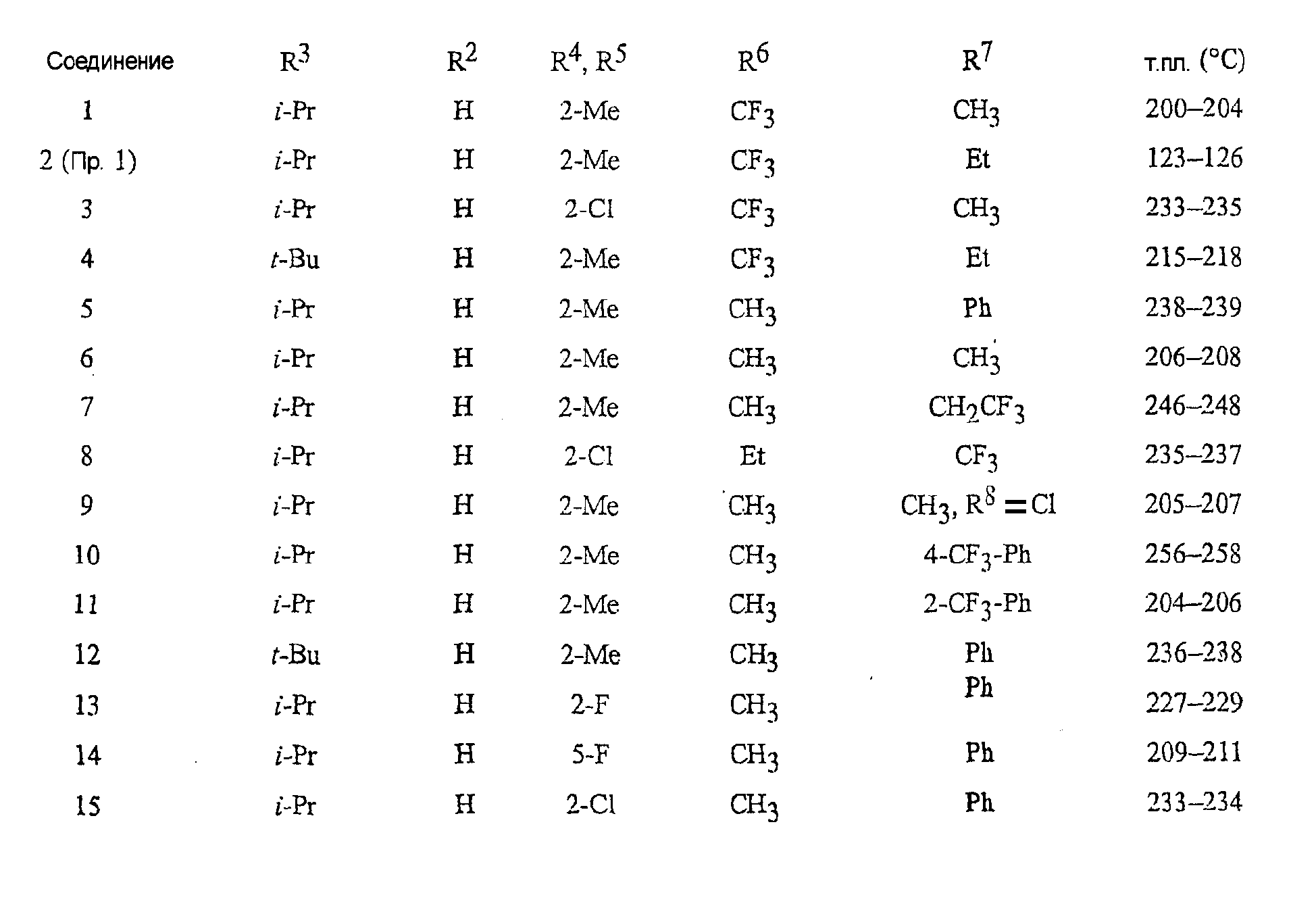

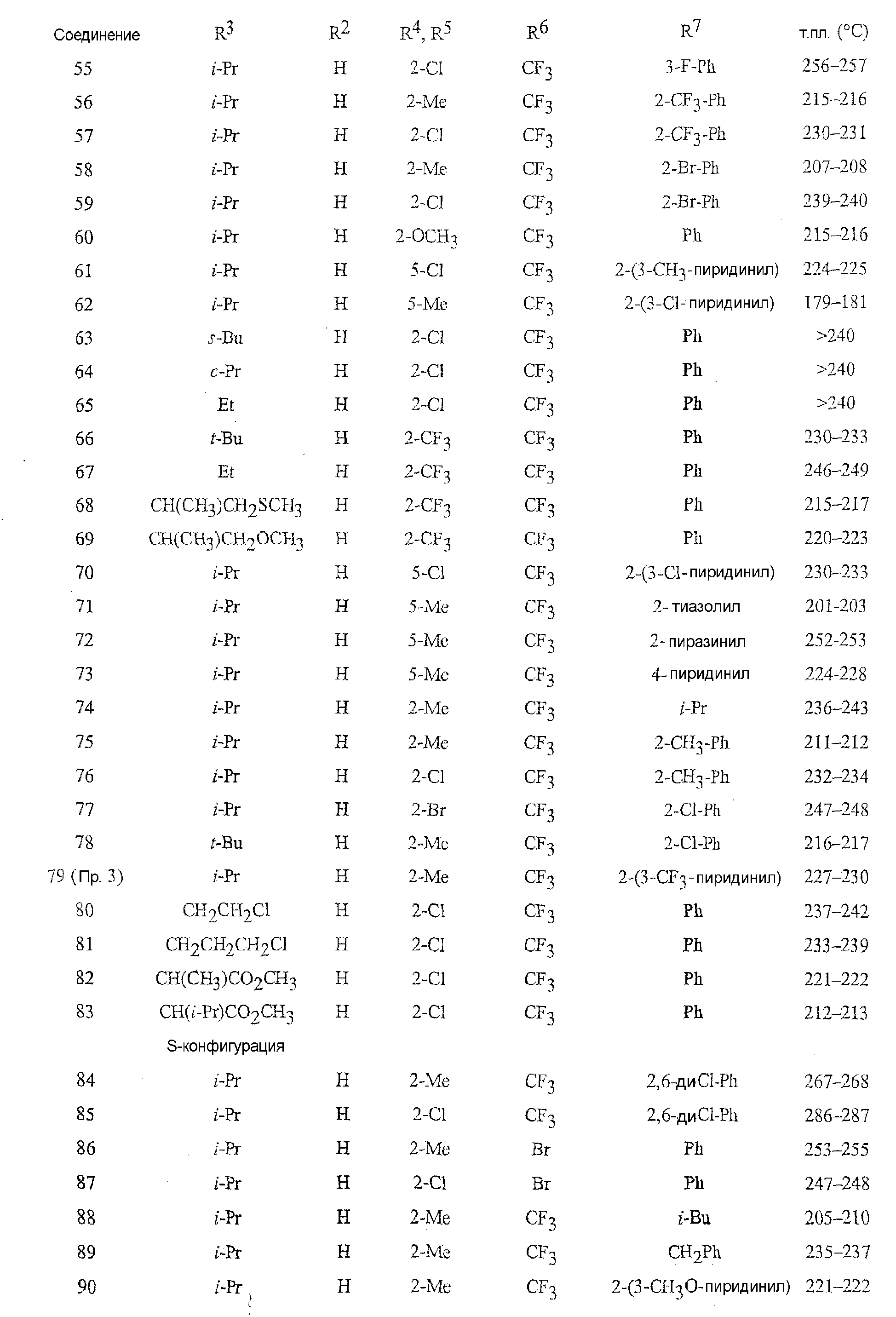

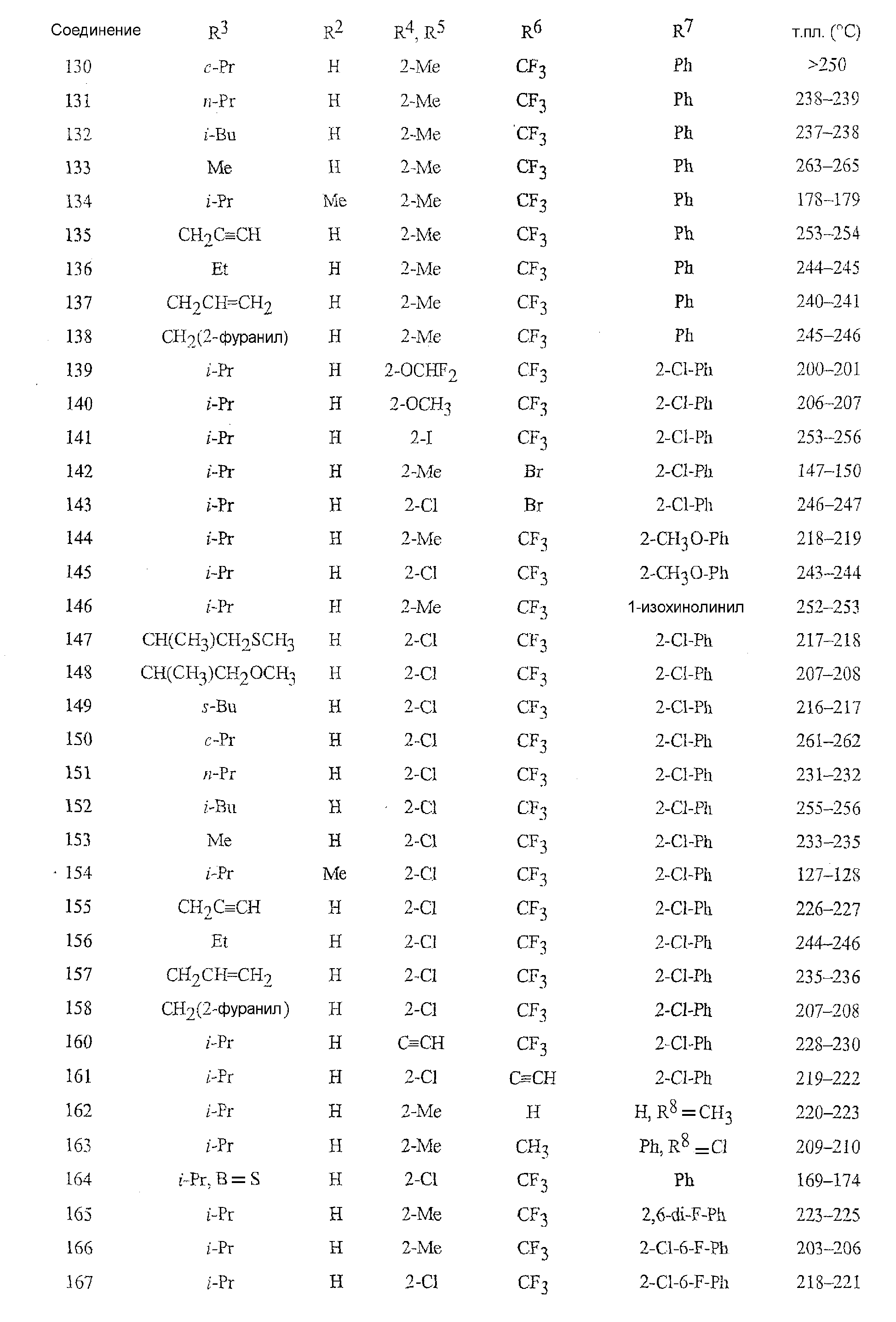
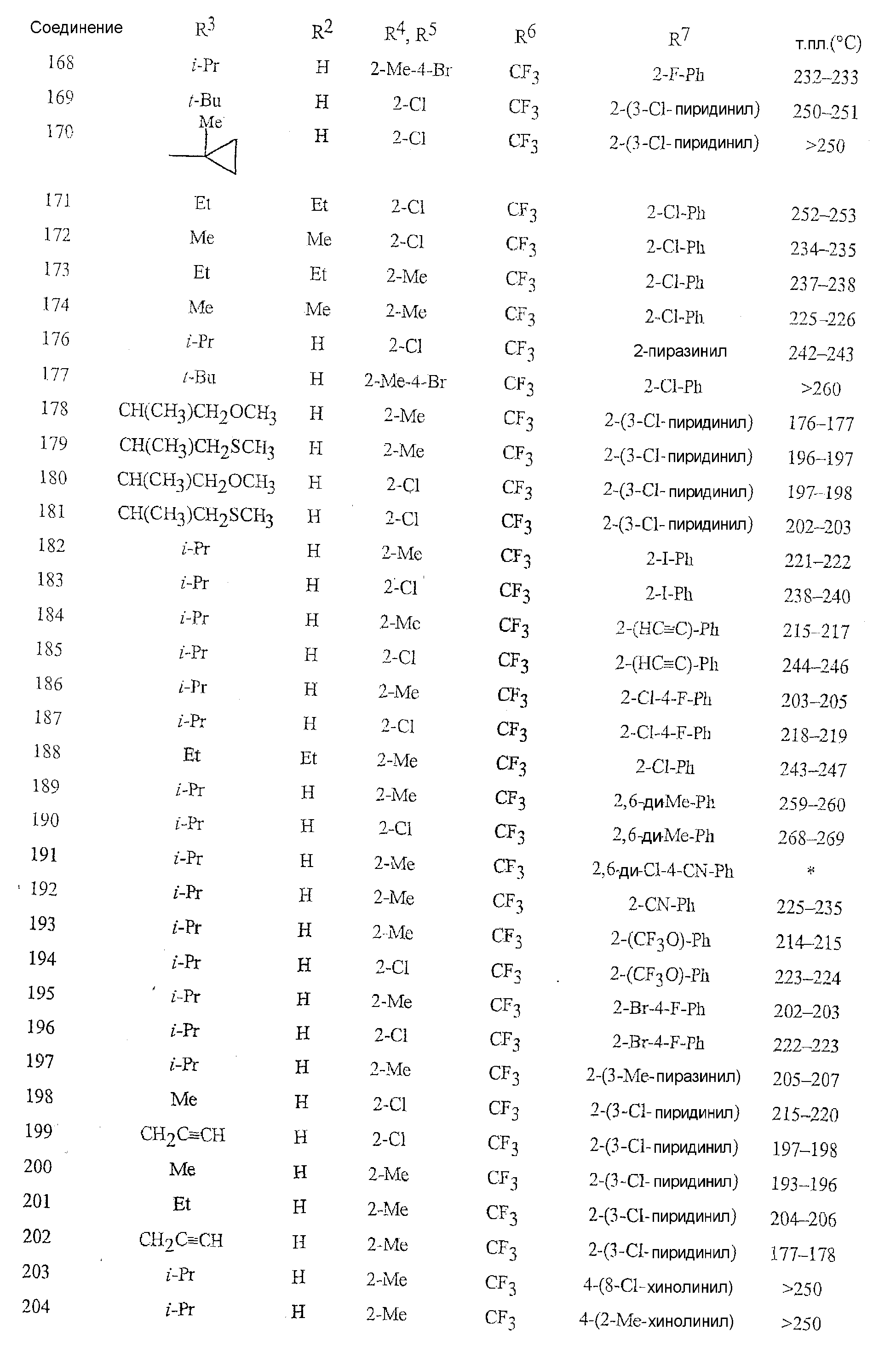
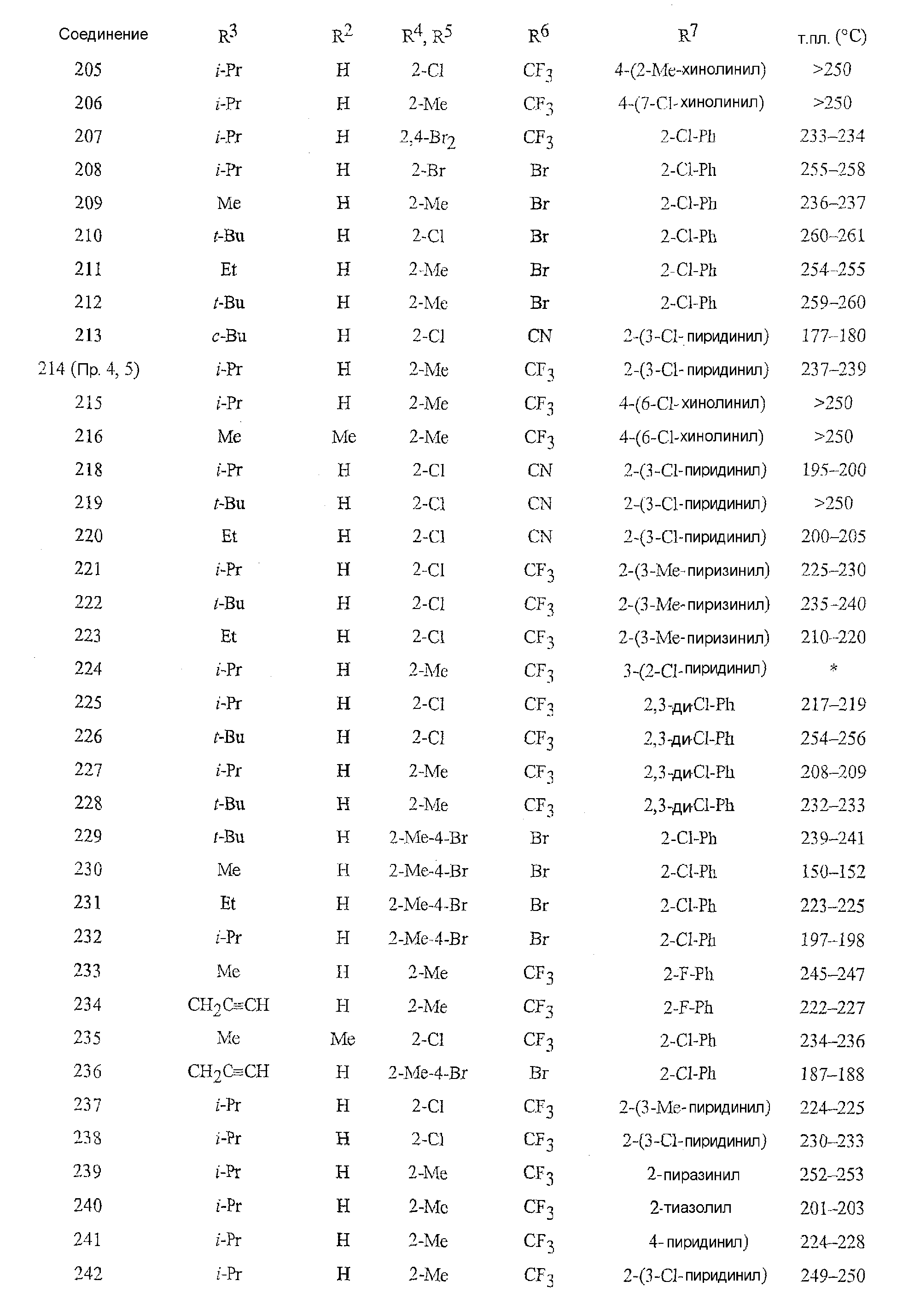
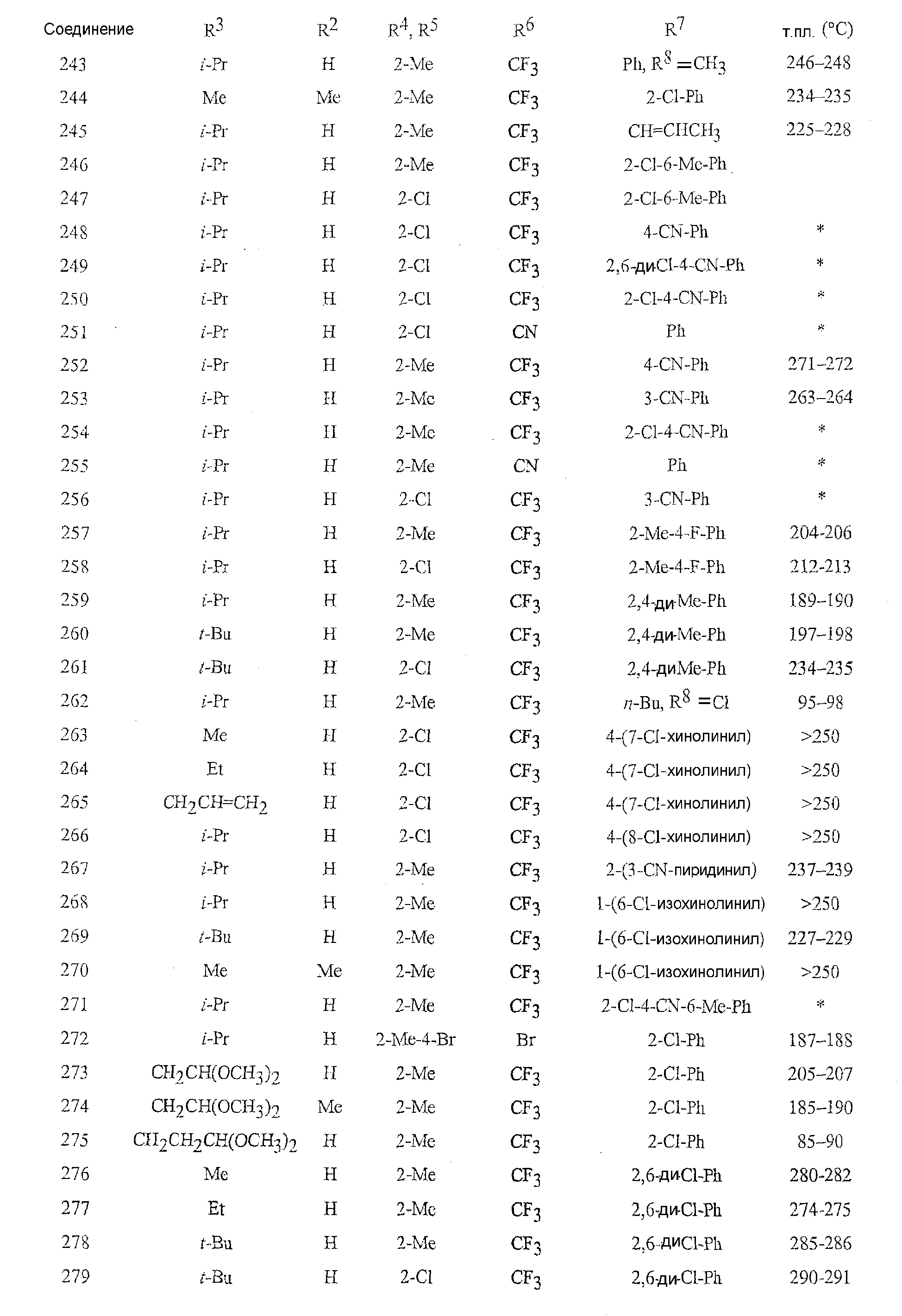

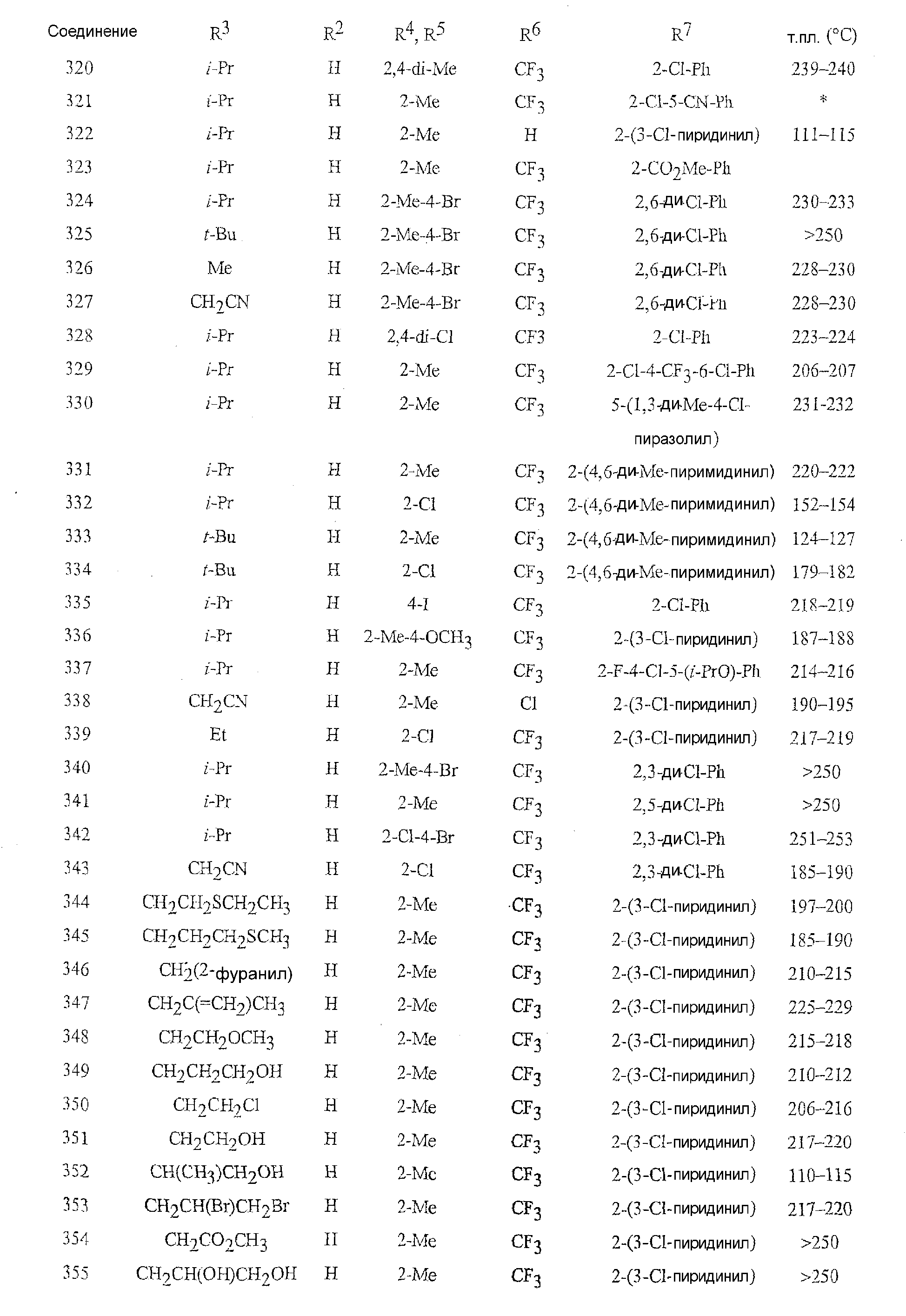
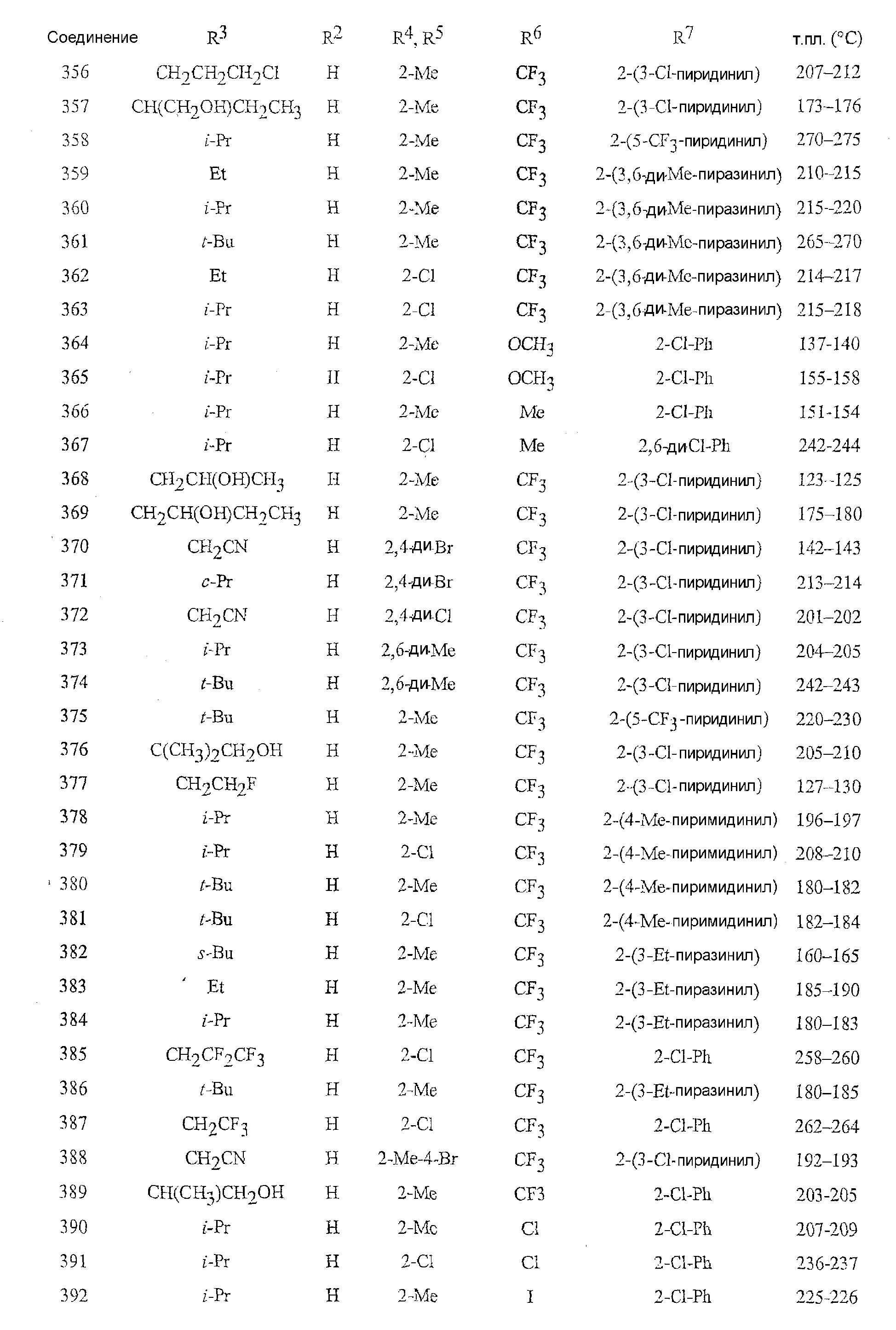

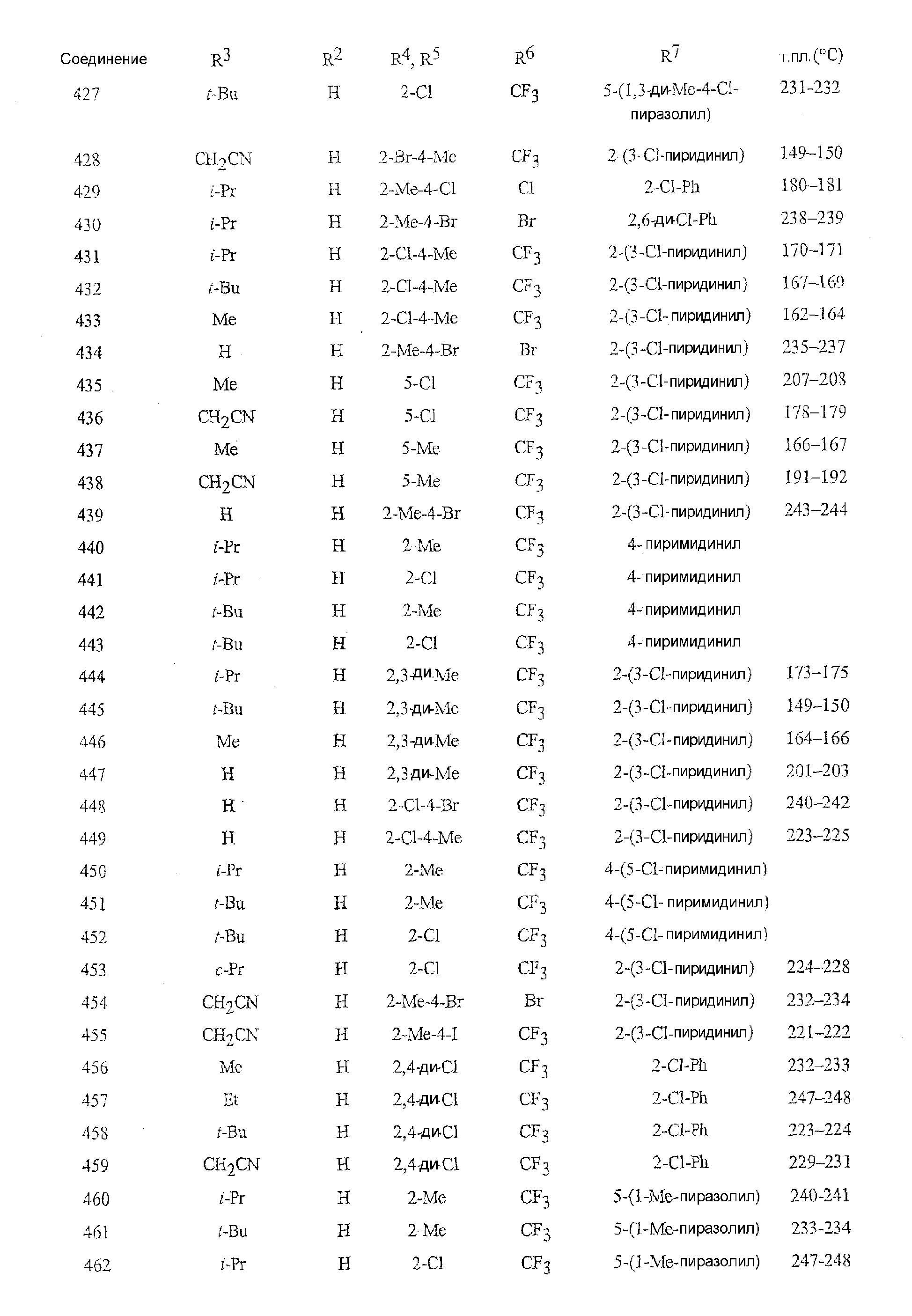
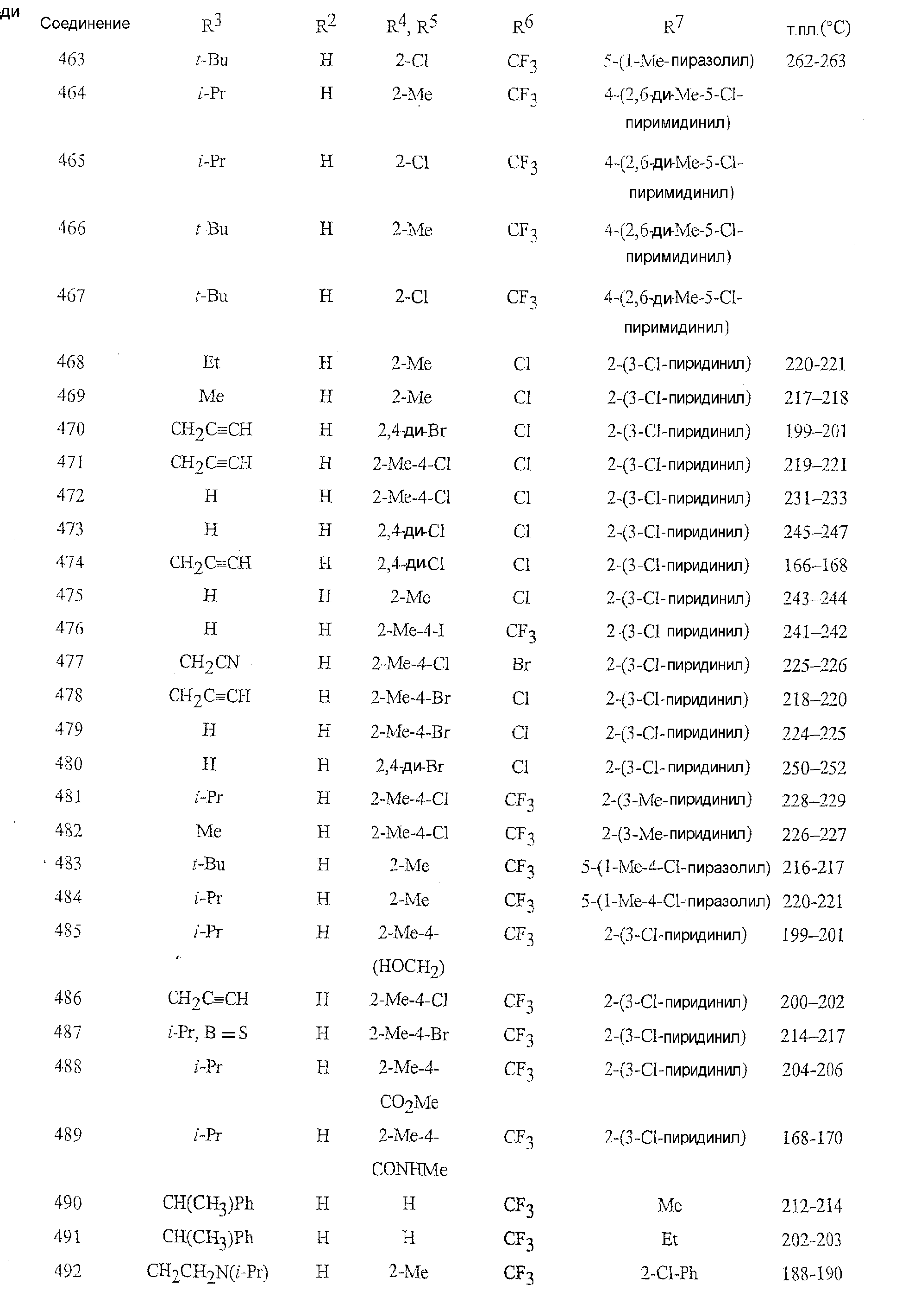
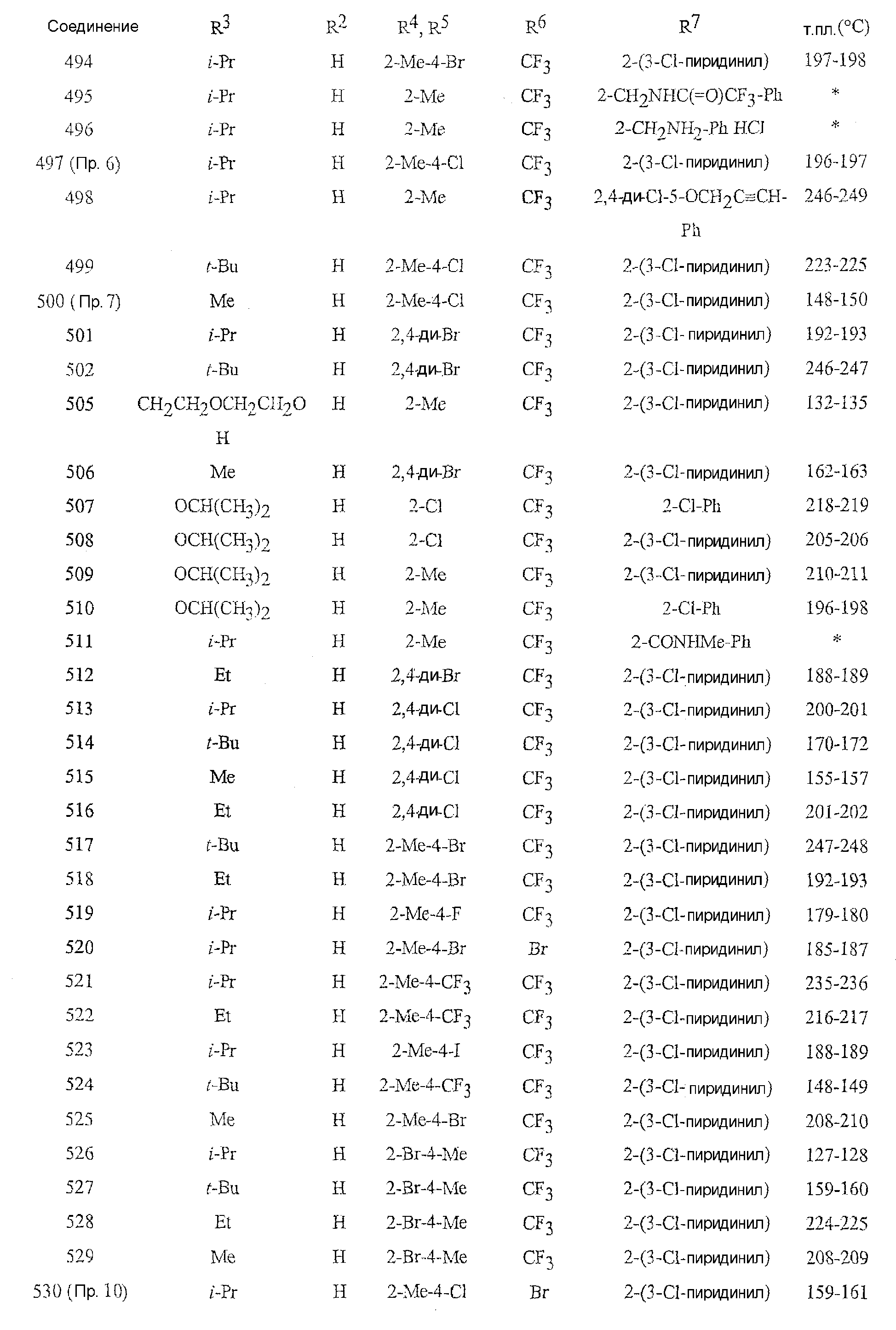
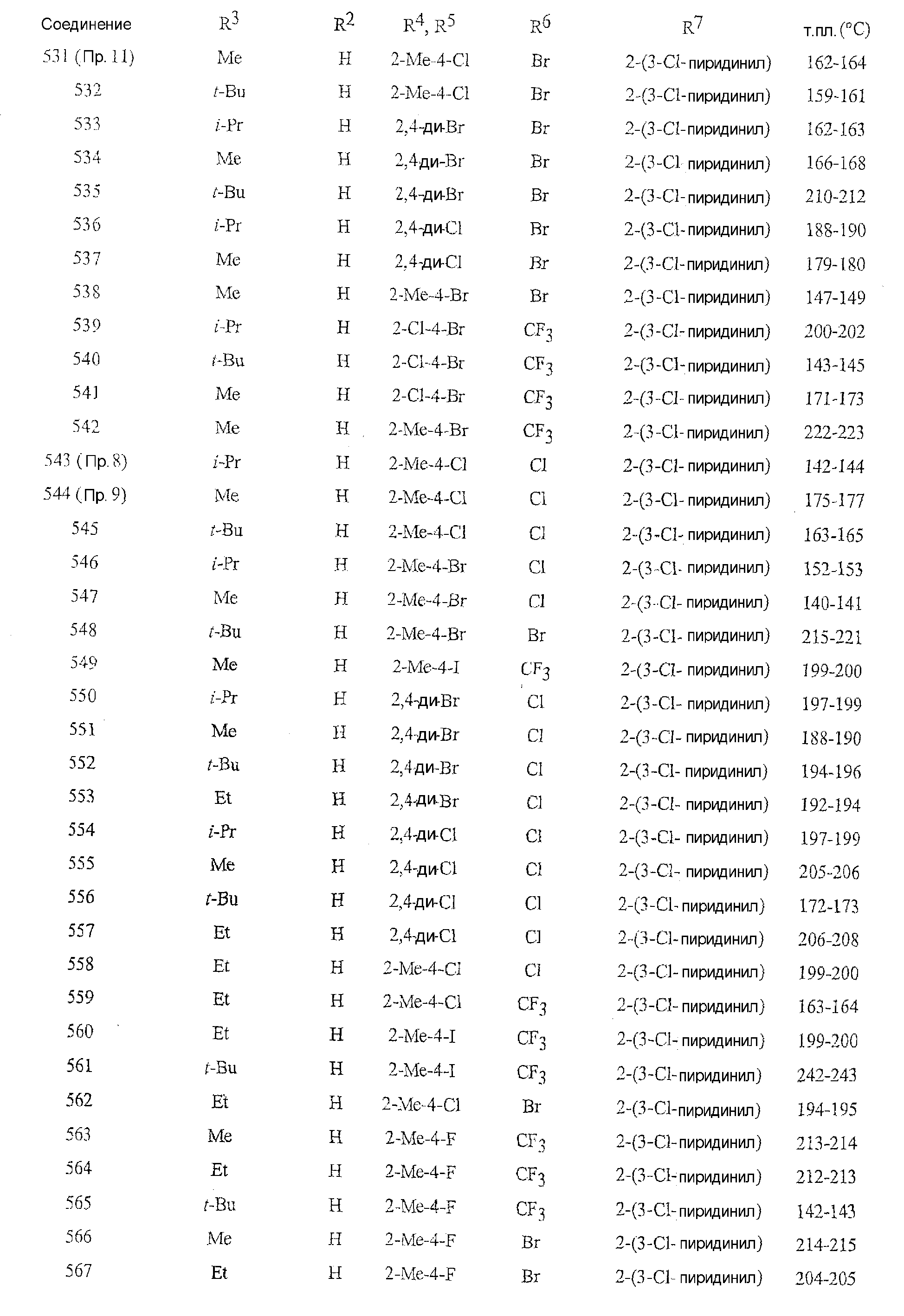
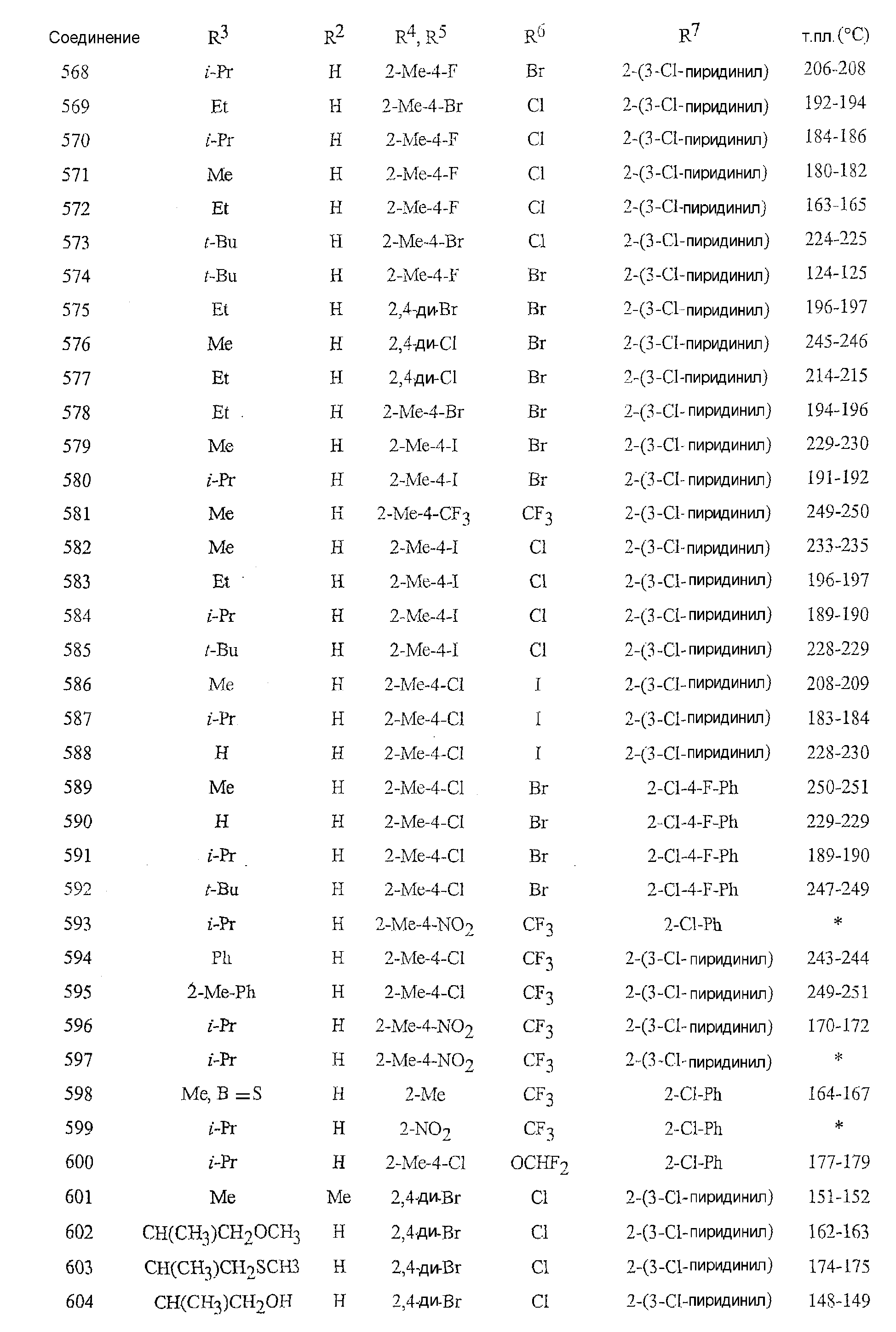


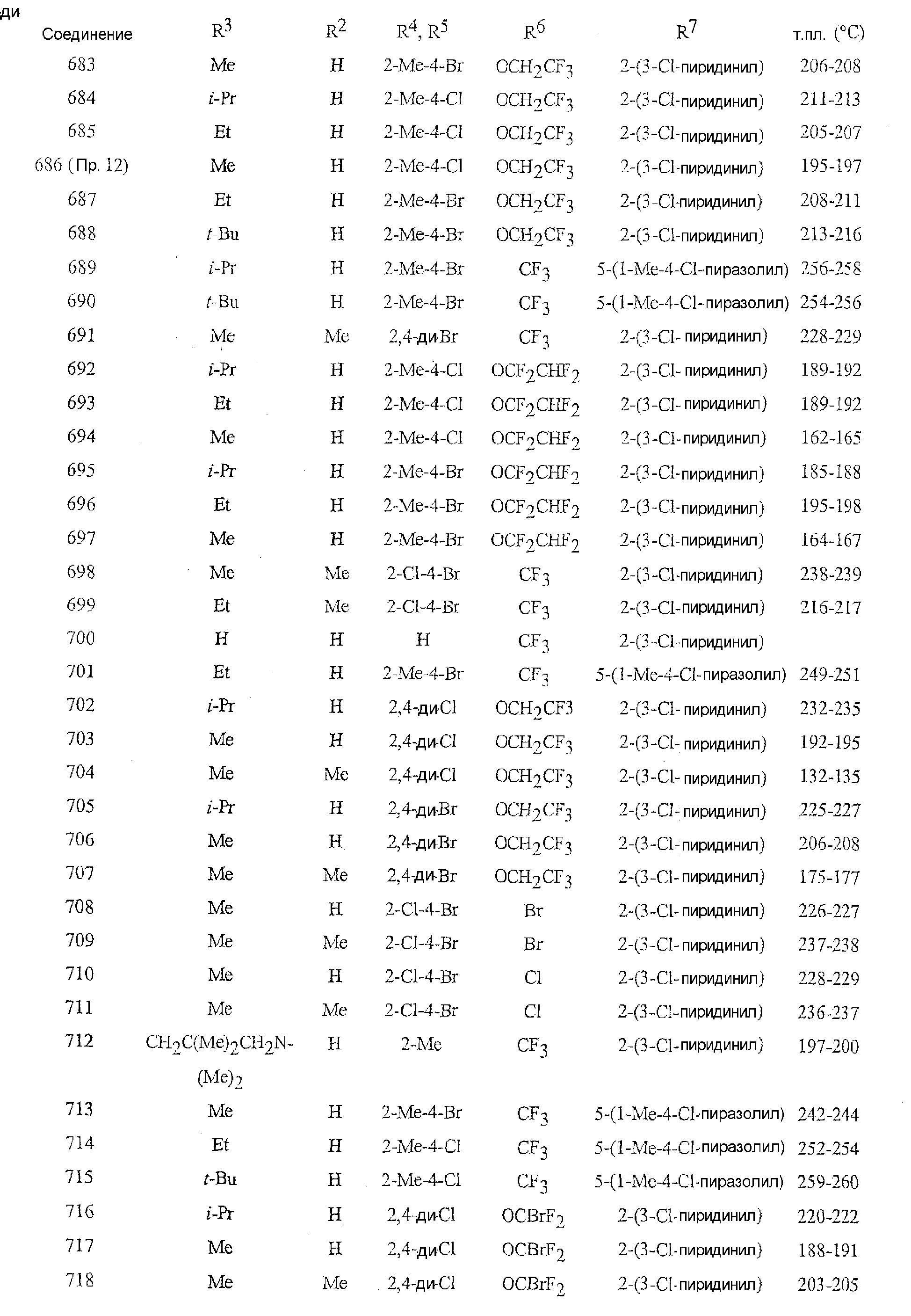


Биологические примеры настоящего изобретенияBiological Examples of the Present Invention
Тест АTest a
Для оценки эффективности борьбы с совкой травяной (Spodoptera frugipedra) использовали устройство для испытаний, состоящее из небольшого открытого контейнера, внутри которого находились 4-5-дневные растения кукурузы (маиса). Они были предварительно заражены 10-15 однодневными личинками на кусочке корма для насекомых с помощью стержневого проботборника, используемого для удаления пробки с пластины плотного корма для насекомых, с множеством растущих на нем личинок, и для переноса этой пробки, содержащей личинки и корм, в устройство для испытаний. Личинки переходили на тестируемое растение по мере высыхания «пробки» образца корма.To evaluate the effectiveness of the fight against grass scoop (Spodoptera frugipedra), a test device was used, consisting of a small open container, inside which were 4-5-day-old maize (maize) plants. They were pre-infected with 10-15 one-day larvae on a piece of insect food using a rod sampler used to remove the cork from a plate of dense insect food, with many larvae growing on it, and to transfer this cork containing larvae and food to the device for testing. The larvae transferred to the test plant as the food plug dried out.
Тестируемые соединения приготавливали с использованием раствора, содержащего 10% ацетона, 90% воды и 300 ч/млн. неионогенного поверхностно-активного вещества Х-77® Spreader Lo-Foam Formula, содержащего алкиларилполиоксиэтилен, свободные жирные кислоты, гликоли и изопропанол (Loveland Industries, Inc.), если это не оговорено особо. Приготовленные соединения наносили в 1 мл жидкости через наконечник для мелкокапельного опрыскивания с корпусом 1/8 JJ (Spraying Systems Co.), расположенным на расстоянии 1,27 см (0,5 дюймов) под верхним краем каждого устройства для испытаний. Все экспериментальные соединения в этом испытании распыляли при норме расхода 50 ч/млн., и эти процедуры повторяли три раза. После распыления приготовленных тестируемых соединений, каждое устройство для испытаний оставляли на 1 час для сушки, а затем сверху покрывали черной сетчатой крышкой. Устройства для испытаний выдерживали в течение 6 дней в вегетационной камере при 25°С и при относительной влажности 70%. Затем растения визуально оценивали повреждение растений поедающими их насекомыми.Test compounds were prepared using a solution containing 10% acetone, 90% water and 300 ppm. non-ionic surfactant X-77® Spreader Lo-Foam Formula containing alkylaryl polyoxyethylene, free fatty acids, glycols and isopropanol (Loveland Industries, Inc.), unless otherwise specified. The prepared compounds were applied in 1 ml of liquid through a droplet tip with a 1/8 JJ body (Spraying Systems Co.) located 1.27 cm (0.5 inches) below the top edge of each test device. All experimental compounds in this test were sprayed at a flow rate of 50 ppm, and these procedures were repeated three times. After spraying the prepared test compounds, each test device was left for 1 hour to dry, and then covered with a black mesh cover on top. Testing devices were kept for 6 days in a growing chamber at 25 ° C and at a relative humidity of 70%. Then the plants visually assessed the damage to the plants eating insects.
Из тестируемых соединений, очень высокую степень защиты растений (повреждение от поедания составляло 10% или менее) давали следующие соединения:Of the tested compounds, a very high degree of plant protection (damage from eating was 10% or less) was given by the following compounds:
Тест ВTest b
Для оценки эффективности борьбы с совкой травяной (Heliothls virescens), использовали устройство для испытаний, состоящее из небольшого открытого контейнера, внутри которого находились 6-7-дневные растения хлопчатника. Они были предварительно заражены 8 двухдневными личинками на кусочке корма для насекомых с использованием стержневого проботборника, описанного в Тесте А.To assess the effectiveness of the fight against herbal scoops (Heliothls virescens), a test device was used, consisting of a small open container, inside which were 6-7-day-old cotton plants. They were pre-infected with 8 two-day larvae on a piece of insect food using the rod sampler described in Test A.
Тестируемые соединения приготавливали и распыляли при норме расхода 50 ч/млн., как описано в Тесте А. Эти процедуры повторяли три раза. После распыления устройства для испытаний выдерживали в вегетационной камере, а затем проводили визуальную оценку, как описано в Тесте А.Test compounds were prepared and sprayed at a flow rate of 50 ppm, as described in Test A. These procedures were repeated three times. After spraying, the test devices were kept in a growing chamber, and then a visual assessment was performed as described in Test A.
Из тестируемых соединений, очень высокую степень защиты растений (повреждение от поедания составляло 10% или менее) давали следующие соединения:Of the tested compounds, a very high degree of plant protection (damage from eating was 10% or less) was given by the following compounds:


Тест СTest c
Для оценки эффективности борьбы с совкой малой (Spodoptera exigua), использовали устройство для испытаний, состоящее из небольшого открытого контейнера, внутри которого находились с 4-5-дневные растения кукурузы (маиса). Они были предварительно заражены 10-15 однодневными личинками на кусочке корма для насекомых с использованием стержневого проботборника, описанного в Тесте А.To assess the effectiveness of the fight against the small scoop (Spodoptera exigua), a test device was used, consisting of a small open container, inside which were 4-5-day-old corn plants (maize). They were pre-infected with 10-15 one-day larvae on a piece of insect food using the rod sampler described in Test A.
Тестируемые соединения приготавливали и распыляли при норме расхода 50 ч/млн., как описано в Тесте А. Эти процедуры повторяли три раза. После распыления, устройства для испытаний выдерживали в вегетационной камере, а затем проводили визуальную оценку, как описано в Тесте А.Test compounds were prepared and sprayed at a flow rate of 50 ppm, as described in Test A. These procedures were repeated three times. After spraying, the test devices were kept in a growing chamber, and then a visual assessment was performed as described in Test A.
Из тестируемых соединений, очень высокую степень защиты растений (повреждение от поедания составляло 10% или менее) давали следующие соединения:Of the tested compounds, a very high degree of plant protection (damage from eating was 10% or less) was given by the following compounds:


Тест DTest d
Для оценки эффективности борьбы с тлей персиковой зеленой (Myzus persicae) контактным и/или системным способом, использовали устройство для испытаний, состоящее из небольшого открытого контейнера, внутри которого находились 12-15-дневные растения редиса. Они были предварительно заражены путем помещения 30-40 насекомых на кусочек листа тестируемого растения, вырезанного из культивируемого растения (метод вырезанного листа). Личинки переходили на тестируемое растение по мере высыхания этого кусочка листа. После предварительного заражения почву в тест-контейнере покрывали слоем песка.To evaluate the effectiveness of combating peach green aphids (Myzus persicae) using a contact and / or systemic method, a test device was used, consisting of a small open container, inside of which were 12-15-day-old radish plants. They were pre-infected by placing 30-40 insects on a piece of the leaf of the test plant cut from the cultivated plant (cut leaf method). The larvae transferred to the test plant as this piece of leaf dries. After preliminary infection, the soil in the test container was covered with a layer of sand.
Тестируемые соединения приготавливали с использованием раствора, содержащего 10% ацетона, 90% воды и 300 ч/млн. неионогенного поверхностно-активного вещества X-77® Spreader Lo-Foam Formula, содержащего алкиларилполиоксиэтилен, свободные жирные кислоты, гликоли и изопропанол (Loveland Industries, Inc.), если это не оговорено особо. Приготовленные соединения наносили в 1 мл жидкости через наконечник для мелкокапельного опрыскивания с корпусом 1/8 JJ (Spraying Systems Co.), расположенным на расстоянии 1,27 см (0,5 дюймов) под верхним краем каждого устройства для испытаний. Все экспериментальные соединения в этом испытании распыляли при норме расхода 250 ч/млн. и эти процедуры повторяли три раза. После распыления приготовленных тестируемых соединений, каждое устройство для испытаний оставляли на 1 час для сушки, а затем сверху покрывали черной сетчатой крышкой. Устройства для испытаний выдерживали в течение 6 дней в вегетационной камере при 19-21°С и при относительной влажности 50-70%. Затем каждое устройство для испытаний визуально оценивали на гибель насекомых.Test compounds were prepared using a solution containing 10% acetone, 90% water and 300 ppm. non-ionic surfactant X-77® Spreader Lo-Foam Formula containing alkylaryl polyoxyethylene, free fatty acids, glycols and isopropanol (Loveland Industries, Inc.), unless otherwise noted. The prepared compounds were applied in 1 ml of liquid through a droplet tip with a 1/8 JJ body (Spraying Systems Co.) located 1.27 cm (0.5 inches) below the top edge of each test device. All experimental compounds in this test were sprayed at a flow rate of 250 ppm. and these procedures were repeated three times. After spraying the prepared test compounds, each test device was left for 1 hour to dry, and then covered with a black mesh cover on top. Testing devices were kept for 6 days in a growing chamber at 19-21 ° C and at a relative humidity of 50-70%. Then, each test device was visually evaluated for insect death.
Из тестируемых соединений, по крайней мере, 80%-ную гибель насекомых давали следующие соединения:Of the tested compounds, at least 80% insect death resulted in the following compounds:
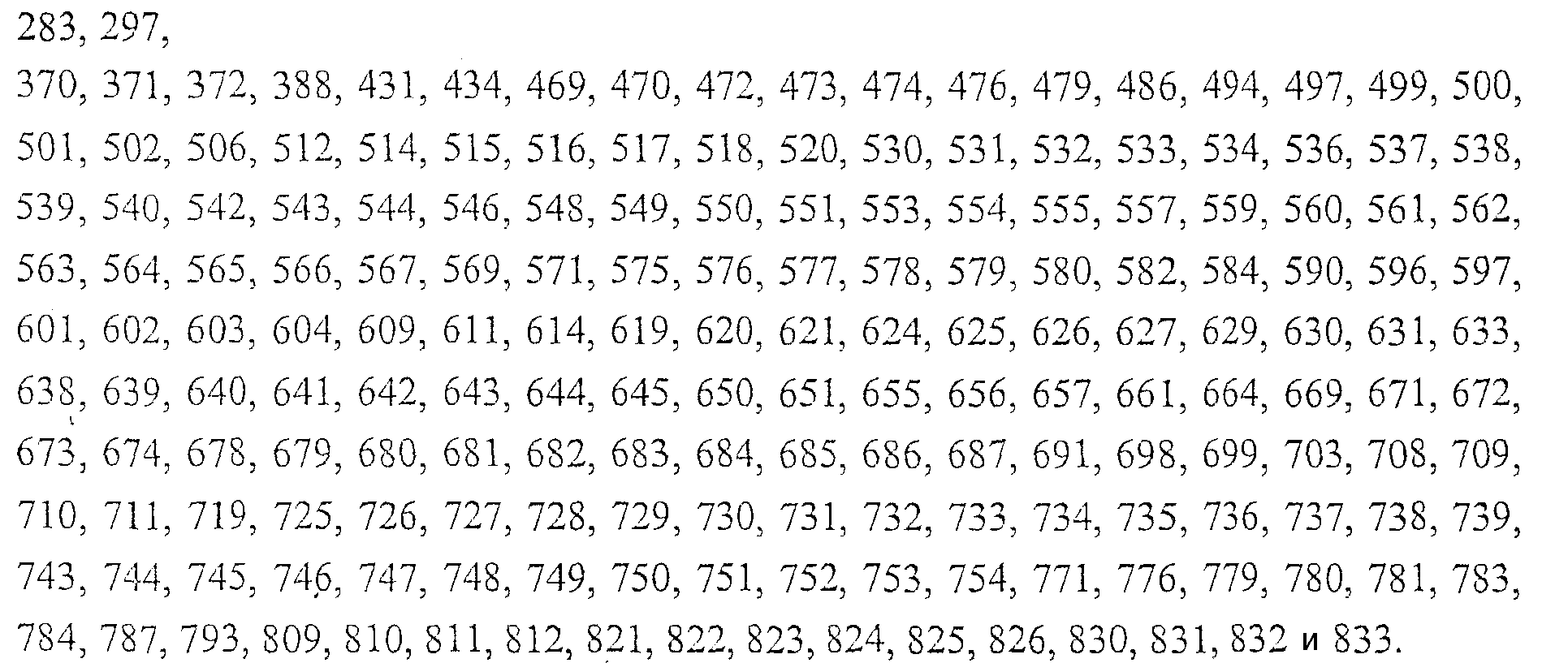
Тест ЕTest e
Для оценки эффективности борьбы с тлей хлопковой, бахчевой (Aphis gossypii) контактным и/или системным способом, использовали устройство для испытаний, состоящее из небольшого открытого контейнера, внутри которого находились 6-7-дневные растения хлопчатника. Эти растения были предварительно заражены 30-40 насекомыми, помещенными на лист, в соответствии с методом вырезанного листа, описанным в Тесте D, и почву в устройстве для испытания покрывали слоем песка.To assess the effectiveness of the control of aphids by cotton, melon (Aphis gossypii) using the contact and / or systemic method, a test device was used, consisting of a small open container, inside of which were 6-7-day-old cotton plants. These plants were pre-infected with 30-40 insects placed on a leaf according to the cut sheet method described in Test D, and the soil in the test apparatus was covered with a layer of sand.
Тестируемые соединения приготавливали и распыляли при норме расхода 250 ч/млн., как описано в тесте D. Эти процедуры повторяли три раза. После распыления устройства для испытаний выдерживали в вегетационной камере и визуально оценивали, как описано в Тесте D.Test compounds were prepared and sprayed at a flow rate of 250 ppm, as described in Test D. These procedures were repeated three times. After spraying, the test devices were kept in a growing chamber and visually evaluated as described in Test D.
Из тестируемых соединений, по крайней мере, 80%-ную гибель насекомых давали следующие соединения:Of the tested compounds, at least 80% insect death resulted in the following compounds:
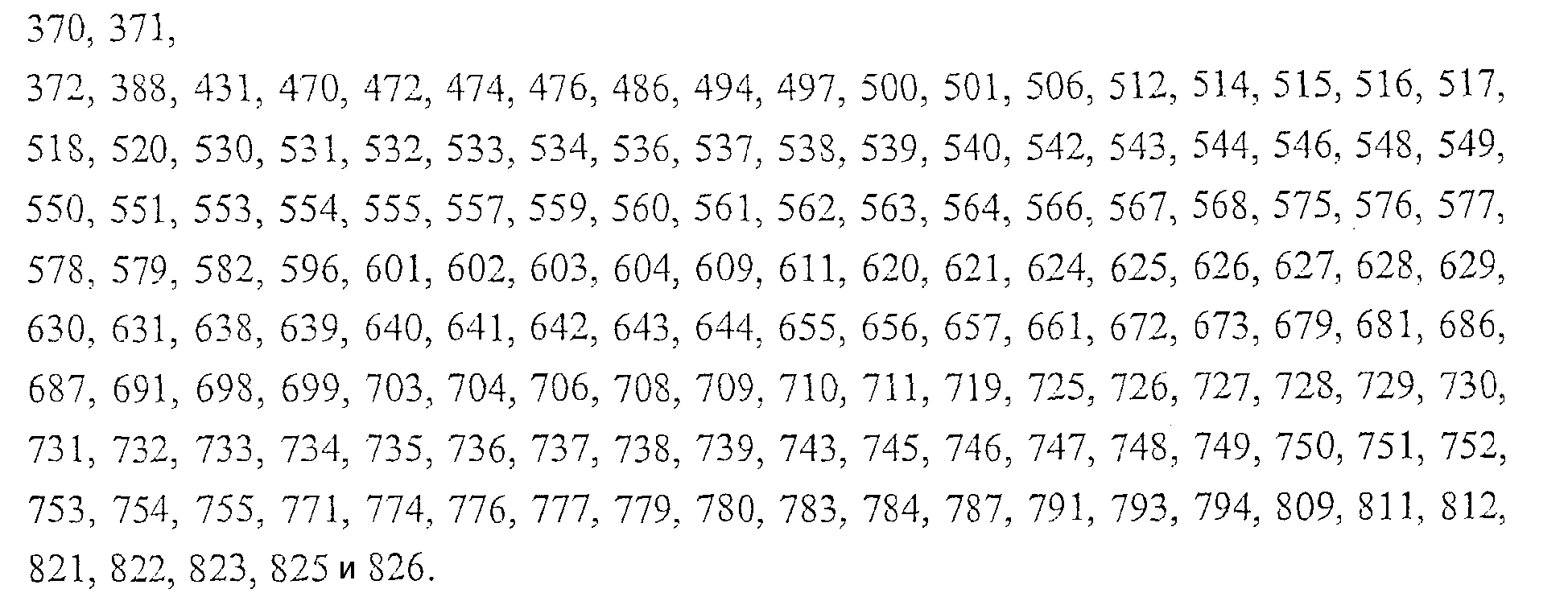
Тест FTest f
Для оценки эффективности борьбы с дельфацидами хлопковыми (Peregrinus maidis) контактным и/или системным способом, использовали устройство для испытаний, состоящее из небольшого открытого контейнера, внутри которого находились 3-4-дневные растения кукурузы (маиса)(початок). Перед нанесением сверху на почву добавляли белый песок. Тестируемые соединения приготавливали и распыляли при норме расхода 250 ч/млн. и эту процедуру проводили с тремя повторениями, как описано в тесте D. После опрыскивания устройства для испытаний оставляли на 1 час для сушки, а затем их заражали 10-20 цикадками кукурузными (18-20-дневными нимфами) путем их разбрасывания на песок с помощью солонки. Цилиндр покрывали черной сетчатой крышкой. Устройства для испытаний выдерживали в течение 6 дней в вегетационной камере при 19-21°С и относительной влажности 50-70%. Затем каждое устройство для испытаний визуально оценивали на гибель насекомых.Из тестируемых соединений, по крайней мере, 80%-ную гибель насекомых давали следующие соединения:To evaluate the effectiveness of the control of cotton delphacides (Peregrinus maidis) by contact and / or systemic methods, a test device was used consisting of a small open container inside which were 3-4-day-old corn plants (maize) (ear). Before applying on top of the soil, white sand was added. Test compounds were prepared and sprayed at a flow rate of 250 ppm. and this procedure was carried out with three repetitions, as described in test D. After spraying, the test devices were left to dry for 1 hour, and then they were infected with 10-20 corn cicadas (18-20 day old nymphs) by scattering them on sand with salt shakers. The cylinder was covered with a black mesh cover. Testing devices were kept for 6 days in a growing chamber at 19-21 ° С and relative humidity 50-70%. Each test device was then visually evaluated for insect death. From the tested compounds, at least 80% insect death gave the following compounds:
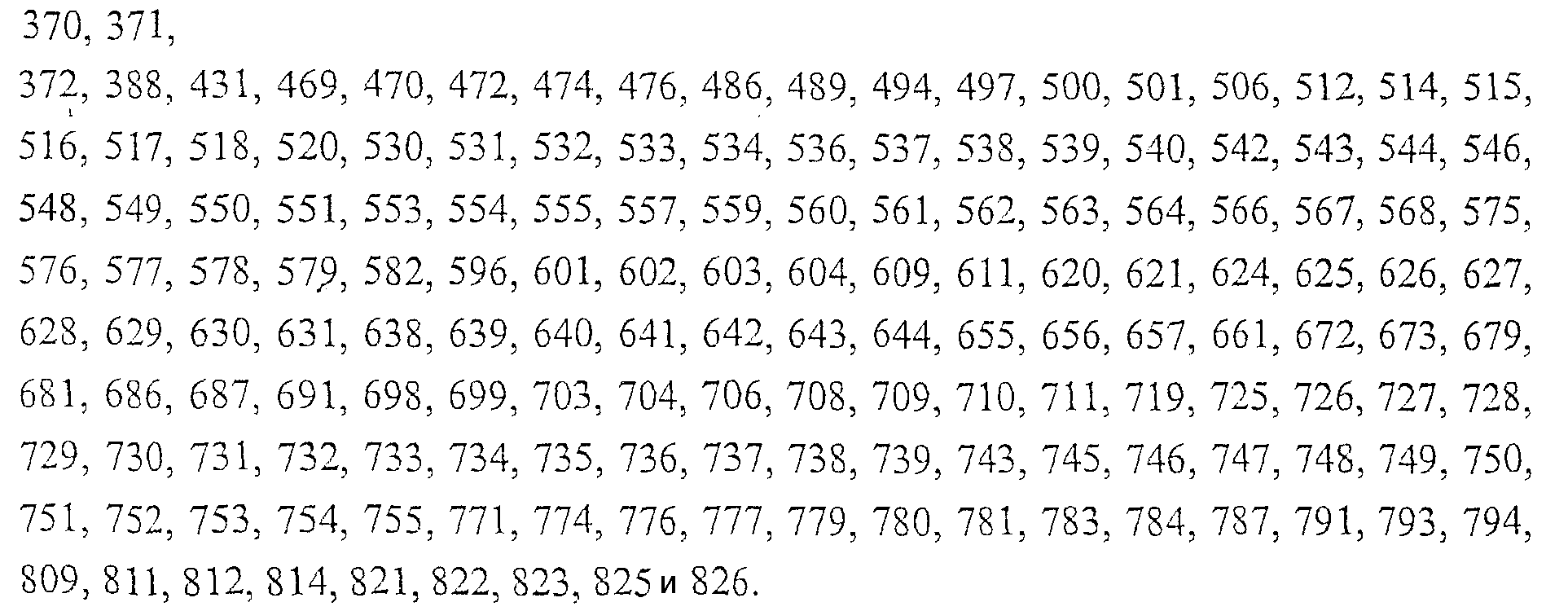
Тест GTest g
Для оценки эффективности борьбы с цикадкой картофельной (Empoasca fabae, Harris) контактным и/или системным способом, использовали устройство для испытаний, состоящее из небольшого открытого контейнера, внутри которого находились 5-6-дневные растения фасоли лонгио (на стадии появления первого листа). Перед обработкой сверху на почву добавляли белый песок и один из первичных листьев вырезали. Тестируемые соединения приготавливали и распыляли при норме расхода 250 ч/млн., как описано в тесте D. После опрыскивания устройства для испытаний оставляли на 1 час для сушки и затем их заражали 5 цикадками картофельными (18-21-дневными взрослыми особями). Цилиндр накрывали черной сетчатой крышкой. Устройства для испытаний выдерживали в течение 6 дней в вегетационной камере при 19-21°С и относительной влажности 50-70%. Затем каждое устройство для испытаний визуально оценивали на гибель насекомых.To evaluate the effectiveness of combating potato cicadas (Empoasca fabae, Harris) using a contact and / or systemic method, a test device was used consisting of a small open container inside which there were 5-6-day-old longio bean plants (at the stage of the appearance of the first leaf). Before processing, white sand was added to the soil from above and one of the primary leaves was cut out. Test compounds were prepared and sprayed at a flow rate of 250 ppm, as described in Test D. After spraying, the test devices were left to dry for 1 hour and then they were infected with 5 potato cicadas (18-21 day old adults). The cylinder was covered with a black mesh cover. Testing devices were kept for 6 days in a growing chamber at 19-21 ° С and relative humidity 50-70%. Then, each test device was visually evaluated for insect death.
Из тестируемых соединений, по крайней мере, 80%-ную гибель насекомых давали следующие соединения:
Тест НTest n
Для оценки эффективности борьбы с белокрылкой магнолиевой (Bemisia tabaci) использовали устройство для испытаний, содержащее 14-21-дневные растения хлопчатника в среде Readi-earth® (Scotts Co), по крайней мере, с двумя настоящими листьями, инфицированными нимфами на 1-й и 3-й возрастной стадии, находящимися на нижней стороне листьев.To evaluate the effectiveness of the control of the Magnolia whitefly (Bemisia tabaci), a test device was used containing 14-21-day-old cotton plants in Readi-earth® (Scotts Co) with at least two true leaves infected with nymphs on the 1st and 3rd age stage, located on the underside of the leaves.
Тестируемые соединения приготавливали не более чем в 2 мл ацетона и затем разводили водой до 25-30 мл. Приготовленные соединения наносили с использованием наконечника с плоским соплом для распыления воздушным потоком (с плоским факелом распыла) (Spraying Systems 122440) при 10 фунт/кв.дюйм (69 кПа). Растения опрыскивали до уровня стекания с листьев распылителем, помещенным на поворотном столе. Все экспериментальные соединения в этом испытании распыляли при норме расхода 250 ч/млн. и эту процедуру повторяли три раза. После распыления тестируемого соединения устройства для испытаний выдерживали в течение 6 дней в вегетационной камере при относительной влажности 50-60%, при дневной температуре 28°С и ночной температуре 24°С. Затем листья удаляли и подсчитывали мертвых и живых нимф для определения процента гибели.Test compounds were prepared in no more than 2 ml of acetone and then diluted with water to 25-30 ml. The prepared compounds were applied using a flat nozzle tip for spraying with an air flow (flat spray) (Spraying Systems 122440) at 10 psi (69 kPa). Plants were sprayed to a drip level with a spray bottle placed on a turntable. All experimental compounds in this test were sprayed at a flow rate of 250 ppm. and this procedure was repeated three times. After spraying the test compound, the test devices were kept for 6 days in a growing chamber at a relative humidity of 50-60%, at a day temperature of 28 ° C and at night temperature of 24 ° C. Then the leaves were removed and dead and living nymphs were counted to determine the percentage of death.
Из тестируемых соединений, по крайней мере, 80%-ную гибель насекомых давали следующие соединения:Of the tested compounds, at least 80% insect death resulted in the following compounds:

Тест ITest I
Для оценки эффективности борьбы с совкой табачной (Heliothis virescens) растения хлопчатника выращивали в сассафрасовой почве в 15 см-горшках в алюминиевых поддонах. Когда растения достигали стадии трех подцветников цветка хлопчатника (образования почек на растении), растения обрабатывали тестируемыми соединениями.To assess the effectiveness of the fight against tobacco scoops (Heliothis virescens), cotton plants were grown in sassafras soil in 15 cm pots in aluminum pallets. When the plants reached the stage of the three sub-flowers of the cotton flower (the formation of buds on the plant), the plants were treated with test compounds.
Тестируемые соединения приготавливали в 0,25 мл ацетона и затем разводили водой до получения растворов 10 ч/млн. Десять мл раствора для обработки добавляли в горшки еженедельно в течение четырех недель, при этом, обработку для каждой нормы внесения делали с четырьмя повторами. Через день после второй, третьей и четвертой обработок 35-50 личинок Heliothis virescens на первой возрастной стадии наносили кистью на каждое растение и помещали на верхушки, три подцветника цветка и семенные коробочки растений. Через пять дней после последнего заражения личинками растения оценивали на повреждение. Из тестируемых соединений, очень хорошие уровни защиты растений при норме расхода 10 ч/млн. (10 % поедания растения или менее) с превосходной защитой подцветников и семенных коробочек, включая отсутствие или минимальное повреждение чашелистика, давали соединения 214, 283 и 520.Test compounds were prepared in 0.25 ml of acetone and then diluted with water to obtain 10 ppm solutions. Ten ml of the treatment solution was added to the pots weekly for four weeks, while the treatment for each application rate was done in four repetitions. A day after the second, third and fourth treatments, 35-50 Heliothis virescens larvae at the first age stage were applied with a brush to each plant and placed on the tops, three flower bracts and seed boxes of plants. Five days after the last larval infection, the plants were evaluated for damage. Of the tested compounds, very good plant protection levels at a flow rate of 10 ppm. (10% of the plant’s consumption or less) with excellent protection of the flower beds and seed capsules, including the absence or minimal damage to the sepals, gave compounds 214, 283 and 520.
Тест JTest j
Тест Н проводили в соответствии с альтернативным протоколом для оценки эффективности борьбы с совкой табачной (Heliothis virescens) системным почвенным методом. Растения хлопчатника выращивали в сассафрасовой почве в 15-см горшках в условиях теплицы. Когда растения достигали стадии трех подцветников цветка (образования почек на растении), поверхность почвы обрабатывали тестируемыми соединениями.Test H was carried out in accordance with an alternative protocol to evaluate the effectiveness of the control of tobacco scoops (Heliothis virescens) by the systemic soil method. Cotton plants were grown in sassafras soil in 15 cm pots under greenhouse conditions. When the plants reached the stage of three flower bracts (formation of buds on the plant), the soil surface was treated with test compounds.
Тестируемые соединения приготавливали в 0,25 мл ацетона и затем разводили водой. На поверхность почвы каждого горшка добавляли десять мл раствора для обработки, содержащего 3 мг соединения. На следующий день и каждый последующий день, если это было необходимо, растения поливали. Через 1, 2 и 4 дня после обработки листья обрезали для их оценки. От каждого растения отбирали две серии листьев: верхние листья примерно у второго узла от верхушки с площадью более чем 25 см2, и нижние листья примерно у третьего узла от основания с площадью более чем 25 см2. Вырезанные листья разрезали на секции 3 см × 2 см и помещали в тест-планшеты, изготовленные из ударопрочного стирола и состоящие из шестнадцати смежных лунок, каждая из которых имела ширину 6 см, длину 4 см и глубину 3 см, причем, прозрачная пластиковая крышка была сделана так, что она фиксировалась на каждой лунке за счет трения. На дно каждой лунки помещали отвержденный агар для поддержания влажности растительного материала. В каждую лунку с растительным материалом помещали одну табачную совку на второй возрастной стадии, затем лунки герметично закрывали и выдерживали при 25°С в условиях 16-часового светового дня.Test compounds were prepared in 0.25 ml of acetone and then diluted with water. Ten ml of a treatment solution containing 3 mg of compound was added to the soil surface of each pot. The next day and every subsequent day, if necessary, the plants were watered. 1, 2, and 4 days after treatment, the leaves were trimmed for evaluation. Two series of leaves were selected from each plant: upper leaves at about the second node from the top with an area of more than 25 cm 2 , and lower leaves at about the third node from the base with an area of more than 25 cm 2 . The cut leaves were cut into sections of 3 cm × 2 cm and placed in test tablets made of high impact styrene and consisting of sixteen adjacent holes, each of which had a width of 6 cm, a length of 4 cm and a depth of 3 cm, moreover, the transparent plastic cover was made so that it was fixed on each hole due to friction. Cured agar was placed at the bottom of each well to maintain moisture in the plant material. One tobacco scoop was placed in each well with plant material in the second age stage, then the wells were hermetically sealed and kept at 25 ° C under 16-hour daylight hours.
Из тестируемых соединений, очень хорошие уровни уничтожения насекомых (смертность более 70 %) на верхних листьях, вырезанных через 4 дня после обработки при тестируемой норме расхода, давали соединения 497, 530 и 543.Of the tested compounds, very good levels of insect killing (mortality of more than 70%) on the upper leaves, cut out 4 days after treatment at the tested application rate, gave compounds 497, 530 and 543.
Тест КTest k
Для оценки эффективности борьбы с совкой травяной (Spodoptera frugipedra) системным почвенным методом, растения кукурузы (маиса) (Pioneer#3394) выращивали в небольших горшках в течение 5 дней до тех пор, пока они не достигали высоты, по крайней мере, 4 см, и пока не разворачивался первый лист.To evaluate the effectiveness of combating the grass scoop (Spodoptera frugipedra) with the systemic soil method, maize (maize) plants (Pioneer # 3394) were grown in small pots for 5 days until they reached a height of at least 4 cm. and until the first sheet unfolds.
Тестируемые соединения растворяли в 0,25 мл ацетона и разводили водой до получения растворов 1, 10, 50 и 200 ч/млн. На поверхность почвы каждого горшка пипеткой наносили один мл тестируемого раствора, при этом, для каждого соединения/нормы расхода использовали восемь растений. Горшки покрывали и выдерживали при 25°С в течение 16-часового светового дня. На следующий день и каждый последующий день, если это было необходимо, растения поливали. Через 6 дней, растительный материал выше первого листа отрезали и разрезали на части длиной 3 см. Каждое тест-устройство представляло собой планшет из ударопрочного стирола (Поставщик: Clearpark Company, 11610 Copenhagen Court, Franklin Park, IL 60131), состоящий из шестнадцати смежных лунок, каждая из которых имела ширину 6 см, длину 4 см и глубину 3 см, причем, прозрачная пластиковая крышка была сделана так, что она фиксировалась на каждой лунке за счет трения. Во время проведения теста на дно каждой лунки помещали отвержденный агар (2-4 мл) для поддержания влажности растительного материала. Каждый растительный материал кукурузы длиной в 3 см помещали в планшет так, чтобы этот растительный материал находился в двух лунках. В каждую лунку помещали одну личинку совки травяной (Spodoptera frugipedra) на второй возрастной стадии, затем планшет закрывали и тест-устройства выдерживали при 25°С в условиях 16-часового светового дня. Через четыре дня оценивали гибель личинок.Test compounds were dissolved in 0.25 ml of acetone and diluted with water to obtain solutions of 1, 10, 50, and 200 ppm. One ml of the test solution was pipetted onto the soil surface of each pot with eight plants used for each compound / application rate. The pots were coated and kept at 25 ° C. for 16 hours of daylight. The next day and every subsequent day, if necessary, the plants were watered. After 6 days, the plant material above the first sheet was cut and cut into 3 cm long pieces. Each test device was a high impact styrene plate (Supplier: Clearpark Company, 11610 Copenhagen Court, Franklin Park, IL 60131) consisting of sixteen adjacent holes , each of which had a width of 6 cm, a length of 4 cm and a depth of 3 cm, moreover, the transparent plastic cover was made so that it was fixed on each hole due to friction. During the test, solidified agar (2-4 ml) was placed on the bottom of each well to maintain moisture in the plant material. Each 3 cm long plant material of maize was placed on a plate so that the plant material was in two wells. One larva of the grass scoop (Spodoptera frugipedra) was placed in each well at the second age stage, then the plate was closed and the test devices were kept at 25 ° С under 16-hour daylight hours. Four days later, the death of the larvae was evaluated.
Концентрации LC90 (концентрации тестируемого соединения, приводящие к 90%-ной гибели личинок) подсчитывали исходя из пробит-анализа (логарифмической регрессии) с использованием линеаризованной модели (GLIM) продукта статистического компьютерного анализа SAS, SAS Institute (Cary, NC, U.S.A.). Из тестируемых соединений очень хорошие уровни уничтожения насекомых, при величинах LC90 10 ч/млн. или менее, давали соединения 200, 202, 313, 494, 497, 500, 513, 515, 516, 518, 520, 531, 533, 535, 538, 542, 543 и 544.Concentrations of LC 90 (concentrations of the test compound resulting in 90% death of the larvae) were calculated based on the probit analysis (logarithmic regression) using the linearized model (GLIM) of the SAS statistical computer analysis product (SAS Institute (Cary, NC, USA). Of the tested compounds, very good insect killing rates, with LC 90 values of 10 ppm. or less, compounds of 200, 202, 313, 494, 497, 500, 513, 515, 516, 518, 520, 531, 533, 535, 538, 542, 543 and 544 were given.
Тест LTest l
Для оценки эффективности борьбы с колорадским жуком (Leptinotarsa decemlineata) системным почвенным методом, высаженные растения томата выращивали в 6-см горшках в течение 5 дней до тех пор, пока у растений не появлялось два настоящих листа.To assess the effectiveness of the control of the Colorado potato beetle (Leptinotarsa decemlineata) by the systemic soil method, the planted tomato plants were grown in 6 cm pots for 5 days until the plants showed two true leaves.
Тестируемые соединения растворяли в 0,25 мл ацетона и разводили водой до получения растворов 5 ч/млн. На поверхность почвы каждого горшка пипеткой наносили пять мл соответствующего тестируемого раствора и затем 5 мл воды, при этом использовали восемь растений для каждого соединения/нормы расхода. Горшки покрывали и выдерживали при 25°С в течение 16-часового светового дня. На следующий день и каждый последующий день, если это было необходимо, растения поливали. Через 4 дня один лист каждого растения вырезали и помещали в лунку тест-планшета, как описано в тесте Н. В каждую лунку помещали одного 5-дневного колорадского жука (Leptinotarsa decemlineata) и затем планшеты закрывали и тест-устройства выдерживали при 25°С в условиях 16-часового светового дня. Через четыре дня оценивали гибель личинок.Test compounds were dissolved in 0.25 ml of acetone and diluted with water to obtain solutions of 5 ppm. Five ml of the appropriate test solution and then 5 ml of water were pipetted onto the soil surface of each pot with 5 ml of water, using eight plants for each compound / flow rate. The pots were coated and kept at 25 ° C. for 16 hours of daylight. The next day and every subsequent day, if necessary, the plants were watered. After 4 days, one leaf of each plant was cut out and placed in the well of the test tablet as described in Test N. One 5-day Colorado potato beetle (Leptinotarsa decemlineata) was placed in each well and then the plates were closed and the test devices were kept at 25 ° C. 16-hour daylight conditions. Four days later, the death of the larvae was evaluated.
Из тестируемых соединений, очень хорошие уровни уничтожения насекомых и ингибирования поедания растений при норме расхода 5 ч/млн. давало соединение 214.Of the tested compounds, very good levels of insect killing and inhibition of plant ingestion at a rate of 5 ppm were observed. gave compound 214.
Тест МTest M
Для оценки эффективности борьбы с долгоносиком хлопковым (Anthonomus grandis) образцы тестируемых соединений растворяли в 1 мл ацетона. Затем раствор разводили до полного объема 100 мл с использованием водного 500 ч/млн.-раствора поверхностно-активного вещества Ortho X-77ТМ. После этого приготавливали серийные разведения с получением 50 мл раствора с концентрацией 50 ч/млн.To assess the effectiveness of the fight against cotton weevil (Anthonomus grandis), samples of the test compounds were dissolved in 1 ml of acetone. Then the solution was diluted to a full volume of 100 ml using an aqueous 500 ppm solution of the surfactant Ortho X-77 TM . After that, serial dilutions were prepared to obtain 50 ml of a solution with a concentration of 50 ppm.
Разведенные растворы тестируемых соединений наносили опрыскиванием до уровня стекания на трехнедельные растения хлопчатника. Растения помещали на вращающийся опрыскиватель на поворотном столе (10 об/мин). Тестируемые растворы наносили с использованием наконечника для распыления воздушным потоком с плоским факелом распыла (Spraying Systems 122440) при 10 фунт/кв.дюйм (69 кПа). Опрысканные и высушенные растения помещали в пластиковый цилиндр. В каждый цилиндр, содержащий целое растение хлопчатника, помещали двадцать долгоносиков. Через три дня после заражения оценивали степень повреждения растения в результате его поедания насекомыми.Diluted solutions of the test compounds were applied by spraying to the level of runoff on three-week-old cotton plants. Plants were placed on a rotary sprayer on a turntable (10 rpm). Test solutions were applied using a Spraying Systems 122440 spray tip at 10 psi (69 kPa). Sprayed and dried plants were placed in a plastic cylinder. Twenty weevils were placed in each cylinder containing a whole cotton plant. Three days after infection, the degree of damage to the plant as a result of its ingestion by insects was evaluated.
Из тестируемых соединений, очень хорошие уровни защиты растений при норме расхода 50 ч/млн. (повреждение в результате поедания 10% или менее) давали соединения: 530 и 531.Of the tested compounds, very good levels of plant protection at a consumption rate of 50 ppm. (damage from eating 10% or less) gave compounds: 530 and 531.
Тест NTest n
Для оценки эффективности борьбы с трипсами (Frankliniella spp.) образцы тестируемых соединений растворяли в 1 мл ацетона. Затем раствор разводили до полного объема 100 мл с использованием водного 500 ч/млн.-раствора поверхностно-активного вещества Ortho X-77ТМ. Приготавливали серийные разведения с получением 50 мл раствора с концентрацией 10 ч/млн.To assess the effectiveness of thrips control (Frankliniella spp.), Samples of the test compounds were dissolved in 1 ml of acetone. Then the solution was diluted to a full volume of 100 ml using an aqueous 500 ppm solution of the surfactant Ortho X-77 TM . Serial dilutions were prepared to obtain 50 ml of a solution with a concentration of 10 ppm.
Разведенные растворы тестируемых соединений наносили опрыскиванием до уровня стекания на трехнедельные растения хлопчатника или сои, зараженные трипсами. Растения помещали на вращающийся опрыскиватель на поворотном столе (10 об/мин). Тестируемые растворы наносили с использованием наконечника для распыления воздушным потоком с плоским факелом распыла (Spraying Systems 122440) под давлением 10 фунт/кв.дюйм (69 кПа). Опрысканные и высушенные растения помещали в пластиковый цилиндр. На четвертый день после нанесения оценивали общее число погибших трипсов.Diluted solutions of the test compounds were applied by spraying to the level of runoff on three-week-old cotton or soybean plants infected with thrips. Plants were placed on a rotary sprayer on a turntable (10 rpm). Test solutions were applied using a Spraying Systems 122440 spray tip at a pressure of 10 psi (69 kPa). Sprayed and dried plants were placed in a plastic cylinder. On the fourth day after application, the total number of thrips killed was estimated.
Из тестируемых соединений, по крайней мере, 90%-ную гибель при 10 ч/млн. давало соединение: 542.Of the tested compounds, at least 90% death at 10 ppm. gave compound: 542.
Тест ОTest about
Тест О проводили в соответствии с альтернативным протоколом для оценки эффективности борьбы с колорадским жуком (Leptinotarsa decemlineata). За несколько часов до опрыскивания 5 мг (100% активного ингредиента, а.и.) тестируемых соединений растворяли 1 мл ацетона. С использованием водного 500 ч/млн.-раствора поверхностно-активного вещества Ortho X-77ТМ сосуд для образцов промывали и добавляли в него тестируемые соединения. Затем раствор образцов разводили водным раствором до полного объема 100 мл. Приготавливали серийные разведения с получением 50 мл раствора с концентрацией 10 ч/млн.Test O was carried out in accordance with an alternative protocol to assess the effectiveness of the fight against the Colorado potato beetle (Leptinotarsa decemlineata). A few hours before spraying, 5 mg (100% active ingredient, ai) of the test compounds was dissolved in 1 ml of acetone. Using an aqueous 500 ppm Ortho X-77 TM surfactant solution, the sample vessel was washed and test compounds were added thereto. Then, the sample solution was diluted with an aqueous solution to a total volume of 100 ml. Serial dilutions were prepared to obtain 50 ml of a solution with a concentration of 10 ppm.
Приготовленные экспериментальные соединения наносили опрыскиванием на трехнедельные растения картофеля или томата до уровня стекания. Растения помещали на вращающийся опрыскиватель на поворотном столе (10 об/мин). Тестируемые растворы наносили с использованием наконечника для распыления воздушным потоком с плоским факелом распыла (Spraying Systems 122440) под давлением 10 фунт/кв.дюйм (69 кПа). После сушки растений листья обработанных растений срезали. Затем листья разрезали на кусочки и эти кусочки помещали по одному в лунку размером 5,5 см × 3,5 см 16-луночного пластикового планшета. Каждая лунка содержала 2,5-квадрат увлажненной хроматографической бумаги для предотвращения высушивания. В каждую лунку помещали одну личинку во второй возрастной стадии. Через три дня после заражения подсчитывали общее число погибших колорадских жуков.Prepared experimental compounds were applied by spraying on three-week-old potato or tomato plants to the level of runoff. Plants were placed on a rotary sprayer on a turntable (10 rpm). Test solutions were applied using a Spraying Systems 122440 spray tip at a pressure of 10 psi (69 kPa). After drying the leaves of the treated plants were cut. Then the leaves were cut into pieces and these pieces were placed one each in a hole measuring 5.5 cm × 3.5 cm of a 16-hole plastic plate. Each well contained 2.5-square wet chromatographic paper to prevent drying. One larva in the second age stage was placed in each well. Three days after infection, the total number of dead Colorado beetles was counted.
Из тестируемых соединений, по крайней мере, 90%-ную гибель при 10 ч/млн. давали соединения: 497, 500, 530, 543, 544, 558, 562 и 684.Of the tested compounds, at least 90% death at 10 ppm. gave compounds: 497, 500, 530, 543, 544, 558, 562 and 684.
Тест РTest P
Семьдесять восемь растений хлопчатника выращивали в теплице при естественном освещении в шестидюймовых горшках в почве Sassafras. После появления на растении (высотой приблизительно 36 см) шести настоящих листьев почву орошали раствором соединения 497, 500, 530, 531 или 543. Каждое из этих 5 соединений растворяли в 2 мл ацетона и добавляли дистиллированную воду с получением 300 ч/млн. растворов каждого из соединений. Горшки разделяли на шесть групп (13 растений/обработка) и 10 мл каждого раствора наносили на поверхность почвы горшков каждой группы, при этом, одна группа оставалась необработанной. Растения высаживали в теплицу по схеме рандомизированных блоков. Каждую группу обработки разделяли на три группы по времени взятия образцов, а именно, через 24, 48 и 96 часов.Seventy-eight cotton plants were grown in a greenhouse under natural light in six-inch pots in Sassafras soil. After six true leaves appeared on the plant (approximately 36 cm high), the soil was irrigated with a solution of compound 497, 500, 530, 531 or 543. Each of these 5 compounds was dissolved in 2 ml of acetone and distilled water was added to give 300 ppm. solutions of each of the compounds. Pots were divided into six groups (13 plants / treatment) and 10 ml of each solution was applied to the soil surface of the pots of each group, while one group remained untreated. Plants were planted in a greenhouse according to the scheme of randomized blocks. Each treatment group was divided into three groups according to the time of sampling, namely, after 24, 48 and 96 hours.
Листья брали у основания и с верхушки растения. От каждого растения в качестве образцов брали листья у третьего узла и листья с верхушки, которые имели размер более 15 см2. Один лист, отрезанный от каждого растения, разрезали на четыре кусочка и каждый кусочек помещали в лунку с одной личинкой Heliothis virescens (совки табачной) на второй возрастной стадии. Гибель личинок (%М) регистрировали через 96 часов после взятия образцов. Также регистрировали процент поедания листьев (%FF). Поедание листьев в лунке оценивали по шкале 0-100% (0 означает отсутствие поедания). Результаты приводятся в таблице Р.Leaves were taken from the base and from the top of the plant. From each plant, leaves from the third node and leaves from the top, which were larger than 15 cm 2 , were taken as samples. One leaf cut off from each plant was cut into four pieces and each piece was placed in a hole with one larva Heliothis virescens (tobacco scoops) at the second age stage. The death of larvae (% M) was recorded 96 hours after sampling. The percentage of leaf eating (% FF) was also recorded. Eating leaves in the hole was rated on a scale of 0-100% (0 means no eating). The results are shown in table R.
Процент гибели личинок и поедания листьев хлопчатника в зависимости от времениTable P
Percentage of death of larvae and eating of cotton leaves as a function of time
Тест QTest Q
Для оценки эффективности уничтожения таракана рыжего (пруссака) (Blatella germanica) соединение 531 смешивали с водой и затем смешивали с равным количеством (по массе) арахисового масла с получением взвеси. Смесь сушили воздухом, в результате чего получали приманку из арахисового масла с конечной концентрацией тестируемого вещества, указанной в нижеследующей таблице. В каждый тест-садок помещали приблизительно 1 грамм приманки. Затем в каждый садок помещали десять пруссаков (Blatella germanica) и вносили воду с помощью насыщенного ватного тампона. Садки держали внутри помещения так, чтобы на них не попадал прямой солнечный свет, при температуре примерно от 22 до 31°С. Тест для каждой нормы внесения повторяли четыре раза. Оценку проводили на 1, 2, 3, 5 и 7 дни после обработки (DAT) путем подсчета и удаления погибших тараканов в каждом садке.To assess the effectiveness of the destruction of the red cockroach (Prussia) (Blatella germanica), compound 531 was mixed with water and then mixed with an equal amount (by weight) of peanut butter to obtain a suspension. The mixture was air dried, resulting in a peanut butter bait with a final concentration of the test substance indicated in the table below. Approximately 1 gram of bait was placed in each test cage. Then, ten Prussians (Blatella germanica) were placed in each cage and water was introduced using a saturated cotton swab. Cages were kept indoors so that they did not get direct sunlight, at a temperature of about 22 to 31 ° C. The test for each application rate was repeated four times. Evaluation was performed on days 1, 2, 3, 5, and 7 after treatment (DAT) by counting and removing dead cockroaches in each cage.
Тест с приманкой для тараканов рыжихTable Q
Test with a bait for red cockroaches
Тест RTest r
Для оценки эффективности уничтожения муравьев огненных (Solenopsis xyloni) соединение 531 смешивали с водой и затем смешивали с равным количеством (по массе) гранулирванной приманки Niban, в которой отсутствовал активный ингредиент (поставляемой Nisus Corp.). Смесь сушили воздухом, в результате чего получали сухую гранулированную приманку с конечной концентрацией тестируемого вещества, указанной в нижеследующей таблице. Эти приманки равномерно разбрасывали на песчаный субстрат в каждом тест-садке. В каждый садок помещали пятьдесят собранных на полях огненных муравьев (Solenopsis xyloni) и вносили воду с помощью насыщенного ватного тампона. Садки держали внутри помещения так, чтобы на них не попадал прямой солнечный свет, при температуре примерно от 22 до 31°С. Тест для каждой нормы внесения повторяли четыре раза. Оценку проводили на 1, 3, 7, 10 и 14 дни после обработки (DAT) путем подсчета и удаления погибших муравьев в каждом садке.To evaluate the efficacy of killing fire ants (Solenopsis xyloni), compound 531 was mixed with water and then mixed with an equal amount (by weight) of the Niban pellet bait that lacked the active ingredient (supplied by Nisus Corp.). The mixture was air dried, resulting in a dry granular bait with a final concentration of the test substance indicated in the table below. These baits were evenly scattered on a sandy substrate in each test cage. Fifty fire ants collected in the fields (Solenopsis xyloni) were placed in each cage and water was introduced using a saturated cotton swab. Cages were kept indoors so that they did not get direct sunlight, at a temperature of about 22 to 31 ° C. The test for each application rate was repeated four times. Evaluation was performed on days 1, 3, 7, 10, and 14 after treatment (DAT) by counting and removing dead ants in each cage.
Тест с приманкой для огненных муравьевTable R
Fire Ant Bait Test
Claims (24)


Applications Claiming Priority (4)
| Application Number | Priority Date | Filing Date | Title |
|---|---|---|---|
| US31191901P | 2001-08-13 | 2001-08-13 | |
| US60/311,919 | 2001-08-13 | ||
| US32417301P | 2001-09-21 | 2001-09-21 | |
| US60/324,173 | 2001-09-21 |
Publications (2)
| Publication Number | Publication Date |
|---|---|
| RU2004107513A RU2004107513A (en) | 2005-10-10 |
| RU2262231C1 true RU2262231C1 (en) | 2005-10-20 |
Family
ID=26978136
Family Applications (1)
| Application Number | Title | Priority Date | Filing Date |
|---|---|---|---|
| RU2004107513A RU2262231C1 (en) | 2001-08-13 | 2002-08-13 | Method for desinsection of specific harmful pests by application of anthranilamid derivatives |
Country Status (22)
| Country | Link |
|---|---|
| US (5) | US20050075372A1 (en) |
| EP (1) | EP1416796B1 (en) |
| JP (1) | JP3689817B2 (en) |
| KR (1) | KR100847202B1 (en) |
| CN (1) | CN100425607C (en) |
| AR (1) | AR038176A1 (en) |
| AU (1) | AU2002355951C1 (en) |
| BR (1) | BR0212187B1 (en) |
| CA (1) | CA2454302C (en) |
| CO (1) | CO5550396A2 (en) |
| HU (1) | HUP0401043A3 (en) |
| IL (2) | IL159513A0 (en) |
| IN (2) | IN213177B (en) |
| MX (1) | MX274785B (en) |
| MY (1) | MY142967A (en) |
| NZ (1) | NZ530442A (en) |
| PH (1) | PH12004500205B1 (en) |
| PL (1) | PL208858B1 (en) |
| RU (1) | RU2262231C1 (en) |
| TW (2) | TWI325302B (en) |
| WO (1) | WO2003015518A1 (en) |
| ZA (1) | ZA200400034B (en) |
Cited By (7)
| Publication number | Priority date | Publication date | Assignee | Title |
|---|---|---|---|---|
| RU2329797C1 (en) * | 2007-02-09 | 2008-07-27 | Общество с ограниченной ответственностью "Научно-внедренческий центр Агроветзащита" | Method of mammal arachnoentomosis treatment and prevention and medical product for mammal arachnoentomosis treatment and prevention |
| RU2412594C2 (en) * | 2005-12-22 | 2011-02-27 | Фмк Корпорейшн | New compositions of biphenthrin and enriched cypermethrin |
| RU2454074C2 (en) * | 2007-02-21 | 2012-06-27 | Сумитомо Кемикал Компани, Лимитед | Pesticide composition and pest control method |
| RU2475026C2 (en) * | 2007-05-14 | 2013-02-20 | Эс.Си. Джонсон Энд Сан, Инк. | Insecticidal compositions with sustained release |
| RU2495869C2 (en) * | 2008-03-05 | 2013-10-20 | Е.И.Дюпон Де Немур Энд Компани | Method of producing 2-amino-5-cyanobenzoic acid derivatives |
| RU2653542C2 (en) * | 2013-07-08 | 2018-05-11 | Ариста Лайфсайенс Корпорейшн | Process for preparing fluoxastrobin |
| RU2834260C2 (en) * | 2023-03-31 | 2025-02-04 | Федеральное государственное бюджетное учреждение науки Федеральный исследовательский центр "Якутский научный центр Сибирского отделения Российской академии наук" | Locust control method |
Families Citing this family (260)
| Publication number | Priority date | Publication date | Assignee | Title |
|---|---|---|---|---|
| US20040102324A1 (en) * | 2002-02-28 | 2004-05-27 | Annis Gary David | Heterocyclic diamide invertebrate pest control agents |
| AR036872A1 (en) | 2001-08-13 | 2004-10-13 | Du Pont | ANTRANILAMIDE COMPOSITE, COMPOSITION THAT INCLUDES IT AND METHOD FOR CONTROLLING AN INVERTEBRATE PEST |
| TWI325302B (en) | 2001-08-13 | 2010-06-01 | Du Pont | Benzoxazinone compounds |
| CN1865258A (en) * | 2001-08-15 | 2006-11-22 | 纳幕尔杜邦公司 | Ortho-substituted aryl amides for controlling invertebrate pests |
| DE60230421D1 (en) * | 2001-08-16 | 2009-01-29 | Du Pont | SUBSTITUTED ANTHRANILAMIDES AND THEIR USE AS PESTICIDES |
| SE0102764D0 (en) | 2001-08-17 | 2001-08-17 | Astrazeneca Ab | Compounds |
| TW200724033A (en) * | 2001-09-21 | 2007-07-01 | Du Pont | Anthranilamide arthropodicide treatment |
| CN100349890C (en) * | 2002-01-22 | 2007-11-21 | 纳幕尔杜邦公司 | Quinazolin (two) ketones for controlling invertebrate pests |
| EP1511733A2 (en) * | 2002-06-13 | 2005-03-09 | E.I. Du Pont De Nemours And Company | Pyrazole and pyrrole carboxamide insecticides |
| TWI326283B (en) * | 2002-07-31 | 2010-06-21 | Du Pont | Method for preparing fused oxazinones |
| TWI343376B (en) * | 2002-07-31 | 2011-06-11 | Du Pont | Method for preparing 3-halo-4, 5-dihydro-1h-pyrazoles |
| AU2003295491B2 (en) * | 2002-11-15 | 2009-10-08 | E.I. Du Pont De Nemours And Company | Novel anthranilamide insecticides |
| EP1599463B1 (en) * | 2003-01-28 | 2013-06-05 | E.I. Du Pont De Nemours And Company | Cyano anthranilamide insecticides |
| EP1631564A1 (en) * | 2003-06-12 | 2006-03-08 | E.I. Dupont De Nemours And Company | Method for preparing fused oxazinones |
| DE102004021564A1 (en) * | 2003-11-14 | 2005-07-07 | Bayer Cropscience Ag | Composition for controlling animal pests comprises a synergistic combination of a pyrethroid and an anthranilic acid derivative |
| AU2011244912B2 (en) * | 2003-11-14 | 2014-05-15 | Bayer Intellectual Property Gmbh | Combination of active substances with insecticidal properties |
| DE10353281A1 (en) | 2003-11-14 | 2005-06-16 | Bayer Cropscience Ag | Combination of active ingredients with insecticidal and acaricidal properties |
| DE102004006075A1 (en) * | 2003-11-14 | 2005-06-16 | Bayer Cropscience Ag | Composition for controlling animal pests comprises a synergistic combination of a nicotinergic acetylcholine receptor agonist or antagonist and an anthranilamide derivative |
| AU2004294259C1 (en) * | 2003-12-04 | 2014-07-10 | Bayer Cropscience Aktiengesellschaft | Active substance combination having insecticidal and acaricidal properties |
| DE10356550A1 (en) * | 2003-12-04 | 2005-07-07 | Bayer Cropscience Ag | Drug combinations with insecticidal properties |
| WO2005053406A1 (en) | 2003-12-04 | 2005-06-16 | Bayer Cropscience Aktiengesellschaft | Active substance combinations having insecticidal properties |
| DE102004021566A1 (en) * | 2003-12-04 | 2005-06-30 | Bayer Cropscience Ag | Synergistic composition for control of insects and other animal pests, useful e.g. in plant protection or veterinary medicine, includes anthranilic amide compound and e.g. phenylpyrazolone compound or amitraz |
| CN101508692B (en) * | 2004-02-18 | 2013-03-20 | 石原产业株式会社 | Anthranilamides, process for the production thereof, and pest controllers containing the same |
| SI1717237T1 (en) | 2004-02-18 | 2011-03-31 | Ishihara Sangyo Kaisha | Anthranilamides, process for the production thereof, and pest controllers containing the same |
| HUE026253T2 (en) * | 2004-02-24 | 2016-06-28 | Sumitomo Chemical Co | Insecticidal preparations |
| AR048669A1 (en) | 2004-03-03 | 2006-05-17 | Syngenta Ltd | BISAMIDE BICYCLE DERIVATIVES |
| JP2007532661A (en) * | 2004-04-13 | 2007-11-15 | イー・アイ・デュポン・ドウ・ヌムール・アンド・カンパニー | Anthranilamide insecticide |
| US20070244073A1 (en) * | 2004-05-10 | 2007-10-18 | Syngenta Crop Protection, Inc. | Pesticidal Mixtures |
| GT200500179AA (en) * | 2004-07-01 | 2008-10-29 | SYNERGIST MIXTURES OF ANTRANILAMIDE AGENTS FOR THE CONTROL OF INVERTEBRATE PESTS | |
| DE102004035134A1 (en) | 2004-07-20 | 2006-02-16 | Bayer Cropscience Ag | Selective insecticides based on Halogenalkylnicotinsäurederivaten, Anthranilsäureamiden or phthalic diamides and safeners |
| MY140912A (en) * | 2004-07-26 | 2010-01-29 | Du Pont | Mixtures of anthranilamide invertebrate pest control agents |
| GB0422556D0 (en) * | 2004-10-11 | 2004-11-10 | Syngenta Participations Ag | Novel insecticides |
| EP2564706A1 (en) * | 2004-11-18 | 2013-03-06 | E. I. du Pont de Nemours and Company | Anthranilamide insecticides |
| TWI363756B (en) * | 2004-12-07 | 2012-05-11 | Du Pont | Method for preparing n-phenylpyrazole-1-carboxamides |
| GB0427008D0 (en) * | 2004-12-09 | 2005-01-12 | Syngenta Participations Ag | Novel insecticides |
| WO2006080311A1 (en) * | 2005-01-25 | 2006-08-03 | Ishihara Sangyo Kaisha, Ltd. | Anthranilamide compound, method for producing same and pest control agent containing same |
| US7951953B2 (en) | 2005-03-18 | 2011-05-31 | E. I. Du Pont De Nemours And Company | Conversion of 2-pyrazolines to pyrazoles using bromine |
| US8202527B2 (en) * | 2005-03-21 | 2012-06-19 | Bayer Cropscience Lp | Method of combating turf pests with a combination of imidacloprid and bifenthrin |
| TW200718359A (en) * | 2005-04-08 | 2007-05-16 | Syngenta Participations Ag | Pesticidal mixtures |
| BRPI0610542B1 (en) * | 2005-04-20 | 2014-10-14 | Syngenta Participations Ag | CYAN ANTRANILAMIDE INSECTICIDES, PESTICIDE COMPOSITION AND METHOD FOR PEST CONTROL |
| TWI381805B (en) * | 2005-06-10 | 2013-01-11 | Du Pont | Anthranilamide insecticides |
| ATE520681T1 (en) | 2005-07-07 | 2011-09-15 | Basf Se | N-THIOANTHRANILAMIDE COMPOUNDS AND THEIR USE AS PESTICIDES |
| JP4651714B2 (en) | 2005-07-09 | 2011-03-16 | アストラゼネカ アクチボラグ | Heteroarylbenzamide derivatives for use as GLK activators in the treatment of diabetes |
| GB0514652D0 (en) * | 2005-07-15 | 2005-08-24 | Syngenta Ltd | Pesticidal mixtures |
| CA2615547A1 (en) * | 2005-07-21 | 2007-01-25 | Syngenta Participations Ag | Fungicidal compositions comprising tebuconazole |
| JP2009504601A (en) * | 2005-08-10 | 2009-02-05 | ビーエーエスエフ ソシエタス・ヨーロピア | Pesticide mixture |
| WO2007020877A1 (en) * | 2005-08-12 | 2007-02-22 | Ishihara Sangyo Kaisha, Ltd. | Anthranilamide compounds, process for producing these, and pest control agent comprising any of these |
| JP5039703B2 (en) * | 2005-08-24 | 2012-10-03 | イー・アイ・デュポン・ドウ・ヌムール・アンド・カンパニー | Anthranilamides for invertebrate pest control |
| DE102005044108A1 (en) | 2005-09-15 | 2007-03-29 | Bayer Cropscience Ag | Dioxazine- and oxdiazine-substituted arylamides |
| ZA200803022B (en) * | 2005-10-14 | 2009-12-30 | Sumitomo Chemical Co | Hydrazide compound and pesticidal use of the same |
| DK1937664T3 (en) | 2005-10-14 | 2011-07-18 | Sumitomo Chemical Co | Hydrazide compound and pesticide use of the same |
| JP5186751B2 (en) * | 2005-10-14 | 2013-04-24 | 住友化学株式会社 | Hydrazide compounds and their pest control applications |
| TW200803740A (en) | 2005-12-16 | 2008-01-16 | Du Pont | 5-aryl isoxazolines for controlling invertebrate pests |
| TWI324908B (en) * | 2006-01-05 | 2010-05-21 | Du Pont | Liquid formulations of carboxamide arthropodicides |
| UY30090A1 (en) * | 2006-01-16 | 2007-08-31 | Syngenta Participations Ag | NEW INSECTICIDES |
| US20110183012A1 (en) * | 2006-01-20 | 2011-07-28 | Basf Aktiengesellschaft | Pesticidal Mixtures |
| DE102006032168A1 (en) * | 2006-06-13 | 2007-12-20 | Bayer Cropscience Ag | Anthranilic acid diamide derivatives with heteroaromatic substituents |
| CN101506150B (en) | 2006-06-22 | 2013-08-28 | 巴斯夫欧洲公司 | Malononitrile compounds |
| EP2394983B1 (en) | 2006-07-19 | 2014-09-24 | E.I. Du Pont De Nemours And Company | Process for making 3-substituted 2-amino-5-halobenzamides |
| AR062291A1 (en) * | 2006-08-09 | 2008-10-29 | Du Pont | AGRONOMIC METHOD |
| EP1900730A1 (en) * | 2006-09-11 | 2008-03-19 | Syngeta Participations AG | Process for the preparation of anthranilamide derivatives |
| UA93573C2 (en) | 2006-09-14 | 2011-02-25 | Басф Се | Pesticide composition, using thereof and method for combating arthropod parasites |
| BRPI0716915B1 (en) | 2006-09-18 | 2016-09-13 | Basf Se | pesticide mixture, pesticide composition, methods for controlling phytopathogenic fungi, for controlling insects, arachnids or nematodes, for protecting plants and for protecting seeds, process for preparing a composition, and using a mixture |
| WO2008036379A2 (en) * | 2006-09-21 | 2008-03-27 | Activx Biosciences, Inc. | Serine hydrolase inhibitors |
| KR101540122B1 (en) | 2006-11-10 | 2015-07-28 | 바스프 에스이 | Crystalline variants of fipronil |
| UA110598C2 (en) | 2006-11-10 | 2016-01-25 | Басф Се | METHOD OF OBTAINING CRYSTAL MODIFICATION OF FIPRONIL |
| US8063092B2 (en) | 2006-11-10 | 2011-11-22 | Basf Se | Crystalline modification of fipronil |
| ES2368521T5 (en) | 2006-11-10 | 2015-02-18 | Basf Se | Fipronil Crystal Modification |
| WO2008065050A1 (en) | 2006-11-30 | 2008-06-05 | Basf Se | Agrochemical formulations comprising co-polymers based on diisocyanates |
| CN101562969B (en) | 2006-11-30 | 2013-12-25 | 巴斯夫欧洲公司 | Agrochemical formulations comprising 1-vinyl-2-pyrrolidinone co-polymers |
| EP2099292B1 (en) | 2006-11-30 | 2010-05-26 | Basf Se | Agrochemical formulations comprising n-vinylamid co-polymers |
| TWI484910B (en) * | 2006-12-01 | 2015-05-21 | Du Pont | Liquid formulations of carboxamide arthropodicides |
| TWI395728B (en) | 2006-12-06 | 2013-05-11 | Du Pont | Process for preparing 2-amino-5-cyanobenzoic acid derivatives |
| WO2008071714A1 (en) | 2006-12-15 | 2008-06-19 | Rohm And Haas Company | Mixtures comprising 1-methylcyclopropene |
| CN104496901B (en) * | 2006-12-15 | 2016-05-25 | 石原产业株式会社 | The manufacture method of anthranilamide compound |
| JP5507045B2 (en) * | 2006-12-15 | 2014-05-28 | 石原産業株式会社 | Method for producing anthranilamido compound |
| JP2009001541A (en) * | 2006-12-15 | 2009-01-08 | Ishihara Sangyo Kaisha Ltd | Method for producing anthranilamide compound using new pyrazole compound as intermediate |
| TWI415827B (en) | 2006-12-21 | 2013-11-21 | Du Pont | Process for preparing 2-amino-5-cyanobenzoic acid derivatives |
| CL2008000979A1 (en) | 2007-04-11 | 2008-10-17 | Sumitomo Chemical Co | PROCESS TO PRODUCE A COMPOUND DERIVED FROM 2-PIRIDIN-2-IL-2H-PIRAZOL-3-PHENYLAMIDE; INTERMEDIARY COMPOUNDS; THE COMPOUND IN YES; PESTICIDE COMPOSITION CONTAINING SUCH COMPOUND; USE OF SUCH COMPOUND AS A PESTICIDE; AND METHOD FOR CONTROL |
| JP2008280336A (en) | 2007-04-11 | 2008-11-20 | Sumitomo Chemical Co Ltd | Method for producing amide compound |
| JP2008280339A (en) * | 2007-04-12 | 2008-11-20 | Sumitomo Chemical Co Ltd | Hydrazide compound and harmful arthropod control agent containing the same |
| ES2636907T3 (en) | 2007-04-12 | 2017-10-10 | Basf Se | Pesticide mixtures comprising a cyanosulfoximin compound |
| JP2008280340A (en) * | 2007-04-12 | 2008-11-20 | Sumitomo Chemical Co Ltd | Hydrazide compound and harmful arthropod control agent containing the same |
| JP2008280342A (en) * | 2007-04-13 | 2008-11-20 | Sumitomo Chemical Co Ltd | Pest control composition |
| JP2008280343A (en) * | 2007-04-13 | 2008-11-20 | Sumitomo Chemical Co Ltd | Pest control composition |
| DE102007018452A1 (en) * | 2007-04-17 | 2008-10-23 | Bayer Cropscience Ag | Method for improved utilization of the production potential of transgenic plants |
| KR20100015796A (en) | 2007-04-23 | 2010-02-12 | 바스프 에스이 | Plant productivity enhancement by combining chemical agents with transgenic modifications |
| WO2008134970A1 (en) * | 2007-04-30 | 2008-11-13 | Sinochem Corporation | Anthranilamide compounds and the use thereof |
| CN101298451B (en) * | 2007-04-30 | 2013-01-30 | 中国中化股份有限公司 | Benzamide compounds and use thereof |
| WO2008134969A1 (en) * | 2007-04-30 | 2008-11-13 | Sinochem Corporation | Benzamide compounds and applications thereof |
| CN101497602B (en) * | 2008-01-30 | 2012-11-07 | 中国中化股份有限公司 | Anthranilic acid compound and use thereof |
| JP2009023991A (en) * | 2007-06-20 | 2009-02-05 | Ishihara Sangyo Kaisha Ltd | Method for producing anthranilamide compound |
| TWI430995B (en) | 2007-06-26 | 2014-03-21 | Du Pont | Naphthalene isoxazoline invertebrate pest control agents |
| US20110059846A1 (en) | 2007-06-27 | 2011-03-10 | Oliver Walter Gutsche | Solid formulations of carboxamide arthropodicides |
| JP2010533662A (en) | 2007-07-16 | 2010-10-28 | シンジェンタ パーティシペーションズ アクチェンゲゼルシャフト | New insecticide |
| EP2173171A2 (en) * | 2007-07-30 | 2010-04-14 | E. I. du Pont de Nemours and Company | Flea control method |
| AU2008282375B2 (en) | 2007-07-30 | 2013-12-05 | E. I. Du Pont De Nemours And Company | Ectoparasite control method |
| MX2010001666A (en) | 2007-08-16 | 2010-03-10 | Basf Se | Seed treatment compositions and methods. |
| GB0716414D0 (en) | 2007-08-22 | 2007-10-03 | Syngenta Participations Ag | Novel insecticides |
| US8212075B2 (en) | 2007-11-08 | 2012-07-03 | E.I. Du Pont De Nemours And Company | Process for preparing 2-amino-5-cyanobenzoic acid derivatives |
| EP2231632A2 (en) | 2008-01-25 | 2010-09-29 | Syngenta Participations AG | 2-cyanophenyl sulfonamide derivatives useful as pesticides |
| TWI468407B (en) | 2008-02-06 | 2015-01-11 | Du Pont | Mesoionic pesticides |
| CN101333213B (en) * | 2008-07-07 | 2011-04-13 | 中国中化股份有限公司 | 1-substituted pyridyl-pyrazol acid amide compounds and use thereof |
| JP2010090090A (en) | 2008-10-10 | 2010-04-22 | Sumitomo Chemical Co Ltd | Composition for controlling harmful organism and method of controlling harmful organism |
| JP2010090089A (en) * | 2008-10-10 | 2010-04-22 | Sumitomo Chemical Co Ltd | Composition for controlling harmful organism and method of controlling harmful organism |
| JP5530625B2 (en) * | 2008-12-15 | 2014-06-25 | イー・アイ・デュポン・ドウ・ヌムール・アンド・カンパニー | Pest control method |
| WO2010069502A2 (en) | 2008-12-18 | 2010-06-24 | Bayer Cropscience Ag | Tetrazole substituted anthranilic acid amides as pesticides |
| CN101690489A (en) * | 2009-06-26 | 2010-04-07 | 深圳诺普信农化股份有限公司 | Bactericidal composition |
| KR20120047996A (en) | 2009-08-05 | 2012-05-14 | 이 아이 듀폰 디 네모아 앤드 캄파니 | Mesoionic pesticides |
| EP2461684A2 (en) | 2009-08-05 | 2012-06-13 | E. I. du Pont de Nemours and Company | Mesoionic pesticides |
| TWI547238B (en) | 2009-09-04 | 2016-09-01 | 杜邦股份有限公司 | Anthranilic diamide compositions for propagule coating |
| CN102047914B (en) * | 2009-10-29 | 2014-02-26 | 中国中化股份有限公司 | Pesticide composition |
| GB0921346D0 (en) | 2009-12-04 | 2010-01-20 | Syngenta Participations Ag | Chemical compounds |
| GB0921343D0 (en) | 2009-12-04 | 2010-01-20 | Syngenta Participations Ag | Chemical compounds |
| GB0921344D0 (en) | 2009-12-04 | 2010-01-20 | Syngenta Participations Ag | Chemical compounds |
| EP2662369B1 (en) | 2009-12-23 | 2015-09-23 | Semiconductor Energy Laboratory Co., Ltd. | Benzimidazol-2-yl-phenyl compound, light-emitting element, light-emitting device, electronic device, and lighting device |
| CN102134238A (en) * | 2010-01-25 | 2011-07-27 | 中化蓝天集团有限公司 | Fluoromethoxypyrazole-containing 4H-benzo[1,3]oxazine-4-ketone compound as well as preparation method and application thereof |
| US20120309812A1 (en) | 2010-02-03 | 2012-12-06 | Syngenta Crop Protection Llc | Insecticidal compounds |
| BR112012019973B1 (en) | 2010-02-09 | 2019-02-05 | Bayer Cropscience Ag | HYDRAZINE-SUBSTITUTED ANTRANYLIC ACID DERIVATIVES, MIXTURES, PRECURSOR COMPOUNDS, AGRICULTURAL COMPOSITIONS, PROCESSES FOR PREPARING THESE COMPOUNDS AND COMPOSITIONS, USE OF THE COMPOUNDS, MIXTURES OR COMPOSITIONS FOR THE MATERIALS AND CONTROLS |
| MX2012010507A (en) | 2010-03-18 | 2012-10-09 | Syngenta Participations Ag | INSECTICIDE COMPOUNDS. |
| CN102947293B (en) | 2010-04-16 | 2016-02-24 | 拜耳知识产权有限责任公司 | Triazole-substituted anthranilamides as insecticides |
| PL2576523T3 (en) | 2010-05-27 | 2016-08-31 | Du Pont | Crystalline form of 4-[5 - [3 -chloro-5 -(trifluoromethyl)phenyl] -4,5 -dihydro-5 -(trifluoromethyl)-3 - isoxazolyl]-n-[2-oxo-2-[(2,2,2-trifluoroethyl)amino]ethyl]-1- naphthalenecarboxamide |
| WO2011151197A1 (en) | 2010-05-31 | 2011-12-08 | Syngenta Participations Ag | 1, 8 -diazaspiro [4.5] decane- 2, 4 -dione derivatives useful as pesticides |
| CN103003239A (en) | 2010-05-31 | 2013-03-27 | 先正达参股股份有限公司 | Spiroheterocyclic pyrrolidine derivatives based pesticides |
| WO2011151194A1 (en) | 2010-05-31 | 2011-12-08 | Syngenta Participations Ag | 1, 8 -diazaspiro [4.5] decane- 2, 4 -dione derivatives useful as pesticides |
| KR20130087495A (en) | 2010-06-15 | 2013-08-06 | 바이엘 인텔렉쳐 프로퍼티 게엠베하 | Anthranilic acid derivatives |
| KR20130089232A (en) | 2010-06-15 | 2013-08-09 | 바이엘 인텔렉쳐 프로퍼티 게엠베하 | Anthranilic acid diamide derivatives |
| ES2554903T3 (en) | 2010-06-15 | 2015-12-28 | Bayer Intellectual Property Gmbh | Diaramide derivatives of anthranilic acid with cyclic side chains |
| MX2012014575A (en) | 2010-06-15 | 2013-02-07 | Bayer Ip Gmbh | NEW DERIVATIVES OF ARILAMIDA ORTO-SUBSTITUTES. |
| EP2590964B1 (en) | 2010-07-09 | 2015-10-07 | Bayer Intellectual Property GmbH | Anthranilic acid diamide derivatives as pesticides |
| US9150588B2 (en) | 2010-08-10 | 2015-10-06 | Takeda Pharmaceutical Company Limited | Substituted pyridazin-4(1H)-ones as phosphodiesterase 10A inhibitors |
| CN101967139B (en) * | 2010-09-14 | 2013-06-05 | 中化蓝天集团有限公司 | Fluoro methoxylpyrazole-containing o-formylaminobenzamide compound, synthesis method and application thereof |
| WO2012069366A1 (en) | 2010-11-23 | 2012-05-31 | Syngenta Participations Ag | Insecticidal compounds |
| US8709976B2 (en) * | 2010-12-13 | 2014-04-29 | E I Du Pont De Nemours And Company | Anthranilic diamide compositions for propagle coating |
| US8652998B2 (en) | 2010-12-13 | 2014-02-18 | E I Du Pont De Nemours And Company | Branched copolymer/anthranilic diamide compositions for propagule coating |
| US8575065B2 (en) | 2010-12-13 | 2013-11-05 | E I Du Pont De Nemours And Company | Acrylate/methacrylate-based star copolymer/anthranilic diamide compositions for propagle coating |
| US8569268B2 (en) | 2010-12-13 | 2013-10-29 | E I Du Pont De Nemours And Company | Acrylate/methacrylate-based diblock copolymer/anthranilic diamide compositions for propagule coating |
| US8563469B2 (en) | 2010-12-13 | 2013-10-22 | E I Du Pont De Nemours And Company | Acrylate/methacrylate-based random copolymer/anthranilic diamide compositions for propagule coating |
| US8563470B2 (en) | 2010-12-13 | 2013-10-22 | E I Du Pont De Nemours And Company | Anthranilic diamide and cyclodextrin compositions for propagule coating |
| RU2471350C1 (en) * | 2011-06-01 | 2013-01-10 | Государственное научное учреждение Всероссийский научно-исследовательский институт масличных культур имени В.С. Пустовойта Российской академии сельскохозяйственных наук | Insecticidal-fungicidal composition and methods of fighting pests and diseases of cruciferous crops |
| RU2468582C1 (en) * | 2011-06-01 | 2012-12-10 | Государственное научное учреждение Всероссийский научно-исследовательский институт масличных культур имени В.С. Пустовойта Российской академии сельскохозяйственных наук | Insecticidal and fungicidal composition and method of fighting pests and diseases of cruciferous crops |
| WO2012175474A1 (en) | 2011-06-20 | 2012-12-27 | Syngenta Participations Ag | 1,2,3 triazole pesticides |
| AR087008A1 (en) | 2011-06-22 | 2014-02-05 | Syngenta Participations Ag | DERIVATIVES OF N-OXI-PIRAZOLO-TRIAZEPINA-DIONA |
| CN102318610B (en) * | 2011-07-25 | 2013-08-28 | 吴元林 | Chlorantraniliprole-containing seed treatment agent composition and application thereof |
| CN103842342A (en) | 2011-08-12 | 2014-06-04 | 巴斯夫欧洲公司 | Anthranilamide compounds and their use as pesticides |
| IN2014CN01025A (en) | 2011-08-12 | 2015-04-10 | Basf Se | |
| CN103842354A (en) | 2011-08-12 | 2014-06-04 | 巴斯夫欧洲公司 | Anthranilamide compounds and their use as pesticides |
| IN2014CN00979A (en) | 2011-08-12 | 2015-04-10 | Basf Se | |
| JP5955961B2 (en) | 2011-08-12 | 2016-07-20 | ビーエーエスエフ ソシエタス・ヨーロピアBasf Se | Process for the preparation of N-substituted 1H-pyrazole 5-carbonyl chloride compounds |
| KR20140064849A (en) | 2011-08-12 | 2014-05-28 | 바스프 에스이 | Aniline type compound |
| AR087515A1 (en) * | 2011-08-12 | 2014-03-26 | Basf Se | N-TIO-ANTRANILAMIDE COMPOUNDS AND THEIR USES AS PESTICIDES |
| EP2742027A1 (en) | 2011-08-12 | 2014-06-18 | Basf Se | N-thio-anthranilamide compounds and their use as pesticides |
| TWI554507B (en) * | 2011-08-26 | 2016-10-21 | 拜耳智慧財產有限公司 | Process for preparing tetrazole-substituted anthranilic acid diamide derivatives by reacting benzoxazinones with amines |
| CN103053534B (en) * | 2011-10-18 | 2014-03-05 | 南京华洲药业有限公司 | Synergistic insecticidal composition containing tolfenpyrad and chlorantraniliprole and application |
| IN2014CN03469A (en) | 2011-11-21 | 2015-07-03 | Basf Se | |
| PT2785708E (en) | 2011-11-29 | 2016-06-03 | Syngenta Participations Ag | Insecticidal triazinone derivatives |
| WO2014168601A1 (en) | 2011-12-19 | 2014-10-16 | E. I. Du Pont De Nemours And Company | Acrylate/methacrylate-based triblock copolymer / anthranilic diamide compositions for propagule coating |
| EP2606732A1 (en) | 2011-12-19 | 2013-06-26 | Bayer CropScience AG | Use of an anthranilic diamide derivatives with heteroaromatic and heterocyclic substituents in combination with a biological control agent |
| US9149039B2 (en) | 2011-12-19 | 2015-10-06 | E I Du Pont De Nemours And Company | Anthranilic diamide/polymer propagule-coating compositions |
| CA2859467C (en) | 2011-12-19 | 2019-10-01 | Bayer Cropscience Ag | Use of anthranilic acid diamide derivatives for pest control in transgenic crops |
| CA2859530C (en) | 2011-12-19 | 2019-03-05 | E. I. Du Pont De Nemours And Company | Nanoparticles compositions containing polymers and anthranilic acid diamide insecticides for propagule coating |
| JP2013129602A (en) * | 2011-12-20 | 2013-07-04 | Sumitomo Chemical Co Ltd | Method of controlling pest |
| WO2013092868A1 (en) | 2011-12-21 | 2013-06-27 | Basf Se | N-thio-anthranilamide compounds and their use as pesticides |
| WO2013113789A1 (en) | 2012-02-02 | 2013-08-08 | Basf Se | N-thio-anthranilamide compounds and their use as pesticides |
| WO2013127780A1 (en) | 2012-03-01 | 2013-09-06 | Syngenta Participations Ag | Chemical compounds |
| WO2013127768A1 (en) | 2012-03-01 | 2013-09-06 | Syngenta Participations Ag | Pyridine carboxamide pesticides |
| EP2647626A1 (en) | 2012-04-03 | 2013-10-09 | Syngenta Participations AG. | 1-Aza-spiro[4.5]dec-3-ene and 1,8-diaza-spiro[4.5]dec-3-ene derivatives as pesticides |
| JP6242872B2 (en) | 2012-05-24 | 2017-12-06 | ビーエーエスエフ ソシエタス・ヨーロピアBasf Se | N-thio-anthranilamide compounds and their use as pesticides |
| CN103503913A (en) * | 2012-06-20 | 2014-01-15 | 陕西美邦农药有限公司 | Insecticidal composition containing chlorfenapyr benzamide |
| WO2014023531A1 (en) | 2012-08-07 | 2014-02-13 | Syngenta Participations Ag | Trifluoromethylpyridine carboxamides as pesticides |
| CA2881432C (en) | 2012-08-30 | 2021-06-08 | Pioneer Hi-Bred International, Inc. | Seed coating methods using compositions comprising ryanodine receptor agonists |
| CN105900985A (en) * | 2012-08-30 | 2016-08-31 | 陕西美邦农药有限公司 | Pesticide composition containing spiromesifen and biological source compound |
| WO2014053407A1 (en) | 2012-10-01 | 2014-04-10 | Basf Se | N-thio-anthranilamide compounds and their use as pesticides |
| CN103044393B (en) * | 2012-11-30 | 2014-07-23 | 淮阴师范学院 | Synthesis method of 1-(3-chloro-2-pyridyl)-1H-pyrazole-5-formate |
| US9604961B2 (en) | 2012-12-06 | 2017-03-28 | Celgene Quanticel Research, Inc. | Histone demethylase inhibitors |
| CN103172614B (en) * | 2013-01-05 | 2015-12-02 | 南开大学 | A class of o-formamidobenzamide derivatives containing sulfone (sulfur) imine and its preparation method and use |
| CN104031025B (en) * | 2013-01-05 | 2017-02-22 | 南开大学 | O-formylamino benzamide derivatives containing sulfone (sulfur)imine and preparation method and uses thereof |
| CN103172613B (en) * | 2013-01-05 | 2015-09-09 | 南开大学 | A class of o-formamidobenzamide derivatives containing N-cyanosulfone (sulfur) imine and its preparation method and use |
| CN103420975B (en) * | 2013-01-25 | 2015-06-17 | 青岛科技大学 | Fluorine-contained o-amino thiobenzamide type compound and application thereof |
| CN103130769B (en) * | 2013-01-25 | 2014-12-17 | 青岛科技大学 | 3-difluoro ethoxy-pyrazole amides compounds and application thereof |
| CN103232431B (en) * | 2013-01-25 | 2014-11-05 | 青岛科技大学 | Dihalogenated pyrazole amide compound and its use |
| CN103109816B (en) * | 2013-01-25 | 2014-09-10 | 青岛科技大学 | Thiobenzamide compounds and application thereof |
| CN105153113B (en) * | 2013-01-25 | 2016-08-24 | 青岛科技大学 | 3,5-dihalo Aminothiocarbonylbenzene insecticides |
| CN103232432A (en) * | 2013-01-25 | 2013-08-07 | 青岛科技大学 | 3-difluoroethoxy-4-chloropyrazole amide compound and use thereof |
| CN103130796B (en) * | 2013-01-25 | 2015-07-29 | 青岛科技大学 | A kind of 3-t-butylpyrazol amides and application thereof |
| CN105555777A (en) * | 2013-02-20 | 2016-05-04 | 巴斯夫欧洲公司 | Anthranilamide compounds, their mixtures and the use thereof as pesticides |
| WO2014128136A1 (en) | 2013-02-20 | 2014-08-28 | Basf Se | Anthranilamide compounds and their use as pesticides |
| US9609868B2 (en) | 2013-03-06 | 2017-04-04 | Bayer Cropscience Ag | Alkoximino-substituted anthranilic acid diamides as pesticides |
| EP2997020A1 (en) * | 2013-05-17 | 2016-03-23 | Basf Se | Process for preparing n-substituted 1h-pyrazole-5-carboxylic acid compounds and derivatives thereof |
| KR20160021456A (en) * | 2013-06-20 | 2016-02-25 | 바스프 에스이 | Process for preparing pyridylpyrazole compounds and derivatives thereof from pyridylhydrazine |
| CN103450154B (en) * | 2013-09-18 | 2016-01-20 | 南开大学 | Substituted pyrazolecarboxylic benzamide type bisamide derivatives of one class Sulfide-containing Hindered, N-cyano group sulphur (sulfone) imine structure and its production and use |
| EP3060750A4 (en) | 2013-11-19 | 2017-05-17 | Halliburton Energy Services, Inc. | Measuring critical shear stress for mud filtercake removal |
| CN104379551B (en) * | 2013-12-09 | 2017-03-08 | 金凯有限责任公司 | The preparation method of 3 difluoromethyl, 1 methyl 1H pyrazoles 4 alkyl carboxylates and the like |
| CN103755681B (en) * | 2013-12-26 | 2015-04-22 | 青岛科技大学 | 3-(2,2,3,3-tetrafluoropropoxy)-pyrazole amide compound and application thereof |
| LT3828173T (en) | 2014-03-07 | 2022-11-10 | Biocryst Pharmaceuticals, Inc. | Substituted pyrazoles as human plasma kallikrein inhibitors |
| CN103918701B (en) * | 2014-04-25 | 2016-03-09 | 中国计量学院 | A kind of taking is opposed surely and the preparation method of Imidacloprid mixing formula preparation |
| JP2017528469A (en) * | 2014-09-12 | 2017-09-28 | ダウ アグロサイエンシィズ エルエルシー | Method for preparing 3- (3-chloro-1H-pyrazol-1-yl) pyridine |
| CN104365638A (en) * | 2014-10-24 | 2015-02-25 | 青岛瀚生生物科技股份有限公司 | Dihalopyrazole amide and lufenuron compound insecticidal composition |
| CN104365625A (en) * | 2014-10-24 | 2015-02-25 | 青岛瀚生生物科技股份有限公司 | Dihalopyrazole amide and emamectin benzoate compound insecticidal composition |
| CN104472500B (en) * | 2014-12-15 | 2016-06-29 | 广西颐生园生态农业有限公司 | Composition pesticide containing Aminothiocarbonylbenzene and triazole bactericidal agent |
| CN104521979B (en) * | 2014-12-15 | 2017-04-19 | 广西颐生园生态农业有限公司 | Insecticide composition containing thiobenzamide and neonicotinoid insecticide |
| CN104472495B (en) * | 2014-12-15 | 2016-08-24 | 广西颐生园生态农业有限公司 | Pesticidal combination containing Aminothiocarbonylbenzene |
| JP6772148B2 (en) * | 2015-01-16 | 2020-10-21 | バレント・バイオサイエンシーズ・リミテッド・ライアビリティ・カンパニーValent BioSciences LLC | Synergistic Bacillus thuringiensis subspecies Kurstaki and chlorantraniliprole mixture for pest control of plants |
| CN107428806A (en) * | 2015-01-16 | 2017-12-01 | 瓦伦特生物科学有限责任公司 | Combination preparation of Bacillus thuringiensis subsp. Kurstack and Bacillus thuringiensis subsp. ayuzawa |
| CN104496967A (en) * | 2015-01-20 | 2015-04-08 | 南开大学 | Substituent N heterozygous aromatic base amide compound and application thereof |
| CN104557860B (en) * | 2015-02-05 | 2017-03-15 | 浙江新安化工集团股份有限公司 | A kind of adjacent formamido heterocyclic carbamate derivatives, its preparation method and a kind of insecticide |
| CN105037324B (en) * | 2015-05-27 | 2018-12-07 | 江苏中旗科技股份有限公司 | O-formammidotiazol-benzamide compounds and its application with insecticidal activity |
| CN105010332A (en) * | 2015-08-06 | 2015-11-04 | 陆月霞 | Water dispersible granules capable of controlling prodenia litura efficiently |
| CN105130969A (en) * | 2015-09-06 | 2015-12-09 | 青岛科技大学 | N-furfuryl amide insecticide |
| CN105061412A (en) * | 2015-09-06 | 2015-11-18 | 青岛科技大学 | Fluorine-containing N-furoamide compound and application thereof |
| CN105085477A (en) * | 2015-09-10 | 2015-11-25 | 南京广方生物科技有限公司 | Dihalopyridylpyrazolyl amide compounds and application thereof |
| CN106588870B (en) * | 2015-10-19 | 2024-02-13 | 海利尔药业集团股份有限公司 | Substituted salicylamide compound and application thereof |
| WO2017086971A1 (en) * | 2015-11-19 | 2017-05-26 | Dow Agrosciences Llc | Molecules having pesticidal utility, pesticidal compositions, and processes, related thereto |
| WO2017086972A1 (en) * | 2015-11-19 | 2017-05-26 | Dow Agrosciences Llc | Molecules having pesticidal utility, pesticidal compositions, and processes, related thereto |
| CN106977494B (en) * | 2016-01-16 | 2021-04-30 | 海利尔药业集团股份有限公司 | Substituted pyrazole amide compounds and application thereof |
| CN105686963A (en) * | 2016-03-19 | 2016-06-22 | 上海申亚动物保健品阜阳有限公司 | Insectifuge pet shampoo |
| CN107197868A (en) * | 2016-03-19 | 2017-09-26 | 海利尔药业集团股份有限公司 | A kind of bigcatkin willow insect amide insecticide and its application |
| CN107522689B (en) * | 2016-06-21 | 2021-11-23 | 华东理工大学 | Polymorphic form of chlorantraniliprole and preparation method thereof |
| CN107915718B (en) * | 2016-10-09 | 2021-04-02 | 江苏中旗科技股份有限公司 | N-acyl alkyl benzoyl amide compound with insecticidal activity and application thereof |
| CN107089970B (en) | 2017-05-26 | 2020-06-16 | 迈克斯(如东)化工有限公司 | Method for preparing N-acyl anthranilamide |
| CN107365307A (en) * | 2017-07-31 | 2017-11-21 | 南京工业大学 | O-formamido benzamide compound containing trifluoromethyl substituted N-aryl pyrazole structure and preparation method and application thereof |
| CN107814644A (en) * | 2017-12-11 | 2018-03-20 | 沈阳化工研究院有限公司 | A kind of clear liquid type a great number of elements Water soluble fertilizer of low-temperature stabilization and preparation method thereof |
| CA3085695A1 (en) | 2017-12-20 | 2019-06-27 | Pi Industries Ltd. | Pyrazolopyridine-diamides, their use as insecticide and processes for preparing the same. |
| WO2019123194A1 (en) | 2017-12-20 | 2019-06-27 | Pi Industries Ltd. | Anthranilamides, their use as insecticide and processes for preparing the same. |
| CN111936485A (en) | 2018-01-30 | 2020-11-13 | Pi工业有限公司 | Novel anthranilamides, their use as pesticides and process for their preparation |
| CN109320498B (en) * | 2018-11-27 | 2021-08-17 | 利尔化学股份有限公司 | Preparation method of 3-bromo-1- (3-chloro-2-pyridyl) -1H-pyrazole-5-alkyl formate |
| WO2020117493A1 (en) | 2018-12-03 | 2020-06-11 | Fmc Corporation | Method for preparing n-phenylpyrazole-1-carboxamides |
| BR112021012243A2 (en) * | 2018-12-24 | 2021-09-28 | Upl Ltd | PROCESS FOR PREPARATION OF ANTIRANILAMIDES |
| HUE069962T2 (en) | 2019-02-18 | 2025-04-28 | Pi Industries Ltd | A process for preparing anthranilic diamides and intermediates thereof |
| KR102841700B1 (en) | 2019-02-22 | 2025-08-01 | 피아이 인더스트리스 엘티디. | Method for synthesizing anthranilic acid diamide compounds and their intermediates |
| CN111662269B (en) * | 2019-03-07 | 2021-05-07 | 湖南化工研究院有限公司 | 1-pyridyl pyrazole amide compound and preparation method and application thereof |
| CN111825653A (en) * | 2019-04-19 | 2020-10-27 | 安道麦马克西姆有限公司 | Preparation of substituted pyrazole compounds and their use as anthranilamide precursors |
| US20220396560A1 (en) * | 2019-10-18 | 2022-12-15 | Fmc Corporation | Methods for the preparation of 5-bromo-2-(3-chloro-pyridin-2-yl)-2h-pyrazole-3-carboxylic acid |
| US12010989B2 (en) | 2019-11-07 | 2024-06-18 | S. C. Johnson & Son, Inc. | Roach gel formulations |
| US11638731B2 (en) | 2019-11-20 | 2023-05-02 | Nooter/Eriksen, Inc. | Medical compositions with Omega-3 containing excipients |
| IL301271A (en) | 2020-09-17 | 2023-05-01 | Pi Industries Ltd | A process for the synthesis of anthranilic acid compounds or amide compounds and their intermediates |
| TW202222162A (en) | 2020-09-26 | 2022-06-16 | 印度商皮埃企業有限公司 | A process for the synthesis of anthranilic acid/amide compounds and intermediates thereof |
| US11298387B1 (en) | 2020-11-20 | 2022-04-12 | Nooter/Eriksen, Inc. | Omega-3 containing compositions |
| IL303067A (en) * | 2020-11-20 | 2023-07-01 | Nooter/Eriksen Inc | Improved omega-3 containing compositions |
| US11730782B2 (en) | 2020-11-20 | 2023-08-22 | Nooter/Eriksen, Inc | Processes for producing omega-3 containing compositions from algae and related extractions |
| KR20230155447A (en) | 2021-03-09 | 2023-11-10 | 이시하라 산교 가부시끼가이샤 | Method for producing 3-bromo-1-(3-chloropyridin-2-yl)-1H-pyrazole-5-carboxylic acid ester |
| WO2022200364A1 (en) | 2021-03-25 | 2022-09-29 | Syngenta Crop Protection Ag | Insect, acarina and nematode pest control |
| JP2024517342A (en) | 2021-05-14 | 2024-04-19 | シンジェンタ クロップ プロテクション アクチェンゲゼルシャフト | Seed treatment composition |
| US20240260577A1 (en) | 2021-05-14 | 2024-08-08 | Syngenta Crop Protection Ag | Insect, acarina and nematode pest control |
| WO2022268815A1 (en) | 2021-06-24 | 2022-12-29 | Syngenta Crop Protection Ag | Insect, acarina and nematode pest control |
| WO2022268813A1 (en) | 2021-06-24 | 2022-12-29 | Syngenta Crop Protection Ag | Insect, acarina and nematode pest control |
| WO2023012643A1 (en) * | 2021-08-02 | 2023-02-09 | Hikal Limited | An industrial process for the preparation of 3-bromo-1-(3-chloropyridin-2-yl)-1h-pyrazol-5-carboxylic acid |
| US20240308988A1 (en) | 2021-08-05 | 2024-09-19 | Syngenta Crop Protection Ag | Method For Controlling Diamide Resistant Pests and Compounds Therefor |
| JP2024532152A (en) * | 2021-08-19 | 2024-09-05 | シンジェンタ クロップ プロテクション アクチェンゲゼルシャフト | Method for controlling diamide-resistant pests and compounds therefor |
| WO2023105064A1 (en) | 2021-12-10 | 2023-06-15 | Syngenta Crop Protection Ag | Insect, acarina and nematode pest control |
| WO2023105065A1 (en) | 2021-12-10 | 2023-06-15 | Syngenta Crop Protection Ag | Insect, acarina and nematode pest control |
| WO2023110710A1 (en) | 2021-12-13 | 2023-06-22 | Syngenta Crop Protection Ag | Method for controlling diamide resistant pests & compounds therefor |
| CN114621144A (en) * | 2022-03-23 | 2022-06-14 | 南开大学 | A class of cyano-substituted phenylpyrazole amide derivatives and preparation method and use thereof |
| CN114957214A (en) * | 2022-06-22 | 2022-08-30 | 九江善水科技股份有限公司 | Preparation method of chlorantraniliprole intermediate |
| TW202409000A (en) | 2022-08-29 | 2024-03-01 | 美商富曼西公司 | A new and efficient process for preparing 3-halo-4,5-dihydro-1h-pyrazoles |
| CN115557931B (en) * | 2022-10-20 | 2024-05-14 | 浙江新安化工集团股份有限公司 | Synthesis method of 3-bromo-1- (3-chloro-2-pyridyl) -1H-pyrazole-5-carboxylic acid |
| WO2024133426A1 (en) | 2022-12-21 | 2024-06-27 | Syngenta Crop Protection Ag | Method for controlling diamide resistant pests and compounds therefor |
| TW202542105A (en) | 2023-12-19 | 2025-11-01 | 印度商皮埃企業有限公司 | A method for the synthesis of substituted anthranilic amide compounds, intermediates and salts thereof |
| TW202543493A (en) | 2024-03-06 | 2025-11-16 | 美商富曼西公司 | Metal catalyzed synthesis of 2-aminobenzamide derivatives |
| WO2025242701A1 (en) | 2024-05-22 | 2025-11-27 | Basf Se | Seed treatment compositions |
Citations (2)
| Publication number | Priority date | Publication date | Assignee | Title |
|---|---|---|---|---|
| RU2088580C1 (en) * | 1991-01-18 | 1997-08-27 | Рон-Пуленк Агрошими | Derivatives of 1-(2-pyridyl)-pyrazole or their acid-additive salts, method of synthesis of 1-(2-pyridyl)-pyrazole derivatives or their acid-additive salts (variants), insecto-acaricido-nematocide composition and method of control over insects, mites and nematodes |
| JP2001019691A (en) * | 1999-07-08 | 2001-01-23 | Nissan Chem Ind Ltd | Pyrazolebenzoxazine or pyrazolebenzothiazine compound and antifungal agent for agriculture and horticulture |
Family Cites Families (61)
| Publication number | Priority date | Publication date | Assignee | Title |
|---|---|---|---|---|
| DE2934543A1 (en) * | 1979-08-27 | 1981-04-02 | Basf Ag, 6700 Ludwigshafen | SUBSTITUTED N-BENZOYLANTHRANILE ACID DERIVATIVES AND THEIR ANYDRO COMPOUNDS, METHOD FOR THE PRODUCTION THEREOF AND THEIR USE AS HERBICIDES |
| JPS6425763A (en) | 1987-04-24 | 1989-01-27 | Mitsubishi Chem Ind | Pyrazoles and insecticide and acaricide containing said pyrazoles as active ingredient |
| NL9202078A (en) * | 1992-11-30 | 1994-06-16 | Rijkslandbouwhogeschool | Novel N-acyl-anthranilic acid compounds, and use of N- acyl-anthranilic acid compounds in insect control |
| US5602126A (en) * | 1993-11-22 | 1997-02-11 | E. I. Du Pont De Nemours And Company | Arthropodicidal anilides |
| JPH09507081A (en) * | 1993-12-29 | 1997-07-15 | イー・アイ・デュポン・ドウ・ヌムール・アンド・カンパニー | Arthropodicidal oxadiazine-, thiadiazine- or triazine-carboxyanilides |
| DE4428380A1 (en) | 1994-08-11 | 1996-02-15 | Bayer Ag | 4-trifluoromethylbenzamide |
| WO1996038419A1 (en) | 1995-05-31 | 1996-12-05 | Nissan Chemical Industries, Ltd. | 5-pyrazolecarboxamide derivatives and plant disease control agent |
| US6261996B1 (en) * | 1995-06-08 | 2001-07-17 | Rhone-Poulenc Inc. | Pregerminated rice seed |
| ATE443698T1 (en) | 1996-12-23 | 2009-10-15 | Bristol Myers Squibb Pharma Co | NITROGEN-CONTAINING HETEROCYCLES AS FACTOR XA INHIBITORS |
| US6020357A (en) * | 1996-12-23 | 2000-02-01 | Dupont Pharmaceuticals Company | Nitrogen containing heteroaromatics as factor Xa inhibitors |
| US6548512B1 (en) * | 1996-12-23 | 2003-04-15 | Bristol-Myers Squibb Pharma Company | Nitrogen containing heteroaromatics as factor Xa inhibitors |
| US5998424A (en) * | 1997-06-19 | 1999-12-07 | Dupont Pharmaceuticals Company | Inhibitors of factor Xa with a neutral P1 specificity group |
| ATE296805T1 (en) | 1997-06-19 | 2005-06-15 | Bristol Myers Squibb Pharma Co | INHIBITORS OF FACTOR XA WITH A NEUTRAL GROUP WITH P1 SPECIFICITY |
| TW515786B (en) | 1997-11-25 | 2003-01-01 | Nihon Nohyaku Co Ltd | Phthalic acid diamide derivatives, agricultural and horticultural insecticides, and a method for application of the insecticides |
| DE19825333A1 (en) * | 1998-06-05 | 1999-12-09 | Hoechst Schering Agrevo Gmbh | Process for controlling harmful organisms in crops |
| DE19840322A1 (en) | 1998-09-04 | 2000-03-09 | Bayer Ag | Pyrazole carboxanilides |
| AR030154A1 (en) | 1999-07-05 | 2003-08-13 | Nihon Nohyaku Co Ltd | DERIVED FROM FTALAMIDE, DERIVED FROM HETEROCICLIC AMINE USEFUL AS INTERMEDIARY FOR THE PRODUCTION OF THE SAME, AGROHORTICALLY INSECTICIDE AND METHOD TO USE SUCH INSECTICIDE |
| WO2001032628A1 (en) | 1999-11-03 | 2001-05-10 | Bristol-Myers Squibb Pharma Company | Cyano compounds as factor xa inhibitors |
| MY138097A (en) * | 2000-03-22 | 2009-04-30 | Du Pont | Insecticidal anthranilamides |
| WO2002048115A2 (en) * | 2000-12-11 | 2002-06-20 | E. I. Du Pont De Nemours And Company | Quinazolinones and pyridinopyrimidinones for controlling invertebrate pests |
| BR0207996A (en) | 2001-03-05 | 2004-03-02 | Du Pont | Compost, invertebrate pest control method and composition for pest control |
| US20040102324A1 (en) * | 2002-02-28 | 2004-05-27 | Annis Gary David | Heterocyclic diamide invertebrate pest control agents |
| BR0209912A (en) | 2001-05-21 | 2004-04-06 | Du Pont | Compost, invertebrate pest control method and composition for pest control |
| AR036872A1 (en) | 2001-08-13 | 2004-10-13 | Du Pont | ANTRANILAMIDE COMPOSITE, COMPOSITION THAT INCLUDES IT AND METHOD FOR CONTROLLING AN INVERTEBRATE PEST |
| TWI327566B (en) | 2001-08-13 | 2010-07-21 | Du Pont | Novel substituted ihydro 3-halo-1h-pyrazole-5-carboxylates,their preparation and use |
| TWI325302B (en) | 2001-08-13 | 2010-06-01 | Du Pont | Benzoxazinone compounds |
| CA2454298A1 (en) | 2001-08-13 | 2003-02-27 | Gary David Annis | Substituted 1h-dihydropyrazoles, their preparation and use |
| CN1865258A (en) * | 2001-08-15 | 2006-11-22 | 纳幕尔杜邦公司 | Ortho-substituted aryl amides for controlling invertebrate pests |
| DE60230421D1 (en) | 2001-08-16 | 2009-01-29 | Du Pont | SUBSTITUTED ANTHRANILAMIDES AND THEIR USE AS PESTICIDES |
| TW200724033A (en) | 2001-09-21 | 2007-07-01 | Du Pont | Anthranilamide arthropodicide treatment |
| CN1279038C (en) * | 2001-09-21 | 2006-10-11 | 杜邦公司 | Anthranilamides that kill arthropods |
| WO2003032731A1 (en) | 2001-10-15 | 2003-04-24 | E.I. Du Pont De Nemours And Company | Iminobenzoxazines, iminobenzthiazines and iminoquinazolines for controlling invertebrate pests |
| US20040110777A1 (en) * | 2001-12-03 | 2004-06-10 | Annis Gary David | Quinazolinones and pyridinylpyrimidinones for controlling invertebrate pests |
| WO2003062221A1 (en) * | 2002-01-22 | 2003-07-31 | E.I. Du Pont De Nemours And Company | Diamide invertebrate pest control agents |
| CN100349890C (en) * | 2002-01-22 | 2007-11-21 | 纳幕尔杜邦公司 | Quinazolin (two) ketones for controlling invertebrate pests |
| ATE311106T1 (en) * | 2002-06-11 | 2005-12-15 | Du Pont | INSECTICIDAL AMIDES WITH NITROGEN CONDENSED BIZYCLIC RING SYSTEMS |
| EP1511733A2 (en) | 2002-06-13 | 2005-03-09 | E.I. Du Pont De Nemours And Company | Pyrazole and pyrrole carboxamide insecticides |
| TWI326283B (en) * | 2002-07-31 | 2010-06-21 | Du Pont | Method for preparing fused oxazinones |
| TWI343376B (en) * | 2002-07-31 | 2011-06-11 | Du Pont | Method for preparing 3-halo-4, 5-dihydro-1h-pyrazoles |
| AU2003295491B2 (en) | 2002-11-15 | 2009-10-08 | E.I. Du Pont De Nemours And Company | Novel anthranilamide insecticides |
| EP1599463B1 (en) | 2003-01-28 | 2013-06-05 | E.I. Du Pont De Nemours And Company | Cyano anthranilamide insecticides |
| DE102004006075A1 (en) | 2003-11-14 | 2005-06-16 | Bayer Cropscience Ag | Composition for controlling animal pests comprises a synergistic combination of a nicotinergic acetylcholine receptor agonist or antagonist and an anthranilamide derivative |
| DE10353281A1 (en) | 2003-11-14 | 2005-06-16 | Bayer Cropscience Ag | Combination of active ingredients with insecticidal and acaricidal properties |
| DE102004021564A1 (en) | 2003-11-14 | 2005-07-07 | Bayer Cropscience Ag | Composition for controlling animal pests comprises a synergistic combination of a pyrethroid and an anthranilic acid derivative |
| AU2004294259C1 (en) | 2003-12-04 | 2014-07-10 | Bayer Cropscience Aktiengesellschaft | Active substance combination having insecticidal and acaricidal properties |
| WO2005053406A1 (en) | 2003-12-04 | 2005-06-16 | Bayer Cropscience Aktiengesellschaft | Active substance combinations having insecticidal properties |
| DE10356550A1 (en) | 2003-12-04 | 2005-07-07 | Bayer Cropscience Ag | Drug combinations with insecticidal properties |
| HUE026253T2 (en) | 2004-02-24 | 2016-06-28 | Sumitomo Chemical Co | Insecticidal preparations |
| US20070244073A1 (en) | 2004-05-10 | 2007-10-18 | Syngenta Crop Protection, Inc. | Pesticidal Mixtures |
| GT200500179AA (en) | 2004-07-01 | 2008-10-29 | SYNERGIST MIXTURES OF ANTRANILAMIDE AGENTS FOR THE CONTROL OF INVERTEBRATE PESTS | |
| MY140912A (en) | 2004-07-26 | 2010-01-29 | Du Pont | Mixtures of anthranilamide invertebrate pest control agents |
| EP2564706A1 (en) | 2004-11-18 | 2013-03-06 | E. I. du Pont de Nemours and Company | Anthranilamide insecticides |
| TWI324908B (en) | 2006-01-05 | 2010-05-21 | Du Pont | Liquid formulations of carboxamide arthropodicides |
| TWI484910B (en) | 2006-12-01 | 2015-05-21 | Du Pont | Liquid formulations of carboxamide arthropodicides |
| EP2157860A1 (en) | 2007-06-27 | 2010-03-03 | E. I. Du Pont de Nemours and Company | Solid formulations of carboxamide arthropodicides |
| US20110059846A1 (en) | 2007-06-27 | 2011-03-10 | Oliver Walter Gutsche | Solid formulations of carboxamide arthropodicides |
| AU2008282375B2 (en) | 2007-07-30 | 2013-12-05 | E. I. Du Pont De Nemours And Company | Ectoparasite control method |
| MY150568A (en) | 2008-11-14 | 2014-01-30 | Du Pont | Method for preparing a non-hydratable crystal form |
| TWI501726B (en) | 2009-09-04 | 2015-10-01 | Du Pont | N-(cyanophenyl)pyrazolecarboxamide aqueous formulation |
| TWI547238B (en) | 2009-09-04 | 2016-09-01 | 杜邦股份有限公司 | Anthranilic diamide compositions for propagule coating |
| US9422681B2 (en) | 2012-09-01 | 2016-08-23 | Easi-Set Industries, Inc. | Interlocking highway barrier structure |
-
2002
- 2002-08-12 TW TW97148290A patent/TWI325302B/en not_active IP Right Cessation
- 2002-08-12 MY MYPI20022992A patent/MY142967A/en unknown
- 2002-08-12 TW TW91118098A patent/TWI312274B/en not_active IP Right Cessation
- 2002-08-13 IN IN13MU2004 patent/IN213177B/en unknown
- 2002-08-13 KR KR1020047002163A patent/KR100847202B1/en not_active Expired - Fee Related
- 2002-08-13 EP EP20020752809 patent/EP1416796B1/en not_active Expired - Lifetime
- 2002-08-13 JP JP2003520289A patent/JP3689817B2/en not_active Expired - Lifetime
- 2002-08-13 US US10/483,115 patent/US20050075372A1/en not_active Abandoned
- 2002-08-13 NZ NZ530442A patent/NZ530442A/en not_active IP Right Cessation
- 2002-08-13 AU AU2002355951A patent/AU2002355951C1/en not_active Expired
- 2002-08-13 HU HU0401043A patent/HUP0401043A3/en unknown
- 2002-08-13 IL IL15951302A patent/IL159513A0/en not_active IP Right Cessation
- 2002-08-13 CN CNB028159306A patent/CN100425607C/en not_active Expired - Lifetime
- 2002-08-13 CA CA2454302A patent/CA2454302C/en not_active Expired - Lifetime
- 2002-08-13 MX MXPA04001322 patent/MX274785B/en active IP Right Grant
- 2002-08-13 PL PL368746A patent/PL208858B1/en unknown
- 2002-08-13 WO PCT/US2002/025613 patent/WO2003015518A1/en not_active Ceased
- 2002-08-13 AR ARP020103053 patent/AR038176A1/en unknown
- 2002-08-13 BR BR0212187A patent/BR0212187B1/en active IP Right Grant
- 2002-08-13 RU RU2004107513A patent/RU2262231C1/en active
-
2004
- 2004-01-05 ZA ZA2004/00034A patent/ZA200400034B/en unknown
- 2004-02-04 CO CO04008465A patent/CO5550396A2/en not_active Application Discontinuation
- 2004-02-11 PH PH12004500205A patent/PH12004500205B1/en unknown
-
2005
- 2005-05-17 IN IN438MU2005 patent/IN2005MU00438A/en unknown
-
2008
- 2008-06-18 US US12/141,170 patent/US7696233B2/en not_active Expired - Fee Related
-
2010
- 2010-03-05 US US12/717,982 patent/US20100160307A1/en not_active Abandoned
-
2012
- 2012-08-10 US US13/571,852 patent/US8697734B2/en not_active Expired - Fee Related
- 2012-10-31 IL IL222782A patent/IL222782A0/en unknown
-
2014
- 2014-01-27 US US14/164,573 patent/US9113630B2/en not_active Expired - Fee Related
Patent Citations (2)
| Publication number | Priority date | Publication date | Assignee | Title |
|---|---|---|---|---|
| RU2088580C1 (en) * | 1991-01-18 | 1997-08-27 | Рон-Пуленк Агрошими | Derivatives of 1-(2-pyridyl)-pyrazole or their acid-additive salts, method of synthesis of 1-(2-pyridyl)-pyrazole derivatives or their acid-additive salts (variants), insecto-acaricido-nematocide composition and method of control over insects, mites and nematodes |
| JP2001019691A (en) * | 1999-07-08 | 2001-01-23 | Nissan Chem Ind Ltd | Pyrazolebenzoxazine or pyrazolebenzothiazine compound and antifungal agent for agriculture and horticulture |
Cited By (7)
| Publication number | Priority date | Publication date | Assignee | Title |
|---|---|---|---|---|
| RU2412594C2 (en) * | 2005-12-22 | 2011-02-27 | Фмк Корпорейшн | New compositions of biphenthrin and enriched cypermethrin |
| RU2329797C1 (en) * | 2007-02-09 | 2008-07-27 | Общество с ограниченной ответственностью "Научно-внедренческий центр Агроветзащита" | Method of mammal arachnoentomosis treatment and prevention and medical product for mammal arachnoentomosis treatment and prevention |
| RU2454074C2 (en) * | 2007-02-21 | 2012-06-27 | Сумитомо Кемикал Компани, Лимитед | Pesticide composition and pest control method |
| RU2475026C2 (en) * | 2007-05-14 | 2013-02-20 | Эс.Си. Джонсон Энд Сан, Инк. | Insecticidal compositions with sustained release |
| RU2495869C2 (en) * | 2008-03-05 | 2013-10-20 | Е.И.Дюпон Де Немур Энд Компани | Method of producing 2-amino-5-cyanobenzoic acid derivatives |
| RU2653542C2 (en) * | 2013-07-08 | 2018-05-11 | Ариста Лайфсайенс Корпорейшн | Process for preparing fluoxastrobin |
| RU2834260C2 (en) * | 2023-03-31 | 2025-02-04 | Федеральное государственное бюджетное учреждение науки Федеральный исследовательский центр "Якутский научный центр Сибирского отделения Российской академии наук" | Locust control method |
Also Published As
Similar Documents
| Publication | Publication Date | Title |
|---|---|---|
| RU2262231C1 (en) | Method for desinsection of specific harmful pests by application of anthranilamid derivatives | |
| RU2315765C2 (en) | Quinazoline(di)ones, composition for control of insect-pests, method for control of insect-pests, intermediate compound | |
| RU2283839C2 (en) | Ortho-substituted arylamides, method for pest controlling, composition for pest controlling, and intermediate | |
| ES2343568T3 (en) | ARTROPODICID ANTRANILAMIDS. | |
| RU2343151C2 (en) | Cyano antranylamide insecticides | |
| ES2364550T3 (en) | PEST CONTROL AGENTS OF INVERTEBRATES OF HETEROCYCLIC DIAMIDS. | |
| KR100869002B1 (en) | Substituted Anthranylamides for Invertebrate Pest Control | |
| ES2342595T3 (en) | NEW INSECTICIDES OF ANTRANILAMIDE. | |
| RU2299198C2 (en) | Anthranilic acid diamides, method for control of insects, composition for control of insects | |
| RU2298007C2 (en) | Compound, composition for insect control, methods for insect control | |
| KR20050049512A (en) | Anthranilamide insecticides | |
| KR20050009747A (en) | Pyrazolecarboxamide insecticides | |
| KR20060135881A (en) | Anthranilamide insecticide | |
| KR20080038426A (en) | Anthranilamides for invertebrate pest control | |
| ES2254948T3 (en) | AMIDAS INSECTICIDES WITH CONDENSED BICYCLE RING SYSTEMS CONTAINING NITROGEN. | |
| JP2004511538A (en) | Insecticidal 1,8-naphthalenedicarboxamides | |
| RU2283840C2 (en) | Anthranylamide derivative, composition for pest controlling composition for invertebrate insect controlling, method for pest controlling, and intermediates | |
| KR20050016539A (en) | Insecticidal Amides with Nitrogen-Containing Benzo-Fused Bicyclic Ring Systems |
Legal Events
| Date | Code | Title | Description |
|---|---|---|---|
| PD4A | Correction of name of patent owner | ||
| PC41 | Official registration of the transfer of exclusive right |
Effective date: 20190111 |