CN100349890C - Quinazolin (two) ketones for controlling invertebrate pests - Google Patents
Quinazolin (two) ketones for controlling invertebrate pests Download PDFInfo
- Publication number
- CN100349890C CN100349890C CN03802557.4A CN03802557A CN100349890C CN 100349890 C CN100349890 C CN 100349890C CN 03802557 A CN03802557 A CN 03802557A CN 100349890 C CN100349890 C CN 100349890C
- Authority
- CN
- China
- Prior art keywords
- pri
- ocf
- chloro
- compound
- pyridyl
- Prior art date
- Legal status (The legal status is an assumption and is not a legal conclusion. Google has not performed a legal analysis and makes no representation as to the accuracy of the status listed.)
- Expired - Fee Related
Links
Classifications
-
- C—CHEMISTRY; METALLURGY
- C07—ORGANIC CHEMISTRY
- C07D—HETEROCYCLIC COMPOUNDS
- C07D401/00—Heterocyclic compounds containing two or more hetero rings, having nitrogen atoms as the only ring hetero atoms, at least one ring being a six-membered ring with only one nitrogen atom
- C07D401/02—Heterocyclic compounds containing two or more hetero rings, having nitrogen atoms as the only ring hetero atoms, at least one ring being a six-membered ring with only one nitrogen atom containing two hetero rings
- C07D401/06—Heterocyclic compounds containing two or more hetero rings, having nitrogen atoms as the only ring hetero atoms, at least one ring being a six-membered ring with only one nitrogen atom containing two hetero rings linked by a carbon chain containing only aliphatic carbon atoms
-
- A—HUMAN NECESSITIES
- A01—AGRICULTURE; FORESTRY; ANIMAL HUSBANDRY; HUNTING; TRAPPING; FISHING
- A01N—PRESERVATION OF BODIES OF HUMANS OR ANIMALS OR PLANTS OR PARTS THEREOF; BIOCIDES, e.g. AS DISINFECTANTS, AS PESTICIDES OR AS HERBICIDES; PEST REPELLANTS OR ATTRACTANTS; PLANT GROWTH REGULATORS
- A01N43/00—Biocides, pest repellants or attractants, or plant growth regulators containing heterocyclic compounds
- A01N43/48—Biocides, pest repellants or attractants, or plant growth regulators containing heterocyclic compounds having rings with two nitrogen atoms as the only ring hetero atoms
- A01N43/56—1,2-Diazoles; Hydrogenated 1,2-diazoles
-
- C—CHEMISTRY; METALLURGY
- C07—ORGANIC CHEMISTRY
- C07D—HETEROCYCLIC COMPOUNDS
- C07D239/00—Heterocyclic compounds containing 1,3-diazine or hydrogenated 1,3-diazine rings
- C07D239/70—Heterocyclic compounds containing 1,3-diazine or hydrogenated 1,3-diazine rings condensed with carbocyclic rings or ring systems
- C07D239/72—Quinazolines; Hydrogenated quinazolines
- C07D239/86—Quinazolines; Hydrogenated quinazolines with hetero atoms directly attached in position 4
- C07D239/88—Oxygen atoms
- C07D239/90—Oxygen atoms with acyclic radicals attached in position 2 or 3
-
- C—CHEMISTRY; METALLURGY
- C07—ORGANIC CHEMISTRY
- C07D—HETEROCYCLIC COMPOUNDS
- C07D239/00—Heterocyclic compounds containing 1,3-diazine or hydrogenated 1,3-diazine rings
- C07D239/70—Heterocyclic compounds containing 1,3-diazine or hydrogenated 1,3-diazine rings condensed with carbocyclic rings or ring systems
- C07D239/72—Quinazolines; Hydrogenated quinazolines
- C07D239/95—Quinazolines; Hydrogenated quinazolines with hetero atoms directly attached in positions 2 and 4
- C07D239/96—Two oxygen atoms
-
- C—CHEMISTRY; METALLURGY
- C07—ORGANIC CHEMISTRY
- C07D—HETEROCYCLIC COMPOUNDS
- C07D243/00—Heterocyclic compounds containing seven-membered rings having two nitrogen atoms as the only ring hetero atoms
- C07D243/06—Heterocyclic compounds containing seven-membered rings having two nitrogen atoms as the only ring hetero atoms having the nitrogen atoms in positions 1 and 4
- C07D243/10—Heterocyclic compounds containing seven-membered rings having two nitrogen atoms as the only ring hetero atoms having the nitrogen atoms in positions 1 and 4 condensed with carbocyclic rings or ring systems
- C07D243/14—1,4-Benzodiazepines; Hydrogenated 1,4-benzodiazepines
-
- C—CHEMISTRY; METALLURGY
- C07—ORGANIC CHEMISTRY
- C07D—HETEROCYCLIC COMPOUNDS
- C07D401/00—Heterocyclic compounds containing two or more hetero rings, having nitrogen atoms as the only ring hetero atoms, at least one ring being a six-membered ring with only one nitrogen atom
- C07D401/14—Heterocyclic compounds containing two or more hetero rings, having nitrogen atoms as the only ring hetero atoms, at least one ring being a six-membered ring with only one nitrogen atom containing three or more hetero rings
-
- C—CHEMISTRY; METALLURGY
- C07—ORGANIC CHEMISTRY
- C07D—HETEROCYCLIC COMPOUNDS
- C07D403/00—Heterocyclic compounds containing two or more hetero rings, having nitrogen atoms as the only ring hetero atoms, not provided for by group C07D401/00
- C07D403/02—Heterocyclic compounds containing two or more hetero rings, having nitrogen atoms as the only ring hetero atoms, not provided for by group C07D401/00 containing two hetero rings
- C07D403/06—Heterocyclic compounds containing two or more hetero rings, having nitrogen atoms as the only ring hetero atoms, not provided for by group C07D401/00 containing two hetero rings linked by a carbon chain containing only aliphatic carbon atoms
-
- C—CHEMISTRY; METALLURGY
- C07—ORGANIC CHEMISTRY
- C07D—HETEROCYCLIC COMPOUNDS
- C07D471/00—Heterocyclic compounds containing nitrogen atoms as the only ring hetero atoms in the condensed system, at least one ring being a six-membered ring with one nitrogen atom, not provided for by groups C07D451/00 - C07D463/00
- C07D471/02—Heterocyclic compounds containing nitrogen atoms as the only ring hetero atoms in the condensed system, at least one ring being a six-membered ring with one nitrogen atom, not provided for by groups C07D451/00 - C07D463/00 in which the condensed system contains two hetero rings
- C07D471/04—Ortho-condensed systems
Landscapes
- Organic Chemistry (AREA)
- Chemical & Material Sciences (AREA)
- Life Sciences & Earth Sciences (AREA)
- Health & Medical Sciences (AREA)
- Plant Pathology (AREA)
- Engineering & Computer Science (AREA)
- Dentistry (AREA)
- General Health & Medical Sciences (AREA)
- Wood Science & Technology (AREA)
- Zoology (AREA)
- Environmental Sciences (AREA)
- Pest Control & Pesticides (AREA)
- Agronomy & Crop Science (AREA)
- Plural Heterocyclic Compounds (AREA)
- Agricultural Chemicals And Associated Chemicals (AREA)
- Pharmaceuticals Containing Other Organic And Inorganic Compounds (AREA)
Abstract
Description
发明背景Background of the Invention
本发明涉及某些喹唑啉(二)酮,它们的N-氧化物,农业上适合的盐及其组合物,以及在农业和非农业环境中应用于防治无脊椎害虫的方法。This invention relates to certain quinazolin(di)ones, their N-oxides, agriculturally suitable salts and compositions thereof, and methods of use in controlling invertebrate pests in agricultural and non-agricultural settings.
为获得农作物的高产率,防治无脊椎害虫是极为重要的。无脊椎害虫对生长期或储藏农作物的危害都会引起显著的产量损失,从而导致增加消费者的费用。对于在林业,温室作物,观赏植物,苗圃植物,贮藏食品及纤维制品,牲畜,家庭,以及公共和动物卫生领域中防治无脊椎害虫也是重要的。针对上述这些应用,许多产品已投放市场,但是仍然需要开发更有效、低成本、低毒、环境安全的或具有不同作用方式的新化合物。Controlling invertebrate pests is extremely important in order to obtain high yields of crops. Invertebrate pest damage to growing or stored crops can cause significant yield loss, resulting in increased costs to consumers. It is also important for controlling invertebrate pests in forestry, greenhouse crops, ornamental plants, nursery plants, stored food and fiber products, livestock, household, and public and animal health areas. For these applications mentioned above, many products have been put on the market, but there is still a need to develop new compounds that are more effective, low-cost, low-toxic, environmentally safe or have different modes of action.
WO01/070671公开了作为杀节肢动物剂的式的N-酰基邻氨基苯甲酸衍生物WO 01/070671 discloses N-acyl anthranilic acid derivatives of the formula as arthropodicides
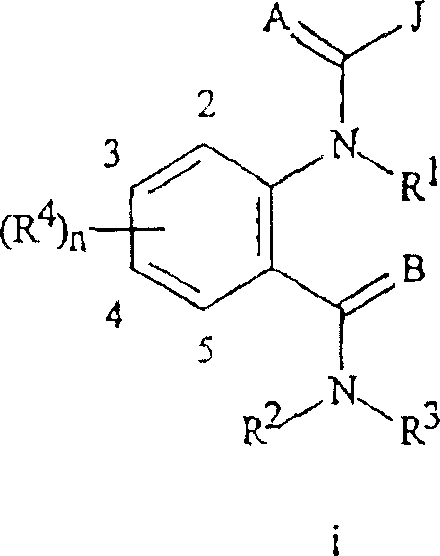
其中,尤其是,A和B各自独立地是O或S;J是任选取代的苯环,5-或6-元杂芳环,萘环系或芳族的8-,9-或10-元杂双环稠环体系;R1和R3各自独立地是H或任选取代的C1-C6烷基;R2是H或C1-C6烷基;每个R4各自独立地是H,C1-C6烷基,C1-C6卤代烷基,卤素或CN;以及n是1-4。Wherein, in particular, A and B are each independently O or S; J is an optionally substituted benzene ring, a 5- or 6-membered heteroaromatic ring, a naphthalene ring system or an aromatic 8-, 9- or 10- Membered heterobicyclic fused ring system; R 1 and R 3 are each independently H or optionally substituted C 1 -C 6 alkyl; R 2 is H or C 1 -C 6 alkyl; each R 4 is independently is H, C 1 -C 6 alkyl, C 1 -C 6 haloalkyl, halogen or CN; and n is 1-4.
发明概述Invention Summary
本发明涉及式I化合物,包括其所有的几何异构体和立体异构体,其N-氧化物及其适合的盐,The present invention relates to compounds of formula I, including all geometric isomers and stereoisomers thereof, N-oxides thereof and suitable salts thereof,
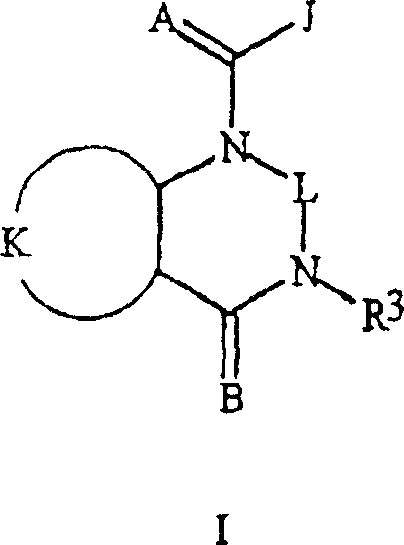
其中in
A和B各自独立地是O或S;A and B are each independently O or S;
J是苯环,萘环系,5-或6-元杂芳环或芳族的8-,9-或10-元杂双环稠环体系,其中每个环或环系任选被1-4个各自独立地选自R5的取代基取代;J is a benzene ring, a naphthalene ring system, a 5- or 6-membered heteroaromatic ring or an aromatic 8-, 9- or 10-membered heterobicyclic condensed ring system, wherein each ring or ring system is optionally replaced by 1-4 Substituents independently selected from R 5 are substituted;
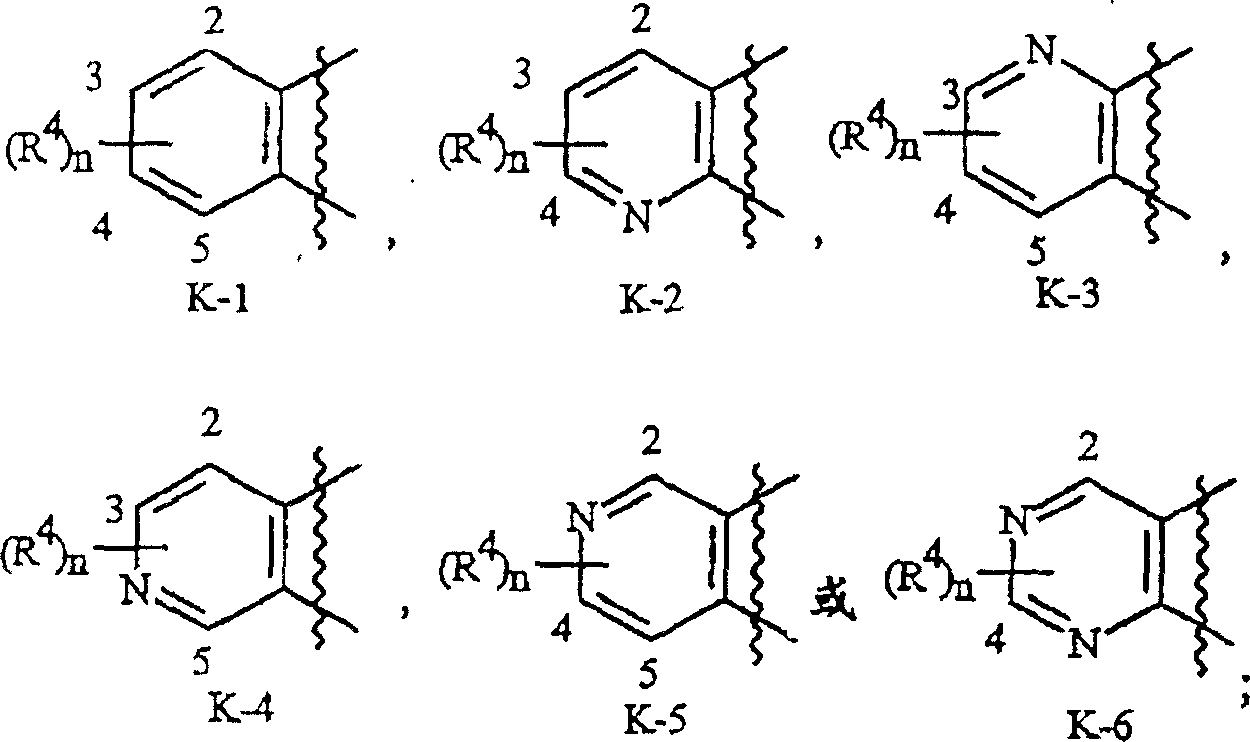
K是与两个相邻连接碳原子一起形成选自下列一组的稠合苯环,稠合吡啶环或稠合嘧啶环:K-1,K-2,K-3,K-4,K-5和K-6,每个任选被1-4个各自独立地选自R4的取代基取代;K is a fused benzene ring, a fused pyridine ring or a fused pyrimidine ring selected from the following group together with two adjacent connecting carbon atoms: K-1, K-2, K-3, K-4, K -5 and K-6, each optionally substituted by 1-4 substituents each independently selected from R;
L是直接连接键;或选自碳,氮,氧和硫的具有1-3个单元(member)的连接链,任选包括一或两个如C(=E),SO或S(O)2的链单元,以及任选被一至三个各自独立地选自R13的取代基取代;L is a direct link; or a linking chain with 1-3 units (member) selected from carbon, nitrogen, oxygen and sulfur, optionally including one or two such as C (=E), SO or S (O) 2 chain units, and optionally substituted by one to three substituents each independently selected from R 13 ;
E是O,S或NR8;E is O, S or NR8 ;
R3是H;G;C1-C6烷基,C2-C6烯基,C2-C6炔基,C3-C6环烷基,各自任选被1-5个各自独立地选自下列的取代基取代:G,卤素,CN,NO2,羟基,C1-C4烷氧基,C1-C4卤代烷氧基,C1-C4烷硫基,C1-C4烷基亚磺酰基,C1-C4烷基磺酰基,C2-C6烷氧基羰基,C2-C6烷基羰基,C3-C6三烷基甲硅烷基,苯基,苯氧基和5-或6-元杂芳环,每个苯基,苯氧基和5-或6-元杂芳环任选被一至三个各自独立地选自R6的取代基取代;或任选被1-3个各自独立地选自R6的取代基取代的苯基;R 3 is H; G; C 1 -C 6 alkyl, C 2 -C 6 alkenyl, C 2 -C 6 alkynyl, C 3 -C 6 cycloalkyl, each optionally replaced by 1-5 independently Substituents selected from the following substituents: G, halogen, CN, NO 2 , hydroxyl, C 1 -C 4 alkoxy, C 1 -C 4 haloalkoxy, C 1 -C 4 alkylthio, C 1 - C 4 alkylsulfinyl, C 1 -C 4 alkylsulfonyl, C 2 -C 6 alkoxycarbonyl, C 2 -C 6 alkylcarbonyl, C 3 -C 6 trialkylsilyl, benzene Base, phenoxy and 5- or 6-membered heteroaromatic ring, each of phenyl, phenoxy and 5- or 6- membered heteroaromatic ring is optionally replaced by one to three substituents each independently selected from R Substituted; or phenyl optionally substituted by 1-3 substituents independently selected from R 6 ;
G是5-或6-元非芳族碳环或杂环,任选包括一个或两个选自C(=O),SO和S(O)2基团的环单元以及任选被1-4个各自独立地选自R12的取代基取代;G is a 5- or 6-membered non-aromatic carbocyclic or heterocyclic ring, optionally comprising one or two ring units selected from C(=O), SO and S(O) groups and optionally surrounded by 1- 4 substituents independently selected from R 12 are substituted;
每个R4各自独立地是C1-C6烷基,C2-C6烯基,C2-C6炔基,C3-C6环烷基,C1-C6卤代烷基,C2-C6卤代烯基,C2-C6卤代炔基,C3-C6卤代环烷基,卤素,CN,NO2,羟基,C1-C4烷氧基,C1-C4卤代烷氧基,C1-C4烷硫基,C1-C4烷基亚磺酰基,C1-C4烷基磺酰基,C1-C4卤代烷硫基,C1-C4卤代烷基亚磺酰基,C1-C4卤代烷基磺酰基,C1-C4烷基氨基,C2-C8二烷基氨基,C3-C6环烷基氨基,C1-C4烷氧基烷基,C1-C4羟基烷基,C(O)R10,CO2R10,C(O)NR10R11,NR10R11,N(R11)CO2R10或C3-C6三烷基甲硅烷基;或Each R 4 is independently C 1 -C 6 alkyl, C 2 -C 6 alkenyl, C 2 -C 6 alkynyl, C 3 -C 6 cycloalkyl, C 1 -C 6 haloalkyl, C 2 -C 6 haloalkenyl, C 2 -C 6 haloalkynyl, C 3 -C 6 halocycloalkyl, halogen, CN, NO 2 , hydroxyl, C 1 -C 4 alkoxy, C 1 -C 4 haloalkoxy, C 1 -C 4 alkylthio, C 1 -C 4 alkylsulfinyl, C 1 -C 4 alkylsulfonyl, C 1 -C 4 haloalkylthio, C 1 -C 4 haloalkylsulfinyl, C 1 -C 4 haloalkylsulfonyl, C 1 -C 4 alkylamino, C 2 -C 8 dialkylamino, C 3 -C 6 cycloalkylamino, C 1 -C 4 alkoxyalkyl, C 1 -C 4 hydroxyalkyl, C(O)R 10 , CO 2 R 10 , C(O)NR 10 R 11 , NR 10 R 11 , N(R 11 )CO 2 R 10 or C 3 -C 6 trialkylsilyl; or
每个R4各自独立地是苯基,苄基,苯氧基或5-或6-元杂芳环,每个环任选被一至三个各自独立地选自R6的取代基取代; Each R is independently phenyl, benzyl, phenoxy or a 5- or 6-membered heteroaryl ring, each ring is optionally substituted by one to three substituents independently selected from R;
每个R5各自独立地是C1-C6烷基,C2-C6烯基,C2-C6炔基,C3-C6环烷基,C1-C6卤代烷基,C2-C6卤代烯基,C2-C6卤代炔基,C3-C6卤代环烷基,卤素,CN,CO2H,CONH2,NO2,羟基,C1-C4烷氧基,C1-C4卤代烷氧基,C1-C4烷硫基,C1-C4烷基亚磺酰基,C1-C4烷基磺酰基,C1-C4烷基磺酰氧基,C1-C4卤代烷硫基,C1-C4卤代烷基亚磺酰基,C1-C4卤代烷基磺酰基,C1-C4卤代烷基磺酰氧基,C1-C4烷基氨基,C2-C8二烷基氨基,C3-C6环烷基氨基,C2-C6烷基羰基,C2-C6烷氧基羰基,C2-C6烷基氨基羰基,C3-C8二烷基氨基羰基或C3-C6三烷基甲硅烷基;或Each R 5 is independently C 1 -C 6 alkyl, C 2 -C 6 alkenyl, C 2 -C 6 alkynyl, C 3 -C 6 cycloalkyl, C 1 -C 6 haloalkyl, C 2 -C 6 haloalkenyl, C 2 -C 6 haloalkynyl, C 3 -C 6 halocycloalkyl, halogen, CN, CO 2 H, CONH 2 , NO 2 , hydroxyl, C 1 -C 4 alkoxy, C 1 -C 4 haloalkoxy, C 1 -C 4 alkylthio, C 1 -C 4 alkylsulfinyl, C 1 -C 4 alkylsulfonyl, C 1 -C 4 alkane Sulfonyloxy, C 1 -C 4 haloalkylthio, C 1 -C 4 haloalkylsulfinyl, C 1 -C 4 haloalkylsulfonyl, C 1 -C 4 haloalkylsulfonyl, C 1 -C 4 alkylamino, C 2 -C 8 dialkylamino, C 3 -C 6 cycloalkylamino, C 2 -C 6 alkylcarbonyl, C 2 -C 6 alkoxycarbonyl, C 2 -C 6 alkylaminocarbonyl, C 3 -C 8 dialkylaminocarbonyl or C 3 -C 6 trialkylsilyl; or
每个R5各自独立地是苯基,苄基,苯甲酰基,苯氧基,5-或6-元杂芳环或芳族的8-,9-或10-元杂双环稠环体系,每个环或环系任选被一至三个各自独立地选自R6的取代基取代;或Each R is independently phenyl, benzyl, benzoyl, phenoxy, a 5- or 6-membered heteroaromatic ring or an aromatic 8-, 9- or 10-membered heterobicyclic fused ring system, Each ring or ring system is optionally substituted with one to three substituents each independently selected from R 6 ; or
当与相邻碳原子连接时的两个R5基团一起构成-OCF2O-,-CF2CF2O-或-OCF2CF2O-;Two R 5 groups when connected to adjacent carbon atoms together form -OCF 2 O-, -CF 2 CF 2 O- or -OCF 2 CF 2 O-;
每个R6各自独立地是C1-C4烷基,C2-C4烯基,C2-C4炔基,C3-C6环烷基,C1-C4卤代烷基,C2-C4卤代烯基,C2-C4卤代炔基,C3-C6卤代环烷基,卤素,CN,NO2,C1-C4烷氧基,C1-C4卤代烷氧基,C1-C4烷硫基,C1-C4烷基亚磺酰基,C1-C4烷基磺酰基,C1-C4卤代烷硫基,C1-C4卤代烷基亚磺酰基,C1-C4卤代烷基磺酰基,C1-C4烷基氨基,C2-C8二烷基氨基,C3-C6环烷基氨基,C3-C6(烷基)环烷基氨基,C2-C4烷基羰基,C2-C6烷氧基羰基,C2-C6烷基氨基羰基,C3-C8二烷基氨基羰基或C3-C6三烷基甲硅烷基;Each R 6 is independently C 1 -C 4 alkyl, C 2 -C 4 alkenyl, C 2 -C 4 alkynyl, C 3 -C 6 cycloalkyl, C 1 -C 4 haloalkyl, C 2 -C 4 haloalkenyl, C 2 -C 4 haloalkynyl, C 3 -C 6 halocycloalkyl, halogen, CN, NO 2 , C 1 -C 4 alkoxy, C 1 -C 4 haloalkoxy, C 1 -C 4 alkylthio, C 1 -C 4 alkylsulfinyl, C 1 -C 4 alkylsulfonyl, C 1 -C 4 haloalkylthio, C 1 -C 4 haloalkane Sulfinyl, C 1 -C 4 haloalkylsulfonyl, C 1 -C 4 alkylamino, C 2 -C 8 dialkylamino, C 3 -C 6 cycloalkylamino, C 3 -C 6 ( Alkyl)cycloalkylamino, C 2 -C 4 alkylcarbonyl, C 2 -C 6 alkoxycarbonyl, C 2 -C 6 alkylaminocarbonyl, C 3 -C 8 dialkylaminocarbonyl or C 3 -C Trialkylsilyl;
R8是H;C1-C6烷基,C2-C6烯基,C2-C6炔基或C3-C6环烷基,每个基团任选被1-5个各自独立地选自下列的取代基取代:卤素,CN,NO2,羟基,C1-C4烷氧基,C1-C4卤代烷氧基,C1-C4烷硫基,C1-C4烷基亚磺酰基,C1-C4烷基磺酰基,C2-C6烷氧基羰基,C2-C6烷基羰基,C3-C6三烷基甲硅烷基,苯环以及5-或6-元杂芳环,每个环任选被一至三个各自独立地选自R6的取代基取代;CN;NO2;C2-C6烷氧基羰基;C1-C4烷基磺酰基;或任选被1-3个各自独立地选自R6的取代基取代的苯基或苯基磺酰基;R 8 is H; C 1 -C 6 alkyl, C 2 -C 6 alkenyl, C 2 -C 6 alkynyl or C 3 -C 6 cycloalkyl, each optionally replaced by 1-5 Substituents independently selected from the following substituents: halogen, CN, NO 2 , hydroxyl, C 1 -C 4 alkoxy, C 1 -C 4 haloalkoxy, C 1 -C 4 alkylthio, C 1 -C 4 alkylsulfinyl, C 1 -C 4 alkylsulfonyl, C 2 -C 6 alkoxycarbonyl, C 2 -C 6 alkylcarbonyl, C 3 -C 6 trialkylsilyl, benzene ring and a 5- or 6-membered heteroaryl ring, each ring optionally substituted by one to three substituents each independently selected from R 6 ; CN; NO 2 ; C 2 -C 6 alkoxycarbonyl; C 1 - C 4 alkylsulfonyl; or phenyl or phenylsulfonyl optionally substituted by 1-3 substituents independently selected from R 6 ;
每个R10各自独立地是H,C1-C4烷基或C1-C4卤代烷基;Each R 10 is independently H, C 1 -C 4 alkyl or C 1 -C 4 haloalkyl;
每个R11各自独立地是H或C1-C4烷基;each R 11 is independently H or C 1 -C 4 alkyl;
每个R12各自独立地是C1-C2烷基.卤素,CN,NO2或C1-C2烷氧基;Each R 12 is independently C 1 -C 2 alkyl.halogen, CN, NO 2 or C 1 -C 2 alkoxy;
每个R13各自独立地是C1-C4烷基,C1-C4卤代烷基,卤素,CN,COOH,C1-C4烷氧基,C1-C4卤代烷氧基,C2-C6烷氧基羰基,C2-C6烷氧基羰基烷基;或Each R 13 is independently C 1 -C 4 alkyl, C 1 -C 4 haloalkyl, halogen, CN, COOH, C 1 -C 4 alkoxy, C 1 -C 4 haloalkoxy, C 2 -C 6 alkoxycarbonyl, C 2 -C 6 alkoxycarbonylalkyl; or
每个R13是苯环或5-或6-元杂芳环,每个环任选被一至三个各自独立地选自R6的取代基取代;以及Each R is a benzene ring or a 5- or 6-membered heteroaryl ring, each ring is optionally substituted by one to three substituents each independently selected from R; and
n是0,1,2,3或4。n is 0, 1, 2, 3 or 4.
本发明还涉及防治无脊椎害虫的方法,包括将生物有效量的式I化合物,其N-氧化物或该化合物的适合的盐(例如,使用此处所述的组合物)与无脊椎害虫或它们的周围环境接触。本发明还涉及下述方法,其中将生物有效量的式I化合物或含有式I化合物以及生物有效量的至少一种防治无脊椎害虫的其它化合物或制剂的组合物与无脊椎害虫或它们的周围环境接触。The present invention also relates to a method for controlling invertebrate pests, which comprises combining a biologically effective amount of a compound of formula I, its N-oxide or a suitable salt of the compound (for example, using a composition described herein) with an invertebrate pest or contact with their surroundings. The present invention also relates to a method wherein a biologically effective amount of a compound of formula I or a composition comprising a compound of formula I and a biologically effective amount of at least one other compound or agent for controlling invertebrate pests is administered to invertebrate pests or their surroundings environmental exposure.
本发明还涉及防治无脊椎害虫的组合物,包括生物有效量的式I化合物,其N-氧化物或该化合物的适合的盐以及至少一种选自表面活性剂、固体稀释剂和液体稀释剂的其它组分。本发明还涉及包括生物有效量的式I化合物,其N-氧化物或该化合物的适合的盐以及有效量的至少一种其它生物活性化合物或制剂的组合物。The present invention also relates to a composition for controlling invertebrate pests, comprising a biologically effective amount of a compound of formula I, its N-oxide or a suitable salt of the compound and at least one selected from surfactants, solid diluents and liquid diluents of other components. The present invention also relates to compositions comprising a biologically effective amount of a compound of formula I, its N-oxide or a suitable salt of this compound and an effective amount of at least one other biologically active compound or agent.
发明详述Detailed description of the invention
上文中,术语“烷基”,或单独使用或以复合词如“烷硫基”或“卤代烷基”的形式出现,包括直链或支链烷基,如,甲基,乙基,正丙基,异丙基,或各种丁基,戊基或己基异构体。“烯基”包括直链或支链烯基,如乙烯基,1-丙烯基,2-丙烯基,以及各种丁烯基,戊烯基和己烯基异构体。“烯基”还包括多烯,如1,2-丙二烯基和2,4-己二烯基。“炔基”包括直链或支链炔,如乙炔基,1-丙炔基,2-丙炔基和各种丁炔基,戊炔基和己炔基异构体。“炔基”还可包括含多个三键部分的基团,如2,5-己二炔基。“烷氧基”包括,例如,甲氧基,乙氧基,正丙氧基,异丙氧基和各种丁氧基,戊氧基和己氧基异构体。“烷氧基烷基”表示烷氧基取代的烷基。“烷氧基烷基”的实例包括CH3OCH2,CH3OCH2CH2,CH3CH2OCH2,CH3CH2CH2CH2OCH2和CH3CH2OCH2CH2。“烷硫基”包括支链或直链烷硫基部分,如甲硫基,乙硫基,以及各种丙硫基,丁硫基,戊硫基和己硫基异构体。“烷基亚磺酰基”包括烷基亚磺酰基的两种对映异构体。“烷基亚磺酰基”的实例包括CH3S(O),CH3CH2S(O),CH3CH2CH2S(O),(CH3)2CHS(O)以及各种丁亚磺酰基,戊亚磺酰基和己亚磺酰基异构体。“烷基磺酰基”的实例包括CH3S(O)2,CH3CH2S(O)2,CH3CH2CH2S(O)2,(CH3)2CHS(O)2以及各种丁磺酰基,戊磺酰基和己磺酰基异构体。“烷基磺酰氧基”的实例包括CH3S(O)2O,CH3CH2S(O)2O,CH3CH2CH2S(O)2O,(CH3)2CHS(O)2O以及各种丁磺酰氧基,戊磺酰氧基和己磺酰氧基异构体。“烷基氨基”,“二烷基氨基”,“烯硫基”,“烯基亚磺酰基”,“烯基磺酰基”,“炔硫基”,“炔基亚磺酰基”,“炔基磺酰基”等类似于上述实例所述定义。“环烷基”包括,例如,环丙基,环丁基,环戊基和环己基。In the above, the term "alkyl", either alone or in the form of compound words such as "alkylthio" or "haloalkyl", includes straight chain or branched chain alkyl groups, such as, methyl, ethyl, n-propyl , isopropyl, or the various butyl, pentyl, or hexyl isomers. "Alkenyl" includes straight chain or branched alkenyl groups such as vinyl, 1-propenyl, 2-propenyl, and the various butenyl, pentenyl and hexenyl isomers. "Alkenyl" also includes polyenes such as 1,2-propadienyl and 2,4-hexadienyl. "Alkynyl" includes straight or branched alkynes such as ethynyl, 1-propynyl, 2-propynyl and the various butynyl, pentynyl and hexynyl isomers. "Alkynyl" may also include groups containing multiple triple bond moieties, such as 2,5-hexadiynyl. "Alkoxy" includes, for example, methoxy, ethoxy, n-propoxy, isopropoxy and the various butoxy, pentyloxy and hexyloxy isomers. "Alkoxyalkyl" means an alkoxy-substituted alkyl group. Examples of " alkoxyalkyl " include CH3OCH2 , CH3OCH2CH2 , CH3CH2OCH2 , CH3CH2CH2CH2OCH2 and CH3CH2OCH2CH2 . _ "Alkylthio" includes branched or straight chain alkylthio moieties such as methylthio, ethylthio, and the various propylthio, butylthio, pentylthio and hexylthio isomers. "Alkylsulfinyl" includes both enantiomers of alkylsulfinyl. Examples of "alkylsulfinyl" include CH 3 S(O), CH 3 CH 2 S(O), CH 3 CH 2 CH 2 S(O), (CH 3 ) 2 CHS(O) and various butyl Sulfinyl, pentasulfinyl and hexasulfinyl isomers. Examples of "alkylsulfonyl" include CH 3 S(O) 2 , CH 3 CH 2 S(O) 2 , CH 3 CH 2 CH 2 S(O) 2 , (CH 3 ) 2 CHS(O) 2 and Various butanesulfonyl, pentylsulfonyl and hexylsulfonyl isomers. Examples of "alkylsulfonyloxy" include CH3S (O) 2O , CH3CH2S (O) 2O , CH3CH2CH2S ( O ) 2O , ( CH3 ) 2CHS (O) 2 O and various butanesulfonyloxy, pentanesulfonyloxy and hexylsulfonyloxy isomers. "Alkylamino", "dialkylamino", "alkenylthio", "alkenylsulfinyl", "alkenylsulfonyl", "alkynylthio", "alkynylsulfinyl", "alkyne Sulfonyl" and the like are defined similarly to those described in the examples above. "Cycloalkyl" includes, for example, cyclopropyl, cyclobutyl, cyclopentyl and cyclohexyl.
“芳族的”表示每个环原子基本上处于同一平面并具有垂直于此环平面的p-轨道,以及环上的π电子数(4n+2),其中n是0或正整数,符合休克尔规则。术语“芳环系”表示全部是未饱和的碳环和杂环,其中多环体系中的至少一个环是芳族的。术语“芳族碳环或环系”包括全部是芳族的碳环以及多环体系中的至少一个环是芳族的碳环(例如苯基和萘基)。术语“芳基”是指任何任选取代的芳环或环系。术语“非芳族碳环或环系”表示全部是饱和碳环以及部分或全部未饱和碳环,环系中任何环均不符合休克尔规则。与环或环系连接的术语“杂”是指其中至少一个环原子不是碳的环或环系以及该环或环系可含有1-4个各自独立地选自氮,氧和硫的杂原子,条件是每个环含有不多于4个氮原子,不多于2个氧原子和不多于2个硫原子。术语“杂芳环或环系”包括全部是芳族杂环和多环体系中至少一个环是芳族的杂环(其中芳族的表示符合休克尔规则)。术语“非芳族的杂环或环系”表示全部是饱和的杂环以及部分或全部未饱和杂环,其中环系中任何环均不符合休克尔规则。杂环或环系可通过任何可利用的碳或氮以置换所述碳或氮上的氢的方式连接。"Aromatic" means that each ring atom is substantially in the same plane and has a p-orbital perpendicular to the ring plane, and the number of π electrons on the ring (4n+2), where n is 0 or a positive integer, conforms to the shock Seoul rules. The term "aromatic ring system" denotes all unsaturated carbocyclic and heterocyclic rings in which at least one ring in the polycyclic ring system is aromatic. The term "aromatic carbocycle or ring system" includes all carbocycles that are aromatic as well as polycyclic carbocycles in which at least one ring is aromatic (eg, phenyl and naphthyl). The term "aryl" refers to any optionally substituted aromatic ring or ring system. The term "non-aromatic carbocycle or ring system" means all saturated carbocycles and some or all unsaturated carbocycles, and any ring in the ring system does not comply with Huckel's rule. The term "hetero" attached to a ring or ring system means a ring or ring system in which at least one ring atom is not carbon and the ring or ring system may contain 1 to 4 heteroatoms each independently selected from nitrogen, oxygen and sulfur , with the proviso that each ring contains not more than 4 nitrogen atoms, not more than 2 oxygen atoms and not more than 2 sulfur atoms. The term "heteroaromatic ring or ring system" includes all heterocyclic rings and polycyclic ring systems in which at least one ring is aromatic (wherein the designation of aromatic follows Hückel's rule). The term "non-aromatic heterocycle or ring system" refers to all saturated heterocycles as well as partially or fully unsaturated heterocycles, wherein none of the rings in the ring system obey Huckel's rule. A heterocycle or ring system may be attached via any available carbon or nitrogen in place of a hydrogen on said carbon or nitrogen.
单独或以复合词如“卤代烷基”出现的术语“卤素”,包括氟,氯,溴或碘。而且,当在复合词如“卤代烷基”中使用时,所述烷基可以是被相同或不同卤素原子部分或全部取代的烷基。“卤代烷基”的实例包括F3C,ClCH2,CF3CH2和CF3CCl2。术语“卤代烯基”,“卤代炔基”,“卤代烷氧基”,“卤代烷硫基”等的定义类似于术语“卤代烷基”。“卤代烯基”的实例包括(Cl)2C=CHCH2和CF3CH2CH=CHCH2。“卤代炔基”的实例包括HC≡CCHCl,CF3C≡C,CCl3C≡C和FCH2C≡CCH2。“卤代烷氧基”的实例包括CF3O,CCl3CH2O,HCF2CH2CH2O和CF3CH2O。“卤代烷硫基”的实例包括CCl3S,CF3S,CCl3CH2S和ClCH2CH2CH2S。“卤代烷基亚磺酰基”的实例包括CF3S(O),CCl3S(O),CF3CH2S(O)和CF3CF2S(O)。“卤代烷基磺酰基”的实例包括CF3S(O)2,CCl3S(O)2,CF3CH2S(O)2和CF3CF2S(O)2。“卤代烷基磺酰氧基”的实例包括CF3S(O)2O,CCl3S(O)2O,CF3CH2S(O)2O和CF3CF2S(O)2O。The term "halogen", alone or in compound words such as "haloalkyl", includes fluorine, chlorine, bromine or iodine. Also, when used in compound words such as "haloalkyl", said alkyl group may be an alkyl group partially or fully substituted with the same or different halogen atoms. Examples of "haloalkyl" include F 3 C, ClCH 2 , CF 3 CH 2 and CF 3 CCl 2 . The terms "haloalkenyl", "haloalkynyl", "haloalkoxy", "haloalkylthio", etc. are defined similarly to the term "haloalkyl". Examples of "haloalkenyl" include (Cl) 2C = CHCH2 and CF3CH2CH = CHCH2 . Examples of "haloalkynyl" include HC≡CCHCl, CF3C≡C , CCl3C≡C and FCH2C≡CCH2 . Examples of " haloalkoxy " include CF3O , CCl3CH2O , HCF2CH2CH2O and CF3CH2O . Examples of "haloalkylthio" include CCl3S , CF3S , CCl3CH2S and ClCH2CH2CH2S . Examples of "haloalkylsulfinyl" include CF 3 S(O), CCl 3 S(O), CF 3 CH 2 S(O) and CF 3 CF 2 S(O). Examples of "haloalkylsulfonyl" include CF 3 S(O) 2 , CCl 3 S(O) 2 , CF 3 CH 2 S(O) 2 and CF 3 CF 2 S(O) 2 . Examples of "haloalkylsulfonyloxy" include CF 3 S(O) 2 O, CCl 3 S(O) 2 O, CF 3 CH 2 S(O) 2 O and CF 3 CF 2 S(O) 2 O .
“烷基羰基”的实例包括C(O)CH3,C(O)CH2CH2CH3和C(O)CH(CH3)2。“烷氧基羰基”的实例包括CH3OC(=O),CH3CH2OC(=O),CH3CH2CH2OC(=O),(CH3)2CHOC(=O)以及各种丁氧基-或戊氧基羰基异构体。“烷氧基羰基烷基”的实例包括CH3OC(=O)CH2,CH3CH2OC(=O)CH2,CH3CH2CH2OC(=O)CH2CH2以及(CH3)2CHOC(=O)CH2。“烷基氨基羰基”的实例包括CH3NHC(=O),CH3CH2NHC(=O),CH3CH2CH2NHC(=O),(CH3)2CHNHC(=O)以及各种丁氨基-或戊氨基羰基的异构体。“二烷基氨基羰基”的实例包括(CH3)2NC(=O),(CH3CH2)2NC(=O),CH3CH2(CH3)NC(=O),CH3CH2CH2(CH3)NC(=O)和(CH3)2CHN(CH3)C(=O)。Examples of "alkylcarbonyl" include C(O) CH3 , C(O) CH2CH2CH3 and C( O )CH( CH3 ) 2 . Examples of "alkoxycarbonyl" include CH 3 OC(=O), CH 3 CH 2 OC(=O), CH 3 CH 2 CH 2 OC(=O), (CH 3 ) 2 CHOC(=O) and Various butoxy- or pentyloxycarbonyl isomers. Examples of "alkoxycarbonylalkyl" include CH 3 OC(=O)CH 2 , CH 3 CH 2 OC(=O)CH 2 , CH 3 CH 2 CH 2 OC(=O)CH 2 CH 2 and ( CH 3 ) 2 CHOC(=O)CH 2 . Examples of "alkylaminocarbonyl" include CH 3 NHC(=O), CH 3 CH 2 NHC(=O), CH 3 CH 2 CH 2 NHC(=O), (CH 3 ) 2 CHNHC(=O) and Various butylamino- or pentylaminocarbonyl isomers. Examples of "dialkylaminocarbonyl" include (CH 3 ) 2 NC(=O), (CH 3 CH 2 ) 2 NC(=O), CH 3 CH 2 (CH 3 )NC(=O), CH 3 CH2CH2 ( CH3 )NC(=O) and ( CH3 ) 2CHN ( CH3 )C(=O ) .
取代基中碳原子总数是以“Ci-Cj”前缀表示,其中i和j是1-6的数。例如,C1-C3烷基磺酰基表示甲磺酰基至丙磺酰基;C2烷氧基烷基表示CH3OCH2;C3烷氧基烷基表示,例如,CH3CH(OCH3),CH3OCH2CH2或CH3CH2OCH2;以及C4烷氧基烷基表示被含总数为四个碳原子的烷氧基取代的烷基的各种异构体,实例包括CH3CH2CH2OCH2和CH3CH2OCH2CH2。The total number of carbon atoms in a substituent is indicated by the prefix "C i -C j ", where i and j are numbers from 1-6. For example, C 1 -C 3 alkylsulfonyl means methylsulfonyl to propanesulfonyl; C 2 alkoxyalkyl means CH 3 OCH 2 ; C 3 alkoxyalkyl means, for example, CH 3 CH(OCH 3 ), CH 3 OCH 2 CH 2 or CH 3 CH 2 OCH 2 ; and C 4 alkoxyalkyl represents various isomers of alkyl substituted by alkoxy groups containing a total of four carbon atoms, and examples include CH3CH2CH2OCH2 and CH3CH2OCH2CH2 . _ _ _ _
在上述说明中,当式I化合物包括一个或多个杂环时,所有的取代基都通过任何可得的碳或氮以置换所述碳或氮上的氢的方式与这些杂环相连。In the above description, when the compound of formula I includes one or more heterocycles, all substituents are connected to these heterocycles through any available carbon or nitrogen to replace the hydrogen on said carbon or nitrogen.
当化合物被取代基取代,其带有表示所述取代基数目可大于1的下角标时,所述的取代基(当它们大于1时)各自独立地选自所定义的取代基组中。另外,当下角标表示一个范围,例如(R)i-j时,取代基的数目可选择包括i和j在内的i至j的整数。When a compound is substituted by a substituent with a subscript indicating that the number of said substituents may be greater than 1, said substituents (when they are greater than 1) are each independently selected from the defined group of substituents. In addition, when the subscript indicates a range, such as (R) ij , the number of substituents can be an integer from i to j including i and j.
术语“任选一至三个取代基取代的”等措辞表示在基团上有一至三个可得位置能被取代。当基团含有可以是氢的取代基时,例如R3或R8,那么当这个取代基是氢时,可以认为所说的基团是无取代的。The phrase "optionally substituted with one to three substituents" and the like means that one to three available positions on the group can be substituted. When a group contains a substituent which may be hydrogen, eg R3 or R8 , then said group is considered unsubstituted when this substituent is hydrogen.
本发明的化合物可能存在一种或多种立体异构体。各种立体异构体包括对映体,非对映异构体,阻转异构体和几何异构体。本领域技术人员懂得,当一种立体异构体相对于其它立体异构体含量更多或当从其它立体异构体分离出来的时候,这个立体异构体可以显示更高的活性和/或呈现有益的效果。另外,熟练的技术人员也知道如何去分离、富集,和/或选择性地制备所说的立体异构体。因此,本发明包括选自式I的化合物、N-氧化物及其农业上适合的盐。本发明的化合物可以以立体异构体的混合物,单个立体异构体,或以光学活性形式存在。The compounds of the present invention may exist as one or more stereoisomers. Various stereoisomers include enantiomers, diastereomers, atropisomers and geometric isomers. Those skilled in the art understand that when one stereoisomer is present in greater amounts relative to the other stereoisomers or when isolated from the other stereoisomers, this stereoisomer may exhibit higher activity and/or exhibit beneficial effects. In addition, the skilled artisan knows how to separate, enrich, and/or selectively prepare said stereoisomers. Accordingly, the present invention includes compounds selected from formula I, N-oxides and agriculturally suitable salts thereof. The compounds of the present invention may exist as mixtures of stereoisomers, individual stereoisomers, or in optically active forms.
本领域技术人员懂得,不是所有含氮杂环都可以形成N-氧化物,因为为了氧化成氧化物,氮需要有可得的孤对电子;本领域技术人员也知道,那些含氮杂环可以形成N-氧化物。本领域技术人员还知道,叔胺可形成N-氧化物。用于制备杂环和叔胺的N-氧化物的合成方法是本领域技术人员熟知的,包括用过氧酸如过乙酸和间氯过苯甲酸(MCPBA),过氧化氢,烷基氢过氧化物如叔丁基氢过氧化物,过硼酸钠和二环氧乙烷如二甲基二环氧乙烷氧化杂环和叔胺。这些制备N-氧化物的方法已在文献中广泛介绍或综述,例如参见下述文献:T.L.Gilchrist在Comprehensive Organic Synthesis(综合有机合成),第7卷,第748-750页,S.V.Ley编辑,Pergamon出版社;M.Tisler和B.Stanovnik在Comprehensive Heterocyclic Chemistry(综合杂环化学),第3卷,第18-20页,A.J.Boulton和A.McKillop编辑,Pergamon出版社;M.R.Grimmett和B.R.T.Keene在Advances in Heterocyclic Chemistry(杂环化学进展),第43卷,第149-161页,A.R.Katritzky编辑,Academic出版社;M.Tisler和B.Stanovnik在Advances in Heterocyclic Chemistry,第9卷,第285-291页,A.R.Katritzky和A.J.Boulton编辑,Academic出版社;以及G.W.H.Cheeseman和E.S.G.Werstiuk在Advances in HeterocyclicChemistry,第22卷,第390-392页,A.R.Katritzky和A.J.Boulton编辑,Academic出版社。Those skilled in the art understand that not all nitrogen-containing heterocycles can form N-oxides, because nitrogen requires an available lone pair of electrons in order to be oxidized to an oxide; those skilled in the art also know that those nitrogen-containing heterocycles can N-oxides are formed. Those skilled in the art also know that tertiary amines can form N-oxides. Synthetic methods for the preparation of N-oxides of heterocycles and tertiary amines are well known to those skilled in the art and include the use of peroxyacids such as peracetic acid and m-chloroperbenzoic acid (MCPBA), hydrogen peroxide, alkyl hydroperoxides, Oxides such as tert-butyl hydroperoxide, sodium perborate and dieoxiranes such as dimethyldioxirane oxidize heterocycles and tertiary amines. These methods of preparing N-oxides have been extensively described or reviewed in the literature, see for example the following: T.L. Gilchrist in Comprehensive Organic Synthesis, Vol. 7, pp. 748-750, edited by S.V.Ley, Pergamon Press; M.Tisler and B.Stanovnik in Comprehensive Heterocyclic Chemistry, Volume 3, pp. 18-20, edited by A.J.Boulton and A.McKillop, Pergamon Press; M.R.Grimmett and B.R.T.Keene in Advances in Heterocyclic Chemistry, Vol. 43, pp. 149-161, edited by A.R. Katritzky, Academic Press; M. Tisler and B. Stanovnik in Advances in Heterocyclic Chemistry, vol. 9, pp. 285-291 , edited by A.R. Katritzky and A.J. Boulton, Academic Press; and G.W.H. Cheeseman and E.S.G. Werstiuk in Advances in Heterocyclic Chemistry, Vol. 22, pp. 390-392, edited by A.R. Katritzky and A.J. Boulton, Academic Press.
本发明化合物的盐包括与无机或有机酸的酸加成盐,酸如氢溴酸,盐酸,硝酸,磷酸,硫酸,醋酸,丁酸,富马酸,乳酸,马来酸,丙二酸,草酸,丙酸,水杨酸,酒石酸,4-甲苯磺酸和戊酸。当本发明化合物含有酸性基团如羧酸基或酚基时,本发明化合物的盐还包括与有机碱(例如吡啶,氨或三乙胺)或无机碱(例如氢化物,氢氧化物或钠、钾、锂、钙、镁或钡的碳酸盐)形成的盐。Salts of the compounds of the present invention include acid addition salts with inorganic or organic acids such as hydrobromic acid, hydrochloric acid, nitric acid, phosphoric acid, sulfuric acid, acetic acid, butyric acid, fumaric acid, lactic acid, maleic acid, malonic acid, Oxalic acid, propionic acid, salicylic acid, tartaric acid, 4-toluenesulfonic acid and valeric acid. When the compound of the present invention contains an acidic group such as a carboxylic acid group or a phenolic group, the salt of the compound of the present invention also includes an organic base (such as pyridine, ammonia or triethylamine) or an inorganic base (such as hydride, hydroxide or sodium , potassium, lithium, calcium, magnesium or barium carbonates).
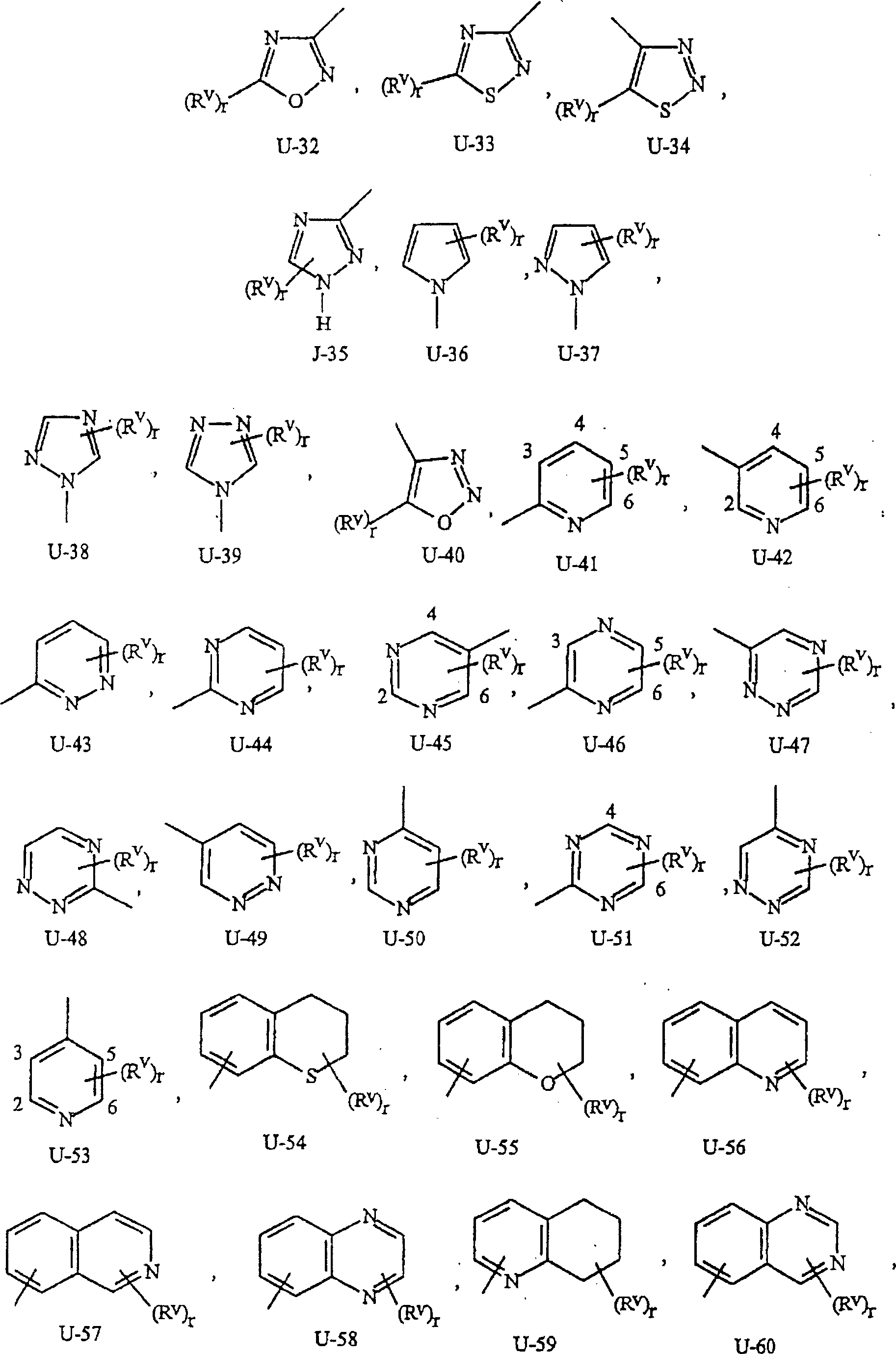
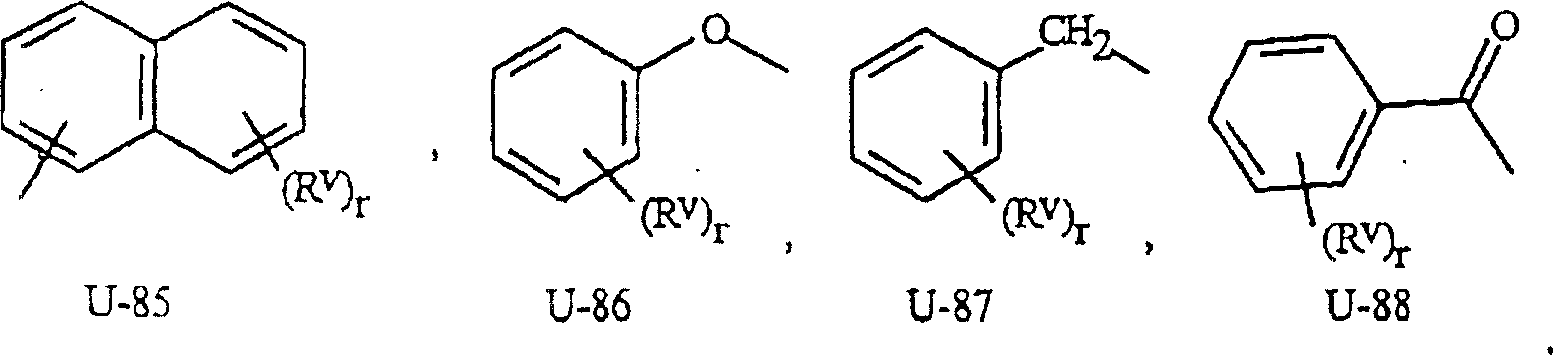
如上所述,J是苯环,萘环系,5-或6-元杂芳环或芳族的8-,9-或10-元杂双环稠环体系,其中每个环或环系任选被1-4个各自独立地选自R5的取代基取代。与这些J基团相连接的术语“任选取代”是指这些基团是未取代的或带有至少一个非氢取代基,该取代基并不消灭未取代的类似物所具有的生物活性。任选1-4个R5取代的苯基的实例是在基团组1中U-1所示的环,其中Rv是R5以及r是0-4的整数。任选1-4个R5取代的萘基的实例是在基团组1中U-85所示的环,其中Rv是R5以及r是0-4的整数。任选1-4个R5取代的5-或6-元杂芳环的实例包括在基团组1中U-2至U-53所示的环,其中Rv是R5以及r是0-4的整数。注意下述J-1至J-13也表示5-或6-元杂芳环。注意U-2至U-20是J-1的实例,U-21至U-35和U-40是J-2的实例,U-36至U-39是J-3的实例,U-41至U-48是J-4的实例以及U-49至U-53是J-5的实例。注意U-11等同于J-6,U-26等同于J-7或J-10,U-42等同于J-8,U-45等同于J-9,U-4等同于J-11以及U-24等同于J-12或J-13。还需要注意的是在J-6至J-13中R7和R9是式I中的R5的子集(subset)。任选1-4个各自独立地选自R5的取代基取代的芳族的8-,9-或10-元杂双环稠环体系包括在基团组1中U-54至U-84所示的环,其中Rv是式I中的R5以及r是0-4的整数。As mentioned above, J is a benzene ring, a naphthalene ring system, a 5- or 6-membered heteroaryl ring or an aromatic 8-, 9- or 10-membered heterobicyclic fused ring system, wherein each ring or ring system is optionally Substituted by 1-4 substituents each independently selected from R 5 . The term "optionally substituted" attached to these J groups means that these groups are unsubstituted or have at least one non-hydrogen substituent that does not abolish the biological activity of the unsubstituted analog. An example of phenyl optionally substituted with 1-4 R 5 is the ring represented by U-1 in group 1, wherein R v is R 5 and r is an integer of 0-4. An example of naphthyl optionally substituted with 1-4 R 5 is the ring represented by U-85 in Group 1, wherein R v is R 5 and r is an integer of 0-4. Examples of the 5- or 6-membered heteroaryl ring optionally substituted by 1-4 R 5 include rings shown by U-2 to U-53 in Group 1, wherein R v is R 5 and r is 0 An integer of -4. Note that J-1 to J-13 described below also represent a 5- or 6-membered heteroaromatic ring. Note that U-2 through U-20 are instances of J-1, U-21 through U-35 and U-40 are instances of J-2, U-36 through U-39 are instances of J-3, U-41 U-48 through U-48 are examples of J-4 and U-49 through U-53 are examples of J-5. Note that U-11 is equivalent to J-6, U-26 is equivalent to J-7 or J-10, U-42 is equivalent to J-8, U-45 is equivalent to J-9, U-4 is equivalent to J-11 and U-24 is equivalent to J-12 or J-13. It should also be noted that R 7 and R 9 in J-6 to J-13 are a subset of R 5 in formula I. Optionally 1-4 aromatic 8-, 9- or 10-membered heterobicyclic condensed ring systems substituted by substituents independently selected from R 5 are included in U-54 to U-84 in Group 1 The ring shown, wherein R v is R in formula I and r is an integer of 0-4.
Rv是采用置换所述碳或氮上的氢的方式通过任何可供使用的碳或氮与这些环连接。注意一些U基团仅能用少于4个的Rv基团取代(例如U-16至U-21以及U-32至U-34只能用一个Rv进行取代)。应当注意的是当(Rv)r和U基团之间的连接点被表示为不固定(floating)时,(Rv)r可与U基团上任何可供使用的碳或氮连接。应注意的是,当U基团上的连接点表示为不固定时,U基团可采用置换氢原子的方式与式I其余部分通过U基团上任何可供使用的碳或氮连接。 Rv is attached to these rings through any available carbon or nitrogen by replacing a hydrogen on said carbon or nitrogen. Note that some U groups can only be substituted with fewer than 4 Rv groups (eg U-16 to U-21 and U-32 to U-34 can only be substituted with one Rv ). It should be noted that when the point of attachment between ( Rv ) r and the U group is indicated as floating, ( Rv ) r may be attached to any available carbon or nitrogen on the U group. It should be noted that when the connection point on the U group is indicated as not fixed, the U group can be connected to the rest of formula I through any available carbon or nitrogen on the U group by replacing a hydrogen atom.
基团组1Group Group 1


如上所述,K是与两个相邻连接碳原子一起形成的稠合苯环,稠合吡啶环或稠合嘧啶环,每个环任选被1-4个各自独立地选自R4的取代基取代。与这些K基团相关的术语“任选取代的”是指这些基团是未取代的或带有至少一个非氢取代基,该取代基并不会使未取代类似物所具有的生物活性消失。这些K基团的实例包括如基团组2中的K-1至K-6所示的环。应注意的是K-2至K-5可任选被一至三个各自独立地选自R4的取代基取代。还应当注意的是K-6可任选被一至二个各自独立地选自R4的取代基取代。在例举的K基团中,右上部键通过可供利用的连接碳原子与式I的N(L)-C(=A)J这部分基团的氮原子连接,而右下部键通过可供利用的连接碳原子与式I的C(=B)N(L)R3这部分基团的碳原子连接。如下所示,波纹线表示K-环与式I的其余部分连接。As mentioned above, K is a fused benzene ring formed together with two adjacent connecting carbon atoms, a fused pyridine ring or a fused pyrimidine ring, and each ring is optionally replaced by 1-4 each independently selected from R Substituents replace. The term "optionally substituted" in relation to these K groups means that these groups are unsubstituted or have at least one non-hydrogen substituent which does not abolish the biological activity of the unsubstituted analog . Examples of these K groups include rings such as K-1 to K-6 in group group 2. It should be noted that K-2 to K-5 may be optionally substituted with one to three substituents each independently selected from R 4 . It should also be noted that K-6 may optionally be substituted with one to two substituents each independently selected from R4 . In the exemplified K group, the upper right bond is connected to the nitrogen atom of the N(L)-C(=A)J portion of the group of formula I through an available linking carbon atom, while the lower right bond is connected through an available linking carbon atom. The linking carbon atom available is linked to the carbon atom of the C(=B)N(L) R3 moiety of formula I. As shown below, the wavy lines indicate that the K-ring is connected to the rest of Formula I.
基团组2Group Group 2

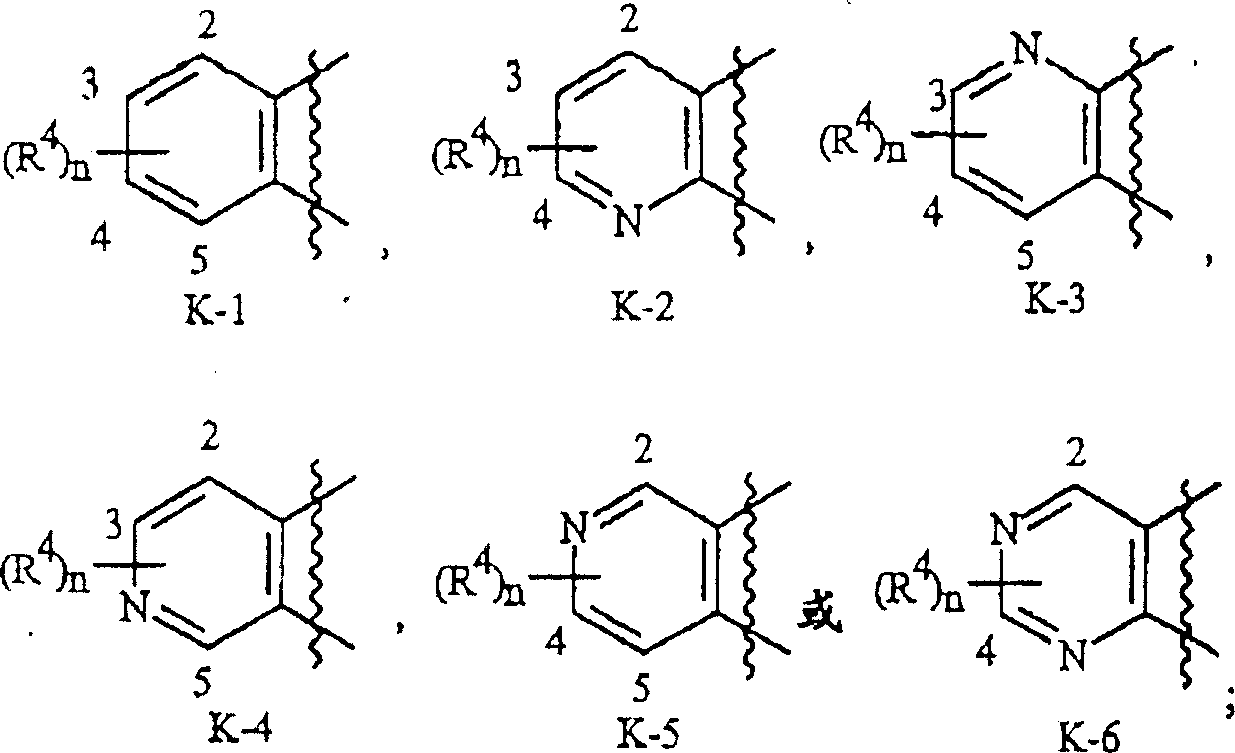
优选K-环是K-1,K-2,K-5和K-6。最优选是K-1。Preferred K-rings are K-1, K-2, K-5 and K-6. Most preferred is K-1.
如上所述,L是直接连接键;或选自碳,氮,氧和硫的具有1-3个单元的连接链,任选包括一或两个如C(=E),SO或S(O)2的链单元,以及任选被一至三个各自独立地选自R13的取代基取代。与这些L基团相关的术语“任选取代的”是指这些基团是未取代的或带有至少一个非氢取代基,该取代基并不会使未取代类似物所具有的生物活性消失。L基团的实例包括如基团组3中所示的基团L-1至L-17。在L-17中,t是1-3的整数。尽管在结构式L-17中示出R6基团,但是应当注意的是由于它们是任选取代基,因此并不必定存在。优选的L基团是L-1,L-6,L-7,L-9和L-10。As mentioned above, L is a direct link; or a linking chain with 1-3 units selected from carbon, nitrogen, oxygen and sulfur, optionally including one or two such as C(=E), SO or S(O ) 2 chain units, and optionally substituted by one to three substituents each independently selected from R 13 . The term "optionally substituted" in relation to these L groups means that these groups are unsubstituted or bear at least one non-hydrogen substituent which does not abolish the biological activity possessed by the unsubstituted analog . Examples of the L group include groups L-1 to L-17 as shown in Group 3. In L-17, t is an integer of 1-3. Although the R6 groups are shown in structural formula L-17, it should be noted that they do not have to be present as they are optional substituents. Preferred L groups are L-1, L-6, L-7, L-9 and L-10.
基团组3Group Group 3
-C(=O)- -C(=S)- -C(=NR8)- -S(O)--C(=O)- -C(=S)- -C(=NR 8 )- -S(O)-
L-1 L-2 L-3 L-4L-1 L-2 L-3 L-4
-SO2- -CH2- -CH2CH2- -CH2CH2CH2--SO 2 - -CH 2 - -CH 2 CH 2 - -CH 2 CH 2 CH 2 -
L-5 L-6 L-7 L-8L-5 L-6 L-7 L-8
-CH(CH3)- -C(CH3)2- -CH(OCH3)- -C(OCH3)2--CH(CH 3 )- -C(CH 3 ) 2 - -CH(OCH 3 )- -C(OCH 3 ) 2 -
L-9 L-10 L-11 L-12L-9 L-10 L-11 L-12
-CF2- -CF2CF2- -CH(CF3)- -CH(CCl3)--CF 2 - -CF 2 CF 2 - -CH(CF 3 )- -CH(CCl 3 )-
L-13 L-14 L-15 L-16L-13 L-14 L-15 L-16

如上所述,R3可以(其中包括(among others))是C1-C6烷基,C2-C6烯基,C2-C6炔基,C3-C6环烷基,各自任选被一至五个各自独立地选自下列的取代基取代:苯环和5-或6-元杂芳环,每一个环任选被各自独立地选自R6的一至三个取代基取代。引入所述R3基团中的这些环的实例包括在基团组1中如U-1至U-53以及U-86所示的环,只是这些环任选被各自独立地选自R6而非(Rv)r的1-3个取代基取代的并与选自上面刚列出的R3基团连接。As stated above, R 3 may (among others) be C 1 -C 6 alkyl, C 2 -C 6 alkenyl, C 2 -C 6 alkynyl, C 3 -C 6 cycloalkyl, each Optionally substituted with one to five substituents each independently selected from the following: benzene ring and 5- or 6-membered heteroaryl ring, each ring optionally substituted with one to three substituents each independently selected from R . Examples of the rings introduced into the R group include the rings shown as U-1 to U-53 and U-86 in the group group 1, except that these rings are optionally each independently selected from R substituted with 1-3 substituents other than (R v ) r and linked to R 3 groups selected from the group listed immediately above.
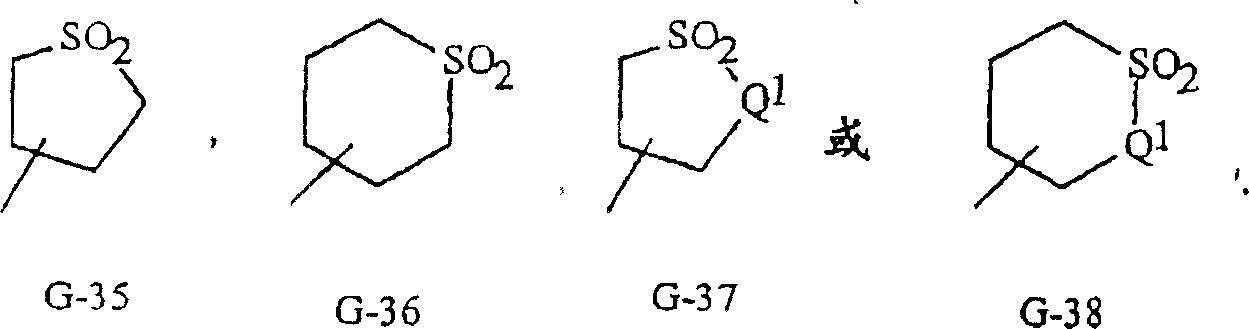
如上所述,R3可以(其中包括)是G;或C1-C6烷基,C2-C6烯基,C2-C6炔基,C3-C6环烷基,各自任选被G取代;其中G是5-或6-元非芳族碳环或杂环,任选包括一个或两个选自由C(=O),SO和S(O)2组成的组的环单元以及任选被1-4个各自独立地选自R12的取代基取代。与这些G基团相关联的术语“任选取代的”是指这些基团是未取代的或带有至少一个非氢取代基,该取代基并不会使未取代类似物所具有的生物活性消失。任选的取代基通过取代氢原子与任何可得碳原子连接。作为G的5-或6-元非芳族碳环的实例包括在基团组3中如G-1至G-8所示的环。作为G的5-或6-元非芳族杂环的实例包括在基团组4中如G-9至G-38所示的环。应当注意的是,当G包括选自G-31至G-34,G-37和G-38的环时,Q1选自O,S或N。应注意的是,当G是G-11,G13,G-14,G16,G-23,G-24,G-30至G-34,G-37和G-38以及Q1是N时,氮原子可通过用H或C1-C2烷基取代补齐其化合价。应注意的是,当G基团上的连接点表示为不固定时,G基团可采用置换氢原子的方式与式I其余部分通过G基团上任何可供使用的碳连接。As mentioned above, R 3 can be, among others, G; or C 1 -C 6 alkyl, C 2 -C 6 alkenyl, C 2 -C 6 alkynyl, C 3 -C 6 cycloalkyl, each of which is optionally substituted by G; wherein G is a 5- or 6-membered non-aromatic carbocyclic or heterocyclic ring, optionally including one or two rings selected from the group consisting of C(=O), SO and S(O) unit and is optionally substituted with 1-4 substituents each independently selected from R 12 . The term "optionally substituted" in association with these G groups means that these groups are unsubstituted or bear at least one non-hydrogen substituent which does not confer the biological activity of the unsubstituted analog disappear. Optional substituents are attached to any available carbon atom by replacing a hydrogen atom. Examples of the 5- or 6-membered non-aromatic carbocyclic ring as G include the rings shown in Group 3 as G-1 to G-8. Examples of the 5- or 6-membered non-aromatic heterocyclic ring as G include the rings shown in Group 4 as G-9 to G-38. It should be noted that when G includes a ring selected from G-31 to G-34, G-37 and G-38, Q is selected from O, S or N. It should be noted that when G is G-11, G13, G-14, G16, G-23, G-24, G-30 to G-34, G-37 and G-38 and Q1 is N, Nitrogen atoms can be valenced by substitution with H or C 1 -C 2 alkyl. It should be noted that when the connection point on the G group is indicated as not fixed, the G group can be connected to the rest of formula I through any available carbon on the G group by replacing a hydrogen atom.
基团组4Group 4
如上所述,每个R4可以各自独立地(其中包括)是苯基,苄基,苯氧基或5-或6-元杂芳环,每个环任选被一至三个各自独立地选自R6的取代基取代。这些R4基团的实例包括在基团组1中如U-1至U-53,U-86和U-87所示的那些环或环系,只是这些环任选被各自独立地选自R6而非(Rv)r的1-3个取代基取代。As noted above, each R 4 can independently, among others, be phenyl, benzyl, phenoxy, or a 5- or 6-membered heteroaryl ring, each ring optionally being selected from one to three each independently Substituents from R 6 are substituted. Examples of these R groups include those rings or ring systems shown in Group 1 as U-1 to U-53, U-86 and U-87, except that these rings are optionally each independently selected from R 6 is substituted with 1-3 substituents other than (R v ) r .
如上所述,每个R5可以各自独立地(其中包括)是苯基,苄基,苯甲酰基,苯氧基,5-或6-元杂芳环或芳族的8-,9-或10-元杂双环稠环体系,其中每个环任选被一至三个各自独立地选自R6的取代基取代。这些R5基团的实例包括在基团组1中如U-1至U-88所示的那些环或环系,只是这些环任选被各自独立地选自R6而非(Rv)r的1-3个取代基取代。As stated above, each R 5 may independently, among others, be phenyl, benzyl, benzoyl, phenoxy, 5- or 6-membered heteroaryl ring or aromatic 8-, 9- or A 10-membered heterobicyclic fused ring system, wherein each ring is optionally substituted by one to three substituents each independently selected from R 6 . Examples of these R groups include those rings or ring systems shown in Group 1 as U-1 to U-88, except that these rings are optionally each independently selected from R instead of (R v ) 1-3 substituents of r are substituted.
为了获得更高活性和/或使合成更易于进行的缘故,优选的化合物是:For reasons of higher activity and/or ease of synthesis, preferred compounds are:
优选1.上述式I化合物,它们的N-氧化物及其农业上适合的盐,其中A和B都是O以及J是任选被1-4个R5取代的苯基。Preferred 1. Compounds of formula I above, their N-oxides and agriculturally suitable salts thereof, wherein A and B are both O and J is phenyl optionally substituted by 1 to 4 R 5 .
优选2.优选1的化合物,其中Preferred 2. The compound of Preferred 1, wherein
一个R4基团在2-位或5-位与K环连接,以及所述R4是C1-C4烷基,C1-C4卤代烷基,卤素,CN,NO2,C1-C4烷氧基,C1-C4卤代烷氧基,C1-C4烷硫基,C1-C4烷基亚磺酰基,C1-C4烷基磺酰基,C1-C4卤代烷硫基,C1-C4卤代烷基亚磺酰基或C1-C4卤代烷基磺酰基;以及One R 4 group is connected to K ring at the 2-position or 5-position, and said R 4 is C 1 -C 4 alkyl, C 1 -C 4 haloalkyl, halogen, CN, NO 2 , C 1 - C 4 alkoxy, C 1 -C 4 haloalkoxy, C 1 -C 4 alkylthio, C 1 -C 4 alkylsulfinyl, C 1 -C 4 alkylsulfonyl, C 1 -C 4 Haloalkylthio, C 1 -C 4 haloalkylsulfinyl or C 1 -C 4 haloalkylsulfonyl; and
每个R5各自独立地是卤素,C1-C4烷基,C1-C4烷氧基,C1-C4卤代烷基,CN,NO2,C1-C4卤代烷氧基,C1-C4烷硫基,C1-C4烷基亚磺酰基,C1-C4烷基磺酰基,C1-C4卤代烷硫基,C1-C4卤代烷基亚磺酰基,C1-C4卤代烷基磺酰基或C2-C4烷氧基羰基;或Each R 5 is independently halogen, C 1 -C 4 alkyl, C 1 -C 4 alkoxy, C 1 -C 4 haloalkyl, CN, NO 2 , C 1 -C 4 haloalkoxy, C 1 -C 4 alkylthio, C 1 -C 4 alkylsulfinyl, C 1 -C 4 alkylsulfonyl, C 1 -C 4 haloalkylthio, C 1 -C 4 haloalkylsulfinyl, C 1 -C 4 haloalkylsulfonyl or C 2 -C 4 alkoxycarbonyl; or
每个R5各自独立地是苯基或5-或6-元杂芳环,每个环任选被各自独立地选自R6的一至三个取代基取代;或each R is independently phenyl or a 5- or 6-membered heteroaromatic ring, each ring is optionally substituted with one to three substituents each independently selected from R ; or
当与相邻碳原子连接时的两个R5基团一起形成-OCF2O-,-CF2CF2O-或-OCF2CF2O-。Two R5 groups when attached to adjacent carbon atoms together form -OCF2O- , -CF2CF2O- or -OCF2CF2O- .
优选3.优选2的化合物,其中Preferred 3. The compound of Preferred 2, wherein
R3是任选被各自独立地选自卤素,CN,OCH3和S(O)pCH3的1-5个取代基取代的C1-C4烷基;R 3 is C 1 -C 4 alkyl optionally substituted by 1-5 substituents independently selected from halogen, CN, OCH 3 and S(O) pCH 3 ;
一个R4基团在2-位与K环连接以及所述的R4是CH3,CF3,OCF3,OCHF2,S(O)pCF3,S(O)pCHF2,CN或卤素;An R 4 group is attached to the K ring at the 2-position and said R 4 is CH 3 , CF 3 , OCF 3 , OCHF 2 , S(O) p CF 3 , S(O) p CHF 2 , CN or halogen;
任选第二个R4是F,Cl,Br,I,CN或CF3;Optionally the second R4 is F, Cl, Br, I, CN or CF3 ;
每个R5各自独立地是卤素,甲基,CF3,OCF3,OCHF2,S(O)pCF3,S(O)pCHF2,OCH2CF3,OCF2CHF2,S(O)pCH2CF3或S(O)pCF2CHF2;或苯基,吡唑,咪唑,三唑,吡啶或嘧啶环,每个环任选被各自独立地选自C1-C4烷基,C1-C4卤代烷基,卤素和CN的一至三个取代基取代;以及Each R 5 is independently halogen, methyl, CF 3 , OCF 3 , OCHF 2 , S(O) p CF 3 , S(O) p CHF 2 , OCH 2 CF 3 , OCF 2 CHF 2 , S( O) p CH 2 CF 3 or S(O) p CF 2 CHF 2 ; or a phenyl, pyrazole, imidazole, triazole, pyridine or pyrimidine ring, each ring optionally independently selected from C 1 -C 4 alkyl, C 1 -C 4 haloalkyl, halogen and one to three substituents of CN; and
p是0,1或2。p is 0, 1 or 2.
优选4.优选3的化合物,其中R3是C1-C4烷基。Preferred 4. The compound of preferred 3, wherein R 3 is C 1 -C 4 alkyl.
优选5.上述式I化合物,它们的N-氧化物及其农业上适合的盐,其中Preferred 5. Compounds of formula I above, their N-oxides and agriculturally suitable salts thereof, wherein
A和B都是O;Both A and B are O;
J是选自J-1,J-2,J-3,J-4和J-5的5-或6-元杂芳环,每一个J任选被1-3个各自独立地选自R5的取代基取代J is a 5- or 6-membered heteroaromatic ring selected from J-1, J-2, J-3, J-4 and J-5, each J is optionally replaced by 1-3 each independently selected from R Substituents of 5 are substituted
Q是O,S,NH或NR5;以及Q is O, S, NH or NR 5 ; and
W,X,Y和Z各自独立地是N,CH或CR5,条件是J-4和J-5中至少一个W,X,Y或Z是N。W, X, Y and Z are each independently N, CH or CR 5 with the proviso that at least one of W, X, Y or Z in J-4 and J-5 is N.
优选6.优选5的化合物,其中Preferred 6. The compound of Preferred 5, wherein
一个R4基团在2-位或5-位与K环连接,以及所述R4是C1-C4烷基,C1-C4卤代烷基,卤素,CN,NO2,C1-C4烷氧基,C1-C4卤代烷氧基,C1-C4烷硫基,C1-C4烷基亚磺酰基,C1-C4烷基磺酰基,C1-C4卤代烷硫基,C1-C4卤代烷基亚磺酰基,或C1-C4卤代烷基磺酰基;以及One R 4 group is connected to K ring at the 2-position or 5-position, and said R 4 is C 1 -C 4 alkyl, C 1 -C 4 haloalkyl, halogen, CN, NO 2 , C 1 - C 4 alkoxy, C 1 -C 4 haloalkoxy, C 1 -C 4 alkylthio, C 1 -C 4 alkylsulfinyl, C 1 -C 4 alkylsulfonyl, C 1 -C 4 Haloalkylthio, C 1 -C 4 haloalkylsulfinyl, or C 1 -C 4 haloalkylsulfonyl; and
每个R5各自独立地是C1-C4烷基,C1-C4卤代烷基,卤素,CN,NO2,C1-C4卤代烷氧基,C1-C4烷硫基,C1-C4烷基亚磺酰基,C1-C4烷基磺酰基,C1-C4卤代烷硫基,C1-C4卤代烷基亚磺酰基,C1-C4卤代烷基磺酰基或C2-C4烷氧基羰基;或Each R 5 is independently C 1 -C 4 alkyl, C 1 -C 4 haloalkyl, halogen, CN, NO 2 , C 1 -C 4 haloalkoxy, C 1 -C 4 alkylthio, C 1 -C 4 alkylsulfinyl, C 1 -C 4 alkylsulfonyl, C 1 -C 4 haloalkylthio, C 1 -C 4 haloalkylsulfinyl, C 1 -C 4 haloalkylsulfonyl or C 2 -C 4 alkoxycarbonyl; or
每个R5各自独立地是苯基或5-或6-元杂芳环,每个环任选被各自独立地选自R6的一至三个取代基取代。Each R 5 is independently phenyl or a 5- or 6-membered heteroaryl ring, each ring is optionally substituted with one to three substituents each independently selected from R 6 .
优选7.优选6的化合物,其中Preferred 7. The compound of Preferred 6, wherein
J选自下列基团:J is selected from the following groups:
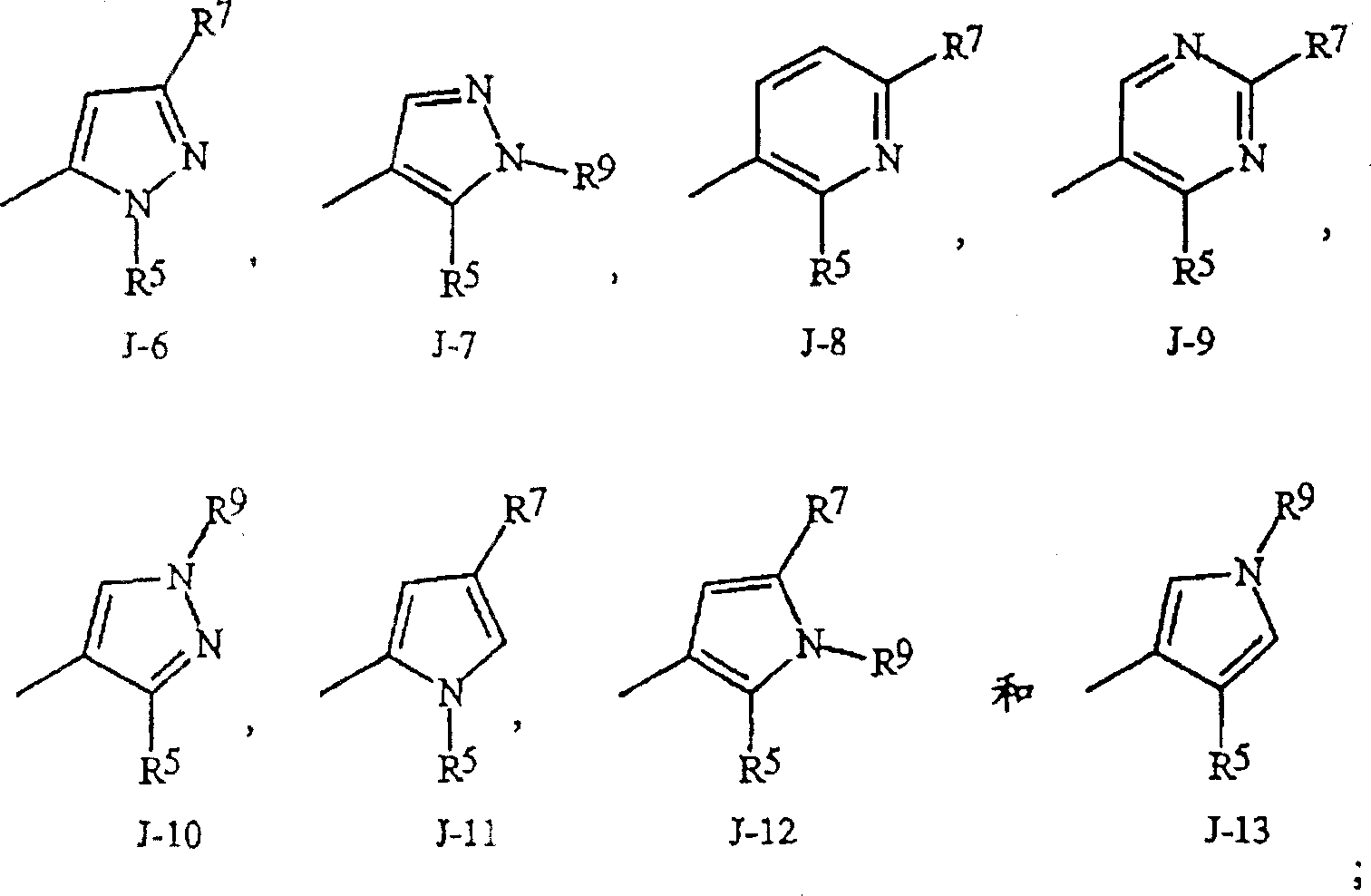
R5是C1-C4烷基,C1-C4卤代烷基,或R 5 is C 1 -C 4 alkyl, C 1 -C 4 haloalkyl, or
V是N,CH,CF,CCl,CBr或CI;V is N, CH, CF, CCl, CBr or CI;
R6是C1-C6烷基,C3-C6环烷基,C1-C4卤代烷基,卤素,CN,C1-C4烷氧基,C1-C4卤代烷氧基或C1-C4卤代烷硫基;R 6 is C 1 -C 6 alkyl, C 3 -C 6 cycloalkyl, C 1 -C 4 haloalkyl, halogen, CN, C 1 -C 4 alkoxy, C 1 -C 4 haloalkoxy or C 1 -C 4 haloalkylthio;
R7是H,C1-C6烷基,C3-C6环烷基,C1-C4卤代烷基,卤素,CN,C1-C4烷氧基,C1-C4卤代烷氧基或C1-C4卤代烷硫基;R 7 is H, C 1 -C 6 alkyl, C 3 -C 6 cycloalkyl, C 1 -C 4 haloalkyl, halogen, CN, C 1 -C 4 alkoxy, C 1 -C 4 haloalkoxy or C 1 -C 4 haloalkylthio;
R9是H,C1-C6烷基,C1-C6卤代烷基,C3-C6烯基,C3-C6卤代烯基,C3-C6炔基或C3-C6卤代炔基;条件是R7和R9不同时为H;以及R 9 is H, C 1 -C 6 alkyl, C 1 -C 6 haloalkyl, C 3 -C 6 alkenyl, C 3 -C 6 haloalkenyl, C 3 -C 6 alkynyl or C 3 - C haloalkynyl; with the proviso that R and R are not both H; and
m是0或1。m is 0 or 1.
优选8.优选7的化合物,其中V是N。Preferred 8. The compound of Preferred 7, wherein V is N.
优选9.优选7的化合物,其中V是CH,CF,CCl或CBr。Preferred 9. The compound of Preferred 7, wherein V is CH, CF, CCl or CBr.
优选10.优选8或优选9的化合物,其中Preferred 10. The compound of Preferred 8 or Preferred 9, wherein
R3是H;或任选被各自独立地选自卤素,CN,OCH3和S(O)pCH3的1-5个取代基取代的C1-C4烷基;R 3 is H; or C 1 -C 4 alkyl optionally substituted by 1-5 substituents independently selected from halogen, CN, OCH 3 and S(O) p CH 3 ;
一个R4基团在2-位与K环连接以及所述的R4是CH3,CF3,OCF3,OCHF2,S(O)pCF3,S(O)pCHF2,CN或卤素;An R 4 group is attached to the K ring at the 2-position and said R 4 is CH 3 , CF 3 , OCF 3 , OCHF 2 , S(O) p CF 3 , S(O) p CHF 2 , CN or halogen;
任选第二个R4是F,Cl,Br,I,CN或CF3;Optionally the second R4 is F, Cl, Br, I, CN or CF3 ;
R6是C1-C4烷基,C1-C4卤代烷基,卤素或CN;R 6 is C 1 -C 4 alkyl, C 1 -C 4 haloalkyl, halogen or CN;
R7是H,CH3,CF3,OCHF2,OCH2CF3或卤素;以及R 7 is H, CH 3 , CF 3 , OCHF 2 , OCH 2 CF 3 or halogen; and
p是0,1或2。p is 0, 1 or 2.
优选11.优选10的化合物,其中R3是H或C1-C4烷基;以及一个R4基团连接在2-位以及所述R4是CH3,Cl,Br或I。Preferred 11. The compound of Preferred 10, wherein R 3 is H or C 1 -C 4 alkyl; and one R 4 group is attached at the 2-position and said R 4 is CH 3 , Cl, Br or I.
优选12.优选11的化合物,其中J是J-6;R6是卤素;以及R7是卤素或CF3。Preferred 12. The compound of Preferred 11 wherein J is J-6; R6 is halo; and R7 is halo or CF3 .
优选13.优选12的化合物,其中V是N;R3是H或甲基,乙基,异丙基或叔丁基;以及R7是Br,Cl或CF3。Preferred 13. The compound of Preferred 12 wherein V is N; R3 is H or methyl, ethyl, isopropyl or tert-butyl; and R7 is Br, Cl or CF3 .
优选14.优选11的化合物,其中J是J-7;R6是卤素;以及R9是CF3,CHF2,CH2CF3或CF2CHF2。Preferred 14. The compound of Preferred 11 wherein J is J-7; R6 is halogen; and R9 is CF3 , CHF2 , CH2CF3 or CF2CHF2 .
优选15.优选11的化合物,其中J是J-8;R6是卤素;以及R7是卤素或CF3。Preferred 15. The compound of Preferred 11 wherein J is J-8; R6 is halo; and R7 is halo or CF3 .
优选16.优选11的化合物,其中J是J-9;R6是卤素;以及R7是CF3。Preferred 16. The compound of Preferred 11, wherein J is J-9; R6 is halogen; and R7 is CF3 .
优选17.优选11的化合物,其中J是J-10;R6是卤素;以及R9是CF3,CHF2,CH2CF3或CF2CHF2。Preferred 17. The compound of Preferred 11 wherein J is J-10; R6 is halogen; and R9 is CF3 , CHF2 , CH2CF3 or CF2CHF2 .
优选18.优选11的化合物,其中J是J-11;R6是卤素;以及R7是卤素或CF3。Preferred 18. The compound of Preferred 11, wherein J is J-11; R6 is halo; and R7 is halo or CF3 .
优选19.优选11的化合物,其中J是J-12;R6是卤素;R7是H,卤素或CF3,以及R9是H,CF3,CHF2,CH2CF3或CF2CHF2。Preferred 19. The compound of Preferred 11, wherein J is J-12; R 6 is halogen; R 7 is H, halogen or CF 3 , and R 9 is H, CF 3 , CHF 2 , CH 2 CF 3 or CF 2 CHF 2 .
优选20.优选11的化合物,其中J是J-13;R6是卤素;R7是H,卤素或CF3,以及R9是H,CF3,CHF2,CH2CF3或CF2CHF2。Preferred 20. The compound of Preferred 11, wherein J is J-13; R 6 is halogen; R 7 is H, halogen or CF 3 , and R 9 is H, CF 3 , CHF 2 , CH 2 CF 3 or CF 2 CHF 2 .
最优选的是选自下列的优选13的化合物:Most preferred are compounds selected from the following preferred 13:
6-溴-1-[[3-溴-1-(3-氯-2-吡啶基)-1H-吡唑-5-基]羰基]-8-甲基-3-(1-甲基乙基)-2,4(1H,3H)-喹唑啉二酮,6-bromo-1-[[3-bromo-1-(3-chloro-2-pyridyl)-1H-pyrazol-5-yl]carbonyl]-8-methyl-3-(1-methylethyl base)-2,4(1H,3H)-quinazolidinedione,
6-溴-1-[[1-(3-氯-2-吡啶基)-3-(三氟甲基)-1H-吡唑-5-基]羰基]-3,8-二甲基-2,4(1H,3H)-喹唑啉二酮,6-Bromo-1-[[1-(3-chloro-2-pyridyl)-3-(trifluoromethyl)-1H-pyrazol-5-yl]carbonyl]-3,8-dimethyl- 2,4(1H,3H)-quinazolinedione,
6-溴-1-[[3-溴-1-(3-氯-2-吡啶基)-1H-吡唑-5-基]羰基]-3,8-二甲基-2,4(1H,3H)-喹唑啉二酮,6-bromo-1-[[3-bromo-1-(3-chloro-2-pyridyl)-1H-pyrazol-5-yl]carbonyl]-3,8-dimethyl-2,4(1H , 3H)-quinazolinedione,
1-[[3-溴-1-(3-氯-2-吡啶基)-1H-吡唑-5-基]羰基]-2,3-二氢-8-甲基-3-(1-甲基乙基)-4(1H)-喹唑啉酮,1-[[3-bromo-1-(3-chloro-2-pyridyl)-1H-pyrazol-5-yl]carbonyl]-2,3-dihydro-8-methyl-3-(1- Methylethyl)-4(1H)-quinazolinone,
6,8-二氯-1-[[3-氯-1-(3-氯-2-吡啶基)-1H-吡唑-5-基]羰基]-2,3-二氢-3-(1-甲基乙基)-4(1H)-喹唑啉酮,6,8-dichloro-1-[[3-chloro-1-(3-chloro-2-pyridyl)-1H-pyrazol-5-yl]carbonyl]-2,3-dihydro-3-( 1-methylethyl)-4(1H)-quinazolinone,
1-[[3-溴-1-(3-氯-2-吡啶基)-1H-吡唑-5-基]羰基]-6,8-二氯-2,3-二氢-3-(1-甲基乙基)-4-(1H)-喹唑啉酮,1-[[3-bromo-1-(3-chloro-2-pyridyl)-1H-pyrazol-5-yl]carbonyl]-6,8-dichloro-2,3-dihydro-3-( 1-methylethyl)-4-(1H)-quinazolinone,
6,8-二氯-1-[[1-(3-氯-2-吡啶基)-3-(三氟甲基)-1H-吡唑-5-基]羰基]-2,3-二氢-3-甲基-4(1H)-喹唑啉酮,6,8-Dichloro-1-[[1-(3-chloro-2-pyridyl)-3-(trifluoromethyl)-1H-pyrazol-5-yl]carbonyl]-2,3-di Hydrogen-3-methyl-4(1H)-quinazolinone,
6-氯-1-[[3-氯-1-(3-氯-2-吡啶基)-1H-吡唑-5-基]羰基]-2,3-二氢-8-甲基-3-(1-甲基乙基)-4(1H)-喹唑啉酮,6-chloro-1-[[3-chloro-1-(3-chloro-2-pyridyl)-1H-pyrazol-5-yl]carbonyl]-2,3-dihydro-8-methyl-3 -(1-methylethyl)-4(1H)-quinazolinone,
1-[[3-溴-1-(3-氯-2-吡啶基)-1H-吡唑-5-基]羰基]-6-氯-2,3-二氢-8-甲基-3-(1-甲基乙基)-4-(1H)-喹唑啉酮,1-[[3-bromo-1-(3-chloro-2-pyridyl)-1H-pyrazol-5-yl]carbonyl]-6-chloro-2,3-dihydro-8-methyl-3 -(1-methylethyl)-4-(1H)-quinazolinone,
6,8-二氯-1-[[1-(3-氯-2-吡啶基)-3-(三氟甲基)-1H-吡唑-5-基]羰基]-2,3-二氢-3-(1-甲基乙基)-4(1H)-喹唑啉酮,6,8-Dichloro-1-[[1-(3-chloro-2-pyridyl)-3-(trifluoromethyl)-1H-pyrazol-5-yl]carbonyl]-2,3-di Hydrogen-3-(1-methylethyl)-4(1H)-quinazolinone,
6,8-二氯-1-[[3-氯-1-(3-氯-2-吡啶基)-1H-吡唑-5-基]羰基]-2,3-二氢-3-甲基-4(1H)-喹唑啉酮,6,8-Dichloro-1-[[3-chloro-1-(3-chloro-2-pyridyl)-1H-pyrazol-5-yl]carbonyl]-2,3-dihydro-3-methyl Base-4(1H)-quinazolinone,
1-[[3-溴-1-(3-氯-2-吡啶基)-1H-吡唑-5-基]羰基]-6,8-二氯-2,3-二氢-3-甲基-4(1H)-喹唑啉酮,1-[[3-bromo-1-(3-chloro-2-pyridyl)-1H-pyrazol-5-yl]carbonyl]-6,8-dichloro-2,3-dihydro-3-methyl Base-4(1H)-quinazolinone,
6-氯-1-[[1-(3-氯-2-吡啶基)-3-(三氟甲基)-1H-吡唑-5-基]羰基]-2,3-二氢-8-甲基-3-(1-甲基乙基)-4(1H)-喹唑啉酮,6-Chloro-1-[[1-(3-chloro-2-pyridyl)-3-(trifluoromethyl)-1H-pyrazol-5-yl]carbonyl]-2,3-dihydro-8 -Methyl-3-(1-methylethyl)-4(1H)-quinazolinone,
6-氯-1-[[3-氯-1-(3-氯-2-吡啶基)-1H-吡唑-5-基]羰基]-2,3-二氢-3,8-二甲基-4(1H)-喹唑啉酮,6-chloro-1-[[3-chloro-1-(3-chloro-2-pyridyl)-1H-pyrazol-5-yl]carbonyl]-2,3-dihydro-3,8-dimethyl Base-4(1H)-quinazolinone,
1-[[3-溴-1-(3-氯-2-吡啶基)-1H-吡唑-5-基]羰基]-6-氯-2,3-二氢-3,8-二甲基-4(1H)-喹唑啉酮,1-[[3-bromo-1-(3-chloro-2-pyridyl)-1H-pyrazol-5-yl]carbonyl]-6-chloro-2,3-dihydro-3,8-dimethyl Base-4(1H)-quinazolinone,
6-氯-1-[[1-(3-氯-2-吡啶基)-3-(三氟甲基)-1H-吡唑-5-基]羰基]-2,3-二氢-3,8-二甲基-4(1H)-喹唑啉酮,6-Chloro-1-[[1-(3-chloro-2-pyridyl)-3-(trifluoromethyl)-1H-pyrazol-5-yl]carbonyl]-2,3-dihydro-3 , 8-Dimethyl-4(1H)-quinazolinone,
6,8-二氯-1-[[1-(3-氯-2-吡啶基)-3-(三氟甲基)-1H-吡唑-5-基]羰基]-2,3-二氢-4(1H)-喹唑啉酮以及6,8-Dichloro-1-[[1-(3-chloro-2-pyridyl)-3-(trifluoromethyl)-1H-pyrazol-5-yl]carbonyl]-2,3-di Hydrogen-4(1H)-quinazolinone and
6,8-二氯-1-[[3-氯-1-(3-氯-2-吡啶基)-1H-吡唑-5-基]羰基]-2,3-二氢-4(1H)-喹唑啉酮。6,8-dichloro-1-[[3-chloro-1-(3-chloro-2-pyridyl)-1H-pyrazol-5-yl]carbonyl]-2,3-dihydro-4(1H )-quinazolone.
本发明还涉及用于防治无脊椎害虫的组合物,包含生物有效量的式I化合物、它们的N-氧化物或其适合的盐以及选自表面活性剂,固体稀释剂和液体稀释剂中的至少一种其它组分。本发明还涉及一种组合物,包含生物有效量的式I化合物以及有效量的至少一种其它生物活性化合物或制剂。本发明优选的组合物是包含上述优选化合物的那些组合物。The present invention also relates to a composition for controlling invertebrate pests, comprising a biologically effective amount of a compound of formula I, their N-oxide or a suitable salt thereof and a compound selected from surfactants, solid diluents and liquid diluents. at least one other component. The present invention also relates to a composition comprising a biologically effective amount of a compound of formula I and an effective amount of at least one other biologically active compound or agent. Preferred compositions of the invention are those comprising the preferred compounds described above.
本发明还涉及防治无脊椎害虫的方法,包括将生物有效量的式I化合物(例如使用此处描述的组合物)与无脊椎害虫或它们的周围环境接触。本发明还涉及下述方法,其中将生物有效量的式I化合物或含有式I化合物以及生物有效量的至少一种防治无脊椎害虫的其它化合物或制剂的组合物与无脊椎害虫或它们的周围环境接触。优选应用的方法是包括上述优选化合物的那些方法。The invention also relates to a method of controlling invertebrate pests comprising contacting the invertebrate pests or their surroundings with a biologically effective amount of a compound of formula I (for example using a composition described herein). The present invention also relates to a method wherein a biologically effective amount of a compound of formula I or a composition comprising a compound of formula I and a biologically effective amount of at least one other compound or agent for controlling invertebrate pests is administered to invertebrate pests or their surroundings environmental exposure. Preferred methods for use are those involving the preferred compounds described above.
式I化合物可采用如反应方案1-11中所述的下述一种或多种方法或变更方法进行制备。在式I和式2-23化合物中A,B,J,K,L,R3,R4,R5和n的定义如同在发明概述部分中的定义。式Ia-Ic,If,2a-c,9a-i和10a-c化合物分别是式I,2,9和10化合物的不同子集,以及式Ia-If中的所有取代基如上式I中所述定义。Compounds of formula I can be prepared using one or more of the following methods or variations thereof as described in Reaction Schemes 1-11. A, B, J, K, L, R3 , R4 , R5 and n in compounds of formula I and formulas 2-23 are as defined in the Summary of the Invention section. Compounds of formulas Ia-Ic, If, 2a-c, 9a-i and 10a-c are different subsets of compounds of formulas I, 2, 9 and 10, respectively, and all substituents in formulas Ia-If are as described in formula I above above definition.
如反应方案1所示,式I化合物可通过下述方法制备:存在碱的条件下将式2的芳基或杂芳基胺与式3的酰基氯反应获得式Ia化合物。反应可以纯反应物或在各种适合的溶剂包括四氢呋喃,甲苯,二氯甲烷和氯仿中以室温至溶剂回流温度的最适温度范围内进行。反应中使用的典型的碱包括胺,如三乙胺和吡啶,碳酸盐,如碳酸钾和碳酸钠以及氢化物,如氢化钾和氢化钠。下一步,采用各种标准的硫转移剂,包括五硫化二磷和(2,4-双(4-甲氧基苯基)-1,3-二硫杂-2,4-二磷杂丁烷(diphosphetane)-2,4-二硫化物)将式Ia化合物转化为式Ib化合物。As shown in Reaction Scheme 1, the compound of formula I can be prepared by reacting an aryl or heteroaryl amine of formula 2 with an acid chloride of formula 3 in the presence of a base to obtain a compound of formula Ia. The reaction can be carried out neat or in various suitable solvents including tetrahydrofuran, toluene, dichloromethane and chloroform at an optimum temperature range from room temperature to the reflux temperature of the solvent. Typical bases used in the reaction include amines such as triethylamine and pyridine, carbonates such as potassium carbonate and sodium carbonate, and hydrides such as potassium hydride and sodium hydride. In the next step, various standard sulfur transfer agents were used, including phosphorus pentasulfide and (2,4-bis(4-methoxyphenyl)-1,3-dithia-2,4-diphosphetane )-2,4-disulfide) converts the compound of formula Ia into the compound of formula Ib.
反应方案1Reaction scheme 1
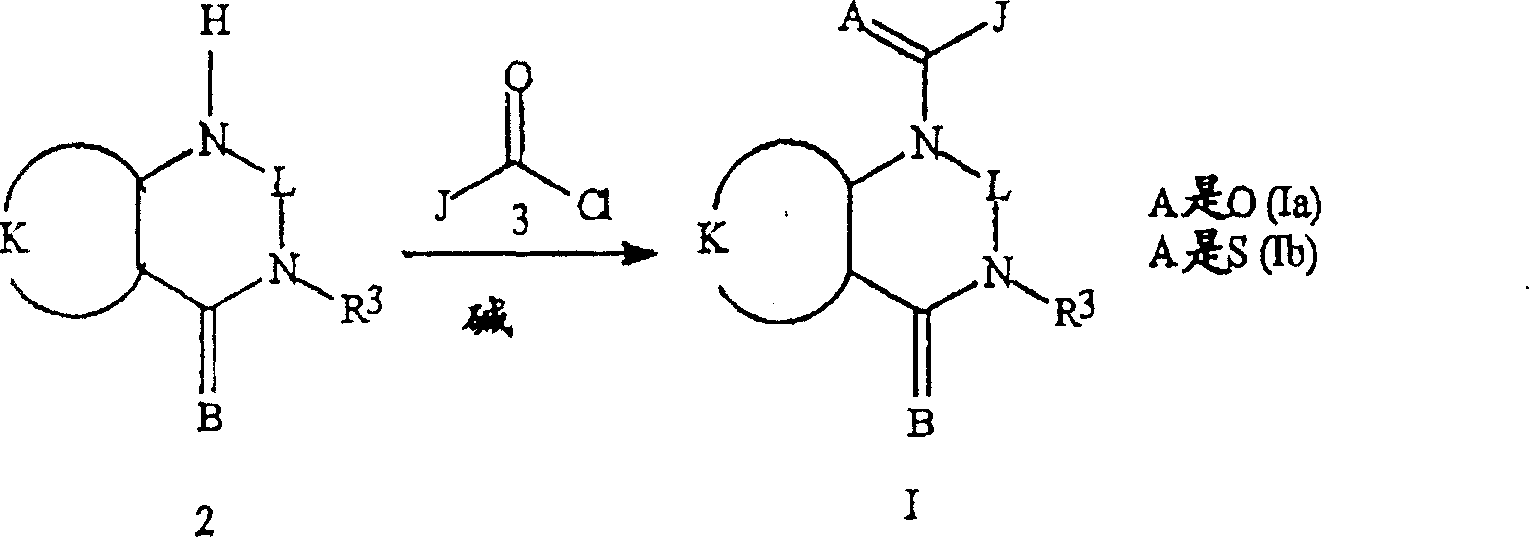
式Ic化合物(即式I化合物,其中K是K-1)的制备方法图示于反应方案2。式2a的喹唑啉二酮(其中L是CO)或式2b的衍生物(其中L是任选被一至三个各自独立地选自R13的取代基取代的C1-C3烷基)与式3的酰基氯反应获得式Ic化合物。上述方法还可用于制备其中K是选自K-2至K-6的式I化合物。The preparation method of the compound of formula Ic (ie, the compound of formula I, wherein K is K-1) is shown in Reaction Scheme 2. A quinazolinedione of formula 2a (wherein L is CO) or a derivative of formula 2b (wherein L is optionally substituted by one to three substituents independently selected from R 1 -C 3 alkyl ) Reaction with acid chlorides of formula 3 affords compounds of formula Ic. The above method can also be used to prepare compounds of formula I wherein K is selected from K-2 to K-6.
反应方案2Reaction scheme 2

如反应方案3所示,由已知的靛红酸酐经两步制备式2a化合物。第一步,以纯反应物或在适合的溶剂中将式4的靛红酸酐直接与式5的胺反应获得式6的酰胺。用光气或光气等效物处理式6的酰胺获得式2a的喹唑啉二酮。As shown in Reaction Scheme 3, compounds of formula 2a are prepared in two steps from known isatoic anhydrides. In the first step, the isatoic anhydride of formula 4 is directly reacted with the amine of formula 5 as pure reactant or in a suitable solvent to obtain the amide of formula 6. Treatment of amides of formula 6 with phosgene or a phosgene equivalent affords quinazolinediones of formula 2a.
反应方案3Reaction Scheme 3

如反应方案4所示,式2b化合物,其中Rx和Ry各自独立地是H以及R13的子集,该化合物通常是存在酸催化剂如对甲苯磺酸(pTSA)的条件下,通过式6化合物与醛或酮反应而制备。通过共沸除去反应生成的水或其它干燥方法可以有利地促进反应完成。As shown in Reaction Scheme 4, the compound of formula 2b, wherein Rx and Ry are each independently a subset of H and R 13 , the compound is usually passed through the compound of formula 6 in the presence of an acid catalyst such as p-toluenesulfonic acid (pTSA). Prepared by reacting with aldehydes or ketones. Azeotropic removal of water of reaction formation or other drying methods can advantageously be used to facilitate completion of the reaction.
反应方案4Reaction scheme 4
Rx和Ry各自独立地是H,烷基或芳基 Rx and Ry are each independently H, alkyl or aryl
如反应方案5所示,式2c化合物可通过式8的四氢喹啉酮和叠氮化钠的Schmidt反应而制备(J.Het.Chem.1971,8,231-236)。存在碱,如三乙胺的条件下,将式2c化合物与酰基氯3反应获得式If产物。As shown in Reaction Scheme 5, the compound of formula 2c can be prepared by Schmidt reaction of tetrahydroquinolinone of formula 8 and sodium azide (J. Het. Chem. 1971, 8, 231-236). In the presence of a base, such as triethylamine, the compound of formula 2c is reacted with acid chloride 3 to obtain the product of formula If.
反应方案5Reaction scheme 5
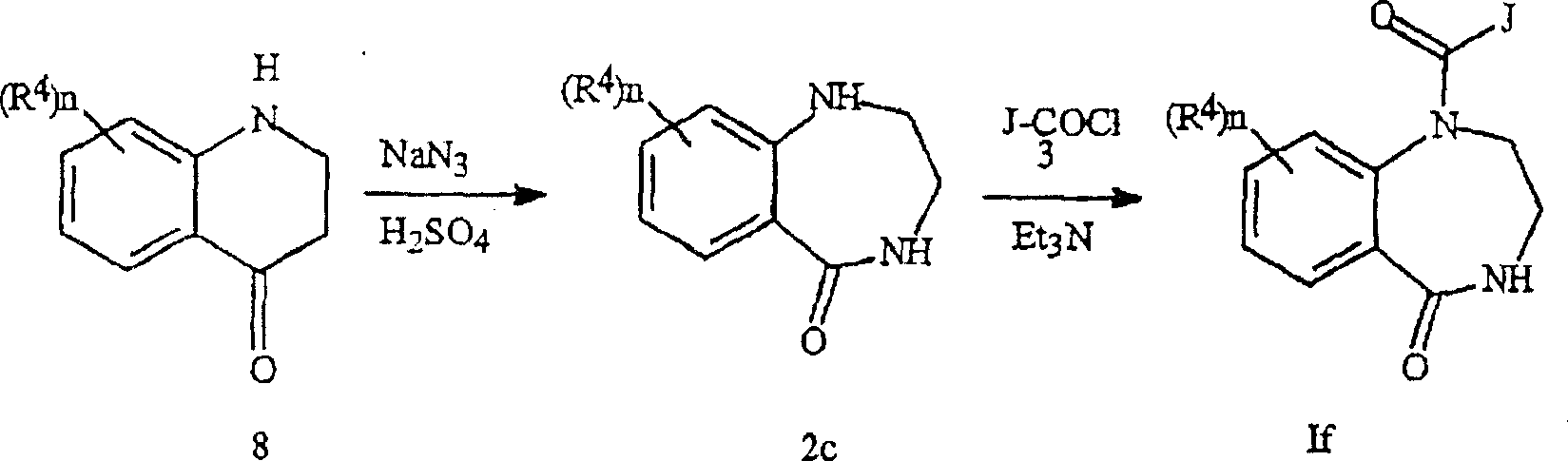
在化学文献中,式3的酰基氯已有许多文献证明以及通常可由对应的式9的已知芳基和杂芳基羧酸获得。许多式9的羧酸已公开于文献中。式9a-9f的特别优选的酸的制备方法以及它们的衍生酰氯公开在WO01/70671中。Acid chlorides of formula 3 are well documented in the chemical literature and are generally accessible from the corresponding known aryl and heteroaryl carboxylic acids of formula 9. A number of carboxylic acids of formula 9 have been disclosed in the literature. The preparation of particularly preferred acids of formulas 9a-9f and their derived acid chlorides is disclosed in WO 01/70671.
反应方案6Reaction Scheme 6

式9g-9i的吡啶基吡唑羧酸是式9的酸中特别优选的一组(反应方案7)。式10的吡唑与式11的2,3-二氯吡啶反应可获得高收率的具有对所需区域化学高专一性的式12的1-吡啶基吡唑。将式12化合物用二异丙基氨基化锂(LDA)金属化,然后用二氧化碳使锂盐淬灭(quench)获得式9g-9i的吡唑酸。有关式9i的合成方法的另外详述参见实施例1。The pyridylpyrazole carboxylic acids of formula 9g-9i are a particularly preferred group of acids of formula 9 (Scheme 7). Reaction of pyrazoles of formula 10 with 2,3-dichloropyridines of formula 11 provides high yields of 1-pyridylpyrazoles of formula 12 with high specificity for the desired regiochemistry. Metallation of compounds of formula 12 with lithium diisopropylamide (LDA) followed by quenching of the lithium salt with carbon dioxide affords pyrazole acids of formula 9g-9i. See Example 1 for additional details on the synthesis of formula 9i.
反应方案7Reaction scheme 7

作为起始物的式10的吡唑是已知化合物或可根据已知方法制备。吡唑10a可通过文献中公开的方法(J.Fluorine Chem.1991,53(1),61-70)制备。式10b和10c的吡唑也可以根据文献中公开的方法(Chem.Ber.1966,99(10),3350-7)制备。10b和10c的另一种有用的制备方法描述于反应方案8中。用正丁基锂(n-BuLi)将式13的氨磺酰吡唑金属化,随后用六氯乙烷或1,2-二溴四氯乙烷进行直接阴离子卤化获得式14的卤代衍生物。室温条件下用三氟乙酸(TFA)除去氨磺酰基,然后干净地和以高收率分别获得吡唑10b和10c。上述试验步骤的进一步详述记载于实施例1中。The pyrazoles of the formula 10 as starting materials are known compounds or can be prepared according to known methods. Pyrazole 10a can be prepared by methods disclosed in literature (J. Fluorine Chem. 1991, 53(1), 61-70). Pyrazoles of formula 10b and 10c can also be prepared according to methods disclosed in the literature (Chem. Ber. 1966, 99(10), 3350-7). Another useful preparation of 10b and 10c is described in Reaction Scheme 8. Metallation of sulfamoylpyrazoles of formula 13 with n-butyllithium (n-BuLi), followed by direct anionic halogenation with hexachloroethane or 1,2-dibromotetrachloroethane affords halo derivatives of formula 14 thing. Removal of the sulfamoyl group with trifluoroacetic acid (TFA) at room temperature then afforded pyrazoles 10b and 10c, respectively, cleanly and in high yield. Further details of the above test procedures are described in Example 1.
反应方案8Reaction scheme 8
作为反应方案7所示方法的另一种变化,式9h和9i的吡唑羧酸可通过反应方案9图示的方法制备。将肼基吡啶15与马来酸二乙酯反应获得吡唑啉酮16。用三氯氧化磷或三溴氧化磷氯化或溴化获得式17的卤代衍生物。任选存在酸的条件下将式17化合物氧化获得吡唑酯,然后将酯官能团转变为羧酸从而获得式9h或9i化合物。氧化剂可以是过氧化氢,有机过氧化物,过硫酸钾,过硫酸钠,过硫酸铵,单过硫酸钾(例如,Oxone)或高锰酸钾。As another variation of the method shown in Reaction Scheme 7, pyrazole carboxylic acids of formulas 9h and 9i can be prepared by the method shown in Reaction Scheme 9. Reaction of hydrazinopyridine 15 with diethyl maleate affords pyrazolone 16. Chlorination or bromination with phosphorus oxychloride or phosphorus oxybromide affords the halogenated derivatives of formula 17. Oxidation of compounds of formula 17, optionally in the presence of acid, affords pyrazole esters, followed by conversion of the ester functionality to carboxylic acids to afford compounds of formula 9h or 9i. The oxidizing agent can be hydrogen peroxide, an organic peroxide, potassium persulfate, sodium persulfate, ammonium persulfate, potassium monopersulfate (eg, Oxone(R)) or potassium permanganate.
反应方案9Reaction scheme 9
作为反应方案7所示方法的另一种变化,其中R5是CF3的式9g的吡唑羧酸还可以通过反应方案10中图示的方法制备。As another variation of the method shown in Reaction Scheme 7, pyrazole carboxylic acids of formula 9g wherein R 5 is CF 3 can also be prepared by the method illustrated in Reaction Scheme 10.
反应方案10Reaction Scheme 10

在适合的有机溶剂中,将式18化合物与适合的碱反应,然后用酸如乙酸中和获得式19的环化产物。适合的碱可以是,例如氢化钠,叔丁醇钾,甲基亚磺酰负碳离子钠(dimsyl sodium)(CH3S(O)CH2,Na+),碱金属(如锂,钠或钾)的碳酸盐或氢氧化物,氟化或氢氧化四烷基(如甲基,乙基或丁基)铵,或2-叔丁基亚氨基-2-二乙氨基-1,3-二甲基-全氢化-1,3,2-diazaphosphonine。适合的有机溶剂可以是,例如丙酮,乙腈,四氢呋喃,二氯甲烷,二甲基亚砜,或N,N-二甲基甲酰胺。式19化合物脱水获得式20化合物,随后将羧酸酯官能团转化为羧酸,获得式9g的酸。脱水是通过用催化量的适合的酸如硫酸处理而实现的。The compound of formula 18 is reacted with a suitable base in a suitable organic solvent, followed by neutralization with an acid such as acetic acid to obtain a cyclized product of formula 19. Suitable bases can be, for example, sodium hydride, potassium tert-butoxide, dimsyl sodium (CH 3 S(O)CH 2 , Na + ), alkali metals (such as lithium, sodium or potassium) carbonate or hydroxide, tetraalkyl (such as methyl, ethyl or butyl) ammonium fluoride or hydroxide, or 2-tert-butylimino-2-diethylamino-1,3 -Dimethyl-perhydro-1,3,2-diazaphosphonine. Suitable organic solvents may be, for example, acetone, acetonitrile, tetrahydrofuran, dichloromethane, dimethylsulfoxide, or N,N-dimethylformamide. Dehydration of compounds of formula 19 affords compounds of formula 20 and subsequent conversion of the carboxylate functionality to carboxylic acids yields acids of formula 9g. Dehydration is achieved by treatment with a catalytic amount of a suitable acid, such as sulfuric acid.
式18化合物可通过反应方案11图示的方法制备。Compounds of formula 18 can be prepared by the method illustrated in Reaction Scheme 11 .
反应方案11Reaction scheme 11

其中R5是CF3。wherein R 5 is CF 3 .
将式21的肼化合物在溶剂如水,甲醇或乙酸中用式22的酮处理获得式23的腙。在适合的有机溶剂如二氯甲烷或四氢呋喃中存在酸清除剂如三乙胺的条件下将式23的腙与乙基草酰氯反应获得式18化合物。式21的肼化合物可通过标准方法制备,例如将式11的相应的卤代化合物与肼接触而制备。Treatment of hydrazine compounds of formula 21 with ketones of formula 22 in a solvent such as water, methanol or acetic acid affords hydrazones of formula 23. Reaction of hydrazones of formula 23 with ethyl oxalyl chloride in the presence of an acid scavenger such as triethylamine in a suitable organic solvent such as dichloromethane or tetrahydrofuran affords compounds of formula 18. Hydrazine compounds of formula 21 can be prepared by standard methods, for example by contacting the corresponding halogenated compound of formula 11 with hydrazine.
应认识到的是,上述用于制备式I化合物的一些试剂和反应条件可能与中间体中存在的某些官能基团并不相容。在这些情况下,在合成过程中引入保护/脱保护程序或官能基团相互转换将有助于获得所需产物。保护基团的使用和选择对于化学合成的技术人员而言是显而易见的(参见,例如,Greene,T.W.;Wuts,P.G.M.的Protective Groups in OrganicSynthesis(有机合成中的保护基团)第二版;Wiley:New York,1991)。本领域技术人员将知道,在某些情况下,如在任何单独的反应方案中所描述的在引入特定试剂之后,可能需要进行另外的未加以详细描述的常规合成步骤,以完成式I化合物的合成。本领域技术人员还应认识到,需要时可以将上述反应方案所述步骤以介绍的特定顺序以外的顺序进行组合来制备式I化合物。本领域技术人员还应认识到,在此所述的式I化合物及中间体可以进行各种亲电,亲核,自由基,金属有机,氧化和还原反应,以加上取代基或对现有取代基进行改性。It will be recognized that some of the reagents and reaction conditions described above for the preparation of compounds of formula I may not be compatible with certain functional groups present in the intermediates. In these cases, introducing protection/deprotection procedures or interconversion of functional groups during the synthesis will help to obtain the desired products. The use and choice of protecting groups will be apparent to those skilled in chemical synthesis (see, e.g., Greene, T.W.; Wuts, P.G.M., Protective Groups in Organic Synthesis (Protective Groups in Organic Synthesis), 2nd Edition; Wiley: New York, 1991). Those skilled in the art will appreciate that in some cases, following the introduction of specific reagents as described in any individual reaction scheme, additional conventional synthetic steps not described in detail may be required to complete the synthesis of the compound of formula I. synthesis. Those skilled in the art will also recognize that the steps described in the above reaction schemes may be combined, if desired, in a sequence other than the specific order presented to prepare compounds of formula I. Those skilled in the art should also recognize that the compounds of formula I and intermediates described herein can undergo various electrophilic, nucleophilic, free radical, metal organic, oxidation and reduction reactions to add substituents or to existing Substituents are modified.
无需进一步详述,相信利用上述描述,本领域技术人员能够在最大程度范围内应用本发明。因此,以下的实施例只应视为示例性的,并不以任何方式对发明内容进行限制。除色谱溶剂混合物或另有说明外,百分数表示重量百分数。除非另有说明,色谱溶剂混合物的份数和百分数是以体积计。1H NMR光谱以ppm表示由四甲基硅烷的低场记录得到;s为单峰,d为双峰,t为三重峰,q为四重峰,m为多重峰,dd为双重的双峰,dt为双重的三重峰,br s为宽单峰。Without further elaboration, it is believed that one skilled in the art can, using the preceding description, utilize the present invention to its fullest extent. Therefore, the following embodiments should be regarded as exemplary only, and do not limit the content of the invention in any way. Percentages are by weight unless chromatographic solvent mixtures or otherwise stated. Parts and percentages of chromatographic solvent mixtures are by volume unless otherwise indicated. 1 H NMR spectrum in ppm obtained from downfield recording of tetramethylsilane; s is singlet, d is doublet, t is triplet, q is quartet, m is multiplet, dd is doublet doublet , dt is a double triplet, and br s is a broad singlet.
实施例1Example 1
6-溴-1-[[3-溴-1-(3-氯-2-吡啶基)-1H-吡唑-5-基]羰基]-8-甲基-3-(1-甲基乙基)-2,4(1H,3H)-喹唑啉二酮6-bromo-1-[[3-bromo-1-(3-chloro-2-pyridyl)-1H-pyrazol-5-yl]carbonyl]-8-methyl-3-(1-methylethyl base)-2,4(1H,3H)-quinazolinedione
步骤A:制备3-溴-N,N-二甲基-1H-吡唑-1-磺酰胺Step A: Preparation of 3-bromo-N,N-dimethyl-1H-pyrazole-1-sulfonamide
在-78℃,向N-二甲基氨磺酰吡唑(44.0g,0.251mol)的无水四氢呋喃(500mL)溶液中逐滴加入正丁基锂(2.5M己烷溶液,105.5mL,0.264mol)溶液,同时保持温度低于-60℃。在加入过程中形成粘稠固体。一旦加入完成,继续保持反应混合物另外15分钟,15分钟后逐滴加入1,2-二溴-四氯乙烷(90g,0.276mol)的四氢呋喃(150mL)溶液,同时保持温度低于-70℃。反应混合物转变为透明橙色;继续搅拌再一个15分钟。移走-78℃浴器,用水(600mL)使反应淬灭。将反应混合物用二氯甲烷萃取(4x),用硫酸镁干燥有机提取物并浓缩。将粗产物通过硅胶色谱进一步纯化,使用二氯甲烷/己烷(50∶50)作为洗脱剂,获得目标产物,为透明无色油状物(57.04g)。To a solution of N-dimethylsulfamoylpyrazole (44.0 g, 0.251 mol) in anhydrous tetrahydrofuran (500 mL) was added dropwise n-butyllithium (2.5 M in hexane, 105.5 mL, 0.264 mol) solution while keeping the temperature below -60°C. A viscous solid formed during the addition. Once the addition was complete, the reaction mixture was maintained for an additional 15 minutes, after which a solution of 1,2-dibromo-tetrachloroethane (90 g, 0.276 mol) in THF (150 mL) was added dropwise while maintaining the temperature below -70 °C . The reaction mixture turned clear orange; stirring was continued for another 15 minutes. The -78°C bath was removed and the reaction was quenched with water (600 mL). The reaction mixture was extracted with dichloromethane (4x), the organic extracts were dried over magnesium sulfate and concentrated. The crude product was further purified by silica gel chromatography using dichloromethane/hexane (50:50) as eluent to obtain the desired product as a clear colorless oil (57.04 g).
1H NMR(CDCl3)δ3.07(d,6H),6.44(m,1H),7.62(m,1H). 1 H NMR (CDCl 3 ) δ3.07 (d, 6H), 6.44 (m, 1H), 7.62 (m, 1H).
步骤B:制备3-溴吡唑Step B: Preparation of 3-bromopyrazole
向三氟乙酸(70mL)中缓慢加入步骤A得到溴吡唑产物(57.04g)。将反应混合物在室温条件下搅拌30分钟,然后减压浓缩。将剩余物溶解于己烷中,滤出不溶固体,蒸发掉己烷获得油状粗产物。通过硅胶色谱将粗产物进一步纯化,使用乙酸乙酯/二氯甲烷(10∶90)作为洗脱剂获得油状物。将所得油状物溶解于二氯甲烷中,用碳酸氢钠水溶液中和,二氯甲烷(3x)萃取,硫酸镁干燥并浓缩获得目标产物,白色固体(25.9g),熔点为61-64℃。Slow addition of Step A to trifluoroacetic acid (70 mL) afforded the bromopyrazole product (57.04 g). The reaction mixture was stirred at room temperature for 30 minutes, then concentrated under reduced pressure. The residue was dissolved in hexane, the insoluble solid was filtered off, and the hexane was evaporated to obtain an oily crude product. The crude product was further purified by silica gel chromatography using ethyl acetate/dichloromethane (10:90) as eluent to give an oil. The resulting oil was dissolved in dichloromethane, neutralized with aqueous sodium bicarbonate, extracted with dichloromethane (3x), dried over magnesium sulfate and concentrated to give the desired product as a white solid (25.9 g), mp 61-64°C.
1H NMR(CDCl3)δ6.37(d,1H),7.59(d,1H),12.4(br s,1H). 1 H NMR (CDCl 3 ) δ6.37 (d, 1H), 7.59 (d, 1H), 12.4 (br s, 1H).
步骤C:制备2-(3-溴-1H-吡唑-1-基)-3-氯吡啶Step C: Preparation of 2-(3-bromo-1H-pyrazol-1-yl)-3-chloropyridine
向含2,3-二氯吡啶(27.4g,185mmol)和3-溴吡唑(25.4g,176mmol)混合物的无水N,N-二甲基甲酰胺(88mL)中加入碳酸钾(48.6g,352mmol),将反应混合物加热至125℃并保持18小时。将反应混合物冷却至室温,然后倾入冰水(800mL)中。生成沉淀。将沉淀的固体搅拌1.5小时,过滤,用水洗涤(2×100mL)。将固体滤饼溶解在二氯甲烷中,依次用水,1N盐酸,饱和碳酸氢钠水溶液和盐水洗涤。然后将有机提取物用硫酸镁干燥并浓缩获得39.9g粉红色固体。将粗固体产物悬浮于己烷中,剧烈搅拌1小时。将固体过滤,用己烷洗涤并干燥获得目标产物,灰白色粉末(30.4g),通过NMR测定纯度为>94%。该产物可直接用于步骤D,而无需进一步纯化。Potassium carbonate (48.6 g , 352 mmol), the reaction mixture was heated to 125 °C and maintained for 18 hours. The reaction mixture was cooled to room temperature, then poured into ice water (800 mL). A precipitate formed. The precipitated solid was stirred for 1.5 hours, filtered and washed with water (2 x 100 mL). The solid filter cake was dissolved in dichloromethane and washed successively with water, 1N hydrochloric acid, saturated aqueous sodium bicarbonate and brine. The organic extract was then dried over magnesium sulfate and concentrated to obtain 39.9 g of a pink solid. The crude solid product was suspended in hexane and stirred vigorously for 1 hour. The solid was filtered, washed with hexanes and dried to afford the title product as an off-white powder (30.4 g) with >94% purity by NMR. This product was used directly in Step D without further purification.
1H NMR(CDCl3)δ6.52(s,1H),7.30(dd,1H),7.92(d,1H),8.05(s,1H),8.43(d,1H). 1 H NMR (CDCl 3 ) δ6.52(s, 1H), 7.30(dd, 1H), 7.92(d, 1H), 8.05(s, 1H), 8.43(d, 1H).
步骤D:制备3-溴-1-(3-氯-2-吡啶基)-1H)-吡唑-5-羧酸Step D: Preparation of 3-bromo-1-(3-chloro-2-pyridyl)-1H)-pyrazole-5-carboxylic acid
在-76℃,向步骤C获得的吡唑产物(30.4g,118mmol)的无水四氢呋喃(250mL)溶液中逐滴加入二异丙基氨基化锂(118mmol)四氢呋喃溶液,控制滴加的速度以保持温度低于-71℃。在-76℃,将反应混合物搅拌15分钟,然后向其中鼓入二氧化碳10分钟,使之升温至-57℃。使反应混合物升温至-20℃并用水淬灭反应。浓缩反应混合物,然后溶解在水(1L)和醚(500mL)中,然后加入氢氧化钠水溶液(1N,20mL)。将水相提取物用乙醚洗涤并用盐酸酸化。滤出沉淀的固体,用水洗涤并干燥获得目标产物,棕黄色固体(27.7g)(由类似方法的另一试验获得的产物的熔点为200-201℃)。At -76°C, in anhydrous tetrahydrofuran (250mL) solution of pyrazole product (30.4g, 118mmol) obtained in step C, was added dropwise lithium diisopropylamide (118mmol) tetrahydrofuran solution, and the rate of dropping was controlled to Keep the temperature below -71°C. The reaction mixture was stirred at -76°C for 15 minutes and then allowed to warm to -57°C by bubbling carbon dioxide through it for 10 minutes. The reaction mixture was allowed to warm to -20°C and quenched with water. The reaction mixture was concentrated, then dissolved in water (1 L) and ether (500 mL), then aqueous sodium hydroxide (1 N, 20 mL) was added. The aqueous extract was washed with ether and acidified with hydrochloric acid. The precipitated solid was filtered off, washed with water and dried to give the desired product as a tan solid (27.7 g) (melting point 200-201° C. for the product obtained from another trial in a similar manner).
1H NMR(DMSO-d6)δ7.25(s,1H),7.68(dd,1H),8.24(d,1H),8.56(d,1H). 1 H NMR (DMSO-d 6 )δ7.25(s, 1H), 7.68(dd, 1H), 8.24(d, 1H), 8.56(d, 1H).
步骤E:制备6-溴-8-甲基-2H-3,1-苯并嗪-2,4(1H)-二酮Step E: Preparation of 6-bromo-8-methyl-2H-3,1-benzoxazine-2,4(1H)-dione
向8-甲基-2H-3,1-苯并嗪-2,4(1H)-二酮(10.0g,56.5mmol)和碘化钾(0.36g,1.8mmol)的氯磺酸(12mL)溶液中加入溴(4.6g,28.7mmol),然后室温条件下将反应搅拌过夜。然后将反应物缓慢倾入冰水,加入碳酸氢钠粉末中和至pH为7。滤出固体,用水洗涤,获得所需的中间体,白色固体(11.4g)。To a solution of 8-methyl-2H-3,1-benzoxazine-2,4(1H)-dione (10.0g, 56.5mmol) and potassium iodide (0.36g, 1.8mmol) in chlorosulfonic acid (12mL) Bromine (4.6 g, 28.7 mmol) was added to , and the reaction was stirred overnight at room temperature. Then the reactant was slowly poured into ice water and neutralized to pH 7 by adding sodium bicarbonate powder. The solid was filtered off and washed with water to afford the desired intermediate as a white solid (11.4g).
1H NMR(DMSO)δ2.34(s,3H),7.76(m,3H),7.85(m,1H),11.21(s,1H). 1 H NMR (DMSO) δ2.34(s, 3H), 7.76(m, 3H), 7.85(m, 1H), 11.21(s, 1H).
步骤F:制备2-氨基-5-溴-3-甲基-N-(1-甲基乙基)苯甲酰胺Step F: Preparation of 2-amino-5-bromo-3-methyl-N-(1-methylethyl)benzamide
向步骤E获得的苯并嗪二酮(4.0g,15.56mmol)的吡啶(20mL)悬浮液中加入异丙胺(1.2g,20.23mmol),将反应加热至回流温度并保持2小时。然后将反应冷却,在旋转蒸发器上由甲苯浓缩,然后真空干燥获得固体(5.01g)。To a suspension of benzoxazinedione (4.0 g, 15.56 mmol) obtained in step E in pyridine (20 mL) was added isopropylamine (1.2 g, 20.23 mmol) and the reaction was heated to reflux temperature for 2 hours. The reaction was then cooled, concentrated from toluene on a rotary evaporator, and dried in vacuo to give a solid (5.01 g).
1H NMR(DMSO)δ1.29(d,6H),2.15(s,3H),4.25(m,1H),5.75(m,1H),7.24(m,1H)7.27(m,1H). 1 H NMR (DMSO) δ1.29(d, 6H), 2.15(s, 3H), 4.25(m, 1H), 5.75(m, 1H), 7.24(m, 1H), 7.27(m, 1H).
步骤G:制备6-溴-8-甲基-3-(1-甲基乙基)-2,4(1H,3H)-喹唑啉二酮Step G: Preparation of 6-bromo-8-methyl-3-(1-methylethyl)-2,4(1H,3H)-quinazolinedione
向由步骤F获得的邻氨基苯甲酰胺(1.11g,4.1mmol)的二烷(20mL)溶液中加入2.0M光气甲苯(2.3mL,4.6mmol)溶液。室温条件下将反应搅拌1小时,然后加热至回流并保持4小时,然后冷却至室温。滤出白色固体并干燥获得目标化合物(0.89g)。To a solution of anthranilamide (1.11 g, 4.1 mmol) from Step F in dioxane (20 mL) was added a 2.0 M solution of phosgene in toluene (2.3 mL, 4.6 mmol). The reaction was stirred at room temperature for 1 hour, then heated to reflux for 4 hours, then cooled to room temperature. The white solid was filtered off and dried to obtain the title compound (0.89 g).
1H NMR(DMSO)δ1.43(d,6H),2.34(s,3H),5.12(m,1H),7.67(s,1H),7.85(s,1H). 1 H NMR (DMSO) δ1.43(d, 6H), 2.34(s, 3H), 5.12(m, 1H), 7.67(s, 1H), 7.85(s, 1H).
步骤H:制备6-溴-1-[[3-溴-1-(3-氯-2-吡啶基)-1H-吡唑-5-基]羰基]-8-甲基-3-(1-甲基乙基)-2,4(1H,3H)-喹唑啉二酮Step H: Preparation of 6-bromo-1-[[3-bromo-1-(3-chloro-2-pyridyl)-1H-pyrazol-5-yl]carbonyl]-8-methyl-3-(1 -Methylethyl)-2,4(1H,3H)-quinazolinedione
向步骤G获得的喹唑啉二酮(245mg,0.825mmol)的二甲基甲酰胺(5mL)溶液中加入氢化钠(60%油分散体,36mg,0.90mmol),然后将反应在室温条件下进行搅拌。在分开的另一个含有步骤D的吡唑酸(500mg,1.65mmol)二氯甲烷(10mL)溶液的反应烧瓶中加入草酰氯(0.17mL,1.95mmol)和一滴DMF。将上述混合物搅拌2小时,然后在真空条件下浓缩并放置。将酰氯分成两等份。将两份中的一份溶解在5mLDMF中,并将其加入喹唑啉二酮/NaH反应混合物中,将所得混合物室温下搅拌3小时。将反应物在乙酸乙酯和水之间分配,用水洗涤两次,再用盐水洗涤,硫酸钠干燥。将粗产物通过硅胶色谱纯化,使用99∶1氯仿/丙酮作为洗脱剂,获得目标化合物,即本发明化合物。Add sodium hydride (60% oil dispersion, 36mg, 0.90mmol) to the dimethylformamide (5mL) solution of quinazolinedione (245mg, 0.825mmol) obtained in step G, and then react at room temperature Stir. In a separate reaction flask containing a solution of pyrazole acid from Step D (500 mg, 1.65 mmol) in dichloromethane (10 mL) was added oxalyl chloride (0.17 mL, 1.95 mmol) and a drop of DMF. The above mixture was stirred for 2 hours, then concentrated and left under vacuum. Divide the acid chloride into two equal portions. One of the two portions was dissolved in 5 mL of DMF and added to the quinazolidione/NaH reaction mixture, and the resulting mixture was stirred at room temperature for 3 hours. The reaction was partitioned between ethyl acetate and water, washed twice with water, brine, and dried over sodium sulfate. The crude product was purified by silica gel chromatography using 99:1 chloroform/acetone as eluent to obtain the target compound, the compound of the present invention.
1H NMR(CDCl3)δ1.47(d,6H),2.17(s,3H),5.08(m,1H),7.12(s,1H),7.39(dd,1H),7.54(d,1H),7.91(dd,1H),8.17(d,1H),8.34(dd,1H). 1 H NMR (CDCl 3 ) δ1.47(d, 6H), 2.17(s, 3H), 5.08(m, 1H), 7.12(s, 1H), 7.39(dd, 1H), 7.54(d, 1H) , 7.91(dd, 1H), 8.17(d, 1H), 8.34(dd, 1H).
实施例2Example 2
制备1-[[3-溴-1-(3-氯-2-吡啶基)-1H-吡唑-5-基]羰基]2,3-二氢-8-甲基-3-(1-甲基乙基)-4(1H)-喹唑啉酮Preparation of 1-[[3-bromo-1-(3-chloro-2-pyridyl)-1H-pyrazol-5-yl]carbonyl]2,3-dihydro-8-methyl-3-(1- Methylethyl)-4(1H)-quinazolinone
步骤A:制备2,3-二氢-8-甲基-3-(1-甲基乙基)-4(1H)-喹唑啉酮Step A: Preparation of 2,3-dihydro-8-methyl-3-(1-methylethyl)-4(1H)-quinazolinone
向2-氨基-3-甲基-N-(1-甲基乙基)苯甲酰胺(0.5g,2.6mmol)乙醇(10mL)溶液中加入低聚甲醛(78mg,2.6mmol)和对甲苯磺酸(18mg,95μmol),将混合物在回流条件下加热直至变为澄清(约4小时)。减压除去溶剂获得目标化合物(纯度95%),无需进一步纯化将其用于下一步。To a solution of 2-amino-3-methyl-N-(1-methylethyl)benzamide (0.5 g, 2.6 mmol) in ethanol (10 mL) was added paraformaldehyde (78 mg, 2.6 mmol) and p-toluenesulfonate acid (18 mg, 95 μmol), the mixture was heated at reflux until it became clear (about 4 hours). The solvent was removed under reduced pressure to obtain the title compound (purity 95%), which was used in the next step without further purification.
1H NMR(CDCl3)δ7.9-7.8(d,1H),7.2-7.1(d,1H),6.83(t,1H),4.97(m,1H),4.57(s,2H),2.17(s,3H),1.22(d,6H). 1 H NMR (CDCl 3 ) δ7.9-7.8(d, 1H), 7.2-7.1(d, 1H), 6.83(t, 1H), 4.97(m, 1H), 4.57(s, 2H), 2.17( s, 3H), 1.22(d, 6H).
步骤B:制备1-[[3-溴-1-(3-氯-2-吡啶基)-1H-吡唑-5-基]羰基]-2,3-二氢-8-甲基-3-(1-甲基乙基)-4(1H)-喹唑啉酮Step B: Preparation of 1-[[3-bromo-1-(3-chloro-2-pyridyl)-1H-pyrazol-5-yl]carbonyl]-2,3-dihydro-8-methyl-3 -(1-methylethyl)-4(1H)-quinazolinone
向3-溴-1-(3-氯-2-吡啶基)-1H-吡唑-5-羧酸(787mg,2.45mmol)(即实施例1步骤D的产物)的二氯甲烷(10mL)溶液中加入二甲基甲酰胺(20μL)和草酰氯(235μL)。将混合物搅拌1小时,此时溶液已变为澄清。减压除去挥发性物质后,将剩余物溶解在二氯甲烷(5mL)中,将溶液的一半加入含步骤A产物(0.25g,1.2mmol)与吡啶(148μL,1.8mmol)混合物的二氯甲烷(10mL)中。室温搅拌过夜后,加入载于有2%DVB(1g)的交联聚苯乙烯(Fluka Chemie AG catalog number 90603)的1,5,7-三氮杂二环[4.4.0]癸-5-烯,将混合物搅拌另一个15分钟。然后将混合物过滤并减压浓缩。所得剩余物通过硅胶色谱纯化获得目标化合物,即本发明化合物,白色固体(0.18g)。To 3-bromo-1-(3-chloro-2-pyridyl)-1H-pyrazole-5-carboxylic acid (787 mg, 2.45 mmol) (i.e. the product of step D of Example 1) in dichloromethane (10 mL) Dimethylformamide (20 μL) and oxalyl chloride (235 μL) were added to the solution. The mixture was stirred for 1 hour by which time the solution had become clear. After removal of volatiles under reduced pressure, the residue was dissolved in dichloromethane (5 mL) and half of the solution was added to dichloromethane containing a mixture of the product from Step A (0.25 g, 1.2 mmol) and pyridine (148 μL, 1.8 mmol) (10mL). After stirring overnight at room temperature, 1,5,7-triazabicyclo[4.4.0]dec-5- ene, the mixture was stirred for another 15 minutes. The mixture was then filtered and concentrated under reduced pressure. The resulting residue was purified by silica gel chromatography to obtain the target compound, the compound of the present invention, as a white solid (0.18 g).
1H NMR(CDCl3)δ8.3(m,1H),7.9-7.8(m,2H),7.4-7.3(m,3H),6.0-5.9(s,1H),5.9(d,1H),5.0-4.8(m,1H),4.4-4.3(d,1H),2.10(s,3H),1.3-1.1(m,6H). 1 H NMR (CDCl 3 ) δ8.3 (m, 1H), 7.9-7.8 (m, 2H), 7.4-7.3 (m, 3H), 6.0-5.9 (s, 1H), 5.9 (d, 1H), 5.0-4.8(m, 1H), 4.4-4.3(d, 1H), 2.10(s, 3H), 1.3-1.1(m, 6H).
下述实施例3举例说明了3-溴-1-(3-氯-2-吡啶基)-1H-吡唑-5-羧酸的另一种制备方法,该化合物可通过实施例1和2中所述步骤用于制备,例如6-溴-1-[[3-溴-1-(3-氯-2-吡啶基)-1H-吡唑-5-基]羰基]-8-甲基-3-(1-甲基乙基)-2,4(1H,3H)-喹唑啉二酮和1-[[3-溴-1-(3-氯-2-吡啶基)-1H-吡唑-5-基]羰基]-2,3-二氢-8-甲基-3-(1-甲基乙基)-4(1H)-喹唑啉酮。Example 3 below illustrates an alternative preparation of 3-bromo-1-(3-chloro-2-pyridyl)-1H-pyrazole-5-carboxylic acid, which can be obtained from Examples 1 and 2 The procedure described in is used to prepare, for example, 6-bromo-1-[[3-bromo-1-(3-chloro-2-pyridyl)-1H-pyrazol-5-yl]carbonyl]-8-methyl -3-(1-methylethyl)-2,4(1H,3H)-quinazolinedione and 1-[[3-bromo-1-(3-chloro-2-pyridyl)-1H- Pyrazol-5-yl]carbonyl]-2,3-dihydro-8-methyl-3-(1-methylethyl)-4(1H)-quinazolinone.
实施例3Example 3
制备3-溴-1-(3-氯-2-吡啶基)-1H-吡唑-5-羧酸Preparation of 3-bromo-1-(3-chloro-2-pyridyl)-1H-pyrazole-5-carboxylic acid
步骤A:制备2-(3-氯-2-吡啶基)-5-氧代-3-吡唑烷羧酸乙酯Step A: Preparation of ethyl 2-(3-chloro-2-pyridyl)-5-oxo-3-pyrazolidinecarboxylate
向配有机械搅拌器,温度计,加料漏斗,回流冷凝器和氮气入口的2-L四颈口烧瓶中加入无水乙醇(250mL)和乙醇钠的乙醇溶液(21%,190mL,0.504mol)。将混合物加热至约83℃的回流温度。然后用3-氯-2(1H)-吡啶酮腙(68.0g,0.474mol)处理。将混合物经5分钟时间再次加热至回流。然后将黄色浆液用马来酸二乙酯(88.0mL,0.544mol)经5分钟时间逐滴处理。滴加过程中回流速率显著增加。滴加结束后,起始物全部溶解。将所得橙红色溶液在回流条件下保持10分钟。冷却至65℃后,将反应混合物用冰醋酸(50.0mL,0.873mol)处理。生成沉淀。将混合物用水(650mL)稀释,使沉淀溶解。将橙色溶液在冰浴中冷却。产物在28℃时开始沉淀。将浆液在约2℃保持2小时。通过过滤分离产物,用乙醇水溶液(40%,3×50mL)洗涤,然后在过滤器中风干约1小时。获得高度结晶的浅橙色粉末的目标产物化合物(70.3g,55%的收率)。1H NMR检测没有明显的杂质。To a 2-L four-necked flask equipped with a mechanical stirrer, thermometer, addition funnel, reflux condenser and nitrogen inlet was added absolute ethanol (250 mL) and sodium ethoxide in ethanol (21%, 190 mL, 0.504 mol). The mixture was heated to a reflux temperature of about 83°C. It was then treated with 3-chloro-2(1H)-pyridone hydrazone (68.0 g, 0.474 mol). The mixture was heated to reflux again over a period of 5 minutes. The yellow slurry was then treated with diethyl maleate (88.0 mL, 0.544 mol) dropwise over 5 minutes. The reflux rate increased significantly during the dropwise addition. After the dropwise addition was complete, the starting material was completely dissolved. The resulting orange-red solution was maintained at reflux for 10 minutes. After cooling to 65 °C, the reaction mixture was treated with glacial acetic acid (50.0 mL, 0.873 mol). A precipitate formed. The mixture was diluted with water (650 mL) to dissolve the precipitate. The orange solution was cooled in an ice bath. The product started to precipitate at 28°C. The slurry was maintained at about 2°C for 2 hours. The product was isolated by filtration, washed with aqueous ethanol (40%, 3 x 50 mL), and then air dried on the filter for about 1 hour. The title compound (70.3 g, 55% yield) was obtained as a highly crystalline light orange powder. 1 H NMR detected no obvious impurities.
1H NMR(DMSO-d6)δ1.22(t,3H),2.35(d,1H),2.91(dd,1H),4.20(q,2H),4.84(d,1H),7.20(dd,1H),7.92(d,1H),8.27(d,1H),10.18(s,1H). 1 H NMR (DMSO-d 6 ) δ1.22(t, 3H), 2.35(d, 1H), 2.91(dd, 1H), 4.20(q, 2H), 4.84(d, 1H), 7.20(dd, 1H), 7.92(d, 1H), 8.27(d, 1H), 10.18(s, 1H).
步骤B:制备3-溴-1-(3-氯-2-吡啶基)-4,5-二氢-1H-吡唑-5-羧酸乙酯Step B: Preparation of ethyl 3-bromo-1-(3-chloro-2-pyridyl)-4,5-dihydro-1H-pyrazole-5-carboxylate
向配有机械搅拌器,温度计,回流冷凝器和氮气入口的1-L四颈口烧瓶中加入乙腈(400mL),2-(3-氯-2-吡啶基)-5-氧代-3-吡唑烷羧酸乙酯(即步骤A的产物)(50.0g,0.185mol)和三溴氧化磷(34.0g,0.119mol)。将橙色浆液经20分钟时间加热至83℃回流。将所得混浊的,橙色溶液保持回流75分钟,此后生成浓的,褐色,结晶状沉淀。然后用蒸馏头取代回流冷凝器,收集混浊的无色馏出液(300mL)。向第二个配有机械搅拌器的1-L四颈口烧瓶中加入碳酸氢钠(45g,0.54mol)和水(200mL)。将浓缩的反应混合物经5分钟时间加入碳酸氢钠浆料中。将所得两相混合物剧烈搅拌5分钟,此时已停止气体放出。用二氯甲烷(200mL)稀释混合物,然后搅拌75分钟。将混合物用5g Celite545硅藻土助滤剂处理,然后过滤除去褐色,焦油状物质。将滤液转移至分液漏斗。分离褐色有机层(400mL),然后用硫酸镁(15g)和DarcoG60活性炭(2.0g)处理。将所得浆液磁力搅拌15分钟,然后过滤除去硫酸镁和活性炭。将绿色滤液用硅胶(3g)处理并搅拌几分钟。通过过滤除去深蓝绿色硅胶,将滤液通过旋转蒸发器浓缩。产物是浅琥珀色油(58.6g,95%收率),静置结晶。通过1HNMR仅有的可观测的杂质是0.3%乙腈。Acetonitrile (400 mL), 2-(3-chloro-2-pyridyl)-5-oxo-3- Ethyl pyrazolidinecarboxylate (ie, the product of Step A) (50.0 g, 0.185 mol) and phosphorus oxybromide (34.0 g, 0.119 mol). The orange slurry was heated to reflux at 83°C over a period of 20 minutes. The resulting cloudy, orange solution was kept at reflux for 75 minutes, after which time a thick, brown, crystalline precipitate formed. The reflux condenser was then replaced with a distillation head and the cloudy colorless distillate (300 mL) was collected. Into a second 1-L four-necked flask equipped with a mechanical stirrer was added sodium bicarbonate (45 g, 0.54 mol) and water (200 mL). The concentrated reaction mixture was added to the sodium bicarbonate slurry over 5 minutes. The resulting biphasic mixture was stirred vigorously for 5 minutes, at which point gas evolution had ceased. The mixture was diluted with dichloromethane (200 mL), then stirred for 75 minutes. The mixture was treated with 5 g of Celite(R) 545 diatomaceous earth filter aid, then filtered to remove brown, tarry material. Transfer the filtrate to a separatory funnel. The brown organic layer (400 mL) was separated and then treated with magnesium sulfate (15 g) and Darco(R) G60 activated carbon (2.0 g). The resulting slurry was magnetically stirred for 15 minutes, then filtered to remove magnesium sulfate and activated carbon. The green filtrate was treated with silica gel (3 g) and stirred for a few minutes. The dark blue-green silica gel was removed by filtration, and the filtrate was concentrated by rotary evaporator. The product was a light amber oil (58.6 g, 95% yield) which crystallized on standing. The only observable impurity by 1 HNMR was 0.3% acetonitrile.
1H NMR(DMSO-d6)δ1.15(t,3H),3.29(dd,1H),3.60(dd,1H),4.11(q,2H),5.20(dd,1H),6.99(dd,1H),7.84(d,1H),8.12(d,1H). 1 H NMR (DMSO-d 6 ) δ1.15(t, 3H), 3.29(dd, 1H), 3.60(dd, 1H), 4.11(q, 2H), 5.20(dd, 1H), 6.99(dd, 1H), 7.84(d, 1H), 8.12(d, 1H).
步骤C:制备3-溴-1-(3-氯-2-吡啶基)-1H-吡唑-5-羧酸乙酯Step C: Preparation of ethyl 3-bromo-1-(3-chloro-2-pyridyl)-1H-pyrazole-5-carboxylate
向配有机械搅拌器,温度计,回流冷凝器和氮气入口的1-L四颈口烧瓶中加入3-溴-1-(3-氯-2-吡啶基)-4,5-二氢-1H-吡唑-5-羧酸乙酯(即步骤B的产物)(40.2g,0.121mol),乙腈(300mL)和硫酸(98%,13.0mL,0.245mol)。加入硫酸后混合物由22℃自加热至36℃。搅拌几分钟后,将混合物用过硫酸钾(48.0g,0.178mol)处理。将浆液加热至回流,在84℃保持2小时。当所得橙色浆液还温热(50-65℃)时过滤除去白色沉淀。将滤饼用乙腈(2×50mL)洗涤。通过旋转蒸发器将滤液浓缩至约200mL。向第二个配有机械搅拌器的1-L四颈口烧瓶中加入水(400mL)。将浓缩的反应物料在约5分钟时间内加入水中。通过过滤分离产物,依次用乙腈水溶液(20%,100mL)和水(75mL)洗涤,然后过滤器上风干1小时。产物是结晶的,橙色粉末(36.6g,90%收率)。通过1H NMR仅有的可观测的杂质是约1%的未知物质和0.5%的乙腈。Add 3-bromo-1-(3-chloro-2-pyridyl)-4,5-dihydro-1H to a 1-L four-necked flask equipped with a mechanical stirrer, thermometer, reflux condenser and nitrogen inlet - Ethyl pyrazole-5-carboxylate (ie the product of step B) (40.2 g, 0.121 mol), acetonitrile (300 mL) and sulfuric acid (98%, 13.0 mL, 0.245 mol). The mixture was autoheated from 22°C to 36°C after adding sulfuric acid. After stirring for several minutes, the mixture was treated with potassium persulfate (48.0 g, 0.178 mol). The slurry was heated to reflux at 84°C for 2 hours. The resulting orange slurry was filtered to remove the white precipitate while still warm (50-65°C). The filter cake was washed with acetonitrile (2 x 50 mL). The filtrate was concentrated to about 200 mL by rotary evaporator. Water (400 mL) was added to a second 1-L four-necked flask equipped with a mechanical stirrer. The concentrated reaction mass was added to water over about 5 minutes. The product was isolated by filtration, washed sequentially with aqueous acetonitrile (20%, 100 mL) and water (75 mL), then air dried on the filter for 1 hour. The product was a crystalline, orange powder (36.6 g, 90% yield). The only observable impurities by 1 H NMR were about 1% unknown material and 0.5% acetonitrile.
1H NMR(DMSO-d6)δ1.09(t,3H),4.16(q,2H),7.35(s,1H),7.72(dd,1H),8.39(d,1H),8.59(d,1H). 1 H NMR (DMSO-d 6 ) δ1.09(t, 3H), 4.16(q, 2H), 7.35(s, 1H), 7.72(dd, 1H), 8.39(d, 1H), 8.59(d, 1H).
步骤D:制备3-溴-1-(3-氯-2-吡啶基)-1H-吡唑-5-羧酸Step D: Preparation of 3-bromo-1-(3-chloro-2-pyridyl)-1H-pyrazole-5-carboxylic acid
向配有机械搅拌器,温度计和氮气入口的300-mL四颈烧瓶中加入3-溴-1-(3-氯-2-吡啶基)-1H-吡唑-5-羧酸乙酯(即步骤C的产物)(纯度98.5%,25.0g,0.0756mol),甲醇(75mL),水(50mL)和氢氧化钠片(3.30g,0.0825mol)。加入氢氧化钠后混合物由29℃自加热至34℃并且起始物开始溶解。室温条件下搅拌90分钟后,起始物则全部溶解。通过旋转蒸发器将所得深橙色溶液浓缩至约90mL。然后将浓缩的反应混合物用水(160mL)稀释。用乙醚(100mL)萃取水溶液。然后将水层转移至装有磁力搅拌器的500-mL锥形瓶中。在约10分钟内用浓盐酸(8.50g,0.0839mol)逐滴处理溶液。通过过滤分离产物,用水(2×40mL)重新浆化,用水(25mL)覆盖洗涤一次(cover washed once),然后过滤器中风干2小时。产物是结晶状,褐色粉末(20.9g,91%收率)。通过1H NMR仅有的可观测的杂质是约0.8%的未知物质和0.7%的乙醚。To a 300-mL four-necked flask equipped with a mechanical stirrer, a thermometer, and a nitrogen inlet, was added ethyl 3-bromo-1-(3-chloro-2-pyridyl)-1H-pyrazole-5-carboxylate (i.e. Product of Step C) (purity 98.5%, 25.0 g, 0.0756 mol), methanol (75 mL), water (50 mL) and sodium hydroxide pellets (3.30 g, 0.0825 mol). After addition of sodium hydroxide the mixture was auto-warmed from 29°C to 34°C and the starting material started to dissolve. After stirring at room temperature for 90 minutes, the starting material was completely dissolved. The resulting dark orange solution was concentrated to about 90 mL by rotary evaporator. The concentrated reaction mixture was then diluted with water (160 mL). The aqueous solution was extracted with diethyl ether (100 mL). The aqueous layer was then transferred to a 500-mL Erlenmeyer flask equipped with a magnetic stirrer. The solution was treated dropwise with concentrated hydrochloric acid (8.50 g, 0.0839 mol) over about 10 minutes. The product was isolated by filtration, reslurried with water (2 x 40 mL), cover washed once with water (25 mL), and air dried on the filter for 2 hours. The product was a crystalline, brown powder (20.9 g, 91% yield). The only observable impurities by 1 H NMR were about 0.8% unknown material and 0.7% diethyl ether.
1H NMR(DMSO-d6)δ7.25(s,1H),13.95(br s,1H),8.56(d,1H),8.25(d,1H),7.68(dd,1H). 1 H NMR (DMSO-d 6 )δ7.25(s, 1H), 13.95(br s, 1H), 8.56(d, 1H), 8.25(d, 1H), 7.68(dd, 1H).
通过在此叙述的方法与本技术领域中已知的方法可制备表1-10的下述化合物。在表中采用的缩写如下:t为叔,s为仲,n为正,i为异,c为环,Me为甲基,Et为乙基,Pr为丙基,i-Pr为异丙基,Bu为丁基和t-Bu为叔丁基。The following compounds in Tables 1-10 can be prepared by methods described herein and methods known in the art. The abbreviations used in the table are as follows: t is tertiary, s is secondary, n is positive, i is iso, c is ring, Me is methyl, Et is ethyl, Pr is propyl, i-Pr is isopropyl , Bu is butyl and t-Bu is t-butyl.
表1 Table 1

L是C=O
L是C=O
L是CH2
L是CH2
L是CH2CH2
L是CH2CH2
表2 Table 2

L是C=O
L是C=O
L是CH2
L是CH2
L是CH2CH2
L是CH2CH2
表3 table 3

L是C=O
L是C=O
L是CH2
L是CH2
L是CH2CH2
L是CH2CH2
表4 Table 4
L是C=O
L是C=O
L是CH2
L是CH2
L是CH2CH2
L是CH2CH2
表5 table 5

L是C=O
L是C=O
L是CH2
L是CH2
L是CH2CH2
L是CH2CH2
表6Table 6

L是C=O
L是C=O
L是CH2
L是CH2
L是CH2CH2
L是CH2CH2
表7Table 7
L是C=O
L是C=O
L是CH2
L是CH2
L是CH2CH2
L是CH2CH2
表8Table 8

L是C=O
L是C=O
L是CH2
L是CH2
L是CH2CH2
L是CH2CH2
表9Table 9

L是C=O
L是C=O
L是CH2
L是CH2
L是CH2CH2
表10Table 10

L是C=O
L是C=O
L是CH2
L是CH2
L是CH2CH2
剂型/应用Dosage Form/Application
本发明化合物一般与农业上适宜的载体一起制成剂型或组合物来应用,适宜的载体包括至少一种液体稀释剂,固体稀释剂或表面活性剂。剂型或组合物成分的选择应与有效成分的物理性质,应用方式和环境因素例如土壤类型,湿度和温度相一致。有效的剂型包括液体制剂,如溶液(包括乳油),悬浮剂,乳剂(包括微乳剂和/或悬浮乳剂)等,这些剂型可任选增稠为凝胶。有效的制剂还包括固体剂型如粉剂,细粉剂,颗粒剂,丸剂,片剂,薄雾剂(film)等,这些剂型可以是水分散性的(“可润湿的”)或水溶性的。活性成分可被(微)胶囊化,再制成悬浮剂或固体剂型;另外包括活性成分的全部制剂成分可加工成胶囊(或“包衣”)。制成胶囊后可控制或延缓释放活性成分。可喷雾剂型可通过适合的介质增溶并以每公顷大约一百至几百升的喷雾体积量使用。高浓度组合物主要用于进一步加工制剂的中间制剂。The compounds of the present invention are generally used in formulations or compositions together with an agriculturally suitable carrier, which includes at least one liquid diluent, solid diluent or surfactant. The choice of formulation or composition ingredient should be consistent with the physical properties of the active ingredient, the mode of application and environmental factors such as soil type, humidity and temperature. Useful dosage forms include liquid preparations such as solutions (including emulsifiable concentrates), suspensions, emulsions (including microemulsions and/or suspoemulsions), etc., which may optionally be thickened into gels. Useful formulations also include solid dosage forms such as powders, fine powders, granules, pills, tablets, films and the like, which may be water-dispersible ("wettable") or water-soluble. The active ingredient can be (micro)encapsulated and then made into a suspension or solid dosage form; otherwise, the entire formulation composition including the active ingredient can be processed into a capsule (or "coating"). Capsules allow for controlled or delayed release of the active ingredient. Sprayable formulations can be solubilized by a suitable medium and used at spray volumes of about one hundred to several hundred liters per hectare. High strength compositions are mainly used as intermediate formulations for further processing of formulations.
各剂型通常含有下述大致范围内的有效量的活性成分,稀释剂和表面活性剂,加至100%重量。
通用的固体稀释剂公开在下列文献中:Watkins等,Handbook ofInsecticide Dust Diluents and Carriers,第2版,DorlandBooks,Caldwell,New Jersey。通用的液体稀释剂公开在下列文献中:Marsden,Solvents Guide,第2版,Interscience,New York,1950。McCutcheon’s Detergents and Emulsifiers Annual,AlluredPubl.Corp.,Ridgewood,New Jersey,以及Sisely and Wood,Encyclopediaof Surface Active Agents,Chemical Publ.Co.,Inc.,New York,1964,两篇文献中列出了表面活性剂及其推荐应用。所有剂型都可含有少量的添加剂以减少泡沫,结块,腐蚀,微生物生长等,或加入增稠剂以提高粘度。Common solid diluents are disclosed in: Watkins et al., Handbook of Insecticide Dust Diluents and Carriers, 2nd Edition, Dorland Books, Caldwell, New Jersey. Common liquid diluents are disclosed in: Marsden, Solvents Guide, 2nd Ed., Interscience, New York, 1950. Surfactants are listed in McCutcheon's Detergents and Emulsifiers Annual, AlluredPubl.Corp., Ridgewood, New Jersey, and Sisely and Wood, Encyclopedia of Surface Active Agents, Chemical Publ.Co., Inc., New York, 1964 and its recommended applications. All dosage forms can contain small amounts of additives to reduce foaming, caking, corrosion, microbial growth, etc., or thickeners to increase viscosity.
表面活性剂包括,例如,聚乙氧基化醇,聚乙氧基化烷基酚,聚乙氧基化脱水山梨糖醇脂肪酸酯,磺化丁二酸二烷基酯,硫酸烷基酯,烷基苯磺酸盐,有机硅氧烷,N,N-二烷基牛磺酸酯,木质素磺酸盐,萘磺酸盐甲醛缩合物,聚羧酸酯以及聚氧乙烯/聚氧丙烯嵌段共聚物。固体稀释剂包括,例如,粘土如膨润土,蒙脱石,硅镁土和高岭土,淀粉,糖,二氧化硅,滑石,硅藻土,尿素,碳酸钙,碳酸钠和碳酸氢钠,以及硫酸钠。液体稀释剂包括,例如,水,N,N-二甲基甲酰胺,二甲基亚砜,N-烷基吡咯烷酮,乙二醇,聚丙二醇,石蜡,烷基苯,烷基萘,橄榄油,蓖麻油,亚麻籽油,桐油,芝麻油,玉米油,花生油,棉籽油,大豆油,菜籽油和椰子油,脂肪酸酯,酮,如环己酮,2-庚酮,异佛尔酮和4-羟基-4-甲基-2-戊酮,以及醇如甲醇,环己醇,癸醇和四氢糠醇。Surfactants include, for example, polyethoxylated alcohols, polyethoxylated alkylphenols, polyethoxylated sorbitan fatty acid esters, dialkyl sulfosuccinates, alkyl sulfates , alkylbenzenesulfonate, organosiloxane, N,N-dialkyltaurine, lignosulfonate, naphthalenesulfonate formaldehyde condensate, polycarboxylate and polyoxyethylene/polyoxygen Propylene block copolymer. Solid diluents include, for example, clays such as bentonite, montmorillonite, attapulgite and kaolin, starches, sugars, silica, talc, diatomaceous earth, urea, calcium carbonate, sodium carbonate and bicarbonate, and sodium sulfate . Liquid diluents include, for example, water, N,N-dimethylformamide, dimethylsulfoxide, N-alkylpyrrolidones, ethylene glycol, polypropylene glycol, paraffin, alkylbenzenes, alkylnaphthalenes, olive oil , castor oil, linseed oil, tung oil, sesame oil, corn oil, peanut oil, cottonseed oil, soybean oil, rapeseed oil and coconut oil, fatty acid esters, ketones such as cyclohexanone, 2-heptanone, isophorone and 4-hydroxy-4-methyl-2-pentanone, and alcohols such as methanol, cyclohexanol, decanol and tetrahydrofurfuryl alcohol.
溶液剂型,包括乳油,可通过简单地混和各组分来制备。粉剂和细粉剂可通过混和并通常在锤磨机或气流粉碎机中研磨而制备。悬浮剂通常通过湿磨来制备;参见,例如,U.S.3,060,084。颗粒剂和丸剂可通过将活性成分喷雾至预制的颗粒载体上或通过造粒技术而制备。参见Browning,“Agglomeration”,Chemical Engineering,1967年12月4日,第147-48页,Perry’s Chemical Engineer’s Handbook,第4版,McGraw-Hill,New York,1963,第8-57页及以下以及PCT申请,公开号WO91/13546。丸剂可通过如U.S.4,172,714中所述方法制备。水分散性和水溶性颗粒剂可通过U.S.4,144,050,U.S.3,920,442和DE3,246,493中教导的方法制备。片剂可通过U.S.5,180,587,U.S.5,232,701和U.S.5,208,030中所述方法制备。薄雾剂可通过GB2,095,558和U.S.3,299,566中教导的方法制备。Solution forms, including emulsifiable concentrates, can be prepared by simply mixing the ingredients. Dusts and fines can be prepared by mixing and grinding, usually in a hammer mill or jet mill. Suspensions are usually prepared by wet milling; see, eg, U.S. 3,060,084. Granules and pellets can be prepared by spraying the active ingredient onto preformed granular carriers or by granulation techniques. See Browning, "Agglomeration", Chemical Engineering, Dec. 4, 1967, pp. 147-48, Perry's Chemical Engineer's Handbook, 4th ed., McGraw-Hill, New York, 1963, pp. 8-57ff. and PCT Application, Publication No. WO91/13546. Pellets may be prepared as described in U.S. 4,172,714. Water-dispersible and water-soluble granules can be prepared by the methods taught in U.S. 4,144,050, U.S. 3,920,442 and DE 3,246,493. Tablets may be prepared by the methods described in U.S. 5,180,587, U.S. 5,232,701 and U.S. 5,208,030. Mists can be prepared by the methods taught in GB 2,095,558 and U.S. 3,299,566.
有关剂型加工工艺的更多信息,参见T.S.Woods,“The Formulator’sToolbox-Product Forms for Modern Agriculture”in Pesticide Chemistryand Bioscience,The Food-Environment Challenge,T.Brooks andT.R.Roberts,Eds.,Proceedings of the 9th International Congress onPesticide Chemistry,The Royal Society of Chemistry,Cambridge,1999,pp.120-133.还可参见U.S.3,235,361,第6栏,第16行至第7栏第19行以及实施例10-41;U.S.3,309,192,第5栏第43行至第7栏第62行和实施例8,12,15,39,41,52,53,58,132,138-140,162-164,166,167和169-182;U.S.2,891,855,第3栏,第66行至第5栏第17行以及实施例1-4;Klingman,Weed Control as a Science,John Wiley and Sons,Ine.,NewYork,1961,pp81-96;以及Hance等,Weed Control Handbook,第8版,Blackwell Scientific Publications,Oxford,1989。For more information on dosage form processing, see TS Woods, "The Formulator's Toolbox-Product Forms for Modern Agriculture" in Pesticide Chemistry and Bioscience, The Food-Environment Challenge, T. Brooks and T.R. Roberts, Eds., Proceedings of the 9 th International Congress on Pesticide Chemistry, The Royal Society of Chemistry, Cambridge, 1999, pp. 120-133. See also US 3,235,361, column 6, line 16 to column 7, line 19 and examples 10-41 ; US 3,309,192, column 5, line 43 to column 7, line 62 and examples 8, 12, 15, 39, 41, 52, 53, 58, 132, 138-140, 162-164, 166, 167 and 169-182; US2,891,855, column 3, line 66 to column 5, line 17 and Examples 1-4; Klingman, Weed Control as a Science, John Wiley and Sons, Ine., NewYork, 1961, pp81-96; and Hance et al., Weed Control Handbook, 8th Edition, Blackwell Scientific Publications, Oxford, 1989.
在以下实施例中,所有百分数均以重量计,所有剂型都是通过常规方法制备的。化合物序号参见索引表A中的化合物。In the following examples, all percentages are by weight and all dosage forms are prepared by conventional methods. See the compounds in Index Table A for compound numbers.
实施例AExample A
可湿性粉剂wettable powder
化合物1 65.0%Compound 1 65.0%
十二烷基酚聚乙二醇醚 2.0%Laurylphenol Polyethylene Glycol Ether 2.0%
木质素磺酸钠 4.0%Sodium Lignosulfonate 4.0%
硅铝酸钠 6.0%Sodium aluminosilicate 6.0%
蒙脱石(煅烧的) 23.0%Montmorillonite (calcined) 23.0%
实施例BExample B
颗粒剂Granules
化合物1 10.0%Compound 1 10.0%
硅镁土颗粒(低挥发物, 90.0%Attapulgite particles (low volatile matter, 90.0%
0.71/0.30mm;U.S.S.No.25-50筛)0.71/0.30mm; U.S.S.No.25-50 sieve)
实施例CExample C
挤出丸剂extrusion pill
化合物1 25.0%Compound 1 25.0%
无水硫酸钠 10.0%Anhydrous Sodium Sulfate 10.0%
粗木质素磺酸钙 5.0%Crude Calcium Lignosulfonate 5.0%
烷基萘磺酸钠 1.0%Sodium alkylnaphthalene sulfonate 1.0%
钙/镁膨润土 59.0%Calcium/magnesium bentonite 59.0%
实施例DExample D
乳油Cream
化合物1 20.0%Compound 1 20.0%
油溶性磺酸盐和oil soluble sulfonates and
聚氧乙烯醚的混合物 10.0%Mixture of polyoxyethylene ethers 10.0%
异佛尔酮 70.0%Isophorone 70.0%
实施例EExample E
颗粒剂Granules
化合物1 0.5%Compound 1 0.5%
纤维素 2.5%Cellulose 2.5%
乳糖 4.0%Lactose 4.0%
玉米粉 93.0%Corn Flour 93.0%
本发明的化合物具有良好的代谢性和/或土壤残留模式,并对农业和非农业无脊椎害虫表现出杀虫活性。(本说明书上下文中“无脊椎害虫防治”指抑制无脊椎害虫的生长发育(包括死亡),由此显著降低害虫所引起的取食或其它的伤害或损害;相关的表述具有类似的定义。)关于本说明书中,术语“无脊椎害虫”包括重要的经济害虫节肢动物、腹足类动物和线虫。术语“节肢动物”包括昆虫、螨、蜘蛛、蝎子、蜈蚣、千足虫、鼠妇和综合纲害虫。术语“腹足类动物”包括蜗牛、蛞蝓和其它的有柱腹足目动物。术语“线虫”包括所有的蠕虫如蛔虫、犬恶丝虫和食植物线虫(线虫纲)、吸虫(Tematoda)、棘头虫纲和绦虫(真绦虫亚纲)。本领域技术人员可以理解不是所有的化合物对所有的害虫都是等效的。本发明化合物对经济上重要的农业和非农业害虫均表现出杀虫活性。术语“农业”是指农作物如食物和纤维的生产,包括下列作物的生长:禾谷类作物(例如,小麦,燕麦,大麦,黑麦,水稻,玉米),大豆,蔬菜作物(例如,莴苣,甘蓝,番茄,菜豆),马铃薯,甘薯,葡萄,棉花和木本果树(例如仁果类水果,核果类水果和柑橘类水果)。术语“非农业”是指其它园艺领域(例如,非生长于田间的森林,温室,苗圃或观赏植物),公共(人)和动物保健,家用和商用住宅,家庭以及贮存产品应用或仓储害虫。考虑到无脊椎害虫的防治谱以及经济重要性,本发明的优选实施方案是通过防治无脊椎害虫以保护下述农业作物:棉花,玉米,大豆,水稻,蔬菜作物,马铃薯,甘薯,葡萄和木本果树(免受无脊椎害虫的损伤或伤害)。农业或非农业害虫包括鳞翅目幼虫,如属于夜蛾科(例如草地粘虫(Spodopterafugiperda J.E.Smith)、甜菜夜蛾(Spodoptera exigua Hübner)、小地老虎(Agrotis ipsilon Hufnagel)、粉纹夜蛾(Trichoplusia ni Hübner)、烟夜蛾(Heliothis virescens Fabricius))的粘虫,地老虎,尺蠖和heliothines类型的幼虫;螟蛾科(例如欧洲玉米螟(Ostrinia nubialis Hübner)、脐橙虫(Amvelois transitella Walker)、玉米根网螟(Crambus caliginosellusClemens)、草坪网螟(Herpetogramma licarsisalis Walker))的钻心虫、鞘蛾幼虫、结网毛虫、锥虫(coneworm)、甘蓝叶害虫和雕叶虫类型的幼虫;卷叶蛾科(例如苹果蠹蛾(Cydia pomonella Linnaeus)、葡萄小卷蛾(Endopiza viteana Clemens)、梨小食心虫(Grapholita molesta Busck))中的卷叶蛾、芽虫、取食种子和取食果实的幼虫;以及许多其他经济上重要的鳞翅目害虫(如小菜蛾(Plutella xylostella Linnaeus)、棉红铃虫(Pectinophora gosypiella Saunders)、卷叶蛾(Lymantria dispar Linnaeus));蜚蠊目的若虫和成虫,包括小蠊科和蜚蠊科中的蟑螂(例如东方蜚蠊(Blatta orientalis Linnaeus)、亚洲蜚蠊(Blatella asahinai Mizukubo)、德国小蠊(Blattella germanica Linnaeus)、长须蜚蠊(Supella longipalpaFabricius)、美洲大蠊(Periplaneta americana Linnaeus)、褐色大蠊(Periplaneta brunnea Burmeister)、马德拉蜚蠊(Leucophaea maderaeFabricius));鞘翅目的食叶幼虫和成虫,包括长角象虫科、豆象科和象甲科的象鼻虫(例如棉象甲(Anthonomus grandis Boheman)、稻象甲(Lissorhoptrus oryzophilus Kuschel)、谷象(Sitophilus granariusLinnaeus)、稻二点象甲(Sitophilus oryzae Linnaeus));叶甲科(例如马铃薯甲虫(Leptinotarsa decemlineata Say)、玉米幼芽根叶甲(Diabroticavirgifera virgifera LeConte))中的喜跳甲、黄守瓜、食根虫、金花虫、马铃薯甲虫和潜叶虫;金龟子科的金龟子和其他甲虫(例如日本弧丽金龟(Popillia japonica Newman)和欧洲金龟(Rhizotrogus majalisRazoumowsky));皮蠹科的红缘皮蠹;叩头虫科的切根虫;棘胫小蠹科的小蠹虫和拟步行虫科的面粉甲虫。此外,它还包括:革翅目的幼虫和成虫,包括球螋科的蠼螋(例如欧洲球螋(Forficula auricularia Linnaeus)、黑球螋(Chelisoches morio Fabricius));半翅目和同翅目的若虫和成虫,例如盲蝽科的盲蝽象,蝉科的蝉,大叶蝉科的叶蝉(如微叶蝉属),蜡蝉科和飞虱科的飞虱,角蝉科的角蝉,木虱科的木虱,粉虱科的粉虱,蚜科的蚜虫,根瘤蚜科的根瘤蚜,粉蚧科的粉蚧,蚧科、盾蚧科、绵蚧科的介壳虫,网蝽科的网蝽,蝽科的蝽象,长蝽科的长蝽(例如Blissus spp.)和其他实蝽,沫蝉科的沫蝉,缘蝽科的缘蝽和红蝽科的红蝽和棉红蝽。还包括蜱螨目的幼虫和成虫,例如叶螨科(例如苹果全爪螨(Panonychus ulmi Koch)、二点叶螨(Tetranychus urticae Koch)、麦克旦尼氏螨(Tetranychus mcdanieliMcGregor))的叶螨和茶红叶螨,细须螨科的扁平螨(例如柑桔短须螨(Brevipalpus lewisi McGregor)),瘿螨科的尘螨和芽螨和其他食叶螨及危害人类和动物健康的重要的螨类,即麦皮螨科的尘螨,脂螨科的腺囊螨,食甜螨科的谷螨(grain mites),硬蜱科的羊虱(例如鹿硬蜱(Ixodesscapularis Say)、金环硬蜱(Ixodes holocyclus Neumann)、美洲大蜱(Dermacentor variabilis Say)、美洲花蜱(Amblyomma americanumLinnaeus))和痒螨科、蒲螨科和疥螨科的痂螨和痒螨;直翅目的成虫和幼虫,包括蝗虫、飞蝗和蟋蟀(例如迁徙蚱蜢(例如迁徙蚱蜢Melanoplussanguinipes Fbricius,长额负蝗M.differentialis Thomas)、美洲蚱蜢(例如Schistocerca americana Drury)、沙漠蝗(Schistocerca gregariaForskal)、飞蝗(Locusta migratoria Linnaeus)、家蟋蟀(Acheta domesticusLinnaeus)、蝼蛄(蝼蛄属));双翅目的成虫和幼虫,包括潜叶蝇、摇蚊、实蝇(实蝇科)、麦杆蝇(例如瑞典麦杆蝇(Oscinella frit Linnaeus)、土蛆、家蝇(例如Musca domestica Linnaeus)、黄腹厩蝇(例如黄腹厩蝇Fanniacanicularis Linnaeus、F.femoralis Stein)、厩蝇(例如厩螯蝇Stomoxyscalcitrans Linnaeus)、秋家蝇、角蝇、飞蝇(例如金蝇属、黑丽蝇属),和其他蝇类害虫,虻(例如虻属)、狂蝇(例如胃蝇属、狂蝇属)、皮蝇(例如皮蝇属)、斑虻(例如斑虻属)、羊虱蝇(例如绵羊虱蝇Melophagus ovinusLinnaeus)和其他短角亚目害虫,蚊虫(例如伊蚊属、按蚊属、库蚊属)、黑蚊(例如原蚋属、蚋属),蠓、蚋、尖眼蕈蚊和其他长角亚目的害虫;缨翅目的成虫和幼虫,包括棉蓟马(Thrips tabaci Lindeman)和其他食叶蓟马;膜翅目的害虫,包括蚂蚁(例如锈色大墨蚁(Camponotus ferrugineusFabricius)、黑木工蚁(Camponotus pennsylvanicus DeGeer)、小家蚁(Monomorium pharaonis Linnaeus)、小火蚁(Wasmannia auropunctataRoger)、火蚁(Solenopsis geminata Fabricius)、外引红火蚁(Solenopsisinvicta Buren)、阿根廷蚁(Iridomyrmex humilis Mayr)、家褐蚁(Paratrechina longicornis Latreille)、草地蚁(Tetramorium caespitumLinnaeus)、玉米田蚁(Lasius alienus Frster)、臭家蚁(Tapinoma sessileSay)、蜂类(包括木蜂)、大胡蜂、胡蜂和萤蜂;等翅目的害虫,包括黄胸散白蚁(Reticulitermes flavipes Kollar)、西犀白蚁(Reticulitermeshesperus Banks)、家白蚁(Coptotermes formosanus Shiraki)、西印度干木白蚁(Incisitermes immigrans Snyder)和其他重要的经济白蚁;弹尾目害虫例如西洋衣鱼(Lepisma saccharina Linnaeus)和家衣鱼(Thermobiadomestica Packard);食毛目的害虫,包括头虱(Pediculus humanus capitisDe Geer)、体虱(Pediculus humanus humanus Linnaeus)、雏鸡羽虱(Menacanthus stramineus Nitszch)、狗羽虱(Trichodectes canis DeGeer)、鸡姬虱(Goniocotes gallinae De Geer)、羊羽虱(Bovicola ovisSchrank)、牛盲虱(Haematpinus eurysternus Nitszch)、牛颚虱(Linognathus vituli Linnaeus)和其他危害人和动物的刺吸和咀嚼式寄生虱类;Siphonoptera目的害虫,包括东方鼠蚤(Xenopsylla cheopisRothschild)、猫栉头蚤(Ctenocephalides felis Bouche)、狗栉头蚤(Ctenocephalides canis Curtis)、禽蚤(Ceratophyllus gallinae Schrank)、禽冠蚤(Echidnophaga gallinacea Westwood)、人蚤(Pulex irritansLinnaeus)和其他侵害哺乳动物和鸟类的跳蚤。另外的节肢动物害虫包括:蜘蛛目的蜘蛛例如褐皮花蛛(Loxosceles reclusa Gertsch & Mulaik)和黑寡妇球腹蛛(Latrodectus mactans Fabricius),和蚰蜒形目的蜈蚣,例如家蚰蜒(Scutigera coleoptrata Linnaeus)。对下列害虫也具有活性包括线虫纲、多节绦虫亚纲、吸虫纲和棘头虫纲包括圆线虫亚目、蛔虫目、尖尾亚目、小杆目、旋尾目和嘴刺目中的经济重要的成员,例如不局限于经济上重要的农业害虫(即根结线虫属的根结线虫、草地垫刃线虫属的草地垫刃线虫、鬃根线虫属的鬃根线虫等)以及危害动物和人类健康的害虫(即所有经济重要的吸虫、绦虫和线虫,如寄生于马的普通圆线虫、寄生于狗的犬弓首线虫、寄生于绵羊的捻转血矛线虫、寄生于狗的犬恶丝虫、寄生于马的裸头绦虫、寄生于反刍动物的肝片吸虫等)。The compounds of the present invention have good metabolism and/or soil residue patterns and exhibit insecticidal activity against agricultural and non-agricultural invertebrate pests. ("Invertebrate pest control" in the context of this specification refers to inhibiting the growth and development (including death) of invertebrate pests, thereby significantly reducing feeding or other damage or damage caused by pests; related expressions have similar definitions.) With regard to this specification, the term "invertebrate pest" includes economically important pests arthropods, gastropods and nematodes. The term "arthropod" includes insects, mites, spiders, scorpions, centipedes, millipedes, rodents and general class pests. The term "gastropod" includes snails, slugs and other stylindrical gastropods. The term "nematode" includes all helminths such as roundworms, heartworms and plant-eating nematodes (Nematoda), trematodes (Tematoda), Acanthocephala and tapeworms (Eutaenia). Those skilled in the art will appreciate that not all compounds are equally effective against all pests. The compounds of the present invention exhibit insecticidal activity against both agricultural and non-agricultural pests of economic importance. The term "agriculture" refers to the production of agricultural crops such as food and fiber, including the growth of: cereal crops (e.g., wheat, oats, barley, rye, rice, corn), soybeans, vegetable crops (e.g., lettuce, cabbage , tomato, bean), potato, sweet potato, grape, cotton and tree fruit trees (such as pome fruit, stone fruit and citrus fruit). The term "non-agricultural" refers to other horticultural fields (eg, non-field-grown forests, greenhouses, nurseries or ornamentals), public (human) and animal health, domestic and commercial dwellings, domestic and stored product applications or storage pests. Considering the control spectrum and economic importance of invertebrate pests, the preferred embodiment of the present invention is to protect the following agricultural crops by controlling invertebrate pests: cotton, corn, soybean, rice, vegetable crops, potatoes, sweet potatoes, grapes and wood This fruit tree (protected from damage or injury by invertebrate pests). Agricultural or non-agricultural pests include larvae of the order Lepidoptera, such as those belonging to the Noctuidae family (e.g. Spodoptera fugiperda J.E. Smith, Spodoptera exigua Hübner, Agrotis ipsilon Hufnagel, Trichoplusia spp. ( Trichoplusia ni Hübner), armyworms of the tobacco moth (Heliothis virescens Fabricius), cutworms, larvae of the looper and heliothines types; moths of the family Mothidae (e.g. European corn borer (Ostrinia nubialis Hübner), navel orange worm (Amvelois transitella Walker), Corn borer (Crambus caliginosellus Clemens), lawn borer (Herpetogramma licarsisalis Walker) coreborer, coleopteri larvae, net-spinning caterpillars, coneworm (coneworm), cabbage leaf pests and larvae of cut leaf insect types; leaf tortriidae ( For example leaf tortrixes, budworms, seed-feeding and fruit-feeding larvae of codling moth (Cydia pomonella Linnaeus), grape tortrix (Endopiza viteana Clemens), pear borer moth (Grapholita molesta Busck); and many other economic important lepidopteran pests (such as diamondback moth (Plutella xylostella Linnaeus), cotton pink bollworm (Pectinophora gosypiella Saunders), leaf roller moth (Lymantria dispar Linnaeus)); Cockroaches (such as Blatta orientalis Linnaeus, Blattella asahinai Mizukubo, Blattella germanica Linnaeus, Supella longipalpa Fabricius, Periplaneta americana Linnaeus), Brown cockroaches (Periplaneta brunnea Burmeister, Madeira cockroaches (Leucophaea maderae Fabricius)); leaf-eating larvae and adults of the order Coleoptera, including weevils of the families Longhorn, Fabiodidae, and Weevilidae (e.g. cotton weevil Anthonomus grandis Boheman, Lissorhoptrus oryzophilus Kuschel, Sitophilus granarius Linnaeus, Sitophilus oryzae Linnaeus); Chilli beetles (e.g. potato beetle (Leptinotarsa decemlineata Say), maize sprout root Leaf beetles (Diabroticavirgifera virgifera LeConte) , philodendrons, rootworms, golden flower beetles, potato beetles and leafminers; scarabs and other beetles of the family Scarabidae (e.g. Popillia japonica Newman and European scarab beetle (Rhizotrogus majalis Razoumowsky)); red-margined beetles of the family Dermestidae; root-cutting beetles of the family Cockbeetidae; bark beetles of the family Acanthidae and flour beetles of the family Pelidae. In addition, it includes: larvae and adults of the order Dermatoptera, including earwigs of the coccididae (eg Forficula auricularia Linnaeus, black cod (Chelisoches morio Fabricius)); Hemiptera and Homoptera nymphs and Adults, for example, Miridae of Mirididae, Cicadas of Cicadidae, Leafhoppers (such as Microphyllidae), Planthoppers of Helicicidae and Planthopperidae, Cicadas of Cericidae, Wood Cicadas Psyllids of Liceidae, whiteflies of Abamiidae, aphids of Aphididae, phylloxera of Phylloxera, mealybugs of Mealybudidae, scale insects of Scalidae, Scutelidae, Cottonidae, cylindidae Web bugs, stinkbugs of the family Pentatomidae, long bugs (such as Blissus spp.) and other fruit bugs of the family Cryptidae, scorpion bugs of the family Cicidae, stinkbugs of the family Ceridae, and red and cotton red bugs of the family Cryptidae . Also includes larvae and adults of the order Acarina, such as those of the Tetranychus family (e.g., Panonychus ulmi Koch, Tetranychus urticae Koch, Tetranychus mcdanieliMcGregor) and Tetranychus mites , flat mites (such as Brevipalpus lewisi McGregor) of the family Acaridae, dust mites and bud mites and other spider mites and other important mites harmful to human and animal health, namely wheat Dust mites of the dermatocarcinidae family, adenocystic mites of the family Steroididae, grain mites of the family Glycophthalidae, sheep lice of the Ixodidae family (e.g. Ixodes capularis Say, Ixodes holocyclus Neumann), the American tick (Dermacentor variabilis Say), the American flower tick (Amblyomma americanum Linnaeus)) and the scab and itch mites of the families Itchidae, Pophyridae and Sarcoptidae; adults and larvae of the order Orthoptera, including locusts, fly Grasshoppers and crickets (e.g. migratory grasshoppers (e.g. Melanoplus sanguinipes Fbricius, M. differentialis Thomas), American grasshoppers (e.g. Schistocerca americana Drury), desert locusts (Schistocerca gregaria Forskal), migratory locusts (Locusta migratoria Linnaeus), house crickets (Acheta domesticus Linnaeus), mole crickets (Mole cricket genus)); adults and larvae of the order Diptera, including leafminers, chironomids, fruit flies (Tephritidae), straw flies (e.g. Swedish wheat straw fly (Oscinella frit Linnaeus), Soil maggots, house flies (e.g. Musca domestica Linnaeus), yellow-bellied stable flies (e.g. Fannia canicularis Linnaeus, F. femoralis Stein), stable flies (e.g. Stomoxyscalcitrans Linnaeus), autumn houseflies, horn flies, fly Flies (e.g. Chrysalis, Black Calligraphy), and other fly pests, horseflies (e.g. Gadrhida), madflies (e.g. Gastricia, Mudfly), skin flies (e.g. Derma spp.), spot flies (e.g. Aedia spp.), sheep lice flies (e.g. sheep lice fly Melophagus ovinus Linnaeus) and other Brachycera pests, mosquitoes (e.g. Aedes, Anopheles, Culex), black mosquitoes (e.g. Prognathus, gnats), midges, gnats, fungal mosquitoes and other pests of the suborder Thysanoptera; adults and larvae of the order Thysanoptera, including Thrips tabaci Lindeman and other leaf-eating thrips; pests of the order Hymenoptera, including ants (e.g. Camponotus ferrugineus Fabricius, Camponotus pennsylvanicus DeGeer, Monomorium pharaonis Linnaeus, Wasmannia auropunctataRoger, Solenopsis geminata Fabricius, imported fire ants (Solenopsis invicta Buren), Argentine ant (Iridomyrmex humilis Mayr), house brown ant (Paratrechina longicornis Latreille), meadow ant (Tetramorium caespitum Linnaeus), corn field ant (Lasius alienus Frster), stinky house ant (Tapinoma sessileSay), bees (including wood wasps), hornets, wasps, and fireflies; pests of the order Isoptera, including Reticulitermes flavipes Kollar, Reticulitermeshesperus Banks, Coptotermes formosanus Shiraki, West Indian drywood termites (Incisitermes immigrans Snyder) and other economically important termites; collembola pests such as silverfish (Lepisma saccharina Linnaeus) and housefish (Thermobia domestica Packard); Lice (Pediculus humanus humanus Linnaeus), Chicken Feather Lice (Menacanthus stramineus Nitszch), Dog Feather Lice (Trichodectes canis DeGeer), Chicken Feather Lice (Goniocotes gallinae De Geer), Sheep Feather Lice (Bovicola ovisSchrank), Cattle Blind Lice (Haematpinus eurysternus) Nitszch), Linognathus vituli Linnaeus and other sucking and chewing parasitic lice that endanger humans and animals; pests of the order Siphonoptera, including Xenopsylla cheopisRothschild, Ctenocephalides felis Bouche, Dog flea (Ctenocephalides canis Curtis), fowl flea (Ceratophyllus gallinae Schrank), bird flea (Echidnophaga gallinacea Westwood), human flea (Pulex irritans Linnaeus) and other fleas that attack mammals and birds. Additional arthropod pests include spiders of the order Araneida such as Loxosceles reclusa Gertsch & Mulaik and Latrodectus mactans Fabricius, and centipedes of the order Scutigera such as Scutigera coleoptrata Linnaeus. Also active against the following pests including Nematodes, Polynodida, Trematodes and Acanthocephala Economically important in the orders including Strongyloides, Ascaria, Acinocera, Microbrachiales, Spiroceras and Acanthocephala Members of , such as but not limited to economically important agricultural pests (i.e. root-knot nematodes of the genus Meloidogyne, meadowlark nematodes of the genus Fleuria spp., mandible-root nematodes of the genus Cervus, etc.) and those harmful to animals and humans Pests of health (i.e. all economically important trematodes, tapeworms and nematodes such as strongyloides common on horses, toxocara canis on dogs, haemonchus contortus on sheep, heartworms on dogs parasitic worms, parasitic tapeworms on horses, fasciola hepatica parasitic on ruminants, etc.).
本发明化合物对下述害虫表现出特别高的杀虫活性:鳞翅目(例如Alabama argillacea Hiibner(棉叶波纹夜蛾)、Archips argyrospilaWalker(美云杉黄卷蛾)、A.rosana Linnaeus(玫瑰黄卷蛾)和其他黄卷蛾种,Chilo suppressalis Walker(二化螟)、Cnaphalocrosis medinalisGuenee(稻纵卷叶蛾)、Crambus calignosellus Clemens(玉米根草螟)、Crambus teterrellus Zincken(早熟禾草螟)、Cydia pomonella Linnaeus(苹蠹蛾)、Earias insulana Boisduval(棉斑实蛾)、Earias vittella Fabricius(鼎点金刚钻)、Helicverpa armigera Hiibner(美洲棉铃虫)、Helicverpa zeaBoddie(棉铃虫)、Heliothis virescens Fabricius(烟夜蛾)、Herpetogrammalicarsisalis Walker(瘤蛾)、Lobesia botrana Denis & Schiffermüller(葡萄小卷蛾)、Pectinophora gossypiella Saunders(棉红铃虫)、Phyllocnistiscitrella Stainton(桔叶潜叶蛾)、Pieris brassicae Linnaeus(大菜粉蝶)、Pieris rapae Linnaeus(菜粉蝶)、Plutella xylostella Linnaeus(小菜蛾)、Spodoptera exigua Hübner(甜菜夜蛾)、Spodoptera litura Fabricius(斜纹夜蛾,群)、Spodoptera frugiperda J.E.Smith(草地粘虫)、Trichoplusia niHübner(粉纹夜蛾)和Tuta absoluta Meyrick(tomato leafminer))。发明化合物还对同翅目下述害虫具有很高活性,包括Acyrthisphon pisumHarris(豌蚜)、Aphis craccivora Koch(豆蚜)、Aphis fabae Scopoli(甜菜蚜)、Aphis gossypii Glover(棉蚜,瓜蚜)、Aphis pomi De Geer(苹果蚜)、Aphis spiraecola Patch(绣线菊蚜)、Aulacorthum solani Kaltenbach(茄沟无网蚜)、Chaetosiphon fragaefolii Cockerell(草莓中瘤钉毛蚜)、Diuraphis noxia Kurdjumov/Mordvilko(俄罗斯麦蚜)、Dysaphisplantaginea Paaserini(苹粉红劣蚜)、Eriosoma lanigerum Hausmann(苹果绵蚜)、Hyalopterus pruni Geoffroy(桃粉大尾蚜)、Lipaphis erysimiKaltebach(菜缢管蚜)、Metopolophium dirrhodum Walker(蔷薇麦蚜)、Macrosiphum euphorbiae Thomas(马铃薯长管蚜)、Myzus persicaeSulzer(桃蚜)、Nasonovia ribisnigri Mosley(莴苣蚜)、瘿绵蚜属(根蚜和瘤蚜)、Rhopalosiphum maidis Fitch(玉米蚜)、Rhopalosiphum padiLinnaeus(粟缢管蚜)、Schizaphis graminum Rondani(草间裂蚜茧蜂)、Sitobion avenae Faricius(英国谷蚜)、Therioaphis smaculata Buckton(苜蓿斑蚜)、Toxoptera aurantii Boyer de Fonscolombe(荼二叉蚜)和Toxoptera citricida Kirkaldy(桔二叉蚜);球蚜属;Phylloxera devastatrixPergande(美核桃根瘤蚜);Bemisia tabaci Gennadius(棉粉虱,烟草粉虱)、Bemisis argentifolii Bellows & Perring(银叶粉虱)、Dialeurodes citriAshmead(柑桔粉虱)和Trialeurodes vaporariorum Westwood(温室白粉虱);Empooasca fabae Harris(蛋豆微叶蝉)、Laodelphax striatellusFallen(稻灰飞虱)、Macrolestes quadrilineatus Forbes(六点叶蝉)、Nephotettix cinticeps Uhler(黑尾叶蝉)、Nephotettix nigropictus Stl(稻叶蝉)、Nilaparvata lugens Stl(稻褐飞虱)、Peregrinus maidis Ashmead(玉米蜡蝉)、Sogatella furcifera Horvath(白背稻虱)、Sogatodes orizicolaMuir(稻飞虱)、Typhlocyba pomaria McAtee(草白小叶蝉)、斑叶蝉属(红斑叶蝉);Magicidada septendecim Linnaeus(十七年蝉);Icerya purchasiMaskell(吹绵蚧)、Quadraspidiotus perniciosus Comstock(梨笠圆盾蚧);Planococcus citri Risso(柑桔粉蚧);粉蚧属(其它的粉蚧类群);Cacopsylla pyricola Foerster(梨叶虱)、Trioza diospyri Ashmead(柿木虱)。这些化合物还对下述的半翅目害虫具有杀虫活性,包括:Acrosternum hilare Say(喜绿蝽)、Anasa tristis De Geer(南瓜缘蝽)、Blissus leucopterus leucopterus Say(玉米长蝽)、Corythuca gossypiiFabricius(棉网蝽)、Cyrtopeltis modesta Distant(番茄盲蝽)、Dysdercussuturellus Herrich-Schffer(棉黑翅红蝽)、Euchistus servus Say(褐臭椿)、Euchistus variolarius Palisot de Beauvois(一点臭蝽)、Graptosthetusspp.(实蝽)、Leptoglossus corculus Say(松子喙缘蝽)、Lygus lineolarisPalisot de Beauvois(牧草盲蝽)、Nezara viridula Linnaeus(稻绿蝽)、Oebalus pugnax Fabricius(稻臭蝽)、Oncopeltus fasciatus Dallas(大马利筋长蝽)、Pseudatomoscelis seriatus Reuter(棉跳盲蝽)。发明化合物可防治的其他目的害虫包括缨翅目(例如Frankliniella occidentalisPergande(苜蓿蓟马)、Scirthothrips citri Moulton(桔实蓟马)、Sericothripsvariabilis Beach(黄豆蓟马)和Thrips tabaci Lindeman(棉蓟马));和鞘翅目(例如Leptinotarsa decemlineata Say(马铃薯甲虫)、Epilachnavarivestis Mulsant(墨西哥豆瓢虫)和叩甲属、Athous或金针虫属的切根虫)。The compound of the present invention shows particularly high insecticidal activity against the following pests: Lepidoptera (such as Alabama argillacea Hiibner (cotton leaf moth), Archips argyrospila Walker (American spruce yellow roller moth), A. rosana Linnaeus (rose yellow Crambus calignosellus Clemens, Crambus teterrellus Zincken, Cydia pomonella Linnaeus (Codling moth), Earias insulana Boisduval (Cotton bollworm), Earias vittella Fabricius (Dingdian diamond), Helicverpa armigera Hiibner (American cotton bollworm), Helicverpa zeaBoddie (Cotton bollworm), Heliothis virescens Fabricius (Smob armyworm), Herpetogrammalicarsisalis Walker (hull moth), Lobesia botrana Denis & Schiffermüller (grape tortrix), Pectinophora gossypiella Saunders (cotton red bollworm), Phyllocnistiscitrella Stainton (orange leafminer), Pieris brassicae Linnaeus (Chinese cabbage butterfly), Pieris eus rapae Linna (Plutella xylostella Linnaeus), Plutella xylostella Linnaeus (Plutella xylostella), Spodoptera exigua Hübner (beet armyworm), Spodoptera litura Fabricius (Spodoptera litura, swarm), Spodoptera frugiperda J.E.Smith (Law armyworm), Trichoplusia niHübner (Trichoplusia niHübner ) and Tuta absoluta Meyrick (tomato leafminer)). Invention compound also has very high activity to the following pests of Homoptera, including Acyrthisphon pisumHarris (pis aphid), Aphis craccivora Koch (bean aphid), Aphis fabae Scopoli (beet aphid), Aphis gossypii Glover (cotton aphid, melon aphid), Aphis pomi De Geer (apple aphid), Aphis spiraecola Patch (spiraea aphid), Aulacorthum solani Kaltenbach (eggplant aphid), Chaetosiphon fragaefolii Cockerell (strawberry aphid), Diuraphis noxia Kurdjumov/Mordvilko (Russian wheat aphid ), Dysaphisplantaginea Paaserini (apple pink aphid), Eriosoma lanigerum Hausmann (apple cotton aphid), Hyalopterus pruni Geoffroy (peach pink aphid), Lipaphis erysimi Kaltebach (vegetable tube aphid), Metopolophium dirrhodum Walker (rose wheat aphid), Macrosiphum euphorbiae Thomas (potato aphid), Myzus persicae Sulzer (peach aphid), Nasonovia ribisnigri Mosley (lettuce aphid), gall aphid (phylloxera and tumor aphid), Rhopalosiphum maidis Fitch (corn aphid), Rhopalosiphum padiLinnaeus (millet aphid aphid), Schizaphis graminum Rondani (Bracos aphid), Sitobion avenae Faricius (British grain aphid), Therioaphis smaculata Buckton (alfalfa spotted aphid), Toxoptera aurantii Boyer de Fonscolombe (tea two-fork aphid) and Toxoptera citricida Kirkaldy (orange aphid Phylloxera devastarix Pergande (Pylloxera phylloxera); Bemisia tabaci Gennadius (whitefly cotton, whitefly tobacco), Bemisis argentifolii Bellows & Perring (whitefly silver leaf), Dialeurodes citri Ashmead (whitefly citrus ) and Trialeurodes vaporariorum Westwood (greenhouse whitefly); Empooasca fabae Harris (egg bean micro leafhopper), Laodelphax striatellusFallen (rice gray planthopper), Macrolestes quadrilineatus Forbes (six-spotted leafhopper), Nephotettix cinticeps Uhler (black-tailed leafhopper) , Nephotettix nigropictus Stl (rice leafhopper), Nilaparvata lugens Stl (rice brown planthopper), Peregrinus maidis Ashmead (corn waxhopper), Sogatella furcifera Horvath (white-backed rice hopper), Sogatodes orizicola Muir (rice planthopper), Typhlocyba pomaria McAtee (Grass White Leafhopper), Leafhopper Genus (Red Spot Leafhopper); Magicidada septendecim Linnaeus (Seventeen Year Cicada); Icerya purchasiMaskell (Blowing Cotton Scale), Quadraspidiotus perniciosus Comstock (Pear Lily Round Shield Scale); Planococcus citri Risso (citrus mealybug); Mealyaccus (other groups of mealybugs); Cacopsylla pyricola Foerster (pear leaf lice), Trioza diospyri Ashmead (persimmon psyllid). These compounds also have insecticidal activity against the following Hemiptera pests, including: Acrosternum hilare Say (green bug), Anasa tristis De Geer (pumpkin edge bug), Blissus leucopterus leucopterus Say (corn long bug), Corythuca gossypii Fabricius ( Cotton net bug), Cyrtopeltis modesta Distant (tomato bug), Dysdercus suturellus Herrich-Schffer (cotton black-winged red bug), Euchistus servus Say (brown Ailanthus), Euchistus variolarius Palisot de Beauvois (a little stinkbug), Graptosthetus spp.( Lygus lineolaris Palisot de Beauvois), Nezara viridula Linnaeus, Oebalus pugnax Fabricius, Oncopeltus fasciatus Dallas Long bug), Pseudatomoscelis seriatus Reuter (cotton jumping bug). Other pests of the order Thysanoptera (such as Frankliniella occidentalis Pergande (alfalfa thrips), Scirthothrips citri Moulton (citrus thrips), Sericothrips variabilis Beach (soybean thrips) and Thrips tabaci Lindeman (cotton thrips)) that can be controlled by the inventive compound include; and Coleoptera (eg Leptinotarsa decemlineata Say (potato beetle), Epilachnavarivestis Mulsant (Mexican bean lady beetle) and root-cutting beetles of the genera Athous, Athous or Wireworm).
本发明化合物还可与一种或多种其它生物活性化合物或包括下列活性物质的制剂混合形成多组分农药以获得更广谱的农业保护作用:杀虫剂,杀真菌剂,杀线虫剂,杀细菌剂,杀螨剂,生长调节剂例如生根促进剂,化学不孕剂,昆虫信息素,驱避剂,引诱剂,外激素,促食剂,其它生物活性化合物或昆虫致病性细菌、病毒或真菌。因此,本发明组合物还可包括生物有效量的至少一种其它生物活性化合物或制剂。可与本发明化合物一起加工混合的上述生物活性化合物或制剂的实例是:杀虫剂如阿维菌素,乙酰甲胺磷,啶虫脒,齐墩螨素,印楝素,保棉磷,联苯菊酯,binfenazate,噻嗪酮,克百威,氟唑虫清,氟啶脲,毒死蜱,甲基毒死蜱,chromafenozide,噻虫胺(clothianidin),氟氯氰菊酯,高效氟氯氰菊酯,氯氟氰菊酯,高效氯氟氰菊酯,氯氰菊酯,灭蝇胺,溴氰菊酯,丁醚脲,二嗪磷,除虫脲,乐果,苯虫醚,emamectin,硫丹,s-氰戊菊酯,ethiprole,苯硫威,苯氧威,甲氰菊酯,唑螨酯,氰戊菊酯,氟虫腈,flonicamid,氟氰戊菊酯,氟胺氰菊酯,氟虫脲,地虫硫磷,特丁苯酰肼,氟铃脲,吡虫啉,二唑虫,异柳磷,虱螨脲,马拉硫磷,四聚乙醛,甲胺磷,杀扑磷,灭多威,烯虫酯,甲氧滴滴涕,久效磷,甲氧苯酰肼,硝虫噻嗪,双苯氟脲,杀线威,对硫磷,甲基对硫磷,氯菊酯,甲拌磷,伏杀硫磷,亚胺硫磷,磷胺,抗蚜威,丙溴磷,吡蚜酮,pyridalyl,吡丙醚,鱼藤酮,艾克敌105(spinosad),硫丙磷,虫酰肼,氟苯脲,七氟菊酯,特丁硫磷,杀虫畏,噻虫啉(thiacloprid),thiamethoxam,硫双威,杀虫双,四溴菊酯,敌百虫和杀铃脲;杀真菌剂如噻二唑素,腈嘧菌酯,苯菌灵,灭瘟素,波尔多液(碱式硫酸铜),糠菌唑,氯环丙酰胺,敌菌丹,克菌丹,多菌灵,地茂散,百菌清,王铜,铜盐,cyflufenamid,霜脲氰,环丙唑醇,嘧菌环胺,(S)-3,5-二氯-N-(3-氯-1-乙基-1-甲基-2-氧代丙基)-4-苯甲酰胺(RH7281),diclocymet(S-2900),哒菌酮,氯硝胺,苯醚甲环唑,(S)-3,5-二氢-5-甲基-2-(甲硫基)-5-苯基-3-(苯基氨基)-4H-咪唑-4-酮(RP 407213),烯酰吗啉,dimoxystrobin,烯唑醇,烯唑醇-M,多果定,敌瘟磷,氧唑菌(epoxiconazole),唑酮菌(famoxadone),fenamidone,氯苯嘧啶醇,腈苯唑,fencaramid(SZX0722),拌种咯,苯锈啶,丁苯吗啉,醋酸三苯锡,羟基三苯锡,氟啶胺,咯菌腈,flumetover(RPA 403397),氟喹唑,氟硅唑,氟酰胺,粉唑醇,灭菌丹,三乙膦酸铝,呋霜灵,fu rametapyr(S-82658),己唑醇,种菌唑,异稻瘟净,异菌脲,稻瘟灵,春雷霉素,亚胺菌(kresoxim-methyl),代森锰锌,代森锰,mefenoxam,灭锈胺,甲霜灵,叶菌唑,叉氨苯酰胺(metomino-strobin)/叉氨苯酰胺(SSF-126),腈菌唑,甲胂铁铵(甲基胂酸铁),恶霜灵,戊菌唑,戊菌隆,烯丙苯噻唑,咪鲜胺,霜霉威,丙环唑,啶斑肟,pyraclostrobin,嘧霉胺,咯喹酮,喹氧灵,螺茂胺,硫磺,戊唑醇,四氟醚唑,噻菌灵,溴氟唑菌,甲基硫菌灵,福美双,tiadinil,三唑酮,三唑醇,三环唑,trifloxystrobin,灭菌唑,有效霉素和乙烯菌核利;杀线虫剂如涕灭威,杀线威和苯线磷;杀细菌剂如链霉素;杀螨剂如双甲脒,灭螨猛,乙酯杀螨醇,三环锡,三氯杀螨醇,除螨灵,etoxazole,喹螨醚,苯丁锡,甲氰菊酯,唑螨酯,噻螨酮,炔螨特,哒螨灵和吡螨胺;以及生物制剂如苏云金杆菌包括aizawai和kurstaki亚种,苏云金杆菌δ内毒素,杆状病毒,以及昆虫致病细菌,病毒和真菌。Compounds of the present invention can also be mixed with one or more other biologically active compounds or formulations comprising the following active substances to form multi-component pesticides to obtain a broader spectrum of agricultural protection: insecticides, fungicides, nematocides, Bactericides, acaricides, growth regulators such as rooting promoters, chemical infertility agents, insect pheromones, repellants, attractants, pheromones, food enhancers, other bioactive compounds or entomopathogenic bacteria, virus or fungus. Accordingly, compositions of the invention may also include a biologically effective amount of at least one other biologically active compound or agent. Examples of the above-mentioned biologically active compounds or preparations that can be processed and mixed with the compounds of the present invention are: insecticides such as abamectin, acephate, acetamiprid, abamectin, azadirachtin, acetophos, Bifenthrin, binfenazate, buprofezin, carbofuran, chlorfenapyr, chlorpyrifos, chlorpyrifos, chlorpyrifos-methyl, chromafenozide, clothianidin, cyfluthrin, lambda-cyfluthrin, cyhalothrin Esters, lambda-cyhalothrin, cypermethrin, cyromazine, deltamethrin, diafenthiuron, diazinon, diflubenzuron, dimethoate, diphenoxyfen, emamectin, endosulfan, s-fenvalerate , ethiprole, fenthiocarb, fenoxycarb, fenprole, fenpyroxan, fenvalerate, fipronil, flonicamid, flucyvalerate, fluvalinate, flubenzuron, thiofenthrin Phosphorus, terbufenozide, hexaflumuron, imidacloprid, oxadiazox, isofenphos, lufenuron, malathion, metaldehyde, methamidophos, methaphos, methomyl, olefin Tetrapyrene, methoxychlor, monocrotophos, methoxyfenozide, nitrothiazine, difenfluramide, oxacarb, parathion, methyl parathion, permethrin, phorate, voltaic Thionofos, imophos, phosphamide, pirimicarb, profenofos, pymetrozine, pyridalyl, pyriproxyfen, rotenone, Acetyl 105 (spinosad), thioprofos, tebufenozide, fenflurzine urea, tefluthrin, terbufos, dimechlorfon, thiacloprid, thiamethoxam, thiodicarb, dimehypo, perbrothrin, trichlorfon, and trifluron; fungicides such as Thiadiazole, azoxystrobin, benomyl, blasticidin, Bordeaux mixture (basic copper sulfate), furconazole, chlorocyclopropanamide, captafol, captan, carbendazim, dimo San, chlorothalonil, copper king, copper salt, cyflufenamid, cymoxanil, cyproconazole, cyprodinil, (S)-3,5-dichloro-N-(3-chloro-1-ethyl -1-Methyl-2-oxopropyl)-4-benzamide (RH7281), diclocymet (S-2900), pyridoxone, nicloramine, difenoconazole, (S)-3, 5-Dihydro-5-methyl-2-(methylthio)-5-phenyl-3-(phenylamino)-4H-imidazol-4-one (RP 407213), dimethomorph, dimoxystrobin, Diniconazole, diniconazole-M, dodine, difenfofos, epoxiconazole, famoxadone, fenamidone, chlorpyrimidin, fenazole, fencaramid (SZX0722), stir Specimens, fenpropidin, fenpropimorph, triphenyltin acetate, hydroxytriphenyltin, fluazinam, fludioxonil, flumetover (RPA 403397), fluoroquinazole, flusilazole, fluoramide, flutriazole , folpet, aluminum triethylphosphonate, furalaxyl, fu rametapyr (S-82658), hexaconazole, cloconazole, isofridazine, iprodione, rice blastling, kasugamycin, imine Bacillus (kresoxim-methyl), mancozeb, maneb, mefenoxam, metomino-strobin, metalaxyl, metconazole, metomino-strobin (SSF-126), Myclobutanil, ferric ammonium arsenoate (iron methyl arsinate), oxadaxyl, penconazole, penbicuron, allyl benzothiazole, prochloraz, propamocarb, propiconazole, pyridoxine, pyraclostrobin , pyrimethanil, pyroquiquinone, quinoxyfin, spiroxamine, sulfur, tebuconazole, tetrafluconazole, thiabendazole, bromfluconazole, thiophanate-methyl, thiram, tiadinil, three Azoxazone, triadimenol, tricyclazole, trifloxystrobin, fendazole, validamycin, and vinylclozolin; nematocides such as aldicarb, methoxacarb, and fenamiphos; bactericides such as streptomycin; Acaricides such as amitraz, mitacetate, ethyl acetofen, tricyclotin, dicofol, acarifen, etoxazole, fenazaquin, fenbutatin, fenpropathrin, fenpyrafen, hexythiazox , propargid, pyridaben, and tebufenpyr; and biological agents such as Bacillus thuringiensis including subspecies aizawai and kurstaki, Bacillus thuringiensis delta endotoxin, baculovirus, and entomopathogenic bacteria, viruses, and fungi.
对于这些农用保护剂,通常可参考The Pesticide Manual,12thEdition,C.D.S.Tomlin,Ed.,British Crop Protection Council,Farnham,Surrey,U.K.,2000。For these protective agents for agricultural use, the Pesticide Manual, 12th Edition, CDSTomlin, Ed., British Crop Protection Council, Farnham, Surrey, UK, 2000 can generally be referred to.
用于与本发明化合物混和的优选的杀虫剂和杀螨剂包括拟除虫菊酯类如氯氰菊酯、氯氟氰菊酯、氟氯氰菊酯、高效氟氯氰菊酯、S-氰戊菊酯、氰戊菊酯和四溴菊酯;氨基甲酸酯类如苯硫威、灭多威、杀线威和硫双威;新烟碱类如噻虫胺、吡虫啉和噻虫啉;神经元钠离子通道阻滞剂如二唑虫;大环内酯类杀虫剂如艾克敌105、阿维菌素、齐墩螨素和emamectin;γ-氨基丁酸(GABA)拮抗剂如硫丹、ethiprole和氟虫腈;脲类杀虫剂如氟虫脲和杀铃脲;保幼激素模拟物如苯虫醚和吡丙醚;吡蚜酮;以及双甲脒。用于与本发明化合物混合的优选的生物制剂包括苏云金杆菌和苏云金杆菌δ内毒素以及天然发生和基因改造的病毒杀虫剂包括杆状病毒科的成员以及昆虫致病性真菌。Preferred insecticides and acaricides for use in admixture with the compounds of this invention include pyrethroids such as cypermethrin, cyhalothrin, cyfluthrin, lambda-cyfluthrin, S-fenvalerate, fenvalerate and Perbromethrin; carbamates such as fenthiocarb, methomyl, oxadicarb, and thiodicarb; neonicotinoids such as clothianidin, imidacloprid, and thiacloprid; neuronal sodium channel blockers such as Diazoles; macrolide insecticides such as Acetate 105, abamectin, abamectin, and emamectin; gamma-aminobutyric acid (GABA) antagonists such as endosulfan, ethiprole, and fipronil ; urea insecticides such as fluflubenzuron and triflumuron; juvenile hormone mimics such as difenfluroxyfen and pyriproxyfen; pymetrozine; and amitraz. Preferred biological agents for use in admixture with the compounds of this invention include Bacillus thuringiensis and Bacillus thuringiensis delta endotoxin and naturally occurring and genetically modified viral insecticides including members of the baculoviridae family and entomopathogenic fungi.
最优选的混合物包括本发明化合物与氯氟氰菊酯的混合物;本发明化合物与高效氟氯氰菊酯的混合物;本发明化合物与S-氰戊菊酯的混合物;本发明化合物与灭多威的混合物;本发明化合物与吡虫啉的混合物;本发明化合物与噻虫啉的混合物;本发明化合物与二唑虫的混合物;本发明化合物与阿维菌素的混合物;本发明化合物与硫丹的混合物;本发明化合物与ethiprole的混合物;本发明化合物与氟虫腈的混合物;本发明化合物与氟虫脲的混合物;本发明化合物与吡丙醚的混合物;本发明化合物与吡蚜酮的混合物;本发明化合物与双甲脒的混合物;本发明化合物与苏云金杆菌的混合物以及本发明化合物与苏云金杆菌δ内毒素的混合物。The most preferred mixture comprises the mixture of the compound of the present invention and cyhalothrin; the mixture of the compound of the present invention and lambda-cyfluthrin; the mixture of the compound of the present invention and S-fenvalerate; the mixture of the compound of the present invention and methomyl; The mixture of the compound of the present invention and imidacloprid; the mixture of the compound of the present invention and thiacloprid; the mixture of the compound of the present invention and oxadiazolin; the mixture of the compound of the present invention and abamectin; The mixture of the compound of the present invention and ethiprole; the mixture of the compound of the present invention and fipronil; the mixture of the compound of the present invention and flufenuron; the mixture of the compound of the present invention and pyriproxyfen; the mixture of the compound of the present invention and pymetrozine; the compound of the present invention Mixtures with amitraz; mixtures of compounds of the invention with Bacillus thuringiensis and mixtures of compounds of the invention with Bacillus thuringiensis delta endotoxin.
在某些情况下,将具有类似防治谱但作用方式不同的其它无脊椎害虫防治用化合物或制剂与本发明化合物结合使用特别有利于抗性控制。因此,本发明组合物还可包括生物有效量具有类似防治谱但作用方式不同的至少一种其它无脊椎害虫防治化合物或制剂。将基因修饰后能表达产生植物保护化合物(例如蛋白质)的植物或植物的生长环境与生物有效量的本发明化合物接触也可获得更广谱的植物保护作用以及有利于抗药性的控制。In some cases, other invertebrate pest control compounds or formulations having a similar control spectrum but a different mode of action are particularly advantageous for resistance control when used in combination with the compounds of the present invention. Accordingly, the compositions of the present invention may also include a biologically effective amount of at least one other invertebrate pest control compound or agent having a similar control spectrum but a different mode of action. Broader-spectrum plant protection and beneficial control of drug resistance can also be obtained by contacting plants genetically modified to express and produce plant protection compounds (eg, proteins) or the growth environment of plants with biologically effective amounts of the compounds of the present invention.
通过将一种或多种有效量的本发明化合物施用于害虫的周围环境包括农业和/或非农业侵染地,施用于需要保护的区域,或直接施用于需要防治的害虫上以防治农业和非农业生产中出现的无脊椎害虫。因此,本发明进一步涉及防治在农业和/或非农业生产中出现的无脊椎害虫的方法,包括将生物有效量的一种或多种本发明化合物或含有至少一种本发明化合物的组合物或包含至少一种本发明化合物和有效量的至少一种其它生物活性化合物或制剂的组合物与无脊椎害虫或其周围环境接触。By applying one or more effective doses of the compounds of the present invention to the surrounding environment of pests, including agricultural and/or non-agricultural infestation, to areas requiring protection, or directly to pests requiring control to control agricultural and Invertebrate pests occurring in non-agricultural production. Therefore, the present invention further relates to a method for controlling invertebrate pests occurring in agricultural and/or non-agricultural production, comprising administering a biologically effective amount of one or more compounds of the present invention or a composition containing at least one compound of the present invention or A composition comprising at least one compound of the present invention and an effective amount of at least one other biologically active compound or agent is contacted with an invertebrate pest or its surroundings.
优选的施用方法是喷雾。此外,包含本发明化合物的颗粒剂组合物可以施用于植物的叶面或土壤中。在采用液体制剂土壤浇灌法,土壤施用颗粒剂,育苗箱施药法或移栽浸苗施用时,本发明化合物还可通过将植物与含本发明化合物的组合物接触后的植物内吸作用而有效输送。通过采用将含有本发明化合物的组合物局部施用至侵染区域的施用方式,化合物也同样有效。其它施用方法包括将本发明化合物或组合物通过直接和滞留喷雾,飞机喷雾,种子包衣,微胶囊化,内吸,诱饵,耳标,丸剂,弥雾器,熏蒸剂,气雾剂,粉剂和许多其它方式施用。The preferred method of application is spraying. In addition, granular compositions comprising a compound of the invention can be applied to the foliage of plants or to the soil. When using liquid preparations for soil irrigation, soil application granules, nursery box application or transplanting and soaking, the compounds of the present invention can also be absorbed by the plants after contacting the plants with the composition containing the compounds of the present invention. Effective delivery. The compounds are also effective by applying topically to the infested area a composition containing the compounds of the invention. Other methods of application include direct and residual sprays, aircraft sprays, seed coatings, microencapsulation, systemic inhalation, baits, ear tags, pills, misters, fumigants, aerosols, powders of compounds or compositions of this invention. and many other methods of application.
可将本发明化合物掺入无脊椎动物取食的饵料中或放入例如诱捕器等装置中。含有0.01-5%活性成分,0.05-10%保湿剂和40-99%植物性粉的颗粒剂或诱饵可以在非常低的施用量下有效地防治土壤昆虫,特别是活性成分通过取食致死而非直接触杀的剂量。The compounds of the invention may be incorporated into baits fed by the invertebrates or placed in devices such as traps. Granules or baits containing 0.01-5% active ingredient, 0.05-10% humectant and 40-99% vegetable powder can effectively control soil insects at very low application rates, especially when the active ingredient kills by feeding Indirect contact dose.
本发明化合物可以它们的纯物质形式施用,但是大多数情况下通常是施用含有一种或多种化合物与适合的载体,稀释剂,和表面活性剂的制剂的形式以及取决于预期的最终用途,还可与食物一起混合施用。优选的施用方式包括喷洒化合物的水分散液或精制的油溶液。与喷雾油,喷雾油浓制剂,展着增稠剂,助剂,其它溶剂和增效剂如胡椒基丁醚一起混合施用通常可提高化合物的防效。The compounds of the present invention may be administered in their pure form, but in most cases are usually administered in the form of formulations containing one or more compounds with suitable carriers, diluents, and surfactants and depending on the intended end use, It can also be mixed with food. Preferred modes of application include spraying an aqueous dispersion or refined oil solution of the compound. Mixed application with spray oils, spray oil concentrates, spreading thickeners, adjuvants, other solvents and synergists such as piperonyl butoxide usually improves the control effect of the compound.
有效防治所需的施药量(即“生物有效量”)取决于下列因素:需防治的无脊椎动物种类,害虫的生长周期,生长阶段,害虫的大小,地点,一年中的时期,寄生作物或动物,取食行为,交配行为,环境湿度和温度等。在通常环境条件下,约为每公顷0.01-2公斤活性成分的施用量可足够用以防治农业生态系统中的害虫,但是少至0.0001公斤/公顷可能也是有效的或多至8公斤/公顷也可能是需要的。对于非农业应用,有效用量范围是大约1.0-50毫克/平方米,但是少至0.1毫克/平方米可能是有效的,或多至150毫克/平方米也可能是需要的。本领域技术人员可以容易地根据所需无脊椎害虫防治水平确定生物有效量。The rate of application required for effective control (i.e. "biologically effective amount") depends on the following factors: invertebrate species to be controlled, pest cycle, growth stage, pest size, location, time of year, parasitic Crops or animals, feeding behavior, mating behavior, ambient humidity and temperature, etc. Under normal environmental conditions, an application rate of about 0.01-2 kg active ingredient per hectare may be sufficient to control pests in agro-ecosystems, but as little as 0.0001 kg/ha may be effective or as much as 8 kg/ha may be effective. May be needed. For non-agricultural applications, effective amounts range from about 1.0-50 mg/square meter, but as little as 0.1 mg/square meter may be effective, or as much as 150 mg/square meter may be desired. The biologically effective amount can be readily determined by one skilled in the art according to the desired level of invertebrate pest control.
本发明生物实施例中的下列试验证实了用于保护植物免受特定的节肢动物害虫侵害的本发明方法的效果。“防效”表示抑制节肢动物的发育(包括死亡),由此导致明显地减少取食。然而,由这些化合物提供的害虫防治保护效果并不限于下述这些害虫种类。关于化合物的说明见索引表A-D。在索引表中使用的下列缩写如下:t为叔,n为正,i为异,s为仲,c为环,Me为甲基,Et为乙基,Pr为丙基和Bu为丁基;相应的i-Pr为异丙基,s-Bu为仲丁基等。缩写“Ex”代表“实施例”以及其后标记的数字表示在这个实施例中制备的化合物。The following experiments in the biological examples of the present invention demonstrate the effectiveness of the method of the present invention for protecting plants from specific arthropod pests. "Control effect" means inhibition of arthropod development (including death), thereby resulting in a marked reduction in feeding. However, the pest control protective effect provided by these compounds is not limited to the pest species described below. See Index Tables A-D for compound descriptions. The following abbreviations used in the Index Tables are as follows: t for tertiary, n for positive, i for iso, s for secondary, c for ring, Me for methyl, Et for ethyl, Pr for propyl and Bu for butyl; The corresponding i-Pr is isopropyl, s-Bu is sec-butyl and so on. The abbreviation "Ex" stands for "Example" and the numbers marked thereafter indicate the compounds prepared in this example.
索引表AIndex Table A
*1H NMR数据参见索引表D。 *See Index Table D for 1 H NMR data.
索引表BIndex Table B
*1H NMR数据参见索引表D。 *See Index Table D for 1 H NMR data.
索引表CIndex Table C

*1H NMR数据参见索引表D。 *See Index Table D for 1 H NMR data.
索引表D
a 1H NMR数据是以ppm表示的来自四甲基硅烷的低场。偶合通过以下符号表示:(s)-单峰,(d)-双峰,(t)-三重峰,(q)-四重峰,(m)-多重峰,(dd)-双重的双峰,(dt)-双重的三重峰,(br s)-宽单峰。 a 1 H NMR data are in ppm downfield from tetramethylsilane. Couplings are indicated by the following symbols: (s) - singlet, (d) - doublet, (t) - triplet, (q) - quartet, (m) - multiplet, (dd) - doublet doublet , (dt) - doublet triplet, (br s) - broad singlet.
本发明的生物实施例Biological embodiment of the invention
试验ATest A
用于评估小菜蛾(Plutella xylostella)防治效果的试验装置由小开口的容器制成,其中已放置有生长12-14天的萝卜植物。取一片昆虫饵料上的10-15头新生幼虫预侵染萝卜植物,这是采用心土采样器从一片生长着许多幼虫的硬化的昆虫饵料上切下(圆柱状的)一小块然后将这块包括幼虫和饵料的样品转移至试验装置中。随着饵料变干,幼虫迁移至试验植株。The test apparatus for evaluating the control effect of diamondback moth (Plutella xylostella) was made of small opening containers in which 12-14 days old radish plants had been placed. Radish plants were pre-infested with 10-15 newborn larvae from a piece of insect bait, which was cut (cylindrical) from a hardened piece of insect bait with many larvae using a core soil sampler and the Blocks including samples of larvae and bait were transferred to the test unit. As the bait dries, the larvae migrate to the test plants.
用含下列物质的溶液配制试验化合物:10%丙酮,90%水和300ppmX-77Spreader Lo-Foam Formula非离子型表面活性剂,该表面活性剂含有烷芳基聚氧乙烯,游离脂肪酸,乙二醇和异丙醇(LovelandIndustries,Inc.)。通过SUJ2雾化喷嘴施用1ml的所述配制化合物液体,该雾化喷嘴位于各试验装置上方1.27cm(0.5英寸)处,带有1/8JJ定制的箱体(Spraying System Co.)。将在这一屏蔽(screen)中的所有试验化合物均以50ppm的量喷洒并重复喷洒3次。在喷洒所述配制的试验化合物后,使各试验装置干燥1小时,然后在顶上加盖黑色遮蔽盖。在25℃,70%相对湿度的生长室中将试验装置放置6天。然后目测植物的害虫取食损害程度。Test compounds were prepared in solutions containing: 10% acetone, 90% water and 300 ppm of X-77(R) Spreader Lo-Foam Formula nonionic surfactant containing alkylarylpolyoxyethylene, free fatty acid, ethyl alcohol, Glycol and isopropanol (Loveland Industries, Inc.). 1 ml of the formulated compound liquid was applied through a SUJ2 atomizing nozzle positioned 1.27 cm (0.5 inch) above each test unit with a 1/8 JJ custom-made box (Spraying System Co.). All test compounds in this screen were sprayed at 50 ppm and the spraying was repeated 3 times. After spraying the formulated test compound, each test device was allowed to dry for 1 hour and then covered with a black masking cap. The test units were placed in a growth chamber at 25°C, 70% relative humidity for 6 days. The plants were then visually inspected for the degree of pest feeding damage.
在所试验的化合物中,下列化合物提供了很好的植物保护水平(20%或更低的取食损害):1,2,3,5,7,8,9,10,11,12,13,14,15,16,17,18,19,22,23,24,26,28和29。Among the compounds tested, the following compounds provided very good levels of plant protection (20% or less feeding damage): 1, 2, 3, 5, 7, 8, 9, 10, 11, 12, 13 , 14, 15, 16, 17, 18, 19, 22, 23, 24, 26, 28 and 29.
试验BTest B
为了评估对草地粘虫(Spodoptera frugiperda)的防治,试验装置由小开口的容器制成,其中放置有已生长4-5天的玉米植株。如试验A所述方法通过采用心土采样器取一块昆虫饵料上的10-15头1天龄的幼虫预侵染玉米植株。To evaluate the control of the grass armyworm (Spodoptera frugiperda), test units were made of small opening containers in which were placed 4-5 days old maize plants. Corn plants were pre-infested as described in Test A with 10-15 1-day-old larvae from a patch of insect bait using a core soil sampler.
如试验A所述配制试验化合物并以50ppm进行喷洒。重复喷洒三次。喷洒后,将试验装置放置在生长室中,然后如试验A所述进行目测评定。Test compounds were formulated as described in Test A and sprayed at 50 ppm. Repeat spraying three times. After spraying, the test units were placed in the growth chamber and then visually assessed as described for Test A.
在所试验的化合物中,下列化合物提供了很好的植物保护水平(20%或更低的取食损害):5,7,8,9,10,11,12,13,14,15,16,17,18,19,23,24,28和29。Among the compounds tested, the following provided very good levels of plant protection (20% or less feeding damage): 5, 7, 8, 9, 10, 11, 12, 13, 14, 15, 16 , 17, 18, 19, 23, 24, 28 and 29.
试验CTest C
为了评估对烟草夜蛾(Heliothis virescens)的防治,试验装置由小开口的容器制成,其中放置有已生长6-7天的棉花植株。如试验A所述方法采用心土采样器取一片昆虫饵料上的8头2天龄的幼虫预侵染棉花植株。To evaluate the control of tobacco armyworm (Heliothis virescens), test devices were made of small opening containers in which were placed 6-7 days old cotton plants. Cotton plants were pre-infested with eight 2-day-old larvae from a piece of insect bait using a core soil sampler as described in Test A.
如试验A所述配制试验化合物并以50ppm进行喷洒。重复喷洒三次。喷洒后,将试验装置放置在生长室中,然后如试验A所述进行目测评定。Test compounds were formulated as described in Test A and sprayed at 50 ppm. Repeat spraying three times. After spraying, the test units were placed in the growth chamber and then visually assessed as described for Test A.
所试验的化合物中,下列化合物表现出非常好的植物保护水平(20%或更低的取食损害):1,2,5,7,8,9,10,11,12,13,14,15,16,17,18,19,21,23和24。Among the compounds tested, the following compounds showed very good levels of plant protection (20% or less feeding damage): 1, 2, 5, 7, 8, 9, 10, 11, 12, 13, 14, 15, 16, 17, 18, 19, 21, 23 and 24.
试验DTest D
为了评估对甜菜夜蛾(Spodoptera exigua)的防治,试验装置由小开口的容器制成,其中放置有已生长4-5天的玉米植株。如试验A所述方法采用心土采样器取一片昆虫饵料上的10-15头1天龄的幼虫预侵染玉米植株。To evaluate the control of the beet armyworm (Spodoptera exigua), test units were made of small opening containers in which were placed 4-5 days old maize plants. Corn plants were pre-infested with 10-15 1-day-old larvae from a patch of insect bait using a core soil sampler as described in Test A.
如试验A所述配制试验化合物并以50ppm进行喷洒。重复喷洒三次。喷洒后,将试验装置放置在生长室中,然后如试验A所述进行目测评定。Test compounds were formulated as described in Test A and sprayed at 50 ppm. Repeat spraying three times. After spraying, the test units were placed in the growth chamber and then visually assessed as described for Test A.
所试验的化合物中,下列化合物表现出非常好的植物保护水平(20%或更低的取食损害):2,5,7,8,9,10,11,12,13,14,15,16,17,18,19,23和24。Among the compounds tested, the following compounds showed very good levels of plant protection (20% or less feeding damage): 2, 5, 7, 8, 9, 10, 11, 12, 13, 14, 15, 16, 17, 18, 19, 23 and 24.
试验ETest E
通过触杀和/或内吸方式评估对桃蚜(Myzus persicae)的防治,试验装置由小开口的容器制成,其中放置有已生长12-15天的萝卜植株。通过将培养植物上切下(切叶方法)的带有30-40头蚜虫的一片叶子放置在试验植物的叶片上使之预侵染萝卜植株。随着叶片的干枯,幼虫迁移至试验植物上。预侵染后,将试验装置的土壤用沙层覆盖。Control of green peach aphid (Myzus persicae) was evaluated by contact and/or systemic means in a test device made of small opening containers in which 12-15 days old radish plants were placed. Radish plants were pre-infested by placing a leaf cut from a culture plant (leaf-cut method) with 30-40 aphids on the leaves of the test plants. As the leaves dry up, the larvae migrate to the test plants. After pre-infestation, the soil of the test unit was covered with a layer of sand.
用含下列物质的溶液配制试验化合物:10%丙酮,90%水和300ppmX-77Spreader Lo-Foam Formula非离子型表面活性剂,该表面活性剂含有烷芳基聚氧乙烯,游离脂肪酸,乙二醇和异丙醇(LovelandIndustries,Inc.)。通过SU J2雾化喷嘴施用1ml的所述配制化合物液体,该雾化喷嘴位于各试验装置上方1.27cm(0.5英寸)处,带有1/8JJ定制的箱体(Spraying System Co.)。将在这一屏蔽(screen)中的所有试验化合物均以250ppm的量喷洒并重复喷洒3次。在喷洒所述配制的试验化合物后,使各试验装置干燥1小时,然后在顶上加盖黑色遮蔽盖。在19-21℃和50-70%相对湿度的生长室中将试验装置放置6天。然后对每个试验装置目测评估昆虫死亡率。Test compounds were prepared in solutions containing: 10% acetone, 90% water and 300 ppm of X-77(R) Spreader Lo-Foam Formula nonionic surfactant containing alkylarylpolyoxyethylene, free fatty acid, ethyl alcohol, Glycol and isopropanol (Loveland Industries, Inc.). 1 ml of the formulated compound liquid was applied through a SU J2 atomizing nozzle positioned 1.27 cm (0.5 inch) above each test unit with a 1/8 JJ custom-made box (Spraying System Co.). All test compounds in this screen were sprayed at 250 ppm and the spraying was repeated 3 times. After spraying the formulated test compound, each test device was allowed to dry for 1 hour and then covered with a black masking cap. The test units were placed in a growth chamber at 19-21°C and 50-70% relative humidity for 6 days. Insect mortality was then assessed visually for each test unit.
在所试验化合物中,下列化合物获得至少80%的死亡率:8,9,11,12,13,19,28和29。Among the compounds tested, the following compounds gave at least 80% mortality: 8, 9, 11, 12, 13, 19, 28 and 29.
试验FTest F
通过触杀和/或内吸方式评估对棉(瓜)蚜(Aphis gossypii)的防治,试验装置由小开口的容器制成,其中放置有已生长6-7天的棉花植株。根据试验E所述切叶方法将带有30-40头蚜虫的叶片预侵染棉花植株,将试验装置的土壤用沙层覆盖。Control of cotton (cucurbit) aphid (Aphis gossypii) was evaluated by contact and/or systemic means in a test device made of small-opening containers in which were placed 6-7 days old cotton plants. Cotton plants were pre-infested with leaves bearing 30-40 aphids according to the leaf cutting method described in Test E, and the soil of the test unit was covered with a layer of sand.
如试验E所述配制试验化合物并以250ppm进行喷洒。重复喷洒三次。喷洒后,将试验装置放置在生长室中,然后如试验E所述进行目测评定。Test compounds were formulated as described in Test E and sprayed at 250 ppm. Repeat spraying three times. After spraying, the test units were placed in the growth chamber and then visually assessed as described for Test E.
所试验化合物中,下列化合物获得至少80%死亡率:8,9,11,12,13,15,16,19和29。Of the compounds tested, the following compounds gave at least 80% mortality: 8, 9, 11, 12, 13, 15, 16, 19 and 29.
试验GTest G
通过触杀和/或内吸方式评估对菲岛玉米蜡蝉(Peregrinus maidis)的防治,试验装置由小开口的容器制成,其中放置有已生长3-4天的玉米植株(穗)。试验前将白沙加至土壤上。如试验E所述配制试验化合物并以250ppm进行喷洒,重复三次。喷洒后,用10-20头菲岛玉米蜡蝉(18-20天龄的若虫),即用盐瓶将它们撒布在砂子上对试验植物进行后侵染之前,将试验装置干燥1小时。在圆柱形容器的顶部加盖黑色遮蔽盖。在19-21℃和50-70%相对湿度的生长室中将试验装置放置6天。然后对每个试验装置目测评估昆虫死亡率。The control of Peregrinus maidis was evaluated by contact and/or systemic means in a test unit made of small opening containers in which 3-4 days old corn plants (ears) were placed. White sand was added to the soil prior to testing. Test compounds were formulated as described in Test E and sprayed at 250 ppm in triplicate. After spraying, the test unit was allowed to dry for 1 hour before post-infestation of the test plants with 10-20 Philippine Island corn cicadas (18-20 day old nymphs) spread over the sand using a salt shaker. A black masking cap is placed on top of the cylindrical container. The test units were placed in a growth chamber at 19-21°C and 50-70% relative humidity for 6 days. Insect mortality was then assessed visually for each test unit.
在所试验的化合物中,下列化合物获得至少80%的死亡率:12和13。Among the compounds tested, the following compounds gave at least 80% mortality: 12 and 13.
试验HTest H
通过触杀和/或内吸方式评估对马铃薯微叶蝉(Empoasca fabaeHarris)的防治,试验装置由小开口的容器制成,其中放置有已生长5-6天的Longio豆植物(长出初生叶)。试验前将白沙加至土壤上并切下一片初生叶。如试验E所述配制试验化合物并以250ppm进行喷洒,重复三次。喷洒后,用5头马铃薯微叶蝉(18-21天龄的成虫)对试验植物进行后侵染之前,将试验装置干燥1小时。在圆柱形容器的顶部加盖黑色遮蔽盖。在19-21℃和50-70%相对湿度的生长室中将试验装置放置6天。然后对每个试验装置目测评估昆虫死亡率。Evaluation of control of potato microleafhopper (Empoasca fabae Harris) by contact and/or systemic means in a test unit made of small opening containers containing 5-6 day old Longio bean plants (with primary leaves) . White sand was added to the soil and a primary leaf was cut prior to testing. Test compounds were formulated as described in Test E and sprayed at 250 ppm in triplicate. After spraying, the test apparatus was allowed to dry for 1 hour before post-infestation of the test plants with 5 potato leafhoppers (18-21 day old adults). A black masking cap is placed on top of the cylindrical container. The test units were placed in a growth chamber at 19-21°C and 50-70% relative humidity for 6 days. Insect mortality was then assessed visually for each test unit.
在所试验的化合物中,下列化合物获得至少80%的死亡率:8,9,10,11,12,13,15,16,19,24和29。Among the compounds tested, the following compounds gave at least 80% mortality: 8, 9, 10, 11, 12, 13, 15, 16, 19, 24 and 29.
Claims (12)


Applications Claiming Priority (2)
| Application Number | Priority Date | Filing Date | Title |
|---|---|---|---|
| US35063202P | 2002-01-22 | 2002-01-22 | |
| US60/350,632 | 2002-01-22 |
Related Child Applications (1)
| Application Number | Title | Priority Date | Filing Date |
|---|---|---|---|
| CNA2007101529366A Division CN101134755A (en) | 2002-01-22 | 2003-01-16 | Quinazoline(di) ones for invertebrate pest control |
Publications (2)
| Publication Number | Publication Date |
|---|---|
| CN1620450A CN1620450A (en) | 2005-05-25 |
| CN100349890C true CN100349890C (en) | 2007-11-21 |
Family
ID=27613409
Family Applications (2)
| Application Number | Title | Priority Date | Filing Date |
|---|---|---|---|
| CN03802557.4A Expired - Fee Related CN100349890C (en) | 2002-01-22 | 2003-01-16 | Quinazolin (two) ketones for controlling invertebrate pests |
| CNA2007101529366A Pending CN101134755A (en) | 2002-01-22 | 2003-01-16 | Quinazoline(di) ones for invertebrate pest control |
Family Applications After (1)
| Application Number | Title | Priority Date | Filing Date |
|---|---|---|---|
| CNA2007101529366A Pending CN101134755A (en) | 2002-01-22 | 2003-01-16 | Quinazoline(di) ones for invertebrate pest control |
Country Status (12)
| Country | Link |
|---|---|
| US (2) | US7241767B2 (en) |
| EP (1) | EP1467988B1 (en) |
| JP (1) | JP4394953B2 (en) |
| KR (1) | KR101011837B1 (en) |
| CN (2) | CN100349890C (en) |
| AU (2) | AU2003212811B2 (en) |
| BR (1) | BR0307178A (en) |
| ES (1) | ES2427141T3 (en) |
| MX (2) | MX258385B (en) |
| RU (1) | RU2315765C2 (en) |
| WO (1) | WO2003062226A1 (en) |
| ZA (1) | ZA200404022B (en) |
Families Citing this family (46)
| Publication number | Priority date | Publication date | Assignee | Title |
|---|---|---|---|---|
| AR036872A1 (en) | 2001-08-13 | 2004-10-13 | Du Pont | ANTRANILAMIDE COMPOSITE, COMPOSITION THAT INCLUDES IT AND METHOD FOR CONTROLLING AN INVERTEBRATE PEST |
| TWI325302B (en) * | 2001-08-13 | 2010-06-01 | Du Pont | Benzoxazinone compounds |
| CN1865258A (en) * | 2001-08-15 | 2006-11-22 | 纳幕尔杜邦公司 | Ortho-substituted aryl amides for controlling invertebrate pests |
| DE60230421D1 (en) * | 2001-08-16 | 2009-01-29 | Du Pont | SUBSTITUTED ANTHRANILAMIDES AND THEIR USE AS PESTICIDES |
| TW200724033A (en) | 2001-09-21 | 2007-07-01 | Du Pont | Anthranilamide arthropodicide treatment |
| US20040110777A1 (en) * | 2001-12-03 | 2004-06-10 | Annis Gary David | Quinazolinones and pyridinylpyrimidinones for controlling invertebrate pests |
| CN100349890C (en) | 2002-01-22 | 2007-11-21 | 纳幕尔杜邦公司 | Quinazolin (two) ketones for controlling invertebrate pests |
| EP1511733A2 (en) * | 2002-06-13 | 2005-03-09 | E.I. Du Pont De Nemours And Company | Pyrazole and pyrrole carboxamide insecticides |
| AU2003295491B2 (en) * | 2002-11-15 | 2009-10-08 | E.I. Du Pont De Nemours And Company | Novel anthranilamide insecticides |
| EP1599463B1 (en) * | 2003-01-28 | 2013-06-05 | E.I. Du Pont De Nemours And Company | Cyano anthranilamide insecticides |
| EP1631564A1 (en) * | 2003-06-12 | 2006-03-08 | E.I. Dupont De Nemours And Company | Method for preparing fused oxazinones |
| DE102004021564A1 (en) | 2003-11-14 | 2005-07-07 | Bayer Cropscience Ag | Composition for controlling animal pests comprises a synergistic combination of a pyrethroid and an anthranilic acid derivative |
| DE10353281A1 (en) | 2003-11-14 | 2005-06-16 | Bayer Cropscience Ag | Combination of active ingredients with insecticidal and acaricidal properties |
| WO2005053406A1 (en) | 2003-12-04 | 2005-06-16 | Bayer Cropscience Aktiengesellschaft | Active substance combinations having insecticidal properties |
| DE10356550A1 (en) | 2003-12-04 | 2005-07-07 | Bayer Cropscience Ag | Drug combinations with insecticidal properties |
| JP2007532661A (en) * | 2004-04-13 | 2007-11-15 | イー・アイ・デュポン・ドウ・ヌムール・アンド・カンパニー | Anthranilamide insecticide |
| GT200500179AA (en) | 2004-07-01 | 2008-10-29 | SYNERGIST MIXTURES OF ANTRANILAMIDE AGENTS FOR THE CONTROL OF INVERTEBRATE PESTS | |
| DE102004035134A1 (en) | 2004-07-20 | 2006-02-16 | Bayer Cropscience Ag | Selective insecticides based on Halogenalkylnicotinsäurederivaten, Anthranilsäureamiden or phthalic diamides and safeners |
| MY140912A (en) * | 2004-07-26 | 2010-01-29 | Du Pont | Mixtures of anthranilamide invertebrate pest control agents |
| JP2008510721A (en) * | 2004-08-17 | 2008-04-10 | イー・アイ・デュポン・ドウ・ヌムール・アンド・カンパニー | New anthranilamides useful for the control of invertebrate pests |
| EP2564706A1 (en) * | 2004-11-18 | 2013-03-06 | E. I. du Pont de Nemours and Company | Anthranilamide insecticides |
| TWI363756B (en) * | 2004-12-07 | 2012-05-11 | Du Pont | Method for preparing n-phenylpyrazole-1-carboxamides |
| JP5039703B2 (en) * | 2005-08-24 | 2012-10-03 | イー・アイ・デュポン・ドウ・ヌムール・アンド・カンパニー | Anthranilamides for invertebrate pest control |
| DE102005044108A1 (en) | 2005-09-15 | 2007-03-29 | Bayer Cropscience Ag | Dioxazine- and oxdiazine-substituted arylamides |
| JP4587937B2 (en) * | 2005-10-31 | 2010-11-24 | 日東電工株式会社 | Spiral type separation membrane element |
| DE102006032168A1 (en) | 2006-06-13 | 2007-12-20 | Bayer Cropscience Ag | Anthranilic acid diamide derivatives with heteroaromatic substituents |
| US20110189251A1 (en) * | 2007-06-25 | 2011-08-04 | Roe R Michael | Compounds and compositions for the control of pests |
| US20090318393A1 (en) * | 2008-06-23 | 2009-12-24 | Shalaby Shalaby W | Film-forming liquid formulations for controlled release of pesticides |
| WO2010069502A2 (en) | 2008-12-18 | 2010-06-24 | Bayer Cropscience Ag | Tetrazole substituted anthranilic acid amides as pesticides |
| BR112012019973B1 (en) | 2010-02-09 | 2019-02-05 | Bayer Cropscience Ag | HYDRAZINE-SUBSTITUTED ANTRANYLIC ACID DERIVATIVES, MIXTURES, PRECURSOR COMPOUNDS, AGRICULTURAL COMPOSITIONS, PROCESSES FOR PREPARING THESE COMPOUNDS AND COMPOSITIONS, USE OF THE COMPOUNDS, MIXTURES OR COMPOSITIONS FOR THE MATERIALS AND CONTROLS |
| CN102947293B (en) | 2010-04-16 | 2016-02-24 | 拜耳知识产权有限责任公司 | Triazole-substituted anthranilamides as insecticides |
| MX2012014575A (en) | 2010-06-15 | 2013-02-07 | Bayer Ip Gmbh | NEW DERIVATIVES OF ARILAMIDA ORTO-SUBSTITUTES. |
| ES2554903T3 (en) | 2010-06-15 | 2015-12-28 | Bayer Intellectual Property Gmbh | Diaramide derivatives of anthranilic acid with cyclic side chains |
| KR20130089232A (en) | 2010-06-15 | 2013-08-09 | 바이엘 인텔렉쳐 프로퍼티 게엠베하 | Anthranilic acid diamide derivatives |
| KR20130087495A (en) | 2010-06-15 | 2013-08-06 | 바이엘 인텔렉쳐 프로퍼티 게엠베하 | Anthranilic acid derivatives |
| CN102285971B (en) * | 2010-06-21 | 2013-12-18 | 中国中化股份有限公司 | Pyrazolyl quinazolinone compound and application thereof |
| EP2590964B1 (en) | 2010-07-09 | 2015-10-07 | Bayer Intellectual Property GmbH | Anthranilic acid diamide derivatives as pesticides |
| PL2611300T3 (en) | 2010-09-03 | 2016-10-31 | Substituted annelated dihydropyrimidinone compounds | |
| CN102260245A (en) * | 2011-06-02 | 2011-11-30 | 南开大学 | 2,3-dihydro-quinazolinone derivative, and preparation method and application thereof |
| AU2012300903A1 (en) * | 2011-09-02 | 2014-03-20 | Basf Se | Insecticidal active mixtures comprising arylquinazolinone compounds |
| CA2859467C (en) | 2011-12-19 | 2019-10-01 | Bayer Cropscience Ag | Use of anthranilic acid diamide derivatives for pest control in transgenic crops |
| EP2606732A1 (en) | 2011-12-19 | 2013-06-26 | Bayer CropScience AG | Use of an anthranilic diamide derivatives with heteroaromatic and heterocyclic substituents in combination with a biological control agent |
| US9609868B2 (en) | 2013-03-06 | 2017-04-04 | Bayer Cropscience Ag | Alkoximino-substituted anthranilic acid diamides as pesticides |
| WO2019123194A1 (en) | 2017-12-20 | 2019-06-27 | Pi Industries Ltd. | Anthranilamides, their use as insecticide and processes for preparing the same. |
| CA3085695A1 (en) | 2017-12-20 | 2019-06-27 | Pi Industries Ltd. | Pyrazolopyridine-diamides, their use as insecticide and processes for preparing the same. |
| CN111936485A (en) | 2018-01-30 | 2020-11-13 | Pi工业有限公司 | Novel anthranilamides, their use as pesticides and process for their preparation |
Citations (7)
| Publication number | Priority date | Publication date | Assignee | Title |
|---|---|---|---|---|
| FR1516600A (en) * | 1966-03-24 | 1968-03-08 | Basf Ag | Herbicidal agents |
| DE2444822A1 (en) * | 1974-09-19 | 1976-04-08 | Basf Ag | 2,1,3-BENZOTHIADIAZIN (4) ON-2,2 DIOXIDE DERIVATIVES |
| DE2652144A1 (en) * | 1976-11-16 | 1978-05-18 | Merck Patent Gmbh | Quinazoline:di:one derivs. - useful as analgesics, antiinflammatory agents and sedatives |
| US4340417A (en) * | 1980-02-01 | 1982-07-20 | Rhone-Poulenc Agrochimie | Herbicidal 1-(5-[2-chloro-4-(trifluoromethyl)phenoxy]-2-nitrobenzoyl)-3-isopropyl-2,1,3-benzothiadiazin-4-one,2,2-dioxide |
| US4537966A (en) * | 1983-12-22 | 1985-08-27 | Pennwalt Corporation | 1-(Aminobenzoyl)-1H-indazol-3-ols |
| CN1083811A (en) * | 1992-08-19 | 1994-03-16 | 道伊兰科公司 | The pyridine oxyethyl group of quinoline and quinazoline, pyridine ethylamino and pyridine propyl derivatives |
| WO2001005784A1 (en) * | 1999-07-16 | 2001-01-25 | Bristol-Myers Squibb Pharma Company | NITROGEN CONTAINING HETEROBICYCLES AS FACTOR Xa INHIBITORS |
Family Cites Families (36)
| Publication number | Priority date | Publication date | Assignee | Title |
|---|---|---|---|---|
| US3092631A (en) * | 1963-06-04 | Y-chloro-z-lower alkyl-i | ||
| US3041336A (en) * | 1958-10-01 | 1962-06-26 | Norwich Pharma Co | 3-oxo-1.2.6-thiadiazine-1.1-dioxides |
| DE1543332A1 (en) | 1966-02-09 | 1969-08-07 | Basf Ag | Process for the preparation of anthranilic acid amides |
| NL6603319A (en) | 1966-03-15 | 1967-09-18 | ||
| DE1542824A1 (en) | 1966-03-24 | 1970-03-26 | Basf Ag | Herbicides |
| BE758911A (en) | 1969-11-15 | 1971-05-13 | Basf Ag | PREPARATION OF AROMATIC ALPHA-AMINONITRILS |
| US3840540A (en) | 1970-07-13 | 1974-10-08 | Pfizer | 2-substituted-3,4-dihydro-4-oxoquin-azolines as herbicides |
| DE2710382C2 (en) | 1977-03-10 | 1983-12-22 | Basf Ag, 6700 Ludwigshafen | Process for the preparation of 2,1,3-benzothiadiazin-4-one-2,2-dioxide derivatives |
| US4137325A (en) | 1977-03-17 | 1979-01-30 | American Home Products Corporation | Antisecretory oxamic acid esters |
| US5462938A (en) * | 1990-12-21 | 1995-10-31 | Annus; Gary D. | Arthropodicidal oxadiazinyl, thiadiazinyl and triazinyl carboxanilides |
| CA2190236C (en) * | 1995-11-14 | 2000-01-25 | Shinji Nishii | Process for producing 1-substituted tetrahydroquinazolines |
| ATE443698T1 (en) | 1996-12-23 | 2009-10-15 | Bristol Myers Squibb Pharma Co | NITROGEN-CONTAINING HETEROCYCLES AS FACTOR XA INHIBITORS |
| US6020357A (en) * | 1996-12-23 | 2000-02-01 | Dupont Pharmaceuticals Company | Nitrogen containing heteroaromatics as factor Xa inhibitors |
| US6548512B1 (en) * | 1996-12-23 | 2003-04-15 | Bristol-Myers Squibb Pharma Company | Nitrogen containing heteroaromatics as factor Xa inhibitors |
| US5998424A (en) * | 1997-06-19 | 1999-12-07 | Dupont Pharmaceuticals Company | Inhibitors of factor Xa with a neutral P1 specificity group |
| ATE296805T1 (en) | 1997-06-19 | 2005-06-15 | Bristol Myers Squibb Pharma Co | INHIBITORS OF FACTOR XA WITH A NEUTRAL GROUP WITH P1 SPECIFICITY |
| JP2001526255A (en) | 1997-12-23 | 2001-12-18 | ワーナー−ランバート・カンパニー | Thiourea and benzamide compounds, compositions and methods for treating or preventing inflammatory diseases and atherosclerosis |
| US5985837A (en) * | 1998-07-08 | 1999-11-16 | Basf Aktiengesellschaft | Dolastatin 15 derivatives |
| AU4537400A (en) | 1999-05-12 | 2000-12-05 | Neurosearch A/S | Ion channel modulating agents |
| WO2001056989A2 (en) | 2000-02-01 | 2001-08-09 | Cor Therapeutics, Inc. | Inhibitors of factor xa |
| MY138097A (en) | 2000-03-22 | 2009-04-30 | Du Pont | Insecticidal anthranilamides |
| US20040102324A1 (en) | 2002-02-28 | 2004-05-27 | Annis Gary David | Heterocyclic diamide invertebrate pest control agents |
| BR0209912A (en) | 2001-05-21 | 2004-04-06 | Du Pont | Compost, invertebrate pest control method and composition for pest control |
| CA2454298A1 (en) | 2001-08-13 | 2003-02-27 | Gary David Annis | Substituted 1h-dihydropyrazoles, their preparation and use |
| AR036872A1 (en) | 2001-08-13 | 2004-10-13 | Du Pont | ANTRANILAMIDE COMPOSITE, COMPOSITION THAT INCLUDES IT AND METHOD FOR CONTROLLING AN INVERTEBRATE PEST |
| TWI327566B (en) | 2001-08-13 | 2010-07-21 | Du Pont | Novel substituted ihydro 3-halo-1h-pyrazole-5-carboxylates,their preparation and use |
| TWI325302B (en) | 2001-08-13 | 2010-06-01 | Du Pont | Benzoxazinone compounds |
| CN1865258A (en) | 2001-08-15 | 2006-11-22 | 纳幕尔杜邦公司 | Ortho-substituted aryl amides for controlling invertebrate pests |
| DE60230421D1 (en) | 2001-08-16 | 2009-01-29 | Du Pont | SUBSTITUTED ANTHRANILAMIDES AND THEIR USE AS PESTICIDES |
| US6552996B2 (en) | 2001-09-18 | 2003-04-22 | Interdigital Communications Corporation | OVSF code system and methods |
| CN1279038C (en) | 2001-09-21 | 2006-10-11 | 杜邦公司 | Anthranilamides that kill arthropods |
| TW200724033A (en) | 2001-09-21 | 2007-07-01 | Du Pont | Anthranilamide arthropodicide treatment |
| WO2003032731A1 (en) | 2001-10-15 | 2003-04-24 | E.I. Du Pont De Nemours And Company | Iminobenzoxazines, iminobenzthiazines and iminoquinazolines for controlling invertebrate pests |
| US20040110777A1 (en) | 2001-12-03 | 2004-06-10 | Annis Gary David | Quinazolinones and pyridinylpyrimidinones for controlling invertebrate pests |
| CN100349890C (en) | 2002-01-22 | 2007-11-21 | 纳幕尔杜邦公司 | Quinazolin (two) ketones for controlling invertebrate pests |
| WO2003062221A1 (en) | 2002-01-22 | 2003-07-31 | E.I. Du Pont De Nemours And Company | Diamide invertebrate pest control agents |
-
2003
- 2003-01-16 CN CN03802557.4A patent/CN100349890C/en not_active Expired - Fee Related
- 2003-01-16 MX MXPA04007018 patent/MX258385B/en active IP Right Grant
- 2003-01-16 JP JP2003562104A patent/JP4394953B2/en not_active Expired - Lifetime
- 2003-01-16 US US10/496,724 patent/US7241767B2/en not_active Expired - Fee Related
- 2003-01-16 BR BR0307178-2A patent/BR0307178A/en not_active Application Discontinuation
- 2003-01-16 EP EP03708845.7A patent/EP1467988B1/en not_active Expired - Lifetime
- 2003-01-16 WO PCT/US2003/001482 patent/WO2003062226A1/en not_active Ceased
- 2003-01-16 AU AU2003212811A patent/AU2003212811B2/en not_active Ceased
- 2003-01-16 RU RU2004125582/04A patent/RU2315765C2/en active
- 2003-01-16 CN CNA2007101529366A patent/CN101134755A/en active Pending
- 2003-01-16 ES ES03708845T patent/ES2427141T3/en not_active Expired - Lifetime
- 2003-01-16 KR KR1020047011257A patent/KR101011837B1/en not_active Expired - Fee Related
-
2004
- 2004-05-24 ZA ZA2004/04022A patent/ZA200404022B/en unknown
- 2004-07-20 MX MX2007014932A patent/MX283161B/en unknown
-
2006
- 2006-05-04 US US11/417,454 patent/US7683201B2/en not_active Expired - Lifetime
-
2009
- 2009-07-16 AU AU2009202871A patent/AU2009202871B2/en not_active Expired
Patent Citations (7)
| Publication number | Priority date | Publication date | Assignee | Title |
|---|---|---|---|---|
| FR1516600A (en) * | 1966-03-24 | 1968-03-08 | Basf Ag | Herbicidal agents |
| DE2444822A1 (en) * | 1974-09-19 | 1976-04-08 | Basf Ag | 2,1,3-BENZOTHIADIAZIN (4) ON-2,2 DIOXIDE DERIVATIVES |
| DE2652144A1 (en) * | 1976-11-16 | 1978-05-18 | Merck Patent Gmbh | Quinazoline:di:one derivs. - useful as analgesics, antiinflammatory agents and sedatives |
| US4340417A (en) * | 1980-02-01 | 1982-07-20 | Rhone-Poulenc Agrochimie | Herbicidal 1-(5-[2-chloro-4-(trifluoromethyl)phenoxy]-2-nitrobenzoyl)-3-isopropyl-2,1,3-benzothiadiazin-4-one,2,2-dioxide |
| US4537966A (en) * | 1983-12-22 | 1985-08-27 | Pennwalt Corporation | 1-(Aminobenzoyl)-1H-indazol-3-ols |
| CN1083811A (en) * | 1992-08-19 | 1994-03-16 | 道伊兰科公司 | The pyridine oxyethyl group of quinoline and quinazoline, pyridine ethylamino and pyridine propyl derivatives |
| WO2001005784A1 (en) * | 1999-07-16 | 2001-01-25 | Bristol-Myers Squibb Pharma Company | NITROGEN CONTAINING HETEROBICYCLES AS FACTOR Xa INHIBITORS |
Non-Patent Citations (1)
| Title |
|---|
| α硫羰基磷酸衍生化喹唑啉酮含膦类似物的研究 黄君珉,等.高等学校化学学报,第21卷第10期 2000 * |
Also Published As
| Publication number | Publication date |
|---|---|
| CN1620450A (en) | 2005-05-25 |
| US7241767B2 (en) | 2007-07-10 |
| EP1467988A1 (en) | 2004-10-20 |
| JP4394953B2 (en) | 2010-01-06 |
| RU2004125582A (en) | 2006-01-27 |
| BR0307178A (en) | 2004-12-07 |
| US7683201B2 (en) | 2010-03-23 |
| US20060194961A1 (en) | 2006-08-31 |
| AU2009202871A1 (en) | 2009-08-06 |
| ZA200404022B (en) | 2005-09-28 |
| RU2315765C2 (en) | 2008-01-27 |
| MX258385B (en) | 2008-07-02 |
| KR20040077755A (en) | 2004-09-06 |
| AU2009202871B2 (en) | 2010-11-11 |
| MX283161B (en) | 2011-01-21 |
| WO2003062226A1 (en) | 2003-07-31 |
| CN101134755A (en) | 2008-03-05 |
| ES2427141T3 (en) | 2013-10-29 |
| US20050124600A1 (en) | 2005-06-09 |
| JP2005516038A (en) | 2005-06-02 |
| AU2003212811B2 (en) | 2009-08-20 |
| MXPA04007018A (en) | 2004-10-11 |
| KR101011837B1 (en) | 2011-01-31 |
| EP1467988B1 (en) | 2013-07-17 |
Similar Documents
| Publication | Publication Date | Title |
|---|---|---|
| CN100349890C (en) | Quinazolin (two) ketones for controlling invertebrate pests | |
| CN100349901C (en) | Anthranilamide insecticides | |
| CN1280277C (en) | Diamide invertebrate pest control agents contg. non-aromatic heterocyclic ring | |
| CN100335477C (en) | Pyrazolecarboxamide insecticides | |
| CN1711255A (en) | New Anthranilamide Insecticides | |
| CN112608300B (en) | Heterocyclic substituted bicyclic azole pesticides | |
| JP4445751B2 (en) | O-Heterocyclic substituted arylamides for controlling invertebrate pests | |
| TWI234561B (en) | Heterocyclic diamide invertebrate pest control agents | |
| CN1549811A (en) | Ortho-substituted aryl amide compounds for controlling invertebrate pests | |
| CN1298706C (en) | Insecticidal diamides | |
| CN1653051A (en) | Substituted anthranilamides for controlling invertebrate pests | |
| CN1541063A (en) | Method for controlling special pests using anthranilamide compounds | |
| CN100503604C (en) | Iminobenzoxazines, iminobenzthiazines and iminoquinazolines for controlling invertebrate pests | |
| CN1620449A (en) | Diamide invertebrate pest control agents | |
| CN1678192A (en) | Arthropodicidal anthranilamides | |
| CN1829707A (en) | Cyanoanthranilide Insecticide | |
| JP2004515543A (en) | Quinazolinones and pyridinyl pyrimidinones for controlling pest invertebrates | |
| CN1713819A (en) | Anthranilamide arthropodicide treatment | |
| AU2003212811A1 (en) | Quinazoline(di) ones for invertebrate pest control | |
| CN1658759A (en) | Insecticidal amides with nitrogen-containing benzo-fused bicyclic ring systems | |
| CN1429199A (en) | Insecticidal 1,8-naphthalenedicarboxamides | |
| CN101039929A (en) | Novel anthranilamides useful for controlling invertebrate pests | |
| CN101061103A (en) | Anthranilamide insecticides |
Legal Events
| Date | Code | Title | Description |
|---|---|---|---|
| C06 | Publication | ||
| PB01 | Publication | ||
| C10 | Entry into substantive examination | ||
| SE01 | Entry into force of request for substantive examination | ||
| C14 | Grant of patent or utility model | ||
| GR01 | Patent grant | ||
| C17 | Cessation of patent right | ||
| CF01 | Termination of patent right due to non-payment of annual fee |
Granted publication date: 20071121 Termination date: 20140116 |