EP1599463B1 - Cyano anthranilamide insecticides - Google Patents
Cyano anthranilamide insecticides Download PDFInfo
- Publication number
- EP1599463B1 EP1599463B1 EP04704148.8A EP04704148A EP1599463B1 EP 1599463 B1 EP1599463 B1 EP 1599463B1 EP 04704148 A EP04704148 A EP 04704148A EP 1599463 B1 EP1599463 B1 EP 1599463B1
- Authority
- EP
- European Patent Office
- Prior art keywords
- compound
- formula
- compounds
- composition
- mmol
- Prior art date
- Legal status (The legal status is an assumption and is not a legal conclusion. Google has not performed a legal analysis and makes no representation as to the accuracy of the status listed.)
- Expired - Lifetime
Links
- 0 CN*c1ncc(*)cc1* Chemical compound CN*c1ncc(*)cc1* 0.000 description 2
Classifications
-
- A—HUMAN NECESSITIES
- A01—AGRICULTURE; FORESTRY; ANIMAL HUSBANDRY; HUNTING; TRAPPING; FISHING
- A01N—PRESERVATION OF BODIES OF HUMANS OR ANIMALS OR PLANTS OR PARTS THEREOF; BIOCIDES, e.g. AS DISINFECTANTS, AS PESTICIDES OR AS HERBICIDES; PEST REPELLANTS OR ATTRACTANTS; PLANT GROWTH REGULATORS
- A01N43/00—Biocides, pest repellants or attractants, or plant growth regulators containing heterocyclic compounds
- A01N43/48—Biocides, pest repellants or attractants, or plant growth regulators containing heterocyclic compounds having rings with two nitrogen atoms as the only ring hetero atoms
- A01N43/56—1,2-Diazoles; Hydrogenated 1,2-diazoles
-
- A—HUMAN NECESSITIES
- A01—AGRICULTURE; FORESTRY; ANIMAL HUSBANDRY; HUNTING; TRAPPING; FISHING
- A01N—PRESERVATION OF BODIES OF HUMANS OR ANIMALS OR PLANTS OR PARTS THEREOF; BIOCIDES, e.g. AS DISINFECTANTS, AS PESTICIDES OR AS HERBICIDES; PEST REPELLANTS OR ATTRACTANTS; PLANT GROWTH REGULATORS
- A01N43/00—Biocides, pest repellants or attractants, or plant growth regulators containing heterocyclic compounds
- A01N43/02—Biocides, pest repellants or attractants, or plant growth regulators containing heterocyclic compounds having rings with one or more oxygen or sulfur atoms as the only ring hetero atoms
- A01N43/04—Biocides, pest repellants or attractants, or plant growth regulators containing heterocyclic compounds having rings with one or more oxygen or sulfur atoms as the only ring hetero atoms with one hetero atom
- A01N43/14—Biocides, pest repellants or attractants, or plant growth regulators containing heterocyclic compounds having rings with one or more oxygen or sulfur atoms as the only ring hetero atoms with one hetero atom six-membered rings
- A01N43/16—Biocides, pest repellants or attractants, or plant growth regulators containing heterocyclic compounds having rings with one or more oxygen or sulfur atoms as the only ring hetero atoms with one hetero atom six-membered rings with oxygen as the ring hetero atom
-
- A—HUMAN NECESSITIES
- A01—AGRICULTURE; FORESTRY; ANIMAL HUSBANDRY; HUNTING; TRAPPING; FISHING
- A01N—PRESERVATION OF BODIES OF HUMANS OR ANIMALS OR PLANTS OR PARTS THEREOF; BIOCIDES, e.g. AS DISINFECTANTS, AS PESTICIDES OR AS HERBICIDES; PEST REPELLANTS OR ATTRACTANTS; PLANT GROWTH REGULATORS
- A01N43/00—Biocides, pest repellants or attractants, or plant growth regulators containing heterocyclic compounds
- A01N43/02—Biocides, pest repellants or attractants, or plant growth regulators containing heterocyclic compounds having rings with one or more oxygen or sulfur atoms as the only ring hetero atoms
- A01N43/24—Biocides, pest repellants or attractants, or plant growth regulators containing heterocyclic compounds having rings with one or more oxygen or sulfur atoms as the only ring hetero atoms with two or more hetero atoms
-
- A—HUMAN NECESSITIES
- A01—AGRICULTURE; FORESTRY; ANIMAL HUSBANDRY; HUNTING; TRAPPING; FISHING
- A01N—PRESERVATION OF BODIES OF HUMANS OR ANIMALS OR PLANTS OR PARTS THEREOF; BIOCIDES, e.g. AS DISINFECTANTS, AS PESTICIDES OR AS HERBICIDES; PEST REPELLANTS OR ATTRACTANTS; PLANT GROWTH REGULATORS
- A01N43/00—Biocides, pest repellants or attractants, or plant growth regulators containing heterocyclic compounds
- A01N43/48—Biocides, pest repellants or attractants, or plant growth regulators containing heterocyclic compounds having rings with two nitrogen atoms as the only ring hetero atoms
- A01N43/54—1,3-Diazines; Hydrogenated 1,3-diazines
-
- A—HUMAN NECESSITIES
- A01—AGRICULTURE; FORESTRY; ANIMAL HUSBANDRY; HUNTING; TRAPPING; FISHING
- A01N—PRESERVATION OF BODIES OF HUMANS OR ANIMALS OR PLANTS OR PARTS THEREOF; BIOCIDES, e.g. AS DISINFECTANTS, AS PESTICIDES OR AS HERBICIDES; PEST REPELLANTS OR ATTRACTANTS; PLANT GROWTH REGULATORS
- A01N43/00—Biocides, pest repellants or attractants, or plant growth regulators containing heterocyclic compounds
- A01N43/64—Biocides, pest repellants or attractants, or plant growth regulators containing heterocyclic compounds having rings with three nitrogen atoms as the only ring hetero atoms
- A01N43/707—1,2,3- or 1,2,4-triazines; Hydrogenated 1,2,3- or 1,2,4-triazines
-
- A—HUMAN NECESSITIES
- A01—AGRICULTURE; FORESTRY; ANIMAL HUSBANDRY; HUNTING; TRAPPING; FISHING
- A01N—PRESERVATION OF BODIES OF HUMANS OR ANIMALS OR PLANTS OR PARTS THEREOF; BIOCIDES, e.g. AS DISINFECTANTS, AS PESTICIDES OR AS HERBICIDES; PEST REPELLANTS OR ATTRACTANTS; PLANT GROWTH REGULATORS
- A01N43/00—Biocides, pest repellants or attractants, or plant growth regulators containing heterocyclic compounds
- A01N43/72—Biocides, pest repellants or attractants, or plant growth regulators containing heterocyclic compounds having rings with nitrogen atoms and oxygen or sulfur atoms as ring hetero atoms
- A01N43/84—Biocides, pest repellants or attractants, or plant growth regulators containing heterocyclic compounds having rings with nitrogen atoms and oxygen or sulfur atoms as ring hetero atoms six-membered rings with one nitrogen atom and either one oxygen atom or one sulfur atom in positions 1,4
-
- A—HUMAN NECESSITIES
- A01—AGRICULTURE; FORESTRY; ANIMAL HUSBANDRY; HUNTING; TRAPPING; FISHING
- A01N—PRESERVATION OF BODIES OF HUMANS OR ANIMALS OR PLANTS OR PARTS THEREOF; BIOCIDES, e.g. AS DISINFECTANTS, AS PESTICIDES OR AS HERBICIDES; PEST REPELLANTS OR ATTRACTANTS; PLANT GROWTH REGULATORS
- A01N43/00—Biocides, pest repellants or attractants, or plant growth regulators containing heterocyclic compounds
- A01N43/72—Biocides, pest repellants or attractants, or plant growth regulators containing heterocyclic compounds having rings with nitrogen atoms and oxygen or sulfur atoms as ring hetero atoms
- A01N43/88—Biocides, pest repellants or attractants, or plant growth regulators containing heterocyclic compounds having rings with nitrogen atoms and oxygen or sulfur atoms as ring hetero atoms six-membered rings with three ring hetero atoms
-
- A—HUMAN NECESSITIES
- A01—AGRICULTURE; FORESTRY; ANIMAL HUSBANDRY; HUNTING; TRAPPING; FISHING
- A01N—PRESERVATION OF BODIES OF HUMANS OR ANIMALS OR PLANTS OR PARTS THEREOF; BIOCIDES, e.g. AS DISINFECTANTS, AS PESTICIDES OR AS HERBICIDES; PEST REPELLANTS OR ATTRACTANTS; PLANT GROWTH REGULATORS
- A01N57/00—Biocides, pest repellants or attractants, or plant growth regulators containing organic phosphorus compounds
- A01N57/10—Biocides, pest repellants or attractants, or plant growth regulators containing organic phosphorus compounds having phosphorus-to-oxygen bonds or phosphorus-to-sulfur bonds
- A01N57/14—Biocides, pest repellants or attractants, or plant growth regulators containing organic phosphorus compounds having phosphorus-to-oxygen bonds or phosphorus-to-sulfur bonds containing aromatic radicals
-
- A—HUMAN NECESSITIES
- A01—AGRICULTURE; FORESTRY; ANIMAL HUSBANDRY; HUNTING; TRAPPING; FISHING
- A01N—PRESERVATION OF BODIES OF HUMANS OR ANIMALS OR PLANTS OR PARTS THEREOF; BIOCIDES, e.g. AS DISINFECTANTS, AS PESTICIDES OR AS HERBICIDES; PEST REPELLANTS OR ATTRACTANTS; PLANT GROWTH REGULATORS
- A01N57/00—Biocides, pest repellants or attractants, or plant growth regulators containing organic phosphorus compounds
- A01N57/26—Biocides, pest repellants or attractants, or plant growth regulators containing organic phosphorus compounds having phosphorus-to-nitrogen bonds
- A01N57/28—Biocides, pest repellants or attractants, or plant growth regulators containing organic phosphorus compounds having phosphorus-to-nitrogen bonds containing acyclic or cycloaliphatic radicals
-
- A—HUMAN NECESSITIES
- A01—AGRICULTURE; FORESTRY; ANIMAL HUSBANDRY; HUNTING; TRAPPING; FISHING
- A01N—PRESERVATION OF BODIES OF HUMANS OR ANIMALS OR PLANTS OR PARTS THEREOF; BIOCIDES, e.g. AS DISINFECTANTS, AS PESTICIDES OR AS HERBICIDES; PEST REPELLANTS OR ATTRACTANTS; PLANT GROWTH REGULATORS
- A01N59/00—Biocides, pest repellants or attractants, or plant growth regulators containing elements or inorganic compounds
- A01N59/02—Sulfur; Selenium; Tellurium; Compounds thereof
-
- A—HUMAN NECESSITIES
- A01—AGRICULTURE; FORESTRY; ANIMAL HUSBANDRY; HUNTING; TRAPPING; FISHING
- A01N—PRESERVATION OF BODIES OF HUMANS OR ANIMALS OR PLANTS OR PARTS THEREOF; BIOCIDES, e.g. AS DISINFECTANTS, AS PESTICIDES OR AS HERBICIDES; PEST REPELLANTS OR ATTRACTANTS; PLANT GROWTH REGULATORS
- A01N59/00—Biocides, pest repellants or attractants, or plant growth regulators containing elements or inorganic compounds
- A01N59/16—Heavy metals; Compounds thereof
- A01N59/20—Copper
-
- A—HUMAN NECESSITIES
- A01—AGRICULTURE; FORESTRY; ANIMAL HUSBANDRY; HUNTING; TRAPPING; FISHING
- A01N—PRESERVATION OF BODIES OF HUMANS OR ANIMALS OR PLANTS OR PARTS THEREOF; BIOCIDES, e.g. AS DISINFECTANTS, AS PESTICIDES OR AS HERBICIDES; PEST REPELLANTS OR ATTRACTANTS; PLANT GROWTH REGULATORS
- A01N63/00—Biocides, pest repellants or attractants, or plant growth regulators containing microorganisms, viruses, microbial fungi, animals or substances produced by, or obtained from, microorganisms, viruses, microbial fungi or animals, e.g. enzymes or fermentates
- A01N63/20—Bacteria; Substances produced thereby or obtained therefrom
- A01N63/22—Bacillus
- A01N63/23—B. thuringiensis
-
- A—HUMAN NECESSITIES
- A01—AGRICULTURE; FORESTRY; ANIMAL HUSBANDRY; HUNTING; TRAPPING; FISHING
- A01N—PRESERVATION OF BODIES OF HUMANS OR ANIMALS OR PLANTS OR PARTS THEREOF; BIOCIDES, e.g. AS DISINFECTANTS, AS PESTICIDES OR AS HERBICIDES; PEST REPELLANTS OR ATTRACTANTS; PLANT GROWTH REGULATORS
- A01N63/00—Biocides, pest repellants or attractants, or plant growth regulators containing microorganisms, viruses, microbial fungi, animals or substances produced by, or obtained from, microorganisms, viruses, microbial fungi or animals, e.g. enzymes or fermentates
- A01N63/30—Microbial fungi; Substances produced thereby or obtained therefrom
-
- A—HUMAN NECESSITIES
- A01—AGRICULTURE; FORESTRY; ANIMAL HUSBANDRY; HUNTING; TRAPPING; FISHING
- A01N—PRESERVATION OF BODIES OF HUMANS OR ANIMALS OR PLANTS OR PARTS THEREOF; BIOCIDES, e.g. AS DISINFECTANTS, AS PESTICIDES OR AS HERBICIDES; PEST REPELLANTS OR ATTRACTANTS; PLANT GROWTH REGULATORS
- A01N63/00—Biocides, pest repellants or attractants, or plant growth regulators containing microorganisms, viruses, microbial fungi, animals or substances produced by, or obtained from, microorganisms, viruses, microbial fungi or animals, e.g. enzymes or fermentates
- A01N63/40—Viruses, e.g. bacteriophages
-
- A—HUMAN NECESSITIES
- A01—AGRICULTURE; FORESTRY; ANIMAL HUSBANDRY; HUNTING; TRAPPING; FISHING
- A01N—PRESERVATION OF BODIES OF HUMANS OR ANIMALS OR PLANTS OR PARTS THEREOF; BIOCIDES, e.g. AS DISINFECTANTS, AS PESTICIDES OR AS HERBICIDES; PEST REPELLANTS OR ATTRACTANTS; PLANT GROWTH REGULATORS
- A01N63/00—Biocides, pest repellants or attractants, or plant growth regulators containing microorganisms, viruses, microbial fungi, animals or substances produced by, or obtained from, microorganisms, viruses, microbial fungi or animals, e.g. enzymes or fermentates
- A01N63/50—Isolated enzymes; Isolated proteins
-
- A—HUMAN NECESSITIES
- A61—MEDICAL OR VETERINARY SCIENCE; HYGIENE
- A61P—SPECIFIC THERAPEUTIC ACTIVITY OF CHEMICAL COMPOUNDS OR MEDICINAL PREPARATIONS
- A61P33/00—Antiparasitic agents
-
- C—CHEMISTRY; METALLURGY
- C07—ORGANIC CHEMISTRY
- C07D—HETEROCYCLIC COMPOUNDS
- C07D401/00—Heterocyclic compounds containing two or more hetero rings, having nitrogen atoms as the only ring hetero atoms, at least one ring being a six-membered ring with only one nitrogen atom
- C07D401/02—Heterocyclic compounds containing two or more hetero rings, having nitrogen atoms as the only ring hetero atoms, at least one ring being a six-membered ring with only one nitrogen atom containing two hetero rings
- C07D401/04—Heterocyclic compounds containing two or more hetero rings, having nitrogen atoms as the only ring hetero atoms, at least one ring being a six-membered ring with only one nitrogen atom containing two hetero rings directly linked by a ring-member-to-ring-member bond
Definitions
- This invention relates to certain anthranilamides, their N -oxides, salts and compositions suitable for agronomic and nonagronomic uses, including those uses listed below, and a method of their use for controlling invertebrate pests in both agronomic and nonagronomic environments.
- invertebrate pests The control of invertebrate pests is extremely important in achieving high crop efficiency. Damage by invertebrate pests to growing and stored agronomic crops can cause significant reduction in productivity and thereby result in increased costs to the consumer.
- the control of invertebrate pests in forestry, greenhouse crops, ornamentals, nursery crops, stored food and fiber products, livestock, household, and public and animal health is also important. Many products are commercially available for these purposes, but the need continues for new compounds that are more effective, less costly, less toxic, environmentally safer or have different modes of action.
- WO 01/070671 discloses N-acyl anthranilic acid derivatives of Formula i as arthropodicides wherein, inter alia, A and B are independently O or S; J is an optionally substituted phenyl ring, 5- or 6-membered heteroaromatic ring, naphthyl ring system or an aromatic 8-, 9- or 10-membered fused heterobicyclic ring system; R 1 and R 3 are independently H or optionally substituted C 1 -C 6 alkyl; R 2 is H or C 1 -C 6 alkyl; each R 4 is independently H, C 1 -C 6 alkyl, C 1 -C 6 haloalkyl, halogen or CN; and n is 1 to 4.
- This invention pertains to compounds of Formula 1, their N -oxides or salts thereof wherein R 1 is Me, R 2 is Cl and R 4 is Me; or R 1 is Me, R 2 is Cl and R 4 is Et; or R 1 is Me, R 2 is Cl and R 4 is i -Pr; or R 1 is Me, R 2 is Br and R 4 is Me; or R 1 is Me, R 2 is Br and R 4 is Et; or R 1 is Me, R 2 is Br and R 4 is Et; or R 1 is Me, R 2 is Br and R 4 is i -Pr; or R 1 is Me, R 2 is CF 3 and R 4 is Me; or R 1 is Me, R 2 is CF 3 and R 4 is Et; or R 1 is Cl, R 2 is Cl and R 4 is Me; or R 1 is Cl, R 2 is Cl and R 4 is Et; or R 1 is Cl, R 2 is Cl and R 4 is i -Pr; or R 1 is Cl, R 2 is Br and R 4 is Me; or R 1 is Cl,
- This invention also pertains to a composition for controlling an invertebrate pest comprising a biologically effective amount of a compound of Formula 1 and at least one additional component selected from the group consisting of a surfactant, a solid diluent and liquid diluent and optionally an effective amount of at least one additional biologically active compound or agent.
- This invention also pertains to a method for controlling an invertebrate pest comprising contacting the invertebrate pest or its environment with a biologically effective amount of a compound of Formula 1 (e.g., as a composition described herein).
- This invention also relates to a method for controlling an invertebrate pest comprising contacting the invertebrate pest or its environment with a biologically effective amount of a composition comprising a biologically effective amount of a compound of Formula 1 and at least one additional component selected from the group consisting of a surfactant, a solid diluent and a liquid diluent, said composition optionally further comprising an effective amount of a of at least one additional biologically active compound or agent.
- This invention further pertains to a spray composition comprising a compound of Formula 1 and a propellant, and to a bait composition comprising a compound of Formula 1, one or more food materials, an optional attractant, and an optional humectant.
- This invention also pertains to a device for controlling an invertebrate pest comprising said bait composition and a housing adapted to receive the bait composition, wherein the housing has at least one opening sized to permit the invertebrate pest to pass through the opening so the invertebrate pest can gain access to the bait composition from a location outside the housing and wherein the housing is further adapted to be placed in or near a locus of potential or known activity for the invertebrate pest.
- nitrogen-containing heterocycles can form N -oxides since the nitrogen requires an available lone pair for oxidation to the oxide; one skilled in the art will recognize those nitrogen-containing heterocycles which can form N -oxides.
- nitrogen-containing heterocycles which can form N -oxides.
- tertiary amines can form N -oxides.
- N -oxides of heterocycles and tertiary amines are very well known by one skilled in the art including the oxidation of heterocycles and tertiary amines with peroxy acids such as peracetic and m -chloroperbenzoic acid (MCPBA), hydrogen peroxide, alkyl hydroperoxides such as t -butyl hydroperoxide, sodium perborate, and dioxiranes such as dimethydioxirane.
- MCPBA peroxy acids
- alkyl hydroperoxides such as t -butyl hydroperoxide
- sodium perborate sodium perborate
- dioxiranes such as dimethydioxirane
- Stereoisomers of this invention can exist as one or more stereoisomers.
- the various stereoisomers include enantiomers, diastereomers, atropisomers and geometric isomers.
- one stereoisomer may be more active and/or may exhibit beneficial effects when enriched relative to the other stereoisomer(s) or when separated from the other stereoisomer(s).
- the skilled artisan knows how to separate, enrich, and/or to selectively prepare said stereoisomers.
- the present invention comprises compounds selected from Formula 1, N -oxides and salts thereof.
- the compounds of the invention may be present as a mixture of stereoisomers, individual stereoisomers, or as an optically active form.
- the salts of the compounds of the invention include acid-addition salts with inorganic or organic acids such as hydrobromic, hydrochloric, nitric, phosphoric, sulfuric, acetic, butyric, fumaric, lactic, maleic, malonic, oxalic, propionic, salicylic, tartaric, 4-toluenesulfonic or valeric acids.
- inorganic or organic acids such as hydrobromic, hydrochloric, nitric, phosphoric, sulfuric, acetic, butyric, fumaric, lactic, maleic, malonic, oxalic, propionic, salicylic, tartaric, 4-toluenesulfonic or valeric acids.
- the salts of the compounds of the invention are preferably suitable for the agronomic and/or non-agronomic uses described herein.
- the compounds of Formula 1 can be prepared by one or more of the following methods and variation as described in Schemes 1- 20.
- the definitions of R 1 , R 2 and R 4 in the compounds of Formulae 1-24 below are as defined above in the Summary of the Invention unless indicated otherwise, R 3 is Cl and R 5 , R 6 and R 7 are each H.
- Compounds of Formula 1 can be prepared by the reaction of benzoxazinones of Formula 2 with an amine of Formula HNR 4 R 5 as outlined in Scheme 1.
- This reaction can be run neat or in a variety of suitable solvents including tetrahydrofuran, diethyl ether, dioxane, toluene, dichloromethane or chloroform with optimum temperatures ranging from room temperature to the reflux temperature of the solvent.
- the general reaction of benzoxazinones with amines to produce anthranilamides is well documented in the chemical literature.
- benzoxazinone chemistry see Jakobsen et al., Biorganic and Medicinal Chemistry 2000, 8, 2095-2103 and references cited within. See also G. M. Coppola, J. Heterocyclic Chemistry 1999, 36, 563-588 .
- Compounds of Formula 1 can also be prepared from haloanthranilic diamides of Formula 3 (wherein X is halogen, preferably iodine or bromine) by the coupling method shown in Scheme 2.
- a compound of Formula 3 with a metal cyanide (e.g. cuprous cyanide, zinc cyanide, or potassium cyanide), optionally with or without a suitable palladium catalyst [e.g. tetrahis(triphenylphosphine)palladium(0) or dichlorobis(triphenylphosphine) palladium(II)] and optionally with or without a metal halide (e.g.
- cuprous iodide, zinc iodide, or potassium iodide) in a suitable solvent such as acetonitrile, N,N -dimethylforamide or N -methylpyrrolidinone, optionally at temperatures ranging from room temperature to the reflux temperature of the solvent, affords compounds of Formula 1.
- a suitable solvent such as acetonitrile, N,N -dimethylforamide or N -methylpyrrolidinone, optionally at temperatures ranging from room temperature to the reflux temperature of the solvent, affords compounds of Formula 1.
- the suitable solvent can also be tetrahydrofuran or dioxane when palladium catalyst is used in the coupling reaction.
- Cyanobenzoxazinones of Formula 2 can be prepared by the method outlined in Scheme 3. Reaction of a halobenzoxazinone of Formula 4 (wherein X is halogen, preferably iodine or bromine) with a metal cyanide using a similar coupling method as described above for Scheme 2 (optionally with or without a palladium catalyst and optionally with or without a metal halide present) affords a compound of Formula 2.
- Cyanobenoxazinones of Formula 2 can also be prepared by the method detailed in Scheme 4 via coupling of a pyrazole carboxylic acid of Formula 5 with a cyanoanthranilic acid of Formula 6.
- This reaction involves sequential addition of methanesulfonyl chloride in the presence of a tertiary amine such as triethylamine or pyridine to a pyrazole carboxylic acid of Formula 5, followed by the addition of cyanoanthranilic acid of Formula 6, followed by a second addition of tertiary amine and methanesulfonyl chloride.
- Scheme 5 depicts another method for preparing benzoxazinones of Formula 2 involving coupling an isatoic anhydride of Formula 7 with a pyrazole acid chloride of Formula 8.
- Solvents such as pyridine or pyridine/acetonitrile are suitable for this reaction.
- the acid chlorides of Formula 8 are available from the corresponding acids of Formula 5 by known methods such as chlorination with thionyl chloride or oxalyl chloride.
- haloanthranilic diamides of Formula 3 can be prepared by the reaction of benzoxazinones of Formula 4, wherein X is halogen, with an amine of Formula HNR 4 R 5 using a similar method as described above for Scheme 1. Conditions for this reaction are similar to those specified in Scheme 1.
- halobenzoxazinones of Formula 4 (wherein X is halogen) can be prepared via direct coupling of a pyridylpyrazole carboxylic acid of Formula 5 with a haloanthranilic acid of Formula 9 (wherein X is halogen) by a similar method as described above for Scheme 4.
- This reaction involves sequential addition of methanesulfonyl chloride in the presence of a tertiary amine such as triethylamine or pyridine to a pyrazolecarboxylic acid of Formula 5, followed by the addition of a haloanthranilic acid of Formula 9, followed by a second addition of tertiary amine and methanesulfonyl chloride.
- a tertiary amine such as triethylamine or pyridine
- a pyrazolecarboxylic acid of Formula 5 followed by the addition of a haloanthranilic acid of Formula 9
- This method generally affords good yields of the benzoxazinone.
- a halobenzoxazinone of Formula 4 can also be prepared via coupling an isatoic anhydride of Formula 10 (wherein X is halogen) with a pyrazole acid chloride of Formula 8 by a similar method as described above for Scheme 5.
- Cyanoanthranilic acids of Formula 6 can be prepared from haloanthranilic acids of Formula 9 as outlined in Scheme 9. Reaction of a haloanthranilic acid of Formula 9 (wherein X is halogen) with a metal cyanide using the same coupling procedure described above for Scheme 2 (optionally with or without a palladium catalyst and optionally with or without a metal halide present) affords a compound of Formula 6.
- cyanoisatoic anhydrides of Formula 7 can be prepared from cyanoanthranilic acids of Formula 6 by reaction with phosgene (or a phosgene equivalent such as triphosgene) or an alkyl chloroformate (e.g. methyl chloroformate) in a suitable solvent such as toluene or tetrahydrofuran.
- phosgene or a phosgene equivalent such as triphosgene
- an alkyl chloroformate e.g. methyl chloroformate
- haloanthranilic acids of Formula 9 can be prepared by direct halogenation of an unsubstituted anthranilic acid of Formula 11 with N -chlorosuccinimide (NCS), N- bromosuccinimide (NBS) or N -iodosuccinimide (NIS) respectively in solvents such as N,N -dimethylformamide (DMF) to produce the corresponding halogen-substituted acid of Formula 9.
- NCS N -chlorosuccinimide
- NBS N- bromosuccinimide
- N-iodosuccinimide N-iodosuccinimide
- haloisatoic anhydrides of Formula 10 can be prepared from haloanthranilic acids of Formula 9 by reaction with phosgene (or a phosgene equivalent such as triphosgene) or an alkyl chloroformate, e.g. methyl chloroformate, in a suitable solvent such as toluene or tetrahydrofuran.
- phosgene or a phosgene equivalent such as triphosgene
- an alkyl chloroformate e.g. methyl chloroformate
- Pyridylpyrazole carboxylic acids of Formula 5 can be prepared by the method outlined in Scheme 13. Reaction of pyrazole 12 with a 2-halopyridine of Formula 13 in the presence of a suitable base such as potassium carbonate in a solvent such as N,N -dimethylformamide or acetonitrile affords good yields of the 1-pyridylpyrazole 14 with good specificity for the desired regiochemistry. Metallation of 14 with lithium diisopropylamide (LDA) followed by quenching of the lithium salt with carbon dioxide affords the pyrazole carboxylic acid of Formula 5.
- LDA lithium diisopropylamide
- the starting pyrazoles 12 wherein R 2 is CF 3 , Cl or Br are known compounds.
- Pyrazole 12 wherein R 2 is CF 3 can be prepared by literature procedures ( J. Fluorine Chem. 1991, 53(1), 61-70 ).
- Pyrazoles 12 wherein R 2 is Cl or Br can also be prepared by literature procedures ( H. Reimlinger and A. Van Overstraeten, Chem. Ber. 1966, 99(10), 3350-7 ).
- a useful alternative method for the preparation of 12 wherein R 2 is Cl or Br is depicted in Scheme 14.
- pyrazolecarboxylic acids of Formula 5 wherein R 2 is CF 3 can also be prepared by the method outlined in Scheme 15. Reaction of a compound of Formula 17 (wherein R 8 is C 1 -C 4 alkyl) with a suitable base in a suitable organic solvent affords the cyclized product of Formula 18 after neutralization with an acid such as acetic acid.
- the suitable base can be, for example but not limited to, sodium hydride, potassium t- butoxide, dimsyl sodium (CH 3 S(O)CH2-Na + ), alkali metal (such as lithium, sodium or potassium) carbonates or hydroxides, tetraalkyl (such as methyl, ethyl or butyl)ammonium fluorides or hydroxides, or 2- tert -butylimino-2-diethylamino-1,3-dimethyl-perhydro-1,3,2-diazaphosphonine.
- alkali metal such as lithium, sodium or potassium
- tetraalkyl such as methyl, ethyl or butyl
- the suitable organic solvent can be, for example but not limited to, acetone, acetonitrile, tetrahydrofuran, dichloromethane, dimethylsulfoxide, or N,N- dimethylformamide.
- the cyclization reaction is usually conducted in a temperature range from about 0 to 120 °C.
- the effects of solvent, base, temperature and addition time are all interdependent, and choice of reaction conditions is important to minimize the formation of byproducts.
- a preferred base is tetrabutylammonium fluoride.
- the dehydration is accomplished by treatment with a catalytic amount of a suitable acid.
- This catalytic acid can be, for example but not limited to, sulfuric acid.
- the reaction is generally conducted using an organic solvent.
- dehydration reactions may be conducted in a wide variety of solvents, e.g. acetic acid, in a temperature range generally between about 0 and 200°C, more preferably between about 0 and 100 °C.
- Carboxylic esters of Formula 19 can be converted to carboxylic acids of Formula 5 by numerous methods including nucleophilic cleavage under anhydrous conditions or hydrolytic methods involving the use of either acids or bases (see T. W. Greene and P. G.M. Wuts, Protective Groups in Organic Synthesis, 2nd ed., John Wiley & Sons, Inc., New York, 1991, pp. 224-269 for a review of methods).
- bases include alkali metal (such as lithium, sodium or potassium) hydroxides.
- the ester can be dissolved in a mixture of water and an alcohol such as ethanol.
- the ester Upon treatment with sodium hydroxide or potassium hydroxide, the ester is saponified to provide the sodium or potassium salt of the carboxylic acid. Acidification with a strong acid, such as hydrochloric acid or sulfuric acid, yields the carboxylic acid of Formula 5.
- reaction may require catalysis by an optional acid and may also require elevated temperatures depending on the molecular substitution pattern of the hydrazone of Formula 21.
- Reaction of the hydrazone of Formula 21 with an alkyl chlorooxalate in a suitable organic solvent such as, for example but not limited to, dichloromethane or tetrahydrofuran in the presence of an acid scavenger such as triethylamine provides the compound of Formula 17.
- the reaction is usually conducted at a temperature between about 0 and 100°C.
- Hydrazine compounds of Formula 20 can be prepared by standard methods, such as by reaction of the corresponding halopyridine of Formula 13 with hydrazine.
- pyrazolecarboxylic acids of Formula 5 wherein R 2 is Cl or Br can also be prepared by the method outlined in Scheme 17. Oxidation of the compound of Formula 22, optionally in the presence of acid, gives the compound of Formula 19, wherein R 2 is Cl or Br. Hydrolysis of the carboxylic ester function to the carboxylic acid provides the compound of Formula 5. wherein R 8 is C 1 -C 4 alkyl
- the oxidizing agent for converting a compound of Formula 22 to a compound of Formula 19 can be hydrogen peroxide, organic peroxides, potassium persulfate, sodium persulfate, ammonium persulfate, potassium monopersulfate (e.g., Oxone®) or potassium permanganate.
- oxidizing agent versus the compound of Formula 22 should be used, preferably between about one to two equivalents. This oxidation is typically carried out in the presence of a solvent.
- the solvent can be an ether, such as tetrahydrofuran, p -dioxane and the like, an organic ester, such as ethyl acetate, dimethyl carbonate and the like, or a polar aprotic organic such as N,N- dimethylformamide, acetonitrile and the like.
- Acids suitable for use in the oxidation step include inorganic acids, such as sulfuric acid, phosphoric acid and the like, and organic acids, such as acetic acid, benzoic acid and the like. One to five equivalents of acid can be used.
- the preferred oxidant is potassium persulfate and the oxidation is preferably carried out in the presence of sulfuric acid.
- the reaction can be carried out by mixing the compound of Formula 22 in the desired solvent and, if used, the acid.
- the oxidant can then be added at a convenient rate.
- the reaction temperature is typically varied from as low as about 0 °C up to the boiling point of the solvent in order to obtain a reasonable reaction time to complete the reaction.
- Halogenating reagents that can be used include phosphorus oxyhalides, phosphorus trihalides, phosphorus pentahalides, thionyl chloride, dihalotrialkylphosphoranes, dihalodiphenylphosphoranes, oxalyl chloride and phosgene. Preferred are phosphorus oxyhalides and phosphorus pentahalides. To obtain complete conversion, at least 0.33 equivalents of phosphorus oxyhalide versus the compound of Formula 23 should be used, preferably between about 0.33 and 1.2 equivalents.
- Typical solvents for this halogenation include halogenated alkanes, such as dichloromethane, chloroform, chlorobutane and the like, aromatic solvents, such as benzene, xylene, chlorobenzene and the like, ethers, such as tetrahydrofuran, p -dioxane, diethyl ether, and the like, and polar aprotic solvents such as acetonitrile, N,N -dimethylformamide, and the like.
- an organic base such as triethylamine, pyridine, N,N -dimethylaniline or the like
- a catalyst such as N,N -dimethylformamide
- Preferred is the process in which the solvent is acetonitrile and a base is absent. Typically, neither a base nor a catalyst is required when acetonitrile solvent is used. The preferred process is conducted by mixing the compound of Formula 23 in acetonitrile. The halogenating reagent is then added over a convenient time, and the mixture is then held at the desired temperature until the reaction is complete.
- the reaction temperature is typically between 20°C and the boiling point of acetonitrile, and the reaction time is typically less than 2 hours.
- the reaction mass is then neutralized with an inorganic base, such as sodium bicarbonate, sodium hydroxide and the like, or an organic base, such as sodium acetate.
- an inorganic base such as sodium bicarbonate, sodium hydroxide and the like
- an organic base such as sodium acetate.
- the desired product of Formula 22 can be isolated by methods known to those skilled in the art, including crystallization, extraction and distillation.
- compounds of Formula 22 wherein R 2 is Br or Cl can be prepared by treating the corresponding compounds of Formula 22 wherein R 2 is a different halogen (e.g., Cl for making Formula 22 wherein R 2 is Br) or a sulfonate group such as p -toluenesulfonate, benzenesulfonate and methanesulfonate with hydrogen bromide or hydrogen chloride, respectively.
- a halogen e.g., Cl for making Formula 22 wherein R 2 is Br
- a sulfonate group such as p -toluenesulfonate, benzenesulfonate and methanesulfonate
- the reaction is conducted in a suitable solvent such as dibromomethane, dichloromethane, acetic acid, ethyl acetate or acetonitrile.
- a suitable solvent such as dibromomethane, dichloromethane, acetic acid, ethyl acetate or acetonitrile.
- the reaction can be conducted at or near atmospheric pressure or above atmospheric pressure in a pressure vessel.
- the halogenating reagent can be added in the form of a gas to the reaction mixture containing the Formula 23 compound and solvent.
- R 2 in the starting compound of Formula 22 is a halogen such as Cl
- the reaction is preferably conducted in such a way that sparging or other suitable means removes the hydrogen halide generated from the reaction.
- the halogenating reagent can first be dissolved in an inert solvent in which it is highly soluble (such as acetic acid) before contacting the compound of Formula 23 either neat or in solution.
- the reaction can be conducted between about 0 and 100 °C, most conveniently near ambient temperature (e.g., about 10 to 40 °C), and more preferably between about 20 and 30 °C.
- Addition of a Lewis acid catalyst (such as aluminum tribromide for preparing Formula 22 wherein R 2 is Br) can facilitate the reaction.
- the product of Formula 22 is isolated by the usual methods known to those skilled in the art, including extraction, distillation and crystallization.
- Starting compounds of Formula 22 wherein R 2 is a sulfonate group can be prepared from corresponding compounds of Formula 23 by standard methods such as treatment with a sulfonyl chloride (e.g., p -toluenesulfonyl chloride) and base such as a tertiary amine (e.g., triethylamine) in a suitable solvent such as dichloromethane.
- a sulfonyl chloride e.g., p -toluenesulfonyl chloride
- base such as a tertiary amine (e.g., triethylamine) in a suitable solvent such as dichloromethane.
- Step B Preparation of 3-chloro-2-[3-(trifluoromethyl)-1 H -pyrazol-1-yl]pyridine
- Step C Preparation of 1-(3-chloro-2-pyridinyl)-3-(trifluoromethyl)-1 H -pyrazole-5-carboxylic acid
- the reaction was stirred for an additional 20 minutes and then quenched with water (20 mL).
- the solvent was removed under reduced pressure, and the reaction mixture partitioned between ether and 0.5 N aqueous sodium hydroxide solution.
- the aqueous extracts were washed with ether (3x), filtered through Celite® diatomaceous filter aid to remove residual solids, and then acidified to a pH of approximately 4, at which point an orange oil formed.
- the aqueous mixture was stirred vigorously and additional acid was added to lower the pH to 2.5-3.
- Step D Preparation of 2-[1-(3-chloro-2-pyridinyl)-3-trifluoromethyl)-1 H -Pyrazol-5-yl]-6-iodo-8-methyl-4 H -3,1-benzoxazin-4-one
- Step E Preparation of 2-[1-(3-chloro-2-pyridinyl)-3-(trifluoromethyl)-1 H -pyrazol-5-yl]-6-cyano-8-methyl-4 H -3,1-benzoxazin-4-one
- Step F Preparation of 1-(3-chloro-2-pyridinyl)- N -[4-cyano-2-methyl-6-(aminocarbonyl)phenyl]-3-(trifluoromethyl)-1 H -pyrazole-5-carboxamide
- Step A Preparation of 1-(3-chloro-2-pyridinyl)- N -[4-iodo-2-methyl-6-[(methylamino)carbonyl]phenyl]- 3-(trifluoromethyl)-1 H -pyrazole-5-carboxamide
- Step B Preparation of 1-(3-chloro-2-pyridinyl)- N -[4-cyano-2-methyl-6-[(methylamino)carbonyl]phenyl]- 3-(trifluoromethyl)-1 H -pyrazole-5-carboxamide '
- the reaction mixture was heated at reflux for 4.5 hours. Thin layer chromatography on silica gel confirmed completion of the reaction.
- the reaction mixture was then diluted with ethyl acetate (20 mL) and filtered through Celite®, followed by washing three times with 10% aqueous sodium bicarbonate solution and once with brine.
- the organic extract was dried (MgSO 4 ) and concentrated under reduced pressure and the residual solid was purified by chromatography on silica gel to afford 114 mg of the title compound, a compound of the present invention, as a white solid, melting at 214-216 °C.
- Step A Preparation of 3-chloro- N,N -dimethyl-1 H -pyrazole-1-sulfonamide
- Step C Preparation of 3-chloro-2-(3-chloro-1 H -pyrazol-1-yl)pyridine
- Step D Preparation of 3-chloro-1-(3-chloro-2-pyridinyl)-1 H -pyrazole-5-carboxylic acid
- Step E Preparation of 2-[3-chloro-1-(3-chloro-2-pyridinyl)-1 H -pyrazol-5-yl]-6-iodo-8-methyl-4 H -3,1-benzoxazin-4-one
- Step F Preparation of 2-[3-chloro-1-(3-chloro-2-pyridinyl)-1 H -pyrazol-5-yl]-6-cyano-8-methyl-4 H -3,1-benzoxazin-4-one
- Step G Preparation of 3-chloro-1-(3-chloro-2-pyridinyl)- N -[4-cyano-2-methyl-6-(methylamino)carbonyl]phenyl]-1 H -pyrazole-5-carboxamide
- Step A Preparation of 3-bromo- N,N -dimethyl-1 H -pyrazole-1-sulfonamide
- Step C Preparation of 2-(3-bromo-1 H -pyrazol-1-yl)-3-chloropyridine
- Step D Preparation of 3-bromo-1-(3-chloro-2-pyridinyl)-1 H -pyrazole-5-carboxylic acid
- Step E Preparation of 2-[3-bromo-1-(3-chloro-2-pyridinyl)-1 H -pyrazol-5-yl]-6-iodo-8-methyl-4 H -3,1-benzoxazin-4-one
- Step F Preparation of 2-[3-bromo-1-(3-chloro-2-pyridinyl)-1 H -pyrazol-5-yl]-6-cyano-8-methyl-4 H -3,1-benzoxazin-4-one
- Step G Preparation of 3-bromo-1-(3-chloro-2-pyridinyl)- N -[4-cyano-2-methyl-6-[(methylamino)carbonyl]phenyl]-1 H -pyrazole-5-carboxamide
- Step B Preparation of 8-chloro-2-[3-chloro-1-(3-chloro-2-pyridinyl)-1 H -pyrazol-5-yl]-6-iodo-4 H- 3,1-benzoxazin-4-one
- Step C Preparation of 8-chloro-2-[3-chloro-1-(3-chloro-2-pyridinyl)-1 H -pyrazol-5-yl]-6-cyano-4 H- 3,1-benzoxazin-4-one
- Step D Preparation of 3-chloro-1-(3-chloro-2pyridinyl)- N -[2-chloro-4-cyano-6-[(methylamino)carbonyl]-phenyl]-1 H -pyrazole-5-carboxamide
- Compounds of this invention will generally be used as a formulation or composition with a carrier suitable for agronomic or nonagronomic use comprising at least one of a liquid diluent, a solid diluent or a surfactant.
- the formulation or composition ingredients are selected to be consistent with the physical properties of the active ingredient, mode of application and environmental factors such as soil type, moisture and temperature.
- Useful formulations include liquids such as solutions (including emulsifiable concentrates), suspensions, emulsions (including microemulsions and/or suspoemulsions) and the like which optionally can be thickened into gels.
- Useful formulations further include solids such as dusts, powders, granules, pellets, tablets, films, and the like which can be water-dispersible ("wettable") or water-soluble.
- Active ingredient can be (micro)encapsulated and further formed into a suspension or solid formulation; alternatively the entire formulation of active ingredient can be encapsulated (or "overcoated”). Encapsulation can control or delay release of the active ingredient.
- Sprayable formulations can be extended in suitable media and used at spray volumes from about one to several hundred liters per hectare. High-strength compositions are primarily used as intermediates for further formulation.
- the formulations will typically contain effective amounts of active ingredient, diluent and surfactant within the following approximate ranges that add up to 100 percent by weight.
- Weight Percent Active Ingredient Diluent Surfactant Water-Dispersible and Water-soluble Granules, Tablets and Powders. 5-90 0-94 1-15 Suspensions, Emulsions, Solutions (including Emulsifiable Concentrates) 5-50 40-95 0-15 Dusts 1-25 70-99 0-5 Granules and Pellets 0.01-99 5-99.99 0-15 High Strength Compositions 90-99 0-10 0-2
- Typical solid diluents are described in Watkins, et al., Handbook of Insecticide Dust Diluents and Carriers, 2nd Ed., Dorland Books, Caldwell, New Jersey .
- Typical liquid diluents are described in Marsden, Solvents Guide, 2nd Ed., Interscience, New York, 1950 . McCutcheon's Detergents and Emulsifiers Annual, Allured Publ. Corp., Ridgewood, New Jersey , as well as Sisely and Wood, Encyclopedia of Surface Active Agents, Chemical Publ. Co., Inc., New York, 1964 , list surfactants and recommended uses. All formulations can contain minor amounts of additives to reduce foam, caking, corrosion, microbiological growth and the like, or thickeners to increase viscosity.
- Surfactants include, for example, polyethoxylated alcohols, polyethoxylated alkylphenols, polyethoxylated sorbitan fatty acid esters, dialkyl sulfosuccinates, alkyl sulfates, alkylbenzene sulfonates, organosilicones, N,N- dialkyltaurates, lignin sulfonates, naphthalene sulfonate formaldehyde condensates, polycarboxylates, and polyoxyethylene/polyoxypropylene block copolymers.
- Solid diluents include, for example, clays such as bentonite, montmorillonite, attapulgite and kaolin, starch, sugar, silica, talc, diatomaceous earth, urea, calcium carbonate, sodium carbonate and bicarbonate, and sodium sulfate.
- Liquid diluents include, for example, water, N,N- dimethylformamide, dimethyl sulfoxide, N -alkylpyrrolidone, ethylene glycol, polypropylene glycol, paraffins, alkylbenzenes, alkylnaphthalenes, oils of olive, castor, linseed, tung, sesame, corn, peanut, cotton-seed, soybean, rape-seed and coconut, fatty acid esters, ketones such as cyclohexanone, 2-heptanone, isophorone and 4-hydroxy-4-methyl-2-pentanone, and alcohols such as methanol, cyclohexanol, decanol and tetrahydrofurfuryl alcohol.
- Dusts and powders can be prepared by blending and, usually, grinding as in a hammer mill or fluid-energy mill. Suspensions are usually prepared by wet-milling; see, for example, U.S. 3,060,084 .
- Granules and pellets can be prepared by spraying the active material upon preformed granular carriers or by agglomeration techniques. See Browning, "Agglomeration", Chemical Engineering, December 4, 1967, pp 147-48 , Perry's Chemical Engineer's Handbook, 4th Ed., McGraw-Hill, New York, 1963, pages 8-57 and following, and PCT Publication WO 91/13546 .
- Pellets can be prepared as described in U.S. 4,172,714 .
- Water-dispersible and water-soluble granules can be prepared as taught in U.S. 4,144,050 , U.S. 3,920,442 and DE 3,246,493 .
- Tablets can be prepared as taught in U.S. 5,180,587 , U.S. 5,232,701 and U.S. 5,208,030 .
- Films can be prepared as taught in GB 2,095,558 and U.S. 3,299,566 .
- Wettable Powder Compound 1 65.0% dodecylphenol polyethylene glycol ether 2.0% sodium ligninsulfonate 4.0% sodium silicoaluminate 6.0% montmorillonite (calcined) 23.0%.
- Granule Compound 1 10.0% attapulgite granules (low volatile matter, 0.71/0.30 mm; U.S.S. No. 25-50 sieves) 90.0%.
- Extruded Pellet Compound 1 25.0% anhydrous sodium sulfate 10.0% crude calcium ligninsulfonate 5.0% sodium alkylnaphthalenesulfonate 1.0% calcium/magnesium bentonite 59.0%.
- Emulsifiable Concentrate Compound 1 20.0% blend of oil soluble sulfonates and polyoxyethylene ethers 10.0% isophorone 70.0%.
- Granule Compound 1 0.5% cellulose 2.5% lactose 4.0% cornmeal 93.0%.
- Compounds of this invention are characterized by favorable metabolic and/or soil residual patterns and exhibit activity controlling a spectrum of agronomic and non-agronomic invertebrate pests.
- Compounds of this invention are also characterized by favorable foliar and or soil-applied systemicity in plants exhibiting translocation to protect foliage and other plant parts not directly-contacted with insecticidal compositions comprising the present compounds.
- invertebrate pest control means inhibition of invertebrate pest development (including mortality) that causes significant reduction in feeding or other injury or damage caused by the pest; related expressions are defined analogously.
- invertebrate pest includes arthropods, gastropods and nematodes of economic importance as pests.
- arthropod includes insects, mites, spiders, scorpions, centipedes, millipedes, pill bugs and symphylans.
- gastropod includes snails, slugs and other Stylommatophora.
- nematode includes all of the helminths, such as: roundworms, heartworms, and phytophagous nematodes (Nematoda), flukes (Trematoda), Acanthocephala, and tapeworms (Cestoda). Those skilled in the art will recognize that not all compounds are equally effective against all pests. Compounds of this invention display activity against economically important agronomic and nonagronomic pests.
- agronomic refers to the production of field crops such as for food and fiber and includes the growth of cereal crops (e.g., wheat, oats, barley, rye, rice, maize), soybeans, vegetable crops (e.g., lettuce, cabbage, tomatoes, beans), potatoes, sweet potatoes, grapes, cotton, and tree fruits (e.g., pome fruits, stone fruits and citrus fruits).
- nonagronomic refers to other horticultural (e.g., forest, greenhouse, nursery or ornamental plants not grown in a field), turf (commercial, golf, residential, recreational, etc.), wood products, public (human) and animal health, domestic and commercial structure, household, and stored product applications or pests.
- Agronomic or nonagronomic pests include larvae of the order Lepidoptera, such as armyworms, cutworms, loopers, and heliothines in the family Noctuidae (e.g., fall armyworm ( Spodoptera fugiperda J. E.
- agronomic and nonagronomic pests include: adults and larvae.of the order Dermaptera including earwigs from the family Forficulidae (e.g., European earwig ( Forficula auricularia Linnaeus), black earwig ( Chelisoches morio Fabricius)); adults and nymphs of the orders Hemiptera and Homoptera such as, plant bugs from the family Miridae, cicadas from the family Cicadidae, leafhoppers (e.g.
- Empoasca spp. from the family Cicadellidae, planthoppers from the families Fulgoroidae and Delphacidae, treehoppers from the family Membracidae, psyllids from the family Psyllidae, whiteflies from the family Aleyrodidae, aphids from the family Aphididae, phylloxera from the family Phylloxeridae, mealybugs from the family Pseudococcidae, scales from the families Coccidae, Diaspididae and Margarodidae, lace bugs from the family Tingidae, stink bugs from the family Pentatomidae, cinch bugs (e.g., Blissus spp.) and other seed bugs from the family Lygaeidae, spittlebugs from the family Cercopidae squash bugs from the family Coreidae, and red bugs and cotton stainers from the family Pyrrhocoridae.
- agronomic and non-agronomic pests are adults and larvae of the order Acari (mites) such as spider mites and red mites in the family Tetranychidae (e.g., European red mite ( Panonychus ulmi Koch), two spotted spider mite ( Tetranychus urticae Koch), McDaniel mite ( Tetranychus mcdanieli McGregor)), flat mites in the family Tenuipalpidae (e.g., citrus flat mite ( Brevipalpus lewisi McGregor)), rust and bud mites in the family Eriophyidae and other foliar feeding mites and mites important in human and animal health, i.e.
- Tetranychidae e.g., European red mite ( Panonychus ulmi Koch), two spotted spider mite ( Tetranychus urticae Koch), McDaniel mite ( Tetranychus mcd
- femoralis Stein stable flies (e.g., Stomoxys calcitrans Linnaeus), face flies, horn flies, blow flies (e.g., Chrysomya spp., Phormia spp.), and other muscoid fly pests, horse flies (e.g., Tabanus spp.), bot flies (e.g., Gastrophilus spp., Oestrus spp.), cattle grubs (e.g., Hypoderma spp.), deer flies (e.g., Chrysops spp.), keds (e.g., Melophagus ovinus Linnaeus) and other Brachycera, mosquitoes (e.g., Aedes spp., Anopheles spp., Culex spp.), black flies (e.g., Prosimulium spp., Simulium s
- Additional invertebrate pests covered include: spiders in the order Araneae such as the brown recluse spider ( Loxosceles reclusa Gertsch & Mulaik) and the black widow spider ( Latrodectus mactans Fabricius), and centipedes in the order Scutigeromorpha such as the house centipede ( Scutigera coleoptrata Linnaeus).
- spiders in the order Araneae such as the brown recluse spider ( Loxosceles reclusa Gertsch & Mulaik) and the black widow spider ( Latrodectus mactans Fabricius)
- centipedes in the order Scutigeromorpha such as the house centipede ( Scutigera coleoptrata Linnaeus).
- Compounds of the present invention also have activity on members of the Classes Nematoda, Cestoda, Trematoda, and Acanthocephala including economically important members of the orders Strongylida, Ascaridida, Oxyurida, Rhabditida, Spirurida, and Enoplida such as but not limited to economically important agricultural pests (i.e. root knot nematodes in the genus Meloidogyne, lesion nematodes in the genus Pratylenchus, stubby root nematodes in the genus Trichodorus, etc.) and animal and human health pests (i.e.
- Compounds of the invention show particularly high activity against pests in the order Lepidoptera (e.g., Alabama argillacea Hübner (cotton leaf worm), Archips argyrospila Walker (fruit tree leaf roller), A. rosana Linnaeus (European leaf roller) and other Archips species, Chilo suppressalis Walker (rice stem borer), Cnaphalocrosis medinalis Guenee (rice leaf roller), Crambus caliginosellus Clemens (corn root webworm), Crambus teterrellus Zincken (bluegrass webworm), Cydia pomonella Linnaeus (codling moth), Earias insulana Boisduval (spiny bollworm), Earias vittella Fabricius (spotted bollworm), Helicoverpa armigera Hübner (American bollworm), Helicoverpa zea Boddie (corn earworm), Heliothis virescens Fabricius (tobacco bud
- Compounds of the invention also have commercially significant activity on members from the order Homoptera including: Acyrthisiphon pisum Harris (pea aphid), Aphis craccivora Koch (cowpea aphid), Aphis fabae Scopoli (black bean aphid), Aphis gossypii Glover (cotton aphid, melon aphid), Aphis pomi De Geer (apple aphid), Aphis spiraecola Patch (spirea aphid), Aulacorthum solani Kaltenbach (foxglove aphid), Chaetosiphon fragaefolii Cockerell (strawberry aphid), Diuraphis noxia Kurdjumov/Mordvilko (Russian wheat aphid), Dys
- Acrosternum hilare Say green stink bug
- Anasa tristis De Geer squash bug
- Blissus leucopterus leucopterus Say chinch bug
- Corythuca gossypii Fabricius cotton lace bug
- Cyrtopeltis modesta Distant tomato bug
- Dysdercus suturellus Herrich-Schäffer cotton stainer
- Euchistus servus Say (brown stink bug)
- Euchistus variolarius Palisot de Beauvois one-spotted stink bug
- Graptosthetus spp Graptosthetus spp.
- Thysanoptera e.g., Frankliniella occidentalis Pergande (western flower thrip), Scirthothrips citri Moulton (citrus thrip), Sericothrips variabilis Beach (soybean thrip), and Thrips tabaci Lindeman (onion thrip); and the order Coleoptera (e.g., Leptinotarsa decemlineata Say (Colorado potato beetle), Epilachna varivestis Mulsant (Mexican bean beetle) and wireworms of the genera Agriotes, Athous or Limonius ).
- Thysanoptera e.g., Frankliniella occidentalis Pergande (western flower thrip), Scirthothrips citri Moulton (citrus thrip), Sericothrips variabilis Beach (soybean thrip), and Thrips tabaci Lindeman (onion thrip
- the order Coleoptera e
- Compounds of this invention can also be mixed with one or more other biologically active compounds or agents including insecticides, fungicides, nematocides, bactericides, acaricides, growth regulators such as rooting stimulants, chemosterilants, semiochemicals, repellents, attractants, pheromones, feeding stimulants, other biologically active compounds or entomopathogenic bacteria, virus or fungi to form a multi-component pesticide giving an even broader spectrum of agronomic and non-agronomic utility.
- growth regulators such as rooting stimulants, chemosterilants, semiochemicals, repellents, attractants, pheromones, feeding stimulants, other biologically active compounds or entomopathogenic bacteria, virus or fungi to form a multi-component pesticide giving an even broader spectrum of agronomic and non-agronomic utility.
- the present invention also pertains to a composition
- a composition comprising a biologically effective amount of a compound of Formula 1 and an effective amount of at least one additional biologically active compound or agent and can further comprise at least one of a surfactant, a solid diluent or a liquid diluent.
- insecticides such as abamectin, acephate, acetamiprid, acetoprole, amidoflumet (S-1955), avermectin, azadirachtin, azinphos-methyl, bifenthrin, bifenazate, bistrifluron, buprofezin, carbofuran, chlorfenapyr, chlorfluazuron, chlorpyrifos, chlorpyrifos-methyl, chromafenozide, clothianidin, cyfluthrin, beta-cyfluthrin, cyhalothrin, lambda-cyhalothrin, cypermethrin, cyromazine, deltamethrin, diafenthiuron, diazinon, diflubenzuron, dimethoate, dinotefuran, diofenolan
- Compounds of this invention and compositions thereof can be applied to plants genetically transformed to express proteins toxic to invertebrate pests (such as Bacillus thuringiensis toxin).
- proteins toxic to invertebrate pests such as Bacillus thuringiensis toxin.
- the effect of the exogenously applied invertebrate pest control compounds of this invention may be synergistic with the expressed toxin proteins.
- Preferred insecticides and acaricides for mixing with compounds of this invention include pyrethroids such as acetamiprid, cypermethrin, cyhalothrin, cyfluthrin, beta-cyfluthrin, esfenvalerate, fenvalerate and tralomethrin; carbamates such as fenothicarb, methomyl, oxamyl and thiodicarb; neonicotinoids such as clothianidin, imidacloprid and thiacloprid; neuronal sodium channel blockers such as indoxacarb; insecticidal macrocyclic lactones such as spinosad, abamectin, avermectin and emamectin; ⁇ -aminobutyric acid (GABA) antagonists such as endosulfan, ethiprole and fipronil; insecticidal ureas such as fluf
- Preferred biological agents for mixing with compounds of this invention include Bacillus thuringiensis and Bacillus thuringiensis delta endotoxin as well as naturally occurring and genetically modified viral insecticides including members of the family Baculoviridae as well as entomophagous fungi.
- Most preferred mixtures include a mixture of a compound of this invention with cyhalothrin; a mixture of a compound of this invention with beta-cyfluthrin; a mixture of a compound of this invention with esfenvalerate; a mixture of a compound of this invention with methomyl; a mixture of a compound of this invention with imidacloprid; a mixture of a compound of this invention with thiacloprid; a mixture of a compound of this invention with indoxacarb; a mixture of a compound of this invention with abamectin; a mixture of a compound of this invention with endosulfan; a mixture of a compound of this invention with ethiprole; a mixture of a compound of this invention with fipronil; a mixture of a compound of this invention with flufenoxuron; a mixture of a compound of this invention with pyriproxyfen; a mixture of a compound of this invention with pymet
- compositions of the present invention can further comprise a biologically effective amount of at least one additional invertebrate pest control compound or agent having a similar spectrum of control but a different mode of action.
- a plant protection compound e.g., protein
- a biologically effective amount of a compound of invention can also provide a broader spectrum of plant protection and be advantageous for resistance management.
- Invertebrate pests are controlled in agronomic and nonagronomic applications by applying one or more of the compounds of this invention, in an effective amount, to the environment of the pests including the agronomic and/or nonagronomic locus of infestation, to the area to be protected, or directly on the pests to be controlled.
- the present invention further comprises a method for the control of invertebrates in agronomic and/or nonagronomic applications, comprising contacting the invertebrates or their environment with a biologically effective amount of one or more of the compounds of the invention, or with a composition comprising at least one such compound or a composition comprising at least one such compound and an effective amount of at least one additional biologically active compound or agent.
- a preferred method of contact is by spraying.
- a granular composition comprising a compound of the invention can be applied to the plant foliage or the soil.
- Compounds of this invention are also effectively delivered through plant uptake by contacting the plant with a composition comprising a compound of this invention applied as a soil drench of a liquid formulation, a granular formulation to the soil, a nursery box treatment or a dip of transplants.
- Compounds are also effective by topical application of a composition comprising a compound of this invention to the locus of infestation.
- Other methods of contact include application of a compound or a composition of the invention by direct and residual sprays, aerial sprays, gels, seed coatings, microencapsulations, systemic uptake, baits, eartags, boluses, foggers, fumigants, aerosols, dusts and many others.
- the compounds of this invention may also be impregnated into materials for fabricating invertebrate control devices (e.g. insect netting).
- a compound of this invention can be incorporated into a bait composition that is consumed by an invertebrate pest or used within devices such as traps, bait stations, and the like.
- a bait composition can be in the form of granules which comprise (a) an active ingredient, namely a compound of Formula 1, an N-oxide, or salt thereof, (b) one or more food materials, (c) optionally an attractant, and (d) optionally one or more humectants.
- granules or bait compositions which comprise between about 0.001-5% active ingredient; about 40-99% food material and/or attractant; and optionally about 0.05-10% humectants; are effective in controlling soil invertebrate pests at very low application rates, particularly at doses of active ingredient that are lethal by ingestion rather than by direct contact.
- some food materials will function both as a food source and an attractant.
- Food materials include carbohydrates, proteins and lipids. Examples of food materials are vegetable flour, sugar, starches, animal fat, vegetable oil, yeast extracts and milk solids.
- attractants are odorants and flavorants, such as fruit or plant extracts, perfume, or other animal or plant component, pheromones or other agents known to attract a target invertebrate pest.
- humectants i.e. moisture retaining agents, are glycols and other polyols, glycerine and sorbitol.
- a bait composition (and a method utilizing such a bait composition) used to control invertebrate pests including individually or in combinations ants, termites, and cockroaches.
- a device for controlling an invertebrate pest can comprise the present bait composition and a housing adapted to receive the bait composition, wherein the housing has at least one opening sized to permit the invertebrate pest to pass through the opening so the invertebrate pest can gain access to the bait composition from a location outside the housing, and wherein the housing is further adapted to be placed in or near a locus of potential or known activity for the invertebrate pest.
- the compounds of this invention can be applied in their pure state, but most often application will be of a formulation comprising one or more compounds with suitable carriers, diluents, and surfactants and possibly in combination with a food depending on the contemplated end use.
- a preferred method of application involves spraying a water dispersion or refined oil solution of the compounds. Combinations with spray oils, spray oil concentrations, spreader stickers, adjuvants, other solvents, and synergists such as piperonyl butoxide often enhance compound efficacy.
- sprays can be applied from spray containers such as a can, a bottle or other container, either by means of a pump or by releasing it from a pressurized container, e.g.
- a pressurized aerosol spray can Such spray compositions can take various forms, for example, sprays, mists, foams, fumes or fog. Such spray compositions thus can further comprise propellants, foaming agents, etc. as the case may be.
- a spray composition comprising a compound or composition of the present invention and a propellant.
- propellants include, but are not limited to, methane, ethane, propane, iospropane, butane, isobutane, butene, pentane, iospentane, neopentane, pentene, hydrofluorocarbons, chlorofluoroacarbons, dimethyl ether, and mixtures of the foregoing.
- a spray composition used to control an invertebrate pest including individually or in combinations mosquitoes, black flies, stable flies, deer flies, horse flies, wasps, yellow jackets, hornets, ticks, spiders, ants, gnats, and the like.
- the rate of application required for effective control (i.e. "biologically effective amount") will depend on such factors as the species of invertebrate to be controlled, the pest's life cycle, life stage, its size, location, time of year, host crop or animal, feeding behavior, mating behavior, ambient moisture, temperature, and the like. Under normal circumstances, application rates of about 0.01 to 2 kg of active ingredient per hectare are sufficient to control pests in agronomic ecosystems, but as little as 0.0001 kg/hectare may be sufficient or as much as 8 kg/hectare may be required. For nonagronomic applications, effective use rates will range from about 1.0 to 50 mg/square meter but as little as 0.1 mg/square meter may be sufficient or as much as 150 mg/square meter may be required.
- One skilled in the art can easily determine the biologically effective amount necessary for the desired level of invertebrate pest control.
- Control efficacy represents inhibition of invertebrate pest development (including mortality) that causes significantly reduced feeding.
- the pest control protection afforded by the compounds is not limited, however, to these species. See Index Table A, B and C for compound descriptions. The following abbreviations are used in the Index Tables which follow: i is iso, Me is methyl, Et is ethyl, and i-Pr is isopropyl.
- the abbreviation “Ex.” stands for "Example” and is followed by a number indicating in which example the compound is prepared. INDEX TABLE A Compound R 1 R 2 R 3 R 4 R 5 m.p. (°C) 1(Ex.
- test unit For evaluating control of diamondback moth ( Plutella xylostella) the test unit consisted of a small open container with a 12-14-day-old radish plant inside. This was pre-infested with 10-15 neonate larvae on a piece of insect diet by use of a core sampler to remove a plug from a sheet of hardened insect diet having many larvae growing on it and transfer the plug containing larvae and diet to the test unit. The larvae moved onto the test plant as the diet plug dried out.
- Test compounds were formulated using a solution containing 10% acetone, 90% water and 300 ppm X-77® Spreader Lo-Foam Formula non-ionic surfactant containing alkylarylpolyoxyethylene, free fatty acids, glycols and isopropanol (Loveland Industries, Inc. Greeley, Colorado, USA).
- the formulated compounds were applied in 1 mL of liquid through a SUJ2 atomizer nozzle with 1/8 JJ custom body (Spraying Systems Co. Wheaton, Illinois, USA) positioned 1.27 cm (0.5 inches) above the top of each test unit. All experimental compounds in these tests were sprayed at 50 ppm replicated three times.
- each test unit was allowed to dry for 1 hour and then a black, screened cap was placed on top.
- the test units were held for 6 days in a growth chamber at 25 °C and 70% relative humidity. Plant feeding damage was then visually assessed based on foliage consumed.
- test unit For evaluating control of fall armyworm ( Spodoptera frugiperda ) the test unit consisted of a small open container with a 4-5-day-old corn (maize) plant inside. This was pre-infested (using a core sampler) with 10-15 1-day-old larvae on a piece of insect diet.
- Test compounds were formulated and sprayed at 50 ppm as described for Test A. The applications were replicated three times. After spraying, the test units were maintained in a growth chamber and then visually rated as described for Test A.
- the test unit consisted of a small open container with a 12-15-day-old radish plant inside. This was pre-infested by placing on a leaf of the test plant 30-40 aphids on a piece of leaf excised from a culture plant (cut-leaf method). The larvae moved onto the test plant as the leaf piece desiccated. After pre-infestation, the soil of the test unit was covered with a layer of sand.
- Test compounds were formulated using a solution containing 10% acetone, 90% water and 300 ppm X-77® Spreader Lo-Foam Formula non-ionic surfactant containing alkylarylpolyoxyethylene, free fatty acids, glycols and isopropanol (Loveland Industries, Inc.).
- the formulated compounds were applied in 1 mL of liquid through a SUJ2 atomizer nozzle with 1/8 JJ custom body (Spraying Systems Co.) positioned 1.27 cm (0.5 inches) above the top of each test unit. All experimental compounds in this screen were sprayed at 250 ppm, replicated three times. After spraying of the formulated test compound, each test unit was allowed to dry for 1 hour and then a black, screened cap was placed on top. The test units were held for 6 days in a growth chamber at 19-21 °C and 50-70% relative humidity. Each test unit was then visually assessed for insect mortality.
- test unit For evaluating control of potato leafhopper (Empoasca fabae Harris) through contact and/or systemic means, the test unit consisted of a small open container with a 5-6 day old Longio bean plant (primary leaves emerged) inside. White sand was added to the top of the soil and one of the primary leaves was excised prior to application. Test compounds were formulated and sprayed at 250 ppm and replicated three times as described for Test C. After spraying, the test units were allowed to dry for 1 hour before they were post-infested with 5 potato leafhoppers (18 to 21 day old adults). A black, screened cap was placed on the top of the cylinder. The test units were held for 6 days in a growth chamber at 19-21 °C and 50-70% relative humidity. Each test unit was then visually assessed for insect mortality.
- test unit For evaluating control of cotton melon aphid (Aphis gossypii ) through contact and/or systemic means, the test unit consisted of a small open container with a 6-7-day-old cotton plant inside. This was pre-infested with 30-40 insects on a piece of leaf according to the cut-leaf method described for Test C, and the soil of the test unit was covered with a layer of sand.
- Test compounds were formulated and sprayed at 250 ppm as described for Test D. The applications were replicated three times. After spraying, the test units were maintained in a growth chamber and then visually rated as described for Test D.
- test unit For evaluating control of corn planthopper (Peregrinus maidis) through contact and/or systemic means, the test unit consisted of a small open container with a 3-4 day old corn (maize) plant (spike) inside. White sand was added to the top of the soil prior to application. Test compounds were formulated and sprayed at 250 ppm and replicated three times as described for Test C. After spraying, the test units were allowed to dry for 1 hour before they were post-infested with 10-20 corn planthoppers (18- to 20-day old nymphs) by sprinkling them onto the sand with a salt shaker. A black, screened cap was placed on the top of the cylinder. The test units were held for 6 days in a growth chamber at 19-21 °C and 50-70% relative humidity. Each test unit was then visually assessed for insect mortality.
- test unit For evaluating control of silverleaf whitefly (Bemisia tabaci), the test unit consisted of a 14-21-day-old cotton plant grown in Redi-earth® media (Scotts Co.) with at least two true leaves infested with 2nd and 3rd instar nymphs on the underside of the leaves.
- Test compounds were formulated in no more than 2 mL of acetone and then diluted with water to 25-30 mL. The formulated compounds were applied using a flat fan air-assisted nozzle (Spraying Systems 122440) at 10 psi (69 kPa). Plants were sprayed to run-off on a turntable sprayer. All experimental compounds in this screen were sprayed at 250 ppm and replicated three times. After spraying of the test compound, the test units were held for 6 days in a growth chamber at 50-60% relative humidity and 28 °C daytime and 24 °C nighttime temperature. Then the leaves were removed and the dead and live nymphs were counted to calculate percent mortality.
- test unit For evaluating movement of compounds in plants and control of green peach aphid (Myzus persicae) and potato leafhopper (Empoasca fabae) after foliar movement of compound through the plant, the test unit consisted of a small open container with a 12-15-day-old radish plant (for green peach aphid test) or 5-6 day old Longio bean plant (for potato leafhopper test).
- Test compounds were formulated using a solution containing 10% acetone, 90% water and 600 ppm X-77® Spreader Lo-Foam Formula non-ionic surfactant containing alkylarylpolyoxyethylene, free fatty acids, glycols and isopropanol (Loveland Industries, Inc.). The formulated compounds were applied in 20 microliters by pipet to two larger photosynthetically active leaves. All experimental compounds in this screen were applied at 1000 ppm, and the tests were replicated three times. After applying the formulated test compounds, the soil of each test unit was covered with a layer of sand and each test unit was allowed to dry for 1 hr and then a black, screened cap was placed on top. The test units were held in a growth chamber at about 20 °C and 50-70% relative humidity.
- the treated leaves were covered on all sides with a fine plastic mesh, but with the leaf petiole intact and still attached to the plant to allow normal vascular movement and photosynthesis.
- the plants were then infested with 20-30 aphids (radish) or 20 leafhoppers (bean) and held in the growth chamber for 8 additional days. Each test unit was then visually assessed for mortality of the insects, which had contacted and fed on the untreated plant tissues.
- test unit For evaluating movement of compounds in plants and control of green peach aphid (Myzus persicae) and potato leafhopper (Empoasca fabae) after xylem movement of compound from soil application up through roots into foliage, the test unit consisted of a small open container with a 12-15-day-old radish plant (for green peach aphid test) or 5-6-day-old Longio bean plant (for potato leafhopper test).
- Test compounds were formulated using a solution containing 10% acetone, 90% water and 600 ppm X-77® Spreader Lo-Foam Formula non-ionic surfactant containing alkylarylpolyoxyethylene, free fatty acids, glycols and isopropanol (Loveland Industries, Inc.). The formulated compounds were applied in 1 mL of solution by pipet to the soil at the base of the plant. All experimental compounds in this screen were applied at 1000 ppm, and the tests were replicated three times. After applying the formulated test compounds, each test unit was allowed to dry for 1 h. The soil of each test unit was covered with a layer of sand and then a black, screened cap was placed on top. The test units were held in a growth chamber at about 20 °C and 50-70% relative humidity.
Landscapes
- Life Sciences & Earth Sciences (AREA)
- Health & Medical Sciences (AREA)
- General Health & Medical Sciences (AREA)
- Zoology (AREA)
- Engineering & Computer Science (AREA)
- Environmental Sciences (AREA)
- Wood Science & Technology (AREA)
- Dentistry (AREA)
- Plant Pathology (AREA)
- Pest Control & Pesticides (AREA)
- Agronomy & Crop Science (AREA)
- Chemical & Material Sciences (AREA)
- Organic Chemistry (AREA)
- Microbiology (AREA)
- Virology (AREA)
- Biotechnology (AREA)
- Inorganic Chemistry (AREA)
- Veterinary Medicine (AREA)
- Proteomics, Peptides & Aminoacids (AREA)
- Mycology (AREA)
- General Chemical & Material Sciences (AREA)
- Animal Behavior & Ethology (AREA)
- Chemical Kinetics & Catalysis (AREA)
- Public Health (AREA)
- Medicinal Chemistry (AREA)
- Nuclear Medicine, Radiotherapy & Molecular Imaging (AREA)
- Pharmacology & Pharmacy (AREA)
- Tropical Medicine & Parasitology (AREA)
- Agricultural Chemicals And Associated Chemicals (AREA)
- Plural Heterocyclic Compounds (AREA)
- Organic Low-Molecular-Weight Compounds And Preparation Thereof (AREA)
- Acyclic And Carbocyclic Compounds In Medicinal Compositions (AREA)
- Catching Or Destruction (AREA)
- Pharmaceuticals Containing Other Organic And Inorganic Compounds (AREA)
Description
- This invention relates to certain anthranilamides, their N-oxides, salts and compositions suitable for agronomic and nonagronomic uses, including those uses listed below, and a method of their use for controlling invertebrate pests in both agronomic and nonagronomic environments.
- The control of invertebrate pests is extremely important in achieving high crop efficiency. Damage by invertebrate pests to growing and stored agronomic crops can cause significant reduction in productivity and thereby result in increased costs to the consumer. The control of invertebrate pests in forestry, greenhouse crops, ornamentals, nursery crops, stored food and fiber products, livestock, household, and public and animal health is also important. Many products are commercially available for these purposes, but the need continues for new compounds that are more effective, less costly, less toxic, environmentally safer or have different modes of action.
-
WO 01/070671 
- This invention pertains to compounds of Formula 1, their N-oxides or salts thereof

R1 is Me, R2 is Cl and R4 is Me; or
R1 is Me, R2 is Cl and R4 is Et; or
R1 is Me, R2 is Cl and R4 is i-Pr; or
R1 is Me, R2 is Br and R4 is Me; or
R1 is Me, R2 is Br and R4 is Et; or
R1 is Me, R2 is Br and R4 is i-Pr; or
R1 is Me, R2 is CF3 and R4 is Me; or
R1 is Me, R2 is CF3 and R4 is Et; or
R1 is Cl, R2 is Cl and R4 is Me; or
R1 is Cl, R2 is Cl and R4 is Et; or
R1 is Cl, R2 is Cl and R4 is i-Pr; or
R1 is Cl, R2 is Br and R4 is Me; or
R1 is Cl, R2 is Br and R4 is Et; or
R1 is Cl, R2 is Br and R4 is i-Pr; or
R1 is Cl, R2 is CF3 and R4 is Me; or
R1 is Cl, R2 is CF3 and R4 is Et; or
R1 is Cl, R2 is CF3 and R4 is i-Pr. - This invention also pertains to a composition for controlling an invertebrate pest comprising a biologically effective amount of a compound of Formula 1 and at least one additional component selected from the group consisting of a surfactant, a solid diluent and liquid diluent and optionally an effective amount of at least one additional biologically active compound or agent.
- This invention also pertains to a method for controlling an invertebrate pest comprising contacting the invertebrate pest or its environment with a biologically effective amount of a compound of Formula 1 (e.g., as a composition described herein). This invention also relates to a method for controlling an invertebrate pest comprising contacting the invertebrate pest or its environment with a biologically effective amount of a composition comprising a biologically effective amount of a compound of Formula 1 and at least one additional component selected from the group consisting of a surfactant, a solid diluent and a liquid diluent, said composition optionally further comprising an effective amount of a of at least one additional biologically active compound or agent.
- This invention further pertains to a spray composition comprising a compound of Formula 1 and a propellant, and to a bait composition comprising a compound of Formula 1, one or more food materials, an optional attractant, and an optional humectant. This invention also pertains to a device for controlling an invertebrate pest comprising said bait composition and a housing adapted to receive the bait composition, wherein the housing has at least one opening sized to permit the invertebrate pest to pass through the opening so the invertebrate pest can gain access to the bait composition from a location outside the housing and wherein the housing is further adapted to be placed in or near a locus of potential or known activity for the invertebrate pest.
- One skilled in the art will appreciate that not all nitrogen-containing heterocycles can form N-oxides since the nitrogen requires an available lone pair for oxidation to the oxide; one skilled in the art will recognize those nitrogen-containing heterocycles which can form N-oxides. One skilled in the art will also recognize that tertiary amines can form N-oxides. Synthetic methods for the preparation of N-oxides of heterocycles and tertiary amines are very well known by one skilled in the art including the oxidation of heterocycles and tertiary amines with peroxy acids such as peracetic and m-chloroperbenzoic acid (MCPBA), hydrogen peroxide, alkyl hydroperoxides such as t-butyl hydroperoxide, sodium perborate, and dioxiranes such as dimethydioxirane. These methods for the preparation of N-oxides have been extensively described and reviewed in the literature, see for example: T. L. Gilchrist in Comprehensive Organic Synthesis, vol. 7, pp 748-750, S. V. Ley, Ed., Pergamon Press; M. Tisler and B. Stanovnik in Comprehensive Heterocyclic Chemistry, vol. 3, pp 18-20, A. J. Boulton and A. McKillop, Eds., Pergamon Press; M. R. Grimmett and B. R. T. Keene in Advances in Heterocyclic Chemistry, vol. 43, pp 149-161, A. R. Katritzky, Ed., Academic Press; M. Tisler and B. Stanovnik in Advances in Heterocyclic Chemistry, vol. 9, pp 285-291, A. R. Katritzky and A. J. Boulton, Eds., Academic Press; and G. W. H. Cheeseman and E. S. G. Werstiuk in Advances in Heterocyclic Chemistry, vol. 22, pp 390-392, A. R. Katritzky and A. J. Boulton, Eds., Academic Press.
- Compounds of this invention can exist as one or more stereoisomers. The various stereoisomers include enantiomers, diastereomers, atropisomers and geometric isomers. One skilled in the art will appreciate that one stereoisomer may be more active and/or may exhibit beneficial effects when enriched relative to the other stereoisomer(s) or when separated from the other stereoisomer(s). Additionally, the skilled artisan knows how to separate, enrich, and/or to selectively prepare said stereoisomers. Accordingly, the present invention comprises compounds selected from Formula 1, N-oxides and salts thereof. The compounds of the invention may be present as a mixture of stereoisomers, individual stereoisomers, or as an optically active form.
- The salts of the compounds of the invention include acid-addition salts with inorganic or organic acids such as hydrobromic, hydrochloric, nitric, phosphoric, sulfuric, acetic, butyric, fumaric, lactic, maleic, malonic, oxalic, propionic, salicylic, tartaric, 4-toluenesulfonic or valeric acids. In the compositions and methods of this invention, the salts of the compounds of the invention are preferably suitable for the agronomic and/or non-agronomic uses described herein.
- The compounds of Formula 1 can be prepared by one or more of the following methods and variation as described in Schemes 1- 20. The definitions of R1, R2 and R4 in the compounds of Formulae 1-24 below are as defined above in the Summary of the Invention unless indicated otherwise, R3 is Cl and R5, R6 and R7 are each H.
- Compounds of Formula 1 can be prepared by the reaction of benzoxazinones of Formula 2 with an amine of Formula HNR4R5 as outlined in Scheme 1. This reaction can be run neat or in a variety of suitable solvents including tetrahydrofuran, diethyl ether, dioxane, toluene, dichloromethane or chloroform with optimum temperatures ranging from room temperature to the reflux temperature of the solvent. The general reaction of benzoxazinones with amines to produce anthranilamides is well documented in the chemical literature. For a review of benzoxazinone chemistry see Jakobsen et al., Biorganic and Medicinal Chemistry 2000, 8, 2095-2103 and references cited within. See also G. M. Coppola, J. Heterocyclic Chemistry 1999, 36, 563-588.

- Compounds of Formula 1 can also be prepared from haloanthranilic diamides of Formula 3 (wherein X is halogen, preferably iodine or bromine) by the coupling method shown in Scheme 2. Reaction of a compound of Formula 3 with a metal cyanide (e.g. cuprous cyanide, zinc cyanide, or potassium cyanide), optionally with or without a suitable palladium catalyst [e.g. tetrahis(triphenylphosphine)palladium(0) or dichlorobis(triphenylphosphine) palladium(II)] and optionally with or without a metal halide (e.g. cuprous iodide, zinc iodide, or potassium iodide) in a suitable solvent such as acetonitrile, N,N-dimethylforamide or N-methylpyrrolidinone, optionally at temperatures ranging from room temperature to the reflux temperature of the solvent, affords compounds of Formula 1. The suitable solvent can also be tetrahydrofuran or dioxane when palladium catalyst is used in the coupling reaction.

- Cyanobenzoxazinones of Formula 2 can be prepared by the method outlined in Scheme 3. Reaction of a halobenzoxazinone of Formula 4 (wherein X is halogen, preferably iodine or bromine) with a metal cyanide using a similar coupling method as described above for Scheme 2 (optionally with or without a palladium catalyst and optionally with or without a metal halide present) affords a compound of Formula 2.

- Cyanobenoxazinones of Formula 2 can also be prepared by the method detailed in Scheme 4 via coupling of a pyrazole carboxylic acid of Formula 5 with a cyanoanthranilic acid of Formula 6. This reaction involves sequential addition of methanesulfonyl chloride in the presence of a tertiary amine such as triethylamine or pyridine to a pyrazole carboxylic acid of Formula 5, followed by the addition of cyanoanthranilic acid of Formula 6, followed by a second addition of tertiary amine and methanesulfonyl chloride.
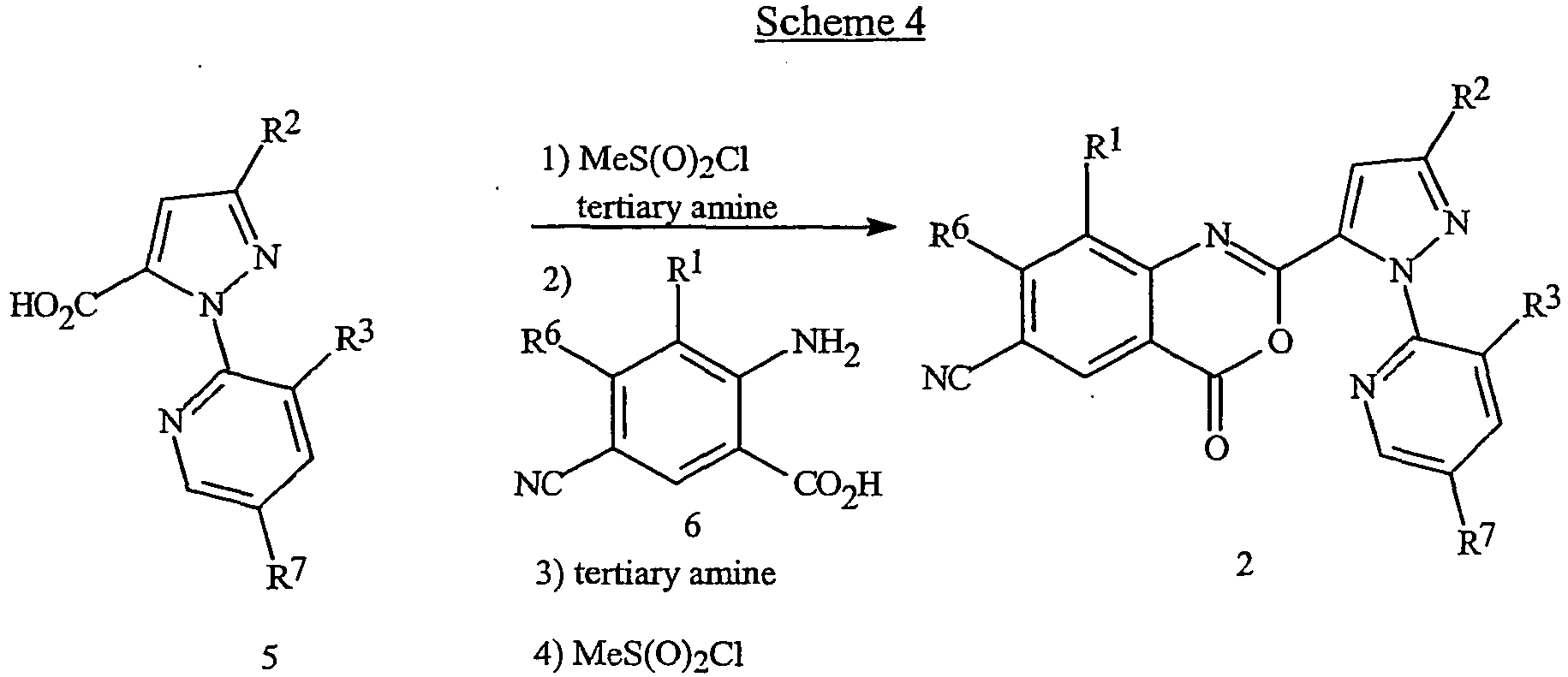
- Scheme 5 depicts another method for preparing benzoxazinones of Formula 2 involving coupling an isatoic anhydride of Formula 7 with a pyrazole acid chloride of Formula 8. Solvents such as pyridine or pyridine/acetonitrile are suitable for this reaction. The acid chlorides of Formula 8 are available from the corresponding acids of Formula 5 by known methods such as chlorination with thionyl chloride or oxalyl chloride.

- As shown in Scheme 6, haloanthranilic diamides of Formula 3 can be prepared by the reaction of benzoxazinones of Formula 4, wherein X is halogen, with an amine of Formula HNR4R5 using a similar method as described above for Scheme 1. Conditions for this reaction are similar to those specified in Scheme 1.
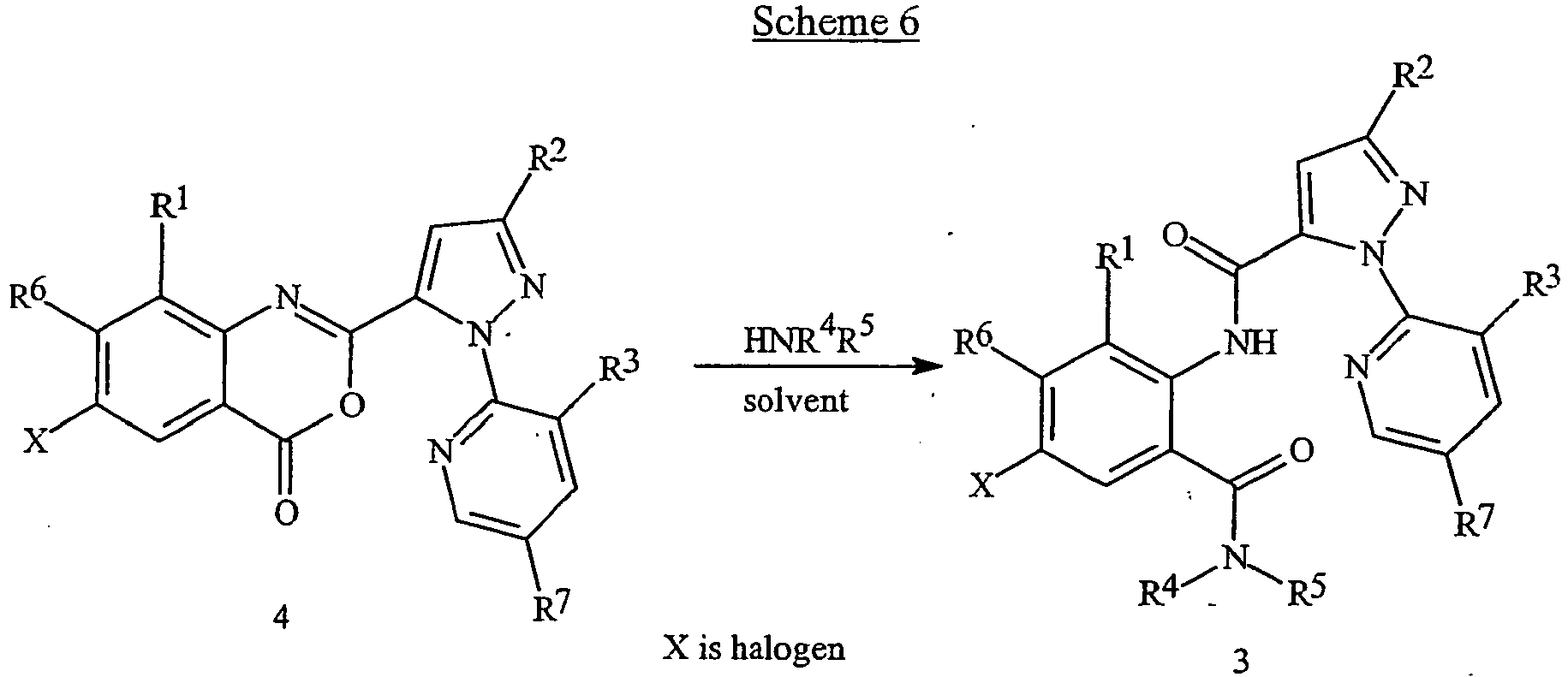
- As shown in Scheme 7, halobenzoxazinones of Formula 4 (wherein X is halogen) can be prepared via direct coupling of a pyridylpyrazole carboxylic acid of Formula 5 with a haloanthranilic acid of Formula 9 (wherein X is halogen) by a similar method as described above for Scheme 4. This reaction involves sequential addition of methanesulfonyl chloride in the presence of a tertiary amine such as triethylamine or pyridine to a pyrazolecarboxylic acid of Formula 5, followed by the addition of a haloanthranilic acid of Formula 9, followed by a second addition of tertiary amine and methanesulfonyl chloride. This method generally affords good yields of the benzoxazinone.

- As shown in Scheme 8, a halobenzoxazinone of Formula 4 can also be prepared via coupling an isatoic anhydride of Formula 10 (wherein X is halogen) with a pyrazole acid chloride of Formula 8 by a similar method as described above for Scheme 5.

- Cyanoanthranilic acids of Formula 6 can be prepared from haloanthranilic acids of Formula 9 as outlined in Scheme 9. Reaction of a haloanthranilic acid of Formula 9 (wherein X is halogen) with a metal cyanide using the same coupling procedure described above for Scheme 2 (optionally with or without a palladium catalyst and optionally with or without a metal halide present) affords a compound of Formula 6.
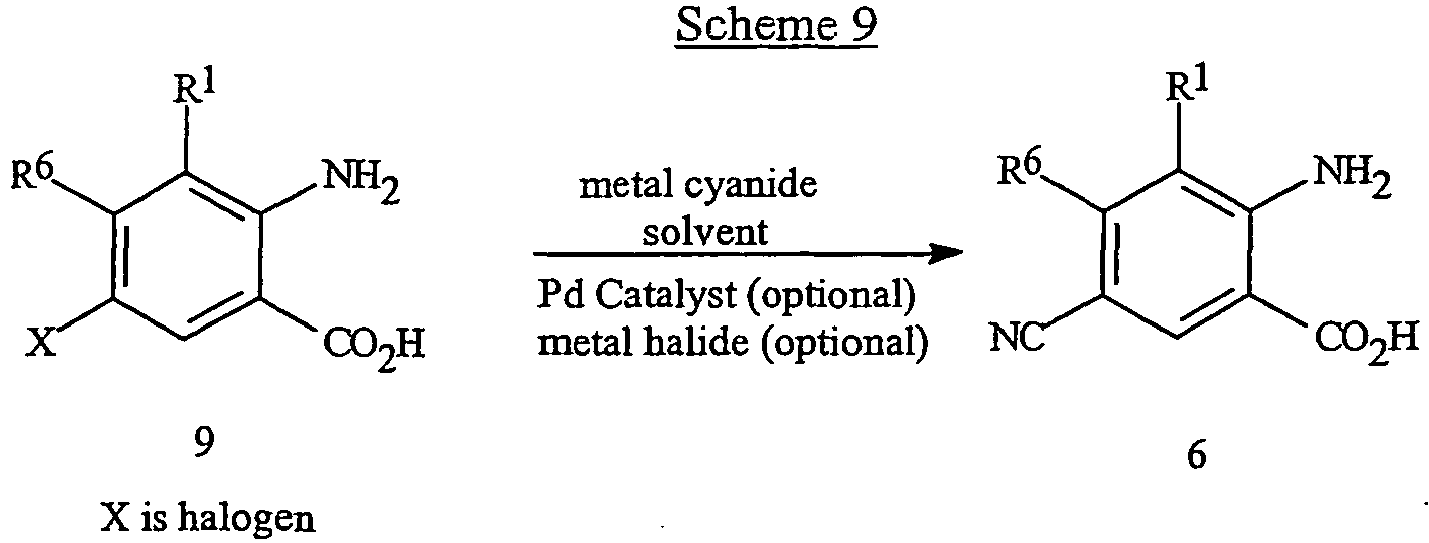
- As illustrated in Scheme 10, cyanoisatoic anhydrides of Formula 7 can be prepared from cyanoanthranilic acids of Formula 6 by reaction with phosgene (or a phosgene equivalent such as triphosgene) or an alkyl chloroformate (e.g. methyl chloroformate) in a suitable solvent such as toluene or tetrahydrofuran.
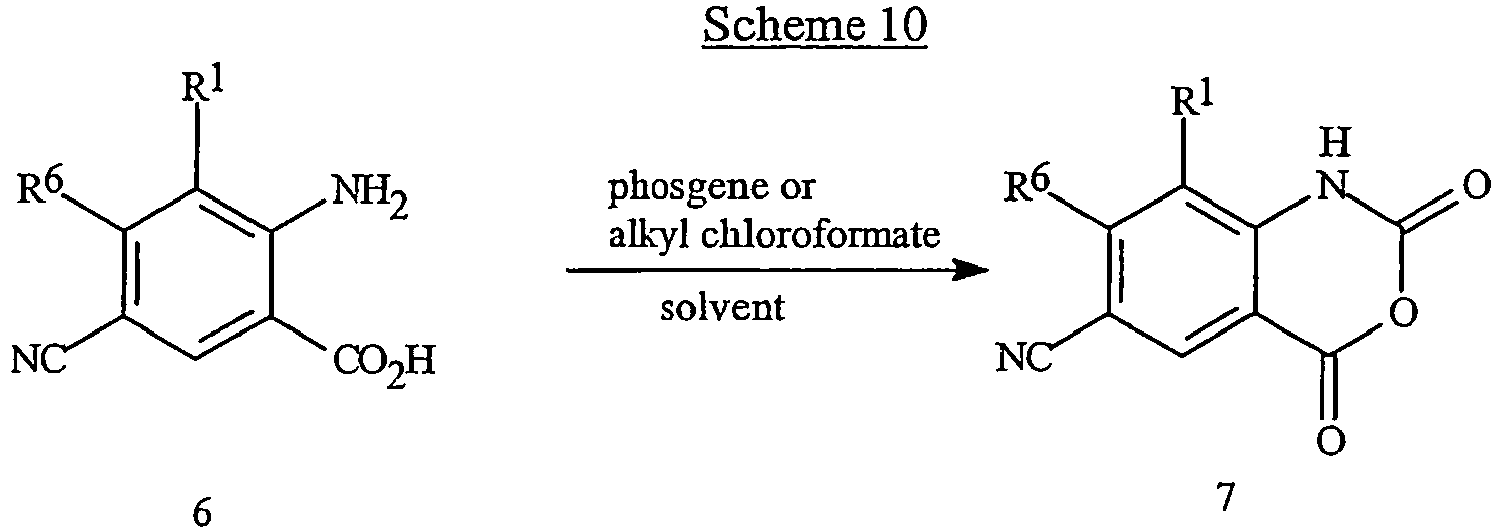
- As shown in Scheme 11, haloanthranilic acids of Formula 9 can be prepared by direct halogenation of an unsubstituted anthranilic acid of Formula 11 with N-chlorosuccinimide (NCS), N-bromosuccinimide (NBS) or N-iodosuccinimide (NIS) respectively in solvents such as N,N-dimethylformamide (DMF) to produce the corresponding halogen-substituted acid of Formula 9.

- As illustrated in Scheme 12, haloisatoic anhydrides of Formula 10 can be prepared from haloanthranilic acids of Formula 9 by reaction with phosgene (or a phosgene equivalent such as triphosgene) or an alkyl chloroformate, e.g. methyl chloroformate, in a suitable solvent such as toluene or tetrahydrofuran.

- Pyridylpyrazole carboxylic acids of Formula 5 can be prepared by the method outlined in Scheme 13. Reaction of pyrazole 12 with a 2-halopyridine of Formula 13 in the presence of a suitable base such as potassium carbonate in a solvent such as N,N-dimethylformamide or acetonitrile affords good yields of the 1-pyridylpyrazole 14 with good specificity for the desired regiochemistry. Metallation of 14 with lithium diisopropylamide (LDA) followed by quenching of the lithium salt with carbon dioxide affords the pyrazole carboxylic acid of Formula 5.

- The starting pyrazoles 12 wherein R2 is CF3, Cl or Br are known compounds. Pyrazole 12 wherein R2 is CF3 can be prepared by literature procedures ( J. Fluorine Chem. 1991, 53(1), 61-70). Pyrazoles 12 wherein R2 is Cl or Br can also be prepared by literature procedures (H. Reimlinger and A. Van Overstraeten, Chem. Ber. 1966, 99(10), 3350-7). A useful alternative method for the preparation of 12 wherein R2 is Cl or Br is depicted in Scheme 14. Metallation of the sulfamoyl pyrazole 15 with n-butyllithium followed by direct halogenation of the anion with either hexachloroethane (for R2 being Cl) or 1,2-dibromotetrachloroethane (for R2 being Br) affords the halogenated derivatives 16 (where R2 is Cl or Br). Removal of the sulfamoyl group with trifluoroacetic acid (TFA) at room temperature proceeds cleanly and in good yield to afford the pyrazoles 12 wherein R2 is Cl or Br respectively.

- As an alternative to the method illustrated in Scheme 13, pyrazolecarboxylic acids of Formula 5 wherein R2 is CF3 can also be prepared by the method outlined in Scheme 15. Reaction of a compound of Formula 17 (wherein R8 is C1-C4 alkyl) with a suitable base in a suitable organic solvent affords the cyclized product of Formula 18 after neutralization with an acid such as acetic acid.

- The suitable base can be, for example but not limited to, sodium hydride, potassium t-butoxide, dimsyl sodium (CH3S(O)CH2-Na+), alkali metal (such as lithium, sodium or potassium) carbonates or hydroxides, tetraalkyl (such as methyl, ethyl or butyl)ammonium fluorides or hydroxides, or 2-tert-butylimino-2-diethylamino-1,3-dimethyl-perhydro-1,3,2-diazaphosphonine. The suitable organic solvent can be, for example but not limited to, acetone, acetonitrile, tetrahydrofuran, dichloromethane, dimethylsulfoxide, or N,N-dimethylformamide. The cyclization reaction is usually conducted in a temperature range from about 0 to 120 °C. The effects of solvent, base, temperature and addition time are all interdependent, and choice of reaction conditions is important to minimize the formation of byproducts. A preferred base is tetrabutylammonium fluoride.
- Dehydration of the compound of Formula 18 to give the compound of Formula 19, followed by hydrolysis of the carboxylic ester function to carboxylic acid, affords the compound of Formula 5. The dehydration is accomplished by treatment with a catalytic amount of a suitable acid. This catalytic acid can be, for example but not limited to, sulfuric acid. The reaction is generally conducted using an organic solvent. As one skilled in the art will realize, dehydration reactions may be conducted in a wide variety of solvents, e.g. acetic acid, in a temperature range generally between about 0 and 200°C, more preferably between about 0 and 100 °C. Carboxylic esters of Formula 19 can be converted to carboxylic acids of Formula 5 by numerous methods including nucleophilic cleavage under anhydrous conditions or hydrolytic methods involving the use of either acids or bases (see T. W. Greene and P. G.M. Wuts, Protective Groups in Organic Synthesis, 2nd ed., John Wiley & Sons, Inc., New York, 1991, pp. 224-269 for a review of methods). For the method of Scheme 15, base-catalyzed hydrolytic methods are preferred. Suitable bases include alkali metal (such as lithium, sodium or potassium) hydroxides. For example, the ester can be dissolved in a mixture of water and an alcohol such as ethanol. Upon treatment with sodium hydroxide or potassium hydroxide, the ester is saponified to provide the sodium or potassium salt of the carboxylic acid. Acidification with a strong acid, such as hydrochloric acid or sulfuric acid, yields the carboxylic acid of Formula 5.
- Compounds of Formula 17 wherein R2 is CF3 can be prepared by the method outlined in Scheme 16. Treatment of a hydrazine compound of Formula 20 with a ketone of Formula CH3COR2 in a solvent such as water, methanol or acetic acid gives the hydrazone of Formula 21.

- One skilled in the art will recognize that this reaction may require catalysis by an optional acid and may also require elevated temperatures depending on the molecular substitution pattern of the hydrazone of Formula 21. Reaction of the hydrazone of Formula 21 with an alkyl chlorooxalate in a suitable organic solvent such as, for example but not limited to, dichloromethane or tetrahydrofuran in the presence of an acid scavenger such as triethylamine provides the compound of Formula 17. The reaction is usually conducted at a temperature between about 0 and 100°C. Hydrazine compounds of Formula 20 can be prepared by standard methods, such as by reaction of the corresponding halopyridine of Formula 13 with hydrazine.
- As an alternative to the method illustrated in Scheme 13, pyrazolecarboxylic acids of Formula 5 wherein R2 is Cl or Br can also be prepared by the method outlined in Scheme 17. Oxidation of the compound of Formula 22, optionally in the presence of acid, gives the compound of Formula 19, wherein R2 is Cl or Br. Hydrolysis of the carboxylic ester function to the carboxylic acid provides the compound of Formula 5.

- The oxidizing agent for converting a compound of Formula 22 to a compound of Formula 19 can be hydrogen peroxide, organic peroxides, potassium persulfate, sodium persulfate, ammonium persulfate, potassium monopersulfate (e.g., Oxone®) or potassium permanganate. To obtain complete conversion, at least one equivalent of oxidizing agent versus the compound of Formula 22 should be used, preferably between about one to two equivalents. This oxidation is typically carried out in the presence of a solvent. The solvent can be an ether, such as tetrahydrofuran, p-dioxane and the like, an organic ester, such as ethyl acetate, dimethyl carbonate and the like, or a polar aprotic organic such as N,N-dimethylformamide, acetonitrile and the like. Acids suitable for use in the oxidation step include inorganic acids, such as sulfuric acid, phosphoric acid and the like, and organic acids, such as acetic acid, benzoic acid and the like. One to five equivalents of acid can be used. The preferred oxidant is potassium persulfate and the oxidation is preferably carried out in the presence of sulfuric acid. The reaction can be carried out by mixing the compound of Formula 22 in the desired solvent and, if used, the acid. The oxidant can then be added at a convenient rate. The reaction temperature is typically varied from as low as about 0 °C up to the boiling point of the solvent in order to obtain a reasonable reaction time to complete the reaction. Methods suitable for converting the ester of Formula 19 to the carboxylic acid of Formula 5 are already described for Scheme 15.
- Compounds of Formula 22, wherein R2 is halogen and R8 is C1-C4 alkyl, can be prepared from the corresponding compounds of Formula 23 as shown in Scheme 18.

- Treatment of a compound of Formula 23 with a halogenating reagent, usually in the presence of a solvent, affords the corresponding halo compound of Formula 22. Halogenating reagents that can be used include phosphorus oxyhalides, phosphorus trihalides, phosphorus pentahalides, thionyl chloride, dihalotrialkylphosphoranes, dihalodiphenylphosphoranes, oxalyl chloride and phosgene. Preferred are phosphorus oxyhalides and phosphorus pentahalides. To obtain complete conversion, at least 0.33 equivalents of phosphorus oxyhalide versus the compound of Formula 23 should be used, preferably between about 0.33 and 1.2 equivalents. To obtain complete conversion, at least 0.20 equivalents of phosphorus pentahalide versus the compound of Formula 23 should be used, preferably between about 0.20 and 1.0 equivalents. Typical solvents for this halogenation include halogenated alkanes, such as dichloromethane, chloroform, chlorobutane and the like, aromatic solvents, such as benzene, xylene, chlorobenzene and the like, ethers, such as tetrahydrofuran, p-dioxane, diethyl ether, and the like, and polar aprotic solvents such as acetonitrile, N,N-dimethylformamide, and the like. Optionally, an organic base, such as triethylamine, pyridine, N,N-dimethylaniline or the like, can be added. Addition of a catalyst, such as N,N-dimethylformamide, is also an option. Preferred is the process in which the solvent is acetonitrile and a base is absent. Typically, neither a base nor a catalyst is required when acetonitrile solvent is used. The preferred process is conducted by mixing the compound of Formula 23 in acetonitrile. The halogenating reagent is then added over a convenient time, and the mixture is then held at the desired temperature until the reaction is complete. The reaction temperature is typically between 20°C and the boiling point of acetonitrile, and the reaction time is typically less than 2 hours. The reaction mass is then neutralized with an inorganic base, such as sodium bicarbonate, sodium hydroxide and the like, or an organic base, such as sodium acetate. The desired product of Formula 22 can be isolated by methods known to those skilled in the art, including crystallization, extraction and distillation.
- Alternatively, compounds of Formula 22 wherein R2 is Br or Cl can be prepared by treating the corresponding compounds of Formula 22 wherein R2 is a different halogen (e.g., Cl for making Formula 22 wherein R2 is Br) or a sulfonate group such as p-toluenesulfonate, benzenesulfonate and methanesulfonate with hydrogen bromide or hydrogen chloride, respectively. By this method the R2 halogen or sulfonate substituent on the compound of Formula 22 is replaced with Br or Cl from hydrogen bromide or hydrogen chloride, respectively. The reaction is conducted in a suitable solvent such as dibromomethane, dichloromethane, acetic acid, ethyl acetate or acetonitrile. The reaction can be conducted at or near atmospheric pressure or above atmospheric pressure in a pressure vessel. The halogenating reagent can be added in the form of a gas to the reaction mixture containing the Formula 23 compound and solvent. When R2 in the starting compound of Formula 22 is a halogen such as Cl, the reaction is preferably conducted in such a way that sparging or other suitable means removes the hydrogen halide generated from the reaction. Alternatively, the halogenating reagent can first be dissolved in an inert solvent in which it is highly soluble (such as acetic acid) before contacting the compound of Formula 23 either neat or in solution. The reaction can be conducted between about 0 and 100 °C, most conveniently near ambient temperature (e.g., about 10 to 40 °C), and more preferably between about 20 and 30 °C. Addition of a Lewis acid catalyst (such as aluminum tribromide for preparing Formula 22 wherein R2 is Br) can facilitate the reaction. The product of Formula 22 is isolated by the usual methods known to those skilled in the art, including extraction, distillation and crystallization.
- Starting compounds of Formula 22 wherein R2 is a sulfonate group can be prepared from corresponding compounds of Formula 23 by standard methods such as treatment with a sulfonyl chloride (e.g., p-toluenesulfonyl chloride) and base such as a tertiary amine (e.g., triethylamine) in a suitable solvent such as dichloromethane.
- It is recognized that some reagents and reaction conditions described above for preparing compounds of Formula 1 may not be compatible with certain functionalities present in the intermediates. In these instances, the incorporation of protection/deprotection sequences or functional group interconversions into the synthesis will aid in obtaining the desired products. The use and choice of the protecting groups will be apparent to one skilled in chemical synthesis (see, for example, T. W. Greene and P. G. M. Wuts, Protective Groups in Organic Synthesis, 2nd ed.; Wiley: New York, 1991). One skilled in the art will recognize that, in some cases, after the introduction of a given reagent as it is depicted in any individual scheme, it may be necessary to perform additional routine synthetic steps not described in detail to complete the synthesis of compounds of Formula 1. One skilled in the art will also recognize that it may be necessary to perform a combination of the steps illustrated in the above schemes in an order other than that implied by the particular sequence presented to prepare the compounds of Formula 1.
- Without further elaboration, it is believed that one skilled in the art using the preceding description can utilize the present invention to its fullest extent. The following Examples are, therefore, to be construed as merely illustrative, and not limiting of the disclosure in any way whatsoever. Steps in the following Examples illustrate a procedure for each step in an overall synthetic transformation, and the starting material for each step may not have necessarily been prepared by a particular preparative run whose procedure is described in other Examples or Steps. Percentages are by weight except for chromatographic solvent mixtures or where otherwise indicated. Parts and percentages for chromatographic solvent mixtures are by volume unless otherwise indicated. 1H NMR spectra are reported in ppm downfield from tetramethylsilane; "s" means singlet, "d" means doublet, "t" means triplet, "q" means quartet, "m" means multiplet, "dd" means doublet of doublets, "dt" means doublet of triplets, and "br s" means broad singlet.
- To a solution of 2-amino-3-methylbenzoic acid (Aldrich, 5 g, 33 mmol) in N,N-dimethylformamide (30 mL) was added N-iodosuccinimide (7.8 g, 34.7 mmol), and the reaction mixture was suspended in a 75 °C oil bath overnight. The heat was removed and the reaction mixture was then slowly poured into ice-water (100 mL) to precipitate a light grey solid. The solid was filtered and washed four times with water and then placed in a vacuum oven at 70 °C to dry overnight. The desired intermediate was isolated as a light grey solid (8.8 g).
1H NMR (DMSO-d 6): δ 7.86 (d,1H), 7.44 (d,1H), 2.08 (s,3H). - To a mixture of 2,3-dichloropyridine (99.0 g, 0.67 mol) and 3-(trifluoromethyl)-pyrazole (83 g, 0.61 mol) in dry N,N-dimethylformamide (300 mL) was added potassium carbonate (166.0 g, 1.2 mol) and the reaction was then heated to 110-125 °C over 48 hours. The reaction was cooled to 100 °C and filtered through Celite® diatomaceous filter aid to remove solids. N,N-Dimethylformamide and excess dichloropyridine were removed by distillation at atmospheric pressure. Distillation of the product at reduced pressure (b.p. 139-141 °C, 7 mm) afforded 113.4 g of the desired intermediate as a clear yellow oil. 1H NMR (CDCl3): δ 8.45 (d,1H), 8.15 (s, 1H), 7.93 (d,1H), 7.36 (t,1H), 6.78 (s,1H).
- To a solution of 3-chloro-2-[3-(trifluoromethyl)-1H-pyrazol-1-yl]pyridine (i.e. the pyrazole product from Step B) (105.0 g, 425 mmol) in dry tetrahydrofuran (700 mL) at -75 °C was added via cannula a -30 °C solution of lithium diisopropylamide (425 mmol) in dry tetrahydrofuran (300 mL). The deep red solution was stirred for 15 minutes, after which time carbon dioxide was bubbled through at -63 °C until the solution became pale yellow and the exothermicity ceased. The reaction was stirred for an additional 20 minutes and then quenched with water (20 mL). The solvent was removed under reduced pressure, and the reaction mixture partitioned between ether and 0.5 N aqueous sodium hydroxide solution. The aqueous extracts were washed with ether (3x), filtered through Celite® diatomaceous filter aid to remove residual solids, and then acidified to a pH of approximately 4, at which point an orange oil formed. The aqueous mixture was stirred vigorously and additional acid was added to lower the pH to 2.5-3. The orange oil congealed into a granular solid, which was filtered, washed successively with water and 1 N hydrochloric acid, and dried under vacuum at 50 °C to afford 130 g of the title product as an off-white solid. Product from another run following a similar procedure melted at 175-176 °C.
1H NMR (DMSO-d 6): δ 7.61 (s,1H), 7.76 (dd,1H), 8.31 (d,1H), 8.60 (d,1H). - To a solution of methanesulfonyl chloride (2.91 mL, 37.74 mmol) in acetonitrile (50 mL) was added dropwise a mixture of 1-(3-chloro-2-pyridinyl)-3-(trifluoromethyl)-1H-pyrazole-5-carboxylic acid (i.e. the carboxylic acid product of Step C) (10.0 g, 34.31 mmol) and triethylamine (4.78 mL, 34.31 mmol) in acetonitrile (50 mL) at -5°C. The reaction temperature was then maintained at 0 °C throughout successive addition of reagents. After stirring for 20 minutes, 2-amino-3-methyl-5-iodobenzoic acid (i.e. the product from Step A) (9.51 g, 34.31 mmol) was added and stirring was continued for an additional 10 minutes. A solution of triethylamine (9.56 mL, 68.62 mmol) in acetonitrile (15 mL) was then added dropwise, and the reaction mixture was stirred 30 minutes, followed by the addition of methanesulfonyl chloride (2.91 mL, 37.74 mmol). The reaction mixture was then warmed to room temperature and stirred 2 hours. The solvent was evaporated under reduced pressure, and the residual solid was purified by chromatography on silica gel to afford 8.53 g of the title compound as a yellow solid.
1H NMR (CDCl3): δ 8.59 (dd, 1H), 8.35 (d,1H), 7.97 (dd,1H), 7.86 (d,1H), 7.49 (m,2H), 1.79 (s,3H). - To a solution of 2-[1-(3-chloro-2-pyridinyl)-3-(trifluoromethyl)-1H-pyrazol-5-yl]-6-iodo-8-methyl-4H-3,1-benzoxazin-4-one (i.e. the benzoxazinone product of Step D) (500 mg, 0.94 mmol) in tetrahydrofuran (10 mL) was added copper(I) iodide (180 mg, 0.094 mmol), tetrakis(triphenyphosphine)palladium(0) (5.4 mg, 0.047 mmol) and copper(I) cyanide (420 mg, 4.7 mmol) sequentially at room temperature. After heating the reaction mixture at reflux overnight, additional copper(I) cyanide (420 mg, 4.7 mmol), copper(I) iodide (107 mg, 0.56 mmol) and tetrakis(triphenyphosphine)palladium(0) (325 mg, 0.28 mmol) were added and the reflux was continued for 1 hour. The reaction mixture turned black in color, at which point thin layer chromatography on silica gel confirmed completion of the reaction. The reaction mixture was then diluted with ethyl acetate (20 mL) and filtered through Celite®, followed by washing three times with 10% aqueous sodium bicarbonate solution and once with brine. The organic extract was dried (MgSO4) and concentrated under reduced pressure to afford 410 mg of the title compound as a crude yellow solid.
1H NMR (CDCl3): δ 8.59 (dd,1H), 8.33 (d,1H), 8.03 (dd,1H), 7.95 (d,1H), 7.56 (m,2H), 1.88 (s,3H). - To a solution of 2-[1-(3-chloro-2-pyridinyl)-3-(trifluoromethyl)-1H-pyrazol-5-yl]-6-cyano-8-methyl-4H-3,1-benzoxazin-4-one (i.e. the cyanobenzoxazinone product of Step E) (200 mg, 0.46 mmol) in tetrahydrofuran (5 mL) was added dropwise ammonium hydroxide (0.5 mL, 12.8 mmol) at room temperature. The reaction mixture was then stirred for five minutes, at which point thin layer chromatography on silica gel confirmed completion of the reaction. The tetrahydrofuran solvent was evaporated under reduced pressure, and the residual solid was purified by chromatography on silica gel to afford 620 mg of the title compound, a compound of the present invention, as a solid melting at 200-202 °C. 1H NMR (CDCl3): δ 10.65 (s,1H), 8.43 (dd,1H), 7.9 (dd,1H), 7.67 (s,1H), 7.63 (s,1H), 7.45 (m,1H), 7.25 (s,1H), 6.21 (bs,1H), 5.75 (bs,1H), 2.26 (s,3H).
- To a solution of 2-[1-(3-chloro-2-pyridinyl)-3-(trifluoromethyl)-1H-pyrazol-5-yl]-6-iodo-8-methyl-4H-3,1-benzoxazin-4-one (i.e. the benzoxazinone product of Example 1, Step D) (500 mg, 0.94 mmol) in tetrahydrofuran (15 mL) was added dropwise methylamine (2.0 M solution in THF, 1.4 mL, 2.8 mmol) and the reaction mixture was stirred for 3 hours, at which point thin layer chromatography on silica gel confirmed completion of the reaction. The tetrahydrofuran solvent was evaporated under reduced pressure and the residual solid was purified by chromatography on silica gel to afford 400 mg of the title compound as a yellow solid.
1H NMR (CDCl3): δ 10.25 (s,1H), 8.45 (dd,1H), 7.85 (dd,1H), 7.55 (s,1H), 7.50 (s,1H), 7.46 (s,1H), 7.40 (m,1H), 6.15 (d,1H), 2.93 (d,3H), 2.12 (s,3H). - To a solution of 1-(3-chloro-2-pyridinyl)-N-[4-iodo-2-methyl-6-[(methylamino)carbonyl]phenyl]-3-(trifluoromethyl)-1H-pyrazole-5-carboxamide (i.e. the diamide product of Step A) (410 mg, 0.72 mmol) in tetrahydrofuran (8 mL) was added copper(I) iodide (24 mg, 0.126 mmol), tetrakis(triphenyphosphine)palladium(0) (70 mg, 0.060 mmol) and copper(I) cyanide (640 mg, 7.2 mmol) sequentially at room temperature. The reaction mixture was heated at reflux for 4.5 hours. Thin layer chromatography on silica gel confirmed completion of the reaction. The reaction mixture was then diluted with ethyl acetate (20 mL) and filtered through Celite®, followed by washing three times with 10% aqueous sodium bicarbonate solution and once with brine. The organic extract was dried (MgSO4) and concentrated under reduced pressure and the residual solid was purified by chromatography on silica gel to afford 114 mg of the title compound, a compound of the present invention, as a white solid, melting at 214-216 °C.
1H NMR (CDCl3): δ 10.70 (s,1H), 8.46 (dd,1H), 7.87 (dd,1H), 7.57 (s,2H), 7.45 (m,1H), 7.31 (s,1H), 6.35 (d,1H), 2.98 (d,3H), 2.24 (s,3H). - To a solution of N-dimethylsulfamoylpyrazole (188.0 g, 1.07 mol) in dry tetrahydrofuran (1500 mL) at -78 °C was added dropwise a solution of 2.5 M n-butyllithium (472 mL, 1.18 mol) in hexane while maintaining the temperature below -65 °C. Upon completion of the addition the reaction mixture was maintained at -78 °C for an additional 45 minutes, after which time a solution of hexachloroethane (279 g, 1.18 mol) in tetrahydrofuran (120 mL) was added dropwise. The reaction mixture was maintained for an hour at -78 °C, warmed to -20 °C and then quenched with water (1 L). The reaction mixture was extracted with methylene chloride (4 x 500 mL); the organic extracts were dried over magnesium sulfate and concentrated. The crude product was further purified by chromatography on silica gel using methylene chloride as eluent to afford 160 g of the title product compound as a yellow oil.
1H NMR (CDCl3): δ 7.61 (s,1H), 6.33 (s,1H), 3.07 (d,6H). - To trifluoroacetic acid (290 mL) was added dropwise 3-chloro-N,N-dimethyl-1H-pyrazole-1-sulfonamide (i.e. the chloropyrazole product of Step A) (160 g), and the reaction mixture was stirred at room temperature for 1.5 hrs and then concentrated at reduced pressure. The residue was taken up in hexane, insoluble solids were filtered off, and the hexane was concentrated to afford the crude product as an oil. The crude product was further purified by chromatography on silica gel using ether/hexane (40:60) as eluent to afford 64.44 g of the title product as a yellow oil.
1H NMR (CDCl3): δ 6.39 (s,1H), 7.66 (s,1H), 9.6 (br s,1H). - To a mixture of 2,3-dichloropyridine (92.60 g, 0.629 mol) and 3-chloropyrazole (i.e. the product of Step B) (64.44 g, 0.629 mol) in N,N-dimethylformamide (400 mL) was added potassium carbonate (147.78 g, 1.06 mol), and the reaction mixture was then heated to 100 °C for 36 hours. The reaction mixture was cooled to room temperature and slowly poured into ice water. The precipitated solids were filtered and washed with water. The solid filter cake was taken up in ethyl acetate, dried over magnesium sulfate and concentrated. The crude solid was chromatographed on silica gel using 20% ethyl acetate/hexane as eluent to afford 39.75 g of the title product as a white solid. 1H NMR (CDCl3): δ 6.43 (s,1H), 7.26 (m,1H), 7.90 (d,1H), 8.09 (s,1H), 8.41 (d,1H).
- To a solution of 3-chloro-2-(3-chloro-1H-pyrazol-1-yl)pyridine (i.e. the pyrazole product of Step C) (39.75 g, 186 mmol) in dry tetrahydrofuran (400 mL) at -78°C was added dropwise a solution of 2.0 M lithium diisopropylamide (93 mL, 186 mmol) in tetrahydrofuran. Carbon dioxide was bubbled through the amber solution for 14 minutes, after which time the solution became pale brownish-yellow. The reaction was made basic with 1 N aqueous sodium hydroxide solution and extracted with ether (2x500 mL). The aqueous extracts were acidified with 6 N hydrochloric acid followed by extraction with ethyl acetate (3x500 mL). The ethyl acetate extracts were dried over magnesium sulfate and concentrated to afford 42.96 g of the title product as an off-white solid. Product from another run following the same procedure melted at 198-199 °C.
1H NMR (DMSO-d 6): δ 6.99 (s,1H), 7.45 (m,1H), 7.93 (d,1H), 8.51 (d,1H). - To a solution of methanesulfonyl chloride (0.63 mL, 8.13 mmol) in acetonitrile (10 mL) was added dropwise a mixture of 3-chloro-1-(3-chloro-2-pyridinyl)-1H-pyrazole-5-carboxylic acid (i.e. the carboxylic acid product of Step D) (2.0 g, 7.75 mmol) and triethylamine (1.08 ml, 7.75 mmol) in acetonitrile (5 mL) at 0 °C. The reaction mixture was then stirred for 15 minutes at 0 °C. Then, 2-amino-3-methyl-5-iodobenzoic acid (i.e. the product from Example 1, Step A) (2.14 g, 7.75 mmol) was added, and stirring was continued for an additional 5 minutes. A solution of triethylamine (2.17 mL, 15.15 mmol) in acetonitrile (5 mL) was then added dropwise while keeping the temperature below 5 °C. The reaction mixture was stirred 40 minutes at 0 °C, and then methanesulfonyl chloride (0.63 mL, 8.13 mmol) was added. The reaction mixture was then warmed to room temperature and stirred overnight. The reaction mixture was then diluted with water (50 mL), and extracted with ethyl acetate (3x50 mL). The combined ethyl acetate extracts were washed successively with 10% aqueous sodium bicarbonate (1x20 mL) and brine (1x20 mL), dried (MgSO4) and concentrated to afford 3.18 g of the title product as a crude yellow solid.
1H NMR (CDCl3): δ 8.55 (dd,1H), 8.33 (s,1H), 7.95 (dd,1H), 7.82 (d,1H), 7.45 (m,1H), 7.16 (s,1H), 1.77 (s,3H). - To a solution of 2-[3-chloro-1-(3-chloro-2-pyridinyl)-1H-pyrazol-5-yl]-6-iodo-8-methyl-4H-3,1-benzoxazin-4-one (i.e. the benzoxazinone product of Step E) (600 mg, 1.2 mmol) in tetrahydrofuran (15 mL) was added copper(I) iodide (137 mg, 0.72 mmol), tetrakis(triphenyphosphine)palladium(0) (416 mg, 0.36 mmol) and copper(I) cyanide (860 mg, 9.6 mmol) sequentially at room temperature. The reaction mixture was then heated at reflux overnight. The reaction turned black in color, at which point thin layer chromatography on silica gel confirmed completion of the reaction. The reaction was diluted with ethyl acetate (20 mL) and filtered through Celite®, followed by washing three times with 10% aqueous sodium bicarbonate solution and once with brine. The organic extract was dried (MgSO4) and concentrated under reduced pressure to afford 397 mg of the title compound as a crude yellow solid.
1H NMR (CDCl3): δ 8.50 (q,1H), 8.22 (d,1H), 7.90 (dd,1H), 7.67 (d,1H), 7.45 (m,1H), 7.15 (s,1H), 1.79 (s,3H). - To a solution of 2-[3-chloro-1-(3-chloro-2-pyridinyl)-1H-pyrazol-5-yl]-6-cyano-8-methyl-4H-3,1-benzoxazin-4-one (e.g. the cyanobenzoxazinone product of Step F) (100 mg, 0.25 mmol) in tetrahydrofuran (5 mL) was added dropwise methylamine (2.0 M solution in THF, 0.5 mL, 1.0 mmol) and the reaction mixture was stirred for 5 minutes, at which point thin layer chromatography on silica gel confirmed completion of the reaction. The tetrahydrofuran solvent was evaporated under reduced pressure; and the residual solid was purified by chromatography on silica gel to afford the title compound, a compound of the present invention, as a white solid (52 mg), which decomposed in the melting apparatus above 140 °C.
1H NMR (CDCl3): δ 10.55 (s,1H), 8.45 (dd,1H), 7.85 (dd,1H), 7.55 (d,2H), 7.40 (m,1H), 6.97 (d,1H), 6.30 (d,1H), 2.98 (d,3H), 2.24 (d,3H). - To a solution of N,N-dimethylsulfamoylpyrazole (44.0 g, 0.251 mol) in dry tetrahydrofuran (500 mL) at -78 °C was added dropwise a solution of n-butyllithium (2.5 M in hexane, 105.5 mL, 0.264 mol) while maintaining the temperature below -60 °C. A thick solid formed during the addition. Upon completion of the addition the reaction mixture was maintained for an additional 15 minutes, after which time a solution of 1,2-dibromotetrachloroethane (90 g, 0.276 mol) in tetrahydrofuran (150 mL) was added dropwise while maintaining the temperature below -70 °C. The reaction mixture turned a clear orange; stirring was continued for an additional 15 minutes. The -78 °C bath was removed and the reaction was quenched with water (600 mL). The reaction mixture was extracted with methylene chloride (4x), and the organic extracts were dried over magnesium sulfate and concentrated. The crude product was further purified by chromatography on silica gel using methylene chloride-hexane (50:50) as eluent to afford 57.04 g of the title product as clear colorless oil.
1H NMR (CDCl3): δ 3.07 (d,6H), 6.44 (m,1H), 7.62 (m,1H). - To trifluoroacetic acid (70 mL) was slowly added 3-bromo-N,N-dimethyl-1H-pyrazole-1-sulfonamide (i.e. the bromopyrazole product of Step A) (57.04 g). The reaction mixture was stirred at room temperature for 30 minutes and then concentrated at reduced pressure. The residue was taken up in hexane, insoluble solids were filtered off, and the hexane was evaporated to afford the crude product as an oil. The crude product was further purified by chromatography on silica gel using ethyl acetate/dichloromethane (10:90) as eluent to afford an oil. The oil was taken up in dichloromethane, neutralized with aqueous sodium bicarbonate solution, extracted with methylene chloride (3x), dried over magnesium sulfate and concentrated to afford 25.9 g of the title product as a white solid, m.p. 61-64 °C. 1H NMR (CDCl3): δ 6.37 (d,1H), 7.59 (d,1H), 12.4 (br s, 1H).
- To a mixture of 2,3-dichloropyridine (27.4 g, 185 mmol) and 3-bromopyrazole (i.e. the product of Step B) (25.4 g, 176 mmol) in dry N,N-dimethylformamide (88 mL) was added potassium carbonate (48.6 g, 352 mmol), and the reaction mixture was heated to 125°C for 18 hours. The reaction mixture was cooled to room temperature and poured into ice water (800 mL). A precipitate formed. The precipitated solids were stirred for 1.5 h, filtered and washed with water (2x100 mL). The solid filter cake was taken up in methylene chloride and washed sequentially with water, 1N hydrochloric acid, saturated aqueous sodium bicarbonate solution, and brine. The organic extracts were then dried over magnesium sulfate and concentrated to afford 39.9 g of a pink solid. The crude solid was suspended in hexane and stirred vigorously for 1 hr. The solids were filtered, washed with hexane and dried to afford the title product as an off-white powder (30.4 g) determined to be > 94 % pure by NMR. This material was used without further purification in Step D. 1H NMR (CDCl3): δ 6.52 (s,1H), 7.30 (dd,1H), 7.92 (d,1H), 8.05 (s,1H), 8.43 (d,1H).
- To a solution of 2-(3-bromo-1H-pyrazol-1-yl)-3-chloropyridine (i.e. the pyrazole product of Step C) (30.4 g, 118 mmol) in dry tetrahydrofuran (250 mL) at -76°C was added dropwise a solution of lithium diisopropylamide (118 mmol) in tetrahydrofuran at such a rate as to maintain the temperature below -71°C. The reaction mixture was stirred for 15 minutes at -76 °C, and carbon dioxide was then bubbled through for 10 minutes, causing warming to -57°C. The reaction mixture was warmed to -20 °C and quenched with water. The reaction mixture was concentrated and then taken up in water (1 L) and ether (500 mL), and then aqueous sodium hydroxide solution (1 N, 20 mL) was added. The aqueous extracts were washed with ether and acidified with hydrochloric acid. The precipitated solids were filtered, washed with water and dried to afford 27.7 g of the title product as a tan solid. Product from another run following similar procedure melted at 200-201 °C.
1H NMR (DMSO-d 6): δ 7.25 (s,1H), 7.68 (dd,1H), 8.24 (d,1H), 8.56 (d,1H). - To a solution of methanesulfonyl chloride (0.54 ml, 6.94 mmol) in acetonitrile (15 mL) was added dropwise a mixture of 3-bromo-1-(3-chloro-2-pyridinyl)-1H-pyrazole-5-carboxylic acid (i.e. the carboxylic acid product of Step D) (2.0 g, 6.6 mmol) and triethylamine (0.92 ml, 6.6 mmol) in acetonitrile (5 mL) at 0°C. The reaction mixture was then stirred for 15 minutes at 0 °C. Then, 2-amino-3-methyl-5-iodobenzoic acid (i.e. the product from Example 1, Step A) (1.8 g, 6.6 mmol) was added, and stirring was continued for an additional 5 minutes. A solution of triethylamine (1.85 mL, 13.2 mmol) in acetonitrile (5 mL) was then added dropwise while keeping the temperature below 5 °C. The reaction mixture was stirred 40 minutes at 0 °C, and then methanesulfonyl chloride (0.54 ml, 6.94 mmol) was added. The reaction mixture was then warmed to room temperature and stirred overnight. The reaction mixture was then diluted with water (50 mL) and extracted with ethyl acetate (3x50 mL). The combined ethyl acetate extracts were washed successively with 10% aqueous sodium bicarbonate (1x20 mL) and brine (1x20 mL), dried (MgSO4) and concentrated to afford 2.24 g of the title product as a crude yellow solid. 1H NMR (CDCl3): δ 8.55 (dd,1H), 8.33 (d,1H), 7.95 (dd,1H), 7.85 (s,1H), 7.45 (m,1H), 7.25 (s,1H), 1.77 (s,3H).
- To a solution of 2-[3-bromo-1-(3-chloro-2-pyridinyl)-1H-pyrazol-5-yl]-6-iodo-8-methyl-4H-3,1-benzoxazin-4-one (i.e. the benzoxazinone product of Step E) (600 mg,
- 1.1 mmol) in tetrahydrofuran (15 mL) was added copper(I) iodide (126 mg, 0.66 mmol), tetrakis(triphenyphosphine)palladium(0) (382 mg, 0.33 mmol) and copper(I) cyanide (800 mg, 8.8 mmol) sequentially at room temperature. The reaction mixture was then heated at reflux overnight. The reaction turned black in color, at which point thin layer chromatography on silica gel confirmed completion of the reaction. The reaction mixture was diluted with ethyl acetate (20 mL) and filtered through Celite@, followed by washing three times with 10% sodium bicarbonate solution and once with brine. The organic extract was dried (MgSO4) and concentrated under reduced pressure to afford 440 mg of the title compound as a crude yellow solid.
1H NMR (CDCl3): δ 8.55 (m,1H), 8.31 (d,1H), 7.96 (dd,1H), 7.73 (s,1H), 7.51 (m,1H), 7.31 (s,1H), 1.86 (s,3H). - To a solution of 2-[3-bromo-1-(3-chloro-2-pyridinyl)-1H-pyrazol-5-yl]-6-cyano-8-methyl-4H-3,1-benzoxazin-4-one (i.e. the cyanobenzoxazinone product of Step F) (100 mg, 0.22 mmol) in tetrahydrofuran (5 mL) was added dropwise methylamine (2.0 M solution in THF, 0.5 mL, 1.0 mmol) and the reaction mixture was stirred for 5 minutes, at which point thin layer chromatography on silica gel confirmed completion of the reaction. The tetrahydrofuran solvent was evaporated under reduced pressure, and the residual solid was purified by chromatography on silica gel to afford the title compound, a compound of the present invention, as a white solid (41 mg), which decomposed in the melting apparatus above 180°C.
1H NMR (CDCl3): δ 10.55 (s,1H), 8.45 (dd,1H), 7.85 (dd,1H), 7.57 (s,2H), 7.37 (m,1H), 7.05 (s,1H), 6.30 (d,1H), 2.98 (d,3H), 2.24 (s,3H). - To a solution of 2-amino-3-chlorobenzoic acid (Aldrich, 5 g, 29.1 mmol) in N,N-dimethylformamide (30 mL) was added N-iodosuccinimide (5.8 g, 26 mmol) and the reaction mixture was heated at 60 °C overnight. The heat was removed and the reaction mixture was then slowly poured into ice-water (100 mL) to precipitate a light brown solid. The solid was filtered and washed four times with water and then placed in a vacuum oven at 70 °C to dry overnight. The desired intermediate was isolated as a light brown solid (7.2 g). 1H NMR (DMSO-d): δ 7.96 (d,1H), 7.76 (t,1H).
- To a solution of methanesulfonyl chloride (0.31 mL, 4.07 mmol) in acetonitrile (10 mL) was added dropwise a mixture of 3-chloro-1-(3-chloro-2-pyridinyl)-1H-pyrazole-5-carboxylic acid (i.e. the carboxylic acid product of Example 3, Step D) (1.0 g, 3.87 mmol) and triethylamine (0.54 mL, 3.87 mmol) in acetonitrile (5 mL) at 0 °C. The reaction mixture was then stirred for 15 minutes at 0 °C. Then, 2-amino-3-chloro-5-iodobenzoic acid (i.e. the product from Step A) (1.15 g, 3.87 mmol) was added, and stirring was continued for an additional 5 minutes. A solution of triethylamine (1.08 mL, 7.74 mmol) in acetonitrile (5 mL) was then added dropwise while keeping the temperature below 5 °C. The reaction mixture was stirred 40 minutes at 0 °C, and then methanesulfonyl chloride (0.31 mL, 4.07 mmol) was added. The reaction mixture was then warmed to room temperature and stirred overnight. The reaction mixture was then diluted with water (50 mL) and extracted with ethyl acetate (3x50 mL). The combined ethyl acetate extracts were washed successively with 10% aqueous sodium bicarbonate (1x20 mL) and brine (1x20 mL), dried (MgSO4) and concentrated under reduced pressure. The residual solid was purified by chromatography on silica gel to afford 575 mg of the title compound as a crude yellow solid. 1H NMR (CDCl3): δ 8.55 (q , 1H), 8.39 (d, 1H), 8.04 (d, 1H), 7.94 (dd, 1H), 7.45 (m, 1H), 7.19 (s, 1H).
- To a solution of 8-chloro-2-[3-chloro-1-(3-chloro-2-pyridinyl)-1H-pyrazol-5-yl]-6-iodo-4H-3,1-benzoxazin-4-one (i.e. the benzoxazinone product of Step B) (575 mg, 1.1 mmol) in tetrahydrofuran (15 mL) was added copper(I) iodide (840 mg, 0.44 mmol), tetrakis(triphenyphosphine)palladium(0) (255 mg, 0.22 mmol) and copper(I) cyanide (500 mg, 5.5 mmol) sequentially at room temperature. The reaction mixture was then heated at reflux overnight. The reaction turned black in color, at which point thin layer chromatography on silica gel confirmed completion of the reaction. The reaction was diluted with ethyl acetate (20 mL) and filtered through Celite®, followed by washing three times with 10% aqueous sodium bicarbonate solution and once with brine. The organic extract was dried (MgSO4) and concentrated under reduced pressure to afford 375 mg of the title compound as a crude yellow solid.
1H NMR (CDClg): δ 8.55 (q, 1H), 8.36 (d, 1H), 7.95 (m, 2H), 7.5 (m, 1H). - To a solution of 8-chloro-2-[3-chloro-1-(3-chloro-2-pyridinyl)-1H-pyrazol-5-yl]-6-cyano-4H-3,1-benzoxazin-4-one (i.e. the cyanobenzoxazinone product of Step C) (187 mg, 0.446 mmol) in tetrahydrofuran (5 mL) was added dropwise methylamine (2.0 M solution in THF, 0.5 mL, 1.0 mmol) and the reaction mixture was stirred for 5 minutes, at which point thin layer chromatography on silica gel confirmed completion of the reaction. The tetrahydrofuran solvent was evaporated under reduced pressure, and the residual solid was purified by chromatography on silica gel to afford 49 mg of the title compound, a compound of the present invention, as a white solid that melted at 197-200 °C.
1H NMR (CDCl3): δ 10.05 (bs,1H), 8.45 (q,1H), 7.85 (dd,1H), 7.70 (d,1H), 7.59 (d,1H), 7.38 (m,1H), 7.02 (s,1H), 6.35 (d,1H), 2.94 (d,3H). - By the procedures described herein together with methods known in the art, the following compounds of Table 1 can be prepared. The following abbreviations are used in the Tables which follow: i means iso, Me means methyl, Et means ethyl and i-Pr means isopropyl.
Table 1 
1 R 1 R 2 R 3 R 4 R 5 R 1 R 2 R 3 R 4 R 5 Me Cl Cl Me H Cl Cl Cl Me H Me Cl Cl Et H Cl Cl Cl Et H Me Cl Cl i-Pr H Cl Cl Cl i-Pr H Me Br Cl Me H Cl Br Cl Me H Me Br Cl Et H Cl Br Cl Et H Me Br Cl i-Pr H Cl Br Cl i-Pr H Me CF3 Cl Me H Cl CF3 Cl Me H Me CF3 Cl Et H Cl CF3 Cl Et H Cl CF3 Cl i-Pr H - Compounds of this invention will generally be used as a formulation or composition with a carrier suitable for agronomic or nonagronomic use comprising at least one of a liquid diluent, a solid diluent or a surfactant. The formulation or composition ingredients are selected to be consistent with the physical properties of the active ingredient, mode of application and environmental factors such as soil type, moisture and temperature. Useful formulations include liquids such as solutions (including emulsifiable concentrates), suspensions, emulsions (including microemulsions and/or suspoemulsions) and the like which optionally can be thickened into gels. Useful formulations further include solids such as dusts, powders, granules, pellets, tablets, films, and the like which can be water-dispersible ("wettable") or water-soluble. Active ingredient can be (micro)encapsulated and further formed into a suspension or solid formulation; alternatively the entire formulation of active ingredient can be encapsulated (or "overcoated"). Encapsulation can control or delay release of the active ingredient. Sprayable formulations can be extended in suitable media and used at spray volumes from about one to several hundred liters per hectare. High-strength compositions are primarily used as intermediates for further formulation.
- The formulations will typically contain effective amounts of active ingredient, diluent and surfactant within the following approximate ranges that add up to 100 percent by weight.
Weight Percent Active Ingredient Diluent Surfactant Water-Dispersible and Water-soluble Granules, Tablets and Powders. 5-90 0-94 1-15 Suspensions, Emulsions, Solutions (including Emulsifiable Concentrates) 5-50 40-95 0-15 Dusts 1-25 70-99 0-5 Granules and Pellets 0.01-99 5-99.99 0-15 High Strength Compositions 90-99 0-10 0-2 - Typical solid diluents are described in Watkins, et al., Handbook of Insecticide Dust Diluents and Carriers, 2nd Ed., Dorland Books, Caldwell, New Jersey. Typical liquid diluents are described in Marsden, Solvents Guide, 2nd Ed., Interscience, New York, 1950. McCutcheon's Detergents and Emulsifiers Annual, Allured Publ. Corp., Ridgewood, New Jersey, as well as Sisely and Wood, Encyclopedia of Surface Active Agents, Chemical Publ. Co., Inc., New York, 1964, list surfactants and recommended uses. All formulations can contain minor amounts of additives to reduce foam, caking, corrosion, microbiological growth and the like, or thickeners to increase viscosity.
- Surfactants include, for example, polyethoxylated alcohols, polyethoxylated alkylphenols, polyethoxylated sorbitan fatty acid esters, dialkyl sulfosuccinates, alkyl sulfates, alkylbenzene sulfonates, organosilicones, N,N-dialkyltaurates, lignin sulfonates, naphthalene sulfonate formaldehyde condensates, polycarboxylates, and polyoxyethylene/polyoxypropylene block copolymers. Solid diluents include, for example, clays such as bentonite, montmorillonite, attapulgite and kaolin, starch, sugar, silica, talc, diatomaceous earth, urea, calcium carbonate, sodium carbonate and bicarbonate, and sodium sulfate. Liquid diluents include, for example, water, N,N-dimethylformamide, dimethyl sulfoxide, N-alkylpyrrolidone, ethylene glycol, polypropylene glycol, paraffins, alkylbenzenes, alkylnaphthalenes, oils of olive, castor, linseed, tung, sesame, corn, peanut, cotton-seed, soybean, rape-seed and coconut, fatty acid esters, ketones such as cyclohexanone, 2-heptanone, isophorone and 4-hydroxy-4-methyl-2-pentanone, and alcohols such as methanol, cyclohexanol, decanol and tetrahydrofurfuryl alcohol.
- Solutions, including emulsifiable concentrates, can be prepared by simply mixing the ingredients. Dusts and powders can be prepared by blending and, usually, grinding as in a hammer mill or fluid-energy mill. Suspensions are usually prepared by wet-milling; see, for example,
U.S. 3,060,084 . Granules and pellets can be prepared by spraying the active material upon preformed granular carriers or by agglomeration techniques. See Browning, "Agglomeration", Chemical Engineering, December 4, 1967, pp 147-48, Perry's Chemical Engineer's Handbook, 4th Ed., McGraw-Hill, New York, 1963, pages 8-57 and following, andPCT Publication WO 91/13546 U.S. 4,172,714 . Water-dispersible and water-soluble granules can be prepared as taught inU.S. 4,144,050 ,U.S. 3,920,442 andDE 3,246,493 . Tablets can be prepared as taught inU.S. 5,180,587 ,U.S. 5,232,701 andU.S. 5,208,030 . Films can be prepared as taught inGB 2,095,558 U.S. 3,299,566 . - For further information regarding the art of formulation, see T. S. Woods, "The Formulator's Toolbox - Product Forms for Modem Agriculture" in Pesticide Chemistry and Bioscience, The Food-Environment Challenge, T. Brooks and T. R. Roberts, Eds., Proceedings of the 9th International Congress on Pesticide Chemistry, The Royal Society of Chemistry, Cambridge, 1999, pp. 120-133. See also
U.S. 3,235,361 , Col. 6, line 16 through Col. 7, line 19 and Examples 10-41;U.S. 3,309,192 , Col. 5, line 43 through Col. 7, line 62 and Examples 8, 12, 15, 39, 41, 52, 53, 58, 132, 138-140, 162-164, 166, 167 and 169-182;U.S. 2,891,855 , Col. 3, line 66 through Col. 5, line 17 and Examples 1-4; Klingman, Weed Control as a Science, John Wiley and Sons, Inc., New York, 1961, pp 81-96; and Hance et al., Weed Control Handbook, 8th Ed., Blackwell Scientific Publications, Oxford, 1989. - In the following Examples, all percentages are by weight and all formulations are prepared in conventional ways. Compound numbers refer to compounds in Index Table A.
-
Wettable Powder Compound 1 65.0% dodecylphenol polyethylene glycol ether 2.0% sodium ligninsulfonate 4.0% sodium silicoaluminate 6.0% montmorillonite (calcined) 23.0%. -
Granule Compound 1 10.0% attapulgite granules (low volatile matter, 0.71/0.30 mm; U.S.S. No. 25-50 sieves) 90.0%. -
Extruded Pellet Compound 1 25.0% anhydrous sodium sulfate 10.0% crude calcium ligninsulfonate 5.0% sodium alkylnaphthalenesulfonate 1.0% calcium/magnesium bentonite 59.0%. -
Emulsifiable Concentrate Compound 1 20.0% blend of oil soluble sulfonates and polyoxyethylene ethers 10.0% isophorone 70.0%. -
Granule Compound 1 0.5% cellulose 2.5% lactose 4.0% cornmeal 93.0%. - Compounds of this invention are characterized by favorable metabolic and/or soil residual patterns and exhibit activity controlling a spectrum of agronomic and non-agronomic invertebrate pests. Compounds of this invention are also characterized by favorable foliar and or soil-applied systemicity in plants exhibiting translocation to protect foliage and other plant parts not directly-contacted with insecticidal compositions comprising the present compounds. (In the context of this disclosure "invertebrate pest control" means inhibition of invertebrate pest development (including mortality) that causes significant reduction in feeding or other injury or damage caused by the pest; related expressions are defined analogously.) As referred to in this disclosure, the term "invertebrate pest" includes arthropods, gastropods and nematodes of economic importance as pests. The term "arthropod" includes insects, mites, spiders, scorpions, centipedes, millipedes, pill bugs and symphylans. The term "gastropod" includes snails, slugs and other Stylommatophora. The term "nematode" includes all of the helminths, such as: roundworms, heartworms, and phytophagous nematodes (Nematoda), flukes (Trematoda), Acanthocephala, and tapeworms (Cestoda). Those skilled in the art will recognize that not all compounds are equally effective against all pests. Compounds of this invention display activity against economically important agronomic and nonagronomic pests. The term "agronomic" refers to the production of field crops such as for food and fiber and includes the growth of cereal crops (e.g., wheat, oats, barley, rye, rice, maize), soybeans, vegetable crops (e.g., lettuce, cabbage, tomatoes, beans), potatoes, sweet potatoes, grapes, cotton, and tree fruits (e.g., pome fruits, stone fruits and citrus fruits). The term "nonagronomic" refers to other horticultural (e.g., forest, greenhouse, nursery or ornamental plants not grown in a field), turf (commercial, golf, residential, recreational, etc.), wood products, public (human) and animal health, domestic and commercial structure, household, and stored product applications or pests. For reason of invertebrate pest control spectrum and economic importance, protection (from damage or injury caused by invertebrate pests) of agronomic crops of cotton, maize, soybeans, rice, vegetable crops, potato, sweet potato, grapes and tree fruit by controlling invertebrate pests are preferred embodiments of the invention. Agronomic or nonagronomic pests include larvae of the order Lepidoptera, such as armyworms, cutworms, loopers, and heliothines in the family Noctuidae (e.g., fall armyworm (Spodoptera fugiperda J. E. Smith), beet armyworm (Spodoptera exigua Hübner), black cutworm (Agrotis ipsilon Hufnagel), cabbage looper (Trichoplusia ni Hübner), tobacco budworm (Heliothis virescens Fabricius)); borers, casebearers, webworms, coneworms, cabbageworms and skeletonizers from the family Pyralidae (e.g., European corn borer (Ostrinia nubilalis Hübner), navel orangeworm (Amyelois transitella Walker), corn root webworm (Crambus caliginosellus Clemens), sod webworm (Herpetogramma licarsisalis Walker)); leafrollers, budworms, seed worms, and fruit worms in the family Tortricidae (e.g., codling moth (Cydia pomonella Linnaeus), grape berry moth (Endopiza viteana Clemens), oriental fruit moth (Grapholita molesta Busck)); and many other economically important lepidoptera (e.g., diamondback moth (Plutella xylostella Linnaeus), pink bollworm (Pectinophora gossypiella Saunders), gypsy moth (Lymantria dispar Linnaeus)); nymphs and adults of the order Blattodea including cockroaches from the families Blattellidae and Blattidae (e.g., oriental cockroach (Blatta orientalis Linnaeus), Asian cockroach (Blatella asahinai Mizukubo), German cockroach (Blattella germanica Linnaeus), brownbanded cockroach (Supella longipalpa Fabricius), American cockroach (Periplaneta americana Linnaeus), brown cockroach (Periplaneta brunnea Burmeister), Madeira cockroach (Leucophaea maderae Fabricius)); foliar feeding larvae and adults of the order Coleoptera including weevils from the families Anthribidae, Bruchidae, and Curculionidae (e.g., boll weevil (Anthonomus grandis Boheman), rice water weevil (Lissorhoptrus oryzophilus Kuschel), granary weevil (Sitophilus granarius Linnaeus), rice weevil (Sitophilus oryzae Linnaeus)); flea beetles, cucumber beetles, rootworms, leaf beetles, potato beetles, and leafminers in the family Chrysomelidae (e.g., Colorado potato beetle (Leptinotarsa decemlineata Say), western corn rootworm (Diabrotica virgifera virgifera LeConte)); chafers and other beetles from the family Scaribaeidae (e.g., Japanese beetle (Popillia japonica Newman) and European chafer (Rhizotrogus majalis Razoumowsky)); carpet beetles from the family Dermestidae; wireworms from the family Elateridae; bark beetles from the family Scolytidae and flour beetles from the family Tenebrionidae. In addition agronomic and nonagronomic pests include: adults and larvae.of the order Dermaptera including earwigs from the family Forficulidae (e.g., European earwig (Forficula auricularia Linnaeus), black earwig (Chelisoches morio Fabricius)); adults and nymphs of the orders Hemiptera and Homoptera such as, plant bugs from the family Miridae, cicadas from the family Cicadidae, leafhoppers (e.g. Empoasca spp.) from the family Cicadellidae, planthoppers from the families Fulgoroidae and Delphacidae, treehoppers from the family Membracidae, psyllids from the family Psyllidae, whiteflies from the family Aleyrodidae, aphids from the family Aphididae, phylloxera from the family Phylloxeridae, mealybugs from the family Pseudococcidae, scales from the families Coccidae, Diaspididae and Margarodidae, lace bugs from the family Tingidae, stink bugs from the family Pentatomidae, cinch bugs (e.g., Blissus spp.) and other seed bugs from the family Lygaeidae, spittlebugs from the family Cercopidae squash bugs from the family Coreidae, and red bugs and cotton stainers from the family Pyrrhocoridae. Also included as agronomic and non-agronomic pests are adults and larvae of the order Acari (mites) such as spider mites and red mites in the family Tetranychidae (e.g., European red mite (Panonychus ulmi Koch), two spotted spider mite (Tetranychus urticae Koch), McDaniel mite (Tetranychus mcdanieli McGregor)), flat mites in the family Tenuipalpidae (e.g., citrus flat mite (Brevipalpus lewisi McGregor)), rust and bud mites in the family Eriophyidae and other foliar feeding mites and mites important in human and animal health, i.e. dust mites in the family Epidermoptidae, follicle mites in the family Demodicidae, grain mites in the family Glycyphagidae, ticks in the order Ixodidae (e.g., deer tick (Ixodes scapularis Say), Australian paralysis tick (Ixodes holocyclus Neumann), American dog tick (Dermacentor variabilis Say), lone star tick (Amblyomma americanum Linnaeus) and scab and itch mites in the families Psoroptidae, Pyemotidae, and Sarcoptidae; adults and immatures of the order Orthoptera including grasshoppers, locusts and crickets (e.g., migratory grasshoppers (e.g., Melanoplus sanguinipes Fabricius, M. differentialis Thomas), American grasshoppers (e.g., Schistocerca americana Drury), desert locust (Schistocerca gregaria Forskal), migratory locust (Locusta migratoria Linnaeus), bush locust (Zonocerus spp.), house cricket (Acheta domesticus Linnaeus), mole crickets (Gryllotalpa spp.)); adults and immatures of the order Diptera including leafminers, midges, fruit flies (Tephritidae), frit flies (e.g., Oscinella frit Linnaeus), soil maggots, house flies (e.g., Musca domestica Linnaeus), lesser house flies (e.g., Fannia canicularis Linnaeus, F. femoralis Stein), stable flies (e.g., Stomoxys calcitrans Linnaeus), face flies, horn flies, blow flies (e.g., Chrysomya spp., Phormia spp.), and other muscoid fly pests, horse flies (e.g., Tabanus spp.), bot flies (e.g., Gastrophilus spp., Oestrus spp.), cattle grubs (e.g., Hypoderma spp.), deer flies (e.g., Chrysops spp.), keds (e.g., Melophagus ovinus Linnaeus) and other Brachycera, mosquitoes (e.g., Aedes spp., Anopheles spp., Culex spp.), black flies (e.g., Prosimulium spp., Simulium spp.), biting midges, sand flies, sciarids, and other Nematocera; adults and immatures of the order Thysanoptera including onion thrips (Thrips tabaci Lindeman), flower thrips (Frankliniella spp.), and other foliar feeding thrips; insect pests of the order Hymenoptera including ants (e.g., red carpenter ant (Camponotus ferrugineus Fabricius), black carpenter ant (Camponotus pennsylvanicus De Geer), Pharaoh ant (Monomorium pharaonis Linnaeus), little fire ant (Wasmannia auropunctata Roger), fire ant (Solenopsis geminata Fabricius), red imported fire ant (Solenopsis invicta Buren), Argentine ant (Iridomyrmex humilis Mayr), crazy ant (Paratrechina longicornis Latreille), pavement ant (Tetramorium caespitum Linnaeus), cornfield ant (Lasius alienus Forster), odorous house ant (Tapinoma sessile Say)), bees (including carpenter bees), hornets, yellow jackets, wasps, and sawflies (Neodiprion spp.; Cephus spp.); insect pests of the order Isoptera including the eastern subterranean termite (Reticulitermes flavipes Kollar), western subterranean termite (Reticulitermes hesperus Banks), Formosan subterranean termite (Coptotermes formosanus Shiraki), West Indian drywood termite (Incisitermes immigrans Snyder) and other termites of economic importance; insect pests of the order Thysanura such as silverfish (Lepisma saccharina Linnaeus) and firebrat (Thermobia domestica Packard); insect pests of the order Mallophaga and including the head louse (Pediculus humanus capitis De Geer), body louse (Pediculus humanus humanus Linnaeus), chicken body louse (Menacanthus stramineus Nitszch), dog biting louse (Trichodectes canis De Geer), fluff louse (Goniocotes gallinae De Geer), sheep body louse (Bovicola ovis Schrank), short-nosed cattle louse (Haernatopinus eurystermus Nitzsch), long-nosed cattle louse (Linognathus vituli Linnaeus) and other-sucking and chewing parasitic lice that attack man and animals; insect pests of the order Siphonoptera including the oriental rat flea (Xenopsylla cheopis Rothschild), cat flea (Ctenocephalides felis Bouche), dog flea (Ctenocephalides canis Curtis), hen flea (Ceratophyllus gallinae Schrank), sticktight flea (Echidnophaga gallinacea Westwood), human flea (Pulex irritans Linnaeus) and other fleas afflicting mammals and birds. Additional invertebrate pests covered include: spiders in the order Araneae such as the brown recluse spider (Loxosceles reclusa Gertsch & Mulaik) and the black widow spider (Latrodectus mactans Fabricius), and centipedes in the order Scutigeromorpha such as the house centipede (Scutigera coleoptrata Linnaeus). Compounds of the present invention also have activity on members of the Classes Nematoda, Cestoda, Trematoda, and Acanthocephala including economically important members of the orders Strongylida, Ascaridida, Oxyurida, Rhabditida, Spirurida, and Enoplida such as but not limited to economically important agricultural pests (i.e. root knot nematodes in the genus Meloidogyne, lesion nematodes in the genus Pratylenchus, stubby root nematodes in the genus Trichodorus, etc.) and animal and human health pests (i.e. all economically important flukes, tapeworms, and roundworms, such as Strongylus vulgaris in horses, Toxocara canis in dogs, Haemonchus contortus in sheep, Dirofilaria immitis Leidy in dogs, Anoplocephala perfoliata in horses, Fasciola hepatica Linnaeus in ruminants, etc.).
- Compounds of the invention show particularly high activity against pests in the order Lepidoptera (e.g., Alabama argillacea Hübner (cotton leaf worm), Archips argyrospila Walker (fruit tree leaf roller), A. rosana Linnaeus (European leaf roller) and other Archips species, Chilo suppressalis Walker (rice stem borer), Cnaphalocrosis medinalis Guenee (rice leaf roller), Crambus caliginosellus Clemens (corn root webworm), Crambus teterrellus Zincken (bluegrass webworm), Cydia pomonella Linnaeus (codling moth), Earias insulana Boisduval (spiny bollworm), Earias vittella Fabricius (spotted bollworm), Helicoverpa armigera Hübner (American bollworm), Helicoverpa zea Boddie (corn earworm), Heliothis virescens Fabricius (tobacco budworm), Herpetogramma licarsisalis Walker (sod webworm), Lobesia botrana Denis & Schiffermüller (grape berry moth), Pectinophora gossypiella Saunders (pink bollworm), Phyllocnistis citrella Stainton (citrus leafminer), Pieris brassicae Linnaeus (large white butterfly), Pieris rapae Linnaeus (small white butterfly), Plutella xylostella Linnaeus (diamondback moth), Spodoptera exigua Hübner (beet armyworm), Spodoptera litura Fabricius (tobacco cutworm, cluster caterpillar), Spodoptera frugiperda J. E. Smith (fall armyworm), Trichoplusia ni Hübner (cabbage looper) and Tuta absoluta Meyrick (tomato leafminer)). Compounds of the invention also have commercially significant activity on members from the order Homoptera including: Acyrthisiphon pisum Harris (pea aphid), Aphis craccivora Koch (cowpea aphid), Aphis fabae Scopoli (black bean aphid), Aphis gossypii Glover (cotton aphid, melon aphid), Aphis pomi De Geer (apple aphid), Aphis spiraecola Patch (spirea aphid), Aulacorthum solani Kaltenbach (foxglove aphid), Chaetosiphon fragaefolii Cockerell (strawberry aphid), Diuraphis noxia Kurdjumov/Mordvilko (Russian wheat aphid), Dysaphis plantaginea Paaserini (rosy apple aphid), Eriosoma lanigerum Hausmann (woolly apple aphid), Hyalopterus pruni Geoffroy (mealy plum aphid), Lipaphis erysimi Kaltenbach (turnip aphid), Metopolophium dirrhodum Walker (cereal aphid), Macrosipum euphorbiae Thomas (potato aphid), Myzus persicae Sulzer (peach-potato aphid, green peach aphid), Nasonovia ribisnigri Mosley (lettuce aphid), Pemphigus spp. (root aphids and gall aphids), Rhopalosiphum maidis Fitch (corn leaf aphid), Rhopalosiphum padi Linnaeus (bird cherry-oat aphid), Schizaphis graminum Rondani (greenbug), Sitobion avenae Fabricius (English grain aphid), Therioaphis maculata Buckton (spotted alfalfa aphid), Toxoptera aurantii Boyer de Fonscolombe (black citrus aphid), and Toxoptera citricida Kirkaldy (brown citrus aphid); Adelges spp. (adelgids); Phylloxera devastatrix Pergande (pecan phylloxera); Bemisia tabaci Gennadius (tobacco whitefly, sweetpotato whitefly), Bemisia argentifolii Bellows & Perring (silverleaf whitefly), Dialeurodes citri Ashmead (citrus whitefly) and Trialeurodes vaporariorum Westwood (greenhouse whitefly); Empoasca fabae Harris (potato leafhopper), Laodelphax striatellus Fallen (smaller brown planthopper), Macrolestes quadrilineatus Forbes (aster leafhopper), Nephotettix cinticeps Uhler (green leafhopper), Nephotettix nigropictus Stål (rice leafhopper), Nilaparvata lugens Stål (brown planthopper), Peregrinus maidis Ashmead (corn planthopper), Sogatella furcifera Horvath (white-backed planthopper), Sogatodes orizicola Muir (rice delphacid), Typhlocyba pomaria McAtee white apple leafhopper, Erythroneoura spp. (grape leafhoppers); Magicidada septendecim Linnaeus (periodical cicada); Icerya purchasi Maskell (cottony cushion scale), Quadraspidiotus perniciosus Comstock (San Jose scale); Planococcus citri Risso (citrus mealybug); Pseudococcus spp. (other mealybug complex); Cacopsylla pyricola Foerster (pear psylla), Trioza diospyri Ashmead (persimmon psylla). These compounds also have activity on members from the order Hemiptera including: Acrosternum hilare Say (green stink bug), Anasa tristis De Geer (squash bug), Blissus leucopterus leucopterus Say (chinch bug), Corythuca gossypii Fabricius (cotton lace bug), Cyrtopeltis modesta Distant (tomato bug), Dysdercus suturellus Herrich-Schäffer (cotton stainer), Euchistus servus Say (brown stink bug), Euchistus variolarius Palisot de Beauvois (one-spotted stink bug), Graptosthetus spp. (complex of seed bugs), Leptoglossus corculus Say (leaf-footed pine seed bug), Lygus lineolaris Palisot de Beauvois (tarnished plant bug), Nezara viridula Linnaeus (southern green stink bug), Oebalus pugnax Fabricius (rice stink bug), Oncopeltus fasciatus Dallas (large milkweed bug), Pseudatomoscelis seriatus Reuter (cotton fleahopper). Other insect orders controlled by compounds of the invention include Thysanoptera (e.g., Frankliniella occidentalis Pergande (western flower thrip), Scirthothrips citri Moulton (citrus thrip), Sericothrips variabilis Beach (soybean thrip), and Thrips tabaci Lindeman (onion thrip); and the order Coleoptera (e.g., Leptinotarsa decemlineata Say (Colorado potato beetle), Epilachna varivestis Mulsant (Mexican bean beetle) and wireworms of the genera Agriotes, Athous or Limonius).
- Compounds of this invention can also be mixed with one or more other biologically active compounds or agents including insecticides, fungicides, nematocides, bactericides, acaricides, growth regulators such as rooting stimulants, chemosterilants, semiochemicals, repellents, attractants, pheromones, feeding stimulants, other biologically active compounds or entomopathogenic bacteria, virus or fungi to form a multi-component pesticide giving an even broader spectrum of agronomic and non-agronomic utility. Thus the present invention also pertains to a composition comprising a biologically effective amount of a compound of Formula 1 and an effective amount of at least one additional biologically active compound or agent and can further comprise at least one of a surfactant, a solid diluent or a liquid diluent. Examples of such biologically active compounds or agents with which compounds of this invention can be formulated are: insecticides such as abamectin, acephate, acetamiprid, acetoprole, amidoflumet (S-1955), avermectin, azadirachtin, azinphos-methyl, bifenthrin, bifenazate, bistrifluron, buprofezin, carbofuran, chlorfenapyr, chlorfluazuron, chlorpyrifos, chlorpyrifos-methyl, chromafenozide, clothianidin, cyfluthrin, beta-cyfluthrin, cyhalothrin, lambda-cyhalothrin, cypermethrin, cyromazine, deltamethrin, diafenthiuron, diazinon, diflubenzuron, dimethoate, dinotefuran, diofenolan, emamectin, endosulfan, esfenvalerate, ethiprole, fenothicarb, fenoxycarb, fenpropathrin, fenvalerate, fipronil, flonicamid, flucythrinate, tau-fluvalinate, flufenerim (UR-50701), flufenoxuron, gamma-chalothrin, halofenozide, hexaflumuron, imidacloprid, indoxacarb, isofenphos, lufenuron, malathion, metaldehyde, methamidophos, methidathion, methomyl, methoprene, methoxychlor, methoxyfenozide, metofluthrin, monocrotophos, methoxyfenozide, novaluron, noviflumuron (XDE-007), oxamyl, parathion, parathion-methyl, permethrin, phorate, phosalone, phosmet, phosphamidon, pirimicarb, profenofos, profluthrin, protrifenbute, pymetrozine, pyridalyl, pyriproxyfen, rotenone, S1812 (Valent) spinosad, spiromesifen (BSN 2060), sulprofos, tebufenozide, teflubenzuron, tefluthrin, terbufos, tetrachlorvinphos, thiacloprid, thiamethoxam, thiodicarb, thiosultap-sodium, tolfenpyrad, tralomethrin, trichlorfon and triflumuron; fungicides such as acibenzolar, S-methyl, azoxystrobin, benalazy-M, benthiavalicarb, benomyl, blasticidin-S, Bordeaux mixture (tribasic copper sulfate), boscalid, bromuconazole, buthiobate, carpropamid, captafol, captan, carbendazim, chloroneb, chlorothalonil, clotrimazole, copper oxychloride, copper salts, cymoxanil, cyazofamid, cyflufenamid, cyproconazole, cyprodinil, diclocymet, diclomezine, dicloran, difenoconazole, dimethomorph, dimoxystrobin, diniconazole, diniconazole-M, dodine, edifenphos, epoxiconazole, ethaboxam, famoxadone, fenarimol, fenbuconazole, fenhexamid, fenoxanil, fenpiclonil, fenpropidin, fenpropimorph, fentin acetate, fentin hydroxide, fluazinam, fludioxonil, flumorph, fluoxastrobin, fluquinconazole, flusilazole, flutolanil, flutriafol, folpet, fosetyl-aluminum, furalaxyl, furametapyr, guazatine, hexaconazole, hymexazol, imazalil, imibenconazole, iminoctadine, ipconazole, iprobenfos, iprodione, iprovalicarb, isoconazole, isoprothiolane, kasugamycin, kresoxim-methyl, mancozeb, maneb, mefenoxam, mepanapyrim, mepronil, metalaxyl, metconazole, metominostrobin/fenommostrobin, metrafenone, miconazole, myclobutanil, neo-asozin (ferric methanearsonate), nuarimol, oryzastrobin, oxadixyl, oxpoconazole, penconazole, pencycuron, picobenzamid, picoxystrobin, probenazole, prochloraz, propamocarb, propiconazole, proquinazid, prothioconazole, pyraclostrobin, pyrimethanil, pyrifenox, pyroquilon, quinoxyfen, silthiofam, simeconazole, sipconazole, spiroxamine, sulfur, tebuconazole, tetraconazole, tiadinil, thiabendazole, thifluzamide, thiophanate-methyl, thiram, tolylfluanid, triadimefon, triadimenol, triarimol, tricyclazole, trifloxystrobin, triflumizole, triforine, triticonazole, uniconazole, validamycin, vinclozolin and zoxamide; nematocides such as aldicarb, oxamyl and fenamiphos; bactericides such as streptomycin; acaricides such as amitraz, chinomethionat, chlorobenzilate, cyhexatin, dicofol, dienochlor, etoxazole, fenazaquin, fenbutatin oxide, fenpropathrin, fenpyroximate, hexythiazox, propargite, pyridaben and tebufenpyrad; and biological agents such as Bacillus thuringiensis including ssp. aizawai and kurstaki, Bacillus thuringiensis delta endotoxin, baculovirus, and entomopathogenic bacteria, virus and fungi. Compounds of this invention and compositions thereof can be applied to plants genetically transformed to express proteins toxic to invertebrate pests (such as Bacillus thuringiensis toxin). The effect of the exogenously applied invertebrate pest control compounds of this invention may be synergistic with the expressed toxin proteins.
- A general reference for these agricultural protectants is The Pesticide Manual, 12th Edition, C. D. S. Tomlin, Ed., British Crop Protection Council, Farnham, Surrey, U.K., 2000.
- Preferred insecticides and acaricides for mixing with compounds of this invention include pyrethroids such as acetamiprid, cypermethrin, cyhalothrin, cyfluthrin, beta-cyfluthrin, esfenvalerate, fenvalerate and tralomethrin; carbamates such as fenothicarb, methomyl, oxamyl and thiodicarb; neonicotinoids such as clothianidin, imidacloprid and thiacloprid; neuronal sodium channel blockers such as indoxacarb; insecticidal macrocyclic lactones such as spinosad, abamectin, avermectin and emamectin; γ-aminobutyric acid (GABA) antagonists such as endosulfan, ethiprole and fipronil; insecticidal ureas such as flufenoxuron and triflumuron; juvenile hormone mimics such as diofenolan and pyriproxyfen; pymetrozine; and amitraz. Preferred biological agents for mixing with compounds of this invention include Bacillus thuringiensis and Bacillus thuringiensis delta endotoxin as well as naturally occurring and genetically modified viral insecticides including members of the family Baculoviridae as well as entomophagous fungi.
- Most preferred mixtures include a mixture of a compound of this invention with cyhalothrin; a mixture of a compound of this invention with beta-cyfluthrin; a mixture of a compound of this invention with esfenvalerate; a mixture of a compound of this invention with methomyl; a mixture of a compound of this invention with imidacloprid; a mixture of a compound of this invention with thiacloprid; a mixture of a compound of this invention with indoxacarb; a mixture of a compound of this invention with abamectin; a mixture of a compound of this invention with endosulfan; a mixture of a compound of this invention with ethiprole; a mixture of a compound of this invention with fipronil; a mixture of a compound of this invention with flufenoxuron; a mixture of a compound of this invention with pyriproxyfen; a mixture of a compound of this invention with pymetrozine; a mixture of a compound of this invention with amitraz; a mixture of a compound of this invention with Bacillus thuringiensis aizawai or Bacillus thuringiensis kurstaki, and a mixture of a compound of this invention with Bacillus thuringiensis delta endotoxin.
- In certain instances, combinations with other invertebrate pest control compounds or agents having a similar spectrum of control but a different mode of action will be particularly advantageous for resistance management. Thus, compositions of the present invention can further comprise a biologically effective amount of at least one additional invertebrate pest control compound or agent having a similar spectrum of control but a different mode of action. Contacting a plant genetically modified to express a plant protection compound (e.g., protein) or the locus of the plant with a biologically effective amount of a compound of invention can also provide a broader spectrum of plant protection and be advantageous for resistance management.
- Invertebrate pests are controlled in agronomic and nonagronomic applications by applying one or more of the compounds of this invention, in an effective amount, to the environment of the pests including the agronomic and/or nonagronomic locus of infestation, to the area to be protected, or directly on the pests to be controlled. Thus, the present invention further comprises a method for the control of invertebrates in agronomic and/or nonagronomic applications, comprising contacting the invertebrates or their environment with a biologically effective amount of one or more of the compounds of the invention, or with a composition comprising at least one such compound or a composition comprising at least one such compound and an effective amount of at least one additional biologically active compound or agent. Examples of suitable compositions comprising a compound of the invention and an effective amount of at least one additional biologically active compound or agent include granular compositions wherein the additional biologically active compound is present on the same granule as the compound of the invention or on granules separate from those of the compound of this invention.
- A preferred method of contact is by spraying. Alternatively, a granular composition comprising a compound of the invention can be applied to the plant foliage or the soil. Compounds of this invention are also effectively delivered through plant uptake by contacting the plant with a composition comprising a compound of this invention applied as a soil drench of a liquid formulation, a granular formulation to the soil, a nursery box treatment or a dip of transplants. Compounds are also effective by topical application of a composition comprising a compound of this invention to the locus of infestation. Other methods of contact include application of a compound or a composition of the invention by direct and residual sprays, aerial sprays, gels, seed coatings, microencapsulations, systemic uptake, baits, eartags, boluses, foggers, fumigants, aerosols, dusts and many others. The compounds of this invention may also be impregnated into materials for fabricating invertebrate control devices (e.g. insect netting).
- A compound of this invention can be incorporated into a bait composition that is consumed by an invertebrate pest or used within devices such as traps, bait stations, and the like. Such a bait composition can be in the form of granules which comprise (a) an active ingredient, namely a compound of Formula 1, an N-oxide, or salt thereof, (b) one or more food materials, (c) optionally an attractant, and (d) optionally one or more humectants. Of note granules or bait compositions which comprise between about 0.001-5% active ingredient; about 40-99% food material and/or attractant; and optionally about 0.05-10% humectants; are effective in controlling soil invertebrate pests at very low application rates, particularly at doses of active ingredient that are lethal by ingestion rather than by direct contact. Of note some food materials will function both as a food source and an attractant. Food materials include carbohydrates, proteins and lipids. Examples of food materials are vegetable flour, sugar, starches, animal fat, vegetable oil, yeast extracts and milk solids. Examples of attractants are odorants and flavorants, such as fruit or plant extracts, perfume, or other animal or plant component, pheromones or other agents known to attract a target invertebrate pest. Examples of humectants, i.e. moisture retaining agents, are glycols and other polyols, glycerine and sorbitol. Of note is a bait composition (and a method utilizing such a bait composition) used to control invertebrate pests including individually or in combinations ants, termites, and cockroaches. A device for controlling an invertebrate pest can comprise the present bait composition and a housing adapted to receive the bait composition, wherein the housing has at least one opening sized to permit the invertebrate pest to pass through the opening so the invertebrate pest can gain access to the bait composition from a location outside the housing, and wherein the housing is further adapted to be placed in or near a locus of potential or known activity for the invertebrate pest.
- The compounds of this invention can be applied in their pure state, but most often application will be of a formulation comprising one or more compounds with suitable carriers, diluents, and surfactants and possibly in combination with a food depending on the contemplated end use. A preferred method of application involves spraying a water dispersion or refined oil solution of the compounds. Combinations with spray oils, spray oil concentrations, spreader stickers, adjuvants, other solvents, and synergists such as piperonyl butoxide often enhance compound efficacy. For nonagronomic uses such sprays can be applied from spray containers such as a can, a bottle or other container, either by means of a pump or by releasing it from a pressurized container, e.g. a pressurized aerosol spray can. Such spray compositions can take various forms, for example, sprays, mists, foams, fumes or fog. Such spray compositions thus can further comprise propellants, foaming agents, etc. as the case may be. Of note is a spray composition comprising a compound or composition of the present invention and a propellant. Representative propellants include, but are not limited to, methane, ethane, propane, iospropane, butane, isobutane, butene, pentane, iospentane, neopentane, pentene, hydrofluorocarbons, chlorofluoroacarbons, dimethyl ether, and mixtures of the foregoing. Of note is a spray composition (and a method utilizing such a spray composition dispensed from a spray container) used to control an invertebrate pest including individually or in combinations mosquitoes, black flies, stable flies, deer flies, horse flies, wasps, yellow jackets, hornets, ticks, spiders, ants, gnats, and the like.
- The rate of application required for effective control (i.e. "biologically effective amount") will depend on such factors as the species of invertebrate to be controlled, the pest's life cycle, life stage, its size, location, time of year, host crop or animal, feeding behavior, mating behavior, ambient moisture, temperature, and the like. Under normal circumstances, application rates of about 0.01 to 2 kg of active ingredient per hectare are sufficient to control pests in agronomic ecosystems, but as little as 0.0001 kg/hectare may be sufficient or as much as 8 kg/hectare may be required. For nonagronomic applications, effective use rates will range from about 1.0 to 50 mg/square meter but as little as 0.1 mg/square meter may be sufficient or as much as 150 mg/square meter may be required. One skilled in the art can easily determine the biologically effective amount necessary for the desired level of invertebrate pest control.
- The following TESTS demonstrate the control efficacy of compounds of this invention on specific pests. "Control efficacy" represents inhibition of invertebrate pest development (including mortality) that causes significantly reduced feeding. The pest control protection afforded by the compounds is not limited, however, to these species. See Index Table A, B and C for compound descriptions. The following abbreviations are used in the Index Tables which follow: i is iso, Me is methyl, Et is ethyl, and i-Pr is isopropyl. The abbreviation "Ex." stands for "Example" and is followed by a number indicating in which example the compound is prepared.
INDEX TABLE A 
Compound R 1 R 2 R 3 R 4 R 5 m.p. (°C) 1(Ex. 1) (Reference) Me CF3 Cl H H 200-202 2(Ex. 2) Me CF3 Cl Me H 214-216 3(Ex. 3) Me Cl Cl Me H * 5(Ex. 5) Me Br Cl Me H * 7(Ex. 7) Cl Cl Cl Me H 197-200 9 Cl Cl Cl i-Pr H 213-215 10 Cl Br Cl i-Pr H 222-225 12 Cl Br Cl Me H 198-201 21 Cl CF3 Cl i-Pr H 247-249 22 Cl CF3 Cl Me H 215-217 24 Me Cl Cl i-Pr H * 25 Me Br Cl i-Pr H * 32 Me CF3 Cl Et H 150-151 33 Me Cl Cl Et H * 35 Me Br Cl Et H * *See Index Table C for 1H NMR data. INDEX TABLE C Cmpd No. 1H NMR Data (CDCl3 solution unless indicated otherwise) 3 (CDCl3) 10.55 (s, 1H), 8.45 (d, 1H), 7.85 (dd, 1H), 7.55 (s, 2H), 7.40 (dd, 1H), 6.97 (s, 1H), 6.30 (b q, 1H), 2.98 (d, 3H), 2.24 (s, 3H) 5 (CDCl3) 10.55 (s, 1H), 8.45 (d, 1H), 7.85 (dd, 1H), 7.57 (m, 2H), 7.37 (dd, 1H), 7.05 (s, 1H), 6.30 (b q, 1H) 2.98 (d, 3H), 2.24 (s, 3H) 24 (CDCl3) 10.12 (s, 1H), 8.56 (d, 1H), 7.85 (d, 1H), 7.58 (m, 2H), 7.40 (dd, 1H), 6.97 (s, 1H), 6.00 (b d, 1H) 4.22 (m, 1H), 2.25 (s, 3H), 1.26 (d, 6H) 25 (CDCl3) 10.60 (s, 1H), 8.47 (d, 1H), 7.85 (dd, 1H), 7.56 (s, 2H), 7.39 (dd, 1H), 7.06 (s, 1H), 6.04 (b d, 1H) 4.20 (m, 1H), 2.24 (s, 3H), 1.26 (s, 6H) Cmpd No. 1H NMR Data (CDCl3 solution unless indicated otherwise) 33 (CDCl3) 10.60 (s, 1H), 8.45 (d, 1H), 7.85 (d, 1H), 7.58 (s, 2H), 7.39 (m, 1H), 6.97 (s, 1H), 6.20 (b t, 1H) 3.46 (m, 2H), 2.25 (s, 3H), 1.25 (t, 3H) 35 (CDCl3) 10.60 (s, 1H), 8.46 (d, 1H), 7.85 (d, 1H), 7.57 (s, 2H), 7.38 (m, 1H), 7.05 (s, 1H), 6.25 (b t, 1H) 3.46 (m, 2H), 2.24 (s, 3H), 1.25 (t, 3H) - For evaluating control of diamondback moth (Plutella xylostella) the test unit consisted of a small open container with a 12-14-day-old radish plant inside. This was pre-infested with 10-15 neonate larvae on a piece of insect diet by use of a core sampler to remove a plug from a sheet of hardened insect diet having many larvae growing on it and transfer the plug containing larvae and diet to the test unit. The larvae moved onto the test plant as the diet plug dried out.
- Test compounds were formulated using a solution containing 10% acetone, 90% water and 300 ppm X-77® Spreader Lo-Foam Formula non-ionic surfactant containing alkylarylpolyoxyethylene, free fatty acids, glycols and isopropanol (Loveland Industries, Inc. Greeley, Colorado, USA). The formulated compounds were applied in 1 mL of liquid through a SUJ2 atomizer nozzle with 1/8 JJ custom body (Spraying Systems Co. Wheaton, Illinois, USA) positioned 1.27 cm (0.5 inches) above the top of each test unit. All experimental compounds in these tests were sprayed at 50 ppm replicated three times. After spraying of the formulated test compound, each test unit was allowed to dry for 1 hour and then a black, screened cap was placed on top. The test units were held for 6 days in a growth chamber at 25 °C and 70% relative humidity. Plant feeding damage was then visually assessed based on foliage consumed.
- Of the compounds tested the following provided very good to excellent levels of plant protection (20% or less feeding damage): 2, 3, 5, 7, 9, 10, 12, 21, 22, 24, 25, 32, 33, and 35.
- For evaluating control of fall armyworm (Spodoptera frugiperda) the test unit consisted of a small open container with a 4-5-day-old corn (maize) plant inside. This was pre-infested (using a core sampler) with 10-15 1-day-old larvae on a piece of insect diet.
- Test compounds were formulated and sprayed at 50 ppm as described for Test A. The applications were replicated three times. After spraying, the test units were maintained in a growth chamber and then visually rated as described for Test A.
- Of the compounds tested, the following provided excellent levels of plant protection (20% or less feeding damage): 2, 3, 5, 7, 9, 10, 12, 21, 22, 24, 25, 32, 33, and 35.
- For evaluating control of green peach aphid (Myzus persicae) through contact and/or systemic means, the test unit consisted of a small open container with a 12-15-day-old radish plant inside. This was pre-infested by placing on a leaf of the test plant 30-40 aphids on a piece of leaf excised from a culture plant (cut-leaf method). The larvae moved onto the test plant as the leaf piece desiccated. After pre-infestation, the soil of the test unit was covered with a layer of sand.
- Test compounds were formulated using a solution containing 10% acetone, 90% water and 300 ppm X-77® Spreader Lo-Foam Formula non-ionic surfactant containing alkylarylpolyoxyethylene, free fatty acids, glycols and isopropanol (Loveland Industries, Inc.). The formulated compounds were applied in 1 mL of liquid through a SUJ2 atomizer nozzle with 1/8 JJ custom body (Spraying Systems Co.) positioned 1.27 cm (0.5 inches) above the top of each test unit. All experimental compounds in this screen were sprayed at 250 ppm, replicated three times. After spraying of the formulated test compound, each test unit was allowed to dry for 1 hour and then a black, screened cap was placed on top. The test units were held for 6 days in a growth chamber at 19-21 °C and 50-70% relative humidity. Each test unit was then visually assessed for insect mortality.
- Of the compounds tested, the following resulted in at least 80% mortality: 2, 3, 5, 7, 9, 10, 12, 21, 22, 24, 25, 32, 33, and 35.
- For evaluating control of potato leafhopper (Empoasca fabae Harris) through contact and/or systemic means, the test unit consisted of a small open container with a 5-6 day old Longio bean plant (primary leaves emerged) inside. White sand was added to the top of the soil and one of the primary leaves was excised prior to application. Test compounds were formulated and sprayed at 250 ppm and replicated three times as described for Test C. After spraying, the test units were allowed to dry for 1 hour before they were post-infested with 5 potato leafhoppers (18 to 21 day old adults). A black, screened cap was placed on the top of the cylinder. The test units were held for 6 days in a growth chamber at 19-21 °C and 50-70% relative humidity. Each test unit was then visually assessed for insect mortality.
- Of the compounds tested, the following resulted in at least 80% mortality: 3, 5, 10, 12, 21, 22, 24, 25, 32, 33, and 35.
- For evaluating control of cotton melon aphid (Aphis gossypii) through contact and/or systemic means, the test unit consisted of a small open container with a 6-7-day-old cotton plant inside. This was pre-infested with 30-40 insects on a piece of leaf according to the cut-leaf method described for Test C, and the soil of the test unit was covered with a layer of sand.
- Test compounds were formulated and sprayed at 250 ppm as described for Test D. The applications were replicated three times. After spraying, the test units were maintained in a growth chamber and then visually rated as described for Test D.
- Of the compounds tested, the following resulted in at least 80% mortality: 2, 3, 5, 7, 9, 10, 12, 21, 22, 24, 25, 32, 33, and 35.
- For evaluating control of corn planthopper (Peregrinus maidis) through contact and/or systemic means, the test unit consisted of a small open container with a 3-4 day old corn (maize) plant (spike) inside. White sand was added to the top of the soil prior to application. Test compounds were formulated and sprayed at 250 ppm and replicated three times as described for Test C. After spraying, the test units were allowed to dry for 1 hour before they were post-infested with 10-20 corn planthoppers (18- to 20-day old nymphs) by sprinkling them onto the sand with a salt shaker. A black, screened cap was placed on the top of the cylinder. The test units were held for 6 days in a growth chamber at 19-21 °C and 50-70% relative humidity. Each test unit was then visually assessed for insect mortality.
- Of the compounds tested, the following resulted in at least 80% mortality: 2, 3, 5, 7, 10, 12, 24, 25, 32, 33 and 35.
- For evaluating control of silverleaf whitefly (Bemisia tabaci), the test unit consisted of a 14-21-day-old cotton plant grown in Redi-earth® media (Scotts Co.) with at least two true leaves infested with 2nd and 3rd instar nymphs on the underside of the leaves.
- Test compounds were formulated in no more than 2 mL of acetone and then diluted with water to 25-30 mL. The formulated compounds were applied using a flat fan air-assisted nozzle (Spraying Systems 122440) at 10 psi (69 kPa). Plants were sprayed to run-off on a turntable sprayer. All experimental compounds in this screen were sprayed at 250 ppm and replicated three times. After spraying of the test compound, the test units were held for 6 days in a growth chamber at 50-60% relative humidity and 28 °C daytime and 24 °C nighttime temperature. Then the leaves were removed and the dead and live nymphs were counted to calculate percent mortality.
- Of the compounds tested, the following resulted in at least 80% mortality: 2, 3, 5, 7, 9, 10, 24, 25, 32, 33 and 35.
- For evaluating movement of compounds in plants and control of green peach aphid (Myzus persicae) and potato leafhopper (Empoasca fabae) after foliar movement of compound through the plant, the test unit consisted of a small open container with a 12-15-day-old radish plant (for green peach aphid test) or 5-6 day old Longio bean plant (for potato leafhopper test).
- Test compounds were formulated using a solution containing 10% acetone, 90% water and 600 ppm X-77® Spreader Lo-Foam Formula non-ionic surfactant containing alkylarylpolyoxyethylene, free fatty acids, glycols and isopropanol (Loveland Industries, Inc.). The formulated compounds were applied in 20 microliters by pipet to two larger photosynthetically active leaves. All experimental compounds in this screen were applied at 1000 ppm, and the tests were replicated three times. After applying the formulated test compounds, the soil of each test unit was covered with a layer of sand and each test unit was allowed to dry for 1 hr and then a black, screened cap was placed on top. The test units were held in a growth chamber at about 20 °C and 50-70% relative humidity.
- After 2 days, the treated leaves were covered on all sides with a fine plastic mesh, but with the leaf petiole intact and still attached to the plant to allow normal vascular movement and photosynthesis. The plants were then infested with 20-30 aphids (radish) or 20 leafhoppers (bean) and held in the growth chamber for 8 additional days. Each test unit was then visually assessed for mortality of the insects, which had contacted and fed on the untreated plant tissues.
- Results of green peach aphid mortality (% GPA M) and potato leafhopper mortality (% PLH M) are listed in Table A.
TABLE A Percent Insect Mortality Compound % PLH M % GPA M 3 96 81 5 96 94 - For evaluating movement of compounds in plants and control of green peach aphid (Myzus persicae) and potato leafhopper (Empoasca fabae) after xylem movement of compound from soil application up through roots into foliage, the test unit consisted of a small open container with a 12-15-day-old radish plant (for green peach aphid test) or 5-6-day-old Longio bean plant (for potato leafhopper test).
- Test compounds were formulated using a solution containing 10% acetone, 90% water and 600 ppm X-77® Spreader Lo-Foam Formula non-ionic surfactant containing alkylarylpolyoxyethylene, free fatty acids, glycols and isopropanol (Loveland Industries, Inc.). The formulated compounds were applied in 1 mL of solution by pipet to the soil at the base of the plant. All experimental compounds in this screen were applied at 1000 ppm, and the tests were replicated three times. After applying the formulated test compounds, each test unit was allowed to dry for 1 h. The soil of each test unit was covered with a layer of sand and then a black, screened cap was placed on top. The test units were held in a growth chamber at about 20 °C and 50-70% relative humidity.
- After 2 days, the plants were then infested with 20-30 aphids (radish) or 20 leafhoppers (bean) and held in the growth chamber for 5 additional days. Each test unit was then visually assessed for mortality of the insects, which had contacted and fed on the untreated plant foliage.
- Results of green peach aphid mortality (% GPA M) and potato leafhopper mortality (% PLH M) are listed in Table B.
TABLE B Percent Insect Mortality Compound % PLH M % GPA M 2 56 64 5 95 40
Claims (11)
- A compound of Formula I, an N-oxide or a salt thereof

R1 is Me, R2 is Cl and R4 is Me; or
R1 is Me, R2 is Cl and R4 is Et; or
R1 is Me, R2 is Cl and R4 is i-Pr; or
R1 is Me, R2 is Br and R4 is Me; or
R1 is Me, R2 is Br and R4 is Et; or
R1 is Me, R2 is Br and R4 is i-Pr; or
R1 is Me, R2 is CF3 and R4 is Me; or
R1 is Me, R2 is CF3 and R4 is Et; or
R1 is Cl, R2 is Cl and R4 is Me; or
R1 is Cl, R2 is Cl and R4 is Et; or
R1 is Cl, R1 is Cl and R4 is i-Pr; or
R1 is Cl, R2 is Br and R4 is Me; or
R1 is Cl, R2 is Br and R4 is Et; or
R1 is Cl, R2 is Br and R4 is i-Pr; or
R1 is Cl, R2 is CF3 and R4 is Me; or
R1 is Cl, R1 is CF3 and R4 is Et; or
R1 is Cl, R2 is CF3 and R4 is i-Pr. - The compound of Claim 1 wherein:R1 is Me;R2 is Br; andR4 is Me.
- A composition for controlling an invertebrate pest comprising a biologically effective amount of a compound of Claim 1 or Claim 2 and at least one additional component selected from the group consisting of a surfactant, a solid diluent and a liquid diluent, said composition optionally further comprising an effective amount of at least one additional biologically active compound or agent.
- The composition of Claim 3 wherein the at least one additional biologically active compound or agent is selected from an insecticide of the group consisting of a pyrethroid, a carbamate, a neonicotinoid, a neuronal sodium channel blocker, an insecticidal macrocyclic lactone, a γ-aminobutyric acid (GABA) antagonist, an insecticidal urea, a juvenile hormone mimic, a member of Bacillus thuringiensis, a Bacillus thuringiensis delta endotoxin, and a naturally occurring or a genetically modified viral insecticide.
- The composition of Claim 3 wherein the at least one additional biologically active compound or agent is selected from the group consisting of abamectin, acephate, acetamiprid, amidoflumet (S-1955), avermectin, azadirachtin, azinphos-methyl, bifenthrin, bifenazate, buprofezin, carbofuran, chlorfenapyr, chlorfluazuron, chlorpyrifos, chlorpyrifos-methyl, chromafenozide, clothianidin, cyfluthrin, beta-cyfluthrin, cyhalothrin, lambda-cyhalothrin, cypermethrin, cyromazine, deltamethrin, diafenthiuron, diazinon, diflubenzuron, dimethoate, diofenolan, emamectin, endosulfan, esfenvalerate, ethiprole, fenothicarb, fenoxycarb, fenpropathrin, fenvalerate, fipronil, flonicamid, flucythrinate, tau-fluvalinate, flufenerim (UR-50701), flufenoxuron, halofenozide, hexaflumuron, imidacloprid, indoxacarb, isofenphos, lufenuron, malathion, metaldehyde, methamidophos, methidathion, methomyl, methoprene, methoxychlor, methoxyfenozide, monocrotophos, methoxyfenozide, novaluron, noviflumuron (XDE-007), oxamyl, parathion, parathion-methyl, permethrin, phorate, phosalone, phosmet, phosphamidon, pirimicarb, profenofos, profluthrin, protrifenbute, pymetrozine, pyridalyl, pyriproxyfen, rotenone, S 1812 (Valent) spinosad, spiromesifen (BSN 2060), sulprofos, tebufenozide, teflubenzuron, tefluthrin, terbufos, tetrachlorvinphos, thiacloprid, thiamethoxam, thiodicarb, thiosultap-sodium, tolfenpyrad, tralomethrin, trichlorfon and triflumuron, aldicarb, fenamiphos, amitraz, chinomethionat, chlorobenzilate, cyhexatin, dicofol, dienochlor, etoxazole, fenazaquin, fenbutatin oxide, fenpyroximate, hexythiazox, propargite, pyridaben, tebufenpyrad, Bacillus thuringiensis aizawai, Bacillus thuringiensis kurstaki, Bacillus thuringiensis delta endotoxin, baculovirus, entomopathogenic bacteria, entomopathogenic virus and entomopathogenic fungi.
- The composition of Claim 3 wherein the at least one additional biologically active compound or agent is selected from the group consisting of acetamiprid, cypermethrin, cyhalothrin, cyfluthrin and beta-cyfluthrin, esfenvalerate, fenvalerate, tralomethrin, fenothicarb, methomyl, oxamyl, thiodicarb, clothianidin, imidacloprid, thiacloprid, indoxacarb, spinosad, abamectin, avermectin, emamectin, endosulfan, ethiprole, fipronil, flufenoxuron, triflumuron, diofenolan, pyriproxyfen, pymetrozine, amitraz, Bacillus thuringiensis aizawai, Bacillus thuringiensis kurstaki, Bacillus thuringiensis delta endotoxin and entomophagous fungi.
- A method for controlling an invertebrate pest comprising contacting the invertebrate pest or its environment with a biologically effective amount of a compound of Claim I or Claim 2, with the proviso that the method is not a therapeutic method for the treatment of the human animal or body.
- A method for controlling an invertebrate pest comprising contacting the invertebrate pest or its environment with a biologically effective amount of a composition of Claim 3, with the proviso that the method is not a therapeutic method for the treatment of the human animal or body.
- The method of Claim 8 wherein a plant is contacted with the composition applied as a soil drench of a liquid formation.
- The composition of Claim 3 in the form of a soil drench liquid formulation.
- A compound of Claim 1 or Claim 2 or a composition of any one of Claims 3 to 6, for use in protecting an animal from an invertebrate pest.
Priority Applications (3)
| Application Number | Priority Date | Filing Date | Title |
|---|---|---|---|
| EP10009553.8A EP2264022B1 (en) | 2003-01-28 | 2004-01-21 | Cyano anthranilamide insecticides |
| SI200432071T SI1599463T1 (en) | 2003-01-28 | 2004-01-21 | Cyano anthranilamide insecticides |
| CY20131100723T CY1114290T1 (en) | 2003-01-28 | 2013-08-23 | Cyano-carbonyl insecticides |
Applications Claiming Priority (3)
| Application Number | Priority Date | Filing Date | Title |
|---|---|---|---|
| US44325603P | 2003-01-28 | 2003-01-28 | |
| US443256P | 2003-01-28 | ||
| PCT/US2004/003568 WO2004067528A1 (en) | 2003-01-28 | 2004-01-21 | Cyano anthranilamide insecticides |
Related Child Applications (1)
| Application Number | Title | Priority Date | Filing Date |
|---|---|---|---|
| EP10009553.8 Division-Into | 2010-09-14 |
Publications (2)
| Publication Number | Publication Date |
|---|---|
| EP1599463A1 EP1599463A1 (en) | 2005-11-30 |
| EP1599463B1 true EP1599463B1 (en) | 2013-06-05 |
Family
ID=32825316
Family Applications (2)
| Application Number | Title | Priority Date | Filing Date |
|---|---|---|---|
| EP04704148.8A Expired - Lifetime EP1599463B1 (en) | 2003-01-28 | 2004-01-21 | Cyano anthranilamide insecticides |
| EP10009553.8A Expired - Lifetime EP2264022B1 (en) | 2003-01-28 | 2004-01-21 | Cyano anthranilamide insecticides |
Family Applications After (1)
| Application Number | Title | Priority Date | Filing Date |
|---|---|---|---|
| EP10009553.8A Expired - Lifetime EP2264022B1 (en) | 2003-01-28 | 2004-01-21 | Cyano anthranilamide insecticides |
Country Status (35)
| Country | Link |
|---|---|
| US (4) | US7247647B2 (en) |
| EP (2) | EP1599463B1 (en) |
| JP (3) | JP3764895B1 (en) |
| KR (1) | KR100921594B1 (en) |
| CN (1) | CN100441576C (en) |
| AR (1) | AR042943A1 (en) |
| AU (1) | AU2004207848B2 (en) |
| BR (1) | BRPI0406709B1 (en) |
| CA (1) | CA2512242C (en) |
| CY (2) | CY1114290T1 (en) |
| DK (1) | DK1599463T3 (en) |
| EG (1) | EG23536A (en) |
| ES (2) | ES2424840T3 (en) |
| FR (1) | FR20C1013I2 (en) |
| HR (1) | HRP20050745B1 (en) |
| IL (1) | IL169529A (en) |
| IN (1) | IN243219B (en) |
| MA (1) | MA27622A1 (en) |
| MD (1) | MD3864C2 (en) |
| ME (1) | ME00495B (en) |
| MX (2) | MX254990B (en) |
| MY (2) | MY136662A (en) |
| NL (1) | NL350091I2 (en) |
| NZ (1) | NZ541112A (en) |
| PL (1) | PL209772B1 (en) |
| PT (1) | PT1599463E (en) |
| RS (1) | RS53629B1 (en) |
| RU (1) | RU2343151C3 (en) |
| SI (1) | SI1599463T1 (en) |
| TN (1) | TNSN05182A1 (en) |
| TW (1) | TWI352085B (en) |
| UA (1) | UA81791C2 (en) |
| VN (1) | VN23181A1 (en) |
| WO (1) | WO2004067528A1 (en) |
| ZA (1) | ZA200505310B (en) |
Families Citing this family (283)
| Publication number | Priority date | Publication date | Assignee | Title |
|---|---|---|---|---|
| TWI325302B (en) | 2001-08-13 | 2010-06-01 | Du Pont | Benzoxazinone compounds |
| AR036872A1 (en) | 2001-08-13 | 2004-10-13 | Du Pont | ANTRANILAMIDE COMPOSITE, COMPOSITION THAT INCLUDES IT AND METHOD FOR CONTROLLING AN INVERTEBRATE PEST |
| CN1865258A (en) | 2001-08-15 | 2006-11-22 | 纳幕尔杜邦公司 | Ortho-substituted aryl amides for controlling invertebrate pests |
| DE60230421D1 (en) | 2001-08-16 | 2009-01-29 | Du Pont | SUBSTITUTED ANTHRANILAMIDES AND THEIR USE AS PESTICIDES |
| TW200724033A (en) | 2001-09-21 | 2007-07-01 | Du Pont | Anthranilamide arthropodicide treatment |
| EP1599463B1 (en) | 2003-01-28 | 2013-06-05 | E.I. Du Pont De Nemours And Company | Cyano anthranilamide insecticides |
| EP1631564A1 (en) | 2003-06-12 | 2006-03-08 | E.I. Dupont De Nemours And Company | Method for preparing fused oxazinones |
| DE102004006075A1 (en) * | 2003-11-14 | 2005-06-16 | Bayer Cropscience Ag | Composition for controlling animal pests comprises a synergistic combination of a nicotinergic acetylcholine receptor agonist or antagonist and an anthranilamide derivative |
| AU2011244912B2 (en) * | 2003-11-14 | 2014-05-15 | Bayer Intellectual Property Gmbh | Combination of active substances with insecticidal properties |
| DE10356550A1 (en) * | 2003-12-04 | 2005-07-07 | Bayer Cropscience Ag | Drug combinations with insecticidal properties |
| SI1717237T1 (en) | 2004-02-18 | 2011-03-31 | Ishihara Sangyo Kaisha | Anthranilamides, process for the production thereof, and pest controllers containing the same |
| JP2006008658A (en) * | 2004-02-24 | 2006-01-12 | Sumitomo Chemical Takeda Agro Co Ltd | Insecticide composition |
| HUE026253T2 (en) | 2004-02-24 | 2016-06-28 | Sumitomo Chemical Co | Insecticidal preparations |
| JP2007532661A (en) * | 2004-04-13 | 2007-11-15 | イー・アイ・デュポン・ドウ・ヌムール・アンド・カンパニー | Anthranilamide insecticide |
| US20070244073A1 (en) * | 2004-05-10 | 2007-10-18 | Syngenta Crop Protection, Inc. | Pesticidal Mixtures |
| GT200500179AA (en) | 2004-07-01 | 2008-10-29 | SYNERGIST MIXTURES OF ANTRANILAMIDE AGENTS FOR THE CONTROL OF INVERTEBRATE PESTS | |
| DE102004035134A1 (en) * | 2004-07-20 | 2006-02-16 | Bayer Cropscience Ag | Selective insecticides based on Halogenalkylnicotinsäurederivaten, Anthranilsäureamiden or phthalic diamides and safeners |
| MY140912A (en) * | 2004-07-26 | 2010-01-29 | Du Pont | Mixtures of anthranilamide invertebrate pest control agents |
| GB0418047D0 (en) | 2004-08-12 | 2004-09-15 | Syngenta Participations Ag | Fungicidal compositions |
| GB0422401D0 (en) | 2004-10-08 | 2004-11-10 | Syngenta Participations Ag | Fungicidal compositions |
| GB0422556D0 (en) * | 2004-10-11 | 2004-11-10 | Syngenta Participations Ag | Novel insecticides |
| EP2564706A1 (en) * | 2004-11-18 | 2013-03-06 | E. I. du Pont de Nemours and Company | Anthranilamide insecticides |
| TWI363756B (en) * | 2004-12-07 | 2012-05-11 | Du Pont | Method for preparing n-phenylpyrazole-1-carboxamides |
| GB0427008D0 (en) * | 2004-12-09 | 2005-01-12 | Syngenta Participations Ag | Novel insecticides |
| WO2006080311A1 (en) * | 2005-01-25 | 2006-08-03 | Ishihara Sangyo Kaisha, Ltd. | Anthranilamide compound, method for producing same and pest control agent containing same |
| TW200718359A (en) * | 2005-04-08 | 2007-05-16 | Syngenta Participations Ag | Pesticidal mixtures |
| GB0507989D0 (en) * | 2005-04-20 | 2005-05-25 | Syngenta Participations Ag | Novel insecticides |
| BRPI0610542B1 (en) * | 2005-04-20 | 2014-10-14 | Syngenta Participations Ag | CYAN ANTRANILAMIDE INSECTICIDES, PESTICIDE COMPOSITION AND METHOD FOR PEST CONTROL |
| WO2006118267A1 (en) * | 2005-05-02 | 2006-11-09 | Ishihara Sangyo Kaisha, Ltd. | Anthranylamide compound, process for producing the same and pest control agent containing the compound |
| JP2009504601A (en) * | 2005-08-10 | 2009-02-05 | ビーエーエスエフ ソシエタス・ヨーロピア | Pesticide mixture |
| WO2007020877A1 (en) * | 2005-08-12 | 2007-02-22 | Ishihara Sangyo Kaisha, Ltd. | Anthranilamide compounds, process for producing these, and pest control agent comprising any of these |
| GB0516703D0 (en) * | 2005-08-15 | 2005-09-21 | Syngenta Participations Ag | Novel insecticides |
| JP5039703B2 (en) * | 2005-08-24 | 2012-10-03 | イー・アイ・デュポン・ドウ・ヌムール・アンド・カンパニー | Anthranilamides for invertebrate pest control |
| DE102005059470A1 (en) | 2005-12-13 | 2007-06-14 | Bayer Cropscience Ag | Insecticidal compositions having improved activity |
| TW200803740A (en) | 2005-12-16 | 2008-01-16 | Du Pont | 5-aryl isoxazolines for controlling invertebrate pests |
| TWI324908B (en) * | 2006-01-05 | 2010-05-21 | Du Pont | Liquid formulations of carboxamide arthropodicides |
| UA95091C2 (en) * | 2006-01-05 | 2011-07-11 | Э.И. Дю Пон Де Немур Энд Компани | Arthropodicide suspension concentrate composition and method to control arthropod pest |
| UY30090A1 (en) | 2006-01-16 | 2007-08-31 | Syngenta Participations Ag | NEW INSECTICIDES |
| DE102006042437A1 (en) | 2006-03-30 | 2007-10-04 | Bayer Cropscience Ag | Agro chemical composition, useful to combat e.g. pests, comprises e.g. 2-(3-chloro-pyridin-2-yl)-5-trifluoromethyl-2H-pyrazole-3-carboxylic acid-(2-carbamoyl-4-cyano-6-methyl-phenyl)-amide, and other agents e.g. insecticides |
| AU2013203789B2 (en) * | 2006-03-30 | 2015-12-24 | Bayer Cropscience Aktiengesellschaft | Active substance combinations with insecticidal properties |
| DE102006032168A1 (en) * | 2006-06-13 | 2007-12-20 | Bayer Cropscience Ag | Anthranilic acid diamide derivatives with heteroaromatic substituents |
| CN101506150B (en) | 2006-06-22 | 2013-08-28 | 巴斯夫欧洲公司 | Malononitrile compounds |
| AR062291A1 (en) * | 2006-08-09 | 2008-10-29 | Du Pont | AGRONOMIC METHOD |
| UA93573C2 (en) | 2006-09-14 | 2011-02-25 | Басф Се | Pesticide composition, using thereof and method for combating arthropod parasites |
| BRPI0716915B1 (en) | 2006-09-18 | 2016-09-13 | Basf Se | pesticide mixture, pesticide composition, methods for controlling phytopathogenic fungi, for controlling insects, arachnids or nematodes, for protecting plants and for protecting seeds, process for preparing a composition, and using a mixture |
| ES2368521T5 (en) | 2006-11-10 | 2015-02-18 | Basf Se | Fipronil Crystal Modification |
| US8063092B2 (en) | 2006-11-10 | 2011-11-22 | Basf Se | Crystalline modification of fipronil |
| KR101540122B1 (en) | 2006-11-10 | 2015-07-28 | 바스프 에스이 | Crystalline variants of fipronil |
| UA110598C2 (en) | 2006-11-10 | 2016-01-25 | Басф Се | METHOD OF OBTAINING CRYSTAL MODIFICATION OF FIPRONIL |
| WO2008065050A1 (en) | 2006-11-30 | 2008-06-05 | Basf Se | Agrochemical formulations comprising co-polymers based on diisocyanates |
| CN101562969B (en) | 2006-11-30 | 2013-12-25 | 巴斯夫欧洲公司 | Agrochemical formulations comprising 1-vinyl-2-pyrrolidinone co-polymers |
| EP2099292B1 (en) | 2006-11-30 | 2010-05-26 | Basf Se | Agrochemical formulations comprising n-vinylamid co-polymers |
| JP2010511000A (en) | 2006-12-01 | 2010-04-08 | シンジェンタ パーティシペーションズ アクチェンゲゼルシャフト | New insecticide |
| TWI484910B (en) * | 2006-12-01 | 2015-05-21 | Du Pont | Liquid formulations of carboxamide arthropodicides |
| TWI395728B (en) * | 2006-12-06 | 2013-05-11 | Du Pont | Process for preparing 2-amino-5-cyanobenzoic acid derivatives |
| WO2008071714A1 (en) | 2006-12-15 | 2008-06-19 | Rohm And Haas Company | Mixtures comprising 1-methylcyclopropene |
| GB0625597D0 (en) * | 2006-12-21 | 2007-01-31 | Syngenta Participations Ag | Insecticidal compounds |
| TWI415827B (en) | 2006-12-21 | 2013-11-21 | Du Pont | Process for preparing 2-amino-5-cyanobenzoic acid derivatives |
| US8119568B2 (en) | 2007-01-26 | 2012-02-21 | Basf Se | 3-amino-1,2-benzisothiazole compounds for combating animal pest II |
| CN103155949A (en) | 2007-02-06 | 2013-06-19 | 巴斯夫欧洲公司 | Pesticidal mixtures |
| GB0704468D0 (en) | 2007-03-07 | 2007-04-18 | Syngenta Participations Ag | Insecticidal compounds |
| ES2636907T3 (en) | 2007-04-12 | 2017-10-10 | Basf Se | Pesticide mixtures comprising a cyanosulfoximin compound |
| DE102007018452A1 (en) | 2007-04-17 | 2008-10-23 | Bayer Cropscience Ag | Method for improved utilization of the production potential of transgenic plants |
| KR20100015796A (en) | 2007-04-23 | 2010-02-12 | 바스프 에스이 | Plant productivity enhancement by combining chemical agents with transgenic modifications |
| CN102726408B (en) | 2007-04-25 | 2014-08-20 | 先正达参股股份有限公司 | Fungicidal compositions |
| CN101298451B (en) * | 2007-04-30 | 2013-01-30 | 中国中化股份有限公司 | Benzamide compounds and use thereof |
| CN101497602B (en) * | 2008-01-30 | 2012-11-07 | 中国中化股份有限公司 | Anthranilic acid compound and use thereof |
| WO2008134969A1 (en) * | 2007-04-30 | 2008-11-13 | Sinochem Corporation | Benzamide compounds and applications thereof |
| KR100812646B1 (en) * | 2007-05-03 | 2008-03-13 | 충북대학교 산학협력단 | How to kill cockroaches and ants |
| TWI430995B (en) | 2007-06-26 | 2014-03-21 | Du Pont | Naphthalene isoxazoline invertebrate pest control agents |
| EP2157860A1 (en) * | 2007-06-27 | 2010-03-03 | E. I. Du Pont de Nemours and Company | Solid formulations of carboxamide arthropodicides |
| US20110059846A1 (en) | 2007-06-27 | 2011-03-10 | Oliver Walter Gutsche | Solid formulations of carboxamide arthropodicides |
| TWI430980B (en) * | 2007-06-29 | 2014-03-21 | Du Pont | Process for preparing 2-amino-5-cyanobenzoic acid derivatives |
| JP2010533662A (en) | 2007-07-16 | 2010-10-28 | シンジェンタ パーティシペーションズ アクチェンゲゼルシャフト | New insecticide |
| AU2008282375B2 (en) * | 2007-07-30 | 2013-12-05 | E. I. Du Pont De Nemours And Company | Ectoparasite control method |
| CA2691779A1 (en) * | 2007-07-30 | 2009-02-05 | E. I. Du Pont De Nemours And Company | Fly control method |
| WO2009021717A2 (en) * | 2007-08-14 | 2009-02-19 | Syngenta Participations Ag | Pesticidal formulation |
| MX2010001666A (en) | 2007-08-16 | 2010-03-10 | Basf Se | Seed treatment compositions and methods. |
| GB0716414D0 (en) | 2007-08-22 | 2007-10-03 | Syngenta Participations Ag | Novel insecticides |
| US20100203098A1 (en) * | 2007-09-18 | 2010-08-12 | Basf Se | Dust Composition for Combating Insects |
| DE102007045922A1 (en) | 2007-09-26 | 2009-04-02 | Bayer Cropscience Ag | Drug combinations with insecticidal and acaricidal properties |
| DE102007045921A1 (en) | 2007-09-26 | 2009-04-02 | Bayer Cropscience Ag | Method for improved utilization of the production potential of transgenic plants |
| EP2090168A1 (en) | 2008-02-12 | 2009-08-19 | Bayer CropScience AG | Method for improving plant growth |
| GB0720320D0 (en) * | 2007-10-17 | 2007-11-28 | Syngenta Participations Ag | Insecticidal compounds |
| US8212075B2 (en) | 2007-11-08 | 2012-07-03 | E.I. Du Pont De Nemours And Company | Process for preparing 2-amino-5-cyanobenzoic acid derivatives |
| EP2070413A1 (en) * | 2007-12-11 | 2009-06-17 | Bayer CropScience AG | Active compound combinations |
| TWI432421B (en) * | 2007-12-19 | 2014-04-01 | Du Pont | Process for preparing 2-amino-5-cyanobenzoic acid derivatives |
| EP2231632A2 (en) | 2008-01-25 | 2010-09-29 | Syngenta Participations AG | 2-cyanophenyl sulfonamide derivatives useful as pesticides |
| TWI468407B (en) | 2008-02-06 | 2015-01-11 | Du Pont | Mesoionic pesticides |
| AU2009210746B2 (en) * | 2008-02-08 | 2014-11-20 | Haas, John I. | Compositions and methods for arachnid control |
| EP2090170A1 (en) | 2008-02-12 | 2009-08-19 | Bayer CropScience AG | Active agent combinations with insecticide and acaricide properties |
| TWI431000B (en) | 2008-03-05 | 2014-03-21 | Du Pont | Process for preparing 2-amino-5-cyanobenzoic acid derivatives |
| CN102014616A (en) | 2008-03-19 | 2011-04-13 | 蒂拉德克公司 | Pest control using natural pest control agent blends |
| JP5406581B2 (en) | 2008-04-16 | 2014-02-05 | 石原産業株式会社 | Method for producing anthranilamido compound |
| EP2270057A4 (en) | 2008-04-25 | 2011-04-27 | Nippon Catalytic Chem Ind | Water-absorbable polyacrylic acid (salt) resin and process for production thereof |
| EP2127522A1 (en) | 2008-05-29 | 2009-12-02 | Bayer CropScience AG | Active-agent combinations with insecticidal and acaricidal properties |
| EP2168434A1 (en) | 2008-08-02 | 2010-03-31 | Bayer CropScience AG | Use of azols to increase resistance of plants of parts of plants to abiotic stress |
| CN101337959B (en) * | 2008-08-12 | 2011-09-07 | 国家农药创制工程技术研究中心 | 2-amino-N-oxybenzamidecompounds with insecticidal activity |
| MY150568A (en) * | 2008-11-14 | 2014-01-30 | Du Pont | Method for preparing a non-hydratable crystal form |
| WO2010069502A2 (en) | 2008-12-18 | 2010-06-24 | Bayer Cropscience Ag | Tetrazole substituted anthranilic acid amides as pesticides |
| EP2223602A1 (en) | 2009-02-23 | 2010-09-01 | Bayer CropScience AG | Method for improved utilisation of the production potential of genetically modified plants |
| EP2227951A1 (en) | 2009-01-23 | 2010-09-15 | Bayer CropScience AG | Application of enaminocarbonyl compounds for combating viruses transmitted by insects |
| US9518133B2 (en) | 2009-02-06 | 2016-12-13 | Nippon Shokubai Co., Ltd. | Hydrophilic polyacrylic acid (salt) resin and manufacturing method thereof |
| JP2012519662A (en) | 2009-03-04 | 2012-08-30 | ビーエーエスエフ ソシエタス・ヨーロピア | 3-Arylquinazolin-4-one compounds for combating invertebrate pests |
| PT2564703T (en) | 2009-03-25 | 2016-09-29 | Bayer Cropscience Ag | Nematicidal agent combinations comprising fluopyram and cyazypyr |
| EP2255626A1 (en) | 2009-05-27 | 2010-12-01 | Bayer CropScience AG | Use of succinate dehydrogenase inhibitors to increase resistance of plants or parts of plants to abiotic stress |
| JP5584532B2 (en) * | 2009-07-06 | 2014-09-03 | 石原産業株式会社 | Agricultural / horticultural fungicide composition and method for controlling plant diseases |
| ES2472918T3 (en) | 2009-07-06 | 2014-07-03 | Basf Se | Pyridazine compounds to control invertebrate pests |
| CN102469785A (en) | 2009-07-24 | 2012-05-23 | 巴斯夫欧洲公司 | Pyridine derivatives for controlling invertebrate pests |
| MX2012001170A (en) | 2009-07-30 | 2012-07-20 | Merial Ltd | Insecticidal 4-amino-thieno[2,3-d]-pyrimidine compounds and methods of their use. |
| EP2461684A2 (en) | 2009-08-05 | 2012-06-13 | E. I. du Pont de Nemours and Company | Mesoionic pesticides |
| KR20120047996A (en) | 2009-08-05 | 2012-05-14 | 이 아이 듀폰 디 네모아 앤드 캄파니 | Mesoionic pesticides |
| JP5619011B2 (en) | 2009-08-27 | 2014-11-05 | 株式会社日本触媒 | Polyacrylic acid (salt) water-absorbing resin and method for producing the same |
| TWI547238B (en) | 2009-09-04 | 2016-09-01 | 杜邦股份有限公司 | Anthranilic diamide compositions for propagule coating |
| TWI501726B (en) * | 2009-09-04 | 2015-10-01 | Du Pont | N-(cyanophenyl)pyrazolecarboxamide aqueous formulation |
| WO2011040472A1 (en) | 2009-09-29 | 2011-04-07 | 株式会社日本触媒 | Particulate water absorbent and process for production thereof |
| CN101703054B (en) * | 2009-11-19 | 2012-10-10 | 湖南化工研究院 | Insecticidal composition of Cyantraniliprole and methylamino abamectin benzoate |
| CN101703051B (en) * | 2009-12-03 | 2012-10-17 | 湖南化工研究院 | Insecticidal composition containing cyanogen insect amide and molosultap and application thereof |
| GB0921343D0 (en) | 2009-12-04 | 2010-01-20 | Syngenta Participations Ag | Chemical compounds |
| GB0921344D0 (en) | 2009-12-04 | 2010-01-20 | Syngenta Participations Ag | Chemical compounds |
| GB0921346D0 (en) | 2009-12-04 | 2010-01-20 | Syngenta Participations Ag | Chemical compounds |
| BR112012014683B1 (en) * | 2009-12-15 | 2017-11-07 | Bayer Cropscience Ag | PROCESS FOR PRODUCTION OF 5-PYRAZOLCARBOXYLIC ACID DERIVATIVES 1-ALKYL- / 1-ARYL-SUBSTITUTED AND COMPOUND ACID |
| US20120309812A1 (en) | 2010-02-03 | 2012-12-06 | Syngenta Crop Protection Llc | Insecticidal compounds |
| US8658644B2 (en) | 2010-02-04 | 2014-02-25 | Syngenta Crop Protection, Llc | Pyridazine derivatives, processes for their preparation and their use as fungicides |
| BR112012019973B1 (en) | 2010-02-09 | 2019-02-05 | Bayer Cropscience Ag | HYDRAZINE-SUBSTITUTED ANTRANYLIC ACID DERIVATIVES, MIXTURES, PRECURSOR COMPOUNDS, AGRICULTURAL COMPOSITIONS, PROCESSES FOR PREPARING THESE COMPOUNDS AND COMPOSITIONS, USE OF THE COMPOUNDS, MIXTURES OR COMPOSITIONS FOR THE MATERIALS AND CONTROLS |
| BR112012021135A2 (en) | 2010-02-24 | 2016-06-21 | Syngenta Participations Ag | microbicides |
| CN102884054B (en) | 2010-03-04 | 2015-01-14 | 拜耳知识产权有限责任公司 | Fluoroalkyl-substituted 2-amidobenzimidazoles and the use thereof for boosting stress tolerance in plants |
| WO2011116062A2 (en) * | 2010-03-16 | 2011-09-22 | Nisus Corporation, Inc. | Wood-based termite bait system |
| MX2012010507A (en) | 2010-03-18 | 2012-10-09 | Syngenta Participations Ag | INSECTICIDE COMPOUNDS. |
| WO2011117286A1 (en) | 2010-03-23 | 2011-09-29 | Basf Se | Pyridazine compounds for controlling invertebrate pests |
| AR080827A1 (en) | 2010-04-06 | 2012-05-09 | Bayer Cropscience Ag | USE OF ACID 4- PHENYL-BUTIRICO AND / OR ITS SALTS FOR THE INCREASE OF STRESS TOLERANCE IN PLANTS |
| WO2011124553A2 (en) | 2010-04-09 | 2011-10-13 | Bayer Cropscience Ag | Use of derivatives of the (1-cyanocyclopropyl)phenylphosphinic acid, the esters thereof and/or the salts thereof for enhancing the tolerance of plants to abiotic stress |
| CN102947293B (en) | 2010-04-16 | 2016-02-24 | 拜耳知识产权有限责任公司 | Triazole-substituted anthranilamides as insecticides |
| ES2603614T3 (en) | 2010-04-27 | 2017-02-28 | Sumitomo Chemical Company, Limited | Pesticide composition and its use |
| JP5782678B2 (en) | 2010-04-27 | 2015-09-24 | 住友化学株式会社 | Pest control composition and use thereof |
| JP5712504B2 (en) | 2010-04-27 | 2015-05-07 | 住友化学株式会社 | Pest control composition and use thereof |
| CN102858167B (en) * | 2010-04-27 | 2016-03-16 | 住友化学株式会社 | Pesticidal combination and uses thereof |
| WO2011135827A1 (en) | 2010-04-27 | 2011-11-03 | Sumitomo Chemical Company, Limited | Pesticidal composition and its use |
| MX337182B (en) | 2010-04-28 | 2016-02-16 | Sumitomo Chemical Co | Pesticidal composition and its use. |
| JP5789918B2 (en) | 2010-04-28 | 2015-10-07 | 住友化学株式会社 | Plant disease control composition and use thereof |
| WO2011135835A1 (en) | 2010-04-28 | 2011-11-03 | Sumitomo Chemical Company, Limited | Plant disease control composition and its use |
| JP5724212B2 (en) | 2010-04-28 | 2015-05-27 | 住友化学株式会社 | Plant disease control composition and use thereof |
| JP5724211B2 (en) | 2010-04-28 | 2015-05-27 | 住友化学株式会社 | Plant disease control composition and use thereof |
| JP5724210B2 (en) | 2010-04-28 | 2015-05-27 | 住友化学株式会社 | Plant disease control composition and use thereof |
| CN102858172A (en) | 2010-04-28 | 2013-01-02 | 住友化学株式会社 | Plant disease control composition and its use |
| EP2382865A1 (en) | 2010-04-28 | 2011-11-02 | Bayer CropScience AG | Synergistic active agent compounds |
| HUE031700T2 (en) | 2010-04-30 | 2017-07-28 | Syngenta Participations Ag | A method of reducing insect-vectored viral infections |
| TWI471318B (en) * | 2010-05-13 | 2015-02-01 | Du Pont | Method for preparing a non-hydratable crystal form |
| PL2576523T3 (en) | 2010-05-27 | 2016-08-31 | Du Pont | Crystalline form of 4-[5 - [3 -chloro-5 -(trifluoromethyl)phenyl] -4,5 -dihydro-5 -(trifluoromethyl)-3 - isoxazolyl]-n-[2-oxo-2-[(2,2,2-trifluoroethyl)amino]ethyl]-1- naphthalenecarboxamide |
| CN103003239A (en) | 2010-05-31 | 2013-03-27 | 先正达参股股份有限公司 | Spiroheterocyclic pyrrolidine derivatives based pesticides |
| WO2011151197A1 (en) | 2010-05-31 | 2011-12-08 | Syngenta Participations Ag | 1, 8 -diazaspiro [4.5] decane- 2, 4 -dione derivatives useful as pesticides |
| WO2011151194A1 (en) | 2010-05-31 | 2011-12-08 | Syngenta Participations Ag | 1, 8 -diazaspiro [4.5] decane- 2, 4 -dione derivatives useful as pesticides |
| KR20130089232A (en) | 2010-06-15 | 2013-08-09 | 바이엘 인텔렉쳐 프로퍼티 게엠베하 | Anthranilic acid diamide derivatives |
| ES2554903T3 (en) | 2010-06-15 | 2015-12-28 | Bayer Intellectual Property Gmbh | Diaramide derivatives of anthranilic acid with cyclic side chains |
| KR20130087495A (en) | 2010-06-15 | 2013-08-06 | 바이엘 인텔렉쳐 프로퍼티 게엠베하 | Anthranilic acid derivatives |
| MX2012014575A (en) | 2010-06-15 | 2013-02-07 | Bayer Ip Gmbh | NEW DERIVATIVES OF ARILAMIDA ORTO-SUBSTITUTES. |
| CN102285963B (en) * | 2010-06-21 | 2014-04-09 | 中国中化股份有限公司 | 3-methoxy pyrazolecarboxamide compound and application thereof |
| EP2588456A1 (en) | 2010-07-02 | 2013-05-08 | Syngenta Participations AG | Novel microbiocidal dioxime ether derivatives |
| EP2590964B1 (en) | 2010-07-09 | 2015-10-07 | Bayer Intellectual Property GmbH | Anthranilic acid diamide derivatives as pesticides |
| EP2598487A1 (en) | 2010-07-29 | 2013-06-05 | Syngenta Participations AG | Novel microbiocidal dioxime ether derivatives |
| PL2611300T3 (en) | 2010-09-03 | 2016-10-31 | Substituted annelated dihydropyrimidinone compounds | |
| AR083112A1 (en) | 2010-10-01 | 2013-01-30 | Syngenta Participations Ag | METHOD FOR CONTROLLING PHYTOPATHOGEN DISEASES AND COMPOSITIONS USEFUL FUNGICIDES FOR SUCH CONTROL |
| EP2446742A1 (en) | 2010-10-28 | 2012-05-02 | Bayer CropScience AG | Insecticide or acaricide compositions containing mono- or disaccharides as activity enhancers |
| WO2012066122A1 (en) | 2010-11-18 | 2012-05-24 | Syngenta Participations Ag | 2 - (pyridin- 2 -yl) -quinazoline derivatives and their use as microbicides |
| WO2012069366A1 (en) | 2010-11-23 | 2012-05-31 | Syngenta Participations Ag | Insecticidal compounds |
| WO2012069652A2 (en) | 2010-11-26 | 2012-05-31 | Syngenta Participations Ag | Fungicide mixtures |
| US8575065B2 (en) | 2010-12-13 | 2013-11-05 | E I Du Pont De Nemours And Company | Acrylate/methacrylate-based star copolymer/anthranilic diamide compositions for propagle coating |
| US8569268B2 (en) | 2010-12-13 | 2013-10-29 | E I Du Pont De Nemours And Company | Acrylate/methacrylate-based diblock copolymer/anthranilic diamide compositions for propagule coating |
| US8652998B2 (en) | 2010-12-13 | 2014-02-18 | E I Du Pont De Nemours And Company | Branched copolymer/anthranilic diamide compositions for propagule coating |
| US8709976B2 (en) | 2010-12-13 | 2014-04-29 | E I Du Pont De Nemours And Company | Anthranilic diamide compositions for propagle coating |
| US8563470B2 (en) | 2010-12-13 | 2013-10-22 | E I Du Pont De Nemours And Company | Anthranilic diamide and cyclodextrin compositions for propagule coating |
| US8563469B2 (en) | 2010-12-13 | 2013-10-22 | E I Du Pont De Nemours And Company | Acrylate/methacrylate-based random copolymer/anthranilic diamide compositions for propagule coating |
| EP2511255A1 (en) | 2011-04-15 | 2012-10-17 | Bayer CropScience AG | Substituted prop-2-in-1-ol and prop-2-en-1-ol derivatives |
| PT2699685T (en) * | 2011-04-20 | 2018-05-09 | Devgen Nv | Down-regulating gene expression in insect pests |
| CN102260245A (en) * | 2011-06-02 | 2011-11-30 | 南开大学 | 2,3-dihydro-quinazolinone derivative, and preparation method and application thereof |
| WO2012175474A1 (en) | 2011-06-20 | 2012-12-27 | Syngenta Participations Ag | 1,2,3 triazole pesticides |
| AR087008A1 (en) | 2011-06-22 | 2014-02-05 | Syngenta Participations Ag | DERIVATIVES OF N-OXI-PIRAZOLO-TRIAZEPINA-DIONA |
| WO2013010099A1 (en) | 2011-07-13 | 2013-01-17 | Clarke Mosquito Control Products, Inc. | Insecticidal compositions and methods of using the same |
| WO2013011010A1 (en) | 2011-07-19 | 2013-01-24 | Syngenta Participations Ag | Fungizide mixtures |
| UY34279A (en) | 2011-08-23 | 2013-04-05 | Syngenta Participations Ag | HETEROCYCLIC COMPOUNDS ACTIVE AS MICROBIOCIDES, INTERMEDIARIES, COMPOSITIONS AND USES |
| EP2561759A1 (en) | 2011-08-26 | 2013-02-27 | Bayer Cropscience AG | Fluoroalkyl-substituted 2-amidobenzimidazoles and their effect on plant growth |
| AU2012300903A1 (en) | 2011-09-02 | 2014-03-20 | Basf Se | Insecticidal active mixtures comprising arylquinazolinone compounds |
| US9226505B2 (en) | 2011-09-23 | 2016-01-05 | Bayer Intellectual Property Gmbh | 4-substituted 1-phenylpyrazole-3-carboxylic acid derivatives as agents against abiotic plant stress |
| CN102391249A (en) * | 2011-09-29 | 2012-03-28 | 青岛科技大学 | 3,5-dichloropyridyl pyrazole amide compound and application thereof |
| CN102391248B (en) * | 2011-09-29 | 2016-05-11 | 杭州宇龙化工有限公司 | O-aminobenzonitrile compounds and method for making thereof and purposes |
| PT2785708E (en) | 2011-11-29 | 2016-06-03 | Syngenta Participations Ag | Insecticidal triazinone derivatives |
| US9149039B2 (en) | 2011-12-19 | 2015-10-06 | E I Du Pont De Nemours And Company | Anthranilic diamide/polymer propagule-coating compositions |
| EP2606732A1 (en) | 2011-12-19 | 2013-06-26 | Bayer CropScience AG | Use of an anthranilic diamide derivatives with heteroaromatic and heterocyclic substituents in combination with a biological control agent |
| CA2859530C (en) | 2011-12-19 | 2019-03-05 | E. I. Du Pont De Nemours And Company | Nanoparticles compositions containing polymers and anthranilic acid diamide insecticides for propagule coating |
| WO2014168601A1 (en) | 2011-12-19 | 2014-10-16 | E. I. Du Pont De Nemours And Company | Acrylate/methacrylate-based triblock copolymer / anthranilic diamide compositions for propagule coating |
| CA2859467C (en) | 2011-12-19 | 2019-10-01 | Bayer Cropscience Ag | Use of anthranilic acid diamide derivatives for pest control in transgenic crops |
| TWI644888B (en) | 2012-02-07 | 2018-12-21 | 拜耳智慧財產有限公司 | Process for preparing substituted anthranilic acid derivatives |
| WO2013127780A1 (en) | 2012-03-01 | 2013-09-06 | Syngenta Participations Ag | Chemical compounds |
| WO2013127768A1 (en) | 2012-03-01 | 2013-09-06 | Syngenta Participations Ag | Pyridine carboxamide pesticides |
| CN102617551A (en) * | 2012-03-08 | 2012-08-01 | 华东理工大学 | Anthranilic diamide compound containing difluoro (methylene) methyl |
| CN103300000B (en) * | 2012-03-12 | 2016-04-06 | 陕西韦尔奇作物保护有限公司 | A kind of Pesticidal combination containing ring worm hydrazides and amide-type |
| IN2014DN08040A (en) | 2012-03-13 | 2015-05-01 | Redx Pharma Ltd | |
| EP2647626A1 (en) | 2012-04-03 | 2013-10-09 | Syngenta Participations AG. | 1-Aza-spiro[4.5]dec-3-ene and 1,8-diaza-spiro[4.5]dec-3-ene derivatives as pesticides |
| MX2014013185A (en) | 2012-05-07 | 2014-11-25 | Kyung Nong Corp | Diaminoaryl derivatives substituted by carbamate and pesticidal composition containing same. |
| CN102669148A (en) * | 2012-06-11 | 2012-09-19 | 联保作物科技有限公司 | Insecticide composition and preparation of insecticide composition |
| WO2014023531A1 (en) | 2012-08-07 | 2014-02-13 | Syngenta Participations Ag | Trifluoromethylpyridine carboxamides as pesticides |
| CA2881432C (en) | 2012-08-30 | 2021-06-08 | Pioneer Hi-Bred International, Inc. | Seed coating methods using compositions comprising ryanodine receptor agonists |
| JP5972123B2 (en) * | 2012-09-07 | 2016-08-17 | 住化エンバイロメンタルサイエンス株式会社 | Aqueous attractive insecticidal composition, insecticidal device, and insecticidal method |
| WO2014053403A1 (en) | 2012-10-01 | 2014-04-10 | Basf Se | Method of controlling insecticide resistant insects |
| CN104768377A (en) | 2012-10-01 | 2015-07-08 | 巴斯夫欧洲公司 | Pesticidally active mixtures comprising anthranilamide compounds |
| US20150237858A1 (en) | 2012-10-01 | 2015-08-27 | Basf Se | Method of controlling ryanodine-modulator insecticide resistant insects |
| WO2014053401A2 (en) | 2012-10-01 | 2014-04-10 | Basf Se | Method of improving plant health |
| US20150250175A1 (en) | 2012-10-01 | 2015-09-10 | Basf Se | Pesticidally active mixtures comprising anthranilamide compounds |
| WO2014053407A1 (en) | 2012-10-01 | 2014-04-10 | Basf Se | N-thio-anthranilamide compounds and their use as pesticides |
| MX2015004175A (en) | 2012-10-01 | 2015-06-10 | Basf Se | Use of n-thio-anthranilamide compounds on cultivated plants. |
| CN102907456A (en) * | 2012-11-06 | 2013-02-06 | 中化蓝天集团有限公司 | Pesticide combination containing ZJ3757 and profenofos |
| WO2014079820A1 (en) | 2012-11-22 | 2014-05-30 | Basf Se | Use of anthranilamide compounds for reducing insect-vectored viral infections |
| EP2740720A1 (en) | 2012-12-05 | 2014-06-11 | Bayer CropScience AG | Substituted bicyclic and tricyclic pent-2-en-4-inic acid derivatives and their use for enhancing the stress tolerance in plants |
| EP2740356A1 (en) | 2012-12-05 | 2014-06-11 | Bayer CropScience AG | Substituted (2Z)-5(1-Hydroxycyclohexyl)pent-2-en-4-inic acid derivatives |
| CN104031025B (en) * | 2013-01-05 | 2017-02-22 | 南开大学 | O-formylamino benzamide derivatives containing sulfone (sulfur)imine and preparation method and uses thereof |
| CN104031026B (en) * | 2013-01-05 | 2017-01-18 | 南开大学 | O-formylamino benzamide derivatives containing N-cyano sulfone(sulfur)imine, preparation method thereof and uses thereof |
| CN103172614B (en) * | 2013-01-05 | 2015-12-02 | 南开大学 | A class of o-formamidobenzamide derivatives containing sulfone (sulfur) imine and its preparation method and use |
| CN103172613B (en) * | 2013-01-05 | 2015-09-09 | 南开大学 | A class of o-formamidobenzamide derivatives containing N-cyanosulfone (sulfur) imine and its preparation method and use |
| CN105555777A (en) * | 2013-02-20 | 2016-05-04 | 巴斯夫欧洲公司 | Anthranilamide compounds, their mixtures and the use thereof as pesticides |
| US9609868B2 (en) | 2013-03-06 | 2017-04-04 | Bayer Cropscience Ag | Alkoximino-substituted anthranilic acid diamides as pesticides |
| CN103168787A (en) * | 2013-03-25 | 2013-06-26 | 海利尔药业集团股份有限公司 | Insecticidal composition containing lufenuron and cyantraniliprole |
| CN103265527B (en) * | 2013-06-07 | 2014-08-13 | 江苏省农用激素工程技术研究中心有限公司 | Anthranilamide compound as well as preparation method and application thereof |
| EP3040361B1 (en) | 2013-08-28 | 2019-06-19 | Nippon Shokubai Co., Ltd. | Gel grinding device, and method for producing a polyacrylic acid (polyacrylate) superabsorbent polymer powder |
| CN105492504B (en) | 2013-08-28 | 2017-12-19 | 株式会社日本触媒 | Gel crushing device, method for producing polyacrylic acid (salt)-based water-absorbent resin powder, and water-absorbent resin powder |
| CN103450154B (en) * | 2013-09-18 | 2016-01-20 | 南开大学 | Substituted pyrazolecarboxylic benzamide type bisamide derivatives of one class Sulfide-containing Hindered, N-cyano group sulphur (sulfone) imine structure and its production and use |
| WO2015048757A2 (en) | 2013-09-30 | 2015-04-02 | Fmc Corporation | Foam formulations and apparatus for delivery |
| WO2015058021A1 (en) * | 2013-10-17 | 2015-04-23 | Dow Agrosciences Llc | Processes for the preparation of pesticidal compounds |
| EP3060750A4 (en) | 2013-11-19 | 2017-05-17 | Halliburton Energy Services, Inc. | Measuring critical shear stress for mud filtercake removal |
| WO2015074615A1 (en) * | 2013-11-25 | 2015-05-28 | 中国中化股份有限公司 | Pyrazole amide compound and application thereof |
| JP6189207B2 (en) * | 2013-12-25 | 2017-08-30 | 住化エンバイロメンタルサイエンス株式会社 | Termite control agent |
| CN104003976B (en) * | 2014-05-07 | 2016-03-16 | 肇庆市真格生物科技有限公司 | Polysubstituted pyridine base pyrazole amide and its production and use |
| UY36181A (en) | 2014-06-24 | 2016-09-30 | Fmc Corp | FORMULATIONS OF FOAMS AND EMULSIONABLE CONCENTRATES |
| JP6645016B2 (en) * | 2015-03-10 | 2020-02-12 | 住友化学株式会社 | Pesticide granules |
| CN105028443A (en) * | 2015-08-24 | 2015-11-11 | 江阴苏利化学股份有限公司 | Insecticidal composition containing diflubenzuron and cyantraniliprole and application thereof |
| CN105367548A (en) * | 2015-10-21 | 2016-03-02 | 邓方坤 | Cyan dihalogenation pyrazol amide series compound and preparation method and application thereof |
| AU2016378184B2 (en) | 2015-12-23 | 2022-04-21 | Fmc Corporation | In situ treatment of seed in furrow |
| BR112018015520B8 (en) | 2016-02-19 | 2022-09-06 | Basf Se | PESTICIDE MIXTURES, INSECT CONTROL METHODS, PLANT PROTECTION AND PLANT PROPAGATION MATERIAL PROTECTION, COATED SEED AND PESTICIDE COMPOSITION |
| CN105994330A (en) * | 2016-06-21 | 2016-10-12 | 南京华洲药业有限公司 | Composite insecticide composition containing cyantraniliprole and chlorfluazuron and application thereof |
| US10980235B2 (en) | 2017-02-13 | 2021-04-20 | Clarke Mosquito Control Products, Inc. | Insecticidal composition |
| CN107033135B (en) | 2017-05-26 | 2020-09-11 | 浙江省诸暨合力化学对外贸易有限公司 | Method for preparing isooxazinone compound and application thereof |
| KR101953984B1 (en) * | 2017-08-01 | 2019-03-04 | 주식회사 팜한농 | Compositions comprising Bistrifluron and Indoxacarb having Insecticidal Activities |
| JP6933413B2 (en) | 2017-11-03 | 2021-09-08 | 華南農業大学 | Use as nitrogen-containing condensed tricyclic compounds and agricultural and forestry pesticides |
| CA3085695A1 (en) | 2017-12-20 | 2019-06-27 | Pi Industries Ltd. | Pyrazolopyridine-diamides, their use as insecticide and processes for preparing the same. |
| WO2019123194A1 (en) | 2017-12-20 | 2019-06-27 | Pi Industries Ltd. | Anthranilamides, their use as insecticide and processes for preparing the same. |
| CN111936485A (en) | 2018-01-30 | 2020-11-13 | Pi工业有限公司 | Novel anthranilamides, their use as pesticides and process for their preparation |
| KR102035091B1 (en) | 2018-02-08 | 2019-10-23 | 한국화학연구원 | Pyrazole carboxamide compounds containing organosulfur group and insecticide composition comprising same |
| WO2019224143A1 (en) | 2018-05-24 | 2019-11-28 | Bayer Aktiengesellschaft | Active ingredient combinations with insecticidal, nematicidal and acaricidal properties |
| WO2019230590A1 (en) | 2018-05-29 | 2019-12-05 | クミアイ化学工業株式会社 | Pyrazole derivative and harmful organism-controlling agent |
| KR102031553B1 (en) | 2018-06-08 | 2019-10-14 | 한국화학연구원 | Process for preparing pyrazole carbamide compounds |
| BR112021012243A2 (en) | 2018-12-24 | 2021-09-28 | Upl Ltd | PROCESS FOR PREPARATION OF ANTIRANILAMIDES |
| HUE069962T2 (en) | 2019-02-18 | 2025-04-28 | Pi Industries Ltd | A process for preparing anthranilic diamides and intermediates thereof |
| KR102841700B1 (en) | 2019-02-22 | 2025-08-01 | 피아이 인더스트리스 엘티디. | Method for synthesizing anthranilic acid diamide compounds and their intermediates |
| CN111937896B (en) * | 2019-05-16 | 2022-04-19 | 青岛奥迪斯生物科技有限公司 | A kind of insecticidal composition containing bistriflubenzuron |
| TWI875815B (en) | 2019-09-27 | 2025-03-11 | 美商富曼西公司 | Novel anthranilamide composition |
| KR20220084092A (en) * | 2019-10-18 | 2022-06-21 | 에프엠씨 코포레이션 | Process for the preparation of 5-bromo-2-(3-chloro-pyridin-2-yl)-2H-pyrazole-3-carboxylic acid |
| US20220396560A1 (en) * | 2019-10-18 | 2022-12-15 | Fmc Corporation | Methods for the preparation of 5-bromo-2-(3-chloro-pyridin-2-yl)-2h-pyrazole-3-carboxylic acid |
| FR3110394A1 (en) * | 2020-05-20 | 2021-11-26 | Virbac | Pharmaceutical or veterinary composition for use in the treatment and / or prevention of a parasitic disease |
| IL298908A (en) * | 2020-06-08 | 2023-02-01 | Adama Makhteshim Ltd | A process for the preparation of anthrenilamides |
| WO2022007875A1 (en) * | 2020-07-08 | 2022-01-13 | 天津大学 | New use of compound |
| IL301271A (en) | 2020-09-17 | 2023-05-01 | Pi Industries Ltd | A process for the synthesis of anthranilic acid compounds or amide compounds and their intermediates |
| TW202222162A (en) | 2020-09-26 | 2022-06-16 | 印度商皮埃企業有限公司 | A process for the synthesis of anthranilic acid/amide compounds and intermediates thereof |
| CN112400908B (en) * | 2020-11-27 | 2021-08-20 | 中国热带农业科学院椰子研究所 | A kind of pharmaceutical composition for preventing and treating rhinoceros beetle |
| US20240067624A1 (en) * | 2021-01-11 | 2024-02-29 | Upl Limited | Process for preparation of insecticidal anthranilamides |
| WO2022200364A1 (en) | 2021-03-25 | 2022-09-29 | Syngenta Crop Protection Ag | Insect, acarina and nematode pest control |
| US20240260577A1 (en) | 2021-05-14 | 2024-08-08 | Syngenta Crop Protection Ag | Insect, acarina and nematode pest control |
| JP2024517342A (en) | 2021-05-14 | 2024-04-19 | シンジェンタ クロップ プロテクション アクチェンゲゼルシャフト | Seed treatment composition |
| WO2022268815A1 (en) | 2021-06-24 | 2022-12-29 | Syngenta Crop Protection Ag | Insect, acarina and nematode pest control |
| WO2022268813A1 (en) | 2021-06-24 | 2022-12-29 | Syngenta Crop Protection Ag | Insect, acarina and nematode pest control |
| CN113331198B (en) * | 2021-06-28 | 2023-12-12 | 海利尔药业集团股份有限公司 | Use of flucloxapyroxad for improving plant quality |
| EP4376616A1 (en) | 2021-07-27 | 2024-06-05 | Syngenta Crop Protection AG | Method for controlling diamide resistant pests & compounds therefor |
| US20240308988A1 (en) | 2021-08-05 | 2024-09-19 | Syngenta Crop Protection Ag | Method For Controlling Diamide Resistant Pests and Compounds Therefor |
| WO2023105064A1 (en) | 2021-12-10 | 2023-06-15 | Syngenta Crop Protection Ag | Insect, acarina and nematode pest control |
| WO2023105065A1 (en) | 2021-12-10 | 2023-06-15 | Syngenta Crop Protection Ag | Insect, acarina and nematode pest control |
| WO2023110710A1 (en) | 2021-12-13 | 2023-06-22 | Syngenta Crop Protection Ag | Method for controlling diamide resistant pests & compounds therefor |
| EP4197333A1 (en) | 2021-12-15 | 2023-06-21 | Syngenta Crop Protection AG | Method for controlling diamide resistant pests & compounds therefor |
| TW202325160A (en) | 2021-12-16 | 2023-07-01 | 美商富曼西公司 | Solid diamide and bifenthrin formulation for controlling invertebrate pests |
| EP4525614A1 (en) | 2022-05-20 | 2025-03-26 | Syngenta Crop Protection AG | Pesticidal compositions |
| WO2024038436A1 (en) | 2022-08-16 | 2024-02-22 | Adama Makhteshim Ltd. | Process for preparing cyantraniliprole via amino-cyano-benzene derivative |
| TW202409000A (en) | 2022-08-29 | 2024-03-01 | 美商富曼西公司 | A new and efficient process for preparing 3-halo-4,5-dihydro-1h-pyrazoles |
| WO2024133426A1 (en) | 2022-12-21 | 2024-06-27 | Syngenta Crop Protection Ag | Method for controlling diamide resistant pests and compounds therefor |
| WO2025104727A1 (en) | 2023-11-16 | 2025-05-22 | Adama Makhteshim Ltd. | Solid state forms of cyantraniliprole and uses thereof |
| TW202543493A (en) | 2024-03-06 | 2025-11-16 | 美商富曼西公司 | Metal catalyzed synthesis of 2-aminobenzamide derivatives |
| WO2025242701A1 (en) | 2024-05-22 | 2025-11-27 | Basf Se | Seed treatment compositions |
Family Cites Families (77)
| Publication number | Priority date | Publication date | Assignee | Title |
|---|---|---|---|---|
| US2891855A (en) | 1954-08-16 | 1959-06-23 | Geigy Ag J R | Compositions and methods for influencing the growth of plants |
| US3235361A (en) | 1962-10-29 | 1966-02-15 | Du Pont | Method for the control of undesirable vegetation |
| US3060084A (en) | 1961-06-09 | 1962-10-23 | Du Pont | Improved homogeneous, readily dispersed, pesticidal concentrate |
| US3299566A (en) | 1964-06-01 | 1967-01-24 | Olin Mathieson | Water soluble film containing agricultural chemicals |
| US3309192A (en) | 1964-12-02 | 1967-03-14 | Du Pont | Method of controlling seedling weed grasses |
| US4144050A (en) | 1969-02-05 | 1979-03-13 | Hoechst Aktiengesellschaft | Micro granules for pesticides and process for their manufacture |
| US3920442A (en) | 1972-09-18 | 1975-11-18 | Du Pont | Water-dispersible pesticide aggregates |
| US4172714A (en) | 1976-12-20 | 1979-10-30 | E. I. Du Pont De Nemours And Company | Dry compactible, swellable herbicidal compositions and pellets produced therefrom |
| GB2095558B (en) | 1981-03-30 | 1984-10-24 | Avon Packers Ltd | Formulation of agricultural chemicals |
| DE3246493A1 (en) | 1982-12-16 | 1984-06-20 | Bayer Ag, 5090 Leverkusen | METHOD FOR PRODUCING WATER-DISPERSIBLE GRANULES |
| GB8700838D0 (en) * | 1987-01-15 | 1987-02-18 | Shell Int Research | Termiticides |
| US5180587A (en) | 1988-06-28 | 1993-01-19 | E. I. Du Pont De Nemours And Company | Tablet formulations of pesticides |
| ZW13690A1 (en) | 1989-08-30 | 1990-11-21 | Aeci Ltd | Active ingredient dosage device |
| AU651335B2 (en) | 1990-03-12 | 1994-07-21 | E.I. Du Pont De Nemours And Company | Water-dispersible or water-soluble pesticide granules from heat-activated binders |
| EP0480679B1 (en) | 1990-10-11 | 1996-09-18 | Sumitomo Chemical Company Limited | Pesticidal composition |
| NO179282C (en) * | 1991-01-18 | 1996-09-11 | Rhone Poulenc Agrochimie | New 1- (2-pyridyl) pyrazole compounds for control of insect pests |
| DE4426753A1 (en) | 1994-07-28 | 1996-02-01 | Bayer Ag | Means for controlling plant pests |
| WO1997022254A1 (en) | 1995-12-18 | 1997-06-26 | Novartis Ag | Pesticidal composition |
| DE19629828A1 (en) * | 1996-07-24 | 1998-01-29 | Bayer Ag | Carbanilides |
| US6548512B1 (en) | 1996-12-23 | 2003-04-15 | Bristol-Myers Squibb Pharma Company | Nitrogen containing heteroaromatics as factor Xa inhibitors |
| ATE443698T1 (en) | 1996-12-23 | 2009-10-15 | Bristol Myers Squibb Pharma Co | NITROGEN-CONTAINING HETEROCYCLES AS FACTOR XA INHIBITORS |
| US6020357A (en) | 1996-12-23 | 2000-02-01 | Dupont Pharmaceuticals Company | Nitrogen containing heteroaromatics as factor Xa inhibitors |
| ATE296805T1 (en) | 1997-06-19 | 2005-06-15 | Bristol Myers Squibb Pharma Co | INHIBITORS OF FACTOR XA WITH A NEUTRAL GROUP WITH P1 SPECIFICITY |
| US5998424A (en) | 1997-06-19 | 1999-12-07 | Dupont Pharmaceuticals Company | Inhibitors of factor Xa with a neutral P1 specificity group |
| TR200602857T1 (en) | 1998-06-10 | 2007-01-22 | Bayer Aktiengesellschaft | Compositions for controlling plant pests. |
| US6503904B2 (en) | 1998-11-16 | 2003-01-07 | Syngenta Crop Protection, Inc. | Pesticidal composition for seed treatment |
| MY138097A (en) | 2000-03-22 | 2009-04-30 | Du Pont | Insecticidal anthranilamides |
| US7687434B2 (en) | 2000-12-22 | 2010-03-30 | Monsanto Technology, Llc | Method of improving yield and vigor of plants |
| US20040102324A1 (en) | 2002-02-28 | 2004-05-27 | Annis Gary David | Heterocyclic diamide invertebrate pest control agents |
| US7099350B2 (en) * | 2001-04-24 | 2006-08-29 | Atitania, Ltd. | Method and apparatus for converting data between two dissimilar systems |
| BR0209912A (en) | 2001-05-21 | 2004-04-06 | Du Pont | Compost, invertebrate pest control method and composition for pest control |
| TWI327566B (en) | 2001-08-13 | 2010-07-21 | Du Pont | Novel substituted ihydro 3-halo-1h-pyrazole-5-carboxylates,their preparation and use |
| TWI325302B (en) | 2001-08-13 | 2010-06-01 | Du Pont | Benzoxazinone compounds |
| AR036872A1 (en) | 2001-08-13 | 2004-10-13 | Du Pont | ANTRANILAMIDE COMPOSITE, COMPOSITION THAT INCLUDES IT AND METHOD FOR CONTROLLING AN INVERTEBRATE PEST |
| CA2454298A1 (en) | 2001-08-13 | 2003-02-27 | Gary David Annis | Substituted 1h-dihydropyrazoles, their preparation and use |
| CN1865258A (en) | 2001-08-15 | 2006-11-22 | 纳幕尔杜邦公司 | Ortho-substituted aryl amides for controlling invertebrate pests |
| DE60230421D1 (en) | 2001-08-16 | 2009-01-29 | Du Pont | SUBSTITUTED ANTHRANILAMIDES AND THEIR USE AS PESTICIDES |
| TW200724033A (en) * | 2001-09-21 | 2007-07-01 | Du Pont | Anthranilamide arthropodicide treatment |
| GB0128389D0 (en) | 2001-11-27 | 2002-01-16 | Syngenta Participations Ag | Seed treatment compositions |
| US20040110777A1 (en) | 2001-12-03 | 2004-06-10 | Annis Gary David | Quinazolinones and pyridinylpyrimidinones for controlling invertebrate pests |
| WO2003062221A1 (en) | 2002-01-22 | 2003-07-31 | E.I. Du Pont De Nemours And Company | Diamide invertebrate pest control agents |
| CN100349890C (en) | 2002-01-22 | 2007-11-21 | 纳幕尔杜邦公司 | Quinazolin (two) ketones for controlling invertebrate pests |
| SE526227C2 (en) * | 2002-05-15 | 2005-08-02 | North China Pharmaceutical Group | Method of purifying recombinant human serum albumin |
| US20040023802A1 (en) | 2002-05-16 | 2004-02-05 | Monsanto Technology, L.L.C. | Increasing plant yield and/or vigor by seed treatment with a neonicotinoid compound |
| US20040023801A1 (en) | 2002-05-16 | 2004-02-05 | Monsanto Technology, L.L.C. | Increasing plant yield and/or vigor by seed treatment with a neonicotinoid compound |
| ATE311106T1 (en) | 2002-06-11 | 2005-12-15 | Du Pont | INSECTICIDAL AMIDES WITH NITROGEN CONDENSED BIZYCLIC RING SYSTEMS |
| EP1511733A2 (en) | 2002-06-13 | 2005-03-09 | E.I. Du Pont De Nemours And Company | Pyrazole and pyrrole carboxamide insecticides |
| TWI343376B (en) | 2002-07-31 | 2011-06-11 | Du Pont | Method for preparing 3-halo-4, 5-dihydro-1h-pyrazoles |
| TWI326283B (en) | 2002-07-31 | 2010-06-21 | Du Pont | Method for preparing fused oxazinones |
| MXPA05003337A (en) | 2002-10-04 | 2005-07-05 | Du Pont | Anthranilamide insecticides. |
| US7254168B2 (en) * | 2002-10-29 | 2007-08-07 | Tektronix, Inc. | Method for decomposing timing jitter on arbitrary serial data sequences |
| AU2003295491B2 (en) | 2002-11-15 | 2009-10-08 | E.I. Du Pont De Nemours And Company | Novel anthranilamide insecticides |
| EP1599463B1 (en) * | 2003-01-28 | 2013-06-05 | E.I. Du Pont De Nemours And Company | Cyano anthranilamide insecticides |
| TWI367882B (en) | 2003-03-26 | 2012-07-11 | Du Pont | Preparation and use of 2-substituted-5-oxo-3-pyrazolidinecarboxylates |
| EP1631564A1 (en) | 2003-06-12 | 2006-03-08 | E.I. Dupont De Nemours And Company | Method for preparing fused oxazinones |
| DE10353281A1 (en) | 2003-11-14 | 2005-06-16 | Bayer Cropscience Ag | Combination of active ingredients with insecticidal and acaricidal properties |
| DE102004021564A1 (en) | 2003-11-14 | 2005-07-07 | Bayer Cropscience Ag | Composition for controlling animal pests comprises a synergistic combination of a pyrethroid and an anthranilic acid derivative |
| DE102004006075A1 (en) | 2003-11-14 | 2005-06-16 | Bayer Cropscience Ag | Composition for controlling animal pests comprises a synergistic combination of a nicotinergic acetylcholine receptor agonist or antagonist and an anthranilamide derivative |
| WO2005053406A1 (en) | 2003-12-04 | 2005-06-16 | Bayer Cropscience Aktiengesellschaft | Active substance combinations having insecticidal properties |
| AU2004294259C1 (en) | 2003-12-04 | 2014-07-10 | Bayer Cropscience Aktiengesellschaft | Active substance combination having insecticidal and acaricidal properties |
| DE10356550A1 (en) | 2003-12-04 | 2005-07-07 | Bayer Cropscience Ag | Drug combinations with insecticidal properties |
| TWI336325B (en) | 2004-01-23 | 2011-01-21 | Du Pont | Process for the manufacture of 2,3-dichloropyridine |
| HUE026253T2 (en) | 2004-02-24 | 2016-06-28 | Sumitomo Chemical Co | Insecticidal preparations |
| JP2007532661A (en) | 2004-04-13 | 2007-11-15 | イー・アイ・デュポン・ドウ・ヌムール・アンド・カンパニー | Anthranilamide insecticide |
| US20070244073A1 (en) | 2004-05-10 | 2007-10-18 | Syngenta Crop Protection, Inc. | Pesticidal Mixtures |
| GT200500179AA (en) | 2004-07-01 | 2008-10-29 | SYNERGIST MIXTURES OF ANTRANILAMIDE AGENTS FOR THE CONTROL OF INVERTEBRATE PESTS | |
| MY140912A (en) | 2004-07-26 | 2010-01-29 | Du Pont | Mixtures of anthranilamide invertebrate pest control agents |
| EP2564706A1 (en) | 2004-11-18 | 2013-03-06 | E. I. du Pont de Nemours and Company | Anthranilamide insecticides |
| DE102004062513A1 (en) | 2004-12-24 | 2006-07-06 | Bayer Cropscience Ag | Insecticides based on neonicotinoids and selected strobilurins |
| DE102005015677A1 (en) | 2005-04-06 | 2006-10-12 | Bayer Cropscience Ag | Synergistic fungicidal drug combinations |
| TW200718359A (en) | 2005-04-08 | 2007-05-16 | Syngenta Participations Ag | Pesticidal mixtures |
| TWI324908B (en) | 2006-01-05 | 2010-05-21 | Du Pont | Liquid formulations of carboxamide arthropodicides |
| TWI484910B (en) | 2006-12-01 | 2015-05-21 | Du Pont | Liquid formulations of carboxamide arthropodicides |
| TWI501726B (en) | 2009-09-04 | 2015-10-01 | Du Pont | N-(cyanophenyl)pyrazolecarboxamide aqueous formulation |
| TWI547238B (en) | 2009-09-04 | 2016-09-01 | 杜邦股份有限公司 | Anthranilic diamide compositions for propagule coating |
| EP2417853A1 (en) | 2010-08-05 | 2012-02-15 | Basf Se | Synergistic fungicidal and insecticidal mixtures comprising a fungicide and an insecticide |
| JP2010280731A (en) | 2010-09-22 | 2010-12-16 | Sumitomo Chemical Co Ltd | Pest control composition and pest control method |
-
2004
- 2004-01-21 EP EP04704148.8A patent/EP1599463B1/en not_active Expired - Lifetime
- 2004-01-21 DK DK04704148.8T patent/DK1599463T3/en active
- 2004-01-21 BR BRPI0406709-6A patent/BRPI0406709B1/en not_active IP Right Cessation
- 2004-01-21 KR KR1020077006234A patent/KR100921594B1/en not_active Expired - Lifetime
- 2004-01-21 PL PL378413A patent/PL209772B1/en unknown
- 2004-01-21 ES ES04704148T patent/ES2424840T3/en not_active Expired - Lifetime
- 2004-01-21 ZA ZA200505310A patent/ZA200505310B/en unknown
- 2004-01-21 AU AU2004207848A patent/AU2004207848B2/en not_active Expired
- 2004-01-21 ES ES10009553T patent/ES2429016T3/en not_active Expired - Lifetime
- 2004-01-21 VN VN200501181A patent/VN23181A1/en unknown
- 2004-01-21 MD MDA20050219A patent/MD3864C2/en active IP Right Revival
- 2004-01-21 RS YU20050582A patent/RS53629B1/en unknown
- 2004-01-21 ME MEP-2008-792A patent/ME00495B/en unknown
- 2004-01-21 US US10/540,966 patent/US7247647B2/en not_active Expired - Lifetime
- 2004-01-21 CA CA2512242A patent/CA2512242C/en not_active Expired - Lifetime
- 2004-01-21 IN IN3008DE2005 patent/IN243219B/en unknown
- 2004-01-21 JP JP2005518229A patent/JP3764895B1/en not_active Expired - Lifetime
- 2004-01-21 WO PCT/US2004/003568 patent/WO2004067528A1/en not_active Ceased
- 2004-01-21 CN CNB2004800029911A patent/CN100441576C/en not_active Expired - Lifetime
- 2004-01-21 PT PT47041488T patent/PT1599463E/en unknown
- 2004-01-21 RU RU2005127049A patent/RU2343151C3/en active Protection Beyond IP Right Term
- 2004-01-21 MX MXPA05007924 patent/MX254990B/en active IP Right Grant
- 2004-01-21 HR HRP20050745AA patent/HRP20050745B1/en not_active IP Right Cessation
- 2004-01-21 EP EP10009553.8A patent/EP2264022B1/en not_active Expired - Lifetime
- 2004-01-21 MX MX2008000329A patent/MX281291B/en unknown
- 2004-01-21 SI SI200432071T patent/SI1599463T1/en unknown
- 2004-01-21 UA UAA200507119A patent/UA81791C2/en unknown
- 2004-01-21 NZ NZ541112A patent/NZ541112A/en not_active IP Right Cessation
- 2004-01-27 MY MYPI20040226A patent/MY136662A/en unknown
- 2004-01-27 AR ARP040100242A patent/AR042943A1/en active IP Right Grant
- 2004-01-27 MY MYPI20081150A patent/MY146472A/en unknown
- 2004-01-27 EG EG2004010049A patent/EG23536A/en active
- 2004-01-28 TW TW093101861A patent/TWI352085B/en active
-
2005
- 2005-05-20 JP JP2005148201A patent/JP2006290862A/en active Pending
- 2005-05-20 JP JP2005148184A patent/JP3770500B2/en not_active Expired - Lifetime
- 2005-07-04 IL IL169529A patent/IL169529A/en active IP Right Grant
- 2005-07-27 TN TNP2005000182A patent/TNSN05182A1/en unknown
- 2005-08-24 MA MA28451A patent/MA27622A1/en unknown
-
2007
- 2007-06-08 US US11/811,105 patent/US7875634B2/en not_active Expired - Fee Related
-
2010
- 2010-12-17 US US12/971,287 patent/US8475819B2/en not_active Expired - Fee Related
-
2013
- 2013-03-11 US US13/792,800 patent/US9161540B2/en not_active Expired - Lifetime
- 2013-08-23 CY CY20131100723T patent/CY1114290T1/en unknown
-
2018
- 2018-10-25 NL NL350091C patent/NL350091I2/en unknown
-
2020
- 2020-03-20 FR FR20C1013C patent/FR20C1013I2/en active Active
- 2020-11-04 CY CY2020001C patent/CY2020001I2/en unknown
Also Published As
Similar Documents
| Publication | Publication Date | Title |
|---|---|---|
| EP1599463B1 (en) | Cyano anthranilamide insecticides | |
| EP1560820B1 (en) | Novel anthranilamide insecticides | |
| US7211270B2 (en) | Anthranilamide insecticides | |
| KR100655348B1 (en) | Flesh Animal Anthranilamides | |
| US20070184018A1 (en) | Anthranilamide insecticides | |
| AU2002355953A1 (en) | Arthropodicidal anthranilamides | |
| KR20050018941A (en) | Cyano anthranilamide insecticides |
Legal Events
| Date | Code | Title | Description |
|---|---|---|---|
| PUAI | Public reference made under article 153(3) epc to a published international application that has entered the european phase |
Free format text: ORIGINAL CODE: 0009012 |
|
| 17P | Request for examination filed |
Effective date: 20050715 |
|
| AK | Designated contracting states |
Kind code of ref document: A1 Designated state(s): AT BE BG CH CY CZ DE DK EE ES FI FR GB GR HU IE IT LI LU MC NL PT RO SE SI SK TR |
|
| AX | Request for extension of the european patent |
Extension state: AL LT LV MK |
|
| 17Q | First examination report despatched |
Effective date: 20080707 |
|
| GRAP | Despatch of communication of intention to grant a patent |
Free format text: ORIGINAL CODE: EPIDOSNIGR1 |
|
| GRAS | Grant fee paid |
Free format text: ORIGINAL CODE: EPIDOSNIGR3 |
|
| GRAA | (expected) grant |
Free format text: ORIGINAL CODE: 0009210 |
|
| AK | Designated contracting states |
Kind code of ref document: B1 Designated state(s): AT BE BG CH CY CZ DE DK EE ES FI FR GB GR HU IE IT LI LU MC NL PT RO SE SI SK TR |
|
| AX | Request for extension of the european patent |
Extension state: AL LT LV MK |
|
| REG | Reference to a national code |
Ref country code: GB Ref legal event code: FG4D |
|
| REG | Reference to a national code |
Ref country code: CH Ref legal event code: EP |
|
| REG | Reference to a national code |
Ref country code: AT Ref legal event code: REF Ref document number: 615623 Country of ref document: AT Kind code of ref document: T Effective date: 20130615 |
|
| REG | Reference to a national code |
Ref country code: IE Ref legal event code: FG4D |
|
| REG | Reference to a national code |
Ref country code: CH Ref legal event code: NV Representative=s name: MARKS AND CLERK (LUXEMBOURG) LLP, CH |
|
| REG | Reference to a national code |
Ref country code: DE Ref legal event code: R096 Ref document number: 602004042346 Country of ref document: DE Effective date: 20130801 |
|
| REG | Reference to a national code |
Ref country code: RO Ref legal event code: EPE |
|
| REG | Reference to a national code |
Ref country code: DK Ref legal event code: T3 |
|
| REG | Reference to a national code |
Ref country code: PT Ref legal event code: SC4A Free format text: AVAILABILITY OF NATIONAL TRANSLATION Effective date: 20130828 |
|
| REG | Reference to a national code |
Ref country code: SE Ref legal event code: TRGR |
|
| REG | Reference to a national code |
Ref country code: NL Ref legal event code: T3 |
|
| REG | Reference to a national code |
Ref country code: ES Ref legal event code: FG2A Ref document number: 2424840 Country of ref document: ES Kind code of ref document: T3 Effective date: 20131009 |
|
| REG | Reference to a national code |
Ref country code: SK Ref legal event code: T3 Ref document number: E 14563 Country of ref document: SK |
|
| REG | Reference to a national code |
Ref country code: GR Ref legal event code: EP Ref document number: 20130401808 Country of ref document: GR Effective date: 20131015 |
|
| REG | Reference to a national code |
Ref country code: EE Ref legal event code: FG4A Ref document number: E008490 Country of ref document: EE Effective date: 20130822 |
|
| PLBE | No opposition filed within time limit |
Free format text: ORIGINAL CODE: 0009261 |
|
| STAA | Information on the status of an ep patent application or granted ep patent |
Free format text: STATUS: NO OPPOSITION FILED WITHIN TIME LIMIT |
|
| 26N | No opposition filed |
Effective date: 20140306 |
|
| REG | Reference to a national code |
Ref country code: HU Ref legal event code: AG4A Ref document number: E019250 Country of ref document: HU |
|
| REG | Reference to a national code |
Ref country code: DE Ref legal event code: R097 Ref document number: 602004042346 Country of ref document: DE Effective date: 20140306 |
|
| PG25 | Lapsed in a contracting state [announced via postgrant information from national office to epo] |
Ref country code: MC Free format text: LAPSE BECAUSE OF FAILURE TO SUBMIT A TRANSLATION OF THE DESCRIPTION OR TO PAY THE FEE WITHIN THE PRESCRIBED TIME-LIMIT Effective date: 20130605 |
|
| REG | Reference to a national code |
Ref country code: FR Ref legal event code: PLFP Year of fee payment: 13 |
|
| REG | Reference to a national code |
Ref country code: IE Ref legal event code: SPCF Free format text: PRODUCT NAME: ; NAT REGISTRATION NO/DATE: 05356 20160315; FIRST REGISTRATION NO/DATE: 0674 20160307 Spc suppl protection certif: 2016/012 Filing date: 20160413 |
|
| REG | Reference to a national code |
Ref country code: GB Ref legal event code: CTFF Free format text: PRODUCT NAME: A PRODUCT COMPRISING CYANTRANILIPROLE; REGISTERED: UK 0674 OF 2016 20160307 Spc suppl protection certif: SPC/GB16/031 Filing date: 20160525 |
|
| REG | Reference to a national code |
Ref country code: FR Ref legal event code: PLFP Year of fee payment: 14 |
|
| REG | Reference to a national code |
Ref country code: FR Ref legal event code: PLFP Year of fee payment: 15 |
|
| REG | Reference to a national code |
Ref country code: IE Ref legal event code: SPCG Free format text: PRODUCT NAME: CYANTRANILIPROLE; NAT REGISTRATION NO/DATE: 05356 20160315; FIRST REGISTRATION NO/DATE: 0674 20160307 Spc suppl protection certif: 2016/012 Extension date: 20290120 Effective date: 20171108 |
|
| REG | Reference to a national code |
Ref country code: CH Ref legal event code: PUE Owner name: FMC CORPORATION, SG Free format text: FORMER OWNER: E.I. DU PONT DE NEMOURS AND COMPANY, US |
|
| REG | Reference to a national code |
Ref country code: ES Ref legal event code: PC2A Effective date: 20180723 Ref country code: ES Ref legal event code: PC2A Owner name: FMC AGRO SINGAPORE PTE. LTD. Effective date: 20180723 |
|
| REG | Reference to a national code |
Ref country code: GB Ref legal event code: 732E Free format text: REGISTERED BETWEEN 20180709 AND 20180711 |
|
| REG | Reference to a national code |
Ref country code: EE Ref legal event code: GB1A Ref document number: E008490 Country of ref document: EE |
|
| REG | Reference to a national code |
Ref country code: DE Ref legal event code: R082 Ref document number: 602004042346 Country of ref document: DE |
|
| REG | Reference to a national code |
Ref country code: LU Ref legal event code: PD Owner name: FMC CORPORATION; US Free format text: FORMER OWNER: E.I. DU PONT DE NEMOURS AND COMPANY Effective date: 20180709 |
|
| REG | Reference to a national code |
Ref country code: NL Ref legal event code: PD Owner name: FMC CORPORATION; US Free format text: DETAILS ASSIGNMENT: CHANGE OF OWNER(S), ASSIGNMENT; FORMER OWNER NAME: E.I. DU PONT DE NEMOURS AND COMPANY Effective date: 20180705 |
|
| REG | Reference to a national code |
Ref country code: DE Ref legal event code: R081 Ref document number: 602004042346 Country of ref document: DE Owner name: FMC AGRO SINGAPORE PTE. LTD., SG Free format text: FORMER OWNER: E.I. DU PONT DE NEMOURS AND COMPANY, WILMINGTON, DEL., US Ref country code: DE Ref legal event code: R081 Ref document number: 602004042346 Country of ref document: DE Owner name: FMC CORPORATION, PHILADELPHIA, US Free format text: FORMER OWNER: E.I. DU PONT DE NEMOURS AND COMPANY, WILMINGTON, DEL., US |
|
| REG | Reference to a national code |
Ref country code: BE Ref legal event code: PD Owner name: FMC AGRO SINGAPORE PTE. LTD.; SG Free format text: DETAILS ASSIGNMENT: CHANGE OF OWNER(S), CESSION; FORMER OWNER NAME: E.I. DU PONT DE NEMOURS AND COMPANY Effective date: 20180809 |
|
| REG | Reference to a national code |
Ref country code: ES Ref legal event code: SPCF Free format text: PRODUCT NAME: PRODUCTO FITOSANITARIO QUE COMPRENDE CIANTRANILIPROL; NATIONAL AUTHORISATION NUMBER: ES-00096; DATE OF AUTHORISATION: 20180227; NUMBER OF FIRST AUTHORISATION IN EUROPEAN ECONOMIC AREA (EEA): 0674-2016; DATE OF FIRST AUTHORISATION IN EEA: 20160307 Spc suppl protection certif: C201830040 Effective date: 20180813 |
|
| REG | Reference to a national code |
Ref country code: NL Ref legal event code: SPCF Free format text: PRODUCT NAME: CYANTRANILIPROLE OF EEN ZOUT DAARVAN; NATIONAL REGISTRATION NO/DATE: 15569 20180426; FIRST REGISTRATION: GB 0674/2016 20160307 Spc suppl protection certif: 350091 Filing date: 20181025 Expiry date: 20240120 Extension date: 20290120 |
|
| REG | Reference to a national code |
Ref country code: FR Ref legal event code: CA Effective date: 20181012 |
|
| REG | Reference to a national code |
Ref country code: HU Ref legal event code: GB9C Owner name: FMC CORPORATION, US Free format text: FORMER OWNER(S): E.I. DU PONT DE NEMOURS AND COMPANY, US Ref country code: HU Ref legal event code: GB9C Owner name: FMC AGRO SINGAPORE PTE. LTD., SG Free format text: FORMER OWNER(S): E.I. DU PONT DE NEMOURS AND COMPANY, US |
|
| REG | Reference to a national code |
Ref country code: SK Ref legal event code: PC4A Ref document number: E 14563 Country of ref document: SK Owner name: FMC CORPORATION, PHILADELPHIA, PA, US Free format text: FORMER OWNER: E. I. DU PONT DE NEMOURS AND COMPANY, WILMINGTON, DELAWARE, US Effective date: 20181122 Ref country code: SK Ref legal event code: PC4A Ref document number: E 14563 Country of ref document: SK Owner name: FMC AGRO SINGAPORE PTE. LTD., SINGAPORE, SG Free format text: FORMER OWNER: E. I. DU PONT DE NEMOURS AND COMPANY, WILMINGTON, DELAWARE, US Effective date: 20181122 Ref country code: SK Ref legal event code: TE4A Ref document number: E 14563 Country of ref document: SK Owner name: E. I. DU PONT DE NEMOURS AND COMPANY, WILMINGT, US Effective date: 20181122 |
|
| REG | Reference to a national code |
Ref country code: NL Ref legal event code: SPCG Free format text: PRODUCT NAME: CYANTRANILIPROLE OF EEN ZOUT DAARVAN; NATIONAL REGISTRATION NO/DATE: 15569 20180426; FIRST REGISTRATION: GB 0674/2016 20160307 Spc suppl protection certif: 350091 Filing date: 20181025 Expiry date: 20240120 Extension date: 20290120 Effective date: 20190515 |
|
| REG | Reference to a national code |
Ref country code: SI Ref legal event code: SP73 Owner name: FMC AGRO SINGAPORE PTE. LTD.; US Effective date: 20190417 |
|
| REG | Reference to a national code |
Ref country code: DE Ref legal event code: R065 Ref document number: 602004042346 Country of ref document: DE Free format text: PRODUCT NAME: CYANTRANILIPROLE; NAT. REGISTRATION NO/DATE: 008603-00 20190215; FIRST REGISTRATION: UNITED KINGDOM 0674/2016 20160307 Spc suppl protection certif: 122019000069 Filing date: 20190614 Expiry date: 20240122 Extension date: 20290121 Ref country code: DE Ref legal event code: R065 Ref document number: 602004042346 Country of ref document: DE Free format text: PRODUCT NAME: CYANTRANILIPROLE; NAT. REGISTRATION NO/DATE: 008603-00 20190215; FIRST REGISTRATION: UNITED KINGDOM 0674/2016 20160307 Spc suppl protection certif: 122019000069 Filing date: 20190614 Expiry date: 20240122 |
|
| REG | Reference to a national code |
Ref country code: ES Ref legal event code: SPCG Free format text: PRODUCT NAME: CIANTRANILIPROL; NATIONAL AUTHORISATION NUMBER: ES-00096; DATE OF AUTHORISATION: 20180227; NUMBER OF FIRST AUTHORISATION IN EUROPEAN ECONOMIC AREA (EEA): 0674-2016; DATE OF FIRST AUTHORISATION IN EEA: 20160307 Spc suppl protection certif: C201830040 Extension date: 20290121 Effective date: 20191017 |
|
| REG | Reference to a national code |
Ref country code: SE Ref legal event code: SPCF Free format text: PRODUCT NAME: CYANTRANILIPROLE; NAT. REG. NO/DATE: 5558 20190820; FIRST REG.: GB 20160674 20160307 Spc suppl protection certif: 2090005-6 |
|
| REG | Reference to a national code |
Ref country code: FR Ref legal event code: CP Free format text: PRODUCT NAME: CYANTRANILIPROLE; NAT. REGISTRATION NO/DATE: 2015-6116 20190611; FIRST REGISTRATION: GB - 2015/00049 20160307 Spc suppl protection certif: 20C1013 Filing date: 20200320 |
|
| REG | Reference to a national code |
Ref country code: AT Ref legal event code: PC Ref document number: 615623 Country of ref document: AT Kind code of ref document: T Owner name: FMC AGRO SINGAPORE PTE. LTD., SG Effective date: 20200303 Ref country code: AT Ref legal event code: PC Ref document number: 615623 Country of ref document: AT Kind code of ref document: T Owner name: FMC CORPORATION, US Effective date: 20200303 |
|
| REG | Reference to a national code |
Ref country code: BE Ref legal event code: SPCF Free format text: PRODUCT NAME: CYANTRANILIPROLE; AUTHORISATION NUMBER AND DATE: 10989P/B 20200128 Spc suppl protection certif: 2020C/506 Filing date: 20200309 Expiry date: 20240121 Extension date: 20290121 |
|
| REG | Reference to a national code |
Ref country code: SE Ref legal event code: SPCG Free format text: PRODUCT NAME: CYANTRANILIPROLE; NAT. REG. NO/DATE: 5558 20190820; FIRST REG.: GB 20160674 20160307 Spc suppl protection certif: 2090005-6 Expiry date: 20240122 Extension date: 20290121 |
|
| REG | Reference to a national code |
Ref country code: DE Ref legal event code: R067 Ref document number: 602004042346 Country of ref document: DE Free format text: PRODUCT NAME: CYANTRANILIPROLE; NAT. REGISTRATION NO/DATE: 008603-00 20190215; FIRST REGISTRATION: UNITED KINGDOM 0674/2016 20160307 Spc suppl protection certif: 122019000069 Filing date: 20190614 Expiry date: 20240122 Extension date: 20290121 |
|
| REG | Reference to a national code |
Ref country code: FR Ref legal event code: C2 Free format text: PRODUCT NAME: CYANTRANILIPROLE; NAT. REGISTRATION NO/DATE: 2015-6116 20190611; FIRST REGISTRATION: GB - 2015/00049 20160307 Spc suppl protection certif: 20C1013 Filing date: 20200320 Extension date: 20290120 |
|
| REG | Reference to a national code |
Ref country code: DE Ref legal event code: R069 Ref document number: 602004042346 Country of ref document: DE Free format text: PRODUCT NAME: CYANTRANILIPROLE; NAT. REGISTRATION NO/DATE: 008603-00 20190215; FIRST REGISTRATION: UNITED KINGDOM 0674/2016 20160307 Spc suppl protection certif: 122019000069 Filing date: 20190614 Expiry date: 20240122 Extension date: 20290121 |
|
| REG | Reference to a national code |
Ref country code: AT Ref legal event code: SPCF Ref document number: 615623 Country of ref document: AT Kind code of ref document: T Free format text: PRODUCT NAME: CYANTRANILIPROLE; NAT. REGISTRATION NO/DATE: 4065-0 (MITTEILUNG) 20200909; FIRST REGISTRATION: GB GB 0674 ( MITTEILUNG) 20160307 Spc suppl protection certif: 8/2021 Filing date: 20210308 Effective date: 20210715 |
|
| REG | Reference to a national code |
Ref country code: DK Ref legal event code: CTFF Free format text: PRODUCT NAME: CYANTRANILIPROL; NAT. REG. NO/DATE: 1-260 20210415; FIRST REG. NO/DATE: UK 0674 20160307 Spc suppl protection certif: CA 2021 00020 Filing date: 20210623 Expiry date: 20240121 Extension date: 20290121 |
|
| REG | Reference to a national code |
Ref country code: FR Ref legal event code: SPCC Owner name: FMC AGRO SINGAPORE PTE. LTD., SG Free format text: PRODUCT NAME: CYANTRANILIPROLE; NAT. REGISTRATION NO/DATE: 2015-6116 20190611; FIRST REGISTRATION: GB - 2015/00049 20160307 Spc suppl protection certif: 20C1013 Filing date: 20200320 Extension date: 20290120 Ref country code: FR Ref legal event code: SPCC Owner name: FMC CORPORATION, US Free format text: PRODUCT NAME: CYANTRANILIPROLE; NAT. REGISTRATION NO/DATE: 2015-6116 20190611; FIRST REGISTRATION: GB - 2015/00049 20160307 Spc suppl protection certif: 20C1013 Filing date: 20200320 Extension date: 20290120 Ref country code: LU Ref legal event code: HC Owner name: FMC CORPORATION; US Free format text: FORMER OWNER: FMC AGRO SINGAPORE PTE. LTD. Effective date: 20220131 Ref country code: FR Ref legal event code: SPCC Owner name: FMC IP TECHNOLOGY GMBH, CH Free format text: PRODUCT NAME: CYANTRANILIPROLE; NAT. REGISTRATION NO/DATE: 2015-6116 20190611; FIRST REGISTRATION: GB - 2015/00049 20160307 Spc suppl protection certif: 20C1013 Filing date: 20200320 Extension date: 20290120 |
|
| REG | Reference to a national code |
Ref country code: GB Ref legal event code: CTFG Free format text: PRODUCT NAME: CYANTRANILIPROLE, AN N-OXIDE OR SALT THEREOF; REGISTERED: UK 0674 OF 2016 20160307 Spc suppl protection certif: SPC/GB16/031 Filing date: 20160525 Extension date: 20290120 Effective date: 20220510 |
|
| REG | Reference to a national code |
Ref country code: HU Ref legal event code: HC9C Owner name: FMC CORPORATION, US Free format text: FORMER OWNER(S): E.I. DU PONT DE NEMOURS AND COMPANY, US; FMC AGRO SINGAPORE PTE. LTD., SG Ref country code: HU Ref legal event code: HC9C Owner name: FMC AGRO SINGAPORE PTE. LTD., SG Free format text: FORMER OWNER(S): E.I. DU PONT DE NEMOURS AND COMPANY, US; FMC AGRO SINGAPORE PTE. LTD., SG |
|
| REG | Reference to a national code |
Ref country code: SK Ref legal event code: TE4A Ref document number: E 14563 Country of ref document: SK Owner name: FMC AGRO SINGAPORE PTE. LTD., SINGAPORE 018983, SG Effective date: 20220727 |
|
| REG | Reference to a national code |
Ref country code: AT Ref legal event code: SPCG Ref document number: 615623 Country of ref document: AT Kind code of ref document: T Free format text: PRODUCT NAME: CYANTRANILIPROLE; NAT. REGISTRATION NO/DATE: 4065-0 (MITTEILUNG) 20200909; FIRST REGISTRATION: GB GB 0674 ( MITTEILUNG) 20160307 Spc suppl protection certif: 8/2021 Filing date: 20210308 Expiry date: 20240121 Extension date: 20290121 Effective date: 20230115 |
|
| REG | Reference to a national code |
Ref country code: EE Ref legal event code: HE1A Ref document number: E008490 Country of ref document: EE |
|
| PGFP | Annual fee paid to national office [announced via postgrant information from national office to epo] |
Ref country code: SK Payment date: 20230102 Year of fee payment: 20 |
|
| REG | Reference to a national code |
Ref country code: BE Ref legal event code: SPCG Free format text: PRODUCT NAME: CYANTRANILIPROLE; AUTHORISATION NUMBER AND DATE: 10989P/B 20200128 Spc suppl protection certif: 2020C/506 Filing date: 20200309 Expiry date: 20240121 Extension date: 20290121 Effective date: 20230307 |
|
| PGFP | Annual fee paid to national office [announced via postgrant information from national office to epo] |
Ref country code: RO Payment date: 20230106 Year of fee payment: 20 Ref country code: LU Payment date: 20230127 Year of fee payment: 20 Ref country code: IE Payment date: 20230127 Year of fee payment: 20 Ref country code: FR Payment date: 20230125 Year of fee payment: 20 Ref country code: FI Payment date: 20230127 Year of fee payment: 20 Ref country code: ES Payment date: 20230201 Year of fee payment: 20 Ref country code: DK Payment date: 20230127 Year of fee payment: 20 Ref country code: CZ Payment date: 20230111 Year of fee payment: 20 Ref country code: CH Payment date: 20230130 Year of fee payment: 20 Ref country code: BG Payment date: 20230118 Year of fee payment: 20 Ref country code: AT Payment date: 20230103 Year of fee payment: 20 |
|
| REG | Reference to a national code |
Ref country code: SI Ref legal event code: SP73 Owner name: FMC AGRO SINGAPORE PTE. LTD.; US Effective date: 20230317 |
|
| PGFP | Annual fee paid to national office [announced via postgrant information from national office to epo] |
Ref country code: TR Payment date: 20230120 Year of fee payment: 20 Ref country code: SI Payment date: 20230103 Year of fee payment: 20 Ref country code: SE Payment date: 20230127 Year of fee payment: 20 Ref country code: PT Payment date: 20230102 Year of fee payment: 20 Ref country code: IT Payment date: 20230120 Year of fee payment: 20 Ref country code: HU Payment date: 20230111 Year of fee payment: 20 Ref country code: GR Payment date: 20230127 Year of fee payment: 20 Ref country code: GB Payment date: 20230127 Year of fee payment: 20 Ref country code: EE Payment date: 20230102 Year of fee payment: 20 Ref country code: DE Payment date: 20230127 Year of fee payment: 20 Ref country code: CY Payment date: 20230109 Year of fee payment: 20 Ref country code: BE Payment date: 20230127 Year of fee payment: 20 |
|
| P01 | Opt-out of the competence of the unified patent court (upc) registered |
Effective date: 20230429 |
|
| PGFP | Annual fee paid to national office [announced via postgrant information from national office to epo] |
Ref country code: NL Payment date: 20230126 Year of fee payment: 20 |
|
| REG | Reference to a national code |
Ref country code: DK Ref legal event code: CTFG Free format text: PRODUCT NAME: CYANTRANILIPROL; NAT. REG. NO/DATE: 1-260 20210415; FIRST REG. NO/DATE: UK 0674 20160307 Spc suppl protection certif: CR 2021 00020 Filing date: 20210623 Expiry date: 20240121 Extension date: 20290121 |
|
| REG | Reference to a national code |
Ref country code: DE Ref legal event code: R071 Ref document number: 602004042346 Country of ref document: DE |
|
| REG | Reference to a national code |
Ref country code: DK Ref legal event code: EUP Expiry date: 20240121 |
|
| REG | Reference to a national code |
Ref country code: NL Ref legal event code: MK Effective date: 20240120 |
|
| REG | Reference to a national code |
Ref country code: FR Ref legal event code: SPAY Free format text: PRODUCT NAME: CYANTRANILIPROLE; NAT. REGISTRATION NO/DATE: 2015-6116 20190611; FIRST REGISTRATION: GB - 2015/00049 20160307 Spc suppl protection certif: 20C1013 Filing date: 20200320 Year of fee payment: 1 Extension date: 20290120 |
|
| REG | Reference to a national code |
Ref country code: ES Ref legal event code: FD2A Effective date: 20240126 |
|
| PG25 | Lapsed in a contracting state [announced via postgrant information from national office to epo] |
Ref country code: SI Free format text: LAPSE BECAUSE OF EXPIRATION OF PROTECTION Effective date: 20240122 |
|
| REG | Reference to a national code |
Ref country code: CH Ref legal event code: PL |
|
| REG | Reference to a national code |
Ref country code: BE Ref legal event code: MK Effective date: 20240121 Ref country code: LT Ref legal event code: MM9A Effective date: 20240121 |
|
| REG | Reference to a national code |
Ref country code: GB Ref legal event code: PE20 Expiry date: 20240120 Ref country code: SK Ref legal event code: MK4A Ref document number: E 14563 Country of ref document: SK Expiry date: 20240121 Ref country code: GB Ref legal event code: CTFE Free format text: PRODUCT NAME: CYANTRANILIPROLE, AN N-OXIDE OR SALT THEREOF; REGISTERED: UK 0674 OF 2016 20160307 Spc suppl protection certif: SPC/GB16/031 Filing date: 20160525 Expiry date: 20240121 Extension date: 20290120 |
|
| REG | Reference to a national code |
Ref country code: IE Ref legal event code: MK9A |
|
| REG | Reference to a national code |
Ref country code: SE Ref legal event code: EUG |
|
| REG | Reference to a national code |
Ref country code: AT Ref legal event code: MK07 Ref document number: 615623 Country of ref document: AT Kind code of ref document: T Effective date: 20240121 |
|
| PG25 | Lapsed in a contracting state [announced via postgrant information from national office to epo] |
Ref country code: IE Free format text: LAPSE BECAUSE OF EXPIRATION OF PROTECTION Effective date: 20240121 Ref country code: ES Free format text: LAPSE BECAUSE OF EXPIRATION OF PROTECTION Effective date: 20240122 |
|
| PG25 | Lapsed in a contracting state [announced via postgrant information from national office to epo] |
Ref country code: IE Free format text: LAPSE BECAUSE OF EXPIRATION OF PROTECTION Effective date: 20240121 Ref country code: ES Free format text: LAPSE BECAUSE OF EXPIRATION OF PROTECTION Effective date: 20240122 Ref country code: CZ Free format text: LAPSE BECAUSE OF EXPIRATION OF PROTECTION Effective date: 20240121 Ref country code: GB Free format text: LAPSE BECAUSE OF EXPIRATION OF PROTECTION Effective date: 20240120 Ref country code: PT Free format text: LAPSE BECAUSE OF EXPIRATION OF PROTECTION Effective date: 20240131 Ref country code: SK Free format text: LAPSE BECAUSE OF EXPIRATION OF PROTECTION Effective date: 20240121 |
|
| REG | Reference to a national code |
Ref country code: GB Ref legal event code: 732E Free format text: REGISTERED BETWEEN 20240628 AND 20240703 |
|
| REG | Reference to a national code |
Ref country code: NL Ref legal event code: SPCT Owner name: FMC IP TECHNOLOGY GMBH; CH Free format text: DETAILS ASSIGNMENT: CHANGE OF OWNER(S), ASSIGNMENT Spc suppl protection certif: 350091 Effective date: 20241108 |
|
| REG | Reference to a national code |
Ref country code: HU Ref legal event code: GB9C Owner name: FMC IP TECHNOLOGY GMBH, CH Free format text: FORMER OWNER(S): E.I. DU PONT DE NEMOURS AND COMPANY, US; FMC AGRO SINGAPORE PTE. LTD., SG; FMC AGRO SINGAPORE PTE. LTD., SG Ref country code: HU Ref legal event code: GB9C Owner name: FMC CORPORATION, US Free format text: FORMER OWNER(S): E.I. DU PONT DE NEMOURS AND COMPANY, US; FMC AGRO SINGAPORE PTE. LTD., SG; FMC AGRO SINGAPORE PTE. LTD., SG |
|
| REG | Reference to a national code |
Ref country code: DE Ref legal event code: R081 Ref document number: 602004042346 Country of ref document: DE Owner name: FMC IP TECHNOLOGY GMBH, CH Free format text: FORMER OWNERS: FMC AGRO SINGAPORE PTE. LTD., SINGAPORE, SG; FMC CORPORATION, PHILADELPHIA, US Spc suppl protection certif: 122019000069 Filing date: 20190614 Expiry date: 20240122 Extension date: 20290121 Ref country code: DE Ref legal event code: R081 Ref document number: 602004042346 Country of ref document: DE Owner name: FMC CORPORATION, PHILADELPHIA, US Free format text: FORMER OWNERS: FMC AGRO SINGAPORE PTE. LTD., SINGAPORE, SG; FMC CORPORATION, PHILADELPHIA, US Spc suppl protection certif: 122019000069 Filing date: 20190614 Expiry date: 20240122 Extension date: 20290121 |
|
| REG | Reference to a national code |
Ref country code: AT Ref legal event code: SPCT Ref document number: 615623 Country of ref document: AT Kind code of ref document: T Owner name: FMC IP TECHNOLOGY GMBH, CH Free format text: PRODUCT NAME: CYANTRANILIPROLE; NAT. REGISTRATION NO/DATE: 4065-0 (MITTEILUNG) 20200909; FIRST REGISTRATION: GB GB 0674 ( MITTEILUNG) 20160307 Spc suppl protection certif: 8/2021 Filing date: 20210308 Expiry date: 20240121 Extension date: 20290121 Effective date: 20241125 Ref country code: AT Ref legal event code: SPCT Ref document number: 615623 Country of ref document: AT Kind code of ref document: T Owner name: FMC CORPORATION, US Free format text: PRODUCT NAME: CYANTRANILIPROLE; NAT. REGISTRATION NO/DATE: 4065-0 (MITTEILUNG) 20200909; FIRST REGISTRATION: GB GB 0674 ( MITTEILUNG) 20160307 Spc suppl protection certif: 8/2021 Filing date: 20210308 Expiry date: 20240121 Extension date: 20290121 Effective date: 20241125 Ref country code: AT Ref legal event code: PC Ref document number: 615623 Country of ref document: AT Kind code of ref document: T Owner name: FMC IP TECHNOLOGY GMBH, CH Effective date: 20241126 Ref country code: AT Ref legal event code: PC Ref document number: 615623 Country of ref document: AT Kind code of ref document: T Owner name: FMC CORPORATION, US Effective date: 20241126 |
|
| REG | Reference to a national code |
Ref country code: FR Ref legal event code: SPAY Free format text: PRODUCT NAME: CYANTRANILIPROLE; NAT. REGISTRATION NO/DATE: 2015-6116 20190611; FIRST REGISTRATION: GB - 2015/00049 20160307 Spc suppl protection certif: 20C1013 Filing date: 20200320 Year of fee payment: 2 Extension date: 20290120 |
|
| REG | Reference to a national code |
Ref country code: FR Ref legal event code: SPCU Owner name: FMC IP TECHNOLOGY GMBH, CH Free format text: PRODUCT NAME: CYANTRANILIPROLE; NAT. REGISTRATION NO/DATE: 2015-6116 20190611; FIRST REGISTRATION: GB - 2015/00049 20160307 Spc suppl protection certif: 20C1013 Filing date: 20200320 Extension date: 20290120 Ref country code: FR Ref legal event code: SPCU Owner name: FMC CORPORATION, US Free format text: PRODUCT NAME: CYANTRANILIPROLE; NAT. REGISTRATION NO/DATE: 2015-6116 20190611; FIRST REGISTRATION: GB - 2015/00049 20160307 Spc suppl protection certif: 20C1013 Filing date: 20200320 Extension date: 20290120 |
|
| REG | Reference to a national code |
Ref country code: HU Ref legal event code: HC9C Owner name: FMC IP TECHNOLOGY GMBH, CH Free format text: FORMER OWNER(S): E.I. DU PONT DE NEMOURS AND COMPANY, US; FMC AGRO SINGAPORE PTE. LTD., SG; FMC AGRO SINGAPORE PTE. LTD., SG; FMC IP TECHNOLOGY GMBH, CH Ref country code: HU Ref legal event code: HC9C Owner name: FMC CORPORATION, US Free format text: FORMER OWNER(S): E.I. DU PONT DE NEMOURS AND COMPANY, US; FMC AGRO SINGAPORE PTE. LTD., SG; FMC AGRO SINGAPORE PTE. LTD., SG; FMC IP TECHNOLOGY GMBH, CH |
|
| REG | Reference to a national code |
Ref country code: DE Ref legal event code: R081 Ref document number: 602004042346 Country of ref document: DE Owner name: FMC IP TECHNOLOGY GMBH, CH Free format text: FORMER OWNERS: FMC CORPORATION, PHILADELPHIA, PA, US; FMC IP TECHNOLOGY GMBH, NEUHAUSEN, CH Spc suppl protection certif: 122019000069 Filing date: 20190614 Expiry date: 20240122 Extension date: 20290121 Ref country code: DE Ref legal event code: R081 Ref document number: 602004042346 Country of ref document: DE Owner name: FMC CORPORATION, PHILADELPHIA, US Free format text: FORMER OWNERS: FMC CORPORATION, PHILADELPHIA, PA, US; FMC IP TECHNOLOGY GMBH, NEUHAUSEN, CH Spc suppl protection certif: 122019000069 Filing date: 20190614 Expiry date: 20240122 Extension date: 20290121 |
|
| REG | Reference to a national code |
Ref country code: BE Ref legal event code: SPCT Free format text: DETAILS ASSIGNMENT: CHANGE OF OWNER(S), ASSIGNMENT Spc suppl protection certif: 2020C/506 Effective date: 20241030 |
|
| REG | Reference to a national code |
Ref country code: FR Ref legal event code: SPCC Owner name: FMC CORPORATION, US Free format text: PRODUCT NAME: CYANTRANILIPROLE; NAT. REGISTRATION NO/DATE: 2015-6116 20190611; FIRST REGISTRATION: GB - 2015/00049 20160307 Spc suppl protection certif: 20C1013 Filing date: 20200320 Extension date: 20290120 Ref country code: FR Ref legal event code: SPCC Owner name: FMC IP TECHNOLOGY GMBH, CH Free format text: PRODUCT NAME: CYANTRANILIPROLE; NAT. REGISTRATION NO/DATE: 2015-6116 20190611; FIRST REGISTRATION: GB - 2015/00049 20160307 Spc suppl protection certif: 20C1013 Filing date: 20200320 Extension date: 20290120 |
|
| REG | Reference to a national code |
Ref country code: FR Ref legal event code: SPAY Free format text: PRODUCT NAME: CYANTRANILIPROLE; NAT. REGISTRATION NO/DATE: 2015-6116 20190611; FIRST REGISTRATION: GB - 2015/00049 20160307 Spc suppl protection certif: 20C1013 Filing date: 20200320 Year of fee payment: 3 Extension date: 20290120 |