CN103155949A - Pesticidal mixtures - Google Patents
Pesticidal mixtures Download PDFInfo
- Publication number
- CN103155949A CN103155949A CN2013100596621A CN201310059662A CN103155949A CN 103155949 A CN103155949 A CN 103155949A CN 2013100596621 A CN2013100596621 A CN 2013100596621A CN 201310059662 A CN201310059662 A CN 201310059662A CN 103155949 A CN103155949 A CN 103155949A
- Authority
- CN
- China
- Prior art keywords
- compound
- methyl
- mixture
- carboxamide
- pyrazole
- Prior art date
- Legal status (The legal status is an assumption and is not a legal conclusion. Google has not performed a legal analysis and makes no representation as to the accuracy of the status listed.)
- Pending
Links
- DVBUIBGJRQBEDP-UHFFFAOYSA-N Cc1cc(C#N)cc(C(NC)=O)c1NC(c1cc(Br)n[n]1-c(nccc1)c1Cl)=O Chemical compound Cc1cc(C#N)cc(C(NC)=O)c1NC(c1cc(Br)n[n]1-c(nccc1)c1Cl)=O DVBUIBGJRQBEDP-UHFFFAOYSA-N 0.000 description 1
Classifications
-
- A—HUMAN NECESSITIES
- A01—AGRICULTURE; FORESTRY; ANIMAL HUSBANDRY; HUNTING; TRAPPING; FISHING
- A01N—PRESERVATION OF BODIES OF HUMANS OR ANIMALS OR PLANTS OR PARTS THEREOF; BIOCIDES, e.g. AS DISINFECTANTS, AS PESTICIDES OR AS HERBICIDES; PEST REPELLANTS OR ATTRACTANTS; PLANT GROWTH REGULATORS
- A01N47/00—Biocides, pest repellants or attractants, or plant growth regulators containing organic compounds containing a carbon atom not being member of a ring and having no bond to a carbon or hydrogen atom, e.g. derivatives of carbonic acid
- A01N47/02—Biocides, pest repellants or attractants, or plant growth regulators containing organic compounds containing a carbon atom not being member of a ring and having no bond to a carbon or hydrogen atom, e.g. derivatives of carbonic acid the carbon atom having no bond to a nitrogen atom
-
- A—HUMAN NECESSITIES
- A01—AGRICULTURE; FORESTRY; ANIMAL HUSBANDRY; HUNTING; TRAPPING; FISHING
- A01N—PRESERVATION OF BODIES OF HUMANS OR ANIMALS OR PLANTS OR PARTS THEREOF; BIOCIDES, e.g. AS DISINFECTANTS, AS PESTICIDES OR AS HERBICIDES; PEST REPELLANTS OR ATTRACTANTS; PLANT GROWTH REGULATORS
- A01N47/00—Biocides, pest repellants or attractants, or plant growth regulators containing organic compounds containing a carbon atom not being member of a ring and having no bond to a carbon or hydrogen atom, e.g. derivatives of carbonic acid
- A01N47/08—Biocides, pest repellants or attractants, or plant growth regulators containing organic compounds containing a carbon atom not being member of a ring and having no bond to a carbon or hydrogen atom, e.g. derivatives of carbonic acid the carbon atom having one or more single bonds to nitrogen atoms
- A01N47/28—Ureas or thioureas containing the groups >N—CO—N< or >N—CS—N<
- A01N47/34—Ureas or thioureas containing the groups >N—CO—N< or >N—CS—N< containing the groups, e.g. biuret; Thio analogues thereof; Urea-aldehyde condensation products
-
- A—HUMAN NECESSITIES
- A01—AGRICULTURE; FORESTRY; ANIMAL HUSBANDRY; HUNTING; TRAPPING; FISHING
- A01N—PRESERVATION OF BODIES OF HUMANS OR ANIMALS OR PLANTS OR PARTS THEREOF; BIOCIDES, e.g. AS DISINFECTANTS, AS PESTICIDES OR AS HERBICIDES; PEST REPELLANTS OR ATTRACTANTS; PLANT GROWTH REGULATORS
- A01N37/00—Biocides, pest repellants or attractants, or plant growth regulators containing organic compounds containing a carbon atom having three bonds to hetero atoms with at the most two bonds to halogen, e.g. carboxylic acids
- A01N37/36—Biocides, pest repellants or attractants, or plant growth regulators containing organic compounds containing a carbon atom having three bonds to hetero atoms with at the most two bonds to halogen, e.g. carboxylic acids containing at least one carboxylic group or a thio analogue, or a derivative thereof, and a singly bound oxygen or sulfur atom attached to the same carbon skeleton, this oxygen or sulfur atom not being a member of a carboxylic group or of a thio analogue, or of a derivative thereof, e.g. hydroxy-carboxylic acids
-
- A—HUMAN NECESSITIES
- A01—AGRICULTURE; FORESTRY; ANIMAL HUSBANDRY; HUNTING; TRAPPING; FISHING
- A01N—PRESERVATION OF BODIES OF HUMANS OR ANIMALS OR PLANTS OR PARTS THEREOF; BIOCIDES, e.g. AS DISINFECTANTS, AS PESTICIDES OR AS HERBICIDES; PEST REPELLANTS OR ATTRACTANTS; PLANT GROWTH REGULATORS
- A01N37/00—Biocides, pest repellants or attractants, or plant growth regulators containing organic compounds containing a carbon atom having three bonds to hetero atoms with at the most two bonds to halogen, e.g. carboxylic acids
- A01N37/44—Biocides, pest repellants or attractants, or plant growth regulators containing organic compounds containing a carbon atom having three bonds to hetero atoms with at the most two bonds to halogen, e.g. carboxylic acids containing at least one carboxylic group or a thio analogue, or a derivative thereof, and a nitrogen atom attached to the same carbon skeleton by a single or double bond, this nitrogen atom not being a member of a derivative or of a thio analogue of a carboxylic group, e.g. amino-carboxylic acids
- A01N37/46—N-acyl derivatives
-
- A—HUMAN NECESSITIES
- A01—AGRICULTURE; FORESTRY; ANIMAL HUSBANDRY; HUNTING; TRAPPING; FISHING
- A01N—PRESERVATION OF BODIES OF HUMANS OR ANIMALS OR PLANTS OR PARTS THEREOF; BIOCIDES, e.g. AS DISINFECTANTS, AS PESTICIDES OR AS HERBICIDES; PEST REPELLANTS OR ATTRACTANTS; PLANT GROWTH REGULATORS
- A01N37/00—Biocides, pest repellants or attractants, or plant growth regulators containing organic compounds containing a carbon atom having three bonds to hetero atoms with at the most two bonds to halogen, e.g. carboxylic acids
- A01N37/44—Biocides, pest repellants or attractants, or plant growth regulators containing organic compounds containing a carbon atom having three bonds to hetero atoms with at the most two bonds to halogen, e.g. carboxylic acids containing at least one carboxylic group or a thio analogue, or a derivative thereof, and a nitrogen atom attached to the same carbon skeleton by a single or double bond, this nitrogen atom not being a member of a derivative or of a thio analogue of a carboxylic group, e.g. amino-carboxylic acids
- A01N37/50—Biocides, pest repellants or attractants, or plant growth regulators containing organic compounds containing a carbon atom having three bonds to hetero atoms with at the most two bonds to halogen, e.g. carboxylic acids containing at least one carboxylic group or a thio analogue, or a derivative thereof, and a nitrogen atom attached to the same carbon skeleton by a single or double bond, this nitrogen atom not being a member of a derivative or of a thio analogue of a carboxylic group, e.g. amino-carboxylic acids the nitrogen atom being doubly bound to the carbon skeleton
-
- A—HUMAN NECESSITIES
- A01—AGRICULTURE; FORESTRY; ANIMAL HUSBANDRY; HUNTING; TRAPPING; FISHING
- A01N—PRESERVATION OF BODIES OF HUMANS OR ANIMALS OR PLANTS OR PARTS THEREOF; BIOCIDES, e.g. AS DISINFECTANTS, AS PESTICIDES OR AS HERBICIDES; PEST REPELLANTS OR ATTRACTANTS; PLANT GROWTH REGULATORS
- A01N43/00—Biocides, pest repellants or attractants, or plant growth regulators containing heterocyclic compounds
- A01N43/02—Biocides, pest repellants or attractants, or plant growth regulators containing heterocyclic compounds having rings with one or more oxygen or sulfur atoms as the only ring hetero atoms
- A01N43/24—Biocides, pest repellants or attractants, or plant growth regulators containing heterocyclic compounds having rings with one or more oxygen or sulfur atoms as the only ring hetero atoms with two or more hetero atoms
-
- A—HUMAN NECESSITIES
- A01—AGRICULTURE; FORESTRY; ANIMAL HUSBANDRY; HUNTING; TRAPPING; FISHING
- A01N—PRESERVATION OF BODIES OF HUMANS OR ANIMALS OR PLANTS OR PARTS THEREOF; BIOCIDES, e.g. AS DISINFECTANTS, AS PESTICIDES OR AS HERBICIDES; PEST REPELLANTS OR ATTRACTANTS; PLANT GROWTH REGULATORS
- A01N43/00—Biocides, pest repellants or attractants, or plant growth regulators containing heterocyclic compounds
- A01N43/34—Biocides, pest repellants or attractants, or plant growth regulators containing heterocyclic compounds having rings with one nitrogen atom as the only ring hetero atom
- A01N43/36—Biocides, pest repellants or attractants, or plant growth regulators containing heterocyclic compounds having rings with one nitrogen atom as the only ring hetero atom five-membered rings
-
- A—HUMAN NECESSITIES
- A01—AGRICULTURE; FORESTRY; ANIMAL HUSBANDRY; HUNTING; TRAPPING; FISHING
- A01N—PRESERVATION OF BODIES OF HUMANS OR ANIMALS OR PLANTS OR PARTS THEREOF; BIOCIDES, e.g. AS DISINFECTANTS, AS PESTICIDES OR AS HERBICIDES; PEST REPELLANTS OR ATTRACTANTS; PLANT GROWTH REGULATORS
- A01N43/00—Biocides, pest repellants or attractants, or plant growth regulators containing heterocyclic compounds
- A01N43/34—Biocides, pest repellants or attractants, or plant growth regulators containing heterocyclic compounds having rings with one nitrogen atom as the only ring hetero atom
- A01N43/40—Biocides, pest repellants or attractants, or plant growth regulators containing heterocyclic compounds having rings with one nitrogen atom as the only ring hetero atom six-membered rings
-
- A—HUMAN NECESSITIES
- A01—AGRICULTURE; FORESTRY; ANIMAL HUSBANDRY; HUNTING; TRAPPING; FISHING
- A01N—PRESERVATION OF BODIES OF HUMANS OR ANIMALS OR PLANTS OR PARTS THEREOF; BIOCIDES, e.g. AS DISINFECTANTS, AS PESTICIDES OR AS HERBICIDES; PEST REPELLANTS OR ATTRACTANTS; PLANT GROWTH REGULATORS
- A01N43/00—Biocides, pest repellants or attractants, or plant growth regulators containing heterocyclic compounds
- A01N43/48—Biocides, pest repellants or attractants, or plant growth regulators containing heterocyclic compounds having rings with two nitrogen atoms as the only ring hetero atoms
- A01N43/50—1,3-Diazoles; Hydrogenated 1,3-diazoles
-
- A—HUMAN NECESSITIES
- A01—AGRICULTURE; FORESTRY; ANIMAL HUSBANDRY; HUNTING; TRAPPING; FISHING
- A01N—PRESERVATION OF BODIES OF HUMANS OR ANIMALS OR PLANTS OR PARTS THEREOF; BIOCIDES, e.g. AS DISINFECTANTS, AS PESTICIDES OR AS HERBICIDES; PEST REPELLANTS OR ATTRACTANTS; PLANT GROWTH REGULATORS
- A01N43/00—Biocides, pest repellants or attractants, or plant growth regulators containing heterocyclic compounds
- A01N43/48—Biocides, pest repellants or attractants, or plant growth regulators containing heterocyclic compounds having rings with two nitrogen atoms as the only ring hetero atoms
- A01N43/54—1,3-Diazines; Hydrogenated 1,3-diazines
-
- A—HUMAN NECESSITIES
- A01—AGRICULTURE; FORESTRY; ANIMAL HUSBANDRY; HUNTING; TRAPPING; FISHING
- A01N—PRESERVATION OF BODIES OF HUMANS OR ANIMALS OR PLANTS OR PARTS THEREOF; BIOCIDES, e.g. AS DISINFECTANTS, AS PESTICIDES OR AS HERBICIDES; PEST REPELLANTS OR ATTRACTANTS; PLANT GROWTH REGULATORS
- A01N43/00—Biocides, pest repellants or attractants, or plant growth regulators containing heterocyclic compounds
- A01N43/48—Biocides, pest repellants or attractants, or plant growth regulators containing heterocyclic compounds having rings with two nitrogen atoms as the only ring hetero atoms
- A01N43/56—1,2-Diazoles; Hydrogenated 1,2-diazoles
-
- A—HUMAN NECESSITIES
- A01—AGRICULTURE; FORESTRY; ANIMAL HUSBANDRY; HUNTING; TRAPPING; FISHING
- A01N—PRESERVATION OF BODIES OF HUMANS OR ANIMALS OR PLANTS OR PARTS THEREOF; BIOCIDES, e.g. AS DISINFECTANTS, AS PESTICIDES OR AS HERBICIDES; PEST REPELLANTS OR ATTRACTANTS; PLANT GROWTH REGULATORS
- A01N43/00—Biocides, pest repellants or attractants, or plant growth regulators containing heterocyclic compounds
- A01N43/64—Biocides, pest repellants or attractants, or plant growth regulators containing heterocyclic compounds having rings with three nitrogen atoms as the only ring hetero atoms
- A01N43/647—Triazoles; Hydrogenated triazoles
- A01N43/653—1,2,4-Triazoles; Hydrogenated 1,2,4-triazoles
-
- A—HUMAN NECESSITIES
- A01—AGRICULTURE; FORESTRY; ANIMAL HUSBANDRY; HUNTING; TRAPPING; FISHING
- A01N—PRESERVATION OF BODIES OF HUMANS OR ANIMALS OR PLANTS OR PARTS THEREOF; BIOCIDES, e.g. AS DISINFECTANTS, AS PESTICIDES OR AS HERBICIDES; PEST REPELLANTS OR ATTRACTANTS; PLANT GROWTH REGULATORS
- A01N43/00—Biocides, pest repellants or attractants, or plant growth regulators containing heterocyclic compounds
- A01N43/72—Biocides, pest repellants or attractants, or plant growth regulators containing heterocyclic compounds having rings with nitrogen atoms and oxygen or sulfur atoms as ring hetero atoms
- A01N43/74—Biocides, pest repellants or attractants, or plant growth regulators containing heterocyclic compounds having rings with nitrogen atoms and oxygen or sulfur atoms as ring hetero atoms five-membered rings with one nitrogen atom and either one oxygen atom or one sulfur atom in positions 1,3
- A01N43/78—1,3-Thiazoles; Hydrogenated 1,3-thiazoles
-
- A—HUMAN NECESSITIES
- A01—AGRICULTURE; FORESTRY; ANIMAL HUSBANDRY; HUNTING; TRAPPING; FISHING
- A01N—PRESERVATION OF BODIES OF HUMANS OR ANIMALS OR PLANTS OR PARTS THEREOF; BIOCIDES, e.g. AS DISINFECTANTS, AS PESTICIDES OR AS HERBICIDES; PEST REPELLANTS OR ATTRACTANTS; PLANT GROWTH REGULATORS
- A01N45/00—Biocides, pest repellants or attractants, or plant growth regulators, containing compounds having three or more carbocyclic rings condensed among themselves, at least one ring not being a six-membered ring
-
- A—HUMAN NECESSITIES
- A01—AGRICULTURE; FORESTRY; ANIMAL HUSBANDRY; HUNTING; TRAPPING; FISHING
- A01N—PRESERVATION OF BODIES OF HUMANS OR ANIMALS OR PLANTS OR PARTS THEREOF; BIOCIDES, e.g. AS DISINFECTANTS, AS PESTICIDES OR AS HERBICIDES; PEST REPELLANTS OR ATTRACTANTS; PLANT GROWTH REGULATORS
- A01N47/00—Biocides, pest repellants or attractants, or plant growth regulators containing organic compounds containing a carbon atom not being member of a ring and having no bond to a carbon or hydrogen atom, e.g. derivatives of carbonic acid
- A01N47/08—Biocides, pest repellants or attractants, or plant growth regulators containing organic compounds containing a carbon atom not being member of a ring and having no bond to a carbon or hydrogen atom, e.g. derivatives of carbonic acid the carbon atom having one or more single bonds to nitrogen atoms
- A01N47/10—Carbamic acid derivatives, i.e. containing the group —O—CO—N<; Thio analogues thereof
- A01N47/24—Carbamic acid derivatives, i.e. containing the group —O—CO—N<; Thio analogues thereof containing the groups, or; Thio analogues thereof
-
- A—HUMAN NECESSITIES
- A01—AGRICULTURE; FORESTRY; ANIMAL HUSBANDRY; HUNTING; TRAPPING; FISHING
- A01N—PRESERVATION OF BODIES OF HUMANS OR ANIMALS OR PLANTS OR PARTS THEREOF; BIOCIDES, e.g. AS DISINFECTANTS, AS PESTICIDES OR AS HERBICIDES; PEST REPELLANTS OR ATTRACTANTS; PLANT GROWTH REGULATORS
- A01N47/00—Biocides, pest repellants or attractants, or plant growth regulators containing organic compounds containing a carbon atom not being member of a ring and having no bond to a carbon or hydrogen atom, e.g. derivatives of carbonic acid
- A01N47/08—Biocides, pest repellants or attractants, or plant growth regulators containing organic compounds containing a carbon atom not being member of a ring and having no bond to a carbon or hydrogen atom, e.g. derivatives of carbonic acid the carbon atom having one or more single bonds to nitrogen atoms
- A01N47/10—Carbamic acid derivatives, i.e. containing the group —O—CO—N<; Thio analogues thereof
- A01N47/26—Oxidation products of dithiocarbamic acid derivatives, e.g. thiuram sulfides
-
- A—HUMAN NECESSITIES
- A01—AGRICULTURE; FORESTRY; ANIMAL HUSBANDRY; HUNTING; TRAPPING; FISHING
- A01N—PRESERVATION OF BODIES OF HUMANS OR ANIMALS OR PLANTS OR PARTS THEREOF; BIOCIDES, e.g. AS DISINFECTANTS, AS PESTICIDES OR AS HERBICIDES; PEST REPELLANTS OR ATTRACTANTS; PLANT GROWTH REGULATORS
- A01N47/00—Biocides, pest repellants or attractants, or plant growth regulators containing organic compounds containing a carbon atom not being member of a ring and having no bond to a carbon or hydrogen atom, e.g. derivatives of carbonic acid
- A01N47/08—Biocides, pest repellants or attractants, or plant growth regulators containing organic compounds containing a carbon atom not being member of a ring and having no bond to a carbon or hydrogen atom, e.g. derivatives of carbonic acid the carbon atom having one or more single bonds to nitrogen atoms
- A01N47/28—Ureas or thioureas containing the groups >N—CO—N< or >N—CS—N<
- A01N47/38—Ureas or thioureas containing the groups >N—CO—N< or >N—CS—N< containing the group >N—CO—N< where at least one nitrogen atom is part of a heterocyclic ring; Thio analogues thereof
-
- A—HUMAN NECESSITIES
- A01—AGRICULTURE; FORESTRY; ANIMAL HUSBANDRY; HUNTING; TRAPPING; FISHING
- A01N—PRESERVATION OF BODIES OF HUMANS OR ANIMALS OR PLANTS OR PARTS THEREOF; BIOCIDES, e.g. AS DISINFECTANTS, AS PESTICIDES OR AS HERBICIDES; PEST REPELLANTS OR ATTRACTANTS; PLANT GROWTH REGULATORS
- A01N47/00—Biocides, pest repellants or attractants, or plant growth regulators containing organic compounds containing a carbon atom not being member of a ring and having no bond to a carbon or hydrogen atom, e.g. derivatives of carbonic acid
- A01N47/40—Biocides, pest repellants or attractants, or plant growth regulators containing organic compounds containing a carbon atom not being member of a ring and having no bond to a carbon or hydrogen atom, e.g. derivatives of carbonic acid the carbon atom having a double or triple bond to nitrogen, e.g. cyanates, cyanamides
-
- A—HUMAN NECESSITIES
- A01—AGRICULTURE; FORESTRY; ANIMAL HUSBANDRY; HUNTING; TRAPPING; FISHING
- A01N—PRESERVATION OF BODIES OF HUMANS OR ANIMALS OR PLANTS OR PARTS THEREOF; BIOCIDES, e.g. AS DISINFECTANTS, AS PESTICIDES OR AS HERBICIDES; PEST REPELLANTS OR ATTRACTANTS; PLANT GROWTH REGULATORS
- A01N51/00—Biocides, pest repellants or attractants, or plant growth regulators containing organic compounds having the sequences of atoms O—N—S, X—O—S, N—N—S, O—N—N or O-halogen, regardless of the number of bonds each atom has and with no atom of these sequences forming part of a heterocyclic ring
-
- A—HUMAN NECESSITIES
- A01—AGRICULTURE; FORESTRY; ANIMAL HUSBANDRY; HUNTING; TRAPPING; FISHING
- A01N—PRESERVATION OF BODIES OF HUMANS OR ANIMALS OR PLANTS OR PARTS THEREOF; BIOCIDES, e.g. AS DISINFECTANTS, AS PESTICIDES OR AS HERBICIDES; PEST REPELLANTS OR ATTRACTANTS; PLANT GROWTH REGULATORS
- A01N53/00—Biocides, pest repellants or attractants, or plant growth regulators containing cyclopropane carboxylic acids or derivatives thereof
Landscapes
- Life Sciences & Earth Sciences (AREA)
- Agronomy & Crop Science (AREA)
- Pest Control & Pesticides (AREA)
- Plant Pathology (AREA)
- Health & Medical Sciences (AREA)
- Engineering & Computer Science (AREA)
- Dentistry (AREA)
- General Health & Medical Sciences (AREA)
- Wood Science & Technology (AREA)
- Zoology (AREA)
- Environmental Sciences (AREA)
- Agricultural Chemicals And Associated Chemicals (AREA)
- Pretreatment Of Seeds And Plants (AREA)
Abstract
The present invention relates to mixtures comprising, as active components, (1) an insecticidal compound I selected from fipronil and ethiprole; and (2) a fungicidal compound IIA selected from azoles, strobilurins, carboxamides, het-erocylic compounds, carbamates, and other active compounds, and optionally (3) one or two fungicidal compounds IIB selected from List B which is defined as List A plus triticonazole, orysastrobin, in synergistically effective amounts, all as further defined in the description.
Description
The application is dividing an application of application number is 200880004273.6, the applying date is on February 5th, 2008, denomination of invention is " pesticide combination " patent application.
The present invention relates to Synergistic mixture, it comprises following compound as active component:
1) be selected from the Pesticidal compound I of Frontline (fipronil) and ethiprole (ethiprole);
With
2) be selected from the Fungicidal compounds IIA of row A:
A) azole, especially:
ether azoles (difenoconazole), Bitertanol (bitertanol), bromuconazole (bromuconazole), alkene azoles alcohol (diniconazole), IMAZALIL (enilconazole), RH-7592 (fenbuconazole), Flusilazole (flusilazole), Fluquinconazole (fluquinconazole), Flutriafol (flutriafol), acid amides azoles (imibenconazole), cycltebuconazole (ipconazole), nitrile bacterium azoles (myclobutanil), paclobutrazol (Paclobutrazol), penconazole (penconazole), propiconazole (propiconazole), simeconazoles (simeconazole), fluorine ether azoles (tetraconazole), high uniconazole P (uniconazole-P), triadimenol (triadimenol), triazolone (triadimefon), triticonazole (triticonazole), cyazofamid (cyazofamid), pefurazoate (pefurazoate), benomyl (benomyl), carbendazim (carbendazim), furidazol (fuberidazole), thiabendazole (thiabendazole), Guardian (ethaboxam), kobam (etridiazole) and hydroxyisoxazole (hymexazole),
B) strobilurins (strobilurins), especially: nitrile Fluoxastrobin (azoxystrobin), dimoxystrobin (dimoxystrobin), Enestroburin (enestroburin), fluoxastrobin (fluoxastrobin), imines bacterium (kresoxim-methyl), fork phenalgin acid amides (metominostrobin), ZEN 90160 (picoxystrobin), oxime bacterium ester (trifloxystrobin) or (the chloro-5-[1-of 2-(3-methyl benzyloxy imino) ethyl] benzyl) methyl carbamate, (the chloro-5-[1-of 2-(6-picoline-2-ylmethoxy imino group) ethyl] benzyl) methyl carbamate, 2-(o-((2, 5-dimethyl phenoxy methylene) phenyl)-3-methoxy-methyl acrylate,
C) carboxylic acid amides, especially: carboxin (carboxin), M 9834 (benalaxyl), Boscalid (boscalid), fenhexamid (fenhexamid), flutolanil (flutolanil), furan pyrazoles spirit (furametpyr), the third oxygen go out embroider amine (mepronil), metalaxyl (metalaxyl), Metalaxyl-M (mefenoxam) (metalaxyl-M), fenfuram (ofurace),
 frost spirit (oxadixyl), oxycarboxin (oxycarboxin), pyrrole metsulfovax (penthiopyrad), thifluzamide (thifluzamide), tiadinil (tiadinil), N-(4'-bromo biphenyl-2-yl)-4-difluoromethyl-2-methylthiazol-5-formamide, N-(4'-trifluoromethyl-biphenyl-2-yl)-4-difluoromethyl-2-methylthiazol-5-formamide, N-(the chloro-3'-fluorine biphenyl of 4'--2-yl)-4-difluoromethyl-2-methylthiazol-5-formamide, N-(the chloro-5'-methyl biphenyl of the fluoro-4'-of 2'--2-yl)-1-methyl-3-Trifluoromethyl-1 H-pyrazoles-4 formamide, N-(3', 4', 5'-trifluoro-biphenyl-2-yl)-1-methyl-3-Trifluoromethyl-1 H-pyrazole-4-carboxamide, N-(3', 4', 5'-trifluoro-biphenyl-2-yl)-1-methyl-3-difluoromethyl-1H-pyrazole-4-carboxamide, N-(2', 4', 5'-trifluoro-biphenyl-2-yl)-1-methyl-3-difluoromethyl-1H-pyrazole-4-carboxamide, N-(3', 4', 5'-trifluoro-biphenyl-2-yl)-3-chlorine methyl fluoride-1-methyl isophthalic acid H-pyrazole-4-carboxamide, N-(3', the chloro-4-fluorine biphenyl of 4'-bis--2-yl)-fluoro-methyl isophthalic acid-methyl of 3-bis--pyrazole-4-carboxamide, N-(3', the chloro-5-fluorine biphenyl of 4'-bis--2-yl)-3-difluoromethyl-1-methylpyrazole-4-formamide, N-(2-(1,3-dimethylbutyl)-phenyl)-1, the fluoro-1H-pyrazoles of 3-dimethyl-5--4-benzoic acid amides, N-(cis-2-connection cyclopropyl-2-base-phenyl)-3-difluoromethyl-1-methyl isophthalic acid H-pyrazoles-4-benzoic acid amides, N-(trans-2-connection cyclopropyl-2-base-phenyl)-fluoro-methyl isophthalic acid of 3-bis--methyl isophthalic acid H-pyrazoles-4-benzoic acid amides, 3-(difluoromethyl)-1-methyl-N-[1,2,3,4-tetrahydrochysene-9-(1-Methylethyl)-Isosorbide-5-Nitrae-methanonaphthalene-5-yl]-1H-pyrazoles-4 formamide, N-(3', the chloro-4-fluorine biphenyl of 4'-bis--2-yl)-3-difluoromethyl-1-methylpyrazole-4-formamide, N-(3', the chloro-5-fluorine biphenyl of 4'-bis--2-yl)-3-difluoromethyl-1-methylpyrazole-4-formamide, the chloro-N-of 3,4-bis-(2-cyano-phenyl) isothiazole-5-formamide, N-(2', 4'-DfBP-2-yl)-1-methyl-3-Trifluoromethyl-1 H-pyrazole-4-carboxamide, N-(2', the chloro-biphenyl of 4'-bis--2-yl)-1-methyl-3-Trifluoromethyl-1 H-pyrazole-4-carboxamide, N-(2', 4'-DfBP-2-yl)-3-difluoromethyl-1-methyl isophthalic acid H-pyrazole-4-carboxamide, N-(2', 4'-DCBP-2-yl)-3-difluoromethyl-1-methyl isophthalic acid H-pyrazole-4-carboxamide, N-(2', 5'-DfBP-2-yl)-1-methyl-3-Trifluoromethyl-1 H-pyrazole-4-carboxamide, N-(2', 5'-DCBP-2-yl)-1-methyl-3-Trifluoromethyl-1 H-pyrazole-4-carboxamide, N-(2', 5'-DfBP-2-yl)-3-difluoromethyl-1-methyl isophthalic acid H-pyrazole-4-carboxamide, N-(2', 5'-DCBP-2-yl)-3-difluoromethyl-1-methyl isophthalic acid H-pyrazole-4-carboxamide, N-(3', 5'-DfBP-2-yl)-1-methyl-3-Trifluoromethyl-1 H-pyrazole-4-carboxamide, N-(3', 5'-DCBP-2-yl)-1-methyl-3-Trifluoromethyl-1 H-pyrazole-4-carboxamide, N-(3', 5'-DfBP-2-yl)-3-difluoromethyl-1-methyl isophthalic acid H-pyrazole-4-carboxamide, N-(3', 5'-DCBP-2-yl)-3-difluoromethyl-1-methyl isophthalic acid H-pyrazole-4-carboxamide, N-(3'-fluorine biphenyl-2-yl)-1-methyl-3-Trifluoromethyl-1 H-pyrazole-4-carboxamide, N-(3'-chlordiphenyl-2-yl)-1-methyl-3-Trifluoromethyl-1 H-pyrazole-4-carboxamide, N-(3'-fluorine biphenyl-2-yl)-3-difluoromethyl-1-methyl isophthalic acid H-pyrazole-4-carboxamide, N-(3'-chlordiphenyl-2-yl)-3-difluoromethyl-1-methyl isophthalic acid H-pyrazole-4-carboxamide, N-(2'-fluorine biphenyl-2-yl)-1-methyl-3-Trifluoromethyl-1 H-pyrazole-4-carboxamide, N-(2'-chlordiphenyl-2-yl)-1-methyl-3-Trifluoromethyl-1 H-pyrazole-4-carboxamide, N-(2'-fluorine biphenyl-2-yl)-3-difluoromethyl-1-methyl isophthalic acid H-pyrazole-4-carboxamide, N-(2'-chlordiphenyl-2-yl)-3-difluoromethyl-1-methyl isophthalic acid H-pyrazole-4-carboxamide, N-(the chloro-5'-methyl biphenyl of the fluoro-4'-of 2'--2-yl)-1-methyl-3-Trifluoromethyl-1 H-pyrazole-4-carboxamide, N-(3', 4', 5'-trifluoro-biphenyl-2-yl)-1-methyl-3-Trifluoromethyl-1 H-pyrazole-4-carboxamide, N-(3', 4', 5'-trifluoro-biphenyl-2-yl)-1-methyl-3-difluoromethyl-1H-pyrazole-4-carboxamide, N-(2', 4', 5'-trifluoro-biphenyl-2-yl)-1-methyl-3-difluoromethyl-1H-pyrazole-4-carboxamide, N-(3', 4', 5'-trifluoro-biphenyl-2-yl)-3-chlorine methyl fluoride-1-methyl isophthalic acid H-pyrazole-4-carboxamide, N-[2-(1,1,2,3,3,3-hexafluoro propoxyl group) phenyl]-1-methyl-3-Trifluoromethyl-1 H-pyrazole-4-carboxamide, N-[2-(1,1,2,3,3,3-hexafluoro propoxyl group)-phenyl]-3-difluoromethyl-1-methyl isophthalic acid H-pyrazole-4-carboxamide, N-[2-(2-chloro-1,1,2-trifluoro ethoxy) phenyl]-1-methyl-3-Trifluoromethyl-1 H-pyrazole-4-carboxamide, N-[2-(2-chloro-1,1,2-trifluoro ethoxy) phenyl]-3-difluoromethyl-1-methyl isophthalic acid H-pyrazole-4-carboxamide, 4-formic acid-N-[2-(1,1,2,2-tetrafluoro ethyoxyl) phenyl]-3-difluoromethyl-1-methyl isophthalic acid H-pyrazole-4-carboxamide, N-[2-(1,1,2,2-tetrafluoro ethyoxyl) phenyl]-1-methyl-3-Trifluoromethyl-1 H-pyrazole-4-carboxamide, N-(4'-(trifluoromethylthio) biphenyl-2-yl)-3-difluoromethyl-1-methyl isophthalic acid H-pyrazole-4-carboxamide, N-(4'-(trifluoromethylthio) biphenyl-2-yl)-1-methyl-3-Trifluoromethyl-1 H-pyrazole-4-carboxamide, flumorph (flumorph), fluorine biphenyl bacterium (flumetover), fluopicolide (fluopicolide) (picobenzamid), zoxamide (zoxamide), carpropamide (carpropamid), two chlorine zarilamid (diclocymet), mandipropamid (mandipropamid), N-(2-{4-[3-(4-chlorphenyl) Propargyl oxygen base]-the 3-methoxyphenyl } ethyl)-2-methane sulfonyl amino-3-methylbutyryl amine, N-(2-{4-[3-(4-chlorphenyl)-propyl-2-alkynyloxy base]-the 3-methoxyphenyl } ethyl)-2-ethane sulfuryl amino-3-methyl-butyramide,
D) heterocyclic compound, especially: fluazinam (fluazinam), pyrifenox (pyrifenox);
The phonetic bacterium of sulphur spirit (bupirimate), encircle the third pyrimidine (cyprodinil), fenarimol (fenarimol), ferimzone (ferimzone), mepanipyrim (mepanipyrim), nuarimol (nuarimol), pyrimethanil (pyrimethanil);
Triforine (triforine);
Fenpiclonil (fenpiclonil), fluorine
 bacterium (fludioxonil);
Isopropyl fixed (iprodione), sterilization profit (procymidone), vinclozolin (vinclozolin);

Amisulbrom (amisulbrom), anilazine (anilazine), diclomezine (diclomezine), pyroquilon (pyroquilon), the third oxygen quinoline (proquinazid), tricyclazole (tricyclazole);
The iodo-3-propyl group chromene of 2-butoxy-6--4-ketone, thiadiazoles element (acibenzolar-S-methyl), difoltan (captafol), captan (captan), dazomet (dazomet), folpet (folpet), zarilamid (fenoxanil), quinoxyfen (quinoxyfen), 3-[5-(4-chlorphenyl)-2, the 3-dimethyl is different
 azoles alkane-3-yl] pyridine;
E) Carbamates, especially: mancozeb (mancozeb), maneb (maneb), metham-sodium (metam), Carbatene (metiram), ferbam (ferbam), propineb (propineb);
The mould prestige of second (diethofencarb), iprovalicarb (iprovalicarb), benzene metsulfovax (flubenthiavalicarb), hundred dimension spirits (propamocarb);
3-(4-chlorphenyl)-3-(2-isopropyl oxygen carbonylamino-3-methylbutyryl amino) methyl propionate;
With
F) be selected from other following reactive compound:
The guanidine class: dodine (dodine), biguanide spicy acid salt (iminoctadine), guazatine (guazatine),
Antibiotics: spring thunder element (kasugamycin), streptomycin (streptomycin), Polyoxin (polyoxins), jinggangmeisu (validamycin A),
Nitrophenyl derivative: binapacryl (binapacryl), karathane (dinocap), dinobuton (dinobuton),
The sulfur heterocyclic ring based compound: Delan (dithianon), Isoprothiolane (isoprothiolane),
Organo-metallic compound: triphenyltin salt, as fentinacetate (fentin acetate),
Organic phosphorus compound: Hinosan (edifenphos), iprobenfos (iprobenfos), fosetyl (fosetyl), fosetyl aluminium (fosetyl-aluminum), phosphorous acid and salt thereof, Ppyrazophos (pyrazophos), tolelofos-methyl (tolclofos-methyl)
Organochlorine compound: tpn (chlorothalonil), Euparen (dichlofluanid), flusulfamide (flusulfamide), hexachloro-benzene (hexachlorobenzene), Rabcide (phthalide), Pencycuron (pencycuron), pcnb (quintozene), thiophanate methyl (thiophanate-methyl), tolyfluanid (tolylfluanid)
The inorganic active compound: bordeaux mixture (Bordeaux Mixture), Schweinfurt green, Kocide SD, Cupravit, sulphur,
Other: cyflufenamid (cyflufenamid), cymoxanil (cymoxanil), Milcurb (dimethirimol), Milstem (ethirimol), Furalaxyl (furalaxyl), metrafenone (metrafenone) and spiral shell
 luxuriant amine (spiroxamine).
The present invention also comprises Synergistic mixture as defined above, and it further comprises with the Synergistic effective dose Fungicidal compounds IIB that one or both are selected from row B, and row B is defined as row A and adds following compound: triticonazole (triticonazole), orysastrobin (orysastrobin), the chloro-7-of 5-(4-methyl piperidine-1-yl)-6-(2,4,6-trifluorophenyl)-[1,2,4] triazols [1,5-a] pyrimidine, 6-(the chloro-phenyl of 3,4-bis-)-5-methyl-[1,2,4] triazols [1,5-a] pyrimidin-7-ylamine, 6-(4-tert-butyl-phenyl)-5-methyl-[1,2,4] triazols [1,5-a] pyrimidin-7-ylamine, 5-methyl-6-(3,5,5-trimethyl-hexyl)-[1,2,4] triazols [1,5-a] pyrimidin-7-ylamine, 5-methyl-6-octyl group-[1,2,4] triazols [1,5-a] pyrimidin-7-ylamine, 6-methyl-5-octyl group-[1,2,4] triazols [1,5-a] pyrimidin-7-ylamine, 6-ethyl-5-octyl group-[1,2,4] triazols [1,5-a] pyrimidin-7-ylamine, 5-ethyl-6-octyl group-[1,2,4] triazols [1,5-a] pyrimidin-7-ylamine, 5-ethyl-6-(3,5,5-trimethyl-hexyl)-[1,2,4] triazols [1,5-a] pyrimidin-7-ylamine, 6-octyl group-5-propyl group-[1,2,4] triazols [1,5-a] pyrimidin-7-ylamine, 5-methoxy-6-octyl group-[1,2,4] triazols [1,5-a] pyrimidin-7-ylamine, 6-octyl group-5-trifluoromethyl-[1,2,4] triazol [1,5-a] pyrimidin-7-ylamine and 5-trifluoromethyl-6-(3,5,5-trimethyl-hexyl)-[1,2,4] triazols [1,5-a] pyrimidin-7-ylamine, cyproconazole (cyproconazole), oxole bacterium (epoxiconazole), own azoles alcohol (hexaconazole), encircle penta azoles bacterium (metconazole), prothioconazoles (prothioconazole), propiconazole (propiconazole), Tebuconazole (tebuconazole), IMAZALIL (imazalil), Prochloraz (prochloraz), fluorine bacterium azoles (triflumizole), dimethomorph (dimethomorph), 4-dodecyl-2,6-thebaine (aldimorph), dodemorfe (dodemorph), butadiene morpholine (fenpropimorph), tridemorph (tridemorph), fenpropidin (fenpropidin), mancozeb (mancozeb), maneb (maneb), metham-sodium (metam), Carbatene (metiram), ferbam, tmtd (thiram), zineb (zineb), ziram (ziram) and basic copper sulfate
Condition is that the combination of Compound I IA and Compound I IB is not: metalaxyl, fluorine
 bacterium and
 the ether azoles; Metalaxyl-M, fluorine
 bacterium and
 the ether azoles; Fluorine
bacterium, metalaxyl and nitrile Fluoxastrobin; Fluorine
the ether azoles; Fluorine
bacterium, metalaxyl and nitrile Fluoxastrobin; Fluorine
 bacterium, metalaxyl and ZEN 90160; Fluorine
 bacterium, metalaxyl; Oxime bacterium ester; Fluorine
bacterium, metalaxyl and imines bacterium; And fluorine
bacterium, metalaxyl; Oxime bacterium ester; Fluorine
bacterium, metalaxyl and imines bacterium; And fluorine
 bacterium and propiconazole.
The following subset of Compound I IB also is called Compound I IC hereinafter): cyproconazole, oxole bacterium, own azoles alcohol, encircle penta azoles bacterium, propiconazole, Tebuconazole, IMAZALIL, Prochloraz, fluorine bacterium azoles, dimethomorph, 4-dodecyl-2,6-thebaine, dodemorfe, butadiene morpholine, tridemorph; Fenpropidin, mancozeb, maneb, metham-sodium, Carbatene, ferbam, tmtd, zineb, ziram and basic copper sulfate.
The present invention also comprises the Fungicidal synergistic mixtures be comprised of Fungicidal compounds IIB and IID, and wherein this compounds defines hereinbefore.
The present invention also comprises the Fungicidal synergistic mixtures be comprised of three kinds of Fungicidal compounds, wherein two kinds of compounds are selected from row B, row B define hereinbefore, and the third Fungicidal compounds be selected from row D Fungicidal compounds IID, row D be defined as row B add pyraclostrobin.
The present invention also comprises that usining the Synergistic effective dose comprises the quaternary mixture of following compound as active component:
1) be selected from the Pesticidal compound I of Frontline and ethiprole; With
2) Fungicidal compounds IIA;
3) Fungicidal compounds IIB; With
4) and fungicide, wherein this fungicide is Fungicidal compounds IID.
Mixture of the present invention can further contain one or more Pesticidal compounds III.
In this regard, the present invention also comprises that usining the Synergistic effective dose comprises the mixture of following compound as active component:
(1) be selected from the Pesticidal compound I of Frontline and ethiprole;
(2) nicotinic receptor agonists/agonist compounds IIIA;
(3) and fungicide, wherein this fungicide is Fungicidal compounds IID and/or Compound I IB.
The present invention also comprises that usining the Synergistic effective dose comprises the mixture of following compound as active component:
(1) be selected from the Pesticidal compound I of Frontline and ethiprole;
(2) anthranilamide (anthraniliamide) compound III B;
(3) and fungicide, wherein this fungicide is Fungicidal compounds IID and/or Compound I IB.
In addition, the present invention relates to the method for the mixture pest control of a kind of use Compound I (optionally together with compound III) and reactive compound IIA and optional compound IIB (or IID), insect comprises animal pest and harmful fungoid, and relate to above-claimed cpd in preparation the purposes in this class mixture and the composition that comprises these mixtures.
In addition, the present invention relates to a kind of method of using the mixture pest control of Compound I and reactive compound IIC and optional compound IIB, described insect comprises animal pest and harmful fungoid, and relates to Compound I and reactive compound IIC and the optional compound IIB purposes in these mixtures of preparation.
In addition, the present invention relates to a kind of method of using the mixture pest control of Compound I and compound III, Compound I I, described insect comprises animal pest and harmful fungoid, and relates to the purposes of above-claimed cpd in these mixtures of preparation.
In addition, the present invention relates to a kind of method of using the mixture pest control of Compound I, Fungicidal compounds IIA, Fungicidal compounds IIB and Compound I ID, described insect comprises animal pest and harmful fungoid, and relates to Compound I, reactive compound IIA and reactive compound IIB and the purposes of Compound I ID in these mixtures of preparation.
In one embodiment, the invention provides a kind of method of preventing and treating insect, acarid or nematode, it comprises makes insect, acarid or nematode or its food source, habitat, Huo Qi place, breeding spot contact with the mixture of the present invention of insecticidal effective dose.
In addition, the invention still further relates in another embodiment a kind of method that protective plant is avoided insect, acarid or nematosis or infected, it comprises makes this plant or plant growth contact with the mixture of the present invention of insecticidal effective dose in soil or water wherein.
A kind of method that the present invention also provides processing, control, prevents or watches for animals the antagonism parasitic infestation or infects, it comprises oral administration, part or parenteral by the mixture administration of the present invention of antiparasitic effective dose or is applied to these animals.
The present invention also provides a kind of method of the composition for the preparation of processing, prevent and treat, prevent or protect warm blooded animal or fish antagonism insect, acarid or nematosis or infecting, the mixture of the present invention that said composition comprises insecticidal effective dose.
In addition, the present invention relates to a kind of method and Compound I and reactive compound IIA and the purposes of optional compound IIB in these mixtures of preparation of using mixture control harmful fungoid of the present invention, and the composition that comprises these mixtures.
In addition, the present invention relates to a kind of use method of Synergistic fungicidal mixtures control harmful fungoid as defined above.
The invention further relates to plant protecting activity constituents mixt and a kind of method of these mixtures of the present invention to plant of using with Synergistic humidification of improving plant health.
Known Frontline, its preparation and anti-insect thereof and acarid insect effect (EP295117).
Known ethiprole, its preparation and anti-insect thereof and acarid insect effect (WO97/22593).
WO95/12314 has in general manner described the mixture (US5,877,194) of effective anti-harmful fungoid of Frontline and benzal azoles ylmethyl cycloalkane fungicide.Triticonazole and 2-in this document (4-chlorine benzal)-1-(1H-1,2,4-triazol-1-yl methyl)-1-cyclohexanol is described as azoles mix and match thing.
WO99/48366 discloses the mixture of triple oxime ether derivatives and insecticide.Mention as an example the mixture of orysastrobin and Frontline.
In WO00/28825, the at least four-tuple compound that comprises following compound has been described: be selected from the insecticide of Phenylpyrazole or anabasine insecticide, and at least three kinds of fungicides that comprise following compound: metalaxyl or Metalaxyl-M and structure thereof approach derivative,
ether azoles and structure thereof approach derivative and Difenoconazole and structure and approach derivative.Particularly preferably comprise Diacloden as insecticide, metalaxyl or Metalaxyl-M, fluorine
bacterium and
 the composition of ether azoles.
WO02/102148 discloses fluorine
 the mixture of bacterium, metalaxyl and strobilurin fungicide (as nitrile Fluoxastrobin, ZEN 90160, oxime bacterium ester and imines bacterium), it optionally can further contain the insecticide that is selected from Frontline or anabasine insecticide.Especially mention and contain the mixture of Diacloden as insecticide.
WO05/051081 discloses
 ether azoles and at least one are selected from the bactericidal composition of some azole compounds row, and it optionally can further contain insecticide, especially Frontline.
In WO05/058040, the combination of Frontline and pyraclostrobin is disclosed, it can contain a kind of other fungicide or insecticide.
WO03/075653 discloses the mixture of prothioconazoles and several insecticides, especially Frontline.
WO95/00303 discloses in general manner for the protection of the fungicide of industrial materials and the mixture of insecticide.Preferably insecticide is chlopyrifos, phoxim, deinsectization silicon ether, cyfloxylate, cypermethrin, decis, permethrin, Imidacloprid, HEXAFLUMURON and lindane.
WO06/066810 comprises the orysastrobin mixture with another fungicide, it can comprise in addition and is selected from following insecticide mix and match thing: Imazethapyr (imazethapyr), imazamox (imazamox), Arsenal (imazapyr), imazapic (imazapic), essence P DimethenamidP (dimethenamid-P), Frontline, Imidacloprid, Acetamiprid (acetamipird), nitenpyram (nitenpyram), furadan (carbofuran), carbosulfan (carbosulfan), Benfuracard micro (Benfuracarb), thiacloprid (thiacloprid), clothianidin (clothianidin), MTI446 or CGA293343.And specific mixture unexposed and another insecticide mix and match thing.
DE19548873 discloses for the protection of industrial materials, especially the Frontline of timber and several fungicide, the especially mixture of several azoles fungicides.
Above-mentioned reactive compound IIA, IIB and IID, its preparation and the effect of antagonism harmful fungoid thereof (referring to:
http:// www.hclrss.demon.co.uk/index.html) normally known; It is commercially available.Particularly, it is by known as follows:
Bitertanol, β-([1,1 '-biphenyl]-4-base oxygen base)-α-(1,1-dimethyl ethyl)-1H-1,2,4-triazole-1-ethanol (DE2324020);
Bromuconazole, the bromo-2-of 1-[[4-(2,4-dichlorophenyl) tetrahydrochysene-2-furyl] methyl]-1H-[1,2,4]-triazole (Proc.1990Br.Crop.Prot.Conf.-Pests Dis., the 1st volume, the 459th page);
Cyproconazole, 2-(4-chlorphenyl)-3-cyclopropyl-1-[1,2,4] triazol-1-yl fourth-2-alcohol (US4664696);
the ether azoles, the chloro-4-of 1-{2-[2-(4-chlorophenoxy) phenyl]-4-methyl-[1,3] dioxolanes-2-ylmethyl }-1H-[1,2,4] triazole (GB-A2098607);
Alkene azoles alcohol, (β E)-β-[(2,4-dichlorophenyl) methylene]-α-(1,1-dimethyl ethyl)-1H-1,2,4-triazole-1-ethanol (Noyaku Kagaku, 1983, the 8 volumes, the 575th page);
IMAZALIL (imazalil), 1-[2-(2,4-dichlorophenyl)-2-(2-propenyloxy group) ethyl]-1H-imidazoles (Fruits, 1973, the 28 volumes, the 545th page);
Oxole bacterium, (2RS, 3SR)-1-[3-(2-chlorphenyl)-2,3-epoxy-2-(4-fluorophenyl) propyl group]-1H-1,2,4-triazole (EP-A196038);
Fluquinconazole, 3-(2,4-dichlorophenyl)-fluoro-2-[1 of 6-, 2,4] triazol-1-yl-3H-quinazoline-4-one (Proc.Br.Crop Prot.Conf.-Pests Dis., 5-3,411 (1992));
RH-7592, α-[2-(4-chlorphenyl) ethyl]-4-benzopyrone H-1,2,4-triazole-1-propionitrile (Proc.1988Br.Crop Prot.Conf.-Pests Dis., the 1st volume, the 33rd page);
Flusilazole, 1-{[bis-(4-fluorophenyl) methyl-monosilane base] methyl }-1H-[1,2,4] triazole (Proc.Br.Crop Prot.Conf.-Pests Dis., Isosorbide-5-Nitrae 13 (1984));
Flutriafol, α-(2-fluorophenyl)-α-(4-fluorophenyl)-1H-1,2,4-triazole-1-ethanol (EP-A15756);
Own azoles alcohol, 2-(2,4-dichlorophenyl)-1-[1,2,4] triazol-1-yl oneself-2-alcohol (CAS RN79983-71-4); The acid amides azoles, N-(2,4-dichlorophenyl)-1H-1,2,4-triazole-1-sulfo-ethanimidic acid (4-chlorphenyl) methyl ester ((Proc.1988Br.Crop Prot.Conf.-Pests Dis., the 2nd volume, the 519th page),
Cycltebuconazole, the 2-[(4-chlorphenyl) methyl]-5-(1-Methylethyl)-1-(1H-1,2,4-triazol-1-yl methyl) cyclopentanol (EP-A267778);
Encircle penta azoles bacterium, 5-(4-chlorobenzyl)-2,2-dimethyl-1-[1,2,4] triazol-1-yl methylcyclopentanol (GB857383);
Nitrile bacterium azoles, 2-(4-chlorphenyl)-2-[1,2,4] triazol-1-yl methyl valeronitrile (CAS RN88671-89-0);
Penconazole, 1-[2-(2,4-dichlorophenyl) amyl group]-1H-[1,2,4] triazole (Pesticide Manual, the 12nd edition (2000), the 712nd page);
Propiconazole, 1-[[2-(2,4-dichlorophenyl)-4-propyl group-DOX-2-yl] methyl]-1H-1,2,4-triazole (BE835579);
Prothioconazoles, 2-[2-(1-chlorine cyclopropyl)-3-(2-chlorphenyl)-2-hydroxypropyl]-2,4-dihydro [1,2,4] triazole-3-thioketones (WO96/16048);
Simeconazoles, α-(4-fluorophenyl)-α-[(trimethyl silyl) methyl]-1H-1,2,4-triazole-1-ethanol [CAS RN149508-90-7],
Triazolone, 1-(4-chlorophenoxy)-3,3-dimethyl-1-(1H-1,2,4-triazol-1-yl)-2-butanone;
Triadimenol, β-(4-chlorophenoxy)-α-(1,1-dimethyl ethyl)-1H-1,2,4-triazole-1-ethanol;
Tebuconazole, 1-(4-chlorphenyl)-4,4-dimethyl-3-[1,2,4] triazol-1-yl methylpent-3-alcohol (EP-A40345);
Fluorine ether azoles, 1-[2-(2,4-dichlorophenyl)-3-(1,1,2,2-tetrafluoro ethyoxyl) propyl group]-1H-1,2,4-triazole (EP-A234242);
Triticonazole, (5E)-5-[(4-chlorphenyl) methylene]-2,2-dimethyl-1-(1H-1,2,4-triazol-1-yl methyl) cyclopentanol (FR2641277);
Prochloraz, N-{ propyl group-[2-(2,4,6-Trichlorophenoxy) ethyl] } imidazoles-1-formamide (US3991071); Pefurazoate, 2-[(2-furyl methyl) (1H-imidazoles-1-base carbonyl) amino] butyric acid 4-pentenyl ester [CASRN101903-30-4],
Fluorine bacterium azoles, (the chloro-2-trifluoromethyl of 4-)-(2-propoxyl group-1-[1,2,4] the triazol-1-yl ethylidene) amine (JP-A79/119462);
Cyazofamid, the chloro-2-cyano group-N of 4-, N-dimethyl-5-(4-aminomethyl phenyl)-1H-imidazoles-1-sulfonamide (CASRN120116-88-3);
Benomyl, N-butyl-2-acetylamino benzo imidazoles-1-formamide (US3631176);
Carbendazim, (1H-benzimidazolyl-2 radicals-yl) methyl carbamate (US3657443);
Thiabendazole, 2-(1,3-thiazoles-4-yl) benzimidazole (US3017415);
Furidazol, 2-(2-furyl)-1H-benzimidazole (DE-A1209799);
Guardian, N-(cyano group-2-thienyl methyl)-4-ethyl-2-(ethylamino)-5-thiazole carboxamides (EP-A639574);
Kobam,
Hydroxyisoxazole, 5-methyl isophthalic acid, 2-
 azoles-3-alcohol (JP518249, JP532202),
The nitrile Fluoxastrobin, 2-{2-[6-(2-cyano group-1-vinyl penta-1,3-diene oxygen base) pyrimidine-4-yl oxygen base] phenyl }-3-methoxy-methyl acrylate (EP-A382375),
Dimoxystrobin, (E)-2-(methoxyimino)-N-methyl-2-[α-(2,5-xylyloxy)-o-tolyl] acetamide (EP-A477631);
Fluoxastrobin, (E)-2-[6-(2-chlorophenoxy)-5-FU-4-base oxygen base] phenyl } (5,6-dihydro-Isosorbide-5-Nitrae, 2-bis-
 piperazine-3-yl) ketone O-methyloxime (WO97/27189);
The imines bacterium, (E)-methoxyimino [α-(oxy-o-cresyl)-o-tolyl] methyl acetate (EP-A253213);
Fork phenalgin acid amides, (E)-2-(methoxyimino)-N-methyl-2-(2-Phenoxyphenyl) acetamide (EP-A398692);
Orysastrobin, (2E)-2-(methoxyimino)-2-{2-[(3E, 5E, 6E)-5-(methoxyimino)-4,6-dimethyl-2,8-dioxa-3, the 7-diaza ninth of the ten Heavenly Stems-3,6-diene-1-yl] phenyl }-N-methylacetamide (WO97/15552);
ZEN 90160,3-methoxyl group-2-[2-(6-5-flumethiazine-2-base oxygen ylmethyl) phenyl] methyl acrylate (EP-A278595);
Oxime bacterium ester, (E)-methoxyimino-{ (E)-α-[1-(α, α, α-tri-fluoro-tolyl) ethyleneimino oxygen base]-o-tolyl } methyl acetate (EP-A460575);
Carboxin, 5,6-dihydro-2-methyl-N-phenyl-Isosorbide-5-Nitrae-oxygen thiapyran-3-formamide (US3249499);
M 9834, N-(phenyl acetyl)-N-(2,6-xylyl)-DL-Alanine methyl esters (DE2903612); Boscalid, the chloro-N-of 2-(4 '-chlordiphenyl-2-yl) vitamin PP (EP-A545099);
Fenhexamid, N-(the chloro-4-hydroxy phenyl of 2,3-bis-)-1-hexahydrotoluene formamide (Proc.Br.Crop Prot.Conf.-Pests Dis., 1998, the 2 volumes, the 327th page);
Flutolanil, α, α, the fluoro-3 '-isopropoxy of α-tri--adjacent toluyl aniline (JP1104514);
The spirit of furan pyrazoles, the chloro-N-of 5-(1,3-dihydro-1,1,3-trimethyl-4-isobenzofuran-base)-1,3-dimethyl-1H-pyrazole-4-carboxamide [CAS RN123572-88-3];
The third oxygen embroidery amine that goes out, 3 '-isopropoxy-adjacent toluyl aniline (US3937840);
Metalaxyl, N-(methoxyl group acetyl group)-N-(2,6-xylyl)-DL-Alanine methyl esters (GB1500581); Metalaxyl-M (metalaxyl-M), N-(2,6-xylyl)-N-(methoxyl group acetyl group)-D-alanine methyl esters;
Fenfuram, (RS)-α-(the chloro-N-2 of 2-, 6-xylyl acetamido)-gamma-butyrolacton [CAS RN58810-48-3];

Oxycarboxin, 5,6-dihydro-2-methyl isophthalic acid, 4-oxygen thiapyran-3-formailide 4,4-dioxide (US3399214);
The pyrrole metsulfovax, N-[2-(1,3-dimethylbutyl)-3-thienyl]-1-methyl-3-(trifluoromethyl)-1H-pyrazole-4-carboxamide (JP10/130268);
Thifluzamide, N-[2, the bromo-4-of 6-bis-(trifluoromethoxy) phenyl]-2-methyl-4-(trifluoromethyl)-5-thiazole carboxamides;
Tiadinil, 3 '-chloro-4,4 '-dimethyl-1,2,3-thiadiazoles-5-formailide [CAS RN223580-51-6];
Dimethomorph, 3-(4-chlorphenyl)-3-(3,4-Dimethoxyphenyl)-1-morpholine-4-base propenone (EP-A120321);
Flumorph, 3-(4-fluorophenyl)-3-(3,4-Dimethoxyphenyl)-1-morpholine-4-base propenone (EP-A860438);
Fluorine biphenyl bacterium, 2-(3,4-Dimethoxyphenyl)-N-ethyl-α, α, the fluoro-N-methyl of α-tri-is to toluamide [AGROW No.243,22 (1995)];
Fluopicolide (picobenzamid), the chloro-N-of 2,6-bis-(3-chloro-5-trifluoromethylpyridine-2-ylmethyl) benzamide (WO99/42447);
Zoxamide, (RS)-3, the chloro-N-of 5-bis-(the chloro-1-ethyl of 3--1-methyl-2-oxopropyl)-to toluamide [CAS RN156052-68-5];
Carpropamide, the chloro-N-[1-of 2,2-bis-(4-chlorphenyl) ethyl]-1-ethyl-3-methyl cyclopropane formamide [CAS RN104030-54-8];
Two chlorine zarilamids, 2-cyano group-N-[(1R)-1-(2,4-dichlorophenyl) ethyl]-3, the 3-amide dimethyl butyrate;
Mandipropamid, (RS)-2-(4-chlorphenyl)-N-[3-methoxyl group-4-(Propargyl oxygen base) phenethyl]-2-(Propargyl oxygen base) acetamide [CAS RN374726-62-2];
Fluazinam, the chloro-N-[3-of 3-is chloro-2,6-dinitro-4-(trifluoromethyl) phenyl]-5-(trifluoromethyl)-2-pyridine amine (The Pesticide Manual, publ.The British Crop Protection Council, the 10th edition (1995), the 474th page);
Pyrifenox, 1-(2,4-dichlorophenyl)-2-(3-pyridine radicals) ethyl ketone O-methyloxime (EP-A49854);
The phonetic bacterium spirit of sulphur, sulfamic acid 5-butyl-2-ethylamino-6-methylpyrimidine-4-base dimethyl esters [CAS RN41483-43-6];
Encircle the third pyrimidine, (4-cyclopropyl-6-methylpyrimidine-2-yl) phenyl amine (EP-A310550);
Fenarimol, (4-chlorphenyl) (2-chlorphenyl) pyrimidine-5-base methyl alcohol (GB1218623);
Ferimzone, (Z)-2 '-methyl acetophenone-4,6-dimethyl pyrimidine-2-base hydrazone [CAS RN89269-64-7];
Mepanipyrim, (4-methyl-6-third-1-alkynyl pyrimidine-2-base) phenyl amine (EP-A224339);
Nuarimol, α-(2-chlorphenyl)-α-(4-fluorophenyl)-5-rubigan (GB1218623);
Pyrimethanil, 4,6-dimethyl pyrimidine-2-base phenyl amine (DD-A151404);
Triforine, N, N '-{ piperazine-Isosorbide-5-Nitrae-bis-base two [(trichloromethyl) methylene] } diformamide (DE1901421);
Fenpiclonil, 4-(2,3-dichlorophenyl)-1H-pyrroles-3-formonitrile HCN (Proc.1988Br.Crop Prot.Conf.-Pests Dis., the 1st volume, the 65th page);
Fluorine
 bacterium, 4-(2,2-difluoro benzo [1,3] Dioxol-4-yl)-1H-pyrroles-3-formonitrile HCN (The Pesticide Manual, publ.The British Crop Protection Council, the 10th edition (1995), the 482nd page);
4-dodecyl-2, the 6-thebaine, comprise 65-75%2,6-thebaine and 25-35%2, the 4-alkyl-2,5 (or 2 of 5-thebaine, 6)-thebaine, wherein surpass 85% be 4-dodecyl-2,5 (or 2,6)-thebaine and wherein " alkyl " also comprise octyl group, decyl, myristyl and cetyl and wherein suitable/inverse ratio be 1:1;
Dodemorfe, 4-cyclo-dodecyl-2,6-thebaine (DE1198125);
Butadiene morpholine, (RS)-cis-4-[3-(4-tert-butyl-phenyl)-2-methyl-propyl]-2,6-thebaine (DE2752096);
Tridemorph, 2,6-dimethyl-4-tridecyl morpholine (DE1164152);
Fenpropidin, (RS)-1-[3-(4-tert-butyl-phenyl)-2-methyl-propyl] piperidines (DE2752096);
Isopropyl is fixed, N-isopropyl-3-(3,5-dichlorophenyl)-2,4-dioxo alkyl imidazole-1-formamide (GB1312536);
The sterilization profit, N-(3,5-dichlorophenyl)-1,2-dimethylcyclopropane-1,2-dicarboximide (US3903090);
Vinclozolin, 3-(3,5-dichlorophenyl)-5-methyl-5-vinyl
 azoles alkane-2,4-diketone (DE-OS2207576);


Fenamidone, (S)-1-anilino--4-methyl-2-methyl mercapto-4-benzylimidazoline-5-ketone;
Different thiophene bacterium ketone,
Probenazole, 3-allyloxy-1,2-[4-morpholinodithio 1,1-dioxide;
Amisulbrom, N, N-dimethyl-3-(the fluoro-2 methyl indole of the bromo-6-of 3--1-sulfonyl)-[1,2,4] triazole-1-sulfonamide (WO03/053145);
Anilazine, the chloro-N-of 4,6-bis-(2-chlorphenyl)-1,3,5-triazines-2-amine (US2720480);
Diclomezine, 6-(3,5-dichlorophenyl)-p-methylphenyl) pyridazine-3 (2H)-one;
Pyroquilon,
The third oxygen quinoline, the iodo-2-propoxyl group of 6--3-propyl group quinazoline-4 (3H)-one (WO97/48684);
Tricyclazole, 5-methyl isophthalic acid, 2,4-triazol [3,4-b] benzothiazole (GB1419121);
The thiadiazoles element, benzo [1,2,3] thiadiazoles-7-carbithionic acid methyl ester;
Difoltan, N-(1,1,2,2-tetrachloro ethylmercapto group) hexamethylene-4-alkene-1,2-dicarboximide;
Captan, 2-trichloro-methylthio-3a, 4,7,7a-tetrahydrochysene benzazine-1,3-diketone (US2553770);
Dazomet, 3,5-dimethyl-1,3,5-thiadiazine alkane-2-thioketones;
Folpet, 2-trichloro-methylthio benzazine-1,3-diketone (US2553770);
Zarilamid, N-(1-cyano group-1,2-dimethyl propyl)-2-(2,4-dichlorophenoxy) propionamide;
Quinoxyfen, the chloro-4-of 5,7-bis-(4-fluorophenoxy) quinoline (US5240940);
Mancozeb, ethylene (aminodithioformic acid) MnZn complex (US3379610);
Maneb, ethylene (aminodithioformic acid) manganese (US2504404);
Metham-sodium, methyl aminodithioformic acid (US2791605);
Carbatene, ethylene (aminodithioformic acid) zinc ammonate (US3248400);
Propineb, propylidene two (aminodithioformic acid) zinc complex (BE611960);
Ferbam, ferric dimethyl dithiocarbamate (3+) is (US1972961);
Tmtd, two (dimethyl thiocarbamoyl) disulphide (DE642532);
Ziram, the aminodithioformic acid dimethyl esters;
Zineb, ethylene (aminodithioformic acid) zinc (US2457674);
The mould prestige of second, 3,4-diethoxybenzene amido formic acid isopropyl esters;
Iprovalicarb, [(1S)-2-methyl isophthalic acid-(1-p-methylphenyl ethylamino formoxyl) propyl group] carbamic acid isopropyl ester (EP-A472996);
Benzene metsulfovax (benthiavalicarb), (S)-1-[(1R)-1-(6-fluoro benzothiazole-2-yl) ethylamino formoxyl]-the 2-methyl-propyl } carbamic acid isopropyl esters (JP-A09/323984);
Hundred dimension spirits, 3-(dimethylamino) propyl carbamic acid propyl diester (DE1643040);
Dodine, (2,4-dichlorophenoxy) acetic acid (US2867562);
Biguanide spicy acid salt, two (8-guanidine radicals octyl group) amine (GB1114155);
Guazatine, the product mixtures formed by the amidatioon of imino-diacetic (eight methylene) diamines, be mainly biguanide spicy acid salt;
The spring thunder element, 1L-1,3,4/2,5,6-1-deoxidation-2,3,4,5,6-penta hydroxy group cyclohexyl 2-amino-2,3,4, the Arabic pyranohexose of 6-tetra-deoxidations-4-(alpha-imino glycyl)-α-D-;
Streptomycin, O-2-deoxidation-2-methylamino-α-L-glycopyranosyl-(1 → 2)-O-5-deoxidation-3-C-formoxyl-α-L-furans lysol glycosyl-(1 → 4) N
1, N
3-diamidino-D-streptamine;
Polyoxin, 5-(2-amino-5-O-carbamoyl-2-deoxidation-L-xylonamide base)-1-(5-carboxyl-1,2,3,4-tetrahydrochysene-2,4-dioxo pyrimidine-1-yl)-1,5-dideoxy-β-D-furans allose aldehydic acid and salt thereof; Jinggangmeisu,
Binapacryl, 3-methylcrotonic acid (RS)-2-sec-butyl-4,6-dinitrophenyl ester;
Karathane, crotonic acid 2,6-dinitro-4-octyl phenyl ester and crotonic acid 2, the mixture of 4-dinitro-6-octyl phenyl ester, the mixture (US2526660) that wherein " octyl group " is 1-methylheptyl, 1-ethylhexyl and 1-propyl group amyl group;
Dinobuton, carbonic acid (RS)-2-sec-butyl-4,6-dinitrophenyl isopropyl esters;
The Delan, 5,10-dioxo-5,10-dihydro-naphtho [2,3-b] [Isosorbide-5-Nitrae] two thiophene English-2,3-dimethoxy nitrile (GB857383);
Isoprothiolane, indol-3-yl acetic acid;
Fentinacetate, fentinacetate (US3499086);
Hinosan, phosphonodithioic acid O-ethyl S, S-diphenyl;
Iprobenfos, phosphonothiolic acid S-benzyl O, O-diisopropyl ester (Jpn.Pesticide Inf., the 2nd phase, the 11st page (1970));
Fosetyl, fosetyl aluminium, phosphinic acid ethyl ester (aluminium) is (FR2254276);
Ppyrazophos, 2-diethoxy sulfo-phosphonato-5-methylpyrazole is [1,5-a] pyrimidine-6-Ethyl formate (DE1545790) also;
Tolelofos-methyl, phosphonothiolic acid O-2,6-dichloro-p-toluene base O, O-dimethyl esters (GB1467561);
Tpn, 2,4,5,6-termil (US3290353);
Euparen, N-dichloro one fluorine methyl mercapto-N ', N '-dimethyl-N-phenyl-sulfamide (DE1193498);
Flusulfamide, the chloro-α of 2 ', 4-bis-, α, α-tri-are fluoro-4 '-nitro between toluol sulfonanilide (EP-A199433);
Hexachloro-benzene (C.R.Seances Acad.Agric.Fr., the 31st volume, the 24th page (1945));
Rabcide (DE1643347);
Pencycuron, 1-(4-chlorobenzyl)-1-cyclopenta-3-phenylurea (DE2732257);
Pcnb, pentachloro-nitrobenzene (DE682048);
Thiophanate methyl, 1,2-phenylene two (imino group thiocarbonyl) two (carbamic acid methyl ester) is (DE-OS1930540);
Tolyfluanid, N-dichloro one fluorine methyl mercapto-N, N-dimethyl-N-p-methylphenyl sulfonamide (DE1193498);
Bordeaux mixture, the mixture of slaked lime and copper sulphate (II);
Kocide SD, Cu (OH)
2; Cupravit, Cu
2cl (OH)
3;
Cyflufenamid, (Z)-N-[α-(cyclopropyl methoxyimino)-2, the fluoro-6-of 3-bis-(trifluoromethyl) benzyl]-2-phenyl-acetamides (WO96/19442);
Cymoxanil, 1-(2-cyano group-2-methoxyimino acetyl group)-3-ethyl carbamide (US3957847);
Milcurb, 5-butyl-2-dimethylamino-6-methylpyrimidine-4-alcohol (GB1182584);
Milstem, 5-butyl-2-ethylamino-6-methylpyrimidine-4-alcohol (GB1182584);
Furalaxyl, N-(2-furoyl base)-N-(2,6-xylyl)-DL-Alanine methyl esters (GB1448810);
Metrafenone, 3 '-bromo-2,3,4,6 '-tetramethoxy-2 ', 6-dimethyl acetophenone (US5945567);
Spiral shell
luxuriant amine, (the 8-tert-butyl group-Isosorbide-5-Nitrae-dioxo spiro [4.5] last of the ten Heavenly stems-2-yl) diethylamide (EP-A281842).
According to compound, its preparation and the fungicidal action thereof of IUPAC name, be known equally:
(the chloro-5-[1-of 2-(3-methyl benzyloxy imino group) ethyl] benzyl) methyl carbamate, (the chloro-5-[1-of 2-(6-picoline-2-base methoxyimino) ethyl] benzyl) methyl carbamate (EP-A1201648);
2-(o-((2,5-dimethyl phenoxy methylene) phenyl)-3-methoxy-methyl acrylate (EP-A226917);
The chloro-7-of 5-(4-methyl piperidine-1-yl)-6-(2,4,6-trifluorophenyl)-[1,2,4] triazols [1,5-a] pyrimidines (WO98/46608),
The chloro-N-of 3,4-bis-(2-cyano-phenyl) isothiazole-5-formamide (WO99/24413),
N-(2-{4-[3-(4-chlorphenyl) third-2-alkynyloxy group]-the 3-anisyl } ethyl)-2-methanesulfonamido-3-methylbutyryl amine, N-(2-{4-[3-(4-chlorphenyl) third-2-alkynyloxy group]-the 3-anisyl } ethyl)-2-second sulfonamido-3-methylbutyryl amine (WO04/049804)
N-(4 '-bromo biphenyl-2-yl)-4-difluoromethyl-2-methylthiazol-5-formamide, N-(4 '-trifluoromethyl-biphenyl-2-yl)-4-difluoromethyl-2-methylthiazol-5-formamide, N-(4 '-chloro-3 '-fluorine biphenyl-2-yl)-4-difluoromethyl-2-methylthiazol-5-formamide, N-(3 ', 4 '-bis-chloro-4-fluorine biphenyl-2-yl)-3-difluoromethyl-1-methylpyrazole-4-formamide (WO03/066609), N-(3', the chloro-5-fluorine biphenyl of 4'-bis--2-yl)-3-difluoromethyl-1-methylpyrazole-4-formamide (WO03/053145);
The iodo-3-propyl group chromene of 2-butoxy-6--4-ketone (WO03/14103),
3-[5-(4-chlorphenyl)-2, the 3-dimethyl is different
azoles alkane-3-yl] pyridine (EP-A1035122);
Amisulbrom, N, N-dimethyl-3-(the fluoro-2 methyl indole of the bromo-6-of 3--1-sulfonyl)-[1,2,4] triazole-1-sulfonamide (WO03/053145);
3-(4-chlorphenyl)-3-(2-isopropoxy carbonyl amino-3-methylbutyryl amino) methyl propionate (EP-A1028125); Pyraclostrobin (The Pesticide Manual, the 13rd edition, the 900th page).
6-(3, the chloro-phenyl of 4-bis-)-5-methyl-[1, 2, 4] triazol [1, 5-a] pyrimidin-7-ylamine, 6-(4-tert-butyl-phenyl)-5-methyl-[1, 2, 4] triazol [1, 5-a] pyrimidin-7-ylamine, 5-methyl-6-(3, 5, 5-trimethyl-hexyl)-[1, 2, 4] triazol [1, 5-a] pyrimidin-7-ylamine, 5-methyl-6-octyl group-[1, 2, 4] triazol [1, 5-a] pyrimidin-7-ylamine, 6-methyl-5-octyl group-[1, 2, 4] triazol [1, 5-a] pyrimidin-7-ylamine, 6-ethyl-5-octyl group-[1, 2, 4] triazol [1, 5-a] pyrimidin-7-ylamine, 5-ethyl-6-octyl group-[1, 2, 4] triazol [1, 5-a] pyrimidin-7-ylamine, 5-ethyl-6-(3, 5, 5-trimethyl-hexyl)-[1, 2, 4] triazol [1, 5-a] pyrimidin-7-ylamine, 6-octyl group-5-propyl group-[1, 2, 4] triazol [1, 5-a] pyrimidin-7-ylamine, 5-methoxy-6-octyl group-[1, 2, 4] triazol [1, 5-a] pyrimidin-7-yl-amine, 6-octyl group-5-trifluoromethyl-[1, 2, 4] triazol [1, 5-a] pyrimidin-7-ylamine and 5-trifluoromethyl-6-(3, 5, 5-trimethyl-hexyl)-[1, 2, 4] triazol [1, 5-a] pyrimidin-7-ylamine is by EP-A71792, EP-A141317, WO03/009687, WO05/087771, WO05/087772, WO05/087773, PCT/EP/05/002426, PCT/EP2006/050922, and/or PCT/EP2006/060399 is known.
N-(2', 4'-DfBP-2-yl)-1-methyl-3-Trifluoromethyl-1 H-pyrazole-4-carboxamide; N-(2', 4'-DCBP-2-yl)-1-methyl-3-Trifluoromethyl-1 H-pyrazole-4-carboxamide; N-(2', 4'-DfBP-2-yl)-3-difluoromethyl-1-methyl isophthalic acid H-pyrazole-4-carboxamide; N-(2', 4'-DCBP-2-yl)-3-difluoromethyl-1-methyl isophthalic acid H-pyrazole-4-carboxamide; N-(2', 5'-DfBP-2-yl)-1-methyl-3-Trifluoromethyl-1 H-pyrazole-4-carboxamide; N-(2', 5'-DCBP-2-yl)-1-methyl-3-Trifluoromethyl-1 H-pyrazole-4-carboxamide; N-(2', 5'-DfBP-2-yl)-3-difluoromethyl-1-methyl isophthalic acid H-pyrazole-4-carboxamide; N-(2', 5'-DCBP-2-yl)-3-difluoromethyl-1-methyl isophthalic acid H-pyrazole-4-carboxamide; N-(3', 5'-DfBP-2-yl)-1-methyl-3-Trifluoromethyl-1 H-pyrazole-4-carboxamide; N-(3', 5'-DCBP-2-yl)-1-methyl-3-Trifluoromethyl-1 H-pyrazole-4-carboxamide; N-(3', 5'-DfBP-2-yl)-3-difluoromethyl-1-methyl isophthalic acid H-pyrazole-4-carboxamide; N-(3', 5'-DCBP-2-yl)-3-difluoromethyl-1-methyl isophthalic acid H-pyrazole-4-carboxamide; N-(3'-fluorine biphenyl-2-yl)-1-methyl-3-Trifluoromethyl-1 H-pyrazole-4-carboxamide; N-(3'-chlordiphenyl-2-yl)-1-methyl-3-Trifluoromethyl-1 H-pyrazole-4-carboxamide; N-(3'-fluorine biphenyl-2-yl)-3-difluoromethyl-1-methyl isophthalic acid H-pyrazole-4-carboxamide; N-(3'-chlordiphenyl-2-yl)-3-difluoromethyl-1-methyl isophthalic acid H-pyrazole-4-carboxamide; N-(2'-fluorine biphenyl-2-yl)-1-methyl-3-Trifluoromethyl-1 H-pyrazole-4-carboxamide; N-(2'-chlordiphenyl-2-yl)-1-methyl-3-Trifluoromethyl-1 H-pyrazole-4-carboxamide; N-(2'-fluorine biphenyl-2-yl)-3-difluoromethyl-1-methyl isophthalic acid H-pyrazole-4-carboxamide; N-(2'-chlordiphenyl-2-yl)-3-difluoromethyl-1-methyl isophthalic acid H-pyrazole-4-carboxamide; N-(the chloro-5'-methyl biphenyl of the fluoro-4'-of 2'--2-yl)-1-methyl-3-Trifluoromethyl-1 H-pyrazole-4-carboxamide; N-(3', 4', 5'-trifluoro-biphenyl-2-yl)-1-methyl-3-Trifluoromethyl-1 H-pyrazole-4-carboxamide; N-(3', 4', 5'-trifluoro-biphenyl-2-yl)-1-methyl-3-difluoromethyl-1H-pyrazole-4-carboxamide; N-(2', 4', 5'-trifluoro-biphenyl-2-yl)-1-methyl-3-difluoromethyl-1H-pyrazole-4-carboxamide; N-(3', 4', 5'-trifluoro-biphenyl-2-yl)-3-chlorine methyl fluoride-1-methyl isophthalic acid H-pyrazole-4-carboxamide; N-[2-(1,1,2,3,3,3-hexafluoro propoxyl group) phenyl]-1-methyl-3-Trifluoromethyl-1 H-pyrazole-4-carboxamide; N-[2-(1,1,2,3,3,3-hexafluoro propoxyl group)-phenyl]-3-difluoromethyl-1-methyl isophthalic acid H-pyrazole-4-carboxamide; N-[2-(2-chloro-1,1,2-trifluoro ethoxy) phenyl]-1-methyl-3-Trifluoromethyl-1 H-pyrazole-4-carboxamide; N-[2-(2-chloro-1,1,2-trifluoro ethoxy) phenyl]-3-difluoromethyl-1-methyl isophthalic acid H-pyrazole-4-carboxamide; 4-formic acid-N-[2-(1,1,2,2-tetrafluoro ethyoxyl) phenyl]-3-difluoromethyl-1-methyl isophthalic acid H-pyrazole-4-carboxamide; N-[2-(1,1,2,2-tetrafluoro ethyoxyl) phenyl]-1-methyl-3-Trifluoromethyl-1 H-pyrazole-4-carboxamide; N-(4'-(trifluoromethylthio) biphenyl-2-yl)-3-difluoromethyl-1-methyl isophthalic acid H-pyrazole-4-carboxamide; And N-(4'-(trifluoromethylthio) biphenyl-2-yl)-1-methyl-3-Trifluoromethyl-1 H-pyrazole-4-carboxamide is known by WO2006/087343, WO2001/42223, WO2005/34628, WO2005/123689, WO2005/123690, WO2006/120219, PCT/EP2006/064991 and/or EP application number 06123463.9.
Appear at an interior typical problem of field of pest control and reduce the dose rate of active component to reduce or to avoid hostile environment or toxicology to affect for needing when still allowing effective control of insect.
About the present invention, the term insect comprises animal pest and harmful fungoid.
Another problem run into relates to need to be to the wide region insect, as animal pest and the effective pest control agent of harmful fungoid.
Also exist and knock down (knock down) activity and long-term control, i.e. snap action and the needs of the pest control agent of continuous action for a long time to combining.
About another difficulty of using agricultural chemicals be, repeatedly with the independent agricultural chemical compound of single administration, cause under many circumstances insect fast selective to occur, mean the animal pest and the harmful fungoid that described reactive compound are there is to the drug resistance of natural or adaptation.For this reason, exist contributing to prevent or overcome the needs of the pest control agent of drug resistance.
Another potential problem of the present invention is to improve the composition of plant, a kind of commonly used and hereinafter referred to as the method for " plant health ".The term plant health comprises the various types of plants improvement irrelevant with control of insect.For example, the crop feature of the advantageous feature that can mention for improving, it comprises: sprout, crop yield, protein content, oil content, content of starch, more flourishing root system (improving the growth of root), the stress tolerance (stress tolerance) improved is (for example drought-resistant, heat, salt, UV, water, cold), the ethene reduced (produce to reduce and/or suppress and accept), the increase of tillering, plant height increases, it is large that blade becomes, dead basal leaf still less, stronger tillers, the leaf color is greener, pigment content, photochemical vitality, less input needs (as fertilizer or water), need seed still less, more fertile tillering, than prematurity, cereal is more early ripe, plant lodging still less, branch growth increases, plant vigor increases, plant is upright to be increased and early stage and better the germination, or any other advantage of knowing of those skilled in the art.
For this reason, purpose of the present invention has solved the depressant dose rate and/or has strengthened activity profile and/or combined the pesticide combination of knocking down activity and the problem of long-term control and/or drug resistance management and/or plant health for providing.
We find this purpose by the built-up section of the defined reactive compound of beginning or fully realize.
Especially find when the part that is applied to plant, plant, seed or its growth place, start defined formula I compound and show the anti-insect activity that the control rate more possible than individualized compound is significantly higher and/or be suitable for improving plant health with the mixture of Compound I IA.
In addition, find that, when the part that is applied to plant, plant, seed or its growth place, the mixture that starts defined formula I compound, nicotinic receptor agonists/agonist compounds IIIA or Anthranilamide compound IIIB, Compound I IB and/or Compound I ID shows the anti-insect activity that the control rate more possible than individualized compound is significantly higher and/or is suitable for improving plant health.
In addition, find when the part that is applied to plant, plant, seed or its growth place, start defined Compound I, Fungicidal compounds IIA, Fungicidal compounds IIB show the anti-insect activity that the control rate more possible than individualized compound is significantly higher and/or are suitable for improving plant health with the mixture of Compound I ID.
Thus; the mixture of finding the defined formula I compound of beginning and Compound I IC can be used for plant protection; because, when the part that is applied to plant, plant, seed or its growth place, these mixtures also show the anti-insect activity that the control rate more possible than individualized compound is significantly higher and/or are suitable for improving plant health.
In addition; find that following mixture can be used for plant protection; because, when the part that is applied to plant, plant, seed or its growth place, these mixtures show the antimycotic insect activity that the control rate more possible than individualized compound is significantly higher and/or are suitable for improving plant health:
1) by Fungicidal compounds IIB and IID form as defined above Fungicidal mixture.
2) Fungicidal mixture formed by three kinds of Fungicidal compounds, wherein two kinds of compounds are selected from row B, wherein are listed as B as above definition, and the third Fungicidal compounds is the Fungicidal compounds IID that is selected from row D, and row D is defined as row B and adds pyraclostrobin.
The activity of having found mixture of the present invention far surpasses antifungal and/or desinsection and/or the plant health improvement effect of the reactive compound of individualism in mixture.
In addition, found that the control rate possible with individually oriented compound compare, simultaneously, associating or separate administration Compound I and Compound I IA (with choose any one kind of them or two kinds of Compound I IB, or optional compound IIB and Compound I ID) or successively administered compound I and Compound I IA (with IIB, IID) obtain the control of insect strengthened, insect refers to animal pest and harmful fungoid (Synergistic mixture).
In addition, found that the control rate possible with individually oriented compound compare, simultaneously, combine or separate administration Compound I, nicotinic receptor agonists/agonist compounds IIIA or Anthranilamide compound IIIB, Compound I IB and/or Compound I ID, or administered compound I, nicotinic receptor agonists/agonist compounds IIIA or Anthranilamide compound IIIB and Compound I ID obtain the control of insect strengthened successively, insect refers to animal pest and harmful fungoid (Synergistic mixture).
In addition, found that the control rate possible with individually oriented compound compare, simultaneously, i.e. associating or separate administration Fungicidal compounds IIB and IID and optional the 3rd antifungal Compound I IB or use successively two kinds of Compound I IB and control of insect that Compound I ID and optional the 3rd antifungal Compound I IB to strengthen, insect refers to harmful fungoid (Synergistic mixture).
The preferred binary mixture of Frontline as Compound I that contain of the present invention.The preferred ternary mixture of Frontline as Compound I that contain of the present invention.The preferred quaternary mixture of Frontline as Compound I that contain of the present invention.
The preferred binary mixture of ethiprole as Compound I that contain of the present invention.The preferred ternary mixture of ethiprole as Compound I that contain of the present invention.The preferred quaternary mixture of ethiprole as Compound I that contain of the present invention.
Preferred following mixture of the present invention, wherein working as Compound I IA is fluorine
 during bacterium, Compound I IB1 and IIB2 (or IID2) be not selected from Bitertanol, bromuconazole, cyproconazole,
 ether azoles, alkene azoles alcohol, oxole bacterium, Fluquinconazole, RH-7592, Flusilazole, Flutriafol, own azoles alcohol, acid amides azoles, cycltebuconazole, ring penta azoles bacterium, nitrile bacterium azoles, penconazole, propiconazole, prothioconazoles, simeconazoles, triadimenol, triazolone, Tebuconazole, fluorine ether azoles, triticonazole, paclobutrazol and high uniconazole P.
In addition, mixture of the present invention does not preferably contain fluorine
 bacterium.
Especially preferably contain the binary mixture of Frontline as Compound I and Fungicidal compounds IIA, Fungicidal compounds IIA is selected from the row that comprise azole:
 ether azoles, RH-7592, Fluquinconazole, Flutriafol, cycltebuconazole, fluorine ether azoles, triadimenol, triazolone, triticonazole, cyazofamid, fluorine bacterium azoles, benomyl, carbendazim, thiabendazole, Guardian and hydroxyisoxazole;
Especially preferably contain the binary mixture of Frontline as Compound I and Fungicidal compounds IIA, Fungicidal compounds IIA is selected from the row that comprise strobilurins: nitrile Fluoxastrobin, dimoxystrobin, fluoxastrobin, imines bacterium, fork phenalgin acid amides, ZEN 90160 and oxime bacterium ester;
Especially preferably contain the binary mixture of Frontline as Compound I and Fungicidal compounds IIA, Fungicidal compounds IIA is selected from the row that comprise carboxylic acid amides: carboxin, M 9834, fenhexamid, flutolanil, the spirit of furan pyrazoles, metalaxyl, Metalaxyl-M, fenfuram,
 frost spirit, oxycarboxin, pyrrole metsulfovax, thifluzamide, tiadinil, fluopicolide and two chlorine zarilamid.
Especially preferably contain the binary mixture of Frontline as Compound I and Fungicidal compounds IIA, Fungicidal compounds IIA is selected from the row that comprise heterocyclic compound: pyrimethanil, fenpiclonil, fluorine
 bacterium, isopropyl is fixed, sterilization is sharp,
 famoxadone, Fenamidone, different thiophene bacterium ketone, probenazole, diclomezine, pyroquilon, the third oxygen quinoline, tricyclazole, difoltan, captan, dazomet, zarilamid and quinoxyfen.
Especially preferably contain the binary mixture of Frontline as Compound I and Fungicidal compounds IIA, Fungicidal compounds IIA is selected from the row that comprise carbamate: propineb, the mould prestige of second, iprovalicarb, hundred dimension spirit and 3-(4-chlorphenyl)-3-(2-isopropoxy carbonyl amino-3-methylbutyryl amino) methyl propionates.
Especially preferably contain Frontline as Compound I and be selected from the defined carboxylic acid amides of beginning, preferred carboxylic acid amides, the more preferably binary mixture of the Fungicidal compounds IIA of following compound: N-(the chloro-5'-methyl biphenyl of the fluoro-4'-of 2'--2-yl)-1-methyl-3-Trifluoromethyl-1 H-pyrazoles-4 formamide, N-(3', 4', 5'-trifluoro-biphenyl-2-yl)-1-methyl-3-Trifluoromethyl-1 H-pyrazole-4-carboxamide, N-(3', 4', 5'-trifluoro-biphenyl-2-yl)-1-methyl-3-difluoromethyl-1H-pyrazole-4-carboxamide, N-(2', 4', 5'-trifluoro-biphenyl-2-yl)-1-methyl-3-difluoromethyl-1H-pyrazole-4-carboxamide, N-(3', 4', 5'-trifluoro-biphenyl-2-yl)-3-chlorine methyl fluoride-1-methyl isophthalic acid H-pyrazole-4-carboxamide, N-(3', the chloro-4-fluorine biphenyl of 4'-bis--2-yl)-fluoro-methyl isophthalic acid-the methyl of 3-bis--pyrazole-4-carboxamide, N-(3', the chloro-5-fluorine biphenyl of 4'-bis--2-yl)-3-difluoromethyl-1-methylpyrazole-4-formamide, (2-(1 for N-, the 3-dimethylbutyl)-phenyl)-1, the fluoro-1H-pyrazoles of 3-dimethyl-5--4-benzoic acid amides, N-(cis-2-connection cyclopropyl-2-base-phenyl)-3-difluoromethyl-1-methyl isophthalic acid H-pyrazoles-4-benzoic acid amides, N-(trans-2-connection cyclopropyl-2-base-phenyl)-fluoro-methyl isophthalic acid of 3-bis--methyl isophthalic acid H-pyrazoles-4-benzoic acid amides, 3-(difluoromethyl)-1-methyl-N-[1, 2, 3, 4-tetrahydrochysene-9-(1-Methylethyl)-1, 4-methanonaphthalene-5-yl]-1H-pyrazoles-4 formamide.
Especially preferably contain Frontline as Compound I and be selected from the binary mixture of the Fungicidal compounds IIA of the row that comprise following compound: guazatine, streptomycin, jinggangmeisu; Binapacryl, karathane, dinobuton; Delan, Isoprothiolane; Triphenyltin salt, as fentinacetate; Hinosan, iprobenfos, fosetyl, Ppyrazophos, tpn, Euparen, flusulfamide, Rabcide, pcnb, thiophanate methyl, tolyfluanid; Schweinfurt green, Kocide SD, Cupravit, sulphur; Cyflufenamid, cymoxanil, Milcurb, Milstem, Furalaxyl, metrafenone and spiral shell
 luxuriant amine.
Also especially preferably contain Frontline as Compound I and be selected from the binary mixture of the Fungicidal compounds IIA of the row that comprise following compound: prothioconazoles,
 ether azoles, Flutriafol, triadimenol, fluorine
 bacterium, Metalaxyl-M, metalaxyl, nitrile Fluoxastrobin, oxime bacterium ester.
Also especially preferably contain Frontline as Compound I and Fungicidal compounds IIA and the ternary mixture that is selected from the Fungicidal compounds IIB of the row that comprise triticonazole, Tebuconazole, cyproconazole, Prochloraz or tmtd.
Also especially preferably contain the quaternary mixture of Frontline as Compound I and Fungicidal compounds IIA, Fungicidal compounds IIB and Fungicidal compounds IID, wherein Compound I ID is pyraclostrobin.
In addition, for their purposes that is intended to, especially preferred following binary mixture also, wherein said mixture contains Frontline as Compound I and is selected from the Fungicidal compounds IIC of following compound: cyproconazole, oxole bacterium, own azoles alcohol, encircle penta azoles bacterium, propiconazole, Tebuconazole, IMAZALIL, Prochloraz, dimethomorph, 4-dodecyl-2,6-thebaine, dodemorfe, butadiene morpholine, tridemorph, mancozeb, maneb, metham-sodium, Carbatene, ferbam, tmtd, zineb, ziram and basic copper sulfate.
Especially preferably contain the ternary mixture of Frontline as Compound I, Fungicidal compounds IIA, Fungicidal compounds IIB and pyraclostrobin.
For their purposes that is intended to, especially binary, ternary and the quaternary mixture of preferred compound I, Compound I IA (or Compound I IC) and the Compound I IB1 be listed in the table below and Compound I ID2.If Compound I IA is identical with Compound I IB1 or IID2, each binary (replacement ternary) or ternary (replacement quaternary) mixture are disclosed.
Table 1: wherein Compound I is Frontline, and Compound I IA is oxime bacterium ester, and the combination of Compound I IB1 and IID2 is in each case corresponding to the mixture of a line of table Q.
Table 2: wherein Compound I is Frontline, and Compound I IA is the nitrile Fluoxastrobin, and the combination of Compound I IB1 and IID2 is in each case corresponding to the mixture of a line of table Q.
Table 3: wherein Compound I is Frontline, and Compound I IA is Boscalid, and the combination of Compound I IB1 and IID2 is in each case corresponding to the mixture of a line of table Q.
Table 4: wherein Compound I is Frontline, and Compound I IA is metalaxyl, and the combination of Compound I IB1 and IID2 is in each case corresponding to the mixture of a line of table Q.
Table 5: wherein Compound I is Frontline, and Compound I IA is Metalaxyl-M, and the combination of Compound I IB1 and IID2 is in each case corresponding to the mixture of a line of table Q.
Table 6: wherein Compound I is Frontline, and Compound I IC is cyproconazole, and the combination of Compound I IB1 and IID2 is in each case corresponding to the mixture of a line of table Q.
Table 7: wherein Compound I is Frontline, and Compound I IC is oxole bacterium, and the combination of Compound I IB1 and IID2 is in each case corresponding to the mixture of a line of table Q.
Table 8: wherein Compound I is Frontline, and Compound I IA is RH-7592, and the combination of Compound I IB1 and IID2 is in each case corresponding to the mixture of a line of table Q.
Table 9: wherein Compound I is Frontline, and Compound I IA is Fluquinconazole, and the combination of Compound I IB1 and IID2 is in each case corresponding to the mixture of a line of table Q.
Table 10: wherein Compound I is Frontline, and Compound I IA is Flutriafol, and the combination of Compound I IB1 and IID2 is in each case corresponding to the mixture of a line of table Q.
Table 11: wherein Compound I is Frontline, and Compound I IA is cycltebuconazole, and the combination of Compound I IB1 and IID2 is in each case corresponding to the mixture of a line of table Q.
Table 12: wherein Compound I is Frontline, and Compound I IC is ring penta azoles bacterium, and the combination of Compound I IB1 and IID2 is in each case corresponding to the mixture of a line of table Q.
Table 13: wherein Compound I is Frontline, and Compound I IC is propiconazole, and the combination of Compound I IB1 and IID2 is in each case corresponding to the mixture of a line of table Q.
Table 14: wherein Compound I is Frontline, and Compound I IC is Tebuconazole, and the combination of Compound I IB1 and IID2 is in each case corresponding to the mixture of a line of table Q.
Table 15: wherein Compound I is Frontline, and Compound I IA is triadimenol, and the combination of Compound I IB1 and IID2 is in each case corresponding to the mixture of a line of table Q.
triticonazole is not in the row of Compound I IA.
Table 16: wherein Compound I is Frontline, and Compound I IA is IMAZALIL, and the combination of Compound I IB1 and IID2 is in each case corresponding to the mixture of a line of table Q.
Table 17: wherein Compound I is Frontline, and Compound I IC is Prochloraz, and the combination of Compound I IB1 and IID2 is in each case corresponding to the mixture of a line of table Q.
Table 18: wherein Compound I is Frontline, and Compound I IA is carbendazim, and the combination of Compound I IB1 and IID2 is in each case corresponding to the mixture of a line of table Q.
Table 19: wherein Compound I is Frontline, and Compound I IA is thiabendazole, and the combination of Compound I IB1 and IID2 is in each case corresponding to the mixture of a line of table Q.
Table 20: wherein Compound I is Frontline, and Compound I IA is Guardian, and the combination of Compound I IB1 and IID2 is in each case corresponding to the mixture of a line of table Q.
Table 21: wherein Compound I is Frontline, and Compound I IA is hydroxyisoxazole, and the combination of Compound I IB1 and IID2 is in each case corresponding to the mixture of a line of table Q.
Table 22: wherein Compound I is Frontline, and Compound I IA is pyrimethanil, and the combination of Compound I IB1 and IID2 is in each case corresponding to the mixture of a line of table Q.
Table 23: wherein Compound I is Frontline, and Compound I IA is fluorine
 bacterium, and the combination of Compound I IB1 and IID2 is in each case corresponding to the mixture of a line of table Q.
Table 24: wherein Compound I is Frontline, and Compound I IC is 4-dodecyl-2, the 6-thebaine, and the combination of Compound I IB1 and IID2 is in each case corresponding to the mixture of a line of table Q.Table 25: wherein Compound I is Frontline, and Compound I IC is dodemorfe, and the combination of Compound I IB1 and IID2 is in each case corresponding to the mixture of a line of table Q.
Table 26: wherein Compound I is Frontline, and Compound I IC is butadiene morpholine, and the combination of Compound I IB1 and IID2 is in each case corresponding to the mixture of a line of table Q.
Table 27: wherein Compound I is Frontline, and Compound I IA is that isopropyl is fixed, and the combination of Compound I IB1 and IID2 is in each case corresponding to the mixture of a line of table Q.
Table 28: wherein Compound I is Frontline, and Compound I IA is captan, and the combination of Compound I IB1 and IID2 is in each case corresponding to the mixture of a line of table Q.
Table 29: wherein Compound I is Frontline, and Compound I IA is zarilamid, and the combination of Compound I IB1 and IID2 is in each case corresponding to the mixture of a line of table Q.
Table 30: wherein Compound I is Frontline, and Compound I IA is probenazole, and the combination of Compound I IB1 and IID2 is in each case corresponding to the mixture of a line of table Q.
Table 31: wherein Compound I is Frontline, and Compound I IC is mancozeb, and the combination of Compound I IB1 and IID2 is in each case corresponding to the mixture of a line of table Q.
Table 32: wherein Compound I is Frontline, and Compound I IC is Carbatene, and the combination of Compound I IB1 and IID2 is in each case corresponding to the mixture of a line of table Q.
Table 33: wherein Compound I is Frontline, and Compound I IC is tmtd, and the combination of Compound I IB1 and IID2 is in each case corresponding to the mixture of a line of table Q.
Table 34: wherein Compound I is Frontline, and Compound I IC is ziram, and the combination of Compound I IB1 and IID2 is in each case corresponding to the mixture of a line of table Q.
Table 35: wherein Compound I is Frontline, and Compound I IA is guazatine, and the combination of Compound I IB1 and IID2 is in each case corresponding to the mixture of a line of table Q.
Table 36: wherein Compound I is Frontline, and Compound I IA is thiophanate methyl, and the combination of Compound I IB1 and IID2 is in each case corresponding to the mixture of a line of table Q.
Table 37: wherein Compound I is Frontline, and Compound I IA is tpn, and the combination of Compound I IB1 and IID2 is in each case corresponding to the mixture of a line of table Q.
Table 38: wherein Compound I is Frontline, and Compound I IA is metrafenone, and the combination of Compound I IB1 and IID2 is in each case corresponding to the mixture of a line of table Q.
Table 39: wherein Compound I is Frontline, and Compound I IA is
 the ether azoles, and the combination of Compound I IB1 and IID2 is in each case corresponding to the mixture of a line of table Q.
Table 40: wherein Compound I is Frontline, Compound I IA is N-(the chloro-5'-methyl biphenyl of the fluoro-4'-of 2'--2-yl)-1-methyl-3-Trifluoromethyl-1 H-pyrazoles-4 formamide, and the combination of Compound I IB1 and IID2 is in each case corresponding to the mixture of a line of table Q.
Table 41: wherein Compound I is Frontline, Compound I IA is N-(3', 4', 5'-trifluoro-biphenyl-2-yl)-1-methyl-3-Trifluoromethyl-1 H-pyrazole-4-carboxamide, and the combination of Compound I IB1 and IID2 is in each case corresponding to the mixture of a line of table Q.
Table 42: wherein Compound I is Frontline, Compound I IA is N-(3', 4', 5'-trifluoro-biphenyl-2-yl)-1-methyl-3-difluoromethyl-1H-pyrazole-4-carboxamide, and the combination of Compound I IB1 and IID2 is in each case corresponding to the mixture of a line of table Q.
Table 43: wherein Compound I is Frontline, Compound I IA is N-(2', 4', 5'-trifluoro-biphenyl-2-yl)-1-methyl-3-difluoromethyl-1H-pyrazole-4-carboxamide, and the combination of Compound I IB1 and IID2 is in each case corresponding to the mixture of a line of table Q.
Table 44: wherein Compound I is Frontline, Compound I IA is N-(3', 4', 5'-trifluoro-biphenyl-2-yl)-3-chlorine methyl fluoride-1-methyl isophthalic acid H-pyrazole-4-carboxamide, and the combination of Compound I IB1 and IID2 is in each case corresponding to the mixture of a line of table Q.
Table 45: wherein Compound I is Frontline, Compound I IA is N-(3', the chloro-4-fluorine biphenyl of 4'-bis--2-yl)-fluoro-methyl isophthalic acid-the methyl of 3-bis--pyrazole-4-carboxamide, and the combination of Compound I IB1 and IID2 is in each case corresponding to the mixture of a line of table Q.
Table 46: wherein Compound I is Frontline, Compound I IA is N-(3', the chloro-5-fluorine biphenyl of 4'-bis--2-yl)-3-difluoromethyl-1-methylpyrazole-4-formamide, and the combination of Compound I IB1 and IID2 is in each case corresponding to the mixture of a line of table Q.
Table 47: wherein Compound I is Frontline, Compound I IA is that (2-(1 for N-, the 3-dimethylbutyl)-phenyl)-1, the fluoro-1H-pyrazoles of 3-dimethyl-5--4-benzoic acid amides, and the combination of Compound I IB1 and IID2 is in each case corresponding to the mixture of a line of table Q.
Table 48: wherein Compound I is Frontline, Compound I IA is N-(cis-2-connection cyclopropyl-2-base-phenyl)-3-difluoromethyl-1-methyl isophthalic acid H-pyrazoles-4-benzoic acid amides, and the combination of Compound I IB1 and IID2 is in each case corresponding to the mixture of a line of table Q.
Table 49: wherein Compound I is Frontline, Compound I IA is N-(trans-2-connection cyclopropyl-2-base-phenyl)-fluoro-methyl isophthalic acid of 3-bis--methyl isophthalic acid H-pyrazoles-4-benzoic acid amides, and the combination of Compound I IB1 and IID2 is in each case corresponding to the mixture of a line of table Q.
Table 50: wherein Compound I is Frontline, Compound I IA is 3-(difluoromethyl)-1-methyl-N-[1,2,3,4-tetrahydrochysene-9-(1-Methylethyl)-1,4-methanonaphthalene-5-yl]-the 1H-pyrazole-4-carboxamide, and the combination of Compound I IB1 and IID2 is in each case corresponding to the mixture of a line of table Q.
Table 51: wherein Compound I is ethiprole, and Compound I IA is oxime bacterium ester, and the combination of Compound I IB1 and IID2 is in each case corresponding to the mixture of a line of table Q.
Table 52: wherein Compound I is ethiprole, and Compound I IA is the nitrile Fluoxastrobin, and the combination of Compound I IB1 and IID2 is in each case corresponding to the mixture of a line of table Q.
Table 53: wherein Compound I is ethiprole, and Compound I IA is Boscalid, and the combination of Compound I IB1 and IID2 is in each case corresponding to the mixture of a line of table Q.
Table 54: wherein Compound I is ethiprole, and Compound I IA is metalaxyl, and the combination of Compound I IB1 and IID2 is in each case corresponding to the mixture of a line of table Q.
Table 55: wherein Compound I is ethiprole, and Compound I IA is Metalaxyl-M, and the combination of Compound I IB1 and IID2 is in each case corresponding to the mixture of a line of table Q.
Table 56: wherein Compound I is ethiprole, and Compound I IC is cyproconazole, and the combination of Compound I IB1 and IID2 is in each case corresponding to the mixture of a line of table Q.
Table 57: wherein Compound I is ethiprole, and Compound I IC is oxole bacterium, and the combination of Compound I IB1 and IID2 is in each case corresponding to the mixture of a line of table Q.
Table 58: wherein Compound I is ethiprole, and Compound I IA is RH-7592, and the combination of Compound I IB1 and IID2 is in each case corresponding to the mixture of a line of table Q.
Table 59: wherein Compound I is ethiprole, and Compound I IA is Fluquinconazole, and the combination of Compound I IB1 and IID2 is in each case corresponding to the mixture of a line of table Q.
Table 60: wherein Compound I is ethiprole, and Compound I IA is Flutriafol, and the combination of Compound I IB1 and IID2 is in each case corresponding to the mixture of a line of table Q.
Table 61: wherein Compound I is ethiprole, and Compound I IA is cycltebuconazole, and the combination of Compound I IB1 and IID2 is in each case corresponding to the mixture of a line of table Q.
Table 62: wherein Compound I is ethiprole, and Compound I IC is ring penta azoles bacterium, and the combination of Compound I IB1 and IID2 is in each case corresponding to the mixture of a line of table Q.
Table 63: wherein Compound I is ethiprole, and Compound I IC is propiconazole, and the combination of Compound I IB1 and IID2 is in each case corresponding to the mixture of a line of table Q.
Table 64: wherein Compound I is that ethiprole, Compound I I are prothioconazoles, and the combination of Compound I IB1 and IID2 is in each case corresponding to the mixture of a line of table Q.
Table 65: wherein Compound I is ethiprole, and Compound I IC is Tebuconazole, and the combination of Compound I IB1 and IID2 is in each case corresponding to the mixture of a line of table Q.
Table 66: wherein Compound I is ethiprole, and Compound I IA is triadimenol, and the combination of Compound I IB1 and IID2 is in each case corresponding to the mixture of a line of table Q.
Table 67: wherein Compound I is ethiprole, and Compound I IC is IMAZALIL, and the combination of Compound I IB1 and IID2 is in each case corresponding to the mixture of a line of table Q.
Table 68: wherein Compound I is ethiprole, and Compound I IC is Prochloraz, and the combination of Compound I IB1 and IID2 is in each case corresponding to the mixture of a line of table Q.
Table 69: wherein Compound I is ethiprole, and Compound I IA is carbendazim, and the combination of Compound I IB1 and IID2 is in each case corresponding to the mixture of a line of table Q.
Table 70: wherein Compound I is ethiprole, and Compound I IA is thiabendazole, and the combination of Compound I IB1 and IID2 is in each case corresponding to the mixture of a line of table Q.
Table 71: wherein Compound I is ethiprole, and Compound I IA is Guardian, and the combination of Compound I IB1 and IID2 is in each case corresponding to the mixture of a line of table Q.
Table 72: wherein Compound I is ethiprole, and Compound I IA is hydroxyisoxazole, and the combination of Compound I IB1 and IID2 is in each case corresponding to the mixture of a line of table Q.
Table 73: wherein Compound I is ethiprole, and Compound I IA is pyrimethanil, and the combination of Compound I IB1 and IID2 is in each case corresponding to the mixture of a line of table Q.
Table 74: wherein Compound I is ethiprole, and Compound I IA is fluorine
 bacterium, and the combination of Compound I IB1 and IID2 is in each case corresponding to the mixture of a line of table Q.
Table 75: wherein Compound I is ethiprole, and Compound I IC is 4-dodecyl-2, the 6-thebaine, and the combination of Compound I IB1 and IID2 is in each case corresponding to the mixture of a line of table Q.Table 76: wherein Compound I is ethiprole, and Compound I IC is dodemorfe, and the combination of Compound I IB1 and IID2 is in each case corresponding to the mixture of a line of table Q.
Table 77: wherein Compound I is ethiprole, and Compound I IC is butadiene morpholine, and the combination of Compound I IB1 and IID2 is in each case corresponding to the mixture of a line of table Q.
Table 78: wherein Compound I is ethiprole, and Compound I IA is that isopropyl is fixed, and the combination of Compound I IB1 and IID2 is in each case corresponding to the mixture of a line of table Q.
Table 79: wherein Compound I is ethiprole, and Compound I IA is captan, and the combination of Compound I IB1 and IID2 is in each case corresponding to the mixture of a line of table Q.
Table 80: wherein Compound I is ethiprole, and Compound I IA is zarilamid, and the combination of Compound I IB1 and IID2 is in each case corresponding to the mixture of a line of table Q.
Table 81: wherein Compound I is ethiprole, and Compound I IA is probenazole, and the combination of Compound I IB1 and IID2 is in each case corresponding to the mixture of a line of table Q.
Table 82: wherein Compound I is ethiprole, and Compound I IC is mancozeb, and the combination of Compound I IB1 and IID2 is in each case corresponding to the mixture of a line of table Q.
Table 83: wherein Compound I is ethiprole, and Compound I IC is Carbatene, and the combination of Compound I IB1 and IID2 is in each case corresponding to the mixture of a line of table Q.
Table 84: wherein Compound I is ethiprole, and Compound I IC is tmtd, and the combination of Compound I IB1 and IID2 is in each case corresponding to the mixture of a line of table Q.
Table 85: wherein Compound I is ethiprole, and Compound I IC is ziram, and the combination of Compound I IB1 and IID2 is in each case corresponding to the mixture of a line of table Q.
Table 86: wherein Compound I is ethiprole, and Compound I IA is guazatine, and the combination of Compound I IB1 and IID2 is in each case corresponding to the mixture of a line of table Q.
Table 87: wherein Compound I is ethiprole, and Compound I IA is thiophanate methyl, and the combination of Compound I IB1 and IID2 is in each case corresponding to the mixture of a line of table Q.
Table 88: wherein Compound I is ethiprole, and Compound I IA is tpn, and the combination of Compound I IB1 and IID2 is in each case corresponding to the mixture of a line of table Q.
Table 89: wherein Compound I is ethiprole, and Compound I IA is metrafenone, and the combination of Compound I IB1 and IID2 is in each case corresponding to the mixture of a line of table Q.
Table 90: wherein Compound I is ethiprole, and Compound I IA is
 the ether azoles, and the combination of Compound I IB1 and IID2 is in each case corresponding to the mixture of a line of table Q.
Table 91: wherein Compound I is Frontline, Compound I IA is N-(3', 4', 5'-trifluoro-biphenyl-2-yl)-1-methyl-3-Trifluoromethyl-1 H-pyrazole-4-carboxamide, and the combination of Compound I IB1 and IID2 is in each case corresponding to the mixture of a line of table Q.
Table 92: wherein Compound I is Frontline, Compound I IA is N-(3', 4', 5'-trifluoro-biphenyl-2-yl)-1-methyl-3-difluoromethyl-1H-pyrazole-4-carboxamide, and the combination of Compound I IB1 and IID2 is in each case corresponding to the mixture of a line of table Q.
Table 93: wherein Compound I is Frontline, Compound I IA is N-(2', 4', 5'-trifluoro-biphenyl-2-yl)-1-methyl-3-difluoromethyl-1H-pyrazole-4-carboxamide, and the combination of Compound I IB1 and IID2 is in each case corresponding to the mixture of a line of table Q.
Table 94: wherein Compound I is ethiprole, Compound I IA is N-(3', 4', 5'-trifluoro-biphenyl-2-yl)-3-chlorine methyl fluoride-1-methyl isophthalic acid H-pyrazole-4-carboxamide, and the combination of Compound I IB1 and IID2 is in each case corresponding to the mixture of a line of table Q.
Table 95: wherein Compound I is ethiprole, Compound I IA is N-(3', the chloro-4-fluorine biphenyl of 4'-bis--2-yl)-fluoro-methyl isophthalic acid-the methyl of 3-bis--pyrazole-4-carboxamide, and the combination of Compound I IB1 and IID2 is in each case corresponding to the mixture of a line of table Q.
Table 96: wherein Compound I is ethiprole, Compound I IA is N-(3', the chloro-5-fluorine biphenyl of 4'-bis--2-yl)-3-difluoromethyl-1-methylpyrazole-4-formamide, and the combination of Compound I IB1 and IID2 is in each case corresponding to the mixture of a line of table Q.
Table 97: wherein Compound I is ethiprole, Compound I IA is that (2-(1 for N-, the 3-dimethylbutyl)-phenyl)-1, the fluoro-1H-pyrazoles of 3-dimethyl-5--4-benzoic acid amides, and the combination of Compound I IB1 and IID2 is in each case corresponding to the mixture of a line of table Q.
Table 98: wherein Compound I is ethiprole, Compound I IA is N-(cis-2-connection cyclopropyl-2-base-phenyl)-3-difluoromethyl-1-methyl isophthalic acid H-pyrazoles-4-benzoic acid amides, and the combination of Compound I IB1 and IID2 is in each case corresponding to the mixture of a line of table Q.
Table 99: wherein Compound I is ethiprole, Compound I IA is N-(trans-2-connection cyclopropyl-2-base-phenyl)-fluoro-methyl isophthalic acid of 3-bis--methyl isophthalic acid H-pyrazoles-4-benzoic acid amides, and the combination of Compound I IB1 and IID2 is in each case corresponding to the mixture of a line of table Q.
Table 100: wherein Compound I is ethiprole, Compound I IA is 3-(difluoromethyl)-1-methyl-N-[1,2,3,4-tetrahydrochysene-9-(1-Methylethyl)-1,4-methanonaphthalene-5-yl]-1H-pyrazoles-4 formamide, and the combination of Compound I IB1 and IID2 is in each case corresponding to the mixture of a line of table Q.
Table Q


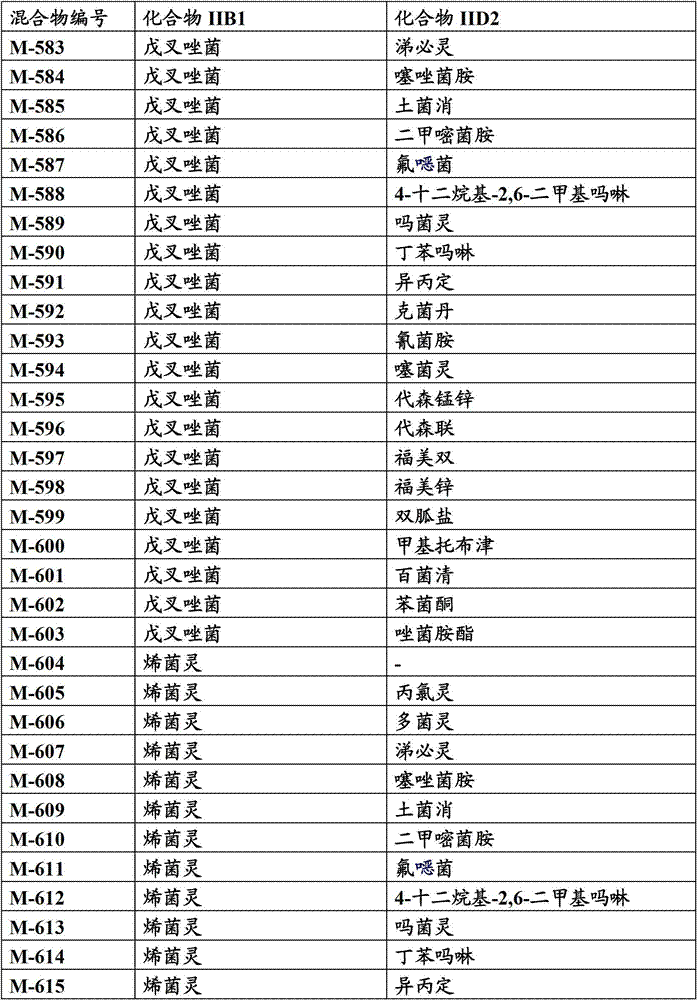


In particularly preferred embodiments, the present invention includes following ternary and quaternary mixture:
Table 1'
Wherein Compound I is Frontline, and Compound I IA is oxime bacterium ester, and the combination of Compound I IB1 and IID2 is in each case corresponding to the mixture of showing mixture described in S.
Table 2'
Wherein Compound I is Frontline, and Compound I IA is the nitrile Fluoxastrobin, and the combination of Compound I IB1 and IID2 is in each case corresponding to the mixture of showing mixture described in S.
Table 3'
Wherein Compound I is Frontline, and Compound I IA is metalaxyl, and the combination of Compound I IB1 and IID2 is in each case corresponding to the mixture of showing mixture described in S.
Table 4'
Wherein Compound I is Frontline, and Compound I IA is Metalaxyl-M, and the combination of Compound I IB1 and IID2 is in each case corresponding to the mixture of showing mixture described in S.
Table 5'
Wherein Compound I is Frontline, and Compound I IC is cyproconazole, and the combination of Compound I IB1 and IID2 is in each case corresponding to the mixture of showing mixture described in S.
Table 6'
Wherein Compound I is Frontline, and Compound I IA is Flutriafol, and the combination of Compound I IB1 and IID2 is in each case corresponding to the mixture of showing mixture described in S.
Table 7'
Wherein Compound I is Frontline, and Compound I IC is Tebuconazole, and the combination of Compound I IB1 and IID2 is in each case corresponding to the mixture of showing mixture described in S.
Table 8'
Wherein Compound I is Frontline, and Compound I IA is triadimenol, and the combination of Compound I IB1 and IID2 is in each case corresponding to the mixture of showing mixture described in S.
Table 9'
Wherein Compound I is Frontline, and Compound I IC is Prochloraz, and the combination of Compound I IB1 and IID2 is in each case corresponding to the mixture of showing mixture described in S.
Table 10'
Wherein Compound I is Frontline, and Compound I IA is fluorine
bacterium, and the combination of Compound I IB1 and IID2 is in each case corresponding to the mixture of showing mixture described in S.
Table 11'
Wherein Compound I is Frontline, and Compound I IC is tmtd, and the combination of Compound I IB1 and IID2 is in each case corresponding to the mixture of showing mixture described in S.
Table 12'
Wherein Compound I is Frontline, and Compound I IA is
 the ether azoles, and the combination of Compound I IB1 and IID2 is in each case corresponding to the mixture of showing mixture described in S.
Table S


Mixture of the present invention can further contain one or more Pesticidal compounds III.Being intended to explanation and may combining of the following insecticide that can use together with mixture of the present invention according to the present invention and do not apply any restriction:
A.1. organic (sulfo-) phosphoric acid ester: orthen (acephate), azoles pyridine phosphorus (azamethiphos), triazotion (azinphos-ethyl), gusathion m (azinphos-methyl), earth worm chlorine phosphorus (chlorethoxyfos), chlorfenviphos (chlorfenvinphos), chlormephos (chlormephos), chlopyrifos (chlorpyrifos), chlorpyrifos-methyl (chlorpyrifos-methyl), Resistox (coumaphos), cynock (cyanophos), demeton-methyl (demeton-S-methyl), basudin (diazinon), dichlorvos (dichlorvos/DDVP), Carbicron (dicrotophos), Rogor (dimethoate), dimethylvinphos (dimethylvinphos), disulfoton (disulfoton), EPN (EPN), ethion (ethion), ethoprop (ethoprophos), Dovip (famphur), Nemacur (fenamiphos), Folithion (fenitrothion), fenthion (fenthion), pyrrole fluorine sulphur phosphorus (flupyrazophos), thiazolone phosphorus (fosthiazate), worm phosphorus in heptan (heptenophos), different
 azoles phosphorus (isoxathion), malathion (malathion), Afos (mecarbam), acephatemet (methamidophos), methidathion (methidathion), Menite (mevinphos), nuvacron (monocrotophos), 2-dichloroethylk dimethyl phosphate (naled), flolimat (omethoate), metilomerkaptofosoksid (oxydemeton-methyl), one six zero five (parathion), methyl 1 (parathion-methyl), phenthoate dimephenthoate cidial (phenthoate), thimet (phorate), zolone (phosalone), phosmet (phosmet), phosphamidon (phosphamidon), phoxim (phoxim), Actellic (pirimiphos-methyl), Profenofos (profenofos), propetamphos (propetamphos), Toyodan (prothiofos), pyraclofos (pyraclofos), Ofunack (pyridaphenthion), diethquinalphione (quinalphos), sulfotep (sulfotep), Tebupirimphos (tebupirimfos), temephos (temephos), Terbufos (terbufos), Ravap (tetrachlorvinphos), thiometon (thiometon), Hostathion (triazophos), chlorophos (trichlorfon), Kilval (vamidothion)
A.2. carbamates: Aldicarb (aldicarb), alanycarb (alanycarb),
 worm prestige (bendiocarb), Benfuracard micro (benfuracarb), fourth fork prestige (butocarboxim), oxygen fourth fork prestige (butoxycarboxim), carbaryl (carbaryl), furadan (carbofuran), carbosulfan (carbosulfan), benzene worm prestige (ethiofencarb), Osbac (fenobucarb), Carzol (formetanate), furathiocarb (furathiocarb), Mobucin (isoprocarb), mercaptodimethur (methiocarb), methomyl (methomyl), meta-tolyl-N-methylcarbamate (MTMC) (metolcarb), methomyl (oxamyl), Aphox (pirimicarb), unden (propoxur), thiodicarb (thiodicarb), special ammonia fork prestige (thiofanox), Landrin (trimethacarb), Cosban (XMC), Meobal (xylylcarb), triaguron (triazamate),
A.3. pyrethroids: acifluorfen (acifluorfen), allethrin (allethrin), the cis-Dtrans allethrin of d-, the d-Dtrans allethrin, bifenthrin (bifenthrin), Dtrans allethrin (bioallethrin), Dtrans allethrin S-cyclopentenyl (bioallethrin S-cylclopentenyl), bioresmethrin (bioresmethrin), second cyanogen chrysanthemum fat (cycloprothrin), cyfloxylate (cyfluthrin), β-cyfloxylate, (RS) cyhalothrin (cyhalothrin), the cyhalothrin of λ-(RS), the cyhalothrin of γ-(RS), cypermethrin (cypermethrin), nail body cypermethrin (alpha-cypermethrin), Cypermethrin (beta-cypermethrin), hot body cypermethrin (beta-cypermethrin), own body cypermethrin (zeta-cypermethrin), cyphenothrin (cyphenothrin), decis (deltamethrin), Prallethrin (empenthrin), esfenvalerate (esfenvalerate), ether chrysanthemum ester (etofenprox), fenpropathrin (fenprop athrin), kill chrysanthemum ester (fenvalerate), flucythrinate (flucythrinate), flumethrin (flumethrin), T-flumethrin (tau-flumethrin), halogen ether chrysanthemum ester (halfenprox), miaow alkynes chrysanthemum ester (imiprothrin), permethrin (permethrin), phenothrin (phenothrin), prallethrin (prallethrin), Chryson (resmethrin), RU15525, deinsectization silicon ether (silafluofen), tefluthrin (tefluthrin), tetramethrin (tetramethrin), tralomethrin (tralomethrin), transfluthrin (transfluthrin), ZXI8901
A.4. intend juvenile hormone (juvenile hormone mimics): Entocon ZR 512 (hydroprene), cover 7 (kinoprene), Entocon ZR 515 (methoprene), ABG-6215 (fenoxycarb), pyriproxyfen (pyriproxyfen);
A.5. nicotinic receptor agonists/agonist compounds: pyrrole worm clear (acetamiprid), bensultap (bensultap), Padan (cartap hydrochloride), clothianidin (clothianidin), MTI-446 (dinotefuran), Imidacloprid (imidacloprid), Diacloden (thiamethoxam), nitenpyram (nitenpyram), nicotine (nicotine), spinosad (spinosad) (allosteric activator), thiacloprid (thiacloprid), thiocyclarn (thiocyclam), dimehypo (thiosultap-sodium) and AKD1022.
A.6.GABA gate chloride channel agonist compounds: Niran (chlordane), 5a,6,9,9a-hexahydro-6,9-methano-2,4 (endosulfan), lindane (gamma-HCH), acetoprole, pyrafluprole, pyriprole, fluorine pyrazoles worm (vaniliprole), formula Γ
1phenyl pyrazole compounds:

A.7. chloride channel activator: Olivomitecidin (abamectin), Affirm (Merck Co.) (emamectin benzoate), milbemycin (milbemectin), lepimectin;
A.8.METI I compound: fenazaquin (fenazaquin), fenpyroximate (fenpyroximate), pyramine phenylate (pyrimidifen), pyridaben (pyridaben), tebufenpyrad (tebufenpyrad), Tolfenpyrad (tolfenpyrad), flufenerim, rotenone (rotenone);
A.9.METI II and III compound: acequinocyl (acequinocyl), fluacyprim, amdro (hydramethylnon);
A.10. the oxidative phosphorylation agent (Uncoupler) of uncoupling: fluorine azoles worm clear (chlorfenapyr), dnoc (DNOC);
A.11. oxidative phosphorylation inhibitors: azoles ring tin (azocyclotin), plictran (cyhexatin), kill mite sulphur grand (diafenthiuron), fenbutatin oxide (fenbutatin oxide), propargite (propargite), tetradiphon (tetradifon);
A.12. the agent interfering (Moulting disruptor) of casting off a skin: cryomazine, chromafenozide, Benzoic acid N-tert-butyl-N-(4-chlorobenzoyl)hydrazide (halofenozide), Runner (methoxyfenozide), RH-5992 (tebufenozide);
A.13. synergist: Butacide (piperonyl butoxide), De-Green (tribufos);
A.14. sodium channel blockers compound:
 diazole worm (indoxacarb), metaflumizone (metaflumizone);
A.15. fumigant: methyl bromide, chloropicrin (chloropicrin), sulfuryl fluoride (sulfuryl fluoride)
A.16. selectivity feed blocking agent (Selective feeding blocker): cryolite (cryolite), pymetrozine (pymetrozine), flonicamid (flonicamid);
A.17. acarid growth inhibitor: clofentezine (clofentezine), Hexythiazox (hexythiazox), special benzene
 azoles (etoxazole);
A.18. chitin synthetic inhibitor: Buprofezin (buprofezin), bistrifluron (bistrifluron), UC 62644 (chlorfluazuron), TH-6040 (diflubenzuron), flucycloxuron (flucycloxuron), flufenoxuron (flufenoxuron), HEXAFLUMURON (hexaflumuron), fluorine the third oxygen urea (lufenuron), Rimon (novaluron), noviflumuron (noviflumuron), Teflubenzuron (teflubenzuron), desinsection grand (triflumuron);
A.19. lipoid biosynthesis inhibitor: spiral shell mite ester (spirodiclofen), Spiromesifen (spiromesifen), spirotetramat;
A.20. octopamine activator (octapaminergic agonist): amitraz (amitraz);
A.21. Ryanicide (ryanodine) receptor modulators: Flubendiamide (flubendiamide);
A.22. other: aluminum phosphate, amidoflumet, benclothiaz, Citrazon (benzoximate), Bifenazate (bifenazate), borax, fenisobromolate (bromopropylate), cyanide, cyenopyrafen, cyflumetofen (cyflumetofen), chinomethionat (chinomethionate), kelthane (dicofol), ethyl fluoroacetate, phosphine, pyridalyl (pyridalyl), pyrifluquinazon, sulphur, tartar emetic (tartar emetic);
A.23.N-R'-2,2-bis-halo-1-R " cyclopropane carboxamide-2-(the chloro-α of 2,6-bis-, α; the fluoro-p-methylphenyl of α-tri-) hydrazone or N-R'-2; 2-bis-(R ' ") propionamide-2-(the chloro-α of 2,6-bis-, α, the fluoro-p-methylphenyl of α-tri-)-hydrazone, wherein R' is methyl or ethyl, and halo is chlorine or bromine, and R " being hydrogen or methyl and R ' " is methyl or ethyl;
A.24. anthranilamide (anthranilamide): chlorantraniliprole (Chlorantraniliprole), formula Γ
2compound:

A.25. Malononitrile compound: CF
3(CH
2)
2c (CN)
2cH
2(CF
2)
3cF
2h, CF
3(CH
2)
2c (CN)
2cH
2(CF
2)
5cF
2h, CF
3(CH
2)
2c (CN)
2(CH
2)
2c (CF
3)
2f, CF
3(CH
2)
2c (CN)
2(CH
2)
2(CF
2)
3cF
3, CF
2h (CF
2)
3cH
2c (CN)
2cH
2(CF
2)
3cF
2h, CF
3(CH
2)
2c (CN)
2cH
2(CF
2)
3cF
3, CF
3(CF
2)
2cH
2c (CN)
2cH
2(CF
2)
3cF
2h, CF
3cF
2cH
2c (CN)
2cH
2(CF
2)
3cF
2h, 2-(2,2,3,3,4,4,5,5-octafluoro amyl group)-2-(3,3,4,4,4-, five fluorine butyl)-the third two eyeball and CF
2hCF
2cF
2cF
2cH
2c (CN)
2cH
2cH
2cF
2cF
3;
A.26. microorganism chaff interference (disruptor): bacillus thuringiensis subsp israelensis (Bacillus thuringiensis subsp.Israelensi), Bacillus sphaericus (Bacillus sphaericus), thuringiensis Aizawa subspecies (Bacillus thuringiensis subsp.Aizawai), bacillus thuringiensis Ku Sike subspecies (Bacillus thuringiensis subsp.Kurstaki), Bacillus thuringiensis subsp. tenebrionis (Bacillus thuringiensis subsp.Tenebrionis),
Above-listed commercial compound can be at The Pesticide Manual, the 13rd edition, in British CropProtection Council (2003) and other publication, finds.
Formula Γ
1sulphamide and preparation thereof be described in WO98/28279.Lepimectin is by Agro Project, PJB Publications Ltd, and in November, 2004 is known.Benclothiaz and preparation thereof are described in EP-A1454621.Methidathion and paraoxon and preparation thereof are described in Farm Chemicals Handbook, the 88th volume, and Meister Publishing Company, in 2001.Acetoprole and preparation thereof are described in WO98/28277.Metaflumizone and preparation thereof are described in EP-A1462456.Pyrrole fluorine sulphur phosphorus is described in Pesticide Science54, in 1988, the 237-243 pages and US4822779.Pyrafluprole and preparation thereof are described in JP2002193709 and WO01/00614.Pyriprole and preparation thereof are described in WO98/45274 and US6335357.Amidoflumet and preparation thereof are described in US6221890 and JP21010907.Flufenerim and preparation thereof are described in WO03/007717 and WO03/007718.AKD1022 and preparation thereof are described in US6300348.Chlorantraniliprole (Chlorantraniliprole) is described in WO01/70671, WO03/015519 and WO05/118552.Formula Γ
2anthranilamide be described in WO01/70671, WO04/067528 and WO05/118552.Cyflumetofen and preparation thereof are described in WO04/080180.Amido quinazoline ketonic compound pyrifluquinazon is described in EP A1097932.The third two eyeball Compound C F
3(CH
2)
2c (CN)
2cH
2(CF
2)
3cF
2h, CF
3(CH
2)
2c (CN)
2cH
2(CF
2)
5cF
2h, CF
3(CH
2)
2c (CN)
2(CH
2)
2c (CF
3)
2f, CF
3(CH
2)
2c (CN)
2(CH
2)
2(CF
2)
3cF
3, CF
2h (CF
2)
3cH
2c (CN)
2cH
2(CF
2)
3cF
2h, CF
3(CH
2)
2c (CN)
2cH
2(CF
2)
3cF
3, CF
3(CF
2)
2cH
2c (CN)
2cH
2(CF
2)
3cF
2h, CF
3cF
2cH
2c (CN)
2cH
2(CF
2)
3cF
2h, 2-(2,2,3,3,4,4,5,5-octafluoro amyl group)-2-(3,3,4,4,4-, five fluorine butyl)-the third two eyeball and CF
2hCF
2cF
2cF
2cH
2c (CN)
2cH
2cH
2cF
2cF
3be described in WO05/63694.
Preferably the mix and match thing is pyrethroid, nail body cypermethrin especially, anthranilamide, especially chlorantraniliprole, formula G
2compound:

Nicotinic receptor agonists/agonist compounds, especially clothianidin, MTI-446, Imidacloprid, Diacloden, nitenpyram, thiacloprid.Most preferably the mix and match thing is clothianidin and Imidacloprid.
As mentioned above, the present invention also comprises and comprises the mixture of following compound as active component:
(1) be selected from the Pesticidal compound I of Frontline and ethiprole;
(2) nicotinic receptor agonists/agonist compounds IIIA;
(3) and Compound I IB and/or be selected from row D Compound I ID, row D be defined as row B add pyraclostrobin.
In preferred embodiments, nicotinic receptor agonists/agonist compounds III be that the pyrrole worm is clear, clothianidin, MTI-446, Imidacloprid, Diacloden, nitenpyram or thiacloprid.In a more preferred embodiment, nicotinic receptor agonists/agonist compounds III is clothianidin, Diacloden or Imidacloprid, wherein clothianidin most preferably.
Also preferably contain Frontline as Compound I, clothianidin is as the quaternary mixture of compound III A and Compound I ID and Compound I IB.
Also preferably contain Frontline as Compound I, Imidacloprid is as the quaternary mixture of compound III A and Compound I ID and Compound I IB.
Also preferably contain Frontline as Compound I, Diacloden is as the quaternary mixture of compound III A and Compound I ID and Compound I IB.
Also particularly preferably contain Frontline as Compound I, the ternary mixture of clothianidin and triticonazole.
Also particularly preferably contain Frontline as Compound I, the ternary mixture of clothianidin and pyraclostrobin.
Also particularly preferably contain the mixture of Frontline, clothianidin, pyraclostrobin and Prochloraz.
Also particularly preferably contain the mixture of Frontline, clothianidin, pyraclostrobin and triticonazole.
Also particularly preferably contain the mixture of Frontline, clothianidin, pyraclostrobin and thiophanate methyl.
Also particularly preferably contain the mixture of Frontline, clothianidin, pyraclostrobin and thiophanate methyl.
Also preferably wherein Compound I be that Frontline, compound III A are clothianidin, and the combination of Compound I IB1 and IID2 is in each case corresponding to the mixture of a line of table Q.
Also more preferably wherein Compound I be that Frontline, compound III A are clothianidin, and the combination of Compound I IB1 and IID2 is in each case corresponding to the mixture of a line of table S.
Also preferably wherein Compound I be that Frontline, compound III A are Imidacloprid, and the combination of Compound I IB1 and IID2 is in each case corresponding to the mixture of a line of table Q.
Also more preferably wherein Compound I be that Frontline, compound III A are Imidacloprid, and the combination of Compound I IB1 and IID2 is in each case corresponding to the mixture of a line of table S.
Also preferably wherein Compound I be that Frontline, compound III A are Diacloden, and the combination of Compound I IB1 and IID2 is in each case corresponding to the mixture of a line of table Q.
Also more preferably wherein Compound I be that Frontline, compound III A are Diacloden, and the combination of Compound I IB1 and IID2 is in each case corresponding to the mixture of a line of table S.
As mentioned above, the present invention also comprises and comprises the mixture of following compound as active component:
(1) be selected from the Pesticidal compound I of Frontline and ethiprole;
(2) Anthranilamide compound IIIB;
(3) and Compound I IB and/or be selected from row D Compound I ID, row D be defined as row B add pyraclostrobin.
In a preferred embodiment, compound III B is chlorantraniliprole.
In another preferred embodiment, compound III B is formula G
2compound.
Also preferably contain the quaternary mixture of Frontline as Compound I, compound III B and Compound I ID and Compound I IB.
Especially also preferably contain the ternary mixture of Frontline as Compound I, chlorantraniliprole and Compound I ID and Compound I IB.
Also preferably wherein Compound I be Frontline, the combination that compound III B is chlorantraniliprole and Compound I IB1 and IID2 is in each case corresponding to the mixture of a line of table Q.
More also preferably wherein Compound I be Frontline, the combination that compound III B is chlorantraniliprole and Compound I IB1 and IID2 is in each case corresponding to the mixture of a line of table S.
Also preferably wherein Compound I be Frontline, the combination of the compound that compound III B is formula G2 and Compound I IB1 and IID2 is in each case corresponding to the mixture of a line of table Q.
More also preferably wherein Compound I be Frontline, the combination of the compound that compound III B is formula G2 and Compound I IB1 and IID2 is in each case corresponding to the mixture of a line of table S.
As mentioned above, the present invention also comprises the Fungicidal synergistic mixtures be comprised of Compound I IB and Compound I ID.The preferably Compound I IB1 described in table R and the combination of IID2.
Table R is corresponding to table Q, yet do not comprise mixture numbering M-1, M-43, M-84, M-124, M-163, M-201, M-238, M-274, M-309, M-343, M-376, M-408, M-439, M-469, M-498, M-526, M-553, M-579, M-604, M-628, M-651, M-673, M-694, M-714, M-733, M-751, M-768, M-784, M-799, M-813, M-826, M-838, M-849, M-859, M-868, M-876, M-883, M-889, M-894, M-898 and M-901, it only means individualized compound IIB1 and without Compound I ID2.
The present invention also comprises the mixture of three kinds of Fungicidal compounds, and wherein two kinds of compounds are selected from and are listed as defined above B, and the third Fungicidal compounds Fungicidal compounds IID that is the Synergistic effective dose.
The purposes that is intended to for them is preferably as follows ternary fungicidal mixtures:
Table 1 "
The combination that Compound I IB is oxime bacterium ester and Compound I IB1 and IID2 is in each case corresponding to the mixture of a line of table R.
Table 2 "
The combination that Compound I IB is nitrile Fluoxastrobin and Compound I IB1 and IID2 is in each case corresponding to the mixture of a line of table R.
Table 3 "
The combination that Compound I IB is Boscalid and Compound I IB1 and IID2 is in each case corresponding to the mixture of a line of table R.
Table 4 "
The combination that Compound I IB is metalaxyl and Compound I IB1 and IID2 is in each case corresponding to the mixture of a line of table R.
Table 5 "
The combination that Compound I IB is Metalaxyl-M and Compound I IB1 and IID2 is in each case corresponding to the mixture of a line of table R.
Table 6 "
The combination that Compound I IB is cyproconazole and Compound I IB1 and IID2 is in each case corresponding to the mixture of a line of table R.
Table 7 "
The combination that Compound I IB is oxole bacterium and Compound I IB1 and IID2 is in each case corresponding to the mixture of a line of table R.
Table 8 "
The combination that Compound I IB is RH-7592 and Compound I IB1 and IID2 is in each case corresponding to the mixture of a line of table R.
Table 9 "
The combination that Compound I IB is Fluquinconazole and Compound I IB1 and IID2 is in each case corresponding to the mixture of a line of table R.
Table 10 "
The combination that Compound I IB is Flutriafol and Compound I IB1 and IID2 is in each case corresponding to the mixture of a line of table R.
Table 11 "
The combination that Compound I IB is cycltebuconazole and Compound I IB1 and IID2 is in each case corresponding to the mixture of a line of table R.
Table 12 "
The combination that Compound I IB is ring penta azoles bacterium and Compound I IB1 and IID2 is in each case corresponding to the mixture of a line of showing R.
Table 13 "
The combination that Compound I IB is propiconazole and Compound I IB1 and IID2 is in each case corresponding to the mixture of a line of table R.
Table 14 "
Wherein Compound I is ethiprole, and the combination that Compound I I is prothioconazoles and Compound I IB1 and IID2 is in each case corresponding to the mixture of a line of table R.
Table 15 "
The combination that Compound I IB is Tebuconazole and Compound I IB1 and IID2 is in each case corresponding to the mixture of a line of table R.
Table 16 "
The combination that Compound I IB is triadimenol and Compound I IB1 and IID2 is in each case corresponding to the mixture of a line of table R.
Table 17 "
The combination that Compound I IB is IMAZALIL and Compound I IB1 and IID2 is in each case corresponding to the mixture of a line of table R.
Table 18 "
The combination that Compound I IB is Prochloraz and Compound I IB1 and IID2 is in each case corresponding to the mixture of a line of table R.
Table 19 "
The combination that Compound I IB is carbendazim and Compound I IB1 and IID2 is in each case corresponding to the mixture of a line of table R.
Table 20 "
The combination that Compound I IB is thiabendazole and Compound I IB1 and IID2 is in each case corresponding to the mixture of a line of table R.
Table 21 "
The combination that Compound I IB is Guardian amine and Compound I IB1 and IID2 is in each case corresponding to the mixture of a line of table R.
Table 22 "
The combination that Compound I IB is hydroxyisoxazole and Compound I IB1 and IID2 is in each case corresponding to the mixture of a line of table R.
Table 23 "
The combination that Compound I IB is pyrimethanil and Compound I IB1 and IID2 is in each case corresponding to the mixture of a line of table R.
Table 24 "
Compound I IB is fluorine
 the combination of bacterium and Compound I IB1 and IID2 is in each case corresponding to the mixture of a line of table R.
Table 25 "
Compound I IB is 4-dodecyl-2, and the combination of 6-thebaine and Compound I IB1 and IID2 is in each case corresponding to the mixture of a line of table R.
Table 26 "
The combination that Compound I IB is dodemorfe and Compound I IB1 and IID2 is in each case corresponding to the mixture of a line of table R.
Table 27 "
The combination that Compound I IB is butadiene morpholine and Compound I IB1 and IID2 is in each case corresponding to the mixture of a line of table R.
Table 28 "
The combination that Compound I IB is isopropyl fixed and Compound I IB1 and IID2 is in each case corresponding to the mixture of a line of showing R.
Table 29 "
The combination that Compound I IB is captan and Compound I IB1 and IID2 is in each case corresponding to the mixture of a line of table R.
Table 30 "
The combination that Compound I IB is zarilamid and Compound I IB1 and IID2 is in each case corresponding to the mixture of a line of table R.
Table 31 "
The combination that Compound I IB is probenazole and Compound I IB1 and IID2 is in each case corresponding to the mixture of a line of table R.
Table 32 "
The combination that Compound I IB is mancozeb and Compound I IB1 and IID2 is in each case corresponding to the mixture of a line of table R.
Table 33 "
The combination that Compound I IB is Carbatene and Compound I IB1 and IID2 is in each case corresponding to the mixture of a line of table R.
Table 34 "
The combination that Compound I IB is tmtd and Compound I IB1 and IID2 is in each case corresponding to the mixture of a line of table R.
Table 35 "
The combination that Compound I IB is ziram and Compound I IB1 and IID2 is in each case corresponding to the mixture of a line of table R.
Table 36 "
The combination that Compound I IB is guazatine and Compound I IB1 and IID2 is in each case corresponding to the mixture of a line of table R.
Table 37 "
The combination that Compound I IB is thiophanate methyl and Compound I IB1 and IID2 is in each case corresponding to the mixture of a line of table R.
Table 38 "
The combination that Compound I IB is tpn and Compound I IB1 and IID2 is in each case corresponding to the mixture of a line of table R.
Table 39 "
The combination that Compound I IB is metrafenone and Compound I IB1 and IID2 is in each case corresponding to the mixture of a line of table R.
Table 40 "
Compound I IB is
the combination of ether azoles and Compound I IB1 and IID2 is in each case corresponding to the mixture of a line of table R.
Table 41 "
The combination that Compound I IB is triticonazole and Compound I IB1 and IID2 is in each case corresponding to the mixture of a line of table R.
Table 42 "
Wherein Compound I is Frontline, and Compound I IA is N-(3', 4', 5'-trifluoro-biphenyl-2-yl)-1-methyl-3-Trifluoromethyl-1 H-pyrazole-4-carboxamide, and the combination of Compound I IB1 and IID2 is in each case corresponding to the mixture of a line of table Q.
Table 43 "
Wherein Compound I is Frontline, and Compound I IA is N-(3', 4', 5'-trifluoro-biphenyl-2-yl)-1-methyl-3-Trifluoromethyl-1 H-pyrazole-4-carboxamide, and the combination of Compound I IB1 and IID2 is in each case corresponding to the mixture of a line of table R.
Table 44 "
Wherein Compound I is Frontline, and Compound I IA is N-(2', 4', 5'-trifluoro-biphenyl-2-yl)-1-methyl-3-difluoromethyl-1H-pyrazole-4-carboxamide, and the combination of Compound I IB1 and IID2 is in each case corresponding to the mixture of a line of table R.
Table 45 "
Wherein Compound I is ethiprole, and Compound I IA is N-(3', 4', 5'-trifluoro-biphenyl-2-yl)-3-chlorine methyl fluoride-1-methyl isophthalic acid H-pyrazole-4-carboxamide, and the combination of Compound I IB1 and IID2 is in each case corresponding to the mixture of a line of table R.
Table 46 "
Wherein Compound I is ethiprole, and Compound I IA is N-(3', the chloro-4-fluorine biphenyl of 4'-bis--2-yl)-fluoro-methyl isophthalic acid-methyl of 3-bis--pyrazole-4-carboxamide, and the combination of Compound I IB1 and IID2 is in each case corresponding to the mixture of a line of table R.
Table 47 "
Wherein Compound I is ethiprole, and Compound I IA is N-(3', the chloro-5-fluorine biphenyl of 4'-bis--2-yl)-3-difluoromethyl-1-methylpyrazole-4-formamide, and the combination of Compound I IB1 and IID2 is in each case corresponding to the mixture of a line of table R.
Table 48 "
Wherein Compound I is ethiprole, Compound I IA is that (2-(1 for N-, the 3-dimethylbutyl)-phenyl)-1, the fluoro-1H-pyrazoles of 3-dimethyl-5--4-benzoic acid amides, and the combination of Compound I IB1 and IID2 is in each case corresponding to the mixture of a line of table R.
Table 49 "
Wherein Compound I is ethiprole, Compound I IA is N-(cis-2-connection cyclopropyl-2-base-phenyl)-3-difluoromethyl-1-methyl isophthalic acid H-pyrazoles-4-benzoic acid amides, and the combination of Compound I IB1 and IID2 is in each case corresponding to the mixture of a line of showing R.
Table 50 "
Wherein Compound I is ethiprole, Compound I IA is N-(trans-2-connection cyclopropyl-2-base-phenyl)-fluoro-methyl isophthalic acid of 3-bis--methyl isophthalic acid H-pyrazoles-4-benzoic acid amides, and the combination of Compound I IB1 and IID2 is in each case corresponding to the mixture of a line of showing R.
Table 51 "
Wherein Compound I is ethiprole, Compound I IA is 3-(difluoromethyl)-1-methyl-N-[1,2,3,4-tetrahydrochysene-9-(1-Methylethyl)-1,4-methanonaphthalene-5-yl]-1H-pyrazoles-4 formamide, and the combination of Compound I IB1 and IID is in each case corresponding to the mixture of a line of table R.
Herein, following mixture particularly preferably:
(1) mixture formed by Prochloraz, triticonazole and pyraclostrobin;
(2) mixture formed by thiophanate methyl, triticonazole and pyraclostrobin; With
(3) mixture formed by Boscalid, metalaxyl and pyraclostrobin.
For purposes of the present invention, mixture according to the present invention or Compound I and reactive compound IIA (or IIC) and optional IIB or IIB and IID (or the mixture of Fungicidal mixture or Compound I, compound III (for example IIIA or IIIB) and one or more Compound I IB or Compound I IB and Compound I ID) as defined above can be converted into to normal compound agent, for example solution, emulsion, suspension, pulvis, powder, paste and particle.Type of service depends on specific purpose; Should guarantee that in each case the compounds of this invention is meticulous and distribute equably.
Prepared by preparaton, for example, by reactive compound is mixed and prepares with solvent and/or carrier, use if required emulsifier and dispersant in known manner.Suitable solvent/auxiliary agent is mainly:
-water, arsol (as Solvesso product, dimethylbenzene), paraffin (as mineral oil fractions), alcohols (as methyl alcohol, butanols, amylalcohol, benzylalcohol), ketone (as cyclohexanone, gamma-butyrolacton), pyrrolidones (NMP, NOP), acetic acid esters (ethylene acetate), dihydroxylic alcohols, fatty acid dimethylformamide, fatty acid and fatty acid ester.Can also use solvent mixture in principle.
-carrier is as the natural minerals (as kaolin, clay, talcum, chalk) ground and the synthetic mineral (as silica, the silicate of high degree of dispersion) ground; Emulsifier as nonionic and anion emulsifier (as polyoxyethylene aliphatic alcohol ether, alkylsulfonate and arylsulphonate) and dispersant as lignin sulfite waste liquor and methylcellulose.
Suitable surfactant is lignosulphonic acid, naphthalene sulfonic acids, phenolsulfonic acid, the alkali metal salt of dibutyl naphthalene sulfonic acids, alkali salt and ammonium salt, alkylaryl sulfonates, alkyl sulfate, alkylsulfonate, aliphatic alcohol sulfate, fatty acid and sulphated fatty alcohol glycol ether, the condensation product that also has sulfonated naphthalene and naphthalene derivatives and formaldehyde, the condensation product of naphthalene or naphthalene sulfonic acids and phenol and formaldehyde, polyoxyethylene octylphenol ether, the ethoxylation isooctylphenol, octyl phenol, nonyl phenol, alkyl phenol polyglycol ether, tributyl phenyl polyglycol ether, three stearyl phenyl polyglycol ethers, alkyl aryl polyether alcohol, alcohol and fatty alcohol/ethylene oxide condensation product, ethoxylated castor oil, polyoxyethylene alkyl ether, the ethoxylation polyoxypropylene, laruyl alcohol polyglycol ether acetal, sorbitol ester, lignin sulfite waste liquor and methylcellulose.
But the material that is suitable for preparation Direct spraying solution, emulsion, paste or oil dispersion is that mid-boiling point arrives high boiling mineral oil fractions, as kerosene or diesel oil, also has in addition the oil of coal tar and plant or animal origin, aliphatic series, ring-type and aromatic hydrocarbon, for example toluene, dimethylbenzene, paraffin, tetrahydronaphthalene, alkylated naphthalene or derivatives thereof, methyl alcohol, ethanol, propyl alcohol, butanols, cyclohexanol, cyclohexanone, isophorone, intensive polar solvent, for example methyl-sulfoxide, 1-METHYLPYRROLIDONE and water.
Antifreezing agent also can add preparaton as glycerine, ethylene glycol, propane diols and bactericide.
Suitable defoamer is for example the defoamer based on polysiloxanes or dolomol.
The seed treatment preparaton can additionally comprise adhesive and optional colorants.
Add adhesive to improve active material adhesion for seed after processing.Proper adhesive is block copolymer EO/PO surfactant, and polyvinyl alcohol, polyvinylpyrrolidone, polyacrylate, polymethacrylates, polybutene, polyisobutene, polystyrene, polyvinylamine, polyvinyl lactam, polymine
 polyethers, polyurethane, polyvinyl acetate, tylose and derived from the copolymer of these polymer.
Optionally in preparaton, also comprise colouring agent.The colouring agent or the dyestuff that are applicable to the seed treatment preparaton are rhodamine B, C.I. pigment red 112, C.I. solvent red 1, pigment blue 15: 4, pigment blue 15: 3, pigment blue 15: 2, pigment blue 15: 1, alizarol saphirol 80, pigment yellow 1, pigment yellow 13, pigment red 112, pigment red 4 8:2, pigment red 4 8:1, paratonere 57:1, paratonere 53:1, pigment orange 43, pigment orange 34, pigment orange 5, pigment green 36, pigment Green 7, Pigment white 6, pigment brown 25, alkaline purple 10, alkalescence purple 49, CI 45430, acid red 52, azogeramine 4, acid blue 9, acid yellow 23, alkali red 1:1 0, alkali red 1:1 08.
The example of gelling agent is carrageenan

Powder, but broadcasting sowing can be by mixing active substance or prepared by simultaneous grinding with material and dusting product with solid carrier.
Particle can be by preparing reactive compound and solid carrier adhesion as coated particle, impregnated granules and homogeneous particle.The example of solid carrier is that ore deposit soil is as silica gel, silicate, talcum, kaolin, activated clay (attaclay), lime stone, lime, chalk, bole, loess, clay, dolomite, diatomite, calcium sulphate, magnesium sulfate, magnesia; The synthetic material ground; Fertilizer is as ammonium sulfate, ammonium phosphate, ammonium nitrate, urea; The product of plant origin is as flour, bark powder, wood powder and shuck powder, cellulose powder and other solid carrier.
Preparaton comprises the 0.01-95 % by weight usually, preferably the reactive compound of 0.1-90 % by weight.Reactive compound is with 90-100%, and preferably the purity of 95-100% is used (according to the NMR spectrum).
For seed treatment, each preparaton can be doubly rear in sight with providing the 0.01-60 % by weight in preparation at dilution 2-10, preferably the activity compound concentration of 0.1-40 % by weight.
Under classify the preparaton example as:
1. the product of dilute with water
For seed treatment, these products can dilute or be applied to seed without dilution.
A) water-soluble concentrate (SL, LS)
10 weight portion reactive compounds are dissolved in 90 weight parts waters or water-soluble solvent.Perhaps, add wetting agent or other auxiliary agent.Reactive compound dissolves through the water dilution.Obtain in this way the preparaton that reactive compound content is 10 % by weight.
B) dispersed concentrate (DC)
Be dissolved in 70 weight portion cyclohexanone by 20 weight portion reactive compounds and add 10 weight portion dispersants as PVP(polyvinyl pyrrolidone).Dilute with water obtains dispersion.Reactive compound content is 20 % by weight.
C) missible oil (EC)
Be dissolved in 75 weight portion dimethylbenzene by 15 weight portion reactive compounds and add calcium dodecyl benzene sulfonate and castor oil ethoxylate (being 5 weight portions in each case).Dilute with water obtains emulsion.The reactive compound content of this preparaton is 15 % by weight.
D) emulsion (EW, EO, ES)
Be dissolved in 35 weight portion dimethylbenzene by 25 weight portion reactive compounds and add calcium dodecyl benzene sulfonate and castor oil ethoxylate (being 5 weight portions in each case).Introduce in 30 weight parts waters by this mixture and make equal phase emulsion by mulser (as Ultraturrax).Dilute with water obtains emulsion.The reactive compound content of this preparaton is 25 % by weight.
E) suspension (SC, OD, FS)
In the ball mill stirred, 20 weight portion reactive compounds are pulverized and added 10 weight portion dispersants and wetting agent and 70 weight parts waters or organic solvent, obtain reactive compound suspension in small, broken bits.Dilute with water obtains stable reactive compound suspension.Reactive compound content in this preparaton is 20 % by weight.
F) water-dispersible granule and water-soluble granular (WG, SG)
By the grinding in small, broken bits of 50 weight portion reactive compound and add 50 weight portion dispersant and wetting agents, by commercial plant (as extruder, spray tower, fluid bed), be made into water dispersible or water-soluble granular.Dilute with water obtains stable active compound dispersion or solution.The reactive compound content of this preparaton is 50 % by weight.
G) water dispersible pow-ders and water-soluble powder (WP, SP, SS, WS)
75 weight portion reactive compounds are ground in the rotor-stator grinding machine and add 25 weight portion dispersants, wetting agent and silica gel.Dilute with water obtains stable active compound dispersion or solution.The reactive compound content of this preparaton is 75 % by weight.
H) gel formulation (GF)
At grinding in ball grinder 20 weight portion reactive compounds, 10 weight portion dispersants, 1 weight portion gelling agent and 70 weight parts waters or organic solvent, obtain suspension in small, broken bits.Dilute with water obtains the stable suspension that reactive compound content is 20 % by weight.
2. the product of using without dilution
I) but dusting powder (DP, DS)
By the grinding in small, broken bits of 5 weight portion reactive compound and with 95 weight portion kaolin in small, broken bits, fully mix.But this obtains the dusting product that reactive compound content is 5 % by weight.
J) particle (GR, FG, GG, MG)
By the grinding in small, broken bits of 0.5 weight portion reactive compound and in conjunction with 99.5 weight portion carriers.Current methods be extrude, atomized drying or bed process.This obtains the particle of using without dilution that reactive compound content is 0.5 % by weight.
K) ULV solution (UL)
10 weight portion reactive compounds are dissolved in to 90 weight portion organic solvents as in dimethylbenzene.This obtains the product of using without dilution that reactive compound content is 10 % by weight.
For seed treatment, usually use water-soluble concentrate (LS), suspension (FS) but dusting powder (DS), water dispersible and water-soluble powder (WS, SS), emulsion (ES), missible oil (EC) and gel formulation (GF).These preparatons can not diluted or the form of preferably dilution be applied on seed.Use and can carry out prior to seeding.
In preferred embodiments, use seed treatment FS preparaton.Such preparaton comprises 1-800g reactive compound/l usually, 1-200g surfactant/l, 0-200g antifreezing agent/l, 0-400g adhesive/l, 0-200g colouring agent/l and 1L solvent at the most, preferred water.
Mixture of the present invention can be directly, with its preparaton form or type of service prepared therefrom (but but as Direct spraying solution, powder, suspension or dispersion, emulsion, oil dispersion, paste dusting product, broadcast sowing with material or particle), by spraying, atomization, dusting, broadcast sowing or water and use.Type of service depends on the purpose be intended to fully; Be intended to guarantee in each case that the best of reactive compound of the present invention may distribute.
Can by emulsion concentrates, paste or wettable powder (sprayable powder, oil dispersion), be prepared by adding water by moisture type of service.For preparation emulsion, paste or oil dispersion, can by wetting agent, tackifier, dispersant or emulsifier by this material directly or after being dissolved in oil or solvent in water homogenizing.Yet, can also prepare the concentrate and this concentrate that are formed by active substance, wetting agent, tackifier, dispersant or emulsifier and suitable solvent or oil and be suitable for dilute with water.
With the activity compound concentration in preparation, can in relative broad range, change.It typically is 0.0001-10%, preferably 0.01-1%.
Reactive compound also can be successfully used with ultra low volume method (ULV), wherein can use and comprise the preparaton that surpasses 95 % by weight reactive compounds or even can be in the situation that do not have additive to use reactive compound.
Various types of oil, wetting agent, adjuvant, weed killer herbicide, fungicide, other agricultural chemicals or bactericide can be added in reactive compound, suitable words just before being close to use (bucket mix) add.These reagent usually can 1:100-100:1, preferably weight ratio and the reagent mix of the present invention of 1:10-10:1.
Composition of the present invention can also contain fertilizer as ammonium nitrate, urea, potash and superphosphate, phytotoxin and plant growth regulator and safener.These extra compositions can with above-mentioned composition successively or be combined with, suitable words also add (bucket mixes) before being close to use.For example can be before or after processing with fertilizer with the present composition plant of spraying.
The compound be included in mixture as defined above can be simultaneously, i.e. associating or separately, or use successively the result usually not tool any impact of order of administration on prophylactico-therapeutic measures in the separate administration situation.
Advantageously, they are applicable to prevent and treat following plant disease:
● the Alternaria on vegetables, oilseed rape, sugar beet, fruit and rice (Alternaria), for example the early epidemic chain lattice spores (A.solani) on potato and tomato or chain lattice spore (A.alternata);
● the Aphanomyces on sugar beet and vegetables (Aphanomyces);
● the Ascochyta on Cereal and vegetables (Ascochyta);
● the Bipolaris in corn, Cereal, rice and lawn (Bipolaris) and Drechslera
(Drechslera), the Bipolaris maydis (D.maydis) on corn for example;
● the standing grain powdery mildew on Cereal (Blumeria graminis) (powdery mildew);
● the Botrytis cinerea on strawberry, vegetables, flowers and grape vine (Botrytis cinerea) (gray mold),
● the lettuce dish stalk mould (Bremia lactucae) on lettuce,
● the Cercospora on corn, soybean, rice and sugar beet (Cercospora);
● cochliobolus on corn, Cereal, rice belongs to (Cochliobolus), the standing grain cochliobolus on Cereal (Cochliobolus sativus) for example, the palace section cochliobolus (Cochliobolus miyabeanus) on rice;
● the perverse dish spore on soybean and cotton belongs to (Colletotricum);
● the Drechslera on corn, Cereal, rice and lawn (Drechslera), nuclear cavity Pseudomonas (Pyrenophora), the D.tritci-repentis that for example navel is wriggled on spore (D.teres) or wheat in the barley filigree on barley;
● the Eschka (Esca) on the grape vine caused by Phaeoacremonium chlamydosporium, Ph.Aleophilum and Formitipora punctata (synonym spot hole Phellinus (Phellinus punctatus));
● the prominent navel Helminthosporium (Exserohilum) on corn,
● the two spore powdery mildews (Erysiphe cichoracearum) on cucumber and monofilament shell powdery mildew (Sphaerotheca fuliginea),
● the Fusarium on each Plants (Fusarium) and Verticillium (Verticillium), for example the fusarium graminaria on Cereal (F.graminearum) or machete sickle spore (F.culmorum) or various plants are as the sharp sickle spore (F.oxysporum) on tomato;
● the gaeumannomyce on Cereal (Gaeumanomyces graminis);
● the Gibberella on Cereal and rice (Gibberella) (for example gibberella fujikuroi on rice (Gibberella fujikuroi));
● the Grainstaining complex on rice;
● the Helminthosporium on corn and rice (Helminthosporium);
● the Michrodochium nivale on Cereal;
● the mycosphaerella on Cereal, banana and peanut (Mycosphaerella), for example the standing grain green-ball chamber bacterium (M.graminicola) on wheat or the Fijian ball chamber bacterium (M.fijiensis) on banana;
● the Peronospora (Peronospora) on cabbage and bulb plant, for example the rape downy mildew (P.brassicae) on cabbage or the shallot downy mildew (P.destructor) on onion;
● the yam bean layer rest fungus (Phakopsora pachyrhizi) on soybean and mountain horseleech layer rest fungus (Phakopsara meibomiae);
● the Phomopsis on soybean and sunflower (Phomopsis);
● the phytophthora infestans on potato and tomato (Phytophthora infestans);
● the Phytophthora on each Plants (Phytophthora), for example Phytophthora capsici on green pepper (P.capsici);
● the grape on grape vine is given birth to single shaft mould (Plasmopara viticola),
● the apple mildew bacterium on apple (Podosphaera leucotricha),
● the wheat-based maize ear rot bacterium (Pseudocercosporella herpotrichoides) on Cereal,
● the Pseudoperonospora on each Plants (Pseudoperonospora), for example the humulus false frost of grass (P.Humili) on the false downy mildew (P.Cubensis) of the Cuba on cucumber or lupulus;
● the Puccinia on each Plants (Puccinia), for example the wheat handle rest fungus (P.triticina) on Cereal, bar shaped handle rust (P.striformis), barley handle rust (P.hordei) or puccinia graminis (P.graminis), or the Asparagus handle rust (P.asparagi) on asparagus);
● the Pyricularia oryzae on rice (Pyricularia oryzae), Bamboo grass wood photovoltaicing leather bacteria (Corticium sasakii), broom stalk Cylindrocarpon (Sarocladium oryzae), sheath rot of rice plant (S.attenuatum), rice leaf smut (Entyloma oryzae)
● the piricularia oryzae on lawn and Cereal (Pyricularia grisea),
● the pythium on lawn, rice, corn, cotton, oilseed rape, sunflower, sugar beet, vegetables and other plant (Pythium), the Pythium ultimum bacterium (P.ultiumum) on each Plants for example, the melon and fruit corruption on lawn mould (P.aphanidermatum);
● the Rhizoctonia (Rhizoctonia) on cotton, rice, potato, lawn, corn, oilseed rape, sugar beet, vegetables and each Plants, for example the miliary damping-off germ (R.solani) on beet and each Plants;
● the rye beak spore (Rhynchosporium secalis) on barley, rye and triticale;
● the Sclerotinia on oilseed rape and sunflower (Sclerotinia);
● the wheat septoria on wheat (Septoria tritici) and the many spores of clever withered shell (Stagonospora nodorum),
● the grape snag shell on grape vine (Erysiphe (synonym Uncinula) necator),
● the Setospaeria on corn and lawn belongs to,
● the silk axle smut (Sphacelotheca reilinia) on corn,
● the Thiclaviopsis on soybean and cotton (Thievaliopsis),
● the Tilletia on Cereal (Tilletia),
● the Ustilago on Cereal, corn and sugarcane (Ustilago), for example Ustilago maydis on corn (U.maydis);
● the Venturia on apple and pears (Venturia) (scab), for example apple scab on apple (V.inaequalis).
In addition, mixture of the present invention also is suitable for preventing and treating the product of harmful fungoid with protective material (as timber, paper, paint dispersion, fiber or fabric) and protection storage.In wood protection, should note following harmful fungoid especially: the Ascomycetes fungi, as line mouth shell belongs to (Ophiostoma spp.), long beak shell belongs to (Ceratocystis spp.), Aureobasidium pullulans (Aureobasidium pullulans), Sclerophomaspp., Chaetomium (Chaetomium spp.), Humicola (Humicola spp.), Peter's shell belongs to (Petriella spp.), the mould genus of pieces (Trichurus spp.), the Basidiomycetes fungi, as cellar fungus belongs to (Coniophora spp.), Coriolus Qu61 (Coriolus spp.), sticky gill fungus belongs to (Gloeophyllum spp.), Lentinus (Lentinus spp.), Pleurotus (Pleurotus spp.), sleeping hole belongs to (Poria spp.), Merulius (Serpula spp.) and Tyromyces (Tyromyces spp.), the deuteromycetes fungi, as aspergillus (Aspergillus spp.), Cladosporium (Cladosporium spp.), Penicillium (Penicilliumspp.), trichoderma (Trichoderma spp.), Alternaria (Alternaria spp.), paecilomyces (Paecilomyces spp.) and Zygomycetes (Zygomycetes) fungi, as mucor (Mucor spp.), should note following yeast in this external material protection: candida (Candida spp.) and saccharomyces cerevisiae (Saccharomyces cerevisae).
They to various cultivated plants as banana, cotton, vegetables (as cucumber, beans and cucurbitaceous plant), barley, dogstail, oat, coffee, potato, corn, fruit, rice, rye, soybean, tomato, grape vine, wheat, ornamental plants, sugarcane and multiple seed in the control a large amount of fungies be even more important.
Mixture of the present invention (except the mixture that only comprises fungicide) also shows the significantly activity of the following purpose insect of antagonism:
Lepidopterous insects (Lepidoptera (Lepidoptera)), for example black cutworm (Agrotis ypsilon), white line dart moth of turnip (Agrotis segetum), kapok worm (Alabama argillacea), Anticarsia (Anticarsia gemmatalis), Argyresthia conjugella, fork Autographa spp (Autographa gamma), tree looper (Bupalus piniarius), Cacoecia murinana, Capua reticulana, Cheimatobia brumata, dragon spruce Choristoneura spp (Choristoneura fumiferana), Choristoneura occidentalis, striped rice borer (Cirphis unipuncta), codling moth (Cydia pomonella), pine caterpillars (Dendrolimus pini), Diaphania nitidalis, Southwest Maize bar crambid (Diatraea grandiosella), Egyptian brill noctuid (Earias insulana), South America maize seedling phycitid (Elasmopalpus lignosellus), ligustrum fine tortricidae (Eupoecilia ambiguella), Evetria bouliana, Feltia subterranea, galleria mellonella waxmoth (Galleria mellonella), Lee's Grapholita spp (Grapholitha funebrana), oriental fruit moth (Grapholitha molesta), cotton bollworm (Heliothis armigera), tobacco budworm (Heliothis virescens), corn earworm (Heliothis zea), Oeobia undalis (Hellula undalis), Hibernia defoliaria, fall webworm (Hyphantria cunea), apple ermine moth (Hyponomeuta malinellus), tomato worm moth (Keiferia lycopersicella), Lambdina fiscellaria, beet armyworm (Laphygma exigua), coffee leafminer (Leucoptera coffeella), pear leaf blister moth (Leucoptera scitella), Lithocolletis blancardella, grape berry steinernema (Lobesia botrana), beet webworm (Loxostege sticticalis), gypsymoth (Lymantria dispar), lymantria monacha (Lymantria monacha), peach leaf miner (Lyonetia clerkella), malacosoma neustria (Malacosoma neustria), tomato moth (Mamestra brassicae), Douglas fir poison moth (Orgyia pseudotsugata), corn borer (Ostrinia nubilalis), small noctuid (Panolis flammea), cotton pink bollworm (Pectinophora gossypiella), boundary noctuid (Peridroma saucia), circle palm boat moth (Phalera bucephala), tobacco split worm (Phthorimaea operculella), citrus leaf-miner (Phyllocnistis citrella), Pieris brassicae (Pieris brassicae), the green noctuid of clover (Plathypena scabra), diamond-back moth (Plutella xylostella), soybean noctuid (Pseudoplusia includens), Rhyacionia frustrana, Scrobipalpula absoluta, gelechiid (Sitotroga cerealella), grape berry moth (Sparganothis pilleriana), fall army worm (Spodoptera frugiperda), sea spodoptera (Spodoptera littoralis), prodenia litura (Spodoptera litura), Thaumatopoea pityocampa, green oak moth (Tortrix viridana), cabbage looper (Trichoplusia ni) and Zeiraphera canadensis,
Beetle (coleoptera (Coleoptera)), for example narrow lucky fourth of pears (Agrilus sinuatus), vertical bar click beetle (Agriotes lineatus), dark-coloured click beetle (Agriotes obscurus), Amphimallus solstitialis, Anisandrus dispar, Mexico's cotton boll resembles (Anthonomus grandis), the apple flower resembles (Anthonomus pomorum), Aphthona euphoridae, Athous haemorrhoidalis, Atomaria linearis (Atomaria linearis), vertical pit cutting pin small moth (Blastophagus piniperda), Blitophaga undata, broad bean weevil (Bruchus rufimanus), pea weevil (Bruchus pisorum), Lens culinaris resembles (Bruchus lentis) in Europe, the apple volume resembles (Byctiscus betulae), Cassida nebulosa (Cassida nebulosa), Cerotoma trifurcata, golden flower cockchafer (Cetonia aurata), Chinese cabbage seed tortoise resembles (Ceuthorrhynchus assimilis), the blister beetle tortoise resembles (Ceuthorrhynchus napi), beet shin flea beetle (Chaetocnema tibialis), Conoderus vespertinus, asparagus scotellaris (Crioceris asparagi), Ctenicera ssp., northern corn root-worm (Diabrotica longicornis), Diabrotica semipunctata, Diabrotica12-punctata, South America chrysomelid (Diabrotica speciosa), corn root leaf A (Diabrotica virgifera), mexican bean ladybird (Epilachna varivestis), tobacco flea beetle (Epitrix hirtipennis), cotton ash covers and resembles mutation (Eutinobothrus brasiliensis), Europe hylobius abietis (Hylobius abietis), Egyptian cloverleaf resembles (Hypera brunneipennis), alfalfa leaf resembles (Hypera postica), ips typographus (Ips typographus), tobacco scotellaris (Lema bilineata), black angle scotellaris (Lema melanopus), colorado potato beetles (Leptinotarsa decemlineata), Limonius californicus, rice water weevil (Lissorhoptrus oryzophilus), Melanotus communis, rape nitidulid (Meligethes aeneus), great Li gill cockchafer (Melolontha hippocastani), gill cockchafer in May (Melolontha melolontha), Oulema oryzae (Oulema oryzae), vine black ear beak resembles (Ortiorrhynchus sulcatus), Otiorhynchus spp (Otiorrhynchus ovatus), horseradish ape chrysomelid (Phaedon cochleariae), leaf of pear tree resembles (Phyllobius pyri), Phyllotreta chrysocephala, food phyllobranchia cockchafer belongs to (Phyllophaga sp.), rutelian (Phyllopertha horticola) is sent out in flower garden, the light sufficient flea beetle of soybean (Phyllotreta nemorum), Phyllotreta striolata (Phyllotreta striolata), Japanese beetle (Popillia japonica), the pea leaf resembles (Sitona lineatus) and grain weevil (Sitophilus granaria),
Fly, mosquito (diptera (Diptera)), for example Aedes aegypti (Aedes aegyptii), aedes albopictus (Aedes albopictus), perversely disturb yellow-fever mosquito (Aedes vexans), Mexico fruit bat (Anastrepha ludens), anopheles maculipennis (Anopheles maculipennis), Anopheles crucians, white sufficient anopheles (Anopheles albimanus), anopheles costalis (Anopheles gambiae), Anopheles freeborni, Hainan Island anopheles leucosphyrus leucosphyrus (Anopheles leucosphyrus), Yunnan anopheles minius (Anopheles minimus), anopheles quadrimaculatus (Anopheles quadrimaculatus), calliphora erythrocephala (Calliphora vicina), Mediterranean fruitfly (Ceratitis capitata), maggot disease gold fly (Chrysomya bezziana), Chrysomya hominivorax, Chrysomya macellaria, deerfly (Chrysops discalis), Chrysops silacea, Chrysops atlanticus, screwfly (Cochliomyia hominivorax), Chinese sorghum cecidomyiia (Contarinia sorghicola), cordylobia anthropophaga maggot (Cordylobia anthropophaga), furious storehouse midge (Culicoides furens), northern house (Culex pipiens), spot mosquito (Culex nigripalpus), Culex quinquefasciatus (Culex quinquefasciatus), matchmaker's spot mosquito (Culex tarsalis), Culiseta inornata, Culiseta melanura, melon fly (Dacus cucurbitae), dacus oleae (Dacus oleae), rape leave cecidomyiia (Dasineura brassicae), Delia antique, wheat field kind fly (Delia coarctata), delia platura (Delia platura), fly (Delia radicum) is planted on wild cabbage ground, Dermatobia hominis, little Mao latrine fly (Fannia canicularis), Geomyza Tripunctata, horse botfly (Gasterophilus intestinalis), glossina morsitans (Glossina morsitans), glossina palpalis (Glossina palpalis), Glossina fuscipes, glue tsetse fly (Glossina tachinoides), Haematobia irritans, Haplodiplosis equestris, Hippelates (Hippelates spp.), Peanut Fields delia platura (Hylemyia platura), heel fly (Hypoderma lineata), Leptoconops torrens, vegetable leafminer (Liriomyza sativae), U.S. Liriomyza (Liriomyza trifolii), Lucilia caprina, lucilia cuprina (Lucilia cuprina), lucilia sericata (Lucilia sericata), Lycoria pectoralis, Mansonia titillanus, wheat cecidomyiia (Mayetiola destructor), housefly (Musca domestica), false stable fly (Muscina stabulans), oestrosis of sheep (Oestrus ovis), Opomyza florum, Europe wheat stem maggot (Oscinella frit), henbane seed spring fly (Pegomya hysocyami), onion fly (Phorbia antiqua), radish fly (Phorbia brassicae), wheat field kind fly (Phorbia coarctata), phlebotomus argentipes (Phlebotomus argentipes), Psorophora columbiae, carrot fly (Psila rosae), Psorophora discolor, Prosimulium mixtum, cherry fruit fly (Rhagoletis cerasi), Rhagoletis pomonella (Rhagoletis pomonella), Sarcophaga haemorrhoidalis (Sarcophaga haemorrhoidalis), flesh fly belongs to (Sarcophaga), Simulium vittatum, tatukira (Stomoxys calcitrans), the gadfly (Tabanus bovinus), Tabanus atratus, red former horsefly (Tabanus lineola), Tabanus similis, Tipula oleracea and European daddy-longlegs (Tipula paludosa),
Thrips (thrips (Thysanoptera)); for example orchid thrips (Dichromothrips corbetti), Dichromothrips ssp., cigarette brown thrip (Frankliniella fusca), honeysuckle thrips (Frankliniella occidentalis), east flower thrips (Frankliniella tritici), the hard thrips of tangerine (Scirtothrips citri), rice thrips (Thrips oryzae), palm thrips (Thrips palmi) and onion thrips (Thrips tabaci)
Termite (Isoptera (Isoptera)), for example Calotermes flavicollis, Leucotermes flavipes, golden yellow different termite (Heterotermes aureus), yellow limb reticulitermes flavipe (Reticulitermes flavipes), U.S. little black reticulitermes flavipe (Reticulitermes virginicus), European reticulitermes flavipe (Reticulitermes lucifugus), Termes natalensis and Workers of Coptotermes formosanus Shiraki (Coptotermes formosanus)
Cockroach (Blattaria (Blattaria-Blattodea), for example Groton bug (Blattella germanica), Blattella asahinae, American cockroach (Periplaneta americana), the large Lian (Periplaneta japonica) of Japan, brown blattaria (Periplaneta brunnea), Periplaneta fuligginosa, Australia blattaria (Periplaneta australasiae) and oriental cockroach (Blatta orientalis)
Real bedbug (Semiptera (Hemiptera)), for example intend green stinkbug (Acrosternum hilare), corn chinch bug (Blissus leucopterus), blackspot cigarette fleahopper (Cyrtopeltis notatus), red cotton bug (Dysdercus cingulatus), Dysdercus intermedius, wheat Eurygasterspp (Eurygaster integriceps), tobacco stinkbug (Euschistus impictiventris), cotton red bell beak coried (Leptoglossus phyllopus), America tarnished plant bug (Lygus lineolaris), tarnished plant bug (Lygus pratensis), green rice bug (Nezara viridula), beet is intended lace bug (Piesma quadrata), Solubea insularis, Thyanta perditor, Acyrthosiphon onobrychis, adelge laricis (Adelges laricis), Aphidula nasturtii, aphis fabae (Aphis fabae), strawberry root aphid (Aphis forbesi), apple aphid (Aphis pomi), cotten aphid (Aphis gossypii), North America tea bamboo trunk aphid (Aphis grossulariae), Xi Naide aphid (Aphis schneideri), leaf roll aphid (Aphis spiraecola), elder aphid (Aphis sambuci), acyrthosiphum pisim (Acyrthosiphon pisum), eggplant is without net aphid (Aulacorthum solani), Bemisia argentifolii (Bemisia argentifolii), welted thistle short-tail aphid (Brachycaudus cardui), Lee's short-tail aphid (Brachycaudus helichrysi), peach short-tail aphid (Brachycaudus persicae), Brachycaudus prunicola, cabbage aphid (Brevicoryne brassicae), Capitophorus horni, Cerosipha gossypii, knurl nail hair aphid (Chaetosiphon fragaefolii) in strawberry, the hidden knurl aphid of tea bit of a bridle (Cryptomyzus ribis), abies nordmanniana vertebra adelgid (Dreyfusia nordmannianae), dragon spruce vertebra adelgid (Dreyfusia piceae), Ju Genxi rounded tail aphid (Dysaphis radicola), Dysaulacorthum pseudosolani, rounded tail aphid (Dysaphis plantaginea) before car, the western rounded tail aphid of pears (Dysaphis pyri), broad bean Empoasca spp (Empoasca fabae), mealy plum aphid (Hyalopterus pruni), Hyperomyzus lactucae, English grain aphid (Macrosiphum avenae), root of Beijing euphorbia Macrosiphus spp (Macrosiphum euphorbiae), rose pipe aphid (Macrosiphon rosae), the nest Lay is repaiied tail aphid (Megoura viciae), Melanaphis pyrarius, wheat is without net aphid (Metopolophium dirhodum), Myzodes persicae, shallot knurl volume aphid (Myzus ascalonicus), Myzus cerasi, Lee's knurl aphid (Myzus varians), black tea bit of a bridle is patched up Macrosiphus spp (Nasonovia ribis-nigri), rice fulgorid (Nilaparvata lugens), suspensor goitre woolly aphid (Pemphigus bursarius), sugarcane plant hopper (Perkinsiella saccharicida), phorodon aphid (Phorodon humuli), apple leaf sucker (Psylla mali), pear sucker (Psylla piri), shallot knurl moth aphid (Rhopalomyzus ascalonicus), corn leaf aphids (Rhopalosiphum maidis), cereal is overflow and manages aphid (Rhopalosiphum padi), apple grass Rhopalosiphum spp (Rhopalosiphum insertum), Sappaphis mala, Sappaphis mali, greenbug (Schizaphis graminum), Schizoneura lanuginosa, English grain aphid (Sitobion avenae), trialeurodes vaporariorum (Trialeurodes vaporariorum), black citrus aphid (Toxoptera aurantiiand), grape phylloxera (Viteus vitifolii), bed bug (Cimex lectularius), cimex hemipterus (Cimex hemipterus), Reduvius senilis, Triatoma belongs to and Arilus critatus.
Ant, honeybee, wasp, sawfly (Hymenoptera (Hymenoptera)), for example Xinjiang cabbage sawfly (Athalia rosae), leaf cutting ant (Atta cephalotes), Atta capiguara, Atta laevigata, Atta robusta, Atta sexdens, Atta texana, lift the abdomen ant and belong to (Crematogaster), Hoplocampa minuta, Hoplocampa testudinea, monomorium pharaonis (Monomorium pharaonis), Solenopsis geminata (Solenopsis geminate), red fire ant (Solenopsis invicta), black fiery ant (Solenopsis richteri), south fiery ant (Solenopsis xyloni), red ant (Pogonomyrmex barbatus), Pogonomyrmex californicus, Pheidole megacephala, velvet ant (Dasymutilla occidentalis), bombus (Bombus), hornet (Vespula squamosa), Paravespula vulgaris, Paravespula pennsylvanica, Paravespula germanica, Ji wasp (Dolichovespula maculata), yellow limit wasp (Vespa crabro), wasp (Polistes rubiginosa), Camponotusfloridanus and Argentine ant (Linepithema humile),
Cricket, grasshopper, locust (orthoptera (Orthoptera)), for example residential house Chinese mugwort Xi (Acheta domestica), mole cricket (Gryllotalpa gryllotalpa), migratory locusts (Locusta migratoria), double cut is deceived locust (Melanoplus bivittatus), red foot is deceived locust (Melanoplus femurrubrum), Mexico deceives locust (Melanoplus mexicanus), black locust (Melanoplus sanguinipes) migrates, stone is dwelt and is deceived locust (Melanoplus spretus), the red locust of striped (Nomadacris septemfasciata), America desert locust (Schistocerca americana), desert locust (Schistocerca gregaria), Morocco halberd line locust (Dociostaurus maroccanus), front yard disease kitchen range Zhong (Tachycines asynamorus), plug is received jar (unit of capacitance) dolly locust (Oedaleus senegalensis), Zonozerus variegatus, Africa sugarcane locust (Hieroglyphus daganensis), Kraussaria angulifera, Italy locust (Calliptamus italicus), grass dwell locust (Chortoicetes terminifera) and brown in Australia intended migratory locusts (Locustana pardalina),
Spider guiding principle (Arachnoidea)), for example, as spider (Acarina (Acarina)), Argasidae (Argasidae), hard tick section (Ixodidae) and Sarcoptidae (Sarcoptidae), as long star tick (Amblyomma americanum), torrid zone flower tick (Amblyomma variegatum), Ambryomma maculatum, adobe tick (Argas persicus), ox tick (Boophilus annulatus), Boophilus decoloratus, boophilus microplus (Boophilus microplus), Dermacentor silvarum, Dermacentor andersoni (Dermacentor andersoni), the large leather tick in America (Dermacentor variabilis), Hyalomma truncatum, castor bean tick (Ixodes ricinus), Ixodes rubicundus, Blacklegged tick (Ixodes scapularis), ixodes holocyclus (Ixodes holocyclus), ixodes pacificus (Ixodes pacificus), Ornithodorus moubata, Ornithodorus hermsi, Ornithodorus turicata, ornithonyssus bacoti (Ornithonyssus bacoti), Otobius megnini, Dermanyssus gallinae (Dermanyssus gallinae), sheep scabies sick (Psoroptes ovis), Rhipicephalus sanguineus, Rhipicephalus appendiculatus, Rhipicephalus evertsi, Sarcoptes scabiei hominis (Sarcoptes scabiei), goitre mite (Eriophyidae) belongs to, as thorn apple rust mite (Aculus schlechtendali), Phyllocoptrata oleivora and Eriophyes sheldoni, thin mite (Tarsonemidae) belongs to, as Phytonemus pallidus and Polyphagotarsonemus latus Banks (Polyphagotarsonemus latus), false spider mite (Tenuipalpidae) belongs to, as purplish red short hairs mite (Brevipalpus phoenicis), tetranychid (Tetranychidae) belongs to, as Tetranychus cinnabarinus (Tetranychus cinnabarinus), kamisawa tetranychus (Tetranychus kanzawai), Pacific Ocean tetranychid (Tetranychus pacificus), cotton spider mites (Tetranychus telarius) and T.urticae Koch (Tetranychus urticae), apple tetranychus (Panonychus ulmi), mandarin orange a tree name tetranychid (Panonychus citri) and meadow unguiculus mite (Oligonychus pratensis), Araneida (Araneida), for example poisonous spiders (Latrodectus mactans) and brown silk spider (Loxosceles reclusa),
Flea (Siphonaptera (Siphonaptera)), for example cat flea (Ctenocephalides felis), dog flea (Ctenocephalides canis), Xanthopsyllacheopis (Xenopsylla cheopis), Pulex irritans (Pulex irritans), chigo (Tunga penetrans) and ceratophyllus fasciatus (Nosopsyllus fasciatus)
Silverfish, family silverfish (Thysanoptera (Thysanura)), for example silverfiss (Lepisma saccharina) and spot silverfish (Thermobia domestica),
Centipede (chilopoda (Chilopoda)), Scutigera coleoptrata for example,
Thousand-legger (Diplopoda (Diplopoda)), for example Narceus belongs to,
Qu octopus (Dermaptera (Dermaptera)), European earwig (forficula auricularia) for example,
Lice (hair Anoplura (Phthiraptera)), for example pediculus humanus capitis (Pediculus humanus capitis), pediculus humanus corporis (Pediculus humanus corporis), crab louse (Pthirus pubis), haematopinus eurysternus (Haematopinus eurysternus), haematopinus suis (Haematopinus suis), Linognathus vituli (Linognathus vituli), Bovicola bovis, chicken lice (Menopon gallinae), Menacanthus stramineus and Solenopotes capillatus
Plant nematode is as root-knot nematode, peanut root-knot nematode (Meloidogyne arenaria), Qi Shi root-knot nematode (Meloidogyne chitwoodi), short and small root-knot nematode (Meloidogyne exigua), northern root-knot nematode (Meloidogyne hapla), Meloidogyne incognita (Meloidogyne incognita), javanese root knot nematode (Meloidogyne javanica) and other Meloidogynes (Meloidogyne), Cyst nematode, globodera rostochiensis (Globodera rostochiensis), G.pallida (Globodera pallida), tobacco Cyst nematode (Globodera tabacum) and other ball Heteroderas (Globodera), cereal Cyst nematode (Heterodera avenae), soybean cyst nematode Heterodera glycines (Heterodera glycines), beet Cyst nematode (Heterodera schachtii), clover Cyst nematode (Heterodera trifolii) and other Heteroderas (Heterodera), plant edema during pregnancy goitre nematode, bent grass grain nematode (Anguina funesta), wheat anguina (Anguina tritici) and other Turbatrixs (Anguina), the cauline leaf nematode, aphelenchoides besseyi (Aphelenchoides besseyi), strawberry aphelenchoides (Aphelenchoides fragariae), chrysanthemum aphelenchoides (Aphelenchoides ritzemabosi) and other Aphelenchoides (Aphelenchoides), the thorn nematode, weeds thorn nematode (Belonolaimus longicaudatus) and other acupuncture Turbatrixs (Belonolaimus), the loose ends worm, pine wood nematode (Bursaphelenchus xylophilus) and other Bursaphelenchus (Bursaphelenchus), the annular nematode, ring grain Turbatrix (Criconema), little loop wire Eimeria (Criconemella), Criconemoides (Criconemoides) and Middle Ring Line Eimeria (Mesocriconema), bulb eelworm, rot stem nematodes (Ditylenchus destructor), sweet potato stem nematode (Ditylenchus dipsaci), mushroom stalk nematode (Ditylenchus myceliophagus) and other Ditylenchus (Ditylenchus), the cone nematode, cone Turbatrix (Dolichodorus), the spirality nematode, Spiral namatodes (Helicotylenchus dihystera), multi-band spiral (Heliocotylenchus multicinctus) and other helix Eimerias, the strong nematode that spirals (Rotylenchus robustus) and other Turbatrixs that spirals (Rotylenchus), the sheath nematode, sheath Turbatrix (Hemicycliophora) and Hemicriconemoides belong to, Hirshmanniella belongs to, the hat nematode, Colombia tie nematode (Hoplolaimus columbus), cap shape tie nematode (Hoplolaimus galeatus) and other tie nematodes (Hoplolaimus) belong to, pseudo-root-knot nematode, abnormal pearl nematode (Nacobbus aberrans) and other pearl curve Eimerias (Nacobbus), the needlework worm, stretch minute hand nematode (Longidorus elongatus) and other minute hand Turbatrixs (Longidorus), the needlework worm, needlework Eimeria (Paratylenchus), pratylenchus, short-tail Pratylenchidae (Pratylenchus brachyurus), coffee Pratylenchidae (Pratylenchus coffeae), Pratylenchus curvitatus, ancient enlightening Pratylenchidae (Pratylenchus goodeyi), carelessness Pratylenchidae (Pratylenchus neglectus), Cobb root (Pratylenchus penetrans), Scribner Pratylenchidae (Pratylenchus scribneri), disability Pratylenchidae (Pratylenchus vulnus), corn Pratylenchidae (Pratylenchus zeae) and other Pratylenchidaes belong to (Pratylenchus), Radinaphelenchus cocophilus and other Radinaphelenchus belong to, similes thorne, radopholus similes thorne (Radopholus similis) and other perforation line Eimerias (Radopholus), kidney shape nematode, kidney shape kidney nematode (Rotylenchulus reniformis) and other reniform nematodes belong to (Rotylenchulus), shield Turbatrix (Scutellonema), the undesirable root nematode, original burr nematode (Trichodorus primitivus) and other burr Turbatrixs (Trichodorus), belong to (Paratrichodorus) than group burr nematode (Paratrichodorus minor) and other class burrs, the long nematode of resistance, Clayton's species of Tylenchorhynchus Nematodes (Tylenchorhynchus claytoni), indefinite species of Tylenchorhynchus Nematodes (Tylenchorhynchus dubius) and other Tylenchorhynchus (Tylenchorhynchus) and joint streakline Eimeria (Merlinius), the citrus nematode, citrus partly puncture nematode (Tylenchulus semipenetrans) and other pulvinulus sword Turbatrixs (Tylenchulus), sword nematode, X. radicicola (Xiphinema americanum), standard sword nematode (Xiphinema index), split tail sword nematode (Xiphinema diversicaudatum) and other Xiphinemas (Xiphinema), and other plant parasitic nematode.
In addition, mixture of the present invention is particularly useful for preventing and treating Lepidoptera, coleoptera, diptera, thrips and Hymenoptera.
In addition, mixture of the present invention is particularly useful for preventing and treating non-crop pests (family, turf, ornamental plants).
Mixture of the present invention can be applied to any and all developmental stage of insect, for example worm's ovum, larva, pupa and adult.Can with the mixture of the present invention of insecticidal effective dose or the composition that comprises described mixture, contact and pest control by making target pest, its provand source, habitat, Huo Qi place, breeding spot.
" place " refers to wherein insect growth or meeting growing plants, seed, soil, zone, material or environment.
Insecticidal effective dose " be often referred to the amount of the composition that growth is obtained the needed mixture of the present invention of observable effect or comprises described mixture; and described effect comprises necrosis, death, retardance, prevention and removal effect, execution or reduce the appearance of target organism and movable effect.For the various mixtures/combinations of using in the present invention, insecticidal effective dose can change.The insecticidal effective dose of mixtures/combinations also can change as required insecticidal effect and duration, weather, target species, place, method of application etc. according to essential condition.
Usually with 500:1 to 1:100, preferably 1:40 to 100:1, more preferably 1:20 to 100:1, most preferably the weight ratio administered compound I of 1:2 to 100:1, especially 10:1 to 1:10 and Compound I IA (or Compound I IC).Usually with 1:50:500 to 50:1:1, preferably 1:40:40 to 100:1:1, more preferably weight ratio administered compound I, the Compound I IA of 1:20:20 to 100:1:1, especially 1:2:2 to 100:1:1 and Compound I IB (or Compound I IC).Usually with 1:40:40:40 to 100:1:1:1, more preferably the weight ratio administered compound I of 1:20:20:20 to 100:1:1:1, especially 1:2:2:2 to 100:1:1:1, Compound I IA, Compound I IB and Compound I IC (or IID).
Usually with 1:200 to 200:1, more preferably the weight ratio of 1:100 to 100:1, especially 1:20 to 20:1 is used two kinds of Fungicidal compounds IIB and Fungicidal compounds IID.
Usually with 1:200:200 to 200:1:1, more preferably the weight ratio of 1:100:100 to 100:1:1, especially 10:20:20 to 20:1:1 is used two kinds of Fungicidal compounds and the third Fungicidal compounds IID that is selected from row B.
Usually with 1:100:40 to 100:5:1, more preferably weight ratio administered compound I, the compound III A of 1:50:20 to 100:5:1, especially 1:10:2 to 100:10:1 or other anabasine and Compound I IB or Compound I ID.
Usually with 1:100:40:40 to 100:5:1:1, more preferably weight ratio administered compound I, the compound III A of 1:50:20:20 to 100:5:1:1, especially 1:10:2:2 to 100:10:1:1 or other anabasine and Compound I IB and Compound I ID.
Usually with 1:20:40 to 100:1:1, more preferably weight ratio administered compound I, the compound III B of 1:35:20 to 100:1:1, especially 1:5:20 to 100:1:1 and Compound I IB or Compound I ID.
Usually with 1:20:40:40 to 100:1:1:1, more preferably weight ratio administered compound I, the compound III B of 1:35:20:20 to 100:5:1:1, especially 1:5:2:2 to 100:1:1:1 and Compound I IB and Compound I ID.
When preparing mixture, preferably use pure reactive compound I and IIA (or IIC) and choose any one kind of them or multiple IIB (for example, with optional III (IIIB or IIIA) and optional IID), as required, add the reactive compound of other antagonism such as insect of insect, spider or nematode or weeding or growth regulating-activity compound or fertilizer as other active component.
Mixture of the present invention is processed fungi by the reactive compound by the antifungal effective dose and is maybe needed to prevent that plant, seed, material or the soil of fungal attack from being used.Using can be before material, plant or seed be infected by insect and carry out afterwards.
In the method for antagonism harmful fungoid, depend on type and the required effect of compound, the rate of application of mixture of the present invention is 5-2000g/ha, preferably 50-900g/ha, especially 50-750g/ha.
The composition of mixture of the present invention or these mixtures can also be avoided insect, acarid or nematosis or infect for the protection of plant, comprises with soil or the water of plant or plant growth and contacting.
For the purpose of the present invention, the term plant refers to the propagating materials of whole plant, plant part or plant, i.e. seed or rice shoot.
Processing can be carried out before kind of implantation ground in seed-box.
The plant of available mixture process of the present invention comprises all genetically modified plants or genetically modified plants, the crop of herbicide-tolerant or fungicide or insecticide effect due to the breeding that comprises gene engineering method for example, or compare with existing plant and have by traditional breeding way and/or produce mutant or the plant of the decorative features that produces by the restructuring program.
For example, mixture of the present invention can be used for genetically modified crops (as seed treatment, spraying is processed, in ditch dug with a plow or by other measure), this genetically modified crops tolerance is selected from sulfonylurea (EP-A-0257993, U.S. Patent number 5,013,659), imidazolone type (for example, referring to US6,222,100, WO01/82685, WO00/26390, WO97/41218, WO98/02526, WO98/02527, WO04/106529, WO05/20673, WO03/14357, WO03/13225, WO03/14356, WO04/16073), grass ammonium phosphine class is (for example, referring to EP-A-0242236, or can be used for plant (US5,162,602 that tolerance is selected from the weed killer herbicide of cyclohexadienone/aryloxy group phenoxy propionic acid weed killer herbicide EP-A-242246) or the weed killer herbicide of glyphosate class (for example, referring to WO92/00377), US5,290,696, US5,498,544, US5,428,001, US6,069,298, US6,268,550, US6,146,867, US6,222,099, US6,414,222) or can be used for producing make plant resist the bacillus of some insect (Bacillusthuringiensis) toxin (Bt toxin) the genetically modified crops plant as cotton (EP-A-0142924, EP-A-0193259).
In addition, can also be applied to existing plant, compare genetically modified plants with modification feature (as seed treatment, spraying process, in ditch dug with a plow or by other measure), these plants can be for example generation by traditional breeding method and/or mutant produce, or produce by the restructuring program.For example, crop plants restructuring modification has been described to change starch (as WO92/11376, WO92/14827, WO91/19806) synthetic in plant or to there are many examples of the genetically modified crops plant (WO91/13972) that the fatty acid of change forms.
Therefore mixture of the present invention, especially those mixtures with systemic activity can be used for protective plant branch opposing foliar pest and process for seed and root with the opposing soil pests.The term seed treatment comprises all suitable seed processing technologies known in the art, and for example seed dressing, seed pelleting, seed dusting, seed soak and pellet seeds.
Usually for example, with the weight ratio administered compound I of 100:1 to 1:100 (optional and compound III, IIIA or IIIB are together) and one or more Compound I I (be selected from Compound I IB, IIC and IID, depend on mixture used).
Depend on required effect, the rate of application of mixture of the present invention is 0.3g/ha-2000g/ha.
Mixture of the present invention also is applicable to protect root and the branch of seed and rice shoot, and preferred seed is with the antagonism soil pests.
The composition that is particularly useful for seed treatment is for example:
The A solubility concentrates thing (SL, LS)
D emulsion (EW, EO, ES)
E suspension (SC, OD, FS)
F water-dispersible granule and water-soluble granular (WG, SG)
G water dispersible pow-ders and water-soluble powder (WP, SP, WS)
H gel formulation (GF)
But I dusting powder (DP, DS)
In seed treatment, depend on the kind of required effect and seed, for formulated product (it comprises 10 to 750g/L active component usually), the rate of application of mixture of the present invention is generally every 100kg seed 0.001-1L.Rate of application is preferably the 0.01-1L/100kg seed, more preferably the 0.1-0.75L/100kg seed.
In particularly preferred embodiments, usually with every 100kg seed 1-500g active component, use each Pesticidal compound (Compound I, nicotinic receptor agonists/agonist compounds, Anthranilamide compound) in mixture as defined above.
In another particularly preferred embodiment, usually with every 100kg seed 1-200g active component, use each Fungicidal compounds II (Compound I ID, IIC, IIB, IIA, this depends on mixture used).
The mixture of Compound I (with optional nicotinic receptor agonists/agonist compounds or optional Anthranilamide compound) and II or Compound I (with optional nicotinic receptor agonists/agonist compounds or optional Anthranilamide compound) and II separate or co-administered by before or after plant seeding or plant seed, rice shoot, plant or soil spraying or dusting are carried out before or after emerging.
The invention still further relates to the breeding product of plant, particularly comprise, the seed that scribbles and/or contain following material: mixture as defined above, or the composition of the mixture that contains two or more active components, or two or more provide the mixture of the composition of one of active component separately.Seed comprises mixture of the present invention with the amount of every 100kg seed 0.1g to 10kg.
Mixture of the present invention is by contacting (via soil, glass, wall, bed net, carpet, plant part or animal part) and feed (bait or plant part) and working by trophallaxis and transfer.
Preferably application process, for applying water body, is used via soil, crack and crack, pasture, dung heep, sewer, applies in water, be applied on floor, wall, or by spray application and bait are used on every side.
According to another preferred embodiment of the present invention, for for resisting non-crop pests as ant, termite, wasp, fly, mosquito, cricket, locust or cockroach, mixture of the present invention is prepared into to the bait preparation.
Bait can be liquid, solid or semisolid preparation (for example gel).For the bait of composition, be to there is enough attractions to stimulate such as the insects of ant, termite, wasp, fly, mosquito, cricket etc. or edible its product of cockroach.This attractant can be selected from feed stimulant or puppet and/or the sex pheromone that this area is easy to know.
For example, also comprise and process surface, house, air-atomizing and dipping curtain, tent, clothing, bed net, tsetse fly catcher or analog by the method for insect-borne infectious disease (malaria, dengue fever and yellow fever, Filariasis and leishmaniasis (leishmaniasis)) with mixture of the present invention and composition for preventing and controlling separately thereof.The Pesticidal combination that is applied to fiber, fabric, knit goods, non-woven fabric, Web materials or paillon foil and waterproof cloth preferably comprises the composition that comprises mixture of the present invention, optional expellent and at least one adhesive.
Mixture of the present invention and the composition that comprises them can be used for protecting wood materials as trees, guardrail, sleeper etc.; and building is as house, annex, factory; also have construction material, furniture, leather, fiber, polrvinyl chloride product, electric wire and cable etc. in case ant and/or termite, and prevent ant and termite infringement crop or mankind's (for example, when insect intrusion house and communal facility).
In the situation that soil treatment or be applied to insect habitat or nest, the amount of application of active component is 0.0001-500g/100m
2, preferred 0.001-20g/100m
2.
Common rate of application in material protection is for example every square metre and processes material 0.01-1000g reactive compound, it is desirable to every square metre of 0.1-50g reactive compound.
Pesticidal combination for material soaking contains the 0.001-95 % by weight usually, preferably 0.1-45 % by weight, more preferably at least one expellent of 1-25 % by weight and/or insecticide.
The typical content that is used for the active component of bait composition is the 0.0001-15 % by weight, it is desirable to 0.001-5 % by weight reactive compound.Composition therefor can also comprise solvent, flavor enhancement, preservative, dyestuff or the bitters of other additive as active material.Its attraction can also strengthen by special color, shape or structure.
Mixture of active principles content for spray composite is the 0.001-80 % by weight, preferably 0.01-50 % by weight, most preferably 0.01-15 % by weight.
Rate of application for the treatment of the mixture of active principles of the present invention of crop can be per hectare 0.1-4000g, it is desirable to per hectare 25-600g, more preferably per hectare 50-500g.
Purpose of the present invention also is applicable to process, prevents and treats, prevents and protection for providing, and comprises people's warm blooded animal and the mixture that fish is resisted the insect invasion and attack and infects.On animal and/or the person or the question marks that may run in the control of insect in body be similar to beginning described those, need depressant dose rate and/or improved activity profile and/or combine to knock down active and long-term control and/or drug resistance management.
The warm blooded animal that the present invention also provides a kind of processing, control, prevention and protection to comprise the people and fish antagonism Siphonaptera, Hymenoptera, Semiptera, orthoptera, Acarina, hair Anoplura and the invasion and attack of dipterous insect and the method infected, it comprises the mixture of the present invention of insecticidal effective dose is oral, part or parenteral or is applied to described animal.
The present invention also provide a kind of for the preparation of processing, the method for control, prevention or protection warm blooded animal or fish antagonism Siphonaptera, Hymenoptera, Semiptera, orthoptera, Acarina, hair Anoplura and Diptera pest invasion and attack and the composition that infects, the mixture of the present invention that said composition comprises insecticidal effective dose.
Said method be particularly useful for control and prevention warm blooded animal as the invasion and attack in ox, sheep, pig, camel, deer, horse, poultry, goat, dog and cat and people with infect.
Invasion and attack in warm blooded animal and fish include but not limited to lice, bite lice, tick, nose fly, ked (keds), bite fly, housefly (muscoid flies), fly, fly maggot larva, trombiculid, buffalo gnat, mosquito and flea, and it can or be eliminated by mixture control of the present invention, prevention.
For the oral administration of warm blooded animal, mixture of the present invention can be mixed with to animal feed, animal feed premix thing, animal feed concentrate, pill, solution, paste, suspension, immersion liquid, gel, tablet, bolus and capsule.In addition, mixture of the present invention can deliver medicine to animal in its drinking water.For oral administration, selected formulation should provide the mixture in 0.01-100mg/kg the weight of animals/sky to animal.
Perhaps, mixture of the present invention can parenteral in animal, for example, by (intraruminal), intramuscular, intravenous or hypodermic injection in chamber.Mixture of the present invention can disperse or be dissolved in for hypodermic injection in physiologically acceptable carrier.Perhaps, mixture of the present invention can be mixed with to the subcutaneous administration implant.In addition, mixture of the present invention can deliver medicine to animal by transdermal (transdermally).For parenteral, selected formulation should provide the mixture in 0.01-100mg/kg the weight of animals/sky to animal.
Mixture of the present invention can also embathe liquid, pulvis, powder, necklace, list (medallions), spray, dips in point (spot-on) and spray the preparaton form and be locally applied to animal.For local application, embathe liquid and spray and usually contain 0.5-5,000ppm, preferred 1-3,000ppm the compounds of this invention.In addition, mixture of the present invention can be mixed with animal, and especially quadruped is pasted with ear as ox and sheep.Biological Examples:
1) fungicidal action
The fungicidal action of compound and mixture can confirm by following test:
Reactive compound is made alone or in combination to the stock solution in acetone or DMSO that comprises 0.25 % by weight reactive compound.By 1 % by weight emulsifier
 eL (wetting agent based on ethoxylated alkylphenol with emulsification and peptizaiton) adds this solution, and water by mixture diluted to desired concn.
The leaf area percentage that infects that naked eyes are measured changes into the effect that the % with untreated control means.
Use the Abbot formula by calculating as follows effect (E):
E=(1-α/β)·100
α is corresponding to the fungal infection percentage of processing plant, and
β is corresponding to the fungal infection percentage of untreated (contrast) plant.
Effect is that 0 infecting of plant of expression processing is on close level in untreated check plant; Effect is that 100 expressions processing plants are infected.
The expection effect use Colby formula of the mixture of reactive compound [Colby S.R., " calculating Synergistic and the antagonism response of combinations of herbicides ", Weeds (weeds),
15, 20-22 page, 1967)] determine and compare with the effect of observing.
Colby formula: E=x+y – xy/100
Expection effect when the reactive compound A that the E working concentration is a and b and the mixture of B, mean with the % with respect to untreated control,
Effect during reactive compound A that the x working concentration is a, mean with the % with respect to untreated control, and effect during reactive compound B that the y working concentration is b, mean with the % with respect to untreated control.The antifungal control (protectiveness) of Application Example 1-to the brown spot that caused by palace section cochliobolus
Use the activity component concentration aqueous suspension as described below prepared by stock solution to be sprayed to the drip point in the blade of potted plant rice sprouts.Make plant air-dry.Second day is the moisture spore suspension inoculation with palace section cochliobolus by plant.Then test plant is transferred in moist chamber immediately.At 22-24 ℃ with approach under 100% relative moisture after 6 days, with the degree of fungal attack on the leaf area % visual assessment blade of falling ill.
The result of the test demonstration, due to potent synergistic function, the activity of mixture of the present invention is significantly higher than the activity of using the prediction of Colby formula.
2) effect of combating animal pests
Below test shows the compounds of this invention, mixture or the composition preventing efficiency to specific insect.Yet the control of insect protective effect provided by described compound, mixture or composition is not limited to these species.In some cases, find that the combination of the compounds of this invention and other invertebrate pest control compound or reagent demonstrates the cooperative synergism effect of some important invertebrate pests of antagonism.
Use the Colby equation to determine synergistic function or the antagonism analysis between mixture or composition.
Application Example 2
The nest Lay is repaiied to the control of tail aphid (Megoura viciae) in order to assess by contact or interior suction measure, test unit is comprised of the 24 hole titer plate that contain Broad Bean Leaves.
Solution preparation compound or mixture that use contains 75% water and 25%DMSO.Use micro-atomizer customized that the compound of the preparation of variable concentrations or mixture are sprayed on blade with 2.5 μ l, repeat twice.
Experimental mixture in these tests, mixing two kinds of mix and match things of equal volume separately under desired concn.
After using, that blade is air-dry and 5-8 aphid adult is placed on the blade in the microtitre plate hole.Then make aphid suck on treated blade and, at 23 ± 1 ℃, hatch 5 days under 50 ± 5%RH (ambient humidity).Follow lethality and the fertility of visual assessment aphid.
Application Example 3
Resemble the control of (Boll Weevil/Anthonomus grandis) in order to assess Mexico's cotton boll, test unit is comprised of the 24 hole titer plate that contain insect food and 20-30 Mexico's boll weevil ovum.
Solution preparation compound or mixture that use contains 75% water and 25%DMSO.Use micro-atomizer customized that the compound of the preparation of variable concentrations or mixture are sprayed on insect food with 20 μ l, repeat twice.
Experimental mixture in these tests, mixing two kinds of mix and match things of equal volume separately under desired concn.
After using, by titer plate, at 23 ± 1 ℃, under 50 ± 5%RH, hatching is 5 days.The lethality of visual assessment worm's ovum and larva.
Application Example 4
In order to assess the control of Mediterranean fruitfly (Ceratitis capitata), test unit is comprised of the 96 hole titer plate that contain insect food and 50-80 Mediterranean fruitfly worm's ovum.
Solution preparation compound or mixture that use contains 75% water and 25%DMSO.Use micro-atomizer customized that the compound of the preparation of variable concentrations or mixture are sprayed on insect food with 5 μ l, repeat twice.
Experimental mixture in these tests, mixing two kinds of mix and match things of equal volume separately under desired concn.
After using, by titer plate, at 28 ± 1 ℃, under 80 ± 5%RH, hatching is 5 days.The lethality of visual assessment worm's ovum and larva.
Application Example 5
In order to assess the control of tobacco budworm (Heliothis virescens), test unit is comprised of the 96 hole titer plate that contain insect food and 15-25 tobacco budworm worm's ovum.
Solution preparation compound or mixture that use contains 75% water and 25%DMSO.Use micro-atomizer customized that the compound of the preparation of variable concentrations or mixture are sprayed on insect food with 10 μ l, repeat twice.
Experimental mixture in these tests, mixing two kinds of mix and match things of equal volume separately under desired concn.
After using, by titer plate, at 28 ± 1 ℃, under 80 ± 5%RH, hatching is 5 days.The lethality of visual assessment worm's ovum and larva.
In following examples 6 and 7, active component concentration with 10000ppm in DMSO separately is formulated as to stock solution.Use the active component pyraclostrobin with commercially available preparaton form.
Application Example 6-in titer plate test to the activity (Botrci) of gray mold pathogene Botrytis cinerea
Stock solution is moved on to titer plate (MTP) with pipette goes up and uses moisture Fructus Hordei Germinatus base mycotrophy medium to described activity component concentration.Then the moisture spore suspension that adds Botrytis cinerea.Each plate is placed in the steam-laden chamber that temperature is 18 ° of C.In inoculation, after 7 days, use absorption spectrophotometry to measure each MTP under 405nm.
By the parameter measured with not containing the growth of the scheme that contrasts of active component and not containing the blank value comparison of fungi and active component, to determine the relative growth % of pathogene in each active component.
The range estimation data that at first will infect leaf area percentage are average, then are converted into the effect percentage with respect to untreated control.Effect is that 0 expression disease level is identical with untreated control.The disease level that effect is 100 expressions 0%.Use Colby formula [Colby S.R., " calculating Synergistic and the antagonism response of combinations of herbicides ", Weeds (weeds),
15, 20-22 page, 1967) and determine the expection effect of active component combination, and compare with the effect observed.

The activity (Pyrior) to rice blast pathogene Pyricularia oryzae of Application Example 7-in titer plate test
Stock solution is moved on to titer plate (MTP) with pipette goes up and uses moisture Fructus Hordei Germinatus base mycotrophy medium to described activity component concentration.Then the moisture spore suspension that adds Botrytis cinerea.Each plate is placed in the steam-laden chamber that temperature is 18 ° of C.In inoculation, after 7 days, use absorption spectrophotometry to measure each MTP under 405nm.
By the parameter measured with not containing the growth of the scheme that contrasts of active component and not containing the blank value comparison of fungi and active component, to determine the relative growth % of pathogene in each active component.
The range estimation data that at first will infect leaf area percentage are average, then are converted into the effect percentage with respect to untreated control.Effect is that 0 expression disease level is identical with untreated control.The disease level that effect is 100 expressions 0%.Use Colby formula [Colby S.R., " calculating Synergistic and the antagonism response of combinations of herbicides ", Weeds (weeds),
15, 20-22 page, 1967) and determine the expection effect of active component combination, and compare with the effect observed.
The activity (Pyrior) to rice blast pathogene Pyricularia oryzae of Application Example 8-in titer plate test
Active component separately is formulated as in DMSO to the stock solution that concentration is 10000ppm.
Stock solution is moved on to titer plate (MTP) with pipette goes up and uses moisture Fructus Hordei Germinatus base mycotrophy medium to described activity component concentration.Then the moisture spore suspension that adds Botrytis cinerea.Each plate is placed in the steam-laden chamber that temperature is 18 ° of C.In inoculation, after 7 days, use absorption spectrophotometry to measure each MTP under 405nm.
By the parameter measured with not containing the growth of the scheme that contrasts of active component and not containing the blank value comparison of fungi and active component, to determine the relative growth % of pathogene in each active component.
The range estimation data that at first will infect leaf area percentage are average, then are converted into the effect percentage with respect to untreated control.Effect is that 0 expression disease level is identical with untreated control.The disease level that effect is 100 expressions 0%.Use Colby formula [Colby S.R., " calculating Synergistic and the antagonism response of combinations of herbicides ", Weeds (weeds),
15, 20-22 page, 1967) and determine the expection effect of active component combination, and compare with the effect observed.

Claims (35)
1. the Synergistic effective dose of usining comprises the mixture of following compound as active component:
1) be selected from the Pesticidal compound I of Frontline and ethiprole;
With
2) be selected from following Fungicidal compounds IIA:
B) strobilurins, especially: nitrile Fluoxastrobin, dimoxystrobin, Enestroburin, fluoxastrobin, imines bacterium, fork phenalgin acid amides, ZEN 90160, oxime bacterium ester or (the chloro-5-[1-of 2-(3-methyl benzyloxy imino) ethyl] benzyl) methyl carbamate, (the chloro-5-[1-of 2-(6-picoline-2-ylmethoxy imino group) ethyl] benzyl) methyl carbamate, 2-(o-((2,5-dimethyl phenoxy methylene) phenyl)-3-methoxy-methyl acrylate;
C) carboxylic acid amides, especially: carboxin, M 9834, Boscalid, fenhexamid, flutolanil, the spirit of furan pyrazoles, the third oxygen go out embroider amine, metalaxyl, Metalaxyl-M, fenfuram,
 the frost spirit, oxycarboxin, the pyrrole metsulfovax, thifluzamide, tiadinil, N-(4'-bromo biphenyl-2-yl)-4-difluoromethyl-2-methylthiazol-5-formamide, N-(4'-trifluoromethyl-biphenyl-2-yl)-4-difluoromethyl-2-methylthiazol-5-formamide, N-(the chloro-3'-fluorine biphenyl of 4'--2-yl)-4-difluoromethyl-2-methylthiazol-5-formamide, N-(3', the chloro-4-fluorine biphenyl of 4'-bis--2-yl)-3-difluoromethyl-1-methylpyrazole-4-formamide, N-(the chloro-5'-methyl biphenyl of the fluoro-4'-of 2'--2-yl)-1-methyl-3-Trifluoromethyl-1 H-pyrazoles-4 formamide, N-(3', 4', 5'-trifluoro-biphenyl-2-yl)-1-methyl-3-Trifluoromethyl-1 H-pyrazole-4-carboxamide, N-(3', 4', 5'-trifluoro-biphenyl-2-yl)-1-methyl-3-difluoromethyl-1H-pyrazole-4-carboxamide, N-(2', 4', 5'-trifluoro-biphenyl-2-yl)-1-methyl-3-difluoromethyl-1H-pyrazole-4-carboxamide, N-(3', 4', 5'-trifluoro-biphenyl-2-yl)-3-chlorine methyl fluoride-1-methyl isophthalic acid H-pyrazole-4-carboxamide, N-(3', the chloro-4-fluorine biphenyl of 4'-bis--2-yl)-fluoro-methyl isophthalic acid-methyl of 3-bis--pyrazole-4-carboxamide, N-(3', the chloro-5-fluorine biphenyl of 4'-bis--2-yl)-3-difluoromethyl-1-methylpyrazole-4-formamide, N-(2-(1,3-dimethylbutyl)-phenyl)-1, the fluoro-1H-pyrazoles of 3-dimethyl-5--4-benzoic acid amides, N-(cis-2-connection cyclopropyl-2-base-phenyl)-3-difluoromethyl-1-methyl isophthalic acid H-pyrazoles-4-benzoic acid amides, N-(trans-2-connection cyclopropyl-2-base-phenyl)-fluoro-methyl isophthalic acid of 3-bis--methyl isophthalic acid H-pyrazoles-4-benzoic acid amides, 3-(difluoromethyl)-1-methyl-N-[1,2,3,4-tetrahydrochysene-9-(1-Methylethyl)-Isosorbide-5-Nitrae-methanonaphthalene-5-yl]-the 1H-pyrazole-4-carboxamide, N-(3', the chloro-5-fluorine biphenyl of 4'-bis--2-yl)-3-difluoromethyl-1-methylpyrazole-4-formamide, the chloro-N-of 3,4-bis-(2-cyano-phenyl) isothiazole-5-formamide, N-(2', 4'-DfBP-2-yl)-1-methyl-3-Trifluoromethyl-1 H-pyrazole-4-carboxamide, N-(2', the chloro-biphenyl of 4'-bis--2-yl)-1-methyl-3-Trifluoromethyl-1 H-pyrazole-4-carboxamide, N-(2', 4'-DfBP-2-yl)-3-difluoromethyl-1-methyl isophthalic acid H-pyrazole-4-carboxamide, N-(2', 4'-DCBP-2-yl)-3-difluoromethyl-1-methyl isophthalic acid H-pyrazole-4-carboxamide, N-(2', 5'-DfBP-2-yl)-1-methyl-3-Trifluoromethyl-1 H-pyrazole-4-carboxamide, N-(2', 5'-DCBP-2-yl)-1-methyl-3-Trifluoromethyl-1 H-pyrazole-4-carboxamide, N-(2', 5'-DfBP-2-yl)-3-difluoromethyl-1-methyl isophthalic acid H-pyrazole-4-carboxamide, N-(2', 5'-DCBP-2-yl)-3-difluoromethyl-1-methyl isophthalic acid H-pyrazole-4-carboxamide, N-(3', 5'-DfBP-2-yl)-1-methyl-3-Trifluoromethyl-1 H-pyrazole-4-carboxamide, N-(3', 5'-DCBP-2-yl)-1-methyl-3-Trifluoromethyl-1 H-pyrazole-4-carboxamide, N-(3', 5'-DfBP-2-yl)-3-difluoromethyl-1-methyl isophthalic acid H-pyrazole-4-carboxamide, N-(3', 5'-DCBP-2-yl)-3-difluoromethyl-1-methyl isophthalic acid H-pyrazole-4-carboxamide, N-(3'-fluorine biphenyl-2-yl)-1-methyl-3-Trifluoromethyl-1 H-pyrazole-4-carboxamide, N-(3'-chlordiphenyl-2-yl)-1-methyl-3-Trifluoromethyl-1 H-pyrazole-4-carboxamide, N-(3'-fluorine biphenyl-2-yl)-3-difluoromethyl-1-methyl isophthalic acid H-pyrazole-4-carboxamide, N-(3'-chlordiphenyl-2-yl)-3-difluoromethyl-1-methyl isophthalic acid H-pyrazole-4-carboxamide, N-(2'-fluorine biphenyl-2-yl)-1-methyl-3-Trifluoromethyl-1 H-pyrazole-4-carboxamide, N-(2'-chlordiphenyl-2-yl)-1-methyl-3-Trifluoromethyl-1 H-pyrazole-4-carboxamide, N-(2'-fluorine biphenyl-2-yl)-3-difluoromethyl-1-methyl isophthalic acid H-pyrazole-4-carboxamide, N-(2'-chlordiphenyl-2-yl)-3-difluoromethyl-1-methyl isophthalic acid H-pyrazole-4-carboxamide, N-(the chloro-5'-methyl biphenyl of the fluoro-4'-of 2'--2-yl)-1-methyl-3-Trifluoromethyl-1 H-pyrazole-4-carboxamide, N-(3', 4', 5'-trifluoro-biphenyl-2-yl)-1-methyl-3-Trifluoromethyl-1 H-pyrazole-4-carboxamide, N-(3', 4', 5'-trifluoro-biphenyl-2-yl)-1-methyl-3-difluoromethyl-1H-pyrazole-4-carboxamide, N-(2', 4', 5'-trifluoro-biphenyl-2-yl)-1-methyl-3-difluoromethyl-1H-pyrazole-4-carboxamide, N-(3', 4', 5'-trifluoro-biphenyl-2-yl)-3-chlorine methyl fluoride-1-methyl isophthalic acid H-pyrazole-4-carboxamide, N-[2-(1,1,2,3,3,3-hexafluoro propoxyl group) phenyl]-1-methyl-3-Trifluoromethyl-1 H-pyrazole-4-carboxamide, N-[2-(1,1,2,3,3,3-hexafluoro propoxyl group)-phenyl]-3-difluoromethyl-1-methyl isophthalic acid H-pyrazole-4-carboxamide, N-[2-(2-chloro-1,1,2-trifluoro ethoxy) phenyl]-1-methyl-3-Trifluoromethyl-1 H-pyrazole-4-carboxamide, N-[2-(2-chloro-1,1,2-trifluoro ethoxy) phenyl]-3-difluoromethyl-1-methyl isophthalic acid H-pyrazole-4-carboxamide, 4-formic acid-N-[2-(1,1,2,2-tetrafluoro ethyoxyl) phenyl]-3-difluoromethyl-1-methyl isophthalic acid H-pyrazole-4-carboxamide, N-[2-(1,1,2,2-tetrafluoro ethyoxyl) phenyl]-1-methyl-3-Trifluoromethyl-1 H-pyrazole-4-carboxamide, N-(4'-(trifluoromethylthio) biphenyl-2-yl)-3-difluoromethyl-1-methyl isophthalic acid H-pyrazole-4-carboxamide, N-(4'-(trifluoromethylthio) biphenyl-2-yl)-1-methyl-3-Trifluoromethyl-1 H-pyrazole-4-carboxamide, flumorph, fluorine biphenyl bacterium, fluopicolide, zoxamide, carpropamide, two chlorine zarilamid, mandipropamid, N-(2-{4-[3-(4-chlorphenyl) Propargyl oxygen base]-the 3-methoxyphenyl } ethyl)-2-methane sulfonyl amino-3-methylbutyryl amine, N-(2-{4-[3-(4-chlorphenyl)-propyl-2-alkynyloxy base]-the 3-methoxyphenyl } ethyl)-2-ethane sulfuryl amino-3-methyl-butyramide,
D) heterocyclic compound, especially: fluazinam, pyrifenox;
The spirit of the phonetic bacterium of sulphur, encircle the third pyrimidine, fenarimol, ferimzone, mepanipyrim, nuarimol, pyrimethanil;
Triforine;
Fenpiclonil, fluorine
 bacterium;
Isopropyl is fixed, sterilization is sharp, vinclozolin;

Amisulbrom, anilazine, diclomezine, pyroquilon, the third oxygen quinoline, tricyclazole;
The iodo-3-propyl group chromene of 2-butoxy-6--4-ketone, thiadiazoles element, difoltan, captan, dazomet, folpet, zarilamid, quinoxyfen, 3-[5-(4-chlorphenyl)-2, the 3-dimethyl is different
 azoles alkane-3-yl] pyridine;
E) Carbamates, especially: propineb;
The mould prestige of second, iprovalicarb, benzene metsulfovax, hundred dimension spirits;
3-(4-chlorphenyl)-3-(2-isopropyl oxygen carbonylamino-3-methylbutyryl amino) methyl propionate;
With
F) be selected from other following reactive compound:
The guanidine class: dodine, biguanide spicy acid salt, guazatine,
Antibiotics: spring thunder element, streptomycin, Polyoxin, jinggangmeisu,
Nitrophenyl derivative: binapacryl, karathane, dinobuton,
The sulfur heterocyclic ring based compound: Delan, Isoprothiolane,
Organo-metallic compound: triphenyltin salt, as fentinacetate,
Organic phosphorus compound: Hinosan, iprobenfos, fosetyl, fosetyl aluminium, phosphorous acid and salt thereof, Ppyrazophos, tolelofos-methyl,
Organochlorine compound: tpn, Euparen, flusulfamide, hexachloro-benzene, Rabcide, Pencycuron, pcnb, thiophanate methyl, tolyfluanid,
The inorganic active compound: bordeaux mixture, Schweinfurt green, Kocide SD, Cupravit, sulphur,
Other: cyflufenamid, cymoxanil, Milcurb, Milstem, Furalaxyl, metrafenone and spiral shell
 luxuriant amine.
2. according to the mixture of claim 1, it is usingd the Synergistic effective dose and further comprises one or both Fungicidal compounds IIB that are selected from row B as active component, and row B is defined as row A and adds following compound: triticonazole, orysastrobin, the chloro-7-of 5-(4-methyl piperidine-1-yl)-6-(2,4,6-trifluorophenyl)-[1,2,4] triazols [1,5-a] pyrimidine, 6-(the chloro-phenyl of 3,4-bis-)-5-methyl-[1,2,4] triazols [1,5-a] pyrimidin-7-ylamine, 6-(4-tert-butyl-phenyl)-5-methyl-[1,2,4] triazols [1,5-a] pyrimidin-7-ylamine, 5-methyl-6-(3,5,5-trimethyl-hexyl)-[1,2,4] triazols [1,5-a] pyrimidin-7-ylamine, 5-methyl-6-octyl group-[1,2,4] triazols [1,5-a] pyrimidin-7-ylamine, 6-methyl-5-octyl group-[1,2,4] triazols [1,5-a] pyrimidin-7-ylamine, 6-ethyl-5-octyl group-[1,2,4] triazols [1,5-a] pyrimidin-7-ylamine, 5-ethyl-6-octyl group-[1,2,4] triazols [1,5-a] pyrimidin-7-ylamine, 5-ethyl-6-(3,5,5-trimethyl-hexyl)-[1,2,4] triazols [1,5-a] pyrimidin-7-ylamine, 6-octyl group-5-propyl group-[1,2,4] triazols [1,5-a] pyrimidin-7-ylamine, 5-methoxy-6-octyl group-[1,2,4] triazols [1,5-a] pyrimidin-7-ylamine, 6-octyl group-5-trifluoromethyl-[1,2,4] triazols [1,5-a] pyrimidin-7-ylamine, 5-trifluoromethyl-6-(3,5,5-trimethyl-hexyl)-[1,2,4] triazols [1,5-a] pyrimidin-7-ylamine, cyproconazole, oxole bacterium, own azoles alcohol, encircle penta azoles bacterium, propiconazole, Tebuconazole, IMAZALIL, Prochloraz, fluorine bacterium azoles, dimethomorph, 4-dodecyl-2, the 6-thebaine, dodemorfe, butadiene morpholine, tridemorph, fenpropidin, mancozeb, maneb, metham-sodium, Carbatene, ferbam, tmtd, zineb, ziram and basic copper sulfate,
The Fungicidal compounds that wherein is listed as A is selected from:
A) azole, especially:
 ether azoles, Bitertanol, bromuconazole, alkene azoles alcohol, IMAZALIL,
RH-7592, Flusilazole, Fluquinconazole, Flutriafol, acid amides azoles, cycltebuconazole, nitrile bacterium azoles,
Paclobutrazol, penconazole, simeconazoles, fluorine ether azoles, high uniconazole P, triadimenol, triazolone, penta
Fork azoles bacterium, cyazofamid, pefurazoate, benomyl, carbendazim, furidazol, thiabendazole, thiazole
Bacterium amine, kobam and hydroxyisoxazole;
And component 2 as defined as claim 1) b in)-f) group Fungicidal compounds,
Condition is that the combination of Compound I IA and Compound I IB is not: metalaxyl, fluorine
 bacterium and
 the ether azoles; Metalaxyl-M, fluorine
 bacterium and
the ether azoles; Fluorine
bacterium, metalaxyl and nitrile Fluoxastrobin; Fluorine
bacterium and
the ether azoles; Fluorine
bacterium, metalaxyl and nitrile Fluoxastrobin; Fluorine
 bacterium, metalaxyl and ZEN 90160; Fluorine
 bacterium, metalaxyl; Oxime bacterium ester; Fluorine
bacterium, metalaxyl and imines bacterium; And fluorine
bacterium, metalaxyl; Oxime bacterium ester; Fluorine
bacterium, metalaxyl and imines bacterium; And fluorine
 bacterium and propiconazole.
3. according to the mixture of claim 1, it comprises Frontline as Pesticidal compound I.
4. according to the mixture of any one in claim 1,2 or 3, its comprise be selected from nitrile Fluoxastrobin, oxime bacterium ester, dimoxystrobin, Enestroburin and fork phenalgin acid amides reactive compound as Compound I IA.
5. according to the mixture of any one in claim 1,2 or 3, it comprises Prochloraz as Compound I IA.
6. according to the mixture of any one in claim 1,2 or 3, it comprises metalaxyl as Compound I IA.
7. according to the mixture of any one in claim 1,2 or 3, it comprises tmtd as Compound I IA.
8. according to the mixture of any one in claim 1,2 or 3, it comprises thiophanate methyl as Compound I IA.
9. according to the mixture of any one in claim 1,2 or 3, it comprises Boscalid as Compound I IA.
10. according to the mixture of any one in claim 1 to 8, it comprises prothioconazoles, fluorine
 bacterium or Metalaxyl-M are as Compound I IA.
11., according to the mixture of any one in claim 1 to 10, it comprises triticonazole as Compound I IB.
12., according to the mixture of any one in claim 1 to 10, it comprises orysastrobin as Compound I IB.
13., according to the mixture of any one in claim 1 to 10, it comprises Tebuconazole, cyproconazole, Prochloraz or tmtd as Compound I IB.
14. according to the quaternary mixture of any one in claim 1 to 13, its inclusion compound I, Compound I IA, two kinds of reactive compound IIB.
15. according to the quaternary mixture of any one in claim 1 to 13, its inclusion compound I, Compound I IA, Compound I IB and be selected from row D reactive compound IID, row D be defined as row B add pyraclostrobin.
16., according to the mixture of any one in claim 1 to 15, it comprises Pesticidal compound in addition.
17. according to the mixture of claim 16, wherein this Pesticidal compound is selected from pyrethroid, especially nail body cypermethrin and nicotinic receptor agonists/agonist compounds.
18. a mixture, its following compound that comprises the Synergistic effective dose is as active component:
(1) be selected from the Pesticidal compound I of Frontline and ethiprole;
(2) nicotinic receptor agonists/agonist compounds IIIA or Anthranilamide compound IIIB;
(3) and Compound I IB and/or be selected from row D Compound I ID, row D be defined as row B add pyraclostrobin.
19. a Fungicidal mixture, its Fungicidal compounds IIB as defined as claim 1 that comprises the Synergistic effective dose and the Fungicidal compounds IID that is selected from row D, row D is defined as row B and adds pyraclostrobin.
20., according to the Fungicidal synergistic mixtures of claim 19, it comprises the third Fungicidal compounds IIB that is selected from row B as defined as claim 1 in addition.
21., according to the Fungicidal mixture of claim 20, it is comprised of clothianidin, Prochloraz, triticonazole and pyraclostrobin.
22., according to the Fungicidal mixture of claim 20, it is comprised of clothianidin, thiophanate methyl, triticonazole and pyraclostrobin.
23., according to the Fungicidal mixture of claim 20, it is comprised of clothianidin, Boscalid, metalaxyl and pyraclostrobin.
24. a composition pesticide, it comprises liquid or solid carrier and mixture as defined as any one in claim 1 to 23.
25. a method of preventing and treating the plant-pathogenic harmful fungoid, wherein with the mixture process fungi as defined as any one in claim 1 to 23 of effective dose, plant, soil or the seed that its habitat maybe needs to prevent fungal attack.
26. a method of preventing and treating insect, spider or nematode, it comprises makes insect, acarid or nematode or its food source, habitat, Huo Qi place, breeding spot contact with the mixture as defined as any one in claim 1 to 18 of insecticidal effective dose.
27. the method that protective plant is avoided insect, acarid or nematosis or infected, it comprises makes this plant or this plant growth contact with the mixture as defined as any one in claim 1 to 18 of insecticidal effective dose in soil or water wherein.
28., according to the method for claim 26 or 27, be wherein 5g/ha to 2000g/ha according to the amount of application of the defined mixture of any one in claim 1 to 20.
29. a method of protecting seed, it comprises makes seed contact with the mixture as defined as any one in claim 1 to 23 of insecticidal effective dose.
30., according to the method for claim 29, wherein mixture amount of application as defined as any one in claim 1 to 23 is every 100kg seed 0.01g to 10kg.
31. a method of processing seed, wherein used mixture as defined as any one in claim 1 to 23 with the amount of every 100kg seed 0.1g to 10kg.
32., according to the method for any one in claim 25 to 30, wherein simultaneously, combine or separate, or using successively following compound as defined as any one in claim 1 to 13:
A) Compound I and Compound I IA and Compound I IB;
B) or Compound I, Compound I IA, IIB and IID; Or
C) one or both Compound I IB and Compound I ID; Or
D) Compound I, compound III A or compound III B and Compound I IB and/or Compound I ID.
33. according to the mixture of any one in claim 1 to 17, its inclusion compound of weight ratio with 100:1 to 1:100 I and Compound I IA.
34. according to the mixture of any one in claim 1 to 17, its inclusion compound of weight ratio with 1:50:500 to 50:1:1 I, Compound I IA and Compound I IB.
A 35. pest control or improve the method for plant health, it uses the mixture of Compound I as defined as claim 1 or 2 and reactive compound IIC, wherein Compound I IC is selected from row C: cyproconazole, oxole bacterium, own azoles alcohol, encircle penta azoles bacterium, propiconazole, Tebuconazole, IMAZALIL, Prochloraz, fluorine bacterium azoles, dimethomorph, 4-dodecyl-2,6-thebaine, dodemorfe, butadiene morpholine, tridemorph; Fenpropidin, mancozeb, maneb, metham-sodium, Carbatene, ferbam, tmtd, zineb, ziram and basic copper sulfate.
Applications Claiming Priority (4)
| Application Number | Priority Date | Filing Date | Title |
|---|---|---|---|
| EP07101846 | 2007-02-06 | ||
| EP07101846.9 | 2007-02-06 | ||
| US90847907P | 2007-03-28 | 2007-03-28 | |
| US60/908,479 | 2007-03-28 |
Related Parent Applications (1)
| Application Number | Title | Priority Date | Filing Date |
|---|---|---|---|
| CNA2008800042736A Division CN101605461A (en) | 2007-02-06 | 2008-02-05 | pesticide mixture |
Publications (1)
| Publication Number | Publication Date |
|---|---|
| CN103155949A true CN103155949A (en) | 2013-06-19 |
Family
ID=39315164
Family Applications (2)
| Application Number | Title | Priority Date | Filing Date |
|---|---|---|---|
| CN2013100596621A Pending CN103155949A (en) | 2007-02-06 | 2008-02-05 | Pesticidal mixtures |
| CNA2008800042736A Pending CN101605461A (en) | 2007-02-06 | 2008-02-05 | pesticide mixture |
Family Applications After (1)
| Application Number | Title | Priority Date | Filing Date |
|---|---|---|---|
| CNA2008800042736A Pending CN101605461A (en) | 2007-02-06 | 2008-02-05 | pesticide mixture |
Country Status (18)
| Country | Link |
|---|---|
| US (4) | US20100120879A1 (en) |
| EP (5) | EP2109366A2 (en) |
| JP (1) | JP2010517977A (en) |
| KR (1) | KR20090108734A (en) |
| CN (2) | CN103155949A (en) |
| AR (3) | AR065197A1 (en) |
| AU (1) | AU2008212893A1 (en) |
| BR (6) | BRPI0807021B1 (en) |
| CA (1) | CA2675367A1 (en) |
| CL (2) | CL2008000357A1 (en) |
| EA (1) | EA200901040A1 (en) |
| IL (1) | IL199876A0 (en) |
| MX (2) | MX2009007666A (en) |
| NZ (1) | NZ578562A (en) |
| PE (1) | PE20081758A1 (en) |
| TW (2) | TW200845896A (en) |
| WO (2) | WO2008095924A2 (en) |
| ZA (1) | ZA200906113B (en) |
Cited By (2)
| Publication number | Priority date | Publication date | Assignee | Title |
|---|---|---|---|---|
| CN104663655A (en) * | 2015-03-19 | 2015-06-03 | 京博农化科技股份有限公司 | Use and using method of fenoxanil or fenoxanil composition |
| TWI662898B (en) * | 2015-06-10 | 2019-06-21 | 香港商龍燈農業化工國際有限公司 | A synergistic composition comprising insecticides and fungicides |
Families Citing this family (53)
| Publication number | Priority date | Publication date | Assignee | Title |
|---|---|---|---|---|
| CN101668427A (en) | 2007-04-25 | 2010-03-10 | 巴斯夫欧洲公司 | fungicide mixtures |
| EP2067403A1 (en) * | 2007-12-03 | 2009-06-10 | Bayer CropScience AG | Pesticidal compound mixtures comprising ethiprole and specific carbamates |
| AR071642A1 (en) * | 2008-02-05 | 2010-07-07 | Basf Se | PESTICIDE MIXTURES |
| MX2010008668A (en) * | 2008-02-22 | 2010-10-05 | Basf Se | Fungicidal compositions comprising 3'-bromine-2,3,4,6'-tetrametho xy-2'-6-dimethylbenzophenone. |
| BRPI0914606B1 (en) | 2008-07-04 | 2023-11-21 | Basf Se | MIXTURE FOR CONTROLING PHYTOPATHOGENIC HARMFUL FUNGI, COMPOSITION, METHOD FOR CONTROLLING PHYTOPATHOGENIC HARMFUL FUNGI AND USES OF COMPONENTS (1) AND (2) |
| JP5355053B2 (en) * | 2008-09-19 | 2013-11-27 | 住友化学株式会社 | Pest control composition and pest control method |
| AR075464A1 (en) * | 2008-10-22 | 2011-04-06 | Basf Se | USE OF GABA REGULATED CHLORINE CHANNEL ANTAGONISTS IN CULTIVATED PLANTS |
| CN104126603B (en) * | 2009-06-05 | 2016-06-15 | 江苏扬农化工股份有限公司 | A kind of the method for control of Pest control repellant and insect |
| WO2011006603A2 (en) * | 2009-07-16 | 2011-01-20 | Bayer Cropscience Ag | Synergistic active substance combinations containing phenyl triazoles |
| EA022594B1 (en) | 2009-09-29 | 2016-01-29 | Басф Се | Pesticidal mixtures |
| US8748341B2 (en) | 2009-09-29 | 2014-06-10 | Basf Se | Pesticidal mixtures |
| PE20130299A1 (en) * | 2009-12-10 | 2013-03-22 | Basf Se | PESTICIDE MIXTURES |
| CN101755785B (en) * | 2009-12-21 | 2013-02-27 | 福建新农大正生物工程有限公司 | Bactericide composition containing famoxadone |
| CN102119685B (en) * | 2010-01-08 | 2013-01-23 | 南京华洲药业有限公司 | Bactericidal composition containing fluazinam and validamycin and application of same |
| EP2353387A1 (en) * | 2010-02-05 | 2011-08-10 | Bayer CropScience AG | Use of succinate dehydrogenase (SDH) inhibitors in the treatment of plant types in the sweet grass family |
| BRPI1000361B1 (en) * | 2010-02-05 | 2017-04-11 | Rotam Agrochem Int Co Ltd | fungicidal composition, its use and methods for preventing and / or combating pathogen damage or pest damage in a plant |
| EP2363023A1 (en) | 2010-03-04 | 2011-09-07 | Basf Se | Synergistic fungicidal and insecticidal mixtures |
| JP5712504B2 (en) | 2010-04-27 | 2015-05-07 | 住友化学株式会社 | Pest control composition and use thereof |
| WO2011154419A1 (en) * | 2010-06-09 | 2011-12-15 | Basf Se | Method for cultivating sugar cane |
| JP5629881B2 (en) * | 2010-08-11 | 2014-11-26 | 住友化学株式会社 | Harmful arthropod control composition and harmful arthropod control method |
| JP2012102075A (en) * | 2010-10-14 | 2012-05-31 | Sumitomo Chemical Co Ltd | Noxious organism-preventing/eliminating composition and noxious organism-preventing/eliminating method |
| CN103704219A (en) * | 2010-12-07 | 2014-04-09 | 陕西韦尔奇作物保护有限公司 | Bactericidal composition containing flutriafol |
| EP2462807A1 (en) * | 2010-12-08 | 2012-06-13 | Basf Se | Pesticidal mixtures comprising pyraclostrobin |
| EP2481284A3 (en) | 2011-01-27 | 2012-10-17 | Basf Se | Pesticidal mixtures |
| WO2012101659A1 (en) * | 2011-01-28 | 2012-08-02 | Deepak Pranjivandas Shah | Pesticide composition comprising sulphur, an insecticide and an agrochemical excipient. |
| CN102172241B (en) * | 2011-03-19 | 2014-03-19 | 陕西汤普森生物科技有限公司 | A kind of pesticide composition containing pyraclostrobin and triazoles |
| WO2012140177A1 (en) * | 2011-04-15 | 2012-10-18 | Basf Se | Method for cultivating sugar cane |
| EP2486796A1 (en) * | 2011-07-28 | 2012-08-15 | Bayer CropScience AG | Use of seed treatment agents from the pyrazole insecticide group as safeners for oxadiozole herbicides |
| JP5810748B2 (en) * | 2011-08-25 | 2015-11-11 | 住友化学株式会社 | Harmful arthropod control composition and harmful arthropod control method |
| MX354962B (en) | 2011-09-23 | 2018-03-27 | Basf Se | Method for cultivating sugar cane. |
| CN102334489B (en) * | 2011-10-31 | 2014-08-27 | 联保作物科技有限公司 | Insect-killing and disease-preventing suspension seed coating formulation |
| WO2013156331A1 (en) | 2012-04-16 | 2013-10-24 | Basf Se | Synergistic compositions comprising pyraclostrobin and an insecticidal compound |
| CN103385244A (en) * | 2012-05-08 | 2013-11-13 | 陕西韦尔奇作物保护有限公司 | Bactericidal composition comprising fluxapyroxad and thiocarbamate |
| CN103385250A (en) * | 2012-05-09 | 2013-11-13 | 陕西韦尔奇作物保护有限公司 | Bactericidal composition containing fluxapyroxad |
| CN103385247A (en) * | 2012-05-10 | 2013-11-13 | 陕西韦尔奇作物保护有限公司 | Bactericidal composition containing fluxapyroxad and strobilurin |
| BR112014029906A2 (en) * | 2012-05-30 | 2018-04-17 | Bayer Cropscience Ag | compositions comprising a biological control agent and an insecticide. |
| CN103053556A (en) * | 2012-12-31 | 2013-04-24 | 绩溪农华生物科技有限公司 | Suspended seed coating containing spiroxamine and fipronil composition |
| CN103125507A (en) * | 2013-03-04 | 2013-06-05 | 中化蓝天集团有限公司 | Pesticidal disease-prevention seed coating agent containing fipronil, fludioxonil and/or kresoxim methyl |
| CN103348995A (en) * | 2013-07-30 | 2013-10-16 | 江苏龙灯化学有限公司 | Bactericidal active ingredient composition |
| CN114557361A (en) * | 2013-11-26 | 2022-05-31 | Upl 有限公司 | Method for controlling rust |
| RU2662289C2 (en) * | 2014-01-28 | 2018-07-25 | Басф Се | Method of controlling strobilurine resistant septoria tritici |
| CN104304287B (en) * | 2014-09-15 | 2016-06-15 | 浙江泰达作物科技有限公司 | A kind of suspension seed-coating agent of containing fipronil and ZEN 90160 and application thereof |
| CN104285985A (en) * | 2014-09-23 | 2015-01-21 | 浙江泰达作物科技有限公司 | Pesticide composition, preparation and use of pesticide composition |
| CN104970036A (en) * | 2015-06-08 | 2015-10-14 | 山东罗邦生物农药有限公司 | Novel suspended seed coating |
| EP3114934A1 (en) * | 2015-07-07 | 2017-01-11 | Spiess-Urania Chemicals GmbH | Cereal fungicide and method for application to a cereals plant |
| DE102016008444A1 (en) * | 2016-07-05 | 2018-01-25 | Spiess-Urania Chemicals Gmbh | Cereal fungicide and method of use on a cereal plant |
| EP3534711A4 (en) | 2016-11-04 | 2020-11-18 | UPL Ltd | FUNGICIDAL COMBINATIONS |
| CN106614667A (en) * | 2016-12-15 | 2017-05-10 | 广西南宁益土生物科技有限责任公司 | Corn seed treating agent containing probenazole and fipronil |
| EP4555862A3 (en) | 2017-03-07 | 2025-10-15 | UPL Ltd | Fungicidal combinations |
| EP3915379A1 (en) * | 2017-08-29 | 2021-12-01 | Basf Se | Pesticidal mixtures |
| PE20200934A1 (en) * | 2018-01-17 | 2020-09-17 | Upl Ltd | AGROCHEMICAL COMBINATION CONTAINING FIPRONIL, AZOXYSTROBIN, (CARBENDAZIM, THIOPHANTATE OR METHYL THIOPHANTATE) AND (ACETAMIPRID, IMIDACLOPRID, MANCOZEB OR BASIC COPPER SULFATE) |
| FR3096872A1 (en) | 2019-06-05 | 2020-12-11 | UPL Corporation Limited | fungicidal composition for controlling zymoseptoria infection in plants |
| WO2025171406A1 (en) * | 2024-02-09 | 2025-08-14 | The United States Government As Represented By The Department Of Veterans Affairs | Use of cotinine to reduce the ill-effects of stress in farmed sea animals |
Family Cites Families (202)
| Publication number | Priority date | Publication date | Assignee | Title |
|---|---|---|---|---|
| US1972961A (en) | 1931-05-26 | 1934-09-11 | Du Pont | Disinfectant |
| DE682048C (en) | 1932-12-23 | 1939-10-06 | I G Farbenindustrie Akt Ges | Soil treatment agent for combating fungal pests |
| DE642532C (en) | 1934-06-30 | 1937-03-08 | I G Farbenindustrie Akt Ges | Means for combating fungal damage in fruit growing |
| US2457674A (en) | 1944-12-02 | 1948-12-28 | Rohm & Haas | Fungicidal compositions |
| US2504404A (en) | 1946-06-12 | 1950-04-18 | Du Pont | Manganous ethylene bis-dithiocarbamate and fungicidal compositions containing same |
| US2526660A (en) | 1946-07-06 | 1950-10-24 | Rohm & Haas | Capryldintrophenyl crotonate |
| NL71409C (en) | 1948-05-18 | |||
| NL203480A (en) | 1953-07-03 | 1900-01-01 | ||
| US2720480A (en) | 1953-07-17 | 1955-10-11 | Ethyl Corp | Fungicidal compositions and method of using same |
| NL254917A (en) | 1954-07-28 | |||
| US2867562A (en) | 1956-06-26 | 1959-01-06 | American Cyanamid Co | Dodecylguanidine salts as fruit tree fungicides |
| DE1076434B (en) | 1957-08-17 | 1960-02-25 | Badische Anilin- S. Soda-Fabrik Aktiengesellschaft, Ludwigshafen/Rhein | Fungicides |
| CH351791A (en) | 1957-10-26 | 1961-01-31 | Merck Ag E | Fungicidal agent |
| BE599143A (en) | 1960-01-18 | |||
| BE616336A (en) | 1960-11-03 | |||
| NL272405A (en) | 1960-12-28 | |||
| NL275086A (en) | 1961-02-22 | |||
| NL277376A (en) | 1961-05-09 | |||
| NL129620C (en) | 1963-04-01 | |||
| DE1209799B (en) | 1964-05-14 | 1966-01-27 | Bayer Ag | Seed dressing against fusariosis |
| GB1114155A (en) | 1964-08-24 | 1968-05-15 | Evans Medical Ltd | Guanidino derivatives |
| US3249499A (en) | 1965-04-26 | 1966-05-03 | Us Rubber Co | Control of plant diseases |
| US3399214A (en) | 1965-11-05 | 1968-08-27 | Uniroyal Inc | Oxides of carboxamido oxathiins |
| GB1182584A (en) | 1966-03-31 | 1970-02-25 | Ici Ltd | Pyrimidine derivates and the use thereof as fungicides |
| FR1569940A (en) | 1967-04-27 | 1969-06-06 | ||
| DE1643347B2 (en) | 1967-08-23 | 1973-04-26 | Bayer Ag, 5090 Leverkusen | METHOD FOR PRODUCING PHTHALIDES |
| RO54786A (en) | 1968-01-23 | 1973-02-17 | ||
| US3903090A (en) | 1969-03-19 | 1975-09-02 | Sumitomo Chemical Co | Novel n-(3,5-dihalophenyl)-imide compounds |
| US3657443A (en) | 1969-09-29 | 1972-04-18 | Du Pont | 2-benzimidazolecarbamic acid alkyl esters as foliar fungicides |
| US3631176A (en) | 1970-07-20 | 1971-12-28 | Du Pont | Carbamoyl substituted 2-aminobenzimidazoles |
| FR2148868A6 (en) | 1970-10-06 | 1973-03-23 | Rhone Poulenc Sa | |
| CA1026341A (en) | 1971-10-12 | 1978-02-14 | Eli Lilly And Company | Benzothiazole for controlling plant pathogenic organisms |
| DE2207576C2 (en) | 1972-02-18 | 1985-07-25 | Basf Ag, 6700 Ludwigshafen | Oxazolidine derivatives |
| US3846466A (en) | 1972-05-26 | 1974-11-05 | Stauffer Chemical Co | Esters of di-(thiocarbamoyl)ethylene as juvenile hormone mimicking agents for control of insects |
| GB1469772A (en) * | 1973-06-21 | 1977-04-06 | Boots Co Ltd | Fungicidal imidazole derivatives |
| JPS5237048B2 (en) | 1973-08-18 | 1977-09-20 | ||
| FR2254276B1 (en) | 1973-12-14 | 1977-03-04 | Philagro Sa | |
| NL157309B (en) | 1974-01-14 | 1978-07-17 | Sumitomo Chemical Co | PROCEDURE FOR PREPARING A PHENOL DERIVATIVE WITH FUNGICIDE ACTION AND A PREPARATION CONTAINING THIS DERIVATIVE. |
| US3957847A (en) | 1974-03-21 | 1976-05-18 | E. I. Du Pont De Nemours And Company | 2-cyano-2-hydroxyiminoacetamides as plant disease control agents |
| AR205189A1 (en) | 1974-04-02 | 1976-04-12 | Ciba Geigy Ag | DERIVATIVES OF N- (1 "-METOXI-CARBONILETIL) -N- (FURAN- (2") CARBONIL) 2-6-DIMETILANILINA USEFUL AS MICROBICIDE AGENTS LESS FOR PHARMACEUTICAL USES AND PROCEDURE FOR OBTAINING THEM |
| OA04979A (en) | 1974-04-09 | 1980-11-30 | Ciba Geigy | New aniline derivatives useful as microbicidal agents and their preparation process. |
| US4079062A (en) | 1974-11-18 | 1978-03-14 | Janssen Pharmaceutica N.V. | Triazole derivatives |
| JPS5312844A (en) | 1976-07-20 | 1978-02-04 | Nippon Tokushu Noyaku Seizo Kk | Nn44halogenobenzyllnnmethyl*or nonsubstitutedd*cycloalkylln**phenylurea or thiourea compounds* their preparation and fungicides containing the same as active constituents |
| AT354187B (en) | 1976-11-22 | 1979-12-27 | Hoffmann La Roche | FUNGICIDE AGENT |
| BG28977A3 (en) | 1978-02-02 | 1980-08-15 | Montedison Spa | Fungicide means and method for fungus fighting |
| JPS54119462A (en) | 1978-03-10 | 1979-09-17 | Nippon Soda Co Ltd | Imidazole derivative, its preparation and biocides for agruculture and floriculture containing the same |
| US4654332A (en) | 1979-03-07 | 1987-03-31 | Imperial Chemical Industries Plc | Heterocyclic compounds |
| GB2058059B (en) | 1979-08-16 | 1983-06-02 | Sandoz Ltd | N-acylamino-2-oxo-3-oxazolidine derivatives and their use as fungicides |
| AU542623B2 (en) | 1980-05-16 | 1985-02-28 | Bayer Aktiengesellschaft | 1-hydroxyethyl-azole derivatives |
| DD151404A1 (en) | 1980-06-13 | 1981-10-21 | Friedrich Franke | FUNGICIDAL AGENTS |
| CA1225092A (en) | 1980-10-10 | 1987-08-04 | Franz Dorn | Pyridine and pyrazine derivatives |
| FI77458C (en) | 1981-05-12 | 1989-03-10 | Ciba Geigy Ag | NYA MICROBICIDES ARYLFENYLETTERDERIVAT, FOERFARANDE FOER DERAS FRAMSTAELLNING OCH DERAS ANVAENDNING. |
| DE3130633A1 (en) | 1981-08-01 | 1983-02-17 | Basf Ag, 6700 Ludwigshafen | 7-AMINO-AZOLO (1,5-A) PYRIMIDINE AND FUNGICIDES CONTAINING THEM |
| CS244440B2 (en) | 1983-02-28 | 1986-07-17 | Celamerck Gmbh & Co Kg | Method of acrylic acids' new amides production |
| CH658654A5 (en) | 1983-03-04 | 1986-11-28 | Sandoz Ag | AZOLE DERIVATIVES, METHOD FOR THEIR PRODUCTION AND MEANS THAT CONTAIN THESE COMPOUNDS. |
| BR8404834A (en) | 1983-09-26 | 1985-08-13 | Agrigenetics Res Ass | METHOD TO GENETICALLY MODIFY A PLANT CELL |
| DE3338292A1 (en) | 1983-10-21 | 1985-05-02 | Basf Ag, 6700 Ludwigshafen | 7-AMINO-AZOLO (1,5-A) -PYRIMIDINE AND FUNGICIDES CONTAINING THEM |
| US5304732A (en) | 1984-03-06 | 1994-04-19 | Mgi Pharma, Inc. | Herbicide resistance in plants |
| BR8600161A (en) | 1985-01-18 | 1986-09-23 | Plant Genetic Systems Nv | CHEMICAL GENE, HYBRID, INTERMEDIATE PLASMIDIO VECTORS, PROCESS TO CONTROL INSECTS IN AGRICULTURE OR HORTICULTURE, INSECTICIDE COMPOSITION, PROCESS TO TRANSFORM PLANT CELLS TO EXPRESS A PLANTINIDE TOXIN, PRODUCED BY CULTURES, UNITED BY BACILLA |
| NZ215272A (en) | 1985-02-27 | 1989-08-29 | Mitsui Toatsu Chemicals | Fungicidal n-(2-chloro-4-nitrophenyl)-benzenesulphonamide derivatives and compositions thereof |
| CA1271764A (en) | 1985-03-29 | 1990-07-17 | Stefan Karbach | Azolylmethyloxiranes, their preparation and their use as crop protection agents |
| JPH0629263B2 (en) | 1985-10-30 | 1994-04-20 | クミアイ化学工業株式会社 | Pyrimidine derivatives and agricultural and horticultural fungicides |
| GB8713768D0 (en) | 1987-06-12 | 1987-07-15 | May & Baker Ltd | Compositions of matter |
| DE3545319A1 (en) | 1985-12-20 | 1987-06-25 | Basf Ag | ACRYLIC ACID ESTERS AND FUNGICIDES THAT CONTAIN THESE COMPOUNDS |
| IT1204773B (en) | 1986-01-23 | 1989-03-10 | Montedison Spa | FUNGICIDAL AZOLYL DERIVATIVES |
| ATE57390T1 (en) | 1986-03-11 | 1990-10-15 | Plant Genetic Systems Nv | PLANT CELLS OBTAINED BY GENOLOGICAL TECHNOLOGY AND RESISTANT TO GLUTAMINE SYNTHETASE INHIBITORS. |
| DE3623921A1 (en) | 1986-07-16 | 1988-01-21 | Basf Ag | OXIMETHER AND FUNGICIDES CONTAINING THEM |
| IL83348A (en) | 1986-08-26 | 1995-12-08 | Du Pont | Nucleic acid fragment encoding herbicide resistant plant acetolactate synthase |
| US5013659A (en) | 1987-07-27 | 1991-05-07 | E. I. Du Pont De Nemours And Company | Nucleic acid fragment encoding herbicide resistant plant acetolactate synthase |
| JPH0625140B2 (en) | 1986-11-10 | 1994-04-06 | 呉羽化学工業株式会社 | Novel azole derivative, method for producing the same and agricultural / horticultural drug of the derivative |
| ES2053258T3 (en) | 1987-02-09 | 1994-07-16 | Zeneca Ltd | FUNGICIDES. |
| DE3735555A1 (en) | 1987-03-07 | 1988-09-15 | Bayer Ag | AMINOMETHYLHETEROCYCLEN |
| EP0310550B1 (en) | 1987-09-28 | 1993-05-26 | Ciba-Geigy Ag | Pesticide |
| JPH01104514A (en) | 1987-10-16 | 1989-04-21 | Yoshitaka Aoyama | Parts feeder |
| IL89029A (en) | 1988-01-29 | 1993-01-31 | Lilly Co Eli | Fungicidal quinoline and cinnoline derivatives, compositions containing them, and fungicidal methods of using them |
| KR900003088B1 (en) | 1988-03-26 | 1990-05-07 | 재단법인 한국화학연구소 | 5-hydroxypyrazole derivatives |
| US5428001A (en) | 1988-11-10 | 1995-06-27 | Regents Of The University Of Minnesota | Method for combating weeds among maize plants |
| US5498544A (en) | 1988-11-10 | 1996-03-12 | Regents Of The University Of Minnesota | Method and an acetyl CoA carboxylase gene for conferring herbicide tolerance |
| US5290696A (en) | 1988-11-10 | 1994-03-01 | Regents Of The University Of Minnesota | Method for imparting cyclohexanedione and/or aryloxyphenoxypropanioc acid herbicide tolerance to maize plants |
| US5162602A (en) | 1988-11-10 | 1992-11-10 | Regents Of The University Of Minnesota | Corn plants tolerant to sethoxydim and haloxyfop herbicides |
| FR2641277B1 (en) | 1988-12-29 | 1994-08-26 | Rhone Poulenc Agrochimie | AZOLYLMETHYLCYCLOPENTANE OR CYCLOPENTENE BENZOLIDENE AND USE AS A FUNGICIDE |
| GB8903019D0 (en) | 1989-02-10 | 1989-03-30 | Ici Plc | Fungicides |
| US5185342A (en) | 1989-05-17 | 1993-02-09 | Shionogi Seiyaku Kabushiki Kaisha | Alkoxyiminoacetamide derivatives and their use as fungicides |
| EP0472722B1 (en) | 1990-03-16 | 2003-05-21 | Calgene LLC | Dnas encoding plant desaturases and their uses |
| US5169951A (en) | 1990-04-23 | 1992-12-08 | Ciba-Geigy Corporation | Process for preparing nematicidal compositions |
| PH11991042549B1 (en) | 1990-06-05 | 2000-12-04 | ||
| FR2663195A1 (en) * | 1990-06-13 | 1991-12-20 | Rhone Poulenc Agrochimie | FOLIAR FUNGICIDE TREATMENT PROCESS USING TRIAZOLE AND FUNGICIDE COMPOSITION FOR IMPLEMENTING THE METHOD. |
| ES2089056T3 (en) | 1990-06-16 | 1996-10-01 | Nihon Nohyaku Co Ltd | DERIVATIVES OF HYDRAZINCARBOXAMIDE, A PROCEDURE FOR THE PRODUCTION OF THE SAME, AND USES OF THE SAME. |
| ATE212670T1 (en) | 1990-06-18 | 2002-02-15 | Monsanto Technology Llc | INCREASED STARCH CONTENT IN PLANTS |
| WO1992000377A1 (en) | 1990-06-25 | 1992-01-09 | Monsanto Company | Glyphosate tolerant plants |
| DE4026966A1 (en) | 1990-08-25 | 1992-02-27 | Bayer Ag | SUBSTITUTED VALINAMIDE DERIVATIVES |
| DE4030038A1 (en) | 1990-09-22 | 1992-03-26 | Basf Ag | New 2-substd. phenyl-acetamide derivs. - useful as fungicides, insecticides, acaricides and nematocides |
| SE467358B (en) | 1990-12-21 | 1992-07-06 | Amylogene Hb | GENETIC CHANGE OF POTATISE BEFORE EDUCATION OF AMYLOPECT TYPE STARCH |
| DE4104782B4 (en) | 1991-02-13 | 2006-05-11 | Bayer Cropscience Gmbh | Novel plasmids containing DNA sequences that cause changes in carbohydrate concentration and carbohydrate composition in plants, as well as plants and plant cells containing these plasmids |
| JP2990872B2 (en) * | 1991-07-02 | 1999-12-13 | 日本曹達株式会社 | Insecticidal composition for agricultural and horticultural use |
| JPH0518249A (en) | 1991-07-08 | 1993-01-26 | Toyota Autom Loom Works Ltd | Air injection device for diesel engine |
| JP2807938B2 (en) | 1991-07-18 | 1998-10-08 | 株式会社 東京商会 | Powder take-out device |
| IL103614A (en) | 1991-11-22 | 1998-09-24 | Basf Ag | Carboxamides for controlling botrytis and certain novel such compounds |
| FR2684519B1 (en) * | 1991-12-06 | 1994-01-28 | Rhone Poulenc Agrochimie | ASSOCIATION OF A FUNGICIDE FROM THE TRIAZOLES FAMILY AND IMIDACLOPRID. |
| DE4231517A1 (en) * | 1992-09-21 | 1994-03-24 | Basf Ag | Carboxylic acid anilides, process for their preparation and compositions containing them for controlling harmful fungi |
| US6222099B1 (en) | 1993-02-05 | 2001-04-24 | Regents Of The University Of Minnesota | Transgenic plants expressing maize acetyl COA carboxylase gene and method of altering oil content |
| US6069298A (en) | 1993-02-05 | 2000-05-30 | Regents Of The University Of Minnesota | Methods and an acetyl CoA carboxylase gene for conferring herbicide tolerance and an alteration in oil content of plants |
| US6414222B1 (en) | 1993-02-05 | 2002-07-02 | Regents Of The University Of Minnesota | Gene combinations for herbicide tolerance in corn |
| CA2165560A1 (en) * | 1993-06-21 | 1995-01-05 | Lutz Heuer | Fungicidal active-substance combination |
| US5514643A (en) | 1993-08-16 | 1996-05-07 | Lucky Ltd. | 2-aminothiazolecarboxamide derivatives, processes for preparing the same and use thereof for controlling phytopathogenic organisms |
| DK0645091T3 (en) * | 1993-09-24 | 1996-05-13 | Basf Ag | Fungicidal mixtures |
| FR2712144B1 (en) | 1993-11-04 | 1997-07-18 | Rhone Poulenc Agrochimie | Association of a fungicide with an azole group with an insecticide with a pyrazole, pyrrole or phenylimidazole group. |
| DE4426753A1 (en) * | 1994-07-28 | 1996-02-01 | Bayer Ag | Means for controlling plant pests |
| DE19528046A1 (en) | 1994-11-21 | 1996-05-23 | Bayer Ag | New sulphur substd tri:azole derivs |
| CN1070845C (en) | 1994-12-19 | 2001-09-12 | 日本曹达株式会社 | Benzamide oxime derivative and its preparation method and fungicide for agriculture and gardening |
| DE19539324A1 (en) | 1995-10-23 | 1997-04-24 | Basf Ag | Phenylacetic acid derivatives, processes and intermediates for their preparation and compositions containing them |
| WO1997022254A1 (en) * | 1995-12-18 | 1997-06-26 | Novartis Ag | Pesticidal composition |
| US5814652A (en) * | 1995-12-20 | 1998-09-29 | Rhone-Poulenc Inc. | Pesticidal 5-amino-4-ethylsulfinyl-1-arylpyrazoles |
| DE19548873A1 (en) * | 1995-12-27 | 1997-07-03 | Bayer Ag | Stable, synergistic, broad-spectrum wood preservative composition |
| DE19602095A1 (en) | 1996-01-22 | 1997-07-24 | Bayer Ag | Halopyrimidines |
| DE19613334A1 (en) | 1996-04-03 | 1997-10-09 | Bayer Ag | Means for controlling parasitic insects and mites on humans |
| US5773704A (en) | 1996-04-29 | 1998-06-30 | Board Of Supervisors Of Louisiana State University And Agricultural And Mechanical College | Herbicide resistant rice |
| JPH09323984A (en) | 1996-06-04 | 1997-12-16 | Kumiai Chem Ind Co Ltd | Amino acid amide derivatives and fungicides for agricultural and horticultural use |
| TW434228B (en) | 1996-06-18 | 2001-05-16 | Du Pont | Preparation of fungicidal quinazolinones and useful intermediates |
| US5773702A (en) | 1996-07-17 | 1998-06-30 | Board Of Trustees Operating Michigan State University | Imidazolinone herbicide resistant sugar beet plants |
| AU3596697A (en) | 1996-07-17 | 1998-02-09 | Michigan State University | Imidazolinone herbicide resistant sugar beet plants |
| JPH10130268A (en) | 1996-10-29 | 1998-05-19 | Mitsui Chem Inc | Substituted thiophene derivative and agricultural and horticultural fungicide comprising the same as active ingredient |
| EP0948487A1 (en) | 1996-12-24 | 1999-10-13 | Rhone-Poulenc Agrochimie | Pesticidal 1-aryl and pyridylpyrazole derivatives |
| ES2297867T3 (en) | 1996-12-24 | 2008-05-01 | Merial Limited | 1-ARIL-PIRAZOLES PESTICIDAS. |
| ES2189918T3 (en) | 1997-02-21 | 2003-07-16 | Shenyang Res Inst Chemical Ind | ANTIMICROBIAL AGENTS OF DIFENYLACRYLAMIDE CONTAINING FLUOR. |
| PT976737E (en) | 1997-04-07 | 2009-07-31 | Nihon Nohyaku Co Ltd | Pyrazole derivatives, process for preparing the same, intermediates, and pest control agent containing the same as active ingredient |
| TW460476B (en) | 1997-04-14 | 2001-10-21 | American Cyanamid Co | Fungicidal trifluoromethylalkylamino-triazolopyrimidines |
| DE19735224A1 (en) * | 1997-08-15 | 1999-02-18 | Basf Ag | New bi:phenyl-amide derivatives are active against wide range of phytopathogenic fungi |
| US5945567A (en) | 1997-08-20 | 1999-08-31 | American Cyanamid Company | Fungicidal 2-methoxybenzophenones |
| DE19750012A1 (en) | 1997-11-12 | 1999-05-20 | Bayer Ag | Isothiazole carboxamides |
| TW575562B (en) | 1998-02-19 | 2004-02-11 | Agrevo Uk Ltd | Fungicides |
| KR100557365B1 (en) | 1998-03-24 | 2006-03-10 | 바스프 악티엔게젤샤프트 | Fungicidal mixtures based on trioxime ether derivatives and insecticides |
| DE19829075A1 (en) * | 1998-06-17 | 1999-12-23 | Bayer Ag | Means for controlling plant pests |
| US6348643B1 (en) | 1998-10-29 | 2002-02-19 | American Cyanamid Company | DNA sequences encoding the arabidopsis acetohydroxy-acid synthase small subunit and methods of use |
| AR021261A1 (en) | 1998-11-16 | 2002-07-03 | Syngenta Participations Ag | PESTICIDE COMPOSITION AT LEAST QUATERNARY, AND METHOD TO PROTECT THE PLANT PROPAGATION MATERIAL AGAINST ATTACK BY INSECTS OR REPRESENTATIVES OF THE ACARINE ORDER AND PHYTO-PATHOGENIC FUNGI. |
| IT1303800B1 (en) | 1998-11-30 | 2001-02-23 | Isagro Ricerca Srl | DIPEPTID COMPOUNDS HAVING HIGH FUNGICIDE AND AGRICULTURAL USE. |
| AU770077B2 (en) | 1999-03-11 | 2004-02-12 | Dow Agrosciences Llc | Heterocyclic substituted isoxazolidines and their use as fungicides |
| EP1197492B1 (en) | 1999-06-29 | 2007-09-05 | Nihon Nohyaku Co., Ltd. | Pyrazole derivatives and process for producing the same, and pesticides containing the same as the active ingredient |
| UA73307C2 (en) | 1999-08-05 | 2005-07-15 | Куміаі Кемікал Індастрі Ко., Лтд. | Carbamate derivative and fungicide of agricultural/horticultural destination |
| US6221890B1 (en) | 1999-10-21 | 2001-04-24 | Sumitomo Chemical Company Limited | Acaricidal compositions |
| IL139199A (en) | 1999-11-02 | 2006-10-31 | Nihon Nohyaku Co Ltd | Substituted aminoquinazolinone |
| DE60020598T2 (en) | 1999-12-09 | 2006-03-16 | Syngenta Participations Ag | PYRAZOL CARBOXAMIDE AND PYRAZOLTHIOAMIDE AS FUNGICIDES |
| MY138097A (en) | 2000-03-22 | 2009-04-30 | Du Pont | Insecticidal anthranilamides |
| MX233208B (en) | 2000-04-28 | 2005-12-20 | Basf Ag | Use of the maize x112 mutant ahas 2 gene and imidazolinone herbicides for selection of transgenic monocots, maize, rice and wheat plants resistant to the imidazolinone herbicides. |
| JP2002193709A (en) | 2000-12-27 | 2002-07-10 | Mitsubishi Chemicals Corp | Insecticide / fungicide composition |
| CZ301050B6 (en) * | 2001-01-18 | 2009-10-21 | Basf Aktiengesellschaft | Fungicidal mixtures |
| CA2449831C (en) | 2001-06-14 | 2010-06-01 | Syngenta Participations Ag | Composition for improving plant growth comprising metalaxyl, fludioxonil and a strobilurin fungicide and methods thereof |
| JP2003026520A (en) | 2001-07-11 | 2003-01-29 | Sumitomo Chem Co Ltd | Insecticide and nematicide composition |
| JP2003026521A (en) | 2001-07-11 | 2003-01-29 | Sumitomo Chem Co Ltd | Insecticidal and nematicidal agent composition |
| DE10136065A1 (en) * | 2001-07-25 | 2003-02-13 | Bayer Cropscience Ag | pyrazolylcarboxanilides |
| NZ531169A (en) | 2001-07-26 | 2005-09-30 | Basf Ag | 7-amino triazolopyrimidines for controlling harmful fungi |
| FR2828196A1 (en) | 2001-08-03 | 2003-02-07 | Aventis Cropscience Sa | New iodochromone derivatives, useful for the prevention or cure of plant fungal disorders, especially in cereals, vines, fruits, legumes or ornamental plants |
| US7897845B2 (en) | 2001-08-09 | 2011-03-01 | University Of Saskatchewan | Wheat plants having increased resistance to imidazolinone herbicides |
| ES2417012T3 (en) | 2001-08-09 | 2013-08-05 | Northwest Plant Breeding Co. | Wheat plants that exhibit increased resistance to imidazolinone herbicides |
| RU2337532C2 (en) | 2001-08-09 | 2008-11-10 | Юниверсити Оф Саскачеван | Wheat plants with higher resistance to imidazolinone herbicides |
| AR036872A1 (en) | 2001-08-13 | 2004-10-13 | Du Pont | ANTRANILAMIDE COMPOSITE, COMPOSITION THAT INCLUDES IT AND METHOD FOR CONTROLLING AN INVERTEBRATE PEST |
| DE10140108A1 (en) * | 2001-08-16 | 2003-03-06 | Bayer Cropscience Ag | Fungicidal active ingredient combinations |
| WO2003053145A1 (en) | 2001-12-21 | 2003-07-03 | Nissan Chemical Industries, Ltd. | Bactericidal composition |
| DE10204390A1 (en) | 2002-02-04 | 2003-08-14 | Bayer Cropscience Ag | Disubstituted thiazolylcarboxanilides |
| DE10204391A1 (en) * | 2002-02-04 | 2003-08-14 | Bayer Cropscience Ag | Difluormethylthiazolylcarboxanilide |
| DE10215292A1 (en) * | 2002-02-19 | 2003-08-28 | Bayer Cropscience Ag | New N-biphenylyl-1-methyl-3-(di- or trifluoromethyl)-1H-pyrazole-4-carboxamides, useful as microbicides, especially fungicides and bactericides for protection of plants or materials such as wood |
| NZ551539A (en) | 2002-03-08 | 2008-06-30 | Basf Ag | Fungicidal mixtures containing prothioconazole and chlorpyrifos |
| EP1551218B1 (en) | 2002-07-10 | 2017-05-17 | The Department of Agriculture, Western Australia | Wheat plants having increased resistance to imidazolinone herbicides |
| GB0227966D0 (en) | 2002-11-29 | 2003-01-08 | Syngenta Participations Ag | Organic Compounds |
| EP1599463B1 (en) | 2003-01-28 | 2013-06-05 | E.I. Du Pont De Nemours And Company | Cyano anthranilamide insecticides |
| JP2004269479A (en) | 2003-03-12 | 2004-09-30 | Otsuka Chemical Co Ltd | Acaricide composition |
| MXPA05012733A (en) | 2003-05-28 | 2006-05-17 | Basf Ag | Wheat plants having increased tolerance to imidazolinone herbicides. |
| ES2743420T3 (en) | 2003-08-29 | 2020-02-19 | Instituto Nac De Tecnologia Agropecuaria | Rice plants that have increased tolerance against imidazolinone herbicides |
| DE10347090A1 (en) * | 2003-10-10 | 2005-05-04 | Bayer Cropscience Ag | Synergistic fungicidal drug combinations |
| DE10349501A1 (en) * | 2003-10-23 | 2005-05-25 | Bayer Cropscience Ag | Synergistic fungicidal drug combinations |
| PL1689232T3 (en) | 2003-11-26 | 2010-03-31 | Syngenta Participations Ag | Method for the protection of materials |
| PT1696728E (en) | 2003-12-18 | 2009-05-26 | Basf Se | Fungicidal mixtures based on carbamate derivatives and insecticides |
| EP1697311B1 (en) | 2003-12-26 | 2011-10-26 | Sumitomo Chemical Company, Limited | Nitrile compound and its use in pest control |
| HRP20100538T1 (en) | 2004-03-10 | 2010-12-31 | Basf Se | 5,6-dialkyl-7-amino-triazolopyrimidines, method for their production, their use for controlling pathogenic fungi and agents containing said compounds |
| CN1930167A (en) | 2004-03-10 | 2007-03-14 | 巴斯福股份公司 | 5,6-dialkyl-7-amino-triazolopyrimidines, method for their production, their use for controlling pathogenic fungi and compositions containing said compounds |
| JP2007527886A (en) | 2004-03-10 | 2007-10-04 | ビーエーエスエフ アクチェンゲゼルシャフト | 5,6-Dialkyl-7-aminotriazolopyrimidines, their preparation, and their use for controlling harmful fungi, and compositions containing these compounds |
| UA80509C2 (en) * | 2004-03-30 | 2007-09-25 | Basf Ag | Fungicidal mixture, means, method for control, sowing material and use of compounds |
| JP2007532661A (en) | 2004-04-13 | 2007-11-15 | イー・アイ・デュポン・ドウ・ヌムール・アンド・カンパニー | Anthranilamide insecticide |
| ATE458722T1 (en) | 2004-06-18 | 2010-03-15 | Basf Se | 1-METHYL-3-TRIFLUORMETHYL-PYRAZOLE-4-CARBONIC ACID (ORTHO-PHENYL) ANILIDES AND THEIR USE AS A FUNGICIDE |
| EP1761498A1 (en) | 2004-06-18 | 2007-03-14 | Basf Aktiengesellschaft | 1-methyl-3-difluoromethyl-pyrazol-4-carbonic acid-(ortho-phenyl)-anilides, and use thereof as a fungicide |
| EP1606999A1 (en) * | 2004-06-18 | 2005-12-21 | Bayer CropScience AG | Seed treatment agent for soy |
| AU2005279504B2 (en) * | 2004-08-17 | 2012-11-08 | Syngenta Participations Ag | Aqueous neonicotinoid compositions for seed treatment |
| GB0422400D0 (en) * | 2004-10-08 | 2004-11-10 | Syngenta Participations Ag | Fungicidal compositions |
| WO2006066810A2 (en) | 2004-12-20 | 2006-06-29 | Basf Aktiengesellschaft | Method for controlling mycoses in leguminous plants |
| DE102005007160A1 (en) | 2005-02-16 | 2006-08-24 | Basf Ag | Pyrazolecarboxylic acid anilides, process for their preparation and compositions containing them for controlling harmful fungi |
| MX2007008802A (en) * | 2005-02-22 | 2007-09-07 | Basf Ag | COMPOSITION AND METHOD TO IMPROVE PLANT HEALTH. |
| MX2007010609A (en) * | 2005-03-21 | 2007-10-10 | Basf Ag | Insecticidal mixtures. |
| DE102005022147A1 (en) * | 2005-04-28 | 2006-11-02 | Bayer Cropscience Ag | Active agent combination, useful to e.g. combat animal parasites and phytopathogenic fungus, comprises a carboxyamide compound and/or at least an active agent e.g. acetylcholine-receptor-agonist/antagonist |
| BRPI0608802A2 (en) | 2005-05-11 | 2016-08-23 | Basf Ag | compost, agent to combat harmful fungi, process to combat phytopathogenic harmful fungi, use of compost and, seed |
| EP1890539A2 (en) * | 2005-05-31 | 2008-02-27 | Syngeta Participations AG | Method of mollusc control |
| BRPI0615849B1 (en) * | 2005-09-13 | 2015-12-01 | Basf Se | method of protecting a plant against a plant pathogen, using a compound, and composition for treating a plant's seed to protect it against a plant pathogen |
| EA017234B1 (en) * | 2005-11-10 | 2012-10-30 | Басф Се | Composition comprising pyraclostrobin as safener and triticonazole for controlling harmful fungi |
| JP2009515845A (en) * | 2005-11-10 | 2009-04-16 | ビーエーエスエフ ソシエタス・ヨーロピア | Disinfectant mixture |
| WO2007065843A2 (en) * | 2005-12-09 | 2007-06-14 | Basf Se | Use of gibberellin as safener for azoles for prevention of fungal pests |
| WO2007134777A2 (en) * | 2006-05-24 | 2007-11-29 | Bayer Cropscience Ag | Fungicidal active ingredient combinations |
| DE102006024925A1 (en) * | 2006-05-24 | 2007-11-29 | Bayer Cropscience Ag | Fungicidal drug combinations |
| DE102006030710A1 (en) * | 2006-07-03 | 2008-01-10 | Bayer Cropscience Ag | Synergistic insecticidal and fungicidal mixtures |
| CN101019545B (en) * | 2007-03-15 | 2010-12-08 | 江苏辉丰农化股份有限公司 | Germicide composition possessing synergism |
| CN101668427A (en) * | 2007-04-25 | 2010-03-10 | 巴斯夫欧洲公司 | fungicide mixtures |
| JP2009010907A (en) | 2007-05-25 | 2009-01-15 | Shintaro Gomi | Active coil, active coil antenna element, lc resonance circuit, and broadcast receiver employing the same |
| ATE551901T1 (en) * | 2007-09-26 | 2012-04-15 | Basf Se | TERNARY FUNGICIDE COMPOSITIONS CONTAINING BOSCALID AND CHLORTHALONIL |
| KR20100124259A (en) * | 2008-02-28 | 2010-11-26 | 신젠타 파티서페이션즈 아게 | Pesticidal combinations |
-
2008
- 2008-02-05 CN CN2013100596621A patent/CN103155949A/en active Pending
- 2008-02-05 CN CNA2008800042736A patent/CN101605461A/en active Pending
- 2008-02-05 TW TW097104712A patent/TW200845896A/en unknown
- 2008-02-05 EP EP08708676A patent/EP2109366A2/en not_active Withdrawn
- 2008-02-05 EP EP13183133.1A patent/EP2679094A1/en not_active Withdrawn
- 2008-02-05 AR ARP080100496A patent/AR065197A1/en not_active Application Discontinuation
- 2008-02-05 BR BRPI0807021-0A patent/BRPI0807021B1/en active IP Right Grant
- 2008-02-05 EP EP08708693A patent/EP2131652A2/en not_active Withdrawn
- 2008-02-05 BR BR122019020347-4A patent/BR122019020347B1/en active IP Right Grant
- 2008-02-05 JP JP2009547710A patent/JP2010517977A/en active Pending
- 2008-02-05 CA CA002675367A patent/CA2675367A1/en not_active Abandoned
- 2008-02-05 EA EA200901040A patent/EA200901040A1/en unknown
- 2008-02-05 BR BR122019020355-5A patent/BR122019020355B1/en active IP Right Grant
- 2008-02-05 WO PCT/EP2008/051393 patent/WO2008095924A2/en not_active Ceased
- 2008-02-05 BR BRPI0807012-1A2A patent/BRPI0807012A2/en not_active IP Right Cessation
- 2008-02-05 US US12/524,614 patent/US20100120879A1/en not_active Abandoned
- 2008-02-05 BR BR122019020351-2A patent/BR122019020351B1/en active IP Right Grant
- 2008-02-05 KR KR1020097018605A patent/KR20090108734A/en not_active Ceased
- 2008-02-05 EP EP13183146.3A patent/EP2679095A1/en not_active Withdrawn
- 2008-02-05 MX MX2009007666A patent/MX2009007666A/en not_active Application Discontinuation
- 2008-02-05 MX MX2009007603A patent/MX2009007603A/en unknown
- 2008-02-05 NZ NZ578562A patent/NZ578562A/en unknown
- 2008-02-05 WO PCT/EP2008/051375 patent/WO2008095913A2/en not_active Ceased
- 2008-02-05 CL CL2008000357A patent/CL2008000357A1/en unknown
- 2008-02-05 US US12/525,321 patent/US20100029698A1/en not_active Abandoned
- 2008-02-05 PE PE2008000256A patent/PE20081758A1/en not_active Application Discontinuation
- 2008-02-05 BR BR122019020360-1A patent/BR122019020360B1/en active IP Right Grant
- 2008-02-05 EP EP13183213.1A patent/EP2679096A1/en not_active Withdrawn
- 2008-02-05 TW TW097104923A patent/TW200845897A/en unknown
- 2008-02-05 AU AU2008212893A patent/AU2008212893A1/en not_active Abandoned
- 2008-02-06 CL CL2008000384A patent/CL2008000384A1/en unknown
- 2008-02-06 AR ARP080100524A patent/AR065245A1/en active IP Right Grant
-
2009
- 2009-07-15 IL IL199876A patent/IL199876A0/en unknown
- 2009-09-03 ZA ZA2009/06113A patent/ZA200906113B/en unknown
-
2015
- 2015-09-23 US US14/862,856 patent/US20160007609A1/en not_active Abandoned
-
2016
- 2016-05-13 AR ARP160101404A patent/AR104631A2/en active IP Right Grant
-
2017
- 2017-07-25 US US15/658,492 patent/US20180007908A1/en not_active Abandoned
Cited By (3)
| Publication number | Priority date | Publication date | Assignee | Title |
|---|---|---|---|---|
| CN104663655A (en) * | 2015-03-19 | 2015-06-03 | 京博农化科技股份有限公司 | Use and using method of fenoxanil or fenoxanil composition |
| CN104663655B (en) * | 2015-03-19 | 2016-08-24 | 京博农化科技股份有限公司 | A kind of fenoxanil or the purposes of fenoxanil compositions and using method thereof |
| TWI662898B (en) * | 2015-06-10 | 2019-06-21 | 香港商龍燈農業化工國際有限公司 | A synergistic composition comprising insecticides and fungicides |
Also Published As
Similar Documents
| Publication | Publication Date | Title |
|---|---|---|
| CN103155949A (en) | Pesticidal mixtures | |
| JP5670328B2 (en) | Pesticide mixture containing isoxazoline compound II | |
| CN102905528B (en) | Pesticidal mixtures | |
| EP2219456B1 (en) | Pesticidal mixtures comprising cyanosulfoximine compounds | |
| CN102137593A (en) | Pesticidal mixtures comprising cyanosulfoximine compounds and spinetoram | |
| JP2010503642A (en) | Ternary pesticide mixture | |
| JP2014500282A (en) | Pesticide active mixture containing pyrazole compounds | |
| CN103987261A (en) | Agricultural mixtures comprising arylquinazolinone compounds | |
| WO2009007233A2 (en) | Pesticidal mixtures comprising sulfonamides and one or more fungicides | |
| WO2015028034A1 (en) | Combination of 2,3,5,6-tetrafluoro-4-methylbenzyl (z)-(1 r)-cis-3-(2-chloro-3,3,3-trifluoro-1 -propenyl)-2,2-dimethylcyclopropanecarboxylate with at least one insecticide, acaricide, nematicide and/or fungicide. | |
| AU2014202401A1 (en) | Pesticidal mixtures | |
| CA2857075A1 (en) | Pesticidal mixtures |
Legal Events
| Date | Code | Title | Description |
|---|---|---|---|
| C06 | Publication | ||
| PB01 | Publication | ||
| C10 | Entry into substantive examination | ||
| SE01 | Entry into force of request for substantive examination | ||
| C02 | Deemed withdrawal of patent application after publication (patent law 2001) | ||
| WD01 | Invention patent application deemed withdrawn after publication |
Application publication date: 20130619 |